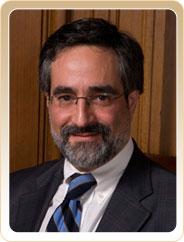
John Avalos

San Franciscans decry Newsom’s public health cuts

8

By Alex Emslie

More than 100 concerned citizens, mental health providers, SRO hotel representatives, and clients of San Francisco’s community behavioral health programs spoke to the Board of Supervisors yesterday at a Beilenson hearing, which the state requires of counties that slash public health services, decrying crippling cuts in the mayor’s proposed budget.

Mayor Gavin Newsom proposed cutting the Department of Public Health’s funding by close to $31 million in next year’s budget currently before the Board of Supervisors. The board can choose to add funding back into departments that were cut before approving the final budget by the end of July.

“These are all services that we value,” DPH director Dr. Mitch Katz said following nearly four hours of public testimony. “We have to make difficult choices because of the state of the city’s budget. We recognize that it is never desirable for us to make cuts.”

Sup. John Avalos, who chairs the Budget and Finance Committee, said the city Budget Analyst’s Office was examining cost savings within the police and fire departments to free up money for the DPH. “I, as budget chair, am working with my colleagues to prevent these cuts that you are concerned about. We have to find cost savings in our budget across other departments.”

Avalos added that cutting other departments wouldn’t solve San Francisco’s looming deficit for years to come, and that taxation must be part of San Francisco’s budget solution. “If we don’t find a significant amount of revenue, looking at progressive forms of taxation, we’ll be in the same boat next year, but even worse, because we don’t expect to have the authorization of federal money [that the city received last year] to help us out.”

Reading the June election tea leaves

0

Everyone’s reading the tea leaves after the local election. The November supes races will be a huge deal, and it’s really tempting to try to figure out what the DCCC results mean for the fall. Paul Hogarth at BeyondChron takes it on here. Chris Daly (no surprise) disagrees.


Let me see if I can sort some of this out.


Hogarth’s basic argument is that the progressives didn’t really do so well in the election:


“In District 8, moderate Scott Wiener finished 1,400 votes ahead of progressive Rafael Mandelman – as the two face the same electorate in November. The renters’ financial hardship measure, Proposition F, lost badly citywide – and finished far worse in neighborhoods that are usually pro-tenant. Debra Walker fared well in her run for DCCC, but most of her votes were not in District 6 – and results there suggest that another candidate for Supervisor could make such a race highly competitive.”


Hogarth is completely upfront and honest about disclosing that he’s a supporter of one of Walker’s opponents, Jane Kim — a former Green who is now a Democrat (and is very much a progressive), but wasn’t in the DCCC race. Theresa Sparks wasn’t in the DCCC race either. Nor was Jim Meko. There are several strong candidates in that race, and they don’t break down along easy political lines. So looking at how many votes Walker got in D6 seems a little off point; there’s nobody to compare her to.


Back to D8. Hogarth:


“Now we know [the D8 breakdown], and the numbers are even worse for Mandelman. Scott Wiener finished approximately 1,400 votes ahead in District 8 (my vote count shows him at 5,954 to Mandelman’s 4,561.) As a comparison, in December 2002 – the last time District 8 saw a hotly contested race on “moderate v. progressive” lines – Bevan Dufty got 11,000 votes, Eileen Hansen 10,000.”


That would seem to make Wiener the much stronger candidate going into the fall.


But there’s another key factor here: turnout. Low-turnout races are mostly (not always, but mostly) better for the more conservative candidate, and in this case, the turnout was really low. Just 32 percent of the voters went to the polls.


Let’s take a look at the 2002 election, the last time we had an open seat in D 8 with a progressive and a moderate running. In the general election in November, progressive Eileen Hansen came in first, with 9,820 votes to Bevan Dufty’s 8,795. But another progressive, Tom Radulovich was also in the race, and this was before ranked-choice voting. Radulovich got 5,221 votes, the majority of which probably would have gone to Hansen.


Turnout was a little over 50 percent.


In the runoff, in December, turnout dropped to 38.8 percent. Dufty got 11,096 votes, and Hansen 9,995. You could argue that most of the Radulovich votes went to Dufty — possible — but more likely, in the runoff, the more liberal voters who had come out in November to vote for Gray Davis for governor and also voted for Hansen just stayed home in December.


And this fall, Wiener will be more in the position that Hansen was in: There’s a third candidate in the race, Rebecca Prozan, and she’s more likely to take votes from Wiener than from Mandelman. And, of course, there’s RCV this time around — and with two gay men and a lesbian in the race, nobody really knows how the second-choice votes will play out.


Daly plays with the turnout numbers:


For the sake of argument, let’s concede that Mandelman starts out 1000-1400 votes behind Wiener among the 11,000 or so District 8 Democrats who voted for DCCC last week. Given that over 31,000 District 8 residents voted in the 2006 Supervisor race (in a contest that was not the most competitive,) we can assume that at least 20,000 additional people will vote this November. In a 2-person contest, Mandelman would need to win 53.5% of these votes in order to win. Given that less frequent voters trend significantly more progressive, and with the addition of Democratic Party branding and the weight of its mail program, 53.5% is almost assured.


Well, I dunno — in 2002, with a contested governor’s race and a contested D8 race, only 26,600 people voted, but it’s safe to say the numbers will be well above 11,000. And it’s not a two-person contest. But I think it’s also safe to say that those higher-turnout voters are the votes most likely to swing toward Mandelman.  


Jim Stearns, a political consultant with long experience in San Francisco (and no candidate in the D8 race), has another interesting analysis he sent over to me:


“Mandelman’s strategy was to spend his limited resources as part of a team effort to maintain progressive leadership on the DCCC. In so doing, he focused more heavily on slate cards that went district-wide than on mailers in District 8 promoting his own candidacy.


 Wiener, on the other hand, abandoned his fellow moderates and spent his money mostly on his own candidacy. This shortsighted strategic blunder will be extremely costly for Wiener in November.


 The result? Wiener got more votes in District 8, but lost his bid to regain his position as chair of the DCCC. Mandelman got fewer votes, but has significantly increased his chances of winning the Democratic Party endorsement this November. That endorsement is worth far more than the mere 1,000 vote difference between Wiener and Mandelman today.”


None of this means Walker will beat Kim and Sparks in November, or that Mandelman will beat Wiener and Prozan. It just means that I suspect the DCCC results don’t really say much about the relative strengths of any of the candidates when it comes to a focused, district-centered race in a high-turnout fall election.


I emailed Hogarth and ran the turnout argument by him. His response:


I tried to caution in my piece that there’s only so much you can see in the numbers — and that you’re right; voter turnout in November will be a lot higher.  Maybe I should have made this a bigger point.  But progressives are deluding themselves if they think turnout will be as high as it was in November 2008.  And if I were Rafael, I would have reason to worry that Scott did so much better than me in D8.  Also keep in mind that, despite the drop-off of DCCC voters, 48% of people in D8 who participated in this election cast a ballot for Scott Wiener.


Correct — turnout won’t be as high as it was in the presidential race. But it might very well be as high as it was in 2002, when there was a contested race for governor, as there will be this fall. Lots of Democratic candidates — particularly Gavin Newsom and Kamala Harris — will be doing GOTV operations in the city, and while Newsom and Harris won’t be supporting Mandelman, I don’t think either of them will limit their turnout efforts to precincts that run toward Wiener. The more liberal dems who vote in November, the better Harris and Newsom do against Republicans; that’s what they care about.


There’s no question that Scott Wiener will be a formidable contender in November. He’s got money, he’s got Mark Leno, and he’s running in a district that has elected moderate gay men since the return of district elections. But it’s remarkable how well the progressives have done in swing districts of late (see: Eric Mar, John Avalos), and Mandelman will, as Daly says, be the consensus candidate of every progressive group in town. He’ll almost certainly have the Democratic Party — which matters even more when Democrats at the top of the ticket are driving turnout. And he’ll have the same sort of boots on the ground that gave Mar a victory in a very tight race.


At this point, I think Mandelman and Wiener both have a shot at finishing first; it will probably be very close. And Rebecca Prozan runs third.


Oh, and the tenant measure? It lost because there wasn’t an effective campaign behind it. Tenant measures don’t automatically win in tenant-heavy San Francisco; time and again over the years we’ve seen that when there’s a measure that pushes the edge (and face it, I strongly supported Prop. F, but it was pushing the edge) and there’s landlord money against it, you need a full-scale concerted campaign for it. Progressives were paying a lot of attention to the DCCC, and to defeating Props. 16 and 17. Prop. F got lost. I’m not happy about that, but I’m not terribly surprised, either — and I don’t think it means much in the long run.


Chris Daly went a bit too far attacking Hogarth for his connections to Mark Leno, who is a Wiener supporter, and suggesting that the folks at BeyondChron — who are, after all, first and foremost tenant lawyers — are going to be backing Scott Wiener in the fall. I don’t see that happening; I can’t imagine it happening. I just think they read a little too much into the DCCC results.

Another bloody budget

6

rebeccab@sfbg.com

In the days since June 1, when Mayor Gavin Newsom unveiled his proposal for San Francisco’s $6.48 billion budget for the next fiscal year, public sector employees and community organizations have been poring over the hefty document to determine how their jobs, services, and programs survived cuts made to close a $483 million shortfall.

For police and firefighters, a key Newsom constituency, the news is good. There were no layoffs to San Francisco firefighters, and while members of the Police Officer’s Association gave up $9.3 million in wage concessions under the lucrative contract Newsom gave them a few years ago, police officers will still receive a 4 percent wage increase on July 1.

For others, the release of the mayor’s budget signified a tough fight looming before the Board of Supervisors, one with high stakes. Cuts to homeless services, mental health care, youth programs, and housing assistance, along with privatization proposals, have raised widespread concern among labor and liberal advocacy organizations. Public input on the budget will continue at the Board of Supervisors Budget and Finance Committee until July 15, when the amended document is considered by the full board.

At a June 1 announcement ceremony, Newsom asserted that the budget was balanced “without draconian cuts,” saying, “We were able to avoid the kind of cataclysmic devastation that some had argued was inevitable in this budget.”

Nearly a week later, Board President David Chiu told the Guardian that sort of cataclysm wouldn’t be staved off for long if the city continues on the course of repeatedly making deep budget cuts without proposing any significant new sources of revenue.

“Now that the smoke has cleared, it is clear that the mayor’s proposed budget is perfect for a mayor who is only going to be around for the short term, but it does not address the long-term fiscal crisis that our city is in,” Chiu said. “Next year, we’re looking at over a $700 million budget deficit. The year after that, we’re looking at almost an $800 million budget deficit. The budget proposal that Newsom put out balances the … deficit on many one-time tricks and assumptions of uncertain revenue.”

Meanwhile, advocates said even the cuts proposed this time would bring serious consequences, especially with unemployment on the rise, state programs being cut in Sacramento, and families feeling the pinch more than ever.

“Poor and working class families, and families of color in San Francisco, are facing kind of an assault on funding and on safety net services on multiple levels,” said Chelsea Boilard, family policy and communications associate for Coleman Advocates for Children and Youth. “I think a lot of it is that families are concerned about their ability to stay in the city and raise their kids here.”


“NO NEW TAXES”

During the budget announcement, Newsom emphasized the positive. He found $12 million in new revenue simply by closing a loophole that had allowed Internet-based companies to avoid paying that amount in hotel taxes. He said 350 currently occupied positions would be cut, but noted that it was less than a cap of 425 that public sector unions had agreed to. Cuts were inevitable since the ailing economy inflicted the city’s General Fund with significant losses, particularly from business and property tax revenues.

Nonetheless, Newsom’s budget is already coming under fire from progressive leaders. For one, there are no new revenue-generating measures in the form of general taxes, which could have averted the worst blows to critical safety-net services and might help remedy the city’s economic woes in the long-term.

“There are no new taxes in this budget,” Newsom declared. “I know some folks just prefer tax increases. I don’t.”

Yet Chiu said many of Newsom’s assumptions for revenue were on shaky ground, prompting City Controller Ben Rosenfield — Newsom’s former budget director — to place $142 million on reserve in case the projected revenues don’t pan out.

“These budget deficits continue as far as the eye can see,” Chiu noted. “Even if those amounts come in, something like 90 percent of them are one-time fixes. So even if the mayor is right, it doesn’t solve next year’s problem, or the year after. Which is why many of us at the board believe that we have to consider additional revenue proposals to think about the long-term fiscal health of the city.”

Sup. John Avalos, chair of the Budget and Finance Committee, described Newsom’s budget as “pretty much an all-cuts budget,” noting that he and Chiu planned to introduce revenue-generating measures. They were expected to introduce proposals — including an increase in the hotel tax and a change in the business tax — at the June 8 board meeting.

Because despite Newsom’s rosy assessment, many of his proposed cuts are deep and painful: the Recreation and Park Department would be cut by 42 percent (with its capital projects budget slashed by 90 percent), Economic and Workforce Development by 34 percent, Ethics Commission by 23 percent (basically eliminating public financing for candidates), Department of the Environment by 14 percent, Emergency Management by 10 percent, and the list goes on.


CUTS TO SOCIAL SERVICES

Progressives say Newsom’s budget reflects skewed priorities. While relatively little is asked of public safety departments, health and human services programs face major staffing and funding losses. “Poor people are being asked to shoulder the burden,” noted Jennifer Friedenbach, director of the Coalition on Homelessness.

Nearly $31 million would be slashed from the Department of Public Health, and more than $22 million would be cut from the Human Services Agency under Newsom’s proposed budget. While this reflects only 2–3 percent of the departmental budgets, there’s widespread concern that the cuts target programs designed to shield the most vulnerable residents.

Proposals that deal with housing are of special concern. “We have more and more families moving into SRO hotel rooms. We have families in garages. We have a really scary situation for many families,” Friedenbach said.

Affordable housing programs within the Mayor’s Office of Housing would get slashed from $16.8 million currently down to just $1.2 million, a 92 percent cut. Other cuts seem small, but will have big impacts of those affected. Newsom’s budget eliminates 42 housing subsidies, which boost rent payments for families on the brink of homelessness, for a savings of $264,000. Meanwhile, a locally funded program that subsidizes housing costs for people with AIDS would be cut, for a savings of $559,000.

Transitional housing would be affected, too, such as 59 beds at a homeless shelter on Otis Street, which Friedenbach says would be lost under Newsom’s budget proposal. “We’ve already lost more than 400 shelter beds since Newsom came to office, so that’d be a huge hit,” she said. Since the recession began, she added, the wait-list at shelters has tripled. The Ark House, a temporary housing facility that serves LGBT youth, would also be closed.

Overall, homeless services delivered by HSA would take a $12 million hit in Newsom’s budget, or about 13 percent, offset slightly by homeless services being increased by $2 million within the Mayor’s Office budget, a 71 percent increase.

Outpatient mental health services, such as Community Behavioral Health Services, would also be affected (See “Cutting from the bottom”), in violation of current city law. Several years ago, then-Sup. Tom Ammiano introduced legislation establishing a “single standard of care” to guarantee access to mental health services for indigent and uninsured residents.

“If timely, effective, and coordinated mental health treatment is not provided to indigent and uninsured residents who are not seriously mentally ill, those residents are at risk of becoming seriously mentally ill and hence requiring more expensive and comprehensive mental health care from San Francisco,” according to the ordinance, which was passed in June of 2005. Newsom’s budget proposes changing this legislation to enable cuts to those services, which would result in 1,600 people losing treatment, according to Friedenbach.

Unfortunately, advocates for the poor has gotten used to this ritual of trying to restore cuts made by Newsom. “There are some sacred cows that seem to survive year after year, and then we’re left fighting over what we can get,” said Randy Shaw, executive director of the Tenderloin Housing Clinic (THC).

The Central City SRO Collaborative, which supports tenants living in single-room occupancy hotels in the mid-Market Street area and is operated through THC, is slated to be cut by 40 percent along with three other similar programs — a replay from last year when the mayor proposed eliminating funding and the Board of Supervisors restored the cut.

“I think you’d see more fires, more people dying from overdoses. You’d see really bad conditions,” Jeff Buckley, director of the program, told us of the potential consequences of eliminating the inspections and resident training that is part of the program.

Funding was also eliminated for THC’s Ellis Eviction Defense Program, the city’s only free legal defense program with capacity to serve 55 low-income tenants facing eviction under the Ellis Act.


THREAT TO RENTERS

One of the most controversial proposals to emerge from Newsom’s budget is a way for property owners and real estate speculators to buy their way out of the city lottery that limits conversion of rental properties and tenants-in-common (TICs) to privately-owned condos if they pay between $4,000 and $20,000 (depending on how long they have waited for conversion), a proposal to raise about $8 million for the city.

“I went back and forth because I know the Board of Supervisors can’t stand this,” Newsom said as he broached the subject at the June 1 announcement. “I still don’t get this argument completely. Except it’s a big-time ideological discussion. It’s so darn ideological that I think it gets in the way of having a real discussion.”

Yet Ted Gullicksen, director of the San Francisco Tenants Union, said the argument is quite clear: making it easier to convert rental units into condos will accelerate the loss of rental housing in a city where two-thirds of residents are tenants, in the process encouraging real estate speculation and evictions.

“It will encourage TIC conversions and evictions because it makes the road to converting TICs to condos that much easier,” Gullicksen said. “It’s going to be a huge gift to real estate speculators.”

Newsom press secretary Tony Winnicker disputes that impact, saying that “these units were going to convert anyway, whether next year or six years. This merely accelerates that conversion without altering the lottery to protect jobs and services.”

But Gullicksen said the proposal obviously undermines the lottery system, which is the only tool tenant advocates have to preserve the finite supply of rent-controlled apartments, noting that even if the condos are later rented out, they will no longer to subject to rent control. That’s one reason why the Board of Supervisors has repeatedly rejected this idea, and why Newsom probably knows they will do so again.

Avalos said he and other progressive supervisors will oppose the proposal, despite the difficulties that will create in balancing the budget. “It’s kind of like putting a gun to our heads,” Avalos said of Newsom’s inclusion of that revenue in his budget.

To offset that revenue loss, Avalos has proposed a tax on alcohol sold in bars and Gullicksen is proposing the city legalize illegal housing units that are in habitable condition for property owners willing to pay an amnesty fee.

Some housing advocates were also struck by the timing of proposing condo conversion fees while also eliminating the Ellis Eviction Defense Program. “We’re really the only ones doing this,” Shaw noted. He said the program is crucial because it serves low-income tenants, many of whom are monolingual Chinese or Spanish speakers who lack the ability to pay for private attorneys to resist aggressive landlords.


PRIVATIZATION PROPOSALS RETURN

The Department of Children, Youth. and Families budget would be reduced by 20 percent under Newsom’s budget, with the greatest cuts affecting after school and youth leadership programs. Roughly a $3 million cut will result in the loss of around 300 subsidized slots for after school programs, said Boilard of Coleman Youth Advocates. Another $3 million is expected to come out of violence-prevention programs for troubled youth; an additional $1 million would affect youth jobs programs.

Patricia Davis, a Child Protective Services employee who lives in the Mission District with her two teenage sons, said she was concerned about the implications for losses to youth programs, particularly during the summer. “You can imagine what’s going to happen this summer,” she said. “I feel that a lot of kids are going to do a lot of things that they have no business doing.”

Davis, who says she’ll have to look for a new job come Sept. 30 because the federal stimulus package funding that supports her position will run out, said she was not happy to hear that police officers would be getting raises just as that summer school programs are being threatened with closure. “Couldn’t the 4 percent [raise] go somewhere else — like to the children?” she wondered.

Meanwhile, privatization proposals are causing anxiety for SEIU Local 1021 members, who recently gave millions in wage concessions and furloughs along with other public employees to help balance the budget. A proposal to contract out for jail health services cropped up last year and was shot down by the board, but it’s back again.

“When you make it a for-profit enterprise, the bottom line is the profit. It’s not about the health care,” SEIU Local 1021 organizer Gabriel Haaland told us. “It isn’t the same quality of care.”

Haaland said he believes the mayor’s assumption that the proposal could save $13 million should be closely examined. Other privatization schemes would contract out for security at city museums and hospitals.

Institutional police in the mental health ward at SF General Hospital and other sensitive facilities are well trained and experienced with difficult situations so, Haaland said, “the workers feel a lot safer” than they would with private contractors.

Regarding Newsom’s privatization proposal, Avalos said the board was “opposed last year and the year before, and we’ll oppose [them] this year.”

In the coming weeks, Avalos and other members of the Budget and Finance Committee will carefully go over Newsom’s proposed budget — which is now being sized up by Budget Analyst Harvey Rose’s office — and solicit input from the public. Chances are, they’ll get an earful.

“People are scared. They are scared to death right now,” Boilard said. “As it is, people’s hours are being reduced. And it’s getting harder and harder to find a job because so many people are out of work that the level of competition has gotten really fierce. This is the time that we need to invest in safety net services for young people and families more than ever — and all those services and programs and relationships that people depend on are disappearing.”

Steven T. Jones and Kaitlyn Paris contributed to this report.

From the progressive DCCC party

2

Alex Emslie gives this report from the progressive DCCC victory party:


As of 9 p.m., close to 100 people have gathered at the Project 1 art gallery and DJ lounge to celebrate the progressive slate for Democratic County Central Committee.


At this point, candidates are beginning to trickle into the dimly lit gallery, chatting with the crowd over the quiet din from a DJ booth in the back.


“It’s a beautiful array of San Francisco progressives,” Assembly District 13 candidate Alix Rosenthal said of the partygoers. She said the most important part of her platform is getting more women elected locally. She also wants to preserve the nightlife culture in San Francisco.


“I’m getting distracted because I can’t believe I’m winning,” Rosenthal added after checking election results behind the DJ booth.


David Cutler, a San Francisco resident since 1987, stood by the bar waiting for more candidates to arrive. “It’s nice to have this much accessibility to our local politicians,” he said.


The real question on everyone’s mind, though, is how the election will turn out; the progressives currently control the commitee, but only narrowly. “Right now, we have about 16 or 17 votes, and we need 18,” Sup. John Avalos said. “I think we’re going to catch a couple more.”

Nevius family values

6

The Chron’s C.W. Nevius has made a big deal of moving back into town from the suburbs — and the offhand comment by Steve Jones in an email to Nevius has almost become a sticky nickname. In fact, his own newspaper’s website, sfgate, headlined his column “Suburban twit moves to city.”

But Chuck’s got some work to do before he starts to understand San Francisco values.

Take his latest column, about the Democratic County Central Commitee. Now, any Chron columnist (or anyone else) has the right to endorse and advocate for any candidates he or she wants. And Nevius is absolutely right to point out that the DCCC race is crucial, that control of the committee will have a significant impact on the fall supervisorial elections.

Here’s what made me want to scream:

“So, if you’re happy with the far-left agenda, check out the Bay Guardian. (Progs with name recognition like Peskin, David Campos, David Chiu, and John Avalos are probably shoo-ins. Daly is not running.) For those who’d like to see a swing to families, kids, and civility on the streets, here are some suggestions.”

 A swing to families and kids? You must be kidding.

The single greatest issue facing families and children in this city is the cost of housing. That’s why Coleman Advocates for Children and Youth, which almost everyone agrees is the premier family-advocate group in the city, has made affordable housing a huge priority.

Some of what a recent Coleman report says:

 “Two-thirds of all children in the city do not have a secure future in San Francisco

More families in San Francisco are low-income (43%) than middle-income (23%), and face economic hardship even when working full-time jobs.

Extreme racial disparities in family income and access to opportunity mean that the majority of children who do not have a secure future in SF are children  of color, and the majority of children who do have a secure future are white.”

Coleman’s recommendations: Build and preserve affordable housing for families — not market-rate condos, not condo conversions, but below-market-rate housing.

From the report:

“1. Prioritize the needs of 45,000 children growing up in 20,000 extremely-poor and low-wage working families.  trategies must combine investing in a stronger social safety-net for families now, and investing in anti-poverty strategies that will prepare today’s poor children to become economically secure San Franciscans of the future. The city’s housing and educational policies must focus on the children and families with the greatest need, and not get sidetracked by the demands of middle-income or upper-income families whose needs are legitimate but not as urgent.

 2. Invest in affordable homeownership programs for middle-income families, but focus the vast majority of limited housing resources on building permanently affordable family rental housing.”

That is exactly what the progressives — the “far left” folks that Nevius decries — have been talking about all these years. The candidates Nevius endorses are of the political camp that advocates more market-rate housing, more condo conversions, fewer tenant protections — more of the kind of things that drive lower-income families out of the city.

The next priority is education. Families that don’t have a lot of money have no option other than the public schools, and a lot of us who might be able to afford private schools still think public education is the way to go. What the schools need in San Francisco is pretty simple: They need more money. The “moderates: Nevius endorses — who actually count as fiscal conservatives, by San Francisco standards — are generally against raising taxes, as is our mayor. The San Francisco city government doesn’t oversee the schools, and most of the education money in California comes from the state — but San Francisco’s Rainy Day Fund, and the willingness of the supervisors to put money into the local schools, has saved hundreds of teacher layoffs and helped the quality of the local public schools.

 Where did that idea come from? Progressive leader Tom Ammiano.

I’m a San Francisco parent with two kids, and I have a lot of friends who are San Francisco families, and none of us see the Nevius agenda as family-friendly. That’s why we’re supporting the progressives.

Newsom’s budget includes a few ideas “Supervisors can’t stand”

City department heads, members of the San Francisco Board of Supervisors, representatives from major news outlets, and others crowded into the Luggage Store Art Gallery at 6th and Market streets on June 1 to hear Mayor Gavin Newsom discuss his proposed 2010-2011 budget.

Colorful artwork, such as a collage fashioned from cereal boxes, adorned the walls, and Newsom said he’d selected the venue to emphasize his commitment to improving the blighted mid-Market area.

Newsom’s $6.48 billion budget is being put forth in the face of a roughly $480 million deficit, which places the city in a similar financial situation to last year, when the mayor’s budget proposal sparked an outcry from progressive supervisors and a wide array of advocacy organizations for its deep blows to public health programs and critical services.

At first glance, the Department of Public Health seems to have fared better this time around, as a partial result of outside funding through federal programs. However, Newsom proposed slashing $22 million from DPH, compared with a total department budget of approximately $1.4 billion.

Newsom’s budget eliminates a total of 993 positions that are filled and unfilled, though the mayor said he anticipated 350 actual layoffs, bringing the total number of city employees to the lowest level in more than a decade. He thanked those he referred to as “enlightened city employees” for wage concessions that made fewer layoffs possible. There were no layoffs in the San Francisco Police Department or the San Francisco Fire Department, Newsom noted. The mayor also announced that an additional $5.9 million would be allocated to remedy the plagued crime lab.

The most contentious issue to emerge from the budget announcement was a proposal to generate $8 million through condo-conversion fees, under a system that would make it easier for people to turn rental units and tenancy-in-common units into condominiums.

Newsom accounted for funding from this proposal despite a lack of support from the Board of Supervisors. “I know the Board of Supervisors can’t stand this,” he said. “But I can’t stand the alternative. … This is a debate that I want to have, because I think this is principled and right.” He added that he thought supervisors’ resistance to accelerated condo conversions was “so darn ideological that it gets in the way of having a real discussion.”

Sup. John Avalos, who chairs the Budget & Finance Committee, said that he and other supervisors fear this could lead to more owner move-in evictions, a trend that would upend tenants’ lives and ultimately deplete the city’s affordable housing stock. “That’s been a concern of mine for months,” Avalos noted. Newsom’s decision to go forward with including it in the budget means that if the Supes reject it, they’ll have to find an additional $8 million to make up for the gap. “It’s kind of like putting a gun to our heads,” he said.

Newsom asserted that the budget was balanced “Without draconian cuts,” saying, “We were able to avoid the kind of cataclysmic devastation that some had argued … was inevitable in this budget.”

Yet Avalos described it as “pretty much an all-cuts budget,” because it contained no new revenue generating measures. “There are no new taxes in this budget,” Newsom said. “I know some folks prefer tax increases. I don’t.”

Avalos said he and other members of the board were working on a number of revenue-generating measures, including a nickel-per-drink tax on alcoholic beverages that would be aimed at the level of distributors, not small independent businesses.

Expect more on the mayor’s budget in coming weeks.

Fees rise in SF, but some supervisors prefer taxes

5

By Brittany Baguio

 The Board of Supervisors this week voted to impose non-resident fees for admission into Botanical Gardens in an effort to help alleviate the city’s $483 million budget deficit, as requested by the Mayor’s Office. But even supervisors who supported it say they hope to end the fees if they can find some general revenue sources, a process that will begin next week after Mayor Gavin Newsom releases his budget on June 1.

Sup. John Avalos, who chairs the Budget Committee, began Tuesday’s discussion by stating that he believed that this non-resident fee would stop the layoffs of Botanical Gardens staff and help offset the 30 percent drop in their budget. Despite supporting the fees, Avalos expressed hope that they could be replaced by a 2 percent increase in the hotel tax, something labor and community groups are pushing that would raise $38 million to $45 million per year.

He even amended the item to include a provision that the non-resident fee will be eliminated within 90 days from the effective date of the new tax. Despite Avalos’s amendment, AIDS Grove founder and volunteer community gardener Nancy McNally said she was appalled that Avalos would support a non-resident fee. “He is not committed to preserving significant public park commons that San Franciscan generations before him have paid taxes to preserve,” McNally told the Guardian. “No one wants to brainstorm and come up with creative options to alleviate this crisis that is not really a crisis. Greed is the crisis.”

One thing McNally did appreciate was sober assessments made at the hearing by Sup. Eric Mar, who stated that Botanical Gardens serves as a haven for low-income and immigrant families who can only enjoy the facilities because admission is free. He declared that once fees are attached to Botanical Gardens, it will lose its appeal. He also added that passing this fee will be the first step in initiating fees for all.

San Francisco resident Daniele Erville shared Mar’s concerns. “A fee acts as a deterrent to a place that by its very nature is welcoming,” Erville told us. “The place makes us feel at home, it reminds us that we are a part of nature and reminds us of our common humanity. Spirituality means that you are in touch with what unites us all, and so differentiating on any level just clashes.”

The imposition of fees – $7 for non-resident adults, $5 for seniors, and $2 for children – was approved on a 8-3 vote, with Sups. Mar, Bevan Dufty, and Ross Mirkarimi in dissent.

Insecure Sanctuary

9

Sarah@sfbg.com

The Board of Supervisors is urging San Francisco officials not to participate in Secure Communities, a controversial federal-local fingerprinting collaboration set to be activated June 1. But opting out of a program that threatens to make debates over “sanctuary city” protections of immigrants irrelevant may not be easy.

Speaking at a May 18 rally, Sup. Eric Mar warned that the use of Secure Communities by U.S. Immigration and Customs Enforcement (ICE) could cause the deportation of innocent residents and destroy local community policing efforts. “The police-ICE entanglement will hurt our communities and many people accused of minor crimes will see families torn apart,” Mar warned, as he urged the city to opt out of the Department of Homeland Security initiative, which identifies immigrants who are sitting in U.S. jails and may be deportable under federal immigration laws.

Cosponsored by Sups. John Avalos, David Campos, David Chiu, Chris Daly, Bevan Dufty, Sophie Maxwell, and Ross Mirkarimi, Mar’s resolution was scheduled for a May 25 vote that would make San Francisco the first jurisdiction in the nation to pursue withdrawing from the system.

“The shadow of Arizona is starting to cover other cities,” Mar said, referring to Arizona’s anti-immigrant legislation, SB 1070. “We can’t let Arizona come to San Francisco.”

ICE spokesperson Virginia Kice said the program’s focus is on criminal aliens. “These are folks who have been charged with or found guilty of felonies and have ignored deportation orders,” Kice said.

But ICE statistics show that the program mostly deports those with minor offenses. Between October 2008 and March 2010, Secure Communities submitted 1.9 million sets of digital fingerprints and deported 33,326 people nationwide. Fifteen percent of those deported (4,903 people) had criminal histories that included major drug and violent offenses such as murder, manslaughter, rape, robbery, and kidnapping (Level 1 crimes). The other 85 percent (28,423 people) were deported for less serious drug and property offenses (Level 2 crimes) and other minor charges (Level 3 crimes).

Kice admits that Level 2 and 3 offenders constitute the largest percentage of SC cases. “That’s because representatively more people are arrested for Level 2 and 3 offenses than Level 1,” she said. “That’s probably fortunate, because Level 1 crimes are very serious.”

But American Civil Liberties Union legislative counsel Joanne Lin warns that Secure Communities allows the federal government to circumvent local sanctuary policies and fast-track deportation. “It allows the Department of Homeland Security to identifty everyone who is booked, whether they are here lawfully or their charges are subsequently dropped or dismissed,” Lin said.

Mayor Gavin Newsom said he has no reservations about the program, which the Bush administration first announced in March 2008. “Sanctuary city policies were never meant to protect criminal behavior,” mayoral spokesperson Tony Winnicker said May 7, when San Francisco Sheriff Mike Hennessey blew the whistle on the federal-local fingerprinting collaboration. “At the end of the day, federal officials should enforce immigration laws. We report — we don’t deport.”

The program links local law enforcement databases to the Department of Homeland Security’s biometric system through interoperability agreements with states, allowing instantaneous information-sharing among local jails, ICE, and the FBI.

ICE implemented the program in North Carolina and Texas in October 2008. Under President Obama, the program has been activated in 169 jurisdictions in 20 states. ICE plans to have a Secure Communities presence in each state by 2011, and in each of the 3,100 state and local jails nationwide by 2013, according to its Web site.

Under the program, participating jails submit fingerprints of arrestees to immigration and criminal databases, thereby giving ICE a technological presence in prisons and jails. An overview conducted by the Washington, D.C.-based nonpartisan National Immigration Law Center observes that “the critical element” of the program is that, during booking in jail, arrestees’ fingerprints will be checked against DHS databases, rather than just against FBI criminal databases.

“ICE asserts that the purpose of the Secure Communities program is to target violent criminals for removal,” NILC observed. “Advocates had criticized the program’s operation because it took place at the beginning of the criminal process and therefore indiscriminately targeted persons arrested for crimes of all magnitudes, rather than persons convicted of serious crimes.”

“The underlying purpose may be to lay the groundwork for real immigration reform,” NILC concludes. “But the mechanisms put in place will be difficult to dismantle, and the civil rights violations they produce cannot be undone.”

Scott Lorigan of the California Department of Justice’s Bureau of Criminal Identification and Information signed an interoperability agreement with ICE’s John P. Torres in April 2009. Since then, the system has been activated in Alameda, Contra Costa, Fresno, Imperial, Los Angeles, Monterey, Orange, Sacramento, San Bernardino, San Diego, San Joaquin, San Luis Obispo, Santa Barbara, Solano, Sonoma, Stanislaus, and Ventura counties. Now it’s set to get switched on in San Francisco.

Campos thanks Hennessey for blowing the whistle, and lays the blame at Obama’s door. “None of us would have known this was happening,” Campos said. “This is the time for all San Francisco’s elected officials to stand up in support of the principles that led us to establish a sanctuary city. It’s not just the board, but also the mayor who needs to step up and say what just happened is not acceptable. This program eviscerates sanctuary city.”

Hennessey has written to California Attorney General Jerry Brown asking for assistance in opting out of the ICE program. Brown’s office is reviewing his request. “The California Department of Justice manages the statewide database of fingerprints that are essential to solving crimes, but we have no direct role in enforcing federal immigration laws,” Brown’s press secretary Christine Gasparac clarified. “We were informed by ICE that they will work with counties to opt out of their program. Because that is a process directly between the county and ICE, we’re advising local authorities who want to opt out to contact ICE directly.”

But it’s not clear what opting out will achieve. ICE’s Kice said jurisdictions can choose not to receive the immigration-related information on individuals who are fingerprinted, but that information will still be provided to ICE, which can act on it. Kice said that after an arrestee’s biometrics are forwarded to the feds, the information is bounced off FBI and DHS databases, and the information that comes back says if they have a record.

“What comes out is a recap of whatever relevant information is in the database,” she said. “For example, whether there has been a prior formal deportation or a prior arrest. It also shows if they have an adjusted status — whether they have legal permanent status. It will indicate if they are naturalized, in which case they are not subject to removal. That’s the information the community could cut off.”

“ICE always did these checks, but it was only available to local law enforcement agencies if they queried the system themselves, which required them to take a couple of extra steps,” Kice continued. “And it was name based. And that could be problematic, given duplicate names in system. That’s what fingerprints eliminate. Our concern is that municipalities are dependent to a large extent on information provided by the individual at the moment of arrest. We think the use of biometrics will ensure that folks who provide false information to local law enforcement officials don’t escape detection.”

Kice acknowledged that not everyone in the database is a violator. “The fact of having a record does not mean that you are a deportable alien,” she said. “And we understand that someone may get arrested and may not get convicted on their current charges. But what about a prior history? We know that folks have eluded detection, escaped, or been released from custody. So the individual may be someone who has other prior convictions. It’s the totality of their record that we are talking about here.”

At present, the San Francisco County Sheriff’s Department only reports noncitizens who are booked on felony charges. Hennessey expressed concerns about the unintended consequences of ICE technology interfacing with that of the Department of Justice’s fingerprint database.

He also warned that the 2,000 or so ICE referrals his office makes annually could explode. “We’ll be fingerprinting 35,000-40,000 persons annually,” Hennessey claimed. “And ICE has a record of secrecy. They won’t tell me what happened to folks they pick up. They won’t say if they are still in custody, been released or deported. The basis of sanctuary city is to protect immigrants who are not doing anything wrong or serious. When ICE grabs someone who failed to pay a traffic ticket and that person is supporting a family, I don’t think those crimes should rise to the level of deportation.”

Sheriff: ICE referrals will leap from 2,000 to 40,000

4

There was a strong showing of supervisors, activists and community members at today’s rally to urge San Francisco to opt out of the Secure Communities Initiative, an automated fingerprint screening system that U.S. Immigration and Customs Enforcement (ICE) plans to switch on, in San Francisco on June 1—just two weeks ago.

The program links local law enforcement agencies to the Department of Homeland Security’s biometric system through interoperability agreements with each state. Scott Lorigan in the California Department of Justice’s Bureau of Criminal Identification and Information reportedly signed such an agreement with John P. Torres, acting assistant Secretary of ICE, over a year ago, on April 10, 2009. And according to ICE, As April 2010, biometric identification has been activated in 169 jurisdictions in 20 states:

In California, the system has already been activated in Alameda, Contra Costa, Fresno, Imperial, Los Angeles, Monterey, Orange, Sacramento, San Bernadino, San Diego, San Joaquin, San Luis Obispo, Santa Barbara, Solano, Sonoma, Stanislaus, and Ventura.But as speakers pointed out at today’s rally, the supervisors and the communities they represent would not have even known that this system was about to go live in San Francisco, had it not been for San Francisco Sheriff Mike Hennessey, who spoke out after ICE informed local law enforcement agencies about the program three weeks ago.

Eric Quezada of Mission-based Dolores Street Community Services kicked off the rally with a rousing speech in which he warned that this “draconian Policy” was happening in the “shadow of Arizona.

Sup. Eric Mar warned that ICE’s proposed program will not make communities more safe.
”It was developed in the dead of night,” Mar said. “The police-ICE entanglement will hurt our communities and tear families apart.”

The Bush administration introduced the Secure Communities Initiative in March 2008. But as Mar observed, it is now being expanded under President Obama.“Many people accused of minor crimes will see families torn apart,” Mar said, citing statistics to show that  “90 percent of those IDed have been arrested for minor, less severe crimes.

“The shadow of Arizona is starting to cover other cities,” Mar continued. “We can’t let Arizona come to SF.”

Sheriff Hennessey told the crowd that he had written to California Attorney General Jerry Brown asking for his assistance in opting San Francisco out of the ICE program.“The Sheriff already has the authority to report foreign born folks charged with serious  felonies,” Hennessey explained.

In a May 18 letter to AG Jerry Brown, Hennessey wrote that he believed that Brown’s agency “has the technological capability to isolate by agency the information linked to ICE.”

““I ask that you isolate transactions from the San Francisco Sheriff’s Department because Secure Communities conflicts with local laws,” the Sheriff continued. “My department already has a system in place that reports individuals to ICE and I do not wish it to be replaced by Secure Communities.”

Hennessey also expressed concern about the unintended consequences of ICE technology interfacing with that of the Department of Justice’s fingerprint database, which also holds fingerprints collected for non-criminal justice purposes such as employment applications. And he warned that the number of ICE referrals could explode under the new system.
Under this system, we’ll be fingerprinting 35,000-40,000 persons annually, “ Hennessey said. “I think that’s excessive.”

Currently the Sheriff’s Dept. reports foreign-born individuals arrested on a felony crime or found during the booking process to have a felony of a previous ICE contact in their criminal histories.

‘Since 2007, the department has delivered more than 3,100 individuals to ICE, and has reported at least twice that number,” Hennessey wrote. “I would like to keep system that way.”

At the rally, Hennessey warned that the new system will widen excessively to include folks who were charged with misdemeanors, infractions and traffic violations, but failed to show up in court.

“ICE has a record of secrecy. They won’t tell me what happened to folks they picked up, they won’t say if they are still in custody, been released or deported,” Hennessey said.

Sup. John Avalos said the Secure Communities Initiative is yet another example of why the nation needs comprehensive immigration reform.
“I don’t know if we have the ability to opt out, there are a lot of obstacles in our oath, right now.”

But he warned that the nation is passing laws that “stand at odds” with the U.S. Constitution and the Bill of Rights “And we have rogue departments in the Obama administration, “ Avalos added. “ I consider ICE a rogue department. “
 
Rev. Phillip Lawson, a retired Methodist minister said he wanted to stand in solidarity with “resident aliens”.
“As black people, we know what it’s like to be aliens in our own land. And this enlarges the net of ICE. We will soon not be able to tell any difference between the police and ICE. And no one will trust the police.”

“I give thanks to the courage of folks here for instituting this attempt to say, no we will not cooperate…And we can also resist the law.”

Sup. David Campos, who provided much leadership in the last two years around the city’s sanctuary legislation, thanked Hennessey for blowing the whistle.

“None of us would have known this was happening,” Campos said. “This is the time for all San Francisco’s elected officials to stand up in support of the principles that led us to establish a sanctuary city. It’s not just the Board, but also the mayor who needs to step up and say that what just happened is not acceptable. This program eviscerates sanctuary city.”

Campos warned that the community has already lost trust in the local police, over the last two years, thanks to the city’s policy of referring juveniles to ICE when they are booked.

“If we cooperate [with SCI] that lack of trust will intensify,” he warned. “I applaud the sheriff, but we also need the police department to come forward.”

Campos laid the blame at Obama’s door.
“This is a Democratic president, who was elected with the support of the Latino and the immigrant community, but is engaging in practices worse than any other president.”

Tim Paulson, executive director of the Labor Council spoke on behalf of 150 unions in town. “Our work is dependent on the immigrant community,” He said. “Secure Communities is absolutely divisive and unconstructive. It pits worker against worker, families against families.”

Heidi Li of Asian Pacific Islander Legal Outreach warned that victims of domestic violence, trafficking and elder abuse would be at risk from ICE’s program.

“It will result in a situation where folks who need trust and assurance the most, will not feel safe and will no longer report to the police when they are the victims of abuse,” Li said.

At rally’s end, Hennessey told the Guardian, “The basis of Sanctuary city is to protect immigrants who are not doing anything wrong or serious. When ICE grabs someone who failed to pay a traffic ticket, and that person is supporting a family, I don’t think those crimes should rise to the level of deportation.”

Warning folks that folks did not know that SCI had been activated in Alameda and Contra Costa counties, Hennessey said all he can do is “raise the issue” of opting out. 

Sup. Mar told the Guardian that the request to opt out is a “unique and creative tactic.”

“We have the strong legal backing from organizations around the country, but SFPD Chief George Gascon doesn’t seem convinced,” Mar observed

Christine Gasparac, Attorney General Jerry Brown’s press secretary told the Guardian that they received Hennessey’s May 18 letter requesting to opt out and are reviewing it.

“To clarify, the California Department of Justice manages the statewide database of fingerprints that are essential to solving crimes, but we have no direct role in enforcing federal immigration laws,” Gasparac said. “We were informed by ICE yesterday that they will work with counties to opt out of their program. Because that is a process directly between the county and ICE, we are advising local authorities who want to opt out to contact ICE directly.

Virginia Kice, ICE’s Western Regional Communications Director said, “under Secure Communities jurisdictions can choose not to receive the immigration-related information on individuals who are fingerprinted, but that information will still be provided to ICE.

As April 2010, biometric identification has been activated in 169 jurisdictions in 20 states. Since it’s unclear, which communities know about the program, the Guardian is posting the list here:

In Arizona:  Cochise, Maricopa, Pima, Pinal, Santa Cruz, Yavapai and Yuma

In California Alameda, Contra Costa, Fresno, Imperial, Los Angeles, Monterey, Orange, Sacramento, San Bernadino, San Diego, San Joaquin, San Luis Obispo, Santa Barbara, Solano, Sonoma, Stanislaus, and Ventura

In Delaware: Kent, New Castle and Sussex

In Florida: Brevard, Browar, Charlotte, Clay, Collier, Duval, Escambia, Highlands, Hillsborough, Lake, Leon, Manatee, Marion,Miami Dade, Monroe, Orange, Osceola, Palm Beach, Pinellas, Polk
Sarasota, St. Johns, St. Lucie, Volusia

In Georgia: Clayton, DeKalb and Gwinnett

In Hawaii: Oahu

In Illinois: DuPage, Kane, Lake, Madison, McHenry, St. Clair, Will and Winnebago

In Lousiana: Jefferson Parrish

In Maryland: Frederick, Prince George’s, Queen Anne’s and St. Mary’s.

In Massachusetts: Suffolk

In Michigan: Wayne

In North Carolina: Brunswic, Buncombe, Cabarrus, Catawba, Columbus , Cumberland, Dare , Duplin, Durham, Gaston, Halifax, Harnett, Henderson, Jackson, Lee, Mecklenburg, New Hanover,
Orange, Transylvania, Union and Wake.

In New Mexico: Bernalillo, Dona Ana, Grant, Hidalgo, LunaOhio, Cuyahoga and Franklin

In Oklahoma: Oklahoma, TulsaOregon and Clackamas

In Pennsylvania: Bucks, Montgomery and Philadelphia

In Utah: Box Elder, Davis, Salt Lake, Utah and Weber

In Virginia: Alexandria City, Arlington, Fairfax, Fauquier, Henrico, Loudoun, Norfolk City, Prince William, Rappahannock. Richmond City and Virginia Beach City

In Texas: Bexar, Brazoria, Brewster, Brooks, Collin, Culberson, Dallas Dallas County Jail, Dallas Farmers Branch PD, Dallas Irving PD, Dallas and Collin Richardson PD, Dallas and Kaufman Mesquite PD, Dallas, Collin, Denton Carrollton PD, Denton, Dimmit, El Paso, Fort Bend, Galveston
Grayson, Harris, Hidalgo, Hudspeth, Hunt, Jeff Davis, Jefferson, Jim Wells, Johnson, Kaufman, Kenedy, Kinney, Kleberg, Maverick, McLennan, Montgomery, Nueces, Pecos, Presidio, Real, Starr, Tarrant, TDCJ, Terrell, Travis, Uvalde, Val Verde, Webb, Willacy, Williamson, Zapata and Zavala.


ENDORSEMENTS

Our endorsements  for the upcoming election were originally published on April 27. We’re republishing them here for the benefit of absentee voters. Our clip-out guide to take to the polls will appear in our June 2 issue and online.

On the eve of the June 8 election, we’ll be publishing our handy clip-out guide for you to take to the polls. Before then, however, take a minute to read about our decisions — and why they’re important for the future of the country, the state, and San Francisco.

ENDORSEMENTS:

>>NATIONAL AND STATE RACES

>>STATE BALLOT MEASURES

>>SAN FRANCISCO BALLOT MEASURES

>>JUDICIAL RACES


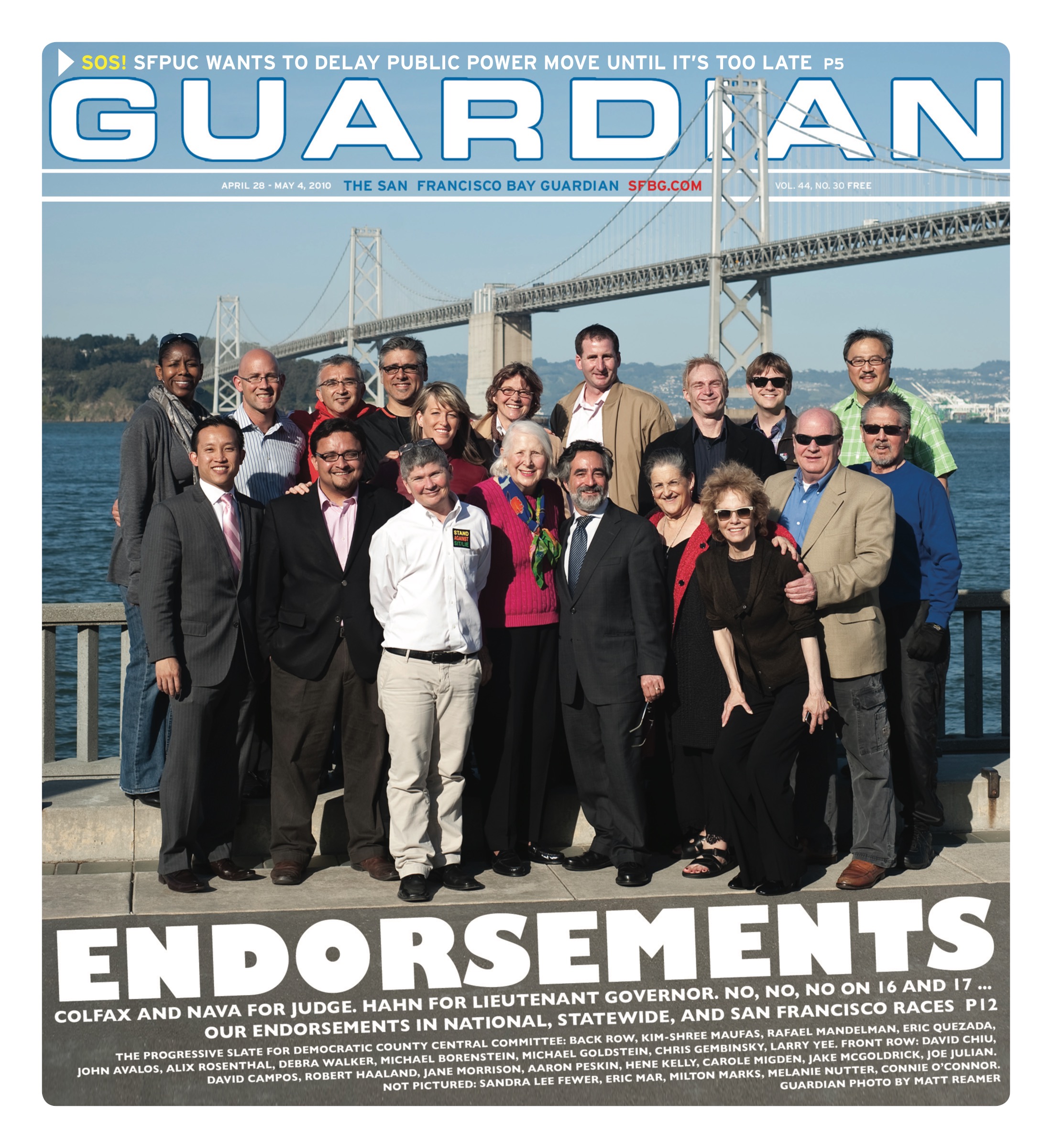
Pictured above: 

OUR CHOICES FOR DCCC

We’ve already endorsed candidates for the Democratic County Central Committee (see “Our endorsements for DCCC,” 3/30). We’re listing them again here for easy reference — in the order they will appear on the ballot. (Since it’s unfair to present candidates in a crowded field in alphabetical order, the state every year does a random alphabetical drawing to set the order in these races.)

The election is crucial — DCCC controls the local Democratic Party endorsements, which can make a huge difference in district supervisorial contests.


ASSEMBLY DISTRICT 13

Debra Walker

Aaron Peskin

Eric Quezada

Joe Julian

Alix Rosenthal

Michael Goldstein

David Campos

David Chiu

Rafael Mandelman

Kim-Shree Maufas

Carole Migden

Robert Haaland


ASSEMBLY DISTRICT 12

Chris Gembinski

Connie O’Connor

Michael Bornstein

John Avalos

Hene Kelly

Melanie Nutter

Sandra Lee Fewer

Eric Mar

Milton Marks

Jane Morrison

Jake McGoldrick

Larry Yee


Supes to SF: Let’s opt out of ICE’s automatic fingerprint referral program

8

Just two weeks before a controversial collaboration between local police and ICE is set to get switched on in San Francisco, Sups. Eric Mar, John Avalos, David Campos, Chris Daly and Sophie Maxwell are introducing a  resolution that calls on the city to opt out of a program that could undermine public safety and threaten innocent community members with deportation.

Sheriff Michael Hennessey, who blew the whistle on this program, and Labor Council Executive Director Tim Paulson will join the supervisors May 18,  9 a.m. on the steps of City Hall. The resolution will be formally introduced at the Board’s afternoon meeting.

Sup. Mar’s legislative aide Lin-Shao Chin told the Guardian that it looks like an opt-out option is possible.
“It’s very vague, the way it’s written,” Chin said, referring to the contract that the Department of Homeland Security has drafted and that cities are required to sign onto, via a statement of intent.”So, while it doesn’t say you can opt out, it’s very vague, and from what we’ve heard, so far it’s all just been verbal communication between the law enforcement agencies.”

The fed’s proposed Secure Communities Initiative (SCI) has been criticized by civil rights experts.They say the program causes immigrants to be reported for deportation without due process and that it destroys trust between the police and immigrant communities.

The program seeks to check the immigration status of anyone whose fingerprints are taken by law enforcement personnel by cross-checking fingerprints through a federal database. They warn that  immigrants who are simply charged with very  minor charges – such as selling ice cream bars without a permit– or those who are overcharged on arrest–could end up torn from their families without due process and reported for deportation.
 
Advocates see similarities between the program and Arizona’s SB1070, since SCI gives discretion to individual police officers, who may mistakenly arrest or overcharge innocent immigrant residents, thereby triggering their deportation. 

“ICE’s own statistics, cited in news reports, indicate that some 88 percent of the 33,000 immigrants deported to date under the program had committed non-violent offenses or no offense at all,” community advocates note.

“Five percent of people tagged are actually documented, and only 10 percent are actually felons,” Chin claimed, warning that there is also, “the  potential for a whole bunch of databases, including those containing information on legal citizens, to be hooked together in ways that pose civil liberty concerns.”

Earlier this month, Washington, DC’s City Council unanimously introduced legislation that would prohibit local police from sharing arrest and booking information with ICE. But the Board’s resolution will be the first in the nation to urge an opt-out.

“The feds didn’t present opting-out as an option, they made it sound compulsory, but immigrant groups who met with ICE were verbally told the could opt out,” Chin claimed.
“Immigrant advocates in Contra Costa and Alameda counties didn’t even know their cities had opted into the program, until folks were referred to ICE. The good news is that we are touching this before we have been hooked into the program.”

Chin said it seems the SFPD CHief George Gascon’s office is “under the impression that the program is mandatory, but that’s not the impression we get from ICE.”
Chin also noted that the SCI is an “unfunded mandate,” since there could be costs to cities and municipalities who have to hold folks in jail longer than usual, while they wait for the feds to come and pick them up.

“From what we have heard, these [SCI] contracts are negotiated at the state level,” Chin added, suggesting that the ball on this issue in California lies within Attorney General and gubernatorial candidate Jerry Brown’s court.
 

Supes try applying pressure to urge CCA contract

At the April 27 Board of Supervisors meeting, Sup. David Campos made a motion to push back board approval for San Francisco Public Utilities Commission infrastructure improvement projects until a contract was in hand for the city’s Community Choice Aggregation program. If a contract isn’t signed by June 8, when voters will decide on Pacific Gas & Electric Co.’s Prop 16 in the June election, the city could be vulnerable to a legal strike against its green municipal power program from PG&E.

“Having watched the very slow process” of negotiating a contract, “I believe CCA should be the top priority,” Campos said.

Sup. Ross Mirkarimi, who chairs the Local Agency Formation Commission (LAFCo) and has been the primary driver behind CCA on the board, acknowledged that asking the board to withhold funding for city infrastructure projects was “an extraordinary act,” but warned that the imminent threat of Prop 16 called for drastic measures. “Given this external threat from a corporation that is doing everything in its power to subvert and deny San Francisco’s right to move forward, it alarms me, like I know some of you, that we do not have a contract in hand … knowing very well the kind of resources and fervor that have been demonstrated or exemplified in the past by the PUC or by the administration or by whatever other combinations of political forces who insist on something getting done by certain timelines and deadlines,” Mirkarimi said.

But while Campos and Mirkarimi won the support of Sups. Chris Daly and Eric Mar, they failed to bring the others around. The tactic of withholding approval on an ordinance in order to send a clear message to a city department about a separate issue “sets a real, real bad precedent for how we’re going to be doing our work here,” Avalos said, though he did voice his support for CCA.

Sup. Sean Elsbernd came out strongly against the move, and made a motion to table Campos’ initial motion to push the vote back for two weeks until a CCA contract was finalized. Then, in one of those dizzying contests the Supes sometimes get into, Daly made a motion to table Elsbernd’s motion to table Campos’ motion to table the vote.

To put it simply, six supervisors voted to move forward with the vote as scheduled, while four voted to hold back on approving funding for SFPUC projects until a finalized CCA contract was in hand. Sups. Mirkarimi, Chris Daly, and Eric Mar voted with Campos to hold off; Sups. Bevan Dufty, John Avalos, David Chiu, Michela Alioto-Pier, and Carmen Chu voted with Elsbernd to proceed. (Sup. Sophie Maxwell was absent.) After that skirmish went down, all ten voted to approve the funding for the SFPUC infrastructure projects.

When reached later by phone, Board President David Chiu said, “We are fully committed to seeing a CCA contract happen before the June election,” and noted that he brought up the urgency of the matter in a meeting with the mayor, who in turn voiced his own commitment.

ENDORSEMENTS: Judicial races

2

SUPERIOR COURT JUDGE, SEAT 6


LINDA COLFAX


It’s rare to see an open seat on the Superior Court; judges typically retire midterm and allow the governor to appoint their replacement. And with a Republican governor, the more progressive Democrats have had a hard time getting even close to judicial appointments. Four highly qualified candidates are seeking this seat, and all of them make good cases for election.


Since judicial candidates can’t take stands on most political issues or indicate how they might rule on cases, it’s hard to get a sense of where the candidates stand. But they can talk about their backgrounds and experience — and about how the local courts are run. For example, the Superior Court is managed on a day-to-day basis by a presiding judge, elected by the sitting judges on the San Francisco bench. But those elections are secret; nobody except the judges know who the candidates were; who voted for which one; or what the final tally was. Court administration is done in closed meetings. Most of what happens in the courts is public — but there’s no presumption of cameras in the courtrooms to give the public access to the justice system.


Our choices for judge reflect our interest in a diverse judiciary, judges who have both professional and personal experience that will shape fair decisions — and jurists who believe in open government, including open courts.


Our choice for Seat 6 is Linda Colfax, a deputy public defender with a background in community service (she’s been an ACLU board member) and progressive politics. Like all four candidates, she has impressive legal credentials and trial experience. She also strongly supports sunshine in the courts and told us she would allow the press and public into judges’ meetings when appropriate, supports cameras in the courtrooms (except for cases where a witness or crime victim has to be protected), and efforts to make the courts work more efficiently.


Robert Retana, who grew up in East Los Angeles, has worked in both civil and criminal law, as a prosecutor and a civil litigator. He also has extensive community service with La Raza Centro Legal and the Lawyer’s Committee for Civil Rights. He was awfully vague on cameras in the courtroom and didn’t seem well-informed on open-government issues, but he’s certainly qualified for the job.


Rod Mcleod, a former San Francisco School Board member, told us he won’t raise any money for this race since he thinks judges shouldn’t be captive to special interests. That’s noble, but it also makes it unlikely he’ll be a factor in the end.


Harry Dorfman, a career prosecutor with the District Attorney’s Office, has extensive trial experience but was the least willing of all the candidates we interviewed to expand public access to the courts.


Colfax has the endorsements of Assembly Member Tom Ammiano, Sen. Mark Leno, and Sups. David Campos, John Avalos, and Eric Mar, among others. She would also diversify the bench in a significant way, not just because she’s a lesbian but because she spent her career in the Public Defender’s Office. And since Democratic and Republican governors alike tend not to appoint public defenders to the bench, that background and perspective is rare. Vote for Colfax.


SUPERIOR COURT JUDGE, SEAT 15


MICHAEL NAVA


Another rarity here: a contested race where challengers are taking on a sitting judge. Richard Ulmer, the incumbent, was a Republican living in Hillsborough when Gov. Schwarzenegger appointed him to the bench last year; he quickly changed his registration to independent and took up residence in Park Merced. But two gay men, Michael Nava and Daniel Dean, saw him as potentially vulnerable and, noting the lack of LGBT appointments coming out of the current administration, filed to challenge Ulmer.


Ulmer’s a smart and appealing person with an impressive legal resume, and we see no scandal that would mandate his removal from office. But we also recognize that this is an elected office, and that it’s perfectly acceptable for candidates who think they would better serve the public and the bench to run against an incumbent. In this case, we’re endorsing Michael Nava.


Nava, the grandson of Mexican immigrants, makes the case that judicial appointments can be just as political as elections: out of some 500 judicial appointments, Schwarzenegger has named perhaps five openly LGBT candidates. Nava also would bring a different perspective to the courts. His career has been in the public sector and he currently works as a staff attorney drafting decisions for Superior Court Justice Carlos Moreno. More than anyone else running for judge this year, Nava is an advocate of openness in the judiciary. He told us the courts are the third branch of government and should be held to most of the same sunshine standards at the executive and legislature.


Daniel Dean also makes a compelling case and has extensive courtroom experience as a litigator and judge pro tem. His accessibility and sense of humor would serve him well on the bench, and we hope he continues to seek a judicial slot. But in this race, we’re endorsing Nava.

Did Lennar hire an armed security guard from Andrews International?

11

I didn’t attend the April 12 hearing of the Board’s city operations and neighborhood services committee about Lennar’s decision to send an armed ex-SFPD officer to a Feb. 18 community meeting at the Nation of Islam’s mosque on Third Street.

But video footage shows that it was a packed house, during which plenty of folks stated loud and clear that they thought it was a really bad and potentially dangerous idea to send an armed ex-officer into a community meeting in the Bayview.


“What next? Concealed weapons at City Hall?” a member of the public asked.

At meeting’s end, Sups. John Avalos, Carmen Chu, Sean Elsbernd voted to refer a resolution urging Lennar Corporation to issue a formal, written apology to members of the Stop Lennar Action Movement (SLAM.) to the full Board without recommendation, after Elsbernd voiced concern that the ex-officer may have been threatened and had racial epithets hurled his way.

“If the gentleman was threatened, if racial language was used, in that case it should not be one- sided,” Elsbernd said. “There should be apologies on the other side as well.”

Meanwhile, it’s worth shining light on another question: Who was the ex-officer actually working for?

During the meeting, much was made of the fact that the ex-officer, who told police his name was Bob Tarantino though apparently that is not his real name, gave as his work contact an address in Miami, Florida, where PR agency Sitrick and Company, has an office.

(Lennar once sent a Sitrick employee to talk to me and my editors at the Guardian, after we published the first in a series of reports that showed that the company failed to adequately enforce promised asbestos dust mitigation plans at its Shipyard site.)

But Sitrick managing director Glenn Bunting, who oversees the company’s San Francisco, Silicon Valley and Miami offices, told the Guardian that the ex-officer in question has never worked for or been an employee of Sitrick.

“We know who is on our pay roll and we don’t provide security services,” Bunting said.

He confirmed that Sitrick recently opened an office in Miami and sublets space from another firm in the same building. “We have a very small presence in Miami,” Bunting said.

So, who could Tarantino work for who  also has the same address in Miami, Florida, where Lennar Corporation is headquartered?

The building in question looks pretty big, lies across the street from the court house and is home to Andrews International, which is headquartered in Los Angeles, and bills itself as “a full service provider of security and risk mitigation services” and the “largest private, American-owned full-service security provider in the United States.”

In October 2009, Andrews International acquired Verasys LLC, a Miami-based consulting firm focused on global risk mitigation, investigations and security services.

“The acquisition added new offices in Miami, Tampa, Dallas, Atlanta and Bogotá, expanding service capabilities in all 50 states and Latin America” an Andrews International press release states.“ This followed the June 2009 acquisition of the U.S. and Mexico guarding operations of Garda World Security Corporation (TSX: GW), encompassing 14 offices across the U.S. and abroad. Most recently in January 2010, Andrews International acquired A&S Security, a California-based full service security company, expanding operations in its Western U.S. Region.”

So, it’s possible Bob Tarantino, or whatever his name is, works for these folks?
Lennar Urban’s Kofi Bonner has not replied to this question, as of this blog posting. But in a March 15 letter to Board President David Chiu and D. 10 supervisor Sophie Maxwell, Bonner said he was “working with our vendors to prevent such an episode from happening again.”


Bonner’s letter wasn’t entirely apologetic.

“Lennar has become increasingly concerned that some community meetings have devolved into hostility accompanied by intimidation of our supporters,” Bonner stated. “For that reason, I decided against sending any employees or consultants to the meeting in question.”

“I am truly disturbed by the ensuing physical and verbal abuse directed at the security firm employee,” Bonner continued. “Not surprisingly, he is independently considering his legal options.”

Downtown’s DCCC slate fizzles

9

I’m actually a bit surprised that Gavin Newsom’s allies haven’t made a bigger push to take back control of the San Francisco Democratic Party, which will play a key role in the fall supervisorial races. It looked for a while as if the downtown folks were organizing to put a slate of strong candidates with solid name recognition on the ballot. But when the Department of Elections closed Friday afternoon, and the deadline for filing passed, there weren’t that many new names on the ballot. Here’s the list. (PDF).


Twelve candidates will get elected in each of the two San Francisco Assembly districts. On the east side of town, in AD 13, eight progressive incumbents, including Sups. David Campos and David Chiu, former Sup. (and current DCCC chair) Aaron Peskin are running. So is School Board member Kim-Shree Maufas and former state Sen. Carole Migden. Supervisorial candidates (and incuments ) Rafael Mandelman and Debra Walker are running, as are former supervisorial candidates Eric Quezada and Alix Rosenthal.


Not a lot of star power in the more moderate camp. Other than former Sup. (and incumbent) Leslie Katz and sup. candidate (and incumbent) Scott Wiener, it’s not a powerful crew. So the progressives look to do well — as they usually do — in D 13.


D-12 is a little more conservative in general — and there are lots and lots of candidates, meaning name recognition is even more important. I’d thought maybe somebody would talk Sup. Sean Elsbernd or Sup Carmen Chu into running. But no: the only elected officials on the list are progressives, including Sups. John Avalos and Eric Mar, School Board member Sandy Fewer, and Community College Board member Milton Marks. Then there’s incumbent (and former Sup.) Jake Mcgoldrick.


The moderate, pro-Newsom camp — the folks who would try to shift the Democratic Party endorsements away from progressives in swing supervisorial districts — may be large, but not terribly deep. Incumbents Tom Hsieh and Megan Levitan are, of course, running again, and there’s Bill Fazio, who once ran for district attorney.


Myra Kopp, wife of former state Sen. (and retired judge) Quentin Kopp, is a candidate, and while she may be a little more politically conservative than Avalos and Mar, she’s not going to be in the Newsom camp, either; she’s more of an independent wild card.


Paul Hogart agrees with me that the progressives seem well situated to keep control of the DCCC, although it’s never a sure thing: there are no contribution limits for these races, and since it’s a low-profile office, big money can make a big difference. Let’s see what downtown tries to do to buff up and promote its candidates in the next two months.


Newsom’s silly trick

19

Gavin Newsom’s got a plan: He’s going to stop those damn district-elected progressives from appoining a new mayor even if it takes some wacky legal footwork. According to the Chron’s Matier and Ross:


For the past two weeks, Newsom’s political team has been combing the state Constitution to determine if the mayor, assuming he’s elected statewide, could legally push back his Jan. 3 swearing-in for the new job until after Jan. 8.


If he can, the job of naming his successor would go to the newly elected Board of Supervisors, which is sworn in Jan. 8, instead of the current lineup.


I don’t know where that team is looking in the state Constitution, but the language seems pretty clear to me. Article V, section 2, provides that the “Governor shall be elected every fourth year…and hold office from the Monday after January 1….” In 2011, that’s Jan. 3. It also says (article V, section 11) that “The Lieutenant Governor, Attorney General, Controller, Secretary of State, and Treasurer shall be elected at the same time and places and for the same term as the Governor.”


And since the mayor of San Francisco is, by Charter, a full-time job, Newsom can’t be both mayor and lt. governor. Which means, I think, that he’s got to start the new job Jan. 3, and the new Board of Supervisors doesn’t take office until a week later.


There’s another twist here: The City Charter discusses a “vacancy” in the office of mayor, and authorizes the Board of Supervisors to select someone to fill the remainder of a vacant term. If Newsom wins in November, it will be clear that a vacancy is looming — and there’s no reason why the supervisors can’t pass a motion right away designating the person who they intend to have fill that vacancy. In other words, this current board could select the next mayor even before Newsom officially resigns.


Now, it’s also true that the motion wouldn’t become effective until the mayor actually left office, and could be rescinded at any time up until that moment. But if the supervisors find six votes for a candidate, and designate that person as Newsom’s successor, it’s unlikely the board would decide to change its mind and rescind in just a few weeks.


And even if all that doesn’t fly, there’s a very good chance that progressives will still control the next board. Four progressive supes will carry over — Ross Mirkarimi, John Avalos, Eric Mar and David Campos. If progressive candidates win two of the three swing races — in districts 6, 8 and 10 — then the overall politics of the board won’t change dramatically.


So there’s actually a chance that a progressive mayor could take office next January. Whether Newsom likes it or not


The Chronicle’s dishonest hit on district elections

8

The move to get rid of district elections – which is based entirely on the fact that big business and more conservative voices (including the Chron) don’t like the progressive policy positions of the current board – is now well under way. The Chron devoted its Insight section to the issue Feb. 28, leading with a long editorial that wandered back and forth between points and never really made the case.


An example of the Chron’s logic:


But sitting atop the decision-making tree [in San Francisco] are small-time politicos, some elected with fewer than 10,000 votes in a city with a population of 808,976.


Horrifying! It’s as if the United States Congress – which has to decide issues like war and peace — was made up of local politicos who were elected with as few as 100,000 votes in a nation of 350 million.


Or as if the California Assembly – which has to deal with a $28 billion budget deficit – was made up of local politicos who were elected with as few as 50,000 votes in a state of more than 35 million.


A district supes votes could represent about 1.2 percent of the entire city. A state Assembly member could represent only 0.1 percent of the population of the state. And yet, I don’t hear the Chron calling for the state Assembly to be replaced with an at-large body.


More:


A town with sweeping plans to develop two empty Navy bases at Hunters Point and Treasure Island, fill vacant offices with new jobs, and cut its budget by more than a half billion dollars isn’t getting the thought, expertise – and citywide vision – it needs for these challenges.
This lack of broad leadership obstructs the city’s future. A major cause is the district election system that magnifies neighborhood and tight-knit interest groups to produce officeholders with little stake in citywide questions. If all politics is local, as former House Speaker Tip O’Neill famously declared, then San Francisco has pushed this dictum to the max. It’s all about me and my neighborhood.


That’s absolutely, factually untrue – the district elected board has done more to advance citywide issues – from minimum wage to health care to the rainy day fund to infrastructure planning – than any at-large board in the previous 20 years.


And the Chron’s own editorial contradicts that argument:


Supervisor David Campos (a winner with 9,440 votes) led a move to keep illegal immigrants who are juveniles accused of felonies from being turned over to federal authorities, despite a city legal opinion that the idea wouldn’t fly. Supervisor John Avalos (6,918 votes) dreamed up the “must spend” order directing the mayor to maintain expenditures in a record deficit year. Thankfully, he dropped the idea at the 11th hour


Okay, I get that the Chronicle editorial board doesn’t like the Campos sanctuary bill or the Avalos must-spend legislation – but that are both citywide issues. They have nothing to do with “me and my neighborhood.”


Which is really the entire point here. The Chron doesn’t like the outcome of district elections – because over the past ten years, the progressives have shown they can win district races. There’s a good reason for that; in district races, you don’t need to raise huge amounts of money.


As Assemblymember Tom Ammiano and Supervisor David Chiu point out in an opposing editorial:


Part of that increased accessibility to government is the result of the decrease in the cost of running a district versus a citywide election. In the 1994 citywide elections, the average winning candidate spent $456,000 in today’s dollars. That’s 225 percent greater than the amount spent today: In 2008, the winning candidates spent an average of $204,000. Candidates needing to raise money for a citywide race will inevitably turn to special interests for contributions. If you believe elected representatives should speak up for people, not just the special interests that donated to their campaigns, today’s district system serves you better.


They also note:


Before district elections were passed, under a citywide election system, many neighborhoods – the Excelsior, the Sunset, the Mission and Bayview-Hunters Point – had no supervisor of their own. Today, all residents can pick up the phone and reach an office responsible for their neighborhood and responsive to their concerns – a broken streetlight, a dangerous pothole or a consistently tardy Muni line.


A lot of people don’t like Chris Daly’s personality, and some don’t like his politics, but if you’re a person living on SSI in a grubby little hotel room in the Tenderloin and you need help, you can walk into his office and get a welcome reception and assistance with your needs. You won’t get that from the mayor.


On the other hand, do you think, Don Fisher ever needed to stand in line and try to make a 15-minute appointment to talk to Gavin Newsom? Seriously?


And while we’re on the personality stuff: Yeah, some of Daly’s antics have been over the top. But he’s no worse than some of the others who have served on citywide boards. Former Sup. Bill Maher once accused one of his opponents of having a small penis, and waved around two fingers spread about an inch apart to the press and public.


More important, we had supervisors who did nothing. We had supervisors who did exactly what the mayor said without any question. We had supervisors who were wholly-owned subsidiaries of major local corporations. I’ll take Chris Daly over those folks any day.


By any rational standard, the district board over the past ten years has been more productive, more accountable, more representative and more accessible than any at-large board I’ve seen in my almost 30 years of covering this city.


So the Chron needs to shut up about “citywide perspective”’ and personalities. If the paper wants to oppose district elections, it needs to drop the poll-tested downtown talking points and tell the truth:


The current board is too liberal for the Chron. The moderate candidates the paper prefers can’t win in districts. So they want to change the rules.


That’s the story, beginning, middle and end.


Notes from the Sierra Club’s gala dinner

0

While I focused on Jerry Brown’s disappointing speech to the Sierra Club San Francisco Bay Chapter’s gala dinner on Wednesday night, there are a few more notable nuggets in my notebook worth posting here, starting with what appears to be the collapse of plans for a California Constitutional Convention.

The Guardian recently reported on the difficulties that the campaign was having, but consultant Clint Reilly told me that the effort is basically over, with fundraising shortfalls being the final nail in the coffin. That’s one more reason why “hope” seems to be in such short supply on the political landscape.

The event was held in the Merchant Exchange, a building owned by Reilly, who helped underwrite the gathering. So it was no surprise that the evening was MCed by his wife, Janet Reilly, who is running a strong campaign to replace Michela Alioto-Pier on the Board of Supervisors.

There were lots of political luminaries at the event (list to follow), but there was one particularly notable attendee and particularly notable absence. Los Angeles City Council member Janice Hahn was one of the few politicos from down south, making the rounds in support of her run for lieutenant governor. But Mayor Gavin Newsom, who is considering challenging her, didn’t show up.

Also a no-show was U.S. Sen. Barbara Boxer, who appeared by video to address the gathering and express appreciation for being the recipient of the Sierra Club’s first Phillip Burton Badge of Courage Award for environmental stewardship. Accepting the award on her behalf was California Democratic Party chair John Burton, who was his usual salty self, taking a dig at the San Francisco Chronicle by referring to someone who wrote “for the Chronicle back when that was a newspaper,” and describing the award’s namesake thusly: “My brother was an outstanding environmentalist who didn’t like the outdoors much.”

He also made this funny, self-effacing crack at the start of his speech: “I think a third of the people in this room would like to see the accelerator stuck on the rug of my Prius.” I was not among that third.

There was a strong turnout of local political leaders, but tellingly, only from the left side of the political spectrum. The members of the Board of Supervisors who turned out were David Chiu, Chris Daly, Ross Mirkarimi, Eric Mar, and John Avalos. Other political luminaries on hand included City Attorney Dennis Herrera, Sen. Leland Yee (Yee and Herrera are each running for mayor) City College trustee John Rizzo (who introduced Brown), Senator-turned-Oakland mayoral candidate Don Perata, District Attorney Kamala Harris, Rep. Jerry McNerney, and Sen. Loni Hancock.

The people vs. corporate power

2

steve@sfbg.com

The June 8 election is shaping up to be one that pits the people against powerful business interests, a contest that will demonstrate either that money still rules or that growing public opposition to corporate con-jobs has finally taken root.

On the state level, the five ballot measures include two brazen money-making schemes and two experiments in election reform, along with primary races that are still in flux. In San Francisco, where the ballot measures still have a few more weeks to shake out, the election will feature two rarely contested judges races, recession relief for renters, City Hall fiscal reforms, and a fight for control of the local Democratic Party.

So far, only four local measures have qualified for the San Francisco ballot, all placed there by members of the Board of Supervisors. Progressives qualified the Renters Economic Relief package (which limits rent increases during recessions and sets conditions for landlords passing costs to tenants), an initiative establishing community policing standards, and one affirming city support for making Transbay Terminal the northern high-speed rail terminus. Supervisors were unanimous in supporting a charter amendment governing the Film Commission.

But the board is still hashing out changes to the more controversial ballot proposals, a debate that will continue at its Feb. 23 meeting. They include an overhaul of how the city funds its pension program and an effort to remove Muni salary minimums from the city charter, both by Sup. Sean Elsbernd; a $652 million seismic safety bond proposed by Mayor Gavin Newsom; and a Sup. John Avalos charter amendment that would prevent the mayor from unilaterally defunding certain budget expenditures. All measures must be approved by March 5.

Also still forming up in the coming weeks are primary races for legislative seats (although no incumbents appear to be facing strong challenges) and all eight state constitutional offices, including governor (where Attorney General Jerry Brown seems poised to easily win the Democratic nomination), lieutenant governor, and attorney general (which District Attorney Kamala Harris is running for).

Candidates have until March 12 to declare themselves for statewide and legislative offices, as well as for the San Francisco Democratic County Central Committee, which could play a key role in this fall’s Board of Supervisors elections. Two years ago, a slate of progressives led by Aaron Peskin and Chris Daly launched a surprise attack to wrest control of the board away from the moderates who have long controlled it. Newsom, U.S. Sen. Dianne Feinstein, and their downtown allies are expected to try hard to regain control over their party’s purse-strings and endorsements.


JUDGING THE JUDGES

Another struggle from two years ago is also being replayed. In 2008, then-Sup. Gerardo Sandoval successfully challenged Superior Court Judge Thomas Mellon, arguing the Republican-appointed jurist was too conservative (and the entire court is not diverse enough) for San Francisco. This time the target is Judge Richard Ulmer, a conservative appointed by Gov. Arnold Schwarzenegger. Ulmer is being challenged by two LGBT attorneys, Daniel Dean and Michael Nava, the latter endorsed by Sen. Mark Leno, Assembly Member Tom Ammiano, and Peskin, who chairs the Democratic Party and could be helpful in the race. “He’s a brilliant guy,” Leno said of Nava.

Leno also has endorsed deputy public defender Linda Colfax, a Latina lesbian, in a four-way race to replace retiring Judge Wallace Douglass. The other candidates are Harry Dorfman, Roderick McLeod, and Robert Retana. If no candidate wins a majority of votes, the top two finishers square off in a runoff election in November.

Leno said he’s thrilled to see a diverse crowd of attorneys seeking judgeships: “This governor has failed horribly in his appointments, not only with the LGBT community, but with communities of color as well.”


TWO COMPANIES TRY TO BUY CALIF.

The struggle between the broad public interest and the wealthy power brokers that have long-dominated California politics is most apparent in the state propositions, which have been certified and for which ballot arguments are now being collected by the California Secretary of State’s Office.

Two of those ballot measures, Propositions 16 and 17, are blatantly self-serving efforts by a pair of powerful corporations to increase their profitability, however deceptively and with overwhelming amounts of campaign cash they are presented.

Prop. 16, sponsored by Pacific Gas & Electric Co., would require local governments to get two-thirds of voters to approve creation of energy programs like Clean Power SF, San Francisco’s plan for developing renewable energy projects and selling that power directly to citizens.

As we’ve reported (“Battle royale,” Jan. 13, and “PG&E attack mailer puts City Hall on defensive,” Dec. 22, 2009), PG&E placed the measure on the ballot to avoid having to repeatedly crush public power initiatives around the state with multimillion dollar campaigns, even though political leaders like Leno and Sup. Ross Mirkarimi say the measure violates the state’s community choice aggregation law. That law allows local governments to create energy programs and prohibits PG&E from interfering with those efforts.

“The unregulated behavior of corporate arrogance is killing our democracy. Prop. 17, sponsored by Mercury Insurance, would let companies increase car insurance premiums for a variety of reasons that are now prohibited by the 1988 measure Prop. 103. Mercury has continuously attacked that landmark law, using lawsuits, huge political contributions, sponsored legislation, and, according to newly released documents from the California Department of Insurance (see “The malevolence of Mercury Insurance,” Feb. 10, Guardian Politics blog), blatantly illegal activity in setting premiums and excluding certain customers, such as artists, bartenders, and members of the military.

“The Mercury initiative is even more pernicious than what it was doing before,” Harvey Rosenfield, who wrote Prop. 103 and works for Consumer Watchdog, told the Guardian. “Under Mercury’s initiative, if you’ve never had prior insurance, you can be surcharged for the first time. Then they’ve thrown in some other tricks and traps.”

Mercury spokesperson Coby King told us the company has been unfairly maligned and denies that the measure is simply about boosting its profits: “Prop. 103 is the law of the land, but to the extent there are improvements that can be made that are pro-business and pro-consumer, Mercury has not been shy about acting in the public interest.”

Yet few public interest groups or public officials believe the claims being made by Mercury or PG&E, and they hope that the public won’t be fooled.

“These are measures designed to give a financial advantage to a specific industry or company,” U.S. Rep. John Garamendi, who battled Mercury as California’s first insurance commissioner, told us. He strongly opposes both measures, but did say, “Money talks. It always has, particularly in propositions.”

Yet Leno said he’s a bit more hopeful: “Californians have been savvy in the past, and I do believe they’ll be able to see through the tens of millions of dollars in misleading ads.”

“To me, it’s a classic case study of what’s going on with the initiative process in California and with politics in general,” said Derek Cressman, western regional director of California Common Cause. “There are two initiatives literally sponsored by corporations to push very narrow interests.”

Yet Cressman said recent events could help. There’s been a big public outcry in recent weeks over the U.S. Supreme Court’s decision to allow unlimited corporate spending to influence elections, the role that insurance companies played in sinking federal health care reform efforts, and the way businesses interests are hindering efforts to deal with global warming.

“It makes people aware of the overwhelming role corporations are playing in dictating government policy,” Cressman said.


TAKE OUT THE MONEY

A pair of election reform measures might help lessen the influence of money and political parties. Prop. 14 is an open primaries measure that Sen. Abel Maldonado (R-Santa Maria) got placed on the ballot as a condition for breaking last year’s budget stalemate. It would create a single primary ballot and send the top two finishers to the general election, regardless of party.

Prop. 15, the California Fair Elections Act, takes direct aim at the corrupting influence of money in elections, creating a pilot public finance program in the secretary of state races for 2014 and 2018. The measure, which has broad support from politicians and good government groups in the Bay Area, is modeled on successful programs in Maine and Arizona.

“No elected official should be in the fundraising game the way they are now,” campaign chair Trent Lange told us. “This is a way to change how we fund elections.”

The idea is to create a model that will eventually be used for other offices. The campaign fund would be generated by a $350 annual fee on lobbyists, lobbying firms, and lobbyist employers. Currently lobbyists pay just $12.50 per year to register, which Lange said, “just shows the power of lobbyists in Sacramento.” *


Labor’s love lost

4

Note: This file has been corrected from an earlier version.

rebeccab@sfbg.com

Two recent events could have major implications for Service Employees International Union Local 1021 — San Francisco’s largest public-sector union and an important ally for progressives — for better or for worse. And this union’s fate seems closely tied to that of the progressive movement in San Francisco.

The first event was likened to a “nuclear bomb in the morning paper” by one observer, and might be interpreted as the kickoff to a fierce budget battle. Mayor Gavin Newsom announced that he is considering a plan to help solve next year’s budget deficit by laying off 10,000 full-time city workers and rehiring them at 37.5 hours, which would amount to a sweeping 6.25 percent pay cut for workers and an estimated $50 million in savings for a fiscally impaired city.

Though it was framed by Newsom spokesperson Tony Winnicker as one preliminary cost-saving option among many, the proposal received prominent front-page coverage in the San Francisco Chronicle, even before official discussions were called between the mayor and public sector unions. Since SEIU Local 1021 represents 17,000 members in San Francisco and a majority of the city’s 26,000 total employees, it would likely absorb the greatest impact if such a plan went through.

At the same time the mayor’s startling announcement hit newsstands, SEIU was in the midst of mailing out ballots to its membership for union elections. “I don’t know whether it’s a coincidence, or if the city is taking advantage of the fact that SEIU is absorbed in its elections,” Sin Yee Poon, an SEIU chapter president for Human Services Agency workers, told us while pointing out that the events happened simultaneously.

With three separate slates of candidates vying for control of SEIU Local 1021, grudges between warring internal factions have intensified into bitter sparring matches. The timing is unfortunate — just as SEIU’s internal turmoil is coming to a head, one of its greatest battles is pending over an unprecedented $522 million budget shortfall that looms like a dark cloud over the city. The deficit will surely result in job losses, and the public sector union’s ability to mount resistance even as it wrestles with internal strife is shaping up to be a key question.

This pivotal moment carries wider political implications considering that the progressive organization has in the past helped seal an alliance between San Francisco’s left-leaning leaders and organized labor through the San Francisco Labor Council.

With SEIU besieged by infighting and soon to be hurting from wage slashes and layoffs, more conservative factions of the labor community, such as the San Francisco Firefighters Union and the Building and Construction Trades Council, have recently been butting heads with progressive members of the Board of Supervisors.

At the same time, forces on all sides are beginning to eye the coveted seats up for election in June at the Democratic County Central Committee, a Democratic Party hub that is a cornerstone of local political influence, as well as the seats that will open up on the Board of Supervisors in November. Negotiations between unions and the mayor are ongoing, and mayoral spokesperson Tony Winnicker was quick to note that Newsom is open to options, other than reconfiguring 10,000 city jobs, that organized labor brings to the table. At the same time, the Guardian heard from numerous sources that city workers felt outraged and blindsided by Newsom’s decision to air the plan in the Chronicle instead of bringing stakeholders to the table.

SEIU Local 1021 President Damita Davis-Howard told us she thinks the idea of taking $50 million out of the pockets of working people in a rocky economy is wrong-headed.

“This was devastating,” said Davis-Howard, who is running for a newly created union position called chief elected officer, which is different from the union president, and similar to an executive-director post. “The mayor might as well have raised their taxes, because if you decrease their pay by 6.25 percent, they will still have the same amount of work, they will still have to pay the same mortgage, they will still have to buy the same food, the same PG&E, and they’ll be doing it with a lot less money. If any idea like this were to go through, it would actually remove the very fabric or fiber of San Francisco. It would really cut to the core of the very being of San Francisco. … I don’t see how anybody could believe that we could continue being the city that we love being with this kind of action.”

Winnicker, the mayoral spokesperson, cast it as a plan that could avert hundreds or even thousands of layoffs. “This year the easy decisions are behind us,” he noted in a recent discussion with the Guardian.

Solving last year’s fiscal shortfall was far from easy — budget tussles between frontline city workers and the mayor got ugly, and even then, the city received millions in federal stimulus dollars to cushion the blow. A similar plan of sweeping hourly cuts was floated then too, but it didn’t gain enough traction to move forward.

“The mayor is facing a huge budget deficit, there’s no question about it — but he has not lifted one finger to raise a dime in revenue,” charged SEIU member Ed Kinchley, who works at San Francisco General Hospital. As for how the union might respond if such a proposal went through, he speculated, “I think it’s the kind of thing that could lead to a strike. A big fight.”

While the city charter bars strikes by public employees, Kinchley’s comment indicates the level of frustration among SEIU’s rank-and-file.


The proposal could present a common enemy and a rallying point for a union in disarray. Internal jockeying for elected positions can be fierce in any organization, but for San Francisco’s service-workers union, the rifts are particularly deep.

The elections, which will be decided Feb. 28, mark the first time since a radical restructuring in 2007 that members will collectively decide who should lead. In 2007, the face of SEIU was changed across California when the international president, Andy Stern, began consolidating dozens of far-flung locals into centralized, beefier entities in a bid to maximize political effectiveness (California comprises roughly one-third of the entire union’s membership).

Local 1021 came into existence when 10 locals were conglomerated into one 54,000-member giant — hence the “10-to-one” label — representing health care and frontline service workers from the Bay Area to the Oregon border. 

In San Francisco, where a large segment of its members are based, the shift was interpreted by some as a power grab, and it triggered a period of ongoing strife between those allied with Stern and the international wing on one side, and those dissatisfied with changes they saw as antithetical to the democratic ideals championed by Local 790, its predecessor, on the other.

In the years following the reorganization, Stern began trying to aggregate members by raiding other unions to consolidate power. But campaigns to bring in members from United Healthcare Workers (UHW) and fend off membership losses to the newly created National Union of Healthcare Workers (NUHW) have consumed money and resources that some members told the Guardian would’ve been better spent bolstering national support for health-care reform and the Employee Free Choice Act. According to one source, SEIU spent $10 million on a Fresno battle against NUHW.*

A fight waged between SEIU Local 1021 and UNITE HERE Local 2, a hotel-workers union that was historically allied with Local 1021’s predecessor, left some members especially stung because it marred a longstanding relationship between two groups of frontline workers.

“Andy Stern has concentrated more and more power into the hands of a group of so-called elite members of the union,” Kinchley told the Guardian. Stern’s top-down leadership style and growth-oriented objectives “run pretty harshly against what many of us believe is in the best interest of our workers locally,” he added.

In recent weeks, divisions have deepened further. A staff person who preferred not to be identified for fear of retribution filed charges with the U.S. Department of Labor against a supervisor, who is aligned with the international faction, for alleged harassment and bullying. Another complaint was filed with union leadership alleging that union bylaws were violated when membership money was authorized, but not spent, to conduct a poll without proper approval.*

“There’s a fiscal rogue-ness about it. [Davis-Howard] does whatever she wants, and she spends our dues money without authorization from anybody,” Kinchley charged.

Stern appointed Davis-Howard, and now she is running for election on a slate aligned with the international wing. When the Guardian tried to reach her to discuss union elections, spokesperson Carlos Rivera told us that Davis-Howard found it inappropriate to publicly discuss internal divisions.

Sin Yee Poon is running as her opponent on a reform slate, formed by members disaffected by the international’s modus operandi. “For the whole reform group, we’re disappointed with the general direction of corporate unionism,” Poon told the Guardian. Stressing that she believes grassroots, democratic ideals have eroded since the restructuring, she said members in her camp are agitated when they see resources siphoned into raids on other unions such as UNITE HERE and UHW. “We want it to be member-driven,” she said. “The raiding of other unions is absolutely not OK.”


The internal strife could have a wider ripple effect. SEIU Local 1021 has historically been influential in securing an alliance between the city’s labor community and San Francisco’s progressive leadership. During the last round of elections for San Francisco’s Board of Supervisors, Sups. John Avalos and Eric Mar campaigned and ultimately were elected with strong fundraising support from the labor council.

Yet in recent weeks, several skirmishes pitted certain factions of the labor community against progressive members of the Board of Supervisors. Outrage bubbled up from the firefighters — and ultimately the labor council as a whole — against a charter amendment proposed by Sup. John Avalos that would have extended the minimum number of work hours for firefighters.

Billed as a cost-saving measure, the proposal might have ultimately resulted in fewer firefighter jobs, but it was designed to spread the pain of budget cuts more equitably by grazing public safety departments instead of just inflicting blows on frontline and healthcare workers.

After Labor Council Executive Director Tim Paulson came out strongly against it, Avalos abandoned the idea. A source from within the labor council, who spoke on background only, described it as an opportunity for the labor council to come together and unite on class interests.

The political posturing that came out of that fight shook even Sup. David Campos, who vocally called for equitably sharing the pain during last year’s budget debacle. “This isn’t the way to do it,” Campos said when asked about Avalos’ failed charter amendment. “And I worry about the negative impact on labor and the progressive board. There are larger issues at play here. The entire progressive agenda is at stake. We need to think long-term about the specific issues plus the future of the progressive movement.”

Sup. Sean Elsbernd’s bid to reform the pension system to save money has provoked yet another fight with SEIU Local 1021. Union members argue that if they are asked to contribute to their own retirement funds, which would become mandatory under this proposal, then they should be given the same wage increase that other unions were granted when they agreed to similar terms.

But when Sup. Eric Mar tried to amend Elsbernd’s proposal by inserting language guaranteeing that pay increase, Elsbernd said it would cost the city millions more. If Mar’s amended version goes forward, “you’ll be going to the voters by yourself,” Elsbernd told the progressive-leaning supervisor at a Feb. 9 board meeting.


Another fight has erupted over 555 Washington, a tower proposed to go up beside the TransAmerica Pyramid, which was debated at a joint hearing Feb. 11 between the Planning Commission and the Recreation and Park Commission. For members of the Building & Construction Trades Council, which represents unionized carpenters, plumbers, and other workers in development-related trades, the project represented jobs — the screaming priority in an economy where funding for new construction has trickled to almost nil.

“There is, in general in San Francisco progressive politicians, a knee-jerk reaction to development projects,” Building & Trades Council Secretary Treasurer Michael Theriault told us. As a council representing people whose livelihoods depend on private sector construction, “We have a particular quandary,” he said. “We need politicians who at the same time are friendly to labor and understand that development is an economic tool that can help the city.”

The arm of labor representing Theriault’s council has been slammed with job losses due to the economic downturn, and he’s publicly expressed frustration when projects of this scale are shot down.

“What the mayor did, what Elsbernd did, and what Avalos did are all the same thing: They all staked out a position, put a provocative idea on the table, and forced unions to have a discussion with a gun to their head in a non-constructive way,” Mike Casey, president of UNITE HERE Local 2 and a member of the labor council’s Executive Committee.

A source familiar with the inner workings of the labor council said the tension between building trades and firefighters versus more left-leaning members of the labor community has been in existence for decades, and it isn’t anything new — particularly in the months preceding election season.

Casey challenged the very notion that there is a subculture of the labor council that isn’t progressive, pointing out that labor came together as whole to support Sups. Avalos, Mar, and David Chiu — “and I personally would do it again in a heartbeat,” he added. Internal catfights and struggles for control come with the territory in a democratic, diverse organization, he said. “As a group of working people, I have great regard for the membership [of SEIU Local 1021],” he said. “Occasionally there’s a dustup. In my experience, after the dust settles, more often that not, unions come out stronger for it.”.

*Corrections made to the original file.

Newsom’s $72 million corporate giveaway

1

City economist Ted Egan yesterday released his analysis of the payroll tax exemption for new hires that Mayor Gavin Newsom has proposed, one of several business tax cut proposals that we discuss in this week’s Guardian. Egan estimates that the net revenue loss (which takes into account taxes paid by the new hires) to the city would be $72 million over the next two years.

“The proposed policy will have a strong positive effect on local hiring, albeit at a steep costs the City’s General Fund,” Egan wrote, later adding, “The policy would also make the City’s serious current budget deficit worse, and likely lead to significant employment reductions in the City’s workforce.”

While the tax breaks amount to only about 1 percent of businesses’ payroll costs, Egan’s models predict they would spur the creation of 4,330 jobs, or about 5 percent of the jobs lost since 2007. Yet he also notes that the unemployment rate in San Francisco has been dropping in recent months and the economy is predicted to add about 20,000 jobs in the next two years even without this subsidy by taxpayers.

Both Newsom and Egan have tried to cast these tax breaks as similar to the approach being taken by President Obama. Egan writes, “The policy is a targeted tax cut that mirrors the President’s New Jobs Tax Credit, which is supported by a wide range of economists.”

But the big difference is that the federal government can deficit-spend and doesn’t have to reduce its own spending, which would have a negative impact on economy, as Egan’s report acknowledged a few pages later: “Because the City cannot run a fiscal deficit from one year to the next, the lost revenue would necessitate reductions in City staffing and services, like any revenue shortfall.”

The report specifically doesn’t analyze the impact of that reduced government spending on the local economy, with Egan writing that, “is not considered, because the City could adjust to that impact in many ways.” New taxes, for example, which Newsom has avoided proposing as a partial solution to the city’s gargantuan $520 million projected budget deficit.

In an interview with the Guardian this morning, Egan also affirmed what he has told us before, that the consensus among economists is that direct government spending stimulates the economy more than tax cuts, even though these tax cuts tied to new hiring are better than general tax cuts.

For example, Egan said that another current Newsom tax cut proposal – a $2,000 tax break for businesses that provide health care to employees – “would have a negative effect on the economy” because it doesn’t encourage hiring.

While the report is generally favorable to the notion of these targeted tax cuts, it doesn’t make a recommendation. And it does take away a key argument that Newsom and other believers in trickle down economics generally make, that the tax cuts will ultimately be paid for by increased economic activity. Instead, the report shows the cuts will cost $85 million of two years and the new hires will generate $12 million in increased sales, hotel, and other taxes. Even stretching that analysis out over 10 years, assuming the new hires remain employed after the tax exemption ends, the reports says the policy will still cost the city $42 million.

Sup. John Avalos, the chair of the Board of Supervisors Budget and Finance Committee who has been skeptical of Newsom’s tax cut proposals, has set a Feb. 24 hearing on the proposal.

Basically, this is a policy decision rooted in ideological beliefs: Should the city subsidize private companies at great cost to the public treasury, payroll, and services? Does the public sector exist solely to serve private corporations? Economic conservatives who are hostile to government generally think so, but progressives think it’s crazy to make deep cuts to government spending and services just to subsidize private sector economic growth, most of which is going to occur naturally anyway.

The “jobs” shell game

0

Written with Nima Maghame

news@sfbg.com

While many San Francisco city officials have been trying to figure out how to close a projected budget deficit of more than $520 million, Mayor Gavin Newsom has spent the last month trying to make that spending gap even larger by aggressively pushing a variety of business tax cuts that economists say will do little to improve the local economy and could actually make it worse.

Newsom first proposed his so-called “local economic stimulus package” a year ago during his ill-fated run for governor, just as President Barack Obama was pushing his own economic stimulus plan. But unlike the federal government’s $787 billion plan, about a third of which involved tax cuts demanded by conservatives, Newsom proposed to cut local business taxes while also deeply slashing local government spending and laying off hundreds of city workers.

Most economists say that’s a terrible idea. In fact, a report issued at the time by Moody’s Investor Services made it clear that every dollar of direct government spending adds about $1.60 into the economy (or $1.73 if it’s on food stamps, the most stimulative spending government can make), whereas business tax cuts add only about $1 to the economy for every dollar spent.

We clashed with the Mayor’s Office at the time on our Politics blog (see “Mayor Newsom doesn’t understand economics,” 2/13/09), with Newsom’s spokesperson telling us the mayor was relying on the input of City Economist Ted Egan. But when we interviewed Egan about the issue, he agreed that it’s a bad idea to slash government spending to pay for tax cuts.

“We were in no way saying you should cut taxes to stimulate the economy, particularly if it means reducing government spending,” Egan told us then. And when we asked directly whether it’s better for San Francisco’s economy for the city to directly spend a dollar on payroll or to give that dollar away in a private sector tax break, he told us, “The consensus among economists is that most of the time government spending stimulates the economy more.”

The Board of Supervisors basically ignored Newsom’s proposal. But he revived it last month, expanding the proposals with even more private sector subsidies and making them the centerpiece of his Jan. 13 State of the City speech, publicly pushing it since then with a series of public events at businesses located in the city.

And this time — with the local economy still slow, projected city budget deficits bigger than ever, and little serious talk about how the city can bring in more money — it appears the proposals will be the subject of a series of hearings before Board of Supervisors’ committees in the coming weeks.

Newsom’s tax cut proposals include a proposal to waive the 1.5 percent payroll tax (the city’s main business tax) for all new hires; extend and expand the payroll tax exemption for biotech companies (see “Biotech’s bonanza,” p. 12); give small businesses tax credits for their spending on health plans; and allow developers to pass one-third of their affordable housing in-lieu fees onto future homeowners.

Newsom and his Press Secretary Tony Winnicker have spoken euphorically about the proposals, saying they’re desperately needed to spur the local economy. “We believe that enacting these tax incentives, particularly the payroll tax credit for new hires, is one of the single biggest things we can do for economic growth,” Winnicker said.

Despite repeated questions about the economists’ concerns over financing tax cuts with government spending cuts, we couldn’t get them to address the tradeoff directly. “The mayor will support critical public services,” was all Winnicker would say about the deep cuts that Newsom is expected to announce in his June 1 budget.

Sup. John Avalos, who chairs the Board of Supervisors Budget and Finance Committee, expressed more skepticism about the mayor’s proposals. “Do tax breaks have the intended effect of stimulating the economy? As we underfund government services, are we getting a net gain or are we getting something taken away? For the very small businesses in my district, it’s going to be trickle-down economics. It’s very unrelated and unmeasurable in benefit,” he told us.

David Noyola, board aide to President David Chiu, said his boss is supporting the biotech tax credit but reserving judgment on the rest. “It’s going to be a cost-benefit analysis,” Noyola said. “When we’re talking about jobs, we’re talking about public and private sector jobs, always.”

While Egan’s economic analysis predicts tax cuts will encourage some economic growth, even he is circumspect about the good it will do, particularly without finding a way to avoid deep cuts in city spending. “The truth of the matter is that our stimulus efforts are small because the city has relatively small power to affect the local economy,” Egan told us.

That’s the consensus economic opinion. Huge federal spending can help a national economy a little bit, but local economies are just different animals that local governments are largely powerless to really alter, particularly through tax cuts.

“I agree with Egan: city government has little power over the local economy,” Mike Potepan, an urban development economist at San Francisco State University, told the Guardian.

Both economists agree that tying tax cuts to job creation or development stimulus is better than general tax cuts, but that neither is good if it means laying off more city workers.

“Research shows that by cutting taxes you have more business activity where studies show it is likely to effect employment,” Potepan said. “On the other side, you have to think about revenue. Cities are going to have to balance their budgets, which could mean a cut in services.”

Author Greg LeRoy expresses a more critical perspective in his book The Great American Jobs Scam: Corporate Tax Dodging and the Myth of Job Creation (1995, Berrett-Koehler), amassing evidence from economic studies and CEO surveys that corporate tax breaks, even those tied to new job creation, have almost no effect on private companies’ decisions about where to locate and whether to hire.

“How can companies get away with this? Because the system is rigged. Corporations have it down to a science. They have learned how to chant ‘jobs, jobs, jobs’ to win huge corporate tax breaks — and still do whatever they wanted all along,” LeRoy writes. “That’s the Great American Jobs Scam: an intentionally constructed system that enables corporations to exact huge taxpayer subsidies by promising quality jobs — and lets them fail to deliver. The other benefit often promised — higher tax revenues — often proves false as well.”

While proposing to forgo collecting millions of dollars in payroll taxes (the Controller’s Office is still working on a projected total for the tax cut package), the Mayor’s Office also wants to spur development of new housing with a proposal that would delay collection of needed affordable housing money by more than a decade.

After hearing mostly from a large crowd of desperate developers and construction workers during a Jan. 21 hearing on the proposal, the Planning Commission approved the package on a 4-3 vote, with the mayor’s appointees in agreement and the board’s appointees in dissent. It will be considered by the Board of Supervisors Land Use Committee sometime after Feb. 12.

The most controversial part of the fee reform package involves reducing the fee developers pay to support affordable housing by 33 percent, then charging a 1 percent transfer tax to subsequent buyers of those homes. Egan estimates developers would save almost $20,000 per housing unit, and that it would take an average of 16 years for the city to recover that money. But for high-rise luxury condos, the city would eventually recover about $27,000 per unit.

“It’s a classic make-an-investment-now-to-get-more-later strategy,” Michael Yarne, who crafted the policy for the Mayor’s Office of Economic and Workforce Development at Newsom’s direction, told the Guardian.

“If it makes it feasible for projects to be started, then it is worth passing,” Tim Colen, a representative of San Francisco Housing Action, said at the Planning Commission hearing, expressing hope that it will help create desperately needed construction jobs and new market rate housing.

But affordable housing advocates and some progressives criticize the policy as completely backward, saying that affordable housing development is desperately needed now, during these tough economic times, rather than a policy that encourages more market rate housing and bails out bad investments made at the height of the real estate bubble.

“What the city needs to do is directly build affordable housing, for which there is a demand,” affordable housing activist Calvin Welch told us. “The problem is that the banks don’t want to lend these guys money because they know nobody can afford to buy houses at the prices that these guys are demanding.”

Debra Walker, who is running for supervisor from District 6 and voted against the proposal when it came before the Building Inspection Commission (the sole vote on a commission dominated by mayoral appointees), agrees.

“The whole argument is that it stimulates development, but it doesn’t,” Walker said, arguing that the incremental gains (about 25 housing units per year, Egan estimates) will be offset by delayed affordable housing construction. “There would be more economic stimulus by using the fee to build more affordable housing.”

Instead, it simply shifts resources to favored entities: from home owners to developers, in the case of the affordable housing fees, or in the case of the tax credits, from the public to the private sector. But Newsom’s office just doesn’t see it that way.

“The Guardian believes in protecting public sector employees over private sector employees,” was how Winnicker formulated our understanding of what the economists are saying. “Most people don’t work for the city, and if we can support private sector jobs, that adds to sales tax revenues and benefits the economy. Despite a short-term impact of the tax credit, that’s a benefit.”

Adam Lesser contributed to this report


Biotech’s bonanza

0

By Adam Lesser

news@sfbg.com

It’s difficult to measure the value a biotechnology company receives from locating in San Francisco. Most measures are qualitative: scientists talk about synergy with other biotech companies in the area, the intellectual community that thrives at the University of California-San Francisco, and support offered at the California Institute for Quantitative Biosciences (QB3).

But the quantitative costs are easier to calculate, beginning with rents that often are two to three times higher than in the East Bay or South Bay. Add San Francisco’s 1.5 percent payroll tax, and companies can begin to attach a dollar figure to the premium of being in San Francisco.

To incentivize biotech companies to locate in San Francisco, Mayor Gavin Newsom is asking the Board of Supervisors to extend the six-year-old Biotech Payroll Tax Exemption. The exemption allows any new biotech company to get a full 7.5 years without paying local business taxes as long as it files for the exemption by Dec. 31, 2014.

At a time when San Francisco city officials are struggling to close a budget deficit of more than $500 million — for which Newsom hasn’t offered any significant revenue proposals to help bridge the gap — some are questioning why the city should continue giving millions of dollars in tax breaks to the thriving biotech industry.

The core question of whether the payroll tax credit has worked in bringing more biotech companies to San Francisco is complex. While Newsom boasted of attracting 54 new biotech companies in the last five years during his Jan. 13 State of the City address, analysis of the credit by Ted Egan, the city’s chief economist, indicated that only eight companies had applied for the credit by the end of 2008.

The thriving research environment at UCSF-Mission Bay and the establishment of the state taxpayer-funded California Institute for Regenerative Medicine have played significant roles in creating a favorable environment for young biotech companies. The last five years also have seen broad growth in biotech as scientific discoveries have accelerated. Would biotech companies have come to San Francisco regardless of the payroll tax exemption?

The city’s Office of Economic Analysis looked at the question of how effective the payroll tax exclusion actually has been in spurring biotech growth. Because the size of the incentive — an exemption from paying a 1.5 percent tax on its total payroll — is relatively small, Egan felt that there could not be a conclusive link between the exemption and biotech growth. But he did feel there was some benefit, writing in his analysis that “in fact, the primary worth of the incentive may lie in its marketing value and how it signals to the industry that San Francisco is a credible location for biotechnology.”

Between 2004 and 2008, the biotech tax credit cost the city $1.2 million. If costs stay on pace with 2008, the existing Biotechnology Tax Exclusion will cost at least an additional $2 million. There are no cost estimates yet on extending the credit to give all biotech companies the full 7.5 years of payroll tax exclusion.

The extension faces opposition. Sup. John Avalos, chair of the Board of Supervisors Budget and Finance Committee, has expressed concern about the effectiveness of tax credits.

“I’m not sure the city is going to be able to show a direct connection between taxes and the growth of the biotech industry. The verdict is still out for me,” Avalos told the Guardian. “We’ve created the whole infrastructure for the industry around Mission Bay. That could have a lot to do with companies coming to San Francisco.” The city donated a portion of the land the UCSF-Mission Bay campus was built on.

Allopartis Biotechnologies is a small biotech startup in QB3 at UCSF-Mission Bay that has received venture capital funding. It saved $3,670 in 2009 by qualifying for the payroll exclusion. Allopartis has six employees and focuses on developing technologies to convert biomass into sustainable fuels.

“You pay a premium to be in the city, and it’s worth it,” said Robert Blazej, cofounder of Allopartis. “We’d like to stay close to this nexus of innovation and collaborators. But it’s going to be challenging with the cost of square footage.”

Interviews with other growing San Francisco businesses showed that their biggest concern was the cost and availability of commercial real estate. Zynga, a social gaming company in Potrero Hill, plans to add 800 jobs over the next two years. Newsom has asked for an additional waiver on payroll taxes for all new hires over the next two years, regardless of industry.

“We considered moving out of San Francisco for a couple reasons. One is the availability of commercial real estate. The other is the payroll tax,” said Chief Financial Officer Mark Vranesh. “The large blocks of space we would be looking for are hard to find.”

But as the city tries to plug gaps in dwindling city services, concerns are mounting about how much the city can give away to companies under the premise that tax credits create new jobs. In the debate about the biotech tax credit, objections have been raised about the fundamental fairness of giving a tax break to one industry while others still pay their share. Similar next generation industries with large up-front research and development costs such as solar energy or fiberoptic Internet do not receive payroll tax waivers.

Economists such as the Tax Foundation’s Patrick Fleenor are quick to point out that there are no political advantages to taxing everyone equally. “The problem is a political one. If you tax everyone the same, there aren’t politicians creating little fiefdoms. There aren’t ribbon-cutting ceremonies,” he said.

Avalos has equated judging the effectiveness of tax credits at creating jobs to looking into a crystal ball. But the price tag of each tax credit is borne in the present as the city contemplates laying off hundreds of city workers.

Adding to the political infighting have been public complaints by Sup. Michela Alioto-Pier that Newsom is trying to take credit for the biotech payroll exclusion, which she originally proposed and helped legislate in 2004. She requested an extension for the biotech tax credit in November. Her office has defended the bill. “We’re creating a hub so that other biotech companies can come to San Francisco,” said Bill Barnes, Alioto-Pier’s legislative aide. “When she was courting biotech, she was hearing that the payroll tax was an impediment.”

But other cities charge local business taxes comparable to San Francisco’s payroll tax. And if there was ever an industry that has been heaped with support from the public sector, it is biotech.

Proposition 71 passed with 59 percent voter support in 2004 and established the CIRM, which provides grants and loans for stem cell research. Stem cell research is an area within biotech that has seen significant political support, particularly since the time of the Bush administration, when federal funding for embryonic stem cell research was heavily restricted.

But appearing to be doing something about the economy remains politically important, even if the actual benefits are somewhat dubious.

“It’s a big political game that the mayor is playing. He wants to paint progressives as anti-jobs, which is ridiculous, and paint himself as the mayor for jobs,” Avalos told us. “We would be cannibalizing government services for the private sector.”

Newsom has been vague about whether he accepts that tradeoff or even understands its implications to city coffers and the local economy. Newsom Press Secretary Tony Winnicker recently told us, “He thinks it’s good policy to spur private sector job growth.”

Later, he added: “While not every company has taken advantage of it, we feel extending it sends the right message,”

Why Newsom drives me nuts

2

This is the kind of thing that drive me nuts about the Newsom administration.


A few days ago, SF Appeal ran an item on a speech Newsom gave about condo conversions. The mayor wants to let more people turn rental units and tenancy-in-common units into condominiums; that, Newsom argues, will bring more revenue into the city treasury (those conversion permits are expensive).


But there’s a reason why the city limits to 200 the number of units that can be converted in any one year. Turning a rental unit into a condo reduces the number of rentals available, and turning a rent-controlled unit into a condo (or into a TIC and then a condo) cuts into the affordable housing stock.


And a majority of the supervisors, who recognize the impact the mayor’s plan would have on tenants (by making it easier to take rental units off the market), are dubious.


Okay, that’s a difference of opinion. You don’t have to make it personal. And yet, at his press conference, the mayor insisted that


“Half of the members of the board have been beneficiaries of condo conversions, and yet they deny it to other people.”


As the Appeal pointed out, that’s simply untrue.


A majority of Board members own their homes, according to a check of property records: mayoral allies Michela Alioto-Pier, Sean Elsbernd and Carmen Chu all enjoy the benefits of owning and equity, as do Sophie Maxwell and progressive Budget chairman John Avalos.


Eric Mar and David Chiu rent, according to a City Hall source. Chris Daly lives in a condo, but “my condo has always been a condo,” according to the supervisor (and according to the Assessor-Recorder’s Office, Daly at least bought his condo as a condo and not a tenancy-in-common or conversion).


By all accounts, progressive Ross Mirkarimi is on the condominium-conversion waitlist (an older news report says Ross owns a TIC and is on the conversion list; we’ll check in with him to confirm, he is at this moment still in committee). Mirkarimi and Bevan Dufty would be the two Board members conflicted-out of any votes on condo-conversions; Dufty went from a condo to a TIC after his daughter was born.


“And nobody was evicted,” the Bev told us today.


Okay, as I see it only one supervisor is even in a position to benefit from the condo conversion law. So I asked Tony Winnicker, the mayor’s press secretary, whether Newsom had been misquoted. Apparently not. So why did ne make an innacurate statement that insulted half the members of the board?


Winnicker:


His comments came in the context of the polarized politics of San Francisco which pit tenants vs homeowners to the benefit of no one. He was speaking that many Boardmembers enjoy the benefits of homeownership and that opposing the condo conversion proposal denies those benefits to others who are already living in TICs and displacing no one through condo conversion.


But there’s a big distinction between what Winnicker is talking about and what Newsom actually said. It’s entirely possible to be a homeowner in this city without evicting anyone and without taking a rental unit off the market. That’s what most of the homeowning board members have done.


As for TICs “displacing no one,” that’s wrong, too. The number one cause of no-fault evictions in this city is the use of the Ellis Act to clear the tenants out of a building to create a TIC. The only thing holding the TIC epidemic in check is the fact that the TIC ownership model is complex and a bit tricky. The minute you can convert those TICs into condos, you open the floodgates for a lot more of them — and that means a lot more evictions.


Newsom can make the case for condo conversions just fine without making factually inaccurate statements that insult the supervisors. Instead he pulls this shit. And then he complains about the supervisors not wanting to work with him


Drives me nuts.