Jobs

Danger zone

0

rebeccab@sfbg.com

Rita Connolly, a registered nurse who has worked with inmates in San Francisco jails since 1985, says she’ll never forget the time she had to act fast to save a prisoner’s life.

The man had just arrived from a different jail and was waiting to go through intake. He was slumped over and looking ill, too weak to voice a complaint. Several worried inmates beckoned Connolly over, and once she examined him, she realized he was in the midst of a heart attack. He was rushed to the emergency room. He lived — but sustained irreversible heart damage.

“He could have been someone who didn’t live,” Connolly told the Guardian, but he also could have had a better outcome. The inmate had alerted someone that he was having chest pains earlier in the day, she later learned, as he was boarding a bus from an Alameda County Jail. A medical services worker examined him just before the bus left, but allowed him to proceed. By the time he arrived in San Francisco, the warning signals had progressed to a full-blown heart attack.

The story highlights an extreme example of a trend Connolly said she observes regularly — inmates from counties that use privatized jail health services aren’t receiving the same standard of care that San Francisco provides. Sometimes, there are obvious signs that the care is inadequate, placing inmates’ health at risk.

Alameda’s jail health services contractor, Tennessee-based Prison Health Services Inc. (PHS), has made headlines before for a track record marred by inmate deaths and lawsuits alleging negligence. PHS has expressed interest in contracting with San Francisco if the city opened the door to privatization, which Mayor Gavin Newsom has once again proposed in his latest budget.

That budget also calls for cuts to community-based health and human service programs that threaten to erode the safety net for those battling mental health issues, drug addiction, and chronic health problems, all proposals now being weighed by the Board of Supervisors Budget and Finance Committee.

But it is the debate over whether to make a $11 million cut to jail health services that raises the most thorny and telling questions about what sacrifices are considered acceptable — and what populations can be the most easily targeted — in the quest to balance a budget without the tax increases that Newsom opposes.


OPEN WOUNDS

In San Francisco, the city’s Department of Public Health contracts with the Sheriff’s Department to address inmates’ medical needs. Privatized jail health care would be cheaper, though by how much is a moving target. But nobody is arguing that the care would be better.

Newsom’s budget proposes switching to a private firm as early as January 2011 to help solve a daunting budget deficit. The proposal originated with the Mayor’s Office, and Sheriff Mike Hennessey — whose department would realize the potential savings — went along by including the item in his departmental budget.

In years past, the Board of Supervisors has repeatedly resisted the proposal and is likely to do so again — but rejecting it would mean finding up to $11 million in savings elsewhere.

“The fear is that when you bring privatization into the picture, there is a financial pressure to cut corners. And even though that may end up saving some money … the price that comes with it is too high,” Sup. David Campos said at a recent budget hearing. Referencing stories about inmates who died needlessly in jail under the care of for-profit firms, Campos said he isn’t willing to risk a similar tragedy occurring in San Francisco.

The proposal has been floated repeatedly since as far back as the early 1990s, according to healthcare workers whose jobs have been jeopardized by privatization before. Newsom proposed the cut last year, and the year before.

“In absence of the budget problem, [Hennessey] probably would not have proposed this, nor would we have proposed this,” Newsom’s budget director, Greg Wagner, told members of the Budget and Finance Committee at a May 26 hearing, adding that the mayor shares concerns about prisoner safety. Newsom’s office did not return multiple calls requesting comment for this story.

The U.S. Supreme Court recently agreed to a hear an appeal by the state of California to the federal court ruling that substandard medical care in California prisons constitutes cruel and unusual punishment and necessitates the early release of about 40,000 prisoners. At the May 26 hearing, healthcare workers familiar with the interiors of county jails and state penitentiaries came forward with horror stories.

“Every week I receive at least one inmate who has an open gunshot wound. They have not seen medical care in the county jails,” Dr. Elena Tootell, chief medical officer at San Quentin state prison, told committee members. “It’s quite surprising to me that they send inmates with gunshot wounds to prison. They just walk off the bus. They often have paper towels stuck to their bodies, seeping the blood. And then we are obligated to take care of them. This does not happen from San Francisco County, I’m going to tell you that right now.”

Tootell said she’d observed a significant difference between those counties using private firms and those using public health care. “They will have a fracture — they’ve never been splinted, they’ve never seen a doctor. They’re on anticoagulation [medication], but haven’t had their blood checked in weeks and have bruises all over their body.”

Connolly echoed similar concerns. For example, she told the Guardian, she’s found herself asking questions like, “You were on AIDS medication before you got arrested and now you’re not?”

Susanne Paradis, a healthcare research contractor with SEIU Local 1021, rejects the premise that the same services could be provided at a lower price. Under a private model, she says, the priority is to keep costs low — and that means doing less.

A key issue, Paradis said, is that private firms tend to rely more heavily on licensed vocational nurses (LVNs) — lower-paid medical staffers who aren’t trained to assess patient’s medical needs and cannot administer the same care that registered nurses (RNs) can. Using PHS data, Paradis found that in Alameda, there is one RN for every 92 inmates, compared with one RN per 32 inmates in San Francisco.

“An RN has the ability to assess, observe, and determine if there’s emergency care needed,” Paradis explained. “An LVN does not have the ability to do that.”

John Poh, a nurse practitioner stationed at a jail in San Francisco’s Hall of Justice, explained the difference this way: “The more RNs you have working for you, the fewer deaths you have.”

PHS, an obvious point of comparison with San Francisco since it serves Alameda, declined to answer questions about its services. Instead, media spokesperson Pat Nolan e-mailed a brief statement. “We are excited to hear that San Francisco is considering the contracting of correctional health care,” he wrote. “Should the city choose to go through an RFP process, we would look forward to participating. We think it is the right thing to do for the city and its taxpayers.”


LINES OF DEFENSE

While those incarcerated in San Francisco jails can be thought of by some as criminals, nuisances, or miscreants, those requiring medical attention are patients in the eyes of the jail healthcare workers.

Inmates routinely enter the system with diabetes, HIV/AIDS, hepatitis C, heart problems, liver disease, and substance abuse issues, Connolly said. On occasion, a woman will arrive in jail only to learn that she is pregnant. Mental health problems are common, and some battle psychiatric issues in combination with physical ailments.

“Overall, our patient population has had little access to health care. For many people, we’re the only show in town,” Connolly noted.

Poh said some problems could spiral out of control if jail health staff didn’t nip them in the bud. If an inmate is exhibiting signs of tuberculosis, for instance, they’ll immediately get a mask and be sent to the hospital for screening. Sexually transmitted diseases are also a priority for treatment. “You don’t want that person going out infected,” Poh explained.

The city takes a proactive stance when it comes to treating inmates, Poh said, because at the end of the day, county jail is a revolving door. “Everybody leaves county jail. They’re either going home, to a program, or to prison.” If people are released back into the community with contagious, untreated health problems, the risk of exposure can spread beyond jailhouse walls.

San Francisco’s current system is considered a first line of defense, in which inmates are “seen as members of the community who happen to be in jail right now,” Paradis said.

Privatizing jail-health services would constitute a blow to a wider public health safety net in San Francisco that is already weathering painful cuts. At a June 15 Beilenson Hearing, a state-mandated opportunity for community members to explain the impacts of proposed health and human services cuts to the Board of Supervisors, people came out in droves to protest cuts to programs serving vulnerable residents.

Kristie Miller, executive assistant of the Standing Against Global Exploitation (SAGE) Project, told the Guardian that her organization serves 350 clients a year who are victims of human trafficking and commercial sexual exploitation. The organization stands to lose its mental health funding, so Miller had come out to speak against the cut. “It provides trauma-focused psychotherapy for survivors who’ve experienced a lot of abuse, violence, and exploitation,” she said.

Jeff Schindler, chief development officer for the Haight Ashbury Free Clinics, said he was there protesting a 79 percent funding cut to his organization’s 108-bed residential program on Treasure Island. “We won’t have a place for people to actually go into residential treatment for their mental health and substance abuse issues,” he said. “These are individuals who are going to get their needs met somehow, somewhere, and generally that’s going to be at San Francisco General Hospital.”

It’s in this context that the proposal to contract out for jail health services is being proposed. “It’s easy to dismiss prisoners as probably the least valued sector of our society,” Deirdre Wilson, of the California Coalition for Women Prisoners, noted at a May 26 hearing. “But the right to health care is a human right.”


FOR THE RECORD

According to an estimate prepared by the Sheriff’s Department, the city could save anywhere from $11 million to $14 million by contracting out for jail health services, and Newsom’s budget assumes a savings of “over $11 million per year.”

However, the Controller’s Office continues to revise that figure as the debate shifts and concerns are raised about the skill mix that a private firm would use. “We don’t really know what it would cost to contract out, unless there was an RFP and a response to the proposal and some discussion about what the staffing requirements would be,” Deputy City Controller Monique Zmuda explained at a June 17 hearing. She added that the potential range of savings spanned from $3 million to $11 million annually, depending on decisions that would have to be made about acceptable staffing levels.

San Francisco’s inmate population has shrunk in the wake of the crime lab scandal, and a city-owned facility in San Bruno has been temporarily shuttered. Sheriff Hennessey told the Guardian he believed medical care in the jails could be provided either by city workers or a private firm, but added that he’s “quite happy” with the status quo. Noting that 25 of the 58 counties in California already use private firms, he added, “It’s not an unusual or unique thing.” Hennessey also said the decision was linked to a broader philosophical and political question, and that he doubted there was support on the board for the proposal to go forward.

Mitch Katz, director of the city’s Department of Public Health, did not directly say whether he supported Newsom’s proposal. “I think our Jail Health Services does a great job, but I do understand that the city is facing an extremely difficult budget year and that ultimately the budget must be balanced,” Katz wrote in an e-mail.

Gabriel Haaland, who represents SEIU Local 1021 union members whose jobs would be affected by the proposal, voiced strong opposition at a June 17 Budget and Finance Committee meeting. “‘We don’t care about these people because they’re poor and they’re in jail.’ That’s the message” in the decision to contract out, Haaland charged. The item was continued and will be revisited as budget deliberations unfold.


What the “Defund ACORN Act” is really about

13

Last September, the US Congress approved the Defund ACORN Act without investigating the charges leveled against ACORN.

Bertha Lewis, ACORN’s CEO, claims that these charges were nothing more than a massive “propaganda campaign” and that ACORN was targeted because it was successful at organizing low-income communities–the very folks that rich corporate interests don’t want to see voting and otherwise standing up for their rights.

Now with a hearing scheduled for June 24, Lewis is asking folks to stand up and fight what she describes as an assault on the Constitution itself.

“Congress’ move, singling out one organization for sanctions without investigation, is called a “bill of attainder” and it is expressly prohibited by the Constitution of the United States,” Lewis stated in a press release issued today.

” If this attack is allowed to stand, then any other organization that displeases those with power in the United States can be similarly attacked and, potentially, destroyed,” Lewis said.

As she notes, ACORN has been investigated by four separate and independent, sources – former Massachusetts Attorney General Scott Harshbarger; the Brooklyn District Attorney’s office; the California Attorney General; and the Government Accountability Office (GAO).

“Each of them has cleared ACORN of any wrongdoing,” Lewis observed. “ Three investigations reviewing the videos used to attack ACORN determined that they were “splice jobs” in which “the truth is on the cutting room floor”. The fourth, from the GAO, concluded that ACORN had not misused any of the Federal funds it had received. In other words, the entire set of attacks was a witch hunt driven using modern propaganda techniques and with millions of dollars in dedicated air time on a “news” channel and talk radio.”

Lewis thinks she knows why these attacks happened.

” We were simply too good at what we did – engaging low- and moderate-income families and families of color in America’s democratic system,” she said. “ If we hadn’t helped 860,000 new voters get on the voter rolls since 2004 (we believe this is the largest non-partisan voter registration effort ever carried out by a single non-profit organization), if we hadn’t helped raise the minimum wage in seven states, if we hadn’t blown the whistle about predatory lending in the sub-prime market back in 1999, and if we hadn’t brought in over $15 billion in direct benefits to America’s low- and moderate-income neighborhoods from 1994 – 2004, then we wouldn’t have been the targets of smears and attacks going back to the 2004 election. Smears that were exposed during the height of the scandal surrounding the firing of US Attorneys like David Iglesias in New Mexico, who refused to trump up phony voter fraud charges against ACORN.”

Lewis comments that if the attacks leveled against ACORN had really been about misusing taxpayer dollars, then defense contractors like Xe (formerly Blackwater), Halliburton, and Kaman Dayron, all of whom have been found guilty of either committing actual crimes or of collectively defrauding the American people of hundreds of millions of dollars, would have been the subject of their own Defund Corporate Criminals Act.

”But, of course, they aren’t,” Lewis concluded.  Because, unlike ACORN’s low- and moderate-income membership, these corporations can buy influence in the highest levels of political power in the United States. So, our lawsuit against the unconstitutional Defund ACORN Act is not about ACORN and its past federal funding. It is about justice for all organizations that fight for the interests of regular folks against the most powerful interests in America.”

Solstice fun: Brown and Whitman’s birthday personalities

0

I’m probably going to get into all kinds of trouble for this post, but seeing as today is the summer solstice, and I have hay fever, now (as I wait for the antihistamine to kick in) feels like the perfect moment for fun with politicians’ personalities, beginning with California’s gubernatorial candidates, Jerry Brown and Meg Whitman.

“Many people have long suspected, as astrologers believe, that the day you were born affects your personality,” states the dust jacket of The Secret Language of Birthdays (Penguin, 1994). This weighty 832-page tome claims to be a guide to personality based on “psychology, history, numerology, tarot and astrology.”

So, what light, if any, does this tome shed on Brown and Whitman?

We learn that Brown and the Buddha were both born April 7, a birthday this tome characterizes as The Day of Enthusiastic Belief. (William Wordsworth, Billie Holiday, and Francis Ford Coppola apparently also emerged on this day)

Whitman, who was born August 1, shares a birthday with Yves St. Laurent, Jerry Garcia, Moby Dick author Herman Melville and Claudius 1, (who became Roman emperor after Caligula’s murder), a day the Secret Language of Birthdays characterizes as The Day of Original Style.

“It is not uncommon for April 7 people to reach a point in their lives when they can spiritually progress no further and have to make a very big change,” states the tome, which actually includes Brown in its list of famous April 7 folks. “If April 7 people pass through this crossroads, well, they are capable of even greater success in their life. They may feel less impelled to throw themselves at the world, and instead allow the world to come to them.”

“April 7 people do well in public positions in which they can inspire others to higher achievement through their own example,” the tome concludes. “They should continually work toward being realistic in their view of everyday life, and must not be carried away by illusions. They should also avoid reacting in an angry fashion if their expectations are not met by others.”

As for Whitman and other August 1 people, the tome claims that, “Not content with the knowledge that they are the best in what they do, they must force others to this realization either through the quality of their work or the sheer persuasiveness of their personalities. They may suffer many setbacks, frustrations and disappointments along the way, but rarely give up on their endeavors.”

‘Those born on August are not the easiest people to get along with,” the tome warns. “Since they themselves are the only boss they tolerate, they are generally unsuited for jobs where they must work with superiors…Those born in August 1 are often caught up in the middle of a swirling world of controversy. No matter what they do, they seem to arouse the interest and sometimes antagonism of others.”

Okay, well there you have it with the fun stuff. And now that the antihistamine finally feels like it’s working, I’m ready to enjoy some politically meatier stuff at Politics Verbatim, a website California Watch and the Center for Investigative Reporting just launched “to hold California’s two major gubernatorial candidates accountable in the most straightforward way possible: by collecting and categorizing the promises, proposals, arguments and attacks that they make on the campaign trail.”  (But don’t forget to watch out for the personalities behind the promises: They could just be each campaign’s (not so) secret weapon.)


=

The insanity of cutting pensions

15


The New York Times has picked up the pension-reform banner, promoting the issue to the lead story on the front page of the June 20th issue.


If, as the Times reports, some of the reformers want to cap pensions – that is, go for the folks at the very top of the pile – it’s worth discussing. But most of the “reform” ideas involve either cutting the take-home pay of existing employees, cutting the take-home pay of pensioners or making sure that future workers don’t get as much of a pension.
The problem with that is simple: We’re in a deep recession. And the last thing we need to do is cut paychecks and encourage people not to spend money.


Let me quote from a brilliant blog post on Calitics.com from the always insightful Robert Cruickshank:


Cutting pensions would be like taking a shotgun, aiming it at our feet, and pulling the trigger. It would cause a cascade of economic problems that would dramatically worsen our economic crisis…


And yet the solution being proposed – slashing benefits – will do absolutely nothing to make state government fiscally solvent. It will mean there’s less money available to spend, meaning less sales tax revenue. Less consumer activity means there’ll be less jobs available, meaning less income tax revenue. With fewer jobs available, and wage stagnation, and now the added financial burden of paying the costs of retired family members that used to be borne by the pensions and other state services that have been cut, younger folks won’t be able to sustain the economy. Retirees and baby boomers will have to sell their homes for the cash, and in a recessionary environment where the young aren’t able to afford the present market value, home values will spiral downward, causing further economic ripple effects as well as reducing property tax revenues.
 
… The notion that ‘everyone needs to give back’ just doesn’t make sense given our economic distress. We’ve already given back too much. We gave back our wages. We gave back our ability to afford health care and housing and transportation. We gave back the robust public sector services that created widespread prosperity in the 1950s and 1960s. We gave back affordable, quality education. And too many of us have given back our future.
No, it’s time for someone else to give back. It’s time for the wealthiest Californians, and the large corporations, to give back. For 30 years now they have benefited from economic policy designed to take money and benefits from the rest of us and give it to those who already have wealth and power.
We are now experiencing the predictable outcome of such policies – the worst recession in 60 years, an intractable downturn. The way out isn’t to worsen the crisis by slashing pensions. The way out is to return to the sensible tax rates of the 1950s and 1960s and make the rich pay.


That’s what I’m talking about.

Muni workers and common sense

7

I’m never the one arguing that city workers should take pay cuts, furloughs, benefit cuts or layoffs when there are ways to bring in new revenue. Remember: Layoffs and furloughs are, by definition, service cuts. And it’s a good thing to have city employees make enough money to live in San Francisco, raise families, send their kids to college etc. Maintaining a middle class in San Francisco through public-sector jobs is a fine use of taxpayer dollars (particularly if those dollars can come from the rich).


But I have to say: The Muni workers union isn’t being very smart. Refusing to accept any concessions at a time when every other union in the city — particularly SEIU Local 1021, whose members typically earn a lot less money than the bus drivers — have stepped up to the plate and accepted painful cut is politically foolish.


And for the Muni union leaders to say that the system’s budget problems aren’t their responsibility sounds terrible. Most other city employee unions show some loyalty to the people they serve, and are interested in making their departments work, and understand that in very bad times, everyone’s got to give a little.


The problem is that Sup. Sean Elsbernd wants to change the way Muni workers are paid, and his ballot measure could lead to significant pay cuts and work-rule changes, things the union really doesn’t want. And every headline about Muni workers refusing concessions gives Elsbernd more signatures, more supporters and more votes. 

Elsbernd blocks state budget resolution

1

The Democratic leadership in the state Assembly has a budget plan that challenges the entire approach Gov. Schwarzenegger is taking on the state budget. It’s not perfect; it relies on borrowing (although it’s borrowing against the revenues from a new oil severance tax). But it will, Speaker John Perez says, save more than 400,000 jobs. And it’s way, way better than what the governor wants to do. “It’s good,” Assembly member Tom Ammiano, who has always been willing to challenge party leadership and take progressive stands. “It’s something we can support.”

Among other things, it would bring San Francisco another $40 million next year as part of a plan to end the raids on city and county treasuries.

So the Dems in the Assembly are trying to get cities, counties and school boards to endorse their plan. Sup. David Chiu did the honors in San Francisco, asking the supes to approve, on consent calendar, a fairly innocuous resolution endorsing the so-called “Jobs Budget.” Nobody objected — except Sup. Sean Elsbernd, who demanded that the measure be sent to committee for further review.

I don’t get that; San Francisco’s support won’t determine the future of this budget, and it’s not a huge deal — but Elsbernd’s a Democrat, he doesn’t like what the governor is doing, and if this could help even a little bit with the forces pushing for an alternative, what’s the big deal?

Well, I talked to Elsbernd about it (one of the things I respect about Elsbernd is that he never ducks questions; unlike some politicians I know, he always returns my calls, always responds, is willing to have an intelligent discussion and doesn’t try to hide). His argument: “I’m not following the details of the state budget yet. I would love to hear a little more about it.” His concern is with the borrowing; “I’m sure,” he said (perhaps a bit sarcastically) “that President Chiu will be able to explain to me why this isn’t just kicking the can down the road.”

He went further: “If the mayor tried to balance the budget by borrowing money with general obligation bonds, you guys would blast him, right?” Well, not necessarily, I told him. Sometimes, governments ought to borrow money, to save and create jobs during an economic downtown. In fact, that’s exactly what President Obama did, borrowing heavily and adding to the already massive federal debt with a stimulus plan that probably prevented the recession from becoming another depression.

I mean, didn’t Sup. Elsbernd support the Obama stimulus package?

“Frankly, Tim,” he said, “I’ve been too busy trying to do my job in San Francisco to be taking a stand on state and federal issues.”

Okay, Sean — it’s a good line. But every elected official in every city in America was paying attention to the Obama economic plans. And SF supervisors have to be paying attention to the state budget. Counties are, in part, the local arms of the state; making sure there’s money to do what the state tells us is part of the job.

Tale of two landfills

2

Sarah@sfbg.com

Everyone should make a pilgrimage to the landfill where their city’s garbage is buried. For San Francisco residents to really understand the current trash situation — and its related issues of transportation, environmental justice, greenhouse gas reduction, corporate contracting, and pursuing a zero waste goal — that means taking two trips.

The first is a relatively short trek to Waste Management’s Altamont landfill in the arid hills near Livermore, which is where San Francisco’s trash has been taken for three decades. The next is a far longer journey to the Ostrom Road landfill near Wheatland in Yuba County, a facility owned by Recology (formerly NorCal Waste Systems, San Francisco’s longtime trash collector) on the fertile eastern edge of the Sacramento Valley, where officials want to dispose of the city’s trash starting in 2015.

Both these facilities looked well managed, despite their different geographical settings, proving that engineers can place a landfill just about anywhere. But landfills are sobering reminders of the unintended consequences of our discarded stuff. Plastic bags are carried off by the wind before anyone can catch them. Gulls and crows circle above the massive piles of trash, searching for food scraps. And the air reeks of methane, a potent greenhouse gas that is second only to carbon dioxide as a manmade cause of global warming.

It’s also a reminder of a fact most San Franciscans don’t think much about: The city exports mountains of garage into somebody else’s backyard. While residents have gone a long way to reduce the waste stream as city officials pursue an ambitious strategy of zero waste by 2020, we’re still trucking 1,800 tons of garbage out of San Francisco every day. And now we’re preparing to triple the distance that trash travels, a prospect some Yuba County residents find troubling.

“The mayor of San Francisco is encouraging us to be a green city by growing veggies, raising wonderful urban gardens, composting green waste and food and restaurant scraps,” Irene Creps, a San Franciscan who owns a ranch in Wheatland, told us. “So why is he trying to dump San Francisco’s trash in a beautiful rural area?”

Behind that question is a complicated battle with two of the country’s largest private waste management companies bidding for a lucrative contract to pile San Francisco’s trash into big mountains of landfill far from where it was created. This is big and dirty business, one San Francisco has long chosen to contract out entirely, unlike most cities that at least collect their own trash.

So the impending fight over who gets to profit from San Francisco’s waste, a conflict that is already starting to get messy, could illuminate the darker side of our throwaway culture and how it is still falling short of our most wishful rhetoric.


TALKING TRASH

The recent recommendation by a city committee to leave the Altamont landfill and turn almost all the city’s waste functions — collection, sorting, recycling, and disposal — over to Recology (see “Trash talk,” 3/30) angered Waste Management as well as some environmentalists and Yuba County residents.

WM claimed the contract selection process had been marred by fraud and favoritism, and members of YUGAG( Yuba Group Against Garbage) charged that sending our trash on a train through seven counties will affect regional air quality and greenhouse gas emissions and target a poor rural community. Observers also want details such as whether San Francisco taxpayers will have to pay for a new rail spur and a processing facility for organic matter.

Mark Westlund of the Department of Environment told the Guardian that negotiations between the city and Recology are continuing and the contract bids remain under seal. “Hopefully they’ll be concluded in the near future,” Westlund said. “I can’t pinpoint an exact date because the deal is still being fleshed out, but some time this summer.”

Under the tentative plan, Recology’s trucks would haul San Francisco’s trash across the Bay Bridge to Oakland, where the garbage would be loaded onto trains three times a week and hauled to Wheatland. Recology claims its proposal is better for the environment and the economy because it takes trucks off the road and removes organic matter from the waste before it reaches the landfill and turns into methane gas.

But WM officials reject the claim, noting that both facilities will convert methane to electricity, energy now used to fuel the trucks going to Altamont. The landfill produces 8.5 MW of electricity annually, some of which is converted into 4.7 million gallons of liquid natural gas used by 300 trucks. The Ostrom Road facility would produce far less methane, using it to create 1.5 MW of electricity annually.

Recology officials say removing organic matter to produce less methane is an environmental plus because much of the methane from Altamont escapes into the atmosphere and adds to global warming, although WM claims to capture 90 percent of it. Yet David Assman, deputy director of the San Francisco Department of the Environment, doesn’t believe WM figures, telling us that they are “not realistic or feasible.”

State and federal environmental officials say about a quarter of the methane gas produced in landfills ends up in the atmosphere. “But they acknowledge that this is an average. Some landfills can be worse, others much better if they have a good design. And there is no company that has done as much work on this as Waste Management,” company spokesperson Chuck White told us, citing WM-sponsored studies indicating a methane capture rate as high as 92 percent. “The idea of 90 percent capture of methane is very credible if you are running a good operation.”

Ken Lewis, director of WM’s landfills, said the facility’s use of methane to cleanly power its trucks has been glossed over in the debate over this contract. “We’re just tapping into the natural carbon cycle,” Lewis told us.

But Recology spokesperson Adam Alberti (who works for Singer & Associates, San Francisco’s premier crisis communications firm) counters that it’s better to avoid producing methane in the first place because some of it escapes and adds to global warming, which Recology claims it will do by sorting the waste, in the process creating green jobs in the organics recycling and reducing the danger of the gases leaking or even exploding.

“But what has Recology done to show us that the capture rate at their Ostrom landfill is on the high side?” Lewis asks. “Folks in San Francisco say it’s not possible, but we’ve got published reports.”

Assman admits that San Francisco won’t be able to ensure that other municipalities that use Ostrom Road will be focusing on organics recycling. While questions remain about how that facility will ultimately handle a massive influx of garbage, Altamont has been housing the Bay Area’s trash for decades. And even though San Francisco’s current contract will expire by 2015, this sprawling facility nestled in remote hillsides can still handle more trash for decades to come.


ZERO SUM

Perhaps the most striking aspect of the Altamont landfill is the 30-foot-tall fence that sits on a ridge on the perimeter of the facility. It’s covered with plastic bags that have escaped the landfill and rolled like demonic tumbleweeds along what looks like a desolate moonscape.

Wind keeps the blades turning on the giant Florida Power-owned windmills that line the Altamont hills, but it also puffs plastic bags up like little balloons that take off before the bulldozers can compress them into the fill. Lewis said he bought a special machine to suck up the bags, and employs a team of workers to collect them from the buffer zone surroundinge site.

Although difficult to control or destroy, plastic bags are not a huge part of the waste volume. San Francisco has already banned most stores from using them, and the California Legislature is contemplating expanding the ban statewide in a effort to limit a waste product now adding to a giant trash heap in the middle of the Pacific Ocean.

“Plastic bags are a visual shocker,” said Marc Roberts, community development director for the city of Livermore. “In that sense, they are similar to Styrofoam. It’s pretty nasty stuff, can get loose, and doesn’t break down. But they’re not a major part of the volume.”

Yet Roberts said that these emotional triggers give us a peek into the massive operations that process the neverending stream of waste that humans produce and don’t really think about that often.

“Our world is so mechanized,” Roberts observed. “Stuff disappears in middle of night, and we don’t see where it goes.”

San Francisco officials confirm that the trend of disappearing stuff in the night will continue, no matter which landfill waste disposal option the city selects.

“No matter what option, it’s going to involve some transportation to wherever,” Assman said. Currently, Recology and WM share control over San Francisco’s waste stream. But that could change if the waste disposal contract goes to Recology.

A privately-held San Francisco firm, Recology has the monopoly over San Francisco’s waste stream from curbside collection to the point when it heads to the landfill. Waste Management, a publicly-traded company that is the nation’s largest waste management operation, owns 159 of the biggest landfills in the nation, including Altamont, the seventh-largest capacity landfill in the nation.

San Francisco started sending its trash to Altamont in 1987, when it entered into a contract with Waste Management for 65 years or 15 million tons of capacity, a level expected to be hit by 2015, triggering the current debate over whether it would be better to send San Francisco’s waste on a northbound train.


TRAIN TO WHEATLAND

Creps, 76, a retired school teacher, warns folks to watch out for rattlesnakes as she shows them around this flood-prone agricultural community.

“This is an ancient sea terrace, and now it’s fertile grazing ground between creeks,” Creps said as we walked around the ranchland that Creps’ grandfather settled when he came to California in 1850. Today he lies buried here in a pioneer cemetery, along with Creps’ adopted daughter, Sophie, who was killed at age 27 after she witnessed a friend’s murder in Oakland in 2006.

Creps’ cousin, Bill Middleton, who grows walnuts on a ranch adjacent to hers, worries about the landfill’s potential impact on the groundwater. “The water table is really high here, so you’ve go a whole pond of water sitting under this thing,” Middleton said.

Wheatland’s retired postmaster, Jim Rice, recalled that when the landfill opened on Ostrom Road in the 1980s, individual cities had veto power over any expansion plans. “But Chris Chandler, who was then the Assembly member for Sutter County and is now a judge, carried a bill in legislature to do away with veto power,” Rice said.

“So we lost out and ended up with a dump,” Middleton said.

Creps believes the landfill should be for the use of local residents only. “There’s a lot of development going on around here and the population is going to grow,” she said. “But at this rate, this landfill will be used up before Yuba and the surrounding counties can use it. And that’s not fair. They think they can get a foothold in places off the beaten path.”

Yet not everyone in Yuba County hates San Francisco’s Ostrom Road plan. On June 7, the Yuba-Sutter Economic Development Corporation backed Recology’s plan to build a rail spur to cover the 100 yards from the Union Pacific line to the landfill site.

EDC’s Brynda Stranix said the garbage deal is still subject to approval by San Francisco officials, but will bring needed money to the county. “The landfill is already permitted to take up to 3,000 tons of garbage a day and it’s taking in about 800 tons a day now,” Stranix said.

If the deal goes through, it would triple the current volume at the landfill, entitling Yuba County to $22 million in host fees over 10 years.

Recology’s Phil Graham clarified that Ostrom Road is considered a regional landfill, one that has already grown to 100 feet above sea level and is permitted to rise another 165 feet into the air. “So even with the waste stream from San Francisco,” he said, “we’ll still be operating well under the tonnage limits.”

“The world has changed. Federal regulations come in, and landfill operations change,” Recology’s Alberti said as we toured the site. “And there really are no longer any local landfills. This one is already operating, accepting regional waste.”

He claimed that Livermore residents had similar concerns to those now expressed in Yuba County when San Francisco’s waste started going to Altamont. Livermore and Sierra Club brought a lawsuit around plans to expand the dump, a suit that forced WM to create an $10 million open space fund.

Alberti said he understands that people like Creps are concerned. “But we are not seeking an expansion. The only thing we are asking for is a rail track.

“From our point of view it’s simple,” he continued. “We have the facility; Ostrom Road is close to rail; and it’s not open to the public. So it’s a tightly contained working area.”

Graham, the facility’s manager, also dismissed concerns that the landfill might harm the groundwater or the health of the local environment. “A lot of people don’t know how highly regulated we are,” he said. “That’s why we are having public meetings. Our compass is out in the community. These are people we work and live with.”

Alberti said YUGAG and other opponents of the landfill aren’t numerous. “If we draw the circle wider to the two-county area, how many people even know a landfill is operating here?”

Graham takes that as a testament to how well the facility is operated. “I consider that a compliment. Obviously, we weren’t causing any problems.”


TRASH MONOPOLY

Those who run both landfills say they recognize that their industry’s heyday is over, and that the future will bring a more complicated system that sends steadily less trash to the landfills.

“Eventually we will be all out of business,” Alberti predicted. “One reason we changed our name was knowing that landfills are not sustainable. And that’s a significant difference. Waste Management is the largest landfill owner in the world. Recology is a recycling company that owns a few landfills and, for that reason, does innovative things like the food scraps program.”

But the company with the new green name has traditionally been a powerhouse in San Francisco’s trash industry, becoming a well-entrenched monopoly after buying out two local competitors — Sunset Scavenger and Golden Gate Disposal and Recycling — a triad that has long held exclusive rights over the city’s waste.

The 1932 Refuse Collection and Disposal Ordinance gave the company now calling itself Recology a rare and enviably monopoly on curbside collection, one that had no expiration date and would be difficult to change. “So legally, it’s not an option,” Assman said.

Retired Judge Quentin Kopp, a former member of the Board of Supervisors and California Legislature, got involved in an unsuccessful effort to break Recology’s curbside monopoly in the 1990s when the company then known as NorCal Waste asked for another rate increase. But he found the contractual structure to be almost impossible to break.

“The DPW director examines all the allowable elements and makes recommendations to the Rate Board,” Kopp said. “And the Rate Board consists of three people: the chief administrative officer, the controller, and the general manager of the San Francisco Public Utilities Commission.”

SFPUC General Manager Ed Harrington says Recology’s curbside monopoly is unusual compared to other places, but it also makes the company a strong contender to the landfill contract. “It comes down to economies of scale. If you don’t have a contract with a facility that does recycling or waste disposal, you can collect the garbage, but where are you going to take it?”

Harrington said the situation was better before Recology purchased Sunset Scavenger, which mostly handled residential garbage, and Golden Gate, which mostly handled commercial garbage. Today, he said, the city has little control over commercial garbage rates or Recology’s overall finances. “That made it more difficult, and we only set the rate of residential garbage collection,” Harrington observed. “They have never come before the rate appeal board over commercial rates. I have asked who subsidizes whom, the commercial or the residential, and they say they think the commercial. But we have no ability to govern or manage those rates.”

WM’s Skolnick said a positive outcome of the current contract negotiations would be to break Recology’s monopoly on curbside collection. “We have to work to keep our business. That’s the competitive process. But we have a competitor that can encroach into our area even though we can’t encroach on San Francisco. And they claim to have one of the most competitive rates in the country — but try getting those numbers,” he said.

WM’s David Tucker added: “We’d like if San Francisco jumped into the 21st century and had a competitive bid process.”


DIRTY BUSINESS

The battle between WM’s local landfill option and Recology’s plan for a longer haul but with more diversion of organic materials is complicated, so much so that the local Sierra Club chapter has yet to take a position.

Glen Kirby of the Sierra Club’s Alameda County chapter told the Guardian that the Sierra Club’s East Bay, San Francisco, and Yuba chapters are taking a “wait and see what becomes public next” stance for now. But insiders say the club’s national position is against landfill gas conversion projects like that at Altamont, possibly favoring Recology’s bid.

Recology proponents claim the Sierra Club didn’t initially oppose landfill gas conversions because its members in the East Bay benefit from an open space fund that WM pays into as mitigation for a 1980 expansion at the Altamont. And Alberti claimed that WM’s analysis of greenhouse gas emissions from the competing waste transportation plans was flawed.

“Their calculation is a shell game. And it relies on Recology using diesel when we are using green biodiesel trains. This is not your grandfather’s train any more. One train equals 200 trucks,” Alberti said.

But WM’s Lewis defends the company’s analysis, which showed Recology’s bid to be worse for greenhouse gas emissions than WM’s.

“Landfill gas is a byproduct of an existing system,” Lewis said, noting that 43 percent of the trash buried at Altamont comes from San Francisco. The implication is that a large part of the methane in the landfill comes from — and benefits — San Francisco.

“We are delivering waste products that contain organics,” he said. “We realized that we could flare methane [to burn it up] or produce electricity. California has very aggressive landfill gas requirements, and the collection rates are relatively good at most sites. But once you’ve collected it, what to do? Historically, they flared the gas. Twenty years ago, there was not a lot of technology to allow anything else.”

Lewis says WM began producing electricity from the gas in 1987. “What we do in the future is decoupled from what was giving us the methane in the past,” he said. “Today we are managing what was brought here 15-20 years ago. It’s your hamburger, cardboard, and paper that has been sitting up there since 1998. We’re doing something good with something that we used to flare.”

“If Altamont was closed today, the gas yield coming off it would be enough to produce 10,000 gallons a day for the next 25 years,” WM’s Bay Area president Barry Skolnick interjected.

And Lewis observed that if you take organics out of the waste stream, as Recology proposes, that matter has value, whether in a digester to produce energy or a composting operation. That complicates the comparison of the two bids.

“We agree that if you can get that waste out in a clean form, that’s a good thing,” Lewis said. “But composting is a very highly polluting approach. In the process of degrading, it gives off a lot of volatiles and carbon dioxide. So air districts have not traditionally been very positive on sitting aerobic composting facilities.”


WHAT’S NEXT?

The contract that San Francisco has tentatively awarded to Recology is for 5 million tons or 10 years, whichever comes sooner. As such, it’s a much smaller contract than the city’s 1987 contract with WM, mostly because the future is uncertain.

But trucks will remain a part of the equation. Recology is proposing to continue driving 92 truckloads of garbage over the Bay Bridge per day, possibly to keep the Teamsters happy, frustrating transportation advocates who believe direct rail haul or barges across the bay would be greener options.

In December 2009, Mayor Gavin Newsom and Bob Morales, director of the Teamsters Union Waste Division, cowrote an op-ed in the Sunday Sacramento Bee, in which they argued the case for increased recycling and composting as a “zero waste” strategy for California and as a way to generate green jobs and reduce global warming.

“Equally important for the future of our green economy is that recycling and composting mean jobs,” Newsom and Morales wrote. “The Institute for Local Self-Reliance reports that every additional 10,000 tons recycled translates into 10 new frontline jobs and 25 new jobs in recycling-based manufacturing.”

Newsom and Morales clarified that they do not support waste-to-energy or landfilling as part of their zero waste vision.

“It makes no sense to burn materials or put them in a hole in the ground when these same materials can be turned into the products and jobs of the future,” they stated.

Yet WM’s Skolnick sees a certain hypocrisy in San Francisco turning its back on the methane gas that its garbage helped create at Altamont over the past three decades. “Here’s a very progressive city, and we want to take their waste from the last 30 years and use gas from it to fuel their trucks,” he said. “But they want to haul waste three times as far to Wheatland. What does that say about San Francisco’s mission to become the greenest city?”

David Pilpel, a political activist who has followed the contract, agreed that San Francisco officials can’t simply walk away from Altamont and call it a green move, but he would like to see the city use rail rather than trucks. “Instead of putting stuff on long-haul trucks, put it on a rail gondola and haul it around the peninsula to Livermore,” he said. “The Altamont expansion was for San Francisco’s purposes. So to say now, ‘We’ll go elsewhere,’ is lame.”

Sally Brown, a research associate professor at the University of Washington, acknowledges that landfills have done a great job of giving us places to dump our stuff and can be skillfully engineered to release less methane and capture more productive biogases.

“However, we are entering a new era where resources are limited and carbon is king,” Brown wrote in the May 2010 edition of Biocycle magazine. “In this new era, dumping stuff may cease to be an option because that stuff has value. and that value can be efficiently extracted for costs that are comparable to or lower than the costs — both environmental and monetary — associated with dumping.”

The San Francisco Board of Supervisors will vote on the contract later this year, deciding whether to validate the Department of the Environment’s choice of Recology or go with WM. Either way, lawsuits are likely to follow.

Voters are pissed

0

By Guardian News Staff

news@sfbg.com

After spending more than $70 million, two big corporations failed to convince Californians to vote their way. After spending nearly $70 million, the former head of a big corporation easily convinced Californians to vote her way. And that outcome is not as schizophrenic as it sounds.

On one level, the outcome of the June 8 election was a sign of the anti-corporate anger seething through the California electorate. “BP, Goldman Sachs, PG&E — anything that seems connected to a big corporation is in serious trouble right now,” one political insider, who asked not to be named, told us.

Yet two candidates who were very much corporate icons — Meg Whitman and Carly Fiorina — won handily in the Republican primaries and now have a real chance to become the state’s next governor and junior senator. What’s happening? It’s fascinating. The voters in the nation’s most populous state are pissed off — at big business, at government, at the oil spill, at 10 percent unemployment, at Washington, at Sacramento, at Wall Street. It’s an unsettled electorate, uncertain about its future and looking for something new, and definitely despising power.

There’s a populist fervor out there, and it’s going to define this fall’s expensive, dirty, and high-stakes battle for California’s future.


THE MAYOR GOES STATEWIDE

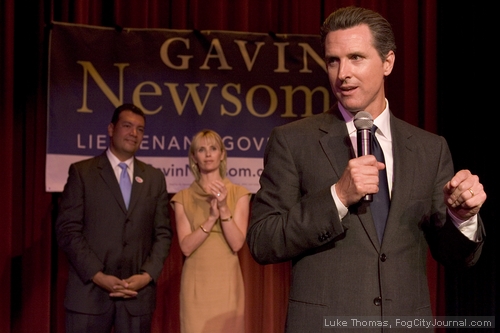
Addressing a crowd of supporters gathered at Yoshi’s San Francisco on election night, San Francisco Mayor Gavin Newsom — who easily beat opponent Janice Hahn to claim the Democratic nomination for lieutenant governor — said he was excited to be part of a crucial political year for the Golden State.

“We’re very proud to be in a position to be the Democratic nominee and to work with the other Democratic nominees,” Newsom told supporters. He lavished praise on the Democratic nominee for governor, Jerry Brown — the man who just last year he was trying to beat in a primary — telling stories about his father’s long relationship with the former governor and expressing his admiration. “I couldn’t be more proud to quasi- be on a ticket with Jerry Brown,” he said.

The race for lieutenant governor may prove one of the most interesting this election season — and not just because a victory for Newsom would transform San Francisco politics. Newsom’s opponent is Abel Maldonado, a moderate Republican who enjoys popularity among the growing, influential Latino community, and who Newsom’s team said will be a formidable challenge.

The campaign could revolve around an intriguing question. At a time when the Republican Party has been taken over by virulent anti-immigrant politicians — Whitman and Fiorina have both made harsh statements about illegal immigrants and vowed never to support “amnesty” (that is, immigration reform) — will Latino voters go for a white Democrat over a Latino Republican?

“You talk to them about all the same issues you talk to all voters about: jobs, education, and health care,” Newsom political strategist Dan Newman said when asked whether Newsom could win over Latino voters. “Latinos, like all voters, will appreciate someone with a proven record of success.”

Pollster Ben Tulchin also downplayed the trouble Newsom could encounter in winning the Latino vote. “With what’s going on in Arizona, they are very wary of Republicans,” Tulchin said, but then added: “We don’t want to underestimate the challenge we have. There’s never been a moderate Latino on the statewide ballot.”

Newsom sounded another alarm. If Whitman decides to help Maldonado, the race will get even tougher. “We’re running against Meg Whitman’s checkbook,” the mayor said.

“Expect to see Meg and Abel together a whole lot in the next few months,” one consultant predicted.

If Newsom wins, San Francisco will get a new mayor a year early — and the district-elected Board of Supervisors will choose the person to fill out the last year of Newsom’s term. Technically, the current board will still be in office then, but the task may well fall to the next board — which makes the local November elections even more important.

“Everyone is gaming this out and trying to figure out what happens,” political consultant Alex Clemens said during a post-election wrap-up at the San Francisco Planning and Urban Research Association office. “There will be a lot of dominoes to fall and deals to be cut.”

Meanwhile, Newsom’s nomination for lieutenant governor places many San Franciscans in an uncomfortable position, one that was illustrated well by Newsom’s victory speech, in which he proudly rejected taxes. Although most San Francisco progressives are disenchanted with their fiscally conservative mayor, few would rather vote for Maldonado.

Tim Paulson, the SF Labor Council president, was at the Newsom event gritting his teeth as he talked about the opportunity progressives now have to work with “a mayor of San Francisco we have issues with.” Now, he noted, “There is going to be a real campaign around this man. It could establish a narrative for what California is about.”


POWERFUL WOMEN

At Delancey Street on election night, San Francisco District Attorney Kamala Harris talked about getting “tough and smart on crime,” addressing gang-related criminal activity but also focusing on corporate criminals. She talked about cracking down on predatory lenders, supporting health care reform, and protecting California’s environment. And she made a point of dragging in BP.

“It must be the work of the next attorney general to ensure that the disaster and tragedy that happened in the Gulf of Mexico never happens in California,” she said, warning of attacks on AB 32, which set California’s 2020 greenhouse gas emissions reduction goal into law in 2006.

Of course, Harris now has to take on her southern counterpart, Los Angeles DA Steve Cooley, who is a moderate but comes in with much stronger law enforcement support. If Harris wins, it will go a long way to prove that opposition to the death penalty isn’t fatal in California politics, and that voters are finally ready for a women of color as the top law enforcement official — a first in state history.

But she and Newsom will both have to overcome likely attacks for the San Francisco’s crime lab scandal, one of many hits to be magnified by the size of Whitman’s war chest.

Whitman, who trounced opponent Steve Poizner in the primary, is riding the crest of a new wave of Republican-style “feminism,” starring her, Fiorina, and Fox news pundit Sarah Palin as female champions of the right-wing agenda. A few short months ago, it looked as if Brown was in serious trouble. But that was before Whitman and Insurance Commissioner Steve Poizner got into an $85 million bloodbath that left the winner of the GOP primary badly wounded. Whitman wants to play off the populist uprising by portraying herself as an outsider running against a career politician; Poizner gave her a huge scare by hammering her ties to Goldman Sachs.

That Wall Street narrative is one Democrats will push against Whitman and Fiorina. “I think it is stunningly politically tone deaf to nominate two Wall Street CEOs to the top of the ticket,” Newman said. Voters will decide whether they are fresh voices with new ideas or corporate hacks who laid off Californians and made fortunes with dubious stock market deals.

Brown leads in the polls — narrowly — but he’s vulnerable. He’s taken so many stands over so many years and Whitman’s fortune will hammer any openings they see. Brown is only slowly getting into campaign mode, but it’s no secret what he has to do. If the campaign is about Jerry Brown, unconventional politician, against Meg Whitman, Wall Street darling, then he wins.

But to take advantage of that, Brown has to offer some concrete solutions to the state’s problems — and he has to start acting like the progressive he once was. “If I were him, I’d run hard to the left,” a consultant who isn’t involved in any of the gubernatorial campaigns said.

The conventional wisdom had Barbara Boxer in trouble, too — but she’s a savvy campaigner who has beaten the odds before. And while the senator appears ripe for attack — almost 30 years in Washington, a voting record perhaps a bit more liberal than the state as a whole — her opponent, Fiorina, has baggage too.

For starters, Fiorina’s entire pitch is that she — like Whitman — would bring business-world savvy to politics. But as CEO of HP, “she was about perks and pink slips,” Newman said. “She laid off Californians and shipped those jobs overseas while enriching herself.”

Her own primary pushed her far to the right (at one point, in an embarrassing sop to the National Rifle Association, she actually argued that suspected terrorists on the federal no-fly list should be able to buy handguns). And speaking of feminist values, her anti-abortion positions won’t help her in a decidedly pro-choice state.


PROP. 16 GOES DOWN

The defeat of Proposition 16 will go down in history as one of the most remarkable campaigns ever. It was, Sup. Ross Mirkarimi noted, “a righteous win:” The No on 16 campaign spent less than $100,000 and still captured 52 percent of the vote. Another narrow corporate-interest measure, Mercury Insurance’s Prop. 17, faced a similar fate.

One reason: PG&E’s $50 million campaign backfired, making voters suspicious of the company’s propaganda. Another: it lost overwhelmingly in its own service area, the company rejected by those who know it best.

Now PG&E CEO Peter Darbee, who pushed to mount the expensive campaign, must return to his shareholders empty-handed — and that’s going to cause problems. “I assume the leadership of PG&E will be called to task,” Clemens said. “They truly rolled the dice.”

The day after the election, PG&E shares dropped 2.2 percent, a possible sign of shaken investor confidence. Mindy Spatt of the Utility Reform Network (TURN), a nonprofit that worked on the No on 16 effort, described the situation succinctly. “Peter Darbee’s got egg on his face,” she said. “Big-time.”

Mirkarimi has witnessed other battles with PG&E, and said this probably wouldn’t be the last. “PG&E, every time we want to have a seat at the table, tries to take us out, like assassins,” he said. “If they were smart, they would take us up on what we asked many years ago, and that is to abide by peaceful coexistence.”

On the statewide level, the bold and expensive deceptions pushed by PG&E and Mercury Insurance were countered by only a handful of super-committed activists and a broad cross-section of newspaper editorials, a reminder that newspapers — battered by the economy and technological changes — are neither dead nor irrelevant.

One of the wild cards of the election was Prop. 14, which will eliminate party primaries for state offices — and potentially shake up the state’s entire political structure. “This is a big deal even if we don’t know how it’s going to play out,” consultant David Latterman said at the SPUR event.

Interestingly, the only two counties that voted No on 14 were the most progressive — San Francisco — and the most conservative, Orange.

Progressives did well in San Francisco, expanding their majority on the Democratic County Central Committee. “In an environment where it was about hundreds of millions of dollars from PG&E and Meg Whitman and Chris Kelly outspending us, we showed that San Francisco is San Francisco and we support San Francisco values,” DCCC chair Aaron Peskin told us.

Money used to define the debates in San Francisco, but the dominant narratives are now being written by the coalition of tenants, environmentalists, workers, social justice advocates, and others who backed a progressive slate of DCCC candidates, which took 18 of the 24 seats on a body that makes policy and funding decisions for the local Democratic Party.

“This time it was the coalition that really made the difference,” DCCC winner Michael Bornstein said on election night. “Frankly, our people worked harder.”

Board of Supervisors President David Chiu agreed, telling us, “For the Central Committee, the message is people power wins.”

The lesson from this election is that people are starting to get wise to corporate deceptions. And they’re realizing that with hard work and smart coalition-building, the people can still prevail.

Steven T. Jones, Rebecca Bowe, Sarah Phelan, and Tim Redmond contributed to this report.


On the Cheap listings

0

On the Cheap listings are compiled by Paula Connelly. Submit items for the listings at listings@sfbg.com.

THURSDAY 17

Another Science Fiction Get Lost Travel Books, 1885 Market, SF; (415) 437-0529. 7pm, free. San Francisco author and archivist Megan Prelinger will discuss and show images from her new book, Another Science Fiction: Advertising the space race 1957-1962, where she presents 100s of advertisement images from a time that marked the beginning of space research as well as the golden age of science fiction writing.

FRIDAY 18

FINKTOONS Element Lounge, 1028 Geary, SF; (415) 440-0111. 10pm, free if you say "FINKTOONS" at the door. What do you get when you cross sketch comedy, horror movies, cartoons, and bizarre short films? FINKTOONS, of course. Enjoy a night of never before seen sketches and cartoons, including a live performance by the project’s co-creators Brandon Fink and Tyler Moazed.

Giants County Fair McCovey Cove, Giants Lot A, behind AT&T Park, SF; www.sfgiants.com/fair. Fri./11-Sun/20, free. This old-fashioned county fair with a San Francisco spin features games, fair food, music, a CUESA urban farming tent dedicated to cooking and gardening, and over 20 carnival rides, including a Ferris wheel, bumper cars, super-swings, and more. $5 per ride or $20 for unlimited rides. The fair will overlap with six Giants games, including the Bay Bridge Series against the A’s.

SATURDAY 19

Breaking Ground San Francisco County Fair Building, 9th Ave. at Lincoln, Golden Gate Park, SF; (415) 750-5110. 9am-1pm, free. This urban gardening youth conference is open to all Bay Area high school students featuring youth led, hands on workshops, information about jobs and paid internship opportunities, food and entertainment, tours of some of San Francisco’s coolest gardens, and more.

Mission Community Market 22nd St. between Mission and Bartlett, SF; http://missioncommunitymarket.blogspot.com. 4pm-8pm, free. Attend the kick off to this weekly summer outdoor market that celebrates the Mission by promoting healthy eating, locally owned businesses, community programs, public space, and live music in the street. Proceeds from all food bought at Lolo’s, Café Revolution, and Escape from New York Pizza will be donated to the MCM Fund. All market profits will be reinvested into public space improvements. Featuring live music by Seth Augustus, Diana Gameros, Santos Perdidos, and King City and live performances from Abada Capoeira, Danza Azteca, and Sirron Norris.

"Obviously You’re Not a Golfer" Kokoro Studio, 682 Geary, SF; (415) 400-4110. 7pm, free.

The Flat Earth Collective presents this literary event featuring readings by Tom Andes, David Holler, Erica Lewis, and Sara Mumolo and dramatic performances of new work by Sarah Ciston and Tavia Stewart-Streit.

StreetSmARTS African American Art and Culture Complex, 762 Fulton, SF; www.sfartscommission.org/streetsmarts. 6pm, free. Celebrate StreetSmARTS pilot-program murals, a program that connects established muralists with San Francisco private property owners to create vibrant art based on visual concepts reflecting the fabric of the neighborhood and make property less likely to be vandalized. Festivities to feature live muraling, film screenings, speakers, DJs, and a break-dance contest. A StreetSmARTS art exhibition will be unveiled at midnight.

Tetris Tournament II The Lab, 2948 16th St., SF; (415) 864-8855. 8pm, $5-$15 sliding scale. Test your skills with the world’s most popular puzzle game at this karaoke-style arcade competition. Musician, media artist, and performer Bryan Von Reuter rigged it so the highest scoring players will reap all the glory on a jumbo-tron projected screen and score board with DJ Middle D spinning records all night.

SUNDAY 20

Cardboard Tube Fighting League Hayes Valley Farm, 450 Laguna, SF; www.tubeduel.com. 3pm, free. Come in your best cardboard armor attire, bring food to participate in the picnic potluck, and vie for a chance to win a legendary cardboard sword. Prizes also awarded for best cardboard costume. If you need a costume go to the free Cardboard Amor Building Workshop Sat/19 3pm at Hayes Valley Farm. Bring scissors, glue, twine, and anything you think you might need to build righteous armor.

Rock the Bike Valencia and 24th St., SF; www.projectsoundwave.com. The ongoing green sound festival, Project Soundwave, teamed up with Rock the Bike to bring you this unique free environmental music event at the Mission District Sunday Streets program featuring the acoustic punk sounds of Kemo Sabe brought to you by pedal powered mics, amps, and instruments.

MONDAY 21

BAY AREA

Summer Solstice Celebration Muir Beach, Golden Gate National Recreation Area, Route 1, Marin; (415) 388-2596. 6pm, free. Celebrate the longest day of the year at this bonfire solstice party featuring storytelling and songs. Dress warmly and bring a mug for hot drinks. No reservations required.

Ubiquity Anniversary Exhibit Guerilla Art Café, 1620 Shattuck, Berk.; (510) 845-CAFÉ. 6pm, free. Attend the opening of this art exhibit celebrating the 20th anniversary of Bay Area funk and soul from Ubiquity Records with paints of, and inspired by, Darondo, Eugene Blacknell, Sugarpie Desanto, and Twilight. The opening will feature Guerilla Café art collective and Ubiquity artists live painting and creating a video montage. Throughout the show, Guerilla will host guest appearances by the musicians and DJ sets playing their music.

For Lit, Talks, and Benefits listings, visit the Pixel Vision blog at

Bread and Circuses: Mexico and the World Cup

0

MEXICO CITY (June 11th) — The Caliente Sports Book down the street is buzzing with betters studying dog and horse races, Major League Baseball, even golf, on the multiple screens. Of particular interest are those channels running wrap-ups of the afternoon match between Mexico and 2006 World Cup champion Italy, from which the national team emerged victorious in a final prelim before this year’s edition of the Copa del Mundo gets underway later this week.


Italy, it may be remembered, won the much-coveted cup four years ago on penalty kicks after France was reduced to playing with ten men on the field when super-star Zenedine Zidane was disqualified for ferociously head-butting a rival who purportedly called his mother and sister “whores.” Beating Italy was a decided plus for Mexico’s downtrodden spirits as the Mundiales approach.


One group of aficionados was not much interested in Mexico’s fortunes in the upcoming fandango in South Africa. Instead, they gathered around a big screen in one corner of the betting parlor cheering on the Los Angeles Lakers in a National Basketball Association Finals match-up with the Boston Celtics. “Forget about football,” sneered “El Guerro” Gonzalez, a regular, “this is where the real money gets made.” Because pro basketball games routinely rack up hundred-point scores, betters have multiple opportunities to wager on winners and losers, over and under point spreads, total points in a quarter, and whether Kobe Bryant will hit the next three-pointer.


But the basketball euphoria will dissipate post haste as the World Cup takes center stage. Although the NBA’s despotic commissioner David Stern promotes his product as the world game, basketball hardly holds a candle to what the U.S. provincially terms “soccer” and the rest of the Planet Earth calls football.


Indeed, the “Copa del Mundo” (“Cup of the World”) will soon sweep every other sporting event from the screens — let alone political scandal, of which there is plenty in this distant neighbor nation, including the upcoming Super Sunday gubernatorial elections July 4th, and even droughts, floods, and other natural disasters. The interminable drug war that has taken 23,000 lives in the past three years will move to the backburner. Ditto an economy that is tailspinning out of control — a million workers lost their jobs in the first three months of this year alone despite President Felipe Calderon’s rosy claims of “recovery.”


Speculation about the disappearance of one of the nation’s most powerful politicians will fade from the primetime news, and the first year anniversary of the incineration of 49 babies in a government-run day care center owned in part by the first lady’s cousin will not even be noticed. The military takeover of the great Cananea copper mine and the dissolution of the miners union, is not news. New revolutions — this is, after all, the hundredth year anniversary of our landmark revolution — could rock the land, but for the next month, Mexico will live and die on what happens to the national team in South Africa.
“In football, we find our revenge against the adversaries of our lives,” philosophizes sociologist Jose Maria Candia in a recent Contralinea magazine interview, “if it goes badly at work, in the economy, politics, the project of the nation, when 11 boys put on the green jersey and do well in an international tournament, we feel vindicated by life.”
With 32 national teams from all five continents in the competition for the World Cup, the fate of the “seleccion” will have palpable impact on domestic tranquility. The political outfall of the Mundiales is unpredictable. Pumped up on toxic nationalism and xenophobia, football is a blood sport in southern climes. Honduras and El Salvador once fought a full-fledged war over soccer.


If the national team wins or acquits itself well, success will strengthen the government in charge no matter how poorly it has served the country. Likewise, a shoddy performance can topple rulers. In Mexico, increasingly unpopular president Felipe Calderon, who won high office in fraud-marred elections three years ago, is banking on the national selection’s triumphs in the opening round to invigorate his deteriorating image. Calderon’s bet is hardly a sure thing.


Mexico, Number 17 on the Federation of World Football Federation’s rankings (now the Coca Cola FIFA rankings), plays host South Africa in the inaugural match of the tournament, and “His Excellency” Felipe Calderon (dixit South African president Jacob Zuma) will be a guest of honor. The “Bafana Bafana” (“Boys Boys”) as the locals are worshipped, have won their last four prelim matches and in the 2009 Confederation Cup took Spain, which some football gurus fix as the best team in the world, into overtime. Their fanatics’ incessantly droning “vuvazelas” or plastic trumpets are said to drive opponents mad.


On the other hand, should Mexico beat sentimental favorite South Africa, it will make Calderon few friends on the African continent — five other African teams are in the draw, with war-torn Cote d’Ivoire the cream of the crop.


Aside from the Bafana Bafana, France and Uruguay are the real class of Mexico’s four-team group — while the French have appeared lackadaisical of late, whipping the South Americans is improbable. Anything less than reaching the quarterfinals will not rehabilitate Calderon’s popularity.


Mexico has a young team that fluctuates between indifference and playing out of control. It is anchored by seven Mexican players from the European and Turkish leagues, and the wily but slow-footed veteran Cuauhtemoc Blanco. Burned repeatedly by the national team’s poor performances in the Mundiales, many fans such as Manuel Garcia, a waiter at the old quarter Mexico City eatery Café La Blanca, consider that only divine intervention can save Mexico — and Calderon — from ignominious elimination.


When and if Mexico wins its matches though, wild celebrations are guaranteed to erupt around the gilded Angel of Independence on the bustling Paseo de Reforma — drunkenness, fisticuffs, and hooliganism are de rigor. Flag-draped caravans of honking cars will jam the boulevards of this conflictive megalopolis. On game days, half the population of Mexico, led by its president, will don green jerseys and play hooky from work and school. Saloons will fill to the brim with fans spilling out into the streets, jostling for a peek at the plasma screens. Masses to insure that God is on Mexico’s side will be pronounced from the altars and saints dressed up in the national colors.


Although football is tantamount to religion in this country where 70% of the population lives in and around the poverty line, only the super rich will have the wherewithal to jet off to Africa. Instead, the underclass will monitor the Mundiales at the “FIFA Fan Fest” on giant screens erected in the great Zocalo plaza from which nearly a hundred hunger-striking members of the Mexican Electricity Workers Union (SME), near death after a month of voluntary starvation, will no doubt be evicted so as not to dampen the fiesta.


Televisa and TV Azteca, Mexico’s two-headed television monopoly, which will transmit the games (the premium package includes 3-D) will have the nation eating out of its hands (and guzzling Corona beer.)  The TV monoliths have leased rights to broadcast the Mundiales from the Swiss-based FIFA, the absolute dictator of the sport for the past 106 years that counts 204 out of 208 football federations worldwide on its roster. FIFA TV revenues are expected to top $167,000,000 for the 2010 World Cup.


This year’s Copa del Mundo is awash with drama. Will the Argentine selection, a perennial favorite, graced by the world’s best player, Leonel “the Flea” Messi, blow up under their sometimes psychotic coach Diego Maradona, himself a Mundiales’ immortal? Will the first round match between England and the U.S. (14th on the FIFA listings with a world-class star, Landon Donovan, to prove it) invoke the star-crossed Yanqui upset of the Brits 60 years ago in 1950 in Brazil, the only time these two teams have ever met in the World Cup?


If the U.S. gets by England, a match between Mexico and its hated gringo rival would up the drama quotient here considerably. A face-off between South Korea and North Korea, both of which are in the draw albeit in separate groups, could lead to nuclear confrontation.


How will tiny, bruised Honduras, which played through a coup d’etat to qualify, fare against the big guns? What kind of karmic reward is in store for France, which slimed its way into the World Cup with mega-star Thierry Henry’s illegal hand-slap goal against the Irish? Will Germany be dispirited by the suicide of its troubled veteran goalie (is this a Wim Wenders’ film)? Will five-time champ Brazil, which is hosting both the 2014 World Cup and the 2016 Olympics, be so overloaded with hubris that the selection will forget to play football?


But unquestionably the drama of dramas is focused on host South Africa, the land of blood and gold, Nelson Mandela, Steve Biko, Joe Slovo, and the last great struggle for liberation from colonialism.


South Africa, an unlikely site for the World Cup, was promised the games by Swiss football impresario Joseph Batter during his 1998 campaign to become the czar of the FIFA. Blatter, who was said to have been backed by Middle East oil money, needed African votes to put him over the top. Although Nigeria and Morocco were also proposed to host the 2010 Cup, South Africa, the continent’s fastest-growing economy, was chosen both as a tribute to African football and to Nelson Mandela. Blatter even flew the frail, aging apostle of African liberation, to London to ballyhoo the designation.
Whether the beloved Mandiba will be well enough to attend the inauguration is the drama within the drama.


In his youth, Nelson Mandela was a keen amateur boxer and enthusiasm for sports has colored his life. Football is indeed the national sport of black South Africans, 75% of the population. During Mandela’s 28 years of imprisonment on Robbin Island for the crime of defying apartheid, his fellow prisoners and comrades in the African National Congress (ANC), played football incessantly, taping up rags into balls, and booting them up and down the narrow prison corridors. But Madiba was held in isolation and could never participate.


Nelson Mandela’s vision for the new South Africa encompassed sports as a path to racial reconciliation. If football was a black sport in South Africa, rugby is an Afrikaner obsession — the Springboks were the maximum icon of the apartheid regime. As president, Mandela brought the 1995 World Rugby Cup to Johannesburg, a story fictionalized in the film “Invictus,” and won the hearts and minds of his former persecutors. Now the World Cup 2010 is slated to project South Africa before the world as a dynamic, multi-racial powerhouse.


The truth is always more diffuse. Jacob Zuma, the country’s very corruptible third president, and his predecessors have sunk between $3.7 and $6 billion USD in infrastructure to burnish their images in a nation where 43% of South Africa’s 45.000.000 peoples live on $2 or less a day. The gleaming $300,000,000 Soccer City Stadium where the July 11th finals will be staged, abuts Soweto, the festering high-crime enclave of 3,000,000 mostly threadbare citizens, 30% of whom suffer from AIDS, according to the World Health Organization. Gangs of orphaned children rule the street.


Similarly, the stadium at Port Elizabeth on Nelson Mandela Bay, which came in at $287,000,000, was built over a slum from which hundreds were evicted. A school complex was demolished to make way for the Neusprot venue (only $140,000,000) — 13 such stadiums have risen from the dust amidst a storm of charges of kickbacks, bribery, and favoritism.
If recent history is any hint, the new stadiums will quickly become certifiable white elephants. Even Beijing’s much-praised “Birds’ Nest” coliseum designed for the 2008 Olympics is reportedly tenantless, and the Greek economy just collapsed in part thanks to  the burden of debt incurred for infrastructure for its Olympic Games. 


With a population scuffling just to feed itself, filling all this dazzling stadia with paying customers is problematic. Even the $18 cheap seats — a week’s wages in the cities and a month’s income in some rural areas — are mostly out of reach in a country where 50% of the work force is out of work. To deflect a grave social crisis in the making, the FIFA is offering 120,000 free admissions, about 2,200 seats for each of the World Cup’s 62 contests. Riots have already occurred at “friendly” preliminary games.


Ever since the bad old days of ancient Rome, bread and circuses have been a powerful formula for social control. In South Africa, as in Mexico, the World Cup is designed to make the discontented forget their discontent. For the next month, the violence, corruption, and class and race hatreds that dominate daily life in Mexico, South Africa, and the rest of what used to be called the third world will disappear beneath the social surface.


Although conflict is my bread and butter, I’m not going to miss the 2010 Mundiales for the world. 


John Ross is at home in the maw of the Monstruo watching the World Cup. You can complain to him at johnross@igc.org


Goodbye, 49ers — and do we really care?

4

Tony Winnicker, the mayor’s press secretary, was chatting with a group of folks at the Newsom victory party on election night, and Steven T. Jones, the Guardian city editor, asked how the stadium vote was going down in Santa Clara. “Oh, it’s winning, but it’s never going to get built,” Winnicker said. “Cities building stadiums is an economic loser.”


He’s right, of course — although it’s an odd comment coming from a press staffer for a mayor who is still dead set on building a stadium for the 49ers at Candlestick Point. I agree with Randy Shaw: The loss of the 49ers would be a good thing for San Francisco — particularly if the alternative is to pour public money into another expensive boondoggle like Candlestick Park.


Here’s the thing: You can argue that urban baseball stadiums bring economic benefits to the community. You can argue that the (mostly) privately financed Giants stadium has spruced up that neighborhood, spurred the creation of new bars and restaurants, brought in new tax dollars and created jobs. (It also displaced some blue-collar jobs and some poor people, but that’s a different argument.)


In fact, with limited parking and good transit access, the Giants ballpark encourages foot traffic, which encourages people to patronize local businesses before and after the game.


Football stadiums are traditionally very different. Football fans are tailgaters — they drive cars, bring their food and drinks to the parking lot, set up grills and picnic tables, go to the game — and then go right home. Almost nobody who attends a 49ers game at Candlestick stays around in the neighborhood afterward; the people who live nearby get virtually zero economic benefits.


Even as part of a shiny new development package, that won’t change much. The plans for a 49ers stadium in the new redevelopment area include a new roadway and bridge to make it easier to drive in and out, and a parking garage with room for tailgating; the fan base is largely from the Peninsula anyway. And in nearly every city that’s put up public money for a football stadium, the taxpayers have gotten screwed.


I love football, I love the 49ers, but I never go to the games, anyway — way too expensive. The TV feed from Santa Clara will be just fine.


Newsom’s fiscal conservatism undermines his agenda

15

Gavin Newsom’s nomination for lieutenant governor places many San Franciscans in an uncomfortable position, one that was illustrated well by the victory speech that he gave last night just as our story our on his latest budget – in which he proudly rejected taxes in favor of deep spending cuts and future budget deficits — was coming off the presses.

Even though most San Francisco progressives don’t like our fiscally conservative mayor, few of us would rather vote for his Republican challenger, Abel Maldonado, despite the fact that this moderate Latino is actually fairly close to Newsom ideologically. “We don’t want to underestimate the challenge we have. There’s never been a moderate Latino on the statewide ballot,” Newsom pollster Ben Tulchin told me last night.

SF Labor Council President Tim Paulson was at the Newsom event gritting his teeth as he talked about the opportunity progressives now have to work with “a mayor of San Francisco we have issues with,” noting that, “What I find interesting in the easy win for Newsom is how there is going to be a real campaign around this man. It could establish a narrative for what California is about.”

And he’s right, but the danger is if Newsom sticks with his inflexible and longstanding “no new taxes” stance then the narrative could be that neither major political party’s top nominees are willing to tap millionaires, oil companies, and other entities that can afford it in order to fund education, health care, and the development of a green economy, which Newsom said are his top priorities. That and “jobs,” by which he means only private sector jobs, based on his past statements and actions and current failure to support new tax measures.

But Newsom doesn’t seem to see the glaring contradiction in his political philosophy, which he illustrated as he told a story about the potential to achieve strong economic growth while aggressively pursuing solutions to global warming and other environmental challenges, which he and progressives both seem to believe are not just possible, but “the opportunity of a lifetime.”

Newsom noted that the only four wealthy countries that signed the Kyoto Protocols and met their greenhouse gas reduction goals – Sweden, Denmark, United Kingdom, and Germany – have similar economic strategies. “All four of these countries had three things in common vis-a-vis the United States: Lower unemployment, higher growth, and lower income disparities,” he said.

Yet Newsom left out another key commonality that was even more central to their success, and big reason for two of Newsom’s three items: All have far higher tax rates than the U.S. and a more vibrant, respected, and well-funded public sector that was able to guide that economic transformation and ensure a smart, equitable distribution of the country’s wealth – something Newsom has been overtly hostile to as mayor and while campaigning for statewide office.

Nonetheless, he continued, “What’s interesting about these four countries is they dramatically shifted their framework in terms of economic growth and economic development towards a cleaner and greener energy future and they were rewarded with higher growth and lower unemployment. I think that’s suggestive, in the context of this debate.”

So do I, suggestive of the need for Newsom (and Jerry Brown) to finally realize it’s going to take money and a rejuvenated public sector to meet his stated goals for education, health care, and the environment. In San Francisco, his reluctance to challenge the Chamber of Commerce fallacy that taxes kill growth has left a legacy of dangerously diminished social services and increasing budget deficits running indefinitely into the future.

But the four countries that Newsom claims to admire don’t think that way. They don’t boast of cutting social services while proposing even more business tax cuts, and they don’t say things like, “It’ll take an entrepreneurial look at solving problems in this state.” He’s sounds like Meg Whitman and the Republicans.

What we need is the other Gavin Newsom, the one who last night also said, “Now is the time for serious problem solving in California….It is a time for California to fundamentally change.”

But first, Mr. Mayor, you’re going to need to embrace a few fundamental changes of your own.


The Daily Blurgh: Satanic real estate, erotic math, breast milk

0

Curiosities, quirks, oddites, and items from around the Bay and beyond

Education/Sex/Film/Art: UC Berkeley math prof produces and stars in Matthew Barney-like cinematic tribute to Yukio Mishima, has sex on screen to Wagner.

*****

LGBT/Crime: SF Appeal investigates “hook-up violence” against LGBT folks. Part two is here. Peeps, be safe out there this Pride season!

*****

Brains/Jobs: SF ranked “smartest” city in the US. Maybe the critical mass of advance degree holders is why it’s still hard to get a job.

*****

TV/Econ: “The fictional high school chorus at the center of Fox’s Glee has a huge problem — nearly a million dollars in potential legal liability. For a show that regularly tackles thorny issues like teen pregnancy and alcohol abuse, it’s surprising that a million dollars worth of lawbreaking would go unmentioned. But it does, and week after week, those zany Glee kids rack up the potential to pay higher and higher fines.”

*****

Local Media: The Bay Area can expect to welcome another local media start-up, The Berkeley Times, come this fall.

*****

Art/Food/Sex: “We had this idea – someone wanted to take our portrait – and I thought it would be funny if we did Riccardo drinking milk from my breasts. Because that’s really what it is, we feed each other. We’re family.”

*****

Satan/Real Estate: The Richmond District’s Satanic past!

*****

Transit/Life: Take a ride in the front seat:

http://www.youtube.com/watch?v=xZ0gBsR9w74&feature=player_embedded

Cutting from the bottom

7

By Alex Emslie

news@sfbg.com

When Mayor Gavin Newsom unveiled his proposed city budget on June 1, he downplayed the severity of cuts to the city’s Department of Public Health, noting that they amounted to less than 2 percent. But if Newsom’s uneven program chopping becomes a reality, critical social services for some of San Francisco’s poorest and most vulnerable residents will be cut by almost one-third.

The DPH was able to shrink its budget by nearly $31 million, according to a budget proposal currently before the Board of Supervisors, in part by slashing community nonprofit clinics providing outpatient mental health services to some of San Francisco’s most difficult to treat mental health cases.

“It’s very possible you could see more people who are homeless, people who are homeless not getting as much care — they’ll be sicker,” said Dr. Eric Woodard, medical director of psychiatric emergency services at San Francisco General Hospital. “And you could reasonably expect more deaths on the street to occur.”

State and federal matching funding to the DPH dwarfs the amount of money the department receives from the city. What isn’t spelled out in Newsom’s budget is that every dollar cut by the city results in more than another dollar lost in federal funding for social services.

The DPH proposed a nearly 9 percent cut to outpatient community-based health services, and an 11 percent cut to residential inpatient services to meet the mayor’s request that all city departments submit a 30 percent budget reduction to his office. Newsom reversed the proposed cuts to residential services but kept the outpatient cuts.

“I believe in the efficacy of residential [treatment],” Newsom said during his budget unveiling. “I believe there are a lot of question marks around outpatient drug treatment.”

But the cuts affect more than just outpatient drug treatment. While many of the clinics that were cut focus on treating mental illnesses, they are funded through the DPH category that includes substance abuse treatment. Newsom’s office declined to answer our inquiries about the reasons for and implications of his cuts, referring us to DPH.

Walden House CEO Vitka Eisen, whose organization serves people suffering from mental illness and substance abuse in inpatient and outpatient clinics, said she was relieved that residential funding was added back. However, she is concerned about the proposed $4.1 million cut spread across several nonprofit outpatient services.

“There’s a very large cut to outpatient services citywide, and that’s obviously problematic because outpatient services are an important part of our system of care in the city,” she told the Guardian. “You can’t really cut one or the other.”

DPH Community Behavioral Health Services Director Dr. Robert Cabaj is hoping the Board of Supervisors will restore some of the cuts to outpatient clinics. “Unfortunately, they [the Mayor’s Office] left these in,” he told the Guardian. “I’m not sure why — I’m not sure what the mayor was thinking at the time.”

Citywide Case Management and Community Focus, an outpatient clinic serving some of San Francisco’s most severely mentally ill, is one of the hardest hit nonprofit clinics in the mayor’s proposed budget. The agency will lose $1.22 in federal funding for every $1 cut from the city, division director Dr. David Fariello said.

That’s how its 15 percent, $1.3 million cut proposed by the DPH and accepted by the mayor, ballooned into a 33 percent, $2.8 million loss for one of the city’s most comprehensive and best-performing community behavioral health services.

Citywide, at 982 Mission St., boasts the facilities, network, and location to serve one of San Francisco’s most vulnerable populations. The typical Citywide client suffers from schizophrenia, bipolar disorder, borderline personality disorder, or severe depression. They are likely homeless, grappling with substance abuse, and many have posttraumatic stress disorder.

Citywide employees, doctors, and administrators, as well as physicians from outside the clinic, speculate that cutting outpatient mental health services in a city with one of the highest per capita populations of mentally ill homeless people will ultimately cost the city more money than it saves now. Use of expensive city services like psychiatric emergency rooms, jails, police, and ambulance could all rise.

“Frankly, a lot of these budget cuts do not seem to be very well thought out in terms of what the real cost is going to be,” Woodard said. “If you look into the not very distant future, you’re going to incur costs that are probably much greater than your savings were initially by making the cuts.”

Cabaj said that past funding cuts haven’t resulted in higher use of psychiatric emergency services because the DPH prioritizes funding for the most severe cases and screens for those who could possibly be moved into cheaper services. Citywide clients are consistently high users of San Francisco General Hospital acute inpatient psychiatric care, at an average cost to the city of $1,200 per patient, per day, if they don’t have insurance or Medical benefits.

Many end up in costly in-patient psychiatric care facilities or are arrested and land in the city’s Behavioral Health Court, which hears cases in which defendants have been diagnosed with a mental illness that is suspected of being a factor in their crime. More than 70 percent of the Behavioral Health Court’s mandated treatment slots are at Citywide.

“We can manage behaviors that get people thrown out of every other clinic in the city,” Fariello said. “Where is that capacity going to be picked up? These are not clients who, if they don’t get treatment, maybe their doctor will give them some medicine and it’ll be OK. These are clients who are going to continue to be high users unless we intervene.”

Citywide figures show a 40 percent decrease in violent reoffenses for clients referred to their clinic from the Behavioral Health Court. Nearly three-quarters who were homeless are able to maintain housing, and more than 25 percent of clients who were frequent users of inpatient psychiatric services have stayed out of the hospital.

“Citywide really is one of the best,” said Woodard, who works with Citywide’s Linkage Team to stabilize patients from SFGH’s psychiatric emergency room. “They provide excellent care for these really fragile, very ill patients. I would say of the community programs, they’re really at the top of the list.”

Fariello estimates having to reduce the 1,035 clients receiving treatment at his clinic by 400 if the cuts are finalized. He may have to scale back some of his clinic’s innovative and successful categories of service — such as employment support and dialectical behavioral therapy, a highly specialized form of therapy with proven success in treating borderline personality disorder. Citywide has the largest DBT team in San Francisco.

Citywide administrators are baffled by DPH’s decision-making process, given that it serves the city’s sickest, poorest, and homeless — characteristics that should have reduced its cuts, according to the department’s priorities outlined in its budget reduction proposal.

Since founding the agency nearly 30 years ago, Fariello has worked with the city to implement innovative techniques in treating San Francisco’s highest users of expensive psychiatric emergency services. And it has been consistently successful. In a review last year of 15 similar programs conducted by the DPH, Citywide received an average 92.1 out of 100, the highest score. It scored a 4.0 out of 4.0 on another recent program review.

Several divisions within Citywide contribute to its inclusive approach to mental health services. Citywide’s forensics program works exclusively with clients involved in the criminal justice system. Community Focus provides culturally sensitive therapy in several languages. The Linkage Team stabilizes emergency psychiatric patients from SFGH.

Employment support for Citywide clients helps them get and retain jobs, emblematic of the entire agency’s goal of treating clients as complete people, not just mental health patients. “What we’ve found out is that people who have an investment in purposeful activity have an investment in getting better,” Fariello said. “A lot of clients have a notion that their career is being a mental health client. What we’re trying to do is change that.”

Citywide supported employment services supervisor Greg Jarasitis told a story of one client who said she liked her job as a bookkeeper because while she was at work she felt like a “normy,” then added: “These are people who have been marginalized for so long.” *

Get involved: The Board of Supervisors holds a public comment hearing on the deep proposed health cuts, as state law requires, June 15 at 3 p.m. in Board Chambers at City Hall. The board’s Budget and Finance Committee departmental hearings for the DPH are scheduled for June 21 and June 28.

Another bloody budget

6

rebeccab@sfbg.com

In the days since June 1, when Mayor Gavin Newsom unveiled his proposal for San Francisco’s $6.48 billion budget for the next fiscal year, public sector employees and community organizations have been poring over the hefty document to determine how their jobs, services, and programs survived cuts made to close a $483 million shortfall.

For police and firefighters, a key Newsom constituency, the news is good. There were no layoffs to San Francisco firefighters, and while members of the Police Officer’s Association gave up $9.3 million in wage concessions under the lucrative contract Newsom gave them a few years ago, police officers will still receive a 4 percent wage increase on July 1.

For others, the release of the mayor’s budget signified a tough fight looming before the Board of Supervisors, one with high stakes. Cuts to homeless services, mental health care, youth programs, and housing assistance, along with privatization proposals, have raised widespread concern among labor and liberal advocacy organizations. Public input on the budget will continue at the Board of Supervisors Budget and Finance Committee until July 15, when the amended document is considered by the full board.

At a June 1 announcement ceremony, Newsom asserted that the budget was balanced “without draconian cuts,” saying, “We were able to avoid the kind of cataclysmic devastation that some had argued was inevitable in this budget.”

Nearly a week later, Board President David Chiu told the Guardian that sort of cataclysm wouldn’t be staved off for long if the city continues on the course of repeatedly making deep budget cuts without proposing any significant new sources of revenue.

“Now that the smoke has cleared, it is clear that the mayor’s proposed budget is perfect for a mayor who is only going to be around for the short term, but it does not address the long-term fiscal crisis that our city is in,” Chiu said. “Next year, we’re looking at over a $700 million budget deficit. The year after that, we’re looking at almost an $800 million budget deficit. The budget proposal that Newsom put out balances the … deficit on many one-time tricks and assumptions of uncertain revenue.”

Meanwhile, advocates said even the cuts proposed this time would bring serious consequences, especially with unemployment on the rise, state programs being cut in Sacramento, and families feeling the pinch more than ever.

“Poor and working class families, and families of color in San Francisco, are facing kind of an assault on funding and on safety net services on multiple levels,” said Chelsea Boilard, family policy and communications associate for Coleman Advocates for Children and Youth. “I think a lot of it is that families are concerned about their ability to stay in the city and raise their kids here.”


“NO NEW TAXES”

During the budget announcement, Newsom emphasized the positive. He found $12 million in new revenue simply by closing a loophole that had allowed Internet-based companies to avoid paying that amount in hotel taxes. He said 350 currently occupied positions would be cut, but noted that it was less than a cap of 425 that public sector unions had agreed to. Cuts were inevitable since the ailing economy inflicted the city’s General Fund with significant losses, particularly from business and property tax revenues.

Nonetheless, Newsom’s budget is already coming under fire from progressive leaders. For one, there are no new revenue-generating measures in the form of general taxes, which could have averted the worst blows to critical safety-net services and might help remedy the city’s economic woes in the long-term.

“There are no new taxes in this budget,” Newsom declared. “I know some folks just prefer tax increases. I don’t.”

Yet Chiu said many of Newsom’s assumptions for revenue were on shaky ground, prompting City Controller Ben Rosenfield — Newsom’s former budget director — to place $142 million on reserve in case the projected revenues don’t pan out.

“These budget deficits continue as far as the eye can see,” Chiu noted. “Even if those amounts come in, something like 90 percent of them are one-time fixes. So even if the mayor is right, it doesn’t solve next year’s problem, or the year after. Which is why many of us at the board believe that we have to consider additional revenue proposals to think about the long-term fiscal health of the city.”

Sup. John Avalos, chair of the Budget and Finance Committee, described Newsom’s budget as “pretty much an all-cuts budget,” noting that he and Chiu planned to introduce revenue-generating measures. They were expected to introduce proposals — including an increase in the hotel tax and a change in the business tax — at the June 8 board meeting.

Because despite Newsom’s rosy assessment, many of his proposed cuts are deep and painful: the Recreation and Park Department would be cut by 42 percent (with its capital projects budget slashed by 90 percent), Economic and Workforce Development by 34 percent, Ethics Commission by 23 percent (basically eliminating public financing for candidates), Department of the Environment by 14 percent, Emergency Management by 10 percent, and the list goes on.


CUTS TO SOCIAL SERVICES

Progressives say Newsom’s budget reflects skewed priorities. While relatively little is asked of public safety departments, health and human services programs face major staffing and funding losses. “Poor people are being asked to shoulder the burden,” noted Jennifer Friedenbach, director of the Coalition on Homelessness.

Nearly $31 million would be slashed from the Department of Public Health, and more than $22 million would be cut from the Human Services Agency under Newsom’s proposed budget. While this reflects only 2–3 percent of the departmental budgets, there’s widespread concern that the cuts target programs designed to shield the most vulnerable residents.

Proposals that deal with housing are of special concern. “We have more and more families moving into SRO hotel rooms. We have families in garages. We have a really scary situation for many families,” Friedenbach said.

Affordable housing programs within the Mayor’s Office of Housing would get slashed from $16.8 million currently down to just $1.2 million, a 92 percent cut. Other cuts seem small, but will have big impacts of those affected. Newsom’s budget eliminates 42 housing subsidies, which boost rent payments for families on the brink of homelessness, for a savings of $264,000. Meanwhile, a locally funded program that subsidizes housing costs for people with AIDS would be cut, for a savings of $559,000.

Transitional housing would be affected, too, such as 59 beds at a homeless shelter on Otis Street, which Friedenbach says would be lost under Newsom’s budget proposal. “We’ve already lost more than 400 shelter beds since Newsom came to office, so that’d be a huge hit,” she said. Since the recession began, she added, the wait-list at shelters has tripled. The Ark House, a temporary housing facility that serves LGBT youth, would also be closed.

Overall, homeless services delivered by HSA would take a $12 million hit in Newsom’s budget, or about 13 percent, offset slightly by homeless services being increased by $2 million within the Mayor’s Office budget, a 71 percent increase.

Outpatient mental health services, such as Community Behavioral Health Services, would also be affected (See “Cutting from the bottom”), in violation of current city law. Several years ago, then-Sup. Tom Ammiano introduced legislation establishing a “single standard of care” to guarantee access to mental health services for indigent and uninsured residents.

“If timely, effective, and coordinated mental health treatment is not provided to indigent and uninsured residents who are not seriously mentally ill, those residents are at risk of becoming seriously mentally ill and hence requiring more expensive and comprehensive mental health care from San Francisco,” according to the ordinance, which was passed in June of 2005. Newsom’s budget proposes changing this legislation to enable cuts to those services, which would result in 1,600 people losing treatment, according to Friedenbach.

Unfortunately, advocates for the poor has gotten used to this ritual of trying to restore cuts made by Newsom. “There are some sacred cows that seem to survive year after year, and then we’re left fighting over what we can get,” said Randy Shaw, executive director of the Tenderloin Housing Clinic (THC).

The Central City SRO Collaborative, which supports tenants living in single-room occupancy hotels in the mid-Market Street area and is operated through THC, is slated to be cut by 40 percent along with three other similar programs — a replay from last year when the mayor proposed eliminating funding and the Board of Supervisors restored the cut.

“I think you’d see more fires, more people dying from overdoses. You’d see really bad conditions,” Jeff Buckley, director of the program, told us of the potential consequences of eliminating the inspections and resident training that is part of the program.

Funding was also eliminated for THC’s Ellis Eviction Defense Program, the city’s only free legal defense program with capacity to serve 55 low-income tenants facing eviction under the Ellis Act.


THREAT TO RENTERS

One of the most controversial proposals to emerge from Newsom’s budget is a way for property owners and real estate speculators to buy their way out of the city lottery that limits conversion of rental properties and tenants-in-common (TICs) to privately-owned condos if they pay between $4,000 and $20,000 (depending on how long they have waited for conversion), a proposal to raise about $8 million for the city.

“I went back and forth because I know the Board of Supervisors can’t stand this,” Newsom said as he broached the subject at the June 1 announcement. “I still don’t get this argument completely. Except it’s a big-time ideological discussion. It’s so darn ideological that I think it gets in the way of having a real discussion.”

Yet Ted Gullicksen, director of the San Francisco Tenants Union, said the argument is quite clear: making it easier to convert rental units into condos will accelerate the loss of rental housing in a city where two-thirds of residents are tenants, in the process encouraging real estate speculation and evictions.

“It will encourage TIC conversions and evictions because it makes the road to converting TICs to condos that much easier,” Gullicksen said. “It’s going to be a huge gift to real estate speculators.”

Newsom press secretary Tony Winnicker disputes that impact, saying that “these units were going to convert anyway, whether next year or six years. This merely accelerates that conversion without altering the lottery to protect jobs and services.”

But Gullicksen said the proposal obviously undermines the lottery system, which is the only tool tenant advocates have to preserve the finite supply of rent-controlled apartments, noting that even if the condos are later rented out, they will no longer to subject to rent control. That’s one reason why the Board of Supervisors has repeatedly rejected this idea, and why Newsom probably knows they will do so again.

Avalos said he and other progressive supervisors will oppose the proposal, despite the difficulties that will create in balancing the budget. “It’s kind of like putting a gun to our heads,” Avalos said of Newsom’s inclusion of that revenue in his budget.

To offset that revenue loss, Avalos has proposed a tax on alcohol sold in bars and Gullicksen is proposing the city legalize illegal housing units that are in habitable condition for property owners willing to pay an amnesty fee.

Some housing advocates were also struck by the timing of proposing condo conversion fees while also eliminating the Ellis Eviction Defense Program. “We’re really the only ones doing this,” Shaw noted. He said the program is crucial because it serves low-income tenants, many of whom are monolingual Chinese or Spanish speakers who lack the ability to pay for private attorneys to resist aggressive landlords.


PRIVATIZATION PROPOSALS RETURN

The Department of Children, Youth. and Families budget would be reduced by 20 percent under Newsom’s budget, with the greatest cuts affecting after school and youth leadership programs. Roughly a $3 million cut will result in the loss of around 300 subsidized slots for after school programs, said Boilard of Coleman Youth Advocates. Another $3 million is expected to come out of violence-prevention programs for troubled youth; an additional $1 million would affect youth jobs programs.

Patricia Davis, a Child Protective Services employee who lives in the Mission District with her two teenage sons, said she was concerned about the implications for losses to youth programs, particularly during the summer. “You can imagine what’s going to happen this summer,” she said. “I feel that a lot of kids are going to do a lot of things that they have no business doing.”

Davis, who says she’ll have to look for a new job come Sept. 30 because the federal stimulus package funding that supports her position will run out, said she was not happy to hear that police officers would be getting raises just as that summer school programs are being threatened with closure. “Couldn’t the 4 percent [raise] go somewhere else — like to the children?” she wondered.

Meanwhile, privatization proposals are causing anxiety for SEIU Local 1021 members, who recently gave millions in wage concessions and furloughs along with other public employees to help balance the budget. A proposal to contract out for jail health services cropped up last year and was shot down by the board, but it’s back again.

“When you make it a for-profit enterprise, the bottom line is the profit. It’s not about the health care,” SEIU Local 1021 organizer Gabriel Haaland told us. “It isn’t the same quality of care.”

Haaland said he believes the mayor’s assumption that the proposal could save $13 million should be closely examined. Other privatization schemes would contract out for security at city museums and hospitals.

Institutional police in the mental health ward at SF General Hospital and other sensitive facilities are well trained and experienced with difficult situations so, Haaland said, “the workers feel a lot safer” than they would with private contractors.

Regarding Newsom’s privatization proposal, Avalos said the board was “opposed last year and the year before, and we’ll oppose [them] this year.”

In the coming weeks, Avalos and other members of the Budget and Finance Committee will carefully go over Newsom’s proposed budget — which is now being sized up by Budget Analyst Harvey Rose’s office — and solicit input from the public. Chances are, they’ll get an earful.

“People are scared. They are scared to death right now,” Boilard said. “As it is, people’s hours are being reduced. And it’s getting harder and harder to find a job because so many people are out of work that the level of competition has gotten really fierce. This is the time that we need to invest in safety net services for young people and families more than ever — and all those services and programs and relationships that people depend on are disappearing.”

Steven T. Jones and Kaitlyn Paris contributed to this report.

Newsom and his commissioners just love Candlestick/Shipyard report

4

 Text by Sarah Phelan, photos by Luke Thomas

Today, I’m dedicating Michael Franti’s  “Say hey, (I love you)” to the entire Redevelopment Commission and the four Planning Commissioners who approved the City’s final Environmental Impact Report plan for Lennar’s Candlestick/ shipyard development. I’m doing so, not because I love these commissioners, who are  all mayoral appointees, but because they all seem to love everything about the final report, despite ongoing concerns about building a bridge over an environmentally sensitive slough, taking park land for luxury condos and unresolved questions about the Navy’s cleanup of the shipyard.(Yes, the EIR doesn’t address the toxic cleanup, but does it make sense to approve it before the Navy has completed its cleanup assessment plan?)

I’m also dedicating Franti’s bubbly soul-lifting song to Planning Commissioners Christina Olague. Kathrin Moore and Hisashi Sugaya for refusing to rubberstamp the final EIR or the related CEQA findings. Thanks guys for having some moral backbone!

Mayor Gavin Newsom, presumably tweeting while leaving town again on the Lt. Governor campaign trail, hailed yesterday’s rubberstamping process as a critical milestone.
“This is a major milestone for our efforts to transform the shipyard from an environmental blight to a showcase of jobs, affordable housing, parks and green-technology investment for the Bayview and our entire City,” Newsom said in a press release. “The approvals of the EIR and Redevelopment Plan reflect the years of hard work, rigorous study and extensive community involvement invested in revitalizing our City’s Southeastern Waterfront…our progress today is a testament to their leadership and commitment to thoroughly cleaning up the Shipyard so we can forge ahead towards a new vision for Hunters Point.”

One of the key points to emerge from last night’s hearing is the bifurcated nature of the process, which yesterday let the city push the EIR certification through, before the Navy completes a related EIS (environmental impact statement) about the cleanup on the shipyard—including areas of land where Lennar hopes to develop homes if the 49ers leave.

Fog City Journal’s Luke Thomas told me today that during public comment, the Nation of Islam’s Minister Christopher Muhammad called the commissioners “paid prostitutes” and “political whores” and said there would be a “political earthquake” if the commissioners go forward with EIR. 

“However, I don’t think he understood that the EIR and the EIS (which deals with the toxic cleanup) are two separate documents,” Thomas said, accurately noting that the joint commission was only voting on the EIR yesterday.

(According to Thomas, the Minister also promised that coalition of activists that would dog Newsom up and down the State during his campaign for Lt. Governor to expose Newsom’s record, so expect more fireworks along the campaign trial this summer.)

Another key fact to emerge from yesterday’s hearing was the lack of public comment on the part of almost all the candidates running to replace D. 10 Sup. Sophie Maxwell, whose district includes this massive development. Only Kristine Enea, Tony Kelly and Espanola Jackson spoke on the record—with Enea in favor of the plan with amendments, and Kelly and Jackson opposed as things currently stand.

Now, you’d think that everyone running in this race would be eager to show D. 10 constituents (and beyond) that they were at the meeting, not only silently tracking, but also publicly expressing their opinions. And while it’s true that Marlene Tran and DeWitt Lacy filled in speaker cards, Chris Jackson showed up during the proceedings, and Lynette Sweet got ushered into the press box by Sup. Bevan Dufty, none of these D. 10 candidates got their thoughts in the public record. Now, no doubt Cedric Akbar, Bill Barnes, Isaac Bowers, James Calloway, Malia Cohen, Ed Donaldson, Marie Franklin, Rodney Hampton Jr., La Vaughan Moore, Geoffrea Morris, Steve Moss, Jacqueline Norman, Nina Pickerrell, Dwayne Robinson, Diane Wesley Smith, Eric Smith, (and the many others rumored to be running) had their reasons for not being there, and I’d be happy to hear all about it from all of them between now and the November election.

But it doesn’t instill confidence in candidates when they won’t say in public what they are only too willing to say off the record. So, kudos to Enea, Kelly and Jackson for taking that leap and refusing to act like politicians before they have even been elected.

“So much of it was shocking but not surprising,” Tony Kelly told me today, after he recovered from last night’s meeting which lasted until 2 a.m. ‘Everyone knew there would be a snappy 4-3 decision by the Planning Commission on the stuff that mattered. And in a way, I can see why the mayoral appointees on the Commission would decide that they would leave it to the elected officials on the Board to stop this plan. But there was zero excuse for the lameness of the Redevelopment Commission [who are all mayoral appointees]. Still, it showed what the Planning Commission [which today consists of four mayoral appointees, and three Board appointees] must have been like  before it was reformed [and still consisted solely of mayoral appointees].”

“It was heartbreaking to see the endless parade of Bayview Hunters Point residents saying, ‘I need a job,’ or ‘ I need to live in a new house,’ as they argued in favor of certifying the project’s final EIR, despite all the flaws,” Kelly acknowledged.

Still, as Kelly points out, the city could have pushed to acquire foreclosed housing in D. 10 so residents in substandard public housing could be relocated into decent units now, instead of having to stay at least another five years, or longer, in rat, cockroach and sewage inundated units, under Lennar’s plan.

Kelly also notes that the city could have used the Redevelopment Agency’s “massive power” to do stuff up and down Third St, where unemployment is especially visible.

“Having done planning elsewhere, this plan [for Candlestick and the shipyard] is like planning on Mars,” Kelly said. ‘This is a bigger badder version of 555 Washington.”

Last but not least, Kelly voiced concern that a couple of peaker plants will be built within Lennar’s project area.
.“There are going to be two combustion turbines generating steam heat, but not electricity within the project boundaries,” Kelly clarified. “That means they don’t have to register as a power plant, but they will be generating greenhouse gases. The only difference is they won’t be generating electricity.”

So, now the charade of approvals heads to the Port Commission, which has got some folks asking whether Port Commissioner Stephanie Shakofsky, another Newsom appointee should recuse herself , given that her non-profit is clearly such a fan of the project.


Nevius family values

6

The Chron’s C.W. Nevius has made a big deal of moving back into town from the suburbs — and the offhand comment by Steve Jones in an email to Nevius has almost become a sticky nickname. In fact, his own newspaper’s website, sfgate, headlined his column “Suburban twit moves to city.”

But Chuck’s got some work to do before he starts to understand San Francisco values.

Take his latest column, about the Democratic County Central Commitee. Now, any Chron columnist (or anyone else) has the right to endorse and advocate for any candidates he or she wants. And Nevius is absolutely right to point out that the DCCC race is crucial, that control of the committee will have a significant impact on the fall supervisorial elections.

Here’s what made me want to scream:

“So, if you’re happy with the far-left agenda, check out the Bay Guardian. (Progs with name recognition like Peskin, David Campos, David Chiu, and John Avalos are probably shoo-ins. Daly is not running.) For those who’d like to see a swing to families, kids, and civility on the streets, here are some suggestions.”

 A swing to families and kids? You must be kidding.

The single greatest issue facing families and children in this city is the cost of housing. That’s why Coleman Advocates for Children and Youth, which almost everyone agrees is the premier family-advocate group in the city, has made affordable housing a huge priority.

Some of what a recent Coleman report says:

 “Two-thirds of all children in the city do not have a secure future in San Francisco

More families in San Francisco are low-income (43%) than middle-income (23%), and face economic hardship even when working full-time jobs.

Extreme racial disparities in family income and access to opportunity mean that the majority of children who do not have a secure future in SF are children  of color, and the majority of children who do have a secure future are white.”

Coleman’s recommendations: Build and preserve affordable housing for families — not market-rate condos, not condo conversions, but below-market-rate housing.

From the report:

“1. Prioritize the needs of 45,000 children growing up in 20,000 extremely-poor and low-wage working families.  trategies must combine investing in a stronger social safety-net for families now, and investing in anti-poverty strategies that will prepare today’s poor children to become economically secure San Franciscans of the future. The city’s housing and educational policies must focus on the children and families with the greatest need, and not get sidetracked by the demands of middle-income or upper-income families whose needs are legitimate but not as urgent.

 2. Invest in affordable homeownership programs for middle-income families, but focus the vast majority of limited housing resources on building permanently affordable family rental housing.”

That is exactly what the progressives — the “far left” folks that Nevius decries — have been talking about all these years. The candidates Nevius endorses are of the political camp that advocates more market-rate housing, more condo conversions, fewer tenant protections — more of the kind of things that drive lower-income families out of the city.

The next priority is education. Families that don’t have a lot of money have no option other than the public schools, and a lot of us who might be able to afford private schools still think public education is the way to go. What the schools need in San Francisco is pretty simple: They need more money. The “moderates: Nevius endorses — who actually count as fiscal conservatives, by San Francisco standards — are generally against raising taxes, as is our mayor. The San Francisco city government doesn’t oversee the schools, and most of the education money in California comes from the state — but San Francisco’s Rainy Day Fund, and the willingness of the supervisors to put money into the local schools, has saved hundreds of teacher layoffs and helped the quality of the local public schools.

 Where did that idea come from? Progressive leader Tom Ammiano.

I’m a San Francisco parent with two kids, and I have a lot of friends who are San Francisco families, and none of us see the Nevius agenda as family-friendly. That’s why we’re supporting the progressives.

Should Antonini recuse himself from Lennar vote?

1

As a Newsom appointee, Planning Commissioner Michael Antonini is expected to be a key vote today in favor of Lennar’s massive redevelopment plan at Candlestick Point-Hunters Point Shipyard.

And then there’s the fact that he wrote an op-ed for the San Francisco Business Times in December 18, 2009, suggesting that business, civic, labor and government leaders can keep the 49ers in town by “joining forces to assist in needed repairs and improvements to Candlestick Park and to expedite development of the Candlestick Point Hunters Point Shipyard, a project that features a “state-of-the art,” 69,000-seat football stadium.”
(The full text of Antonini’s op-ed is included at the end of this post to put his words into full context.)

But Antonini’s cheerleading has got some folks questioning his impartiality when it comes to the decisions that members of the Planning and Redevelopment Commissions will make today around certifying the project’s Final Environmental Impact Report (FEIR) and adopting related environmental findings.

In a June 2 letter to Planning Commission president Ron Miguel, Arthur Feinstein of the Sierra Club, Mike Lynes of the Golden Gate Audubon Society, Jennifer Clary of San Francisco Tomorrow and Jaron Browne of POWER (People Organized to Win Employment Rights) claim that “Commissioner Antonini has clearly prejudged the proposed project and become a strong advocate for locating a football stadium for the 49ers at the Hunters Point site as part of this project.”

“He has publicly urged others to support that stadium and cannot impartially review the record before him to determine whether the EIR is adequate, accurate and objective and whether adequate measures are required to protect the environment,” the foursome continue.

 Noting that he could have chosen to sign the December 2009 op-ed as a Member of the Republican County Central Committee, Feinstein, Lynes, Clary and Browne observe that Antonini “ instead identified himself in the capacity where the law requires him to act impartially – as a Planning Commissioner.”

With others arguing that Antonini’s right to express his opinion is protected by the First Amendment, and Antonini planning to read a rebuttal into the record at 1 p.m. today, it sounds like there’ll be plenty of drama at today’s hearing.

Antonini’s Op Ed in San Francisco Business Times

Friday, December 18, 2009
Business leaders can save the Niners
San Francisco Business Times – by Michael J. Antonini

“The 49ers are deeply and historically identified with San Francisco. San Franciscans Vic and Tony Morabito founded the team in 1946, many years before the Giants moved from New York and the Warriors from Philadelphia.

Hence business, civic, labor and government leaders are joining forces to assist in needed repairs and improvements to Candlestick Park and to expedite development of the Candlestick Point Hunters Point Shipyard, a project that features a “state-of-the art,” 69,000-seat football stadium. Leaders from the Committee on Jobs, the San Francisco Chamber of Commerce, Recreation and Park and others are asking businesses and individuals to help with funding of improvements at Candlestick in return for advertising. These improvements could translate into increased revenue for the contributor, the city and the team. Replacement of aging seats and a highly visible new luxury section are two concepts being studied.

Naming rights to Candlestick Park is an attractive opportunity for a company or an entity to gain nationwide exposure and local acclaim — and, perhaps, position itself to be a key contributor when a new stadium is built at Hunters Point. No new stadium can be built anywhere without significant private investment, in addition to $100 million assured from Lennar Corp. as a precondition of development rights and the amount which the 49ers ownership would invest.

On Thursday, Dec. 17, the San Francisco Planning Commission was to hear comment on the Draft Environmental Impact Report for the Candlestick Point Hunters Point Shipyard Plan. Because this plan features many diverse uses, particularly huge amounts of housing, funding is being rapidly obtained for greatly improved transit and traffic access.

San Francisco must avoid the errors of the past, when we failed to build an arena for indoor sporting, major conventions and entertainment events. Such a facility could have brought huge amounts of revenue to San Francisco businesses.

Leaders have twice stepped up to save the San Francisco Giants. One would expect no less from our leaders when dealing with our home grown, five- time Super Bowl champion San Francisco 49ers!

Michael J. Antonini is a planning commissioner for the City and County of San Francisco.”


Newsom doesn’t read the Guardian!

13


Gav was on KQED this morning, talking about his run for Lite Guv, and he started right off by saying how he doesn’t ever — ever — read the Bay Guardian


Michael Krasny started off by asking why Newsom refused to appear on the radio in a debate with Janice Hahn. “She agreed, you didn’t.” Krasny asked. “Why?”


Newsom’s comment: Gee, I didn’t have time for a debate. Too busy running the city, and trying to balance a budget– “the most complex budget in city history.” He insisted that he’d solved a $522 million deficit without laying off police or firefighters, while protecting the soc sev safety net and investing in homeless service and universal health care.


Krasny: “So the Guardian can’t beat you up any more?”


Gav: “Honestly, I haven’t read it in years, with all due respect to Tim Redmond and Brugmann and whatever the team is over there.”


Krasny, politely, tried to bring up the idea that a no-new-taxes budget means fewer jobs, but Newsom had none of it: “They seem to have a tax first policy,” he said (although he doesn’t read us, so he doesn’t know. He complained that San Franciscans are already paying 10 percent in sales tax — “a regressive tax,” and that “they (presumably the Guardian) consistently support it, I don’t.”


Read our paper, Mr. Mayor. The Guardian has consistently, for many years, argued that sales taxes are regressive, and we’ve consistently, for years, argued that there are far better options, ways the city can reclaim money from the wealthy. And we’ve argued that Newsom’s no-new-taxes policy is bad for the economy.


Oh, and by the way: You talked over and over about universal health care in San Francisco, and how proud you were of that policy. But if you were reading the Bay Guardian, you might recall that it wasn’t your policy. That initiative came from then-Sup. Tom Ammiano, and you opposed the key employer mandates that fund it. Hey, you could even pick that up by reading the Chron:


Why Comcast sucks

73

Ever wonder why Comcast routinely ranks among the worst companies in America for customer service? Let me tell you a story.


So my cable box stopped working, which meant I couldn’t get the Giants games and my daughter couldn’t watch Hannah Montana, which was something of a crisis in the Redmond household. So I called Comcast, and the nice woman on the phone tried a remote diagnosis, and told me the box was fried. “But don’t worry,” she said. “Just drop it by our office and we’ll give you a new one right away.”


Just drop it by our office. Here’s that that means: You arrive at the cramped, airless spot on Potrero and 16th and wait. And wait. And wait. When I got there, the line was 21 people long, and four customer service clerks were trying their best to sort out a wide range of problems — bill problems, service problems, people wanting more channels problems … by the time I got to the front, 41 minutes had passed, and the line stood at 28 people. There wasn’t any more room in the office; the 29th person was going to have to stand out on the street.


“It’s always like this,” an older woman in the line complained. And she’s right — at least, every time I’ve ever been there, the lines been long, the wait’s been long and every single person in the room was unhappy.


Here’s what’s going on: In the old days, when your cable service didn’t work, they sent a repair person to your house, and that person either fixed the problem or installed new equipment. Now it’s up to me to unscrew the box (easy enough for me, though maybe not for everyone), take my time to go wait in line for a new one, and reinstall it (again, easy for me, maybe not for everyone.) So I’m already saving Comcast the money it used to spend sending a trained technician to my house.  Now I’m paying, with my own time, to wait while an inadequate number of service people try to handle far too many problems.


Brian Roberts is the CEO of Comcast. I’ve sent him a note that says the following:


1. You need to hire more people for customer service. If you don’t want to pay to send techs out to my house, then properly staff your offices. Most people have jobs, and can’t afford to spend an hour or more (with travel time) to exchange a piece of your equipment every time it breaks.


2. Set up some orderly lines. One line for simple exchanges of gear, one for billing problems, one for people who want to spend 30 minutes deciding on a service upgrade. Even the DMV gets that; it shouldn’t be so hard.


3. But more reliable gear.


4. Or: Cut your prices. I’m paying way, way too much money to put up with this shit.

Our Weekly Picks: June 2-8, 2010

0

WEDNESDAY 2

MUSIC

WHY?

Listening to Yoni Wolf’s lyrics can sometimes feel kind of icky — not so much because he explicitly recalls masturbating at an art exhibit or watching two men copulate on a basketball court in Berlin (though if that turns you off you can call it quits now). WHY? creates discomfort because Wolf uses his songs as an aural journal. His frank words are morbidly fascinating and brave, giving the impression that he has a personal stake in these songs beyond creating catchy jams that you can bump in your car. An amalgam of hip-hop and indie, WHY? thankfully keeps its distance from backpack rap acts, its collage-like formations rightfully earning the band’s place on Oakland’s avant-garde Anticon label. (Peter Galvin)

With Donkeys, Josiah Wolf

8 p.m., $16

New Parish

579 18th St., Oakl.

(510) 444-7474

www.thenewparish.com

THURSDAY 3

MUSIC

Ikonika

“I sing in synths,” U.K. dubstep sensation Ikonika told Pitchfork in March. If so, her voice is blippier than Twiki, wobblier than Jah, and as seductive as a dripping-wet siren. A Hyperdub labelmate of legends Kode9 and Burial, she gets a lot of creative mileage out of simple things: melting melodies, clanging percussion, and a few well-placed tempo changes. Latest album, Contact, Want, Love, Have belongs to a handful of releases that have helped change the dubstep game by focusing more on synth sounds (absorbing the lessons of the latest synth wave revival) while backing slightly off from the endless, deafening boom. That’s a great thing when it leads to slices like “The Idiot,” which sounds like a traditional English morris dance gone cosmically batty. “To me, that’s the whole point: Making these machines express their emotions, just like WALL-E ,” she continued. Beam us down, sister. (Marke B.)

10 p.m., $5–$7

Paradise Lounge

1501 Folsom, SF

www.paradisesf.com

EVENT

“Matcha: The Shanghai Dress Fashion Show”

Some people consider fashion to be the vile heart of a multibillion dollar industry fueled by the single goal of growing consumerism. And you know what? They might be right. But fashion, at its core, is about expressing a certain artistic individuality with the clothing you wear. Shanghai mega-designer Jane Zhu has spent most of her career mastering the art of the qipao pattern-making, an endeavor that has landed her in Vogue, Newsweek, Elle China, and more. Tonight Zhu shares her work and discusses the historical craftsmanship that inspired her pieces. (Elise-Marie Brown)

5 p.m., $10

Asian Art Museum

200 Larkin, SF

(415) 581-3500

www.asianart.org

STAGE

Golden Girls

Truly, one hasn’t lived until one has experienced a drag episode of Golden Girls — live and in person. Heklina and her gang of merry players (Cookie Dough, Pollo Del Mar, and Matthew Martin) have returned just in time for Pride month to regale us with their geriatric-themed barbs and snipes. The tight set-up onstage at Mama Calizio’s is perfect for the fixed-view sitcom look, and recordings of ads from the era play during the breaks for costume changes. One gets the sense that for this cast of kooky queens, the Girls deserve all the acting prowess worthy of say, Pinter, or Tennessee Williams. Their love for the form is contagious. Get your tickets before they go. (Caitlin Donohue)

Through June 25

Thurs.–Sat., 7 and 9 p.m., $20

Mama Calizo’s Voice Factory

1519 Mission, SF

(415) 504-2432

www.helkina.com

VISUAL ART

“Hipster Apocalypse”

Hipsters are an interesting and continuously morphing breed. The goal is simple: discover the newest forms of fashion, listen to as many talentless bands as possible, and remain ironic while doing so. Although many hipsters feel they are unique — with their tastes for Pabst Blue Ribbon, mustaches, and flannel — in the end, they all look the same. In the 1950s, we had the beatniks with their poetry and theories on society. Today we have Web-obsessed, fixed-gear bike-riding foodies prolonging the path to their inevitable corporate jobs and suburban tract homes. This group art installation, pointedly titled “Hipster Apocalypse,” chronicles the rise of hipsterdom and the beast it has become. (Brown)

Through June 27

8 p.m. (reception), free

Cafe Royale

800 Post, SF

(415) 441-4099

www.caferoyale-sf.com

FRIDAY 4

VISUAL ART

“If Only”

“If Only,” a solo installation by Norway-born artist Rune Olsen, is tragicomedy at its simplest and finest. Involving tethered sculptures of zombie children connected criss-cross throughout the gallery space, “If Only” begs a few important — if ridiculous — questions. Are children actually pets? Can they be trusted? And, should we train them like we do dogs and horses? Also of particular import to San Francisco (where pets outnumber children), a reverse phenomenon occurs where pets are treated like children: doggies get designer haircuts and custom Air Jordans, and cats get fine food and strollers. If only our pets could graduate college and help us retire. (Spencer Young)

Through July 17

5–8 p.m. (reception), free

Johansson Projects

2300 Telegraph, Oakl.

(510) 444-9140

www.johanssonprojects.net

SATURDAY 5

STAGE

San Francisco Ethnic Dance Festival

One wonders what would happen were we to kick out Obama, Cameron, Jintao, and Ahmadinejad tomorrow and install in their places the most accomplished dancer in each country. Would their swirls, toe points, and hip thrusts communicate with more eloquence than current G20 summits and United Nation convergences do today? One can only dream. At this festival, though, we can see the cultures of the world uniting for a month-long celebration of that physical language spoken by most cultures from the onset of culture itself. Featured this year (the fest’s 32nd) are Bay Area groups presenting dances from Uzbekistan to the Congo and back again. Shake a leg to the performances for some truly stunning art as well as some cross-cultural contrasts and compliments. (Caitlin Donohue)

Through June 27

Sat.–Sun., 2 p.m. (also Sat, 8 p.m.), $22–$44

Palace of Fine Arts

3301 Lyon, SF

(415) 474-3914

www.worldartswest.org

MUSIC

Matt and Kim

A guy on keys and a girl on drums, singing catchy pop songs, Matt and Kim are poster-children for keepin’ it simple. Famously putting on shows that resemble chummy block parties more than performances, the Brooklyn duo of Matt Johnson and Kim Schifino may have slowed down their aggressively DIY pop-punk a notch for their second LP, Grand, but the change in tempo hasn’t slowed the band’s knack for irresistible sing-alongs. Why brave the Sunday crowds at Shoreline Amphitheater (see Hole pick, below) when you can get that intimate experience from Live 105’s BFD pre-party right here in the city? Also acceptable: going to both. (Galvin)

With Golden Filer, Soft Pack

9 p.m., $20

Mezzanine

444 Jessie, SF

(415) 625-8880

www.mezzaninesf.com

EVENT

The Glorious World Cup party

Forget the fuckin’ Super Bowl — the only sporting event involving football and a true world champion is the World Cup. The 2010 installment gets underway June 11 in host country South Africa; Team USA plays its first match (vs. Team England — it’s gonna be revolutionary!) the following day. Get yourself even more pumped for a solid month of footy fiending (and those 4:30 a.m. games, thanks to the time difference between Calif. and S.A.) at the extremely timely book launch for Alan Black and David Henry Sterry’s The Glorious World Cup, subtitled A Fanatic’s Guide. Events include a contest to see who can scream “GOOOOOAAAALLLL!” with the most roof-rattling excitement. Consider it a warm-up for many exciting GOOOOOAAAALLLLs to come. (Cheryl Eddy)

8 p.m., free

Edinburgh Castle Pub

950 Geary, SF

(415) 885-4074

www.castlenews.com

SUNDAY 6

MUSIC

Hole

For nearly 20 years, Courtney Love has been a polarizing figure in alternative rock, first with her band Hole, then through her well-documented relationship with Kurt Cobain, on through to her various transgressions in the media. Tabloid headlines aside, Love is someone you can’t take your eyes off of. Whether you compare her voyages to watching a train wreck or consider her a talented yet troubled performer, she remains a fascinating study. But the 45-year-old seems to have put her notorious habits to bed, at least for now, as evidenced in her calm and collected visits on several talk shows lately, even putting in an appearance on The View, where she recounted living in San Francisco in the 1980s. But don’t assume the coherent and sober Love has abandoned all of her ferocity. With the freshly resurrected Hole and a new album Nobody’s Daughter, her searing vocals can cut through distorted guitars as sharply as they did circa 1994. (Sean McCourt)

Live 105’s BFD

Noon, $32.50

Shoreline Amphitheater

One Amphitheatre Pkwy, Mtn. View

www.live105.radio.com

MUSIC

Jaguar Love

I guess it was silly to think that the break-up of hardcore band the Blood Brothers in 2007 would mean the end of Johnny Whitney. While his less-screamy former partner, Jordan Blilie, was last seen singing within the lines as Past Lives, Whitney has consistently taken a more bombastic approach, first infusing his side-project Neon Blonde with electro-clash and now packing his full-time band Jaguar Love with dance cues. Jaguar Love continues to spotlight Whitney’s infamous vocals but follows more traditional song structures that make the hooks a co-headliner. The actual co-headliner of the “Coin-Toss Tour” is Japanther, and the two bands will share gear and flip a coin before each show to see who plays first. (Galvin)

With Japanther

9:00 p.m., $14

Great American Music Hall

859 O’Farrell, SF

(415) 885-0750

www.gamh.com

MONDAY 7

MUSIC

Bone Thugs-n-Harmony

It’s been a long time since “Tha Crossroads” hit the airwaves back in the ’90’s. Only a group as smooth and poetic as Bone Thugs-n-Harmony could write a rap song about the afterlife and make it a No. 1 hit. The Grammy-winning hip-hop group from Glenville, Ohio, has worked with the (now-deceased) likes of Eazy-E, Notorious B.I.G., and Tupac Shakur, and has still managed to stay in the game. Come out and raise a glass, or a 40, as they introduce some songs from their upcoming album, Uni-5: The World’s Enemy. (Brown)

7:30 p.m., $30

Independent

628 Divisadero, SF

(415) 771-1421

www.independentsf.com

TUESDAY 8

EVENT

Henry Rollins

Having made a name for himself in the early hardcore punk scene with his muscular delivery as singer for Black Flag from 1981-86, and later with his own eponymous band, Henry Rollins has again turned his attention to spoken word performances. He approaches the medium as intensely as he does a musical performance, energetically sharing his political and social viewpoints, stories from his life, and tales from his experiences on the road. On this stop of his “Frequent Flyer” tour, expect a barrage of entertaining and enlightening anecdotes presented as only Rollins can do. It will be three hours of nonstop talking, but it will be over before you know it, with the feeling that you just experienced a concert, comedy show, current affairs lecture, and cathartic confessional all rolled into one exhilarating time. (McCourt)

8 p.m., $25

Herbst Theatre

401 Van Ness, SF

www.apeconcerts.com

* The Guardian listings deadline is two weeks prior to our Wednesday publication date. To submit an item for consideration, please include the title of the event, a brief description of the event, date and time, venue name, street address (listing cross streets only isn’t sufficient), city, telephone number readers can call for more information, telephone number for media, and admission costs. Send information to Listings, the Guardian Building, 135 Mississippi St., SF, CA 94107; fax to (415) 487-2506; or e-mail (paste press release into e-mail body — no text attachments, please) to listings@sfbg.com. We cannot guarantee the return of photos, but enclosing an SASE helps. Digital photos may be submitted in jpeg format; the image must be at least 240 dpi and four inches by six inches in size. We regret we cannot accept listings over the phone.

Political juggernaut

3

sarah@sfbg.com

City officials are scrambling to secure final approvals to allow Lennar Corp. to move forward with its 770-acre Candlestick/Hunters Point Shipyard redevelopment of San Francisco’s impoverished and polluted southeast sector. But the community remains divided on the project, raising concerns that wary residents will end up being steamrolled by this politically powerful juggernaut.

Some groups say the project needs major amendments, but fear it will be rushed to the finish for political reasons. Others say they are hungry to work and desperate to move into better housing units, so they don’t want all the myriad project details to slow that progress. And Mayor Gavin Newsom’s administration is arguing that approving the project’s final environmental impact report by June 3 is crucial if San Francisco wants to keep the San Francisco 49ers in town.

But many observers fear Lennar wants its entitlements now before its project can be subjected to greater scrutiny that could come with the November elections. Newsom, who made Lennar’s project the centerpiece of his housing policy, will be replaced as mayor if he wins the lieutenant governor’s race. And a crowded field of candidates, many of them progressives concerned about the project’s impacts on the poor and the environment, are vying to replace termed-out Sup. Sophie Maxwell, whose district includes Lennar’s massive territory.

“It’s 180 percent about the 49ers,” land use attorney Sue Hestor told the Guardian, referring to the city’s proposed rush job, as evidenced by a rapid entitlement schedule that the Newsom’s administration wants city commissions and the board to follow.

Under that schedule, which Hestor procured from the Mayor’s Office, Planning and Redevelopment commissioners are expected to certify the project’s final 6,000-page EIR, adopt California Environmental Quality Act findings, approve amendments to the project’s original disposition and development agreement, and authorize land trust and open space reconfigurations — all during a June 3 meeting where public comment will likely last for many hours.

Saul Bloom, executive director of Arc Ecology, a community-based nonprofit that tracks the development, says this schedule stretches the credulity that this is a deliberative process. “There’s no way anyone could make a functional reasoned assessment,” Bloom told us. “How do you have any meaningful public conversation under those circumstances?”

Michael Cohen, Newsom’s chief economic advisor, asserted in an April 29 article in The New York Times that Lennar’s plan is a “really, really good project,” echoing the glowing praise he’s heaped on the project since its conception.

“But there’s nothing new in their proposal,” Bloom told us. “That’s because they haven’t been listening to the public’s concerns. [Cohen] says, ‘Haven’t we talked enough? The community’s been waiting all these years!’ But waiting to get what done?”

Lennar’s project — which had early backing from Newsom, U.S. Sen. Dianne Feinstein, and other political power brokers — was sold as creating “jobs, housing, and parks” and “revitalizing the abandoned shipyard” when voters approved the Lennar-financed Proposition G in 2008.

“Proposition G is from the community and for the community,” Lennar’s campaign promised. “You can turn the abandoned Hunters Point Shipyard into a clean, healthy, sustainable, livable neighborhood — a place where people can raise their children.”

The shipyard once employed thousands of workers, including African Americans who were recruited from the South in the 1940s and ’50s. But the district’s economic engine fell into disrepair when the military left in 1974. Today the neighboring Hunters Point and Bayview neighborhoods have the highest unemployment and crime rates and the largest concentration of African American families in the city.

But the city’s final EIR for the project, which the Planning Department released mid-May, shows that 68 percent of the developer’s proposed 10,500 new housing units will be sold at market rates unaffordable to area residents, and that many of these units will be built on state park land at Candlestick Point.

Lennar is also proposing to build a bridge across the environmentally sensitive Yosemite Slough, significantly changing the southeast waterfront. Lennar says it plans to develop the project’s remaining 3,000 units at below market prices, including one-for-one replacement of rundown Alice Griffith public housing units. Its proposal includes a dozen high-rise towers, 2.7 million square feet of commercial space, 1 million square feet of retail space, a performing arts theater, and an artists colony.

Lennar claims its proposal will create 1,500 construction jobs annually during the project’s 20-year build-out, along with 10,000 permanent jobs, thanks to a United Nations Global Compact Sustainability Center and a vaguely defined green technology office park.

The project and its impacts are already an issue in this year’s District 10 supervisor’s race (see “The battle for the forgotten district,” Feb. 23). Candidate Chris Jackson says Lennar’s proposal is weak when it comes to creating well-paying, low-skilled green collar jobs. He supports Arc’s proposal to including green maritime industrial use at the shipyard.

Arc recommends that the city’s final EIR allow recycling and repairing of ships, including the Suisun Bay Ghost fleet — decommissioned U.S. Navy, cruise, and ferry ships — arguing that “ship recycling and repair are resurgent strategic industrial activities yielding employment opportunities for our existing pool of skilled and unskilled workers.”

Jackson, who was elected to the Community College Board in 2008 and recently jumped into the District 10 race, wants the city to assert that the project is not a regional housing plan.

“It’s a local housing plan for local residents,” Jackson asserts. “It’s not here to provide housing for Silicon Valley. It’s for Bayview-Hunters Point and District 10 residents.”

Jackson understands why some local residents want no delays on final EIR approval: “I can never blame folks in Alice Griffith public housing for coming out and saying ‘no delays.’ They really want something real, housing that is not rat and cockroach infested.”

As a policy analyst (a position he’s quitting to focus on the District 10 race) for the San Francisco Labor Council — which gave key backing to the project in the 2008 election — Jackson knows labor is frustrated by all the project meetings. “I try to tell them it’s better to get this project right than rush it through and find out later that it goes against the interests of labor,” Jackson said.

In May 2008, the Labor Council signed a community benefits agreement (CBA) with Lennar. Since then labor leaders have urged no delays on the project’s draft EIR review. But Jackson believes the city must demand that financial consequences, such as liquidated damages, be a project approval condition if the developer reneges on the CBA.

“Right now the only push-back the city has is to threaten to kill the whole project if Lennar doesn’t meet its timeline,” Jackson said. “But people are really invested in this project, and I don’t believe anyone would pull the trigger and end the entire development. We don’t need to throw everything out; we just need to change them.”

Jackson wants to see the inclusion of a special-use district that would create a cooperative land trust to ensure affordability and home ownership opportunities for local residents. “I love open space and sustainability, but I also want affordable housing and real light-industrial opportunities that can employ people living in the district now.”

Special-use districts, Jackson argues, give city commissioners a way to amend this project to make it more acceptable.

Jackson wants to see strong tenant protections for public housing residents. “The vast majority of those residents are African American. At the end of the day, I want to see economic and environmental justice, so we can say we brought the right change to our community.”

Jackson also would like to see a more independent Mayor’s Office. “Don’t you feel like its 2002/2003, and that if you speak out against the project, it’s like you are speaking out against the Iraq war, and all of a sudden you are not patriotic?”

Fellow District 10 candidate Eric Smith concurred. “The powers that be are definitely moving this thing forward,” he said. “And this is a monster train, a juggernaut that is gathering steam. But how it shakes out down the road remains to be seen. My whole mantra is that there needs to be greater transparency down the line. If I become the sheriff, I’ll be shining a light on all this stuff.”

Smith warned that the community needs to work together or it won’t win a better deal. “It’s clear that folks in the city are hoping against all odds that Lennar can pull this stuff off so they can prove all the naysayers wrong and these community benefits can be realized, and that scrutiny of the projects can go on while all this happens,” he said.

But Arthur Feinstein, the Sierra Club’s political chair, worries that the city’s rush job is resulting in seriously flawed documents and decision-making. “It’s difficult for folks to digest 6,000 pages of comments and responses on the draft EIR in the three weeks since planning posted them online,” Feinstein said. “And nothing has changed despite all the comments, which is why it continues to be a nonsense process.”

Feinstein says the Sierra Club’s top concerns are the Parcel E-2 cleanup on the shipyard, a deal to transfer 23 acres at Candlestick Park for development, and the bridge over Yosemite Slough.

“You can cover most of the site,” he said. “But when it comes to Parcel E-2, where the dump burned for six months in 2002, that’s only 20 acres, it could and should be removed. This is the environmental justice issue that has the community up in arms.”

Feinstein worries about the precedent that selling a state park for condos sets. “This is our park, and they are shrinking it.” He is also concerned that the developer wants to bridge Yosemite Slough for cars.

How many of these concerns will be addressed at the June 3 hearing, which is just days before Santa Clara County voters decide whether to try to lure away the 49ers with a new publicly financed stadium? We’ll see.

Newsom’s lousy economics

0

EDITORIAL Every major newspaper in California should have plastered the May 2010 report from the UC Berkeley Center for Labor Research across the front page. The headline: “Governor’s budget will destroy 331,000 jobs.”

It’s a stunning analysis. Ken Jacobs, who heads the center, and two associates used a sophisticated computer program to track exactly how the cuts would play out in the current California economy. If the governor’s proposals are adopted, the job losses would greatly exceed any new job creation, causing the unemployment rate in the state to rise by 1.8 percent.

On the other hand, the study shows, raising taxes on rich people and oil companies would save 244,000 jobs.

So if, as nearly every politician of every party in the state insists, the biggest policy goal in California today is job creation, Gov. Arnold Schwarzenegger is going about it entirely the wrong way.

The good news is that the Democrats in the state Legislature are finally talking seriously about an alternative budget plan that includes about $5 billion in new revenue. The plans by the Assembly and Senate leadership aren’t perfect and will still require significant cuts to cover the budget gap. But after years of cuts-only budgets and a pervasive fear of tax increases in Sacramento, the Democratic proposals are encouraging. (Jerry Brown, the Democratic candidate for governor, shouldn’t worry about associating himself with the plans: two-thirds of Californians favor increased taxes on wealthy people to pay for better public education, according to the most recent Public Policy Institute of California poll.)

So at the very least, the state Capitol — a place not known as a bastion of progressive thought — is going to have an intelligent debate over how to address the budget deficit without further damaging the economy. Yet in San Francisco, Mayor Gavin Newsom continues to cling to a no-new-taxes budget that will devastate community services — and add to the city’s unemployment rate.

That’s just disgraceful.

Every city-employee union has stepped up to the plate and offered concessions. City workers are taking furloughs (actually, pay cuts) and layoffs. They’re giving back scheduled raises. They’re making a good faith effort to be part of the solution — in fact, labor is now pushing for an increase in the hotel tax to help cover the costs of public services.

Newsom isn’t asking any of the wealthy businesses or individuals in town to give anything.

That’s not just bad politics, it’s bad economics.

The Berkeley study acknowledges that raising taxes on the rich and big corporations has an economic impact — an oil severance tax, for example, would raise $1.4 billion a year for the state, reduce economic output by $128 million, and lead to the loss of 400 jobs. A 1.5 percent increase in the top income tax rate for individuals who earn more than $250,000 would bring the state $2.1 billion, and lead to the loss of 13,000 jobs.

But on balance, both of those are a good deal for the state — because cutting that $3.5 billion from the budget would cost the state far, far more than 13,400 jobs. That’s because when you eliminate public sector jobs, particularly lower-paid jobs, there’s a direct, immediate impact on consumer spending. Although a rich person may spend slightly less if he or she has to pay slightly higher taxes, a middle-income worker who gets laid off stops spending much of anything — and the local merchants who relied on that person’s spending see the impact.

In fact, the Berkeley study points out, more than half the jobs that would be lost under Schwarzenegger’s plan would be in the private sector. The same goes for San Francisco: saving jobs requires new revenue solutions. And if Newsom’s budget doesn’t address that, the San Francisco supervisors must.

Newsom’s lousy economics

0

EDITORIAL Every major newspaper in California should have plastered the May 2010 report from the UC Berkeley Center for Labor Research across the front page. The headline: “Governor’s budget will destroy 331,000 jobs.”

It’s a stunning analysis. Ken Jacobs, who heads the center, and two associates used a sophisticated computer program to track exactly how the cuts would play out in the current California economy. If the governor’s proposals are adopted, the job losses would greatly exceed any new job creation, causing the unemployment rate in the state to rise by 1.8 percent.

On the other hand, the study shows, raising taxes on rich people and oil companies would save 244,000 jobs.

So if, as nearly every politician of every party in the state insists, the biggest policy goal in California today is job creation, Gov. Arnold Schwarzenegger is going about it entirely the wrong way.

The good news is that the Democrats in the state Legislature are finally talking seriously about an alternative budget plan that includes about $5 billion in new revenue. The plans by the Assembly and Senate leadership aren’t perfect and will still require significant cuts to cover the budget gap. But after years of cuts-only budgets and a pervasive fear of tax increases in Sacramento, the Democratic proposals are encouraging. (Jerry Brown, the Democratic candidate for governor, shouldn’t worry about associating himself with the plans: two-thirds of Californians favor increased taxes on wealthy people to pay for better public education, according to the most recent Public Policy Institute of California poll.)

So at the very least, the state Capitol — a place not known as a bastion of progressive thought — is going to have an intelligent debate over how to address the budget deficit without further damaging the economy. Yet in San Francisco, Mayor Gavin Newsom continues to cling to a no-new-taxes budget that will devastate community services — and add to the city’s unemployment rate.

That’s just disgraceful.

Every city-employee union has stepped up to the plate and offered concessions. City workers are taking furloughs (actually, pay cuts) and layoffs. They’re giving back scheduled raises. They’re making a good faith effort to be part of the solution — in fact, labor is now pushing for an increase in the hotel tax to help cover the costs of public services.

Newsom isn’t asking any of the wealthy businesses or individuals in town to give anything.

That’s not just bad politics, it’s bad economics.

The Berkeley study acknowledges that raising taxes on the rich and big corporations has an economic impact — an oil severance tax, for example, would raise $1.4 billion a year for the state, reduce economic output by $128 million, and lead to the loss of 400 jobs. A 1.5 percent increase in the top income tax rate for individuals who earn more than $250,000 would bring the state $2.1 billion, and lead to the loss of 13,000 jobs.

But on balance, both of those are a good deal for the state — because cutting that $3.5 billion from the budget would cost the state far, far more than 13,400 jobs. That’s because when you eliminate public sector jobs, particularly lower-paid jobs, there’s a direct, immediate impact on consumer spending. Although a rich person may spend slightly less if he or she has to pay slightly higher taxes, a middle-income worker who gets laid off stops spending much of anything — and the local merchants who relied on that person’s spending see the impact.

In fact, the Berkeley study points out, more than half the jobs that would be lost under Schwarzenegger’s plan would be in the private sector. The same goes for San Francisco: saving jobs requires new revenue solutions. And if Newsom’s budget doesn’t address that, the San Francisco supervisors must.