Jobs

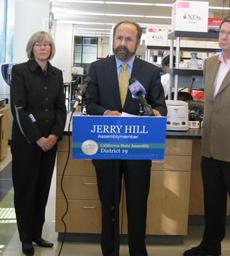
Jerry Hill grandstands on local hire

15

Assemblymember Jerry Hill — who’s facing term limits and reapportionment — has launched a pretty silly attack on San Francisco’s local hire law. He wants to make sure that no state money is used on local-hire projects (because the San Mateo County folks are mad about it.)


But the law doesn’t apply to projects funded with state money anyway, and it only mandates 50 percent local hire, and Hill’s bill will probably go down the crapper because the San Francisco legislators, who have a fair amount of clout up in Sacramento these days, aren’t going to support it. Assemblymember Tom Ammiano and state Sens. Mark Leno and Leland Yee have all signed a letter supporting the city’s local hire law.


And, of course, the Hill bill could mess with local hire efforts elsewhere.


Looks like a cheap publicity stunt to me.


Also in the Chron’s news briefs: A plan to raise the salaries of School Board members may make it to the ballot in San Francisco. I’ve been pushing this for years. It’s crazy to pay $500 a month to people who oversee a half-billion budget and do one of the most important jobs in the city — a job that by any account is a full-time-occupation. Yeah, it seems crazy to spend money on school board salaries when the district is laying off teachers, but some very good board members have quit because they can’t afford to have a job, a family and a seat on the School Board, and that’s nuts.


San Franciscans show solidarity with Egyptians

0

“Yesterday we were all Tunisian. Today we are all Egyptian. Tomorrow we will all be Free,” read one sign on at last weekend’s protest in solidarity with the wave of uprisings across the Arab world, an event drew thousands of people into the streets of San Francisco.

The crowd was diverse, from a variety of cultures and age groups. Sabreen Abdelnahmen is an 11-year-old Egyptian American who said she is “very proud there are people of many cultures and many religions fighting for the same thing.”

The events in the Middle East reverberate in San Francisco as well as many major cities, with everyone watching Egypt teeter toward democracy. To understand more about the events in Egypt, we spoke with local activist Yasmeen Daifallah, who helped organize the solidarity events and has connections in Egypt, where she attended Cairo University for six years. She is an activist, a political science doctoral student at UC Berkeley, and a singer in the Arabic music ensemble, ASWAT.

SFBG: Why protest in San Francisco?

YD: Two things were important to us. The first was to express solidarity… when [images of protests here] are transmitted to Tahrir Square [the central square where thousands of Egyptians have been remaining against government orders for two weeks]… it is definitely very uplifting. The second is to spread awareness in San Francisco…and in the U.S, to express a message to the American public and the American government. There should be respect for the people’s rights of self-determination and a cutting back on a strict consideration of self or national interest.

SFBG: Tell us about Tahrir Square, which has been at the heart of the protests, and who is leading the protests.

YD: I am amazed at the intensity of the steadfastness because many protestors are struggling to make a living. They all strike you as struggling to make a living and would not do anything to jeopardize making a living and these same people come out and say ‘we are staying here, we don’t care about bread, we care about dignity, we are not moving from here until [President Mubarak’s] regime falls.’

One of the most interesting things about this protest—there is no particular organization or person or even a group of organizations leading. Actually, the organizations are trying to piggy bag on the people and the momentum that is created by the public. For the leaderless nature that is has, it is remarkably organized.

SFBG: Why did the people rise up? Tell me a little about Egypt under Mubarak.

YD: The economic condition was abysmal and this is because when Mubarak came to power, the country started structural adjustment policies, which gave way to mass privatization. These have particularly intensified in the past 5-10 years. What this has translated into is massive unemployment and having to do several jobs in order to survive. On the day-to-day basis life under Mubarak is a life of economic hardship and social immobility.

When we start talking about the middle class, about politics and the political concerns probably [what is important] are fraudulent elections, rigging elections after people have actually voted but also preventing people from opposition movements from entering the ballot box to begin with. So this a very flagrant political repression. It takes place across the board. The second thing is the repression of the right to freedom of expression, whether in writing and the detention of journalists or in demonstrating. There is a law preventing the right to assemble. Then there is the bureaucracy and inefficiency, which all citizens suffer from on a daily basis. Their energies are exhausted in… getting their daily life going whether on the economic level, the bureaucratic level, or just the transportation level.

SFBG: You were just in Egypt and left 10 days before protests erupted. Do you wish you were there still? How does you feel as an Egyptian at this moment?

YD: Yes, very much so. I wish I were there—we all have a sense that there is something historic happening. We never had this number of people protesting against the regime and putting out demands that are this vocal and this radical. I wish I was more a part of this moment, I am just part of this moment from afar. I feel proud to be an Egyptian, which is a feeling you don’t get often, unfortunately.

On the one hand it feels bad because I wanted to be there to actually be a part of it. On the other hand, I have been convincing myself that there is a role that maybe I was destined to play being out here instead of out there.

SFBG: What do you think about the fears and concerns that democratic elections will lead to the rise of an Islamic government in Egypt?

YD: The question itself is unacceptable in the sense that fear and Islamic government put together should not be an issue. The issue is that people should have the right to determine who they want to govern them and whoever comes out of this is a legitimate leader.

The second thing is, you can easily see…this uprising is not an Islamic uprising—there is no foundation for this concern. The Islamic opposition, which has been among the most powerful if not the most powerful opposition movement will play a role and has to play, rightly, because they have been [part of the opposition]. There is no reason for concern, whether we look at it from the perspective that this is not an Islamic uprising or from the perspective that the nature of the Islamic opposition in Egypt is moderate in the sense that it is not militant and not violent and buys into a lot of democratic rhetoric and human rights rhetoric that is around.

SFBG: The other concerns have been around the lack of stability.

YD: This is not such a bad thing. The state of affairs in this point in time in the region is stability with no justice which in turn is bound to create instability and we have seen the instability of the intifada, we have the instabilities with the war on Gaza. Whatever we think of as stability in the Middle East is a fake and frail notion of stability. One would hope that if a new regime comes in Egypt that is more democratic that it would try to address some of the injustices that have been taking place so far regarding the Middle East peace process, but even this is not a guarantee.

At this point what one should focus on is who are the people at Tahrir, what are they demanding, and how can the international community help them get what they demand because this is not a violent uprising. This is not even an organized uprising. This is not a single actor uprising. It’s a crosscutting uprising and it is legitimate, which calls for respect and support and solidarity and anything less than that is betrayal.

SFBG: Where can people get the best information on what is happening in Egypt?

YD: Al Jazeera-English has been doing a good job at covering the events. It has definitely been the prime source of information to the extent that there is a huge campaign now demanding that Al Jazeera be available through satellite and cable providers in the United States. [For now,] you go online and click on live broadcast.

SFBG: Daifallah incorporates music into her politics through the Arabic musical ensemble ASWAT. Here’s a clip of their performance on Saturday:

http://www.youtube.com/watch?v=6fjZ0XjaJU8&feature=player_embedded


Stage Listings

0

ONGOING

Audition – A Play Exit Theater, 156 Eddy; (800) 838-3006, www.brownpapertickets.com. Call for price. Thurs and Sat, 8pm; Sun, 3pm. Through Sun/13. GenerationTheatre presents a comedy of the absurd by Roland David Valayre.

Bone to Pick and Diadem Exit on Taylor, 277 Taylor; (800) 838-3006, www.cuttingball.com. $15-50. Thurs-Sat, 8pm; Sun, 5pm. Through Sun/13. Cutting Ball Theatre presents a pair of plays by Eugenie Chan.

Clue Boxcar Playhouse, 505 Natoma; 776-1747, www.boxcartheatre.org. $15-35. Wed-Fri, 8pm; Sat, 7 and 10pm. Through Feb 19. A play based on a film based on a board game is just the kind of tangled genealogy much goodtime theater is made of these days. So there’s nothing too new about Boxcar’s stage adaptation of the manic 1985 comedy derived from a once popular Parker Bros. diversion. In fact, it’s at least the second stage adaptation of same to be offered in San Francisco. (Impossible Productions remounted its version at the Dark Room just last year.) Nevertheless, led by adapter-director Nick A. Olivero, Boxcar’s production pursues its vision like a mad yen, with a loving fidelity and self-referential glee that are not so much inspired as just plain zealous (although Olivero’s scenic design does reach new heights: a TV-toned board-game set that the audience peers down on from six-feet-high balconies ringing the stage). Performances are dutiful and solid for the most part, with especially nice work from Brian Martin (as the butler) and J. Conrad Frank (as Mrs. Peacock). Although there’s something vaguely and not unpleasantly hypnotic about it all, groups of cult-film line-gleaners may be the best audience for this one. (Avila)

*The Companion Piece Z Space at Theatre Artaud, 450 Florida; (800) 838-3006, www.zspace.org. $20-$40. Thurs 7pm; Fri-Sat, 8pm; Sun, 5pm. Through Sun/13. Z Space presents the world premiere of a new play by Mark Jackson, with Beth Wilmurt and Christopher Kuckenbaker.

Next to Normal Curran Theatre, 445 Geary; (888) SHN-1799, www.shnsf.com. $30-99. Call for dates and times. Through Feb 20. Diana Goodman (Alice Ripley) is a woman too restlessly witty and big-souled to sit easy in the suburban home she shares with her husband (Asa Somers), 16-year-old daughter (Emma Hunton), and 18-year-old son (Curt Hansen). What’s worse, the 18-year-old died as a baby about 17 years ago, and has not been taking the news lying down. A mother’s grief winds through this sometimes clever, mostly sappy, and ultimately tedious Broadway rock musical about a bipolar woman and the impact of her illness on her family. Director Michael Greif’s (Rent) kinetic staging takes place across a three-level industrial-box set that houses musicians in its outer corners as well as the stereotypical family dwelling in its center. The set’s outer façade (moving panels featuring giant eyes and mouth) meanwhile suggests the whole thing as a model of the mind we’re witnessing come apart. The 2008 musical by Brian Yorkey (book and lyrics) and Tom Kitt (music) won a Pulitzer for its supposedly bold depiction of mental illness. But despite reasonable scoffing at the paternalistic, pharmacologically fueled regime of mainstream treatment (embodied by Jeremy Kushnier’s various doctors), neither Tony-winner Ripley’s jagged performance nor Yorkey’s book transcends a stultifying and finally grating set of narrative clichés, which the driving, mostly generic-sounding score only makes more obvious. A Woman Under the Influence this isn’t. (Avila)

Out of Sight The Marsh, 1062 Valencia; (800) 838-3006, www.themarsh.org. $15-35. Thurs and Sat, 8pm; Sun, 3pm. Through Sun/13. Sara Felder’s solo show combines juggling and shadow puppetry to tell the coming-of-age story of a devoted Jewish daughter who, after an eye-opening trip to Israel as a teen in the 1980s, reaches a crisis of understanding with her legally blind opera-loving mother, an ardent Zionist. The first juggling act belongs to her mother (as portrayed by Felder), who amusingly balances several sets of eyeglasses and other magnifying devices to capture a sense of the action at the Met. From there, Felder weaves increasingly adept and riskier feats of juggling into her narrative, as if sharpening her own set of 20/20s (as an out lesbian and a questioning Jew vis-à-vis Israel) from within the penumbra of motherly influence and affection. It’s also, at times, a striking illustration of both the unease and grace she manifests in broaching the subject of Israel’s glaring contradictions. Significantly, Felder’s seminal romance with a woman pays no part in the tension with her mother—or with her best male friend, who turns Orthodox after touching down in the Holy Land. Rather, it’s the gentle Felder’s encounter with the reality of the Jewish state for Palestinians and her willingness to see it for what it is. Still, given the chasm between mother and daughter on so big and basic an issue, their reconciliation comes a bit fast and neat. (Avila)

Party of 2 – The New Mating Musical Shelton Theater, 533 Sutter; (800) 838-3006, www.partyof2themusical.com. $27-29. Sun, 3pm. Open-ended. A musical about relationships by Shopping! The Musical author Morris Bobrow.

*Pearls Over Shanghai Thrillpeddlers’ Hypnodrome, 575 Tenth St; 1-800-838-3006, www.brownpapertickets.com. $30-69. Sat, 8pm. Through April 9. Thrillpeddlers’ acclaimed production of the Cockettes musical continues its successful run.

Spalding Gray: Stories Left to Tell Gough Street Playhouse, 1620 Gough; (510) 207-5774, www.custommade.org. $10-25. Thurs-Sat, 8pm. Through Feb 19. Originally conceived as a one-off benefit show by Gray’s widow, Kathleen Russo and director Lucy Sexton, Spalding Gray: Stories Left to Tell intersperses segments of some of Gray’s most famous works—Swimming to Cambodia, Gray’s Anatomy, Monster in a Box—with excerpts from his journals, the stories left to tell. The original concept to have five actors representing five aspects of Gray’s words—adventure, career, family, journals, and love—seems to have been crafted with the specific purpose of allowing several people the opportunity to “speak for” Spalding, without actually performing “as” Spalding, appropriate enough for a celebratory memorial, but hard to accept as a capital-P play. It’s a conundrum that Custom Made Theatre cannot solve. Half the cast convey by their tone and manner the casual ease of campfire story-tellers, while the other half take a more performative approach to their recitations, particularly a smooth Patrick Barresi as “Career” and the likable Richard Wenzel as “Love.” The stories themselves are often hilarious, including Gray’s turns as a “Bowery Bum,” a jailbird in Nevada, and a sweat lodge initiate, while the stories that are not side-splittingly funny are poignant, painful, and even unflinchingly sentimental, especially in regards to his young sons. But as a work of theatre, they underwhelmed. (Gluckstern)

Treefall New Conservatory Theatre Center, 25 Van Ness; 861-8972, www.nctsf.org. $24-40. Call for dates and times. Through Feb 27. New Conservatory Theatre Center presents a tale of erotic attraction by Henry Murray.

BAY AREA

The Agony and the Ecstasy of Steve Jobs Berkeley Rep, Thrust Stage, 2025 Addison, Berk; (510) 647-2949, www.berkeleyrep.org. $14.50-73. Call for dates and times. Through Feb 27. Storyteller Mike Daisey spins a yarn about the Apple head.

Collapse Aurora Theatre, 2081 Addison, Berk; (510) 843-4822, www.auroratheatre.org. $34-55. Wed-Sat, 8pm; Sun, 2 and 7pm; Tues, 7pm (also Feb 19, 2pm). Through March 6. Aurora Theatre presents a comedy by Allison Moore.

East 14th – True Tales of a Reluctant Player The Marsh Berkeley, 2120 Allston Way, Berk; (800) 838-3006, www.themarsh.org. $20-50. Call for times. Through Sun/13. Don Reed’s one-man show continues its extended run.

Grapes of Wrath Marion E. Green Black Box Theater, 531 19th, Oakl; www.theatrefirst.com. $10-30. Thurs-Sat, 8pm; Sun, 2pm. Through Feb 20. TheatreFIRST presents Frank Galati’s stage adaptation of the John Steinbeck novel.

Heartbreak House Live Oak Theatre, 1301 Shattuck, Berk; (510) 649-0999, www.berkeleyrep.org. $12-15. Fri-Sat, 8pm (also Sun/13, 2pm; Feb, 17, 8pm). Through Feb 19. Actors Ensemble of Berkeley presents the George Bernard Shaw comedy set just before World War I.

The Last Cargo Cult Berkeley Repertory Theatre, Thrust Stage, 2025 Addison, Berk; (510) 647-2949, www.berkeleyrep.org. $14.50-73. Call for dates and times. Through Feb 20. As fans of J. Maarten Troost have learned, life on an island “paradise” is far less idyllic than the imagination yearns to believe. So it’s hardly surprising that Mike Daisey’s monologue The Last Cargo Cult begins with a white-knuckle ride in a prop plane piloted by a man with a milky eye. Daisey’s destination, the Pacific island of Tanna, is the location of one of the world’s last so-called “cargo cults”, and their big celebration “John Frum Day” is approaching. Daisey’s intention to hang out at the festivities smacks a little of entitled voyeurism, but the parallel he manages to draw between the complexities of a religion dedicated to a mythical cargo of “awesome shit”, and our own dedication to the acquisition of same, is a striking one. From our almost blind faith in the value of basically valueless currency, to our even blinder faith that indenturing ourselves by debt will enrich us, the foundations of our own “cargo cult” are revealed smartly by Daisey to be just as precarious as if built at the base of a volcano as in Tanna. Still, I found the most revealing thing about the evening to be the moment when the couple next to me took off with a $100 bill they’d acquired free-of-charge at the door, to which I can’t help but ask them: “Did you get your money’s worth?” (Gluckstern)

Not a Genuine Black Man The Marsh Berkeley, TheaterStage, 2120 Allston, Berk; 826-5750, www.themarsh.org. $20-50. Fri, 8pm. Through Feb 18. Brian Copeland brings back his long-running solo show.

Strange Travel Suggestions The Marsh Berkeley, Cabaret, 2120 Allston Way, Berk; (800) 838-3006, www.themarsh.org. $15-35. Thurs-Fri, 8pm; Sat, 5pm. Through Feb 19. Jeff Greenwald stars in a one-man show about the vagaries of wanderlust.

The 39 Steps TheatreWorks at the Mountain View Center for the Performing Arts, 500 Castro, Mtn View; (650) 463-1960, www.theatreworks.org. $24-79. Tues-Wed, 7:30pm; Thurs-Fri, 8pm; Sat, 2 and 8pm; Sun, 2 and 7pm. Through Sun/13. TheatreWorks presents Patrick Barlow’s comic adaptation of the book and movie of the same name.

World’s Funniest Bubble Show The Marsh Berkeley, 2120 Allston Way, Berk; (800) 838-3006, www.themarsh.org. $8-11. Sun, 11am. Through April 3. The Amazing Bubble Man extends the bubble-making celebration.

PERFORMANCE/DANCE

BAY AREA

Marga’s Funny Mondays The Cabaret at The Marsh Berkeley, 2120 Allston; (800) 838-3006, www.themarsh.org. Mon/7, 8pm. $10. Marga Gomez hosts a Monday night comedy series.


Stage listings are compiled by Guardian staff. Performance times may change; call venues to confirm. Reviewers are Robert Avila, Rita Felciano, and Nicole Gluckstern. Submit items for the listings at listings@sfbg.com. For further information on how to submit items for the listings, see Picks. For complete listings, see www.sfbg.com.

Dick Meister: Black Porters Led the Way

0

Dick Meister, formerly labor editor of the SF Chronicle and KQED-TV Newsroom, has covered labor, politics and other matters for a half-century.


February is Black History Month, a good time to honor the Brotherhood of Sleeping Car Porters, one of the most important yet too often overlooked leaders in the long struggle for racial equality.

The union, the first to be founded by African Americans, was involved deeply in political as well as economic activity. It joined with the NAACP to serve as the major political vehicle of African Americans from the late 1930s through the 1950s.

Together, the two organizations led the drives in those years against racial discrimination in employment, housing, education and other areas, and in doing so, laid the groundwork for the civil rights movement of the 1960s.

The need for a porters’ union was painfully obvious. Porters commonly worked 12 or more hours a day on the Pullman Company’s sleeping car coaches for less than $100 a month. And out of that, they had to pay for their meals, uniforms, even the polish they used to shine passengers’ shoes. They got no fringe benefits, although they could ride the trains for half-fare on their days off – providing they were among the very few with the time and money to do so. And providing they didn’t ride a Pullman coach.

In order to meet their basic living expenses, porters had to draw on the equally meager earnings of their wives, who were almost invariably employed as domestics.
 
It was a marginal and humiliating experience for porters. They were rightly proud of their work, a pride that showed in their smiling, dignified bearing. But porters knew that no matter how well they performed, they would never be promoted to higher-paying conductors’ jobs. Those jobs were reserved for white men.

Porters knew most of all that their white passengers and white employers controlled everything. It was they alone who decided what the porters must do and what they’d get for doing it.

When a passenger pulled the bell cord, porters were to answer swiftly and cheerfully. Just do what the passengers asked – or demanded. Shine their shoes, fetch them drinks, make their beds, empty their cuspidors. And more. No questions, no complaints, no protests. No rights. Nothing better epitomized the vast distance between black and white in American society.

Hundreds of porters who challenged the status quo by daring to engage in union activity or other concerted action were fired. But finally, the administration of President Franklin D. Roosevelt granted workers, black and white, the legal right to unionize. And finally, in 1937, the Brotherhood of Sleeping Car Porters won a union contract from Pullman.

The contract was signed exactly 12 years after union president and founder A. Philip Randolph had called the union’s first organizing meeting in New York City. It was a long arduous struggle, but it brought the porters out of poverty. It won them pay at least equal to that of unionized workers in many other fields , a standard workweek, and full range of fringe benefits. Most important, porters won the right to continue to bargain collectively with Pullman on those and other vital matters.

Union President Randolph and Vice President C.L. Dellums, who succeeded Randolph in 1968, led the drive that pressured President Roosevelt into several important actions against discrimination, including the creation of a Fair Employment Practices Commission in housing as well as employment. FDR agreed to set up the commission – a model for several state commissions – and take other anti-discrimination steps only after Randolph and Dellums threatened to lead a march on Washington by more than 100,000 black workers  and others who were demanding federal action against discrimination.

Dellums and Randolph struggled as hard against discrimination inside the labor movement, particularly against the practice of unions setting up segregated locals, one for white members, one for black members.

Randolph, elected in 1957 as the AFL-CIO’s first African-American vice president, long was known as the civil rights conscience of the labor movement, often prodding federation President George Meany and other conservative AFL-CIO leaders to take stands against racial discrimination.

The sleeping car coaches that once were the height of travel luxury have long since disappeared, and there are very few sleeping car porters in this era of less-than-luxurious train travel. The Brotherhood of Sleeping Car Porters is gone, too. But before the union disappeared, it had reached goals as important as any ever sought by an American union – or by any other organization anywhere.

Dick Meister, former labor editor of the SF Chronicle and KQED-TV Newsroom, has covered labor and politics for a half-century. Contact him through his website, www.dickmeister.com, which includes more than 250 of his columns.

Black history, local hire, living color

31

City Hall kicked off its annual Black History month celebrations with a talk by Los Angeles philanthropist and former Xerox Corp. VP Bernard Kinsey about the importance of debunking myths about the absence of blacks in American history. And Mayor Ed Lee, who had just met with five dozen unemployed black construction workers from the Bayview, revealed how, when he was growing up in the projects in Seattle, his neighbors were black, and an African American named Darnell was one of the most loyal patrons of the restaurant that Lee’s father was trying to make succeed.


“And when my dad suddenly died of a heart attack, Darnell was the first person to offer my brother a job at his gas station,” Lee said. “So, this is not just about recognizing African American history, but recognizing what they did for us, and  making sure that no there are jobs and we protect the family structure. I know what it is to be helped by the African American culture.”


Lee’s recollections of Darnell came less than an hour after he met with Aboriginal Blackmen United, a group that represents unemployed construction workers in the Bayview, to discuss how its members can get hired at UCSF’s $1.5 billion hospital complex at Mission Bay and other local building sites.


At that meeting, ABU President James Richards thanked Lee for getting UC to clarify the details of its voluntary local hire plan at the Mission Bay hospitals.
But he warned that the fight is just starting. “We’ve got the unions to deal with,” Richards told Lee, referring to the reality that the unions also want their members to get work at the UCSF site.


Lee said he’d do his best to help.
“The African American community in San Francisco has not got its fair share,” he said. “I can’t say that everyone in the room is going to get a job, but I’ll open up doors and do my best.”


And then Lee confirmed that local hire is one of his top five priorities.
“My top priorities are the budget, pension reform, the America’s Cup, finding a good police chief and local hire,” he said. “I said that directly to every union leader yesterday. Some unions will be there, others will resist.”


ABU’s Richards said the need to have a G.E.D. to get into the city’s ob training programs is a barrier to employment for many in the Bayview.
“We have a lot of people, who are not able to get into CityBuild because they don’t take folks anymore who don’t have their G.E.D,” he said.


And he warned that the city’s black community is in crisis.
“I know there is a budget crisis, but this is a life crisis,” Richards said. “Young people are dying and it’s not even newsworthy any more.”


Lee suggested ABU work with the City to avoid the need to hold protests at construction sites in future,
“Let’s plan together, so you don’t have to go to all the sites,” Lee said. “I am for people getting their GED. But if someone has evidence that they are making an attempt to get their GED, we need to reward that with jobs. So that the GED is not a barrier, it’s a hope.”


And then Lee was off to attend his next round of meetings, which included the city’s Black History month event, where speakers noted that during Bernard Kinsey’s career with Xerox, he helped increase the hiring of blacks, Latinos and women,


Kinsey told the audience that he and Shirley Kinsey, his wife of 44 years, share a passion for African-American history and art. And that their world-famous Kinsey Collection, which contains art, books and manuscripts documenting African American triumphs and struggles from 1632 to the present, is currently on display at the National Museum of American History in Washington D.C, and a number of pieces are at the San Francisco African American Historical and Cultural Society. He noted that the posters of African Americans in the Civil War were reproductions of some of the art in those exhibits. 


Sup. Malia Cohen noted that about 200,000 African Americans participated in that war. Sup. Ross Mirkarimi, who represents the city’s Western Addition, where redevelopment triggered massive displacement of the black community in the 1960s, noted that eight members of the current Board of Supervisors, who selected Lee as the city’s first Chinese American mayor, are people of color.


“This is true representation,” Mirkarimi said, noting that the fact that the city’s African American population continues to drop (reportedly down from 6 percent to 3.9 percent, according to the 2010 Census) to “is a reminder that even the most forward-thinking cities have a lot of work to do.”


And Kinsey urged African Americans to start describing their ancestors as “enslaved.”


‘It will change how you look at your ancestors,” he said, “You don’t have a clue about what they sacrificed to get you to where you are today. We don’t tell you the ‘ain’t-it-awful’ story about slavery. We tell you the story of how we overcame.”


“You need three things for a successful life,” Kinsey added “Something to do. Someone to love. And something to look forward to.”


Kinsey said he and his wife have espoused two life principles, ‘To whom much is given much is required” and live “A life of no regrets.” And then he told a story about an eagle who was raised by a chicken.


The eagle ended up ashamed of his feathers, because the chickens never told him he was an eagle because they were afraid he’d end up ruling the barnyard.“He even grew up ashamed of his daughters,” Kinsey said.


Eventually, the eagle met another eagle, who told him the truth. “You ain’t no chicken,” the other eagle said.


“And this is the message,” Kinsey said. “Don’t think chicken thoughts, or dream chicken dreams. Think like an eagle.”


He warned the audience to be careful of buying into myths that would have them believe that African Americans played no role in building the U.S.
“There are stories that made America and stories that America made up,” Kinsey said. “And too often, the myth becomes the choice.”


And then he concluded by expounding on “the myth of absence.”
‘”African Americans are not seen, not because of their absence, but because of the presence of a myth that prepares and requires their absence,” Kinsey said. “And the manipulation of the myth changes the color of the past. It’s no accident that the dominate images from the past are white. And many of us have swallowed the pill.”


Division of labor

0

sarah@sfbg.com


In the wake of a three-day protest by unemployed workers outside UCSF’s Mission Bay hospital construction site — and under pressure from city leaders — UC officials have announced voluntary local hiring targets at the $1.5 billion complex.


Targets start at hiring 20 percent of the project’s workers in San Francisco during 2011 and increase that by 5 percent each year until the hospital complex is completed, UCSF news director Amy Pyle told us. But she denies that UC was pressured into its decision. UC is a state agency that is exempt from local rules when it builds facilities for UCSF and other campuses.


“Our voluntary goals are not a result of their protest,” Pyle insisted. “We have been aware of the local hire concerns since before they were protesting.”


The protests have focused on the need to hire workers for southeast San Francisco, where unemployment rates are the highest in the city, particularly among the city’s African American population.


“Of course we are looking to be good neighbors and hire people from an area we know has been hard hit,” Pyle said, clarifying that under the University of California’s hiring program, “local residents mean people who live in San Francisco generally.”


Mission Bay Hospitals Projects executive director Cindy Lima said uproar at the site stemmed in part from perceptions that lots of work is available now, but she said that isn’t true.


“Job opportunities should ramp up in May, but right now, they are installing structural piles,” Lima said. “So if there is an opportunity for a carpenter or a laborer to get decks built, we call the union.” UC’s voluntary local hire announcement came after Mayor Ed Lee urged UC officials to formalize a community hiring plan for Mission Bay, and Aboriginal Blackmen United (ABU) president James Richards agreed to call off his group’s protest outside UC’s Mission Bay hospital complex, at least for now.


ABU member Fred Green, an unemployed construction worker who has lived in the Bayview for 50 years and has five children, said the protesters tried to remain peaceful. “But an empty belly makes you do strange things,” Green said. “If there’s enough work for everybody, why should we be stuck at home while someone comes into my community and takes food out of my kids’ mouths?”


Troy Moor, who has lived in the Bayview for 47 years and has two kids, speculated that if ABU blocked both gates to the project, it would cost UC thousands of dollars a day in lost productivity. “Here at the front gates, we are visible. But we figure that if by next week, nothing is happening, we’ll start making them lose money,” he said.


Michelle Carrington is a 58-year-old flagger and operating engineer from the Bayview who has been unemployed for 10 years. She said Dwayne Jones, who worked in the Mayor’s Office and helped her graduate from Young Community Developers, was “working to try and get us jobs.”


Jones, who is now with Platinum Advisors as a consultant to DPR Construction, UC’s prime contractor at its Mission Bay site, put in an appearance on day three of ABU’s protest. But he said his work with DPR had nothing to do with the ABU protest.


“UC is very committed to maximizing local hire where we can,” Lima told the Guardian. “It’s unfortunate there is a protest because it gives the sense we haven’t been working with the community when in fact we have been working with the Mayor’s Office, CityBuild, and every stakeholder interested in this project, including ABU.”


Richards said ABU mounted its protest to challenge UC’s claims that it has hired more local residents at the site. They were also angry over a flyer that encouraged residents interested in working at the site to sign up with the San Francisco Workforce Collaborative, in partnership with Rev. Arelious Walker’s BayView Hope Community Development Corporation, feeling as if the UC was trying to divide their community. Walker did not return our calls for comment.


“We were with Walker when he was fighting the Nation of Islam’s attempt to stop development at the shipyard, so it hurts so bad to see this,” Richards said. “Never again will we stand by and let people come into the southeast community and take our jobs. We’re going to fight until the end. If the community doesn’t work, no one works.”


But even as UC announced its voluntary Mission Bay goals, community advocates pressed UCSF to set higher targets, citing the city’s failure to attain 50 percent local hire goals under San Francisco’s decade-long policy of seeking to hit that goal.


Joshua Arce of the Brightline Defense Project said he is glad Lee expressed support for Sup. John Avalos’ local hire legislation, “but we are waiting to see if he implements the law as written or a watered-down version.”


Then-Mayor Gavin Newsom allowed Avalos’ legislation to become law without signing it, bowing to the veto-proof 8-3 majority that approved it. But in a 12/23/10 letter explaining his position, Newsom recommended modifications to accommodate the concerns of the building trades, whose members come from across the Bay Area.


“I know the passage of this policy has created high expectations among some residents of San Francisco,” Newsom wrote. “The city owes it to them to implement this policy in a way that will result in a successful program that is fiscally responsible and reflects the best thinking of the many stakeholders invested in San Francisco.”


But with Newsom moving to Sacramento, California Assembly member Tom Ammiano and Sens. Mark Leno and Leland Yee are urging legislators to support San Francisco’s newly approved local hire law as approved.


In a Jan. 25 letter that Leno and Yee signed, Ammiano encouraged Bay Area officials to work with the city to explore mutually beneficial “reciprocity agreements” in which local cities would support one another’s programs “aimed at providing disadvantaged job seekers opportunities in the construction sector.”


“In neighborhoods like the Bayview, the Mission, and the Western Addition, the promise of jobs — particularly living wage construction jobs — has been an unfulfilled promise for generations,” Ammiano wrote.


But in a Jan. 28 press release, UC officials clarified that “as one of 10 campuses of a statewide constitutional corporation and public trust,” UCSF is not subject to Avalos’ mandatory requirement and is prohibited from adopting mandatory requirements based upon residency.


Instead, UC promised to do more community outreach and try to carve out financial incentives to encourage contractors to hit UC’s targets at Mission Bay.


Lima said the hospital complex is a historic opportunity to put as many San Franciscans to work as possible. “We have set an ambitious hiring target but we recognize that the economic activity generated by the project can significantly benefit our neighbors and local residents,” she said


After his Jan. 27 meeting with UC, Richards told ABU members that “when DPR needs someone for a job, they’re gonna call Dwayne Jones, and then Dwayne will let us know. There are hundreds of jobs, but I don’t know if they are in every trade. So, I feel good. But not so good that I can say that 10 carpenters will be hired tomorrow. There’s not enough need for that right now. But the work that’s there, when they call, you’re going to know it.”


Lima said UC’s meeting with Richards was “positive”.


“We clarified some misunderstandings and made some progress,” Lima said, noting that work at the site will become increasingly available starting in May. “Our goal is still to create jobs for San Francisco residents and make this project happen. We are continuing to try and match people who need to go to work with available job opportunities. The bottom line is that there are a lot of people in this city who are out of work and a lot of groups with different intentions in mind and we get tangled in that process.”


Lima vowed to work closely with DPR Construction and major subcontractors to ensure qualified local residents — including those from neighborhoods closest to the site — can access the construction jobs. And she promised that results will be reported regularly and the size of the workforce will increase steadily, peaking with 1,000 workers in 2012.


“We are mindful that while these goals challenge us, they are also within reach,” Lima said, noting that UCSF has been engaged in creating job opportunities in the construction trades for San Franciscans since 1993. “Our success will depend on the participation and commitment of the broader community and the trade unions.”


UC’s move comes less than two weeks after Lee announced at the annual San Francisco Labor Council Martin Luther King Jr. Day breakfast that one of his top priorities is implementing Avalos’ mandatory local hire policy.


Lee’s comments suggest a different approach from Newsom’s, but it’s still not clear whether Lee intends to follow the “critical steps” that Newsom felt the city should take “to ensure the responsible and successful implementation of Avalos’ legislation.”


Arce said he was happy to see Lee address the issue at the MLK Day event. “Lee said that if we are using local dollars to create local jobs, those jobs should go to local workers,” Arce recalled, noting that the following week Lee started to coordinate with the Office of Economic and Workforce Development and CityBuild to engage community stakeholders and lay out a road map to implement Avalos’ legislation.


“They set a deadline of March 25 as the target date by which the language of Avalos’ mandatory legislation must be included in all public bids and contracts,” Arce said. “And it’s our understanding that Mayor Lee called UC Chancellor Susan Desmond-Hellmann directly on the morning of Jan. 27 [before ABU’s Richards met with UC officials] to ask that UCSF formalize a community hiring plan for Mission Bay as soon as possible.”


Avalos said he was “very encouraged” by Lee’s remarks. “To say that at the Martin Luther King Labor Breakfast was a big deal,” Avalos said, noting that the building trades were also in the room. “I feel Ed Lee wants to implement the legislation how it is written. He needs help doing that. He needs to create a process to make it happen, and I believe the folks who helped draft the legislation will be ready to do that. That’s not to say that this couldn’t go wrong, but I feel pretty confident that he will implement as strong a local hire model as possible.”

California is a rich state

9

My favorite part of the State of the State speech (full text here) was a bit of perspective that almost everyone has ignored. It went like this:


We are still a very rich society. In two years alone, Californians will have added more than $100 billion to their personal income. Yet, our State’s credit rating is the lowest of the 50 states, unemployment is higher than the national average and some journalists are calling California a “failed state.”


In two years, Californians will have added more than $100 billion to their personal income. And given that 20 percent of all income eanred in the U.S. goes to the top 1 percent of Americans. $20 billion of that new income will go to the very richest Californians. More than 60 percent of all income earned goes to the richest 20 percent, which would mean $60 billion in income to people who are already richer than four of five Californians.


Brown gets this, clearly. And he’s no fool; I think he can do simple math. Which would lead you to conclude that an increase in the state income tax for the top brackets could bring in a huge chunk of change — without harming the economic recovery. (And don’t give me that trickle down shit; facts are facts, and the top 1 percent of income earners are far less likely to spend their marginal dollar, creating jobs. They sock it away, creating wealth for future generations.)


I know the idea of talking about higher income taxes is political death, but when we talk about frugality and tightening our belts, let’s remember: California is still a very rich state. We can afford things like public education. Even the governor says so.

Stage Listings

0

THEATER

ONGOING

Audition – A Play Exit Theater, 156 Eddy; (800) 838-3006, www.brownpapertickets.com. Call for price. Thurs and Sat, 8pm; Sun, 3pm. Through Feb 13. GenerationTheatre presents a comedy of the absurd by Roland David Valayre.

Bone to Pick and Diadem Exit on Taylor, 277 Taylor; (800) 838-3006, www.cuttingball.com. $15-50. Thurs-Sat, 8pm; Sun, 5pm. Through Feb 13. Cutting Ball Theatre presents a pair of plays by Eugenie Chan.

Clue Boxcar Playhouse, 505 Natoma; 776-1747, www.boxcartheatre.org. $15-35. Wed-Fri, 8pm; Sat, 7 and 10pm. Through Feb 19. A play based on a film based on a board game is just the kind of tangled genealogy much goodtime theater is made of these days. So there’s nothing too new about Boxcar’s stage adaptation of the manic 1985 comedy derived from a once popular Parker Bros. diversion. In fact, it’s at least the second stage adaptation of same to be offered in San Francisco. (Impossible Productions remounted its version at the Dark Room just last year.) Nevertheless, led by adapter-director Nick A. Olivero, Boxcar’s production pursues its vision like a mad yen, with a loving fidelity and self-referential glee that are not so much inspired as just plain zealous (although Olivero’s scenic design does reach new heights: a TV-toned board-game set that the audience peers down on from six-feet-high balconies ringing the stage). Performances are dutiful and solid for the most part, with especially nice work from Brian Martin (as the butler) and J. Conrad Frank (as Mrs. Peacock). Although there’s something vaguely and not unpleasantly hypnotic about it all, groups of cult-film line-gleaners may be the best audience for this one. (Avila)

*The Companion Piece Z Space at Theatre Artaud, 450 Florida; (800) 838-3006, www.zspace.org. $20-$40. Thurs 7pm; Fri-Sat, 8pm; Sun, 5pm. Through Feb 13. Z Space presents the world premiere of a new play by Mark Jackson, with Beth Wilmurt and Christopher Kuckenbaker.

Next to Normal Curran Theatre, 445 Geary; (888) SHN-1799, www.shnsf.com. $30-99. Call for dates and times. Through Feb 20. Diana Goodman (Alice Ripley) is a woman too restlessly witty and big-souled to sit easy in the suburban home she shares with her husband (Asa Somers), 16-year-old daughter (Emma Hunton), and 18-year-old son (Curt Hansen). What’s worse, the 18-year-old died as a baby about 17 years ago, and has not been taking the news lying down. A mother’s grief winds through this sometimes clever, mostly sappy, and ultimately tedious Broadway rock musical about a bipolar woman and the impact of her illness on her family. Director Michael Greif’s (Rent) kinetic staging takes place across a three-level industrial-box set that houses musicians in its outer corners as well as the stereotypical family dwelling in its center. The set’s outer façade (moving panels featuring giant eyes and mouth) meanwhile suggests the whole thing as a model of the mind we’re witnessing come apart. The 2008 musical by Brian Yorkey (book and lyrics) and Tom Kitt (music) won a Pulitzer for its supposedly bold depiction of mental illness. But despite reasonable scoffing at the paternalistic, pharmacologically fueled regime of mainstream treatment (embodied by Jeremy Kushnier’s various doctors), neither Tony-winner Ripley’s jagged performance nor Yorkey’s book transcends a stultifying and finally grating set of narrative clichés, which the driving, mostly generic-sounding score only makes more obvious. A Woman Under the Influence this isn’t. (Avila)

Out of Sight The Marsh, 1062 Valencia; (800) 838-3006, www.themarsh.org. $15-35. Thurs and Sat, 8pm; Sun, 3pm. Through Feb 13. The Marsh presents a new solo show by Sara Felder.

Party of 2 – The New Mating Musical Shelton Theater, 533 Sutter; (800) 838-3006, www.partyof2themusical.com. $27-29. Sun, 3pm. Open-ended. A musical about relationships by Shopping! The Musical author Morris Bobrow.

*Pearls Over Shanghai Thrillpeddlers’ Hypnodrome, 575 Tenth St; 1-800-838-3006, www.brownpapertickets.com. $30-69. Sat, 8pm. Through April 9. Thrillpeddlers’ acclaimed production of the Cockettes musical continues its successful run.

Spalding Gray: Stories Left to Tell Gough Street Playhouse, 1620 Gough; (510) 207-5774, www.custommade.org. $10-25. Thurs-Sat, 8pm. Through Feb 19. Custom Made Theatre presents stories by the late writer and performer.

Treefall New Conservatory Theatre Center, 25 Van Ness; 861-8972, www.nctsf.org. $24-40. Call for dates and times. Through Feb 27. New Conservatory Theatre Center presents a tale of erotic attraction by Henry Murray.

BAY AREA

The Agony and the Ecstasy of Steve Jobs Berkeley Rep, Thrust Stage, 2025 Addison, Berk; (510) 647-2949, www.berkeleyrep.org. $14.50-73. Call for dates and times. Through Feb 27. Storyteller Mike Daisey spins a yarn about the Apple head.

Collapse Aurora Theatre, 2081 Addison, Berk; (510) 843-4822, www.auroratheatre.org. $34-55. Wed-Sat, 8pm; Sun, 2 and 7pm; Tues, 7pm (also Feb 19, 2pm). Through March 6. Aurora Theatre presents a comedy by Allison Moore.

East 14th – True Tales of a Reluctant Player The Marsh Berkeley, 2120 Allston Way, Berk; (800) 838-3006, www.themarsh.org. $20-50. Call for times. Through Feb 13. Don Reed’s one-man show continues its extended run.

Grapes of Wrath Marion E. Green Black Box Theater, 531 19th, Oakl; www.theatrefirst.com. $10-30. Thurs-Sat, 8pm; Sun, 2pm. TheatreFIRST presents Frank Galati’s stage adaptation of the John Steinbeck novel.

Heartbreak House Live Oak Theatre, 1301 Shattuck, Berk; (510) 649-0999, www.berkeleyrep.org. $12-15. Fri-Sat, 8pm (also Feb 13, 2pm; Feb, 17, 8pm). Through Feb 19. Actors Ensemble of Berkeley presents the George Bernard Shaw comedy set just before World War I.

The Last Cargo Cult Berkeley Repertory Theatre, Thrust Stage, 2025 Addison, Berk; (510) 647-2949, www.berkeleyrep.org. $14.50-73. Call for dates and times. Through Feb 20. As fans of J. Maarten Troost have learned, life on an island “paradise” is far less idyllic than the imagination yearns to believe. So it’s hardly surprising that Mike Daisey’s monologue The Last Cargo Cult begins with a white-knuckle ride in a prop plane piloted by a man with a milky eye. Daisey’s destination, the Pacific island of Tanna, is the location of one of the world’s last so-called “cargo cults”, and their big celebration “John Frum Day” is approaching. Daisey’s intention to hang out at the festivities smacks a little of entitled voyeurism, but the parallel he manages to draw between the complexities of a religion dedicated to a mythical cargo of “awesome shit”, and our own dedication to the acquisition of same, is a striking one. From our almost blind faith in the value of basically valueless currency, to our even blinder faith that indenturing ourselves by debt will enrich us, the foundations of our own “cargo cult” are revealed smartly by Daisey to be just as precarious as if built at the base of a volcano as in Tanna. Still, I found the most revealing thing about the evening to be the moment when the couple next to me took off with a $100 bill they’d acquired free-of-charge at the door, to which I can’t help but ask them: “Did you get your money’s worth?” (Gluckstern)

Not a Genuine Black Man The Marsh Berkeley, TheaterStage, 2120 Allston, Berk; 826-5750, www.themarsh.org. $20-50. Fri, 8pm. Through Feb 18. Brian Copeland brings back his long-running solo show.

Strange Travel Suggestions The Marsh Berkeley, Cabaret, 2120 Allston Way, Berk; (800) 838-3006, www.themarsh.org. $15-35. Thurs-Fri, 8pm; Sat, 5pm. Through Feb 19. Jeff Greenwald stars in a one-man show about the vagaries of wanderlust.

The 39 Steps TheatreWorks at the Mountain View Center for the Performing Arts, 500 Castro, Mtn View; (650) 463-1960, www.theatreworks.org. $24-79. Tues-Wed, 7:30pm; Thurs-Fri, 8pm; Sat, 2 and 8pm; Sun, 2 and 7pm. Through Feb 13. TheatreWorks presents Patrick Barlow’s comic adaptation of the book and movie of the same name.

World’s Funniest Bubble Show The Marsh Berkeley, 2120 Allston Way, Berk; (800) 838-3006, www.themarsh.org. $8-11. Sun, 11am. Through April 3. The Amazing Bubble Man extends the bubble-making celebration.

PERFORMANCE/DANCE

BAY AREA

Marga’s Funny Mondays The Cabaret at The Marsh Berkeley, 2120 Allston; (800) 838-3006, www.themarsh.org. Mon/7, 8pm. $10. Marga Gomez hosts a Monday night comedy series.


Stage listings are compiled by Guardian staff. Performance times may change; call venues to confirm. Reviewers are Robert Avila, Rita Felciano, and Nicole Gluckstern. Submit items for the listings at listings@sfbg.com. For further information on how to submit items for the listings, see Picks. For complete listings, see www.sfbg.com.

Don’t nobody give a damn: day 3

1

Unemployed construction workers protested outside UC Mission Bay’s Hospital building for the third day straight—but by early afternoon seemed to have got some clarification from UC officials over upcoming job opportunties at the site.


At issue is the tension between UCSF’s stated desire to be a good neighbor and put local residents to work, and the reality that while unemployment remains high throughout the construction industry, the communities immediately neighboring UC’s Mission Bay campus have been hard hit.


.“I want them to set up a system where we have a referral mechanism that includes CityBuild, and for UC to discontinue using DPR’s subcontractor Cambridge and other consultants,” James Richards, President of Aboriginal Blackmen United (ABU), said shortly before he met with UC officials. “Because if you don’t have a community-based organization helping UC make good on its commitment to be a good neighbor, then you are going to see stuff like UC’s voluntary local hire system. The idea that you can have a voluntary system without someone like ABU, which organizes folks from the community, is why this system is going to fail. And it’s why we only see token folks on the site. Because if you don’t work with the community, you won’t get the community to work. Really it’s an easy proposition: you have unemployed union workers at the gate. So put them to work.”

Just then Dwayne Jones, who worked in the Mayor’s Office when Gavin Newsom occupied Room 200, stopped by to chat with Richards and the ABU crew. 
Jones, who is now with Platinum Advisors, told the Guardian that he works as consultant for DPR Construction, UC’s prime contractor at Mission Bay. Fortune recently ranked DPR number 22 in its list of Top 100 companies to work for in the U. S.


Jones noted that his work with DPR had nothing to do with ABU’s local hire protest. “I’m only involved because I have worked with all these folks in the past and know all the players,” Jones said. “So, I’m helping these folks. At the end of the day, DPR’s concerns and mine are the same: I want to facilitate a process that maximizes opportunities for local folks.”

“These are all great people,” Jones continued. “I’ve worked for them for 15 years.”

Asked what the city can do to get the state-owned UC to hire more folks from economically disadvantaged communities on a project that isn’t financed by city funds, Jones said, “I agree that there is little leverage that the city has, given the constraints of the contract, so people need to be creative.”

Jones said he was not aware that Dr.Arelious Walker and the San Francisco Workforce Collaborative has issued a flier stating that they were gathering lists of names to be submitted to UC for jobs, amove that angered ABU members since they have been protesting for jobs at the site for over a year


“I was not aware of this group but there are a multitude of organizations trying to do good work,” Jones said. “And frankly this [multitude] was one of the things that led to the end of the lead agency methodology, because it caused so much division in the community. I hope we build a really strong coalition in the community that leverages its strengths.”

Jones gave UCSF credit for trying to move the local hire process forward
“I’m glad that they accepted the initial recommendation to do whatever they can to mirror the city’s local hire legislation,” he said. “Because although it’s voluntary, if it’s part of your culture and you embrace it, it’ll get done. And these are the people who have been out here for a year.”

Last December, the Board approved local hire legislation for city-funded projects. Mayor Gavin Newsom did not sign the legislation, which met stiff opposition from the building trades, and it’s fallen to Mayor Ed Lee to mplement this new law, which does not apply to state agencies,but had led to a parallel dialogue with UC.


“Much like any policy, implementation is the biggest challenge,” Jones observed. And until we do some inventory of which organizations, contractors, individuals and groups can do each piece of the work, it’s going to be a struggle. What I’m praying for is that local hire legislation allows us to get a bigger table. What I’m interested in doing is creating a pipeline of qualified workers, so that whenever something like this happens, I don’t have to hear the excuse that folks aren’t ready to work.”

Then Richards took off for a meeting with UC Vice Chancellor Barbara French that lasted two hours during which time rumors started circulated that Mayor Ed Lee had called French to try and help move the conversation along, as ABU members continued their protest and shared stories with reporters of how they came to be standing on a picket line in Mission Bay.

One worker, who preferred to remain anonymous, said he was frustrated by UCSF’s plea for workers to remain patient because jobs are coming soon. “We’ve been out here for one and a half years, so since before they did their demolition, and they have been playing games with us,” he said. “ Folks with ABU were promised jobs. But then they didn’t get anything. That’s what UC does. They try to pacify you and tell you stories, then the money gets taken out of the community, and another year goes by. So, if anybody says, why aren’t you more patient, the answer is that the whole area has been built with only a handful of people from our community. Especially now, when no one has jobs, and everybody wants to work here. We are not going into other communities and trying to steal their jobs. We just want to work here. But we could be protesting every day, until this whole stuff has been built. It’s a city within a city. Just look around you. We was patient. And all this stuff has been built and we got no jobs.”

Michelle Carrington, 58, a flagger and an operating engineer from the Bayview, said Dwayne Jones helped her graduate from Young Community Developers. “He got me in tears, he dropped me in the mud at 5 in the morning and made me do push ups, but I fought and kept on and graduated at the top of my class out of three women and 15 men,” she said. “But now we got people going behind the gate, folks who used to work for Dwayne Jones, like Dr. Arelious Walker, who are trying to say that they are the ones who have got the sign-up list for jobs here. But you ain’t been here marching, or down at City Hall fighting for local hire. And I saw Rodney Hampton Jr. on the number 54 bus, and I let him have it. I said, what’s this I heard about you and Walker? And he said he went to UCSF and tried to get a bid but was told ABU had it. So the only way to get in was for him and Marcellus Prentice to go to God’s house.  But Walker’s not out here. Meanwhile, we see folks coming from Hayward, Sacramento and Vallejo and working on this yard. Why is it such a hard decision to try and put us to work? It’s easy. Just take 5 or 10 of us, put us to work, and we will go away. Work smarter, not harder.

Laborer Sharon Brewer, who was born and raised in the Bayview and has been out of work for two years. She helped her granddaughter, Akira Armstrong, hold a protest sign and talked about losing her apartment because she lost her job.
“I had to move back in with my daughter because nobody lets you live for free,” she said. “I used to work for UCSF as a patient coordinator for physical therapy but I got laid off. Now I have to dummy down my resume to try and get a job making $8 an hour selling coffee and donuts .”

Jesse Holford said he had reached the fourth level of his apprenticeship as a Carpenter.
‘There are eight levels between an apprentice and a journeyman,” he said.

Jason Young and Alonzo McClanahan said they were unemployed laborers from  Bayview Hunters Point resident. Robert English, a carpenter journeyman from the Bayview, had been out of work 6 months. Tina Howards, a carpenter’s apprentice from the Bayview with four kids,  had been out of work for a year. And Keith Williams, a carpenter from the Bayview, had been out of work for nine months.


Fred Green, who has lived in the Bayview for 50 years and has five kids, said protesters were trying to remain as peaceful as possible.


“But an empty belly makes you do strange things,” Green said. “If there’s enough work for everybody, why should we be stuck at home while someone comes into my community and takes food out of my kids’ mouths. I got five kids and they all go hungry.”

Bayview resident Carlos Rodriguez has three kids and has been out of work for two years.
“They called me to work before Christmas but never hired me, “ he said.


Bayview resident Truenetta Webb has two kids and has been out of work for four months.
‘Some guys called me and took my information, but there’s been no work,” she said.

Troy Moor, who has lived in the Bayview for 47 years and has two kids, worked in January on Lennar’s shipyard development for 17 days.


“Two weeks ago, UC said they were going to hire four folks on ABU’s list, but they didn’t,” he said. “We don’t want it to get ugly out here. All we want to do is feed our families.”

Moor said he believes Mayor Ed Lee will ensure local hire is implemented on city-funded projects. “Ed don’t want no problem, we know him personally, we used to work for him when he was at DPW (the city’s Department of Public Works),” he said. “He’s a decent guy, as long as you keep the pressure on him.”

Moor speculated that if ABU blocked both gates to the UC Mission Bay hospital project, it would cost UC thousands of dollars.“Here at the front gates, we are visible, but we figure that if by next week, nothing is happening, we’ll start making them lose money,” he said.

Ed Albert, a retired painter and a Bayview resident for 57 years, said he was protesting for folks in his community.
“I grew up in the Bayview, I’m a servant of the Bayview,” he said. “I went from paperboy to contractor. I was a painter for Redevelopment and the San Francisco Housing Authority. But I don’t want a job. Who’d hire a 67-year-old guy with one eye? But I want to see my people get a job.”

James Amerson, a laborer with Local 261, said he worked on the Transbay Terminal in July, then got transferred to Pier 17.
“But when that was over, they didn’t bring me back to the Transbay, so I’ve been out of work since the end of December,” Amerson said. “They sent me to the Transbay as a flagger, and I rode by the other day, and saw they had an apprentice operator doing flagging.”


“When we are not working, we always come back to James [Richards]’s church at Double Rock,” he continued. “We meet at 9 a.m., Monday through Thursday. James is sick with diabetes. But he ain’t asking for anything. He’s here for the people, coming out here, buying food every day. We feed everybody. Yesterday he was feeding the police officers.”

Finally, Richards emerged from his meeting with UC officials. After he crossed 16th Street slowly, Richards was encouraged take a swig of orange juice from the back of ABU’s flatbed truck before giving folks an update.


“When DPR needs someone for a job, they’re gonna call Dwayne Jones, and then Dwayne will let us know,” Richards finally said. “There’s enough work for everybody. There’s hundreds of jobs, but I don’t know if they are in every trade. So, I feel good. But not so good that I can say that ten carpenters will be hired tomorrow. There’s not enough need for that, right now. But the work that’s there, when they call, you’re going to know it. Laborers, there are going to be no others going first. You guys are going first. So, I suppose next week, more laborers should be going, then more carpenters.”

Asked if ABU was going to continue its protest, Richards ‘said he thought folks needed to regroup.


“I think we got enough to not have to come out here tomorrow again. So, we’ll come back to church on Monday and let everyone know what happened. Then we’ll make a decision about what we are going to do. If the majority says, fuck this man, make ‘em hire 10 or 20 more folks, then that’s what we’ll do. But for now, we gotta regroup.”

Reached by phone, as ABU members prepared to pack up for the day, Cindy Lima, executive director of UC Mission Bay Hospitals Project, said she felt UC’s meeting with Richards was positive


“We clarified some misunderstandings and made some progress,” Lima said. “Our goal is still to create jobs for San Francisco residents and make this project happen. So, we are continuing to try and match people who need to go to work with available job opportunities. The bottom line is that there are a lot of people in this city who are out of work and a lot of groups with different intentions in mind and we get tangled in that process. So, maybe we need to have more dialogue about when jobs will become available. And we have made a commitment to talk more.”


Don’t nobody still give a damn?

33

For the second day in a row, Aboriginal Blackmen United (ABU), a community organization that represents unemployed construction workers from Bayview Hunters Point, embarassed University of California officials by blocking the front gate of UC’s $1.7 billion Mission Bay hospital project.


ABU members claim UCSF is refusing to hire workers from local neighborhoods and they say they are prepared to go to jail if their demands aren’t met.

“At 6: 30 this morning, we were full of energy,” ABU President James Richards said on the first day of the protest. And ABU members recalled that they saw ” nothing but skunks”  when they arrived outside the construction site at 6 a.m.


“They’d locked up everything and guarded back fence, so we stopped everyone from coming in this front entrance, including management and cars,” Richards said, as he stood outside UC’s 16th Street and Fourth Street construction site, while ABU members chanted, “If we don’t work, nobody works.”


Richards said the police told employees to go around to the site’s back entrance, as they made calls, trying to figure out what was going on.

“We’ve been out here every day for almost a year and nothing has changed except the paperwork,” Richards continued. “We have qualified union workers standing outside the job site that are ready, willing, and able to work and if the community doesn’t work, no one works.”

But UC officials say they want the Mission Bay Hospitals project to be a model for the nation of how to put people to work, even though, as a state agency, they cannot mandate local hire requirements or give preference to any particular domicile.

“UC is very committed to maximizing local hire where we can,” Cindy Lima, executive director of the Mission Bay Hospitals project, said. “It’s unfortunate that there is a protest because it gives the sense that we haven’t been working with the community, when in fact we have been working with the Mayor’s Office, CityBuild and every stakeholder interested in this project, including ABU.”

Richards said ABU decided to mount their protest this week for two main reasons: to challenge UC’s claims that it has been hiring more local residents at the site, and to register anger over the distribution of a  flier that encouraged local residents interested in working at the UC site and other construction projects in town to sign up with a group called the San Francisco Workforce Collaborative.


The flier, which fueled suspicions that UC is trying to divide the city’s disadvantaged communities, named Dr. Arelious Walker as President of BayView Hope Community Development Corporation.


“We at the San Francisco Workforce Collaborative partnered with BayView Hope CDC are currently doing sign-ups in ALL trades to afford you the opportunity to work on these projects,” the flier stated.


Richards was particularly outraged that Walker was calling his group “the San Francisco Workforce Collaborative,” since this was the name UC used to describe its community outreach efforts last year.


“We guys were with Walker when he was fighting the Nation of Islam’s attempt to stop development at the shipyard, so it hurts so bad to see this,” he said, pointing to a copy of Walker’s flier, which listed Jan. 25 and Jan. 27 as sign-up dates at Walker’s Gilman Avenue building.

“All I know is that ABU is here for the long run and we’re prepared to go to jail,” Richards said. “Never again will we stand by and let people come into the southeast community and take our jobs. We’re going to fight until the end.”


“When Dwayne Jones was with the City, DPR [which is UC’s construction contractor] was trying to notify him about requirements for job hire, and Jones was supposed to notify ABU for job placements, but now we find out that they have brought in another consultant,” Richards said, noting that Jones has left the city and now works for Platinum Advisors. “And now all of a sudden, UC hires this company and is giving this list to DPR?” Richards continued, noting that UC has hired a consultant called Marinus Lamprecht to handle job submissions at its hospital site, but no one from ABU had been hired, despite the fact that Richards submitted five names to UC, months ago.


“We’ve been demonstrating at this site and marching down the street, and UC was telling us at that time, we’re gonna put some of your folks to work,” Richards said. ” All I know is that ABU is working diligently to try and get our people hired. We want to be the first organization, not the only organization to have people work here. After demonstrating and protesting for over a year, we feel that the people who brought UC to the table and supported the city’s new local hire legislation have the right to work first. But it always seems that the powers-that-be go outside our community to cause division amongst the community.”

“We’ve been here since 6 a.m. today and this is the community,” Richards continued. “No so-called community leaders have joined forces with us, including pastors and political leaders. And that’s why we say, don’t nobody give a damn about us, but us.”

Reached by phone, UCSF’s news director Amy Pyle clarified that in recent weeks UC has committed to voluntary hiring goals at the site. The goals start at 20 percent, and increase 5 percent each year until the completion of the project in 2014, Pyle said.

This means UCSF’s voluntary local hiring plan was put together shortly after the Board of Supervisors approved Sup. John Avalos’ mandatory local hire legislation for city-funded projects. Former Mayor Gavin Newsom refused to sign Avalos’ legislation, leaving Mayor Ed Lee to figure out how to implement Avalos’ legislation, which mandates 20 percent local hire this year, increasing 5 percent each year until mandatory 50 percent goals are reached. And UCSF officials stress that, as a state agency, UC can’t have quotas and isn’t subject to the city’s local hire mandates, since its hospital project is not city-funded. But they note that the university has set voluntary local hiring goals, held monthly meetings with stakeholders, and is currently working on carving out financial incentives to encourage contractors to achieve these voluntary goals.

“Our voluntary goals are not a result of their protest,” UCSF news director Pyle said. “We have been aware of the local hire concerns since before they were protesting. So, I don’t think people should expect there to be a quid pro quo.”

And Lima observed that UC has tried to maximize local hire on construction sites, since 1993. “It’s ranged from 7 to 24 percent, so the average has been about 12 percent,” she said, stressing that a lot has changed in recent years, regarding UCSF, local hire, and the overall economy.

“For a start, this project is six times larger than anything we’ve done,” Lima said. “There’s been a shift in capacity of community groups. The city has centralized its actions, concerning local hire efforts. And now it’s advancing its local hire goals, and then there’s the economy.”

Lima said that it’s because of this changed landscape that UCSF is ramping up its efforts to hire local residents.

“While we cannot mandate that our contractors hire locally, we are holding monthly meetings that are open to all community stakeholders,” she said. “We are doing extensive outreach to offer any stakeholders to submit names. We are keeping a list so as jobs become available. We are able to provide those names to unions for job call opportunities. And we have tried to carve out part of our payment to contractors to put it into an incentive program if they hit those goals.”

Lima said the final details of the incentive plan haven’t been worked out.
“But they are substantial,” she said.

She insisted that ABU did not succeed in completely shutting down UC Mission Bay Hospitals’ construction site in the last two days, and she claimed that if the goals of UCSF’s voluntary local hire program are reached, UC will double its historical local hire average, eventually.

Lima pointed to UC Mission Bay’s website where minutes of a Jan. 13 meeting between UCSF and representatives for the local workforce are posted.

Those minutes show that UCSF has agreed to work with its Mission Bay construction contractor DPR “to ensure that qualified San Francisco residents have access to jobs, Lima said, and that names can be submitted to consultant Marinus Lamprecht, using submission forms available here.

UCSF also intends to prepare trade-by-trade name call opportunities and has promised to report on actual local hiring progress at monthly community workforce meetings to be held the second Thursday of each month, she said.


UCSF’s news director Amy Pyle clarified that under UC’s voluntary local hire program,  “local residents mean people who live in San Francisco generally.”


“Of course we are looking to be good neighbors and hire people from an area we know has been hard hit,” Pyle said.

Meanwhile, Lima said UC has not entered into any contract with BayView Hope CDC and requested a copy of Walker’s flier to see if his group “overstepped.”
“For many years, UC did have a memorandum of understanding with the community and was working with a group called the San Francisco Workforce Collaborative,” Lima clarified. “The name has lasted, but the organization has changed. It was very successful historically, and there’s been an effort in the community to resurrect that group and make it stronger, but the landscape has changed, so we decided to open the doors to everybody.”

According to Lima, any interested party can now submit names to UC’s sign-up list.

“I carry that list around with me,” Lima said, promising folks will be hired in the order their names are received, if they match available opportunities.

“The contractors talk to the subcontractors who give them their best monthly estimates,” Lima said, noting that the subcontractors arrive with a core crew and then call the unions to fill their remaining needs.


Lima said part of the current uproar over local hire at UC Mission Bay’s hospital site stems from the misperception that there are lots of jobs available now.


“Job opportunities should ramp up in May, but right now, they are installing 1,052 structural piles,” she said. “So if there is an opportunity for a carpenter or a laborer to get decks built, we call the union.”

Lima added that folks are welcome to review data that UC’s compliance officer gathers.
‘It’s in our and the community’s best interest to put people to work,” she said.

But so far UCSF’s stance has continued to angered ABU members. They note that the university’s local hiring rates hovered at less than 10 percent until a series of ABU-led community protests in late 2010 forced UCSF and its contractor DPR  to request voluntary reporting of worker residency. 

And while UCSF claims that local employment is on the rise at the site, ABU questions the reliability of the university’s self-reported performance at the site. As a result, ABU imembers continued to protest at the site Jan. 26, even as efforts appeared to be underway to address their concerns.

“Dr. Walker called us, he was apologetic,” ABU’s Ashley Rhodes told the Guardian Jan. 26, referring to BayView Hope CDC’s flier. “And the Mayor’s Office just called, saying they wanted to talk with James [Richards, ABU’s leader]. So, that’s where he is right now. But tomorrow we may go to jail.”

Rhodes noted that on Jan. 26, DPR hired one carpenter from ABU’s list.  “And a female receptionist is being interviewed, but we still have three out of five names we submitted last year to bring in,” he said.

Outside UC’s Mission Bay construction site , Michelle Carrington, a 58-year-old Hunters Point resident, continued her protest for a second day straight.

“I’ve been out of work for ten years,” Carrington said, noting that she has over a decade of construction experience as a flagger and an operating engineer.
“I graduated from YCD in 1999,” she said, referring to Young Community Developers. “Dwayne Jones trained me. He just left the Mayor’s Office and now he is working to help us get jobs.”

Obama can’t “win” the future

5


Most of the pundits in the center, like the New York Times, liked Obama’s State of the Union Speech. And for good reason: It was a centrist, cautious speech that promised lower corporate taxes, conservative education policy, lots of money for the military and cuts for everyone else. Two things, thought, that stood out for me:


1. Obama still believes in government. He made it very clear that he thinks the public sector has an important role to play, not just in regulation but in spurring and stimulating economic growth. He’s going about it all wrong, but he did remind people that government — the public sector — won the space race, gave birth to the internet, built the interstate highway system and in the process created tens of millions of jobs. The GOP is already going batshit about it; they got the message.


2. The crux of the speech, the “Sputnik Moment,” was this line: “To win the future, we’ll have to take on challenges that have been decades in the making.” Win the future. In fact, over and over, all night, we heard about “winning the future.”


But since when was the future a war, something to be fought with an enemy? To “win” the space race we had to “beat” the Soviets, which we did (ha ha, we got to the moon first). To “win” the future, do we have to beat someone else? The Russians aren’t up for winning much of anything these days, but Obama seems concerned about competing with China; do the Chinese have to “lose” the future for us to “win?”


It wasn’t a random choice of words. The White House speechwriters take this stuff very seriously. “Winning the future” is a catchphrase that the Obama administration wants to be attached to. And it’s a bad one.


The future of the planet can’t be about winning. When you look at the serious crisis facing the world — climate change that’s going to transform agriculture, put the homes of hundreds of millions of people under water and alter the way every single human being lives — beating China isn’t really relevant. Thomas Friedman says the world is flat, and he’s got a point — if Obama were able to articulate a message of cooperation, of seeking peace and working together with other nations, it would have been a remarkable speech.


Instead: Winning the future. What a loser.


Haute pot

9

steve@sfbg.com

CANNABIS Marijuana edibles have come a long way in a short time.

Just a few years ago, the norm was still brownies of uncertain dosage that tasted like eating weed, right down to the occasional stem or lump of leaf, served in a wax paper envelope. But now the foodies have gotten into the game, producing a huge variety of tasty treats that are incredibly delicious even before the munchies kick in.

San Francisco could be on the verge of a culinary revolution that would parallel those being experienced in the realms of boutique eateries, gourmet coffee, and high-end street food vendors — except for the fact that makers of cannabis edibles still reside in a legal limbo.

As long as they’re operating under the umbrella of a cannabis collective, getting marijuana from its growers and selling through its dispensaries, then the weed bakers are in compliance with state law. But they’re still illegal under federal law, and even California law doesn’t allow them to operate independently as wholesalers, making it difficult to scale up operations and do more than just break even financially.

Judging from the skittishness of some of San Francisco’s top edibles producers — who didn’t want to be identified by their real names and were wary of letting us know too much about their operations — they perform this labor of love under a cloud of understandable paranoia.

“Unfortunately, secrecy is a rule we have to live by, day in and day out,” said the founder of Auntie Dolores, who we’ll call Jay. She makes a line of popular, strong, and yummy products that include pretzels, chili lime peanuts, caramel corn, and cookies of all kinds.

Yet the legal threats haven’t stopped producers from professionalizing the edibles industry — in terms of quality control, packaging, consistency, and innovation — and drawing on foodie sensibilities and their own culinary training to develop creative new products that effectively mask or subtly incorporate that bitter cannabis taste.

“We’re all about masking the flavor of the cannabis because I really don’t like the flavor that much,” Jay said of products that are stronger than most but somehow without a hint of weed in them. “People here have a high standard. It’s their medicine and their food, and we have a lot of foodies who are really into our products.”

Choco-Potamus is an example of this new generation of edibles, combining gourmet chocolate-making with the finest strains of cannabis, using only the best buds rather than the leaves and other plant matter that have often gone into edibles. Mrs. Hippo, the pseudonym of the chief baker, has worked for a national company in the food industry for about a decade, mostly doing branding, and it shows in this eye-catching product.

“I’m kind of a foodie. We have friends who roast whole pigs and brew their own beer, that kind of thing,” she said. “Really good high-grade marijuana has some really great flavor qualities, particularly when combined with cocoa. I really want the patients to enjoy the flavor, not just the feeling.”


EAT YOUR MEDICINE

Steve DeAngelo, founder of Oakland’s Harborside Health Center, one of the Bay Area’s biggest dispensaries, said edibles have been increasingly popular, particularly among older users, patients with medical conditions that make smoking problematic, or those who prefer the longer body highs of eating it.

“Our sales of edibles has trended steadily upward since we opened,” DeAngelo said, noting that last year the club sold $1.2 million in edibles, about 5.5 percent of total sales, compared to $306,000 (3.2 percent) after they opened in 2006. “As an absolute amount, we’ve seen the amount of edibles quadruple in the last four and a half years. As percentage of sales, we’ve seen it double.”

He said the main difference between eating and smoking marijuana is duration and onset. Smoking it brings on the high within minutes and it usually last for less than two hours, whereas eating it takes about 45 minutes for the effects to kick in, but they can then last for six to eight hours.

“There are different forms for different symptoms,” he said, noting that edibles are perfect for someone with insomnia or other symptoms that disturb normal sleep patterns, while someone who needs marijuana in the morning can smoke or vaporize it and have the effects mostly gone by the time they go to work.

“When you eat it, it goes through your limbic system, so it hits your brain differently,” said Jay of Auntie Dolores, saying that she and many others prefer the subtle differences in the high they get from eating cannabis. Others who prefer edibles are those looking to just take the edge off without being too stoned. “A lot of the people who like the edibles are moms. They don’t want to smell like pot or be too high,” Mrs. Hippo said.

She noted that her chocolates are not as strong as many of the edibles out there, with each candy bar containing two doses. “It’s a personal preference for how I want the bars to taste,” she said, although she has been working on making a stronger version as well, which many dispensaries and their customers prefer.

But Mr. and Mrs. Hippo say they think taste is becoming as important as strength, calling it an emerging area of the market. “I have a dream that there could be just an edibles dispensary,” Mr. Hippo said, envisioning a pot club with the look and feel of a high-end bakery.

For now, demand for edibles is still driven by “potency and packaging,” says SPARC founder Erich Pearson. “I think people eat food to eat food and enjoy. They don’t eat to get high.” Yet as long as they’re getting high in this competitive marijuana marketplace, the edibles makers have been making better and better tasting products.

Jade Miller makes 12 flavors of cannabis-infused drinks under the Sweet Relief label, with spiced apple cider being her top seller. She draws other training at New York City’s Institute for Culinary Education to make some of the best-tasting drinks on the market.

“I got into it because I needed alternative pain relief when I had whooping cough and a torn shoulder muscle,” Miller told us.

She was injured while on a cooking job with Whole Foods Catering in September 2006. She hated the opiates that she was prescribed for her shoulder pain, preferring marijuana. But when she contracted whooping cough, she couldn’t smoke pot anymore without painful coughing, so she got into making edibles.

At the time, many of the pot-laced foods out there weren’t very good or professionally made. “Some edibles were inedible,” she said. “I became a one-woman campaign against brownies.”


QUALITY CONTROL

With a background in homeopathy and appreciation for marijuana, Jay started making edibles 10 years ago, informally helping two aunts battling cancer. But in the last couple of years she’s honed her recipes, improved her packaging, and transformed her Auntie Dolores snacks into some of the best on the market, available in several local dispensaries, such as Medithrive, SPARC, Bernal Heights Dispensary, and Shambhala.

“I just knew I could make stronger and better-tasting stuff,” she said. “The demand from the patients is really high for great products.”

Horror stories abound about users who overdosed on edibles and ended up being incapacitated all day or night, but that’s mostly been a problem of dosage, which modern technology has helped overcome. Choco-Potamus and other makers routinely send their batches to a lab for testing.

“The idea is we can be helping an edibles producer or a tincture maker quantify the cannabis in the product,” said Anna Ray Grabstein, CEO of Steep Hill Laboratory in Oakland, which tests cannabis and related products for strength and purity. “They’re able to use that information to create consistency in their recipes.”

It’s been difficult to meet the rising demand given the current legal framework.

“Yes, we would love to scale up. I’d love it if more people had access to our product. We’d love to sell it outside of California,” Jay said. “But it’s tricky because there’s so many gray areas,”

Larry Kessler is the program manager for the San Francisco Department of Public Health’s Medical Cannabis Dispensary Inspection Program, which reviews the procedures of edibles makers and requires those who work with one than one dispensary to get a certified food handler license from the state.

“We just want to make sure they know what they’re doing,” Kessler told us.

San Francisco has some unique rules, banning edibles that require refrigeration or other special handling, granting exceptions on a case-by-case basis. Unlike Oakland and some other jurisdictions, San Francisco also requires edibles to be in opaque packaging. “It was to get rid of the visual appeal to children,” he explains.

All the edible makers say they can live with those local rules, and they praise San Francisco as a model county for medical marijuana regulation. The problem is that state law doesn’t allow them to be independent businesses.

“It’s against state law. There’s no wholesaling allowed, and that’s a big issue around edibles,” Kessler said. “It’s a complicated issue.”

All the edibles makers in this story say they are barely getting by financially, and all have other jobs to support themselves. Jay says she’s thought about giving up many times, but she’s been motivated by stories they’re heard from customers about the almost miraculous curative properties of their products, particularly from patients with cancer and other serious illnesses.

“I get an e-mail like this and then it’s back to the kitchen,” Jay said, referring to a letter from a customer who credits her with saving his life. “There are so many positive properties it has. There’s really no other plant like it.”

Editor’s Notes

2

tredmond@sfbg.com

This is how strange things are in the world:

I read a piece on SFGate Jan. 21, by an editor named David Curran, who claimed (in that kind of “wow-I’m-funny” tone) that young people should stop trying to be doctors and college professors. Instead, he says, he wants to “quietly sneak our kids into some midlevel bureaucrat position where they can hang out for decades, get decent vacation, loads of holidays, and, yes, face a few pay cuts and furlough days because in the end they hit the pension jackpot!” Of course, those jobs are easy, since all public employees are stupid and lame: “Whenever the kids take forever to set the table, I get a little angry and they reply, ‘But dad, we’re just getting ready for our future job at the DMV!'”

Three days later, I picked up the Jan. 22 edition of The Economist and read a flattering profile about a group called Tiger 21 — “A self-help group for rich people.”

“Only those with more than $10 million of investable assets are eligible for membership, so no one assumes that, just because you have truckloads of cash, your problems are trivial. Whether you are worried that your kids might turn out like Paris Hilton, or fed up with your brother in law who wants to borrow money for the umpteenth time, someone in the room has faced a similar problem before.”

And The Economist writer wasn’t joking.

I worry so much about the poor rich. I’ve read all those stories about lottery winners who are suddenly miserable, and I think, nah. Long-term unemployment makes you miserable. The prospect of reaching old age in poverty makes you miserable. Being forced into a Medicare nursing home because the visiting nurse who allowed you to be independent lost his job in budget cuts makes you miserable. Dealing with too much money? It’s not the same. It’s really not.

The very rich have problems too, I’m sure — but if I had to choose between cat food and Paris Hilton, I think I could handle Paris just fine.

Or I could just blame all of society’s problems on the folks who work at Caltrans and the DMV. After all, middle class people with pensions that give them a decent retirement are such a burden on society. And such a waste! People who work for the government can’t do anything right. When’s the last time you had a good experience registering your car?

Well, I’ve waited in line at the DMV, and I’ve waited on hold with those efficient private-sector tech companies, and I’ll take the DMV any day. My son just bought a computer game that didn’t load; at 4:02 in the afternoon, I called Electronic Arts tech support, which was supposedly open until 5. At 4:05, I was fifth in the queue; at 4:56, I was second in the queue. At 4:59:57, the line went dead. Sorry, sucker — we close at five.

Comcast: efficient private sector. The wait to exchange your cable box when it doesn’t work is far, far worse than anything any government bureaucracy has ever thrown at me.

Somehow, somebody’s missing the point here.

Working to dance, dancing to live

5

arts@sfbg.com

DANCE When people ask what I do, I tell them I dance. I don’t tell them I work as a receptionist part time, or that I work events in a restaurant. I tell them I dance because, although it’s more glorious-sounding than my odd jobs, it’s also more important. These side jobs exist merely to facilitate the dance. They are expendable; dancing is not. But while dance fuels me physically and emotionally, it fails me financially. For better or worse, there is a whole community of dancers and choreographers in the Bay Area who share this same conundrum to lesser or greater degrees.

So what do Pilates instructors, nannies, dog walkers, waitresses, and personal assistants have in common? They are all jobs with variability in work scheduling, and they are just a handful of the flexible jobs employing Bay Area freelance dancers. Over the past month I’ve interviewed about 20 of my fellow dancers and have been heartened at the abounding courage found in the local dance community to pursue alternate lifestyles to continue dancing.

Daria Kaufman has an MFA in Dance from Mills College. She teaches Gyrotonic, works as a receptionist at a yoga studio, and does administrative work for the Subterranean Art House. “One of the major challenges for dancers and choreographers is money — how to afford classes, rehearsal space, and theater rentals, to name a few,” Kaufman says. “I’ve done a lot of work-study over the years to combat the issue of affording dance classes. Most studios have a work-study program — clean for an hour and a half, get a free class, that sort of thing. Some studios offer a similar deal for renting out rehearsal space.”

Adaptability is necessary. Schedules vary day to day and month to month according to who’s teaching which classes, who’s working on what project, and what jobs will work around those opportunities. Often the most flexible jobs can be found in the food industry. Evening shifts allow dancers and choreographers to take morning classes and rehearse through the day, while variability in shifts provides flexibility when it comes to evening performances.

Angela Mazziotta, a dancer with Cali & Co., works at Squat and Gobble Cafe and Crepery in the Marina. “Although I don’t work enough to be considered full time, I make enough to pay rent, eat, and dance,” Mazziotta says. “There are days that I long to have a ‘big girl’ job for security, insurance, and more financial cushion. The reality is that those full-time jobs don’t offer a lot in terms of flexibility, and the hours of operation coincide with dance classes and rehearsals.”

The downside of the restaurant business is the relentless fatigue it piles on a body. Foundry dancer Joy Prendergast discovered that a café job was too taxing and now primarily teaches dance and baby-sits. Project Thrust choreographer Malinda LaVelle also found the strain to be too much. “I stopped working restaurants because the physical aches and pains of dancing were compounded by the strain of standing on my feet until 2 a.m. and then getting up the next morning and dancing again.” After working five nights a week, LaVell quit the restaurant scene to walk dogs and pursue receptionist work.

Fitness-related instruction jobs are another popular money-making source. Many dancers are certified in Pilates, Gyrotonic, or yoga as a way to subsidize their income. “Teaching’s a great way to make consistent money,” says Gyrotonic instructor Andi Clegg. “I’ve been able to constantly shift my teaching schedule around shows or other dance-related work I am involved in.” SF Conservatory of Dance student Emily Jones finds Pilates adaptable to her lifestyle: “I sometimes wish that I had a job where I could just turn off my brain and go on autopilot. But then I think about all the people I know who have café jobs and how they wish they could do something a little less numbing.”

Perhaps the most obvious way for a dancer to make money is to teach dance. Gretchen Garnett, director and choreographer of Gretchen Garnett and Dancers, taught dance 25 hours a week at three different studios around the Bay Area when she first moved here. Since getting married, she has been able to teach a more reasonable 14 hours a week at two dance studios and dedicate more time to her company. Whitney Stevenson, who moved to SF within the past year to dance, enjoys teaching gymnastics to children because she gets to be active.

Although an active job like teaching classes or working in a restaurant might seem perfect for someone physically inclined, many dancers find it essential to sit down and rest their bodies while working. Gabby Zucker does transcription and reads drafts for author and music critic Jeff Chang. “It may sound silly, but I prefer desk jobs to waiting tables or working retail because I feel it’s important to rest my body when I’m not dancing,” Zucker says.

A more common sedentary line of work for dancers is administration. Maggie Stack works as the administrative assistant for the San Francisco Conservatory of Dance, and for her, the support and promotion of dance goes hand-in-hand with the medium. But for Julia Hollas, dancer and administrator for Dandelion Dance Theater, the realm of arts administration also became a bane. “There is always too much work, not enough funding, and the incredibly good people who stay in the field consistently take on more than they can comfortably handle,” says Hollas, who is currently seeking Pilates certification. “There is something quite noble about that fact, and I will always feel admiration for anyone who works as an administrator in the dance world. But what I was beginning to see in myself was a consistent state of burnout that took away from the inspiration I needed to pursue my art as I wanted.”

There are also those who take on jobs that are out of the ordinary. Darya Chernova moved here from Russia and was amazed by all the dance opportunities and classes available. Luckily, she found a job to facilitate that interest. “I have been working at the farmers market for an apple orchard farm for five years,” Chernova says. “Farmers market work is great but tiring. It can be very physical and socially exhausting. But I love fruit and being outside.”

Kaitlin Parks, who worked as an EMT before the job became too overwhelming, is another example. “Lights, sirens, and the glory of helping fellow humans are great, but the 10-hour shifts and the physical and emotional demands were dipping into my energy and attention for dance,” she says. “I currently dance with Alyce Finwall Dance Theater, the courage group, baby-sit for six different families, teach young children’s dance classes, and teach both EMT skills and CPR.”

When it comes down to it, making a life in dance is often an act of creativity in itself. Rachel Dichter helps organize people’s closets. Tyson Miller works room service at the Mandarin Oriental. Ri Molnar models for art classes, gardens, and assists people with disabilities. Paul Laurey lives in a theater basement with low rent to redirect time and financial resources to dance. While some may respond to his living situation with pity or concern, for him the luxury of pursuing dance outweighs any sacrifice in creature comforts.

Of course, pursuing dance becomes a whole different story when a family is involved. InkBoat dancer Dana Iova-Koga found that having a life in dance took on new meaning with a daughter. “Now that I am a mother, I’ve had to get more intentional with dancing,” Iova-Koga says. “It’s much harder to find the time to do it, and it has to be very planned out. But now, when I get to perform, it feels more essential and I appreciate being there in a whole new way.”

“Until recently, the key to making dance possible in my life was seeking out alternative lifestyles that allowed me to step aside from the money equation for the most part,” she continued. “This was much simpler to do as a single person, before becoming a family. We are still figuring out how we can keep the dance growing and maintain a sense of stability for our daughter.”

Although it’s a difficult balance to maintain, Bay Area dancers are more than up to the challenge of cultivating a life around a physically demanding art form with few monetary payoffs. Though it may demand fortitude, creativity, and a willingness to diverge from a more conventional lifestyle, the personal rewards of a life filled with inspiration and love-filled work are indeed great.

Stage Listings

0

Stage listings are compiled by Guardian staff. Performance times may change; call venues to confirm. Reviewers are Robert Avila, Rita Felciano, and Nicole Gluckstern. Submit items for the listings at listings@sfbg.com. For further information on how to submit items for the listings, see Picks. For complete listings, see www.sfbg.com.

THEATER

ONGOING

Audition – A Play Exit Theater, 156 Eddy; (800) 838-3006, www.brownpapertickets.com. Call for price. Thurs and Sat, 8pm; Sun, 3pm. Through Feb 13. GenerationTheatre presents a comedy of the absurd by Roland David Valayre.

Bone to Pick and Diadem Exit on Taylor, 277 Taylor; (800) 838-3006, www.cuttingball.com. $15-50. Thurs-Sat, 8pm; Sun, 5pm. Through Feb 13. Cutting Ball Theatre presents a pair of plays by Eugenie Chan.

Clue Boxcar Playhouse, 505 Natoma; 776-1747, www.boxcartheatre.org. $15-35. Wed-Fri, 8pm; Sat, 7 and 10pm. Through Feb 19. A play based on a film based on a board game is just the kind of tangled genealogy much goodtime theater is made of these days. So there’s nothing too new about Boxcar’s stage adaptation of the manic 1985 comedy derived from a once popular Parker Bros. diversion. In fact, it’s at least the second stage adaptation of same to be offered in San Francisco. (Impossible Productions remounted its version at the Dark Room just last year.) Nevertheless, led by adapter-director Nick A. Olivero, Boxcar’s production pursues its vision like a mad yen, with a loving fidelity and self-referential glee that are not so much inspired as just plain zealous (although Olivero’s scenic design does reach new heights: a TV-toned board-game set that the audience peers down on from six-feet-high balconies ringing the stage). Performances are dutiful and solid for the most part, with especially nice work from Brian Martin (as the butler) and J. Conrad Frank (as Mrs. Peacock). Although there’s something vaguely and not unpleasantly hypnotic about it all, groups of cult-film line-gleaners may be the best audience for this one. (Avila)

*The Companion Piece Z Space at Theatre Artaud, 450 Florida; (800) 838-3006, www.themarsh.org. Call for price. Thurs 7pm; Fri-Sat, 8pm; Sun, 5pm. Through Feb 13. Z Space presents the world premiere of a new play by Mark Jackson, with Beth Wilmurt and Christopher Kuckenbaker.

*A Hand in Desire Viracocha, 998 Valencia; www.viracochasf.com. $10-20. See website for dates and times. Through 1/29 Even though the card game of choice in Tennesee Willams’ A Streetcar Named Desire is poker, it’s fitting that the five-member cast of EmSpace Dance’s adaptation A Hand in Desire should play at hearts instead. After all, as Mitch (Christopher White) reminds us, “poker shouldn’t be played in a house with women” And besides, hearts are very much the core of each character: the heart of Blanche, a flighty bird, the heart of Stella, a string of colored lights, the heart of the doomed Allen Grey (Kegan Marling), an open wound. As the cast plays onstage with a custom-designed deck, each trump card is turned over to a laconic narrator/conductor (Heather Robinson) who names the scene they are to play next. Each evening promises a different sequence of scenes, some of which stick more closely to the original script than others. However, the ensemble is at it’s best when it lets go of text altogether, such as the scene “a cleft in the rock of the world I could hide in,” during which Stella (Natalie Greene) and Stanley (Peter Griggs) get it on, and Blanche (Rowena Richie) awkwardly waltzes with Mitch as Alan insinuates himself into their duet. Musicians Joshua Pollock and Chris Broderick tie the whole experiment together with aplomb. (Gluckstern)

Out of Sight The Marsh, 1062 Valencia; (800) 838-3006, www.themarsh.org. $15-35. Thurs and Sat, 8pm; Sun, 3pm. Through Feb 13. The Marsh presents a new solo show by Sara Felder.

Party of 2 – The New Mating Musical Shelton Theater, 533 Sutter; (800) 838-3006, www.partyof2themusical.com. $27-29. Sun, 3pm. Open-ended. A musical about relationships by Shopping! The Musical author Morris Bobrow.

*Pearls Over Shanghai Thrillpeddlers’ Hypnodrome, 575 Tenth St; 1-800-838-3006, www.brownpapertickets.com. $30-69. Sat, 8pm. Through April 9. Thrillpeddlers’ acclaimed production of the Cockettes musical continues its successful run.

Spalding Gray: Stories Left to Tell Gough Street Playhouse, 1620 Gough; (510) 207-5774, www.custommade.org. $10-25. Thurs-Sat, 8pm. Through Feb 19. Custom Made Theatre presents stories by the late writer and performer.

Treefall New Conservatory Theatre Center, 25 Van Ness; 861-8972, www.nctsf.org. $24-40. Call for dates and times. Through Feb 27. New Conservatory Theatre Center presents a tale of erotic attraction by Henry Murray.

BAY AREA

The Agony and the Ecstasy of Steve Jobs Berkeley Rep, Thrust Stage, 2025 Addison, Berk; (510) 647-2949, www.berkeleyrep.org. $14.50-73. Call for dates and times. Through Feb 27. Storyteller Mike Daisey spins a yarn about the Apple head.

East 14th – True Tales of a Reluctant Player The Marsh Berkeley, 2120 Allston Way, Berk; (800) 838-3006, www.themarsh.org. $20-50. Call for times. Through Feb 13. Don Reed’s one-man show continues its extended run.

Heartbreak House Live Oak Theatre, 1301 Shattuck, Berk; (510) 649-0999, www.berkeleyrep.org. $12-15. Fri-Sat, 8pm (also Feb 13, 2pm; Feb, 17, 8pm). Through Feb 19. Actors Ensemble of Berkeley presents the George Bernard Shaw comedy set just before World War I.

The Last Cargo Cult Berkeley Repertory Theatre, Thrust Stage, 2025 Addison, Berk; (510) 647-2949, www.berkeleyrep.org. $14.50-73. Call for dates and times. Through Feb 20. As fans of J. Maarten Troost have learned, life on an island “paradise” is far less idyllic than the imagination yearns to believe. So it’s hardly surprising that Mike Daisey’s monologue The Last Cargo Cult begins with a white-knuckle ride in a prop plane piloted by a man with a milky eye. Daisey’s destination, the Pacific island of Tanna, is the location of one of the world’s last so-called “cargo cults”, and their big celebration “John Frum Day” is approaching. Daisey’s intention to hang out at the festivities smacks a little of entitled voyeurism, but the parallel he manages to draw between the complexities of a religion dedicated to a mythical cargo of “awesome shit”, and our own dedication to the acquisition of same, is a striking one. From our almost blind faith in the value of basically valueless currency, to our even blinder faith that indenturing ourselves by debt will enrich us, the foundations of our own “cargo cult” are revealed smartly by Daisey to be just as precarious as if built at the base of a volcano as in Tanna. Still, I found the most revealing thing about the evening to be the moment when the couple next to me took off with a $100 bill they’d acquired free-of-charge at the door, to which I can’t help but ask them: “Did you get your money’s worth?” (Gluckstern)

No Good Deed Pear Avenue Theatre, 1220 Pear, Mtn View; (650) 254-1148, www.thepear.org. $15-30. Thurs-Fri, 8pm; Sat, 8pm; Sun, 2pm. Pear Avenue Theatre presents a world premiere noir-inflected play by Paul Braverman.

*Of the Earth – The Salt Plays Ashby Stage, 1901 Ashby; (510) 841-6500, www.shotgunplayers.org. $17-30. Thurs-Sat, 8pm; Sun, 5pm. Through Sun/30. If those whom the gods favor die young, it’s probably just as well for Odysseus (Dan Bruno) that Zeus (Rami Margron) happens to be irked at him. That Zeus occasionally manifests as a scary nurse with a penchant for ballroom dance is one of but many mysterious angles Jon Tracy teases out of the standard Odysseus myth. Another involves the instant-messaging potential of paper planes; a third, a blunt addiction metaphor for warmongering. In what must surely be a happy coincidence, the design elements and staging of Of the Earth are curiously similar to those of the recent Cutting Ball production of The Tempest. Characters leaping about from floor-to-ceiling ladders to physically embody shipwrecks and monsters, a handful of actors playing multiple roles, watery video installations, even the allusion to mental illness and modern psychiatry are threads that tie the two productions, however unsuspectingly, together. Happily for The Shotgun Players, their version floats above the comparison with a host of extra tension-drivers—the sinuously menacing fighting-style of Posiedon (Anna Ishida), the heart-throb pounding of Taiko drums, the sensual machinations of Circe (Charisse Loriaux), the clever usage of Penelope’s (Lexie Papedo) “tapestry” to weave together the action. And though at times the thread is broken mid-scene, we are finally given to understand that this epic tale of war’s fallout is first and finally a story of love. (Gluckstern)

Strange Travel Suggestions The Marsh Berkeley, Cabaret, 2120 Allston Way, Berk; (800) 838-3006, www.themarsh.org. $15-35. Thurs-Fri, 8pm; Sat, 5pm. Through Feb 19. Jeff Greenwald stars in a one-man show about the vagaries of wanderlust.

The 39 Steps TheatreWorks at the Mountain View Center for the Performing Arts, 500 Castro, Mtn View; (650) 463-1960, www.theatreworks.org. $24-79. Tues-Wed, 7:30pm; Thurs-Fri, 8pm; Sat, 2 and 8pm; Sun, 2 and 7pm. Through Feb 13. TheatreWorks presents Patrick Barlow’s comic adaptation of the book and movie of the same name.

World’s Funniest Bubble Show The Marsh Berkeley, 2120 Allston Way, Berk; (800) 838-3006, www.themarsh.org. $8-11. Sun, 11am. Through April 3. The Amazing Bubble Man extends the bubble-making celebration.

PERFORMANCE/DANCE

Gush Brava Theater, 2783 24th St; 6470-2822, www.brava.org. Call for dates and times (through Jan 29). $15-35. Brava presents a dance series curated by Joe Goode.

A Hand in Desire Viracocha, 998 Valencia; (800) 838-3006, www.brownpapertickets.com. $20. Fri-Sat, 8pm (through Jan 29). EmSpace Dance presents a “remix” of A Streetcar Named Desire.

Women of the Way Festival Shotwell Studios, 3252-A Shotwell; and The Garage, 975 Howard; (800) 838-3006, www.ftloose.org. Call for dates and times (through Jan 30). $15-20. The dance festival celebrates it 11th anniversary with 23 new shows.

BAY AREA

Marga’s Funny Mondays The Cabaret at The Marsh Berkeley, 2120 Allston; (800) 838-3006, www.themarsh.org. Mon/31, 8pm. $10. Marga Gomez hosts a Monday night comedy series.


CA Labor stats: Bay Area schools shed jobs, department stores hire

A new set of labor market data released Jan. 21 by California’s Employment Development Department reveals that unemployment in San Francisco was 9.2 percent in December 2010, compared with 12.3 percent for California and 9.1 percent for the nation during the same period.

Marin County had the lowest unemployment rate of all California counties in that month, and San Francisco had the fifth lowest. Worst off was Imperial County, with an unemployment rate of 28.3 percent.

In San Francisco, Marin, and San Mateo counties, there were 800 more jobs than in the previous month, according to the data. Yet while some sectors actually hired new employees, others continued to let people go.

Government in the three counties cut back by 2,200 jobs — mostly in local public schools. Around 700 jobs in construction were slashed. Some 200 jobs in arts, entertainment, and recreation were lost.

Retail, especially clothing and department stores, added 1,700 jobs — but that fell short of the average gain of 3,000 new retail jobs during the holiday season. Leisure and hospitality gained 500 jobs, restaurants and bars added another 500, and hotels added 200 jobs.

The big picture for the three-county area from December 2009 to December 2010 is sobering, with a total loss of 12,800 jobs, or 1.4 percent. The greatest losses occurred in finance, construction, transportation and utilities, government (especially schools), and health services. 

On a positive note, manufacturing recorded its first net gain — 100 jobs — since 2007.

On the whole, the Bay Area’s employment situation continues to look pretty grim. To all the job seekers out there: Good luck.

Dick Meister: Ronald Reagan’s Law of the Jungle

11

Dick Meister, formerly labor editor of the SF Chronicle and KQED-TV Newsroom, has covered labor, politics and other matters for a half-century.

The 100th anniversary of Ronald Reagan’ s birth is coming up in February, and before the inevitable gushing over what a wonderful leader he was begins, let me get in a few words about what sort of a leader he really was.

Ronald Reagan was, above all, one of the most viciously anti-labor presidents in American history, one of the worst enemies the country’s working people ever faced.

Republican presidents never have had much regard for unions. But until Reagan, no Republican president had dared challenge labor’s firm legal standing, gained through Democratic President Franklin D. Roosevelt in the mid-1930s.

Reagan’s Republican predecessors treated union leaders much as they treated Democratic members of Congress – as adversaries to be fought with at times, but also as people to be bargained with at other times. Reagan, however, engaged in precious little bargaining. He waged almost continuous war against organized labor and the country’s workers from the time he assumed office in 1980 until leaving the presidency in 1988.

Reagan had little apparent reason to fear labor politically. Opinion polls at the time showed that unions were opposed by nearly half of all Americans, and that nearly half of those who belonged to unions had voted for Reagan in both his presidential campaigns.

Reagan, at any rate, was a true ideologue of the anti-labor political right. Yes, he had been president of the Screen Actors Guild, but he was notoriously pro-management in that position. He led the way to a strike-ending agreement in 1959 that greatly weakened the union and finally resigned as union president under heavy membership pressure before his term ended.

Reagan’s war on labor as U.S. president began in the summer of 1981, when he fired 13,000 striking air traffic controllers and destroyed their union.

As Washington post columnist Harold Meyerson noted, that was “an unambiguous signal that employers need feel little or no obligation to their workers. Employers got that message loud and clear, illegally firing workers who sought to unionize, replacing  permanent employees  who could collect benefits with temps who could not, and shipping factories and jobs abroad.”

Reagan gave dedicated union foes direct control of the federal agencies that were originally designed to protect and further the rights of workers and their unions. Most important was Reagan’s appointment of three management representatives to the five- member National Labor Relations Board.

The appointees included NLRB Chairman Donald Dotson, who declared that “unionized labor relations have been the major contributors to the decline and failure of once healthy industries” and have caused “destruction of individual freedom.”

A House committee found that under Dotson, the NLRB abandoned its legal obligation to promote collective bargaining, in what amounted to “a betrayal of American workers.”

The NLRB settled only about half as many complaints about employers’ illegal actions as did the board during the previous administration of Democrat Jimmy Carter. Most of the complaints were against employers who responded to organizing drives by illegally firing union supporters. The employers were well aware that, under Reagan, the NLRB was taking an average of three years to rule on complaints, and the board did no more than order that the discharged unionists be reinstated with back pay – which was much cheaper than if the employers had been operating under a union contract.

The board stalled as long before acting on petitions from workers seeking union representation elections, and generally stalled for another year or two after such votes before certifying winning unions as the workers’ bargaining agents. Also under Reagan, employers were allowed to permanently replace workers who dared exercise their legal right to strike.

Reagan’s Labor Department was as one-sided as the NLRB. It became an anti-Labor Department, virtually ignoring, for example, the union-busting consultants that many employers hired to help them fend off unionization.

Very few consultants and very few of those who hired them were asked for the financial disclosure statements that the law demands, Yet all unions were required to file the statements that the law required of them – and that could be used to the advantage of their opponents. Although the department cut its overall budget by more than 10 percent, it increased the budget for such union-busting activities by almost 40 percent.

Among Reagan’s many other outrages, there were his attempts to lower the minimum wage for younger workers, weaken the child labor and anti-sweatshop laws, tax fringe benefits, and cut back programs to train unemployed workers for available jobs. He also tried to replace thousands of federal employees with temporary workers who would not have civil service or union protection.

Reagan all but dismantled programs that required affirmative action and other steps against discrimination by federal contractors. And he seriously undermined job safety programs.  He closed one-third of the Occupational Safety and Health Administration’s field offices, trimmed the agency’s staff by more than one-fourth and decreased the number of penalties assessed against offending employers by almost three-fourths.

Rather than enforce the laws, Reagan appointees sought “voluntary compliance” from employers on safety matters – and generally didn’t get or expect it. Reagan had so tilted the safety laws in favor of employers that safety experts declared them virtually useless.

The same could have been said of all other labor laws in the Reagan era. A statement issued at the time by the leaders of several major unions concluded that it would have been more advantageous for those who worked for a living to ignore the laws and return to “the law of the jungle” that prevailed a half-century before.

The suggestion came a little late. Ronald Reagan had already plunged the nation’s labor-management relations deep into the jungle.

Yet Reagan will nevertheless be honored in centennial celebrations throughout the United States, in Europe and elsewhere in coming days.  He’s become a much beloved mythical figure, and nothing will change that, certainly not the unheard or unacknowledged facts of his presidency and its disastrous effects on America’s working people, many of whom ironically will be among the celebrants.

Dick Meister, former labor editor of the SF Chronicle and KQED-TV Newsroom, has covered labor and politics for a half-century. Contact him through his website, www.dickmeister.com, which includes more than 250 of his columns.

Stage Listings

0

Stage listings are compiled by Guardian staff. Performance times may change; call venues to confirm. Reviewers are Robert Avila, Rita Felciano, and Nicole Gluckstern. Submit items for the listings at listings@sfbg.com. For further information on how to submit items for the listings, see Picks. For complete listings, see www.sfbg.com.

THEATER

OPENING

Audition – A Play Exit Theater, 156 Eddy; (800) 838-3006, www.brownpapertickets.com. Call for price. Opens Thurs/20, 8pm. Runs Thurs and Sat, 8pm; Sun, 3pm. GenerationTheatre presents a comedy of the absurd by Roland David Valayre.

Bone to Pick and Diadem Exit on Taylor, 277 Taylor; (800) 838-3006, www.cuttingball.com. $15-50. Opens Thurs/20, 8pm. Runs Thurs-Sat, 8pm; Sun, 5pm. Cutting Ball Theatre presents a pair of plays by Eugenie Chan.

The Companion Piece Z Space at Theatre Artaud, 450 Florida; (800) 838-3006, www.zspace.org. $20-40. Call for price. Previews Wed/19-Thurs/20, 7pm; Fri/21, 8pm. Opens Sat/22, 8pm. Runs Thurs 7pm; Fri-Sat, 8pm; Sun, 5pm. Through Feb 13. Z Space presents the world premiere of a new play by Mark Jackson, with Beth Wilmurt and Christopher Kuckenbaker.

Out of Sight The Marsh, 1062 Valencia; (800) 838-3006, www.themarsh.org. $15-35. Previews Thurs/20, 8pm. Opens Sat/22, 8pm. Runs Thurs and Sat, 8pm; Sun, 3pm. Through Feb 13. The Marsh presents a new solo show by Sara Felder.

Spalding Gray: Stories Left to Tell Gough Street Playhouse, 1620 Gough; (510) 207-5774, www.custommade.org. $10-25. Previews Fri/21-Sat/22, 8pm. Opens Tues/25, 8pm. Runs Thurs-Sat, 8pm. Through Feb 19. Custom Made Theatre presents stories by the late writer and performer.

The 39 Steps TheatreWorks at the Mountain View Center for the Performing Arts, 500 Castro, Mtn View; (650) 463-1960, www.theatreworks.org. $24-79. Previews Wed/19, 7:30pm; Thurs/20-Fri/21, 8pm. Opens Sat/22, 8pm. Runs Tues-Wed, 7:30pm; Thurs-Fri, 8pm; Sat, 2 and 8pm; Sun, 2 and 7pm. TheatreWorks presents Patrick Barlow’s comic adaptation of the book and movie of the same name.

Treefall New Conservatory Theatre Center, 25 Van Ness; 861-8972, www.nctsf.org. $24-40. Previews Fri/21-Sat/22, 8pm; Sun/23, 2pm; Jan 26-28, 8pm. Opens Jan 29, 8pm. Through Feb 27. New Conservatory Theatre Center presents a tale of erotic attraction by Henry Murray.

BAY AREA

The Agony and the Ecstasy of Steve Jobs Berkeley Rep, Thrust Stage, 2025 Addison, Berk; (510) 647-2949, www.berkeleyrep.org. $14.50-73. Previews Thurs/20-Sat/22, 8pm. Opens Sun/23, 7pm. Call for dates and times. Through Feb 27. Storyteller Mike Daisey spins a yarn about the Apple head.

Heartbreak House Live Oak Theatre, 1301 Shattuck, Berk; (510) 649-0999, www.berkeleyrep.org. $12-15. Opens Fri/21, 8pm. Runs Fri-Sat, 8pm (also Feb 13, 2pm; Feb, 17, 8pm). Through Feb 19.Actors Ensemble of Berkeley presents the George Bernard Shaw comedy set just before World War I.

ONGOING

Clue Boxcar Playhouse, 505 Natoma; 776-1747, www.boxcartheatre.org. $15-35. Wed-Fri, 8pm; Sat, 7 and 10pm. Through Feb 19. Boxcar Theatre presents a play based on a movie based on a board game.

No Good Deed Pear Avenue Theatre, 1220 Pear, Mtn View; (650) 254-1148, www.thepear.org. $15-30. Thurs-Fri, 8pm; Sat, 8pm; Sun, 2pm. Pear Avenue Theatre presents a world premiere noir-inflected play by Paul Braverman.

Party of 2 – The New Mating Musical Shelton Theater, 533 Sutter; (800) 838-3006, www.partyof2themusical.com. $27-29. Sun, 3pm. Open-ended. A musical about relationships by Shopping! The Musical author Morris Bobrow.

*Pearls Over Shanghai Thrillpeddlers’ Hypnodrome, 575 Tenth St; 1-800-838-3006, www.brownpapertickets.com. $30-69. Sat, 8pm. Through April 9. Thrillpeddlers’ acclaimed production of the Cockettes musical continues its successful run.

BAY AREA

East 14th – True Tales of a Reluctant Player The Marsh Berkeley, 2120 Allston Way, Berk; (800) 838-3006, www.themarsh.org. $20-50. Call for times. Through Feb 13. Don Reed’s one-man show continues its extended run.

The Last Cargo Cult Berkeley Repertory Theatre, Thrust Stage, 2025 Addison, Berk; (510) 647-2949, www.berkeleyrep.org. $14.50-73. Call for dates and times. Through Feb 20. Mike Daisey stars in a one-man show about obsession with commerce.

*Of the Earth – The Salt Plays Ashby Stage, 1901 Ashby; (510) 841-6500, www.shotgunplayers.org. $17-30. Thurs-Sat, 8pm; Sun, 5pm. Through Jan 30. If those whom the gods favor die young, it’s probably just as well for Odysseus (Dan Bruno) that Zeus (Rami Margron) happens to be irked at him. That Zeus occasionally manifests as a scary nurse with a penchant for ballroom dance is one of but many mysterious angles Jon Tracy teases out of the standard Odysseus myth. Another involves the instant-messaging potential of paper planes; a third, a blunt addiction metaphor for warmongering. In what must surely be a happy coincidence, the design elements and staging of Of the Earth are curiously similar to those of the recent Cutting Ball production of The Tempest. Characters leaping about from floor-to-ceiling ladders to physically embody shipwrecks and monsters, a handful of actors playing multiple roles, watery video installations, even the allusion to mental illness and modern psychiatry are threads that tie the two productions, however unsuspectingly, together. Happily for The Shotgun Players, their version floats above the comparison with a host of extra tension-drivers—the sinuously menacing fighting-style of Posiedon (Anna Ishida), the heart-throb pounding of Taiko drums, the sensual machinations of Circe (Charisse Loriaux), the clever usage of Penelope’s (Lexie Papedo) “tapestry” to weave together the action. And though at times the thread is broken mid-scene, we are finally given to understand that this epic tale of war’s fallout is first and finally a story of love. (Gluckstern)

Strange Travel Suggestions The Marsh Berkeley, Cabaret, 2120 Allston Way, Berk; (800) 838-3006, www.themarsh.org. $15-35. Thurs-Fri, 8pm; Sat, 5pm. Through Feb 19. Jeff Greenwald stars in a one-man show about the vagaries of wanderlust.

World’s Funniest Bubble Show The Marsh Berkeley, 2120 Allston Way, Berk; (800) 838-3006, www.themarsh.org. $8-11. Sun, 11am. Through April 3. The Amazing Bubble Man extends the bubble-making celebration.

PERFORMANCE/DANCE

Gush Brava Theater, 2783 24th St; 6470-2822, www.brava.org. Call for dates and times (through Jan 29). $15-35. Brava presents a dance series curated by Joe Goode.

A Hand in Desire Viracocha, 998 Valencia; (800) 838-3006, www.brownpapertickets.com. $20. Fri-Sat, 8pm (through Jan 29). EmSpace Dance presents a “remix” of A Streetcar Named Desire.

Women of the Way Festival Shotwell Studios, 3252-A Shotwell; and The Garage, 975 Howard; (800) 838-3006, www.ftloose.org. Call for dates and times (through Jan 30). $15-20. The dance festival celebrates it 11th anniversary with 23 new shows.

BAY AREA

Marga’s Funny Mondays The Cabaret at The Marsh Berkeley, 2120 Allston; (800) 838-3006, www.themarsh.org. Mon/24, 8pm. $10. Marga Gomez kicks off a Monday night comedy series.

Tango Buenos Aires Zellerbach Hall, UC Berkeley campus, Berk; (510) 642-9988, www.calperformances.org. Fri/21, 8pm. $22-52. The dance company visits the Bay Area as part of a ten-week tour of North America.

Lee should stop the recycling eviction

3

EDITORIAL Mayor Ed Lee needs to demonstrate, as we noted last week, that he’s making a clean break from the politics and policies of the Newsom administration — and there are things he can do immediately to reassure San Franciscans that he’s going to offer more than another 11 months of a failed administration.

He can start by calling off the eviction of the Haight Ashbury Neighborhood Recycling Center.

The move by Newsom to evict the recycling center, on the edge of Golden Gate Park, was part of his administration’s war on the poor. It made no sense from a financial or environmental perspective. The center, which pays rent to the city, would be replaced by a community garden, which would pay nothing. The center creates green jobs that pay a living wage; all the workers would be laid off under Newsom’s plan. The center also operates a native plant nursery and provides a drop-off recycling site for local businesses.

A community garden makes only limited sense in a shady area that gets fog most of the year.

The only reason Newsom was determined to get rid of the place is that low-income people who collect bottles and cans around the city (an environmentally positive activity, by the way) come by the center to drop them off and pick up a little cash. Some of the wealthier residents of the Haight don’t like poor people wandering through their neighborhood. It’s class warfare, declared by the Newsom administration — and Lee, who got his start as a poverty lawyer, doesn’t have to tolerate it.

Lee should direct the Recreation and Parks Department to cease the eviction proceedings and negotiate a long-term lease for the Frederick Street site.

It seems like a small item in the long list of issues the new mayor will have to deal with — but the HANC recycling center has strong symbolic importance. Ending the eviction and allowing the center to stay would be a sign that Lee intends to be a mayor who is willing to work with the progressives and that he’s not going to try to solve all the city’s problems by blaming, harassing, and criminalizing people who are barely surviving in San Francisco.

The new mayor could take another simple step toward broad credibility by opening up his office — to the public and the press. Under Newsom, Room 200 was an unfriendly place to outsiders, and often the news media were treated as enemies. Lee should start holding regular press conferences — not just stage-managed events designed to showcase one issue, but broad-ranging, open sessions where reporters can ask questions about anything his administration is doing. And he ought to direct his press office to make compliance with the Sunshine Ordinance a priority.

For starters, he could release whatever proposed budget cuts Newsom left behind. It’s hard to believe the former mayor just turned them over to Lee without a list of things that were on the chopping block. The sooner the public sees where the previous administration was going, the sooner we can all determine what, if anything, Lee will do differently.