Jerry Brown

Behind the all-smiles budget

2

news@sfbg.com

When Mayor Ed Lee released his 2011-12 budget proposal June 1, all was sweetness and light at City Hall.

The mayor delivered the document in person, to the supervisors, in the board chambers. Sup. Carmen Chu, chair of the Budget Committee, was standing to the mayor’s right. Board President David Chiu was to his left. There was none of the imperious attitude we’d come to expect in the Gavin Newsom era — and little of the typical hostility from the board.

As Sup. David Campos, who was elected in November 2008, remarked afterward: “It’s the first time since I’ve been elected that the mayor has taken the time to come to chambers. It’s reflective of how this has been a lot more of an inclusionary process.”

Lee went even further. “This is a pretty happy time,” he said. “There are no layoffs, and instead of closing libraries we’ll be opening them.” That earned him an ovation from assembled city leaders, including mayoral candidates City Attorney Dennis Herrera and Assessor-Recorder Phil Ting along with District Attorney George Gascón. “I think this budget represents a lot of hope.”

It’s true that this year’s cuts won’t be as bad as the cuts over the past five years. It’s also true that the pain is spread a bit more — the police and fire departments, which Newsom, always the ambitious politician, wouldn’t touch, are taking their share of cuts.

But before everybody stands up and holds hands and sings “Kumbaya,” there’s some important perspective that’s missing here.

Over the past half-decade, San Francisco has cut roughly $1 billion out of General Fund spending. The Department of Public Health has eliminated three- quarters of the acute mental health beds. Six homeless resource centers have closed. The waiting list for a homeless family seeking shelter is between six and nine months. Muni service has been reduced and fares have been raised. Recreation centers have been closed. Library hours have been reduced.

In other words, services for the poor and middle class have been slashed below acceptable levels, year after year — and Mayor Lee’s budget doesn’t even begin to restore any of those cuts.

“We’re not ready yet to restore old cuts,” Lee told the Guardian in a June 2 interview. “It was enough for us to accomplish a pretty steady course and keep as much. Particularly with the critical nonprofits that provide services to seniors and youth and homeless shelters, we kept them as close as we could to what last year’s funding was.”

But the current level of funding is woefully inadequate. As Debbi Lerman, administrator of the Human Services Network, noted, the people who work in the nonprofits Lee was talking about haven’t had a pay raise in four years — even though the cost of living continues to rise. “Our costs have gone up with cost of inflation,” she noted.

She said the cuts over the past few years have deeply eroded services for children, homeless people, substance abuse programs, and others. “There have been significant cuts to every area of health and human services.”

And in a city with 14 billionaires and thousands more very wealthy people, Lee’s budget is distinctly lacking in significant new ways to find revenue.


THE GOOD NEWS

Just about everyone agrees that the budget process this year has been far better than anything anyone experienced under Newsom. “He [Mayor Lee] listened to everybody,” Lerman said. “That doesn’t mean they fixed everything. Mayor Lee fixed as much as he could.”

At his press conference announcing the release of the budget, Lee thanked Police Chief Greg Suhr for having already made significant cuts through management restructuring and for considering an additional proposed cut of $20 million.

“We want to thank you for that great sacrifice,” Lee said, addressing Suhr, who sat in front row of public benches, dressed in uniform. Lee next acknowledged that adequate funding for social services also helps public safety. “Without those services, officers on the street would have a harder job,” he said.

Lee also praised the departments of Public Health and Human Services for helping to identify $39 million in federal dollars and $16 million in state dollars, to help keep services open and the city safer.

Lee noted that San Francisco no longer has a one-year budget process and has just released its first five-year financial plan as part of its decision to go in five-year planning cycles.

“To address this, I’ve asked for shared sacrifice, ” Lee continued, adding that he recently released his long-awaited pension reform charter amendment, emphasizing that it was built through a consensus and collaborative-based approach.

Lee also said he would consider asking voters to approve what he called “a recovery sales tax” in November if Gov. Jerry Brown is unable to extend the state’s sales tax. That would bring in $60 million — but it is only on the table as a way to backfill further state budget cuts.

Lee observed that San Francisco is growing, the economy is looking brighter, and unemployment is down from more than 10 percent last January to 8.5 percent today. He plugged the America’s Cup, the city’s local hire legislation, the Department of Public Works’ apprenticeship programs, and tourism, both in terms of earmarking funding in the budget for these programs and their potential to boost city revenues.

He said his budget proposed $308 million in infrastructure investments that include enhanced disability access, rebuilding jails, and energy efficiency, and is proposing a $248 million General Obligation bond for the November ballot to reduce the street repair backlog.

“We will get these streets repaired,” he promised.

“This submission of a budget is not an end at all, it’s the beginning of the process,” he continued, going on to recognize Chu for her work getting the process rolling and thanking Budget Analyst Harvey Rose in advance. “I do know his cooperation is critical.”

And he concluded by thanking each of the supervisors. “I will continue enjoying working with you — we need to keep the city family tight and together.”

The sentiment was welcomed by supervisors. “As he said, this is the beginning of the process, and it’s an important and symbolic step” Campos said. “The budget shows that a lot of good programs have been saved. But there is still work to do.

“There are still gaps in the safety network,” he added, singling out cuts to violence-prevention programs. “It’s my hope they will be restored.”


THE BAD NEWS

But even if the cuts for this year are restored, the city budget is nowhere near where it ought to be. “We still had to make cuts,” Lee acknowledged.

“We did consider very seriously a whole host of revenue ideas that we had,” he said. “They were not off the agenda at all.” At the same time, he noted that state law requires a two-thirds vote for new taxes (although that threshold drops to 50 percent in presidential election years). “We decided that it’s not that they were bad ideas, but that we wouldn’t be able to sell them at this time.”

Lee praised some of the revenue ideas that have been suggested in the past year, including the alcoholic beverage fee proposal by Sup. John Avalos, which Lee called “a pretty good idea.” He said that “a year or two from now” an additional sales tax and a parcel tax (for the police or for schools and open space) might be on the agenda.

The city now has a multiyear budget process and projections are supposed to go beyond a single year. But what’s missing — and what nobody is talking about — is a long-term plan to restore critical city services to a sustainable level. That means talking — now — about tax proposals for 2012 and beyond and including those revenue streams in long-term budget planning.

Because the city parks, the public health system, the libraries, the schools, affordable housing programs, and the social safety net are in terrible condition today, the result of year after year of all-cuts budgets. And while the supervisors and the mayor wrangle over the final details, and advocates try to win back a few dollars here and a few dollars there, it’s important to recognize that this budget does nothing to fix the damage.

“We’re about $10 million short of what we need right now to keep service providers at current levels,” noted Jennifer Freidenbach, who runs the Coalition on Homelessness. “But we also need to restore the health and human services system that was slaughtered under Gavin Newsom.”

The secret life of Michael Peevey

11

rebeccab@sfbg.com

Inside a legislative hearing room at the state capitol, things were beginning to get uncomfortable. Roughly five weeks had passed since a Pacific Gas & Electric Co. pipeline explosion killed eight and leveled an entire San Bruno neighborhood, and this California Senate committee hearing was an early attempt to get answers.

San Bruno residents who lost loved ones in the deadly explosion huddled in the front row, their eyes fixed on company representatives and agency bureaucrats as they spoke. At the back of the room, a band of immaculately dressed PG&E executives and utility lawyers sat clustered together.

Richard Clark, director of the consumer protection and safety division of the California Public Utilities Commission (CPUC), fielded questions from visibly frustrated state legislators. Sen. Dean Florez (D-Shafter) wanted know why the CPUC hadn’t done anything when PG&E ignored an impaired section of the ruptured pipeline even after it was granted $5 million to fix it.

“Did the PUC do any accounting when you gave them $5 million?” Florez demanded. “Do we just give them money and cross our fingers and hope they fix it? Is that what we do? Until some terrible tragedy occurs?”

Sen. Mark Leno (D-San Francisco) said the CPUC needed to step it up and start practicing serious hands-on oversight. He recalled a tragedy that occurred in 2008 when a gas leak in Rancho Cordova triggered a pipeline explosion, killing one person and injuring several others. Although an investigation determined that PG&E was at fault, the CPUC hadn’t yet gotten around to fining the company.

“We’ve got a pattern here,” Leno said. “And we’re not doing anything differently.”

Less than three weeks after CPUC staff members were grilled in Sacramento, Michael Peevey — president of the CPUC and the top energy official in the state — boarded an airplane for Madrid. He was embarking on a 12-day travel-study excursion, with stops in Sevilla and Barcelona, sponsored by the California Foundation on the Environment and the Economy (CFEE).

Peevey’s wife, California Sen. Carol Liu (D-Glendale), was along for the trip. So were two other state senators, several members of the state Assembly, CPUC commissioner Nancy Ryan, and a host of representatives from the energy industry. The group included executives from Chevron, Mirant (now GenOn, the owner of the Potrero power plant), Covanta Energy Corporation, Shell Energy North America, and engineering giant AECOM. High-ranking executives of the state’s investor-owned utilities also participated, including Fong Wan, the senior vice president of energy procurement for PG&E.

Although strict rules normally govern commissioners’ interactions with parties that have a financial stake in the outcomes of commission rulings, there wasn’t anything especially unusual about Peevey traveling internationally with a group that included representatives from the same companies his regulatory commission oversees. CFEE trips happen every year. The nonprofit has footed the bill to fly groups of regulators, legislators, and utility executives to prime vacation destinations like Italy, Brazil, and South Africa in recent years, excursions organizers say are critical for educating top-level stakeholders about worldwide best practices for sustainable systems. However, groups such as The Utility Reform Network (TURN) have decried CFEE trips as “lobbying junkets.”

As PG&E and the CPUC both work to win back the public’s confidence after their latest deadly failure, it’s worth analyzing whether their relationship — shaped by vacations together at exotic locales — has grown too cozy.


THE BUDDY SYSTEM

CFEE isn’t the only nonprofit that regularly flies Peevey overseas for green travel tours with high-ranking utility executives, and the 12 days he spent in Spain wasn’t the only time he spent away from official duties and in the company of the corporations his commission regulates.

These controversial getaways are just a small part of Peevey’s involvement with private-sector interests. He also chairs the board of a nonprofit investment fund created as part of a $30 million settlement agreement with PG&E. Called the California Clean Energy Fund, it funnels money into private venture-capital funds that invest in green start-ups, plus a few companies in the fossil-fuel sector.

While legislators have voiced frustration that lax CPUC oversight of PG&E on pipeline-safety issues opened the door to disaster in San Bruno, inside observers are critical of the outright favors Peevey has granted utilities, such as guaranteeing an unprecedented, higher-than-ever profit margin for PG&E as part of the company’s 2004 bankruptcy settlement.

The CPUC is set up to perform as a watchdog agency, yet social and professional ties running deep within California’s insular energy community mean regulators sometimes run in the same circles as the executives who answer to them, making for cozier relationships than the general public might anticipate. It’s an old-fashioned insider game that one longtime observer wryly characterizes as “the buddy system.” But the buddy system can bring consequences.

As the public face of the CPUC, Peevey repeatedly has been thrust into the spotlight. He has absorbed advocates’ concerns about pipeline safety, rising electricity rates, SmartMeters, missed targets for energy efficiency, and municipalities’ David-vs.-Goliath battles with PG&E to implement community choice aggregation (CCA), to name a few. He’s a magnet for public scrutiny while occupying the center seat at commission meetings, but Peevey’s behind-the-scenes engagements with private-sector organizations bent on shaping statewide energy policy demonstrate how power is wielded in California’s energy world, a system in which regulators seem to be partnering with utilities rather than policing them.

Based at Pier 35 in San Francisco, CFEE’s board of directors is composed of a small group of officers, plus a long list of members who hail from some of the most prominent businesses nationwide. Shell, Chevron, J.P. Morgan, Goldman Sachs, AT&T, and PG&E all hold positions on CFEE’s membership board, and each entity chips in to fund the foundation’s activities and travel excursions.

The group also includes representatives from labor organizations like the International Brotherhood of Electrical Workers and mainstream environmental groups such as the Natural Resources Defense Council. Among the emeritus members of CFEE’s governing board are some high-ranking figures, such as CIA director-turned-Pentagon boss Leon Panetta. CFEE received $45,000 in donations from PG&E in 2009 (the most recent year available) and was granted similar amounts in prior years.

CFEE spokesperson P.J. Johnston, the son of former state senator and CFEE officer Patrick Johnston and the press secretary under former Mayor Willie Brown, described the trips as valuable opportunities for top-level stakeholders to gain insight on best practices and engage in noncombative dialogue on key issues.

“The idea for us was that it made sense to have someplace where it was nonconfrontational to engage in policy, work-type discussions,” Johnston explained. He added that the trips are “all about policy, on the 30,000-foot level,” and emphasized that discussions aren’t about specific decisions pending before the CPUC.

Loretta Lynch, a former president of the CPUC who brought a reformist spirit to the agency and was never shy about rebuking utilities, is skeptical of CFEE’s stated program goals. When she was first appointed to the commission, Lynch said, CFEE contacted her to ask where she wanted to travel. If the trips are arranged to fly regulators to destinations they’ve been itching to visit, she reasoned, must-see green innovations probably aren’t dictating the itineraries. “To me,” Lynch said, “they don’t have anything to study in mind.”


“PARTYING WITH THE JUDGE”

The CFEE trip to Spain included a briefing on developing wind energy from AES, a company working on wind and solar development in California that also operates polluting, gas-fired power plants in Huntington Beach, Long Beach, and Redondo Beach. There was a round table on solar energy featuring a presentation from the Independent Energy Producers Association, a trade group that regularly files petitions and comments on CPUC proceedings. The trip included a tour of a desalination plant, a talk from the president of the Madrid Chamber of Commerce, and discussions about California’s energy market. Scheduled activities ended by midafternoon on some days, and the itinerary left a Friday afternoon, Saturday, and Sunday in Sevilla wide open.

Asked to comment on concerns about inappropriate lobbying, Johnston said: “We’re not guarding against anyone’s potential behavior any more than we would be on the streets of Sacramento. We’re not setting ourselves up as the guardians. We’re not facilitating that, per se, either.” He added, “I realize there are critics of any kind of travel and any kind of commingling. But it is wise for us not to close our eyes to the rest of the world, and there’s not a great appetite for spending taxpayer money on these trips.”

Yet Lynch countered that there is an important distinction between the roles of Sacramento legislators and that of utility commissioners. “Regulators are not legislators,” Lynch said. “They’re more like judges. Their decisions have the power of a judge’s decision.” By inviting commissioners along on these lavish getaways, she said, “it’s as if you’re partying with the judge.”

Mindy Spatt, a spokesperson for TURN, echoed Lynch’s concerns. “These ostensibly educational trips are essentially lobbying junkets, where utilities … wine and dine legislators,” Spatt said. TURN raised the issue several years ago, she said, when Peevey joined a CFEE trip attended by a representative of Southern California Edison “just coincidentally at the exact same time that he was penning an alternate decision in Edison’s rate case.” She added: “In TURN’s perspective, the commissioners need to be more in touch with what actual utility customers are experiencing, rather than in touch with the top restaurants in Brazil.”

While Peevey is only one of a host of officials who attend CFEE trips, he has more than just a casual tie to the nonprofit. From 1973 to 1983, he served as president of the California Coalition for Environment and Economic Balance (CCEEB), an organization CFEE grew out of and whose membership shares some overlap with CFEE.

Based in San Francisco, CCEEB was founded by Edmund G. “Pat” Brown (Gov. Jerry Brown’s father) in 1973. CCEEB backed a late-1970s proposal to construct a series of nuclear power plants along the California coastline. More recently, the group honored BP with a 2009 award for environmental education — shortly before the company and lax federal regulators were responsible for the worst oil spill in U.S. history.


A YEAR IN THE LIFE

Spain wasn’t the only country Peevey jetted off to with complimentary airfare in 2010. According to a Form 700 filing with the Fair Political Practices Commission, he also traveled to Germany from Aug. 1–5 for a sustainable energy study tour organized by the Energy Coalition. Joining that trip were representatives from investor-owned utilities PG&E, Southern California Edison, and Sempra, plus various city officials and energy experts from the Swedish Energy Agency.

The group stayed at the Radisson Blu Berlin Hotel, which is famous for its AquaDom. “Standing at 25 meters high, it is the world’s largest cylindrical aquarium containing 1 million liters of saltwater,” according to the hotel website. All Radisson Blu Berlin guests have free access to “the hotel’s well-being area,” called Splash, which features a pool, sauna, steam bath, and fitness room.

Based in Irvine, the Energy Coalition’s Board of Directors is chaired by Warren Mitchell, a retired chair of the Southern California Gas Co. and San Diego Gas & Electric Co.. Another director is a utility lawyer who also sits on the board of directors of the Northeast Gas Association, a consortium of natural gas companies in the northeastern U.S.

Founded in the late 1970s by John Phillips to get large businesses to reduce energy consumption in partnership with utilities, the Energy Coalition has arranged excursions for years to bring energy regulators, city officials, and utility executives to Sweden (where Phillips’ wife was born) to exchange ideas on energy issues. The nonprofit organizes an annual summit called the Aspen Accord, “an energy policy forum where cities, utilities, regulators, and end-users collaborate to identify problems and propose solutions to our most pressing energy issues,” according to a 2009 tax filing. While it used to be held in Aspen, Colo., the most recent Aspen Accord was held at San Francisco’s Westin St. Francis. Peevey gave introductory remarks, and the conference featured talks from PG&E, among others.

Craig Perkins, executive director, told the Guardian that the Aspen Accord and study trips are designed to create a venue for major stakeholders to arrive at outside-the-box solutions. “What we try to do is get everybody out of their comfort zone, if you will — that’s the best way to support more creative thinking,” he said. Official regulatory proceedings are “so rigidly legalistic and bureaucratic that it almost prevents any creative thought from happening,” he added. “We’re not in San Francisco, we’re not in Sacramento, we’re not in corporate offices — let’s just talk about these really big issues, and really big challenges.”

The Germany tour included meetings with the Berlin Energy Agency, talks about climate policy, and a tour of an eco-community in Freiburg. Perkins said utility companies must to pay their own way on the trips, but costs are covered for governmental officials.

An Energy Coalition tax filing reveals that board members receive a monthly retainer of $1,000, quarterly meeting fees of $1,000, plus $500 for each board committee meeting. Teleconferences also result in $500 meeting fees.

Several years ago, the Energy Coalition partnered with PG&E to create the Business Energy Coalition, which paid businesses including Bank of America and the Westin St. Francis $50 per KW of energy savings for banding together to reduce energy during peak load hours. According to a tax filing, total annual Energy Coalition revenue dropped from $10.7 million in 2008 to $3.75 million in 2009 “due to large revenue receipts for participant incentives” for the Business Energy Coalition program, as “revenues were used for direct pass-through payments to program participants and contractors.” In 2006, according to a CPUC filing, PG&E paid the Energy Coalition $227,373 for unspecified consulting services.

In addition to the $8,880 trip to Spain (comped), and the $6,583 trip to Germany last year (comped), Peevey’s 2010 disclosure form shows that he also went to Australia May 14-19 to participate in a conference hosted by the Sydney-based Total Environment Center called “Smart Metering to Empower the Smart Grid” ($12,577, comped). And while it doesn’t show up on his FPPC filing, an agenda for CFEE’s Energy Roundtable Summit from Dec. 9-10 at the Carneros Inn in Napa lists Peevey as a participant. A glance through past filings suggests that 2010 was no anomaly; it’s a typical year in the life of a jet-setting utilities regulator.


GREEN CAPITALISM

Peevey once served as president of the Southern California Edison, an investor-owned utility, and was president of NewEnergy, Inc., an electricity company that later was sold to Williams Energy. Yet his professional image is that of a forward-thinker on climate change. According to a bio on the CPUC website, he’s received awards for achievements on green and sustainable energy from various organizations throughout California.

In 2005, speaking in Berkeley at an annual conference for the California Climate Action Registry, Peevey touted a list of his accomplishments on sustainable energy. My final example of PUC actions on climate change is related to PG&Es bankruptcy, he said. When they emerged from bankruptcy last year, one of many conditions of our support for their reorganization plan was that they create a $30 million Clean Energy Fund, devoted to investing in California businesses developing and producing clean technologies.

What Peevey didnt mention is that he chairs the board of directors of that fund. As a nonprofit venture capital fund, the obscure, San Francisco-based CalCEF sounds like an oxymoron. Based on the terms of the PG&E bankruptcy settlement, its governed by a nine-member board consisting of three CPUC appointees, three PG&E appointees, and the rest selected jointly by the CPUC and PG&E appointees. Other board members include past PG&E executives, a former member of the California Energy Commission, and a former chair of the board of governors of the California Independent System Operator (Cal-ISO), the body that ensures statewide grid reliability and blocked the closure of the Mirant Potrero Power Plant for years.

The nonprofit’s stated mission is to catalyze clean energy investment to aid in the state’s transition away from fossil fuels. CalCEF president Dan Adler described it as a sort of seasoned guide for fledgling green companies that might otherwise fail to navigate the murky, complicated clean-energy sector. CalCEF is in a position to usher start-ups toward success with a combination of funding, networking, and insider wisdom on state energy policy.

Among the challenges that the clean-energy sector faces, Adler said, are the utilities themselves. “They are effectively monopoly, or oligopoly, controllers of the energy industry,” he said. “And they don’t like outside innovation coming and disrupting their work process or their relationship with their customers.”

CalCEF aims to guide the finance community “to be partners with what public policy is doing around clean tech and clean energy,” Adler went on. “There’s a tremendous amount of money to be made, but there’s also a lot of opportunity for money to be wasted. If you don’t have a private-sector investment community that understands these rules and can put their money alongside these rules in a collaborative framework, we’re very unlikely to achieve the really aggressive energy targets that California has set.”

Yet as one skeptical energy insider noted, “there are 15 to 20 other funds, with 10 times as much money, an hour south in the same field,” referring to the burgeoning clean-tech hub in Silicon Valley. It’s questionable whether the CPUC is actually fulfilling some dire need with CalCEF, this person said.

Lynch, not surprisingly, takes a dim view of CalCEF. The former CPUC president questions what business the CPUC has creating a private foundation to guide venture capital investment. “It is a fundamental distortion of the PUC’s authority,” she charged, “all in service of Peevey’s ambitions.”

Peevey’s economic disclosure showed that he holds more than $1 million in a private family trust, without disclosing whether private investments contributed to that fund.

Adler stressed that there is arms-length relationship between CalCEF board members and the companies that benefit from the fund’s investments. “Because we are a nonprofit, and because we have on our board members of the regulatory community, we recognized quickly that we can’t be making direct investments into companies,” said Adler, a former CPUC staff member who was highly regarded even by the critics of CalCEF. “So … we’ve picked the venture-capital funds that we wanted to partner with.”

CalCEF funnels its capital into three different for-profit investment firms, which in turn select the companies that will be included in CalCEF’s investment portfolio. Several directors of the partnering investment firms also sit on the boards of directors of the companies they invest in. The startups run the gamut, from carbon-offset outfits, to energy-efficient lighting manufacturers to solar and wind companies, to biofuels startups to various kinds of technology firms related to the smart grid.

But CalCEF has also poured money into companies that bolster the fossil-fuel industry. One of its first investments was CoalTek, a company developing technology for so-called “clean coal.” Asked to explain why, Adler told the Guardian, “We don’t have veto power on every deal that goes down.”

Adler said he personally believes that “there’s no such thing as clean coal,” but tempered this by adding, “there are some very smart people in our community who will tell you that there’s no future … without coal.”

Another CalCEF investment, DynaPump, is developing technology to make it more energy efficient to pump oil and gas. Asked about this decision, Adler responded: “I will say that when we were approached with this investment by the venture partner that ultimately undertook it, we had our misgivings. If you can save energy in the production of oil and gas, then you’re definitely making a contribution to overall energy efficiency.”


TAX-EXEMPT TESLA

There appear to be some closer-than-arms-length links between CalCEF board members and the investment fund’s beneficiaries. A bio for CalCEF director Nancy Pfund, for example, notes that in her capacity as manager of an outside investment fund, she had “worked closely” with Tesla Motors, a CalCEF investment. Tesla provided CalCEF’s first investment return earlier this year after Tesla went public. A principal of one of the investment firms that works with CalCEF, Stephen Jurvetson of Draper Fisher Jurvetson, holds Tesla shares in a personal trust, according to a filing with the U.S. Securities and Exchange Commission.

Tesla manufactures sleek, electric, zero-emission sports cars with prices in the six-figures, and it’s gearing up to roll out a model that will cost somewhere closer to $50,000. The company’s success was helped by a sales-and-use-tax exclusion granted by the state of California last year. Peevey had a hand in that, too. Few Californians may have heard of the California Alternative Energy and Advanced Transportation Financing Authority (CAEATFA), a state body within the Office of the Treasurer, which has the power to authorize sales-tax exclusions for companies that are developing alternative energy technologies. Peevey has a seat on it.

In October 2009, according to a CAEATFA document, Tesla was granted a sales tax exclusion from that financing authority. The sports car manufacturer had received a tax break of $3.3 million as of December 2010, and stands to gain a tax break as large as $29.1 million, depending on its property purchases. As a CAEATFA member, Peevey approved the deal by proxy.

A central question is whether the CalCEF dollars that benefited Tesla and other CalCEF portfolio investments were originally derived from PG&E shareholder profits or ratepayer funds. Adler was careful to note that the initial $30 million came from company shareholders, not PG&E customers. But Lynch pointed out that every dime in PG&E coffers originates with the millions of customers who pay utility bills.

Lynch noted another provision of the bankruptcy settlement agreement, which guarantees PG&E a minimum annual profit of 11.2 percent, catapulting it forever into a higher rate of return than the 8 percent to 11 percent profit traditionally granted by the CPUC in prior decades. “They’re manipulating how big this bucket is to siphon off funds into programs like CalCEF,” Lynch said. “It’s all to give Peevey and his friends access — and to greenwash what was a very stinky deal for the ratepayer.”


ELUSIVE CLEAN ENERGY FUTURE

In California, a national leader in addressing climate change, the stakes are high in the energy sector. The CPUC is tasked not only with shoring up transmission-pipeline safety to prevent another San Bruno disaster, but helping to chart a course away from reliance on fossil fuel-powered energy sources.

CFEE, the Energy Coalition, and CalCEF share a common thread — their missions relate to advancing the cause of a clean energy future in California. And while utility funding and partnership is evident in all three operations, the overarching goal is understood to be green.

But as Adler observed, the utilities themselves present one of the greatest obstacles to progress on a clean-energy transition. While California has increased renewable energy sources, it’s done a poor job at supplanting fossil fuel generation with green alternatives, in part because the CPUC has allowed for increasing fossil fuel power generation even as renewable energy expands. According to a listing on the California Energy Commission website, nine natural gas power plants have won approval statewide and are moving toward construction, while six new ones are under review.

The CalCEF approach to addressing climate change, rather than aggressively targeting polluting industries, is to encourage the fledgling green industry in hopes of facilitating success in partnership with the financial sector. In many cases, the backers of the clean-tech companies are the same players behind the big energy giants.

Environmental advocates are critical. “If anyone thinks the CPUC is set up to serve public interests, forget that,” says Al Weinrub, executive director of the Local Clean Energy Alliance, a group that organized against PG&E’s ill-fated Proposition 16 last year. “They never have and they never will.”

Weinrub said he viewed proponents of green energy as falling into two camps: Moneyed interests motivated by a growing new market sector, and activists motivated by environmental and social justice causes. Major green investment firms “want to de-carbonize capitalism,” he observed. “But everything else stays the same.”

Peevey is considered a major driver behind the state’s climate change legislation, and he’s highly regarded for his dedication to green energy. Yet as long as the interlocking dynamic between energy regulators and California’s largest utilities goes unchallenged, change will only come in a way that’s as comfortable, profitable, and manageable for the state’s top polluters as they wish. And in a state with an aging energy infrastructure that’s vulnerable to the impacts of climate change, that pace isn’t nearly quick enough. 



Fatal stance

7

sarah@sfbg.com

Ever since Mayor Gavin Newsom appointed Police Chief George Gascón district attorney in January — when Gascón said he was “not categorically opposed to the death penalty and would consider it in appropriate cases” — capital punishment has become a big issue in a town where the last death penalty case was in 1989.

Gascón is running against former San Francisco Police Commissioner David Onek, who is the founding director of the Berkeley Center for Criminal Justice and has consistently promised since entering the race last summer that he will not seek the death penalty.

Both men also face a serious challenge from Alameda County Deputy D.A. Sharmin Bock, who opposes capital punishment but won’t categorically state that she would never seek it, as former DAs Kamala Harris and Terence Hallinan both did while running for office.

Bock said that Harris eventually formed a committee to review each capital case but never filed for the death penalty, including in the 2004 murder of San Francisco police officer Isaac Espinoza, the same approach Bock would take. But she doesn’t think it’s legally wise to make a categorical statement opposing the death penalty, saying it could be challenged in court, as some attorneys tried to do with Harris.

“But capital punishment is unjust, and can say that categorically,” she said.

In the week since Bock’s May 17 campaign launch, Gascón challenged her credibility on the issue by noting that Bock used the threat of the death penalty to secure a guilty plea from a sexual predator who tortured and killed women in Alameda County last year.

But Bock used that case to draw a distinction in their positions on the issue, telling us, “George Gascón says he’d use it for the most heinous cases, and I’ve seen the most heinous cases and I haven’t use it,” Bock said, emphasizing that she’s the only prosecutor in the race.

In a May 1 Chronicle op-ed, Gascón tried to neutralize Onek and those opposed to the death penalty by noting that he also has “serious misgivings” about capital punishment, including the potential for wrongful convictions, the disproportionate application on racial minorities, the roller-coaster the victims’ families endure as they wait decades for closure, and the financial impact on an already overburdened justice system.

But Gascón also tried to hide behind the “death penalty is state law” defense, even though prosecutors have extensive discretion in such matters. “Rather than refuse to enforce our laws, I believe the more appropriate approach is to accept the law and work to change it,” Gascón wrote. “I don’t believe district attorneys should be allowed to supplant the views of the state with those of their own.”

Bock criticized Gascón’s deferential stance, which was in sharp contrast to Sheriff Mike Hennessey, who recently announced that he will stop cooperating with federal immigration officials and start releasing undocumented immigrants jailed for minor offenses before they can be picked up for deportation, to comply with San Francisco’s sanctuary ordinance.

Gascón appeared to be trying to cast his position as a courageous stand. “Some have given me the political advice to simply say I will not seek the death penalty in San Francisco,” he wrote. “While I am not prepared to say that at this time, I can say that I do intend to be a district attorney committed to San Francisco values.”

And he promised that if he believes a case merits the death penalty, he would seek the advice and counsel of a panel of local prosecutors. “Ultimately, the decision will always rest on my shoulders, and it is a decision that I will not take lightly,” Gascón wrote.

But Onek accused Gascón of giving a politician’s answer. “Gascón is trying to have it both ways,” Onek told the Guardian. “The voters have the right to hear a clear answer to a fundamental question. And my answer is clear — I will not seek the death penalty in San Francisco and I will continue to work to change the law statewide. To me, it’s a yes or no question, and I won’t seek it. Period.”

Onek says his stance is informed by his belief that the death penalty solves nothing. “It doesn’t make us safer; it’s not fair and equitable; and it wastes enormous resources,” he said. “We are much better off spending our precious resources on things that actually make us safer, like more cops on the streets, more programs in our communities, and better services for victims.”

Gov. Jerry Brown made a similar comparison last month when he canceled a $356 million project for a new death row at San Quentin. “At a time when children, the disabled, and seniors face painful cuts to essential programs, the state of California cannot justify a massive expenditure of public dollars for the worst criminals in our state,” Brown said.

A recent David Binder research poll found 63 percent support statewide for commuting all of the 700 sentences of California’s death row inmates to life in prison without parole and requiring them to pay restitution to the victims’ families, while 70 percent of Bay Area voters support the plan, which would save the state $1 billion over five years.

At a May 18 panel discussion on the death penalty, Public Defender Jeff Adachi’s criminal justice summit offered panel moderator Matt Gonzalez, a chief attorney in Adachi’s office, a timely opportunity to grill Gascón about his death penalty stance.

“Folks felt it might be a step backward,” Gonzalez said, noting that former D.A. Terence Hallinan pledged not to seek the death penalty when he ran for reelection in 2000, and Harris followed suit when she first ran for district attorney in 2003. “So — are you pro death?” Gonzalez asked.

“No, but I am a public official,” Gascón replied, even as he repeated his misgivings about the death penalty, including the fact that 62 percent of those on death row are minority populations, especially from African American and Latino communities.

The panel also provided a chance to see Gascón debate exonerated death row inmate JT Thompson, watch American Civil Liberties Union of Northern California attorney Natasha Minsker explain why the death penalty system is dysfunctional, and witness former San Quentin prison warden Jeanne Woodford describe how the impacts of the four executions that she reluctantly oversaw motivated her to sign on as director of Death Penalty Focus, a nonprofit dedicated to abolishing capital punishment.

“Who is responsible for the prosecutors that go bad?” asked Thompson, an African American man who spent 14 years on death row in Louisiana, and another four facing life without parole, because a prosecutor suppressed exculpatory evidence.

“When I was sentenced to death in 1985, for a crime I didn’t commit, I thought this would be rectified right away. But it took 18 years, and I watched 12 inmates being executed while I was there,” Thompson said, noting that he was holed up 23 hours a day.

Gascón said he would terminate prosecutors who withheld exculpatory evidence, but said he didn’t know if he could charge them with murder.

Thompson, founder of the New Orleans-based nonprofit Resurrection after Exoneration, argued that the debate needs to be recast from its current public safety frame.

“People need to be asked, ‘Under what conditions do you support giving the state the right to kill you?’ ” Thompson said.

Woodford recalled how she got sick after the last execution she presided over. “I focused on what my responsibility was. But in hindsight, I realize it had had much more of an impact,” she said. “These executions happen in California at least 20 years after the crime. And they don’t bring victims back.”

Minsker noted that 16 states do not have the death penalty, and that every day brings people closer to ending the practice in California. “People once thought opposing the death penalty would end political careers, but Kamala Harris showed that it is no longer a liability,” she said.

Reached by phone after the debate, Onek said ending capital punishment makes sense morally and financially. “We would have $1 billion to invest in things that actually make us safer,” Onek said. “The D.A. is given discretion around requesting the death penalty, and I will use my discretion to reflect San Francisco values. That’s why people in the trenches working on these issues, including Jeanne Woodford, support me in this race.” 


Editor’s notes

0

tredmond@sfbg.com

When California Senate President Darrel Steinberg introduced a bill this spring that would allow local government agencies to impose a wide range of new taxes, I didn’t think anyone would take it seriously (including the author). It seemed, unfortunately, to be a piece of political theater and possibly some high-stakes poker. With a simple majority vote, the Democrats could infuriate Republicans by finding a back-door way to raise taxes. Maybe that would bring the recalcitrant, obstructionist GOP to the budget table.

Instead, an amazing thing has happened: SB653 is moving forward, and community groups, politicians, and the news media are all getting involved in a critical debate: how should a state with almost 40 million people whose representatives can’t even agree on a basic vision for anything be managed and governed?

Gov. Jerry Brown, in one of his populist streaks, says he wants government to be closer to the people — that is, let local agencies run things. That runs counter to the liberal agenda of the past half-century or so, a time when the federal government stepped in to ensure civil rights in the South, the state government stepped in to mandate educational equality, and all of us wanted to be sure that poor areas got their share of the social wealth. Segregationists wanted “states rights.” Rich conservatives wanted local control over school funding.

But the world goes around and around, and the reality on the ground and in the political air changes, and these days the crucial issue, the defining issue, in the United States is wealth inequality and taxation — and the hard-right GOP has a stranglehold on both Washington and Sacramento. Meanwhile, cities are leading the way on civil rights issues — San Francisco, for example, defied both state and federal law to allow same-sex marriage and continues to fight for a saner immigration policy, even if that means opting out of a federal law-enforcement program.

The San Francisco Chronicle ran an editorial May 15 opposing SB653, arguing that it will benefit wealthier counties (which, oddly enough these days, elect pro-tax Democrats) at the expense of poorer counties (which elect conservative Republicans). That may be true, but there’s another way to look at it.

I’m not suggesting that the state cut spending in rural and low-income areas, and neither is Steinberg. The idea is that the state’s support for local government should be a floor — a solid floor — but not a ceiling. I’m fine with some of my tax money going to areas with a lower tax base and serious economic problems, even if the people who live there elect Neanderthals to the state Legislature. But if those of us in more liberal communities want to pay more for better services, why shouldn’t we have that option?

And if some of us think this state is too big to govern anymore and ought to be split up anyway, this seems an excellent way to start having that discussion. 


The case for local taxes

8

When state Sen. Darrell Steinberg introduced SB 653, a bill that would allow cities to impose an income tax, a car tax and excise taxes, I called his press office and asked if the senator was serious. Me, I thought this was one of the best ideas I’d ever heard of out of Sacramento, but I couldn’t believe Steinberg was actually going to push it.


After all, Steinberg has been in heated discussions with the Republicans over the state budget, and they’ve been refusing to bend, even an inch, on new revenue. And the Democrats can’t pass a budget alone; the two-thirds requirement for new taxes means at least four members of the recalictrant GOP have to go along.


But if Steinberg could threaten the jerks with a bill that requires only a majority vote but would open the door to all kinds of new taxes up and down the state, maybe they’d start to come around. That seemed like the theory.


But his staff told me that he was entirely serious — and to my astonishment (and perhaps his) the bill is moving forward. We did an editorial endorsing it two weeks ago, and all of a sudden, it’s getting a lot of attention. And it’s exposed a fascinating political debate in the state and raised a lot of questions that ought to be part of the political conversation.


Jerry Brown’s been talking for months about “realignment” — sending more state services back to local government. It’s part of the populist side of the guv, and it flies in the face of 50 years of liberal thought. The federal government used to be our friend — the feds enforced civil rights laws in the racist South. The feds put money into inner cities. The state of California enforced equality, too — the famous Serrano v. Priest decision, in state court, guaranteed that public schools in all areas, not just rich ones, had the resources to provide a quality education to all. “State’s rights” was the cry of segregationists; rich people in conservative communities wanted school funding to be a local decision.


But things are different now, and the political stars are realigned. The most important civil rights moves are coming from cities (see: San Francisco, same-sex marriage) and progressive communities are defying the feds on issues from immigration to medical pot. (The flip side is also happening, see: Arizona and SB 1070).


Right now, today, the single most important issue in the United States (with the possible exception of stupid foreign wars) is the wealth gap and taxation. So much flows from that — the collapse of social services, the cost of health care, unemployment, the crisis in state budgets, the decline in public education … name an issue, and it has at least some roots in the way the nation handles money. And two things have happened in the last 15 years or so, at least at the national level:


1. The Republican Party has been taken over by the far right.


2. The Democratic Party has been taken over by Wall Street.


So nothing good’s going to happen in Washington. And in California, thanks to our two-thirds rule, nothing good’s going to happen in Sacramento as long as a tiny minority of really bad Republicans can hold the state hostage.


Which means that the only hope for progressive economic policy is going to come from local government — and the best thing the Democrats can do in the state Legislature is to stand back and allow it to happen. Which is exactly what the Steinberg bill would do.


Now, the San Francisco Chronicle has come out against the Steinberg bill, saying it would


mark a regrettable retreat from the notion that Californians of many lifestyles and cultures – city dwellers, beach-goers, farmers, ranchers, techies, loggers, entrepreneurs – share a common bond. The delegation of a greater tax burden and government duties to 58 counties and hundreds of cities would only compound the disparities that make this state nirvana for some and Appalachia for others.


The problem is, that notion — that romantic vision of One California — is already gone. California isn’t one state any more; it’s too big to be a state, and it ought to be at least three states. The Democrats control both houses of the Legislature and the governor’s office — and it’s almost impossible even to pass a state budget. There’s nothing resembling a political consensus in California, and we might as well admit it.

I understand the problem of economic disparity — but you can’t address it under the current system. There are, indeed, a few counties that have very little tax base, and that will need substantial state aid; I’m good with that. I’m happy to have my tax money go to the poorest counties. But I’m not seeing the Steinberg bill as a reason to cut state spending; I think we ought to increase state spending. I just think that what comes out of Sacramento should be a floor, not a ceiling. If people in San Francisco want to spend more on their public schools — and do it in a progressive way — what’s wrong with that?

The problem with local taxes is that the most progressive, fair revenue solutions aren’t available to cities. Income taxes are far better than sales taxes; ad valorem property taxes are better than parcel taxes. But cities can’t impose traditional income taxes, and are hobbled by Prop. 13 on property taxes. So when cities DO try to impose their own taxes, the results aren’t fair — the poor pay more than the rich.

Interestingly, Dan Walters of the SacBee, who is by no means considered a liberal, likes the Steinberg bill:

California’s experiment in centralized budgeting, the unintended consequence of Propostition 13’s approval in 1978, has been an abject failure. California is simply too diverse for one-size-fits-all decision making from Sacramento, especially when the Capitol can’t even decide what that size should be.

And City Attorney Dennis Herrera, who is running for mayor, likes the idea, too:


California communities that view government as a needless intrusion into people’s lives are morally entitled to limit their local government, and to pay less for fewer services.   Conversely, California communities that see government’s potential to improve the lives of their residents deserve to fully realize the benefits of the public services they’re paying for.


But the notion that we must bind the fate of 37 million Californians to the governance of lowest common denominator is absurd. 


Steinberg’s bill isn’t perfect — it doesn’t include corporate income taxes. But it’s a lot better than what we have now.

I realize that we’re in tricky territory here — should counties where 80 percent of the voters want mandatory prayer in schools and a curriculum that says God doesn’t like homosexuality have the right to overrule state and federal law and ignore the Constitution in the name of local control? Of course not.

But I think you can argue that local government, after meeting the basic federal and state requirements, has the right to go a step further in the pursuit of civil and Constitutional rights. Just as cities, after receiving their minimum allotment of stae money, have the right to raise more. And do it in a fair way.

At the very least, the bill creates a discussion that we all ought to be having. Cuz the way we’re running the state right now isn’t working.

How bad are Sacto Republicans?

5

Pretty darn bad. They’ve gone so far over the edge that they don’t even listen to the people who they claim they want to support — business leaders who are worried about keeping California competitive.


That’s right — the big business types are practically begging the GOP legislators to get off their asses and pass a budget that includes temporary tax extensions. They’re also in favor of pension reform and a bunch of other things that Democrats don’t love — but Jerry Brown and the Dems have already agreed to put all those things on the table. The sticking point is this no-tax pledge — and for once, the big business community thinks that’s ridiculous.


Does it even matter? Do the Republicans even listen to the Chamber of Commerce any more? Or do they only care about the Grover Norquist types and a couple of L.A. talk show hosts?


Ross for boss (of the sheriff’s department)

3

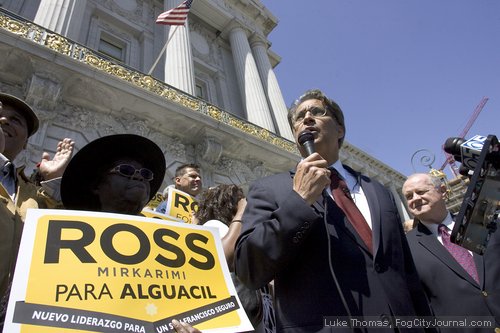
City Hall’s steps were awash in multi-lingual black and yellow “Ross Mirkarimi for Sherrif” signs at noon today, as Mirkarimi supporters watched Sheriff Mike Hennessey, who is stepping down after 31 years of service and eight elections, endorse Sup. Mirkarimi as the next sheriff.  “New Leadership for a Safe San Francisco” was printed on the English version of the signs that Mirkarimi’s supporters carried. They included former Mayor Art Agnos, Sups. David Campos and Eric Mar, Tim Paulson of the Labor Council, Debra Walker, Linda Richardson, Sharen Hewitt, Terry Anders, and Mirkarimi’s partner Eliana Lopez and their almost two-year old son Theo. And everyone had plenty of great things to say about outgoing sheriff Hennessey and sheriff candidate Mirkarimi. And Hennessey even pinned a shiny toy sheriff’s badge onto the T-shirt of Mirkarimi’s son Theo, making him the happiest kid in town. At least for the day.

Campos kicked off the event by honoring Hennessey as the “most progressive and most effective sheriff in the country.”
“Mike Hennessey is also my neighbor in District 9. I see him taking out the trash so I know he’s a good neighbor,” Campos joked, as he listed the many achievements in Hennessey’s long career as an elected official in San Francisco. These achievements included Hennessey’s pioneering innovations in criminal justice and culminated in his decision to blow the whistle in 2010 on the federal government’s plan to activate its controversial Secure Communities program in San Francisco—without telling the public.
“He’s not afraid to stand up for what’s right,” Campos said.

‘This is the time for me to move on,” Hennessey announced, as he laid out his reasons for endorsing Mirkarimi as Sheriff, over other candidates in the field.
Hennessey described the Sheriff’s Department as a “large enterprise” that has over 1,000 employees, a $150 million budget and whose jail houses an average population of 2,000 folks in custody, on a daily basis.
“It’s not something that can be handled lightly,” Hennessey said. “That’s why I’m here to endorse Ross Mirkarimi as the next sheriff.”

Hennessey listed the many endeavors that he and Mirkarimi have worked closely on, including a number of criminal justice issues, and he cited Mirkarimi’s extensive law enforcement background, his significant legislative accomplishments in the areas of criminal justice and public safety, and his ability to find innovative solutions and overcome obstacles to progress, as reasons to support Mirkarimi.

Hennessey observed that criminal justice is “one of the thornier issues” that members of the Board of Supervisors are often asked to get involved in, but often duck.”But Ross has not shied away from working on them,” Hennessey said, citing Mirkarimi’s involvement in shaping the “No Violence Alliance Project” and his leadership in creating the Safe Communities Re-entry Council.

Hennessey also noted that in face of AB 109, the Governor’s plan to transfer state inmates to county jails, “it’s vitally important to have person in charge of sheriff’s office that understands these alliances and can make them work more effectively.”

Hennessey concluded by observing that the Sherrif’s Department has to deal with a lot of bureaucracy, so it’s important to understand how the Board, the budget process and other city departments, including the District Attorney’s office and the police, work.
‘And that’s why I’m endorsing Ross as Sheriff,” Hennessey said

Then it was the turn of Mirkarimi, who graduated from the San Francisco Police Academy, did Naval Reserve training and worked for more than 8 years as an investigator for the District Attorney’s office, to speak.

“I have never been at a loss for words,” Mirkarimi acknowledged, as he launched into a speech that began by thanking everyone for showing up at short notice “for one of the most important occasions of my political career.”

Mirkarimi did a great job of giving Hennessey the praise he deserves.
“He is a living legend,” Mirkarimi said. “It’s completely impossible to fill his shoes.”
Citing Hennessey’s integrity and his ability to innovate, Mirkarimi warned that, “Maybe it’s come to the point where we have taken him for granted. He’s the longest serving elected official in the history of San Francisco, and he’s probably the most understated.”

“And the most important endorsement in this race is that of Mike Hennessey,” Mirkarimi added, as he gave Hennessey his commitment “to build upon your legacy as effectively as possible.”

Mirkarimi cited some of the most immediate and serious challenges that face the next sheriff. These include AB 109, which Gov. Jerry Brown just signed, which. Mirkarimi said, threatens to increase the reentry prisoner level by 30 percent in California. “It will take creative ingenuity and resources to make sure we are effective in taking care of this population,” he said.

Mirkarimi also touched on the rising number of veterans that are ending up in the prison system, talked more about the No Violence Alliance Project, and suggested that certified deputy sheriffs could help serve warrants, transfer prisoners, and patrol Muni, “when the police department finds itself understaffed” so as to ensure that San Francisco is safe.

“For every four people arrested and jailed in San Francisco, three out of four are repeat offenders in a three-year period,” Mirkarimi warned, by way of explaining why he wants to advance a more collaborative spirit between SPPD and the Sheriff’s department.

Mirkarimi also noted that one out of every 15 African American males are in jail, at any time in the year, compared to I out of 300 males who are not black or brown. “So, we must step up our game in dealing with poverty,” he said, as he recommended increased access to job training and good jobs, “so work doesn’t become a seasonal hope but a permanent job.” He also made the connections between a lack of good housing, childcare, and schools and a rise in poverty, crime and recidivism.

Mirkarimi concluded by crediting Hennessey for “walking that fine pirouette” between upholding the principles of public safety and understanding the power of redemption at the same time.

I asked Sheriff Mike Hennessey what he considers to be the biggest challenges of running for sheriff/
“Letting people know what you are going to do, and what your issues are,” Hennessey said, noting that San Francisco has an intelligent, issues-driven electorate.

And Mirkarimi’s supporters weren’t shy about letting folks know the issues that the current D5 Supervisor has helped them with, over the years.

“Ross, as a supervisor and me, as someone who comes from a community of color, we know the habits that ex-offenders can bring with them, if there are no safety nets,” said Terry Anders who sits with Mirkarimi on the Safe Communities Reentry Council. “And I believe in what Ross stands for and the integrity of his person. He’s one of the first people to show up when there are crimes and victims, and he attends basketball games and boxing matches.”

Paulette Brown, whose son Aubrey Abraska Jr, was murdered in August 2006, but whose killers have still not been brought to justice.
“We shouldn’t have to run and leave our families, we should be protected,” Brown said. “Ross is my district supervisor and if he can get in, and do something about crime and solve unsolved homicides, then I’m for him. Maybe if he gets in, he’ll have more pull to do something about these unresolved cases.”

And then it was back to work, which for Mirkarimi now includes the somewhat daunting task of trying to raise money in an election year that also includes a mayor’s race, but does not include the help of public financing, at least not for the sherrif’s race….

Editorial: Let counties raise taxes

3

The president of the state Senate, Darrell Steinberg (D-Sacramento), has a bill that could profoundly change that way California pays for government. At lot of insiders think it’s just a ploy, a way to force Republicans to come to the table and accept some tax measures, but Steinberg appears serious. He’s presenting the bill to the Governance and Finance Committee May 4, and a simple party-line majority vote could get it to the governor’s desk.

The bill, SB653, would allow counties and school districts to approve taxes — a wide range of taxes, the type that are now entirely under the control of the state. Local governments could impose an income tax, a transactions and use tax, an oil severance tax, a vehicle license fee, or a tax on alcohol, cigarettes, or marijuana. It’s part of what Gov. Jerry Brown calls “realignment” — returning more authority to local government, which is complicated and has advantages and disadvantages. But on its own, the tax measure makes perfect sense: if the residents of San Francisco want to pay a higher car tax, or income tax, or tax on booze, and use the money for better schools and public services, why shouldn’t they be allowed to do it?

San Franciscans pay far more in state taxes than the city gets in state money. That’s one of the great ironies of California finance: the more liberal counties, where the voters support adequate public services, wind up subsidizing the more conservative areas that demand tax cuts. A certain amount of that is inevitable, and even laudable: richer areas should be helping pay for schools, police, and roads in poorer areas. It’s certainly true in the arena of public education, where the courts have, properly, ruled that that state has to make sure every school district gets adequate funding so that kids in Marin County don’t get better educational opportunities than the kids in Tulare County.

And there’s always the risk that realignment will push the state back to the days when geographic inequality was even more dramatic, that California will wind up being, as Sen. Mark Leno (D-SF) once put it: “Hollywood next to Mississippi.”

But Steinberg’s bill doesn’t cut state funding at all; in fact, he’s among the Democrats working to avoid more budget cuts. SB653, properly administered, wouldn’t mean less money for any local agency. It would just remove the ceiling.

California is becoming too big to govern effectively with the current rules — and under the state Constitution, written in a very different era with a smaller, more homogeneous population, even a tiny number of Republicans can hold the budget process hostage. That means, for better or worse, that cities like San Francisco, where residents want decent services and a credible social safety net, are on their own. And if Brown’s proposals to put more of the service burden on the counties (for example, by shifting thousands of state prisoners into county jails) move forward, local governments are going to need the ability to raise their own resources.

Unfortunately, many of the taxes that state law currently allows local government to impose (sales taxes, for example) are regressive. Taxes on income and motor vehicles are far more fair and progressive, and ought to at least be available to cities and counties.

The Democrats in Sacramento need to take this seriously and work for its passage. It’s not the entire solution to the budget crisis and to economic inequality — but it’s an excellent start.

Let counties raise taxes

2

EDITORIAL The president of the state Senate, Darrell Steinberg (D-Sacramento), has a bill that could profoundly change that way California pays for government. At lot of insiders think it’s just a ploy, a way to force Republicans to come to the table and accept some tax measures, but Steinberg appears serious. He’s presenting the bill to the Governance and Finance Committee May 4, and a simple party-line majority vote could get it to the governor’s desk.

The bill, SB653, would allow counties and school districts to approve taxes — a wide range of taxes, the type that are now entirely under the control of the state. Local governments could impose an income tax, a transactions and use tax, an oil severance tax, a vehicle license fee, or a tax on alcohol, cigarettes, or marijuana. It’s part of what Gov. Jerry Brown calls “realignment” — returning more authority to local government, which is complicated and has advantages and disadvantages. But on its own, the tax measure makes perfect sense: if the residents of San Francisco want to pay a higher car tax, or income tax, or tax on booze, and use the money for better schools and public services, why shouldn’t they be allowed to do it?

San Franciscans pay far more in state taxes than the city gets in state money. That’s one of the great ironies of California finance: the more liberal counties, where the voters support adequate public services, wind up subsidizing the more conservative areas that demand tax cuts. A certain amount of that is inevitable, and even laudable: richer areas should be helping pay for schools, police, and roads in poorer areas. It’s certainly true in the arena of public education, where the courts have, properly, ruled that that state has to make sure every school district gets adequate funding so that kids in Marin County don’t get better educational opportunities than the kids in Tulare County.

And there’s always the risk that realignment will push the state back to the days when geographic inequality was even more dramatic, that California will wind up being, as Sen. Mark Leno (D-SF) once put it: “Hollywood next to Mississippi.”

But Steinberg’s bill doesn’t cut state funding at all; in fact, he’s among the Democrats working to avoid more budget cuts. SB653, properly administered, wouldn’t mean less money for any local agency. It would just remove the ceiling.

California is becoming too big to govern effectively with the current rules — and under the state Constitution, written in a very different era with a smaller, more homogeneous population, even a tiny number of Republicans can hold the budget process hostage. That means, for better or worse, that cities like San Francisco, where residents want decent services and a credible social safety net, are on their own. And if Brown’s proposals to put more of the service burden on the counties (for example, by shifting thousands of state prisoners into county jails) move forward, local governments are going to need the ability to raise their own resources.

Unfortunately, many of the taxes that state law currently allows local government to impose (sales taxes, for example) are regressive. Taxes on income and motor vehicles are far more fair and progressive, and ought to at least be available to cities and counties.

The Democrats in Sacramento need to take this seriously and work for its passage. It’s not the entire solution to the budget crisis and to economic inequality — but it’s an excellent start.


Now just end the death penalty

2

Jerry Brown is going to save the state $356 million by scrapping plans to build a new Death Row. Go, Jerry. Now if he really wants to save money he can scrap the death penalty.


It’s actually one thing a governor can do on his own; he can just issue a blanket stay of execution to all condemned inmates. He can, without ever having to get a single Republican vote in the Legislature, call off executions in California. I know he’s not personally a fan of the death penalty. Wouldn’t it be wild if Jerry became the first governor in the country to get rid of it not because of morals or questions about innocence (both of which are excellent reasons to stop the state from killing people) but because it was a waste of money?


Most people on death row die of old age. Life without parole IS a death sentence; you’re going to die behind bars. Call it off on fiscal grounds, guv — and Let the Republicans defend this wasteful state spending.

PG&E CEO Peter Darbee stepping down

Word’s out that Peter Darbee, the Chief Executive Officer of Pacific Gas & Electric Corporation, is stepping down. Darbee’s departure comes amid a federal investigation into the deadly San Bruno pipeline explosion, which resulted in tragic loss of life, devastated an entire neighborhood, and served to highlight safety issues with the utility’s vast network of underground gas transmission pipelines.

Longtime energy industry observer John Geesman, who blogged about PG&E’s bid to eliminate community choice aggregation last year with the statewide ballot initiative Proposition 16, offered some rather interesting insights on Darbee in a series of posts last year. In one titled, “How Much of the Goldman Sach’s Kool-Aid did PG&E’s Peter Darbee Drink?”, he reflected on Darbee’s past experience on Wall Street: “Peter Darbee has been CEO of PG&E Corporation since 2005. He was an investment banker at Goldman Sachs from 1989 to 1994.”

Darbee was one highly paid CEO. Geesman pointed out that he “massaged PG&E’s internal system to produce a $10.6 million gusher for himself in 2009 — that’s 74 percent above the median for large utility CEOs measured in the Wall Street Journal’s annual compensation survey.”

Prop. 16 went down in flames, of course, after a majority of voters from PG&E’s service territory rejected it (Darbee had this to say for himself in the aftermath). Yet that entire debacle was soon forgotten once the tragic Sept. 9, 2010 pipeline explosion occurred.

Michael Peevey, president of the California Public Utilities Commission, issued this statement soon after Darbee’s resignation announcement: “The CPUC today learned of the resignation of Mr. Darbee from PG&E Corp. While obviously the company under his leadership has been responsible for several poor and consequential decisions, Mr. Darbee’s commitment to PG&E and its constituents is unquestioned. As PG&E’s Board of Directors recruits a successor, the CPUC urges the company to return to its roots by hiring the most technically competent person; someone with a long-standing history of performance in the energy industry.”

The Chronicle’s reporting that Darbee’s retirement package will total $34.7 million.

When former PG&E Senior Vice President Nancy McFadden resigned at the end of last year, she was awarded a severance payment of $1,040,400, plus an undisclosed payout in stocks. McFadden was the architect behind Prop. 16, and she wasn’t unemployed for long. In January, she was appointed to serve as Gov. Jerry Brown’s Executive Secretary for Legislation, Appointments and Policy in the Office of the Governor. That job pays $175,000 per year.

This post has been updated from an earlier version.

Editor’s notes

1

tredmond@sfbg.com

Does anybody else feel as if the whole country is collapsing around us?

I mean, I’m not an apocalypse fan. I remember when Ronald Reagan was elected and we had a big meeting at the Connecticut Citizen Action Group, where I worked, and a lot of people were on the edge of a serious panic, and Miles Rapoport, the staff director, told us all to calm down: the organization, and our work, would survive. So would the nation. I spent a lot of time with serious anarchist types in the 1980s, and I never really bought the notion that the revolution was at hand (alas, it was not) or that the United States of America and the corporate world order were on the brink of collapse (alas, again).

I think I slept through the great Harmonic Convergence on Aug. 17, 1987 (“the point at which the counterspin of history finally comes to a momentary halt”) and I’m not terribly concerned about the Mayan calendar.

But I’m getting so I wake up every morning these days asking myself exactly what the fuck is going on.

I called my old friend Calvin Welch the other day to talk about the San Francisco mayor’s race, and when I asked him how he was doing, he told me: “Well, other than the fact that America is falling apart everywhere I look, I’m doing fine.” And he’s not any crazier than me.

It’s funny. I never felt as nervous about the state of the nation under Reagan or Bush as I’m feeling right now under President Obama. And I wasn’t as scared about California when Arnold Schwarzenegger was governor as I am now, with Jerry Brown in charge.

Not that Reagan and Bush weren’t far, far worse, or that Brown isn’t doing a decent job, all thing considered. But when our folks are in charge — decent, smart folks who, for all their flaws, have essentially decent ideas about politics and humanity — and they can’t seem to make anything better … I guess that’s when I start to wonder if anyone can.

I’m not one to make sweeping generalizations (well, not usually), but in 2011, the country, and the state, are being run by a handful of bullies. They’re wrecking the economy, wrecking the schools, wrecking the future — and nobody seems to be able to stand up to them. And even this diehard optimist is starting to wonder when it will ever end.

Where’s Jerry Brown’s leverage?

17

Jerry Brown’s travelling around the state, trying to get Republican voters to urge their legislators to go along with his budget plans. And he’s telling the harsh truth: If he’s forced to do an all-cuts budget, not just the poor but the middle class will get hammered. One of the most dramatic changes will be in higher education.


Brown says that if he has to make another $15 billion in cuts, the price of a year at UC will go up to $20,000. That’s going to price a lot of kids out of the college market and undermine one of the pillars of California society — the provison of affordable higher education for all. It will have another insidious impact: More kids will graduate deeper in debt — and will be unable to pursue public-interest occupations that don’t pay well.


Think about it: You graduate with $80,000 in debt, it’s much harder to work at a community-based nonprofit, or even as a teacher. God forbid you decide to go to law school or medical school; by the time you’re out, there’s no way you’re doing public interest law or working in a community clinic.


That, of course, is part of the hidden agenda here: The people who want tax cuts and small government also want to get rid of those pesky social change organizations and povery lawyers.


Here’s the odd thing, though, about Brown’s barnstorning tour:


He’s going into Republican districts — and threatening to do exactly what the Republicans in Sacramento want. They want an all-cuts budget, and they want a Democrat to have to take responsibility. So Brown what Brown is saying to the GOP legislators is: Do what I ask — or I’ll give you everything you want. Not exactly an offer they can’t refuse.


His big mistake was assuming that the Republicans would ever work with him. He should have started back in January with a signature drive to put an all-taxes (or mostly taxes) solution on the ballot. You want to block my half-cuts, half-taxes budget? Fine — I’ll give you a budget with no cuts at all. That’s how you deal with assholes.


And that’s why the Democrats need to be pushing their own ballot initiative(s) — now.

Taxes — without the GOP

1

EDITORIAL Gov. Jerry Brown did everything he promised to do. He negotiated in good faith with the Republicans. He listened to their ideas. He made it clear he was willing to accept concepts (pension reform, for example) that his biggest campaign supporters wouldn’t like. And he got absolutely nowhere.

The Republicans in Sacramento have demonstrated over the past two months that they have no interest in solving the state’s budget crisis and that they’re nothing more than obstructionists. It’s time for the Democratic Party leadership to give up on all this talk of bipartisanship and craft a budget solution that works — without the GOP.

There are several possible alternatives, but they all require Brown and the Democratic leadership in the Legislature to acknowledge that there’s no way to keep the state solvent and functional without at least extending existing taxes — and no way to get two-thirds support in the Assembly or Senate for any tax measure.

There’s some talk among progressives in Sacramento of using a creative legal strategy to put the extension of temporary sales and car taxes on the ballot with a simple majority vote. In essence, the Legislature can amend any existing law with a simple majority vote — and amending the current tax code to extend the temporary taxes for a year might work. Republicans will howl and sue, and it’s possible that the courts will side with them — but it’s worth a try. At the very least, the Democrats will be highlighting the difference between the two parties, giving the public a clear choice — and putting the GOP legislators on notice that if they won’t help find a solution, they’re going to be irrelevant.

The other option is to start gathering signatures immediately for a ballot initiative, or series of initiatives, that not only extends the temporary taxes but increases taxes on big corporations and the very rich. It’s too bad Brown didn’t start that process months ago; it would have given him immense bargaining clout with the Republicans. As it is, any initiative would have to wait until November; there’s nowhere near enough time to qualify a measure for a special June election.

Still, a lot of the projected state cuts could be delayed until after the voters have a chance to weigh in — and the politics are clearly on the side of progressive taxes. In fact, a poll commissioned by the California Federation of Teachers shows that 78 percent of Californians support a 1 percent increase in income taxes for Californians earning more than $500,000 a year. Even Republicans back the notion by a 60 percent majority.

With Brown leading the charge, raising the money for a signature-gathering effort and a strong campaign shouldn’t be a problem. And if California can start clearing up its red ink with taxes on the very wealthy, it will send a profound message nationwide.

Brown, to his credit, is finally starting to travel around the state and preach his message. He’s hitting Republican districts and trying to get voters to pressure their representatives to work with him. It’s a nice idea, two months too late — and it’s unlikely to turn any legislators around at this point.

On the other hand, the governor, whose popularity is high, would do wonders for the politics of the state and the nation by resuming the old populist stance he took in the early 1990s when he campaigned for president as a foe of corporate power and concentrated wealth. The folks at Calbuzz, the Santa Barbara political blog, put it nicely, suggesting that Brown start channeling the legendary former Wisconsin governor, Bob La Follette.

“As a political matter, it’s time for Jerry Brown to reach for his inner La Follette and start sounding some good, old-fashioned, Wisconsin-style populism. Instead of going after the railroads, as La Follette did, however, Brown should aim at the ultrawealthy, the oil companies, and other greedy corporate interests that have a) allowed the California Republican Party to gridlock the budget process and b) fought to keep special corporate loopholes, including outrageously low property tax rates from Prop. 13.”

That’s how you turn California around.


Editorial: Taxes — without the GOP

0

Gov. Jerry Brown did everything he promised to do. He negotiated in good faith with the Republicans. He listened to their ideas. He made it clear he was willing to accept concepts (pension reform, for example) that his biggest campaign supporters wouldn’t like. And he got absolutely nowhere.

The Republicans in Sacramento have demonstrated over the past two months that they have no interest in solving the state’s budget crisis and that they’re nothing more than obstructionists. It’s time for the Democratic Party leadership to give up on all this talk of bipartisanship and craft a budget solution that works — without the GOP.

There are several possible alternatives, but they all require Brown and the Democratic leadership in the Legislature to acknowledge that there’s no way to keep the state solvent and functional without at least extending existing taxes — and no way to get two-thirds support in the Assembly or Senate for any tax measure.

There’s some talk among progressives in Sacramento of using a creative legal strategy to put the extension of temporary sales and car taxes on the ballot with a simple majority vote. In essence, the Legislature can amend any existing law with a simple majority vote — and amending the current tax code to extend the temporary taxes for a year might work. Republicans will howl and sue, and it’s possible that the courts will side with them — but it’s worth a try. At the very least, the Democrats will be highlighting the difference between the two parties, giving the public a clear choice — and putting the GOP legislators on notice that if they won’t help find a solution, they’re going to be irrelevant.

The other option is to start gathering signatures immediately for a ballot initiative, or series of initiatives, that not only extends the temporary taxes but increases taxes on big corporations and the very rich. It’s too bad Brown didn’t start that process months ago; it would have given him immense bargaining clout with the Republicans. As it is, any initiative would have to wait until November; there’s nowhere near enough time to qualify a measure for a special June election.

Still, a lot of the projected state cuts could be delayed until after the voters have a chance to weigh in — and the politics are clearly on the side of progressive taxes. In fact, a poll commissioned by the California Federation of Teachers shows that 78 percent of Californians support a 1 percent increase in income taxes for Californians earning more than $500,000 a year. Even Republicans back the notion by a 60 percent majority.

With Brown leading the charge, raising the money for a signature-gathering effort and a strong campaign shouldn’t be a problem. And if California can start clearing up its red ink with taxes on the very wealthy, it will send a profound message nationwide.

Brown, to his credit, is finally starting to travel around the state and preach his message. He’s hitting Republican districts and trying to get voters to pressure their representatives to work with him. It’s a nice idea, two months too late — and it’s unlikely to turn any legislators around at this point.

On the other hand, the governor, whose popularity is high, would do wonders for the politics of the state and the nation by resuming the old populist stance he took in the early 1990s when he campaigned for president as a foe of corporate power and concentrated wealth. The folks at Calbuzz, the Santa Barbara political blog, put it nicely, suggesting that Brown start channeling the legendary former Wisconsin governor, Bob La Follette.

“As a political matter, it’s time for Jerry Brown to reach for his inner La Follette and start sounding some good, old-fashioned, Wisconsin-style populism. Instead of going after the railroads, as La Follette did, however, Brown should aim at the ultrawealthy, the oil companies, and other greedy corporate interests that have a) allowed the California Republican Party to gridlock the budget process and b) fought to keep special corporate loopholes, including outrageously low property tax rates from Prop. 13.”

That’s how you turn California around.


SF in top 38 counties nationwide that deport “non-criminal aliens”

38

So much for San Francisco being a sanctuary city. The National Day Laborer Organization (NDLON) and two other organizations have unearthed statistics that show San Francisco in the nation’s “top 38” counties, when it comes to deporting immigrants who had not been convicted of crimes.

The statistics, which the U.S. Immigration and Customs Enforcement Department provided as part of a public records request,  also show that California is the top state in the nation, when it comes to deporting “non-criminal aliens,” which is how federal authorities categorize immigrants who lack visas and green cards, since both are simply violation of civil administrative law, and not criminal acts.

These revelations come as internal documents, procured by the New York Times, suggest that federal immigration officers, facing resistance from Chicago and Cook County to join ICE’s controversial Secure-Communities program, pushed local officials to secure the participation of reluctant police departments.

Immigrant advocates say these newly released documents are fueling concerns that S-Comm is being used to circumvent due process for immigrants, and futher illustrate the need for reform, at the statewide level, to avoid abuse.

But ICE refutes charges that it is circumventing due process and primarily deporting immigrants who have not committed serious crimes.
“Secure Communities is a comprehensive initiative to modernize the criminal alien enforcement process,” an ICE spokesperson told the Guardian. “While ICE prioritizes the removal of convicted criminal aliens, the agency still enforces the law with regard to other aliens who are subject to removal. In addition to criminal aliens, ICE’s priorities include other individuals who pose a potential threat to public safety – such as those with known gang affiliations and prior drunk driving arrests – as well as immigration fugitives and individuals who have tried to game the immigration system.”

ICE officials also said that their review of the latest S-Comm statistics for San Francisco County show that “more than 60 percent of the aliens who’ve come into ICE custody since Secure Communities’ local activation are convicted criminals. What’s more, nearly one third of those cases involve individuals who’ve been convicted of Level 1 offenses [felony crimes].

But NDLON spokesperson B. Loewe said the newest data show that, several years into the S-Comm program, problems that immigrant advocates have been raising since S-Comm began, are continuing.
“There is no protection for the innocent, or even victims of crime, and the program appears to lend itself to circumventing due process,” Loewe said. “The latest numbers should raise concerns for anyone who cares not just fro civil rights but also for public safety for all.”

The S-Comm statistics emerged as part of a Freedom of Information Act request that NDLON, the Center for Constitutional Rights, and the Immigration Justice Clinic of the Benjamin N. Cardozo School of Law filed pertaining to ICE’s controversial Secure -Communities program.

Launched in Texas in March 2008, S-Comm involves state and local entities in the enforcement of federal immigration law by turning on a mechanism to run fingerprints through various databases when individuals are arrested, even if those individuals are brought in on minor charges or if their charges are subsequently dismissed.

“What’s most significant is that San Francisco is among the top 38 counties nationwide, and among the top 13 California counties,” said Jon Rodney, communications project coordinator at the California Immigrant Policy Center.

“The numbers speak for themselves,” said Angela Chan, a San Francisco Police Commissioner and Asian Law Caucus staff attorney. Chan noted that between October 2008, when California began implementing S-Comm, and February 2011, California has deported 35,643 local residents.
“That’s 10,000 more than Texas, which deported 24,152 residents,” Chan observed. She also noted that California is the state that deports the highest numbers of residents nationwide.
 
The top 13 counties in California deporting the highest percentage of non-criminal?  Merced, Fresno, Tulare, Solano, Monterey, Kern, San Luis Obispo, San Francisco San Joaquin, Contra Costa, Riverside, Sonoma, and Alameda, in that order.

This latest round of charges comes ten months after S-Comm was first activated in San Francisco, and fresh on the heels of Assemblymember Tom Ammiano’s announcement of AB 1081, a bill that would honor the right of local governments to opt out of the federal S-Comm and set basic safeguards for those municipalities that do decide to participate.

Chan notes that the Assembly’s Public Safety Committee will hold a hearing on AB 1081 on April 26.

“Ammiano’s bill is timely and crucial,” Chan said, noting  that California signed an S-Comm agreement without public input, notice or negotiations.

“That [process] raised concerns that California signed a boilerplate agreement that was dictated by ICE” Chan said. “And it’s part of the reason why we have such high numbers of deportations,” she continued, noting that Ammiano’s bill “connects to an existing clause,” in the memorandum of understanding  that the California Attorney General’s Office signed with ICE, back when Gov. Jerry Brown was still California Attorney General.

Ammiano’s bill would require the California Bureau of Criminal Identification and Information to modify the agreement it entered into with the US Department of Homeland Security in May 2009, regarding S-Communities. 

Meanwhile, in a March 7 memo (a copy was procured through NDLON’s public records request) ICE noted that its Secure-Comm program produced over 133,000 matches in the first five months of 2011, compared to 248,000 matches in 2010.

ICE also noted that since the program was first activated in Harris County, Texas, on Oct. 27, 2008, the agency has removed over 94,000 aliens and over 24,600 criminal aliens convicted of Level 1 (felony offenses) that were identified through the program.

“Deployment continues to be the primary driver for increased identifications,” ICE stated, observing that in the first five months of 2011, ICE will deploy S-Comm in 409 new jurisdictions. This means that by the end of May, 1,067 jurisdictions will be activated in 39 states, “covering 70 percent of the foreign non-citizen population.”

ICE’s goal is to deploy the program to an additional 488 jurisdictions by the end of 2011, bringing the total jurisdictions deployed by year’s end to 897.

But as Chan notes, Ammiano’s AB 1081 has implications for how and whether S-Comm gets activated in any more California counties,
“AB 1081 requires needed modifications to California’s S-Comm agreement, which was signed in April 2009 by California,” Chan said. “ It was one of the first, if not the first, agreement signed by a state to enter into S-Comm.  AB 1081 taps into this contract term, which allows modification and termination of the agreement, to allow counties to opt in or out of the deeply flawed program.”


A creative way out of the state budget mess

36

With no Republicans willing at this point to go along with the governor’s June election plans, Jerry Brown has quite the problem on his hands. There never really was a Plan B. And now he’s got to find one, fast. He’s already made the cuts, and they’re awful. He’s not going to get his own party to go along with much more. But it’s legally dubious whether he can put taxes on a special election ballot without any Republican support, and he clearly doesn’t want to.


So what’s the best option? Well, the deep thinkers over at CalBuzz have a brilliant scheme. The idea: Pass an all-cuts budget, a devastating, ugly, puke-inducing thing — then


gather signatures to place that on the November ballot, with a provision that if the measure fails the cuts will not occur because the 2009 taxes and fees will be re-instated for five years. As a practical matter, cuts can be delayed to occur after November. And costs can be shifted to local government for local responsibilities whether the measure wins or loses.


Then let Grover Norquist, Jon Fleischman, radio heads John and Ken and the rest of their not-our-problem cadre be forced to argue for the budget ballot measure while Democrats and labor argue against it.


It’s much easier to get a vote against something in California — particularly when that something contains provisions that nobody wants. A No vote means Yes on taxes and No on cuts.


Man, why aren’t these guys running for office?


Sacramento needs a foreign policy

0

OPINION “The country is rich, but not so rich as we have been led to believe. The choice to do one thing may preclude another. In short, we are entering an era of limits.”

Presidential candidate Jerry Brown said that in 1976. Thirty five years later, second-time-around Gov. Jerry Brown has a profound opportunity to finish the thought — by pointing out that we can no longer afford follies like the Afghanistan war.

Any reluctance Brown might feel about discussing foreign policy — an area of responsibility clearly not assigned to the states by the founding fathers, or anyone else’s fathers — must be weighed against his understanding that when it comes to budget matters, the buck stops at the California statehouse — and the other 49 state houses. The feds can print money, but the states can’t.

California famously faces an immediate budget deficit in the $25 billion range. This, while the federal government burns through taxpayers’ money on a war that even Secretary of Defense Robert Gates acknowledges as insane. He recently told an audience of West Point cadets: “In my opinion, any future defense secretary who advises the president to again send a big American land army into Asia or into the Middle East or Africa should ‘have his head examined,’ as General MacArthur so delicately put it.”

The National Priorities Project puts the current cumulative cost of the war to California taxpayers at $48.5 billion. The $110 billion Washington plans on spending in the upcoming year pencils out to another $14 billion from California taxpayers, while they deal with what the California Legislative Analyst’s Office estimates will be an annual $20 billion state budget shortfall through 2015-16.

Brown, then, has everything to gain from a serious domestic redirection of funds now squandered in this war, yet runs little risk in going out front for a national movement in that direction. After all, it’s not just Robert Gates having second thoughts: A CNN poll found the U.S. population opposing the war by a 63 percent to 35 percent margin last December. Last month, 24 of the 53 members of the California congressional delegation voted in favor of a budget amendment to cut all but $10 billion of the war’s funding, with the remaining money to be used to withdraw troops.(Jackie Speier voted for; Nancy Pelosi against.) The California Democratic Party called for “a timetable for withdrawal of our military personnel” well over a year ago, and last month the Democratic National Committee told the president to get a move on in ending this war.

When Brown first became governor, best-selling author Alvin Toffler’s Future Shock had posed the question of whether the country was suffering from too much change, too fast — a type of thinking the new governor appeared very much in tune with. In the interim, Naomi Klein has written a less known but probably more important book called The Shock Doctrine. New York Times columnist Paul Krugman describes the “shock doctrine” as an ongoing effort to exploit “crises to push through an agenda that has nothing to do with resolving those crises, and everything to do with imposing” a “vision of a harsher, more unequal, less democratic society.”

As the governor of the largest state in the union, with the nation’s biggest deficit, Jerry Brown is in a unique position to influence the national debate by simply pointing out the elephant in the room: A healthy portion of the nation’s economic crisis will melt away if we will just do today what the secretary of defense says we should do tomorrow — get out of Afghanistan. 2

Former Massachusetts state legislator Tom Gallagher is a San Francisco writer and activist.

Board considers extra $75.4 million for Mission Bay redevelopment

0

UPDATE: An earlier version of this post reported that the Board was meeting in closed session. This was incorrect.

The Board is meeting today  to consider amending the San Francisco Redevelopment Agency’s (SFRA)  budget to issue an additional $70 million in tax increment bonds and appropriate $75.4 million ($70 million in bond proceeds, plus $5.4 million tax increment). The request, which comes on the heels of last year’s $64 million request, represents a 109.4 increase of tax increment bonds in 2010-2011. The city says thiis has nothing to do with Gov. Jerry Brown’s proposal to eliminate redevelopment agencies. But the last-minute timing of today’s session looks a tad fishy at best. And it’s playing out as a vote on Treasure Island’s final environmental impact report approaches, and against a backdrop of extreme funcertaintly related to all things Redevelopment, as Mayor Ed Lee and other city leaders try to figure out ways to prevent or reduce the affordable housing fallout from the governor’s elimination proposal.

According to a Budget and Legislative Analyst’s summary of today’s request, the requested bond issuance and expenditure is part of the “SFRA’s normal course of fulfilling its obligations under the tax increment allocation pledge agreements between the city, SFRA and FOCIL-MB (Catellus’ successor entity at the Mission Bay redevelopment sites), and not as a result of the Governor’s proposal to eliminate local redevelopment agencies. Ms. Lee [deputy executive director at the SFRA] states, that, as of the writing of this report, the impact of the Governor’s proposal on the Mission Bay Redevelopment Project is currently unclear and ambiguous as to whether approval of the Governor’s proposal would affect the requested bond issuance and expenditure authority.”

“At the time of the development and approval of the FY 2010-2011 budget, the Agency and Tax Assessor did not have available tax roll information that resulted in a significant increase in property taxes in Mission Bay due to the accelerated assessment agreement between the Assessor and the Agency,” states today’s Board resolution that Mayor Lee sponsored, explaining why there’s a request for an additional $70 million in bonds, so soon on the heels of the $64 million that the Board approved last year.

“The Agency wishes to amend its budget for the fiscal year 2010-2011 to permit the receipt of additional tax increment of $5.44 million and bond proceeds in the amount of $70 million for the purposes of low moderate housing and for the reimbursement of public improvements made by Catellus pursuant to the tax increment allocation pledge agreement between the City and County of San Francisco, San Francisco Redevelopment Agency and Catellus made in November 16,1998 for Mission Bay North and South,” the resolution continues.

 Mission Bay North and South are two separate redevelopment areas that encompass 303 acres, bounded by King Street and AT&T Park on the north, the San Francisco Bay and the I-280 freeway on the east and west, and Mariposa Street to the south, according to Redevelopment Agency documents.

The Budget and Legislative Analyst notes that of the $5.4 million in additional tax increment, an estimated $3.48 million would fund a portion of the Agency’s required educational revenue augmentation fund payment to the state for FY 2010-2011. And that the remaining $1.95 million would be distributed to tax entities, with $870,400 to be expended on the agency’s low and moderate income housing fund.

 The BLA notes that the proposed sale of $70 million in tax increment bonds will provide $60.345 million bond proceeds, including $12 million (20 percent) to fund the construction of 1180 4th Street, a development of 150 units of family rental housing, including 25 units for formerly homeless families and $48. 276 million (80 percent) to reimburse Catellus’ successor, FOCIL-MB, LLC, for public infrastructure development that FOCIL-MB constructed..

“If the proposed resolution is approved, of the $177 million total estimated debt service, $100, 890,000 or 57 percent will be paid from the City’s General Fund. The City’s General Fund estimated additional annual cost would be $3,648,000 for the first 20 years, decreasing to $2,793,000 for the next ten years.” The BLA concludes, explaining that approval of the proposed resolution is a Board policy decision because it adds up to a total General Fund cost of more than $100 million.

 According to the BLA report, Amy Lee, SF Redevelopment Agency deputy executive director, the requested $70 million in tax increment bonds would be sold in late March 2011, “such that no debt service payments would be required in FY 2010-2011.

 The BLA also notes that if the Board approves the proposed resolution, the net effect of each property tax dollar expended for tax increment that is provided to SFRA would result in a reduction of $0.57 on each dollar from the city’s General Fund.

“In other words, for each tax increment dollar provided to SFRA, the City would no longer have to provide payments to other tax entities,” the BLA observes.

These entities include the city’s Children’s Fund, Library Preservation Fund, Open Space Acquisition Fund, and the General City Bond Debt fund, the Community College district, the San Francisco United School District, BART, and the Bay Area Air Quality Management District, which total approximately $0.43 of each property tax dollar.

It’s because of these property tax dollar equations that the annual cost to the city’s general fund for proposed increased debt service would rise, if the Board approves today’s Redevelopment resolution, by more than $100 million over the next 30 years.

And as local Democratic Party chair and former Board President Aaron Peskin explains, there’s nothing much the Board can do about the deal today, but they might want to reconsider getting into more deals like this at Treasure Island and beyond, in future.

“A deal is a deal is a deal,” Peskin said. ‘So, there’s nothing the Board could do differently, but that’s $3.648 million that otherwise would be going into the General Fund, and it’s a sign we should pay attention to, when considering Treasure Island, as deals like this will continue to impoverish the General Fund.”

 “Even though they deny it has nothing to do with Gov. Jerry Brown’s pending legislation to eliminate redevelopment agencies, I have never seen something scheduled so quickly,” Peskin added, noting that the Board’s agenda is published Thursday evening or Friday morning, but this item wasn’t on that agenda, hence the need to publish a separate notice.

Meanwhile, Treasure Island’s final environmental impact report has been released, and the way the current plan looks, will forever alter our view of the Bay.

“It will have enormous impacts on services for the City and traffic for the entire Bay Area,” Saul Bloom, executive director of Arc Ecology, told the Guardian.

On April 7, a joint session of the San Francisco Planning Commission and Treasure Island Development Authority will be meeting to consider certifying the EIR, but Arc is asking for an extension of two more weeks to provide the public with 42 days for review.

“Fourteen additional days for public review is a very modest request for a project with such significant impacts yet, the City has thus far refused,” Bloom notes.

Keep David Crane away from your government

24

Sen. Leland Yee continues to strongly push his case against confirming San Francisco venture capitalist David Crane to the UC Board of Regents, finding allies among labor unions and Sen. Ted Lieu (D-Torrance), chair of the Senate Labor Committee, but failing so far to win over legislative leaders that Yee has alienated himself from with his quixotic budget stands of recent years.

It’s a sign of just how bad things have gotten for public employee unions that Crane, a last minute appointment by former Gov. Arnold Schwarznegger, wasn’t immediately rejected by Legislature after writing an op-ed siding with right-wing attacks on public employees in Wisconsin and calling for an end to public employee union’s collective bargaining rights in California.

After all, Crane – while he considers himself a Democrat – is little more than a right-wing shill wielding misleading data to justify his thinly veiled contempt for the public sector. He didn’t return my call about the latest controversy, but I did interview him a few years ago as he and Arnold tried to torpedo the California high-speed rail project before voters could approve it.

I didn’t expect much from a corporate Democrat who was working for a Republican governor, but I was still fairly astounded by his arrogant condemnation of public officials and agencies and his indignation at being challenged in his basic belief in the infallibility of capitalists. Simply put, the guy was a world-class jerk (an opinion that’s widely shared) who has no business working for government agencies because his only interest in them seems to be to weaken or destroy them.

George W. Bush loved to put guys like this in charge of government agencies, which is why Halliburton fleeced taxpayers, FEMA utterly failed New Orleans after Hurricane Katrina, oil companies ran dangerously amuck, and on and on. But in California under Gov. Jerry Brown and a big Democratic majority in the Legislature, someone like David Crane should have the door to government quickly slammed in his face if there’s any integrity left to the political system.

UPDATE: Crane just returned my call, but he did little to forthrightly answer my questions, instead referring me to his interview with KGO’s Ronn Owens last week. When I asked whether he thinks it’s fair that his critics are calling him hostile to the public sector, he told me to read his op-ed. And when I said that I did and the he seemed to be siding with the Republican governor of Wisconsin, he said disdainfully, “That’s an interesting interpretation.”

That seemed to be the clear intention of his piece, to tell readers that they’re simply wrong in seeing Wisconsin (and then Ohio, and other states that might eventually include California) as a right-wing attack on public employee unions, which is itself part of a long-running attack on the public sector by conservative capitalists like Crane. As Crane wrote in his first sentence, “The battle in Wisconsin is not over collective bargaining rights generally but rather the appropriateness of those rights in the public sector.”

Sure, this former attorney tries to couch his narrow, convoluted argument in legalisms and distorted history lessons, but the message seems clear, even if he acts as people just aren’t smart enough to understand his wise point (one that he didn’t use the opportunity of our interview to clarify). And when I noted that he has a history of anti-government animus, including trying to derail the high-speed rail project, he said indignantly, “I’m responsible for that thing making the ballot.”

By which he probably means that after trying and failing to delay the vote, he led the effort to require more detailed financial analysis of the project’s fiscal challenges, which he helped execute — and which had nothing to do with voters approving a measure that the Legislature had placed on the ballot years earlier, only to go along with Arnold’s efforts to delay it twice.

Or maybe I’m wrong and this self-described libertarian really just wants to make government stronger and more efficient. What do you think?

Newsom’s fancy gift, trip to China

The Chronicle’s got a story today about how Lt. Gov. Gavin Newsom’s personal investments and earnings, documented in an economic disclosure form released by the Fair Political Practices Commission (FPPC), make him a lot richer than his boss, Gov. Jerry Brown.

The form also discloses travel payments and gifts Newsom received in 2010, which makes for some interesting reading. For one, San Francisco’s former mayor evidently received a very expensive pen (made by Louis Vuitton and valued at $398) last year from this guy.

The most significant item in the travel and gifts category, of course, was Newsom’s trip to Shanghai last June, valued at $9,082 and paid for by the San Francisco-Shanghai Sister City Committee. He traveled there with former Mayor Willie Brown and some others for San Francisco week at Expo 2010 Shanghai China.

Evidently, it was a week filled with dancing, singing, and celebration. (And dressing to impress. Check out the creamy, eco-friendly suit Brown wore at this “dazzling” event.)

http://www.youtube.com/watch?v=NZ8rKho15dw

Since becoming lieutenant governor of California, Newsom has continued his efforts to improve business relations between China and San Francisco. Just have a look at his recent article in China Brief, a magazine published by the American Chamber of Commerce in the People’s Republic of China (AmCham-China).

In the article, penned in late January of 2011, Newsom wrote:

“China’s central government stresses the importance of developing their innovation industry sectors–including clean-tech, biotech and information technology (IT)—and is projected to commit over $600 million of government funds to support this development. This overlaps with San Francisco’s core industry sectors. With over 500 tech and new media companies (including leaders such as Salesforce.com, Zynga and Twitter), more than 225 clean-tech companies and a worldclass biotech hub (anchored by the University of California San Francisco), San Francisco brings together internationally-recognized leadership in each of these sectors.”

Meanwhile, a few items on that economic disclosure form suggest that what’s good for business in China is also good for Newsom. His wife’s investment portfolio, the Jennifer Siebel Newsom Trust, includes stocks ranging from $10,001 to $100,000 each in China Valves Technology, a for-profit, “e-learning services provider” called  Chinacast, and a Chinese motor manufacturer called Harbin Electric.

Redevelopment debate full of bum choices

3

At the Potrero Hill Democratic Club’s debate about Gov. Jerry Brown’s proposal to ax local redevelopment agencies to balance the state’s $26 billion deficit, folks attempted to evaluate if redevelopment agencies are essential for job creation and community revitalization, if reform, not total destruction, is possible, and if bum choices are all we have to look forward to.

The Chronicle’s Marisa Lagos, who moderated the debate, noted that redevelopment agencies were created over 60 years ago to create economic development opportunities by borrowing against future tax increases that agencies think they can create.

 “That’s a fancy way to say ‘borrow against future taxes,’” Lagos joked, pointing to the Candlestick Point/Hunters Point Shipyard project as an example of an ongoing project, and the Yerba Buena project as an example of a completed success.

 “The Governor is arguing that when the state is cutting schools and other essential services, this is not the best use of tax dollars,” Lagos stated.

 Panelist Olson Lee, deputy executive director of San Francisco’s Redevelopment Agency, pointed to affordable housing as evidence of the agency’s positive impact.

 “I think Redevelopment is important because of the good things it has done,” Lee said, pointing to 11,000 units of affordable housing that the agency helped build in the city.

 Panelist Carroll Wills, the communications director for the California Professional Firefighters, said “many wonderful projects” have occurred under Redevelopment. But he pointed to what he called “a decade of tricks and games,” on the part of Redevelopment agencies as one reason why the state is in a fiscal crisis that threatens firefighters’ jobs.

 “Concrete does not trump core services,” Wills said, arguing that it’s not clear that many affordable housing projects would not have been built without redevelopment aid

Arc Ecology’s Saul Bloom accused Gov. Brown of “short-circuiting” what could have been an important statewide discussion about redevelopment reform, with his bombshell suggestion in January to eliminate redevelopment agencies entirely

 “I’m sympathetic to the argument that Redevelopment takes money away from core services,” Bloom said. “But what do we do to replace it? And is economic development versus core services a false choice?”

Lee pointed to Mission Bay as further evidence of Redevelopment’s success.

“It was considered a brown field, and through development, it’s much different,” Lee said, noting that 20 percent of tax increment financing goes to the General Fund to pay for redevelopment infrastructure. “Clearly the university would not have been there. It was an opportunity to place UC there and generate economic opportunities.”

 Wills argued that Redevelopment Agencies are a luxury we can no longer afford, even as he acknowledged being unfamiliar with local redevelopment projects.

“At best, redevelopment moves around the pieces,” Wills said. “It doesn’t increase economic development and it doesn’t necessarily pay for itself.”

Bloom noted that developments like Mission Bay are dependent on large institutions, like the University of California, which can’t be forced to implement city laws like local hire.

And he said he found it “disappointing” that there wasn’t much more of a dialogue around the plans to redevelop Candlestick Point and the Shipyard, despite the fact that the city held hundreds of meetings over the past decade.

“It was more a case of, Here’s our idea, tell us what you think of it,’” Bloom said. “Perhaps if we had invited the nation’s largest industrial developer, instead of the nation’s second largest home developer, we would have had a different dialogue.”

 Lee replied that the Shipyard has been under discussion for 15 years.

“It’s a very large project, the largest in the Western United States,” Lee said. “It’s a brownfield, though I know Espanola will say it’s a Superfund site,” he continued, as Bayview elder Espanola Jackson bristled under her hat, and the audience wondered if Lee meant that the US E.P.A. somehow got it all wrong.

Lee further shocked audience members by saying Treasure Island was not a redevelopment project (leading Bloom to clarify that Treasure Island is under the jurisdiction of the local Treasure Island Development Authority, if not the SF Agency).

“People felt they wanted economic development at the shipyard,” Lee continued, noting that the neighborhood suffered after the Navy withdrew from the shipyard in the 1970s. But he did not mention that major bones of contention around the redevelopment proposal, centered on plans to build 10,000 mostly market-rate condos, a bridge over an environmentally sensitive slough, the taking of a chunk of the community’s only major park, and no proof that thousands of promised jobs will materialize.

Wills noted that most local redevelopment commissions are peopled by the members of each municipality’s city council, a situation he believes leads to a lack of accountability. But members of the audience, including this reporter, noted that San Francisco’s Redevelopment Agency consists entirely of mayoral appointees, who, unlike elected officials, can’t easily be voted off the proverbial island.

It was at this point that panelist Calvin Welch, a longtime housing activist, showed up at the debate, apologizing for being late, but blaming his tardiness on being on a phone call with Sen. Mark Leno to discuss Brown’s redevelopment proposal.

And from there, the conversation veered towards discussions of what could happen to existing redevelopment projects if Brown goes through with his elimination threat.

 Lee noted that if projects simply had a disposition and development Aagreement (DDA), but Redevelopment was no longer there, there would be no project financing. “The devil’s in the details,” Lee said. “Because if you don’t have bonds, what’s the point of having an agreement.”

 Wills opined that Gov. Brown’s proposal has “a vehicle to roll back the bum’s rush” of projects that local municipalities have been trying to push across the finish line, ever since Brown dropped his Redevelopment elimination bomb in January.

 Welch went off on a historical riff about how the San Francisco Redevelopment Agency (SFRA) was met with controversy and outrage until 1988, when Art Agnos was elected mayor, and brokered a deal under which SFRA could do tax increment financing, provided the majority of funds were used for affordable housing.

“It became a finance agency to build infrastructure and affordable housing,” Welch said, noting that attempts to build out Mission Bay around commercial offices and high rises failed, until the Agency used tif to redevelop the site.

 “But mark my words, Lennar is going to come out of this just fine,” Welch added, reminding me of a recent comment that former Lennar executive Emile Haddad reportedly made that suggests Haddad believes the California housing market is poised for a rebound.

(The article outlined how Haddad sold 12,000 acres in California for a $277 million profit at the housing market’s peak four years ago, reacquired it at half the price in 2009, and is now saying it’s time to build in his new role as CEO of FivePoint Communities Inc., which is developing four new master-planned communities with a combined 45,000 residences at Newhall Ranch north of L.A., the El Toro Marine Corps Air Station in Orange County, the Candlestick Point/Hunters Point shipyard and Treasure Island  in San Francisco, with investors including Lennar, Michael S. Dell’s MSD Capital LP, Ross Perot Jr.’s Hillwood Development Co. and Rockpoint Group LLC. “I don’t want the party to show up and I’m not dressed,” Haddad, 52, reportedly said in a recent interview. “When the market says ‘I’m here,’ we’ll be one of the few that can deliver inventory.” 

(The Haddad article, which appears to be a non-bylined reprint from Bloomberg News, also claimed that Hunters Point sales are set to begin by late 2012 with prices starting at $525,000, as the Navy continues its cleanup of the 700-acre site. And that the plan now calls for as many as 12,000 homes, 3 million square feet (of commercial space and a new stadium for the 49ers. And that 7,000 homes may eventually be built on Treasure Island and adjoining Yerba Buena Island, under terms of a final development agreement that may go before the San Francisco Board of Supervisors for approval in May, with units averaging  $800,000 and reaching up to $2 million, according to Lennar V.P Kofi Bonner.)

And during the Potrero Hill Dems debate, Bloom noted that the Treasure Island plan is being “sped up” and that the Board is expected to vote on the plan as soon as possible. “But since these plans were not bonded before January [when Gov. Brown took office], what’s the point of speeding up the process?” Bloom asked.

“We’re basically seeing a brick wall,” Welch interjected. “There are virtually no funds for permanent affordable housing in San Francisco.But Jerry Brown is not going to commit financial hari kari. Every major developer of market rate housing will come out just fine, because of state actions, not because of a local vote. Deals are going to be made. It’s the question of affordable housing that’s our challenge. You’re gonna be stuck with public housing, as it is, unless there’s affordable housing financing.”

 Wills claimed that Prop. 22, which voters approved last November, “created a mechanism so rigid,” that the state’s only option was to eliminate redevelopment. “Basic services are dying on the vine,” he said. “We can’t afford to give developers subsidies.”

 Lee noted that SFRA built thousands of affordable units over the years that saved the city thousands in terms of core services it would otherwise have to provide. “Affordable housing is so basic, you can’t do things we take for granted if you are living under a freeway,” he said.

 Bloom suggested Redevelopment could do a better job of economic development, including the creation of permanent and sustainable jobs, like his proposal to create maritime uses at the Shipyard—something not entertained under the city’s Shipyard plan.

 Welch connected the dots between the taxpayer revolt that led to Prop. 13’s passage and the current fiscal woes of municipalities unable to raise taxes on commercial development. “That’s a killer,” he said, noting that housing costs more to build and maintain than it generates property taxes, especially if it’s family housing. ‘It’s those damn kids,” he joked.

Welch noted that Gov. Brown used redevelopment money to enable market rate development in downtown Oakland when he was mayor of Oakland—and claimed that Brown equated affordable housing with crime, at the time.

“We love Brown better than Meg Whitman, but it’s 2011 and we face bum choices.”

Community advocate Sharen Hewitt, who heads the C.L.A.E.R. project, asked if the panel thought San Francisco could be a “demonstration model” for using Redevelopment funds to build 50 percent affordable housing.

Welch said conversations have “already happened” between Mayor Ed Lee and Gov. Jerry Brown that have led him to believe that, “all of San Francisco’s redevelopment projects will be made whole, affordable housing will be protected and Brown will be committed to a San Francisco model.”

“It’s like the film Casablanca, when people are shocked to find out that gambling is going on in a casino,” Welch said. “People are shocked to find out that capital talks in a capitalist system.”

 Espanola Jackson asked Welch what will happen to the shipyard development, in face of a lawsuit that POWER brought that’s due to be heard March 24.

“The shipyard plan has a political function,” Welch said, noting that it was the result of a citywide vote in 2008. ‘We opposed it, but we lost. The structure of that deal flows from the vote.”

 City College Board member Chris Jackson expressed frustration that the Redevelopment conversation had devolved into a housing conversation.

“Mission Bay is all about biotech, but who works at UCSF?” Jackson said, noting that Redevelopment, as a state-funded agency, does not have to agree to the city’s newly approved local hire law.

Welch acknowledged that there has never been a study to determine the tipping point required to lift the Bayview out of poverty.

Lee admitted that Redevelopment’s focus has been housing, “because San Francisco is such an unaffordable city.” But he claimed that SFRA had a “much more aggressive program on local hire than the city, for many years.” Noting that SFRA has tried to attract restaurants and food establishments to Third Street, over the years, Lee said, “It hasn’t been something we’ve been particularly successful at.”

Welch opined that the “skills and abilities of the San Francisco community are far greater at stopping projects and protecting neighborhood character, but we can’t figure out how community-based organizations can employ their own people.”

 And then it was time to go back out into the cold March wind and try to wrap our minds about the true meaning of “bum choices” in 2011.