Jazz

Through the lens of hip-hop

1

Photographer/filmmaker Brian Cross charts a musical map of the African diaspora in the Americas — and opens new Summit Peek Gallery show tonight (6/2), “If It Fits in the Backpack: 10 Years on the Road with Mochilla”

Last year, Los Angeles-based production group Mochilla released Timeless,a trilogy film series documenting three concerts performed in L.A., early 2009. For these concerts, the photographer/filmmaker/DJ duo behind Mochilla, Brian Cross and Eric Coleman, shined light on three composers who have helped influence and shape hip-hop in different ways: the originator of Ethio-jazz, Mulatu Astatke; leftfield Brazilian arranger, Arthur Verocai; and a gutsy rendition of J Dilla’s beats crafted by Miguel Atwood-Ferguson with 60-piece orchestra. The films paint intimate portraits of musical exchange and live performance while paying tribute to some of the overlooked giants of the sprawling African musical diaspora.

In many ways Timeless is a culmination of themes explored in Mochilla’s films from the past decade. Their first project, Keepintime: Talking Drums and Whispering Vinyl (2001), and the follow-up live recording and DVD release in 2004, captured improvisational collaboration between L.A. hiphop producers and DJs, such as Madlib and J.Rocc, among others, with some of the powerhouse session drummers who inspired their sample-based work. Brasilintime: Batucada Com Discos (2007) also navigated the dynamic tension between an older generation of drummers, this time including legendary Brazilian percussionists, and the new school of analog producer/turntablists.


But not only did Mochilla depict creative partnership between these two forms of percussionists, they also translated the cut-up aesthetic of the DJ and rhythmic momentum of the drummer to the inner workings of the films themselves. A pastiche of words, music, and imagery composed of still shots and footage drive forward the fragmented stories, and striking moments of reconciliation, which unfold on screen.

More recently, Cross (known more familiarly as B+) set off to Columbia to document the Petronio Alvarez music festival as well as collaborative work between Will Holland (a.k.a. Quantic) and Ernesto “Fruko” Estrada, who could be credited with forging the rootsy, Afro-Columbian take on salsa. Mochilla also shot a good deal of the footage for Banksy’s street art disaster film from last year, Exit Through the Gift Shop, caught wayward rapper Jay Electronica at the Pyramids in Egypt and recording in South Africa, and documented Nas and Damian Marley on tour. To put it short, the dudes put in work.

“I look more for the off-handed moments that can be sustained as photos in themselves,” Cross tells me over the phone, while working in the dark room basement of his home in Los Angeles. He says that he’s excited to see how the large hand-printed photos will look in the upcoming Mochilla showcase at the new Peek Gallery in the Mission, this Thursday. “I’m trying to be iconic, but at the same time I don’t want to make publicity photos for record companies,” Cross says. “The videos, in a way, can be much more interesting because the fluidity allows for a certain kind of candidness.”

Cross, 44, has quite a history with such candidness in his work. Born in Limerick, Ireland, Cross moved to San Francisco’s Mission district in 1990 before attending CalArts in Southern California to study photography. While still completing his degree, Cross started writing what would become a landmark book on the emergence and socio-political implications of hiphop in L.A., It’s Not About a Salary: Rap, Race, and Resistance in Los Angeles (Verso Books, 1993). He is responsible for a number of iconic album covers of underground hiphop acts, from Freestyle Fellowship to Ras Kass and Mos Def. And Cross also made headway with more than a few magazine photo spreads and music videos throughout the past couple decades, notably including an arresting multi-textured piece for DJ Shadow’s “Midnight in a Perfect World” off Entroducing….. (Mo’ Wax Records, 1996).


Looking over Cross’ ever-growing body of work, some primary themes consistently arise: Through the lens of hiphop, Cross orients a number of conversations, multi-generational interchanges, rhythmic confluences, and resistant divergences that weave through the diaspora of African musical traditions in the Americas. “There’s an anthropological side as well as an ethnomusicologist side to it—an attempt to make a map of the diaspora in terms of the music set by the present,” Cross explains. “The goal is ultimately to document in a way that is not strictly historical, but to let the past speak to now rather than the other way round.”

SFBG I find an interesting dynamic in your film work and the documented live performances. On the one hand, you’ll take hiphop producers and DJs and pair them with percussionists, so as to put the contemporary in tension with the recent past that informed those contemporaries. On the other hand, there’s another element of featuring the music of those composers themselves. In what way do you think the past speaks to the present, as you put it, in both those approaches?

Brian Cross The idea is that somehow you don’t want to frame it off. In other words, for Keepintime, we didn’t want to get Paul Humphrey or Earl Palmer involved in something and frame off the dialogue in terms of, ‘Ok Paul, we want you to play the classic break on “One Man Band (Plays all Alone),” and now we’re going to layer something on top of it and develop a routine.’ But that’s not what’s interesting about Paul Humphrey. Yeah, it’s amazing he did that, and that’s why we’re choosing to work with him. But Paul Humphrey is somebody living and breathing; he’s our past, but he’s also our present. We want to open up a space of dialogue that is open to this series of works but isn’t limited to it.

For the Brasilintime project, we could have gone to Brazil and found obscure musicians who made amazing recordings and complete the narrative in the way that normal Eurocentric or Western versions of the story go: We bring them to Carnegie Hall, we do a concert, venerate them, and show them that Carnegie Hall is in fact the best venue in the world and is the most important place to see music. Whoa whoa whoa, back it up, we’re not going to do that. We’re going to go to there and engage, and try to actually build a bridge to the music. Let’s not have this as a one-sided sentence that leads in a single direction. Generally, what we try to do is to de-center, to find ways in which we can open up, because, invariably, when you do these things, that’s when you make discoveries. Oh, Mamao and Wilson das Neves played on the Jose Mauro record, he died before the record came out, and then Dilla sampled it … that’s when you make these discoveries.

You know I don’t mind the Buena Vista Social Club [1997] record. Ry Cooder is a great producer and a great musician, but the film is fucking awful. It’s so fucking wrongheaded. And that director, Wim Wenders, is smarter than that, man. We’re people of the left, he knows better than that. Of course, everybody got involved and was super happy that these guys were finally discovered, and we can fully appreciate how beautiful their music is and the contributions they’ve made. But then Carnegie Hall is put into the equation; we don’t need to reaffirm the same set of cultural values. We don’t need that. Maybe that’s kind of a trite example, but I’m interested in trying to forge ways to talk about music, or to explore possibilities of music, that don’t fall into the same set of traps that most writing and television and documentaries about music fall into.

SFBG Yeah, there are standard methods for placing outsider music, or the marginal narratives of musical traditions and musicianship, into the mainstream narrative, one of validation internal to our own frameworks of understanding. As a photography and filmmaker, how do you approach a sense of the outsider, or the musician who is resistant, or peripheral to the grand narratives? What techniques do you take up in order to engage these musicians and traditions and make them visible for a broader audience?

BC Well, when it comes to Brazilian music, I’m pretty serious about my shit. I do my research thoroughly. I try to put my best foot into it. But other than that, it’s pure human relationships, man. For me, here’s my pet peeve: Too much of the stuff happening right now is done without real social engagement. It’s through the Internet, whether it’s digital digging, or people paying 800 dollars for an obscure record from Ethiopia or Angola, when you could buy a ticket to go there for the same amount. You should be going. That’s the responsibility. The responsibility is to go there, actually experience it, and see what works on the ground.

To go back to Ry Cooder, when he went to Cuba to make Buena Vista, that wasn’t the music people were listening to in Cuba. People were listening to Timba, and Timba is a completely different thing. I just think there’s a lot more to be gained from actually going to say, Baranquilla, and spending time there in the town—meeting people, buying records, meeting musicians—than there is from surfing the Internet and finding the latest hot cumbia re-groove from Argentina or whatever. If you’re serious about your shit you have to go there, engage on the ground, and see what makes sense. You like Wu-Tang? Go to Staten Island. Go for a walk around the projects. Go visit P.L.O. Liquors where all those songs came from. That’s the kind of compliment you need to be paying people. And there’s ways to do this that aren’t touristic. You can go and feel the vibe there. It might seem obvious, but it gets lost in these discussions.

SFBG Do you see that as your primary motivational force? That your projects are prefaced on this desire to travel, meet these musicians that inspire you where they live and make music; find out what they’re doing, why they’re doing it, and be a part of it?

BC Well, the two things are kind of contingent. It’s cyclical somehow. I’m there, experiencing, helping to build bridges as best as I can, and I’m also thinking about photographs because that’s what I do.

SFBG How do you think this approach fits back into your earlier photo work in Los Angeles and your book, ‘It’s Not about a Salary?’

BC It’s an extension of it, really. You know the book is a very primitive thing, if you actually sit there and read it from cover to cover, which I did for a project a couple years ago, and I was highly embarrassed (laughs). But there was no model. It’s not like Can’t Stop Won’t Stop [Picador, 2005] existed, and someone had put that work down. I was 26, I had been into hiphop since I was 17, and I gave it a stab. And, of course, I put myself into a cultural debate that I didn’t know much about, for my own peril.

Ostensibly, the work isn’t much different. In that book, yeah, it’s about hiphop in Los Angeles, but I also managed to talk to Roy Porter, The Watts Prophets, Kamau Daaoood, Horace Tapscott, and a whole slew of other people who didn’t straightforwardly have anything to do with hiphop in Los Angeles. But in another way, they had everything to do with it. What has always been interesting for me with hiphop is that it has this historical reach. That’s what I tried to bring into the book. There’s definitely things which I don’t agree with now, and suppositions that I made or thought what would happen which didn’t. But it was a critical moment, right before The Chronic [Death Row, 1992], which I think was really a world changer.

The amazing thing about the golden era of hiphop, as they call it now, that era up to ‘95 or ’96, is that it was incredibly inclusive music. There was Japanese Koto, all sorts of rhythms from the Caribbean, rock, jazz, funk, you name it. That sourced people into record stores in different ways. The categories didn’t make sense as they did previously. That’s the magnetic lure of it. Somehow, hiphop allowed this extraordinary ability to look at previously recorded things and make them work in the present. For me, that was a critical modernist moment, or as the prevailing discourse has it a post-modernist moment—the collage and montage.

SFBG That brings up another interesting point in your work in the idea that when listening to hiphop not only is the origin of the break or the sample concealed, but also the artist’s background is concealed. The identity of the artist is mystified. Would you say that your projects aim towards making visible the musician as a person rooted in an environment or social setting?

BC The two-sided sword of the invention of youth culture is that it posits a kind of energy and dynamism to what we call youth. The problem is that the way it’s commodified is made contingent on the exclusion of anything outside youthful values or youthful thinking. I don’t agree with that. And if you look at the music of the diaspora, it’s not there. These kind of generational fishers don’t exist in other traditions of music: not in Latin, not in African-oriented music, and in my understanding of European folk traditions, they’re not there either.

While I find aspects of youth admirable, it shouldn’t ever be considered an exclusive category. For instance, David Axelrod is in his late 70s, and he has as much to contribute, and as many interesting things to say now as he did when he was 30. The thing is we’ve consigned him off to a category as if he doesn’t exist. And that seems ridiculous to me. I mean James Gadson still has fire now as a drummer just as he did when he played with Bill Withers. Why would we decide that he no longer has importance? It’s not like people have stopped listening to Bill Withers. But that’s how our music culture works. We fetishize the appearance of youth, but we’re not entirely clear on the implications of that. So, I like the idea of putting the person in the room if I can. For inclusivity, it has to be that.

And we have to get past the old ways of thinking, too. When I was first doing this, it was all super secretive. No one was supposed to know what your samples were or where your drums came from, because that was your tool kit, and if everyone had the same tool kit, it wouldn’t be interesting anymore. But I don’t buy that. In the end, there’s a deluge of information out there, it’s what you do with it that’s important. Your understanding and ability to manipulate the history is what’s important.

SFBG Even when you put out ‘Keepintime,’ I imagine that people worried that you would unveil the alchemic creative process, otherwise covered up, behind a hiphop record.

BC It goes back even before that. Take the video I did for DJ Shadow’s “Midnight In A Perfect World.” It plots out a series of concerns that I’m still interested in. You know, Earl Palmer is in there, and the sample is from a David Axelrod record. And they didn’t clear the sample. Shadow was terrified that Earl was going to recognize the song. But Earl didn’t even remember David Axelrod the person, let alone the record (laughs). They weren’t hits! Earl wasn’t sitting around listening to Axelrod records. But if you’re going to be too scared to talk to him, we’ll never learn anything from the guy. And then he shows up, and we’re transported to a whole different world: New Orleans before World War II.

You could say rock n’ roll came from the soles of Earl Palmer’s shoes. He was a child vaudeville performer, a tap dancer, and he battled against Sammy Davis Junior, and a lot of cats from that era. But he was never the best dude, and he was always interested in drums, so he taught himself how to play drums. So, that shuffle beat, that swamp beat as they call it, which became the foundation of rock n’ roll drumming, came from a guy who’s a tap dancer in black vaudeville as a child, who figured out a way to transform his tap dancing onto a drum kit. Think of the multi-billion dollar industry that rock n’ roll has become, and we still don’t know these things. We have to sit down and talk to these guys to find out these stories.

If It Fits in the Backpack: 10 Years on the Road with Mochilla
Opening photo exhibition w/ film screenings and Q&A
With Brian Cross and Eric Coleman
Thurs./02, 7p.m.-11p.m., free (thru 06/30)
Peek Gallery (Summit SF)
780 Valencia Ave. @19th St., SF
(415) 861-5330
www.thesummit-sf.com/peekgallery.html
Stalled out

0

arts@sfbg.com

THEATER Call it one step back in the middle of a big leap forward. Intersection for the Arts and resident theater company Campo Santo marks the organization’s recent move to the Chronicle Building with a hobbled world premiere adaptation of Denis Johnson’s latest novel, Nobody Move. The title for Johnson’s fleet, cool, and witty crime noir comes from a reggae lyric: “Nobody move, nobody get hurt.” A cautionary line that sounds too prescient under the circumstances, but life moves whether we like it or not.

Personally, I don’t like it, at least this week. Watching Campo Santo flail with Denis Johnson material is a bummer that feels like the end of a winning streak. Johnson, a protean American author (and Campo Santo’s playwright in residence), turned midcareer to playwriting after contact with the exceptional San Francisco theater company back in 1999. His close collaboration with Campo Santo led to some of the more vibrant and thrilling productions of the last decade, including Soul of a Whore and Hell Hound on My Trail. Even less successful outings like 2006’s Purvis were more than worthwhile, full of bold ideas and strong take-no-prisoners performances.

No such inspired passion or theatrical muscularity arises from Nobody Move, which centers on the California adventures of one Jimmy Luntz.

Many a first-glance would peg Luntz (Daveed Diggs) as a loser, but this oddball amateur musician and inveterate gambler is sure he was “born lucky.” Luntz, however, has owed a gangster from Alhambra named Juarez (Tommy Shepherd) a little too much for a little too long. He narrowly escapes retribution from Gambol (Donald E. Lacy Jr.), Juarez’s strong arm, by popping him one in the leg and making for the mountains along the Feather River. There he meets a tough, boozy Indian beauty named Anita (Catherine Castellanos) who has been set up to take the fall for an embezzlement scheme by her powerful ex-husband and a corrupt judge. Luntz and Anita form a lopsided marriage of lust and convenience, with Luntz promising to help her steal the stolen money as they hide out together at a sad motorcycle clubhouse operated by former Luntz associate Capra (Michael Torres) and his high-strung lover Sol (Brian Rivera). Meanwhile, a veteran in Juarez’s employ named Mary (Margo Hall) nurses Gambol back to his ugly self and begins a curious romance with the bad man as he plots sadistic, testicle-chomping revenge against lucky Luntz.

Lunching on Luntz’s nuts is just one plot-driver, but a solid one. At the very least, it should have created — as it does in the novel — a wincing degree of suspense. Director-adapter Sean San José assembles a cast of Campo Santo regulars who should be more than up for the job. But an unmoving note is struck from the very first lines. Diggs broadcasts too loudly and manically to allow us much entry or sympathy for our hero. And though Castellanos gets him to cool down a bit, just about everyone else is over-amped too, turning the cool-jazz tone of Johnson’s enjoyable prose into a screechy cacophony.

There are, nevertheless, some choice moments here and there, as you’d expect from the likes of a Margo Hall or Michael Torres, who both provide some much needed ballast. But the actors are also up against a script that never quite stands firmly on its own legs, but rather — like the injured psychopathic gangster Gambol (infused with plenty of bluster and spleen by Lacy) — hops painfully from one place to the next. The dialogue — originally sharp, lean and consistently funny noir-repartee — comes across here as strained and unnecessarily overloaded by detail confined to descriptive passages in the novel. As is, the play moves, but skittishly, in a loud and self-conscious way that prevents any serious engagement with either the characters or the story.

The benefits of Intersection’s move from Valencia Street to previously vacated space on the ground floor of the Chronicle’s longtime headquarters (the newspaper’s offices have retreated to an upper floor) will no doubt show themselves in the coming months. But Campo Santo’s opening bid is a disappointment, even as it shows off a promising new performance space in a large basement-level conference room.

NOBODY MOVE

Through June 12

Thurs.–Sat., 8 p.m.; Sun, 3 p.m., $20–$35

Intersection for the Arts

925 Mission, SF

(415) 626-2787

www.theintersection.org

On the Cheap Listings

0

On the Cheap listings are compiled by Jackie Andrews. Submit items for the listings at listings@sfbg.com. For further information on how to submit items for the listings, see Picks.

WEDNESDAY 1

Wicked Plants indeed Conservatory of Flowers, 100 JFK Drive, Golden Gate Park, SF; (415) 831-2090, www.conservatoryofflowers.org. 6:30-8pm, $10. Meet botanical rockstar Amy Stewart, author of the bestselling book Wicked Plants: The Weed that Killed Lincoln’s Mother and Other Botanical Atrocities – which happens to be the inspiration for the Conservatory’s current exhibition, also called Wicked Plants. Hear about a tree that sheds poison daggers, a red seed that stops the heart, a shrub that causes paralysis, a vine that strangles, and a leaf that triggered a war.

THURSDAY 2

“Bestia Mundi” art opening Bone Room, 1573 Solano, Berk.; (510) 526-6262, www.boneroompresents.com. 7-9pm, free. Check out the latest work of Ron Pippin, the artist who creates museums of “wunderkammers” – specimens of an empyrean other-world consisting of boxes and skeletons articulated with strange machinery – at his opening for “Bestia Mundi.” Of course, given the venue, you will be able to peruse the wonders of natural history as well as the oddities that the Bone Room has to offer.

FRIDAY 3

Small space, big taste Books, Inc., 2551 Chestnut, SF; (415) 931-3633 , www.booksinc.net, www.biggirlssmallkitchen.com. 7pm, free. Having a large kitchen, especially in San Francisco, is not always an option. Quarter-life Cooks Cara Eisnepress and Phoebe Lapine understand all too well and have got you covered with their new cookbook to accompany their cooking blog, Big Girls Small Kitchen. They teach you everything from buying your first spatula to must-have kitchen essentials and recipes that reflect a twenty-something and cramped-for-space point-of-view.

SATURDAY 4

Eco-urban festival Union Street between Gough and Steiner, SF; www.unionstreetfestival.com. Sat/4 and Sun/5, 10am-6pm, free. This year the Union Street Festival promises to be even more focused on on health, green education, and sustainable living. Dine at the many healthy food booths, cafes, and bistros, and peruse the local green vendors while listening to live entertainment featuring jazz, classical and swing music. But be sure to leave your brown bags at home – this year the festival is alcohol-free.

King of RPGs launch party Cartoon Art Museum, 655 Mission, SF; (415) CAR-TOON, www.cartoonart.org. 5:30-7:30pm, free. Celebrate the release of the second volume of this popular Graphic novel, King of RPGs, a tongue-in-cheek tale of nerd rage due to a crippling World of Warcraft addiction. Tonight, writer and manga expert Jason Thompson and artist Victor C. Hao meet and greet fans with beverages, light food and a talk about the process of making professionally published manga.

SUNDAY 5

Dance church el Rio, 3158 Mission, SF; (415) 282-3323, www.elriosf.com. 11am-3pm, $3-$5 suggested donation. Its parties like this that helped save Lyon Martin Health Services from closure, but that doesn’t mean you have to stop showing the love. This Sunday’s Dance Church – a booty dancing, bloody mary drinking alternative to traditional church – will be donating the cover charges to the much needed health clinic. There will be breakfast, bloody marys (of course,) and a queer communion on the back patio.

MONDAY 6

The Lazy Gourmet book launch party Bazaar Cafe, 5927 California, SF; (415) 831-5620, www.twolazygourmets.com. 6-9pm, free with drink purchase. Help celebrate the launch of Robin Donovan and Juliana Gallin’s new cookbook, The Lazy Gourmet: Magnificent Meals Made Easy, and learn how even the most unmotivated person with an empty stomach can make simple, elegant, and delicious dishes. Come hungry, buy a book, and sample the recipes prepared by the authors themselves.

TUESDAY 7

Viral Time Cowell Theater, Fort Mason Center, SF; (415) 752-5537, www.longnow.org. 7-8:30pm, $10, free for members. This installment of the Long Now Foundation’s monthly series called “Seminars About Long-term Thinking” features science journalist Carl Zimmer as he discusses blazingly fast and ancient viral time in his new book, A Planet of Viruses. Whole Earth Catalog founder Stewart Brand hosts this discussion about these microscopic organisms – some good, some bad – that are a major engine for the evolution of all other life on the planet.

Whore! Magazine release party Casanova Lounge, 527 Valencia, SF; www.whoremagazine.net. 7-10pm, free. The second issue of Whore! Magazine – the quarterly publication that celebrates the women who define themselves outside of the status quo – features vagina fashion, women of the French Revolution, feminism (duh!), and more. Kick back with a cocktail among like-minded feministas and give cheers to another issue of this provocative magazine.


Your summer guide to art escapes

0

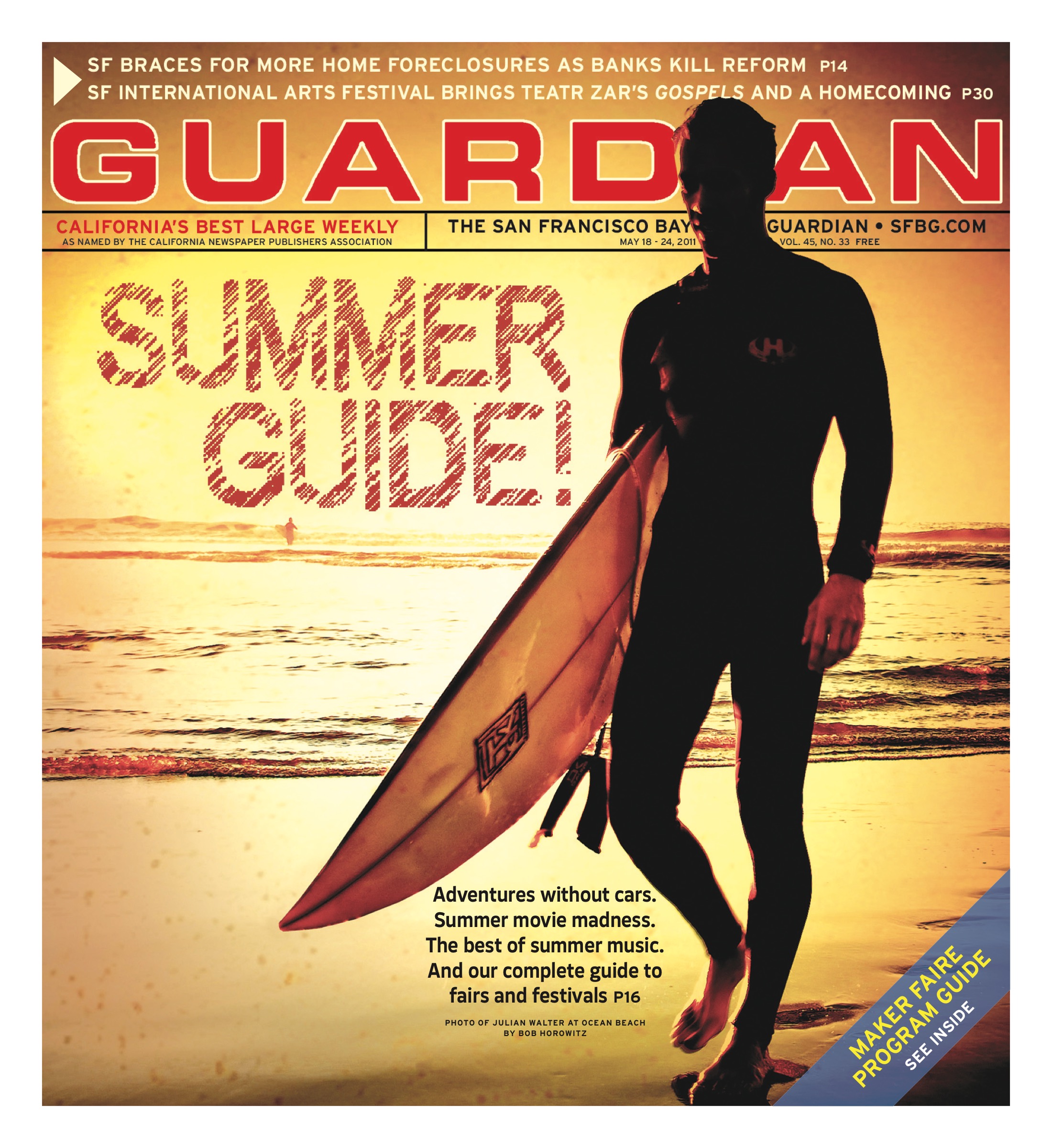
Living in San Francisco means having the richness of art in a major city, and the natural beauty of California all in one fell swoop. Here’s your guide to enjoying urban escapes and art and live performance – at the same time! – this summer. Also, check out our guides to the season’s falls and festivals, movies, music, and best adventures you can go on without a car.


WITHIN THE CITY 

Yerba Buena Gardens Festival

With three stages of free performances, this festival is perfect for a dose of culture and fresh air during your lunch hour with music, dance, theater, and readings. There’s weekend concerts too: the SF Mime Troupe performs Aug. 21, SF’s local songbird Meklit Hadero on Aug. 27, and SF’s pluckiest free ring wraiths, Circus Bella return to the lawn for the weekend of July 1-2.

May through September, free. www.ybgf.org


Stern Grove Festival

Stern Grove’s eucalyptus tree surroundings create a pretty magical summer stage for free performances. The experience gets even better when you pack a tasty picnic spread to enjoy — but leave your umbrellas and high-back chairs at home to keep the peace with those who didn’t snag the primo front row spots. In addition to the annual appearances of the San Francisco Ballet, Opera and Symphony, the concert lineup features Sharon Jones and The Dap-Kings, the Jazz Mafia Symphony, Neko Case, Afrocubism, The English Beat, Aaron Neville, and Javier Limon and Buika.

Sundays, June 19-August 21, free. www.sterngrove.org


San Francisco Mime Troupe at Dolores Park 

Enjoy palm trees and revolutionary spirit with your Tecate: with this historic troupe of not-mimes – forget the pantomime, this is socially relevant theater in the park.

July 2, 3, 4, free. www.sfmt.org


San Francisco Symphony in the Park

This year’s concert, which will be performed in Sharon Meadow, features conductor Michael Francis and pianist Valentina Lisitsa on a program of Mussorgsky’s A Night on Bald Mountain, Rachmaninoff’s Piano Concerto No. 2, and Beethoven’s Symphony No. 5.  

July 10, 2 p.m., free. www.sfsymphony.org


Shakespeare in the Park, The Presidio

Bring the whole family for this year’s performance of  Cymbeline at the Presidio’s Main Post Parade Ground Lawn.

September 3, 4, 5, 10, 11, 17, 18, 24, 25, free. Sharon Meadow, Golden Gate Park, SF. www.sfshakes.org


Opera in the Park

This year’s annual concert, also in Sharon Meadow, features a special musical program commemorating the tenth anniversary of September 11, 2001.

September 11, 1:30 p.m., free. Sharon Meadow, Golden Gate Park, SF. www.sfopera.com


AND BEYOND…

Oliver Ranch

Seventy miles north of San Francisco in Sonoma County, Oliver Ranch boasts scenic acres and 18 site-specific installations by artists such as Bruce Nauman and Richard Serra, as well as Ann Hamilton’s distinct tower where commissioned dance, poetry, theater, and music performances unfold. The tower structure – defined by two staircases built in a double helix form that accommodate the audience on one staircase and the performers on the other — suits a range of sensory projects and performances hosting artists like Meredith Monk and the Kronos Quartet. Limited capacity allows for only 100 visitors, making this ticket a splurge — but it’s all good, each concert in the tower benefits a non-profit organization. June appearances include Pauline Oliveros and Terry and Jo Harvey Allen. Should you be lucky enough to get tickets, be sure to bring some water and sunscreen and make a day of it visiting all the nearby wineries.

Various dates in June, prices vary. 22205 River, Geyserville. (510) 412-9090, www.oliverranchfoundation.org


Headlands Center for the Arts open house 

Just across the bridge in the rugged Golden Gate National Recreation Area, the Headlands Center for the Arts synthesizes natural and urban environments in a cluster of historic, 1900s military buildings at Fort Barry among hills, cliffs, coves, and beaches. At the center’s summer open house, artists open their studios to the public to show their works-in-progress and talk with visitors about their creative process in a variety of disciplines. Catch one of the many performances and readings scheduled throughout the day and then head to the mess hall, which is transformed into a café serving delicious homemade snacks at down-home prices for the event. While you’re there, a hike through the windy Headland hills is a must-do.

July 24, 12-5 p.m., free. 944 Fort Barry, Sausalito. (415) 331-2787, www.headlands.org


Robert Mondavi Winery Summer Music Festival

One of the first wineries in the Napa Valley, the Robert Mondavi Winery offers much more than sipping, swilling, and spitting. A concert series scheduled for Saturday nights in July features music in an open-air setting and this summer’s lineup includes Gavin DeGraw, Colbie Caillat, David Foster, Chris Isaak, K.D. Lang, and the Siss Boom Bang. Mondavi’s grounds also include an art gallery open daily from 10 a.m. to 4 p.m., with artifacts and paintings as well as a sculpture collection focused on the work of San Francisco artist, Beniamino Bufano, displayed in the main courtyard surrounded by rows of vines. Head here for a fancy summer night of outdoor music and wind down after an afternoon of tastings.

Saturdays in July, $75-$105. 7801 St. Helena Hwy., Oakville. (888) 766-6328, www.robertmondavi.com


Summer fairs and festivals

0

ONGOING

Young At Art Festival de Young Museum, Golden Gate Park, SF. (415) 695-2441, www.youngatartsf.com. Through May 22, free. The creative achievements of our city’s youth are celebrated in this eight day event curated and hosted by the de Young Museum.

* Oakland Asian Cultural Center Asian Pacific Heritage Festival Oakland Asian Cultural Center, 388 Ninth St., Oakl. (510) 637-0462, www.oacc.cc. Through May 26. Times and prices vary. Music, lectures, performances, family-friendly events in honor of Asian and Pacific American culture and traditions.

DIVAfest Exit Theatre, 156 Eddy, SF. (415) 931-2699, www.theexit.org. Through May 28. Times and prices vary. Bastion of the alternative, EXIT Theatre showcases its 10th annual buffet of fierce women writers, performers, and directors. This year features two plays, beat poetry, musical exploration, and more.

* Yerba Buena Gardens Festival Yerba Buena Gardens, Mission and Third St., SF. (415) 543-1718, www.ybgf.org. Through Oct. 31. Times vary, free. A series of cultural events, performances, activities, music, and children and family programs to highlight the green goodness of SoMa’s landscaped oasis.


May 18-June 5

San Francisco International Arts Festival Various venues. (415) 399-9554, www.sfiaf.org. Times and prices vary. Celebrate the arts through with this mish-mash of artistic collaborations dedicated to increasing human awareness. Artists included hail from around the world and right here in the Bay Area.


May 21

* A La Carte & Art Castro St. between Church and Evelyn, Mountain View. (650) 964-3395, www.miramarevents.com. 10am-6pm, free. With vendors selling handmade crafts, microbrewed beers, fresh foods, a farmers market, and even a fun zone for kids, there’s little you won’t find at this all-in-one fun fair. Asian Heritage Street Celebration Larkin and McAllister, SF. www.asianfairsf.com. 11am-6pm, free. This year’s at the country’s largest gathering of APA’s promises a Muay Thai kickboxing ring, DJs, and the latest in Asian pop culture fanfare — as well as tasty bites to keep your strength up.

Freestone Fermentation Festival Salmon Creek School, 1935 Bohemian Hwy, Sonoma. (707) 479-3557, www.freestonefermentationfestival.com. Noon-5pm, $12. Learn about the magical wonders of fermentation with hands-on and mouth-on demonstrations, exhibits, and tasty live food nibbles.

Uncorked! San Francisco Wine Festival Ghirardelli Square, SF. (415) 775-5500, www.ghirardellisq.com. 1-6pm, $45-50 for tasting tickets, free for other activities. Uncorked! brings you the real California wine experience with tastings, cooking demonstrations, and even a wine 101 class for those who are feeling not quite wine-refined.


May 20-29

SF Sex Worker Film and Art Festival Various venues, SF. (415) 751-1659, www.sexworkerfest.com. Times and prices vary. Webcam workshops, empowering film screenings, shared dialogues on plant healing to sex work in the age of HIV: this fest has everything to offer sex workers and the people who love ’em.


May 22

Lagunitas Beer Circus Lagunitas Brewing Co., 1280 N McDowell, Petaluma. (303) 447-0816, www.craftbeer.com. Noon-6pm, $40. All the wonders of a live circus — snake charmers, plate spinners, and sword swallowers — doing their thing inside of a brewery!


May 21-22

* Maker Faire San Mateo County Event Center, 2495 South Delaware, San Mateo. www.makerfaire.com. Sat, 10am- 8pm; Sun, 10am-6pm, $5-25. Make Magazine’s annual showcase of all things DIY is a tribute to human craftiness. This is where the making minds meet. Castroville Artichoke Festival Castroville, Calif. (831) 633-0485, www.artichokefestival.org. Sat., 10am- 6pm; Sun., 11 am- 4:30 p.m., free. Pay homage to the only vegetable with a heart: the artichoke. This fest does just that, with music, parades, and camping.


May 28-29 

San Francisco Carnaval Harrison between 16th and 22nd St., SF. 10am-6pm, free. The theme of this year’s showcase of Latin and Caribbean culture is “Live Your Fantasy” — bound to bring dreams alive on the streets of the Mission.


June 3-12

Healdsburg Jazz Festival Various venues, Healdsburg. (707) 433-463, www.healdsburgjazzfestival.org. Times and prices vary. Bask in the lounge-lit glow of all things jazz-related at this celebration in Sonoma’s wine county.


June 3-July 3 

SF Ethnic Dance Festival Zellerbach Hall, Berk. and Yerba Buena Center for the Arts, SF. www.worldartswest.org. Times and prices vary. A powerful display of world dance and music taking to the stage over the course of five weekends.


June 4

* Berkeley World Music Festival Telegraph, Berk. www.berkeleyworldmusicfestival.org. Noon-9pm, free. Fourteen world music artists serenade the streets and stores of Telegraph Avenue and al fresco admirers in People’s Park.

Huicha Music Festival Gundlach Bundschu Winery, 2000 Denmark St., Sonoma. (707) 938-5277, www.gunbun.com/hmfevent. 2-11pm, $55. Indie music in the fields of a wine country: Fruit Bats, J Mascis of Dinosaur Jr, Sonny and the Sunsets, and more.


June 4-5

Union Street Eco-Urban Festival Union from Gough to Steiner and parts of Octavia, SF. (800) 310-6563, www.unionstreetfestival.com. 10am-6pm, free. Festival goers will have traffic-free access to Cow Hollow merchants and restaurant booths. The eco-urban theme highlights progressive, green-minded advocates and products.

The Great San Francisco Crystal Fair Fort Mason Center, Building A., SF. (415) 383-7837, home.earthlink.net/~sfxtl/index.html. Sat., 10am-6pm; Sun., 10am-4pm, $6. Gems and all they have to offer: beauty, fashion, and mysterious healing powers.


June 5

* Israel in the Gardens Yerba Buena Gardens, SF. (415) 512-6420, www.sfjcf.org. 11am-5pm, free. One full day of food, music, film, family activities, and ceremonies celebrating the Bay Area’s Jewish community and Israel’s 63rd birthday.


June 10-12

Harmony Festival Sonoma County Fairgrounds, 1350 Bennett Valley, Santa Rosa. www.harmonyfestival.com. 10am-10pm, $45 one day, $120 for three day passes. This is where your love for tea, The Flaming Lips, goddess culture, techno, eco-living, spirituality, and getting drunk with your fellow hippies come together in one wild weekend.

Queer Women of Color Film Festival Brava Theater. 2789 24th St., SF. (415) 752-0868, www.qwocmap.org. Times vary, free. A panel discussion called “Thinkers and Trouble Makers,” bisects three days of screenings from up-and-coming filmmakers with stories all their own.


June 11-12

* Live Oak Park Fair 1301 Shattuck, Berk. (510) 227-7110, www.liveoakparkfair.com. 10am-6pm, free. This festival’s 41st year brings the latest handmade treasures from Berkeley’s vibrant arts and crafts community. With food, face-paint, and entertainment, this fair is perfect for a weekend activity with the family.


June 11-19 

San Mateo County Fair San Mateo County Fairgrounds. 2495 S. Delaware, San Mateo. www.sanmateocountyfair.com. June 11, 14, 18, and 19, 11am-10pm; all other days, noon-10pm, $10 for adults. It features competitive exhibits from farmers, foodies, and even technological developers — but let’s face it, we’re going to see the pig races.


June 12

Haight Ashbury Street Fair Haight between Stanyan and Ashbury, SF. www.haightashburystreetfair.org. 11am-5:30pm, free. Make your way down to the grooviest corner in history and celebrate the long-standing diversity and color of the Haight Ashbury neighborhood, featuring the annual battle of the bands.


June 16-26

Frameline Film Festival Various venues, SF. www.frameline.org. Times and prices vary. This unique LGBT film festival comes back for its 35th year showcasing queer documentaries, shorts, and features.


June 17-19 Sierra Nevada World Music Festival Mendocino County Fairgrounds. 14400 CA-128, Boonville. (916) 777-5550, www.snwmf.com. Fri, 6pm-midnight; Sat, 11am-midnight; Sun, 11am-10pm, $60 for Friday and Sunday day pass; $70 for Saturday day pass, $150 three day pass. Featuring Rebulution, Toots and the Maytals, and Jah Love Sound System, this fest comes with a message of peace, unity, and love through music.


June 18 

Summer SAILstice Encinal Yacht Club, 1251 Pacific Marina, Alameda. (415) 412-6961, www.summersailstice.com. 8am-8pm, free. Boat building, sailboat rides, sailing seminars, informational booths, music, a kid zone, and of course, wind, sun, and water.

Pinot Days Festival Pavilion, Fort Mason Center, SF. (415) 382-8663, www.pinotdays.com. 1-5pm, $50. Break out your corkscrews and head over to this unique event. With 220 artisan winemakers pouring up tastes of their one-of-a-kind vino, you better make sure you’ve got a DD for the ride home.


June 18-19

North Beach Festival Washington Square Park, SF. (800) 310-6563, www.northbeachchamber.com. Sat, 10am-6pm; Sun, 10am-6pm, free. Make your way down to the spaghetti capital of SF and enjoy food, music, arts and crafts booths, and the traditional blessing of the animals.

Marin Art Festival Marin Civic Center, San Rafael. (415) 388-0151, www.marinartfestival.com. 10am-6pm, $10. A city center designed by Frank Lloyd Wright plays host to this idyllic art festival. Strolling through pavilions, sampling wines, eating grilled oysters, and viewing the work of hundreds of creative types.


June 20-Aug 21

Stern Grove Music Festival Stern Grove. Sloat and 19th Ave., SF. (415) 252-6252, www.sterngrove.org. Sundays 2pm, free. This free outdoor concert series is a must-do for San Francisco summers. This year’s lineup includes Neko Case, the SF Symphony, Sharon Jones, and much more.


June 25-26

San Francisco Pride Celebration Civic Center Plaza, SF; Parade starts at Market and Beale. (415) 864-FREE, www.sfpride.org. Parade starts at 10:30am, free. Gays, trannies, queers, and the rest of the rainbow waits all year for this grand-scale celebration of diversity, love, and being fabulous. San Francisco Free Folk Festival Presidio Middle School. 450 30th Ave., SF. (415) 661-2217, www.sffolkfest.org. Noon-10pm, free. Folk-y times for the whole family — not just music but crafts, dance workshops, crafts, and food vendors too.


June 29-July 3

International Queer Tango Festival La Pista. 768 Brannan, SF. www.queertango.freehosting.net. Times vary, $10-35. Spice up your Pride (and Frameline film fest) week with some queer positive tango lessons in culturally diverse, welcoming groups of same sex couples.


June 30-July 3

High Sierra Music Festival Plumas-Sierra Fairgrounds, Quincy. www.highsierramusic.com. Gates open at 8am Thursday. $205 weekend pass, $90 parking fee. Yonder Mountain String Band, My Morning Jacket, and most importantly, Ween. Bring out your sleeping bags for this four day mountaintop grassroots festival.


July 2

Vans Warped Tour Shoreline Amphitheatre, Mountain View. www.vanswarpedtour.com. 11am, $46-72. Skating, pop punk, hardcore, screamo, and a whole lot of emo fun.


July 2-3

Fillmore Jazz Festival Fillmore between Jackson and Eddy, SF, 1-800-310-6563, www.fillmorejazzfestival.com. 10am-6pm, free. Thousands of people get jazzed-up every year for this musical feast in a historically soulful neighborhood.


July 4

City of San Francisco Fourth of July waterfront celebration Pier 39, Embarcadero and Beach, SF. (415) 709-5500, www.pier39.com. Noon-9:30pm, free. Ring in the USA’s birthday on the water, with a day full of music and end up at in the city’s front row when the fireworks take to the sky.


July 9-10

Renegade Craft Fair Fort Mason Festival Pavilion. Buchanan and Marina, SF. (312) 496-3215, www.renegadecraft.com. 11am-7pm, free. Put a bird on it at this craft fair for the particularly indie at heart.


July 14-24

Midsummer Mozart Festival Various Bay Area venues. (415) 627-9141, www.midsummermozart.org. Prices vary. You won’t be hearing any Beethoven or Schubert at this midsummer series — the name of the day is Mr. Mozart alone.


July 16-17

Connoisseur’s Marketplace Santa Cruz between Camino and Johnson, Menlo Park. (650) 325-2818, www.miramarevents.com. 10am-6pm, free. Let the artisans do what they do best — you’ll polish off the fruits of their labor at this outdoor expo of artisan food, wine, and craft.


July 21-Aug 8

SF Jewish Film Festival Various Bay Area venues. www.sfjff.org. Times and prices vary. A three week smorgasbord of world premiere Jewish films at theaters in SF, Berkeley, the Peninsula, and Marin County.


July 22-Aug 13

Music@Menlo Chamber Music Festival Menlo School, 50 Valparaiso, Atherton. (650) 330-2030, www.musicatmenlo.org. Classical chamber music at its best: this year’s theme “Through Brahms,” will take you on a journey through Johannes’ most notable works.


July 23-Sept 25

 SF Shakespeare Festival Various Bay Area venues. www.sfshakes.org. Various times, free. Picnic with Princess Innogen and her crew with dropping a dime at this year’s production of Cymbeline. It’s by that playwriter guy… what’s his name again?


July 30

Oakland A’s Beer Festival Eastside Club at the Oakland-Alameda Coliseum, 7000 Coliseum Way, Oakl. www.oakland.athletics.mlb.com. 4:05-6:05pm, free with game ticket. Booze your way through the Oakland A’s vs. Minnesota Twins game while the coliseum is filled with brewskies from over 30 microbreweries, there for the chugging in your souvenir A’s beer mug.


July 30-31

 Berkeley Kite Festival Cesar Chavez Park, 11 Spinnaker, Berk. www.highlinekites.com. 10am-5pm, free. A joyous selection of Berkeley’s coolest kites, all in one easy location.


July 31

Up Your Alley Dore between Folsom and Howard, SF. www.folsomstreetfair.com. 11am-6pm, $7-10 suggested donation. Whether you are into BDSM, leather, paddles, nipple clamps, hardcore — or don’t know what any of the above means, this Dore Alley stroll is surprisingly friendly and cute once you get past all the whips!


Aug 1-7

SF Chefs Various venues, SF. www.sfchefs2011.com. Times and prices vary. Those that love to taste test will rejoice during this foodie’s paradise of culinary stars sharing their latest bites. Best of all, the goal for 2011’s event is tons of taste with zero waste.


Aug 7

SF Theater Festival Fort Mason Center. Buchanan and Marina, SF. www.sftheaterfestival.org. 11am-5pm, free. Think you can face about 100 live theater acts in one day? Set a personal record at this indoor and outdoor celebration of thespians.


Aug 13

San Rafael Food and Wine Festival Falkirk Cultural Center, 1408 Mission, San Rafael. 1-800-310-6563, www.sresproductions.com. Noon-6pm, $25 food and wine tasting, $15 food tasting only. A sampler’s paradise, this festival features an array of tastes from the Bay’s best wineries and restaurants.


Aug 13-14

Nihonmachi Street Fair Post and Webster, SF. www.nihonmachistreetfair.org. 11am-6pm, free. Founded by Asian Pacific American youths, this Japantown tradition is a yearly tribute to the difficult history and prevailing spirit of Asian American culture in this SF neighborhood.


Aug 20-21

Oakland Art and Soul Festival Entrances at 14th St. and Broadway, 16th St. and San Pablo, Oakl. (510) 444-CITY, www.artandsouloakland.com. $15. A musical entertainment tribute to downtown Oakland’s art and soul, this festival features nationally-known R&B, jazz, gospel, and rock artists.


Aug 20-22

* SF Street Food Festival Folsom St from Twenty Sixth to Twenty Second, SF. www.sfstreetfoodfest.com. 11am-7pm, free. All of the city’s best food, available without having to go indoors — or sit down. 2011 brings a bigger and better Street Food Fest, perfect for SF’s burgeoning addiction to pavement meals.


Aug 29-Sept 5

Burning Man Black Rock City, Nev. (415) TO-FLAME, www.burningman.com. $320. This year’s theme, “Rites of Passage,” is set to explore transitional spaces and feelings. Gather with the best of the burned-out at one of the world’s weirdest, most renowned parties.


Sep 10-11

* Autumn Moon Festival Street Fair Grant between California and Broadway, SF. (415) 982-6306, www.moonfestival.org. 11am-6pm, free. A time to celebrate the summer harvest and the end of summer full-moon, rejoice in bounty with the moon goddess.


Sept 17-18

SF International Dragon Boat Festival California and Avenue D, Treasure Island. www.sfdragonboat.com. 10am-5pm, free. The country’s largest dragon boat festival sees beautiful man-powered boats take to the water in 300 and 500 meter competitive races.


Sept 23-25

SF Greek Food Festival Annunciation Cathedral. 245 Valencia, SF. www.sfgreekfoodfestival.org. Fri.-Sat., 11am-10pm; Sun., noon-9pm, free with advance ticket. Get your baba ghanoush on during this late summer festival, complete with traditional Greek dancing, music, and wine.


Sept 25

Folsom Street Fair Folsom between 7th and 12th St., SF. www.folsomstreetfair.org. 11am-6pm, free. The urban Burning Man equivalent for leather enthusiasts, going to this expansive SoMa celebration of kink and fetish culture is the surest way to see a penis in public (you dirty dog!).


Sept 30-Oct 2

Hardly Strictly Bluegrass Speedway Meadows, Golden Gate Park, SF. www.strictlybluegrass.com. 11am-7pm, free. Pack some whiskey and shoulder your banjo: this free three day festival draws record-breaking crowds — and top names in a variety of twangy genres — each year.


Items with asterisks note family-fun activities.


Kinetic changes

0

arts@sfbg.com

In 1810, according to the U.S. Census Bureau, Americans were divided between white and black (free and slave). In 1910 “mulatto” and “other” were added. Last year’s respondents had the choice among 15 racial categories, in addition to a space for ones not listed. Assigning people to predetermined slots is becoming so complicated — and controversial — that it’s hard not to wonder what the census form will look like in 2050 when more than 50 percent of the population will be “mixed.”

It’s a question that Raissa Simpson grapples with in her new dance installation piece Mixed Messages, running at San Francisco’s Museum of the African Diaspora (May 21-28). Choreographed for the six dancers of her Push Dance Company and youngsters from the 3rd Street Youth Center and Clinic and beyond, the work uses a sound score by El Kool Kyle that includes comments from multiracial people who face the perennial question, from others and from within themselves, “What are you?”

Simpson is comfortable with multiple identities: ballet, jazz, hip-hop, modern. “For a while, I was greedy — I wanted it all,” she says. At home she grew up eating Filipino food but once she went to college, she took “a lot of African American history and identity classes.” Among her friends, “mixed” is what she calls a form of “friendly street-slang’ in the sense of “Oh, you are mixed. I am a … ” Part of the inspiration for Messages came from a comedy act in which the performers talked about their multiracial heritage. “It was hilarious and absurd,” she remembers. “Everyone started with, ‘Guess what I am?’ “

Yet when she began to explore the subject, she found a lot of resistance from people who didn’t want to talk about it. It simply was too painful. For many, the word “mixed” still resonates with violence, pain, and something forced on them and their ancestors. Being defined — often by what is still the dominant culture — simply by the way they look, infuriates others. Some also consider multiple backgrounds a loss of cultural identity and pressure to choose one over the other. Simpson insists that “it doesn’t have to be that way.”

As a choreographer, Simpson developed her voice locally by dancing with Robert Moses’ Kin and Joanna Haigood’s Zaccho Dance Theatre, two companies that couldn’t be more different from each other. Her five years with Moses, she says, taught her a strong work ethic as well as “the possibilities of movement and how to build a work.” From Haigood, with whom she still performs, she learned “to go deep into a subject matter. Diving into something helped me edit myself as an artist.”

But she has not finished learning from others. During her 2010 Chime fellowship — the Margaret Jenkins mentorship program that pairs younger dancers with more experienced choreographers — she worked with choreographer and cofounder of the WestWave Dance Festival Cathleen McCarthy, also a graduate of the SUNY Purchase dance department. Choreographing her hip-hop opera, Black Swordsman Saga, Simpson credits McCarthy with “knowing how to tell a story” and “how to bring out hidden mysteries and emotions.”

As a dancer, Simpson is still fearless and fierce, the kind of performer who is unstoppable. Her 2008 whirlwind solo, the appropriately named Judgment in Milliseconds, performed in a straight-hair and Afro wig, thrives on split-second emotional and kinetic changes. Most recently, Simpson danced in Haigood’s The Monkey and the Devil, as painful a work about the soul-destroying effect of racism that I have seen. “In order to perform hate, you first have to be friends,” Simpson explains about the difficulties of performing such unremittingly antagonistic choreography.

Watching this dynamo in rehearsal is a surprise. Soft-spoken, calm, and focused, at times she seems almost reticent, perhaps thinking aloud. As she demonstrates an across-the-stage sequence, she tells the dancers exactly what she wants even as she encourages them to find their own way through the phrasing. At one point, she asks for more articulated details that have to run current-like through the whole body. “I am a quiet person,” she tells them, “but I like loud dancers.” 


PUSH DANCE COMPANY: MIXED MESSAGES

Sat., 2 and 4 p.m.; Sun., 1 and 3 p.m.,

Through May 29

Museum of the African Diaspora

685 Mission, SF

www.moadsf.org


Into the Vortex, part one

0

arts@sfbg.com

For some the ’60s and ’70s never stopped swinging — even (or especially) if they were barely out of womb when all that decadence crashed into the anti-counterculture, pro-coke Reagan era.

For many years, one of SF’s greatest connoisseurs of retro sexual revolution kitsch and coolness has been Scott Moffett. For all we know, even as you read this he’s reclining on a fun fur rug, drinking Martini & Rossi on the rocks, reeking of Hai Karate, sandwiched by Barbarella and Pussy Galore.

In 1994 he and Jacques Boyreau cofounded the Werepad, a waaaaaay-south o’ Market psychedelic lounge that hosted parties and screened rare, frequently scratchy 16mm prints of movies with titles like Maryjane (1968), Island of the Bloody Plantation (1983), and William Shatner’s Mysteries of the Gods (1977). He also created the Cosmic Hex Archive (whose website lets you can download everything from 1966’s Dr. Goldfoot and the Girl Bombs and 1976’s Shriek of the Mutilated to 1972’s Santa and the Ice Cream Bunny for a modest fee) to protect and show just such “forgotten works.” He’s collaborated on movies, books, and traveling exhibits, all reflecting the same groovy aesthetic.

The Werepad is now gone (as is Boyreau, to Portland, Ore.), but Moffett now runs its more compact successor not-so-far south of Market, the Vortex Room, and with Joe Niem programs its Thursday Film Cult nights.

The theme to the Vortex’s May schedule — sorry if you missed last week’s bill of Roger Corman’s 1959 beatnik parody Bucket of Blood and the astonishing 1969 Japanese portrait-of-a-crazed-artist erotic horror Blind Beast — is “Art, Obsession, and Film Cult.” The series unites a widely disparate slate dealing with art-making in one form or another, as inspired, manipulated, or rendered homicidal by sexuality and violence.

Thursday, May 12 there’s a double bill whose first half unusually (for the Vortex) reaches back to mainstream Hollywood’s “golden” era. German Expressionist master Fritz Lang (Metropolis, 1927; M., 1931), followed up 1944’s The Woman in the Window by regathering its stars on a new suspense melodrama: 1945’s Scarlet Street. The latter is crasser, pulpier, and driven by demure 1930s ingénue (and future Dark Shadows matron) Joan Bennett’s inspired vulgarity as Kitty “Lazy Legs” March, whose yea lazier boyfriend (Dan Duryea) proposes that she seduce an accountant and amateur painter (Edward G. Robinson) whom they both mistake for a wealthy artist. This lurid saga ends on an unusually bitter, ironic, haunted note for its time.

A greater discovery is Scarlet Street‘s Vortex cofeature. Scream Baby Scream (1969) is vintage psychedelic horror at its trippiest. This low-budget but pretty dang groovy artifact goes out of its way to be with-it: the cast wears ultra-mod fashions, the interiors are crammed with objets d’Op Art, the score is cool jazz-rock (dig those flute solos), and the dialogue is chock-full of Now Generation philosophizing (some rather grammatically-challenged, such as “I feel so strange — like a nightmare that I don’t want to think about”).

All of which doubles the fun in watching an otherwise (slightly better made) imitation of movies like Herschell Gordon Lewis’ 1965 Color Me Blood Red. Written by future genre hero Larry Cohen, its young protagonists are four art-school students; hero Jason is practically cohabiting with girlfriend Janet, but she’s acting like maybe she Needs Some Space. (Of course, he’s also acting like a jealous jerk — it’s unclear whether the film is aware how clearly it reflects the none-too-feminist gender dynamics of mainstream hippiedom.)

Janet takes her art very seriously, attracting attention from a creepy established artist (Larry Swanson) famous for oil portraits of hideously distorted faces. Meanwhile, models, art students, and miscellaneous youth-on-the-beach keep “disappearing.”

You can guess what happens. But among Scream Baby Scream‘s many surprises are a long LSD trip sequence (protagonists go motorcycling on the highway! Feed baby elephants at the zoo! Imagine themselves as monkeys in a cage! Interpretive dance!), scenes at a psychedelic coffeehouse, a party setpiece with groovy band the Odyssey (plus go-go dancers and liquid light projections), and zombie ghouls on the loose.

There’s also nudity, pot smoking, and a lot of relationship arguments. The last half hour takes a weird left turn into Vincent Price terrain, complete with a gloomy old mansion, a mad-doctor flashback, and so forth. The movie was clearly intended for drive-ins at best, but it’s colorful, fast-paced, and ever so delightfully wrong. Directed by little remembered B-pic toiler Joseph Adler, it was an early big-screen writing credit for Cohen, showing signs of the perversity that would later result in 1973’s Black Caesar, 1974’s It’s Alive, 1976’s God Told Me To, and 1988’s Maniac Cop, to name a few.

Trash will spotlight the rest of the Vortex’s May schedule next week. A $5 donation gets you into these Thursday screenings. For that dough, you could buy half a ticket to Bridesmaids. Please don’t tell me that’s a tough decision. (Dennis Harvey)

ART, OBSESSION, AND FILM CULT

Scarlet Street, Thurs/12, 9 p.m.;

Scream Baby Scream, Thurs/12, 11 p.m., $5

Vortex Room

1082 Howard, SF

www.myspace.com/thevortexroom


Soul sounds

0

arts@sfbg.com

Aaliyah has been an ephemeral touchstone for a number of different musical acts in recent years, with Gang Gang Dance citing her as an influence, James Blake sampling her voice, and The xx and Forest Swords covering “Hot Like Fire” and “If Your Girl Only Knew,” respectively, from her 1996 album One in a Million. In the last year, small fragments of her song “Rock the Boat” have also figured in albums by a pair of acts — Hype Williams and The Weeknd — that reshape elements of commercial R&B.

On “rescue dawn II (I am wiger toods),” from Find Out What Happens When People Stop Being Polite and Start Gettin Reel (De Stijl), the London-to-Berlin duo Hype Williams isolate the “Rock the Boat” line “Feel like I’m on dope,” slowing down Aaliyah’s voice in a manner similar to DJ Screw, and placing it next to off-key keyboards and video game sounds. The invocation of “Rock the Boat” in relation to Hype Williams’ name, which echoes that of the big-budget music video and movie director, creates or conjures subtext in a manner that’s both similar and markedly different from the inspirational way in which James Brown or Meters samples figured in early hip-hop.

Throughout Find Out What Happens, “Roy Blunt” and “Inga Copland” of Hype Williams borrow from disparate vocal elements, such as Pokémon rap and either a mutation or karaoke or obscure interpretation of Sade’s “The Sweetest Taboo.” While there’s a comedic quality to the album’s use of such sources, it mingles with a sense of time being altered. Whereas ’80s electronic musicians such as Harald Grasskopf or Scott Ryser of the Units have written about the difficulty of getting analog instruments such as Minimoogs to stay in sync while recording on tape, Hype Williams’ digital sound is riddled with moments in which melodies and rhythms deliberately fall out of step. Structurally, the duo’s new album One Nation (Hippos in Tanks) mingles randomness and more obviously constructed facets. Somber and meditative in comparison to the De Stijl collection, with free jazz atmospherics and beats to the fore, One Nation sometimes sounds like DJ Shadow, creating filigree at midnight in an imperfect world.

Bombast is not a part of Hype Williams’ sound, but it is present in The Weeknd’s self-released House of Balloons, a comparatively more polished recording that’s garnering roughly ten times the amount of attention on YouTube, a number that’s likely to increase. The Aaliyah loop on House of Balloons occurs seconds into the album’s second song, as a “hold you close” and a few other blurred words from “Rock the Boat” lead into a yearning dubstep-influenced ballad that works to differentiate between wants and needs, using echo effects to emphasize one while repeating the other like a mantra.

While Hype Williams generally sounds blunted or sleepy from syrup, speedier drug elements are laced throughout The Weeknd’s sound and the lyrics of House of Balloons. “House of Balloons / Glass Table Girls” begins with vocal and instrumental elements and a hook interpolated from Siouxsie and the Banshees’ “Happy House” before changing scenes halfway through, abandoning melodic, romantic, dramatic singing for a rap track set at an after-hours party gone awry. The next track, “The Morning,” begins with a blues lick and brings a sense of underlying anguish what is at least partly an account of a stripper’s jet-set lifestyle. “The Party & The After Party” is a seductive slow jam that uses Beach House’s “Master of None” (also present in Miranda July’s new movie The Future) as its musical bed.

As with the likely duo known as Hype Williams, the identity of the Weeknd, whether defined as Canadian singer-songwriter named Abel Tesfaye or a group of artists, has also been a matter of speculation. On blogs, websites, and in some publications, House of Balloons‘ comparative merit or weakness in relation to The-Dream, Drake, and other R&B contemporaries is a source of current debate. To dismiss any one of them outright in relation to the other is a simplistic response. In fact, R. Kelly is just as viable a comparison, and another way of returning to Aaliyah’s presence and the ways it can signify or suggest absence. 


The night has a thousand eyes

0

arts@sfbg.com

Cheap genre films targeted for the drive-in or grindhouse aside, very few truly independent features were made in the U.S. before the 1960s, and those that were made seldom found an audience. As a result, most were soon forgotten — in rare instances rediscovered decades later, like the recently restored docudramas On the Bowery (1957) and The Exiles (1961), about Skid Row denizens in New York City and Los Angeles. Foreign films had a tiny theatrical circuit (albeit usually playing in cut and dubbed form), experimental ones none at all.

It was predictable, then, that a movie straddling pretty much all the above categories should have found no welcoming niche in the complacent 1950s. Elliot Lavine’s latest retrospective of noir and noir-ish oldies at the Roxie Theater, “I Wake Up Dreaming 2011,” is subtitled “The Legendary and the Lost,” terms that both apply to the film that kicks off the two-week series.

To paraphrase recent San Francisco International Film Festival guest Christine Vachon, behind every independent feature there’s a war story. Dementia (1955) is a good example of one little film that fought and lost — on every front save artistically, and perhaps in posterity.

Even by today’s standards, with our greater tolerance for “dark” and arty material, it’s an unclassifiable, commercially doomed proposition: an hour-long B&W nightmare in which an unstable young woman wanders empty urban streets, bounces from pimp to john to jazz club, commits acts of violence (or maybe just hallucinates them), and at the end simply disappears into the cosmos. (The opening and closing shots actually are of starry infinite space.)

Oh, and there is no dialogue, just a score by noted American composer George Antheil that uses wordless vocals by Marni Nixon (who later secretly provided the vocals for the famous leading ladies of 1956’s The King and I, 1961’s West Side Story, and 1964’s My Fair Lady) as a sort of human theremin. This very curious amalgam of noir, avant-garde, lurid potboiler and silent expressionism at various times brings to mind everyone from Roger Corman to Roman Polanski and Maya Deren. It was the first and last film for John Parker, about whom very little is known — save that he must have been gravely disappointed by the long road Dementia took to nowhere. (He would have been even more disappointed had he known years later his associate producer and cast member Bruno VeSota claimed Parker didn’t know what he was doing, and that he himself did most of the writing and half the directing.)

Shot in 1953 Los Angeles, Dementia was asking for it on many levels, with content not only bizarre and uncommercial but often downright offensive by the standards of the era. Its paranoid, unpredictably mood-swinging heroine (Adrienne Barrett, billed only as “The Gamine” — not exactly the ideal description for this character) wanders alone through the city’s squalid underbelly. A flashback to her childhood — staged in a cemetery, with living-room furniture amid gravestones — reveals mom was a sluttish harpy killed by a boozed and abusive dad, who was then stabbed by guess who.

Handed over to a fat “Rich Man” (VeSota) by a slick sleazeball (Richard Barron as “The Evil One”) who picks her up on the street, she stabs him too, pushes him out a penthouse window, and saws off his hand when it won’t let go of a telltale necklace. Pursued by cops, she ducks into a club where the jivey sounds of Shorty Rogers and His Giants suddenly turn her into a sleek chanteuse (albeit one we don’t hear) alongside bongos and hopheads. All this is shot with considerable noirish panache by William C. Thompson, who as Ed Wood’s regular cinematographer made some completely ridiculous films (notably 1959’s Plan 9 From Outer Space, with its own atmospheric cemetery scenes) look much better than warranted.

Barely releasable at 61 minutes, the completed film then found that threadbare length was the least of its problems. Shown to a succession of censorial boards, it was repeatedly deemed too unhealthy for public viewing, prompting critiques like “indecent, inhuman, lacking in moral and spiritual values, could incite to crime” and “grist for the Communist mill.”

Finally after over two years and 11 screenings of different edits for New York State’s board, it was cleared with an “adults only” stamp. Double-billed with a documentary about Picasso in A Unique Program of Psychology and Art, advertised as “the first American Freudian film,” it opened on one 1955 Manhattan screen to little notice. (However Parker’s friend, the great, soon-to-be late director Preston Sturges did call it “a work of art,” strangely noting “it stirred my blood, purged my libido.”)

Two years later Parker’s producer sold the movie — now cut to 56 minutes, with pasted-on purple narration spoken in spookhouse tones by then-unknown Ed McMahon — for rerelease as Daughter of Horror. Again it flopped, although in 1958 it would gain pop culture footnote status when a clip was used as what the onscreen audience is watching when they’re attacked by amorphous sci-fi monster The Blob.

It was as Daughter that the movie started gaining a little admiration in recent years, getting a boost from Re/Search’s first Incredibly Strange Films volume and finally a DVD release (with both versions) from Kino. Taken as good, bad, or just daft, it remains unique.

Other highlights in the Roxie’s “Dreaming” program include Dementia‘s co-feature, Robert Siodmak’s terrific 1944 noir mystery Phantom Lady; actor director Robert Montgomery’s 1947 Mexican anti-holiday Ride the Pink Horse, a sort of hard-boiled cinematic Under the Volcano; and a number of exceedingly rare lesser-known titles. Certainly the campiest of them are contained on May 23’s bill: 1956’s The Violent Years, a girl-gang movie featuring the inimitable dialogue stylings of the aforementioned Mssr. Ed D. Wood, and Dance Hall Racket, an unbelievably amateurish 1953 cheapie whose stars are none other than pre-fame Lenny Bruce and his stripper wife Honey. Inspirational line: “Big deal! I kill a guy and that makes me a criminal?!” 

I WAKE UP DREAMING 2011: THE LEGENDARY AND THE LOST!

May 13–26

Roxie Theater

3117 16th St., SF

(415) 863-1087

www.roxie.com


Outta be in pictures

1

arts@sfbg.com

THEATER Taking ownership of their own image as Irish folk is not a thought that occurs to any character in Martin McDonagh’s The Cripple of Inishmaan. The cranky rural inhabitants of the titular island — one of three hardscrabble Aran Islands off Ireland’s west coast — are more likely to assure themselves that Ireland “can’t be that bad” if others seem to think so. Nevertheless, image-making and self-image, both individual and collective, are important themes bandied about in the London-reared Irish playwright’s dark comedy, which is set in the early 1930s, just as American filmmaker Robert J. Flaherty and his Hollywood crew are shooting the 1934 pseudo-documentary feature, Man of Aran, on neighboring Inishmore.

The thematic shading as well as the humor, reluctant compassion, and musicality in McDonagh’s 1996 play are all shown off to fine effect in the current touring production by Ireland’s renowned Druid Theater Company, coproduced by New York’s Atlantic Theater and running through this weekend at UC Berkeley’s Zellerbach Playhouse. If neither the play or production achieve the surpassing power and beauty of Druid’s last offering in 2009, Enda Walsh’s The Walworth Farce, this is still a worthwhile show, especially for people intrigued by relatively recent and fairly strong productions at the Berkeley Rep of McDonagh’s The Lieutenant of Inishmore (another in the playwright’s Aran Islands trilogy) and The Pillowman.

Druid’s cofounder Garry Hynes, an early and enthusiastic champion of the playwright-turned-filmmaker (writer-director of 2008’s Academy Award–nominated In Bruges) who took home a Tony for Druid’s staging of McDonagh’s The Beauty Queen of Leenane, directs her fine cast with admirable assurance. Indeed, her Cripple of Inishmaan takes ownership of the material without sentimentality, but rather in perfect sync with the brutally honest humor that signals as it sidesteps an underlying sweetness and sorrow.

The story centers on titular hero “Cripple Billy” Claven (the supple, slyly charismatic Tadhg Murphy), a kind-hearted bookworm with a misshapen right foot and hand who desires to secure himself a part in the Hollywood production and escape his treeless island burg. It’s a plan that inspires much ribald laughter from his fellow villagers who can only see Billy — an orphan raised by the two spinsters (Ingrid Craigie and Dearbhla Molloy) who run a half-stocked general store, in which cans of peas are over-represented and eggs and sweets at a premium — as a hopeless, ugly simpleton. Included in this consensus is Slippy Helen (a vivacious Clare Dunne), a disheveled, foul-mouthed yet majestic beauty with a pronounced violent streak who is Billy’s secret love interest.

Billy is plagued by a sense of guilt over the deaths of his parents, who died on the sea in an apparent suicide (a story that has more than one permutation as the play progresses), leaving him as an infant on the shore to be scooped up by local gossip-monger Johnnypateenmike (Dermot Crowley). Billy nevertheless exudes a confidence that belies his background, his handicap, or the general self-deprecating opinion of Irish life by those living it around him.

In the mouths of Hynes’ actors, the coarseness and banality of that life becomes more than an occasion for much humor. In subtle contrast to the self-effacing language of insult and pettiness, it becomes a kind of brilliant naïve music. The opening dialogue between Billy’s aunties, for instance, recalls Beckett as the two women, waiting anxiously for Billy’s return, pass the time side-by-side behind a long freestanding counter, facing blankly out to the audience as they trade a volley of simple lines about a “bad arm” as if the subject were a ping-pong ball, setting up a rhythm that is its own message and meaning, an idle sport marking time in the cadence of a children’s nursery poem.

If looks and words are deceiving here, so too are the initial impressions we have of Billy in others’ eyes: there are layers of unacknowledged perception at work between these characters. We, of course, see right away that Billy, despite an inflated reputation for cow-staring, is anything but vacuous. Indeed, he is easily the island’s most decent, intelligent, and charming inhabitant. And Murphy plays him with a long-suffering cool in which a sweetness and determination will not be silenced, as well as an offbeat physical grace. His Billy shuffles across the floor with a habitual ease that has something like a joy in it, something between a sashay and a swagger, as if he were a jazz musician stroking a set of brushes over a snare top.

The Cripple of Inishmaan makes good sport of the notion of superiority, moral or otherwise, in rural life. Taking his cue from the historical moment flagged and deceptively packaged by Man of Aran (whose depictions of traditional Aran life were in many cases already antiquated by the 1930s), McDonagh wrests his subjects from the premodern caricatures in Flaherty’s stagy documentary. (A late scene has the characters, sans Billy, gathered to watch the completed Flaherty film, marveling with some frustration at a slow-to-unfold shark-hunting sequence as if it were from another world altogether.) McDonagh, however, a boyhood visitor to the region but otherwise a life-long Londoner, does so not exactly in the name of realism, since his comedy is hardly an effort at documentary and trades in caricatures of its own. At the same time, while taking a contagious delight in mocking certain ethnographic and nationalist pretenses, he lets us glimpse in his characters a compassion — heavily guarded beneath an otherwise hearty brutality — that does not lie. 

THE CRIPPLE OF INISHMAAN

Wed/11–Fri/14, 8 p.m.; Sat, 2 and 8 p.m.; $68

Zellerbach Playhouse

UC Berkeley, Bancroft and Telegraph

(510) 642-9988

www.calperformances.org


Stage Listings

0

Stage listings are compiled by Guardian staff. Performance times may change; call venues to confirm. Reviewers are Robert Avila, Rita Felciano, and Nicole Gluckstern. Submit items for the listings at listings@sfbg.com. For further information on how to submit items for the listings, see Picks. 

THEATER

OPENING

Candide of California 1620 Gough; www.custommade.org. $10-28. Previews Fri/13-Sat/14, 8pm. Opens Tues/17, 8pm. Runs Thurs-Sat, 8pm. Through June 4. Custom Made Theatre presents this modernized version of the Voltaire tale, which was a hit at the SF Fringe Festival.

Risk is This…The Cutting Ball New Experimental Plays Festival EXIT on Taylor, 227 Taylor; (800) 838-3006, www.cuttingball.com. $20-50. Opens Fri/13, 8pm. Runs Fri-Sat, 8pm. Through June 25. Cutting Ball Theater closes its 11th season with a festival of experimental plays, including works by Eugenie Chan, Rob Melrose, and Annie Elias.

BAY AREA

A Connecticut Yankee in King Arthur’s Court Pear Avenue Theatre, 1220 Pear Avenue, Mtn View; (650) 254-1148, www.thepear.org. $15-30. Previews Fri/13, 8pm. Opens Sat/14, 8pm. Runs Thurs-Sat, 8pm; Sun, 2pm. Through May 20. Pear Avenue Theatre presents an adaptation of Mark Twain’s novella.

OPEN. Central Stage, 5221 Central, Richmond; (800) 838-3006, www.raggedwing.org. $15-35. Previews Thurs/12, 8pm. Opens Fri/13, 8pm. Runs Thurs-Sat, 8pm. Through June 11. Ragged Wing Ensemble presents a new Bluebeard-inspired play written and directed by Amy Sass.

ONGOING

Absolutely San Francisco Alcove Theater, 414 Mason; 992-8168, www.absolutelysanfrancisco.com. $32-50. Check for dates and times. Open-ended. Not Quite Opera Productions presents a musical.

*Caliente Pier 29, The Embarcadero; 438-2668, www.love.zinzanni.org. $117-145. Wed-Sat, 6pm; Sun, 5pm. Open-ended. Ricardo Salinas, cofounder of famed Mission-born radical Latino comedy trio Culture Clash, penetrates the velvet enclave of Teatro ZinZanni, taking the helm for its latest Euro-style dinner-cirque cabaret show. Under Salinas’ inspired direction, the evening plays as a revolt by brown-hued kitchen and wait staff against a ruthless takeover by, what else, a Chinese conglomerate. Multiculti clashes ensue, with the underdogs led by a brother-sister team played charmingly by ZinZanni regulars Christine Deaver and Robert Lopez, and with much expert repartee and physical humor neatly enveloping characteristically stunning feats of acrobatics and circus arts that leave forkfuls of grub hovering before slack-jawed mouths. I don’t know how many actual kitchen staffers out there can afford the ticket price (though it does come with a tasty five-course meal in addition to a first-class show), but the blend of Salinas and company’s shrewd if subdued social commentary and big-heated Latin-fueled humor—not to mention the exquisite musical numbers featuring guest star Rebekah Del Rio—lead to something altogether harmonious. (Avila)

Cancer Cells The Garage, 975 Howard; 518-1517, www.975howard.com. $15. Fri-Sat, 8pm; Sun, 2pm. Through May 22. Performers Under Stress and directors Geoff Bangs and Scott Baker offer this well-conceived program of late Pinter works, a total of nine plays and poems intelligently arranged and unevenly but in some cases vibrantly performed (especially in the case of One for the Road) in a fleet 90-minute evening. With the titular poem, written as the esteemed playwright was undergoing chemo (and recited here with somewhat unnecessary emotion by Valerie Fachman), a telling definition of cancer cells arises: “They have forgotten how to die/ And so extend their killing life.” Given the unbridled political nature of the work that follows—including the devastatingly stark (yet ever articulate to the point of being unexpected) dramatic vocabulary of Mountain Language, a compact depiction and rumination on state-sponsored genocide—those cancer cells grow out of their literal referent into a literary metaphor for the warping, perverting, and devastating consequences of supreme, unchecked power and its Olympian delusions. Pinter’s late works, written with a pronounced urgency in the face of ever-widening war and genocide, advance his shrewd and potent ability for exposing the obscenity beneath the shell games of language as deployed by power in pursuit of its imperial and totalitarian aims. (Avila)

Devil/Fish 2781 24th St; www.cirquenoveau.com. $26. Fri-Sat, 7pm; Sun, 6pm. Through May 22. Cirque Noveau presents a story involving aerial performance, acrobatics, and more.

Eleanor EXIT Theatre, 156 Eddy; (800) 838-3006, www.brownpapertickets.com. $10-25. Thurs-Sat, 8pm; Sun, 3pm. Through May 28. Though it seems fitting that a two-and-a-half-hour long epic about historical diva and queen Eleanor of Aquitane should debut at EXIT Theatre’s DIVAfest, Dark Porch Theatre’s production of Eleanor lacks the charisma of its muse. A confused tangle of unnecessary subplots and under-developed characters, Eleanor tries to fit in an 800-year-old grudge match, a thwarted celestial ascension, political chicanery, assassination, adultery, an existential chess game, a crusade, medieval grrrl power, and the quest for the holy grail into a single show, with decidedly mixed results. On the one hand, Alice Moore as the titular queen is a delicious blend of regal and calculating, and Nathan Tucker as her equally conniving consort, Henry II, makes a surprisingly vital and robust king. The design elements are strong, and Dark Porch Theatre’s trademark live music and physical-movement interludes are cleverly arranged. But on the downside, Eleanor also displays what is gradually becoming another one of DPT’s trademarks, an overly convoluted script in need of major tightening in focus. Playwright/director Margery Fairchild needs to sacrifice a good chunk of bit-player intrigue, and rely more on the strength of her iconic queen, to move the action to an endgame more rewarding than this version’s anti-climactic exile to eternal oblivion. (Gluckstern)

*Geezer Marsh, 1062 Valencia; (800) 838-3006, www.themarsh.org. $20-50. Thurs, 8pm; Sat, 5pm; Sun, 3pm. Through July 10. The Marsh presents a new solo show about aging and mortality by Geoff Hoyle.

Hugh Jackman, in Performance at the Curran Theatre Curran Theatre, 445 Geary; (888) 746-1799, www.shnsf.com. $40-150. Tues-Fri, 8pm; Sat, 2 and 8pm; Sun, 2pm. Through May 15.The shout that went up the moment he came onstage was enough to let you know this entertainer could do no wrong with this audience. But perhaps just to be on the safe side, Hugh Jackman immediately began courting the 1700 people packed into the Curran from the front rows to the balcony, speaking to many individually, embracing one or two, bringing some onstage, or just flashing them his leading-man smile. Jackman’s limited and exclusive San Francisco engagement, courtesy of producer Carole Shorenstein Hays, wasn’t my cup of tea, or whatever they drink Down Under, but devotees of the Aussie star from Hollywood (X-Men) and Broadway (The Boy from Oz) got the love-fest they wanted. And the multifaceted actor is all pro, likeable and impressive even amid the cheesier aspects of a throwback form: a song-and-dance varietal in an old-school showbiz vein, featuring much personal and professional reminiscing, joking around (including tussles with his personal trainer [Steve Lord] over a dancing prohibition in the buff-up period before his next Wolverine pic), musical routines, and somewhat incongruous medleys backed by an 18-piece band (under direction of Patrick Vaccariello) and flanked by Broadway talents Merle Dandridge (Rent, Spamalot, Aida) and Angel Reda (Wicked). (Avila)

Loveland The Marsh, Studio Theater, 1062 Valencia; (800) 838-3006, www.themarsh.org. $20-50. Fri, 8pm; Sat, 8:30pm. Through June 4. Ann Randolph’s popular one-woman show about a misfit returning to Ohio from L.A. extends its run.

*Lucky Girl EXIT Studio, 156 Eddy; (800) 838-3006, www.brownpapertickets.com. $10-25. Thurs-Sat, 8pm; Sun, 3pm. Through May 28. Honey (Cheryl Smith) talks about “the shoes” first, the shoes repeatedly, against even her analyst’s power to retain a common interest in the footwear of her attacker. Why should she so concern herself with this detail of the man who assaulted her, wounding her in ways too subtle and deep to measure—unless through the wayward precision of the poetical imagination some measure might actually be taken. That is the force and beauty of Lucky Girl, a notable new stage adaptation by Tom Juarez of poet Frances Driscoll’s 1997 collection, The Rape Poems, which premieres as part of Exit Theatre’s DIVAfest 2011. Juarez crafts an engagingly dynamic and delicate narrative arc from Driscoll’s thematically joined but otherwise disparate poems, gorgeously formulated verses that delve into a devastating subject with an unexpected range of humor, insight, and compassion. This supple range is acutely grasped and exquisitely interpreted by Smith, whose gripping performance (keenly directed by Kathryn Wood) eschews anything remotely sentimental for a complex and moving portrait of the enduring aftermath of terror. (Avila)

A Most Notorious Woman EXIT Stage Left, 156 Eddy; (800) 838-3006, www.brownpapertickets.com. $10-25. Thurs-Sat, 8pm. Through May 28. The axiom “well-behaved women seldom make history” comes to mind when watching a reenactment of the strange but true tale of the meeting between renegade pirate “queen” Grace O’Malley and Queen Elizabeth I. Both exceptionally powerful women in their day, they must surely have found some novel comfort in the presence of the other. Christina Augello plays both divas for DIVAfest with swashbuckling verve in Maggie Cronin’s historical drama, A Most Notorious Woman. Also inhabiting several bit characters along the way, Augello infuses Grace with a matter-of-fact, workaday groundedness, while her Elizabeth is all fuss and neuroses, chattering away to “Leicester” on a thoroughly modern cell-phone while plotting political intrigues. Watching Augello shift between the two strong-willed characters is the production’s greatest pleasure, along with some clever set and costuming flourishes courtesy of John Mayne and Laura Hazlett. There are some awkwardly-paced attempts at shadowplay which interrupt the overall flow, and the presence of an omniscient narrator, a sea-queen wrapped in kelp, is a puzzling distraction, but as staged history lessons of ill-behaved women go, Notorious is both informative and entertaining. (Gluckstern)

Party of 2 — The New Mating Musical Shelton Theater, 533 Sutter; (800) 838-3006, www.partyof2themusical.com. $27-29. Fri, 9pm. Open-ended. A musical about relationships by Shopping! The Musical author Morris Bobrow.

The Real Americans The Marsh MainStage, 1062 Valencia; 282-3055, www.themarsh.org. $25-50. Fri, 8pm; Sat, 8:30pm (also July 10, 17, and 24, 2pm). Through July 24. Dan Hoyle’s popular show about city and small-town life, directed by Charlie Varon, continues its run.

Secret Identity Crisis SF Playhouse, Stage 2, 533 Sutter; 869-5384, www.un-scripted.com. $10-20. Thurs-Sat, 8pm. Through Sat/14. Un-Scripted Theater Company presents a story about unmasked heroes.

Shopping! The Musical Shelton Theater, 533 Sutter; (800) 838-3006, www.shoppingthemusical.com. $27-29. Sat, 8pm. Open-ended. A musical comedy revue about shopping by Morris Bobrow.

Silk Stockings Eureka Theatre, 215 Jackson; 255-8207, www.42ndstmoon.org. $24-44. Wed, 7pm; Thurs-Fri, 8pm; Sat, 6pm; Sun, 3pm. Through May 22. 42nd Street Moon presents a Cole Porter production.

A Streetcar Named Desire Actors Theatre, 855 Bush; 345-1287, www.actorstheatresf.org. $26-38. Wed-Sat, 8pm. Through June 4. Actors Theatre of San Francisco presents the Tennessee Williams tale.

Talking With Angels Royce Gallery, 2901 Mariposa; (800) 838-3006, www.brownpapertickets.com. $21-35. Thurs-Sat, 8pm. Through May 21. A play by Shelley Mitchell set in Nazi-occupied Hungary.

*Vice Palace: The Last Cockettes Musical Thrillpeddlers’ Hypnodrome, 575 10th St; (800) 838-3006, www.brownpapertickets.com. $30-35. Fri-Sat, 8pm; Sun, 7pm. Through July 31. Hot on the high heels of a 22-month run of Pearls Over Shanghai, the Thrillpeddlers are continuing their Theatre of the Ridiculous revival with a tits-up, balls-out production of The Cockettes’ last musical, Vice Palace. Loosely based on the terrifyingly grim “Masque of the Red Death” by Edgar Allan Poe, part of the thrill of Palace is the way that it weds the campy drag-glamour of Pearls Over Shanghai with the Thrillpeddlers’ signature Grand Guignol aesthetic. From an opening number set on a plague-stricken street (“There’s Blood on Your Face”) to a charming little cabaret about Caligula, staged with live assassinations, an undercurrent of darkness runs like blood beneath the shameless slapstick of the thinly-plotted revue. As plague-obsessed hostess Divina (Leigh Crow) and her right-hand “gal” Bella (Eric Tyson Wertz) try to distract a group of stir-crazy socialites from the dangers outside the villa walls, the entertainments range from silly to salacious: a suggestively-sung song about camel’s humps, the wistful ballad “Just a Lonely Little Turd,” a truly unexpected Rite of Spring-style dance number entitled “Flesh Ballet.” Sumptuously costumed by Kara Emry, cleverly lit by Nicholas Torre, accompanied by songwriter/lyricist (and original Cockette) Scrumbly Koldewyn, and anchored by a core of Thrillpeddler regulars, Palace is one nice vice. (Gluckstern)

BAY AREA

Cripple of Inishmaan Zellerbach Playhouse, UC Berkeley Campus, Berk; (510) 642-9988, www.calperformances.org. $68. Wed/11-Fri/13, 8pm; Sat/14, 2 and 8pm. The Irish theater company Druid presents a send-up of rural Irish life, written by Martin McDonagh.

Disassembly La Val’s Subterranean, 1834 Euclid, Berk; www.impacttheatre.com. $10-20. Thurs-Sat, 8pm (through June 11). Impact Theatre presents the world premiere of a dark comedy by Steve Yockey.

East 14th – True Tales of a Reluctant Player The Marsh Berkeley, 2120 Allston, Berk; (800) 838-3006, www.themarsh.org. Sat, 8:30pm; Sun, 7pm (except Sat/14, 8pm). Through June 18. Don Reed’s one-man solo show extends its run.

Lady With All the Answers Center REPertory Company, Lesher Center for the Arts, Knight Stage 3 Theatre, 1601 Civic Center, Walnut Creek; (925) 943-SHOW, www.centerrep.org. $45. Thurs-Sat, 8:15pm; Sun, 2:15pm. Through Sun/15. Center REPpresents Kerri Shawn’s one-woman play about Ann Landers.

Not a Genuine Black Man The Marsh Berkeley, TheaterStage, 2120 Allston, Berk; (800) 838-3006, www.themarsh.org. $20-50. Thurs, 7:30pm. Through June 16. Brian Copeland’s solo show about Bay Area history continues its successful run.

Passion Play Live Oak Theatre, 1301 Shattuck, Berk; (510) 649-5999, www.aeofberkeley.org. $10-15. Fri-Sat, 7pm (also Sun/15, 2pm). Through May 21. Actors Ensemble of Berkeley presents the West Coast premiere of a time-travel play by Sarah Ruhl.

Three Sisters Berkeley Repertory Theatre, Thrust Stage, 2025 Addison, Berk; (510) 647-2949, www.berkeleyrep.org. $29-73. Check for dates and times. Through May 22. Berkeley Rep presents a new version of Chekhov’s 1901 play by Sarah Ruhl (In the Next Room, Eurydice), directed by Les Waters. The language sounds generally and pleasingly modern in the mouths of the titular Prozorov sisters—Olga (Wendy Rich Stetson), Masha (Natalia Payne), and Irina (Heather Wood)—although the production is rather traditional in staging (period set by Annie Smart, and corresponding costumes by Ilona Somogyi). We follow the restless siblings and their flock of soldier-admirers through a handful of years in their provincial town, where their late father was an elite military officer. In this period, the dashing officer Vershinin (Bruce McKenzie) brings a spark of new life—especially to the unhappily married Masha—and stokes the sisters’ ultimately unanswered desire to return to their beloved Moscow. The production breathes a good deal of life into the play, whose half-foolish and heartbreakingly funny characters so palpably exude a complex set of longings and misplaced desires, but it labors under an initial stiffness and a somewhat jagged set of performances. (Payne’s twitchy Masha, for instance, whose features maintain throughout a look of unwelcome surprise, feels incongruent at times). Some of the more moving turns concentrate here in the supporting characters, including James Carpenter as Chebutykin, the fawning old doctor who has forgotten all he used to know; Thomas Jay Ryan as Tuzenbach, the self-conscious Russian of German descent desperately smitten with Irina; and Alex Moggridge as the sisters’ much put-upon, feckless, alternately gentle and petulant brother, Andrei. (Avila)

The World’s Funniest Bubble Show The Marsh Berkeley, Cabaret, 2120 Allston Way, Berk; (800) 838-3006, www.themarsh.org. $8-50. Through July 10. The Amazing Bubble Man performs.

PERFORMANCE

Bay Area Black Comedy Competition Paramount Theatre, 2025 Broadway, Oakl; www.blackcomedycompetition.com. Sat/14, 8pm. $25-45. Don “D.C.” Curry hosts the finals of the competition

Boars Head Cafe Royale, 800 Post; 641-6033. Mon/16, 7:30pm. Free. SF Theater Pub revisits Shakespeare’s Henry IV plays.

Cabaret Lunatique Pier 29 on the Embarcadero; 438-2668, www.love.zinzanni.org. Sat/14, 11:15pm. $25-25. Teatro ZinZanni’s cabaret presents “Celebrate the Mission,” the third of nine performances focusing on specific neighborhoods.

The Devil-Ettes Present…Go Go Mania! Rickshaw Stop, 155 Fell; 861-2011, www.devilettes.com. Fri/13, 9pm. $10. A night of burlesque and rock.

DIVAfest EXIT Theatre, 156 Eddy; 673-3847, www.theexit.org. Through May 28. Check for times and prices. Plays and performances by women artists, including Maggie Cronin, Christina Augello, Margery Fairchild, and Diane DiPrima.

Gods of San Francisco Shotwell Studios, 3252 19th St; Fri-Sat, 8pm (through May 21). $15-20. Ko Labs presents a one-act musical about a mother and daughter in the aftermath of the 1906 earthquake.

Gustafer Yellowgold’s Infinity Sock Show Park Library,1950 Page; 355-5656, www.sfpl.org. Thurs/12, 11am. (Also Bernal Heights Library, 500 Cortland; 355-5663, www.sfpl.org. Thurs/12, 3:30pm.) Free. A free performance that is part of a two-week residency.

Katya Takes You Home Jewish Theatre, 470 Florida; www.russianoperadiva.com. Thurs-Sat, 8pm (also Tues/17, 8pm; Sun/22, 4pm). Through May 22. $20-30. Katya Smirnoff-Skyy presents an original cabaret.

SF Merionettes Synchronized Swimming Show Balboa Pool, 51 Havelock; (206) 240-0488, www.sf-merionettes.org. Sun/15, 5pm. $10 (suggested donation). The team of swimmers from eight to 17 holds an exhibition of 2011 routines.

Theatresports and Improvised Noir Bayfront Theater, Fort Mason Center; 474-6776, www.improv.org. Fri-Sat, 8pm (through May 28). $17-20. BATS Improv Theatre presents competition and noir performances.

Lilias White Fairmont Hotel, Venetian Room, 950 Mason; 392-4400, www.bayareacabaret.org. $45. The singer pays tribute to Cy Coleman with “My Guy Cy.”

Words and Voices: Litquake Tribute to Gertrude Stein Yerba Buena Gardens, Mission and 3rd; 543-1718, www.ybca.org. Tues/17, 12:30pm. Free. One of 90 events at this year’s Yerba Buena Gardens Festival.

Yale Glee Club Marines’ Memorial Theatre, 609 Sutter; 771-6900, www.marinesmemorialtheatre.com. Sat/14, 8pm. $75-125. The club is joined by Darren Criss and the SFGC Alumnae Chorus for a performance benefiting No Bully and YouthAware.

BAY AREA

Alameda Children’s Musical Theatre Altarena Playhouse, 1409 High, Alameda; (510) 521-6965, www.acmtkids.org. Fri/13, 7:30pm; Sat/14, 2 and 7:30pm. $7-13. A production of Shakespeare’s A Midsummer Night’s Dream, directed by Sara Kraft.

DANCE

CubaCaribe Festival Dance Mission, 3316 24th; 273-4633, www.brownpapertickets.com. Fri/13-Sat/14, 8pm; Sun/15, 7pm. $10-24. A program including performances by Colette Eloi’s El Wah Movement and Danys Pérez’s Oyu Oro.

Copious Dance Theater Z Space, 450 Florida; www.copiousdance.org. Fri/13-Sat/14, 8pm; Sun/15, 5pm. $18. The company brings four works to the stage, including Portals of Grace, Little Voices, and Secret’s Lament.

Luminous Connections Palace of Fine Arts, 3301 Lyon; 695-5720, www.sfsota.org. Fri/13-Sat/14, 8pm. $14-24. San Francisco School of the Arts Pre-Professional Dance Program presents a dance concert, under the direction of Elvia Marta.

Moveable Feast The Garage SF, 975 Howard; (800) 838-3006, www.brownpapertickets.com. Wed/11, 8pm. $10-20. Tanya Bello’s Project. B. presents a full-evening show.

Smuin Ballet Yerba Buena Center for the Arts, 701 Mission; 978-2787, www.ybca.org. Wed/11-Fri/13, 8pm; Sat/14, 2 and 8pm; Sun/15, 2pm. $20-62. Smuin Ballet presents a spring program, including choreography by Choo-San Goh, Amy Seiwert, and Michael Smuin.

BAY AREA

Company C Contemporary Ballet Lesher Center for the Arts, 1601 Civic Drive, Walnut Creek; (925) 943-SHOW, www.lesherartscenter.org. Fri/13, 8pm; Sat/14, 2 and 8pm. $15-40. The company presents three world premieres.

Savage Jazz Dance and Napoles Malonga Casquelourd Center for the Arts Theatre, 1428 Alice, Oakl; (800) 838-3006, www.brownpapertickets.com. Thurs/12-Sat/14, 8pm. $5-25. The companies present “Gonzo,” which includes three world premieres by Savage Jazz Dance Company. 

5 Things: May 10, 2011

0

>>IF YOU WATCH ONE MOVIE THIS YEAR, DON’T LET IT BE THIS ONE Looking to revisit the magic that was 2009’s cinematic syrup of ipecac – and looking for a fix for idle hands? Princess Animal, SF’s sassiest eponymous yarn store owner, has lain down the gauntlet: whosoever shall craft the best human centipede shall receive a skein of locally-made Pigeonroof Studios “at only the cost of materials and your dignity.” 

>>FLOWER POWER Katie Bush makes digital and analog art, and this month she’s showing work at two sites, Spunk Salon and The Lexington Club. The advance writeup for her show at the Lexington, “Mesmerizing Lady Parts,” promises “a month-long detonation of flowering lady parts” and “militarized bouquets of church-resistant ovariangasms.” The show runs through mid-June, and the opening is from 7 to 9 p.m. tonight, May 10.

Live from the Cadillac… 

>>GROWN FOLKS TUNES Kids these days with their hippity-hoppity and their Lady Gaga – take a break from the Tweets of the week and hone in on three shows that pay homage to the days when people were smarter than their cell phones (that didn’t exist yet). Jazz Mafia will be playing their annual Stevie Wonder birthday tribute show not once, but twice, and over at the historic Cadillac Hotel, SF Recovery Theatre will be performing “A Night at the Black Hawk,” an original play that tells the story of artists at the Tenderloin’s famous jazz club. The historical beat drops at 12:30 p.m. on Friday, and the public is free to attend.

>>WE OLOVE BLACKBERRIES It takes very little (cold snaps aside) to get us to fire up the grill. That being said, We Olive (a local gourmet shop that’s one of our favorite stops when we make it over the Pac Heights hill to the Marina) has just given us the best reason of the season: a new, locally-produced balsamic blackberry vinegar fit to beat the band. Made from blackberry puree, the vinegar is light and tart and gets us in the mood for those purple-stained fingertips that are still a few months out. We Olive recommends it as a marinade for skate – we can see it dressing our arugula, or adding a sweet tang to some well-peppered grilled veggies. 

>>HERE’S HOPING THEY’RE KIND BUDS Spotted near AT&T Park. Apparently Budweiser has tapped into the Bay’s Giants game refreshment of choice and wants to add its products to the pairing menu:


Nick Waterhouse and the Tarots: New music for old souls

0

Nick Waterhouse knows what he likes, and as the old adage goes: “If it ain’t broke don’t fix it.” Recording entirely in analog on vintage equipment — including an original Muscle Shoals mixer — and performing with beautiful tube amps and old guitars, his attention to detail and historical accuracy pays off. The result is a classic R&B sound that at times is gritty and raw and at others smooth and viscous as warm molasses.

He is a sharp-dressed man, that Waterhouse, adorned in suits and ties, with an angel face framed by horn-rimmed glasses. I imagine he gets constant cliché comparisons to Buddy Holly, but when he and his new group, the Tarots, stepped out on stage for a sold-out show at the Knockout last Saturday, April 30, my first impression of him was of one of those characters in a Daniel Clowes Eightball comic who collects old jazz and soul records — on vinyl. He probably listens to NPR on a Bakelite radio, I thought, albeit a bit snarkily in retrospect. My apologies, Nick.

The vinyl-collecting part is not far from the truth, it turns out. A DJ and regular at any of the many soul parties in San Francisco, like The Make-Out Room’s Lost and Found or the O.G. 1964 at the Edinbugh Castle, Waterhouse clearly knows his stuff, and it should come as no surprise that his uber-knowlege and ear for sound should translate so nicely to his live sets — the music sounds authentic, yet somehow fresh and not dated — backed by a horn-driven band and three beautiful “divas” (that a little bit of Googling identified as The Naturelles) who belt it better than any cheeseball of the same self-declaration ever could.

His debut release, the 45 rpm “Some Place”  — performed and recorded with the Turn-Keys, which includes the legendary Ira Raibon on sax — is currently available from Waterhouse’s own Pres Records. You can catch him tonight, Wed/5, performing with his new lineup for live sets, the Tarots, at the Asterisk Magazine anniversary party (see events listings).

Nick Waterhouse, “Some Place”:

Music Listings

0

Music listings are compiled by Cheryl Eddy. Since club life is unpredictable, it’s a good idea to call ahead to confirm bookings and hours. Prices are listed when provided to us. Submit items for the listings at listings@sfbg.com. For further information on how to submit items for the listings, see Picks.

WEDNESDAY 4

ROCK/BLUES/HIP-HOP

Pryor Baird and the Deacons Biscuits and Blues. 8 and 10pm, $15.

Between the Buried and Me, Job for a Cowboy, Ocean, Cephalic Carnage Slim’s. 8pm, $19.

Gas Mask Colony, Fist Fam, DJ Okeefe Elbo Room. 10pm, $10. With comedians Chris Storin, Kaseem Bentley, and Joseph Anolin.

Janks, Shivers Café Du Nord. 9:30pm, $10.

J Mascis, Black Heart Procession Independent. 8pm, $20.

Shelley Short, Darren Hanlon Hemlock Tavern. 9pm, $7.

Frank Turner, City Bottom of the Hill. 9pm, $12.

Vivian Girls, No Joy, Lilac Rickshaw Stop. 8pm, $14.

JAZZ/NEW MUSIC

Cosmo Alleycats Le Colonial, 20 Cosmo, SF; www.lecolonialsf.com. 7pm.

Dink Dink Dink, Gaucho, Michael Abraham Amnesia. 7pm, free.

Ben Marcato and the Mondo Combo Top of the Mark. 7:30pm, $10.

Tom Jonesing Café Royale, 800 Post, SF; (415) 641-6033. 8pm, free.

FOLK/WORLD/COUNTRY

Jesse Cook Yoshi’s San Francisco. 8 and 10pm, $16-22.

Wanda Jackson, Red Meat, DJ Britt Govea Great American Music Hall. 8pm, $21.

DANCE CLUBS

Booty Call Q-Bar, 456 Castro, SF; www.bootycallwednesdays.com. 9pm. Juanita Moore hosts this dance party, featuring DJ Robot Hustle.

Cannonball Beauty Bar. 10pm, free. Rock, indie, and nu-disco with DJ White Mike.

Jam Fresh Wednesdays Vessel, 85 Campton, SF; (415) 433-8585. 9:30pm, free. With DJs Slick D, Chris Clouse, Rich Era, Don Lynch, and more spinning top 40, mash-ups, hip-hop, and remixes.

Mary-Go-Round Lookout, 3600 16th St, SF; (415) 431-0306. 10pm, $5. A weekly drag show with hosts Cookie Dough, Pollo Del Mar, and Suppositori Spelling.

No Room For Squares Som., 2925 16th St, SF; (415) 558-8521. 6-10pm, free. DJ Afrodite Shake spins jazz for happy hour.

Respect Wednesdays End Up. 10pm, $5. Rotating DJs Daddy Rolo, Young Fyah, Irie Dole, I-Vier, Sake One, Serg, and more spinning reggae, dancehall, roots, lovers rock, and mash-ups.

THURSDAY 5

ROCK/BLUES/HIP-HOP

Beach Fossils, Craft Spells, Melted Toys Slim’s. 9pm, $15.

James Blunt, Christina Perri Warfield. 8pm, $40-50.

Dessa, Sims and DJ Lazerbeak, Sister Crayon Bottom of the Hill. 9pm, $10.

Dredg, Dear Hunter, Balance and Composure, Trophy Fire Great American Music Hall. 8pm, $20.

Glass Trains, Ugly Winner, Books on Tape Knockout. 9:30pm, $6.

Hundred in the Hands, Silver Swans, DJs Aaron Axelsen and Nako Rickshaw Stop. 9pm, $10.

Inferno of Joy, Jesse Morris and the Man Cougars Thee Parkside. 9pm, $6.

Cass Mccombs, Frank Fairfield Swedish American Hall (upstairs from Café Du Nord). 8pm, $15.

Pigeon John, Chicharones, Rocky Rivera Rock-it Room. 9pm, $12.

Ron Pope, Ari Herstand Café Du Nord. 8pm, $15.

Stop Motion Poetry Sub-Mission Art Space, 2183 Mission, SF; www.sf-submission.com. 8:30pm, $6.

Ty Curtis Band Biscuits and Blues. 8 and 10pm, $15.

JAZZ/NEW MUSIC

“From New Orleans to Now” Jewish Community Center of San Francisco, 3200 California, SF; www.sfjazz.org. 7:30pm, $5-15. With the SF Jazz High School All-Stars Jazz Orchestra.

Manhattan Transfer Yoshi’s San Francisco. 8 and 10pm, $35-45.

Organsm featuring Jim Gunderson and “Tender” Tim Shea Bollyhood Café. 6:30-9pm, free.

Stompy Jones Top of the Mark. 7:30pm, $10.

FOLK/WORLD/COUNTRY

Country Casanovas Atlas Café. 8-10pm, free.

“Twang! Honky Tonk” Fiddler’s Green, 1330 Columbus, SF; www.twanghonkytonk.com. 5pm.

DANCE CLUBS

Afrolicious Elbo Room. 9:30pm, $5. Cinco de Mayo celebration with DJs Pleasuremaker and Señor Oz, plus guests El Kool Kyle and Roger Mas, spinning Afrobeat, Tropicália, electro, samba, and funk.

CakeMIX SF Wish, 1539 Folsom, SF; www.wishsf.com. 10pm, free. DJ Carey Kopp spinning funk, soul, and hip-hop.

Caribbean Connection Little Baobab, 3388 19th St, SF; (415) 643-3558. 10pm, $3. DJ Stevie B and guests spin reggae, soca, zouk, reggaetón, and more.

Club Jammies Edinburgh Castle. 10pm, free. DJs EBERrad and White Mice spinning reggae, punk, dub, and post punk.

Drop the Pressure Underground SF. 6-10pm, free. Electro, house, and datafunk highlight this weekly happy hour.

80s Night Cat Club. 9pm, $6 (free before 9:30pm). Two dance floors bumpin’ with the best of 80s mainstream and underground with Dangerous Dan, Skip, Low Life, and guests.

Guilty Pleasures Gestalt, 3159 16th St, SF; (415) 560-0137. 9:30pm, free. DJ TophZilla, Rob Metal, DJ Stef, and Disco-D spin punk, metal, electro-funk, and 80s.

Jivin’ Dirty Disco Butter, 354 11th St., SF; (415) 863-5964. 8pm, free. With DJs spinning disco, funk, and classics.

Lacquer Beauty Bar. 10pm-2am, free. DJs Mario Muse and Miss Margo bring the electro.

Mestiza Bollywood Café, 3376 19th St, SF; (415) 970-0362. 10pm, free. Showcasing progressive Latin and global beats with DJ Juan Data.

1984 Mighty. 9pm, $2. The long-running New Wave and 80s party has a new venue, featuring video DJs Mark Andrus, Don Lynch, and celebrity guests.

Peaches Skylark, 10pm, free. With an all female DJ line up featuring Deeandroid, Lady Fingaz, That Girl, and Umami spinning hip hop.

Thursday Special Tralala Revolution Café, 3248 22nd St, SF; (415) 642-0474. 5pm, free. Downtempo, hip-hop, and freestyle beats by Dr. Musco and Unbroken Circle MCs.

FRIDAY 6

ROCK/BLUES/HIP-HOP

Avant Yoshi’s San Francisco. 8 and 10pm, $32.

Curren$y, Trademark, Young Roddy, Fiend, Corner Boy P Regency Ballroom. 9pm, $20.

Diddy Dirty Money featuring P. Diddy, Lloyd, Tyga Warfield. 9pm, $38-58.

Donkeys, Social Studies, Rademacher Bottom of the Hill. 10pm, $10.

Dredg, Dear Hunter, Balance and Composure, Trophy Fire Great American Music Hall. 8pm, $20.

Eddie and the Hot Rods, Prima Donna, Midnite Snaxx Thee Parkside. 9pm, $12.

Glitter Wizard, Hot Lunch, Gypsyhawk, El Topo Café Du Nord. 9:30pm, $8.

Groggs, True Foes, Shrouds Hemlock Tavern. 9:30pm, $6.

Mission Players Brick and Mortar, 1710 Mission, SF; (415) 371-1631. 9:30pm, $5.

RU36, Saint Vernon, Almost Dead, Kick Rocks Slim’s. 9pm, $14.

Telekinesis, Unknown Mortal Orchestra Fillmore. 9pm, $20.

Zola Jesus, Naked on the Vague, DJ Omar Rickshaw Stop. 9pm, $14.

JAZZ/NEW MUSIC

Black Market Jazz Orchestra Top of the Mark. 9pm, $10.

CéU Herbst Theatre, 401 Van Ness, SF; www.sfjazz.org. 8pm, $30-75.

Lavay Smith and Her Red Hot Skillet Lickers Biscuits and Blues. 8 and 10pm, $20.

FOLK/WORLD/COUNTRY

Sierra Leone’s Refugee All Stars, Youssoupha Sidibe with the Mystic Rhythms Band Independent. 9pm, $15.

DANCE CLUBS

Afro Bao Little Baobab, 3388 19th St, SF; (415) 643-3558. 10pm, $5. Afro and world music with rotating DJs including Stepwise, Steve, Claude, Santero, and Elembe.

Bikes and Beats Public Works, 161 Erie, SF; www.brownpapertickets.com. 10pm, $10. With Polish Ambassador, Party Ben, Non Stop Bhangra, M.O.M., and more, plus DIY bike crafts, street food vendors, a bike fashion show, and other attractions.

Deeper 222 Hyde, 222 Hyde, SF; (415) 345-8222. 9pm, $10. With rotating DJs spinning dubstep and techno.

Dirty Rotten Dance Party Madrone Art Bar. 9pm, $5. With DJs Morale, Kap10 Harris, and Shane King spinning electro, bootybass, crunk, swampy breaks, hyphy, rap, and party classics.

Exhale, Fridays Project One Gallery, 251 Rhode Island, SF; (415) 465-2129. 5pm, $5. Happy hour with art, fine food, and music with Vin Sol, King Most, DJ Centipede, and Shane King.

Fubar Fridays Butter, 354 11th St., SF; (415) 863-5964. 6pm, $5. With DJs spinning retro mashup remixes.

Good Life Fridays Apartment 24, 440 Broadway, SF; (415) 989-3434. 10pm, $10. With DJ Brian spinning hip hop, mashups, and top 40.

Hot Chocolate Milk. 9pm, $5. With DJs Big Fat Frog, Chardmo, DuseRock, and more spinning old and new school funk.

Hot Pink Feathers: Ten Year Anniversary DNA Lounge. 9pm, $10-75. Burlesque performances and live music by Blue Bone Express and the Hot Pink Feathers All-Star Marching Band.

120 Minutes Elbo Room. 10pm, $5-10. Goth and witchhouse with Whitch, oOoOO, and Nako.

Rockabilly Fridays Jay N Bee Club, 2736 20th St, SF; (415) 824-4190. 9pm, free. With DJs Rockin’ Raul, Oakie Oran, Sergio Iglesias, and Tanoa “Samoa Boy” spinning 50s and 60s doo-wop, rockabilly, jive, and more.

Some Thing Stud. 10pm, $7. VivvyAnne Forevermore, Glamamore, and DJ Down-E give you fierce drag shows and after-hours dancing.

Strangelove: Sacrilege Cat Club. 9:30pm, $6 (free before 10pm). Goth and industrial with DJs Tomas Diablo, Decay, Xander, and Ms. Samantha.

Vintage Orson, 508 Fourth St, SF; (415) 777-1508. 5:30-11pm, free. DJ TophOne and guest spin jazzy beats for cocktalians.

SATURDAY 7

ROCK/BLUES/HIP-HOP

Crystal Stilts, Mantles Rickshaw Stop. 9pm, $12.

English Beat Bimbo’s 365 Club. 9pm, $25.

Rick Estrin and the Nightcats Biscuits and Blues. 8 and 10pm, $20.

It Thing, Verms, Okie Rosette Café Du Nord. 9:30pm, $10.

Manic Hispanic, Old Man Markely, Hounds and Harlots Slim’s. 9pm, $18.

Rhett Miller, Robert Francis Swedish American Hall (upstairs from Café Du Nord). 8pm, $25.

Jonas Reinhardt, Cloudland Canyon, White Cloud Hemlock Tavern. 9:30pm, $8.

Corin Tucker, Billy and Dolly, Bruises Bottom of the Hill. 9:30pm, $14.

Wolfshirt, Paranoid Freakout Thee Parkside. 3pm, free.

Y&T, Kip Winger Fillmore. 9pm, $36.50.

JAZZ/NEW MUSIC

Manhattan Transfer Yoshi’s San Francisco. 8 and 10pm, $35-45.

Yanni Warfield. 8pm, $39-89.

DANCE CLUBS

Afro Bao Little Baobab, 3388 19th St, SF; (415) 643-3558. 10pm, $5. Afro and world music with rotating DJs including Stepwise, Steve, Claude, Santero, and Elembe.

Bootie SF DNA Lounge. 9pm, $6-12. Mash-ups.

Everlasting Bass 330 Ritch. 10pm, $5-10. Bay Area Sistah Sound presents this party, with DJs Zita and Pam the Funkstress spinning hip-hop, soul, funk, reggae, dancehall, and club classics.

Gemini Disco Underground SF. 10pm, $5. Disco with DJ Derrick Love and Nicky B. spinning deep disco. HYP Club Eight, 1151 Folsom, SF; www.eightsf.com. 10pm, free. Gay and lesbian hip-hop party, featuring DJs spinning the newest in the top 40s hip hop and hyphy.

Kontrol Endup. 10pm, $20. With resident DJs Alland Byallo, Craig Kuna, Sammy D, and Nikola Baytala spinning minimal techno and avant house.

Leisure Paradise Lounge. 10pm, $7. DJs Omar, Aaron, and Jet Set James spinning classic britpop, mod, 60s soul, and 90s indie.

Rock City Butter, 354 11th St., SF; (415) 863-5964. 6pm, $5 after 10pm. With DJs spinning party rock. Same Sex Salsa and Swing Magnet, 4122 18th St, SF; (415) 305-8242. 7pm, free.

Saturday Night Soul Party Elbo Room. 10pm, $10. DJs Lucky, Paul Paul, and Phengren Oswald spin butt-shakin’ ’60s soul on 45.

Souf Club Six. 9pm, $7. With DJs Jeanine Da Feen, Motive, and Bozak spinning southern crunk, bounce, hip hop, and reggaeton.

Soundscape Vortex Room, 1082 Howard, SF; www.myspace.com/thevortexroom. With DJs C3PLOS, Brighton Russ, and Nick Waterhouse spinning Soul jazz, boogaloo, hammond grooves, and more.

Spirit Fingers Sessions 330 Ritch. 9pm, free. With DJ Morse Code and live guest performances.

SUNDAY 8

ROCK/BLUES/HIP-HOP

Cowboy and Indian, Gentleman Coup Hemlock Tavern. 9pm, $6.

Dirty Heads, New Politics, Pacific Dub Fillmore. 8pm, $18.50.

William Fitzsimmons, Slow Runner Independent. 8pm, $18.

Symphony X, Powerglove, Blackguard Regency Ballroom. 8pm, $30.

KT Tunstall, Charlie Mars, Miggs Great American Music Hall. 8pm, $24.

JAZZ/NEW MUSIC

New York Voices, Alan Paul Trio Yoshi’s San Francisco. 6 and 8:30pm, $25.

Swing-out Sundays Milk Bar. 9pm, $7-15. With beginner swing lessons.

Tom Lander Duo Medjool, 2522 Mission, SF; www.medjoolsf.com. 6-9pm, free.

FOLK/WORLD/COUNTRY

Joe and the Sons of Emperor Norton Thee Parkside. 4pm, free.

DANCE CLUBS

Afterglow Nickies, 466 Haight, SF; (415) 255-0300. An evening of mellow electronics with resident DJs Matt Wilder, Mike Perry, Greg Bird, and guests.

Batcave Cat Club. 10pm, $5. Death rock, goth, and post-punk with Steeplerot Necromos and c_death. Call In Sick Skylark. 9pm, free. DJs Animal and I Will spin danceable hip-hop.

Dub Mission Elbo Room. 9pm, $6. Dub, roots, and classic dancehall.

Gloss Sundays Trigger, 2344 Market, SF; (415) 551-CLUB. 7pm. With DJ Hawthorne spinning house, funk, soul, retro, and disco.

Honey Soundsystem Paradise Lounge. 8pm-2am. “Dance floor for dancers – sound system for lovers.” Got that?

La Pachanga Blue Macaw, 2565 Mission, SF; www.thebluemacawsf.com. 6pm, $10. Salsa dance party with live Afro-Cuban salsa bands.

MONDAY 9

JAZZ/NEW MUSIC

Fred Frith, Beth Custer Yoshi’s San Francisco. 8pm, $12.

Mogwai, Errors Regency Ballroom. 8pm, $26.

DANCE CLUBS

Death Guild DNA Lounge. 9:30pm, $3-5. Gothic, industrial, and synthpop with Joe Radio, Decay, and Melting Girl.

Krazy Mondays Beauty Bar. 10pm, free. With DJs Ant-1, $ir-Tipp, Ruby Red I, Lo, and Gelo spinning hip hop.

M.O.M. Madrone Art Bar. 6pm, free. With DJ Gordo Cabeza and guests playing all Motown every Monday.

Network Mondays Azul Lounge, One Tillman Pl, SF; www.inhousetalent.com. 9pm, $5. Hip-hop, R&B, and spoken word open mic, plus featured performers.

Sausage Party Rosamunde Sausage Grill, 2832 Mission, SF; (415) 970-9015. 6:30-9:30pm, free. DJ Dandy Dixon spins vintage rock, R&B, global beats, funk, and disco at this happy hour sausage-shack gig.

Skylarking Skylark. 10pm, free. With resident DJs I & I Vibration, Beatnok, and Mr. Lucky and weekly guest DJs.

TUESDAY 10

ROCK/BLUES/HIP-HOP

Fat Tuesday Band Biscuits and Blues. 8 and 10pm, $15.

Ghostland Observatory Regency Ballroom. 8pm, $30.

Kina Grannis featuring Misa and Emi Grannis, Imaginary Friend Swedish American Hall (upstairs from Café Du Nord). 8pm, $15.

David Liebe Hart, Cool Ghouls Hemlock Tavern. 9pm, $7.

My Jerusalem, Michael Kingcaid, Dead Ships Bottom of the Hill. 9pm, $10.

Raveonettes, Tamaryn Bimbo’s 365 Club. 9pm, $25.

DANCE CLUBS

Eclectic Company Skylark, 9pm, free. DJs Tones and Jaybee spin old school hip hop, bass, dub, glitch, and electro.

Share the Love Trigger, 2344 Market, SF; (415) 551-CLUB. 5pm, free. With DJ Pam Hubbuck spinning house.


American Idol: Casey was robbed!

4

Damn, did America ever get it wrong this week. Casey’s the best all-around musician on the show. He’s got a great voice, performs well on stage, and was saved by the judges the first time the texting morons voted him off. And yet, after a solid performance April 28 — one of the best of a shaky lot — he was sent home last night. Bogus. Who the hell are these 53 million Americans who voted, anyway?

See, the problem is that Casey’s not a pop singer, not even a rock ‘n’ roller. He’s really a jazz guy who loves to play the upright bass. Not sexy enough, I guess.

At any rate, this is the biggest mistake since Pia (even bigger; Pia should have stayed longer, but she was leaving eventually). Casey was in my final three. And Jacob, Haley and Lauren, who just aren’t in the same league, get to stay another week. Damn.

Oh well, the show.

A couple of good musical interludes. Crystal Bowersox rocks. I like Bruno Mars. I have to love any song about doing nothing all day and not answering the phone. (“I’m gonna kick up my feet then stare at the fan/ Turn on the TV throw my hand in my pants …”) Party on, Bruno.

But the individual segments are getting longer and longer as the number of contestants dwindles and Ryan still has an hour to fill. In a couple of weeks, we’ll be hearing how everyone did in fifth grade. This time, the audience got to submit dumb questions for the contestants, who had generally dumb answers.

And the drama! Pull them up on stage, tell them America has voted, then …. send them back to sit down and wait. Duh, Ryan, America has voted; that’s why we’re putting up with all the Ford commercials. Get to the point.

And the point was wrong.

People! Americans with sense and taste! You’re not voting! The last time you did that a guy named Bush became president! Get with the program! If Scotty and James don’t make the final two, I’m moving to Canada. 


This place

0

arts@sfbg.com

LIT Begun in part as a series of maps accompanying public lectures, Rebecca Solnit’s Infinite City: A San Francisco Atlas (University of California Press, 167 pages, $24.95) is a remarkable act of gathering, one that presents myriad versions and visions of San Francisco and its surrounding areas that can inform a reader’s experience.

Infinite City was recently selected by the Northern California Independent Booksellers as one of its 2011 winners. Duality is a fundamental aspect of the book’s breadth and depth and sense of sharply critical appreciation — structurally, Solnit pairs distinct maps with corresponding chapter-length essays. In keeping with that characteristic, and also with the book’s group spirit (though admittedly on a much smaller and less intensive scale), I asked different Guardian contributors to share appraisals of one, or in most cases two, of the 22 sections. The result provides just a hint of what can be found within Infinite City. (Johnny Ray Huston)

MAP 3. “Cinema City: Muybridge Inventing Movies, Hitchcock Making Vertigo

The map for this chapter tracks the San Francisco life of Eadweard (sic) Muybridge, alongside landmarks from Alfred Hitchcock’s Bay Area masterpiece Vertigo. In “The Eyes of the Gods,” Solnit, who won the National Book Critics Circle award for her 2003 Muybridge bio River of Shadows, writes of the 19th century artist’s breakthrough high-speed photography, “It was as though the ice of frozen photographic time had broken free into a river of images.”

Many such rivers flowed all over this fair city when Vertigo premiered at the Stage Door Theatre at 420 Mason St. on May 9, 1958. Alas, only 10 of the more than 60 single-screen venues extant that year, all demarcated on Shizue Seigel’s fine map, are still functioning. Solnit rightly describes the shift to watching films on various digital delivery mechanisms as leaving contemporary culture with a “curious imagistic poverty.” As she concisely describes watching Milk and Once Upon a Time in the West on the Castro Theatre’s giant screen, we’re reminded that there is no comparison between enjoying cinema in such a grand setting and staring at a laptop. The great 20th century memoirist and observer Quentin Crisp wrote, “We ought to visit a cinema as we would go to a church. Those of us who wait for films to be made available for television are as deeply suspicious as lost souls who claim to be religious but who boast that they never go to church.”

That applies to you too, Netflix subscribers! The Roxie, Castro, Red Vic, Clay, and a small number of other houses of worship are still in business, so what are you waiting for? (Ben Terrall)

MAP 4. “Right Wing of the Dove: The Bay Area as Conservative/Military Brain Trust”

In “The Sinews of War are Boundless Money and the Brains of War Are in the Bay Area,” Solnit argues that antiwar, green, and left Bay Area hotspots are well known and don’t need to be charted again — unlike military contractors and assorted other forces of reaction in the region.

Solnit notes that many military bases that used to operate in the Bay Area are closed, “but the research, development, and profiteering continue as a dense tangle of civilian and military work, technological innovation, economic muscle, and political maneuvering for both economic and ideological purposes.”

Among the hard-right compounds providing counterevidence for that demonstration chestnut “the people united will never be defeated”: Lawrence Livermore National Labs (birthplace of Star Wars — the Reagan era money pit, not the George Lucas movie); Lockheed Martin, world’s largest “defense” contractor; the Hoover Institution, Stanford’s reactionary think tank; and Northrop Grumman, missile component designer. It’s useful to have so many of them in one place, if queasy-making.

On the lower left of the map sits Sandow Birk’s beautifully warped code of arms, which features the Cicero quote (Nervi belli pecunia infinita) that Solnit cites in her chapter title, under a half eagle/half dove, a rifle-toting soldier, and a scythe-clutching skeleton. It should be on the door of every U.S. military recruiting center. (Terrall)

MAP 6. “Monarchs and Queens: Butterfly Habits and Queer Public Spaces”

“How thoroughly the lexical landscape of gay history is invested with [a] paradigm of emergence,” notes poet Aaron Shurin in “Full Spectrum,” the chapter accompanying Infinite City‘s sixth map. Like one of the dazzlingly-named butterfly species rendered by Mona Caron on the map, Shurin flits gracefully between memoir and historiography as he tracks San Francisco’s ongoing evolution as a locus for queer emergence.

From North Beach to Polk Gulch, from Folsom to Castro, LGBT folk — be they American painted ladies, Satyr angel wings, or Mission blues — have continually migrated to and within the city to shed their cocoons and show their true colors. Local faux-queen Fauxnique traced this metamorphosis at the 2003 Miss Trannyshack Pageant when she climatically emerged as a regal butterfly to Elton John’s “Someone Saved My Life Tonight” (apropos to Shurin’s royalty motif, she won the crown). So too did the late Age of Aquarius painter Chuck Arnett, who often nestled butterfly imagery into his portraits of SoMa’s leather demimonde, and whose murals once adorned some of the many now-extinct bars also denoted by Ben Pease’s cartography. Only more than half a dozen of these “wildlife sanctuaries,” in Shurin’s parlance, have survived, with the Eagle Tavern’s announced closure marking another loss of habitat. Queers, though, are if anything adaptive, and my hope is that the future fluttering tribes of San Francisco will keep alighting on new ground to unfurl their wings. (Matt Sussman)

MAP 7. “Poison/Palate: The Bay Area in Your Body”

“Food is part of the Bay Area you hear about nowadays, exquisite upscale food at famous restaurants and gourmet markets. But it’s so boring we couldn’t stay focused on it in this map.” These refreshing, if rarely uttered words come two-thirds of the way through the chapter that accompanies the “Poison/Palate” map, Rebecca Solnit’s “What Doesn’t Kill You Makes You Gourmet.”

The phony Tuscany of Napa and the once-orchard-filled, now-EPA-Superfund-site-speckled Silicon Valley are wisely singled out for derision, a convenient duality in both geography and culture and the perfect framework on which to hang a critique of the local culinary community’s smug, myopic self-indulgence, by raising the not-so-elite-specters in Bay Area food history (the It’s It, the Popsicle, the Hangtown Fry, the Rice-a-Roni), and reintroducing the politics of food into the conversation, in the form of the chemical tonnage used to produce wine grapes, food giveaways at community gardens, Diet for a Small Planet, and Black Panther breakfast programs for school-kids. The sprawling topic is almost given too short a shrift, threatening to leap its mutant-mermaid-bedecked map.

Better is the 18th chapter, “How to Get From Ethiopia to Ocean Beach.” Solnit begins by loosely charting the ingredients that go into your cuppa joe: the water from Hetch Hetchy, the milk from West Marin, the coffee that courses through the port of Oakland, and, impishly, the leavings that flow toward the Southeast Water Pollution Control Plant. All that’s missing from the equation is the sugar that I need to make the darkest, brandy-and-cherry-tinged brew palatable. SF’s cafe culture is also deservedly lionized — though some might want to hurl china due to the exclusions on the accompanying map: why, for instance, call out Blue Danube Coffee House and not the grungier, more Chinese-populated Java Source? (Kimberly Chun)

MAP 8. “Shipyards and Sounds: The Black Bay Area since World War II”

Though author Joshua Jelly-Schapiro opens this chapter, subtitled “High Tide, Low Ebb,” with an eloquent invocation of Otis Redding’s “(Sittin’ on) The Dock of the Bay” — penned in Sausalito, by the way — it was the slight mention of Lowell Fulson’s “San Francisco Blues” that most resonated with me. “Ohh, San Francisco,” the lyric goes, “Please make room for me.” The facts presented in “Shipyards and Sounds” record The City’s answer as a genteel and progressive “No nigger.”

Beginning at the start of WWII, when Southern blacks migrated to the Bay Area to build ships in Hunters Point, Jelly-Schapiro points out that the main areas of wartime shipbuilding (Richmond, Hunters Point, Marin City) are “places that today remain centers of black population and of black poverty.” Indicating, to me, that little has changed since the 1940s in some significant ways. Don’t get mad at me, I didn’t say it. Jelly-Schapiro did.

Jelly-Schapiro also shows how terms like “redevelopment” displaced black Fillmore District residents to housing projects they’d been banned from during the war and land-grab euphemisms like “urban renewal” decimated black neighborhoods such as West Oakland. Electoral laws mandating that the SF Board of Supervisors be elected by citywide contests and not by district allowed a city that desegregated its schools and transit system in the 1860s to remain progressive and very, very white.

Jelly-Schapiro’s conclusion contains a critique of Bay Area celebrations when “Negro president” Barack Obama was elected in 2008. What he won’t say is covered in Shizue Seigel’s map. A sidebar shows the dwindling soul of a city, while the headers cover the founding of the Black Panthers and Sylvester’s solo debut at Bimbo’s. (D. Scot Miller)

MAP 9. “Fillmore: Promenading the Boulevard of Gone”

After the damned disheartening facts presented in the previous chapter, it’s both merciful and hopeful that “Little Pieces of Many Wars” — though just as rage-inducing — establishes some kind of equilibrium.

Gent Sturgeon’s incredible Rorschach-inspired artwork opens a thoroughly-researched piece on Fillmore Street and its many incarnations. Mary Ellen Pleasant’s abolitionist work and her eucalyptus trees — which still stand on the corners of Bush and Octavia streets — are a starting point for a leisurely stroll with Solnit, who runs the voodoo down, “The war between the states left its traces here,” she says, “as did the Second World War, and the war on poverty, the war on drugs, the stale and ancient war of racism, and the various forms of freelance violence.”

She remembers San Francisco as an abolitionist headquarters, and Fillmore Street as the first place Allen Ginsberg read “Howl.” Recalling the Fillmore’s rich heritage of jazz, poetry, and art, Solnit takes it even further, adding, “The wealthy sometimes claim to bring civilization to rough neighborhoods, but the Upper Fillmore neighborhood that was so culturally rich when it was the property of poor people in the 1950s is smoothed over in significance now.”

The tragedy of Japanese internment, and the cross-cultural exchange that was demolished by it and redevelopment loom like white sheets over the city to this day. But Solnit closes with an optimistic sense of resurgence, even though Nickie’s has gone Irish.

Ben Pease’s cartography shows the cross-currents of culture of yesterday’s Fillmore Street, but not much else. That’s not a complaint, really. (Miller)

 MAP 13. “The Mission: North of Home, South of Safe”

Two 2009 shootings on 24th Street pop out, in blood red, on the map accompanying Adriana Camarena’s “The Geography of the Unseen,” in much the same way that the spate of shooting deaths the previous year marked my brief time spent living in the Mission. In ’08, I lived in a Victorian flat at Treat and 23rd, distinguished by the fact that it was a favorite hang for the teenaged homies — its steps were slightly tucked back off the street, ideal when it came to hiding out, smoking dope, and snacking out — until my landlords installed a fence, ostensibly to keep the steps free of spit.

We were on the same block as an appliance-loaded junkyard; the last stop of an ancient Mission industrial railroad; and the Parque Niños Unidos, with its swampy, grassy corner, so often cordoned off to keep the tots from wading in the mud, its circling ice cream carts and its de facto refreshment stand, El Gallo Giro taco truck; and the community garden, where the feral kittens tumbled and hid and fresh produce was given away free every Sunday afternoon.

The Parque likely was the last thing 18-year-old poet Jorge Hurtado saw when he was shot and killed on our corner at 1 a.m. that year. I remember waking up that night to what sounded like a cannon boom, only the first of a slew that sweltering, ominous summer — Mark Guardado, president of the SF chapter of the Hells Angels, was killed a little over a week later, down Treat, in front of Dirty Thieves. The tension was thick and gooey in the air — who was next? The beauty of Shizue Seigel’s Mission map lies in how intimate it is, how it’s threaded around the shaggy-dog snatches of yarns Camarena catches among the day laborers waiting at Cesar Chavez and Bayshore, from the long litany of splintered families, time spent in the refuge of gangs at 24th and Shotwell, and then, in Frank Pena’s case, lives cut sadly short farther up 24th at Potrero. The included stories, rarely straying beyond the tellers’ voices and the facts they choose to reveal, stay with you — even if her sources’ internal lives remain, as the chapter’s subtitle goes, “the Geography of the Unseen.” (Chun)


NORTHERN CALIFORNIA INDEPENDENT BOOKSELLERS 2011 BOOK OF THE YEAR AWARDS


FICTION


Gold Boy, Emerald Girl, stories, Yiyun Li (Random House, 240 pages, $25)

Nonfiction

Packing for Mars: The Curious Science of Life in the Void, Mary Roach (W.W. Norton and Company, 336 pages, $15.95)

Honorable Mention: Autobiography of Mark Twain, Vol. 1, (University of California, 760 pages, $34.95)


POETRY

Come On All You Ghosts, Matthew Zapruder (Copper Canyon, 96 pages, $16)

Food Writing

My Calabria: Rustic Family Cooking from Italy’s Undiscovered South, Rosetta Costantino, Janet Fletcher, and Shelley Lindgren (W.W. Norton and Company, 416 pages, $35)

Children’s Picture Book

The Quiet Book, Deborah Underwood and Renata Liwska (Houghton Mifflin Books for Children, 32 pages, $12.95)

Honorable mention: Zero, Kathryn Otoshi (KO Kids, 32 pages, $17.95)


TEEN LIT

The Sky is Everywhere, Jandy Nelson (Dial, 288 pages, $17.99)

Honorable mention: The Mockingbirds, Daisy Whitney (Little, Brown Books for Young Readers, 352 pages, $16.99)


REGIONAL TITLE

Infinite City: A San Francisco Atlas, Rebecca Solnit (University of California, 167 pages, $24.95)

Honorable mention: A State of Change: Forgotten Landscapes of California, Laura Cunningham (Heyday, 352 pages, $50)


Appetite: Island bites, part three

0

After a dreamy week in Hawaii, I have a slew of recommendations to share with you in a multi-part series. In part one, I covered farmers market street food in Oahu. In part two, Honolulu’s cocktail scene. Now we dine in Honolulu, on the hunt for the best. (Next up, Kauai.)


THE SPENDY

Sushi Sasabune:

Starting off with a bang, the first course was Canadian albacore sashimi in miso. All photos by Virginia Miller

Though Honolulu’s Sasabune is related to the restaurant by the same name in LA, I had a superior experience here in Hawaii – probably due to the fact that I went whole hog here and ordered the 13 course omakase menu. It’s around $120 per person at lunch and costs over $200 for the same menu at dinner.

Lunch is peaceful – only the hardcore patronize Sasbune during the daytime hours. The restaurant’s decor is humble and pleasant with classic jazz playing.

13 courses really means over 20 varied bites as many courses include two different pieces of nigiri. You can spend less by stopping before your 13 courses have been brought out – just give the sushi chefs a few minutes’ warning, they prep a course or two ahead. 

Though I was stuffed around course nine, I couldn’t bring myself to tell them to stop, such was my desire to see what they would serve me next. Everything was impeccably fresh and expertly prepared — one of the best sushi meals of my life.


The Royal Hawaiian Hotel’s Azure:

Azure’s butter-poached filet of Wagyu beef

Island spirit and urban sophistication reign at Azure, one of the newer, hotter restaurants in Waikiki. It’s dinner companion is the magical Mai Tai Bar, which sits just outside its front door. 

I sat at a cabana-covered area on the sand amid ocean breezes, sipping from the well-chosen wine list. The a la carte menu is pricey ($12-29 for appetizers, $35-60 for entrees), making the ‘steal’ the five-course, $69 tasting menu – it only costs an additional $20 for wine pairings.

My tasting menu included a sashimi starter of Hawaiian yellowtail ahi and Japanese hamachi over an avocado and watermelon radish salad. Ginger syrup and a hint of lemongrass enhance the dish’s Asian spirit. A 2009 Crios de Susana Balbo malbec rose made for a refreshing pairing.

The second course was the strongest: the ocean cappuccino, a creamy bouillabaisse with chunks of Dungeness crab, black tiger shrimp, and potato, accented by Thai basil. Another highlight was an intermezzo between third and fourth courses, a lemon basil sorbet infused with pop rocks.

Third course was the Kona lobster tail risotto. Though I adore lobster tail, the risotto was not on par with the silky texture I expect from a Italian risotto.

Fourth course was butter-poached filet of Wagyu beef. The sweetness of Madeira and brandy played off the earthiness of taro and black truffle in the sauces. The presentation of the dish was striking: crowned with a fried duck egg, it came out under glass cover, smoke swirling inside.

For dessert we had local Kula strawberries and fior di latte cheese ice cream drizzled in balsamic and cinnamon syrup. A clean, straightforward finish.


Hiroshi:

Luxurious miso butterfish at Hiroshi

Our experience turned out to be a mixed bag at Hiroshi: despite the sweetest hosts at the door, our waiter was lackluster and disinterested. No explanation of dishes were offered until we asked for them. The other downside? A corporate, bland decor that lacks warmth or even casual sophistication. 

I’m keeping it on my recommendation list for one reason alone: chef Hiroshi Fukui’s creative food. A fish fanatic, he catches some of the menu’s offerings himself.

Fukui’s foie gras sushi ($10.50) was as decadent as it sounds: two nigiri pieces topped with lush foie gras and drizzled with a teriyaki-shiso glaze. Portuguese sausage potstickers ($9) came surrounded by sweet corn and tatsoi (rosette bok choy) with a kimchee foam that I wish had tasted more like kimchee.

Another stand-out was the miso yaki butterfish ($14.50). The small serving of butterfish melts and lingers like a luxurious dream, brightened with lemon ume gelee. Chef Hiroshi shows off his deft hand with a crispy skin New Zealand snapper ($24.95). The fish flakes beautifully in a tomato-hijiki (brown sea vegetable) broth. Tofu, fennel, edamame, and local Kahuku corn round out the platter. Try to ignore the service as you savor some of the more imaginative dishes and impeccable fish preparation in Honolulu.


THE MID-RANGE

Side Street Inn:

Prepare ye for gigantic plates of family-style Hawaiian food. Side Street Inn has two locations and both are packed with locals gorging on mountains of meat. Given the size of the plates ($11-15 for your average dish, $17-26 for steak/beef and pork entrees), eating here can be a steal. Beware of over-ordering. 

You’ll leave happy after traditional dishes like fresh ahi poke tossed with Maui onions, signature pan-fried island pork chops ($22), or lilikoi-glazed baby back ribs ($17). 

The two most satisfying dishes out of the eight I tried? One was the straightforward, utterly comforting kim chee fried rice ($13), a mountain of rice laced with everything from Portuguese sausage to peas. Number two was the catch of the day, the opakapaka (Hawaiian pink snapper), a giant whole fish grilled in citrus and oil. Flaky and delicious, this was the more elegant of the otherwise hearty platters, and a fine example of local fish specialties. It’s easy to see why this is a local classic. But whatever you do, come starving.


Alan Wong’s Pineapple Room: 

The Pineapple Room’s superb Loco Moco

As my schedule sadly did not afford time for dinner at Alan Wong‘s signature restaurant, I made do with what I would knew would be a distant second, lunch at his more casual Pineapple Room inside the Macy’s at the Ala Moana Center.

The Pineapple Room threw me off with its mall setting and Denny’s-style diner place settings. They would have been fine if they fit the decor, but it was a discordant mix of vintage Hawaiian plantation with dated 70’s tableware. But casual is great as long as the food is good, and here the food is playful and generously-portioned, one dish often enough for two.

$15.75 is a lot for a rueben, but Wong’s is a big one. Too bad the reuben didn’t hold up to exemplary versions elsewhere, although the addition of kimchee is conceptually brilliant. The sandwich was dry and the pastrami decent but lackluster — a side of wasabi potato salad fared much better.

The popular stir-fried soybeans ($8.50) were likewise disappointing: a pile of beans soaked in sesame oil, garlic, and chilies. They sounded better than they tasted, missing the crisp snap and heat that could have made the dish addictive.

The dish that got me, however, was Wong’s updated version of classic Loco Moco ($18.50). Using quality Kuahiwi Ranch natural beef for the hamburger patty, it rested on fried rice in a veal jus, topped with two Peterson Farm fried eggs. This was a blue collar dish elevated to culinary heights.

Skip the cocktails – the passionfruit “mojito” ($12) sounded good, made with cachaca, basil, tarragon, and mint, but I could not taste any cachaca. Better to go with Wong’s house-made fountain sodas. At $6 a pop, they hold a lot more flavor. I loved the intense tart of the yuzu soda.


THE CHEAP

Char Hung Sut: 

Making manapua at Char Hung Sut

Dingy Char Hung Sut was among the best food of my entire Hawaiian trip. Chinese women and men rolled dough for pork buns and formed dumplings as friendly staff chatted me up while I ordered just about everything on the menu. For less than $5, I walked out with a bag full of dim sum from this humble, take-out only storefront. 

The sticky sweet half moon dumpling contrasted nicely with the savory manapua (local term for pork bun): among THE best pork buns I’ve ever tasted. Completely unique to traditional Chinese versions, these are Hawaiian-style pork buns. The filling’s dark pink color comes from marinating the pork with just a bit of saltpeter (stone salt) prior to slow roasting. Dumplings were equally exemplary. Order everything. You’ll leave happy.


Liliha Bakery:

Liliha Bakery is a dated bakeshop serving what is now legendary in Honolulu: Liliha Bakery’s Coco Puffs. I can’t say I get the craze exactly. Chocolate pudding filled mini-cream puffs aren’t exactly melt-in-your-mouth. The pastry is a little dry and thick pudding filling is decidedly old school. But more power to ’em.

Where they got me was with lilikoi (passion fruit) or haupia (coconut cream)-filled malasadas. These sugar-crusted, Portuguese donut-like pastries are perfection filled with either. I have been craving them ever since I left the islands.

–Subscribe to Virgina’s twice monthly newsletter, The Perfect Spot


Music Listings

0

Music listings are compiled by Cheryl Eddy. Since club life is unpredictable, it’s a good idea to call ahead to confirm bookings and hours. Prices are listed when provided to us. Submit items for the listings at listings@sfbg.com. For further information on how to submit items for the listings, see Picks.

WEDNESDAY 27

ROCK/BLUES/HIP-HOP

Chen Santa Maria, This Invitation, Pink Canoes Hemlock Tavern. 9pm, $6.

Dominant Legs, Superhumanoids, Dirty Ghosts Rickshaw Stop. 8pm, $12.

Head and the Heart, Devil Whale, Laura Jansen Bottom of the Hill. 9pm, $14.

Brandon Lee Revolution Café, 3248 22nd St, SF; (415) 642-0474. 8:30pm, free.

Brian McPherson, Jason White, James Leste Hotel Utah. 8pm, $7.

Paul Simon Fillmore. 8pm, $52.50.

Mindy Smith, Sunny War Independent. 8pm, $18.

“Steve Ignorant presents Crass songs 1977-82, Last Supper” Slim’s. 9pm, $21. With Goldblade.

Undertaker and His Pals, Orgres, Angel and Robot Knockout. 10pm, $6.

Whiskerman, Dum Spiro Spero, American Nomad El Rio. 8pm, $5-10.

JAZZ/NEW MUSIC

Cosmo Alleycats Le Colonial, 20 Cosmo, SF; www.lecolonialsf.com. 7pm.

Dink Dink Dink, Gaucho, Michael Abraham Amnesia. 7pm, free.

Ben Marcato and the Mondo Combo Top of the Mark. 7:30pm, $10.

Tom Shaw Trio Martuni’s, 4 Valencia, SF; www.dragatmartunis.com. 7pm, $5.

FOLK/WORLD/COUNTRY

Beauty Operators 50 Mason Social House, 50 Mason, SF; www.50masonsocialhouse.com. 9pm, free.

DANCE CLUBS

Booty Call Q-Bar, 456 Castro, SF; www.bootycallwednesdays.com. 9pm. Juanita Moore hosts this dance party, featuring DJ Robot Hustle.

Cannonball Beauty Bar. 10pm, free. Rock, indie, and nu-disco with DJ White Mike.

Club Shutter Elbo Room. 10pm, $5. Goth with DJs Nako, Omar, and Justin.

Full-Step! Tunnel Top. 10pm, free. Hip-hop, reggae, soul, and funk with DJs Kung Fu Chris and Bizzi Wonda.

Jam Fresh Wednesdays Vessel, 85 Campton, SF; (415) 433-8585. 9:30pm, free. With DJs Slick D, Chris Clouse, Rich Era, Don Lynch, and more spinning top40, mashups, hip hop, and remixes.

Mary-Go-Round Lookout, 3600 16th St, SF; (415) 431-0306. 10pm, $5. A weekly drag show with hosts Cookie Dough, Pollo Del Mar, and Suppositori Spelling.

No Room For Squares Som., 2925 16th St, SF; (415) 558-8521. 6-10pm, free. DJ Afrodite Shake spins jazz for happy hour.

Respect Wednesdays End Up. 10pm, $5. Rotating DJs Daddy Rolo, Young Fyah, Irie Dole, I-Vier, Sake One, Serg, and more spinning reggae, dancehall, roots, lovers rock, and mash ups.

Synchronize Il Pirata, 2007 16th St, SF; (415) 626-2626. 10pm, free. Psychedelic dance music with DJs Helios, Gatto Matto, Psy Lotus, Intergalactoid, and guests.

THURSDAY 28

ROCK/BLUES/HIP-HOP

Accept, Sabaton Regency Ballroom. 8pm, $32-65.

City Tribe, Maheetah, Subtle Trace, Reggie Ginn Kimo’s. 8pm, $6.

Devil Makes Three, Brown Bird Slim’s. 9pm, $18.

Felice Brothers, You Are Plural Great American Music Hall. 9pm, $21.

Fox and Women, Sioux City Kid and the Revolutionary Ramblers Amnesia. 9pm, $7.

Donald Glover + Childish Gambino Fillmore. 9pm, $20.

Lunarchy, Animal Prufrock, DJ Durt El Rio. 8pm, $5-10.

Oxbow, Hellenes, Liar Script Eagle Tavern. 9pm.

Phosphorescent, Little Wings, Family Band, DJ Britt Govea Independent. 8pm, $15.

Red Light Mind 50 Mason Social House, 50 Mason, SF; www.50masonsocialhouse.com. 9pm, free.

Sekta Core, La Plebe, DJ Chaos Bottom of the Hill. 9pm, $15.

Sean Smith, Singleman Affair Hemlock Tavern. 9pm, $5.

Thee Oh Sees, Charlie Tweddle, George Cloud, Miles Rizotti Café Du Nord. 9pm, $12.

JAZZ/NEW MUSIC

Organsm featuring Jim Gunderson and “Tender” Tim Shea Bollyhood Café. 6:30-9pm, free.

Swing With Stan Rite Spot, 2099 Folsom, SF; www.ritespotcafe.net. 9pm, free.

Stompy Jones Top of the Mark. 7:30pm, $10.

FOLK/WORLD/COUNTRY

Pato Banton and the Now Generation Band Rock-it Room. 9:30pm, $20.

Bluegrass and old-time jam Atlas Café. 8-10pm, free.

Creatures Revolution Café, 3248 22nd St, SF; (415) 642-0474. 8:30pm, free.

Mischka Hard Rock Café, Pier 39, SF; www.hardrock.com. 9:30pm.

“Twang! Honky Tonk” Fiddler’s Green, 1330 Columbus, SF; www.twanghonkytonk.com. 5pm.

DANCE CLUBS

Afrolicious Four-Year Anniversary Elbo Room. 9:30pm, $10. DJs Pleasuremaker and Señor Oz spin Afrobeat, tropicália, electro, samba, and funk with guests DJ Smash, Nappy G, and more.

Caribbean Connection Little Baobab, 3388 19th St, SF; (415) 643-3558. 10pm, $3. DJ Stevie B and guests spin reggae, soca, zouk, reggaetón, and more.

Culture Corner Koko Cocktails, 1060 Geary, SF; www.kokococktails.com. 10pm, free. Roots reggae, dub, rocksteady, and classic dancehall with DJ Tomas, Yusuke, Vinnie Esparza, and Basshaka and ILWF.

Drop the Pressure Underground SF. 6-10pm, free. Electro, house, and datafunk highlight this weekly happy hour.

80s Night Cat Club. 9pm, $6 (free before 9:30pm). Two dance floors bumpin’ with the best of 80s mainstream and underground with Dangerous Dan, Skip, Low Life, and guests. This week is “Monsters of Rock Nite.”

Gigantic Beauty Bar. 9pm, free. With DJs Eli Glad, Greg J, and White Mike spinning indie, rock, disco, and soul.

Guilty Pleasures Gestalt, 3159 16th St, SF; (415) 560-0137. 9:30pm, free. DJ TophZilla, Rob Metal, DJ Stef, and Disco-D spin punk, metal, electro-funk, and 80s.

Jivin’ Dirty Disco Butter, 354 11th St., SF; (415) 863-5964. 8pm, free. With DJs spinning disco, funk, and classics.

Lacquer Beauty Bar. 10pm-2am, free. DJs Mario Muse and Miss Margo bring the electro.

Mestiza Bollywood Café, 3376 19th St, SF; (415) 970-0362. 10pm, free. Showcasing progressive Latin and global beats with DJ Juan Data.

1984 Mighty. 9pm, $2. The long-running New Wave and 80s party has a new venue, featuring video DJs Mark Andrus, Don Lynch, and celebrity guests.

Peaches Skylark, 10pm, free. With an all female DJ line up featuring Deeandroid, Lady Fingaz, That Girl, and Umami spinning hip hop.

Thursday Special Tralala Revolution Café, 3248 22nd St, SF; (415) 642-0474. 5pm, free. Downtempo, hip-hop, and freestyle beats by Dr. Musco and Unbroken Circle MCs.

FRIDAY 29

ROCK/BLUES/HIP-HOP

A B and the Sea, Soft White Sixties, She’s Rickshaw Stop. 8:30pm, $10.

Beehavers, FpodBpod Amnesia. 9pm, $7.

Blame Sally, Ellis Great American Music Hall. 8:30pm, $36.

Boxer Rebellion, We Are Augustines, Polaris at Noon Slim’s. 9pm, $16.

Jenny Hoyston, Lovers, Kaia Wilson El Rio. 9pm, $6.

Kowloon Walled City, Fight Amp, Tigon Thee Parkside. 9pm, $7.

“M.O.M.’s Two-Year Anniversary: A Motown Revue” Café Du Nord. 9pm, $15. With Martin Luther, Sarah Jane, Bleached Palms, M.O.M. DJs, and more.

Pikachu-Makoto, Mugu Guymen, Tone Volt Hemlock Tavern. 9:30pm, $10.

Mike Watt, Electric Chair Repair Co., Liquid Indian Bottom of the Hill. 10pm, $12.

JAZZ/NEW MUSIC

Black Market Jazz Orchestra Top of the Mark. 9pm, $10.

“Cartoon Jazz Swing Dance” Wellness Center Performance Space, City College of San Francisco, Ocean Campus, 50 Phelan, SF; (415) 239-3580. 7pm, free.

Patrick Cress, Tbird Tallflame Luv Kaleidoscope, 3109 24th St, SF; www.kaleidoscopefreespeechzone.com. 9pm, $7.

Doug Martin Avatar Ensemble Red Poppy Art House. 8pm, $12-15.

John Scofield Grace Cathedral, 1100 California, SF; www.sfjazz.org. 8pm, $30-50.

Soraya Trio Rite Spot, 2099 Folsom, SF; www.ritespotcafe.net. 9pm, free.

Swing Goth 50 Mason Social House, 50 Mason, SF; www.50masonsocialhouse.com. 9pm, free.

FOLK/WORLD/COUNTRY

Radio Istanbul Revolution Café, 3248 22nd St, SF; (415) 642-0474. 9pm, free.

DANCE CLUBS

Afro Bao Little Baobab, 3388 19th St, SF; (415) 643-3558. 10pm, $5. Afro and world music with rotating DJs including Stepwise, Steve, Claude, Santero, and Elembe.

Afrolicious Four-Year Anniversary Elbo Room. 9:30pm, $10. DJs Pleasuremaker and Señor Oz spin Afrobeat, tropicália, electro, samba, and funk with guests DJ Smash, Nappy G, Jeremy Sole, and more.

DJ Chaos, DJ Dion Riptide Tavern. 9pm, free. Punk rock on vinyl.

DJ Duserock Medjool, 2522 Mission, SF; www.medjoolsf.com. 10:30pm, free.

Exhale, Fridays Project One Gallery, 251 Rhode Island, SF; (415) 465-2129. 5pm, $5. Happy hour with art, fine food, and music with Vin Sol, King Most, DJ Centipede, and Shane King.

Fubar Fridays Butter, 354 11th St., SF; (415) 863-5964. 6pm, $5. With DJs spinning retro mashup remixes.

Good Life Fridays Apartment 24, 440 Broadway, SF; (415) 989-3434. 10pm, $10. With DJ Brian spinning hip hop, mashups, and top 40.

Hot Chocolate Milk. 9pm, $5. With DJs Big Fat Frog, Chardmo, DuseRock, and more spinning old and new school funk.

It’s Not Easy Being Green Mighty. 8:30pm, $15. Dubstep, hio-hop, house, and more with DJ Swamp, Shotgun Radio, Forest Green, and Syd Gris.

Rockabilly Fridays Jay N Bee Club, 2736 20th St, SF; (415) 824-4190. 9pm, free. With DJs Rockin’ Raul, Oakie Oran, Sergio Iglesias, and Tanoa “Samoa Boy” spinning 50s and 60s Doo Wop, Rockabilly, Bop, Jive, and more.

Some Thing Stud. 10pm, $7. VivvyAnne Forevermore, Glamamore, and DJ Down-E give you fierce drag shows and afterhours dancing.

Trannyshack: Ladies of the 80s DNA Lounge. 9:30pm, $20. With Heklina, Rusty Hips, Syphillis Diller, and more.

Vintage Orson, 508 Fourth St, SF; (415) 777-1508. 5:30-11pm, free. DJ TophOne and guest spin jazzy beats for cocktalians.

SATURDAY 30

ROCK/BLUES/HIP-HOP

Blame Sally Great American Music Hall. 8:30pm, $36.

Cavalera Conspiracy Fillmore. 9pm, $25.

Discontinued Models, Lighter Thieves Thee Parkside. 3pm, free.

Jean Marie, Magic Leaves, Kapowski Amnesia. 9pm, $7.

Jessica Lea Mayfield, Nathaniel Rateliff, Echo Twin Bottom of the Hill. 9:30pm, $12.

Meat Sluts, Thee Headliners, Bugs Hemlock Tavern. 9:30pm, $7.

Midnight Bombers, Dirty Power, Texas Thieves, Sassy Thee Parkside. 9:30pm, $7.

Andre Nickatina, Ali AKA Smoove-E, Roach Gigz, Mumbls Slim’s. 9pm, $29.

Solwave, Resurrection Men, Goodness Gracious Me El Rio. 9pm, $5.

Weapons of the Future, MedievalKnieval, Johnny Manal and the Depressives Café Du Nord. 9:30pm, $12.

Viddy V and the Aquababes 50 Mason Social House, 50 Mason, SF; www.50masonsocialhouse.com. 9pm, free.

JAZZ/NEW MUSIC

Philip Glass Yerba Buena Center for the Arts, 701 Mission, SF; www.sfperformances.org. 3pm, $30-50.

Nick McFarling Revolution Café, 3248 22nd St, SF; (415) 642-0474. 8:30pm, free.

Mills Brothers Rrazz Room. 3pm, $40.

FOLK/WORLD/COUNTRY

Fito Reinoso Quartet Red Poppy Art House. 8pm, $10-15.

Robbie Fitzsimmons, Annie Lynch, Katherine Day Hotel Utah. 8pm, $8.

Toshio Hirano Rite Spot, 2099 Folsom, SF; www.ritespotcafe.net. 9pm, free.

“Lavay Smith’s Patsy Cline Tribute” Yerba Buena Center for the Arts, 701 Mission, SF; www.sfjazz.org. 8pm, $20-35.

Chico Mann, Toy Selectah, DJ Shawn Reynaldo Rickshaw Stop. 9pm, $12.

Craig Ventresco and Meredith Axelrod Atlas Café. 4pm, free.

DANCE CLUBS

Afro Bao Little Baobab, 3388 19th St, SF; (415) 643-3558. 10pm, $5. Afro and world music with rotating DJs including Stepwise, Steve, Claude, Santero, and Elembe.

Blondes, Wav Dwgs, Ghosts on Tape Public Works, 161 Erie, SF; www.publicsf.com. 9:30pm, $5-10.

DJ Chris Nguyen Medjool, 2522 Mission, SF; www.medjoolsf.com. 10:30pm, free.

Family Vibes Elbo Room. 10pm, $10. DJs from Non Stop Bhangra, J Boogie’s Dubtronic Science, and DJ Wisdom.

Full House Gravity, 3505 Scott, SF; (415) 776-1928. 9pm, $10. With DJs Roost Uno and Pony P spinning dirty hip hop.

HYP Club Eight, 1151 Folsom, SF; www.eightsf.com. 10pm, free. Gay and lesbian hip-hop party, featuring DJs spinning the newest in the top 40s hip hop and hyphy.

LoveTech Il Pirata, 2007 16th St, SF; www.lovetechsf.com. 9pm, $8. With Evolution Control Committee, Janaka Selekta, Edison, and more.

Pearson Sound, Maddslinky Public Works, 161 Erie, SF; www.publicsf.com. 10pm, $12.

Rock City Butter, 354 11th St., SF; (415) 863-5964. 6pm, $5 after 10pm. With DJs spinning party rock.

Spirit Fingers Sessions 330 Ritch. 9pm, free. With DJ Morse Code and live guest performances.

SUNDAY 1

ROCK/BLUES/HIP-HOP

Builders and the Butchers, Damion Suomi and the Minor Prophets, T.V. Mike and the Scarecrowes Bottom of the Hill. 9pm, $10.

Lloyd Gregory Biscuits and Blues. 8 and 10pm, $15.

Hollywood Undead, 10 Years, Drive A, New Medicine Fillmore. 7pm, $25.

Jugtown Pirates, Sioux City Kid, Mark Matos Café Du Nord. 8:30pm, $10.

Necrite, Aseethe, Sutekh Hexen Hemlock Tavern. 9pm, $6.

JAZZ/NEW MUSIC

Kally Price Old Blues and Jazz Band, Emperor Norton’s Jazz Band Amnesia. 9pm, $5.

Mills Brothers Rrazz Room. 3 and 7pm, $40.

Gabriela Montero Florence Gould Theatre, Legion of Honor, 100 Legion of Honor Dr., SF; www.sfjazz.org. 2pm, $25-40.

Tom Lander Duo Medjool, 2522 Mission, SF; www.medjoolsf.com. 6-9pm, free.

FOLK/WORLD/COUNTRY

Coburns, Judea Eden Band Thee Parkside. 4pm, free.

DANCE CLUBS

Batcave Cat Club. 10pm, $5. Death rock, goth, and post-punk with Steeplerot Necromos and c_death.

Dub Mission Elbo Room. 9pm, $6. Dub, roots, and classic dancehall with DJ Sep, Vinnie Esparza, and guest Maneesh the Twister.

Gloss Sundays Trigger, 2344 Market, SF; (415) 551-CLUB. 7pm. With DJ Hawthorne spinning house, funk, soul, retro, and disco.

Honey Soundsystem Paradise Lounge. 8pm-2am. “Dance floor for dancers – sound system for lovers.” Got that?

La Pachanga Blue Macaw, 2565 Mission, SF; www.thebluemacawsf.com. 6pm, $10. Salsa dance party with live Afro-Cuban salsa bands.

MONDAY 2

ROCK/BLUES/HIP-HOP

Here We Go Magic, AroarA Rickshaw Stop. 8pm, $12-14.

DANCE CLUBS

Death Guild DNA Lounge. 9:30pm, $3-5. Gothic, industrial, and synthpop with Joe Radio, Decay, and Melting Girl.

Krazy Mondays Beauty Bar. 10pm, free. With DJs Ant-1, $ir-Tipp, Ruby Red I, Lo, and Gelo spinning hip hop.

M.O.M. Madrone Art Bar. 6pm, free. With DJ Gordo Cabeza and guests playing all Motown every Monday.

Network Mondays Azul Lounge, One Tillman Pl, SF; www.inhousetalent.com. 9pm, $5. Hip-hop, R&B, and spoken word open mic, plus featured performers.

Sausage Party Rosamunde Sausage Grill, 2832 Mission, SF; (415) 970-9015. 6:30-9:30pm, free. DJ Dandy Dixon spins vintage rock, R&B, global beats, funk, and disco at this happy hour sausage-shack gig.

Skylarking Skylark. 10pm, free. With resident DJs I & I Vibration, Beatnok, and Mr. Lucky and weekly guest DJs.

TUESDAY 3

ROCK/BLUES/HIP-HOP

Battles Bottom of the Hill. 9pm, $15.

Chris Brokaw, Mark McGuire, Allen Karpinski, Matthew Mullane, Joshua Blatchely Hemlock Tavern. 8pm, $7.

Cannons and Clouds, Silian Rail, Lambs Café Du Nord. 9pm, $10.

Chris Cornell, William Elliott Whitmore Fillmore. 8pm, $39.50.

Johnny Clegg Band Great American Music Hall. 8pm, $25.

Pipettes, Agent Ribbons, Bitter Honeys Rickshaw Stop. 8pm, $12.

Joe Purdy, Milk Carton Kids Independent. 8pm, $15.

Psychedelic Furs Slim’s. 8pm, $31.

Xavier Rudd, Honey Honey Regency Ballroom. 8pm, $25.

FOLK/WORLD/COUNTRY

Mucho Axe, Palavra Elbo Room. 9pm, $7.

DANCE CLUBS

Eclectic Company Skylark, 9pm, free. DJs Tones and Jaybee spin old school hip hop, bass, dub, glitch, and electro.

Share the Love Trigger, 2344 Market, SF; (415) 551-CLUB. 5pm, free. With DJ Pam Hubbuck spinning house.


What to watch

0

THURS/21

Beginners (Mike Mills, U.S., 2010) There is nothing conventional about Beginners, a film that starts off with the funeral arrangements for one of its central characters. That man is Hal (Christopher Plummer), who came out to his son Oliver (Ewan McGregor) at the ripe age of 75. Through flashbacks, we see the relationship play out — Oliver’s inability to commit tempered by his father’s tremendous late-stage passion for life. Hal himself is a rare character: an elderly gay man, secure in his sexuality and, by his own admission, horny. He even has a much younger boyfriend, played by the handsome Goran Visnjic. While the father-son bond is the heart of Beginners, we also see the charming development of a relationship between Oliver and French actor Anna (Melanie Laurent). It all comes together beautifully in a film that is bittersweet but ultimately satisfying. Beginners deserves praise not only for telling a story too often left untold, but for doing so with grace and a refreshing sense of whimsy. Thurs/21, 7 p.m., Castro. (Louis Peitzman)


FRI/22

The Good Life (Eva Mulvad, Denmark, 2010) Portraits of the formerly wealthy are often guilty of peddling secondhand nostalgia for some ancien regime while simultaneously stoking schadenfreude toward the now-deposed (just ask Vanity Fair). Eva Mulvad’s melancholy character study of 50-something Annemette Beckmann and her aged mother, Mette, avoids both traps even as her subjects — formerly wealthy Danish expats living on the dole in a cramped apartment in a coastal Portuguese town — offer few inroads for sympathy. Narcissistic and petulant, Annemette blames the loss of her family’s wealth on the 1974 nationalization of Portugal’s then-Communist government, and claims that her cosseted upbringing has made it hard to find a job (“Work doesn’t become me,” she gratingly protests at one point). Mette, who is more likeable, is a resigned realist whose sole comfort, aside from the pet dog, seems to be her knowledge that she is not long for this world. Comparisons to Grey Gardens (1975) are inevitable here, but the Beckmanns simply aren’t as interesting or possessed by as idiosyncratic a joie de vivre as the Beales, making The Good Life a tough slog. Fri/22, 3:45 p.m.; April 28, 6:45 p.m.; and May 1, 9:30 p.m., Kabuki. (Matt Sussman)

Hahaha (Hong Sang-soo, South Korea, 2010) Do you remember a time you behaved badly (not horribly, but bad enough that you felt ashamed) but you didn’t really think about it until long after the fact, say, when getting drinks with an old friend? If you can’t, than the latest from South Korean director Hong Sang-soo will probably jog your memory. As with many of Hong’s films, Hahaha’s premise is similar to the above scenario: two 30-something buds get together and reminisce about their recent trips to the same seaside town. Shown in episodic flashbacks, we start to realize that the incidents and players in their separate accounts overlap into one story filled with terrible poetry, domineering mothers, stalker-ish behavior, and poorly made choices. Hong’s films are primers in how not to treat your fellow human beings (straight dudes are usually the culprits), so take notes. Fri/22, 9:15 p.m.; Mon/25, 9 p.m.; and Tues/26, 3:30 p.m., Kabuki. (Sussman)

I’m Glad My Mother is Alive (Claude Miller and Nathan Miller, France, 2009) Codirected with his son Nathan, this latest by veteran French director Claude Miller is an about-face from his acclaimed 2007 period epic A Secret. Viscerally up-to-the-moment in content and handheld-camera style, it’s a small story that builds toward an enormous punch. Thomas (played by Maxime Renard as a child, then Vincent Rottiers) is a lifelong malcontent whose troubles are rooted in his abandonment at age five by an irresponsible mother (Sophie Cattani). Neither the attentions of well-meaning adoptive parents or the influence of his better-adjusted younger brother can quell Thomas’ mix of furious resentment and curiosity toward his mere, whom he finally develops a relationship with as a young adult. As usual, Miller doesn’t “explain” his characters or let them explain themselves, yet everything feels emotionally true — right up to a narrative destination both that feels both shocking and inevitable. Fri/22, 6:45 p.m., and Mon/25, 9:30 p.m., Kabuki. (Dennis Harvey)

Meek’s Cutoff (Kelly Reichardt, U.S., 2010) After three broke down road movies (1994’s River of Grass, 2006’s Old Joy, 2008’s Wendy and Lucy), Kelly Reichardt’s new frontier story tilts decisively toward socially-minded existentialism. It’s 1845 on the choked plains of Oregon, miles from the fertile valley where a wagon train of three families is headed. They’ve hired the rogue guide Meek to show them the way, but he’s got them lost and low on water. When the group captures a Cayeuse Indian, Solomon proposes they keep him on as a compass; Meek thinks it better to hang him and be done with it. The periodic shots of the men deliberating are filmed from a distance — the earshot range of the three women (Michelle Williams, Zoe Kazan, and Shirley Henderson) who set up camp each night. It’s through subtle moves like these that Meek’s Cutoff gives a vivid taste of being subject to fate and, worse still, the likes of Meek. Reichardt winnows away the close-ups, small talk, and music that provided the simple gifts of her earlier work, and the overall effect is suitably austere. Fri/22, 9 p.m., and Mon/25, 4:30 p.m., Kabuki. (Max Goldberg)

Stake Land (Jim Mickle, U.S., 2010) Not gonna lie — the reason I wanted to review this one was because of the film still in the SFIFF catalog. Rotten-faced vampire with a stake through its neck? Yes, please! But while Jim Mickle’s apocalyptic road movie does offer plenty of gore, it’s more introspective than one might expect, following an orphaned teenage boy, Martin (Connor Paolo, Serena’s little bro on Gossip Girl), and his gruff mentor, Mister (Snake Plissken-ish Nick Damici), on their travels through a ravaged America. As books, films, and comics have taught us, whenever a big chunk of the human race is wiped out (thanks to zombies, vampires, an unknown cataclysm, etc.), the remaining population will either be good (heroic, like Mister and Martin, or helpless, like the stragglers they rescue, including a nun played by Kelly McGillis), or evil — cannibals, rapists, religious nuts, militant survivalists, etc. Stake Land doesn’t throw many curveballs into its end-times narrative, but it’s beautifully shot and doesn’t hold back on the brutality. Larry Fessenden (director of 2006’s The Last Winter) produced and has a brief cameo as a helpful bartender. Fri/22, 11:30 p.m., and Mon/25, 9:45 p.m., Kabuki. (Cheryl Eddy)


SAT/23

The Autobiography of Nicolae Ceausescu (Andrei Ujica, Romania, 2010) Andrei Ujica’s three-hour documentary uses decades of propagandic footage to let the late Romanian dictator — who was overthrown by popular revolt and executed in 1989 — hang himself with his own grandiose image-making. While the populace suffered (off-screen, you might want to bone up on the facts before seeing this ironical, commentary-free portrait), the “great leader” and his wife Elena were constantly seen holding state dances, playing volleyball, hunting bear, and vacationing hither and yon. (We even see them on the Universal Studios tour.) There’s no surprise in seeing them greeted with enormous pageantry in China; but it’s a little shocking to see this tyrant welcome Nixon (in the first-ever U.S. presidential visit to a Communist nation), lauded by Jimmy Cartner, and hobnobbing with Queen Elizabeth. This grotesque parade of self-glorifying public moments has a happy ending, however. Sat/23, 12:45 p.m., Kabuki; Sun/24, 5:15 p.m., New People; May 1, 1:30 p.m., PFA. (Harvey)

Life, Above All (Oliver Schmitz, South Africa/Germany, 2010) It’s tough enough to simply grow up, let alone care for a parent with AIDS and deal with the suspicions and fears of the no-nothing adults all around you. Rising above easy preaching and hand-wringing didacticism, Life, Above All takes as its blueprint the 2004 best-seller by Allan Stratton, Chandra’s Secrets, and makes compelling work of the story of 12-year-old Chandra (Khomotso Manyaka) and her unfortunate family, unable to get effective help amid the thicket of ignorance regarding AIDS in Africa. After her newborn sister dies, Chandra finds her loyalty torn between her bright-eyed best friend Esther (Keaobaka Makanyane), who’s rumored to hooking among the truck drivers in their dusty, sun-scorched rural South African hometown, and her mother (Lerato Mvelase), who listens far too closely to her bourgie friend Mrs. Tafa (an OTT Harriet Manamela), for her own good. Cape Town native director Oliver Schmitz sticks close to the action playing across his actors’ faces, and he’s rewarded, particularly by the graceful Manyaka, in this life-affirmer about little girls forced to shoulder heart-breaking responsibility far too soon. Sat/23, 4 p.m., and April 28, 6 p.m., Kabuki. (Kimberly Chun)

The Mill and the Cross (Lech Majewski, Poland/Sweden, 2010) One of the clichés often told about art is that it is supposed to speak to us. Polish director Lech Majewski’s gorgeous experiment in bringing Flemish Renaissance painter Peter Bruegel’s sprawling 1564 canvas The Procession to Calvary to life attempts to do just that. Majeswki both re-stages Bruegel’s painting — which draws parallels between its depiction of Christ en route to his crucifixion and the persecution of Flemish citizens by the Spanish inquisition’s militia — in stunning tableaux vivant that combine bluescreen technology and stage backdrops, and gives back stories to a dozen or so of its 500 figures. Periodically, Bruegel himself (Rutger Hauer) addresses the camera mid-sketch to dolefully explain the allegorical nature of his work, but these pedantic asides speak less forcefully than Majeswki’s beautifully lighted vignettes of the small joys and many hardships that comprised everyday life in the 16th century. Beguiling yet wholly absorbing, this portrait of a portrait is like nothing else at the festival. Sat/23, 12:30 p.m., SFMOMA, and April 27, 9 p.m., Kabuki. (Sussman)

Mind the Gap Experimental film fans: come for the big names, but don’t miss out on the newcomers. Locals Jay Rosenblatt (melancholy found-footage bio The D Train), Kerry Laitala (psychedelic 3-D brain-dazzler Chromatastic), and Skye Thorstenson (mannequin-horror music video freak out Tourist Trap, featuring the acting and singing stylings of the Guardian’s Johnny Ray Huston) offer strong entries in an overall excellent program. International bigwigs Peter Tscherkassky (the 25-minute Coming Attractions, a layered study of airplanes, Hollywood, and Hollywood airplanes — not for the crash-phobic) and Jonathan Caouette (“Lynchian” has been used to describe the Chloë Sevigny-starring All Flowers In Time, though it contains a scary-faces contest that’d spook even Frank Booth) are also notable. New names for me were Zachary Drucker, whose Lost Lake introduces a transsexual, pervert-huntin’ vigilante for the ages, and my top pick: Kelly Sears’ Once it started it could not end otherwise, a deliciously sinister hidden-history lesson imagined via 1970s high-school yearbooks. Sat/23, 4:45 p.m., and May 1, 9:45 p.m., Kabuki. (Eddy)

The Troll Hunter (André Ovredal, Norway, 2010) Yes, The Troll Hunter riffs off The Blair Witch Project (1999) with both whimsy and, um, rabidity. Yes, you may gawk at its humongoid, anatomically correct, three-headed trolls, never to be mistaken for grotesquely cute rubber dolls, Orcs, or garden gnomes again. Yes, you may not believe, but you will find this lampoon of reality TV-style journalism, and an affectionate jab at Norway’s favorite mythical creature, very entertaining. Told that a series of strange attacks could be chalked up to marauding bears, three college students (Glenn Erland Tosterud, Tomas Alf Larsen, and Johanna Morck) strap on their gumshoes and choose instead to pursue a mysterious poacher Hans (Otto Jespersen) who repeatedly rebuffs their interview attempts. Little did the young folk realize that their late-night excursions following the hunter into the woods would lead at least one of them to rue his or her christening day. Ornamenting his yarn with beauty shots of majestic mountains, fjords, and waterfalls, Norwegian director-writer André Ovredal takes the viewer beyond horror-fantasy — handheld camera at the ready — and into a semi-goofy wilderness of dark comedy, populated by rock-eating, fart-blowing trolls and overshadowed by a Scandinavian government cover-up sorta-worthy of The Girl with the Dragon Tattoo (2009). Sat/23, 11:30 p.m., Kabuki; Mon/25, 6:15 p.m., New People. (Chun)

World on a Wire (Rainer Werner Fassbinder, Germany, 1973) The words “Rainer Werner Fassbinder” and “science fiction film” are enough to get certain film buffs salivating, but the Euro-trashy interior décor is almost reason enough to see this restored print of the New German Cinema master’s cyber thriller. Originally a two-part TV miniseries, World on a Wire is set in an alternate present (then 1973) in which everything seems to be made of concrete, mirror, Lucite, or orange plastic. When the inventor of a supercomputer responsible for generating an artificial world mysteriously disappears, his handsome predecessor must fight against his corporate bosses to find out what really happened, and in the process, stumbles upon a far more shattering secret about the nature of reality itself. Riffing off the understated cool of Godard’s Alphaville (1965) while beating 1999’s The Matrix to the punch by some 25 years, World on a Wire is a stylistically singular entry in Fassbinder’s prolific filmography. Sat/23, 8:45 p.m., Kabuki, and April 30, 2 p.m., PFA. (Sussman) SUN/24

A Cat in Paris (Alain Gagnol and Jean-Loup Felicioli, France/Belgium/Netherlands/Switzerland, 2010) Save your pocket poodles, please: Paris, as cities go, is most decidedly feline. From 1917’s silent serial Les Vampires to its uber-cool 1990s update Irma Vep, cat burglars and the Parisian skyline have gone together like café and au lait. Add actual cats and jazz to the mix for good measure (even Disney saw fit to set its jazzy 1970 Aristocats in the City of Light). At just over an hour long, the animated A Cat in Paris is an enjoyable little amuse-bouche that employs all the standards of the cats-in-Paris meme: Billie Holiday warbling on the soundtrack, a dashingly heroic antihero who scales the rooftops as if he studied parkour under Spider-Man, and the titular untamable black cat who serves as his partner in crime. Complete with a climatic Hitchcockian set piece on the rooftops of Notre Dame Cathedral, A Cat in Paris has a refreshingly angular and graphic, almost cubist, feel. Directors Alain Gagnol and Jean-Loup Felicioli’s work certainly doesn’t rank among that of countryman Sylvain Chomet (2010’s The Illusionist), but this family film is worth checking out if kitties up to no good in Purr-ree simply make you want to le squee. Sun/24, 12:30 p.m., Kabuki, and May 1, 12:30 p.m., New People. (Michelle Devereaux)


MON/25

Cave of Forgotten Dreams (Werner Herzog, U.S., 2010) The latest documentary from Werner Herzog once again goes where no filmmaker — or many human beings, for that matter — has gone before: the Chauvet-Pont-d’Arc Cave, a heavily-guarded cavern in Southern France containing the oldest prehistoric artwork on record. Access is highly restricted, but Herzog’s 3D study is surely the next best thing to an in-person visit. The eerie beauty of the works leads to a typically Herzog-ian quest to learn more about the primitive culture that produced the paintings; as usual, Herzog’s experts have their own quirks (like a circus performer-turned-scientist), and the director’s own wry narration is peppered with random pop culture references and existential ponderings. It’s all interwoven with footage of crude yet beautiful renderings of horses and rhinos, calcified cave-bear skulls, and other time-capsule peeks at life tens of thousands of years ago. The end result is awe-inspiring. Mon/25, 7 p.m., and Tues/26, 9:30 p.m., Kabuki. (Eddy)


TUES/26

Nostalgia for the Light (Patricio Guzmán, France/Chile/Germany, 2010) Chile’s Atacama Desert, the setting for Patricio Guzmán’s lyrically haunting and meditative documentary, is supposedly the driest place on earth. As a result, it’s also the most ideal place to study the stars. Here, in this most Mars-like of earthly landscapes, astronomers look to the heavens in an attempt to decode the origins of the universe. Guzmán superimposes images from the world’s most powerful telescopes — effluent, gaseous nebulas, clusters of constellations rendered in 3-D brilliance — over the night sky of Atacama for an even more otherworldly effect, but it’s the film’s terrestrial preoccupations that resonate most. For decades, a small, ever dwindling group of women have scoured the cracked clay of Atacama searching for loved ones who disappeared early in Augusto Pinochet’s regime. They take their tiny, toy-like spades and sift through the dirt, finding a partial jawbone here, an entire mummified corpse there. Guzmán’s attempt through voice-over to make these “architects of memory,” both astronomers and excavators alike, a metaphor for Chile’s reluctance to deal with its past atrocities is only marginally successful. Here, it’s the images that do all the talking — if “memory has a gravitational force,” their emotional weight is as inescapable as a black hole. Tues/26, 6:30 p.m., Kabuki, and April 28, 6:15 p.m., PFA. (Devereaux)

The Sleeping Beauty (Catherine Breillat, France, 2010) Fairytales are endemically Freudian; perhaps it has something to with their use of subconscious fantasy to mourn — and breathlessly anticipate — the looming loss of childhood. French provocateuse Catherine Breillat’s feminist re-imagining of The Sleeping Beauty carries her hyper-sexualized signature, but now she also has free reign to throw in bizarre and beastly metaphors for feminine and masculine desire in the form of boil-covered, dungeon-dwelling ogres, albino teenage princes, and icy-beautiful snow queens. The story follows Anastasia, a poor little aristocrat, who longs to be a boy (she calls herself “Sir Vladimir”). When her hand is pricked with a yew spindle (more of a phallic impalement, really), Anastasia falls into a 100-year adventurous slumber, eventually awakening as a sexually ripe 16-year-old. It all plays like an anchorless, Brothers Grimm version of Sally Potter’s 1992 Orlando. And while it’s definitely not for the kiddies, it’s hard to believe that many adults would find its overt symbolism and plodding narrative any more than a sporadically entertaining exercise in preciousness. Your own dreams will undoubtedly be more interesting — perhaps you can catch a few zzz’s in a theater screening this movie. Tues/26, 6:15 p.m., and April 27, 6:30 p.m., Kabuki. (Devereaux)

THE 54TH ANNUAL SAN FRANCISCO INTERNATIONAL FILM FESTIVAL runs April 21–May 5. Venues are the Sundance Kabuki, 1881 Post, SF; Castro, 429 Castro, SF; New People, 1746 Post, SF; San Francisco Museum of Modern Art, 151 Third, SF; and Pacific Film Archive, 2575 Bancroft, SF. For tickets (most shows $13) and complete schedule visit www.sffs.org>.