

Interview

Out of downtown

0

› steve@sfbg.com

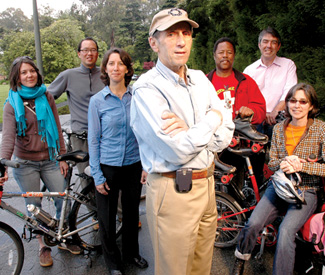
It wasn’t going well for Ted Strawser, predictably. The alternative transportation activist faced an uphill battle March 14 trying to convince a San Francisco Chamber of Commerce committee to endorse Healthy Saturdays, a plan to ban cars from part of Golden Gate Park.

Representatives of the park’s museums and Richmond District homeowners had just argued their case against the measure. “Visitors want access to our front door, and we want to give it to them,” Pat Kilduff, communications director for the Fine Arts Museums of San Francisco, indignantly told the group of two dozen business leaders gathered around a large conference table.

Strawser gave it his best shot: he talked about following the lead of other great cities to create car-free spaces; he said, “Golden Gate Park is one of the best parks in the nation, if not the world”; and he made a detailed case for closure. But around the table there were scowls, eye rolls, and other obvious signs that Strawser was being tolerated, not welcomed. Some — including chamber vice president Jim Lazarus — even started to interrupt and argue with him.

Then the man sitting next to Strawser spoke up. “I don’t think this is fair,” he said. And suddenly, everyone in the room shaped up. Strawser’s ally — his only supporter in the room — was somebody no chamber member could or would dismiss. Warren Hellman doesn’t shout or bang the table — but when he speaks, downtown pays attention.

Hellman, a prominent investment banker, told the committee members that he expected them to show the same respect for Strawser that they had for the previous two speakers. The nonsense ended, immediately.

And by the time Strawser turned the floor over to Hellman, the mood had changed. The group listened raptly, smiled, and nodded as Hellman spoke in his usual folksy, familiar, disarming style.

“It’s not a lot of fun when friends fall out,” he began, “because the previous speakers and many of you all agreed on the necessity of the garage [that was built in Golden Gate Park], and we worked together.”

He pointed out that many in the group had promised during the fall 2000 election to support Healthy Saturdays once the garage was built, although Hellman was now the only member of the coalition honoring that commitment. But he didn’t chide or shame his colleagues. That isn’t Hellman’s style.

Instead, he spoke their language. The garage has never been full and needs the money it can charge for parking to repay the bonds. This isn’t a fight that’s going away, since “part of the conflict is because this park is everybody’s park.” But there are “about 100 compromises not acceptable to either side that would move this forward.” And if a solution can’t be found, there will probably be an expensive ballot fight that nobody wants.

“My conclusion is we should attempt this test,” Hellman told the group. Ultimately, when the vote was later taken in secret, the chamber didn’t agree, although it did vote to back a trial closure after the California Academy of Sciences reopens next year.

At the meeting, Hellman openly called for Mayor Gavin Newsom to get involved in seeking a compromise, something Hellman said he had also just requested of the mayor at a one-on-one breakfast meeting. A couple of weeks later Newsom — who had already indicated his intention of vetoing the measure — did broker a compromise that was then approved by the Board of Supervisors.

As usual, Hellman didn’t take credit, content to quietly play a role in making San Francisco a better place.

Healthy Saturdays isn’t the most important issue in local history — but the significance of Hellman’s involvement can’t be underestimated. His alliance with the environmentalists and park advocates might even signal a sea change in San Francisco politics.

Warren Hellman represents San Francisco’s political and economic past. And maybe — as his intriguing actions of recent years suggest — its future.

This guy is a rich (in all senses of the word) and compelling figure who stands alone in this town. And even though his leadership role in downtown political circles has often placed him at odds with the Guardian, Hellman consented to a series of in-depth interviews over the past six months.

“Our family has been here since early in the 19th century, so we had real roots here,” Hellman told us. His great-grandfather founded Wells Fargo and survived an assassination attempt on California Street by a man who yelled, “Mr. Hellman, you’ve ruined my life,” before shooting a pistol and barely missing.

The Hellman family has been solidly ruling class ever since, rich and Republican, producing a long line of investment bankers like Warren.

Yet the 72-year-old comes off as more iconoclast than patrician, at least partly because of the influence of his irreverent parents, particularly his mother, Ruth, who died in 1971 in a scuba-diving accident in Cozumel, Mexico, at the age of 59. “She was entirely nuts,” Hellman said, going on to describe her World War II stint as a military flier in the Women’s Auxiliary Service Pilots and other colorful pursuits. “She just loved people, a little like I do. She collected people.”

Hellman grew up wealthy and cultured, but he also attended public schools, including Grant Grammar School and Lowell High School. In between, the young troublemaker did a stint at San Rafael Military Academy — “reform school for the rich,” as he called it — for stunts such as riding his horse to Sacramento on a whim.

After doing his undergraduate work at UC Berkeley, Hellman got his MBA from Harvard and went on to become, at the age of 26, the youngest partner ever at the prestigious Manhattan investment firm Lehman Bros. He developed into an übercapitalist in his own right and eventually returned home from New York and founded Hellman and Friedman LLC in San Francisco in 1984, establishing himself as the go-to financier for troubled corporations.

“He is really one of the pioneers of private equity,” said Mark Mosher, a longtime downtown political consultant and the executive director of Gov. Arnold Schwarzenegger’s California Commission on Jobs and Economic Growth, on which Hellman sits.

Hellman became what Business Week called “the Warren Buffett of the West Coast,” a man of extraordinary wealth and power. Among other accomplishments, Hellman took Levi Strauss private, recently made billions of dollars in profits selling DoubleClick to Google, and manages the assets of the California public employee retirement funds (CalPERS and CalSTRS), which are among the largest in the world.

Like many financial titans, Hellman has always been a generous philanthropist, giving to the arts, supporting schools in myriad ways, and funding the San Francisco Foundation and the San Francisco Free Clinic (which his children run). He vigorously competes in marathons and endurance equestrian events, often winning in his age bracket. And he has his humanizing passions, such as playing the five-string banjo and creating the popular Hardly Strictly Bluegrass festival.

But he’s also been a prime facilitator of downtown’s political power, which regularly flexes its muscle against progressive causes and still holds sway in the Mayor’s Office and other city hall power centers.

Hellman founded, funds, and is a board member of the Committee on Jobs, which is perhaps the city’s most influential downtown advocacy organization. Hellman and his friends Don Fisher, the founder of the Gap, and Sen. Dianne Feinstein also started SFSOS, which now wages the most vicious attacks on left-of-center candidates and causes.

When the de Young Museum and other cultural institutions were threatening to leave Golden Gate Park, Hellman almost single-handedly had an underground parking garage built for them, in the process destroying 100-year-old pedestrian tunnels and drawing scorn from the left. The Guardian called it “Hellman’s Hole.”

“We at the Bike Coalition very much started out on the opposite side of Warren Hellman,” San Francisco Bicycle Coalition executive director Leah Shahum told us. “We couldn’t have been more like oil and water on the garage issue.”

But over the past two years or so, Hellman’s profile has started to change. He went on to become an essential ally of the SFBC and other environmentalists and alternative transportation advocates who want to kick cars off JFK Drive in Golden Gate Park on weekends, crossing the downtown crowd in the process. He has shared his wealth with progressive groups such as Livable City, which often fights downtown, and has stuck up for edgy fun seekers over more conservative NIMBY types. He has also publicly repudiated the attacks of SFSOS and its spokesperson, Wade Randlett, and withdrawn his support from the group.

Hellman is still a Republican, but a thoughtful and liberal-minded one who opposed the Iraq War and wrote an article for Salon.com in February titled “If the United States Were a Company, Would George Bush Be Our CEO?” (His answer: hell no.) And to top it all off, Hellman sports a few tattoos and even attended 2006’s Burning Man Festival and plans to return this year.

Unguarded and reflective, Hellman’s comments to the Guardian foreshadow the possible future of capitalism and influence in San Francisco and point to potential political pathways that are just now beginning to emerge.

Our first conversation took place at the Guardian office two weeks before the November 2006 election, when it was starting to look like Nancy Pelosi had a good shot at becoming speaker of the House of Representatives.

“I think this election in two weeks is going to be really interesting,” Hellman told us.

This Republican was cheering for the Democrats to win. “They aren’t my kind of Republicans,” he said of the people in power. Hellman didn’t support the war or approve of how the Bush administration sold it, and he wanted Pelosi and the Democrats to hold someone accountable.

“What I’d like her to do is admit that we can’t get out [of Iraq immediately], but start to talk about what the fallout has been. Discuss the enormous cost in human life as well as money, and how it’s possible the war united the Middle East against us,” Hellman said.

The one thing he can’t abide is disingenuousness. Hellman speaks plainly and honestly, and he asked us to keep particularly caustic comments off the record only a few times during almost six hours’ worth of interviews. He was self-effacing about his political knowledge and seemed most interested in working through the problems of the day with people of goodwill.

Asked what he values most in the people he deals with, Hellman said, “It’s authenticity. Do they believe things because they believe in them, or do they believe in things because they’re cynical or they’re just trying to gain something?”

Locally, Hellman has reached out to people with varying worldviews and come to count many friends among those who regularly battle against downtown.

“I love to know people,” he said. “That’s probably the single thing that motivates me. When someone says to me, ‘How can you be friends with [then–head of SEIU Local 790] Josie Mooney?’ I say, ‘Look, I want to know Josie Mooney. And if she’s awful, then we won’t be friends.’ I’m just fascinated by getting to know people. And virtually always, they’re a little like Wagner operas: they’re better than they sound.”

Hellman was the chair of the Committee on Jobs when he got to know Mooney, who chaired the San Francisco Labor Council and was a natural political adversary for the pro-business group, particularly when Hellman was leading the fight to do away with the city’s gross receipts tax, which has proved to be costly for the city and a boon for downtown.

But after that victory, Hellman turned around and cochaired a campaign with Mooney to retool and reinstate the gross receipts tax in a way that he believed was more fair and helped restore the lost revenue to the city.

“We lost, but he put $100,000 of his own money into that campaign,” Mooney told us, noting that the proposed tax would have cost Hellman and Friedman around $70,000 a year. “I think he just thought the city needed the money. It was a substantive point of view, not a political point of view.”

Mooney considers Hellman both a friend and “an extraordinary human being…. He has made a huge contribution to San Franciscans that doesn’t relate to ideological issues. A tremendous thing about Warren is he’s not ideological, even in his political point of view…. On politics, I’d say he is becoming more progressive as he understands the issues that confront ordinary people.”

Mooney is one of the people who have helped bring him that awareness. When they first met, Mooney said, Hellman told her, “You’re the first union boss I ever met.” That might have been an epithet coming from some CEOs, but Hellman had a genuine interest in understanding her perspective and working with her.

“In a sense, I think that was a very good era in terms of cooperation between the Committee on Jobs and other elements of the city,” Hellman said. “Josie and I had already met, and we’d established this kind of logic where 80 percent of what we both want for the city we agree on, and 20 percent [of the time, we agree to disagree].”

Committee on Jobs executive director Nathan Nayman — who called Hellman “one of my favorite people in the world” — told us that Hellman feels more free than many executives to be his own person.

“He’s not with a publicly held company, and he doesn’t have to answer to shareholders,” Nayman said. “He takes a position and lives by his word. You don’t see many people like him in his income bracket.”

Hellman has become a trusted hub for San Franciscans of all political persuasions, Nayman said, “because he’s very genuine. He’s fully transparent in a city that likes to praise itself for transparency. What you see is what you get.”

Hellman expects the same from others, which is why he walked away from SFSOS (and convinced Feinstein to bolt as well) in disgust over Randlett’s scorched-earth style. Among other efforts, SFSOS was responsible for below-the-belt attacks on Sups. Chris Daly, Jake McGoldrick, and Gerardo Sandoval (whom a mailer inaccurately accused of anti-Semitism).

“If all things were equal, I’d just as soon that SFSOS went away,” Hellman said. “SFSOS started doing the opposite of what I thought they would be doing, so it was fairly easy for me to part company with them. What I thought we were doing is trying to figure out ways to make the city better, not just being an antagonistic, nay-saying attack organization. I’m not a huge fan of Gerardo Sandoval, but I thought the attacks on him were beyond anything I could imagine ever being in favor of myself. And it was a series of things like that, and I said I don’t want anything more to do with this.”

Downtown, they’re not always quite sure what to make of Hellman.

“Every once in a while, he does things that irritate people who are ideologically conservative,” Mosher said. “He took an immense amount of heat for supporting the Reiner initiative [which would have taxed the rich to fund universal preschool].”

He’s given countless hours and untold riches to public schools, doing everything from endowing programs to knocking on doors in support of bond measures and often pushing his colleagues to do the same.

“My connection to him has been through the school district, and he’s really been a prince,” Sup. Tom Ammiano said. “He has even stopped calling me antibusiness. He put a lot of his energy into improving public education, and so he shows it can be done.”

Progressives don’t always agree with Hellman, but they feel like they can trust him and even sometimes win him over. “If you get a relationship with him and you’re always honest about the facts and your own interests, he will listen, and that’s pretty remarkable,” Mooney said. “He shows a remarkable openness to people who have good ideas.”

His appreciation for people of all stripes often causes him to reject the conventional wisdom of his downtown allies, who viciously attacked the Green Party members of the Board of Education a few years ago.

“Everybody said, ‘Oh my god, Sarah Lipson, you know, she’s a Green Party member, she’s the furthest left-wing person on the board,’ blah, blah, blah,” he said. “And I phoned her up one day and said, ‘I’d really like to meet you.’ And she’s — leave aside the fact that I think she’s a very good person as a human being, but she’s a very thoughtful, analytic person. Listening to her opinions about things that are happening in the school district, I really respect that. I mean, what do I know about what’s going on in the school district? I know more now than I did then. But just getting to know people, and maybe get them to understand my point of view, which isn’t that penetrating.”

Many of his efforts have received little publicity, as when he saved the Great American Music Hall from closure by investing with Slim’s owner Boz Scaggs and helping him buy the troubled musical venue. “There are things that you and I don’t even have a clue that he has done,” Nayman said.

“He’s an interesting guy,” Mosher said. “He’s one of a dying breed, a liberal Republican. He has a social conscience and wants to use his money to do good.”

Actually, calling Hellman liberal might be going too far. In the end, he’s still very much a fiscal conservative. He doesn’t support rent control, district elections for the Board of Supervisors, taxing businesses to address social problems such as the lack of affordable health care, or limits on condo conversions.

He also opposes the requirement that employers provide health care coverage, which downtown entities are now suing the city to overturn, telling us, “In general, I don’t think it’s a good idea, because I’m still, even in my aging years, a believer that the marketplace works better than other things…. Universal health care I do believe in, but what I worry is that it’s going to be another damned bureaucracy and that it’s not going to work.”

Yet he doesn’t believe wealth is an indicator of worth, saying of his fortune, “It is luck. Most of what you do you aren’t better at than everyone.”

He doesn’t believe in the law of the jungle, in which the poor and weak must be sacrificed in the name of progress. In fact, he feels a strong obligation to the masses.

As he told us, “My mantra for capitalism — and I didn’t invent this, but I think it’s pretty good — is that capitalism won, and now we need to save the world from capitalism.”

Hellman looms large over downtown San Francisco. His Financial District office offers a panoramic view of the Bay Bridge, Treasure Island, the Ferry Building, and the rest of the city’s waterfront. He likes to be personally involved with his city and the companies in which Hellman and Friedman invests.

“Usually I’m directly involved,” he told us in an interview earlier this year. “I’ve always said that I don’t like to go to the racetrack to just look at the horses. The fun of being a principal is that you’re standing at the track and not saying, ‘Gee, that’s a beautiful gray horse.’ You’re saying, ‘Come on, he’s got to win!’ So I’m almost always invariably invested in the companies that we work with, either individually or through the firm.”

Unlike many Wall Street barons who strive to control a company and bring in new executives, flip it for a quick profit, or liquidate it, Hellman said his firm tries to identify solid companies and help facilitate what they do. “We don’t usually take over companies. I always think that we provide a service to help the businesses,” he said. “Our job is kind of the opposite of owning a factory. Our job is to be sure the people who run the business feel like it’s their business.”

Similarly, he thinks capitalists need to feel a sense of ownership over society’s problems, something he thinks is taking root in San Francisco and other economic centers, particularly among the younger generations. “It’s about understanding how much suffering there is on the other side and trying to figure out how that suffering can be alleviated,” he said. “I think it’s partly good economics that as you bring people up, they’re able to do more for society. If nothing else, they’re able to buy more and shop at a Wal-Mart or something — probably someplace you would wildly disapprove of — and buy goods and services. But I don’t think it’s that narrow.”

Rather, he believes that everyone has a little progressive in them, a little desire to cooperatively solve our collective problems rather than pass them off to future generations. He sees a marked change from his days at Lehman Bros.

“Everybody was into making it,” he said, noting that many capitalists then did charity work as a means of attaining social status but focused mostly on the accumulation of wealth. But, he said, the new generation of capitalists seems genuinely interested in improving the world.

“The feeling for giving back in the next generation, in the now 25- to 35-year-olds, it’s just an order-of-magnitude difference than it was for people who are now in their 40s and early 50s,” Hellman said. “I’m very encouraged.”

Yet the flip side is that, in Hellman’s view, downtown doesn’t wield as much power as it once did. Low political contribution limits have made politicians less dependent on downtown money, creating fewer shot callers, while democratizing tools such as the Internet have broadened the political dialogue.

“For the last 30 years we have become an increasingly tolerant city, and that’s great,” he said. “In the old days, [the Guardian] complained about downtown, and yeah, no shit, downtown really did control the city. The benefit was as that slipped away, the city became fairer and more open to argument. So now downtown hardly has any power at all anymore. In a sense, that’s a good thing. Tolerance grew tremendously when the city wasn’t dictated to.”

That tolerance caused street fairs to pop up all over town and festivals such as Hellman’s Hardly Strictly Bluegrass to blossom in Golden Gate Park. Bike lanes have taken space from cars, events such as Halloween in the Castro have gotten crazier, street protests have gotten bigger and more frequent, and people have felt more free to fly their freak flags. And all that freedom eventually triggered a backlash from groups of isolated NIMBYs who complain and often find sympathetic ears at city hall.

“Sometimes you get the feeling in this city that in the land of the tolerant, the intolerant are king,” said Hellman, whose festival has endured noise complaints even though the music is shut off by 7 p.m. “There is a continuing pressure to do away with fun, because fun is objectionable to someone, [but] we need to think about not creating a new dictatorship of a tiny group of people whose views are not in line with the opinion of most of the people of San Francisco…. You should try to balance the good of a lot of people versus the temporary annoyance of a few people.”

Preserving fun and a lively urban culture is a personal issue for Hellman, who plays the five-string banjo and calls his festival “the most enjoyable two days of the year for me.” He helps draw the biggest names in bluegrass music and acts like a kid in a candy shop during the event.

“I feel very strongly that an important part of our culture is built on the type of music and type of performance that goes on at Hardly Strictly Bluegrass,” Hellman said. From parables set to music to songs of struggle and the old union standards, “that kind of music is the conscience of our country.”

He considers bluegrass a vital and historically important form of political communication, more so than many of the upscale art forms that the rich tend to sponsor. “I’m glad that we have first-rate opera, but it’s equally important that we foster the kind of music, lyrics, etc., that support all this,” he said. “Somebody once said that most of the great Western philosophy is buried in the words of country songs. And that’s closer to the truth than most people think. A big passion of mine is to try to help — and people have defined it too narrowly — the kinds of music that I think have a hell of a lot to do with the good parts of our society.”

Perhaps surprisingly for a Republican venture capitalist from the older generation, Hellman also considers the countercultural freaks of San Francisco to be some of the “good parts of our society.” That’s why he attended Burning Man for the first time last year and why, he said, he loved it, as much for the culture and community as for the art.

“I went to Burning Man because as much as possible I want to experience everything,” he said. “I want to just see directly what it’s like. I knew I’d enjoy it. I never doubted that. But what really overwhelmed me is it was 40,000 people getting along with each other. I mean, it’s pretty intense. There were dust storms and the world’s most repulsive sight: nude men over 70 just dangling along. But I never saw an argument. It was 40,000 people just enjoying each other.”

It was most striking to Hellman because of the contrast with the rest of society. As he said, “I’ve never seen this country so divided.”

While Hellman supports Schwarzenegger — calling him “a good advertisement to California” — he has nothing good to say about his fellow Republican in the Oval Office. He calls Bush’s tenure “an absolute four-star disaster.” The invasion of Iraq is the most obvious problem, he said. “Our war policy has slowly veered from being ‘Don’t tread on me’ to we’re going to jump on your neck.”

But his antipathy to certain aspects of the Republican Party began even earlier, when the religious right began to take over.

“I thought we were not that polarized during the Clinton administration. I was somewhat encouraged,” Hellman said. “Maybe there was an undercurrent of strident religious behavior or strident conservatism, but not the conservatism that I think the Republican Party used to stand for, which was fiscal conservatism instead of social conservatism. Somehow, there was this angst in this country on the part of religious people who I guess felt this country was being taken away from them, and they were the kind of stalwart or underpinnings of society. And they took it back.”

But in the wake of that disaster, Hellman thinks, there is an opportunity for reasonable people of goodwill to set the future political course. As Nayman said of Hellman, “He does believe there is a middle way pretty much all the time.”

Politically, that’s why Hellman gravitates toward the moderates of both major parties, such as Schwarzenegger and Newsom. He looks for people who will marry his economic conservatism with a regard for things such as environmentalism and social justice.

“It’s very tough to be a big-city mayor,” Hellman said. “[Newsom is] probably the best mayor we’re entitled to. He’s got this fantastic balancing act.”

Hellman said downtown hasn’t been terribly happy with Newsom for supporting striking hotel workers, getting behind Ammiano’s health insurance mandate, supporting tax measures, and generally letting the Board of Supervisors set the city’s agenda for the past two years.

“Their measure is he has 80-percent-plus popularity, and he ought to spend some of it. Well, they might not agree with what he would spend it on. And he’s been unwilling to spend very much of it. In some parts of the business community there is disappointment with him, but I don’t think that’s right. He didn’t hide what he would be like.”

What Newsom said he would be — a big reason for his popularity — is a mayor for the new San Francisco, a place where the city’s traditional economic conservatism has been tempered by a greater democratization of power and an ascendant progressive movement that expects its issues to be addressed.

“I don’t like people who are intolerant,” Hellman said. “I don’t like people that are telling you something to get some outcome that, if you understood it, you probably wouldn’t want. I like people that are passionate.”

Asked, then, about Sup. Chris Daly, the nemesis of downtown and most definitely a man of strong political passions, he said, “I admire Chris Daly. I disagree with Chris on a lot of things he believes, but there are also probably a lot of things I would agree with Chris on. And I respect him.”

Hellman is the rare downtown power broker who wants to bridge the gap between Newsom — whom he calls a “moderate to conservative establishment person” — and progressives such as Daly, Mooney, and the Bicycle Coalition. The middle ground, he said, is often a very attractive place, as it was with Healthy Saturdays.

“I’m sure you spend time in the park on Sunday, and it’s a hell of a lot nicer in there on Sundays than Saturdays,” Hellman said. But even more important to him, this is about integrity and being true to what Golden Gate Park garage supporters promised back in 2000.

“They were proposing Saturday closing at that time, which I’ve always thought was a good idea,” he said. “And we made a commitment to them, or I thought we made a commitment to them, that let’s not have Saturday closure now, but as soon as the garage was done, we’d experiment with Saturday closure.”

We brought up what Fine Arts Museums board president Dede Wilsey has said of that pledge, that it was under different circumstances and that she never actually promised to support Saturday closure after the garage was completed.

“There’s a letter. She put it in writing,” he said of Wilsey. “She signed a letter on behalf of the museums saying that when the de Young is done, we should experiment with Saturday closings.”

The Bike Coalition’s Shahum said that even when Hellman was an enemy, he was a reasonable guy. But it’s in the past couple of years that she’s really come to appreciate the unique role he plays in San Francisco.

“He showed decency and respect toward us,” she said. “We never saw him as a villain, even though we disagreed completely. Later he really stepped up and has been a leader on Healthy Saturdays. And what I was most impressed with is that he was true to his word.”

Supervisor McGoldrick, who sponsored the measure, echoed the sentiment: “Hellman was certainly a man of his word who acted in a highly principled way.”

So why does Hellman now stand apart from the downtown crowd? Has he parted ways with the economic and cultural power brokers who were once his allies?

No, he said, “I think they parted ways with me.” *


Stationary biking

0

› steve@sfbg.com

This year’s Bike to Work Day, set for May 17, comes as San Francisco’s cycling network lies dormant in a court-imposed coma. The city isn’t allowed to make any physical improvements to promote safe bicycling until late next year at the earliest, more than two years after the injunction began. Yet that setback could be followed by the most rapid expansion of bike lanes in the city’s history.

At issue is the San Francisco Bicycle Plan and its stated goal of making "bicycling an integral part of daily life in San Francisco." City resident Rob Anderson and attorney Mary Miles don’t share that goal — particularly when it translates to taking lanes and parking spaces from cars — and they challenged the plan in court last year after it won unanimous approval from the Board of Supervisors and Mayor Gavin Newsom.

Ironically, this environmentally benign mode of transportation was attacked under the state’s landmark California Environmental Quality Act (CEQA), which requires detailed studies of projects that might have impacts on the environment and measures that can be taken to offset those impacts.

City officials and bike advocates were shocked last June when Judge James Warren — in his final ruling before his retirement — issued a sweeping injunction against bike projects in the city, which was upheld and reinforced when Judge Peter Busch heard the case in September.

The judges found that city officials had taken an impermissible shortcut around CEQA by claiming the bike plan was exempt from its strictures. As the plan was being developed, some bike advocates and city officials had called for more resources to be put into doing the detailed studies CEQA calls for, and that’s what now appears to be happening.

"The good thing about the lawsuit is it is forcing the city to do the traffic analysis that it should have done with the bike plan and it reveals the absurdity of our interpretation of environmental laws," Dave Snyder, the former executive director of the San Francisco Bicycle Coalition (SFBC), who is now a planner with the San Francisco Planning and Urban Research Association, told the Guardian.

Now city planners and consultants are preparing environmental impact reports (EIRs) on up to 60 proposed bike projects in the city, which will be queued up and ready to begin once the bike plan is approved. "The projects can be approved all at once," Snyder said.

At least, that’s what could happen if the city’s political leaders don’t lose their will to create a more bicycle-friendly city.

Oddly enough, it was the vague, feel-good nature of the plan that created all the problems.

Cities are required to have a bike plan, updated every five years, to qualify for certain state funding. San Francisco did its first plan in 1997, and in 2001 transportation officials and bike advocates set out to develop an updated version.

From the beginning, there were divisions between those who wanted to focus on completing the bike network with ready-to-go projects and those who wanted a more comprehensive and innovative plan laying out policies for education, enforcement, safety, new traffic models, integration with public transit, and everything else associated with cycling.

Responsibility for developing the plan was shared by the Metropolitan Transportation Authority (MTA), the San Francisco Planning Department, and the San Francisco Department of Parking and Traffic, with significant input from the city’s Bicycle Advisory Committee, the SFBC, and other groups. For reasons of expediency, the decision was made to focus on a relatively vague plan, one that made all sorts of high-minded statements and offered lofty goals.

The plan was presented as an effort to radically transform the roadways to make bicycling a more attractive option, but it didn’t include the detailed transportation analysis needed to support that effort — nor did it draw any conclusions about which car spaces to give over to bikes.

"The plan makes no decisions…. The plan has no measurable objectives anywhere in it," Snyder said, noting that the vague nature of the final product was the reason it was so uncontroversial. "Anytime anything passes unanimously, you know you didn’t ask for enough."

Andy Thornley was chair of the Bicycle Advisory Committee when work on the plan got under way and now serves as program director for the SFBC, which was heavily involved on outreach for the plan. SFBC officials were shocked by the injunction but said the city should have devoted more resources to the project.

"It was a logical outcome to the city’s undercommitment to the bike plan," Thornley said of the lawsuit. "There wasn’t the commitment from the mayor on down to doing this right."

"We had discussions about what it means that the plan doesn’t have any benchmarks," said Leah Shahum, executive director of the SFBC and a member of the MTA board. Sure, it had the goal of having 10 percent of all vehicle trips be by bicycle by the year 2010. "Only later did we realize that the 100 pages behind it didn’t support that goal."

MTA public affairs managers wouldn’t allow the Guardian to speak directly to Oliver Gajda, the main staffer on the bike plan then and now. They required questions in writing and answered the one about lack of city support for the initial plan by writing that "the court’s decision was not based on resource issues."

Newsom’s press secretary, Nathan Ballard, also resisted admitting that the city did anything wrong, responding in writing to a written question by saying, "Actually, the City moved forward drafting and implementing this bike plan quite ambitiously, even though there was a risk it would be challenged in court."

Yet it was clear to all involved that doing the traffic analysis and other work would have headed off the injunction.

"Dave Snyder was always an advocate that the bike plan should be a bike plan and lay out what we’ll see for bicyclists," Tom Radulovich, executive director of Livable City, told the Guardian. "But the decision was made to do a bike plan in the abstract, not laying out specific routes."

Nonetheless, bike advocates say they’re happy with the commitment that city officials are now showing. "Now we’re clearly and unequivocally doing a bike plan," Radulovich said. "To some degree, the city has had to commit itself."

Bevan Dufty, chair of the Transportation Authority’s Plans and Programs Committee, has been demanding that bureaucrats report to him regularly to show progress on the plan.

"I think the fact that we’re seeing them regularly trotted out before the committee is a good thing, because it makes them hit their benchmarks," he told us.

Dufty also overcame the MTA’s restrictive approach to public relations and facilitated our interview with Peter Albert, who took on the job of deputy director of planning for the MTA 10 months ago.

"Right now we’re just looking to do the environmental review to clear the bike plan," Albert told us.

He said that staff and consultants are now going through 60 proposed projects to determine what their environmental studies will entail. Later this month that work will be presented during a scoping meeting, at which planners and advocates will decide whether some of the more complex projects will be eliminated from the plan.

"Our goal is to make sure this is as solid an environmental review as possible. We don’t want to deal with any more legal issues," Albert said. "I feel right now there is a huge will to have this done correctly."

Yet advocates have a slightly different view of that political will, particularly given the projection of completed EIRs by July 2008, followed by the approval process, and maybe more court fights.

"We’re not crazy about the timing, but the scope is good. We’ve moved to projects that we’re planning to do," Thornley said. "So, in a backwards way, the commitment has come to the plan from the gun of the injunction."

"But we have real concerns about the timeline and scope getting shrunk," Shahum said. "Our fear is that we’ll go from 60 projects down to 16."

That’s because the plan will now look at the physical changes to roadways that are bound to get controversial once neighborhood groups grapple with the idea of losing traffic lanes or parking spaces.

"You’ve got a lot of people who are afraid of NIMBY opposition, and that goes from the mayor and the supervisors to the bureaucrats working on the plan," Shahum said. She added that the political leadership of San Francisco is more supportive of bicycling than it’s ever been, "but you still have to work really hard for them to do the right thing in the end."

"Why did it take four years to get the Valencia Street bike lanes?" she asked, noting that the project has proved to be an unqualified success.

"They changed Valencia Street, and nothing [bad] happened, so that opened them up a little," Radulovich said of city officials. But only a little. "There is still a certain ad hoc quality to what they’re doing, rather than being standards-based in how streets are designed."

City policy regarding bike projects — which the Planning Commission will revisit this summer when it considers changes to how it interprets traffic level-of-service (LOS) impacts under CEQA — is that anything that slows car traffic is considered a significant environmental impact that requires extensive study and mitigation.

"It’s imperative for them to fix the way they do CEQA," Radulovich said. "LOS reform would help us in future projects."

Radulovich said that most California cities were built with a focus on automobiles before CEQA was even approved. Yet the law now requires expensive and time-consuming studies before those spaces can be converted to use by public transit, bicycles, or pedestrians.

"That’s why, in some ways, CEQA has become an impediment to making us environmentally sustainable," Radulovich said. "It’s turned into a tool that slows down the taking of spaces back from cars."

While the detailed EIR work is being done, Albert and others say the city is still committed to doing bicycling planning work, applying for grants, and making sure San Francisco can move forward quickly once the injunction is lifted. "We’ve been set back, but we’re not stopped," he told us.

"The current injunction is frustrating because we want to be moving forward with bike improvements each month. While we cannot make physical changes such as bike lanes and bike racks, planning and design are continuing," Ballard said, also noting that the Mayor’s Office is doing regular conference calls to ensure the bike plan moves forward quickly.

"I and the bike advocates are pushing to use this time to do the planning work so we’re ready to go once we have an approved plan," said Sup. Chris Daly, the only regular cyclist on the Board of Supervisors. Once the injunction is lifted, he said, "You will have the most rapid striping of bike lanes in the history of the city." *

Deleting accountability

0

› amanda@sfbg.com

Public records are coming in pretty handy these days. Congress is using them to investigate the relationship between the Republican National Committee and the firing of eight attorneys general, and as with many investigations that use documents to uncover malfeasance, some key documents are missing — in this case Karl Rove e-mails.

It seems Mayor Gavin Newsom’s office also has a penchant for the delete key, according to findings of the city’s Sunshine Ordinance Task Force. Two complaints brought by citizens have been heard by the task force regarding how the mayor’s daily calendar is kept — or isn’t kept — and what happened to e-mails that disappeared after they were requested by a member of the public.

"We found there was willful and ongoing violations and destruction of records," task force chair Doug Comstock told the Guardian.

Staff in the Mayor’s Office say they didn’t do anything wrong and no willful destruction of public records has occurred. According to Joe Arellano of the Mayor’s Office of Communications, the e-mails — invitations sent out for the mayor’s Jan. 13 District 1 community policy forum — were purged because they were temporary.

"We have such a huge e-mail system, we have to delete e-mails that are transitory. These, to us, were the same kind of e-mails," Arellano said.

The case is on hold awaiting further information regarding the city’s capability to retrieve purged electronic documents and will be heard again by the task force. But the larger issue is whether Newsom is intentionally keeping his calendar a secret, in violation of city law.

The Mayor’s Office only makes public Newsom’s so-called Prop. G calendar, named for a 1999 ballot measure expanding the Sunshine Ordinance and explicitly making the mayor’s schedule a public record. It’s a stripped-down version of his list of appointments, often with only a couple events per day.

The Mayor’s Office has argued that Newsom’s complete calendar can’t be made public, citing security and privacy concerns. The task force disagrees and contends it’s a document that should be public, with redactions of security and privacy information as needed.

The Mayor’s Office disagrees. "The sunshine task force is wrong, and we are right," Newsom press secretary Nathan Ballard said. "The calendar we give to the public and press exceeds Prop. G."

Arellano, in a letter to the task force, described the other document as a "working calendar that is extremely detailed and accounts for his time from departure from home until his return in the evening. The working calendar contains not only the Mayor’s meeting schedule, but also confidential information such as the officers assigned to protect him, security contact numbers, the Mayor’s private schedule, details of his travel," and everything else that he’s doing.

"What they refuse to realize is they’re both public documents," Comstock said about the dual calendars.

Peter Scheer, executive director of the California First Amendment Coalition (CFAC), agrees that both calendars are public if they contain information about what the mayor’s doing with his city time.

"If they have security concerns, they can withhold particular items that would jeopardize the mayor’s security. There are certain things we can all agree on that can be withheld, certain driving routes and evasive strategies for emergency planning. But when the vehicle stops and he gets out for a meeting at an office, home, or place of business, that item has to be revealed," Scheer said. "If we’re talking about a calendar, there may be thousands of items, and only a handful may be subject to redaction. They can’t use the few to justify nondisclosure of the many."

But that’s precisely what the Mayor’s Office is doing.

The mayor, city attorney, and all department heads are required by Prop. G to reveal "the time and place of each meeting or event attended." The only exclusions may be "of purely personal or social events at which no city business is discussed and that do not take place at City Offices or at the offices or residences of people who do substantial business with or are otherwise substantially financially affected by actions of the city."

Therefore, a Prop. G calendar should contain everything a city official does every day in the course of working for the public. When asked if all the blank spaces on the Prop. G calendar represent personal time, Ballard said, "It could be personal. It could be other. It’s not anything we’re required to divulge under Prop. G."

But just because it should be there doesn’t mean it is. For example, the mayor’s calendar for the afternoon of April 19 shows him attending a library luncheon at 12:30 p.m., a phone interview at 2:30 p.m., and a 4 p.m. meeting with his chief of staff, followed by a Port Commission swearing in.

But we ran into Newsom coming out of a 2 p.m. Recreation and Park Commission meeting, where he spoke in support of more public art in the city. This event is not listed on his calendar. Ballard said the Prop. G calendar is sometimes amended to reflect changes. "I don’t have an android following him at all times. We’re just human beings working here."

"If he indeed was there, I will try to remedy that," Ballard added.

This scenario suggests other public business is also not being adequately tracked and Newsom’s real calendar could fill in the gaps, but the mayor’s computer software is set to automatically delete the working calendar after five days, destroying a record of what the mayor actually did.

Aside from any prurient interest in what the mayor is up to, an accurate record of events is a part of public accountability. Newsom’s calendar for the week of April 16 lists 31 meetings and events amounting to 25 1/2 hours at work. The city attorney’s Prop. G calendar is even more paltry. Between April 23 and 27, Dennis Herrera apparently attended 13 meetings and spent 11 1/2 hours working for the city.

Calendars are important public documents, Scheer says. "Most importantly, they give an insight into who has access to that public official." But, he says, "it’s only as revealing as it is complete."

Scheer and the CFAC are currently involved in a court case with San Bernardino County. The San Bernardino Sun sued the county for access to supervisors’ e-mails, memos, and calendars for a period of time last summer during a large fire that destroyed houses. Bill Postmus, the chair of the board of supervisors, appeared to be AWOL during the emergency, and reporters at the Sun sought relevant documents that might support Postmus’s claim that he was in contact with his staff at the time.

A judge ordered the records released, with redactions, and most officials have complied, except Postmus, who has convinced the county to hire outside counsel and appeal.

Back in San Francisco, the Mayor’s Office doesn’t seem to be sweating much about the next legal action regarding its records management. The task force does not have the power to levy fines or punishment, so the calendar case has been referred to the Ethics Commission, the district attorney, and the attorney general.

"We will be vindicated by the Ethics Commission," Ballard said. "The Ethics Commission will side with us." *

Cerebral vortex

0

> a&eletters@sfbg.com

Guy Maddin, that demented dealer in antiquities responsible for such cinematic curiosities as The Saddest Music in the World and the much-loved short The Heart of the World, has a new film showing at the Castro Theatre as part of the San Francisco International Film Festival. The semiautobiographical Brand upon the Brain! – a silent quasi-horror film about an orphanage that harvests life-giving brain juice from its wards – will be accompanied by a live orchestra, Foley artists, a castrato, and narration by local star Joan Chen. Maddin, winner of the Persistence of Vision Award at last year’s festival, spoke with the Guardian about his new film and a whole lot of other stuff.

SFBG How involved were you in orchestrating the live performance of Brand upon the Brain!?

GUY MADDIN Well, I was pretty involved in insisting on it. I really, really, really wanted it. In its first incarnation at the Toronto Film Festival, the directors of the festival were good about it. They were gracious, and they made it possible, and then it sort of set the standard for subsequent shows…. I never worried before. You know, when you’re a filmmaker, there’s something in the word film that almost seems to imply the creator is making it more for him or herself. But when you’re putting on a live event, you just automatically …

SFBG You think more about the audience?

GM Yeah, I’ve become more of a showman…. I sort of staged it as an event as a form of boredom insurance, because I do know that you only buy so much audience goodwill with live performances. But then that wasn’t enough for me – I had to add Foley and an interlocutor, and I’m lucky enough to know a bona fide castrato.

SFBG Wait, this is a bona fide castrato?

GM He is, but, well, you know, he wasn’t castrated by the pope [laughs] or anything like that…. He’s an old friend of mine, and I met him many years ago in a steam bath in Winnipeg. I just heard from out of the thick steam a very unearthly voice and for a few nanoseconds thought I was in the wrong steam bath. He sings in a boys’ choir still to this day even though he’s 45 years old. I think his voice just never changed.

SFBG What are you working on right now?

GM I’m pleased to tell you I’m finishing up a documentary on my hometown of Winnipeg. And I’m collaborating with a poet, John Ashbery, on a feature-length Internet interactive movie labyrinth, so that’s kind of exciting for me. And I’m also collaborating on a script in its early stages with Kazuo Ishiguro.

SFBG I heard on some commentary track that you put together features in 20 days or something nuts like that.

GM Yeah, I really like to work quickly. But though most people would never suspect this of me, I really care about scripts being in good shape. And I’m especially proud of the script for Brand upon the Brain!. I feel it’s accessible without at all compromising anything I’ve ever wanted to do. One thing I’ve learned how to do is to become more honest about myself, about how horrible a person I’ve been over the years, and somehow the more honest I am, the more literarily solid my scripts feel.

SFBG Yeah, that’s the dirty secret of film and literature: the nastier you are about yourself –

GM Yeah, the more self-loathing you are, the more self-loving you come off. In this case the protagonist in the movie is actually named Guy Maddin, so it enabled me to be supermasochistic. I just don’t have the imagination to think up the kind of things that are in this movie. There are things that I’ve just outed my family on.

SFBG Really?

GM It’s all there. I just don’t have the time or the genius to –

SFBG To think of nasty things that aren’t true?

GM Yeah, I just had to transplant them pell-mell and wholesale into the body of this thing, and then it was just a simple matter of putting them in order. *

BRAND UPON THE BRAIN

Mon/7, 8 p.m., $20

Castro Theatre

429 Castro, SF

www.castrotheatre.com

For a longer version of this interview and for short reviews of other films from the second week of the San Francisco International Film Festival, go to www.sfbg.com/blogs/pixel_vision.

MCMAF: Renaissance man

0

> johnny@sfbg.com

If Vincent Gallo turned himself into pure music, what would it sound like? For now, I know how the Gallo I’m talking with sounds: enthusiastic, upbeat – occasionally letting loose an endearing rascally cackle – and extremely alive. Over the course of a great couple hours, he’s raved rather than ranted, giving himself over to rapture while rapping about everyone from Joe Spinell (star of 1980’s gory Maniac and bit-part actor extraordinaire) to Michael Jackson. Vibe, connection, beautiful, and phenomenal are key words in the current Gallo lexicon, and his passion reaches its peak when he discusses RRIICCEE, his new group with Corey Lee Granet and Eric Erlandson, which will be premiering at this year’s Mission Creek Music and Arts Festival.

"I’m in love," Gallo says. "I’m so proud when we’re playing together. Not proud because I think we’re better, but proud I was able to make myself open in this way."

Openness has been key to Gallo’s music to date, as the snaky, at times Moondog-like press-record-and-play charms of his 2002 collection, Recordings of Music for Film (Warp), prove. While Gallo refers to those songs as "documents of creation," he’s still in the discovery process with his new band. To prioritize recording is to "be part of the problem of music," he says, paraphrasing what Erlandson told him during an encounter at a health food store that led to the group’s formation.

"Someone said today, ‘It sounds like a jam band,’ and that was the most gross comment I’ve ever heard in my life," Gallo goes on to clarify, lest anyone mistake his current activities for hoary hippy shtick. "A jam is a disorganized version of the most ordinary cliche habits – that’s the furthest thing from what we’re doing." While he’s quick to distinguish his current project from what he calls the "cabaret" mentality of big-name acts, the man also known as a cinematic lightning rod is out to divine something, perhaps something kindred to the current free-jazz renaissance: "Improv is not a good word [for what we’re doing]. It’s more a gesture of composing and performing at the same time."

The main difference between the Gallo I’m talking with and the one I briefly met during his 2004 road tour for The Brown Bunny is that this guy isn’t as road weary and battle scarred. Understandably so – it’s hard to think of a little movie that sparked such a big furor, not to mention so many misunderstandings. "To hear people say, ‘Oh brilliant, you made a film just so you could get blown,’ in a world where it’s so hard not to get blown," he says, with some exasperation.

I mention that long before he made The Brown Bunny, Gallo once compared its portrait of an unredeemable man to the one within Michael Powell’s 1960 Peeping Tom. "I guess it had a similar effect on that filmmaker’s career," he agrees. "People have a hard time swallowing a person like me. I evoke, I irritate in general. I wish that people liked me. I’m just not willing to become anything different to get that [approval]."

A little later, while discussing the way the media can directly distort some talented people’s sense of their own gifts, he utters a telling aside. "Maybe secretly I’m smart enough to know that even in what appear to be self-destructive gestures I have to solve the problem again."

The name Vincent Gallo might not fly to mind when the term likable is invoked, but in fact he’s a charming interview subject, as quip-flaired as Morrissey was once upon a time and genuinely humane in an old-school manner that differs from today’s era of abbreviated cell phone chats. Most of all, he’s in love, and not just with his new group. Tuxedo Moon, the collage artist Jess, the "high" beauty of Taj Mahal guitarist Jesse Ed Davis III, the 1970 movie The Only Game in Town, and the encyclopedic movie knowledge of Sage Stallone (Sly’s son) receive verbal bouquets over the course of our conversation. At one point he plays Jackson’s "I Can’t Help It" (from 1978’s Off the Wall) for me over the phone and says that he often cries when he listens to it.

"My creativity is always motivated by what’s missing, the same way it comes from what’s broken, what needs to be cleaned, what needs to be prepared because I don’t have it," he says, falling into an incantation. "It always comes from loss or from the seed of something that needs to be protected and grown."

Though still lodged in California, the man who made a point of emphasizing his total solo control over The Brown Bunny has moved on in spirit from that East Coast-to-West Coast journey. "If what I do is 50 billion times better than me, then it’s pure crap, because I’m just a jerk," he says. "When you get together with people and transcend yourself, it’s really an exciting moment, and that happened right away with this band." *

RRIICCEE

May 19, call for time and price

Q&A WITH VINCENT GALLO

May 20, call for time and price

Swedish American Music Hall

2174 Market, SF

(415) 861-5016

www.cafedunord.com

www.mcmf.com

MCMAF: The Dilettantes

0

Meeting up for an interview anywhere in the Haight in the middle of a Sunday afternoon is a bit of a dodgy prospect. With every easily distracted tourist and bumbling acid casualty in the city making random zigzags through the neighborhood, finding a clear path on the sidewalk is enough of a challenge, never mind finding a quiet place to talk. But there I am, in a booth at Magnolia’s, with the three songwriters of the Dilettantes, chatting away over beers without so much as a glance in the direction of all the scattershot energy reigning outside. Lesson? Miracles do happen, even in the Haight.

I’m mentioning the neighborhood because the Dilettantes identify so closely with it. Not only do most of the band members work and spend time here, but they also draw deeply from the Haight’s ’60s musical legacy. Sure, their music is filtered through four decades’ worth of post-psychedelic comedown, but the songs of Joel Gion, Jefferson Parker, and Brock Galland – accompanied by drummer KC Kozak and bassist Nick Marcantonio – follow the arcs and whirls of artists from that era, particularly their constant reference point: love.

Still, this is 2007, and San Francisco has changed. When I ask how the Haight inspires the group’s songwriting, Galland immediately says, "Well, the fumes that come off the sidewalk, definitely." Listening to the advance copy of their forthcoming album, 101 Tambourines (Stranger Touch), I see what he means – those flower power daisies have been glazed with curious oozing substances, as evidenced in their gritty garage pop. There’s a welcome sheen of grease to Galland’s clamorous "Kiss and Run," while Parker’s "Don’t You Ever Fall" parades with a slightly woozy majesty worthy of these streets. Gion’s "The Whole World" might jangle in Byrds-y formations, but it’s his unruffled Go Betweens-meet-Lou Reed delivery that attests that the times indeed have changed since the Summer of Love.

Perhaps these descriptions remind you of another band with whom Gion was associated: the tumultuous Brian Jonestown Massacre, led by the notoriously headstrong Anton Newcombe. Certainly both groups share sonic similarities, but Gion enthusiastically points out a major difference: "Jonestown was the singular vision of just one guy, while the Dilettantes are a completely collaborative, cooperative effort. Really, it’s a mutual appreciation society we have here. It’s great!"

Of course, that’s already obvious to me – I can see it in the brotherly ease with which they finish each other’s sentences. Parker sums it up: "One of the best things about being in the Dilettantes is that we’ve all helped each other grow as songwriters. We keep joking about re-creating one of those famous Brian Jonestown Massacre fights at the end of our shows, but really we just like and respect each other too much to ever do that." (Todd Lavoie)

CHAMBER STRINGS

With the Dilettantes and Persephone’s Bees

May 18, 9 p.m., $15

Cafe du Nord

2170 Market, SF

(415) 861-5016

Editor’s Notes

0

> tredmond@sfbg.com

The delegates to the annual California Democratic Party convention began trickling into the San Diego Convention Center on April 27, and one of the first people they saw was Barbara Cummings. She had stationed herself about a block away from the entrance and was holding a big "Impeach Bush and Cheney" sign.

"It’s wonderful," the San Diego activist told me. "The delegates all want their pictures taken with us. The tourists want pictures too."

Inside the convention hall, the grassroots sentiment was pretty similar. The black "impeach" lapel stickers were everywhere, hundreds of delegates wore black "impeach" T-shirts, and impeachment banners and signs flew everywhere.

Within official party circles, though, the mood was slightly different. Art Torres, the chair of the state party, told the press early on that he expected the war and impeachment to dominate the convention, but when I asked him if there was any disconnect between the party faithful calling for impeachment and House Speaker Nancy Pelosi saying that wasn’t an option, he simply said, "No. That’s the Democratic Party." He added, "We see a distance between the grass roots and the leadership. That’s not uncommon."

In many ways, that was the theme of this convention. The California Democratic Party is changing, in part driven by a new wave of young, Internet-savvy activists and bloggers who are practically screaming for respect. And the old guard is having a very hard time giving up control.

At the Resolutions Committee meeting April 27, Torres, a smooth operator with more than 30 years’ experience in party politics, gave a textbook demonstration of how the powers that be keep the grass roots in line.

On one level, the resolutions that get passed at these conventions don’t matter that much; they don’t have any binding authority. But they do express the official position of the state party, can put pressure on Democratic elected officials – and sometimes highlight the schisms in the famously fractious organization.

In this case, activists had put forward a half-dozen reform proposals that all had the same issue at heart: control of state party money.

Howard Dean took on the old guard nationally when he decided to put money into party-building efforts and candidates in all 50 states; his fans in California want to see the state party follow that model in all 58 counties. They also want more transparency in how the money is handled.

The state party chair, of course, keeps a lot of his power and authority by controlling that cash, and the legislative leaders keep their powerful posts and ensure the loyalty of their troops in part by determining which Democrats get the resources in election years.

The resolutions called for an outside audit of party money and a formal 58-county strategy. Before a single supporter of those measures had a chance to speak, the chair of the Resolutions Committee turned the floor over to Torres – who suggested the whole thing be referred to a new task force, which he would appoint, for consideration at some time in the future. The committee chair quickly called for a motion and a vote, and the panel – also all appointed by Torres – swept every party-reform resolution right off the table.

The same pattern played out with impeachment; a strong grassroots effort became a weak final resolution. As one committee member told me, "Speaker Pelosi is against impeachment, so we can’t really vote for it."

With the early California primary, the state convention was a big-time event. Seven presidential candidates showed up, more than had ever come to a state party event in history. There was a palpable feeling of energy at the convention, a sense that this time around, the Democrats might actually be ready to win the White House.

On the convention floor the mood was festive as Hillary Clinton strode through a side entrance and walked past a mob of supporters to the stage. Her speech was about what I expected – standard stump lines, but well delivered and full of energy. She had the crowd with her for about 10 minutes, until she mentioned Iraq – at which point the boos and catcalls began, the people in the seats got restive, and the mood was shattered. "She still won’t apologize," one young delegate told me, shaking her head.

Barack Obama looked like the rock star he is, jogging through the entrance with a huge smile. In person he looks like he’s barely out of his 20s – and his army, while smaller then Clinton’s, was more diverse and a lot younger. He’s a dynamic speaker and got a huge ovation when he announced that "I stood up in 2002, when it wasn’t popular to stand up, and said [the war] was a bad idea."

Obama split without talking to the press. Clinton arrived 20 minutes late to a packed press conference and said very little of note.

John Edwards, who spoke Sunday morning, April 29, got his own star treatment and demonstrated a key difference with Clinton when he announced that "I voted for this war, and I was wrong to vote for this war." He was also the only candidate who actually talked about poverty in America. He showed up on time for his press availability; I managed to get the first question.

"Senator," I said, "the 25 top hedge fund managers in this country made enough money between them last year to pay the salaries of all 88,000 New York City public school teachers for three years. I know you want to repeal the Bush tax cuts, but beyond that, shouldn’t we actually raise taxes on the very rich so we can pay the teachers a little better?"

"It’s a good question," he said, "and it’s worthy of consideration." But for now, Edwards won’t go beyond restoring the tax code to its Bill Clinton-era levels, which are still far, far too rewarding to the tiny segment of the country that earns and controls the vast majority of the income and wealth.

I got to ask Sen. Chris Dodd of Connecticut the same question; he kindly agreed to a private interview and gave me 10 minutes or so. He, like Edwards, was kinda sorta maybe willing to consider raising taxes on people who make upward of $250 million a year.

I suppose this is progress.

All the liberal bloggers came to the April 27 evening fundraiser for Jerry McNerney, who defeated Ricahrd Pombo, and Charlie Brown, a Democrat who wants to unseat John Doolittle in congressional District 4 (north of Sacramento). Brown is a favorite of the blogosphere; he’s also a candidate who was barely on the official party radar when he ran in 2006.

All that has changed dramatically – with Doolittle circling the drain and Brown showing surprising strength. Even Pelosi plugged him from the convention stage.

But the only elected official I saw at the fundraiser was Assemblymember Mark Leno.

The people in the room represented a very different approach to state politics. It’s not even an entirely ideological division; it’s more about a form of activism. The bloggers (who aren’t just writing about the party but trying to change it) are still the party outsiders now – but they’ve already raised more money for Brown than any other single source, mostly in small contributions. And I suspect that if he gets elected, he’ll remember the people who were there for him first.

The outsiders still don’t understand how all the hardball politics work at conventions, but they’re learning. They’re also emerging as a tremendous force in American politics, and in California they’re knocking, loudly, on the state party doors. And Art Torres is a fool if he thinks he’s not going to have to let them in. *

For much, much more on the state convention, go to the Guardian politics blog at www.sfbg.com/blogs/politics.

Dem Con 5 pm: Chris Dodd interview

0

By Tim Redmond

My first headline for this entry was “Angelides bores small crowd.” Poor guy — almost nobody is paying attention as the former candidate for governor makes an utterly uninspiring speech. Then it’s time for Chris Dodd, the senator from Connnecticut who has about as much support now in the polls (that is, very little) as Bill Clinton did at this point in his first presidential bid. (Dodd likes to point this out.)

No giant mobs with Dodd! signs, but he makes a decent speech, focusing perhaps a bit too much on his history and reminding everyone how long he’s been around. A few not-so-subtle Kennedy references, and a paen to the civic spirit of the 1960s (“that’s where we want to get back to.”)

He holds a press conference afterward, takes a question from me and says that he thinks the death penalty should be “reformed, not abandoned.” Then he tells a woman from an LA queer publication that he supports civil unions but not same-sex marriage. Why? “I’m not prepared to use the word ‘marriage’ as something for people of the same sex.'”

My brief private interview after the jump.

The departed

0

> a&eletters@sfbg.com

The idea that death is the great equalizer only seems true in the narrowest sense. As with life, it takes all kinds: romantic deaths and pointless ones, iconic casualties and anonymous mortalities. One might fairly expect a documentary about Paris’s Pere-Lachaise Cemetery to be a macabre portrait of death cults, given its status as a tourist trap. But Forever, the latest film by Heddy Honigmann, finds solace in more introspective rituals. It’s no surprise, then, that Honigmann forgoes Jim Morrison’s grave, though a Doors fan does wander by during an interview with three widows – one clucks that her husband will never be lonely with Morrison around and returns to her reverie.

For all the guru talk about the benefits of being in the moment, there is a different kind of heightened consciousness that comes with the temps perdu territory where memory and sensory detail intersect. Pere-Lachaise is of course famous for its artists, and so Forever is specifically concerned with the way art prompts this transubstantiation, though Honigmann casts a wide net in her interviews. Equivalences emerge between the way we internalize great art and how we carry forward memories of parents, lovers, and homelands. All the film’s conversations are about communion, and as such, subjects frequently blur: a concert pianist’s devotion to Frederic Chopin turns on her memories of her father; a woman explaining her husband’s death ends up reflecting on being forced out of Francisco Franco-era Spain; a former art student’s passion for Amedeo Modigliani’s transformative portraiture inspires his work as an embalmer.

For a documentary about a cemetery, Forever is remarkably attuned to the living; more surprising still, it avoids oppressive gloominess. This is partly a matter of the way Honigmann punctuates her interviews: with the pianist’s performance of Chopin, close-ups of carvings and notes left graveside, and carefully observed shots of women tending to the stones and watering the flowers. The cemetery footage is awash in daylight and spring; ambient sounds of birds and wind mean the frame might be sometimes lonely but never lifeless. Such poetic naturalism certainly softens the film’s light touch, though it’s only support for what is fundamentally a matter of disposition. The film spends a lot of time at Marcel Proust’s grave, and one admirer (dedicated to rendering In Search of Lost Time as a graphic novel) evocatively rhapsodizes about the author’s concept of involuntary memory: when a sensory detail takes us back in a way that supercedes ordinary recollection, we are in two places at once, overwhelmingly and truly.

This is the mood – ebullient, reflective – that Honigmann is after, and while it arrives naturally enough in these interviews, she’s not afraid to push her subjects to connect the dots of art, memory, and self. She also asks the questions that matter to her personally, which, as a Peruvian-born, Netherlands-based itinerant daughter of Holocaust survivors, have a lot to do with homeland and exile. She’s trod this ground before – especially in 1998’s The Underground Orchestra – and here she finds immigrants both buried and alive. When a reticent Iranian Frenchman describes author Sadegh Hedayat’s accomplishments in exile, Honigmann wonders aloud, "Why did you leave your country?" The taxi driver’s answer – that he was tired of the people around him – is wrenching in the context of the quiet cemetery, but Honigmann’s larger point is clear: one’s homeland can take on the same qualities as the dead, of being at once not there and so very there.

It’s a tricky thing Honigmann is doing, engaging people about a profoundly internal process with a documentary technique that’s necessarily obtrusive and spoken aloud. Her gift as a filmmaker lies in the moment-by-moment flow of interview and observation. Patience and curiosity: these are the stuff of Honigmann’s persistence of vision. An interview with a South Korean Proust admirer is exemplary in this regard. The young man struggles to answer Honigmann’s questions in English, and the filmmaker, sensing that language is acting as an unnecessary impediment of expression, asks her subject to tell her what he admires about the author in his own language. She doesn’t understand a word, and neither will most of the audience, but we get something greater in his effusive speech and gesture. Where there are ghosts so too is there spirit, over and over again in Forever. *

FOREVER May 2, 7 p.m., PFA

GOLDEN GATE PERSISTENCE OF VISION AWARD: AN EVENING WITH HEDDY HONIGMANN Includes a screening of Forever. Tues/1, 8 p.m., Kabuki

The paper trail

0

Below is a list of documents, in PDF format, that the Guardian obtained reutf8g to the Reilly case:

November 2006 memo from Reilly’s attorneys supporting motion for temporary restraining order against newspaper defendants. Originally filed under seal, this document contains a litany of internal memos and e-mails outlining distribution and advertising collaborations MediaNews and Hearst were discussing early last year. Famous April 26 letter appears on page six of this PDF, but plenty of other remarkable material is contained in this document as well.

November 2006 memo from Reilly’s attorneys supporting motion for temporary restraining order. Originally filed under seal.

November 2006 order from judge Illston granting Reilly’s request for a temporary restraining order related specifically to agreements between Hearst and MediaNews mentioned in the April 26 letter. On page 11, Illston notes that “increased efficiencies do not necessarily justify otherwise anti-competitive behavior.”

December 2006 memo from Reilly’s attorneys supporting motion for preliminary injunction. Originally filed under seal, this document showed that Hearst had once considered investing as much as a half-billion dollars in MediaNews stock. The temporary restraining order from November merely blocked the defendants from negotiating certain collaborations until Illston could decide whether to extend the ban until the time trial was scheduled, April 30, 2007, which Reilly’s attorneys succeeded in convincing her to do.

December 2006 memo from Reilly’s attorneys supporting motion for preliminary injunction. Originally filed under seal.

December 2006 memo from Reilly’s attorneys supporting motion for preliminary injunction. Originally filed under seal, this document contains the detailed September 2006 deposition of Hearst executive James M. Asher taken by the U.S. Justice Department during their probe of last summer’s major Bay Area newspaper transactions. The interview shows how Hearst had once breifly discussed selling the San Francisco Chronicle to MediaNews, and how for 10 years the two companies were pondering some sort of major investment opportunity.

December 2006 order from Illston granting Reilly’s request for a preliminary injunction against the newspaper defendants.

December 2006 motion by the Guardian and Media Alliance to intervene and unseal documents in Reailly’s suit against the newspapers.

April 2007 declaration from MediaNews president Joseph J. Lodovic IV asking Illston to keep under seal certain records tied to the defendants’ motion for summary judgment.

April 2007 motion from Gannet Co. also asking that records from the motion for summary judment remain sealed.

April 2007 proposed order from Gannet Co. and Stephens Group asking that certain financial documents in case be kept under seal.

April 2007 filing from MediaNews asking that records tied to the motion for summary judgment remain sealed.

April 2007 order denying the newspaper defendants’ motion for summary judgment and disputing their claim that Reilly had no standing to sue on antitrust grounds as a consumer.

April 2007 letter from attorneys of Media Alliance and the Guardian following up with Illston on open-records intervention.

April 2007 order from Illston proclaiming that key documents submitted as evidence at trial would largely be open to the public.

Small Business Awards 2007: Die-Hard Independent Award

0

In 2000, when Gary Erickson, founder and owner of Clif Bar and Co., told reps from Quaker Oats – the fourth largest consumer goods company in the world – that he needed to go for a walk before signing over his company for $120 million, they thought he was bluffing to secure a larger payout.

"He literally had his pen this close to the contract," recalls Sheryl O’Loughlin, outgoing CEO of the company, as she poises the tip of an ink pen a couple inches above a notepad at her desk. "The way he described it was that his hand started to shake. Something just didn’t feel right."

Erickson chewed over the life-changing dilemma as he walked the block surrounding his Berkeley office building. Did he honestly want to exchange an eight-year enterprise to produce and successfully market an appetizing assortment of energy bars and drinks for the life of an instant multimillionaire and all the attendant comforts it yields – mansions, shopping sprees, and exotic trips?

And how could the company founder not sell when the consensus among consultants, Erickson’s now ex-partner, and even some of his employees was that Clif Bar’s competitors would eat them alive if he didn’t? Deserting the Clif Bar empire before its fated downfall seemed to be the only logical move.

"Nestle had just bought PowerBar, which was really big at the time, and then Kraft bought Balance Bar," O’Loughlin explains. "So naturally there was a ton of pressure to sell, because we [supposedly] couldn’t make it on our own."

In spite of the risk or perhaps because of it, Erickson returned to his office with a new resolve and announced to the investment banker, lawyers, and his stunned partner that the deal was off. He then literally told them all to go home.

"I went from the darkest of dark to the highest of highs the moment I realized I didn’t have to sign that contract," marvels Erickson during a phone interview. The company founder – with his wife and partner, Kit Crawford – is resuming leadership of their company with just under 200 employees.

"I was more excited at that moment than probably any other moment of my life, aside from having children."

A year after ditching Quaker Oats at the altar, Erickson could identify another important reason why he did it. Although he and his partner were promised postacquisition roles in the company, as signing day neared it became clear that this was merely a typical sweet nothing often whispered in the midst of a seductive corporate takeover.

But once Quaker Oats unveiled its plan to move the Clif Bar operations to its offices in Chicago and told Erickson that his people in Berkeley would basically be out of their jobs, he got a whiff of the company’s true oats.

The decision invigorated Erickson and motivated him to define Clif Bar’s bottom line beyond its profits. He came up with what the company now refers to as the Five Aspirations: business, brand, planet, community, and people. This new mission galvanized the creators of Luna, Nectar, Mojo, and Builder’s bars to make 70 percent of each product organic and use biodiesel trucks between their bakery and destination centers.

On the community tip, Clif Bar donates approximately 1 percent of its net sales in the form of food, money, and volunteer time. Each employee volunteers at least 20 community service hours per year during paid work time, which can entail anything from assisting Habitat for Humanity in New Orleans to planting community gardens in Hunters Point.

Though a commitment to green practices and community service has boosted company morale, masseuses, salons, in-office rock climbing walls, personal trainers, and laundry facilities, among other staff perks, also serve to sustain Clif Bar’s people. How’s that for ulterior motives? (Angela J. Bass)

CLIF BAR AND CO.

1610 Fifth St., Berk.

1-800-254-3227

www.clifbar.com

Take 50

0

TAKE 50: SF INTERNATIONAL FILM FESTIVAL

THURS/26

*Golden Door (Emanuele Crialese, Italy/France, 2006). Epic in scope, playful in its stylistic shifts and tonal splices, and sumptuous in its painterly framing and use of light, Golden Door looks on an age-old American saga – an immigrant family’s crossing from the Old World to the new – with startlingly fresh, impassioned eyes. Director Emanuele Crialese (Respiro) turns his sometimes wry, sometimes tender focus on a band of illiterate Sicilian peasants drawn from their dirt-poor village by pre-Photoshop pictures of giant chickens and trees laden with enormous gold coins. Led by an intrepid yet ignorant patriarch (Respiro‘s Vincenzo Amato) and a comical spiritual fixer of a grandmother (Aurora Quattrocchi), the group is joined in steerage by a cryptic gentlewoman (Charlotte Gainsbourg). Ellis Island and its proto-eugenic experiments await – along with dream sequences that fluidly transmit the otherworldly magic of the villagers’ forthcoming American mystery tour. (Kimberly Chun)

7 p.m., Castro. Opening night film and party at City Hall, $85-$125

FRI/27

Black Sheep (Jonathan King, New Zealand, 2006). Something is going baaaaaad in Lord of the Rings country. The usual science experiment-gone-wrong results in the usual creature rampage, as sheep go George Romero on humans at a rural New Zealand ranch. This jolly, diverting, ultimately too-silly horror comedy from neophyte writer-director Jonathan King is duly funny. Still, it overstays its one-joke welcome by a bleat or three. (Dennis Harvey)

10:45 p.m., Kabuki

*A Few Days Later … (Niki Karimi, Iran, 2006). Already a star from her appearances in Tahmineh Milani’s overwrought – but much beloved – melodramas, Iranian actress Niki Karimi looked to the grand master, Abbas Kiarostami, for directing inspiration. In this, her second feature, she beautifully captures a specific brand of avoidance and understatement. She plays Shahrzad, a mousy graphic designer who becomes distracted at work. At home her answering machine constantly squawks about her family’s health and well-being, and her annoying neighbor (Behzad Dorani, from Kiarostami’s The Wind Will Carry Us) keeps parking his giant SUV in her space. To her credit, Karimi never shows the expected hospital scenes, tearful good-byes, or tense confrontations that seem to be looming. Instead, she retreats inside the character’s head and brings the film to a stunningly private conclusion. (Jeffrey M. Anderson)

7:15 p.m., PFA. Also Sun/29, 12:15 p.m., Kabuki; Mon/30, 6:45 p.m., Kabuki

Murch (David and Edie Ichioka, England/US, 2006). Codirector Edie Ichioka is a disciple of legendary film and sound editor Walter Murch (Apocalypse Now, The English Patient), so you know this doc will be nothing less than a glowing portrait. But instead of a simple glorification, it is more an embellished interview (complete with jump cuts during the talking head portions), with Murch using an astounding array of metaphors – besides the obvious "editing is like putting together a puzzle," he also works in painters, sock puppets, kidney transplants, and dream therapy, among others – to explain his approach to his craft. As Murch proves, a talented editor can make a good film great and a great film a masterpiece; it all comes down to an intangible combination of technical skill, sense of rhythm, and artistic instinct. (Cheryl Eddy)

9 p.m., SFMOMA. Also Sun/29, 4:15 p.m., Castro; Tues/1, 1 p.m., Kabuki; May 5, 3:30 p.m., PFA

*Slumming (Michael Glawogger, Austria/Switzerland, 2006). Two arrogant yuppie pranksters (August Diehl and Michael Ostrowski) cruise around verbally pigeonholing others, making playthings of them. Meanwhile, a drunken, derelict poet (Paulus Manker) wanders the streets alternately cajoling and ranting at people. When the pranksters find the poet passed out on a bus station bench, they decide to transport him to a similar spot across the border, without a passport. Director Michael Glawogger (Workingman’s Death) and cowriter Barbara Albert achieve a pleasurable quirky quality with their black comedy, carefully guiding it between the precious and the preachy; they sometimes amusingly present a joke’s payoff before the setup. The film passes easily between immaculate cafes and slush-covered highways, but at its center is Manker’s wonderfully cantankerous performance. (Anderson)

9:30 p.m., Kabuki. Also Sat/28, 1:30 p.m., Kabuki; May 5, 8:30 p.m., SFMOMA; May 7, 6:30 p.m., Aquarius

SAT/28

*All in This Tea (Les Blank and Gina Leibrecht, US, 2006). Tea still has an effete connotation in this country, but David Lee Hoffman is an adventurer of the old order. An unabashed partisan of the fair drink, he regularly travels to China to ferret out farmers and distributors, sampling and savoring the Old World leaves. His dedication is total; we’re hardly surprised when Werner Herzog drops by Hoffman’s Marin home for a spot of tea, because the director is a connoisseur of aficionados, explorers, and cranks. Hoffman is capably eccentric but also unassuming, making All in This Tea a friendly primer. Codirectors Les Blank and Gina Leibrecht bring their usual ethnographic grace to this 10-years-in-the-making project. (Goldberg)

1:30 p.m., PFA. Also Sun/29, 4:45 p.m., Kabuki; May 2, 4 p.m., Kabuki

*At the Edge: New Experimental Cinema (various). Experimental showcases are always an Achilles heel for film festivals big on narrative. They’re often shoehorned with tepid concessions to so-called innovation, although sometimes they yield moments of genuine surprise. This showcase has a bit of both. Paul Clipson’s Super 8 trip of blurred urban lightscapes looks through Stan Brakhage’s kaleidoscope but can’t see beyond it. On the other hand, the sleep of reason produces monsters (slavery, social Darwinism) and some beautiful animation in Atlantis Unbound, in which Lori Hiris morphs her black-and-white charcoal sketches – evoking the mystical art of William Blake or Austin Osman Spare – of 19th-century scientists into slaves, merfolk, and other beings from beyond the pale of the Enlightenment. The banality of evil is also evoked in Xavier Lukomski’s static shots of the serene Drina River Bridge, where, as the voice-over informs us, Bosnians dredged up the victims of genocide. When viewed through a long shot, the horrors of history become more pronounced, given their calm surroundings. (Matt Sussman)

8:30 p.m., PFA. Also Tues/1, 6:15 p.m., Kabuki

*Carved Out of Pavement: The Work of Rob Nilsson On the brink of 70, longtime SF filmmaker Rob Nilsson is astonishingly prolific. No less than four work-in-progress features will be excerpted in this tribute program, including some from the nearly completed "9@Night" series of interwoven fictions made with the Tenderloin Action Group. For all his invention and industry in production, Nilsson hasn’t exactly worked overtime getting his movies seen – except at the Mill Valley Film Festival, where you can count on one or two premiering each fall. The MVFF is copresenting this special show, which will have the filmmaker reviewing a career that stretches back to the mid-’70s SF CineAction collective and 1979’s Cannes Camera d’Or-winning Northern Lights, as well as discussing latter-day digital projects with numerous current collaborators, also present. Excerpts from "9@Night" will also be projected on the SFIFF’s Justin Herman Plaza outdoor screen May 1 to 3. (Harvey)

7 p.m., Kabuki

Fabricating Tom Ze (Decio Matos Jr., Brazil, 2006). Though typically grouped with the explosive Brazilian Tropicalismo movement, Tom Ze has always been too much of an eccentric to fall properly into line. It’s a point made abundantly clear in Fabricating Tom Ze (I still haven’t figured out the title), a generally awestruck doc that makes up for its thin content with plenty of Ze’s indefatigable, abundant speech. Between the interruptions, self-mythologizing, and creative suggestions for the film’s director (all of which Decio Matos Jr. takes), Ze spills over with quixotic, brilliant epigrams on creativity and authenticity. "I have to make a small invention every time I have an idea worthy of becoming music," he reports – as if there were any doubting his inventiveness. (Goldberg)

1 p.m., SFMOMA. Also Tues/1, 8;30 p.m., El Rio; May 6, 3:30 p.m., Kabuki; May 9, 6:30 p.m., Aquarius

*Hana (Hirokazu Kore-eda, Japan, 2006). Hirokazu Kore-eda’s gentle deconstruction of that venerable institution of Japanese film the samurai movie isn’t too much of a departure from his previous features. Hana also focuses on the small, unexpected sense of community that arises out of idiosyncratic responses to tragedy or, in this case, the public’s hunger for it. It’s 1702, and like other underemployed samurai during peacetime, Sozaemon Aoki (Okada Junichi) is restless, as is the general population, which gorges itself on violent revenge plays and romanticized notions of honor. The pensive Sozaemon is bent on carrying out his duty to avenge his father’s death, even if he seems more at home tutoring the kids in the hardscrabble but lively tenement where he lives. His neighbors, who initially tease him about his lack of guts, eventually rally round his failures – and their own lowly status – and celebrate the humble resolve. To paraphrase resident dimwit Mago (Kimura Yuichi), when life gives you shit, make rice cakes. (Sussman)

4:30 p.m., Kabuki. Also May 2, 6:45 p.m.; and May 5, 5:45 p.m., PFA

*The Island (Pavel Lounguine, Russia, 2006). Not to be confused with Michael Bay’s jiggly, blow-’em-up, organ-harvesting gesture toward Logan’s Run. If Andrei Tarkovsky’s movies were lit by God, then The Island sets God to work creating an austere black-and-white landscape of unforgiving snow, rocky shores, hills of coal, and blighted driftwood. By all appearances a mad monk but in this reality a truth-talking, faith-healing saint of sorts, Father Anatoly is doing penance on the island for a wartime act that most reasonable deities would excuse. No such luck for this Russian Orthodox overseer – wearisome monastery politics and the teary negotiations of the sick and injured occupy the sooty savant in this elegantly wrought parable, which puts cheesy stateside Biblesploitation big-budgeters such as The Reckoning to shame. (Chun)

4:15 p.m., Kabuki. Also May 2, 6:45 p.m., Kabuki; May 3, 3:30 p.m., Kabuki

Once (John Carney, Ireland, 2006). A genuine sleeper at Sundance, this small Irish indie charmer will be spoiled only if you swallow all advance hype about its purported brilliance. Sometimes nice is quite enough. Real-life singer-songwriters Glen Hansard and Marketa Irglova play struggling Dublin musicians, one a native busker still living above Da’s vacuum repair shop, the other a Czech emigre supporting her family by selling flowers on the street. Their slow-burning romance is more musical than carnal, climaxing in a studio recording session. Writer-director John Carney’s film manages to play like a full-blown musical without anyone ever bursting into song. Instead, the appealing original folk rock tunes played and sound-tracked here come off as vivid commentary on a platonic (yet frissony) central relationship. (Harvey)

7:15 p.m., Kabuki. Also May 6, 9:30 p.m., Clay

Protagonist (Jessica Yu, US, 2006). Jessica Yu, the Oscar-winning director of the 1996 short documentary Breathing Lessons (she also made 2004’s In the Realms of the Unreal, a haunting look at outsider artist Henry Darger), returns with Protagonist, an initially confusing but ultimately fascinating doc about four men who couldn’t be more dissimilar on the surface. How can the themes of classical Greek tragedy link a Mexican bank robber, a German terrorist, a reluctantly gay Christian, and an aggro martial artist? Yu uses puppet interludes, revealing interviews, and a keen eye for detail as she traces their shared stages of provocation, rage, doubt, catharsis, and so on – proving the journey of an antihero has little to do with setting, be it ancient or modern. (Eddy)

6:15 p.m., SFMOMA. Also Mon/30, 4:15 p.m., Kabuki; Tues/1, 9:15 p.m., Kabuki

*Strange Culture (Lynn Hershman Leeson, US, 2006). The duly strange, as yet unresolved case of SUNY Buffalo art professor Steve Kurtz has spurred local filmmaker Lynn Hershman Leeson’s best feature to date, a documentary-dramatization hybrid. With the man himself still legally restrained from discussing his circumstances, Thomas Jay Ryan plays Kurtz, who as a founding member of the multimedia Critical Art Ensemble had long made work focusing on social justice issues and the intersection between science and government. To create an exhibition on biotechnology, he acquired for carefully safety-measured display some bacteria samples readily available online. When wife of 27 years Hope (played by Tilda Swinton) unexpectedly died of heart failure in her sleep, emergency medical personnel grew suspicious of these unusual art supplies. Soon FBI personnel evicted the distraught widower from his home, quarantined the entire block, and accused him of possessing bioterrorist weapons of mass destruction during an incredibly cloddish investigation. Kurtz’s real-life colleagues and friends were interviewed in a free-ranging yet pointed feature whose actors also step out of character to articulate their concern about the government’s post-9/11 crackdown on dissent, even the rarefied gallery kind. (Harvey)

6 p.m., Castro. Also May 4, 8: 45 p.m., SFMOMA; May 8, 7 p.m., PFA

SUN/29

The End and the Beginning (Eduardo Coutinho, Brazil, 2006). Picking a small town at random and making a film about its residents can be brave filmmaking. It can also be plain lazy, as is the case with Brazilian filmmaker Eduardo Coutinho’s directionless profile of rural Aracas, in the state of Paraiba. Unsurprisingly, people being people, he finds great interview subjects, but he doesn’t bother to connect them to one another or to the town. Only their highly region-specific Catholicism provides any unifying thread. And though Coutinho’s not exactly condescending (beyond some slight Kids Say the Darndest Things baiting of his loonier interviewees), there’s an unspoken mandate to keep things simple: his response to one woman’s enticing hint at her failed law practice is to ask about her sewing. (Jason Shamai)

7:15 p.m., Kabuki. Also Tues/1, 3:30 p.m., Kabuki; May 3, 4 p.m., Kabuki

*Singapore Dreaming (Yen Yen Woo and Colin Goh, Singapore, 2006). With their second feature, Yen Yen Woo and Colin Goh have their hearts in the right place while their eyes are on the prize of capturing a postcolonial city-state clutching at the global economy. The gently humorous, humanist realism of Edward Yang comes to mind while watching this husband-and-wife directorial team’s warm, witty depiction of the everyday lives of a working-class Singapore family who live, dream, bicker in pidgin English and Mandarin, and inhale vast quantities of herbal tea in their high-rise project. Pops buys lottery tickets, hoping to move into a slick new condo. Back from his studies in the States, the pampered son is discovering that in go-go Singapore his degree isn’t quite as covetable as it once was, and the beleaguered daughter is in her final trimester, coping with a demanding yuppie boss and a slacker hubby who yearns to be in a carefree rock band and pees in his father-in-law’s elevator. When disaster strikes, no one is thinking about the matriarch, whose only seeming desire is to properly feed and water her brood, but she ends up providing some unexpected feminist substance, rather than sustenance, under the movie’s wise gaze. (Chun)

8:30 p.m., Kabuki. Also May 4, 1 p.m., Kabuki; May 5, 3 p.m., Kabuki

12 Labors (Ricardo Elias, Brazil, 2006). Part Black Orpheus, part 400 Blows, 12 Labors is a Brazilian feature that revisits the myth of Hercules through the story of a motorcycle messenger’s rehabilitation. A kid from a rough part of Sao Paulo, Heracles gets out of juvie and tries to start a new life. To land a job as a motorcycle messenger, he has a trial day with (you guessed it) a dozen jobs to complete. An artist who never knew his father, he also writes origin stories in comic book form, which mystify his coworkers. Though Heracles’s experiences seem tinted with divinity, he inspires worry on the part of the viewer. Since all good myths have moral purpose, this one finally addresses the very current social issue of juvenile delinquency and rehabilitation in urban Brazil. (Sara Schieron)

9:30 p.m., Kabuki. Also Mon/30, 7 p.m., Kabuki; May 5, 4:30 p.m., Kabuki; May 7, 9:15 p.m., Aquarius

MON/30

*Broken English (Zoe Cassavetes, USA, 2006). "I don’t think Hollywood knows what to do with me," Parker Posey recently opined, despite having a prominent role in Superman Returns. Fortunately for us, Amerindie cinema does still know what to do with her. The SFIFF is hosting a double bill of the pushing-40 actor’s latest, reprising the title figure in Hal Hartley’s Henry Fool sequel Fay Grim and starring in Zoe Cassavetes’s feature debut. Posey is perfect as director-scenarist Cassavetes’s superficially cheery but highly insecure NYC hotelier. Some may think this low-key seriocomedy paces pat single-gal-searching paths – from Helen Gurley Brown’s Sex and the Single Girl to Sex and the City – but in its thoughtful nature and serious treatment of a clinical-depression interlude it roams well outside stock terrain. Even if the fade-out waxes a tad improbably happily-ever-after, Posey’s nuanced performance will make you root for it. (Harvey)

6:30 p.m., Kabuki. Also May 2, 2 p.m., Kabuki

Fay Grim (Hal Hartley, USA/Germany, 2006). A decade ago Hal Hartley made his best movie, the practically epic – by this miniaturist’s standards – Henry Fool. By most estimates it’s been downhill ever since. They love him in France – but perhaps he should never have left Long Island. So it was heartening news to hear he was returning to the world of Henry Fool, better still to know the sequel would revolve around the title character’s scrappy, vulnerable abandoned wife, Fay, who provided one of Parker Posey’s finest hours. She’s still good here, natch, but Fay Grim is all over the map – literally. The convoluted story line journeys from a mild farcical take on espionage thrillers to a murkily serious commentary on world politics. It’s watchable, but once again one gets the sense that with Hartley, the wider his focus, the blurrier it gets. (Harvey)

9:15 p.m., Kabuki. Also May 3, 9:10 p.m., PFA

TUES/1

Congorama (Philippe Falardeau, Canada/Belgium/France, 2006). Quebec writer-director Philippe Falardeau’s story of a revolutionary electric car and a sticky-fingered inventor is part of that ever-widening army of films that plant fairly obvious and poorly integrated details into the first act so that later, when the story is retold from another perspective, they reappear with more context to click Aha!-ingly into place. Though some of the big, unwieldy reveals are a lot of fun in a Lost sort of way, they distract from the more prosaic but more satisfying concerns of the film’s smartly drawn characters. The inventor, for instance, is a not particularly likable person who still has a believably loving, humor-filled relationship with his family. Now talk about a novel concept! (Shamai)

6 p.m., Kabuki. Also May 2, 9:15 p.m., PFA; May 6, 6:30 p.m., Aquarius

Private Fears in Public Places (Alain Resnais, France/Italy, 2006). Alain Resnais’s 17th feature is dreamy and sometimes enchanting, though it doesn’t warrant comparison to the knife-sharp moral plays made during his prime, such as Hiroshima Mon Amour and Last Year at Marienbad. Adapted from a play by Alain Ayckbourn (the two previously collaborated on Smoking and No Smoking), Private Fears in Public Places weaves the love(less) stories of a half dozen Parisians; plotlines intersect, but in light brushes rather than the solemn collisions of Babel and Crash). The artifice Resnais imposes on his film is poetic in miniature – the camera, for example, periodically floats above the set, filming actors as if they were in a dollhouse – but the sum total is stultifying, unhinging an already-adrift narration and making Private Fears in Public Places seem needlessly opaque. (Goldberg)

7 p.m., PFA. Also May 3, 6:15 p.m., Kabuki; May 7, 4 p.m., Kabuki

*Rocket Science (Jeffrey Blitz, USA, 2006). Promising to be the next best coming-of-age cultie with its sure-handed, sharp performances and Freaks and Geeks-like sobriety, Rocket Science finds new agony and indie rock-laced ecstasy in one miserable adolescent’s progress. Or to be specific, one stuttering, 98-pound weakling’s marked, often laugh-out-loud funny lack of progress. The high school years for Hal Hefner (compulsively watchable frail cutie-pie Reece Thompson) seem to be going from bad to sexy once he gets recruited for the school debate team by scarily driven, Tracy Flick-esque champ Ginny (Anna Kendrick). But his travails never quite end even as he attempts to extract nerd revenge and literally find his voice, accompanied by vintage Violent Femmes and hand-clapping quirk pop by Eef Barzelay of Clem Snide. Tapping memories connected to a speech impediment, Spellbound codirector Jeffrey Blitz turns tongue-tied prince Hal’s articulation struggles into the perfect metaphor for every awkward teen’s gropes toward individuation. (Chun)

4 p.m., Kabuki. Also May 4, 6:15 p.m., Clay

Peeling out with Trans Am’s Phil Manley

0

Trans Am, dude. Powerful, proggy, electro, rockin’ – what don’t these guys do? Once based in DC, now living all over the place, all over your face, Trans Am rev up their tour tonight, April 21, at Bottom of the Hill, 1233 17th St., SF; (415) 621-4455. Zombi and Black Taj open the all-ages Green Apple Music Festival-sponsored show; the music starts at 10:00 p.m. Lay $14 down.

transam3sml.jpg

No doubt the venue is all-too-familiar sight for Trans Am-er Phil Manley, who might be found behind the mixing board on occasion. Manley moved to San Francisco a few years ago, and he took a little time out while tooling round South Carolina to chat recently. The friendly 33-year-old musician and audio engineer inquired about my recent car break-in, which scuttled our first attempt at an interview, and revealed that he too lives in the city’s Western Addition district. “I used to live in the Mission but there’s too many fixed gear bikes,” he said jokingly. “It actually doesn’t bug me, but I did see a funny bumper the other day – ‘One less fixie.’ Kinda hilarious and kinda harsh.”

Her lip gloss be poppin’

0

Lil Mama — I love you and your gloss. Baby Pride!

If I can score an interview with her, I’ll totally freak out. I’ll get lip gloss all on the receiver. L’Oreal! MAC! Watermelon Crush!

No, stooopid – it’s the Stooges! More Ron Asheton chatter

1

Stooges guitarist Ron Asheton is something of a renowned rock god and raconteur of note – the 5-foot-11, blue-eyed Cancer certainly knows how to roll with the punches and spin a tale, even briefly, when not in the shadow of the still great, astonishingly limber Iggy Pop.

stooges-picfirst.jpg
The original model of the Stooges, circa 1969: Scott Asheton (from left), Ron Asheton, Dave Alexander, and Iggy Pop.

Me and Duncan Scott Davidson went off on our fave band in print this week; here’s more of an interview with him, on the phone from the family home he once shared with his bro, Stooges drummer Scott Asheton, in Ann Arbor, Mich.

stoogesnew.jpg
The last three standing Stooges these days: Ron Asheton (from left), Iggy Pop, and Scott Asheton.

Guardian: How does it feel to be on the road now with the fully reunited Stooges?

Ron Asheton: We played in the states before, but only spotty jobs here and there — Jones Beach and some benefit in Manhattan and Roseland. We did All Tomorrow’s Parties in Long Beach but this is the frist time we’re going out here. I know that the Europeans are great — I always say that “I wanna Be Your Dog” is the NEW French national anthem. Because the French love the Stooges so much. We go there so much.

The pigs are alright

0

FILM Rejoice, fans of smart, sharp, genre-tweaking comedy: Hot Fuzz — the latest from Shaun of the Dead writer-director Edgar Wright, cowriter-star Simon Pegg, and costar–slacker extraordinaire Nick Frost — has arrived. Pegg plays a London supercop whose makes-everyone-else-look-bad ways get him shunted to a small town where policing is limited to underage drinking and escaped swans. Or is it? Hot Fuzz apes British cop shows and American blockbusters that take law enforcement to explosive levels, including the singularly silly Bad Boys II. Recently, I sat down with the trio to get the buzz on Fuzz.

SFBG Considering Shaun‘s popularity, do you think people were surprised you didn’t make another horror movie or a sequel?

EDGAR WRIGHT I think, because every film takes three years essentially to make, to spend six years of our lives on the same idea would have been a mistake. We have so many stories to tell that you just want to keep moving on.

NICK FROST Most of the [Shaun] characters died, as well.

SIMON PEGG Plus I don’t think we wanted to be specifically tied to one genre — even if we do comedies every time — and be known as the guys who do horror comedy. It would be nice to flip between genres and types of comedy as well.

SFBG I was watching the trailers before The Hills Have Eyes 2, and someone yelled out, "Shaun of the Dead!" when the Hot Fuzz preview came on.

SP I don’t think Hot Fuzz would have been such an easy sell over here if it had been our first film, because even though it ends up being much more American than Shaun of the Dead is, it’s also much more British than Shaun of the Dead is. What we’re kind of hoping is that the groundswell of support for that film, which seemed to take place mainly on DVD, will be the thing that brings people to Hot Fuzz. I’ve been amazed at how many people have seen Shaun of the Dead.

SFBG What do people say when they see you on the street?

NF [Noo Yawk accent] Hey, Shaun of the Dead, right here!

SP I ran into someone on the Sunset Strip who was wearing a Shaun of the Dead T-shirt. He was a bit stunned, and so was I. (Cheryl Eddy)

Hot Fuzz opens April 20 in Bay Area theaters. For an extended interview with its creators, click here.

Resurrection blues

0

› kimberly@sfbg.com

Sure it’s all about puppy love, music-geek boners, and clean-cut strangers offering to be their dog now, but as Iggy Pop declared during a crowded onstage interview at this year’s South by Southwest fest in Austin, Texas, back when the once-decried Stooges first burst blown-out, bratty, and oozing monosyllabic menace, bristly distortion, and snotty attitude from Ann Arbor, Mich., "the two things were, ‘They can’t play.’ " He gestured toward the two other surviving original Stooges, guitarist Ron Asheton and his brother, drummer Scott, then nodded almost imperceptibly toward himself. "And ‘We hate him!’ "

Thirty-four years after the Stooges called it quits the last time around, that animosity was absent the next night as the Stooges packed the dirt expanses of Stubb’s in Austin. The Stooges’ first two albums, 1968’s self-titled debut and 1970’s Fun House (both Elektra), left an indelible, grotesque yet groovy, brutal bruise on rock’s flower-power posterior with the most proudly primal and corrosive art rock ever generated by smarter-than-they-looked-or-sounded troglodytes enamored of the dirty blues, garage rock, and free jazz. And now it looked like the surprisingly mixed mob at Stubb’s of T-shirted record collectors, black-garbed rockers, shaggy hipsters, gray-haired codgers with pasteled wifeys, buttoned-down frat boys, and straightened-haired patrician blonds was all in on the joke and the joy of still-powerful songs such as "1969" and "TV Eye." A deeply tanned, limber Pop undulated above the mass, flailing and bounding like a bronze lizard made of bubble gum and Motor City tire rubber, seemingly swallowed by the crowd, then spat back out while the Ashetons, Mike Watt on bass, and Pacifica resident Steve Mackay on sax punched through bleeding, blighted versions of "No Fun" and "Loose."

Still, you couldn’t help tearing your peepers away from arguably the finest rock combo ever to roll off Detroit-area assembly lines to wonder who were all these people? Deeply closeted Stooges fans who wore out the grooves of their gatefold Fun Houses in the dark beside dank jocks and dusty sneaks? Surely there were more Three Stooges Usenet newsgroups than Stooges message boards? If you weren’t even born when a band first came around, does the connection you forge with the group and its work still count as nostalgia?

What does someone in the middle of the Stooges reunion storm, such as Ron Asheton, feel about the newbs and the love lavished even as the band fails to gather enough votes to be inducted into the Rock and Roll Hall of Fame despite multiple nominations?

"It’s the best time. It’s superfine," the 58-year-old Asheton says from Ann Arbor. "Especially since the audiences are more receptive than they’ve been in the past. They know the songs. It’s kind of like the world has caught up with the Stooges."

Between playing with bands such as Destroy All Monsters and acting in low-budget horror flicks such as Mosquito, Asheton — a born raconteur given to wicked, basso profundo Pop impersonations and swoopingly dramatic vocal flourishes — has been holding down the inherited Asheton family homestead as the only remaining Stooge left in Michigan while Scott and Pop spend most of the year in Florida. He was prepping for the start of the reunited Stooges’ first full US tour and looking forward to working on the 30 or so additional songs written during the making of The Weirdness.

SFBG Why do you still live in Michigan?

RON ASHETON I love it. It’s a beautiful state. I love the Great Lakes, and I have a place on Lake Heron that I get to go to infrequently. When I was younger, we moved so much that when I finally got to Michigan, I said when I was 14, [miming a pouty teen] ‘I’m never moving again!’ Though I did live in California for six years when Main Man Management took the Stooges to LA — being here was like being in the backwater rather than being close to the action when you’re young and stupid!

SFBG How do you feel about The Weirdness?

RA When I listen to it, I can’t just listen to it once — I really do, it’s true! — I listen to it twice, and I picture people in the summertime, riding in the cars or sitting by the campfire on the beach or having a backyard party.

It was really fun to do it differently than in the past, where with the first record, we had one week. I never heard the record till it was actually in the stores. The second, Fun House — I heard the acetate shortly before it was released, and that only took two weeks. This one took three weeks, and I got to be one of the producers.

SFBG Why weren’t you able to listen to The Stooges before it came out?

RA That’s the way record companies dealt with things. It was just taken out of our hands after we were done — "You kids are dismissed! Leave the room!" The producer [John Cale] and the owner [Jac Holzman] of the record company took the record, and they got a new toy! "Yeah, I paid for it! I can do whatever I want with it!" So it was very smart of Iggy to want to have control of the new record.

SFBG The Stooges always wrote songs based from the start on your guitar riffs. How did you develop the songs this time?

RA We did it on this also. The only difference now was it was concentrated — going down to Florida and me walking in the building, plugging in my guitar, and starting to play. Iggy lurking about — same thing. Coming up with things just off the top of my head, and Iggy saying, "Hey, I like that!"

SFBG How would you describe the Stooges’ dynamic, writing and playing together?

RA I think part of it is we actually grew up together. Being teenagers and deciding to get a band house and getting that first summer sublet and finally getting kicked out of there and moving on and getting another place, that common bond of doing everything together. We literally ate dinner together, went out, cruised the town, went to parties, knowing we were part of the birth of that ugly baby the Stooges! *

STOOGES

Thurs/19 and Sat/21, 8 p.m., $39.50–$45

Warfield

982 Market, SF

(415) 775-7722

For more from Ron Asheton, go to www.sfbg.com/blogs/music.

Save the green planet

0

› a&eletters@sfbg.com

With I Don’t Want to Sleep Alone, Taiwanese director Tsai Ming-liang has made something of a modern silent movie. I didn’t count, but I am pretty sure there are only a handful of words (if not less) spoken by the movie’s main characters. Taking the place of dialogue is ambient noise — snippets from a Cantonese opera, a Malaysian news report, a talk show in Mandarin — and most of all, unadulterated silence. With communication perpetually out of reach, it is no wonder alienation is such a major theme in Tsai’s films. Visually, the director is all about stationary long shots and understatement. He fashions an environment that dwarfs and suppresses its inhabitants.

In many instances this environment is literally ecological. Pollution, contamination, unknown illnesses, and inexplicable catastrophes run deep in Tsai’s world: in 1997’s The River, the main character contracts a nagging, stubborn neck pain after being in a filthy river (the causality, however, is never made explicit). His peripatetic quest for a treatment leads to a denouement of son-and-father bonding in a gay sex club. The Hole, Tsai’s 1998 follow-up, imagines Taipei after a deadly and unknown pandemic strikes; the entire city is emptied out but for two people, surviving unbeknownst to each other. Taipei is once again under ecological threat in 2005’s The Wayward Cloud as a dire water shortage drives people to eat watermelons for liquid sustenance.

Similarly, the Kuala Lumpur of I Don’t Want to Sleep Alone is not doing too well. In one scene a noxious haze blankets the city, generated by a wildfire in Indonesia that has been blown across the Strait of Malacca. People are warned to stay inside or wear masks if they have to venture out. Unfortunately, there is a mask shortage, so plastic bags and disposable Styrofoam bowls are deployed as makeshift substitutes.

"It is a truthful reflection of the world we live in at this moment," Tsai says during an interview when asked about the scenarios of ecological trouble in his films. "We are living in a moment [when] the world is actually sick. For example, the fire you see in this film [I Don’t Want to Sleep Alone] is something that Malaysians and the countries around Malaysia have to face every year. It is a real problem that has a lot of repercussions — not just environmental but also social and economical."

In a sense, the intersection of these outcomes is embodied in the massive unfinished construction site that serves as a kind of structural centerpiece in the film. Located in the middle of Kuala Lumpur, the building to be, along with many others, was started during an economic boom in the country. In the late 1990s the Asian financial crisis devastated the entire region, and the project was left unfinished and abandoned. The foreign laborers brought into Malaysia to help build it instantly became jobless.

Tsai first saw the structure in 1999 when he visited Malaysia, his birth country. Six years later he decided to enter the site for the first time. What he found was a giant pool of dark water — a collection of rain, soot, and runoff that had gathered inside the building over the course of years.

Water, of course, is Tsai’s preferred element; his first three features — Rebels of the Neon God (1992), Vive l’Amour (1994), and The River — are known as his water trilogy. Tsai has said before that he sees his characters as plants and their loneliness as a sort of thirst that needs constant watering. As such, discovering that large body of water within a gutted structure was, to him, an unmistakable sign. "I saw the water and decided I had to make a film at that place," Tsai says. "I felt the water was waiting for me to come back." *

I DON’T WANT TO SLEEP ALONE

Thurs/19–Sat/21, 7 and 9 p.m.; Sun/22, 4 and 7 p.m.; $6–$8

Yerba Buena Center for the Arts Screening Room

701 Mission, SF

(415) 978-2787

www.ybca.org

>

We shall over come ourselves

0

› a&eletters@sfbg.com

Nearly all the imagery we’re fed when it comes to understanding or imagining issues reutf8g to race in the United States comes from the civil rights era. No doubt that was a critical moment in American history, but it should go without saying that the road home can’t be found on an outdated map. The idea that "we shall overcome" is nice, but in reality different times have created different conceptions of who "we" are, what we’re overcoming, and how we will accomplish it.

It stands to reason that the problem tends to follow our playwrights onstage. The challenges and potential payoffs found in Tanya Barfield’s Blue Door (at the Berkeley Repertory Theatre, directed by actor Delroy Lindo) and the American Conservatory Theater production of Philip Kan Gotanda’s After the War (see "Home Run: After the War Lucidly Strikes Home," 4/4/07) are different, as if the writers had looked at the bag of tricks they’d been handed and consciously decided to make their own tools. Daily life — onstage and off — has been littered with lazy and self-serving, formulaic attempts to explore nearly every question reutf8g to race. What is most satisfying about Blue Door and After the War is that each asks fresh questions that are difficult and important.

Barfield’s multicharacter, two-actor play focuses on a troubled African American math professor struggling to deny the single fact that most shapes his interactions with the world — he’s hit bottom so hard that his white wife is pushing him to participate in the Million Man March as a way to get in touch with himself. As a result, his career is on the rocks, as are his marriage and his relationship with his family. His daily life gives way to a surreal sleepless night during which he’s visited by relatives, including some who were slaves, an experience that forces him to admit that his present and future have been shaped by the past.

Gotanda has created an ad hoc family of post–World War II refugees who share space in a boardinghouse in what was — before the war — San Francisco’s Japanese neighborhood. Six years later things are considerably different; the war’s over, and African Americans have moved into the Fillmore District housing vacated by interned Japanese Americans. As the original residents struggle to find and rebuild their community, politicians and developers have plans that don’t include black and Japanese American — or any marginalized — San Franciscans.

Gotanda’s multiracial, multinational menagerie lives under the roof of a young jazz musician named Chester Monkawa. Monkawa is a long way from today’s stereotypical hypersuccessful model minority. But although Gotanda’s created his share of outcasts and rebels over the years, what’s different about After the War is the difficulty the assembled characters have in dealing with each other. They’re a happy family when things are going well, but when the pendulum swings the other way, they go with what’s familiar — seeing race as life’s fundamental building block.

It’s refreshing to see After the War and Blue Door raise questions without ready-made answers, but that fact speaks to the problems their playwrights face. If such issues were easily dealt with onstage, we’d be doing a better job with them offstage as well. In fact, it takes a lot of money and an almost pathological reservoir of self-delusion for anyone to deny that America is a long way from addressing its ills. Nevertheless, it’s encouraging to see what Barfield and Gotanda — one young and black, the other a veteran Japanese American playwright — are doing. *

AFTER THE WAR

Through April 22

See stage listings for info

BLUE DOOR

Through May 20

See stage listings for showtimes, $33–$61

Berkeley Repertory Theatre

2025 Addison, Berk.

(510) 647-2949

www.berkeleyrep.org

For an interview with Delroy Lindo, go to Pixel Vision at www.sfbg.com/blogs/pixel_vision.

Endless things

0

› johnny@sfbg.com

Into the past or on to the future? That’s the push-pull current that charges the Junior Boys. The tension is even casually present during an interview with the Canadian duo’s singer and veteran member, Jeremy Greenspan. Discussing the ’80s new wave influences floating through the second Junior Boys album, 2006’s So This Is Goodbye (Domino), Greenspan stresses that he discovered such sounds through dance music — Goldie sampling Japan, for example — rather than stadium rock or indie rock, and then declares, "I listen to OMD and Ultravox and Japan and Simple Minds and hear a lot of potential for new and exciting things." Yet later, when the conversation turns to So This Is Goodbye‘s lyrics, he says, "For me the central theme of the album is nostalgia."

Greenspan isn’t contradicting himself. One of the rich pleasures of So This Is Goodbye, a rare modern-day recording that keeps on giving in the manner of a well-crafted album, is the way it delves deep into music and personal memories from decades past while also crafting a signature sound. One of its best tracks, "Count Souvenirs," blooms from the instantly haunting chime motif Greenspan and partner Matt Didemus create, a melody that echoes Depeche Mode’s "Strangelove." Yet the subtlety of Greenspan’s singing and his words could give Dave Gahan a lesson in how to channel the crooner era without being as tacky as an endless engagement in Las Vegas purgatory.

"I had this idea of our record being a kind of electronic crooner record," says Greenspan, who cites the likes of Nat King Cole, Chet Baker, and Frank Sinatra as inspirations. An arctic cover of one of Sinatra’s staple sad ballads, the Sammy Cahn–Jimmy van Heusen composition "When No One Cares," is perhaps So This Is Goodbye‘s major fulcrum, with lyrics that hook backward into the titles of songs that precede it, such as the trinket-obsessed "Count Souvenirs" and the deathly call for affection "Like a Child," in which Perrey and Kingsley–like blips slowly give way to ghostly harmonies.

A mordant, morbid sensibility has long been dominant within the Junior Boys. This is a group that titled its debut Last Exit (Kin, 2004) and has now given a new EP of remixes the name Dead Horse (Domino, 2007). Loss and melancholy are a major part of the duo’s history — Greenspan’s original partner, Johnny Dark, departed before they’d finished a full-length recording, and Nick Kilroy, a friend who ran the group’s original label, Kin, died in 2005. So This Is Goodbye begins with "Double Shadow," whose core image suggests both self-recrimination and a sense of being haunted. "I suppose there is some Freudian way of reading it as a song directed inward," Greenspan says when asked about the track, which builds to a taut climax, at which its complex syncopation seems to turn inside out.

As an interview subject, Greenspan has a flair for dramatic phrasing that is comparatively subdued in his Junior Boys lyrics. He discusses styles of vocalization and the direct sensuality of his speech-based approach in comparison to current singing clichés, targeting "the U2 syndrome" (of "trying to sound as big and histrionic as possible") and "the American Idol effect" (in which "whoever can sing the loudest with the most notes" is deemed especially emotional). There is a Morrissey-esque quality to some of his pronouncements, such as his early Smiths–like notion that "love songs never accurately portray what love and sex is all about."

Morrissey could use a songwriting partner as creatively sympathetic as Didemus, whose relatively silent presence seems to have helped Greenspan as a singer and a figurehead. His voice is front and center more often and more assuredly within his own vast, spare arrangements. It’s no wonder a kindred neodisco spirit such as Metro Area’s Morgan Geist has recently called on him for vocals. "I think for modern bands of all descriptions, the tendency is to push the vocal as another instrument in the mix," Greenspan observes. "But with [So This Is Goodbye], I had more confidence. Listening to crooner records, I noticed how present the vocals can be, so I kept pushing my own voice louder and louder while mixing." Subtly rising up out of the past and away from loss — that’s the current sound, and the voice, of the Junior Boys. *

JUNIOR BOYS

April 25, 9 p.m.

Mezzanine

444 Jessie, SF

(415) 625-8880

www.mezzaninesf.com

>

Apichatpong Weerasethakul on disasters and black magic

0

Whereas David Lynch at times uses all the excesses of a bad rock video to give form to the dream logic that structures his films, Apichatpong "Joe" Weerasethakul creates quietly evocative reveries. Pierced by moments of sharp humor and unexpected beauty, Apichatpong’s movies are imbued with a sense of openness, a responsive flexibility that allows their course to be redirected by serendipitous forces: a song, memories, folk tales. On the eve of the theatrical premiere of his new Syndromes and a Century, I called him on the phone.

SFBG What sort of movies did you watch growing up?

APICHATPONG WEERASETHAKUL In the ’70s I watched a lot of old Thai films and American films. At the time there were all the catastrophe movies, like Earthquake or Towering Inferno — I love those movies! And then there were [Steven] Spielberg’s and [George] Lucas’s films. I was really into their special effects.

SFBG In an interview you did with the Web site Criticine, you said movies are a form of black magic. I was really taken with that quote.

AW I don’t know if there’s a message there. But for me the power of film is not just to hypnotize. It’s a kind of magic for living as well. I have to be able to express [myself] as a filmmaker, otherwise it’s very hard to share my ideas or feelings. [Film is] like medicine, but it’s not. So maybe that’s a way in which there is some magic going on. (Matt Sussman)

To read a longer Q&A with Apichatpong Weerasethakul, go to the Pixel Vision blog at www.sfbg.com/blogs/pixel_vision.

A hammer, a pizza guy, and $60

0

› gwschulz@sfbg.com

When Darius Simms walked into Department 25 at the Hall of Justice late last year, dressed in the orange cottons inmates wear at the county’s downtown jail, he received some good news. He was being released.

The bad news was that he was still going to be punished for something a judge said she was pretty sure he didn’t do.

Simms had been on probation when he was arrested for allegedly bashing in the head of a pizza delivery driver for $60. But the District Attorney’s Office couldn’t make a criminal case against him, and the charges of assault, attempted murder, and robbery were dropped.

Still, on the advice of his lawyer, Simms accepted a deal that extended his probation until 2009 just to escape the hoosegow — essentially on the grounds that the normal rules of the criminal justice system don’t count for those on probation, innocent or not.

The way California’s probation system works, it doesn’t matter if law enforcement proves an ex-con committed a crime. Just getting arrested can mean trouble.

It is, one defense lawyer told us, a "dirty little secret" of criminal prosecutions in the state.

The prosecutors may not have a case to take to a jury, in which a defendant is innocent until proved guilty and the evidence has to be proved beyond a reasonable doubt. But they can send people on probation, such as Simms, to jail anyway, and that requires only a hearing before a judge.

"It’s not 12 people agreeing. It’s one," Robert Dunlap, the defense attorney for Simms, told the Guardian. "And it’s not beyond a reasonable doubt, it’s by a preponderance of the evidence. It’s a lower standard of proof."

Deputy district attorney Jim Thompson insisted that Simms was guilty even though he lacked proof, and he wanted to railroad the 26-year-old Western Addition native into more jail time.

Sitting behind the prosecutor that day in the gallery of Department 25 was a man named Tony Portillo. If Simms’s defense attorney hadn’t negotiated an extended probation for his client, Portillo would likely have testified that Simms pounded the pizza driver with what Portillo says was a wood-handled, iron-head hammer — the same testimony Portillo gave during a preliminary hearing for Simms in September 2006.

Portillo was the people’s main witness, an auto mechanic who the DA’s Office had originally believed would help keep Simms behind bars for what Thompson described as a "heinous" crime.

But case number 194817 reveals just how quickly the roles can alternate in Superior Court and how the probation status of a defendant can make a mess of the legal system.

FOR THE PEOPLE


For several months Portillo had been restoring a 1973 Dodge Challenger for his pal Apollo Pacheco’s girlfriend. The car was kept in the garage of Pacheco’s home, on 47th Avenue in the Sunset.

The 28-year-old Portillo has an unassuming stature at two inches shy of six feet and boasts an "SF" tattoo on his right arm. On April 4, 2006, he was in Pacheco’s garage working on the Challenger’s floorboards, wheelhouse, and one of the quarter panels. Portillo says he had seen Simms around the neighborhood, and the day before, Simms stopped by to ask if Portillo was willing to sell his car, which was sitting in Pacheco’s driveway. "He seemed like a fine individual," Portillo would later testify.

Simms is heavyset at six-foot-one and at the time had a short moustache and beard. He’s no stranger to the Hall of Justice. In fact, the very law enforcement office that would later try to pin him for attempted murder had sent him to the Sunset in the first place. He was supposed to be living quietly with his mother by the beach in a witness protection program, poised to testify against a man who’d allegedly shot him five times.

When the Guardian reached Portillo in person, he declined to speak on the record, but he did tell police inspectors that Simms lied at the time of their meeting by telling him he was 22. Simms, who is now 27, was also on probation for a handful of robbery and battery cases stemming from 2001.

The sale of Portillo’s junker never happened, but Simms returned the next day, and Portillo asked for help removing the Challenger’s rear window. "He was there basically for company," Portillo told the court. Throughout that second day the two talked over cans of Olde English, at which point the story began to turn.

According to court records, at some time during the afternoon, Portillo slunk into the house and stole from the fridge a rum drink prepared by Pacheco’s roommate, Ted Langlais. Langlais discovered the theft later, and the two would clash over it.

After sharing the rum, Portillo realized he needed to run to the Kragen Auto Parts store on Taraval and buy a new piece for his welder. On his way out, he asked Langlais for money, who testified that he said no.

Two young women who were visiting stayed behind at Pacheco’s house, where Langlais was painting their nails. (One of the two girls is a witness in the case, but we are concealing her name because she’s a minor. Portillo testified he believed she was Simms’s girlfriend.)

Simms, Portillo, and the girl congregated back at the garage around 7 or 8 p.m. Simms and the girl wanted to order pizza. Portillo promised to pitch in five dollars. After a period during which Portillo stated he was gathering his tools and cleaning up, the pizza arrived.

"I was washing my hands to get ready to eat," Portillo later testified. "I heard a knock on the garage. The garage was slightly open. I looked up. I saw [Simms]. I heard a thump. I looked over. I saw him striking the pizza delivery person with the blunt object."

The pizza guy, Marco Maluf, was screaming, and Simms was telling him to shut up, Portillo told inspectors the night it happened. Maluf had $60 cash on him, which he would later testify was taken.

Simms and his friend left on foot down 47th Avenue. Portillo was in shock and didn’t know what to do. He reported that he collected his tools and threw them into his car.

"Ted came down, and he said, ‘Dude, why is this guy bleeding all over my floor?’ " Portillo told the inspectors. "And I go, ‘I don’t know, Ted. Ask, ask them,’ " pointing toward the couple walking away. He didn’t call 911 but drove back toward his home in the Portola District. He called a childhood friend, a firefighter at Station 42 on San Bruno Avenue named Michael Guajardo, to ask for help. Guajardo encouraged him to go to the Taraval police station, where inspectors recorded Portillo’s version of the story.

He told the inspectors Simms called him afterward to tell him about the $60. "Dude, don’t call me again, dude," Portillo said he told Simms. "We’re done. Don’t ever — we’re done. You fucked up."

Five days later Simms was arrested for the attack. He told police interrogators that he wasn’t in the garage when the pizza arrived. Portillo, he said then, had given him and the remaining girl a ride to his house up the street. But Simms eventually admitted to police he’d returned to the garage with the girl. The girl ultimately admitted the same thing during her interview with the inspectors.

This story is far from complete, however. While Simms waited in jail, defense attorney Robert Dunlap pursued a different narrative for what happened on April 4.

FOR THE DEFENSE


Simms says he never knew Portillo as much by his birth name as he did by a nickname Portillo had given himself: Capone. He says Portillo introduced him to Langlais as a "friend from high school."

"He called me his window man," Simms told the Guardian. Simms had never taken a window out in his life, he admitted, nor had he known Portillo extensively, but he played along. "I said, ‘Cool, it’s a place to hang and drink and everything.’ "

Portillo denied in court that he ever went by the name Capone. But his close friend, Guajardo, testified during a September 2006 preliminary hearing that in recent months Portillo had, in fact, been calling himself by that name. Simms was calling Portillo by that name to police interrogators five days after Maluf was beaten. So was the girl who remained at the home that night.

Simms never testified in court, because the primary charges against him were dropped. But if Simms had testified before a jury, he likely would have told them he and Portillo had dropped by the home of Portillo’s grandfather to get some money for crack during their trip to the Kragen Auto Parts store. That’s how Simms says he knew Portillo’s grandfather had a breathing problem.

Guajardo also told the court that Portillo’s grandfather relied on a breathing apparatus for oxygen. He noted that his fire station had made medical calls to the man’s Portola home to assist him. But when defense attorney Dunlap asked Portillo about it, he denied to the court that his grandfather had any breathing problem.

Portillo also couldn’t clearly recall for the court if he’d ever been convicted of a felony. But in 2000, records show, police did arrest Portillo for cocaine and marijuana possession, and at the time, he had a suspended driver’s license. The day before Maluf was attacked, Portillo had also received a ticket for running a stop sign while taking Simms for a spin in his car along the Sunset’s Great Highway. At that time, he had a 30-day restricted license, the result of a DUI case.

After returning from the trip to Kragen and drinking a couple more beers, Portillo took Simms and the girl to Simms’s house for a change of clothes, and Portillo left alone, Simms told us.

Langlais was livid by then, having realized Portillo took his rum from the fridge. On Portillo’s way back to the house, he and Langlais argued over the phone. When he arrived, Langlais was armed with a baseball bat, according to Portillo’s court statements.

"I called Tony," Langlais testified last September, "and basically was just yelling at him on the phone for a little while…. He apologized profusely, broke down, and started crying, and I just didn’t expect that."

"I go, ‘Hey, look,’ " Portillo told the court. "’I’m not here to fight with you over this rum.’ … And he was pretty mad, so I got a little emotional."

Much of April 4 seemed charged with anxiety. Portillo by then sounded drunk, according to the testimony of Pacheco, who also argued on the phone with Portillo about the stolen rum.

The rum fiasco was resolved delicately. Simms and the girl returned to the garage with more beers. They ordered pizza. Portillo promised to pitch in. Simms says that he stepped outside for fresh air, his head spinning from the drink. The pizza man arrived.

"As soon as I step outside, I hear, ‘Uh! Uh!’ He just cavin’ this guy’s head in," Simms says. "Kickin’ him. Hittin’ him with the hammer. Just blowin’ him out of the water with it. This guy is cryin’, sayin’ some shit in some other language [Portuguese]. And [Portillo’s] yellin’, kickin’ him, sayin’, ‘Shut up! Shut the fuck up now!’ Ted comes down. He looks. ‘What the fuck is goin’ on?’ [Portillo’s], like, ‘We gotta get up outta here. I’m goin’ to Mexico.’ "

Simms says it was the start of the month and he had just cashed a Supplemental Security Income check. He didn’t need to rob the pizza man. He says police arrested him because of his background and because he lied to them about being in the garage — "I just panicked. I know how it is. I got priors."

He didn’t bother with a coat of sugar.

"The guy was small. I’m a big boy. I don’t need no fuckin’ hammer to get him. I’m just sayin’. I’m 300 pounds. If I would have used that hammer on that man, he would have been dead."

The pizza driver survived after being transferred to San Francisco General Hospital but suffered a skull fracture and lacerations that took 30 staples in his head to repair. He still gets headaches and can’t remember anything about that night.

STANDARDS OF PROOF


Nearly two decades ago the California Supreme Court declared that a lower standard of proof was sufficient to put suspects behind bars for vioutf8g the terms of their probation.

A judge convicted Juan Carlos Rodriguez of vioutf8g his probation in 1988 after a convenience store employee in King City testified that Rodriguez had shoplifted several pairs of utility gloves. The judge relied on a diluted standard of proof known as "a preponderance of the evidence" to revoke his probation rather than the "beyond a reasonable doubt" required from juries at full-blown criminal trials.

Rodriguez appealed and won. But prosecutors took the case to the state’s highest court, and in 1990 the justices decided that state case law already permitted a lower standard of proof known as "clear and convincing evidence." In effect, the court ruled, the state could send a person on probation back to jail on as little proof as it wanted. Besides, the justices argued, a higher standard amounted to retrying a criminal who’d already been granted the court’s grace and would unnecessarily burden the system.

Coincidentally, former San Francisco DA Arlo Smith filed a friend of the court brief in People v. Rodriguez supporting the state’s position.

But at least one concurring judge worried ominously that with a lower threshold for alleged probation violations, "an unfortunate incentive might arise to use the revocation hearing as a substitute for a criminal prosecution."

Former supervisor Matt Gonzalez, who worked as a public defender prior to his time at City Hall, says that’s exactly what’s happened. He recalls a case that surfaced years after Rodriguez involving a woman named Mary Elizabeth Alcoser. Although she had a long history of trouble ranging from severe narcotics abuse to prostitution dating back to the 1970s, according to criminal records, after police charged her with assault in a 1997 case, she was fully acquitted by a jury, citing self-defense.

"Even though she was acquitted," Gonzalez said, "the judge sent her to prison on a probation violation, because he determined that by a lower standard of proof, she was guilty…. The real question is, who benefits when you don’t have the higher standard of proof employed?"

In another case, Gonzalez represented a Hispanic man facing robbery charges following an incident at a Mission bar. A witness described the assailant during testimony as African American. But the judge sent Gonzalez’s client to prison on a probation violation anyway, claiming that a piece of jewelry snatched during the encounter and later found on the suspect implicated him, even though he’d never even been charged with receiving stolen property.

Gonzalez calls it the "innuendo of a case unproven."

Speaking in general terms, longtime local defense attorney Don Bergerson said it’s far from uncommon for the DA’s Office to use an alleged probation violation as leverage for getting tough jail sentences when a case otherwise looks lifeless.

"To hide behind the fact that the standard of proof required to revoke probation is ostensibly less seems to me to be morally and practically dishonest," Bergerson said, "even if one can justify it semantically."

When we reached deputy district attorney Thompson, he refused to talk about the Simms case. But spokesperson Debbie Mesloh said outright that the DA’s Office was seeking to take advantage of the lower standard of proof and added that there was at least enough evidence to hold Simms for trial.

"The charges in this case were dismissed because we await crucial DNA evidence that was not available at the time that the defendant was scheduled to go to trial," Mesloh wrote in a January e-mail. "We currently await the findings of this evidence."

Her office confirmed in a follow-up e-mail, however, that the DNA analysis has so far gone nowhere. To this day, no reasonably good physical evidence from the case has been identified.

FOR THE RECORD


Somebody almost killed Maluf, and the two most likely suspects are Portillo and Simms. Neither is a Boy Scout, and both have an obvious incentive to finger the other.

That’s exactly why courts require strong evidence — enough to convince a jury beyond a reasonable doubt — before sending someone to prison. Using shortcuts such as probation revocations leads to slipshod prosecutions and wrongful convictions.

Strong evidence standards are particularly important for a case as muddled as this one.

Portillo told the court he doesn’t do drugs, let alone smoke crack.

While he’s "got no love for Tony" over the stolen rum, Langlais told us he’s certain he heard Simms yelling at Maluf, and he saw Simms standing over him when he entered the garage from upstairs. He’s "enraged" that San Francisco’s "revolving-door" criminal justice system put Simms back on the street.

But defense attorney Dunlap said Portillo’s testimony, which the lawyer described as "inconsistent," wasn’t nearly enough to prove the assault, robbery, and attempted murder charges.

"When Jim Thompson got the case assigned to him upstairs," Dunlap said, "I think he took an honest look at it and realized he was going to have a hard time convincing a jury beyond a reasonable doubt that [Simms] was guilty of the crime. Because [Simms] was on probation, [Thompson] opted to dismiss the trial and proceed on a motion to revoke instead…. It was more or less a practical way to try and salvage something from a sinking ship."

After reluctantly accepting the extended probation deal for Simms at the hearing Dec. 13, 2006, Thompson still complained that Simms deserved more jail time.

"Your honor, this disposition is over the people’s strenuous objection," he indignantly informed Judge Charlotte Woolard. "The defendant has a lengthy criminal history…. And I do believe there is sufficient evidence that the defendant was the culprit in this matter."

But Woolard had a different opinion, based on a reading of Portillo’s testimony from the preliminary hearing, a telling example of how difficult it will always be to turn a real-world criminal prosecution into a fictionalized television drama and why the resolution of this case might actually be the worst possible outcome.

"The people’s main witness," she said, "in this court’s opinion is quite likely the person that committed this offense." *

After Dark tote bags — on the phone with Lypsinka

0

No one knows more about timing than Lypsinka, who could school every MTV video clone of the past two decades on the art of talking silent and saying something. The lady is in town at the Plush Room with her most recent show, The Passion of the Crawford. While Passion draws upon an onstage interview with a drunk, fiesty and almost huggable Joan Crawford for much of its material, Lypsinka’s portrayal is still hypnotically scathing, while also appreciative of the star’s pre-feminist power. It’s completely amazing how Lypsinka can mouth the words of someone long dead more convincingly than just about any stage actor can deliver words using his or her own voice.

lyps.jpg
Lypsinka as (and in front of) Joan

I recently gave Lypsinka’s leading man, John Epperson, a call to discuss matters of great importance: After Dark magazine, Marilyn Maye, Greer Garson, Grayson Hall, Bette vs. Joan, Pepsi, and the glory of The Fury. Click and ye shall find.

Seymour Hersh weighs in on who deserves to die

0

By G.W. Schulz

Investigative reporter Sy Hersh in an interview with Rolling Stone national correspondent Matt Taibi on what could be done to improve big media’s tepid coverage of the Bush White House:

“You’d have to fire or execute ninety percent of the editors and executives. You’d actually have to start promoting people from the newsrooms to be editors who you didn’t think you could control.”

hersh1.bmp
Sy Hersh looking murderous

Guardian staff writer G.W. Schulz in an open response letter to Hersh:

“Dude. Fuck yeah. You should be in a metal band. All this talk about executions.”