Interview

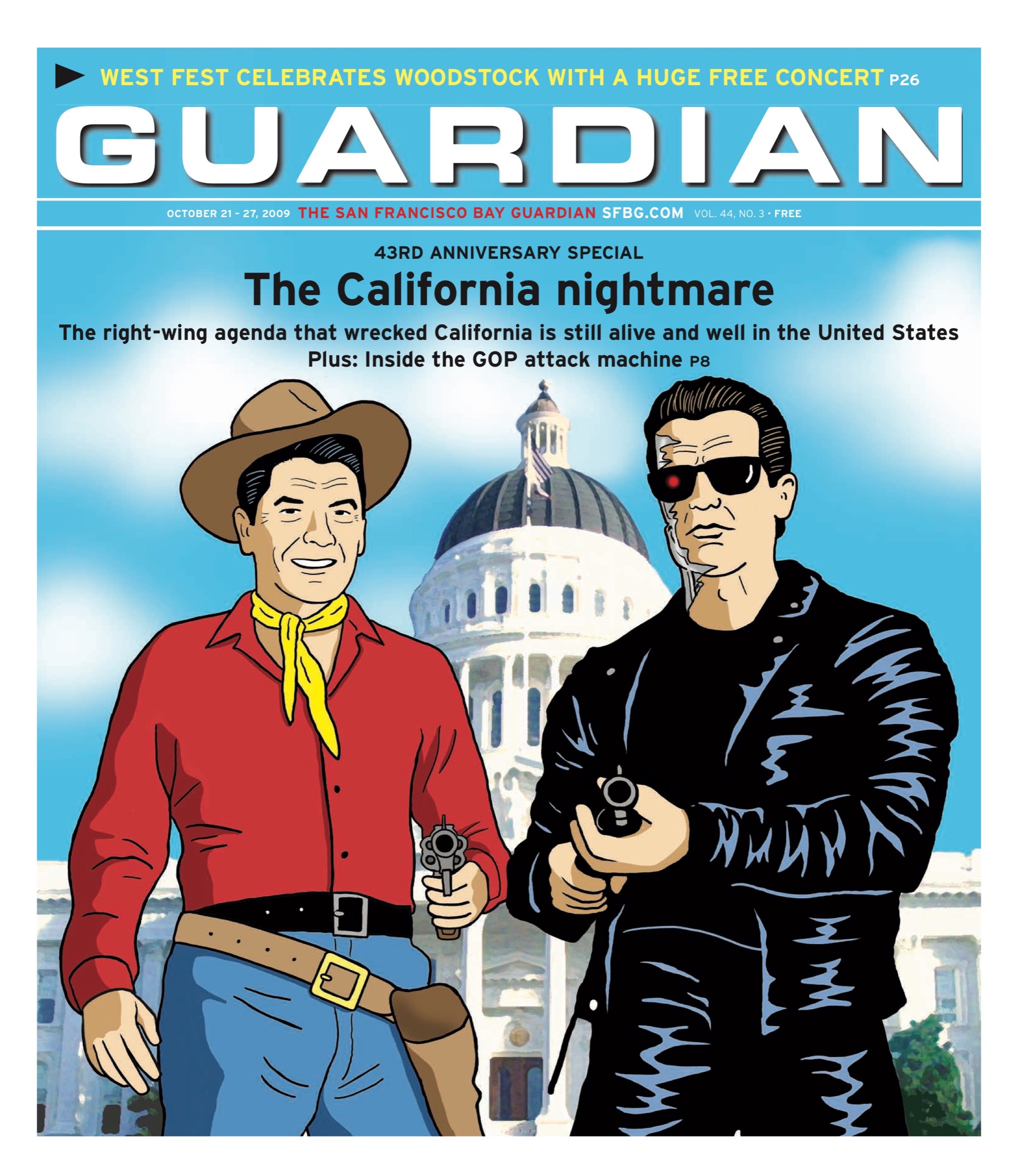
Attack of the right-wing nuts

0

news@sfbg.com

In April 2006, with the approval ratings of President George W. Bush plummeting, his senior political advisor, Karl Rove, began discussing a plan to turn things around.

His strategy: attack progressive organizations that were registering low-income people to vote and helping them fight corporate power — and claim it was about voter fraud.

The main White House target, newly released records show, was the Association of Community Organizations for Reform Now (ACORN). By the end of 2006, Rove would oversee the removal of eight U.S. attorneys, including two who refused to press bogus charges against ACORN in New Mexico and Missouri, and a third under similar suspicions in Washington state.

ACORN made a convenient target for Rove and his gang — and the well-orchestrated attacks on that group, which have exploded into the headlines this year, provide a compelling case study in how the right wing operates in this country.

Although it was the GOP that removed tens of thousands of likely Democratic voters from the rolls in the 2000 and 2004, the Republicans and their allies were able to make the issue of voter fraud all about ACORN, using a handful of isolated problems to undercut an organization focused on giving a voice to poor people.

Founded in Little Rock, Ark. at the end of the 1960s, ACORN has grown into the nation’s top community-organizer group, thanks to success in improving poor people’s housing, wages, and educational access. By the eve of the 2008 presidential election, ACORN had helped register more than 1.3 million voters — mostly young, low-income minorities — in 21 states, including the battleground states of Florida, Pennsylvania, Michigan, and Ohio.

As The Nation put it, these successes made ACORN “something of a right-wing bogeyman.”

And while the recent furor over a conservative videographer secretly taping ACORN employees saying dumb things has somehow become one of the big political stories of the year, the major media have mostly ignored how this attack is part of a larger conservative strategy.

In August, hundreds of pages of e-mails and transcripts related to the 2006 U.S. attorney-firing scandal were released to the press and public — but few news outlets mentioned that Rove was focused on attacking ACORN’s voter registration efforts, even though ACORN and voter fraud are repeatedly mentioned in these documents.

“This is about a campaign that goes back a decade to big business and that people who don’t like what ACORN does and is effective at — namely, helping groups to organize and put pressure on banks around sub[prime] mortgage loans to stop racial discrimination,” Peter Dreier, a professor of politics at Occidental College, told us.

It wasn’t really about voter fraud. As former U.S. Attorney David Iglesias, a Republican from New Mexico, recently stated on The Rachel Maddow Show: “They were looking at numbers [and] didn’t like the demographic tidal wave that was coming their way so they wanted to engage the machinery of the Justice Department to stop that wave.”

After two years of investigating ACORN and other supposed perpetrators of left-wing voter fraud, Igelias said, “I couldn’t find one case I could prosecute.”

But for the right-wing attack machine, it didn’t matter — the damage was done.


THEIR MASTERS’ VOICE

White House communications strategist Anita Dunn created a stir in mid-October when she told CNN host Howie Kurtz that Fox News “is really more of a wing of the Republican Party. … Let’s not pretend they’re a news network like everybody else is.”

It didn’t take long for Fox commentator Glenn Beck to retaliate. In a series of broadcasts, he attacked Dunn, compared the Obama administration to a communist dictatorship, and likened the criticism to the Holocaust. “Ask yourself this question,” Beck said during a radio segment, vaguely addressing people he called “good journalists” at other mainstream news networks. “When they’re done with Fox, and you decide to speak out on something — it’s the old ‘first they came for the Jews, and I wasn’t Jewish.'” Beck concluded the segment by warning his audience, “this is how a dictatorship always starts.”

Beck’s comment may strike San Francisco progressives as outrageous, but given the rhetoric routinely issuing from the right-wing megaphone, it’s also 100 percent predictable.

But when Dunn called Fox News Channel an arm of the GOP, she was dead on. Consider the history of its chairman and CEO, Roger Ailes, who ran Richard Nixon’s 1968 presidential campaign and later those of presidents Ronald Reagan and George H.W. Bush, guiding them all to victory through his brilliant and successful media campaign strategies.

“Roger Ailes is a newsman with a profound disdain for newsmen,” according to a New York magazine profile. “Fox News is being promoted as an anti-network, a news channel designed to appeal to the people … who don’t trust [the others].” Portrayed in the story as a “self-described paranoid,” Ailes reportedly resigned from an earlier position as head of CNBC after questions were raised about his desire to use his position as a weapon against his enemies.

Fox News is an outgrowth of its parent company, Rupert Murdoch’s News Corporation. A look at the board of directors of this multinational giant yields some startling insight into who controls the “fair and balanced” news network. Ailes himself has a seat at the table — but not every board member has a background in media.

News Corp. board member Viet Dinh, for example, is an attorney who came to the United States as a boy from Vietnam. In a 2002 interview with the Los Angeles Times, Dinh, who then served as an assistant attorney general at the Department of Justice, recalled an exchange he had with then-Attorney General John Ashcroft in the wake of the Sept. 11 attacks. “He told me: ‘The art of leadership is the redefinition of the possible. I want you to be the think tank to help me redefine the possible for the Department of Justice.'”

Dinh successfully redefined “the possible” by acting as a primary author of the USA PATRIOT Act, quickly propelling himself to prominence as a darling of conservatives and an enemy of civil liberties watchdog groups. A law professor at Georgetown University, Dinh is also founder and chief of Bancroft Associates PLLC, a consulting firm that specializes in helping Fortune 500 companies “navigate the federal and state criminal or civil investigations, congressional investigations, and complex litigation,” according to the firm’s Web site. It also specializes in public relations.

Another board member is José Maria Aznar, former prime minister of Spain. Aznar was born into a politically active, conservative family in Spain in 1953, and both his father and grandfather held government jobs under Gen. Francisco Franco, the fascist dictator. Aznar was handpicked by Manuel Fraga, a minister under Franco, to succeed him in leading Spain’s center-right People’s Party (Partido Popular), according to an article in the U.K.’s The Independent.

Aznar now serves as president of the Foundation for Social Studies and Analysis, a right-wing think tank based in Spain that, according to its Web site, works closely with the CATO Institute, the Heritage Foundation, and other conservative U.S. think tanks.

Occupying other seats at News Corp.’s board table is an assortment of professors, attorneys, public-relations experts, and businessmen with their fingers in a variety of banks and multinational corporations. Among the more familiar names are Phillip Morris, Ford Motor Co., Hewlett Packard, Goldman Sachs, HSBC North America, and JP Morgan Chase. Lesser known are the investment banking firms that have stakes in the petroleum industry, utilities, mining companies, and real estate.

While the connections between corporate interests and the country’s leading conservative propagandist are extensive and obvious, there’s a stark contrast between the message delivered by Fox News and the interests of its parent company.

Fox News plays up the theme of patriotism and reinforces the idea that there is a distinction between “real Americans” and outsiders. But Fox’s board is made up of members whose lives and economic interests are scattered across the globe, but have one common thread: they all control extraordinary sums of concentrated wealth.


PROPAGANDA AND EMOTIONS

While Dunn called Fox News Channel an arm of the Republican Party, others have gone so far as to label its content pure propaganda — and incredibly effective propaganda at that.

“This is very, very sophisticated propaganda,” says Bryant Welch, a clinical psychologist, author, and expert on political manipulation. “I don’t think progressives really get it that it’s a technique being used all the time.”

Welch said when he began working as a Washington, D.C., lobbyist on behalf of the American Psychological Association years ago, he started observing the tricky political maneuverings at play in the nation’s capital through the eyes of a psychotherapist who had spent some 30,000 hours helping patients confront their deep-seated hang-ups.

To his surprise, Welch found that some of the most successful right-wing political operatives also seemed to have an understanding of psychology — although they use the knowledge very differently. “A lot of it is psychological manipulation,” Welch asserts.

George Lakoff, a professor of linguistics at UC Berkeley and author of Don’t Think of an Elephant: Know Your Values and Frame the Debate, offered a similar analysis. He said Republicans approach issues as a marketing challenge. “They’ve learned from the cognitive scientists. Even if they don’t understand the science, they know how to do marketing.”

Welch, who is also an attorney and Huffington Post blogger, provides an analysis of how the right wing gets its message across in his book, State of Confusion: Political Manipulation and the Assault on the American Mind. He argues that public relations professionals, right-wing commentators, and others in the business of shaping public opinion are skilled at tapping into widespread feelings of anxiety and uncertainty.

“In this world, things are confusing,” he explains. “You’ve got to be constantly adapting and assimiutf8g new information. When times get confusing, people have a hard time forming a sense of what’s real.”

Right-wing television and radio personalities like Sean Hannity, Glenn Beck, or Rush Limbaugh prey on this widespread uncertainty, Welch argues, by providing viewers and listeners with an absolute version of reality that is easily grasped, neatly divided into right and wrong, and spelled out in very certain terms.

“The thing that Bill O’Reilly and Sean Hannity do is, they sound very powerful, certain, and aggressive,” Welch told us. “[Viewers] identify with that strength. They draw a sense of security from someone who has certainty about what is real.”

Viewers who find that their anxiety subsides when they tune in are hard-pressed to go back and reexamine their views later on, Welch said, because they’re satisfied with the answers they’ve been given. And in right-wing messaging, those answers consistently cast government as the enemy.

On Fox and AM radio, the use of repetition helps drive home an idea until it becomes a conviction in the mind of a listener. Television reinforces those key phrases with patriotic color schemes. The whole package is designed to transform an audience’s sense of bewilderment over a complex world into trust in spokespeople helping them make sense of it.

The right-wing commentators’ success lies partly in their ability to harness core human emotions such as paranoia or envy, Welch said. He pointed to the health care debate as an example, noting how Fox News has repeatedly played up the false concept of “death panels” to create fear.

To counter this tactic, Lakoff suggests that the left would do well to learn how to frame things in moral terms instead of playing defense against right-wing spin masters.

President Obama’s problem, Lakoff said, is that he is still trying to unify the country. “More power to him, but I don’t believe it’s possible,” Lakoff said. “Republican presidential candidate Sen. John McCain got 47 percent of the vote, bad as he was, and given how terrible a campaign he ran, and given that Obama ran a perfect campaign. So Obama’s election was not a landslide, even though he had one of the best campaign organizations and one of the best framed campaigns ever.” Obama doesn’t play the same manipulative games, Lakoff noted. “Obama believes that if you just tell the truth, it’ll be OK, and every day have a truth squad to find the conservative lies,” Lakoff said. “What he didn’t understand was that by focusing on the conservative lies, he was in fact helping the conservative cause. It’s like Richard Nixon saying, ‘I’m not a crook.'” That why Lakoff says it’s so important for Obama, and for the progressive movement in general, to define the moral imperative behind empowering the people and their government to create a better world, then aggressively push a campaign to do so. “It’s the ‘this is the right thing to do’ approach,” Lakoff explained. “And once it’s been framed that way, then you can say what’s false or true. But you should never go on the defensive first. As soon as you go point by point, you are on the defensive.”

New coach, new approach

0

news@sfbg.com

The chief was running late. As a group of Guardian reporters filed into his modest, comfortable conference room on the fifth floor of the Hall of Justice, an aide told us that Police Chief George Gascón was still meeting with Mayor Gavin Newsom at City Hall, and that we’d all have to cool our heels for a while.

While we were waiting, Michelangelo Apodaca, a public affairs officer in the chief’s office (he called himself an “image strategist”) stressed the recent sea change at SFPD, labeling it “new coach, new approach.” (It appears, however, that the mayor is still pushing his so-called “quality of life” agenda. “I just came from a meeting where I got beat up for not doing enough about public drinking and public disorder,” the chief belatedly told us.)

But once we got into the interview, Gascón was friendly, candid, thoughtful, and accommodating, and spent nearly an hour discussing his philosophy of law enforcement, his vision for San Francisco, and his positions on some tricky and divisive problems.

We left with the impression that the new chief, although hardly in agreement with us on a number of issues, is far more open than his predecessor, willing to shake things up in the moribund department — and sometimes, interested in discussion and compromise on progressive concerns.

“My philosophy of policing is very heavy in community involvement, very transparent,” Gascón told us.

Gascón said he’s moving quickly on implementing many of the items that he’s promised, such as creating a COMPSTAT (computerized crime and staffing statistics) system that will be accessible to the public. He plans to launch it Oct. 21.

And beyond the technology, he seems interested in shifting the top-down structure of the department. “I said that we would reorganize the department in certain levels and do certain levels of decentralization to increase resources at the neighborhood level so that we actually have people within the police department who have greater ownership of neighborhood issues,” he said. “And we’re going to do that in November. I stated that we would have community police advisory boards at each of the stations, and those basically will be neighborhood-level people, anywhere from 10 to 20, for each station. We’ll work with our local captains on neighborhood-related issues.”

He said that improving how the department does community policing will have a two-fold impact. “One is, the cops get to understand better what the community really wants. The other is that the community gets to understand better what the resources really are.

“Everybody wants a foot-beat cop,” he continued. “Everybody wants a fixed-post cop. Everybody wants a cop in every bus. If we had 10,000 people, then perhaps we could fulfill all those wishes. The reality is that we don’t.”


EXPENSIVE CRACKDOWN

But the most tangible impact of Gascón’s tenure so far has been his crackdowns on drug-related activity in the Tenderloin, where more than 300 people at a time have been swept up in sting operations, and on marijuana-growing operations in the Sunset District, where 36 locations were raided (four of which Gascón said were discovered to be “legitimate” medical marijuana growers who had their crops returned by police).

The arrest surge generated a lot of positive press — but also is costing the city a bundle. Sheriff Michael Hennessey, who runs the county jail, told us that he had to reopen several jail housing units that had been slated to close to meet his budget for the current fiscal year. He said the average daily jail population in July was 1,861, but that it has risen to 2,146 in September, a 285 inmate increase.

If it stays at this level, Hennessey estimates that he’ll need up to $3.5 million in additional annual funding to house the larger population, as he indicated in a letter that he wrote to the Board of Supervisors last month, letting them know that he will probably need a supplemental budget appropriate this year.

When we asked Gascón whether affected city agencies — including the Sheriff’s Department, District Attorney’s Office, and Public Defender’s Office — should increase their budgets to deal with the SFPD’s new approach, he said they should.

There’s a touch of the corporate manager about Gascón. When we challenged him to defend the efficacy of the crackdowns, Gascón pulled out a pen and paper and started drawing a Venn diagram, with its three overlapping circles. He explained that many criminal justice studies have shown that about 10 percent of criminal suspects commit about 55 percent of the crime, that 10 percent of crime victims are the targets of about 40 percent of crimes, and that crime is often concentrated in certain geographic areas.

By concentrating on the overlap of these realms, Gascón said police can have a major impact on crime in the city. Although Gascón admits that “police can never arrest themselves out of social problem,” he also said “there are people who do need to be arrested … Most of the arrests are for serious felonies.”

It’s a potentially tricky approach — in essence, Gascón is saying that when you mix some people and some places (in this case, mostly people of color and mostly poor neighborhoods) you create crime zones. The difference between that and racial profiling is, potentially, a matter of degree.

But Gascón defended the surge in arrests over the last two months as targeting those who need to be arrested and, just as important, sending a message to the greater Bay Area that San Francisco is no longer a place where open-air drug dealing, fencing stolen goods, and other visible crimes will be tolerated.

“We need to adjust the DNA of the region,” he said.

And while Gascón said the arrest surge might not be sustained indefinitely, he also frankly said that the city will probably need to spend more money on criminal justice going forward. In other realms of the recent crackdown, such as the police sweeps of Dolores Park and other parks ticketing those drinking alcohol, Gascón said that was more of a balancing act that will involve ongoing community input and weighing concerns on both sides of the issue.

It was when we pushed for the SFPD to ease up busting people in the parks who were drinking but not causing other problems that Gascón told us that the mayor had a different opinion and had been chiding his new chief to be tougher on public drinking.

In light of several recent shootings by SFPD officers of mentally ill suspects, we asked Gascón whether he’s satisfied with how the department and its personnel handle such cases. He didn’t exactly admit any problems (saying only that “there’s always room for improvement”) but said he was concerned enough to create a task force to investigate the issue last month, headed by Deputy Chief Morris Tabak.

When we asked if we can see the report on the 90-day review, Gascón didn’t hesitate in answering yes, “the report will be public.”


FIRE TEN COPS?

If Gascón follows through with his promises, internal discipline — one of the worst problems facing the department — could get a dramatic overhaul. The new chief wants to clear up a serious backlog of discipline cases, possibly by reducing the penalties — but claims to be willing to take a much tougher stand on the serious problem cases.

In fact, Gascón said he wants the authority to fire cops — that power now rests entirely with the Police Commission — and said there are eight to 10 police officers on the San Francisco force who should be fired, now, for their past record of bad behavior. That would be a radical change — in the past 20 years, fewer than five officers have ever been fired for misconduct, despite the fact that the city has paid out millions in legal settlements in police-abuse cases.

Gascón also discussed controversial legislation by Sup. David Campos that would require due process before undocumented immigrant youths arrested by the SFPD are turned over to federal immigration authorities, an amendment to the sanctuary city policy that was weakened by Newsom.

Just days after arrived in town, Gascón had made comments to the San Francisco Chronicle supporting Newsom’s position and saying that under Campos’ legislation, “drug or even violent offenders could be released by judges on reduced charges in lieu of reporting them for possible deportation.”

But in the interview with us, while not backing away from his previous statement, Gascón seemed to take a more nuanced position that pointed toward the possibility of compromise. He reminded us that he’d spent time in Mesa, Ariz., tangling with a county sheriff, Joe Arpaio, who has gone far beyond any reasonable standard in trying to arrest and deport undocumented residents. He also told us that he doesn’t think the cops, by themselves, should decide who gets turned over the feds for deportation.

That alone is a significant step — and suggests that Gascón could turn out to be one of Newsom’s best hires.

————-

GASCON ON IMMIGRATION

SFBG Are you still concerned about waiting for the courts to determine a suspect’s guilt before turning him over to the feds? Gascón Yes, it’s very much a concern. And by the way, I fully understand the concerns Sup. David Campos brings to the table.

I have the benefit of being on the other side also, where you have police agencies aggressively engaged in immigration enforcement, where people that frankly were not engaged in any criminal activity other than being here without authority — which sometimes, by the way, is not criminal. In fact, depending on whose numbers you listen to, anywhere from 30 to 50 percent of people who are here without authority in this country have not committed a criminal violation; they have committed an administrative violation.

And people get deported. I have seen very young people, people that basically came to this country when they were three, four years old, they are actually staying clean, they are going to school, and they get stopped for a traffic violation at age 17 or 18, and now all of a sudden they are getting deported to a country where they really have no roots at all. I have seen that, and I’m very sensitive to that.

On the other hand, I think it’s important also to recognize that in any group, whether you were here legally or not legally, whether you were born here or not, whether you are green, red, or brown, there are people that for a variety of reasons aren’t willing to live by the social norms we all need to live by to be able to have a peaceful environment.

I think that allowing the process to go all the way to the point where a judge decides whether to allow this to continue … is probably too far down the food chain for my comfort level. On the other hand, I would not want to have police officers on the streets stopping people and trying to assess whether they are here legally or not.

So I think we need to find somewhere down the middle, that if person is arrested, there is a non-law enforcement review. And quite frankly, probably the best person would be the D.A. They determine whether they have a prosecutable case or not. If it’s prosecutable case and a predictable offense that requires reporting, then that would be a good time where a flag could go up.

SFBG But that’s not the process right now.  Gascón No, the process now is triggered by the Probation Department, which is a law enforcement entity. So I think we have a process where law enforcement is making a decision and Sup. Campos is looking at a process of adjudication.

SFBG It sounds as if you agree substantially with Sup. David Campos. Is there room for compromise? 

Gascón I’m hoping there is room for compromise, that is something we’re trying to work with.

Sarah Phelan and Rebecca Bowe contributed to this report.

Brütal odyssey

0

>>Read Ben Richardson’s full interview with Tim Schafer here

arts@sfbg.com

GAMER "The first time we pitched it, they wanted us to change the genre, to make it about country or hip-hop or something."

Game designer Tim Schafer is sitting in his SoMa office, in his favorite chair — appropriately, a rocking chair — and talking about his masterpiece. "They were saying, ‘Why don’t you open it to all music?’ We said, ‘Look — this is a game about epic battles, good vs. evil, Braveheart-type moments. And heavy metal is the musical genre that focuses heavily on folklore. It sings about medieval combat. It’s really the only genre that makes sense for it.’"

The game is Brütal Legend (Double Fine/EA), and in the end, Schafer got his way. Taking control of Eddie Riggs, a grizzled roadie voiced by Jack Black, the player journeys through a metal landscape inspired by the album covers the designer studied in his youth. Wielding a massive battle-ax and a magical guitar, Riggs encounters righteous friends and fiendish foes, including characters voiced by luminaries like Lemmy Kilmister, Ozzy Osbourne, Rob Halford, and Lita Ford. The soundtrack is a carefully compiled list of headbang-inducing classics.

Schafer agrees that the game is his most personal creation to date. "All games are wish fulfillments. All games are about fantasy. This is a game where I’ve been able to make my own wish fulfillment. I would like to go back in time with a cool car and a battle-axe while listening to heavy metal."

THE TROOPER

Growing up in Sonoma, the designer escaped his suburban life by rocking out to Ozzy Osbourne, Black Sabbath, Judas Priest, and Iron Maiden. He would drive down to San Francisco for shows, catching sets at Mabuhay Gardens or the Stone. The music introduced him to a mythic world of horned hell-monsters, glistening chrome, and mortal combat, a world he never quite left behind.

He attended both UC Santa Cruz and UC Berkeley, dividing his attention between computer programming and creative writing, two talents he would later fuse. At Berkeley, he took a class on folklore from Alan Dundes, a provocative professor whose belief in the power of folklore influenced Schafer’s work tremendously. In 1989, he got a job in San Rafael at Lucasfilm Games, now LucasArts. He was assigned to The Secret of Monkey Island, a comedic adventure game by designer Ron Gilbert. Monkey Island was the perfect vehicle for Schafer’s talents, taking full advantage of his boundless imagination, storytelling sense, and biting wit. It is best remembered for its "insult sword fighting" section, in which dueling buccaneers trade verbal jabs in lieu of physical ones.

Mitch Krpata, game critic for the Boston Phoenix and author of the blog Insult Swordfighting, identified the defining quality of Schafer’s LucasArts output via e-mail: "Character. There are a few archetypes that most games go to again and again: silent man of action, easygoing everyman, tormented soul out for revenge. Schafer’s protagonists aren’t like that. They’re individuals. They’re good guys, but they have flaws, and their flaws aren’t things like they just care too much, dammit."

BE QUICK OR BE DEAD

After finishing the biker-themed Full Throttle in 1995, Schafer hunted inspiration. It came to him as an unlikely combination of themes, both closely tied to his San Francisco home. Initially, he was devouring classic noir films at the Lark and Castro theatres. A trip to the Day of the Dead parade in the city’s Mission District delivered the epiphany. The higher-ups at LucasArts had been agitating for a game with 3-D graphics, a prospect he did not relish. "I really hated the look of 3-D art back then, because it looked like a nylon stretched over a cardboard box," he remembers.

Picking through a table of Day of the Dead ephemera, the idea came: "I saw those calavera statues. Instead of modeling all of the bones in papier-mâché, they’ll just make a tube and paint the bones on the outside. I was like, ‘This is just like bad 3-D art. This is great!’"

Additional fodder was provided by doctor visits to 450 Sutter — a building that combines Art Deco architecture with Mayan motifs — and Schafer began work on his most ambitious project to date. Drawing on his collegiate folklore training, he and his team wove together elements of Day of the Dead tradition, Aztec folk tales, and noir cinema to create 1998’s Grim Fandango (LucasArts), a sprawling epic of crime and love in which all the characters were stylized, calavera-style skeletons "living" in the Land of the Dead. Featuring a labyrinthine, affecting story, delectable hard-boiled dialogue, and stunning art direction, it is still ranked among the best games of all time.

RUNNING FREE

Schafer left LucasArts in 1999, concerned that the company would exercise its ownership of his beloved characters without his participation. He wanted to found his own studio in San Francisco. As he told me over the phone, "Working at a company where you can look out the window and see the city outside is just so inspiring. It’s not just about having great restaurants at lunch, though that’s part of it." Starting in his living room "in a bathrobe and flip-flops," the nascent Double Fine Productions — named after a "double fine zone" sign on the Golden Gate bridge — jumped from location to location, including an unheated warehouse with a rodent problem and a toilet that often unleashed an "ocean of human waste" into the office.

The first Double Fine game was 2005’s Psychonauts, an ambitious project about a summer camp for psychic kids that failed to reach the wide audience it deserved. Even in this rarefied setting, Schafer included bits of the city’s lore. A character named Boyd was based on a homeless man who hung out near the team’s offices, doing odd jobs and enlightening the Double Fine crew with his extensive conspiracy theories.

"Sometimes he would just be on a rant about [how] the government would be trying to read his mind using satellites, or using the broken glass in the streets to bend their optics around," Schafer recalls. "He just produced great quotes: ‘I don’t want to be liquid, I want to be a turtle with rockets strapped to my back!’" Deciding to include him in the game, the designer painstakingly created a flow-chart that would procedurally generate conspiracy theories for Boyd to spout onscreen. "He constructs it by coming up with a conspirator, what their plan is, what the victim of it is, and strings it all together with a bunch of coughing and stuff."

FROM HERE TO ETERNITY

Brütal Legend, Double Fine’s latest game, was released Oct. 13, and gamers across the country will have the opportunity to play through the piece of San Francisco folklore most familiar to Schafer: the one based on himself. By making a game about a character transported from our familiar world into an ax-happy metal battleground, the designer has turned his story, the story of a misfit headbanger from a city steeped in metal history, into a new kind of 21st century myth.

Events listings

0

Events listings are compiled by Paula Connelly. Submit items for the listings at listings@sfbg.com.

WEDNESDAY 14

Jungle Effect Commonwealth Club, 2nd floor, 595 Market, SF; (415) 597-6700. 6pm, $15. Hear about the experience of Daphne Miller, MD, as she traveled to five countries around the world where common diseases, such as diabetes, heart disease, cancer, and depression, are rare to learn about how nutrition and indigenous foods can prevent chronic illnesses.

THURSDAY 15

Old Growth Redwoods San Francisco Public Library, Richmond Branch, 351 9th Ave., SF; (415) 557-4277. 6:30pm, free. Learn about the beauty, delicate ecosystem, and challenges we face to preserve California’s old growth redwood forests at this slide show and discussion with William Walsh, development director of the San Francisco Bay chapter of the Sierra Club.

Passage of Tibet’s Salween River KoKo Cocktails, 1060 Geary, SF; (415) 885-4788. Listen to extreme traveler, author, and NPR commentator Craig Childs recount his experience in the first expedition to descended the upper Salween River in Tibet. Featuring breathtaking images and exclusive video footage.

Wild Imagination Contemporary Jewish Museum, 736 Mission, SF; (415) 655-7800, litquake.org. 6pm, free. Hear children’s books authors Daniel Handler, of the Lemony Snicket series, Lisa Brown, and Jonathan Keats explore the privilege of writing for and about children. In conjunction with Litquake and the current exhibition, There’s a Mystery There: Sendak on Sendak.

BAY AREA

Indigenous Permaculture Ecology Center, 2530 San Pablo, Berk.; (510) 548-2220 ext.233. 6:30pm, $5-50. Learn about the methods and practices that traditional farmers from New Mexico use to steward land in order to create sustainable, self-sufficient communities.

SATURDAY 17

Alternative Press Expo Concourse Exhibition Center, 620 7th St., SF; (619) 491-2475. Sat. 11am-7pm, Sun.11am-6pm; $10 , $15 both days. Attend fun and informative programs focused on special guests and various aspects of independent and alternative comics, including some of the top creative talent working in comics today.

Potrero Hill Festival Brunch at the Potrero Hill Neighborhood House, 953 DeHaro; street fair 20th St. between Missouri and Arkansas, SF; www.potrerofestival.com. Brunch 9am, street fair 11am; brunch $10, fair free. Enjoy a traditional New Orleans Jazz Brunch made by students of the California Culinary Academy before heading over to a street fair featuring local vendors selling wares, arts, and crafts, live music, and activities for kids.

SOEX Grand Opening Southern Exposure, 3030 20th Street, SF; (415) 863-2141. 4-10pm, free.

Celebrate Southern Exposure’s new location and the Bay Area artist community by attending their inaugural exhibition, Bellwether, and letting loose at a block party on Alabama between 19th and 20th St. Block party to feature outdoor seating, food from local street food vendors, and music.

Theater Chili Cook Off San Francisco LGBT Community Center, 1800 Market, SF; (415) 255-7846. 2pm; $1 for tastes, $30 all you can eat. Support Bay Area theater organizations while chowing down on some traditional, vegetarian, or "anything goes" chili and vote for your favorite. Featuring live music.

Vegan Bake Sale Ike’s Place, 3506 16th St., SF; vegansaurus.com. 11am, free. Buy baked goods from over 40 bakers. including Violet Sweet Shoppe, Bike Basket Pies, and Fat Bottom Bakery. Proceeds from this delicious and conscientious sale to benefit Give Me Shelter Cat Rescue.

SUNDAY 18

Festival De Los Volcanes Horace Mann Middle School, 3351 23rd St., SF; (415) 642-4404. 10am, free. Join in on this second annual Central American cultural celebration featuring prominent local musicians, poets, rap artists, and community leaders.

Futurism Brava Theater Center, 2781 24th St., SF; (415) 647-2822. 4pm, 6pm, 7:30pm; $10, $15 for both programs. SFMOMA, Italian Cultural Institute, UC Berkeley, YBCA, and SF Center for the Book are teaming up to present a program in the tradition of the 100 year old avant-garde Futurism movement, which aims to combine every art medium. Enjoy a series of short live performances and films unique to this tradition at the Brava Theater. To find out about other Futurism programs happening throughout the Bay Area visit, www.sfmoma.org.

MONDAY 19

Gregory Maguire Jewish Community Center of San Francisco, 3200 California, SF; (415) 292-1233. 8pm, $10-18. Step inside the mind of Gregory Maguire, best-selling author of Wicked: The Life and Times of the Wicked Witch of the West, which became the basis for the Tony Award-winning musical, Wicked.

Joyce Carol Oates Herbst Theater, 401 Van Ness, SF; (415) 392-4400. 8pm, $20. See Joyce Carol Oates, author of 39 novels, including three forthcoming books, in an interview with KQED’s Michael Krasny as part of a literary series benefiting the 826 Valencia College Scholarship Program.

Reel Fabulous New Conservatory Theater Center, Decker Theater, 25 Van Ness, SF; (415) 861-8972. 7:30pm, $30. Catch the one-night-only benefit starring Bay Area Emmy-winning producer, columnist, critic, and historian Jan Wahl titled, Reel Fabulous: LGBT in Hollywood. The performance will feature stories and clips from films directed by, written by, or starring LGBT artists and technicians.

Veterans Stories Project Oakland Veteran’s Hall, 200 Grand, Oak; (925) 684-4424. 10am, free. Contribute your Pearl Harbor and WWII stories for an online museum project designed to collect and preserve the personal recollections of U.S. wartime Veterans. Homefront civilians who worked in support of the armed forces are also invited to contribute.

*\

Film listings

0

Film listings are edited by Cheryl Eddy. Reviewers are Kimberly Chun, Michelle Devereaux, Max Goldberg, Dennis Harvey, Johnny Ray Huston, Louis Peitzman, Lynn Rapoport, Ben Richardson, Matt Sussman, and Laura Swanbeck. The film intern is Fernando F. Croce. For rep house showtimes, see Rep Clock. For first-run showtimes, see Movie Guide.

SF DOCFEST

The eighth annual San Francisco Documentary Film Festival runs Oct 16-29 at the Roxie, 3117 16th St, SF. Tickets ($11) are available by visiting www.sfindie.com. For commentary, see "Is the Truth Out There?" All times p.m.

FRI/16

The Entrepreneur 7. Shooting Robert King 7. Drums Inside Your Chest 9:15. Houston We Have a Problem 9:15.

SAT/17

Drums Inside Your Chest 2:30. Waiting for Hockney 2:30. Between the Folds 4:45. Finding Face 4:45. HomeGrown 7. The Wild and Wonderful Whites of West Virginia 7. Dust and Illusions 9:15. The Earth Is Young 9:15.

SUN/18

"Bay Area Shorts" (shorts program) 2:30. We Said, No Crying 2:30. Another Planet 4:45. I Need That Record: The Death (or Possible Survival) of the Independent Record Store 4:45. Cat Ladies 7. Off and Running 7. Vampiro 9:15. What’s the Matter with Kansas? 9:15.

MON/19

Between the Folds 7. We Said, No Crying 7. October Country 9:15. Waiting for Hockney 9:15.

TUES/20

The Earth Is Young 7. I Need That Record: The Death (or Possible Survival) of the Independent Record Store 7. Another Planet 9:15. The Wild and Wonderful Whites of West Virginia 9:15.

MILL VALLEY FILM FESTIVAL

The 32nd Mill Valley Film Festival runs through Sun/18 at the Century Cinema, 41 Tamal Vista, Corte Madera; CinéArts@Sequoia, 25 Throckmorton, Mill Valley; 142 Throckmorton Theatre, 142 Throckmorton, Mill Valley; and Smith Rafael Film Center, 1118 Fourth St, San Rafael. Tickets (most shows $12.50) available by calling 1-877-874-MVFF or visiting www.mvff.org. All times p.m. unless otherwise noted.

WED/14

Rafael The Horse Boy 4:30. "5@5: America Is Not the World" (shorts program) 5. "Spotlight on Jason Reitman:" Up in the Air 6:30. White Wedding 7. Linoleum 7:15. Tapped 9. The Eclipse 9:15. Up in the Air 9:40.

Sequoia The Swimsuit Issue 4:15. "5@5: Oscillate Wildly" (shorts program) 5. Trimpin: The Sound of Invention 6:30. Surrogate 7. Elevator 8:45. Hellsinki 9.

Throck "Insight: The Cassel Touch" (interview and discussion) 8.

THURS/15

Rafael The Girl on the Train 4. Reach for Me 4:30. "5@5: The More You Ignore Me, the Closer I Get" (shorts program) 5. Icons Among Us: jazz in the present tense 6:30. Meredith Monk: Inner Voice 6:45. "Tribute to Woody Harrelson:" The Messenger 7. Hipsters 9. Barking Water 9:15.

Sequoia "5@5: Sister I’m a Poet" (shorts program) 5. Jim Thorpe: The World’s Greatest Athlete 5:15. Apron Strings 6:45. The Missing Person 7:30. This Is the Husband I Want! 9. Winnebago Man 9:30.

Throck Storm 7.

FRI/16

Rafael Sweet Rush 4. "5@5: The Edges Are No Longer Parallel" (shorts program) 5. Stalin Thought of You 6. "Tribute to Anna Karina:" Victoria 6:30. Zombie Girl: The Movie 7. Jermal 8:15. Trimpin: The Sound of Invention 9. Red Cliff 9:30.

Sequoia Shylock 4. Shameless 5. Tenderloin 6:45. A Thousand Suns and Mustang: Journey of Transformation 7. One Crazy Ride 8:45. Happy Tears 9:15.

Throck Troupers: 50 Years of the San Francisco Mime Troupe 7:30.

SAT/17

Rafael [Blank.] 11am. A Thousand Suns and Mustang: Journey of Transformation noon. Ricky Rapper 1. The Girl on the Train 1:45. Hellsinki 2. Oh My God 3. The Strength of Water 4:15. Awakening from Sorrow 4:45. The Missing Person 5:30. The Most Dangerous Man in America: Daniel Ellsberg 6:45. The Swimsuit Issue 6:45. Surrogate 7:45. Tenderloin 9. Hipsters 9:15.

Sequoia The Letter for the King 10:30am. Eat the Sun noon. White Wedding 1:30. Miracle in a Box: A Piano Reborn 2:30. Dark and Stormy Night 3:45. Mine 5. A Year Ago in Winter 6:15. Reach for Me 7:15. "Hi De Ho Show" (shorts and music) 9:15. Winnebago Man 9:45.

Throck "New Movie Labs: Distribution of Specialty Film" (seminar) 12:30. Project Happiness 3. "5@5: The Edges Are No Longer Parallel" (shorts program) 5. "Cinemasports" (shorts program of films made in one day) 7:30.

SUN/18

Rafael Stella and the Star of the Orient noon. This Is the Husband I Want! noon. Mine 12:30. Apron Strings 2:30. Soundtrack for a Revolution 2:45. One Crazy Ride 3. Project Happiness 5. The Young Victoria 5:15. Race to Nowhere 5:45. Skin 7:30. Bomber 7:45.

Sequoia The Ten Lives of Titanic the Cat 12:30. Meredith Monk: Inner Voice 1. Oh My God 2:30. The Most Dangerous Man in America: Daniel Ellsberg 3:15. Looking for Eric 5:15. The Strength of Water 5:45.

Throck "New Movies Lab: Active Cinema" 12:30. "A Sweeter Music: Live Concert with Sarah Cahill and John Sanborn" 3:30.

OPENING

Birdwatchers War-painted natives don bows and arrows and watch from the Amazon riverbank as a boat of tourists passes by. Away from white eyes, they slip back into their modern clothes and are paid by the tour guide for a job well done. Had it sustained the evocative wryness of its opening scene throughout its running time, Marco Bechi’s film would have been more than a frequently striking culture-clash tract. As it is, there’s much to admire in this Brazil-set account of a disbanded Guarani-Kaiowà tribe struggling to hang on to their expiring heritage, from its clear-eyed view of the lingering human toll of colonialism to its uncondescending portrait of indigenous mysticism. Unfortunately, Bechi’s penchant for underlined contrasts and clumsy staging often threaten to sabotage his evocative mix of ethnography, satire, and social critique. While far from being as complacent as the titular sightseers, in the end the film is similarly content to merely skim over an ongoing cultural genocide. (1:40) Sundance Kabuki. (Croce)

*An Education See "Culture Class." (1:35) Albany, Embarcadero.

The Horse Boy Rupert Isaacson and Kristin Neff are a Texas couple struggling to raise their five-year-old autistic son Rowan. When they discover that the boy’s tantrums are soothed by contact with horses, they set out on a journey to Mongolia, where horseback riding is the preferred mode of traveling across the steppe and sacred shamans hold the promise of healing. Michael Orion Scott’s documentary is many things — lecture on autism, home video collage, family therapy session, and exotic travelogue. Above all, unfortunately, it’s a star vehicle for Isaacson, whose affecting concern for his son is constantly eclipsed by his screen-hogging concern for his own paternal image (more than once he declares that he’s a better father thanks to Rowan’s condition). The contradiction brings to mind doomed activist Timothy Treadwell in Grizzly Man (2005), and indeed the film could have used some of Werner Herzog’s inquisitive touch, if only to question the artistic merits of showing your son going "poopie." Twice. (1:33) Embarcadero, Shattuck. (Croce)

Law Abiding Citizen "Spike Lee’s Inside Man (2006) as re-imagined by the Saw franchise folks" apparently sounded like a sweet pitch to someone, because here we are, stuck with Jamie Foxx and Gerard Butler playing bloody and increasingly ludicrous cat-and-mouse games. Foxx stars as a slick Philadelphia prosecutor whose deal-cutting careerist ways go easy on the scummy criminals responsible for murdering the wife and daughter of a local inventor (Butler). Cut to a decade later, and the doleful widower has become a vengeful mastermind with a yen for Hannibal Lecter-like skills, gruesome contraptions, and lines like "Lessons not learned in blood are soon forgotten." Butler metes out punishment to his family’s killers as well as to the bureocratic minions who let them off the hook. But the talk of moral consequences is less a critique of a faulty judicial system than mere white noise, vainly used by director F. Gary Gray and writer Kurt Wimmer in hopes of classing up a grinding exploitation drama. (1:48) Presidio. (Croce)

*More Than a Game In the late 1990s, armed with a camera and a certain amount of tenacity, Kristopher Belman set out to capture the glory that was regularly manifesting itself on a certain Akron, Ohio basketball court. The main reason: a future superstar named LeBron James. But James’ remarkable teenage career (at least until the age of 18, when the St. Vincent-St. Mary High School grad became the number one NBA draft pick) wasn’t completely a solo act; his core group of friends, the team’s starting line-up, was so tight they were called "the Fab Five." Despite Belman’s determination to equally divide the spotlight, James was clearly a star then as he is now, slam-dunking on hapless opponents even as he grappled with his burgeoning celebrity status. I’ll never tire of the tale of how James raised eyebrows when he started driving a brand-new Hummer — only to quash whispers of misconduct when it was revealed that his mother, Gloria, was able to secure a loan for the gift based solely on the understanding (shared by all) that her son’s skills would make him a zillionaire before his next birthday. (1:45) (Eddy)

New York, I Love You A variety of filmmakers (including Fatih Akin, Shekhar Kapur, Mira Nair, and Brett Ratner) directed segments of this stateside answer to 2006’s Paris, je t’aime. (1:43) Bridge, Shattuck.

The Providence Effect Located in Chicago’s gang-infested West side, the illustrious Providence St. Mel School rises above its surroundings like a flower in a swamp. Or at least it does in Rollin Binzer’s documentary, where analysis of the institution’s great achievements at times edges into a virtual pamphlet for enrollment. Focusing mainly on affable school president Paul J. Adams III, a veteran of the civil rights movement whose "impossible dream" made Providence possible, the film chronicles the daily activities of teachers and students vying for success in the face of poverty and crime. Given the school’s notoriously unwholesome environment, it’s a bit disappointing that the film chooses to exclusively follow the trajectory of model pupils, trading grittier tales of struggle in favor of a smoother ride of feel-god buzzwords and uplifting anecdotes. The documentary isn’t free of scholarly platitudes straight out of Goodbye, Mr. Chips (1939), but, in times when teachers get as much respect as Rodney Dangerfield, its celebration of the importance of education is valuable. (1:32) Lumiere, Shattuck. (Croce)

The Stepfather Dylan Walsh: as scary as Terry O’Quinn? Discuss. (1:41)

Where the Wild Things Are Spike Jonze directs a live-action version of Maurice Sendak’s classic children’s tale. (1:48) Four Star, Grand Lake, Marina.

ONGOING

*Bright Star Is beauty truth; truth, beauty? John Keats, the poet famed for such works as "Ode on a Grecian Urn," and Jane Campion, the filmmaker intent on encapsuutf8g the last romance of the archetypal Romantic, would have undoubtedly bonded over a love of sensual details — and the way a certain vellum-like light can transport its viewer into elevated reverie. In truth, Campion doesn’t quite achieve the level of Keats’ verse with this somber glimpse at the tubercular writer and his final love, neighbor Fanny Brawne. But she does bottle some of their pale beauty. Less-educated than the already respected young scribe, Brawne nonetheless may have been his equal in imagination as a seamstress, judging from the petal-bonneted, ruffled-collar ensembles Campion outfits her in. As portrayed by the soulful-eyed Abbie Cornish, the otherwise-enigmatic, plucky Brawne is the singularly bright blossom ready to be wrapped in a poet’s adoration, worthy of rhapsody by Ben Whishaw’s shaggily, shabbily puppy-dog Keats, who snatches the preternaturally serene focus of a fine mind cut short by illness, with the gravitational pull of a serious indie-rock hottie. The two are drawn to each other like the butterflies flittering in Brawne’s bedroom/farm, one of the most memorable scenes in the dark yet sweetly glimmering Bright Star. Bathing her scenes in lengthy silence, shot through with far-from-flowery dialogue, Campion is at odds with this love story, so unlike her joyful 1990 ode to author Janet Frame, An Angel at My Table (Kerry Fox appears here, too, as Fanny’s mother): the filmmaker refuses to overplay it, sidestepping Austenian sprightliness. Instead she embraces the dark differences, the negative inevitability, of this death-steeped coupling, welcoming the odd glance at the era’s intellectual life, the interplay of light and shadow. (1:59) Empire, Piedmont, Presidio, Sundance Kabuki. (Chun)

*Capitalism: A Love Story Gun control. The Bush administration. Healthcare. Over the past decade, Michael Moore has tackled some of the most contentious issues with his trademark blend of humor and liberal rage. In Capitalism: A Love Story, he sets his sights on an even grander subject. Where to begin when you’re talking about an economic system that has defined this nation? Predictably, Moore’s focus is on all those times capitalism has failed. By this point, his tactics are familiar, but he still has a few tricks up his sleeve. As with Sicko (2007), Moore proves he can restrain himself — he gets plenty of screen time, but he spends more time than ever behind the camera. This isn’t about Moore; it’s about the United States. When he steps out of the limelight, he’s ultimately more effective, crafting a film that’s bipartisan in nature, not just in name. No, he’s not likely to please all, but for every Glenn Beck, there’s a sane moderate wondering where all the money has gone. (2:07) California, Empire, Grand Lake, 1000 Van Ness, Presidio, SF Center, Sundance Kabuki. (Peitzman)

Cloudy With a Chance of Meatballs (1:21) Oaks, 1000 Van Ness.

Coco Before Chanel Like her designs, Gabrielle "Coco" Chanel was elegant, très chic, and utterly original. Director Anne Fontaine’s French biopic traces Coco (Audrey Tautou) from her childhood as a struggling orphan to one of the most influential designers of the 20th century. You’ll be disappointed if you expect a fashionista’s up close and personal look at the House of Chanel, as Fontaine keeps her story firmly rooted in Coco’s past, including her destructive relationship with French playboy Etienne Balsar (Benoît Poelvoorde) and her ill-fated love affair with dashing Englishman Arthur "Boy" Capel (Alessandro Nivola). The film functions best in scenes that display Coco’s imagination and aesthetic magnetism, like when she dances with Capel in her now famous "little black dress" amidst a sea of stiff, white meringues. Tautou imparts a quiet courage and quick wit as the trailblazing designer, and Nivola is unmistakably charming and compassionate as Boy. Nevertheless, Fontaine rushes the ending and never truly seizes the opportunity to explore how Coco’s personal life seeped into her timeless designs that were, in the end, an extension of herself. (1:50) Albany, SF Center. (Swanbeck)

Couples Retreat You could call Couples Retreat a romantic comedy, but that would imply that it was romantic and funny instead of an insipid, overlong waste of time. This story of a group of married friends trying to bond with their spouses in an exotic island locale is a failure on every level. Romantic? The titular couples — four total — represent eight of the most obnoxious characters in recent memory. Sure, you’re rooting for them to work out their issues, but that’s only because awful people deserve one another. (And in a scene with an almost-shark attack, you’re rooting for the shark.) Funny? The jokes are, at best, juvenile (boners are silly!) and, at worse, offensive (sexism and homophobia once more reign supreme). There is an impressive array of talent here: Vince Vaugh, Jason Bateman, Kristen Bell, Jean Reno, etc. Alas, there’s no excusing the script, which puts these otherwise solid actors into exceedingly unlikable roles. Even the gorgeous island scenery — Couples Retreat was filmed on location in Bora-Bora — can’t make up for this waterlogged mess. (1:47) Grand Lake, Marina, 1000 Van Ness, SF Center, Shattuck. (Peitzman)

*District 9 As allegories go, District 9 is not all that subtle. This is a sci-fi action flick that’s really all about racial intolerance — and to drive the point home, they went and set it in South Africa. Here’s the set-up: 20 years ago, an alien ship arrived and got stuck, hovering above the Earth. Faster than you can say "apartheid," the alien refugees were confined to a camp — the titular District 9 — where they have remained in slum-level conditions. As science fiction, it’s creative; as a metaphor, it’s effective. What’s most surprising about District 9 is the way everything comes together. This is a big, bloody summer blockbuster with feelings: for every viscera-filled splatter, there’s a moment of poignant social commentary, and nothing ever feels forced or overdone. Writer-director Neill Blomkamp has found the perfect balance and created a film that doesn’t have to compromise. District 9 is a profoundly distressing look at the human condition. It’s also one hell of a good time. (1:52) Four Star. (Peitzman)

Eating Out 3: All You Can Eat A third entry in the low-budget gay franchise that goes mano-a-mano for crassness with mainstream teen sex comedies, this latest ages past even collegiate youth. That’s doubtless due to the expired jeune-fille status of series fave Rebekah Kochan, whose character Tiffani is a bitchy, potty-mouthed, horndoggie drag queen improbably inhabiting the person of an actual heterosexual born-female. Who operates a nail shop in West Hollywood, yet. That she bears no resemblance to credible real-world womanhood doesn’t entirely erase the line-snapping panache of Kochan herself, a gifted comedienne. If only she had better material to work with. After a truly horrific opening reel — duly tasteless but so, so unfunny — director Glenn Gaylord (is that really his name?) and scenarist Phillip J. Bartell’s sequel mercifully goes from rancid to semisweet. There’s little surprise in the Tiffani-assisted pursuit of slightly nelly dreamboat Zack (Chris Salvatore) by pseudo-nerdy, equally bodyfat-deprived new kid in town Casey (Daniel Skelton). But there is a pretty amusing climax involving a three-way (theoretically four) recalling the original’s hilarious phone-sex-coaching highlight. (1:23) Roxie. (Harvey)

Fame Note to filmmakers: throwing a bunch of talented young people together does not a good film make. And that’s putting it mildly. Fame is an overstuffed mess, a waste of teenage performers, veteran actors, and, of course, the audience’s time. Conceptually, it’s sound: it makes sense to update the 1980 classic for a new, post-High School Musical generation. But High School Musical this ain’t. Say what you will about the Disney franchise — but those films have (at the very least) some semblance of cohesion and catchy tunes. Fame is music video erratic, with characters who pop up, do a little dance, then disappear for a while. The idea that we should remember them is absurd — that we should care about their plights even stranger. It doesn’t help that said plights are leftovers from every other teen song-and-dance movie ever: unsupportive parents, tough-love teachers, doomed romance. "Fame" may mean living forever, but I give this movie two weeks. (1:45) 1000 Van Ness. (Peitzman)

(500) Days of Summer There’s a warning at the tender, bruised heart of (500) Days of Summer, kind of like an alarm on a clock-radio set to MOPEROCK-FM, going off somewhere in another room. Tom (Joseph Gordon-Levitt), a student of architecture turned architect of sappy greeting card messages, opts to press snooze and remain in the dream world of "I’m the guy who can make this lovely girl believe in love." The agnostic in question is a luminous, whimsical creature named Summer (Zooey eschanel), who’s sharp enough to flirtatiously refer to Tom as "Young Werther" but soft enough to seem capable of reshaping into a true believer. Her semi-mysterious actions throughout (500) Days raise the following question, though: is a mutual affinity for Morrissey and Magritte sufficient predetermining evidence of what is and is not meant to be? Over the course of an impressionistic film that flips back and forth and back again through the title’s 500 days, mimicking the darting, perilous maneuvers of ungovernable memory, first-time feature director Marc Webb and screenwriters Scott Neustadter and Michael H. Weber answer this and related questions in a circuitous fashion, while gently querying our tendency to edit and manufacture perceptions. (1:36) Shattuck. (Rapoport)

*In the Loop A typically fumbling remark by U.K. Minister of International Development Simon Foster (Tom Hollander) ignites a media firestorm, since it seems to suggest war is imminent even though Brit and U.S. governments are downplaying the likelihood of the Iraq invasion they’re simultaneously preparing for. Suddenly cast as an important arbiter of global affairs — a role he’s perhaps less suited for than playing the Easter Bunny — Simon becomes one chess piece in a cutthroat game whose participants on both sides of the Atlantic include his own subordinates, the prime minister’s rageaholic communications chief, major Pentagon and State Department honchos, crazy constituents, and more. Writer-director Armando Iannucci’s frenetic comedy of behind-the-scenes backstabbing and its direct influence on the highest-level diplomatic and military policies is scabrously funny in the best tradition of English television, which is (naturally) just where its creators hail from. (1:49) Shattuck. (Harvey)

Inglourious Basterds With Inglourious Basterds Quentin Tarantino pulls off something that seemed not only impossible, but undesirable, and surely unnecessary: making yet another of his in-jokey movies about other movies, albeit one that also happens to be kinda about the Holocaust — or at least Jews getting their own back on the Nazis during World War II — and (the kicker) is not inherently repulsive. As Rube Goldbergian achievements go, this is up there. Nonetheless, Basterds is more fun, with less guilt, than it has any right to be. The "basterds" are Tennessee moonshiner Pvt. Brad Pitt’s unit of Jewish soldiers committed to infuriating Der Fuhrer by literally scalping all the uniformed Nazis they can bag. Meanwhile a survivor (Mélanie Laurent) of one of insidious SS "Jew Hunter" Christoph Waltz’s raids, now passing as racially "pure" and operating a Paris cinema (imagine the cineaste name-dropping possibilities!) finds her venue hosting a Third Reich hoedown that provides an opportunity to nuke Hitler, Himmler, Goebbels, and Goering in one swoop. Tactically, Tarantino’s movies have always been about the ventriloquizing of that yadadada-yadadada whose self-consciousness is bearable because the cleverness is actual; brief eruptions of lasciviously enjoyed violence aside, Basterds too almost entirely consists of lengthy dialogues or near-monologues in which characters pitch and receive tasty palaver amid lethal danger. Still, even if he’s practically writing theatre now, Tarantino does understand the language of cinema. There isn’t a pin-sharp edit, actor’s raised eyebrow, artful design excess, or musical incongruity here that isn’t just the business. (2:30) 1000 Van Ness, SF Center, Shattuck. (Harvey)

*The Informant! The best satire makes you uncomfortable, but nothing will make you squirm in your seat like a true story that feels like satire. Director Steven Soderbergh introduces the exploits of real-life agribusiness whistleblower Mark Whitacre with whimsical fonts and campy music — just enough to get the audience’s guard down. As the pitch-perfect Matt Damon — laden with 30 extra pounds and a fright-wig toupee — gee-whizzes his way through an increasingly complicated role, Soderbergh doles out subtle doses of torturous reality, peeling back the curtain to reveal a different, unexpected curtain behind it. Informant!’s tale of board-room malfeasance is filled with mis-directing cameos, jokes, and devices, and its ingenious, layered narrative will provoke both anti-capitalist outrage and a more chimerical feeling of satisfied frustration. Above all, it’s disquietingly great. (1:48) Empire, Four Star, Oaks, 1000 Van Ness, SF Center. (Richardson)

The Invention of Lying Great concept. Great cast. All The Invention of Lying needed was a great script editor and it might have reached classic comedy territory. As it stands, it’s dragged down to mediocrity by a weak third act. This is the story of a world where no one can lie — and we’re not just talking about big lies either. The Invention of Lying presents a vision of no sarcasm, no white lies, no — gasp —creative fiction. All that changes when Mark Bellison (Ricky Gervais) realizes he can bend the truth. And because no one else can, everything Mark makes up becomes fact to the rubes around him. If you guessed that hilarity ensues, you’re right on the money! Watching Mark use his powers for evil (robbing the bank! seducing women!) makes for a very funny first hour. Then things take a turn for the heavy when Mark becomes a prophet by letting slip his vision of the afterlife. Faster than you can say "Jesus beard," he’s rocking a God complex and the audience is longing for the simpler laughs, like Jennifer Garner admitting to some pre-date masturbation. (1:40) 1000 Van Ness, Piedmont, Shattuck. (Peitzman)

Julie and Julia As Julie Powell, disillusioned secretary by day and culinary novice by night, Amy Adams stars as a woman who decides to cook and blog her way through 524 of Julia Child’s recipes in 365 days. Nora Ephron oscillates between Julie’s drab existence in modern-day New York and the exciting life of culinary icon and expatriate, Julia Child (Meryl Streep), in 1950s Paris. As Julia gains confidence in the kitchen by besting all the men at the Cordon Bleu, Julie follows suit, despite strains on both her marriage and job. While Streep’s Julia borders on caricature at first, her performance eventually becomes more nuanced as the character’s insecurities about cooking, infertility, and getting published slowly emerge. Although a feast for the eyes and a rare portrait of a female over 40, Ephron’s cinematic concoction leaves you longing for less Julie with her predictable empowerment storyline and more of Julia and Streep’s exuberance and infectious joie de vivre. (2:03) Oaks, Sundance Kabuki. (Swanbeck)

*9 American animation rarely gets as dark and dystopian as the PG-13-rated 9, the first feature by Shane Acker, who dreamed up the original short. The end of the world has arrived, the cities are wastelands of rubble, and the machines — robots that once functioned as the War of the Worlds-like weapons of an evil dictator — have triumphed. Humans have been eradicated — or maybe not. Some other, more vulnerable, sock-puppet-like machines, concocted with a combination of alchemy and engineering, have been created to counter their scary toaster brethren, like 9 (voiced by Elijah Wood), who stumbles off his worktable like a miniature Pinocchio, a so-called stitch-punk. He’s big-eyed, bumbling, and vulnerable in his soft knitted skin and deprived of his guiding Geppetto. But he quickly encounters 2 (Martin Landau), who helps him jump start his nerves and fine-tune his voice box before a nasty, spidery ‘bot snatches his new friend up, as well a mysterious object 9 found at his creator’s lab. Too much knowledge in this ugly new world is something to be feared, as he learns from the other surviving models. The crotchety would-be leader 1 (Christopher Plummer), the one-eyed timid 5 (John C. Reilly), and the brave 7 (Jennifer Connelly) have very mixed feelings about stirring up more trouble. Who can blame them? People — and machines and even little dolls with the spark of life in their innocent, round eyes — die. Still, 9 manages to sidestep easy consolation and simple answers — delivering the always instructive lesson that argument and dialogue is just as vital and human as blowing stuff up real good — while offering heroic, relatively complicated thrills. And yes, our heros do get to run for their little AI-enhanced lives from a massive fireball. (1:19) SF Center. (Chun)

*Paranormal Activity In this ostensible found-footage exercise, Katie (Katie Featherson) and Micah (Micah Sloat) are a young San Diego couple whose first home together has a problem: someone, or something, is making things go bump in the night. In fact, Katie has sporadically suffered these disturbances since childhood, when an amorphous, not-at-reassuring entity would appear at the foot of her bed. Skeptical technophile Micah’s solution is to record everything on his primo new video camera, including a setup to shoot their bedroom while they sleep — surveillance footage sequences that grow steadily more terrifying as incidents grow more and more invasive. Like 1999’s The Blair Witch Project, Oren Peli’s no-budget first feature may underwhelm mainstream genre fans who only like their horror slick and slasher-gory. But everybody else should appreciate how convincingly the film’s very ordinary, at times annoying protagonists (you’ll eventually want to throttle Micah, whose efforts are clearly making things worse) fall prey to a hostile presence that manifests itself in increments no less alarming for being (at first) very small. When this hits DVD, you’ll get to see the original, more low-key ending (the film has also been tightened up since its festival debut two years ago). But don’t wait — Paranormal‘s subtler effects will be lost on the small screen. Not to mention that it’s a great collective screaming-audience experience. (1:39) Metreon. (Harvey)

*Paris Cédric Klapisch’s latest offers a series of interconnected stories with Paris as the backdrop, designed — if you’ll pardon the cliché — as a love letter to the city. On the surface, the plot of Paris sounds an awful lot like Paris, je t’aime (2006). But while the latter was composed entirely of vignettes, Paris has an actual, overarching plot. Perhaps that’s why it’s so much more effective. Juliette Binoche stars as Élise, whose brother Pierre (Romain Duris) is in dire need of a heart transplant. A dancer by trade, Pierre is also a world-class people watcher, and it’s his fascination with those around him that serves as Paris‘ wraparound device. He sees snippets of these people’s lives, but we get the full picture — or at least, something close to it. The strength of Paris is in the depth of its characters: every one we meet is more complex than you’d guess at first glance. The more they play off one another, the more we understand. Of course, the siblings remain at the film’s heart: sympathetic but not pitiable, moving but not maudlin. Both Binoche and Duris turn in strong performances, aided by a supporting cast of French actors who impress in even the smallest of roles. (2:04) Shattuck. (Peitzman)

*The September Issue The Lioness D’Wintour, the Devil Who Wears Prada, or the High Priestess of Condé Nasty — it doesn’t matter what you choose to call Vogue editor-in-chief Anna Wintour. If you’re in the fashion industry, you will call her — or at least be amused by the power she wields as the overseer of style’s luxury bible, then 700-plus pages strong for its legendary September fall fashion issue back in the heady days of ’07, pre-Great Recession. But you don’t have to be a publishing insider to be fascinated by director R.J. Cutler’s frisky, sharp-eyed look at the making of fashion’s fave editorial doorstop. Wintour’s laser-gazed facade is humanized, as Cutler opens with footage of a sparkling-eyed editor breaking down fashion’s fluffy reputation. He then follows her as she assumes the warrior pose in, say, the studio of Yves St. Laurent, where she has designer Stefano Pilati fluttering over his morose color choices, and in the offices of the magazine, where she slices, dices, and kills photo shoots like a sartorial samurai. Many of the other characters at Vogue (like OTT columnist André Leon Talley) are given mere cameos, but Wintour finds a worthy adversary-compatriot in creative director Grace Coddington, another Englishwoman and ex-model — the red-tressed, pale-as-a-wraith Pre-Raphaelite dreamer to Wintour’s well-armored knight. The two keep each other honest and craftily ingenious, and both the magazine and this doc benefit. (1:28) Presidio, Shattuck, Sundance Kabuki. (Chun)

*A Serious Man You don’t have to be Jewish to like A Serious Man — or to identify with beleaguered physics professor Larry Gopnik (the grandly aggrieved Michael Stuhlbarg), the well-meaning nebbishly center unable to hold onto a world quickly falling apart and looking for spiritual answers. It’s a coming of age for father and son, spurred by the small loss of a radio and a 20-dollar bill. Larry’s about-to-be-bar-mitzvahed son is listening to Jefferson Airplane instead of his Hebrew school teachers and beginning to chafe against authority. His daughter has commandeered the family bathroom for epic hair-washing sessions. His wife is leaving him for a silkily presumptuous family friend and has exiled Larry to the Jolly Roger Motel. His failure-to-launch brother is a closeted mathematical genius and has set up housekeeping on his couch. Larry’s chances of tenure could be spoiled by either an anonymous poison-pen writer or a disgruntled student intent on bribing him into a passing grade. One gun-toting neighbor vaguely menaces the borders of his property; the other sultry nude sunbather tempts with "new freedoms" and high times. What’s a mild-mannered prof to do, except envy Schrodinger’s Cat and approach three rungs of rabbis in his quest for answers to life’s most befuddling proofs? Reaching for a heightened, touched-by-advertising style that recalls Mad Men in look and Barton Fink (1991) in narrative — and stooping for the subtle jokes as well as the ones branded "wide load" — the Coen Brothers seem to be turning over, examining, and flirting with personally meaningful, serious narrative, though their Looney Tunes sense of humor can’t help but throw a surrealistic wrench into the works. (1:45) California, Piedmont. (Chun)

*Still Walking Hirokazu Kore-eda’s 1998 After Life stepped into a bureaucratic beyond. His 2001 Distance probed the aftermath of a religious cult’s mass suicide. Likewise loosely inspired by fact, Nobody Knows (2004) charted the survival of an abandoning mother’s practically feral children in a Tokyo apartment. 2006’s Hana was a splashy samurai story — albeit one atypically resistant to conventional action. Despite their shared character nuance, these prior features don’t quite prepare one for the very ordinary milieu and domestic dramatics of Still Walking. Kore-eda’s latest recalls no less than Ozu in its seemingly casual yet meticulous dissection of a broken family still awkwardly bound — if just for one last visit — by the onerous traditions and institution of "family" itself. There’s no conceptually hooky lure here. Yet Walking is arguably both Kore-eda’s finest hour so far, and as emotionally rich a movie experience as 2009 has yet afforded. One day every summer the entire Yokohama clan assembles to commemorate an eldest son’s accidental death 15 years earlier. This duty calls, even if art restorer Ryota (Hiroshi Abe) chafes at retired M.D. dad’s (Yoshio Harada) obvious disappointment over his career choice, at the insensitivity of his chatterbox mum (Kiri Kirin), and at being eternally compared to a retroactively sainted sibling. Not subject to such evaluative harshness, simply because she’s a girl, is many-foibled sole Yokohama daughter Chinami (Nobody Knows‘ oblivious, helium-voiced mum You). Small crises, subtle tensions, the routines of food preparation, and other minutae ghost-drive a narrative whose warm, familiar, pained, touching, and sometimes hilarious progress seldom leaves the small-town parental home interior — yet never feels claustrophobic in the least. (1:54) Roxie. (Harvey)

Surrogates In a world where cops don’t even leave the house to eat doughnuts, Bruce Willis plays a police detective wrestling with life’s big questions while wearing a very disconcerting blond wig. For example, does it count as living if you’re holed up in your room in the dark 24/7 wearing a VR helmet while a younger, svelter, pore-free, kind of creepy-looking version of yourself handles — with the help of a motherboard — the daily tasks of walking, talking, working, and playing? James Cromwell reprises his I, Robot (2004) I-may-have-created-a-monster role (in this case, a society in which human "operators" live vicariously through so-called surrogates from the safe, hygienic confines of their homes). Willis, with and sans wig, and with the help of his partner (Radha Mitchell), attempts to track down the unfriendly individual who’s running around town frying the circuits of surrogates and operators alike. (While he’s at it, perhaps he could also answer this question: how is it that all these people lying in the dark twitching their eyeballs haven’t turned into bed-sore-ridden piles of atrophied-muscle mush?) Director Jonathan Mostow (2003’s Terminator 3) takes viewers through the twists and turns at cynically high velocity, hoping we won’t notice the unsatisfying story line or when things stop making very much sense. (1:44) 1000 Van Ness. (Rapoport)

Toy Story and Toy Story 2 Castro, Grand Lake, 1000 Van Ness, SF Center, Sundance Kabuki.

*We Live in Public Documentarian Ondi Timoner (2004’s DiG!) turns her camera on a longtime acquaintance, internet pioneer Josh Harris, as talented and maddening a subject as DiG! trainwreck Anton Newcombe. From the internet’s infancy, Harris exhibited a creative and forward-thinking outlook that seized upon the medium’s ability to allow people to interact virtually (via chat rooms) and also to broadcast themselves (via one of the internet’s first "television" stations). Though he had an off-putting personality — which sometimes manifested itself in his clown character, "Luvvy" (drawn from the TV-obsessed Harris’ love for Gilligan’s Island) — he racked up $80 million. Some of those new-media bucks went into his art project, "Quiet," an underground bunker stuffed full of eccentrics who allowed themselves to be filmed 24/7. Later, he and his girlfriend moved into a Big Brother-style apartment that was outfitted with dozens of cameras; unsurprisingly, the relationship crumbled under such constant surveillance. His path since then has been just as bizarre, though decidedly more low-tech (and far less well-funded). Though I’m not entirely sold on Timoner’s thesis that Harris’ experiments predicted the current social-networking obsession, her latest film is fascinating, and crafted with footage that only someone who was watching events unfurl first-hand could have captured. (1:30) Roxie. (Eddy)

The Wedding Song Continuing the examination of Muslim-Jewish tensions and female sexuality that she started in La Petit Jerusalem (2005), writer-director Karin Albou’s sophomore feature places the already volatile elements in the literally explosive terrain of World War II. Set in Tunis in 1942, it charts the relationship between Nour (Olympe Borval), a young Arab woman engaged to her handsome cousin, and Myriam (Lizzie Brocheré), the outspoken Jew she’s known since childhood. Bombs rain down from the sky and toxic Nazi propaganda fills the air, but to Albou the most trenchant conflict lies between the two heroines, who bond over their place in an oppressive society while secretly pining for each other’s lives and loves. Jettisoning much of the didacticism that weighted down her previous film, Albou surveys the mores, rituals, and connections informing the thorny politics of female identity with an assured eye worthy of veteran feminist filmmaker Margarethe von Trotta (1986’s Rosa Luxemburg). (1:40) Sundance Kabuki. (Croce)

Whip It What’s a girl to do? Stuck in small town hell, Bliss Cavendar (Ellen Page), the gawky teen heroine of Drew Barrymore’s directorial debut, Whip It, faces a pressing dilemma — conform to the standards of stifling beauty pageantry to appease her mother or rebel and enter the rough-and tumble world of roller derby. Shockingly enough, Bliss chooses to escape to Austin and join the Hurl Scouts, a rowdy band of misfits led by the maternal Maggie Mayhem (Kristin Wiig) and the accident-prone Smashley Simpson (Barrymore). Making a bid for grrrl empowerment, Bliss dawns a pair of skates, assumes the moniker Babe Ruthless, and is suddenly throwing her weight around not only in the rink, but also in school where she’s bullied. Painfully predictable, the action comes to a head when, lo and behold, the dates for the Bluebonnet Pageant and the roller derby championship coincide. At times funny and charming with understated performances by Page and Alia Shawcat as Bliss’ best friend, Whip It can’t overcome its paper-thin characters, plot contrivances, and requisite scenery chewing by Jimmy Fallon as a cheesy announcer and Juliette Lewis as a cutthroat competitor. (1:51) 1000 Van Ness, SF Center, Sundance Kabuki. (Swanbeck)

*Zombieland First things first: it’s clever, but it ain’t no Shaun of the Dead (2004). That said, Zombieland is an outstanding zombie comedy, largely thanks to Woody Harrelson’s performance as Tallahassee, a tough guy whose passion for offing the undead is rivaled only by his raging Twinkie jones. Set in a world where zombies have already taken over (the beginning stages of the outbreak are glimpsed only in flashback), Zombieland presents the creatures as yet another annoyance for Columbus (Jesse Eisenberg, who’s nearly finished morphing into Michael Cera), a onetime antisocial shut-in who has survived only by sticking to a strict set of rules (the "double tap," or always shooting each zombie twice, etc.) This odd couple meets a sister team (Emma Stone, Abigail Breslin), who eventually lay off their grifting ways so that Columbus can have a love interest (in Stone) and Tallahassee, still smarting from losing a loved one to zombies, can soften up a scoch by schooling the erstwhile Little Miss Sunshine in target practice. Sure, it’s a little heavy on the nerd-boy voiceover, but Zombieland has just enough goofiness and gushing guts to counteract all them brrraiiinss. (1:23) 1000 Van Ness, Shattuck, Sundance Kabuki. (Eddy)

REP PICKS

*"Robert Beavers: My Hand Outstretched to the Winged Distance and Sightless Measure" See "Camera Lucida." Pacific Film Archive.

Film listings

0

Film listings are edited by Cheryl Eddy. Reviewers are Kimberly Chun, Michelle Devereaux, Max Goldberg, Dennis Harvey, Johnny Ray Huston, Louis Peitzman, Lynn Rapoport, Ben Richardson, Matt Sussman, and Laura Swanbeck. The film intern is Fernando F. Croce. For rep house showtimes, see Rep Clock. For first-run showtimes, see Movie Guide.

MILL VALLEY FILM FESTIVAL

The 32nd Mill Valley Film Festival runs October 8-18 at the Century Cinema, 41 Tamal Vista, Corte Madera; CinéArts@Sequoia, 25 Throckmorton, Mill Valley; 142 Throckmorton Theatre, 142 Throckmorton, Mill Valley; and Smith Rafael Film Center, 1118 Fourth St, San Rafael. Tickets (most shows $12.50) available by calling 1-877-874-MVFF or visiting www.mvff.org. For commentary, see article at www.sfbg.com. All times p.m. unless otherwise noted.

THURS/8

Sequoia The Boys Are Back 7 and 7:15. The Road 9:40.

Smith Rafael Precious: Based on the Novel Push By Sapphire 7.

FRI/9

Sequoia An Education 6:30. Saint Misbehavin’: The Wavy Gravy Movie 6:45. The Bass Player: A Song for Dad 9. Ricky 9:15.

Smith Rafael Aching Hearts 6. Bomber 6:30. "Spotlight on Clive Owen: Croupier" 7. Eat the Sun 8:30. Original 8:45.

SAT/10

Sequoia Ricky Rapper 1:30. Breath Made Visible 2. Race to Nowhere 3:30. Awakening from Sorrow 4:30. Here and There 6. Soundtrack for a Revolution 7. Fish Tank 8:30. Guy and Madeline on a Park Bench 9:30.

Smith Rafael The Ten Lives of Titanic the Cat 1. Stalin Thought of You 1:15. Miracle in a Box: A Piano Reborn 3. Four of a Kind 3:30. Aching Hearts 3:45. "Tribute to Uma Thurman: Motherhood" 6. Original 6:15. Passengers 6:30. Superstar 8:30. Imbued 9. Dark and Stormy Night 9:15.

Throck Zombie Girl: The Movie 1. Concert for a Revolution 9:30.

SUN/11

Sequoia Stella and the Star of the Orient 10:30am. Homegrown 1. Jim Thorpe, the World’s Greatest Athlete 1:15. Ricky 3:30. Icons Among Us: jazz in the present tense 4. Tapped 6. Motherhood 6:30. The Maid 8:15. Sorry, Thanks 9.

Smith Rafael The Letter for the King 12:30. Shylock 1:15. "New Movies Lab: Girl Geeks" 1. "Insight: Henry Selick and the Art of Coraline" 3:15. Guy and Madeline on a Park Bench 3:30. The Red Machine 3:45. Elevator 5:30. The Private Lives of Pippa Lee 5:45. Room and a Half 6. The Bass Player: A Song for Dad 7:30. The Eclipse 8:15. Imbued 9.

Throck "Children’s FilmFest Party" 12:30. "Live Show: Jazz Icons Among Us" 8.

MON/12

Sequoia "5@5: America is Not the World" (shorts program) 5. Barking Water 6. Storm 6:45. The Private Lives of Pippa Lee 7. Four of a Kind 8. Sparrow 9:30.

Smith Rafael Room and a Half 4. The Red Machine 4:30. "5@5: Oscillate Wildly" (shorts program) 5. Breath Made Visible 6:45. Linoleum 7. Jermal 7:15. A Year Ago in Winter 9. Here and There 9:15. Sorry, Thanks 9:30.

TUES/13

Cinema Youth in Revolt 7.

Sequoia "5@5: The More You Ignore Me, the Closer I Get" (shorts program) 5. The Horse Boy 6:30. Skin 6:45. Fish Tank 9. Passengers 9:15.

Smith Rafael "5@5: Sister I’m a Poet" 5. Pierrot le fou 6. HomeGrown 6:45. Saint Misbehavin’: The Wavy Gravy Movie 7. Shameless 8:45. Superstar 9. The Maid 9:15.

OPENING

The Boys Are Back "Inspired by a true story," as its poster trumpets, The Boys Are Back is truly all about inspiration. It hopes to propel its parenting-age demographic to be their better selves, wooing them with elusive shots of adorable, floppy-haired youngsters whooping it up — or at least to make them feel good about their own attempts at child-rearing. Director Scott Hicks (1996’s Shine) positively luxuriates in Australia’s countryside — its rippling, golden waves of grass, dazzling vistas of ocean — in way that seems to simulate the honey-hued memories of an adult looking back fondly on his or her own childhood. But alas, despite some lyrical cinematography, The Boys Are Back doesn’t rise far beyond its heart-tugging TV movie material. Clive Owen is a sports writer who finds his life torn asunder when his wife dies of cancer: like a true sportsman, he’s game to the task of learning to care, solo, for the scrumptiously shaggy 7-year-old Arthur (Nicholas McAnulty) as best he can — all is permissible in his household except swearing and do whatever dad says. And when his guarded older son Harry (George MacKay) jets in from boarding school in England, it’s as if The Dangerous Book for Boys has come to cinematic fruition, with a few mildly tough lessons to boot. Owen does his best to transfigure that scary, albeit sexy, rage lurking behind blue eyes into the stuff of parental panic, but for half the audience at least, that can’t save this feel-gooder designed for women about a man among boys. The gender breakdown at my screening could be encapsulated by the woman quietly sobbing at the start and the man gently snoring through two-thirds. (1:45) California, Embarcadero. (Chun)

Chelsea on the Rocks Abel Ferrara’s first documentary should be a sure thing: a storied New York extremist contemplates the place where others before him went to push the edge in a kind of ritualized bohemia. The Chelsea Hotel is a long poem of death at an early age, with a registry that includes Dylan Thomas’s chasers, Harry Smith’s debts, Warhol’s superstars, Leonard Cohen and Janis Joplin in a room, and Sid and Nancy at the end. One doesn’t expect a straight-laced historical record from the prowling Ferrara; what disappoints about Chelsea on the Rocks isn’t the film’s loose, marinating narration, but rather Ferrara’s refusal to pursue any conversational threads past a convivial but stultifying, "No fucking way." One wants more of the longtime residents’ molasses-slow anecdotes and further investigation of their own private Xanadus. The film is a fount of New York conversation, but it’s also teeming with irritating "wish you were here" postcards from a bygone underground. The question isn’t one of self-regard — the Chelsea wouldn’t exist without it — so much as editing. Milos Foreman’s Cheshire grin is fun, but do we really need to watch him network with Julian Schnabel’s daughter? At the heart of Chelsea on the Rocks is a fairly conventional underdog story: longtime manager and patron Stanley Bard has been cut out by a new board looking to cash in on the Chelsea’s legend, leaving the "real" bohemians in the lurch. But then, pace Ethan Hawke, hasn’t this hipster haunted house been cannibalizing its own past all along? (1:28) Lumiere, Shattuck. (Goldberg)

Couples Retreat Vince Vaughn heads up an ensemble cast in this comedy about four couples who unwittingly vacation at a resort for couples who need relationship therapy. (1:47) Grand Lake, Marina.

Eating Out 3: All You Can Eat A third entry in the low-budget gay franchise that goes mano-a-mano for crassness with mainstream teen sex comedies, this latest ages past even collegiate youth. That’s doubtless due to the expired jeune-fille status of series fave Rebekah Kochan, whose character Tiffani is a bitchy, potty-mouthed, horndoggie drag queen improbably inhabiting the person of an actual heterosexual born-female. Who operates a nail shop in West Hollywood, yet. That she bears no resemblance to credible real-world womanhood doesn’t entirely erase the line-snapping panache of Kochan herself, a gifted comedienne. If only she had better material to work with. After a truly horrific opening reel — duly tasteless but so, so unfunny — director Glenn Gaylord (is that really his name?) and scenarist Phillip J. Bartell’s sequel mercifully goes from rancid to semisweet. There’s little surprise in the Tiffani-assisted pursuit of slightly nelly dreamboat Zack (Chris Salvatore) by pseudo-nerdy, equally bodyfat-deprived new kid in town Casey (Daniel Skelton). But there is a pretty amusing climax involving a three-way (theoretically four) recalling the original’s hilarious phone-sex-coaching highlight. (1:23) Roxie. (Harvey)

*Paranormal Activity In this ostensible found-footage exercise, Katie (Katie Featherson) and Micah (Micah Sloat) are a young San Diego couple whose first home together has a problem: someone, or something, is making things go bump in the night. In fact, Katie has sporadically suffered these disturbances since childhood, when an amorphous, not-at-reassuring entity would appear at the foot of her bed. Skeptical technophile Micah’s solution is to record everything on his primo new video camera, including a setup to shoot their bedroom while they sleep — surveillance footage sequences that grow steadily more terrifying as incidents grow more and more invasive. Like 1999’s The Blair Witch Project, Oren Peli’s no-budget first feature may underwhelm mainstream genre fans who only like their horror slick and slasher-gory. But everybody else should appreciate how convincingly the film’s very ordinary, at times annoying protagonists (you’ll eventually want to throttle Micah, whose efforts are clearly making things worse) fall prey to a hostile presence that manifests itself in increments no less alarming for being (at first) very small. When this hits DVD, you’ll get to see the original, more low-key ending (the film has also been tightened up since its festival debut two years ago). But don’t wait — Paranormal‘s subtler effects will be lost on the small screen. Not to mention that it’s a great collective screaming-audience experience. (1:39) Metreon. (Harvey)

*A Serious Man You don’t have to be Jewish to like A Serious Man — or to identify with beleaguered physics professor Larry Gopnik (the grandly aggrieved Michael Stuhlbarg), the well-meaning nebbishly center unable to hold onto a world quickly falling apart and looking for spiritual answers. It’s a coming of age for father and son, spurred by the small loss of a radio and a 20-dollar bill. Larry’s about-to-be-bar-mitzvahed son is listening to Jefferson Airplane instead of his Hebrew school teachers and beginning to chafe against authority. His daughter has commandeered the family bathroom for epic hair-washing sessions. His wife is leaving him for a silkily presumptuous family friend and has exiled Larry to the Jolly Roger Motel. His failure-to-launch brother is a closeted mathematical genius and has set up housekeeping on his couch. Larry’s chances of tenure could be spoiled by either an anonymous poison-pen writer or a disgruntled student intent on bribing him into a passing grade. One gun-toting neighbor vaguely menaces the borders of his property; the other sultry nude sunbather tempts with "new freedoms" and high times. What’s a mild-mannered prof to do, except envy Schrodinger’s Cat and approach three rungs of rabbis in his quest for answers to life’s most befuddling proofs? Reaching for a heightened, touched-by-advertising style that recalls Mad Men in look and Barton Fink (1991) in narrative — and stooping for the subtle jokes as well as the ones branded "wide load" — the Coen Brothers seem to be turning over, examining, and flirting with personally meaningful, serious narrative, though their Looney Tunes sense of humor can’t help but throw a surrealistic wrench into the works. (1:45) Embarcadero. (Chun)

The Wedding Song Continuing the examination of Muslim-Jewish tensions and female sexuality that she started in La Petit Jerusalem (2005), writer-director Karin Albou’s sophomore feature places the already volatile elements in the literally explosive terrain of World War II. Set in Tunis in 1942, it charts the relationship between Nour (Olympe Borval), a young Arab woman engaged to her handsome cousin, and Myriam (Lizzie Brocheré), the outspoken Jew she’s known since childhood. Bombs rain down from the sky and toxic Nazi propaganda fills the air, but to Albou the most trenchant conflict lies between the two heroines, who bond over their place in an oppressive society while secretly pining for each other’s lives and loves. Jettisoning much of the didacticism that weighted down her previous film, Albou surveys the mores, rituals, and connections informing the thorny politics of female identity with an assured eye worthy of veteran feminist filmmaker Margarethe von Trotta (1986’s Rosa Luxemburg). (1:40) Smith Rafael. (Croce)

ONGOING

Amreeka Dreaming of freedom and white picket fences in the US, West Bank transplants Muna (Nisreen Faour) and son Fadi (Melkar Muallem) instead get racist slurs and White Castle. Despite being overqualified with previous experience as a banker, Muna must work at the restaurant chain to make ends meet while Fadi struggles with bigotry and culture shock in school. Set in the days following September 11, Amreeka (the Arabic word for "America") details the backlash against innocent, unsuspecting minorities who many labeled as terrorists. Cherien Dabis’ feature film debut is smart and enticing (a sign outside White Castle meant to spell "Support Our Troops" drops the "tr" to display a clever preternatural clairvoyance) and creates a lively debate on immigration and discrimination. Ending with a symbolic dance between two nationalities, Dabis recognizes that while people may be bombarded with empty promises of freedom and hope on the Internet, the real American Dream doesn’t exist online but, instead, in small pockets of the community where a Palestinian and a Polish Jew can dance side by side. (1:37) Opera Plaza. (Swanbeck)

*The Baader Meinhof Complex "The Baader Meinhof gang? Those spoiled, hipster terrorists?" That was the response of one knowledgeable pop watcher when I told her about The Baader Meinhof Complex, the new feature from Uli Edel (1989’s Last Exit to Brooklyn). The violence-prone West German anarchist group, otherwise known as the Red Army Faction (RAF), still inspires both venomous spew and starry-eyed fascinatio; Edel’s sober, clear-eyed view of the youthful and sexy yet arrogant and murderous, gun-toting radicals at the center of Baader-Meinhof’s mythology — a complex construct, indeed — manages to do justice to the core of their sprawling chronology, while never overstating their narrative’s obvious post-9/11 relevance. The director’s far from sympathetic when it comes to these self-absorbed, smug rebels, yet he’s not immune to their cocky, idealistic charms. Cool-headed yet fully capable of thrilling to his subjects’ eye-popping audacity, the filmmaker does an admirable job of contextualizing the group within the global student and activist movements and bringing the viewer, authentically, to the still timely question: how does one best (i.e., morally) respond to terrorism? (2:24) Opera Plaza. (Chun)

*Bright Star Is beauty truth; truth, beauty? John Keats, the poet famed for such works as "Ode on a Grecian Urn," and Jane Campion, the filmmaker intent on encapsuutf8g the last romance of the archetypal Romantic, would have undoubtedly bonded over a love of sensual details — and the way a certain vellum-like light can transport its viewer into elevated reverie. In truth, Campion doesn’t quite achieve the level of Keats’ verse with this somber glimpse at the tubercular writer and his final love, neighbor Fanny Brawne. But she does bottle some of their pale beauty. Less-educated than the already respected young scribe, Brawne nonetheless may have been his equal in imagination as a seamstress, judging from the petal-bonneted, ruffled-collar ensembles Campion outfits her in. As portrayed by the soulful-eyed Abbie Cornish, the otherwise-enigmatic, plucky Brawne is the singularly bright blossom ready to be wrapped in a poet’s adoration, worthy of rhapsody by Ben Whishaw’s shaggily, shabbily puppy-dog Keats, who snatches the preternaturally serene focus of a fine mind cut short by illness, with the gravitational pull of a serious indie-rock hottie. The two are drawn to each other like the butterflies flittering in Brawne’s bedroom/farm, one of the most memorable scenes in the dark yet sweetly glimmering Bright Star. Bathing her scenes in lengthy silence, shot through with far-from-flowery dialogue, Campion is at odds with this love story, so unlike her joyful 1990 ode to author Janet Frame, An Angel at My Table (Kerry Fox appears here, too, as Fanny’s mother): the filmmaker refuses to overplay it, sidestepping Austenian sprightliness. Instead she embraces the dark differences, the negative inevitability, of this death-steeped coupling, welcoming the odd glance at the era’s intellectual life, the interplay of light and shadow. (1:59) Marina, Piedmont, Sundance Kabuki. (Chun)

*Capitalism: A Love Story Gun control. The Bush administration. Healthcare. Over the past decade, Michael Moore has tackled some of the most contentious issues with his trademark blend of humor and liberal rage. In Capitalism: A Love Story, he sets his sights on an even grander subject. Where to begin when you’re talking about an economic system that has defined this nation? Predictably, Moore’s focus is on all those times capitalism has failed. By this point, his tactics are familiar, but he still has a few tricks up his sleeve. As with Sicko (2007), Moore proves he can restrain himself — he gets plenty of screen time, but he spends more time than ever behind the camera. This isn’t about Moore; it’s about the United States. When he steps out of the limelight, he’s ultimately more effective, crafting a film that’s bipartisan in nature, not just in name. No, he’s not likely to please all, but for every Glenn Beck, there’s a sane moderate wondering where all the money has gone. (2:07) California, Empire, Grand Lake, Marina, 1000 Van Ness, SF Center, Sundance Kabuki. (Peitzman)

Cloudy With a Chance of Meatballs (1:21) Grand Lake, 1000 Van Ness.

Coco Before Chanel Like her designs, Gabrielle "Coco" Chanel was elegant, très chic, and utterly original. Director Anne Fontaine’s French biopic traces Coco (Audrey Tautou) from her childhood as a struggling orphan to one of the most influential designers of the 20th century. You’ll be disappointed if you expect a fashionista’s up close and personal look at the House of Chanel, as Fontaine keeps her story firmly rooted in Coco’s past, including her destructive relationship with French playboy Etienne Balsar (Benoît Poelvoorde) and her ill-fated love affair with dashing Englishman Arthur "Boy" Capel (Alessandro Nivola). The film functions best in scenes that display Coco’s imagination and aesthetic magnetism, like when she dances with Capel in her now famous "little black dress" amidst a sea of stiff, white meringues. Tautou imparts a quiet courage and quick wit as the trailblazing designer, and Nivola is unmistakably charming and compassionate as Boy. Nevertheless, Fontaine rushes the ending and never truly seizes the opportunity to explore how Coco’s personal life seeped into her timeless designs that were, in the end, an extension of herself. (1:50) Albany, Clay, SF Center. (Swanbeck)

*District 9 As allegories go, District 9 is not all that subtle. This is a sci-fi action flick that’s really all about racial intolerance — and to drive the point home, they went and set it in South Africa. Here’s the set-up: 20 years ago, an alien ship arrived and got stuck, hovering above the Earth. Faster than you can say "apartheid," the alien refugees were confined to a camp — the titular District 9 — where they have remained in slum-level conditions. As science fiction, it’s creative; as a metaphor, it’s effective. What’s most surprising about District 9 is the way everything comes together. This is a big, bloody summer blockbuster with feelings: for every viscera-filled splatter, there’s a moment of poignant social commentary, and nothing ever feels forced or overdone. Writer-director Neill Blomkamp has found the perfect balance and created a film that doesn’t have to compromise. District 9 is a profoundly distressing look at the human condition. It’s also one hell of a good time. (1:52) Four Star, 1000 Van Ness, Sundance Kabuki. (Peitzman)

Fame Note to filmmakers: throwing a bunch of talented young people together does not a good film make. And that’s putting it mildly. Fame is an overstuffed mess, a waste of teenage performers, veteran actors, and, of course, the audience’s time. Conceptually, it’s sound: it makes sense to update the 1980 classic for a new, post-High School Musical generation. But High School Musical this ain’t. Say what you will about the Disney franchise — but those films have (at the very least) some semblance of cohesion and catchy tunes. Fame is music video erratic, with characters who pop up, do a little dance, then disappear for a while. The idea that we should remember them is absurd — that we should care about their plights even stranger. It doesn’t help that said plights are leftovers from every other teen song-and-dance movie ever: unsupportive parents, tough-love teachers, doomed romance. "Fame" may mean living forever, but I give this movie two weeks. (1:45) 1000 Van Ness. (Peitzman)

(500) Days of Summer There’s a warning at the tender, bruised heart of (500) Days of Summer, kind of like an alarm on a clock-radio set to MOPEROCK-FM, going off somewhere in another room. Tom (Joseph Gordon-Levitt), a student of architecture turned architect of sappy greeting card messages, opts to press snooze and remain in the dream world of "I’m the guy who can make this lovely girl believe in love." The agnostic in question is a luminous, whimsical creature named Summer (Zooey eschanel), who’s sharp enough to flirtatiously refer to Tom as "Young Werther" but soft enough to seem capable of reshaping into a true believer. Her semi-mysterious actions throughout (500) Days raise the following question, though: is a mutual affinity for Morrissey and Magritte sufficient predetermining evidence of what is and is not meant to be? Over the course of an impressionistic film that flips back and forth and back again through the title’s 500 days, mimicking the darting, perilous maneuvers of ungovernable memory, first-time feature director Marc Webb and screenwriters Scott Neustadter and Michael H. Weber answer this and related questions in a circuitous fashion, while gently querying our tendency to edit and manufacture perceptions. (1:36) Shattuck. (Rapoport)

*Five Minutes of Heaven Most bad guys were good guys once — it’s a process, not a natal condition. It’s unpleasant but valuable work to imagine exactly how fanaticism can create a sense of righteousness in violence. Who really knows what we’re be capable of after a few weeks, months, years of deprivation or indoctrination? It took Patty Hearst just 71 days to become machine-gun-wielding Tania. Who can blame her if she chose a life of John Waters cameos and never discussed the matter afterward? Alistair, the character played by Liam Neeson in Five Minutes of Heaven, deals with his terroristic youth in precisely the opposite fashion — it’s become both penitentiary cause and ruination of his life. At age 17, he assassinated a young Catholic local to prove mettle within a midsize Irish city’s pro-England, Protestant guerrilla sect. He served 12 years for that crime. But in mind’s eye he keeps seeing his young self committing murder — as witnessed by the victim’s little brother, Joe. Directed by Oliver Hirschbiegel, German director of 2004’s Downfall, Five Minutes of Heaven — the ecstatic timespan James Nesbitt’s flop-sweating adult Joe figures he’d experience upon killing Alistair — is divided into three acts. The first is a vivid, gritty flashback. The second finds our anxious protagonists preparing for a "reconciliation" TV show taping that doesn’t go as planned. Finally the two men face each other in an off-camera meeting that vents Joe’s pent-up lifetime of rage. Heaven has been labeled too theatrical, with its emphasis on two actors and a great deal of dialogue. But there’s nothing stagy in the skillful way both rivet attention. This very good movie asks a very human question: how do you live with yourself after experiencing the harm fanaticism can wreak, as perp or surviving victim? (1:30) Opera Plaza, Smith Rafael. (Harvey)

*Food, Inc. Providing a broader survey of topics already covered in prior documentaries like 2004’s Super Size Me and 2007’s King Corn, Robert Kenner’s feature taps the expertise of authors Eric Schlosser (Fast Food Nation), Michael Pollan (The Omnivore’s Dilemma), and others to explore how agribusiness’ trend toward "faster, fatter, bigger, cheaper" is bad news for your health, and that of the planet. Corporations have monopolized factory farming, slaughterhouses, and processing plants — and made themselves largely immune from regulatory agencies while creating more risks of food poisoning and diabetes through the use of food engineering, antibiotics, pesticides, and even ammonia. Lobbyists, in-pocket legislators (Clarence Thomas is just one of the many policy-setters still loyal to their behemoth ex-employer Monsanto), immigrant worker exploitation, grotesque livestock conditions, and much more figure among the appetite-suppressing news spread here. This informative, entertaining documentary with slick graphics ends on an upbeat note, stressing that your own consumer choices remain the most powerful tool for changing this juggernaut of bad culinary capitalism. (1:34) Roxie. (Harvey)

*In the Loop A typically fumbling remark by U.K. Minister of International Development Simon Foster (Tom Hollander) ignites a media firestorm, since it seems to suggest war is imminent even though Brit and U.S. governments are downplaying the likelihood of the Iraq invasion they’re simultaneously preparing for. Suddenly cast as an important arbiter of global affairs — a role he’s perhaps less suited for than playing the Easter Bunny — Simon becomes one chess piece in a cutthroat game whose participants on both sides of the Atlantic include his own subordinates, the prime minister’s rageaholic communications chief, major Pentagon and State Department honchos, crazy constituents, and more. Writer-director Armando Iannucci’s frenetic comedy of behind-the-scenes backstabbing and its direct influence on the highest-level diplomatic and military policies is scabrously funny in the best tradition of English television, which is (naturally) just where its creators hail from. (1:49) Lumiere, Shattuck. (Harvey)

Inglourious Basterds With Inglourious Basterds Quentin Tarantino pulls off something that seemed not only impossible, but undesirable, and surely unnecessary: making yet another of his in-jokey movies about other movies, albeit one that also happens to be kinda about the Holocaust — or at least Jews getting their own back on the Nazis during World War II — and (the kicker) is not inherently repulsive. As Rube Goldbergian achievements go, this is up there. Nonetheless, Basterds is more fun, with less guilt, than it has any right to be. The "basterds" are Tennessee moonshiner Pvt. Brad Pitt’s unit of Jewish soldiers committed to infuriating Der Fuhrer by literally scalping all the uniformed Nazis they can bag. Meanwhile a survivor (Mélanie Laurent) of one of insidious SS "Jew Hunter" Christoph Waltz’s raids, now passing as racially "pure" and operating a Paris cinema (imagine the cineaste name-dropping possibilities!) finds her venue hosting a Third Reich hoedown that provides an opportunity to nuke Hitler, Himmler, Goebbels, and Goering in one swoop. Tactically, Tarantino’s movies have always been about the ventriloquizing of that yadadada-yadadada whose self-consciousness is bearable because the cleverness is actual; brief eruptions of lasciviously enjoyed violence aside, Basterds too almost entirely consists of lengthy dialogues or near-monologues in which characters pitch and receive tasty palaver amid lethal danger. Still, even if he’s practically writing theatre now, Tarantino does understand the language of cinema. There isn’t a pin-sharp edit, actor’s raised eyebrow, artful design excess, or musical incongruity here that isn’t just the business. (2:30) Lumiere, 1000 Van Ness, SF Center, Shattuck. (Harvey)

*The Informant! The best satire makes you uncomfortable, but nothing will make you squirm in your seat like a true story that feels like satire. Director Steven Soderbergh introduces the exploits of real-life agribusiness whistleblower Mark Whitacre with whimsical fonts and campy music — just enough to get the audience’s guard down. As the pitch-perfect Matt Damon — laden with 30 extra pounds and a fright-wig toupee — gee-whizzes his way through an increasingly complicated role, Soderbergh doles out subtle doses of torturous reality, peeling back the curtain to reveal a different, unexpected curtain behind it. Informant!’s tale of board-room malfeasance is filled with mis-directing cameos, jokes, and devices, and its ingenious, layered narrative will provoke both anti-capitalist outrage and a more chimerical feeling of satisfied frustration. Above all, it’s disquietingly great. (1:48) Bridge, Empire, Four Star, Marina, Oaks, 1000 Van Ness, SF Center. (Richardson)

The Invention of Lying Great concept. Great cast. All The Invention of Lying needed was a great script editor and it might have reached classic comedy territory. As it stands, it’s dragged down to mediocrity by a weak third act. This is the story of a world where no one can lie — and we’re not just talking about big lies either. The Invention of Lying presents a vision of no sarcasm, no white lies, no — gasp —creative fiction. All that changes when Mark Bellison (Ricky Gervais) realizes he can bend the truth. And because no one else can, everything Mark makes up becomes fact to the rubes around him. If you guessed that hilarity ensues, you’re right on the money! Watching Mark use his powers for evil (robbing the bank! seducing women!) makes for a very funny first hour. Then things take a turn for the heavy when Mark becomes a prophet by letting slip his vision of the afterlife. Faster than you can say "Jesus beard," he’s rocking a God complex and the audience is longing for the simpler laughs, like Jennifer Garner admitting to some pre-date masturbation. (1:40) 1000 Van Ness, Piedmont, Shattuck. (Peitzman)

Irene in Time With a scheduled limited release following Father’s Day, Irene in Time no doubt hoped to capitalize on its father/daughter sob stories of altruism and abandonment alike. Set in modern-day L.A., the film opens with Irene, a neurotic, self-absorbed singer, listening eagerly to recollections of her late father, a compulsive gambler and philanderer whom she nonetheless idealizes. Plagued by "daddy issues," Irene believes that her father’s inconsistent presence has left her unable to form a mature and lasting relationship. When not strung along by a procession of two-timing suitors, she is scaring them away with her manic bravado. Additionally, her fundamental need to recapture her father in the form of a lover (can you say "Electra complex"?) comes across as creepy and borderline incestuous. This self-indulgent endeavor of epic proportions finally descends into soap-opera kitsch when a family secret surfaces (explaining Irene’s pipes but not her grating personality) and sinks further still with a slow-mo musical montage using old footage of Irene and her father frolicking in the surf. (1:35) Opera Plaza. (Swanbeck)

Julie and Julia As Julie Powell, disillusioned secretary by day and culinary novice by night, Amy Adams stars as a woman who decides to cook and blog her way through 524 of Julia Child’s recipes in 365 days. Nora Ephron oscillates between Julie’s drab existence in modern-day New York and the exciting life of culinary icon and expatriate, Julia Child (Meryl Streep), in 1950s Paris. As Julia gains confidence in the kitchen by besting all the men at the Cordon Bleu, Julie follows suit, despite strains on both her marriage and job. While Streep’s Julia borders on caricature at first, her performance eventually becomes more nuanced as the character’s insecurities about cooking, infertility, and getting published slowly emerge. Although a feast for the eyes and a rare portrait of a female over 40, Ephron’s cinematic concoction leaves you longing for less Julie with her predictable empowerment storyline and more of Julia and Streep’s exuberance and infectious joie de vivre. (2:03) Oaks, Piedmont. (Swanbeck)

My One and Only (1:48) Opera Plaza, Shattuck.

*9 American animation rarely gets as dark and dystopian as the PG-13-rated 9, the first feature by Shane Acker, who dreamed up the original short. The end of the world has arrived, the cities are wastelands of rubble, and the machines — robots that once functioned as the War of the Worlds-like weapons of an evil dictator — have triumphed. Humans have been eradicated — or maybe not. Some other, more vulnerable, sock-puppet-like machines, concocted with a combination of alchemy and engineering, have been created to counter their scary toaster brethren, like 9 (voiced by Elijah Wood), who stumbles off his worktable like a miniature Pinocchio, a so-called stitch-punk. He’s big-eyed, bumbling, and vulnerable in his soft knitted skin and deprived of his guiding Geppetto. But he quickly encounters 2 (Martin Landau), who helps him jump start his nerves and fine-tune his voice box before a nasty, spidery ‘bot snatches his new friend up, as well a mysterious object 9 found at his creator’s lab. Too much knowledge in this ugly new world is something to be feared, as he learns from the other surviving models. The crotchety would-be leader 1 (Christopher Plummer), the one-eyed timid 5 (John C. Reilly), and the brave 7 (Jennifer Connelly) have very mixed feelings about stirring up more trouble. Who can blame them? People — and machines and even little dolls with the spark of life in their innocent, round eyes — die. Still, 9 manages to sidestep easy consolation and simple answers — delivering the always instructive lesson that argument and dialogue is just as vital and human as blowing stuff up real good — while offering heroic, relatively complicated thrills. And yes, our heros do get to run for their little AI-enhanced lives from a massive fireball. (1:19) Four Star, 1000 Van Ness, SF Center. (Chun)

*Oblivion We go to documentaries to learn about the lives of others, but rarely are we put in touch with the patience, sensitivity, and grit required of listening. Heddy Honigmann’s films privilege the social aspect of these encounters and are the emotionally richer for it — I’d bet her hard-earned humanism would appeal to a wide cross-section of audiences if given the chance, but her documentaries remain woefully under-distributed. Oblivion is her first set in Lima since 1992’s Metal and Melancholy, still my favorite film of hers. Honigmann, who was born in Lima to Holocaust survivors but left the city to study and work in Europe, made that first film to clarify the everyday reality of Peru’s economic ruin. In Oblivion, Honigmann reverses angle, following children and adolescents as they flip cartwheels for stopped traffic, the crosswalk their stage. She also zeroes in on the more established service class, from a stunned shoeshine boy up to a dexterous master of the pisco sour. Slowly, we realize Honigmann’s interviews are an exercise in political geography: she talks to people in the near proximity of the presidential palace, the long shadow of Peru’s ignominious political history framing their discreet stories. Oblivion exhibits both class consciousness and formal virtuosity in its coterminous realizations of an Altman-numbered array of characters. As ever, Honigmann’s ability to transform the normally airless interview format into a cohesive band of intimate encounters is simply stunning. History consigned them to oblivion, but as Honigmann adroitly shows by periodic cut-aways to past presidential inaugurations, personal memory often outlasts the official record. (1:33) Sundance Kabuki. (Goldberg)

Pandorum (1:48) 1000 Van Ness.

*Paris Cédric Klapisch’s latest offers a series of interconnected stories with Paris as the backdrop, designed — if you’ll pardon the cliché — as a love letter to the city. On the surface, the plot of Paris sounds an awful lot like Paris, je t’aime (2006). But while the latter was composed entirely of vignettes, Paris has an actual, overarching plot. Perhaps that’s why it’s so much more effective. Juliette Binoche stars as Élise, whose brother Pierre (Romain Duris) is in dire need of a heart transplant. A dancer by trade, Pierre is also a world-class people watcher, and it’s his fascination with those around him that serves as Paris‘ wraparound device. He sees snippets of these people’s lives, but we get the full picture — or at least, something close to it. The strength of Paris is in the depth of its characters: every one we meet is more complex than you’d guess at first glance. The more they play off one another, the more we understand. Of course, the siblings remain at the film’s heart: sympathetic but not pitiable, moving but not maudlin. Both Binoche and Duris turn in strong performances, aided by a supporting cast of French actors who impress in even the smallest of roles. (2:04) Albany, Embarcadero. (Peitzman)

*Passing Strange: The Movie Spike Lee should do more concert films. His records of theatrical events like the all-star stand-up gathering in The Original Kings of Comedy (2000) or Roger Guenveur Smith’s one-man show in A Huey P. Newton Story (2001) are not without the director’s trademark stylistic bombast, yet they show how, when serving the material, Lee’s overheated camera tricks become rollicking rather than overbearing. So it goes with this kinetic filmed performance of the Tony-winning Broadway rock musical, shot during its last two nights at New York’s Belasco Theater. Starting slow but building to a cheering frenzy, the show takes its timbre from the rich rumble of writer-composer-narrator Stew (nee Mark Stewart), who regales the audience with an autobiographical tale of restless youth (energetically embodied by Daniel Breaker), clinging motherhood (Eisa Davis), and burgeoning artistic identity. Performed and directed with celebratory vigor, this is Lee’s most purely enjoyable work in nearly a decade. (2:15) Shattuck. (Croce)

*The September Issue The Lioness D’Wintour, the Devil Who Wears Prada, or the High Priestess of Condé Nasty — it doesn’t matter what you choose to call Vogue editor-in-chief Anna Wintour. If you’re in the fashion industry, you will call her — or at least be amused by the power she wields as the overseer of style’s luxury bible, then 700-plus pages strong for its legendary September fall fashion issue back in the heady days of ’07, pre-Great Recession. But you don’t have to be a publishing insider to be fascinated by director R.J. Cutler’s frisky, sharp-eyed look at the making of fashion’s fave editorial doorstop. Wintour’s laser-gazed facade is humanized, as Cutler opens with footage of a sparkling-eyed editor breaking down fashion’s fluffy reputation. He then follows her as she assumes the warrior pose in, say, the studio of Yves St. Laurent, where she has designer Stefano Pilati fluttering over his morose color choices, and in the offices of the magazine, where she slices, dices, and kills photo shoots like a sartorial samurai. Many of the other characters at Vogue (like OTT columnist André Leon Talley) are given mere cameos, but Wintour finds a worthy adversary-compatriot in creative director Grace Coddington, another Englishwoman and ex-model — the red-tressed, pale-as-a-wraith Pre-Raphaelite dreamer to Wintour’s well-armored knight. The two keep each other honest and craftily ingenious, and both the magazine and this doc benefit. (1:28) Presidio, Shattuck, Sundance Kabuki. (Chun)

*Still Walking Hirokazu Kore-eda’s 1998 After Life stepped into a bureaucratic beyond. His 2001 Distance probed the aftermath of a religious cult’s mass suicide. Likewise loosely inspired by fact, Nobody Knows (2004) charted the survival of an abandoning mother’s practically feral children in a Tokyo apartment. 2006’s Hana was a splashy samurai story — albeit one atypically resistant to conventional action. Despite their shared character nuance, these prior features don’t quite prepare one for the very ordinary milieu and domestic dramatics of Still Walking. Kore-eda’s latest recalls no less than Ozu in its seemingly casual yet meticulous dissection of a broken family still awkwardly bound — if just for one last visit — by the onerous traditions and institution of "family" itself. There’s no conceptually hooky lure here. Yet Walking is arguably both Kore-eda’s finest hour so far, and as emotionally rich a movie experience as 2009 has yet afforded. One day every summer the entire Yokohama clan assembles to commemorate an eldest son’s accidental death 15 years earlier. This duty calls, even if art restorer Ryota (Hiroshi Abe) chafes at retired M.D. dad’s (Yoshio Harada) obvious disappointment over his career choice, at the insensitivity of his chatterbox mum (Kiri Kirin), and at being eternally compared to a retroactively sainted sibling. Not subject to such evaluative harshness, simply because she’s a girl, is many-foibled sole Yokohama daughter Chinami (Nobody Knows‘ oblivious, helium-voiced mum You). Small crises, subtle tensions, the routines of food preparation, and other minutae ghost-drive a narrative whose warm, familiar, pained, touching, and sometimes hilarious progress seldom leaves the small-town parental home interior — yet never feels claustrophobic in the least. (1:54) Roxie. (Harvey)

Surrogates In a world where cops don’t even leave the house to eat doughnuts, Bruce Willis plays a police detective wrestling with life’s big questions while wearing a very disconcerting blond wig. For example, does it count as living if you’re holed up in your room in the dark 24/7 wearing a VR helmet while a younger, svelter, pore-free, kind of creepy-looking version of yourself handles — with the help of a motherboard — the daily tasks of walking, talking, working, and playing? James Cromwell reprises his I, Robot (2004) I-may-have-created-a-monster role (in this case, a society in which human "operators" live vicariously through so-called surrogates from the safe, hygienic confines of their homes). Willis, with and sans wig, and with the help of his partner (Radha Mitchell), attempts to track down the unfriendly individual who’s running around town frying the circuits of surrogates and operators alike. (While he’s at it, perhaps he could also answer this question: how is it that all these people lying in the dark twitching their eyeballs haven’t turned into bed-sore-ridden piles of atrophied-muscle mush?) Director Jonathan Mostow (2003’s Terminator 3) takes viewers through the twists and turns at cynically high velocity, hoping we won’t notice the unsatisfying story line or when things stop making very much sense. (1:44) Empire, 1000 Van Ness, Sundance Kabuki. (Rapoport)

Toy Story and Toy Story 2 Castro, Grand Lake, 1000 Van Ness, SF Center, Sundance Kabuki.

*We Live in Public Documentarian Ondi Timoner (2004’s DiG!) turns her camera on a longtime acquaintance, internet pioneer Josh Harris, as talented and maddening a subject as DiG! trainwreck Anton Newcombe. From the internet’s infancy, Harris exhibited a creative and forward-thinking outlook that seized upon the medium’s ability to allow people to interact virtually (via chat rooms) and also to broadcast themselves (via one of the internet’s first "television" stations). Though he had an off-putting personality — which sometimes manifested itself in his clown character, "Luvvy" (drawn from the TV-obsessed Harris’ love for Gilligan’s Island) — he racked up $80 million. Some of those new-media bucks went into his art project, "Quiet," an underground bunker stuffed full of eccentrics who allowed themselves to be filmed 24/7. Later, he and his girlfriend moved into a Big Brother-style apartment that was outfitted with dozens of cameras; unsurprisingly, the relationship crumbled under such constant surveillance. His path since then has been just as bizarre, though decidedly more low-tech (and far less well-funded). Though I’m not entirely sold on Timoner’s thesis that Harris’ experiments predicted the current social-networking obsession, her latest film is fascinating, and crafted with footage that only someone who was watching events unfurl first-hand could have captured. (1:30) Roxie. (Eddy)

Whip It What’s a girl to do? Stuck in small town hell, Bliss Cavendar (Ellen Page), the gawky teen heroine of Drew Barrymore’s directorial debut, Whip It, faces a pressing dilemma — conform to the standards of stifling beauty pageantry to appease her mother or rebel and enter the rough-and tumble world of roller derby. Shockingly enough, Bliss chooses to escape to Austin and join the Hurl Scouts, a rowdy band of misfits led by the maternal Maggie Mayhem (Kristin Wiig) and the accident-prone Smashley Simpson (Barrymore). Making a bid for grrrl empowerment, Bliss dawns a pair of skates, assumes the moniker Babe Ruthless, and is suddenly throwing her weight around not only in the rink, but also in school where she’s bullied. Painfully predictable, the action comes to a head when, lo and behold, the dates for the Bluebonnet Pageant and the roller derby championship coincide. At times funny and charming with understated performances by Page and Alia Shawcat as Bliss’ best friend, Whip It can’t overcome its paper-thin characters, plot contrivances, and requisite scenery chewing by Jimmy Fallon as a cheesy announcer and Juliette Lewis as a cutthroat competitor. (1:51) 1000 Van Ness, Presidio, SF Center, Sundance Kabuki. (Swanbeck)

A Woman in Berlin As titles go, A Woman in Berlin is rather vague. A clearer option, to borrow from a popular children’s books series, would be A Series of Unfortunate Events. Based on a true story published anonymously by, well, a woman in Berlin, the film recounts the tribulations faced by German women at the end of World War II. As the Russian army occupies Berlin, these ladies must defend themselves against rape and domination while they await their husbands’ return. It’s a dark chapter in history—and a frequently forgotten one at that. But though A Woman in Berlin may be an important film, it’s not a good one. Without the cinematic flair required to handle a story of this magnitude, writer-director Max Färberböck turns the movie into something monotonous and draining. The characters are morally ambiguous but not interesting; the plot is depressing but tedious. I’m reminded of a quote from The History Boys (2006), another film that touches on (albeit briefly) the atrocities of the second world war: "How do I define history? It’s just one fuckin’ thing after another." (2:11) Four Star. (Peitzman)

*Zombieland First things first: it’s clever, but it ain’t no Shaun of the Dead (2004). That said, Zombieland is an outstanding zombie comedy, largely thanks to Woody Harrelson’s performance as Tallahassee, a tough guy whose passion for offing the undead is rivaled only by his raging Twinkie jones. Set in a world where zombies have already taken over (the beginning stages of the outbreak are glimpsed only in flashback), Zombieland presents the creatures as yet another annoyance for Columbus (Jesse Eisenberg, who’s nearly finished morphing into Michael Cera), a onetime antisocial shut-in who has survived only by sticking to a strict set of rules (the "double tap," or always shooting each zombie twice, etc.) This odd couple meets a sister team (Emma Stone, Abigail Breslin), who eventually lay off their grifting ways so that Columbus can have a love interest (in Stone) and Tallahassee, still smarting from losing a loved one to zombies, can soften up a scoch by schooling the erstwhile Little Miss Sunshine in target practice. Sure, it’s a little heavy on the nerd-boy voiceover, but Zombieland has just enough goofiness and gushing guts to counteract all them brrraiiinss. (1:23) 1000 Van Ness, Shattuck, Sundance Kabuki. (Eddy)

REP PICKS

*"Pink Cinema Revolution: The Radical Films of Koji Wakamatsu" See article at www.sfbg.com. Yerba Buena Center for the Arts.


Now read this

0

From Jack London Square to Jack Kerouac Alley, Dashiell Hammett Street to Armistead Maupin backroom, the Bay’s geography is dotted with ready reminders of its old-school literary heritage. (Meet us on your hover bike at the intersection of Violet Blue Way and Calle Mission Mission in the bloggable future.)

And yet — movie trailer narrator voice here — in a silicon age of textual blah-blah and publisher hype, of writers with a capital "W" and writers with basic HTML, of our virtual reality’s underlying coders and an invigorated zine interest in for-your-eyes-only … well, whatever, word. The pleasures of the text surround us, and a flock of new voices is always chirping in the wings.

We wanted to take advantage of the happy confluence of two major Bay literary events — celebrity-studded reading avalanche LitQuake (Oct. 9-17, www.litquake.org) and the thrilling, youth-oriented showcase Living Word Festival (Oct. 8-18, www.youthspeaks.org) — to highlight some writers participating in each, and a few local others we dig, like poet Arisa White, comics artist Eric Haven, and the cheeky Peter magazinesters. We also toss in the winners of our LIT123 contest. Garnishing our locavore word salad is our cover image from Steve Rotman’s excellent new San Francisco Street Art (Prestel Publishing, 91 pages, $14.95). Grab your silver metafork and dig in.

>The monster: An excerpt from El Monstruo by John Ross

>>Bon voyage! An excerpt from Termite Parade by Joshua Mohr

>>Bay writes: Winners of our first LIT123 contest

>>Word alive: Selections from fresh young voices

>>A poem by Arisa White

>>Fine quintet: Four provocative haikus and a tanaka

>>An interview with comics artist Eric Haven

>>An interview with street art photographer Steve Rotman

>>The men behind Peter magazine

The plight of the insured

0

OPINION How many horror stories will it take before Congress decides to act on the most ignored problem in the present healthcare debate, denials for people with insurance?

In September, San Francisco’s KPIX-TV reported the story of Rosalinda Miran-Ramirez of Daly City, who woke up one April morning with her left breast bleeding and her shirt soaked in blood.

She was rushed by her husband to the emergency room at nearby Seton Medical Center, where doctors found a tumor. Fortunately the biopsy was benign. Less benign was Miran-Ramirez’ insurer, Blue Shield which initially approved her emergency room claim, then denied it, demanding she pay the full charges, $2,791 under the dubious assertion she "reasonably should have known that an emergency did not exist."

After reporter Anna Werner called Blue Shield, the company decided to pay. Big of them.

We’ve seen this act before. In 2007, Cigna denied a liver transplant, recommended by her medical team, to 17-year-old Nataline Sarkisyan of Northridge. After national protests organized by Nataline’s family, community, and the California Nurses Association/National Nurses Organizing Committee, Cigna relented — a week too late, and tragically Nataline died.

In a recent interview with New America Media, Cigna’s then-communications director, Wendell Potter, now an insurance critic, noted that "this is not an isolated case. People need to realize that there is a corporate executive who often stands between a patient and his or her doctor. That’s the reality."

Why? It pays. Insurance companies make money by selling policies they never intend to make payments on.

In August, researchers with the California Nurses Association and National Nurses Organizing Committee uncovered previously hidden data on the California Department of Managed Care Web site revealing that six of California’s biggest insurers have denied on average nearly one-fourth of all claims every year since 2002. For the first six months of 2009, PacifiCare rejected 40 percent of claims, Cigna 33 percent.

Predictably, the insurers went ballistic, issuing a stream of denials about their denials. It’s all paperwork, or merely battles with doctors and hospitals, they insisted. These denials don’t mean people are being denied care.

But, they are, every day. The insurers claim the procedure is "investigational" or "experimental" or the policy did not cover that procedure, or the patient had neglected to disclose some prior health problem.

Even if many of the denials the insurers themselves reported to the state are just "paperwork," they are a reminder that 30 cents of every private insurance healthcare dollar is wasted, much of it on warehouses of bean counters looking for reasons to deny claims.

Fortunately, California Attorney General Jerry Brown is now investigating the denial scandal.

But Congress and the Obama administration remain appallingly silent. Too timid to propose the most comprehensive reform — single payer — that would actually lift the hands of the insurers off our necks. Too timid to crack down on insurance company price gouging or denials of care.

Deborah Burger, RN is co-president of the California Nurses Association/National Nurses Organizing Committee.

My country, my country

0

FILM We go to documentaries to learn about the lives of others, but rarely are we put in touch with the patience, sensitivity, and grit required of listening. Heddy Honigmann’s films privilege the social aspect of these encounters and are the emotionally richer for it — I’d bet her hard-earned humanism would appeal to a wide cross-section of audiences if given the chance, but her documentaries remain woefully under-distributed. Oblivion is her first set in Lima since 1992’s Metal and Melancholy, still my favorite film of hers. Honigmann, who was born in Lima to Holocaust survivors but left the city to study and work in Europe, made that first film to clarify the everyday reality of Peru’s economic ruin. Instead of submitting a top-down exposition of the situation, she interviews taxi drivers. This was an ingenious maneuver for at least two reasons: it admits the contingencies of her inquiry and floats a matter-of-fact portrait of the people’s despair on the motor-mouthed musings of actual people. Their informal testimonies are too flush with colloquial wisecracking, cynical tirades, idiosyncratic performances, amateur ingenuity, and tender confessions to qualify for pity.

In Oblivion, Honigmann reverses angle, following children and adolescents as they flip cartwheels for stopped traffic, the crosswalk their stage. She also zeroes in on the more established service class, from a stunned shoeshine boy up to a dexterous master of the pisco sour. Slowly, we realize Honigmann’s interviews are an exercise in political geography: she talks to people in the near proximity of the presidential palace, the long shadow of Peru’s ignominious political history framing their discreet stories. Oblivion exhibits both class consciousness and formal virtuosity in its coterminous realizations of an Altman-numbered array of characters. As ever, Honigmann’s ability to transform the normally airless interview format into a cohesive band of intimate encounters is simply stunning. History consigned them to oblivion, but as Honigmann adroitly shows by periodic cut-aways to past presidential inaugurations, personal memory often outlasts the official record.

OBLIVION opens Fri/2 at the Sundance Kabuki.

Censored!

0

news@sfbg.com

Peter Phillips, director of Project Censored for 13 years, says he’s finished with reform. It’s impossible, he said in a recent interview, to try to get major news media outlets to deliver relevant news stories that serve to strengthen democracy.

"I really think we’re beyond reforming corporate media," said Phillips, a professor of sociology at Sonoma State University and director of Project Censored. "We’re not going to break up these huge conglomerates. We’re just going to make them irrelevant."

Every year since 1976, Project Censored has spotlighted the 25 most significant news stories that were largely ignored or misrepresented by the mainstream press. Now the group is expanding its mission — to promote alternative news sources. But it continues to report the biggest national and international stories that the major media ignored.

The term "censored" doesn’t mean some government agent stood over newsrooms with a rubber stamp and forbid the publication of the news, or even that the information was completely out of the public eye. The stories Project Censored highlights may have run in one or two news outlets, but didn’t get the type of attention they deserved.

The project staff begins by sifting through hundreds of stories nominated by individuals at Sonoma State, where the project is based, as well as 30 affiliated universities all over the country.

Articles are verified, fact-checked, and selected by a team of students, faculty, and evaluators from the wider community, then sent to a panel of national judges to be ranked. The end product is a book, co-edited this year by Phillips and associate director Mickey Huff, that summarizes the top stories, provides in-depth media analysis, and includes resources for readers who are hungry for more substantive reporting.

Project Censored doesn’t just expose gaping holes in the news brought to you by the likes of Fox, CNN, or USA Today — it also shines a light on less prominent but more incisive alternative-media sources serving up in-depth investigations and watchdog reports.

Phillips is stepping down this year as director of Project Censored and turning his attention to a new endeavor called Media Freedom International. The organization will tap academic affiliates from around the world to verify the content put out by independent news outlets as a way to facilitate trust in these lesser-known sources. "The biggest question I got asked for 13 years was, who do you trust?" he explained. "So we’ve really made an effort in the last three years to try to address that question, in a very open way, in a very honest way, and say, these are [the sources] who we can trust."

Benjamin Frymer, a sociology professor at Sonoma State who is stepping into the role of Project Censored director, says he believes the time is ripe for this kind of push. "The actual amount of time people spend reading online is increasing," Frymer pointed out. "It’s not as if people are just cynically rejecting media — they’re reaching out for alternative sources. Project Censored wants to get involved in making those sources visible."

The Project Censored book this year uses the term "truth emergency."

"We call it an emergency because it’s a democratic emergency," Huff asserted. In this media climate, "we’re awash in a sea of information," he said. "But we have a paucity of understanding about what the truth is."

The top 25 Project Censored stories of 2008-09 highlight the same theme that Phillips and Huff say has triggered the downslide of mainstream media: the overwhelming influence of powerful, profit-driven interests. The No. 1 story details the financial sector’s hefty campaign contributions to key members of Congress leading up to the financial crisis, which coincided with a weakening of federal banking regulations. Another story points out that in even in the financial tumult following the economic downturn, special interests spent more money on Washington lobbyists than ever before.

Here’s this year’s list.

1. CONGRESS SELLS OUT TO WALL STREET


The total tab for the Wall Street bailout, including money spent and promised by the U.S. government, works out to an estimated $42,000 for every man, woman, and child, according to American Casino, a documentary about sub prime lending and the financial meltdown. The predatory lending free-for-all, the emergency pumping of taxpayer dollars to prop up mega banks, and the lavish bonuses handed out to Wall Street executives in the aftermath are all issues that have dominated news headlines.

But another twist in the story received scant attention from the mainstream news media: the unsettling combination of lax oversight from national politicians with high-dollar campaign contributions from financial players.

"The worldwide economic meltdown and the bailout that followed were together a kind of revolution, a coup d’état," Matt Taibbi wrote in "The Big Takeover," a March 2009 Rolling Stone article. "They cemented and formalized a political trend that has been snowballing for decades: the gradual takeover of the government by a small class of connected insiders who used money to control elections, buy influence, and systematically weaken financial regulations."

In the 10-year period beginning in 1998, the financial sector spent $1.7 billion on federal campaign contributions, and another $3.4 billion on lobbyists. Since 2001, eight of the most troubled firms have donated $64.2 million to congressional candidates, presidential candidates, and the Republican and Democratic parties.

Wall Street’s spending spree on political contributions coincided with a weakening of federal banking regulations, which in turn created a recipe for the astronomical financial disaster that sent the global economy reeling.

Sources: "Lax Oversight? Maybe $64 Million to DC Pols Explains It," Greg Gordon, Truthout.org and McClatchey Newspapers, October 2, 2008; "Congressmen Hear from TARP Recipients Who Funded Their Campaigns," Lindsay Renick Mayer, Capitol Eye, February 10, 2009; "The Big Takeover," Matt Taibbi, Rolling Stone, March 2009.

2. DE FACTO SEGREGATION DEEPENING IN PUBLIC EDUCATION


Latinos and African Americans attend more segregated public schools today than they have for four decades, Professor Gary Orfield notes in "Reviving the Goal of an Integrated Society: A 21st Century Challenge," a study conducted by UCLA’s Civil Rights Project. Orfield’s report used federal data to highlight deepening segregation in public education by race and poverty.

About 44 percent of students in the nation’s public school system are people of color, and this group will soon make up the majority of the population in the U.S. Yet this racial diversity often isn’t reflected from school to school. Instead, two out of every five African American and Latino youths attend schools Orfield characterizes as "intensely segregated," composed of 90 percent to 100 percent people of color.

For Latinos, the trend reflects growing residential segregation. For African Americans, the study attributes a significant part of the reversal to ending desegregation plans in public schools nationwide. Schools segregated by race and poverty tend to have much higher dropout rates, more teacher turnover, and greater exposure to crime and gangs, placing students at a major disadvantage in society. The most severe segregation is in Western states, including California.

Fifty-five years after the Supreme Court’s Brown vs. Board of Education ruling, Orfield wrote, "Segregation is fast spreading into large sectors of suburbia, and there is little or no assistance for communities wishing to resist the pressures of resegregation and ghetto creation in order to build successfully integrated schools and neighborhoods."

Source: "Reviving the Goal of an Integrated Society: A 21st Century Challenge," Gary Orfield, The Civil Rights Project, UCLA, January 2009

3. SOMALI PIRATES: THE UNTOLD STORY


Somali pirates off the Horn of Africa were like gold for mainstream news outlets this past year. Stories describing surprise attacks on shipping vessels, daring rescues, and cadres of ragtag bandits extracting multimillion dollar ransoms were all over the airwaves and front pages.

But even as the pirates’ exploits around the Gulf of Aden captured the world’s attention, little ink was devoted to factors that made the Somalis desperate enough to resort to piracy in the first place: the dumping of nuclear waste and rampant over-fishing their coastal waters.

In the early 1990s, when Somalia’s government collapsed, foreign interests began swooping into unguarded coastal waters to trawl for food — and venturing into unprotected Somali territories to cheaply dispose of nuclear waste. Those activities continued with impunity for years. The ramifications of toxic dumping hit full force with the 2005 tsunami, when leaking barrels were washed ashore, sickening hundreds and causing birth defects in newborn infants. Meanwhile, the uncontrolled fishing harvests damaged the economic livelihoods of Somali fishermen and eroded the country’s supply of a primary food source. That’s when the piracy began.

"Did we expect starving Somalians to stand passively on their beaches, paddling in our nuclear waste, and watch us snatch their fish to eat in restaurants in London and Paris and Rome?" asked journalist Johann Hari in a Huffington Post article. "We didn’t act on those crimes — but when some of the fishermen responded by disrupting the transit-corridor for 20 percent of the world’s oil supply, we begin to shriek about ‘evil.’"

Sources: "Toxic waste behind Somali piracy," Najad Abdullahi, Al Jazeera English, Oct. 11, 2008; "You are being lied to about pirates," Johann Hari, The Huffington Post, Jan. 4, 2009; "The Two Piracies in Somalia: Why the World Ignores the Other," Mohamed Abshir Waldo, WardheerNews, Jan. 8, 2009

4. NORTH CAROLINA’S NUCLEAR NIGHTMARE


The Shearon Harris nuclear plant in North Carolina’s Wake County isn’t just a power-generating station. The Progress Energy plant, located in a backwoods area, bears the distinction of housing the largest radioactive-waste storage pools in the country. Spent fuel rods from two other nuclear plants are transported there by rail, then stored beneath circuutf8g cold water to prevent the radioactive waste from heating.

The hidden danger, according to investigative reporter Jeffery St. Clair, is the looming threat of a pool fire. Citing a study by Brookhaven National Laboratory, St. Clair highlighted in Counterpunch the catastrophe that could ensue if a pool were to ignite. A possible 140,000 people could wind up with cancer. Contamination could stretch for thousands of square miles. And damages could reach an estimated $500 billion.

"Spent fuel recently discharged from a reactor could heat up relatively rapidly and catch fire," Robert Alvarez, a former Department of Energy advisor and Senior Scholar at the Institute for Policy Studies noted in a study about safety issues surrounding nuclear waste pools. "The fire could well spread to older fuel. The long-term contamination consequences of such an event could be significantly worse than Chernobyl."

Shearon Harris’ track record is pocked with problems requiring temporary shutdowns of the plant and malfunctions of the facility’s emergency-warning system.

When a study was sent to the Nuclear Regulatory Commission highlighting the safety risks and recommending technological fixes to address the problem, St. Clair noted, a pro-nuclear commissioner successfully persuaded the agency to dismiss the concerns.

Source: "Pools of Fire," Jeffrey St. Clair, CounterPunch, Aug. 9, 2008

5. U.S. FAILS TO PROTECT CONSUMERS AGAINST TOXICS


Two years ago, the European Union enacted a bold new environmental policy requiring close scrutiny and restriction of toxic chemicals used in everyday products. Invisible perils such as lead in lipstick, endocrine disruptors in baby toys, and mercury in electronics can threaten human health. The European legislation aimed to gradually phase out these toxic materials and replace them with safer alternatives.

The story that has gone unreported by mainstream American news media is how this game-changing legislation might affect the U.S., where chemical corporations use lobbying muscle to ensure comparatively lax oversight of toxic substances. As global markets shift to favor safer consumer products, the U.S. Environmental Protection Agency is lagging in its own scrutiny of insidious chemicals.

As investigative journalist Mark Schapiro pointed out in Exposed: The Toxic Chemistry of Everyday Products and What’s at Stake for American Power, the EPA’s tendency to behave as if it were beholden to big business could backfire in this case, placing U.S. companies at a competitive disadvantage because products manufactured here will be regarded with increasing distrust.

Economics aside, the implications of loose restrictions on toxic products are chilling: just one-third of the 267 chemicals on the EU’s watch list have ever been tested by the EPA, and only two are regulated under federal law. Meanwhile, researchers at UC Berkeley estimate that 42 billion pounds of chemicals enter American commerce daily, and only a fraction have undergone risk assessments. When it comes to meeting the safer, more stringent EU standard, the stakes are high — with consequences including economic impacts as well as public health.

Sources: "European Chemical Clampdown Reaches Across Atlantic," David Biello, Scientific American, Sept. 30, 2008; "How Europe’s New Chemical Rules Affect U.S.," Environmental Defense Fund, Sept. 30, 2008; "U.S. Lags Behind Europe in Reguutf8g Toxicity of Everyday Products," Mark Schapiro, Democracy Now! Feb. 24, 2009

6. AS ECONOMY SHRINKS, D.C. LOBBYING GROWS


In 2008, as the economy tumbled and unemployment soared, Washington lobbyists working for special interests were paid $3.2 billion — more than any other year on record. According to the Center for Responsive Politics, special interests spent a collective $32,523 per legislator, per day, for every day Congress was in session.

One event that triggered the lobbying boom, according to CRP director Sheila Krumholz, was the federal bailout — with the federal government ensuring that the lobbyists got a piece of the pie. Ironically, some of the first in line were the same players who helped precipitate the nation’s sharp economic downturn by engaging in high-risk, speculative lending practices.

"Even though some financial, insurance and real estate interests pulled back last year, they still managed to spend more than $450 million as a sector to lobby policymakers," Krumholz noted. "That can buy a lot of influence, and it’s a fraction of what the financial sector is reaping in return through the government’s bailout program."

The list of highest-ranking spenders on Washington lobbying reads like a roster of some of the most powerful interests nationwide. Topping the list was the health sector, which spent $478.5 million lobbying Congress last year. A close runner-up was the finance, insurance, and real-estate sector, spending $453.5 million. Pharmaceutical companies plunked down $230 million; electric utilities spent $156.7 million; and oil and gas companies paid lobbyists $133.2 million.

Source: "Washington Lobbying Grew to $3.2 Billion Last Year, Despite Economy," Center for Responsive Politics, Open Secrets.org

7. OBAMA’S CONTROVERSIAL DEFENSE APPOINTEES


President Barack Obama’s appointments to the Department of Defense have raised serious questions among critics who’ve studied their track records. Although the news media haven’t paid much attention, the defense appointees bring to the administration controversial histories and conflicts of interest due to close ties to defense contractors.

Obama’s decision to retain Robert Gates, Secretary of Defense under President George W. Bush, marks the first time in history that a president has opted to keep a defense secretary of an outgoing opposing party in power.

Gates, a former CIA director, has faced criticism for allegedly spinning intelligence reports for political means. In Failure of Intelligence: The Decline and Fall of the CIA, author and former CIA analyst Melvin Goodman described him as "the chief action officer for the Reagan administration’s drive to tailor intelligence reporting to White House political desires." Gates also came under scrutiny for questions surrounding whether he misled Congress during the Iran-contra scandal in the mid-1980s, and was accused of withholding information from intelligence committees when the U.S. provided military aid to Saddam Hussein during the Iran-Iraq war.

Critics are also uneasy about the appointment of Deputy Defense Secretary William Lynn, who formerly served as a senior vice president at defense giant Raytheon Company and was a registered lobbyist for Raytheon until July 2008. Lynn, who previously served as Pentagon comptroller under the Clinton administration, came under fire during his confirmation hearing for "questionable accounting practices." The Defense Department failed multiple audits under Lynn’s leadership because it was unable to properly account for $3.4 trillion in financial transactions made over the course of several years.

Sources: "The Danger of Keeping Robert Gates," Robert Parry, ConsortiumNews.com, Nov. 13, 2008; "Obama’s Defense Department Appointees- The $3.4 Trillion Question," Andrew Hughes, Global Research, Feb. 13, 2009; "Obama Nominee Admiral Dennis Blair Aided perpetrators of 1999 church Killings in East Timor," Allan Nairn, Democracy Now! Jan. 7, 2009; "Ties to Chevron, Boeing Raise Concern on Possible NSA Pick," Roxana Tiron, The Hill, Nov. 24, 2008


8. BIG BUSINESS CHEATS THE IRS


The Cayman Islands and Bermuda are magnets for Bank of America, Citigroup, American International Group, and 11 other financial giants that were the beneficiaries of the federal government’s 2008 Wall Street bailout. It’s not the balmy weather that inspires some of America’s wealthiest companies to open operations in the Caribbean archipelago: the offshore oases provide safe harbors to stash cash out of the reach of Uncle Sam.

According to a 2008 report by the Government Accountability Office, which was largely ignored by the news media, 83 of the top publicly-held U.S. companies, including some receiving substantial portions of federal bailout dollars, have operations in tax havens that allow them to avoid paying their fair share to the Internal Revenue Service. The report also spotlighted the activities of Union Bank of Switzerland (UBS), which has helped wealthy Americans to use tax schemes to cheat the IRS out of billions.

In December 2008, banking giant Goldman Sachs reported its first quarterly loss, and promptly followed up with a statement that its tax rate would drop from 34.1 percent to 1 percent, citing "changes in geographic earnings mix" as the reason. The difference: instead of paying $6 billion in total worldwide taxes as it did in 2007, Goldman Sachs would pay a total of $14 million in 2008. In the same year, it received $10 billion and debt guarantees from the U.S. government.

"The problem is larger than Goldman Sachs," U.S. Representative Lloyd Doggett, a Texas Democrat who serves on the tax-writing House Ways and Means Committee, told Bloomberg News. "With the right hand out begging for bailout money, the left is hiding it offshore."

Sources: "Goldman Sachs’s Tax Rate Drops to 1 percent or $14 Million," Christine Harper, Bloomberg News, Dec. 16, 2008; "Gimme Shelter: Tax Evasion and the Obama Administration," Thomas B. Edsall, The Huffington Post, Feb. 23, 2009

9. U.S. CONNECTED TO WHITE PHOSPHOROUS STRIKES IN GAZA


In mid-January, as part of a military campaign, the Israeli Defense Forces fired several shells that hit the headquarters of a United Nations relief agency in Gaza City, destroying provisions for basic aid like food and medicine.

The shells contained white phosphorous (referred to as "Willy Pete" in military slang), a smoke-producing, spontaneously flammable agent designed to obscure battle territory that also can ignite buildings or cause grotesque burns if it touches the skin.

The attack on the relief-agency headquarters is just one example of a civilian structure that researchers discovered had been hit during the January air strikes. In the aftermath of the attacks, Human Rights Watch volunteers found spent white phosphorous shells on city streets, apartment roofs, residential courtyards, and at a U.N. school in Gaza.

Human Rights Watch says the IDF’s use of white phosphorous violated international law, which prohibits deliberate, indiscriminate, or disproportionate attacks that result in civilian casualties. After gathering evidence such as spent shells, the organization issued a report condemning the repeated firing of white phosphorus shells over densely populated areas of Gaza as a war crime. Amnesty International, another human rights organization, followed suit by calling upon the United States to suspend military aid to Israel — but to no avail.

The U.S. was a primary source of funding and weaponry for Israel’s military campaign. Washington provided F-16 fighter planes, Apache helicopters, tactical missiles, and a wide array of munitions, including white phosphorus.

Sources: "White Phosphorus Use Evidence of War Crimes Report: Rain of Fire: Israel’s Unlawful Use of White Phosphorus in Gaza," Fred Abrahams, Human Rights Watch, March 25, 2009; "Suspend Military Aid to Israel, Amnesty Urges Obama after Detailing U.S. Weapons Used in Gaza," Rory McCarthy, Guardian/U.K., Feb. 23, 2009; "U.S. Weaponry Facilitates Killings in Gaza," Thalif Deen, Inter Press Service, Jan. 8, 2009; "U.S. military resupplying Israel with ammunition through Greece," Saed Bannoura, International Middle East Media Center News, Jan. 8, 2009.

10. ECUADOR SAYS IT WON’T PAY ILLEGITIMATE DEBT


When President Rafael Correa announced that Ecuador would default on its foreign debt last December, he didn’t say it was because the Latin American country was unable to pay. Rather, he framed it as a moral stand: "As president, I couldn’t allow us to keep paying a debt that was obviously immoral and illegitimate," Correa told an international news agency. The news was mainly reported in financial publications, and the stories tended to quote harsh critics who characterized Correa as an extreme leftist with ties to Venezuelan President Hugo Chavez.

But there’s much more to the story. The announcement came in the wake of an exhaustive audit of Ecuador’s debt, conducted under Correa’s direction by a newly created debt audit commission. The unprecedented audit documented hundreds of allegations of irregularity and illegality in the decades of debt collection from international lenders. Although Ecuador had made payments exceeding the value of the principal since the time it initially took out loans in the 1970s, its foreign debt had nonetheless swelled to levels three times as high due to extraordinarily high interest rates. With a huge percentage of the country’s financial resources devoted to paying the debt, little was left over to combat poverty in Ecuador.

Correa’s move to stand up against foreign lenders did not go unnoticed by other impoverished, debt-ridden nations, and the decision could set a precedent for developing countries struggling to get out from under massive debt obligation to first-world lenders.

Ecuador eventually agreed to a restructuring of its debt at about 35 cents on the dollar. Nonetheless, the move served to expose deficiencies in the World Bank system, which provides little recourse for countries to resolve disputes over potentially illegitimate debt.

Sources: "As Crisis Mounts, Ecuador Declares Foreign Debt Illegitimate and Illegal," Daniel Denvir, Alternet, November 26, 2008; "Invalid Loans to Ecuador: Who Owes Who," Committee for the Integral Audit of Public Credit, Utube, Fall 2008; "Ecuador’s Debt Default," Neil Watkins and Sarah Anders, Foreign Policy in Focus, Dec. 15, 2008

——–

OTHER STORIES IN THE TOP 25

11. Private Corporations Profit from the Occupation of Palestine

12. Mysterious Death of Mike Connell—Karl Rove’s Election Thief

13. Katrina’s Hidden Race War

14. Congress Invested in Defense Contracts

15. World Bank’s Carbon Trade Fiasco

16. US Repression of Haiti Continues

17. The ICC Facilitates US Covert War in Sudan

18. Ecuador’s Constitutional Rights of Nature

19. Bank Bailout Recipients Spent to Defeat Labor

20. Secret Control of the Presidential Debates

21. Recession Causes States to Cut Welfare

22. Obama’s Trilateral Commission Team

23. Activists Slam World Water Forum as a Corporate-Driven Fraud

24. Dollar Glut Finances US Military Expansion

25. Fast Track Oil Exploitation in Western Amazon

Read them all at www.projectcensored.org

UC chief’s glib NYT interview raises ire

7

By Steven T. Jones
yudof.jpg
While reading the Sunday New York Times, I was surprised to see the magazine’s Q&A with UC President Mark Yudof – and dismayed by the timing and glib tone that he took.

Just days after UC faculty, employees, and students took to the streets in protest of Yudof’s anti-democratic approach to making deep cuts and huge tuition hikes, here he is playing the cutesy wannabe celebrity who jokes about his lack of commitment to and qualifications for this important job.

And when given the chance to criticize Gov. Arnold Schwarzenegger – which would seem a natural, given that he’s been blaming state government for his own destructive decisions – he dutifully plays the good company man and says of the dangerous defunding of higher education, “This is a long-term secular trend across the entire country. Higher education is being squeezed out. It’s systemic.”

WTF? So the head of the UC is fine with just giving up on the public university system? And apparently I’m not the only one bothered by this interview, which Sen. Leland Yee – who has rightfully been hard on the UC in recent years – and others savage in the following press release that he just sent out.

William Safire — an appreciation (of sorts)

1

By Tim Redmond

William Safire was wrong about Vietnam. He was wrong about Watergate. He was right about poor Bert Lance, but wrong about Jimmy Carter. He was very, very wrong about Saddam Hussein, 9/11 and the Iraq War. He was, as the Telegraph of London says, “tall, dishevelled, slouching and dour.”

But Lord, what a good writer.

His conservative columns sparkled with style and wit — and often, with intelligence (that factor so utterly missing from the right wing of American politics today). I read him regularly, not just his language columns (which got more dreary as he aged), but his political commentary, which was sharp up until the day he retired from the New York Times op-ed page.

And while he was often horrendously wrong and politically awful, he was pretty consistent. After complaining repeatedly about the climate of secrecy in the Bush Sr. administration, he made it very clear in 1992 that a president who refused to accept sunshine in the White House was unacceptable and that “this lifelong Republican” was going to vote for Bill Clinton.

(He later chided Barbara Streisand for refusing to take his phone calls. “She told me if I voted for Bill Clinton, she’d [grant an interview.} I did; she didn’t.”) And, of course, he famously turned on the Clintons, referring to Hillary as a “congenital liar.”

And unlike a lot of conservatives of his era, he was willing to change with the times. By the late 1990s, he had become pro-choice on abortion, and once commented on a rally to save Roe v. Wade: “Nothing warms the heart of an old conservative as much as seeing thousands of protestors stare decisively at the Supreme Court and demonstrate in support of the status quo.”

Back in 2003, he opened the door to conservatives accepting same-sex marriage (“I’m a ‘libcon.’ To that small slice of the political spectrum called libertarian conservative, personal freedom is central,” and if he were still writing today, I’m pretty sure he’d be out front on that issue (and on allowing gays in the military).

So I’ll miss the crusty old right-winger. He did a lot of damage, and when he first started writing his column in 1973, as a former Nixon speechwriter, he was an apologist for an administration that was pretty much indefensible. But he was thoughtful and somewhat open-minded and sharp and funny and creative. There are no conservative writers who come even close today.

Americana: More from Green Day’s Billie Joe Armstrong and ‘American Idiot,’ the musical

1

am idiot sm 1 092609.jpg
Green Day’s Mike Dirnt, from left, Billie Joe Armstrong and Tré Cool. Photo courtesy of Warner Brothers Records.

By Kimberly Chun

Another helping of American Idiot, anyone? Berkeley Rep has obliged by extending the run of the musical through Nov. 1. Meanwhile here’s more from an interview with Green Day‘s Billie Joe Armstrong in August — for the rest of the story, see “No Brainer” in the Guardian’s Fall Arts Preview issue.

SFBG: So what does the album mean to you now?

Billie Joe Armstrong: Um, I think it means that we were right. [Laughs] I think it means … a lot. I love that album. It’s one of my proudest moments as a musician, for sure — having the guts and audacity to make a record that was that ambitious, but still, at the same time, be true to rock ‘n’ roll music, I guess.

Kinky talk: Midori on how to eat a peach, more

0

Interview by Juliette Tang

529-Midoria.jpg
Midori, photographed by Constance Smith. See more hot local women of BDSM in our “Submission Possible!” cover story this week.

Sex educator, artist, writer, and diva, Midori, is currently showing her latest installation, Plastics, at Femina Potens (2199 Market St). I stopped by Femina Potens to chat with Midori as she was setting up and was faced with a turbulent sea of blow-up dolls, plastic breasts, knives, razor blades, and syringes. We quickly relocated to the more conventional setting of a cafe down the street, where we had a nice chat about avocados and what it means to be kinky, over coffee cake and Earl Gray.

SFBG: So, what kind of classes do you teach?
Midori: With 60 to 70 different topics, I have a wide range to go from general sexuality to the sexual subcultures of Japan to kinkier topics.

SFBG: What are you working on right now?
M: I have a couple of books I’m way behind on that I need to get done. One’s about how to eat a peach, and it’s really funny and a lot of fun.

SFBG: How to eat a peach? Can you elaborate?
M: So we have this idea that if you can tie a cherry stem into a knot, that means you’re good at oral sex. Tying the cherry is not that practical when it comes to our clits. You’re not going to take the clit and tie it into a knot. But if a tongue can do a nice, deep thrust and a curl-in, and do that for like, 5 sets of 10: that’s practical. You know, I’ve got a shortish, average tongue. It’s not necessarily the equivalent of size. It’s how you move it.

silkensleeves0909.jpg
From “Silken Sleeves,” a short film by Maria Beatty featuring Midori

SFBG: There’s a lot of food imagery in that description.
M: One’s attitude to sex and life is like one’s attitude to food. Food is something you need. However, you can overindulge. You can have a very strange relationship with it. You can have an abusive relationship with it. You can have a market manipulated, media manipulated relationship with food. You can cook it and consume it carelessly, or you can consume it mindfully. You can end up sharing food with a stranger or with someone you absolutely love head-over-heels. Food and sex… the attitude is very similar.

SFBG: Can you give us a food recipe you find particularly sexy?
M: So imagine you’ve been out all day, on your feet. It’s hot and all that, and you come home and your sweetie has one of those beautiful shallow Chinese goldfish ceramics, with pebbles in it. So, hot day you’re tired, your feet are swollen. And you have cool water, pebbles, mint leaves, and citrus slices, and your sweetie takes brown sugar and scrubs your feet.

SCENE: House of Salad gives a toss

0

Interview by Marke B. From SCENE: The Guardian Guide to Nightlife and Glamour, on stands in the Guardian now.

sc-salad.jpg
House of Salad, photographed by Leo Herrera

I recently ran halfway across downtown with the mother of lunatic dragstravaganza House of Salad, Ambrosia Salad herself (pictured above, bottom center, with the big head), teased out extra wig and fake Louis Vuitton suitcase full of props in tow. We were on our way from a vogue ball at Yerba Buena Center for the Arts to Aunt Charlie’s in the Tenderloin, where she was set to perform. But first we made a quick pit stop at an Indian pizzeria for a huge slice of Hawaiian, which Ambrosia relished with gusto, lipstick be damned. I guess that summarizes the ragtag retinue of underground DJs, performers, promoters, artists, and freaks that she’s gathered around herself, who represent every alternaqueer tribe in San Francisco and put on a hell of a show: Who needs makeup when you’ve got ham drippings and pineapple juice?

SFBG You grew up in the fruit fields of Monterey …

Ambrosia Most of my wonder years were spent on a strawberry farm next to the ocean, where my bedroom furniture got front row to me dancing around to Stacey Q, Annie Lennox, and Grace Jones. I was no stranger to wearing mommy’s pumps and tube tops as dresses. Oddly enough, it wasn’t until five years ago that I revisited wearing women’s clothing. At first just silly swamp drag: a mustache with a shitty wig. It wasn’t until [drag mentor] Mr. David beat the shit out of me that I discovered that Ambrosia didn’t need to be so tragic after all. In fact, she looked pretty good.

SCENE: B.A.S.S. pours it on

0

Interview by Billy Jam. From SCENE: The Guardian Guide to Nightlife and Glamour, on stands now.

sc-bass.jpg
B.A.S.S. ladies: Pam the Funkstress and DJ Zita, photographed by Keeney + Law

The B.A.S.S. (Bay Area Sistah Sound) Crew, which bills itself as "the Bay’s Premier Lady DJ Crew," kicked into gear in March 2008 with its first Everlasting B.A.S.S. party at Milk in the Haight. The wildly popular SF monthly, which prides itself on presenting all-female DJ and promotion talents, has now found a home at the lovely Poleng Lounge. Every fourth Saturday, founding member DJ Zita and Pam the Funkstress (formerly of the hip-hop legends the Coup) serve up a nonstop mix of hip hop, funk, soul, and dancehall. DJ Neta, currently busy being a new mom and finishing her PhD, and promoter Fiyah Lilly are also part of the Sistahood. Over the past 18 months Everlasting B.A.S.S.’s hot guest spinners have included DJ Shortee, Deeandroid, Celskiii, Melina Jones, and Conscious Daughters. On Sept. 26, DJ Similak Chyld and emcee Josie Stingray will join the mix.

SFBG What sets Everlasting B.A.S.S. apart from other parties?

Pam the Funkstress It’s all female DJs, all female emcees, and female promoters, too. It’s a whole lady thing. And our music selection is a lot different from what you would normally hear at a regular club. I mean you hear the club stuff, but Zita plays a lot of the old school stuff, and I play a lot more of the newer stuff but at the same time I play a lot of ’90s. But I don’t seem to play music that is derogatory toward women. Like with, say, Too $hort, I will play "Short But Funky" or "Blow the Whistle," but I won’t play some of his album classics that I know are hits but are derogatory.

SCENE: Funky C tears the roof off

0

Interview by Mirissa Neff. From SCENE: The Guardian Guide to Bay Area Nightlife and Glamour, on stands in our regular issue now!

sc-funkyc1.jpg
Funky C with his band Joya, photographed for our SCENE cover by Spencer Hansen

Known throughout Latin America as C-Funk, singer, guitarist, and DJ Funky C, a.k.a. Cristian Moraga, was born during the bleak days of Pinochet’s dictatorship. He co-fronted popular funk-rock-hip-hop band Los Tetas and brought the groove back to a Chilean scene rife with disenfranchised punk rockers. When Los Tetas ended, Moraga vowed never to set foot on another stage. Lucky for us, though, his particular brand of funk (what he calls “Funk Latino”) was too chronic to shake. The mothership brought him to San Francisco where he recorded Joya (Sonic 360, 2007), an album full of nods to funk icons like James Brown and George Clinton and less-expected heros like Tupac and Snoop Dogg. With two recent slots at the Fillmore under his belt, Funky C is set to throw down his deep-rooted riffs and infectious songs at a series of new parties called “Latin Biatz.”

SFBG How did you end up in the U.S.?

Funky C I have family here and came here to play with my old band, Los Tetas. But I always wanted to come here to live. In 2007 I released the Funky C album with L.A. label Sonic 360 and decided to move here. Then my wife and I had our baby here in San Francisco, a California girl. It’s been a crazy year.

SFBG So the whole band came from Chile?

Funky C Well, I decided for myself, and they wanted to come too. And through my visa I got them visas. The drummer Pepino arrived last year. The bass player Chicho came last year, went back to Chile, and got back just in time for our show at the Fillmore last week. The only one who’s not here is the keyboard player. We’re missing one of our characters in the band, and I miss him a lot.

Super Ego: Party like a rock star? OK …

0

By Marke B.

mykill0909.jpg
Oh DJ Mykill, let’s just jam

There are a lot of very intriguing parties going on this weekend, featuring a lot of disco and everything else from soulful house to funky old-school techno. But if you’re just in the mood to get wasted with some hip-dressed like minds to some impeccably mixed “straight-up party jams” on a Friday night — and not be mobbed by either fake boobs or mall gays (I can’t guarantee this, but that’s what my crystal ball is slurring) — then you could do worse than to hit up the I Am DJ party at 1015 Folsom, with Panic City, DJ Mykill, and JSanty.

Iamdj0909.jpg

Look, I know irony’s supposed to be dead — and how else are you going to survive an attack of LMFAO and 3OH!3 electro mixes (plus maybe a little crunked-up Britney?) without a pinch of “what the fuck? Why not, I guess.” But sometimes we all just need a break from either the fabulous abstractitude or out-there vaults rarities that contemporary underground dance floors often present us with, and this joint’s my pick to let loose to the sounds of KMEL meets Energy 92.7 — especially if the effervescent DJ Mykill is behind the decks. (And I have to say that there’s actually a lot going on in electro-dance-crunk-pop-trance-or-whatever mixes — diminished twelfths, anyone?)

Just skip the bottle service. Below is a Mykill mix to test your tolerance. (He plays a lot of other stuff too, and even name-checked the obscure ’90s rave white label “Brown Acid,” rumored to be by Underworld, in a recent interview. So that’s all right.):

DJ Mykill: Club Killers
http://www.mediafire.com/download.php?rz3wiytjmnm

I Am DJ
Fri/4, 10pm, free before 11, $5-$10 after
1015 Folsom, SF
www.1015.com

I heard a tumor

0

a&eletters@sfbg.com

INTERVIEW Sacramento quartet Ganglians daydreams blissed-out harmonies — ones made hazy by distortion. As its sun-kissed psych-pop sounds become garbled, the band creates a prismatic realm, a sonic state of being somewhere between waking and dreaming. This polychromatic province, where myoclonic twitches and hypnotic jerks occur, is conjured by variations between fuzzy, thermal jams and abstract, pensive chants.

Vocalist-guitarist Ryan Grubbs grew up in Bozeman, Mont. In 2006, he moved to Sactown after visiting the state capitol with his grandfather, who was attending a big horn sheep convention. Guitarist Kyle Hoover, drummer Alex Sowles, and bassist Adrian Comenzind all grew up in Sac and jammed together in Comenzind’s attic.

"Ryan worked down the street from that attic and when he’d walk home, he could hear us playing," says Sowles, explaining the band’s serendipitous formation. "Ryan had a show lined up and he asked us if we wanted to play with him. It just kinda worked out." After a pause he adds: "And then there was a car crash right in front of the venue that we played at …" Hoover, Grubbs, and Sowles rally back and forth about the group’s chemistry, which "wasn’t actually all there at first," before concluding that "the chemistry was there, but we weren’t exactly sure how to pull it off."

In biology, clusters of cells perform the same function within a ganglion — for instance, dorsal root ganglia relay sensory information from the skin to the spine. This process is a metaphor for the band’s rapid maturity: progressing from the first show, which was an interpretation of Grubbs’ solo work, to the chemistry-click when the members began writing songs together (and finishing each other’s sentences).

It all makes sense, except: the plural of ganglion is ganglia, and the band’s choice of name has nothing to do with the neurological term. Instead, Ganglians is a haphazard smooshing together of words. "Mostly I just liked aliens, and a gang of aliens, so I thought of ganglians," says Grubbs. "I had never heard of it before, so it sounded really cool, mysterious and iconic. I found out later it was a cyst or something, spelled a little differently, which is cool because that’s kinda weird and it’s like a bundle of nerves, and nerves are all about perceiving things and stuff. It worked out perfectly, I guess."

Ultimately, the randomness of Ganglians’ name, and how it came into being, is probably a much better metaphor for how the band operates. Its two releases to date, a self-titled EP (Woodsist) and Monster Head Room (Woodsist/Weird Force), were released almost simultaneously. The EP came out first, but features many songs written after those on Monster Head Room. The latter "was more of a production thing," says Sowles. Or as Grubbs put it, "It was a labor of love, we really nourished it." Monster Head Room‘s relative polish is illustrated by re-recordings two tracks of "The Void" and "Candy Girl" from Ganglians’ self-titled release.

Ganglians usually build songs around a melody. Grubbs often finds his during a "mindless" and "routine" job as a busser/server at a sushi restaurant. "I just go into this trance, " he says. "Then I’ll run into the bathroom and record a little snippet off of a melody on my phone."

After piecing together Grubbs’ cell phone recordings, the band jams for a while, with each member contributing different ingredients for the song. Most contributions are based upon a theme or an idea, such as sounding like a forest, or like being underwater, or trying to conjure the feeling of a journey.

Grubbs’ lyrics spring forth from themes and sounds, as in "Valient Brave," from Monster Head Room. "From its rhythm-guitar," says Grubbs, "I knew it was going to be a war chant." Grubbs also builds lyrics around vowel sounds, as is evident in his use of slant rhyme: the same album’s "Cryin Smoke," for example, pairs "pasture" with "bathroom."

The idiosyncratic moments in Ganglians’ music express a randomness but also reflect an increasing attention to detail. These particulars are most easily perceived while listening to Monster Head Room on headphones: the back-and-forth thumps that begin "Valient Brave," the UFO blast-off in "The Void" (produced via an oscillator and space echo), and the field recordings of crickets, frogs, and wood crackling that permeate "To June." There is a charm in not knowing whether these moments were fortuitous, like the band’s formation and name, or calculated. The ambiguity only heightens Ganglians’ ability to bring its listener into its half-dream sphere.

GANGLIANS

With Wavves

Sun/6, 7:30 p.m., $10–$12

155 Fell, SF

(415) 861-2011

www.rickshawstop.com

The water wars

0

rebeccab@sfbg.com

When arch-conservative Fox News host Sean Hannity decided to weigh in recently on the contentious — and immensely complicated — issue of California water policy, here’s how he summed it up: "Farmers in California are losing their crops, their land, and their livelihood — all because of a two-inch fish!"

Television viewers were treated to scenes of the Central Valley, showing a lush field of crops — followed by a dusty, withered almond orchard that has been cut off from water exports from the Sacramento-San Joaquin Delta. A news anchor informed viewers that the nation’s most productive agricultural lands were "threatened by a small, harmless-looking minnow called the Delta smelt."

Because a federal judge ordered cutbacks in the amount of water shipped from the Sacramento-San Joaquin Delta to farms in the valley, a farmer explained on camera, growers have fallen on hard times. After showing a long line stretching around a food bank in the tiny agricultural town of Mendota, the newscasters concluded: "It’s fish versus families, and [the government is] choosing the fish."

It’s a dramatic portrayal, and the poor farm laborers who are out of work are truly struggling. But it isn’t the fault of a fish.

The state Legislature is now struggling with a series of bills to address a problem that sometimes seems to defy political solution, while agricultural interests — which consume the lion’s share of the state’s water supply — are campaigning aggressively to secure even more water for irrigation.
But while the political forces battle, an environmental nightmare is being created in the Delta. Years of massive water diversions are putting the San Francisco Bay-Delta Estuary at risk. Massive projects that take freshwater from the delta appear linked to declines in bay and delta fisheries, threatening not just endangered species but California’s salmon fishing industry, which lost more than $250 million last year as a result of declining salmon runs.

499-coverchart.jpg
Delta exports (at left) have increased in recent years, while returning Chinook salmon populations have declined at the end of a three-year spawning cycle. Graph created using data from Porgans & Associates

Meanwhile, climate models predict that California’s tug-of-war over water will only get uglier as the state is hit with more frequent droughts. As lawmakers scramble to find a solution to the state’s water woes, the challenge isn’t just to balance the needs of families and fish — it’s to steer an increasingly crowded state toward smarter management of shrinking water resources.
"It all comes down to climate change," Lt. Gov. John Garamendi noted in a recent interview with the Guardian. "Everything we know about water in California is going to dramatically change."

Critics say the bills in Sacramento are, at best, a duct-tape-and-baling-wire solution to a problem that could define the state’s economy and environment in the coming decades. "The bills … have been slapped together in such a slapdash way that it’s reminiscent of energy deregulation," said Nick Di Croce, lead author of "California Water Solutions Now," a report produced by the Environmental Water Caucus.

As things stand, much of the problem is inherent in the system. The pumps that export water out of the delta regularly pulverize federally threatened and endangered fish, yet the government agencies that operate them are rarely held accountable. The agency that is supposed to monitor and protect the health of the San Francisco Bay and the fragile delta ecosystem also gets 80 percent of its budget from water sales. And the state water projects regularly promise more water than they can deliver.

THE GREAT SUCKING SOUND

California’s water wars stem from a tricky dilemma: two-thirds of the precipitation falls in the north, while two-thirds of the people live in the drier south. The delta, located primarily in Sacramento and San Joaquin counties, is the heart of the state’s water supply, where the freshwater flows of the Sacramento and San Joaquin rivers and vein-like tributaries converge. It boasts the largest estuary on the west coast of North and South America, providing critical habitat for at least a dozen threatened or endangered species including salmon, smelt, splittail, sturgeon, and others.

The delta is also like a superhighway interchange of water for the state. Two vast plumbing networks — the Central Valley Project, operated by the U.S. Bureau of Reclamation, and the State Water Project, operated by the Department of Water Resources — transport water from delta pumping stations to cities and agricultural operations across the state.

Roughly 5.7 million acre-feet of water was exported annually from the delta in recent years, a high that many environmentalists say is unsustainable. (An acre-foot, or 325,853 gallons, is the amount that covers an acre one-foot deep.) Before the Central Valley Project was constructed in the 1930s, only 4.7 million acres of farmland were irrigated statewide. By 1997, the acres of thirsty cropland had climbed to 8.9 million, converting many areas that were once barren desert into lush green fields. Agribusiness dominates the sector, with some farming operations like agricultural empires, spanning tens of thousands of acres.

As cropland has expanded, so has agriculture’s demand for water. State and federal agencies sell delta water by issuing contracts to water districts, and the water is priced substantially lower for agricultural use. A report issued by the Natural Resources Defense Council suggests that delta water allocation has traditionally gone something like this: "Corporate and agricultural interests demanded more and more water, and the state and federal agencies let them have it."

No one can say just how much rain will fall from the sky in a given year, so stipulations were written into the water contracts to deal with allocation during times of water shortage. Depending on a district’s water rights — a status determined by a combination of seniority and a hierarchy of uses — it may get 100 percent of the amount promised on paper during a dry year, or a mere fraction of it.

But the districts continue to promise water to farmers, and the state continues to promise water to the districts.

This latest round of water wars is exacerbated by the drought, which has sapped water supply in California for three years in a row. The dry spell has led to cutbacks in delta water exports, affecting farms throughout the Central Valley and sending unemployment rates up. The drought was responsible for two-thirds of the roughly 1.6 million acre-feet shortfall in water exports, and the remaining third was withheld by federal court order to protect the endangered Delta smelt.

Making matters worse, many growers in water-deprived places like the Westlands Water District, in the Central Valley between Coalinga and San Joaquin, have recently shifted to permanent crops like almonds and pistachios instead of annual crops that might be more adaptable to unpredictable irrigation supply from year to year. It’s a bad time for the San Joaquin Valley to take a hit. The region is already plagued with high rates of unemployment from a loss in construction work, foreclosure, and other effects of the economic downturn.

HELL IN A HANDBASKET

State Sen. Joe Simitian (D-Palo Alto) put the dilemma simply: "The question is, how do you ensure that two-thirds of the state has a reliable supply of clean water while at the same time acknowledging and addressing the fact that from an environmental standpoint, the delta’s gone to hell in a handbasket over the last five years?" Simitian has taken a leadership role in crafting legislation to reform the broken system.

"I just think that things have come together at this particular time to suggest that there ought to be a sense of urgency about all of this," Simitian added during a recent conversation with the Guardian. "But I worry that inaction is always the default mechanism, and in a conversation such as this one, I don’t think we can afford inaction very much longer."
Right now five bills are pending in Sacramento. Backers say they strive to meet two "co-equal goals" that in the past have proven to be at odds: more reliable delta water deliveries, and a restored delta ecosystem. Simitian’s bill would create a Delta Stewardship Council, a powerful body authorized to approve spending for a new system for moving water through the delta that could include a new version of the much-maligned peripheral canal, a hydraulic bypass diverting freshwater from the Sacramento River around the brackish delta to ship south.

A bill introduced by Assembly Member Jared Huffman (D-San Rafael), who heads the water committee, would require a 20 percent reduction in statewide urban per capita water use by 2020. Other objectives in the legislation are to firm up ecological protections for the delta, reevaluate the state’s system of water rights, and establish new water-use reporting requirements.

"Is there a win-win here? I think there is," Simitian told us. "But only if you look at this from sort of a big-picture, comprehensive standpoint, which is why we’ve got five different bills that seek to make sure there’s a balancing of interests. One of the things we’ve talked about was the co-equal goals of a reliable supply of clean water with delta restoration. And that’s going to require not looking at any one of these issues in isolation, but taking it all together."

Gov. Arnold Schwarzenegger has made it clear that he believes building a peripheral canal is the best plan. Variations of this idea have been proposed since the 1940s, but in 1982, Californians voted it down at the ballot (with an overwhelming majority of Northern Californians voting no).

Some groups perceive this as a water grab for Southern California and agribusiness, and delta interests say it would cripple both delta agriculture and the estuary by increasing salinity levels from seawater and preventing the delta from being flushed out by natural freshwater flows. Cost estimates for that project range from $10 billion to $40 billion.

Schwarzenegger has also threatened to veto any package proposed by the Democrat-controlled Legislature that doesn’t include bonds for new dams (in their current form, the bills do not). A bond bill would require a two-thirds majority, while the proposed water bills would only need a simple majority vote to pass.

"I think it’s helpful for the governor to weigh in and share his opinions," Simitian noted cautiously. "However, I did not think it was helpful for the governor to simply draw a line in the sand."

The proposals are being met with skepticism from all sides. Many environmentalists who’ve gone to battle over water policy issues for years have little faith, saying the proposed Delta Stewardship Council would cater to the governor’s agenda because he would have the power to appoint four out of seven members. They’re concerned that environmental issues will play second fiddle as plans are hatched.

Lloyd Carter, an environmentalist who grew up on a raisin farm in the Central Valley, is suspicious the policy will be weighted toward agricultural interests. "What’s most useful is to think of water as cash," Carter told us. "It starts out as cash in the public treasury, and one little segment goes in and scoops out as much as it can. Agriculture accounts for less than 5 percent of the state’s economy and they use 80 percent of the water."

Agricultural interests and the water districts that serve them, not surprisingly, view water cutbacks as a signal of government failure and are hard-pressed to go along with anything that doesn’t include provisions for new dams and a canal. Rather than recognize limits in the amount of available water, they want new projects that will increase the supply.

The Latino Water Coalition, an organization backed by agribusiness that has put together marches and rallies to protest the water cutbacks, is critical of the proposed package of bills because they say it doesn’t go far enough. "For years there’s been committee after committee, board after board. If the best that the legislature can do is propose a new committee, how can that be a good solution?" asked Mario Santoyo, technical adviser to the coalition. "There are people who don’t have jobs, there’s food that’s not being grown. It’s a human rights issue. There has to be a solution, and it has to be real."

Sarah Woolf, media spokesperson for the Westlands Water District, which is among the most vocal advocates for agricultural water, echoed Santoyo’s view. "If you do not have above-ground and below-ground storage and a peripheral canal, then you don’t have a solution," she told the Guardian. "There’s no point in passing legislation that doesn’t solve the whole problem."

But of course, when there’s not enough water to go around, building more dams and canals isn’t going to solve the whole problem, either.

SELLING WATER THAT ISN’T THERE

Patrick Porgans, a Sacramento-based water policy expert, is critical of the proposed package of bills for a very different reason. "We can’t expect the very government that created the problem to solve the problem, because they are the problem," he says.

Porgans arrived at the Guardian office not long ago dressed in a salmon-colored suit with matching snakeskin belt and shoes. The rail-thin 63-year old walks with a bit of a fragile step, but once he gets talking about water, he’s a bundle of uncontrollable energy. For more than two hours, he held a pair of reporters in thrall as he unpacked and held up big armloads of charts, color-coded graphs, and government documents.

It’s just a sampling from what Porgans calls his "database," and he’s got photos: a storage space piled to the ceiling with file boxes containing thousands of pages of documents. This is his life’s work, and it’s easy to wonder how he even has time to eat and sleep.

In the wake of the 1987-92 drought, his consulting firm, Porgans & Associates, publicized the fact that the Central Valley Project and the State Water Project had pumped more water out of the delta during the dry spell than at any other time in their history of operation. The firm is now suing the government for vioutf8g the Endangered Species Act.

Ask Porgans, and he will tell you that "the peripheral canal is a peripheral issue" because it couldn’t possibly address the underlying shortcomings of the water-policy system itself. He pointed out that 80 percent of DWR’s operating budget is derived from water contracts, and noted that many top officials in water-project agencies arrive through a revolving door from the water districts themselves. There’s a conflict of interest, he said, because the agencies are in charge of both selling off delta water and acting as the stewards of the estuary, a natural resource owned by everyone.

Then there’s the underlying problem of the government having sold off contracts for more water than it could actually deliver, a point Porgans highlighted in his notice of intent to sue. In the years following a drought that struck California in the late 1970s, plans were made to expand water storage for the State Water Project — but they fell through at the last minute. Unfortunately, the limited capacity didn’t slow the sale of water contracts.

From 2001 to 2006 alone, the U.S. Bureau of Reclamation signed more than 170 long-term contracts with water districts around the state, promising to increase significantly water deliveries from the Central Valley Project for the next 25 to 40 years.

"Basically, they oversold the project," said Zeke Grader, executive director of the Pacific Coast Federation of Fishermen’s Associations. "We had all these contracts to deliver all this water, but nobody looked to see how much water there was. More importantly, they didn’t look at the minimums that would be needed to protect the delta."

"The shortages are inherent in the project," Porgans said. A court opinion issued by California’s third appellate district court in 2000, plucked from his database, underscores this point. "DWR forthrightly admits that ‘the State Water Project (SWP) does not have the storage facilities, delivery capabilities, or the water supplies necessary to deliver full amounts of entitlement water,’" Judge Cecily Bond noted, citing a DWR bulletin. "There is then no question that the SWP cannot deliver all the water to which contractors are entitled under the original contracts. It does not appear that SWP has ever had that ability."

Grader puts the blame directly on the water districts. The growers, he said, are "innocent third parties affected by the actions of water districts that should’ve known better" because the water contracts specified from the beginning that there would be less water available during times of water shortage.

"We have nothing but empathy for farm workers who are unemployed," said Barbara Barrigan-Parrilla, executive director of Restore the Delta, a 501(c)3 nonprofit representing delta farmers, fishermen, and environmentalists. "But their leadership told them, go ahead and do it. We’ll get you the water."

Farmers have organized rallies and marches to protest the water cutbacks, angrily putting the endangered delta smelt at the front and center of its campaign. A band of farmers traveled up to San Francisco in recent months, chanting "turn on the pumps!" outside Nancy Pelosi’s San Francisco Federal Building office.

Rep. Devin Nunes, a Republican who represents Tulare County and parts of Fresno County, unsuccessfully tried to convince Congress to waive Endangered Species Act requirements to forego protection of the delta smelt and restore irrigation for struggling farmers. (Nunes even attended a Congressional hearing toting a goldfish bowl containing minnows to play up the fish-vs.-families mummery.) The Latino Water Coalition has been particularly vocal, getting airtime on Fox News and publicly appearing with Gov. Schwarzenegger to call for construction of new dams and a canal to ensure a more reliable water supply.

Carter, the environmentalist watching it all unfold from Fresno, shakes his head at the display. If their campaign is successful, he told us, the state will wind up embarking on expensive infrastructure projects that serve an agribusiness agenda at Northern California’s expense. "There’s a sense of entitlement down here," he said. "They say it’s ‘our water.’ But the rivers in California belong to all the people."

DEAD FISH

A series of studies, court decisions, and a Blue Ribbon Delta Vision Task Force convened by the governor have all found that massive water exports out of the delta pose a tremendous environmental problem, and the delta smelt is a mere indicator of the trouble. Failing to ensure adequate freshwater flows through the delta could spell doom for California salmon runs and sound a death knell for the San Francisco Bay-Delta Estuary. And many contend that building a peripheral canal would be the quickest route to the delta’s demise.

According to data Porgans & Associates has collected, excessive delta water exports are aligned with salmon-population nosedives. The numbers tell a tale: high water exports correlate with dramatic decreases in salmon returns after the fish’s three-year spawning cycle. Conversely, fish populations bounce back following years of reduced pumping.

Delta water exports reached an all-time high of 6.7 million acre-feet in 2005, and three years later, the salmon returns were so low that the commercial salmon harvest was cancelled for the first time. It happened again this year.

While Westlands farmers bemoan what they call a "man-made drought," they’re not the only ones facing job loss due to delta water issues — an estimated $255 million was lost last year as a result of low salmon returns, according to California Department of Fish and Game estimates. A report from the Pacific Institute, an Oakland-based environmental research group, estimates puts farm losses due to water shortages at $245 million as of midsummer 2008.

"This closure is among the nation’s worst man-made fisheries disasters," an NRDC report notes. "It is on par with the loss of Atlantic cod fishery, and its economic impact for the fishing industry is comparable to the losses that followed the Exxon Valdez oil spill."

It’s said that California salmon were so plentiful 70 years ago that farmers plucked them from waterways with pitchforks. Now biologists say those salmon runs that haven’t already been listed as threatened or endangered are in a losing battle with worsening water quality and massive water pumps in the Delta.

An estimated 90,000 juvenile salmon die prematurely each year by being sucked into the heavy-duty pumps, according to a U.S. Bureau of Reclamation and Department of Water Resources study. Sometimes the pumping levels are so high it reverses river flows, causing salmon to swim upstream instead of out to sea. "If you or I go out and shoot an eagle, we’ll go to jail," said Barrigan-Parrilla, from Restore the Delta. "But DWR has no accountability to the Endangered Species Act — they’re grinding up fish."

The salmon also suffer from poor water quality, which environmentalists say is a consequence of the voluminous freshwater diversions. If the freshwater isn’t available to flush out the ecosystem, the negative effects of toxins and pollutants discharged into the Delta are amplified, and the water gets warmer, dirtier, and saltier. The ramifications of salmon decline can ripple along the food chain, putting even southern resident killer whales, which feed heavily on Sacramento River salmon in the ocean, at risk.

The impacts of freshwater diversions aren’t limited to the region’s ecology: delta agriculture is taking a hit, too. The construction of a peripheral canal would "destroy the estuary and shift economic problems from one geographic location to another," said Barrigan-Parrilla. "Agriculture in the southern delta would not make it." South delta farmers have already had to contend with increasing levels of salinity due to the massive freshwater diversions, she says. A homegrown bean festival held every year in Tracy has had to resort to purchasing beans, she told us, because it’s become too salty to grow them.

"The estimates are $10 to $40 billion to build a canal," Barrigan-Parrilla said with a note of disbelief. "We’re going to spend that much money on a project when we have just gutted education and welfare?"

As Sacramento lawmakers pull at the threads of this tightly-wound knot, looming uncertainties are waiting in the wings. For one, the delta’s network of 1,100 miles of earthen levees is under increasing strain due to its age, making it susceptible to failure. In fact, some say a peripheral canal could help prevent levee failure. Meanwhile, climate change is a challenge that can’t be ignored because it will affect overall water supply even as the state’s population continues to climb.

"The science makes it increasingly clear that the current system is unsustainable, Simitian said. The scientists are telling us there’s a two out of three chance that in the next 50 years the whole system will collapse, and that serves neither the delta well nor the two-thirds of the state that relies on delta water." Simitian doesn’t endorse the canal, but told us that the system of water conveyance needs to be changed.

Doug Obegi, staff attorney for the Natural Resources Defense Council, told us that thinking about water supply is just as important as thinking about how to move it around. He pointed out that some Colorado River dams just aren’t filling up anymore. If you build a new dam without managing the water supply, he said, "you have a big hunk of concrete that just isn’t doing anything."

Climate change will reduce the Sierra snowpack, an important natural reservoir, anywhere from 15 percent to 60 percent, according to the Department of Water Resources. The warmer air temperatures will also shift the runoff flows to earlier in the year, making major adjustments necessary. Climate change models also predict worsening drought. Water shortages worse than those caused by the 1977 drought could occur in one out of every six to eight years by 2050, and one out of every three to four years by 2100, according to the department’s study. The change in weather patterns will also increase the likelihood of floods.

Rising sea levels will also bring more saline ocean water into the delta, making it necessary to inject more freshwater into the system to maintain water quality and protect native species.

All told, climate change is expected to reduce overall delta water exports from 7 percent to 10 percent by 2050, and 21 percent to 25 percent by the end of the century — a heavy toll that can’t be managed without smarter water management.

Pending water shortages can be addressed in part with what NRDC calls California’s "virtual river," Obegi said, an aggressive system of water efficiency, waste-water recycling, groundwater cleanup and storm-water management that could yield a potential 7 million acre-feet per year.

As for agriculture, the 800-pound gorilla of water consumption in the state, there’s plenty of room for improvement. A report by the Pacific Institute estimates that annual agricultural water savings — with a combination of strategies like smarter irrigation management, modest crop shifting, and more efficient technology — could save up to 3.4 million acre-feet of water per year. The study strongly recommends avoiding expensive infrastructure projects that will burden taxpayers when the state has more budget-friendly options like targeted conservation and efficiency.

It won’t happen without the political will, however. During a discussion about the bills that are currently being debated in Sacramento, Barrigan-Parrilla said she fears the delta will lose out in the end. It’s hard for her to swallow the whole concept of "co-equal goals," she says, because it amounts to putting the environment, which is owned collectively, on equal footing with the interests of a small group of people who consume the vast amount of the state’s water supply.

"It just doesn’t make sense to me," she says. "You can’t have a reliable water supply unless you take care of the environment first."

Events listings

0

Events listings are compiled by Paula Connelly. Submit items for the listings at listings@sfbg.com.

WEDNESDAY 2

Rebecca Solnit Green Arcade, 1680 Market, SF; (415) 431-6800. 7pm, free. A release party for Solnit’s new book, A Paradise Built in Hell: The Extraordinary Communities that Arise in Disaster, where the award winning author explores themes of altruism and hope through several histories of the shaken commons in the aftermath of calamity.

THURSDAY 3

Divisadero Art Walk Divisadero from Haight to Geary, SF; www.divisaderoartwalk.blogspot.com. 6pm, free. Get in touch with the burgeoning art scene on Divisadero street, with 35 participating merchants offering specials, art, music, and community.

Oy Vey! Contemporary Jewish Museum, 736 Mission, SF; (415) 655-7800. 5pm; free, $5 admission to exhibits and programs. Kvetch with friends over drinks after work while enjoying some art and architecture. Featuring Susan G. Solomon giving a talk titled, The Art of Listening: Oral Histories from Voice of Witness and StoryCorps.

Art and Wine for PACT San Francisco PACT office, 635 Divisadero, SF; (415) 922-2550 to RSVP. Enjoy wine tasting, food, and student made art at this fundraiser for PACT, Inc., an non-profit that provides low income and first generation students guidance through the college, financial aid, and scholarship application processes.

FRIDAY 4

Art.tech The Lab, 2948 16th St., SF; (415) 864-8855. Fri. 8pm, Sat. 1-8pm, Sun. 1-7pm; $12-20 sliding scale per day, $36 for a three day pass, $8 for single evening performance. A festival of art, performance, sound, workshops, demos, and lectures featuring cutting-edge artistic experiments created with and related to technology.

SATURDAY 5

Food For Thought Toby’s Feed Barn, 11250 State Route One, Point Reyes Station; (415) 663-1542. 7pm, free. Hear author David Mas Masumoto read from his books and talk about his experience as a third generation organic peach and grape farmer, whose organic farming techniques have been widely adopted.

SUNDAY 6

Penguins to Penguins Great Highway, connecting Golden Gate Park to the San Francisco Zoo, SF; sundaystreetssf.com. 10am, free. Take advantage of this month’s Sunday Streets, a safe, fun, car-free area for people to get out and get active in San Francisco neighborhoods.

TUESDAY 8

Lang Lang Zellerbach Auditorium, UC Berkeley Campus, 2430 Bancroft Way, Berk; (510) 642-9988. 7:30pm, $20. Hear this highly influential Chinese pianist interview with Sarah Cahill, also a pianist, from KALW’s Sunday evening show Then and Now, about his new book, Journey of a Thousand Miles in this program and book signing.


Outside Lands: Tom Jones

0

PREVIEW/INTERVIEW Though he may be one of the oldest performers to take the stage at this weekend’s Outside Lands Music and Arts Festival, Tom Jones will undoubtedly be one of the best. For more than four decades the Welsh singer’s rich vocals and electric stage presence have propelled a career that continues to produce hits even as he is less than a year away from turning 70. As he proved to a full house at the Warfield earlier this year, Sir Tom (he was knighted in 2006 by Queen Elizabeth) still has the goods when it comes time to entertain a crowd, singing old favorites such as "It’s Not Unusual," "She’s A Lady," and "What’s New Pussycat?" along with more recent hits like "Sex Bomb."

Jones pulls in a wide variety of people to his shows, ranging from kids in their early 20s to original fans near his own age. The singer still loves connecting with an audience, be it at a Vegas nightclub or an outdoor festival like Outside Lands.

"If there are people out there and they’ve come to see me, I’m going to give it the best I can — whether it be 5,000 people or 10,000, or 100,000," Jones says.

"I don’t change the show from Las Vegas to a festival because I don’t do a ‘Vegas’ act anyway. I don’t use any dancing girls — it’s a concert I’m doing. My show is basically the same, [though] I maybe make sure I cover the stage a little bit more," he laughs.

Jones, who released his latest album 24 Hours (S-Curve) last year, is already gearing up to work on a new record after he completes another tour through the U.K. and Europe. As for the tradition of female fans flinging their undergarments at him while on stage, the man known as "the Voice" looks at it from a couple of different angles. "It depends on what song I’m singing at the time. If I’m singing a serious ballad, it can break the mood," says Jones. "But I don’t think it’s for an entertainer to dictate to an audience what to do — the entertainer does what he or she does, and hopefully the people get it."

TOM JONES At Outside Lands Music and Arts Festival. Fri/28, 6:50 p.m. Golden Gate Park, SF. $89.50–$225.50. www.sfoutsidelands.com