Internet

Closer edits: An interview with classic DJ dynamo Greg Wilson

0

In this week’s issue of the Guardian, I finally got the total fanboy pleasure of writing about, and talking to, one of my true DJ inspirations, electro-funk originator and dance edit king Greg Wilson. (He’ll be performing at Triple Crown on Fri/19). Kicking his career off in 1975, the man has the kind of stamina and skills most spinners can only dream about. (And I didn’t even get into the fact that he was the first professional DJ hired for a regular gig at the hugely influential Hacienda club in Manchester.) In the late ’70s and early ’80s, Wilson provided a crucial link between the often segregated black soul and white dance scenes — he was known as a “black music specialist,” eek — and his panoramic edits were the fruitful results of his colorblind cross-pollination. Here’s our email chat in full, his replies coming after a “brilliant night in Melbourne,” Australia.

http://www.youtube.com/watch?v=zY-EgzcN6_k

SFBG: It’s such perfect timing to have you come to SF for the tour. We’re finally getting an edit fan scene going here, as well as our usual host of groove revivalists and analogue equipment fetishists. As to the US edit scene in general, I’m wondering if you’ve heard and what you think of some of the newer acts and labels like Wolf + Lamb, Soul Clap, Tensnake, and SF’s own King & Hound. I’m also curious as to your thoughts on more established soul re-editors like Moodymann. Are there any other Americans you particularly admire? I’d like to try to tease out some of the influence you’ve had here in the past 20 years.
Greg Wilson: I suppose it’s been more the other way around, with me editing or mixing tracks by US artists. On [recently released compilation] Credit To The Edit Vol 2, a third of the album is made up of US tracks — “Don’t Turn it Off” by 40 Thieves, “Starlight” By Escort, “Oh Snap!” by Nick Chacona & Anthony Mansfield and ‘One Life Time To Live’ by Gary Davis. I’ve obviously picked up on some of the US edits, via Prince Language, Rong, Rvng Of The Nrds etc, but there’s probably loads of good stuff I’m missing out on.

http://www.youtube.com/watch?v=AWiKEBuFiNY

SFBG: Can you tell me the story of your relationship with [musician, DJ, and Green Gorilla crewmember] Anthony Mansfield? You talk about it a bit in the liner notes for Credit to the Edit Vol 2. I’m hoping you can expand upon that a bit, since he’s such an integral part of the scene here.
GW: Anthony introduced me to a lot of the people on the San Francisco scene when I was last over. The remix I did of ‘Oh Snap!’ was a big tune for me, and we’ve become friends as a result. When I came over in 2008 he took me to Haight-Ashbury, which, being a ’60s obsessive, was the first place on my to go to list. He also took me across the Golden Gate bridge and right up to where you look out over the Pacific. The fog was rolling in and it felt like we were at the edge of the world, which I suppose we were in a sense. It really was one of the most incredible sights I’ve ever seen.

Greg in one of his 1984 electro promos

SFBG: Obviously and strangely for the US, it was the excellent BBC Essential Mix that reintroduced you to many of the heads here, even though you’d been active again for years before that. Of course, the only way we heard that mix was over the Internet, which brings me to my question. One of the differences from when you were DJing before your retirement period has got to be the ways in which DJs and  music-makers distribute music and promote themselves. I know you’re open to using the latest technology to make tracks. How do you feel about the current digital distribution era, and can you talk a bit about what it was like in the past? It seems a far cry from the record pool and radio days.
GW: Yes, two very different times — back in the 70s and early 80s, I received promo copies from all the UK companies, and bought US imports from a shop called Spin Inn in Manchester, which was the only place in the North to shop if you wanted to be taken seriously as a black music specialist. It was these two sources that kept me ahead of the game back then. During the Electro era I also began receiving promos from a few New York labels, which gave me exclusives on a few tracks like ‘E.T Boogie’ by the Extra T’s and Indeep’s ‘Last Night A DJ Saved My Life’.

Nowadays most of the stuff I pick up on is sent directly to me online. I still buy stuff from places like Juno and Piccadilly, and have records and CDs posted to me, but the majority of newer tracks I play come to me via online contacts. The Internet is key to everything I do, without it I could never have returned to deejaying in the way I have, and certainly not toured around the world.

I think it’s an exciting time. Some people pine for the old days, but, as great as they were, I don’t like to dwell on the past too much in a nostalgic way, but use it to inform the future. I like the way younger people, who didn’t have direct experience of the original disco era are drawing influence from it and re-shaping from their own perspective here and now. For me, music, not matter how old it might be, is always alive and evolving, so I’m all for bringing it into a new context.

My Essential Mix illustrated this, balancing the past with the present. This is what I always strive for — connecting back, but moving on. I was shocked at the overwhelming positivity response to the Essential Mix. I’d expected it to appeal to some, but not to others, but it was almost totally positive. I also hadn’t taken into account that within days of it being broadcast in England, it would be uploaded onto blogs worldwide. I had no idea that it would have global impact.

Greg in 1976

SFBG: One of the reasons I think the edit scene is so hot in the US right now is not just because editing technology is so readily available, but because edits are a slight technological tweak to classics that serve to introduce these songs to a new generation in a relatable way. They’re not the exhaustive distortions of techno dance remixes, but neither are they the technophobic “rare grooves” Holy Grails of the purists. The sound seems to be a perfect balance of creative manipulation and relaxed classicism, which seems right for the times. Am I just pissing on myself theoretically?     
GW: For me, it’s as simple as putting together a version of a track to play out yourself. This may be a straightforward edit, or a little bit more involved, bringing in outside elements. It might be a simple extension, or it could be a track you love everything about, but for one part, which you can now cut out. It gives older music a contemporary twist, which I’m all for if it’s done with love and respect for the original.

http://www.youtube.com/watch?v=PMhnX0En9eQ

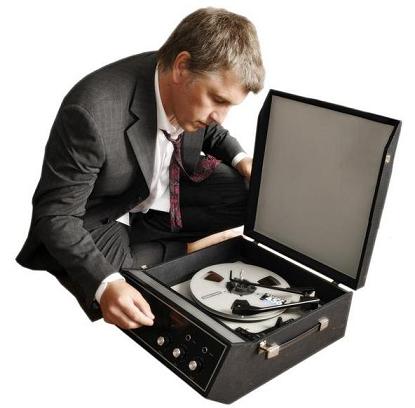
SFBG: About that wonderful Revox B77 of yours. Can you get a bit wonky  about it — what’s the model, how do you store it and transport it, and how do you keep it up? Fanboys are dying to know!
GW: I have my own B77s (flight-cased) for UK gigs and we hire them in when I play overseas (Revox R99’s also work for me). I used to take my own on the flights around Europe, but it could be steep on the XS. It can give the promoters a bit of a headache tracking them down, but everyone has managed to find a unit somewhere. People would be disappointed if I turned up without one, as it’s an essential part of what I do – spinning sounds, samples, and textures over the tracks I play, and creating dub fx. It’s become my trademark and on the rare occasions when I do DJ without it I feel really weird. I don’t know where to put my hands!

Pool loops

0

superego@sfbg.com

SUPER EGO “Don’t you think that scratching records might annoy the people who spent a long time in the studio making them?”

I’m snickering at a jaw-droppingly antiquated — yet actually quite relevant — video from 1983 titled “1st UK DJ to Mix Live on TV.” It features famous, fresh-faced turntablist Greg Wilson, gracefully fending off tin-eared questions from Tube program host Jools Holland while demonstrating to an antsy, angular-haired audience what this whole “mixing records” thing is about.

The scratching bit’s a hoot because Wilson — who recently emerged from an 18-year retirement and will be performing at Triple Crown on Friday — isn’t scratching at all. He’s merely cueing up the record, a simple act that draws gasps. “Well, that’s it, that’s the danger,” Wilson replies to Holland, poker-faced, his soft brown Afro unshaken. “But when a record’s been played in the club for a long time, people get a bit fed up hearing it, and it’s nice to hear it in a different way. And that’s why I kind of … play about with them a bit.”

Wilson goes on to blow post-punk minds by phasing on two — two — tables at once. Then he takes it to a whole other level by revving up his trademark, Steampunk-prophesying Revox B77 reel-to-reel effects machine, real-time sampling David Joseph’s Jheri curl-slick classic “You Can’t Hide (Your Love From Me),” filling out the back-end with sly loops and layering on psychedelic dub echoes. It’s a wondrous bit of analog theater that I imagine, in this “digital age” I keep hearing about, would cause the same kind of pop-culture rupture if played out on American Idol today.

Or maybe not so much. Two of the big nightlife media hooks of the past few years have been the disco revival and the vinyl resurgence — twinned digital-reactionary movements that recall the late-1990s hip-hop and soul crate-digging of hometown heroes like DJ Shadow and Ren the Vinyl Archeologist, a fruitful response to the CD reissue mania of that time. Every technology carves out an implicit niche for its own backlashes. Now, it swallows them too. Despite all the retro nostalgia, DJs need the Internet to get their mixes out and research rare tunes. Plastic and silicon moving in tandem — it’s a real mishmash.

Wilson, who spent his decks hiatus pursuing his production career, may still keep one hand on the vintage — that Revox B77 still travels with him — but he’s made no secret of his enthusiasm for new fad gadgets, and felt that with the simultaneous rise of disco re-fever and software hijinks, a comeback was due.

“I think it’s an exciting time,” he e-mailed me from Australia, in the midst of a bonkers world tour to support his latest compilation of rejiggers, Credit to the Edit, Vol. 2 (Tirk). “Some people pine for the old days. But great as they were, I don’t like to dwell on the past too much in a nostalgic way, but use it to inform the future. I like the way younger people, who didn’t directly experience the original disco era, are drawing influence from it, reshaping it from their own perspective here and now. For me, music — no matter how old it might be — is always alive and evolving, so I’m all for bringing it into a new context.”

Wilson made his name in the ’70s and ’80s by birthing the electro-funk movement in the U.K. (www.electrofunkroots.co.uk), which pipelined many hard-to-find American dance releases to British crowds, and he came of age in a world of DJ record pools — strategic vinyl-sharing cabals that hooked cash-strapped DJs up with record companies eager to get their releases heard. Record pool culture opened the doors for innumerable disco and funk edits: DJs wanted to sound unique, so they mixed (or had someone else mix) their own versions of hits, stamping them with an individual sonic imprint. Thus the hugely influential edit scene was born, paving the way for a spectrum of club remixes from genius and egregious.

No one handled edits quite like Wilson, whose pitch-perfect additions, stretches, and overlaps and live technique proved to be a bulletproof blueprint. The disco edit scene, a subsection of disco revivalism that also digs up more contemporary “lost” tracks, keeps looping back into view, the most recent fanatic attack including acts like Wolf + Lamb, Soul Clap, Les Edits Du Golem, and Tensnake, and labels like Rong, Wurst, and Ugly.

Our very own rulers of the local edit scene are King & Hound (www.myspace.com/garthgrayhound), a collaborative effort between two SF DJ legends, Garth and James Glass, on the Golden Goose label. The two met in the early ’90s at the notorious Record Rack music store and have lately released tasty versions of David Ian Xtravaganza’s kiki 1989 “Elements of Vogue” and Can’s space-groovy “A Spectacle.”

“I have quite a few of Greg’s records,” Garth told me over e-mail. “I recently rediscovered one of his early hip-hop records called ‘We Don’t Care’ by Ruthless Rap Assassins, which I bought in 1987!” Glass joined in, “I grew up in London listening to Greg’s mixes and I’d hear him out and about.” Both of them shake off suggestions of Wilsonian influence, however. “But we’re all doing the same thing — taking out the cheese and respecting the quality,” Glass said.

Wilson’s brilliant 2009 Essential Mix mix for the U.K.’s BBC1 radio found Massive Attack and Talking Heads sharing space with Geraldine Hunt and Chic, and reintroduced him to American ears (“I think that mix illustrates what I always strive for: connecting back but moving on,” he told me. “I was shocked at the overwhelmingly positive response.”) But to Bay players he was always in the loop, working with the invaluable Anthony Mansfield of the Green Gorilla crew and Qzen and even visiting Haight Street a few years back to feed his ’60s obsession.

I recently had the opportunity to explore a bit of the Bay Area’s record pool and disco edit past with DJ Jim Hopkins of the ubiquitous Twitch Recordings, and who currently spins eclectic sets at venues like 440 Castro and Trax. He’s no stranger to the edit scene, becoming one of the youngest edit contributors in the early ’80s to San Francisco disco and Hi-NRG record pool Hot Tracks and later, after Hot Tracks owner Steve Algozino passed away from AIDS, Rhythm Stick, helmed by Algozino’s protégée Jenny Spiers. (He also namechecks the Bay’s Disconet and New Wave-friendly Razor Maid.) Hopkins got his edit start as a teen in the ’70s, using the pause button on his dad’s tape deck to make his own edits, and soon grabbed professional attention. “Record companies wanted several versions of their records available for DJs, and record pools wanted to put out compilation issues for subscribers that featured unique takes on tracks, so I happily provided,” he told me. “It’s funny that those things are worth a fortune today.”

Hopkins just started an online organization called the San Francisco Disco Preservation Society (find it at www.twitchrecordings.com) to collect and celebrate Bay-centric edits and reel-to-reel mixes. “As for the edit scene now, there seem to be two kinds being produced. There are easy-sounding ones that just extend the good parts. Then there are more serious ones that take the original and make it into something new and more moody. I think that’s good for the future — because sometimes I have to laugh. Disco kids these days are pulling anything out of vinyl resale bins from 20 years ago and calling it ‘classic’ when most of it is crap. It was crap back then, too. Making it into anything different is doing it a favor, really.”

Read Marke B.’s full interview with Greg Wilson here.

GREG WILSON: CREDIT TO THE EDIT TOUR

Fri/19, 10 p.m.–4 a.m., $15/$20

Triple Crown

1772 Market, SF

www.triplecrownsf.com

HONEY SUNDAYS PRESENTS JIM HOPKINS

Sun/21, 10 p.m., $3

Paradise Lounge

1501 Folsom, SF

www.paradisesf.com


Elusive finger-picker Ed Masuga reappears with five shows

2

By Chloe Roth

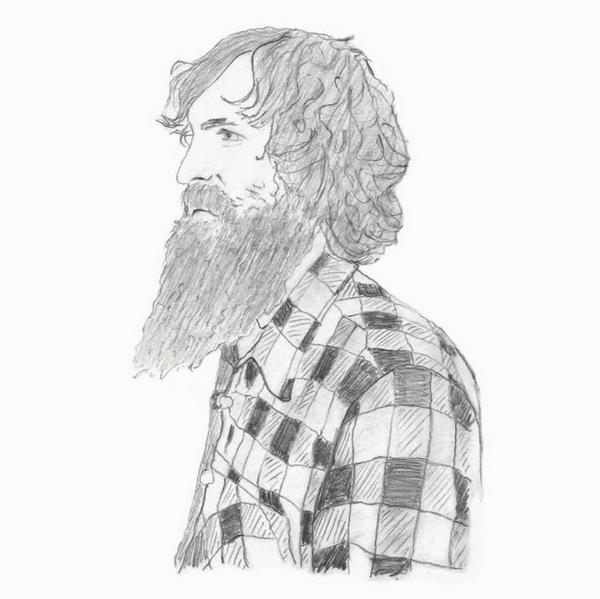
For the past four years, Ed Masuga has consistently delivered pure folk music. His dichotomously sharp finger-picking guitar and soft melodies make for easy, pleasing listening, and if you close your eyes you might find yourself transported to a Dust Bowl-era railway car. Steeped heavily in the folk tradition, his songs are simultaneously old-fashioned, timeless, and timely. With the bare minimum of Internet presence, the elusive San Francisco-based songster, though he can’t be called a Bay Area “native,” maintains a mysterious backwoodsman identity. The almost literary stories of his youth seem to come straight out of a Dickens novel. I caught up with Mr. Masuga (that has a nice ring to it!) to ask him how his itinerant childhood has informed his work.

The youngest of 10 children, Masuga lived a rootless childhood, constantly drifting with his large family from shack to motel to forest to casino, usually around the San Bernadino Mountains and Big Bear Lake. Returning from the hospital with a birth tag on his wrist that read “Boy Masuga,” and for lack of a chosen name, his family referred to him as “Boy” for the first few years of his life. “When people started calling me Danny, my actual name,” Masuga says, “I refused, preferring to go by my middle name Eddie, after the ’70s country singer Eddie Rabbit.” Masuga grew up around music, his folks and family always singing together wherever they went. Masuga says that his father, who came from a polka-singing Polish family, “has always seemed somehow to know every song out there,” which probably helped him win a trip to Puerto Rico on an episode of “Name That Tune” when Ed was “just a tyke.” And his mother’s traveling occupation, as a cook in bar kitchens, exposed him to a whole world of juke box country music.

Out of all the places Masuga has lived over the years (the East Coast, Alaska, Ohio, Oregon, Colorado, Arizona, and Montana), he says that the Bay Area, especially the trees and hills of the East Bay, “has something special that always brings me back.” Of Berkeley in particular, where he has lived sporadically since 1999, Masuga says “it’s kind of like a second home for me in a way. Or a third or fourth.”

Both his 2006 self-titled debut and his 2008 sophomore record Lonely Dog consisted solely of Masuga’s unadorned voice and guitar. His new record, Let Me Tune My Heartstrings, breaks away from the sparseness of the first two albums. Female vocal harmonies by Ed’s “longtime best friend-extraordinaire Kate Grindlay” meld flawlessly with his voice to create a new fullness, rich and soulful. Flying solo in the past, his live performance has recently evolved into a group project with Grindlay on accompanying vocals, Ethan Lee on bass, and Mike Carreira on drums.

If you check his MySpace page every now and again like I do, hoping to see a local show listed, you’ll oft be disappointed. But Ed Masuga has made a sudden reappearance in the Bay Area, with five shows scheduled over the next two months in San Francisco, Berkeley, Oakland, and Bolinas. Jump on the bandwagon quickly, for with Ed’s wandering ways, who knows when you’ll catch him in the Bay again.

Urethra, frankly

0

Dear Andrea:

I have always had an interest in inserting thin objects into my urethra, and now manage a large-diameter pencil. It really feels thrilling, and depending on the mood, I tend to orgasm. My question is: how much can the urethra in a woman stretch? I have also inserted the same into my cervix; are there dangers in either?

Love,

Intrepid Explorer

Dear Ex:

There is no question that the urethra, or at least its surrounding tissue, is sexually sensitive.

Ernest Gräfenburg’s orginal break-out paper was called “The Role Of Urethra in Female Orgasm” and figured the locus of internal vaginal sensitivity (later called the G-spot) to be the area of nerve-rich erectile tissue wedged between the urethra and the upper wall of the vagina. You stimulate the paraurethral area though the vagina. There’s no reason it shouldn’t work from the other direction. Except for that pesky business about the vagina being thickly muscled, tough, flexible, and dead-ended, while the urethra is relatively inflexible and fragile and leads directly into the bladder, which leads to the kidneys, which you do not want to mess with. But assuming you are real and really female, you have already done this and lived to tell. Yay for you. Your job now is either to quit it (recommended) or find a very clean and safe way to do it.

I was intrigued to hear from a physician (this was 10 or so years back, but not, like, 40 years back) that little girls are routinely brought to emergency departments with hairpins in their urethras. Let’s say that “hairpin” was just shorthand for “small, easily accessible, and inappropriate random object” and consider why it’s a bad idea: small things get lost; easily accessible random objects are dirty; and small, dirty objects loose in your urinary tract will cause infection and may cause perforations. Either way, you would end up in the ER. The only appropriate object for urethral insertion is a urethral sound, or something as smooth, appropriately sized, long-handled, and sterilizable as a urethral sound. Does any of that say “Use a pencil!” to you?

As for the cervical insertion: I will admit that it ought to be technically possible. The cervix, even in a woman who’s never been pregnant, is closed-ish but not entirely closed, and it waxeth and waneth like the moon. You do hear of people doing cervix “play” or see pictures of such things on the Internet. But that does not mean you should do it.

For one thing, there’s pain. If you have never had a baby or a miscarriage (I have had both, and may I add OMG) or really horrible menstrual cramps, you have no idea how much having your uterus cranked open hurts. That muscular organ, inevitably referred to as “fist-sized,” is usually clenched down tight, and for a reason. Anything introduced in there can perforate, causing peritonitis and possible death, or just plain infect, causing peritonitis and possible death. If you do not want to risk peritonitis and possible death, please just leave your cervix alone. It has a job to do and does not need you interfering with it.

Love,

Andrea

See Andrea’s other column at carnalnation.com.


Urethra, frankly

0

andrea@mail.altsexcolumn.com

Dear Andrea:

I have always had an interest in inserting thin objects into my urethra, and now manage a large-diameter pencil. It really feels thrilling, and depending on the mood, I tend to orgasm. My question is: how much can the urethra in a woman stretch? I have also inserted the same into my cervix; are there dangers in either?

Love,

Intrepid Explorer

Dear Ex:

There is no question that the urethra, or at least its surrounding tissue, is sexually sensitive. Ernest Gräfenburg’s orginal break-out paper was called "The Role Of Urethra in Female Orgasm" and figured the locus of internal vaginal sensitivity (later called the G-spot) to be the area of nerve-rich erectile tissue wedged between the urethra and the upper wall of the vagina. You stimulate the paraurethral area though the vagina. There’s no reason it shouldn’t work from the other direction. Except for that pesky business about the vagina being thickly muscled, tough, flexible, and dead-ended, while the urethra is relatively inflexible and fragile and leads directly into the bladder, which leads to the kidneys, which you do not want to mess with. But assuming you are real and really female, you have already done this and lived to tell. Yay for you. Your job now is either to quit it (recommended) or find a very clean and safe way to do it.

I was intrigued to hear from a physician (this was 10 or so years back, but not, like, 40 years back) that little girls are routinely brought to emergency departments with hairpins in their urethras. Let’s say that "hairpin" was just shorthand for "small, easily accessible, and inappropriate random object" and consider why it’s a bad idea: small things get lost; easily accessible random objects are dirty; and small, dirty objects loose in your urinary tract will cause infection and may cause perforations. Either way, you would end up in the ER. The only appropriate object for urethral insertion is a urethral sound, or something as smooth, appropriately sized, long-handled, and sterilizable as a urethral sound. Does any of that say "Use a pencil!" to you?

As for the cervical insertion: I will admit that it ought to be technically possible. The cervix, even in a woman who’s never been pregnant, is closed-ish but not entirely closed, and it waxeth and waneth like the moon. You do hear of people doing cervix "play" or see pictures of such things on the Internet. But that does not mean you should do it.

For one thing, there’s pain. If you have never had a baby or a miscarriage (I have had both, and may I add OMG) or really horrible menstrual cramps, you have no idea how much having your uterus cranked open hurts. That muscular organ, inevitably referred to as "fist-sized," is usually clenched down tight, and for a reason. Anything introduced in there can perforate, causing peritonitis and possible death, or just plain infect, causing peritonitis and possible death. If you do not want to risk peritonitis and possible death, please just leave your cervix alone. It has a job to do and does not need you interfering with it.

Love,

Andrea

See Andrea’s other column at carnalnation.com.

Informing the public

1

news@sfbg.com

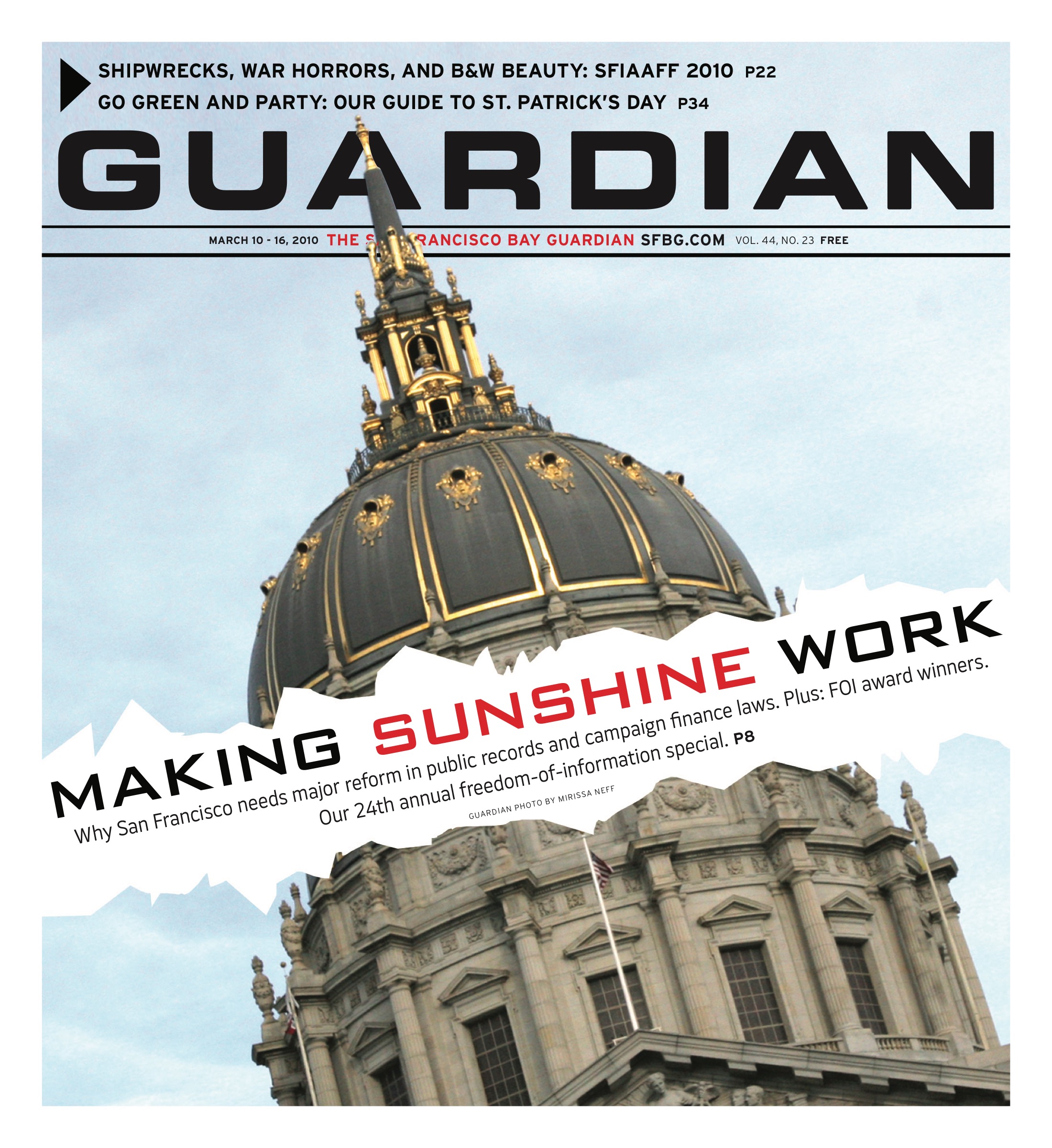
Information is power. But too often, those with political power guard public documents and information from the journalists, activists, lawyers, and others who seek it on the people’s behalf. So every year, we at the Guardian honor those who fight for a freer and more open society by highlighting the annual winners of the James Madison Freedom of Information Awards, which are given by the Northern California chapter of the Society of Professional Journalists.

This year’s winners are:

Beverly Kees Educator Award

Rachele Kanigel

Rachele Kanigel, an associate professor of journalism and advisor to Golden Gate Xpress publications at San Francisco State University, has been highly involved in student press rights work on a national level. She wrote The Student Newspaper Survival Guide (Blackwell Publishing, 2006), a book designed to empower budding campus reporters. A champion of the free speech rights of her students, Kanigel has gone to bat on several occasions on behalf of student journalists whose work was challenged by interests that didn’t believe students should be afforded the same protections as professional reporters. Kanigel sees part of her job as educating the world about the importance of student journalists and standing up for their rights. “A lot of people won’t talk to student journalists, but they’re doing some really important work,” she said. “A lot of what we have to do is to assure the student journalists and tell the world outside that these are journalists.” The educator award is named in honor of Beverly Kees, who was the SPJ NorCal chapter president at the time of her death in 2004.

Norwin S. Yoffie Career Achievement Award

Mark Fricker

Mary Fricker is the kind of investigative reporter many of us would like to be.

She started out in the 1980s investigating complaints of irregularities at her local savings and loan when she was reporting for the old Russian River News community paper. Her dogged research and hard-hitting stories produced the first major investigation into the toxic problems of financial deregulation in S&Ls. Her work won numerous awards, including the Gerald Loeb Award given out by UCLA and the prestigious George Polk Award, and ultimately led to the book, Inside Job: The Looting of America’s Savings and Loan. The book won Best Book of the Year award from the Investigative Reporters and Editors association.

Fricker did business reporting and major investigative work for 20 years with the Santa Rosa Press Democrat. She retired and joined the Chauncey Bailey Project as a volunteer investigative reporter, researcher, Web site maestro, and general good spirit. Her work included several key investigations that determined that the Oakland Police Department was virtually alone in not taping interviews with suspects in investigations. Her stories changed that practice. She is a most worthy recipient of the Norwin S.<0x2009>Yoffie award, which honors the memory of the former publisher of the Marin Independent Journal, a founder of the SPJ/FOI committee, and a splendid warrior in the cause of Freedom of Information.

Professional Journalist

G.W. Schulz

G.W. Schulz was busy when we got him on the phone. “I’m sending out about eight or nine new freedom of information requests a day,” he said. “I fired off a few to the governor of Texas this morning.”

The relentless reporter is working on the Center for Investigative Reporting’s program exposing homeland security spending. It hasn’t been easy. Since the federal government began making big grants to local agencies for supposed antiterrorism and civil emergency equipment and programs, following the money has required unusual persistence. Homeland Security officials don’t even know where their grants are going, so Schulz has been forced to dig deeper.

“I think this is the biggest open government campaign I’ll ever do in my career,” he said. “We’re juggling dozens of requests, state by state. And it’s breathtaking what some people will ignore in their own public records laws.”

He’s found widespread abuse. “These agencies are getting all this expensive equipment and they don’t even maintain it or train their staff how to use it,” he said. CIR is not only doing its own stories, it’s working with local papers that don’t have the resources to do this kind of work. “Lots of great stories in the pipeline,” he said before signing off to get back to the battle. “I’m really excited.”

Legal Counsel

Ann Brick/ACLU

On the heels of a now-infamous Supreme Court ruling on so-called First Amendment rights for corporate political speech, SPJ is honoring an individual who has made a career devoted to protecting real, individual free speech rights for almost 20 years. Ann Brick, staff attorney for the Northern California chapter of the American Civil Liberties Union, has litigated in defense of privacy rights, free speech, government accountability, and student rights in cases ranging from book burning to Internet speech to illegal government wiretapping. “I can’t tell you how much of an honor it is to have worked with the ACLU,” she says, adding, “I can’t think of another award I’d rather get than this one — an award from journalists.” But the public’s gratitude goes to Brick, whose years of service are a shining example of speaking truth to power.

Computer Assisted Reporting

Phillip Reese

Phillip Reese of The Sacramento Bee is being honored for his unrelenting pursuit of public records and for producing interactive databases. Reese was the architect of the Bee‘s data center, providing readers readily accessible information about legislative voting records, neighborhood election results, state employee salaries, and other important information. At one point, the city of Sacramento demanded several thousand dollars in exchange for employee salary data. Reese gathered the city’s IT workers and a city attorney for a meeting, where he argued that organizing records in an analyzable format would insure the system wasn’t being abused, so they chose to provide the records for free. The online databases provide public access to records that are often disorganized and cryptic. “Sometimes these databases go well with a story, and sometimes they can stand on the Internet alone. People can view them in a way that is important to themselves,” Reese said.

Public Official

Leland Yee

State Sen. Leland Yee (D-San Francisco) has been an open government advocate since his days on the San Francisco Board of Supervisors, and one of his favorite targets is the administration of the University of California. He has fought to protect UC students from administrators who want to curtail their free-speech right and to get documents from university officials.

In 2008, he authored and passed SB 1696, which blocked the university from hiding audit information behind a private contractor. UCSF was refusing to release the information in an audit the school paid a private contractor to conduct. “I read about this in the newspaper and I was just scratching my head. How can public officials do this stuff?” Yee said. He had to overcome resistance from university officials and public agencies arguing that the state shouldn’t be sticking its nose into their business. “But it’s public money, and they’re public entities, and the people have a right to know where that money is going.”

Computer Assisted Reporting

Thomas Peele and Daniel Willis

This duo with the Bay Area News Group, which includes 15 daily and 14 community newspapers around the Bay Area, performed monumental multitasking when they decided to crunch the salaries of more than 194,000 public employees from 97 government agencies into a database. Honored with the Computer Assisted Reporting Award, the duo provided the public with a database that translated a gargantuan amount of records into understandable information. They had to submit dozens of California Public Records Act requests to access the records of salaries that account for more than $1.8 billion in taxpayer money. “It is important that the public know how its money is spent. This data base, built rather painstakingly one public records act request at a time by Danny Willis and myself as a public service, goes a long way in helping people follow the money,” Peele said.

Nonprofit

Californians Aware: The Center for Public Forum Rights

California’s sunshine laws, including the Brown Act open meeting law and California Public Records Act, aren’t bad. Unfortunately, they are routinely flouted by public officials, often making it necessary to go to court to enforce them. That’s why we need groups like CalAware, and individuals like its president, Rick McKee, and its counsel, longtime media attorney Terry Francke. Last year, while defending an Orange County school board member’s free speech rights and trying to restore a censored public meeting transcript, CalAware not only found itself losing the case on an anti-SLAPP (strategic lawsuit against public participation) motion, but being ordered to pay more than $80,000 in school district legal fees. “It’s never been easy, but that was going to be the end of private enforcement of the Brown Act,” Francke said. Luckily, Sen. Leland Yee intervened with legislation that prevents awarding attorney fees in such sunshine cases, leaving CalAware bruised but unbowed. “We’ve become active in court like never before.”

News Media

SF Public Press/McSweeney’s

Last year, when author Dave Eggers and his McSweeney’s magazine staff decided to put out a single newspaper issue (because “it’s a form we love,” Eggers told us), they filled San Francisco Panorama with the unusual mix of writers, topics, and graphics one might expect from a literary enterprise. But they wanted a hard-hitting investigation on the cover, so they turned to the nonprofit SF Public Press and reporters Robert Porterfield and Patricia Decker. Together, they worked full-time for four months to gather information on cost overruns on the Bay Bridge rebuild, fighting for public records and information from obscure agencies and an intransigent CalTrans. “We’re still dealing with this. I’ve been trying to secure documents for a follow-up and I keep getting the runaround,” said Decker, a new journalist with a master’s degree in engineering, a nice complement to Porterfield, an award-winning old pro. “He’s a great mentor, just such a fount of knowledge.”

Professional Journalist

Sean Webby

San Jose Mercury News reporter Sean Webby won for a series spotlighting the San Jose Police Department’s use of force and how difficult it is for the public or the press to track.

The department and the San Jose City Council refused to release use-of-force reports, so Webby obtained them through public court files. He zeroed in on incidents that involved “resisting arrest” charges, and even uncovered a cell phone video in which officers Tasered and battered suspects who did not appear to be resisting.

Webby has won numerous awards in the past, but says he is particularly proud of this one. “Freedom of information is basically our mission statement, our bible, our motto,” he said. “We feel like the less resistance the average person has to getting information, the better the system works.”

Webby said that despite causing some tension between his paper and the San Jose Police Department, the project was well worth it. “We are never going to back off the hard questions. It’s our job as a watchdog organization.”

Public Service

Rita Williams

KTVU’s Rita Williams is being honored for her tireless efforts to establish a media room in the San Francisco Federal Building that provides broadcasters the same access to interviews as print reporters.

Television and radio equipment was banned from the federal pressroom following 9/11, but Williams solicited support from television stations, security agencies, the courts, and the National Bar Association. After a six-year push, they were able to restore access.

Williams and her supporters converted a storage unit in the federal building into a full-blown media center, which was well-used during the Proposition 8 trial. “I only did two days of the trials, but every time I walked into the room, I would just be swarmed with camera folks saying thank you, thank you, thank you,” she said. “I’m getting close to retirement and I was in the first wave of women in broadcasting, and I’m proud that almost 40 years later, I can leave this legacy.”

Citizen

Melissa Nix

With her Betty Page looks, dogged sense of justice, and journalistic training, Melissa Nix became a charismatic and relentless force in the quest to find out how her ex-boyfriend Hugues de la Plaza really died in 2007. Nix began her efforts after the San Francisco medical examiner declared it was unable to determine how de la Plaza died and the San Francisco Police Department seemed to be leaning toward categorizing the case as a suicide. Using personal knowledge of de la Plaza and experience as a reporter with The Sacramento Bee, Nix got the French police involved, who ruled the death a homicide, and unearthed the existence of an independent medical examiner report that concluded that de la Plaza was murdered.

Editorial/Commentary

Daniel Borenstein

Contra Costa Times reporter Daniel Borenstein wasn’t out to deprive public worker retirees of yachting, country club golf, and rum-y cocktails at tropical resorts. The columnist was only trying to figure out how, for example, the chief of the Moraga-Orinda Fire District turned a $185,000 salary into a $241,000 annual pension. Borenstein’s effort to unearth and make public, in easily readable spreadsheets, the records of all Contra Costa County public employee pensioners led the Contra Costa Times to a court victory stipulating just that: all records would be released promptly on request without allowing retirees time to go to court to block access. The effects have been noticeable: “I get scores of e-mails most weeks in reaction to the columns I’m writing on pensions, [and] public officials are much more sensitive to the issue,” Borenstein says. It is a precedent that has carried into the Modesto Bee‘s similar pension-disclosure efforts in Stanislaus County.

Student Name Withheld After a photojournalism student at San Francisco State University snapped photographs at the scene of a fatal shooting in Bayview-Hunters Point, police skipped the usual process of using a subpoena to seek evidence, and went straight into his home with a search warrant to seize this student’s work. But with the help of his attorney, the student quashed the warrant, arguing California’s shield law prevents law enforcement from compelling journalists to disclose unpublished information. He won, and the case served to demonstrate that the shield law should apply to nontraditional journalists.

The student is being recognized because he resisted the warrant rather than caving into the demands of law enforcement. Invoking the shield law in such cases prevents reporters from being perceived as extensions of law enforcement by the communities they report on, enabling a free exchange of information. The student remained anonymous in the aftermath of the shooting because he feared for his life. Based on his ongoing concerns, NorCal SPJ and the Guardian have agreed to honor his wish to have his name withheld.

Riff evangelists

0

arts@sfbg.com

MUSIC "I felt pretty much the day Wino called me up that it was a really important, really essential thing." Speaking by phone from Los Angeles, Shrinebuilder bassist/vocalist Al Cisneros makes the founding of his new band seem inevitable, like some sort of astronomical event. "Wino" is the nom de rock preferred by legendary guitarist/vocalist Scott Weinrich, cofounder of a new collaboration between musical luminaries that also includes guitarist/vocalist Scott Kelly and drummer/vocalist Dale Crover.

For fans of a certain kind of slow, heavier-than-lead music called "doom metal," these are all household names. Cisneros played bass in the mythical South Bay trio Sleep (with High on Fire’s Matt Pike) before founding drone metallers Om. Wino’s is the most impressive pedigree, one defined by stints with Washington, D.C.-area doom pioneers the Obsessed and L.A. cult heroes St. Vitus. Kelly is well-known in the Bay Area for his work with Oakland experimental titans Neurosis. Crover cut his teeth in Seattle, drumming for the Melvins.

The towering reputations and wide-ranging commitments of the musicians involved made creating the first Shrinebuilder album a scheduling nightmare. Rehearsals took place in multiple locations, often with only two members present — those absent participated by swapping riffs over the Internet. Despite these logistical difficulties, Cisneros insists, the process couldn’t have been more natural. "The in-person rehearsals really just confirmed the songs that we had going." Confined to only three days of studio time, they nevertheless crafted a self-titled album that exudes a confident coherence across its five lengthy tracks.

Even the lyrics, often a point of contention in other, lesser bands, benefited from this uncanny natural understanding: "Without explaining anything about the song, or the vibe, we just all knew what went next — how to proceed," Cisneros recalls. "We had a common understanding of the lyrical theme between all of us. I’m not sure that’s common in bands. We didn’t really need to say anything, we just all finished the lyrics as each other would have."

As can be guessed from the band’s name, the lyrical theme is one of religion, and construction, and the marriage of the two. Song titles like "Solar Benediction," "Pyramid of the Moon," and "The Architect" exemplify this fascination. More than just singing about worshipers, however, the members of Shrinebuilder are worshipers themselves, crafting a temple of their own design. As Kelly explains in an interview with Decibel magazine, "I think we’re just laying more bricks on the foundation that has been laid previously … it’s really an homage to sound, to music, and to its infinite wisdom, you know? The power of it. The religion that is sound. The electric church. All of that. I think that that’s been our lives."

The members of Shrinebuilder, then, are the four riff evangelists, and the album, like the New Testament, is a coherent whole that allows significant leeway for the individual tendencies of its creators. Each of the album’s five songs is a concatenation of different parts, many of which bear the tell-tale fingerprints of their authors. Wino’s bluesy howl makes his sections easy to identify; so too Kelly’s muscular, mammoth riffs and Cisneros’ syrupy bass lines. The album’s most liturgical passage occurs halfway through "Pyramid of the Moon," when an epic, reverberant riff suddenly culminates in haunting, euphonic chanting, which Kelly insists was entirely improvised by Crover and Cisneros in the studio.

Preparations have already begun for another, longer album, one that will involve more rehearsal and more studio time. But even if conflicts arise, the members of Shrinebuilder can rely on the natural affinity that results from their canonization as doom metal apostles. Have you heard the good news?

SHRINEBUILDER

with Harvestman, A Storm of Light

Sun/7, 8 p.m., $17

The Independent

628 Divisadero, SF

(415) 771-1421

www.theindependentsf.com

Live Shots: Zee Avi, Rickshaw Stop, 2/25/10

0

For the 3rd night of the SF Noise Pop festival, three bands shared the stage with Zee Avi at Rickshaw Stop. Noise Pop is such a marathon of music, with each band rushing on stage, setting up their equipment, rocking out for about eight songs and moving aside to make room for the subsequent performers. Luckily through all this movement and music, each group really held their own and the audience kept begging for encores that were never possible.

The night started with Tiny Television, who was accompanied by singer Jen Korte. The band had a folksy sound and their songs were rich and warm. Their slide guitar player was pure genius and with the whole band wearing cowboy boots this group was totally country cool.

Then came the Leslie and The Badgers, hailing from LA. Leslie and her gaggle of boys also hit some great country notes and Leslie’s voice had magical pieces of Dolly Parton and Patsy Cline sprinkled though out it. The highlight of their set was a sing-a-long piece about how it’s ok to hurt somebody, just remember to say you’re sorry.

The four cute girls in the Hot Toddies belted out surf songs and got the audience so energized that they all started to jump and bounce around just like bubble gum! The Hot Toddies were totally crowd-pleasers with their hilarious lyrics about everything from dating old guys on the internet, to the seriousness of a wet dream and how Seattle makes them totally horny. Sweet!

And finally, just a bit before midnight, Zee Avi made her way on stage, to sing us sad songs about drugged out boyfriends and happy songs about true romance found outside a bee hive. She’s so cool and her voice is so lovely, making for the perfect ending after an extreme evening of awesome, almost never-ending, music.

The battle for the forgotten district

24

sarah@sfbg.com

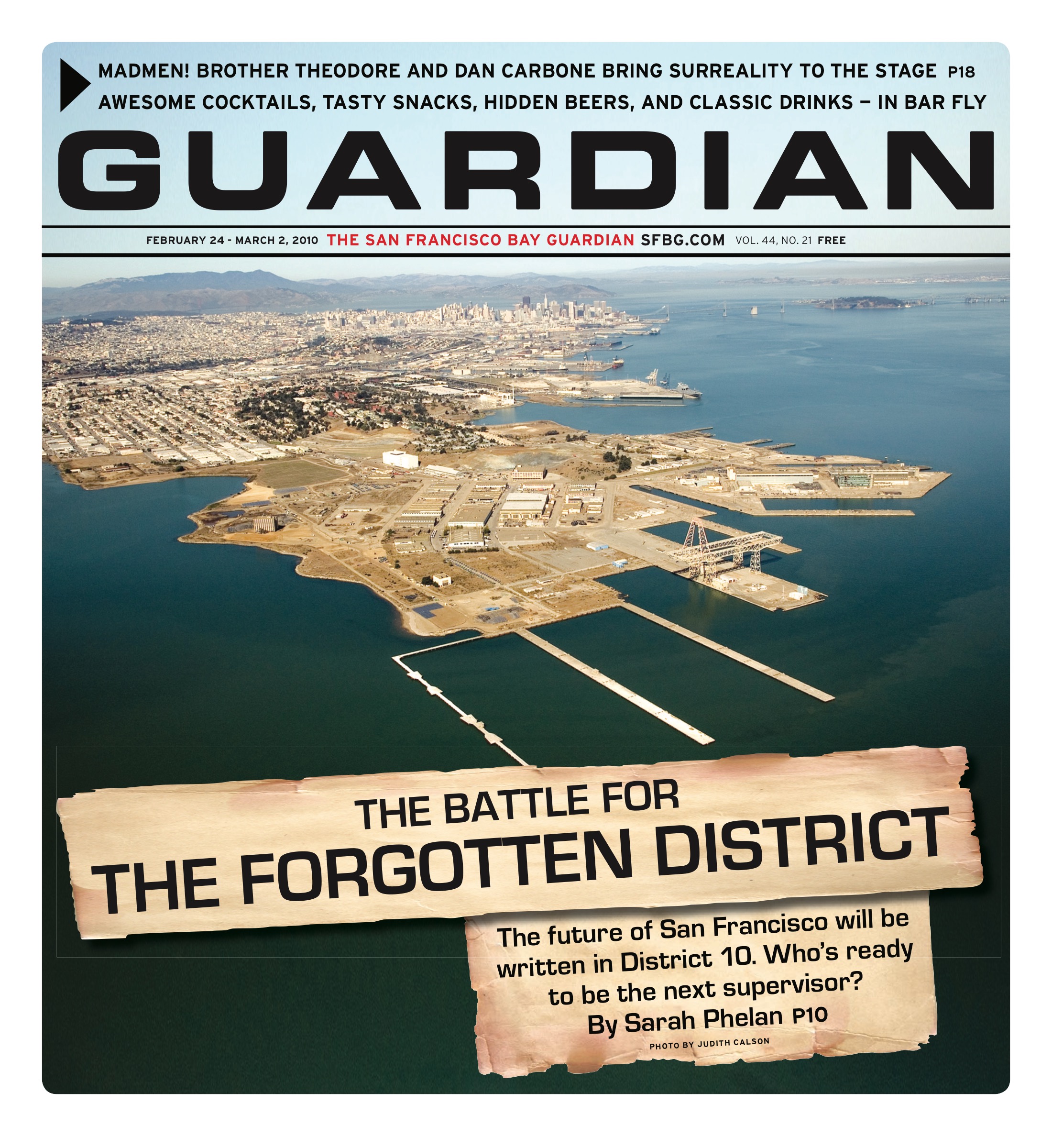
This November, when voters in District 10 — the largest, sunniest, and most diverse of the city’s 11 supervisorial districts — replace termed out Sup. Sophie Maxwell, they’ll be making a selection that could have pivotal implications for the entire city.

That’s because the next supervisor from southeast San Francisco inherits a district that is home to some of the city’s biggest environmental and public health challenges, as well as the most potential for development that will determine what kind of city San Francisco becomes.

District 10 is where you’ll find the most polluted and most underdeveloped lands in San Francisco, areas that could either be transformed into models of a sustainability or, in the words of Tony Kelly, the president of Potrero Boosters Neighborhood Association, “be turned into a toxic Foster City.”

District 10 is where the slaughterhouses, tanneries, and glue factories set up shop and used the bay as a dumping ground. It’s where the smokestacks of coal and oil fired power plants polluted the air. It’s where the Navy filled the Bay, built a shipyard at Hunters Point and loaded parts of the first atomic bomb onto the USS Indianapolis in 1945.

District 10 is where the bottom fell out of this industrial economy in 1974, when the Navy left, taking with it people’s jobs, pay, and hopes for a home of their own and a better future, particularly for what was then a predominantly African American population.

And District 10 is ground zero for plans that will triple the population and double the number of homes — homes that likely will only be “affordable” to Google executives and retirees from Marin, forever changing the face of San Francisco’s southeast sector. Critics fear that will accelerate what has been a steady exodus of black residents, replaced by megadeveloper Lennar’s vision for a new D10.

It’s against this dark history and difficult present that a wide open field of more than a dozen candidates are vying to replace Maxwell, who came to power in 2000 and has had a mixed voting record in her decade on the board. Sometimes, Maxwell was the eighth vote that let the progressive majority on the Board override Mayor Gavin Newsom’s veto and pass trailblazing legislation. Other times, she was the swing vote that allowed the moderate minority to carry Newsom’s water.

So, in addition to D10’s many internal challenges, this seat could determine the political balance of power on the Board of Supervisors, placing all the more importance on voters in this long-marginalized part of town.


DISTRICT OF DISCONTENT

Eric Smith, a biodiesel activist who has thrown his hat in the D10 ring, says that there is a lot of frustration in the air, and looking at the problems the district is facing, it’s hardly surprising that it has what nearly every candidate agrees is a fractured political culture.

“The Bayview, the Hunters Point Shipyard’s toxic Superfund site, the homicide rate, unemployment, poor public transportation, dwindling services and community resources have made D10 one of the city’s largest melting pots of discontent,” Smith said.

Smith’s words were spoken while the Elections Department was verifying signatures earlier this month on a second failed effort to qualify a petition to recall Maxwell.

Bayview resident and D10 candidate Marie Franklin didn’t support the attempt to recall Maxwell, but she understood it as “a frustration movement.”

“People are sinking in the sand, we’ve already lost so many of them, and they felt Sophie wasn’t doing anything for them,” said Franklin, who praised Maxwell for helping get Franklin’s apartment building complex renovated — a job that was completed 18 months ago, at a cost of $65 million, creating 500 local jobs.

“There are 654 units here, and they were uninhabitable,” Franklin said. “There was black mold, rain falling inside. We had people living worse than Haiti.”

Franklin, who said she is running because she “knows the history,” came here in 1978, when she and her son were living in a car after a fire left them homeless. She said the Bayview was a totally isolated area, barely part of mainstream San Francisco.

“There were no taxis, no services,” she recalled. “Nobody would come here, it was the stigmatized area where no one was accountable to provide services.”

The Bayview — which in some ways is the heart of D-!0 — wasn’t always a black community. But African Americans have been living here for 70 years, dealing with all the racism, denial of services, poverty, and pollution. And it bothers Franklin that 85 percent of the 10,500 homes that Lennar plans to develop won’t be affordable to the elderly, disabled, unemployed and low-income people who currently live in the Bayview.

“We need to preserve the diversity of the community and make sure their issues and information will flow to City Hall,” she said. “You must give the people a handle. If you don’t reach out, they’ll slip. That’s why folks out migrated.

Whoever succeeds Maxwell will be a central player in addressing some very big and dirty issues: the future of the Navy’s radiologically impacted shipyard at Hunters Point, Lennar’s massive redevelopment plan for the Shipyard and Candlestick Point, the polluting power plants, replacement of stinky digesters at the sewage plant, and the SF Hope public lousing rebuild.

There’s also the chance to address violence and crime. James Calloway, a candidate who has long worked in Bay Area schools, told us he believes that education and jobs are part of the keys to rejuvenating the district.

“Job opportunities are not as plentiful in the district,” Calloway said. “When I was a kid, you could walk down Third Street at 2 a.m. Now I wouldn’t walk down it at 9 p.m., and I know the area.”

Calloway is hopeful that the massive redevelopment plan, if done correctly, could start the district’s comeback. “Not a lot of black folks stay here when they have extensive education,” he said. “But it’s not only them. Many were displaced by redevelopment and had no way to go back.”


ELECTION UP FOR GRABS

The largest of the city’s 11 electoral districts, D10 is a huge triangular piece of land in the city’s southeast sector that was used as an industrial dumping zone for decades. Today, the district runs from the Giants stadium at AT&T Park to the 49ers stadium at Candlestick Point and encompasses Mission Bay, Potrero Hill, Dogpatch, India Basin, Portola, Little Hollywood, and Visitacion Valley. It’s also crossed by two freeways that isolate it from the rest of the city, and is home to a large number of crumbling housing projects that are in the process of being rebuilt.

Candidate Ed Donaldson grew up in the projects until he was 10 years old, when the Redevelopment Agency kicked his family out in the 1970s. “We landed on our feet, but others weren’t so lucky,” said Donaldson, who works as a housing counseling director at the San Francisco Housing Development Corporation.

“There is a sense that the Bayview and Visitacion Valley have not been included within the San Francisco family,” Donaldson said. “There is a sense of being forgotten.”

In 2007, Donaldson co-founded the Osiris Coalition to tackle the city’s dormant Certificate of Preference program, in which the Redevelopment Agency issued a document to displaced residents and businesses in the 1960s promising that they could return.

He also tried to rescue some 700 foreclosed properties and recycle them as affordable housing stock. And now he is trying to prevent the city from bulldozing seven SF Hope projects without guaranteeing residents that they have right to remain.

In 2007, Mayor Gavin Newsom and Maxwell convened an African American Outmigration Task Force that didn’t get a public hearing about its findings until August 2008. The timing angered some, who questioned why the report’s findings and implications for urban planning weren’t released before June 2008, when the residents of San Francisco voted for the Lennar-led Proposition G, a proposal to build 10,000 market rate homes at one of San Francisco’s last remaining black communities, which Newsom and Maxwell endorsed.

The taskforce didn’t publish its recommendations until the end of 2009, allegedly because of insider squabbling. Meanwhile, gentrification was going on actively, and many blamed Newsom, and by extension Maxwell, for failing to do anything with the group’s findings as D10 residents continued to suffer from high rates of asthma, cancer, unemployment and an ongoing black exodus.

It wasn’t always this way. In the 1940s, the district’s black population exploded when migrants from the south and World War II veterans came to work at the Hunters Point Naval Shipyard. Some moved to Alice Griffith Public Housing complex, or Double Rock, which was built as military housing in 1962. Others relocated to the Bayview when the Redevelopment Agency took over the Fillmore/Western Addition in the ’60s and ’70s as part of a controversial urban renewal effort.

But when the Navy abandoned the shipyard in 1974, unemployment hit the black community hard. Today, hundreds of the city’s lowest income residents live in Alice Griffith’s crumbling units and endure sewage backups, no heat, cloudy drinking water and leaking ceilings, as they wait for the projects to be rebuilt.

“Generations have been trapped in the silo of public housing and cannot get out, because of lack of opportunity and education, so when we legislate, we need to take that into consideration,” said candidate Malia Cohen, whose grandfather came from Texas to work at the shipyard where he met her grandmother, whose family came from New Orleans.

“My grandfather’s father was a longshoreman. He worked with the infamous Leroy King [a commissioner at the city’s Redevelopment Agency] and he has fantastically vivid stories of racism,” said Cohen, who works for the Federal Reserve Bank of San Francisco, previously served on the executive staff of Mayor Gavin Newsom, and has already raised over $18,000 in the D10 race and qualified for public matching funds.

“My family came here to work hard, they lived on Navy road in the projects, and then they bought a house here. My parents were born here, and we were all public schooled,” Cohen recalled as she took me on a tour of D10 that ended up in Visitacion Valley, an increasingly Chinese-American neighborhood that reflects a district-wide trend.

Census data show that by 2000, Asians were the largest racial group in the district (30 percent), followed by blacks (29 percent), whites (26 percent), and Latinos (19 percent). By 2003, according to the California Urban Issues project, the trend continued. Asians were the largest racial group (32 percent), followed by blacks (27 percent), whites (21 percent) and Latinos (17 percent) of the population.

This means that D10 candidates will have to garner support from more than one ethnic group to win. Over a dozen candidates have already filed papers in the race, but so far there is no clear front-runner.

Also frustrating the prognosticators is that fact that D10 has had the lowest voter turnout in the city, so the winner will also depend on who goes to the polls.

D10 candidate Geoffrea Morris, who is the grand daughter of longtime Bayview activist Charlie Walker, has been knocking on doors and participating in voter registration drives.

“We need new blood,” Morris said

Getting elected will be a complicated equation. Although Bayview’s population was 50 percent African American at the time of the 2000 census, it didn’t turn out the vote. In the 2006 election, only 14,000 of the district’s 37,000 registered voters went to the ballot, and 50 percent were from whiter, richer, and more Asian neighborhoods.

“It’s very important to the future of the city that the ethnicity diversity of the board be maintained and that the African American community have representation,” former Board President and current Democratic Party chair Aaron Peskin told the Guardian.

Maxwell recently told the Guardian that she’s not ready to endorse any D10 candidates yet. “I’m waiting for people to have a better understanding of what this community is, what the common thread running through it is, and how to use rank choice voting,” she told us.

The only candidate who currently holds elected office is BART director Lynette Sweet, who had her answers down pat when we reached her by phone, and even used wording that was eerily similar to Maxwell’s words.

“D10 is a pretty diverse district, but there is only one common thread: the need for economic development,” Sweet told me. “That’s true in Potrero Hill, Portola, Dog Patch and the Bayview. It’s the same mantra: a lot of small businesses need help, and the only way to help them is through economic development. In Potrero Hill it’s about land use. In the Bayview, it’s about the shipyard and better transportation and truancies.”


THE COMMON THREAD

District 10 is ground zero for the Lennar’s $2.2 billion plan to develop 10,500 market rate condos at the Shipyard and Candlestick Point. The plan will allegedly create thousands of jobs and new parks, deliver on an historic community benefits agreement that labor groups claim is so “lawyered up” that the developer can’t renege on its promises.

The package is framed as the one and only way to revitalize the southeast’s formerly vibrant economic engine. Indeed, any time anyone tries to slow down the process—to take time to thoroughly read the draft EIR and see if it adequately addresses the impacts of this massive urban reengineering project — a chorus of “no delays” starts up, either from residents of the housing projects desperate to see their homes rebuilt, or the labor contractors who hope to get jobs.

“It’s as if the city is playing checkers, while Lennar is playing three-dimensional chess,” Eric Smith observed.

Lennar has stated that it will contribute $711 million to finance this massive project. The remainder will be leveraged by Mello-Roos bonds, state taxes based on the use and size of a property and intended to raise money for needed services, and tax increment financing, which creates funding for projects by borrowing against future property tax revenues.

The conceptual plan won Maxwell’s backing but environmental groups are critical of the draft EIR.

During DEIR hearing, environmentalists questioned the wisdom and the cost of filling the Bay to build a bridge over Yosemite Slough, and building condos on Candlestick Point state recreation area, the only open major open space in the district.

But the city’s Planning Department also has 20,000-30,000 units of housing in its pipeline. This means that if all these plans get approved in the next decade, they’d account for 80 percent of residential development citywide. And D10’s population could triple, further skewing the district’s already shifting demographics.

In other words, D10 as we know it could become nothing more than a historic relic in a few years, and the next supervisor will play a key role in deciding whether that happens. SFHDC’s Ed Donaldson warns that any supervisor who does not understand the complexity of the city’s largest district can expect a similar recall backlash in future.

“There is no one homogenous voice in the community,” Donaldson said. “The grass-roots organizing that brought about the recall effort was a result of a changing political structure in the area, but is not yet on par with other districts in town. We still allow our politics to be controlled from downtown.”

Fellow candidate Eric Smith warns that the issues—and politics—are complex.

“People were emotional, angry, and desperate because they feel no one listens to them,” Smith said. “That’s part of the problem here; they would rather have a supervisor go down swinging for them, rather than watch one seemingly side with Lennar, PG&E and the mayor on issues contrary to their interests. That’s the terrible irony and one of the biggest problems in District 10. Folks are so mad, they’re willing to do whatever it takes to make them feel they have a voice in the outcome, even if it’s potentially worse.”

Smith cited the sequence of events that culminated last year in the Navy dissolving the community-based shipyard Restoration Advisory Board (RAB), which for years has reviewed technical documents and commented on the Navy’s clean-up proposals. But in December, the Navy made its official decision to disband the RAB, citing dysfunctional behavior and off-topic discussions that got in the way.

“Some of the same folks who were frustrated by the process, tried to send a signal to the Navy that they weren’t being heard and for all their well-intentioned efforts got the RAB dissolved,” Smith said. “I truly feel for them, it’s absolutely heartbreaking, but at times, they can be their own worst enemy.”

One of the looming issues about the shipyard is that the land has been polluted and needs to be cleaned. The shipyard contains radioactive debris from ships towed to the shipyard, after a 90-foot wave washed over them during an atomic test gone awry. The Navy burned 610,000 gallons of radioactively contaminated ship fuel at the shipyard, and workers showered on the shipyard, raising concerns that radioactive materials got into the drains and sewers. And questions have been raised about radiological tests on animals at the yard.


LEAKS AND FLOODS

It’s not just the shipyard that’s toxic. Even the buildings that were constructed to house workers 50 years ago are a serious mess.

Realtor Diane Wesley Smith, who grew up in public housing projects, took me on a walking tour of Alice Griffith last week to see conditions that tenants will likely have to endure until at least 2014, if the city sticks to its plan to relocate people into a new replacement unit in the same geographical area, if not the exact same site.

What we found was pretty messed up.

“The water sometimes comes out brown and feels like sand. It’s been like that for a year,” one resident said.

“The water is cloudy, the bath tub isn’t working and the sink keeps stopping up,” said another.

A woman named Silvia showed us how the water from the tap in her elderly mother’s kitchen flows out cloudy and then doesn’t settle properly, like foamy beer.

“The roof’s been leaking for years, the sewage backs up, but they just fixed the lights,” Silvia said. A neighbor named Linda was using her oven as a heater.

“The toilet backs up a lot, and my grandson’s been coughing a lot from asthma,” Linda said.

“Roaches is always a problem,” said a woman named Stormi, dressed in black sweats and a black T-shirt that read, “Can’t knock the hustle.”

“They’re trying,” said Stormi, a member of the Alice Griffith Residents Association, as a couple of Housing Authority trucks pulled up to do repairs.

“They promise that you will not have to leave your unit, but if they try to move us down to the waterfront, well, there’s a reason there’s no housing there, and it’s because the land will flood,” Stormi said.

“If we don’t end up at the table, we’ll end up on the menu,” Wesley Smith warned, as she stopped to chat with a group of young men, who were worried they would pushed out of the Alice Griffith rebuild through the criteria being established.

“Fred Blackwell, the executive director of the Redevelopment Agency, assures me that’s not the case, but Alice Griffith is a Housing Authority property, and empty promises have the potential to be great promises provided they are made in writing,” Wesley Smith said as we walked out of the projects and onto the road where a yellow and black sign announced “flooded” next to Candlestick Point park, where Lennar wants to build.

Malia Cohen expressed concern about Hope SF residents, as we drove through the Sunnydale housing project.

“We have to be diligent and mindful that people are not pushed out,” Cohen said, noting the sweeping views at Gleneagles golf course above Sunnydale, and the value of housing for a golf course community. “When public housing gets taken offline, we must work with Redevelopment and the Housing Authority to make sure no one is changing the rules halfway. We have to make sure the talks and walks line up. We need to be equal partners. We cannot be bulldozed by City Hall.”

Geoffrea Morris is a Calworks employee, at the Southeast Community College facility on Oakdale, which was built to mitigate the city’s expansion of the sewage plant in 1987. She cited concerns about the literacy levels of people who live in the 2200 public housing units that cluster D10. “A lot of people in Alice Griffith don’t even know the dates or when it’s going to be reconstructed,” Morris said. “Folks like to be told stuff like that, but the city gives you a stack of papers. Some will read them, but others rely on folks they think are trustworthy. They need stuff in layman’s terms written on one sheet of paper.”

Morris is a fan of the Internet who posted a community survey online, and made sure every housing project got some literature telling people to get informed. She worries about the digital divide in D10:

“A lot of folks don’t have computers and access to important information,” Morris said. “And let’s talk about the way ‘affordable’ is used to trick people.”

Michael Cohen, Newsom’s top economic adviser, recently stated in a memo that over the expected 15-20 year phased build out, Lennar’s Candlestick-Shipyard development would include, “up to 10,500 residential units, about 32 percent of which (3,345) will be offered at below market rates.”

“But 892 units of this ‘affordable category’ will be sold to folks earning $100,000,” Morris said. “So if you subtract 892 units from affordable unit category, you’re back to 25 percent affordable.”

Candidate Kristine Enea, an attorney and a former RAB member, chairs the India Basin Neighborhood Association, which administers a US EPA grant to hire experts to translate the Navy’s cleanup documents into plain English and comment on them She was frustrated by the Navy’s decision to dissolve the RAB.

“The lack of a forum does nothing to bolster the community’s trust in the cleanup or the redevelopment process,” Enea said.

Enea generally supports the Lennar project, but has concerns about whether it will adequately mitigate increased car traffic, or result in commercial development that benefits her neighborhood.

“India basin is a pocket of Hunters Point right along the shoreline,” Enea said. “Right now, we have no shops or restaurants, no ATM, no groceries, nothing beyond one liquor store and a few industrial businesses.

Potrero Boosters president Tony Kelly told us that District 10 residents can think for themselves. “D10 residents don’t need to rely on corporations to solve their problems,” he said.

“Folks in the eastern neighborhoods came up with a better revitalization plan than what the city proposed and community activists managed to close the power plant, after the city said it was impossible,” Kelly recalled.

And there’s no shortage of good ideas.

Kelly suggested that an urban agriculture center could immediately put low-skilled folks to work by erecting greenhouses on unused land. Smith said the industrial zone could be “incredible eco-park made from sustainable sources.

‘D 10 is the dumping ground for everything, including all the city’s waste,” he said. “We could be a shining example, not just for D 10, but the rest of the state.”

The D 10 candidate line up includes Calloway, Cohen, Donaldson, Smith, Enea: civil rights attorney Dewitt Lacy, Morris, Potrero View publisher Steve Moss; District 7 BART director Lynette Sweet, Wesley-Smith. Bill Barnes, who works for Sup. Michela Alioto-Pier, and Linda Richardson, who was appointed to the Human Rights Commission in 2007 by Mayor Newsom, have also expressed interest in the race.

In such a huge field, name identification will play a major role. Sweet is in office, but BART Board is not a high-profile job and won’t give her a huge advantage.

Cohen has a slight edge right now in that she’s raised $18,505, including $500 from former Newsom flak Peter Ragone, making her the first D. 10 candidate to qualify for campaign financing. The oldest of five girls, Cohen recalls how her mother got laid off from her city job as a school-based mental health worker and then rehired, as part of the city’s budget cuts.

“We felt that pinch and the frustrating games that are played out between the leadership and the rank and file,” she said.

Cohen who worked for Newsom in his first term as mayor, but has since left his administration , said she is uncomfortable at being framed as Newsom’s candidate.

“Because I’m not, but I am one of the few candidates who has seen how the mayor and the Board work—and don’t work—together,” she said.

Moss sees the city’s southeast as a “district in transition.” Over coffee at Farley’s in Potrero Hill, he told me that the southeastern neighborhoods could be “launching pads for environmentally sustainable growth.”

“The district’s been in a frozen period for 30 years, But despite the problems, people are deeply committed to and in love with their community.

“This district is the future of San Francisco and its social fabric—the diversity, income –and its problems are leftovers from the city’s industrial age.”


DISTRICT 10, BY THE NUMBERS

Total Acres: 5,650

Average household income: $85,000

Population: 73,000

Registered voters: 37,700

Average housing price: $335,000

Ethnicity (2003 figures): Asian 32%, African American, 27%, white 21%, Hispanic 17%

Development status of land: 18% residential, 38% is commercial, 38% undevelopable

All figures the latest available. Sources: SFGIS, Association of Bay Area Governments, U.S. Census, California Urban Issues Project. Ethnicity and income data is from 2003 and almost certainly has changed.

Come to life

0

arts@sfbg.com

In the 1970s and early ’80s, Gil Scott-Heron sang, spoke, and wrote viscerally of social and spiritual unrest. Few artists could voice acute awareness of the struggles of their time and still touch on glimmers of redemption with such aplomb. Even at his biting bleakest, Scott-Heron always preferred the profundity of hope to cynical withdrawal.

Born in Chicago and raised in Jackson, Tenn., a teenage Scott-Heron absorbed the successes and failures of the civil rights movement in the hustle of the Bronx. In the wake of Martin Luther King Jr.’s death, he moved to Manhattan, where he channeled the Harlem Renaissance and followed in the footsteps of Langston Hughes. Nearly a decade before the first hip-hop record was pressed on wax, Scott-Heron deftly rapped spoken word poetry over jazz-funk backbeats. His songs and street-talk illustrated the joys and sufferings of life — black self-determination and the plight of the inner city (“Home is Where The Hatred Is”), apartheid (“Johannesburg”), political protest (“B Movie”), the poisonous drug epidemic (“Bottle”), and an urgent call for uprising (“The Revolution Will Not Be Televised”). He cloaked poignant criticisms of the American dream with a tough wit sweetened by his rich, impassioned baritone. Today Gil Scott-Heron is the stuff of legend.

Despite the unwavering relevance of his music, Scott-Heron released his last album, Spirits (TVT), 16 years ago, his only recording since 1982. He spent much of the last decade in and out of prison and rehabilitation centers on cocaine possession and parole transgression charges. Upon release from Rikers Island in 2007, Scott-Heron started touring again with his band the Amnesia Express. Last fall, I managed to catch his inspiring live performance in San Francisco at the Regency Ballroom. Addressing rumors about his alleged drug abuses and weakened state of health, a jaunty Scott-Heron warned the audience not to trust the gossip circulating on the Internet. The plea seemed more like a strategy for protecting himself, perhaps stirred by the artist’s haunting realization that he couldn’t help falling victim to his own cautionary tales. Yet Scott-Heron prophesied it all 35 years prior. He told stories from life experience and out of necessity rather than through the idealistic eyes of a watchdog. “If you ever come looking for me/ You know where I’m bound to be — in a bottle,” he sang. “If you see some brother looking like a goner/ It’s gonna be me.”

On the brilliant new I’m New Here (XL), a 60-year-old Scott-Heron eschews outright protest to turn his sights inward. The concise effort, clocking in at just under 30 minutes, visits fragments of Scott-Heron’s life through an unusual, electronic-laced patchwork of introspective meditations, poetry snipped from earlier works, cover songs, and off-the-cuff interludes from recorded studio conversation. The two-part “On Coming From a Broken Home” bookends I’m New Here. The first part — a heartfelt tribute to his grandmother Lily Scott who raised him in Jackson — sets a confessional tone, one about searching for home. In the closer, a weathered and raspy-voiced Scott-Heron speaks in praise of the courageous women-folk who made him the man he is today. The introspective and momentous sound of “Broken Home” also sets up the multi-referential aesthetic of the record. Its production extends the intro loop of Kanye West’s “Flashing Lights” (continuing a dialogue — West sampled Scott-Heron in “No Way Home”), which itself took inspiration from the fluttering string arrangements in Curtis Mayfield’s Superfly theme, “Little Child Running Wild.”

I’m New Here then embarks on a starkly orchestrated narrative, largely the vision of Richard Russell, label head and main producer of XL Recordings, the home of Tom Yorke and Vampire Weekend. (Russell signed Scott-Heron four years ago, while he was still in Rikers.) Scott-Heron’s guttural blues pulls tremendous vigor from Russell’s bleak electronic beats and sparse folk arrangements. The shuffling rhythm and ghostly atmospherics of “Your Soul and Mine” recall the dreary wastelands and enchanted junkyards depicted by dub-step progenitor Burial. In “Running” and “The Crutch,” off-kilter industrial pounding weaves foreboding spirits into Scott-Heron’s words, which circle the question of absolute loneliness and salvation like a feverish pack of vultures. “Because I always feel like running,” Scott-Heron intones, “Not away, because there is no such place/ Because if there was, I would have found it by now.” He takes the outsider’s perspective on the isolating effect of pain in “The Crutch”: “From dawn to dawn his body houses hurt/ And none of us can truly aid his search.” The handclap driven gospel blues of “New York is Killing Me” sees Scott-Heron longing for his Jackson home over the alienating grind of city living; “Eight million people, and I didn’t have a single friend,” he levels.

On the three cover version here, Scott-Heron reimagines 20th century songs that play on the possibility that renewal might emerge from the final throes of desperation. He flips Robert Johnson’s shadowy dance with evil in the lead single “Me and the Devil” over a ravaging beat that intensifies the weight of solitude. The song transitions abruptly into the guitar strummed title track “I’m New Here,” wherein Scott-Heron invigorates alt-rocker Smog’s original lyrics with a contradictory pairing of confidence and stripped-down anxiety. “I did not become someone different/ That I did not want to be,” he proclaims, but then admits, as if pushing himself forward in a repeating line, “No matter how far wrong you’ve gone/ You can always — turn around.”

It’s easy to hear I’m New Here as autobiographical, but I can’t help but wonder how to piece together an accurate view of the man behind the music, beneath the icon. Sincere-sounding emotions — suffering, and hope for some sort of earthly redemption — emerge. But they come from an artist and occasional satirist who reminded us to always question the media spectacle, the beguiling and toxic messages foisted on us, the business of buying, selling, and experiencing art.

In a recent interview on BBC Radio 4, host Mark Coles attempted to address the subject of Scott-Heron’s personal trials. Scott-Heron interrupted, “Very few things have been autobiographical that have been included in my work … If you do a good job on a song and convince people of it, they’ll attach it to your biography as though it’s actually something that’s part of your life instead of a good acting job.”

Is Scott-Heron trying to protect himself once again from the public’s judgment? It’s a strategy that I’m New Here captures well. The lifelong fabulist can make the unhinged pathos underlying a cover song his own. He can conjure up moments of raw expression; he can recite reflective poems from distant nights. But Scott-Heron’s storytelling talent itself is what sinks into your gut. It’s the self-renewing life of the words and sounds that linger in your flesh. “And so we’ve made a lot of characters come to life for people,” he said, “because they needed them to come to life.” *

GIL SCOTT-HERON

March 16, 17

8pm, 10pm, $26

Yoshi’s San Francisco

1330 Fillmore, SF

(415) 655-5600

www.yoshis.com

Nerdcore rising: Mc Frontalot represents

5

By Nima Maghame

They say hip-hop is about who you represent. Gangster rap glorifies cheap women and expensive cars. But rapper MC Frontalot, who performs Mon/15 at Cafe du Nord, represents an entirely different group of people who are more into computer software and Internet jokes then cash and hoes.

Originally from San Francisco, the former software programmer has been carving his own niche of rap with a movement he dubs “nerdcore.” And he’s not alone when it comes to spitting rhymes about geek life. Over the past decade, nerdcore has been rising; MC Chris, MC Lars and Ytcracker (who will be performing on Feb 21st at Bottom of the Hill), Jesse Dangerously, Futuristic Sex Robots and a host of other nerd lyricists have posted mp3s of songs with topics ranging from Star Wars characters to role-playing games.

While the Internet has embraced the artists, mainstream audiences are finding it hard to relate. Swinging back and forth from depicting geek fantasies to humorous self-deprecation, rappers like MC Frontalot speak to a generation plugged-in. His corky flow bounces up and down to instrumentals that sample sounds from all over the musical map. The upbeat music moves naturally with the MC’s thesaurus-filled rhymes. Fans understand the meaning to words like Fap, MMPOG and Mud cards, but Frontalot has been persistent in getting nerdcore heard by new ears. He is releasing his fourth album, Zero Day, in April. The first single “Your Friend Wil” — about Star Trek star and Just a Geek author Wil Wheaton — is already available for download.

“I really felt like coming back to nerdcore-as-a-movement on this one, which I feel I’ve gone away from in past albums,” says Frontalot, who includes a slew of featured nerd rappers on Zero Day.

San Francisco is one stop on a countrywide tour for Frontalot, and he has a documentary out, Nerdcore Rising, which chronicles his first album release. Time will tell if that title stays true.


MC FRONT A LOT

8 p.m., $10

Cafe du Nord

2174 Market, SF

(415) 861-5016

www.cafedunord.com


MC LARS, YTCRACKER

With k. flay

Sun/21, 10 p.m., $10-12

Bottom of the Hill

1233 17th, SF

(415) 626-4455

www.bottomofthehill.com

Here, finally, is that skateboarding parakeet thing the Internet promised us so long ago

0

Our friends at the awesome Pawesome (including former Guardian editor Sarah Han) have rounded up some feathery ollies and beakin’ 180s — sk8 or fly, baby 

This Saturday, give your Valentine the gift of … VD?

1

In honor of Valentine’s Day, a series of parochial films called “Love, Sex, and Venereal Disease,” presented by Oddball Film and Video, will premiere at 275 Capp Street on Saturday/13. Local filmmaker Stephen Parr runs the enterprise, and Oddball’s public showings are compiled from Parr’s enormous archive of offbeat film stock footage.

“Love, Sex, and Venereal Disease” is a motley repertoire. Included are films like “VD Attack Plan,” a Disney animation about syphilis and gonorrhea, and the judicious “Social-sex Attitudes in Adolescence,” which assures viewers that, being merely a phase, teenage gayness is not to be feared. There is also “Lot in Sodom,” a 1933 avant-garde interpretation of the well-known Biblical story, and “The Innocent Party,” about a lascivious teen whose past is checkered by venereal disease.

“Dater,” “Lovemaking,” “Chew Chew Baby,” “How to Date,” and a “Candygram” from Peter Lawford round out the selection. What the instructional program lacks in relevance, surefire entertainment makes up for. These desultory artifacts cannot said to be wholly irrelevant, however, even for an audience of San Franciscan been-there-done-thats boasting lifetime Tetracycline refills.

Freed from the polyester girdle of the 1950s, these films concede some unintentional revelations, like that cone-shaped brassieres look good on no one. Never very cohesive, my attention span has become a fragmented mess thanks to, among other things, 24/7 access to the Internet. Perhaps this is why I derive great pleasure from short films. For a time, Wholphin was the single greatest source of my procrastination (a title since supplanted by Jersey Shore).

Attending a showing at Oddball Films is like discovering a clip on YouTube that none of your friends have seen. It is found art for people who don’t necessarily want to do the legwork behind actually finding art. This lassitude is forgivable in our age of mechanical reproduction. Context-deprived weirdness is a potent antidote for cinematic ennui care of mainstream Hollywood soullessness. A lazy spectator myself, I’m am glad there are those, like Parr, driven to amass, catalog, and share the best specimens on others’ behalf.

“Love, Sex, and Venereal Disease”

Sat/13, 8pm, $10

RSVP at (415) 558-8117, info@oddballfilm.com

Oddball Films

275 Capp St.

www.odballfilm.com


Biotech’s bonanza

0

By Adam Lesser

news@sfbg.com

It’s difficult to measure the value a biotechnology company receives from locating in San Francisco. Most measures are qualitative: scientists talk about synergy with other biotech companies in the area, the intellectual community that thrives at the University of California-San Francisco, and support offered at the California Institute for Quantitative Biosciences (QB3).

But the quantitative costs are easier to calculate, beginning with rents that often are two to three times higher than in the East Bay or South Bay. Add San Francisco’s 1.5 percent payroll tax, and companies can begin to attach a dollar figure to the premium of being in San Francisco.

To incentivize biotech companies to locate in San Francisco, Mayor Gavin Newsom is asking the Board of Supervisors to extend the six-year-old Biotech Payroll Tax Exemption. The exemption allows any new biotech company to get a full 7.5 years without paying local business taxes as long as it files for the exemption by Dec. 31, 2014.

At a time when San Francisco city officials are struggling to close a budget deficit of more than $500 million — for which Newsom hasn’t offered any significant revenue proposals to help bridge the gap — some are questioning why the city should continue giving millions of dollars in tax breaks to the thriving biotech industry.

The core question of whether the payroll tax credit has worked in bringing more biotech companies to San Francisco is complex. While Newsom boasted of attracting 54 new biotech companies in the last five years during his Jan. 13 State of the City address, analysis of the credit by Ted Egan, the city’s chief economist, indicated that only eight companies had applied for the credit by the end of 2008.

The thriving research environment at UCSF-Mission Bay and the establishment of the state taxpayer-funded California Institute for Regenerative Medicine have played significant roles in creating a favorable environment for young biotech companies. The last five years also have seen broad growth in biotech as scientific discoveries have accelerated. Would biotech companies have come to San Francisco regardless of the payroll tax exemption?

The city’s Office of Economic Analysis looked at the question of how effective the payroll tax exclusion actually has been in spurring biotech growth. Because the size of the incentive — an exemption from paying a 1.5 percent tax on its total payroll — is relatively small, Egan felt that there could not be a conclusive link between the exemption and biotech growth. But he did feel there was some benefit, writing in his analysis that “in fact, the primary worth of the incentive may lie in its marketing value and how it signals to the industry that San Francisco is a credible location for biotechnology.”

Between 2004 and 2008, the biotech tax credit cost the city $1.2 million. If costs stay on pace with 2008, the existing Biotechnology Tax Exclusion will cost at least an additional $2 million. There are no cost estimates yet on extending the credit to give all biotech companies the full 7.5 years of payroll tax exclusion.

The extension faces opposition. Sup. John Avalos, chair of the Board of Supervisors Budget and Finance Committee, has expressed concern about the effectiveness of tax credits.

“I’m not sure the city is going to be able to show a direct connection between taxes and the growth of the biotech industry. The verdict is still out for me,” Avalos told the Guardian. “We’ve created the whole infrastructure for the industry around Mission Bay. That could have a lot to do with companies coming to San Francisco.” The city donated a portion of the land the UCSF-Mission Bay campus was built on.

Allopartis Biotechnologies is a small biotech startup in QB3 at UCSF-Mission Bay that has received venture capital funding. It saved $3,670 in 2009 by qualifying for the payroll exclusion. Allopartis has six employees and focuses on developing technologies to convert biomass into sustainable fuels.

“You pay a premium to be in the city, and it’s worth it,” said Robert Blazej, cofounder of Allopartis. “We’d like to stay close to this nexus of innovation and collaborators. But it’s going to be challenging with the cost of square footage.”

Interviews with other growing San Francisco businesses showed that their biggest concern was the cost and availability of commercial real estate. Zynga, a social gaming company in Potrero Hill, plans to add 800 jobs over the next two years. Newsom has asked for an additional waiver on payroll taxes for all new hires over the next two years, regardless of industry.

“We considered moving out of San Francisco for a couple reasons. One is the availability of commercial real estate. The other is the payroll tax,” said Chief Financial Officer Mark Vranesh. “The large blocks of space we would be looking for are hard to find.”

But as the city tries to plug gaps in dwindling city services, concerns are mounting about how much the city can give away to companies under the premise that tax credits create new jobs. In the debate about the biotech tax credit, objections have been raised about the fundamental fairness of giving a tax break to one industry while others still pay their share. Similar next generation industries with large up-front research and development costs such as solar energy or fiberoptic Internet do not receive payroll tax waivers.

Economists such as the Tax Foundation’s Patrick Fleenor are quick to point out that there are no political advantages to taxing everyone equally. “The problem is a political one. If you tax everyone the same, there aren’t politicians creating little fiefdoms. There aren’t ribbon-cutting ceremonies,” he said.

Avalos has equated judging the effectiveness of tax credits at creating jobs to looking into a crystal ball. But the price tag of each tax credit is borne in the present as the city contemplates laying off hundreds of city workers.

Adding to the political infighting have been public complaints by Sup. Michela Alioto-Pier that Newsom is trying to take credit for the biotech payroll exclusion, which she originally proposed and helped legislate in 2004. She requested an extension for the biotech tax credit in November. Her office has defended the bill. “We’re creating a hub so that other biotech companies can come to San Francisco,” said Bill Barnes, Alioto-Pier’s legislative aide. “When she was courting biotech, she was hearing that the payroll tax was an impediment.”

But other cities charge local business taxes comparable to San Francisco’s payroll tax. And if there was ever an industry that has been heaped with support from the public sector, it is biotech.

Proposition 71 passed with 59 percent voter support in 2004 and established the CIRM, which provides grants and loans for stem cell research. Stem cell research is an area within biotech that has seen significant political support, particularly since the time of the Bush administration, when federal funding for embryonic stem cell research was heavily restricted.

But appearing to be doing something about the economy remains politically important, even if the actual benefits are somewhat dubious.

“It’s a big political game that the mayor is playing. He wants to paint progressives as anti-jobs, which is ridiculous, and paint himself as the mayor for jobs,” Avalos told us. “We would be cannibalizing government services for the private sector.”

Newsom has been vague about whether he accepts that tradeoff or even understands its implications to city coffers and the local economy. Newsom Press Secretary Tony Winnicker recently told us, “He thinks it’s good policy to spur private sector job growth.”

Later, he added: “While not every company has taken advantage of it, we feel extending it sends the right message,”

Memorial for Charles Lee Smith (1925-2010), passionate pamphleteer

1

Memorial services for Charles Lee Smith, a classic liberal activist whose hero was Tom Paine and whose passion was pamphleteering, will be held at 3 p.m. on Friday, Feb. 12, at the Friends Meeting House, Walnut and Vine, in Berkeley. He died at his Berkeley home on Jan. 7 at 84.

His wife Anne said that Charlie, as we all called him, fell in December and never fully recovered. She brought him home under hospice care on Jan. 5 and she and his two sons Greg and Jay were with him his last three days.

Charlie first contacted me in the early days of the Guardian in the late l960s. I soon realized that he was my kind of liberal, always working tirelessly, cheerfully, and quietly to make things better for people and their communities. He was a remarkable man with a remarkable range of interests and causes that he pursued his entire life.

He campaigned endlessly for causes ranging from the successful fight to stop Pacific Gas and Electric Co. from building a nuclear power plant on Bodega Bay to integrating the Berkeley schools to third brake lights for cars to one-way tolls on bridges to disaster preparedness to traffic safety and circles to public power and keep tabs on PG@E and big business shenanigans.


When he first began sending tips our way, he was working with, among many others, UC Berkeley Professor Paul Taylor with his battles with the agribusiness interests. He was helping UC Berkeley professor Joe Neilands on his public power campaigns. I remember a key public power meeting that Joe and Charlie put together in a Berkeley restaurant. It brought together the sturdy public power advocates of that era. Charlie did much of the staff work and was seated at the speaker’s table next to the sign that read, Public Power Users Association.

I credit that event and its assemblage of public power activists as inspiring the Guardian to make public power and kicking PG@E out of City Halls a major crusade that continues to this day. Charlie and Joe rounded up, among others, then CPUC commissioner Bill Bennett, consumer writer Jennifer Cross, William Domhoff, the UC Santa Cruz political science professor who was the main speaker, and Peter Petrakis, a student of Neilands’ in biochemistry who researched and wrote the Guardian’s early pioneering stories on the PG@E/Raker Act scandal. (See Guardian stories and editorials since l969.) The room was also full of veteran public power warriors from PG@E battles in Berkeley, San Francisco, and around the bay.

Charlie was a lifelong volunteer for the Quakers and pamphleteered on many of their projects.

My favorite story was how he was helping Dr. Ben Yellen, a feisty liberal pamphleteer in Brawley. Yellen and Charlie were political and pamphleteering soulmates, but Charlie was operating in liberal Berkeley and Yellen was in very conservative Imperial County.

Yellen was blasting away at the absentee land owners who were cheating migrant laborers on health care, on high private power costs of city dwellers, and the misuse of government water subsidies. And so he had trouble getting his leaflets printed in Brawley. He would send leaflets up to Charlie and Charlie would get them duplicated and then send the copies back to Yellen. Yellen would distribute them, mimeographed material on legal-sized yellow construction paper, under windshield wipers during the early morning hours and into open car windows on hot afternoons.

Charlie relished promoting Yellen as a classic in the world of pamphleteering and loved to talk about how Yellen followed up his pamphleteering with several pro per lawsuits, an appearance on CBS’ 60 Minutes television show, and a case that went to the U.S. Supreme Court.

Charlie liked to talk about his triple play of information distribution. He pamphleteered on street corners, prepared more than 50 bibliographies of undiscussed issues (including the best bibliography ever done on San Francisco’s Raker Act Scandal), and circulated his personal essays and cut and pasted newspaper articles. Almost every day, he would take the newspapers from the sidewalk near his house and put them on the front porches of his neighbors. He got some exercise, since his house was on a Berkeley hill, and he endeared himself to his neighbors. He was given the title of “Mayor of San Mateo Road.”

Charlie pamphleteered on more than l50 “undiscussed subjects,” as he called them, in Berkeley, Oakland and San Francisco. He sometimes went out to Palo Alto, Santa Rosa, and Napa, with occasional excursions to Boston and London. His subjects were practical and straightforward but breathtaking in their range: humanizing bureaucracy, employee suggestions, penal reform, illiteracy, migant labor, water, energy, land reform, ombudsmen, coop issues, library use, land value taxation, transportation, disaster recovery planning. He handed out KPFA folios and an occasional Bay Guardian.

He often combined pamphleteering with doing bibliographies to spread the word about the undiscussed subjects.  On the first Earth Day in l970 at California State University, Hayward, Charlie spoke about the evils of automoblies. Then he distributed his bibliography of the Automobile Bureaucracy. In recognizable Charliese, he produced a blizzard of numbered citations on a summary of his speech so the audience could read further on his issues.

He considered pamphleteering as a noble form of communication that “went on during the colonial Period for a l00 years before the revolution and the arrival of Tom Paine in l775,” as he put it in his own pamphlet, “Pamphleteering: an old tradition.” He wrote that his main contribution “is the novel use of sandwich boards to screen out the disinterested while reaching the already-interested and open-minded persons with leaflets on the street, but not invading anyone’s privacy.”

Sometimes, Charlie had news close to home.

He said that giving out pamphlets to one or two people at a time was like holding a meeting with those persons and thus it was possible to have a “meeting” with several hundred people nearly anywhere within reasonable limits. He concluded that pamphleteering was “basic to building support for worthwhile projects” and claimes that it “may even be more effective than other forms of expensive communication.”

Charlie knew how to work the streets, but he also knew how to work inside the bowels of the bureaucracy. He worked for the California Division of Highways (now Caltrans) from l953 to 1987, mostly in an Oak Street office in San Francisco. I admit when Charlie talked to me about fighting bureaucracy, as he often did, I had trouble understanding how he was going about it. But Charlie had his ways.

Executive Editor Tim Redmond recalls that Charlie worked for Caltrans back in the days when the very thought there might be transportation modes other than highways was heresy.

He was an advocate of bicycles, carpools and public transit and Redmond thought that, when he first met Charlie in l984, “he must be like the monks in the middle ages, huddled in a corner trying to preserve knowledge. Nobody else at Caltrans wanted to talk about getting cars off the roads. Nobody wanted to shift spending priorities. Nobody wanted to point out that highrise development in San Francisco was causing traffic problems all over the Bay Area–and that the answer was slower development, not more highways.

“But Charlie said all those things. He told me where the secrets of Caltrans were hidden, what those dense environmental impact reports really showed, and how the agency was failing the public. I had a special card in my old l980s Rolodex labeled ‘Caltrans: Inside Source.’ The number went directly to Smith’s desk.” Charlie usually carpooled from Berkeley to his San Francisco office.

Charlie wrote a leaflet about the “Work Improvement Program” that then Gov. Pat Brown instituted in l960. It was, he wrote, a “novel program to get all state employees to submit ideas to improve their work.” Charlie labeled it “corrupt” and laid out the damning evidence. No appeal procedure. No protection for the employee making suggestions that the supervisor or organization didn’t want to use. No requirement for giving the employee credit for the idea or for following up the idea.

Charlie noted that he was a generalist with lots of ideas, read lots of publications, and was “sensitive to the problems that bother people.” He noted that there were l,500 employees in his Caltrans district who submitted 236 suggestions. Charlie submitted 35 of them.  But, he noted wryly, “my supervisor, Charles Nordfelt, did not respond at all to any of my suggestions.” And then, to make neatly make his point, Charlie listed a few of his suggestions, all of them practical and useful.

Many were adopted without Charlie ever getting credit. Others were adopted decades later. For example, he pushed the then-heretical idea of collecting tolls on a one-way basis only, instead of collecting them two ways. He noted that the tolls are now  being collected on the wrong side of the bridge. They should, he argued,  be collected coming from  the San Francisco side, where the few lanes of the bridge open up to many lanes. This would reduce or eliminate congestion. .

He listed other suggestions that showed his firm and creative grasp of the useful idea. Putting the third stop light on vehicles (which was finally put into effect in 1985). Numbering interchanges. Installing flashing red and yellow lights at different rates. (He  explained that his wife’s grandfather was color blind and drove through a flashing red light when she was with him.) Getting vehicle owners to have reflective white strips on the front bumpers of their cars, helping police spot stolen vehicles. Some of his suggestions are still percolating deep in the bureaucracies and may yet go into effect.

Charlie never got the hang of the internet but he covered more territory and reached more people in his personal face-to-face way than anybody ever did on the internet.

Charlie was born on a homestead farm eight miles from Weldona, Colorado. He attended a one-room school house and then moved on to a middle and high school in Ft. Morgan, Colorado. He got “ink in his blood,” as he liked to say, by working on the school paper called the Megaphone and then as a printer’s devil at the weekly Morgan Herald.

He was drafted into the army in l943 and served as an infantryman with the 343rd regiment, 86th Infantry Division. He was severely sounded in 1945 in the Ruhr Pocket battle near Cologne, Germany, the last major battle of the war. He suffered leg and hip injuries and had a l6 inch gouge  out of his right hip that cut within a quarter inch of the bone. He spent six months in the hospital. He was recommended for sergeant but he refused the promotion and ended the war as a private first class.

After his recovery, Charlie came to the Bay Area and took his undergraduate work at Napa Community College and San Francisco State, then did graduate work in sociology at the University of Washington, and in city and regional planning at the University of California-Berkeley.

In 1949, Charlie joined the American Friends Service Committee and became a lifelong volunteer, working on a host of projects. He did everything from helping with a clothing drive in Napa to being part of the crew that built the original Neighborhood House in Richmond.

Charlie met Anne Read in l954, a college student in Oregon, when she was on an AFSC summer project in Berkeley. Charlie visited the project, spotted Anne, and double dated with her. When she returned to Oregon State for her senior year, Charlie wrote her every single day. The two were married the following summer in June of l955.

Charlie is survived by Anne, two sons Greg and Jay, daughter-in-laws Karen Vartarian and Andrea Paulos, and granddaughter Mabel.

The family asks that, in lieu of flowers, please send a donation in Charlie’s name to the American Friends Service Committee, 65 9th St., San Francisco, Calif. 94l03.

I asked Anne why Charlie, the inveterate communicator, had not taken to the internet. Charlie, she replied, was a print guy and simply could not understand the internet. “He never ever used email,” she said. “He still thought he had to go to a library to make up a bibliography. I think Charlie was so sure that making a bibliography meant a lot of hard work, he couldn’t possibly do it on the internet.”

Well, Charlie, you may have missed the internet but you covered more territory and reached more people in your direct personal way with good ideas than anybody ever did on the internet.

Here are some of Charlie’s favorite pamphlets:
Governor Pat Brown’s Work Improvement Program
Pamphleteering: An Old Tradition
Short Statement on Plamphleteering

Big Brother Obama

0

The Federal Bureau of Investigation illegally collected thousands of telephone records between 2002 and 2006, a Jan. 20 Justice Department report revealed. Senate Judiciary Committee Chairman Patrick Leahy (D-Vt.) publicly scolded FBI Director Robert Mueller for the transgression, but the practice of secretly spying on Americans’ international communications has become standard practice, even under the new presidential administration.

In late 2005, The New York Times exposed how the George W. Bush administration authorized the National Security Agency (NSA) to spy on Americans’ e-mails and phone calls without then-required court orders. The scoop prompted retired AT&T technician Mark Klein to reveal the existence of a NSA-controlled secret room at a San Francisco AT&T facility, providing undisputed proof of this public-private spy operation and the extensive amount of personal data that is collected.

Not only was no one held accountable, but the Democrat-controlled Congress legalized the operation after the fact by passing the Foreign Intelligence Surveillance Amendments Act (FISA Amendments Act) in 2008. Klein responded last year with the self-published book Wiring Up the Big Brother Machine … And Fighting It to narrate his version of the civil liberties and privacy battle.

The creeping intrusion on Americans’ privacy continues unabated under the Obama administration, according to government watchdog groups and media pundits. “Things have changed slightly — for the worse,” said Rebecca Jeschke from the Electronic Frontier Foundation (EFF).

Barack Obama, while still a Senator, hinted what his later inclination might be when he voted for the FISA Amendments Act, arguing that it was needed to foil terrorist plots (after having previously stated his intention to oppose the bill). Now that the legislation is law, his administration is using the same rationale as its predecessor to fend off attempts to repeal it, namely that it is crucial to national security.

Yet the EFF and the American Civil Liberties Union (ACLU) deem the practice and the legislation that authorized it to be unconstitutional. They’re challenging it in courts but having a difficult time in light of executive branch opposition and national security claims.

The 1978 Foreign Intelligence Surveillance Act (FISA) was originally crafted to constrain and oversee the government’s spying activities on Americans after the Nixon administration abused its power to eavesdrop on Vietnam War protesters and political adversaries.

FISA required officials to obtain from a judge individual warrants with specific named individuals or specific phone numbers before it wiretapped phone calls or read e-mails in the U.S. Outside the borders, spying remained unrestricted. The FISA Amendments Act subtly blurs those lines and leaves loopholes whereby the government can intercept U.S. residents’ communications without having to notify the FISA court.

Under the new protocols, the FISA court can authorize NSA to conduct surveillance on U.S. soil as long as the target isn’t American and is “reasonably believed” to be located abroad, no matter who the interlocutor may be, foreigner or American. When information is incidentally collected on American citizens, “minimization procedures” are designed to prevent the unnecessary retention or dissemination of such information.

“Now under the new law, the FISA court is looking at bulk surveillance under which the government doesn’t specify who it’s going to wiretap, which phone numbers it’s going to monitor, or which e-mail addresses it’s going to surveil. All the government has to say to the court is that the targets of its surveillance are overseas. Once the government has said that, the court just checks a box and grants permission. So insofar as Americans engage in international communications, this is a law that gives the government carte blanche to monitor those communications,” explained ACLU National Security Project Director Jameel Jaffer.

Civil liberties advocates say this unchecked eavesdropping power violates the Fourth Amendment, which protects against unreasonable searches and seizures. Yet the Obama administration is “aggressively defending the FISA Amendments Act,” Jaffer said. It is arguing that the courts don’t even have a role in evaluating the constitutionality of the government’s surveillance activities.

A brief filed by the Justice Department in January 2009 maintains that the FAA “strikes a reasonable balance between the critical intelligence it serves and the privacy interests of Americans it indirectly affects,” and that “plaintiffs’ arguments from the start have rested on speculation and surmise.” In short: trust in the government’s good faith for not abusing its power.

Another worrisome aspect of the FISA Amendments Act is the immunity from liability it retroactively granted to telecommunications carriers that assisted the government in carrying out its warrantless wiretapping program before Congress consented to it.

In January 2006, Klein gave EFF critical engineering documents proving that AT&T, his former employer, let NSA access its 611 Folsom St. office building to tap into its Internet data flow to duplicate it and send it to a secret room the agency controlled. That included e-mails, Web browsing, voice-over Internet Protocol (VoIP) phone calls, pictures, and streaming video, be they international or domestic.

Thanks to this installation, anything transmitted on the AT&T network was swept by the NSA. And there were clues that the San Francisco secret room was just one in a series set up all over the country. In his book, available on Amazon, Klein gives an account of his personal protest and involvement in the case spearheaded by EFF against AT&T.

Klein tells how he figured out what the San Francisco room was about, how he struggled to get the story out, and how he tried in vain to inform Congress. But following approval of the FISA Amendments Act, the lawsuit was dismissed in June 2009, along with 32 other similar cases brought by customers against their telecommunications service providers.

“The surveillance system now approved by Congress provides the physical apparatus for the government to collect and store a huge database on virtually the entire population, available for data mining whenever the government wants to target its political opponents at any given moment — all in the hands of an unrestrained executive power. It is the infrastructure for a police state,” he wrote. According to his sources, the equipment is still in place. Security even has been beefed up at the Folsom Street building where he used to work: the entrance to the entire floor where the diversion device is inserted is now restricted.

EFF is appealing the dismissal of the AT&T lawsuit, arguing that the communications companies’ amnesty is unconstitutional in that it grants to the president broad discretion to block the courts from considering the core constitutional privacy claims of millions of Americans. Officials with the Justice Department told us they wouldn’t comment because of the ongoing litigation.

In the meantime, the current judicial and legal gridlock is barring the public from reviewing what took place under the Bush administration and what is going on right now. Can our communications channels be trusted? Klein says he won’t be appeased unless the equipment is torn out.

Nite Trax: Tiger & Woods

0

Marke B. goes on about recent dance tracks he loves. See the previous Nite Trax here.

Edit nation is still in full effect, with some amazing laptop Special Extended Disco Versions being put out by the likes of Wolf + Lamb, Tensnake, Soul Clap, and our very own Golden Goose — taking those old, warped, uncanny soul classics into new territory with contempo-technological effects for the post-minimal nightlife set. Turn on the red light.


This one by Tiger & Woods, oddly titled “Gin Nation” (a swipe at England somehow, where the stunning 1982 original of this song was extremely popular?), is on everyone’s radar lately. T&G claim they are “shrouded in mystery!” — oh so trendy right now as the underground balks against Internet instant access to retain some allure, and get back that white label feeling (sans vinyl of course.) The echoey build and chopped verses add smoothly up to a fantastic climax. If anything’s coming out of these “closer edits,” it’s an exciting reconstruction of traditional song (and traditional techno) structures ….

Here’s the original, “Music and Lights” from one of my childhood faves, Imagination (big ups Leee John). See the Top of the Pops appearance with equally stunniing outfits here.

Welcome to violence

0

MUSIC Late last year, Stones Throw Records announced it would release a full-length album of tunes by its veritable resident producer, Madlib, in 2010 … every month. Dubbed Madlib Medicine Show, the 12-part series sounds like a rap nerd fantasy.

Ever since his critically-lionized Quasimoto adventure, 2000’s The Unseen (Stones Throw), when he adopted a helium voice and crafted adult cartoons straight out of Fritz the Cat (1972) and Le Planete Sauvage (1973), Madlib has defined an idiom of crackling sampled loops, slightly buggered raps, and thick clouds of weed smoke. Over 15 years deep into a career that kicked off with a cameo on the Alkaholiks’ 1993 debut 21 and Over (Loud), the L.A. musician’s enigmatic vision perseveres, even as the idealistic underground scene he once occupied — remember back in the ’90s when his old group the Lootpack chastised wannabe gangsta rappers on “The Antidote”? — has turned cynical, becoming obsessed with the same “mainstream” guns-drugs-porn-money quadrangle it once criticized

Meanwhile, onetime critics who complained that Madlib produces too many records have been hushed by a rapacious Internet age, where weekly emissions of tracks and mixtapes are de rigueur. For example, L.A. indie rapper Blu, a promising inheritor of the West Coast hip-hop tradition, has been on “hiatus” for well over a year as he crafts his major label debut, yet still manages to upload several albums’ worth of free online “demos.” Madlib’s dozens of aliases (Yesterday’s New Quintet, DJ Rels, take your pick) and chaotic forays into post-bop, free jazz, soul-jazz broken beat, Brazilian tropicalia, and deep funk might seem quaint in comparison.

Smartly, Madlib doesn’t give his music away for free. The Madlib Medicine Show may resemble those Internet “loosies” and “street albums” you downloaded last night, but he makes you pay for the privilege of hearing his work. (Or at least he tries to; no one is immune to the Web’s torrential bootlegging.)

The first installment, No. 1: Before the Verdict, is particularly pointed in its message of commerce as a soul-destroying, mind-blowing shit-stem. The cover depicts a charred $1 bill (with a weed leaf embedded in a corner), an industrial plant spewing toxic waste, and the World Trade Center being bombed by an airplane. The interior features photos of strangely voodoo-fied Africans — one has a hand protruding from her mouth — and the cryptic message: “There were only three witnesses. Two are dead. The other isn’t talking.”

Before the Verdict’s 17 tracks consist of remixes of Guilty Simpson’s 2007 album Ode to the Ghetto, and a few previews of a forthcoming collaboration tentatively titled OJ Simpson. (Again, just like those damned Internet “street albums.”) Guilty is a decent if ornery thug rapper, but he’s clearly no match for Madlib’s symphony of ’70s soul “rapps,” funky howls, vinyl hiss, DJ cuts, burps and farts, pungent jokes culled from ’60s comedy albums (Redd Foxx and Millie Jackson!), and police scanner snippets. The Detroit rapper’s litanies about “Gettin’ Bitches” and “Robbery” are vocal anchors drowned by the Madlib Invazion’s furiously funky creativity.

Remember when that Quasimoto album intoned at the very beginning, “Welcome to violence”? These days, Madlib doesn’t just promise it. In rave terms, he has entered his hardcore phase. No longer positive and consciousness-expanding, the blessed weed smoke is fuel for a crank personality. The transformation is compelling, hilarious, and frightening. As the rap world’s version of “reality” narrows into a handful of masculine fantasies, Madlib has become the era’s pamphleteer, printing out screaming headlines like a crazed prophet of doom.

Not all of his current work sounds like a ghetto dystopia. On his 2008 homage to his late friend James “J Dilla” Yancey, Beat Konducta Vol. 5-6: A Tribute To …(Stones Throw), Madlib employed the same collagist techniques with melancholy, loving care. And then there’s the other album Madlib produced this month, Strong Arm Steady’s In Search of Stoney Jackson (Stones Throw). The L.A. group fares somewhat better than Guilty Simpson. Madlib lets their hard-rock rhymes breathe a little, before snuffing them with musical ether

MADLIB

with DJ Shortkut

Fri/29, 10 p.m., $20

Mighty

119 Utah, SF.

www.mighty119.com

Do make drone

0

MUSIC “One, 1,000 … two, 1,000 … three, 1,000 …” I’m counting down the seconds, by phone, between rare Bay Area lightning flash and thunderbolt with dAS, experimental composer and core member of Big City Orchestra. He’s at the 30-year-old noise-collage collective’s studio in Alameda, preparing for the BCO radio show, ubRadio, streamed live every Wednesday afternoon through a Web site in Amsterdam. “Maybe I’ll just put a box of microphones out in the storm today,” dAS says with a chuckle, to catch the air’s anticipatory crackle

Big City Orchestra, an “art/anti-art organism,” is a stunningly prolific entity boasting dozens of members and 130 hour-long releases on more than 100 labels. Its output ranges in diversity from collections of microtones coaxed from coffee beans and popcorn kernels to full-orchestral whirling dervish drones and bursts of nervy circuit-bending. Entrancing sculpted-static epics slither into its catalog next to winking pop cut-ups like now-legendary album Beatlerape (Staalplaat, 1993), which shoves the Fab Four into a blender with William Shatner and Leonard Nimoy and pushes “pulverize.”

It’s a deliberately omnivorous — and very Californian — aesthetic, sonically spanning the impish instrumental inventions of East Bay composer Harry Partch and the arcane postmodernisms of entropy-obsessed Hollywood sound conceptualist GX Jupitter-Larsen. (Jupitter-Larsen’s wonderful quote “Imagine flogging a dead horse your whole life” seems to follow Big City Orchestra around the Internet.) The Orchestra came of age during the fertile underground mail art and cassette culture period of music history, where punk aspiration met industrial machination and hallucinogenic exultation. (BCO toured with Legendary Pink Dots in the early 1990s, and some of its more bitingly humorous compositions summon Butthole Surfers and Negativland.)

And did I mention funny hats? They’re often in abundance at BCO performances, as are giant puppets, swirling backdrops, and arty projections. For the orchestra’s 30th anniversary show, Sun/31 at Café Du Nord, all these elements will be in abundance, including a “reenactment” of Beatlerape. “We’re going to squeeze 30 years of music into three hours with more than 20 guest perfomers and the whole works. Everything from building artforms to chainsawing trees,” dAS promises.

The Orchestra began life in Southern California (“Oh, somewhere around Torrance, Hawthorne, Redondo — those kinds of places,” says dAS) in 1979 as the “in-house music supplier” for a network of houses full of students who “weren’t necessarily into prerecorded music.” dAS himself studied at UCLA, and “probably benefited from or was cursed by having a father who was a rocket scientist and a mother who later became a psychiatrist.” Nomadic in nature — dAS and his wife and musical collaborator Ninah Pixie often tour Europe via camper and couch — BCO “somehow found its way to the Bay Area,” where has made a home in its Ubuibi studios (www.ubuibi.com).

But dAS seems averse to discussing the past, or experimental music lineage and theory in general. As befits the restless nature of Big City Orchestra — or Big Seit Ohr_Kastra, or Pig Kitty Porkestra, or an infinity of other names the group has taken — the musical moment is always now, and the sound of now is the one most suitable to the situation at hand. “Look, we’re all monkeys with thumbs, ” dAS says, “and if I don’t keep my thumbs busy, it’s trouble. Yes, I’ve listened to ‘serious’ experimental composers — I know about that stuff — but I also love pop stuff. Seeing Devo at one of their first performances changed my life, and I think XTC is the best band to have ever existed.”

“The Big City Orchestra approach is always project-by-project,” dAS continues. “We take each case on its own merits, improvising on whatever materials are appropriate. It’s more a matter of pulling a zany, hare-brained scheme out of one of our heads — we’re currently doing a pirate record for kids. It’s just circumstantial. Hopefully that derails a lot of theoretical questions.”

OK, then, what are some of the circumstances? “I just got my hands on three harmoniums. Man, you can do a lot of damage with three harmoniums. Or sometimes we like to just confound expectations. At a recent NorCal Noise Festival, after three days of acts blowing out eardrums, we took everyone outside, sat them in a circle, gave them all teacups, and put the kettle on. Our contribution was the sound of water coming to a boil, and then serving tea.”

Or how about this? “We do a TV show in the East Bay where we basically treat the TV as a light source, just playing around with different-colored lights. There’s 2.4 million potential viewers, so you figure there must be at least 1,000 stoners who happen upon it and hopefully love it. Maybe it even means something to someone — who knows?

“Frivolity is important,” dAS concludes. “Sometimes it’s good to have art that just fills a hole in the wall. Or sometimes it’s not.”

BIG CITY ORCHESTRA 30TH ANNIVERSARY SHOW

Sun/31

8 p.m., $10

Café Du Nord

2170 Market, SF.

www.cafedunord.com

ACORN-hater O’Keefe arrested in Louisiana Watergate

0

We don’t know why O’Keefe targeted Louisiana’s Landrieu, but we do know he led the attack on ACORN in 2009

Last year, we wrote about how Karl Rove targeted ACORN in 2006 as part of a concerted Republican campaign to attack progressive organizations that were registering low-income voters and helping them fight corporate power.

Those attacks came to a seemingly salacious climax in 2009, when James O’Keefe, a conservative videographer, secretly taped some ACORN employees saying stupid things—an incident that somehow became one of the biggest political stories of the year.

And now O’Keefe is back in the political headlines, only this time as one of four men charged Jan. 26 with trying to illegally access and manipulate the phone system in a district office of U.S. Sen. Mary Landrieu of Louisiana.

We don’t yet know why O’Keefe targeted the Democratic senator from Louisiana. But his arrest has a fortunate side effect: it’s keeping the focus on the results of an official investigation into ACORN—a story that otherwise probably wouldn’t have got much coverage but is now being widely reported.

Take CNN’s coverage of O’Keefe’s arrest. It notes that, “a review by former Massachusetts Attorney General Scott Harshbarger, who was hired by ACORN to examine the issue, found no wrongdoing by ACORN employees.”

It also notes that O’Keefe and a female associate were named in a lawsuit that an ACORN worker in Philadelphia, Pennsylvania, filed Jan. 21, accusing the pair of illegally videotaping an interview with her last July and distributing it on the Internet.

“That video and others by O’Keefe and his associate led to the dismissal of four ACORN employees who appeared to offer advice to the couple and to federal legislation barring the group from receiving federal funds,” CNN notes.

Now, I don’t expect the right-wing attack machine to stop its assault on progressive organizations and individuals, any time soon, but there’s hope the truth will eventually out.

Clouds and mirrors

1

Carl Fisher turned a mosquito-plagued, malarial sandbar into Miami Beach, “The Sun and Fun Capital of The World,” in less than a decade — dredging up sea bottom to build the island paradise, an all-American Las Vegas-by-the- Sea, where Frank Sinatra and Jackie Gleason partied and Richard Nixon received two Republican nominations for president. Art Deco hotels lined the beach, bold as Cadillacs, defiant in the path of hurricanes, their confident Modern lines projecting postwar American power. Morris Lapidus, the architect of the Fontainebleau Hotel, understood that the skin-deep city Fisher conjured out of neon and sunshine was a stage for the leisure fantasies of the ruling class. When his iconic Collins Avenue hotel opened in 1954, Lapidus said he wanted to design a place “where when (people) walk in, they do feel ‘This is what I’ve dreamed of, this is what we saw in the movies.'”

For many years in Miami, that movie was Scarface, as Colombian drug lords shot it out in mall parking lots. A shiny new downtown skyline of banks and condos emerged during a recession economy from the laundered proceeds of drug smuggling. Today the cocaine cowboys have all died, or done their time and moved on. Their descendents are selling art.

Art Basel came to Miami Beach in 2002, and the rise of Miami as an international art world capital neatly coincided with the glory days of the housing bubble. According to Peter Zalewski of Condovulture.com, around 23,000 new condo units were built in and around downtown Miami during the Art Basel era — twice the amount built in the 40 previous years. The success of the international art exhibition has inspired a fever dream among city leaders, in which Miami’s skyline and neighborhoods are radically transformed by art world-related real estate development.

Cesar Pelli’s $461 million, 570,000-square-foot Carnival Center for the Performing Arts opened in 2006 in a moribund section of downtown known for its proximity to the faded 1970s-era mall, the Omni. That same year, the Miami Art Museum (MAM) hired as its new director Terence Riley, the former curator for architecture and design at the New York Museum of Modern Art. Heralded in his new city as “the Robert Moses of the new Miami millennium,” Riley initiated the development of Museum Park. This 29-acre complex would be home to new buildings for the Miami Art Museum and the Miami Museum of Science and Planetarium. It was to be built on the site of Miami’s last public waterfront park, Bicentennial Park, long a sort-of autonomous zone for Miami’s homeless residents. While the new MAM is not scheduled for completion until 2013, by 2007, a 50-floor, 200-unit luxury condo development, 10 Museum Park, had already been finished across the street.

Art Basel Miami Beach brings an estimated 40,000 people to Miami each year to look at art, party, and more important, look at celebrities as they look at art and party. The art fair, once dubbed “the planet’s highest concentration of wealth and talent,” generates an estimated $500 million in art sales each year. Yet while Miami leaders seek to present to the world Basel’s image of wealth and glamour, the iconic image of South Florida today has abruptly become the newly built and entirely empty condo development. Zalewski estimates that 40% of the condo units built since 2003 remain unsold. Florida’s foreclosure rate is the second-highest in the nation, and for the first time since World War II, people are leaving Florida faster than they are arriving. Just months before this year’s Art Basel Miami Beach, a New York Times cover story told of the lone occupant in a towering Broward County condo that had gone entirely into foreclosure. As the fair approached, I wondered: can art really save a city like Miami? Or is its reliance on art world money part of the city’s collapse?

ATLANTIS CITY

At this year’s Art Basel, the glitz was, of course, played down, what with the global economic collapse and Art Basel’s main corporate sponsor, top Swiss bank UBS, now the subject of an FBI probe on charges of helping billionaire clients evade taxes. In the weeks before the opening of the fair, it was announced that the legendary UBS free caviar tent would not be open this year. One could not help but notice that the ice sculptures on the beach itself, hallmarks of the recent boom, were gone, already as fabled as the lost city of Atlantis.

Still, the epic “Arts and Power” issue of Miami magazine hit the stands on time, luxurious full-color spreads on oversize glossy pages. Press from all over the world wrote a month’s worth of previews leading up to the event, and on the day of the VIP vernissage, TV news reporters from all continents were there to dutifully record the arrivals of billionaires, celebrities, and fashion models at the Miami Beach Convention Center. As Art Basel Miami Beach 2009 opened, the floor of the convention center was eerily quiet, with hardly a sound except a hushed, determined whisper a bit like paper money being rubbed together. It seemed to me like everyone was doing her or his part, as if the whole art fair was a sort of performance art piece demonstrating the vigor of the free market in dark times.

This murmur ceased completely, and the air filled with the muted clicking of camera shutters, as Sylvester Stallone passed me on the convention floor. Stallone, too, was stoic, his expression hidden by dark sunglasses at mid-day. He stopped next to me and began to talk to TV news cameras about his own paintings on display, presented by the gallery Gmurzynska. Close-up and in person, clumps of the actor’s face, now just inches from mine, seemed to lay inert and dead like the unfortunate globs of oil paint he had arranged on his own canvasses. Pieces of puffy cheek hung limp and jowly under taut eyebrow skin, Botox and facelifts fighting age for control. For a paparazzi flashbulb moment, I thought I saw in Rambo’s sagging face a metaphor for the doomed efforts to prop up a whole failing way of life.

The Miami Beach Convention Center’s 500,000 square feet had been blocked out into booths and concourses that comprised a pseudo-city of art. As a city, it most resembled some parts of the new Manhattan — crowded yet curiously hollowed out and lifeless, under relentless surveillance, full of nostalgia for its former, more vital self. Groundbreaking art that once had the power to shock, move, or startle — Rauschenberg’s collages, Richard Prince’s Marlboro men, Barbara Krueger’s text block barrages — were presented here as high-priced real estate. In the city of art, time stood still; Matisse, de Kooning, and Duchamp had all retired to the same street. A sailor portrayed in a 2009 life-size portrait by David Hockney seemed to gaze wistfully across the hall toward a 1981 silk-screened print of a dollar sign by Andy Warhol. The life-size portraits by Kehinde Wiley felt just like the city in summer, how the radio of every passing car seems to be blasting the same song. A print of a photo of Warhol and Basquiat together in SoHo stood catty-corner to a 1985 Warhol paining of the text, “Someone Wants To Buy Your Apartment Building.”

I wondered if this city of art offered clues as to the kind of city that developers imagined Miami might become.

ART MAUL

Across Biscayne Bay, away from Miami Beach in the city of Miami, the fever dream of art was turning a down-and-out neighborhood in the poorest city in America into an outdoor art mall. Fifteen satellite art fairs and 60 galleries staged simultaneous exhibitions in Miami during the week of Art Basel Miami Beach. Virtually all this art was crammed into about 80 square blocks north of downtown Miami, bisected by North Miami Avenue. The area included Miami’s African American ghetto, Overtown, the warehouse district of the low rent Puerto Rican neighborhood, Wynwood, and the resurgent Miami Design District up to its shifting borders with Little Haiti.

Walking up North Miami Avenue and Northwest Second Avenue the night before the exhibitions began, I could see the usually moribund main drags transforming before my eyes. Warehouses vacant the other 50 weeks of the year were hastily being turned into galleries or party spaces. Solely for Art Basel week, the Lower East Side hipster bar Max Fish had built an exact replica of its Ludlow Street digs in an Overtown storefront. In Wynwood, the paint still appeared wet on a fresh layer of murals and graffiti running up and down the streets.

The modern-day Carl Fisher most perhaps most responsible for dredging this new art world Miami up from the bottom of the sea is Craig Robins. “I transformed the image of my city from Scarface into Art Deco,” is how Robins put it when I talked to him in the Design District offices of his development firm, Dacra. Widely considered to be the person who brought Art Basel to Miami Beach, Robins is, at a youthful 46, the man who perhaps more than anyone embodies the values and tastes of a new Miami where art and real estate have become as inseparable as fun and sun. Robins takes art seriously — he is a major collector of artists like John Baldessari, Elizabeth Peyton, Rirkrit Tiravanija, and Richard Tuttle — and he made his name and fortune by restoring the derelict Art Deco motels on his native Miami Beach during the early 1990s into the international high-end tourist destination now known as South Beach. Today Robins is one of the principal owners of the warehouses in the Miami Design District and Wynwood.

With his casual dress, shaved head, and stylish Euro glasses, Robins could easily fit in as one of the German tourists who flock to the discos on the South Beach that he developed. His offices offer a rotating display of the works of art in his collection. Around the time of Art Basel, his staff had installed many works by the SoCal conceptual artist John Baldessari, in honor of Baldessari’s upcoming career retrospective at the Tate Gallery in London. Robins was friendly and projected a relaxed cool; when I’d met him on the convention center floor and asked for an interview, he gave me an affectionate shoulder squeeze and said, “Call my assistant and we’ll hang, OK?” A few days later, he grinned somewhat impishly when I sat down said, “I notice you sat in the Martin Bas chair,” as if it was a Rorschach test. Honestly, it was the only piece of furniture in the design collector’s office that looked dependably functional.

Not surprisingly, Robins was adept at explaining the art theory behind his development projects, and the ways Dacra is bringing art, design, and real estate together “to make Miami a brand name.” He said he learned from the successful preservation of historic buildings in his South Beach projects that consumers were starting to reject the cookie-cutter commodities of the mall and “starting to value unique experiences” made from “a combination of permanent and temporary things.” On the streets of the Design District and Wynwood, Robins sought to bring together restaurants, fashion showrooms, and high-end retail stores, surrounded by parties, international art shows, and public art. “This gives a richness to the experience of Miami,” Robins said. “That is the content that Miami is evolving toward right now.” I thought of Lapidus, the Godfather of Art Deco, and his quote about the Fontainebleau: In Wynwood, Robins wanted to turn not just a hotel lobby but an entire neighborhood into a place where visitors feel they have entered a movie.

Robins grew more excited as he discussed his vision. “With my work at Dacra, I build communities,” he told me. “When we brought Art Basel here, Miami immediately became recognized as a world-class city.”

Others are skeptical. “Miami will always be an attractive place for people to visit in December, but you can’t graft culture onto a city,” says Alan Farago of the widely read blog Eye On Miami. “It’s a mistaken belief that art can be a totem or a symbol of a great city without there being any substance. Miami will continue to be a pretender because there is no investment in local culture beyond building massive edifices like the Performing Arts Center.”

Indeed, the center — now renamed the Adrienne Arsht Performing Arts Center, in honor of a wealthy benefactor — has become perhaps another in a long line of tragicomic failed improvements for the area. Bunker-like, it has been likened by some architecture critics to an upside-down Jacuzzi. Though 20 years in the making and long heralded by boosters as a building that would instantly make Miami a “world-class city,” the center has operated at a deficit and suffered from poor attendance since its opening. The future of Museum Park suddenly turned cloudy a month before the opening of this year’s Art Basel, when Miami Art Museum director Terrence Riley unexpectedly resigned days after unveiling the architects Herzog and de Meuron’s final model for the new buildings. Riley sited a desire to return to private practice as an architect, but online speculation had it that he already knew cash-strapped Miami would ultimately be unable to raise the money to build the museum.

Farago wonders what would change if the city did have the money. “In Miami on one hand, we have public school teachers using their own salaries to buy art supplies for their students,” he says. “Then we have these one-off art events and a performing arts center that brings us road shows of Rent, Annie, and 101 Dalmatians.”

When I asked Robins what lasting benefits Art Basel provided to the community, he cited a roster of new restaurants opened by star chefs and fashion showrooms. “It encourages people to come down here year-round,” he said. It was clear that Robins was discussing amenities designed for tourists, or for a speculative community of future residents who might be enticed to come to Miami.

I suggested that there were actually two different communities in Wynwood with potentially opposing interests. I told Robins I’d attended a community meeting held by the activist groups Power University and the Miami Workers Center. There, Wynwood residents discussed how their rents had doubled, how the city continued to neglect the facilities at Roberto Clemente Park, and how the increased presence of police escorting the art patrons to the new galleries had made them feel like they didn’t belong in their own neighborhood.

Robins, who had been very loose and calm during the first 45 minutes of our talk, became visibly upset. He launched into a sustained rant. “Well, look, active communities are a good thing,” he said, shaking his head. “But just because a community is active doesn’t mean it is rational. You go and sit in these meetings and half the people are nuts. Half are just there because they are miserable people and they have some soapbox to go and rant about all these things that they think they have some entitlement to attack government about when they never do anything themselves for anyone. I find that 20 percent of these people are totally irrational, mean-spirited people who would never agree with anyone about anything good.”

“What kind of people do you mean?” I asked.

“People who feel disenfranchised! They’re very angry. They have psychological problems and they want a forum to vent. I’m not implying we should stifle democracy — I’m a big believer in it! I’m saying these people should not be taken seriously by enlightened people!”

Robins rose to look at a clock on his desk. Not surprisingly, our time was up. I politely excused myself to the restroom. When I returned it was like no tantrum had ever happened. Robins’ impish grin even returned as I asked him to pose for a photo in front of one of his Baldessari prints. I had him stand in front of Cigar Smoke to Match Clouds That are Different (By Sight/ First Version), a 1972-3 triptych of photos. As the artist looks into a mirror at clouds over his shoulder in the sky, he blows out a mouthful of twisting cigar smoke, trying to match their elusive shape in the air.

GIMME DANGER

Out on the streets of Wynwood, it was still mostly quiet, expectant, but the scene at David Lynch’s art opening gave one a sense of what the coming weekend would be like. Lynch was presenting photos from a book of staged stills he is releasing with a CD of music by Danger Mouse. Hundreds of hipsters, mostly locals, guzzled free booze and gawked when new Miami resident Iggy Pop showed up, shirtless as usual, in a Miami Vice-style blue blazer. As I watched the Godfather of Punk pose for pictures with his arm around Danger Mouse, I thought of the city of art, the Jackson Pollacks and Donald Judds together at last, on the convention center floor. I had the eerie feeling that the Internet had come to life.

I left the opening and walked at random through the streets of Wynwood at 2:00 a.m. While looking at murals and thinking about the changes Art Basel had wrought, I unexpectedly came upon a small street party of people I knew. The side street intersection was lit up like a stage with an enormous floodlight. Street artist SWOON stood high on a scissor lift, painting a mural on a warehouse wall, while below a couple of kids dressed like old tramps wrestled with a big, brown stuffed bear.

The bear split open, and thousands of tiny white particles of stuffing poured out into a warm Miami breeze, swirling high into the air and reflecting the glow from the floodlight. I ran to join the kids, who were now playing and laughing in the sudden snowstorm. A guy I recognized from Brooklyn rode by on a tall bike. Bay Area artist Monica Canilao went careening by on a scooter with no helmet. A cop drove by and smiled and waved. Guys from Overtown with cornrows and gold teeth were laying out a spread of huge chicken legs on a flaming grill. Some punk kids from Brooklyn sat on the curb, drinking beer. A girl in the group laid her head on a boy’s shoulder as they all watched SWOON work.

For a second, I flashed back to the Stallone scene earlier in the day, back on the convention floor. Here, in this intersection, I had found something living and breathing. This could be the real city of art. But I also knew the SWOON mural was commissioned by Jeffrey Deitch. I stood and watched the painting and the dancing and laughing and eating in the fake December snowstorm and contemplated what the city would be like if we all had the free time, resources, and permission to take to the streets and transform the city any way we pleased. Was this a window to a different world where anything might be possible?

Or was it just art?

The second half of this essay will run in the Jan. 27 Guardian. *


Getting tasted: SFBG hits the food TV awards show

0

Text and photos by Paula Connely and Caitlin Donohue

IMG_0787.JPG
Lady knows how to take a picture: Tasty Award presenter Debi Mazar shops “the wierd stuff” at the show’s New People after-party

The first annual awards show for food, travel and fashion TV, the Tasty Awards, took over Sundance Cinemas last night with a good old B-List celeb, red carpet . It was an interesting look at where we get our information on cuisine and leisure these days, and a nice chance to watch semi-famous people get hella nervous when the video on the big screen behind them fails to cue.

The program was hosted by drinking and travel television star Zane Lamprey of “Three Sheets,” who opened the night with the remark, “ Without fashion and food, the world would be naked and hungry.” “Three Sheets” won a well deserved award for “Best Drink or Beverage Program on TV.” Unfortunately, Lamprey mentioned that the future of the show’s fifth season is “about as unstable as Steve McKenna with a shot in his hand,” so if you haven’t been watching, check it out so we can continue to enjoy his hilarious and educational worldwide drinking adventures.

IMG_0781.JPG
“Best Comedy Series” winner Jolene Sugarbaker takes a break from casseroles and dropping in on the neighbors to celebrate her Tasty

The Tasty nominees were a clear indication of where we’ve moved in the last few years when it comes to information on cuisine, fashion and other leisure activities. The night paid surprisingly little attention to big network shows and stars (although Anthony Bourdain’s “No Reservations” and “Cake Boss” chalked up five awards between the two of them), lauding instead local shows (“Check, Please Bay Area”) and relatively little known personalities from Internet video. “Best Comedy Series” winner and trailer park trendsetter Jolene Sugarbaker and “Best Home Chef” in a Series” Average Betty were two representatives of this new breed of food and travel stars. Also honored was YouTube and Flip as “Best Technological Innovations” for their roles in making Internet video the super hot bizness that it is these days.

Test Slideshow

0

These phots were taken from the internet. I think you will like them. These phots were taken from the internet. I think you will like them.These phots were taken from the internet. I think you will like them.These phots were taken from the internet. I think you will like them.These phots were taken from the internet. I think you will like them.These phots were taken from the internet. I think you will like them.These phots were taken from the internet. I think you will like them.These phots were taken from the internet. I think you will like them.These phots were taken from the internet. I think you will like them.These phots were taken from the internet. I think you will like them.These phots were taken from the internet. I think you will like them.These phots were taken from the internet. I think you will like them.These phots were taken from the internet. I think you will like them.These phots were taken from the internet. I think you will like them.These phots were taken from the internet. I think you will like them.These phots were taken from the internet. I think you will like them.These phots were taken from the internet. I think you will like them.These phots were taken from the internet. I think you will like them.These phots were taken from the internet. I think you will like them.

These phots were taken from the internet. I think you will like them.These phots were taken from the internet. I think you will like them.These phots were taken from the internet. I think you will like them.These phots were taken from the internet. I think you will like them.These phots were taken from the internet. I think you will like them.These phots were taken from the internet. I think you will like them.These phots were taken from the internet. I think you will like them.These phots were taken from the internet. I think you will like them.These phots were taken from the internet. I think you will like them.These phots were taken from the internet. I think you will like them.These phots were taken from the internet. I think you will like them.These phots were taken from the internet. I think you will like them.These phots were taken from the internet. I think you will like them.These phots were taken from the internet. I think you will like them.These phots were taken from the internet. I think you will like them.These phots were taken from the internet. I think you will like them.These phots were taken from the internet. I think you will like them.

City Living

0

BEST LOCAL BLOG

N Judah Chronicles

Crazies, crashes, coins! Public transportation is way more exciting than the freeway. Share your tales of Muni woe (and whoa!) with blogger Greg Dewar.

www.njudahchronicles.com

BEST LOCAL WEB SITE

BeyondChron.org

Politics, current events, and culture coverage for people smart enough to distrust “the Voice of the West.” BeyondChron.org is the FUBU of local news sources.

www.beyondchron.com

BEST TATTOO ARTIST

Freddy Corbin, Temple Tattoo

Corbin’s work can be found on the arms and necks of hipsters from here to China. Intricate, original, and flawless. In a word: gangsta.

384 17th St., Oakl. (510) 451-6423, www.templeoakland.com

BEST TATTOO SHOP

Black and Blue

The renowned female artists at B&B may not be able to pee while standing (we think), but they’ll man up to the needles any day. The best tattoos in town.

381 Guerrero, SF. (415) 626-0770, www.blackandbluetattoo.com

BEST POLITICIAN YOU LOVE TO HATE

Gavin Newsom

Is it his creepy smile, his perfect hair, or his questionable policies and personal life that irritates everyone so much? Whatever it is, the dude fucking sucks.

BEST POLITICIAN

Gavin Newsom

Er, time out. Newsom’s not that bad. He’s kind of sexy in a Zoolander sort of way, and he did stand up for gay marriage. Plus, he’s related to Joanna. Thumbs up, dude. You win.

BEST LOCAL NONPROFIT

Homeless Prenatal Program

Being homeless sucks, but homeless and pregnant? Come on! Luckily, HPP has been assisting homeless mothers-to-be with their situation since 1998.

2500 18th St., SF. (415) 546-6756, www.homelessprenatal.org

BEST EMERGING ARTIST

Nanci Price Scoular

Scoular’s abstract painting style is like an onion, revealing layer after layer of the artist’s struggle to belong.

www.pricescoular.com

BEST ART COLLECTIVE

Liberation Ink

Liberation Ink designs T-shirts and accessories for liberal arts majors, cute activists, and hippies with fashion sense. All profits support local grassroots organizations.

(415) 294-3196, www.liberationink.org

BEST TOURIST SPOT LOCALS SHOULD VISIT

Alcatraz

Wading through hordes of blissfully ignorant, clam-chowder-chomping tourists is never much fun, but sometimes the destination is worth it. Alcatraz is such a place — the best, in fact.

www.nps.gov/alcatraz

BEST LOCAL AUTHOR

Broke-Ass Stuart

Stuart’s city guidebooks may fly off the shelves these days, but the dude’s still broke as shit. It doesn’t stop him from having fun, though, and it shouldn’t stop you either.

www.brokeassstuart.com

BEST LOCAL ZINE (PRINT)

The Loin’s Mouth

Read about the ups and tragic downs (plus anonymous sexcapades!) of Tenderloin dwellers every month in The Loin’s Mouth.

www.theloinsmouth.com

BEST LOCAL ZINE (WEB)

Big Top Magazine

Circus freaks, sideshow performers, exhibitionists, and straight-up weirdos. Big Top Magazine gives a voice to them all. Finally!

www.bigtopmagazine.com

BEST LOCAL RECORD LABEL

Six Degrees

Dedicated to the sweet and sexy sounds of international genre-bending, Six Degrees offers the best in contemporary music from across the globe.

www.sixdegreesrecords.com

BEST LOCAL PUBLISHING HOUSE

McSweeney’s

Like books? Pirates? Clever writing with a socially conscious twist? Dave Eggers and McSweeney’s wants you!

www.mcsweeneys.net

BEST TV NEWSCASTER

Dennis Richmond

In a perfect world, all news anchors would be like newly retired Richmond: cool, composed, and confident enough to rock the same mustache through decades of facial hair trends.

www.ktvu.com

BEST LOCALLY PRODUCED TV SHOW

Check, Please! Bay Area

Regular Bay Area residents review San Francisco’s finest restaurants. No pretense, no expertise, no bullshit. Genius!

www.blogs.kqed.org/food

BEST RADIO STATION

Energy 92.7 FM

Indie rock’s cool and all, but sometimes you just wanna bump Rihanna, Britney Spears, or Gunther. Cut a rug at Energy 92.7, the ass-movingest radio station in the Bay.

www.energy927fm.com

BEST STREET FAIR

Folsom Street Fair

More cock than a chicken fight! More ass than a donkey show! Break out those chaps and grab some lube when the sprawling granddaddy of leather events hits in September.

www.folsomstreetfair.org

BEST DOG-WALKING SERVICE

Mighty Dog

Most dog walkers stop after a stroll, but Mighty will take Fido to the beach, give him a trim, and maybe even introduce him to some hot tail.

1536 Alabama, SF. (415) 235-5151, www.mightydogwalking.com

BEST PET GROOMER


Little Ark
Grooming Shop: Best Pet Groomer
GUARDIAN PHOTO BY CHARLES RUSSO

Little Ark Grooming Shop

Dogs make nice child substitutes, but they can get dirty as hell. Clean ’em up at Little Ark, the best groom shop in town.

748 14th St., SF. (415) 626-7574

BEST VETERINARIAN

Pets Unlimited

Sick pets suck. They whine all day, smell nasty, and repel potential lovers. Get them fixed up at Pets Unlimited.

2343 Fillmore, SF. (415) 563-6700, www.petsunlimited.org

BEST CAMP FOR KIDS

Camp Galileo

Art, science, and outdoor activities for students from prekindergarten to entering fifth grade. Summer camp for creative types.

(415) 595-7293, www.campgalileo.com

BEST DENTIST

Dr. Natasha Lee, Better Living Through Dentistry

Drugs and alcohol will do the trick temporarily, but if you really want a better life, fix your grill at Dr. Lee’s.

1317 Ninth Ave., SF. (415) 731-9311

BEST DOCTOR

Dr. Scott Swanson, Parkside Chiropractic

Need a backiotomy? Head to Parkside Chiropractic, where Dr. Swanson will snap your spine back into action.

2394 31st Ave., SF. (415) 566-7134, www.parksidechiro.com

BEST MASSAGE THERAPIST

Joshua Alexander, CMT

He will listen to your body and honor what he hears with a plethora of techniques, including energy work modalities ranging from Swedish and deep tissue to shiatsu and polarity.

Castro and Market, SF. (415) 225-3460, www.joshuaalexandercmt.com

BEST MECHANIC

Pat’s Garage

Cars may never be as environmentally friendly as bicycles, but they get substantially closer at Pat’s, San Francisco’s premier green auto shop. Plus, organic coffee!

1090 26th St., SF. (415) 647-4500, www.patsgarage.com

BEST PLACE FOR A HAIRCUT

Dekko Salon

If you’re looking for a truly individualized experience, get your hair styled at swanky Dekko, San Francisco’s most luxurious hair and art gallery.

1325 Indiana, SF. (415) 285-8848, www.dekkosalon.com

BEST DAY SPA

Blue Turtle Spa

Cruelty-free skin products and beauty services for your worldly vessel. Animals shouldn’t have to suffer just so you can look pretty.

57 West Portal, SF. (415) 699-8494, www.blueturtlespa.com

BEST SHOE REPAIR

Anthony’s Shoe Repair

There’s nothing worse than showing up to a party in a scuffed-up pair of kicks. Anthony will restitch, resole, and stretch your shoes back to freshness.

30 Geary, SF. (415) 781-1338

BEST TAILOR

Cable Car Tailors

Throw your thrift store finds in a bag with some oversize slacks and wait for CC Tailors to work their magic.

200 O’Farrell, SF. (415) 781-4636

BEST ROOMMATE REFERRAL SERVICE

Craigslist

Where else can you find someone actively seeking a “sex-positive, 420-friendly, artsy-fartsy new housemate who likes cats and cooks vegan”?

www.craigslist.com

BEST LOCAL ANIMAL RESCUE

San Francisco SPCA

Rescuing distressed pooches and wayward felines since 1868, this SPCA outpost offers a stunning array of humane services.

2500 16th St., SF. (415) 554-3000, www.sfspca.org

BEST LAUNDROMAT

Brainwash

Drink beer, eat food, and wash duds with stand-up comedians, SoMa punks, live bands, and swingers from nearby One Taste Urban Retreat Center.

1122 Folsom, SF. (415) 861-3663, www.brainwash.com

BEST BICYCLE MECHANIC

Bike Kitchen

Give a man a bike; he’ll ride until it breaks. Give him the tools to fix a bike (the Bike Kitchen’s raison d’être); he’ll ride for life.

1256 Mission, SF. (415) 255-2453, www.bikekitchen.org

City Living

BEST PIRATES ON THE DIAL

We love the independents, and it doesn’t get much more independent than pirate radio. West Add Radio, on 93.7 FM, features some of the most adventurous musical programming in the city — from minimal techno crew Kontrol and Green Gorilla Lounge’s M3 to Cobain in a Coma, a show about music, celebrity gossip, and homo drug culture with a cult following, and Pancake Radio, with prolific DJ Ryan Poulsen. The advantage to flying under FCC radar? Anything goes — the seven dirty words, explicit lyrics, inappropriate banter, obscure kraut rock — if you’re lucky enough to pick up the signal. Otherwise, you can access the live stream and podcast archive online. (Hurray for the Internet.) In addition to its radio programming, West Add has become known for its parties, most significantly the monthly Italo-disco Ferrari at Deco Lounge, but also quirky nights such as “Merry Crass-mas,” a tribute to CRASS. West Add has also started releasing the free zine WAR in collaboration with Aquarius Records. Radio’s not dead!

www.westaddradio.com

BEST DRIVEWAY OF DESTINY

Driving in these eco-conscious times may be unfortunate, but since 2002, when artists Harrell Fletcher and Jon Rubin stenciled fortunes into each of its parking spaces, the North Beach Parking Garage has offered a curious kind of hope. Some fortunes are cookie classics (“Opportunity is fleeting”). Others are enticingly bawdy (“There is a party inside you” abutting “Your lovers [plural] will never wish to leave you”). Some contain road rage management tips (“It is often better to not see insult than to avenge it”) or reality checks (“Your trouble is that you think you have time”). The best of ’em trigger intriguing dilemmas for the superstitious — do you cast a shadow over your day by parking in “A whisper separates friends”? Do you wait for “You are not a has-been” to become free? If you need to come up for air, hit the garage’s roof: its lovely view of Saints Peter and Paul Church and the Transamerica Pyramid (along with nearby Chinatown clotheslines) will wipe your mind clear of ontological philosophizing.

735 Vallejo, SF. (415) 399-9564

BEST AMAZING JOURNEY INWARD


The Melvin M. Sweig Interfaith
Memorial Labyrinth: Best Amazing Journey Inward
GUARDIAN PHOTO BY CHARLES RUSSO

The ancient mystical tradition of the labyrinth lives on in front of Grace Cathedral with the ostentatiously named Melvin M. Swig Interfaith Memorial Labyrinth. Laid out in terrazzo in the meditation garden to the left of the cathedral entrance is a replica of the medieval 11-circuit labyrinth on the floor of Chartres Cathedral. A labyrinth is not a maze; there is but one path, and it leads to the center. Yet as with so many other things in life (childhood, religion, partying), the point is the journey. The walk through the labyrinth is surprisingly long and circuitous, one well suited to embodying your preferred metaphor. It’s difficult not to be contemplative as you slowly wend your way through the three stages of the labyrinth: purgation (the walk in), illumination (standing at the center), and finally, union (walking out). You may not have achieved perfect spiritual balance by the time you exit, but you can’t help feeling slightly more enlightened.

1100 California, SF. (415) 749-6300, www.gracecathedral.com

BEST MICROWAVE TOSS

Most people just throw their broken electronics in the trash. If your conscience won’t let you contribute to the 220 tons of e-waste dumped annually in the United States alone, consider hauling the dot matrix printer you’ve been guiltily hiding in the basement for the past 15 years to an electronics recycling service. Green Citizen boasts of its ability to recycle “anything with a plug.” CEO James Kao acknowledges that the actual output of reusable material is often small — consider alkaline batteries, which must be carefully broken down to get at a mere 3 mg of zinc. But the larger advantage is the safe disposal of the toxic substances within your cast-off gadgets, which can leach into the soil if left in landfills. Green Citizen even assigns a unique serial number to every item it recycles, so its various parts can be traced all the way to their final destinations. There’s a small fee for certain items, usually well under $10, but you’ll be a bit more free of guilt. Now about all that consumption …

591 Howard, SF. (415) 287-0000, www.greencitizen.com

BEST NO-NONSENSE KNOT REMOVAL

Forget the soothing new age music, bubbling indoor waterfalls, and arcane aromatherapy. Sometimes you’re broke, your back is full of knots, and all you want at the end of a rough week is a no-nonsense deep-tissue massage. At Jin Healing for Women a 60-minute full body will set you back $39 — or $30 if you buy a six-hour package. For that price, who cares if they don’t serve cucumber water or slather you in organic clay? The massage style falls somewhere between shiatsu and Swedish: the masseurs use oil, acupressure, and plenty of strength. The best part of the massage is arguably the hot towel treatment at the end. Some may complain that the place is too noisy — it’s not uncommon to hear the receptionist answering the phone or people talking outside — but it’s nothing that earplugs or an iPod can’t block out. While Jin Healing for Women is advertised as serving women only, some have found that men are not turned away if accompanied by a female friend or family member.

999 Powell, SF; 3557 Geary, SF. (415) 986-1111

BEST BUDGET SHRINKS

It’s not easy being blue — especially if you’re short on green and your health insurance doesn’t cover mental health services. Or if you don’t have health insurance at all. Luckily, the California Institute for Integral Studies offers “mind-body-spirit” counseling and psychotherapy on a sliding scale based on your income. The friendly CIIS therapists are graduate students and postgraduate interns working under the supervision of an instructor. With five counseling centers across the city, each with its own specialty, CIIS has expertise in a wide range of “therapeutic orientations,” including somatic, transpersonal, psychodynamic, and gestalt, as well as more conventional modes of psychotherapy. The holistic approach and alternative fee system make CIIS an ideal counseling center for a city like San Francisco.

www.ciis.edu/counseling

BEST BEATS KEEP BOPPIN’

North Beach has come a long way since the days when Lawrence Ferlinghetti et al. drank gallons of cheap red wine at Caffe Trieste. Though it’s now more frat boy than the best minds of a generation starving, hysterical, and naked, North Beach does sometimes remember its poetic beat heritage. For a weekend each May, Kerouac Alley — recently repaved with cobblestones and stone tablets engraved with quotes by Western and Chinese poets — is home to dozens of emerging and established artists showcasing their recent work in the open air for Art in the Alley. Live music, painting, poetry, and sculpture bring back the creative bohemian buzz that enveloped North Beach before the blonde beer haze did, and the art is always on display at fab sponsor Vesuvio bar for a couple of weeks before the festival. Perhaps best of all, at the end of the alley is surreal karaoke bar Bow Bow’s, where bartender Mama Candy serves a mean Tokyo Tea. After some heady art and a couple of those, you’ll be shouting lines from Howl yourself.

Kerouac Alley, between Columbus and Broadway, SF. www.vesuvio.com

BEST [EUPHEMISM] WAX

Women’s products and services are all about euphemism. Douche becomes a feminine cleansing product; a period becomes “celebrating one’s femininity.” And of course, the bikini wax, or Brazilian, is really a way to get hair off your cha-cha. Lonni of Lonni’s Punani dispenses with all niceties with the candid name of her Potrero Hill waxing service. Her motto? “Keeping San Francisco smooth one pussy at a time.” The name and motto may be blunt, even crass, but the end results will indeed leave a woman’s naughty bits smooth and ingrown-free. Lonni, a certified aesthetician and a pastry chef with a degree in sociology, forgoes mood lighting and new age music for bright environs, a rocking soundtrack, and fingers quick enough to make you forget she’s ripping hair off your most sensitive regions. (House calls are also offered.) And she doesn’t just stick to the punani: “manzilians” are happily performed as well.

1756 18th St., SF. (415) 215-7678, www.lonnispunani.com

BEST PUPIL PAINTER

Master artists don’t always work on canvas or paper. Steven R. Young, BCO, uses little plastic orbs as his canvases. And his work never appears in museums: you see it on people’s faces, and most of the time, he’s so good you never know it’s there. Young paints eyes — false eyes, replacements for people who have lost a real eye to accidents, disease, or surgery. The ocularist gets referrals from the top surgeons in the Bay Area, but his studio hardly looks like a doctor’s office: he has the TV blaring much of the time, and he jokes around with his customers, particularly kids. In the end, though, he’s all business as he replicates, by hand, with tiny, fine brushes, the exact look of a customer’s companion eye, restoring much comfort and confidence. His shop also handles the fabrication and custom fitting. The results can be uncanny — we’ve known people who went to Young for a prosthesis, and even from very close you couldn’t tell the fake eye from the real one.

411 30th St., Oakl. (520) 836-2123, www.stevenryoungocularist.com

BEST DRUG-FREE ALTERED STATE


Kelly Vogel at Float: Best Drug-Free Altered Stat
GUARDIAN PHOTO BY CHARLES RUSSO

Sometimes other people are just too much to bear. And it’s always their fault, isn’t it? The guy at the liquor store forgets to stock your brand of cigarettes. Some yuppie in a fancy car nearly runs you off the road. Your manager fires you, your landlord evicts you, your friends diss you. Don’t you wish you could just make them all disappear for a while? Well, if you’ve ever seen the movie Altered States, you know all about sensory deprivation chambers, those weird water tanks psychology students use to study brain chemistry and sleep cycles. In a deprivation chamber you are utterly alone. Your body is suspended in warm water, your ears are submerged so you can’t hear a thing, and it’s totally dark, odorless, and soundproof. The entire world melts away, and you’re left with raw brain waves. Outside of a ketamine trip, it’s the most detached experience humanly possible. Lose yourself at Float, then, an art gallery with a room full of deprivation tanks.

1091 Calcot Place, Unit 116, Oakl. (510) 535-1702, www.thefloatcenter.com

BEST LOOK TIGHT, HAIR DID

Everybody’s meetin’ Down at Lulu’s — for new clothes and a new hairdo. Co-owners Seth Bogart (of raunchy electro-rap band Gravy Train!!!) and Tina Lucchesi set up shop two years ago and describe the Down at Lulu’s ambience as “Beyond the Valley of the Dolls takes a field trip to the candy factory.” Which is another way of saying that this is a place for hot-blooded people who aren’t afraid of color or taking a dare. They’ll cut you — and you’ll like it! They’ll bleach you and they’ll blow you — dry — and you’ll come back for more! If you’re a girl, you can find the purse you love while you’re waiting for your dye job to set. If you’re a pouty-lipped boy with shaggy hair, ask them to style you like Matt Dillon circa 1979 and you’ll be sure to send a rebel army of crushes over the edge. Down at Lulu’s, that’s where it’s at.

6603 Telegraph, Oakl. (510) 601-0964, www.downatlulus.com

BEST REVOLUTION ON WHEELS


Clancy Fear of Pedal Revolution:
Best Revolution on Wheels
GUARDIAN PHOTO BY CHARLES RUSSO

You know, the hippies weren’t just dirty, fatuous potheads with annoying slogans and bad taste in clothes. They were also big into causes. You say you want a revolution? Well, c’mon — we all wanna change the world. There’s got to be an easier way than adopting a baby from Mali, you know? I mean, you’re gonna have to feed and water that kid for, like, 18 years — without the benefit of Brangelina’s army of nannies. How about this for a solution? Not only is Pedal Revolution a full-service bike shop, with both new and used rides, but it’s also a nonprofit that helps at-risk youth gain valuable skills to keep them off the streets. It accepts tax-deductible donations of bicycles, and for $30 a year you can become a member and work on your bike at the Community Membership Workbench, which will give you some skills and save you a bundle on repair costs. Also, the shop’s got really cool logo T-shirts, which means you can show you care without, you know, growing dreadlocks and playing hacky sack in Golden Gate Park.

3085 21st St., SF. (415) 641-1264, www.pedalrevolution.org

BEST STROBOSCOPIC ZOETROPER

Burning Man has inspired and elevated some amazing Bay Area artists over the years, but Peter Hudson, a.k.a. Hudzo, has become a star both on and off the playa using a unique medium: stroboscopic zoetropes. Hudzo is a San Francisco carpenter and stagehand who has designed sets for the San Francisco Opera, Kink.com porn flicks, and the upcoming Milk movie. His first piece for Burning Man, Playa Swimmers, used strobe lights and precise molds of the human form to give the appearance of figures swimming in the desert sands. He’s returned every year with steadily more ambitious projects, which culminated last year in Homouroboros: a bicycle- and drum-powered carousel that conjured up the vision of a monkey swinging from limb to limb, then taking a bite from an apple delivered by a snake slithering down a vine. Installations in San Jose, Minneapolis, and other cities followed. Now Hudzo is busy putting together his next piece, Tantalus, working with a huge group of committed volunteers out of his SoMa home.

www.hudzo.com

BEST PURIFICATION SCRUB-DOWN


Imperial Spa: Best Purification Scrub-down
GUARDIAN PHOTO BY CHARLES RUSSO

Housed in a fortresslike former bank building with a forbiddingly windowless exterior, Imperial Spa is easy to mistake for a more, ahem, sensual retreat than it is. This traditional Korean spa, however, turns out to be a model citizen, complete with hot and cold pools; an array of sauna rooms, including an ultratoasty “yellow clay fomentation” space; and its own unforgettable twist: a “purification” body scrub that essentially takes off the top layer of epidermis. Women lie on plastic-lined tables with little to hide behind apart from a teensy towel draped over the booty, while industrious ladies in black bras and panties soak them down, then proceed to zealously scrub every single part of the body with what feels like a scouring pad. And that means every part — parts that you never imagined being attacked with such vigor. Don’t be afraid; don’t be very afraid — you’ll never feel silkier than when you emerge, after an application of milky essential oils, cleaner than you’ve ever felt. Men are also welcome, although their purification scrub is administered by a man, minus the bra and panties.

1875 Geary, SF. (415) 771-1114, www.imperialspa.biz

BEST TIBETAN FREEDOM FIGHTER

It’d be far too easy and predictable for the Guardian to give Chronicle columnist C.W. Nevius a sarcastic Best of the Bay award for spending the last year beating up the homeless and their advocates in a succession of articles. But Nevius reached a new level of hilarity April 10. When the controversial Olympic torch made its way to San Francisco, Mayor Gavin Newsom was so worried pro-Tibetan demonstrators would clash with supporters of Beijing and the Olympic Games that he clandestinely diverted the torch’s route at the last minute. The result, according to Nevius, is that the swelling crowds of people who were defending China near the ballpark, where the torch was originally expected to pass, didn’t threaten the critics of China’s human rights record. In other words, Nevius seemed to imply that Newsom saved free speech. Uh, yeah. All the red flags in the world are no match for the colossal figures who appeared in San Francisco to support Tibet and condemn Beijing — including actor Richard Gere and motherfucking Archbishop Desmond Tutu. Tutu, you might recall, sleeps with a Nobel Peace Prize around his neck. The pro-Tibet movement doesn’t need Gavin Newsom. Nice try, though, Nevius.

BEST MOVING ONWARD AND UPWARD

Ever-lurking danger in the streets means that many city kids barely leave their own block, let alone experience the pleasure of long bike rides. But thanks to Cycles of Change, East Bay youth are learning how to venture through the urban jungle and beyond safely on two wheels. The 10-year-old collective, headed by Maya Carson and Grey Goykolevzon, draws inspiration from the famed Bikes Not Bombs project and other like-minded organizations. Run in the basements of approximately 13 Alameda County schools, COC takes kids on training rides and shows them how to obey the rules of the road and navigate safe routes from home to school. Serious bike club members pedal up into the hills on longer rides and also learn marketable skills like bicycle repair and how to run their own after-school programs. The organization, soon to be a nonprofit, would love you to donate any unwanted nonrusty, functional bikes to its bike shop in Alameda.

(510) 595-4625, www.cyclesofchange.org

BEST GIRL-TO-GIRL SUPPORT

It takes a girl to understand the issues other girls face today regarding relationships, body image, pregnancy, and parents who don’t understand, or can’t help, or worse, abuse them. It also takes a girl who’s worn those shoes to know how to help another girl get where she wants to go. For the past 10 years, the young women who run GirlSource have been training local low-income teens for their future, by teaching them how to build a Web site, digitally edit photos, take leadership roles, and express themselves through writing. The results are impressive. After receiving SAT prep and counseling on all the teen issues that can thwart potential co-eds, most of the girls participating in the program go on to attend college, where GirlSource continues to support them. Some of them come back to offer peer counseling to new girls coming up, thus completing an important cycle in creating better community.

1550 Bryant, Ste. 675, SF. (415) 252-8880, www.girlsource.org

BEST BLING RECYCLING

Before you run down to Best Buy for a new laptop or television set, check out Midtown Loan, San Francisco’s most respected and experienced (50 years in the biz!) pawnshop and cash-advance boutique, for better deals. Conveniently located on beautiful Sixth Street, right where the Civic Center and Tenderloin neighborhoods join up with SoMa at Market Street, Midtown Loan stocks only the finest used jewelry, timepieces, diamonds, tools, and electronics. But that’s not all. Midtown Loan is a working person’s dream come true: a place where you can actually trade your unwanted luxury items for cold hard cash and even get a cash advance on your next paycheck while you’re at it. Got an extra MacBook Pro lying around? A Rolex you never wear? Throw the whole bundle into a dirty backpack and run down to Midtown Loan before your snooty neighbors catch on.

39 Sixth St., SF. (415) 362-5585, www.midtownloan.net

BEST TORCHBEARER FOR THE ’60S

The Unity Foundation, a lively nonprofit, was founded in 1976 to keep the flames of the l960s alive and “promote world peace, cooperation, and unity.” Its founder and president, Bill McCarthy, is a classic ’60s entrepreneur, renowned for producing the stunningly successful 20th- and 30th-anniversary Summer of Love celebrations in Golden Gate Park. Unity accomplishes its ambitious mission through cultural and educational events, media campaigns, and a monthly television program on SF Access, channel 29, called Positive Spin, which is produced by McCarthy himself. Unity hosts annual Thanksgiving and Christmas dinners for children in the Mission District, organizes a weekly street-cleaning program, and has thrown three Unity Fairs in the Mission. The foundation also puts together special public service announcements for the United Nations and presents UN-specific segments on its TV program. McCarthy recently set up his own camera crew to get exclusive coverage of a speech by UN Secretary-General Ban-Ki Moon at San Francisco’s World Affairs Council. The United Nations Association, a grassroots UN support group, has recognized Unity with its top national citizenship award.

744 Treat, SF. (415) 550-1092, www.unityfoundation.org

BEST WAY TO SUSTAIN YOURSELF

Isn’t it time you stopped just eating healthy and started eating with a conscience? Eat with the Seasons can help you do just that. The community-supported agriculture program, developed a few years ago by farm-family descendant Becky Herbert, delivers locally grown, sustainably produced, high quality organic foods to a drop-off point near you. In conjunction with farms located in San Benito and Santa Cruz counties, Eat with the Seasons assembles personalized produce boxes stamped and sealed with your name on them. Every week you choose what seasonal fresh produce you feel inclined to graze on, how many cage-free eggs you want to fry up, the amount of fair trade coffee you can slurp down, and how much grass-fed beef you fancy barbecuing. Then the Seasons folks collect it all, wrap it up, and deliver it to various drop-off locations in the Bay Area. That means next Sunday you can sleep in without worrying about being late to the farmers market snatch-and-grab.

(831) 245-8125, www.eatwiththeseasons.com

BEST KIDS IN THE ALLEY

Owing to an unfortunate blip in city zoning laws, alleyways less than 32 feet wide don’t count as — or get spruced up as — streets, and for years Chinatown’s alleys were dark, dirty, and dangerous. Enter Adopt-an-Alleyway, whose youthful volunteers, all from local high schools and colleges, beautify and monitor the neighborhood’s walkways, issuing regular “alleyway report cards” to the local press. AAA also runs the Chinatown Alleyway Walking Tour, which squires you along the back streets under the guidance of locals aged 16 through 23. You’ll get a dose of sightseeing and some interesting nuggets of history — such as the fact that Waverly Place was once known as Fifteen-Cent Lane because of its multiplicity of cheap, queue-braiding barbers, and that Spofford Alley was home to Sun Yat-sen’s secret revolutionary headquarters. You’ll also get honest opinions about an aging neighborhood from young people interested in civil rights and housing issues, and who provide an emotional connection and a real sense of place to tourists, of all people. You may, however, also get a good-natured lecture on litter (meddling kids).

(415) 984-1478, www.chinatownalleywaytours.org

BEST SERENITY FOR YOUR BUCK

When you walk into the lovely surroundings of the Mindful Body holistic health, fitness, and well-being studio in Pacific Heights, the first thing you notice is the silence. The receptionists speak like calm kindergarten teachers, and you find yourself moving more carefully and opening doors as if they might break. The place oozes relaxation — even the bathrooms, equipped with shower stalls and clean robes, smell ultra-aromatherapeutic. “Through a consistent practice of ‘mindful’ or focused activities, we learn how to tap into our inner intelligence and make choices leading to a life of integrity, fulfillment, peace and harmony,” says founder Roy Bergmann. OK, then! As long as it comes with a back rub. Yoga classes for $15 (with price breaks for memberships and packages) and $70-per-hour massages are definitely a draw here, and the services offered, including the not-as-scary-as-it-sounds Chinese organ massage, or chi nei tsang, are top-notch and myriad. But it’s the highly qualified and serenity-minded staff that really make the Mindful Body a bargain. The friendly teachers, facilitators, and masseurs are worth their weight in Zen.

2876 California, SF. (415) 931-2639, www.themindfulbody.com

BEST SYMPHONY OF INSTRUCTION

In an ideal world, every public school in America would have a music program, complete with appreciation classes, live performances, instruction in playing instruments, and a full curriculum of classical, contemporary, and multicultural styles. Until this utopian vision is realized, though, at least we have Adventures in Music, the San Francisco Symphony’s fantastic community education program. Operating in partnership with the San Francisco Unified School District, the program has been working with students in first-through-fifth grades for five years, training teachers to integrate music into their classrooms, providing kids with instruments and educational supplies, presenting participatory in-school performances four times a year, and bringing classes on a field trip to Davies Symphony Hall for a special concert. AIM encourages students to learn musical concepts and terminology, to become familiar with the sight and sound of different musical instruments, and to understand critical listening as well as music as a medium of artistic expression. And yes, AIM’s education bridges musical genres, ranging from Western classical to traditional Chinese.

(415) 552-8000, www.sfsymphony.org

BEST QI TO HIGHER LEARNING

Western medicine is great for acute problems — like, say, restarting your ticker after a heart attack. But for chronic, systemic, or difficult-to-diagnose ailments, the Eastern approach still seems to have the market cornered on treatments that actually work. (This statement has not been evaluated by the Food and Drug Administration.) Acupuncture, acupressure, herbal remedies, medical qigong, and a variety of movement and body work techniques ease the pain of sleep disorders, headaches, chronic fatigue, and joint injuries for many. Which is why we love Acupuncture and Integrative Medicine College, a Berkeley institution that not only trains future practitioners but also provides consistent, affordable clinic services to the community. Student workers are skilled and well supervised — but if you’re still not comfortable with them, you can work with a pro for a slightly higher price. The relief you may find from your migraines or your tennis elbow, though, will be priceless.

2250 Shattuck, Berk. (510) 666-8234, www.aimc.edu

BEST DIY DEMYSTIFICATION

They say that once you learn how to ride a bike, you’re pretty much set for life — until the tire pops, your bar tape frays, and the shifting gets a little funky. A bicycle repair class can be a daunting thing, but Dan Thomases’s Bike Maintenance in Three Parts,” offered every three months or so, clears an essential path toward demystifying your rock hopper or 10-speed. The three-part series is run out of Box Dog Bikes, a Mission shop co-owned by Thomases, and takes you from repairing flats to replacing cables and trueing wheels. The Sunday-evening classes are cheap, and more important, small — making for lots of individualized instruction and talk therapy between you, Thomases, and your bike. Thomases says he was inspired by his dentist dad, who schools his patients on preventative maintenance. “I’m hoping the classes will give people an idea of what it takes to be responsible for your bike.”

494 14th St., SF. (415) 431-9627, www.boxdogbikes.com