International

Facing the music

0

› a&eletters@sfbg.com

Mini video-enhanced chamber operas seem to be the flavor of the month, at least in a certain stretch of the Mission District. Only three weeks ago, Bay Area composer Erling Wold’s solo opera Mordake began its world premiere run at Shotwell Studios (as part of the San Francisco International Arts Festival) with inimitable tenor John Duykers in the part of the titular medical mystery and suicide — a pampered Victorian gentleman with the seemingly sentient face of his sisterly "evil twin" pasted to the back of his head. Beautifully constructed throughout (beginning with Wold’s prerecorded but generally enthralling minimalist score and Dukyers’ expansively human turn as "the man who ate his family"), Mordake availed itself of an exquisite and all-encompassing video design that cunningly developed the opera’s themes while allowing traditional lighting, costumes, and sets to be kept to a select minimum.

Meanwhile, a few blocks away at the Lab on 16th Street, composer-librettist Lisa Scola Prosek’s Trap Door followed suit with a one-hour chamber work on the plight of a US soldier in Iraq accused of killing an unarmed civilian. Billed as a "video opera," Trap Door is in fact performed live by a cast of seven and another six musicians (including composer Prosek at the piano) but unfolds against a wall-projection (designed by filmmaker-videographer Jacob Kalousek) whose purpose is to open up and to some degree comment on action otherwise constrained by a physically tight, nontraditional stage with minimal scenic components.

Like Wold, Prosek is a gifted local composer happy to work at or near the Bay Area’s new-theater fringes, and is well versed in its multimedia possibilities. Her last chamber opera, Belfagor, based on Machiavelli’s satirical comedy and set to an Italian libretto, also incorporated an elaborate video-based design scheme as part of its impressive debut at the Thick House. But the results in Trap Door prove far less successful this time around.

Only part of the problem has to do with the multimedia dimension: missing Kalousek’s synched video contains some arresting images and evocatively incongruous backdrops (such as the negative image of a revolving Ferris wheel overlapping one particularly dramatic scene), but others feel either less inspired or arbitrary, simultaneously being difficult to read or fully take in against the multiple surfaces at the back of the stage.

Beyond these individual elements, it’s the underlying theme that proves problematic. Based on a dream of the composer’s, Trap Door uses music as both vehicle and metaphor for exploring the moral agency of a hapless soldier, Private Able (Clifton Romig), who is presented with an impossible situation in which his simple human wants and patriotic dreams run up hard against the chaos, hypocrisy, corporate double-dealing, and native outrage that dwell at the bloody forefront of American empire. As promising as that may sound, it seems to have been too complex an idea to adequately develop here, at least not without falling back on overly compressed musical motifs and a kind of stiff dramatic shorthand that skirts mere caricature.

Director Jim Cave’s solid staging ensures that the many swift scene changes come over gracefully. But the condensed action means that even the main character and his Iraqi counterpart — the taxi driver Omar (tenor Mark Hernandez) — have little dramatic depth, while characters like Jane the Journalist (soprano Bianca Showalter) can only come across as cartoons. The more choice aspects remain, unsurprisingly, the musical ones. Romig’s smooth, rich bass meshes nicely with a set of agreeable voices, including several fairly strong duets with sopranos Maria Mikheyenko and Eliza O’Malley. But in general, even the music feels too cramped and underdeveloped, like a series of tantalizing abstracts for some larger vision.

TRAP DOOR

Thurs/12–Sat/14, 8 p.m., $15–$20 sliding scale

Lab

2948 16th St., SF

(415) 864-8855, www.thelab.org

Club Waziema

0

› paulr@sfbg.com

As the fireworks display known as Indian cuisine finds a measure of American celebrity, some of us are left to wonder about an equally spice-rich tradition that remains slightly obscure even in a sophisticated international city like San Francisco. The foods I’m referring to are from East Africa — from Ethiopia and its northern neighbor (and once unwilling province), Eritrea — and maybe the African connection gives us our first clue about their relative obscurity. In my lifetime, most of the food news from Africa has been bad news, beginning with a terrible famine in the West African land of Biafra in the late 1960s to, more recently, a similar crisis in the Sudanese region of Darfur.

Starvation is a chronic threat in modern Africa, and it seems tasteless, somehow, to go out and eat Ethiopian food at a well-provisioned restaurant in a rich city while actual Ethiopians are starving. What would they think of us? What should we think of ourselves? Yet the food is marvelous, and it doesn’t seem quite right to ignore it — and the people who are trying to make a living by offering it in their restaurants — as an awkward gesture of sympathy or solidarity. Our uneasy compromise seems to be to have a certain number of Ethiopian restaurants and to enjoy them, as long as they don’t become too high-profile or glossy. When the first bistro opens with a menu of "modern Ethiopian cuisine," we will know the wind is shifting.

Meantime, there are such lovably unaffected places as Club Waziema, which has been dishing up platters of Ethiopian food on Divisadero Street in the Western Addition for nearly 10 years. When they say "club," they’re not kidding; the deep space has a sort of sports-bar aura in its streetside quarter but acquires a pool-hall feel (complete with pool table) in its raised rear room. In between, opening off the narrows that connects front and rear, is a cozy nook for two that might be a made-over closet but feels like a spot you’d be delighted to find on a 19th-century railcar.

You’d probably be delighted, too — not to mention flabbergasted — to find food like Waziema’s on any 19th-century railcar. Restaurants cooking spice-charged food are like huge aromatherapy candles, bathing their environs with bewitching scents, and Waziema is no exception. Even out on the street, you can smell it before you see it, and once you’re through the door, you’re in the zone.

The menu describes dish after dish as "spicy," without saying what those spices are. (Even the Ethiopian lager Harar is spicy.) The best-known of Ethiopian flavoring agents is a paste known as berbere, which often is made from many of the same spices — cardamom, cinnamon, cloves, cumin, coriander, turmeric, fenugreek — that turn up in the Indian garam masala (known to us as curry powder), along with the softening, sweetening presences of allspice and nutmeg. Then there is mitmita, a cayenne pepper-like powder ground from dried red African chili peppers.

If I was taking a quiz, I would guess that Waziema’s lamb stew ($11.50) — boneless chunks of meat simmered with garlic, ginger, and spices — had some mitmita in it, mostly because of the sauce’s red clay color and a distinctive chili, almost Tex-Mex flavor. The menu described the lamb as "mild," but we thought we detected some heat. The beef stew ($10) was similar, with cubes of meat in a rich sauce, except the sauce lacked its sibling’s sunrise glow. It looked more like beef burgundy, and in fact berbere paste can include red wine. If cubed meat isn’t your thing, you might go for the spicy chicken ($10.50), which features a pair of legs braised on the bone in a golden sauce. (Our server asked us if we wanted the chicken "mild, medium, or hot," with the assurance that "hot isn’t that hot." And it wasn’t. It was just right, really.)

Can’t decide? Get the combo ($12.50), which provides half-portions of two of the meat dishes. On the vegetable side of the menu, the combo will bring you sizable samplings of all the meatless dishes. These include spicy lentils (quite dal-like), garlicky collard greens, a vegetable stew (of carrots, potatoes, tomatoes, and cabbage in garlic sauce), and mushroom chunks in a thick brown sauce like the beef’s. Everything is presented family-style on a large platter lined with a disk of injera, the spongy Ethiopian flatbread made from teff flour. (Teff is an Ethiopian grain with a pleasantly sour taste.) More injera is provided on the side for tearing into pieces and scooping up bites of the various stews.

One lesson to be drawn here is that Ethiopian cooking, like Indian cooking, tends to be vegetarian-friendly. Even carnivores could graze happily for a long while on a platter of the vegetable dishes. (One possible issue for hard-edged vegans: much of Ethiopian cooking is typically done in clarified butter.) Another lesson is that Waziema gives unusually good, I might even say exceptional, value. Prices are moderate, servings are not small, and the sense of bounty is enhanced by the festive heaping of everything onto a colorful platter that lands in the middle of the table like an edible flying saucer.

Divisadero between Castro and Geary remains one of the city’s most vital and interesting restaurant rows. Although there has been some cautious infiltration by upscalers, the neighborhood still has a few days’ growth of beard, and it still has a good supply of places like Club Waziema, where those with a few days’ growth of beard are among friends and the matter of hunger is both an occasion for reflection and celebration.

CLUB WAZIEMA

Dinner: Mon.–Sat., 6–10 p.m.

543 Divisadero, SF

(415) 346-6641

www.clubwaziema.com

Full bar

MC/V

Bearable noise

Partly wheelchair accessible

And so it begins

0

› sarah@sfbg.com

Mayor Gavin Newsom chose a telling site for the June 2 release of his budget: the San Francisco Police Department’s Special Tactical Operations Center at Hunters Point Shipyard. And if its relationship to Proposition G, the mayor’s plan to let Lennar Corporation develop the southeast part of the city, wasn’t clear enough, Newsom made it explicit.

"You’ll have the opportunity to support Proposition G and reject Proposition F, the one that is getting in the way," Newsom told department heads and the press as police, who warned budget protesters that it is illegal to campaign on city property, looked on in silence. It is also illegal for the mayor to campaign for ballot measures on city property.

In his speech, Newsom labeled as the "heroes" of this year’s budget the unions that have agreed to unpaid days off, including the Laborer’s Union, the Deputy Sheriff’s Association, Firefighters Local 798, and the Municipal Executives Association. Conversely, he vowed to remember that the police, nurses, and lawyers unions wouldn’t amend the contracts Newsom negotiated last summer.

Sounding more like a gubernatorial candidate intent on winning over Orange County voters than the leader of the most progressive city in the nation, Newsom said, "We are living within our means and being fiscally prudent, without out-of-control borrowing and without tax increases. But we still have a $338 million shortfall."

But there has been widespread criticism of the mayor’s plan as details emerge of its massive cuts to health and human services, while increasing the city’s budget for street repaving, pothole repair, and police academies.

"It’s the least democratic, least transparent budget process in many years, in terms of lack of information from the Mayor’s Office to the city departments and the community-based organizations that are affected," said Coleman Advocates for Children and Youth organizer Chelsea Boilard. "In the past, programs were given a heads-up. This year it continues to be a frantic scramble."

According to Boilard, city departments were still finding out the extent of the cuts even after Newsom made his presentation, including the news that the budget addbacks approved by the Board of Supervisors last year are not being continued in the 2008-09 budget.

"A nightmare," was how Debbi Lerman of the San Francisco Human Services Network described the budget.

"If we listen to mayor’s presentation, everything is rosy, revenue-wise. It’s just a spending problem. But from the community’s perspective, it’s shocking," Lerman said, citing $15.5 million in cuts to the Department of Public Health, $3.5 million in cuts to the Human Services Agency, and a 20 percent cut to domestic violence programs.

"And [the cuts] have been a constantly moving target," Lerman added. "We’re mere weeks away from the implementation of this budget, but no one knows which clients, programs, or services will be lost, though we are sure that there will be a lot of layoffs in our sector. The mayor should not balance his budget on the backs of the poor."

She believes the city needs to look at some non-essential services during a bad budget year and see what can be deferred to the future — and find ways to increase its revenue.

"The mayor is not a stone. He does get it to some degree. But it’s unfortunate that he’s not chosen to put forth revenue measures at this point," Lerman said.

Robert Haaland of Service Employees International Union Local 1021 agrees that the city has a revenue problem. He also believes that it’s not OK to ask the city’s lowest-paid workers to make concessions, again and again: "[SEIU 1021] has repeatedly stepped up to the table, we’d like to see some others do it."

Jonathan Vernick, executive director of Baker’s Place, which is facing the prospect of having to close one floor of its medical detox program, argues that many of the mayor’s proposed cuts are in conflict with Newsom’s stated goal of getting the homeless and inebriated off the street. "Ironically, this budget seems to fail to meet a simple criteria — that the proposed cut actually saves money," Vernick said. "All I can see is cuts that by end of fiscal year will have dismantled a system that’s been working for 35 years."

John Eckstrom of the Haight Ashbury Clinics believes the budget cuts will decimate the model of integrated services. "These are very deep cuts," said Eckstrom, who expects to lay off 40 to 50 of his 170 employees.

"It’s a testament to the willpower of the nonprofits that we are able to stay alive," Eckstrom said. "But what are the mayor’s priorities? There’s his rhetoric that says it’s not a revenue problem, and then there’s the reality."

With the Board of Supervisors set to conduct public budget hearings throughout June, Board President Aaron Peskin sees Newsom’s proposal as a "law and order budget."

"Domestic violence programs have lost $750,000 in funds, substance abuse programs have been taken to the woodshed, and mental health programs are being cut by 25 percent," said Peskin, criticizing the mayor for "introducing and extolling new programs while failing to protect the safety net of human and health services that San Francisco has put together over many years."

"Last time we had a budget like this, Mayor Willie Brown was much more forthright and honest about its disastrous impact on the poor," Peskin added. "This administration has cloaked this disaster in a press blitz. But any way you dress it, it’s a pig."

As chair of the Board’s Budget and Finance Committee, Sup. Jake McGoldrick was equally blunt in his criticisms as he set about deciphering the details of Newsom’s proposal

McGoldrick refuted as "a deception" Newsom’s claim of having cut 1,085 jobs. "The real number is 99.08 positions," McGoldrick said, factoring in preexisting vacancies, Newsom’s three proposed police academy classes, and the 26 staff positions for Newsom’s 311 program, not to mention other new proposed programs and initiatives.

Upset that Newsom has budgeted $500,000 for a Community Justice Court that will divert people to the kinds of programs that Newsom’s budget is undermining, McGoldrick told the Guardian that he "aims to identify at least $30 million to $40 million in deceptions and redirect these funds to top priority human needs and services that are already woefully underfunded."

"The mayor is trying to pump all the problems over to the Board of Supervisors," McGoldrick said. "It’s going to be a labor of love to figure out how to direct money to folks who are hurting now."

Peskin said he expects the supervisors to discuss three new revenue proposals in the next month in order to avoid another slash-and-burn budget next year. These proposals include a property transfer tax, closing a payroll tax loophole on partnerships, and preserving the city’s 911 fee, which is under legal attack.

As of press time, the Mayor’s Office had not returned calls about revenue creation. Maybe Newsom’s handlers were busy figuring out how to deal with a budget protest slated for 6 p.m. June 11 outside the his residence in the Bellaire Tower building, 1101 Green St.

Organized by Jennifer Friedenbach, executive director of the Coalition on Homelessness, the protest aims to draw attention to what Friedenbach calls "Mayor Newsomator’s plans to terminate the poor."

These plans include closing the Ella Hill Hutch Homeless Shelter as well as the Tenderloin Health Homeless Drop-in, and the almost total elimination of the SRO Families United Program. The Board has until July 31 to adopt a revised budget.

The bicyclist vs. the oil industry’s best friend

0

As I prepare to attend next week’s International Towards Carfree Cities Conference in Portland (from which I’ll be doing daily posts on this blog) — traveling up by train with a big group of bicyclists and alternative transportation activists from San Francisco — the newsgroups and carfree living websites have been abuzz over this simple image:
biking Obama.jpg
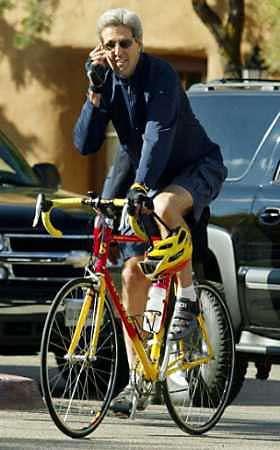
Why go gaga over a presidential candidate on a bike? After all, John Kerry rode one and President Bush reportedly takes regular mountain bike rides. The difference for those who promote bicycling as a viable urban transportation option is that Obama rode in a big city, in street clothes, on an inexpensive bike, and was even hauling something (probably his daughter, although that isn’t clear). And he chose to spend his downtime cycling through Chicago with his family shortly after saying this in Portland: “If we are going to solve our energy problems we’ve got to think long term. It’s time for us to be serious about investing in alternative energy. It’s time for us to get serious about raising fuel efficiency standards on cars. It’s time that the entire country learn from what’s happening right here in Portland with mass transit and bicycle lanes and funding alternative means of transportation.”
Contrast that with today’s news that Senate Republicans have blocked legislation that would have taxed the obscene profits now been reaped by the five big largest American oil companies, which took in a staggering $36 billion in just the first three months of this year. Just imagine how many bike lanes and transit improvements could be funded with the proposed 25 percent tax on unreasonably high profit levels? Or by getting out of Iraq, with its price tag of more than $250 million per day?
Forget the detailed analysis of their economic plans; the differing visions of these two men couldn’t be more clear. We either keep cooking the planet, fighting the world, and begging the rich for crumbs and spare change, or we try something different.

Spunk, funk, fusion

0

Pianist Chick Corea’s band Return to Forever was the last of the fusion fruit to drop from the tree of Miles Davis’ Bitches Brew (Columbia, 1970). From its early-1970s start, RTF followed the Joe Zawinul/Wayne Shorter–led Weather Report and John McLaughlin’s Mahavishnu Orchestra into the critically thorny but audience-friendly avenues of rhythm-based electric jazz. Corea fronted several versions of the band, but from 1974 to ’76, a balanced muscular quartet variation — with the leader on keyboards, Stanley Clarke on bass, Al Di Meola on guitar, and Lenny White on drums — became a popular and resonant standard of the fusion genre. RTF confidently balanced jazz, funk, and rock on three studio albums before Corea reconfigured the ensemble as a more bloated lineup that included four horn players and his wife Gayle as a vocalist. Now, after more than three decades, the definitive RTF quartet has reunited for an international tour and a two-night, four-show stand in San Francisco. And on May 27, Concord Records released a newly remastered two-CD anthology of music by the foursome, including 1973’s "Hymn to the Seventh Galaxy" with Di Meola’s predecessor, guitarist Bill Connors.

Corea modeled the band on the power of McLaughlin’s group, but his spunky RTF had more personality onstage, more subtlety in its playing, and more diversity in its songwriting. Clarke, who figured in all the RTF variations, was just coming into his own as a writer and performer with the quartet. The bassist would go on to show his versatility by playing in a number of jazz styles with George Duke, Pharaoh Sanders, and McCoy Tyner, as well as taking a rock ‘n’ roll side-trip with Ronnie Woods’ New Barbarians and sharing the stage with Keith Richards during the New Barbarians’ tour in 1979. Di Meola was just 19 when he joined the combo in 1974 and became an international star through his collaborations with fellow guitarists McLaughlin and Paco DeLucia. White, a veteran of the Bitches Brew sessions along with Corea, was playing with the Escovedo brothers’ legendary Azteca when Corea asked him to join RTF. White has since balanced drumming with mainstreamers like Freddie Hubbard, Herbie Hancock, and Joe Henderson while producing Nancy Wilson and Chaka Khan, among others.

All RTF members wrote music for the outfit, and though Corea’s compositions were prominent, the others’ contributions were integral to the quartet’s accessibility. The quartet’s first album, and RTF’s fourth overall, Where Have I Known You Before (Polydor, 1974), sports a heavy, fuzzy sound: Corea plays Moog synthesizers on a recording for the first time, and the group searches for identity in its use of electronics and its blend of jazz and rock influences. The project’s next — and best — album, No Mystery (Polydor, 1975), includes more funk as well as tunes by each band member, all while mixing electric and acoustic instruments. Clarke’s groove-driven "Dayride" leads to a rock-based jam titled "Excerpt from the First Movement of Heavy Metal" — RTF had a generous sense of humor — and eventually Corea’s elegant title tune. The pianist’s complex "Celebration Suite" closes the disc. No Mystery‘s follow-up and the quartet’s last album, Romantic Warrior (Columbia, 1976), was the ensemble’s best-selling full-length, again mixing electric and acoustic textures in ways that most fusion bands wouldn’t dare.

Three years and three albums doesn’t necessarily add up to a legacy, but this foursome always was more than the sum of its parts.

RETURN TO FOREVER

Tue/10–June 11, 7 and 9:30 p.m., $79.50

Regency Center Grand Ballroom

Sutter and Van Ness, SF

(415) 421-TIXS

www.goldenvoice.com

Beyond the budget spin

0

OPINION Local government is frozen. The mayor’s office and the Board of Supervisors have been engaged in open warfare for months. This week, Mayor Gavin Newsom announced that in order to balance San Francisco’s budget, city services and community-based organizations will have to undergo draconian cuts.

In a preemptive move against embarrassing protests, the mayor’s press office did not reveal the location of the annual budget presentation to the news media until late Friday afternoon. Even the supervisors, who will be debating and voting on the budget during the month of June, were left in the dark until then.

While the mayor didn’t blame city workers for the financial crisis, he did suggest that Service Employees International Union Local 1021, which represents the low-wage, frontline, service-providing city workers, should "help out."

Well, we have. SEIU members stepped up to "help out" in fiscal years 2003–04 and 2004–05 by agreeing to wage freezes and self-funding our pensions. All the recent midyear cuts were in public health agencies and among SEIU-represented nonprofits.

Most recently we stepped up by helping draft and vigorously campaigning to pass Proposition B, which freezes city workers wages for two years and tightens eligibility for retiree health care benefits in exchange for a modest increase in city pension benefits.

The mayor’s budget director repeatedly has said that this is a spending problem, not a revenue problem. Talk about spin.

Moreover, in his June 2 budget presentation, the mayor made no mention of raising revenue as an answer to our fiscal problems. You could almost hear Gov. Schwarzenegger’s voice as Newsom presented a slash-services budget with a "no-new-taxes" slogan waiting in the wings for his next campaign.

Everyone knows it’s expensive to live in San Francisco. Paying city employees a wage that allows them to stay in the community they serve isn’t a budget "problem." It ought to be a basic part of what City Hall does and cares about. And if that means looking at bringing in new sources of money, we should have that conversation.

We believe there are various revenue sources that make more sense to explore than some of these service cuts, including a real estate transfer tax increase for high-level properties.

Fortunately, the mayor’s proposal is just a starting point. Soon we will be proposing specific alternatives.

Toward that end, the San Francisco Human Services Network and Coleman Advocates for Children and Youth have organized a citywide forum on the mayor’s proposed budget cuts. SEIU 1021 is cosponsoring this event. The San Francisco budget and revenue town-hall meeting will be held June 9 from 2-4 p.m. in the San Francisco Main Library’s Koret Auditorium, 100 Larkin (at Grove)

Don’t get angry. Get organized.

Robert Haaland

Robert Haaland is a longtime San Francisco activist who works for Local 1021.

Rise above

0

Also in this issue:
>>An interview with outlaw biker Ian Schwartz
>>An interview with SJBMX.com’s Chris McMahon
>>Sit the fuck down: The Sean Parker story

› duncan@sfbg.com

I push off and head down a makeshift plywood runway, compressing as I roll over the edge and into the Technicolor graffiti of the drainage ditch. The transition between the banked wall and the flatbottom has an abrupt kink in it, enough to send you to your face if you’re caught sleeping. I take some weight off the front end and try to maintain my speed as I pump into the opposite corner and carve the far end of the ditch where there’s an over-45-degree wall that runs behind what my friends and I call the "death pit" — a gaping cutaway in the bottom of the culvert, five feet deep, filled with broken glass, and frequently used as a urinal. Since I’m at the apex of my backside carve, up a wall 10 feet above last week’s Miller Time, I’m jolted by the crackle of a loudspeaker:

"You are trespassing. Leave the area at once or you will be arrested."

My concentration shot by the sheriff’s announcement, I jump off my deck and over the chasm at the base of the bank, barely clearing the skater’s version of a Vietnam tiger pit, and land on the rough concrete beyond the edge. My board bullets straight in, though, so I’ve got to lower myself — gingerly — into the mostly dry detritus and rescue it before my friends and I jet out of the spot and into the manicured back nine of Pleasanton’s Castlewood golf course. We get to the car, throw the boards in the trunk — mine has a "Skateboarding Is Not a Crime" sticker on the bottom — and head to the next spot, a ditch called the Rat Trap.

The year is 1987. I’m 16, in high school, and living with my parents in Fremont. The scene plays out over and over in much the same way: a drainage ditch, a nicely painted curb or ledge at a shopping center, the occasional backyard pool, and night sessions at the Tar Banks, a set of embankments around a loading dock with curbs at the top. It’s an underground railroad of repurposed architecture, none of it designed with a skateboard in mind but all of it highly skateable.

Taking the $4.7mil Cunningham skatepark. Video by Jarrod Allen, www.jarrodallen.com

Every weekend my crew hits as many spots as we can, and the constants shape up like this: urethane, aluminum, Canadian hard rock maple, concrete, and asphalt. Maybe blood, maybe beer — we’re teenagers after all — but nearly always: cops.

Skateboarding may not be a crime, but it sure as hell feels like one.

Flash forward 20 years. I’m with a different crew as I pull onto a street in suburban Redwood City, and I’m no longer rollin’ in my mom’s Plymouth Sundance, but my own truck. The other thing that’s changed is the number of wheels per head. There are four heads to eight wheels, and we’re here to ride the Phil Shao Memorial Skatepark. On bikes.

The park does not disappoint. There are a million kids trying tech ollie flip tricks around the perimeter of the park, but the bowl is what I’m about. Big and shapely with almost burlesque hips poured into her concrete, I’m in love as soon as I roll in. There are a few local bikers who have the place dialed, nonchalantly airing a few feet out and throwing the bars before heading back down the tranny. The only two skaters riding the bowl are a tall skinny teenager and his little sister, who looks to be about 10, and they have it on lockdown: lipslides on the spine, grinds, rock and rolls — everything smooth and fast. "Yeah!" I yell as they take their runs, stoked on their skills.

I know the times have changed when I see the little girl come up out of the bowl in the $450,000 public piece of silky-smooth concrete perfection, walk over to her mother, who’s posted up on a ledge, get a cell phone and make a call. Not five minutes later there are seven (I counted) Redwood City police officers converging on the bench where my friends and I are sitting. They randomly collar my buddy Scott — though I was the last one to drop in — and write him a ticket for $100. I have to admit, I’m flabbergasted.

Guess what: skateboarding isn’t a crime anymore — it’s gone mainstream. Successful companies hire lobbyists to promote the sport, and communities spend big bucks building new facilities for skaters. And now some skaters, many of them kids who never had to live in the underground world that I did, are using their legitimacy to push out the new outlaws — people who ride BMX bikes.

It’s crazy — two cultures that share so much, fighting over how many wheels they ride.

"Is that your daughter’s bike?"

The question comes from one of my coworkers, and, believe it or not, it’s not intended to be snarky. I can’t ride in public without someone saying "cute little bike," while giggling to themselves — or laughing and pointing. Seeing a six-foot-tall, 200-pound, bald-headed, tattooed white dude on a "kid’s bike" is like being passed on the sidewalk by a bear on a unicycle. At one point reactions like these would’ve rubbed me the wrong way, but nowadays, I nod and smile. Sometimes, I try to explain what constitutes a "full grown" BMX bike. While it’s got small wheels — 20 inches in diameter — the top tube, from the seat to the stem, measures 21 inches, and the handlebars are considered pro-sized at eight inches high by 28 inches wide.

Bicycle motocross, or BMX, is purported to have started in 1963 when the Schwinn corporation of Chicago unveiled the Stingray, which was basically a downsized version of the company’s balloon-tired cruiser-type bikes. Kids pretended to be grown-ups by aping Roger DeCoster and other moto heroes — launching their bikes off jumps, racing in empty fields and abandoned lots, and cranking wheelies down the sidewalks of Anytown, USA.

"It all began the way most individual sports start," motorcycle customizer Jesse James says in a voiceover at the beginning of the 2005 BMX nativity story/documentary Joe Kid on a Stingray, "kids pretending to be grown-ups, but acting like big kids."

I have been riding since I was seven. After three decades, one truism remains, and I can’t candy-coat it. I’ve got to speak it like a true BMXer: BMX is rad. It is and always has been an entity unto itself, progressing from wheelies, skids, and bombing hills to encompass myriad styles and surfaces, from streets to pools to dirt jumps to ramps to the balletic grace of flatland freestyle.

This summer, big kids on little bikes will be jumping 30-foot gaps at as many miles per hour as BMX pays homage to its racing roots at the 2008 Olympic Games in Beijing. On June 12 in New York’s Central Park, Kevin Robinson will try to break the legendary Mat Hoffman’s record for the highest quarter-pipe air on a bike — 26 feet, 6 inches.

It doesn’t take death-defying world records, the X Games, the Olympics, or the stupefaction of squares with cameras to make BMX legit. That feeling of overcoming fear and doubt by jumping a little farther, a little higher, the rush of nailing a trick, or carving a bowl, hasn’t changed in half a century. The legitimacy lies in that feeling, behind your breastbone, and it doesn’t change as you get older. Your wrists hurt, your ankles hurt, and your back hurts, but the feeling is the same. Kid’s bike? Hell yeah, it’s a kid’s bike.

It’s not as though I was blissfully unaware of a beef between bikers and skaters that day in Redwood City. Ask any BMXer to tell you a story of friction between the two and four-wheeled sets, and it’s not going to take them long to come up with something.

"When I was 12 years old, a skateboarder threw my bike out of the bowl at Ripon skatepark," says Jackson Ratima, now 19, a Daly City rider sponsored by Fit Bikes. "He was, like, 20 years old or something."

Tim "Wolfman" Harvey, 21, another up-and-coming pro, tells a similar story about a visit to the Bay Area from his native Massachusetts, when a local skater hassled him at the Novato skatepark. "I didn’t even know anything about California. It was my first time out bike riding, period. The guy was giving me all kinds of crap, yelling at me."

Ironically, Harvey, as friendly and easygoing a guy as you could hope to meet, almost turned pro for skateboarding before an ankle injury made it nearly impossible to ollie, an essential trick in street skating. He now lives in Petaluma and is a member of the painter’s union in San Francisco, where he’s a familiar face at street spots, but now on a bike. Back then, though, he "thought California was a scary place."

The Bay Area — and SF in particular — may be the worst place for bikers seeking a vibe-free session. "I’ve never experienced hostility like it is out here," Ratima says.

Smoldering after the Redwood City incident, I began to fixate on the "Skateboarding Is Not a Crime" slogan from my youth. Originally a bumper sticker made by Transworld Skateboarding magazine in the mid ’80s, Santa Cruz Skateboards currently makes a deck with that written on it, so the skate community has gotten a lot of mileage out of being oppressed.

"Skateboarding isn’t a crime?" I’d ask myself. You’re damned straight skateboarding isn’t a crime: it’s the law. BMX is a crime. There isn’t a biker alive who rides transition who hasn’t rolled into a taxpayer-funded park and had a knee-high grommet point to the sign and say, "Bikes aren’t allowed."

Not allowed, huh? Son, I skated my first pool when you were doing the backstroke in your papa’s ball bag.

Look: I love skateboarding and always will. Both skaters and bikers are doing the same thing, copping that same feeling rolling over the same terrain. The war makes no sense.

"We have religion and race and class dividing us. I refuse to be divided by what type of wheel size I have," says Jon Paul Bail, a local at Alameda’s Cityview skatepark.

Bail, 40, is the artist and pundit behind politicalgridlock.com. Through the Home Project, a program run through the Alameda Unified School District, Bail helped raise $150,000 to build the park, $8,000 of which came directly from his company’s coffers. He helped design the park, and he helped pour the concrete in the park, which opened in 1999. Mixed sessions of bikers and skaters were going down for six months with minor tensions but no major incidents when then–City Attorney Carol Korade advised City Hall that mixed use was too dangerous, and shut the bikers out.

My call to Corinne Centeno, Redwood City’s Director of Parks, Recreation, and Community Services, got off to a rough start: "I understand [the Phil Shao Skatepark] is not bike-legal, right?"

"Right. It was built as a skatepark," she replied, subtly italicizing the first syllable with her tone of voice.

"It wasn’t designed for bikes," she repeated, before adding, "but their having been prohibited from the start hasn’t necessarily kept people out." In an effort to do just that, the city is building a fence around the park, with bids currently ranging from $23,000 to $60,000.

The semantic argument — "it’s called a ‘skatepark,’ not a ‘bike park’<0x2009>" — is usually reserved for laypeople who don’t know enough about skateboarding or bike riding to see its inherent lack of logic.

Drainage ditches are not called a "skating ditches," nor were they designed for skating. Swimming pools are not called "skating pools." Yet, therein lie the roots of the modern skatepark, along with full pipes, which are based on industrial-size drainage systems also not intended for wheels. Every day skateboarders and bikers transcend these limits through creative repurposing.

Collision, and the fear of collision, is the main thing public officials cite when shutting bikers out of parks. "It’s unnerving," Vancouver pro skater Alex Chalmers wrote in a 2004 Thrasher manifesto, "BMX Jihad: Keep It in the Dirt."

"BMXers cover so much ground so quickly, especially when they’re pedaling frantically to blast a transfer, that it’s particularly hard to gauge these collisions," he wrote.

But the fact is that in any given park BMXers and skaters take different lines, and the best way to acclimate each group to the other is through exposure. If bike riders are banned, it increases the risk of collisions when a few bikers decide to chance the ticket or brave the vibe-out and ride anyway. A lot of bikers hit parks early in the morning because they don’t want to deal with hassles. During the overlap in "shifts," this leads to bewildered skaters who aren’t used to the lines a biker takes, and vice versa.

And the head-on menace is greatly overstated, largely disappearing when a park is integrated, if only unofficially. At Cityview, the police have displayed somewhat less zeal in ticketing bikers during the past few years. "They treat us like gays in the military," says Bail. "Don’t ask, don’t tell." And yet everyone manages to coexist.

At the new $850,000 skatepark in Benicia, which opened in October, integration isn’t a big deal. "From its conception, we designed it to be a skateboard park and also for bikes," says Mike Dotson, assistant director of parks and recreation. Technically, the park has designated bike hours, but since it’s largely unsupervised, there’s a mildly laissez-faire approach to enforcement. "In the very beginning there was a lot of concern about the use of both bikes and skateboards," Dotson says, stating that the park was packed the first few months. "Initially we had one or two calls on it. Since then I can say I haven’t had any calls on it — in relation to bikes and skateboards being in it at the same time or other complaints."

And there are mixed-use parks all over the world, as far away as Thailand and as nearby as Oregon: "You go to Oregon, and you can ride wherever you want," says a stunned Maurice Meyer, 41, lifelong San Francisco resident and founding member of legendary bike and skate trick team the Curb Dogs. Long Beach, Las Vegas, Phoenix, even Alex Chalmers’ hometown of Vancouver — all have parks where bikes and skates legally ride at the same time. What’s up with the Bay?

Lawyers, insurance underwriters, and city hall types may never understand how a park works. "It’s out of ignorance," Bail says. "To them it looks like chaos. To anyone who has skate etiquette — which is everyone — we all take turns."

Besides, let’s face facts: a skatepark is a dangerous place — to different degrees at different times, and for different reasons. "I swear to God, every time I go to the skatepark I see a hundred boards flying all over the place," Ratima says, "and I’ve never seen a bike go flying and land on a guy’s head." It’s not an inflatable jumpy house — it’s fun, but it’s not made out of cotton balls and your mother isn’t here. Usually.

Rose Dennis, press liaison for the San Francisco Recreation and Park Department, seemed baffled that someone would want to ride a bicycle inside the skatepark part of the new Potrero del Sol. Perhaps as a way of distracting me from my damn-fool idea, she kept hyping the park’s "other amenities."

I live three blocks from Golden Gate Park — if I want to play Frisbee, I’m not going to drive across town. I want to ride. When I brought up the possibility of scheduling bike-only sessions in the yet-to-be opened park, she suggested I draft a letter to general manager Yomi Agunbiade, before adding that "the facility wasn’t designed for that type of recreation."

When I (graciously, I thought) let her know that it would be not only possible to ride a bike there, but highly gratifying, she got a little heated: "At the end of the day, the buck stops with us. If one of you guys breaks your skull open and you’re bleeding all over the place, believe me, no one’s going to have any sympathy for Rec and Park if they make really nonjudicious decisions."

In other words, like a lot of city officials, she’s worried about getting sued.

But you know what? There’s actually less chance a BMXer will successfully sue the city. I give you California Government Code Section 831.7, which states the following: "Neither a public entity nor a public employee is liable to any person who participates in a hazardous recreational activity … who knew or reasonably should have known that the hazardous recreational activity created a substantial risk of injury to himself or herself and was voluntarily in the place of risk."

The law lists "bicycle racing or jumping" as being a "hazardous recreational activity." It’s on a fairly extensive list, along with diving boards, horseback riding, and the ever-popular rocketeering, skydiving, and spelunking, which, as I’m sure you’ve heard, are all the rage with the kids these days — much more popular than BMX.

But the words "skateboarding," "skateboarder," and "skateboard" are not listed anywhere in the text of the Hazardous Recreational Activities law, commonly called the HRA law. In fact, the International Association of Skateboard Companies has been lobbying to get the bill amended to specifically include "skateboarding" since 1995, when Assemblymember Bill Morrow (R-San Diego) took up the issue. Morrow’s bill was rejected by the state Senate Judiciary Committee in 1996. In 1997, Morrow and skateboard association lobbyist Jim Fitzpatrick gave up on amending the HRA and instead pushed Assembly Bill 1296, which added Provision 115800 to the state’s Health and Safety Code, which states, in part and in much less forceful language — without using the word "liable," for instance — that owners or operators of local skateparks that are not supervised must require skaters to wear helmets, elbow pads, and knee pads, and that they must post a sign stating said requirement.

It doesn’t say anything about "if one of you guys breaks your skull open and you’re bleeding all over the place" while wearing a helmet, then you can’t hold the operator liable.

When I asked San Francisco Deputy City Attorney Virginia Dario-Elizando how the law might apply to the city’s skateparks, she told me, "This question has never come up. I must tell you, I’ve never even seen the rules for the skateparks — no one’s ever asked me to look at them."

BMXers are willing to compromise if that’s what it takes. In May, San Jose opened the 68,000-square-foot Lake Cunningham skatepark, built by the same design firm (Wormhoudt) as the Benicia park at a price of $4.7 million, and the place has bike hours. Like any park, there are rules. Like some parks, there’s supervision, so the rules are enforced: separate bike sessions; helmet, elbow, and knee pads required at all times; brakes required on bikes; no smoking; no songs with swear words over the park soundsystem; no bikes in the three bowls with pool coping even though they only allow plastic pegs, which are undoubtedly softer on coping than metal skateboard trucks … it’s a long list of restrictions. It’s inconvenient for guys who don’t like pads or don’t run brakes, and there’s some griping, but we’ve got our eyes on the prize: the place is amazing, with a huge full pipe, massive vert bowls, and a decent street course.

I would like skaters to realize a couple of things: skating and BMX aren’t so different from each other, at least in the feeling each gives you, right there, behind your sternum, where your heart beats.

Bikers are going to ride no matter what, just like skaters are going to skate. Legal or not, we’re not going to go away. "I got arrested for riding there when I was 14," Ratima says of the Daly City skatepark. "They took my bike and threw it in the back of the car. I just kept going every day, and finally they just gave up."

"I’ve ridden bikes on vert," Thrasher editor Jake Phelps tells me during a phone conversation. "I can ride a bike in a pool, I can do that. I’m stoked when I ride a bike in a pool. Feels hella fun to me. Catching air on a bike is awesome, no doubt about that."

This, from the longtime editor of the bible of the "fuck BMX" set. It’s either baffling or heartening. I can’t decide which. "I don’t mind people that are just regular," he says. "If they’re skateboard people or they’re bike people too, I’ll respect anybody that respects me."

That’s what it comes down to: respect. I respect the fact that skateboarders did not come into this age of skateparks easily. I faded out when there was nothing, and I came back when they were in small towns across America, and I missed all the politicos and dreary meetings. It’s time for bikers to stop feeling like second-class citizens and demand a seat at the table. In the words of Black Flag, it’s time to rise above.

‘REN’-membering Matthew Barney in LA

0

mbarneyren sml.bmp
Heave ho at Matthew’s Barney’s REN. Photo courtesy of www.lipsticktracez.com/reggie/.

By Glen Helfand

How any artist follows up a large scale, career-making project is accompanied by the same critical pressure that greets the sophomore album of a hot new band. Matthew Barney made it through his post-Cremaster days with Drawing Restraint 9, which took over a whole floor at San Francisco Museum of Modern Art a couple of summers ago, though many would agree that while it stayed the course, it was a film and exhibition that didn’t quite rival the five part film/sculpture extravaganza that preceded it.

In an interview before that show, Barney said his next works would be in the realm of live performance, and true to his word, he’s been mining that vein. He staged a typically perverse work at the 2007 Manchester International Festival, an adults-only performance that involved a bull, a self-fisting female contortionist and Barney wearing a live dog on his head. (The reviews were mixed.) Another performance, staged in New York, was shown as a video as part of an exhibition at Los Angeles’s Regen Projects last year.

I can’t say I wasn’t thrilled to get an invitation to a recent Barney performance, titled REN, that took place on May 18 in not so beautiful Norwalk, a south-of-LA suburban flatland populated by convenience stores and auto dealerships. Here’s some of what the invite promised: “’Ren’ represents the first stage of the soul in its journey through the afterlife in which its ‘Secret Name’ is revealed, and subsequently lost. REN will reference the Cremaster Cycle, linking Barney and [music collaborator Jonathan] Bepler’s earlier project to the iconography and mythology of ancient Egypt. REN will feature the return of the 1967 Chrysler Imperial and Aimee Mullins from Cremaster 3, a Southern California drum and bugle corps, ranchera singer Lila Downs, and British performance artist Mouse. Performance is approximately one and a half to two hours in duration.”

61st World Newspaper Congress, 15th World Editors Forum

0

I’m off to Sweden and the annual assembly of the World Association of Newspapers (WAN), an international free press organization. Ill keep you posted, B3

Mixed doubles

0

› a&eletters@sfbg.com

A new work by Robert Lepage is always a major event. In theater, the Quebecois director, actor, and filmmaker stands with the likes of Robert Wilson or Peter Sellars at the pinnacle of theatrical invention and global acclaim. Little wonder that, like Wilson and Sellars, Lepage has found opera a logical outlet for his extraordinary capacities and grand, all-encompassing visions. (His last Bay Area bow was in November 2007 at the San Francisco Opera, where he staged Stravinsky’s 1951 opera The Rake’s Progress.) But while he is a truly international force wielding the largest of canvases, there’s an intimate and personal side running through much of his work, perhaps nowhere more poignantly than in his stunningly staged solo plays The Far Side of the Moon (2003) and The Andersen Project (2005). The latter, which slyly folds layers of personal and cultural doubt (as well as biting cultural satire) into a glancing exploration of Danish storyteller Hans Christian Andersen’s troubled psyche, makes its local debut courtesy of Cal Performances.

As with Far Side, Andersen was developed with Lepage playing dual roles that together define a kind of split personality and serve as starting point for a series of thematic dyads. In this case, the main characters are a corrupt French opera director and a French Canadian musician-songwriter named Frédéric Lapointe, who arrives in Paris on a commission to write an opera based on an Andersen story. Also as with Far Side, Lepage eventually handed off the roles to Yves Jacques. An extremely gifted theater and film actor in his own right (probably best known to Americans through several Denys Arcand films), Jacques shares a history and affinity with Lepage (they’ve known each other since their twenties) that make him the best, and perhaps the only, person capable of stepping into these demanding, idiosyncratic solo shows, with their half-hidden strands of autobiography and fraught national identity. I recently spoke with Jacques by phone from Montreal.

SFBG Before Andersen, you took over another Lepage solo play.

YVES JACQUES It started with Far Side because it was a story very close to him. So he wanted someone with the same sensibility. I was able to understand his feelings about [the subject matter]. So afterward he said, ‘Why not continue with The Andersen Project?’

SFBG Was it at all intimidating to take over these plays from their originator?

YJ Oh, yes. I felt a big responsibility to be at least equivalent to Robert — just to reach the level of the acting he puts into the show. But he liked [what I was doing] and was very happy because for once he could see his own work. When you play in a solo show you don’t always understand what you’re doing. Now he could see himself, or himself through me.

SFBG How did you approach the part?

YJ I never feel I’m doing a one-man show; I’m doing a play. I’m doing the yin and the yang of the same character, in a way. Far Side was the story of two brothers, and this is quite the same. You have the director of the Paris Opera and then you have Lapointe. They’re very different but they’re played by the same actor. In a way, it’s the yin and the yang of the same personality, which is Hans Christian Andersen. Lepage is using two different characters to describe [the complexity of] Andersen. It’s very clever. You see Andersen only twice in the show but he’s not talking; he’s just a silhouette. The only way to know him is to understand the other two.

SFBG The assertion of a Quebecois identity against the dominant Anglo culture of Canada is a theme in much of Lepage’s work.

YJ Lapointe comes to Paris because he wants to be approved of by Parisians — [but] he says at the end, I came here for the wrong reasons. I came here for approval, and we shouldn’t do that. We should be proud of what we are. And Andersen had the same problem in his own country. People in Denmark loved his fairy tales but they didn’t take him seriously as a writer because he was writing for children. So he needed to come to Paris as well, and be approved of by Balzac or George Sand or Victor Hugo — just as we need to be approved of by the old country. It’s like being in a colony sometimes [laughs]. That’s why I’m very proud of working with Lepage, because he [raises] Quebec to another standard. His work is totally amazing. *

THE ANDERSEN PROJECT

Wed/28–Sat/31, 8 p.m.; Sun/1, 3 p.m., $62

Zellerbach Playhouse

Bancroft at Dana, UC Berkeley, Berk

(510) 642-9988

www.calperfs.berkeley.edu

Art Street Theatre

0

PREVIEW The places we long to be often have the greatest hold on our imaginations. In Chekhov’s The Three Sisters, Olga, Masha, and Irina dream of returning to Moscow, believing it’s the only place they can be truly happy. Of course, in Chekhov’s version, they never do manage to reach the Promised Land. Their dreams unfulfilled, the sisters eventually must resign themselves to their respective quiet desperations. Mark Jackson’s Yes, Yes to Moscow, which makes its North American premiere at Dance Mission Theatre for the San Francisco International Arts Festival, imagines the long-awaited arrival of the sisters to Moscow and the pitfalls of getting what you wish for.

Jackson, whose focus on the physical has long been a hallmark of his work, collaborates with Berlin-based choreographer Sommer Ulrickson, American actor Beth Wilmurt, and German performance artist Tilla Kratochwil to create a multidisciplinary, multilingual, multifaceted production. A smash hit at the Deutsches Theater a continent away (leading to a commission for Jackson and Ulrickson to collaborate again in 2009), Moscow‘s San Francisco debut fits in well with SFIAF’s theme: the truth in knowing/now. Forced by an unsympathetic and foreign reality to reexamine their assumptions about home, Moscow, and familiarity, the sisters must confront the not-knowing within their now, and rediscover truth as best they can.

Art Street Theatre Fri/30, 9:30 p.m.; Sat/31, 4:30 p.m.; Sun/1, 7 p.m. Dance Mission Theater, 3316 24th St., San Francisco. $20. 1-800-838-3006, www.sfiaf.org.

Human-animal hybrid clones

0

› annalee@techsploitation.com

TECHSPLOITATION I just love saying that scientists are creating "human-animal hybrid clones" because that single phrase pulls together about 15 nightmares from science fiction and religion all at the same time. Although if you think about it, one fear really should cancel out the other one. I mean, if you’re worried about human cloning, then the fact that these are clones created by sticking human DNA inside cow eggs should be comforting. I mean, it’s not really a human anymore at that point, right?

But the real reason I’m gloating over this piece of completely
ordinary biological weirdness is that last week the British Parliament began the process of legalizing human-animal hybrid embryo cloning. While not explicitly illegal in the United States, the process has been so criticized (including by former president Bill Clinton) that most researchers have stayed away from it. Now, however, this law could make it easy for Brits to advance their medicine far faster than people in the supposedly high-tech and super-advanced United States.

You see, these scary hybrids could become stem cell goldmines. One of the barriers to getting stem cells for research is that they only come from human embryos, and human embryos come from human women. Some of us may be cool with donating our eggs to science, but a lot of us aren’t — and that means scientists don’t have a lot of material to work with if they want to do stem cell research that could do things like reverse organ failure and cure Alzheimer’s.

And that’s where these human-animal hybrids come in. We can already inject DNA into the nucleus of a cow egg and zap it with electricity, thus reprogramming that egg to be human. And we can even get that egg to start dividing as if it were an embryo, creating a bunch of human stem cells. Beyond that, we just aren’t sure. Will these embryos create viable stem cells to treat all those nasty human diseases? Or will they just be duds that act too much like cow cells to be usable by humans? If there’s even a small chance that the former will come to pass, it’s worth investigating — and we’ll have solved the human stem cell shortage problem.

That’s why scientists in the United Kingdom are doing it, and why their government is debating exactly how the process should be regulated. You wouldn’t necessarily know that from the way it’s been covered in the media, where even the normally staid International Herald Tribune began an article about the potential UK law with this sentence: "The British Parliament has voted to allow the creation of human-animal embryos, which some scientists say are vital to find cures for diseases but which critics argue pervert the course of nature." Nice move, throwing in the word "pervert" there.

When the media writes about how scientists might "pervert the course of nature," and the anti-science group Human Genetics Alert is bombarding me and pretty much every other science journalist on the planet with crazed, uniformed screeds about how this law will lead to "designer babies," you start to feel like a huge portion of the population doesn’t know the difference between science and science fiction. Indeed, one of the most anticipated sci-fi horror movies for next year is Splice, which is about a pair of rock star geneticists who create a human-animal hybrid. Of course the hybrid happens to be a deadly, exotic-looking woman with wings and a tail and a super-hot body. Early images released from the production show her naked, with her animal parts looking sexy and dangerous.

The completely impossible "designer baby" in Splice is what most people think will happen when scientists create human-animal hybrid clones. But creating something like the sexy Splice lady is not only beyond the reach of current science, it is also illegal under the proposed UK law. The hybrid clones will only be permitted to develop for about two weeks, which is the time required to create stem cells. After that, they must be destroyed. So the UK law actually makes the nightmare scenario impossible, not possible.

And that’s why I’m psyched about getting my human-animal hybrid clones. *

Annalee Newitz (annalee@techsploitation.com) is a surly media nerd who can’t wait to see the world populated with human-elephant-dolphin hybrids.

San Francisco, meet Joe Nation

0

OPINION How would you like to be represented by someone who flacks for the insurance industry, serves real estate developers and landlords with zeal, opposes consumer privacy, and is a role model for corporate Democrats with a firm allegiance to big business?

You wouldn’t know it from the vague aura of his slick ads, but Joe Nation is hoping to be that someone in the state Senate. He’s the third candidate in the hotly contested race that includes two stalwart progressive politicians — incumbent Senator Carole Migden and Assemblymember Mark Leno.

Nation jumped into the Senate race in the 3rd District just three months ago. He’s trying to win in a sprawling district that includes half of San Francisco along with all of Marin and parts of Sonoma County. And he could pull it off.

The real danger of a Nation victory hasn’t been apparent to many San Francisco voters. Eyes have been mostly focused on the Leno-Migden battle, and Nation has never been on the ballot in the city before. But those of us who live in North Bay are all too familiar with Joe Nation.

When Nation’s campaign Web site trumpets him as an "advocate for universal health care," the phrasing is typical of his evasive PR approach. While in the state Assembly, Nation pushed for legislation that would force consumers and taxpayers to subsidize the health insurance industry. Meanwhile, he continues to oppose a single-payer system that would guarantee publicly financed health care for all in California.

Likewise, Nation leaves out key information when he calls himself an "international expert on climate change" for an "environmental consulting firm," ENVIRON International. He’s not eager to disclose that much of his work at the firm is for Coca-Cola, which excels at greenwashing its image to obscure its dubious environmental record.

In the Legislature, where he supported charter schools, Nation was problematic on public education. He earned distrust from the California Teachers Association and the California Federation of Teachers, both of which endorsed Leno in the Senate race.

When lawmaker Jackie Speier put forward a tough bill to safeguard consumer information rather than allowing financial institutions to sell it to the likes of telemarketers, Nation worked to undermine the legislation.

In 2006, nearing the end of his six corporate-friendly years in the state Assembly, Nation launched a Democratic primary challenge to US Rep. Lynn Woolsey — who has strong support in the North Bay congressional district because of her courageous leadership against the Iraq war and for a wide range of progressive causes. Nation attacked her from the right. She trounced him on Election Day.

Nation’s long record of siding with powerful economic players inspired the San Francisco Apartment Association and other landlord groups to throw a big fundraiser for his Senate campaign a couple of weeks ago. To big-check donors with an anti-renter agenda, plunking down money for Nation is a smart investment.

Independent polls now show a close race between Nation and Leno, with Migden a distant third. As a practical matter, the way for progressive voters to prevent Joe Nation from winning the state Senate seat is to vote for Mark Leno. *

Norman Solomon is the author of many books, including War Made Easy: How Presidents and Pundits Keep Spinning Us to Death (Wiley, 2005).

A triumphant ‘Thirty Seven Isolated Events’ combines butoh, digital imagery at CounterPulse

0

blindsight_photosbyianwinters_designby_paige_sorvillo.jpg
Eyeing Blindsight. Photos by Byian Winters and design by Paige Sorvillo.

By Dina Maccabee

It feels a little overblown to say that Thirty Seven Isolated Events, conceived by choreographer Paige Sorvillo with her company Blindsight and presented at CounterPulse with the San Francisco International Arts Festival, is a triumph of independent experimental performance. It’s a relatively lean production, well-scaled to maximize CounterPulse’s somewhat Spartan interior. Still, for this audience member, there were so many successful aspects in what might have been a risky venture that triumph is the word I’ll use.

Though promotion for Thirty Seven Events uses spiffy words like “intermedia,” dance fans wary of fancy gadgets edging out real-life rippling muscles needn’t be scared off. In fact, displacement of human intimacy and desensitization to violence enabled by ubiquitous modern media are the kernels of Sorvillo’s exploration, and they provide a rich source of imagery and metaphor. The Blindsight company members slithered, twitched, and struggled with determination, fluidity, and tight control, sculpting their own flesh into an unforgettable reminder that real human contact, whether caressing or brusque, is utterly irreplaceable.

Sorvillo’s training in contemporary Japanese butoh clearly played into both the conception of Thirty Seven Events as a platform for dealing with fairly abstract emotional material, and in the style and mood of the movement itself. In the opening passage, Sorvillo writhed in a single column of yellow light, seeming to test the power of her joints and limbs against the pull of gravity in an alternately lyrical and frenzied monologue. But as she pointed out in an after-show panel discussion, the ghostly white body paint and gruesome facial contortions are parts of the butoh vocabulary she’s deliberately left out.

Driving to death

2

traffic.jpg
With all the understandable concern about global warming lately, we tend to forget that our over-reliance on automobiles also has a more immediate impact: death, lots and lots of death.
Research from the National Highway Traffic Safety Administration already shows that traffic accidents are the leading cause of death for people ages 3-6 and 8-34, and is the third leading cause of death for all Americans after cancer and heart disease, some of which can also be traced back to the automobile.
Today’s Chronicle reports on new research showing that particulate matter, much of it from automobiles, causes far more premature death than previously thought, up to 24,000 annual deaths in California alone. In another piece, the Chron speculates that people might be driving less on Memorial Day weekend, the mother of all road trip holidays, but I still know lots of people who drove down to Lightning in the Bottle and other spots without pausing to consider the externalities.
Yet even after cutting more than $1 billion in transit funding last year, Gov. Arnold Schwarzenegger turned around and did the same thing this year, cuts that would cost the San Francisco Municipal Transportation Agency $37 million in the coming fiscal year. This isn’t just stupid and short-sighted: it’s deadly.
But there are countervailing forces fighting back, from a strong local bicycle movement to this fall’s high-speed rail bond measure to the international car-free movement, whose biggest annual event, the International Carfree Conference, will be held in Portland next month, the first time it has been in the U.S. And the Guardian will be there (arriving by train) with live daily coverage and interviews with leading thinkers and activists. Stay tuned.

SECA ’08, ‘Bay Area Now 5’ unveiled

0

taubaauerbach kl SML.bmp
A work from Tauba Auerbach’s book, How to Spell the Alphabet.

By Glen Helfand

New York Times art critic Roberta Smith began her review of the current Carnegie International in Pittsburgh with a pulse-taking statement: “Lately, it seems, biennial exhibitions don’t do much except sit there, looking good and offending no one. Instead of being shows that people ‘love to hate,’ or vice versa, these big, often international affairs now inspire mild interest or resigned indifference.” That statement may resonate a bit more in biennial-intensive towns like Manhattan or Venice, Italy. In San Francisco, where the arts are less widely celebrated, the biennial concerns seem to coalesce around issues of regionalism or the perpetually problematized thing we call “Bay Area art.”

So it seemed fitting that Yerba Buena Center for the Arts and the San Francisco Museum of Modern Art made back-to-back announcements yesterday, May 22, as to the inclusions in, respectively, “Bay Area Now 5” and the “2008 SECA Award” – both the most high-profile exhibitions of artists living and working here. The Yerba Buena folks threw a press lunch, at the fittingly titled new wine bar, the Press Club, and an evening member’s soiree in their theater to celebrate their forthcoming show, actually a triennial, which opens on July 19 and runs through Nov. 16.

In the late period of international biennials, it seems that institutions are upping the ante a bit with higher concepts and more elastic geographical borders. In recent years YBCA has been working with tiers of themes and structures – a standard gallery show plus four guest-curated shows at various venues – that tend to muddle the excitement with structural complications. BAN is no exception. A glance at the press release doesn’t suffice: you’ve gotta look deeper to figure out the scope. “Bay Area Now 5,” which was curated by Kate Eilertsen and Berin Golonu, has the attached subtitle “Inside/Outside,” referring to the not-so-provocative premise that “artists are influenced by their experiences both inside and outside the Bay Area.”

Dancers without borders

0

› a&eletters@sfbg.com

What do you need to create a first-rate hot product that is of value to others besides yourself? A great idea, a support structure, and money are good places to start. But what if you had no support structure and no money? If you believe in your idea, you’d plow ahead anyway — just like Andrew Wood, executive director of the San Francisco International Arts Festival.

In 2002, Wood began to think about something he felt this city full of artists and tourists needed: an arts festival that would bring the two together. The event would also focus local attention on a large, vibrant arts community that thrives in the shadow of the three big ones — the San Francisco Ballet, the San Francisco Symphony, and the San Francisco Opera.

"Lots of artists here are bursting with ideas," Wood explained during a recent interview. "We need an entity that supports them because they need more opportunities to show their work."

That a similarly ambitious undertaking called Festival 2000 went belly-up in 1990 didn’t deter the string bean–thin Brit, who talks faster than a cattle auctioneer. But Wood wasn’t about to let the fate of another festival stop him. Soon he was everywhere, talking to anyone who was willing to listen — and even to some who weren’t.

Mostly he encountered closed doors. The city had no extra cash. Foundations were already overcommitted. Wood — onetime director of ODC Theater — had no track record when it came to producing a such a large-scale event. Artists were suspicious that already-scarce funds would be siphoned off for a project that might have no room for their work. And another thing: did Wood know how to balance a budget?

He remained undeterred, largely because he had seen something happening in the Bay Area that others had noted as well, even if they hadn’t yet connected the dots. The community was supportive of young artists who were willing to put up with just about anything to get their work out — but once they got to the level where they needed decent rehearsal spaces, performers they could pay, and offices beyond their bedroom floors, the going got tough. Traditionally, local artists at this stage either called it quits or moved away. No longer.

HAVE ART, WILL TRAVEL


In scouring the local arts scene, Wood noticed what he calls the advent of "journeymen" artists. He named them after the century-old tradition of skilled professionals who traveled long distances and practiced their craft wherever they were hired. Propelled by a desire for adventure and professional improvement, they also managed to support themselves, often handsomely, whether they were roofers, storytellers, or healers.

"Dancers like Janice Garrett, Kim Epifano, Scott Wells, Jess Curtis, Shinichi Iova-Koga, and Stephen Pelton work part-time in Berlin, or London, or Tokyo, or Mexico City. They create work where they are supported and bring it back," Wood explained. In addition, these artists return home with news from abroad about who is doing what, and where.

Despite his admiration for the vitality of the Bay Area arts scene, Wood recognized that "not a lot of artists come through here [on their own]. This place is insular in many ways." As one working artist told him, "You don’t need to see Merce Cunningham for the umpteenth time. You want to see something that resonates within you."

There is a huge pool of artists all over the world whose work has simply not yet hit the radar screens of local presenters. When the San Francisco International Arts Festival launched in September 2003, Wood presented the astounding Quasar Dance Company from Brazil; Indian British dancer Akram Khan (now a megastar); and Compagnie Salia nï Seydou, the first in a succession of contemporary African dance companies that have been seen here since. In 2005 (there was no 2004 festival), the festival showcased extraordinary performances from the AKHE Group (Russia); Fabrik Companie (Germany); Manasku no Kai (Japan); and — one of the wildest of them all — the Moe!kestra, from Manteca.

A focus of SFIAF has become fostering international collaborations that make local artists into journeymen citizens of the world. "We need to support artists here but they also need to realize that there are opportunities somewhere else," Wood said.

This process of cross-fertilization started in 2006 and continued in 2007, when the festival highlighted art from Latin America and the African diaspora. Since the city has yet to commit to any direct funding — Wood called local arts leadership "miserable and petty" — he has become a wizard at patching his budget together, creating cosponsorships, acting as an umbrella organization, and linking artists with individual funding sources. He also has become adept at handling the Department of Homeland Security’s onerous (and expensive) visa process for performers. "They all have visas!" he exclaimed.

A monthlong visual arts exhibit loaned SFIAF 2008 its name: "What Goes Around … The Truth in Knowing/Now." This year’s fest kicks off Wednesday, May 21, and runs until June 8, when it will be capped with a free Yerba Buena Gardens concert by the Omar Sosa Afreecanos Quartet, with local Latin percussionist John Santos.

DANCE PLUS


The festival also includes operatic and theater pieces, as well as choreographers whose work might not be seen locally if not for SFIAF. For example, SFIAF enabled Idris Ackamoor, co-artistic director of Cultural Odyssey, to bring Brazilian dancer-choreographer Cristina Moura to San Francisco. "I was struck by her innovative movements," said Ackamoor, who encountered Moura while scouting for the National Performance Network’s Performing Americas Project, which he co-curated. "She moves like no one else, with a pedestrian and a highly physical vocabulary. She also has a unique way about storytelling." Moura’s solo like an idiot (2007) also resonated with him, as did the title. "Isn’t that the way we all sometimes feel?" he said, speaking of the work, which holds its California premiere at SFIAF.

Wood caught Shlomit Fundaminsky’s emblematic SkidMarks at the 2006 Dublin Fringe Festival and this year SFIAF is copresenting it with SF’s Israel Center. Speaking from Tel Aviv, Fundaminsky describes the work, a duet for herself and Gyula Csakvari, as inspired by "the home life of a man and a woman who live so close to each other — really as one person — that they lost their ability to communicate. They are creating this box for themselves and are unable to break out of it."

The Kate Foley Dance Ensemble may be familiar to Bay Area audiences because of Foley’s 10-year local performance history. In 1998 she moved to Croatia, where she is in residence at a newly constructed arts center. When Wood sent out a call for SFIAF participant proposals, John Daly of the Croatian American Cultural Center suggested her. Yet the Oakland-born Foley’s homecoming has not been without pain. "I have been so ashamed of what I have had to put my dancers through for the visa process," she said on the phone from Rijeka, Croatia. Her US premiere, Angels of Suderac, is a dance theater work using modern dance and what she calls "reconceived" folkloric material. The piece is based on her research into shamanistic practices that connect fairies and herbal medicine women.

By contrast, new to the Bay Area is the young AscenDance Project, which formed in 2006. German-born director Isabel von Rittberg joined Dancers’ Group when she moved to San Francisco, where she heard about SFIAF. The world premiere of Levitate, which combines rock climbing with dance, will be shown as part of "Jewels in the Square," a festival-spanning series of free performances in Union Square. *

SAN FRANCISCO INTERNATIONAL ARTS FESTIVAL

May 21–June 8, various venues, most shows $20

For complete schedule, visit www.sfaif.org

Sweet “Dreams”

0

› a&eletters@sfbg.com

Words, words, words. You’ve probably noticed how Shakespeare’s plays are full of them. They skip or loll on the tongue; they tickle or bemuse the ear. Sometimes, and not just for the uninitiated or casually acquainted, they come across with more music than meaning. Well, that "Shakespeherian Rag" goes raga in the international production of A Midsummer Night’s Dream, now taking its San Francisco bow at the Curran Theatre, where among a cast of exclusively Indian and Sri Lankan actors, Elizabethan English vies with seven languages of the subcontinent.

The words, for a change, are therefore not the most important feature of this production — unless you happen to speak one or more of the Indian and Sri Lankan languages on display, which judging by the pockets of laughter that arose at certain moments, some in the opening-night audience clearly did. This incredibly agile, imaginative, and widely praised 2005-6 production, led by UK director Tim Supple (and making its North American debut courtesy of Best of Broadway), foregrounds the play’s action, passion, physical humor, and erotic energy to such a striking degree that it reminds one persuasively of the full scope of Shakespeare’s potency as a dramatist. And the dialogue — if you don’t speak Hindi, for example — still reveals a surprising dramatic and melodic force all the same.

The words also give a thrilling sense of the vast treasure of cultural and linguistic tradition emanating from the subcontinent. At the same time, this is no museum piece; it is a vital blending of theatrical traditions and ideas. The amazingly athletic, even acrobatic cast effortlessly incorporates everything from traditional song and martial dance to Cirquelike aerial work into the enchanted forest–realm of A Midsummer Night’s Dream and Shakespeare’s multilayered story of love’s fickle and darker aspects. As the production’s lone Brit, Supple’s staging is highly original. At the same time, it recalls the use of vertical space in Peter Brook’s legendary 1970 staging. The backdrop is a bamboo scaffold many meters high, initially covered over in a great wavy, ruffled sheet of thick paper that beautifully absorbs and deflects Zuleikha Chaudhari’s rich lighting. Performers come bursting, crawling, and tumbling through this membrane until it’s a mess of tatters.

The acting is physically and emotionally strong. Joy Fernandes, for instance, delivers a particularly memorable turn as the hilariously irrepressible Bottom. Meanwhile, the musicians to the sides of the stage left and right further refine the dazzlingly dynamic action with delicate metallic strains, sweet guitar melodies, or the crashing punctuation of a massive percussion kit.

A MIDSUMMER NIGHT’S DREAM

Through June 1

Tues.–Sat., 8 p.m. (also Wed. and Sat., 2 p.m.); Sun., 2 p.m., $35–$80

Curran Theatre

445 Geary, SF

(415) 512-7770, www.shnsf.com

SFIFF award winners: Up the Yangtze and Ballast

0

The SF International Film Festival’s Golden Gate Awards ceremony took place last night. Below, Jeffrey M. Anderson sounds off on two films that nabbed honors: Best Documentary Feature winner Up the Yangtze, by Yung Chang, and FIPRESCI winner Ballast, by Lance Hammer:

By Jeffrey M. Anderson

The documentary Up the Yangtze is a perfect companion piece to Jia Zhangke’s Still Life. Both deal in specific ways with China’s humongous Three Gorges project, although neither film ever goes into detail as to what the project — which will displace some 2 million people — is supposed to accomplish.


A trailer for Yung Chang’s Up the Yangtze.

Concours d’Vrrroooommm

0

While we shine a little frowny face upon fossil fuel burning for the sake of it, we’re suckers for antique motos (and, occasionally, their riders). David Carini checked out the International Concours d’Elegance.

Classic motorcycles sprouted from the lawn of the Ritz-Carlton in Half Moon Bay on Saturday May 3 as enthusiasts, mostly old white men, drooled over immaculate bikes of almost every brand and decade.

moto1.jpg

At Legends of the Motorcycle (aka International Concours d’Elegance), an annual event in its third year, contestants enter their meticulously restored motorcycles into one of several categories, from early production models from the turn of the 19th century to modern custom bikes, and then each category is awarded prizes.

Every year, there has been a focus on a particular brand, this time honoring Italian manufacturer MV Augusta and British Norton. As judges toured the golf course-like lawn, these bikes had the chance to rumble alive as many 70+-year-old men stared like children at a new toy under the Christmas tree.

The foggy morning started in the Dainese (a motorcycle apparel and helmet manufacturer) Tent with the unveiling of new safety technology and a collaborative effort with AGV (an Italian helmet) to unveil a limited edition Giacomo Agostini helmet.

helmet.jpg

No peace, no work

0

› news@sfbg.com

Workers, students, immigrants, and antiwar activists came together in historic fashion on May Day in San Francisco, but it was hard to tell from the next day’s mainstream media coverage, which adopted its usual cynical view of the growing movement to end the war in Iraq.

Sure, there were articles in newspapers from the San Francisco Chronicle to the New York Times about how the International Longshore and Warehouse Union shut down all 29 West Coast ports for the day, with far more than 10,000 workers defying both their employers and the national union leadership to skip work.

But each article missed the main point: this was the first time in American history that such a massive job action was called to protest a war.

“In this country, dock workers have never stopped work to stop a war,” Jack Heyman, the ILWU executive board member and Oakland Port worker who spearheaded the effort, told the Guardian.

The ILWU’s “No Peace, No Work” campaign and simultaneous worker-led shutdowns of the Iraqi ports of Umm Qasr and Khor Al Zubair are part of a broader effort, called US Labor Against the War, that labor scholars agree is something new to the political landscape of this country.

Steven Pitts, labor policy specialist at UC Berkeley’s Labor Center, told the Guardian the effort was significant: “It wasn’t simply a little crew of San Francisco radicals. It has a breadth that has spread out across the country.”

In fact, USLAW has about 200 union locals and affiliates with a detailed policy platform that calls for ending war funding, redirecting resources from the military to domestic needs, and boosting workers’ rights — including those of immigrants, who staged an afternoon march in San Francisco following the ILWU’s morning event.

Traditionally labor unions have been big supporters of US wars. But Pitts said the feelings of rank-and-file workers have always been more complex than the old “hard hats vs. hippies” stories from the Vietnam era might indicate.

Blue-collar workers have always been skeptical of war, Howard Zinn, a history professor and author of the seminal book A People’s History of the United States (HarperCollins, 1980), told the Guardian.

“Working people were against the [Vietnam] War in greater percentages than professionals,” Zinn told us, referring to polling data from the time. “There is always a tendency of organizations to be more conservative than their rank and file.”

This time, union members and the public as a whole have more aggressively pushed their opposition to the Iraq War, winning antiwar resolutions among the biggest unions in the country and in hundreds of US cities and counties.

“I think it’s a reflection of how far the nation as a whole has come in our anger at the continuation of this war,” Zinn told us.

The media coverage of the May Day event belittled its significance, noting that missing one day of work had little practical impact to the economy or war machine, while playing up comments by spokespeople for the Pacific Maritime Association and National Retail Federation that the strike was insignificant and perhaps more aimed at upcoming contract talks than the war.

Heyman wasn’t happy about that bias.

The strike “was totally for moral, political, and social reasons. It had nothing to do with the contract,” Heyman told us.

A big factor for the ILWU was the newfound solidarity between dock workers in the United States and those in Iraq, who were prohibited from organizing in 1987 by the Baathist regime, an edict that the US has continued to enforce.

The Iraqi dock workers issued a May Day statement that detailed the horrors of their situation: “Five years of invasion, war, and occupation have brought nothing but death, destruction, misery, and suffering to our people.”

In fact, the banner leading the ILWU procession down the Embarcadero and into Justin Herman Plaza in San Francisco read, “An injury to one is an injury to all.” That theme of solidarity — among all workers, American and Iraqi, legal and illegal — was laced through all the speeches of the day.

Joining labor leaders on the podium were antiwar movement stalwarts such as Cindy Sheehan, who is running an independent campaign to unseat Speaker of the House Nancy Pelosi, now a target of the movement for continuing to fund the war.

“Nancy Pelosi wants to give George [W.] Bush more money [for the Iraq War] than he even asked for,” Sheehan said, drawing a loud, sustained “boo!” from the crowd. At the afternoon rallies at Dolores Park and Civic Center Plaza, which focused on immigration issues, the war was also a big target, with signs such as “Stop the ICE raids, Stop the War,” and “Si se puede, the workers struggle has no borders.”

Even for protest-happy San Francisco, it was an unusually spirited May Day, with more than 1,000 people appearing at each of the four main rallies and two big marches. There were lots of smaller actions as well, including demonstrations at the ICE offices and Marine recruiting center, and activists from the Freedom From Oil Campaign disrupting a Commonwealth Club speech by General Motors CEO Rick Wagoner.

But it was the port shutdown that was unique. Annually the 29 West Coast ports process 368 million tons of goods, averaging more than 1 million tons a day moved by 15,000 registered ILWU workers and a number of other “casuals.” Eight percent of that comes in and out of Oakland, but West Coast trade affects business throughout the country — as many as 8 million other workers come in contact with some aspect of that trade.

Mike Zampa, spokesperson for APL — the eighth-largest container shipping company in the world, with ports in Oakland, Los Angeles, and Seattle — told us, “Over a long period of time a shutdown like this does have an impact on the US economy.”

More port shutdowns are possible, Heyman said. But he hopes the action inspires other workers and activists to increase the pressure for an end to the war.

“We are taking action to swing the pendulum back the other way,” Heyman told us during the march. “We are stopping work to stop the war.”

Summer 2008 fairs and festivals

0

Grab your calendars, then get outside and celebrate summer in the Bay.

>Click here for a full-text version of this article.

ONGOING

United States of Asian America Arts Festival Various locations, SF; (415) 864-4120, www.apiculturalcenter.org. Through May 25. This festival, presented by the Asian Pacific Islander Cultural Center, showcases Asian Pacific Islander dance, music, visual art, theater, and multidisciplinary performance ensembles at many San Francisco venues.

Yerba Buena Gardens Festival Yerba Buena Gardens, Third St at Mission, SF; (415) 543-1718, www.ybgf.org. Through Oct, free. Nearly 100 artistic and cultural events for all ages take place at the Gardens, including the Latin Jazz series and a performance by Rupa & the April Fishes.

MAY 10–31

Asian Pacific Heritage Festival Oakland Asian Cultural Center, 388 Ninth St, Oakl; (510) 637-0462, www.oacc.cc. Times vary, free. The OACC presents hands-on activities for families, film screenings, cooking classes, and performances throughout the month of May.

MAY 15–18

Carmel Art Festival Devendorf Park, Carmel; (831) 642-2503, www.carmelartfestival.org. Call for times, free. Enjoy viewing works by more than 60 visual artists at this four-day festival. In addition to the Plein Air and Sculpture-in-the-Park events, the CAF is host to the Carmel Youth Art Show, Quick Draw, and Kids Art Day.

MAY 16–18

Oakland Greek Festival 4700 Lincoln, Oakl; (510) 531-3400, www.oaklandgreekfestival.com. Fri-Sat, 10am-11pm; Sun, 11am-9pm, $6. Let’s hear an "opa!" for Greek music, dance, food, and a stunning view at the Greek Orthodox Cathedral of the Ascension’s three-day festival.

MAY 17

Asian Heritage Street Celebration Japantown; www.asianfairsf.com. 11am-6pm, free. The largest gathering of Asian Pacific Americans in the nation features artists, DJs, martial arts, Asian pop culture, karaoke, and much more.

Saints Kiril and Methody Bulgarian Festival Croatian American Cultural Center, 60 Onondaga; (510) 649-0941, www.slavonicweb.org. 4pm, $15. Enjoy live music, dance, and traditional food and wine in celebration of Bulgarian culture. A concert features special guests Radostina Koneva and Orchestra Ludi Maldi.

Taiwanese American Cultural Festival Union Square, SF; (408) 268-5637, www.tafnc.org. 11am-5pm, free. Explore Taiwan by tasting delicious Taiwanese delicacies, viewing a puppet show and other performances, and browsing arts and crafts exhibits.

Uncorked! Ghirardelli Square; 775-5500, www.ghirardellisq.com. 1-6pm, $40-45. Ghirardelli Square and nonprofit COPIA present their third annual wine festival, showcasing more than 40 local wineries and an array of gourmet food offerings.

BAY AREA

Cupertino Special Festival in the Park Cupertino Civic Center, 10300 Torre, Cupertino; (408) 996-0850, www.osfamilies.org. 10am-6pm, free. The Organization of Special Needs Families hosts its fourth annual festival for people of all walks or wheels of life. Featuring live music, food and beer, a petting zoo, arts and crafts, and other activities.

Enchanted Village Fair 1870 Salvador, Napa; (707) 252-5522. 11am-4pm, $1. Stone Bridge School creates a magical land of wonder and imagination, featuring games, crafts, a crystal room, and food.

Immigrants Day Festival Courthouse Square, 2200 Broadway, Redwood City; (650) 299-0104, www.historysmc.org. 12-4pm, free. Sample traditional Mexican food, make papel picado decorations, and watch Aztec dancing group Casa de la Cultura Quetzalcoatl at the San Mateo County History Museum.

MAY 17–18

A La Carte and Art Castro St, Mountain View; (650) 964-3395, www.miramarevents.com. 10am-6pm, free. The official kick-off to festival season, A La Carte is a moveable feast of people and colorful tents offering two days of attractions, music, art, a farmers’ market, and street performers.

Bay Area Storytelling Festival Kennedy Grove Regional Recreation Area, El Sobrante; (510) 869-4946, www.bayareastorytelling.org. Gather around and listen to stories told by storytellers from around the world at this outdoor festival. Carol Birch, Derek Burrows, Baba Jamal Koram, and Olga Loya are featured.

Castroville Artichoke Festival 10100 Merritt, Castroville; (831) 633-2465, www.artichoke-festival.org. Sat, 10am-6pm; Sun, 10am-5pm, $3-6. "Going Green and Global" is the theme of this year’s festival, which cooks up the vegetable in every way imaginable and features activities for kids, music, a parade, a farmers’ market, and much more.

French Flea Market Chateau Sonoma, 153 West Napa, Sonoma; (707) 935-8553, www.chateausonoma.com. Call for times and cost. Attention, Francophiles: this flea market is for you! Shop for antiques, garden furniture, and accessories from French importers.

Hats Off America Car Show Bollinger Canyon Rd and Camino Ramon, San Ramon; (925) 855-1950, www.hatsoffamerica.us. 10am-5pm, free. Hats Off America presents its fifth annual family event featuring muscle cars, classics and hot rods, art exhibits, children’s activities, live entertainment, a 10K run, and beer and wine.

Himalayan Fair Live Oak Park, 1300 Shattuck, Berk; (510) 869-3995, www.himalayanfair.net. Sat, 10am-7pm; Sun, 10am-5:30pm, $8.This benefit for humanitarian grassroots projects in the Himalayas features award-winning dancers and musicians representing Nepal, Tibet, Bhutan, India, Afghanistan, Pakistan, and Mongolia. Check out the art and taste the delicious food.

Pixie Park Spring Fair Marin Art and Garden Center, Ross; www.pixiepark.org. 9am-4pm, free. The kids will love the bouncy houses, giant slide, petting zoo, pony rides, puppet shows, and more at this cooperative park designed for children under 6. Bring a book to donate to Homeward Bound of Marin.

Supercon San Jose Convention Center, San Jose; www.super-con.com. Sat., 10am-6pm; Sun., 10am-5pm, $20-30. The biggest stars of comics, sci-fi, and pop culture — including Lost’s Jorge Garcia and Groo writer Sergio Aragonés — descend on downtown San Jose for panels, discussions, displays, and presentations.

MAY 18

Bay to Breakers Begins at Howard and Spear, ends at the Great Highway along Ocean Beach, SF; www.baytobreakers.com. 8am, $39-59. See a gang of Elvis impersonators in running shorts and a gigantic balloon shaped like a tube of Crest floating above a crowd of scantily clad, and unclad, joggers at this annual "race" from the Embarcadero to the Pacific Ocean.

Carnival in the Xcelsior 125 Excelsior; 469-4739, my-sfcs.org/8.html. 11am-4pm, free. This benefit for the SF Community School features game booths, international food selections, prizes, music, and entertainment for all ages.

BAY AREA

Russian-American Fair Terman Middle School, 655 Arastradero, Palo Alto; (650) 852-3509, paloaltojcc.org. 10am-5pm, $3-5. The Palo Alto Jewish Community Center puts on this huge, colorful cultural extravaganza featuring ethnic food, entertainment, crafts and gift items, art exhibits, carnival games, and vodka tasting for adults.

MAY 21–JUNE 8

San Francisco International Arts Festival Various venues, SF; (415) 399-9554, www.sfiaf.org. The theme for the fifth year of this multidisciplinary festival is "The Truth in Knowing/Threads in Time, Place, Culture."

MAY 22–25

Sonoma Jazz Plus Festival Field of Dreams, 179 First St W, Sonoma; (866) 527-8499, www.sonomajazz.org. Thurs-Sat, 6:30 and 9pm; Sun, 8:30pm, $40+. Head on up to California’s wine country to soak in the sounds of Al Green, Herbie Hancock, Diana Krall, and Bonnie Raitt.

MAY 24–25

Carnaval Mission District, SF; (415) 920-0125, www.carnavalsf.com. 9:30am-6pm, free. California’s largest annual multicultural parade and festival celebrates its 30th anniversary with food, crafts, activities, performances by artists like deSoL, and "Zona Verde," an outdoor eco-green village at 17th and Harrison.

MAY 25–26

San Ramon Art and Wind Festival Central Park, San Ramon; (925) 973-3200, www.artandwind.com. 10am-5pm, free. For its 18th year, the City of San Ramon Parks and Community Services Department presents over 200 arts and crafts booths, entertainment on three stages, kite-flying demos, and activities for kids.

MAY 30–JUNE 8

Healdsburg Jazz Festival Check Web site for ticket prices and venues in and around Healdsburg; (707) 433-4644, www.healdsburgjazzfestival.com. This 10th annual, week-and-a-half-long jazz festival will feature a range of artists from Fred Hersch and Bobby Hutcherson to the Cedar Walton Trio.

MAY 31

Chocolate and Chalk Art Festival North Shattuck, Berk; (510) 548-5335, www.northshattuck.org. 10am-6pm, free. Create chalk drawings and sample chocolate delights while vendors, musicians, and clowns entertain the family.

Napa Valley Art Festival 500 Main, Napa; www.napavalleyartfestival.com. 10am-4pm, free. Napa Valley celebrates representational art on Copia’s beautiful garden promenade with art sales, ice cream, and live music. Net proceeds benefit The Land Trust of Napa County’s Connolly Ranch Education Center.

MAY 31–JUNE 1

Union Street Festival Union, between Gough and Steiner, SF; 1-800-310-6563, www.unionstreetfestival.com. 10am-6pm, free. For its 32nd anniversary, one of SF’s largest free art festivals is going green, featuring an organic farmer’s market, arts and crafts made with sustainable materials, eco-friendly exhibits, food, live entertainment, and bistro-style cafés.

JUNE 4–8

01SJ: Global Festival of Art on the Edge Various venues, San Jose; (408) 277-3111, ww.01sj.org. Various times. The nonprofit ZERO1 plans to host 20,000 visitors at this festival featuring 100 exhibiting artists exploring the digital age and novel creative expression.

JUNE 5–8

Harmony Festival Sonoma County Fairgrounds, Santa Rosa; www.harmonyfestival.com. $30-99. One of the largest progressive-lifestyle festivals of its kind, Harmony brings art, education, and cultural awareness together with world-class performers like George Clinton and Parliament Funkadelic, Jefferson Starship, Damian Marley, Cheb I Sabbah, and Vau de Vire Society.

JUNE 7–8

Crystal Fair Fort Mason Center; 383-7837, www.crystalfair.com. Sat, 10am-6pm; Sun, 10am-5pm, $6. The Pacific Crystal Guild presents two days in celebration of crystals, minerals, jewelry, and metaphysical healing tools from an international selection of vendors.

BAY AREA

Sunset Celebration Weekend Sunset headquarters, 80 Willow Road, Menlo Park; 1-800-786-7375, www.sunset.com. 10am-5pm, $12, kids free. Sunset magazine presents a two-day outdoor festival featuring beer, wine, and food tasting; test-kitchen tours, celebrity chef demonstrations, live music, seminars, and more.

JUNE 8

Haight Ashbury Street Fair Haight and Ashbury; www.haightashburystreetfair.org. 11am-5:30pm, free. Celebrate the cultural contributions this historical district has made to SF with a one-day street fair featuring artisans, musicians, artists, and performers.

JUNE 14

Rock Art by the Bay Fort Mason, SF; www.trps.org. 10am-5pm, free. The Rock Poster Society hosts this event celebrating poster art from its origins to its most recent incarnations.

BAY AREA

City of Oakland Housing Fair Frank Ogawa Plaza; Oakl; (510) 238-3909, www.oaklandnet.com/housingfair. 10am-2pm, free. The City of Oakland presents this seventh annual event featuring workshops and resources for first-time homebuyers, renters, landlords, and homeowners.

JUNE 14–15

North Beach Festival Washington Square Park, 1200-1500 blocks of Grant and adjacent streets; 989-2220, www.sfnorthbeach.org. 10am-6pm, free. Touted as the country’s original outdoor arts and crafts festival, the North Beach Festival celebrates its 54th anniversary with juried arts and crafts exhibitions and sales, a celebrity pizza toss, live entertainment stages, a cooking stage with celebrity chefs, Assisi animal blessings, Arte di Gesso (Italian street chalk art competition, 1500 block Stockton), indoor Classical Concerts (4 pm, National Shrine of St. Francis), a poetry stage, and more.

BAY AREA

Sonoma Lavender Festival 8537 Sonoma Hwy, Kenwood; (707) 523-4411, www.sonomalavender.com. 10am-4pm, free. Sonoma Lavender opens its private farm to the public for craftmaking, lavender-infused culinary delights by Chef Richard Harper, tea time, and a chance to shop for one of Sonoma’s 300 fragrant products.

JUNE 7–AUG 17

Stern Grove Music Festival Stern Grove, 19th Ave and Sloat, SF; www.sterngrove.org. Sundays 2pm, free. This beloved San Francisco festival celebrates community, nature, and the arts is in its with its 71st year of admission-free concerts.

JUNE 17–20

Mission Creek Music Festival Venues and times vary; www.mcmf.org.The Mission Creek Music Festival celebrates twelve years of featuring the best and brightest local independent musicians and artists with this year’s events in venues big and small.

JUNE 20–22

Jewish Vintners Celebration Various locations, Napa Valley; (707) 968-9944, www.jewishvintners.org. Various times, $650. The third annual L’Chaim Napa Valley Jewish Vintners Celebration celebrates the theme "Connecting with Our Roots" with a weekend of wine, cuisine, camaraderie, and history featuring Jewish winemakers from Napa, Sonoma, and Israel.

Sierra Nevada World Music Festival Mendocino County Fairgrounds, 14480 Hwy 128, Boonville; (917) 777-5550, www.snwmf.com.Three-day pass, $135; camping, $50-100. Camp for three days and listen to the international sounds of Michael Franti & Spearhead, the English Beat, Yami Bolo, and many more.

JUNE 28–29

San Francisco Pride 2008 Civic Center, Larkin between Grove and McAllister; 864-FREE, www.sfpride.org. Celebration Sat-Sun, noon-6pm; parade Sun, 10:30am, free. A month of queer-empowering events culminates in this weekend celebration: a massive party with two days of music, food, and dancing that continues to boost San Francisco’s rep as a gay mecca. This year’s theme is "Bound for Equality."

JULY 3–6

High Sierra Music Festival Plumas-Sierra Fairgrounds, Quincy; (510) 547-1992, www.highsierramusic.com. Ticket prices vary. Enjoy four days of camping, stellar live music, yoga, shopping, and more at the 18th iteration of this beloved festival. This year’s highlights include ALO, Michael Franti and Spearhead, Built to Spill, Bob Weir & RatDog, Gov’t Mule, and Railroad Earth.

JULY 4

City of San Francisco Fourth of July Waterfront Celebration Pier 39, Embarcadero at Beach; 705-5500, www.pier39.com. 1-9:30pm, free. SF’s waterfront Independence Day celebration features live music by Big Bang Beat and Tainted Love, kids’ activities, and an exciting fireworks show.

JULY 5–6

Fillmore Jazz Festival Fillmore between Jackson and Eddy; www.fillmorejazzfestival.com.10am-6pm, free. More than 90,000 people will gather to celebrate Fillmore Street’s prosperous tradition of jazz, culture, and cuisine.

JULY 17–AUG 3

Midsummer Mozart Festival Various Bay Area venues; (415) 392-4400, www.midsummermozart.org. $20-60. This Mozart-only music concert series in its 34th season features talented musicians from SF and beyond.

JULY 18–AUG 8

Music@Menlo Chamber Music Festival Menlo School, 50 Valparaiso, Atherton; www.musicatmenlo.org. In its sixth season, this festival explores a musical journey through time, from Bach to Jennifer Higdon.

JULY 21–27

North Beach Jazz Fest Various locations; www.nbjazzfest.com. Various times and ticket prices. Sunset Productions presents the 15th annual gathering celebrating indoor and outdoor jazz by over 100 local and international artists. Special programs include free jazz in Washington Square Park.

JULY 26, AUG 16

FLAX Creative Arts Festival 1699 Market; 552-2355, www.flaxart.com. 11am-2pm, free. Flax Art and Design hosts an afternoon of hands-on demonstrations, free samples, and prizes for kids.

JULY 27

Up Your Alley Dore Alley between Folsom and Howard, Folsom between Ninth and 10th Sts; www.folsomstreetfair.com. 11am-6pm, free. Hundreds of naughty and nice leather-lovers sport their stuff in SoMa at this precursor to the Folsom Street Fair.

AUG 2–3

Aloha Festival San Francisco Presidio Parade Grounds, near Lincoln at Graham; www.pica-org.org/AlohaFest/index.html. 10am-5pm, free. The Pacific Islanders’ Cultural Association presents its annual Polynesian cultural festival featuring music, dance, arts, crafts, island cuisine, exhibits, and more.

AUG 9–10

Nihonmachi Street Fair Japantown Center, Post and Webster; www.nihonmachistreetfair.org. 11am-6pm, free. Japantown’s 35th annual celebration of the Bay Area’s Asian and Pacific Islander communities continues this year with educational booths and programs, local musicians and entertainers, exhibits, and artisans.

AUG 22–24

Outside Lands Music & Arts Festival Golden Gate Park; www.outsidelands.com. View Web site for times and price. Don’t miss the inaugural multifaceted festival of top-notch music, including Tom Petty, Jack Johnson, Manu Chao, Widespread Panic, Wilco, and Primus.

AUG 25–SEPT 1

Burning Man Black Rock City, NV; www.burningman.com. $295. Celebrate the theme "American Dream" at this weeklong participatory campout that started in the Bay Area. No tickets will be sold at the gate this year.

AUG 29–SEPT 1

Sausalito Art Festival 2400 Bridgeway, Sausalito; (415) 331-3757, www.sausalitoartfestival.org. Various times, $10. Spend Labor Day weekend enjoying the best local, national, and international artists as they display paintings, sculpture, ceramics, and more in this seaside village.

AUG 30–31

Millbrae Art and Wine Festival Broadway between Victoria and Meadow Glen, Millbrae; (650) 697-7324, www.miramarevents.com. 10am-5pm, free. The "Big Easy" comes to Millbrae for this huge Mardi Gras–style celebration featuring R&B, rock ‘n’ roll, jazz, and soul music, as well as arts and crafts, food and beverages, live performance, and activities for kids.

AUG 30–SEPT 1

Art and Soul Festival Various venues, Oakl; (510) 444-CITY, www.artandsouloakland.com. 11am-6pm, $5-$10. Enjoy three days of culturally diverse music, food, and art at the eighth annual Comcast Art and Soul Festival, which features a Family Fun Zone and an expo highlighting local food and wine producers.

SEPT 1–5

San Francisco Shakespeare Festival Various Bay Area locations; www.sfshakes.org. This nonprofit organization presents free Shakespeare in the Park, brings performances to schools, hosts theater camps, and more.

SEPT 6–7

Mountain View Art and Wine Festival Castro between El Camino Real and Evelyn, Mountain View; (650) 968-8378, www.miramarevents.com. 10am-6pm, free. Known as one of America’s finest art festivals, more than 200,000 arts lovers gather in Silicon Valley’s epicenter for this vibrant celebration featuring art, music, and a Kids’ Park.

SEPT 20–21

Treasure Island Music Festival Treasure Island; treasureislandfestival.com. The second year of this two-day celebration, organized by the creators of Noise Pop, promises an impressive selection of indie, rock, and hip-hop artists.

SEPT 28

Folsom Street Fair Folsom Street; www.folsomstreetfair.com. Eight days of Leather Pride Week finishes up with the 25th anniversary of this famous and fun fair.

Listings compiled by Molly Freedenberg.

Small Business Awards 2008: Arthur Jackson Diversity in Business Award

0

Before it was cool or mainstream for businesses to go green, the nonprofit WAGES (Women’s Action to Gain Economic Security) was successfully promoting eco-friendly house cleaning cooperatives to empower low-income workers.

That they’ve been doing it successfully since 1997 testifies to the idea that promoting workers’ rights and creating an environmentally sustainable business is possible.

Based in Oakland, the small WAGES staff helps low-income women form worker-owned cleaning cooperatives by offering leadership training, education, and management until the cooperatives can become self-sustaining. So far three of the cooperatives operate in the Bay Area, and a fourth is slated to open in San Francisco by the end of the year.

WAGES members reap the benefits.

All three of the Bay Area cooperatives cover health insurance for all their workers and deliver a competitive wage between 50 to 100 percent higher than what the workers originally made. Since WAGES workers co-own their business, their household incomes have increased significantly.

To get there, WAGES uses a highly empowering model in which workers are encouraged to fundraise before they sign on to start their co-op in order to offset some of the small business loans. They also have to attend leadership and business training classes with WAGES staff for several months.

Only then can these women, mostly Latina, fully reap the financial and health benefits of their business. Under WAGES’ eco-friendly policy, the co-ops use only nontoxic alternatives to standard chemical solutions such as baking soda, vinegar, and dishwashing soap diluted with water.

In a low-wage job where workers suffer indignities and often get little respect, the women who founded the three Bay Area co-ops to date came to environmentalism from a different route than the more privileged among us. For these women, who often cleaned four to five homes a day, the constant exposure to commercial cleaners led to rashes, headaches, asthma, and memory loss, among other side effects. The majority of those symptoms have mostly abated under WAGES eco-friendly business model, said Hilary Abell, WAGES executive director. Abell hopes WAGES can saturate the Bay Area market, giving needed jobs to scores of new workers.

Spanish-speaking volunteers and donations are always welcome.

WAGES

2647 International Blvd., no.205, Oakl.

(510) 532-5465

www.wagescooperatives.org

Small Business Awards 2008: Community Spirit Award

0

El Rio is the kind of place that makes your head spin. So much happens in this neighborhood bar and venue, affectionately referred to as "your dive." On any given night, DJs play an eclectic mix of music while neighborhood locals shoot pool. Every Sunday night, revelers dance salsa and enjoy BBQ on one of the most spacious back patios in the city. Local bands rock out old-school punk and metal in the adjoining live music space several times a week. Once a month, women of color meet for a Saturday afternoon salsa event, Mango. It’s also where the annual MadCat Women’s International Film Festival will be held for the 11th year in a row.

All this makes El Rio one of the most diverse intersections of San Franciscans you’ll ever find.

For the last 13 years, the club has been owned and run by Dawn Huston, who sees herself more as support for her staff — the overflow person doing whatever needs to be done — than the boss. Mostly she thinks of herself as someone who enables communities. Send her an e-mail about the kind of event you want to put on and, if inspired, she’ll figure out how to make it happen.

She started out working the door when Malcolm Thornley (who passed away this year) and Robert Nett owned the place. The two started the business 30 years ago, primarily as a Brazilian gay men’s bar. Thornley and Nett branched out beyond the typical role of neighborhood watering hole proprietors to help a lot of people, especially in the LGBT community and the Mission District. The partners eventually made a very reasonable financial arrangement with Huston so she could take over when they were ready to retire.

Continuing in the spirit of the original owners, the staff at El Rio makes its rental prices accessible so that a constant flow of benefits — as many as 250 per year — can be held. Day after day, El Rio helps teachers, public schools, the women’s surf club, the Dyke March, various AIDS riders, independent filmmakers, and animal rescuers raise money so they can contribute to the community at large.

By aiming to break even, the club maintains its bent toward fundraising. The whole point is not to make profit but to make the business something that allows all of us — drinkers, dancers, musicians, activists — to live in the city comfortably and to keep doing it so brilliantly.

EL RIO

3158 Mission, SF

(415) 282-3325, www.elriosf.com