International

A.C.T Presents No Exit

0

Experience “epic, voyeuristic, theater-as-film staging” (Calgary Herald) as A.C.T. presents the U.S. premiere of Jean-Paul Sartre’s redefined classic No Exit, fresh from sold-out performances across Canada. When a mysterious valet ushers three people into a shabby hotel room, they soon discover that hell isn’t fire and brimstone at all—it’s other people. Sartre’s famous existential masterpiece, skillfully reimagined through the perspective of a series of hidden cameras, turns the stage into a cinema, and the audience into voyeurs, as a thrillingly staged “live film” takes place before your eyes. A.C.T. continues its tradition of bringing the work of innovative international artists to the Bay Area with this riveting multimedia event. Order online at www.act-sf.org/noexit or call 415.749.2228.

Wednesday, April 13th at 7PM The Guardian Arts Series presents exciting and affordable shows appealing to the young arts enthusiast.  Register online & stay informed of the next great show — don’t pass the G.A.S!  Enjoy a complimentary happy hour in A.C.T.’s Sky Bar serving Bear Flag wine, Cabot Cheese, and Pretzel Crisps with the purchase of a 10UP ticket provided by SFBG & A.C.T.

ENTER TO WIN a pair of tickets to the, April 13th reception and show by sending your full name to promos@sfbg.com (subject line: No Exit) no later than April 4th. Winners will be contacted via email. Tickets will be held under the winners name at will call; you must provide a valid photo ID for entry. 


Understanding radiation

41

The Bradbury Science Museum in Los Alamos, New Mexico contains a bunch of exhibits about the history of Los Alamos National Laboratory and its science and research work. And with alarm bells continuing to sound around the world in light of Japan’s troubled efforts to contain a nuclear contamination crisis at its Fukushima Daiichi plant, (and folks on the West Coast and beyond stockpiling potassium iodide for fear of exposure to drift) I found myself drawn to the “Understanding Radiation” display during a recent visit to the museum, which includes a chart to help folks calculate their annual radiation dose (scroll down to the end of this post to figure out your own personal annual dose.)

The display notes that the three main sources of radiation for folks in the United States are from outer space, fallout from past nuclear testing and nuclear power plants.

“Exposure doesn’t make you radioactive but can cause biological harm measured in units called rems,” the display stated, noting that our exposure to ionizing radiation is measured by a unit called a rem.
“On average, each of us receives a total dose of about one-third of a rem (362 millirem) per year, from all sources,” the display notes.

The average American receives about 360 millirems in one year, according to the Bradbury Science Museum, and the display includes a pie chart that shows that the biggest slice of our annual dose comes from natural sources, starting with radon gas, which is present in most rocks and soil and building materials, is produced in small amounts in buildings, and can build up indoors, especially in basements and tightly sealed buildings.

The second highest source is a combination of natural cosmic radiation (the dose you receive from the sun and outer space) and terrestrial radiation (the dose you receive from the ground).

The third largest dose comes from medical and dental procedures, including X-rays.

That’s followed by internal radiation (what comes from our bodies), consumer products, other sources, and lastly, an average annual but very small dose from Los Alamos National laboratory activities.

UPDATE: A spokesperson for the Los Alamos National Laboratory clarified that the small dose from the lab’s activities opnly applies to folks living in the immediate area. “Our exhibit notes that Laboratory activities contribute about 1/10 millirem to the public – to a person who lives in Los Alamos year-round,” they clarified. “ It doesn’t apply to someone living in say, the Bay Area, let alone a person who lives in the Bay Area and doesn’t visit Los Alamos (or the nearby Lawrence Livermore National Laboratory for that matter).” [So, my apologies for my misinterpretation, and thanks for the clarification!]

Now, maybe, like me, you did not pay attention/or did not retain the information from your chemistry classes on nuclear fission, fusion and fallout. If so, what follows could be of interest to you.

And if you did pay attention, rest assured that I’m trying to figure out if folks will need to start factoring in a new annual dose level related to leaks from the Fukushima Daiichi plant. (Today’s news is all about how marine life faces a threat from the runoff: high levels of radioactive cesium have been detected in seawater near the damaged nuclear reactors, and this is raising the disturbing prospect that radiation could enter the food chain. Cesium 137 levels have been detected at 20 times the normal level at 1,000 ft from the effluent at the plant. These levels are far less than the iodine 131, which has been found spilling from the plant at concentrations of more than 1,150 times the maximum allowable levels. But the problem is that unlike iodine 131 which degrades relatively quickly, (it becomes half as potent every 8 days), cesium 137 has a half life of 30 years and is absorbed by marine plants, which are eaten by fish, and tends to bioaccumulate (become more concentrated) as it moves up the food chain (as big fish eat smaller fish).

Anyways, I’ll update this post, when we get more information about the size and nature of the leaks, which are thought to have occurred when seawater was dumped on the overheating reactors. (The idea is that the seawater picked up the radiation before it washed back out to sea, but other sources are also thought to be possible).

In the meantime, read on if you want to brush up your understanding of radiation/or better understand the sources of your annual personal radiation dose:

“Radiation is energy in the form of waves or particles,” the BSM display observes. “Radiation is energy traveling at the speed of light. It makes up familiar parts of our world, such as visible light, ultraviolet light and infrared light, radio and television waves, X-rays and microwaves.”

That said, the display goes on to explain that the problem is with ionizing radiation.

“Is radiation harmful?” the display asks. “Most radiation is not, but some radiation carries enough energy to separate molecules or remove electrons from atoms and this can damage living tissue. This type of radiation is called ionizing radiation. It includes particles and energy emitted from radioactive elements and the X-rays used in medicine or at airports. A less energetic form of radiation, ultraviolet rays from the sun, can burn our skin.”

So, how can we protect ourselves from ionizing radiation?
“We can protect ourselves from the effect of ionizing radiation by applying three principles: time, distance and shielding,” the display states.

“We use time to allow a radioactive material to decay and thus decrease its radioactivity. Or we limit the amount of time we are exposed to the source of radiation.”

“We use distance between us and the source to decrease the likelihood it will reach us.”

“We use shielding between us and the source of radiation to absorb or stop radiation before it reaches us.”

“We can protect ourselves from the effects of ionizing radiation from internal hazards (inhaling or ingesting radioactive material) through the use of engineered controls (like containment and ventilation) and personal protective equipment (like anti-contamination clothing and respirators).

Ionizing radiation comes in two forms: a) Waves or rays and b) particles.

One type is similar to visible light and occurs as waves or rays, e.g. gamma rays, X-rays. And, as the museum explains, gamma radiation and X-rays can easily penetrate our bodies and so are external hazards. They can be stopped by dense material such as lead, concrete and steel. Examples of gamma-emitting radionuclides are cesium-137 and cobalt-60, uranium-235 and plutonium-239, in addition to being alpha-emitters, also emit gamma radiation.

The other type of ionizing radiation is known as alpha, beta and neutron radiation and is produced by energetically charged particles.

Alpha radiation
Alpha particles (two protons and two neutrons) can be stopped by a single sheet of paper and cannot penetrate clothing or the outer layer of skin. So externally, alpha radiation is not a hazard. But if alpha particles enter your body by breathing and eating, then they can be an internal hazard. [Examples of alpha-emitting radionuclides are Uranium-235 and plutonium-239. And as recent reports from Japan have explained, plutonium has been found at the Fukushima Daiichi plant. While the source is currently not clear, the reactors could be a source, as could tests of tests of nuclear weapons in the atmosphere, because even though these ended in 1980, they left trace amounts of plutonium around the world. This is worrying because Plutonium-239 has a half-life of 24,000 years and can cause healthy tissue to turn cancerous if it gets deep inside the body.)

Beta radiation:
Most beta particles are negatively charged and have a short range in air and cannot penetrate other substances very deeply. But if beta radiation has enough energy, it can penetrate your skin, so it’s considered an external hazard. It can be stopped by plastic, aluminum, wood, and clothing. Examples are phosphorous-32 and hydrogen-3 (tritium) which is deemed to be a very low hazard.

Neutron radiation
Neutrons are neutrally charged, subatomic particles emitted during a nuclear reaction in radiation-generating devices like accelerators and nuclear power plants.
They are also emitted by special radionuclides like californium-252 or by ionization of materials like plutonium plus berrylium. Highly penetrating, water, concrete and hydrogen-rich materials make effective shields.”

How to measure your exposure
Our exposure to ionizing radiation is measured by a unit called a rem.
“On average, each of us receives a total dose of about one-third of a rem (362 millirem) per year, from all sources,” the museum display notes.

How to calculate your personal annual radiation dose.

1.    Calculate your Cosmic radiation level
The level of cosmic radiation depends on your altitude:
If you live at sea level, you receive 26 millirem, a year.
If you live at 0-1,000 ft above sea level, it’s 28 millirem.
If you live at 1,001-2,000 ft, it’s 31 millirem.
If you live at 2,001-3000 ft,  it’s 35 millirem.
If you live at 3,001-4,000 ft, it’s 41 millirem.
If you live at 4,001-5,000 ft, it’s 47 millirem.
If you live at 5,001-6,000 ft, it’s 52 millirem.
If you live at 6,001-7,000 ft, it’s 66 millirem.
If you live at 7,001-8.000 ft, it’s 79 millirem.
If you live at 8,001 ft and plus, it’s 96 millirem.

2.    Now add the terrestrial radiation, the dose you receive from the ground:
If you live closest to the Atlantic Coast, add 23 mrem.
If you live closest to the Gulf of Mexico, add 23 mrem.
If you live closest to Colorado Plateau (AZ, Utah, Colorado, New Mexico) add 90 mrem.
If you live closest to the MidWest, add 46 mrem.
If you live closest to the Pacific Coast, add 46 mrem.
If you live closest to Alaska, add 46 mrem.
If you live closest to Hawaii, add 46 mrem.

3.    Add your radon gas dose
Add 200 mrem (the U.S. Average) for radon gas we breathe.

4.    Add natural radiation dose for food and water
Add 40 mrem for average natural radiation from food we eat and water we drink.

5.    Fallout from past atmospheric testing of nuclear devices
Add 0.5 mrem for fallout from past atmospheric testing of nuclear devices.

6.    Occupational exposure
Add 44 mrem if you work at the Los Alamos National Laboratory as a radiation worker, or your occupational dose from your job.

7.    Radiation from different medical treatments
If you have X-rays of the arm, hand, foot, or leg, add 1 mrem.
If you have Xrays of the chest, add 6 mrem.
If you have X-rays of the pelvis/hip, add 65 mrem.
If you have X-rays of the skull/neck, add 20 mrem.
If you have barium enemas, add 405 mrem.
If you have upper gastrointestinal tract radiography,    add 245 mrem.
If you have dental X-rays, add 2 mrem.
If you have CT (computed tomography) scans, add 110 mrem.
If you have a plutonium-powered pacemaker, add 100 mrem.
If you have a thyroid scan, add 14 mrem.
If you have porcelain crowns or false teeth, add 0.07 mrem.

8.    Depending on your lifestyle, place of residence, here are more factors to add:

If you travel by air plane, add 0.5 mrem per hour in air.
If your luggage is inspected, add 0.002 mrem.
If you live within 50 miles of a coal-fired electric utility plant, add 0.03 mrem.
If you live within 50 miles of a nuclear reactor, add 0.01 mrem (not counting Japan).
If you smoke 1/2 pack of cigarettes per day, add 500 mrem.
If you smoke 1 pack of cigarettes per day, add 1,000 mrem.
If you smoke 11/2 packs per day, add 1,500 mrem.
If you smoke 2 packs per day, add 2,000 mrem.
If you have a smoke detector, add 0.008 mrem.
If you live in a stone, adobe, brick, or concrete building, add 7 mrem.
If you wear a luminous wristwatch, add 0.06 mrem.
If you use a gas compression lantern, add 6.2 mrem.

9.    Average annual dose from the Los Alamos National Laboratory, add O.1 mrem.
 
The museum notes that this dose is, “a small fraction of the amount the public receives from some consumer products and our natural environment.” And it clarifies that a mrem, or millirem, is one thousandth of a rem.

So, you’ve added up your annual dose, but what does this mean in terms of health?

“Radioactive materials give off ionizing radiation that can alter the chemical makeup of human tissue,” the museum display notes. ‘The amount of damage depends  on the amount of radioactivity.” (And the time, distance and shielding involved, see above).

‘It’s clear that very high exposures such as those experienced at Chernobyl can be fatal,” the display continues, noting that 31 people died within the first few weeks at Chernobyl after receiving radiation doses in excess of 1,000 rems, and that many others, who were exposed to doses of 100 rems, have a 1 in 100 chance of developing cancer.

“It’s very difficult to determine at exactly what level exposure to radioactivity becomes dangerous,” the display states, noting that worldwide the number of fatalities over the next 50 years were estimated to be as high as 17,000. (Again, this was before the March 2011 triple disaster in Japan.)

The display observes that a 1991 study by the International Atomic Energy Agency measured no increase in any radiation-related illnesses in villages near the site.
“But the study did not look at the highest-risk populations closest to the site,” the display added, noting that there were no fatalities in 1979 at Three Mile Island, when reactor failure allowed “small amounts of radioactive water and steam to be released from the containment structure.”

“Exposure levels to folks nearby were less than 100 millirem per year, which is about one third of the normal background yearly dose,” the display observed.

It also noted that strontium and radium are biologically active, which means they can migrate to bone tissue and stay there a long time. And that radioactive iodine can replace the stable iodine which is very important to human health. “Radioactive iodine is taken up by the thyroid and can pose a significant health risk.” (Hence the rush on potassium iodine, even though radioactive iodine degrades fairly fast, and the radioactive risk can be combated by banning fishing and the consumption of seafood for a period of time as Japan is already doing.)

The display clarifies that exposure doesn’t make you radioactive, but it can cause biological harm, and that medical X-rays are by far the largest artificial source of radiation for the average American.

For more information, you can also check this chart from the Public Domain here

Preaching Tikkun

93

Michael Lerner recently endured death threats, attacks on his house, and a cyber attack that shut down the website of his beloved magazine Tikkun. But it’s nothing new for an outspoken outsider whom infamous former FBI director J. Edgar Hoover once dubbed “one of the most dangerous criminals in America.”

The 68-year-old rabbi jokes that his middle name is chutzpah (Yiddish for audacity, good or bad) and says he has been a magnet for controversy his entire life. But that doesn’t make the recent threats from Zionists and other strong advocates for Israel any less scary.

The latest controversy comes on the heels of Tikkun’s silver anniversary celebration, held March 14, when the progressive Jewish publication honored human rights advocate Judge Richard Goldstone, whose report condemning Israeli war crimes in Gaza was strongly criticized by Jewish leaders. The day after the Tikkun event, vandals plastered posters outside Lerner’s Berkeley home depicting him as a Nazi cooperating with an Islamic extremist to destroy Israel. Previously vandals broke into his home, wreaking havoc inside and leaving graffiti to communicate their message.

After all these years, Lerner bears the threats and accusations with eternal optimism and resilience, preaching the still-radical message of “peace, justice, nonviolence, generosity, caring, love, and compassion.” The message has been at center of the Berkeley-based magazine’s mission for 25 years.

Aside from being a vibrant spiritual community based on traditional Jewish and other humanistic values, Tikkun has deeply influenced the discourse in the wider Jewish community. It has challenged the Jewish community’s automatic support for Israel and Zionism and started a spirited debate, triggering an angry backlash in the process.

As its readership has diversified across religions, so has its mission, leading Lerner to found the Network of Spiritual Progressives in 2005. Dismayed by how conservatives use the notion of family values, Lerner has sought to create a progressive framework to address the human need for spiritual meaning.

“Tikkun is the major thing I did with my life,” Lerner tells us.

The recent celebration included an award ceremony for those Lerner’s team deems most “Tikkunish.” The title of the magazine comes from the old Hebrew phrase tikkun olam, a principle of shared responsibility to “heal, repair, and transform the world.” Previous winners include poet Allen Ginsberg and historian Howard Zinn.

Goldstone is known for helping to dismantle apartheid in South Africa and prosecuting war crimes in the former Yugoslavia and Rwanda. Most recently, Goldstone headed a U.N.-sponsored investigation into Israel’s attack on Gaza two years ago. The investigation concluded that indiscriminate bombing in densely populated areas by Israeli forces amounts to war crimes.

Israel and many Jewish leaders have harshly criticized Goldstone’s report on the Gaza attack for its purported biases, saying it unjustly jeopardizes Israel’s international standing and reputation. But at Tikkun’s award ceremony, Goldstone reaffirmed the findings of his investigation and said that he was compelled to act because he believes in the “right of civilians to be protected even in war.”

Lerner sees Goldstone’s actions as important and deeply Jewish, calling him “a person who takes seriously a central command of Torah: ‘Justice, justice shalt thou pursue.'” The two men have had a relationship since Lerner reached out to Goldstone a year ago. At the time, Goldstone was facing so much backlash that some members of South Africa’s Jewish community sought to bar him from attending his son’s bar mitzvah. That was when the first attack to Lerner’s home occurred.

Berkeley Police Department spokesperson Sgt. Mary Kusmiss said the police have “no leads or identified suspects.” She went on to say that the latest incident may be classified as a hate crime.

“When people start coming to attack your house, you don’t feel safe,” Lerner said. “You don’t know what these crazy people will do next.” But he insists he does not want to make a big deal out of the threats, saying extremists have never altered his actions or politics.

Lerner has always tried to challenge the American Jewish establishment, a term for organizations with an array of religious, cultural, and political concerns but a common hawkish stance on Israel and American foreign policy.

“Israel has been turned into God,” he explains. “You can walk into any synagogue in America and you can tell them ‘I don’t believe in God, I don’t like the Torah, and I’m not following the Ten Commandments’ and be welcomed. But if you go into that same synagogue and say, ‘I don’t support Israel,’ you are kicked out. People are worshiping Israel and God has been abandoned.”

But Lerner notes shifting public opinion, especially among younger Jews. Many are experiencing ethical dissonance between the righteous and heroic Israel commonly portrayed in the Jewish community and the increasingly visible reality of Israel’s military occupation of Palestinian lands, human rights abuses, and violations of international law.

While criticism of Israel coming from non-Jews is often dismissed as anti-Semitism, Jews who express dissent often get called “self-hating.” But Lerner said the illogical conclusion that Israel is the same thing as the Jewish people, and that if you criticize Israel you hate yourself has become less effective in silencing dissent. “It simply isn’t true that people are angry at Israel because of some internal psychological deformation,” Lerner said. “[Increasingly] people are saying ‘If being ethical is the same as being a self-hating Jew, then I choose to be ethical.’ “

But Lerner comes under fierce criticism from Jewish hardliners for his views. Attorney Alan Dershowitz, an outspoken supporter of Israel’s government, famously wrote a 2006 commentary in j., the Jewish news weekly of Northern California detailing Lerner’s “offense against decency and the Jewish people,” concluding that Lerner is a “rabbi for Hamas.” According to Dershowitz, “Tikkun is quickly becoming the most virulently anti-Israel screed ever published under Jewish auspices.”

But Lerner isn’t really on the radical edge in criticizing Israel. Although Tikkun courted controversy in 1988 by denouncing Israel’s occupation of Palestinian territories, the magazine today doesn’t support the movement that is pushing a policy of boycott, divestment, and sanctions of Israel initiated by Palestinian activists in 2005 as a nonviolent tactic to pressure Israel to change its policies. But Lerner still seeks to foster debate on the topic, as he did in the July/August 2010 issue, which featured Rebecca Vilkomerson of Jewish Voice for Peace arguing for at least a partial support of the tactic.

Lerner’s ire has always been directed at powerful institutions, from the military to the white Southern power structure. As a college student, Lerner directly engaged in the nonviolent protests of the 1960s. While working toward his first PhD (philosophy) at UC Berkeley, Lerner was president of Students for a Democratic Society. Later, while working on his second PhD (psychology) in Seattle, Lerner was arrested and found guilty of instigating a riot during a protest against the Vietnam War. The conviction was later overturned, but his reputation as a dangerous radical was solidified in the minds of Hoover and other establishment figures.

Lerner never abandoned his belief in the validity and power of protest. “I would like to see young Jews confront the Jewish institutions,” he said. “I want to see sit-ins and demonstrations to challenge those who are willing to give support to the right-wing governments of Israel.”

Yet he has also grown skeptical of many leftist groups. “As spiritual progressives, we are critical of progressives,” Lerner explains. Although he agrees that a major redistribution of political and economic power is necessary, he argues that something is missing on the left, with its focus on secular ideas and neglect of real spiritual needs.

Lerner says the left’s shortcoming has allowed the right to tap into popular discontent and win support by championing church and family.

While working toward his PhD in psychology, Lerner was part of a team that interviewed thousands of working Americans. “What we discovered was there was a spiritual crisis in peoples lives. There was a deep hunger for a framework of meaning and purpose to life that would transcend the individualism, selfishness, and materialism that people are working all day long in the workplaces,” he said. “People don’t like the message of the work world that the bottom line is to maximize money and power, and to do that you must look out for No. 1 and not care about others.”

His response was to found Tikkun, whose message can attract even agnostics. Alana Price does not describe herself as religious, but she has recently been promoted to be the co-managing editor of the magazine. “I knew Tikkun built a bridge between the religious left and the secular left, so I was excited about that,” Price said. “What drew me was the deeply humane quality of Tikkun.”

Smart meters, stupid company

9

news@sfbg.com

Smart meters seemed like a good idea at first glance — a little wireless device that, unlike it’s dumb analogous predecessor, would track precise readings of household energy usage in real time, identifying wasteful activities and helping consumers make informed choices about conservation and consumption.

Considered a crucial first step in enabling a smart grid that would modernize the existing power grid for the information age, the technology was touted as offering potential benefits such as cheaper service, fewer new power plants and transmission lines, cleaner air, and more reliable services.

But Pacific Gas & Electric Co.’s $2.2 billion program for installing smart meters has now become the subject of caustic criticism by thousands of customers and activists as the culprit for skyrocketing rates, adverse health effects, and threats to privacy.

Since deployment began in California in 2009, consumers have mobilized to halt the spread of the devices, demanding further studies of the technology and options for those who don’t want to join the rush toward a wireless world. Thirty-three local governments have called for moratoriums on the installation of the devices.

The California Public Utilities Commission, which in 2006 authorized the state’s investor-owned utility companies to install more than 10 million meters in California, has done little to quell the storm of protests and concerns. But that began to change March 10 when CPUC President Michael Peevey announced that the agency would require PG&E to develop an opt-out proposal for consumers within two weeks.

Prefacing the decision with an observation that almost every speaker against smart meters the CPUC heard from was a PG&E customer, Peevey called out Northern California residents as the main opponents to the program.

“I am directing PG&E to prepare a proposal for our consideration that will allow some form of opt-out for customers who object to these devices, at a reasonable cost to be paid by the customers who choose to opt-out,” Peevey said at the hearing. “Obviously I cannot prejudge how this commission will evaluate any such proposal by PG&E, nor can I predict what PG&E itself will propose. But I think it’s clear the time has come for some kind of movement in the direction of customer opt-outs.”

But the announcement did little to quell the opposition by the scores of customers, local governments, health professionals, and advocacy groups that claim it undercuts the true concerns while simultaneously opening another avenue the utility behemoth could profit from.

“Admitting to the problem is the first step to resolving it,” says Joshua Hart, executive director of grassroots organization Stop Smart Meters!, which has been at the forefront of the rebellion. “But we obviously think a ton of things were left out of this.”

The makeup of the meter haters spans interests and ideals, from Tea Party conservatives to liberal environmentalists. Their unifying trenchant criticism of Peevey, who was president of Edison International and Southern California Edison Company until 1995, has only increased with each meter installed. PG&E has already replaced 74 percent of its analog electrical meters and 83 percent of its gas meters.

Resolutions critical of PG&E’s smart meter deployment have been passed by many Bay Area cities and the counties of Santa Cruz and San Luis Obispo. Assemblymember Jared Huffman (D-San Rafael) introduced a bill in December 2010 that would create a statewide system for opting out.

Although PG&E officials didn’t return repeated Guardian calls about the controversy, they have told other media outlets that the meters are completely safe and installation is continuing as scheduled, despite the growing furor.


BABY STEPS

A total of 670,000 meters are planned for San Francisco, and installation has already begun in the Marina and Richmond districts, much to the dismay of many residents. During a series of public meetings at the CPUC since 2010, dozens of people regularly line up to ask for alternative options and conclusive, third-party studies on the technology.

Speakers mainly consist of those claiming to suffer from exposure to electromagnetic fields, a condition known as electrohypersensitivity (EHS) that causes headaches, nausea, fatigue, and ringing in the ears. Sufferers liken themselves to canaries in coal mines and say smart meters are just one aspect of larger problem: understudied, overhyped wireless technology.

“The bottom line is it’s a debacle that been rolled out without any public input, without any long-term study,” Hart said. “This is the wireless technology industry being too greedy and going too far.”

Smart meters emit less powerful electromagnetic fields than many smart phones, but activists worry about the effects, both cumulative and on those with EHS, a condition recognized by the Swedish government. But here in the United States, few experts outside of holistic and alternative health circles take it seriously as a health threat.

Hart pointed to the recent publication of a study by the National Institutes of Health finding cell phone emissions affect brain activity, calling it the “smoking gun.” But most scientists found the report inconclusive about how that stimulation affects the brain.

Yet the activists have held regular protests lambasting PG&E for endangering their health and invading their privacy. “This is forced installation of untested devices on an unwilling public,” Carol Page of Marin County told us at a large Feb. 24 protest outside the CPUC meeting in San Francisco. “It’s time this commission stopped enabling and started regulating.”

CPUC officials have said there was no need for additional analysis of the program, arguing that the meters are safe and that installation is a routine procedure allowed under existing utility contracts.

But the venerable consumer watchdog The Utility Reform Network (TURN) has long-opposed the program, focusing primarily on its cost and privacy threats from the data that is being transmitted. Hundreds of customers have contacted TURN to complain about the meters, and the group says Peevey’s policy change misses the mark.

“It’s certainly a step in the right direction, but the devil is going to be in the details,” TURN spokesperson Mindy Spatt told us. “We would review any proposal to charge customers very carefully. We don’t want to see them have pay again.”

She said PG&E’s consumer outreach efforts have been “abysmal,” and TURN supports a moratorium on smart meter installation.

“We are not hearing from any people who are benefiting from it,” Spatt said. “We are hearing from people who are upset about it, and we remain unconvinced that these meters offer any benefits commensurate with their costs.”

TURN’s website offers a flyer that reads “Do Not Install,” which customers can print and place on their analog meter. Wellington Energy, the company performing installations, has respected the signs, Spatt said.

“The flyer is still getting tons and tons of play,” Spatt said. “PG&E has done nothing to address customers who say that the smart meter is unwanted and unwelcome. We are very anxious to see what sort of an opt-out they can offer.”

Although the flyer conveyed a direct message to utilities, some chose the more radical route of blocking installation physically. In January, two women, one a grandmother, were arrested in Rohnert Park for blocking a Wellington truck carrying a load of smart meters.

Sandi Maurer, founder of the EMF Safety Network, believes the movement from the CPUC falls short of taking real action addressing the threat of harmful electromagnetic frequencies to the environment and human health.

“We really need a moratorium while we study the health impacts and have evidentiary hearings where we could determine whether they are safe,” she said. In December 2010, the EMF Safety Network’s request for the CPUC to open an investigation into smart meters was denied.


CUSTOMER DISSERVICE

One smart meter claim the CPUC did investigate was the allegation that the new meters weren’t accurate, following up on more than 600 complaints from customers that their energy bills shot up after the new meters were installed.

The Structure Group, a Houston-based consulting company, tested 750 smart meters and 147 electromechanical meters and concluded that they worked fine. But the study also found that PG&E didn’t properly handle the complaints.

“PG&E’s process did not address the customer concerns associated with the new equipment and usage changes,” the report said. “Some customers interviewed during this assessment did not consider their complaint resolved, despite indications from PG&E and the CPUC that the customer agreed with the resolution.”

As a demonstration of how the program could have been rolled out differently, one needs only to look up the road to Sacramento. The publicly owned Sacramento Municipal Utilities District has installed 184,000 meters and encountered little opposition.

“I’ve seen what’s happening in the Bay Area and we haven’t seen anything like that whatsoever,” SMUD spokesperson Chris Capra said. “I’m amazed at the difference in our customers compared with customers around the country. “

Capra credits the relative embrace of the meters to the method SMUD used to mobilize them. Before installing any meters, SMUD build its wireless network. Then SMUD installed 78,000 trial meters in two separate areas — one in close-quartered downtown and one in suburban areas — to see how the meters behaved under topographical and proximity challenges. Then it led the meters through automated trials doubled with traditional manual reads and found that they were 99 percent accurate.

“We wanted to be certain before we began with full deployment,” Capra said. “We had estimated reads, manual reads, and made sure everything is functional. “

But some problems go beyond customer service. Along with health and safety concerns, critics remain unconvinced that the smart meters live up to their purported benefits to consumers, even though they’re the ones paying for the program.

“If I wanted to monitor my usage, I could go buy an in-home electricity monitor myself and just plug it in,” Maurer said. “For utilities to say we absolutely need this technology to reduce energy costs is false.”

Privacy advocates warn the meters could erode the privacy of daily life unless regulators limit data collection and disclosure. In a joint filing in March 2010, the Center for Democracy and Technology and the Electronic Frontier Foundation urged the CPUC to adopt rules to protect consumer’s energy usage information.

“Smart meters generate more information in formats easier to share and analyze, which is part of the future of energy utilization,” said Jim Dempsey, vice president of public policy at CDT. “That being said, some significant questions remain.”

Smart meters collect 750 to 3,000 data points a month per household. This detailed energy usage data can indicate whether someone is at home or out, how many people are in the house, and if they are using particular appliances. In effort to stave off data mining by marketers or hackers, CDT and EFF urged the CPUC to adopt comprehensive privacy standards for the collection, retention, use and disclosure of consumers’ household energy data.

Smart meters represent a worst case scenario in terms of security, Dempsey warned. Not only do they lack sufficient power to execute strong security software, they are easily accessible and installed in numbers large enough that a few may not be missed if they are stolen. The safest way to protect cyber security is to assume from the outset that they will be attacked.

“You are not going to stop technology and the benefits,” said Dempsey. “It’s hard to say we should not take advantage of something that gives us more information, but you need corresponding security. It’s not too late to adopt the privacy rules, and we certainly hope that the commission will do that soon.”

CDT and EFF say that utilities collecting the data from smart meters must set rules specifying in advance how data will be used. Disclosing information to marketers and government agencies should be restricted.

“Smart meters really do penetrate into the ways we live in ways that no other technology is doing now,” said Lee Tien, senior staff attorney at EFF. “It’s a special circumstance because there isn’t anything else like this that is in everyone’s home.”


STUDYING METERS

As opposition increased along with the installations, further requests for investigation into the program were filed. In July 2010, Huffman asked the California Center for Science and Technology to analyze whether the federal safety standards were sufficiently protective of public health, a move that was supported by fellow Assemblymember Bill Monning (D-Carmel) and the City of Mill Valley.

In December, Huffman also introduced Assembly Bill 37, directing the CPUC to offer an opt out alternative to customers who did not want smart meters and to disclose important information to the public. However, like the ordinances passed throughout the state, the move was largely symbolic and wouldn’t be implemented until the time most installations would have been completed in 2012.

The report released by the CCST in January analyzed the threat posed by smart meters, concluding that additional research was needed to accurately gauge the potential threat and had found “no clear evidence that additional standards were needed to protect the public from smart meters or other common household devices.”

The report has since served as a reference point for both PG&E and the CPUC as evidence of safety of the meters. Nevertheless, consumer groups dispute the findings.

“We need investigations from a truly independent third party, not an industry-promoting group hired by PG&E,” Maurer said. “We need evidentiary hearings on the health impacts of microwave facilities. Every time someone buys a new wireless router on a cell phone, it’s a drop in the bucket of more wireless technology. But [with smart meters] we’re talking about a massive increase of the density of these wireless emissions.”

The CPUC’s Division of Ratepayer Advocates was also unconvinced by the CCST’s conclusion. It noticed that the report did not fully explore issues related to cumulative exposure or from multiple co-located meters, as would be the case on apartment buildings and close quarters typical in San Francisco.

A California Senate bill imposing restrictions and revisions on utilities regarding their handling of smart meter information passed in February 2010, and in June the CPUC announced it had adopted a framework requiring utilities to modernize security standards, but details on upgrades have not appeared.

For now, protesters remain focused on pressuring regulators to stop the installation and they plan to keep up the fight for as long as needed.

“It is shock and awe to get the meters installed before people figure out that they are being scammed,” Hart said. “Until there is a moratorium called, we are urging people to resist. Stopping smart meters is just one part of the battle against the telecommunications companies.”

Lucky charms, safe journeys

0

arts@sfbg.com

VISUAL ART A sense of play — more street-smart than sentimental; international, but also attuned to a universal understanding of nature — is central to Yukako Ezoe’s art. Ezoe’s vividly colorful paintings and collages and vibrant jewelry work are informed by her experiences as a student and teacher, and often directly connected with everyday necessities and pleasures. Ezoe has curated and contributed to a show of kite art and made a revealing single-edition photo-interview book about the myriad barbershops in the Mission. She and her husband, the artist and DJ Naoko Onodera, often show work under the name Bahama Kangaroo, and she’s used that moniker for her first solo show, at Kokoro Studio. Ezoe has upcoming shows at Ritual Cafe and Edo Salon, and this week she’s taking part in “Rise Japan,” a fundraiser for earthquake and tsunami relief in Japan. We sat down together recently for a midafternoon talk.

SFBG How did the name Bahama Kangaroo come about?

Yukako Ezoe Naoki [Onodera] has an album titled Bahama Kangaroo. It’s beachy ’70s disco. Jonh Blanco and I were working on an event for Indie Mart and trying to figure out what the name of our craft team, and I asked Jonh to listen to the record. He said, “Our team should be Bahama Kangaroo!” Then Naoki and I ran with it.

SFBG The badminton dreamcatchers you’ve made have a number of facets: the spider’s web-like stringing and also the MP3s you place in the badminton racquets’ handles to record dreams or ideas. What was the inspiration behind them?

YE Futurefarmers had asked me to contribute to a show in which the theme was “What’s your learning journey?” While I went to school, I learned and got ideas while I was hanging out with friends and playing. So the voice recorder in the badminton dreamcatchers is like a memo or school tool.

The gold badminton dreamcatchers were part of a badminton show that Hana Lee, Leslie Kulesh, and I did at the Diego Rivera Gallery at San Francisco Art Institute. We turned the whole gallery into a gym.

SFBG Is there a creative interplay between your teaching and art making?

YE I think so. I get ideas from students. Seven-year-olds will draw something monstrous and I’ll be influenced by it.

The homeless kids I work with [at Larkin Street Youth Center] are super-ambitious and straightforward. They’ll crush something to make it fit within a work. The kids at Lark Inn are in survival mode. If I’m trying make a dreamcatcher, they don’t want to do it. If I do sewing or make wallets or notebooks, they’re into it.

SFBG Two artists mentioned in the writing connected to your current show at Kokoro Studio are John Audubon and Yokoo Tadonori. They make for a great, unexpected combination.

YE I love Yokoo Tadonori’s use of composition and his juxtapositions. One of his pieces has a salaryman hanging right in the middle of it. I don’t like it, but it’s brutal and cruel — and true.

SFBG Your compositions are often symmetrical. Why’s that?

YE I used to do monoprinting, and I was obsessed with the geometric [aspects of] library catalogs, airplane tickets, and blueprints. That’s stuck with me. I’m also OCD-ish, too, I have a whole bunch of drawers filled with weird things.

SFBG Kokoro Studio’s writing for “Bahama Kangaroo” also mentions self-portraiture, which might not be obvious when you look at the work. I went in wondering if there were going to be paintings of you.

YE No way! [laughs] A solo show is sort of about you — artist ego [laughs]. But the pieces are portraits of my thoughts and ideas. In one, I’m like an owl, spacing out and thinking. The two lions in some pieces are like me and Naoki doing a high five. Another piece, Too Many Bats, has to do with how hard and competitive it is to be an artist. I’ll think of people and turn them into characters.

SFBG Framing is present as an element within some of your recent paintings and collages. How did that come about?

YE I’ve been influenced by Afghan trucks. There’s a book of photos of them [Afghan Trucks, by Jean-Charles Blanc]. They’re a bit like trucks with murals on the side. Back in the day, travelers would decorate their camels with lucky charms so they’d have safe journeys, and nowadays they do it with trucks.

SFBG What are you working on at the moment?

YE Right now I’m making jewelry, altering clothing, and cleaning my room. I go back and forth [between different activities and forms].

I used to work for a bridal jewelry store that was really bling-y. I want my jewelry to be more sculptural, and to have a clustered quality that’s similar to the collages I make. *

BAHAMA KANGAROO: ART BY YUKAKO EZOE

Through Thurs/24

Kokoro Studio

682 Geary, SF

(415) 400-4110

www.kokorostudio.us

RISE JAPAN: JAPAN EARTHQUAKE AND TSUNAMI RELIEF FUNDRAISER

Kokoro Studio

also: Gallery Heist

679 Geary, SF

(415) 563-1708

www.galleryheist.com

Our weekly Picks: March 23-29, 2011

0

THURSDAY 24

MUSIC

Music For Animals

The catchy tunes of the self-proclaimed “cult” Music For Animals — San Francisco quartet Nick Bray (guitar), Jay Martinovich (vocals), Eli Meyskens (bass guitar), and Ryan Malley (drums) — evoke 1980s classic pop rock while simultaneously embodying the twee music of the here-and-now. While comparisons have been drawn to other electropop acts like the Killers and Kaiser Chiefs, Music for Animals’ neon-retro fans have embraced the band as its own indie rock entity. Its high-energy shows can include wacky antics, making for a perfect opportunity to bust a move. Join the cult! (Jen Verzosa)

With Foreign Resort and Matinees

9 p.m., $8

Hemlock Tavern

1131 Polk, SF

www.hemlocktavern.com


FILM

Disposable Film Festival

Hollywood churns out a huge number of what you might call disposable films (Drive Angry 3D: use once and destroy). San Francisco’s Disposable Film Festival applies the adjective instead to the technology used to create each of its entries: readily available and often handheld devices like cell phones, point-and-shoot cameras, webcams, and so on. Celebrate the all-access-ness of 21st century filmmaking by checking out tonight’s always-popular competitive shorts program; weekend events include an industry panel entitled “How to Become A Disposable De Palma,” a spotlight on filmmaker Christopher McManus, a concert and workshop with YouTube music-video darlings Pomplamoose, and more. (Cheryl Eddy)

Through Sun/27

Competitive shorts night tonight, 8 p.m., $12

Castro Theatre

429 Castro, SF

www.disposablefilmfest.com


EVENT

Neil Strauss

I’m not sure what I like most about Neil Strauss. A six-time New York Times best-selling author and contributing editor at Rolling Stone, he coauthored memoirs with Jenna Jameson and Mötley Crüe. He lived with Dave Navarro for a year and went undercover in the “seduction community” to write about pick-up artists. He was in Beck’s gloriously goofy “Sexx Laws” video. His new book of celebrity chatter, Everyone Loves You When You’re Dead: Journeys Into Fame and Madness, features pop culture personalities from Britney Spears to Stephen Colbert. But his 227 “moments of truth” aren’t in-depth, traditional Q&A pieces. Instead, Strauss wove together the most intriguing few minutes of each interview. Huh? How? Ask him yourself. (Kat Renz)

7:30 p.m., free

Booksmith

1644 Haight, SF

(415) 863-8688

www.booksmith.com


MUSIC

Phantom Kicks

Taking after the Grizzly Bear-meets-Radiohead, now-disbanded Raised By Robots, the San Francisco-based trio of Tanner Pikop (guitar-vocals-keyboard), Phil Pristia (guitar-vocals), and Mike Rieger (drums) — better known as Phantom Kicks — is experimental, ethereal post-punk born of white space à la the xx. Even without an album, Phantom Kicks’ eerie electro pop has garnered notoriety throughout the Bay Area after gigs at numerous local venues and festivals, sharing the bill with other local indie greats like My First Earthquake, the Dont’s, Skeletal System, and Sunbeam Rd. And its days as a live-only entity are soon to end: Phantom Kicks’ debut EP, Tectonics, is due in April. (Verzosa)

With Adventure and Exray’s

8 p.m., $6

Milk Bar

1840 Haight, SF

www.milksf.com


FILM

San Francisco Dance Film Festival

Now in its second year, the San Francisco Dance Film Festival, presented by Motion Pictures and the Ninth Street Independent Film Center, features three evenings of screenings as well as workshops on shooting and editing dance footage. In addition to selections of work by local and international dance filmmakers, Friday night’s lineup includes the San Francisco premiere of NY Export: Opus Jazz, a reimagining of Jerome Robbins’ 1958 “ballet in sneakers” danced by members of the New York City Ballet. This is the first return of Robbins’ choreography to the streets of New York City since the 1961 movie version of West Side Story. (Julie Potter)

Through Sat/26

6:30, 8, and 9:15 p.m., $10

Ninth Street Independent Film Center

145 Ninth St., SF

(415) 625-6100

www.sfdancefilmfest.org


FRIDAY 25

PERFORMANCE

Free: Voices from Beyond the Curbside

Destiny Arts Center in Oakland has been around so long — it was founded in 1988 — that you tend to take it for granted. Better stop doing that, especially in this climate of shrinking resources for socially-engaged arts programs. Destiny provides a safe place, activities, and role models during after school, weekend, and summer programs. Students ages three to 18 learn martial arts, dance (modern, hip-hop, and aerial), theater, self-defense, and conflict resolution. All these elements come into play one more time during this year’s Destiny Youth Company’s big-time production at Laney College. Created by the students with the guidance of adult artist-teachers, Free explores concepts of personal and social freedom (and the lack thereof). The program also features documentary filmmaker David Collier’s video of the process that made Free possible. (Rita Felciano)

Through April 3

Fri.–Sat., 7:30 p.m. (also April 2–3, 2 p.m.), $6–$25

Laney College

900 Fallon, Oakl.

1-800-838-3006

www.brownpapertickets.com


ROCK

Vastum

Vastum, from the Latin vastus: immense. Empty. Wasted. It’s easy to feel that way bumbling home from a dime-a-dozen metal show — depthless, bored, and boozed. But the three times I’ve seen Vastum, I almost pissed myself with joy: my fingers can form horns again, my head bangs rather than bobbles, my tired faith is revived. With members from two stalwart San Francisco bands, Saros and Acephalix, the five-piece delivers precision death metal with a little punk, classically fast and aggressive with none of the cheesiness often befalling the genre. The venue’s a gem, too: an all-ages Oakland warehouse run by an old-school artist and a gargantuan raptor. (Renz)

With Embers, Atriarch, and Headless Lizzy and Her Icebox Pussy

9 p.m., $6

First Church of the Buzzard

2601 Adeline, Oakland

Facebook: Vastum


MUSIC

Wye Oak

Rock duos tend to strive toward sounding greater than their parts. Wye Oak, composed of Baltimore-based musicians Jenn Wasner and Andy Stack, are no exception. Rather than pure bombast, the two play into the contradiction of expectations on almost every track. Wasner’s guitar and lyricism are the initial focus, typically heavily folk-influenced backed by true multi-instrumentalist Stack, who plays drums and keyboard at the same time. As the melodic verses build into the explosive choruses, so do the 1990s alternative rock influences, recalling Yo La Tengo, Sonic Youth, and My Bloody Valentine. It’s an attention-grabbing effect and in a smaller venue should be impossible to ignore. (Ryan Prendiville)

With Callers and Sands

10 p.m., $12

Bottom of the Hill

1233 17th St., SF

(415) 621-4455

www.bottomofthehill.com


SATURDAY 26

DANCE

“Pilot 58: Fight or Flight”

It may not take a village to produce a dance concert, but a collective of choreographers sure makes the process more creative and exciting. Or at least that’s the lesson gleaned from the participants in Pilot, ODC’s self-producing incubator that selects six dance artists to work together on a shared bill. Known as a springboard for emerging choreographers, Pilot showcases new and under-the-radar dance from fresh choreographic voices: Raisa Punkki, Byb Chanel Bibene, Bianca Cabrera, Katharine Hawthorne, Ashley Johnson, and Erica Jeffrey. Arriving at choreography through notably different experiences, the evening brings a host of ideas to the table, from moving light sources to little dance cartoons. (Potter)

Sat/26–Sun/27, 8 p.m. (also Sun/27, 4 p.m.), $12

ODC Studio B

351 Shotwell, SF

(415) 863-6606

www.odcdance.org


SUNDAY 27

MUSIC

Rotting Christ

Though not as famed as other loci of Lucifer, Greece has a long and distinguished black metal history. Delightfully named Rotting Christ was founded in 1987 by brothers Sakis and Themis Tolis, who have been plying their blast-beaten trade ever since, much to the dismay of born-again Christian headbanger Dave Mustaine of Megadeth, who refused to play at a Greek music festival once he learned that Rotting Christ was on the bill. The hellbound Hellenic quartet is joined on its current tour by cult favorites Melechesh, a “Mesopotamian” metal band — composed of Israeli expatriates based in Amsterdam — whose distinctive sound combines razor-wire riffing with idiosyncratic Middle Eastern harmonies and rhythms. On a more somber note, this show will be the last promoted by Shawn “Whore for Satan” Phillips, whose retirement will be a deeply-felt loss for metal, both in San Francisco and elsewhere. (Ben Richardson)

With Melechesh, Hate, Abigail Williams, and Lecherous Nocturne

7:30 p.m., $25

DNA Lounge

375 11th St., SF

(415) 626-1409

www.dnalounge.com


MONDAY 28

MUSIC

Röyksopp

Fame can go in divergent ways. For Norwegian electronic duo Röyksopp, the breakthrough was “Remind Me,” a catchy 2002 cut featuring vocals from Kings of Convenience’s Erlend Øye. In the U.K. it picked up Best Video at the Europe Music Awards that year. In the U.S., however, a version of the song is associated with a Geico commercial featuring a caveman. Look past that though, as the pair of musicians have otherwise proven themselves as standouts on the electronic scene, releasing ethereal downtempo compositions. Live, their performances are more amped up and free-ranging, involving unexpected covers like Queens of the Stone Age’s “Go With The Flow.” (Prendiville)

With Jon Hopkins

8 p.m., $30

Regency Ballroom

1300 Van Ness, SF

1-800-745-3000

www.theregencyballroom.com


TUESDAY 29

DANCE

Alvin Ailey American Dance Theater

Under the directorship of Judith Jamison, Alvin Ailey American Dance Theater became the country’s most popular dance troupe, with an impressive infrastructure and a $3 million budget. Now it will be up to Robert Battle, its new artistic director, to build a repertoire that matches the troupe’s organizational achievements. His appointment was something of a surprise; he never danced with Ailey and, at 37. he is young to assume that kind of responsibility. (Jamison was 43). Programs A and C on this year’s Zellerbach schedule each feature one of his choreographies. Whatever he does in terms of programming, he is not likely to offer fewer glimpses of Revelations, the company’s bread and butter. But how about presenting it with live music? The Bay Area has some excellent gospel choirs. (Felciano)

March 29–April 2, 8 p.m. (also April 2, 2 p.m.);

April 3, 3 p.m., $34–$62

8 p.m., $34–$62

Zellerbach Hall

Bancroft at Telegraph, Berk.

(510) 642-9988

www.calperformances.org 

The Guardian listings deadline is two weeks prior to our Wednesday publication date. To submit an item for consideration, please include the title of the event, a brief description of the event, date and time, venue name, street address (listing cross streets only isn’t sufficient), city, telephone number readers can call for more information, telephone number for media, and admission costs. Send information to Listings, the Guardian Building, 135 Mississippi St., SF, CA 94107; fax to (415) 487-2506; or e-mail (paste press release into e-mail body — no text attachments, please) to listings@sfbg.com. Digital photos may be submitted in jpeg format; the image must be at least 240 dpi and four inches by six inches in size. We regret we cannot accept listings over the phone.

Film Listings

0

Film listings are edited by Cheryl Eddy. Reviewers are Kimberly Chun, Michelle Devereaux, Peter Galvin, Max Goldberg, Dennis Harvey, Johnny Ray Huston, Louis Peitzman, Lynn Rapoport, Ben Richardson, and Matt Sussman. For rep house showtimes, see Rep Clock. For first-run showtimes, see Movie Guide.


OPENING

The Beaver Jodie Foster directs and co-stars in this film about a man (Mel Gibson) who communicates using a hand puppet. No word if said hand puppet calls anyone “sugar tits.” (1:30)

*Carancho What Psycho (1960) did for showers this equally masterful, if far more bloody, neo-noir is bound to do for crossing the street at night. Argentine director Pablo Trapero has spun his country’s grim traffic statistics (the film’s opening text informs us that more than 8,000 people die every year in road accidents at a daily average of 22) into a Jim Thompson-worthy drama of human ugliness and squandered chances. Sosa (Ricardo Darín of 2009’s The Secret in Their Eyes) is the titular “carancho,” or buzzard, a disbarred lawyer-turned-ambulance chaser who swoops down on those injured in road accidents on behalf of a shady foundation that fixes personal injury lawsuits. It’s only a matter of time before he crosses paths with and falls for Lujan (a wonderful Martina Gusman, also of Trapero’s 2008 Lion’s Den), a young ambulance medic battling her own demons and a grueling work schedule. A May-December affair begins to percolate until Sosa botches a job and incurs the wrath of the foundation, kicking off a chain reaction that only leads to further tragedy for him and his newfound love. Trapero keeps a steady hand at the wheel throughout, deftly guiding his film through intimate scenes that lay bare Lujan’s quiet desperation and Sosa’s moral ambivalence as well as genuinely shocking moments of violence. The Academy passed over Carancho as one of this year’s nominees for Best Foreign Language Film, but Hollywood would do well to learn from talent like Trapero’s. (1:47) Lumiere, Shattuck. (Sussman)

Desert Flower Based on the best-selling “model memoir,” Desert Flower spins the remarkable tale of Waris Dirie, who fled across the Somalian desert as a young teen to escape an arranged marriage. The marriage was not the most cruel tradition to be imposed on the girl, however — as a toddler, she’d been circumcised, and the crude operation (designed to keep her “pure” until marriage) caused her pain for years after. Waris (played as an adult by Ethiopian supermodel Liya Kebede) eventually makes her way to London, where she’s discovered by a top photographer (Timothy Spall) while mopping floors at a fast-food restaurant. Part culture-clash drama, part girl-power success story (Waris befriends a spunky Topshop clerk, played by Sally Hawkins), Desert Flower is directed (by Sherry Hormann) with the heavy-handedness of a TV movie. But the film does a powerful job drawing attention to a subject not often discussed — despite the efforts of activists like the real-life Dirie, female circumcision still affects some 6,000 girls a day — and for that it cannot be faulted. (2:00) (Eddy)

Diary of a Wimpy Kid: Rodrick Rules Sequel to last year’s hit comedy based on the best-selling YA books by Jeff Kinney. (1:36)

Kill the Irishman If you enjoy 1970s-set Mafia movies featuring characters with luxurious facial hair zooming around in Cadillacs, flossing leather blazers, and outwitting cops and each other — you could do a lot worse than Kill the Irishman, which busts no genre boundaries but delivers enjoyable retro-gangsta cool nonetheless. Adapted from the acclaimed true crime book by a former Cleveland police lieutenant, the film details the rise and fall of Danny Greene, a colorful and notorious Irish-American mobster who both served and ran afoul of the big bosses in his Ohio hometown. During one particularly conflict-ridden period, the city weathered nearly 40 bombings — buildings, mailboxes, and mostly cars, to the point where the number of automobiles going sky-high is almost comical (you’d think these guys would’ve considered taking the bus). The director of the 2004 Punisher, Jonathan Hensleigh, teams up with the star of 2008’s Punisher: War Zone, Ray Stevenson, who turns in a magnetic performance as Greene; it’s easy to see how his combination of book- and street smarts (with a healthy dash of ruthlessness) buoyed him nearly to the top of the underworld. The rest of the cast is equally impressive, with Vincent D’Onofrio, Val Kilmer, Christopher Walken, and Linda Cardellini turning in supporting roles, plus a host of dudes who look freshly defrosted from post-Sopranos storage. (1:46) (Eddy)

*Queen of the Sun: What Are the Bees Telling Us? There are plenty of docs out there detailing the slow decline of the human race — self-inflicted decline, that is, thanks to our disregard for long-term environmental damage caused by our greedy, polluting ways. But unlike the recent Carbon Nation (2010), for example, which took a broad look at renewable energy, Queen of the Sun studies a far more specific issue. A tiny one, in fact: the size of a honeybee. Of course, as the movie points out, this honeybee-sized disaster is actually a global disaster in the making. The latest from Taggart Siegel, director of 2005’s The Real Dirt on Farmer John, investigates the global bee crisis, talking to numerous beekeepers and scientists to discover why bees are disappearing, how their mass-vanishing act affects the food chain, and what (if anything) can be done before it’s too late. Creative animation and quite a few characters (including a shirtless French guy who tickles his hive with his graying mustache) keep Queen of the Bees from feeling too much like a lecture; in fact, it’s quite an eye-opener. You’ll think twice before ever swatting another bee. (1:23) Roxie. (Eddy)

Sucker Punch From what I can tell, Sucker Punch is Zach Snyder’s remake of his 300 (2006), except with jailbait instead of Spartans. (2:00) Presidio.

*Win Win See “#Winning.” (1:46) Bridge.

Winter in Wartime A 13-year-old boy joins the resistance movement in 1945 Nazi-occupied Holland. (1:43) Embarcadero, Shattuck, Smith Rafael.

ONGOING

The Adjustment Bureau As far as sci-fi romantic thrillers go, The Adjustment Bureau is pretty standard. But since that’s not an altogether common genre mash-up, I guess the film deserves some points for creativity. Based on a short story by Philip K. Dick, The Adjustment Bureau takes place in a world where all of our fates are predetermined. Political hotshot David Norris (Matt Damon) is destined for greatness — but not if he lets a romantic dalliance with dancer Elise (Emily Blunt) take precedence. And in order to make sure he stays on track, the titular Adjustment Bureau (including Anthony Mackie and Mad Men‘s John Slattery) are there to push him in the right direction. While the film’s concept is intriguing, the execution is sloppy. The Adjustment Bureau suffers from flaws in internal logic, allowing the story to skip over crucial plot points with heavy exposition and a deus ex machina you’ve got to see to believe. Couldn’t the screenwriter have planned ahead? (1:39) Marina, 1000 Van Ness, Piedmont, SF Center, Shattuck, Sundance Kabuki. (Peitzman)

*Battle: Los Angeles Michael Bay is likely writhing with envy over Battle: Los Angeles; his Transformers flicks take a more, erm, nuanced view of alien-on-human violence. But they’re not all such bad guys after all; these days, as District 9 (2009) demonstrated, alien invasions are more hazardous to the brothers and sisters from another planet than those trigger-happy humanoids ready to defend terra firma. So Battle arrives like an anomaly — a war-is-good action movie aimed at faceless space invaders who resemble the Alien (1979) mother more than the wide-eyed lost souls of District 9. Still reeling from his last tour of duty, Staff Sergeant Nantz (Aaron Eckhart) is ready to retire, until he’s pulled back in by a world invasion, staged by thirsty aliens. In approximating D-Day off the beach of Santa Monica, director Jonathan Liebesman manages to combine the visceral force of Saving Private Ryan (1998) with the what-the-fuck hand-held verite rush of Cloverfield (2008) while crafting tiny portraits of all his Marines, including Michelle Rodriguez, Ne-Yo, and True Blood‘s Jim Parrack. A few moments of requisite flag-waving are your only distractions from the almost nonstop white-knuckle tension fueling Battle: Los Angeles. (1:57) California. (Chun)

Biutiful Uxbal (Javier Bardem) has problems. To name but a few: he is raising two young children alone in a poor, crime-beset Barcelona hood. He is making occasional attempts to rope back in their bipolar, substance-abusive mother (Maricel Álvarez), a mission without much hope. He is trying to stay afloat by various not-quite legal means while hopefully doing the right thing by the illegals — African street drug dealers and Chinese sweatshop workers — he acts as middleman to, standing between them and much less sympathetically-inclined bossmen. He’s got a ne’er-do-well brother (Eduard Fernandez) to cope with. Needless to say, with all this going on (and more), he isn’t getting much rest. But when he wearily checks in with a doc, the proverbial last straw is stacked on his camelback: surprise, you have terminal cancer. With umpteen odds already stacked against him in everyday life, Uxbal must now put all affairs in order before he is no longer part of the equation. This is Alejandro González Iñárritu’s first feature since an acrimonious creative split with scenarist Guillermo Arriaga. Their films together (2006’s Babel, 2003’s 21 Grams, 2000’s Amores Perros) have been criticized for arbitrarily slamming together separate baleful storylines in an attempt at universal profundity. But they worked better than Biutiful, which takes the opposite tact of trying to fit several stand-alone stories’ worth of hardship into one continuous narrative — worse, onto the bowed shoulders of one character. Bardem is excellent as usual, but for all their assured craftsmanship and intense moments, these two and a half hours collapse from the weight of so much contrived suffering. Rather than making a universal statement about humanity in crisis, Iñárritu has made a high-end soap opera teetering on the verge of empathy porn. (2:18) Shattuck. (Harvey)

*Black Swan “Lose yourself,” ballet company head Thomas (Vincent Cassel) whispers to his leading lady, Nina (Natalie Portman), moments before she takes the stage. But Nina is already consumed with trying to find herself, and rarely has a journey of self-discovery been so unsettling. Set in New York City’s catty, competitive ballet world, Black Swan samples from earlier dance films (notably 1948’s The Red Shoes, but also 1977’s Suspiria, with a smidgen of 1995’s Showgirls), though director Darren Aronofsky is nothing if not his own visionary. Black Swan resembles his 2008 The Wrestler somewhat thematically, with its focus on the anguish of an athlete under ten tons of pressure, but it’s a stylistic 180. Gone is the gritty, stripped-down aesthetic used to depict a sad-sack strongman. Like Dario Argento’s 1977 horror fantasy, the gory, elegantly choreographed Black Swan is set in a hyper-constructed world, with stabbingly obvious color palettes (literally, white = good; black = evil) and dozens of mirrors emphasizing (over and over again) the film’s doppelgänger obsession. As Nina, Portman gives her most dynamic performance to date. In addition to the thespian fireworks required while playing a goin’-batshit character, she also nails the role’s considerable athletic demands. (1:50) Shattuck. (Eddy)

*Cedar Rapids What if The 40 Year Old Virgin (2005) got so Parks and Rec‘d at The Office party that he ended up with a killer Hangover (2009)? Just maybe the morning-after baby would be Cedar Rapids. Director Miguel Arteta (2009’s Youth in Revolt) wrings sweet-natured chuckles from his banal, intensely beige wall-to-wall convention center biosphere, spurring such ponderings as, should John C. Reilly snatch comedy’s real-guy MVP tiara away from Seth Rogen? Consider Tim Lippe (Ed Helms of The Hangover), the polar opposite of George Clooney’s ultracompetent, complacent ax-wielder in Up in the Air (2009). He’s the naive manchild-cum-corporate wannabe who never quite graduated from Timmyville into adulthood. But it’s up to Lippe to hold onto his firm’s coveted two-star rating at an annual convention in Cedar Rapids. Life conspires against him, however, and despite his heartfelt belief in insurance as a heroic profession, Lippe immediately gets sucked into the oh-so-distracting drama, stirred up by the dangerously subversive “Deanzie” Ziegler (John C. Reilly), whom our naif is warned against as a no-good poacher. Temptations lie around every PowerPoint and potato skin; as Deanzie warns Lippe’s Candide, “I’ve got tiger scratches all over my back. If you want to survive in this business, you gotta daaance with the tiger.” How do you do that? Cue lewd, boozy undulations — a potbelly lightly bouncing in the air-conditioned breeze. “You’ve got to show him a little teat.” Fortunately Arteta shows us plenty of that, equipped with a script by Wisconsin native Phil Johnston, written for Helms — and the latter does not disappoint. (1:26) California, Empire, Sundance Kabuki. (Chun)

Certified Copy Abbas Kiarostami’s beguiling new feature signals “relationship movie” with every cobblestone step, but it’s manifestly a film of ideas — one in which disillusionment is as much a formal concern as a dramatic one. Typical of Kiarostami’s dialogic narratives, Certified Copy is both the name of the film and an entity within the film: a book written against the ideal of originality in art by James Miller (William Shimell), an English pedant fond of dissembling. After a lecture in Tuscany, he meets an apparent admirer (Juliette Binoche) in her antique shop. We watch them talk for several minutes in an unbroken two-shot. They gauge each other’s values using her sister as a test case — a woman who, according to the Binoche character, is the living embodiment of James’ book. Do their relative opinions of this off-screen cipher constitute characterization? Or are they themselves ciphers of the film’s recursive structure? Kiarostami makes us wonder. They begin to act as if they were married midway through the film, though the switch is not so out of the blue: Kiarostami’s narrative has already turned a few figure-eights. Several critics have already deemed Certified Copy derivative of many other elliptical romances; the strongest case for an “original” comes of Roberto Rossellini’s Voyage to Italy (1954). The real difference is that while Rossellini’s masterpiece realizes first-person feelings in a third-person approach, Kiarostami stays in the shadow of doubt to the end. (1:46) Clay, Shattuck, Smith Rafael. (Goldberg)

Even the Rain It feels wrong to criticize an “issues movie” — particularly when the issues addressed are long overdue for discussion. Even the Rain takes on the privatization of water in Bolivia, but it does so in such an obvious, artless way that the ultimate message is muddled. The film follows a crew shooting an on-location movie about Christopher Columbus. The film-within-a-film is a less-than-flattering portrait of the explorer: if you’ve guessed that the exploitation of the native people will play a role in both narratives, you’d be right. The problem here is that Even the Rain rests on our collective outrage, doing little to explain the situation or even develop the characters. Case in point: Sebastian (Gael García Bernal), who shifts allegiances at will throughout the film. There’s an interesting link to be made between the time of Columbus and current injustice, but it’s not properly drawn here, and in the end, the few poignant moments get lost in the shuffle. (1:44) Opera Plaza, Shattuck. (Peitzman)

*Heartbeats Twenty-one-year-old French Canadian Xavier Dolan — who wrote, directed, and starred in 2009’s I Killed My Mother — returns with the romantic farce Heartbeats, a film peppered with homages to the films, art, and literature that inspired it. While the story is simple — friends Francis (Dolan) and Marie (Monia Chokri) both fall for stunning stranger Nicolas (Niels Schneider) — Dolan’s visual references give his film weight. As with his first movie, he draws from his own life, though Heartbeats is more an amalgamation of stories than Dolan’s singular experience. (1:35) Lumiere. (Peitzman)

*The Human Resources Manager What happens when a nameless, faceless “human resource” begin to resolve into a palpably real being with hopes, fears, loved ones, a hometown, a past? The harried Human Resources Manager of a big Jerusalem bakery finds out when one of his employer’s foreign workers is killed in a suicide bombing. After her body remains unclaimed in a city morgue, his employer is tagged with callous indifference, and it’s up to the beleaguered HR Manager (Mark Ivanir) — already suffering from something of an existential crisis — to undertake damage control. That task turns out to be absurdly above and beyond the ordinary when he retraces his late charge’s footsteps and tracks down her family in Romania, dogged by a meddling reporter (Guri Alfi). Back in the bleak old country, “neither east nor west,” as he’s constantly reminded, the HR Manager encounters a suitably salty, strange array of characters — the earthy Consul (Rozina Cambos) and the deceased’s divorced husband (Reymond Amsalem) and her feral son (Noah Silver) — though who can actually claim the lady’s remains? The troublesome chore turns into a journey about reconnecting with the people the HR Manager stopped seeing as full-fledged, complicated beings. Working from A.B. Yehoshua’s 2006 novel, A Woman in Jerusalem, director Eran Riklis deigns to give his characters names, apart from the dead, and instead focuses on crafting a carefully balanced, altogether enjoyable and accessible black comedy, rendering it all with a delicate touch that Anton Chekhov might have approved of. (1:43) Opera Plaza. (Chun)

I Am File in the dusty back drawer of An Inconvenient Truth (2006) wannabes. The cringe-inducing, pretentious title is a giveaway — though the good intentions are in full effect — in this documentary by and about director Tom Shadyac’s search for answers to life’s big questions. After a catastrophic bike accident, the filmmaker finds his lavish lifestyle as a successful Hollywood director of such opuses as Bruce Almighty (2003) somewhat wanting. Thinkers and spiritual leaders such as Desmond Tutu, Howard Zinn, UC Berkeley psychology professor Dacher Keltner, and scientist David Suzuki provide some thought-provoking answers, although Shadyac’s thinking behind seeking out this specific collection of academics, writers, and activists remains somewhat unclear. I Am‘s shambling structure and perpetual return to its true subject — Shadyac, who resembles a wide-eyed Weird Al Yankovic — doesn’t help matters, leaving a viewer with mixed feelings, less about whether one man can work out his quest for meaning on film, than whether Shadyac complements his subjects and their ideas by framing them in such a random, if well-meaning, manner. And sorry, this film doesn’t make up for Ace Ventura: Pet Detective (1994). (1:16) Shattuck. (Chun)

*The Illusionist Now you see Jacques Tati and now you don’t. With The Illusionist, aficionados yearning for another gem from Tati will get a sweet, satisfying taste of the maestro’s sensibility, inextricably blended with the distinctively hand-drawn animation of Sylvain Chomet (2004’s The Triplets of Belleville). Tati wrote the script between 1956 and 1959 — a loving sendoff from a father to a daughter heading toward selfhood — and after reading it in 2003 Chomet decided to adapt it, bringing the essentially silent film to life with 2D animation that’s as old school as Tati’s ambivalent longing for bygone days. The title character should be familiar to fans of Monsieur Hulot: the illusionist is a bemused artifact of another age, soon to be phased out with the rise of rock ‘n’ rollers. He drags his ornery rabbit and worn bag of tricks from one ragged hall to another, each more far-flung than the last, until he meets a little cleaning girl on a remote Scottish island. Enthralled by his tricks and grateful for his kindness, she follows him to Edinburgh and keeps house while the magician works the local theater and takes on odd jobs in an attempt to keep her in pretty clothes, until she discovers life beyond their small circle of fading vaudevillians. Chomet hews closely to bittersweet tone of Tati’s films — and though some controversy has dogged the production (Tati’s illegitimate, estranged daughter Helga Marie-Jeanne Schiel claimed to be the true inspiration for The Illusionist, rather than daughter and cinematic collaborator Sophie Tatischeff) and Chomet neglects to fully detail a few plot turns, the dialogue-free script does add an intriguing ambiguity to the illusionist and his charge’s relationship — are they playing at being father and daughter or husband and wife? — and an otherwise straightforward, albeit poignant tale. (1:20) Opera Plaza. (Chun)

Inside Job Inside Job is director Charles Ferguson’s second investigative documentary after his 2007 analysis of the Iraq War, No End in Sight, but it feels more like the follow-up to Alex Gibney’s Enron: The Smartest Guys in the Room (2005). Keeping with the law of sequels, more shit blows up the second time around. As with No End in Sight, Ferguson adeptly packages a broad overview of complex events in two hours, respecting the audience’s intelligence while making sure to explain securities exchanges, derivatives, and leveraging laws in clear English (doubly important when so many Wall Street executives hide behind the intricacy of markets). The revolving door between banks, government, and academia is the key to Inside Job‘s account of financial deregulation. At times borrowing heist-film conventions (it is called Inside Job, after all), Ferguson keeps the primary players in view throughout his history so that the eventual meltdown seems anything but an accident. The filmmaker’s relentless focus on the insiders isn’t foolproof; tarring Ben Bernanke, Henry Paulson, and Timothy Geithner as “made” guys, for example, isn’t a substitute for evaluating their varied performances over the last two years. Inside Job makes it seem that the entire crisis was caused by the financial sector’s bad behavior, and this too is reductive. Furthermore, Ferguson does not come to terms with the politicized nature of the economic fallout. In Inside Job, there are only two kinds of people: those who get it and those who refuse to. The political reality is considerably more contentious. (2:00) Lumiere. (Goldberg)

*Jane Eyre Do we really need another adaptation of Jane Eyre? As long as they’re all as good as Cary Fukunaga’s stirring take on the gothic romance, keep ’em coming. Mia Wasikowska stars in the titular role, with the dreamy Michael Fassbender stepping into the high pants of Edward Rochester. The cast is rounded out by familiar faces like Judi Dench, Jamie Bell, and Sally Hawkins — all of whom breathe new life into the material. It helps that Fukunaga’s sensibilities are perfectly suited to the story: he stays true to the novel while maintaining an aesthetic certain to appeal to a modern audience. Even if you know Jane Eyre’s story — Mr. Rochester’s dark secret, the fate of their romance, etc. — there are still surprises to be had. Everyone tells the classics differently, and this adaptation is a thoroughly unique experience. And here’s hoping it pushes the engaging Wasikowska further in her ascent to stardom. (2:00) Albany, Embarcadero, Piedmont, Sundance Kabuki. (Peitzman)

The King’s Speech Films like The King’s Speech have filled a certain notion of “prestige” cinema since the 1910s: historical themes, fully-clothed romance, high dramatics, star turns, a little political intrigue, sumptuous dress, and a vicarious taste of how the fabulously rich, famous, and powerful once lived. At its best, this so-called Masterpiece Theatre moviemaking can transcend formula — at its less-than-best, however, these movies sell complacency, in both style and content. In The King’s Speech, Colin Firth plays King George VI, forced onto the throne his favored older brother Edward abandoned. This was especially traumatic because George’s severe stammer made public address tortuous. Enter matey Australian émigré Lionel Logue (Geoffrey Rush, mercifully controlled), a speech therapist whose unconventional methods include insisting his royal client treat him as an equal. This ultimately frees not only the king’s tongue, but his heart — you see, he’s never had anyone before to confide in that daddy (Michael Gambon as George V) didn’t love him enough. Aww. David Seidler’s conventionally inspirational script and BBC miniseries veteran Tom Hooper’s direction deliver the expected goods — dignity on wry, wee orgasms of aesthetic tastefulness, much stiff-upper-lippage — at a stately promenade pace. Firth, so good in the uneven A Single Man last year, is perfect in this rock-steadier vehicle. Yet he never surprises us; role, actor, and movie are on a leash tight enough to limit airflow. (1:58) Embarcadero, Empire, 1000 Van Ness, Piedmont, Shattuck, Sundance Kabuki. (Harvey)

*Last Lions It’s hard being a single mom. Particularly when you are a lioness in the Botswana wetlands, your territory invaded and mate killed by an invading pride forced out of their own by encroaching humanity. Add buffalo herds (tasty yes, but with sharp horns they’re not afraid to use) and crocodiles (no upside there), and our heroine is hard-pressed to keep herself alive, let alone her three small cubs. Derek Joubert’s spectacular nature documentary, narrated by Jeremy Irons (in plummiest Lion King vocal form) manages a mind-boggling intimacy observing all these predators. Shot over several years, while seeming to depict just a few weeks or months’ events, it no doubt fudges facts a bit to achieve a stronger narrative, but you’ll be too gripped to care. Warning: those kitties sure are cute, but this sometimes harsh depiction of life (and death) in the wild is not suitable for younger children. (1:28) Opera Plaza, Shattuck. (Harvey)

*Limitless An open letter to the makers of Limitless: please fire your marketing team because they are making your movie look terrible. The story of a deadbeat writer (Bradley Cooper) who acquires an unregulated drug that allows him to take advantage of 100 percent of his previously under-utilized brain, Limitless is silly, improbable and features a number of distracting comic-book-esque stylistic tics. But consumed with the comic book in mind, Limitless is also unpredictable, thrilling, and darkly funny. The aforementioned style, which includes many instances of the infinite regression effect that you get when you point two mirrors at each other, and a heavy blur to distort depth-of-field, only solidifies the film’s cartoonish intentions. Cooper learns foreign languages in hours, impresses women with his keen attention to detail, and sets his sights on Wall Street, a move that gets him noticed by businessman Carl Van Loon (Robert DeNiro in a glorified cameo) as well as some rather nasty drug dealers and hired guns looking to cash in on the drug. Limitless is regrettably titled and masquerades in TV spots as a Wall Street series spin-off, but in truth it sports the speedy pacing and tongue-in-cheek humor required of a good popcorn flick. (1:37) 1000 Van Ness, Presidio, SF Center. (Galvin)

*The Lincoln Lawyer Outfitted with gym’d-tanned-and-laundered manly blonde bombshells like Matthew McConaughey, Josh Lucas, and Ryan Phillippe, this adaptation of Michael Connelly’s LA crime novel almost cries out for an appearance by the Limitless Bradley Cooper — only then will our cabal of flaxen-haired bros-from-other-‘hos be complete. That said, Lincoln Lawyer‘s blast of morally challenged golden boys nearly detracts from the pleasingly gritty mise-en-scène and the snappy, almost-screwball dialogue that makes this movie a genre pleasure akin to a solid Elmore Leonard read. McConaughey’s criminal defense attorney Mickey Haller is accustomed to working all the angles — hence the title, a reference to a client who’s working off his debt by chauffeuring Haller around in his de-facto office: a Lincoln Town Car. Haller’s playa gets truly played when he becomes entangled with Louis Roulet (Phillippe), a pretty-boy old-money realtor accused of brutally attacking a call girl. Loved ones such as Haller’s ex Maggie (Marisa Tomei) and his investigator Frank (William H. Macy) are in jeopardy — and in danger of turning in some delightfully textured cameos — in this enjoyable walk on the sleazy side of the law, the contemporary courtroom counterpart to quick-witted potboilers like Sweet Smell of Success (1957). (1:59) Marina, 1000 Van Ness, SF Center, Sundance Kabuki. (Chun)

Mars Needs Moms (1:28) 1000 Van Ness, SF Center.

The Music Never Stopped Based on a Dr. Oliver Sacks case history, this neurological wild-ride focuses on the generation gap in extremis: after a ’60s teenage son rebels against his parents, staying incommunicado in the interim, he resurfaces over two decades later as a disoriented, possibly homeless patient they’re called to identify at a hospital. He’s had a benign brain tumor removed — yet it had grown so large before surgery that it damaged gray-matter areas including those handling recent memory. As a result, Gabriel (Lou Taylor Pucci) relates to Mr. (J.K. Simmons) and Mrs. Sawyer (a terrific but underutilized Cara Seymour) as if they were still his upstate NY domestic keepers. A radiant Julia Ormond plays the music therapist who convinces them Gabe might respond to music, which had helped serially glue and sever the father-son bond decades earlier. This is an inherently fascinating psychological study. But director Jim Kohlberg and his scenarists render it placidly inspirational, with too little character nuance, scant period atmosphere (somewhat due to budgetary limitations), and weak homage to the Grateful Dead (ditto) rendering an unusual narrative oddly formulaic. (1:45) Shattuck, Sundance Kabuki. (Harvey)

*Of Gods and Men It’s the mid-1990s, and we’re in Tibhirine, a small Algerian village based around a Trappist monastery. There, eight French-born monks pray and work alongside their Muslim neighbors, tending to the sick and tilling the land. An emboldened Islamist rebel movement threatens this delicate peace, and the monks must decide whether to risk the danger of becoming pawns in the Algerian Civil War. On paper, Of Gods and Men sounds like the sort of high-minded exploitation picture the Academy swoons over: based on a true story, with high marks for timeliness and authenticity. What a pleasant surprise then that Xavier Beauvois’s Cannes Grand Prix winner turns out to be such a tightly focused moral drama. Significantly, the film is more concerned with the power vacuum left by colonialism than a “clash of civilizations.” When Brother Christian (Lambert Wilson) turns away an Islamist commander by appealing to their overlapping scriptures, it’s at the cost of the Algerian army’s suspicion. Etienne Comar’s perceptive script does not rush to assign meaning to the monks’ decision to stay in Tibhirine, but rather works to imagine the foundation and struggle for their eventual consensus. Beauvois occasionally lapses into telegraphing the monks’ grave dilemma — there are far too many shots of Christian looking up to the heavens — but at other points he’s brilliant in staging the living complexity of Tibrihine’s collective structure of responsibility. The actors do a fine job too: it’s primarily thanks to them that by the end of the film each of the monks seems a sharply defined conscience. (2:00) Albany, Embarcadero. (Goldberg)

Paul Across the aisle from the alien-shoot-em-up Battle: Los Angeles is its amiable, nerdy opposite: Paul, with its sweet geeks Graeme (Simon Pegg) and Clive (Nick Frost), off on a post-Comic-Con pilgrimage to all the US sites of alien visitation. Naturally the buddies get a close encounter of their very own, with a very down-to-earth every-dude of a schwa named Paul (voiced by Seth Rogen), given to scratching his balls, spreading galactic wisdom, utilizing Christ-like healing powers, and cracking wise when the situation calls for it (as when fear of anal probes escalates). Despite a Pegg-and-Frost-penned script riddled with allusions to Hollywood’s biggest extraterrestrial flicks and much 12-year-old-level humor concerning testicles and farts, the humor onslaught usually attached to the two lead actors — considered Lewis and Martin for pop-smart Anglophiles — seems to have lost some of its steam, and teeth, with the absence of former director and co-writer Edgar Wright (who took last year’s Scott Pilgrim vs. the World to the next level instead). Call it a “soft R” for language and an alien sans pants. (1:44) California, Four Star, 1000 Van Ness, Presidio. (Chun)

*Phil Ochs: There But For Fortune When Phil Ochs was at his peak, he was one of the finest polemical folksingers to come out of the ’60s, and when he tumbled from those heights, the fall was terrible: he lost more than friends and fame — he appeared to completely lose himself, to substance abuse and mental illness. Director Kenneth Bowser does the singer-songwriter justice with this documentary, threading to-the-ramparts tunes like “Hazard, Kentucky,” questioning numbers a la “Love Me, I’m a Liberal,” and achingly beautiful songs such as “Jim Dean of Indiana” throughout political events of the day, scenes from a protest movement that were inextricably entangled with Ochs’ oeuvre. Along with the many clips of Ochs in performance are interviews with the artist’s many friends, cohorts, and fans including Van Dyke Parks (who is becoming a Thurston Moore-like go-to for a generation’s damaged voices), brother (and music archivist) Michael Ochs, Joan Baez, Tom Hayden, Peter Yarrow, Billy Bragg, daughter Meegan Ochs, and Ed Sanders. Expect an education in Ochs’ art, but also, perhaps more importantly (to the singer-songwriter), a glimpse into a time and place that both fed, fueled and bestowed meaning on his songs. Bowser succeeds in paints the portrait of a performer that was both idealistic and careerist, driven to fight injustice yet also propelled to explore new creative avenues (like recording with local musicians in Africa). Did Ochs fall — by way of drink, drugs, and mental illness — or was he pushed, as the artist claimed when he accused CIA thugs of destroying his vocal chords? The filmmaker steps back respectfully, allowing us to draw our own conclusion about this life lived fully. (1:38) Smith Rafael. (Chun)

Rango (1:47) Empire, Presidio, 1000 Van Ness, Sundance Kabuki.

Red Riding Hood In order to appreciate a movie like Red Riding Hood, you have to be familiar with the teen supernatural romance genre. Catherine Hardwicke’s sexy reinterpretation of the fairy tale is not high art: the script is often laughable, the acting flat, and the werewolf CGI embarrassing. But there’s something undeniably enjoyable about Red Riding Hood, especially in the wake of the duller, more sexually repressed Twilight series. Amanda Seyfried stars as Valerie, a young woman living in a village of werewolf cannon fodder. She’s torn between love and duty — or, more accurately, Peter (Shiloh Fernandez) and Henry (Max Irons). Meanwhile, a vicious werewolf hunter (Gary Oldman) has arrived to overact his way into killing the beast. It’s a silly story with plenty of hamfisted references to the original fairy tale, but if you can embrace the camp factor and the striking visuals, Red Riding Hood is actually quite fun. Though, to be fair, it might help if you suffer through Beastly first. (1:38) 1000 Van Ness, Shattuck, SF Center. (Peitzman)

*True Grit Jeff Bridges fans, resist the urge to see your Dude in computer-trippy 3D and make True Grit your holiday movie of choice. Directors Ethan and Joel Coen revisit (with characteristic oddball touches) the 1968 Charles Portis novel that already spawned a now-classic 1969 film, which earned John Wayne an Oscar for his turn as gruff U.S. Marshall Rooster Cogburn. (The all-star cast also included Dennis Hopper, Glen Campbell, Robert Duvall, and Strother Martin.) Into Wayne’s ten-gallon shoes steps an exceptionally crusty Bridges, whose banter with rival bounty hunter La Boeuf (a spot-on Matt Damon) and relationship with young Mattie Ross (poised newcomer Hailee Steinfeld) — who hires him to find the man who killed her father — likely won’t win the recently Oscar’d actor another statuette, but that doesn’t mean True Grit isn’t thoroughly entertaining. Josh Brolin and a barely-recognizable Barry Pepper round out a cast that’s fully committed to honoring two timeless American genres: Western and Coen. (1:50) Shattuck. (Eddy)

Unknown Everything is blue skies as Dr. Martin Harris (Liam Neeson) flies to Germany for a biotech conference, accompanied by lovely wife Elizabeth (January Jones in full Betty Draper mode). Landing in Berlin things quickly become grey, as he’s separated from his wife and ends up in a coma. Waking in a hospital room, Harris experiences memory loss, but like Harrison Ford he’s getting frantic with an urgent need to find his wife. Luckily she’s at the hotel. Unluckily, so is another man, who she and everyone else claims is the real Dr. Harris. What follows is a by-the-numbers thriller, with car chases and fist fights, that manages to entertain as long as the existential question is unanswered. Once it’s revealed to be a knock-off of a successful franchise, the details of Unknown‘s dated Cold War plot don’t quite make sense. On the heels of 2008’s Taken, Neeson again proves capable in action-star mode. Bruno Ganz amuses briefly as an ex-Stasi detective, but the vacant parsing by bad actress Jones, appropriate for her role on Mad Men, only frustrates here. (1:49) 1000 Van Ness, SF Center. (Ryan Prendiville)

You Won’t Miss Me Look at this fucking hipster: dour, aimless Shelly (Stella Schnabel, daughter of Julian) has her own New York City apartment (plus access to a country home, the ability to travel to Atlantic City on a whim, etc.) despite having no apparent source of income. Shelly drifts, going on auditions to further her as-yet unsuccessful acting career; leaving monotone voice mails for her mother; visiting her therapist; hooking up with assorted unwashed dudes; and hanging out with her insipid friends, one of whom helps our hapless 21st century protagonist set up her very first email account. That Shelly is depressed is a given; why anyone would choose to watch this drag of a film is a mystery. Director Ry Russo-Young aims to break up the angst by deploying an array of formats — from Super 8 to Flip — but no amount of artsy quirks (or cameos recognizable only to mumblecore enthusiasts) can make up for You Won’t Miss Me‘s uninvolving plot and unsympathetic characters. For a less painful (though by no means pain-free) experience, seek out last year’s similar Tiny Furniture instead. (1:21) Roxie. (Eddy)

REP PICKS

Dimension 5 and ESPY The Vortex Room March series of vintage espionage obscurities continues with this double bill of two particularly off-radar relics. First up is a 1966 U.S. B-flick that was one of a gazillion cheap James Bond imitations flooding the market at the time. It stars Jeffrey Hunter — a fading late 50s movie star who this same year made the mistake of surrendering Star Trek‘s Kirk role to William Shatner. He’s Justin Power, a big swingin’ dick type who works for “Espionage, Inc.,” surrounded by a bevy of pantingly available female assistants. He discovers a “fantastic Red plot” to “destroy Los Angeles unless all Allied forces are withdrawn from Southeast Asia” being executed by Bond villain Harold “Oddjob” Sakata, who shows off his wrestling physique in a wheelchair and barks things (obviously dubbed by another actor) like “You?! Attack me?! Your superior?!?!” Our hero is thrown a “horizontal curve” by the “curious cat” Kitty (France Nguyen of 1958’s South Pacific and 1993’s Joy Luck Club), an ally with her own hidden agenda. The cheesy big gimmick is Power’s use of a “time travel belt,” but the main attraction today is the film’s occasionally jaw-dropping sexist and racist condescensions. More overtly fantasy-oriented is 1974’s Japanese ESPY from director Jun Fukuda, a veteran of Toho Godzilla epics. Gifted with telekinetic powers, racecar driver Miki (handsome ex-model Masao Kusakari, still active in movies and TV) is drafted into a organization of similar extra-normal abilities to avert international crisis — unknown forces are assassinating world leaders attempting to negotiate peace in various trouble spots. Turns out “superhumans” living among us want to winnow the “weak” human race. It’s good mutants vs. these bad mutants in a globe-trotting adventure that anticipates elements of X-Men (2000), The Fury (1978), Scanners (1981), and even Team America: World Police (2004) while hovering on the borders of spy, kung fu, disaster flick, and (briefly but memorably) sexploitation … with a very groovy 70s soundtrack to boot. Vortex Room. (Harvey)<\!s>2


Simulation of dispersal routes of radioactive pollution cloud

0

The Belgium Institute for Space Aeronomy has posted simulations of the dispersion routes of clouds of radioactive pollution emitted by the explosion in Daiichi Building-3 nuclear power plant in Fukushima in Japan.
“This simulation is one of the first to take into account the leaching by rain as the cloud on the route,” their website notes. “This results in a much faster decrease of the concentration of particulate pollutants. Based on these projections (which extend up to this Saturday), the cloud will disappear before they reach U.S. shores.  This simulation is based on the hypothetical initial cloud between 0 and 1500 m altitude. We tested the sensitivity to this assumption with another simulation where the initial cloud rises up to 3000 m. Thanks to leaching by rainfall, the result is almost the same: the cloud of radioactive pollution disappears over the Pacific Ocean.”

You can watch more cloud dispersal simulations by clicking here. And you can read updates on the nuclear power plants in Japan by checking out the International Atomic Energy Agency’s website.

Cult fiction

0

arts@sfbg.com


LIT I read a lot of thrillers. Mysteries, murder, international intrigue, weird pulp crime … I’ve been addicted since I was in high school and discovered John D. McDonald, Alistair McLean, and Trevanian. These days, I live by James Patterson, Michael Connolly, Robert B. Parker, Janet Evanovich, Lee Child, and John Lescroart.


And I just found the best new thriller writer, and the best new character, to come along since Mr. Child invented Jack Reacher. The writer’s name is Taylor Stevens, her character is Vanessa Michael Munroe, and the first book of what I hope will be a continuing series is called The Informationist (Crown, 307 pages, $23).


Buy it. It’s amazing. And when Stevens is as big as Patterson, you can say you helped discover her.


V. M. Munroe is an awesome protagonist. She ran away from her missionary parents as a teen to sign on with one of Africa’s most notorious gunrunners, and now she deals in information — secrets somebody wants but almost nobody can find.


The book’s set in Central Africa, where Munroe has been hired to find the kidnapped daughter of a Texas oil billionaire.


By the way: she’s skinny, slight, and a total fucking badass who rides a Ducati and effortlessly beats the shit out of the poor losers who try to accost her at a gas station. She speaks 22 languages. She’s the first trans thriller lead, too, a person who slips effortlessly from female to male. Of course, she’s got personal demons, and part of the back story is her battle to silence them. By the end of the second chapter, I had written this in my notes: “I love Vanessa already. Nobody else like her on the literary scene. Nobody.”


The plot is tight, the characters come alive, the sex is fun and intense sometimes but not overdone. The scene at the end involving a sniper, a knife fight, and a stunning decapitation (tell you more and I’ll ruin a gut-wrenching chapter) as good as anything I’ve read in years.


Unlike a lot of thriller authors, Stevens can write. Check it out:


The details of the case ran through her head, and with them came the memories. It was another life, another world, untamed and vast, where stretches of two-lane tarmac ran vein-like through sub-Saharan emptiness, and buses — old, rusting, belching black smoke — pumped the blood of humanity along the way.


And this from a woman who has a sixth-grade education.


Seriously. One of the most amazing things about Stevens is that she grew up in a cult in Central Africa, wasn’t allowed to go beyond basic education, and wasn’t allowed to read books.


I caught up with her in February; here are some excerpts from our talk.


SFBG Tell me a little about your background and how you came to write this book.


Taylor Stevens I was born into and raised in the Children of God, an apocalyptic religious cult. That’s the only world I knew. It was very secluded; all our interactions with what went on outside the community were accompanied by an adult cult member. We didn’t have access to TV; books were almost nonexistent; we didn’t listen to the radio. My entire world was framed within the context of the cult.


SFBG When did you get out?


TS I didn’t get out until I was in my late 20s. I was quite afraid to leave, not of what the cult would do to me, but of what God would do to me. My ex husband — then my husband — and I took a long time to plan how to get out because we didn’t want to end up like some other cult members who had left with no education, no money, no career, on the streets. We had a baby at the time. The group didn’t believe in education. The standard acceptance was sixth-grade education.


SFBG So where did you learn to write?


TS It’s a big mystery, huh? Like my main character, I guess, I absorb languages — at least I absorbed English. I had to teach myself.


The ultimate inspiration came from reading Robert Ludlum, one of the first authors I read, and it was quite by accident. After we made it to the United States, we were so broke, we were living — a family of four — on $13 an hour. I would buy books at garage sales because it was so cheap, then I would sell them again and use the money to buy more books. The first book I read was The Holcroft Covenant. It was so much beyond anything I’d seen before in reading, so I started reading Ludlum voraciously. I found The Bourne Identity and started reading it, and when I was reading The Bourne Ultimatum I was amazed by these places and people. I said to myself, “I wish I could write about all these exotic settings.” And then I thought, “Wait a minute, I’ve lived in places far more exotic than this.”


I’ve always wanted to write, but the cult would never let me write. I got in horrible trouble growing up and trying to write.


SFBG So did you just sit down and start working on The Informationist?


TS That was the first thing I wrote. I had dabbled when I was 15, but I had all my stuff taken and burned. I figured that if I’m going to write, I’d


better learn something about writing. So I bought a couple of used books on writing fiction and I learned from those.


SFBG In this genre of thriller fiction, there aren’t a lot of female protagonists. Was that something you were thinking about?


TS No, because I had no idea. I didn’t know what was out there at all. Even to this day, I’m not very widely read. I’ve read maybe 250 books. I just wrote what made sense to me.


SFBG One of the interesting things about Vanessa is that she has something of a trans element to her. Sometimes she’s Vanessa and sometimes she’s Michael. How did you come up with that?


TS When I first started writing this book, it didn’t have any plot. I just wanted to use Africa as my setting. Jason Bourne was my ideal because I wanted a character who was tormented — not the ideal good guy or good girl, because life doesn’t work like that. Right while I was reading the Ludlum books, I saw the Tomb Raider movies, back to back, and what I loved about Lara Croft was that, while she was a bit of a caricature, she was very sexual, very feminine on every level. I didn’t want my character to lose her femininity in her badassery.


As far as playing the role of a male, in my experience in having lived in some of these countries, it’s completely implausible that you would have a woman be able to go in there and root around and get what she needed. It wouldn’t happen. So the only way she could do it is if she could pull herself off as a man.


SFBG I’m not going to give away too much of the plot, but the subplot of her coming from of a background where she was living at 14 with a gunrunner, there is a certain parallel with you.


TS Her life and my life are not at all similar. But to understand her pain and the frustrations she went through — there’s no way to create that without living with it. I did draw on the sense of emotions my friends and I grew up with. We didn’t have a happy childhood, so it wasn’t difficult to conjure that emotional torment, because it’s very real.


SFBG They’re going to make a movie out of this book, and I’m thinking if they stay true to the scene at the end with the decapitation, you’re going to have a hard time getting even an R rating. I read a lot of thrillers, and I’ve rarely seen such a graphically brutal thing. It’s brilliant, and it’s gut-wrenching. Where did that come from?


TS It just made sense. This person already straddles a fine line between brilliance and insanity. And for her to lose the only one person who loves her for what she was, in such an arbitrary manner, there was no other way she could respond.


SFBG I hope there’s a sequel.


TS It’s already written. And I use my background in a more direct way — and there’s a third book I’m working on now. And if I’m given an opportunity, I hope there will be much more of Michael Munroe.

Film Listings

0

SAN FRANCISCO INTERNATIONAL ASIAN AMERICAN FILM FESTIVAL

The 29th SFIAAFF runs through Sun/20 at the Camera 12, 201 S. Second St., San Jose; Pacific Film Archive, 2776 Bancroft, Berk.; Sundance Kabuki, 1881 Post; and Viz Cinema, New People, 1746 Post, SF. For tickets (most shows $12) and additional program information, visit www.caamedia.org. All times pm.

WED/16

Kabuki “Futurestates” (shorts program) 4. One Voice 4:45. Made in India 6:45. Anna May Wong: In Her Own Words with “Slaying the Dragon Reloaded” 7:15. Dance Town 9:15. Affliction 9:30.

PFA M/F Remix 7. Sampaguita, National Flower 9.

Viz “Living Life Large” (shorts program) 4. Dog Sweat 6:45. Peace 9:15.

THURS/17

Kabuki Living in Seduced Circumstances 4:20. “Tainted Love” (shorts program) 5:15. “Silent Rituals and Hovering Proxies” (shorts program) 6:45. Surrogate Valentine 7. Bi, Don’t Be Afraid! 7:30.

PFA Dance Town 7. Nang Nak 9:20.

Viz “Life Interrupted” (shorts program) 5. “Futurestates” (shorts program) 7:30.

FRI/18

PFA Passion 7. The Taqwacores 8:45.

SAT/19

Camera Amin 12:15. Piano in a Factory 1. Saigon Electric 3:15. “Life, Interrupted” (shorts program) 3:30. Almost Perfect 6. Made in India 6. Emir 8:30. When Love Comes 9.

PFA Bend It Like Beckham 4. The Imperialists Are Still Alive! 6:10. Histeria 8.

SUN/20

Camera “3rd I South Asian International Shorts” noon. The Fourth Portrait 1. One Voice 2:15. Surrogate Valentine 3:30. Abraxas 4:45. Bi, Don’t Be Afraid! 6. It’s a Wonderful Afterlife 7:30. Break Up Club 8.


OPENING

Certified Copy See “Looking Glass Love.” (1:46) Clay, Shattuck, Smith Rafael.

*Heartbeats See “Xavier University.” (1:35) Lumiere.

*The Human Resources Manager What happens when a nameless, faceless “human resource” begin to resolve into a palpably real being with hopes, fears, loved ones, a hometown, a past? The harried Human Resources Manager of a big Jerusalem bakery finds out when one of his employer’s foreign workers is killed in a suicide bombing. After her body remains unclaimed in a city morgue, his employer is tagged with callous indifference, and it’s up to the beleaguered HR Manager (Mark Ivanir) — already suffering from something of an existential crisis — to undertake damage control. That task turns out to be absurdly above and beyond the ordinary when he retraces his late charge’s footsteps and tracks down her family in Romania, dogged by a meddling reporter (Guri Alfi). Back in the bleak old country, “neither east nor west,” as he’s constantly reminded, the HR Manager encounters a suitably salty, strange array of characters — the earthy Consul (Rozina Cambos) and the deceased’s divorced husband (Reymond Amsalem) and her feral son (Noah Silver) — though who can actually claim the lady’s remains? The troublesome chore turns into a journey about reconnecting with the people the HR Manager stopped seeing as full-fledged, complicated beings. Working from A.B. Yehoshua’s 2006 novel, A Woman in Jerusalem, director Eran Riklis deigns to give his characters names, apart from the dead, and instead focuses on crafting a carefully balanced, altogether enjoyable and accessible black comedy, rendering it all with a delicate touch that Anton Chekhov might have approved of. (1:43) Opera Plaza, Shattuck. (Chun)

*Jane Eyre Do we really need another adaptation of Jane Eyre? As long as they’re all as good as Cary Fukunaga’s stirring take on the gothic romance, keep ’em coming. Mia Wasikowska stars in the titular role, with the dreamy Michael Fassbender stepping into the high pants of Edward Rochester. The cast is rounded out by familiar faces like Judi Dench, Jamie Bell, and Sally Hawkins — all of whom breathe new life into the material. It helps that Fukunaga’s sensibilities are perfectly suited to the story: he stays true to the novel while maintaining an aesthetic certain to appeal to a modern audience. Even if you know Jane Eyre’s story — Mr. Rochester’s dark secret, the fate of their romance, etc. — there are still surprises to be had. Everyone tells the classics differently, and this adaptation is a thoroughly unique experience. And here’s hoping it pushes the engaging Wasikowska further in her ascent to stardom. (2:00) Embarcadero. (Peitzman)

*Limitless An open letter to the makers of Limitless: please fire your marketing team because they are making your movie look terrible. The story of a deadbeat writer (Bradley Cooper) who acquires an unregulated drug that allows him to take advantage of 100 percent of his previously under-utilized brain, Limitless is silly, improbable and features a number of distracting comic-book-esque stylistic tics. But consumed with the comic book in mind, Limitless is also unpredictable, thrilling, and darkly funny. The aforementioned style, which includes many instances of the infinite regression effect that you get when you point two mirrors at each other, and a heavy blur to distort depth-of-field, only solidifies the film’s cartoonish intentions. Cooper learns foreign languages in hours, impresses women with his keen attention to detail, and sets his sights on Wall Street, a move that gets him noticed by businessman Carl Van Loon (Robert DeNiro in a glorified cameo) as well as some rather nasty drug dealers and hired guns looking to cash in on the drug. Limitless is regrettably titled and masquerades in TV spots as a Wall Street series spin-off, but in truth it sports the speedy pacing and tongue-in-cheek humor required of a good popcorn flick. (1:37) (Galvin)

The Lincoln Lawyer Matthew McConaughey stars as an unconventional lawyer who takes on a controversial client (Ryan Phillippe). (1:59)

The Music Never Stopped Based on a Dr. Oliver Sacks case history, this neurological wild-ride focuses on the generation gap in extremis: after a ’60s teenage son rebels against his parents, staying incommunicado in the interim, he resurfaces over two decades later as a disoriented, possibly homeless patient they’re called to identify at a hospital. He’s had a benign brain tumor removed — yet it had grown so large before surgery that it damaged gray-matter areas including those handling recent memory. As a result, Gabriel (Lou Taylor Pucci) relates to Mr. (J.K. Simmons) and Mrs. Sawyer (a terrific but underutilized Cara Seymour) as if they were still his upstate NY domestic keepers. A radiant Julia Ormond plays the music therapist who convinces them Gabe might respond to music, which had helped serially glue and sever the father-son bond decades earlier. This is an inherently fascinating psychological study. But director Jim Kohlberg and his scenarists render it placidly inspirational, with too little character nuance, scant period atmosphere (somewhat due to budgetary limitations), and weak homage to the Grateful Dead (ditto) rendering an unusual narrative oddly formulaic. (1:45) Shattuck. (Harvey)

Paul Across the aisle from the alien-shoot-em-up Battle: Los Angeles is its amiable, nerdy opposite: Paul, with its sweet geeks Graeme (Simon Pegg) and Clive (Nick Frost), off on a post-Comic-Con pilgrimage to all the US sites of alien visitation. Naturally the buddies get a close encounter of their very own, with a very down-to-earth every-dude of a schwa named Paul (voiced by Seth Rogen), given to scratching his balls, spreading galactic wisdom, utilizing Christ-like healing powers, and cracking wise when the situation calls for it (as when fear of anal probes escalates). Despite a Pegg-and-Frost-penned script riddled with allusions to Hollywood’s biggest extraterrestrial flicks and much 12-year-old-level humor concerning testicles and farts, the humor onslaught usually attached to the two lead actors — considered Lewis and Martin for pop-smart Anglophiles — seems to have lost some of its steam, and teeth, with the absence of former director and co-writer Edgar Wright (who took last year’s Scott Pilgrim vs. the World to the next level instead). Call it a “soft R” for language and an alien sans pants. (1:44) California. (Chun)

*Phil Ochs: There But For Fortune When Phil Ochs was at his peak, he was one of the finest polemical folksingers to come out of the ’60s, and when he tumbled from those heights, the fall was terrible: he lost more than friends and fame — he appeared to completely lose himself, to substance abuse and mental illness. Director Kenneth Bowser does the singer-songwriter justice with this documentary, threading to-the-ramparts tunes like “Hazard, Kentucky,” questioning numbers a la “Love Me, I’m a Liberal,” and achingly beautiful songs such as “Jim Dean of Indiana” throughout political events of the day, scenes from a protest movement that were inextricably entangled with Ochs’ oeuvre. Along with the many clips of Ochs in performance are interviews with the artist’s many friends, cohorts, and fans including Van Dyke Parks (who is becoming a Thurston Moore-like go-to for a generation’s damaged voices), brother (and music archivist) Michael Ochs, Joan Baez, Tom Hayden, Peter Yarrow, Billy Bragg, daughter Meegan Ochs, and Ed Sanders. Expect an education in Ochs’ art, but also, perhaps more importantly (to the singer-songwriter), a glimpse into a time and place that both fed, fueled and bestowed meaning on his songs. Bowser succeeds in paints the portrait of a performer that was both idealistic and careerist, driven to fight injustice yet also propelled to explore new creative avenues (like recording with local musicians in Africa). Did Ochs fall — by way of drink, drugs, and mental illness — or was he pushed, as the artist claimed when he accused CIA thugs of destroying his vocal chords? The filmmaker steps back respectfully, allowing us to draw our own conclusion about this life lived fully. (1:38) Smith Rafael. (Chun)

You Won’t Miss Me Look at this fucking hipster: dour, aimless Shelly (Stella Schnabel, daughter of Julian) has her own New York City apartment (plus access to a country home, the ability to travel to Atlantic City on a whim, etc.) despite having no apparent source of income. Shelly drifts, going on auditions to further her as-yet unsuccessful acting career; leaving monotone voice mails for her mother; visiting her therapist; hooking up with assorted unwashed dudes; and hanging out with her insipid friends, one of whom helps our hapless 21st century protagonist set up her very first email account. That Shelly is depressed is a given; why anyone would choose to watch this drag of a film is a mystery. Director Ry Russo-Young aims to break up the angst by deploying an array of formats — from Super 8 to Flip — but no amount of artsy quirks (or cameos recognizable only to mumblecore enthusiasts) can make up for You Won’t Miss Me‘s uninvolving plot and unsympathetic characters. For a less painful (though by no means pain-free) experience, seek out last year’s similar Tiny Furniture instead. (1:21) Roxie. (Eddy)

ONGOING

The Adjustment Bureau As far as sci-fi romantic thrillers go, The Adjustment Bureau is pretty standard. But since that’s not an altogether common genre mash-up, I guess the film deserves some points for creativity. Based on a short story by Philip K. Dick, The Adjustment Bureau takes place in a world where all of our fates are predetermined. Political hotshot David Norris (Matt Damon) is destined for greatness — but not if he lets a romantic dalliance with dancer Elise (Emily Blunt) take precedence. And in order to make sure he stays on track, the titular Adjustment Bureau (including Anthony Mackie and Mad Men‘s John Slattery) are there to push him in the right direction. While the film’s concept is intriguing, the execution is sloppy. The Adjustment Bureau suffers from flaws in internal logic, allowing the story to skip over crucial plot points with heavy exposition and a deus ex machina you’ve got to see to believe. Couldn’t the screenwriter have planned ahead? (1:39) 1000 Van Ness, Piedmont, SF Center, Shattuck, Sundance Kabuki. (Peitzman)

*Battle: Los Angeles Michael Bay is likely writhing with envy over Battle: Los Angeles; his Transformers flicks take a more, erm, nuanced view of alien-on-human violence. But they’re not all such bad guys after all; these days, as District 9 (2009) demonstrated, alien invasions are more hazardous to the brothers and sisters from another planet than those trigger-happy humanoids ready to defend terra firma. So Battle arrives like an anomaly — a war-is-good action movie aimed at faceless space invaders who resemble the Alien (1979) mother more than the wide-eyed lost souls of District 9. Still reeling from his last tour of duty, Staff Sergeant Nantz (Aaron Eckhart) is ready to retire, until he’s pulled back in by a world invasion, staged by thirsty aliens. In approximating D-Day off the beach of Santa Monica, director Jonathan Liebesman manages to combine the visceral force of Saving Private Ryan (1998) with the what-the-fuck hand-held verite rush of Cloverfield (2008) while crafting tiny portraits of all his Marines, including Michelle Rodriguez, Ne-Yo, and True Blood‘s Jim Parrack. A few moments of requisite flag-waving are your only distractions from the almost nonstop white-knuckle tension fueling Battle: Los Angeles. (1:57) California, 1000 Van Ness. (Chun)

Beastly The problem with a title like Beastly is that it’s difficult to avoid the obvious line: the movie lives up to its name. But indeed, this modernized take on the Beauty and the Beast tale is wretched on all fronts — a laughable script, endless plot holes, and the kind of wooden acting that makes you long for the glory days of Twilight (2008). New “It Boy” Alex Pettyfer stars as Kyle, a vapid popular kid who is cursed to look like a slightly less attractive version of himself by a vengeful witch (Mary-Kate Olsen). Only the love of kind-hearted Lindy (Vanessa Hudgens) can cure him of his fate. There is so much wrong with Beastly, it’s hard to zone in on its individual faults: this is a film in which the opening scene has Kyle telling his ugly classmates to “embrace the suck”—and then getting elected to student government anyway. Embrace Beastly‘s suck if you can’t live without Pettyfer’s washboard abs, but you’re far better off rewatching the Disney or Cocteau versions. (1:35) 1000 Van Ness. (Peitzman)

Biutiful Uxbal (Javier Bardem) has problems. To name but a few: he is raising two young children alone in a poor, crime-beset Barcelona hood. He is making occasional attempts to rope back in their bipolar, substance-abusive mother (Maricel Álvarez), a mission without much hope. He is trying to stay afloat by various not-quite legal means while hopefully doing the right thing by the illegals — African street drug dealers and Chinese sweatshop workers — he acts as middleman to, standing between them and much less sympathetically-inclined bossmen. He’s got a ne’er-do-well brother (Eduard Fernandez) to cope with. Needless to say, with all this going on (and more), he isn’t getting much rest. But when he wearily checks in with a doc, the proverbial last straw is stacked on his camelback: surprise, you have terminal cancer. With umpteen odds already stacked against him in everyday life, Uxbal must now put all affairs in order before he is no longer part of the equation. This is Alejandro González Iñárritu’s first feature since an acrimonious creative split with scenarist Guillermo Arriaga. Their films together (2006’s Babel, 2003’s 21 Grams, 2000’s Amores Perros) have been criticized for arbitrarily slamming together separate baleful storylines in an attempt at universal profundity. But they worked better than Biutiful, which takes the opposite tact of trying to fit several stand-alone stories’ worth of hardship into one continuous narrative — worse, onto the bowed shoulders of one character. Bardem is excellent as usual, but for all their assured craftsmanship and intense moments, these two and a half hours collapse from the weight of so much contrived suffering. Rather than making a universal statement about humanity in crisis, Iñárritu has made a high-end soap opera teetering on the verge of empathy porn. (2:18) Shattuck. (Harvey)

*Black Swan “Lose yourself,” ballet company head Thomas (Vincent Cassel) whispers to his leading lady, Nina (Natalie Portman), moments before she takes the stage. But Nina is already consumed with trying to find herself, and rarely has a journey of self-discovery been so unsettling. Set in New York City’s catty, competitive ballet world, Black Swan samples from earlier dance films (notably 1948’s The Red Shoes, but also 1977’s Suspiria, with a smidgen of 1995’s Showgirls), though director Darren Aronofsky is nothing if not his own visionary. Black Swan resembles his 2008 The Wrestler somewhat thematically, with its focus on the anguish of an athlete under ten tons of pressure, but it’s a stylistic 180. Gone is the gritty, stripped-down aesthetic used to depict a sad-sack strongman. Like Dario Argento’s 1977 horror fantasy, the gory, elegantly choreographed Black Swan is set in a hyper-constructed world, with stabbingly obvious color palettes (literally, white = good; black = evil) and dozens of mirrors emphasizing (over and over again) the film’s doppelgänger obsession. As Nina, Portman gives her most dynamic performance to date. In addition to the thespian fireworks required while playing a goin’-batshit character, she also nails the role’s considerable athletic demands. (1:50) Shattuck, Sundance Kabuki. (Eddy)

*Cedar Rapids What if The 40 Year Old Virgin (2005) got so Parks and Rec‘d at The Office party that he ended up with a killer Hangover (2009)? Just maybe the morning-after baby would be Cedar Rapids. Director Miguel Arteta (2009’s Youth in Revolt) wrings sweet-natured chuckles from his banal, intensely beige wall-to-wall convention center biosphere, spurring such ponderings as, should John C. Reilly snatch comedy’s real-guy MVP tiara away from Seth Rogen? Consider Tim Lippe (Ed Helms of The Hangover), the polar opposite of George Clooney’s ultracompetent, complacent ax-wielder in Up in the Air (2009). He’s the naive manchild-cum-corporate wannabe who never quite graduated from Timmyville into adulthood. But it’s up to Lippe to hold onto his firm’s coveted two-star rating at an annual convention in Cedar Rapids. Life conspires against him, however, and despite his heartfelt belief in insurance as a heroic profession, Lippe immediately gets sucked into the oh-so-distracting drama, stirred up by the dangerously subversive “Deanzie” Ziegler (John C. Reilly), whom our naif is warned against as a no-good poacher. Temptations lie around every PowerPoint and potato skin; as Deanzie warns Lippe’s Candide, “I’ve got tiger scratches all over my back. If you want to survive in this business, you gotta daaance with the tiger.” How do you do that? Cue lewd, boozy undulations — a potbelly lightly bouncing in the air-conditioned breeze. “You’ve got to show him a little teat.” Fortunately Arteta shows us plenty of that, equipped with a script by Wisconsin native Phil Johnston, written for Helms — and the latter does not disappoint. (1:26) California, Empire, Piedmont, Sundance Kabuki. (Chun)

Even the Rain It feels wrong to criticize an “issues movie” — particularly when the issues addressed are long overdue for discussion. Even the Rain takes on the privatization of water in Bolivia, but it does so in such an obvious, artless way that the ultimate message is muddled. The film follows a crew shooting an on-location movie about Christopher Columbus. The film-within-a-film is a less-than-flattering portrait of the explorer: if you’ve guessed that the exploitation of the native people will play a role in both narratives, you’d be right. The problem here is that Even the Rain rests on our collective outrage, doing little to explain the situation or even develop the characters. Case in point: Sebastian (Gael García Bernal), who shifts allegiances at will throughout the film. There’s an interesting link to be made between the time of Columbus and current injustice, but it’s not properly drawn here, and in the end, the few poignant moments get lost in the shuffle. (1:44) Lumiere, Shattuck. (Peitzman)

The Fighter Once enough of a contenda to have fought Sugar Ray Leonard — and won, though there are lingering questions about that verdict’s justice — Dicky (Christian Bale) is now a washed-up, crack-addicted mess whose hopes for a comeback seem just another expression of empty braggadocio. Ergo it has fallen to the younger brother he’s supposedly “training,” Micky (Mark Wahlberg), to endure the “managerial” expertise of their smothering-bullying ma (Melissa Leo) and float their large girl gang family of trigger-tempered sisters. That’s made even worse by the fact that they’ve gotten him nothing but chump fights in which he’s matched someone above his weight and skill class in order to boost the other boxer’s ranking. When Micky meets Charlene (Amy Adams), an ambitious type despite her current job as a bartender, this hardboiled new girlfriend insists the only way he can really get ahead is by ditching bad influences — meaning mom and Dicky, who take this shutout as a declaration of war. The fact-based script and David O. Russell’s direction do a good job lending grit and humor to what’s essentially a 1930s Warner Brothers melodrama — the kind that might have had Pat O’Brien as the “good” brother and James Cagney as the ne’er-do-well one who redeems himself by fadeout. Even if things do get increasingly formulaic (less 1980’s Raging Bull and more 1976’s Rocky), the memorable performances by Bale (going skeletal once again), Wahlberg (a limited actor ideally cast) and Leo (excellent as usual in an atypically brassy role) make this more than worthwhile. As for Adams, she’s just fine — but by now it’s hard to forget the too many cutesy parts she’s been typecast in since 2005’s Junebug. (1:54) 1000 Van Ness, SF Center. (Harvey)

Gnomeo and Juliet If you willingly see a movie titled Gnomeo and Juliet, you probably have a keen sense of what you’re in for. And as long as that’s the case, it’s hard not to get sucked into the film’s 3D gnome-infested world. Believe it or not, this is actually a serviceable adaptation of Shakespeare’s classic — minus the whole double-suicide downer ending. But at least the movie is conscious of its source material, throwing in several references to other Shakespeare plays and even having the Bard himself (or, OK, a bronze statue) comment on the proceedings. It helps that the cast is populated by actors who could hold their own in a more traditional Shakespearean context: James McAvoy, Emily Blunt, Maggie Smith, and Michael Caine. But Gnomeo and Juliet isn’t perfect — not because of its outlandish concept, but due to a serious overabundance of Elton John. The film’s songwriter and producer couldn’t resist inserting himself into every other scene. Aside from the final “Crocodile Rock” dance number, it’s actually pretty distracting. (1:24) 1000 Van Ness. (Peitzman)

Hall Pass There are some constants when it comes to a Farrelly Brothers movie: lewd humor, full-frontal male nudity, and at least one shot of explosive diarrhea. Hall Pass does not disappoint on the gross-out front, but it’s a letdown in almost every other way. Rick (Owen Wilson) and Fred (Jason Sudeikis) are married men obsessed with the idea of reliving their glory days. Lucky for them, wives Maggie (Jenna Fischer) and Grace (Christina Applegate) decide to give them a week-long “hall pass” from marriage. Of course, once Rick and Fred are able to go out and snag any women they want, they realize most women aren’t interested in being snagged by dopey fortysomethings. On paper, Hall Pass has the potential to be a sharp, anti-bro comedy. Instead, it wallows in recycled toilet humor that’s no longer edgy enough to make us squirm. At least there are still moments of misogyny to provide that familiar feeling of discomfort. (1:38) 1000 Van Ness. (Peitzman)

Happythankyoumoreplease Director, writer, and star Josh Radnor gets the prize for most unwieldy, hard-to-remember title in a while — and a tiny gold star for revealing the most heart within one so-called hipster. In this indie feel-gooder, writer Sam (Radnor) is lost at sea, completely adrift at the close of his twenties and unable to sell his novel. The aimlessness is beginning to seem less than cute to the random ladies that pass in the night and chums like Annie (Malin Akerman), who happens to have Alopecia and whose merry outlook is battling with her lack of self-confidence, and Mary Catherine (Zoe Kazan), who is puzzling whether to follow her boyfriend Charlie (Pablo Schreiber) to LA or to retain her life as a an artist in NYC. It takes a lost little boy, Rasheen (Michael Algieri), to bring out the selfless nurturer in Sam’s self-conscious man-child, giving him the courage to approach the local hottie-slash-waitress-slash-cabaret-singer Mississippi (Kate Mara). Radnor — who resembles a likable, every-guy Ben Affleck, though he’s hindered with an expressiveness that ranges from bemused to bemused — himself points to the similarities between Woody Allen’s hymns to Manhattan intelligentsia-bohemia and his own aria to NYC singles on the brink of hooking up with adulthood. Waxing cute rather than critical, Happythankyoumoreplease lacks Allen’s early bite, but its guileless sweetness just might do the trick and satisfy some. (1:40) Lumiere. (Chun)

I Am File in the dusty back drawer of An Inconvenient Truth (2006) wannabes. The cringe-inducing, pretentious title is a giveaway — though the good intentions are in full effect — in this documentary by and about director Tom Shadyac’s search for answers to life’s big questions. After a catastrophic bike accident, the filmmaker finds his lavish lifestyle as a successful Hollywood director of such opuses as Bruce Almighty (2003) somewhat wanting. Thinkers and spiritual leaders such as Desmond Tutu, Howard Zinn, UC Berkeley psychology professor Dacher Keltner, and scientist David Suzuki provide some thought-provoking answers, although Shadyac’s thinking behind seeking out this specific collection of academics, writers, and activists remains somewhat unclear. I Am‘s shambling structure and perpetual return to its true subject — Shadyac, who resembles a wide-eyed Weird Al Yankovic — doesn’t help matters, leaving a viewer with mixed feelings, less about whether one man can work out his quest for meaning on film, than whether Shadyac complements his subjects and their ideas by framing them in such a random, if well-meaning, manner. And sorry, this film doesn’t make up for Ace Ventura: Pet Detective (1994). (1:16) Opera Plaza, Shattuck. (Chun)

I Am Number Four Do you like Twilight? Do you think aliens are just as sexy — if not sexier! — than vampires? I Am Number Four isn’t a rip-off of Stephenie Meyer’s supernatural saga, but the YA novel turned film is similar enough to draw in that coveted tween audience. John (Alex Pettyfer) is a teenage alien with extraordinary powers who falls in love with a human girl Sarah (Dianna Agron). But they’re from two different worlds! To be fair, star-crossed romance isn’t the issue here: the real problem is I Am Number Four‘s “first in a series” status. Rather than working to establish itself as a film in its own right, the movie sets the stage for what’s to come next, a bold presumption for something this mediocre. It lazily drops some exposition, then launches into big, loud battles without pausing to catch its breath. I Am Number Four only really works if it gets a sequel, and we all know how well that turned out for The Golden Compass (2007). (1:44) 1000 Van Ness. (Peitzman)

I Saw the Devil This latest by South Korean wunderkind Kim Ji-woon (2008’s The Good, The Bad, The Weird; 2003’s A Tale of Two Sisters) aims to push serial-killer thriller conventions to new extremes in intensity, violent set-piece bravado, and sheer length. Intelligence agent Joo-yeong (Lee Byung-hun) is inconsolably horrified when his fiancée — a police chief’s daughter — is abducted, tortured and murdered by giddily remorseless Kyung-chul (Choi Min-sik). The latter is a rural schoolbus driver who stalks his prey on and off the job, hauling them to a rigged-up shack where he enjoys their protracted final writhings. Once our hero tracks down this grotesque villain, he demonstrates a perverse, obsessive side by letting the “devil” loose again — each time after serious physical punishment — so that he can live in terror of his avenger. The trouble with that concept is that our upright, fanatical hero thus allows remorseless Kyung-chul to abuse new victims every time he’s let loose, which simply doesn’t make psychological sense. I Saw the Devil has some dazzling action set-pieces and outre content. But the dependency on slasher genre-style harm toward pretty young women sounds a sour, conventional note. And while it reserves a delicious irony or two for the end, this glorified horror flick simply goes on way too long. (2:21) Opera Plaza. (Harvey)

*The Illusionist Now you see Jacques Tati and now you don’t. With The Illusionist, aficionados yearning for another gem from Tati will get a sweet, satisfying taste of the maestro’s sensibility, inextricably blended with the distinctively hand-drawn animation of Sylvain Chomet (2004’s The Triplets of Belleville). Tati wrote the script between 1956 and 1959 — a loving sendoff from a father to a daughter heading toward selfhood — and after reading it in 2003 Chomet decided to adapt it, bringing the essentially silent film to life with 2D animation that’s as old school as Tati’s ambivalent longing for bygone days. The title character should be familiar to fans of Monsieur Hulot: the illusionist is a bemused artifact of another age, soon to be phased out with the rise of rock ‘n’ rollers. He drags his ornery rabbit and worn bag of tricks from one ragged hall to another, each more far-flung than the last, until he meets a little cleaning girl on a remote Scottish island. Enthralled by his tricks and grateful for his kindness, she follows him to Edinburgh and keeps house while the magician works the local theater and takes on odd jobs in an attempt to keep her in pretty clothes, until she discovers life beyond their small circle of fading vaudevillians. Chomet hews closely to bittersweet tone of Tati’s films — and though some controversy has dogged the production (Tati’s illegitimate, estranged daughter Helga Marie-Jeanne Schiel claimed to be the true inspiration for The Illusionist, rather than daughter and cinematic collaborator Sophie Tatischeff) and Chomet neglects to fully detail a few plot turns, the dialogue-free script does add an intriguing ambiguity to the illusionist and his charge’s relationship — are they playing at being father and daughter or husband and wife? — and an otherwise straightforward, albeit poignant tale. (1:20) Opera Plaza, Smith Rafael. (Chun)

Inside Job Inside Job is director Charles Ferguson’s second investigative documentary after his 2007 analysis of the Iraq War, No End in Sight, but it feels more like the follow-up to Alex Gibney’s Enron: The Smartest Guys in the Room (2005). Keeping with the law of sequels, more shit blows up the second time around. As with No End in Sight, Ferguson adeptly packages a broad overview of complex events in two hours, respecting the audience’s intelligence while making sure to explain securities exchanges, derivatives, and leveraging laws in clear English (doubly important when so many Wall Street executives hide behind the intricacy of markets). The revolving door between banks, government, and academia is the key to Inside Job‘s account of financial deregulation. At times borrowing heist-film conventions (it is called Inside Job, after all), Ferguson keeps the primary players in view throughout his history so that the eventual meltdown seems anything but an accident. The filmmaker’s relentless focus on the insiders isn’t foolproof; tarring Ben Bernanke, Henry Paulson, and Timothy Geithner as “made” guys, for example, isn’t a substitute for evaluating their varied performances over the last two years. Inside Job makes it seem that the entire crisis was caused by the financial sector’s bad behavior, and this too is reductive. Furthermore, Ferguson does not come to terms with the politicized nature of the economic fallout. In Inside Job, there are only two kinds of people: those who get it and those who refuse to. The political reality is considerably more contentious. (2:00) Bridge. (Goldberg)

The King’s Speech Films like The King’s Speech have filled a certain notion of “prestige” cinema since the 1910s: historical themes, fully-clothed romance, high dramatics, star turns, a little political intrigue, sumptuous dress, and a vicarious taste of how the fabulously rich, famous, and powerful once lived. At its best, this so-called Masterpiece Theatre moviemaking can transcend formula — at its less-than-best, however, these movies sell complacency, in both style and content. In The King’s Speech, Colin Firth plays King George VI, forced onto the throne his favored older brother Edward abandoned. This was especially traumatic because George’s severe stammer made public address tortuous. Enter matey Australian émigré Lionel Logue (Geoffrey Rush, mercifully controlled), a speech therapist whose unconventional methods include insisting his royal client treat him as an equal. This ultimately frees not only the king’s tongue, but his heart — you see, he’s never had anyone before to confide in that daddy (Michael Gambon as George V) didn’t love him enough. Aww. David Seidler’s conventionally inspirational script and BBC miniseries veteran Tom Hooper’s direction deliver the expected goods — dignity on wry, wee orgasms of aesthetic tastefulness, much stiff-upper-lippage — at a stately promenade pace. Firth, so good in the uneven A Single Man last year, is perfect in this rock-steadier vehicle. Yet he never surprises us; role, actor, and movie are on a leash tight enough to limit airflow. (1:58) Albany, Embarcadero, Empire, 1000 Van Ness, Piedmont, Sundance Kabuki. (Harvey)

*Last Lions It’s hard being a single mom. Particularly when you are a lioness in the Botswana wetlands, your territory invaded and mate killed by an invading pride forced out of their own by encroaching humanity. Add buffalo herds (tasty yes, but with sharp horns they’re not afraid to use) and crocodiles (no upside there), and our heroine is hard-pressed to keep herself alive, let alone her three small cubs. Derek Joubert’s spectacular nature documentary, narrated by Jeremy Irons (in plummiest Lion King vocal form) manages a mind-boggling intimacy observing all these predators. Shot over several years, while seeming to depict just a few weeks or months’ events, it no doubt fudges facts a bit to achieve a stronger narrative, but you’ll be too gripped to care. Warning: those kitties sure are cute, but this sometimes harsh depiction of life (and death) in the wild is not suitable for younger children. (1:28) Embarcadero, Shattuck. (Harvey)

Mars Needs Moms (1:28) 1000 Van Ness, SF Center.

Nora’s Will There’s certainly something to be said for the uniqueness of Nora’s Will: I can’t think of any other Mexican-Jewish movies that cover suicide, Passover, and cooking with equal attention. But while it sounds like the film is overloaded, Nora’s Will is actually too subtle for its own good. It meanders along, telling the story of the depressed Nora, her conflicted ex-husband, and the family she left behind. When the movie focuses on the clash between Judaism and Mexican culture, the results are dynamic, but more often that not, it simply crawls along. It’s not that Nora’s Will is boring: it’s just easily forgettable, which is surprising given its subject matter. Meanwhile, it walks that fine line between comedy and drama, never bringing the laughs or the emotional catharsis it wants to offer. The only real reaction it inspires is hunger, particularly if the idea of a Mexican-Jewish feast sounds appealing. Turns out “gefilte fish” is the same in every language. (1:32) Opera Plaza, Shattuck. (Peitzman)

*Of Gods and Men It’s the mid-1990s, and we’re in Tibhirine, a small Algerian village based around a Trappist monastery. There, eight French-born monks pray and work alongside their Muslim neighbors, tending to the sick and tilling the land. An emboldened Islamist rebel movement threatens this delicate peace, and the monks must decide whether to risk the danger of becoming pawns in the Algerian Civil War. On paper, Of Gods and Men sounds like the sort of high-minded exploitation picture the Academy swoons over: based on a true story, with high marks for timeliness and authenticity. What a pleasant surprise then that Xavier Beauvois’s Cannes Grand Prix winner turns out to be such a tightly focused moral drama. Significantly, the film is more concerned with the power vacuum left by colonialism than a “clash of civilizations.” When Brother Christian (Lambert Wilson) turns away an Islamist commander by appealing to their overlapping scriptures, it’s at the cost of the Algerian army’s suspicion. Etienne Comar’s perceptive script does not rush to assign meaning to the monks’ decision to stay in Tibhirine, but rather works to imagine the foundation and struggle for their eventual consensus. Beauvois occasionally lapses into telegraphing the monks’ grave dilemma — there are far too many shots of Christian looking up to the heavens — but at other points he’s brilliant in staging the living complexity of Tibrihine’s collective structure of responsibility. The actors do a fine job too: it’s primarily thanks to them that by the end of the film each of the monks seems a sharply defined conscience. (2:00) Albany, Embarcadero. (Goldberg)

Rango (1:47) Empire, 1000 Van Ness, Sundance Kabuki.

Red Riding Hood In order to appreciate a movie like Red Riding Hood, you have to be familiar with the teen supernatural romance genre. Catherine Hardwicke’s sexy reinterpretation of the fairy tale is not high art: the script is often laughable, the acting flat, and the werewolf CGI embarrassing. But there’s something undeniably enjoyable about Red Riding Hood, especially in the wake of the duller, more sexually repressed Twilight series. Amanda Seyfried stars as Valerie, a young woman living in a village of werewolf cannon fodder. She’s torn between love and duty — or, more accurately, Peter (Shiloh Fernandez) and Henry (Max Irons). Meanwhile, a vicious werewolf hunter (Gary Oldman) has arrived to overact his way into killing the beast. It’s a silly story with plenty of hamfisted references to the original fairy tale, but if you can embrace the camp factor and the striking visuals, Red Riding Hood is actually quite fun. Though, to be fair, it might help if you suffer through Beastly first. (1:38) 1000 Van Ness, Shattuck, SF Center. (Peitzman)

Take Me Home Tonight Just because lame teen comedies existed in the ’80s doesn’t mean that they need to be updated for the ’10s. Nary an Eddie Money song disgraces the soundtrack of this unselfconscious puerile, pining sex farce — the type one assumes moviemakers have grown out of with the advent of smarty-pants a la Apatow and Farrell. Take Me Home Tonight would rather find its feeble kicks in major hair, big bags of coke, polo shirts with upturned collars, and “greed is good” affluenza. Matt (Topher Grace) is an MIT grad who’s refused to embrace the engineer within and is instead biding his time as a clerk at the local Suncoast video store when he stumbles on his old high school crush Tori (Teresa Palmer), a budding banker. In an effort to impress, he tells her he works for Goldman Sachs and trails after her to the rip-roaring last-hooray-before adulthood bash. Pal Barry (Dan Fogler) gets to play the Belushi-like buffoon when he swipes a Mercedes from the dealership he just got fired from, and ends up with a face full of powder in the arms of a kinky ex-supermodel (Angie Everhart). Despite cameos by comedians like Demetri Martin and a trailer and poster that make it all seem a bit cooler than it really is, Take Me Home Tonight doesn’t really touch the coattails of Jonathan Demme or even Cameron Crowe — in the hands of director Michael Dowse, it feels nowhere near as heartfelt, rock ‘n’ roll, or at the very least, cinematically competent. (1:37) 1000 Van Ness. (Chun)

*True Grit Jeff Bridges fans, resist the urge to see your Dude in computer-trippy 3D and make True Grit your holiday movie of choice. Directors Ethan and Joel Coen revisit (with characteristic oddball touches) the 1968 Charles Portis novel that already spawned a now-classic 1969 film, which earned John Wayne an Oscar for his turn as gruff U.S. Marshall Rooster Cogburn. (The all-star cast also included Dennis Hopper, Glen Campbell, Robert Duvall, and Strother Martin.) Into Wayne’s ten-gallon shoes steps an exceptionally crusty Bridges, whose banter with rival bounty hunter La Boeuf (a spot-on Matt Damon) and relationship with young Mattie Ross (poised newcomer Hailee Steinfeld) — who hires him to find the man who killed her father — likely won’t win the recently Oscar’d actor another statuette, but that doesn’t mean True Grit isn’t thoroughly entertaining. Josh Brolin and a barely-recognizable Barry Pepper round out a cast that’s fully committed to honoring two timeless American genres: Western and Coen. (1:50) SF Center. (Eddy)

“2011 Academy Award-Nominated Short Films, Live-Action and Animated” (Live-action, 1:50; animated, 1:25) Red Vic.

Unknown Everything is blue skies as Dr. Martin Harris (Liam Neeson) flies to Germany for a biotech conference, accompanied by lovely wife Elizabeth (January Jones in full Betty Draper mode). Landing in Berlin things quickly become grey, as he’s separated from his wife and ends up in a coma. Waking in a hospital room, Harris experiences memory loss, but like Harrison Ford he’s getting frantic with an urgent need to find his wife. Luckily she’s at the hotel. Unluckily, so is another man, who she and everyone else claims is the real Dr. Harris. What follows is a by-the-numbers thriller, with car chases and fist fights, that manages to entertain as long as the existential question is unanswered. Once it’s revealed to be a knock-off of a successful franchise, the details of Unknown‘s dated Cold War plot don’t quite make sense. On the heels of 2008’s Taken, Neeson again proves capable in action-star mode. Bruno Ganz amuses briefly as an ex-Stasi detective, but the vacant parsing by bad actress Jones, appropriate for her role on Mad Men, only frustrates here. (1:49) 1000 Van Ness, SF Center. (Ryan Prendiville)

*William S. Burroughs: A Man Within William S. Burroughs, as director John Waters puts it in this long-overdue documentary, became famous before any of his peers, “for all the things you were supposed to hide: he was gay; he was a junkie; he shot his wife.” Of course, that isn’t the entire story. Examining the cultural forces and tragic biographical events that shaped The Naked Lunch author, director Yony Lesler attempts with varying degrees of success to separate the intensely private man from the countercultural raconteur in the gray flannel suit Burroughs would become later in his life. Combining interviews with a who’s who of famous associates, friends, and admirers, rare and never-before seen archival footage, and clips from Burroughs’ own experimental films and later home movies, Lesler makes a convincing case for Burroughs as a perennial outsider, even to himself. His Harvard education and wealthy pedigree set him apart from his crunchier Beat compatriots and he openly disdained the label of “gay revolutionary” even as his writing boldly envisioned same-sex desire as something truly queer. And although his dour mien and conservative dress would later become personal trademarks, he in fact privately mourned the death of his wife, Joan Vollmer, who he shot in Mexico playing a drunken round of William Tell (he was never tried), and his estranged son, Bill Burroughs Jr., who died attempting to approximate his father’s former junkie lifestyle. The film’s talking heads variously credit Burroughs with everything from punk rock to performance art, but the sad, all-too-human story behind the hagiography is what’s most compelling here. (1:38) Roxie. (Sussman)

REP PICK

*In the Dust of the Stars This goofy 1976 science-fiction opus would certainly have some cult cache in the West if it hadn’t been an East Germany-Romania coproduction whose exposure was pretty well limited to nations behind the Iron Curtain. A spaceship from planet Cynro captained by Akala (Jana Brejchova) arrives on Tem 4, having answered a call asking for help. It is disconcerting when the Temians try to make them crash during landing, then incongruously welcome them with open arms and cocktails — well, actually, flavored inhalers — while claiming no distress signal was sent. When our protagonists remain skeptical, they are further plied with a lavish party involving much interpretive dancing, snakes slithering among the smorgasbord (which no one seems to mind, or notice), screaming women bouncing on circus nets, and a game in which men and women alike catch little balls with their cleavage. The guests are brainwashed by these vaguely orgiastic goings-on, but one who’d stayed behind on the ship suspects something amiss, soon discovering Tem 4’s big secret: its ruling class are invaders who have enslaved the actual natives, who toil in the mines or serve as frequently slapped waiters. Its supreme leader, apparently named “Boss,” likes to get his hair painted different colors and wear a bathrobe at all times. Things bog down at times as we wait for the proletariat to achieve nonviolent revolutionary overthrow of their capitalist oppressors, but how can you dislike any movie in which people wear futuristic pastel disco track suits and red leather jumpsuits? Let alone one that alternately recalls everything from 1930s Flash Gordon and 1950s mega-kitsch like Queen of Outer Space (1958) to Barbarella (1968) and Space: 1999. This is part of Goethe Institut’s “From the Wild West to Outer Space: East German Genre Films” series, which concludes March 31 with the 1968 youth pop musical Hot Summer. (1:35) Thurs/17, 7 p.m., $7, Goethe-Institut, 530 Bush, SF; www.goethe.de. (Harvey)


Film listings are edited by Cheryl Eddy. Reviewers are Kimberly Chun, Michelle Devereaux, Peter Galvin, Max Goldberg, Dennis Harvey, Johnny Ray Huston, Louis Peitzman, Lynn Rapoport, Ben Richardson, and Matt Sussman. For rep house showtimes, see Rep Clock. For first-run showtimes, see Movie Guide.

Rep Clock

0

Schedules are for Wed/16–Tues/22 except where noted. Director and year are given when available. Double and triple features are marked with a •. All times are p.m. unless otherwise specified.

ARTISTS’ TELEVISION ACCESS 992 Valencia, SF; www.atasite.org. $6. “OpenScreening,” Thurs, 8. for participation info, contact ataopenscreening@atasite.org. To Dream of Falling Upwards (Alli, 2011), Fri, 8. “Other Cinema,” films about the military-industrial complex by Andrew Wilson, Javier Arbona, and more, Sat, 8:30.

BERKELEY FELLOWSHIP OF UNITARIAN UNIVERSALISTS 1924 Cedar, Berk; www.bfuu.org. $5-10. COINTELPRO 101, Tues, 7. With a discussion led by Claude Marks of the Freedom Archives.

CASTRO 429 Castro, SF; (415) 621-6120, www.castrotheatre.com. $7.50-10. All About Eve (Mankiewicz, 1950), Wed, 2:30, 5:10, 8. •The Seventh Seal (Bergman, 1957), Thurs, 3:15, 7, and Beauty and the Beast (Cocteau, 1946), Thurs, 5:05, 8:55. Battleship Potemkin (Eisenstein, 1925), Fri-Sun, 7:30, 9:30 (also Sat-Sun, 2, 4, 5:45).

CHRISTOPHER B. SMITH RAFAEL FILM CENTER 1118 Fourth St, San Rafael; (415) 454-1222, www.cafilm.org. $6.50-15. Garbo the Spy (Roch, 2010), call for dates and times. Certified Copy (Kiarostami, 2010), March 18-24, call for times. Phil Ochs: There But For Fortune (Bowser, 2010) March 18-24, call for times.

DAVID BROWER CENTER 2150 Allston, Berk; www.browercenter.org. $10. “EarthDance Short Attention Span Environmental Film Festival,” short films about nature, culture, and the environment, Thurs, 7 and 9.

HUMANIST HALL 390 27th St, Oakl; www.humanisthall.org. $5. A Crude Awakening: The Oil Crush (Gelpe and McCormack, 2006), Wed, 7:30.

MECHANICS’ INSTITUTE 57 Post, SF; (415) 393-0100, rsvp@milibrary.org. $10. “CinemaLit Film Series: Heros and Misfits: The Films of Stephen Frears:” The Snapper (1993), Fri, 6.

PACIFIC FILM ARCHIVE 2575 Bancroft, Berk; (510) 642-5249, www.bampfa.berkeley.edu. $5.50-9.50. “Film 50: History of Cinema:” Ugetsu (Mizoguchi, 1953), Wed, 3:10. “San Francisco International Asian American Film Festival,” Wed-Sat. See Film Listings for complete schedule and ticket information. “Under the Skin: The Films of Claire Denis:” No Fear, No Die (1990), Sun, 3. “Radical Light: Alternative Film and Video in the San Francisco Bay Area:” “Experimental Animation,” Sun, 5.

RED VIC 1727 Haight, SF; (415) 668-3994; www.redvicmoviehouse.com. $6-10. Dazed and Confused (Linklater, 1993), Wed, 2, 7:15, 9:25. “2011 Academy Award-Nominated Short Films, Live-Action and Animated,” Thurs-Sat, 9:30 (also Sat, 4:15). The Illusionist (Chomet, 2010), Sun-Mon, 7:15, 9:15 (also Sun, 2). “The Ski Channel Presents:” The Story, Sun, 5. Rushmore (Anderson, 1998), March 22-23, 7:15, 9:15 (also March 23, 2).

ROXIE 3117 and 3125 16th St, SF; (415) 863-1087, www.roxie.com. $10. William S. Burroughs: A Man Within (Leyser, 2010), Wed-Thurs, 7, 9:10. You Won’t Miss Me (Russo-Young, 2009), March 18-24, 7, 8:50 (also Sat-Sun, 3:15, 5:10).

VORTEX ROOM 1082 Howard, SF; www.myspace.com/thevortexroom. $5 donation. “Thursday Film Cult:” •The Ambushers (1967), Thurs, 9, and Salt and Pepper (1968), Thurs, 11.

WOMEN’S BUILDING Audre Lord Room, 3543 18th St, SF; sheviros@gmail.com (RSVP requested). Free. My Mom the General (Rosenfield), Thurs, 8:30. YERBA BUENA CENTER FOR THE ARTS 701 Mission, SF; (415) 978-2787, www.ybca.org. $6-8. “Volume 14: Middle East,” nine videos focusing on the Middle East compiled by ASPECT: The Chronicle of New Media Art, Jan 13-March 27 (gallery hours Thurs-Sat, noon-8; Sun, noon-6). “Human Rights Watch Film Festival:” Enemies of the People (Lemkin and Sambath, 2009), Thurs, 7:30. “Iran Beyond Censorship:” Offside (Panahi, 2008) with “The Accordion” (Panahi, 2010), Sun, 2.

Alerts

0

WEDNESDAY 16

Anarchist salon and potluck

Get together with other anticapitalist and establishment-challenging folk at this month’s anarchist salon, a monthly gathering and conversation followed by a potluck social. This month’s focus is on radical mental health and wellness.

7–-9:30 p.m., $2–$5 suggested donation

Station 40

3030B 16th St., SF


Screening plus potluck

Enjoy a special screening of A Crude Awakening: The Oil Crash, an alarming documentary about the pervasiveness of crude oil in our everyday lives — from the products we buy to the food we eat.

7:30–9:30 p.m., $5 suggested donation

Humanist Hall

390 27th St., Berk.

www.humanisthall.org


THURSDAY 17

International media conference opener

The UC Berkeley two-day conference “Crossing Boundaries” looks at new media and the shape of international news in this age of Internet and cell phone reporting. Speakers include Alan McClain of WikiLeaks, Joaquin Alvarado of American Public Media, and many more. Conference continues on March 18. Check the website for schedule.

9 a.m.–7 p.m., $150–$250

Sutardja Hall

UC Campus, Berk.

www.crossongboundaries2011.org


FRIDAY 18

Amnesty International conference opener

Celebrate 50 years of high-impact activism by Amnesty International with an all-weekend event featuring an array of notable guests including Joan Baez, Steve Earle, Christy Turlington Burns, Jahi, and many more — and that’s just day one. Conference continues March 19 and 20. Check the website for schedule.

8 a.m.–5 p.m., $40–$125

Fairmont Hotel

950 Mason, SF

(202) 509-8194

www.amnestyusa.org


SATURDAY 19

Girls rock!

Join Bay Area Girls Rock Camp, a nonprofit dedicated to empowering girls through music, and its after-school program participants for a rockin’ recital spotlighting the culmination of 10 weeks’ worth of hard work. Fifty-five gals in 12 bands showcase their original songs written at the camp. Enter the drawing for an extra $5 for a chance to win sweet new ax — a cherry red Gretsch Electromatic guitar. Proceeds go to ensure that the after school program continues to rock on.

1–3 p.m., $10 suggested donation

Malonga Casquelourd Center for the Arts

1428 Alice, Oakl.

www.bayareagirlsrockcamp.org


Antiwar demonstration

Protest the war in Iraq on the eighth anniversary of the occupation. Gather at the U.N. Plaza with your signs and radical spirit, then march to two boycotted hotels and demand an end to the “war” on working people.

Noon– 4 p.m., free

UN Plaza

Seventh and Market, SF

www.answersf.org

Facebook: National Day of Action Against the Wars


MONDAY 21

World Water Day

Wise up, get down, and take action — learn more about local and global water issues with live music, live painting, dance performances, spoken word, and more. Proceeds benefit water projects in the Bay Area and Kenya.

6:30–9:30 p.m., $10–$15

The New Parish

579 18th St., Oakl.

www.baylaurelproductions.com

Mail items for Alerts to the Guardian Building, 135 Mississippi St., SF, CA 94107; fax to (415) 437-3658; or e-mail alert@sfbg.com. Please include a contact telephone number. Items must be received at least one week prior to the publication date.

Local efforts to help Japan

Several prominent international charities are accepting donations for Japan’s earthquake relief efforts, but many local organizations have stepped up to the plate too. Here’s a roundup of Bay Area organizations we’ve found that have set up relief funds or are hosting benefits to help Japan in the aftermath of the devastating earthquake and tsunami.

Ebisu, one of San Francisco’s oldest Japanese restaurants, will donate some of its profits toward earthquake relief.

The Japanese Cultural and Community Center of Northern California has set up an earthquake relief fund.

The Japantown Merchants Association is accepting donations for earthquake relief at all area Union Bank locations, under the reference Japan Earthquake Relief Fund.

There is a benefit planned for April 13 for Japanese relief efforts featuring DJ Kentaro at Public Works in San Francisco, with all proceeds going to Global Givings Japan Earthquake and Tsunami relief fund.

The Japan Exchange & Teaching Program Alumni Association of Northern California (JETPAA) has set up a relief fund.

San Francisco-based Give2Asia has set up a Japan Earthquake & Tsunami fund.

Did we miss something? Please let us know.

Business groups defend unsolicited Yellow Pages distribution

20

A smorgasbord of groups including the SF Chamber of Commerce, the International Brotherhood of Electrical Workers, and LGBT publishers announced their opposition to the proposed ordinance to stop distributing the print Yellow Pages to everyone who doesn’t specifically request not to receive them.

A press release by the Yellow Pages Association claims that the coalition is “concerned that the move would put hundreds of San Francisco residents out of work, limit small businesses’ marketing, and hurt the city’s fragile economic future.”

However, many of the small businesses the Guardian spoke with in its previous article on the subject repeatedly said the same thing— that the print edition no longer serves as a helpful advertising source.

It basically becomes a battle of opt-out v. opt-in. The YPA and the groups that announced their opposition choose the opt-out system because the Yellow Pages can go on printing and wasting as usual, without consumers doing much about it. The opt-in system eliminates the waste problem while allowing groups, perhaps the ones mentioned above the option to advertise and market in that medium.

The release also cited concerns such as limiting the distribution of directories to “target demographics” (i.e. minorities), the cost on the publishers for those who decide to have home deliveries, and the potential court battle over constitutionality, as the YPA may argue that the print edition is protected under the First Amendment.

One has to wonder how distributing costs will be more if the opt-in option is passed, with ultimately less phone books piling up on in apartment foyers and overflowing recycling bins. Phone books, it appears, that neither consumers, nor businesses, are using.

If the print Yellow Pages is as effective as the YPA wants the public to believe then having an opt-in system shouldn’t be a problem for it, as a lot of businesses and consumers will choose to opt-in and be happy with advertising and utilizing the phone book to those who actually get something out of it, and the opt-in system will also benefit those who are looking to never receive an unsolicited phone book again.


Youth in revolt

0

arts@sfbg.com

SAN FRANCISCO INTERNATIONAL ASIAN AMERICAN FILM FESTIVAL What’s the matter with kids today? Young people wrestle with issues that many adults would find beyond their ken at this year’s SFIAAFF. Coming of age is a hazard in a Vietnam where street gangs grapple with injustice, under highly emotional — and entertaining — circumstances; in Iran, where oppressive fundamentalism colors even the most carefree youth; and in Hawaii, where the endless party of skate-rat slackitude hits the skids of very adult responsibilities.

The young folks of Le Tranh Son’s Clash (2009) are desperate — and alas, all too used to it. The doe-like, fiery-eyed, and formidable fighter Trinh (actress-vocalist Ngo Thanh Van), a.k.a. Phoenix, has plenty to scowl about. Kidnapped at a tender age to serve as a prostitute, she was plucked from the brothel by crime king pin Black Dragon (Hoang Phuc) — an opera-loving, white-suited baddie that John Woo would love — to be groomed as one of his highly skilled soldiers. Now on a mission to steal a briefcase of codes for Vietnam’s first satellite, Trinh assembles a crew that Son films like the suavest thugs in the slum, set to a chest-thumping arena-rock and hip-hop soundtrack. The most handy-in-a-corner hottie of the bunch is Quan (Johnny Tri Nguyen), a.k.a. White Tiger.

Contrary to initial impressions, “we’re not in some cheesy Hong Kong action movie,” as one character declares when Trinh attempts to wield an iron fist of intimidation over her charges — although Nguyen and Ngo’s stunningly rapid-fire martial arts skills (and chemistry: the two are a real-life couple) make this flick a must-see for fight fans. Clash was the highest-grossing movie in 2009 in its homeland; though the film strives to please with its visceral, full-throttle fight scenes, it seems haunted by a colonial past as well as recent terrors. Life is a constant struggle for Clash‘s young people. They’re fully capable of working their conflicts out with bare knuckles, but what really breaks through their defenses are the injustices that befall family dear to them.

The ties that bind the handful of 20-something Iranians are tested in Hossein Keshavarz’s Dog Sweat (2010) — though not in ways one would immediately expect. The lo-fi, handheld camerawork can be distractingly shaky, especially since Dog Sweat was shot without the proper permissions and permits. But the director’s eye for telling detail is sure, at times humorous, and other moments poetically penetrating. Bedroom rock is the only way to go: behind closed doors, a trio of men booze it up on so-called Dog Sweat moonshine while dancing and flipping on and off the light switch for a homemade strobe effect — they’re dreaming of Western-style intoxicants and freedoms and wondering why America doesn’t come and “save us from this nightmare.”

In another bedroom, girls gossip (“There were some hot guys at the demonstration!”) while shimmying with themselves in the mirror. Keshavarz captures the propaganda-embellished concrete and the parks for men searching for other lonely men, and the double standards that apply to the music-loving woman who yearns to sing but must hide from the recording studio owner, and the rebellious girl who acts out by donning a scarlet hijab and romancing her cousin’s husband. A rough snapshot of a generation that crosses class lines, conceived during Ahmadinejad’s crackdown on artists and dissidents, Keshavarz succeeds in conveying the palpable hopes, humor, anxieties, and fears of young people in resistance, primed to explode.

“Da kine,” that fuzzy, vagued-out arbiter of “whatever,” reigns supreme in the Hawaii of writer-director-skater Chuck Mitsui’s One Kine Day (2010). Welcome to the other side of the isle, far away from touristy Waikiki, where skater Ralsto (Ryan Greer) is dealing with his morning-sick 15-year-old girlfriend Alea. His boss at the skate shop isn’t buying his diffuse excuses for lateness; Alea doesn’t want to go through another abortion; mom is putting pressure on him to get a stable job at the post office; and loutish friend Nalu believes he can score the money for “da kine” abortion at an underground cock fight. Of course, it will all come crashing down at the big house party — but will the perpetually tragic-faced Ralsto go postal? Mitsui shines a light on the less-than-savory aspects of the islands — the pregnant teens in the malls, the ‘shroom-popping adults who turn on and phase out, the fact that you have to drive everywhere — and dares you to tear your eyes away from the sun-streaked, well-baked screen.

SAN FRANCISCO INTERNATIONAL ASIAN AMERICAN FILM FESTIVAL

March 10–20, most shows $12

Various venues

www.caamedia.org

By demons driven

0

arts@sfbg.com

SAN FRANCISCO INTERNATIONAL ASIAN AMERICAN FILM FESTIVAL A few years ago, much was being made of the “new wave” of Asian horror films. Western audiences were being introduced to the long-haired, vengeful spirits and women on the verge of murderous rampages that had been scaring moviegoers in Japan, South Korea, and Southeast Asia for much of the late 1990s and early aughts. Companies such as Tartan and Lionsgate rushed to make the latest bloodbaths from directors such as Takashi Miike and Kim Ji-woon available on DVD, and Hollywood began to voraciously buy up story rights and churn out English-language remakes. Then Saw (2004) and Hostel (2005) came along.

But while the new wave of Asian horror may have crested as a Western phenomena, SFIAAFF’s retrospective “After Death: Horror Cinema from South East Asia” proves that using regional ghost stories as a springboard for Romero-worthy blood feasts is still a winning formula for many Southeast Asian directors. Nang Nak (1999), the oldest of the three films in the series, reenvisions the Thai folktale of a wife whose love for her family chains her to the earthly realm long after death. Histeria (2008) loosely bases its six-girls-tormented-by-an-evil-spirit variation on the classic slasher narrative on actual cases of mass hysteria among Malaysian schoolgirls. And 2008’s Affliction (the only film unavailable for preview) pits a father against his daughter as he fights to prevent her transformation into an Aswang, a blood-sucking monster of Filipino legend.

To be honest, there might be a reason these titles have received less attention abroad than the output of the Pang brothers (2002’s The Eye), for example. For all its flashy cinematography and folkloric source material, Nang Nak drags for most of its 100 minutes (when we already know long before the protagonist does that his dutiful dearest is not all she appears to be, waiting for him to finally catch on feels like an eternity). Histeria has more fun at least with its set-up, sketching out the hierarchy at work in its clique of schoolgirls sentenced to a long weekend of janitorial labor at their rural boarding school before dispatching them in unsavory ways one by one. The film even features what’s touted to be Malaysian cinema’s first same-sex onscreen kiss; although a “half-peck” might be more accurate. Still, the film’s special effects are imaginative — especially its creature design — and its scares are genuine even if the twist ending doesn’t pack much surprise. Indeed, the films in “After Death” are perhaps SFIAAFF’s most familiar offerings, but that doesn’t make them any less enjoyable for, say, date night.

SAN FRANCISCO INTERNATIONAL ASIAN AMERICAN FILM FESTIVAL

March 10–20, most shows $12

Various venues

www.caamedia.org


Our Weekly Picks: March 9-15

0

WEDNESDAY 9

FILM

San Francisco Ocean Film Festival

Featuring more than 50 fascinating films about the ocean and its importance in nature, along with the role it plays in our society, the San Francisco Ocean Film Festival features programs ranging from documentaries on marine life and environmental science to surfing videos and panel discussions on International Marine Protected Areas. Highlights for this year’s fete include a program dedicated to sharks (and the ongoing debate over the sale of shark fins) and a chance to meet the filmmakers who work among the denizens of the deep at a special opening night benefit fundraiser. (Sean McCourt)

Wed/9–Sun/13

Tonight, 6:30–9:30 p.m., $60 (most festival programs $5–$12)

Theatre 39 and Aquarium of the Bay

Pier 39, SF

(415) 561-6251

www.oceanfilmfest.org


MUSIC

Damien Jurado

Despite a start with Sub Pop in the late 1990s and a steady stream of beautiful, literate albums ever since, Damien Jurado has always flown a bit further under the radar than some of his contemporaries. The Seattle-based singer-songwriter recalls echoes of Nick Drake’s sparsely intimate folk and combines it with modern arrangements full of strings, pianos, and clanking percussion, all of which is perfectly displayed on his 2010 LP, Saint Bartlett. The higher registers and slight twang that creep up in Jurado’s voice help bring his character-driven songs to life with a hushed, fragile clarity that can make you want to hang on his every word. (Landon Moblad)

With Viva Voce and Campfire OK

9 p.m., $12

Bottom of the Hill

1233 17th St., SF

(415) 621-4455

www.bottomofthehill.com


MUSIC

Castanets

Spawned from the quirky, vintage-clad loins of the early-aughts freak-folk movement, Castanets is sort of like psychedelic country without too much acid trippy-ness. Portland, Ore., (by way of San Diego) bandleader Raymond Raposa works with a merry-go-round of accompanists; his latest release, Texas Rose, the Beasts, and the Thaw, is just shy of 39 minutes — though a review posted on label Asthmatic Kitty’s website insists it is “Pink Floyd gone epic.” The review also notes, in case you were worried, that Texas Rose is “not a hippie record.” Even squares can have a ball. (Jen Verzosa)

With Holy Sons and Dolorean

9 p.m., $8

Hemlock Tavern

1131 Polk, SF

www.hemlocktavern.com


PERFORMANCE

The Islanders

Ever want the words you read to leap off the page and come to life? Word for Word Performing Arts Company makes it happen, and in this book-loving city they are truly at home. Known for staging performances of top-notch literary fiction, Word for Word presents The Islanders, a story about the bonds of friendship as two women reunite for a trip to Ireland, by best-selling author Andrew Sean Greer and directed by Sheila Balter. If you’re feeling fancy, come for Friday’s performance, which includes a champagne reception with the artists and a post-show conversation between Andrew Sean Greer and Daniel Handler (the face of the mysterious Lemony Snicket). (Julie Potter)

Wed/9–Fri/11, 8 p.m.;

Sat/12, 3 and 7 p.m., $15–$40

Z Space

450 Florida, SF

(415) 626-0453

www.zspace.org


THURSDAY 10

FILM

Human Rights Watch International Film Festival

On its opening night, the 2011 Human Rights Watch International Film Festival premieres “Youth Producing Change,” a collection of short films by teenagers from across the globe who’ve candidly captured their day-to-day experiences. As they document their realities on film, they give a face to important human rights and social issues: child labor, LGBT acceptance, the struggles associated with seeking political asylum, environmental contamination, land and water rights, refugee life, and ethnic persecution. Several of the young artists will be on hand to discuss their experiences. (Verzosa)

March 10–31

Tonight, 7 p.m., $6–$8

Yerba Buena Center for the Arts

701 Mission, SF

www.ybca.org


MUSIC

Triumph of Lethargy Skinned Alive to Death and Cave Singers

Though the Murder City Devils haven’t released a new record in almost 10 years and only play the occasional reunion show now and then (and are sorely missed by fans!), most of the band members have gone on to form other outstanding groups,. Two of these come to town tonight on the heels of recent excellent releases. Singer Spencer Moody appears with Triumph of Lethargy Skinned Alive To Death, whose Some Of Us Are In This Together came out in January, while Derek Fudesco brings the Cave Singers, whose No Witch was released last month. (McCourt)

With Lia Ices

8 p.m., $15

Great American Music Hall

859 O’Farrell, SF

(415) 885-0750

www.gamh.com


PERFORMANCE

Atlacualto (The Ceasing of Water)

José Navarrete and Violeta Luna, SF artists originally from Mexico City, summon the figures of the Aztec god and goddess of water for their multimedia performance, Atlacualto (The Ceasing of Water), which sheds light on the serious ecological issues of water rights and shortages. Highlighting the roles of water as sacred and as a commodity, Navarrete and Luna shift between striking ritualistic tableaus and humorous yet compelling scenes including an overzealous street vendor. The work combines contemporary dance, performance art, new music, visual art installation and video, stirring thought about this life-sustaining substance in the modern world. Water anyone? (Potter)

Thurs/10–Sat/12, 8 p.m., $25

Yerba Buena Center for the Arts

701 Mission, SF

(415) 978-2787

www.ybca.org


FRIDAY 11

DANCE

13th Floor Dance Theater

If you like weird, Jenny McAllister is your woman. I mean, would you want to make a piece about the fun of being hit by lightening several times? Even the extreme weather nuts run for cover when Zeus starts throwing his thunderbolts. But then McAllister is not exactly your workaday choreographer: she has shared her skewed — and at times hilariously funny — perspective on weddings, Christmas, and everything that creeps, crawls, and walks. McAllister was half of Huckabay McAllister Dance for 15 years; last summer she started her own company, the 13th Floor Dance Theater. The current program, a collaboration with writer Kim Green and visual designer Michael Oesch, presents two works: Lighting Strikes Anonymous and Under the (Periodic) Table. (Rita Felciano)

Fri/11–Thurs/13, 8 p.m., $15–$18

ODC Theater

3153 17th St., SF

(415) 863-9834

www.odctheater.org


EVENT

Star Trek Convention

Bay Area Trekkers (Don’t call them “Trekkies!”) should set their coordinates for San Francisco this weekend as an official Star Trek convention takes over the Airport Hyatt. Joining them will be two of the most esteemed names in the Trek universe — Leonard Nimoy (Mr. Spock) and Nichelle Nichols (Lt. Uhura) — make appearances, chatting on stage about their careers and meeting with fans. Other notables set to participate include Rene Auberjonois (Odo), Bobby Clarke (the Gorn), and Grace Lee Whitney (Yoeman Janice Rand). Fans also will be able to peruse a galaxy of vendors and participate in seminars, workshops, and parties. Live long and prosper! (McCourt)

Fri/11–Sun/13, times and prices vary (general admission, $20–$40)

Hyatt Regency

San Francisco International Airport

1333 Bayshore, Burlingame

www.creationent.com


MUSIC

Pogo

Electronic music has an obvious relationship with technology, but South African Nick Bertke, a.k.a. Pogo, is indebted to one specific medium, YouTube. Pogo first gained attention with a video-based on Alice in Wonderland, which mined the 1951 Disney classic for new sounds, chords, and lyrics to create hypnotically familiar original music. The formula led to further sanctioned work from studios including Pixar. But if that all sounds a little too twee princess, Pogo’s selections surprise, taking musical inspiration from films as wide-ranging as The Terminator (1984) and The Apartment (1960). As previewed in “Gardyn,” a video recorded in his mum’s flower patch, Pogo hopes to extend the project to sample the world. (Ryan Prendiville)

With Lynx

9 p.m., $16

Slim’s

333 11th St., SF

(415) 255-0333

www.slims-sf.com


SATURDAY 12

MUSIC

Red Fang

Rock and roll! Hoochie coo! Truck on out and spread the news: Three bands, spawned from two cities of skinny-jeaned, tatted-up, new-boho meccas. One stage. My guess is Portland, Ore.’s, Danava, with its harmonized fuzz and searing synth, will flow seamlessly from the shreddy, Dixie-prone assault of Lecherous Gaze, an Oakland band boasting members of the now-defunct Annihilation Time and boldly claiming to embody “the future of rock and roll.” With tones of Black Flag, Thin Lizzy, and Queens of the Stone Age, can we up the rock ante any further? Yep: headliners Red Fang, also hailing from Portlandia, culminate a rawk-ous, piss-beer soaked night. Lordy mama, light my fuse. (Kat Renz)

With Danava and Lecherous Gaze

10 p.m., $12

Bottom of the Hill

1233 17th St., SF

(415) 621-4455

www.bottomofthehill.com


DANCE

“Dance Repertory 2011 Showcase”

As a professional dancer and educator, Donnette Heath became painfully aware of the gap between student dancer-choreographers and the professional world. So for the last 11 years, her dRep company has offered young artists performance opportunities through the yearly Vision Series Dance Festival. Participants are chosen on a first-come, first-served basis, and the festival has attracted participants from Northern California high schools, private studios, and colleges from as far as Modesto. What was initially a modest event has become an intriguing showcase for those interested in what the next generation is up to. Now Heath is taking the next step by putting four of these high-caliber student groups — chosen by adjudication — on the same stage with professionals such as Kunst-Stoff. (Felciano)

8 p.m., $15–$20

Cowell Theater

Fort Mason Center

Marina at Laguna, SF

(415) 345-7575

www.fortmason.org


MUSIC

Slough Feg

Cultivating a vaudevillian approach that knows no equal or analog in the world of metal, Slough Feg is a San Francisco treasure. Though the strength of its recent album Animal Spirits has seen the band’s profile rise toward a more deserved apex, you can still catch the quartet in the close confines of the Hemlock Tavern, where the inimitable Mike Scalzi — the Lord Weird Slough Feg Himself — will be within spitting distance. The promised presence of incendiary Washingtonian NWOBHM troupe Christian Mistress and Portland, Ore., doom merchants Witch Mountain just adds to the already burgeoning excitement. (Ben Richardson)

With Christian Mistress and Witch Mountain

9:30 p.m., $8

Hemlock Tavern

1131 Polk, SF

(415) 923-0923

www.hemlocktavern.com


The Guardian listings deadline is two weeks prior to our Wednesday publication date. To submit an item for consideration, please include the title of the event, a brief description of the event, date and time, venue name, street address (listing cross streets only isn’t sufficient), city, telephone number readers can call for more information, telephone number for media, and admission costs. Send information to Listings, the Guardian Building, 135 Mississippi St., SF, CA 94107; fax to (415) 487-2506; or e-mail (paste press release into e-mail body — no text attachments, please) to listings@sfbg.com. Digital photos may be submitted in jpeg format; the image must be at least 240 dpi and four inches by six inches in size. We regret we cannot accept listings over the phone.

Film Listings

0

SAN FRANCISCO INTERNATIONAL ASIAN AMERICAN FILM FESTIVAL

The 29th SFIAAFF runs March 10-20 at the Asian Art Museum, 200 Larkin, SF; Castro, 429 Castro, SF; Clay, 2261 Fillmore, SF; Pacific Film Archive, 2776 Bancroft, Berk.; Sundance Kabuki, 1881 Post; and Viz Cinema, New People, 1746 Post, SF. For tickets (most shows $12) and additional program information, visit www.caamedia.org. All times pm.

THURS/10

Castro West Is West 7.

FRI/11

Clay The Learning 6. When Love Comes 9. Histeria 11:30.

Kabuki Dooman River 4:30. One Kine Day 6:30. The House of Suh 9:15. “Life, Interrupted” 9:30.

PFA Abrazas 7. Break Up Club 9:20.

Viz Summer Pasture 6:30. “Chicken Proof” (shorts program) 9:30.

SAT/12

Clay It’s a Wonderful Afterlife 12:15. The Fourth Portrait 3. The Taqwacores 5:30. I Wish I Knew 8.

Kabuki Gold and Copper 12:15. Anna May Wong: In Her Own Words with “Slaying the Dragon Reloaded” 12:45. Stepping Forward 2. Saigon Electric 3:15. Open Season 5:30. Dog Sweat 6. Resident Aliens with “Fumiko Hayashida: The Woman Behind the Symbol” 7:30. “Living Life Large” (shorts program) 8:30. Nang Nak 9:30.

PFA Summer Pasture 4. Piano in a Factory 6:30. Living in Seduced Circumstances 9.

Viz M/F Remix 4. “Tainted Love” (shorts program) 8:45.

SUN/13

Castro The Man From Nowhere noon. Emir 3. Clash 6:30. Raavanan 9:30.

Clay Almost Perfect 1. Bend It Like Beckham 4. One Voice 6:45. Break Up Club 9.

Kabuki Peace noon. “3rd I South Asian International Shorts” (shorts program) 1:15. The House of Suh 2. Passion 4. “Play/House” (shorts program) 4:30. Made in India 6. Piano in a Factory 8:30. Sampaguita, National Flower 9:15.

PFA Anna May Wong: In Her Own Words with “Slaying the Dragon Reloaded” 2:30. Charlie Chan at the Olympics 6. Bi, Don’t Be Afraid! 8.

Viz “Silent Rituals and Hovering Proxies” (shorts program) 2:15. Tales of the Waria 5. Gold and Copper 7. Living in Seduced Circumstances 9:30.

MON/14

Kabuki “Chicken Proof” (shorts program) 4. Summer Pasture 4:30. Sampaguita, National Flower 6:30. Abraxas 6:45. Saigon Electric 8:30. Dooman River 9:30.

Viz One Kine Day 4. “Suite Suite Chinatown” (shorts program) 7. Affliction 9.

TUES/15

Kabuki “3rd I South Asian International Shorts” (shorts program) 4:15. Tales of the Waria 4:45. Almost Perfect 6:45. Open Season 7. M/F Remix 9. “Play/House” (shorts program) 9:30.

PFA I Wish I Knew 7.

Viz Resident Aliens with “Fumiko Hayashida: The Woman Behind the Symbol” 4:15. The Imperialists Are Still Alive! 6:30. Amin 9.

OPENING

Battle: Los Angeles Aliens invade L.A. and Will Smith isn’t involved? SoCal is doomed. (1:57) California.

Carbon Nation This polished, surprisingly optimistic doc from director Peter Byck (1996’s Garbage) takes on the world’s current over-reliance on carbon-based energy — with a focus on the greediest “Carbon Nation” around, the U.S. — and lays out several logical and seemingly do-able scenarios and solutions that just might help slow the rapidly changing climate. Though Carbon Nation reality-checks itself on more than one occasion (noting the reluctance of politicians and corporations to help mainstream the green movement), this doc is unerringly hopeful, and it entertains with an array of real-life characters: a good ol’ boy Texas wind farmer, a quirky Alaskan geothermal expert, a former rock n’ roller who turned to recycling refrigerators after a near-death experience, and charismatic Bay Area activist Van Jones. Carbon Nation‘s droll narration and snappy graphics at times suggest the film is aimed at lowest-common-denominator types who don’t even recycle their soda cans — but really, isn’t that the type of person who most deserves a clean-energy wake-up call? (1:22) Opera Plaza. (Eddy)

Happythankyoumoreplease Director, writer, and star Josh Radnor gets the prize for most unwieldy, hard-to-remember title in a while — and a tiny gold star for revealing the most heart within one so-called hipster. In this indie feel-gooder, writer Sam (Radnor) is lost at sea, completely adrift at the close of his twenties and unable to sell his novel. The aimlessness is beginning to seem less than cute to the random ladies that pass in the night and chums like Annie (Malin Akerman), who happens to have Alopecia and whose merry outlook is battling with her lack of self-confidence, and Mary Catherine (Zoe Kazan), who is puzzling whether to follow her boyfriend Charlie (Pablo Schreiber) to LA or to retain her life as a an artist in NYC. It takes a lost little boy, Rasheen (Michael Algieri), to bring out the selfless nurturer in Sam’s self-conscious man-child, giving him the courage to approach the local hottie-slash-waitress-slash-cabaret-singer Mississippi (Kate Mara). Radnor — who resembles a likable, every-guy Ben Affleck, though he’s hindered with an expressiveness that ranges from bemused to bemused — himself points to the similarities between Woody Allen’s hymns to Manhattan intelligentsia-bohemia and his own aria to NYC singles on the brink of hooking up with adulthood. Waxing cute rather than critical, Happythankyoumoreplease lacks Allen’s early bite, but its guileless sweetness just might do the trick and satisfy some. (1:40) Embarcadero. (Chun)

I Saw the Devil This latest by South Korean wunderkind Kim Ji-woon (2008’s The Good, The Bad, The Weird; 2003’s A Tale of Two Sisters) aims to push serial-killer thriller conventions to new extremes in intensity, violent set-piece bravado, and sheer length. Intelligence agent Joo-yeong (Lee Byung-hun) is inconsolably horrified when his fiancée — a police chief’s daughter — is abducted, tortured and murdered by giddily remorseless Kyung-chul (Choi Min-sik). The latter is a rural schoolbus driver who stalks his prey on and off the job, hauling them to a rigged-up shack where he enjoys their protracted final writhings. Once our hero tracks down this grotesque villain, he demonstrates a perverse, obsessive side by letting the “devil” loose again — each time after serious physical punishment — so that he can live in terror of his avenger. The trouble with that concept is that our upright, fanatical hero thus allows remorseless Kyung-chul to abuse new victims every time he’s let loose, which simply doesn’t make psychological sense. I Saw the Devil has some dazzling action set-pieces and outre content. But the dependency on slasher genre-style harm toward pretty young women sounds a sour, conventional note. And while it reserves a delicious irony or two for the end, this glorified horror flick simply goes on way too long. (2:21) Lumiere, Shattuck. (Harvey)

Mars Needs Moms A young boy must fight to save his kidnapped-by-aliens mother in this 3D animated Disney comedy. (1:28)

Red Riding Hood Amanda Seyfried stars in Catherine Hardwicke’s edgy (i.e., the Big Bad Wolf is now a werewolf) fairy-tale update. (1:38) Shattuck.

*William S. Burroughs: A Man Within William S. Burroughs, as director John Waters puts it in this long-overdue documentary, became famous before any of his peers, “for all the things you were supposed to hide: he was gay; he was a junkie; he shot his wife.” Of course, that isn’t the entire story. Examining the cultural forces and tragic biographical events that shaped The Naked Lunch author, director Yony Lesler attempts with varying degrees of success to separate the intensely private man from the countercultural raconteur in the gray flannel suit Burroughs would become later in his life. Combining interviews with a who’s who of famous associates, friends, and admirers, rare and never-before seen archival footage, and clips from Burroughs’ own experimental films and later home movies, Lesler makes a convincing case for Burroughs as a perennial outsider, even to himself. His Harvard education and wealthy pedigree set him apart from his crunchier Beat compatriots and he openly disdained the label of “gay revolutionary” even as his writing boldly envisioned same-sex desire as something truly queer. And although his dour mien and conservative dress would later become personal trademarks, he in fact privately mourned the death of his wife, Joan Vollmer, who he shot in Mexico playing a drunken round of William Tell (he was never tried), and his estranged son, Bill Burroughs Jr., who died attempting to approximate his father’s former junkie lifestyle. The film’s talking heads variously credit Burroughs with everything from punk rock to performance art, but the sad, all-too-human story behind the hagiography is what’s most compelling here. (1:38) Roxie. (Sussman)

ONGOING

The Adjustment Bureau As far as sci-fi romantic thrillers go, The Adjustment Bureau is pretty standard. But since that’s not an altogether common genre mash-up, I guess the film deserves some points for creativity. Based on a short story by Philip K. Dick, The Adjustment Bureau takes place in a world where all of our fates are predetermined. Political hotshot David Norris (Matt Damon) is destined for greatness — but not if he lets a romantic dalliance with dancer Elise (Emily Blunt) take precedence. And in order to make sure he stays on track, the titular Adjustment Bureau (including Anthony Mackie and Mad Men‘s John Slattery) are there to push him in the right direction. While the film’s concept is intriguing, the execution is sloppy. The Adjustment Bureau suffers from flaws in internal logic, allowing the story to skip over crucial plot points with heavy exposition and a deus ex machina you’ve got to see to believe. Couldn’t the screenwriter have planned ahead? (1:39) 1000 Van Ness, Piedmont, SF Center, Shattuck, Sundance Kabuki. (Peitzman)

*Another Year Mike Leigh’s latest represents a particularly affecting entry among his many improv-based, lives-of-everyday-Brits films. More loosely structured than 2008’s Happy-Go-Lucky, which featured a clear lead character with a well-defined storyline, the aptly-titled Another Year follows a year in the life of a group of friends and acquaintances, anchored by married couple Tom (Jim Broadbent) and Gerri (Ruth Sheen). Tom and Gerri are happily settled into middle-class middle age, with a grown son (Oliver Maltman) who adores them. So far, doesn’t really sound like there’ll be much Leigh-style heightened emotion spewing off the screen, traumatizing all in attendance, right? Well, you haven’t met the rest of the ensemble: there’s a sad-sack small-town widower, a sad-sack overweight drunk, a near-suicidal wife and mother (embodied in one perfect, bitter scene by Imelda Staunton), and Gerri’s work colleague Mary, played with a breathtaking lack of vanity by Lesley Manville. At first Mary seems to be a particularly shrill take on the clichéd unlucky-in-love fiftysomething woman — think an unglamorous Sex in the City gal, except with a few more years and far less disposable income. But Manville adds layers of depth to the pitiful, fragile, blundering Mary; she seems real, which makes her hard to watch at times. That said, anyone would be hard-pressed to look away from Manville’s wrenching performance. (2:09) Shattuck. (Eddy)

Barney’s Version The charm of this shambling take on Mordecai Richler’s 1997 novel lies almost completely in the hang-dog peepers of star Paul Giamatti. Where would Barney’s Version be without him and his warts-and-all portrayal of lovable, fallible striver Barney Panofsky — son of a cop (Dustin Hoffman), cheesy TV man, romantic prone to falling in love on his wedding day, curmudgeon given to tying on a few at a bar appropriately named Grumpy’s, and friend and benefactor to the hard-partying and pseudo-talented Boogie (Scott Speedman). So much depends on the many nuances of feeling flickering across Giamatti’s pale, moon-like visage. Otherwise Barney’s Version sprawls, carries on, and stumbles over the many cute characters we don’t give a damn about — from Minnie Driver’s borderline-offensive JAP of a Panofsky second wife to Bruce Greenwood’s romantic rival for Barney’s third wife Miriam (Rosamund Pike). A mini-who’s who of Canadian directors surface in cameos — including Denys Arcand, David Cronenberg, and Atom Egoyan — as a testament to the respect Richler commands. Too bad director Richard J. Lewis didn’t get a few tips on dramatic rigor from Cronenberg or intelligent editing from Egoyan — as hard as it tries, Barney’s Version never rises from a mawkish middle ground. (2:12) Opera Plaza. (Chun)

Beastly The problem with a title like Beastly is that it’s difficult to avoid the obvious line: the movie lives up to its name. But indeed, this modernized take on the Beauty and the Beast tale is wretched on all fronts — a laughable script, endless plot holes, and the kind of wooden acting that makes you long for the glory days of Twilight (2008). New “It Boy” Alex Pettyfer stars as Kyle, a vapid popular kid who is cursed to look like a slightly less attractive version of himself by a vengeful witch (Mary-Kate Olsen). Only the love of kind-hearted Lindy (Vanessa Hudgens) can cure him of his fate. There is so much wrong with Beastly, it’s hard to zone in on its individual faults: this is a film in which the opening scene has Kyle telling his ugly classmates to “embrace the suck”—and then getting elected to student government anyway. Embrace Beastly‘s suck if you can’t live without Pettyfer’s washboard abs, but you’re far better off rewatching the Disney or Cocteau versions. (1:35) 1000 Van Ness. (Peitzman)

Biutiful Uxbal (Javier Bardem) has problems. To name but a few: he is raising two young children alone in a poor, crime-beset Barcelona hood. He is making occasional attempts to rope back in their bipolar, substance-abusive mother (Maricel Álvarez), a mission without much hope. He is trying to stay afloat by various not-quite legal means while hopefully doing the right thing by the illegals — African street drug dealers and Chinese sweatshop workers — he acts as middleman to, standing between them and much less sympathetically-inclined bossmen. He’s got a ne’er-do-well brother (Eduard Fernandez) to cope with. Needless to say, with all this going on (and more), he isn’t getting much rest. But when he wearily checks in with a doc, the proverbial last straw is stacked on his camelback: surprise, you have terminal cancer. With umpteen odds already stacked against him in everyday life, Uxbal must now put all affairs in order before he is no longer part of the equation. This is Alejandro González Iñárritu’s first feature since an acrimonious creative split with scenarist Guillermo Arriaga. Their films together (2006’s Babel, 2003’s 21 Grams, 2000’s Amores Perros) have been criticized for arbitrarily slamming together separate baleful storylines in an attempt at universal profundity. But they worked better than Biutiful, which takes the opposite tact of trying to fit several stand-alone stories’ worth of hardship into one continuous narrative — worse, onto the bowed shoulders of one character. Bardem is excellent as usual, but for all their assured craftsmanship and intense moments, these two and a half hours collapse from the weight of so much contrived suffering. Rather than making a universal statement about humanity in crisis, Iñárritu has made a high-end soap opera teetering on the verge of empathy porn. (2:18) SF Center, Sundance Kabuki. (Harvey)

*Black Swan “Lose yourself,” ballet company head Thomas (Vincent Cassel) whispers to his leading lady, Nina (Natalie Portman), moments before she takes the stage. But Nina is already consumed with trying to find herself, and rarely has a journey of self-discovery been so unsettling. Set in New York City’s catty, competitive ballet world, Black Swan samples from earlier dance films (notably 1948’s The Red Shoes, but also 1977’s Suspiria, with a smidgen of 1995’s Showgirls), though director Darren Aronofsky is nothing if not his own visionary. Black Swan resembles his 2008 The Wrestler somewhat thematically, with its focus on the anguish of an athlete under ten tons of pressure, but it’s a stylistic 180. Gone is the gritty, stripped-down aesthetic used to depict a sad-sack strongman. Like Dario Argento’s 1977 horror fantasy, the gory, elegantly choreographed Black Swan is set in a hyper-constructed world, with stabbingly obvious color palettes (literally, white = good; black = evil) and dozens of mirrors emphasizing (over and over again) the film’s doppelgänger obsession. As Nina, Portman gives her most dynamic performance to date. In addition to the thespian fireworks required while playing a goin’-batshit character, she also nails the role’s considerable athletic demands. (1:50) Shattuck, Sundance Kabuki. (Eddy)

Carmen in 3D (2:55) SF Center.

*Cedar Rapids What if The 40 Year Old Virgin (2005) got so Parks and Rec‘d at The Office party that he ended up with a killer Hangover (2009)? Just maybe the morning-after baby would be Cedar Rapids. Director Miguel Arteta (2009’s Youth in Revolt) wrings sweet-natured chuckles from his banal, intensely beige wall-to-wall convention center biosphere, spurring such ponderings as, should John C. Reilly snatch comedy’s real-guy MVP tiara away from Seth Rogen? Consider Tim Lippe (Ed Helms of The Hangover), the polar opposite of George Clooney’s ultracompetent, complacent ax-wielder in Up in the Air (2009). He’s the naive manchild-cum-corporate wannabe who never quite graduated from Timmyville into adulthood. But it’s up to Lippe to hold onto his firm’s coveted two-star rating at an annual convention in Cedar Rapids. Life conspires against him, however, and despite his heartfelt belief in insurance as a heroic profession, Lippe immediately gets sucked into the oh-so-distracting drama, stirred up by the dangerously subversive “Deanzie” Ziegler (John C. Reilly), whom our naif is warned against as a no-good poacher. Temptations lie around every PowerPoint and potato skin; as Deanzie warns Lippe’s Candide, “I’ve got tiger scratches all over my back. If you want to survive in this business, you gotta daaance with the tiger.” How do you do that? Cue lewd, boozy undulations — a potbelly lightly bouncing in the air-conditioned breeze. “You’ve got to show him a little teat.” Fortunately Arteta shows us plenty of that, equipped with a script by Wisconsin native Phil Johnston, written for Helms — and the latter does not disappoint. (1:26) California, Empire, Piedmont, Sundance Kabuki. (Chun)

Drive Angry 3D It says something about the sad state of Nicolas Cage’s cinematic choices when the killer-B, grindhouse-ready Drive Angry 3D is the finest proud-piece-o-trash he’s carried since The Bad Lieutenant: Port of Call New Orleans (2009), which doesn’t say much — the guy works a lot. Here, in his quest to become the paycheck-happy late-Brando of comic book, sci-fi, and fantasy flicks, Cage gets to work that anguished hound-dog mien, while meting out the punishment against grotty Satanists, in this cross between Constantine (2005), bible comics, and Shoot ‘Em Up (2007). Out for blood and sprung from the deepest, darkest hole a bad boy can find himself in, vengeful grandpa Milton (Cage) — a sop for Paradise Lost readers — is determined to rescue his infant granddaughter. She’s in the hands of Jonah King (Billy Burke), a devil-worshipping cult leader with a detestable soul patch who killed Milton’s daughter and carries her femur around as a souvenir. Along for the ride is the hot-pants-clad hottie Piper (Amber Heard), who’s as handy with her fists as she is randy with the busboys (she drives home from work, singing along to Peaches’ “Fuck the Pain Away” — ‘nuf said), and trailing Milton is the mysterious Accountant (William Fichtner). Gore, boobs, fast cars, undead gunfighters, and cheese galore — it’s a fanboy’s fantasy land, as handed down via the tenets of our fathers Tarantino and Rodriguez — and though the 3D seems somewhat extraneous, it does come in, ahem, handy during the opening salvo. (1:44) 1000 Van Ness. (Chun)

Even the Rain It feels wrong to criticize an “issues movie” — particularly when the issues addressed are long overdue for discussion. Even the Rain takes on the privatization of water in Bolivia, but it does so in such an obvious, artless way that the ultimate message is muddled. The film follows a crew shooting an on-location movie about Christopher Columbus. The film-within-a-film is a less-than-flattering portrait of the explorer: if you’ve guessed that the exploitation of the native people will play a role in both narratives, you’d be right. The problem here is that Even the Rain rests on our collective outrage, doing little to explain the situation or even develop the characters. Case in point: Sebastian (Gael García Bernal), who shifts allegiances at will throughout the film. There’s an interesting link to be made between the time of Columbus and current injustice, but it’s not properly drawn here, and in the end, the few poignant moments get lost in the shuffle. (1:44) Lumiere, Shattuck, Smith Rafael. (Peitzman)

The Fighter Once enough of a contenda to have fought Sugar Ray Leonard — and won, though there are lingering questions about that verdict’s justice — Dicky (Christian Bale) is now a washed-up, crack-addicted mess whose hopes for a comeback seem just another expression of empty braggadocio. Ergo it has fallen to the younger brother he’s supposedly “training,” Micky (Mark Wahlberg), to endure the “managerial” expertise of their smothering-bullying ma (Melissa Leo) and float their large girl gang family of trigger-tempered sisters. That’s made even worse by the fact that they’ve gotten him nothing but chump fights in which he’s matched someone above his weight and skill class in order to boost the other boxer’s ranking. When Micky meets Charlene (Amy Adams), an ambitious type despite her current job as a bartender, this hardboiled new girlfriend insists the only way he can really get ahead is by ditching bad influences — meaning mom and Dicky, who take this shutout as a declaration of war. The fact-based script and David O. Russell’s direction do a good job lending grit and humor to what’s essentially a 1930s Warner Brothers melodrama — the kind that might have had Pat O’Brien as the “good” brother and James Cagney as the ne’er-do-well one who redeems himself by fadeout. Even if things do get increasingly formulaic (less 1980’s Raging Bull and more 1976’s Rocky), the memorable performances by Bale (going skeletal once again), Wahlberg (a limited actor ideally cast) and Leo (excellent as usual in an atypically brassy role) make this more than worthwhile. As for Adams, she’s just fine — but by now it’s hard to forget the too many cutesy parts she’s been typecast in since 2005’s Junebug. (1:54) 1000 Van Ness, SF Center, Sundance Kabuki. (Harvey)

Gnomeo and Juliet If you willingly see a movie titled Gnomeo and Juliet, you probably have a keen sense of what you’re in for. And as long as that’s the case, it’s hard not to get sucked into the film’s 3D gnome-infested world. Believe it or not, this is actually a serviceable adaptation of Shakespeare’s classic — minus the whole double-suicide downer ending. But at least the movie is conscious of its source material, throwing in several references to other Shakespeare plays and even having the Bard himself (or, OK, a bronze statue) comment on the proceedings. It helps that the cast is populated by actors who could hold their own in a more traditional Shakespearean context: James McAvoy, Emily Blunt, Maggie Smith, and Michael Caine. But Gnomeo and Juliet isn’t perfect — not because of its outlandish concept, but due to a serious overabundance of Elton John. The film’s songwriter and producer couldn’t resist inserting himself into every other scene. Aside from the final “Crocodile Rock” dance number, it’s actually pretty distracting. (1:24) 1000 Van Ness, SF Center. (Peitzman)

Hall Pass There are some constants when it comes to a Farrelly Brothers movie: lewd humor, full-frontal male nudity, and at least one shot of explosive diarrhea. Hall Pass does not disappoint on the gross-out front, but it’s a letdown in almost every other way. Rick (Owen Wilson) and Fred (Jason Sudeikis) are married men obsessed with the idea of reliving their glory days. Lucky for them, wives Maggie (Jenna Fischer) and Grace (Christina Applegate) decide to give them a week-long “hall pass” from marriage. Of course, once Rick and Fred are able to go out and snag any women they want, they realize most women aren’t interested in being snagged by dopey fortysomethings. On paper, Hall Pass has the potential to be a sharp, anti-bro comedy. Instead, it wallows in recycled toilet humor that’s no longer edgy enough to make us squirm. At least there are still moments of misogyny to provide that familiar feeling of discomfort. (1:38) 1000 Van Ness. (Peitzman)

I Am File in the dusty back drawer of An Inconvenient Truth (2006) wannabes. The cringe-inducing, pretentious title is a giveaway — though the good intentions are in full effect — in this documentary by and about director Tom Shadyac’s search for answers to life’s big questions. After a catastrophic bike accident, the filmmaker finds his lavish lifestyle as a successful Hollywood director of such opuses as Bruce Almighty (2003) somewhat wanting. Thinkers and spiritual leaders such as Desmond Tutu, Howard Zinn, UC Berkeley psychology professor Dacher Keltner, and scientist David Suzuki provide some thought-provoking answers, although Shadyac’s thinking behind seeking out this specific collection of academics, writers, and activists remains somewhat unclear. I Am‘s shambling structure and perpetual return to its true subject — Shadyac, who resembles a wide-eyed Weird Al Yankovic — doesn’t help matters, leaving a viewer with mixed feelings, less about whether one man can work out his quest for meaning on film, than whether Shadyac complements his subjects and their ideas by framing them in such a random, if well-meaning, manner. And sorry, this film doesn’t make up for Ace Ventura: Pet Detective (1994). (1:16) Lumiere, Shattuck, Smith Rafael. (Chun)

I Am Number Four Do you like Twilight? Do you think aliens are just as sexy — if not sexier! — than vampires? I Am Number Four isn’t a rip-off of Stephenie Meyer’s supernatural saga, but the YA novel turned film is similar enough to draw in that coveted tween audience. John (Alex Pettyfer) is a teenage alien with extraordinary powers who falls in love with a human girl Sarah (Dianna Agron). But they’re from two different worlds! To be fair, star-crossed romance isn’t the issue here: the real problem is I Am Number Four‘s “first in a series” status. Rather than working to establish itself as a film in its own right, the movie sets the stage for what’s to come next, a bold presumption for something this mediocre. It lazily drops some exposition, then launches into big, loud battles without pausing to catch its breath. I Am Number Four only really works if it gets a sequel, and we all know how well that turned out for The Golden Compass (2007). (1:44) 1000 Van Ness. (Peitzman)

*The Illusionist Now you see Jacques Tati and now you don’t. With The Illusionist, aficionados yearning for another gem from Tati will get a sweet, satisfying taste of the maestro’s sensibility, inextricably blended with the distinctively hand-drawn animation of Sylvain Chomet (2004’s The Triplets of Belleville). Tati wrote the script between 1956 and 1959 — a loving sendoff from a father to a daughter heading toward selfhood — and after reading it in 2003 Chomet decided to adapt it, bringing the essentially silent film to life with 2D animation that’s as old school as Tati’s ambivalent longing for bygone days. The title character should be familiar to fans of Monsieur Hulot: the illusionist is a bemused artifact of another age, soon to be phased out with the rise of rock ‘n’ rollers. He drags his ornery rabbit and worn bag of tricks from one ragged hall to another, each more far-flung than the last, until he meets a little cleaning girl on a remote Scottish island. Enthralled by his tricks and grateful for his kindness, she follows him to Edinburgh and keeps house while the magician works the local theater and takes on odd jobs in an attempt to keep her in pretty clothes, until she discovers life beyond their small circle of fading vaudevillians. Chomet hews closely to bittersweet tone of Tati’s films — and though some controversy has dogged the production (Tati’s illegitimate, estranged daughter Helga Marie-Jeanne Schiel claimed to be the true inspiration for The Illusionist, rather than daughter and cinematic collaborator Sophie Tatischeff) and Chomet neglects to fully detail a few plot turns, the dialogue-free script does add an intriguing ambiguity to the illusionist and his charge’s relationship — are they playing at being father and daughter or husband and wife? — and an otherwise straightforward, albeit poignant tale. (1:20) Embarcadero, Smith Rafael. (Chun)

Inside Job Inside Job is director Charles Ferguson’s second investigative documentary after his 2007 analysis of the Iraq War, No End in Sight, but it feels more like the follow-up to Alex Gibney’s Enron: The Smartest Guys in the Room (2005). Keeping with the law of sequels, more shit blows up the second time around. As with No End in Sight, Ferguson adeptly packages a broad overview of complex events in two hours, respecting the audience’s intelligence while making sure to explain securities exchanges, derivatives, and leveraging laws in clear English (doubly important when so many Wall Street executives hide behind the intricacy of markets). The revolving door between banks, government, and academia is the key to Inside Job‘s account of financial deregulation. At times borrowing heist-film conventions (it is called Inside Job, after all), Ferguson keeps the primary players in view throughout his history so that the eventual meltdown seems anything but an accident. The filmmaker’s relentless focus on the insiders isn’t foolproof; tarring Ben Bernanke, Henry Paulson, and Timothy Geithner as “made” guys, for example, isn’t a substitute for evaluating their varied performances over the last two years. Inside Job makes it seem that the entire crisis was caused by the financial sector’s bad behavior, and this too is reductive. Furthermore, Ferguson does not come to terms with the politicized nature of the economic fallout. In Inside Job, there are only two kinds of people: those who get it and those who refuse to. The political reality is considerably more contentious. (2:00) Bridge. (Goldberg)

The King’s Speech Films like The King’s Speech have filled a certain notion of “prestige” cinema since the 1910s: historical themes, fully-clothed romance, high dramatics, star turns, a little political intrigue, sumptuous dress, and a vicarious taste of how the fabulously rich, famous, and powerful once lived. At its best, this so-called Masterpiece Theatre moviemaking can transcend formula — at its less-than-best, however, these movies sell complacency, in both style and content. In The King’s Speech, Colin Firth plays King George VI, forced onto the throne his favored older brother Edward abandoned. This was especially traumatic because George’s severe stammer made public address tortuous. Enter matey Australian émigré Lionel Logue (Geoffrey Rush, mercifully controlled), a speech therapist whose unconventional methods include insisting his royal client treat him as an equal. This ultimately frees not only the king’s tongue, but his heart — you see, he’s never had anyone before to confide in that daddy (Michael Gambon as George V) didn’t love him enough. Aww. David Seidler’s conventionally inspirational script and BBC miniseries veteran Tom Hooper’s direction deliver the expected goods — dignity on wry, wee orgasms of aesthetic tastefulness, much stiff-upper-lippage — at a stately promenade pace. Firth, so good in the uneven A Single Man last year, is perfect in this rock-steadier vehicle. Yet he never surprises us; role, actor, and movie are on a leash tight enough to limit airflow. (1:58) Albany, Embarcadero, Empire, 1000 Van Ness, Piedmont, Sundance Kabuki. (Harvey)

*Last Lions It’s hard being a single mom. Particularly when you are a lioness in the Botswana wetlands, your territory invaded and mate killed by an invading pride forced out of their own by encroaching humanity. Add buffalo herds (tasty yes, but with sharp horns they’re not afraid to use) and crocodiles (no upside there), and our heroine is hard-pressed to keep herself alive, let alone her three small cubs. Derek Joubert’s spectacular nature documentary, narrated by Jeremy Irons (in plummiest Lion King vocal form) manages a mind-boggling intimacy observing all these predators. Shot over several years, while seeming to depict just a few weeks or months’ events, it no doubt fudges facts a bit to achieve a stronger narrative, but you’ll be too gripped to care. Warning: those kitties sure are cute, but this sometimes harsh depiction of life (and death) in the wild is not suitable for younger children. (1:28) Embarcadero, Shattuck. (Harvey)

*Machotaildrop Every once in a while you see the Best Film Ever Made. Meaning, the movie that is indisputably the best film ever made at least for the length of time you’re watching it. Illustrative examples include Dr. Seuss musical The 5,000 Fingers of Dr. T (1953), Superstar (Todd Haynes’ 1987 Barbie biopic about Karen Carpenter), Nina Paley’s 2008 animation Sita Sings the Blues, several Buster Keaton vehicles, and Paul Robeson sightings — anything that delights unceasingly. Now there is Machotaildrop, which the Roxie had the excellent sense to book for an extended run after its local debut at SF IndieFest, a year and a half after its premiere at Toronto mystifyingly failed to set the entire world on fire. Corey Adams and Alex Craig’s debut takes place in a gently alternative universe where pro skateboarders play pro skateboarders who aspire to belonging in the media kingdom and island fiefdom of ex-tightrope-walking corporate titan the Baron (James Faulkner). Such is the lucky fate of gormless small-town lad Walter (Anthony Amedori), though naturally there proves to be something sinister going on here to kinda drive the kinda-plot along. When that disruption of skating paradise takes central focus after about an hour, what was hitherto something of pure joy — a genial, laid-back surrealist joke without identifiable cinematic precedent — becomes just a wee more conventional. But Machotaildrop still offers fun on a level so high it’s seldom legal. (1:31) Roxie. (Harvey)

Nora’s Will There’s certainly something to be said for the uniqueness of Nora’s Will: I can’t think of any other Mexican-Jewish movies that cover suicide, Passover, and cooking with equal attention. But while it sounds like the film is overloaded, Nora’s Will is actually too subtle for its own good. It meanders along, telling the story of the depressed Nora, her conflicted ex-husband, and the family she left behind. When the movie focuses on the clash between Judaism and Mexican culture, the results are dynamic, but more often that not, it simply crawls along. It’s not that Nora’s Will is boring: it’s just easily forgettable, which is surprising given its subject matter. Meanwhile, it walks that fine line between comedy and drama, never bringing the laughs or the emotional catharsis it wants to offer. The only real reaction it inspires is hunger, particularly if the idea of a Mexican-Jewish feast sounds appealing. Turns out “gefilte fish” is the same in every language. (1:32) Opera Plaza, Shattuck, Smith Rafael. (Peitzman)

*Of Gods and Men It’s the mid-1990s, and we’re in Tibhirine, a small Algerian village based around a Trappist monastery. There, eight French-born monks pray and work alongside their Muslim neighbors, tending to the sick and tilling the land. An emboldened Islamist rebel movement threatens this delicate peace, and the monks must decide whether to risk the danger of becoming pawns in the Algerian Civil War. On paper, Of Gods and Men sounds like the sort of high-minded exploitation picture the Academy swoons over: based on a true story, with high marks for timeliness and authenticity. What a pleasant surprise then that Xavier Beauvois’s Cannes Grand Prix winner turns out to be such a tightly focused moral drama. Significantly, the film is more concerned with the power vacuum left by colonialism than a “clash of civilizations.” When Brother Christian (Lambert Wilson) turns away an Islamist commander by appealing to their overlapping scriptures, it’s at the cost of the Algerian army’s suspicion. Etienne Comar’s perceptive script does not rush to assign meaning to the monks’ decision to stay in Tibhirine, but rather works to imagine the foundation and struggle for their eventual consensus. Beauvois occasionally lapses into telegraphing the monks’ grave dilemma — there are far too many shots of Christian looking up to the heavens — but at other points he’s brilliant in staging the living complexity of Tibrihine’s collective structure of responsibility. The actors do a fine job too: it’s primarily thanks to them that by the end of the film each of the monks seems a sharply defined conscience. (2:00) Albany, Embarcadero. (Goldberg)

127 Hours After the large-scale, Oscar-draped triumph of 2008’s Slumdog Millionaire, 127 Hours might seem starkly minimalist — if director Danny Boyle weren’t allergic to such terms. Based on Aron Ralston’s memoir Between a Rock and a Hard Place, it’s a tale defined by tight quarters, minimal “action,” and maximum peril: man gets pinned by rock in the middle of nowhere, must somehow free himself or die. More precisely, in 2003 experienced trekker Ralston biked and hiked into Utah’s Blue John Canyon, falling into a crevasse when a boulder gave way under his feet. He landed unharmed … save a right arm pinioned by a rock too securely wedged, solid, and heavy to budge. He’d told no one where he’d gone for the weekend; dehydration death was far more likely than being found. For those few who haven’t heard how he escaped this predicament, suffice it to say the solution was uniquely unpleasant enough to make the national news (and launch a motivational-speaking career). Opinions vary about the book. It’s well written, an undeniably amazing story, but some folks just don’t like him. Still, subject and interpreter match up better than one might expect, mostly because there are lengthy periods when the film simply has to let James Franco, as Ralston, command our full attention. This actor, who has reached the verge of major stardom as a chameleon rather than a personality, has no trouble making Ralston’s plight sympathetic, alarming, poignant, and funny by turns. His protagonist is good-natured, self-deprecating, not tangibly deep but incredibly resourceful. Probably just like the real-life Ralston, only a tad more appealing, less legend-in-his-own-mind — a typical movie cheat to be grateful for here. (1:30) Opera Plaza. (Harvey)

Rango (1:47) Empire, 1000 Van Ness, Sundance Kabuki.

Take Me Home Tonight Just because lame teen comedies existed in the ’80s doesn’t mean that they need to be updated for the ’10s. Nary an Eddie Money song disgraces the soundtrack of this unselfconscious puerile, pining sex farce — the type one assumes moviemakers have grown out of with the advent of smarty-pants a la Apatow and Farrell. Take Me Home Tonight would rather find its feeble kicks in major hair, big bags of coke, polo shirts with upturned collars, and “greed is good” affluenza. Matt (Topher Grace) is an MIT grad who’s refused to embrace the engineer within and is instead biding his time as a clerk at the local Suncoast video store when he stumbles on his old high school crush Tori (Teresa Palmer), a budding banker. In an effort to impress, he tells her he works for Goldman Sachs and trails after her to the rip-roaring last-hooray-before adulthood bash. Pal Barry (Dan Fogler) gets to play the Belushi-like buffoon when he swipes a Mercedes from the dealership he just got fired from, and ends up with a face full of powder in the arms of a kinky ex-supermodel (Angie Everhart). Despite cameos by comedians like Demetri Martin and a trailer and poster that make it all seem a bit cooler than it really is, Take Me Home Tonight doesn’t really touch the coattails of Jonathan Demme or even Cameron Crowe — in the hands of director Michael Dowse, it feels nowhere near as heartfelt, rock ‘n’ roll, or at the very least, cinematically competent. (1:37) 1000 Van Ness, Shattuck. (Chun)

*True Grit Jeff Bridges fans, resist the urge to see your Dude in computer-trippy 3D and make True Grit your holiday movie of choice. Directors Ethan and Joel Coen revisit (with characteristic oddball touches) the 1968 Charles Portis novel that already spawned a now-classic 1969 film, which earned John Wayne an Oscar for his turn as gruff U.S. Marshall Rooster Cogburn. (The all-star cast also included Dennis Hopper, Glen Campbell, Robert Duvall, and Strother Martin.) Into Wayne’s ten-gallon shoes steps an exceptionally crusty Bridges, whose banter with rival bounty hunter La Boeuf (a spot-on Matt Damon) and relationship with young Mattie Ross (poised newcomer Hailee Steinfeld) — who hires him to find the man who killed her father — likely won’t win the recently Oscar’d actor another statuette, but that doesn’t mean True Grit isn’t thoroughly entertaining. Josh Brolin and a barely-recognizable Barry Pepper round out a cast that’s fully committed to honoring two timeless American genres: Western and Coen. (1:50) 1000 Van Ness, SF Center, Sundance Kabuki. (Eddy)

“2011 Academy Award-Nominated Short Films, Live-Action and Animated” (Live-action, 1:50; animated, 1:25) Opera Plaza.

*Uncle Boonmee Who Can Recall His Past Lives There are very few contemporary filmmakers who grasp narrative as an expressive instrument in itself, and even among them Apichatpong Weerasethakul (2000’s Mysterious Object at Noon, 2004’s Tropical Malady) seems special. For those yet convinced, it’s important to note that while Apichatpong is sometimes pegged as a critic’s darling, he’s also highly esteemed by other filmmakers. I think this is because he entrusts the immersive qualities of sound and image and the intuitive processes of narrative. Like animals, his films change form as they move. Their regenerative story structures and sensuous beauty betray a motivating curiosity about the nature of perception as filtered through memory, desire, landscape, spirituality and social ties. All of Apichatpong’s films have a science-fiction flavor — the imaginative leap made to invent parallel worlds which resemble our reality but don’t quite behave — but Uncle Boonmee is the first to dress the part. That the film won the Palme d’Or at the 2010 Cannes Film Festival was instantly claimed as a triumph for film culture (which it was), but Uncle Boonmee has something to say to those interested in Buddhism, installation art, Jung, astrophysics, experimental music, animism … I could go on. If that list makes it sound a very San Francisco-appropriate movie, that’s not wrong either. (1:53) Sundance Kabuki. (Goldberg)

Unknown Everything is blue skies as Dr. Martin Harris (Liam Neeson) flies to Germany for a biotech conference, accompanied by lovely wife Elizabeth (January Jones in full Betty Draper mode). Landing in Berlin things quickly become grey, as he’s separated from his wife and ends up in a coma. Waking in a hospital room, Harris experiences memory loss, but like Harrison Ford he’s getting frantic with an urgent need to find his wife. Luckily she’s at the hotel. Unluckily, so is another man, who she and everyone else claims is the real Dr. Harris. What follows is a by-the-numbers thriller, with car chases and fist fights, that manages to entertain as long as the existential question is unanswered. Once it’s revealed to be a knock-off of a successful franchise, the details of Unknown‘s dated Cold War plot don’t quite make sense. On the heels of 2008’s Taken, Neeson again proves capable in action-star mode. Bruno Ganz amuses briefly as an ex-Stasi detective, but the vacant parsing by bad actress Jones, appropriate for her role on Mad Men, only frustrates here. (1:49) 1000 Van Ness, SF Center. (Ryan Prendiville)

*We Were Here Reagan isn’t mentioned in David Weissman’s important and moving new documentary about San Francisco’s early response to the AIDS epidemic, We Were Here — although his communications director Pat Buchanan and Moral Majority leader Jerry Falwell get split-second references. We Were Here isn’t a political polemic about the lack of governmental support that greeted the onset of the disease. Nor is it a kind of cinematic And the Band Played On that exhaustively lays out all the historical and medical minutiae of HIV’s dawn. (See PBS Frontline’s engrossing 2006 The Age of AIDS for that.) And you’ll find virtually nothing about the infected world outside the United States. A satisfying 90-minute documentary couldn’t possibly cover all the aspects of AIDS, of course, even the local ones. Instead, Weissman’s film, codirected with Bill Weber, concentrates mostly on AIDS in the 1980s and tells a more personal and, in its way, more controversial story. What happened in San Francisco when gay people started mysteriously wasting away? And how did the epidemic change the people who lived through it? The tales are well told and expertly woven together, as in Weissman’s earlier doc The Cockettes. But where We Were Here really hits home is in its foregrounding of many unspoken or buried truths about AIDS. The film will affect viewers on a deep level, perhaps allowing many to weep openly about what happened for the first time. But it’s a testimony as well to the absolute craziness of life, and the strange places it can take you — if you survive it. (1:30) Castro. (Marke B.)

*The Woman Chaser First widely noted as Elaine’s emotionally deaf boyfriend on Seinfield, in recent years Patrick Warburton has starred in successful network sitcoms Rules of Engagement and Less than Perfect. They followed The Tick, a shortlived Fox superhero parody series everyone loved but the viewing public. He’s voiced various characters on Family Guy (a man’s gotta work), as well as endearing villain Kronk in The Emperor’s New Groove (2000). That latter reunited him with Eartha Kitt, also a co-star in his screen debut: 1987’s campsterpiece Mandingo (1975) rip-off Dragonard, which he played a race traitor Scottish hunk on an 18th century Caribbean slaving isle also populated by such punishing extroverts as boozy Oliver Reed, chesty Claudia Uddy, and creaky Pink Panther boss Herbert Lom. These days, Warburton is promoting a past project he’d rather remember: 1999’s The Woman Chaser, billed as his leading-role debut. It was definitely the first feature for Robinson Devor (2005’s Police Beat, 2007’s Zoo), one of the most stubbornly idiosyncratic and independent American directors to emerge in recent years. Derived from nihilist pulp master’s Charles Willeford 1960 novel, this perfect B&W retro-noir miniature sets Warburton’s antihero to swaggering across vintage L.A. cityscapes. Sloughing off an incestuously available mother and other bullet-bra’d she cats, his eye on one bizarre personal ambition, he’s a vintage man’s man bobbing obliviously in a sea of delicious, droll irony. (1:30) Roxie. (Harvey)


Film listings are edited by Cheryl Eddy. Reviewers are Kimberly Chun, Michelle Devereaux, Peter Galvin, Max Goldberg, Dennis Harvey, Johnny Ray Huston, Louis Peitzman, Lynn Rapoport, Ben Richardson, and Matt Sussman. For rep house showtimes, see Rep Clock. For first-run showtimes, see Movie Guide.
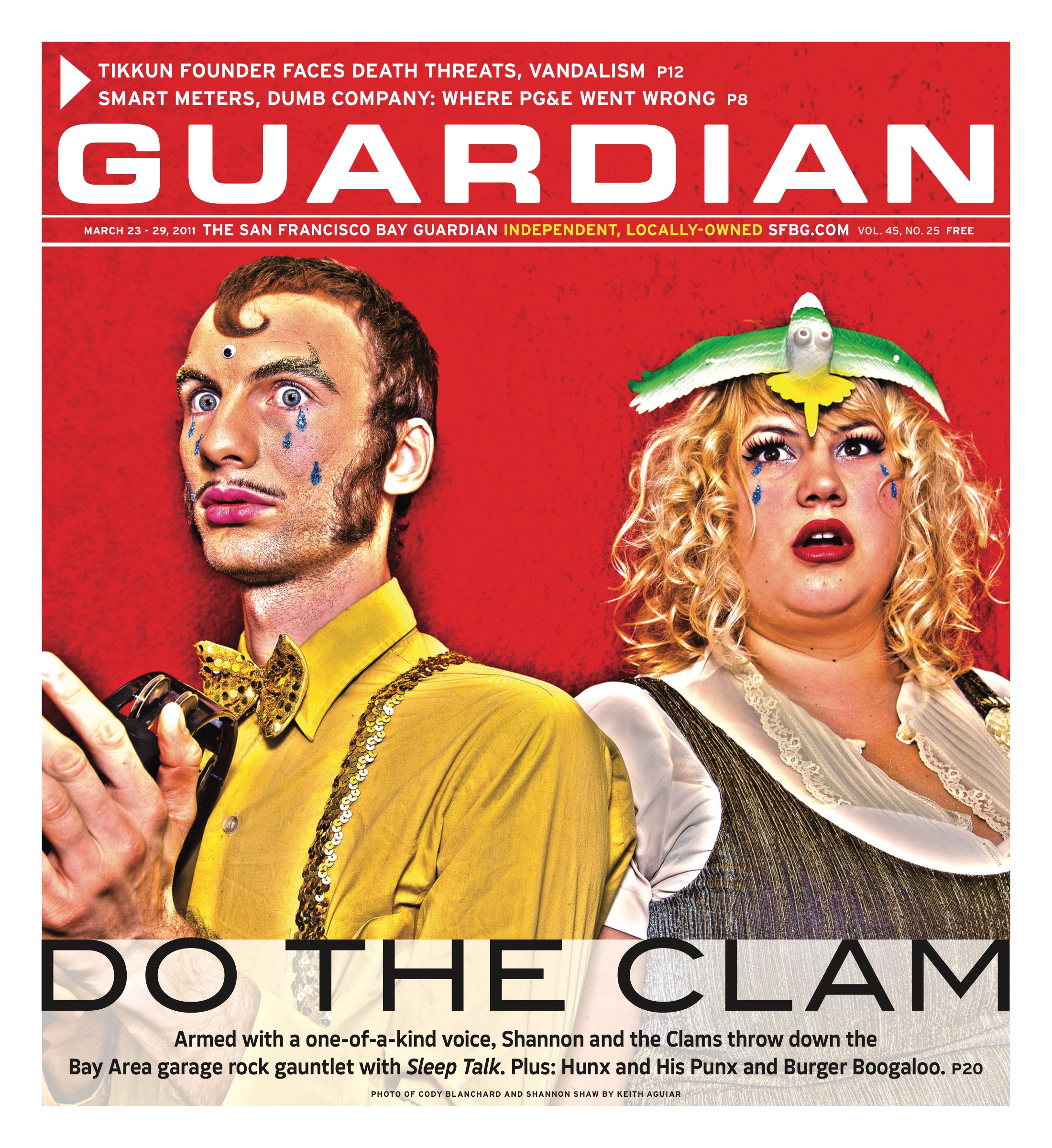
Rep Clock

0

Schedules are for Wed/9–Tues/15 except where noted. Director and year are given when available. Double and triple features are marked with a •. All times are p.m. unless otherwise specified.

ARTISTS’ TELEVISION ACCESS 992 Valencia, SF; www.atasite.org. $6-10. Nasser 56: On the History of Struggle in Egypt (1996), Thurs, 7:30. “Other Cinema: Sam Green’s History of the Time Capsule,” Sat, 8:30. Head Cold (Bak, 2010), Fri, 8.

BALBOA 3630 Balboa, SF; www.balboamovies.com. $10. Philip Guston: A Life Lived (Blackwood, 1980), Mon, 7. With poet Bill Berkson and editor-publisher Clark Coolidge in conversation.

CASTRO 429 Castro, SF; (415) 621-6120, www.castrotheatre.com. $7.50-15. “Sing-a-Long:” The Little Mermaid (Clements and Musker, 1989), Wed, 2, 7:30. “San Francisco International Asian American Film Festival:” Thurs and Sun. See Film Listings for complete schedule and ticket information. “Midnites for Maniacs: Grrls with Firepower:” •The Craft (Fleming, 1996), Fri, 7:30; Thelma and Louise (Scott, 1991), Fri, 9:30; Ms. 45 (Ferrara, 1981), Fri, 11:59. “Rrazz Entertainment Presents: Joan Rivers: Uncensored, Unscripted, and Unpredictable,” Sat, 8. This event, $35-76; tickets at www.cityboxoffice.com. Baby Jane? (2011), Tues, 7:30, 10. This event, $10-30; tickets at www.babyjane2010.com.

EL CERRITO HIGH SCHOOL PERFORMING ARTS CENTER 540 Ashbury, El Cerrito; www.lunafest2011.eventbrite.com. $10-25. “Lunafest: Short Films By, For, and About Women,” Sat, 7:30.

CHRISTOPHER B. SMITH RAFAEL FILM CENTER 1118 Fourth St, San Rafael; (415) 454-1222, www.cafilm.org. $6.50-15. Garbo the Spy (Roch, 2010), March 11-17, call for times.

HORATIUS 350 Kansas, SF; www.americascoresbayarea.com. $12. Pelada (Boughen, Fergusson, Oxenham, and White, 2010), Thurs, 7. With filmmaker Rebekah Fergusson in person.

HUMANIST HALL 390 27th St, Oakl; www.humanisthall.org. $5. Collapse (Smith, 2009), Wed, 7:30.

MECHANICS’ INSTITUTE 57 Post, SF; (415) 393-0100, rsvp@milibrary.org. $10. “CinemaLit Film Series: Heros and Misfits: The Films of Stephen Frears:” Prick Up Your Ears (1987), Fri, 6.

PACIFIC FILM ARCHIVE 2575 Bancroft, Berk; (510) 642-5249, www.bampfa.berkeley.edu. $5.50-9.50. “Film 50: History of Cinema:” Black Orpheus (Camus, 1955), Wed, 3:10. “Alternative Visions: Images of Nature, or The Nature of the Image: Canadian Artists at Work,” Wed, 7:30. “Film and Video Makers at Cal:” “Strangers and Friends” (2009-2010), Thurs, 7. “San Francisco International Asian American Film Festival,” Fri-Sun and Tues. See Film Listings for complete schedule and ticket information.

PALACE OF FINE ARTS 3301 Lyon, SF; (415) 934-1938. $20. “Banff Mountain Film Festival,” Wed-Thurs, 7. Hosted by REI.

PIER 39 Theatre 39 and Aquarium of the Bay, SF; www.oceanfilmfest.org. $8-12. “San Francisco Ocean Film Festival,” March 9-13.

RED VIC 1727 Haight, SF; (415) 668-3994; www.redvicmoviehouse.com. $6-10. I Love You Phillip Morris (Ficarra and Requa, 2009), Wed, 2, 7:15, 9:25. The Fighter (Russell, 2010), Thurs-Sat, 7:15, 9:40 (also Sat, 2, 4:25). “Screen Circus,” short films, Sat, 4:30. Antonio Gaudi (Teshigahara, 1985), Sun-Mon, 7:15, 9:15 (also Sun, 2, 4). Dazed and Confused (Linklater, 1993), March 15-16, 7:15, 9:25 (also March 16, 2).

ROXIE 3117 and 3125 16th St, SF; (415) 863-1087, www.roxie.com. $10. William S. Burroughs: A Man Within (Leyser, 2010), March 11-17, 7, 9:10 (also Sat-Sun, 3, 5). YERBA BUENA CENTER FOR THE ARTS 701 Mission, SF; (415) 978-2787, www.ybca.org. $6-8. “Volume 14: Middle East,” nine videos focusing on the Middle East compiled by ASPECT: The Chronicle of New Media Art, Jan 13-March 27 (gallery hours Thurs-Sat, noon-8; Sun, noon-6). “Human Rights Watch Film Festival:” “Youth Producing Change,” short films, Thurs, 7.

Soul with a “Q”

1

MUSIC How do you know spring is coming in San Francisco? Trusty Mission venue El Rio starts throbbing once a month to the sweet soul sounds of yesteryear, and a hot, youthful crowd of queer dancers (and friends) floods the spacious patio to capacity. Although there are many parties in the city that cater specifically to gay men, Hard French is one of a handful that has built a successful formula on welcoming everyone — lusty femmes, trans jocks, DIY freaks, fairy stoners, vinyl junkies — while staying true to its spirit of retro-tune vitality and lean toward old-school R&B.

The packed party, which takes place every first Saturday, is a (hopefully) warm weather affair — its season opener Sat/5 will also mark its one-year anniversary. We e-mailed the six-member Hard French team, composed of Devon Devine, Tina Faggotina, Jorge P., Amos G., DJ Carnita, and DJ Brown Amy, to talk about their success and plans for future Frenching. True to the party’s collective spirit, and like a funky hot-pink Borg, they preferred to answer as one entity.

SFBG Hard French has quickly established itself as a major Bay Area queer destination. Obviously you wanted to be successful, but was the reaction a surprise?

Hard French We came together to throw a party where twinks and chubsters and queens and plushies and punks — basically all our friends — could come together to French hard and dance it out every month. As we move into our second year, our intentions haven’t changed a bit (although we want more leather daddies). We saw room in our communities for a different kind of dance party a place to dance in the sunlight with a bunch of weirdos. It just caught on real fast. People saw Hard French as a special thing. Since our community inspires us, being able to enrich it in the way that Hard French has is awesome.

We’ve ended a number of our parties with “Everyday People” by Sly and The Family Stone. It’s kind of our unofficial anthem because it seems to capture the essence of what we do and what we believe in. Hard French is for everyone; we are all everyday people who just want to ensure that our everyday brothers and sisters have a great time. It’s really our crowd that creates the right vibe and aesthetic — it of course helps that they are crazy sexy babes who make us want to dance ourselves into a frenzy and make out all day long. Luckily, our Jiggalicious Hard French Dance Club photo booth captures the ones we missed so we can seek them out later.

SFBG Let’s talk about soul — it seems like such a natural match, queers and soul, yet Hard French is unique in bringing the two together. It also seems like soul and San Francisco in general make a great pair …

HF Unbeknownst to many, the Bay was a hub of soul music during the 1960s and ’70s. It was home to better-known artists like Sly and The Family Stone, as well as some of our more personal favorites like Sugar Pie De Santo and Darondo. The soul resurgence today is largely due to the San Francisco’s wealth of amazing soul DJs who have been digging through records and throwing great parties here for a while now. We’ve been honored to have some of these DJs, like Lucky of Soul Party and Primo of Oldies Night, be our guests at past Hard Frenches. We’ve heard from these DJs and others that the difference between our party and other soul parties in the city is that we reach out to everyone. We don’t just attract “soul people” — we attract everyone, which makes us unique.

SFBG This question seems kind of mean, since there’s so few left, but what’s your favorite record store for soul scores?

HF Rookie Ricardo’s Records (www.rookyricardosrecords.com) in the Lower Haight. The owner, Dick Vivian, has been dancing to these 45s since they were originally pressed — and he now shares them with all the DJs who take an interest. Also, Dick is our total record daddy dream babe. The aforementioned soul scene in San Francisco would not exist without Rookie’s.

SFBG Any new record scores the DJs are stoked to debut on Saturday?

HF “Since the Days of Pigtails” by Chairmen of the Board, “Do the 45” by the Sharpees, Ruby Lee’s “Gonna Put a Watch On You,” and “Soulful Dress” by Sugar Pie DeSanto. Plus a bunch more — we’ve basically spent the last three months digging through acres of vinyl.

SFBG What’s been the most memorable Hard French moment so far?

HF Our most mind-altering moment had to have been the Hard French Winter Ball we threw in January at the haunted Brookdale Lodge in the Santa Cruz mountains. More than 400 people — from Santa Cruz locals to folks as far as New York, Toronto, and New Orleans — dressed in their finest formal fashions and completely took over the lodge. Seriously, every room was booked, the hotel bar was overrun, there were drag queens putting on face in the bathrooms, queers frenching in every nook and cranny, and even double dutch happening in the famous Brook Room, a beautiful room with a river that runs right through it! The event was hosted by the one and only Lil Miss Hot Mess, who curated a show that featured jaw-dropping performances by Glamamore, Alotta Boute, and others. There was also a dance contest, a highly competitive coronation … Oh, and we made it snow — inside the hotel. No big deal.

SFBG Any plans to take the party abroad? Will you ever be able to say Hard French is big in Japan?

HF Though it’s easy to forget, Canada is abroad, and Hard French has had mind-blowing parties in Toronto (as well as New York). But yes, we do have a few other international buns in the oven. As a note, if anyone out there wants to pay for six round trip tickets, a few hotel suites, a couple pitchers of margaritas, and some regional cuisine, Hard French will roll into your town and throw the best damn dance party that Iceland, Croatia, Zanzibar, or wherever has ever seen.

SFBG Describe Hard French in a haiku.

HF: Make out with hot babes/ Inside soul shaken sunlight/ Daytime adventure.

HARD FRENCH

Sat/5 and every first Sat., 3 p.m.– 8 p.m.

$7 (free BBQ from 3–5 p.m.)

El Rio

3158 Mission, SF.

www.hardfrench.com

Hot sexy events: March 2-8

0

Those bedazzled emissaries of SF morals, the Sisters of Perpetual Indulgence, are once again emerging from their pancake makeup-encrusted cloisters to spread the good word. Indeed, on Sun/6 they’ll be hosting not one, but two benefits involving liberal doses of alcohol and private part-focused celebrations.

In SoMa, the sisters invite you to take a sacrament of all-you-can-drink Bud Lite at Chaps to benefit the group’s anti-hate crime “Stop the Violence” campaign. Of course, pants are optional – the event is entitled, after all, Jock Off. Eee! Pacifism is sexy! Pull your trousers halfway up to trek across town for the concurrent Quadroboob, whose ra-ma-tazz lineup (including the spectacular Lady Monster) guarantees that even as you are raising funds for the Breast Cancer Emergency Fund, you will be simultaneously putting your knockers to good use. That means shake ’em, ladies (and gents).


Leather Alliance Weekend

A whirling dervish of chaps and kicky hide hats descends on SF this week, as the Leather Alliance and its entourage gear up for the Mr. Leather Contest on Sat/5 at the Hotel Whitcomb – oh, and the SF Citadel meet and greet (Thurs/3) and assorted beer busts and cigar celebrations in honor of the chosen one. Last year was New Mexican transman wheelchair-user Tyler McCormick‘s time to shine, who will wear the leather crown this year?

Thurs/3-Sun/6 $15-35 for weekend’s events

Various locations, SF

www.leatheralliance.org


International Sex Workers’ Rights Day Art XXX-hibition

Not to be confused with the International Day to End Violence Against Sex Workers (that’s December 17), International Sex Workers’ Rights Day brings a whole bunch of creative works by and of those that supply society with a much-needed dose of climax-for-hire. Annie Sprinkle will be selling her prints, and St. James’ Infirmary workers Rachel Schreiber and Barbara DeGenevieve will share their photographs of sex workers at the center. 

Fri/4 6-9 p.m., free

Million Fishes Art Gallery

2501 Bryant, SF

www.millionfishes.com


Kinky Dating

How does the dating game change when the night of your dreams ends with you in shackles and him holding a whip and a plan? Edukink’s one-off workshop explores the etiquette of courting in the BDSM world, lessons that all you kinksters can get down on regardless of sexual orientation. The class is part of the program’s monthly “Newcomer’s Series,” so feel free to stop by even (especially) if you’re new to the dungeon scene. 

Fri/4 7:30-10:30 p.m., $15-25 sliding scale

SF Citadel

1277 Mission, SF

(415) 626-2746

www.sfcitadel.org


Quadroboob

Over 12 performers will prance about Bernal Heights’ superlative dyke bar to raise funds for breast cancer. Bonus round: the Sisters of Perpetual Indulgence’s Sister Sara Femme Fatale is emceeing, implying that more of her otherworldly siblings may well be in attendance.

Sun/6 5-9 p.m., $10-20 suggested donation

Wildside West

424 Cortland, SF

(415) 647-3099

www.thesisters.org


Jock Off

An anti-hate crime benefit with unlimited booze and jock contests to boot? Where else would you spend the end of your weekend, one might well ask.

Sun/6 5-9 p.m., $8

Chaps

1225 Folsom, SF

(415) 255-2427

www.chapsbarsanfrancisco.com


Asking for What you Want in the Bedroom and Beyond

You’ll never know what will make you feel slutty, shameless, and satiated if you can’t ask for it! Which is why your perpetual best friend in the bedroom, Good Vibrations, has contracted a one Marcia Baczynski, sex educator, to elaborate on the intricacies of sexual proposition. How to make asks in a way that is inspired, assertive, and sensitive will be covered, as will be handling rejection and the best course of action to take if what you asked for turns out to suck. 

Tues/8 6-8 p.m., $20-25

Good Vibrations

1620 Polk, SF

(415) 345-0500

www.goodvibes.com 


Hasan Elahi’s surveillance protest art

0

Hasan Elahi seems awfully jocular for a guy who is under constant surveillance. We’re standing in a room lined with 64 monitors, on which flash photos of his personal life from over the past seven years. “There’s gas stations, all the beds I’ve slept in,” the artist narrates as the slideshows progress. Rutgers, Brooklyn, Santa Fe, Philly, an unidentified toilet. “All the toilets I’ve ever done anything in,” he grins, checking to see if we get the joke.

Nowadays, Elahi is the one instigating his own surveillance. But the Bangladeshi American, an associate professor at the University of Maryland, was once detained at the Detroit airport by INS, who then turned him over to the FBI for six months of “interviews” regarding his international travel habits. His project of comprehensive self-documentation, now on display for an exhibition at the Intersection of the Arts (and opens today, Weds/2), grew out of this “terrifying” experience.

But the terror of the interrogation room seems far away at the moment as Elahi and I sit amidst gallery staff sawing wood and arranging wiring in preparation for the opening of “Hiding in Plain Sight.”

“After it was all over,” Elahi remembers of his detainment and subsequent investigation, as he lounges in a dark windbreaker, broken-in black pants, and neon green flip-flops “I asked the agents, can I get a memo saying I’m okay? But not ever having been formally charged, it’s a little bit of a problem to get formally exonerated. See, it’s all extra-judicial, there’s no law. But they did give me some numbers to call for when I was going to leave the country, and I called them! And pretty soon the phone calls got longer, you know, ‘there’s a really nice beach where I am right now, you should check it out.’ And then they turned into emails. I’m a very sharing guy.”

He smiles widely at his subversion of the process, shrugging his shoulders and raising his hands up like an overgrown Dennis the Menace. It’s hard to imagine anyone suspecting the man of terrorist activity.

“But it was such an unbalanced relationship! All I ever got back from the agent was ‘thank you, be safe.’ And I thought, why is he the only one who gets to know all this?”

So it started as a prank. Elahi wrote some “really clunky code” for his phone that tracked his geographical whereabouts, and started taking endless photos of the meals he ate, the view out of his condo window, the police van in his brother’s backyard, and posted them all to an “intentionally user-unfriendly” website – simultaneously pinging the FBI agent all the while. His website, Tracking Transience, now houses over 40,000 images, give or take.

Which seems like it helped him heal — he’s certainly stoked to talk about it now. In fact, so stoked I can barely get a word in edgewise over Professor Elahi’s lectures on the notion of camoflauge (“do you know why soldiers these days wear that pixelated camo? We don’t fight in nature anymore, it’s so that they appear to blend in with the machinery through night vision goggles!”) and externalized memory. 

So he’s gotta be doing something right.

Finally I interrupt. “But wasn’t it, you know, scary to be getting interrogated by the FBI? Does all this–” I swung my arm around at an image of a dinner from Elahi’s past at an East Bay hot plate restaurant. “Help to deal with that violation?”

Elahi pauses, but for just a moment. “It was truly terrifying. I knew who had the upper hand, the power – you know right away. You go into survival mode. In my case, that meant cooperate. Tell them every detail of everything.” He says he felt the proximity of incarceration, the planned ambivalence of interrogation questions intended to trip up incautious suspects. “The last thing on my mind was an art project.”

But being an artist, he eventually concocted a creative work to better understand what he went through. He says the deluge of information (you can’t, for example, use Elahi’s website to see where he was yesterday or right now, you have to sift through thousands of randomly-generated images at once) creates a role reversal, throwing the viewer into the role of intelligence officers grasping for clues of wrongdoing from a lifetime worth of information.

The irony is that in the endless self-documentation that qualified as bizarre in 2004 is now a part of everyday second life. That “clunky code,” Elahi tried to sell it to cell phone companies, but they laughed at him and asked who on earth would ever want to track their own every movement. But nowadays, I have a dozen friends who track themselves far more comprehensively for the world’s enjoyment than Elahi ever did. Not to mention New York artist Wafaa Bilal, who took surveillance protest art to a new level when he had a camera surgically implanted in his head last month. 

“Yeah, the project’s obsolete,” Elahi chuckles, back to the easy assurance of a man far removed from the dangers of the Patriot Act. He reminds me that the information share goes beyond, even, what we put in our status updates and foursquare check-ins. “Even times when you think you’re not being monitored — PG&E knows when you’re home when your utilities usage goes up.”

Which throws “Hiding in Plain Sight” into a different sort of light: from the prank on the FBI that it seems at first blush to that of a man accepting that he’s — that we’re all — being watched, and attempting to control what of the information is seen. After all, Elahi’s photos are taken from his perspective – his face and those of his companions never appear.

“The information that the FBI has on me has no value because you already have it,” he says. “I actually live a very anonymous life.”


Hasan Elahi: “Hiding in Plain Sight”

Through April 23

Opening reception: Weds/2 7-9 p.m., free

Intersection for the Arts

925 Mission, SF

(415) 626-2787

www.theintersection.org


The American dream, for sale

14

news@sfbg.com

For Mao Huajun and Wen Lin, a trip to San Francisco is a chance to stock up on American retail. With at least five bags in each arm, the couple from China is all smiles. Through an interpreter, they point to the tags on their new clothes and cologne and explain: "Made in China."

Consumer products devised here and made there are too expensive or not available for Chinese shoppers, so Mao and Wen, who come from Wenzhou, where Mao made a fortune in wood products and real estate, are taking full advantage of their trip.

But don’t confuse them with typical tourists. The two are on a boutique pre-immigration tour of the Bay Area, tailored for rich people who want to move to this country — without the typical problem of getting documents.

An anti-immigration wave is sweeping across the country. The Obama administration has overseen the deportation of a record 390,000 people in the past year. College kids who came here as young children are finding they can’t stay and work. The much-anticipated DREAM Act, which would allow college graduates a chance at citizenship, is in a Republican-induced limbo. Poor and working-class immigrants are getting kicked out of the country every day.

But private companies are going overseas and recruiting investors with the promise of a little-known federal program: For half a million bucks, you can get yourself a green card.

If you’ve got the cash, the promoters say it’s easy. Invest that sum with a broker who’s doing some sort of development in a low-income area and you’re guaranteed the right to move to the United States, immediately, with your entire family. You can live anywhere you want (not just in the area where you invested). And you’re on track to become a U.S. citizen.

But the program, known by its federal moniker of EB-5, is riddled with loopholes and lack of oversight. It has a history of creating few or no jobs, and the projects it funds can harm low-income communities. The immigrant investors aren’t safe, either. They put their fate in the hands of brokers and immigration officials, and if everything doesn’t go according to plan (and sometimes they have no control over that plan), they lose their money and face deportation — sometimes years after settling into their new lives.

In truth, the real winners in this program are the private brokers who profit by connecting immigrant investors with projects that desperately need funding.

San Francisco has been late to enter the EB-5 game — but now long-time political figures, including former Redevelopment Commissioner Benny Yee, are getting in on the action. Oakland has several EB-5 centers looking for money.

THE RICH ARE DIFFERENT


The federal government has long offered employment-based visas that allow people with exceptional skills or who are otherwise valuable to the American economy to immigrate to the U.S. But EB-5, created in 1990, is different: it places value on immigrants based on their wallets, not on their brains.

When Congress debated the creation of EB-5, politicians and members of the public saw it as a bona fide way to create citizenship opportunities. The rationale: people who create jobs with their money deserve to live here.

Federal officials and EB-5 experts told us how it works, at least in theory. To gain initial residence visas for themselves and their families, would-be immigrants have to invest $1 million in a new business or an existing and struggling one. If the business is in a Targeted Employment Area — defined by law as "a rural area or an area that has experienced high unemployment of at least 150 percent of the national average" — the investment requirement drops to $500,000.

The EB-5 applicants can invest on their own or they through a broker, known as a regional center. Regional centers make the process easier for investors; they also pool investment to generate the capital necessary for big projects.

Each investor must create or preserve at least 10 full-time sustainable jobs within two years to stay in the country permanently.

Exact numbers aren’t available, but government data shows that the vast majority of investors opt for the $500,000 plan — and few invest on their own. Luz Irazabal, spokesperson for United States Citizenship and Immigration Services, the agency overseeing EB-5, estimates that 80 percent to 90 percent of visas are granted through the regional centers.

So in practice, the program allows private, unregulated brokers to take the money of wealthy people and invest it in projects that are supposed to create jobs in low-income areas. It’s not necessarily a bad idea, and there’s nothing wrong with opening the most possible paths to legal residency.

But it doesn’t always work out — for the immigrants or the community.

WIN-WIN-WIN-WIN?


The EB-5 program is booming. Only 11 regional centers existed in 2007. Today 133 businesses are designated as regional centers allowed to offer EB-5 visas to foreigners in exchange for their cash and 180 applications for the status are pending.

And while EB-5 started out slowly (only a few hundred green cards were issued in the first few years) and still isn’t a huge factor in immigration (1,886 permits were issued last year), most observers agree it’s on the rise.

"As domestic money has gotten tighter, project developers have discovered the EB-5 program as a possible way to obtain foreign capital," said Stephen Yale-Loehr, a professor at Cornell University Law School, veteran immigration lawyer, and self-described "guru" of EB-5."

Some are dubious. Henry Liebman, the Seattle-based CEO of one of the oldest and most successful regional centers, told us that "most of these [new] regional centers aren’t going to raise a nickel." He added that EB-5 is "not going to be the panacea that’s going to lift us out of the great depression."

And it’s something of a Wild West. The federal agency that runs the program doesn’t regulate the regional centers once they’re approved for business. And even though the centers make loans and invest money, the Securities and Exchange Commission doesn’t monitor them. Indeed, there’s no real regulation at all.

Yale-Loehr says the program helps everyone. "Project developers can win because they can get access to capital for their projects. U.S. workers win because the EB-5 money will create jobs. U.S. taxpayers win because EB-5 money stimulates the economy and creates jobs at no expense to taxpayers. And foreign investors win because they get a green card through their investments."

Not exactly. A Dec. 22, 2010 Reuters news service report notes that "thousands of immigrants have been burned by misrepresentations that EB-5 promoters make about the program, inside and outside the United States. Many have lost not only their money, but their chance at winning U.S. citizenship."

In fact, the news service found that in 2009 "four Koreans who invested in a South Dakota dairy farm through EB-5 lost their entire investment when the price of milk collapsed and the operators of the farm stopped paying the mortgage. When the four, who had invested a total of $2 million in the dairy, tried to step in and save the venture, they discovered their partner had left their names off the title. When they tried to sue in state court, the case went nowhere."

If a project falls apart and no jobs are created, the immigrants face deportation.

And there’s little guarantee that the projects these investors fund actually create any jobs for the communities where they’re located.

Regional centers have plenty of ways to win. According to center executives, they typically charge the investors a fee for facilitating the program they charge their clients. In some cases, the immigrant investors become part owners of a business enterprise; the investors and the regional center gets paid when the business turns a profit. But it’s far more common for the regional center to lend the money for projects and collect the interest. Usually immigrant investors get paid only around 1 percent in interest and the regional center picks up the rest.

It’s certainly worked for Liebman. He owns and runs 10 regional centers with offices throughout the United States and one in Tokyo. All his investments have gone into commercial real estate. "You don’t get to be Bill Gates through EB-5, but it certainly raises your game," he said.

Yale-Leohr did say the program must be "done correctly" and that it’s no piece of cake. "It is hard to set up a project that meets all immigration and securities-related requirements."

JOBS? WHERE?


Everyone agrees that the program exists primary because it’s supposed to create jobs. "There is a lot of scrutiny of job creation because that is the foundation of the program," Irazabal said.

But that scrutiny is actually limited.

It shouldn’t be hard to determine if an investment is creating jobs in the community; either there are people working in a local business or not. But EB-5 experts told us that most of the EB-5 investment doesn’t create direct jobs. Sharon Rummery, also a spokesperson for the Citizenship and Immigration Service, said she suspects most of the jobs are indirect. But after checking with agency staff, she told us there’s no data.

The difference is critical. Say, for example, some investors build an electric car factory in a neighborhood with high unemployment. They hire 10 people to build cars, and create 10 direct jobs.

But when the workers go out to lunch and the deli counter down the street hires more help, that’s indirect job-creation — and how one specific investment creates other jobs is essentially guesswork.

Of course, the electric car factory has to buy materials and parts — say, computer chips — that might be made halfway across the country (and possibly in an area that doesn’t have high unemployment). Those jobs count, too. According Irazabal, USCIS has "no requirement for the [indirect] jobs to be in the geographic area" that is struggling economically.

The geographic flexibility USCIS allows is interesting considering that, according USCIS rules, regional centers must have "plans to focus on a geographical region within the United States and must explain how the regional center will achieve economic growth within this regional area."

The most interesting question is whether any of the indirect jobs are ever really created. And the bottom line is, USCIS never checks.

Here’s the process, according to USCIS officials. Regional centers create business plans. Then they hire consulting firms to evaluate how many indirect jobs will be created if the business plan all goes as projected. USCIS signs off on the report and the E-5 visas are approved.

The government never does its own studies or reports, never tracks actual indirect job creation, and rarely questions what the private consultants say.

Economist Peter Donahue, who runs PBI Associates in San Francisco, told us the job creation promises under EB-5 amount to a "parable." Models used to track indirect jobs "give the appearance of the science but its probably someone’s best guess," he said. "I’m not persuaded this stuff adds up."

Assumptions inherent in the models are not commonly verified, he added, and often fail to calculate the net effect of an investment, like when a new firm crowds out existing firms.

Tom Henderson, who’s setting up an EB-5 center in Oakland, told us the indirect jobs model "is all smoke and mirrors — it’s bullshit" (see sidebar).

Still, Irazabal says, "numbers don’t lie." USCIS checks that business plan and the job creation strategy is "viable, can be reproduced, and is practical. We have people whose area of specialty is looking at this."

To make things more complicated, most EB-5 money isn’t going into creating goods or services. It’s going into real estate development. And unlike a factory, a new building by itself creates barely any direct jobs.

It may have the opposite effect. High-end office development often displaces existing businesses, particularly industrial ones. And those lost jobs aren’t taken into account.

THE AMERICAN DREAM


Mao said his No. 1 reason for seeking residency in the United States is the prospect of better education for his two sons, 5 and 17.

It’s ironic. Mao’s American Dream for his children is no different from the dreams of immigrants like Shing Ma "Steve" Li, a 20-year-old nursing student in San Francisco.

Li has lived in San Francisco since he was 12. speaks Cantonese, English, French and Spanish. He was arrested Sept. 15, 2010 by ICE agents, held in a detention center for two months, and threatened with deportation because his parents lacked the proper documentation.

Li, like tens of thousands of others, has talent and education and a lot to offer the United States. But he doesn’t have $500,000.

Immigration activists like Ali Noorani, executive director of the National Immigration Forum, aren’t against EB-5 just because its immigrants are privileged. "We don’t believe there are good immigrants or bad immigrants when it comes to folks who contribute to this nation," he said.

But, he added, "We are looking for equity in our immigration system."

Immigrant-rights activists properly support almost any program that helps open the doors, particularly at a time when the right-wing is exploiting anti-immigrant sentiment. But it seems unfair that one class of immigrants, the ones with large sums of extra money to invest, are getting recruited to come to the U.S. while a much larger group — including people who have lived here for years, worked hard, built businesses and contributed to the nation — is being shown the exit door.

Francisco Ugarte, an attorney with the San Francisco Immigrant Legal and Education Network, made the point: "We disagree with legal standards that make it easier for rich people to immigrate than poor people.

"Our legal system is designed to protect the rich and powerful," he added. "People who are coming out of necessity have a much harder time immigrating than wealthy people looking to move."

"It is," he added, indicative of a broken immigration system." *


EB-5 COMES TO SAN FRANCISCO

Tom Henderson’s clients call San Francisco jiou jin shan, meaning "old gold mountain" in Mandarin and referring to the Gold Rush era impression that San Francisco must be awash in opportunity.

His soon-to-be-unveiled San Francisco Regional center is still waiting on final government approval, but Henderson has already been lining up investors to participate in the program.

He spends a third of his year in China and has done business there for decades. Armed with an international network of business relationships and a quirky charisma, Henderson has won over people like Mao Huajun, low profile but extremely wealthy potential investors with sights on America.

Although more than 20 regional centers are certified to do work in Southern California, only a handful are operating in the Bay Area — although applications for more regional centers are in the pipeline.

Featured prominently on the website of the Synergy Regional Center are two prominent local figures: former Mayor Willie Brown and former Redevelopment Commission member Benny Yee.

The website has pictures of the Synergy management "meeting former San Francisco Mayor Willie Brown, to discuss about how EB-5 investment can stimulate the local economy."

Yee is listed as one of six principals at the firm. He didn’t return our phone calls seeking comment. Neither did Brown (who, to be fair, may have simply been part of a photo op since it appears the picture was taken at a fund-raising event for his institute).

According to Synergy CEO Simon Jung, Yee joined after initially "giving [Jung] advice on how to do business. He can help us bring deals in San Francisco we don’t have access to otherwise."

James Falaschi heads the Bay Area Regional Center in Oakland. His website that features three potential projects — all real estate developments in downtown and east Oakland.

Sunfield Development is the company building at the Fox Uptown and at Seminary and Ninth streets, two of the projects the Bay Area Regional center is working on. Sunfield CEO Sid Afshar said EB-5 is "a very good idea because it is a win-win for everyone."

The new player on the scene is Henderson, and he is unveiling an EB-5 vision with a lot of promise.

Mao was bombarded with options when he first heard of EB-5. As a savvy businessman, he was wary of jumping into something sketchy. Through an interpreter, he told us he went with Henderson because he "can see the way Tom is doing this business is transparent, so [he] know[s] the step by step."

Henderson has yet to reveal what his projects will be, but he says they are all businesses, not real estate projects. He said all the companies he is setting up will inhabit industries the city has identified as central to Oakland’s economic growth.
"I was born in Oakland. I work in Oakland. I live in Oakland," he said. "I won’t do projects that don’t create direct jobs."

Choose or lose

0

arts@sfbg.com

FILM With its plentitude of female political stars, the Tea Party finds U.S. feminism at an interesting if inevitable developmental stage — wherein people who never would have gotten this far without liberationists’ path-clearing reject progressivism altogether. They no longer identify with a historically oppressed viewpoint, but rather from an angry, gender-neutral stance of entitlement allegedly stolen by cunning have-nots and slippery liberals.

They’ve never felt enough second-class citizenry to see gender as “the” issue. Yet right-wingers’ international panic button, “Islamic fundamentalists,” are also all about family values. Christian nations dominated world politics for so long it’s understandably hard for Westerners to grasp, let alone accept, that a different age-old faith looks set to control that discourse in our immediate future. (Buddhism, where are you? Oh yeah: busy ignoring all this.)

And the driving forces aren’t assimilationist, like those presumably nice folks whose mosque peacefully shares my Lower Polk neighborhood with a famous tranny nightclub and fire house. Rather, they are the pissed-off rank citizens, recruited by more privileged leaders to relatable activity outrage toward a deep disapproval of perceived Western moral decay. Just like Sarah Palin!

Does she see women’s issues as a significant concern? Most unlikely. She’s never been constrained by her family — more likely, as copious public exposure suggests, she’s been Santa-whipping its cadre of very stupid reindeer toward some destination, even if off a cliff (hello, Bristol, hello).

Palin would doubtless be horrified at the injustices dramatized in potent German drama When We Leave. It’s about Umay (Sibel Kekilli from 2004’s Head-On), who leaves a seriously abusive Istanbul husband with their young son Cem, seeking shelter from her Turkish family in Berlin. Initially welcoming, they grow hostile once the shame of her spousal abandonment ripples endlessly outward.

To keep Cem from being kidnapped and taken “home,” she eventually moves into a safe house. She gets a job, potential new boyfriend (the endearing Florian Lukas from 2008’s North Face), new apartment. But the pull of family is inexorable, and no location-shifting games are ultimately able to protect her.

Feo Aladag’s feature writing-directing debut goes out on a narrative limb with an improbable risk Umay takes at the two-thirds point. It strains credulity, but does heighten dramatic tension. It’s no spoiler to reveal that When We Leave‘s first moments reveal it deals with that near-unbridgeable cultural gap known as honor killings. Still, it might spoil something to say Aladag subsequently licks, seals, and otherwise pushes her emotional envelope to an excessively manipulated degree — D.W. Griffith himself might cry melodrama’s corn level exceeded.

Nonetheless, the real-world realities are more than real enough. Twenty years ago the 1991 Sally Field vehicle (imagine a world in which such things existed!) Not Without My Daughter struck many as suspect and kinda racist for dramatizing a real-life American woman’s attempt to flee her husband’s Iran with their child. Now When We Leave comes as no surprise.

Today, notions of the roles and rights of women in a just society differ painfully around the world, “developed” and otherwise. A basic tenet of U.N., E.U., and other bodies’ diplomatic interventions is that women be given equal rights — or at least legal freedom from domestic violence, rape, underage marriage, and other abuse. After so many decades of progress, it now seems the driving planetary political tide no longer pushes that-a-way.

When We Leave is a flawed drama that nonetheless underlines an increasing, confusing divide between ideological extremists “East” and “West.” How can we be on the brink of global chaos when both most-agitative sides basically agree women should be barefoot and pregnant? Excepting the exceptional women now in political power — too many are often silent, whether due to compromise or sheer denial.

WHEN WE LEAVE opens Fri/4 in Bay Area theaters.