International

The underground

0

arts@sfbg.com

Compilations often serve two purposes, sometimes at the same time: they can be brief introductions or exhaustive overviews. The San Francisco label Dark Entries just released BART: Bay Area Retrograde, a collection of local, underground music from the early ’80s, which feels like a bit of both. Representing local bands — from Danville to Palo Alto, Berkeley, and SF — that gravitated toward an alienated, synth-driven sound, it’s a meticulously curated snapshot that feels complete in itself, but is also a primer for the minimal synth revival. With many songs verging on 30 years old, label owner and DJ Josh Cheon and co-curator Phil Maier have compiled tracks that were un- or little- known in their own time but now sound very much of the moment.

There are many names for the variety of styles represented across BART‘s 11 songs — synthpop, post-punk, and cold, minimal, or new wave are only the most common. But nearly half of the songs are complete obscurities — four are previously unreleased and two appeared only in small, self-released editions — and the compilation as a whole is difficult to pin down. These are artifacts from a lost era, our local contribution to an international group of artists who created music that was bound to be marginal, faced with intense rock chauvinism and Reagan-era optimism.

BART kicks off with three songs (Nominal State’s “Middle Class,” Batang Frisco’s “Power,” and Necropolis of Love’s “Talk”) that sound like a blueprint for the current renaissance of icy analog futurism by groups like Xeno and Oaklander, Staccato du Mal, and The Soft Moon. But curveballs like Wasp Women’s No-Wave-y “Kill Me” and The Units’ peppy ode “Mission” alleviate the future-shock claustrophobia and put the compilation in a category of its own — it’s as much a love letter to the Bay Area’s taste for the goofy and willfully weird as an archival release.

There’s a sense of playfulness that’s immediately apparent in the presentation. Eloise Leigh’s eye-popping jacket design is satisfyingly heavy on pink, blue, and yellow, and comes as a six-panel fold-out poster rather than a standard cardboard pocket, suggesting it would prefer wall space rather than a slot on the shelf. Comprising liner notes from the Guardian’s Johnny Ray Huston and band data on one side and Dr. Art Nuko’s painting Getting Bombed in San Francisco on the other, BART the consumer object feels like something that belongs nowhere so much as Valencia Street’s overflowing vintage zine store, Goteblüd. And while the music contained on the vinyl within can be dark and brooding like “Talk,” or abrasive and fractured like Standard of Living’s “N.F.A.,” the most memorable songs, to me, are the frothy ones: Danny Boy and the Serious Party Gods’ parody-of-a-parody “Castro Boy,” and the above-mentioned “Mission.” The former riffs on Zappa’s “Valley Girl,” but ups the raunch with ad-libs about fisting, while “Mission” builds up to its irrepressible chorus with verses celebrating the unassailable pleasures of being high and eating burritos. Even if you aren’t already a minimal synth nerd, BART is a fun album.

With its variety of styles and lyrical themes, BART holds together not only because there’s a high baseline of quality, but also because of the built-in context. In addition to the design, a lot of work clearly went into finding and collaborating with these long-defunct bands, from securing unheard demos to listing the synth models used for each track. It’s a meticulously assembled record, a guided experience that points out what is so unsatisfying about downloading some lost classic from a sharity blog and deleting it, unlistened to, months later. Its local focus also sets it apart from the compilations that helped define minimal wave, although it contributes to that canon as well.

As the underbelly of an underground dominated in the retelling by figures like Chrome, Flipper, and The Residents, BART‘s new audience lives in a skewed world, where technology provides us with nearly endless opportunities to connect, where analog synths are revered for their warmth and character, and where the Mission is gentrified. Yet faced with an excess of information every time we make a decision, the rough edges of this serious, cynical music offer opportunities to disconnect from the endless demands of the present. The past will always have the advantage of seeming coherent, but BART‘s biggest success is in the way it captures the innovative, corrosive energy of its time. * *


The night has a thousand eyes

0

arts@sfbg.com

Cheap genre films targeted for the drive-in or grindhouse aside, very few truly independent features were made in the U.S. before the 1960s, and those that were made seldom found an audience. As a result, most were soon forgotten — in rare instances rediscovered decades later, like the recently restored docudramas On the Bowery (1957) and The Exiles (1961), about Skid Row denizens in New York City and Los Angeles. Foreign films had a tiny theatrical circuit (albeit usually playing in cut and dubbed form), experimental ones none at all.

It was predictable, then, that a movie straddling pretty much all the above categories should have found no welcoming niche in the complacent 1950s. Elliot Lavine’s latest retrospective of noir and noir-ish oldies at the Roxie Theater, “I Wake Up Dreaming 2011,” is subtitled “The Legendary and the Lost,” terms that both apply to the film that kicks off the two-week series.

To paraphrase recent San Francisco International Film Festival guest Christine Vachon, behind every independent feature there’s a war story. Dementia (1955) is a good example of one little film that fought and lost — on every front save artistically, and perhaps in posterity.

Even by today’s standards, with our greater tolerance for “dark” and arty material, it’s an unclassifiable, commercially doomed proposition: an hour-long B&W nightmare in which an unstable young woman wanders empty urban streets, bounces from pimp to john to jazz club, commits acts of violence (or maybe just hallucinates them), and at the end simply disappears into the cosmos. (The opening and closing shots actually are of starry infinite space.)

Oh, and there is no dialogue, just a score by noted American composer George Antheil that uses wordless vocals by Marni Nixon (who later secretly provided the vocals for the famous leading ladies of 1956’s The King and I, 1961’s West Side Story, and 1964’s My Fair Lady) as a sort of human theremin. This very curious amalgam of noir, avant-garde, lurid potboiler and silent expressionism at various times brings to mind everyone from Roger Corman to Roman Polanski and Maya Deren. It was the first and last film for John Parker, about whom very little is known — save that he must have been gravely disappointed by the long road Dementia took to nowhere. (He would have been even more disappointed had he known years later his associate producer and cast member Bruno VeSota claimed Parker didn’t know what he was doing, and that he himself did most of the writing and half the directing.)

Shot in 1953 Los Angeles, Dementia was asking for it on many levels, with content not only bizarre and uncommercial but often downright offensive by the standards of the era. Its paranoid, unpredictably mood-swinging heroine (Adrienne Barrett, billed only as “The Gamine” — not exactly the ideal description for this character) wanders alone through the city’s squalid underbelly. A flashback to her childhood — staged in a cemetery, with living-room furniture amid gravestones — reveals mom was a sluttish harpy killed by a boozed and abusive dad, who was then stabbed by guess who.

Handed over to a fat “Rich Man” (VeSota) by a slick sleazeball (Richard Barron as “The Evil One”) who picks her up on the street, she stabs him too, pushes him out a penthouse window, and saws off his hand when it won’t let go of a telltale necklace. Pursued by cops, she ducks into a club where the jivey sounds of Shorty Rogers and His Giants suddenly turn her into a sleek chanteuse (albeit one we don’t hear) alongside bongos and hopheads. All this is shot with considerable noirish panache by William C. Thompson, who as Ed Wood’s regular cinematographer made some completely ridiculous films (notably 1959’s Plan 9 From Outer Space, with its own atmospheric cemetery scenes) look much better than warranted.

Barely releasable at 61 minutes, the completed film then found that threadbare length was the least of its problems. Shown to a succession of censorial boards, it was repeatedly deemed too unhealthy for public viewing, prompting critiques like “indecent, inhuman, lacking in moral and spiritual values, could incite to crime” and “grist for the Communist mill.”

Finally after over two years and 11 screenings of different edits for New York State’s board, it was cleared with an “adults only” stamp. Double-billed with a documentary about Picasso in A Unique Program of Psychology and Art, advertised as “the first American Freudian film,” it opened on one 1955 Manhattan screen to little notice. (However Parker’s friend, the great, soon-to-be late director Preston Sturges did call it “a work of art,” strangely noting “it stirred my blood, purged my libido.”)

Two years later Parker’s producer sold the movie — now cut to 56 minutes, with pasted-on purple narration spoken in spookhouse tones by then-unknown Ed McMahon — for rerelease as Daughter of Horror. Again it flopped, although in 1958 it would gain pop culture footnote status when a clip was used as what the onscreen audience is watching when they’re attacked by amorphous sci-fi monster The Blob.

It was as Daughter that the movie started gaining a little admiration in recent years, getting a boost from Re/Search’s first Incredibly Strange Films volume and finally a DVD release (with both versions) from Kino. Taken as good, bad, or just daft, it remains unique.

Other highlights in the Roxie’s “Dreaming” program include Dementia‘s co-feature, Robert Siodmak’s terrific 1944 noir mystery Phantom Lady; actor director Robert Montgomery’s 1947 Mexican anti-holiday Ride the Pink Horse, a sort of hard-boiled cinematic Under the Volcano; and a number of exceedingly rare lesser-known titles. Certainly the campiest of them are contained on May 23’s bill: 1956’s The Violent Years, a girl-gang movie featuring the inimitable dialogue stylings of the aforementioned Mssr. Ed D. Wood, and Dance Hall Racket, an unbelievably amateurish 1953 cheapie whose stars are none other than pre-fame Lenny Bruce and his stripper wife Honey. Inspirational line: “Big deal! I kill a guy and that makes me a criminal?!” 

I WAKE UP DREAMING 2011: THE LEGENDARY AND THE LOST!

May 13–26

Roxie Theater

3117 16th St., SF

(415) 863-1087

www.roxie.com


Film Listings

0

Film listings are edited by Cheryl Eddy. Reviewers are Kimberly Chun, Michelle Devereaux, Peter Galvin, Max Goldberg, Dennis Harvey, Johnny Ray Huston, Louis Peitzman, Lynn Rapoport, Ben Richardson, and Matt Sussman. For rep house showtimes, see Rep Clock. For first-run showtimes, see Movie Guide.

OPENING

*Bridesmaids For anyone burned out on bad romantic comedies, Bridesmaids can teach you how to love again. This film is an answer to those who have lamented the lack of strong female roles in comedy, of good vehicles for Saturday Night Live cast members, of an appropriate showcase for Melissa McCarthy. The hilarious but grounded Kristen Wiig stars as Annie, whose best friend Lillian (Maya Rudolph) is getting hitched. Financially and romantically unstable, Annie tries to throw herself into her maid of honor duties — all while competing with the far more refined Helen (Rose Byrne). Bridesmaids is one of the best comedies in recent memory, treating its relatable female characters with sympathy. It’s also damn funny from start to finish, which is more than can be said for most of the comedies Hollywood continues to churn out. Here’s your choice: let Bridesmaids work its charm on you, or never allow yourself to complain about an Adam Sandler flick again. (2:04) Balboa. (Peitzman)

*The Double Hour Slovenian hotel maid Sonia (Ksenia Rappoport) and security guard Guido (Filippo Timi) are two lonely people in the Italian city of Turin. They find one another (via a speed-dating service) and things are seriously looking up for the fledgling couple when calamity strikes. This first feature by music video director Giuseppe Capotondi takes a spare, somber approach to a screenplay (by Alessandro Fabbri, Ludovica Rampoldi, and Stefano Sardo) that strikingly keeps raising, then resisting genre categorization. Suffice it to say their story goes from lonely-hearts romance to violent thriller, ghost story, criminal intrigue, and yet more. It doesn’t all work seamlessly, but such narrative unpredictability is so rare at the movies these days that The Double Hour is worth seeing simply for the satisfying feeling of never being sure where it’s headed. (1:35) Clay, Smith Rafael. (Harvey)

*Everything Must Go Just skirting the edge of sentimentality and banality, Everything Must Go aims to do justice by its source material: Raymond Carver’s rueful, characteristically spare short story, “Why Don’t You Dance?,” from the 1988 collection Where I’m Calling From. And it mostly succeeds with some restraint from its director-writer Dan Rush, who mainly helmed commercials in the past. Everything Must Go gropes toward a cinematic search for meaning for the Willy Lomans on both sides of the camera — it’s been a while since Will Ferrell attempted to stretch beyond selling a joke, albeit often extended ones about masculinity, and go further as an actor than 2006’s Stranger Than Fiction. The focus here turns to the despairing, voyeuristic whiskey drinker of Carver’s highly-charged short story, fills in the blanks that the writer always carefully threaded into his work, and essentially pushes him down a crevasse into the worst day of his life: Ferrell’s Nick has been fired and his wife has left him, changing the locks, putting a hold on all his bank accounts, and depositing his worldly possessions on the lawn of their house. Nick’s car has been reclaimed, his neighbors are miffed that he’s sleeping on his lawn, the cops are doing drive-bys, and he’s fallen off the wagon. His only reprieve, says his sponsor Frank (Michael Pena), is to pretend to hold a yard sale; his only help, a neighborhood boy Kenny who’s searching for a father figure (Christopher Jordan Wallace, who played his dad Notorious B.I.G. as a child in 2009’s Notorious) and the new neighbor across the street (Rebecca Hall). Though Rush expands the characters way beyond the narrow, brilliant scope of Carver’s original narrative, the urge to stay with those fallible people — as well as the details of their life and the way suburban detritus defines them, even as those possessions are forcibly stripped away — remains. It makes for an interesting animal of a dramedy, though in Everything Must Go‘s search for bright spots and moments of hope, it’s nowhere near as raw, uncompromising, and tautly loaded as Carver’s work can be. (1:36) (Chun)

Forks Over Knives Lee Fulkerson steps up as the latest filmmaker-turned-guinea-pig to appear in his own documentary about nutrition. As he makes progress on his 12-week plan to adopt a “whole foods, plant-based diet” (and curb his Red Bull addiction), he meets with other former junk food junkies, as well as health professionals who’ve made it their mission to prevent or even reverse diseases strictly through dietary changes. Along the way, Forks Over Knives dishes out scientific factoids both enlightening and alarming about the way people (mostly us fatty Americans, though the film investigates a groundbreaking cancer study in China) have steadily gotten unhealthier as a direct result of what they are (or in some cases, are not) eating. Fulkerson isn’t as entertaining as Morgan Spurlock (and it’s unlikely his movie will have the mainstream appeal of 2004’s Super Size Me), but the staunchly pro-vegan Forks Over Knives certainly offers some interesting, ahem, food for thought. (1:36) Bridge. (Eddy)

*Hesher See “Ride the Lightning.” (1:45) Embarcadero.

*Nostalgia for the Light Chile’s Atacama Desert, the setting for Patricio Guzmán’s lyrically haunting and meditative documentary, is supposedly the driest place on earth. As a result, it’s also the most ideal place to study the stars. Here, in this most Mars-like of earthly landscapes, astronomers look to the heavens in an attempt to decode the origins of the universe. Guzmán superimposes images from the world’s most powerful telescopes — effluent, gaseous nebulas, clusters of constellations rendered in 3-D brilliance — over the night sky of Atacama for an even more otherworldly effect, but it’s the film’s terrestrial preoccupations that resonate most. For decades, a small, ever dwindling group of women have scoured the cracked clay of Atacama searching for loved ones who disappeared early in Augusto Pinochet’s regime. They take their tiny, toy-like spades and sift through the dirt, finding a partial jawbone here, an entire mummified corpse there. Guzmán’s attempt through voice-over to make these “architects of memory,” both astronomers and excavators alike, a metaphor for Chile’s reluctance to deal with its past atrocities is only marginally successful. Here, it’s the images that do all the talking — if “memory has a gravitational force,” their emotional weight is as inescapable as a black hole. (1:30) Lumiere. (Devereaux)

Priest Paul Bettany stars as the titular vampire-fighter in this graphic novel adaptation. (1:27)

True Legend “Directed by Yuen Woo Ping” = high-flying martial arts galore. (1:56) Lumiere.

ONGOING

The Beaver It’s been more than 15 years since Jodie Foster sat in the director’s chair; she’s back with The Beaver, which tells the unique story of Walter Black (Mel Gibson), a clinically depressed man who struggles through his suicidal desires with the help of a beaver puppet. Walter uses the puppet — which he also voices — as a way of connecting with his family and the outside world. The film examines both the comedic aspects and the devastating reality of mental illness, and the script walks the line between dark and light — it’s the first feature from Kyle Killen, who created the critically adored but short-lived TV series Lone Star. The Beaver gets points for ambition, but it’s ultimately too all over the place to come together in the end. The moments of humanity are undercut by scenes of Walter and his wife Meredith (Foster) having sex with the puppet in the bed — intentionally funny, but jarring nonetheless. Still, Foster’s direction is solid and, for all its faults, The Beaver is a great reminder of Gibson’s legitimate talent. (1:31) SF Center, Sundance Kabuki. (Peitzman)

*Bill Cunningham New York To say that Bill Cunningham, the 82-year old New York Times photographer, has made documenting how New Yorkers dress his life’s work would be an understatement. To be sure, Cunningham’s two decades-old Sunday Times columns — “On the Street,” which tracks street-fashion, and “Evening Hours,” which covers the charity gala circuit — are about the clothes. And, my, what clothes they are. But Cunningham is a sartorial anthropologist, and his pictures always tell the bigger story behind the changing hemlines, which socialite wore what designer, or the latest trend in footwear. Whether tracking the near-infinite variations of a particular hue, a sudden bumper-crop of cropped blazers, or the fanciful leaps of well-heeled pedestrians dodging February slush puddles, Cunningham’s talent lies in his ability to recognize fleeting moments of beauty, creativity, humor, and joy. That last quality courses through Bill Cunningham New York, Richard Press’ captivating and moving portrait of a man whose reticence and personal asceticism are proportional to his total devotion to documenting what Harold Koda, chief curator at the Costume Institute at the Metropolitan Museum of Art, describes in the film as “ordinary people going about their lives, dressed in fascinating ways.” (1:24) Embarcadero. (Sussman)

*Cave of Forgotten Dreams The latest documentary from Werner Herzog once again goes where no filmmaker — or many human beings, for that matter — has gone before: the Chauvet-Pont-d’Arc Cave, a heavily-guarded cavern in Southern France containing the oldest prehistoric artwork on record. Access is highly restricted, but Herzog’s 3D study is surely the next best thing to an in-person visit. The eerie beauty of the works leads to a typically Herzog-ian quest to learn more about the primitive culture that produced the paintings; as usual, Herzog’s experts have their own quirks (like a circus performer-turned-scientist), and the director’s own wry narration is peppered with random pop culture references and existential ponderings. It’s all interwoven with footage of crude yet beautiful renderings of horses and rhinos, calcified cave-bear skulls, and other time-capsule peeks at life tens of thousands of years ago. The end result is awe-inspiring. (1:35) SF Center, Sundance Kabuki. (Eddy)

The Conspirator It may not be your standard legal drama, but The Conspirator is a lot more enjoyable when you think of it as an extended episode of Law & Order. The film chronicles the trial of Mary Surratt (Robin Wright), the lone woman charged in the conspiracy to assassinate Abraham Lincoln. It’s a fascinating story, especially for those who don’t know much of the history past John Wilkes Booth. But while the subject matter is compelling, the execution is hit-or-miss. Wright is sympathetic as Surratt, but the usually great James McAvoy is somewhat forgettable in the pivotal role of Frederick Aiken, Surratt’s conflicted lawyer. It’s hard to say what it is that’s missing from The Conspirator: the cast — which also includes Evan Rachel Wood and Tom Wilkinson — is great, and this is a story that’s long overdue to be told. Still, something is lacking. Could it be the presence of everyone’s favorite detective, the late Lennie Briscoe? (2:02) Embarcadero. (Peitzman)

Fast Five There are plenty of laugh-out-loud moments in Fast Five, in addition to a much demolition derby-style crunch — instances that stretch credulity and simultaneously trigger a chuckle at the OTT fantasy of the entire enterprise. Two unarmed men chained to the ceiling kick their way out of a torture cell, jump favela rooftops to freedom with nary a bullet wound in sight, and, in the movie’s smash-’em-up tour de force, use a bank vault as a hulking pair of not-so-fuzzy dice to pulverize an unsuspecting Rio de Janeiro. Not for nothing is rapper Ludacris attached to this franchise — his name says it all (why not go further than his simple closing track, director Justin Lin, now designated the keeper of Fast flame, and have him providing the rap-eratic score/running commentary throughout?) In this installment, shady hero Dominic (Vin Diesel) needs busting out of jail — check, thanks to undercover-cop-turned-pal Brian (Paul Walker) and Dominic’s sis Mia (Jordana Brewster). Time to go on the lam in Brazil and to bring bossa nova culture down to level of thieving L.A. gearheads, as the gearhead threesome assemble their dream team of thieves to undertake a last big heist that will set ’em up for life. Still, despite the predictable pseudo-twists — can’t we all see the bromance-bonding between testosteroni boys Diesel and Dwayne Johnson coming from miles of blacktop away? — there’s enough genre fun, stunt driving marvels, and action choreography here (Lin, who made his name in ambitious indies like 2002’s Better Luck Tomorrow, has developed a knack for harnessing/shooting the seeming chaos) — to please fans looking for a bigger, louder kick. (1:41) Empire, 1000 Van Ness. (Chun)

*Hanna The title character of Hanna falls perfectly into the lately very popular Hit-Girl mold. Add a dash of The Boys from Brazil-style genetic engineering — Hanna has the unfair advantage, you see, when it comes to squashing other kids on the soccer field or maiming thugs with her bare hands — and you have an ethereal killing/survival machine, played with impassive confidence by Atonement (2007) shit-starter Saoirse Ronan. She’s been fine-tuned by her father, Erik (Eric Bana), a spy who went out into the cold and off the grid, disappearing into the wilds of Scandinavia where he home-schooled his charge with an encyclopedia and brutal self-defense and hunting tests. Atonement director Joe Wright plays with a snowy palette associated with innocence, purity, and death — this could be any time or place, though far from the touch of modern childhood stresses: that other Hannah (Montana), consumerism, suburban blight, and academic competition. The 16-year-old Hanna, however, isn’t immune from that desire to succeed. Her game mission: go from a feral, lonely existence into the modern world, run for her life, and avenge the death of her mother by killing Erik’s CIA handler, Marissa (Cate Blanchett). The nagging doubt: was she born free, or Bourne to be a killer? Much like the illustrated Brothers Grimm storybook that she studies, Hanna is caught in an evil death trap of fairytale allegories. One wonders if the super-soldier apple didn’t fall far from the tree, since evil stepmonster Marissa oversaw the program that produced Hanna — the older woman and the young girl have the same cold-blooded talent for destruction and the same steely determination. Yet there’s hope for the young ‘un. After learning that even her beloved father hid some basic truths from her, this natural-born killer seems less likely to go along with the predetermined ending, happy or no, further along in her storybook life. (1:51) 1000 Van Ness, SF Center. (Chun)

Hoodwinked Too! Hood vs. Evil (1:25) 1000 Van Ness.

*Incendies When tightly wound émigré Nawal (Luba Azabal) dies, she leaves behind adult twins Jeanne (Mélissa Désormeaux-Poulin) and Simon (Maxim Gaudette) — and leaves them documents that only compound their feelings of grief and anger, suggesting that what little they thought they knew about their background might have been a lie. While resentful Simon at first stays home in Montreal, Jeanne travels to fictive “Fuad” (a stand-in for source-material playwright Wajdi Mouawad’s native Lebanon), playing detective to piece together decades later the truth of why their mother fled her homeland at the height of its long, brutal civil war. Alternating between present-day and flashback sequences, this latest by Canadian director Denis Villeneuve (2000’s Maelstrom) achieves an urgent sweep punctuated by moments of shocking violence. Resembling The Kite Runner in some respects as a portrait of the civilian victimization excused by war, it also resembles that work in arguably piling on more traumatic incidences and revelations than one story can bear — though so much here has great impact that a sense of over-contrivance toward the very end only slightly mars the whole. (2:10) Embarcadero. (Harvey)

*Jane Eyre Do we really need another adaptation of Jane Eyre? As long as they’re all as good as Cary Fukunaga’s stirring take on the gothic romance, keep ’em coming. Mia Wasikowska stars in the titular role, with the dreamy Michael Fassbender stepping into the high pants of Edward Rochester. The cast is rounded out by familiar faces like Judi Dench, Jamie Bell, and Sally Hawkins — all of whom breathe new life into the material. It helps that Fukunaga’s sensibilities are perfectly suited to the story: he stays true to the novel while maintaining an aesthetic certain to appeal to a modern audience. Even if you know Jane Eyre’s story — Mr. Rochester’s dark secret, the fate of their romance, etc. — there are still surprises to be had. Everyone tells the classics differently, and this adaptation is a thoroughly unique experience. And here’s hoping it pushes the engaging Wasikowska further in her ascent to stardom. (2:00) Opera Plaza. (Peitzman)

Jumping the Broom (1:48) 1000 Van Ness, Shattuck.

Last Night Married for three years and together “since college,” New York City yuppies Michael (Sam Worthington) and Joanna (Keira Knightley) have a comfortable, loving relationship, though it’s unclear how much passion remains. Still, it doesn’t take much for Joanna to bristle jealously when she meets Michael’s co-worker and frequent business-trip companion, Laura (Eva Mendes). As Michael and Laura flirt their way to an overnight meeting in Philly, Joanna runs into an old flame (Guillaume Canet); before long, it becomes a cross-cutting race to see who’ll cheat first. Writer-director Massy Tadjedin isn’t spinning a new story here — and though the film offers a sleek look at contemporary marriage, Last Night takes itself a tad too seriously, purporting to showcase realistic problems and emotions amid a cast beamed directly from Planet Gorgeous Movie Star. Beautiful people: they’re just like us? (1:30) Sundance Kabuki. (Eddy)

*Limitless An open letter to the makers of Limitless: please fire your marketing team because they are making your movie look terrible. The story of a deadbeat writer (Bradley Cooper) who acquires an unregulated drug that allows him to take advantage of 100 percent of his previously under-utilized brain, Limitless is silly, improbable and features a number of distracting comic-book-esque stylistic tics. But consumed with the comic book in mind, Limitless is also unpredictable, thrilling, and darkly funny. The aforementioned style, which includes many instances of the infinite regression effect that you get when you point two mirrors at each other, and a heavy blur to distort depth-of-field, only solidifies the film’s cartoonish intentions. Cooper learns foreign languages in hours, impresses women with his keen attention to detail, and sets his sights on Wall Street, a move that gets him noticed by businessman Carl Van Loon (Robert DeNiro in a glorified cameo) as well as some rather nasty drug dealers and hired guns looking to cash in on the drug. Limitless is regrettably titled and masquerades in TV spots as a Wall Street series spin-off, but in truth it sports the speedy pacing and tongue-in-cheek humor required of a good popcorn flick. (1:37) 1000 Van Ness. (Galvin)

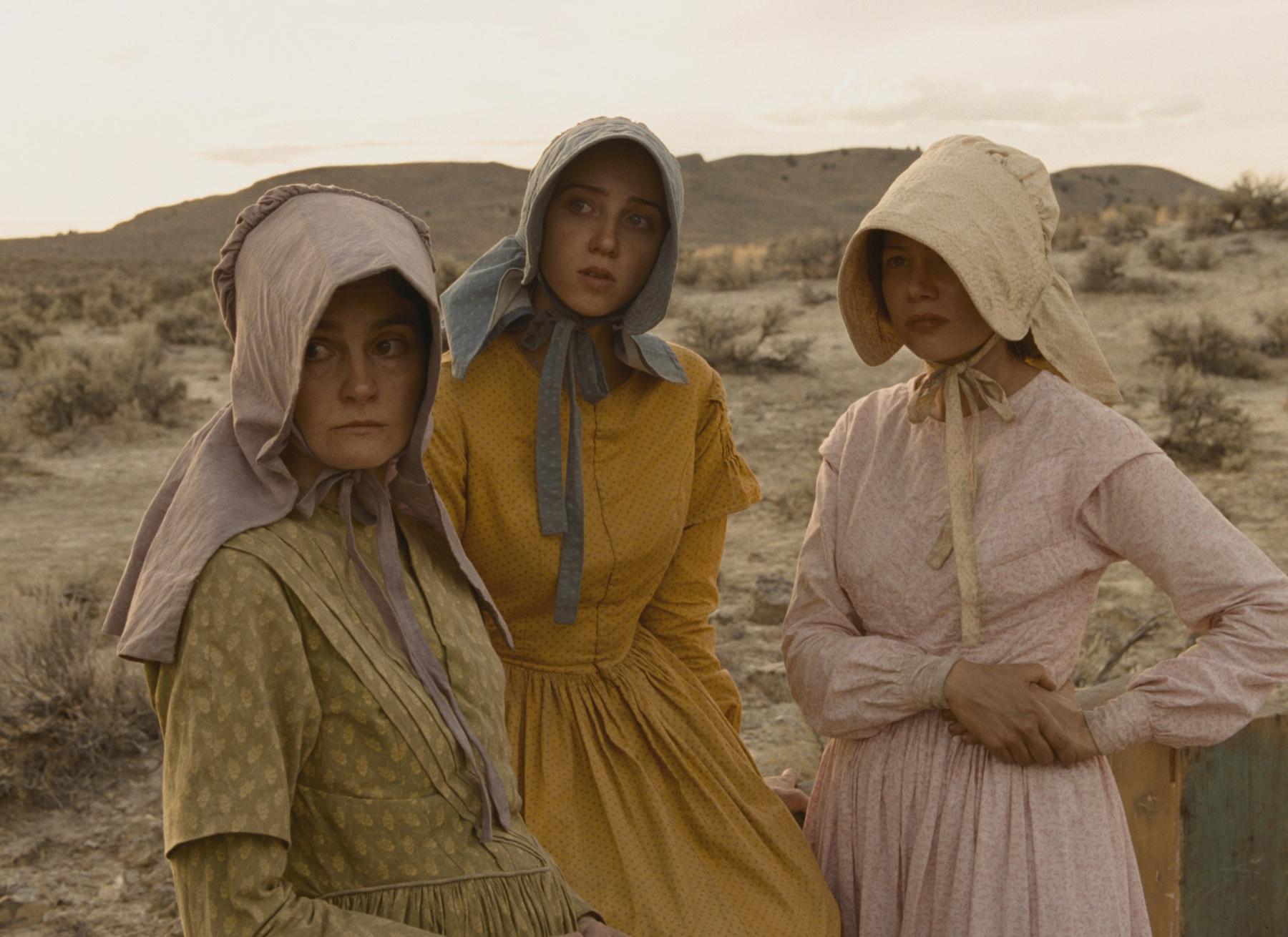
*Meek’s Cutoff After three broke down road movies (1994’s River of Grass, 2006’s Old Joy, 2008’s Wendy and Lucy), Kelly Reichardt’s new frontier story tilts decisively towards socially-minded existentialism. It’s 1845 on the choked plains of Oregon, miles from the fertile valley where a wagon train of three families is headed. They’ve hired the rogue guide Meek to show them the way, but he’s got them lost and low on water. When the group captures a Cayeuse Indian, Solomon proposes they keep him on as a compass; Meek thinks it better to hang him and be done with it. The periodic shots of the men deliberating are filmed from a distance — the earshot range of the three women (Michelle Williams, Zoe Kazan, and Shirley Henderson) who set up camp each night. It’s through subtle moves like these that Meek’s Cutoff gives a vivid taste of being subject to fate and, worse still, the likes of Meek. Reichardt winnows away the close-ups, small talk, and music that provided the simple gifts of her earlier work, and the overall effect is suitably austere. (1:44) Opera Plaza. (Goldberg)

*My Perestroika Robin Hessman’s very engaging documentary takes one very relatable look at how changes since glasnost have affected some average Russians. The subjects here are five thirtysomethings who, growing up in Moscow in the 70s and 80s, were the last generation to experience full-on Communist Party indoctrination. But just as they reached adulthood, the whole system dissolved, confusing long-held beliefs and variably impacting their futures. Andrei has ridden the capitalist choo-choo to considerable enrichment as the proprietor of luxury Western menswear shops. But single mother Olga, unlucky in love, just scrapes by, while married schoolteachers Lyuba and Boris are lucky to have inherited an apartment (cramped as it is) they could otherwise ill afford. Meanwhile Ruslan, once member of a famous punk band (which he abandoned on principal because it was getting “too commercial”), both disdains and resents the new order just as he did the old one. Home movies and old footage of pageantry celebrating Soviet socialist glory make a whole ‘nother era come to life in this intimate, unexpectedly charming portrait of its long-term aftermath. (1:27) Balboa. (Harvey)

*The Princess of Montpensier Marie (Mélanie Thierry), the titular figure in French director Bertrand Tavernier’s latest, is a young 16th century noblewoman married off to a Prince (Grégoire Leprince-Ringuet) of great wealth and property. But they’ve barely met when he’s called off to war — leaving her alone on his enormous estate, vulnerable to myriad suitors who seem to be forever throwing themselves at her nubile, neglected body. Lambert Wilson (2010’s Of Gods and Men) is touching as the older soldier appointed her protector; he comes to love her, yet is the one man upstanding enough to resist compromising her. If you’ve been jonesing for the kind of lush arthouse period epic that feels like a big fat classic novel, this engrossing saga from a 70-year-old Gallic cinema veteran in top form will scratch that itch for nearly two and a half satisfyingly tragic-romantic hours. (2:19) Opera Plaza, Smith Rafael. (Harvey)

Potiche When we first meet Catherine Deneuve’s Suzanne — the titular trophy wife (or potiche) of Francois Ozon’s new airspun comedy — she is on her morning jog, barely breaking a sweat as she huffs and puffs in her maroon Adidas tracksuit, her hair still in curlers. It’s 1977 and Suzanne’s life as a bourgeois homemaker in a small provincial French town has played out as smoothly as one of her many poly-blend skirt suits: a devoted mother to two grown children and loving wife who turns a blind eye to the philandering of husband Robert (Fabrice Luchini), Suzanne is on the fast track to comfortable irrelevance. All that changes when the workers at Robert’s umbrella factory strike and take him hostage. Suzanne, with the help of union leader and old flame Babin (Gerard Depardieu, as big as a house), negotiates a peace, and soon turns around the company’s fortunes with her new-found confidence and business savvy. But when Robert wrests back control with the help of a duped Babin, Suzanne does an Elle Woods and takes them both on in a surprise run for political office. True to the film’s light théâtre de boulevard source material, Ozon keeps things brisk and cheeky (Suzanne sings with as much ease as she spouts off Women’s Lib boilerplate) to the point where his cast’s hammy performances start blending into the cheery production design. Satire needs an edge that Potiche, for all its charm, never provides. (1:43) Embarcadero, Smith Rafael. (Sussman)

Prom (1:44) 1000 Van Ness.

Queen to Play From first-time feature director Caroline Bottaro comes this drama about … chess. Wait! Before your eyes glaze over, here are a few more fast facts: it’s set in idyllic Corsica and features, as an American expat, Kevin Kline in his first French-speaking role. (Side note: is there a Kline comeback afoot? First No Strings Attached, then The Conspirator, and now Queen to Play. All within a few short months.) Lovely French superstar Sandrine Bonnaire plays Héléne, a hotel maid who has more or less accepted her unremarkable life — until she happens to catch a couple (one half of which is played by Jennifer Beals, cast because Bottaro is a longtime fan of 1983’s Flashdance!) playing chess. An unlikely obsession soon follows, and she asks Kline’s character, a reclusive doctor who’s on her freelance house-cleaning route, to help her up her game. None too pleased with this new friendship are Héléne’s husband and nosy neighbors, who are both suspicious of the doctor and unsure of how to treat the formerly complacent Héléne’s newfound, chess-inspired confidence. Queen to Play can get a little corny (we’re reminded over and over that the queen is “the most powerful piece”), and chess is by nature not very cinematic (slightly more fascinating than watching someone type, say). But Bonnaire’s quietly powerful performance is worth sticking around for, even when the novelty of whiskery, cardigan-wearing, French-spouting Kline wears off. (1:36) Opera Plaza, Smith Rafael. (Eddy)

Rio (1:32) 1000 Van Ness, SF Center.

Scre4m Back in 1996, Wes Craven’s Scream revitalized the slasher genre with a script (by Kevin Williamson) that poked fun at horror clichés while still delivering genuine scares. The sequels offered diminishing returns on this once-clever formula; Scream 4 arrives 11 years past Scream 3, presumably hoping to work that old self-referential yet gory magic on a new crop of filmgoers. But Craven and Williamson’s hall-of-mirrors creation (more self-satisfied than self-referential, scrambling to anticipate a cynical audience member’s every second-guess) is barely more than than a continuation of something that was already tired in 2000, albeit with iPhone and web cam gags pasted in for currency’s sake. Eternal Ghostface target Sidney Prescott (Neve Campbell) returns to her hometown to promote what’s apparently a woo-woo self-help book (Mad Men‘s Alison Brie, as Sidney’s bitchy-perky publicist, steals every scene she’s in); still haunting Woodsboro are Dewey (David Arquette), now the sheriff, and Gale (Courteney Cox), a crime author with writer’s block. When the Munch-faced one starts offing high school kids, local movie nerds (Rory Culkin, Hayden Panettiere) and nubile types (Emma Roberts, Hayden Panettiere) react by screening all seven Stab films, inspired by the “real-life” Woodsboro murders, and spouting off about the rules, or lack thereof in the 21st century, of horror sequels. If that sounds mega-meta exhausting, it is. And, truth be told, not very scary. (1:51) 1000 Van Ness. (Eddy)

Something Borrowed (1:53) 1000 Van Ness.

*Source Code A post-9/11 Groundhog Day (1993) with explosions, Inception (2010) with a heart, or Avatar (2009) taken down a notch or dozen in Chicago —whatever you choose to call it, Source Code manages to stand up on its own wobbly Philip K. Dick-inspired legs, damn the science, and take off on the wings of wish fulfillment. ‘Cause who hasn’t yearned for a do-over — and then a do-over of that do-over, etc. We could all be as lucky — or as cursed — as soldier Colter Stevens (Jake Gyllenhaal), who gets to tumble down that time-space rabbit hole again and again, his consciousness hitching a ride in another man’s body, while in search of the bomber of a Chicago commuter train. On the upside, he gets to meet the girl of his dreams (Michelle Monaghan) — and see her getting blown to smithereens again and again, all in the service of his country, his commander-cum-link to the outside world (Vera Farmiga), and the scientist masterminding this secret military project (Jeffrey Wright). On the downside, well, he gets to do it over and over again, like a good little test bunny in pinball purgatory. Fortunately, director Duncan Jones (2009’s Moon) makes compelling work out of the potentially ludicrous material, while his cast lends the tale a glossed yet likable humanity, the kind that was all too absent in 2010’s Inception. (1:33) 1000 Van Ness, Sundance Kabuki. (Chun)

Stake Land Not gonna lie — the reason I wanted to review this one was because of the film still in the San Francisco International Film Festival catalogue. Rotten-faced vampire with a stake through its neck? Yes, please! But while Jim Mickle’s apocalyptic road movie does offer plenty of gore, it’s more introspective than one might expect, following an orphaned teenage boy, Martin (Connor Paolo, Serena’s little bro on Gossip Girl), and his gruff mentor, Mister (Snake Plissken-ish Nick Damici), on their travels through a ravaged America. As books, films, and comics have taught us, whenever a big chunk of the human race is wiped out (thanks to zombies, vampires, an unknown cataclysm, etc.), the remaining population will either be good (heroic, like Mister and Martin, or helpless, like the stragglers they rescue, including a nun played by Kelly McGillis), or evil — cannibals, rapists, religious nuts, militant survivalists, etc. Stake Land doesn’t throw many curveballs into its end-times narrative, but it’s beautifully shot and doesn’t hold back on the brutality. Larry Fessenden (director of 2006’s The Last Winter) produced and has a brief cameo as a helpful bartender. (1:38) Roxie. (Eddy)

There Be Dragons (2:00) SF Center, Sundance Kabuki.

These Amazing Shadows If you love movies, it’ll be hard to resist These Amazing Shadows (subtitled “A story about the National Film Registry and the power of the movies”) — it’s chock full o’ clips from films that’ve been deemed worthy of inclusion in the National Film Registry’s elite ranks. This includes, of course, the likes of 1942’s Casablanca and 1939’s Gone With the Wind, but also more recent cultural touchstones like 1985’s Back to the Future and a number of experimental, short, and silent works, and even a few cult films too. Along the way film scholars and makers (including locals Barry Jenkins, Rick Prelinger, and Mick LaSalle) chime in on their favorite films and stress why preserving film is important. There’s a healthy dose of film history, as well, with mentions of groundbreaking director Lois Weber (one of early cinema’s most prolific artists, despite her gender) and a discussion of why racially questionable films like 1915’s The Birth of a Nation — a film that Boyz n the Hood (1991) director John Singleton recommended for Registry inclusion — are historically important despite their content. Dedicated film buffs won’t discover any surprises, and there’s not much discussion of queer film (unless John Waters talking about 1939’s The Wizard of Oz counts?), nor any mention of the current shift from film to digital formats (of course preserving old films is important, but will the Registry also start considering digital-only films for inclusion?) But perhaps these are topics for another film, not this nostalgia-heavy warm fuzzy that’ll affect anyone who remembers the magic of seeing a personally significant film — join the mob if it’s 1977’s Star Wars — for the first time. (1:28) Sundance Kabuki. (Eddy)

*Thor When it comes to superhero movies, I’m not easily impressed. Couple that with my complete disinterest in the character of Thor, and I didn’t go into his big-screen debut with any level of excitement. Turns out Kenneth Branagh’s Thor is a genre standout — the best I’ve seen since 2008’s Iron Man. For those who don’t know the mythology, the film follows Thor (Chris Hemsworth) as he’s exiled from the realm of Asgard to Earth. Once there, he must reclaim his mighty hammer — along with his powers — in order to save the world and win the heart of astrophysicist Jane Foster (Natalie Portman). Hemsworth is perfectly cast as the titular hero: he’s adept at bringing charm to a larger-than-life god. The script is a huge help, striking the ideal balance between action, drama, and humor. That’s right, Thor is seriously funny. On top of that, the effects are sensational. Sure, the 3D is once again unnecessary, but it’s admittedly kind of fun when you’re zooming through space. (2:03) Empire, 1000 Van Ness, Sundance Kabuki. (Peitzman)

Tyler Perry’s Madea’s Big Happy Family (2:00) 1000 Van Ness.

Water for Elephants A young man named Jacob Jankowski (Robert Pattinson) turns his back on catastrophe and runs off to join the circus. It sounds like a fantasy, but this was never Jacob’s dream, and the circus world of Water for Elephants isn’t all death-defying feats and pretty women on horses. Or rather, the pretty woman also rides an elephant named Rosie and the casualties tend to occur outside the big top, after the rubes have gone home. Stumbling onto a train and into this world by chance, Jacob manages to charm the sadistic sociopath who runs the show, August (Christophe Waltz), and is charmed in turn by August’s wife, Marlena (Reese Witherspoon), a star performer and the object of August’s abusive, obsessive affections. Director Francis Lawrence’s film, an adaptation of Sarah Gruen’s 2006 novel, depicts a harsh Depression-era landscape in which troupes founder in small towns across America, waiting to be scavenged for parts — performers and animals — by other circuses passing through. Waltz’s August is a frightening man who defines a layoff as throwing workers off a moving train, and the anxiety of anticipating his moods and moves supplies most of the movie’s dramatic tension; Jacob and Marlena’s pallid love story feeds off it rather than adding its own. The film also suffers from a frame tale that feels awkward and forced, though Hal Holbrook makes heroic efforts as the elderly Jacob, surfacing on the grounds of — what else? — a modern-day circus to recount his tale of tragedy and romance. (2:00) Empire, 1000 Van Ness, SF Center. (Rapoport)

*Win Win Is Tom McCarthy the most versatile guy in Hollywood? He’s a successful character actor (in big-budget movies like 2009’s 2012; smaller-scale pictures like 2005’s Good Night, and Good Luck; and the final season of The Wire). He’s an Oscar-nominated screenwriter (2009’s Up). And he’s the writer-director of two highly acclaimed indie dramas, The Station Agent (2003) and The Visitor (2007). Clearly, McCarthy must not sleep much. His latest, Win Win, is a comedy set in his hometown of New Providence, N.J. Paul Giamatti stars as Mike Flaherty, a lawyer who’s feeling the economic pinch. Betraying his own basic good-guy-ness, he takes advantage of a senile client, Leo (Burt Young), when he spots the opportunity to pull in some badly-needed extra cash. Matters complicate with the appearance of Leo’s grandson, Kyle (newcomer Alex Shaffer), a runaway from Ohio. Though Mike’s wife, Jackie (Amy Ryan), is suspicious of the taciturn teen, she allows Kyle to crash with the Flaherty family. As luck would have it, Kyle is a superstar wrestler — and Mike happens to coach the local high school team. Things are going well until Kyle’s greedy mother (Melanie Lynskey) turns up and starts sniffing around her father’s finances. Lessons are learned, sure, and there are no big plot twists beyond typical indie-comedy turf. But the script delivers more genuine laughs than you’d expect from a movie that’s essentially about the recession. (1:46) Lumiere. (Eddy)


Clare Rojas’ safe space

3

As far as books go, Everything Flowers (Chronicle Books, $22.95) may just be my favorite to come out of the Bay Area this year. And not for its revelatory prose or whip-smart characters (it has neither). The small volume is filled with Clare Rojas’ quietly woman-centric, garden-toned designs that – can a book do this? – make me feel supported. I found myself breathing deeply while reading it, as if I’d just shook an asymmetrically packed satchel from my shoulders.

Resolved: I’d either get the heliotropic flower design tattooed on my skin, or I would meet the illustrator. Life being what it is, the latter proved to be the most accessible mission — and I’m glad that it was. Being in a room with Mission School vanguard Rojas is an experience akin to sitting quietly with Everything Flowers – or for that matter, listening to the breathy guitar folk of her alter ego, singer Peggy Honeywell. She creates calming, deep, feminine moments. 

“I feel so much pain being a woman in this world that I just wanted to create a safe place for them.”

Rojas barely seems to take up space in the interview room we’ve somewhat incongruously occupied at Chronicle Books, the company that published her most recent bound project. But behind her quiet presence, there’s a solidity. You have to lean in close to hear what she’s saying – in making you come to her, it’s like she’s subverting the model of self-promotional artist.

Everything Flowers, like the rest of Rojas’ canon, draws on the “super Americana, super Ohio” quilt art she saw her mother create when she was young. Rojas is fond of telling a story about visiting the place her mother used to attend quilting circles. All the cars in the parking lot, she says, were of the radical bumper sticker variety.

“There’s a certain energy and power with the way women express themselves,” she reflects when I ask her why she draws on these historical forms for her own very modern work. “When you make somebody lasagna it’s like love – and not sexy-time love either.”

When Chronicle Books approached her to do a book from which they could also cull art for pretty notecards and a gardening journal, it seemed a perfect fit for Rojas. After many years of what she felt to be acutely political work – the feminist mythology obliquely present behind her past gallery shows – she was ready to “let go of politics and just focus on beauty.” She was ready to draw some flowers, to heal for a moment.

She says. But as she takes me through the gorgeous pages of the book, it’s clear that some of the images (which were created between 2004 and 2010), hold significance for her past the simple desire to represent beauty. But good luck finding out the dirt on them – Rojas is an extraordinarily private person for our world of status updates and “about the author” pages. She tells me she’s “shy” about the paintings in the book, their hidden meanings so deeply personal that she feels weird seeing them on the page for others to examine. The most I get are small chinks in the armor I can peek through if I feel so inclined:

“Becoming an adult, figuring out what you stand for – the garden couldn’t be a better metaphor for growth.” 

Turning to a page with a fuschia design: “That one, I just enjoy painting flowers.” 

A radiating eye: “This one’s political for me.”

What are these politics Rojas keeps talking about? Again, personal. “I always feel like politics start in the home. If we can’t get it straight there…” she shrugs her shoulders, and holds my gaze.

It could have made for a real boring interview. But there’s something about Rojas that put me at ease, even if I didn’t understand quite what she was talking about, or even if we were talking about anything at all besides the literal words coming out of our mouths. After so many years of creating art in San Francisco, she is comfortable in her work. I’d entered the safe space.

“Blue Deer,” whose original now hangs in gate room G of SFO’s international terminal

Now, I’ll look at Everything Flowers and read my own stories on its pages, my frustrations and quiet victories as a female. This too, it seems, is part of Rojas’ plan. “You can only tend your own garden. If you’re happy and taking care of yourself, that resonates too.” 


Everything Flowers book release

Fri/6 6-8 p.m., free

Park Life

220 Clement, SF

(415) 386-7275

www.parklifestore.com


Nothing’s fixed

0

CYCLING The SF Bike Coalition’s valet parking was strangely empty for a blazingly sunny Saturday event by the Ferry Building. “They’ve just been leaving their bikes around,” a bored attendant told me of the crowd assembled for the Red Bull Ride + Style fixed-gear competition. But that wasn’t out of apathy to their rides — these attendees wanted to keep their bikes close.

Candy-colored fixies were turned upside-down on their handlebars, stacked in piles with the steeds of their owners’ friends. Young men (there were a lot of young men) kept their hands firmly locked in riding position, rolling their bikes back and forth as they spoke, some times gesticulating with them for added effect. Those slim, messenger-style backpacks were much in evidence.

In the competition arena, no one strayed far from their bikes either, except for the spectacular falls that sporadically broke up the action. Strap-on fixed-gear pedals make for epic wipe-outs; one soldier was taken off the field on a stretcher.

Save for the lone female who rolled about during the event’s interminable “practice times,” all riders were male. This was about bros on bikes. Indeed, as the final race around the hazardous, hairpin track was announced between Bay Area childhood friends Jason Clary and Kell McKenzie (Clary won), the announcer took a moment to salute their relationship. “You guys have known each other since you were 14? It’s bro versus bro! Fixed-gear nation!”

Competitive fixed-gear racing is, relatively speaking, a nascent addition to the legion of bone-cracking thrill fests enjoyed by extreme sports fans. The sport’s lexicon is borrowed from the death-defying ride tactics of gonzo bike messengers, a profession that has to sprint to keep up with e-mail and 3-D projection technology to stay salient for corporate America.

San Francisco is one of the messenger bike meccas. The city has given birth to some epically fly-terrifying fixie films — guys slaloming down from Twin Peaks, diving into traffic, holding onto buses for acceleration, basically using the ridiculous speed you can achieve on a fixed- gear bike for pure chaos (in the eyes of the pedestrian, surely).

But street stunts do not a competitive sport make. On Saturday, it was apparent that everyone was trying to figure out just what Ride + Style meant. The week before the event, the Guardian interviewed Austin Horse, one of New York City’s best-known bike messengers, by e-mail.

“Nobody knows what to expect about Ride N Style,” he wrote. “It’s very mysterious, but the riders know it’s going to be a challenging and compelling event because it’s coming from Red Bull. [Editor’s note: Apparently Red Bull’s sponsorship is a big deal. Red Bull also sponsored a downhill bike race through a Brazilian favela, the aerodynamic inanity of Flutag, and your most jittery friend in college who had a dorm room full of Red Bull crates. Remember that guy?] The result is that all the riders are a little more anxious about this race than other events. What we do know is that it’s gonna be a sprint with features some guys aren’t going to be comfortable with. It’s a little scary.”

The second half of the day was given over to what was billed as the most cutting edge part of the competition: the freestyle contest. Covered in sherbet colors, spiders, geometric whorls, and playing card designs, they looked every bit the background for an extreme sports tournament.

“Only rarely have events invested in features tailored to the constraints and potential of this type of riding,” Horse says. When the cameras are off “people practice wherever they can — skate parks and street spots.”

In San Francisco, one of the most reliable spots to watch good fixed-gear freestyling is in the Harry Bridges Plaza, the strip of asphalt between the Ferry Building and where Ride + Style was erected in the more ample Justin Herman Plaza. You can go out to Harry Bridges at dusk most days and see people hopping their bikes off the ground, spinning in the air, twerking their handlebars, riding backward in tight figure eights, and stopping on dimes.

But the ramps took it up a notch — so up that spectators began to compare the competition to those of BMX bikes, which can catch a lot more air than fixed gears. It wasn’t a coincidental connection: some of the competitors announced on the microphone that they were usually on a BMX, and Jeremy Witek, the lead designer of the ramps, told me during the construction phase that this was the first time he’d been asked to make structures like these for a fixed-gear competition.

There were some hands-down highlights of the freestyle portion — Kohei “Kozo” Fuji flew in from Osaka to bust the first fixed-gear back flip in international competition. But many of the routines seemed strangely suited for their setting. The beauty of the fixed-gear lies in its simplicity — one pump of the legs, one rotation of the wheels, the easy mathematics of human body and machine.

But the novelty of seeing these lifestyle bikes thrust into the bright lights and loud announcers of the X Games variety wasn’t lost on those least jaded of San Franciscans — the Embarcadero tourists. Washing my hands in the Embarcadero Center bathroom, I heard a young woman essentially ask her mom what the hell this crazy city of bikes is up to. “Does San Francisco always have this?”

Girl, it does now. 


Power and shared wealth

0

rebeccab@sfbg.com

In the 1930s, political cartoonists often portrayed California’s monolithic Pacific Gas & Electric Co. as a giant octopus, its tentacles extending into every sphere of civic life. If money buys influence, the cephalopod analogy may still be apt today when considering the company’s tally of corporate giving, part of a detailed filing with the California Public Utilities Commission.

PG&E’s largesse, measured in thousands of dollars in donations, spills into a broad array of nonprofit organizations, educational institutions, chambers of commerce, and volunteer-led efforts throughout the state. PG&E’s corporate giving is so broad that it even extends to several organizations affiliated with appointees to the Independent Review Panel convened by the California Public Utilities Commission (CPUC) to investigate PG&E’s deadly San Bruno pipeline explosion.

While the utility undoubtedly advances worthy causes with its myriad donations to youth groups, cultural centers, organizations fighting AIDS and cancer, arts councils, environmental groups, and other charitable entities, corporate contributions always reflect a calculated decision, notes Bob Stern of the Center for Governmental Studies.

“They’re a big company, and they’re trying to, shall we say, ingratiate themselves with a wide swath of community interests, including nonprofit groups,” Stern told us. “The cigarette companies did that all the time, and it was very effective … because nonprofits then laid off on ballot measures, for example, or they would oppose ballot measures that would increase cigarette taxes. My bottom line is, businesses don’t just spend money gratuitously. There is a business reason a business spends money — campaign contributions or donations. And they have to justify that to their shareholders.”

In mid-October 2010, CPUC president Michael Peevey announced his selection of five expert panelists for the newly created advisory body on the San Bruno explosion. In an official filing, Peevey ordered PG&E to fund the panel, which would be tasked with gathering facts and making recommendations to the CPUC “as to whether there is a need for the general improvement of the safety of PG&E’s natural gas transmission lines, and if so, how these improvements should be made.” A report on the panel’s initial findings is expected in the coming weeks. The effort is on a parallel track with the federal investigation now underway at the National Transportation Safety Board.

The appointees bring a wealth of knowledge and expertise to the table. Panelist Karl Pister, for example, chairs the board of the California Council on Science and Technology, served as chancellor at UC Santa Cruz, and has taught civil engineering. Jan Schori has an insider’s understanding of how an energy company is run thanks to her past experience as CEO of the Sacramento Municipal Utility District (SMUD).

Yet some of Peevey’s appointees to the Independent Review Panel have ties to PG&E. Panelist Paula Rosput Reynolds formerly held positions at the investor-owned utility, according to her bio, including serving as an executive of the PG&E’s interstate natural gas pipeline subsidiary. An understanding of the company’s inner workings could be considered an asset, but it also raises questions about her independence.

Panelist Patrick Lavin serves as an executive council member of the International Brotherhood of Electrical Workers, which represents PG&E employees. He’s also on the board of directors of the California Foundation on the Environment and the Economy (CFEE), a nonprofit that counts PG&E among its membership. CFEE sponsored a two-week trip to Spain last November for government officials, energy industry representatives, and others to study “renewable energy, infrastructure, public private partnerships, desalination, and rail,” according to its website, picking up the $8,880 tab for Peevey to join the trip. The nonprofit received donations from PG&E totaling $45,000 in 2009, $45,000 in 2008, and $40,000 in 2006 — the three most recent years available.

Schori, meanwhile, has clearly held roles in the past that have placed her in an adversarial relationship with the utility considering that SMUD — a public power utility — has engaged in territorial battles against PG&E. Yet Schori also serves on the board of the Climate Action Reserve, a nonprofit that also counts former PG&E vice president of operations Nancy McFadden — the architect behind PG&E’s ill-fated ballot initiative Proposition 16 — on its board of directors.

Climate Action Reserve received $45,000 from PG&E in 2009, according to a CPUC filing. Schori also previously served on the board of directors of a nonprofit called the Alliance to Save Energy, which was co-chaired by former PG&E CEO Peter Darbee, who was expected to step down April 30 with a retirement package totaling nearly $35 million. The Alliance to Save Energy received $45,000, $35,000, and $35,000 in PG&E donations in 2009, 2008, and 2006, respectively. Schori did not respond to a request for comment.

The chair of the San Bruno Independent Review Panel is Larry Vanderhoef, former chancellor of UC Davis and a highly respected academic. As an ex-officio trustee of the UC Davis Foundation, Vanderhoef is engaged in soliciting private-sector contributions for the university. UC Davis has received an average of around $200,000 in philanthropic contributions from PG&E each year since 2005. In an e-mail to the Guardian, spokesperson Claudia Morain noted that Vanderhoef “has never been involved in PG&E solicitations.”

PG&E’s contributions to the two nonprofits and the university represent very small portions of the total budgets of these three entities, particularly in the case of UC Davis. At the same time, they are relatively large sums compared to the contributions the company generally makes. The city of Berkeley, for example, received just $2,500 from PG&E in 2009. Most organizations receive less than $10,000, but certain groups are given much more. The UC Regents, for example, received a $406,400 donation from PG&E in 2009.

“The panel members are all eminently qualified to perform the important job that has been entrusted to them.” CPUC spokesperson Terrie Prosper told us. “It is not surprising, or inappropriate, that the panel members also are involved in philanthropic activities of various kinds in California. Nor is it surprising that PG&E, California’s largest public utility company, in its own donations to various public and nonprofit institutions and its other philanthropic activities, supports some of these same worthy causes. These philanthropic activities in no way impair the independence, good judgment, or valued public service the members of the Independent Review Panel are giving to California.”

Stern, of the Center for Governmental Studies, said PG&E contributions to organizations affiliated with members of the Independent Review Panel did not necessarily raise a red flag. “Sure it has some impact, but not in terms of disqualification. That’s off the table as far as I’m concerned,” he said. “I have 15 members on my board of directors. I would never say that because we got a grant worth $200,000 from PG&E that that would affect my board member ruling on a PG&E matter,” he added, speaking hypothetically.

As members of an advisory group rather than public officials, he noted, the panelists would not be in violation of any conflict-of-interest rules. “Certainly there’s always a question of bias and appearance of impropriety. And the question is, how extensive is it? It’s a whole bunch of different factors. It’s all gradations. There is no rule on this, obviously, but it’s an appearance question, and whether or not the appearance looks like they’re going to be biased.” At the end of the day, he added, the question would be settled by “looking at the final results and seeing what the final results say.”

Northwest passage: Kelly Reichardt on “Meek’s Cutoff”

0

Over the past decade, Kelly Reichardt has consistently created an alternative cinema that is in opposition to modern Hollywood blockbusters. Her films, which emphasize minimalist and highly visual storytelling, transcend even the industry’s edgiest darlings (think Darren Aronofsky and Quentin Tarantino). Her films Ode (1999), Old Joy (2006), Wendy and Lucy (2008), and now Meek’s Cutoff (2010) cannot be categorized in the decade’s overhated mumblecore movement of Andrew Bujalski or the Duplass Brothers. Neither are they part of the world of extreme experimental artists, a la James Benning or Sharon Lockhart.

Somehow Reichardt has found a cinematic middle ground, balancing quiet and poetic allegories with accessible and emotional journeys — an achievement that present and future audiences will be hypnotized by for generations to come. After interviewing her for Wendy and Lucy, I spoke with her after Meek’s Cutoff played the 2011 Sundance Film Festival; it recently had its local debut at the San Francisco International Festival, and opens theatrically Fri/6.

San Francisco Bay Guardian: I recently saw your earliest films at the Pacific Film Archive retrospective and your adaptation of the Robby Benson-starring Ode to Billy Joe (1976), Ode (1999), was amazing! You shot the whole thing on Super 8, right? Do you like your earlier films?

Kelly Reichardt: Ode is very near and dear to my heart. It set me on my own way of making films. I don’t think I’m naturally a non-narrative person. And definitely not as much as I revere those kind of filmmakers like my colleagues: Peggy Ahwesh, Peter Hutton. I love seeing how their films unfold and really make the viewer be interactive in deciding what they’re about and what they mean to them. That’s what I’d like to do as a filmmaker. But I can see myself learning in all of my films, which is painful. A couple of students walked out of that screening of my earliest short films and I wanted to run out after them and say, “I totally understand!”

SFBG: You and [screenwriter] Jon Raymond seem to be consciously aware of just that! I know I have told you this before but I find your films so inspired. Your films are like the kind of classes I always wanted to have in college. You’re never telling me what to think, yet you are very precisely leading me towards something extremely imminent. And along the way, I get to experience my own journey with these characters and situations. Do you run into problems getting your films made and released because of this structure?

KR: That part of it, the endings, is [an element] coming from the world of non-narrative filmmaking. It doesn’t hand things over to the audience. It’s like a series of questions unfolding which is like a dream, which is something I want to bring into a more narrative form. It opens up the traditional genre a little which you already know how its’ suppose to go. Meek’s Cutoff and Wendy and Lucy were both released through Oscilloscope, while Old Joy was distributed by Kino. These are all small independent distributors and the things that they are looking for are not for everyone.

The hard part with filmmaking is getting the money to make the film. Everybody has a camera now. You can shoot a video. But if you’re not into naturalism and you’re trying to make things that are more extravagant, that vision is going to be much harder to just do on your own. If I were a student right now, my biggest fear would be how to rise up out of such a huge sea of voices. When I submitted my first feature, River of Grass, to Sundance in 1994, they had 600 entries that year which seemed overwhelming and huge. Six hundred and they were only gonna pick 16. And what was it this year? Didn’t they have something like 6,000 entries?

Getting your film out … worry about that later. Get your film made first. Plus there’s always the fear of even having something to say at the age of 20! Before you’ve lived on your own and been connected to the big black hole of employment, and public transportation and all those things. That could be good “big” fear to have as a young filmmaker.

SFBG: In your Q&A after the screening of Meek’s Cutoff at the Egyptian Theatre [in Park City, Utah], I was very excited about your bringing up forgotten and unavailable older films like Nicholas Ray’s The Lusty Men (1952).

KR: Me too! I was trying to make that point and I became so distracted by the woman sitting behind you filming. It’s just such a weird thing to look out and see 15 people videotaping you and you realize that no experience can ever just be with the people in the room again. Everything has to be some bigger purpose and I completely quit thinking about the film and the interaction. I think it’s a bizarre that people feel completely free about videotaping you and posting it on the Internet without asking me.

SFBG: Not only is it exciting that your films feel influenced by older cinema but you do it in a way that’s very much like Peter Bogdanovich, where it feels as if you truly understand the film’s themes and goals and you’re not just making a mixtape of your favorite scenes. Wendy and Lucy feels like a Vittorio De Sica neo-realist film, while Meek’s Cutoff feels like an existential William Wellman Western by way of Robert Flaherty’s Nanook of the North (1922). I mean, you even used the old Hollywood aspect ratio of 1.33:1 on Meek’s Cutoff! And it doesn’t come off kitschy; in fact, it feels even futuristic.

KR: It’s funny that you mention the aspect ratio. If anything is kitschy, and when you read back about the period, widescreen was what was kitschy. It was a gimmick! It’s what 3D or IMAX is to us today. What did Fritz Lang say, “Widescreens are for funerals and snakes.”

It’s funny now that this memory of widescreen is so embraced but it’s such a diminished landscape in a way. That question is always being asked to me in some tone of like, “When you accidentally picked the wrong aspect ratio did you have to just keep going with it?” (laughs) Though I knew going into it that it would limit the amount of theatres we can play Meek’s at. Sadly, very few theaters have the capabilities. 

SFBG: I’ve been watching a lot of Westerns this year and your horizons in every single shot of Meek’s Cutoff are truly spectacular. Your multi-layered colors! Your floating cowboys! The lined-up pioneers! I could just go on. All of it is so particular. How did you design this film? Did you do it on the landscape or storyboard it first?

KR: I storyboard but I can’t draw. (laughs) I have many different notebooks. Color is an early thing. But everything comes first from relentless scouting.  Scouting, scouting, scouting, scouting. I get familiar with the light and the colors of the day. The places you’re gonna be shooting in at certain times of the day. These locations were really remote and very hard to get to. And we ended up spending such a huge amount of time in that desert.

SFBG: Did you have to sleep out on the plains?

KR: We stayed in this town, Burns, Oregon. It’s a good two-street town and we’d drive off-road for two hours into the desert each day. This is where the actual wagon train got lost. There was nothing out there. We were actually finding pieces of wagon from the 1840s! So it would eat up a huge amount of our shooting day, which is already short because when you’re shooting in the mountains, the sun is gonna go behind them. So that’s four hours already out of your day.

My shooting schedule was so restricted that other producers would have said “You are sinking your ship by shooting out on these locations.” Fortunately my producers backed me and off we went, for better or worse. So you have to be on top of it when you’re there, knowing that there will be unexpected things to occur especially when you are dealing with oxen and mules and donkeys. All of that is to be embraced.

I also have to have a plan because we move so quickly. My DP [Chris Blauvelt] and I are talking, talking, talking. I have some books that are references, that I’ll steal frames from. Some that are location photos, people standing in the locations, some from old films. And some are just really crappy drawings I’ve done because I cannot draw, which I consider a huge handicap as a filmmaker. People always ask “Are you improvising?” We don’t have time for improv! Of course because of the weather, and the terrain, and rattlesnakes and the animals there’s certainly a certain amount of adjustment because when I storyboarded this, it wasn’t snowing. But you can’t go out there without a plan. The camera for me is the storyteller.

SFBG: Now you edit your own movies. Is that because you are a tyrant and you have to have it your own way or have you tried working with others? And by “tyrant,” I mean it in the nicest way possible.

KR: (laughs) You go through different stages: I have my writing partner [Jon Raymond] and that’s one stage and then it becomes very public and you’re working with a bunch of people when filming. Then editing is where you get your film back and it’s when I get to find my film. It’s a great moment when I’m in the editing room an I can say, “Oh yeah, that’s what Jon was originally talking about!” or “I felt that in Jon’s short story!”

But when you’re in production, there’s just so much going on! And editing is where you learn where you fucked up and should have put the camera. It’s the big payoff for me and I don’t want to hand it over to anyone else. It’s the interesting part of filmmaking. It’s where you can manipulate space and completely change the dynamic of a conversation or situation just by adding or taking away time. It’s not fun to edit with me, so I stopped using editors (laughs).

http://www.youtube.com/watch?v=AEmL9at6JT0

Meek’s Cutoff opens Fri/6 in Bay Area theaters.

Jesse Hawthorne Ficks is the Film History Coordinator at the Academy of Art University and programs the film series Midnites for Maniacs.

Rep Clock

0

Schedules are for Wed/4–Tues/10 except where noted. Director and year are given when available. Double and quadruple features are marked with a •. All times are p.m. unless otherwise specified.

ARTISTS’ TELEVISION ACCESS 992 Valencia, SF; www.atasite.org. $4-6. “Other Cinema:” “The Essays and Arguments of James Hong,” Sat, 8:30.

CASTRO 429 Castro, SF; (415) 621-6120, www.castrotheatre.com. Regular programming $7.50-10. “San Francisco International Film Festival:” On Tour (Amalric, 2010), Thurs, 7. For tickets and info, visit www.sffs.org. “Cinematic Titanic:” Samson and the 7 Miracles of the World (Freda, 1961), Fri, 7; Rattlers (McCauley, 1976), Fri, 9:30. This event, $35 (double feature, $60); tickets at www.sfsketchfest.com. “Peaches Christ Presents the Ultimate Mommie Dearest: 30th Anniversary Birthday Celebration:” Mommie Dearest (Perry, 1981), Sat, 8. This event, $25-40; tickets at www.peacheschrist.com.

CHRISTOPHER B. SMITH RAFAEL FILM CENTER 1118 Fourth St, San Rafael; (415) 454-1222, www.cafilm.org. $6.50-15. Certified Copy (Kiarostami, 2010), call for dates and times. Poetry (Yun, 2010), call for dates and times. Potiche (Ozon, 2010), call for dates and times. The Princess of Montpensier (Tavernier, 2010), call for dates and times. The Magic Flute, Thurs, 7; Sun, 1. Performed on film by Teatro alla Scala. Queen to Play (Bottaro, 2009), May 6-12, call for times.

EXPLORATORIUM McBean Theater, 3601 Lyon, SF; www.asifa-sf.org. Free. “An Evening With Marv Newland,” Fri, 7:30.

MECHANICS’ INSTITUTE 57 Post, SF; (415) 393-0100, rsvp@milibrary.org. $10. “CinemaLit Film Series: Elizabeth Taylor, Tribute to a Star:” A Place in the Sun (Stevens, 1951), Fri, 6.

PACIFIC FILM ARCHIVE 2575 Bancroft, Berk; (510) 642-5249, www.bampfa.berkeley.edu. $5.50-9.50. “San Francisco International Film Festival:” Ulysses (Godoy, 2011), Wed, 6:30; Detroit Wild City (Tillon, 2010), Wed, 8:40; Auroroa (Puiu, 2010), Thurs, 7. For tickets and info, visit www.sffs.org. “Film and Video Makers at Cal: Works from the Eisner Prize Competition,” Fri, 7.

RED VIC 1727 Haight, SF; (415) 668-3994; www.redvicmoviehouse.com. $6-10. William S. Burroughs: A Man Within (Leyser, 2010), Wed, 2, 7:15, 9:15. True Grit (Coen and Coen, 2010), Thurs-Sat, 7, 9:20 (also Sat, 2, 4:30). Hair (Forman, 1970), Sun-Mon, 7, 9:30 (also Sun, 2, 4:30). Bukowski: Born Into This (Dullaghan, 2003), May 10-11, 7, 9:20 (also May 11, 2).

ROXIE 3117 and 3125 16th St, SF; (415) 863-1087, www.roxie.com. $5-9.75. Stake Land (Mickle, 2010), Wed-Thurs, 7:15, 9:30. Taxi Driver (Scorsese, 1976), Sat-Mon, 7, 9:20 (also Sat-Sun, 2:30, 4:45).

VORTEX ROOM 1082 Howard, SF; www.myspace.com/thevortexroom. $5 donation. •Bucket of Blood (Corman, 1959), Thurs, 9, and Blind Beast (Masumura, 1969), Thurs, 11. YERBA BUENA CENTER FOR THE ARTS 701 Mission, SF; (415) 978-2787, www.ybca.org. $6-8. The Strange Case of Angelica (de Oliveira, 2010), Thurs and Sat, 7:30; Sun, 2.

Film Listings

0

Film listings are edited by Cheryl Eddy. Reviewers are Kimberly Chun, Michelle Devereaux, Peter Galvin, Max Goldberg, Dennis Harvey, Johnny Ray Huston, Louis Peitzman, Lynn Rapoport, Ben Richardson, and Matt Sussman. For rep house showtimes, see Rep Clock. For first-run showtimes, see Movie Guide.

SAN FRANCISCO INTERNATIONAL FILM FESTIVAL

The 54th annual San Francisco International Film Festival runs through Thurs/5. Venues are the Sundance Kabuki, 1881 Post, SF; Castro, 429 Castro, SF; New People, 1746 Post, SF; San Francisco Museum of Modern Art, 151 Third, SF; and Pacific Film Archive, 2575 Bancroft, SF. For tickets (most shows $13) and complete schedule visit www.sffs.org.

OPENING

The Beaver See “The Darkness Underneath.” (1:31)

*Cave of Forgotten Dreams The latest documentary from Werner Herzog once again goes where no filmmaker — or many human beings, for that matter — has gone before: the Chauvet-Pont-d’Arc Cave, a heavily-guarded cavern in Southern France containing the oldest prehistoric artwork on record. Access is highly restricted, but Herzog’s 3D study is surely the next best thing to an in-person visit. The eerie beauty of the works leads to a typically Herzog-ian quest to learn more about the primitive culture that produced the paintings; as usual, Herzog’s experts have their own quirks (like a circus performer-turned-scientist), and the director’s own wry narration is peppered with random pop culture references and existential ponderings. It’s all interwoven with footage of crude yet beautiful renderings of horses and rhinos, calcified cave-bear skulls, and other time-capsule peeks at life tens of thousands of years ago. The end result is awe-inspiring. (1:35) (Eddy)

*Incendies When tightly wound émigré Nawal (Luba Azabal) dies, she leaves behind adult twins Jeanne (Mélissa Désormeaux-Poulin) and Simon (Maxim Gaudette) — and leaves them documents that only compound their feelings of grief and anger, suggesting that what little they thought they knew about their background might have been a lie. While resentful Simon at first stays home in Montreal, Jeanne travels to fictive “Fuad” (a stand-in for source-material playwright Wajdi Mouawad’s native Lebanon), playing detective to piece together decades later the truth of why their mother fled her homeland at the height of its long, brutal civil war. Alternating between present-day and flashback sequences, this latest by Canadian director Denis Villeneuve (2000’s Maelstrom) achieves an urgent sweep punctuated by moments of shocking violence. Resembling The Kite Runner in some respects as a portrait of the civilian victimization excused by war, it also resembles that work in arguably piling on more traumatic incidences and revelations than one story can bear — though so much here has great impact that a sense of over-contrivance toward the very end only slightly mars the whole. (2:10) Embarcadero. (Harvey)

Jumping the Broom It’s wedding (movie) season! Angela Bassett and Paula Patton star in this one. (1:48) Shattuck.

Last Night Married for three years and together “since college,” New York City yuppies Michael (Sam Worthington) and Joanna (Keira Knightley) have a comfortable, loving relationship, though it’s unclear how much passion remains. Still, it doesn’t take much for Joanna to bristle jealously when she meets Michael’s co-worker and frequent business-trip companion, Laura (Eva Mendes). As Michael and Laura flirt their way to an overnight meeting in Philly, Joanna runs into an old flame (Guillaume Canet); before long, it becomes a cross-cutting race to see who’ll cheat first. Writer-director Massy Tadjedin isn’t spinning a new story here — and though the film offers a sleek look at contemporary marriage, Last Night takes itself a tad too seriously, purporting to showcase realistic problems and emotions amid a cast beamed directly from Planet Gorgeous Movie Star. Beautiful people: they’re just like us? (1:30) (Eddy)

*Meek’s Cutoff See “Nothing Was Delivered.” (1:44) Albany, Embarcadero.

Queen to Play From first-time feature director Caroline Bottaro comes this drama about … chess. Wait! Before your eyes glaze over, here are a few more fast facts: it’s set in idyllic Corsica and features, as an American expat, Kevin Kline in his first French-speaking role. (Side note: is there a Kline comeback afoot? First No Strings Attached, then The Conspirator, and now Queen to Play. All within a few short months.) Lovely French superstar Sandrine Bonnaire plays Héléne, a hotel maid who has more or less accepted her unremarkable life — until she happens to catch a couple (one half of which is played by Jennifer Beals, cast because Bottaro is a longtime fan of 1983’s Flashdance!) playing chess. An unlikely obsession soon follows, and she asks Kline’s character, a reclusive doctor who’s on her freelance house-cleaning route, to help her up her game. None too pleased with this new friendship are Héléne’s husband and nosy neighbors, who are both suspicious of the doctor and unsure of how to treat the formerly complacent Héléne’s newfound, chess-inspired confidence. Queen to Play can get a little corny (we’re reminded over and over that the queen is “the most powerful piece”), and chess is by nature not very cinematic (slightly more fascinating than watching someone type, say). But Bonnaire’s quietly powerful performance is worth sticking around for, even when the novelty of whiskery, cardigan-wearing, French-spouting Kline wears off. (1:36) Embarcadero, Shattuck, Smith Rafael. (Eddy)

Something Borrowed Kate Hudson and Ginnifer Goodwin play frenemies of the highest order in this rom-com adapted from the best-selling novel. (1:53) Shattuck.

There Be Dragons Dougray Scott and Wes Bentley star in this drama set against the backdrop of the Spanish Civil War. (2:00)

*These Amazing Shadows If you love movies, it’ll be hard to resist These Amazing Shadows (subtitled “A story about the National Film Registry and the power of the movies”) — it’s chock full o’ clips from films that’ve been deemed worthy of inclusion in the National Film Registry’s elite ranks. This includes, of course, the likes of 1942’s Casablanca and 1939’s Gone With the Wind, but also more recent cultural touchstones like 1985’s Back to the Future and a number of experimental, short, and silent works, and even a few cult films too. Along the way film scholars and makers (including locals Barry Jenkins, Rick Prelinger, and Mick LaSalle) chime in on their favorite films and stress why preserving film is important. There’s a healthy dose of film history, as well, with mentions of groundbreaking director Lois Weber (one of early cinema’s most prolific artists, despite her gender) and a discussion of why racially questionable films like 1915’s The Birth of a Nation — a film that Boyz n the Hood (1991) director John Singleton recommended for Registry inclusion — are historically important despite their content. Dedicated film buffs won’t discover any surprises, and there’s not much discussion of queer film (unless John Waters talking about 1939’s The Wizard of Oz counts?), nor any mention of the current shift from film to digital formats (of course preserving old films is important, but will the Registry also start considering digital-only films for inclusion?) But perhaps these are topics for another film, not this nostalgia-heavy warm fuzzy that’ll affect anyone who remembers the magic of seeing a personally significant film — join the mob if it’s 1977’s Star Wars — for the first time. (1:28) Sundance Kabuki. (Eddy)

*Thor When it comes to superhero movies, I’m not easily impressed. Couple that with my complete disinterest in the character of Thor, and I didn’t go into his big-screen debut with any level of excitement. Turns out Kenneth Branagh’s Thor is a genre standout — the best I’ve seen since 2008’s Iron Man. For those who don’t know the mythology, the film follows Thor (Chris Hemsworth) as he’s exiled from the realm of Asgard to Earth. Once there, he must reclaim his mighty hammer — along with his powers — in order to save the world and win the heart of astrophysicist Jane Foster (Natalie Portman). Hemsworth is perfectly cast as the titular hero: he’s adept at bringing charm to a larger-than-life god. The script is a huge help, striking the ideal balance between action, drama, and humor. That’s right, Thor is seriously funny. On top of that, the effects are sensational. Sure, the 3D is once again unnecessary, but it’s admittedly kind of fun when you’re zooming through space. (2:03) (Peitzman)

ONGOING

The Adjustment Bureau As far as sci-fi romantic thrillers go, The Adjustment Bureau is pretty standard. But since that’s not an altogether common genre mash-up, I guess the film deserves some points for creativity. Based on a short story by Philip K. Dick, The Adjustment Bureau takes place in a world where all of our fates are predetermined. Political hotshot David Norris (Matt Damon) is destined for greatness — but not if he lets a romantic dalliance with dancer Elise (Emily Blunt) take precedence. And in order to make sure he stays on track, the titular Adjustment Bureau (including Anthony Mackie and Mad Men‘s John Slattery) are there to push him in the right direction. While the film’s concept is intriguing, the execution is sloppy. The Adjustment Bureau suffers from flaws in internal logic, allowing the story to skip over crucial plot points with heavy exposition and a deus ex machina you’ve got to see to believe. Couldn’t the screenwriter have planned ahead? (1:39) Shattuck. (Peitzman)

African Cats (1:40) 1000 Van Ness, Shattuck.

*Bill Cunningham New York To say that Bill Cunningham, the 82-year old New York Times photographer, has made documenting how New Yorkers dress his life’s work would be an understatement. To be sure, Cunningham’s two decades-old Sunday Times columns — “On the Street,” which tracks street-fashion, and “Evening Hours,” which covers the charity gala circuit — are about the clothes. And, my, what clothes they are. But Cunningham is a sartorial anthropologist, and his pictures always tell the bigger story behind the changing hemlines, which socialite wore what designer, or the latest trend in footwear. Whether tracking the near-infinite variations of a particular hue, a sudden bumper-crop of cropped blazers, or the fanciful leaps of well-heeled pedestrians dodging February slush puddles, Cunningham’s talent lies in his ability to recognize fleeting moments of beauty, creativity, humor, and joy. That last quality courses through Bill Cunningham New York, Richard Press’ captivating and moving portrait of a man whose reticence and personal asceticism are proportional to his total devotion to documenting what Harold Koda, chief curator at the Costume Institute at the Metropolitan Museum of Art, describes in the film as “ordinary people going about their lives, dressed in fascinating ways.” (1:24) Embarcadero, Shattuck. (Sussman)

Certified Copy Abbas Kiarostami’s beguiling new feature signals “relationship movie” with every cobblestone step, but it’s manifestly a film of ideas — one in which disillusionment is as much a formal concern as a dramatic one. Typical of Kiarostami’s dialogic narratives, Certified Copy is both the name of the film and an entity within the film: a book written against the ideal of originality in art by James Miller (William Shimell), an English pedant fond of dissembling. After a lecture in Tuscany, he meets an apparent admirer (Juliette Binoche) in her antique shop. We watch them talk for several minutes in an unbroken two-shot. They gauge each other’s values using her sister as a test case — a woman who, according to the Binoche character, is the living embodiment of James’ book. Do their relative opinions of this off-screen cipher constitute characterization? Or are they themselves ciphers of the film’s recursive structure? Kiarostami makes us wonder. They begin to act as if they were married midway through the film, though the switch is not so out of the blue: Kiarostami’s narrative has already turned a few figure-eights. Several critics have already deemed Certified Copy derivative of many other elliptical romances; the strongest case for an “original” comes of Roberto Rossellini’s Voyage to Italy (1954). The real difference is that while Rossellini’s masterpiece realizes first-person feelings in a third-person approach, Kiarostami stays in the shadow of doubt to the end. (1:46) Opera Plaza, Smith Rafael. (Goldberg)

The Conspirator It may not be your standard legal drama, but The Conspirator is a lot more enjoyable when you think of it as an extended episode of Law & Order. The film chronicles the trial of Mary Surratt (Robin Wright), the lone woman charged in the conspiracy to assassinate Abraham Lincoln. It’s a fascinating story, especially for those who don’t know much of the history past John Wilkes Booth. But while the subject matter is compelling, the execution is hit-or-miss. Wright is sympathetic as Surratt, but the usually great James McAvoy is somewhat forgettable in the pivotal role of Frederick Aiken, Surratt’s conflicted lawyer. It’s hard to say what it is that’s missing from The Conspirator: the cast — which also includes Evan Rachel Wood and Tom Wilkinson — is great, and this is a story that’s long overdue to be told. Still, something is lacking. Could it be the presence of everyone’s favorite detective, the late Lennie Briscoe? (2:02) Embarcadero, Empire, 1000 Van Ness, Piedmont. (Peitzman)

Dylan Dog: Dead of Night (1:47) SF Center.

Fast Five There are plenty of laugh-out-loud moments in Fast Five, in addition to a much demolition derby-style crunch — instances that stretch credulity and simultaneously trigger a chuckle at the OTT fantasy of the entire enterprise. Two unarmed men chained to the ceiling kick their way out of a torture cell, jump favela rooftops to freedom with nary a bullet wound in sight, and, in the movie’s smash-’em-up tour de force, use a bank vault as a hulking pair of not-so-fuzzy dice to pulverize an unsuspecting Rio de Janeiro. Not for nothing is rapper Ludacris attached to this franchise — his name says it all (why not go further than his simple closing track, director Justin Lin, now designated the keeper of Fast flame, and have him providing the rap-eratic score/running commentary throughout?) In this installment, shady hero Dominic (Vin Diesel) needs busting out of jail — check, thanks to undercover-cop-turned-pal Brian (Paul Walker) and Dominic’s sis Mia (Jordana Brewster). Time to go on the lam in Brazil and to bring bossa nova culture down to level of thieving L.A. gearheads, as the gearhead threesome assemble their dream team of thieves to undertake a last big heist that will set ’em up for life. Still, despite the predictable pseudo-twists — can’t we all see the bromance-bonding between testosteroni boys Diesel and Dwayne Johnson coming from miles of blacktop away? — there’s enough genre fun, stunt driving marvels, and action choreography here (Lin, who made his name in ambitious indies like 2002’s Better Luck Tomorrow, has developed a knack for harnessing/shooting the seeming chaos) — to please fans looking for a bigger, louder kick. (1:41) Empire, 1000 Van Ness. (Chun)

*Hanna The title character of Hanna falls perfectly into the lately very popular Hit-Girl mold. Add a dash of The Boys from Brazil-style genetic engineering — Hanna has the unfair advantage, you see, when it comes to squashing other kids on the soccer field or maiming thugs with her bare hands — and you have an ethereal killing/survival machine, played with impassive confidence by Atonement (2007) shit-starter Saoirse Ronan. She’s been fine-tuned by her father, Erik (Eric Bana), a spy who went out into the cold and off the grid, disappearing into the wilds of Scandinavia where he home-schooled his charge with an encyclopedia and brutal self-defense and hunting tests. Atonement director Joe Wright plays with a snowy palette associated with innocence, purity, and death — this could be any time or place, though far from the touch of modern childhood stresses: that other Hannah (Montana), consumerism, suburban blight, and academic competition. The 16-year-old Hanna, however, isn’t immune from that desire to succeed. Her game mission: go from a feral, lonely existence into the modern world, run for her life, and avenge the death of her mother by killing Erik’s CIA handler, Marissa (Cate Blanchett). The nagging doubt: was she born free, or Bourne to be a killer? Much like the illustrated Brothers Grimm storybook that she studies, Hanna is caught in an evil death trap of fairytale allegories. One wonders if the super-soldier apple didn’t fall far from the tree, since evil stepmonster Marissa oversaw the program that produced Hanna — the older woman and the young girl have the same cold-blooded talent for destruction and the same steely determination. Yet there’s hope for the young ‘un. After learning that even her beloved father hid some basic truths from her, this natural-born killer seems less likely to go along with the predetermined ending, happy or no, further along in her storybook life. (1:51) 1000 Van Ness, SF Center. (Chun)

Hoodwinked Too! Hood vs. Evil (1:25) 1000 Van Ness.

*In a Better World Winner of this year’s Best Foreign Language Film Oscar, this latest from Danish director Susanne Bier (2004’s Brothers, 2006’s After the Wedding) and her usual co-scenarist Anders Thomas Jensen (2005’s Adam’s Apples, 2003’s The Green Butchers) is a typically engrossing, complex drama that deals with the kind of rage for “personal justice” that can lead to school and workplace shootings, among other things (like terrorism). Shy, nervous ten-year-old Elias (Markus Rygaard) needs a confidence boost, but things are worrying both at home and elsewhere. His parents are estranged, and his doting father (Mikael Persbrandt) is mostly away as a field hospital in Kenya tending victims of local militias. At school, he’s an easy mark for bullies, a fact which gets the attention of charismatic, self-assured new kid Christian (William Jøhnk Nielsen), who appoints himself Elias’ new (and only) friend — then when his slightly awed pal is picked on again, intervenes with such alarming intensity that the police are called. Christian appears a little too prone to violence and harsh judgment in teaching “lessons” to those he considers in the wrong; his own domestic situation is another source of anger, as he simplistically blames his earnest, distracted executive father (Ulrich Thomsen) for his mother’s recent cancer death. Is Christian a budding little psychopath, or just a kid haplessly channeling his profound loss? Regardless, when an adult bully (Kim Bodnia as a loutish mechanic) humiliates Elias’ father in front of the two boys, Christian pulls his reluctant friend into a pursuit of vengeance that surely isn’t going to end well. With their nuanced yet head-on treatment of hot button social and ethical issues, Bier and Jensen’s work can sometimes border on overly-schematic melodrama, meting out its own secular-humanist justice a bit too handily, like 21st-century cinematic Dickenses. But like Dickens, they also have a true mastery of the creating striking characters and intricately propulsive plotlines that illustrate the points at hand in riveting, hugely satisfying fashion. This isn’t their best. But it’s still pretty excellent, and one of those universally accessible movies you can safely recommend even to people who think they don’t like foreign or art house films. (1:53) Lumiere. (Harvey)

Insidious (1:42) California.

*Jane Eyre Do we really need another adaptation of Jane Eyre? As long as they’re all as good as Cary Fukunaga’s stirring take on the gothic romance, keep ’em coming. Mia Wasikowska stars in the titular role, with the dreamy Michael Fassbender stepping into the high pants of Edward Rochester. The cast is rounded out by familiar faces like Judi Dench, Jamie Bell, and Sally Hawkins — all of whom breathe new life into the material. It helps that Fukunaga’s sensibilities are perfectly suited to the story: he stays true to the novel while maintaining an aesthetic certain to appeal to a modern audience. Even if you know Jane Eyre’s story — Mr. Rochester’s dark secret, the fate of their romance, etc. — there are still surprises to be had. Everyone tells the classics differently, and this adaptation is a thoroughly unique experience. And here’s hoping it pushes the engaging Wasikowska further in her ascent to stardom. (2:00) Albany, Lumiere, Piedmont. (Peitzman)

Kill the Irishman If you enjoy 1970s-set Mafia movies featuring characters with luxurious facial hair zooming around in Cadillacs, flossing leather blazers, and outwitting cops and each other — you could do a lot worse than Kill the Irishman, which busts no genre boundaries but delivers enjoyable retro-gangsta cool nonetheless. Adapted from the acclaimed true crime book by a former Cleveland police lieutenant, the film details the rise and fall of Danny Greene, a colorful and notorious Irish-American mobster who both served and ran afoul of the big bosses in his Ohio hometown. During one particularly conflict-ridden period, the city weathered nearly 40 bombings — buildings, mailboxes, and mostly cars, to the point where the number of automobiles going sky-high is almost comical (you’d think these guys would’ve considered taking the bus). The director of the 2004 Punisher, Jonathan Hensleigh, teams up with the star of 2008’s Punisher: War Zone, Ray Stevenson, who turns in a magnetic performance as Greene; it’s easy to see how his combination of book- and street smarts (with a healthy dash of ruthlessness) buoyed him nearly to the top of the underworld. The rest of the cast is equally impressive, with Vincent D’Onofrio, Val Kilmer, Christopher Walken, and Linda Cardellini turning in supporting roles, plus a host of dudes who look freshly defrosted from post-Sopranos storage. (1:46) Opera Plaza. (Eddy)

Legend of the Fist: The Return of Chen Zhen (1:46) Four Star.

*Limitless An open letter to the makers of Limitless: please fire your marketing team because they are making your movie look terrible. The story of a deadbeat writer (Bradley Cooper) who acquires an unregulated drug that allows him to take advantage of 100 percent of his previously under-utilized brain, Limitless is silly, improbable and features a number of distracting comic-book-esque stylistic tics. But consumed with the comic book in mind, Limitless is also unpredictable, thrilling, and darkly funny. The aforementioned style, which includes many instances of the infinite regression effect that you get when you point two mirrors at each other, and a heavy blur to distort depth-of-field, only solidifies the film’s cartoonish intentions. Cooper learns foreign languages in hours, impresses women with his keen attention to detail, and sets his sights on Wall Street, a move that gets him noticed by businessman Carl Van Loon (Robert DeNiro in a glorified cameo) as well as some rather nasty drug dealers and hired guns looking to cash in on the drug. Limitless is regrettably titled and masquerades in TV spots as a Wall Street series spin-off, but in truth it sports the speedy pacing and tongue-in-cheek humor required of a good popcorn flick. (1:37) 1000 Van Ness, SF Center. (Galvin)

*The Lincoln Lawyer Outfitted with gym’d-tanned-and-laundered manly blonde bombshells like Matthew McConaughey, Josh Lucas, and Ryan Phillippe, this adaptation of Michael Connelly’s LA crime novel almost cries out for an appearance by the Limitless Bradley Cooper — only then will our cabal of flaxen-haired bros-from-other-‘hos be complete. That said, Lincoln Lawyer‘s blast of morally challenged golden boys nearly detracts from the pleasingly gritty mise-en-scène and the snappy, almost-screwball dialogue that makes this movie a genre pleasure akin to a solid Elmore Leonard read. McConaughey’s criminal defense attorney Mickey Haller is accustomed to working all the angles — hence the title, a reference to a client who’s working off his debt by chauffeuring Haller around in his de-facto office: a Lincoln Town Car. Haller’s playa gets truly played when he becomes entangled with Louis Roulet (Phillippe), a pretty-boy old-money realtor accused of brutally attacking a call girl. Loved ones such as Haller’s ex Maggie (Marisa Tomei) and his investigator Frank (William H. Macy) are in jeopardy — and in danger of turning in some delightfully textured cameos — in this enjoyable walk on the sleazy side of the law, the contemporary courtroom counterpart to quick-witted potboilers like Sweet Smell of Success (1957). (1:59) 1000 Van Ness. (Chun)

*My Perestroika Robin Hessman’s very engaging documentary takes one very relatable look at how changes since glasnost have affected some average Russians. The subjects here are five thirtysomethings who, growing up in Moscow in the 70s and 80s, were the last generation to experience full-on Communist Party indoctrination. But just as they reached adulthood, the whole system dissolved, confusing long-held beliefs and variably impacting their futures. Andrei has ridden the capitalist choo-choo to considerable enrichment as the proprietor of luxury Western menswear shops. But single mother Olga, unlucky in love, just scrapes by, while married schoolteachers Lyuba and Boris are lucky to have inherited an apartment (cramped as it is) they could otherwise ill afford. Meanwhile Ruslan, once member of a famous punk band (which he abandoned on principal because it was getting “too commercial”), both disdains and resents the new order just as he did the old one. Home movies and old footage of pageantry celebrating Soviet socialist glory make a whole ‘nother era come to life in this intimate, unexpectedly charming portrait of its long-term aftermath. (1:27) Balboa. (Harvey)

*The Princess of Montpensier Marie (Mélanie Thierry), the titular figure in French director Bertrand Tavernier’s latest, is a young 16th century noblewoman married off to a Prince (Grégoire Leprince-Ringuet) of great wealth and property. But they’ve barely met when he’s called off to war — leaving her alone on his enormous estate, vulnerable to myriad suitors who seem to be forever throwing themselves at her nubile, neglected body. Lambert Wilson (2010’s Of Gods and Men) is touching as the older soldier appointed her protector; he comes to love her, yet is the one man upstanding enough to resist compromising her. If you’ve been jonesing for the kind of lush arthouse period epic that feels like a big fat classic novel, this engrossing saga from a 70-year-old Gallic cinema veteran in top form will scratch that itch for nearly two and a half satisfyingly tragic-romantic hours. (2:19) Opera Plaza, Smith Rafael. (Harvey)

*Of Gods and Men It’s the mid-1990s, and we’re in Tibhirine, a small Algerian village based around a Trappist monastery. There, eight French-born monks pray and work alongside their Muslim neighbors, tending to the sick and tilling the land. An emboldened Islamist rebel movement threatens this delicate peace, and the monks must decide whether to risk the danger of becoming pawns in the Algerian Civil War. On paper, Of Gods and Men sounds like the sort of high-minded exploitation picture the Academy swoons over: based on a true story, with high marks for timeliness and authenticity. What a pleasant surprise then that Xavier Beauvois’s Cannes Grand Prix winner turns out to be such a tightly focused moral drama. Significantly, the film is more concerned with the power vacuum left by colonialism than a “clash of civilizations.” When Brother Christian (Lambert Wilson) turns away an Islamist commander by appealing to their overlapping scriptures, it’s at the cost of the Algerian army’s suspicion. Etienne Comar’s perceptive script does not rush to assign meaning to the monks’ decision to stay in Tibhirine, but rather works to imagine the foundation and struggle for their eventual consensus. Beauvois occasionally lapses into telegraphing the monks’ grave dilemma — there are far too many shots of Christian looking up to the heavens — but at other points he’s brilliant in staging the living complexity of Tibrihine’s collective structure of responsibility. The actors do a fine job too: it’s primarily thanks to them that by the end of the film each of the monks seems a sharply defined conscience. (2:00) California, Opera Plaza. (Goldberg)

*Poetry Sixtysomething Mija (legendary South Korean actor Yun Jung-hee) impulsively crashes a poetry class, a welcome shake-up in a life shaped by unfulfilling routines. In order to write compelling verse, her instructor says, it is important to open up and really see the world. But Mija’s world holds little beauty beyond her cheerful outfits and beloved flowers; most pressingly, her teenage grandson, a mouth-breathing lump who lives with her, is completely remorseless about his participation in a hideous crime. In addition, she’s just been disgnosed with the early stages of Alzheimer’s, and the elderly stroke victim she housekeeps for has started making inappropriate advances. Somehow writer-director Lee Chang-dong (2007’s Secret Sunshine) manages not to deliver a totally depressing film with all this loaded material; it’s worth noting Poetry won the Best Screenplay Award at the 2010 Cannes Film Festival. Yun is unforgettable as a woman trying to find herself after a lifetime of obeying the wishes of everyone around her. Though Poetry is completely different in tone than 2009’s Mother, it shares certain elements — including the impression that South Korean filmmakers have recognized the considerable rewards of showcasing aging (yet still formidable) female performers. (2:19) Smith Rafael. (Eddy)

Pom Wonderful Presents: The Greatest Movie Ever Sold Don’t even think about shortening the title: Morgan Spurlock’s new documentary POM Wonderful Presents: The Greatest Story Ever Sold is ingenious, bitingly funny, and made possible by corporate sponsorship. POM paid good money to earn a spot about the title, so damned if I’m going to leave them out. Instead of keeping product placement subliminal — or at least trying — Spurlock shows exactly what goes into the popular marketing practice. His film isn’t so much critical as it is honest: he doesn’t fight product placement, but rather embraces it to his own advantage. It’s win-win. Spurlock gets to make his movie without losing any cash, and the audience gets a hilarious insider look into a mostly hidden facet of advertising. As he says, it’s about transparency, and no one can claim Spurlock is trying to go behind our backs. And what of the advertising that pops up throughout the film? I can only speak to my own experience, but yes, I’m drinking POM as I write this. (1:26) SF Center, Shattuck. (Peitzman)

Potiche When we first meet Catherine Deneuve’s Suzanne — the titular trophy wife (or potiche) of Francois Ozon’s new airspun comedy — she is on her morning jog, barely breaking a sweat as she huffs and puffs in her maroon Adidas tracksuit, her hair still in curlers. It’s 1977 and Suzanne’s life as a bourgeois homemaker in a small provincial French town has played out as smoothly as one of her many poly-blend skirt suits: a devoted mother to two grown children and loving wife who turns a blind eye to the philandering of husband Robert (Fabrice Luchini), Suzanne is on the fast track to comfortable irrelevance. All that changes when the workers at Robert’s umbrella factory strike and take him hostage. Suzanne, with the help of union leader and old flame Babin (Gerard Depardieu, as big as a house), negotiates a peace, and soon turns around the company’s fortunes with her new-found confidence and business savvy. But when Robert wrests back control with the help of a duped Babin, Suzanne does an Elle Woods and takes them both on in a surprise run for political office. True to the film’s light théâtre de boulevard source material, Ozon keeps things brisk and cheeky (Suzanne sings with as much ease as she spouts off Women’s Lib boilerplate) to the point where his cast’s hammy performances start blending into the cheery production design. Satire needs an edge that Potiche, for all its charm, never provides. (1:43) Clay, Shattuck, Smith Rafael. (Sussman)

Prom (1:44) 1000 Van Ness.

Rio (1:32) 1000 Van Ness, SF Center.

The Robber (1:37) Lumiere, Shattuck.

Scre4m Back in 1996, Wes Craven’s Scream revitalized the slasher genre with a script (by Kevin Williamson) that poked fun at horror clichés while still delivering genuine scares. The sequels offered diminishing returns on this once-clever formula; Scream 4 arrives 11 years past Scream 3, presumably hoping to work that old self-referential yet gory magic on a new crop of filmgoers. But Craven and Williamson’s hall-of-mirrors creation (more self-satisfied than self-referential, scrambling to anticipate a cynical audience member’s every second-guess) is barely more than than a continuation of something that was already tired in 2000, albeit with iPhone and web cam gags pasted in for currency’s sake. Eternal Ghostface target Sidney Prescott (Neve Campbell) returns to her hometown to promote what’s apparently a woo-woo self-help book (Mad Men‘s Alison Brie, as Sidney’s bitchy-perky publicist, steals every scene she’s in); still haunting Woodsboro are Dewey (David Arquette), now the sheriff, and Gale (Courteney Cox), a crime author with writer’s block. When the Munch-faced one starts offing high school kids, local movie nerds (Rory Culkin, Hayden Panettiere) and nubile types (Emma Roberts, Hayden Panettiere) react by screening all seven Stab films, inspired by the “real-life” Woodsboro murders, and spouting off about the rules, or lack thereof in the 21st century, of horror sequels. If that sounds mega-meta exhausting, it is. And, truth be told, not very scary. (1:51) 1000 Van Ness. (Eddy)

I Am File in the dusty back drawer of An Inconvenient Truth (2006) wannabes. The cringe-inducing, pretentious title is a giveaway — though the good intentions are in full effect — in this documentary by and about director Tom Shadyac’s search for answers to life’s big questions. After a catastrophic bike accident, the filmmaker finds his lavish lifestyle as a successful Hollywood director of such opuses as Bruce Almighty (2003) somewhat wanting. Thinkers and spiritual leaders such as Desmond Tutu, Howard Zinn, UC Berkeley psychology professor Dacher Keltner, and scientist David Suzuki provide some thought-provoking answers, although Shadyac’s thinking behind seeking out this specific collection of academics, writers, and activists remains somewhat unclear. I Am‘s shambling structure and perpetual return to its true subject — Shadyac, who resembles a wide-eyed Weird Al Yankovic — doesn’t help matters, leaving a viewer with mixed feelings, less about whether one man can work out his quest for meaning on film, than whether Shadyac complements his subjects and their ideas by framing them in such a random, if well-meaning, manner. And sorry, this film doesn’t make up for Ace Ventura: Pet Detective (1994). (1:16) Shattuck. (Chun)

*Source Code A post-9/11 Groundhog Day (1993) with explosions, Inception (2010) with a heart, or Avatar (2009) taken down a notch or dozen in Chicago —whatever you choose to call it, Source Code manages to stand up on its own wobbly Philip K. Dick-inspired legs, damn the science, and take off on the wings of wish fulfillment. ‘Cause who hasn’t yearned for a do-over — and then a do-over of that do-over, etc. We could all be as lucky — or as cursed — as soldier Colter Stevens (Jake Gyllenhaal), who gets to tumble down that time-space rabbit hole again and again, his consciousness hitching a ride in another man’s body, while in search of the bomber of a Chicago commuter train. On the upside, he gets to meet the girl of his dreams (Michelle Monaghan) — and see her getting blown to smithereens again and again, all in the service of his country, his commander-cum-link to the outside world (Vera Farmiga), and the scientist masterminding this secret military project (Jeffrey Wright). On the downside, well, he gets to do it over and over again, like a good little test bunny in pinball purgatory. Fortunately, director Duncan Jones (2009’s Moon) makes compelling work out of the potentially ludicrous material, while his cast lends the tale a glossed yet likable humanity, the kind that was all too absent in Inception. (1:33) 1000 Van Ness. (Chun)

Stake Land Not gonna lie — the reason I wanted to review this one was because of the film still in the San Francisco International Film Festival catalogue. Rotten-faced vampire with a stake through its neck? Yes, please! But while Jim Mickle’s apocalyptic road movie does offer plenty of gore, it’s more introspective than one might expect, following an orphaned teenage boy, Martin (Connor Paolo, Serena’s little bro on Gossip Girl), and his gruff mentor, Mister (Snake Plissken-ish Nick Damici), on their travels through a ravaged America. As books, films, and comics have taught us, whenever a big chunk of the human race is wiped out (thanks to zombies, vampires, an unknown cataclysm, etc.), the remaining population will either be good (heroic, like Mister and Martin, or helpless, like the stragglers they rescue, including a nun played by Kelly McGillis), or evil — cannibals, rapists, religious nuts, militant survivalists, etc. Stake Land doesn’t throw many curveballs into its end-times narrative, but it’s beautifully shot and doesn’t hold back on the brutality. Larry Fessenden (director of 2006’s The Last Winter) produced and has a brief cameo as a helpful bartender. (1:38) Roxie. (Eddy)

Tyler Perry’s Madea’s Big Happy Family (2:00) 1000 Van Ness, Shattuck.

Water for Elephants A young man named Jacob Jankowski (Robert Pattinson) turns his back on catastrophe and runs off to join the circus. It sounds like a fantasy, but this was never Jacob’s dream, and the circus world of Water for Elephants isn’t all death-defying feats and pretty women on horses. Or rather, the pretty woman also rides an elephant named Rosie and the casualties tend to occur outside the big top, after the rubes have gone home. Stumbling onto a train and into this world by chance, Jacob manages to charm the sadistic sociopath who runs the show, August (Christophe Waltz), and is charmed in turn by August’s wife, Marlena (Reese Witherspoon), a star performer and the object of August’s abusive, obsessive affections. Director Francis Lawrence’s film, an adaptation of Sarah Gruen’s 2006 novel, depicts a harsh Depression-era landscape in which troupes founder in small towns across America, waiting to be scavenged for parts — performers and animals — by other circuses passing through. Waltz’s August is a frightening man who defines a layoff as throwing workers off a moving train, and the anxiety of anticipating his moods and moves supplies most of the movie’s dramatic tension; Jacob and Marlena’s pallid love story feeds off it rather than adding its own. The film also suffers from a frame tale that feels awkward and forced, though Hal Holbrook makes heroic efforts as the elderly Jacob, surfacing on the grounds of — what else? — a modern-day circus to recount his tale of tragedy and romance. (2:00) Empire, 1000 Van Ness, SF Center. (Rapoport)

*Win Win Is Tom McCarthy the most versatile guy in Hollywood? He’s a successful character actor (in big-budget movies like 2009’s 2012; smaller-scale pictures like 2005’s Good Night, and Good Luck; and the final season of The Wire). He’s an Oscar-nominated screenwriter (2009’s Up). And he’s the writer-director of two highly acclaimed indie dramas, The Station Agent (2003) and The Visitor (2007). Clearly, McCarthy must not sleep much. His latest, Win Win, is a comedy set in his hometown of New Providence, N.J. Paul Giamatti stars as Mike Flaherty, a lawyer who’s feeling the economic pinch. Betraying his own basic good-guy-ness, he takes advantage of a senile client, Leo (Burt Young), when he spots the opportunity to pull in some badly-needed extra cash. Matters complicate with the appearance of Leo’s grandson, Kyle (newcomer Alex Shaffer), a runaway from Ohio. Though Mike’s wife, Jackie (Amy Ryan), is suspicious of the taciturn teen, she allows Kyle to crash with the Flaherty family. As luck would have it, Kyle is a superstar wrestler — and Mike happens to coach the local high school team. Things are going well until Kyle’s greedy mother (Melanie Lynskey) turns up and starts sniffing around her father’s finances. Lessons are learned, sure, and there are no big plot twists beyond typical indie-comedy turf. But the script delivers more genuine laughs than you’d expect from a movie that’s essentially about the recession. (1:46) Bridge, California, Piedmont. (Eddy)

REP PICKS

*A Place in the Sun A poor relation to wealthy manufacturers, George Eastman (31-year-old Montgomery Clift) accepts his uncle’s offer of a job, starting at the bottom but proving a quick study. As he rises up the ladder, he acquires an altatross — an atypically demure Shelley Winters as factory girl Alice — that becomes a serious liability as his stature rises enough to attract socialite goddess Angela (17 year-old Elizabeth Taylor). This kickoff to the Mechanics Institute’s month-long Taylor tribute was a sensation in 1951. Taylor had been a juvenile star (1944’s National Velvet), then a teenage ingenue, but this film established her as the most beautiful movie star of her generation — matched with dreamily vague Clift, a newcomer who’d created a sensation himself in 1948’s Red River and 1949s The Heiress. George Stevens — smack amidst his journey from being a lively iconoclast (Astaire and Rogers, Tracy and Hepburn, 1939’s Gunga Din) to the decreasingly prolific maker of solemn Oscar-bait epics — filmed the two of them in swooning, gigantic close ups that were the most star-makingly heated since Garbo met John Gilbert. In 1951, nobody read Clift’s aching sensitivity as gay; women wanted to clutch his bony, Brylcreemed body to their bosoms. Despite the actor’s tragic history — guarantee of his continued mythologizing — he’s a remote screen presence, as opposed to Taylor’s superficial ease. (She became an interesting actress later, when permitted to play harpies and hysterics.) But he’s very poignant in a monologue where George confesses all — well, nearly all — his vulnerable points to a potential future father-in-law. This adaptation of Theodore Dreiser’s 1925 An American Tragedy — an actual Great American Novel, published the same year as yea greater The Great Gatsby — is fairly frank for its era about unwedded pregnancies, the inaccessibility of abortion, and unbridgeable class divides. But it’s also aged unevenly, with awkward use of back-projection and a crucial softening of the novel’s most intense narrative turning point. The climatic courtroom drama is graceless; later progress more Christian-inspirational than Dreiser envisioned; nor does the fabled romance chemistry register as it once did. Still, this is a moment in film history: not one of Elizabeth Taylor’s best performances, but the one that secured her status as upmarket bombshell for a generation. Plus it won six Oscars, including Best Director. (2:02) Mechanics’ Institute. (Harvey)


 

Alerts

0

ALERTS


By Jackie Andrews

alert@sfbg.com


WEDNESDAY, MAY 4


Robert Reich lecture

Robert Reich — UC Berkeley professor of public policy, former U.S. secretary of labor, and best-selling author — asks the question, “Will corporate social responsibility stop a race to the bottom in labor standards?” Come hear what the man The Wall Street Journal called one of the “most influential business thinkers” has to say.

4–6 p.m., free

SFSU Seven Hills Conference Center

1600 Holloway, SF

(415) 338-2885

www.sfsu.edu/~news


THURSDAY, MAY 5


Chabot College walk-out

Chabot College students, as well as middle and high school students and other community members in and around Hayward, will walk out in protest of the construction of the Russell City Power Plant. Meet at Chabot College and march en masse to the proposed site of the plant for a lively rally.

Noon–3 p.m., free

Meet at Chabot College main courtyard

25555 Hesperian, Hayward

Facebook: Powerplanttaskforce Hayward


Hecho en San Francisco

Commemorate the Battle of Puebla while supporting local food vendors at this benefit for La Cocina and CUESA. Taste fresh tortillas, authentic puebla cooking, and the best of las cocinas Nopailito, Mijita, y Tacolicious — not to mention top shelf tequila, beer, and wine.

5:30–8:30 p.m., $50

CUESA Kitchen

Ferry Building, North Arcade, SF

www.hechoensanfrancisco.eventbrite.com


FRIDAY, MAY 6


War-tax resistance conference

Any interest in cutting off your own personal funding of America’s wars? Join the club. War-tax resisters from around the country are sure to attend this three-day national conference, which begins tonight and ends Sunday (at differing locales, so check the website for more info). Tonight’s discussion — following dinner at 6 p.m. — is on strengthening resistance through social networking.

6–9:30 p.m., $15

Berkeley Friends Church

1600 Sacramento, Berk.

www.nwtrcc.org


SATURDAY, MAY 7


Beyond gang injunctions

Join this community discussion on gang injunctions — a new strategy for policing gangs that has been criticized for siphoning money away from community programs while increasing racial profiling and other attacks on civil liberties. You’ll hear from prominent community leaders such as Sagnitche Salazar of Stop the Injunction Coalition and Whitney Young of Critical Resistance, among others, followed by a Q&A.

2:30–4:30 p.m., free

EastSide Arts Alliance

2277 International, Oakl.

www.radioproject.org


TUESDAY, MAY 10


Activism is not terrorism

Attend this reading and discussion of Will Potter’s Green is the New Red: An Insider’s Guide to a Social Movement Under Siege. In it, the award winning journalist discusses the “green scare” trend in the media and popular culture, which portrays environmental and animal rights activists as so-called ecoterrorists. Even the federal government is flippant with its use the word “terrorism,” he says, and it recently convicted a group of animal rights advocates of “animal enterprise terrorism.”

7 p.m., free

City Lights Books

261 Columbus, SF

www.citylights.com 

Mail items for Alerts to the Guardian Building, 135 Mississippi St., SF, CA 94107; fax to (415) 437-3658; or e-mail alert@sfbg.com. Please include a contact telephone number. Items must be received at least one week prior to the publication date.

Celebrating Bin Laden’s death

102

I fear I’m going way, way out on a limb here. So let me be clear: I understand why so many people are so happy that Osama Bin Laden’s dead. I’m never happy about anyone’s death, but I get the point. I oppose the death penalty, even for international terrorism, but I don’t see how the U.S., once the CIA knew where he was, could have done much else. Capturing him alive would have been nearly impossible; even if the Navy SEALS could have done that, taking him back and trying him (and them imprisoning him — where? Guantanamo?) would have been a nightmare, and probably caused far far more deaths. This was a direct military operation (way better than the drone missiles we fire all over Pakistan, killing civilians); I doubt anyone inside that compound could seriously claim to be a noncombatant. And while we’ll never know the truth, it’s entirely likely that Bin Laden fought back.


That said: Does anyone else think it was a little unseemly for all of those folks to be out in the streets celebrating someone’s death?


Remember: We’re not celebrating the end of a war (I wish we were; I’d be in the streets, too). The wars in Afghanistan and Iraq will continue for quite a while. There will be more terrorist attacks, perhaps in retaliation. What we’re really celebrating here is the death of a bad guy, at the hands of American armed forces. And even hard-core death-penalty fans don’t tend to go out and wave flags and shout in triumph when the state kills someone (no matter how awful the person was).


I’m not going to join the crazies who want to blame the U.S. for killing OBL; he wasn’t a head of state. He was a war criminal, an enemy combatant, and he was killed in a firefight. Even the human rights folks at the European Commission are good with this.


I have no doubt that the SEALs were instructed not to take him alive; I’m not even going to argue that point. Let’s just stipulate for a moment that this was entirely justifiable. (Even if Robert Fisk says OBL had long since become irrelevant.)


Still: Should we be running around with flags saying “go America, we killed a murderer?”


I don’t know. A little more quiet dignity might have made a better impression on the world.

Dick Meister: The Real May Day

0

Dick Meister, formerly labor editor of the SF Chronicle and KQED-TV Newsroom, has covered labor, politics and other matters for a half-century.

May Day. A day to herald the coming of Spring with song and dance, a day for children with flowers in their hair to skip around beribboned maypoles, a time to crown May Day queens.

But it also is a day for demonstrations heralding the causes of working people and their unions such as are being held on Sunday that were crucial in winning important rights for working people. The first May Day demonstrations, in 1886,  won the  most important of tthe rights rever won by working people – the right demanded above all others by the labor activists of a century ago:

“Eight hours for work, eight hours for rest, eight hours for what we will!”

Winning the eight-hour workday took years of hard struggle, beginning in the mid-1800s. By 1867, the federal government, six states and several cities had passed laws limiting their employees’ hours to eight per day. The laws were not effectively enforced and in some cases were overturned by courts, but they set an important precedent that finally led to a powerful popular movement.

The movement was launched in 1886 by the Federation of Organized Trades and Labor Unions, then one of the country’s major labor organizations. The federation called for workers to negotiate with their employers for an eight-hour workday and, if that failed, to strike on May 1 in support of the demand.

Some negotiated, some marched and otherwise demonstrated.  More than 300,000 struck. And all won strong support, in dozens of cities – Chicago, New York, Baltimore, Boston, Milwaukee, St. Louis, San Francisco, Pittsburgh, Denver, Indianapolis, Cincinnati, Detroit, Washington, Newark, Brooklyn, St. Paul and others.

More than 30,000 workers had won the eight-hour day by April. On May Day, another 350,000 workers walked off their jobs at nearly 12,000 establishments, more than 185,000 of them eventually winning their demand. Most of the others won at least some reduction in working hours that had ranged up to 16 a day.

Additionally, many employers cut Saturday operations to a half-day, and the practice of working on Sundays, also relatively common, was all but abandoned by major industries.

“Hurray for Shorter Time,” declared a headline in the New York Sun over a story describing a torchlight procession of 25,000 workers that highlighted the eight-hour-day activities in New York. Never before had the city experienced so large a demonstration.

Not all newspapers were as supportive, however. The strikes and demonstrations, one paper complained, amounted to “communism, lurid and rampant.” The eight-hour day, another said, would encourage “loafing and gambling, rioting, debauchery, and drunkenness.”

The greatest opposition came in response to the demonstrations led by anarchist and socialist groups in Chicago, the heart of the eight-hour day movement. Four demonstrators were killed and more than 200 wounded by police who waded into their ranks, but what the demonstrators’ opponents seized on were the events two days later at a protest rally in Haymarket Square. A bomb was thrown into the ranks of the police who had surrounded the square, killing seven and wounding 59.

The bomb thrower was never discovered, but eight labor, socialist and anarchist leaders – branded as violent, dangerous radicals by press and police alike – were arrested on the clearly trumped up charge that they had conspired to commit murder.  Four of them were hanged, one committed suicide while in jail, and three were pardoned six years later by Illinois Gov. John Peter Altgeld.

Employers responded to the so-called Haymarket Riot by mounting a counter-offensive that seriously eroded the eight-hour day movement’s gains. But the movement was an extremely effective organizing tool for the country’s unions, and in 1890 President Samuel Gompers of the American Federation of Labor was able to call for “an International Labor Day” in favor of the eight-hour workday. Similar proclamations were made by socialist and union leaders in other nations where, to this day, May Day is celebrated as Labor Day.

Workers in the United States and 13 other countries demonstrated on that May Day of 1890 – including 30,000 of them in Chicago. The New York World hailed it as “Labor’s Emancipation Day.” It was. For it marked the start of an irreversible drive that finally established the eight-hour day as the standard for millions of working people.


Dick Meister, former labor editor of the SF Chronicle and KQED-TV Newsroom, has covered labor and politics for more than a half-century. Contact him through his website, www.dickmeister.com, which includes more than 300 of his columns.

Land of the undead

0

VAMPIRE APOCALYPSE There are no sparkly torsos in Jim Mickle’s Stake Land, a movie that depicts a vampire snacking on a human infant within its first five minutes. After that bold declaration that this is not a film to be fucked with, Stake Land shifts its focus to a ragtag pair of travelers who’ve taken to rural America’s back roads, trying to annihilate as many vamps as possible: teenage Martin (Gossip Girl‘s Connor Paolo), and his gruff mentor, Mister (Nick Damici, who co-wrote the script with Mickle).

As books, films, and comics have taught us, whenever a big chunk of the human race is wiped out (thanks to zombies, an unknown cataclysm, etc.), the remaining population will either be good (heroic, like Mister and Martin, or helpless, like the stragglers they rescue, played by Kelly McGillis and Danielle Harris, among others), or evil — cannibals, rapists, religious nuts, militant survivalists, etc. Stake Land doesn’t throw many curveballs into its end-times narrative, but it’s beautifully shot and doesn’t hold back on the brutality. The film opens at the Roxie on the heels of its local debut at the San Francisco International Film Festival. I recently chatted with up-and-comer Mickle about horror, the Internet, and … well, what else is there, really?

SFBG Stake Land feels very much like a zombie apocalypse film, except for the choice of monster. Why vampires?

Jim Mickle [Co-writer Damici and I] had just done zombies — we had rat zombies in [2006’s] Mulberry Street — but I think we both felt we didn’t get to do everything that we wanted to do there. Yet, also, we didn’t want to do the Romero thing and just do one zombie movie after another. I think we were looking for another monster, and we both liked vampires. They’re human-based, so I think you can treat them like characters and not just monsters, and be able to have them stand in for a lot of different things socially — but also have a lot of fun with them.

SFBG A lot of vampire stories depict the vampires as living secretly among the human race, but in Stake Land, they’ve basically taken over.

JM Originally, we [planned the film as a Web series], and that was how it started. The first 10 pages were always the same, and from there it went to different webisodes, where, for example [the characters] stopped off in New York City and had to fight a hopping vampire in Chinatown. It was all about, “When are people gonna wake up and realize they are surrounded by vampires?” But we were gonna do it very low-budget, and the question was always, like, “Holy shit. How are we gonna pull this off?” When the idea became to make a feature out of it and to sort of merge all these stories together, it just felt like that — a bunch of stories strung together and very chapterized. We wanted to hang onto that, but also give it a backbone and an overriding theme.

SFBG Do you have plans to follow through on the Web series?

JM We did try to keep it going — we have these prequels that have come out [on the iTunes Movie Trailers page at trailers.apple.com]. There are seven total — each character has their own short film, basically, sort of right before we meet them in the movie. We wanted to keep the idea of the serial going. We liked the idea that there are these new ways to release movies, and the online presence really matters for movies now. I still have yet to see a really successful Web series, so we tried to find a way to do that and mix that in [with the prequels]. But we still have all those scripts, you know, and when people talk about sequels and stuff — we still have that material there, and it’ll be interesting to see where it goes.

STAKE LAND opens Fri/29 at the Roxie.

Dark slice of life

0

arts@sfbg.com

SAN FRANCISCO INTERNATIONAL FILM FESTIVAL Despite the incredible current spread of festivals and formats by which art films can be exposed internationally, it’s still possible for masterful directors with considerable resumes to remain largely ignored outside their own country. Certainly that’s been the case with Agustí Villaronga, a fascinating Spanish director whose new film, Black Bread, is the latest in a career of superbly crafted films almost-commercial enough to gain U.S. release. Yet seldom quite enough.

Villaronga’s cinema is gorgeously cinematic, often historical, high in strikingly managed melodramatic content, sexually (often homoerotically) charged, frequently tinged by the fantastical, very interested in children’s perceptions of adult corruption. He’s a middleman between Luis Buñuel and Guillermo del Toro — less abstract than Buñuel, but evidently less accessible than del Toro, even if the ambitious Black Bread possibly got green-lit because in many respects it resembles del Toro’s international success Pan’s Labyrinth (2006).

Black Bread isn’t its director’s best work, though as usual it sports his aesthetic assurance, flair for alarming set pieces, and potency in juggling disparate tonal-thematic elements. It’s another very dark story — he’s never made a frivolous one — addressing sex, politics, and violent suppression toward both that manages to be expansive rather than claustrophobic, or simply depressing. It is, like many of his films, a great movie … nearly.

He started out, however, with a feature that was absolutely great, and could hardly have been more upsetting: 1987’s In a Glass Cage, about Klaus (Günter Meisner), a Nazi doctor who conducted World War II “experiments” on children. Years later, he is discovered hiding out by one of his surviving victims. Angelo (David Sust) is now an Angel of Death himself, committed to punishing his erstwhile tormentor by perversely reenacting his worst crimes — with the sickly doc, now helpless prisoner of a primitive “iron lung,” as captive witness.

Angelo invades Klaus’ home with alacrity, appointing himself sole attendant “nurse,” dispatching anyone who gets between him and his goal. This goal is a sadistic tables-turning that the pale, handsome-yet-ghoulish teenager wreaks upon his host family, to the extreme peril of its members and any unwilling “guests.”

Hitchcockian in their perfect storyboarded discipline, yet without his gloating chortle, the unforgettable set piece highlights of In a Glass Cage are excruciatingly tense, prolonged death-knells for characters Angelo chooses to eliminate. Yet there’s a terrible poignancy to the cruel proceedings.

After horrifying San Francisco International Lesbian and Gay Film Festival audiences 25 years ago — there is a certain thread of malevolently closeted homoeroticism — this cult object remained long absent from North American access until a 2003 DVD release. It remains an astonishing peak in sick but brilliantly accomplished cinema.

Villaronga should have shot to the fore of international auteurs with that extraordinary debut. But instead he’s enjoyed just sporadic exposure and (I’d assume) a lot of frustration, given just four features realized in the near quarter-century since. Most are barely known here, if at all — 1989’s atmospheric if slightly overcooked fantasy Moonchild, 1997’s quasi-horror 99.9, or 2000’s The Sea, a sometimes shattering drama about three children who share a traumatic secret, then meet again as young adult patients at a sanitarium. All of them were arresting, however, and none were seen in the U.S. beyond a handful of festivals and (at best) extremely limited VHS or DVD exposure. (In a Glass Cage is showing at the Yerba Buena Center for the Arts Screening Room in May.)

Black Bread is, incredibly, Villaronga’s first theatrical feature in a decade. (He’s made the rare short, documentary, and TV project in the meantime, and is currently planning a miniseries about Eva Peron’s visit to Spain.) Based on a novel by Emili Teixidor, Black Bread is a complex narrative and stylistic hybrid blending history, homophilia-phobia, humanism, and horror, even more accessibly than before. It’s a festival crowd-pleaser that pretty much swept Spain’s Goya Awards in February, albeit sadly still no shoo-in for theatrical release hereabouts.

Largely about how childish emotions betray adult hypocrisies — a la To Kill a Mockingbird — the 1944-set Black Bread operates on several levels, all thorny but vivid. Their core is the bewildered perspective of almond-eyed Andreu (Francesc Colomer), an 11-year-old peasant child who witnesses a gruesome crime at the beginning, only to find his father (Roger Casamajor) accused by a corrupt Fascist mayor eager to scapegoat a former Republican rebel. Dad must flee, and Andreu is sent by mom (Nora Navas) to live with his grandmother and aunts until the heat dies down.

Cramming an epic agenda into 108 minutes, Black Bread encompasses roiling coming-of-age emotions, folkloric streaks, a few shocking revelations (including pederasty), and hints of fabulism in a nearby asylum-slash-death camp whose inmates include an angelic young man without (or possibly with) wings. It’s a terrifically orchestrated film, even if it feels somewhat overstuffed with ripe elements, almost over-accomplished in terms of slick showcase sequences — including a grotesque fever-dream of fag-bashing sadism — whose variably florid, stirring parts are less effective as a whole.

Still, those parts are often very stirring indeed, with excellent performances by the juvenile and adult actors. It’s a movie most viewers will find unusually rich in complication and artistry. Why Villaronga hasn’t had a half-dozen more opportunities to impress us over his skinny quarter-century output is anyone’s guess. But it’s surely everyone’s loss.


BLACK BREAD

Fri/29, 3 p.m.; Mon/2, 6 p.m.;

May 4, 9:15 p.m., $13

Sundance Kabuki

1881 Post, SF

www.sffs.org

What to watch, part two

0

WEDS/27

The Ballad of Genesis and Lady Jaye (Marie Losier, U.S., 2011) Once dubbed “the wickedest man in the world”, shock artist and cofounder of seminal industrial music pioneers Throbbing Gristle Genesis Breyer P-Orridge has softened somewhat with time. Her plunge into pandrogyny, an ongoing artistic and personal process embarked upon with the late Jacqueline “Lady Jaye” Breyer P-Orridge, is an attempt to create a perfectly balanced body, incorporating the characteristics of both. As artists, the two were committed to documenting their process, but as marriage partners, much of their footage is sweetly innocuous home video footage: Genesis cooking in the kitchen decked out in a little black dress, Lady Jaye setting out napkins at a backyard bar-b-que or helping to dig through Genesis’ archives of COUM Transmissions and Throbbing Gristle “ephemera,” the two wrapped in bandages after getting matching nose jobs. “I just want to be remembered as one of the great love affairs of all time,” Jaye tells Genesis. This whimsical documentary by Marie Losier will go a long way toward making that wish a reality. Wed/27, 9:15 p.m., and May 5, 6:30 p.m., Kabuki. (Nicole Gluckstern)


THURS/28

Love in a Puff (Pang Ho-cheung, Hong Kong, 2010) In 2007 the global crackdown on smoking made its way to Hong Kong, where the smoking ordinance effectively banned the practice in all indoor areas. This has lead to the explosion of “hot pot packs,” where smokers from varying walks of life come together in solidarity to grab their drags in the streets. That’s the milieu of Love in a Puff, an utterly charming, endearingly funny rom-com from Hong Kong filmmaker Pang Ho-cheung. When Cherie, a pretty Sephora sales clerk and asthmatic with a magenta-hued bob, meets Jimmy, a blandly handsome 20-something advertising exec, over Capri Slims and Lucky Strikes, what follows is a thoroughly modern and tentative courtship waged through dozens of text messages, a dash of karaoke, and a chaste encounter in a Hong Kong “love hotel.” Throw in some haunted car trunks, rogue foreign pubes in bracelets, all night-smoke runs to beat brutal tax increases, and a dry-ice-in-the toilet fetish (“It’s like taking a dump in heaven!” exclaims Jimmy) and you get a thoroughly quirky but never overly cute take on modern romance, one that never blows smoke when it comes to navigating the messy realities of love. Thurs/28, 8:45 p.m., and Sat/30, 1:15 p.m., Kabuki. (Michelle Devereaux)


SAT/30

The Black Power Mixtape 1967-1975 (Göran Hugo Olsson, Sweden/U.S.) Cinematic crate-diggers have plenty to celebrate, checking the results of The Black Power Mixtape 1967-1975. Swedish documentarian Göran Hugo Olsson had heard whispers for years that Swedish television archives possessed more archival footage of the Black Panthers than anyone in the states — while poring through film for a doc on Philly soul, he discovered the rumors were dead-on. With this lyrical film, coproduced by the Bay Area’s Danny Glover, Olsson has assembled an elegant snapshot of black activists and urban life in America, relying on the vivid, startlingly crisp images of figures such as Stokely Carmichael and Huey P. Newton at their peak, while staying true to the wide-open, refreshingly nonjudgmental lens of the Swedish camera crews. Questlove of the Roots and Om’Mas Keith provide the haunting score for the film, beautifully historicized with shots of Oakland in the 1960s and Harlem in the ’70s. It’s made indelible thanks to footage of proto-Panther school kids singing songs about grabbing their guns, and an unforgettable interview with a fiery Angela Davis talking about the uses of violence, from behind bars and from the place of personally knowing the girls who died in the infamous Birmingham, Ala., church bombing of 1963. Sat/30, 9 p.m., Kabuki, and Tues/3, 6 p.m., New People. (Kimberly Chun)


SUN/1

Circumstance (Maryam Keshavarz, France/U.S./Iran/Lebanon) Thirteen (2003) goes to Tehran? The world of sex, drugs, and underground nightclubs in Iran provides the backdrop for writer-director Maryam Keshavarz’s lusty, dreamy take on the passionate teenagers behind the hijabs. Risking jail and worse are the sassy, privileged Atafeh (Nikohl Boosheri) and the beautiful, orphaned Shireen (Sarah Kazemy), who, much like young women anywhere, just want to be free — to swim, sing, dance, test boundaries, lose, and then find themselves. The difference here is that they’re under constant, unnerving surveillance, in a country where more than 70 percent of the population is younger than 30. Nevertheless, within their mansion walls and without, beneath graffitied walls and undulating at intoxicating house parties, the two girls begin to fall in love with each other, as Atafeh’s handsome, albeit creepy older brother Mehran (Palo Alto-bred Reza Sixo Safai) gazes on. The onetime musical talent’s back from rehab, has returned to the mosque with all the zeal of the prodigal, and has hooked up with the Morality Police that enforces the nation’s cultural laws. Filmed underground in Beirut, with layers that permit both pleasure and protest (wait for the hilarious moment when 2008’s Milk is dubbed in Farsi), Circumstance viscerally transmits the realities and fantasies of Iranian young women on the verge. Sun/1, 6 p.m., and Tues/3, 6:15 p.m., Kabuki. (Chun)

The Salesman (Sébastien Pilote, Canada) Indefatigably optimistic on the outside, small-town Quebec car salesman Marcel (Gilbert Sicotte) refuses to slow down, let alone retire — perhaps from fear that grief over his wife’s death would fill any hours left empty, though he’s far too composed to let that show. He has his daughter (Nathalie Cavezzali) and grandson (Jeremy Tessier) to dote on, and his customers to endlessly fuss over and reassure. But there are few customers these days because the local factory workers are on strike, their plant in danger of being shuttered. Sébastien Pilote’s quiet drama carefully accumulates everyday details toward a full understanding of Marcel and his milieu, the stability of both eventually threatened by factors that not even his formidable powers of denial can overcome. It’s the kind of movie so small and unassuming you’re caught completely unaware when it delivers a gut-punch. Sun/1, 6:15 p.m., Kabuki; Tues/3, 8:50 p.m., PFA; and May 5, 2 p.m., Kabuki. (Dennis Harvey)

13 Assassins Before you accuse Japan’s bad boy director Takashi Miike of going all prestige-y by making a Kurasawa-esque samurai pic, consider that his 13 Assassins is actually a remake of what was originally dismissed by many as a Seven Samurai knockoff, the late Eiichi Kudo’s 1963 film of the same name. Koji Yakusho stars as Shinzaemon Shimada, an aging ronin convinced to come out of the proverbial retirement to assassinate a psychotically brutal lord (Goro Inagaki) with a penchant for raping, killing, and wreaking general havoc. Shinzaemon assembles a ragtag team of warriors with varying levels of experience, and the requisite carnage ensues. Featuring solid performances and an impressively choreographed climax, this well-told tale nevertheless feels disappointing stale. The idea of the iconoclastic Miike reinventing the samurai genre is an intriguing one. But while the film at times gnashes the provocative pulp that most Miike devotees have come to crave, it admittedly elicits a measure of old-fashioned respectability that the genre, by default, seems to command like a master ordering his knightly charge. It certainly beheads all its targets, but with something of a shrug of its shoulders. Sun/1, 8:30 p.m., Castro. (Devereaux)


MON/2

Incendies (Denis Villeneuve, Canada/France, 2010) When tightly wound émigré Nawal (Luba Azabal) dies, she leaves behind adult twins Jeanne (Mélissa Désormeaux-Poulin) and Simon (Maxim Gaudette) — and leaves them documents that only compound their feelings of grief and anger, suggesting that what little they thought they knew about their background might have been a lie. While resentful Simon at first stays home in Montreal, Jeanne travels to fictive “Fuad” (a stand-in for source-material playwright Wajdi Mouawad’s native Lebanon), playing detective to piece together decades later the truth of why their mother fled her homeland at the height of its long, brutal civil war. Alternating between present-day and flashback sequences, this latest by Canadian director Denis Villeneuve (2000’s Maelstrom) achieves an urgent sweep punctuated by moments of shocking violence. Resembling The Kite Runner in some respects as a portrait of the civilian victimization excused by war, it also resembles that work in arguably piling on more traumatic incidences and revelations than one story can bear — though so much here has great impact that a sense of over-contrivance toward the very end only slightly mars the whole. Mon/2, 6:30 p.m., and May 5, 8 p.m., Kabuki. (Harvey)


TUES/3

Tabloid (Errol Morris, U.S., 2010) Taking a break from loftier subjects, Errol Morris’ latest documentary simply finds a whopper of a story and lets the principal participant tell her side of it — one we gradually realize may be very far from the real truth. In 1978 former Miss Wyoming Joyce McKinney flew to England, where the Mormon boy she’d grown infatuated with had been posted for missionary work by his church. What ensued became a U.K. tabloid sensation, as the glamorous, not at all publicity-shy Yankee attracted accusations of kidnapping, imprisonment, attempted rape, and more. Her victim of love, one Kirk Anderson, is not heard from here — presumably he’s been trying to live down an embarrassing life chapter ever since. But we do hear from others who shed considerable light on the now middle-aged McKinney’s continued protestations that it was all just one big misunderstanding. Most important, we hear from the lady herself — and she is colorful, unflappable, unapologetic, and quite possibly stone-cold nuts. Tues/3, 9:30 p.m., Kabuki, and May 5, 2:45 p.m., New People. (Harvey)

THE 54TH ANNUAL SAN FRANCISCO INTERNATIONAL FILM FESTIVAL runs through May 5. Venues are the Sundance Kabuki, 1881 Post, SF; Castro, 429 Castro, SF; New People, 1746 Post, SF; San Francisco Museum of Modern Art, 151 Third, SF; and Pacific Film Archive, 2575 Bancroft, SF. For tickets (most shows $13) and complete schedule visit www.sffs.org>.

Going back

0

arts@sfbg.com

DANCE Speaking from her home in New York, choreographer Lucinda Childs recalls the unfavorable reception to her 1979 piece Dance. “People walked out saying that I didn’t have a vocabulary and that anybody could do that kind of dancing.” Fortunately, perceptions and concepts of dance have evolved.

Childs’ one-hour pure dance piece, set to music by Philip Glass and accompanied by Sol LeWitt’s film, is presented this weekend by San Francisco Performances in association with Yerba Buena Center for the Arts. It is a rare opportunity to see a work by one of the seminal artists from the Judson Church movement, named after the New York City location that hosted the revolution.

In the early 1960s, choreographers tried to wipe the slate clean of what dance was, could, should, or need be. Technique, virtuosity, a codified vocabulary, and style — whether Balanchine’s, Martha Graham’s, or Merce Cunningham’s — were out. Everyday movement, improvisation, matter-of-factness and wysiwyg’s were the “cool” of the day. These at one time radical ideas were largely responsible for democratizing dance.

Today the movement has run its course. Its practitioners — with a few exceptions, such as Trisha Brown and David Gordon, who have continued onto international careers — are part of history. Childs is one of them — a legend in her own time whose choreography is almost never seen, in part because she works primarily in Europe. After the end of this tour, she is heading to Nice in France, then returning to the Ballet du Rhin, where she has been in residence for the last decade. “I am looking forward to going back,” says Childs, “It’s nice to work with dancers you know.”

So why Dance, and why now?

Even though her recent rigorous choreography is more conventionally theatrical, Childs is at heart a classicist. A piece like Dance transcends time and place even as it changes. Childs takes pedestrian movements — walking, skipping, running, hopping — and strips them of whatever context the steps might imply. They are performed with utmost clarity, without personal inflexion, giving the illusion that they are pure designs in space. But they are not. Repetition, accumulation, retrograde, overlaps, and mirroring are the formal devices that create incremental change, similar to the way it happens in Glass’ music. The whole dance becomes a shimmering unit and you begin to recognize differences among dancers. Geometry comes alive.

No surprise, therefore, that LeWitt was drawn to Childs. His work is as conceptually exacting as hers. His paintings and wall drawings are as meticulously planned and “impersonally” realized as her choreography. It probably also helped that Childs has a highly developed visual sense; she once took a section from a Seurat painting and danced its dots — backward.

For Dance‘s film element, shot by Lisa Rinsler, LeWitt superimposed a grid on the floor and captured sections of the choreography. He used split screens, odd angles, and close-ups. The film is synchronized with the live dance, initially making the performers dance with themselves. In 1979, video wasn’t as pervasive, so the effect of seeing the same dancers simultaneously on screen and on the stage was startling.

In the contemporary version of Dance, a gap has opened between the live and virtual performers. “The dancers today, are very different from what they were,” Childs explains. “They are much more technically trained, they also are different people.”

But the biggest change will be in the solo, which, when I saw the work a decade ago, Childs still danced herself. While it was fascinating to see contemporary and earlier dancers cohabiting the same universe, to see Childs dance against her younger self was breathtaking. Time collapsed into an eternal present.

At 70, Childs no longer performs the solo, yet she believes it’s in good hands. “I told Caitlin [Scranton] not to dance it like I did — to make it her own.”

LUCINDA CHILDS: DANCE

Thurs/28–Sat/30, 8 p.m.; $35–$60

Yerba Buena Center for the Arts, Novellus Theater

701 Mission, SF

(415) 978-2787

www.ybca.org


Rep Clock

0

Schedules are for Wed/27–Tues/3 except where noted. Director and year are given when available. Double and quadruple features are marked with a •. All times are p.m. unless otherwise specified.

ARTISTS’ TELEVISION ACCESS 992 Valencia, SF; www.atasite.org. $4-6. “Free Form Film Festival: Elementals of Media Uncaged,” Thurs, 8. “À La Node: An Evening of Electronic Performance,” Fri, 8. Presented by SFAI’s “Signal to Noise” class. “Other Cinema:” Waste Land (Walker, 2010), Sat, 8:30.

BALBOA 3620 Balboa, SF; www.balboamovies.com. $10. Bruce Springsteen: The Promise — The Making of “Darkness on the Edge of Town” (Zimny), Thurs, 7:30. Benefit for Bread and Roses.

CASTRO 429 Castro, SF; (415) 621-6120, www.castrotheatre.com. Regular programming $7.50-10. The King’s Speech (Hooper, 2010), Wed, 3, 5:30, 8. Black Swan (Aronofsky, 2010), Thurs, 2, 4:30, 7, 9:05. “San Francisco International Film Festival: Peter J. Owens Acting Award,” Fri, 7:30; La Dolce Vita (Fellini, 1960), Sun, 12:30; “Mel Novikoff Award: Serge Bromberg and Retour de Flamme: Rare and Restored Films in 3D,” Sun, 5; 13 Assassins (Miike, 2010), Sun, 8:30; “Tindersticks: Claire Denis Film Scores, 1996-2009,” Mon, 8:30. For tickets and info, visit www.sffs.org. •Jaws (Spielberg, 1975), Sat, 2, 7, and Close Encounters of the Third Kind (Spielberg, 1977), Sat, 4:20, 9:20.

CHRISTOPHER B. SMITH RAFAEL FILM CENTER 1118 Fourth St, San Rafael; (415) 454-1222, www.cafilm.org. $6.50-15. Certified Copy (Kiarostami, 2010), call for dates and times. Poetry (Yun, 2010), call for dates and times. Potiche (Ozon, 2010), call for dates and times. American Graffiti (Lucas, 1973), Thurs, 7:30. This event, $15-50; benefits Marin Charitable. The Princess of Montpensier (Tavernier, 2010), April 29-Mau 5, call for times. “New Documentaries on Ingmar Bergman:” …But Film Is My Mistress (Björkman, 2010) with “Images From the Playground” (Björkman, 2009), Sun, 7.

EMBARCADERO One Embarcadero Center, Promenade Level, SF; www.scion.com/filmscreening. Free. New Garage Explosion: In Love With These Times (Brown and Patel, 2010), Wed, 7.

MECHANICS’ INSTITUTE 57 Post, SF; (415) 393-0100, rsvp@milibrary.org. $10. “CinemaLit Film Series: French Twist:” Time Out (Cantet, 2001), Fri, 6.

PACIFIC FILM ARCHIVE 2575 Bancroft, Berk; (510) 642-5249, www.bampfa.berkeley.edu. $5.50-9.50. “Film 50: History of Cinema: Fantasy Films and Realms of Enchantment:” Splice (Natali, 2009), Wed, 3:10. “San Francisco International Film Festival,” April 22-May 5. For schedule, see film listings; for tickets and additional info, visit www.sffs.org.

RED VIC 1727 Haight, SF; (415) 668-3994; www.redvicmoviehouse.com. $6-10. Valley Girl (Coolidge, 1983), Wed, 2, 7:15, 9:25. Manhattan (Allen, 1979), Thurs-Fri, 7:15, 9:20. The Room (Wiseau, 2003), Fri-Sat, midnight. “Red Vic Benefit:” “Poster Sale,” 1-6; “Midnites for Maniacs: Calling All Maniacs, Come Save the Red Vic:” “Ficks’ Picks: My 35 Favorite 35mm Trailers,” Sat, 7:30; “My Movie Memorabilia Auction,” Sat, 9; “Secret 35mm Screening of a Brilliant and Obscure 1970s Film Not Available on VHS or DVD,” Sat, 9:45. Suggested donation $10-20 to benefit the Red Vic. Moulin Rouge (Luhrmann, 2001), Sun-Mon, 7, 9:25 (also Sun, 2, 4:30). William S. Burroughs: A Man Within (Leyser, 2010), May 3-4, 7:15, 9:15 (also May 4, 2). ROXIE 3117 and 3125 16th St, SF; (415) 863-1087, www.roxie.com. $5-9.75. Red, White and Blue (Rumley, 2010), Wed-Thurs, 7:15, 9:15. Stake Land (Mickle, 2010), April 29-May 5, 7:15, 9:30 (also Sat-Sun, 2:55, 5).

Film Listings

0

Film listings are edited by Cheryl Eddy. Reviewers are Kimberly Chun, Michelle Devereaux, Peter Galvin, Max Goldberg, Dennis Harvey, Johnny Ray Huston, Louis Peitzman, Lynn Rapoport, Ben Richardson, and Matt Sussman. For rep house showtimes, see Rep Clock. For first-run showtimes, see Movie Guide.

SAN FRANCISCO INTERNATIONAL FILM FESTIVAL

The 54th annual San Francisco International Film Festival runs through May 5. Venues are the Sundance Kabuki, 1881 Post, SF; Castro, 429 Castro, SF; New People, 1746 Post, SF; San Francisco Museum of Modern Art, 151 Third, SF; and Pacific Film Archive, 2575 Bancroft, SF. For tickets (most shows $13) and complete schedule visit www.sffs.org.

OPENING

*…But Film is My Mistress and Images from the Playground Swedish critic Stig Bjorkman will visit the Rafael with two recent documentaries he’s made about

his country’s–and one of the last century’s–greatest filmmakers, Ingmar Bergman. The feature-length Mistress adds commentary from admiring colleagues Olivier Assayas, John Sayles, Arnaud Desplechin, Bertolucci, Scorcese, Lars von Trier and Woody Allen to a scrutiny of Bergman’s working methods, as glimpsed in eight features from 1966’s Persona to 2003’s Saraband. It’s fascinating to watch Liv Ullmann and Ingrid Bergman endlessly questioning their scenes on 1978’s Autumn Sonata, charming to watch the director walk arm-in-arm down a street with his invaluable cinematographer Sven Nykvist. Bjorkman’s half-hour Images from the Playground is comprised of home movies and behind-the-scenes footage mostly shot by Bergman himself from the early 1950s onward, accompanied by audio reflections from him and major collaborators. In contrast to the filmmaker’s rep for doom and gloom, these clips show everybody having a pretty good time on the job, goofing for the camera, while his unbridled enthusiasm for his actresses suggests something was swinging in Sweden well before the Sixties. Dennis (1:35) Smith Rafael. (Harvey)

Dylan Dog: Dead of Night Brandon Routh stars as the titular supernatural investigator in this adaptation of the Italian comic-book series. (1:47)

Fast Five Vin Diesel and Paul Walker: still furious after all these years. (1:41)

Hoodwinked Too! Hood vs. Evil Hayden Panettiere, Glenn Close, and Joan Cusack lend their voices to this 3D animated sequel. (run time not available) Legend of the Fist: The Return of Chen Zhen Donnie Yen stars in Andrew Lau’s period martial arts actioner. (1:46) Four Star.

*My Perestroika Robin Hessman’s very engaging documentary takes one very relatable look at how changes since glasnost have affected some average Russians. The subjects here are five thirtysomethings who, growing up in Moscow in the 70s and 80s, were the last generation to experience full-on Communist Party indoctrination. But just as they reached adulthood, the whole system dissolved, confusing long-held beliefs and variably impacting their futures. Andrei has ridden the capitalist choo-choo to considerable enrichment as the proprietor of luxury Western menswear shops. But single mother Olga, unlucky in love, just scrapes by, while married schoolteachers Lyuba and Boris are lucky to have inherited an apartment (cramped as it is) they could otherwise ill afford. Meanwhile Ruslan, once member of a famous punk band (which he abandoned on principal because it was getting “too commercial”), both disdains and resents the new order just as he did the old one. Home movies and old footage of pageantry celebrating Soviet socialist glory make a whole ‘nother era come to life in this intimate, unexpectedly charming portrait of its long-term aftermath. (1:27) Balboa. (Harvey)

*The Princess of Montpensier Marie (Mélanie Thierry), the titular figure in French director Bertrand Tavernier’s latest, is a young 16th century noblewoman married off to a Prince (Grégoire Leprince-Ringuet) of great wealth and property. But they’ve barely met when he’s called off to war — leaving her alone on his enormous estate, vulnerable to myriad suitors who seem to be forever throwing themselves at her nubile, neglected body. Lambert Wilson (2010’s Of Gods and Men) is touching as the older soldier appointed her protector; he comes to love her, yet is the one man upstanding enough to resist compromising her. If you’ve been jonesing for the kind of lush arthouse period epic that feels like a big fat classic novel, this engrossing saga from a 70-year-old Gallic cinema veteran in top form will scratch that itch for nearly two and a half satisfyingly tragic-romantic hours. (2:19) Smith Rafael. (Harvey)

Prom Every teen movie has a prom scene; this ensemble movie’s just cutting to the chase is all. (1:44)

The Robber A bank robber uses his marathoning skills to escape crime scenes in this Austrian thriller based on a true story. (1:37)

Stake Land See “Land of the Undead.” (1:38) Roxie.

Too Perfect Five 14-year-old boys come of age in this Bay Area-made film. (1:15) Orinda.

ONGOING

The Adjustment Bureau As far as sci-fi romantic thrillers go, The Adjustment Bureau is pretty standard. But since that’s not an altogether common genre mash-up, I guess the film deserves some points for creativity. Based on a short story by Philip K. Dick, The Adjustment Bureau takes place in a world where all of our fates are predetermined. Political hotshot David Norris (Matt Damon) is destined for greatness — but not if he lets a romantic dalliance with dancer Elise (Emily Blunt) take precedence. And in order to make sure he stays on track, the titular Adjustment Bureau (including Anthony Mackie and Mad Men‘s John Slattery) are there to push him in the right direction. While the film’s concept is intriguing, the execution is sloppy. The Adjustment Bureau suffers from flaws in internal logic, allowing the story to skip over crucial plot points with heavy exposition and a deus ex machina you’ve got to see to believe. Couldn’t the screenwriter have planned ahead? (1:39) (Peitzman)

African Cats (1:40)

Arthur (1:45)

Atlas Shrugged (1:57)

*Bill Cunningham New York To say that Bill Cunningham, the 82-year old New York Times photographer, has made documenting how New Yorkers dress his life’s work would be an understatement. To be sure, Cunningham’s two decades-old Sunday Times columns — “On the Street,” which tracks street-fashion, and “Evening Hours,” which covers the charity gala circuit — are about the clothes. And, my, what clothes they are. But Cunningham is a sartorial anthropologist, and his pictures always tell the bigger story behind the changing hemlines, which socialite wore what designer, or the latest trend in footwear. Whether tracking the near-infinite variations of a particular hue, a sudden bumper-crop of cropped blazers, or the fanciful leaps of well-heeled pedestrians dodging February slush puddles, Cunningham’s talent lies in his ability to recognize fleeting moments of beauty, creativity, humor, and joy. That last quality courses through Bill Cunningham New York, Richard Press’ captivating and moving portrait of a man whose reticence and personal asceticism are proportional to his total devotion to documenting what Harold Koda, chief curator at the Costume Institute at the Metropolitan Museum of Art, describes in the film as “ordinary people going about their lives, dressed in fascinating ways.” (1:24) (Sussman)

Ceremony It’s easy to dismiss Ceremony as derivative. The plot isn’t exactly original. But recycled material aside, it’s an entertaining indie diversion and a promising feature-length debut from writer-director Max Winkler. The underrated Michael Angarano stars as Sam Davis, a pretentious shit who owes a lot to Holden Caulfield by way of Rushmore‘s Max Fischer. Sam tricks his best friend Marshall (Reece Thompson) into accompanying him on a weekend getaway, with the real objective of winning back his lost love Zoe (Uma Thurman). But Zoe is all set to marry blowhard Whit Coutell (Lee Pace) and is not too keen on blowing off her wedding. None of the characters are all that likable — a quirky indie comedy must — and there are few surprises. But Winkler’s script is cute, and his cast is charming enough to carry the material along. The scenes between Angarano and Thompson are the film’s best. Here’s hoping they stand out enough to earn these young actors the recognition they deserve. (1:40) (Peitzman)

Certified Copy Abbas Kiarostami’s beguiling new feature signals “relationship movie” with every cobblestone step, but it’s manifestly a film of ideas — one in which disillusionment is as much a formal concern as a dramatic one. Typical of Kiarostami’s dialogic narratives, Certified Copy is both the name of the film and an entity within the film: a book written against the ideal of originality in art by James Miller (William Shimell), an English pedant fond of dissembling. After a lecture in Tuscany, he meets an apparent admirer (Juliette Binoche) in her antique shop. We watch them talk for several minutes in an unbroken two-shot. They gauge each other’s values using her sister as a test case — a woman who, according to the Binoche character, is the living embodiment of James’ book. Do their relative opinions of this off-screen cipher constitute characterization? Or are they themselves ciphers of the film’s recursive structure? Kiarostami makes us wonder. They begin to act as if they were married midway through the film, though the switch is not so out of the blue: Kiarostami’s narrative has already turned a few figure-eights. Several critics have already deemed Certified Copy derivative of many other elliptical romances; the strongest case for an “original” comes of Roberto Rossellini’s Voyage to Italy (1954). The real difference is that while Rossellini’s masterpiece realizes first-person feelings in a third-person approach, Kiarostami stays in the shadow of doubt to the end. (1:46) Smith Rafael. (Goldberg)

*Circo The old notion of “running away with the circus” seldom seemed appealing — conjuring images of following an elephant around with a shovel — and it grows even less so after watching Aaron Schock’s warm, touching documentary. The kids here might one day run away from the circus. They’re born into Grand Circo Mexico, one of four circuses run by the Ponce family, which has been in this business for generations; if they’re old enough to walk, they’re old enough to perform, and help with the endless setup and breakdown chores. (Presumably child labor laws are an innovation still waiting to happen here.) Touring Mexico’s small towns in trucks with a variety of exotic animals, it’s a life of labor, with on-the-job training in place of school — arguably not much of a life for child, as current company leader Tino’s wife Ivonne (who really did run away with the circus, or rather him, at age 15) increasingly insists. Other family members have split for a normal life, and Tino is caught between loyalty to his parents’ ever-struggling business and not wanting to lose the family he’s raised himself. This beautifully shot document, scored by Calexico and edited by Mark Becker (of 2005’s marvelous Romantico), is a disarming look at a lifestyle that feels almost 19th century, and is barely hobbling into the 21st one. (1:15) (Harvey)

The Conspirator It may not be your standard legal drama, but The Conspirator is a lot more enjoyable when you think of it as an extended episode of Law & Order. The film chronicles the trial of Mary Surratt (Robin Wright), the lone woman charged in the conspiracy to assassinate Abraham Lincoln. It’s a fascinating story, especially for those who don’t know much of the history past John Wilkes Booth. But while the subject matter is compelling, the execution is hit-or-miss. Wright is sympathetic as Surratt, but the usually great James McAvoy is somewhat forgettable in the pivotal role of Frederick Aiken, Surratt’s conflicted lawyer. It’s hard to say what it is that’s missing from The Conspirator: the cast — which also includes Evan Rachel Wood and Tom Wilkinson — is great, and this is a story that’s long overdue to be told. Still, something is lacking. Could it be the presence of everyone’s favorite detective, the late Lennie Briscoe? (2:02) (Peitzman)

*Hanna The title character of Hanna falls perfectly into the lately very popular Hit-Girl mold. Add a dash of The Boys from Brazil-style genetic engineering — Hanna has the unfair advantage, you see, when it comes to squashing other kids on the soccer field or maiming thugs with her bare hands — and you have an ethereal killing/survival machine, played with impassive confidence by Atonement (2007) shit-starter Saoirse Ronan. She’s been fine-tuned by her father, Erik (Eric Bana), a spy who went out into the cold and off the grid, disappearing into the wilds of Scandinavia where he home-schooled his charge with an encyclopedia and brutal self-defense and hunting tests. Atonement director Joe Wright plays with a snowy palette associated with innocence, purity, and death — this could be any time or place, though far from the touch of modern childhood stresses: that other Hannah (Montana), consumerism, suburban blight, and academic competition. The 16-year-old Hanna, however, isn’t immune from that desire to succeed. Her game mission: go from a feral, lonely existence into the modern world, run for her life, and avenge the death of her mother by killing Erik’s CIA handler, Marissa (Cate Blanchett). The nagging doubt: was she born free, or Bourne to be a killer? Much like the illustrated Brothers Grimm storybook that she studies, Hanna is caught in an evil death trap of fairytale allegories. One wonders if the super-soldier apple didn’t fall far from the tree, since evil stepmonster Marissa oversaw the program that produced Hanna — the older woman and the young girl have the same cold-blooded talent for destruction and the same steely determination. Yet there’s hope for the young ‘un. After learning that even her beloved father hid some basic truths from her, this natural-born killer seems less likely to go along with the predetermined ending, happy or no, further along in her storybook life. (1:51) (Chun)

Henry’s Crime Keanu Reeves is one of those actors who’s spectacularly franchise-wealthy — due to those Matrix movies wherein his usual baffled solemnity was ideal — yet whom the public otherwise feels scant evident loyalty toward, and producers don’t know what to do with. Now that he’s aging out of his looks, can he transform into a character actor? Maybe. Reeves played charming suitors in Something’s Gotta Give (2003) and The Private Lives of Pippa Lee (2009), both very much supporting roles. He seems increasingly interested in indie films, which he surely doesn’t need to pay the rent, and he’s certainly the best reason to see Henry’s Crime, a pleasant, middling, retro crime caper costarring frequently better actors at dimmer wattage than usual. The film is an old hat out of the Damon Runyon trunk, in which lovable crooks mix it up with hoity theatrical types and nobody gets hurt except (barely) the really bad guys. James Caan — who starred in similar enterprises during their post-The Sting heyday plays the veteran convict-conman who schools Reeves’ hapless Buffalo, N.Y., toll-taker Henry after our hero is slammer-thrown for an armed robbery he didn’t know he was embroiled in until it was over. Upon release, Henry discovers the targeted bank and nearby theater had a Prohibition-era secret tunnel between them. Having already done the time, he figures he might as well do the crime by finishing the aborted bank job for real. He enlists local stage diva Julie (Vera Farmiga) as well as Caan’s parole-coaxed Max. Resulting wacky hijinks render Max a theater “volunteer” and Henry as Julie’s Cherry Orchard costar, all so they can access the walled-up passageway to the bank vault. Much of this is ridiculous, of course, and not intentionally so. The climax is classic movies-getting-how-theater-works-wrong. But its contrivance functions to some extent because the lead actor convinces us it should. (1:48) (Harvey)

Hop (1:30)

*In a Better World Winner of this year’s Best Foreign Language Film Oscar, this latest from Danish director Susanne Bier (2004’s Brothers, 2006’s After the Wedding) and her usual co-scenarist Anders Thomas Jensen (2005’s Adam’s Apples, 2003’s The Green Butchers) is a typically engrossing, complex drama that deals with the kind of rage for “personal justice” that can lead to school and workplace shootings, among other things (like terrorism). Shy, nervous ten-year-old Elias (Markus Rygaard) needs a confidence boost, but things are worrying both at home and elsewhere. His parents are estranged, and his doting father (Mikael Persbrandt) is mostly away as a field hospital in Kenya tending victims of local militias. At school, he’s an easy mark for bullies, a fact which gets the attention of charismatic, self-assured new kid Christian (William Jøhnk Nielsen), who appoints himself Elias’ new (and only) friend — then when his slightly awed pal is picked on again, intervenes with such alarming intensity that the police are called. Christian appears a little too prone to violence and harsh judgment in teaching “lessons” to those he considers in the wrong; his own domestic situation is another source of anger, as he simplistically blames his earnest, distracted executive father (Ulrich Thomsen) for his mother’s recent cancer death. Is Christian a budding little psychopath, or just a kid haplessly channeling his profound loss? Regardless, when an adult bully (Kim Bodnia as a loutish mechanic) humiliates Elias’ father in front of the two boys, Christian pulls his reluctant friend into a pursuit of vengeance that surely isn’t going to end well. With their nuanced yet head-on treatment of hot button social and ethical issues, Bier and Jensen’s work can sometimes border on overly-schematic melodrama, meting out its own secular-humanist justice a bit too handily, like 21st-century cinematic Dickenses. But like Dickens, they also have a true mastery of the creating striking characters and intricately propulsive plotlines that illustrate the points at hand in riveting, hugely satisfying fashion. This isn’t their best. But it’s still pretty excellent, and one of those universally accessible movies you can safely recommend even to people who think they don’t like foreign or art house films. (1:53) (Harvey)

*Jane Eyre Do we really need another adaptation of Jane Eyre? As long as they’re all as good as Cary Fukunaga’s stirring take on the gothic romance, keep ’em coming. Mia Wasikowska stars in the titular role, with the dreamy Michael Fassbender stepping into the high pants of Edward Rochester. The cast is rounded out by familiar faces like Judi Dench, Jamie Bell, and Sally Hawkins — all of whom breathe new life into the material. It helps that Fukunaga’s sensibilities are perfectly suited to the story: he stays true to the novel while maintaining an aesthetic certain to appeal to a modern audience. Even if you know Jane Eyre’s story — Mr. Rochester’s dark secret, the fate of their romance, etc. — there are still surprises to be had. Everyone tells the classics differently, and this adaptation is a thoroughly unique experience. And here’s hoping it pushes the engaging Wasikowska further in her ascent to stardom. (2:00) (Peitzman)

Kill the Irishman If you enjoy 1970s-set Mafia movies featuring characters with luxurious facial hair zooming around in Cadillacs, flossing leather blazers, and outwitting cops and each other — you could do a lot worse than Kill the Irishman, which busts no genre boundaries but delivers enjoyable retro-gangsta cool nonetheless. Adapted from the acclaimed true crime book by a former Cleveland police lieutenant, the film details the rise and fall of Danny Greene, a colorful and notorious Irish-American mobster who both served and ran afoul of the big bosses in his Ohio hometown. During one particularly conflict-ridden period, the city weathered nearly 40 bombings — buildings, mailboxes, and mostly cars, to the point where the number of automobiles going sky-high is almost comical (you’d think these guys would’ve considered taking the bus). The director of the 2004 Punisher, Jonathan Hensleigh, teams up with the star of 2008’s Punisher: War Zone, Ray Stevenson, who turns in a magnetic performance as Greene; it’s easy to see how his combination of book- and street smarts (with a healthy dash of ruthlessness) buoyed him nearly to the top of the underworld. The rest of the cast is equally impressive, with Vincent D’Onofrio, Val Kilmer, Christopher Walken, and Linda Cardellini turning in supporting roles, plus a host of dudes who look freshly defrosted from post-Sopranos storage. (1:46) (Eddy)

The King’s Speech Films like The King’s Speech have filled a certain notion of “prestige” cinema since the 1910s: historical themes, fully-clothed romance, high dramatics, star turns, a little political intrigue, sumptuous dress, and a vicarious taste of how the fabulously rich, famous, and powerful once lived. At its best, this so-called Masterpiece Theatre moviemaking can transcend formula — at its less-than-best, however, these movies sell complacency, in both style and content. In The King’s Speech, Colin Firth plays King George VI, forced onto the throne his favored older brother Edward abandoned. This was especially traumatic because George’s severe stammer made public address tortuous. Enter matey Australian émigré Lionel Logue (Geoffrey Rush, mercifully controlled), a speech therapist whose unconventional methods include insisting his royal client treat him as an equal. This ultimately frees not only the king’s tongue, but his heart — you see, he’s never had anyone before to confide in that daddy (Michael Gambon as George V) didn’t love him enough. Aww. David Seidler’s conventionally inspirational script and BBC miniseries veteran Tom Hooper’s direction deliver the expected goods — dignity on wry, wee orgasms of aesthetic tastefulness, much stiff-upper-lippage — at a stately promenade pace. Firth, so good in the uneven A Single Man last year, is perfect in this rock-steadier vehicle. Yet he never surprises us; role, actor, and movie are on a leash tight enough to limit airflow. (1:58) Castro. (Harvey)

*Limitless An open letter to the makers of Limitless: please fire your marketing team because they are making your movie look terrible. The story of a deadbeat writer (Bradley Cooper) who acquires an unregulated drug that allows him to take advantage of 100 percent of his previously under-utilized brain, Limitless is silly, improbable and features a number of distracting comic-book-esque stylistic tics. But consumed with the comic book in mind, Limitless is also unpredictable, thrilling, and darkly funny. The aforementioned style, which includes many instances of the infinite regression effect that you get when you point two mirrors at each other, and a heavy blur to distort depth-of-field, only solidifies the film’s cartoonish intentions. Cooper learns foreign languages in hours, impresses women with his keen attention to detail, and sets his sights on Wall Street, a move that gets him noticed by businessman Carl Van Loon (Robert DeNiro in a glorified cameo) as well as some rather nasty drug dealers and hired guns looking to cash in on the drug. Limitless is regrettably titled and masquerades in TV spots as a Wall Street series spin-off, but in truth it sports the speedy pacing and tongue-in-cheek humor required of a good popcorn flick. (1:37) (Galvin)

*The Lincoln Lawyer Outfitted with gym’d-tanned-and-laundered manly blonde bombshells like Matthew McConaughey, Josh Lucas, and Ryan Phillippe, this adaptation of Michael Connelly’s LA crime novel almost cries out for an appearance by the Limitless Bradley Cooper — only then will our cabal of flaxen-haired bros-from-other-‘hos be complete. That said, Lincoln Lawyer‘s blast of morally challenged golden boys nearly detracts from the pleasingly gritty mise-en-scène and the snappy, almost-screwball dialogue that makes this movie a genre pleasure akin to a solid Elmore Leonard read. McConaughey’s criminal defense attorney Mickey Haller is accustomed to working all the angles — hence the title, a reference to a client who’s working off his debt by chauffeuring Haller around in his de-facto office: a Lincoln Town Car. Haller’s playa gets truly played when he becomes entangled with Louis Roulet (Phillippe), a pretty-boy old-money realtor accused of brutally attacking a call girl. Loved ones such as Haller’s ex Maggie (Marisa Tomei) and his investigator Frank (William H. Macy) are in jeopardy — and in danger of turning in some delightfully textured cameos — in this enjoyable walk on the sleazy side of the law, the contemporary courtroom counterpart to quick-witted potboilers like Sweet Smell of Success (1957). (1:59) (Chun)

Miral (1:42)

*Of Gods and Men It’s the mid-1990s, and we’re in Tibhirine, a small Algerian village based around a Trappist monastery. There, eight French-born monks pray and work alongside their Muslim neighbors, tending to the sick and tilling the land. An emboldened Islamist rebel movement threatens this delicate peace, and the monks must decide whether to risk the danger of becoming pawns in the Algerian Civil War. On paper, Of Gods and Men sounds like the sort of high-minded exploitation picture the Academy swoons over: based on a true story, with high marks for timeliness and authenticity. What a pleasant surprise then that Xavier Beauvois’s Cannes Grand Prix winner turns out to be such a tightly focused moral drama. Significantly, the film is more concerned with the power vacuum left by colonialism than a “clash of civilizations.” When Brother Christian (Lambert Wilson) turns away an Islamist commander by appealing to their overlapping scriptures, it’s at the cost of the Algerian army’s suspicion. Etienne Comar’s perceptive script does not rush to assign meaning to the monks’ decision to stay in Tibhirine, but rather works to imagine the foundation and struggle for their eventual consensus. Beauvois occasionally lapses into telegraphing the monks’ grave dilemma — there are far too many shots of Christian looking up to the heavens — but at other points he’s brilliant in staging the living complexity of Tibrihine’s collective structure of responsibility. The actors do a fine job too: it’s primarily thanks to them that by the end of the film each of the monks seems a sharply defined conscience. (2:00) (Goldberg)

*Poetry Sixtysomething Mija (legendary South Korean actor Yun Jung-hee) impulsively crashes a poetry class, a welcome shake-up in a life shaped by unfulfilling routines. In order to write compelling verse, her instructor says, it is important to open up and really see the world. But Mija’s world holds little beauty beyond her cheerful outfits and beloved flowers; most pressingly, her teenage grandson, a mouth-breathing lump who lives with her, is completely remorseless about his participation in a hideous crime. In addition, she’s just been disgnosed with the early stages of Alzheimer’s, and the elderly stroke victim she housekeeps for has started making inappropriate advances. Somehow writer-director Lee Chang-dong (2007’s Secret Sunshine) manages not to deliver a totally depressing film with all this loaded material; it’s worth noting Poetry won the Best Screenplay Award at the 2010 Cannes Film Festival. Yun is unforgettable as a woman trying to find herself after a lifetime of obeying the wishes of everyone around her. Though Poetry is completely different in tone than 2009’s Mother, it shares certain elements — including the impression that South Korean filmmakers have recognized the considerable rewards of showcasing aging (yet still formidable) female performers. (2:19) Smith Rafael. (Eddy)

Pom Wonderful Presents: The Greatest Movie Ever Sold Don’t even think about shortening the title: Morgan Spurlock’s new documentary POM Wonderful Presents: The Greatest Story Ever Sold is ingenious, bitingly funny, and made possible by corporate sponsorship. POM paid good money to earn a spot about the title, so damned if I’m going to leave them out. Instead of keeping product placement subliminal — or at least trying — Spurlock shows exactly what goes into the popular marketing practice. His film isn’t so much critical as it is honest: he doesn’t fight product placement, but rather embraces it to his own advantage. It’s win-win. Spurlock gets to make his movie without losing any cash, and the audience gets a hilarious insider look into a mostly hidden facet of advertising. As he says, it’s about transparency, and no one can claim Spurlock is trying to go behind our backs. And what of the advertising that pops up throughout the film? I can only speak to my own experience, but yes, I’m drinking POM as I write this. (1:26) (Peitzman)

Potiche When we first meet Catherine Deneuve’s Suzanne — the titular trophy wife (or potiche) of Francois Ozon’s new airspun comedy — she is on her morning jog, barely breaking a sweat as she huffs and puffs in her maroon Adidas tracksuit, her hair still in curlers. It’s 1977 and Suzanne’s life as a bourgeois homemaker in a small provincial French town has played out as smoothly as one of her many poly-blend skirt suits: a devoted mother to two grown children and loving wife who turns a blind eye to the philandering of husband Robert (Fabrice Luchini), Suzanne is on the fast track to comfortable irrelevance. All that changes when the workers at Robert’s umbrella factory strike and take him hostage. Suzanne, with the help of union leader and old flame Babin (Gerard Depardieu, as big as a house), negotiates a peace, and soon turns around the company’s fortunes with her new-found confidence and business savvy. But when Robert wrests back control with the help of a duped Babin, Suzanne does an Elle Woods and takes them both on in a surprise run for political office. True to the film’s light théâtre de boulevard source material, Ozon keeps things brisk and cheeky (Suzanne sings with as much ease as she spouts off Women’s Lib boilerplate) to the point where his cast’s hammy performances start blending into the cheery production design. Satire needs an edge that Potiche, for all its charm, never provides. (1:43) Smith Rafael. (Sussman)

Red, White and Blue (1:42) Roxie.

Rio (1:32)

Scre4m Back in 1996, Wes Craven’s Scream revitalized the slasher genre with a script (by Kevin Williamson) that poked fun at horror clichés while still delivering genuine scares. The sequels offered diminishing returns on this once-clever formula; Scream 4 arrives 11 years past Scream 3, presumably hoping to work that old self-referential yet gory magic on a new crop of filmgoers. But Craven and Williamson’s hall-of-mirrors creation (more self-satisfied than self-referential, scrambling to anticipate a cynical audience member’s every second-guess) is barely more than than a continuation of something that was already tired in 2000, albeit with iPhone and web cam gags pasted in for currency’s sake. Eternal Ghostface target Sidney Prescott (Neve Campbell) returns to her hometown to promote what’s apparently a woo-woo self-help book (Mad Men‘s Alison Brie, as Sidney’s bitchy-perky publicist, steals every scene she’s in); still haunting Woodsboro are Dewey (David Arquette), now the sheriff, and Gale (Courteney Cox), a crime author with writer’s block. When the Munch-faced one starts offing high school kids, local movie nerds (Rory Culkin, Hayden Panettiere) and nubile types (Emma Roberts, Hayden Panettiere) react by screening all seven Stab films, inspired by the “real-life” Woodsboro murders, and spouting off about the rules, or lack thereof in the 21st century, of horror sequels. If that sounds mega-meta exhausting, it is. And, truth be told, not very scary. (1:51) (Eddy)

Soul Surfer (1:46)

*Source Code A post-9/11 Groundhog Day (1993) with explosions, Inception (2010) with a heart, or Avatar (2009) taken down a notch or dozen in Chicago —whatever you choose to call it, Source Code manages to stand up on its own wobbly Philip K. Dick-inspired legs, damn the science, and take off on the wings of wish fulfillment. ‘Cause who hasn’t yearned for a do-over — and then a do-over of that do-over, etc. We could all be as lucky — or as cursed — as soldier Colter Stevens (Jake Gyllenhaal), who gets to tumble down that time-space rabbit hole again and again, his consciousness hitching a ride in another man’s body, while in search of the bomber of a Chicago commuter train. On the upside, he gets to meet the girl of his dreams (Michelle Monaghan) — and see her getting blown to smithereens again and again, all in the service of his country, his commander-cum-link to the outside world (Vera Farmiga), and the scientist masterminding this secret military project (Jeffrey Wright). On the downside, well, he gets to do it over and over again, like a good little test bunny in pinball purgatory. Fortunately, director Duncan Jones (2009’s Moon) makes compelling work out of the potentially ludicrous material, while his cast lends the tale a glossed yet likable humanity, the kind that was all too absent in Inception. (1:33) (Chun)

Trust Outta-hand sexting and predatory online pedophilia gets Schwimmerized with Trust, which creeps into the theaters with all the sudden stealth of a—surprise!—predatory online pedophile. Nevertheless, like any relevant drama torn from the headlines, Trust starts off with promise, as director David Schwimmer attempts to replicate the budding chat-room romance of Annie (Liana Liberato) and her supposed male tween counterpart with playful onscreen text. The constant, increasingly intimate chatting takes a sexy turn while the crush confesses that he’s actually in college, then older still, and finally instigates a meet-up. Few can accuse Annie’s ad-man father Will (Clive Owen) and quirky mom Lynn (Catherine Keener) of being uncaring—but the consequences of Annie’s relationship quickly upend the family in ways that have the frustrated, guilt-ridden Owen rampaging with the barely capped rage that he does so well (a skill that threatens to typecast him). Liberato, who flips from fresh-faced hope to utter desperation, and Keener, who can make drinking a glass of water compelling, do much better, though Trust never truly grabs even the most wired social networker. Must be all that annoying texting. (1:55) (Chun)

Tyler Perry’s Madea’s Big Happy Family (2:00)

Water for Elephants A young man named Jacob Jankowski (Robert Pattinson) turns his back on catastrophe and runs off to join the circus. It sounds like a fantasy, but this was never Jacob’s dream, and the circus world of Water for Elephants isn’t all death-defying feats and pretty women on horses. Or rather, the pretty woman also rides an elephant named Rosie and the casualties tend to occur outside the big top, after the rubes have gone home. Stumbling onto a train and into this world by chance, Jacob manages to charm the sadistic sociopath who runs the show, August (Christophe Waltz), and is charmed in turn by August’s wife, Marlena (Reese Witherspoon), a star performer and the object of August’s abusive, obsessive affections. Director Francis Lawrence’s film, an adaptation of Sarah Gruen’s 2006 novel, depicts a harsh Depression-era landscape in which troupes founder in small towns across America, waiting to be scavenged for parts — performers and animals — by other circuses passing through. Waltz’s August is a frightening man who defines a layoff as throwing workers off a moving train, and the anxiety of anticipating his moods and moves supplies most of the movie’s dramatic tension; Jacob and Marlena’s pallid love story feeds off it rather than adding its own. The film also suffers from a frame tale that feels awkward and forced, though Hal Holbrook makes heroic efforts as the elderly Jacob, surfacing on the grounds of – what else? – a modern-day circus to recount his tale of tragedy and romance. (2:00) (Rapoport)

White Irish Drinkers What is 20-year TV veteran John Gray (of series The Ghost Whisperer) doing writing-directing yet another indie Mean Streets (1973) knockoff? That’s fresh-outta-film-school business. Why is anyone doing one of those so long after the expiration date for that second (or by now third) generation shit? This trip down some very familiar roads — 1997’s Good Will Hunting and 1977’s Saturday Night Fever being others — stars SF native Nick Thurston as a 1975 Brooklyn youth with a violent alcoholic father (Stephen Lang), long-suffering mother (Karen Allen), and an older brother drifting into criminality (Geoffrey Wigdor). As outside influences this talented closet artist has the requisite upscaling girl (Leslie Murphy) urging him to dream big, and a wistfully downtrodden employer (Peter Riegert) providing the plot gimmick as a failing movie-palace owner who hopes to turn around his fortunes with a one-night-stand by the Rolling Stones. Everything about White Irish Drinkers feels recycled from other movies. Though the performers work hard and the progress is entertaining enough, there’s way too much déjà vu here for one film to bear and still stand on its own punch-drunk legs. (1:49) (Harvey)

*Win Win Is Tom McCarthy the most versatile guy in Hollywood? He’s a successful character actor (in big-budget movies like 2009’s 2012; smaller-scale pictures like 2005’s Good Night, and Good Luck; and the final season of The Wire). He’s an Oscar-nominated screenwriter (2009’s Up). And he’s the writer-director of two highly acclaimed indie dramas, The Station Agent (2003) and The Visitor (2007). Clearly, McCarthy must not sleep much. His latest, Win Win, is a comedy set in his hometown of New Providence, N.J. Paul Giamatti stars as Mike Flaherty, a lawyer who’s feeling the economic pinch. Betraying his own basic good-guy-ness, he takes advantage of a senile client, Leo (Burt Young), when he spots the opportunity to pull in some badly-needed extra cash. Matters complicate with the appearance of Leo’s grandson, Kyle (newcomer Alex Shaffer), a runaway from Ohio. Though Mike’s wife, Jackie (Amy Ryan), is suspicious of the taciturn teen, she allows Kyle to crash with the Flaherty family. As luck would have it, Kyle is a superstar wrestler — and Mike happens to coach the local high school team. Things are going well until Kyle’s greedy mother (Melanie Lynskey) turns up and starts sniffing around her father’s finances. Lessons are learned, sure, and there are no big plot twists beyond typical indie-comedy turf. But the script delivers more genuine laughs than you’d expect from a movie that’s essentially about the recession. (1:46) (Eddy)

Your Highness One of the dangers of reviewing a film like Your Highness is that stoner comedies have a very specific intended audience. A particular altered state is recommended to maximize one’s enjoyment. I tend not to show up for professional gigs with Mary Jane as my plus-one, so I had to view the latest from Pineapple Express (2008) director David Gordon Green through un-bloodshot eyes. While Express was more explicitly ganja-themed, Your Highness is instead a comedy that approximates the experience of getting as high as possible, then going directly to Medieval Times. Never gut-bustingly funny, Your Highness still reaps chuckles from its hard-R dialogue and plenty of CG-assisted sight gags involving genetalia. James Franco and Danny McBride star as princes, one heroic and one ne’er-do-well, who quest to save a maiden kidnapped by an evil wizard (Justin Theroux). Natalie Portman turns up as a thong-wearing warrior, just ’cause it’s that kind of movie. Forget the box office; only time and the tastes of late-night movie watchers will dictate whether Your Highness is a success or a bust. Case in point: nobody thought much of Half Baked (1998) when it was released, but in certain circles, it’s become a bona fide classic. Say it with me now: “Fuck you, fuck you, fuck you, you’re cool, and fuck you. I’m out!” (1:42) (Eddy)


We who are not as others

0

arts@sfbg.com

SAN FRANCISCO INTERNATIONAL FILM FESTIVAL By coincidence there were two Bigfoot movies at the Sundance Film Festival this year, and both are also playing this year’s SFIFF. One was long and serious: Christopher Munch’s Letters from the Big Man, a fantasy drama eco-parable in which a Forest Service water analyst scouting remote parklands acquires a very hairy stalker — though he means well. The other was only five minutes and not remotely serious: Sasquatch Birth Journal 2 (it’s unclear whether there was ever a first), which provided hidden-camera proof of the species’ existence, caught in a state of universal discomfort.

That was the latest dose of absurdism from Zellner Bros., who weren’t strangers to Sundance (they’ve had other shorts and the 2008 feature Goliath premiere there), but remain little-known to all but a small coterie of fans outside their home base of Austin, Texas. That situation will be somewhat rectified with “From A to Zellner,” which brings the brothers to SF for a program of short works.

Considering that they’ve been making films for at least 15 years (and home movies before that), Nathan and David Zellner are something of a mystery pair. Their website bio reveals that “they were born in Greely, Colorado” — and nothing else. (It does, however, provide photographic evidence of them wearing matching, flared-pant crimson jumpsuits somewhere around third grade, and a video where they sing the theme to 1984’s The Neverending Story with tone-deaf bravado.)

Elsewhere David has said he “typically tackles more of the writing-directing, and Nathan more of the editing and producing. That said, it all overlaps.” They’ve occasionally acted in friends’ movies, including ones by mumblecore biggies Andrew Bujalski and the Duplass brothers, plus 2000’s epically great, virtually unknown underground Road WarriorSmokey and the Bandit collision Radio Free Steve. That aside, far be it from us to further spoil the enigma by requesting an interview.

At their best, the Zellners are like Beckett meets Upright Citizens Brigade, or something like that. Existential rudderlessness almost invariably slaps already hapless protagonists in the face like a wet trout, amid distressed circumstances of deadpan ridiculousness.

Sometimes the humor is overly juvenile or the joke just doesn’t stretch far enough. But their commitment to strange ideas — abetted by considerable flexibility as comic actors inhabiting different characters, accents, mustaches — is more often refreshing, distinctive, and delightful.

Shorts that might show up Sunday, April 24 include Redemptitude (2006), a Australian priest-vs.-angry-wheelchair-bound paintballer confrontation that upends sagas of inspirational forgiveness; the next year’s Aftermath on Meadowlark Lane, a hilariously inappropriate debate (just after a possibly fatal car crash) on the circumcision question; 2004’s The Virile Man, in which husband and father Gary (David) literally calls from the closet to whisper sexual-identity fears to an astrology hotline. Then there’s 2005’s Foxy and the Weight of the World, in which David’s Irish ne’er-do-well Hamish, poisoned by a “vengeful rival,” pours out bitterly self-pitying wisdoms to a beloved pet that would clearly rather be anywhere else than clutched in his dying arms.

The Zellners have made three features to date, all relatively obscure but fairly easy to find on Amazon and such. The aforementioned Goliath is about a rather pathetic recent divorcee (David) distraught when his beloved cat vanishes — something he irrationally blames on the way more pathetic local registered sex offender (Nathan). The brothers are excellent but their material just doesn’t have the weight to float its darker tonal shifts.

Better sustained is 2001’s Frontier, based on an alleged surrealist novel (by “Mulnar Typeschtat”), in which military personnel from civil war-torn Bubovia (David with Wiley Wiggins) canoe to a remote island where they try to enslave the locals (Nathan) and fit in with the Sasquatch-y creature populace. The entire script is spoken in subtitled “Bubovian,” delivered with surprising naturalism.

But the Zellners’ best feature might still be their first. Plastic Utopia (1997) — dust off your old VCR if you want to see it — is an uneven but sometimes deliriously inspired alternative-universe purgatory as viewed by failed mime James (David), whose whining at unappreciative spectators has him in trouble with the Mime Union. His utter inability to succeed (a would-be romance with a novice nun being another obvious dead-end) contrasts with the rebel yell of housemate Frank (Nathan), who drinks, drugs, fucks, lies, steals, and even murders sans consequence. Subsidiary characters like Corduroy Boy, Golden White Boy (both highly memorable), Buster Tuffstuff, and Jogger Joe (Wiggins again) add to the surreal hilarity.

Someday the Zellners are going to hit (fairly) big. But for now it’s obvious they enjoy hitting small, for their own amusement as well as any outsiders who’ve peeked into the tent. It’s indulgently weekend-camping musky in there, but private-joke-funny, too.

FROM A TO ZELLNER

Sun/24, 9:45 p.m., $13

Sundance Kabuki

1881 Post, SF

www.sffs.org


A bang and a whimper

0

arts@sfbg.com

SAN FRANCISCO INTERNATIONAL FILM FESTIVAL Science fiction’s open secret is that it has never really been about the future. As William Gibson explained to an interviewer in 2007, echoing earlier genre criticism by writers such as Samuel R. Delany and Joanna Russ, science fiction is, at its heart, “speculative fiction, but you don’t really have the future to work with, so you are always working with history and with the present.”

Gibson’s ecumenical gloss on genre fiction provides a helpful rubric under which to view some of SFIFF’s odder ducks. Although each of the following films slot differently genre-wise — apocalyptic road movie, surrealist fantasy, cybernetic thriller — the “what ifs?” posed by their imaginings of alternate presents (and in one case, an alternate past) certainly qualify them as speculative fictions. To what degree their directors are skilled at telling such stories remains open to speculation.

It’s hard to tell which way the world ends (or if it is ending at all) in Jo Sung-Hee’s dark, head-scratcher of a debut feature, End of Animal. The modest production opens inside a taxi, which a young pregnant woman is taking to her mother’s place in the country. All hell breaks loose when the driver, for reasons left unexplained, picks up a male hitchhiker who within minutes is spouting end times gibberish and, following his prediction of the blinding freak flash that suddenly cuts off all power in the surrounding area, vanishes into thin air.

Much like K in Franz Kafka’s The Castle, the now-stranded and cell phone-less woman spends the next hour and a half unsuccessfully trying find a roadside shelter, alternately befriending and fending off increasingly-hostile locals who are just as confused and frightened as she is. Are we watching those left behind duke it out post-Rapture? Or was the hitchhiker an alien? And why does he want the woman’s baby so badly? Unfortunately, End of Animal drops many tantalizing breadcrumbs but offers no trail to follow.

Unlike other contemporary ruminations on the apocalypse, such as Michael Haneke’s Time of the Wolf (2003) or Kiyoshi Kurosawa’s Charisma (1999) and Pulse (2001), End of Animal‘s explanatory obstinacy does not enhance the drama or emotional intensity of watching its protagonists endure their trials by fire, but rather, leaves viewers feeling just as lost in the woods.

Alejandro Chomsky offers something more transparent in his serviceable adaptation of fellow countryman and frequent Borges collaborator Adolfo Bioy Casares’ 1973 novel Asleep in the Sun. Chomsky translates Casare’s strange tale of a humble watchmaker who uncovers a sinister plot in which the souls of the mentally afflicted are siphoned into unknowing canines with plenty of visual relish, thanks to an antiseptic color palette and great 1930s-inspired production design. The film mixes bemusement and dead earnestness to its detriment, dialing down the urgency of its protagonist’s growing realization that he is the lapdog of an all-controlling bureaucracy from “nightmarish” to merely “unpleasant.” Alas, Asleep in the Sun‘s Kafka-esque (there he is again) pretensions are all bark and no bite.

Well, thank your SFIFF programmers for including the recently restored version of Rainer Werner Fassbinder’s 1973 techno-caper World on a Wire. Originally made as a two-part miniseries for German TV, Fassbinder’s only foray into science fiction finds the uber-prolific director borrowing a page or two from Alphaville (1965) while blowing some air kisses to Stanley Kubrick’s monolith 2001: A Space Odyssey (1968) and out Matrix-ing 1999’s The Matrix by some 25 years.

When the inventor of a supercomputer responsible for generating an artificial world mysteriously disappears, his handsome predecessor must fight against his corporate bosses to find out what happened, in the process stumbling on a far more shattering secret about the nature of reality itself. Sound crazy? Well, it is. But, between the mirrored and Lucite furniture, chiseled Teutonic women in disco finery, chase sequences, and frenetic zooms, it adds up to some of the most enjoyable hours you can spend at the festival.

SAN FRANCISCO INTERNATIONAL FILM FESTIVAL

April 21–May 5, most shows $13

Various Bay Area venues

www.sffs.org

House haunters

0

cheryl@sfbg.com

SAN FRANCISCO INTERNATIONAL FILM FESTIVAL Remember that episode of The Brady Bunch where Carol and Mike decide to sell the house and the kids fake-haunt it to scare off potential buyers? It’s the pop culture moment I always think of when I hear about an apartment with suspiciously cheap rent. First reaction: “Wow! Is it haunted?”

In real life, low rent usually means the place is the size of a broom closet or has some other easy-to-discover flaw. But in Emily Lou’s The Selling, ghostly squatters — plus bleeding walls, exploding toilets, and other unexplained phenomena — are a legit concern for real estate agent Richard Scarry (“like the children’s book author”), played by the film’s screenwriter, Gabriel Diani.

Richard’s trying to sell the troublesome house quickly to pay for his mother’s medical bills, so he turns to blogger and spirit-world expert Ginger Sparks (Etta Devine) for help. The previous tenant, a serial killer nicknamed “the Sleep Stalker,” could be the root cause — but the supernatural goings-on prove more sinister than Richard and Ginger expect. Mayhem (inspired by haunted-house films past, including 1979’s The Amityville Horror, 1982’s Poltergeist, 1980’s The Shining, 1987’s Evil Dead II, and 1988’s Beetle Juice) inevitably ensues.

The Selling is Lou’s first feature; it’s having its world premiere as part of SFIFF’s “Late Show” program. Her background is in theater directing, which is how she met Diani — they both studied at San Francisco State University, and later collaborated on a play at the San Francisco Fringe Festival. Diani was also a part of Totally False People, a comedy troupe instrumental in founding San Francisco Sketch Comedy Festival (TFP O.G.s Janet Varney and Cole Stratton also have roles in The Selling).

Though the film was shot in Los Angeles (lowbrow comedy fans may recognize the house — it’s the same one used in 2008’s The House Bunny), Lou, who grew up in Yuba City, lives in Oakland. She was inspired to trade the stage for a film set for tangible reasons.

“I did a lot of theater and I’d spend all this time and energy creating this product I was really proud of — and not only my time and energy, but a lot of other people’s too. And at the end of the day, like 50 people would have seen it,” she says. “It struck me that I wanted to create something timeless, something we could keep and contain — and hopefully a greater audience could see it. The idea of this moment in time with theater just passing by didn’t seem like enough. I wanted something longer-lasting, something that gave a little bit more to the people who put their heart and souls into it.”

After getting a camera and shooting “a couple of terrible short films,” Lou contacted Diani, whose writing skills she admired. Ironically, horror isn’t her favorite genre. “I am so easily scared,” she confesses. “But Gabe and I are both drawn to older, classic horror rather than the new, Saw-type horror.”

Though it has spooky elements, The Selling is more comedy than frightfest. Directing two genres at once required a certain amount of flexibility on Lou’s part. “Horror has a lot more to do with the visual components, like the set and makeup — and setting up for the shot, because it’s probably going to be enhanced with some after-effects. With comedy, if it’s funny, it’s funny — let’s just capture the funny.”

The Selling‘s cast is largely unknown (unless you’re a Sketchfest diehard), but it does feature a cameo by Rocky Horror Picture Show (1975) royalty Barry Bostwick, playing a daffy exorcist. “We were fans of his, and we approached his agent. Barry read the script, and he really liked it and wanted to do it,” Lou says. “It just kind of went from there, and he worked for less than he normally works for — he’s also a fan of classic horror. He was amazing to work with, just a great guy.”

THE SELLING

April 29, 11:30 p.m.;

May 4, 4:15 p.m., $13

Sundance Kabuki

1881 Post, SF

www.sffs.org

Being Leonard Cohen

0

arts@sfbg.com

SAN FRANCISCO INTERNATIONAL FILM FESTIVAL “Is this what you wanted/ To live in a house that is haunted/ By the ghost of you and me?”

Likewise, try as its makers might, the specter of Leonard Cohen looms over the short films by Alex Da Corte, Christian Holstad, and the other artists who try their hand at making 11 new pieces inspired by the 11 tracks comprising New Skin for the Old Ceremony, the 1974 long-player that some consider the songwriter’s most sublime.

There’s no need to breathe life into these tunes, dusted off under the spotlight once more, now that Cohen has been touring his way back to financial solvency. Instead, these shorts — roving from the abstract (Theo Angell’s “video-quilted” Field Commander Cohen) to the narrative (Grouper videographer-collaborator Weston Curry’s barfly-populated Lover Lover Lover) — seemingly hope to engage with the songs themselves with at times thought-provoking, at moments banal results. Courageous, considering these still vital-sounding odes to the flesh and the spirit—songs like “Chelsea Hotel No. 2” and “Who by Fire” simultaneously revel in the tangle of carnal sheets, the bruises of the urban battlefield, and the graceful act of transcending the fires of desire.

The artist-filmmakers got their chance to take on this longing via the singer-songwriter’s daughter, videographer Lorca Cohen, and Hammer Museum programs coordinator Darin Klein, a onetime regular in the SF art-book arts-zine scene and a close friend of Lorca (who recently had a baby daughter with kindred Canadian folk scion Rufus Wainwright, cousin of Anna McGarrigle’s offspring, Sylvan and Lily Lanken, whose whimsical, paper cutout-riddled video for “There Is a War” appears in New Skin). Apparently it’s all in the family — with Lorca urging her father’s publishing company, Unified Hearts, to allow the entire LP’s songs to be used, after initially curating a few shorts.

Co-curator Klein enlisted such artists as Brent Green, Weston Curry, Kelly Sears, and experimental music duo Lucky Dragons. “The amazing thing is that we really got 11 different flavors of filmmaking,” he says from L.A. “That was superexciting and watching them come in, one by one, was like getting presents in the mail for a couple weeks.”

Shining a light directly on a fresh-faced, 30-ish Cohen is Donald Brittain’s and Don Owen’s 1965 documentary, Ladies and Gentlemen … Mr. Leonard Cohen, which screens alongside New Skin. Short, sharp, sweet — and surprisingly snark-ish — Brittain’s voice tussles with Cohen’s, taking quick jabs at what the filmmaker sees as inconsistencies from the already acclaimed poet-novelist, only then emerging as a songwriter: “[Cohen] is fascinated by the violence of the Mediterranean, but has developed a strong dislike for meat,” the narrator notes, in one instance, with amusement and an audibly cocked eyebrow.

Weaving in home movies of the poet as a young pup, Ladies and Gentlemen trails Cohen closely as he pretends to sleep, write, and bathe in his $3-a-night hotel room (“A man has invited a group of strangers to observe him cleaning his body,” muses Cohen later, watching the footage on camera in a proto-meta moment. “I find it sinister, and of course, I find it flattering”), tosses the I Ching at a house party and takes to the stage, mixing poetry with wryly comic spoken word. The bop horn blasts, Cohen’s discomfortingly close resemblance to Dustin Hoffman and the noirishly glamorous B&W camerawork add up to pure beat-era pleasure, as thoughtful and jazzed on life as its subject, as ruminative and passionate as a John Cassavetes clip — and still unaware of the many songs from so many hotel rooms still to come. 

NEW SKIN FOR THE OLD CEREMONY

Tues/26, 9 p.m., $15

Sundance Kabuki

1881 Post, SF

www.sffs.org


What to watch

0

THURS/21

Beginners (Mike Mills, U.S., 2010) There is nothing conventional about Beginners, a film that starts off with the funeral arrangements for one of its central characters. That man is Hal (Christopher Plummer), who came out to his son Oliver (Ewan McGregor) at the ripe age of 75. Through flashbacks, we see the relationship play out — Oliver’s inability to commit tempered by his father’s tremendous late-stage passion for life. Hal himself is a rare character: an elderly gay man, secure in his sexuality and, by his own admission, horny. He even has a much younger boyfriend, played by the handsome Goran Visnjic. While the father-son bond is the heart of Beginners, we also see the charming development of a relationship between Oliver and French actor Anna (Melanie Laurent). It all comes together beautifully in a film that is bittersweet but ultimately satisfying. Beginners deserves praise not only for telling a story too often left untold, but for doing so with grace and a refreshing sense of whimsy. Thurs/21, 7 p.m., Castro. (Louis Peitzman)


FRI/22

The Good Life (Eva Mulvad, Denmark, 2010) Portraits of the formerly wealthy are often guilty of peddling secondhand nostalgia for some ancien regime while simultaneously stoking schadenfreude toward the now-deposed (just ask Vanity Fair). Eva Mulvad’s melancholy character study of 50-something Annemette Beckmann and her aged mother, Mette, avoids both traps even as her subjects — formerly wealthy Danish expats living on the dole in a cramped apartment in a coastal Portuguese town — offer few inroads for sympathy. Narcissistic and petulant, Annemette blames the loss of her family’s wealth on the 1974 nationalization of Portugal’s then-Communist government, and claims that her cosseted upbringing has made it hard to find a job (“Work doesn’t become me,” she gratingly protests at one point). Mette, who is more likeable, is a resigned realist whose sole comfort, aside from the pet dog, seems to be her knowledge that she is not long for this world. Comparisons to Grey Gardens (1975) are inevitable here, but the Beckmanns simply aren’t as interesting or possessed by as idiosyncratic a joie de vivre as the Beales, making The Good Life a tough slog. Fri/22, 3:45 p.m.; April 28, 6:45 p.m.; and May 1, 9:30 p.m., Kabuki. (Matt Sussman)

Hahaha (Hong Sang-soo, South Korea, 2010) Do you remember a time you behaved badly (not horribly, but bad enough that you felt ashamed) but you didn’t really think about it until long after the fact, say, when getting drinks with an old friend? If you can’t, than the latest from South Korean director Hong Sang-soo will probably jog your memory. As with many of Hong’s films, Hahaha’s premise is similar to the above scenario: two 30-something buds get together and reminisce about their recent trips to the same seaside town. Shown in episodic flashbacks, we start to realize that the incidents and players in their separate accounts overlap into one story filled with terrible poetry, domineering mothers, stalker-ish behavior, and poorly made choices. Hong’s films are primers in how not to treat your fellow human beings (straight dudes are usually the culprits), so take notes. Fri/22, 9:15 p.m.; Mon/25, 9 p.m.; and Tues/26, 3:30 p.m., Kabuki. (Sussman)

I’m Glad My Mother is Alive (Claude Miller and Nathan Miller, France, 2009) Codirected with his son Nathan, this latest by veteran French director Claude Miller is an about-face from his acclaimed 2007 period epic A Secret. Viscerally up-to-the-moment in content and handheld-camera style, it’s a small story that builds toward an enormous punch. Thomas (played by Maxime Renard as a child, then Vincent Rottiers) is a lifelong malcontent whose troubles are rooted in his abandonment at age five by an irresponsible mother (Sophie Cattani). Neither the attentions of well-meaning adoptive parents or the influence of his better-adjusted younger brother can quell Thomas’ mix of furious resentment and curiosity toward his mere, whom he finally develops a relationship with as a young adult. As usual, Miller doesn’t “explain” his characters or let them explain themselves, yet everything feels emotionally true — right up to a narrative destination both that feels both shocking and inevitable. Fri/22, 6:45 p.m., and Mon/25, 9:30 p.m., Kabuki. (Dennis Harvey)

Meek’s Cutoff (Kelly Reichardt, U.S., 2010) After three broke down road movies (1994’s River of Grass, 2006’s Old Joy, 2008’s Wendy and Lucy), Kelly Reichardt’s new frontier story tilts decisively toward socially-minded existentialism. It’s 1845 on the choked plains of Oregon, miles from the fertile valley where a wagon train of three families is headed. They’ve hired the rogue guide Meek to show them the way, but he’s got them lost and low on water. When the group captures a Cayeuse Indian, Solomon proposes they keep him on as a compass; Meek thinks it better to hang him and be done with it. The periodic shots of the men deliberating are filmed from a distance — the earshot range of the three women (Michelle Williams, Zoe Kazan, and Shirley Henderson) who set up camp each night. It’s through subtle moves like these that Meek’s Cutoff gives a vivid taste of being subject to fate and, worse still, the likes of Meek. Reichardt winnows away the close-ups, small talk, and music that provided the simple gifts of her earlier work, and the overall effect is suitably austere. Fri/22, 9 p.m., and Mon/25, 4:30 p.m., Kabuki. (Max Goldberg)

Stake Land (Jim Mickle, U.S., 2010) Not gonna lie — the reason I wanted to review this one was because of the film still in the SFIFF catalog. Rotten-faced vampire with a stake through its neck? Yes, please! But while Jim Mickle’s apocalyptic road movie does offer plenty of gore, it’s more introspective than one might expect, following an orphaned teenage boy, Martin (Connor Paolo, Serena’s little bro on Gossip Girl), and his gruff mentor, Mister (Snake Plissken-ish Nick Damici), on their travels through a ravaged America. As books, films, and comics have taught us, whenever a big chunk of the human race is wiped out (thanks to zombies, vampires, an unknown cataclysm, etc.), the remaining population will either be good (heroic, like Mister and Martin, or helpless, like the stragglers they rescue, including a nun played by Kelly McGillis), or evil — cannibals, rapists, religious nuts, militant survivalists, etc. Stake Land doesn’t throw many curveballs into its end-times narrative, but it’s beautifully shot and doesn’t hold back on the brutality. Larry Fessenden (director of 2006’s The Last Winter) produced and has a brief cameo as a helpful bartender. Fri/22, 11:30 p.m., and Mon/25, 9:45 p.m., Kabuki. (Cheryl Eddy)


SAT/23

The Autobiography of Nicolae Ceausescu (Andrei Ujica, Romania, 2010) Andrei Ujica’s three-hour documentary uses decades of propagandic footage to let the late Romanian dictator — who was overthrown by popular revolt and executed in 1989 — hang himself with his own grandiose image-making. While the populace suffered (off-screen, you might want to bone up on the facts before seeing this ironical, commentary-free portrait), the “great leader” and his wife Elena were constantly seen holding state dances, playing volleyball, hunting bear, and vacationing hither and yon. (We even see them on the Universal Studios tour.) There’s no surprise in seeing them greeted with enormous pageantry in China; but it’s a little shocking to see this tyrant welcome Nixon (in the first-ever U.S. presidential visit to a Communist nation), lauded by Jimmy Cartner, and hobnobbing with Queen Elizabeth. This grotesque parade of self-glorifying public moments has a happy ending, however. Sat/23, 12:45 p.m., Kabuki; Sun/24, 5:15 p.m., New People; May 1, 1:30 p.m., PFA. (Harvey)

Life, Above All (Oliver Schmitz, South Africa/Germany, 2010) It’s tough enough to simply grow up, let alone care for a parent with AIDS and deal with the suspicions and fears of the no-nothing adults all around you. Rising above easy preaching and hand-wringing didacticism, Life, Above All takes as its blueprint the 2004 best-seller by Allan Stratton, Chandra’s Secrets, and makes compelling work of the story of 12-year-old Chandra (Khomotso Manyaka) and her unfortunate family, unable to get effective help amid the thicket of ignorance regarding AIDS in Africa. After her newborn sister dies, Chandra finds her loyalty torn between her bright-eyed best friend Esther (Keaobaka Makanyane), who’s rumored to hooking among the truck drivers in their dusty, sun-scorched rural South African hometown, and her mother (Lerato Mvelase), who listens far too closely to her bourgie friend Mrs. Tafa (an OTT Harriet Manamela), for her own good. Cape Town native director Oliver Schmitz sticks close to the action playing across his actors’ faces, and he’s rewarded, particularly by the graceful Manyaka, in this life-affirmer about little girls forced to shoulder heart-breaking responsibility far too soon. Sat/23, 4 p.m., and April 28, 6 p.m., Kabuki. (Kimberly Chun)

The Mill and the Cross (Lech Majewski, Poland/Sweden, 2010) One of the clichés often told about art is that it is supposed to speak to us. Polish director Lech Majewski’s gorgeous experiment in bringing Flemish Renaissance painter Peter Bruegel’s sprawling 1564 canvas The Procession to Calvary to life attempts to do just that. Majeswki both re-stages Bruegel’s painting — which draws parallels between its depiction of Christ en route to his crucifixion and the persecution of Flemish citizens by the Spanish inquisition’s militia — in stunning tableaux vivant that combine bluescreen technology and stage backdrops, and gives back stories to a dozen or so of its 500 figures. Periodically, Bruegel himself (Rutger Hauer) addresses the camera mid-sketch to dolefully explain the allegorical nature of his work, but these pedantic asides speak less forcefully than Majeswki’s beautifully lighted vignettes of the small joys and many hardships that comprised everyday life in the 16th century. Beguiling yet wholly absorbing, this portrait of a portrait is like nothing else at the festival. Sat/23, 12:30 p.m., SFMOMA, and April 27, 9 p.m., Kabuki. (Sussman)

Mind the Gap Experimental film fans: come for the big names, but don’t miss out on the newcomers. Locals Jay Rosenblatt (melancholy found-footage bio The D Train), Kerry Laitala (psychedelic 3-D brain-dazzler Chromatastic), and Skye Thorstenson (mannequin-horror music video freak out Tourist Trap, featuring the acting and singing stylings of the Guardian’s Johnny Ray Huston) offer strong entries in an overall excellent program. International bigwigs Peter Tscherkassky (the 25-minute Coming Attractions, a layered study of airplanes, Hollywood, and Hollywood airplanes — not for the crash-phobic) and Jonathan Caouette (“Lynchian” has been used to describe the Chloë Sevigny-starring All Flowers In Time, though it contains a scary-faces contest that’d spook even Frank Booth) are also notable. New names for me were Zachary Drucker, whose Lost Lake introduces a transsexual, pervert-huntin’ vigilante for the ages, and my top pick: Kelly Sears’ Once it started it could not end otherwise, a deliciously sinister hidden-history lesson imagined via 1970s high-school yearbooks. Sat/23, 4:45 p.m., and May 1, 9:45 p.m., Kabuki. (Eddy)

The Troll Hunter (André Ovredal, Norway, 2010) Yes, The Troll Hunter riffs off The Blair Witch Project (1999) with both whimsy and, um, rabidity. Yes, you may gawk at its humongoid, anatomically correct, three-headed trolls, never to be mistaken for grotesquely cute rubber dolls, Orcs, or garden gnomes again. Yes, you may not believe, but you will find this lampoon of reality TV-style journalism, and an affectionate jab at Norway’s favorite mythical creature, very entertaining. Told that a series of strange attacks could be chalked up to marauding bears, three college students (Glenn Erland Tosterud, Tomas Alf Larsen, and Johanna Morck) strap on their gumshoes and choose instead to pursue a mysterious poacher Hans (Otto Jespersen) who repeatedly rebuffs their interview attempts. Little did the young folk realize that their late-night excursions following the hunter into the woods would lead at least one of them to rue his or her christening day. Ornamenting his yarn with beauty shots of majestic mountains, fjords, and waterfalls, Norwegian director-writer André Ovredal takes the viewer beyond horror-fantasy — handheld camera at the ready — and into a semi-goofy wilderness of dark comedy, populated by rock-eating, fart-blowing trolls and overshadowed by a Scandinavian government cover-up sorta-worthy of The Girl with the Dragon Tattoo (2009). Sat/23, 11:30 p.m., Kabuki; Mon/25, 6:15 p.m., New People. (Chun)

World on a Wire (Rainer Werner Fassbinder, Germany, 1973) The words “Rainer Werner Fassbinder” and “science fiction film” are enough to get certain film buffs salivating, but the Euro-trashy interior décor is almost reason enough to see this restored print of the New German Cinema master’s cyber thriller. Originally a two-part TV miniseries, World on a Wire is set in an alternate present (then 1973) in which everything seems to be made of concrete, mirror, Lucite, or orange plastic. When the inventor of a supercomputer responsible for generating an artificial world mysteriously disappears, his handsome predecessor must fight against his corporate bosses to find out what really happened, and in the process, stumbles upon a far more shattering secret about the nature of reality itself. Riffing off the understated cool of Godard’s Alphaville (1965) while beating 1999’s The Matrix to the punch by some 25 years, World on a Wire is a stylistically singular entry in Fassbinder’s prolific filmography. Sat/23, 8:45 p.m., Kabuki, and April 30, 2 p.m., PFA. (Sussman) SUN/24

A Cat in Paris (Alain Gagnol and Jean-Loup Felicioli, France/Belgium/Netherlands/Switzerland, 2010) Save your pocket poodles, please: Paris, as cities go, is most decidedly feline. From 1917’s silent serial Les Vampires to its uber-cool 1990s update Irma Vep, cat burglars and the Parisian skyline have gone together like café and au lait. Add actual cats and jazz to the mix for good measure (even Disney saw fit to set its jazzy 1970 Aristocats in the City of Light). At just over an hour long, the animated A Cat in Paris is an enjoyable little amuse-bouche that employs all the standards of the cats-in-Paris meme: Billie Holiday warbling on the soundtrack, a dashingly heroic antihero who scales the rooftops as if he studied parkour under Spider-Man, and the titular untamable black cat who serves as his partner in crime. Complete with a climatic Hitchcockian set piece on the rooftops of Notre Dame Cathedral, A Cat in Paris has a refreshingly angular and graphic, almost cubist, feel. Directors Alain Gagnol and Jean-Loup Felicioli’s work certainly doesn’t rank among that of countryman Sylvain Chomet (2010’s The Illusionist), but this family film is worth checking out if kitties up to no good in Purr-ree simply make you want to le squee. Sun/24, 12:30 p.m., Kabuki, and May 1, 12:30 p.m., New People. (Michelle Devereaux)


MON/25

Cave of Forgotten Dreams (Werner Herzog, U.S., 2010) The latest documentary from Werner Herzog once again goes where no filmmaker — or many human beings, for that matter — has gone before: the Chauvet-Pont-d’Arc Cave, a heavily-guarded cavern in Southern France containing the oldest prehistoric artwork on record. Access is highly restricted, but Herzog’s 3D study is surely the next best thing to an in-person visit. The eerie beauty of the works leads to a typically Herzog-ian quest to learn more about the primitive culture that produced the paintings; as usual, Herzog’s experts have their own quirks (like a circus performer-turned-scientist), and the director’s own wry narration is peppered with random pop culture references and existential ponderings. It’s all interwoven with footage of crude yet beautiful renderings of horses and rhinos, calcified cave-bear skulls, and other time-capsule peeks at life tens of thousands of years ago. The end result is awe-inspiring. Mon/25, 7 p.m., and Tues/26, 9:30 p.m., Kabuki. (Eddy)


TUES/26

Nostalgia for the Light (Patricio Guzmán, France/Chile/Germany, 2010) Chile’s Atacama Desert, the setting for Patricio Guzmán’s lyrically haunting and meditative documentary, is supposedly the driest place on earth. As a result, it’s also the most ideal place to study the stars. Here, in this most Mars-like of earthly landscapes, astronomers look to the heavens in an attempt to decode the origins of the universe. Guzmán superimposes images from the world’s most powerful telescopes — effluent, gaseous nebulas, clusters of constellations rendered in 3-D brilliance — over the night sky of Atacama for an even more otherworldly effect, but it’s the film’s terrestrial preoccupations that resonate most. For decades, a small, ever dwindling group of women have scoured the cracked clay of Atacama searching for loved ones who disappeared early in Augusto Pinochet’s regime. They take their tiny, toy-like spades and sift through the dirt, finding a partial jawbone here, an entire mummified corpse there. Guzmán’s attempt through voice-over to make these “architects of memory,” both astronomers and excavators alike, a metaphor for Chile’s reluctance to deal with its past atrocities is only marginally successful. Here, it’s the images that do all the talking — if “memory has a gravitational force,” their emotional weight is as inescapable as a black hole. Tues/26, 6:30 p.m., Kabuki, and April 28, 6:15 p.m., PFA. (Devereaux)

The Sleeping Beauty (Catherine Breillat, France, 2010) Fairytales are endemically Freudian; perhaps it has something to with their use of subconscious fantasy to mourn — and breathlessly anticipate — the looming loss of childhood. French provocateuse Catherine Breillat’s feminist re-imagining of The Sleeping Beauty carries her hyper-sexualized signature, but now she also has free reign to throw in bizarre and beastly metaphors for feminine and masculine desire in the form of boil-covered, dungeon-dwelling ogres, albino teenage princes, and icy-beautiful snow queens. The story follows Anastasia, a poor little aristocrat, who longs to be a boy (she calls herself “Sir Vladimir”). When her hand is pricked with a yew spindle (more of a phallic impalement, really), Anastasia falls into a 100-year adventurous slumber, eventually awakening as a sexually ripe 16-year-old. It all plays like an anchorless, Brothers Grimm version of Sally Potter’s 1992 Orlando. And while it’s definitely not for the kiddies, it’s hard to believe that many adults would find its overt symbolism and plodding narrative any more than a sporadically entertaining exercise in preciousness. Your own dreams will undoubtedly be more interesting — perhaps you can catch a few zzz’s in a theater screening this movie. Tues/26, 6:15 p.m., and April 27, 6:30 p.m., Kabuki. (Devereaux)

THE 54TH ANNUAL SAN FRANCISCO INTERNATIONAL FILM FESTIVAL runs April 21–May 5. Venues are the Sundance Kabuki, 1881 Post, SF; Castro, 429 Castro, SF; New People, 1746 Post, SF; San Francisco Museum of Modern Art, 151 Third, SF; and Pacific Film Archive, 2575 Bancroft, SF. For tickets (most shows $13) and complete schedule visit www.sffs.org>.