International

Complete interview: “Between Two Worlds” directors Deborah Kaufman and Alan Snitow

0

In 1981 Deborah Kaufman founded the nation’s first Jewish Film Festival in San Francisco. Thirteen years later, with similar festivals burgeoning in the wake of SFJFF‘s success — there are now over a hundred around the globe — she left the festival to make documentaries of her own with life partner and veteran local TV producer Alan Snitow.

Their latest, Between Two Worlds, which opens at the Roxie Fri/5 while playing festival dates, could hardly be a more personal project for the duo. Both longtime activists in various Jewish, political, and media spheres, Snitow and Kaufman were struck — as were plenty of others — by the rancor that erupted over the SFJFF’s 2009 screening of Simone Bitton’s Rachel. That doc was about Rachel Corrie, a young American International Solidarity Movement member killed in 2003 by an Israeli Defense Forces bulldozer while standing between it and a Palestinian home on the Gaza Strip.

As different sides argued whether Corrie’s death was accidental or deliberate, she became a lightning rod for ever-escalating tensions between positions within and without the U.S. Jewish populace on Israeli policy, settlements, Palestinian rights, and more — with not a few commentators amplifying the conservative notion that any criticism of Israel is anti-Semitic, even (or especially) when it comes from Jews themselves.

People who hadn’t seen (and boasted they wouldn’t see) the strenuously even-handed Rachel called the documentary an “anti-Israeli hate fest” akin to “Holocaust denial,” its SFJFF inclusion “symptomatic of a demonic strategy” by “anti-Semites on the left.” KGO radio’s John Rothmann opined on air that the festival had “crossed the line” and “sympathized with those who participate in terror.”

Stunned SFJFF executive director Peter Stein (who’s leaving the festival after its current edition) decried Jewish community “thought police” who pressured the institution and those connected to it with defunding and boycotting threats. The festival attempted damage control by inviting a public foe of the screening (Dr. Michael Harris of StandWithUs/Voice for Israel) to speak before it, which only amplified the hostile rhetoric.

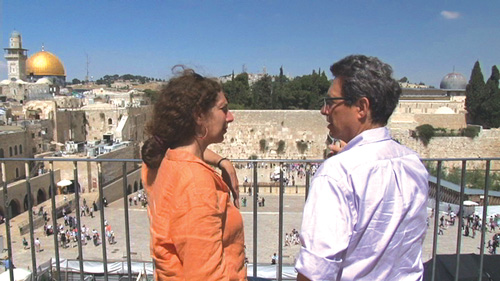
Seeing the festival being used by extremists on both sides became a natural starting point for Between Two Worlds, which takes a many-sided, questioning, sometimes humorous look at culture wars in today’s American Jewish population. It touches on everything from divestment debates at UC Berkeley to the disputed site of a Museum of Tolerance in Jerusalem (atop a 600-year-old Muslim cemetery), from the tradition of progressive liberalism
among U.S. Jews to rising ethnic-identity worries spawned by intermarriage and declining birth rates.

The fundamental question here, as Kaufman puts it, is “Who is entitled to speak for the tribe?” For the first time, the filmmakers have made themselves part of the subject matter, exploring their own very different personal and familial experiences to illustrate the diversity of the U.S. Jewish experience. Snitow’s mother had to hide her prior Communist Party membership to remain active in social-justice movements after the 1940s, while Kaufman’s father was a devoted Zionist from his Viennese childhood who had to adjust to offspring like “Tevye’s daughters gone wild,” including one who converted to Islam.

They’re clearly in sympathy with other documentary interviewees insisting that one core of Jewish identity has been, and should remain, a stance against absolutism and injustice towards any peoples. Between their SFJFF screenings the filmmakers chatted with the Guardian.

SFBG: Is the Bay Area still a bastion of Jewish liberalism, relatively speaking? Watching your movie I wondered how many other places there are where a Jewish film festival audience would boo and heckle a conservative pro-Israeli speaker like Dr. Michael Harris.

Deborah Kaufman: What we saw at the festival during the Rachel uproar was a collapse of the center. It was really a moment when the extremes were at battle and the center simply disappeared. That’s what was and is so disturbing. A kind of apathy where the moderates just throw up their hands and walk away from what’s become a very toxic debate.

Alan Snitow: It’s not that the Bay Area is unique to boo a so-called “pro-Israel” speaker. It’s that the Bay Area has maintained an open debate about Israeli policies when other Jewish communities never countenanced such debate from the get-go. Rachel was not shown in other Jewish film festivals around the country because they are already creatures of conservative donors. The aim in this power grab by the right in San Francisco was and is to silence people and institutions like the festival that oppose a McCarthyite crackdown in a remaining bastion of free speech. And this is being mirrored in Israel itself where the Knesset recently passed a law punishing anyone who publicly supports the idea of a boycott of the West Bank settlements.

I think we also have to question this claim of “pro-Israel.” All criticism of Israel’s occupation is now being branded as “anti-Israel.” Theodore Bikel — a lifelong Zionist activist who went to jail with my mother at the Soviet consulate in Washington DC — was recently called an “anti-Zionist” because he supported an actors’ boycott of performing in the settlements. J Street — an explicitly and consistently pro-Israel voice that is critical of Israeli policies — is regularly attacked as not really pro-Israel for that very reason. “Pro-Israel” has come to mean pro the policies of the current, most right-wing government in Israeli history — a government that is now advocating the truly Orwellian position that there is no occupation at all! That’s not what pro-Israel or Zionist ever meant except to some ideologues on the far right.

DK: The Bay Area has had a history of passionate political commitment — to both the Zionist and anti-Zionist causes. But today the right wing is certainly louder and aside from what we saw at the theater that day, there has been a significant silencing of voices critical of Israel’s occupation policies.

SFBG: Conversely, have you perceived the local Jewish community as growing more conservative in recent years? In particular, more inclined to treat criticism of Israeli government policies as inherently anti-Semitic, even when voiced by fellow Jews?

DK: We were interested in the notion of excommunication — going back to Spinoza — and to the accusation “self-hating Jew” that some people used to attack Hannah Arendt when she wrote Eichmann in Jerusalem. Today, right-wing Jews are leveling charges of treason against Jewish academics, rabbis, and community members whose positions on israel aren’t as rabidly right wing as theirs. We didn’t have to look very far to find dramatic stories for our film on these themes. Censorship and the stifling of dissent are happening right in our home town.

AS: There’s conservative and there’s conservative. The Jewish community hasn’t become more conservative in terms of voting patterns or support for civil rights or the welfare state, but the establishment has become more and more dependent on an ever smaller number of big conservative donors who have bought out these institutions and compromised their independence and legitimacy as representing the whole Jewish community. This is a major reason for the crisis. More and more young Jews are finding the community’s institutions do not reflect their liberal beliefs and upbringing, particularly when it comes to Israel. The result is that many young people are not identifying with Israel because its actions are not consistent with their ideals as American Jews.

SFBG: Had you already been thinking about somehow addressing political rifts in the Jewish community before the SFJFF fracas?

DK: We began the film over a year before the JFF fracas. We were focusing more on Jewish identity than politics — looking at intermarriage, hybrid identities, a new generation of American Jews — we wanted to re-tell the Biblical story of Ruth, and we were following a fantastic feminist-queer internet discussion called “Rabbis: Out Of My Uterus!” that we thought would be fun to film — but we kept getting swept into the Israel vortex and realized we had to address the question of dissent and who speaks for the Jewish community at this historical moment for the film to be relevant.

SFBG: The festival had shown other movies relating to different aspects of the Palestinian conflict before, and Rachel does make an effort to represent all the different sides of its story. What do you think particularly ticked people off about that film?

DK: Over the years the festival had shown many films that were more controversial than Rachel. In fact, that same summer the festival showed a film called Defamation that we felt was far more critical of the Jewish establishment, but it went right under everybody’s radar. It was the Tea Party summer — almost anything could have been the spark that ignited a controversy. But the tragic death of Rachel Corrie had already made her an internationally famous symbol of opposition to Israel’s occupation, so the anger was focused on the program with her name.

AS: Rachel was just a pretext. In the months before the film festival, think tanks in Israel had declared the Bay Area a node of “delegitimization” of Israel (along with Toronto and London). The right was looking for a test case to make an example of Jewish institutions that step out of line. The San Francisco Jewish Film Festival was founded as a transgression right from the start — a place where unpopular and counter-cultural and diverse views could engage. It was a perfect target to attack.

One other item: when the festival allowed [Harris] on the podium to attack one of its own films and filmmakers it was a bad precedent, and the right smelled blood in the water. The festival’s good faith effort was viewed as a sign of weakness and the attacks only intensified. The people who wrote the attacking emails are people who think that any criticism of Israel is tantamount to anti-Semitism. They are not to be appeased by any symbolic action. They want control and silence.

SFBG: Deborah, since you left the festival it’s seen several well-regarded executive and programming directors depart, seemingly burnt out. Do you think the effort it takes to represent and placate the festival audience has gotten harder?

DK: I’m not sure things have changed so much. There has always been pressure on festival directors to do what major donors demand. I got a lot of that during my tenure but resisted the pressure. The difference is the political atmosphere which is more polarized and shrill, especially since the new, ultra-right government in Israel has come to power. It’s hard to withstand the bullying and accusations of treason and self-hate.

AS: I think it’s also important to add that Deborah and Janis [Plotkin] — who was director for many years — also had a lot of fun with the festival. This is a very hard job, but it’s a creative and fascinating one, and these attacks may come with the territory, but they don’t dominate it.

DK: In terms of the audience it’s always been a diverse group. I have fond memories of the midnight screening of the silent version of The Golem (1920) we did at the Roxie in our second year — where people in the audience were literally screaming at each other and at the projectionist during the whole screening about whether we should turn the volume up or down on the rock music sound track we had commissioned.

SFBG: You’ve shown Between Two Worlds to a variety of Jewish audiences so far, in Toronto, New York, and Jerusalem as well as SF. What have been some of the responses?

DK: The response has been great and sometimes surprising — we’ve had people from the left and right of the political spectrum both say the film has made them reconsider their own stridency. Non-Jews have said it mirrors what they felt they could not say out loud. Young people have told us it’s affirming of their perceptions and reveals a history they didn’t know existed. In Jerusalem one person felt the film was overly optimistic because it didn’t examine the support of right-wing Christian fundamentalists for the settlements!

AS: I think the personal stories we tell of our own families ring true to many people. Most Jews know deep down that if you look at the family histories of American Jews, you will find intense long term debates between those people at the Passover seder table who were Communists, Socialists, and Zionists. Often, the only way to sit down together was to maintain silence, but we wanted to bring those utopian hopes and ideals back into focus, and people across the political spectrum seem to take that as an opportunity to think about and question their own families and their own positions.

SFBG: How did the decision come about to put yourselves in the film? As filmmakers, was it awkward to become subjects?

DK: We’ve never been in our own films so it was something of a challenge for us. We don’t feel relaxed in front of the camera, but early in the production we realized we had to be in the film so that people would know where we were coming from, and also because our family histories shed a lot of light on debates inside the Jewish community today. We watched a lot of work by other documentary filmmakers who put themselves in their films like Marlon Riggs, Alan Berliner, and Ross McElwee, and decided we’d give it a try. We also felt this film was really about the intersection of the personal and the political, so the structure that moves back and forth between the two made sense to us.

AS: My daughter, Tania, is an actor, and I kept thinking that we needed to consult with her about being on camera. It’s not just something that you do. You have to work at it and learn how to do it. After we did it a couple of times, we realized that we weren’t dressing right, that the hair was wrong, that I was scratching my head, that we should have shot ourselves from above and not below. Rather than being an on camera ego-trip, it was a humbling experience.

Between Two Worlds opens Fri/5 at the Roxie.
Scribe’s Guide to Playa Prep

32

steve@sfbg.com

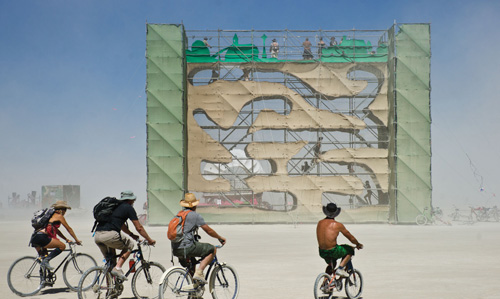
PLAYA PREP This is a crazy time of year for burners, when they begin to realize just how overly ambitious their art projects actually are, when the August calendar seems to shrink as to-do lists grow, and when procrastination morphs into panic — all of it laced with a giddy, distracting excitement about the dusty adventures to come.

Don’t worry, fellow burners, Scribe is here to help. I’m way too busy right now to actually come help weld your art car or hot glue your costume (unless you’ve got stuff or skills that I may need, in which case we can maybe work something out) but after years of deep immersion in this culture, I do have a few tips and resources for you.


ATTITUDE

The most important thing to bring to the playa with you is the right attitude. It’s right up there with your ticket at the very top of the list. As I worked on this guide, I posed the question “What’s the most important thing you bring to the playa?” to online burner hives, and most of the answers I got back had something to do with attitude.

Whether you’re a nervous newbie or salty veteran, it’s important to leave your expectations at home and just be open to whatever experiences await you. Intention is everything out there, and if you try to always maintain an open mind, a loving heart, and a sense of humor, everything you need will just flow your way.

It isn’t always easy. When your project breaks, or the dust won’t stop blowing, or your lover squashes your heart, or some yahoo behaves in a way that strikes you as somehow un-Burning Man, it’s natural to let your anxieties creep up. But you’ve got to let it go, because it’s all going to be OK, it really is. When all else fails, just breathe.

It is the breaking through those difficult moments and coming out the other side — enduring through things that feel like they may break you — that makes Burning Man feel so transformative. It is a cauldron, and you may not come out in the same form you went it, but that’s part of why you go.


GETTING AROUND

You’ll need a motorized vehicle to get to Burning Man — and art cars can be a fun way to get around when you’re there, a sort of surreal public transit system — but if you don’t have a good bicycle then you’re at a decided disadvantage in fully experiencing Black Rock City, the most bike-friendly city on the planet while it exists. And that’s never been more true than this year, when early reports indicate that the wet winter has left the playa packed solid and perfect for pedaling.

Form and function are equally important when it comes to your bike. It needs to be in good mechanical condition (and with enough tools and patch kits to keep it that way) and correctly sized to your body, ideally with a comfortable, upright position and basket for your stuff. And you also need to decorate it and make it unique, both because making art is the essence of Burning Man and so you can easily find it amid a sea of bikes. Form and function, they’re like two wheels rolling together.

Although the Borg, a.k.a. Black Rock City LLC, recommends that you bring a bike lock, I’ve personally never used one and never had a problem. Sure, bike thefts happen, but I believe they’re almost always crimes of opportunity or drunken mistakes involving nondescript bikes, not unique rides like mine that I could spot 100 yards away.

I’m convinced that half the people who think their bikes got stolen actually just lost them. The playa can be a very disorienting place, with art cars and other visible markers moving around — and even one’s own brain conspiring against locating one’s bike. So illuminate your bike well, ideally with something that sticks up high the air, and leave your lights on as you explore on foot.

Speaking of which: wear good, comfy shoes. Most costumes should stop at the ankle at Burning Man, particularly if you’re prowling the playa


SNEAKING IN

In honor of the mad scramble for tickets after Burning Man sold out more than a month before the event for the first time in its 25-year history, I’m offering some thoughts on sneaking into the event. Given how many people could find themselves stuck with counterfeit tickets or otherwise unable to get in this year, it seems like something that any thorough guide should cover.

Now, before everyone jumps all over me, telling me that I’m endangering lives and undermining the spirit and the stability of the event, let me make clear the spirit in which I’m offering this advice. Just think of it like a hacker publicizing the security vulnerabilities of a beloved institution — hopefully the Borg will read this too and do what it can to either plug the holes or somehow take pity on the desperate souls stuck outside the city’s gates.

First of all, you gotta know what you’re getting yourself into. Gate crew takes this shit very seriously, thoroughly searching every car and trailer, and looking into hiding spots that you probably haven’t even thought of. Many of them take real pride in this, some thoroughly stomping on rolls of carpet that might contain a stowaway, potentially adding injury to your insult.

Here’s the worst part: It is official Burning Man policy that when stowaways are found, everyone in that vehicle gets his or her tickets torn up. And burner brass says it will beef up security this year, including more people at the gate and more people scanning the open playa with night-vision goggles and fast interceptor cars.

Every year, they catch about 30 people trying to sneak it. “We’re very confident that we catch all the stowaways,” Borg member Marian Goodell tells us. But we all know that can’t possibly be true, right? There are playa legends of a contortionist who puts herself in a packing bin and gets in every year, and I’ve met people who claim to have snuck in both at the gate and over the open playa.

So, if you gotta do it, my best advice is to find a confederate on the inside, such as someone on Gate crew who owes you or will take pity on you or a bribe from you. That’s how many coyotes do it at the US-Mexico border, and it could work here too. There aren’t any wristbands at Burning Man, so once you can weasel your way in amid the confusion at the gate, you’re in.

Skydivers also have a pretty good shot at getting in, even though they’re likely to be greeted on the ground by someone asking for their tickets. But, it’s a big city, and if you’ve got some skydiving expertise and you’re able to rapidly change directions during the final phase of your descent, you might just make it.

There are also ways to take advantage of human oversights, particularly during the early arrival period before the event begins. There are often openings in the gate briefly left unguarded in the early days, as we discovered last year after a trip to the reservoir. Or sometimes, after thoroughly searching the car, the person at the gate will forget to tear your ticket. And believe it or not, sometimes people on the inside end up with spare tickets for friends who couldn’t make it. Any untorn tickets can be spirited out by people making runs into nearby Gerlach for supplies.

But in closing, let me just reiterate that buying a ticket is part of the “radical self-reliance” principle that is central to the burner ethos, so do yourself and your community a favor and find a ticket, or accept that you may just have to sit this year out. Don’t worry, we’ll make more.


FOOD AND SHELTER

In preparing for Burning Man, it’s always helpful to remember Maslow’s Hierarchy of Needs, which instructs us that we need to see to our basic needs at the bottom of the pyramid before we can even think about approaching the enlightenment at its pinnacle. And that begins with food and shelter.

Contrary to common misconceptions, you don’t need an RV or trailer on the playa — and it’s too late to get one at this point anyway. Frankly, you’ll be fine in a cheap pup tent as long as you place it under a sturdy shade structure, such as the 10-by-20-foot steel carports that are ubiquitous on the playa, or a cheaper shade structure with poles reinforced by PVC or something to help it from being flattened.

You may need to make adjustments during the course of the week, but jerry-rigging your shit is just part of the fun. Or if that’s not your cup of tea, more and more burners in recent years have been building their own yurts or turning to custom-made designs like the Playa Dome Shelters from Shelter Systems (www.shelter-systems.com/playadomes.html).

For food, just try to keep it simple, nutritious, and free of unnecessary waste. That means lots of simple snacks and easy meals, such as those you make ahead of time and reheat. There are also some good entrepreneurs out there that have perfected this approach, such as Gastronaut SF (www.gastronautsf.com/playa-provisions), which makes meals that you boil in the bag, which even allows you to reuse that water.

And don’t forget to take your vitamins because playa life can really take it out of you. Dr. Cory’s Playa Packs (www.drcory.com) are one of many good companies that understand what nutrients you’ll need and try to provide them.


SHOPPING

Let’s face it, for all the talk about decommodification and intentional communities and all that hippie crap, you’re going to need stuff at Burning Man. Lots and lots of stuff. Luckily, San Francisco is a great place to get it, and here are some of my personal favorite spots to shop for my playa gear.

Mendels This art supply store has everything you need for your costumes and other Burning Man projects, and many things you didn’t know you needed. For example, when I was looking for a cool covering for my bike years ago, I found tubes of thick acrylic paint that dries hard (now known as 3-D Paint), which has lasted for years and drawn compliments the whole time.

1556 Haight, SF. (415) 621-1287, www.mendels.com

Fabric Outlet Fake fun fur has become a staple item for Burning Man costumes and art projects, particularly as the styles and varieties of it have gotten better. And this place has the coolest fake furs in town, as well as a huge selection of other fabrics, patterns, and sewing kits.

2109 Mission, SF. (415) 552-4525, www.fabricoutletsf.com

Multikulti This is the best place in town to find a great selection of groovy sunglasses for just $6 each — and you’ll want a good selection of shades out there to go with your costumes — as well as a variety of other accessories and costumey geegaws to accent your Burning Man ensemble.

539 Valencia, SF. (415) 437-1718

Five and Diamond If there is a store that grew directly out of the feather-and-leather fashion aesthetic that has come to take center stage on the playa, this is it. From groovy utility belts (important when your costumes lack pockets) to elaborate leather outer wear to some of the coolest custom goggles that I’ve found (mine has a built-in light and both clear and shaded lenses), this place has great — if slightly pricey — stuff.

510 Valencia, SF. (415) 255-9747, www.fiveanddiamond.com

Held Over My favorite second-hand clothing store creates special racks of Burning Man clothes this time of year, but I always prefer to assemble my own outfits from their great selection of unique vintage and specialty clothes, including an entire room of tuxedos and other retro formal wear.

1543 Haight, SF. (415) 864-0818

Distractions The oldest walk-up Burning Man ticket outlet, Distractions knows just what burners need, offering a wide variety of playa-oriented clothing and accessories that you’ll need, from goggles to EL wire strips to pipes and other smoking paraphernalia.

1552 Haight, SF. (415) 252-8751

Cool Neon This Oakland-based company specializes in electro luminescent wire, the staple item for illumination on the playa (and whether you’re walking or on a bike, you will need to be lit-up out there). Cool Neon makes the rounds at many of the fairs and trunk shows, but you can also place orders for shipment or arrange pickups at its office at 1433 Mandela Parkway in Oakland.

www.coolneon.com

Discount Builders Supply Rather than spending your hard-earned money at Home Depot or some other chain store in the burbs, this locally owned business has everything you need to construct and decorate your project, or see to your sundry personal needs. They’re also used to burners with strange requests, so they give good advice.

1695 Mission, SF. (415) 621-8511, www.discoutbuilderssupplysf.com


WORKSPACES

The project. It is the essence of Burning Man, whether it’s the fun fur and EL wire you’re putting on your bike, the bar or showers your camp is building, or some ridiculously ambitious artwork that you’re creating with a crew of hundreds. Black Rock City is a series of thousands of these individual projects, all of which are coming together right now. And if you’re looking for some help finishing (or starting) yours, here are some resources you can tap.

The Crucible The Crucible is a venerable nonprofit institution that offers a wide variety of arts and crafts classes and resources in a state-of-the-art facility in West Oakland, with many burners among its staff and clients. As the longtime host of the Fire Arts Festival, this place knows its stuff.

1270 17th St., Oakl. www.thecrucible.org

CELLspace The Flaming Lotus Girls and many other key burner art collectives were born here, and his facility continues to provide the expertise and tools to bring Burning Man to life, year after year.

2050 Bryant, SF. www.cellspace.org

Techshop The new kid on the block, but one of the most technologically advanced, Techshop is a DIY workshop with amazing tools and experts on staff. Join its Aug. 15 EL wire workshop or other upcoming classes catering to burners.

926 Howard, SF. www.techshop.ws

American Steel Also known as Big Art Studios, this massive warehouse houses many of these biggest projects now bound for Burning Man. It may not have the structural support of places like the Crucible, but if you’re looking for knowledgeable burners to work through some problem, American Steel is brimming over with them.

1960 Mandela Parkway, Oakl. www.americansteelstudios.com

Burning Man costume creations If it’s sewing or other costuming help that you need, there are lots of local designers who might lend a hand (see “What not to M.O.O.P.” in this guide). Or you can stop by these Aug. 11 or Aug. 25 sewing circle meetups listed at www.meetup.com/Burning-Man-Costume-Creations


ART

Here are a few of the major installation artworks with Bay Area connections that I’m excited to see on the playa this year:

Charon by Peter Hudson Peter Hudson and his large volunteer crews have created some of the most dynamic art pieces in Burning Man history, zoetropes that use motion and strobe lights to animate the characters they create: the swimmers of Sisyphish, the divers of Deeper, the snake and monkeys of Homouroboros, and the man reaching for the golden apple of Tantalus. This year, Charon the boatman crosses the river Styx into Hades and, well, you just really gotta see what could be his best piece yet. As the artist says, “Charon asks them to reflect on their own mortality and ponder how to give and get the most from their brief time here on earth.”

Tympani Lambada by the Flaming Lotus Girls Combining fire, steel, light, and sound on the massive scale that we’ve come to expect from the Flaming Lotus Girls, Tympani Lambada simulates the structure of our inner ears, which control not just hearing but balance and perception. As always with this crew, this project promises to be space as occupy and interact with (usually with an unbelievable sense of awe) rather just a structure to see. And as they’ve been doing for many years (see “Angels of the Apocalypse,” 8/20/05), the dynamic crew built this creation right out at the Box Shop on Hunters Point (with an assist for American Steel, where some of its longest sections are being built).

Truth and Beauty by Marco Cochrane Following up last year’s amazing Blissdance, which is now on display on Treasure Island, this crew hoped to make an even larger female nude sculpture of the same model (55 feet this time), but their fundraising fell a little short so they couldn’t complete it. But even in the abbreviated form they’re bringing to the playa this year — just the torso from knee to shoulder, but well-anchored that it’s climbable — it should still be something to see.

Temple of Transition, by International Art Megacrew The Temple is always a special place at Burning Man (see “Burners in flux,” 8/31/10), and this year promises to be as spectacular as it is spiritual. The project is headed by a pair of builders known by their nationalities, Kiwi and Irish, and built mostly in Reno by a crew of committed volunteers from more than 20 countries. It’s centerpiece tower, Gratitude, is a towering 120-feet tall, surrounded by and connected to five smaller towers: Birth, Growth, Union, Death, and Decay.

Otic Oasis Lightning (Burning Man’s attorney) and friends (including named artists Gregg Fleishman and Melissa Barron) wanted the quietest spot on the playa for this 35-foot wooden pyramid of comfy lounging compartments, a remote spot where even the music from art cars couldn’t reach. Their answer: at the very back of the walk-in camping area, a spot only reachable on foot by people intending to go there. Finally, a quiet spot to chill out.


PLAYA EVENTS

OK, I know that many of these events are music-related, and there are an untold number of quirky, weird things to do on the playa besides just rocking out to a DJ. But exploring what the hundreds of theme camps offer each year is part of the fun, and it’s too Herculean a task to sort through the voluminous information and offer you sound predictions.

But every year the music lovers among us compile their recommendations of the stops to hit that will be going off and filled with dancing fools, so I know those lists are valuable. And mine does include some other stuff as well, so just deal with it.

The future of Burning Man The 17 board members of The Burning Man Project, the new nonprofit entity being created to take over operations of Burning Man in coming years (see “State of the burn” in this guide), will be available to discuss the future of this culture. This is your chance to weigh in on what’s important to you and how the event should be governed into the future.

Everyday, 1 p.m.-2:30 p.m. at Everywhere Lane (near Center Camp)

Lee Coombs This British-born DJ has long been a great supporter of Burning Man art projects — and he always plays fun sets — so come check him as the playa’s best daytime dance party camp starts to work it out.

Tuesday, 5 p.m.-6 p.m., Distrikt (9&F)

Unicorn Stampede

The perverts from Kinky Salon love getting horny on the playa, and this time they’re getting literal as they dress as unicorns and stampede across the playa, spreading their joy and juices onto unsuspecting burners and ending up at the Walkout Woods art piece. What does all that mean? Bring a horn, leave your inhibitions, and come find out.

Wednesday, 7-9:30 p.m., gather at The Man

Shpongle OT’s regular Wednesday night White Party — which has included many epic performances over the years, and this year include big draws EOTO, Infected Mushroom (both doing live sets on two stages OT is setting up for live music this year) and Christopher Lawrence, at midnight, 1:30 am and 3 am respectively — welcomes the dawn with pysbient music innovators Shpongle, which is already generating lots of excitement.

Thursday, 5:45 am (sunrise set), Opulent Temple (10&B)

Deep End reunion It’s like family day at Distrikt as the core San Francisco-based DJs that helped launch the original Deep End day parties play successive one-hour sets, with Syd Gris followed by Tamo, Kramer, and then Clarkie. Buckle up, everyone, because this could get ugly.

Thursday, 2-6 p.m., Distrikt (9&F)

Cuddle Ocean Upping the ante on the stereotype of ravers heaped into cuddle puddles at Burning Man, some instigators from last year’s Temple of Flux crew are seeking to create a Cuddle Ocean of thousands of burners heaped all over each other in the deep playa. Come feel the love.

Thursday, 6-8 p.m., between the Man and the Temple

Bootie BRC Adrian, Mysterious D, and the rest of the popular Bootie SF music mashup crew will be throwing a dance party specially mixed for your on-playa pleasure — with actual words!

Thusday, 8 pm-???, Fandango (Esplanade&4)

Circle of Regional Effigies burn Regional events have become an important part of the Burning Man culture, and this year 23 of them will build wooden effigies in circle around The Man. And then, as tends to happen to our effigies, they will all burn — simultaneously!

Thursday, 9 p.m., around The Man

Critical Tits This women-only topless bike ride has been a playa tradition for many years, so cruise by to cheer them on and offer your encouragement for what is a very freeing experience for many of the participants. Besides, who doesn’t like tits?

Friday, 4-5 p.m., The Man

Space Cowboys Hoedown Legendary SF-based sound collective the Space Cowboys has a tradition of driving its mobile music vehicle the Unimog out to the “biggest, baddest art piece” on the playa for a big dance party every year, which art cars with speakers and radio receivers can also relay, create a fun circle of sound. And this year, the winner is…The Flaming Lotus Girls’ Tympani Lambada.

Friday night at Tympani Lambada

Distrikt Come ride the daytime dance party train to the end of the line with DJ Kramer spinning until someone drags him off the stage to get ready for the burn.

Saturday, 4-??? at Distrikt Camp (9&F)

Scumfrog Dutch-born DJ Scumfrog has been rocking the playa every year since he first camped with us at Opulent Temple in 2004, and as readers of my book know, he’s a Burning Man true believer who just loves this culture, so he always brings his A-game. This is the place to be as the sun rises on final full day of Black Rock City.

Sunday, 4 am-sunrise, Disorient (2&Esplanade)

Tribes of Burning Man signing Yours truly, Scribe, will be on stage leading a discussion of issues raised in my book, The Tribes of Burning Man: How an Experimental City in the Desert is Shaping the New American Counterculture. Study up by ordering a signed copy now from www.steventjones.com and join in the debate, or just come heckle me for this shameless plug.

Sunday 4 p.m., Center Camp Stage

Steven T. Jones, a.k.a. Scribe, is the Guardian’s city editor and the author of The Tribes of Burning Man: How an Experimental City in the Desert is Shaping the New American Counterculture, which grew out of a series of stories in the Guardian that ran from 2004 through 2010.


Whose voice?

0

arts@sfbg.com

FILM In 1981 Deborah Kaufman founded the nation’s first Jewish Film Festival in San Francisco. Thirteen years later, with similar festivals burgeoning in the wake of SFJFF’s success — there are now over a hundred around the globe — she left the festival to make documentaries of her own with life partner and veteran local TV producer Alan Snitow.

Their latest, Between Two Worlds, which opens at the Roxie this Friday while playing festival dates, could hardly be a more personal project for the duo. Both longtime activists in various Jewish, political, and media spheres, Snitow and Kaufman were struck — as were plenty of others — by the rancor that erupted over the SFJFF’s 2009 screening of Simone Bitton’s Rachel. That doc was about Rachel Corrie, a young American International Solidarity Movement member killed in 2003 by an Israeli Defense Forces bulldozer while standing between it and a Palestinian home on the Gaza Strip.

As different sides argued whether Corrie’s death was accidental or deliberate, she became a lightning rod for ever-escalating tensions between positions within and without the U.S. Jewish populace on Israeli policy, settlements, Palestinian rights, and more — with not a few commentators amplifying the conservative notion that any criticism of Israel is anti-Semitic, even (or especially) when it comes from Jews themselves.

People who hadn’t seen (and boasted they wouldn’t see) the strenuously even-handed Rachel called the documentary an “anti-Israeli hate fest” akin to “Holocaust denial,” its SFJFF inclusion “symptomatic of a demonic strategy” by “anti-Semites on the left.”

Stunned SFJFF executive director Peter Stein (who’s leaving the festival after its current edition) decried Jewish community “thought police” who pressured the institution and those connected to it with defunding and boycotting threats. The festival attempted damage control by inviting a public foe of the screening (Dr. Michael Harris of StandWithUs/Voice for Israel) to speak before it, which only amplified the hostile rhetoric.

Seeing the festival being used by extremists on both sides became a natural starting point for Between Two Worlds, which takes a many-sided, questioning, sometimes humorous look at culture wars in today’s American Jewish population. It touches on everything from divestment debates at UC Berkeley to the disputed site of a Museum of Tolerance in Jerusalem (atop a 600-year-old Muslim cemetery), from the tradition of progressive liberalism among U.S. Jews to rising ethnic-identity worries spawned by intermarriage and declining birth rates.

The fundamental question here, as Kaufman puts it, is “Who is entitled to speak for the tribe?” For the first time, the filmmakers have made themselves part of the subject matter, exploring their own very different personal and familial experiences to illustrate the diversity of the U.S. Jewish experience. Snitow’s mother had to hide her prior Communist Party membership to remain active in social-justice movements after the 1940s, while Kaufman’s father was a devoted Zionist from his Viennese childhood who had to adjust to offspring like “Tevye’s daughters gone wild,” including one who converted to Islam.

They’re clearly in sympathy with other documentary interviewees insisting that one core of Jewish identity has been, and should remain, a stance against absolutism and injustice towards any peoples. Between their SFJFF screenings the filmmakers chatted with the Guardian.


SFBG Is the Bay Area still a bastion of Jewish liberalism, relatively speaking?

Deborah Kaufman What we saw at the festival during the Rachel uproar was a collapse of the center. It was really a moment when the extremes were at battle and the center simply disappeared. That’s what was and is so disturbing. A kind of apathy where the moderates just throw up their hands and walk away from what’s become a very toxic debate.

Alan Snitow It’s not that the Bay Area is unique to boo a so-called “pro-Israel” speaker [like Harris]. It’s that the Bay Area has maintained an open debate about Israeli policies when other Jewish communities never countenanced such debate from the get-go. Rachel was not shown in other Jewish film festivals around the country because they are already creatures of conservative donors. The aim in this power grab by the right in San Francisco was and is to silence people and institutions like the festival that oppose a McCarthyite crackdown in a remaining bastion of free speech. And this is being mirrored in Israel itself where the Knesset recently passed a law punishing anyone who publicly supports the idea of a boycott of the West Bank settlements.

I think we also have to question this claim of “pro-Israel.” All criticism of Israel’s occupation is now being branded as “anti-Israel.” “Pro-Israel” has come to mean pro the policies of the current, most right-wing government in Israeli history — a government that is now advocating the truly Orwellian position that there is no occupation at all! That’s not what pro-Israel or Zionist ever meant except to some ideologues on the far right.


SFBG Had you already been thinking about somehow addressing political rifts in the Jewish community before the SFJFF fracas?  

DK We began the film over a year before the SFJFF fracas. We were focusing more on Jewish identity than politics — looking at intermarriage, hybrid identities, a new generation of American Jews — we wanted to re-tell the Biblical story of Ruth, and we were following a fantastic feminist-queer internet discussion called “Rabbis: Out Of My Uterus!” that we thought would be fun to film. But we kept getting swept into the Israel vortex and realized we had to address the question of dissent and who speaks for the Jewish community at this historical moment for the film to be relevant.

Between Two Worlds opens Fri/5 at the Roxie.
Straightening out planking

0

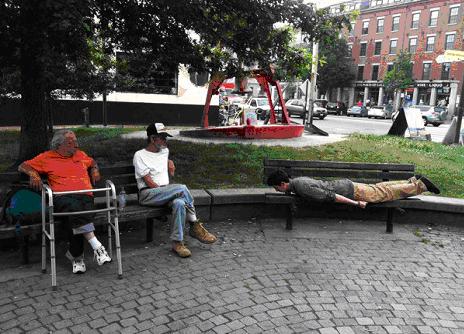
The newest international pastime involves lying face down on the ground with the ultimate goal of remaining as stiff as possible. I’d lump it in with parkour, mosh pits, and the car and phone booth stuffing competitions from the late 1950s and early ‘60s on account of its baffling physical appeal. For those of you unaware of this global craze and perhaps had no clue as to why Rosario Dawson was lying on a table on Jimmy Kimmel Live… they call it planking.

Although planking’s popularity has taken off this summer in the U.S, the trend goes back as far as 1994. It stayed under the radar as an underground hobby in Australia and Europe forever before its newfound seismic popularity.  

A written description of planking sounds neither amusing nor enticing. The goal of the practice is to find the most complex, unorthodox structure around and “plank” atop it, making sure to assume proper planking position — stiff as a board, arms at your sides. Planking is driven by a particular kind of oneupsmanship. Anything from fences to basketball hoops, forklifts to flagpoles, (yes flagpoles) plankers manage to find a way to remain as stiff as possible while their buddies quickly snap a photo of their latest feat. The higher the physical risk the better. 

But are bragging rights worth your life? 

On May 13, a man was arrested in Queensland, Australia for allegedly planking on top of an Australian police car. And sadly on May 15, a 20-year old Australian man made worldwide headlines after his failed attempt to plank on  a building’s balcony seven stories high resulted in the trend’s first casualty.

But for many, planking is nothing but clean harmless fun. Ryland Webb, an 18-year old from San Francisco, not only likes planking’s fun times — he also uses it as an opportunity to make a statement. 

Webb says he first started planking out of curiosity. “The first time I planked was with some friends on a long afternoon. We didn’t really know what to do so we gave [planking] a shot.”

While in Portland, Maine, Webb says that he used planking as a way of interaction. “We were in a different city and we viewed planking as an alternative way to interact with the natives. You really don’t know a place until you pretend you’re a board on its horizontal surfaces.”

“As times progressed we started to view the activity as our own innocent way of fucking shit up,” Webb says. “Planks began to be fashioned either to provoke reactions from bystanders, or symbolize some abstract form of youth rebellion.” He and his friends planked bike racks, benches, cars, newspaper stands, and fences.

And it’s not a trend if famous people aren’t doing it. Basketball players like Dwight Howard and former Golden State Warrior Gilbert Arenas, as well as mainstream artists like Katy Perry, Chris Brown, and Usher have all taken a plank now and then. 

But since planking’s breakout, there has been a growing amount of critics wary of the game’s origins and intentions. Some believe it to be an insulting representation of the horrific stacking of slaves atop wooden planks which took place during the Middle Passage. The idea of planking has sparked outrage from many; including Alvin Nathaniel Joiner IV, better known as rapper Xzibit, who tweeted “Planking is THE dumbest shit ever. #Planking was a way to transport slaves on ships during the slave trade, it’s not funny. Educate.”

It’s hard to say what the true intentions of planking really are. The game which has taken on many various monikers in the past, including “the lying down game”, “playing dead”, “extreme lying down,” and “facedowns.” 

But it does appear that the trend is sticking around, for the moment at least. Don’t be surprised if — on your next coffee run or hamster walk — you see someone lying face down atop of a bike rack or a public mail box. Planking may just be one of those things we’ll have to take lying down.


Those crazy San Franciscans

63

Joe Eskenazi has an SF Weekly piece that pretty much repeats what he’s been saying for years: That San Francisco has too much government. This time he goes after all the boards, task forces and commissions — and yeah, there are a lot of them, and yeah, some of them might not be necessary. I could also argue, though, that San Francisco is one of the most politically active cities in the world, and that having a whole lot of ways for residents to plug in to what’s going on in their city isn’t a bad thing at all.


Whatever. Here’s the stuff that drives me nuts:


Last month, the volunteer body appointed by the Board of Supervisors advocated curtailing all pet sales in the city — including guppies, goldfish, and live rodents meant as snake food. Coming on the heels of a proposed criminalization of circumcision, San Francisco was, once again, reduced to an international punchline — many were left to wonder whether a ban on circumcising goldfish is our logical next step. Disbelieving articles poured in from around the globe. Perhaps none was as caustic as a piece in London‘s Telegraph titled “San Francisco goldfish ban exposes the pathology of America’s bourgeois liberal nutjobs.”


Ah, yes, Joe: Those crazy San Francisco liberals and their madcap ideas.


I’m not for banning pet sales (although I think banning puppy mills — also a wacky idea that came out of the Animal Control and Welfare Commission — is a fine thing). And I’m not for the circumcision ban (although, geez, it has lead to some interesting commentary that gives new meaning to the term “dick face.”)


But every time I hear somebody talk about how San Franciscans should stop it with the nutty ideas, I think about a few I’ve followed over the years — and how they’ve changed the way the entire nation thinks. Let me suggest a few for Eskanazi to look at:


“Those crazy San Franciscans don’t want to build freeways.” Yep — in the late 1950s and early 1960s, while the rest of the country (and in particular, California) was rushing to build freeways as fast as possible, people in this city decided to say No. The freeway revolt and the movement that grew out of it changed the way Americans view cities. Wacky shit.


“Those crazy San Franciscans think homosexuals should have the same rights as married people.” Yep, back in the 1970s San Franciscans started talking not only about nondiscrimination — they actually said that gay people who live together should have health insurance benefits. Imagine that.


“Those crazy San Franciscans think that women should make the same amount of money as men.” When then- Sup Nancy Walker introduced legislation in 1985 making “comparable worth” (the notion that men and women who do jobs that require comparable skills should be paid the same) it made headlines all over the country — and was universally derided by the same set that now complain about “liberal nutjobs.” It cost the city a lot of extra money (money that the Eskinazi crew of the day said was too much for a broke city) and led to all sorts of comments about social engineering. San Francisco was the first to push the issue, and it’s now considered mainstream employment policy.


“Those crazy San Franciscans think we ought to give bicycles the same rights as cars.” All the way back in the mid-1980s, bicycle advocates were talking about bike lanes, bike maps, bike racks and alternatives to the automobile. What were they drinking?


“Those crazy San Franciscans think that transgender people ought to get health benefits.” This was as recent as 1993 — and if you think circumcision and pets put SF in the right-wing-talk-show and late-night-comedy targets, imagine when the city decided “to use taxpayer dollars to fund sex-change operations,” as the detractors insisted. Guess what? It turned out to be a major step forward for transgender rights.


“Those crazy San Franciscans think gay people should be allowed to get married.” We did. We do. We were first. The rest of the country is following.


“Those crazy San Franciscans want to ban plastic bags.” We did. For good reason. So did L.A. In another few years, it will be national policy.


“Those crazy San Franciscans want to ban happy meals.” Guess what — McDonald’s got the message. 


I could list plenty more.


Yeah, we’re ahead of the curve. Yeah, sometimes our shit seems crazy. But it’s the crazy shit that makes the world change — and over time, the world catches up to San Francisco. And if we weren’t doing it, the world would get better just a little more slowly.


Best of the Bay 2011: BEST ROMP WITH YOUR INNER PSYCHOPATH

0

“Do you want to play?” challenges Nathaniel Justiniano, the artistic director of Naked Empire Bouffon Company, who invites performing artists and activists of all disciplines to explore their loonier selves during his hardcore Bouffon Intensive weekend workshops. Participants learn to tap into their physical and emotional “asymmetry” and exaggerate it, excavating the bouffon within and applying their inside-out personas to any performance situation. The resultant characters — bundles of twisted, giggling, homicidal urges who have an uncomfortable talent for honing in on the weaknesses of others — are, well, insanely entertaining. Justiniano, who trained in bouffonnerie at the Dell’Arte International School of Physical Theatre, believes these “groveling goblin prophets” are harbingers of essential truths whose very grotesqueness compels people to pay them heed.

www.nakedempirebouffon.com

Best of the Bay 2011: BEST SONIC SAFARI

0

Deep in the thick of the taquerias, bodegas, butcher shops , and joyerias of 24th Street dwells this exotic little shopping outpost for fearless cultural adventurers. Explorist International captain Chris Dixon (known on assorted music bills as Phengren Oswald) lets his collector come out to play here, sharing new and used recordings of global party riddims, heady jazz, weird old folk and country blues, and various unclassifiables — as well as art books, micro-run zines, and McSweeney’s volumes. The record bins are where the real action is, though: Moondog vinyl canoodles with Sperm Walls rarities, and Charlie Nothing crashes with the Indonesian prog and funk of Those Shocking, Shaking Days. Would we like to snag that vinyl copy of Luk Thung: Classic and Obscure 78s from the Thai Countryside? Yes, Dr. Livingstone, we would indeed.

3174 24th St., SF. (415) 400-5850, www.exploristinternational.com

Best of the Bay 2011 Editors Picks: Shopping

0

Best of the Bay 2011 Editors Picks

Shopping


BEST VINYL FLIPPERS

Tweekin Records in the Lower Haight was one of the centers of Bay Area dance music culture for the better part of two decades. But besides the basic insanity of operating a specialty record store in these e-times, the Tweekin brand had gotten a bit ragged over the years. So it was a charge for vinyl lovers when Manny Alferez and crew stepped up for a reinvigoration, unveiling Black Pancake Records. Pretty much the same concept reigns: great funk, soul, house, techno, jazz, and even (gasp!) rock records, plus a friendly staff with some primo recommendations. Perhaps best of all, there are a couple of those rarest of beasts — listening stations. Yep, you can put the actual circular whatsit on the doohickey that spins around and hear it make the music, little Johnny. All without clickety-clicking on the wee mouse-thingy.

593 Haight, SF. (415) 626-6995, www.blackpancakerecords.com


BEST EVERYDAY KAN DO

Peruse the labels of say, a kitty-shaped exfoliating washcloth or exquisitely lacquered bento box at Ichiban Kan, and you’re likely to see a Good Housekeeping seal of approval-style label trumpeting that the item won a design award in Japan. At times it seems like everything wins a design award in Japan, then the realization sets in that no other country seems to have dedicated itself so fervently to assuring that the everyday things of life — from paper clips to cooking utensils — be attractive, eminently functional, durable, and well-designed. When we want to load up on the best of the quotidian (we’re particular fans of the rolls of plastic wrap for $1), we come here.

Various locations, www.ichibankanusa.com


BEST GEEKDOM: THE GATHERING

It’s a constant nerd alert — not that that’s a bad thing — at Cards and Comics Central, a Richmond District shop where employees know the difference between vine whips and seed bombs and can explain why destroy effects don’t harm a cattank. Kids into Yu-Gi-Oh, Pokémon, or Magic will be overwhelmed by the shop’s vast selection. Parents will be overwhelmed at the price tag — you can spend more than $100 on a single card, though assorted decks (available for under $10) might keep the average young collector sated. Check out the back room for the real action — pale adults playing Magic with an intensity you won’t find at most Vegas poker tables.

5424 Geary, SF. (415) 668-3544, www.candccentral.com


BEST REFILL, NOT LANDFILL

What does it take to win a gazillion green business awards? It certainly starts with a great concept, a seriously vetted supply chain, and a commitment to spreading the eco-word. It also helps to have a pleasing storefront in Noe Valley, cute and eager staff, luscious products, and bulk-store prices without the forklifts and doublewide shopping carts. Green 11, launched by married couple Marco Pietschmann and Bettina Limaco and inspired by a Rachel Carson observation (“For the first time in history, every human being is being subjected to contact with dangerous chemicals, from the moment of conception to death.”), offers soaps, cleaning supplies, pet food, shampoo, conditioners, and lotions, all ready for your refillable, affordable use. Bring your own containers or put for up a starter container at the store.

3980 24th St., SF. (415) 425-5195. www.shopgreen11.com


BEST FAIR FEATHERS

You think your head hurts from the plumage parade that alit on Dolo Park this year? Think of the feather-farm roosters and other avian amigos that have lost their lives to appease the current mania for quill jewelry and hair extensions. Happily, two gentle crafters have taken the torture out of the trend: Erykah Prentice and Martha Hudson started their accessories label Divine Dandelions for peace, not plucking. The two create their cascading earrings and fanciful headdresses from foraged feathers, selling them from a sweet little gazebo at festivals up and down the West Coast. If you find yourself Bay-bound during next month’s Gaia Festival (up in the hills of Laytonville), you can always check out their Kahlil Gibran-quoting website for custom-made creations.

www.divinedandelions.com


BEST MEMORY TRANSFERENCE

Are your childhood camcorder memories gathering worrisome mildew by the minute? Entrust your VHS-ed precious moments to the Mission’s Video Transfer Center run by Jennifer Miko, a 2008 graduate of the L. Jeffrey Selznick School of Film Preservation and a collaborator with the Image Permanence Institute. Miko, along with husband Buck Bito, boasts some of the best equipment in the biz — including a fancy-pants transfer system for 8mm and Super-8 that the center says is California’s first and only. For a small fee, the team will inspect, repair, and transfer your film memories to a digital format that will last forever … or at least until we figure out brain-to-brain info-beaming.

395 South Van Ness, SF. (415) 558-8815, www.videotransfercenter.com


BEST BUGS BUNNY B-BOY FLASHBACKS

Mission vintage stores tend to cater to your typical high-waisted jean-clad, chain-smoking-in-front-of-Four-Barrel kind of girl. (We love her!) But New Jack City is a breath of fresh hype air. This “throwback goods” outpost at 15th and Guerrero streets specializes in sports gear and B-boy stylings straight from your favorite scene in Houseparty 2. Vintage Giants jackets, old school stripes, Bugs Bunny tees of various ages, priceless Afro-centric relics, and breezy caps repping teams or just plain reppin’ … . Actual 1980s and ’90s B-boys (and newer admirers) will feel they never left their Cold Crush Brothers and KRS-One cassettes in their cousin’s janky hoopty’s deck once they step inside.

299 Guerrero, SF. (415) 624-3751, newjackcitysf.blogspot.com


BEST REASON TO NOT GET OUT OF BED

You know those girls who flounce down 24th Street, vintage pastel print sundresses fluttering over their kicky cork wedge sandals, carrying a perfect sexy grandma purse? We know their style secret. Oakland’s Field Day Wearables’ bedding dresses are handmade by a crunchy-awesome label that wants to take the disposable out of fashion. They’ve got pockets and detachable straps that double as a matchy-match headband, and you can find them in patterns from striped to pansied to Batman (yes, they’re made from actual sheets). Score ’em at myriad brick-and-mortar distributing boutiques — or even better, by trying them on over your jeans at one of the craft fairs and street walks where FDW sets up a pretty post.

Available at various Bay Area locations. www.fielddaywearables.com


BEST SMALL WORLDS AFTER ALL

Apparently all the people who came of age in the late 1960s and early ’70s are either dead or too busy filling out Social Security forms to notice that at least one of their cherished craft projects is making a comeback. (No, not candle-splattered Mateus wine bottles or macramé hanging plant slings.) We’re talking about terrariums, the terrestrial equivalent of a ship in a bottle. So what if many G4-era terrarium enthusiasts call them “terraniums”? Their variation on vivarium nomenclature does nothing to diminish the charm of these glassed-in mini-worlds. And particularly high on the charm assessment scale are the creations of the good women of Studio Choo, part of Prairie Collective, whose arrangements of tiny ferns, succulents, and other floral inspire full minutes of unbroken, smart phone-free contemplation.

Available at Prairie Collective 262 Divisadero. (415) 701-8701, www.studiochoo.com, www.prairiecollective.com


BEST BET FOR BAROQUE BEAUTY

You’ve redecorated your living room, but still something is missing. Could it be? Yes it is — a fuchsia-toned chaise lounge. Do not despair, for we have your marching orders: SF Antiques and Design Mall. The 13-year-old Bayview behemoth is something akin to an indoor flea market, and is home to 200 experts in the art of antique, all of whom have booths filled to the brim with fanciful paperweights, glittering heaps of costume jewelry, and ever-so-whimsical seating options. Seriously, if your interior design is hankering for a touch of the over-embellished, a whiff of kitsch, or perhaps a splash of hanging basket chair, you will find it here.

701 Bayshore, SF. (415) 656-3530, www.sfantique.com


BEST FASHION SHRINE

Natural wooden tables, colorful blankets spread here and there, a goat’s head staring placidly down on wonder-covered shelves — Hayes Valley’s Reliquary could be a gaucho explorer’s treasure room. And — minus the gaucho part — that’s pretty much what boutique owner Leah Bershad has created it to be. Bershad stocks the year-old space with crafts and vintage finds from all around the country, plus Europe and — in the case of some elaborate bead-and-quilt satchels stacked near the counter — Afghanistan. The store’s racks of secondhand embroidered dresses and its smattering of designer wear like high-waisted Court denim mean that, as far as fashion church goes, Reliquary lives up to its name: a container for sacred relics.

537 Octavia, SF. (415) 431-4000, reliquarysf.tumblr.com


BEST PLACE TO BUY 300 PAIRS OF PANTS, 250 TELEPHONES, OR 7,651 RUBBER GASKETS

If you’ve ever spent an afternoon wistfully clicking your way through the Craigslist “free” section — pondering all you could do with an extra this or that — you’ve sampled a certain seductive sweet taste. Beware: the California Materials Exchange is crack to Craigslist’s cocaine. It’s eBay on steroids, Urban Ore for colossi. A state-sponsored recycling program, CalMAX facilitates the transfer of bulk, odd, and industrially useful products for wholesale and discount rates, and sometimes for free. So, looking for extra cubicles? How ’bout a free 1000-gallon asphalt-emulsion tank? Or 7,500 pounds of apparel, including 300 women’s black twill pants missing only the waist button? That’ll cost you a paltry 10 grand, but for someone with a plan — and a lot of storage — it could be just the thing.

www.calrecycle.ca.gov/CalMAX


BEST SHOP FOR THE SOCIALLY CONSCIOUS STITCH

A sobering fact: your clothes were probably made in a sweatshop (sorry). Most of our industrially produced togs — you are probably aware — are made by people making far from decent wages, working with toxic, health-shattering dyes. Small wonder then that local fiber movements are beginning to stitch. Visit Oakland yarn shop A Verb For Keeping Warm to be indoctrinated. Owner Kristine Vejar sells an in-house line of local fibers and natural dyes, and stocks other brands as well. Plus she gives classes on the skills you need to clothe yourself sustainably and hosts free sewing nights to develop community among people who purl — responsibly.

6328 San Pablo, Oakl. (510) 595-8372, www.averbforkeepingwarm.com


BEST WAY TO SIGN UP

Beautify the street and bolster your curb appeal in classic style with some legit hand-lettering from New Bohemia Signs. Using traditional enamels and gold leaf, New Bohemia practices its old-school art with pride — snazzing up placards with over-the-top fonts, providing elegant window signage for boutiques and restaurants, crafting appetizing menu boards, even revamping your Victorian with a gilded transom. Founder Damon Styer and crew have also branched out into the gallery scene: a recent art show at Guerrero Gallery featured work by present and past New Bohemia staff. The vintage feel, handmade aesthetic, and design-addict cache — New Bohemia’s products have even been salivated over in The New York Times — seem a perfect sign of our local, small-batch, skill-appreciative times.

281 Ninth St., SF. (415) 864-7057, www.newbohemiasigns.com


BEST PROTOTYPES (PRIMATE OR OTHERWISE)

The website of the Foam Monkeys concept modeling studio has an “awards” section that admits, “While we can’t honestly recall Foam Monkeys ever actually being mentioned for an award, the company has certainly been a part of many award-winning product development teams.” But we’re giving the company itself a real, bona fide Best of the Bay to boast about. Why? Because! Here you can not only construct a polyurethane primate, but also all sorts of useful stuff — like prototypes for everything from MacBooks to microchips. Sure, the company is geared toward creating serious conceptual models for industrial design and product development, but that doesn’t make the idea of an accessible foam-based 3-D modeling studio any less awesome.

32 Shotwell, SF. (415) 552-5577, www.foammonkeys.com


BEST SONIC SAFARI

Deep in the thick of the taquerias, bodegas, butcher shops , and joyerias of 24th Street dwells this exotic little shopping outpost for fearless cultural adventurers. Explorist International captain Chris Dixon (known on assorted music bills as Phengren Oswald) lets his collector come out to play here, sharing new and used recordings of global party riddims, heady jazz, weird old folk and country blues, and various unclassifiables — as well as art books, micro-run zines, and McSweeney’s volumes. The record bins are where the real action is, though: Moondog vinyl canoodles with Sperm Walls rarities, and Charlie Nothing crashes with the Indonesian prog and funk of Those Shocking, Shaking Days. Would we like to snag that vinyl copy of Luk Thung: Classic and Obscure 78s from the Thai Countryside? Yes, Dr. Livingstone, we would indeed.

3174 24th St., SF. (415) 400-5850, www.exploristinternational.com


BEST CHEAP PLACE TO SCORE A CUP AND A CONRAD

Literature and coffee: such sweet, sweet dependencies. Enable both on the cheap at Reader’s Café . Inconspicuous to those on a casual Fort Mason stroll, this used book treasure trove on the bay is infinite and grand once found. With $20, it’s possible to take home a few written works (some only $1!) and still have change for indulging in a custom-brewed cup of Blue Bottle. Reader’s is a production of the San Francisco Friends of the Library, so not only does each purchase soothe the DTs, it’s for a good cause.

Building C, Room 165, Fort Mason Center, SF. (415) 771-1076, www.readerscafe.org


BEST PARTNER IN PREUSED PURCHASE

In a perfect world, each visit to the Apartment would be a leisurely half-day treasure hunt. The Mission District store is packed with vintage furnishings, boxes of old family photos and 1960s magazines, even a $1 tray for affordable finds. No plywood or cheap IKEA stuff here — everything on offer is well maintained and crafted. Of course, that quality comes with some heft, but if you’ve fallen in love with a cedar armoire when you were supposed to be on the hunt for a throw rug, the Apartment will pay for its delivery: $65 plus $10 for every flight of stairs it must ascend to your door. So accommodating!

3469 18th St., SF. (415) 255-1100


BEST ANTI-GOLIATH GAME FACE

After a five-year effort by chain-wary neighborhood activists to keep it off the grand hippie boulevard, megachain Whole Foods opened at Haight and Stanyan streets early this year. It furthered the neighborhood’s fitful transmogrification into Fancy Town (or Ashbury Valley, the ‘hood’s new NoPa-like real estate agency-created moniker), but Haight Street Market is rising to this market-share challenge. With shifts starting before the crack of dawn, the 30-year-old family-owned shop has stepped it up, adding a high-quality butcher counter, a deli, the least pricey and most diverse beer selection in the Upper Haight, and a buffed-up coffee selection. If only all small businesses could up their game in the face of corporate claims.

1530 Haight, SF. (415) 255-0644, www.haightstreetmarket.com


BEST LEATHER-SCENTED TIME WARP

Stepping into cobbler Suzanne George’s shop is like entering a hide-covered time warp. George crafts her clodhoppers in much the same way that shoes were made several hundred years ago. She works the leather by hand, stitching the pieces with thread and hammering it all together with actual nails. Not only are the shoes custom-made to fit every tootsie they encase, they are also unique pieces of art, nearly too lovely to take tramping on the dirty pavement. George shares her high-quality, low-technology workshop with Peter, a shoemaker originally from Italy who used to make sandals for Mother Teresa. Together they make some damn fine throwback sling-backs.

1787 Church, SF. (415) 775-1775, www.suzannegeorgeshoes.com


BEST COUCH-BOUND — BUT COMMUNITY-MINDED — STONER’S DREAM COME TRUE

While a marijuana home delivery business may sound like nothing more than a couch-bound stoner’s dream come true, the Green Cross actually offers a valuable service to many of the city’s neediest residents who are less mobile as a result of illness, disability, or age. And this is no slapdash selection, either. Brick-and-mortar dispensaries can’t beat its impressive array of hard-to-find THC-infused specialty items like olive oil and agave nectar. Plus it boasts vegan, gluten-free, and nut-free goodies, all made in-house. So toke it all in — a portion of the proceeds are reinvested in the community, supporting social service agencies like the SF AIDS Foundation and the YMCA.

(415) 648-4420, www.thegreencross.org


BEST GOAL-GETTERS

Toby and Libby Rappolt hardly leave the balls behind when they exit their 20-year business, Sunset Soccer Supply, for the day. The Rappolts are players, coaches, and fans too. If they’re not holding up the counter at their shop, chatting with regulars about the most recent match or the best way to teach a kid to dribble or selling a team-sized box of scrimmage vests, there’s a good chance they’re out supporting the SF soccer community. The business is especially into rooting for women’s teams: it was present at the Civic Center showing of the World Cup final, it sponsors tournaments, and it has even invited players to in-store signings.

3401 Irving, SF. (415) 753-2666, www.sunsetsoccer.com


BEST PLACE TO PUT A CORD ON IT

Where to trundle if you want to wear that pretty pierced stone you found on your first anniversary hike up Mount Diablo? The Bead Store has a vast assortment of necklace-ready cords, and the Castro shop’s friendly staff can point you toward a nice clasp, or even tie a slip-knot for you if you’re not fancy. It’s the city’s smallest and oldest bead store — it has been in the same spot since 1964 — and stocks centuries-old beads and rare stones you won’t find anywhere else, as well as the standard tools you need to take your diamonds from the rough.

417 Castro, SF. (415) 861-7332, www.thebeadstoresf.com


BEST RING OF SUCCESS

Jewelry — it can be scary! We don’t mean the fun ornamental kind of jewelry, like Celtic nipple rings or jade idol earrings or purple pentagram pendants (although those can be scary too). No, we’re referring to real jewelry — like the fancy traditional kind you’d better get right or Bridezilla/o is gonna ‘splode and slap you silly with a rolled-up copy of Country Weddings magazine. How will you know how to score the perfect engagement ring, or wedding band, or anniversary bracelet, or birthday watch? Don’t fret. The enormously helpful and nice folks of Just Bands will help you with everything, from sizing and color to design and polish. Their showroom in the labyrinthine San Francisco Gift Center sparkles not just with diamonds and silver, but with the smiles of satisfied lovers whose romance wasn’t tarnished by stressful transactions.

888 Brannan, Suite 151, SF. (415) 626-2318


BEST THROUGH THE RABBIT HOLE

The N-Judah thunders by it dozens of times a day, but because it’s tucked well back in a garden courtyard, you’d never know this spirited, magickal little “multitraditional world mysticism” shop existed. Unless you capital-K Know. Look into your third eye: do you Know? Randy, the genial owner of the Sword and the Rose — a man who is part Keith Richards, part Baba Yaga — definitely Knows. And he’ll graciously tell you, spinning tales of about gods and goddesses from esoteric cultures past and present, or reading your tarot cards in a cozy nook warmed by an amber fire, or selling you his house-produced incense, or offering lessons in spellcraft, all while bestowing friendly (if a bit confusing to the uninitiated) guidance to more transcendent realms. First stop: Cole and Carl streets. Next stop: the Divine.

85 Carl, SF. (415) 681-5434


BEST BARREL FULL OF MONKEY SUITS

Let’s face it, if you’re a happenin’ gentleman or a trouser-trusting lady in this fancy-pants city, you’re going to need to bust out the occasional tuxedo. But who wants to spend a few hundred bucks on a new tux? Screw that noise, get over to Held Over, and check out the selection of $20 used tux shirts and wide variety of full monkey suits — from the 1970s-style mariachi look to something a bit more classic. Hell, why don’t you mix-and-match it up? They’ve already got you in a suit, so you might as well have some fun with it.

1542 Haight, SF. (415) 864-0818


BEST GRAND POOBAH OF THE PAST

A visit to the cavernous Potrero Hill digs of Big Daddy’s Antiques ushers you into a wondrous, uncannily postmodern version of the past. There’s definitely a little vintage-meets-steampunk aesthetic going on — Big Daddy grand poobah Shane Brown and his magic elves have collected enough old-school film lights, globes, wooden angel wings, horse-drawn buggies, large animal heads, giant pillars, and studio cameras with bellows to kit out the dreams of antique queens and cyber-fanboys alike. (Tech guys, please get your decor here.) And the large collection of Depression-era Americana like shoe shop signs and flag bunting adds to the pleasantly discombobulating Twilight Zone feel. Don’t worry though; the amiable Big Daddy’s staff will guide you though it all.

1550 17th St., SF. (415) 621-6800, www.bdantiques.com


BEST SHOT OF PANACHE

We just have one question for you, Revolver: can we move in? We would fit so well in your charming, roomy, homey, comfy store-and-gallery. On warm summer days, we could don one of your light summer frocks and Illesteva sunglasses, like contemporary post-ironic preppies but not that heavy; seal in our dewy look with one of your delicious moisturizers; and have coffee while pondering the art on display in your back room. Evenings, we could venture out in a pair of Tretorn rubber boots or suede Volta high tops and Creep khaki chinos, then settle in for the night on one of your durable cotton Japanese Workers pillow covers. In short, Revolver, we like everything about your small, beautifully curated store. Just one more thing: Is that a pistol in your pocket, or are you glad to see us?

136 Fillmore, SF. (415) 578-3363, www.revolversf.com


BEST HOLGA ROLLS

You know what’s tired? Using your iPhone to take a picture of yourself in the mirror for your Google+ profile. You know what’s not tired? Using a low-fi medium format 120 film Chinese toy camera from the 1980s to snap that same pic. Sure, you could just download Hipstamatic, but the hardcore among us prefer to use the delightful original mechanism — an actual Holga camera — which, thanks to a mini-craze in the past few years, has become readily available in the U.S. But you’ll need the right roll of film, and the awesome Photoworks is here to provide. Photoworks stocks hard-to-find film from all over the world, offers excellent print production services, and will even stretch your Holga hotness on a canvas to hang in your hallway.

2077-A Market, SF. (415) 626-6800, www.photoworkssf.com


BEST NATURE NOOKIE NAPSACKS

Backpacks, tents, and BPA-free utensils designed with an eye for classic retro outdoors-y accouterments (think 1980s L.L. Bean and 1970s RV campers), Mission District-based camping company Alite Designs‘ gear is innovative, body conscious, and oh-so-considerate of our decadent ways. Take for example its Sexy Hotness sleeping bag — at first glance, just a pretty sack for camp-crashing, but unzip the center fastener and it becomes a thermo-Snuggie with built-in feet, its center zipper freeing your nether regions for trips to the john or even a little nature nookie. Plus, the bags connect endlessly, so if you roll deep ‘n’ dirty, your camp orgies will be well served.

2505 Mariposa, SF. (415) 626-1526, www.alitedesigns.com

Dick Meister: New hope for domestic workers

0


With a lot of luck, we may finally take decisive action to guarantee decent treatment for the world’s highly exploited housekeepers, maids, nannies and other domestic workers. There are an estimated 100 million of them, working in more than 180 countries.

Their pay is generally at the poverty level, and very few have fringe benefits such as pensions and employer-paid health care. Few have the protection of unions or labor laws, and they’re often at the mercy of unscrupulous labor contractors.  Almost half of them are not entitled to even one day off per week. About a third of the female workers are denied maternity leave.

The hope for improving the domestics’ slavery-like conditions has arisen from action taken in Geneva this month at the annual meeting of the United Nation’s International Labor Organization – the ILO.

Delegates representing unions, employers and governments voted 396 to 16  for what’s called a “Convention on Domestic Workers.” The non-binding convention spells out how domestics should be treated in UN member countries – most importantly in the pace-setting United States.

In the U.S., as in most other countries, an estimated 80 percent of the domestics are women of color, subject to racial discrimination and physical and sexual abuse.  In the United States, most of them are immigrants as well . They’re easy targets for exploitation, especially since, as elsewhere, domestics mainly work in private unregulated households, usually alone.

What’s more, U.S. domestics lack most of the protections of state and federal labor laws that are granted most U.S. workers outside of agriculture . Most other non-agricultural workers at least have the right to unionize. But domestics don’t even have that basic right.

The National Labor Relations Act specifically denies union rights to anyone “in the domestic service of any family or person.” That’s right. The Depression-era law that was designed to pull poverty-stricken workers out of poverty and build a middle class does indeed prohibit an entire group of exceptionally needy workers  from taking a major step to improve their extremely poor working conditions. The word for that is “un-American.” 

That outrageous legal prohibition has its roots in racism. Pressures from southern states, which objected to granting union rights to the mainly black domestics, was the main reason domestics were excluded from the National Labor Relations Act.

 Some domestics have nevertheless formed union-like organizations to seek better treatment. But they need the force of law behind them.

The ILO convention calls for guaranteeing domestic workers in the United States and everywhere else some of the key rights that unionized workers invariably have, among them, regular working hours, vacations, maternity leaves and Social Security benefits.

Domestics would be promised what amount to contracts with employers that would make clear just what they would be expected to do, for how long, and for how much pay.  Their working conditions would have to include time off of at least 24 hours a week.

Migrant workers would have to be provided with a written job offer of employment or a contract before crossing  the border into another country to work.

It took several years for ILO representatives to adopt the domestic workers convention. It was finally adopted as a direct result of campaigning here and aboard by groups of activists from unions and other organizations. They will  be working for the next few years to get as many nations as possible to implement the ILO convention with their help.

The effort in this country is being led by the National Domestic Workers Alliance, with major support from the AFL-CIO, which has arranged to have some domestic workers represent themselves in ILO meetings and voting.

Among other things, proponents hope to make it clear that “domestic workers are real workers, NOT powerless individuals who are expected to remain in quiet servitude and endure long hours without overtime pay, along with hazardous working conditions without access to health and safety protections.”

Proponents also hope to end the “cultural relativity excuse that sleeping on a mattress in an unheated garage is better than he or she would get in their home country, or that the poor treatment of domestics is a tradition.”  The ILO convention says otherwise and workers in the United States and other countries where it is adopted  “will be armed with the knowledge that there is an international standard that protects them.”

Domestics already are granted labor rights in New York State, and California legislators are considering a proposal to bring them under that state’s labor laws. But winning basic rights for the badly exploited domestic workers elsewhere will be very difficult. But so was convincing ILO representatives to take on the task, the long needed task of granting domestic workers union rights and, with them, the decent wages, hours and working conditions that come with unionization.

Yes, winning the union rights for domestics worldwide will be very difficult. But we know it can be done.  And certainly we know that it should be done. 


Dick Meister, former labor editor of the SF Chronicle and KQED-TV Newsroom, has covered labor and politics for more than a half-century.  He can be reached through his website, dickmeister.com, which includes more than 300 of his columns.


Shuttle wars at SFO

1

news@sfbg.com

It’s a misty morning at San Francisco International Airport, with the fog breaking into a slight drizzle. At the ground transportation area, travelers were repeatedly running in to each other in their head-down dash across packed taxi lanes.

The biggest bottleneck wasn’t the cars, though; it was the confused populace staring up at multicolored, multiarrowed transportation-related signs. Taxi? No. Shuttle? Yes, but which shuttle — reserved, hotel, or shared-ride?

I watch the collective confusion from the shared-ride zone, itself a tricolor ménage. A small sign shows that the red, yellow, and blue zones each correspond to a set of shuttle companies, but it takes some time to figure out which is which. Someone (official or not, I can’t tell) has crossed out and reassigned companies with a permanent marker. Good thing I don’t actually need a ride.

I ask a curb coordinator on duty, Carlos Marenco, about the colored zones. He explains that there are eight small shuttle companies that share the yellow zone — they rotate every five minutes. Two companies use the red zone and rotate every seven minutes. And one company, SuperShuttle, has its own blue zone. Why are the zones distributed like this, I ask?

“SuperShuttle and Lorrie’s (a red zone company) are bigger. More people know them, so they need more space,” Marenco said.

Just then a bewildered couple approached the shared-ride zone. They began talking to the driver of a small yellow zone company who is about to finish his allotted five minutes.

“No,” a coordinator shouts as he comes bustling toward passengers. “You need to go down to the blue zone.”

“Why?” the man asks.

“It is not this driver’s turn. You need to go to the blue zone,”

The coordinator takes their bags from the driver and begins wheeling them to the blue zone.

“They want to ride with me!” he shouts.

The couple is already down the sidewalk though, guiltily following their bags to a waiting SuperShuttle — and the next yellow zone driver idles nearby waiting for their spot at the curb. The driver curses, slams his door, and drives off empty.


AT THE CURB

Curb space at SFO is prime real estate, and a battle is underway between the giant SuperShuttle — owned by a French conglomerate — and a group of small, locally owned airport shuttle companies that say that they’re being pushed aside.

It gets heated out at the curb — when I talked to him after the unlucky driver left without his potential passengers, Marenco explained that the coordinators are often yelled at by enraged drivers.

“They think we cheat them, but we do not,” Marenco said. He says his job is to make sure drivers do not solicit passengers and that each zone gets an equal number of walk-up customers. He has come up with his own system — three large rectangular red, yellow, and blue magnets he puts on a pole at the front of the line to show drivers who gets the next passenger.

But Aaron Chan, owner of Advance Airporter, a small company stuck in the yellow zone, said that “the drivers are always telling me that the curb coordinators give many more passengers to SuperShuttle, even when it is not their turn.” And some small companies say that the big outfit pays the coordinators for more favorable treatment.

Marenco insists he never took money (which you can call tips or bribes, depending on your attitude). But Matt Curwood, San Francisco SuperShuttle general manager, acknowledged that “there have been a number of situations where our drivers are forced into circumstances where coordinators will only escort passengers to their shuttle if they are provided with payment of some form.”

There are no shining angels here. Both parties blame the other side; both deny bribery themselves (but claim the others do it), and the coordinators deny it happens at all.

And the whole mess is getting dropped in the lap of the Airport Commission, which in the past has been very friendly to SuperShuttle.


GET RID OF THE LITTLE GUYS

When the new Terminal 2 opened in April, airport staff asked each shuttle company to submit a letter discussing how zoning should be organized at the new curb. SuperShuttle responded — and took the opportunity to push a topic it has been trying to get SFO officials to adopt since the early 1990s: limiting the number of shuttle companies allowed to serve SFO to no more than two or three.

Curwood says that of the airports SuperShuttle operates in, SFO is the most difficult for customers to navigate. In the letter, he proposed the solution of “a competitive RFP process [that] enables competition and improves the quality of service the customer currently experiences. The essence of the problem SFO faces is that it is trying to accommodate too many substandard operators at the jeopardy of the public’s experience and safety.”

Gil Sharabi, general manager of Airport Express, a yellow zone company his father started in 1979, told me that his company has a perfect safety record and is just as qualified to serve the public as SuperShuttle. Sharabi says that SuperShuttle is really aiming to eliminate local business competition.

SuperShuttle’s corporate offices are in Illinois, and it serves 36 airports in the United States.

Curwood says it’s unfair to make this about the big company versus the little guy. “When you see one of those SuperShuttles on the road, that’s its own business. That’s its own franchise. I want that to be clear because we talk about small companies, and in fact what we are is a franchise for over 100 small companies.”

SuperShuttle may be made up of franchises, but the company itself is owned by Veolia Transportation, part of French multinational company Veolia Environment. Veolia is a Fortune 200 company with four divisions — water, energy, environmental services, and transport — and is the 34th-largest employer in the world. Its website boasts that it is the leading private water service provider in the world and the “No. 1 private transportation operator in Europe and North America.” So much for the little guy.

Sharabi says that aside from monopolization threats, the real problem is the special treatment SuperShuttle is given by airport staff.

The current tricolor system began in 1993 when the airport tried to terminate space in the yellow zone. The issue went to the Board of Supervisors, which directed the airport to give yellow zone companies their space back.

Since then, the companies in the yellow zone have been forced to share their space eight ways, which means fewer customers for them. If each colored zone gets one-third of walk-up customers, a company in the yellow zone — if it’s lucky — one out of every 24. SuperShuttle, on the other hand, gets all blue zone customers and can wait to pile in passengers, saving on gas and time. Furthermore, the eight yellow zone companies pay more of the third-party curb coordinator’s salaries than SuperShuttle.


A FREE BILLBOARD

Ray Sloan-Zayotti of the local lobbying firm Public Policy Advocates, which has represented the eight yellow zone companies since 1993, said that by not making SuperShuttle rotate, “they essentially have a free billboard right outside the terminal — and they don’t have to pay the fees the others pay to loop through the airport.”

Sharabi said the situation at SFO is unusual. “There are even more shuttles at Oakland Airport, but no one complains there,” Sharabi said. “It’s because everyone over there is treated fairly — and that’s all we’re asking for.”

Indeed, Sharabi said, one of the most aggravating parts of this debate is that the day after airport staff received SuperShuttle’s letter, it led to a long discussion at the Airport Commission. He said his and other yellow zone companies have been trying for years to get the commission and staff to listen to their complaints of unequal treatment.

“They don’t want to listen to us,” Sharabi said. “They have decided that they want SuperShuttle here, and not us. And they haven’t given us a reason why.

“We’ve been sending letters and doing proposals and lots of work for years,” he added. “And they have not only never cared for us, they have never forwarded anything to the commission,” Sharabi said.

In exasperation, the eight yellow zone companies sent a response letter directly to the Airport Commission outlining their position. “For nearly two decades a majority of companies — many that have been around much longer than SuperShuttle — have sent letters to SFO and the commission that have been received with little or no interest,” it stated. The letter went on to ask the commission to consider giving all 11 companies equal time at the curb.


A MATTER OF SURVIVAL

Sharabi and Sloan-Zayotti both point out that SuperShuttle hired Platinum Advisors, a well-known local lobbying firm. Curwood confirmed that SuperShuttle has hired the company, adding that it’s common for businesses dealing with the city to hire lobbyists. (Indeed, yellow zone companies have a lobbyist of their own.) He said SuperShuttle’s proposal will benefit passengers, but that it is ultimately up to the commissioners and airport staff.

“The system is right now catering to the small companies to ensure their survival rather than catering to the public,” Curwood said. “[The letter is] not saying ‘I want to kick everyone out of business,’ it’s saying that these are serious issues our customers say they face and proposing a way to put standards in place that will change it.”

“In all honesty, we understand what SuperShuttle is doing — and that’s reducing the competition for them,” Sharabi said. “It’s business, right? But what’s not right is that unelected officials get to make decisions that affect small business owners like us without having to answer to the public. That right there is the problem.”

“I do not know where that’s coming from,” said Michael McCarron, director of the SFO Bureau of Community Affairs. “We listen to everyone. We can’t make everyone happy, but we try to listen to everyone and work out the best possible arrangements for all the operators.”

Sharabi disagreed. “Everybody drops the line ‘You know we support the local people.’ But it couldn’t be further from the truth.”


Our Weekly Picks: July 20-26

0

FRIDAY 22

FILM/MUSIC

Casablanca with the San Francisco Symphony

When you think about the music from the classic 1942 film Casablanca, the first thing that likely comes to mind is “As Time Goes By,” the Herman Hupfeld song that Sam is asked to play (again) by both Ingrid Bergman and Humphrey Bogart. As iconic as the piano tune is, one shouldn’t overlook the outstanding score by Max Steiner, who incorporated themes from the French and German national anthems to act as motifs and punctuate the onscreen drama. At tonight’s special concert, the San Francisco Symphony performs the score live as an accompaniment to a screening of the movie, and concertgoers are encouraged to show up early for cocktails and a piano sing-along, a party truly befitting Rick’s Café Américain. (Sean McCourt)

8 p.m., $30–$70

Davies Symphony Hall

201 Van Ness, SF

(415) 864-6000

www.sfsymphony.org


MUSIC

Doc Martin

The exact date is unclear, but noted electronic musicologist and rave historian David Sevene of Chicago University believes it took place between 1990-91. The location was a Where the Wild Things Are-theme party, an all-night Wild Rumpus in L.A. Doc Martin, already at the forefront of the West Coast scene, entered the DJ booth to find Charlie Sheen, Flavor Flav, and Nicolas Cage exchanging drugs. The three were making a pact: to “go all out,” “party the night away,” and “cut loose.” It was the beginning, many believe, of a path that would lead to collective insanity, assault convictions, self-destruction, and 1992’s Honeymoon in Vegas. For Doc Martin, who remains an unparalleled deep house DJ, it was just another night. (Ryan Prendiville)

With Garth, Nikola Baytala, Galen, Bo, and Rouzbeh

10 p.m., $15–$18

Public Works

161 Erie, SF

(415) 932-0955

www.publicsf.com


THEATER

Bay Area Playwrights Festival

Be the first to see a local hit or even a work by a future Tony winner at the 34th Bay Area Playwrights Festival, a two-week showcase of fresh works by seven emerging playwrights, performed script-in-hand at Potrero Hill’s Thick House. The fest includes full-length works like Lauren Gunderson’s Rock Creek: Southern Gothic and Dan Dietz’s Home Before Zero, as well as a program of short plays (Bay Area Shorts, or BASH!). A highlight will surely be Oakland-born writer-on-the-rise Chinaka Hodge’s new short play about a friendship between two track stars, the East Bay-set 700th & Int’l. (Cheryl Eddy)

July 22–31, $20

Thick House

1695 18th St., SF

www.playwrightsfoundation.org


MUSIC

1-2-3-4 Go! 10th Anniversary

Since its inception in 2001, 1-2-3-4 Go! has proven itself not only as the proprietor of the best record store in the East Bay, but as a quality label in its own right, boasting an impressive (and ever expanding) roster of punk and garage bands from our own backyard and beyond. In honor of these achievements, 1-2-3-4 Go! is hosting a three day festival packed full to bursting with every act your punk-hungry ears could dream of. It would be impossible to list every noteworthy band on the bill without simply reproducing it in its entirety, but to name a few: the Bananas, the world’s greatest/drunkest pop-punk band, will be joined by a reunited Zero Boys and local garage-champion Nobunny, as well as King Khan and many more, plus record swaps and DJs … and now I’m out of breath. (Cooper Berkmoyer)

Through Sun/24

8:30 p.m., $14–$15

Oakland Metro Operahouse

630 Third St., Oakl.

(510) 763-1146

www.oaklandmetro.org


FILM

Harold and Maude

This is it, folks: the last film to ever play the Red Vic as we know it. The Haight Street theater shuts its doors after more than three decades following a run of one of its perennial favorites, Hal Ashby’s 1971 black comedy, Harold and Maude — an appropriate choice not just for its Bay Area setting, but also because of its bittersweet themes (helped along by Cat Stevens’ soundtrack songs). The Red Vic’s final day coincides with its 31st birthday. Expect a profusion of daisy petals and not many dry eyes. Head out, pull up a bench, dig into some yeasty popcorn, and celebrate the collectively-run theater — and thank its staff for their long run of matching quirky programming with a one-of-a-kind film going experience. Red Vic, you’ll be missed. (Eddy)

Fri/22–Mon/24, 7:15, 9:15

Also Sat/23–Sun/24, 2, 4), $6–$9

Red Vic Movie House

1727 Haight, SF

(415) 668-3994

www.brownpapertickets.com


MUSIC

Earth

Mixing stately, meditative guitar hums with a new-found twang, influential Seattle outfit Earth is poised to thrill San Francisco concertgoers — at least those with long attention spans. Since its founding in 1989 the band has perfected “drone doom,” a repetitive, tectonically shifting subgenre of extreme music. Though some elements have stayed constant — slow tempos; warm, somnolent guitar tones — Earth has gradually transformed its sound, incorporating keyboards, cellos, and aforementioned twangy leads, redolent of country music. The result is ominous, evocative music that often sounds like the score from some depressing, not-yet-filmed psychedelic western. (Ben Richardson)

With Angelo Spencer and Les Hauts Sommets, Whirr

9 p.m., $15

Slim’s

333 11th St., SF

(415)-255-0333

www.slims-sf.com


SATURDAY 23

MUSIC

Uncle Rebel

Definitive Uncle Rebel song “Take Your Rest” has no percussion. Instead, the backbeat is held down by a bizarre, eerie sound effect that sounds like someone plucking a tightly coiled spring. Over top appears the haunting acoustic guitar and pained, bluesy singing of Matt Welde, who eventually launches into a shuddering solo on electric. Welde’s band and its somber, Americana-inflected tunes will be joined at Slim’s by the Soft White Sixties, a five-piece that, as its name implies, seasons exuberant, danceable rock with hefty does of 1960s R&B. Fans of homegrown rock ‘n’ roll with vintage sensibilities are sure to enjoy what they hear. (Richardson)

With the Hypnotist Collectors

8:30 p.m., $14

Slim’s

333 11th St., SF

(415)-255-0333

www.slims-sf.com


PERFORMANCE

“Brave New Voices Grand Slam Finals”

I just watched Russell Simmons’ HBO-ification of the international youth spoken word competition Brave New Voices, and even through the reality show treatment, the kids’ performances were making my fists ball and throat hurt — such was the emotional power hemorrhaging out of their poet bodies as they spat the biggest issues in their world. Their ultimate showdown comes to the Bay Area for the first time this year. Tonight’s finals are the culmination of writing workshops and multiple rounds of competition featuring pieces the teams busted so hard that the stages were left covered with un-ignorable piles of real, young-person emotion. Damn, there’s that lump in my throat again. Go see it. (Caitlin Donohue)

7–10 p.m., $18–$100

War Memorial Opera House

301 Van Ness, SF

www.bravenewvoices.org


SUNDAY 24

FILM/EVENT

“2011 SFJFF Freedom of Expression Award: Kirk Douglas”

Actor, producer, and author Kirk Douglas is a true Hollywood legend and icon. For nearly 70 years, he has not only entertained and enlightened audiences, he has stoically fought for what he believes in. Perhaps the most famous example is when he broke the Hollywood blacklist by insisting that Dalton Trumbo be given screenwriting credit for his work on the 1960 epic Spartacus — an action for which, along with his incredible career, he is being honored today by the San Francisco Jewish Film Festival. Douglas, who was born Issur Danielovich, will appear live on stage to receive the 2011 Freedom of Expression Award, and to be on hand for a special 50th anniversary screening of Spartacus. (McCourt)

1 p.m., $16–$18

Castro Theatre

429 Castro, SF

www.sfjff.org


TUESDAY 26

MUSIC

Symbolick Jews

Making good on the promise of lo-fi, bombarding an audience with equal parts noise and rock ‘n’ roll, and releasing more albums in a year than most bands eek out in a lifetime, the Symbolick Jews embody much of what is great about independent music. Loud, raucous, fun and always on the verge of collapsing, a Symbolick Jews song is like a dog pile with your wasted friends on the Fourth of July. Fireworks explode somewhere deep inside the pile of beer-soaked flesh and denim and all you can do is laugh-scream as chaos erupts and bodies slump to the side. It isn’t incoherent: part shitgaze, part Pixies-era indie rock, Symbolick Jews captures something like the avant-garde songcraft of Pere Ubu, but at its most rocking heights rather than its weirder experimental adventures. (Berkmoyer)

With Baby Talk and the Gems

7 p.m., $5

El Rio

3158 Mission, SF

(415) 282-3325

www.elriosf.com


MUSIC

Yuck

While it might be impossible to ignore the blatancy with which Yuck wears its late-1980s and early-1990s indie rock influences on its sleeves, the band pulls it off so flawlessly that it ultimately winds up little more than an afterthought. Obvious touchstones include Dinosaur Jr.’s fuzzy guitar assault and the loose charm of early Pavement albums, all coupled with a melodic sweetness that stops just short of turning overly saccharine. The London-born songwriting pair of Daniel Blumberg and Max Bloom lies at the core of Yuck, and thanks to a firestorm of hype after the release of the band’s debut LP early this year, the two have found themselves touring nonstop and headlining SXSW showcases before they’d even hit their 20s. (Landon Moblad)

With Unknown Mortal Orchestra

July 26–27, 8 p.m., $13–$15

Independent

628 Divisadero, SF

(415) 771-1421

www.theindependentsf.com


The Guardian listings deadline is two weeks prior to our Wednesday publication date. To submit an item for consideration, please include the title of the event, a brief description of the event, date and time, venue name, street address (listing cross streets only isn’t sufficient), city, telephone number readers can call for more information, telephone number for media, and admission costs. Send information to Listings, the Guardian Building, 135 Mississippi St., SF, CA 94107; fax to (415) 487-2506; or e-mail (paste press release into e-mail body — no text attachments, please) to listings@sfbg.com. Digital photos may be submitted in jpeg format; the image must be at least 240 dpi and four inches by six inches in size. We regret we cannot accept listings over the phone.

California dreaming

2

arts@sfbg.com

HAIRY EYEBALL In his review of the latest Venice Biennale, Boston Globe art critic Sebastian Smee threw down something of a gauntlet when he wrote, “The received wisdom is that contemporary art is mostly about ideas. In truth, however, it’s mostly about gestures.”

Smee’s generalization offers plenty to chew on and plenty to disagree with. For starters, it implicitly presents one of art’s oldest chicken-egg scenarios — one that was muddied decades ago by Marcel Duchamp and later Conceptual Art — as a false choice between thought and spectacle, sustained engagement and capricious showmanship.

But it can also be read as a pretty spot-on diagnosis of the current moment in art — at least, as refracted through the fun house mirror of the Biennale — in which having a gimmick, however thought through or critically engaged, or bringing out the big guns guarantees attention in an increasingly crowded market already clogged with gimmicks and big guns.

Bay Area Now, Yerba Buena Center for the Arts’ triennial snapshot of local creative culture, is the closest thing the Bay Area has to the Biennale and also, thankfully, the furthest thing from it. Still, Smee’s comment provides a useful rubric for navigating its sixth installment, which is full of gestures (some well-executed, others not so much) that at times overshadow the ideas (some half-baked, others worth mulling over) they’re meant to put across.

Visual art curators Betti-Sue Hertz and Thien Lam have pared the number of participating artists, now augmented by art collectives, to a tidy 18. This smaller range gives each participant’s work — most of it created especially for BAN6 — a little more breathing room, although the exhibition’s layout isn’t exactly conducive to following the connecting threads (environmentalism, geopolitics, Americana, and local subcultures, among other topics) unspooled in their curators’ statement.

Tammy Rae Carland’s wonderful series of work about the self-effacing price female comedians have had to pay (and continue to pay) to get a laugh is the first thing you see when you enter. But her photographs of local comediennes in ambiguous forms of self-presentation, text pieces that isolate the painful punch lines of Phyllis Diller, Joan Rivers, et al., and banana peels cast in brass are spread between two floors: a confusing arrangement if you don’t directly proceed up the stairway next to which Carland has created an elegiac installation that, save for the large helium balloons suspending a porcelain microphone, is also easy to miss.

YBCA’s main gallery is another case in point: it’s a good site for large installations that pack a lot of visual impact (think Song Dong’s Waste Not or Nick Cave’s soundsuits), but can pose a challenge for arranging groups of smaller-scale pieces coherently. It’s too bad, then, that the three box-like structures housing works by Brion Nuda Rosch, Rio Babe International, and Chris Sollars cut diagonally across the space like a semipermeable wall of shipping crates. Incidentally, these installations are also some of BAN6’s least compelling pieces.

Harder to ignore is Ben Venom’s See You on the Other Side, a giant quilt whose centerpiece motif of snakes sprouting from a human skull, all made from old metal band T-shirt scraps, only becomes visible as your eyes adjust to the surrounding negative space. It is, in a word, awesome. But it’s also a canny fusion of craft traditions already present in metal subcultures — the quilt is flanked by two cut-off embroidered and studded denim vests, familiar handmade vestments of the tribe — with an older American precedent.

Quilting is also taken up in Suzanne Husky’s nearby Sleep Cell Hotel installation, a collection of three potentially inhabitable nest-like wooden structures that resemble porcupines, replete with quilts covered in radical slogans. A goofy infomercial touts the dwellings as the next development in politically conscious eco-tourism, while a hand-drawn sign warns of their structural unsoundness. Husky’s isolation tanks take the piss out of radical chic and backpackers alike while questioning the impact even the most well-intentioned and off-the-grid 21st century nomads leave in the wake of their habitats beyond carbon footprints.

That question is reframed in more ambiguous terms by Ranu Mukherjee’s wonderful series of drawings and watercolors of “nomadic artifacts” located in YBCA’s smaller second gallery. Each work is based on an image or stories sent to Mukherjee by friends and associates that reflect their conception of the nomadic, a process of translation neatly embodied by the blank fields against which a camper van or an ancient Egyptian temple is depicted. Isolated from their original contexts, these purloined postcards from the edge form an ongoing archive of mobile existence (the call for submissions is still open).

This second room — darkened to accommodate a video projection by Mukherjee as well as Sean McFarland’s crepuscular, large-format photographs of forest interiors — is actually BAN6’s most coherent grouping, with Weston Teruya’s architectural model-like paper sculptures and Richard T. Walker’s winsome three channel video installation rounding out a chorale of differing takes on land use, abuse, occupation, and representation.

In many cases at BAN6, ambition tends to exceed execution, but the results — as with Tony Labat’s large neon marijuana leaf that, seen from the outside, makes YBCA’s Mission Street lobby look like the city’s chicest pot dispensary — still pack a punch. Whether that is enough, or enough for a “moment in time” group survey such as this, is another question.

BAY AREA NOW 6

Through Sept. 25

Thurs.–Sat., noon–8 p.m.; Sun, noon–6 p.m., $5–$7

Yerba Buena Center for the Arts

701 Mission, SF

www.ybca.org


Youth Speaks finds its Brave New Voices at this week’s international poetry slam

0

Bay Area, meet your home team. Their names are Joshua Merchant, Noah St. John, E.J. Walls, Gretchen Carvajal, Cassanda Euphrat Weston, and Jade Cho – spoken word poets, representatives of their cities in an international competition that has been the subject, even, of an HBO reality series, and all under the age of 18. Do you know about Brave New Voices?

A performance from BNW 2010 on everyone’s (least) favorite sustenance diet

 The international youth spoken word competition has been shocking senses and giving young people a way to spit the most difficult and important aspects of their lives since 1998 (go here for our recent post on Youth Speaks, the SF organization that was instrumental in making this slam royale happen and coordinates the Bay’s BNV representatives). What happens is teams of high school poets, usually selected through city-wide slams in their own areas, hit the stage during three rounds, reciting poems in tandem and solo that they’ve been revising and perfecting for months. Offstage, the kids get to meet fellow poets from around the world, ciphering and practicing their performances into the night.

We’re stoked at the Guardian for our Bay beatniks, and we somehow hooked two of them for an email interview in the middle of their preparations for the competition, which starts tomorrow, Wed/20, and culminates in the final slam Sat/23 at the SF Opera. Like Youth Speaks executive director James Kass says, here’s your “unadulterated, uncensored kids.”

San Francisco Bay Guardian: Introduce yourself to the city — how old you are, how long you’ve been involved with Youth Speaks, what do you like about spoken word?

Cassandra Euphrat Weston: I’m 18, I’ve been involved with Youth Speaks for about a year. I love the directness and honesty that spoken word demands of me as a writer. There is only one chance to connect with the audience; there’s no leisurely re-reading spoken word poems, and that immediacy creates an extremely powerful connection.

Gretchen Carvajal: I’m 17, I’ve been involved with Youth Speaks for almost three years now, and I love the entire spoken word community, the freeing environment [of] integrity and vulnerability coexisting.  All in all, spoken word is dope.


SFBG: You guys are less than a week out from Brave New Voices, how are you feeling?

GC: It feels surreal, we’ve been working at this for so long and it’s finally coming down to the wire, it’s Judgment Day. For real. Make it or break it. Think of every cliché used to describe this eye of the tiger moment, that’s what it is, times a million.


SFBG: What’s been the most challenging part about training for an international competition like this?

GC: Traveling from Newark to Oakland and Berkeley and San Francisco, it’s a lot of money to drop on BART. Also, several edits on the same poem can get a little repetitive, but it’s all for making the pieces stronger. 


SFBG: What are you most looking forward to about BNV? What do you think is going to be happening there when a country full of young spoken word artists meet?

CEW: I can’t wait to meet poets from all over the country and hear their work. I don’t know exactly what will happen, but I know the experience will be absolutely phenomenal.


SFBG: Tell me something that you’re proud of about your San Francisco team.

CEW: I love how different we all are, and how close we’ve become over the course of the past few months. Everybody has pushed themselves into the most difficult conversations and poems. This effort definitely shows.

GC: I’m proud of the mix we have in our team, and how we coincide. Our team has so many different styles and we can contribute to each other’s style, making everyone diverse within themselves. I just love my team.


Brave New Voices International Youth Poetry Festival

Wed/20-Sat/23, $6-100

Various Bay Area venues

www.bravenewvoices.org


Black and white and red all over

0

Mikhail Kalatozov’s career had a large hole in the middle, one that remains incompletely explained. Why were the two periods of his greatest work separated by roughly three decades? Why did he make almost nothing between? The answer definitely involved Stalin and his fickle cultural watchdogs, even if the full reason for such a long lull (or fall from favor) might never be known.

At least he was spared a permanent gulag vacation, which would have deprived us of a late 1950s reflowering that resulted in three world classics still being discovered in the West — particularly since 1964’s astonishing I Am Cuba got rereleased under Francis Ford Coppola and Martin Scorsese’s auspices 16 years ago. If you’ve seen that or another Kalatozov film, it’s distressing to think he spent any time unwillingly idle, since every feature still accessible today is some kind of masterpiece.

The San Francisco Silent Film Festival’s 16th annual edition offers the last feature he made before that mysterious long withdrawal from the director’s chair. Nail in the Boot (1931) lasts just 53 minutes, but packs in more photographic and editorial ideas than a dozen features twice its length. It’s a dazzling application of sheer stylistic invention to propagandic material. Yet rather than please the apparatchiks upstairs, it ticked them off enough to derail Kalatozov’s career for a good spell.

Born in Tbilisi, Georgia, he began working as an actor, editor, and cinematographer in that (reluctant) Soviet republic’s 1920s film industry, eventually graduating to directing documentaries celebrating the USSR’s industrial, agricultural, and cultural advancement. Little is known about a first narrative feature, 1930’s Little Blind Girl. But the same year’s semi-staged Salt for Svanetia won acclaim for its strikingly poetical imagery of life in a remote Caucasus Mountains village.

That success presumably greased the way for the larger endeavor of Nail in the Boot, which mixes up the epic and the intimate, beautiful shots of lovingly lit machinery and glowing worker faces intercut with striking battle vistas and the proverbial cast of thousands. The story can be reduced to the title’s troublesome metal inch: when enemy forces strand armored train “Guardian of the Revolution” between blown-up track sections, a lone comrade (Aleqsandre Jaliashevili) is dispatched on foot to notify HQ. Running over hill and dale, he’s severely hampered when the poorly made boot from his own factory falls apart, driving a binding nail into his foot. As a result, his trapped compatriots are gassed to death before reinforcements arrive.

At a huge subsequent Party trial, our fallen hero is excoriated as a traitor for stopping to soak his painful, bleeding foot. “You shot them! The undelivered dispatch was like a bullet!” “He spared his feet and destroyed the armored train!” angry comrades shout, calling for his head. But this nameless prole finally defends himself, indicting his footwear’s shoddy workmanship as at least equal in fault. Nail in the Boot was intended as a parable (based in turn on a Russian folk tale) urging Soviets to always perform superlatively for the good of all, whatever their job. A final intertitle accuses lazy bones present: “Among you spectators: are there many like the bootmakers?”

That message seems simple and unimpeachable enough, not to mention spectacularly presented. Yet Nail had the ill fortune to arrive just as USSR arts ideology was changing. The experimentation encouraged in the 1920s was now judged indulgent “formalism” unsuitable for the masses, while a new school of nail-on-the-head “Social Realism” took shape as the sole officially state-sanctioned artistic guideline. Kalatozov’s film was denounced as confusing and unrealistic on petty grounds, as well being guilty of “formalistic aestheticism.” The film was banned, for a long time considered lost, and beyond a couple features at the start of World War II, Kalatozov was kept offscreen — albeit kicked upstairs to various film administrative posts.

He did well enough in those capacities to become the Soviet film industry’s emissary to Hollywood for an extended late 1940s stay. Hobnobbing with stars, he greatly admired the major studios’ streamlined production methods and technical advances — but like a good comrade, returned home to condemn Tinsel Town as the apex of capitalist decadence. (Hell yeah!) Then, finally, he was considered rehabilitated enough to trust behind a camera once again.

The results, after a few more conventional features no longer in circulation, were stupendous: 1957’s The Cranes Are Flying introduced a new Kalatozov, energetic and inventive as ever, director of photography Sergei Urusevsky’s wildly mobile camera replacing rhythmic Eisensteinian montage as his primary instrument. Taken as a cinematic emblem of Khrushchev-era Cold War thawing, it was an international triumph, even if its tragic wartime romance now seems less conceptually unique than two extraordinary (if far less popular) next ventures.

The Unsent Letter (1960) is one of the movies’ great man vs. nature depictions, as Soviet geologists searching for diamond deposits in remotest Siberia fall prey to that land’s geographic and climatic extremes. I Am Cuba, a Soviet-Cuban collaboration depicting the Cuban revolution on a humongous scale, was derided as being “too Russian” by the Cubanos, “too formalist” (or whatever the current ideological phrase was) by Moscow. Forgotten for decades, it’s been much written about lately — suffice to say Roger Ebert thought it contained the single “most astonishing [shot] I have ever seen,” amid 141 minutes full of such wonders.

After less idiosyncratic but impressive 1970 Soviet-European superproduction The Red Tent (1970) — an arctic adventure with international stars like Sean Connery and Claudia Cardinale, shot in locations as frigid as 40 below zero — Kalatozov died at age 70, planning another impossibly ambitious epic. In a perfect world, he’d actually finish it, his cryogenically frozen brain retrieved from some secret polar lab. Imagine what he could do with a Steadicam and 3-D; James Cameron might find himself merely a wee prince of the world by comparison.

SAN FRANCISCO SILENT FILM FESTIVAL

Thurs/14–Sun/17, free–$20

Castro Theatre

429 Castro, SF

(415) 621-6120

www.silentfilm.org

Couscous with Al Qaeda part 2

0

TRUE TRAVEL TALES: This is part two of Marke B.’s culinary journey through the Arab Spring. You can read part one — spicy! — here.

Before we left Tunis, the lovely people and open vibe of which which we’d rapidly fallen in love with, we ate at a mind-blowing West African lunch off a small street near the African Development Agency building, El Khalifa. Heaping plates of sauce-covered, deeply flavored attiéké poulet brasse (a creamy, manioc-based specialty of Côte d’Ivoire) and choucouya de poulet au cancancan, smothered with onions over berberé-spiked rice, were served cafeteria-style to a bustling room of suits talking international affairs in a head-swimming number of languages.

All the development-speak in the air got us scheming about how to bring more tourists back to this great city, with its intense cosmopolitan air, historical riches, and perfectly enchanting old city section — although we’d already witnessed one option in play: activist tourism

In the medina (old city) of Tunis

Fortunately or unfortunately, our hotel (the majestic, insanely reasonable Grand Hôtel de France, go stay there) had played host to a coterie of trendy-anarchisty Western student-types, perpetual cigarette smoke wreathing their immaculately styled dreadlocks. They had come, like us, to see the after-effects of the revolution and make contact with some of the people behind it. But they also wanted a piece of the action, joining demonstrations and breathlessly relating tales of being chased by police — before heading out for a day at the beach. Part of a loose organization called the Knowledge Liberation Front, they had gathered from all parts of Europe, hoping to formulate new models of resistance to the austerity measures sweeping the Union. (The fact that there were so many Italians there, raging against Berlusconi, was kind of encouraging.) They were cute! If, of course, deadly serious. Whatever Tunisian group that had facilitated their “revolution experience” certainly had a great thing started in terms of possible revenue streams.  

But now we were on our way south via Tunisia’s main railroad line, hoping to reach the Grand Erg Oriental, a rippling sea of sand in the Sahara that looks like the pictures in your head when you hear “Sahara.” From there, our ultimate destination would be El Ghriba on the island of Djerba, the oldest synagogue in North Africa, and its huge annual Lag B’Omer festival, which draws tens of thousands of Jews from around the world in a celebrated pilgrimage.   

The third-century Roman-style amphitheater at El Djem 

On the way, we stopped in El Djem, a neat little town that just so happens to contain a humungous, remarkably intact Roman coliseum-like amphitheatre, a 35,000-seat wonder built in the 3rd century (with ancient graffiti carved into its stone!), which we had practically to ourselves. It also has a well-designed museum of ravishing mosaics, including some depicting the martyrdom-by-wild-beasts that the amphitheatre (actually more like a killing factory, really) showcased. Innumerable christians and animals – including now-extinct species of elephants, tigers, even giraffes — were sacrificed horribly for the crowd’s entertainment.

We had the most extraordinary lunch. At Cafe Le Bonheur, a traditional central Tunisian feast with several salads and a main course of tender rabbit stewed in saffron, served in casual French style by a hip young waiter for cheap. Score! Some balmy afternoon time in cafes over cafe filter (coffee served in a glass) confirmed that El Djem is one of those magical little places you could sink into for a while.

The only other tourists in El Djem belonged to a random British family. Hang in there, Tunisia!

Then it was on to Gabes at the end of the train line, an unremarkable oil town (with attendant pollution — but also plentiful alcohol and solid business-traveler restaurants), where we planned to rent a car and drive to the desert. As soon as we got to Gabes, though, we saw our plans would be interrupted. The barbed-wire around the city square was not an encouraging sign. We were now officially in the south, where the revolution had started and which, with its large and impoverished Berber population, had always been restive. 

Now that the Libyan revolution had begun, and tens of thousands of refugees were flooding into Tunisia (which, wonderfully, had welcomed them with open arms, providing housing and resources), the situation had grown more complicated. According to the press and the government, some of the Libyans were bringing weapons into the country with them — weapons stashes had been found in nearby caves. And, alas, on the route to the Grand Erg from Gabes, an Al Qaeda plot had been foiled, with more evidence of Al Qaeda presence being found in the region. (Both Tunisia and Morocco had remained almost Al Qaeda-free until recently, this was all sad news, although it still seemed divorced from the citizen’s everyday reality. Tunisians, especially, seemed casually or privately religious on the whole.)

We realized that it might not be the best thing to drive through the desert countryside, already a tricky operation, without a guide. So we switched plans and headed to tourist center Douz, where once busloads of tourists unloaded to ride camels and 4x4s into the scrubby surroundings, but which was now slowly but valiantly weathering the almost complete lack of tourist traffic since the revolution.

Livestock market at Douz

(First, it’s kind of gross that thousands of package tours cancelled now that there was no dictator, although people on package tours seem like the most vulnerable to feelings of uncertainty. Secondly, it was pretty inspiring to see people who were slowly slipping into poverty due to lack of income hold their heads up because they had won freedom — and remain positive that once things had settled down, people would come back. We heard that again and again.)   

So, swallowing my environmental eeks, we chartered a 4×4 to drive us over the dunes (after we had passed any cryptobiotic hotspots) to the hot springs oasis of Ksar Ghilane in the Grand Erg Oriental sand sea, which I probably don’t need to mention was aaaaah-mazing.

We rode camels named Caramel and Ghaniya (“pretty girl”) through a halcyon sunset into a full moon. And then it rained! In the freakin’ Sahara! Awesome.

We were, as usual, the only tourists there (and devoured delectable chicken tagine in an empty, cavernous mess hall right out of The Shining: camel-riding makes you ravenous!). As we were as well at our next stop, mountainous Matmata, the famous “trogolodyte” Sand People/ Mos Eisley Cantina town from Star Wars. I think that’s right — don’t kill me Star Wars nerds. There things, however, took another unexpectedly sinister turn.

Matmata is one of the biggest tourist draws in Southern Tunisia, thanks to the whole Skywalker connection. We rode in bumpily aboard a louage, the shared minivan taxis that are the main means of transport in these remote regions. But as we approached we saw smoke — and a tour bus, the only one of that week we later heard, rapidly retreating. As we entered the town center, the smoke grew overwhelming. A large group of men were burning tires in front of the government outpost. We were told that a govenment official was supposed to arrive from the capital that morning with news of a jobs program, but he never materialized. Out here the unemployment rate is around 70-80 percent, so this was a big deal (even though driving away the few tourists seemed like a bad idea.)

In the morning, after the tire fire

We managed to stay the night in one of the sunken, white-washed, fantasy-come-true underground trogolodyte dwellings, mingle with the locals, and stuff ourselves with kousksi bil djaj (chicken couscous), shakshouka (eggs poached with tomatoes, peppers, and tumeric) and makrouth — sweet, date-filled pastries native to the city of Kairoun.

The next morning, though, protesters had blocked the highway and were burning more tires. 

With no means of transportation, we started hiking the 12 kilometers to the next biggest city — luckily the day was overcast, this was still the Sahara after all! A nice man in a truck with government plates stopped to give us a ride, but as we rounded a large curve we hit another roadblock. A gang of young men from a nearby mountain town were standing ominously behind rocks piled on the road, makeshift weapons of former highway signs in their hands. As we slowly approached, they silently surrounded the truck.

“Uh oh,” I telegraphed to Hunky Beau, “I’ve seen this movie, and it doesn’t end well.” And then, “Well, at least a couple of them are hot.”

The guy giving us a ride backed slowly out and we retreated while he made a few calls. We went back to Matmata, our hearts sinking because the situation was getting heavier there as well. We waited a couple of stomach-wrenching hours on a bend outside of town, wondering what to do, at least enjoying the clifftop views. Lo and behold, our guardian angel in the truck returned with two hardcore, seasoned military men aboard (one of them a thick-faced number who looked like he saw a lot of torture under the old regime — and he wasn’t on the receiving end). We quickly squeezed in. As soon as we got back to the roadblock, the army dudes leapt out of the truck and charged the gang, bellowing and waving their arms.

“That’s the way to do it,” I thought, watching through laced fingers. “Barge the fuck right in.” There was a scuffle, one of the kids tried to grab an officer’s gun, weapons were hectically raised, but the kids eventually backed off after getting to vent a bit, and we charged through. Government escort? I’d never been so happy to have one. And all to help two complete strangers make it to their next vacation stop. Tunisia, I love ya.

But yeah, frustration out there is growing. When we eventually made it back to Douz, we had one of the best meals of my life. Finally, we found a great bowl of Ojja, the egg stew cooked with merguez sausages, served by the wonderful women who run Restaurant Chez Magic —  it really was a house of sausage stew magic!

Ojja at last. Crappy iPhone photo by Marke B.

Final destination: Djerba island, the legendary “Land of the Lotus Eaters.” Probably beautiful in its normal, sunny, sparkling blue Mediterranean state. Racked by magnificent storms when we were there. No Tunisian martinis at the beach for me.

No problem, though — there was plenty to enjoy, including one of Tunisia’s most bewitching specialties: brik. I know that there was a lot of other stuff involved, but if ol’ Odysseus and his Greek crew had trouble leaving this isle behind on their quest to return home, I’m pretty sure brik was involved.

Brik at Bric

Imagine, if you will, a thin-skinned pastry, stuffed with mashed potatoes, tuna, capers, parsley, olives, chopped onion, and harissa folded into a triangle and lightly deep-fried. But wait! Before the pastry is folded, and egg is gently broken into it, so that when your fork pierces the pastry skin, the yolk gently breaks and oozes out like a swoosh of golden flavor. I am sorry my vegan friends! Magnificent, and the place to get them is called Bric Belgacem in Houmt Souk, the capital, on January 14, 2011 Street (named after the date of the dictator Ben Ali stepped down). Gaaah, I want one.    

We had come to Djerba, like supposedly tens of thousands of other pilgrims, for the huge annual Lag B’Omer festival at the ancient synagogue of El Ghriba, in one of Northern Africa’s last remaining Jewish communities. Yep, on this small island, Jew and Muslim live side by side in peace — we’d unfortunately seen a dismaying share of anti-Semitism (not just anti-Israelism) on our journey in the form of graffiti, alas. We felt bouyant to be a part of this giant celebration.

And sure, in 2002 Al Qaeda had tried to blow up El Ghriba, which holds possibly the world’s oldest Torah (paraded through the streets during the festival). A truck bomb had killed 21. But that was long enough ago not to frighten people away, right?

El Ghriba synagogue

Not really. Spooked by the revolution and the turmoil just a few kilometers away in Libya (a flood of Libyan refugees was engulfing the island: there were more Libyan license plates than Tunisian ones), so many tourists had cancelled their pilgrimage that the celebration itself was cancelled. And boy, was it cancelled. When we showed up at the ornately-decorated, marvelously Moorish-style synagogue, there were just five old men praying, a father-daughter pair from Kansas (who had just crossed dangerous Southern Algeria for the heck of it) and the effervescent Zoey, a middle-aged Englishwoman who was receiving text messages from God. Let’s let her finish out this account:

“I woke up one day at my home in Norwich one day and I heard God telling me to drive to Israel.” She looked me in the eyes, completely calmly. “So I loaded up my camper and began to drive, trusting him to provide — and he has, oh how has. I made it to Libya and I asked God how was I going to get in. And you know what? He opened the borders for me, just opened them right up so I could drive through. As I was driving toward the border post, the rebels captured it, peacefully, and in the confusion I just drove. I met the rebels and slept in the mountains with them, until it was time to go. I drove on to Benghazi” — she was in a station wagon towing a trailer with a Jesus fish on the bumper — “where God taught me to accept my fear of being bombed, as bombs rained down all around me. I can tell you that was something.

“Checkpoint after checkpoint opened up before me. Sometimes they would search my car, but I had a Koran, and when they saw I had the Word of God with me they let me through. Once when danger approached, I received a text to avoid a certain area. Then finally, I was stopped and they ransacked my trailer. They tried to ransack me as well, but God put a stop to that! I was blindfolded and sent to a prison in Tripoli for a week. They ended up deporting me, and so I’m waiting here at the border until God tells me to try again. Really, you just need to trust sometimes. I can see that you’ll be hearing from him today, just by coming here.

“Sometimes,” she continued, “we have to do whatever crazy thing our heart tells us we should do, and call it belief.”

And with that, she went to drop a harboiled egg in an ancient well, which is the tradition at such occasions.


The energy of Arab Spring uprisings soon spread to Spain, although with a very different effect: you can read my report here.


The toast of London

0

virginia@sfbg.com

>>View an extended version of this article at Virginia’s site, the Perfect Spot.

TRAVEL TALES Twenty-five bars, from Notting Hill to Hoxton. I did some serious exploring when I splashed down in London’s famed cocktail scene this June, from cutting-edge experimentation to dive-y comfort, legendary classics to just-opened destinations. I sipped with cocktail luminaries like Nick Strangeway, imbibed incognito at world famous haunts, and raised my glass at good old-fashioned pubs. Here are some of my experiences, served neat.

A SHOT OF INNOVATION

It’s true: there’s some cutting edge stuff going down in London Town. Among them, 69 Colebrooke Row is considered a standard of experimentation, if not mad science, with drinks pioneer Tony Conigliaro at the helm. A visit to its test lab, Drink Factory — “a collective of like-minded bartenders and artists” — was a revelation. There, unexpected flavors are subjected to rigorous R&D via a dazzling collection of lab equipment ranging from sous vide thermal immersion circulator to tube-tangled “vacuum machine.” (Press comparisons of Conigliaro to Willy Wonka have grown cliched but remain effective.).

Drink Factory rhubarb gimlet, post-centrifuge

By no means are Conigliaro and crew’s concoctions fussy. When you taste a rhubarb gimlet, for example, you get the pure tart of fresh rhubarb stalks, their essence extracted via centrifuge. This gimlet — among the best cocktails I encountered in London — may have had a complex origin but it contained a mere three ingredients: rhubarb, Beefeater gin, and a twist of grapefruit.

The Colebrooke crew recently took on the fabulous new Zetter Townhouse bar. They’ve created a cocktail menu of understated, intricate sips like the Flintlock: Beefeater gin, gunpowder tea tincture, sugar, Fernet Branca, and dandelion and burdock bitters. Zetter’s British drawing room, whimsically peppered with taxidermy (a full-sized kangaroo!), a gramophone, and mismatched furniture, complemented by a stately yet quirky basement gaming room, is among London’s nicest spots to linger over drinks.

Another standout was the spanking new Worship Street Whistling Shop. I chatted with bar manager Ryan Chetiyawardana, formerly of Bramble Bar in Edinburgh and 69 Colebrooke Row. Candlelight glowed warmly against dark wood fixtures and a classic organ with more than a hint of Victorian influence in the basement bar’s decor. Chetiyawardana showed us their Rotovap (for distilling at low temperatures) in a tiny, glass-walled “lab.” Here the Whistling Shop elves create bitters, tonics, and ingredients like “walnut ketchup” (port wine, green walnut, chocolate, saffron, and spice).

Wonders are many, from a house gin fizz using vanilla salt, orange bitters, extra virgin olive oil, and soda, to a conversation-starter called the (Substitute) Bosom Caresser, layered with baby formula milk (you heard right), Hennessy Fine de Cognac, dry Madeira, house grenadine, salt, and pepper bitters. A pricey Champagne gin fizz (80 pounds a bottle) takes No. 3 gin, lemon, and sugar, fermenting the ingredients with yeast via méthode champenoise, a classic process of secondary fermentation in the bottle. Elegant, integrated beauty.

Some of Whistling Shop’s profoundest joys came from a row of mini-casks behind the bar where an intriguing mix of ingredients are infused into a range of spirits. Though the barrel-aged cocktail craze has swept the world, I’ve yet to see this range at any one bar. WS2 “Whisky” ages Balvenie with beech, maple, and peat syrup in new oak. WS2 “Genever” captivates with Tanqueray gin, Caol Ila Scotch, green malt, and spices, aged in sherry oak. Wherever you turn at this bar, you’ll find the unusual, while the staff and vibe are comfortable, classy. Just the kind of place I’d love to have in my own city.

TRADITIONAL, WITH TWISTS

Smokin’: Hawksmoor’s julep and Tobacco Old Fashioned

Hawksmoor is the territory of visionary mixer Nick Strangeway, where friendly bartenders continue his tradition of well-crafted drinks. I was delighted to order from a menu loaded with classic juleps, cobblers, punches. St. Regis mint julep is a 1930s new Orleans recipe: rye whiskey and Cuban rum form the base, while homemade grenadine rounds it out. it comes, wonderfully, in a traditional julep cup (atypically caked in thick ice, however) with a vivid garnish of berries and mints, tasting like a proper southern julep. compared to other smoke-infused cocktails, I would have liked to taste more tobacco in the Hawksmoor’s tobacco old fashioned. But with rye and house tobacco bitters, the drink was still beautifully executed.

AND THEN … NOT SO MUCH

It’s incredible how many acclaimed London menus are still littered with flavored vodkas and fruity, chichi, or just plain played-out drinks. I witnessed entire groups of friends each with a mojito in hand in bars that carried extensive, fascinating menus.

The 1930s tunes and classy, basement vibe of Nightjar worked in terms of a speakeasy-themed bar. But clientele appeared to be not a day over 18, making the place feel like “kindergarten just let out,” as my companion the Renaissance Man said. Fine — but the flamboyantly garnished yet crappy-tasting drinks really sank the place. Despite a beautiful menu, “signature” cocktails tasted of juice (Pedro Pamaro) or smoky tea (Name of the Samurai) but not at all of alcohol. The only win was a surprisingly good canape platter. For a mere 6 pounds, one can get six tasty, generously-sized canapés until 2 or 3 a.m. This is significant when you realize how impossible it is to get even a bite to eat in London’s hippest neighborhoods after 11 p.m. (just try!)

POMP OVER TASTE

My expectations were high for my visit to the lauded Artesian Bar at the Langham Hotel. The gorgeous, airy room is illuminated with Asian-meets-French decor, romantic and intimate. An extensive menu hosts a brilliant flavor-profile map to help choose a cocktail to suit your mood. All seemed to confirm how special this place was. And then …

Yes, I was prepared for pricey cocktails (15 pounds) but not for the menu to read better than it tasted. The standout was Cask Mai Tai, a cask-aged Mai Tai, deeply spiced and autumnal, with tart lime and fresh mint. However, Silk Route, an intriguing milk punch of Batavia Arrack, Pimento Dram, and Elements 8 Platinum Rum was bland with a funky aftertaste. I yearned for its sun-dried roasted coconut and lime elements to shine through. Alexino sounded luscious: Ron Zacapa 23 Rum shaken with whipping cream, red bean paste, and aromatic spices. I tasted little red bean or spice, while the bean paste sat sludge-like at the bottom of the glass. Granted, red bean is not an easy ingredient to mix into a drink. But at roughly $25 a cocktail, each should be exemplary.

SOMETIMES CLASSIC IS BEST

I’ve saved one of the best for last: Duke’s. This elegant, small hotel bar is a temple to the martini. I could see why it was frequented by James Bond author Ian Fleming and other martini lovers over the years. I cannot recall a more perfect martini. Head barman Alessandro Palazzi is among the most delightful, consummate bartenders I’ve had the pleasure to be served by. As he wheeled out a trolley laden with olives, lemons, ice, and gorgeous barware, he immediately impressed with his expert gin knowledge.

Asking where we were from, he launched into a rapturous account of his love for San Francisco gins 209 and Junipero, saying he’s long been extolling the glories of Junipero. Well-versed and intimately acquainted with the best gins the world over, he dropped distiller names like “Arne” and “Fritz.”

I asked for London’s Sipsmith gin. Alessandro proceeded to bring out a sample of another locally-produced, small distiller Sacred so we could compare side-by-side. He mixed our martinis to icy perfection, gin’s bite tempered with the refreshing cool of dry vermouth and a hint of lemon. This tiny, quiet haven remains among my favorite memories of London, an impeccable martini immaculately served lingering in my mind.

Alerts

0

alert@sfbg.com

WEDNESDAY 13

“Community Organizing in Radical Times”

James Tracy and Amy Sonnie discuss the forthcoming book Hillbilly Nationalists, Urban Race Rebels, and Black Power: Community Organizing in Radical Times, following the trend of young activists reflecting on and writing about U.S. activist history. Also, Roxanne Dunbar-Ortiz speaks on the extraordinary Rainbow Coalitions built in Chicago and other cities in the late 1960s.

7–9 p.m., free

Modern Times Bookstore

2919 24th St., SF

www.laborfest.net


FRIDAY 15

Art of Fumiaki Hoshino

In 1971 Tokyo, Fumiaki Hoshino led the demonstration against Japan hosting and maintaining U.S. bases with nuclear arsenals. As the leader of the movement, he was blamed and given a life sentence for the deaths of a trade unionist and a policeman there, making him the longest-held political prisoner in Japanese history. His wife, Akiko, whom he met during his imprisonment, has been fighting for his release. She will present the watercolors he painted in prison and speak about their international solidarity campaign.

1–6 p.m., free

518 Valencia

518 Valencia, SF

www.laborfest.net


Geronimo Ji-Jaga memorial

Honor and celebrate the extraordinary life of Elmer “Geronimo Ji-Jaga” Pratt — a Black Panther, political prisoner, human rights activist, revolutionary, and godfather to Tupac Shakur — who died of a heart attack in Tanzania June 3. Pratt was the target of the FBI in numerous COINTELPRO investigations and was wrongfully accused and convicted of kidnap and murder in 1972. He spent 27 years in prison, eight of them in solitary confinement before his conviction was vacated and he was released in 1997.

6–11 p.m., free

East Side Arts Alliance

2277 International Blvd., Oakl.

(510) 533-6629

www.itsabouttimebpp.com


SUNDAY 17

Irish labor walk

Many Irish people immigrated to the U.S. in the early years of the 20th century due to political unrest in Ireland at the time, and many early Irish settlers made the Bay Area their home. This walking tour focuses on the role of Irish workers in the history of San Francisco’s waterfront and includes a discussion of the labor frame-up of Tom Mooney and Warren Billings in 1916 and other historic markers.

12–2 p.m., free

Marine Fireman’s Hall

420 2nd St., SF

www.laborfest.net


Mail items for Alerts to the Guardian Building, 135 Mississippi St., SF, CA 94107; fax to (415) 437-3658; or e-mail alert@sfbg.com. Please include a contact telephone number. Items must be received at least one week prior to the publication date.

Upcoming summer festivals

0

July 14-24

Midsummer Mozart Festival Various Bay Area venues. (415) 627-9141, www.midsummermozart.org . Prices vary. You won’t be hearing any Beethoven or Schubert at this midsummer series — the name of the day is Mr. Mozart alone.


July 16-17

Connoisseur’s Marketplace Santa Cruz between Camino and Johnson, Menlo Park. (650) 325-2818, www.miramarevents.com. 10am-6pm, free. Let the artisans do what they do best — you’ll polish off the fruits of their labor at this outdoor expo of artisan food, wine, and craft.


July 21-Aug 8

SF Jewish Film Festival Various Bay Area venues. www.sfjff.org. Times and prices vary. A three week smorgasbord of world premiere Jewish films at theaters in SF, Berkeley, the Peninsula, and Marin County.


July 22-Aug 13

Music@Menlo Chamber Music Festival Menlo School, 50 Valparaiso, Atherton. (650) 330-2030, www.musicatmenlo.org. Classical chamber music at its best: this year’s theme “Through Brahms,” will take you on a journey through Johannes’ most notable works.


July 23-Sept 25

 SF Shakespeare Festival Various Bay Area venues. www.sfshakes.org. Various times, free. Picnic with Princess Innogen and her crew with dropping a dime at this year’s production of Cymbeline. It’s by that playwriter guy… what’s his name again?


July 30

Oakland A’s Beer Festival Eastside Club at the Oakland-Alameda Coliseum, 7000 Coliseum Way, Oakl. www.oakland.athletics.mlb.com. 4:05-6:05pm, free with game ticket. Booze your way through the Oakland A’s vs. Minnesota Twins game while the coliseum is filled with brewskies from over 30 microbreweries, there for the chugging in your souvenir A’s beer mug.


July 30-31

 Berkeley Kite Festival Cesar Chavez Park, 11 Spinnaker, Berk. www.highlinekites.com. 10am-5pm, free. A joyous selection of Berkeley’s coolest kites, all in one easy location.


July 31

Up Your Alley Dore between Folsom and Howard, SF. www.folsomstreetfair.com. 11am-6pm, $7-10 suggested donation. Whether you are into BDSM, leather, paddles, nipple clamps, hardcore — or don’t know what any of the above means, this Dore Alley stroll is surprisingly friendly and cute once you get past all the whips!


Aug 1-7

SF Chefs Various venues, SF. www.sfchefs2011.com. Times and prices vary. Those that love to taste test will rejoice during this foodie’s paradise of culinary stars sharing their latest bites. Best of all, the goal for 2011’s event is tons of taste with zero waste.


Aug 7

SF Theater Festival Fort Mason Center. Buchanan and Marina, SF. www.sftheaterfestival.org. 11am-5pm, free. Think you can face about 100 live theater acts in one day? Set a personal record at this indoor and outdoor celebration of thespians.


Aug 13

San Rafael Food and Wine Festival Falkirk Cultural Center, 1408 Mission, San Rafael. 1-800-310-6563, www.sresproductions.com. Noon-6pm, $25 food and wine tasting, $15 food tasting only. A sampler’s paradise, this festival features an array of tastes from the Bay’s best wineries and restaurants.


Aug 13-14

Nihonmachi Street Fair Post and Webster, SF. www.nihonmachistreetfair.org. 11am-6pm, free. Founded by Asian Pacific American youths, this Japantown tradition is a yearly tribute to the difficult history and prevailing spirit of Asian American culture in this SF neighborhood.


Aug 20-21

Oakland Art and Soul Festival Entrances at 14th St. and Broadway, 16th St. and San Pablo, Oakl. (510) 444-CITY, www.artandsouloakland.com. $15. A musical entertainment tribute to downtown Oakland’s art and soul, this festival features nationally-known R&B, jazz, gospel, and rock artists.


Aug 20-22

* SF Street Food Festival Folsom St from Twenty Sixth to Twenty Second, SF. www.sfstreetfoodfest.com. 11am-7pm, free. All of the city’s best food, available without having to go indoors — or sit down. 2011 brings a bigger and better Street Food Fest, perfect for SF’s burgeoning addiction to pavement meals.


Aug 29-Sept 5

Burning Man Black Rock City, Nev. (415) TO-FLAME, www.burningman.com. $320. This year’s theme, “Rites of Passage,” is set to explore transitional spaces and feelings. Gather with the best of the burned-out at one of the world’s weirdest, most renowned parties.


Sep 10-11

* Autumn Moon Festival Street Fair Grant between California and Broadway, SF. (415) 982-6306, www.moonfestival.org. 11am-6pm, free. A time to celebrate the summer harvest and the end of summer full-moon, rejoice in bounty with the moon goddess.


Sept 17-18

SF International Dragon Boat Festival California and Avenue D, Treasure Island. www.sfdragonboat.com. 10am-5pm, free. The country’s largest dragon boat festival sees beautiful man-powered boats take to the water in 300 and 500 meter competitive races.


Sept 23-25

SF Greek Food Festival Annunciation Cathedral. 245 Valencia, SF. www.sfgreekfoodfestival.org. Fri.-Sat., 11am-10pm; Sun., noon-9pm, free with advance ticket. Get your baba ghanoush on during this late summer festival, complete with traditional Greek dancing, music, and wine.


Sept 25

Folsom Street Fair Folsom between 7th and 12th St., SF. www.folsomstreetfair.org . 11am-6pm, free. The urban Burning Man equivalent for leather enthusiasts, going to this expansive SoMa celebration of kink and fetish culture is the surest way to see a penis in public (you dirty dog!).


Sept 30-Oct 2

Hardly Strictly Bluegrass Speedway Meadows, Golden Gate Park, SF. www.strictlybluegrass.com. 11am-7pm, free. Pack some whiskey and shoulder your banjo: this free three day festival draws record-breaking crowds — and top names in a variety of twangy genres — each year.


Items with asterisks note family-fun activities.

Appetite: Breaking bar news — MacGregor joins Jasper’s

1

We’ve been anticipating the opening of Jasper’s Corner Tap & Kitchen (slated for late July/early August) in the former Ponzu space downtown. With news of Chef Adam Carpenter helming the “upscale tavern-inspired” kitchen and none other than Kevin Diedrich as Bar Manager (who you’ve heard me talk about since early Burritt Room days), it’s sure to be an exciting opening all around.

There’s breaking news on the bar side today that ups the ante even further. Brian MacGregor is another bartender who’s long been slaking our thirst with superb imbibements since his Jardiniere days. He’s just signed on with Jasper’s bar team, making it officially an all-star cast. His Locanda gig fell through a couple months ago, which was entirely their loss, but that paved the way for his new role at Jasper’s.

As Jasper’s is part of the Kimpton restaurant group, Kimpton’s Master Mixologist Jacques Bezuidenhout is helping create the cocktail menu, heavy on fresh purees and juices, and, of course, local produce. Both Diedrich and MacGregor have been named Bay Area “Bar Stars” by the San Francisco Chronicle in recent years, and with Bezuidenhout also involved, we can expect a stellar cocktail menu and execution.

Along with 18 international beers on tap and a wine list assembled by Master Sommelier Emily Wines, Chef Carpenter’s menu will offer a line-up of gourmet comfort with the likes of homemade pretzels (accompanied by smoked cheddar and beer fondue), and creative versions of fish n’ chips (with polenta crust) or bangers n’ mash (spicy beer sausage). Open all day, every day, this promises to be not only a welcome downtown dining option, but with all that talent behind the bar, a drinking destination.

— Subscribe to Virgina’s twice monthly newsletter, The Perfect Spot

Biting the Big Apple

0

arts@sfbg.com THEATER The world’s largest arts festival, the now-venerable Edinburgh Festival Fringe, got its start in 1946 as a scrappy party-crasher outside the official Edinburgh International Festival. Thanks to its inspired blend of difficult-to-categorize, anything-goes performances, the Edinburgh Fringe helped create a definitive theatrical format that has since flourished in Fringe Festivals around the world. Among other things, Fringe is a catalyst for new works, new companies, and new interpretations of how theater can be made, and experienced.

Of all the Fringe Festivals in the United States, the one that generates the most buzz is by far the New York International Fringe Festival (this year’s dates are Aug. 12-28). That the New York Fringe is curated is a sticking point among festival purists because it violates one of the founding precepts of Fringe: that anyone with a story to tell and a willing venue can take part. Despite that breach, there still manages to be a pretty broad spectrum of representation.

Works originating in the Bay Area display a staggering variety: the tale of an Iranian-American woman striking a compromise with her Islamic family over her live-in atheist boyfriend; a provocative series of multigenerational monologues on body image and acceptance; a musical homage to a 19th century black opera pioneer; and a transcontinental coming-of-age story.

When Bay Area comedian Zahra Noorbahksh began developing her solo show All Atheists Are Muslim at the Bay Area’s Solo Performance Workshop in 2008, she discovered something about the material that she had previously worried about being alienating or inaccessible.

“The Muslim and non-Muslim public is [hungry] for a three-dimensional view of a mainstream Islamic-Iranian American family that isn’t some heavy-handed political discourse,” she shares over e-mail. “I love seeing that moment when the audience that came in with their arms crossed, ready to challenge me and my ‘ludicrous’ title, realize that by my father’s very mathematical equation, all atheists are in fact Muslim.”

For Noorbahksh, the fest offers not only the opportunity of performing in New York but of expanding on the very definition of Fringe.

“It gives a ‘fringe’ culture and religion like Islam a platform and an opportunity to open up a dialogue with the non-Islamic world,” she says. “[And it] has given me an opportunity to be a part of the healing that needs to happen between Muslim and non-Muslim Americans and the general image of Islam in the public consciousness today.”

Oakland native ‘rie Shontel (a.k.a. Anita Woodley) raises consciousness every week as a producer for syndicated North Carolina Public Radio show The Story in Chapel Hill. But it wasn’t until 2009 that Shontel was moved to tell her own story, initially to friends and family, and Mama Juggs was born. Inspired by the memory of her 100-year-old great-grandmother, Suga Babe, and her repertoire of breast-feeding songs, Shontel performs four interwoven monologues wrestling with body image and breast awareness (her mother, one of the characters portrayed, died of breast cancer at 47), and the cultural myopia surrounding both. What sounds on the page like potentially heavy-handed material reveals itself on the stage as a thoroughly engaging, irreverent take on “titty juggs,” her great-grandmother’s term.

August may mark Mama Juggs‘ first foray into Fringe, but Shontel has already been drumming up national support via her “100 Living Rooms” tour, performing in private homes across the U.S.

“The intimate parlor performances have raised many interesting discussions and encouraged many to get breast exams,” she reports. “My mission for Mama Juggs is to make breast health a topic for conversation.”

“I was inspired by this very accomplished woman of color and wanted to give voice to her story that has been largely forgotten.” Opening up an entirely different conversation, Oakland-based opera singer Angela Dean-Baham’s solo show The Unsung Diva traces the history of 19th- century black opera sensation Sissieretta Jones. In a format reminiscent of Tayo Aluko’s tribute production Call Mr. Robeson, Dean-Baham’s one-woman work of musical theater combines American folk and spirituals with operatic arias and character vignettes drawn from the life of a woman once so influential that she was the first African American to perform at the then-unnamed Carnegie Hall. Like her hero, Dean-Baham is excited about what a successful run in New York could mean for her future.

“NY Fringe offers its artists a tremendous opportunity to put work before NY agents, producers, press, diverse audiences at a reasonable cost to self-producing artists,” she said. “As a juried theater festival, they offer the immediate gratification that other artists find the work engaging and that there is an audience for the work.”

San Francisco-born Aileen Clark knows firsthand the universality of a good story. Raised speaking three languages on four continents, Clark nevertheless refers to herself as the “whitest Latinita” on the planet, and her solo show How I learned to Stop Worrying and Lost My Virginity has touched a nerve among audiences of all colors and persuasions.

“I’ve always loved telling stories and acting out everything I see and do,” she says, describing the impetus behind the show’s creation. “I set out to make a play that would feel like we were just hanging out at a party and talking.” With John Caldon of Guerrilla Rep and Claire Rice of AMP, she crafted a comedic coming-of-age memoir packed with 21 characters, which debuted at the EXIT Theatre in November 2009. Newly transplanted to Brooklyn, Clark hopes Virginity will help introduce her to New York audiences.

“This show definitely gives me a wonderful connection with the people who come to see it,” she enthuses. “I’m hoping Fringe can be a door that opens other doors to great opportunities.”

www.fringenyc.org