Homeless

Best of the Bay 2010 Editors Picks: Food and Drink

1


Best of the Bay 2010 Editors Picks: Food and Drink


BEST PERKS FOR PROUD PERVERTS

A Web search for every cafe, a cafe for every Web search? All well and good, but what if your search is for the best goldarn double-sided dildo there is — and you’re sick of that uptight suit over there eyeing your Googles? Proudly pervy surf-and-sippers, you officially have a kick-it spot. Kink café and boutique Wicked Grounds not only brews steamy cups of Ritual coffee, but hosts regular meet-and-munches where you can warm up to your next dom, sub, or whatever you’re into these days. The welcoming staff can be easily convinced to serve coffee from a dog bowl for the right slave. (Caution: contents may be hot!) They might also be able to help out with that just-right vibe hunt: shelves by the front counter stock all the finest gear in Super Sexy Toyland.

289 Eighth St., SF. (415) 503-0405, www.wickedgrounds.com


BEST EFA DOSE ON TOAST

When it comes to sardines, you have to think outside the earthquake shelter. On the flavor-ometer, the tinned food of last resort (served on tarps in the shelter with Saltines and stale water) bears no resemblance to its freshly grilled or roasted self. Not only are the little silver herrings tasty, they pack a megadose of essential fatty acids, the stuff nutritionists keep nagging us to eat more of. But no one needs to tell this to the Italian-inspired chefs who created the sardine sandwich at Barbacco Eno Trattoria, the more casual relation of Perbacco in the Financial District. Unlike restaurants that play it safe with sardines by smothering them in mayonnaise and lemon juice, Barbacco tops its sardines with seared calamari. Not most people’s first choice, perhaps, but the two get along swimmingly, especially when served on an Acme torpedo roll and slathered with arugula and “roasted tomatoe condimento.”

220 California, SF. (415) 955-1919, www.barbaccosf.com


BEST HOLE IN ONE

When people start trash-talking donuts, it’s hard not to imagine a life in which the person was weaned on Hostess or Entenmann’s and maybe stepped up to Dunkin’ or Krispy Kreme on special occasions. In other words, we’re talking a lifetime of mass production, where the only donuts these people have encountered spent their nasty, brutish, and short lives being callously blended in giant vats and stuffed into huge ovens, untouched — nay, unkneaded! — by human hands. Not so at Dynamo Donuts & Coffee, the small, open-air stand in the Mission that is diligently working to give donuts a good name. Each day the artisanal bakery makes seven to 10 types of donuts, all by hand. Standouts include the maple-glazed bacon apple, spiced chocolate, and lemon Sichuan filled with lemon curd and Dynamo’s incomparable “dredge.”

2670 24th St., SF. (415) 920-1978, www.dynamodonut.com


BEST FOWL TO TABLE

Which came first: the chickens or the eggs? At Stable Cafe, what probably came first was a commitment to fresh, local, sustainable food, which led to its farm in Santa Rosa, which led to its chickens, which led to its eggs, which led to its egg and cheese breakfast sandwich, which is a savory, molten marvel of scrambled egg and cheddar on thick, toasted Acme bread. But this light, airy Mission District cafe, beautifully renovated by architect Malcolm Davis in one of SF’s original carriage houses, brings that kind of integrity to everything it does. Its credo seems to be, do a small number of things well (know thy chickens; bake thy own muffins) — and adhere it does. And if you want to pay homage to the laying lovelies who created your eggs, Stable has their photos on the wall.

2128 Folsom, SF. (415) 552-1199, www.stablecafe.com


BEST CZECHVARS WITH A TWIST OF BOHEMIA

For a city with such a strong bohemian reputation, San Francisco has surprisingly few spaces that capture some of the flavor of the actual place. Yes, Virginia, there really is a Bohemia — and its capital is Prague. (One prefers the emphatic German spelling: PRAG. No lazy French vowels trailing behind, doing nothing!) And, speaking of nothing, nothing says Prague quite like a mug of the beer known to the Czechs as Budvar but to us, we of the North American market — perhaps because of a potential conflict with Budweiser — as Czechvar. A splendid place to enjoy said beer, whatever its name, is at the aptly named Café Prague. The feel inside is wonderfully Mitteleuropean, while the calorie-rich food emphasizes such basics as starch, meat, and fat. You probably won’t leave hungry, or sober.

2140 Mission, SF. (415) 986-0269


BEST CULINARY MULTIPLE PERSONALITY

Photo by Ben Hopfer

Don’t be deceived; Red Crawfish isn’t some kind of Red Lobster knockoff. The name is (we guess) a sly joke, and the restaurant does offer crawfish. But neither the jokey name nor the serving of crawfish is what makes the restaurant special. No, the reason you’ll remember Red Crawfish is because of its split personality. And although in human beings, split personalities are generally problem personalities, it’s different — and better — with restaurants (in this case, all Jeckyll and no Hyde). By day, Red Crawfish is an ordinary-looking Tenderloin restaurant that lays out an agreeable east Asian menu. But when the sun goes down, the place morphs smoothly into a Cajun spot whose gumbo is superb. Good gumbo doesn’t exactly grow on trees in these parts, so for this dish alone, let us all give thanks to Red Crawfish, whichever one it may be.

611 Larkin, SF. (415) 771-1388


BEST MEXICAN LESSON

If Mexican cooking is underrated in this country, part of the reason must be that we’ve been exposed to fast-food chain tacos and, even in our very own Mission District, overexposed to the burrito — which isn’t even authentically Mexican. God save the burrito anyway; it gives a lot of bang for the buck, and that’s important in these shriveled times for starving students and plenty of others. But there’s a real education to be had as well in the foods of Mexico, and a good place to audit the class is Nopalito, an offshoot of the highly regarded Nopa. The care taken about ingredients matches that of the nearby mothership, and the menu ranges nimbly across regional specialties, many of which are unfamiliar. The carnitas are recognizable, but they are also spectacular. It will be as if you’ve never had them before.

306 Broderick, SF. (415) 437-0303, www.nopalitosf.com


BEST PUPUSAS AND GOOOAAAALLL!!!S

Football and food take on more global connotations at Balompié, and that’s just bueno. The restaurant is well-hung with huge flat-screen televisions showing soccer matches from around the world, and the food is splendidly Salvadorian at a modest cost. This means lots of pupusas and pasteles, along with exotica like pacaya (pickled date palm blossoms), and — to rinse down all this bounty — the Salvadorian beer Regia, which comes in bottles that resemble howitzer munitions. But the best thing about Balompié is that at its heart it’s a sports bar. Men like to watch sports on big TVs while drinking beer, and it doesn’t matter whether they’re speaking Spanish, drinking Regia, or pulling for Costa Rica, pupusas in hand.

3349 18th St. (also at 525 Seventh St. and 3801 Mission), SF. (415) 648-9199 (558-9668, 647-4000)


BEST CREPE ME UP BEFORE YOU GO-GO

What do we miss most about Paris in the spring? The hip-hop boys with their gold chains and exposed biceps, the gamine girls in strappy heels, the constant elusive threat of rain, the crowds at Paris-Plages, laden with beer bottles, acoustic guitars, and joie de vivre. But above all, we can’t help reminiscing about those street crepes, fresh off the griddle, just the ticket for staving off those inopportune late-night hunger pangs, and great for soaking up any excess vin ordinaire in the bargain. Hooray! The 11th Street corridor’s Crepes A Go Go serves up the best street crepes this far side of the Maginot line. Starting at just $2.50, each crepe is made to order, and filled to oozing point with a decidedly Californian array of savory or sweet options. Open until 4 a.m. on weekends, with complimentary French hip-hop and comfy street-side sofa seating in the bargain. Take that, bacon-wrapped hotdog cart.

350 11th St. and other locations, SF. (415) 503-1294


BEST SCONES WITH A SIDE OF ASIMOV

Do you remember when the venerable coffee shop was a place people gathered to hang out instead of network? Where gamers would shuffle their Magic decks, writers would swap paragraphs, readers would sit quietly for hours with a good book and a pot of tea, and caffeine-fueled college kids would cram like the dickens? Welcome to Borderlands Café, the newest darling of the Valencia Street corridor. An offshoot of the classic Borderlands Books sci-fi bookstore, it’s already attracted quite a cross-section of trend-spotting caffiends and café nostalgists who just want to converse without being shushed by perfectly-coiffed app-oholics. And with a huge selection of magazines, comfy chairs, and scrumptious cheddar cheese and onion scones, Borderlands has a lot to offer even the solo café dweller. Except for Wi-Fi, which is actually our favorite perk of the place.

Borderlands Café, 870 Valencia, SF. (415) 970-6998, www.borderlands-cafe.com


BEST MOUTHWATERING MAYAN

It’s not situated in a chic location, unless you’re looking for snazzy new rims or a car wash. But Poc Chuc is well worth a trip down a less-bustling stretch of 16th Street for its unique Spanish-Mayan fusion cuisine. Open for lunch and dinner five days a week, the small, unadorned restaurant offers an array of dishes that inject an ancient, mouthwatering twist into standard Latin American fare. (Think plenty of smoked turkey, grilled tomatoes, pickled onions, and, of course, maize in several iterations.) A platillo Maya appetizer platter combines some of its tastiest, bite-sized creations, with plenty to share among a group — but no fighting over the pork empanadas or turkey salbutes! Main dishes include the signature Poc Chuc — grilled citrus-marinated pork topped with grilled tomatoes — and a reliable daily specials menu. Go for the mole!

2886 16th St, SF. (415) 558-1853, www.pocchuc.com


BEST GOOEY MAGIC (NO ELVES REQUIRED)

If you don’t like cookies, feel free to skip ahead. But if you were born with taste buds and an appreciation for delicious gooeyness, you’d do well to hit up Anthony’s Cookies. There is indeed an Anthony — likely you’ll see the man himself when you stumble into his Valencia Street shop, lured by the prospect of fresh, hot, calories-be-damned treats. And if Anthony looks like the happiest guy on planet Earth, he probably is — he bakes cookies for a living, after all — using only natural ingredients. Who’s magical now, Keebler Elves? Flavors include the usual suspects, plus variations on chocolate chip (semisweet, with walnut, using white chocolate … ) done to soft-meets-crisp perfection, plus inspired creations like cookies and cream and whole wheat oatmeal.

1417 Valencia, SF. (415) 655-9834, www.anthonyscookies.com


BEST XXX

Sink happily into the dark brown booths at Baker and Banker for a memorable Cal cuisine dinner — sweet corn bisque with a plump lobster hush puppy, maybe, or sausage-stuffed quail in a coffee-molasses glaze. Husband and wife chef duo Jeff Banker and Lori Baker get it right with each dish. But you could visit for dessert alone with Lori’s ever-changing wonderland of a dessert menu. In fall, dessert might be pumpkin cobbler, steaming hot with a crunchy top and cooled with candied pumpkin seed ice cream. In summer, a cherry tarte tatin accented by salted caramel and amaretti rules. Awesomely, the Baker and Banker’s XXX triple-dark chocolate layer cake is a constant. This orgiastic slice stands tall with a bottom layer of dark, dense flourless chocolate. Not to be outdone, the middle is a tangy chocolate cheesecake, while the top finally gives you a density break with traditional chocolate cake. One of the more satisfying threesomes in town.

1701 Octavia, SF. (415) 351-2500, www.bakerandbanker.com


BEST FRESH KASHI PAN

Sandbox Bakery is a pocket-sized cafe in Bernal Heights serving Ritual Roasters and De La Paz coffee with classic pastries like Valhrona chocolate croissants or orange currant scones. But it doesn’t end there. Owner and pastry chef Mutsumi Takehara’s background ranges from Slanted Door to La Farine, and her creations span a world of taste. Sandbox’s Japanese sweet bread, or kashi pan, is a lightly sweet brioche filled with the likes of melon or yuzu marmalade with sage. Or, in its savory form, it comes challah-like with negi-miso, curry or red bean paste filling. Daily special sandwiches often express a fusion of cuisines: Thai chicken croque-monsieur; an apple, smoked gouda, and rosemary spread over fresh baguette, or a teriyaki chicken rice burger with sticky rice as bun. A Zen-like experience with Parisian spirit.

833 Cortland, SF. (415) 642-8580 , www.sandboxbakerysf.com


BEST HOT HAKKA

Not familiar with Hakka cuisine, the regional cooking style of Southeast China that’s got food bloggers in a hot lather? It’s time you became acquainted. Head to the Outer Richmond and get schooled at Hakka Restaurant. Hakka looks like any other nearby Chinese joint, but there’s a legitimate pride in the service and an uncommon freshness to the food. Dishes include salt-baked chicken, fried strips of pumpkin coated in salted egg, crisp Chinese broccoli sautéed in rice wine, and ngiong tew foo, or stuffed tofu cubes. Kiu nyuk, a beloved Hakka dish, has two known versions, the more common served here: fatty pork belly layered over preserved mustard greens and mushrooms in a dark and complexly herbal sugar-soy sauce. Slice through layers of skin and fat to the tender anise-scented meat and you’ll be hooked on Hakka.

4401-A Cabrillo, SF. (415) 876-6898 BEST FRIENDLY YEMENI

This spring, on the western edge of the Tenderloin, a humble little restaurant opened quietly: Yemeni’s. Owner Ali Abu Baker and his staff convey a warmth almost equal to that of the piping Yemeni bread coming from the oven (useful for sopping up hummus with strip steak). Shawerma, baba ganoush, tabbouleh, and other Middle Eastern favorites are available. But the real draws are traditional Yemeni dishes like salteh, the country’s national dish: a meat stew topped with hilbeh — a tomato-based, chutney-like dip spiced with fenugreek, garlic, and cardamom — and zhug/sahaweq, a hot pepper sauce. Sip Yemeni coffee accented with a spice mix called hawayij. Baker shares his passion for his native country’s food at prices that encourage feasting for mere dollars. Stop into neighboring Queen of Sheba market for Middle Eastern groceries to complete your culinary journey.

1098 Sutter, SF. (415) 441-8832, www.yemenirestaurant.com


BEST SLAMMIN’ KOREAN STEAK SANDWICH

Rhea’s Deli is an unassuming, even demure, counter hidden inside a Mission District convenience store. But then the bad-ass $8 Korean steak sandwiches come out and the gloves come off. You’ll be fighting for — or at least gladly waiting up to 30 minutes in line for — a chance to sink your teeth into one of these babies. (Smart steakers call ahead and preorder). Once you’ve scored, it’s tempting to wolf down this mountain of tender, spicy Korean beef, shredded cabbage, red onions, and cheddar cheese on a crunchy baguette. Avoid this animal urge and take it slow, allowing the pleasure to last. Rhea’s offers an array of other savory lunchables as well, from a katsu sandwich with pork loin fried in Japanese breadcrumbs to a 19 Street sandwich with roast beef, Vermont cheddar, pepper jack, avocado, and pickled jalapenos. But, you know, steak.

800 Valencia, SF. (415) 282-5255


BEST BEELZEBUB BREW

The appropriately named Coffee Bar offers a double whammy of appeal: it occupies an impeccably cool industrial-looking space for laptop workaholics and serves some truly eye-opening coffee. Mr. Espresso coffee beans provide the kick in bracing espressos and cappuccinos; an ultra-expensive, ultra-shiny Clover machine dispenses perfect single cups. Unlike chain-like offerings of watered-down, cloyingly sweet mochas and “specialty” coffees, the additional drink menu items here are crafted with punch. Vietnamese or Havana coffees (conveniently hot or iced for those variable summer days) are sure things. But our taste buds go up in flames for Coffee Bar’s El Diablo. A devilishly smooth mix of espresso, chipotle-infused milk, and Guittard chocolate, the robust brew marries a hint of cocoa sweetness to subtle heat. Yes, we’re probably going to hell for worshipping El Diablo. But at least we’ll be awake for it.

1890 Bryant, SF. (415) 551-8100, www.coffeebar-usa.com


BEST OCCASIONAL KANGABURGER

Trek to a mellow stretch of Clement Street and enter the “five-star dive” environs of Tee Off Bar & Grill. You might assume it’s all right for a beer and little else — but you’d be wrong. The place is comfortably worn, sure. But regulars and staff soon feel like old friends, often sharing one of their spare Bronx Bombers (fiery BBQ chicken wings) or beer-battered mushrooms. The next surprise comes when you exit the dim interior to a sunny back patio with picnic tables and random paraphernalia from popular pirate parties (ask your bartender). A chalkboard reveals weekend specials. Wait! Is that a $20 kangaroo burger? After you’ve balked at the price, you can’t pass up this adventurous challenge, especially when the burger is plumped up with fried onions and kiwi relish. Make sure you call ahead, since Tee Off only serves it on occasional weekends and until supplies run out. If the roo’s already hopped, other worthy eats like ostrich burgers or Paul’s Crafty mac ‘n’ cheese, a four-cheese blend with pancetta blessed by Guy Fieri himself, will satisfy.

3129 Clement, SF. (415) 752-5439, www.teeoffbarandgrill.com


BEST DEVILED DELIGHT

When the rustic-chic Marlowe first opened, it offered a seemingly straightforward menu of bistro staples like steak frites and cheesy cauliflower gratin that seemed anticlimactic. But chef Jennifer Puccio’s faith in the classics and elegant marshaling of simple ingredients soon paid off: raves began to roll in — especially for the jaw-widening burger loaded with caramelized onions, horseradish aioli, and bacon. But the burger isn’t the only star on the lunch menu. Diving into Marlowe’s deviled egg sandwich is not settling for second best. Simple in presentation, it’s one of the finest egg sandwiches out there, an open-faced beauty with a layer of crisp, meaty bacon, aged provolone, pickled chilis, and horseradish aioli on the side (perfect for accompanying fries). Order addictive brussels sprout chips and let the office know you won’t be back for a while. The only proper way to wrap up such a heartwarming lunch is to take a nap.

330 Townsend, SF. (415) 974-5599, www.marlowesf.com


BEST SOUS-VIDE SOUS-BUDGET

One expects to shell out a pretty penny to partake of gourmet cooking techniques like sous-vide, or vacuum-packed slow cooking. But Berkeley’s eVe defies such expectations with a palate-tickling, surprisingly filling two-course prix fixe menu for $25 that includes several sous-vide items. The set menu offerings change often (additional items are steadfastly priced at $11 each), but husband-and-wife chef team Christopher and Veronica Laramie always keep it lively, highlighting the tastes of Veronica’s native Peru. Grilled squid ink risotto gets a tart kick from candied kumquats and yuzu. Diver scallops are brightened by lime leaf, edamame, mint, and delicate salmon roe. A sizable piece of fatty-licious pork belly pairs with a warm watermelon radish, chive flower, and a paper-thin slice of candied Buddha’s hand. Dessert might be goat brie sweetened with apricot, red wine, and a welcome contrast of shallots and flax seeds. In other words, world-class gastronomie d’avant-garde priced to appeal to ramen-weary students.

1960 University, Berk. (510) 868-0735, www.eve-berkeley.com


BEST BAR BRUNCH WITH BUNNY CHAO

It is with humor and reverence that one dines at Three Papayas, a pop-up Sunday brunch from 12 p.m.-4 p.m. at Doc’s Clock bar. Mismatched Michael Jackson placemats abound, and Bibles and porn-laced comic books act as menu-holders. Creative chef Ta-Wei Lin emphasizes fresh and funky Vietnamese and Thai flavors. His menu of four or five changing items per week (everything is $8) might include pan-fried rabbit, Filipino sisig, chicken or vegan Vietnamese crepes, or viet banh canh with clams and coconut sauce. If it’s available, hop on the unusual Bunny Chao, a hollowed-out loaf of bread — filling piled neatly on the side — overflowing with green lentils, veggies, and cardamom pods. Chef Lin garnishes with seasonal fruits like figs, passion fruit, and, of course, papayas, making his plates fun to behold, but even better to eat. In the lovably grungy Doc’s setting, pair your food with a peppery bloody mary, and join your fellow dive-tastic brunchers in a round of hallelujahs.

2575 Mission, SF. (415) 824-3627, www.docsclock.com


BEST BIG EASY OVER EASY

Morning at Brenda’s French Soul Food: where to start? Grillades and grits or crawfish beignets? Fried shrimp po’boy or sloppy Josephine? Eggs and andouille? Oui, Oui! This wee spot on Polk Street — open for breakfast, brunch, and lunch — is a showcase of the strikingly huge flavors of New Orleans-style French and Creole cuisines. The portions are big, the atmosphere strikes a note between quaint and cosmopolitan, and wonderfully named Filipino-Creole chef (and New Orleans native) Brenda Buenviaje keeps the flavor flowing. The only drawback, besides having to brave the tiny curbside riots to get in, is having to choose among the many dreamy menu items on offer. Make sure, however, to wash down Brenda’s must-try gumbo with a glass of sweet watermelon iced tea before proceeding to the next steaming dish.

652 Polk, SF. (415) 345-8100, www.frenchsoulfood.com


BEST SLICE OF SPICE

From slammin’ New Mexican resto Green Chile Kitchen comes Chile Pies, a low-key dessert café offering a spicy paradise of crave-inducing organic sweets. Seriously, if you thought Southwestern desserts were frozen in a sticky Bimbo-landia of saturated fats, this joint will blow your buds. Blue corn waffle cones, Straus Family soft-serve, Café Gratitude raw vegan ice cream, and fantastic floats (ginger ale with cardamom ice cream, anyone?) are just a few of the tasty treats at the Panhandle hot spot. The main draw is the rotating cast of daily pie specials, from the simple, like banana cream, to the sophisticated, like a tangy green chile apple with walnuts and red chile honey drizzle. Can’t decide between a scoop of Three Twins Ice Cream or a slice of chocolate peanut butter pie? No problem, have both in the form of a frosty pie shake. And then there’s Chile’s piece de resistance: a classic Frito Pie, with organic Niman Ranch beef and Mexican red chile. You can have pie for dinner and dessert.

601 Baker, SF. (415) 614-9411, www.greenchilekitchen.com/chilepies


BEST GIANT FEAST FOR GIANTS FANS

Do thoughts of those wallet-demolishing $9 beers at AT&T Park leave you with a sinking feeling in your stomach? There’s no need to get shut out of lunch or dinner plans around game time — hightail it to nearby Hard Knox Café for a true meal steal. Heaping soul food plates of smothered pork chops, Cajun meatloaf, barbecued spare ribs, and chicken and waffles, available at super-affordable prices, will last you all 54 outs and then some. Hard Knox’s no-nonsense shrimp po’boys and hot link sandwiches to go will keep you doing the wave through extra innings at a fraction of ballpark prices. Better yet, order a perfectly battered pile of fried chicken, settle into one of the comfy booths, and watch the entire game on the flat screen. You can order round after round from Hard Knox’s stellar selection of microbrews without missing a minute of the action.

2526 Third St., SF. (415) 648-3770, www.hardknoxcafe.com


BEST VIRGIN KICK

Don’t know about you, but we periodically have these Jack Nicholson Five Easy Pieces chicken salad sandwich moments at oyster bars, where we want to say, “We’ll have an order of oysters with lemon, cocktail sauce, and horseradish. Now hold the oysters — and bring me the lemon, cocktail sauce, and horseradish.” That’s why whenever we order a virgin Mary at Rose Pistola in North Beach, we get the spooky feeling that the bartenders have read our mind. The secret of their piquant housemade mix is, according to several staff members, secret (although one staffer did divulge that the bartenders add horseradish to the traditional tomato juice-Tabasco-Worcestershire combo). On top of this, Rose Pistola adds a green olive, pickled onion, and slice of lemon. You won’t even miss the vodka — or the oysters.

532 Columbus, SF. (415) 399-0499, www.rosepistolasf.com


BEST MIX MASTER, WITH MARMALADE

Photo by Ben Hopfer

A tucked away, speakeasy-like space on the second floor of the Crescent Hotel, minus the masses and snobbery: that’s where you’ll find the Burritt Room and its founder, master mixologist Kevin Diedrich. In the brick-walled space accented with sparkly chandeliers, black and red couches, and white piano, Diedrich shakes and stirs from a reasonably-sized menu of 18 rotating cocktails. He doesn’t just craft the classics, though there are plenty of those. Diedrich also creates inventive new drinks — often featuring marmalade — like the sparkling Hitachino Sour with bourbon, orange marmalade, lemon, sugar, and orange bitters, topped with Hitachino White beer. His experience lies in some of the country’s greatest bars from East to West. Diedrich sets a welcoming, unpretentious tone, has assembled a tight team of bartenders, and will take you on tasteful journeys nostalgic and new.

417 Stockton, SF. (415) 400-0500, www.crescentsf.com


BEST VEGAN CHARCUTERIE

Oh, if all our utopias were this dreamily delish. Ideally situated on green perch of reclaimed woodland on the edge of the UC Berkeley campus, halcyon eatery Gather offers seasonally minded, meticulously sourced food (complete with a sizable, possibly TMI volume, available to diners, detailing all providers and particulars). Vegetarians and vegans will be pleased to know that former Millennium sous chef Sean Baker has given much thought to its selections: the menu is 50 percent vegetarian, the star of which is undoubtedly the artisanal vegan “charcuterie” platter, which might include the most delicate tofu-skin tower or an Tuscan Rose eggplant with cashew “ricotta” and fennel-top pesto. Expect biodynamic and organic California wines, as well as piquant cocktails like the Secret Breakfast, composed of smoked peach scotch, bacon cello, spicy honey, and egg whites.

2200 Oxford, Berk. (510) 809-0400, www.gatherrestaurant.com


BEST BOW TO THE ANCIENT BACON GODS OF CATALUNYA

With or without you, we’re set to indulge our love of refined yet pleasure-minded Catalan cooking — and the pitch-perfect Contigo, which translates as “with you,” has us murmuring “Bon profit!” like a native of the land of Gaudi and Dali. The crowds have made this industrial-moderne Noe Valley restaurant the most popular spot in the hood for its wonderfully authentic Catalan tapas, artisanal Spanish and stateside hams, and fresh Catalan flatbreads — studded with wild nettles and porcinis (add a farm egg, anchovies, or Fatted Calf bacon). Aficionados of whole-critter eating won’t shy away from the tripe and chorizo and chickpeas or the oxtail-stuffed piquillo peppers, all sourced from local organic providers. And everyone, including the finicky ankle-biters, will want the albondigas, or pork and ham meatballs. For here the pig reigns supreme, even on the cookie plate, which includes a piglet-shaped peanut butter and bacon number.

1320 Castro, SF. (415) 285-0250, www.contigosf.com


BEST ITTY BITTY TREATS FOR TWI-HARDS

Moist and addictive, this blood-red baby is so tiny it’s totally OK to sink your fangs into a foursome and not break the Eternal Oath of Your Diet. Sure, his type wasn’t born yesterday, but damn, the way he stares at you, his skinny jeans, that whipped topping that glistens in the sun … the Rich Red Velvet cupcake at Cups and Cakes Bakery, named for its deep, vampire-luring color and smooth, timeless flavor is enough to blow our Team Edward minds. (Jacobites can tear into other flavors on offer, like Pretty Pretty Princess and Rainbow Bright. Just sayin’.) Did we mention the rich swirl of cream cheese and the crimson sprinkles? Que bella! Step into Jennifer Emerson’s beckoning SoMa bakery and drool over the perfectly constructed cuppies therein. And don’t worry, these beauties won’t make you wait three sequels for your first bite.

451 Ninth St., SF. (415) 437-2877, www.cupsandcakesbakery.com


BEST AL FRESCO FEEL-GOOD

Nestled amid boxy-lofty tech startups and the frenetic energy of AT&T Park lies the small green courtyard wonderland of Crossroads Cafe. The sprightly enterprise is a component of the Delancey Street Foundation, one of the country’s most innovative self-help organizations for the homeless, which has filled up this quiet little SoMa block with 370,000 square feet of housing, vocational schools, and the well-regarded Delancey Street Restaurant. But at Crossroads, all that is readily apparent of this commendable social enterprise is the distinct impression that the staff — composed mostly of Delancey residents learning workforce skills — wants to create the best darn cafe ever. Proceeds from the large menu go toward resident education and support. Pass through the small bookstore and grab Michael Chabon’s new bestseller, order a housemade waffle or scoop of coconut ice cream, and settle into a seat on the garden patio for a little soul sunshine.

699 Delancey, SF. (415) 512-5111, www.delanceystreetfoundation.org


BEST MICROBREW MUTINEERS

You’re always down for a 40 on the corner, a Bud on the stoop, or a PBR from your purse on Corona Heights. But sometimes you want an actual beer. You know, the kind that doesn’t taste like you wrung out a hipster’s legwarmers in your mouth. You’ve considered venturing into the labyrinth of microbrews, but microbrew culture turns you off — kind of snobby, kind of midlife-crisis-y, definitely confusing. Relax and revolt: Beer Revolution, downtown Oakland’s new grade-A beer store, will guide you into superlative suds with deep knowledge and just the right amount of edge. Staff connoisseurs offer tastes of recommended nectars, and a generous deck studded with picnic tables encourages kicking up your Doc Martens and glugging with abandon. Besides bottled bounty, there’s a spirited band of ever-rotating, ever-satisfying selections on tap, like Meantime Scotch Ale, Caracole Nostradamus, and Alagash Black. Slip on a balaclava and pop a few caps at bland brewskis.

464 3rd St., Oakl. (510) 452-2337, www.beer-revolution.com


BEST SWEET BEWILDERMENT

You know those foodies (maybe you’re one) — so up on the blogs and culinary porn rags they think they’ve tasted everything under the sun. Well, unless these epicurean explorers have logged some serious hours at 100% Sweet Dessert Café in the Outer Richmond, they’ve surely left some sugary stones unturned. You simply will not find a menu that covers more enticing and bewildering acreage — at least 10 massive pages illustrated with a complex grid system that showcases a dazzling plethora of Asian desserts. Two you might want to sample: crystal rolls (clear rice paper sachets of sweet sugary goo and fresh mangos and strawberries) or a selection from the extensive jelly drink section of the menu. Sure, the many of the sample photos look like fairy tale versions of your saltwater aquarium’s decorative fauna, but your fish seem to lead delicious lives, right?

2512 Clement, SF. (415) 221-1628


BEST TOTALLY WORTH-IT TOOTHACHE

Photo by Ben Hopfer

When Jamie Kasselman hands you a box on your birthday, you better be stoked. Presentation is key. Before opening her candy store in the Marina, she was famous for her impeccable flair for arranging sweets on designer dishes — a clear inspiration for the achingly sweet décor at Sweetdish. Kasselman has it well stocked with classic candies, designer chocolates hailing from mouth-wateringly diverse locales ranging from Colombia to Ghana, and even some treats made closer to home. (Kasselman makes her own line of fantastic homemade flavored marshmallows. Want-want-want!) It can be difficult to decide between all the fanciful bulk candy options — we’re naturally drawn to all the strawberry and lemon goodies — but the pretty salesgirls will feed you samples of from bags of irregulars behind the counter if you ask … sweetly.

2144 Chestnut, SF. (415) 563-2144, www.thesweetdish.com


BEST VIRTUAL VEGGIE GURU

Vegetarian goddess Heidi Swanson started her essential 101 Cookbooks blog way back in the ancient year of 2003. It was a way to start putting her massive cookbook collection to use, combining her love of cooking with her interest in photography. The result is a comprehensive vegetarian go-to guide for making simple, delicious recipes infused with her own San Francisco flair. Swanson focuses on natural, whole foods and ingredients, frequenting SF’s many farmers markets and organic foods stores. Then she tells readers how to whip up gems like chile blackberry syrup, Tuscan ribollita, and Rajasthani buttermilk curry. Each post walks you through her experiences with colorful photos and descriptions, substitution suggestions, and cooking tips. She’s since published two meat-free meatspace cookbooks of her own — mere amuses bouches to her blog, which contains reams of virtual veggie lore. If you ever wondered what the name of that funny squash is or what to do with halloumi cheese, give her a click.

www.101cookbooks.com


BEST PICKLED PLEASURE REVIVAL

Oh, pickled egg! Like your glass-jarred, vinegar-soaked, bar-top cousins the pig’s foot and the giant gherkin, you have for years endured the tipsy sneers and simulated gagging of drinkers who never gave you a chance. Once the prince of any bar worth its salt, an easy snack for barflies and hofbrauistas alike, you slipped into ovoid obscurity. Now one bar has resurrected your sweet purple form by giving it a gourmet spin. Who’d pass up a go at pickled quail eggs at the Alembic in this age of adventurous eating? It just goes to show that if you repackage something, provide the proper ambience, and price something at $2, you can get someone to eat just about anything. Perfect with Alembic’s saucy cocktails, you’re a hit with highbrow tipplers. Now please put in a good word for your forgotten cousins.

1725 Haight, SF. (415) 666-0822, www.alembicbar.com


BEST CUTE CUBANO

Any eatery can slap some pulled pork and pickles on a panini and call it a Cuban sandwich. But true Cuban food connoisseurs venture to Market Street’s upper climes to dig in at the tiny Chan Chan Café Cubano, a cute café by day that at night becomes a paradise of traditional dishes prepared with a gourmet touch. Entrees like ropa vieja and pollo en hoya are spectacular, but you may just pack them up to go after feasting your way through the well-priced tapas menu, which includes scrumptious croquetas, hongos, and camarones criollos. Plus, hello, a couple pitchers of sangria. With true Cuban flair — when the electricity goes out, as it sometimes does, a rewarding fever of culinary improvisation descends — and a laidback, handsome staff (yes, you may have to wait a bit for your order to come out of the one-stove kitchen, but you’ll have plenty to look at), Chan Chan is indeed one of those “hidden gems.”

4690 18th St., SF. (415) 864-4199


BEST DAMN CIOPPINO

Photo by Ben Hopfer

Best cioppino? Them’s fightin’ words in San Francisco, where the thick, rich seafood stew originated. But we’re serious. As certified fish freaks always eager for a fix of this blues-obliviating local delicacy, we’ve tried our fair share. And we can safely say that the home-style cioppino at Sotto Mare is the best. The key — besides the incredible tang of the smoky tomato broth and flawlessly fresh crab and fish chunks, scallops, mussels, and shrimp loaded within — is the atmosphere. Run by beloved, no-nonsense North Beach legend Gigi Fiorucci (don’t squeeze that lemon wedge over your superbly grilled sand dabs or he’ll reprimand you), Sotto Mare has a true family feel, a bustling business of diverse diners, and a haphazard décor that recalls San Francisco’s ramshackle maritime past. When that steaming cioppino tureen, more than enough for two, is placed on the table by the gregarious waitstaff, you feel a delicious connection to SF history.

552 Green, SF. (415) 398-3181, www.sottomaresf.com


BEST WIENERAMA

Never mind the ubiquitous fancy food carts or “third wave” coffee shops springing up in back alley garages — wieners were everywhere this past year. The explosion of gourmet and not-so-gourmet hot dog stands, joints, and full-on restaurants worked to balance all the epicurean exotica with some down-home comfort for those who were raised in a broke-down Chevy on televised baseball and McDonald’s apple pies. All were worthy, but one in particular consistently heated our buns: Showdogs. This “emporium of sausages” keeps it classy with a spotless, tin-tiled interior and organic ingredients like wild boar and merguez, while still appealing to the everyday eater with a sporty sense of humor — we’re suckers for the 49er, an all-beef Schwartz dog with housemade mustard, arugula, and, gasp, real sauerkraut. Add some barbecue fries and a Trumer Pils, and this hearty barker wins best in show.

1020 Market, SF. (415) 558-9560, www.showdogssf.com


BEST PLACE TO HORK DOWN HALF A BIRD

“I just ate half a chicken.” That declaration is written on a Post-it stuck to a cubicle at the Guardian offices. The sticky piece of pastel paper has since been signed by other people besides the original chicken lover. What can you say? Unless you’re the staunchest vegetarian, sometimes you just get the urge to eat half a chicken. Thai BarBQ in Potrero Hill was ideal for such moments, but it’s flown the coop. Luckily, Baby Blues BBQ is here to satisfy those extra-intense and voracious aviary cravings. The restaurant’s Marion County slow-smoked yard bird is served with a tangy barbeque sauce, but be sure to ask for the special Sassy Molassy molasses sauce. Add in corn bread and a choice of two fixins (sautéed okra, mac ‘n’ cheese and corn on the cob are some of the best options) and at a grand total of $15, you’ve got a deal only a fool would cluck-cluck at.

3149 Mission, SF. (415) 896-4250, www.babybluessf.com


BEST RAMEN PHENOMENON

We all know about chicken soup for the soul, how about delicious soup for the skin? Because its pork bone broth contains collagen and calcium, tonkotsu ramen has a rep as the genuinely edible version of a spa facial. There are some delicious tonkotsu ramens in Vancouver and San Francisco, but they’re all matched and even superceded by the subtle one at Asuka Ramen, which manages to be rich and light within a single spoon-size sip. Ramen establishments have popped up all over the city in the last year or two, but Asuka steers clear of trendy trappings and delivers the low-priced goods. Tantanmen is Asuka’s go-to dish, but if you don’t confuse greasy strong flavor with deliciousness, its pork-and-egg laden tonkotsu is the type for you.

883 Bush, SF. (415) 567-3153


BEST BEEF LULU

If life was little more than vodka and pastries (with no hangovers), we’d be in heaven, and the best place to shop would be Royal Market & Bakery. Even here on this mortal playground, Royal Market and Bakery is in the running for greatest shop. Why? Tasty marinated quail, excellent caviar, homemade hummus, fresh fruit, savory eggplant rolls with cheese, dark Russian chocolates, Turkish coffee, a tremendous selection of chilled vodkas and other liquor, an overflowing nook of flaky pastries, and last but not least, Beef Lulu. A special seasoned dish of ground meat, Beef Lulu is as enjoyable as its name is funny. At a time when the city is being overrun by generic chain supermarkets, Royal makes the case for individuality devoted to regional cuisine. And the prices are better, too.

5335 Geary, SF. (415) 221-5550


BEST BASKET OF UBE

On a busy street south of San Francisco lies a little land of leavened love where all your Filipino baked goods needs are met with a sweet smile and an even sweeter pandecoco. We won’t require 20 questions to tell you where: the place is Bread Basket, a starkly outfitted bakery famed for its thrillas from Manila. The neighborhood favorite is BB’s pandesal, swiped fresh out of the ovens while the packs of the bun-like lovelies are still aromatically steamy. Need to bring home a little something for dessert? The joint has cornered the market on delights made from the meat of the ube, or purple yam, which Bread Basket magically transforms into the bun fillings and feathery, marzipan-like candies that sit alongside its more familiar cookies and breads.

7099 Mission, Daly City. (650) 994-7741, www.breadbasketca.com


BEST QUE SYRAH, HURRAH

Tucked in a sliver of a space in the West Portal commercial strip is the tantalizing Que Syrah wine bar, founded and presided over with skill and affection by the team of Stephanie and Keith McCardell. Que Syrah is the perfect place to savor a glass of wine in a friendly neighborhood setting: quiet, unpretentious, and specializing in unusual wines from small production wineries from all over the world. Stephanie and Keith serve by the glass or in intriguing flights and provide expert notes about the wine, the winemakers, and the regions involved. Every Thursday night, an array of delectable tapas enliven the tastings — chef Val Desuyo takes inspiration from his regular trips to the restaurants of Barcelona. Plus: quarterly paella parties! Seafood paella and a glass from Penedès? Sì, sì!

230 West Portal Ave., SF. (415) 731-7000, www.quesyrahsf.com


BEST LOBSTER ROLLIN’

Whatever queasy misgivings you may harbor about the phrase “mobile seafood shack” will instantly be dispelled once you’ve palmed (or tried to palm) a hefty Maine lobster roll from Sam’s Chowdermobile. We were turned on to this tender, brimming-over prize when one of our East Coast-native amigos texted “lobster roll = real deal” from Golden Gate Park, where you can find the edible aquarium on wheels most weekends. So we tried one for ourselves, and yep. Great lobster rolls at a reasonable price are surprisingly hard to come by ’round these Left Coast parts — we’re crabby that way. Luckily Sam’s, the mobile unit of Half Moon Bay resto Sam’s Chowder House delivers the goods. (The roll proper is enough to feed two — order a single-serving “shortie” if you want one all to yourself.) Prep yourself for crustacean heaven with a bowl of Sam’s New England chowder and a side of Old Bay fries for a true Eastern experience.

www.samschowdermobile.com


City Hall standoff

0

steve@sfbg.com

Backroom politics, vote-trading, threats, and tricky legislative maneuvering marked — some would say marred — the approval of the city’s 2010-11 budget and a package of fall ballot measures.

For weeks, Mayor Gavin Newsom had been threatening to simply not spend the roughly $42 million in budgetary add-backs the supervisors had approved July 1, mostly for public health and social services, unless they agreed to withdraw unrelated November ballot measures that Newsom opposes (see "Bad faith," July 14).

The board’s July 20 meeting included a flurry of last-minute maneuvers interrupted by an hours-long recess during which Newsom, Board President David Chiu, and their representatives negotiated a deal that was bristled at by progressive supervisors and fiscal conservative Sup. Sean Elsbernd.

Ideological opposites Elsbernd and Sup. Chris Daly voted against motions to delay consideration of several measures — including splitting appointments to the Rent, Recreation and Park, and Municipal Transportation Authority boards; revenue measures; and requiring police foot patrols — until after approval of the city budget.

"What is the connection between [seismic retrofit] bonds and the budget?" Elsbernd asked as Budget Committee chair John Avalos made the motion to delay consideration of the $46 million general obligation bond Newsom proposed for the November ballot.

Avalos made an oblique reference to "other meetings" that were happening down the hall. Daly then criticized the maneuver, noting that "vote trading is illegal," later citing a 2006 City Attorney’s Office memo stating that supervisors may not condition their votes on unrelated items.

But that didn’t stop supervisors from engaging in a complex, private dance with the Mayor’s Office and other constituencies that day. In the end, the board approved the budget on a 10-1 vote, with Daly in dissent. Then Chiu provided the swing vote to kill the progressive proposal to split with the mayor appointments to the Recreation and Park Commission, with Sups. Daly, Avalos, Ross Mirkarimi, David Campos, and Eric Mar on the losing end of a 5-6 vote to place the measure on the fall ballot.

A measure to split appointments to the Rent Board was defeated on a 10-1 vote, with Daly dissenting, although that seems to be tactical concession by progressives. Campos, who sponsored the measure, said landlord groups were threatening an aggressive campaign against the measure that would also seek to tarnish progressive supervisorial candidates.

Removal of an MTA reform measure from the ballot, another mayoral demand, was also likely at the July 27 meeting (held after Guardian press time). Chiu told his colleagues July 20 that he was still negotiating with the mayor on implementing some of its provisions without going to the ballot this year.

Chiu rejected the notion that he cut an inappropriate budget deal, saying he was concerned the split appointment measures would be portrayed as a board power grab, noting that community groups need the funding that Newsom was threatening to withhold, and saying the board’s threats not to fund Newsom’s Project Homeless Connect facility and Kids2College Savings program were also factors in the deal.

"We were engaged with a number of conversations, they all took time, and we didn’t finish until very late," Chiu told us.

Even Daly acknowledged supervisors had few options to counter Newsom’s threats, but told us, "It’s just not the way we should be doing things."

The decision on three revenue measures (a parking tax increase, property transfer tax, and business tax reform) was set for July 27, with sources telling the Guardian that only one or perhaps two would make it onto the ballot. Newsom opposes all of them. Also hanging in the balance was Mirkarimi’s ballot measure requiring police to do more foot patrols, as well as another version in which Chiu added a provision that would invalidate the Newsom-backed ordinance banning sitting or lying on sidewalks, a retaliation for Newsom inserting a similar poison pill in his hotel tax loophole measure that would invalidate the hotel tax increase that labor put on the ballot if it gets more votes.

But most of the action was on July 20. The Transportation Authority (comprised of all 11 supervisors) voted 8-3 (with Chiu, Avalos, and Mar opposed) to place a $10 local vehicle license fee surcharge on the ballot, which would raise about $5 million a year for Muni. A Daly-proposed ballot measure to create an affordable housing fund and plan failed on 4-7 vote, with only Campos, Mar, and Chiu joining Daly.

There were some progressive victories as well. A charter amendment by Mirkarimi to allow voters to register on election day was approved 9-2, with Elsbernd and Alioto-Pier in dissent. A Chiu-proposed measure to allow non-citizens to vote in school board elections was approved 9-2, with Elsbernd and Carmen Chu voting no. And a Daly-proposed charter amendment to require the mayor to engage in public policy discussions with the board once a month was approved 6-5, opposed by Dufty, Alioto-Pier, Elsbernd, Maxwell, and Chu.

But the busy day left some progressives feeling unsettled. "How do you do this and not be trading votes?" Campos told us. "In the end, we’re saving programs, but what does it say about the institution of the board?"

Newsom spokesperson Tony Winnicker denied that the mayor made inappropriate threats, but confirmed that a deal was cut and told us, "Yes, the Mayor made his concerns about the budget clear. Yes, the mayor made his concerns about the charter amendments clear."

Board reverses mayor’s mental health cuts

9

San Francisco’s $6.5 billion budget, which the Board of Supervisors approved late Tuesday nigth, included a complete restoration of outpatient mental health services funded through the city’s Department of Public Health. The board is expected to finalize the same budget after a second reading scheduled for July 27.

The board reversed a more than $4.1 million cut to community behavioral health services proposed by Mayor Gavin Newsom in early June, which would have affected a dozen agencies and approximately 1,000 patients. As the Guardian reported on June 8, Newsom’s massive cut to the DPH would have resulted in a much greater loss to community nonprofits that leverage federal dollars from city funding to treat San Francisco’s most severely mentally ill homeless and poor.

Sup. Bevan Dufty told the Guardian he was very impressed by Citywide Case Management and Community Focus after walking rounds with one of the nonprofit’s caseworkers. Citywide is one of the San Francisco’s best performing mental health nonprofits, according to DPH reviews, and it would also have been the hardest hit under Newsom’s plan.

“It’s clear to me that this is a program that we ought to be doubling rather than cutting,” Dufty told us. “The more that people saw what they were doing, the more people would get behind what they were doing. Other cities are building models based on what Citywide Case management is doing now.”

Citywide Director Dr. David Fariello wrote the Guardian this letter about restoration of funding to his program to the Guardian: “We have good news for the supporters of Citywide Case Management and Community Focus mental health services. As you remember we were facing the prospect of 38 percent budget lose and cutting services to 240 of the severely mentally ill clients that we treat. On July 20, the Board of Supervisors voted for a full restoration of outpatient mental health services. This means that we will not need to cut services to the clients we serve.
“Your article, as well as phone calls, emails, and letters from supporters made clear to the Mayor’s Office and to the Board of Supervisors how critical our services are. Citywide/Community Focus supporters generated more input than any other budget cut issue. The Mayor restored 40 percent of our cuts, even after submitting his budget to the Board of Supervisors. Ours was the only cut to be so restored. The Board restored the remainder along with other outpatient mental health programs.
“Thank you for your support. In return, we are rededicating ourselves to providing comprehensive, cutting-edge, quality treatment to those San Franciscans at highest risk because of their mental illness.”

Hotel Fairness Initiative qualifies for fall ballot

10

By Brittany Baguio

The Department of Elections has announced that the Hotel Fairness Initiative was approved for the November ballot. Labor and community groups last week turned in 10,544 signatures, a little more than the required 7,168 signatures needed to put an initiative on the ballot. The Department of Elections did a sample of 500 signatures to check the validity and reported that 478 of the 500 signatures sampled were valid, resulting in a 95.6 percent accuracy rate.

The Hotel Fairness Initiative would increase revenue by imposing a 2 percent hotel tax on San Francisco hotel rooms temporarily for 4 years, with an average surcharge of $3 per hotel room per night, and close loopholes that let some visitors avoid paying the hotel tax. The hotel tax is currently 14 percent. According to the Controller’s Office, if the Hotel Fairness Initiative passes, it is expected to raise $25 million a year in revenue.

The hotel tax is one of five measures proposed to help close the budget deficit, which we discuss in more detail in this week’s paper. Mayor Gavin Newsom has also placed a measure of the ballot to also close the loopholes that lets airline employees and those who book hotels online avoid paying hotel taxes, as the Hotel Fairness Initiative would also do, but it includes a provision that would invalidate the hotel tax if his measure gets more votes.

Supporters of the Hotel Fairness Initiative claim that online booking companies and airline companies have been using corporate loopholes that have cost the city about $6 million per year. In total, online booking companies have escaped paying $70 million in hotel taxes through its loophole of taking the hotel tax out of a portion of the money the hotel receives, rather than the total amount the customer pays.

For example, Internet booking companies would charge customers $200 for a room and then pay the hotel $170. Internet booking companies argue that the hotel tax comes from a portion of $170, instead of $200. Similarly, airlines have avoided paying hotel taxes by renting blocks of rooms for its flight crews and claiming that airline companies are protected by the Permanent Resident Exclusion law. This law was originally intended to help the homeless and states that individuals who occupy a room for at least 30 days are tax exempted. However, airlines have been taking advantage of this law by moving different flight crews in and out of their hotel rooms rather than an individual person occupying the room for 30 consecutive days that is implied by the law.

Opponents of the Hotel Fairness Initiative, such as the San Francisco Chamber of Commerce and the Hotel Council, contend that the hotel tax would hurt tourism to San Francisco as well as cause job cuts. In a press release, Steve Falk, President & CEO of the San Francisco Chamber of Commerce said, “This misguided effort will discourage travel to San Francisco, hurt our city’s largest industry, and eliminate many of the union jobs the Labor Council seeks to protect. Raising city revenue at the expense of hotels and hospitality workers is not the answer to the city’s fiscal problems.”

A Hotel Council press release states that “the Hotel Fairness Initiative will lead to 7.3 jobs lost for every million dollars in revenue gained.” If this is true, about 182 jobs could be lost as a result of this initiative, offset by the city being able to save many public sector jobs and services with the revenue. The hotel industry already fluctuates in the number of positions available as a result of the market. According to California Labor Market Info’s latest data, the average amount of hotel jobs lost per month in 2009 was 143 jobs.

Although the Hotel Council and the Chamber of Commerce claim that the initiative would eliminate jobs, one of the biggest supporters of the hotel tax is UNITE HERE LOCAL 2, a union of hotel workers. UNITE HERE representative Ian Lewis emphasized that opponents of the issue are conveniently ignoring the lack of fairness in current hotel booking practices. “Hotel workers live in San Francisco,” Lewis told the Guardian, “We’re taxpayers like everyone else. We are in a severe budget crisis and everyone needs to carry their fair share.”

Community groups, retirees, and hospital workers all volunteered their time to collect signatures supporting the Hotel Fairness Initiative. Community groups such as UNITE HERE collected 1700 signatures, Keep the Arboretum Free collected 1000, and a collection of nonprofit groups collected more than 4000. With the efforts of these community groups, the coalition was able to collect an estimated 15,000 signatures.

Family health advocate for the Tenderloin Housing Clinic, Bobbi Lopez, said she found that those who signed the petition saw the hotel tax as a necessary step in closing the budget deficit, “They understood that the necessity of fighting the cuts, particularly the cuts to MUNI, to parks, and to hospitals,” Lopez told us, “I think that they were getting the idea that in desperate budget times, we need a temporary solution and long term solution and that’s exactly what the Hotel Fairness Initiative is.”

Community groups remain optimistic that this grass roots effort will pass. Brenda Barrows, a health care provider at San Francisco General Hospital, told the Guardian, “My hope is that in November it passes and the city’s financial situation gets better so that people who live in the city don’t have to suffer and also people who work for the city don’t have to suffer.”

Lopez told us she thinks that the initiative will pass if there is an ongoing effort on the issue. “We want to remind folks that this is just the beginning and now we have to embark on a long term campaign,” Lopez told us, “so it’s really about sustaining the energy that we had on June 1 when we kicked off and reminding folks that its going to necessitate all the same volunteers to work together and make it reality.”


Free as the breeze?

0

arts@sfbg.com

>>Read Robert Avila’s interview with Joe Goode here

DANCE/THEATER Walking behind the tour guide who led us through the old San Francisco Mint’s elegant rooms for the Joe Goode Performance Group’s striking Traveling Light, I kept thinking of the Medicis and the Ming Dynasty. For their own selfish purposes, these corrupt supercapitalists commandeered and bought great beauty, of which we are the beneficiaries. On a more modest scale, the Mint, as so accurately described by Goode, was a temple of money. It was also a splendidly designed locus of hope for ordinary Joes and Janes who placed their trust, and their cash, in a place that promised the security that an expanding, institution-building nation could provide.

That’s why the Mint’s exquisite architecture speaks loudest in the basement. Jack Carpenter’s magisterial lighting creates shrines to the ordinary citizens on whose shoulders the Mint — and the country — was built. Carpenter ignores the presence of chandeliers — in a basement of all places! — and places red spots along the brick walls, transforming the hallway into a gallery.

Deep inside the safes — protected by exquisitely crafted steel doors — Goode places his works of art: a woman knitting, another in a bathtub, a perhaps homeless couple, and a tea-drinking Victorian lady tied down by propriety. Masterfully, Carpenter’s murky lighting transforms them into silent witnesses of a problematic past. Yet the atmosphere feels like one of your favorite watering holes on a Friday night.

Upstairs, Goode moves his seven dancers, supplemented by eight additional ones, through the Mint’s ostentatious public rooms and stark courtyard. For the next hour, they bring to life finely designed mini-dramas that possess a diorama-like quality. Watched over by a splendidly uniformed Fire Marshall who is quite at home in the building’s opulence, Traveling Light becomes an elaborately designed machine with interlocking gears that shuttle witnesses from one station to another.

I happened to be with the people who first see wealthy and bored Damara Vita Ganley abandon her “exalted” position to mingle with the groundlings. Here, worldly goods mean clean water. At least, the thinking went, these folks have each other. Out of robust duets and trios two men peel off, sent into a better future. Noble sentiment, terrible dramatic ending.

In the courtyard, which suggests a prison yard thanks to Carpenter’s lighting and Goode’s omnipotent voice from above, Filipe Barrueto-Cabello struggles as a poor working man. Haunted and perhaps supported by female spirits, he is barricaded against the elements, but longs for beauty. Andrew Ward and Alexander Zendzian are marvelous as W.C. Fields-like storytellers. The courtyard yields one of the evening’s most poignant moments: Barrueto-Cabello hugging and losing some cabbages as a solo clarinet wails. (Jay Cloidt’s score is first rate and invaluable throughout.)

In one of the inside rooms, Carpenter covers the chandeliers and hangs empty picture frames to better facilitate a detailed trip down memory lane. Jessica Swanson, a proper middle class lady, muses about a summertime affair with a young man (Melecio Estrella) whose calloused hands linger on in her mind. Their stiff-limbed yet passionate struggle doesn’t need words to be eloquently rendered. Elsewhere, in a Virginia Woolf-like touch, Patricia West searches desperately for a quiet place to get her life on track. Buffeted by intruders, she is caught in a turmoil that has more than a current of violence. It leaves her wan, alone, with only the echoes of her own words.

The carefully-honed Traveling is a very special vehicle for Goode’s excellent dancers-actors-singers, who are well supported by the additional cast. At one point Cloidt gives a quartet a four-part a cappella harmony, and they sail through it with ease. Goode badly wants the world to be a better place, but that’s not why we keep watching him and listening to him. We go back because his work sings, dances, and speaks with rare eloquence. I think what we want — and get — is what Barrueto-Cabello hungered for: beauty.

TRAVELING LIGHT

Wed-Sun, 8 p.m. (also Fri.–Sat., 10 p.m.), through Aug. 1, $29–$44

The Old Mint Building

88 Fifth St., SF

(415) 561-6565

www.joegoode.org


COH sends in “hostage negotiators” during budget talks (VIDEO)

Members of the Board of Supervisors, their legislative aides, and other City Hall regulars were all looking a bit sleep-deprived as they darted from office to office at City Hall July 1 after ongoing budget negotiations kept everyone up late the night before. Just as an agreement on the city budget seemed within reach on June 30, Mayor Gavin Newsom and his chief of staff, Steve Kawa, had expressed strong opposition to several initiatives that progressive members of the Board of Supervisors sought to place on the November ballot.

The mayor’s last-minute move was described by some as a quid pro quo that withheld support for an amended budget — which included about $40 million in restorations to community programs that are high priorities for members of the board — unless four different proposals were struck from the ballot. Three were proposed charter amendments dealing with commission appointments that would distribute power more evenly between the board and the mayor, and the fourth was a proposal put forth by Sup. Ross Mirkarimi that would have required the San Francisco Police Department to adopt a community-policing model and engage in neighborhood foot patrols, initially cast as an enlightened alternative to Newsom’s proposed law banning sitting or lying down on the sidewalk. 

“In so many words, he had expressed clear dissent, and that was made relative to our budget proceedings,” Mirkarimi said, noting that the mayor didn’t phrase it in a way that would have run afoul of a law prohibiting that kind of bargaining over legislation. Newsom Press Secretary Tony Winnicker dodged repeated Guardian questions about whether Newsom was demanding conditions unrelated to the budget, coming closest to a direct answer when he said, “Before discussions of vetoing would even come up there would have to be something at the full Board to consider or veto, and there’s not, so NO.”

Technically legal or not, Newsom’s move was enough to prompt members of the Coalition on Homelessness, an advocacy group, to decry it as “a hostage situation.” As if negotiators ping-ponging back and forth across City Hall weren’t jarred enough already, the Coalition on Homelessness and Budget Justice Coalition members opted to underscore their point by blasting heavy metal music outside the mayor’s office windows in order to push the standoff to a close, and release the needed funds to safety.”

“The package of add-backs and cuts would have preserved the essential services San Francisco families rely on to survive the recession,” the Coalition wrote in a press statement that was released as budget negotiations wore on. “In order to leverage political gain on unrelated issues, the Mayor chose to hold hostage the package of restorations to vital senior health services, youth violence prevention programs, mental health treatment and cuts to waste.”

The heavy metal stunt only lasted about two minutes before deputy sherriffs put the kibosh on it, but “hostage negotiators” Patrick Flanagan (shown in the video wearing sunglasses), James Chionsini, Que Newbill, Lorraine Deguzman, Bob Offer-Westort, and Jennifer Friedenbach managed to make their way into the reception area of the mayor’s office. Mike Farrah, director of the Mayor’s Office of Neighborhood Services, was sent out for a bargaining session with the pizza-bearing crew. We caught the whole tense situation on film, and here’s how it went:

The “hostage negotiations” session took place around 4 p.m. Around the same time, various members of the board were going in to meet with the mayor on what several described as “parallel conversations” regarding the charter amendments, and the roster of programs that supervisors wanted to see restored after Newsom proposed slashing them in his June 1 budget proposal.

As the Budget & Finance Committee prepared to meet around 6:30 p.m., the worst fears of the Budget Justice Coalition did not seem to be realized. City Controller Ben Rosenfield arrived to the board chambers with freshly printed copies of an add-back list that included most of the programs that were high priorities for progressive supervisors and community advocates. However, Newsom had not given that list his stamp of approval, so a final budget agreement between both parties remained elusive. Winnicker cast those add-backs as contrary to Newsom’s wishes: “Don’t for a second even try to suggest that it’s improper to raise concerns about the fiscal impact of a new $40 million setaside in the context of a discussion of the budget.”

As for the discussion about the charter amenments, Mirkarimi characterized it as “ongoing.” Avalos called the preliminary amended budget “a work in progress,” but members of the Budget & Finance Committee still voiced a round of thank-yous to one another and all of the community groups who were there to assist with the process.

The Budget & Finance Committee forwarded the budget, including the restoration package, to the full board. Using a variety of sources, supervisors were able to restore $32,941,541 in funding for programs ranging from homeless services, to mental health care programs, to programs that aid and assist impoverished single-room-occupancy hotel residents, and others. An additional $7.4 million meant to cover a variety of youth and senior programs will depend on a supplemental appropriation that won the committee’s preliminary approval. Sup. Sean Elsbernd dissented on both counts, but still made a point of thanking the other committee members for their work.


An online defense of print—and a plug for the Public Press’ first print edition

2

I spent my lunch hour yesterday indulging in what media critics say could soon be a lost experience: reading the first print issue of a newspaper.

As I turned the pages of a pilot print edition of the San Francisco Public Press, which has been in existence online since March 2009, I was surrounded by folks who were tapping out messages on plastic coated cell phones or sitting scrunched at table trying to read stuff on laptops.

And I began to wonder, will there be a print renaissance in my life time as upcoming generations begin to feel the impacts of too much screen and keyboard time? And begin to realize the benefits of having a print presence in this increasingly digital world? Or is print really going to go the way of the dinosaurs?

Maybe it’s because I’m old school, but I actually believe there’s a future for print journalism, though it may be a limited one. To my mind you can’t beat the sensation that comes from leafing through a newspaper, while sipping morning coffee, or the welcome relief of reading the news in hard copy, after staring at computer screens all day. And then there’s the fact that I’m never going to get mugged, or have my car broken into, because someone wants to steal a newspaper–something that can’t be said if you leave your Kindle or Blackberry or fancy laptop around.

Yeah, I never have to worry about sand at the beach, or water in the bath, when I read a print newspaper. And I can rest assured that when I am done with my paper, and leave it in a coffee shop, someone else can read it, or recycle it in their blue bin or reuse it as the proverbial bird cage liner or fish wrap.

Now, what’s especially interesting about the San Francisco Public Press—and distinguishes it from most other print newspapers currently available—is that it’s free of advertisements. Or, as the folks at the Public Press like to say, it’s “ad-free news in the public interest.”

    “Why no ads?” the Public Press asks. “As the newspaper advertising market has drained to Internet competitors, we need to search for other sources of income to support quality journalism. Advertising has also warped the content of the newsroom, both explicitly and subtly, encouraging newspapers to shift their coverage to topics of interest to businesses and wealthy readers—the target of ads. Noncommercial news, while often less lucrative, has the luxury of independence.”

The Public Press also devotes some wordage to explaining why they have turned to ink:
    “Newspapers help bridge the digital divide,” they state, noting that San Francisco’s 2009 City Survey showed that more than 34 percent of households with income under $50,000 cannot access the Internet at home via personal computers.
    “Newspapers serve as communal touchstones,” they continue, observing how isolating digital widgets can be, compared to reading a print newspaper in public.
    “We want to pay our hardworking staff for the work they do,” they add, reminding us that folks buy 50 million newspapers everyday in the US, but are still averse to paying for news online.
    “People use paper and electronic devices differently,” they conclude. “There are times and places when even the most tech-savvy Bay Area digerati enjoy some screen relief.”

I got my hands on a copy of the San Francisco Public Press’ first print edition, because Lila Lahood, SFPP’s director of operations, and SFPP contributor Christopher D. Cook, who wrote a timely piece about Lennar using federal taxpayer funds to balance its books, stopped by the Guardian with a stack of papers.

And while they were in newspaper delivery mode, Lahood and Cook also shared their thoughts on “Lessons Learned” from their first foray into print.

“We missed our deadline,” Lahood admitted, observing how, in future, the Public Press plans to focus less on breaking news and more on timely features to avoid deadline stress. The plan going forward, Lahood said, is to publish a print edition on a quarterly basis, with the hope of becoming a monthly print publication at some point next year.

“Some of us we stayed up the whole night, filings our full package at 6 in the morning,” Lahood added, tipping her hat to the “strong and committed core” of Public Press workers that made this first print edition possible.

‘Though most of us are journalists, we worked for publications that were already in existence before we arrived,” Lahood continued, acknowledging that the team had much to learn about putting out a print edition from start to finish this first time around.

‘But we showed it could be done,” Cook added.  “There is a solid professional publication now in the public sphere, making a dent in the San Francisco community.”

Available in 35 bookstores and newsstands in the Bay Area, the Public Press’ print edition is also available on the street for $2 a pop—an exercise in sales that isn’t as easy as the guys who peddle the Street Sheet (a monthly tabloid written primarily by homeless and formerly homeless people) make it look.

“It’s hard to sell newspapers on the street,” Cook acknowledged. “We knew it was going to be challenging. When you are out there, standing on the corner in the urban crunch, no one has an interest, but the minute you connect to folks, on an individual level, it changes.”

On June 22, the Public Press’s first pilot newspaper hit the streets. At 28 pages long, it includes two sections, three investigative reports, a full-page graphic novel and 50 articles from staff members and a broad spectrum of public media and civic groups, including KALW, KQED, Commonwealth Club, World Affairs Council, California Watch and Consumers Union.

I found the Public Press’ special section on Treasure Island intriguing and informative—the kind of in-depth investigation that’s hard for one journalist to pull off, but is crucial if the city of San Francisco and all its many residents are going to make informed planning and development decisions.

I appreciated the wide-range of articles in the Public Press’ main section, including items on the ongoing battle over the future of the open-air sewage digesters that have been stinking up the Bayview for decades now.

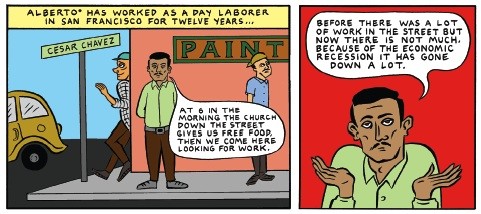
I loved the “Sit, Lie, Get Deported” comic strip that merges photos with hand-drawn illustrations and uses the actual words of politicians, city officials, activists and gadflies to help illustrate its point.

And I’m still trying to finish the crossword. In fact,  I plan to read the SFPP’s first printedition from front to back over the July 4 holiday weekend, when I’ll have the time to really absorb and enjoy it.

“Ideally, news will appear in print first, then online, so there’s interest in seeking out the print edition,” Lahood told me, noting that the Public Press’ first edition amounts to about 70,000 words. “So, it a novel, in length,” Lahood laughed. “People are, if not starving, at least very hungry for news analysis and investigative reporting. There are a lot of online sites that aggregate other publications content, and then there’s the corporate model of the Chronicle, but while there is some good reporting in town, there are fewer reporters.”

No kidding. All the more reason for this reporter to write an online defense of print, in the hope that you rush out to secure your copy of the Public Press’s first print edition and evaluate this new model of journalism. I think you’ll be glad you did.

Fiscal solidarity

0

OPINION As Mayor Gavin Newsom prepares to skip town for the bleak limelight of Sacramento, he has left a resounding parting shot with massive budget cuts to those San Franciscans most in need of public aid: seniors, youth, homeless people, folks with mental illnesses, health clinic patients … the list goes on.

Newsom has balanced his final budget (and his campaign for lieutenant governor) largely on the backs of the poor, working-class, multiracial, and immigrant San Franciscans, as well as the nonprofits and city workers who deliver vital services.

The Newsom budget actually adds costs: by cutting services for the treatment and prevention of substance abuse and for youth crime prevention and supportive housing, for instance, it destabilizes lives and forces people right back into the treatment systems that are being cut — adding new human and fiscal costs.

"Every cut has a constituency," Newsom’s PR people say repeatedly. And that’s precisely what the mayor is counting on — that each "constituency" will fight on its own, for its own fiscal scraps. He’s wrong.

As members of a broad coalition of community and neighborhood-based organizations, labor unions, and civic leaders and residents across the city, we stand together in opposition to Newsom’s cuts-only budget and his attempts to divide "constituencies."

Fiscal solidarity means we recognize that an injury to one is an injury to all. "Constituencies" are in fact people whose lives cut across multiple budget line items. Cutting city parks is also a senior issue, as well as a youth issue. Closing mental health programs for the poor is not only an unnecessary moral outrage — it’s a public health and safety issue.

As members and supporters of unions and nonprofits, which are sometimes pit against each other in budget cut wars, we declare mutual support. The mayor’s cuts will mean drastically reduced services for those who need them most and deep staff cuts for city employees and nonprofit workers. We may work for different institutions under different budget line-items, but we’re fighting together as one community — one big "constituency."

Budget wars artificially divide communities that overlap and intermingle. Expressions of unity are put to the test by the budget "add-back" process that forces community groups to scuffle for scraps of cash — groups serving populations in critical need are set against each other, and whole communities are reduced to line-items.

We’re standing against fiscal wedge politics and demanding a real alternative. The budget must protect those most in need and be balanced by cutting first from the top instead of the bottom.

We are united for solutions — progressive tax measures on key wealth sectors that can and must pay their fair share to keep San Francisco the beautiful, thriving, diverse, and culturally rich city it is. We’re standing up for the city Newsom’s leaving, for the communities he’s cutting, and for progressive revenue — a tax to make downtown hotels pay their fair share, and a gross receipts tax on large businesses for starters.

Mayor Newsom: if you cut one of us, you cut us all.

This statement was signed by Christopher Cook, Budget Justice Coalition; Gabriel Haaland, SEIU 1021*; Gordon Mar, Jobs with Justice*; Eric Quezada, Dolores Street Community Services*; N’Tanya Lee, Coleman Advocates for Children and Youth*; Jennifer Friedenbach, Coalition on Homelessness; Guiliana Milanese, Jobs with Justice*; Christina Olague, Senior Action Network*; Sheila Tully, California Faculty Association, SF State*; Chelsea Boilard, Coleman Advocates for Children and Youth*; Joseph Smooke, Bernal Heights Neighborhood Center*; Carl Finamore, delegate, SF Labor Council*

* names for ID purposes only

SF Human Services Agency occupied

7

“Human Services Agency occupied” was one of the premier tweets on the streets of San Francisco this afternoon, as members of Direct Action to Stop the Cuts DASC) occupied 170 Otis Street to pressure the city to find an adequate place to house sixty homeless people displaced by the closure of the night shelter at 150 Otis.

Folks with DASC reportedly say they applaud the fact that this shelter is slated to be converted into permanent housing for homeless veterans in 2012, but condemn that nearly five dozen people are being pushed onto the streets tonight. Stay tuned.

Kim launches D6 campaign, stressing independence from “machine” politics

45

Jane Kim launched her campaign for the District 6 seat on the Board of Supervisors last night during a spirited event at 111 Minna, showcasing some high-profile supporters and giving a speech that began with touting her early work on immigrant rights and homeless issues and ended with the declaration, “I’m not part of anyone’s machine and I’m certainly not a part of anyone’s master plan.”

That emphasis on her independence could be seen as a subtle dig at Debra Walker, another progressive who has been running for the seat for the last two years, who locked down early support from many progressive groups and officials, and whose supporters were unhappy with Kim’s late decision to enter the race, concerned it might split the vote and allow downtown-backed Theresa Sparks — who could be viewed as a “machine” candidate on the other end of the political spectrum — to steal the seat for the moderates.

When I asked what “machine” she meant and whether the comment was a reference to Walker’s supporters, Kim wouldn’t clarify the comment, refusing to criticize the Walker campaign and saying only, “I want to be a part of a new political process.”

And that new process seems to rely heavily on the energy of young people, including many of color, who dominated the crowd last night. Kim also signaled that she will be pushing a fairly bold progressive agenda that includes more city support for schools, Muni, immigrants, and low-income families, and making the streets more vibrant and democratic.

“The mantra of our campaign is to make our neighborhoods complete,” Kim said.

She proposed making substantial pedestian and bicycle improvements on several streets in her district, including 2nd, Folsom, Taylor, and Turk streets, creating more bikes lanes that are separated from car traffic, and turning many of the alleys in her district into more active public spaces. She called for the city to help fund youth programs and a longer school year and to offer more support to small businesses, which she called the city’s most important job generator.

Kim, a civil rights attorney and president of the school board, also emphasized the need to improve the tone of political debate in the city, which she helped accomplish on the school board (whose vice president, Hydra Mendoza, an employee of Mayor Gavin Newsom, was there in support). “People are disillusioned and disappointed with the process and the bickering,” Kim said.

Among Kim’s supporters at the event were Board of Supervisors President David Chiu, former Mayor Art Agnos, filmmaker Kevin Epps, Police Commissioner and immigrant rights activist Angela Chan, transportation activist Dave Synder, and representatives from a wide variety of community groups.

“She has epitomized the progressive values that I think all of San Francisco shares,” Chiu told the crowd, later adding, “She will be a part of the next generation of political leaders of San Francisco.”

“I’m really proud that Jane has put herself out there as a future leader and our supervisor,” said Epps, later adding, “I think Jane really has her ear to the streets.”

Kim pledged to run a clean campaign focused on her issues, and her only supporter to voice overt criticism of Walker was Agnos, who said he was impressed with Kim’s work with him last year in fighting Prop. D, which would have removed mid-Market from the city ban on new billboards, a measure that Walker supported.

“Prop. D for me was a tipping point, and Debra went with the commercial interests,” Agnos told the Guardian.

But Kim, 32, says her reason for running is to help push a progressive vision for the city and bring new blood into the political process.

“I have to tell you, I never wanted to go into politics,” she told the crowd. “But I had the desire to see some real change.”

25 ideas for our queer future

1

What does the future hold in store for us? In an age of mainstream assimilation and aspiration, is there even such a thing as the queer future? We asked 25 queer leaders, artists, and activists to offer visions in their areas of expertise. The results — philosophical, poetic, practical, and priceless — are inspiring. One thing’s for sure, we’ll never lose our creative spark. Nor will we lose our motivational zeal. Fate is for the lazy: take action now. (Marke B.)

>>Click here for ideas from our amazing 2010 Hot Pink List

>>Click here for our Pride listings, and get out there!

THE FUTURE OF QUEER ACTIVISM We need to take back the power and stop being led by what the other side is doing. We need to empower ourselves enough so that we are no longer reacting but acting. We must use online social networks the way we used the streets and bullhorns to show our strength, speak out against wrongdoing, change minds, and win back our rights. We also must unite with our allies in other communities that are underrepresented and maligned in much of the same ways we are. When we stand with one another, we have that much stronger a voice.

Kelly Rivera Hart is the founder of Poz Activists Network (pansf.blogspot.com).

THE FUTURE OF QUEER COMMUNITY The difference between straight and gay cultures seems to be breaking down more and more, which is one of our goals, but we still need to support our own businesses, nonprofits, and leaders. We need to continue interacting with each other in the real world and not lose sight of who we are and what we share. Despite how the rest of the world sees us, there is still a lot of loneliness and isolation in the queer community. I think many of us have forgotten even simple things, like how to make actual friends, not just online. And it’s so easy! Renewing that spirit of interaction, freeing ourselves from fear of judgment, and moving outside our “safe zone” can lead to the greatest rewards.

Mark Rhoades is a charitable event planner and fundraiser who throws the annual Cupid’s Back and City Hall Pride parties.

THE FUTURE OF QUEER FASHION The past decade has witnessed an obsession with bulky, voluminous silhouettes disguised as “futuristic avant-garde” and inspired by GaGa and the ’80s. Let’s move on. Through clean lines, elegance, and wearable pieces, the future of queer fashion will shine light on socially relevant issues like bottom shame, positive-negative status reinforcement, and elite subcultures by using gay textiles and forgotten, non-era-specific imagery.

Allán Herrera is the design head of fashion house Homo Atelier (www.homoatelier.com) and a founder of HomoChic (www.homochic.com).

THE FUTURE OF QUEER FILM Future queer film will depend on the gays being at the forefront of distribution technology in the same way we pioneered social networking 15 years ago, spreading provocative and sexually honest/explicit films beyond the film festival circuit and toward a global audience. Special attention must be paid to the creeping homophobia of cultural and technological juggernauts like Apple. Our stories will need to bust through the pigeonhole, weaving our traditional themes (AIDS, coming-of-age) into larger storylines that are relevant to multicultural and transcontinental viewers.

Leo Herrera is a video artist, filmmaker, and a founder of HomoChic (www.homochic.com).

THE FUTURE OF QUEER YOUTH To be a true leader, one must envision the future. The future is a diverse society where LGBTQQ youth are embraced for who they are and encouraged to be who they want to be. In my pursuit for LGBTQQ youth rights, leadership has been about fostering the awareness in LGBTQQ young people about their own power as individuals and as a group, supporting them to access, develop, and master the skills and knowledge they need to transform their power into action, and building bridges to opportunities where their action can create just communities.

Jodi Schwartz is the executive director of LYRIC Lavender Youth Recreation and Information Center (www.lyric.org).

THE FUTURE OF QUEER LABOR Storm of protest drives Congress to pass trans-inclusive ENDA! Support by labor unions critical to passage of this landmark legislation. Screaming, “We’re too queer for this bullshit!” workers hold drag-runway picket lines at transphobic companies across the country. Activists redefine the crisis of trans poverty and unemployment as the most critical queer civil rights issue of our time.

Bad hotel boycott forces Hyatt to sign a fair contract and treat their employees with respect. LGBTQ organizations rally with labor unions for immigration reform, hold signs reading “No borders on my cunt, no border on our countries!

Jane Martin is a queer labor activist and community organizer with SF Pride at Work (www.sfprideatwork.org).

THE FUTURE OF QUEER DRAG (PART ONE) My vision for the future of queer drag requires you to take a moment, stop, look, and listen to our past. We have such a rich history of fierce and amazing queens to learn from. The key is to get involved with a queer family that supports and loves you and what you do. Next, figure out your niche — whether it’s high drag or low camp, just be sure to always do it like you don’t need the money! Then pull it together and serve it up with lots of love and generosity. And, of course, top it all off with a fabulous wig!

Juanita More! (www.juanitamore.com) is the queen. Attend her boisterous Pride party on Sun/27 (see Pride listings), benefiting Bay Area Young Positives (www.baypositives.org).

THE FUTURE OF QUEER DRAG (PART TWO) Meg Whitman will become president of the United States and hire Lady Bunny as one of her speech writers. Oprah and Gayle will finally come out, and gender illusionist shows will dominate the OWN Network — every other channel will follow. In 2050, Heklina will clone herself, twice, and perform the hospital-convalescent home circuit as the Del Rubio Triplets. Apple will come out with a product called the iDrag, that transforms anyone into anything.

Fudgie Frottage is the king. He puts on the annual, wonderful SF Drag King Contest (www.sfdragkingcontest.com).

THE FUTURE OF QUEER DANCE FLOORS Lets start with a nice, clean piece of paper. Black paper. A clean slate. Say, for example, a deliriously rich and tasteful daddy were to buy the Stud. Step one: a deep, five-stage gay cleaning. Step two: gut the interior, maybe keep the bar and choo-choo train intact, they are cute. Otherwise keep it simple. Step three: install an exact copy of the sound system used by Dave Mancuso at the Loft parties in New York City. The tasteful daddy would have a matte gray private jet at our disposal to bring guests of our choosing. For the launch party we would have an all Kenny line-up: Kenny Dixon Jr., Kenny Hawkes, Kenny Carpenter, and Ken Collier (back from the dead) would DJ. Live PA by Kenny Bobien. Oh, and Kenny Kenny on the door. At the end, everyone would get together and cry like they do on those exploitative renovation reality shows. Daddy would miss the ribbon-cutting, but that’s OK — he sent flowers and bought an $80 Diptyque candle for the new bathroom. That would be a good start.

Honey Soundsystem is a future-past DJ collective. Catch the old-school house Honey Pride party on Sun/27 (see Pride listings).

THE FUTURE OF QUEER COMEDY The future is here. And now that gay marriage is mandatory for everyone, queer and straight, the same goes for comedy. All comedians, regardless of sexual orientation, are now required to do at least 75 percent queer comedy in their acts unless they obtain Permit No. 758219B through the Comedy Board, allowing for the special provision to do only 50 percent queer material. That’s right: comedy is now regulated by law. No jokes are allowed to have homophobic content, especially if you’re performing for tourists. Remember, you are ambassadors now. If you’re straight and have no queer material, just ask your aunt or your second cousin or your bachelor uncle whose best friend of 40 years, Bruce, comes to all the family functions.

Lisa Geduldig (www.koshercomedy.com) is a comic and MC who puts on such shows as Kung Pao Kosher Comedy, Funny Girlz, and Comedy Returns to El Rio!

THE FUTURE OF QUEER HOUSING It is beyond time for us queers to focus our fabulous and substantial God-given talents toward a vision of the future of queer housing. We are the trailblazers, the social entrepreneurs, the avant-garde. Imagining and creating the future is what we do best. Let’s put those substantial talents to work to realize our very own “No Place Like Home” dream of a home for our LGBT elders, our homeless LGBT youth, our people with HIV/AIDS, our artists, our activists, and everything in between. I’ll show you mine: the largest affordable housing for people with HIV/AIDS in the nation next to the Castro Theater and an LGBT homeless shelter at Geary and Polk. Now you show me yours.

Brian Basinger is the director of AIDS Housing Alliance/SF (www.ahasf.org).

THE FUTURE OF QUEER COMICS The future of LGBT comics will be about creators moving out of the traditional queer media ghetto and into new digital undergrounds, indie markets, and even the publishing mainstream. Web comics, graphic novels, minicomics, and zines … Queer comics will have to continue to diversify their formats to survive. At the core, though, remains the need to tell good stories! Look for more poignant narratives about the intersection of queer identities and the human condition. Also, robo-dykes, super-powered trannies, bisexual Lotharios, and zombie fags!

Justin Hall, a queer and erotic comics artist, runs All Thumbs Press (www.allthumbspress.com).

THE FUTURE OF QUEER LAW We would like to see the law catch up with the reality of transgender lives. Your gender identity is an innate and deeply felt sense of who you are. Whether you feel male, female, both, or neither, we envision a future where your legal gender will be exclusively determined by you and not by doctors or lawyers. By respecting your autonomy and your ability to know yourselves better than anyone else, the law will finally reflect society at large. The law is not far from fully recognizing that fact of life, but there is still work to be done. So break out your queer legal briefs and join in the fight for transgender civil rights!

Executive Director Masen Davis and the staff of the Transgender Law Center (www.transgenderlawcenter.org)

THE FUTURE OF QUEER SPIRIT As I look toward the future, I want to see the consciousness shift that Harry Hay and other gay pioneers were pushing for manifest itself more fully in both the gay culture and the larger hetero culture. As queer liberationists, we’ve already taught the world that we are a people. I want to see us recognized as always having been a people. I want to see us given the opportunity to cocreate a new, more beautiful world. To paraphrase: what if there were no “faggots,” only master healers, teachers, shamans? I hope to see the end of shame.

Zac Benfield is the president of the radical faerie Church of Nomenus. Attend his “Woo 101 for Hipster Faggots” workshop, part of the Faetopia Festival (See “Ongoing” in our Pride listings)

THE FUTURE OF QUEER SCIENCE

The alien scientist pipettes liquid
Into a flask to be shaken vigorously.
The origins of gay life.

On Earth, planets align, exposing
Realities once thought to be utterly impossible:
Gays are outta this world!

Queer scientists make the future
Always brighter, cleaner, sexier, and more fabulous
Stopping only for a cocktail.

Quietly, the gay scientist works,
Inching closer to the final answer that
Will change the world forever.

In the future of science
We see the world with different eyes,
All judged by ability alone.

Chris Waddling is a PhD scientist at UCSF.

THE FUTURE OF THE QUEER PAST The future of the queer past has always been fragile — and despite some positive developments in the past 25 years, it remains fragile today. The legacy of LGBT people is still largely invisible in the settings where our society formalizes its history. Our stories are rarely told in high school classrooms, in the galleries of museums, on the plaques of public monuments. Supporting the efforts and the growth of such organizations as the GLBT Historical Society and other pioneering queer history institutions will be key to ensuring that the memory of LGBT lives, struggles, setbacks, and triumphs can inform and inspire future generations.

Writer, editor, and antiquarian book dealer Gerard Koskovich is a founding member of the GLBT Historical Society and a member of the board of directors of the Mémorial de la Déportation Homosexuelle, a French national group that commemorates the homosexual victims of the Nazis.

THE FUTURE OF THE QUEER FUTURE My future selves are always popping back from the year 2023 or 2034 for the weekend, mostly because they know I’ll be their sex slave. They remember what 2010-me was like. (And apparently in the mid-2020s, time-traveling self-flagellation becomes a big fetish.) They’re not supposed to tell me anything about The Future, but they let slip wee details here and there — the 20-teens are a troubling time, but then we discover queer telepathy, and everybody starts secreting empathy endorphins and building communal gardens in the upper atmosphere. Hang in there until we get the first queer president, they always say. Once she comes out during her second term, that’s when the government really starts building something.

Charlie Anders is the managing editor of science fiction-forward site io9.com

Editor’s Notes

1

marke@sfbg.com

The official theme for Pride this year is “40 and Fabulous.” So let’s all grab an organic cocktail and strap ourselves in for a good ol’-fashioned midlife crisis!

Some of us have already had some practice. Many gays long ago traded in cracked and hectoring first wife Madonna for trophy floozy Lady Gaga, raced around town in those sleek Miata MX-5 convertibles, and reached for the HyperGain. (Don’t get me started on lesbians and Justin Bieber here.)

But for queers of a more radical bent, it’s an opportunity to take stock of the past and wonder about the future — despite the fact that 40 is the new 20, at least in online marketing campaigns. Branding, darling, branding.

Or maybe that’s boring. Yes, we could lament the commercialization of Pride and kvetch that all our resources have been poured into trying to secure property rights through state-sanctioned social contracts and the chance to invade the wrong country, causing the unnecessary deaths of thousands. We could be awestruck by the amazing power and inspiration of our queer youth, despite the fact that hundreds of them become homeless every year. We could honor and celebrate the heroism of our elders, even while they’re pushed to the margins and out of their apartments.

But doing all that means sitting on our collective asses. Isn’t the whole point of a midlife crisis to change everything before it’s too late? Maybe, due to political expediency and because it makes us more acceptable to society, we’ve allowed queerness to become defined as something we are, rather than something we do. I’m not saying many of us aren’t born “that way” (or denying the social legitimacy that fact, apparently, confers). But what the hell are we doing? Fine. We’re fabulous. Now let’s fix things.


Why Newsom loves sit-lie

43

To the surprise of exactly nobody, Mayor Gavin Newsom is putting his sit-lie law on the November ballot. And I think he’s thrilled about it.


The last thing the mayor wanted was to have the supervisors approve its own version. He’d much rather have his name on it. This way, he not only gets a wedge issue to attack the progressives in the fall; he gets to run his statewide campaign as someone who’s cracking down on the homeless. It’s tough for a San Francisco politician to win in more conservative parts of the state — but if he can say he stood up to those crazy “ultra-liberals” on the board and is willing to beat up on the poor and homeless, he can shed some of that liberal image.


But it’s not clear that the strategy will work at home. Even David Latterman, a political consultant for Scott Wiener and other downtown-backed candidates, downplayed the role that sit-lie will play in the fall election. “It’s just a wedge issue and it’s not going to change people’s minds on who they support,” Latterman told a crowd that including Chron columnist CW Nevius — who is perhaps the most enthusiastic backer of the measure — during a post-election wrapup at SPUR on June 10.


And among the DCCC candidates in this election, the only one to really champion sit-lie and make it a part of his campaign was David Villa-Lobos, who is also running to replace Chris Daly on the Board of Supervisors, but who finished 26th out of 30 candidates in District 12.


The law also seems a little hinky. It would ban sitting on the sidewalk — or “any object placed on the sidewalk, like a crate or folding chair,” according to the Chron. Everywhere I go in the city these days, people are sitting on folding chairs on the sidewalk — typically eating at a restaurant or cafe that has outdoor seating. I suspect many of those eateries have no specific permits to put chairs on the sidewalk; they just do it, which is fine, and nobody minds.


But technically, I guess, outdoor diners could be cited under the mayor’s law. Or the cops could just ignore them, and decide how and where to enforce the law. Which is never a good thing.


I asked the mayor’s press office for clarification on this point, and I’m still waiting for a response.

Arizona getting you down? Here’s some activist inspiration.

0

Two things I learned about Rosario Dawson last night:

  1. When she was little, she spent time living in a San Francisco squat with her “free spirited” mother.

  2. She’s heading up one of the most important non partisan political organizations in the country.

Dawson was honored with a Redford Center “Art of Activism” award at the Sundance Kabuki Theaters last night — and definitely not (should I feel bad saying this?) because she is the kind of natural beauty that made the host of the program and other honorees stutter through their on stage exchanges with her.

Voto Latino is an organization that was co founded by Dawson, Maria Teresa Kumar, and Brandon Hernandez as a way to encourage Latino participation in democracy. Which, given all this insanity in the aftermath of Arizona’s Senate Bill 1070, strikes me as what’s been missing in the back and forth vitrol; what it means to the people that it explicitly denegrates.

Dawson told the Art in Activism audience last night that her group’s mission is to take back the immigration issue from the divide and separate tactics of conservatives. Voto Latino’s anti 1070 ad campaign, which is slated to debut on national televisions shortly, is “about us together,” says the actress-activist. Privileged or not, she emphasived, we’ve all gotten to where we are today based on the labor of our community, even gorgeous movie stars.

The organization has been a pioneer in young Latino involvement in politics. They put together one of the first text message based political campaign in 2006, sent Latino youth to report on the 2008 party conventions that the young people identified as important to them, and have produced a tongue in cheek telenovela series, La Pasión de la Desición, that interjects talk of voter registration into the florid embraces of the popular genre. To combat the negative messaging of Arizona’s legislation, Dawson says they’ll be assembling an online map of the country where Latinos can publish their stories, becoming visible in a debate that often leaves out their voice.

Rosario Dawson and Wilmer Valdarama star in an episode of Voto Latino’s La Pasión de la Desición

So yay, Rosario’s awesome. We’re all awesome.

Although I must say, some of us may be extra-super awesome. Dawson was definitely upstaged last night by another one of the evening’s honorees; East Oakland’s Mandela Food Co-op worker-owner (and last week’s SFBG interviewee), the inspirational James Berk.

Berk, wearing a crisp suit and glasses, took a no-nonsense approach to a ceremony that at times ran dangerously close to hyperbole. It was immensely refreshing, especially when the 19 year old cautioned the audience not to regard him as an anomaly in the social activism field on account of his youth (Dawson took the moment to compare his struggle to hers with the media’s insistence that celebrities are different from us in some way, evoking about zero sympathy on my part. Still love you, Rosario!).

In all the labored modesty of the evening, Berk came across as a man who knows the worth of what he and his team have been able to accomplish. This is a guy who has gone from a malnourished teen whose neighborhood’s sole food sources were the corner store’s nutritional garbage, to the co owner of a place that sells low cost, fresh local food to his neighbors.

When asked what he wanted the people sitting out in the audience to take away from the night of awe inspiring activist stories, he took a moment to fully gauge what he was about to say. When he spoke, his message was clear. “Don’t forget. And don’t forget my name,” he said. Unsure about what to do to make change in this country? Look to our true leaders, people; Berk’s not.

P.S. Definitely not trying to forget the night’s other honoree, Martha Ryan. Ryan, a nurse who had never headed up her own program, started the Homeless Prenatal Program for at risk women and their families. Half of her staff is comprised of women that were once in the program.

Sit /lie goes down at the Board of Supervisors

At the June 8 Board of Supervisors meeting, a controversial ordinance that sought to ban sitting or lying down on the sidewalk was voted down 8 to 3, with Sups. Michela Alito-Pier, Sean Elsbernd, and Carmen Chu voting in favor.

Proponents of the law, which was backed by Mayor Gavin Newsom and Police Chief George Gascon, framed it as a measure to promote “civil sidewalks.” Yet opponents believed that the law would be used as a tool against the homeless.

Alioto-Pier said the law was needed to give police a new tool for dealing with people who congregate on the streets and intimidate passersby, saying residents and businesses were bothered by “the presence of dogs or shouting.”

Yet a number of supervisors spoke forcefully against the ordinance, saying it was not an appropriate solution to the problems that Alioto-Pier and other sit/lie backers had raised concerns about.

“I don’t believe that this is the San Francisco way to to approach the challenges that we face,” said District 8 Sup. Bevan Dufty, who goes along with Newsom’s proposals more often than his progressive colleagues and is typically a swing vote on the board. Dufty referenced a former, similar San Francisco law that was ultimately repealed. “That was a law that didn’t want to see gay men congregating at 1 a.m. outside a bar,” he said. He called for a more substantive approach, saying, “We can do better.”

Sup. David Campos also spoke against it. “It doesn’t actually address the issue of civility,” he said. “The case for this legislation simply has not been made.” He noted that day laborers who wait for hours on the sidewalk in hopes of finding work could be targeted when they sit down to take a rest.

Sup. Ross Mirkarimi said he thought greater enforcement of existing laws and community policing would be more effective than the proposed ordinance. Later in the meeting, he proposed a measure to be placed on the November ballot that would require police to adopt a foot beat patrol program and a community policing policy.

The board also voted unanimously in favor of a proposal by Board President David Chiu to create a neighborhood community justice task force “to make recommendations to the Board of Supervisors regarding the creation of restorative and community justice programs.” Chiu pitched the idea as a more meaningful response to hostile behavior on the streets in neighborhoods such as the Haight, where calls for a sit /lie ordinance originated.

“We’re very pleased about what happened today,” said Andy Blue, an activist who organized a citywide campaign opposing sit / lie. But he said it wasn’t over yet, since Newsom has already moved to place the proposal on the ballot. “We know we’re going to face an uphill battle,” he said, “because we’re going to be in a campaign with some very well-funded opponents.” But Blue said he felt confident that once the information got out to San Franciscans, “they’ll vote against it in November.”


Whirl trade center

0

arts@sfbg.com

VISUAL ART In 2005, then-struggling Atlanta artist Fahamu Pecou presented “Arts, Beats and Lyrics” at Atlanta’s High Museum of Art. The oversize paintings were blinged-out-mack-daddy-baller self-portraits showing the artist on the covers of well-known and respected magazines. Within two years, his work had been reviewed and featured in numerous publications, including Art In America, Harper’s, NY Arts, Mass Appeal, and The Fader. The sheer voodoo of this act makes Pecou a formidable creative force, and coupled with his knack for spectacle, his opening at Shooting Gallery this month is rumored to be the most vainglorious of the season. I caught up with him recently on the phone.

SFBG I’m amazed by your earlier work because it seems to me that you used sympathetic magic to approach fame. You placed yourself within the context of celebrity and became a celebrity. Was that your original intention?

Fahamu Pecou It’s funny. It was kind of like the law of attraction. You can write your own narrative by believing in the messages you put out. I started doing this marketing campaign because I was frustrated with the way my career was going at the time. I really just wanted to get my name out there. Just my name. I wanted to make sure that when my name came across the desk of curator or gallery owner, they’d say, “I’ve seen this name before, maybe I should learn more about this person.” It was really sort of a joke. As it started to grow and people began to talk about it, it took on a life of its own.

SFBG Did you anticipate that it would go beyond Atlanta and become international?

FP No. It was just a clever, catchy inside joke among me and my friends. The minute I started putting out stickers and posters that said “Fahamu Pecou Is The Shit,” it was a hit. People were jumping on it. It was good that it happened that way because it allowed me to grow with it. Whether I can directly relate it to a specific style, I’ll leave that for people to write about.

SFBG Why did you call your latest show “Whirl Trade”?

FP The theme came from the idea of cultural exchanges between Africans on the continent of Africa and the rest of the African diaspora around the world, and how a lot can be lost and misconstrued when taken out of the original cultural context. We look back and forth at each other, and we do what we think is our best impression of “the other.” It comes out a twisted up and strange simulation.

I was in South Africa for residency on the Eastern Cape and spent some time in Capetown. I had a friend from Detroit with me, and a few friends from Capetown. We were coming out a restaurant and this homeless guy heard me and my homeboy talking. He said, “You guys are from America? You guys are the real niggas.”

We were both like, “Naw man, we aren’t niggers, we’re brothers.” And he said, “No. No, you guys are niggas, and I want to be a nigga too.” He was going on and on about how being a nigga was a good thing, not like these guys who come in from Nigeria and other places thinking they’re real niggas. We were the real deal. And here we are, trying to explain to him how being a nigga is not a good thing. Nobody wants to be a nigga. My Capetown friends were telling me that being a nigga is not a bad thing anymore. I started wondering, where did this come from? That’s what “Whirl Trade” is about: the cultural export of hip-hop culture and the impact it has on the rest of the world. We have this great stage, this platform, where we have the ear of the world. What are we saying? A lot of what’s being said and heard is a lot of nothing, especially when taken out of cultural context.

The response has been great and has sparked a lot of conversation around how we view ourselves and each other. What kind of impression we are making of ourselves to other cultures and, deeper still, what kind of impression do I have about African culture through this same context and my own experience? I couldn’t ask one question without asking the other. I try to be cautious about this in my work. I’m not trying to accuse or ridicule any group so much as begin to ask questions and start a dialogue between groups who think they know each other but don’t.

SFBG You do performances at your gallery shows. Costumes and everything. How does fashion play into your work?

FP In the beginning, it was more about capturing fashion that reflected a whole lifestyle. I patterned it after 50 Cent, who was the catalyst for my whole campaign. I was watching how he was packaged and wondering why a visual artist was never marketed that way. My whole fashion was based on that and Puff Daddy. Then I added my own touches with ascots and blazers and stuff like that.

With “Whirl Trade,” I’m looking at contemporary African fashion. Right now, African street fashion is a mashup of textiles and patterns, colors that almost seem disparate but come together beautifully. That and photographs of Malik Sadibe inspired me to bring in many different patterns and contrasts. It wasn’t that I was trying to copy a style as much as capture the cultural exchange between what Africans think African Americans dress like, and what African Americans think Africans dress like.

SFBG Though you reference hip-hop, I don’t really see you as a hip-hop artist. I sense a cynicism in your approach. Are you disillusioned with hip-hop?

FP I just found myself not so connected to what was being presented in early 2000s. A lot of media-made hip-hop stars came out. It stopped being so much about talent as it was marketing. It became about who was willing to come out and say they sold these drugs or did this killing. At one point that was legitimate, rappers came from the street, but then came these media guys who just said that shit to be famous, just for credibility and that’s what started hurting the integrity of the form.

It stopped being how fresh, how clever or how innovative an artist could be. It became how violent, how misogynistic, how violent a person could be. Extremes of everything — people ended being blaxploitation characters.

I’m talking about that in my next work, called “Hard To Death” — about the evolution of black manhood, and how there’s a lack of visual representation of that evolution beyond a certain point. Most of the images we see are reflections of hip-hop culture, which captures the black male between the ages of 18-25, just when many young men are working things out. It has become one of the only representations of black masculinity, which is very frustrating. My next piece is devoted to accurately portraying the evolution of black men. I’m seeing more established artists like Common and Jay-Z who have grown beyond that dangerous time.

Since my son was born, I’ve been really driven to addressing these issues around black masculinity and black manhood. I feel a sense of responsibility there because my work crosses the lines between popular culture and hip-hop culture, and I see that there’s a lack of responsible voices. My voice can work as a catalyst to start a conversation. I started a blog (passageofright.wordpress.com) to begin talking about creating systems for some kinds of rites of passage for young black boys. I didn’t grow up with a father or a whole lot of role models, so most of what I’ve learned about being a man is from the school of hard knocks. I want to prevent the continuation of that kind of awakening.

WHIRL TRADE: NEW WORKS BY FAHAMU PECOU

Reception Sat/12, 7–11 p.m.;

Through July 3

Shooting Gallery

839 Larkin, SF

(415) 931-1500

www.shootinggallerysf.com

www.fahamupecouart.com

Cutting from the bottom

7

By Alex Emslie

news@sfbg.com

When Mayor Gavin Newsom unveiled his proposed city budget on June 1, he downplayed the severity of cuts to the city’s Department of Public Health, noting that they amounted to less than 2 percent. But if Newsom’s uneven program chopping becomes a reality, critical social services for some of San Francisco’s poorest and most vulnerable residents will be cut by almost one-third.

The DPH was able to shrink its budget by nearly $31 million, according to a budget proposal currently before the Board of Supervisors, in part by slashing community nonprofit clinics providing outpatient mental health services to some of San Francisco’s most difficult to treat mental health cases.

“It’s very possible you could see more people who are homeless, people who are homeless not getting as much care — they’ll be sicker,” said Dr. Eric Woodard, medical director of psychiatric emergency services at San Francisco General Hospital. “And you could reasonably expect more deaths on the street to occur.”

State and federal matching funding to the DPH dwarfs the amount of money the department receives from the city. What isn’t spelled out in Newsom’s budget is that every dollar cut by the city results in more than another dollar lost in federal funding for social services.

The DPH proposed a nearly 9 percent cut to outpatient community-based health services, and an 11 percent cut to residential inpatient services to meet the mayor’s request that all city departments submit a 30 percent budget reduction to his office. Newsom reversed the proposed cuts to residential services but kept the outpatient cuts.

“I believe in the efficacy of residential [treatment],” Newsom said during his budget unveiling. “I believe there are a lot of question marks around outpatient drug treatment.”

But the cuts affect more than just outpatient drug treatment. While many of the clinics that were cut focus on treating mental illnesses, they are funded through the DPH category that includes substance abuse treatment. Newsom’s office declined to answer our inquiries about the reasons for and implications of his cuts, referring us to DPH.

Walden House CEO Vitka Eisen, whose organization serves people suffering from mental illness and substance abuse in inpatient and outpatient clinics, said she was relieved that residential funding was added back. However, she is concerned about the proposed $4.1 million cut spread across several nonprofit outpatient services.

“There’s a very large cut to outpatient services citywide, and that’s obviously problematic because outpatient services are an important part of our system of care in the city,” she told the Guardian. “You can’t really cut one or the other.”

DPH Community Behavioral Health Services Director Dr. Robert Cabaj is hoping the Board of Supervisors will restore some of the cuts to outpatient clinics. “Unfortunately, they [the Mayor’s Office] left these in,” he told the Guardian. “I’m not sure why — I’m not sure what the mayor was thinking at the time.”

Citywide Case Management and Community Focus, an outpatient clinic serving some of San Francisco’s most severely mentally ill, is one of the hardest hit nonprofit clinics in the mayor’s proposed budget. The agency will lose $1.22 in federal funding for every $1 cut from the city, division director Dr. David Fariello said.

That’s how its 15 percent, $1.3 million cut proposed by the DPH and accepted by the mayor, ballooned into a 33 percent, $2.8 million loss for one of the city’s most comprehensive and best-performing community behavioral health services.

Citywide, at 982 Mission St., boasts the facilities, network, and location to serve one of San Francisco’s most vulnerable populations. The typical Citywide client suffers from schizophrenia, bipolar disorder, borderline personality disorder, or severe depression. They are likely homeless, grappling with substance abuse, and many have posttraumatic stress disorder.

Citywide employees, doctors, and administrators, as well as physicians from outside the clinic, speculate that cutting outpatient mental health services in a city with one of the highest per capita populations of mentally ill homeless people will ultimately cost the city more money than it saves now. Use of expensive city services like psychiatric emergency rooms, jails, police, and ambulance could all rise.

“Frankly, a lot of these budget cuts do not seem to be very well thought out in terms of what the real cost is going to be,” Woodard said. “If you look into the not very distant future, you’re going to incur costs that are probably much greater than your savings were initially by making the cuts.”

Cabaj said that past funding cuts haven’t resulted in higher use of psychiatric emergency services because the DPH prioritizes funding for the most severe cases and screens for those who could possibly be moved into cheaper services. Citywide clients are consistently high users of San Francisco General Hospital acute inpatient psychiatric care, at an average cost to the city of $1,200 per patient, per day, if they don’t have insurance or Medical benefits.

Many end up in costly in-patient psychiatric care facilities or are arrested and land in the city’s Behavioral Health Court, which hears cases in which defendants have been diagnosed with a mental illness that is suspected of being a factor in their crime. More than 70 percent of the Behavioral Health Court’s mandated treatment slots are at Citywide.

“We can manage behaviors that get people thrown out of every other clinic in the city,” Fariello said. “Where is that capacity going to be picked up? These are not clients who, if they don’t get treatment, maybe their doctor will give them some medicine and it’ll be OK. These are clients who are going to continue to be high users unless we intervene.”

Citywide figures show a 40 percent decrease in violent reoffenses for clients referred to their clinic from the Behavioral Health Court. Nearly three-quarters who were homeless are able to maintain housing, and more than 25 percent of clients who were frequent users of inpatient psychiatric services have stayed out of the hospital.

“Citywide really is one of the best,” said Woodard, who works with Citywide’s Linkage Team to stabilize patients from SFGH’s psychiatric emergency room. “They provide excellent care for these really fragile, very ill patients. I would say of the community programs, they’re really at the top of the list.”

Fariello estimates having to reduce the 1,035 clients receiving treatment at his clinic by 400 if the cuts are finalized. He may have to scale back some of his clinic’s innovative and successful categories of service — such as employment support and dialectical behavioral therapy, a highly specialized form of therapy with proven success in treating borderline personality disorder. Citywide has the largest DBT team in San Francisco.

Citywide administrators are baffled by DPH’s decision-making process, given that it serves the city’s sickest, poorest, and homeless — characteristics that should have reduced its cuts, according to the department’s priorities outlined in its budget reduction proposal.

Since founding the agency nearly 30 years ago, Fariello has worked with the city to implement innovative techniques in treating San Francisco’s highest users of expensive psychiatric emergency services. And it has been consistently successful. In a review last year of 15 similar programs conducted by the DPH, Citywide received an average 92.1 out of 100, the highest score. It scored a 4.0 out of 4.0 on another recent program review.

Several divisions within Citywide contribute to its inclusive approach to mental health services. Citywide’s forensics program works exclusively with clients involved in the criminal justice system. Community Focus provides culturally sensitive therapy in several languages. The Linkage Team stabilizes emergency psychiatric patients from SFGH.

Employment support for Citywide clients helps them get and retain jobs, emblematic of the entire agency’s goal of treating clients as complete people, not just mental health patients. “What we’ve found out is that people who have an investment in purposeful activity have an investment in getting better,” Fariello said. “A lot of clients have a notion that their career is being a mental health client. What we’re trying to do is change that.”

Citywide supported employment services supervisor Greg Jarasitis told a story of one client who said she liked her job as a bookkeeper because while she was at work she felt like a “normy,” then added: “These are people who have been marginalized for so long.” *

Get involved: The Board of Supervisors holds a public comment hearing on the deep proposed health cuts, as state law requires, June 15 at 3 p.m. in Board Chambers at City Hall. The board’s Budget and Finance Committee departmental hearings for the DPH are scheduled for June 21 and June 28.

Another bloody budget

6

rebeccab@sfbg.com

In the days since June 1, when Mayor Gavin Newsom unveiled his proposal for San Francisco’s $6.48 billion budget for the next fiscal year, public sector employees and community organizations have been poring over the hefty document to determine how their jobs, services, and programs survived cuts made to close a $483 million shortfall.

For police and firefighters, a key Newsom constituency, the news is good. There were no layoffs to San Francisco firefighters, and while members of the Police Officer’s Association gave up $9.3 million in wage concessions under the lucrative contract Newsom gave them a few years ago, police officers will still receive a 4 percent wage increase on July 1.

For others, the release of the mayor’s budget signified a tough fight looming before the Board of Supervisors, one with high stakes. Cuts to homeless services, mental health care, youth programs, and housing assistance, along with privatization proposals, have raised widespread concern among labor and liberal advocacy organizations. Public input on the budget will continue at the Board of Supervisors Budget and Finance Committee until July 15, when the amended document is considered by the full board.

At a June 1 announcement ceremony, Newsom asserted that the budget was balanced “without draconian cuts,” saying, “We were able to avoid the kind of cataclysmic devastation that some had argued was inevitable in this budget.”

Nearly a week later, Board President David Chiu told the Guardian that sort of cataclysm wouldn’t be staved off for long if the city continues on the course of repeatedly making deep budget cuts without proposing any significant new sources of revenue.

“Now that the smoke has cleared, it is clear that the mayor’s proposed budget is perfect for a mayor who is only going to be around for the short term, but it does not address the long-term fiscal crisis that our city is in,” Chiu said. “Next year, we’re looking at over a $700 million budget deficit. The year after that, we’re looking at almost an $800 million budget deficit. The budget proposal that Newsom put out balances the … deficit on many one-time tricks and assumptions of uncertain revenue.”

Meanwhile, advocates said even the cuts proposed this time would bring serious consequences, especially with unemployment on the rise, state programs being cut in Sacramento, and families feeling the pinch more than ever.

“Poor and working class families, and families of color in San Francisco, are facing kind of an assault on funding and on safety net services on multiple levels,” said Chelsea Boilard, family policy and communications associate for Coleman Advocates for Children and Youth. “I think a lot of it is that families are concerned about their ability to stay in the city and raise their kids here.”


“NO NEW TAXES”

During the budget announcement, Newsom emphasized the positive. He found $12 million in new revenue simply by closing a loophole that had allowed Internet-based companies to avoid paying that amount in hotel taxes. He said 350 currently occupied positions would be cut, but noted that it was less than a cap of 425 that public sector unions had agreed to. Cuts were inevitable since the ailing economy inflicted the city’s General Fund with significant losses, particularly from business and property tax revenues.

Nonetheless, Newsom’s budget is already coming under fire from progressive leaders. For one, there are no new revenue-generating measures in the form of general taxes, which could have averted the worst blows to critical safety-net services and might help remedy the city’s economic woes in the long-term.

“There are no new taxes in this budget,” Newsom declared. “I know some folks just prefer tax increases. I don’t.”

Yet Chiu said many of Newsom’s assumptions for revenue were on shaky ground, prompting City Controller Ben Rosenfield — Newsom’s former budget director — to place $142 million on reserve in case the projected revenues don’t pan out.

“These budget deficits continue as far as the eye can see,” Chiu noted. “Even if those amounts come in, something like 90 percent of them are one-time fixes. So even if the mayor is right, it doesn’t solve next year’s problem, or the year after. Which is why many of us at the board believe that we have to consider additional revenue proposals to think about the long-term fiscal health of the city.”

Sup. John Avalos, chair of the Budget and Finance Committee, described Newsom’s budget as “pretty much an all-cuts budget,” noting that he and Chiu planned to introduce revenue-generating measures. They were expected to introduce proposals — including an increase in the hotel tax and a change in the business tax — at the June 8 board meeting.

Because despite Newsom’s rosy assessment, many of his proposed cuts are deep and painful: the Recreation and Park Department would be cut by 42 percent (with its capital projects budget slashed by 90 percent), Economic and Workforce Development by 34 percent, Ethics Commission by 23 percent (basically eliminating public financing for candidates), Department of the Environment by 14 percent, Emergency Management by 10 percent, and the list goes on.


CUTS TO SOCIAL SERVICES

Progressives say Newsom’s budget reflects skewed priorities. While relatively little is asked of public safety departments, health and human services programs face major staffing and funding losses. “Poor people are being asked to shoulder the burden,” noted Jennifer Friedenbach, director of the Coalition on Homelessness.

Nearly $31 million would be slashed from the Department of Public Health, and more than $22 million would be cut from the Human Services Agency under Newsom’s proposed budget. While this reflects only 2–3 percent of the departmental budgets, there’s widespread concern that the cuts target programs designed to shield the most vulnerable residents.

Proposals that deal with housing are of special concern. “We have more and more families moving into SRO hotel rooms. We have families in garages. We have a really scary situation for many families,” Friedenbach said.

Affordable housing programs within the Mayor’s Office of Housing would get slashed from $16.8 million currently down to just $1.2 million, a 92 percent cut. Other cuts seem small, but will have big impacts of those affected. Newsom’s budget eliminates 42 housing subsidies, which boost rent payments for families on the brink of homelessness, for a savings of $264,000. Meanwhile, a locally funded program that subsidizes housing costs for people with AIDS would be cut, for a savings of $559,000.

Transitional housing would be affected, too, such as 59 beds at a homeless shelter on Otis Street, which Friedenbach says would be lost under Newsom’s budget proposal. “We’ve already lost more than 400 shelter beds since Newsom came to office, so that’d be a huge hit,” she said. Since the recession began, she added, the wait-list at shelters has tripled. The Ark House, a temporary housing facility that serves LGBT youth, would also be closed.

Overall, homeless services delivered by HSA would take a $12 million hit in Newsom’s budget, or about 13 percent, offset slightly by homeless services being increased by $2 million within the Mayor’s Office budget, a 71 percent increase.

Outpatient mental health services, such as Community Behavioral Health Services, would also be affected (See “Cutting from the bottom”), in violation of current city law. Several years ago, then-Sup. Tom Ammiano introduced legislation establishing a “single standard of care” to guarantee access to mental health services for indigent and uninsured residents.

“If timely, effective, and coordinated mental health treatment is not provided to indigent and uninsured residents who are not seriously mentally ill, those residents are at risk of becoming seriously mentally ill and hence requiring more expensive and comprehensive mental health care from San Francisco,” according to the ordinance, which was passed in June of 2005. Newsom’s budget proposes changing this legislation to enable cuts to those services, which would result in 1,600 people losing treatment, according to Friedenbach.

Unfortunately, advocates for the poor has gotten used to this ritual of trying to restore cuts made by Newsom. “There are some sacred cows that seem to survive year after year, and then we’re left fighting over what we can get,” said Randy Shaw, executive director of the Tenderloin Housing Clinic (THC).

The Central City SRO Collaborative, which supports tenants living in single-room occupancy hotels in the mid-Market Street area and is operated through THC, is slated to be cut by 40 percent along with three other similar programs — a replay from last year when the mayor proposed eliminating funding and the Board of Supervisors restored the cut.

“I think you’d see more fires, more people dying from overdoses. You’d see really bad conditions,” Jeff Buckley, director of the program, told us of the potential consequences of eliminating the inspections and resident training that is part of the program.

Funding was also eliminated for THC’s Ellis Eviction Defense Program, the city’s only free legal defense program with capacity to serve 55 low-income tenants facing eviction under the Ellis Act.


THREAT TO RENTERS

One of the most controversial proposals to emerge from Newsom’s budget is a way for property owners and real estate speculators to buy their way out of the city lottery that limits conversion of rental properties and tenants-in-common (TICs) to privately-owned condos if they pay between $4,000 and $20,000 (depending on how long they have waited for conversion), a proposal to raise about $8 million for the city.

“I went back and forth because I know the Board of Supervisors can’t stand this,” Newsom said as he broached the subject at the June 1 announcement. “I still don’t get this argument completely. Except it’s a big-time ideological discussion. It’s so darn ideological that I think it gets in the way of having a real discussion.”

Yet Ted Gullicksen, director of the San Francisco Tenants Union, said the argument is quite clear: making it easier to convert rental units into condos will accelerate the loss of rental housing in a city where two-thirds of residents are tenants, in the process encouraging real estate speculation and evictions.

“It will encourage TIC conversions and evictions because it makes the road to converting TICs to condos that much easier,” Gullicksen said. “It’s going to be a huge gift to real estate speculators.”

Newsom press secretary Tony Winnicker disputes that impact, saying that “these units were going to convert anyway, whether next year or six years. This merely accelerates that conversion without altering the lottery to protect jobs and services.”

But Gullicksen said the proposal obviously undermines the lottery system, which is the only tool tenant advocates have to preserve the finite supply of rent-controlled apartments, noting that even if the condos are later rented out, they will no longer to subject to rent control. That’s one reason why the Board of Supervisors has repeatedly rejected this idea, and why Newsom probably knows they will do so again.

Avalos said he and other progressive supervisors will oppose the proposal, despite the difficulties that will create in balancing the budget. “It’s kind of like putting a gun to our heads,” Avalos said of Newsom’s inclusion of that revenue in his budget.

To offset that revenue loss, Avalos has proposed a tax on alcohol sold in bars and Gullicksen is proposing the city legalize illegal housing units that are in habitable condition for property owners willing to pay an amnesty fee.

Some housing advocates were also struck by the timing of proposing condo conversion fees while also eliminating the Ellis Eviction Defense Program. “We’re really the only ones doing this,” Shaw noted. He said the program is crucial because it serves low-income tenants, many of whom are monolingual Chinese or Spanish speakers who lack the ability to pay for private attorneys to resist aggressive landlords.


PRIVATIZATION PROPOSALS RETURN

The Department of Children, Youth. and Families budget would be reduced by 20 percent under Newsom’s budget, with the greatest cuts affecting after school and youth leadership programs. Roughly a $3 million cut will result in the loss of around 300 subsidized slots for after school programs, said Boilard of Coleman Youth Advocates. Another $3 million is expected to come out of violence-prevention programs for troubled youth; an additional $1 million would affect youth jobs programs.

Patricia Davis, a Child Protective Services employee who lives in the Mission District with her two teenage sons, said she was concerned about the implications for losses to youth programs, particularly during the summer. “You can imagine what’s going to happen this summer,” she said. “I feel that a lot of kids are going to do a lot of things that they have no business doing.”

Davis, who says she’ll have to look for a new job come Sept. 30 because the federal stimulus package funding that supports her position will run out, said she was not happy to hear that police officers would be getting raises just as that summer school programs are being threatened with closure. “Couldn’t the 4 percent [raise] go somewhere else — like to the children?” she wondered.

Meanwhile, privatization proposals are causing anxiety for SEIU Local 1021 members, who recently gave millions in wage concessions and furloughs along with other public employees to help balance the budget. A proposal to contract out for jail health services cropped up last year and was shot down by the board, but it’s back again.

“When you make it a for-profit enterprise, the bottom line is the profit. It’s not about the health care,” SEIU Local 1021 organizer Gabriel Haaland told us. “It isn’t the same quality of care.”

Haaland said he believes the mayor’s assumption that the proposal could save $13 million should be closely examined. Other privatization schemes would contract out for security at city museums and hospitals.

Institutional police in the mental health ward at SF General Hospital and other sensitive facilities are well trained and experienced with difficult situations so, Haaland said, “the workers feel a lot safer” than they would with private contractors.

Regarding Newsom’s privatization proposal, Avalos said the board was “opposed last year and the year before, and we’ll oppose [them] this year.”

In the coming weeks, Avalos and other members of the Budget and Finance Committee will carefully go over Newsom’s proposed budget — which is now being sized up by Budget Analyst Harvey Rose’s office — and solicit input from the public. Chances are, they’ll get an earful.

“People are scared. They are scared to death right now,” Boilard said. “As it is, people’s hours are being reduced. And it’s getting harder and harder to find a job because so many people are out of work that the level of competition has gotten really fierce. This is the time that we need to invest in safety net services for young people and families more than ever — and all those services and programs and relationships that people depend on are disappearing.”

Steven T. Jones and Kaitlyn Paris contributed to this report.

Mandela Food Cooperative gets the Redford nod

0

The following is a sentence you wouldn’t be reading a year ago. Yesterday, I went grocery shopping in West Oakland. But, thanks to James Berk, and his fellow worker-owners at the Mandela Foods Cooperative, I did – and way more importantly, residents in an area that went without a source of produce and other healthy foods for years now have a place to buy the food they’ll need to make dinner. Berk’s being honored for his work by the Robert Redford Center’s “The Art of Activism” award (Wed/9), another fist pump from Bob for the Bay’s finest community leaders.

“Having been a resident of West Oakland,” the 19 year old Berk told me in a phone interview “I didn’t have a car. [If you’re] not going to go to Pack N Save, your options were Hungry Man dinners and Hot Pockets.” Berk was sick of it. He took his first steps towards addressing the problems that face Oakland’s low income neighborhoods in 2007, when the executive director of Mandela Marketplace (the food co-op’s umbrella organization), Dana Harvey, came to his high school looking for help with a survey that would address the area’s issues and needs.

Berk jumped on the project, and the survey confirmed what was already obvious to those that responded; corner stores weren’t cutting it when it came to the nutritional needs of families. Thus began a lengthy process to do something about it, a process that Berk was an integral part of. Two years later, on June 6th, 2009, Mandela Food Cooperative opened the doors to its 2,500 square foot storefront in the Mandela Marketplace complex, a colorful stand of buildings across the street from the West Oakland BART stop.

On my trip to see what the Cooperative was all about (and yes, buy groceries), I realized that the store’s aim was to improve more than just the contents of West Oakland’s refrigerators. Small placards near the stacks of fresh (a mix between organic and conventionally grown) veggies and fruits signal one of the place’s least heralded aspects; its purchasing practices don’t just support low income consumers, but producers as well.

Carrots where there once was none in West Oakland

Each card has a photo of one of the co-op’s produce suppliers, and a short note on how they run their farm. “Mandela Marketplace buys direct from small minority farmers, who in a lot of cases wouldn’t be able to provide enough of a harvest to sell to the bigger supermarkets,” Berk tells me. Black and Latino faces beam out from the pictures on the walls, proof that the co-op is working on the larger issue of an inequitable food system that provides no easy breaks for the little guys on the production end, either.

“There’s been a lot of positive feedback,” Berk says. “We have customers we see on a day to day basis, but we can still do more.” With zero storage space, there was initially problems keeping food on the shelves – demand can be difficult to predict, which has been part of the learning process for the store’s worker-owners.

But logistical issues haven’t slowed down the staff of Mandela Food Cooperative, which also runs pop-up markets at senior centers, where limited mobility would otherwise curtail residents’ ability to do their own shopping. Every Saturday in the store, a nutritionist holds an open health and disease prevention class, occasionally cooking with ingredients like quinoa to highlight their role in a healthy diet. The families that come through while I’m in the store can choose among two aisles of bulk foods, locally produced cheeses, soy products, and items from the butcher counter. Berk sees the neighborhood’s enthusiastic reaction to the market as proof it has the power to improve the way people eat.

Nowadays, Berk works a couple days a week at the co-op, does youth empowerment work with WYSE (West Oakland Youth Standing Empowered), and works on Mandela Marketplace’s program that focuses on getting nutritious food and positive businesses practices into convenience stores, the Healthy Neighborhood Stores Alliance. He’s a community leader who tends to minimize his own role in the change he’s helped to create and focus on what it means that his groups have found success.

Berk will share the stage at the Redford Center awards ceremony with co-honorees, actress Rosario Dawson (who in addition to being smokin’ hot, co-founded Vote Latino, and is active in a variety of social causes), and Martha Ryan, whose San Francisco Homeless Prenatal Program has provides medical care and support services to over 3,000 unhoused families a year. Berk’s hopeful that the recognition he and his program are receiving spreads the taste for change to others who are in the same place he was back in 2007.

“Residents who have no prior business experience were able to make this happen,” Berk says. “If we can do it, than others can too. In areas like West Oakland throughout the country, people don’t always have the power to get a loan from the bank. But they have the power to make something like this happen.”

“The Art of Activism”

Wed/9 7-9 p.m., $20

Sundance Kabuki Cinemas

1881 Post, SF

(510) 809-0790

www.redfordcenter.org

From freeway to favas

0

Perhaps you’ve noticed a fresh mountain of fava beans arising along Octavia Boulevard as you travel toward Market Street, in the spot where a freeway used to touch down. Don Wiepert certainly has. He’s a senior citizen who lives across the street from the rows of green sprouts, and even helped to raise the crop in his own living room.

Wiepert is one of 1,500 neighborhood volunteers who have taken part in the birth of Hayes Valley Farm, an exciting experiment in participatory urban agriculture. Started in January by three young permaculture activists, the project has converted into farmland a city block whose previous harvests were auto exhaust from the freeway on-ramp, and most recently, crime and vagrancy.

Farm organizer Jay Rosenberg explains the process as we tour the fields he helped to envision. Back in 1964, neighborhood activists from Hayes Valley Neighborhood Association and other groups organized to stop the progress of the Central Freeway that would connect Highway 101 to the Golden Gate Bridge. The show of community force was impressive, but it stranded the planned highway on- and off-ramps on a block of land between Octavia and Laguna streets. “They left them here standing like ruins,” Rosenberg said. “This was a 2.2-acre forgotten space.”

“It was a place for homeless living,” Wiepert said on a recent trip to the farm’s biweekly work party, while volunteers and a handful of paid staff buzzed about replanting seedlings and erecting a homemade greenhouse. “It was fenced off, ugly, inaccessible.” He looks around. Not to resort to a cliché, but there’s a discernible twinkle in his eyes as he says, “Now it’s wonderful.”

Although the block was in a desirable central location, its soil had been damaged from years of exposure to car emissions, which can leave behind lead and other heavy metals. But the team behind Hayes Valley Farm has a plan. The ivy that threatened to strangle the farm’s trees has been stripped, piled into heaps that are covered with cardboard and horse manure to begin a turbo-fertilization process that mimics what happens on forest floors. Once this new soil has been created, it is spread and implanted with fava seedlings, which were selected for their nitrogen-producing capabilities.

Rosenberg halts his tour of the process to pluck a bean plant from the ground and finger the white nitrogen nodule its roots have produced. “Look how well they’re doing,” he says over the nascent crop, proud as a papa. Once these plants are mature, half will be harvested as food, and half chopped at the root to speed the release of their nitrogen into the rest of the soil. Already young lettuces peek beneath the rows of beans, signs that the farm is ready to experiment with other foods.

San Francisco is a weather system unto itself, rendering the city’s ideal crops the subject of much conjecture. “This is a cool, Mediterranean-like, foggy desert,” Rosenberg says. “We’re doing lots of research on species that do well here, which will be knowledge the public can use.” The farm, like the Alameda County Master Gardeners (www.mastergardeners.org) who run a similar program, is serving as a test arena to see what urban gardeners can reasonably expect to thrive here.

The farm is now home to 1,500 plants, including 150 fruit trees, most sitting in pots on the old freeway on-ramp in what Rosenberg calls “the biggest patio garden in San Francisco.” So far, all the crops have gone into the bellies of the volunteers who raised them, putting in more than 4,000 person-hours during the four months the farm has been open.

But it’s not just the free groceries that keep neighbors returning to Hayes Valley Farm. In addition to the work parties, the site has been home to popular screenings of environmentally-themed films and a locus of outdoor learning. One group of students from the Crissy Field Center painted a mural for the farm that will soon occupy one wall of its planned on-site classroom. A weekly yoga class is planned, as are daily tours for farm newbies interested in learning more about the planting going on down the street.

In a time of uncertainty about what we’re supposed to eat, people are finding something to be sure about here. “I appreciate the opportunity to hang out with the younger people and their energy,” Wiepert says, moments before flinging a stick for one of the farm’s part-time dogs to chase after. “I think this place facilitates a feeling for a lot of people that they’re doing something meaningful.” *

HAYES VALLEY FARM

450 Laguna, SF

(415) 763-7645

www.hayesvalleyfarm.com

Newsom doesn’t read the Guardian!

13


Gav was on KQED this morning, talking about his run for Lite Guv, and he started right off by saying how he doesn’t ever — ever — read the Bay Guardian


Michael Krasny started off by asking why Newsom refused to appear on the radio in a debate with Janice Hahn. “She agreed, you didn’t.” Krasny asked. “Why?”


Newsom’s comment: Gee, I didn’t have time for a debate. Too busy running the city, and trying to balance a budget– “the most complex budget in city history.” He insisted that he’d solved a $522 million deficit without laying off police or firefighters, while protecting the soc sev safety net and investing in homeless service and universal health care.


Krasny: “So the Guardian can’t beat you up any more?”


Gav: “Honestly, I haven’t read it in years, with all due respect to Tim Redmond and Brugmann and whatever the team is over there.”


Krasny, politely, tried to bring up the idea that a no-new-taxes budget means fewer jobs, but Newsom had none of it: “They seem to have a tax first policy,” he said (although he doesn’t read us, so he doesn’t know. He complained that San Franciscans are already paying 10 percent in sales tax — “a regressive tax,” and that “they (presumably the Guardian) consistently support it, I don’t.”


Read our paper, Mr. Mayor. The Guardian has consistently, for many years, argued that sales taxes are regressive, and we’ve consistently, for years, argued that there are far better options, ways the city can reclaim money from the wealthy. And we’ve argued that Newsom’s no-new-taxes policy is bad for the economy.


Oh, and by the way: You talked over and over about universal health care in San Francisco, and how proud you were of that policy. But if you were reading the Bay Guardian, you might recall that it wasn’t your policy. That initiative came from then-Sup. Tom Ammiano, and you opposed the key employer mandates that fund it. Hey, you could even pick that up by reading the Chron:


Why is SFUSD signing on to Race to the Top?

4

The Obama administration, to its credit, is actually paying attention to, and putting money into, urban public education. But Arne Duncan, the education secretary, is using some of the money to push a broad agenda that, frankly, drives me nuts and undermines a lot of what public education ought to be about.


The New York Times Magazine did a good job laying out the agenda May 23. The self-styled reformers want to encourage charter schools, push standardized testing (and other easily quantifiable methods of evaluating classroom performance) and change the way teachers are hired and fired. In fact, in many ways, the Duncan agenda is all about blaming the teachers for the problems in public schools.


There are, absolutely, some bad teachers out there. There are people who are so burned out they should leave and find other work. There are people who never were terribly good at teaching anyway. There are people who can’t do the job, and somehow stick around year after year, dooming students to poor-quality classes. There are 300,000 public-school teachers in California; not all of them will be great. (There are also, by the way, terrible lawyers who never get disbarred and terrible doctors who kill and maim patients and manage to protect their medical licenses.)


But in California, certainly, the relatively modest number of poor teachers is not by any stretch the biggest problem with public education. And tests, particularly standardized tests, are not remotely a valid way of determining which teachers are good and which aren’t.


Teachers in California cities face widely divergent student populations. In some San Francisco classrooms, a majority of the students are English learners, or come from broken or troubled families, or lack proper nutrition, or are homeless … and those are just the surface issues. Telling a dedicated first-grade teacher that he or she is going to be fired because of test scores in a classroom where it takes heroic efforts every day to get 20 troubled kids to sit down and pay attention for even 15 minutes isn’t just unfair. It’s crazy.


The teachers unions have fought some of these efforts, and — thanks to world-class organizing efforts and a fair amount of campaign money — have managed to beat some of them back in Congress and state Legislatures. That’s where Race to the Top comes in.


Duncan and his merry band of “reformers” are dangling out federal money to districts that desperately, desperately need any pennies they can get — but the price is high. In essence, you have to sign on to at least part of the Duncan agenda, which promotes testing, charter schools, etc. 


The highest number of points — 138 of the 500-point scale that Duncan and his staff created for the Race — would be awarded based on a commitment to eliminate what teachers’ union leaders consider the most important protections enjoyed by their members: seniority-based compensation and permanent job security.


It’s almost a cruel bargain: You don’t have enough money to buy chalk for the chalkboard or pencils for the kids, and the feds are happy to help — as long as you stick it to the teachers unions and sign onto an agenda that a lot of progressive school boards despise.


And that’s where San Francisco is.


In a special meeting May 20, the San Francisco School Board signed on to a Memorandum of Understanding with the state of California that will be part of California’s application for Race to the Top funding. You can read the MOU here. It’s not as bad as some of what Duncan is pushing, but still: SFUSD is participating in this madness.


I asked Jane Kim, president of the School Board, about it, and she told me that the district’s proposal “doesn’t have anything about charter schools or merit pay. It’s really just a continuation of the work that we’re already doing.” And that’s true, although Dennis Kelly, the head of the local teachers union, United Educators of San Francisco, isn’t happy about it, though; he told me that “this is not something we could sign on to. It’s pretty much the standard state form.”


And the board passed it unanimously, and a lot of the local board members are good progressives who know more about education than I do. And as Kim pointed out, at a time like this, “I don’t think we should refuse to go for the extra funding.”


Frankly, the San Francisco Unified School District isn’t going to get any Race to the Top money anyway — not with districts all over the country selling their souls and going way, way further than we are to scrap for that cash. But I have to ask: Since Race to the Top is such a bad idea, why are we even playing the game?

The politics of sit/lie

91

It’s no surprise that Mayor Gavin Newsom wants to put a sit/lie law on the ballot, and it has absolutely nothing to do with the fact that the supervisors are moving slowly on his proposal. It has nothing to do with any facts — the cops could enforce existing laws and address the problem.


No, this is all about politics. Newsom never wanted the supervisors to approve a sit.lie law; he and his operatives want to put it on the November ballot, so they can use it as a wedge issue to attack progressive candidates. They can also use it to raise money, which can be spread around through slate cards to support his supervisorial picks.


Remember, this is how Newsom got elected mayor: He picked a wedge issue (general assistance payments to homeless people), created a slogan (“care, not cash”), raised a ton of money, and made it his signature campaign strategy. It worked, so he’s trying again.


Before Arthur Evans leaps in and attacks me, let me say: I know there are people in the Haight who want this law. (There are also people in the Haight, including the venerable Haight Ashbury Neighborhood Council, who oppose it.) But I don’t think Newsom really cares about that; if he did, he’d work with the supervisors on a compromise or alternatives. Instead, he’s refusing to participate in the board’s debates.


This is all about November’s board elections. Sorry, Arthur, but your pet cause is now the mayor’s political tool.

Benefits: May 19-May 25

0

Ways to have fun while giving back this week

Friday, May 21


Threatened, Endangered, Extinct

Celebrate 2010 Endangered Species Day at this lively discussion with experts currently creating strategies to protect biodiversity and convert consumers worldwide featuring cocktails, hors d’oeuvres, a silent auction including travel, restaurants, jewelry, limited edition signed wildlife prints, and more.
6 p.m., free
The University Club
800 Powell, SF
RSVP to sullivan@wildaid.org

Three-Minute Picture Show
Shake your booty to the music of Ron Silva and the Monarchs and enter to win raffle prizes from 3 Fish Studios, Books Inc., Gregory Cowley Photography, Interior Design Fair, Madrone Art Bar, and more at this benefit soiree featuring a screening of past Three-Minute Picture Show audience favorites.
7:30 p.m., $7
Make-Out Room
3225 22nd St., SF
www.threeminutepictureshow.com

Saturday, May 22

Bachelor Firefighter Auction
Bid on a smokin’ hot bachelor and enjoy raffle prizes, music, and other suprises at this fundraiser for the Alisa Ann Ruch Burn Foundation, a nonprofit dedicated to enhancing the lives of burn survivors and promoting burn prevention education.
8 p.m., $35
Sir Francis Drake Hotel
450 Powell, SF
http://buyfiremen.eventbrite.com

Harvey Milk Diversity Brunch
Celebrate the birthday and life of Harvey Milk, the first openly gay elected official. Enjoy well-known speakers from the LGBT community, food from Hott Box Catering, and more at this fundraiser for La Cocina, a small business support resource.
10:30 a.m., $65
The Arc of San Francisco
1500 Howard, SF
www.milkday.org

Public Glass Auction
Attend this benefit auction featuring the work of more than 60 renowned glass artists, wine, and hors d’ oeuvres. Proceeds will go towards Public Glass’ education program that reaches 300 students a year.
4:30 p.m., $50
First Unitarian Universalist Church and Center
1187 Franklin, SF
www.publicglass.org

Reliquarium
Attend this auction of reliquary-like objects representing the artistic DNA of writers and artists, housed in an attractive container. Participating artists include Justin Timberlake, Lemony Snicket, Jonathan Lethem, Anne Waldman, and more. Proceeds to benefit Small Press Traffic, an organization that brings together independent readers, writers, and presses.
5:30 p.m., $20 includes refreshments
California College of the Arts
Graduate Writing Studio
195 De Haro, SF
www.sptraffic.org

Sunday, May 23

Backyard BBQ for Chile
Join the Art House Gallery at this backyard potluck BBQ to benefit the Chile Earthquake Relief Effort featuring live music by Rafael Manriquez, Esteban Bello, Clara Bellino, and more. Look for the balloons.
Noon, $5-$50
Edith between Cedar and Lincoln, Berk.
(510) 472-3170

Castro County Fair
Join AIDS Emergency Fund on Harvey Milk weekend for a one of a kind county fair and fundraiser, featuring a dog-owner look alike contest, carnival games, country western dancing, a pie baking contest, an orchid show, field day events, and more.
10 a.m., $25
The Armory
14th at Mission, SF
www.castrocountyfair.org


Chance for Change

Enjoy a night of food, music, an auction, and a tribute to the struggles of homeless women and children at this fundraiser for Berkeley Women’s Daytime Drop-In Center, a daytime program for homeless women and their children.
3 p.m., $50
St. Alban’s Episcopal Church
1501 Washington, Albany
(510) 548-2884
www.womensdropin.org

Hidden Gems Garden Tour
Take a look at ten inspiring private gardens and public spaces with gardeners on hand to answer questions at this fundraiser for the new Potrero Hill Library.
10 a.m.; $25, $40 for two
Christopher’s Books
1400 18th St., SF
(415) 255-8802
All States Best Foods
1607 20th St., SF
(415) 642-3230