History

Summertime Fernet-drinking just got its video anthem

5

There was a time when ordering a shot of Fernet Branca was weird, when your friends would screw up their faces (if they actually knew what the stuff is) and waft a glass of Cuervo under your nose: “now this is a shot!”

Oh hold up, that’s actually still how it is – but at least now you have a dope song featuring a legit San Francisco soul legend to bawl back at the haters when they’re questioning your libation election.

I’m (half) joking – Fernet has long been the officially official “we’re in San Francisco!” weirdo drink for weirdos — who run this town, of course. We’ve been drinking it since Italian immigrants lugged it through Angel Island in their suitcases – straight on through Prohibition in fact. Branca ducked the judging gaze of teetotalers by being sold in pharmacies as medicinal elixir. 

But the modern day craze, well that’s something else. I was recently down in Buenos Aires, where they drink even more than we do (mixed with Coca Cola, in their case) – but even the porteños knew that San Francisco drinks hella Fernet Branca – we take down a quarter of the entire country’s total consumption, by some counts. 

If you’re going to point fingers anywhere for the current renaissance, you may as well jab them at DJs Doc Fu and Pause of the Red Wine crew.

Aaron “Pause” Vaughn says he was first introduced to Fernet back in 1995 by Hobson’s Choice bartender Chris Dickerson. Back then, it was the after hours drink of choice for the service industry set. Red Wine started drinking it paired with pints of Guinness at all its gigs, and members haven’t looked back. 

“I know the Red Wine crew and affiliated converts like it because it settles your stomach after a Mission burrito or a harrowing bike ride through the City,” Pause tells me in an interview over the Internets. “The Red Wine DJs have been notorious for drinking and pilfering bottles of the stuff at gigs for years.”

“We’ve been drinking it since we were kids in the club,” says Bruce O’Leary, who spins hip hop, soul, and eclectic booty-shakers throughout the city under the moniker of Doc Fu. “It wasn’t a thing. The bartenders we worked with were like ‘we’ve got this stuff in.’ And I was like ‘I’ll drink it.’ It was like a secret handshake.” 

But what started as an after hours drink for the cool kids started become the all hours drink for the cool kids – at least for Doc Fu, who started to “go to the bar and be like ‘yo, I need a shot of Fernet and Guinness like, right now.’”

And just like that, it wasn’t just the industry set anymore. “The other night I saw a guy on a ten speed with a sipper [of Fernet] in his back pocket,” says Doc Fu. 

High time the brew (comprised of a million ingredients culled from sources on multiple continents, reputably suitable for defeating hangovers, assuaging menstrual pains, or bonding with your Argentinian buddies) had an anthem.

And one night, gathering together drinking supplies from Safeway for a gig opening for Mistah F.A.B., the Red Wine boys hit upon it: “I Drink Fernet.” 

“You know how in Safeway they play random shit?” remembers Doc Fu. A mellow ’80s jam came over the tinny loudspeakers as the Red Wine crew was dealing with a store clerk who kept trying to sell them champagne instead of their desired bottle of Italian bitters. They started subbing out the lyrics to ones that were more appropriate for the situation at hand.

The result was too good to leave in the grocery aisle. Pause recorded the song with Equipto a few years ago, and even got Michael Marshall to do the hook. Marshall was part of the ’80s Berkeley group Timex Social Club and will forever go down in history for singing the hook for the Luniz’ “I Got Five On It.” Recently he’s been popping up all over, including in Equipto’s must-bump for SF summer 2011.  “Pause got Mike Marshall on the phone. I was like, the San Francisco soul legend? Why don’t you just call up Deangelo,” Doc Fu remembers. 

The crew recently released a video for “I Drink Fernet”, which they filmed at Haight Street bar Nickie’s with a little help from the amiable publicity reps at Fernet Branca. “Fernet showed up to the video shoot with four or five magnums. They’re incredibly nice folks by the way. It was a pretty fun night,” says Doc Fu. Pause phrases the night a little differently: “during the video shoot everyone got sloppy on Fernet.”

The videos making the rounds through SF drinkers now, which has Doc Fu joking about what the next round’s gonna be. “We should do a whole EP about liquor song, a song about Jameson, a song about pony kegs. Everyone loves liquor songs. Somebody today is having their first drink.”

And that’s what makes this city great. Perfect, now I’m thirsty. Pass that weird shit they only drink in San Francisco, and turn up my song. 


The ballad of Peter and Raymond

0

arts@sfbg.com

Once upon a time (1987 to be exact), two young men who were old friends moved to San Francisco from the Midwest to take in all the big city had to offer. Like many 20-somethings, Eddie Lee “Sausage” and Mitchell “Mitch D” Deprey didn’t have a lot of money and wound up living in a somewhat derelict apartment in the Lower Haight with a bright pink exterior they dubbed “the Pepto Bismol Palace.” The paint was peeling and the walls were thin but the rent was cheap.

What Eddie and Mitch didn’t count on was having Peter J. Haskett and Raymond Huffman as their neighbors. “You blind cocksucker. You wanna fuck with me? You try to touch me, and I will kill you in a fucking minute.” “Shut up! Shut up! Shut up! Shut up, little man!”

The insults, tantrum-throwing, and threats of violence (which sometimes crossed over into actual fisticuffs) coming from next door were constant. When they weren’t drinking like fishes, Peter — acid-tongued, gay — and Ray — the more hotheaded of the two and an unrepentant homophobe — seemingly devoted their every waking hour to mercilessly tearing each other apart.

Weeks went by. Eddie and Mitch started to lose sleep. And after one failed attempt at complaining to Raymond’s face (he threatened death), they started tape-recording Peter and Ray’s endless geyser of vitriol — first, as possible future evidence — but also out of a growing voyeuristic fascination with these two seniors who had to be the world’s oddest and angriest odd couple.

The rest is history. Mitch and Eddie started including snippets of Peter and Ray’s bickering on mixtapes for friends. Somehow, the editor of the now-defunct SF noise music zine Bananafish heard a snippet and approached Mitch and Eddie about distributing compilations of the recordings to a large network of found sound fans. Gradually “Peter and Raymond” became known and much-beloved characters. Their warped repartee — frequently referred to using Raymond’s favorite rejoinder, “Shut up, little man!,” as shorthand — inspired several theatrical adaptations, short animated films, pages of comic book panels by artists such as Daniel Clowes, and even a one-off single from Devo side project the Wipeouters. SF Weekly did a cover story and there were reams of additional press. Hollywood types called wanting to know who owned the rights to Peter and Raymond. Things had gotten big.

“Shut Up Little Man has been an enchanted, messy cultural accident,” reflects Sausage (he’s kept the moniker) over a Skype conference call. “It was a personal obsession and a private joke that in a very curious way became an underground cultural phenomena.” Sausage, a visual artist and musician who supports himself as a rare-book seller, remains, in his words, “the official custodian” of Shut Up Little Man’s (SULM) legacy, which is copiously detailed on its website.

Deprey — who now works as an insurance agent in Wisconsin where he lives with his wife and teenage children — is also on the line. Although Sausage is doing most of the talking, he interjects from time to time to provide clarification. We are discussing Matthew Bate’s documentary Shut Up Little Man! An Audio Misadventure — perhaps the squarest peg in Frameline 35’s lineup. As much an attempt to comprehensively recount the above long, strange trip from start to finish, the film is also the newest chapter in the now 20-year saga of Peter, Raymond, Mitch, and Eddie.

Bate is a clever filmmaker who is able to translate a story that has primarily been told through sound into something visually compelling. Goofy animated interludes are woven between interviews with Clowes, Devo’s Mark Mothersbaugh, and the many other SULM fans who have created art inspired by Peter and Raymond. Sausage and Deprey also get plenty of screen time, and Bate goes so far as to have them play their 20-something selves in dramatized reenactments of their early days of interacting with and recording Peter and Raymond, who are played by actors. (Huffman died in 1992 of a heart attack brought on by colon cancer, pancreatitis, and alcoholism; Haskett died four years later of liver problems also due to alcoholism.)

Bate’s film is less successful in presenting a clear account of Sausage and Deprey’s 1994 controversial decision to copyright their recordings — which up to that point had been accompanied only by a note encouraging creative liberties and humbly asking for credit — going so far as to imply that this was an ideological about-face. As Sausage and Deprey tell it, they were simply doing the responsible, professional thing in the face of mounting disputes over who could or couldn’t sell the rights (the current disclaimer on the SULM website notes that “permission and licensing is usually granted, but please ask first”).

“Because this stuff was so viral and so innocuous, it wasn’t clear who owned any of this, ” explains Deprey, “We just didn’t want people wrongfully charging other people to use it. And the truth is, we’ve never gotten a penny from any of the artists [featured in the film].”

Still, Deprey and Sausage have now become the semiofficial executors of Peter and Raymond’s estate, even if it’s a legacy composed of hours and hours of blue streaks captured on tape. No surviving relatives of either Huffman or Haskett have come forward in the time that their infamy has grown, underscoring the fact that these two men — despite the venom they constantly spewed at back and forth — really only had each other.

“In a very real way, I think it’s a nontraditional love story,” says Sausage. “There’s a lot of passion and a lot of intimacy there. I mean, arguing is one of the most intimate things we can do as human beings.”

Indeed, Peter and Raymond’s highly dysfunctional Boston marriage might be the queerest onscreen relationship in the whole festival.

SHUT UP LITTLE MAN! AN AUDIO MISADVENTURE

June 22, 9:30 p.m., $11

Victoria Theatre

2961 16th St., SF

www.frameline.org

P.S. Shut Up Little Man! An Audio Misadventure was recently picked up by a distributor and will be released theatrically Aug. 26.


Camp rocks

0

arts@sfbg.com

FRAMELINE The eponymous character in Ash Christian’s Mangus! has a simple ambition: to be Jesus. That is, to play Jesus in the local production of Jesus Christ Spectacular. Mangus does get the part, but his dreams are crushed when a freak limo accident lands him in a wheelchair and his neighbors decide he’s no longer cut out to play their Lord and Savior.

“When you’re in a small town and you want to be an actor and you don’t get the lead, it’s the most devastating thing in the whole world,” says Christian (2006’s Fat Girls), who was inspired by his own history in community theater.

Mangus! is an interesting but wise choice for Frameline: while it features queer characters (including Mangus’ sister Jessica Simpson, played by Heather Matarazzo), the film as a whole is subtler than other festival picks. It has what Christian calls a “queer sensibility,” but much of that is subtextual.

“I don’t look at it as a queer film,” offers Matarazzo. “I just look at it as a really great dark comedy.”

Christian’s cast is full of actors who might be considered queer icons — among them Matarazzo, Jennifer Coolidge, and Leslie Jordan. But Matarazzo, who is openly gay, doesn’t want to restrict herself.

“When I’m playing to a specific audience because I want this to be a gay and lesbian film, that’s fine for any filmmaker who desires to do that,” she reflects. “But for me, film is really about unifying on all fronts.”

And Christian has his own ambitions. Mangus! is a dark comedy in the tradition of Christian’s cinematic idols John Waters and Todd Solondz. (It’s worth noting that Waters has a cameo in the film, and Matarazzo made her breakthrough in Solondz’s 1995 Welcome to the Dollhouse.) With this work, Christian tackles the topic of discrimination apart from sexuality.

“I’d never really seen a movie with a young disabled kid who had a dream,” he says. “It deals with discrimination in a small town, which I’ve definitely been a part of — not with a disability, but because of the gay thing.”

Mangus! is both hilarious and poignant because its filmmaker is unafraid to hold anything back. It somehow manages to walk the line between over-the-top and honest, presenting a portrayal of disability and sexuality that will only shock those not in on the joke.

“Ash is the perfect master of getting to bring absolute balance in terms of letting an audience pity a character, but then also cheer for him and go along with the ride,” Matarazzo notes. “There was never any kind of mentality of trying to manipulate the audience.”

For a while, Christian did worry about audiences taking his films the wrong way, but he admits that it’s no longer a concern. Indeed, he takes pleasure in making movies edgy enough to unnerve people.

“It’s just something that’s going to keep happening because I don’t want to tell boring stories for Lifetime,” he says. “It’s not really what I want to do. So it kind of turns me on now to have people actually have a problem with what I’m trying to say.”

Those who take Christian’s film in the intended tone will appreciate that it’s not meant to be mean-spirited. In the tradition of the great queer films that came before it, Mangus! lives outside the box: it’s unconventional, subversive, and yes, not even a little bit PC.

“In my heart, I’m not trying to say anything offensive at all,” Christian explains. “They’re just taking it that way.”

MANGUS!

Wed/15, 8:30 p.m., $11

Castro

429 Castro, SF

www.frameline.org


Wild is the wind

0

marke@sfbg.com

SUPER EGO “I remember the last time I saw Nina Simone, it was just after the Bush-Gore election fiasco. She was maaad,” graciously loquacious jazz chanteuse Kim Nalley told me over the phone when I asked her about the High Priestess of Soul’s relevance today. “Here was this woman who had been there through so many stages of the civil rights struggle, fought for voting rights in Mississippi, been there through all of that — and then to hear about black communities, Jewish communities, where the votes just disappeared …

“Well, she wasn’t having any of that. She told us we had to always keep up the fight, keep the fire going, and never let go. What was gained in one generation could be completely wiped out in the next. And all the while she was playing the most spellbinding music. I think that’s her angle on now”

Golden-voiced and full of fierceness, Ms. Nalley, a longtime (but not too long) Bay Area phenom and former owner of Jazz at Pearl’s in North Beach, intends to keep that message alive for five straight weeks at the Rrazz Room — and sing the sugar out of a Nina Simone set list that runs to 44 songs, augmented with tales of the activist diva’s life and accomplishments. If just thinking about doing all that makes you draw a breath, add in that Nalley is finishing up her Ph.D. in history at UC Berkeley, teaching jazz to grade school kids, and preparing to embark on a string of international tours and recording projects. Plus she’s catching up on all four seasons of Mad Men. Did I mention she’s gorgeous and actually exists?

She’s also well aware of the hold almighty Nina still exerts on the dancefloor imagination — from the famous, or infamous, Verve Remixed series of the early ’00s, to more recent sample-based efforts like those of Massive Attack, Gui Boratto, Ark, and this spring’s rather unfortunate minimal-tech hit “Sinnerman 2011” by Sean Miller and Daniel Dubb, which apparently took two people to make. (Civilization has so far escaped an Auto-Tuned strip-rap version of “See-Line Woman” or Deadmau5’s “Young Gifted and Black” but I could easily see Nicki Minaj as all “Four Women” at once.)

“You hear these newer versions of her, but some can sound so dated so quickly,” Kim said. “The originals never stop being fresh, alive. There’s nothing wrong with introducing her to new audiences in different ways. But Nina has always been with us, right there, so go out and hear her actual music, already.” *

SHE PUT A SPELL ON ME: THE MUSIC OF NINA SIMONE

Through July 17, Wed.–Sat., 8 p.m.,

Sundays, 7 p.m., $30–$37.50

Rrazz Room at Hotel Nikko

222 Mason, SF

www.therrazzroom.com


TRANNYSHACK: HEKLINA’S BIRTHDAY

The highest hog in dragland turns 103, and this night of greatest hits command performances will be an over-the-top trashtacular. Plus: Justin V. Bond from New York City, and probably some light rimming.

Fri/17, 9:30 p.m.–-3 a.m., $12–>$15. DNA Lounge, 375 11th St., SF. www.trannyshack.com


PRECOMPRESSION

It’s that time, again — time for the Burning Man gear-up and things that sound like this: “We invite you to live out this year’s theme in ways that manifest your personal journey.” I’m gonna be a pizza! Put it on the pizza! Put it on the pizza! It’s all good. With a holy helluva lot of DJs, theme installations, and fun-fur coughs.

Sat/18, 8 p.m.–4 a.m., $15 in “Playa finery,” $20 without. Public Works, 161 Erie, SF. www.publicsf.com


FLYING SAUCER BEACH PARTY

What do you get when you mix big-headed invaders, a slew of hot bodies, a ton of zombie-Martian makeup, and the “Hand Jive”? No, not Weinergate II: Night of the Living Tweets. Culturally invaluable burlesque crew Hubba Hubba Revue and a slew of groovy ghoulies play beach blanket bingo — but with laser guns! — at this ginchy all-day dress-up-and-rock-out bash.

Sun/16, 2 p.m.-8 p.m., $10 before 3 p.m., $12 after. DNA Lounge, 375 11th St., SF. www.hubbahubbarevue.com

Groupon’s secret

0

sarah@sfbg.com

A San Francisco-based bus tour operator who relies on the Internet to drum up business has filed a class action suit against Groupon, alleging that the deal-of-the-day website uses false advertising, or bait-and-switch tactics, to get customers to its site.

San Francisco Comprehensive Tours, LLC, which does business as San Francisco Shuttle Tours and Wine Country Tour Shuttle, originally filed suit March 17 in the U.S. District Court, Northern District of California “to stop false and misleading business and advertising acts and practices employed on Google.com by Groupon, Inc.”

In essence, the tour company claims that Groupon is dominating Google searches with offerings for discounted local tours — of, say, Alcatraz — that don’t actually exist.

On April 19, SFCT amended its complaint into a class action suit. The amended suit includes “all persons and entities in the United States who purchased Internet ads with Google for the purpose of advertising local tour company business information and whose tour businesses, including the cost of advertising on Google, have been affected by the false advertisements of Groupon which claim to provide discounted offers for tours but actually provide no such offers.”

Attorneys for Groupon have asked for an extension until June 13 to respond to SFCT’s complaint. Representatives for Groupon told the Guardian they can’t comment on the case.

SFCT’s attorneys claim that Groupon is arguing that this shouldn’t be a class action suit because everyone’s complaint is different.

“They’re spamming the Internet with false advertising that affects everyone’s ability to do business, so this is tailor-made for a class action suit,” said SFCT’s attorney Steve Williams of Cotchett, Pitre & McCarthy in Burlingame. “It’s not easy to take on Groupon now that it has gotten so big and can afford top-notch lawyers.” In other words, it could take a group to take on Groupon.

The suit comes as Groupon, which launched in Chicago in 2008 and now claims to have 70 million subscribers as well as annual revenues of $700 million and an estimated worth of $12.7 billion, prepares to go public. Investors are trying to figure out if Groupon has a sustainable business model.

Last December Groupon fueled speculation that it would offer an initial public offering (IPO) when it rejected Google’s jaw-dropping $5 billion-plus takeover bid. Spurned, Google responded by launching Google Deals, a Groupon clone, in Portland, Ore., this June and announcing plans to expand into San Francisco and other U.S. cities later this year.

But as Forbes magazine noted last August, Groupon founder Andrew Mason has “managed to build the fastest-growing company in Web history.” Groupon’s meteoric rise has been attributed to Mason’s decision to combine a familiar concept with a novel idea: customers only get Groupon’s deeply discounted deals if enough customers pay up in advance for the deal that day.


A BAIT AND SWITCH?

SFCT is accusing Groupon of manipulating ad space that it buys from Google to funnel visitors to its site and collect data about these visitors — while SFCT and other tour companies lose customers and have to spend more money on online advertising.

This isn’t the first time Groupon has been sued since it was launched. But the bulk of those cases revolved around claims that Groupon’s “Daily Deal” gift certificates have illegal expiration dates. By contrast, SFCT’s suit is about Groupon hurting other businesses through manipulating Google’s AdWords program, which is Google’s main advertising program and main source of revenue.

“It’s the means that Groupon uses that is harming legitimate businesses. But they argue that it’s the Internet, it’s all new, and therefore the rules don’t apply,” Williams claimed.

Even though Google has not been sued in this instance, Eric Goldman, an associate professor at Santa Clara University School of Law and director of the school’s High Tech Law Institute, said that much of SCTF’s complaint is as much an indictment of Google’s platform as it is of Groupon’s practices. “Even though Google hasn’t been sued, I wonder if Google has or will make changes to its ad platform in response to the allegations in this complaint,” Goldman said.

Google spokesperson Diana Adair told the Guardian: “Unfortunately, we’re not able to comment.”

Williams claims that Groupon is gaming the algorithm that underpins Google’s AdWords program, which uses a combination of the number of click-throughs to a website, the closeness of an ad’s wording to an Internet user’s search terms, and the amount of money businesses are willing to bid on specific keywords to rank search results on Google.

“Groupon can’t say it’s just an AdWords problem,” Williams said. “It’s a manipulation.”

In its suit, SCTF claims it successfully bid on keywords such as “San Francisco tours,” “Alcatraz tours” and “Napa wine tours” for years. Then, in September 2010, Groupon started bidding on these terms as well — and though it rarely offered any discounted Alcatraz tours, it began to rank high in search results, driving up SFCT’s ad costs.

The suit notes that one time, in response to the keyword “Alcatraz tickets,” Groupon’s ad copy read “Alcatraz tickets — one ridiculously huge coupon a day: Do Alcatraz CA at 50 to 90 percent off.” Groupon’s actual ad that day was for discounted acting lessons.

“But they don’t care because they are trying to direct as many people as they can to their website,” Williams claimed.

Williams said he believes he can show that from the moment Groupon started placing ads for tours it didn’t sell, SFCT has suffered financially. “For someone like the plaintiff who is not about to put out an IPO, the frustration is that Groupon is funneling people into their direct mail campaign to develop huge databases and monitor what people like to buy so Groupon can target those people in future,” he said.

Williams told us he thinks he knows how Groupon will try to defend its strategy. “They’ll probably say that there is nothing wrong with what they are doing because if a business want to attract people to its product, it can talk to them about other products,” he said.

But he doubted they would try to blame it on Google. “Google would say that Groupon is taking advantage of AdWords,” Williams explained.

He sees Groupon’s strategy as a “bait and switch” tactic that’s illegal under the federal Lanham Act and California’s unfair competition and false advertising laws. “If I did this in a newspaper’s classified advertising section, it would be wrong. But the way Groupon looks at it, the normal rules don’t apply because it’s doing this online,” Williams said.


TRUTH IN ADVERTISING

Williams also noted that Groupon hasn’t disclosed all the other lawsuits it’s facing. “They view this as a pesky little thing. But most companies, unless the suits are patently without merit, will err on the side of caution, believing it’s better to disclose than fail to disclose,” he said. “Or maybe they are thinking, ‘Soon we’re going to be making $30 billion, so who cares?'<0x2009>”

Goldman notes that SFCT’s class action adds extra complexity for its lawyers. “Groupon will likely try to prevent the class from forming in addition to attacking the substance of the arguments. This is not a quick-and-easy win for the plaintiffs. In many cases, companies like Groupon decide to settle rather than fight because it’s a costly defense, even if they ultimately win.”

“The starting point of this suit is simple enough, namely that businesses need to tell the truth in advertising,” he said. “The complaint alleges that Groupon wasn’t telling the truth because it says X in its ad but when you get there it says Y, which has nothing to do with X.”

Goldman also predicted that, to the extent that SFCT’s suit is truly about an algorithm problem, it won’t be helpful to Groupon. “But that doesn’t mean the plaintiff will win,” he added, noting that establishing false advertising is tricky.

The plaintiffs will have to establish that their parties are competitive and that their businesses were harmed, Goldman said. He also observed that this particular class action suit points to a broader range of questions about the legitimacy of Groupon’s business practices and problems with Google’s AdWords platform.

Goldman pointed to a lawsuit filed June 7 against Amazon suggesting that Amazon had an algorithmic tool for buying ads and that perhaps the tool had gone awry. In that case, Maxfield, a New York City company that markets and distributes the magnetic desk toys called Buckyballs, alleges that beginning May 5 when people searched online for “Buckyballs,” an ad popped up for Buckyballs at Amazon. But when customers clicked on this ad, they wound up on a website that purports to be a listing for Buckyballs but is actually an ad for Maxfield’s competitors’ products.

Goldman also said there is a growing trend of plaintiff law firms feasting on Internet companies, especially in Silicon Valley. “They are watching for these companies to make a mistake and are pouncing on them. It’s possible that suits are mushrooming into class action suits because someone is looking to get more money,” he said.

But in SFCT’s case, Goldman noted, “the plaintiff’s story makes sense.”

Alerts

0

ALERTS

By Jackie Andrews


WEDNESDAY, JUNE 15

Golden Wheel Awards

Join the SF Bike Coalition to celebrate and congratulate the movers and shakers who realize the potential for connectedness and comfortable biking in San Francisco. Award recipients include the SFMTA for the safer green bike lanes installed along Market Street, which have attracted new commuter cyclists to the Financial District. Also hear from Leah Shahum about the Bike Coalition’s bold vision of cross-town bikeways.

6–9 p.m.,

$75 individual, group packages available

War Memorial Building

401 Van Ness, SF

www.sfbike.org


THURSDAY, JUNE 16

The Castro and LGBTQ history

Attend this panel discussion called “No Equality Without Economic Equality: The Struggle Against Gentrification and Displacement in the Castro in the Late 1990s” and learn about the tumultuous period of dot-com boom and doom in San Francisco’s Castro District — a time when rents soared, long-term tenants were displaced (many living with HIV and AIDS), and queer youth ended up on the street. But there was a silver lining. Out of the gentrification grew a strong community of activists and much- needed social services, as well as historical milestones like the Tom Ammiano write-in mayoral campaign of 1999 and the progressive takeover of the Board of Supervisors the following year. Speakers include Tommi Avicolli Mecca, Jim Mitulski and Gabriel Haaland, and Paola Bacchetta.

7–9 p.m., $5

GLBT Historical Museum

4127 18th St., SF

www.glbthistorymuseum.org


TUESDAY, JUNE 21

Guardian forum: Budget, Healthcare, and Social Services

This is the second forum in a five-part series that examine local issues that are expected to have a major impact in the upcoming mayoral race. Representatives from labor groups and local nonprofits will be on hand, as will budget experts, to discuss the city budget, access to healthcare for San Franciscans, and other useful and threatened social services. This is sure to be a lively discussion and a unique opportunity to get involved in local politics. Be there.

6–8 p.m., free

Local 2 Hall

309 Golden Gate, SF

www.sfbg.com

Media access here and now

Weigh in on the issue of media access in San Francisco and the controversy around the accessibility of media passes for journalists while out on assignment. Panelists at this conversation with the Society of Professional Journalists will include SFPD’s Lt. Troy Dangerfield, attorney David Greene with the First Amendment Project, interim City Administrator Amy Brown, and a local journalist who has experience going through the process of trying to obtain a press pass.

5:30 p.m., free

SF Public Library

Latino Community Room

100 Larkin, SF

www.spj.com 


Mail items for Alerts to the Guardian Building, 135 Mississippi St., SF, CA 94107; fax to (415) 437-3658; or e-mail alert@sfbg.com. Please include a contact telephone number. Items must be received at least one week prior to the publication date.

Make a splash

0

virginia@sfbg.com

BAR CRAWLER Overrun with partiers from the burbs on weekends, North Beach remains far more than its hordes of visitors would suggest. Italian history, comforting foods, historical churches, and Beat mystique keep tourists roaming the streets. But savvy locals know North Beach’s under-the-radar gems. In some ways, it’s our most European neighborhood, where you’re most likely to find elderly Continental gentlemen gesticulating over coffee and cigarettes at sidewalk tables outside Cafe Greco or Caffe Trieste. Beneath the tourist trappings and meat markets, beats a vibrant and cultured heart.

This is equally true of its nightlife. Look beyond seedy strip joints and bars packed with suburbanites to find a long list of spots rich with history and colorful characters. If you haven’t hung out in NB in awhile, it’s time to fall in love with this late-night neighborhood’s impressive diversity again via a nice north-to-south bar crawl.


BIMBO’S

There’s no cooler live music venue in San Francisco than Bimbo’s. A Rat Pack-style supperclub where Rita Hayworth danced as a chorus girl in the early 1930s and gin was served in coffee cups, the spacious club is rife with character. Wood-paneled walls, red curtains, and stools create a space Dean Martin’s Matt Helm character would have felt at home in. Start your night with a show of acts as divergent as Flaming Lips and Adele.

1025 Columbus, (415) 474-0365, www.bimbos365club.com


TONY NIK’S

Divey and lived-in, Tony Nik’s still shines under its original neon sign. A Prohibition-era bar opened in 1933 by namesake Tony Nicco, it’s a funky, worn respite from the bustle of North Beach. It’s like stepping back in time … with rock ‘n’ roll attitude. It’s just the place to pop in for conversation and a stiff martini.

1534 Stockton, (415) 693-0990, www.tonyniks.com


CHURCH KEY

This underrated beer haven keeps a rotating selection of craft beers from around the world on tap. Victoriana wallpaper melds with a mellow vibe, offering a welcome respite from weekend craziness. Sip an Allagash Witbier in the upstairs alcove with wild game sausages while a DJ plays classic soul records that won’t drown you out.

1402 Grant, (415) 963-1713


(Click here for larger Google map.)

THE SALOON

It’s time for more music at one of the country’s oldest bars. The Saloon hit the Barbary Coast in 1861 as Wagner’s Beer Hall. Beat-up and worn down (in look and regulars), this bar feels like New Orleans, where music sings out into the night from seasoned musicians who play as hard as they live. Offering live music seven nights and three afternoons a week, the Saloon’s key focus is blues, although rock ‘n’ roll and soul influences abound. Dancing erupts in tight confines — like one ongoing party where music legends relive glory days.

1232 Grant, (415) 989-7666


15 ROMOLO

No North Beach night would be complete without killer cocktails, and they don’t get better than at 15 Romolo. A turn-of-the-century bar vibe is balanced by killer jukebox. Karaoke Gong Show nights are legendary and, although frequently packed, it’s often a place to get an artisanal drink in a relaxed setting. Spawning some of our city’s best bartenders, the talent behind the bar remains impressive. You’ll be hard-pressed not to count their inventive (yet far from fussy) creations among the best in the city.

15 Romolo Place, (415) 398-1359, www.15romolo.com


BAMBOO HUT

It’s a grungy sort of tiki vibe at Bamboo Hut. Live surfer bands, kitschy tiki paraphernalia, and tropical drinks (warning: this ain’t no Smuggler’s Cove) make it a fun, distinctive stop on your crawl for a fruity island escape. And, yes, there are volcano bowls.

479 Broadway, (415) 989-8555, www.maximumproductions.com


MONROE

If you must do a club, this newest North Beach addition is unlike the rest. With decidedly Hollywood flair, mirrors and artwork of models draped in pearls (alas, no Marilyn) line brick walls over leather and velvet couches in this unexpected den of hip classiness.

473 Broadway, (415) 772-9002, www.monroesf.com


SPECS

Journeying south down Columbus Avenue, you’ll hit a few of the city’s great classics. Specs’ Twelve Adler Museum Cafe is the dive to trump all dives. Singing around the piano with a Guinness or a shot of whiskey is a favorite pastime, as is soaking in the glowing, musty atmosphere and listening to stories from crusty locals your mother would be nervous around. A maritime SF mainstay since 1968, Specs is more than a bar, it’s an institution.

12 William Saroyan Place, (415) 421-4112


TOSCA CAFÉ

In the realm of classic bars, Tosca stands alone. Surviving Prohibition with “house cappuccinos” (hot chocolate with brandy), still its No. 1 seller, Tosca has been a North Beach hotspot for decades, its famed back room a haven for rock and movie stars alike. With a lovingly faded yet romantic interior, red booths and chairs hark back to its early days. The famed jukebox spins out a line of tunes crucial to Italians, from legendary opera singer Enrico Caruso to Dino and Frank.

242 Columbus, (415) 986-9651, toscacafesf.com


VESUVIO

Vesuvio is not so much about drink. Libations are an afterthought in a legendary 1950s space like no other. This is the kind of bar where intellectual discussion and reading books are the norm, where inspiration seeps out of the walls. Eclectic, hodgepodge decor is quirky and artsy, just like the clientele. The spirit of the Beat poets who frequented its corners lives on … with beer.

255 Columbus, (415) 362-3370, www.vesuvio.com


COMSTOCK SALOON

End your long night with a mellow, classy stop recalling Barbary Coast days. Comstock Saloon captures that spirit in a restored turn-of-the-century space replete with antique mahogany bar, Victorian furniture, 1916 rotating ceiling fans, and wood-burning stove. Cocktails are impeccable, classic and expertly-made … and top-notch jazz musicians play from the upstairs balcony.

155 Columbus, (415) 617-0071, www.comstocksaloon.com

A fountain of Penn

0

When Arthur Penn died at 88 last September, obituaries listing career highlights reinforced the notion that he was one of those directors — others include Mike Nichols and George Roy Hill — who were BFDs in the 1960s and ’70s yet rapidly faded from prominence thereafter. In Penn’s case the decline was especially steep, particularly given that during arguably the single most roiling period of change in mainstream American filmmaking, he was at the top of the heap in terms of prestige and thematic adventure.

Did he simply lose interest? Did some significant flops dishearten him? Whatever the cause, post-1976 his occasional films — he was never very prolific — became those of any competent journeyman whose projects seemingly picked him rather than vice versa. (Particularly dismaying was 1981 “turbulent ’60s” drama Four Friends, in which he reduced that era of his own greatest impact to stereotype-ridden soap opera.) After the respectable 1996 TV movie Inside, about apartheid, he never directed another feature.

The Pacific Film Archive’s June retrospective is titled “Arthur Penn: A Liberal Helping.” That moniker pays tribute to his lefty conscience, yet in another sense this assortment isn’t so liberal: there’s nothing here dating from after the 1976 Bicentennial Year, when both he made his last identifiably personal film and saw it widely trashed. (That would be The Missouri Breaks, a Jack Nicholson-Marlon Brando revisionist western that deserved better than it got but was doomed to ridicule by one of Brando’s deliberately bizarre later performances. Now, of course, that’s its major attraction.)

What we’ve got here is an extraordinary run: encompassing 1967’s Bonnie and Clyde, one of those movies that changed the movies in general; 1969’s counterculture pulse-taking Alice’s Restaurant; Little Big Man, the big-noise historical black-comedy literary adaptation (along with Nichols’ Catch-22) of 1970; and 1962’s The Miracle Worker, a joltingly good translation of the play he directed on Broadway. Even his commercial failures were exceptionally interesting, from 1958 film debut The Left Handed Gun (Paul Newman as Gore Vidal’s neurotic Billy the Kid) to 1965’s Mickey One (a dazzling, pretentious expressionist nightmare with Warren Beatty at its bewildered center) and 1975’s Night Moves (private eye Gene Hackman wading into a morass of Florida Keys corruption).

But there was a blot even during those glory days. In the mid-1960s the country was in thrall to civil rights struggles, and them “Hollywood liberals” duly responded. Penn’s 1966 The Chase was arguably the worst, most artificial “prestige” effort to deal with the issue this side of Otto Preminger’s 1967 Hurry Sundown, which humiliated Jane Fonda even more. (It has a scene in which she tries to arouse probably-gay Southern tycoon husband Michael Caine by fellating his saxophone.)

Hopes were high for a while, though. Adapting The Chase, Horton Foote’s 1952 Broadway failure about an escaped con settling a score with a Texas sheriff was no less than literary lioness Lillian Hellman, penning her first (and as it turned out, last) screenplay since being blacklisted as an alleged commie threat.

Everybody was excited about their involvement in the prestigious project, packed as it was with high-profile talent on and off-screen. (Besides Brando’s sheriff, Robert Redford’s fugitive, and Fonda as his pining ex-wife, the cast included E.G. Marshall, Angie Dickinson, Janice Rule, Miriam Hopkins, Robert Duvall, and James Fox.) Penn wanted to prove he could direct a large-scale commercial picture; Fonda to break away from sex-kitten roles; Redford to establish himself as a movie star; etc. All were thrilled about working with the exalted Brando, who badly needed a hit. He also strongly identified with the (initial) script’s potent commentary on civil rights struggles.

Like Foote before her, Hellman envisioned a taut, intimate drama about small-town tensions boiling over during one long night of drunkenness, bigotry, and violence. But this was, above all, a “Sam Spiegel Production.” And the notoriously egomaniacal, controlling, duplicitous producer (one colleague called him “a corkscrew … very effective … but twisted and bent”), hungry for more Oscar gold after a major roll encompassing The African Queen (1951), On the Waterfront (1954), The Bridge on the River Kwai (1957), Suddenly, Last Summer (1959), and Lawrence of Arabia (1962), kept pressing her to make it “larger.” He eventually brought other writers in to further tart things up.

As detailed in James Robert Parish’s book Fiasco: A History of Hollywood’s Iconic Flops, the steadily cheapening rewrites continued daily even after shooting commenced. Morale sank, with Brando the most conspicuous malcontent. (One scene he remained enthused about was his sheriff being badly beaten by local bigots — onscreen it’s as if the sleepwalking actor suddenly wakes up for a couple vivid minutes.) Penn clashed with the old-school cinematographer he hadn’t chosen. Adding insult to injury, Spiegel managed to exclude the director from the editorial process, insisting that the film be cut in London or Los Angeles while fully aware that Penn was stuck in New York City on a Broadway assignment.

The result was crude, inauthentic (it was shot in SoCal), stagey-looking, with variably laughable Texas accents and barn-door-broad sexual innuendos. Aiming for importance in the worst way imaginable, it instead recalls the lurid finger-waggling Southsploitation of such later non-triumphs as Shanty Tramp (1967), The Klansman (1974), Scum of the Earth (1963), Mandingo (1975), and (more recently) Hounddog (2007), albeit on a more grandiose scale. Embarrassingly, this movie about Southern prejudice and injustice kept any people of color waaaay in the background: its lone “noble Negro” was played by Joel Fluellen, billed 21st.

Reviews were scathing (“witless and preposterous drivel,” “a phony, tasteless movie”) and the expensive project tanked commercially as well. It also turned Spiegel’s luck for keeps: all his subsequent films were ambitious disappointments. Penn recovered, and then some — next stop, Bonnie and Clyde — but one suspects that he (or Foote, or Hellman, or Brando) never quite got over being so callously undermined and pushed around. For the next decade, at least, he made sure he’d never be in that kind of compromised position again.

ARTHUR PENN: A LIBERAL HELPING

June 10–29, $5.50–$9.50

Pacific Film Archive

2575 Bancroft, Berk.

(510) 642-5249

www.bampfa.berkeley.edu


Around the bay, around the world

0

arts@sfbg.com

DANCE “When one door closes, another opens” is the kind of cliché that drives you batty when you’ve been fired, or your lover has literally showed you the door. But once in a while even clichés prove their right to exist. Take the San Francisco Ethnic Dance Festival, which last year faced homelessness when Caltrans requisitioned the Palace of Fine Arts’ parking lot for the duration of the Doyle Drive reconstruction. With poor access to MUNI and no parking lot, EDF had no choice but to start a frantic search for another venue. The crisis challenged them to rethink a format that has worked for them since 1989 — potentially very risky, because, to quote another cliché: “Don’t mess with success.”

With a need to move from one temporary shelter to another, EDF took the opportunity to reshape its offerings in a way that might yet prove beneficial to both audiences and performers.

For one group of dancers, however, this year’s EDF is a homecoming. For the first time in more than 200 years, dancers and musicians from the Rumsen Ohlone Tribe will perform on their own land. Decimated by disease and dispersed because of persecution and discrimination, most live in a diaspora in their own country. But they did not, as popular history and the federal government would have it, die out; the tribe is 2,000 members strong. Many, including tribal chief Tony Cerda have settled in the Pomona area. But their ancestors are buried below what is now Yerba Buena Center for the Arts.

On Friday, June 3, in the presence of tribal dancers and musicians, San Francisco Mayor Ed Lee presented Cerda with the EDF’s annual Malonga Casquelourd Lifetime Achievement Award. The homecoming festivities continue on June 18, when a half-dozen other California tribes join the Ohlones for an all-day “California Indian Big Time Gathering” at Yerba Buena Gardens.

Two other aspects of this year’s program deserve special attention. June 11 and 12, eight companies will perform at Zellerbach Hall in Berkeley for the first time. For dancers used to showing their work in community halls, stepping onto a generous professional stage (and in front of a potential audience of 2,000) will be both a challenge and a delight. In January, EDF held its auditions at Zellerbach to an enthusiastic response from the primarily East Bay crowd. The word clearly had gotten out about how much fun these auditions are. In previous years at the Palace, the events regularly sold out.

The Zellerbach lineup aims to offer a similarly broad perspective of world dance. The eight companies will present taiko and Bharatanatyam contextualizing each other; African music and dance as practiced in Benin and Ghana; ancient belly dancing with a modern twist; and theatrically appropriate rituals from the Philippines and Bali. It also includes a barefoot version of flamenco, dances from a multicultural Veracruz, and, to top off the evening, a premiere for 100 celebrating Tahitian culture.

This year’s other innovation relates to performances June 19, 25, and 26 at YBCA’s Forum, where audience members will have the opportunity to enter the world of these dances. It makes sense. Culturally-rooted dance is integral to a community’s sense of well-being. It enhances milestones — courting, funerals, the changing of seasons, coming-of-age ceremonies, and thanksgiving practices.

These dances are not primarily meant to entertain — although of course they do — and many are participatory. When divorced from their contexts and put on a proscenium stage, something is inevitably lost. The Forum performances will restore some of the communal aspect of world dance. Each program offers a different quartet of companies that will perform a short piece, then invite the audience to join them in one aspect of their practice. You can choose among Balinese, Polish, square, Filipino, capoeira or African dance.

Or how about a piece of poppy seed cake served on a sword?

SAN FRANCISCO ETHNIC DANCE FESTIVAL

Through July 3, $18–$58

Various venues

www.sfethnicdancefestival.org


Treasure Island goes to the Board

37

There’s three reasons I’ll always remember the Chronicle’s Phil Bronstein: he used to be married to Sharon Stone, he got bitten by a Komodo Dragon at the L.A. zoo, and he had the audacity to write a column in the Chronicle that was titled “Treasure Island eco-dream is bad choice for funds.”
Now it’s true that Bronstein was a 1986 Pulitzer Prize finalist for his work in the Philippines. But that was 25 years ago, and I didn’t read what he wrote, so I can’t comment on the quality of his work  then. But now I live in the East Bay and drive past Treasure Island most days of the week—and I have been waiting for someone at the Chronicle to finally voice something other than their usual preppy praise for this increasingly large development in the middle of the Bay.
 
And Bronstein certainly did have plenty to say about Treasure Island. And it wasn’t the usual upbeat pap about “bold and robust visions” that the Chron usually serves up when it concerns anything that involves Lennar and public-private development. Instead,  Bronstein began by describing T.I.  as a “onetime secretive Navy base filled with deer, political patronage and who knows what buried in the ground.”

Now, part of Bronstein’s fire may have been a result of him writing his column in April, a few weeks after a massive earthquake and tsunami hit Japan, triggering a nuclear meltdown. Or two or three.

Bronstein’s infamous rant even mentioned some of the radiologically impacted things at Treasure Island that, as he put it, “leached into the soil from weaponry or other deadly items: radium and PCBs 100,000 times the acceptable levels.”
And then he compared Lennar and billionaire Ron Burkle to “contemporary development pirates.” Believe me, that was a surprise to read in the Chronicle.

“This year, they’re scheduled to break ground on a huge multibillion-dollar public-private ecotopia mini-city built upon toxic waste and landfill,” Bronstein wrote. “This glorious contradiction might become a triumph of super-green living and high-end dreams. But it also represents something else: bad choices about how to spend public money in ever tighter times.”

Bronstein noted that the Board has a brief panic in April when they considered whether a Japan-style disaster could wipe out the T.I. plan, but that Rich Hills of the Mayor’s Office said the “disaster potential has already been addressed.”
“Unless we have what Hills called ‘a freak disaster,’” Bronstein added with a cutting bite that his Komodo dragon would have been proud of, including Bronstein’s inclusion of the fact that Treasure Island is on the California Emergency Management Agency’s tsunami inundation map, and that while we are coughing up $105 million to developers who want to profit from high-density living on T. I, all of us are neglecting aging infrastructure that we already have.

“While T.I. developers are busy putting some kind of shower cap-like cover over the land so trees and foundations don’t touch toxic ground that can’t and won’t be cleaned up, our children stand a pretty good chance of being flattened like pancakes in existing structures while they’re learning math and history during the next, inevitable big quake,” Bronstein concluded.
Meanwhile, those of us who drive the seismically-compromised Bay Bridge each day can’t help wondering how folks who decide to move to the development that’s being planned for Treasure Island will ever get off the island—unless they have a pirate ship.

That’s because every morning, we get to see a long line of drivers waiting—without much success—for drivers on the Bay Bridge to slow down and let them into the traffic.

Those of us who sometimes commute by ferry also know how tricky it is try and catch the last ferry, which leaves the San Francisco Ferry Building at 8:25 p.m. That’s way earlier than most commission meetings end. And earlier than most nightlife begins.

And then there’s the question of what happens when you get back to Treasure Island–and realize you forgot to buy milk, collect the dog, or pick up the kids from day care.

Now, maybe the city and the developers believe they have thoroughly considered and answered all these questions. But have they done any outreach to East Bay commuters, whose journey will likely be further impacted by the T.I. plan? If so, I certainly haven’t heard about it. And what about the folks in Berkeley who likely won’t be able to see San Francisco once a bunch of high-rises pop up in the Bay? Have they been consulted?

This Tuesday (June 7) at 5 p.m., the Board will hear an appeal of the city’s Treasure Island environmental impact report and consider a huge batch of related documents. (And I’m willing to bet that most current supervisors don’t know too much about this plan, and probably have only flipped through the thousands of pages of documentation related to it)

The appeal was filed by the Sierra Club, Golden Gate Audubon Society, and Arc Ecology, who last year filed an appeal around the city’s EIR for Lennar’s massive Hunters Point Shipyard/Candlestick Project. Only this time, this trio is being joined by a group of Treasure Island residents—and former Board President Aaron Peskin.

Which reminds me: Three weeks after Bronstein wrote his amazing Treasure Island hit, piece, his fellow columnists at the Chronicle, Phillip Matier and Andy Ross, were back, sounding much more like the Chronicle’s attack dogs usually do, when it comes to anyone who dares to find the city and Lennar’s massive plans less than perfect: “Peskin, who as a supervisor was notorious for his middle-of-night phone rants to department heads, called the proposed high-rise plan that just squeaked by the Planning Commission a ‘laughingstock mistake,’” M& R crowed.

But in the end, they quoted the very thought that Peskin wants M&R to print and Chronicle readers to consider about the city’s current Treasure Island plan:

“It will horrify San Francisco and the Bay Area for decades to come,” Peskin said.

Now, as the folks joining Peskin in opposing the city’s current plan note, they aren’t trying to stop the development of Treasure Island. They are simply fighting the latest plan.

“The developer and the city already have an approved EIR and project plan for a 6,000 unit smaller scale, more transit friendly project that was passed in 2006,” Arc Ecology states in a flier that it plans to distribute at the June 7 hearing. “Environmentalists and many of the appellants supported that plan. Don’t be fooled by the rhetoric. It was the earlier plan that won all the awards for sustainability.”

And as Arc points out, the city’s latest EIR and the plan currently before the Board is an entirely different animal from the city’s 2006 plan.

“It’s 25 percent bigger than the 2006 plan, tipping the scales on its impacts,” Arc states. “It increases the housing by 25 percent to 8,000 units, decreases transit service and affordable housing and competes with hotels and businesses that already exist downtown.”

“What can you do? Tell the Board to go back to the 2006 plan,” Arc advises.

The flier also lists a bunch of bullet points that outline some of the coalition’s objections.

“It’s unsustainable,” the flier states, claiming that under the new plan, there will be, “too many cars, too much traffic, too much air pollution.”

Under the new plan, there is also a seven percent reduction on the affordable housing set aside and a 17 percent reduction in overall affordable housing units, Arc notes. That’s another way of saying, “There is not enough affordable housing.”

And Arc claims the island will remain contaminated (see Bronstein’s rant about radionuclides and PCBs at the beginning of this post) even after the Navy completes its toxic and radiological cleanup. That the 40-story high-rise towers will obstruct views of San Francisco from the East Bay, and vice versa. And that the project financing plan will drive the city further into debt for at least another 15 years.

Arc’s flier concludes by asserting that the whole plan is undemocratic.
“Once approved, there will be no further environmental review of project plans—ever!” Arc claims. “Once approved the project will be implemented by an unelected nonprofit corporation. There has been no outreach or involvement of East Bay residents despite traffic and view impacts. The plan repays $55 million in additional developer costs to purchase this island with hundreds of millions of dollars of impacts on Bay Area residents.”

Now, I’m sure officials for the City and the developer will have plenty of counter arguments–and possibly busloads of low-income T.I. residents/unemployed SF workers, who will be shipped into the Board’s Chambers to argue that they need the Board to approve this plan so they can have new homes and jobs. Because that’s what happened last year, when Arc and the Sierra Club and Golden Gate Audubon expressed their concerns about plans to carve up the Candlestick State Park Recreation Area and build a bridge over the Yosemite Slough. And suddenly found themselves cast as the big bad villains, when it came to the city and Lennar’s wish to ram through the Candlestick/Shipyard plan.

But regardless of whether you believe in the project, oppose it, or don’t know much about it, make sure you show up at 5pm in Room 250 at City Hall on June 7, if you want to hear what actually goes down. Especially if you work in San Francisco, and live in the East Bay, because much of the Treasure Island traffic will directly impact the East Bay. 

Or as Arc puts it, “This new project is 25 percent larger than the prior one and like the difference between a 75 degree day and a 100 degree day – this increase in size makes all the difference. The new project will overdrive bridge capacity, create too much traffic, not enough transit, reduced levels of affordable housing, and vests enormous public power in an unaccountable, unelected development authority.  Please tell the Board they don’t have to go back to the drawing board – just to the 2006 plan and recirculate the EIR.”
 

SFBG Radio: The politics of sex scandals

0

Does the Edwards scandal hurt the Democrats? No. Does the Schwarzenegger scandal hurt the Republicans? No. It’s old history. But what about Rep. Anthony Weiner? Why does anybody care what he did on his own time? Johnny and Tim discuss after the break.

sfbgradio662011 by endorsements2010

A different Mayor’s Office

10

A group of Guardian reporters and editors met with Mayor Ed Lee June 2, and while the mayor and I don’t agree on everything, I have to say: It was refreshing.


Refreshing because the mayor has a sense of humor and doesn’t act like an infallible monarch. Refreshing because his office looks like, well, a working office. Refreshing because he smiled, was polite and never said “I dispute the premise of your question.”


What a difference.


Under Willie Brown, the mayor’s office was an imperial sanctum. If His Royal Williness deigned to favor one of his servants or subjects with the boon of a royal visit, you were expected to crawl on your hands and knees and kiss the floor. 


When Gavin Newsom was the occupant, the place was a cross between a museum and an Architectural Digest showplace — not a scrap of paper on the desk, every hair perfectly in place, the Robert Kennedy pictures and books lined up perfectly for the visitor to admire.


Both mayors treated the press with hostility. Both expected to be treated as potentates. The mayor was better than you and I — and you needed to understand that right away, or risk disdain and dimissal.


Ed Lee isn’t doing what I want with the budget. He’s not talking about raising taxes on the rich. He’s probably going to go along with ParkMerced and maybe even Treasure Island. He signed the Twitter tax break. I worry (a lot) about his ties to past corrupt regimes.


But he’s happy to have reporters in his office. He’s got stacks of reports on his desk and a notepad that suggests he’s actually reading them. He showed us his private “man cave” in the back, and offered us walnuts. He’s not always right on policy, and I don’t think he should run in the fall … but he’s not a jerk. And given the recent history of San Francisco mayors, that’s pretty radical.


Through the lens of hip-hop

1

Photographer/filmmaker Brian Cross charts a musical map of the African diaspora in the Americas — and opens new Summit Peek Gallery show tonight (6/2), “If It Fits in the Backpack: 10 Years on the Road with Mochilla”

Last year, Los Angeles-based production group Mochilla released Timeless,a trilogy film series documenting three concerts performed in L.A., early 2009. For these concerts, the photographer/filmmaker/DJ duo behind Mochilla, Brian Cross and Eric Coleman, shined light on three composers who have helped influence and shape hip-hop in different ways: the originator of Ethio-jazz, Mulatu Astatke; leftfield Brazilian arranger, Arthur Verocai; and a gutsy rendition of J Dilla’s beats crafted by Miguel Atwood-Ferguson with 60-piece orchestra. The films paint intimate portraits of musical exchange and live performance while paying tribute to some of the overlooked giants of the sprawling African musical diaspora.

In many ways Timeless is a culmination of themes explored in Mochilla’s films from the past decade. Their first project, Keepintime: Talking Drums and Whispering Vinyl (2001), and the follow-up live recording and DVD release in 2004, captured improvisational collaboration between L.A. hiphop producers and DJs, such as Madlib and J.Rocc, among others, with some of the powerhouse session drummers who inspired their sample-based work. Brasilintime: Batucada Com Discos (2007) also navigated the dynamic tension between an older generation of drummers, this time including legendary Brazilian percussionists, and the new school of analog producer/turntablists.


But not only did Mochilla depict creative partnership between these two forms of percussionists, they also translated the cut-up aesthetic of the DJ and rhythmic momentum of the drummer to the inner workings of the films themselves. A pastiche of words, music, and imagery composed of still shots and footage drive forward the fragmented stories, and striking moments of reconciliation, which unfold on screen.

More recently, Cross (known more familiarly as B+) set off to Columbia to document the Petronio Alvarez music festival as well as collaborative work between Will Holland (a.k.a. Quantic) and Ernesto “Fruko” Estrada, who could be credited with forging the rootsy, Afro-Columbian take on salsa. Mochilla also shot a good deal of the footage for Banksy’s street art disaster film from last year, Exit Through the Gift Shop, caught wayward rapper Jay Electronica at the Pyramids in Egypt and recording in South Africa, and documented Nas and Damian Marley on tour. To put it short, the dudes put in work.

“I look more for the off-handed moments that can be sustained as photos in themselves,” Cross tells me over the phone, while working in the dark room basement of his home in Los Angeles. He says that he’s excited to see how the large hand-printed photos will look in the upcoming Mochilla showcase at the new Peek Gallery in the Mission, this Thursday. “I’m trying to be iconic, but at the same time I don’t want to make publicity photos for record companies,” Cross says. “The videos, in a way, can be much more interesting because the fluidity allows for a certain kind of candidness.”

Cross, 44, has quite a history with such candidness in his work. Born in Limerick, Ireland, Cross moved to San Francisco’s Mission district in 1990 before attending CalArts in Southern California to study photography. While still completing his degree, Cross started writing what would become a landmark book on the emergence and socio-political implications of hiphop in L.A., It’s Not About a Salary: Rap, Race, and Resistance in Los Angeles (Verso Books, 1993). He is responsible for a number of iconic album covers of underground hiphop acts, from Freestyle Fellowship to Ras Kass and Mos Def. And Cross also made headway with more than a few magazine photo spreads and music videos throughout the past couple decades, notably including an arresting multi-textured piece for DJ Shadow’s “Midnight in a Perfect World” off Entroducing….. (Mo’ Wax Records, 1996).


Looking over Cross’ ever-growing body of work, some primary themes consistently arise: Through the lens of hiphop, Cross orients a number of conversations, multi-generational interchanges, rhythmic confluences, and resistant divergences that weave through the diaspora of African musical traditions in the Americas. “There’s an anthropological side as well as an ethnomusicologist side to it—an attempt to make a map of the diaspora in terms of the music set by the present,” Cross explains. “The goal is ultimately to document in a way that is not strictly historical, but to let the past speak to now rather than the other way round.”

SFBG I find an interesting dynamic in your film work and the documented live performances. On the one hand, you’ll take hiphop producers and DJs and pair them with percussionists, so as to put the contemporary in tension with the recent past that informed those contemporaries. On the other hand, there’s another element of featuring the music of those composers themselves. In what way do you think the past speaks to the present, as you put it, in both those approaches?

Brian Cross The idea is that somehow you don’t want to frame it off. In other words, for Keepintime, we didn’t want to get Paul Humphrey or Earl Palmer involved in something and frame off the dialogue in terms of, ‘Ok Paul, we want you to play the classic break on “One Man Band (Plays all Alone),” and now we’re going to layer something on top of it and develop a routine.’ But that’s not what’s interesting about Paul Humphrey. Yeah, it’s amazing he did that, and that’s why we’re choosing to work with him. But Paul Humphrey is somebody living and breathing; he’s our past, but he’s also our present. We want to open up a space of dialogue that is open to this series of works but isn’t limited to it.

For the Brasilintime project, we could have gone to Brazil and found obscure musicians who made amazing recordings and complete the narrative in the way that normal Eurocentric or Western versions of the story go: We bring them to Carnegie Hall, we do a concert, venerate them, and show them that Carnegie Hall is in fact the best venue in the world and is the most important place to see music. Whoa whoa whoa, back it up, we’re not going to do that. We’re going to go to there and engage, and try to actually build a bridge to the music. Let’s not have this as a one-sided sentence that leads in a single direction. Generally, what we try to do is to de-center, to find ways in which we can open up, because, invariably, when you do these things, that’s when you make discoveries. Oh, Mamao and Wilson das Neves played on the Jose Mauro record, he died before the record came out, and then Dilla sampled it … that’s when you make these discoveries.

You know I don’t mind the Buena Vista Social Club [1997] record. Ry Cooder is a great producer and a great musician, but the film is fucking awful. It’s so fucking wrongheaded. And that director, Wim Wenders, is smarter than that, man. We’re people of the left, he knows better than that. Of course, everybody got involved and was super happy that these guys were finally discovered, and we can fully appreciate how beautiful their music is and the contributions they’ve made. But then Carnegie Hall is put into the equation; we don’t need to reaffirm the same set of cultural values. We don’t need that. Maybe that’s kind of a trite example, but I’m interested in trying to forge ways to talk about music, or to explore possibilities of music, that don’t fall into the same set of traps that most writing and television and documentaries about music fall into.

SFBG Yeah, there are standard methods for placing outsider music, or the marginal narratives of musical traditions and musicianship, into the mainstream narrative, one of validation internal to our own frameworks of understanding. As a photography and filmmaker, how do you approach a sense of the outsider, or the musician who is resistant, or peripheral to the grand narratives? What techniques do you take up in order to engage these musicians and traditions and make them visible for a broader audience?

BC Well, when it comes to Brazilian music, I’m pretty serious about my shit. I do my research thoroughly. I try to put my best foot into it. But other than that, it’s pure human relationships, man. For me, here’s my pet peeve: Too much of the stuff happening right now is done without real social engagement. It’s through the Internet, whether it’s digital digging, or people paying 800 dollars for an obscure record from Ethiopia or Angola, when you could buy a ticket to go there for the same amount. You should be going. That’s the responsibility. The responsibility is to go there, actually experience it, and see what works on the ground.

To go back to Ry Cooder, when he went to Cuba to make Buena Vista, that wasn’t the music people were listening to in Cuba. People were listening to Timba, and Timba is a completely different thing. I just think there’s a lot more to be gained from actually going to say, Baranquilla, and spending time there in the town—meeting people, buying records, meeting musicians—than there is from surfing the Internet and finding the latest hot cumbia re-groove from Argentina or whatever. If you’re serious about your shit you have to go there, engage on the ground, and see what makes sense. You like Wu-Tang? Go to Staten Island. Go for a walk around the projects. Go visit P.L.O. Liquors where all those songs came from. That’s the kind of compliment you need to be paying people. And there’s ways to do this that aren’t touristic. You can go and feel the vibe there. It might seem obvious, but it gets lost in these discussions.

SFBG Do you see that as your primary motivational force? That your projects are prefaced on this desire to travel, meet these musicians that inspire you where they live and make music; find out what they’re doing, why they’re doing it, and be a part of it?

BC Well, the two things are kind of contingent. It’s cyclical somehow. I’m there, experiencing, helping to build bridges as best as I can, and I’m also thinking about photographs because that’s what I do.

SFBG How do you think this approach fits back into your earlier photo work in Los Angeles and your book, ‘It’s Not about a Salary?’

BC It’s an extension of it, really. You know the book is a very primitive thing, if you actually sit there and read it from cover to cover, which I did for a project a couple years ago, and I was highly embarrassed (laughs). But there was no model. It’s not like Can’t Stop Won’t Stop [Picador, 2005] existed, and someone had put that work down. I was 26, I had been into hiphop since I was 17, and I gave it a stab. And, of course, I put myself into a cultural debate that I didn’t know much about, for my own peril.

Ostensibly, the work isn’t much different. In that book, yeah, it’s about hiphop in Los Angeles, but I also managed to talk to Roy Porter, The Watts Prophets, Kamau Daaoood, Horace Tapscott, and a whole slew of other people who didn’t straightforwardly have anything to do with hiphop in Los Angeles. But in another way, they had everything to do with it. What has always been interesting for me with hiphop is that it has this historical reach. That’s what I tried to bring into the book. There’s definitely things which I don’t agree with now, and suppositions that I made or thought what would happen which didn’t. But it was a critical moment, right before The Chronic [Death Row, 1992], which I think was really a world changer.

The amazing thing about the golden era of hiphop, as they call it now, that era up to ‘95 or ’96, is that it was incredibly inclusive music. There was Japanese Koto, all sorts of rhythms from the Caribbean, rock, jazz, funk, you name it. That sourced people into record stores in different ways. The categories didn’t make sense as they did previously. That’s the magnetic lure of it. Somehow, hiphop allowed this extraordinary ability to look at previously recorded things and make them work in the present. For me, that was a critical modernist moment, or as the prevailing discourse has it a post-modernist moment—the collage and montage.

SFBG That brings up another interesting point in your work in the idea that when listening to hiphop not only is the origin of the break or the sample concealed, but also the artist’s background is concealed. The identity of the artist is mystified. Would you say that your projects aim towards making visible the musician as a person rooted in an environment or social setting?

BC The two-sided sword of the invention of youth culture is that it posits a kind of energy and dynamism to what we call youth. The problem is that the way it’s commodified is made contingent on the exclusion of anything outside youthful values or youthful thinking. I don’t agree with that. And if you look at the music of the diaspora, it’s not there. These kind of generational fishers don’t exist in other traditions of music: not in Latin, not in African-oriented music, and in my understanding of European folk traditions, they’re not there either.

While I find aspects of youth admirable, it shouldn’t ever be considered an exclusive category. For instance, David Axelrod is in his late 70s, and he has as much to contribute, and as many interesting things to say now as he did when he was 30. The thing is we’ve consigned him off to a category as if he doesn’t exist. And that seems ridiculous to me. I mean James Gadson still has fire now as a drummer just as he did when he played with Bill Withers. Why would we decide that he no longer has importance? It’s not like people have stopped listening to Bill Withers. But that’s how our music culture works. We fetishize the appearance of youth, but we’re not entirely clear on the implications of that. So, I like the idea of putting the person in the room if I can. For inclusivity, it has to be that.

And we have to get past the old ways of thinking, too. When I was first doing this, it was all super secretive. No one was supposed to know what your samples were or where your drums came from, because that was your tool kit, and if everyone had the same tool kit, it wouldn’t be interesting anymore. But I don’t buy that. In the end, there’s a deluge of information out there, it’s what you do with it that’s important. Your understanding and ability to manipulate the history is what’s important.

SFBG Even when you put out ‘Keepintime,’ I imagine that people worried that you would unveil the alchemic creative process, otherwise covered up, behind a hiphop record.

BC It goes back even before that. Take the video I did for DJ Shadow’s “Midnight In A Perfect World.” It plots out a series of concerns that I’m still interested in. You know, Earl Palmer is in there, and the sample is from a David Axelrod record. And they didn’t clear the sample. Shadow was terrified that Earl was going to recognize the song. But Earl didn’t even remember David Axelrod the person, let alone the record (laughs). They weren’t hits! Earl wasn’t sitting around listening to Axelrod records. But if you’re going to be too scared to talk to him, we’ll never learn anything from the guy. And then he shows up, and we’re transported to a whole different world: New Orleans before World War II.

You could say rock n’ roll came from the soles of Earl Palmer’s shoes. He was a child vaudeville performer, a tap dancer, and he battled against Sammy Davis Junior, and a lot of cats from that era. But he was never the best dude, and he was always interested in drums, so he taught himself how to play drums. So, that shuffle beat, that swamp beat as they call it, which became the foundation of rock n’ roll drumming, came from a guy who’s a tap dancer in black vaudeville as a child, who figured out a way to transform his tap dancing onto a drum kit. Think of the multi-billion dollar industry that rock n’ roll has become, and we still don’t know these things. We have to sit down and talk to these guys to find out these stories.

If It Fits in the Backpack: 10 Years on the Road with Mochilla
Opening photo exhibition w/ film screenings and Q&A
With Brian Cross and Eric Coleman
Thurs./02, 7p.m.-11p.m., free (thru 06/30)
Peek Gallery (Summit SF)
780 Valencia Ave. @19th St., SF
(415) 861-5330
www.thesummit-sf.com/peekgallery.html

Editor’s Notes

7

tredmond@sfbg.com

Three weeks before the June 25-26 Pride Weekend — which is the unofficial opening of the official fall mayoral race — there are two front-runners: state Sen. Leland Yee and Sup. John Avalos.

I’m not saying either is going to win. Things change quickly in this town. We don’t even know for sure if the incumbent, Ed Lee, is going to be in the final scrum.

But here’s what we do know: Yee and Avalos — right now, today — are doing the things they need to do to emerge from a crowded pack. And the others are either hanging back or flailing around.

Avalos had more than 400 people at his kickoff. State Assemblymember Tom Ammiano was there to endorse him. He’s got window signs all over the east side of town. He’s showing momentum, energy; he’s on track to solidify the progressive base and start moving west. He has agreed to cosponsor the mayor’s pension reform plan (but only if SEIU Local 1021 gets the amendments the union wants).

Yee has figured out a very smart strategy: He realizes that he’s already got name recognition and a west-side base, that he’s never going to get the support of the Chinatown establishment (powerbroker Rose Pak hates him), and that he’s one of at least five candidates fighting over the center. So he’s trying to grab a share of the left.

Yee’s people were thrilled that he and Avalos got the Sierra Club. The more groups that endorse the two together (in any order), the more Yee becomes associated with the progressive standard-bearer. And the more second-place votes he gets on the left. (Don’t kid yourself; this race may well come down to who gets second-place votes on the left.)

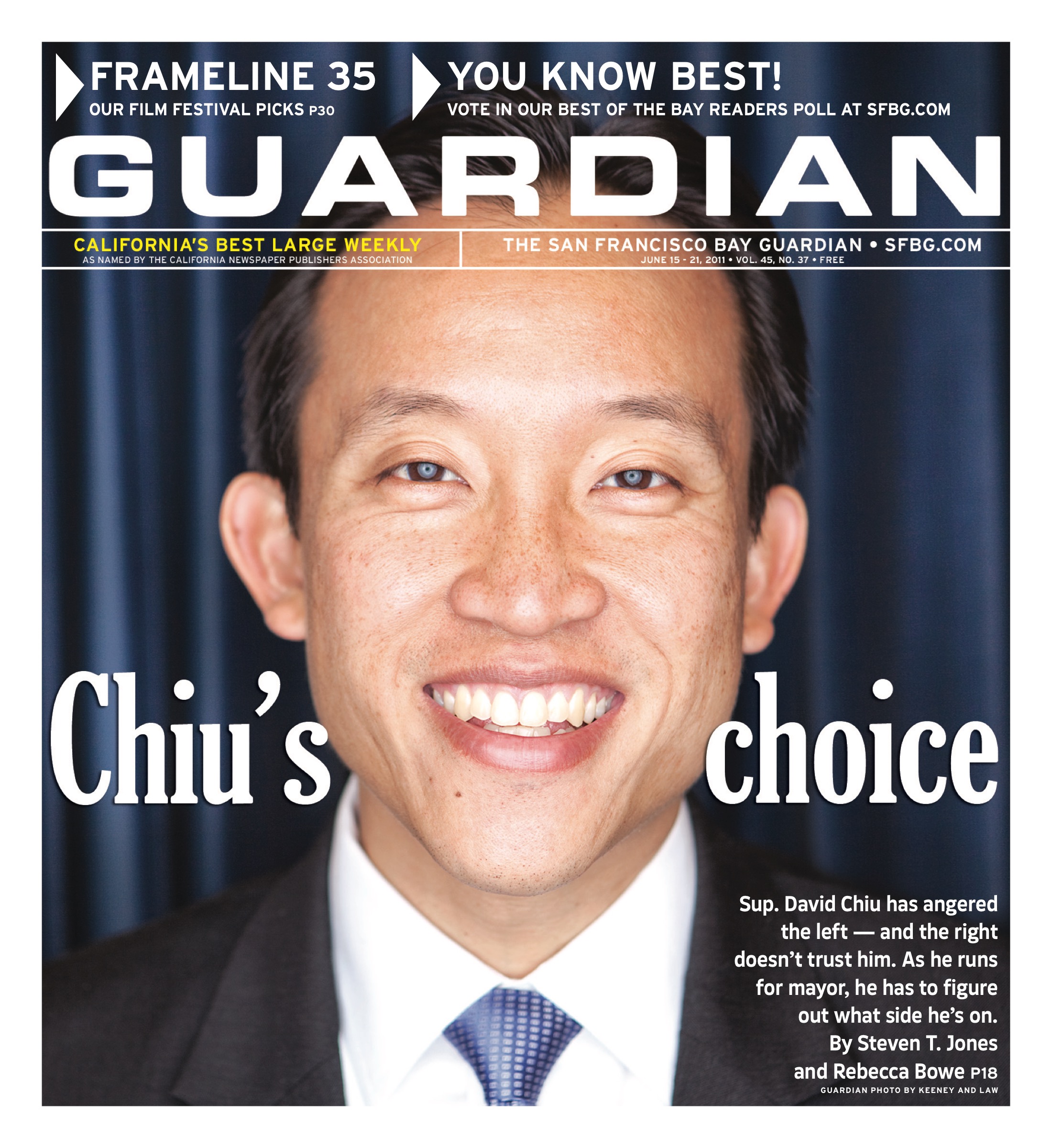
And Sup. David Chiu just gave Yee a great big gift. Chiu defied every single tenant group in town and became the swing vote in favor of the Parkmerced project. Now the tenants are pissed — and you know Yee is going to try to take advantage of it.

The frustrating part of that scenario is that Yee was never a good tenant vote when he was a supervisor. That’s his Achilles’ heel on the left — but it’s old history, and the anger at Chiu is here today.

Would Chiu be a better mayor for tenants than Yee? Quite possibly. Is any tenant group thinking that right now? No.

Chiu’s in a tricky spot. He’s trying to be the centrist progressive — and that’s a hard thing to sell to either the center (where he’s one of five candidates) or the left (where Yee is edging him out in cozying up to Avalos).

City Attorney Dennis Herrera hasn’t recovered from the political consultant lobbying mess (not a new story, he’s hardly the only, or even remotely, the worst offender, but damn, it makes him look bad). Former Sup. Bevan Dufty’s doing great at the candidate forums but doesn’t have a breakout move. Assessor Phil Ting is awfully quiet.

It’s only June. But it won’t be “only” anything much longer.

Shaking the city

0

arts@sfbg.com

LIT Activist, writer, and fast-talking leftist public intellectual Chris Carlsson, cofounder of the monthly bike happening Critical Mass, spearheads the online local history repository Shaping San Francisco. I recently spoke with Carlsson about Shaping SF and his associated projects, including three collections of cultural and political essays published by City Lights Books, the most recent of which, Ten Years that Shook the City: San Francisco 1968-1978, will be released June 15.

Carlsson began work on Shaping SF — a multimedia digital history project — in 1994 with co-conspirators from his often hilarious dissident magazine Processed World.

Reclaiming San Francisco: History , Politics, Culture, edited by James Brook, Carlsson, and Nancy Peters, was published in conjunction with the first CD and kiosk release of Shaping SF in early 1998. The collection of essays sets the tone for what would become, in Carlsson’s words, “an ongoing series of contrarian history anthologies about San Francisco.”

The second book in the series, The Political Edge (2004), examines cultural and political dynamics behind the popular mobilization to elect Green Party candidate Matt Gonzalez, a surprisingly close mayoral race that Gavin Newsom won in part with massive support from the San Francisco Chronicle and the national Democratic Party.

Carlsson says Ten Years that Shook the City continues his work “to counter our amnesiac culture.” More specifically, the book takes on the argument that the 1960s were filled with experiments that didn’t work out. Carlsson told me that evidence to the contrary “has systematically been flushed down the toilet” by mainstream commentators.

The book begins with a remembrance of the 1968 San Francisco State College strike, but in his introduction Carlsson writes: “From today’s organic food and community gardening movements to environmental justice, gay rights, and other social identity movements, neighborhood anti-gentrification efforts, and much more, the 1970s are the years when transformative social values burrowed deeply into society.”

In more than 30 years of activism, he also has crossed paths with many who became contributors to the series. Carlsson recalls when he attended an anti-nuclear rally in 1979 and was handed a flyer from a group called the “Union of Concerned Commies.” The leaflet featured a drawing of the White House with nuclear cooling towers on either wing, done by veteran underground cartoonist Jay Kinney. Kinney contributed one of the most entertaining pieces in Ten Years, a short history of underground comix (in a move below mainstream radar, “comics” became “comix”).

Former Guardian staffer Rachel Brahinsky contributed a heart-wrenching look at the (ongoing) African American exodus from the City by the Bay in the wake of the neighborhood-destroying process officially called “urban renewal.” In the chapter that follows Brahinsky’s, veteran organizer Calvin Welch describes further tenant victories in the creation of what he refers to as “the community housing movement.”

Carlsson’s chapter, “Ecology Emerges,” parallels a series of green history talks of the same name held this year at Counterpulse, Shaping SF’s home base at 1310 Mission St. Carlsson links the 1990s emergence of the environmental justice movement to David Brower, especially the more radical work Brower began when he left the Sierra Club and cofounded Friends of the Earth in 1969. Brower felt Greens should be antiwar, and was keen on making connections between movements. The ecologically-minded individuals and groupings Carlsson highlights also shared a disinterest in becoming a permanent cheering section for Democrats, working instead to keep pressure building from below.

I asked Carlsson for his take on the Obama administration’s announced plans to allow the mining of millions, possibly billions, of tons of coal on public lands.

“Obama was supported from the beginning by Big Finance an Big Coal,” Carlsson responded. He has never shown any indication he is anything but their front man. His lack of imagination on the energy crisis, the economic crisis, the military-empire crisis, and the social crisis is nothing less than remarkable.”

CHRIS CARLSSON

Thurs/2, 7 p.m., free

City Lights Bookstore

261 Columbus, SF

(415) 362-8193

www.citylights.com


Vote your vote away

The article has been changed from the print version to correct an error.

In a surprising move that is causing a strong backlash from progressives and other groups that have won important reforms at the ballot box, Sup. Scott Wiener is pushing a charter amendment that would allow the Board of Supervisors to change or repeal voter-approved ballot measures years after they become law.

If voters approve Wiener’s charter amendment, among the most vulnerable reforms may be tenant protections such as limitations on rent increases, relocation assistance for no-fault tenant removal, and owner move-in eviction limits, to name a few.

The Rules Committee heard concerned testimony about the proposal May 19 and opted to hold off on voting to send it to the full board for approval until the next meeting on June 2 to allow for more public comment.

If approved, the amendment will be on the November ballot, although the public may be confused about why such an amendment would be on the ballot in the first place. The measure covers ordinances and resolutions that were placed on the ballot by supervisors, and Wiener has said he plans to amend the measure to exempt those placed on the ballot by voter petition. Changes to taxes or bonds are not a part of the amendment because those are required by state law to go to the ballot box.

Paradoxically, Wiener’s reasoning for the proposal is that he believes voters are bogged down with too many ballot measures with complex issues that need changes, measures he claims the board could deal with more efficiently. But critics say it makes progressive reforms vulnerable to attack by a board that is heavily influenced by big-money interests.

At the committee meeting, about a dozen people spoke in opposition to the amendment, saying it seemed broad in scope and would be a more appropriate change at the state level.

Matthias Mormino, a legislative aide to Sup. Jane Kim, who chairs the Rules Committee, said that his boss is still on the fence. “She has concerns and hasn’t made up her mind yet.”

Currently California is one of the last states where a voter-approved initiative cannot be subject to veto, amendment, or repeal, except by the voters.

“It’s not a radical thing,” Wiener told the Guardian about the proposed amendment. “My thinking is that we should do our jobs. We elect public officials to make decisions every week. I wanted to strike a balance where the voters still have a strong say.”

But how strong of a say will the voting public have in cases where voter-approved initiatives are changed by the decisions of a board of politicians with their own influences and bias?

Wiener stated that he had no specific initiatives in mind when he decided to propose the amendment nor was he targeting any kind of legislation, except ones that are “outdated.” Wiener cited an example of updating campaign consultant reporting from quarterly to monthly as a change that needed to happen but could seemingly be a nuisance at the ballot box.

He is proposing a tiered system in which, for the first three years, an initiative is untouchable. In four years, a two-thirds majority vote by the board could make changes to initiatives; after seven years, a simple majority could do so. That means a raft of tenant measures approved in the 1990s could come under immediate attack.

“Does he not like our sick-leave policy?” Sup. John Avalos told us. “It’s so vague and unclear on what he is trying to do. I’m afraid that he is trying to change laws that are popular with the voters. It’s not a democratic way to resolve policy issues.”

Calvin Welch, a longtime progressive and housing activist, has his own theory on Wiener’s proposal. “Voters don’t have a big problem discerning which ones they agree with and which ones they don’t,” he said about voter-approved initiatives.

He did the number-crunching and concluded that of the 983 policy ordinances on the books, 207 (21 percent) were policy initiatives. Of those, 102 (about 10 percent) were approved by the voters.

“Not quite overwhelming the ballot,” Welch said. “The argument that what is promoting this — the inundation of the initiatives — is not borne of the facts.”

Welch believes Wiener is targeting certain landlord and tenant issues that date back to 1978, when San Francisco voters first started adopting rent control measures. “That is what the agenda is all about — roughly 30 measures that deal with rent control and growth control,” he said.

Wiener denies this is an attack on tenants, and claims he doesn’t have a specific agenda in mind. “This is long-term reform, not immediate gratification reform. To take the big, big step, we would have to change state law. This is just a modest first step.”

Welch also took issue with the idea of “election proportionality,” calling the measure an undemocratic power grab since many initiatives in San Francisco’s history were approved with more than 200,000 votes.

“Mayors don’t get 200,000 votes — these measures do,” Welch said. “That a body can overrule thousands of voters undermines the election process of San Francisco. Why not limit government actors instead of the people? It’s about what Sup. Wiener wants to change.”

Budget set-asides have long been a target for legislators, explained Chelsea Boilard, a budget analyst with Coleman Advocates for Children and Youth. Historically in San Francisco, moderate politicians have mostly honed in on social service programs, not those with a lot of clout and political backing, like police and fire budgets. Although the Children’s Fund, which was set up by a charter amendment, would be exempt, other social program priorities set by voters could be eroded.

“The reality is that the police and fire departments don’t have to go to City Hall every year to defend their budgets, but health and human services do,” Boilard said.

While many on the left would love for the California Legislature to have the authority to make changes in the property-tax-limiting Proposition 13 — like by removing commercial property from being taxed at artificially low levels — activists see real danger in Wiener’s measure.

“I think this is bad policy. I know folks are frustrated with Prop. 13, for example, and wish it was easier to amend or repeal. But the way he’s going about this is odd to me,” political activist Karen Babbitt told us. “For one thing, it appears to apply to retroactively to existing ordinances and policy declarations.”

Babbitt also cites legal research indicating that Wiener’s proposal might contradict state law and be subject to legal challenge if it passes. Plus, that challenge could come from any direction since it would allow liberal and conservative reforms to be challenged by the board.

One proposition that would fall under Wiener’s amendment is Proposition L, the sit-lie ordinance approved last year that prohibits sitting or lying on public sidewalks between 7 am and 11 p.m. After a divisive campaign against the measure, police began enforcing it in April. In three years and with enough votes by the board, the board could repeal a law that Wiener supports.

“It’s really interesting,” said Bob-Offer Westort, a civil rights organizer with the San Francisco Coalition of Homelessness. “I have a lot of questions. I guess it cuts both ways. We’d like to see the aggressive panhandling law changed. We’d like to see the sit-lie repealed. There are definitely things, with the right composition of the board, we would benefit from. And there are things that we would not want to see changed.”

Either way, the measure could result in some divisive fights at the board. “One person presenting this as a way to get it done is not the answer,” Avalos said. “I worry that he will use the amendment to dismantle certain voter-approved laws.”

Phantom menaces

cheryl@sfbg.com

FILM Does anyone actually believe Ghost Adventures is real? Including its hosts? For the uninitiated, this is the Travel Channel show that locks a trio of doucheba — er, paranormal investigators inside an allegedly haunted location overnight, leaving them with an arsenal of high-tech gadgets to record any paranormal happenings.

Inevitably, these goings-on include supernatural “voices” captured by one of their doohickeys (the voice always sounds exactly like garbled static, but is subtitled into meaning — usually a variation of “Get out!”) Main host Zak Bagans employs obnoxious tactics to goad the spirits into responding. Did you see that one where he decided he needed to bare his telegenically pumped-up chest to provoke the phantom that hated tattoos? It was fully necessary, people. For science. Also, it was 24-karat unintentional comedy gold.

Ghost Adventures and similar shows (main ingredient: shaky, sickly-green night vision) are ripe for parody, but they’re also au courant. As anyone with a pair of eyes and a thirst for blood can attest, there’s been a trend in “I am filming myself at all times” horror since ye olden days of The Blair Witch Project (1999), sure to be buoyed along for another decade-plus thanks to the monster success of 2007’s Paranormal Activity. (Last year’s The Last Exorcism being a prime example.) If these films are fake-real, then shows like Ghost Adventures, which follow regular people through actual abandoned prisons, sanitariums, and the like, are real-fake.

Which brings us to Grave Encounters, a fake-real movie that does a number on Zak Bagans types and delivers some pretty decent scares in the process. (Don’t be put off by the directors’ corny nom de screen, “the Vicious Brothers.” Although, dudes — really?) The film, which closes out the 2011 Another Hole in the Head Film Festival, is introduced by a slick production-company type who assures us that what we are about to see is undoctored video from a ghost-hunting reality show. Seems the crew of Grave Encounters, including lead investigator Lance Preston (Sean Rogerson), have vanished from the crumbling confines of their latest filming location, a decrepit mental hospital with a sinister past.

With this Blair Witch-y setup, the found footage rolls, including outtakes that let us know Lance and company are skeptics not above manipulating circumstances to get the shots they need. The faux-show apes Ghost Adventures‘ title sequence, low-angle shots, and jumpy editing. There’s even a slightly unhinged caretaker on hand to lock the Grave Encounters folks in for the night. And this wouldn’t be a horror movie (as opposed to a highly questionable reality show) if creepy critters didn’t end up coming out to play. It’s not a spoiler to disclose that once doors start slamming by themselves, full-scale shit-hitting-fannage (shades of 2001’s excellent Session 9) is not far behind.

In a similar vein, but with a more succinct running time and more likeable characters, is Haunted Changi, one of HoleHead’s opening-night films. A group of young filmmakers (portrayed by actors who have the same names as their characters) set out to make a documentary about Singapore’s Old Changi Hospital, a vacant structure troubled by the lingering fragments of World War II-era prisoners of war and their decapitation-happy Japanese captors. Plus, the occasional vampire. Old Changi Hospital is apparently a bona fide ghost-hunting hotspot, which makes the fake-real Haunted Changi a little more real than it probably ought to be.

After the four-person crew’s initial visit to the hospital, director Andrew (Andrew Lau, also credited as Haunted Changi‘s director) becomes obsessed with the place, returning again and again to shoot more footage and hang out with a mysterious woman he encounters there. Meanwhile, uptight producer Sheena (Sheena Chung), dreadlocked sound guy Farid (Farid Azlam), and “I am filming myself at all times” camera guy Audi (Audi Khalis) feel the after-effects in different ways — all of them bad.

Haunted Changi features a scene where a group of paranormal investigators use a little kid as their supernatural-activity barometer, like a canary in a coal mine. Way creepy, and one of the few novel ideas in a film that’s solid without being particularly original. Still, Old Changi Hospital has plenty of built-in atmosphere; a real-real documentary on its history would probably be just as scary as Haunted Changi‘s paranormal fantasy.

ANOTHER HOLE IN THE HEAD FILM FESTIVAL

June 2–17, $11

Roxie Theater

3117 16th St., SF

www.sfindie.com


NUGGETS OF GUTS: SHORT TAKES ON ANOTHER HOLE IN THE HEAD 2011

Absentia (Mike Flanagan, U.S., 2010) Daniel has been missing for seven years. His wife, Tricia (Courtney Bell), has dutifully done all the right things, distributing missing-person posters, mourning, seeking therapy, and filling out the paperwork to have him declared dead in absentia. But — heavily pregnant by a new suitor — she’s more than ready to move on with her life. In town to help with this task is her younger sister, Callie (Katie Parker), a former drug addict who nudges Tricia to look for new apartments and work on her social life. But is Daniel really dead? Tricia’s been having freaky visions that suggest he’s still … somewhere. And what, exactly, is haunting that tunnel down the block from Tricia’s front door? Absentia is an indie-horror find: Bell and Parker are totally believable as sisters who stick together despite their complicated relationship, and writer-director Mike Flanagan conjures serious menace from a benign suburban streetscape. Mon/6, 9:20 p.m.; June 12, 5:20 p.m. (Cheryl Eddy)

Apocrypha (Michael Fredianelli, U.S., 2011) Vampires are about as ubiquitous and tired a pop cultural fixture as the Kardashians and it’s getting harder and harder to come up with an original twist on such a shopworn staple. That’s all the more reason why I wanted Apocrypha, a modestly-budgeted, locally-made indie premiering at HoleHead, to make good on its promising premise that vampires aren’t just bloodsuckers, they’re also amnesiacs. Unfortunately, director Michael Fredianelli (who also coproduced, edited, cowrote, and stars in the film) makes a hot mess out of this neat idea thanks to weak dialogue, inept direction, lackluster performances, and a virulent misogynistic streak that’s far more unsettling than the inevitable torrents of blood. Fredianelli plays Griffith Townsend, a man at wit’s end to understand his growing compulsion to bite the women he takes home. Eventually, his path crosses with Maggie (cowriter and coproducer Kat Reichmuth) — an equally confused woman trying to find out how she woke up in Golden Gate Park — with whom he shares a dark, and somewhat obvious, connection. When Townsend’s job as a senior editor at the San Francisco Chronicle, rather than all the neck-biting, requires the greatest suspension of audience disbelief, you know it’s time to go back to the drawing board. June 11, 3:20 p.m. (Matt Sussman)

Auschwitz (Uwe Boll, Germany, 2010) It takes serious cojones or at least a healthy dose of self-delusion, for Uwe Boll to decide he’s the one to give us a realistic depiction of Auschwitz. Boll is often considered cinema’s most reviled director, known more for his schlocky video game adaptations than for his sense of morality. But in Auschwitz, he does his best to reflect on a horrific atrocity, bookending his portrayal of the death camp with a short documentary in which he questions German youth about the Holocaust. The mind-boggling ignorance on display is somewhat effective, but these teenagers likely know about as much as most American high schoolers — if not more. And Boll’s gritty Auschwitz isn’t the answer: it’s hard to watch at times, and it’s certainly more to the point than Spielberg’s Schindler’s List (1993). But Boll shows his trademark lack of restraint, and the legitimately stirring moments are undercut by shock value violence. June 10, 9:20 p.m.; June 13, 7:20 p.m. (Louis Peitzman)

Helldriver (Yoshihiro Nishimura, Japan, 2010) Leave it to Japanese director Yoshihiro Nishimura (2008’s Tokyo Gore Police) to give us a joyous, blood-soaked twist on zombies. Helldriver‘s living dead are distinguished by the antlers growing out of their foreheads — antlers that can be removed and ground into powder for use as a popular street drug. There’s more of a plot to Helldriver than the set-up, but it’s admittedly a little tough to make sense of it with body parts and buckets of blood flying in all directions. Short version: Kika (Yumiko Hara) has to take down her evil stepmother, who has become the Zombie Queen. To say there are casualties along the way is an understatement — nearly every character is flayed, decapitated, or torn into pieces, all with gleeful abandon. However gross Helldriver may be, it’s an awful lot of fun, an over-the-top, distinctly Japanese reinvention of the genre. Fri/3 and June 13, 9:20 p.m. (Peitzman)

The Mole Man of Belmont Avenue (Mike Bradecich and John LaFlamboy, U.S., 2010) What happens when a pair of slacker brothers (writers-directors-stars Mike Bradecich and John LaFlamboy) inherit a dilapidated apartment building with a perilously low occupancy rate? What if that building also has a pet-eating monster scrambling between its walls? And what’s that ever-hungry monster gonna eat once all the pets are gone? Dilemmas — all of them absurd, some of them gory, and most of them hilarious — abound in this clever, fast-paced cracker featuring Robert “Freddy Krueger” Englund in a cameo as a cranky, horny tenant. Chicago-bred comedians Bradecich and LaFlamboy have Simon Pegg-Nick Frost levels of chemistry. Is it too much to hope that the dreaded Mole Man will return so there’ll be a sequel? Sun/5, 7:20 p.m.; Tues/7, 9:20 p.m. (Eddy)

The Oregonian (Calvin Lee Reeder, U.S., 2010) More an experiment in tedium than terror, Calvin Lee Reeder’s The Oregonian will look familiar to anyone who has seen their share of David Lynch movies. Only unlike Lynch, Reeder offers little in the way of narrative or structure to counterbalance all the creepy randomness he throws at us. One can truly sympathize with the film’s nameless heroine — a frightened young woman who, upon waking up in a station wagon covered in blood, embarks on a hellish journey through the Oregon countryside — for in watching The Oregonian in its entirety the audience also undergoes a seemingly endless slog, only the succession of borrowed gestures merely exhausts rather than frightens. If you really want some good backwoods scares, watch Gummo (1997) or the Texas Chainsaw Massacre (1974) instead. Sat/4, 9:20 p.m.; June 16, 7:20 p.m. (Sussman)

Onward Toilet Bowl

0

le.chicken.farmer@gmail.com

CHEAP EATS The top four teams in the San Francisco Women’s Flag Football League can all beat the 49ers. My team cannot, but we can beat the bottom four teams and have proven it. By winning the biggest game of our storied one-season history, we established ourselves as the top of the bottoms: a solid fifth-place finish.

Yep, last week’s last minute comeback in the playoffs earned us a berth in the Toilet Bowl this week against a team that had shut us out in the regular season. We were losing again, 13-12, with less than five minutes left. Again our defense exploded: three touchdowns in the last three minutes. Final score: 31-13, us. Toilet Bowl MVP: Gene-Genie the Gold Standard, one of our many rugby converts, who spent less time on the ground than usual and scored two of our touchdowns, one receiving and one intercepting.

It was a brilliant performance, and a sweet note to end our first season on. Our goal was to win one game, and we won two, then both of our playoff games. Our goal for next season, in the fall, will be not to lead the league in penalties, and for our offense to outscore our defense. If we don’t and it does, we might have a shot at upper brackethood come next playoffs. Which would be nice. I kind of miss getting my ass kicked.

Unfortunately, there’s no way I can run fast enough to play soccer right now, so — by way of distracting myself from despair — my plans for summer include New Orleans yet again, camping, France, Mexico, New York, camping again, Ohio for a wedding, and the Bloomsburg Fair, where I will be researching a whole different, more Pennsylvania Dutchish take on chicken and waffles.

Who wants to sublet my apartment?

It’s cute. It’s cozy. It comes with the lovingest, lickingest cat in the whole history of felinity, and it smells like me. Come on. You know you want it.

Christ, I still can’t get over that we won. Enough already, you’re thinking, but you don’t understand. We were like the Bad News Bears, except none of us were very bear-like, so maybe we were the Bad News Honey Badgers. Or something.

Anyway, after the game and the champagne and a bowl of old cereal that a dog had been licking on the sideline, I went to eat something real with Hedgehog. We intended to have either sushi or Turkish food, but wound up eating Irishish at the Liberties ’cause it was nice enough to be outside. God bless plan C.

Hedgehog had a Reuben, and I had Irish sausage with eggs on a potato pancake with a red wine reduction gravy. Talk about your breakfast of champions: it was way, way better than dog-licked cereal with warm milk. The potato pancake was perfectly crispy outside and soft and creamy in the middle; the eggs were overeasied just so; and the sliced-lengthwise sausages tucked in-between the pancake and eggs were juicy and delicious.

Not as delicious as at the Phoenix’s Irish sausage, but that’s where wine gravy comes in. Yum. Yum.

Yum. And for less than $10 — I think like $9. And no waiting, even though it was brunch time.

Hedgehog’s Reuben looked good too. I tried her sweet potato fries, and they were pretty good, but I don’t much go for sweet potato anythings, so mostly I just left her alone.

They have regular fries, too, and you can get them with a curry dipping sauce, and more good news is that the kitchen stays open until 1 a.m. I’ve never drank there, but I have walked by a lot at night because Kayday used to live around the corner and it always seems like there’s something fun going on inside.

I think they have a quiz night or something.

QUESTION: Where did the not-very-Dutch Roscoe’s style of fried chicken and waffles originate?

ANSWER: Fuck should I know. Hedgehog says Harlem, not the South. Anyway …

The Liberties Bar & Restaurant

Mon.–Fri.: noon–2 a.m.;

Sat.–Sun.: 10 a.m.–2 a.m.

998 Guerrero, SF

(415) 282-6789

Full bar

MC/V

A mother’s touch

0

arts@sfbg.com

FILM The Rome of Pier Paolo Pasolini’s spirited second feature is that of the outer rings, the transitional borgata where ugly high-rise apartments interrupt wild grass and occasional industry. Pasolini, who lived for many years in such an outskirt with his mother, pointedly blurs development and ruin in his fluid camera observations of this liminal zone, much as he blurs the figure of mother and lover in Anna Magnani’s titular heroine. Like Mildred Pierce, Mamma Roma wishes prosperity for her child at any cost. She moves him from what she deems a rural backwater to the borgata for a shot at a “decent life,” which for her means selling vegetables rather than sex. Their new home is cruel in many ways, however. Ettore (Ettore Garofolo) slides toward delinquency, and soon an ex-lover presses Mamma Roma back into prostitution.

The basis of this mustachioed man’s hold on the proud woman is unclear, but it’s enough that we grasp the indentured terms of their relationship. The gaps in time and exposition feed the film’s tonal volatility. Poignant coming-of-age scenes in the grass slide into Magnani’s loud declamations, sociological analysis intermingles with passionate iconoclasm, all too brief glimpses of joy give way to degradation, and startling cuts between scenes set the whole thing aquiver. The basic dilemma is between critical detachment and confessional intimacy (the poet’s taste in men ran to young street kids like Ettore, and he had a worshipful relationship with his own mother, going so far as to cast her as Mary in his 1964 film, The Gospel According to St. Matthew). Mamma Roma is a study of the Italian postwar landscape, to be sure, but one which extends to the realms of desire and emotion.

Much of this comes down to the casting of Magnani, then entering the twilight of her career after a successful stint in Hollywood (where she nabbed the 1955 Oscar for her role in The Rose Tattoo, written expressly for her by a smitten Tennessee Williams). Jean-Luc Godard also made a film about a prostitute with an actress named Anna in 1962 (Vivre Sa Vie), but whereas he needed to make an imaginative leap to place Mlle. Karina in film history (her character goes to see fellow Dane Falconetti in The Passion of Joan of Arc), Magnani requires no such transference: her singular career thread the relative truths of neorealism and the Method. As Pasolini’s chosen symbol of self-sacrifice and Rome itself, perhaps the signal reference is her death scene in Roberto Rossellini’s Rome, Open City (1945).

Pasolini documents an economic occupation rather than a military one, and the spiritual malaise that hangs over the picture is more diffuse than in Rossellini’s picture. Nothing illustrates the director’s bending neorealism so well as a pair of recessive tracking shots of Mamma Roma walking the night. The shots are underexposed so that the street lights appears abstracted and the men who emerge from darkness as ghosts — or is she the ghost, persisting in her monologues no matter who’s listening? Done with a poverty of means, these sequences nonetheless conjure a kind of spiritual possession in the grip of material disgrace.

There are glimmers of Pasolini’s later films in Mamma Roma (a stray mention of Dante’s Circle of Shit flashing forward to his notorious 1975 movie, Salò, or the 120 Days of Sodom), but its most significant innovation may lie in its yoking melodrama to a caustic modernist sensibility, thereby preparing a whole vein of art cinema later epitomized by R.W. Fassbinder. Mamma Roma‘s lessons may well have been absorbed, but it still looks tender and dire as ever. *

MAMMA ROMA

Thurs/2 and Sat/4, 7:30 p.m;

Sun/5, 2 p.m.; $6–$8

Yerba Buena Center for the Arts

701 Mission, SF

(415) 978-2787

www.ybca.org


Finding the funk

0

arts@sfbg.com

SOUND TO SPARE Every time I’d call Bootzilla Productions, the same sexy-voiced female would intercept the answering machine and say, “You’ve reached the office of Bootsy Collins.” This was after Collins — in his unmistakable, almost cartoon-character voice — doing a weird little recorded skit at the beginning. My last-ditch effort to phone chat was a simple request to talk about “The Funk” with the Ohio-based funkateer, who’s now pushing 60 and coming to the Fillmore Saturday, June 4 for his first Bay Area performance in seven years. I’d have to go elsewhere for answers.

I needed a funk expert, if you will. But my question was: Is there a department for such a thing? It turned out I needed to look no further than Berkeley writer and legitimate funk historian Rickey Vincent. Vincent was able to explain how Collins and his genre-defining space bass is the glue that holds the funk together. It’s easy to get lost in the who’s who of P-Funk All Stars, which saw many incarnations from its roots in the late 1960s — when George Clinton and his doo-wop group the Parliaments found their way to Detroit but ended up as Motown rejects — to the infancy of the 1980s. By then, Parliament-Funkadelic was a full-blown recording and touring enterprise. What I didn’t know was that before he had donned the star shades and outlandish costumes, Collins honed his chops with a man known for running a tight ship when it came to stage performance: it was James Brown himself who would have Collins hold the rhythm down “on the one.”

For your own funkology, the easiest way for me to explain “on the one” is via the chorus to “Give Up the Funk (Tear the Roof off the Sucker).” We’ve all heard it, and its samples in hip-hop have been well-documented. When the Parliaments sing, “We want the funk,” the emphasis is on the we. This is the same technique Brown already had employed in the mid- to late 1960s when he started crafting infectious beats on songs like “Say it Loud — I’m Black and I’m Proud.” By 1970, after Brown’s back-up band had walked out on him over pay, Collina stepped in for a short time, lending licks to some of Brown’s most notable funk tracks.

“The James Brown Revue had to be replaced,” Vincent says. “[Brown] had a highly disciplined approach that had an impact. But Bootsy was a free spirit.” In a short time, according to Vincent, Collins learned the business, including booking, costumes, and organization. “Later on [Collins] became known for outrageousness, but it was always a polished set,” he says. Collins came from the same Ohio funk tradition that produced the likes of Zapp, Lakeside, Slave, and the Ohio Players — who all demonstrated unity in their sounds and color-coordinated looks.

But for all that Collins learned under Brown as his temporary, bass-playing protégé, he flourished even more under the free-form tutelage of George Clinton, who allowed for creativity and experimentation. On Parliament’s 1975 Chocolate City (Casablanca), the writers updated Brown’s anthem of black pride, expanding the notion into a full-fledged theme of black power in places you wouldn’t normally expect. They ask us to envision a black president, complete with a cabinet consisting of secretaries Aretha Franklin and Stevie Wonder. Fortunately this premonition for Washington hasn’t been completely off-base, but I suspect the cabinet is still a bit vanilla for the Mothership’s tastes. (Side note: Washington’s Smithsonian acquired a replica of the Mothership stage prop, which will be a part of its National Museum of African American History and Culture, opening in 2015.)

Vincent was one of those fortunate enough to have been in attendance at the Oakland Coliseum when the Mothership landed during Parliament-Funkadelic’s 1977 tour. He admires Collins’ longevity, calling him one of the only musicians from the original funk era who is not starving. He attributes Bootzilla’s viability as an artist to having such great teachers and for having kept track of publishing rights and royalties. Now, almost 35 years later, he doesn’t exactly expect to see a return of the iconic space prop on the Fillmore’s relatively small stage, but he did say this: “Bootsy is a spectacle in himself. He doesn’t have to rip the thumpasaurus riffs for four hours. Just one slap will have you hooked.”

Bootsy Collins

Sat/4, 9 p.m., $46

Fillmore

1805 Geary, SF

www.livenation.com<