Health

“No new taxes,” but fees and restrictions may apply

The agenda for the June 29 Board of Supervisors meeting reads like the fine print of a credit card statement, with fees piled upon more fees.  Mayor Gavin Newsom is proposing a slew of increases to sums that must be forked over for a wide array of city services or permits as a way to bridge a gaping budget gap. With major cuts to critical services in the face of a dramatic revenue shortfall, it’s not surprising that the city is tightening its squeeze to make up for some of the damage.

Some of the proposals make a certain amount of sense. There are higher fees proposed for an underground parking lot at Golden Gate Park, which could potentially help dissuade motorists and promote more environmentally friendly transportation options. There are higher fees for tow truck operators, which most anyone who’s ever involuntarily had their car towed could get behind. And the fee for discharging a cannon may go up from $400 to $636. While we’re pretty sure that last one is more likely to irk people who attend military ceremonies, we nonetheless take delight in imagining a rambunctious crew of pirates spilling into the board chambers to oppose it.

But this roster of Newsom’s new hidden fees begs an important question: Why is a mayor so adamantly against raising taxes bent on vacuuming more money out of the pockets of small business owners with higher fees? After all, many of these proposed increases will squeeze struggling, Mom-and-Pop businesses just a little tighter. City permits for auto wreckers, billiard parlors, junk dealers, and massage establishments may go up significantly. The fee for taking an EMT course may get higher. Permits for selling food on the street, driving a pedicab, dealing in second-hand auto parts, or operating a shooting gallery could also increase. Even the annual permit fee for street artists (several of whom we wrote about in our Streets Issue) is getting more expensive.
 
The list of fee hikes is on the agenda for Tuesday’s meeting, and was referred to the full board by the Budget & Finance Subcommittee. Supervisors recently proposed a number of new revenue generating measures including a nickel-per-drink tax on alcoholic beverages, an increase to the hotel tax, and a restructuring of the business payroll tax.

“There are no new taxes in this budget,” Newsom declared during a June 1 announcement in which he unveiled his 2010-2011 budget. “I know some folks just prefer tax increases. I don’t.”

But why reject taxes outright and then quietly propose a bunch of fees that will place a higher burden on the individuals they impact?

“No new taxes” may sound like music to the ears of a public awash in financial woes, but Newsom’s hidden fees are not unlike taxes. Under this philosophy, it’s not desirable to ask everyone to pitch in an extra nickel the next time they buy a cocktail, but there’s no problem with asking the bar to fork over hundreds more annually for a health inspection. That doesn’t seem to be as simple as a campaign-ready “no new taxes” slogan, but then again, there’s a reason credit card companies bury their hidden fees in the fine print.

Supreme Court rejects Healthy SF challenge

1

The U.S. Supreme Court has decided not to consider a challenge to the Healthy San Francisco program that provides low-cost health coverage to city residents, partially funded by employers who refuse to provide health insurance for their employees, a mandate that prompted a lawsuit from the Golden Gate Restaurant Association.

The decision was a big victory for low-wage workers in the city, as well as California Assembly member Tom Ammiano, who was the driving force behind the program as a member of the Board of Supervisors, taking abuse from the business community for almost a year and holding firm on the need for employers to take responsibility for their employees. Without that mandate, Ammiano successfully argued, businesses that didn’t offer health benefits would enjoy a competitive advantage and their employees’ health care costs would often end up be paid by city taxpayers.

“Today’s Supreme Court decision is an affirmation of San Francisco’s landmark efforts to provide affordable health care to the uninsured. With over 50,000 people receiving health care services and prescription drugs, Healthy San Francisco is a national model for what can be accomplished when the public and private sector work in partnership towards a common goal”, Ammiano said in a prepared statement.

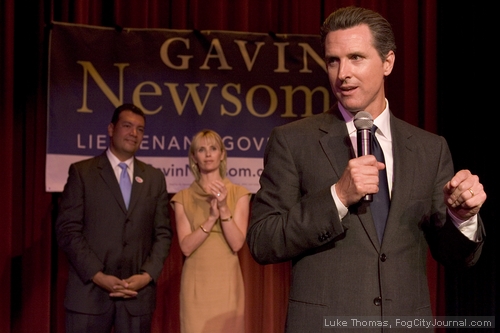
Mayor Gavin Newsom was eventually persuaded to support the mandate and he worked with Ammiano in crafting the final program, which he has since trumpeted as his own while campaigning for governor and then lieutenant governor, for which he won the Democratic nomination.

“The Supreme Court’s rejection of the challenge to Healthy San Francisco is a victory for the 53,000 San Franciscans who have healthcare today through our groundbreaking universal healthcare program. Healthy San Francisco is a model for healthcare reform that works. The High Court’s decision today ensures we can continue providing health care coverage to thousands who would otherwise go without care,” Newsom said in a prepared statement.

Newsom is a former restauranteur and GGRA member, but he did little to dissuade the group from bringing the lawsuit or in urging them to drop it. Many restaurants in San Francisco have taken to adding surcharges on customers’ bills, explicitly citing the increased cost of offering health insurance. But no restaurants that I know of include explicit surcharges for the membership dues they pay to GGRA or the extra contributions some restaurants made to continue pushing this lawsuit after the Ninth Circuit Court of Appeals ruled in the city’s favor.

City Attorney Dennis Herrera, who personally lobbied the Obama Administration to change the federal government stance on whether employer mandates violate federal law, also released a statement thanking the relevant players and singling out businesses that opposed the GGRA lawsuit: “I applaud Assemblymember Tom Ammiano and Mayor Gavin Newsom for their leadership in crafting this policy.  We should be very thankful to the Ninth Circuit Court of Appeals, too, whose thorough decision powerfully affirmed our arguments that Healthy San Francisco’s spending provisions were reasonable, fair and legal.  I would finally express my gratitude to all those from the business community who voiced their support for this program — especially Zazie and Medjool Restaurants, and Nibbi Construction, which filed amicus briefs on our behalf.”

SUV rampage victim speaks about the night he was hit

A line of television news cameras swiveled toward Rolando Casajeros, known to his friends and coworkers as “Allan,” and followed him as he moved gingerly into the conference room at a downtown San Francisco law office. The press conference was held on June 24 at the office of Choulos, Choulos & Wyle, the law firm tapped to represent him in a civil suit against the driver of the blue Nissan Rogue SUV that rammed into him June 2.

Casajeros was the first of four victims to be intentionally hit by the SUV driver on a rampage, only a few doors down from his home, near the intersection of 24th and Harrison streets in San Francisco’s Mission district. Since surviving the hit-and-run, his life has been turned upside down.

As he took a seat before three microphones, it became obvious that he had sustained very serious injuries. A scar zigzagged across the top of his shaved head, and a second scar crossed vertically down his forehead, marks from intensive surgery he’d endured to alleviate bleeding in his brain. His front teeth were missing and his lips were swollen. While his attorney, Claude Wyle, explained that he had sustained 12 facial fractures, jaw fractures that left him with a wired jaw, and mouth injuries in addition to the complications that necessitated brain surgery, Casajeros kept his eyes closed. “He’s very brave to come here today,” Wyle said gently.

When asked what he remembered from that night, Casajeros opened his eyes and looked up. Speaking in a low tone, he replied that he’d gone out to buy something from Safeway, and had a few grocery items with him as he biked home. The next thing he remembers is blacking out. “Bam, that’s it,” he said. “I just remember I flew in the air. That’s it.” Two nights later, he woke up in the hospital.

Casajeros underwent 19 hours of intensive surgery. He said he “almost fainted” when the doctor conveyed to him the extent of the damage. Since being released from the hospital last week, he’s been staying with the family of his best friend, Ronnie Guinto, who is a care provider by trade. Casajeros, who is originally from the Philippines, is the godfather of Guinto’s children.

The children’s mother, Kellie Arechiga, also spoke at the press conference, saying she wanted to get the word out about this weekend’s fundraiser at the Old Clam House to help cover expenses while he recovers from the traumatic experience. Casajeros has worked as a waiter at the Old Clam House for 12 years. He does not have health insurance, but there is a chance that the city’s Healthy San Francisco program will step in to assist with medical payments. State funds earmarked to aid victims of violent crime may also be available to him, according to his attorney.

Earlier on the day he was struck by the SUV, Casajeros and Guinto had gone out for a long recreational bike ride. “I love bikes,” Casajeros told the reporters. “I love to go biking. I go running. I’m an active person. But after this, I don’t know.” Casajeros cannot imagine why he was targeted, or why the man accused of going on the rampage, 39-year-old David Mark Clark of Albany, would have plowed into him and three others seemingly out of nowhere.

“To all the bike enthusiasts – be careful,” Casajeros said.

Wyle said it sometimes takes an outrageous event to highlight a broader trend of motorists behaving aggressively toward bicyclists in traffic. “There are many, many instances … where motorists are intentionally or recklessly endangering the lives of bicyclists,” said Wyle, who has taken many cases involving bike accidents.

Casajeros — who lives paycheck to paycheck working as a server in San Francisco — is not expected to be able to return to work for at least three months, according to the most optimistic estimate. In the meantime, he is in need of assistance to cover monthly expenses like rent, car payments, and transportation to and from his physical therapy appointments. Information on how to make a donation to a charitable trust fund set up by his attorney can be found here. Meanwhile, his friends and coworkers are still in need of items or services for a raffle at Sunday’s fundraiser at the Old Clam House.

The fundraiser will be held on Sunday, June 27, from 3 p.m. to 10 p.m. at the Old Clam House, 299 Bayshore Blvd, near Oakdale Avenue. $20 gets you a plate of food, one free drink, and two raffle tickets. There will also be live music and a DJ. Anyone wishing to make a donation for the raffle should e-mail Kelliearechiga2000@gmail.com.

The Daily Blurgh: Caged tigers I have known

0

Curiosities, quirks, oddites, and items from around the Bay and beyond

SF may put the “booooo” back in booze: “San Francisco could become California’s first city and county to tax booze — about a nickel a drink — in an effort to recover taxpayer health care costs for alcohol abusers.”

*****

RIP: SF Zoo’s Tony the Tiger.

*****

Architecture firm Diller Scofidio + Renfro was picked yesterday by the UC Berkeley to design the university’s new art and film complex that will house the Berkeley Art Museum and the Pacific Film Archive. Does that mean DS+R are still in the running to design SFMOMA’s planned expansion?

*****

Palin PWND in ethics probe (but, sadly, at this point, isn’t $390,000 just chump change to her?).

*****

“Though Mr. Tabbert, 28, personally prefers G-star denim and concert tees, he was on the hunt for 150 dishdashas, the ankle-length garments worn by men in Iraq and elsewhere in the Arab world. In July, actors will wear them in a simulated Iraqi village, posing as townspeople, clerics and insurgents at a National Guard training ground in the Midwest.”

*****
A gallery of Klubstitute fliers from SF’s gay 90s.

*****
In honor of the late Tony and the gay high holidays that are upon us, here is some feline pride from France:

Benefits: June 23-June 29

0

Ways to have fun while giving back this week


Wednesday, June 23

Water Bond Happy Hour
Join the Food and Water Watch team in helping to get people to vote NO on the California Water Bond, which will appear on the November ballot. Meet other people who care about the issues and discuss a sustainable water future for California and how water issues effect us all. Featuring stainless steel water bottle raffles to benefit Food and Water Watch, a local non-profit corporate accountability organization.
6 p.m., free
Elixer Bar
3200 16th St., SF
www.foodandwaterwatch.org

Thursday, June 24

Ecocity Builders Art Auction
Ecocity Builders is a non-profit dedicated to reshaping cities, towns, and villages for the long-term health of human and natural systems. Attend this slient art auction to help raise funds for Ecocity featuring hors d’oeuveres and an artist talk with Richard Register.
6 p.m.; $50 donation, fee goes towards bidding
SPUR Urban Center
654 Mission, SF
(510) 452-9522
www.ecocitybuilders.org

Saturday, June 26

Like Water for Chocolate
Inspired by chapter three of Laura Esquivel’s acclaimed novel, Like Water for Chocolate, this fundraiser will feature the spice of Mexico and the heat of love simmering in this fusion of food and performance. Proceeds to benefit Word for Word and Z Space. There is no parking at the performance site. Guests should park at the Mill Valley Middle School parking lot, where they will be shuttled to Hillside Gardens starting at 4:15 p.m. The event will be held outdoors, so dress warmly and comfortably.
5 p.m., $250
Hillside Gardens, Mill Valley
via Mill Valley Middle School
425 Sycamore, Mill Valley
(415) 626-0453


Walk in the Wild
Attend the Oakland Zoo’s annual fundraiser featuing vendors from over 90 restauants, caterers, bakeries, wineries, and breweries offering beverages and cuisine to be enjoyed while walking around the zoo and live music and dancing. Proceeds support the Oakland Zoo’s conservation, education, and animal enrichment programs. This event is 21 and over.
5 p.m., $150
Oakland Zoo
9777 Golf Links Road, Oakl.
www.oaklandzoo.org
(510) 632-9525

Sunday, June 27

Fundraiser for Alan
Alan, who has worked as a waiter at the historic Old Clamhouse in Bayview for 12 years, was one of the four cyclist who were purposely run down by a driver on June 2nd in the Mission and Potrero Hill neighborhoods. Alan has severe injuries to his head and face and has had to undergo 14 hours of surgery. Help raise money for his medical bills at this fundraiser where a door donation of $20 gets you a plate of food from the buffet, one free drink, and two raffle tickets. Featuring live music and a DJ.
3 p.m., $20 donation
The Old Clamhouse
299 Bayshore, SF
(415) 826-4880


Monday, June 28

Honduras Resiste
Watch three videos presented by the Bay Area Latin America Solidarity Coalition (BALASC) on the one year military coup that happened in Honduras in 2009,starting with The Coup and the Popular Resistance, followed by Exposing a Fraudulent Election, and ending with False Democracy in Honduras, and the U.S. Complicity.  Proceeds to benefit the Popular Resistance in Honduras.
8 p.m., $6
Artists’ Television Access
992 Valencia, SF
http://balasc.org

Quick Lit: June 23-June 29

0

Literary readings, book tours, and talks this week

The Cheesemonger, William Dalrymple, Tim Wise, skating on the margin of error, the Golden Age of Chinese nightclubs, and more.


Wednesday, June 23

Cheesemonger: My Life on the Wedge
Former punk rock activist turned cheese connoisseur Gordon Edgar will pass around some cheese and discuss his new book about the amazing world of artisan cheeses that he discovered while working at Rainbow grocery.
7 p.m., free
Get Lost Travel Books
1885 Market, SF
(415) 437-0529

Nine Lives: In Search of the Sacred in Modern India
British historian and travel writer William Dalrymple explores how modernity is changing India’s oldest traditions and the human pursuit of the divine.
6 p.m., $12
Mechanics’ Institute
57 Post, SF
(415) 393-0100
www.milibrary.org 

This is Where We Live
New York Times, Vogue, and Elle journalist Janelle Brown discusses her new novel.
7:30 p.m., free
Books Inc. Marina
2251 Chestnut, SF
(415) 931-3633

Tim Wise
Prominent antiracist essayist, educator, and activist Tim Wise will discuss his new book, Colorblind: The Rise of Post Racial Politics and the Retreat From Racial Equity.
7 p.m., free
City Lights Bookstore
261 Columbus, SF
(415) 362-8193‎

Thursday, June 24

Being Wrong: Adventures in the Margins of Error
Journalist Kathryn Schulz explores why we find it so gratifying to be right and so maddening to be mistaken, and how this attitude toward error corrodes our relationships.
7 p.m., free
Modern Times Bookstore
888 Valencia, SF
www.mtbs.com

Ex-GayNo Way
Jallen Rix discusses this new novel tackling the topic of “Reparative Therapy” and the after-effects this cult movement has on it’s victims.
7:30 p.m., free
Books Inc. Castro
2275 Market, SF
(415) 864-6777

Forbidden City: The Golden Age of Chinese Nightclubs
Author Trina Robbins reads from her new book which uses interviews, photos, momentos, and Art Deco posters to tell tales of the dancers and singers of Chinatown nightlife from the 1930’s to the 1960’s.
6:30 p.m., free with $15 museum admission
Asian Art Museum
200 Larkin, SF
(415) 581-3500
www.asianart.org

Hand Bookbinders Anniversary Exhibition
The 38th Annual Hand Bookbinders of California exhibition features the work of professional, amateur, and student bookbinders that range from the traditional to the very contemporary. Enjoy a special tour of the show led by members of the Hand Bookbinders of California on every other Thursday through August 12.
11 a.m., free
San Francisco Public Library Main Branch
100 Larkin, SF
(415) 557-4277

Hitch 22
Author and journalist Christopher Hitchens discusses his new book, which draws on his experience as a U.S. and U.K. citizen, as a socialist opposed to the war in Vietnam, and as a supporter of the U.S. war against Islamic extremism in Iraq.
7 p.m., free
Borders
400 Post, SF
(415) 399-1633

No Cartoon Left Behind: The Best of Rob Rogers
Political cartoonist Rob Rogers offers an interactive combination of live drawing and a cartoon slide presentation that takes the audience behind his creative process. His new book features cartoons documenting five presidencies, the end of the Cold War, 9/11, 25 years of health care, and economic and political scandals of every shape and size.
7 p.m., $5
Cartoon Art Museum
655 Mission, SF
(415) CAR-TOON

The Particular Sadness of Lemon Cake
Author Aimee Bender discusses her new novel about a girl whose magical gift is really a devastating curse.
7:30 p.m., free
Books Inc. Marina
2251 Chestnut, SF
(415) 931-3633

Right Here on Our Stage Tonight!: Ed Sullivan’s America
Author Gerald Nachman, joined in conversation by SF Chronicle columnist Leah Garchik, discusses his novel that traces the history of the 23 year run of the Ed Sullivan Show, that introduced America to a diverse array of performers.
6 p.m., $12
Mechanics’ Institute
57 Post, SF
(415) 393-0100
www.milibrary.org 

“The Shallows: What the Internet is Doing to Our Brains”
Hear journalist and author Nicholas Carr discuss how the internet is rewiring our synapses and dangerously upending our cultural priorities and other mental and social transformations that are being created by our new electronic environment.
7:30 p.m., $12
Berkeley Hillside Club
2286 Cedar, Berk.
(510) 848-6767

Saturday, June 26

Gene Yang
Award-winning comics artist Gene Yang, author of American Born Chinese, Gordon Yamamoto and The King of the Geeks, discusses his creative process and his love for the comic medium. Yang will also share his personal history as a Chinese-American, the inspiration for many of his books.
Sat. and Sun. Noon, free with $15 museum admission
Asian Art Museum
200 Larkin, SF
(415) 581-3500
www.asianart.org

Monday, June 28

Penguin Books 75th Anniversary
Celebrate a quarter of a century of Penguin publishing at this event hosted by Micheal Pollan, featuring Penguin’s collection of 75th anniversary favorites.
7 p.m., free
Books Inc. Berkeley
1760 4th St., Berk.
(510)525-7777

Summer Poetry Festival
All poets, painters, musicians, and arts and crafts people are invited to participate in this two-day, day-long festival in North Beach. Registration at 11 a.m.
Mon.-Tues. 11 a.m.-6 p.m., free
Rouge Ales Public House
673 Union, SF
hackett.philip@gmail.com

Tortured: When Good Soldiers Do Bad Things
Journalist and author Justine Sharrock brings us an eyewitness account of what it feels like to torture based on interviews with young, low-ranking soldiers who worked at Abu Ghraib and Guantanamo.
12:30 p.m., free
Alexander Book Company
50 2nd. St., SF
(415) 495-2992
www.alexanderbook.com

 
Tuesday, June 29

Understanding the Crash
Graphic artist Seth Tobocman and journalist and writer Eric Laursen offer progressive account of how bad mortgages turned into a financial meltdown and how we can get out of this mess.
7 p.m., free
Modern Times Bookstore
888 Valencia, SF
www.mtbs.com

Endangered Species Act protection sought for Franklin’s bumble bee

2

I’ve been obsessed with bees in general, and bumble bees in particular for some time now. I’m fascinated by the bumble bee’s thick tundra- adapted pelt that allows it to forage for nectar in way colder temperatures than your average sun-loving Italian honey bee.
And then there’s the bumble bee’s relatively hardcore social structure, in which only the young bumble bee queens over winter, emerging alone in the spring to start colonies afresh.

I’ve even read that the first generation of a bumble bee queen’s colony can be stunted because the young queen had to do everything herself—gathering pollen and nectar, building the nest, tending to her developing brood—unlike the honey bee queen, which forms a permanent colony and has multiple female workers to help raise the young, clean the hive and gather necessary provisions each day.

But above all, I’m fascinated by the fact that something as small as a bumble bee plays such an important role when it comes to pollinating plants. Experts say that native bumble bee pollinators are important to the reproduction of many native flowering plants and food crops. And in Britain and the Netherlands, researchers have actually noticed a decline in the abundance of certain plants where multiple bee species have also declined. Then there’s the fact that for many crops, such as greenhouse tomatoes, blueberries and cranberries, the buzzier bumble bees are better pollinators than honey bees, and some species are produced commercially for their use in pollination.

So, I’ve been troubled by reports that some native bumble bee species are in decline, and that commercially reared bumble bees, reared on the East Coast and then imported to the West to buzz pollinate hothouse tomatoes, could be the cause.

And now the Xerces Society for Invertebrate Conservation and bumble bee scientist Dr. Robbin Thorp have petitioned the U.S. Fish and Wildlife Service requesting Endangered Species Act protection for Franklin’s bumble bee.

”This mostly black bumble bee was readily found throughout its range in southern Oregon and northern California in the early 1990s,” stated the Xerces Society in a press release. “Twelve years of surveys conducted by Dr. Robbin Thorp clearly show that this species has declined steadily.  The decline has been so severe that only a single Franklin’s bumble bee was observed in 2006 and none since.”

“Over the last 12 years I have watched the populations of this bumble bee decline precipitously,” said Thorp, who is Professor Emeritus at UC Davis “My hope is this species can recover before it is too late.”
The Xerces press release notes that the cause of the catastrophic decline of Franklin’s bumble bee is hypothesized to be an escaped exotic disease that may have spread from commercial bumble bee colonies to wild bumble bee populations.

“Research in Dr. Sydney Cameron’s lab at the University of Illinois is underway to test this hypothesis,” the press release notes. “Other threats that may be harming Franklin’s bumble bee populations include habitat loss and degradation, climate change, pesticide use, and invasive plant species.
Recognizing the decline of Franklin’s bumble bee and numerous other North American bumble bees, the Xerces Society, Thorp, Defenders of Wildlife and the Natural Resources Defense Council recently petitioned the USDA’s Animal and Plant Health Inspection Service to protect wild bumble bees from the threat of disease by regulating commercial bumble bees.

Specifically, the petition asked the USDA-APHIS to create rules prohibiting the shipment of commercial bumble bees outside of their native ranges and to regulate the interstate transport of commercial bumble bees within their native ranges by requiring permits that show that bumble bees are certified as disease-free prior to movement.

“It is vital that the U.S. Fish and Wildlife Service Act quickly to protect this bumble bee,” said Sarina Jepsen, Endangered Species program director at Xerces. “We hope that an Endangered Species Act listing will encourage the USDA-APHIS to protect wild bumble bees from future threats posed by nonnative, commercial bumble bees.” 

“The decline in Franklin’s bumble bee should serve as an alarm that we are starting to lose important pollinators,” said Scott Hoffman Black, Executive Director of The Xerces Society.  “We hope that Franklin’s bumble bee will remind us to prevent pollinators across the U.S. from sliding toward extinction.”

Danger zone

0

rebeccab@sfbg.com

Rita Connolly, a registered nurse who has worked with inmates in San Francisco jails since 1985, says she’ll never forget the time she had to act fast to save a prisoner’s life.

The man had just arrived from a different jail and was waiting to go through intake. He was slumped over and looking ill, too weak to voice a complaint. Several worried inmates beckoned Connolly over, and once she examined him, she realized he was in the midst of a heart attack. He was rushed to the emergency room. He lived — but sustained irreversible heart damage.

“He could have been someone who didn’t live,” Connolly told the Guardian, but he also could have had a better outcome. The inmate had alerted someone that he was having chest pains earlier in the day, she later learned, as he was boarding a bus from an Alameda County Jail. A medical services worker examined him just before the bus left, but allowed him to proceed. By the time he arrived in San Francisco, the warning signals had progressed to a full-blown heart attack.

The story highlights an extreme example of a trend Connolly said she observes regularly — inmates from counties that use privatized jail health services aren’t receiving the same standard of care that San Francisco provides. Sometimes, there are obvious signs that the care is inadequate, placing inmates’ health at risk.

Alameda’s jail health services contractor, Tennessee-based Prison Health Services Inc. (PHS), has made headlines before for a track record marred by inmate deaths and lawsuits alleging negligence. PHS has expressed interest in contracting with San Francisco if the city opened the door to privatization, which Mayor Gavin Newsom has once again proposed in his latest budget.

That budget also calls for cuts to community-based health and human service programs that threaten to erode the safety net for those battling mental health issues, drug addiction, and chronic health problems, all proposals now being weighed by the Board of Supervisors Budget and Finance Committee.

But it is the debate over whether to make a $11 million cut to jail health services that raises the most thorny and telling questions about what sacrifices are considered acceptable — and what populations can be the most easily targeted — in the quest to balance a budget without the tax increases that Newsom opposes.


OPEN WOUNDS

In San Francisco, the city’s Department of Public Health contracts with the Sheriff’s Department to address inmates’ medical needs. Privatized jail health care would be cheaper, though by how much is a moving target. But nobody is arguing that the care would be better.

Newsom’s budget proposes switching to a private firm as early as January 2011 to help solve a daunting budget deficit. The proposal originated with the Mayor’s Office, and Sheriff Mike Hennessey — whose department would realize the potential savings — went along by including the item in his departmental budget.

In years past, the Board of Supervisors has repeatedly resisted the proposal and is likely to do so again — but rejecting it would mean finding up to $11 million in savings elsewhere.

“The fear is that when you bring privatization into the picture, there is a financial pressure to cut corners. And even though that may end up saving some money … the price that comes with it is too high,” Sup. David Campos said at a recent budget hearing. Referencing stories about inmates who died needlessly in jail under the care of for-profit firms, Campos said he isn’t willing to risk a similar tragedy occurring in San Francisco.

The proposal has been floated repeatedly since as far back as the early 1990s, according to healthcare workers whose jobs have been jeopardized by privatization before. Newsom proposed the cut last year, and the year before.

“In absence of the budget problem, [Hennessey] probably would not have proposed this, nor would we have proposed this,” Newsom’s budget director, Greg Wagner, told members of the Budget and Finance Committee at a May 26 hearing, adding that the mayor shares concerns about prisoner safety. Newsom’s office did not return multiple calls requesting comment for this story.

The U.S. Supreme Court recently agreed to a hear an appeal by the state of California to the federal court ruling that substandard medical care in California prisons constitutes cruel and unusual punishment and necessitates the early release of about 40,000 prisoners. At the May 26 hearing, healthcare workers familiar with the interiors of county jails and state penitentiaries came forward with horror stories.

“Every week I receive at least one inmate who has an open gunshot wound. They have not seen medical care in the county jails,” Dr. Elena Tootell, chief medical officer at San Quentin state prison, told committee members. “It’s quite surprising to me that they send inmates with gunshot wounds to prison. They just walk off the bus. They often have paper towels stuck to their bodies, seeping the blood. And then we are obligated to take care of them. This does not happen from San Francisco County, I’m going to tell you that right now.”

Tootell said she’d observed a significant difference between those counties using private firms and those using public health care. “They will have a fracture — they’ve never been splinted, they’ve never seen a doctor. They’re on anticoagulation [medication], but haven’t had their blood checked in weeks and have bruises all over their body.”

Connolly echoed similar concerns. For example, she told the Guardian, she’s found herself asking questions like, “You were on AIDS medication before you got arrested and now you’re not?”

Susanne Paradis, a healthcare research contractor with SEIU Local 1021, rejects the premise that the same services could be provided at a lower price. Under a private model, she says, the priority is to keep costs low — and that means doing less.

A key issue, Paradis said, is that private firms tend to rely more heavily on licensed vocational nurses (LVNs) — lower-paid medical staffers who aren’t trained to assess patient’s medical needs and cannot administer the same care that registered nurses (RNs) can. Using PHS data, Paradis found that in Alameda, there is one RN for every 92 inmates, compared with one RN per 32 inmates in San Francisco.

“An RN has the ability to assess, observe, and determine if there’s emergency care needed,” Paradis explained. “An LVN does not have the ability to do that.”

John Poh, a nurse practitioner stationed at a jail in San Francisco’s Hall of Justice, explained the difference this way: “The more RNs you have working for you, the fewer deaths you have.”

PHS, an obvious point of comparison with San Francisco since it serves Alameda, declined to answer questions about its services. Instead, media spokesperson Pat Nolan e-mailed a brief statement. “We are excited to hear that San Francisco is considering the contracting of correctional health care,” he wrote. “Should the city choose to go through an RFP process, we would look forward to participating. We think it is the right thing to do for the city and its taxpayers.”


LINES OF DEFENSE

While those incarcerated in San Francisco jails can be thought of by some as criminals, nuisances, or miscreants, those requiring medical attention are patients in the eyes of the jail healthcare workers.

Inmates routinely enter the system with diabetes, HIV/AIDS, hepatitis C, heart problems, liver disease, and substance abuse issues, Connolly said. On occasion, a woman will arrive in jail only to learn that she is pregnant. Mental health problems are common, and some battle psychiatric issues in combination with physical ailments.

“Overall, our patient population has had little access to health care. For many people, we’re the only show in town,” Connolly noted.

Poh said some problems could spiral out of control if jail health staff didn’t nip them in the bud. If an inmate is exhibiting signs of tuberculosis, for instance, they’ll immediately get a mask and be sent to the hospital for screening. Sexually transmitted diseases are also a priority for treatment. “You don’t want that person going out infected,” Poh explained.

The city takes a proactive stance when it comes to treating inmates, Poh said, because at the end of the day, county jail is a revolving door. “Everybody leaves county jail. They’re either going home, to a program, or to prison.” If people are released back into the community with contagious, untreated health problems, the risk of exposure can spread beyond jailhouse walls.

San Francisco’s current system is considered a first line of defense, in which inmates are “seen as members of the community who happen to be in jail right now,” Paradis said.

Privatizing jail-health services would constitute a blow to a wider public health safety net in San Francisco that is already weathering painful cuts. At a June 15 Beilenson Hearing, a state-mandated opportunity for community members to explain the impacts of proposed health and human services cuts to the Board of Supervisors, people came out in droves to protest cuts to programs serving vulnerable residents.

Kristie Miller, executive assistant of the Standing Against Global Exploitation (SAGE) Project, told the Guardian that her organization serves 350 clients a year who are victims of human trafficking and commercial sexual exploitation. The organization stands to lose its mental health funding, so Miller had come out to speak against the cut. “It provides trauma-focused psychotherapy for survivors who’ve experienced a lot of abuse, violence, and exploitation,” she said.

Jeff Schindler, chief development officer for the Haight Ashbury Free Clinics, said he was there protesting a 79 percent funding cut to his organization’s 108-bed residential program on Treasure Island. “We won’t have a place for people to actually go into residential treatment for their mental health and substance abuse issues,” he said. “These are individuals who are going to get their needs met somehow, somewhere, and generally that’s going to be at San Francisco General Hospital.”

It’s in this context that the proposal to contract out for jail health services is being proposed. “It’s easy to dismiss prisoners as probably the least valued sector of our society,” Deirdre Wilson, of the California Coalition for Women Prisoners, noted at a May 26 hearing. “But the right to health care is a human right.”


FOR THE RECORD

According to an estimate prepared by the Sheriff’s Department, the city could save anywhere from $11 million to $14 million by contracting out for jail health services, and Newsom’s budget assumes a savings of “over $11 million per year.”

However, the Controller’s Office continues to revise that figure as the debate shifts and concerns are raised about the skill mix that a private firm would use. “We don’t really know what it would cost to contract out, unless there was an RFP and a response to the proposal and some discussion about what the staffing requirements would be,” Deputy City Controller Monique Zmuda explained at a June 17 hearing. She added that the potential range of savings spanned from $3 million to $11 million annually, depending on decisions that would have to be made about acceptable staffing levels.

San Francisco’s inmate population has shrunk in the wake of the crime lab scandal, and a city-owned facility in San Bruno has been temporarily shuttered. Sheriff Hennessey told the Guardian he believed medical care in the jails could be provided either by city workers or a private firm, but added that he’s “quite happy” with the status quo. Noting that 25 of the 58 counties in California already use private firms, he added, “It’s not an unusual or unique thing.” Hennessey also said the decision was linked to a broader philosophical and political question, and that he doubted there was support on the board for the proposal to go forward.

Mitch Katz, director of the city’s Department of Public Health, did not directly say whether he supported Newsom’s proposal. “I think our Jail Health Services does a great job, but I do understand that the city is facing an extremely difficult budget year and that ultimately the budget must be balanced,” Katz wrote in an e-mail.

Gabriel Haaland, who represents SEIU Local 1021 union members whose jobs would be affected by the proposal, voiced strong opposition at a June 17 Budget and Finance Committee meeting. “‘We don’t care about these people because they’re poor and they’re in jail.’ That’s the message” in the decision to contract out, Haaland charged. The item was continued and will be revisited as budget deliberations unfold.

Alerts

0

alert@sfbg.com

WEDNESDAY, JUNE 23

Remembering torture victims


Commemorate U.N.-enacted International Day in Support of Victims of Torture at this screening of The Response, a courtroom drama based on the transcripts of the Guantanamo Bay military tribunals. Featuring guest speakers from UCSF and SF State, members of Survivors International, Amnesty International, and Health Professionals Against Torture.

6 p.m., free

Amnesty International SF Office, Suite 210

350 Sansome, SF

(415) 546-2080

Water bond happy hour


Join the Food and Water Watch team in helping to get voters to reject the California water bond on the November ballot. Meet others who care about the issues and discuss a sustainable water future for California and how water issues effect us all. Raffles of stainless steel water bottles benefit Food and Water Watch, a local nonprofit corporate accountability organization.

6 p.m., free

Elixir Bar

3200 16th St., SF

www.foodandwaterwatch.org

THURSDAY, JUNE 24

Radically queer


Radical Women celebrates LGBTIQ month with a panel discussion titled "Queer Radicals: Strategies for Our Movement." Queer and transgender activists will discuss how to build a militant movement for LGBT liberation. Pre-discussion buffet with vegetarian options available at 6:15 p.m. for $7.50. Call for information about childcare.

7 p.m., free

New Valencia Hall

Suite 202

625 Larkin, SF

(415) 864-1278

SATURDAY, JUNE 26

Protest Big Oil


Join thousands for a beach lie-in to create a "slash oil" image that will be photographed from a helicopter. Arrive no later than 10:30 a.m. to participate. Attendees will receive an overhead postcard of the event. Then at noon, join Hands Across the Sand, an international statement on protecting coastlines from oil pollution. Carpooling, biking, or taking public transit to the events is highly encouraged.

10 a.m.; free, donations accepted

Ocean Beach

1000 Great Highway, SF

www.slashoil.blogspot.com

www.handsacrossthesand.org

SUNDAY, JUNE 27

Have a good cry


Attend this "cry-in" against the commercialization and corporate sponsorship of the Gay Pride festival. Wear your most morbidly gothic clothing, bring your favorite sad songs, and share your best morose attitude with other queer people and allies eulogizing the demise of the grassroots queer community.

2 p.m., free

San Francisco LGBT Center

1800 Market, SF

www.gayshamesf.org

MONDAY, JUNE 28

Honduras resistance


Watch three videos presented by the Bay Area Latin America Solidarity Coalition (BALASC) on the 2009 military coup in Honduras. Proceeds benefit the Popular Resistance in Honduras.

8 p.m., $6

Artists’ Television Access

992 Valencia, SF

www.balasc.org

A tale of animal liberation


Hear activist and former prisoner Andy Stepanian tell how he stood up to one of the world’s largest contract animal testing labs, was charged with terrorism, and served three years in federal prison.

7 p.m., free

Station 40

3030B 16th St., SF

www.sparrowmedia.net

Mail items for Alerts to the Guardian Building, 135 Mississippi St., SF, CA 94107; fax to (415) 437-3658; or e-mail alert@sfbg.com. Please include a contact telephone number. Items must be received at least one week prior to the publication date.

SCOBY SCOBY do’s and don’ts: Notes on the Kombucha craze

2

By Katie Gaydos

For me, the words “kombucha on tap” evoke images of endless streams of free-flowing fizzy ambrosia. Unfortunately, while many San Francisco health food markets and juice bars now carry kombucha on tap, kegstands are not an option. Alas, a mere 12 oz. cup of the stuff sets you back anywhere from $3 to $6. Kombucha may be on tap, but as long as it remains on its designer drink pedestal, it’ll cost you. But wait a second, kombucha is virtually cost-free to make. It’s only tea, sugar, water and a SCOBY (Symbiotic Culture/Colony of Bacteria and Yeast). So what’s the deal? How did kombucha become a trend to the degree that people are willing to empty out their wallets?

With health benefits that supposedly include aiding digestion, increasing metabolism, detoxifying the liver, and promoting an overall sense of well-being, it’s no wonder that kombucha has long been considered a valuable elixir. But in the past ten years, ever since G.T. Dave started packaging his Synergy brew in signature bottles, the drink has initiated a consumer craze. More and more health food stores, restaurants, and even liquor stores boast a quickly growing selection.

This is certainly the case in health-conscious, trend-setting San Francisco. In search of all the kombucha this city has to offer, I embarked on an epic hunt and found a wide range of choices (both on tap and bottled) and prices.

Want a fresh ginger elixir? Or perhaps an apple-lemon-ginger kombucha? You got it! Sidewalk Juice (3287 21st St, 415.341,8070) has Lev’s Original Kombucha on tap. The small walk-up bar serves up half-kombucha, half-fresh juice concoctions. Prices range from $4.25 for a 12 oz. serving of coconut kombucha (a.k.a. “The Hangover”) to $7 for a 16 oz. cup of green tea kombucha.

Heading to the Ferry Building? The market Farm Fresh To You (1 Ferry Building #9, 415.834.9981) offers Lev’s original kombucha on tap. For $5 you get a 16 oz. cup with fresh-squeezed apple or orange juice. Farm Fresh also carries 16 oz. bottles of Lev’s (with flavors like mango, fresh mint, and hibiscus) for $4.49. Beware, though: bottled kombucha at Farm Fresh is priced significantly higher than at other SF health food stores — Synergy runs $4.19, and House Kombucha is $5.89 a bottle.

Where can you find the cheapest bottled kombucha? Rainbow Grocery (1745 Folsom, 415.863.0620) offers the widest selection of bottled kombucha at some of the lowest prices I’ve seen: High Country is on sale at $2.59 a bottle; Synergy and Vibranz are $2.99 a bottle; Healing Springs is $3.18 a bottle; Lev’s and Kombucha Botanica are $3.69 a bottle; Rejuvenation Company is $3.79 a bottle; and House Kombucha is $4.69 a bottle.

Where can you find the cheapest kombucha on tap? The Whole Foods Market branches in Potrero Hill and Noe Valley sold Kombucha Botanica at $2.40 for 16 oz., and $3.60 for 24 oz. (Note: Kombucha Botanica on tap is significantly less strong and less carbonated than Lev’s.) But on June 17, the Associated Press reported that Whole Foods temporarily stopped selling kombucha on tap and bottled kombucha for fear that it may contain elevated levels of alcohol.

Will other health food stores follow suit? We’ll have to wait and see. Perhaps the time is right to start brewing your own kombucha — it’s easy to do, and significantly cheaper than store-bought kombucha. You can order a starter kit online for $25 at Bay Area Kombucha Kollective

The insanity of cutting pensions

15


The New York Times has picked up the pension-reform banner, promoting the issue to the lead story on the front page of the June 20th issue.


If, as the Times reports, some of the reformers want to cap pensions – that is, go for the folks at the very top of the pile – it’s worth discussing. But most of the “reform” ideas involve either cutting the take-home pay of existing employees, cutting the take-home pay of pensioners or making sure that future workers don’t get as much of a pension.
The problem with that is simple: We’re in a deep recession. And the last thing we need to do is cut paychecks and encourage people not to spend money.


Let me quote from a brilliant blog post on Calitics.com from the always insightful Robert Cruickshank:


Cutting pensions would be like taking a shotgun, aiming it at our feet, and pulling the trigger. It would cause a cascade of economic problems that would dramatically worsen our economic crisis…


And yet the solution being proposed – slashing benefits – will do absolutely nothing to make state government fiscally solvent. It will mean there’s less money available to spend, meaning less sales tax revenue. Less consumer activity means there’ll be less jobs available, meaning less income tax revenue. With fewer jobs available, and wage stagnation, and now the added financial burden of paying the costs of retired family members that used to be borne by the pensions and other state services that have been cut, younger folks won’t be able to sustain the economy. Retirees and baby boomers will have to sell their homes for the cash, and in a recessionary environment where the young aren’t able to afford the present market value, home values will spiral downward, causing further economic ripple effects as well as reducing property tax revenues.
 
… The notion that ‘everyone needs to give back’ just doesn’t make sense given our economic distress. We’ve already given back too much. We gave back our wages. We gave back our ability to afford health care and housing and transportation. We gave back the robust public sector services that created widespread prosperity in the 1950s and 1960s. We gave back affordable, quality education. And too many of us have given back our future.
No, it’s time for someone else to give back. It’s time for the wealthiest Californians, and the large corporations, to give back. For 30 years now they have benefited from economic policy designed to take money and benefits from the rest of us and give it to those who already have wealth and power.
We are now experiencing the predictable outcome of such policies – the worst recession in 60 years, an intractable downturn. The way out isn’t to worsen the crisis by slashing pensions. The way out is to return to the sensible tax rates of the 1950s and 1960s and make the rich pay.


That’s what I’m talking about.

The public-employee pension fight

11

Public employees are getting attacked on all fronts, and one of the major issues is pensions. Forum did a show on it this morning, and all the usual suspects were there arguing that the public is outraged, that pensions are out of control, that nobody in the private sector gets these kinds of deals and that high pensions are damaging the very social programs that progressives love. Jeff Adachi, SF’s public defender, is making some of the same arguments in his pension-reform proposal.


Let me add a little perspective.


First of all, the majority of the public-sector workers who get pensions in CA don’t get huge payouts — the average pension, SEIU’s Terry Brennand pointed out on the show, is a little over $2,000 a month. Teachers get a little more, but they don’t get social security; they give up that federal benefit in exchange for pensions that pay maybe $3,000 a month.


There are serious problems with pensions — and most of them involve two categories of workers: Management employees and public safety. Those $100K-plus pensions? Check em out. In San Francisco, anyway, and I’m sure it’s the same in most of the state, the majority of them go to cops, firefighers and people in senior positions who manage to figure out how to bump their pay scales up in their final years.


The bigger cost may be retiree health care — but that’s a bit misleading, too. If we had a single-payer health care system, we wouldn’t need to worry about all these retiree health costs busting state and local budgets. And if retired public employees weren’t getting health care through a pension system, a lot of them would wind up in the public-health system anyway, through Medicare or Medi-Cal; we, the taxpayers, would be covering that cost anyway.


You want to save money on pensions? Quit giving the cops and prison guards everything they want.

San Franciscans decry Newsom’s public health cuts

8

By Alex Emslie

More than 100 concerned citizens, mental health providers, SRO hotel representatives, and clients of San Francisco’s community behavioral health programs spoke to the Board of Supervisors yesterday at a Beilenson hearing, which the state requires of counties that slash public health services, decrying crippling cuts in the mayor’s proposed budget.

Mayor Gavin Newsom proposed cutting the Department of Public Health’s funding by close to $31 million in next year’s budget currently before the Board of Supervisors. The board can choose to add funding back into departments that were cut before approving the final budget by the end of July.

“These are all services that we value,” DPH director Dr. Mitch Katz said following nearly four hours of public testimony. “We have to make difficult choices because of the state of the city’s budget. We recognize that it is never desirable for us to make cuts.”

Sup. John Avalos, who chairs the Budget and Finance Committee, said the city Budget Analyst’s Office was examining cost savings within the police and fire departments to free up money for the DPH. “I, as budget chair, am working with my colleagues to prevent these cuts that you are concerned about. We have to find cost savings in our budget across other departments.”

Avalos added that cutting other departments wouldn’t solve San Francisco’s looming deficit for years to come, and that taxation must be part of San Francisco’s budget solution. “If we don’t find a significant amount of revenue, looking at progressive forms of taxation, we’ll be in the same boat next year, but even worse, because we don’t expect to have the authorization of federal money [that the city received last year] to help us out.”

Hot sexy events June 16-22

0

How’s this fix for ailing municipal governments across the country; quit using law enforcement to harass sex workers doing their thing. Good, right? The Desiree Alliance would have to agree. The sex worker led advocate coalition is taking over Las Vegas next month for their annual conference, where they’ll discuss implementation of the harm reduction, political advocacy, and health services they provide for fellow escorts. Sexy guest speakers include Stephen Eliot (who will lead a storytelling session, and speak in an expert panel on taking your sex worker art to the next level), and Lauren McClubbin (an ACLU lawyer and Las Vegas performer).

But they need your help to make it all the awesomeness it can be. A big old public performance-demonstration is planned for the Strip — but the gambling tourists won’t get their dose of reality unless the Alliance raises the $2,500 they need to make the damn thing happen. You can donate on their Kickstarter page here. And learn more about the group’s antics right here, if you’re wondering. And now, in local news…

——————————————-

Asking For What You Want in the Bedroom and Beyond

Do you find it difficult to speak up for what you want between the sheets? Out of the sheets? In life, generally speaking? Well, who doesn’t, really (besides maybe Kanye West). Enter Marcia Baczynski, whose skills as a relationship counselor and sex educator lead her to create Cuddle Party – and this class, which gives you some excellent universal pointers on how to speak up and get yours.

Wed/16 8-9:30 p.m.

Center for Sex and Culture

1519 Mission, SF

(415) 255-1155

www.sexandculture.org

——————————————-

Latex Fashion School

Polly Pandemonium has been making high quality latex couture since 1995 in the London fetish scene, and now she wants to teach you, her San Francisco disciples! Learn about the shiniest, stretchiest, naughtiest ways to DIY. Apparently, it’s a very forgiving medium for the beginning seamstress or seamster.

Wed/16 6-9 p.m., $250

central SF location

(415) 269-8616

email polly@superstaravatar.com for information and reservations

www.latexfashionschool.com

——————————————-

Daddy and Boy: A Journey

Daddy Sal (founder of The Exiles) and boyjean, long time activists in the leather community, explicate their daddy/boy BDSM relationship, and go into the different dynamics of ways to be romantically involved for the long run in the domme/sub rainbow.

Fri/18 8-10 p.m., $4-10

Women’s Building

3543 18th St., SF

www.theexiles.org

——————————————-

Rope Dance: Dynamic Passionate Movements

Japanese bondage expert Midori leads you in this course on dancing, stretching, seducing, connecting… on the ropes. Bring a yoga mat, comfy clothes to move in and your sexiest, sassiest ‘tude.

Sun/20 2-5 p.m., $30 solo, $50 couple

SF Citadel

1277 Mission, SF

(415) 626-1746

www.sfcitadel.org

——————————————-

David Jedeikin

What usually happens when you give up your liver in a risky transplant to your ailing man? Usually not a sexy solo journey around the world. But life is complicated, and that’s what happened to Mr. Jedeikin, whose “flashpacking” (apparently a term used to describe the party backpacker) took him all over the world to the sexiest spots and parties in the gay world. In his book Wander the Rainbow, we get to hear about his trysts with exchange students in Beijing, and sex club bartenders in Berlin. So read all about it, sticky hands – and get your copy signed at this in store appearance.

Tues/22 7:30 p.m., free

A Different Light bookstore

489 Castro, SF

(415) 431 0891

www.adleventscastro.blogspot.com

——————————————-

Amos Mac’s “Boys in their Bedrooms”

A photographic exhibition of the city’s hottest FTMs in their pjs and Power Ranger blankies shot by photog extraordinaire Amos Mac. DJ Katastrophe will spin as you take in the sexy studs featured in Original Plumbing magazine.

Tues/22 7 p.m., free

The Lexington Club

3464 19th St., SF

(415) 863-2052

www.originalplumbing.com

Obama blows his chance to confront oil addiction

1

President Obama had the right Oval Office setting, a moment in time of genuine public outrage with the oil industry, and even an eloquent setup, telling Americans “the time to embrace a clean energy future is now” and saying we shouldn’t deterred from bold action by “a lack of political courage and candor.” And then…nothing. Once again, Obama has failed to follow up his rhetorical candor with the courage to do what needs to be done.

As with the health care debate and casino culture on Wall Street, Obama did a good job of diagnosing the problem. In this case, he cited the billions of dollars we send to despots in oil-rich countries, how China is leaving us in the dust in developing clean energy, and the myriad problems created by Americans accounting for 20 percent of world oil consumption, from global warming to the BP spill.

With that kind of setup, he could have just said the magic words — carbon tax – and completely changed the national debate over energy and environmental policy, finally linking the two interconnected realms. He could have called for a steep tax on oil companies and a gasoline tax on consumers, correctly arguing that subsidies on fossil fuels must end now and those who have long benefited from them need to help fund our transition to renewable energy.

Instead, he mentioned a few tepid reforms, and he wouldn’t even pledge his support for any of those ridiculously inadequate half-measures, telling the audience, “The one approach I will not accept is inaction. The one answer I will not settle for is the idea that this challenge is too big and too difficult to meet.”

Pretty words and a fine sentiment, but it means nothing in a political climate in which leaders of both major parties are more concerned with maintaining the flow of political contributions than stopping the flow of oil. Meanwhile, climate scientists say we need to cut our use of fossil fuels in half in the next couple decades to avoid the worst global warming impacts, and all that even the most ambitious legislation in the country would do now is slow the rate of growth over that time.

The only person in this country who could change the political dynamics to really meet this challenge is Obama, and last night, when he had the best chance to do so, he failed.

Tale of two landfills

2

Sarah@sfbg.com

Everyone should make a pilgrimage to the landfill where their city’s garbage is buried. For San Francisco residents to really understand the current trash situation — and its related issues of transportation, environmental justice, greenhouse gas reduction, corporate contracting, and pursuing a zero waste goal — that means taking two trips.

The first is a relatively short trek to Waste Management’s Altamont landfill in the arid hills near Livermore, which is where San Francisco’s trash has been taken for three decades. The next is a far longer journey to the Ostrom Road landfill near Wheatland in Yuba County, a facility owned by Recology (formerly NorCal Waste Systems, San Francisco’s longtime trash collector) on the fertile eastern edge of the Sacramento Valley, where officials want to dispose of the city’s trash starting in 2015.

Both these facilities looked well managed, despite their different geographical settings, proving that engineers can place a landfill just about anywhere. But landfills are sobering reminders of the unintended consequences of our discarded stuff. Plastic bags are carried off by the wind before anyone can catch them. Gulls and crows circle above the massive piles of trash, searching for food scraps. And the air reeks of methane, a potent greenhouse gas that is second only to carbon dioxide as a manmade cause of global warming.

It’s also a reminder of a fact most San Franciscans don’t think much about: The city exports mountains of garage into somebody else’s backyard. While residents have gone a long way to reduce the waste stream as city officials pursue an ambitious strategy of zero waste by 2020, we’re still trucking 1,800 tons of garbage out of San Francisco every day. And now we’re preparing to triple the distance that trash travels, a prospect some Yuba County residents find troubling.

“The mayor of San Francisco is encouraging us to be a green city by growing veggies, raising wonderful urban gardens, composting green waste and food and restaurant scraps,” Irene Creps, a San Franciscan who owns a ranch in Wheatland, told us. “So why is he trying to dump San Francisco’s trash in a beautiful rural area?”

Behind that question is a complicated battle with two of the country’s largest private waste management companies bidding for a lucrative contract to pile San Francisco’s trash into big mountains of landfill far from where it was created. This is big and dirty business, one San Francisco has long chosen to contract out entirely, unlike most cities that at least collect their own trash.

So the impending fight over who gets to profit from San Francisco’s waste, a conflict that is already starting to get messy, could illuminate the darker side of our throwaway culture and how it is still falling short of our most wishful rhetoric.


TALKING TRASH

The recent recommendation by a city committee to leave the Altamont landfill and turn almost all the city’s waste functions — collection, sorting, recycling, and disposal — over to Recology (see “Trash talk,” 3/30) angered Waste Management as well as some environmentalists and Yuba County residents.

WM claimed the contract selection process had been marred by fraud and favoritism, and members of YUGAG( Yuba Group Against Garbage) charged that sending our trash on a train through seven counties will affect regional air quality and greenhouse gas emissions and target a poor rural community. Observers also want details such as whether San Francisco taxpayers will have to pay for a new rail spur and a processing facility for organic matter.

Mark Westlund of the Department of Environment told the Guardian that negotiations between the city and Recology are continuing and the contract bids remain under seal. “Hopefully they’ll be concluded in the near future,” Westlund said. “I can’t pinpoint an exact date because the deal is still being fleshed out, but some time this summer.”

Under the tentative plan, Recology’s trucks would haul San Francisco’s trash across the Bay Bridge to Oakland, where the garbage would be loaded onto trains three times a week and hauled to Wheatland. Recology claims its proposal is better for the environment and the economy because it takes trucks off the road and removes organic matter from the waste before it reaches the landfill and turns into methane gas.

But WM officials reject the claim, noting that both facilities will convert methane to electricity, energy now used to fuel the trucks going to Altamont. The landfill produces 8.5 MW of electricity annually, some of which is converted into 4.7 million gallons of liquid natural gas used by 300 trucks. The Ostrom Road facility would produce far less methane, using it to create 1.5 MW of electricity annually.

Recology officials say removing organic matter to produce less methane is an environmental plus because much of the methane from Altamont escapes into the atmosphere and adds to global warming, although WM claims to capture 90 percent of it. Yet David Assman, deputy director of the San Francisco Department of the Environment, doesn’t believe WM figures, telling us that they are “not realistic or feasible.”

State and federal environmental officials say about a quarter of the methane gas produced in landfills ends up in the atmosphere. “But they acknowledge that this is an average. Some landfills can be worse, others much better if they have a good design. And there is no company that has done as much work on this as Waste Management,” company spokesperson Chuck White told us, citing WM-sponsored studies indicating a methane capture rate as high as 92 percent. “The idea of 90 percent capture of methane is very credible if you are running a good operation.”

Ken Lewis, director of WM’s landfills, said the facility’s use of methane to cleanly power its trucks has been glossed over in the debate over this contract. “We’re just tapping into the natural carbon cycle,” Lewis told us.

But Recology spokesperson Adam Alberti (who works for Singer & Associates, San Francisco’s premier crisis communications firm) counters that it’s better to avoid producing methane in the first place because some of it escapes and adds to global warming, which Recology claims it will do by sorting the waste, in the process creating green jobs in the organics recycling and reducing the danger of the gases leaking or even exploding.

“But what has Recology done to show us that the capture rate at their Ostrom landfill is on the high side?” Lewis asks. “Folks in San Francisco say it’s not possible, but we’ve got published reports.”

Assman admits that San Francisco won’t be able to ensure that other municipalities that use Ostrom Road will be focusing on organics recycling. While questions remain about how that facility will ultimately handle a massive influx of garbage, Altamont has been housing the Bay Area’s trash for decades. And even though San Francisco’s current contract will expire by 2015, this sprawling facility nestled in remote hillsides can still handle more trash for decades to come.


ZERO SUM

Perhaps the most striking aspect of the Altamont landfill is the 30-foot-tall fence that sits on a ridge on the perimeter of the facility. It’s covered with plastic bags that have escaped the landfill and rolled like demonic tumbleweeds along what looks like a desolate moonscape.

Wind keeps the blades turning on the giant Florida Power-owned windmills that line the Altamont hills, but it also puffs plastic bags up like little balloons that take off before the bulldozers can compress them into the fill. Lewis said he bought a special machine to suck up the bags, and employs a team of workers to collect them from the buffer zone surroundinge site.

Although difficult to control or destroy, plastic bags are not a huge part of the waste volume. San Francisco has already banned most stores from using them, and the California Legislature is contemplating expanding the ban statewide in a effort to limit a waste product now adding to a giant trash heap in the middle of the Pacific Ocean.

“Plastic bags are a visual shocker,” said Marc Roberts, community development director for the city of Livermore. “In that sense, they are similar to Styrofoam. It’s pretty nasty stuff, can get loose, and doesn’t break down. But they’re not a major part of the volume.”

Yet Roberts said that these emotional triggers give us a peek into the massive operations that process the neverending stream of waste that humans produce and don’t really think about that often.

“Our world is so mechanized,” Roberts observed. “Stuff disappears in middle of night, and we don’t see where it goes.”

San Francisco officials confirm that the trend of disappearing stuff in the night will continue, no matter which landfill waste disposal option the city selects.

“No matter what option, it’s going to involve some transportation to wherever,” Assman said. Currently, Recology and WM share control over San Francisco’s waste stream. But that could change if the waste disposal contract goes to Recology.

A privately-held San Francisco firm, Recology has the monopoly over San Francisco’s waste stream from curbside collection to the point when it heads to the landfill. Waste Management, a publicly-traded company that is the nation’s largest waste management operation, owns 159 of the biggest landfills in the nation, including Altamont, the seventh-largest capacity landfill in the nation.

San Francisco started sending its trash to Altamont in 1987, when it entered into a contract with Waste Management for 65 years or 15 million tons of capacity, a level expected to be hit by 2015, triggering the current debate over whether it would be better to send San Francisco’s waste on a northbound train.


TRAIN TO WHEATLAND

Creps, 76, a retired school teacher, warns folks to watch out for rattlesnakes as she shows them around this flood-prone agricultural community.

“This is an ancient sea terrace, and now it’s fertile grazing ground between creeks,” Creps said as we walked around the ranchland that Creps’ grandfather settled when he came to California in 1850. Today he lies buried here in a pioneer cemetery, along with Creps’ adopted daughter, Sophie, who was killed at age 27 after she witnessed a friend’s murder in Oakland in 2006.

Creps’ cousin, Bill Middleton, who grows walnuts on a ranch adjacent to hers, worries about the landfill’s potential impact on the groundwater. “The water table is really high here, so you’ve go a whole pond of water sitting under this thing,” Middleton said.

Wheatland’s retired postmaster, Jim Rice, recalled that when the landfill opened on Ostrom Road in the 1980s, individual cities had veto power over any expansion plans. “But Chris Chandler, who was then the Assembly member for Sutter County and is now a judge, carried a bill in legislature to do away with veto power,” Rice said.

“So we lost out and ended up with a dump,” Middleton said.

Creps believes the landfill should be for the use of local residents only. “There’s a lot of development going on around here and the population is going to grow,” she said. “But at this rate, this landfill will be used up before Yuba and the surrounding counties can use it. And that’s not fair. They think they can get a foothold in places off the beaten path.”

Yet not everyone in Yuba County hates San Francisco’s Ostrom Road plan. On June 7, the Yuba-Sutter Economic Development Corporation backed Recology’s plan to build a rail spur to cover the 100 yards from the Union Pacific line to the landfill site.

EDC’s Brynda Stranix said the garbage deal is still subject to approval by San Francisco officials, but will bring needed money to the county. “The landfill is already permitted to take up to 3,000 tons of garbage a day and it’s taking in about 800 tons a day now,” Stranix said.

If the deal goes through, it would triple the current volume at the landfill, entitling Yuba County to $22 million in host fees over 10 years.

Recology’s Phil Graham clarified that Ostrom Road is considered a regional landfill, one that has already grown to 100 feet above sea level and is permitted to rise another 165 feet into the air. “So even with the waste stream from San Francisco,” he said, “we’ll still be operating well under the tonnage limits.”

“The world has changed. Federal regulations come in, and landfill operations change,” Recology’s Alberti said as we toured the site. “And there really are no longer any local landfills. This one is already operating, accepting regional waste.”

He claimed that Livermore residents had similar concerns to those now expressed in Yuba County when San Francisco’s waste started going to Altamont. Livermore and Sierra Club brought a lawsuit around plans to expand the dump, a suit that forced WM to create an $10 million open space fund.

Alberti said he understands that people like Creps are concerned. “But we are not seeking an expansion. The only thing we are asking for is a rail track.

“From our point of view it’s simple,” he continued. “We have the facility; Ostrom Road is close to rail; and it’s not open to the public. So it’s a tightly contained working area.”

Graham, the facility’s manager, also dismissed concerns that the landfill might harm the groundwater or the health of the local environment. “A lot of people don’t know how highly regulated we are,” he said. “That’s why we are having public meetings. Our compass is out in the community. These are people we work and live with.”

Alberti said YUGAG and other opponents of the landfill aren’t numerous. “If we draw the circle wider to the two-county area, how many people even know a landfill is operating here?”

Graham takes that as a testament to how well the facility is operated. “I consider that a compliment. Obviously, we weren’t causing any problems.”


TRASH MONOPOLY

Those who run both landfills say they recognize that their industry’s heyday is over, and that the future will bring a more complicated system that sends steadily less trash to the landfills.

“Eventually we will be all out of business,” Alberti predicted. “One reason we changed our name was knowing that landfills are not sustainable. And that’s a significant difference. Waste Management is the largest landfill owner in the world. Recology is a recycling company that owns a few landfills and, for that reason, does innovative things like the food scraps program.”

But the company with the new green name has traditionally been a powerhouse in San Francisco’s trash industry, becoming a well-entrenched monopoly after buying out two local competitors — Sunset Scavenger and Golden Gate Disposal and Recycling — a triad that has long held exclusive rights over the city’s waste.

The 1932 Refuse Collection and Disposal Ordinance gave the company now calling itself Recology a rare and enviably monopoly on curbside collection, one that had no expiration date and would be difficult to change. “So legally, it’s not an option,” Assman said.

Retired Judge Quentin Kopp, a former member of the Board of Supervisors and California Legislature, got involved in an unsuccessful effort to break Recology’s curbside monopoly in the 1990s when the company then known as NorCal Waste asked for another rate increase. But he found the contractual structure to be almost impossible to break.

“The DPW director examines all the allowable elements and makes recommendations to the Rate Board,” Kopp said. “And the Rate Board consists of three people: the chief administrative officer, the controller, and the general manager of the San Francisco Public Utilities Commission.”

SFPUC General Manager Ed Harrington says Recology’s curbside monopoly is unusual compared to other places, but it also makes the company a strong contender to the landfill contract. “It comes down to economies of scale. If you don’t have a contract with a facility that does recycling or waste disposal, you can collect the garbage, but where are you going to take it?”

Harrington said the situation was better before Recology purchased Sunset Scavenger, which mostly handled residential garbage, and Golden Gate, which mostly handled commercial garbage. Today, he said, the city has little control over commercial garbage rates or Recology’s overall finances. “That made it more difficult, and we only set the rate of residential garbage collection,” Harrington observed. “They have never come before the rate appeal board over commercial rates. I have asked who subsidizes whom, the commercial or the residential, and they say they think the commercial. But we have no ability to govern or manage those rates.”

WM’s Skolnick said a positive outcome of the current contract negotiations would be to break Recology’s monopoly on curbside collection. “We have to work to keep our business. That’s the competitive process. But we have a competitor that can encroach into our area even though we can’t encroach on San Francisco. And they claim to have one of the most competitive rates in the country — but try getting those numbers,” he said.

WM’s David Tucker added: “We’d like if San Francisco jumped into the 21st century and had a competitive bid process.”


DIRTY BUSINESS

The battle between WM’s local landfill option and Recology’s plan for a longer haul but with more diversion of organic materials is complicated, so much so that the local Sierra Club chapter has yet to take a position.

Glen Kirby of the Sierra Club’s Alameda County chapter told the Guardian that the Sierra Club’s East Bay, San Francisco, and Yuba chapters are taking a “wait and see what becomes public next” stance for now. But insiders say the club’s national position is against landfill gas conversion projects like that at Altamont, possibly favoring Recology’s bid.

Recology proponents claim the Sierra Club didn’t initially oppose landfill gas conversions because its members in the East Bay benefit from an open space fund that WM pays into as mitigation for a 1980 expansion at the Altamont. And Alberti claimed that WM’s analysis of greenhouse gas emissions from the competing waste transportation plans was flawed.

“Their calculation is a shell game. And it relies on Recology using diesel when we are using green biodiesel trains. This is not your grandfather’s train any more. One train equals 200 trucks,” Alberti said.

But WM’s Lewis defends the company’s analysis, which showed Recology’s bid to be worse for greenhouse gas emissions than WM’s.

“Landfill gas is a byproduct of an existing system,” Lewis said, noting that 43 percent of the trash buried at Altamont comes from San Francisco. The implication is that a large part of the methane in the landfill comes from — and benefits — San Francisco.

“We are delivering waste products that contain organics,” he said. “We realized that we could flare methane [to burn it up] or produce electricity. California has very aggressive landfill gas requirements, and the collection rates are relatively good at most sites. But once you’ve collected it, what to do? Historically, they flared the gas. Twenty years ago, there was not a lot of technology to allow anything else.”

Lewis says WM began producing electricity from the gas in 1987. “What we do in the future is decoupled from what was giving us the methane in the past,” he said. “Today we are managing what was brought here 15-20 years ago. It’s your hamburger, cardboard, and paper that has been sitting up there since 1998. We’re doing something good with something that we used to flare.”

“If Altamont was closed today, the gas yield coming off it would be enough to produce 10,000 gallons a day for the next 25 years,” WM’s Bay Area president Barry Skolnick interjected.

And Lewis observed that if you take organics out of the waste stream, as Recology proposes, that matter has value, whether in a digester to produce energy or a composting operation. That complicates the comparison of the two bids.

“We agree that if you can get that waste out in a clean form, that’s a good thing,” Lewis said. “But composting is a very highly polluting approach. In the process of degrading, it gives off a lot of volatiles and carbon dioxide. So air districts have not traditionally been very positive on sitting aerobic composting facilities.”


WHAT’S NEXT?

The contract that San Francisco has tentatively awarded to Recology is for 5 million tons or 10 years, whichever comes sooner. As such, it’s a much smaller contract than the city’s 1987 contract with WM, mostly because the future is uncertain.

But trucks will remain a part of the equation. Recology is proposing to continue driving 92 truckloads of garbage over the Bay Bridge per day, possibly to keep the Teamsters happy, frustrating transportation advocates who believe direct rail haul or barges across the bay would be greener options.

In December 2009, Mayor Gavin Newsom and Bob Morales, director of the Teamsters Union Waste Division, cowrote an op-ed in the Sunday Sacramento Bee, in which they argued the case for increased recycling and composting as a “zero waste” strategy for California and as a way to generate green jobs and reduce global warming.

“Equally important for the future of our green economy is that recycling and composting mean jobs,” Newsom and Morales wrote. “The Institute for Local Self-Reliance reports that every additional 10,000 tons recycled translates into 10 new frontline jobs and 25 new jobs in recycling-based manufacturing.”

Newsom and Morales clarified that they do not support waste-to-energy or landfilling as part of their zero waste vision.

“It makes no sense to burn materials or put them in a hole in the ground when these same materials can be turned into the products and jobs of the future,” they stated.

Yet WM’s Skolnick sees a certain hypocrisy in San Francisco turning its back on the methane gas that its garbage helped create at Altamont over the past three decades. “Here’s a very progressive city, and we want to take their waste from the last 30 years and use gas from it to fuel their trucks,” he said. “But they want to haul waste three times as far to Wheatland. What does that say about San Francisco’s mission to become the greenest city?”

David Pilpel, a political activist who has followed the contract, agreed that San Francisco officials can’t simply walk away from Altamont and call it a green move, but he would like to see the city use rail rather than trucks. “Instead of putting stuff on long-haul trucks, put it on a rail gondola and haul it around the peninsula to Livermore,” he said. “The Altamont expansion was for San Francisco’s purposes. So to say now, ‘We’ll go elsewhere,’ is lame.”

Sally Brown, a research associate professor at the University of Washington, acknowledges that landfills have done a great job of giving us places to dump our stuff and can be skillfully engineered to release less methane and capture more productive biogases.

“However, we are entering a new era where resources are limited and carbon is king,” Brown wrote in the May 2010 edition of Biocycle magazine. “In this new era, dumping stuff may cease to be an option because that stuff has value. and that value can be efficiently extracted for costs that are comparable to or lower than the costs — both environmental and monetary — associated with dumping.”

The San Francisco Board of Supervisors will vote on the contract later this year, deciding whether to validate the Department of the Environment’s choice of Recology or go with WM. Either way, lawsuits are likely to follow.

Voters are pissed

0

By Guardian News Staff

news@sfbg.com

After spending more than $70 million, two big corporations failed to convince Californians to vote their way. After spending nearly $70 million, the former head of a big corporation easily convinced Californians to vote her way. And that outcome is not as schizophrenic as it sounds.

On one level, the outcome of the June 8 election was a sign of the anti-corporate anger seething through the California electorate. “BP, Goldman Sachs, PG&E — anything that seems connected to a big corporation is in serious trouble right now,” one political insider, who asked not to be named, told us.

Yet two candidates who were very much corporate icons — Meg Whitman and Carly Fiorina — won handily in the Republican primaries and now have a real chance to become the state’s next governor and junior senator. What’s happening? It’s fascinating. The voters in the nation’s most populous state are pissed off — at big business, at government, at the oil spill, at 10 percent unemployment, at Washington, at Sacramento, at Wall Street. It’s an unsettled electorate, uncertain about its future and looking for something new, and definitely despising power.

There’s a populist fervor out there, and it’s going to define this fall’s expensive, dirty, and high-stakes battle for California’s future.


THE MAYOR GOES STATEWIDE

Addressing a crowd of supporters gathered at Yoshi’s San Francisco on election night, San Francisco Mayor Gavin Newsom — who easily beat opponent Janice Hahn to claim the Democratic nomination for lieutenant governor — said he was excited to be part of a crucial political year for the Golden State.

“We’re very proud to be in a position to be the Democratic nominee and to work with the other Democratic nominees,” Newsom told supporters. He lavished praise on the Democratic nominee for governor, Jerry Brown — the man who just last year he was trying to beat in a primary — telling stories about his father’s long relationship with the former governor and expressing his admiration. “I couldn’t be more proud to quasi- be on a ticket with Jerry Brown,” he said.

The race for lieutenant governor may prove one of the most interesting this election season — and not just because a victory for Newsom would transform San Francisco politics. Newsom’s opponent is Abel Maldonado, a moderate Republican who enjoys popularity among the growing, influential Latino community, and who Newsom’s team said will be a formidable challenge.

The campaign could revolve around an intriguing question. At a time when the Republican Party has been taken over by virulent anti-immigrant politicians — Whitman and Fiorina have both made harsh statements about illegal immigrants and vowed never to support “amnesty” (that is, immigration reform) — will Latino voters go for a white Democrat over a Latino Republican?

“You talk to them about all the same issues you talk to all voters about: jobs, education, and health care,” Newsom political strategist Dan Newman said when asked whether Newsom could win over Latino voters. “Latinos, like all voters, will appreciate someone with a proven record of success.”

Pollster Ben Tulchin also downplayed the trouble Newsom could encounter in winning the Latino vote. “With what’s going on in Arizona, they are very wary of Republicans,” Tulchin said, but then added: “We don’t want to underestimate the challenge we have. There’s never been a moderate Latino on the statewide ballot.”

Newsom sounded another alarm. If Whitman decides to help Maldonado, the race will get even tougher. “We’re running against Meg Whitman’s checkbook,” the mayor said.

“Expect to see Meg and Abel together a whole lot in the next few months,” one consultant predicted.

If Newsom wins, San Francisco will get a new mayor a year early — and the district-elected Board of Supervisors will choose the person to fill out the last year of Newsom’s term. Technically, the current board will still be in office then, but the task may well fall to the next board — which makes the local November elections even more important.

“Everyone is gaming this out and trying to figure out what happens,” political consultant Alex Clemens said during a post-election wrap-up at the San Francisco Planning and Urban Research Association office. “There will be a lot of dominoes to fall and deals to be cut.”

Meanwhile, Newsom’s nomination for lieutenant governor places many San Franciscans in an uncomfortable position, one that was illustrated well by Newsom’s victory speech, in which he proudly rejected taxes. Although most San Francisco progressives are disenchanted with their fiscally conservative mayor, few would rather vote for Maldonado.

Tim Paulson, the SF Labor Council president, was at the Newsom event gritting his teeth as he talked about the opportunity progressives now have to work with “a mayor of San Francisco we have issues with.” Now, he noted, “There is going to be a real campaign around this man. It could establish a narrative for what California is about.”


POWERFUL WOMEN

At Delancey Street on election night, San Francisco District Attorney Kamala Harris talked about getting “tough and smart on crime,” addressing gang-related criminal activity but also focusing on corporate criminals. She talked about cracking down on predatory lenders, supporting health care reform, and protecting California’s environment. And she made a point of dragging in BP.

“It must be the work of the next attorney general to ensure that the disaster and tragedy that happened in the Gulf of Mexico never happens in California,” she said, warning of attacks on AB 32, which set California’s 2020 greenhouse gas emissions reduction goal into law in 2006.

Of course, Harris now has to take on her southern counterpart, Los Angeles DA Steve Cooley, who is a moderate but comes in with much stronger law enforcement support. If Harris wins, it will go a long way to prove that opposition to the death penalty isn’t fatal in California politics, and that voters are finally ready for a women of color as the top law enforcement official — a first in state history.

But she and Newsom will both have to overcome likely attacks for the San Francisco’s crime lab scandal, one of many hits to be magnified by the size of Whitman’s war chest.

Whitman, who trounced opponent Steve Poizner in the primary, is riding the crest of a new wave of Republican-style “feminism,” starring her, Fiorina, and Fox news pundit Sarah Palin as female champions of the right-wing agenda. A few short months ago, it looked as if Brown was in serious trouble. But that was before Whitman and Insurance Commissioner Steve Poizner got into an $85 million bloodbath that left the winner of the GOP primary badly wounded. Whitman wants to play off the populist uprising by portraying herself as an outsider running against a career politician; Poizner gave her a huge scare by hammering her ties to Goldman Sachs.

That Wall Street narrative is one Democrats will push against Whitman and Fiorina. “I think it is stunningly politically tone deaf to nominate two Wall Street CEOs to the top of the ticket,” Newman said. Voters will decide whether they are fresh voices with new ideas or corporate hacks who laid off Californians and made fortunes with dubious stock market deals.

Brown leads in the polls — narrowly — but he’s vulnerable. He’s taken so many stands over so many years and Whitman’s fortune will hammer any openings they see. Brown is only slowly getting into campaign mode, but it’s no secret what he has to do. If the campaign is about Jerry Brown, unconventional politician, against Meg Whitman, Wall Street darling, then he wins.

But to take advantage of that, Brown has to offer some concrete solutions to the state’s problems — and he has to start acting like the progressive he once was. “If I were him, I’d run hard to the left,” a consultant who isn’t involved in any of the gubernatorial campaigns said.

The conventional wisdom had Barbara Boxer in trouble, too — but she’s a savvy campaigner who has beaten the odds before. And while the senator appears ripe for attack — almost 30 years in Washington, a voting record perhaps a bit more liberal than the state as a whole — her opponent, Fiorina, has baggage too.

For starters, Fiorina’s entire pitch is that she — like Whitman — would bring business-world savvy to politics. But as CEO of HP, “she was about perks and pink slips,” Newman said. “She laid off Californians and shipped those jobs overseas while enriching herself.”

Her own primary pushed her far to the right (at one point, in an embarrassing sop to the National Rifle Association, she actually argued that suspected terrorists on the federal no-fly list should be able to buy handguns). And speaking of feminist values, her anti-abortion positions won’t help her in a decidedly pro-choice state.


PROP. 16 GOES DOWN

The defeat of Proposition 16 will go down in history as one of the most remarkable campaigns ever. It was, Sup. Ross Mirkarimi noted, “a righteous win:” The No on 16 campaign spent less than $100,000 and still captured 52 percent of the vote. Another narrow corporate-interest measure, Mercury Insurance’s Prop. 17, faced a similar fate.

One reason: PG&E’s $50 million campaign backfired, making voters suspicious of the company’s propaganda. Another: it lost overwhelmingly in its own service area, the company rejected by those who know it best.

Now PG&E CEO Peter Darbee, who pushed to mount the expensive campaign, must return to his shareholders empty-handed — and that’s going to cause problems. “I assume the leadership of PG&E will be called to task,” Clemens said. “They truly rolled the dice.”

The day after the election, PG&E shares dropped 2.2 percent, a possible sign of shaken investor confidence. Mindy Spatt of the Utility Reform Network (TURN), a nonprofit that worked on the No on 16 effort, described the situation succinctly. “Peter Darbee’s got egg on his face,” she said. “Big-time.”

Mirkarimi has witnessed other battles with PG&E, and said this probably wouldn’t be the last. “PG&E, every time we want to have a seat at the table, tries to take us out, like assassins,” he said. “If they were smart, they would take us up on what we asked many years ago, and that is to abide by peaceful coexistence.”

On the statewide level, the bold and expensive deceptions pushed by PG&E and Mercury Insurance were countered by only a handful of super-committed activists and a broad cross-section of newspaper editorials, a reminder that newspapers — battered by the economy and technological changes — are neither dead nor irrelevant.

One of the wild cards of the election was Prop. 14, which will eliminate party primaries for state offices — and potentially shake up the state’s entire political structure. “This is a big deal even if we don’t know how it’s going to play out,” consultant David Latterman said at the SPUR event.

Interestingly, the only two counties that voted No on 14 were the most progressive — San Francisco — and the most conservative, Orange.

Progressives did well in San Francisco, expanding their majority on the Democratic County Central Committee. “In an environment where it was about hundreds of millions of dollars from PG&E and Meg Whitman and Chris Kelly outspending us, we showed that San Francisco is San Francisco and we support San Francisco values,” DCCC chair Aaron Peskin told us.

Money used to define the debates in San Francisco, but the dominant narratives are now being written by the coalition of tenants, environmentalists, workers, social justice advocates, and others who backed a progressive slate of DCCC candidates, which took 18 of the 24 seats on a body that makes policy and funding decisions for the local Democratic Party.

“This time it was the coalition that really made the difference,” DCCC winner Michael Bornstein said on election night. “Frankly, our people worked harder.”

Board of Supervisors President David Chiu agreed, telling us, “For the Central Committee, the message is people power wins.”

The lesson from this election is that people are starting to get wise to corporate deceptions. And they’re realizing that with hard work and smart coalition-building, the people can still prevail.

Steven T. Jones, Rebecca Bowe, Sarah Phelan, and Tim Redmond contributed to this report.


Bread and Circuses: Mexico and the World Cup

0

MEXICO CITY (June 11th) — The Caliente Sports Book down the street is buzzing with betters studying dog and horse races, Major League Baseball, even golf, on the multiple screens. Of particular interest are those channels running wrap-ups of the afternoon match between Mexico and 2006 World Cup champion Italy, from which the national team emerged victorious in a final prelim before this year’s edition of the Copa del Mundo gets underway later this week.


Italy, it may be remembered, won the much-coveted cup four years ago on penalty kicks after France was reduced to playing with ten men on the field when super-star Zenedine Zidane was disqualified for ferociously head-butting a rival who purportedly called his mother and sister “whores.” Beating Italy was a decided plus for Mexico’s downtrodden spirits as the Mundiales approach.


One group of aficionados was not much interested in Mexico’s fortunes in the upcoming fandango in South Africa. Instead, they gathered around a big screen in one corner of the betting parlor cheering on the Los Angeles Lakers in a National Basketball Association Finals match-up with the Boston Celtics. “Forget about football,” sneered “El Guerro” Gonzalez, a regular, “this is where the real money gets made.” Because pro basketball games routinely rack up hundred-point scores, betters have multiple opportunities to wager on winners and losers, over and under point spreads, total points in a quarter, and whether Kobe Bryant will hit the next three-pointer.


But the basketball euphoria will dissipate post haste as the World Cup takes center stage. Although the NBA’s despotic commissioner David Stern promotes his product as the world game, basketball hardly holds a candle to what the U.S. provincially terms “soccer” and the rest of the Planet Earth calls football.


Indeed, the “Copa del Mundo” (“Cup of the World”) will soon sweep every other sporting event from the screens — let alone political scandal, of which there is plenty in this distant neighbor nation, including the upcoming Super Sunday gubernatorial elections July 4th, and even droughts, floods, and other natural disasters. The interminable drug war that has taken 23,000 lives in the past three years will move to the backburner. Ditto an economy that is tailspinning out of control — a million workers lost their jobs in the first three months of this year alone despite President Felipe Calderon’s rosy claims of “recovery.”


Speculation about the disappearance of one of the nation’s most powerful politicians will fade from the primetime news, and the first year anniversary of the incineration of 49 babies in a government-run day care center owned in part by the first lady’s cousin will not even be noticed. The military takeover of the great Cananea copper mine and the dissolution of the miners union, is not news. New revolutions — this is, after all, the hundredth year anniversary of our landmark revolution — could rock the land, but for the next month, Mexico will live and die on what happens to the national team in South Africa.
“In football, we find our revenge against the adversaries of our lives,” philosophizes sociologist Jose Maria Candia in a recent Contralinea magazine interview, “if it goes badly at work, in the economy, politics, the project of the nation, when 11 boys put on the green jersey and do well in an international tournament, we feel vindicated by life.”
With 32 national teams from all five continents in the competition for the World Cup, the fate of the “seleccion” will have palpable impact on domestic tranquility. The political outfall of the Mundiales is unpredictable. Pumped up on toxic nationalism and xenophobia, football is a blood sport in southern climes. Honduras and El Salvador once fought a full-fledged war over soccer.


If the national team wins or acquits itself well, success will strengthen the government in charge no matter how poorly it has served the country. Likewise, a shoddy performance can topple rulers. In Mexico, increasingly unpopular president Felipe Calderon, who won high office in fraud-marred elections three years ago, is banking on the national selection’s triumphs in the opening round to invigorate his deteriorating image. Calderon’s bet is hardly a sure thing.


Mexico, Number 17 on the Federation of World Football Federation’s rankings (now the Coca Cola FIFA rankings), plays host South Africa in the inaugural match of the tournament, and “His Excellency” Felipe Calderon (dixit South African president Jacob Zuma) will be a guest of honor. The “Bafana Bafana” (“Boys Boys”) as the locals are worshipped, have won their last four prelim matches and in the 2009 Confederation Cup took Spain, which some football gurus fix as the best team in the world, into overtime. Their fanatics’ incessantly droning “vuvazelas” or plastic trumpets are said to drive opponents mad.


On the other hand, should Mexico beat sentimental favorite South Africa, it will make Calderon few friends on the African continent — five other African teams are in the draw, with war-torn Cote d’Ivoire the cream of the crop.


Aside from the Bafana Bafana, France and Uruguay are the real class of Mexico’s four-team group — while the French have appeared lackadaisical of late, whipping the South Americans is improbable. Anything less than reaching the quarterfinals will not rehabilitate Calderon’s popularity.


Mexico has a young team that fluctuates between indifference and playing out of control. It is anchored by seven Mexican players from the European and Turkish leagues, and the wily but slow-footed veteran Cuauhtemoc Blanco. Burned repeatedly by the national team’s poor performances in the Mundiales, many fans such as Manuel Garcia, a waiter at the old quarter Mexico City eatery Café La Blanca, consider that only divine intervention can save Mexico — and Calderon — from ignominious elimination.


When and if Mexico wins its matches though, wild celebrations are guaranteed to erupt around the gilded Angel of Independence on the bustling Paseo de Reforma — drunkenness, fisticuffs, and hooliganism are de rigor. Flag-draped caravans of honking cars will jam the boulevards of this conflictive megalopolis. On game days, half the population of Mexico, led by its president, will don green jerseys and play hooky from work and school. Saloons will fill to the brim with fans spilling out into the streets, jostling for a peek at the plasma screens. Masses to insure that God is on Mexico’s side will be pronounced from the altars and saints dressed up in the national colors.


Although football is tantamount to religion in this country where 70% of the population lives in and around the poverty line, only the super rich will have the wherewithal to jet off to Africa. Instead, the underclass will monitor the Mundiales at the “FIFA Fan Fest” on giant screens erected in the great Zocalo plaza from which nearly a hundred hunger-striking members of the Mexican Electricity Workers Union (SME), near death after a month of voluntary starvation, will no doubt be evicted so as not to dampen the fiesta.


Televisa and TV Azteca, Mexico’s two-headed television monopoly, which will transmit the games (the premium package includes 3-D) will have the nation eating out of its hands (and guzzling Corona beer.)  The TV monoliths have leased rights to broadcast the Mundiales from the Swiss-based FIFA, the absolute dictator of the sport for the past 106 years that counts 204 out of 208 football federations worldwide on its roster. FIFA TV revenues are expected to top $167,000,000 for the 2010 World Cup.


This year’s Copa del Mundo is awash with drama. Will the Argentine selection, a perennial favorite, graced by the world’s best player, Leonel “the Flea” Messi, blow up under their sometimes psychotic coach Diego Maradona, himself a Mundiales’ immortal? Will the first round match between England and the U.S. (14th on the FIFA listings with a world-class star, Landon Donovan, to prove it) invoke the star-crossed Yanqui upset of the Brits 60 years ago in 1950 in Brazil, the only time these two teams have ever met in the World Cup?


If the U.S. gets by England, a match between Mexico and its hated gringo rival would up the drama quotient here considerably. A face-off between South Korea and North Korea, both of which are in the draw albeit in separate groups, could lead to nuclear confrontation.


How will tiny, bruised Honduras, which played through a coup d’etat to qualify, fare against the big guns? What kind of karmic reward is in store for France, which slimed its way into the World Cup with mega-star Thierry Henry’s illegal hand-slap goal against the Irish? Will Germany be dispirited by the suicide of its troubled veteran goalie (is this a Wim Wenders’ film)? Will five-time champ Brazil, which is hosting both the 2014 World Cup and the 2016 Olympics, be so overloaded with hubris that the selection will forget to play football?


But unquestionably the drama of dramas is focused on host South Africa, the land of blood and gold, Nelson Mandela, Steve Biko, Joe Slovo, and the last great struggle for liberation from colonialism.


South Africa, an unlikely site for the World Cup, was promised the games by Swiss football impresario Joseph Batter during his 1998 campaign to become the czar of the FIFA. Blatter, who was said to have been backed by Middle East oil money, needed African votes to put him over the top. Although Nigeria and Morocco were also proposed to host the 2010 Cup, South Africa, the continent’s fastest-growing economy, was chosen both as a tribute to African football and to Nelson Mandela. Blatter even flew the frail, aging apostle of African liberation, to London to ballyhoo the designation.
Whether the beloved Mandiba will be well enough to attend the inauguration is the drama within the drama.


In his youth, Nelson Mandela was a keen amateur boxer and enthusiasm for sports has colored his life. Football is indeed the national sport of black South Africans, 75% of the population. During Mandela’s 28 years of imprisonment on Robbin Island for the crime of defying apartheid, his fellow prisoners and comrades in the African National Congress (ANC), played football incessantly, taping up rags into balls, and booting them up and down the narrow prison corridors. But Madiba was held in isolation and could never participate.


Nelson Mandela’s vision for the new South Africa encompassed sports as a path to racial reconciliation. If football was a black sport in South Africa, rugby is an Afrikaner obsession — the Springboks were the maximum icon of the apartheid regime. As president, Mandela brought the 1995 World Rugby Cup to Johannesburg, a story fictionalized in the film “Invictus,” and won the hearts and minds of his former persecutors. Now the World Cup 2010 is slated to project South Africa before the world as a dynamic, multi-racial powerhouse.


The truth is always more diffuse. Jacob Zuma, the country’s very corruptible third president, and his predecessors have sunk between $3.7 and $6 billion USD in infrastructure to burnish their images in a nation where 43% of South Africa’s 45.000.000 peoples live on $2 or less a day. The gleaming $300,000,000 Soccer City Stadium where the July 11th finals will be staged, abuts Soweto, the festering high-crime enclave of 3,000,000 mostly threadbare citizens, 30% of whom suffer from AIDS, according to the World Health Organization. Gangs of orphaned children rule the street.


Similarly, the stadium at Port Elizabeth on Nelson Mandela Bay, which came in at $287,000,000, was built over a slum from which hundreds were evicted. A school complex was demolished to make way for the Neusprot venue (only $140,000,000) — 13 such stadiums have risen from the dust amidst a storm of charges of kickbacks, bribery, and favoritism.
If recent history is any hint, the new stadiums will quickly become certifiable white elephants. Even Beijing’s much-praised “Birds’ Nest” coliseum designed for the 2008 Olympics is reportedly tenantless, and the Greek economy just collapsed in part thanks to  the burden of debt incurred for infrastructure for its Olympic Games. 


With a population scuffling just to feed itself, filling all this dazzling stadia with paying customers is problematic. Even the $18 cheap seats — a week’s wages in the cities and a month’s income in some rural areas — are mostly out of reach in a country where 50% of the work force is out of work. To deflect a grave social crisis in the making, the FIFA is offering 120,000 free admissions, about 2,200 seats for each of the World Cup’s 62 contests. Riots have already occurred at “friendly” preliminary games.


Ever since the bad old days of ancient Rome, bread and circuses have been a powerful formula for social control. In South Africa, as in Mexico, the World Cup is designed to make the discontented forget their discontent. For the next month, the violence, corruption, and class and race hatreds that dominate daily life in Mexico, South Africa, and the rest of what used to be called the third world will disappear beneath the social surface.


Although conflict is my bread and butter, I’m not going to miss the 2010 Mundiales for the world. 


John Ross is at home in the maw of the Monstruo watching the World Cup. You can complain to him at johnross@igc.org


Hyatt workers completing three-day strike

1

By Brittany Baguio
About 400 hotel workers are wrapping up a three-day strike at the Hyatt Regency that began Tuesday morning to protest increasing workloads and efforts to increase their health care costs. This was the fifth strike UNITE-HERE Local 2, a union comprised of hotel workers in San Francisco and San Mateo Counties, has called during nearly a year of negotiations since the last contract expired for 9,000 San Francisco hotel employees.

UNITE-HERE Local 2 initiated the walkout as a way of putting pressure on Hyatt management to offer a fair contract. Although the economy is still lagging, the hospitality industry has remained profitable. Union leaders say that with the cost of living going up, low income wages have made it harder to afford expenses.

The Hyatt Regency released a statement on Tuesday, stating, “Today’s action by Local 2 Leadership is a continuation of the harm they are committing to our associates, the tourism industry, and the city of San Francisco. It has been six months since Local 2 has agreed to return to negotiations. The union should refrain from activities aimed at jeopardizing business in San Francisco during this unprecedented economic downturn and instead expend this energy at the bargaining table, where it belongs.”

Yet union leaders blame management for the continuing labor impasse and they say the Hyatt and other national hotel chains have used the faltering economy as an excuse to justify increasing workloads on hotel employees. According to PKF Hospitality Research, revenue is estimated to grow to 3 percent for the next six months, 12 percent in 2011, and 14 percent in 2012. According to UNITE-HERE financial reports, when the Hyatt became a publicly traded corporation on November 2009, Hyatt owners netted more than $1 billion.

Unite-Here Local 2 representative Riddhi Mehta rejected Hyatt’s claim that the city of San Francisco was hurting in any way. “We’re not launching a boycott of San Francisco, but we’re asking folks to boycott eight specific hotels,” Mehta told the Guardian, “We’ve moved $7 million out of boycotted hotels and the majority of the money has stayed in San Francisco.”
The Grand Hyatt, Westin St. Francis, Palace Hotel, W Hotel, Hilton Union Square, and Hyatt Regency are all on the boycott list. Le Meridien Hotel and Hyatt Fisherman’s Wharf are also on Local 2’s boycott list, but for a different reason. Workers from these two hotels have been fighting for 2 years to obtain the right to choose whether or not to form a union without any intimidation from management.

The SF strike was one of several used as part of UNITE-HERE’s strategy to create a national campaign against Hyatt. Other notable strikes included one that was organized by Local 2 workers from the Grand Hyatt on Union Square and took place the same day Hyatt became a publicly-traded company.

On May 26, 400 hotel workers from the Hyatt Regency in Chicago protested against increasing workloads. Tuesday’s strike occurred a day before Hyatt’s first shareholder meeting in Chicago that was held on Wednesday. The meeting was exclusive to shareholders and banned all media outlets from attending.

Hotel workers and community supporters protested on Wednesday in the cities of San Francisco, Chicago, Vancouver, Honolulu, and Los Angeles. In solidarity, these workers hoped to persuade Hyatt majority owners to consider hospitality working conditions.

Mehta said the union’s experience in dealing with hotel management from 2004 to 2006, after the last contract impasse, has taught workers that they need to keep the pressure on in order to get a fair contract. “We’re happy to go back to the negotiating table but it’s not worth the time when Hyatt is saying that they don’t have the money. If you look at their financial statements, they have $1.3 billion in cash, but they’re spending money renovating hotels and improving their portfolios.” [Editor’s Note: This paragraph was changed from it original version to correct information].
Hyatt Regency workers from the walkout plan to go back to work on Friday.

Felonious gets back into it (and lays it all out) with the smashing “Live City”

0

By Lilan Kane

A capella, beatbox, theater, vaudeville, live band, and everything in between — that’s Felonious (playing tonite, Thu/10, at the Independent). Originally an a cappella hip-hop duo, Felonious has morphed into a hip-hop theater production receiving rave reviews in The Source magazine, Chronicle and Examiner, and have produced sold-out shows in SF, New York, Germany and Oakland. They have shared the stage with The Roots, De La Soul, Big Daddy Kane, DJ Premier, Black Eyed Peas, Zion I, Living Legends, Radioactive, and Crown City Rockers. Their shows capture different elements of entertainment creating something old school in principal but very innovative and contemporary.

Sharing the stage with notable SF musicians from the Jazz Mafia, Felonious has established themselves not only in the theater arts industry but also as respected musicians in the live circuit. They talked to us a bit about the whats and wherefores as they prepared to celebrate Live City‘s release.

Thu/10, 8:30pm, $15
The Independent
628 Divisadero, SF
415.771.1421
www.theindependentsf.com
www.feloniouslive.com

SFBG: What’s the story behind the title of your new album Live City?

MC/Beatboxer Carlos Aguirre aka Infinite: I think the name Live City represents the history of the city and how we are the next generation of artists to try and replicate that kind of energy that has made San Francisco a staple in live music for several decades..Plus we know all kinds of dope artists in the city and the bay in general that we got a real Live thing happening over here and if we try to consider ourselves more of a musical family then everyone would reap the benefits..we’re pushin for that vision…it’s not just a name…we believe in our city and the talent here is world class so we’re trying to push a movement…

MC Dan Wolf aka d.wolf: On the surface, we’re talking about San Francisco, the Bay Area, a geographic place that has a history of shaping underground culture (hip hop, rock music, street visual arts, culinary arts, circus arts, etc).  On another level I look at it as very idealized place where live performance is cherished, where the city is a living breathing representation of all the creative energy pouring from the artists and culture makers who live there and shape the landscape.  We are a live hip hop band who come from theater, you cant get any more live than that.  We wanna take you to a place where taking risks is normal.  

MC/Beatboxer/Drummer Tommy Shepherd aka Soulati: Well, the album was originally called Str8 No P@per, which is a word play of Thelonious Monks album Straight, No Chaser and the truth, we’re broke like everybody else.  However not many of the songs supported that theme.  This album is recorded all live so there’s part of the title right there.  Felonious, at the beginning of the year, hosted and co-presented a weekly at Coda lounge in SF Called “Live City Revue” which was a night of showcase/cabaret talent.  Basically, any Bay Area act that was working on anything and wanted to test it out with a crowd, or you just want to come through and build on a piece of text or music.  We discussed the name of the show and how it was a statement that the Bay Area is STILL alive and always has been.  So, if the event was the revue, this album is the soundtrack.

MC/Keyboardist Keith Pinto aka KP: We were gonna call it $tr8.n0.p@per after the thelonious monk album straight no chaser… and also living in an ever increasing digital world. plus having limited funds to produce a project. but then we started doing Live City Revue @coda lounge and it just seemed like a natural fit for the title of the new record. Live City is way more optimistic.

http://vimeo.com/12166935

SFBG: What was the recording process for the new album?

Bassist Dylan Mills aka Illin Ills: To record the band in the best rooms possible (Coast, Record Plant, Different Fur…), getting the drums sounding huge.  We worked with producer Ben Yonas to capture the highest quality recordings possible and mixer Hernan Santiago to make the tracks shine.   The group was adamant about making sure everything on the record really belonged there before letting it go out.

Infinite: Amazing…We haven’t truly represented what we do live in shows on an album since The List which was a few albums back so to be able to work in some of the premiere studios in the bay area that carry a lot of history and with an amazing mix team to round out the process, it was a dream come true.

d.wolf: Musically this was the best process we have been a part of.  Recording live hip-hop is very challenging to do well. You have to retain the voice and power of the instruments while creating a sonic world that has booming drums and melodies that feel chopped and sampled yet fully fleshed out.  We never have been able to capture the raw energy of Felonious on record until this one.  Lyrically it allowed us to focus on our own personal styles and continue to try to mesh them together in the studio.  Our last album (2007’s Up To Something) was totally lyrically driven.  We recorded it in Hamburg, Germany over some of the hottest beats produced by Hamburg’s dopest producers.  We lived together in the studio for three weeks and recorded 18 tracks in 22 days.  The process for Live City was spread out over a few years with no real idea what the songs would become.  First we built the beats and freestyled over them as we recorded the tracks and then spent the time writing and crafting the songs.  It taught us how to craft songs based on the strongest verses in the best order.

Guitarist Jon Monahan: Live City was recorded over a span of about a year and a half at 5 Bay Area studios, including The Plant in Sausalito and Coast in SF.  It would have been finished much sooner but so much else was going on in our lives- three members of the band became fathers, our producer got married, one of the people we were working with very closely developed some serious health problems.  It forced us to take our time and allowed us to truly experiment with sounds and ideas that weren’t there when we started.

Soulati: The recording process was a lot of work, one, because it wasn’t recorded in four different studios, and two, because of budget.  The treasure of the experience was we got record in the same room as many music legends such as Stevie wonder and Metallica.  All in all it was a great experience and a very long process but when you’re birthing perfection, you take your time.

http://vimeo.com/12160357

SFBG: Tell me about your new play “Stateless.”

d.wolf: Stateless is a hip hop vaudeville that takes what Felonious is doing in the present and mashes it with what my ancestors were doing 100 years ago in Hamburg Germany.  The Wolf Brothers, my great grand father and his brother, were vaudevillians and singers who took popular melodies and changed the lyrics to reflect social and political issues of their time but in a very comical way.  They wrote over 600 songs that were so popular that in 1938 the Nazis said the songs were ‘too German for Jews to sing”.  Stateless is remixed folk songs written by the Brothers Wolf, re-imagined by Felonious and Brooklyn’s One Ring Zero and placed in a loose narrative that touches on brotherhood, performance and performers, history and lineage.  It’s also an excuse for us to just get on stage and act stupid.  Since they were known as the Hamburg Marx Brothers it gives us permission to be the Bay Area Marx Bros.

KP: On a basic level it’s a mash up of genres… hip hop and vaudeville. seemingly different… but the similarities are actually quite strong. most hip hop albums have a patched together mix tape quality to them… just like a variety show… which is vaudeville. hip hop artists often have funny (sometimes random) little skits on their albums… this is also like the comedic skits of vaudeville. plus visually hip hop/r’n’b videos are known to have b-boys/girls and line dances… which is just like the acrobats and dancers (usually tap) that you would have found at a vaudeville performance. not to mention the evolution of hip hop dance itself. as it incorporates many styles, including remnants of tap and swing dancing. look at the “kid n play” also known as the “funky charleston” (yes, the kid n play may be old but 90’s dances are coming back). as the choreographer of Stateless… those similarities give me more to work with than i could ever fit into one show.

Soulati: Stateless is live music, dance, beatbox, singin’, rappin’ with a twist of vaudeville.  It takes you through a journey of past present and future, leaving you with a mind to want to go out and search your own history, if you’re not aware of it already.  Super energetic and moving to boot, Stateless is the play to be looking out for cause it’s coming to you!!!

SFBG: How do you feel Felonious as a group, and the album Live City represent San Francisco?

Illin Ills: We’ve been making this music in the bay for over a decade now and we’ve seen the upturns an downturns and we put our experiences into our songs.  The album Live City is fitting because throughout all that time there has always been a vibrant music and art scene in the city.  Venues move and change, styles come and go, but people always appreciate live music so we try to keep putting on better shows and building up the scene here.

d.wolf: We’ve been working in San Francisco since 1998 so at this point we’re pretty much the OG’s on the scene.  Everything has changed so much since we started.  I am blown away when I think that during our 2000 – 2003 weekly New Roots to Hip Hop series at the Last Day Saloon we created this whole scene before MySpace was even around.  Now there are so many tools to utilize and build a community.  San Francisco needs to reclaim its place among the great cities of the world.  I mean we have so much great food and great arts here but we’re there is such a lack of industry that even the artists have a hard time thinking strategically about how to have a sustainable career.  Live City is our call to action to reclaim the power that was here in the 60s, 70s and 80s.  We think that with all our angles – music, theater and arts ed – Felonious is ready to lead the charge.  

Jon Monahan: “The album itself features Bay Area luminaries like Jazz Mafia horn players and DJs, and singers like Kimiko Joy and Cait La Dee,  They’ve been a part of the SF scene as long as we have, a decade or more.  And our band feels right at home in the counterculture tradition of San Francisco bands- from Sly to Dead Kennedys to Mike Patton… We’re not necessarily heirs to that throne, but if you came out to Live City Revue, the weekly we ran from Jan – April 2010, you saw some guests and collaborations that could only take place in San Francisco… live hip-hop with West African kora and balafon players, a 20 piece men’s choir singing the Leonard Cohen songbook, book readings from local MCs, some seriously bizarre shit.”

Soulati: Felonious as a group came to the Bay at a pinnacle moment of the music scene.  Of course there were your track acts but live Jazz/Hip Hop was thriving.  Alphabet soup was runnin thangs along with Brown Fellinis and other crews that were holding it down.Us, Crown City, Psycho Kinnetics, Most chill Slack mob among others were new to the scene and fit right into the mix.  All these mentioned groups are still hittin to this day and representing SF like ganbusters.  We keep pushing the scene to feel it push back.  The album naturally speaks directly of the San Francisco scene.  It IZZ live.

KP: Felonious has been a part of the SF music scene for over 10 years… sf has a rich history of musicians and hip hop artists working together from the acid jazz days to now. Felonious is a continuation of that. we are multicultural and multidisciplinary.   in this time of ipod dj’s (and i mean… instead of a dj… just an ipod) we feel it’s important to keep the city’s music scene all the way live! 

SFBG: What would you consider the group’s most notable accomplishments have been since Felonious started?

Infinite: Winning best of the bay two years in a row was super dope and opening for The Roots two nights in a row at The Justice League (now The Independent) and working with all the amazing artists we’ve been bless to collaborate with over the years.

Illin Ills: Playing the Fillmore, Maritime Hall, Berlin, Hamburg.  Opening for the Roots, De La, LL, BEP.  Taking Beatbox: A Raparetta to NYC.

Soulati: Since Felonious started we have become a household name in San Francisco/Bay Area.  Among winning Bammy’s and Wammy’s and critics choice shwoompties, we are also published playwrights and educators.  Staying relevant is, I think, our most notable accomplishment.

d.wolf: Survival is our most notable accomplishment.  Along the way we’ve been blessed to travel together, play with some the hottest hip hop acts, produce and publish plays, and build some real deep, lasting personal and professional relationships.

SFBG: How important is it for you personally to put on a captivating live show?

Infinite: It’s absolutely fundamental to both the group and the art form of hip hop..and musical performance in general..i mean there are no rules really but there’s a code and decor and history behind being an emcee and you gotta respect that legacy by paying homage to the meaning behind the emcee..to be master of ceremonies..to control the crowd…to lead the crowd and to ultimately pass on an experience…that’s what playing live is all about for me…”so you remember the name, when you walk out the door.

d.wolf: Coming from the world of theater the live show is actually more important to me than the studio.  That being said we’ve been killing live shows for years and have had a real hard time capturing that energy on our albums.  Hip-hop is a studio art form but you have to kill on stage especially if there isn’t a capacity crowd chanting every word.   You gotta give people a reason to remember you in this oversaturated world.

Soulati: Personally, Why come out to see someone stand there and sing songs? That, you can do at home.  A live show should be just that, LIVE.  And because more than half of Felonious are trained actors, theatrics is our tactic and we better come with a theatrical extravaganza you know?  Cats gotta be their “super human” selves on the stage.  Them times 10.  That’s what makes me as an audience member want to pay 13 in advance or 15 at the door, right?

SFBG: What can people expect to see at your CD Release show at the Independent June 10th?

Infinite: Felonious playing banging beats with live string and horn orchestration ,courtesy of The Jazz Mafia, through out the set…we’re gonna play a whole range of material but alot off the new album ..most of the new album in fact..plus special guest singers Caitladee and Kamiko Joy..and really expect to see ONE OF THE BEST LIVE SHOWS OF 2010… guaranteed!

Illin Ills: The whole shebang.  There will be horns, strings, singers, and more rocking with the Felonious Crew, playing songs from the new record, beatboxing, and generally carrying on.  Shotgun Wedding is another great group from the bay who will be rocking the middle spot.  The amazing Rondo Brothers will be there celebrating the release of their latest record.

Jon Monahan: We’ll premiere at least one brand new song, and play most of the new album reworked and fleshed out with a string section and horn section.  Some top-shelf beatboxing as always.  We’re putting together an all-star freestyle session as part of the set, plus I hear talk of some comedy/ dance routine by some friends of ours that sounds epic and possibly really creepy.  AND sets by Shotgun Wedding Quintet and the Rondo Brothers!

Soulati: A full live band, a string trio, a horn duo, beatboxing, freestyling and some special guests coming to spit vocals.  You’ll get a night of great music and fresh collaboration.  There will be B-boyz and B-girlz, hot ladies if you be boyz and kept gentlemen if you be girlz.  The night, from top to bottom, is gonna smash!!!!

Newsom’s fiscal conservatism undermines his agenda

15

Gavin Newsom’s nomination for lieutenant governor places many San Franciscans in an uncomfortable position, one that was illustrated well by the victory speech that he gave last night just as our story our on his latest budget – in which he proudly rejected taxes in favor of deep spending cuts and future budget deficits — was coming off the presses.

Even though most San Francisco progressives don’t like our fiscally conservative mayor, few of us would rather vote for his Republican challenger, Abel Maldonado, despite the fact that this moderate Latino is actually fairly close to Newsom ideologically. “We don’t want to underestimate the challenge we have. There’s never been a moderate Latino on the statewide ballot,” Newsom pollster Ben Tulchin told me last night.

SF Labor Council President Tim Paulson was at the Newsom event gritting his teeth as he talked about the opportunity progressives now have to work with “a mayor of San Francisco we have issues with,” noting that, “What I find interesting in the easy win for Newsom is how there is going to be a real campaign around this man. It could establish a narrative for what California is about.”

And he’s right, but the danger is if Newsom sticks with his inflexible and longstanding “no new taxes” stance then the narrative could be that neither major political party’s top nominees are willing to tap millionaires, oil companies, and other entities that can afford it in order to fund education, health care, and the development of a green economy, which Newsom said are his top priorities. That and “jobs,” by which he means only private sector jobs, based on his past statements and actions and current failure to support new tax measures.

But Newsom doesn’t seem to see the glaring contradiction in his political philosophy, which he illustrated as he told a story about the potential to achieve strong economic growth while aggressively pursuing solutions to global warming and other environmental challenges, which he and progressives both seem to believe are not just possible, but “the opportunity of a lifetime.”

Newsom noted that the only four wealthy countries that signed the Kyoto Protocols and met their greenhouse gas reduction goals – Sweden, Denmark, United Kingdom, and Germany – have similar economic strategies. “All four of these countries had three things in common vis-a-vis the United States: Lower unemployment, higher growth, and lower income disparities,” he said.

Yet Newsom left out another key commonality that was even more central to their success, and big reason for two of Newsom’s three items: All have far higher tax rates than the U.S. and a more vibrant, respected, and well-funded public sector that was able to guide that economic transformation and ensure a smart, equitable distribution of the country’s wealth – something Newsom has been overtly hostile to as mayor and while campaigning for statewide office.

Nonetheless, he continued, “What’s interesting about these four countries is they dramatically shifted their framework in terms of economic growth and economic development towards a cleaner and greener energy future and they were rewarded with higher growth and lower unemployment. I think that’s suggestive, in the context of this debate.”

So do I, suggestive of the need for Newsom (and Jerry Brown) to finally realize it’s going to take money and a rejuvenated public sector to meet his stated goals for education, health care, and the environment. In San Francisco, his reluctance to challenge the Chamber of Commerce fallacy that taxes kill growth has left a legacy of dangerously diminished social services and increasing budget deficits running indefinitely into the future.

But the four countries that Newsom claims to admire don’t think that way. They don’t boast of cutting social services while proposing even more business tax cuts, and they don’t say things like, “It’ll take an entrepreneurial look at solving problems in this state.” He’s sounds like Meg Whitman and the Republicans.

What we need is the other Gavin Newsom, the one who last night also said, “Now is the time for serious problem solving in California….It is a time for California to fundamentally change.”

But first, Mr. Mayor, you’re going to need to embrace a few fundamental changes of your own.


Get HEALTH-y with some noise disco

0

By Peter Galvin

When the massive drums make their entrance on the first track of Get Color (Lovepump United), you’d be forgiven for thinking that HEALTH is a metal band. These L.A. electro-punks — playing Wed/9 at Slim’s — are noisy! There’s also a beauty in the reverberations of those drums, echoing over and over in the background of HEALTH’s tracks, and it makes their music more than a little spine-tingly.

http://www.youtube.com/watch?v=EWZxThGh5wQ&has_verified=1

But HEALTH aren’t really metal, and they’re more likely to be lumped in with the emergent electronic noise scene thanks to their 2007 remix of Crystal Castles’ breakout hit “Crimewave.” The comparison is apt, not just because both bands can bank their successes on the same song, but because the sounds of both are so discordant. Where Crystal Castles make noisy electronic music, HEALTH makes electronic noise, playing with grating machine sounds and textures in ways that question what it is that makes most music appealing in the first place. There’s no way to listen to HEALTH at low volume, you gotta crank it up, so I have to believe that seeing them live will be even better.

HEALTH
With Indian Jewelry, Gold Panda
Wed/9, 8 p.m., $15
Slim’s
333 11th St, SF
(415) 255-0333
www.slims-sf.com


Quick Lit: June 9-June 15

0

Literary readings, book tours, and talks this week

Rosario Dawson, Writers with Drinks, Adam Savage, David Breashears, Gail Sheehy, and more.

Wednesday, June 9

Art of Activism with Rosario Dawson
The Redford Center will celebrate actress, activist, and Voto Latino co-founder Rosario Dawson. The program will also honor our Art of Activism award winners James Berk and Martha Ryan, two Bay Area leaders nominated by their communities for their outstanding work.
7 p.m., $20
Sundance Kabuki Cinemas
1881 Post, SF
www.redfordcenter.org

The Artist in the Office
Author Summer Pierre discusses her new book, The Artist in the Office: How to creatively survive and thrive seven days a week.
7:30 p.m., free
Books Inc. Marina
2251 Chestnut, SF
(415) 931-3633

David Breashears
Hear Breashears discuss mountain climbing and filmmaking, as well as pay tribute to the spirit of the late photographers and adventurers Galen and Barbara Rowell. Wilderness explorer and writer Craig Childs will be presented with the 2009 Rowell Award for the Art of Adventure.
7:30 p.m., $35
Mark Hopkins Intercontinental Hotel
Peacock Court
1 Nob Hill Circle, SF
www.commonwealthclub.org

Killing Time
Author John Hollway recounts an 18-year odyssey to prove the innocence of John Thompson, a man who is convicted and sentenced to death for the murder of a prominent white man in New Orleans.
7 p.m., free
Books Inc. Laurel Village
3515 California, SF
(415) 221-3666

Second Nature: The inner lives of animals
Animal behaviorist and author Jonathan Balcombe draws on his latest research, observational studies, and personal anecdotes to reveal the animal experience, including emotions, problem solving, and moral judgment.
7 p.m., free
Green Arcade
1680 Market, SF
(415) 431-6800

Thursday, June 10

The Confessions of Catherine de Medici
C.W. Gortner will read from his new novel about the dramatic, tragic, and misunderstood life of one of history’s most powerful and controversial women.
7 p.m., free
BookShop West Portal
80 West Portal, SF
(415) 564-8080

The First Tycoon
Author T.J. Stiles presents, The First Tycoon: The epic life of Cornelius Vanderbilt, the first authoritative look at Vanderbilt’s life.
7 p.m., free
Books Inc. Berkeley
1760 4th St., Berkeley
(510) 525-7777

Forbidden Creatures
Author Peter Laufer shares his newest nonfiction book titled, Forbidden Creatures: Inside the world of animal smuggling and exotic pets.
7:30 p.m., free
Books Inc. Castro
2275 Market, SF
(415) 864-6777

Seaworthy
Author Linda Greenlaw talks about her new book which offers a compelling narrative about a person setting her own terms and finding her true self between land and water.
7:30 p.m., free
Books Inc. Marina
2251 Chestnut, SF
(415) 931-3633

“Why There Are Words” Reading Series
Hear authors read from their work on the theme of “heat” at this informal art gallery literary salon featuring Cara Black, Catherine Brady, Elizabeth Eslami, Joe Quirk, Prartho Sereno, and Todd Zuniga.
7 p.m., $5
Studio 333
333 Caledonia, Sausalito
http://whytherearewords.wordpress.com

Friday, June 11

The Devil’s Punchbowl
Hear contemporary writers living in California reflect on aspects of the state’s natural and man-made geography at this release of The Devil’s Punchbowl: A cultural and geographic map of California.
7 p.m., free
Modern Times Bookstore
888 Valencia, SF
www.mtbs.com

Saturday, June 12

Very Good Looking Seeks Same
Author Robert Philipson will read and sign copies of his new book where he presents an entertaining and honest collection of original poetry depicting gay men in search of love.
4 p.m., free
A Different Light Bookstore
489 Castro, SF
(415) 431-0891

Writers with Drinks
This literary variety show combines poetry, stand-up, comedy, science fiction, romance, mystery, literary fiction, erotica, memoir, zines, and  blogs with drinks to raise money for local, worthy causes. This installment to feature Tobias Wolff, Lev Grossman, Taylor Mali, Andrew Lam, Corrina Bain, and Bill Carter with host Charlie Jane Anders. All proceeds benefit the Center for Sex and Culture.
7:30 p.m., $5-$10 sliding scale
Make Out Room
3225 22nd St., SF
www.writerswithdrinks.com

Sunday, June 13


Scent of the Missing
Susannah Charleston details her training and experiences with Dallas’ elite Metro Area Rescue K9 unit, which carries over into her training her own search-and-rescue dog, Puzzle.
2 p.m., free
BookShop West Portal
80 West Portal, SF
(415) 564-8080


Monday, June 14

“Make It: How to DIY”
Hear Mark Frauenfelder, editor of Make magazine, in conversation with the host of Mythbusters Adam Savage about how to create useful gadgets from everyday objects.
6:30 p.m., $20
Commonwealth Club
2nd floor
595 Market, SF
(415) 597-6700


Tuesday, June 15

Bonobo Handshake
In 2005, author Vanessa Woods accepted a marriage proposal from a man she barely knew and agreed to join him on a research trip to the Democratic Republic of the Congo. After settling in a bonobo sanctuary, Woods realized that both the human and ape inhabitants were refugees from unspeakable violence.
7 p.m., free
BookShop West Portal
80 West Portal, SF
(415) 564-8080

Kicking In
See author Richard Wirick discuss his latest story collection, a compilation of dark, edgy, tales chronicling the outer limits of drug culture.
7:30 p.m., free
Books Inc. Marina
2251 Chestnut, SF
(415) 931-5158

Passages in Caregiving
Best-selling author Gail Sheehy will discuss her new book which recounts her journey as a caregiver for her husband, media pioneer Clay Felker, and offers stories about other Americans who find ways to outwit our broken health care system and ways to keep the caregiver healthy.
7:30 p.m., $25
Jewish Community Center
3200 California, SF
(415) 292-1233
www.jccsf.org/arts

Private Life
Pulitzer Prize winning author Jane Smiley discusses her new novel that traverses the intimate landscape of one woman’s life from the 1880’s to World War II.
7 p.m., free
Books Inc. Opera Plaza
601 Van Ness, SF
(415) 776-1111

She Looks Just Like You
Amie Miller presents a much needed cultural road map to what it means to become a parent, even when the usual categories don’t fit.
7:30 p.m., free
Books Inc. Castro
2275 Market, SF
(415) 864-6777

Music listings

0

Music listings are compiled by Paula Connelly and Cheryl Eddy. Since club life is unpredictable, it’s a good idea to call ahead to confirm bookings and hours. Prices are listed when provided to us. Submit items at listings@sfbg.com.

WEDNESDAY 9

ROCK/BLUES/HIP-HOP

*Amber Asylum, Bloody Panda, Trees, Barn Owl Elbo Room. 9pm, $7.

Basia Bimbo’s 365 Club. 8pm, $32.

Crusaders of Love Pissed-Off Pete’s, 4528 Mission, SF; www.pissedoffpetes.com. 9pm.

Dashing Sons, Tokyo Raid, Meta Hemlock Tavern. 9pm, $7.

Delta Spirit, Ezra Furman and the Harpoons, Romany Rye Independent. 8pm, $15.

Ferocious Few, Eugene and the 1914, Generals Bottom of the Hill. 9pm, $8.

“Got Kidney? and Hip-Hop(e) for Healing Tour” Mighty. 9pm. Organ donor-awarness event with Rasco of the Cali Agents, Big Pooh of Little Brother, Kam Moye aka Supastition, Otayo Dubb, and 7 Daize.

Health, Indian Jewelry, Gold Panda Slim’s. 8pm, $15.

Jesse Malin and the St. Marks School Café du Nord. 9:30pm, $15.

Harvey Mandel and Snake Crew Biscuits and Blues. 8 and 10pm, $18.

Sadies, Loons, East Bay Grease Great American Music Hall. 8pm, $15.

Steppin’ featuring Oscar Myer Coda. 7pm, $5.

Yellow Dress, Birds Fled From Me, Quite Polite Rickshaw Stop. 8pm, $10.

DANCE CLUBS

Booty Call Q-Bar, 456 Castro, SF; www.bootycallwednesdays.com. 9pm. Juanita Moore hosts this dance party, featuring DJ Robot Hustle.

4OneFunk Coda. 10pm, free. Turntablism DJs.

Hands Down! Bar on Church. 9pm, free. With DJs Claksaarb, Mykill, and guests spinning indie, electro, house, and bangers.

Machine Sloane, 1525 Mission, SF; (415) 621-7007. 10pm, free. Warm beats for happy feet with DJs Sergio, Conor, and André Lucero.

Mary-Go-Round Lookout, 3600 16th St, SF; (415) 431-0306. 10pm, $5. A weekly drag show with hosts Cookie Dough, Pollo Del Mar, and Suppositori Spelling.

Nacht Musik Knockout. 10:30pm, $5. Dark, minimal, and electronic with DJs Omar, Josh, and Justin.

Open Mic Night 330 Ritch. 9pm, $7.

RedWine Social Dalva. 9pm-2am, free. DJ TophOne and guests spin outernational funk and get drunk.

Respect Wednesdays End Up. 10pm, $5. Rotating DJs Daddy Rolo, Young Fyah, Irie Dole, I-Vier, Sake One, Serg, and more spinning reggae, dancehall, roots, lovers rock, and mash ups.

Synchronize Il Pirata, 2007 16th St, SF; (415) 626-2626. 10pm, free. Psychedelic dance music with DJs Helios, Gatto Matto, Psy Lotus, Intergalactoid, and guests.

Yoruba Dance Sessions Bacano! Som., 2925 16th St, SF; (415) 558-8521. 9pm, free. With resident DJ Carlos Mena and guests spinning afro-deep-global-soulful-broken-techhouse.

THURSDAY 10

ROCK/BLUES/HIP-HOP

Pryor Baird and the Deacons Biscuits and Blues. 8 and 10pm, $15.

Curtis Bumpy Coda. 9pm, $10.

*Felonious, Shotgun Wedding Quintet, Rondo Brothers Independent. 9pm, $15.

Good Life, Parson Red Heads, Contrall Bottom of the Hill. 9pm, $12.

Hundred Days, Scissors for Lefty, Voxhaul Broadcast Rickshaw Stop. 8pm, $10.

Greg Laswell, Jimmy Gnecco, Brian Wright Café du Nord. 9pm, $15.

Mewithoutyou, David Bazan, Rubik Regency Ballroom. 8pm, $17.

*Radio Moscow, Hollow Mirrors, Red Light Mind, Smokestacks Thee Parkside. 9pm, $10.

Brittany Shane, Revolver Hard Rock Café, Pier 39, SF; www.hardrock.com. 9pm, donations. Benefit for Breast Cancer Action.

Sleepy Sun, Fresh and Onlys, Moon Duo Great American Music Hall. 9pm, $16.

Slippery People, Baby Seal Club, Exit Wonderland El Rio. 8pm, $5.

*Stiff Little Fingers, Culann’s Hounds Slim’s. 9pm, $20.

Ugly Winners, Glass Train, Ian Fays Knockout. 10pm, $5.

FOLK/WORLD/COUNTRY

Æ Red Poppy Art House. 8pm, $12-$15. Interpretations of world vocal traditions.

Alhambra Valley Band Atlas Café. 8pm, free.

Chris Ayer, Skyler Stonestreet, Matt Simons, Morgan Holland Hotel Utah. 8pm, $10.

Shannon Céilí Band Plough and Stars. 9pm.

DANCE CLUBS

Afrolicious Elbo Room. 9:30pm, $5-7. DJs Pleasuremaker and Señor Oz and special guest Kento Tanaka spin Afro-tropical, samba, and funk.

CakeMIX SF Wish, 1539 Folsom, SF; www.wishsf.com. 10pm, free. DJ Carey Kopp spinning funk, soul, and hip hop.

Caribbean Connection Little Baobab, 3388 19th St, SF; (415) 643-3558. 10pm, $3. DJ Stevie B and guests spin reggae, soca, zouk, reggaetón, and more.

Drop the Pressure Underground SF. 6-10pm, free. Electro, house, and datafunk highlight this weekly happy hour.

Good Foot Som., 2925 16th St, SF; (415) 558-8521. 10pm, free. With DJs spinning R&B, Hip hop, classics, and soul.

Gymnasium Matador, 10 Sixth St, SF; (415) 863-4629. 9pm, free. With DJ Violent Vickie and guests spinning electro, hip hop, and disco.

Jivin’ Dirty Disco Butter, 354 11th St., SF; (415) 863-5964. 8pm, free. With DJs spinning disco, funk, and classics.

Kissing Booth Make-Out Room. 9pm, free. DJs Jory, Commodore 69, and more spinning indie dance, disco, 80’s, and electro.

Koko Puffs Koko Cocktails, 1060 Geary, SF; (415) 885-4788. 10pm, free. Dubby roots reggae and Jamaican funk from rotating DJs.

Steve Lawler Vessel, 85 Campton, SF; (415) 515-4091. 9:30pm, $20. Spinning electronic.

Mestiza Bollywood Café, 3376 19th St, SF; (415) 970-0362. 10pm, free. Showcasing progressive Latin and global beats with DJ Juan Data.

Motion Sickness Vertigo, 1160 Polk, SF; (415) 674-1278. 10pm, free. Genre-bending dance party with DJs Sneaky P, Public Frenemy, and D_Ro Cyclist.

Peaches Skylark, 10pm, free. With an all female DJ line up featuring Deeandroid, Lady Fingaz, That Girl, and Umami spinning hip hop.

Popscene 330 Rich. 10pm, $10. Rotating DJs spinning indie, Britpop, electro, new wave, and post-punk.

Solid Thursdays Club Six. 9pm, free. With DJs Daddy Rolo and Tesfa spinning roots, reggae, dancehall, soca, and mashups.

FRIDAY 11

ROCK/BLUES/HIP-HOP

*Angry Samoans, Bum City Saints, Fabulous Disaster, Headslide Bottom of the Hill. 9pm, $10.

Holy Shit, Brian Glaze and the Nightshift, Facts on File, Soft Bombs Knockout. 9pm, $7.

John Lee Hooker Jr. Biscuits and Blues. 8 and 10pm, $22.

Howdy! Connecticut Yankee, 100 Connecticut, SF; www.theyankee.com. 9pm, $5.

Or, the Whale, AB and the Sea, Get Back Loretta Rickshaw Stop. 8:30pm, $10.

Personal and the Pizzas, Wrong Words, Part Time, Spurts Pissed-Off Pete’s, 4528 Mission, SF; www.pissedoffpetes.com. 9pm.

Radiators, DJ Harry Duncan Independent. 9pm, $25.

Robert Randolph and the Family Band Fillmore. 9pm, $25.

Mariee Sioux, Foxtails Brigade, Judgement Day acoustic with friends Swedish American Hall (upstairs from Café du Nord). 8pm, $12.

Sonny and the Sunsets, Wounded Lion, John Wesley Coleman Hemlock Tavern. 9:30pm, $8.

*Tortoise, Das Boton Great American Music Hall. 9pm, $21.

JAZZ/NEW MUSIC

Audium 9 1616 Bush, SF; (415) 771-1616. 8:30pm, $15.

Black Market Jazz Orchestra Top of the Mark. 9pm, $10.

Broun Fellinis Coda. 10pm, $10.

Chris Braun Group Savanna Jazz. 7:30pm, $5.

Eric Kurtzrock Trio Ana Mandara, Ghirardelli Square, 891 Beach, SF; (415) 771-6800. 8pm, free.

Jack Curtis Dubrowsky Ensemble African American Arts and Culture Complex, 762 Fulton, SF; (415) 762-2071. 7:30pm, $12-20.

Lowrider Band Yoshi’s San Francisco. 8 and 10pm, $16-24.

Marcus Miller feat. Christian Scott Herbst Theatre, 401 Van Ness, SF; www.sfjazz.org. 8pm, $25-75.

FOLK/WORLD/COUNTRY

Forro Brazuca, DJ Fausto Sousa Café du Nord. 9pm, $15.

Freebadge Serenaders, Blair St. Mugwumps Plough and Stars. 9pm.

White Buffalo, Sarah Nicole Wallace Hemlock Tavern. 9pm, $12.

*Woods, Kurt Vile, Art Museums, Mantles Slim’s. 8pm, $16.

DANCE CLUBS

Activate! Lookout, 3600 16th St, SF; (415) 431-0306. 9pm, $3. Face your demigods and demons at this Red Bull-fueled party.

Blow Up Rickshaw Stop. 10pm, $10. With rotating DJs.

Death Rock Sock Hop DNA Lounge. 7:30pm, $20. Swing Goth’s third anniversary, with performances by Lee Press-On and the Nails, Fromagique, Barry Syska and the Fantasy Orchestra, and DJS Shatter and Skip.

Exhale, Fridays Project One Gallery, 251 Rhode Island, SF; (415) 465-2129. 5pm, $5. Happy hour with art, fine food, and music with Vin Sol, King Most, DJ Centipede, and Shane King.

Fat Stack Fridays Koko Cocktails, 1060 Geary, SF; (415) 885-4788. 10pm, free. With rotating DJs Romanowski, B-Love, Tomas, Toph One, and Vinnie Esparza.

Fo’ Sho! Fridays Madrone Art Bar. 10pm, $5. DJs Kung Fu Chris and Makossa spin rare grooves, soul, funk, and hip-hop classics. With special guests DJ Sureshot and E Da Boss.

Fubar Fridays Butter, 354 11th St., SF; (415) 863-5964. 6pm, $5. With DJs spinning retro mashup remixes.

Gay Asian Paradise Club Eight, 1151 Folsom, SF; www.eightsf.com. 9pm, $8. Featuring two dance floors playing dance and hip hop, smoking patio, and 2 for 1 drinks before 10pm.

Good Life Fridays Apartment 24, 440 Broadway, SF; (415) 989-3434. 10pm, $10. With DJ Brian spinning hip hop, mashups, and top 40.

Gymnasium Stud. 10pm, $5. With DJs Violent Vickie and guests spinning electro, disco, rap, and 90s dance and featuring performers, gymnastics, jump rope, drink specials, and more.

Hot Chocolate Milk. 9pm, $5. With DJs Big Fat Frog, Chardmo, DuseRock, and more spinning old and new school funk.

Look Out Weekend Bambuddha Lounge. 4pm, free. Drink specials, food menu and resident DJs White Girl Lust, Swayzee, Philie Ocean, and more.

M4M Fridays Underground SF. 10pm-2am. Joshua J and Frankie Sharp host this man-tastic party.

Rockabilly Fridays Jay N Bee Club, 2736 20th St, SF; (415) 824-4190. 9pm, free. With DJs Rockin’ Raul, Oakie Oran, Sergio Iglesias, and Tanoa “Samoa Boy” spinning 50s and 60s Doo Wop, Rockabilly, Bop, Jive, and more.

Strictly Video 111 Minna. 9pm, $10. With VDJs Shortkut, Swift Rock, GoldenChyld, and Satva spinning rap, 80s, R&B, and Dancehall.

Treat Em Right Elbo Room. 10pm, $5. Hip-hop, funk, reggae, and more with DJs Vinnie Esparza, B. Cause, and guest DJ Day.

SATURDAY 12

ROCK/BLUES/HIP-HOP

Alabama Mike and Third Degree Biscuits and Blues. 8 and 10pm, $20.

Blue Dream Pissed-Off Pete’s, 4528 Mission, SF; www.pissedoffpetes.com. 9pm.

Forrest Day, Battlehooch, 7 Orange, ABC Great American Music Hall. 9pm, $14.

*Exodus, Heathen, Anvil Chorus, Passive Aggressive Slim’s. 8pm, $21.

Glitch Mob Fillmore. 9pm, $25.

Tony Lindsey Coda. 10pm.

Nightbringer, Nazxul, Ravnajuv, Beyond Thee Parkside. 9pm, $12.

Prids, Soft Tags, Burrows Hemlock Tavern. 9:30pm, $7.

Radiators, DJ Harry Duncan Independent. 9pm, $25.

*Subhumans, A-Heads, Cross Stitched Eyes, Sin Orden Bottom of the Hill. 8pm, $12.

Super Adventure Club, As a People, Monsters Are Not Myths Hemlock Tavern. 9pm, $8.

*Austin Willacy, Kate Isenberg, Annie Bacon, Society Rocks Red Devil Lounge. 8:30pm, $10.

“Witches Brew” Thee Parkside. 2pm, $5. With WC Von Der Berk’s Gothic Cabaret, Slow Poisoner, Ol’ Cheeky Bastards, and more.

JAZZ/NEW MUSIC

Audium 9 1616 Bush, SF; (415) 771-1616. 8:30pm, $15.

Dave Rocha Trio Enrico’s, 504 Broadway, SF; www.enricossf.com. 8pm.

Eric Kurtzrock Trio Ana Mandara, Ghirardelli Square, 891 Beach, SF; (415) 771-6800. 8pm, free.

Salif Keita Bimbo’s 365 Club. 8 and 10:30pm, $35.

Lowrider Band Yoshi’s San Francisco. 8 and 10pm, $24.

Carol Luckenbach Savanna Jazz. 7:30pm, $8.

Rova Saxophone Quartet ODC Dance Commons, 351 Shotwell, SF; www.odcdance.org. 8pm.

FOLK/WORLD/COUNTRY

Brass Menazeri, Janam Café du Nord. 9:30pm, $15.

Gayle Lynn and the Hired Hands, Misisipi Rider Plough and Stars. 9pm.

DANCE CLUBS

Bar on Church 9pm. Rotating DJs Foxxee, Joseph Lee, Zhaldee, Mark Andrus, and Niuxx.

Bootie DNA Lounge. 9pm, $6-12. Mash-ups.

Cockblock Rickshaw Stop. 10pm, $7. Queer dance party for homos and friends with DJs Nuxx and Jax.

Dead After Dark Knockout. 6-9pm, free. With DJ Touchy Feely.

Electricity Knockout. 10pm, $4. A decade of 80s with Omar, Deadbeat, and Yule Be Sorry.

Frolic Stud. 9pm, $3-7. DJs Dragn’Fly, NeonBunny, and Ikkuma spin at this celebration of anthropomorphic costume and dance. Animal outfits encouraged.

HYP Club Eight, 1151 Folsom, SF; www.eightsf.com. 10pm, free. Gay and lesbian hip hop party, featuring DJs spinning the newest in the top 40s hip hop and hyphy.

Rock City Butter, 354 11th St., SF; (415) 863-5964. 6pm, $5 after 10pm. With DJs spinning party rock.

Same Sex Salsa and Swing Magnet, 4122 18th St, SF; (415) 305-8242. 7pm, free.

Social Club Lookout, 3600 16th St, SF; (415) 431-0306. 9pm. Shake your money maker with DJs Lee Decker and Luke Fry.

Soul Slam SF V: Prince and Michael Mezzanine. 9pm, $25. With DJs Spinna, Marky, Hakobo, and King Most spinning non-stop soul from two of music’s biggest icons.

Spirit Fingers Sessions 330 Ritch. 9pm, free. With DJ Morse Code and live guest performances.

Spotlight Siberia, 314 11th St, SF; (415) 552-2100. 10pm. With DJs Slowpoke, Double Impact, and Moe1.

Tormenta Tropical DNA Lounge. 10pm, $5-10. Cumbia-electro DJs.

White Party Ruby Skye. 10pm, $60. Featuring Hernan Cattaneo and DJs Helicopter and Bali.

SUNDAY 13

ROCK/BLUES/HIP-HOP

“Battle of the Bands” DNA Lounge. 5:30pm, $12. With Pistols for Jesus, Gates of Light, Jordan and the Hashemites, and more.

Bob Log III, Devil’s Own, Bordertown Saints Bottom of the Hill. 9pm, $12.

Charity and the Jamband Park Chalet, 1000 Great Hwy, SF; www.beachchalet.com. 3pm, free.

Justin Curry, Jaymes Reunion Café du Nord. 8pm, $22.

Janiva Magness Biscuits and Blues. 8 and 10pm, $18.

Rademacher, Fake Your Own Death, My Education Hemlock Tavern. 8pm, $7.

Real Estate, All Saints Day, Young Prisms Independent. 8pm, $14.

Theresa Perez Band El Rio. 8pm, $15.

Sam Vicari Pissed-Off Pete’s, 4528 Mission, SF; www.pissedoffpetes.com. 9pm.

“Wavy Gravy’s All-Star Jam” Great American Music Hall. 8pm, $40. Benefit for Seva Foundation.

*Western Family Orchestra, Jeffrey Luck Lucas Make-Out Room. 8pm, $7.

Wonder Girls Fillmore. 3pm, $50.

FOLK/WORLD/COUNTRY

Marla Fibish, Erin Shrader, Richard Mandel and friends Plough and Stars. 9pm.

Huun Huur Tu Swedish American Hall (upstairs from Café du Nord). 8pm, $25.

Rumbache El Rio. 4pm, $8.

Sophis and Kalbass Kreyol Coda. 7pm, $10.

DANCE CLUBS

DiscoFunk Mashups Cat Club. 10pm, free. House and 70’s music.

Dub Mission Elbo Room. 9pm, $8-11. Dub, roots, and classic dancehall with J Boogie and Vinnie Esparza.

Gloss Sundays Trigger, 2344 Market, SF; (415) 551-CLUB. 7pm. With DJ Hawthorne spinning house, funk, soul, retro, and disco.

Honey Soundsystem Paradise Lounge. 8pm-2am. “Dance floor for dancers – sound system for lovers.” Got that?

Jock! Lookout, 3600 16th St, SF; (415) 431-0306. 3pm, $2. This high-energy party raises money for LGBT sports teams.

Kick It Bar on Church. 9pm. Hip-hop with DJ Zax.

Lonely Teardrops Rock N’ Roll Night Knockout. 9pm, $4. With Hi Rhythm Hustlers, Glass Key, and DJs dX the Funky Granpaw and Sergio Iglesias.

Religion Bar on Church. 3pm. With DJ Nikita.

Stag AsiaSF. 6pm, $5. Gay bachelor parties are the target demo of this weekly erotic tea dance.

MONDAY 14

ROCK/BLUES/HIP-HOP

Gregory Alan Isakov Café du Nord. 8pm, $10-12.

Local H, Left Brain Heart Independent. 8pm, $15.

Piles, Death Sentence: Panda!, Awesomes, Telepathic Liberation Army Knockout. 9pm, $6.

Rooftop Vigilantes, Murkins, Dirty Cupcakes Elbo Room. 9pm, $5.

Spectre Folk, Blissed Out, Run DMT Hemlock Tavern. 6pm, $5.

2AM Club, Cambo and the Life, Young Murph Rickshaw Stop. 7pm, $12.

Jenny Owen Youngs, April Smith and the Great Picture Show, William Tell Bottom of the Hill. 9pm, $12.

DANCE CLUBS

Bacano! Som., 2925 16th St, SF; (415) 558-8521. 9pm, free. With resident DJs El Kool Kyle and Santero spinning Latin music.

Black Gold Koko Cocktails, 1060 Geary, SF; (415) 885-4788. 10pm-2am, free. Senator Soul spins Detroit soul, Motown, New Orleans R&B, and more — all on 45!

Death Guild DNA Lounge. 9:30pm, $3-5. Gothic, industrial, and synthpop with Decay, Joe Radio, and Melting Girl.

Krazy Mondays Beauty Bar. 10pm, free. With DJs Ant-1, $ir-Tipp, Ruby Red I, Lo, and Gelo spinning hip hop.

M.O.M. Madrone Art Bar. 6pm, free. With DJ Gordo Cabeza and guests playing all Motown every Monday.

Manic Mondays Bar on Church. 9pm. Drink 80-cent cosmos with Djs Mark Andrus and Dangerous Dan.

Monster Show Underground SF. 10pm, $5. Cookie Dough and DJ MC2 make Mondays worth dancing about, with a killer drag show at 11pm.

Musik for Your Teeth Revolution Café, 3248 22nd St., SF; (415) 642-0474. 5pm, free. Soul cookin’ happy hour tunes with DJ Antonino Musco.

Network Mondays Azul Lounge, One Tillman Pl, SF; www.inhousetalent.com. 9pm, $5. Hip-hop, R&B, and spoken word open mic, plus featured performers.

Represent Makeout Room. 9pm, free. With DJs Xraydusa and Noey G spinning soul, funk, and beats.

Skylarking Skylark. 10pm, free. With resident DJs I & I Vibration, Beatnok, and Mr. Lucky and weekly guest DJs.

TUESDAY 15

ROCK/BLUES/HIP-HOP

Denouement, Ms. Mister, TrainFace El Rio. 7pm, free.

Foreign Cinema, Past and Future, Sunbeam Rd Hemlock Tavern. 9pm, $6.

Freight Train, Gemini Six, Concrete Marshmallow Bottom of the Hill. 9pm, $8.

Matt Pond PA, Wintersleep, Lonely Forest Independent. 8pm, $14.

Miyavi Fillmore. 9pm, $35.

Paranoids, Pagan Blonde, Heavy Hills Knockout. 9pm, $5.

Matt Schofield Biscuits and Blues. 8:30 and 10:30pm, $16.

DANCE CLUBS

Alcoholocaust Presents Argus Lounge. 9pm, free. With DJ What’s His Fuck and Johnny Repo.

Brazilian Wax Elbo Room. 9pm, $7. Samba.

Eclectic Company Skylark, 9pm, free. DJs Tones and Jaybee spin old school hip hop, bass, dub, glitch, and electro.

La Escuelita Pisco Lounge, 1817 Market, SF; (415) 874-9951. 7pm, free. DJ Juan Data spinning gay-friendly, Latino sing-alongs but no salsa or reggaeton.

Rock Out Karaoke! Amnesia. 7:30pm. With Glenny Kravitz.

Share the Love Trigger, 2344 Market, SF; (415) 551-CLUB. 5pm, free. With DJ Pam Hubbuck spinning house.

Swing Goth El Rio. 7pm, $10. With Pink Noise.

Womanizer Bar on Church. 9pm. With DJ Nuxx.