Green

The Daily Blurgh: But do they eat Meow Macs?

0

Curiosities, quirks, oddites, and items from around the Bay and beyond

The Internet has always been made of cats!

*****

An 82-year old Indian man has survived for 70 years without food or drink. Meanwhile, a 54 year-old Chinese man claims to have eaten 1,500 light bulbs over 42 years. We’ll just stick to popcorn, thanks (but only with real butter).

*****

“A witch hunt for men with tanned and muscular bodies on the beach is the last thing anybody wants.” Indeed.

*****

For African Clawed Frogs, is it easier being green knowing that they share at least 1,700 genes with humans?

*****

Bacon has not jumped the shark (at least in San Francisco).

*****

And on a more serious note, this brief profile of Peter B. Howard, owner of the renowned Serendipity Books in Berkeley, is a sobering must-read. It’s not just Howard’s bracing stoicism in the face of a pancreatic cancer diagnosis, that marks his store’s end as much as it does his, that gets you (“There’s nothing to say,” Howard is quoted as saying. “People die. We all die. Businesses end”). It is also the melancholy realization that the Bibliophile, is to some extent, becoming an endangered species as the dematerialization of the book continues.

Supes try applying pressure to urge CCA contract

At the April 27 Board of Supervisors meeting, Sup. David Campos made a motion to push back board approval for San Francisco Public Utilities Commission infrastructure improvement projects until a contract was in hand for the city’s Community Choice Aggregation program. If a contract isn’t signed by June 8, when voters will decide on Pacific Gas & Electric Co.’s Prop 16 in the June election, the city could be vulnerable to a legal strike against its green municipal power program from PG&E.

“Having watched the very slow process” of negotiating a contract, “I believe CCA should be the top priority,” Campos said.

Sup. Ross Mirkarimi, who chairs the Local Agency Formation Commission (LAFCo) and has been the primary driver behind CCA on the board, acknowledged that asking the board to withhold funding for city infrastructure projects was “an extraordinary act,” but warned that the imminent threat of Prop 16 called for drastic measures. “Given this external threat from a corporation that is doing everything in its power to subvert and deny San Francisco’s right to move forward, it alarms me, like I know some of you, that we do not have a contract in hand … knowing very well the kind of resources and fervor that have been demonstrated or exemplified in the past by the PUC or by the administration or by whatever other combinations of political forces who insist on something getting done by certain timelines and deadlines,” Mirkarimi said.

But while Campos and Mirkarimi won the support of Sups. Chris Daly and Eric Mar, they failed to bring the others around. The tactic of withholding approval on an ordinance in order to send a clear message to a city department about a separate issue “sets a real, real bad precedent for how we’re going to be doing our work here,” Avalos said, though he did voice his support for CCA.

Sup. Sean Elsbernd came out strongly against the move, and made a motion to table Campos’ initial motion to push the vote back for two weeks until a CCA contract was finalized. Then, in one of those dizzying contests the Supes sometimes get into, Daly made a motion to table Elsbernd’s motion to table Campos’ motion to table the vote.

To put it simply, six supervisors voted to move forward with the vote as scheduled, while four voted to hold back on approving funding for SFPUC projects until a finalized CCA contract was in hand. Sups. Mirkarimi, Chris Daly, and Eric Mar voted with Campos to hold off; Sups. Bevan Dufty, John Avalos, David Chiu, Michela Alioto-Pier, and Carmen Chu voted with Elsbernd to proceed. (Sup. Sophie Maxwell was absent.) After that skirmish went down, all ten voted to approve the funding for the SFPUC infrastructure projects.

When reached later by phone, Board President David Chiu said, “We are fully committed to seeing a CCA contract happen before the June election,” and noted that he brought up the urgency of the matter in a meeting with the mayor, who in turn voiced his own commitment.

The invaluable legacy of Willard Wirtz

2

Dick Meister, formerly labor editor of the SF Chronicle and KQED-TV Newsroom, has covered labor and politics for a half –century.

Never has there been a greater champion of U.S. workers than former Secretary of Labor Willard Wirtz, who died on April 24 at 98. Certainly in more than a half-century of covering labor, I’ve never met anyone more dedicated – or more effective – in winning and preserving vital protections for working people.

That was the lifelong task of Wirtz, who served as secretary under presidents Kennedy and Johnson from 1962 to 1969, a brilliant, charming Harvard Law School graduate who spent his life helping ordinary Americans, especially the poor.

Much can be said of Wirtz’ long and distinguished career in government and academia, and his work in government and private practice as a mediator and arbitrator who helped prevent or settle many strikes and resolve many other serious labor-management disputes.

Wirtz expanded the Labor Department’s job-training and education programs that were developed especially for the underemployed and undereducated and at-risk youth, increased unemployment assistance for those who lost jobs to foreign trade, created literacy programs for workers and sharply and publicly chastised construction unions for their bias against African-American workers.

Wirtz was also a leader in the passage of laws that prohibit discrimination against women and older workers in pay and otherwise. And he was one of the first to call for laws protecting workers with disabilities from discrimination.

Wirtz clearly was what current Labor Secretary Hilda Solis calls “President Johnson’s general in the war on poverty.”

Wirtz himself said of his time as secretary that “If there was a central unifying theme . . . It was in the insistence that wage earners – and those seeking that status – are people, human beings for whom ‘work,’ but not just ‘labor’ . . . constitutes one of the potential ultimate satisfactions.”

I particularly remember a trip Wirtz made to California in 1965 in response to grower requests for creation of an “emergency program” that would in effect restore the highly exploitative Bracero Program that for more than two decades had enabled growers to hire underpaid, overworked and generally mistreated poverty-stricken Mexicans.

The Braceros had to silently accept the rotten conditions or be sent back to Mexico to be replaced by other poverty-stricken Braceros. And domestic workers had to uncomplainingly accept the conditions or be replaced by Braceros – if they were even hired, Growers much preferred the necessarily compliant Mexicans.

Wirtz did his utmost to enlighten the general public about the abysmal conditions of those who harvest most of our fruits and vegetables. He took a whirlwind tour of California’s lush farmlands with a planeload of reporters in a battered DC3, popping up unannounced at farms to ask embarrassing questions and point to conditions that most newspaper readers and television viewers associated only with the dim past recorded by John Steinbeck in “The Grapes of Wrath.” Growers tried to limit his agenda to farms where they had hastily and improved conditions for a token number of workers. But Wirtz would not be denied.

By closely examining the true conditions of Mexican and domestic workers alike, Wirtz was hoping to show the rest of the country the need for major reforms that would promise decent pay and working conditions and deny growers their request for Mexican workers under an “emergency program.”

On the ground, he sped with a busload of reporters over dusty roads from one huge square patch of green and brown to another. We had a hard time keeping up with Wirtz, Neither his good humor nor his seemingly inexhaustible energy lessened as he put probing questions to men and women working in the fields.

At one stop in Southern California, for instance, he strode briskly down one long dirt row after another, a pipe gripped tightly in his teeth, shoes covered with dust, to greet workers as they stooped painfully, grasping the short-handled hoes used to weed and otherwise prepare the strawberry, sugar beet and lettuce crops for harvest.

“Wirtz is my name, good to see you” was a typical icebreaker – first voiced at 5:30 a.m. – only five hours after Wirtz had gone to bed.

At another stop, he walked away shuddering from the communal lavatory in the center of a circle of a ramshackle two- and three- room buildings overrun with barefoot children.

He greeted me, his face twisted in disgust.

“Did you see it?” he asked. “God!”

At yet another stop, Wirtz stood in the center of a field, surrounded by workers, looking out over tall rows of asparagus that covered the land in all directions.

“Where,” he asked the grower, “are the toilets?” The grower, genuinely incredulous that the question would even be asked, explained that “there are none.”

Elsewhere, Wirtz paid a surprise visit to a farm labor camp at breakfast time, finding conditions that “make me ashamed anything of this kind exists in this country. Looking at the food, I wonder how anyone can eat it!”

Wirtz returned from California determined to greatly limit, if not halt, the flow of Mexican workers that growers hired in lieu of improving conditions to attract domestic workers.

As Wirtz and others predicted, curtailing grower use of Mexican workers forced growers to improve conditions in order to attract more domestic workers. The improvements were generally short-lived, however, as growers turned to the masses of undocumented Mexicans for workers.

Yet thanks in large part to Willard Wirtz, the country had seen clearly the great need to improve the conditions of some of our most necessary but most exploited workers. That helped lay the groundwork for Cesar Chavez and the United Farm Workers and others who are continuing the struggle today for decent farm labor conditions.

That’s but a small part of the invaluable legacy of Willard Wirtz, who helped guarantee decent conditions to millions of working people in a wide variety of fields.

What’s not generally known is Wirtz’ role in desegregating the Labor Department staff.  As former Labor Department Director of Information John Leslie notes, at the time that Wirtz became Labor Secretary in 1962, the only African Americans on the staff were messengers and drivers. Leslie recalls that “Bill decided to send a message by starting in the deep South . . .We went to Atlanta and called all the regional directors together . . . and immediately drew agitated opposition.

“Every excuse not to hire blacks in professional positions was given – history, local custom, no qualified Blacks, employee relations ” and more, including an assertion that “our female staff won’t go to the bathroom with Blacks “… Bill quietly answered, ‘Then they will be mighty uncomfortable by the end of the day.'”

Despite the objections of his regional directors, Wirtz prevailed. The Labor Department staffs were integrated, in the South and elsewhere.

We shouldn’t forget, either, Wirtz’ courageous stand against the Vietnam War, including the bombing of North Vietnam ordered by his boss, President Lyndon Johnson. That drew a demand from Johnson in 1968 that Wirtz resign. But two days later, Johnson relented, fearing that Wirtz’ resignation would embarrass him and hurt Hubert Humphrey, the Democratic presidential nominee. Wirtz stayed on, but didn’t mute his opposition to the war.

EVERY CRANNY AND CROOK

Among his other considerable talents, former Secretary of Labor Willard Wirtz was one of the country’s foremost collectors of malaprops. His collection, naturally, was studded with gems from Washington, that font of bureaucratese and other language butchery.

Wirtz, for instance, told of a Labor Department official who insisted that “it’s just a matter of whose ox is being goosed.” And there was:

A newspaperman who ‘d “been keeping my ear to the grindstone.”

A bureaucrat who was certain that “we’ve got to do something to get a toe hold in the public eye.”

A politician who demanded that “we hitch up our trousers and throw down the gauntlets.”

A corporate official who wanted to know “if you’ve got any plans underfoot.”

 Another official who warned that “if this keeps up, we’ll all go down the drain in a steamroller,” One official was concerned that “we’re being sold down the drain.”

But not to worry, said an optimistic official, “We can get this country out of the eight ball.”

“It may not work,” said a high union official, “but let’s take a flying gambit at it.” An Agriculture Department official insisted that “we have to deal with the whole gambit of this affair.”

And that wasn’t the half of it. Consider these gems, also uttered by labor and management leaders and, of course, bureaucrats:

“That kind of business gets my dandruff up.”

“When I smell a rat, I nip it in the bud.”

“That idea doesn’t have a Chinaman’s chance in hell.”

“Let’s don’t go off the deep end of the reservation.”

“If we try this we’re likely to have a bear by the horns.”

“Somebody’s going to think there’s dirty work behind the crossroads.”

“Let’s grasp this nettle by the horns.”

“Somebody’s likely to rear up on his back.”

Wirtz himself was no slouch at malaprops. For example, there was his, “We’ve got to be careful about getting too many cooks in the soup.”

But few men, the secretary included, are likely to top the explanation of an unsuccessful candidate for the Maryland Legislature that Wirtz recalled.

“I think I deserved to win,” he told a gathering of his supporters after his defeat. “I went to every cranny and crook in this district.”

Dick Meister, formerly labor editor of the SF Chronicle and KQED-TV Newsroom, has covered labor and politics for a half-century. Contact him through his website, www.dickmeister.com, which includes more than 250 of his recent columns.

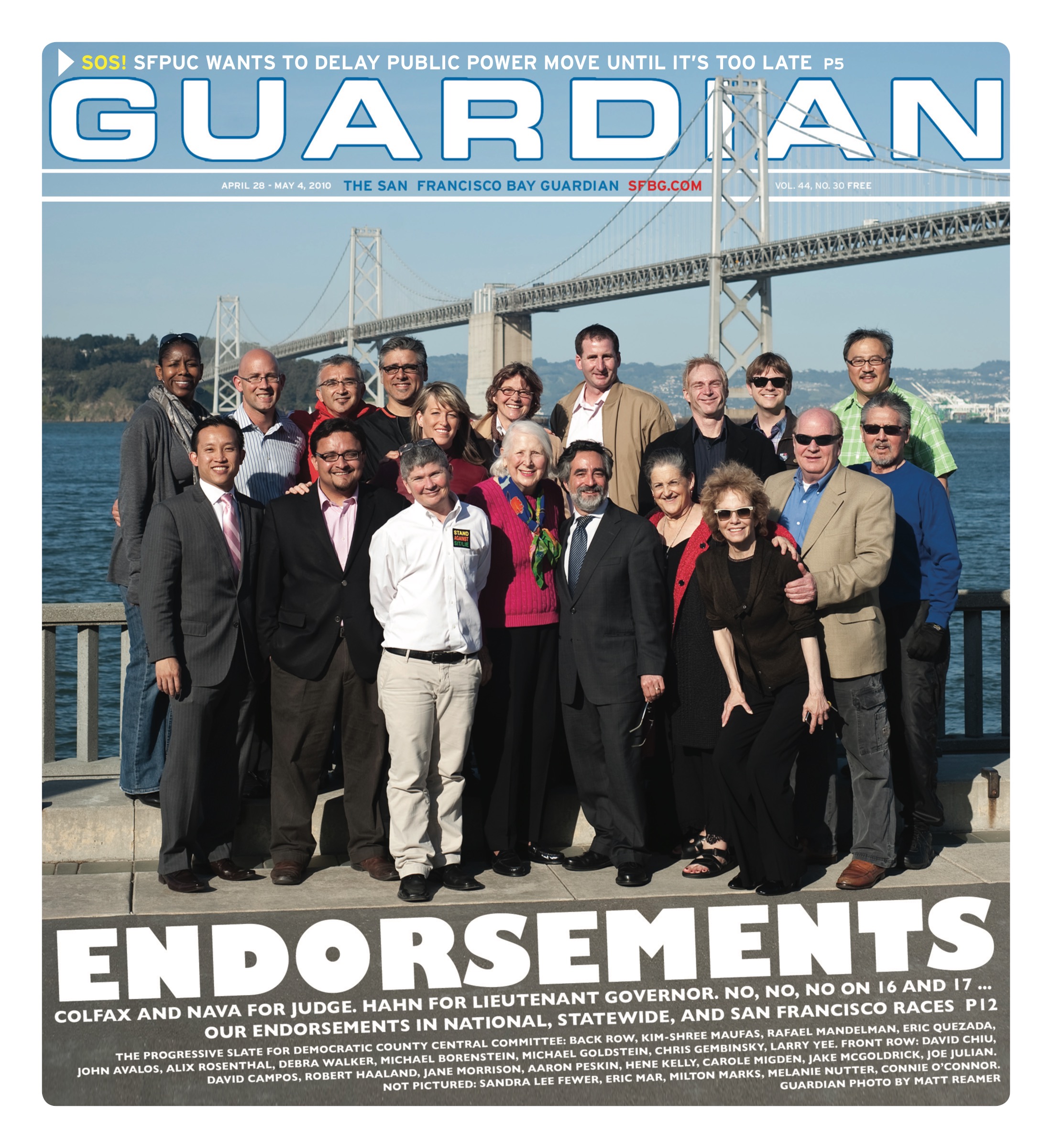
ENDORSEMENTS: State ballot measures

8

PROPOSITION 13

LIMITS ON PROPERTY TAX ASSESSMENT FOR SEISMIC RETROFITS

YES

The primary sponsor of Prop. 13 is Republican Sen. Roy Ashburn, who dominated the news for several days after he was arrested for drunk driving on his way home from a Sacramento gay bar. Needless to say, Ashburn’s dramatic coming out has whipped up far more attention than his noncontroversial ballot initiative.

We’re generally opposed to anything that gives tax cuts or tax deferrals to property owners; thanks to a 1978 measure also called Prop. 13, much of the commercial and residential property in California is badly under assessed. And Prop. 13, 2010 style, is indeed a tax break. But it’s probably justified.

Buildings in this state are typically reassessed for property taxes after they’ve been modified with new construction, except in cases where the modifications are made to comply with earthquake-safety standards. While most buildings that undergo seismic retrofitting are exempt from reassessment until the property is transferred to a new owner, the exemption for unreinforced masonry buildings is limited to 15 years. Prop 13 would remove that 15-year cap.

The fiscal impact on cities is likely to be pretty minor, and the measure might encourage both commercial and residential landlords to bring their buildings up to standard. Vote yes.


PROPOSITION 14

OPEN PRIMARIES

NO

At the height of a royal mess last year when the state budget was long overdue and the two-thirds majority needed to pass it was still out of reach by one vote, Republican Sen. Abel Maldonado struck a deal with Democrats. He said he’d support the budget — if the majority party would meet a few of his demands. One thing he insisted on was Prop. 14 — a ballot measure that would effectively remove political parties from the primary elections process, allowing all voters to cast ballots for any candidate regardless of party affiliation.

Under Maldonado’s plan, all candidates would run on a single primary ballot, and the top two vote-getters would face off in the general election. Heavily funded by the California Chamber of Commerce and marketed by the same spin doctors and corporate lawyers who are rolling in Yes on 16 campaign money, Prop. 14’s backers say it will result in more centrist elected officials.

There are plenty of pitfalls here, the most worrisome being that it would drive up the cost of elections and give more moneyed (and corporate-allied) candidates a sharper competitive edge while elbowing out progressives. It would allow Republicans to play a role in what would normally be Democratic primaries (and vice versa.) The measure would also make it nearly impossible for smaller parties — the Green Party, for example — to offer candidates in the November elections.

Bad idea, bad process, Vote no.


PROPOSITION 15

FAIR ELECTIONS ACT

YES

California desperately needs electoral reform. Corporate campaign spending and lobbyists have poisoned the decision-making process and muzzled the voice of the people. Something radical needs to be done — and while this measure is only a small, measured step in the right direction, it’s an important and promising experiment.

Prop. 15 would create a pilot public financing program for the 2014 and 2018 races for California Secretary of State — and the program would be funded by a tax on lobbyists. Right now lobbyists pay only $12.50 per year to register with the state. This measure would increase that fee to $350 annually and use the money to create a fund of about $6 million that candidates for the crucial office overseeing elections in the state could tap after demonstrating their popular support by gathering a number of small contributions. All candidates who qualify would be given the same amount of money and left to compete on the issues. Ideally this public financing program would prove successful and eventually be expanded to other offices. Public financing of election campaigns, which is currently working well in Arizona and Maine, is certainly worth a try in California. Vote yes.


PROPOSITION 16

MONOPOLY PROTECTION FOR PG&E

NO! NO! NO!

The deceptively titled “Taxpayer’s Right to Vote Act” was dreamed up and funded entirely by Pacific Gas and Electric Co., the monopolistic utility that is worried it could face actual competition here in San Francisco (and elsewhere) from municipal electricity programs that would offer customers a greener energy mix and more accountability than PG&E executives will ever demonstrate.

Rather than accept some healthy competition, this sleazy corporation has opted to spend some $35 million to exterminate all possibilities of municipal electricity programs cropping up anywhere in the state in a bid to preserve its octopus-like grip on the energy market in Northern California. Prop. 16 would require a two-thirds majority vote at the ballot before any community choice aggregation (CCA) program — or any attempt at creating or expanding a public-power system — could move forward. That’s an extreme hurdle — -and PG&E knows it.

In effect, PG&E is trying to buy public policy here, trying to pass a law that will protect its own monopoly interests.

In San Francisco, the CCA being proposed would offer customers 51 percent renewable power by 2017, which means it would blow PG&E out of the water in the green arena and mark S.F. as taking greater strides toward combating climate change than any other major U.S. city. This example could set a precedent for others, which, in turn, could create favorable market conditions for green energy startups that want to harness wind, solar, biomass, geothermal, tidal, and energy efficiency alternatives.

The very existence of Prop. 16 is already threatening the San Francisco CCA; the city’s Public Utilities Commission is trying to delay a final contract until after the June 8 vote on the measure (see editorial, page 5)

Vote no on Prop 16. Not just because it’s an example of a big business single-handedly trying to alter the state constitution for its own economic benefit by pouring millions of dollars into a deceptive advertising campaign. Not just because a two-thirds majority vote requirement is anti-democratic. Not just because there were reports that the signature gatherers who got people to sign on in support of placing Prop. 16 on the ballot were telling people that its purpose was to limit PG&E expansion or encourage solar power. Not just because Senate Pro Tem Darrell Steinberg and a half dozen members of the Legislature sent a letter rebuking PG&E CEO Peter Darbee for disrespecting the democratic process by going straight to the ballot to undermine legislation it initially supported that enabled the creation of CCA programs. Not just because PG&E is using $35 million of ratepayer dollars (that’s the check you wrote them for your electricity bill!) to put out slick TV ads for this campaign when it should have been repairing the pipelines under those manholes that keep exploding and messing up your morning commute. Not even just because with CCA, you already have the right to vote whether or not you want to be part of it, a choice PG&E will never give you. And not just because PG&E keeps trying to raise rates, which is much more difficult for municipal energy agencies to do.

If for no other reason, vote no because Prop. 16 flies in the face of everything environmentalists stand for. It’s a measure that will thwart progress on fighting climate change, brought to you by the company that practically invented green-washing. PG&E is a huge nuclear power player; it purchases coal from mountaintop-removal coal mines in West Virginia that are completely devastating biodiverse landscapes in Southern Appalachia and screwing over poor people by tainting their drinking water; and it’s in the process of building fossil fuel-fired power plants in poor communities of color in California. The CCA programs at least represent a glimmer of hope for an alternative model; Prop. 16 kills off that possibility with one fell swoop motivated by pure greed. For the love of justice, democracy, and the planet, vote no on Prop 16.


PROPOSITION 17

CAR INSURANCE SCHEME

NO, NO, NO!

Mercury Insurance sponsored this measure and is campaigning for it with tens of millions of dollars, betting it can fool voters and make hundreds of millions of dollars in profits by doing so. And if the company is right, insurance rates will skyrocket for new drivers and those who haven’t had continuous insurance coverage, which experts say will increase the number of uninsured drivers on the roadways and end up increasing insurance rates for everyone.

Mercury and its founder George Joseph have been truly malevolent players in California, exploiting their customers to make billions of dollars in profits, attacking California’s landmark insurance reform measure Prop. 103 with lawsuits and corrupting campaign contributions over more than 20 years, and flouting insurance regulators in such brazen fashion that even Insurance Commissioner Steve Poizner, a conservative Republican, recently chastised the company for its “lengthy history of serious misconduct” (see “Buying power,” March 17).

Now, however, the company is hoping its promise to cut the insurance premiums of drivers who have maintained continuous coverage by “as much as $250 per year” will buy their votes and that they’ll overlook the myriad negative impacts of increasing everyone else’s premiums by $1,000 per year or more, based on Mercury’s own estimates.

Think about that. If you’re a driver who missed an insurance payment by even one day, or a soldier returning from boot camp, or someone with a low-income getting insurance for the first time or after ditching your car for a while, what are you going to do when you discover already-expensive car insurance comes with a $1,000 annual surcharge?

Many Californians, those who share our roads, will choose to drive without insurance. Then they’ll be more likely to leave the scene of accidents or declare bankruptcy rather than paying out-of-pocket for their accidents, both of which increase the cost of insurance for everyone else.

That’s how insurance works. If someone pays less, someone else pays more; and the only entity guaranteed to really make money over the long term is the insurance company. Don’t fall for this scam. Vote no on 17.

Oyaji

0

paulr@sfbg.com

DINE Life does serve up the occasional delicious paradox, such as getting one’s first glimpse of the new iPad while sitting at a sushi bar in the outer Richmond. The iPad is elegant, yes, a jewel of a device whose colorful icons zip across the screen at the swipe of a finger, like images glimpsed through the windows of an accelerating train. But it is also the latest in a series of increasingly powerful devices that mediate our relations with the rest of the world. You do touch the iPad, true, to make it work, but mostly you stare at it, as if it’s a television.

The sushi bar, by contrast, is an unmediated encounter between customer and chef. No machines get in the way, not even servers, unless you order a beer or sake. There is no swiping unless and until you pay by credit card. The sushi bar in this sense resembles a New York deli: people at a counter full of food, looking and pointing at the food, the chef nodding and preparing the food and handing it back, maybe even watching in approval as it gets eaten. Directness.

This revelation — if that’s what it is — came to me recently at five-year-old Oyaji, a Zagat-rated Japanese restaurant at the edge of Lincoln Park. (The name means, more or less, “daddy,” in the Sean Connery sense.) The iPad was enthralling and magical, but I was more enthralled by the sight of our young sushi chef at his labors, expertly forming his rolls and hand rolls, wielding his sharp ceramic knives and handing us the results. Gleaming gizmo wizardry at one elbow, and spicy tuna at the other. Give me … well, it would be greedy to say both, especially since I don’t want an iPad.

Oyaji is good-looking in an unassuming way. Its most striking design features are the L-shaped bar, fashioned from blond wood and glass, at the rear of the storefront dining room and, overhead, a grid of beams laid out to form large squares, like upside-down seed beds. The lighting is low and moody, the crowds tending toward young and lively. I did notice one evening that most of the people sitting at the tables toward the front appeared to be occidental, while those at the bar were all Asian — at least until the iPad hipsters showed up.

The food is pretty conventional, mostly excellent, with a few blips. We thought very highly of goma-ae ($4), a boiled (but served cold) spinach, which had a faint sweetness and a bit of crunch from a gratin-like topping of crushed white sesame seeds. We thought nearly as highly of the wakame ($4), or seaweed salad. Less impressive were the sliced tomatoes with mayo ($3.50) — but then it was probably stupid on our part to order tomatoes in early spring — and the avocado roll ($3.50), which was dry.

Also a bit dry was the so-called Christy roll ($6), chunks of grilled albacore in a rice casing. I love albacore and prefer it to the more exalted sorts of tuna, perhaps because it’s more likely to be taken locally. But it does seem to be less fatty, and that reduces the margin of error when cooking it. The dryness issue recurred in the Hawaii roll ($5.50), though it was muted, if not mooted, by the presence of spicy mayonnaise. The spicy hamachi roll ($6.50), virtually the same dish, except with yellowtail instead of tuna and no clever name, was better.

Yellowtail also evidently helped lift the Crunchy Wedding ($7), one of those near-blockbuster assemblages that here included (in addition to the fish) avocado slices and tempura batter, again for a quasi-gratin effect. Similarly loaded was the Stirling ($7), with crab, avocado, fish roe, and crunchy protrusions of tempura shrimp. And for sheer elegance, it would be tough to top the spicy scallop hand roll ($7), a papery, dark-green cone filled with rice and scallops turned in spicy mayo, for a nice contrast between sweet brininess and creamy bite.

You’d have a hard time eating a handroll while dealing with your new iPad. The iPadders to my left seemed to have come to that conclusion; they had little discourse with our handsome young sushi chef and seemed to prefer the small plates of cooked food that were prepared somewhere out of sight in the rear (behind a battlement of beer boxes) and rushed out by acrobatic servers carrying one atop each upturned hand, as in the movies. A plate of meatballs flew past; I was tempted to swipe one but didn’t.

OYAJI

Dinner: Tues.–Thurs., 5:30 — 10:30 p.m.;

Fri.–Sat., 5:30–midnight; Sun., 5:30–10 p.m.

3123 Clement, SF

(415) 379-3604

www.oyajirestaurant.com

Beer and sake

AE/MC/V

Noisy

Wheelchair accessible


The CCA “conundrum”

The negotiations for the city’s green municipal power program still haven’t resulted in a finalized contract, and time is running out.

In 42 days, voters will decide whether Prop 16, the ballot initiative dubbed the “Taxpayers Right to Vote Act,” ought to be enshrined into state law. If a simple majority votes yes, the state constitution will be changed to require a two-thirds supermajority vote at the ballot before any municipal electricity program can move forward, effectively making it impossible for local governments to offer alternatives to investor-owned utility companies. Pacific Gas & Electric Co., the 105-year-old utility that gained infamy with the movie Erin Brockovich after it was accused of causing groundwater pollution which led to a cancer cluster in Hinkley, Calif., is poised to spend $35 million to pass Prop 16.

Here in San Francisco, where the vision for a green municipal power program goes back at least half a decade (and PG&E’s monopolistic grip dates back much farther), the plan’s most dedicated proponents have come to view Prop 16 as “the grim reaper.” At a meeting in City Hall last Friday about CleanPower SF, the community choice aggregation (CCA) program that could provide San Franciscans with 51 percent renewable electricity, Sup. Ross Mirkarimi repeated a mantra he’s intoned since approximately last year at this time: “All hands on deck.” Mirkarimi’s face looked tense, and his anxiety about the closing window of opportunity was plain even as he tried to display optimism. If a CleanPower SF program contract is not signed before June 8, when Prop 16 is decided, years of hard work and effort could be lost. With $35 million worth of carefully crafted PR messaging that reveals nothing about the sole financier of the measure or its anti-competitive intentions, Prop 16 has a decent shot at voter approval.

The race against the clock has been intensified by the fact that the San Francisco Public Utilities Commission, the city agency tasked with implementing CCA, has been unable (or unwilling, some critics charge) to broker a deal with Power Choice Inc., the energy service provider selected for CCA. Negotiating sessions have been ongoing since February, with SFPUC staff members, SFPUC General Manager Ed Harrington, three city attorneys, and staff of the Local Agency Formation Commission devoting hours to negotiations. “We are continuing to work hard to secure a contract,” SFPUC Assistant General Manager of Power Barbara Hale told the Guardian.

Yet as the days pass, the absence of a signed contract in hand has program advocates increasingly worried, frustrated, and suspicious of the SFPUC. “My sense, and my fear quite frankly, has been that the level of commitment [from the SFPUC] isn’t there, and if it were there … then we would have a finalized contract,” Sup. David Campos noted at a joint meeting between LAFCo and the SFPUC on Friday.

John Rizzo of the Sierra Club told the Guardian that Harrington approached the environmental group last week requesting that it join the SFPUC in issuing a press release blaming PG&E’s Prop 16 for marring CCA’s prospects. Harrington was ready to announce that the CCA had reached a preliminary contract, but not really a contract at all, since key terms such as a rate structure would not be hammered down till after the June 8 election. The Sierra Club declined to go along with that idea. Such a move would have jeopardized the program’s shot at success. Campos highlighted this problem at the meeting, saying, “Even though there are risks associated with CCA, the risk of not doing this and not having as concrete a contract by the election is greater.”

Green power advocate Eric Brooks noted that he had received a call from Nancy Miller, the executive director of LAFCo, notifying him that the SFPUC felt that Prop 16 had created a climate that made it too difficult to negotiate, and that a press release would be issued explaining as much. In the end, the SFPUC agreed to stay the course at the negotiating table. At Friday’s meeting, there was no mention of pushing the contract back to a later date. Instead, everyone nodded in polite agreement that all hands were, indeed, on deck.

But during his presentation to commissioners, Harrington emphasized the difficulty in meeting the twin program goals: green power on one hand, and competitive pricing on the other. He displayed charts showing how much more expensive wind and solar were than “brown power,” the fossil fuel and nuclear variety currently offered by PG&E. When challenged on the SFPUC’s commitment, Harrington responded tersely, “Staff commitment does not change the economic reality of the world.”

Brooks, who has weighed in and watched the process unfold since the beginning, later charged that Harrington was presenting a wholly different picture from what was originally agreed to as a way of subverting the program. “He purposely showed the numbers so that they would look worse,” Brooks said. “His key trick was … allowing the contractor the option of a 3-to-5 year contract. No one thinks you can pay renewable energy off in three years, that’s ridiculous. … He knows that the plan was to pay this off over 15 years. There’s no way he didn’t know that the idea is to pay it off in 15 years.”

Harrington was not available for comment. But Hale, who did speak with the Guardian, told us, “We’re absolutely open to a longer-term contract.” The problem, she said, has been determining a rate that makes sense both to guarantee the long-term viability of the program while meeting the renewable-energy program goals and the financial commitment necessary to make it worthwhile for the service provider. It’s like a big control board with multiple dials, and the problem seems to lie in twisting the knobs to find the appropriate setting. So far, they haven’t hit the sweet spot.

Meanwhile, the political backdrop of this “conundrum,” as Harrington called it, is that Mayor Gavin Newsom, now a candidate for Lieutenant Governor, would be placed in an awkward position if a Board-approved contract for the CCA program landed on his desk before June 8. If he endorsed the contract with his signature, he would earn the ire of PG&E, a moneyed political ally that could help him reach the office he aspires to. But if he vetoed CCA, it would amount to a stunning display of hypocrisy, since he would be a green mayor rejecting the greenest municipal power program ever attempted. Newsom, who wants to name a street after former Mayor Willie Brown even as Brown is publicly arguing in favor of Prop 16, could avoid that dilemma altogether if the contract negotiations just imploded, or were at least delayed till after June 8.

Events listings

0

Event Listings are compiled by Paula Connelly. Submit items for the listings at listings@sfbg.com.

WEDNESDAY 28

Phases Full Moon Celebration McLaren Park, 2100 Sunnydale, SF; (415) 468-9664. 8pm, free. Join in on this celebration of the passing of the Moon Phases with people from different spiritual traditions and walks of life featuring dancing, drumming, singing, readings, performances, and more.

FRIDAY 30

Journalism Innovations University of San Francisco, Fromm Hall, Golden Gate at Parker, SF; (415) 738-4975. Fri. 1pm-7:30pm, Sat. 8:30am-7:30pm, Sun. 9am-12:30pm; $15-$75 sliding scale. Join over 600 journalists, educators, advocates, and citizens for this conference on shaping the future of journalism featuring workshops, expositions, and showcases of new projects, practices, and ideas. Presented by the Society of Professional Journalists (SPJ) Nor Cal.

Poems Under the Dome North Light Court, San Francisco City Hall, 1 Dr. Carlton B. Goodlett, SF; www.poemdome.com. 5:30pm, free. Celebrate the last day of National Poetry Month by reading a poem of your choosing at City Hall. Space is limited, so readers are selected by lottery and limited to three minutes per poem. Readings will begin with a poem by Maxine Chernoff.

BAY AREA

"Are We Alone?" UC Berkeley, Sibley Auditorium, Bechtel Engineering Center, Hearst at LeRoy, Berk.; (510) 642-8678. 7:30pm, free. Attend this debate where Dan Werthimer, UC Berkeley SETI Program Director, and Geoff Marcy, Professor, UC Berkeley Astronomy Department, will present convincing arguments both for and against the existence of technological life elsewhere in the galaxy. Either the Milky Way is teeming with life or it isn’t; decide who’s right.

SATURDAY 1

May Day Dolores Park, 18th St. at Dolores, SF; www.uainthebay.org. 3pm, free. Celebrate May Day with the anti-authoritarian community at this family friendly event featuring food, drink, activities, speeches, reenactments, and information tables from organizations like Bound Together Books, Homes Not Jails, Indybay, International Workers of the World (IWW), and many more.

National Free Comic Book Day Comic book stores throughout the Bay Area, visit freecomicbookday.com for a list of stores near you. All day, free. Special edition comics from top publishers, like Marvel and DC, will be given away all day. Participating stores include Isotope, Jeffery’s Toys, Caffeinated Comics, Japantown Collectibles, Neon Monster, Comix Experience, and more.

Roots and Culture Shelton Theater, Pier 26, The Embarcadero, SF; (415) 665-8855. 8pm, $2-20 sliding scale. Attend this May Day event that promises to shake loose all the dampness from the rain and economic struggles featuring COPUS, a spoken word, bass, and percussion ensemble, and Heartical Roots, a song-writing collaborative including bass, drums, keyboards, guitar, and Nyahbinghi drums.

Russian Hill Stairways Meet at Hyde and Filbert, SF; www.sfcityguides.org. 10am, free. Learn more about San Francisco history, architecture, legends, and lore on this SF City Guides walking tour featuring magic staircases, gardens, views from 345 feet above the Bay, and stories about the former haunts of writers and artists.

Spring Plant Sale SF County Fair Building, San Francisco Botanical Garden, Strybing Arboretum, Golden Gate Park, 9th Ave. at Lincoln, SF; (415) 661-1316. 10am-2pm, free. Learn about and purchase rare and unusual plants not found at other regional plant stores at this giant sale featuring over 4,000 different kinds of plants, plant related books, treasures, garden gifts, and more.

SUNDAY 2

Art in the Alley Kerouac Alley, Columbus and Broadway, SF; (415) 362-3370. Noon – 6pm, free. Attend this open air art gallery, where over 25 emerging and established artists will showcase their work, including painting, printmaking, glass art, books, photography, jewelry, and more, and celebrate this fabled neighborhood and its artistic roots.

Escape from Alcatraz Triathlon Race begins and ends at Marina Green, Marina at Fillmore, SF; www.escapefromalcatraztriathlon.com. 8am, free. Watch as more than 2,000 amateur and professional athletes compete in a 1.5 mile swim from Alcatraz Island in the San Francisco Bay, followed by an 18 mile bike ride out to the Great Highway through the Golden Gate Park, and concluding with an 8 mile run through the Golden Gate National Recreation Area. The finish is at The Marina Green.

BAY AREA

Go Expo Day Oakland Asian Cultural Center, Suite 290, Pacific Renaissance Plaza, 388 9th St., Oak.; (510) 501-2701. 1pm, free. Learn about the game "Go," which originated in 4,000 years ago in China. Get free lessons, participate in game sets, and get instructional booklets so that you too can one day compete for some big prizes.

Women Entrepreneurs Showcase David Brower Centre, main lobby, 2150 Allston, Berk.; (510) 809-0900. 10:30am, $4 includes light lunch and raffle ticket. Show your support for local, women-owned businesses of all types, listen to live music, and enjoy some food samples.

TUESDAY 4

Beers, Brats, and Bikes Gestalt Haus, 3159 16th St., SF; www.gestaltsf.com. 7pm, $1 suggested donation. Drink beer, eat delicious sausages (veggie options available and also delicious), and commune with other bike lovers at this fundraiser for Hazon, a non profit organization dedicated to promoting sustainable food.

Music listings

0

Music listings are compiled by Paula Connelly and Cheryl Eddy. Since club life is unpredictable, it’s a good idea to call ahead to confirm bookings and hours. Prices are listed when provided to us. Submit items at listings@sfbg.com.

WEDNESDAY 28

ROCK/BLUES/HIP-HOP

*Aesop, Venture Capitalists, New Humans Bottom of the Hill. 9pm, $10.

Fix My Head, This Runs on Blood, Useless Children, Gain to Lose Sub-Mission, 2183 Mission, SF; www.sf-submission.com. 9pm, $6.

*"Full Pink Moon Party" Rickshaw Stop. 8pm, $10. With Sonya Cotton, Honeycomb, Jascha vs. Jascha, and Kris Gruen.

Japanther, Reaction, Dirty Marquee, Street Eaters Hemlock Tavern. 9pm, $8.

Pomegranate, Fall Risk, Control-R Hotel Utah. 8:30pm, $6.

Chad Price, Michael Dean Damron, Micah Schabnel, Piss Pissdofferson Thee Parkside. 8:30pm, $5.

Stymie and the Pimp Jones Luv Orchestra, Funk Revival Orchestra Café du Nord. 9pm, $10.

Volker Strifler Band Biscuits and Blues. 8pm, $15.

FOLK/WORLD/COUNTRY

Anoushka Shankar Palace of Fine Arts Theater, 3301 Lyon, SF; (415) 563-6504. 8pm, $25-$65.

DANCE CLUBS

Booty Call Q-Bar, 456 Castro, SF; www.bootycallwednesdays.com. 9pm. Juanita Moore hosts this dance party, featuring DJ Robot Hustle.

Club Shutter Elbo Room. 10pm, $5. Goth with DJs Omar, Nako, and Justin.

Hands Down! Bar on Church. 9pm, free. With DJs Claksaarb, Mykill, and guests spinning indie, electro, house, and bangers.

Machine Sloane, 1525 Mission, SF; (415) 621-7007. 10pm, free. Warm beats for happy feet with DJs Sergio, Conor, and André Lucero.

Mary-Go-Round Lookout, 3600 16th St, SF; (415) 431-0306. 10pm, $5. A weekly drag show with hosts Cookie Dough, Pollo Del Mar, and Suppositori Spelling.

RedWine Social Dalva. 9pm-2am, free. DJ TophOne and guests spin outernational funk and get drunk.

Respect Wednesdays End Up. 10pm, $5. Rotating DJs Daddy Rolo, Young Fyah, Irie Dole, I-Vier, Sake One, Serg, and more spinning reggae, dancehall, roots, lovers rock, and mash ups.

Synchronize Il Pirata, 2007 16th St, SF; (415) 626-2626. 10pm, free. Psychedelic dance music with DJs Helios, Gatto Matto, Psy Lotus, Intergalactoid, and guests.

Telephoned Harlot, 46 Minna, SF; www.harlotsf.com. 7pm. Mash-ups with DJ Sammy Bananas and singer Maggie Horn.

Yoruba Dance Sessions Bacano! Som., 2925 16th St, SF; (415) 558-8521. 9pm, free. With resident DJ Carlos Mena and guests spinning afro-deep-global-soulful-broken-techhouse.

THURSDAY 29

ROCK/BLUES/HIP-HOP

Aquaserge, Casper and the Cookies, Grand Lake Rickshaw Stop. 8pm, $10.

Arcadio, Guns for San Sebastian, Charles Gonzalez Café du Nord. 9pm, $10.

C-Mon and Kypski, Frequency, Sweet Snacks, DJ Mancub Independent. 9pm, $12.

A Day to Remember, August Burns Red, Silverstein, Enter Shikari, Go Radio Regency Ballroom. 6:45pm, $23.

Dunes El Rio. 8pm, $5.

Shane Dwight Biscuits and Blues. 8pm, $20.

Flood, Hashishian, Days of High Adventure Knockout. 10pm, $6.

49 Special, Big Nasty, TV Mike and the Scarecrowes Hotel Utah. 9pm, $7.

Emily McLean, Quinn DeVeaux, Street Sirens Red Devil Lounge. 8pm, $8.

Murs, Sick Jacken Fillmore. 8pm, $20.

Photo Atlas, Moog, Smile Radio Thee Parkside. 9pm, $8.

Spill Canvas, Tyler Hilton, AM Taxi, New Politics Slim’s. 7:30pm, $16.

Sugar and Gold, Nite Jewel, Baron Von Luxxury, DJ Loose Shus Bottom of the Hill. 9pm, $10.

Sugar Butt Tiger, Bare Wires, Girl Band, MC Meathook and the Vital Organs, SF Rockstar Paradise Lounge. 9pm, $7. Proceeds benefit the Haight-Ashbury Street Fair.

Emily Jane White, Helene Renault, Chloe Makes Music Hemlock Tavern. 9pm, $7.

FOLK/WORLD/COUNTRY

Bluegrass and old-time jam Atlas Café. 8pm, free.

Jordan Carp Bollyhood Café. 8pm, free.

Jon Rubin with Cal Keaoola Bliss Bar, 4026 24th St., SF; (415) 826-6200. 8pm, free.

DANCE CLUBS

Afrolicious Elbo Room. 9:30pm, $8-10. DJs Pleasuremaker and Señor Oz mark their night’s third anniversary with a live performance by Aphrodesia.

Caribbean Connection Little Baobab, 3388 19th St, SF; (415) 643-3558. 10pm, $3. DJ Stevie B and guests spin reggae, soca, zouk, reggaetón, and more.

Drop the Pressure Underground SF. 6-10pm, free. Electro, house, and datafunk highlight this weekly happy hour.

Good Foot Yoruba Dance Sessions Bacano! Som., 2925 16th St, SF; (415) 558-8521. 9pm, free. A James Brown tribute with resident DJs Haylow, A-Ron, and Prince Aries spinning R&B, Hip hop, funk, and soul.

Koko Puffs Koko Cocktails, 1060 Geary, SF; (415) 885-4788. 10pm, free. Dubby roots reggae and Jamaican funk from rotating DJs.

Mestiza Bollywood Café, 3376 19th St, SF; (415) 970-0362. 10pm, free. Showcasing progressive Latin and global beats with DJ Juan Data.

Peaches Skylark, 10pm, free. With an all female DJ line up featuring Deeandroid, Lady Fingaz, That Girl, and Umami spinning hip hop.

Popscene 330 Rich. 10pm, $10. Rotating DJs spinning indie, Britpop, electro, new wave, and post-punk.

FRIDAY 30

ROCK/BLUES/HIP-HOP

Aunt Kizzy’z Boyz Biscuits and Blues. 8 and 10pm, $20.

David Baron, Dan Vickrey, Blackstone Heist, American Studies Hotel Utah. 9pm, $10.

Clipd Beaks, Sightings, Bill Orcutt Hemlock Tavern. 9pm, $7.

Flexx Bronco, My Revolver, Bourbon Saints, Electric Sister Thee Parkside. 9pm, $6.

JFP, Cnote, Mack Misstress El Rio. 10pm, $5.

Kapakahi, Dogman Joe, Stranger Café du Nord. 9:30pm, $12.

Lemonade, Solid Gold, Active Child, DJ Aaron Axelsen Rickshaw Stop. 9pm, $10.

Lord T. and Eloise, Tenderloins, Hottub DJ Set Independent. 9pm, $14.

Ponys, Disappears, Spencey Dude and the Doodles Bottom of the Hill. 10pm, $12.

Rogue Wave, Man/Miracle Fillmore. 9pm, $19.50.

Joe Rut Great American Music Hall. 9pm, $14. With comedian Will Franken.

Shpongle, ADHK, Hallucinogen LIVE Regency Ballroom. 9pm, $30.

Shayna Steele Coda. 10pm, $10.

JAZZ/NEW MUSIC

Audium 9 1616 Bush, SF; (415) 771-1616. 8:30pm, $15.

Black Market Jazz Orchestra Top of the Mark. 9pm, $10.

Chano Dominguez Flamenco Jazz Quartet featuring Tomasito Palace of Fine Arts Theare, 3301 Lyon, SF; www.sfjazz.org. 8pm, $25-60.

Dan Zemelmen Quartet with Kenny Washington Red Poppy Art House. 8pm, $12-15.

Eric Kurtzrock Trio Ana Mandara, Ghirardelli Square, 891 Beach, SF; (415) 771-6800. 8pm, free.

Fred Frith and Theresa Wong Meridian Gallery, 535 Powell, SF; www.meridiangallery.org. 8pm, $10.

Kenny Lattimore Yoshi’s San Francisco. 8 and 10pm, $38.

"A Night at Birdland" Deco Lounge, 510 Larkin, SF; (415) 346-2025. 9pm. With the MegaFlame Blue Band.

FOLK/WORLD/COUNTRY

Eek-a-mouse Rock-it Room. 10pm, $22. With the Holdup and DJ Mr. E.

Lava, Mestizo, Carmen Milagro Slim’s. 8pm, $16.

Melees Socha Café, 3235 Mission, SF; (415) 643-6848. 8:30pm, free.

Stairwell Sisters Revolution Café, 3248 22nd St, SF; (415) 642-0474. 8:45pm, free.

DANCE CLUBS

Activate! Lookout, 3600 16th St, SF; (415) 431-0306. 9pm, $3. Face your demigods and demons at this Red Bull-fueled party.

Afrolicious Elbo Room. 9:30pm, $8-10. DJs Pleasuremaker and Señor Oz mark their night’s third anniversary with Chico Mann and guest DJ Similak Chyld.

Area Codes Element Lounge. 10pm, $10. With DJs Platurn, Doc Fu, and White Mike spinning Bay Area hip hop.

Blow Up Rickshaw Stop. 10pm, $10. With rotating DJs.

Exhale, Fridays Project One Gallery, 251 Rhode Island, SF; (415) 465-2129. 5pm, $5. Happy hour with art, fine food, and music with Vin Sol, King Most, DJ Centipede, and Shane King.

Fat Stack Fridays Koko Cocktails, 1060 Geary, SF; (415) 885-4788. 10pm, free. With rotating DJs Romanowski, B-Love, Tomas, Toph One, and Vinnie Esparza.

Gay Asian Paradise Club Eight, 1151 Folsom, SF; www.eightsf.com. 9pm, $8. Featuring two dance floors playing dance and hip hop, smoking patio, and 2 for 1 drinks before 10pm.

Good Life Fridays Apartment 24, 440 Broadway, SF; (415) 989-3434. 10pm, $10. With DJ Brian spinning hip hop, mashups, and top 40.

Hot Chocolate Milk. 9pm, $5. With DJs Big Fat Frog, Chardmo, DuseRock, and more spinning old and new school funk.

Look Out Weekend Bambuddha Lounge. 4pm, free. Drink specials, food menu and resident DJs White Girl Lust, Swayzee, Philie Ocean, and more.

M4M Fridays Underground SF. 10pm-2am. Joshua J and Frankie Sharp host this man-tastic party.

Meat Vs. Death Guild DNA Lounge. 8:30pm, $4-8. Industrial, gothic, EBM, and more with Decay, BaconMonkey, Joe Radio, and Melting Girl.

Quantic Mighty. 10pm, $12. With Disco Shawn and DJ Sake 1.

Rockabilly Fridays Jay N Bee Club, 2736 20th St, SF; (415) 824-4190. 9pm, free. With DJs Rockin’ Raul, Oakie Oran, Sergio Iglesias, and Tanoa "Samoa Boy" spinning 50s and 60s Doo Wop, Rockabilly, Bop, Jive, and more.

Suite Jesus 111 Minna. 9pm, $20. Beats, dancehall, reggae and local art.

Teenage Dance Craze Party Knockout. 10pm, $3. With DJ Sergio Iglesias, Russell Quann, and dX the Funky Gran Paw.

SATURDAY 1

ROCK/BLUES/HIP-HOP

*AC/Dshe, Total B.S., Honeydust Slim’s. 9pm, $14.

Antlers, Phantogram Independent. 9pm, $14.

Mike Beck and the Bohemian Saints Riptide. 9pm, free.

Broken Social Scene Fillmore. 9pm, $25.

Grand National, Bonafide, General Jones Hotel Utah. 9pm, $8.

JC Smith Band Biscuits and Blues. 8 and 10pm, $16.

*Laudanum, Worm Ouroboros, Dispirit Hemlock Tavern. 9:30pm, $7.

Maus Haus, Rafter, White Cloud Bottom of the Hill. 10pm, $10.

Outernational Thee Parkside. 9pm, $10.

Plushgun, Music for Animals, Fake Your Own Death, Marissa Guzman Rickshaw Stop. 8pm, $15.

Warren Teagarden, Collisionville, Charmless Kimo’s. 9pm, $7.

JAZZ/NEW MUSIC

Audium 9 1616 Bush, SF; (415) 771-1616. 8:30pm, $15.

Eric Kurtzrock Trio Ana Mandara, Ghirardelli Square, 891 Beach, SF; (415) 771-6800. 8pm, free.

Hypnotic Brass Ensemble Palace of Fine Arts Theatre, 3301 Lyon, SF; www.sfjazz.org. 3 and 8pm, $5-25.

Kenny Lattimore Yoshi’s San Francisco. 8 and 10pm, $38.

Marlena Teich Quintet Savanna Jazz. 8pm.

Sanctuary Trio featuring Peter Apfelbaum and guests Coda. 10pm, $10.

Ricardo Scales Top of the Mark. 9pm, $15.

FOLK/WORLD/COUNTRY

Boyd and Wain Socha Café, 3235 Mission, SF; (415) 643-6848. 8:30pm, free.

Evangenitals El Rio. 11:30pm, $7.

Gold Live Rockit Room. 9pm, $15. With Ce’Cile, Daddy Rolo, Empress I-Lexis, Danneekah.

Sour Mash Hug Band, Four Inch Pony, Janay Rose Mercury Café, 201 Octavia, SF; (415) 252-7855. 7pm, $5.

Red Hot Chachkas Red Poppy Art House. 8pm, $15.

Brazil Vox Revolution Café, 3248 22nd St, SF; (415) 642-0474. 8:45pm, free.

DANCE CLUBS

Bar on Church 9pm. Rotating DJs Foxxee, Joseph Lee, Zhaldee, Mark Andrus, and Niuxx.

Dead After Dark Knockout. 6-9pm, free. With DJ Touchy Feely.

Debaser Knockout. 9pm, $5. Alt-rock hits from the 90s with DJ Jamie Jams and Emdee of Club Neon.

Everlasting Bass 330 Ritch. 10pm, $5-10. Bay Area Sistah Sound presents this party, with DJs Zita and Pam the Funkstress spinning hip-hop, soul, funk, reggae, dancehall, and club classics.

Fire Corner Koko Cocktails, 1060 Geary, SF; (415) 885-4788. 9:30pm, free. Rare and outrageous ska, rocksteady, and reggae vinyl with Revival Sound System and guests.

Foundation Som., 2925 16th St., SF; (415) 558-8521. 10pm.

Gemini Disco Underground SF. 10pm, $5. Disco with DJ Derrick Love and Nicky B. spinning deep disco.

HYP Club Eight, 1151 Folsom, SF; www.eightsf.com. 10pm, free. Gay and lesbian hip hop party, featuring DJs spinning the newest in the top 40s hip hop and hyphy.

Kontrol Endup. 10pm, $20. With resident DJs Alland Byallo, Craig Kuna, Sammy D, and Nikola Baytala spinning minimal techno and avant house.

Leisure Paradise Lounge. 10pm, $7. DJs Omar, Aaron, and Jet Set James spinning classic britpop, mod, 60s soul, and 90s indie.

New Wave City DNA Lounge. 9pm, $7-12. Erasure tribute with Skip and Shindog and Andy T.

Rebel Girl Rickshaw Stop. 10pm, $5. "Electroindierockhiphop" and 80s dance party for dykes, bois, femmes, and queers with DJ China G and guests.

Saturday Night Soul Party Elbo Room. 10pm, $10. Sixties soul with DJs Lucky, Phengren Oswald, and Paul Paul.

So Special Club Six. 9pm, $5. DJ Dans One and guests spinning dancehall, reggae, classics, and remixes.

Social Club Lookout, 3600 16th St, SF; (415) 431-0306. 9pm. Shake your money maker with DJs Lee Decker and Luke Fry.

Soundscape Vortex Room, 1082 Howard, SF; www.myspace.com/thevortexroom. With DJs C3PLOS, Brighton Russ, and Nick Waterhouse spinning Soul jazz, boogaloo, hammond grooves, and more.

Spirit Fingers Sessions 330 Ritch. 9pm, free. With DJ Morse Code and live guest performances.

SUNDAY 2

ROCK/BLUES/HIP-HOP

Eluvium, Benoit Pioulard Café du Nord. 8pm, $12.

Nymph, Three Leafs, Woom Hemlock Tavern. 9pm, $6.

Shootin’ Lucy, Neutralboy, Steel Tigers of Death, Gunner Kimo’s. 5:30pm, $6.

JAZZ/NEW MUSIC

Kenny Lattimore Yoshi’s San Francisco. 5pm, $5-38.

Raul Midon Palace of Fine Arts Theatre, 3301 Lyon, SF; www.sfjazz.org. 7pm, $25-55.

Ray Obiedo and the Urban Latin Jazz Project Coda. 8pm, $10.

*Kronos Quartet Herbst Theatre, 401 Van Ness, SF; www.performances.org. 11am, $8-15.

Rent Romus and the Emergency String Ensemble, Noertker’s Moxie Chamber Ensemble Musicians Union Hall, 116 Ninth, SF; www.noertker.com. 7:30pm, $10.

FOLK/WORLD/COUNTRY

Damon and the Heathens, Graves Brothers Deluxe, Doc Holler Amnesia. 8:30pm, $7.

"Wanderlust at the Fillmore" Fillmore. 8pm, $25. With Rupa and the April Fishes, MC Yogi, and DJ Dragonfly.

DANCE CLUBS

Afterglow Nickies, 466 Haight, SF; (415) 255-0300. An evening of mellow electronics with resident DJs Matt Wilder, Mike Perry, Greg Bird, and guests.

Call In Sick Skylark. 9pm, free. DJs Animal and I Will spin danceable hip-hop.

DiscoFunk Mashups Cat Club. 10pm, free. House and 70’s music.

Dub Mission Elbo Room. 9pm, $6. Dub, roots, and classic dancehall with Vinnie Esparza and guest Spliff Skankin’.

FlashDance SF Glas Kat, 520 4th St., SF; www.flashdancesf.com. 6pm, $25.

Gloss Sundays Trigger, 2344 Market, SF; (415) 551-CLUB. 7pm. With DJ Hawthorne spinning house, funk, soul, retro, and disco.

Honey Soundsystem Paradise Lounge. 8pm-2am. "Dance floor for dancers – sound system for lovers." Got that?

Jock! Lookout, 3600 16th St, SF; (415) 431-0306. 3pm, $2. This high-energy party raises money for LGBT sports teams.

Kick It Bar on Church. 9pm. Hip-hop with DJ Zax.

Lowbrow Sunday Delirium. 1pm, free. DJ Roost Uno and guests spinning club hip hop, indie, and top 40s.

Religion Bar on Church. 3pm. With DJ Nikita.

Stag AsiaSF. 6pm, $5. Gay bachelor parties are the target demo of this weekly erotic tea dance.

MONDAY 3

ROCK/BLUES/HIP-HOP

"Felonious Presents Live City Revue" Coda. 9pm, $7.

Futurecop, Keith Masters Elbo Room. 9pm, $7.

Green River Ordinance, Matt Hires, Angel Taylor Café du Nord. 8pm, $12.

Garrison Starr, Joey Ryan, Cate Le Bon Bottom of the Hill. 9pm, $10.

FOLK/WORLD/COUNTRY

AaronandJane Rockit Room. 8pm, free.

DANCE CLUBS

Bacano! Som., 2925 16th St, SF; (415) 558-8521. 9pm, free. With resident DJs El Kool Kyle and Santero spinning Latin music.

Black Gold Koko Cocktails, 1060 Geary, SF; (415) 885-4788. 10pm-2am, free. Senator Soul spins Detroit soul, Motown, New Orleans R&B, and more — all on 45!

Death Guild DNA Lounge. 9:30pm, $3-5. Gothic, industrial, and synthpop with Decay, Joe Radio, and Melting Girl.

M.O.M. Madrone Art Bar. 6pm, free. With DJ Gordo Cabeza and guests playing all Motown every Monday.

Manic Mondays Bar on Church. 9pm. Drink 80-cent cosmos with Djs Mark Andrus and Dangerous Dan.

Monster Show Underground SF. 10pm, $5. Cookie Dough and DJ MC2 make Mondays worth dancing about, with a killer drag show at 11pm.

Network Mondays Azul Lounge, One Tillman Pl, SF; www.inhousetalent.com. 9pm, $5. Hip-hop, R&B, and spoken word open mic, plus featured performers.

Skylarking Skylark. 10pm, free. With resident DJs I & I Vibration, Beatnok, and Mr. Lucky and weekly guest Djs.

TUESDAY 4

ROCK/BLUES/HIP-HOP

Heartless Bastards, Hacienda, Amy Cook Independent. 8pm, $18.

*Lupe Fiasco, B.o.B. Warfield. 8pm, $40.

MC Frontalot, Brandon Patton, Edible Norris Café du Nord. 8pm, $12.

Mantles, Dimmer, Weekend Rickshaw Stop. 8pm, $10.

Mudface, Great American Beast, Motogruv Elbo Room. 9pm, $6.

Needtobreathe, Stephen Kellogg and the Sixers, Seabird Great American Music Hall. 8pm, $19.
Rangers, Jon Porras, Radiant Husk, Centipede Eest Hemlock Tavern. 9pm, $6.
Title Tracks, New Trust, Bye Bye Blackbirds Bottom of the Hill. 9pm, $10.
Zweng, Frisky Disco, Parachute Musical, Winter Sounds Thee Parkside. 8pm, $6.
DANCE CLUBS
Alcoholocaust Presents Argus Lounge. 9pm, free. With DJs What’s His Fuck, Taypoleon, and Mackiveli.
Eclectic Company Skylark, 9pm, free. DJs Tones and Jaybee spin old school hip hop, bass, dub, glitch, and electro.
La Escuelita Pisco Lounge, 1817 Market, SF; (415) 874-9951. 7pm, free. DJ Juan Data spinning gay-friendly, Latino sing-alongs but no salsa or reggaeton.
Mixology Aunt Charlie’s Lounge, 133 Turk, SF; (415) 441-2922. 10pm, $2. DJ Frantik mixes with the science and art of music all night.
Rock Out Karaoke! Amnesia. 7:30pm. With Glenny Kravitz.
Share the Love Trigger, 2344 Market, SF; (415) 551-CLUB. 5pm, free. With DJ Pam Hubbuck spinning house.
Womanizer Bar on Church. 9pm. With DJ Nuxx.


Warriors, come out and play! (with this squeaky mouse)

0

Blossompaw jumped down from the wall and headed past the plants Jayfeather had carefully nurtured. The scent of them made Ivypaw’s mouth water, but she knew the warning given to every Clan cat: Stay away from the catnip.

Worry not for our youth in the post-Harry Potter era; there’s a new line of young adult fiction that’s got all the kids a’ reading. And it’s about fighting clans of kitties — my favorite! The Warriors, a series which to date includes over thirty titles, is a lot like Brian Jacques’ Redwall books — a small universe of carefully plotted minutiae following the escapades of animals in epic form.

But we’re going to the next level here.The Warriors see the Redwall sci-fi/fantasy nerd love of quests, battles, and prophecies, then raises it an all kitteh cast of characters. Oh yes, whiskers and all.

Warriors’ slightly confusing authorship (the books’ byline, Erin Hunter, actually refers to four women, none of them named Erin) begins each book with a comprehensive listing of each kitty in all four of the forest’s clans. Kits to clan leaders, pelt and eye colors included. For example, Dovepaw, one of the protagonists of Fading Echoes (book number two in the Omen of the Stars sub-series), is an apprentice of Shadow Clan, “a pale she-cat with blue eyes,” who is mentored by Lionblaze, “a golden tabby tom with amber eyes.” Leaving aside the complex belief structure and social hierarchy of the Warriors’ world, with 113 cats in the four mortal (oh yeah, it goes there) clans alone, it’s important to keep track of these details.

And readers do. Oh, but they do! A quick foray to The Warriors website reveals the true depths of fandom the kitties muster. Message boards require one to select a kitty avatar  to chat with the other kitties.

Which I did, all in the name of journalism of course (a golden she-cat with yellow eyes I named “Quillpaw”), and regardless of the fact that many of the conversation threads were a bit beyond my reckoning, most having to do with complex spoiler theories and desperate purrs for a single tom to mate with. Scandalous!

I meowed at my kitty friends online about why they liked this magical, mystical world of claws and fresh-kill, and I found Twilightfoot (who appears to be a fan fic writing, gender neutral black deputy cat with green eyes from he/she’s profile picture)’s answer to be the most endearing. I quote:

What do I like about Warriors?:

They are VERY interesting, and have a good plot that I can relate to.

It is NOT a G-rated series, which I <3!

I get very, um, connected with the characters, which I can rarely do with a book.

In this day and age, connection is really the pith of the matter, isn’t it? Cheers to you, Twilightfoot. And cheers to you, Warriors books — I never really liked reading about people, anyway.

Welcome to Elm Street: Part Three

0

In honor(?) of the new A Nightmare on Elm Street, we’re recapping all of the Elms so far. Find more on the Pixel Vision blog.

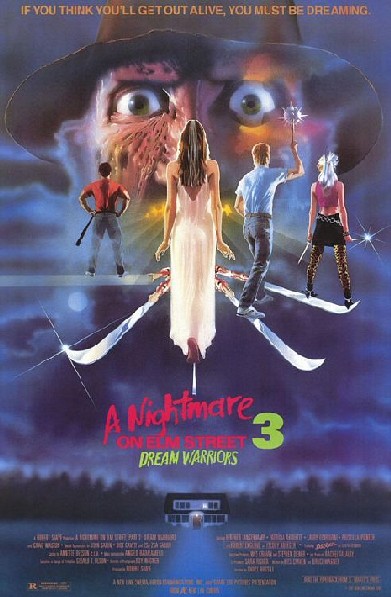
“Live together, die alone.” I stole that line from Lost, but it sums up A Nightmare on Elm Street 3: Dream Warriors (1987) all too well. The remaining Elm Street kids — you know, the ones whose parents enacted mob justice on Fred Krueger — find themselves locked in a psych ward. They’re not really crazy: they’re just having bad dreams. But these teens are (mostly) smarter than their predecessors, and they refuse to go down without a fight. The “dream warriors” pick up on two important facts: there’s safety in numbers, and you can do awesome shit when you’re dreaming. I believe The Simpsons’ Ralph Wiggum said it best: “Sleep! That’s where I’m a Viking.”
No Vikings in this bunch, sadly, but these kids do have pretty nifty powers and thus a fighting chance against Freddy. In case you’re planning on assembling your own team of dream warriors — and honestly, it’s not a bad idea — I thought I’d break down the pros and cons of part three’s heroes. Yes, most of them end up dead and those that don’t (spoiler alert) are offed in part four. But hey, it’s good to know what skills to look for and what faults to avoid when you’re trying to save your ass.

Presenting the dream warriors, in the order in which they bite it.

Phillip (Bradley Gregg)
Pros: Bitchin’ ‘80s hair.
Cons: Sleepwalker. First to die, with the most disturbing death scene by far. He really doesn’t have a lot going for him.

Jennifer (Penelope Sudrow)
Pros: Has a (somewhat painful) system for staying awake. Burning oneself with cigarettes shows serious motivation.
Cons: Smoker. Thinks she’s going to be an actress — yeah, she’s one of those. And, of course, the second to die. “Welcome to prime time, bitch.”

Taryn (Jennifer Rubin)
Pros: Stands her ground. That means not putting out for skeezy orderlies. Gets the best line of the movie: “In my dreams, I’m beautiful. And bad.” Switchblades.
Cons: Attitude. Really needs to comb that hair. Pesky heroin addiction, which Freddy exploits with terrifying fingerneedles.

Will (Ira Heiden)
Pros: Nerdy charm. In his dreams, he can walk — not to mention be the Wizard Master. That’s right, he can blow up evil wheelchairs with green lightning (in the name of Lowrek, Prince of Elves).
Cons: Even as a wizard master, he’s still just a dweeb. And eventually, a dead one.

Nancy Thompson (Heather Langenkamp)
Pros: She’s been here before. Check out that grey streak: it screams “survivor.” Prescription for Hypnocil. Won’t take getting killed lying down.
Cons: Lots of baggage. Dead friends, dead boyfriend, dead mom — rewatch the first Nightmare on Elm Street if you need a refresher. Kind of naïve, inevitably. You really thought ghost dad was legit?

Kristen (Patricia Arquette)
Pros: Good at art. Marvel at her popsicle stick recreation of Nancy’s house! Does flips. Can bring people into her dreams.
Cons: Can bring people into her dreams. Hey, that’s a bad thing when you’re trying to avoid getting murdered. Poor common sense. All the Freddy fan-art is asking for it, don’t you think?

Kincaid (Ken Sagoes)
Pros: Tells it like it is, which means more great lines: “Let’s go kick the motherfucker’s ass all over dream land!” “Yo, Freddy! Where you hidin’ at, you burnt-face pussy?” Also, dreams give him super strength!
Cons: Gets thrown in the quiet room a lot, so you know he’s bad news. Nasty habit of antagonizing Freddy Krueger.

Joey (Rodney Eastman)
Pros: Knows to wake up his friends when necessary. Dream scream can break mirrors and banish the boogeyman.
Cons: But mostly quiet. Too quiet. Ball of teenage hormones, which inspires him to follow the hot nurse from hell and get himself comatose.

Dr. Neil Gordon (Craig Wasson)
Pros: The only doctor who actually believes that his patients are being killed by Freddy Krueger. Master hypnotist. Sees dead people — or dead nuns, at least.
Cons: Not a teenager. Might we say he’s getting too old for this shit? Can’t even fight a skeleton.

So there you have it. Now you can — I’m so sorry for this — pick your own dream team. And if you’d like to recruit me as a dream warrior, you should know that I’ve seen countless horror movies and know how to survive relatively unscathed. On the other hand, I’m pee-my-pants frightened of Freddy, so let’s call it a draw.

FEAST: 10 kick-ass brunches

2

We here at the Guardian don’t survive on green buds and printer ink alone. We eat real food. Sometimes! But we do get up late and hungover. While we often forgo fancy brunch — unless we save our pennies for the amazing eggs-meet-legs “Sunday’s a Drag” buffet at Harry Denton’s (www.harrydenton.com) or dim sum nirvana at Yank Sing (www.yanksing.com) or Ton Kiang (www.tonkiang.net) — we’ll sure as shootin’ shell out for thrifty chilaquiles and bloody marys, especially the way the Bay makes ’em. Here are some of our dearest bleary-eyed, late-morning tummy fillers. (Marke B.)


BASHFUL BULL TOO

There are days when you wake up with a bladder full of Jameson’s and a fervent wish to sink into a salty, unglamorous world of egg and cheese. These are the mornings when bottomless mimosas and goat cheese frittatas sound like fightin’ words. Easy tiger, I got you — just slump into a booth at Bashful Bull Too, the most standard of Outer Sunset diners. There’s no live jazz band, no “scene” at all — just you and your greasy calories. Get down on their cheap plates of hash browns and bacon, or better yet, a burger. Slabs of ground beef are acceptable fare when, after all, you’re having breakfast at 2 p.m. (Caitlin Donohue)

3600 Taraval, SF. (415) 759-8112


BEAN BAG CAFÉ

In you’re from the Midwest, good brunch spots are distinguished by waitresses who call you “hon” and have your coffee waiting for you before you sit down. Become a regular at Bean Bag Café in the Western Addition, and they’ll do all that and more. Bean Bag’s extensive breakfast and lunch menu and progressive cooking staff means never having to decide if it’s too late for Goldilocks oatmeal (yep, it’s just right) or too early for pancakes and beer. Speaking of pancakes, the Bean Bag buttermilk, customized with bananas and caramelized walnuts on top, is a must-have. Pair it with scrambled eggs drenched in Tabasco, and you’re set until 3 p.m., when Bean Bag kicks off its happy hour with beer for $1.75. Other highlights: sunshine and a petting zoo of scruffy but wuvable dogs outside. (Diane Sussman)

601 Divisadero, SF. (415)-563-3634


CAFE DU SOLEIL

Lower Haight — known for its nicoise? C’est vrai! The salad nicoise at Cafe Du Soleil is a stunner, bursting with tender tuna, piquant greens, and enough fresh fixings to ensure some inner sunshine. But don’t stop there — or at the pastry case in front, with delectable goodies like croques madames and hazelnut chocolate croissants. Soleil’s salmon tortilla, a sort of deconstructed-quiche pyramid topped with lovely lox and drizzled with smoky romesco, is this laidback Parisian hang’s brunchtime piece de resistance. Bonus: hunky scruffsters and tattooed ladies. (Marke B.)

200 Fillmore, SF. (415) 934-8637. www.soleilsf.com


CHLOE’S

Let’s face it, one aspect of brunch — at least on a Sunday — is the wait. Chloe’s is no exception. The restaurant’s rep and tiny size mean that while weekdays are fine, on the weekend you will be waiting in a (loose) line. The upside is that Chloe’s is on a quiet corner of Church Street, so on a sunlit day, you’ll get fresh air and nothing noisier or more imposing than the people-watching pleasure of the J-Church sliding by. Once inside, indulge your sweet tooth: two highlights of the low-key menu are french toast made with croissants (served with strawberries and powdered sugar) and banana walnut pancakes, a Chloe’s specialty. Chloe’s offers some pleasant, simple variations on scrambled eggs, and the fresh fruit and white rosemary toast to compliment them. This may be Noe Valley, but the coffee is Twin Peaks good. (Johnny Ray Huston)

1399 Church, SF. (415) 648-4116


CHOW

The agony of brunch, since it allows for judgment-free consumption of lunch dishes or breakfast dishes, means having to choose between savory or sweet, sandwich or omelet, salad or hash browns. Ten minutes alone can be devoted to the age-old question of pancake or eggs benedict? Coffee or cocktail? Pancake or … This is where Chow ends the cycle of neurosis. At Chow, you can order one egg benedict and one pancake, accompanied by one cup of coffee and one wine mojito. Plus, Chow has two pancakes without peer: the blueberry with warm blueberry sauce and mascarpone cheese, and Marion’s ricotta pancake with lemon. Get one of each! Of course, if you want the chilaquiles or a cheesy scramble, Chow will happily oblige. Watch them start to emit a soft, warm glow when paired with a blushing bellini. (Diane Sussman)

212 Church and 1245 Ninth Ave. 415-552-2469; 415-665-9912, www.chowfoodbar.com


HOMEMADE CAFÉ

It’s Saturday morning-slipping-toward-noon, and there are few reasons to expend the effort to pick your fuzzball head up off the pillow it dropped onto in the after-party wee hours. Curled in your cocoon, there is but one comforting thought: breakfast! Few places can revive the soul and satisfy the belly as proficiently as Homemade Café. You’d be wise to choose the spinach, mushroom, and feta omelet. Sweet or spicy is a tough choice, though, since there are spectacularly fluffy blueberry pancakes to be had as well. It’s crucial that you remember this magical phrase: “Upgrade to Home-Fry Heaven.” They’ll arrive smothered in cheese, salsa, sour cream, and a choice of guacamole or pesto. You will feel alive again — at least until naptime. (Rebecca Bowe)

2454 Sacramento, Berk. (510) 845-1940


LIME

I love Lime. Not just because it offers a pretty good assortment of belly-filling foodstuffs on Sunday mornings or the hip and lively atmosphere — but because of the bottomless mimosas and bloody marys. Now, I could try to compare Lime’s eggs benedict to others I’ve eaten, but why bother? There are bottomless fucking mimosas and bloody marys, people! Who cares about the food when I can get stupid drunk with my friends at 11 a.m.? In fact, I can’t recall a time when we weren’t asked to leave, albeit very nicely by the wait staff. Just be careful, those drinks will knock you on your ass and give you a hangover by 4 p.m. Guaranteed. (Ben Hopfer)

2247 Market St., SF. 415.621.5256, www.lime-sf.com


LYNN & LU’S ESCAPADE CAFE

Lynn and Lu, I heart you. Snag a quaint table under an umbrella on Grand Avenue or find a spot on the back patio for a beautiful sunny brunch. The morning portions are fat, happy, and classic. Three-egg omelets come bursting with your filler of choice and arrive sitting next to a pile of yummy roasted potatoes. Those with stomachs bigger than their eyes will be relieved to see that the Escapade frittatas look more like a crowd-pleasing tower of peppers, veggies, and eggs than a paltry single serving — everyone will waddle away with a smile. The service is fabulous, the price is just right, and the food comes quick enough to whisk away any dream-soaked cobwebs. (Amber Schadewald)

3353 Grand Ave, Oakland, 510-835-5705


MAMA’S ROYAL CAFÉ

Imagine a John Waters time warp with rickety counter chairs, a napkin art gallery, and a suggestive painting of female softball players with a giant bat, and you’ve just about captured the quirkiness of Mama’s Royal Café. The home fries, hollandaise dishes, and rib-sticking omelets are consistently satisfying, but weekly specials also offer seasonal and delicious treats like lemon-ricotta pancakes with blood orange curd. The wait staff often serves on hipster time, which, quite frankly, works out perfectly since Mama’s is best enjoyed with friends on a lazy Sunday as you discuss, or help each other remember, last night’s misadventures. (Robyn Johnson)

4012 Broadway, Oakland. (510) 547-7600. www.mamasroyalcafeoakland.com


STACKS

After a recent multihour hike around the Presidio, I found myself ravenous. You know the feeling — fully prepared to combine breakfast, lunch, dinner, a multitude of snacks, and dessert into a single meal. Where better to do that than at Stacks, the San Francisco location of a mini-chain (others are in Menlo Park and Burlingame) that looks like a Denny’s that got an upscale makeover, with some of the biggest floral arrangements you’ll ever see. Speaking of gigantic, Stacks’ portions are robust, and their menu is a monster: over a dozen omelet choices; copious varieties of pancakes, crepes, and waffles; sandwiches and burgers; daily specials; and at least seven different smoothies. (Cheryl Eddy)

501 Hayes, SF. (415) 241-9011. www.stacksrestaurant.com


TAQUERIA LOS COYOTES

Being on a tight budget has forced me to get creative, and this underdog taqueria located on a block full of distracting alternatives has become my favorite spot for a weekend breakfast burrito. There are never any lines, the food is as cheap as it comes, and the egg and chorizo burrito with beans, cheese, and rice is guaranteed to soak up a whole weekend of leftover mischief hanging. It’s even big enough to share with any co-conspirators still hanging out as well. (Paula Connelly)

3036 16th St., SF. (415) 861-3708. www.taquerialoscoyotes.com


ZAZIE

Yes, there’ll be a wait — but it’s more than worth it at Zazie, a French bistro that is San Francisco’s best patio brunch spot. The heart of the menu resides in the poached egg dishes (my favorite is La Mer, with real Dungeness crab, avocado, and green onion), seven to choose from, each with a choice of one, two, or three perfectly poached eggs, wonderfully tangy hollandaise sauce, and a side of potatoes fried up with, get this, roasted garlic cloves. Yum! Everything on the brunch menu is awesome, from challah french toast to scrambled eggs Fontainebleau to the full-on trout du sud. C’est magnifique! (Steven T. Jones)

941 Cole Street, SF. (415) 564-5332, www.zaziesf.com

Earth Day sex feels even better than recycling

0

Helping out endangered animals, picking up trash, composting– all this talk of sustainable, natural goodness is hot. My body is aching to get in on the action, so who’s down for getting eco-friendly with some private parts tonight? My sheets are organic?

Gettin’ naked is as green as it gets and Mother Nature is all for frisky romps in the sack, but today is a good reminder that your love for animalistic humps can coincide with your love of the environment. Playing by Earth’s rules is easy– just let it all cum naturally: think dirty (pollution), nasty (landfills) thoughts and you’ll be sure to make the sexiest decisions. Here are some green tits and tricks:

-When shopping for new bedroom toys and teasers, look for products that were manufactured somewhere nearby, or at least ones that don’t require being shipped overseas.

-Choose natural materials and organic ingredients, just as you would for a feast– treats that won’t harm your insides or the Earth’s pretty parts.

-Look for long-lasting toys that won’t clog up the ol’ landfill next year– products with little, or recyclable, packaging.

Need some physical convincing? Check out Good Vibration’s Earth Day Sale: 20 percent off all Ecorotic Toys at www.GoodVibes.com


Green cards in hand, Washingtons want Newsom to discuss immigrant youth policy. In person.

0

Tracey Washington and her 13-year old son heard today that their green card applications have been approved. This means that they will not be deported to Australia, and their personal immigration nightmare is over.
But even as the family rejoices, Tracey’s husband, Charles Washington, a Muni bus driver and long-term San Francisco resident, has written to Mayor Gavin Newsom, voicing disappointment over Newsom’s failure to reach out to his family during their time of need and over Newsom’s continuing refusal to implement the immigrant youth due process policy that a veto-proof majority of the Board approved, in November 2009.

“Our family’s luck n this case was unique, but Mr. Newsom, the pain we felt when our family was facing deportation as a result of your policy is not unique at all,” Washington wrote in his April 21 letter. “We share the pain felt by the many other families whose children were taken into ICE custody and ordered deported, as a result of your policy.” (The full text of the letter that Charles Washington sent to Newsom today is included at the end of this blog post.)
 
The Washingtons’ nightmare began in January, when their 13-year-old boy was reported by juvenile probation to ICE for a minor bullying incident, during which he took 46 cents from another youth, then gave it back and apologized. That’s when the family first discovered that, thanks to a new juvenile immigrant policy that Newsom implemented in July 2008, their teen was going to reported to ICE immediately after his arrest – and before his case was heard in juvenile court. 

And even though the family was eligible for green cards thanks to Tracey’s April 2009 marriage to U.S. citizen Charles Washington, ICE handed Tracey and her son their deportation orders on Feb. 5, 2010–the same day they picked the boy up from juvenile detention and used the boy as bait to get his mother to agree to wear an electronic monitoring anklet.

That anklet was finally taken off today, meaning that Tracey Washington was forced to wear this uncomfortable and humiliating device for two and a half months, even though she did not commit a crime–and even though her son was not found guilty as charged, when his case was finally adjudicated by a juvenile justice.

Following the bullying incident, local law enforcement officers charged the boy with three felony counts, triggering an immediate referral to ICE, under Newsom’s immigrant youth policy.  But a juvenile justice recently gave the boy informal probation, recognizing that the youth is a first-time offender who committed a low level offense and is a good candidate for rehabilitation.

But seven weeks ago (March 1), when Tracey and her son had exhausted their legal options and were facing imminent deportation, the five-member blended Washington family held a press conference as a last resort. Two days later, following a media firestorm, ICE granted the Washingtons a two-month reprive, so that U.S. Citizenship and Immigration Services could review and approve their green card applications.

“We really appreciate that U.S. Citizenship and Immigration Services was willing to look at our individual circumstances and approve our residency application, so that our family can stay together,” Tracey Washington said today. “ At the same time, my heart goes out to the many other families who were harmed by the Mayor’s policy.” 

Angela Chan, the staff attorney at the Asian Law Caucus, who handled the family’s case, noted that while the Washington’s nightmare ended happily, many other families continue to be broken up by harsh immigration laws, lack of access to affordable legal services, and Mayor Newsom’s local policy towards immigrant youth.

“Newsom’s policy exacerbates the impact of a broken federal immigration system on San Francisco families,” Chan said. “We need humane reform at the federal level, but in the meantime, Mayor Newsom needs to take a stand today for due process and family unity by ending San Francisco’s draconian policy. If the Washingtons’ son had not been reported to ICE, as required by Newsom’s policy, he would not have been sent to ICE, and he and his family would not have had to endure this nightmare.”
 
Letter to Mayor Newsom from Washington Family–
 
April        21, 2010
 
Mayor Gavin Newsom
City Hall, Room 200
1 Dr. Carlton B. Goodlett Place
San Francisco, CA 94102
 
RE: Unjust Policy Regarding Undocumented Youth in San Francisco

Dear Mayor Newsom,

My name is Charles Washington. I was born and raised in San Francisco, and am a long-time resident of this great city. I also am a city employee. I love the city of San Francisco and my family has developed strong roots here. Unfortunately, last month, we went through a horrible ordeal when my wife and step-son were ordered deported as a result of your policy, which requires reporting of youth to Immigration and Customs Enforcement (ICE) right after arrest, before the youth even has a chance to have a hearing in juvenile court regarding the charges.

As you may have read in the news, my 13-year-old son was arrested and reported to ICE for deportation over 46 cents in a minor, first-time bullying case. In accordance with your policy, San Francisco juvenile probation officers reported my son to ICE before the allegations could even be adjudicated by a juvenile court judge. To my shock, my wife also was ordered deported by ICE as a result of the reporting of my son by juvenile probation in keeping with your policy.

With the imminent deportation hanging over my wife and son’s heads, we were utterly terrified that our family would be torn apart. Since we had no other legal remedies when our request for a stay of deportation was denied, we desperately reached out to the media to seek help in a last ditch effort. Fortunately, a reporter contacted the White House, which then resulted in an extension of the deadline for the deportation. However, I must tell you that during this time, we were really disappointed that we did not receive a single call or any type of outreach from your office to offer my family support, especially when my son’s referral to ICE was a direct consequence of your policy.

I also would like to express my deep disappointment in the statements your office issued after my family was granted the reprieve through no help from your office. Your office made statements to the press suggesting that our situation proves your policy leads to just outcomes. I completely disagree with this assertion and firmly believe that our being granted the reprieve has proven even more so that your policy hurts families and tears children away from their parents for minor, first-time offenses. The White House seems to understand the importance of keeping families together in granting the reprieve. Unfortunately, your office appears to have missed this completely. It is extremely hurtful to our family that you would try to claim credit for the positive turn in events that my family and the community supporting us worked hard to obtain in order to combat the injustice brought upon us by the policy you implemented in the first place.

Let me also say that my family was lucky, but there are many other families who have not been as fortunate.There was no handbook to tell us what to do to obtain a reprieve when we were in this crisis. It just so happened that we were able to obtain legal assistance, but what if we had been unable to find legal services or if the press had not covered our story? My wife and son would have been torn from me and there is nothing I could have done to stop it from happening. Families in San Francisco should not have to struggle or rely on luck to stay together. In fact, there have been over a hundred families in this city who have not been as fortunate as my family since your harsh and inhumane policy was implemented in 2008.  Our family’s luck in this case was unique, but Mr. Newsom, the pain we felt when our family was facing deportation as a result of your policy is not unique at all.We share the pain felt by the many other families whose children were taken into ICE custody and ordered deported as a result of your policy.

Mr. Newsom, I know that you are a new father yourself and will teach your own daughter many lessons in her lifetime. I respectfully ask you to reexamine your policy from the eyes of a father, the way that I am looking at my son today. While I must say that I am greatly disappointed in the actions you have taken to support a flawed policy that has endangered the children of this city, I do hope that you will take this opportunity to do the right thing and support implementation of Supervisor Campos’ due process amendment, which is now city law.  Families like mine, who are hard-working and rooted in San Francisco, are depending on you to do what is right and to follow the law the community passed in November 2009.

I respectfully request a meeting with you, in which my lawyer, Angela Chan from the Asian Law Caucus, and my family can speak with you about this policy and how it has affected us and continues to impact families in San Francisco.
Sincerely,

Charles Washington

John Ross: Time travelling down the Mississippi

1

 Editors note: John Ross is wandering the country on a book tour, sharing his observations of Obamalandia, 2010. You can read his previous dispatches here and here  

I. Role models


When I finally made Chicago, they were all waiting for me down there two blocks south of the end of the Blue Line, through the wrought-iron gates of Forest Home Cemetery, past the ostentatious mausoleums of fabulous gypsies and clustered around the heroic monument to the Haymarket Martyrs: Red Emma, looking a little dingy these days; Elizabeth Gurley Flynn, the Rebel Girl; William Z. Foster, the CPUSA’s most rigid ideologue and the leaders of its black sector Henry Winston and William Patterson; the anarchist femme fatal Voltairine de Cleyres; hobo-ologist Ben Reitman; and, of course my personal role model, Lucy Parsons, who outlived her Albert (hung by the State for the Haymarket frame-up) by 50 years, traveling this poisoned landscape from sea to stinking sea speechifying to the masses and hawking her incendiary pamphlets to make ends meet. A single wilted rose adorned the soft granite pillow that bears her name and dates.


Scattered amidst the tombstones of the 70-plus anarchists and communists, radicals and rabble-rousers that Irving Abrams and the Pioneer Aid Society planted here are the DNAs of Joe Hill and Big Bill Haywood and Eddie Balchowsky, the one-winged barrelhouse piano player who gave up his arm to Franco’s fascists in the Spanish Civil War. Irving himself has a box seat at the foot of the Haymarket marker, now a National Historical Landmark managed by the government that these brave souls in residence once sought to overthrow.

Emma Goldman and her condescending epitaph (“a people must rise up to liberty”) was unquestionably Irving’s greatest steal, having won the bidding war for her cadaver after she croaked up in Toronto, to bring her home to the country from which she had been deported decades before for counseling young men not to sign up for the First Imperialist War. But despite the old-time luminaries in repose, I had journeyed down to Forest Home to visit with a recent implant, Franklin Rosemont, the anarchist writer and majordomo of Charles Kerr, the oldest radical publishing house in the U.S., now being sustained by his widow Penelope.  

“Surrealism Forever!” reads Franklin’s slab, in keeping with the celebratory tone of this section of the old boneyard. Franklin, who passed abruptly last year, is buried within the arc of the Haymarket monument.  The Cottons, Clara and Warren (not known to be subversives), keep him company.    

I doubt that our current president, whose adopted city Chicago is, has ever communed with these noble spirits, but it would be an educational experience if ever he should make his way down to Forest Home. Enveloped by deal-making devotees of Chicago’s backroom Democratic Party politics like Rahm Emmanuel, Valerie Jarrett, and Education Secretary Arne Duncan (now neck-deep in a hometown scandal for A-listing the scions of the influential in Chicago’s elite public schools), the examples set by Lucy Parsons and Emma Goldman might have stiffened Obama’s shaky backbone and taught him to stand up for the principles he has abandoned as the CEO of the planet’s longest-running criminal conspiracy.

Michael James rules the venerable Heartland Café in Rogers Park in the extreme northwest of this windy metropolis, a schmooze and booze venue for the left side of the local Democratic Party machine for the past three decades.  Both Obama and Bill Ayers have crossed its threshold occasionally at the same time, and Michael, the facilitator of “Rising Up Angry,” a militant Uptown youth group at the tail end of the turbulent ’60s, is now the chairperson of the local Demo ward committee. Although he will never concede that Baracko has squandered the faith that millions invested in him, I sense growing disappointment with Hope Man’s wishy-washy performance 15 months into his tainted term in office.  

As always, I bunked with the James Gang — Paige, the kids, and the estimable Che, a Labrador with a most dignified demeanor — and plunged into Chicago’s stimulating cultural mix. Also in residence: the foot-stomping Irish fiddler Paddy Jones, just in from Tralee — three years ago, Mike dragged Paddy and I off to the Korean baths where the local political class conspires. We sat buck naked in the sauna and Paddy insisted I regale him with the cautionary tale of El Che (the revolutionary martyr not the mutt).  

This time around, Michael escorted me to the late Nelson Algren’s birthday party in a church close by this quintessential Chicago scribbler’s beloved Division Street neighborhood, during which mash notes from his lover Simone de Beuvoir were read, lending credence to Frankie Lyman’s pointed inquiry “Why Do Fools Fall In Love?”

Yet another highpoint of my weeklong pilgrimage to the Hog Butcher of the World were a pair of meetings in Pilsen, an industrial enclave where the U.S. Communist Party first convened hard by Blue Island Avenue back in 1919 and now the most pertinent barrio in Mexico’s second U.S. city. More than a hundred Latino activists showed up to hear me rant and rave about the prospects for a new Mexican revolution and plot this year’s May 1st march in a city where immigrant workers first took to the streets 124 years ago to demand redress for crimes inflicted upon the working class by the bosses of industry and commerce. Four years ago, a half million immigrant workers marched here to demand recognition of their rights and despite the broken promises encapsulated in the Schumer-Graham proposed Immigration “Reform” bill, Chicago’s Mexican community is warming up for another red-hot May Day.  

II.  Resurrection

I followed the contours of the mighty Mississippi from Chicago to St. Louis through rich bottomland that is now the domain of Archer Daniels Midland. St. Louis is an urban hub that features wide, well-kept lawns and bushels of dirty money — Monsanto, Boeing, Peabody Energy, and Talx, which counsels greedy congloms on unemployment compensation, are all headquartered here.  

Yet, despite the capitalist connivance, the city has its own sui generis radical history. The 1877 railroad strike spread from the east to St. Louis and set the style for labor strife in the west, and the anarchist Flores Magon brothers published “Regeneracion,” the bible of the 100 year-old Mexican revolution, here before they were run out of town in the teens of the past century.

My days in St. Louis were well spent. I preached an Easter Sunday sermon at the Mid Rivers Ethical Society, sharing my vision of resurrection and insurrection in the aforementioned Forest Home boneyard, and offered up my palaver at a Black Green Party forum in a soul food parlor off Delmar, spreading the news of the Mexican government’s execrable persecution of  electrical workers pushed out of their workplaces last October at bayonet point by the military and police in a scheme to privatize electricity generation south of the border.  

I walked the St Louis Walk of Fame, stepping over the stars of the likes of William Burroughs, Chuck Berry, Walker Evans, and Fontella Bass, all of whom had to leave town to achieve a modicum of notoriety. I even encountered my very first St. Louie Cardinal, a crimson-hued bird perched in a sapling, spring zephyrs ruffling its crest, from which the Anheuser Busch dynasty drew the logo for the local nine in this beisbol-intoxicated town (they were previously dubbed the “Perfectos” after a popular cigar.)

III. Black & Brown

Further down river, the scrublands of Mississippi spread into the horizon beneath the cramped commuter flight in from Memphis. I had not touched down in the state since Freedom Summer 1964, when I arrived on the very day that the bodies of three civil rights workers (Michael Schwerner, Andrew Goodman, and James Chaney) were unearthed beneath a dam in Philadelphia, Miss.  

Although Black and White speak more cordially to each other these days and there are few black bodies swinging from the poplar trees, Mississippi God Damn (dixit Nina Simone) is still moldering down below. I could feel the heat at my hotel just off the Millsaps College campus in Jackson, where a statewide PTA meeting was in progress. In the conference rooms, black parents squared off against white school administrators over curriculums and the unequal quality of education. This is a commemoration year for black activism, the 40th anniversary of the killings at Jackson (and Kent) State and the 50th for SNCC — and old grievances burn long and deep.

The old civil rights movement achieved only token parity in this the poorest state in the union. Now a new civil rights movement is focusing on the flood of Mexican and Latino workers who poured into Mississippi in the wake of Katrina, and brown people are today’s niggers down at the bottom of the food chain.

Only 34,000 “Hispanics” were officially counted in the 2000 state census but Bill Chandler, a veteran of the Texas farm workers union and spokes for the Mississippi Immigrant Rights Alliance (MIRA), thinks that three times as many undocumented workers, lured to the state by casino construction, were overlooked back then. In 2010, Chandler calculates that the immigrant numbers have swelled to 200,000, nearly 10% of the state population, and taken together with close to a 40% Afro-American share, Mississippi now verges on becoming a majority People of Color entity. A similar equation is at work throughout the Deep South with Alabama and South Carolina and Georgia also hanging in the balance. Such changing demographics help to explain the vitriol the Teabaggers and White Citizen Council types shower upon the newcomers.

Back in August 2008, Immigration Control and Enforcement broke its own despicable workplace raid record by imprisoning (in Jena La., the site of other racist outrages) and deporting 595 Mexican and Latino workers who had been employed by Howard Industries down in Laurel. Chandler thinks the pogram was accomplished with the complicity of the company which was intent on cheating workers out of their wages. MIRA eventually won checks for most of those detained and deported.

An even more outrageous incidence of lingering Mississippi bigotry was the treatment of Cirila Balthazar Cruz, a mono-lingual Chatino indigena from Oaxaca who was picked up by police as she stumbled along the highway shoulder trying to get to a local hospital to give birth. Her baby daughter Ruby was subsequently stolen from her by child welfare authorities who deemed her an unfit mother because she couldn’t speak English and given to a well-appointed childless white couple. As might be anticipated, such blatant racism struck a tender nerve south of the border and a year later, Ruby was returned to her birth mother.  

Justice in Mississippi, as in much of Obamalandia, remains elusive but every once in a while the push of the people from down below captures such small prizes.

On their East Coast swing, John Ross & “El Monstruo” will visit Washington/Baltimore (Red Emma’s April 19th/ University of Maryland – Baltimore on the 20th/ Institute for Policy Studies the 21st); New York (NYU the 22nd/ Sixth Street Community Center the 23rd/Bluestockings the 25th); and Boston (Harvard Coop the 27th/David Rockefeller Center for Latin American Studies the 28th/Mass Global Action the 29th/IPS-Jamaica Plains the 30th/ topped of by a May 1st rally on the Boston Commons between Noon & Two.) All events are all free.


FEAST: Free crystal glass!

0

culture@sfbg.com

Should ceaseless hangovers and clumsy, inebriated behavior ever sour you on the drinking scene, you could do worse than while away an evening in one of SF’s many pan-Asian dessert cafes. Cheap prices, pleasant late-night crowds, cultural cachet … the sole caveat being that, for the neophyte dabbler in casual Asian cuisine, menus can approach this side of incomprehensible. This thought came to me midway through ordering at Tapioca Express (1522 Fillmore, (415) 346-6600. www.tapiocaexpress.com). A whim had struck me for bubble tea, but in my naiveté, I had come unprepared for what lay ahead. A universe of flavors, forms, and toppings were at my fingertips — it’s not unusual for a café to feature more than 80 bubble tea options; variations on form, flavoring, and toppings (“free crystal glass,” which to me sounds like a great deal on street drugs). Even ignoring the savories, I was at a loss. But I squashed the disorientation and walked away with an avocado snow, a tapioca-beaded milkshake whose creamy taste will dispel any hesitation you have toward desserts made from nacho ingredients. Sitting with my prize and savoring the peaceful, nonalcoholic hum around me, I knew: I was hooked. I needed more dessert cafe. And thus it began, the adventures of a white girl in the land of taro, grass jelly, and tadpoles.

As if the culinary adventures at Creations Dessert House (5217 Geary, (415) 668-8812, www.creationsdessert.com) weren’t enough food for thought, the ambience, as in other specimens of its genre, strikes an odd balance between coffeehouse and sit-down restaurant. Rather than highlighting its bubble teas, the ginormous menu focuses on hearty snacks, from fast food-like “value boxes” to potato polenta-esque radish cakes topped with fish sauce, and elaborately plated desserts (bowls of cubed fruits and ice cream nestled neatly alongside each other, rather than the helter-skelter mix-up found on most Western plates). The waitress will bring you complimentary hot tea while you ponder your options.

An after-school crowd and a more fast food vibe prevails at Quickly (2116 Irving and various SF locations, (415) 665-3090, www.quicklyusa.com), a global megachain that provides a gateway to bubble tea from New Zealand to Singapore. I learned about Quickly’s ubiquity from the café’s helpfully excessive signage, which also alerted me to its “new healthy fashion food” with “fiber green milk tea, black rice, and colis milk.” Eschewing the fried mini octopi and hot grass jelly, a plant-based pudding treat, I opted for a saccharine sweet rose bubble tea. And, in a bit of providence, I tried the Hong Kong egg puff, which turned out to be a crispy, waffle-bubble wrap marriage. It’s folded into a paper envelope, which fit nicely into my heart. New favorite thing!

Imagine, then, my elation at discovering that this mysterious egg puff was not a solely corporate creation — that, in fact, a sojourn into the Outer Sunset (SF’s epicenter of Asian dessert pleasures) will reveal Eggettes (3136 Noriega, (415) 681-8818, www.eggettessf.com), whose specialty is the puff. Eggettes has the distinction of three flavors; original, chocolate, and honeydew, whose golden-brown crust cedes to a chewy green dough within. Eggettes features the usual phalanx of bubble teas, and for the packs of adolescents usually present, not just free wireless but free computers! Imagine! Should you go, try the rice rolls, flat noodles rolled into delicious chewy nuggets, accompanied by peanut and hoisin sauce.

The challenge of dessert cafes may be what relentlessly pulls us to them — the variety of their wares. After all, the menu at 37 Degrees Dessert Café (1155 Taraval, (415) 566-3887) is a solid 10 pages long, filled with evocative photos to guide your deliberations. Dare you try the Deep Sea, whose striated layers of sweet liquid and “coral jellies” resemble nothing more than the dentist office’s saltwater aquarium tank poured into a tall ice cream sundae glass? Will you opt for the crystal rolls at 100% Sweet Café (2512 Clement, (415) 221-1628), small rice paper sachets of sugary goo, fresh strawberries, and mangos that constitute the most difficult and slippery food item to eat ever?

All told, the dessert cafes made a distinct impression on me. Situated at a small table, plied with free hot tea, megalith menu in hand detailing lobster balls, black pearl barley, and cold tofu flakes curdled in a wooden bucket — it’s easy to lose a few hours contemplating the fact that one will never, ever know all there is to be eaten under the sun.

But a girl can try. Osmanthus jelly with a side of explosive eggs, please?

Pioneers! O Urban Pioneers!

0

By Robyn Johnson

culture@sfbg.com

People are returning to land like it’s the 1970s all over again, but they’re not packing up for Vermont, letting their hair go au naturel, and unplugging from the grid to do it. Urban agriculture is sprouting up like, well, sprouts. And while we all feel strongly about sustainability and pay a lot of lip service to higher ideals, the majority of us probably aren’t willing to adopt the radical homemaker lifestyle and sacrifice cell phone coverage, The Colbert Report, or regular social interactions. The following cursory guide highlights a few urban farms in SF and immediate environs where you can volunteer or access food, as well as resources for cultivating your space in the concrete tangle (even if you live in a third-story apartment) and options for the time-honored tradition of gleaning.


MANY FARMHANDS MAKE LIGHT WORK

Community farms offer support not always available for the individual plots of community gardens (which typically have astronomically long wait-lists anyway), or even your own cramped Bay Area backyard. And for 60-hour-work-weekers, it might be taxing to grow more than a bit of basil or mold on that cheese in the back of the fridge. If you don’t have the time, energy, space, or inclination to follow famed urban farmer Novella Carpenter’s fantastic example (ghosttownfarm.wordpress.com), consider volunteering at the following places to satisfy your green thumb’s bidding.

As Chris Burley, the director of Hayes Valley Farm (www.hayesvalleyfarm.com) told me, “People are looking for a tangible way to get their hands dirty and address the impacts of our ecologically destructive, industrialized food system while doing something meaningful and connecting with their community.” And that’s exactly the goal that the farm, located off Laguna and Fell steets, has been aiming to fulfill since its inception as a way to revitalize an unused lot, once a freeway onramp, into a shared space.

Although the farm is still taking root, so to speak, the plan is to eventually grow enough fresh and organic food to feed the neediest nearby members plus the volunteers working to cultivate the space. Education also plays a major part in the function of the project, with Thursday and Sunday “work parties” where people can get that hand-dirtying experience, as well as regular classes on urban gardening and permaculture.

Altho Quesada Gardens Initiative (www.quesadagardens.org) primarily operates as a community-directed organization that seeks to strengthen the social systems of Bayview-Hunters Point, local food production has become one of the top concerns of the neighborhood. The resident-led nonprofit connects and maintain backyard farms and free food-producing community gardens throughout the area. In one of the neater facets of its food justice work, the group also helps maintain the kitchen garden of roving supper club Old Skool Café (www.oldskoolcafe.org), which employs at-risk or previously incarcerated youth. With such kick-ass people, it’s no wonder that urban farm hero Will Allen adopted one of the satellite gardens on his visit to the Bayview. Community volunteer meetings and gardening days tend to be informal, so e-mail for specific opportunities.

Sometimes the best things in life really are free. Located at Gough and Eddy on land kindly lent by the Lutheran Church, The Free Farm (www.thefreefarm.org) intends to give away 100 percent of its produce. Still in its initial development stages, the fledgling project welcomes volunteers every Saturday and Wednesday from 10 a.m.-2 p.m. to help with the launch. Working in tandem with its sister organization, The Free Farm Stand in the Mission also offers fresh fruits and vegetables donated by other local urban farmers. Although places like Little City Gardens (www.littlecitygardens.com) and folks who glean from public land contribute, the bulk of the produce comes from the 18th Street and Rhode Island (www.18thandrhodeisland.org) farm maintained by the SF Permaculture Guild, which offers volunteer opportunities as well. With a goal to sextuple the farm’s output within the next five years, it could probably use a little bit more help. Work days are on Friday.

For West Oakland residents, two nonprofits have been power-housing to combat the food desert that plagues the area. City Slickers Farms (www.cityslickerfarms.org) operates several all volunteer-run farms throughout the neighborhood that could always use a few extra work hands. Collectively these six lots cultivate ducks and chickens, bee hives, veggies, fruit trees, and medicinal herbs, the produce of which are distributed through the Saturday Farm Stand on a sliding scale or work-trade basis — no one’s turned away. And if you still have a mighty urge for some composting, weeding, planting, and mulching, People’s Grocery (www.peoplesgrocery.org) runs three farms that constantly need tending. The 55st Street location tends fruit trees, culinary herbs, and vegetables; 59th Street is a slightly less cultivated space in collaboration with Berkeley’s Spiral Gardens Community Food Security Project (www.spiralgardens.org), which runs its own food garden off Oregon and Sacramento streets for you West Berkeleyites. People’s Grocery’s newest land acquisition, the plot behind the California Hotel off of 35th and Chestnut streets, hosts a greenhouse and a biointensive microfarm that replaced its 3.5 acre Sunol site last January.


HOME SWEET URBAN HOMESTEAD

If you have access to private land to cultivate, or even if you don’t, the following resources will set you on the path to food freedom. These classes, demonstration sites, and professional landscaping services will help you turn backyards, rooftops, and even windows into humming generators of small-scale urban agriculture.

Before you even think to take a shovel to your virgin backyard or start a worm bin, visit Garden for the Environment (www.gardenfortheenvironment.org). A one-acre demonstration garden in the heart of Golden Gate Heights that also teaches organic food production and sustainable landscaping with weekly workshops, you can see how it’s done before trial-and-erroring on that graywater irrigation system or chicken coop. The resource directory on its Web site also serves as an invaluable aid for at-home troubleshooting. Hotlines for gardening and composting issues, where to find recycled lumber, how to test your soil, manure suppliers, wasp removal companies — it’s all there.

DIY food production classes abound everywhere in the Bay Area but the one-stop shopper won’t find a better resource than the Institute of Urban Homesteading (www.iuhoakland.com) in Oakland. It offers a comprehensive curriculum ranging from beekeeping, butchery, goat farming, brewcraft, herbal medicine, bread making, fermentation, berry patches, and other topics of the same ilk. It’s a real crash course in manifesting your inner Laura Ingalls Wilder. With no central location, classes are taught in the teachers’ homes, which presents a neat opportunity to see real-time urban homesteading and the different ways people create sustainable places in an urban setting. Also consider Urban Kitchen SF (www.urbankitchensf.com) and BioFuel Oasis (www.biofueloasis.com) in Berkeley for supplementary courses.

If you’re feeling overwhelmed and green behind the ears, several services will landscape your yard into a cornucopia of organic delectables and even continue the maintenance if you just can’t do anything with that black thumb of death. Star Apple Edible Gardens (www.starappleediblegardens.com) provides a range of services throughout the Bay Area, the simplest being consultations and composting tutorials. You also can order ready-made kitchen gardens or go whole kit and caboodle and have customized “garden design and installation, pathway and hardscape installation, irrigation design and installation, planting, plant feeding and cultivation, regular harvesting of your garden crops, and design, installation, and maintenance of composting systems.” Other similar businesses include All Edibles (www.alledibles.com), which specifically works with East Bay dwellers, and Chris Sein of Wildheart Gardens (www.wildheartgardens.com), who also consults on backyard chickens and mushrooms.

For a lot of us in the Bay Area, the dream of having a backyard is about as likely as Glenn Beck admitting that Obama is not a herald of an impending Orwellian dictatorship. So what can the more dispossessed among us do to return to the soil? Popular in Europe and becoming more so here, rooftop gardens are a great solution to space issues. Graze the Roof (www.grazetheroof.blogspot.com), the community vegetable patch on top of Glide Memorial Church, hosts rooftop gardening workshops. You can also gain experience by volunteering on work days every Thursday or first Saturdays. For those feeling less than philanthropic or sociable, pop over to your local bookstore to pick up the Use Your Roof Guidebook by Bay Area Localize (www.baylocalize.org). Seven bucks and four easy chapters gets you on your way to a more edible roof.

For balcony-less apartment dwellers, and maybe those with vaulted ceilings, window farms have become the new rooftop gardens. An open-source project that’s evolved over the past year, Windowfarms (www.windowfarms.org) gives how-tos for its innovatively cheap and space-conscious hydroponics system — jerry-rigged from repurposed plastic water bottles, tubing, and fish tank pumps that hangs in vertical columns in the window — as free PDFs on its Web site. It also hosts community boards where members share improvements to the system, which is constantly being updated. Alas, window farms can only really successfully raise leafy greens, but having a homegrown salad in a studio apartment is still pretty darn amazing.

If you already have your urban farm bustling along — or even just a prolific citrus tree — then yard-sharing is a great way to spread the fruit of your labor throughout the community. Neighborhood Fruit (www.neighborhoodfruit.com), SF Glean (www.sfglean.org), and Produce to the People (www.producetothepeople.org) will gladly help you to unload the excess bounty and distribute it to the hungry.

The good, the bad, and the fence-sitters

1

news@sfbg.com

The Guardian has been periodically producing the Board of Supervisors’ Good Vote Guide for many years, tracking where our elected representatives come down on important issues. And unlike a similar poll recently put out by the San Francisco Chamber of Commerce, which chose 10 votes designed to promote deregulating and subsidizing big businesses, we chose items important to the broad public interest.

The 20 votes we selected this time reflect our concerns for protecting tenants, funding vital public services, safeguarding civil liberties, promoting small businesses and nonprofits, appointing qualified people to commissions, and valuing the environment more than “green” press releases and corporate profits.

To view our guide (PDF), please click here

Live on screen

0

johnny@sfbg.com

SFIFF All those with curious minds, step right up, we have live cinema waiting for you in this dark room. The idea of “live” or performance-generated movies has taken on a new vitality recently via the light-projecting likes of Bruce McClure, whose ear-splitting and eye-blasting appearances in San Francisco usually sell out. On a smaller local level, Konrad Steiner’s neo-benshi programs have united local writers and a wide variety of filmic subject matter in creative and sometimes entertaining ways. At the San Francisco Film Festival, live music by bands for silent works has become a reliable main attraction. But Sam Green’s and Dave Cerf’s new meta-documentary Utopia in Four Movements adds a new facet to the phenomenon: instead of utilizing an over-familiar voice-over, it unites live narration by Green with a musical performance overseen by Cerf, allowing for degrees of spontaneity and change.

Utopian, isn’t it? At the Mission bar the Phone Booth on an early Monday evening, Green can’t help but tease out his thoughts on the very word. “To me, utopia is almost a metaphor for hope, or hope in the imagination,” he says, shortly after we’ve been flirted with (and flashed) by one fierce female patron. “It’s about trying to be hopeful these days, which is hard. Utopia is almost a way to make up hope. In some ways it’s so preposterous. The word even has negative connotations these days — people are told not to be utopian.” Half an hour later, he returns for another analogy or two: “Utopia is a thing that never really exists. It’s like a flower — it always wilts. Even if there’s a moment of great utopian energy, it can’t last.”

Utopia may not exist in fully realized forms, but the quartet of mutations in Utopia in Four Movements (five if you count the movie) fascinate as real-life fables. The first segment explores Esperanto, which was invented in the late 19th century with the aim of its becoming a universal, international language. As Green puts it, Esperanto is “a wonderful idea that can’t be,” an idea that he illustrates with short direct portraits of contemporary Esperanto speakers that, uncannily, takes on a colors-of-Benneton feel.

Esperanto has also yielded some memorable black-and-white cinema, namely a 1965 Esperanto horror film shot in Big Sur by Conrad Hall, which stars a pre-Star Trek William Shatner. San Francisco movie maniacs may recognize Incubus through the efforts of Will The Thrill and Other Cinema’s Craig Baldwin. “William Shatner wrote a memoir in which he talks about it,” Green says, before adding some information that reflects Utopia‘s ever-changing nature –and utopia’s pitfalls. “I’m trying to do an interview with him because he’s practically the most famous person to have spoken Esperanto. But the world’s most famous Esperanto person is probably [financier] George Soros.”

The idea of utopia isn’t new to Green, whose best-known feature The Weather Underground (2002) digs deep into the multi-faceted realm of ’60s radicalism, riding out its actions and repercussions. The second part of Utopia, set in Cuba, adds a new chapter to Green’s explorations of thorny political contradiction. Like Assata Shakur, the segment’s subject lives in Cuba as a fugitive. In the present, she’s engaged with Cuban hip-hop, but she remains tied to her past as a radical in America. “It’s about the last embers of revolution,” says Green.

One of Utopia‘s movements examines the potential of forensice science in a manner quite different from pro-law enforcement US true crime television, showing how the smallest reinforcement can be regained from sites of mass tragedy. But the movie’s sojourn in China is in some ways its most vivid. There, Green takes an extended trip to the world’s largest shopping mall, in China. The subject matter is akin to dramas such as Jem Cohen’s Chain and Jia Zhangke’s The World (both from 2004), but this is a case of reality trumping fiction. “Almost every article I read about China and capitalism talked about how the world’s largest mall was there now,” says Green. “But nobody described it as a total failure. We were at the mall for ten days, and it was soul-killing. There’s something about a gigantic failed mall that is profoundly depressing.” Luckily, an encounter with a Teletubby who eventually removed its mask added some life to the experience.

The world’s largest shopping mall — at least for now: Green says it is slated to be bulldozed — may be grim, but it’s also richly symbolic when history is integrated to the picture. “Victor Gruen who essentially invented the [shopping] mall in the US in the 1950s was a socialist who came to America,” Green says, as “This Monkey’s Gone to Heaven” gives way to “I Feel Love” on the Phone Booth jukebox. “In turn the mall has gone to China, and the grounds of cultural revolution became the site of a government-funded bust of a mall. In a way, it’s the trajectory of the 20th century.

Today, we tiptoe into the 21st century, with a new president and old-new ways of seeing and making movies. “A year ago, when I was looking at [Utopia], people were saying ‘Aren’t you going to change everything because of Obama?’,” Green remarks. “It felt like cotton candy hope. When [U.S. presidents] are the limits of your possibility, it’s pretty lame.” Truth: Green may have used utopia in his title, but perhaps it’s time to come up with some fresh formulations of hope as well. *

UTOPIA IN FOUR MOVEMENTS

Sun/25, 9:30 p.m., Kabuki

Top pic picks

0

The White Meadows (Mohammad Rasoulof, Iran, 2009) This latest by the recently jailed Iranian director of Iron Island (2005) is a stark, visually striking allegory whose natural settings (the salt formations of Lake Urmia) could hardly be more surreal. Aging Rahmat (Hasan Pourshirazi) rows his little boat from one tiny island community to another, collecting tears from variably aggrieved locals so they can be absolved of their sins — just how, neither they or we know. During his latest travels he gains a teenaged stowaway, then a blind-struck painter as passengers; witnesses a couple of village rituals that prove fatal for their main participants; and experiences other curious events that scarcely prompt a raised eyebrow from him. As with so much modern Iranian cinema, Mohammad Rasoulof’s film carefully renders its political symbolism so abstract you can dig endlessly for hidden meanings, or simply lose yourself in the hypnotic black-and-white-in-color imagery of black-clad people on bleached landscapes. Fri/23, 6:30 p.m., Kabuki; Sat/24, 9:30 p.m., Kabuki; Sun/25, 8 p.m., PFA. (Dennis Harvey)

Nymph (Pen-ek Ratanaruang, Thailand, 2009) Boy meets girl. Boy and girl fall in love. Girl cheats on boy with boss. Boy falls in love with tree. So are the broad strokes of Thai director Pen-ek Ratanaruang’s jungle-horror, Nymph, a city-to-country romance that deftly weaves strands of urban anomie, sexual dysfunction, and rural mythos into a dreamy, arboreal fantasia. One might be tempted to reference Lars von Trier’s Antichrist (2009) and fellow Thai helmer Apichatpong Weerasethakul’s 2004 breakout, Tropical Malady, as obvious points of reference, but that would derogate the potency and intensity of Ratanaruang’s singular, artistic design. The director of Last Life in the Universe (2003) and Ploy (2007) creates a tropical mise-en-scène that is less cinematic than immersive, developed largely by his use of tight, suspenseful close-ups, fluid camera work (including a 10-minute opening sequence that is practically gymnastic), and a transfixing ambient score. But unlike Tropical Malady, which leveraged much of its second-half’s novelty from overwrought, homoerotic tropes and a condescending nativism, Nymph‘s descent into the jungle is only the beginning of this powerful love story. Fri/23, 9 p.m., Kabuki; Sat/24, 4:30 p.m., Kabuki; April 28, 4:45 p.m., Kabuki. (Erik Morse)

Around a Small Mountain (Jacques Rivette, France/Italy, 2009) Around a Small Mountain (or 36 vues du Pic Saint Loup) is New Wave doyen Jacques Rivette’s return to the whimsy of 1984’s Love on the Ground, another exploration of theater staring eternal demoiselle Jane Birkin. In Mountain, Birkin plays Kate, a prodigal daughter who has returned to her deceased father’s circus after an unspecified trauma forced her into a 15 year absence. En route she encounters Vittorio (Sergio Castellitto), a peripatetic who instantly discovers in Kate a fellow improviser for his acrobatic feats of conversation. In hopes of learning her secret past, Vittorio follows Kate and her shabby troupe from performance to performance through the tiny towns of the Cevennes. Along the way, Rivette treats his audience to a mish-mash of sideshow sketches, enchanting dialogues and haunting soliloquies, all beneath the magical totem of the big top. The film is spellbinding ode to the theatre of everyday life and the actors who prance in and out of its cirque. Fri/23, 9:30 p.m., Kabuki; Sat/24, 4:15 p.m., Kabuki; April 28, 6:30 p.m., PFA. (Morse)

Way of Nature (Nina Hedenius, Sweden, 2008) Save for when Werner Herzog is doing the talking, documentaries about the natural world often benefit from a lack of voiceover narration. Nature’s seasons, cycles, and rhythms provide their own narrative structure, and simply, silently observing what happens can make for fascinating viewing. Nina Hedenius understands this. Her engrossing year-in-the-life portrait of Lisselbäcka Farm in northern Sweden is cut around creatures great and small — horses, cows, goats, chickens, dogs — and their routines. Although humans are part of the bucolic scene Hedenius so meticulously orchestrates (the sound editing is such that the film would be no less immersive if you watched it blindfolded), they are merely supporting actors. After watching, for the fourth time, another gangly offspring leap to its feet, minutes after being born, you start to realize the ways in which our species is quite helpless. If their keepers suddenly passed away, the animals of Lisselbäcka — domesticated though they may be — would probably manage to carry on. The way of nature is instinct, not mastery. Sat/24, 2 p.m., PFA; Sun/25, 3:45 p.m., Kabuki; Mon/26, 1 p.m., Kabuki; April 28, 6:30 p.m., Kabuki. (Matt Sussman)

Between Two Worlds (Vimukthi Jayasundara, Sri Lanka, 2009) Part vision quest, part historical allegory, Vimukthi Jayasundara’s lush and beguiling head-scratcher unfolds like the mutable folktale told between two fishermen in one of the film’s asides. A synopsis would go something like this: an unnamed South Asian man falls from the sky into an unspecified South Asian country (although the Sinhala the actors speak places us in Sri Lanka) under siege by revolutionaries intent on destroying all means of communication and killing any remaining young men. Fleeing a riot-ravaged city he winds up in the countryside where he reconnects with his sister-in-law, and undergoes several mysterious and mystical experiences at a nearby lake. “It’s possible that one can see today what has happened in the past,” cautions an old man to our protagonist, and Jayasundara — with an eye for arresting mise-en-scene, gorgeously photographed by Channa Deshapriya — attempts to offer a way to re-see the traumas of the civil war that ravaged Sri Lanka for over three decades. Like a freshly remembered dream, Between Two Worlds is as stubbornly oblique as it is hard to shake. Sat/24, 6:15 p.m., Kabuki; Sun/25, 9 p.m., Kabuki; Mon/26, 9:15, Kabuki. (Sussman)

Transcending Lynch (Marcos Andrade, Brazil, 2010) Picture it: everyone’s favorite psycho-thriller filmmaker and coffee retailer waxing beatific about peace, love, and “infinite bliss,” his American Spirit–stained teeth frozen in a perma-grin as he extols the virtues of the “unified field” of consciousness. At certain moments in Transcending Lynch, an exploration of infamous auteur David Lynch and his 35-year devotion to transcendental meditation, the director comes across as flakier than the celebrated piecrust at Twin Peaks‘ Double R diner. (At one point he even utters the phrase “Holy jumping George!”) For the irony-soaked, all the TM talk may be a little TMI, but for Lynch the practice is nothing short of the very source of his creative wellspring. Marcos Andrade’s documentary, which follows Lynch on a 2008 Brazilian book tour, won’t offer the mad-genius Eagle Scout’s more rabid followers much new insight. While the movie strives to be meditative, it’s more of an amalgam of trippy travelogue and pitch meeting. Even more frustrating, we get only teasing glimpses of how TM has directly informed and impacted the artist’s work. Lynch may be on the path to universal enlightenment, but when it comes to the man himself, the rest of us ignoramuses are still mostly in the dark. Sat/24, 6:30pm, Kabuki; Mon/26, 9pm, Kabuki; Tues/27, 12:30pm, Kabuki. (Michelle Devereaux)

14-18: The Noise and the Fury (Jean-Françoise Delassus, France/Belgium, 2009) Made for French TV, Jean-Françoise Delassus’ unclassifiable film would be arresting simply for cobbling together seldom-seen archival footage reflecting all aspects of the First World War, from its leaders to its trenches. But he and co-scenarist Isabelle Rabineau have shaped that footage into a narrative driven by the writings of a (fictional) French everyman soldier who somehow manages to survive and serve in most of its major conflicts. The result melds exquisite color tinting, first-person narration, clips from commercial films about the war (by D.W. Griffith and Chaplin as well as European directors), and ambient sound to create a brilliant kind of living history lesson that makes the events of nearly a century ago seem as immediate as yesterday’s. Mon/26, 4:30 p.m., Kabuki; May 1, 2 p.m., Kabuki; May 3, 9 p.m., Kabuki. (Harvey)

The Peddler (Eduardo de la Serna, Lucas Marcheggiano, and Adriana Yurkovich, Argentina, 2009) Daniel Burmeister is a traveling filmmaker. He drives his infirm jalopy from one small Argentine town to the next, hoping to set up camp for a month and make a movie with the locals. He’ll need food, a place to stay, and a camera. Whatever camera they can find. Usually the mayors are easy to convince, because Burmeister is essentially a regional attraction, a one-man circus they know about from the neighboring towns. It’s this strange repurposing of the filmmaking experience that makes the documentary so distinctive and special. And just watching the old man hustle from shot to shot with his bashful actors, working efficiently from one of the handful of scripts he’s been cycling through for years, is an absolute pleasure. Directors Eduardo de la Serna, Lucas Marcheggiano, and Adriana Yurcovich capture the jury-rigged process with unobtrusive admiration and an absence of condescension. As I watched it I kept thinking it was like the soul that was missing from Michel Gondry’s 2008 warmed-over DIY manifesto Be Kind Rewind. Mon/26, 6:30 p.m., PFA; May 1, 12:30 p.m., Kabuki; May 4, 6:30 p.m., Kabuki. (Jason Shamai)

Russian Lessons (Olga Konskaya and Andrei Nekrasov, Russia/Norway/Georgia, 2010) I remember watching the news two summers ago and feeling confused by the details of the Russia-Georgia War, the culmination of a dispute over the territory of South Ossetia. There seemed to be a haziness about who started what. Russian Lessons offers Olga Konskaya and Andrei Nekrasov’s version of what happened that summer and indicts Russian and mainstream international news organizations for exactly that failure to present a satisfactory chronology. Konskaya, a theater director and documentary producer, filmed events as they unfolded on the Northern end of the conflict while Nekrasov, a veteran documentarian, filmed in the South. The result is a collection of interviews with residents of recently bombed Georgian towns, confrontations with Russian soldiers, and investigations of still-smoldering battle sites. The filmmakers spend an equal amount of time scrutinizing source footage from the war and its antecedents, exposing how it was used to mislead the international community. It’s a disturbing and persuasive rebuttal to the Putin administration’s official side of the story. April 28, 3:15 p.m., Kabuki; April 29, 12:30 p.m., Kabuki; May 1, 6:15 p.m., Kabuki. (Shamai)

Restrepo (Tim Hetherington and Sabastian Junger, USA, 2010) Starting mid-’07, journalists-filmmakers Tim Hetherington and Sebastian Junger spent some 15 months off and on embedded with a U.S. Army platoon in Afghanistan’s Korengal Valley, a Taliban stronghold with steep, mountainous terrain that could hardly be more advantageous for snipers. Particularly once a second, even more isolated outpost is built, the soldiers’ days are fraught with tension, whether they’re ordered out into the open on a mission or staying put under frequent fire. Strictly vérité, with no political commentary overt or otherwise, the documentary could be (and has been) faulted for not having enough of a “narrative arc” — as if life often does, particularly under such extreme circumstances. But it’s harrowingly immediate (the filmmakers themselves often have to dive for cover) and revelatory as a glimpse not just of active warfare, but of the near-impossible challenges particular to foreign armed forces trying to make any kind of “progress” in Afghanistan. April 30, 3:45 p.m., Kabuki; May 2, 4:15 p.m., PFA; May 4, 9:30 p.m., Kabuki. (Harvey)

Animal Heart (Séverine Cornamusaz, France/Switzerland, 2009) This first feature by Séverine Cornamusaz has a story that would have fit just as well into the cinema of 1920 — or the literature of Thomas Hardy or George Eliot 50 years earlier. Paul (Olivier Rabourdin) is the gruff owner of family lands in the Swiss Alps, raising livestock whom he treats better than wife Rosine (Camille Japy). When he’s forced to hire a seasonal hired hand in the form of Eusebio (Antonio Bull), the easygoing Spaniard’s concern for ailing Rosine incites not Paul’s compassion but his brute jealousy. This elemental triangle set amid the severe elements of its spectacularly shot setting has a suitably blunt (but not crude) power; it leads not where you might expect but to a hard-won fadeout of audacious intimacy. April 30, 4 p.m., Clay; May 2, 9:15 p.m., Clay; May 3, 6 p.m., Kabuki. (Harvey)

Henri-Georges Clouzot’s Inferno (Serge Bromberg and Ruxandra Medrea, France, 2009) A painstaking craftsman who left nothing to chance, French suspense master Clouzot (1955’s Diabolique, 1953’s The Wages of Fear) decided to push his own envelope a little in 1964. He cast Serge Reggiani as a resort innkeeper who becomes pathologically, paranoically possessive of his gorgeous wife (Romy Schneider). Convincing himself she’s having an affair, he gradually snaps tether — and the film itself would reflect that downward spiral by increasingly illustrating his mental stage in distortive image and sound. Unfortunately, the project also drove Clouzot mad in a way, as his grapplings at a new filmic language ran counter to the kind of creative discipline that normally storyboarded everything within an inch of its life. Shooting endless footage, spending endless money, he finally admitted defeat and abandoned ship. Never completed, the film’s surviving pieces were restored for this absorbing unmaking-of documentary — even if the original clips, daring then but now looking like psychedelic kitsch, suggest Inferno would likely have been no masterpiece but a fascinating, instantly-dated failure. May 2, 1:45 p.m., Kabuki; May 5, 6:15 p.m., Kabuki. (Harvey)

Presumed Guilty (Roberto Hernández and Geoffrey Smith, Mexico, 2009) A fan of true crime TV programming, I all but take for granted that little coda at the end of each episode reminding viewers that the suspects shown are innocent until proven guilty. I sometimes forget that such rights are not the case in all countries, such as in Mexico where the criminal justice system employs a reverse practice requiring the accused to prove themselves innocent. In Presumed Guilty, filmmakers, lawyers, and UC Berkeley students Roberto Hernández and Layda Negrete use rarely-seen, up-close footage of the Mexican trial process in their effort to exonerate a young Mexico City street vendor who is falsely accused of murder in 2005. The proceedings, which require the defendant to stand for hours on end and are performed sans jury, is riveting stuff for fans of those A&E true crime shows and is sure to ruffle the feathers of a few sympathetic humanitarians. May 2, 3:30 p.m., Kabuki; May 3, 6:30 p.m., PFA; May 6, 3:15 p.m., Kabuki. (Peter Galvin)

Lebanon (Samuel Maoz, Israel, 2009) “Das Boot in a tank” has been the thumbnail summary of writer-director Samuel Maoz’s film in its festival travels to date, during which it’s picked up various prizes including a Venice Golden Lion. On the first day of Israel’s 1982 invasion (which Maoz fought in), an Israeli army tank with a crew of three fairly green 20-somethings — soon joined by a fourth with even less battle experience — crosses the border, enters a city already halfway reduced to rubble, and promptly gets its inhabitants in the worst possible fix, stranded without backup. Highly visceral and, needless to say, claustrophobic (there are almost no exterior shots), Lebanon may for some echo The Hurt Locker (2009) in its intense focus on physical peril. It also echoes that film’s lack of equally gripping character development. But taken on its own willfully narrow terms, this is a potent exercise in squirmy combat you-are-thereness. May 2, 9 p.m., Kabuki; May 5, 9:30 p.m., Kabuki. (Harvey)

The Day God Walked Away (Philippe van Leeuw, France/Belgium, 2009) Director Philippe Van Leeuw states in the press materials that he made The Day God Walked Away in an attempt to understand how the assassins of the 1994 Rwandan genocide could do what they did and how others could stand by and watch. I walked away from Day with a better understanding of what might draw a person to choose defeatism over an unlikely survival. The film opens as a Tutsi housekeeper (Ruth Nirere) finds herself trapped in her Belgian employers’ house, fearing for her children and surrounded by gun-toting murderers. Light on scripted dialogue and featuring local actors, van Leeuw’s nonintrusive filming lends the film an authentic atmosphere that can be slow but is never boring. In lensing the film’s horrific scenes in a simple and matter-of-fact fashion, he eerily replicates the emotional separation that survivors of the massacre were forced to adopt in order to live. May 3, 6:45 p.m., Clay; May 4, 4 p.m., Kabuki; May 5, 4:15 p.m., Kabuki. (Galvin)

The Practice of the Wild (John J. Healey, USA, 2009) “The way I want to use ‘nature’ is to refer to the whole of the physical universe,” explains the poet Gary Snyder in John J. Healy’s succinct but penetrating documentary on the octogenarian poet, essayist, and environmental activist. Snyder’s expansive definition conjoins the two areas to which he has devoted his life and creative practice to better being at peace with: the terrestrial and the existential. Healey provides the back story — covering Snyder’s farmstead childhood, his discovery of his love for the outdoors, his association with the Beats and later immersion in Zen Buddhism, and his two marriages — told in part through the obligatory scan-and-pan photography and contextual talking heads. The film’s highpoints, however, are the many lively conversations Snyder engages in with his friend and fellow writer Jim Harrison, whose grizzled countenance and chirpy demeanor make him a character in his own right. May 3, 6:45 p.m., Kabuki; May 5, 1:30 p.m., Kabuki. (Sussman)

Joan Rivers: A Piece of Work (Ricki Stern and Annie Sundberg, USA, 2010) Whether you’re a fan of its subject or not, Ricki Stern and Annie Sundberg’s documentary is an absorbing look at the business of entertainment, a demanding treadmill that fame doesn’t really make any easier. At 75, comedian Rivers has four decades in the spotlight behind her. Yet despite a high Q rating she finds it difficult to get the top-ranked gigs, no matter that as a workaholic who’ll take anything she could scarcely be more available. Funny onstage (and a lot ruder than on TV), she’s very, very focused off-, dismissive of being called a “trailblazer” when she’s still actively competing with those whose women comics trail she blazed for today’s hot TV guest spot or whatever. Anyone seeking a thorough career overview will have to look elsewhere; this vérité year-in-the-life portrait is, like the lady herself, entertainingly and quite fiercely focused on the here-and-now. May 6, 7 p.m., Castro. (Harvey)

THE 53RD SAN FRANCISCO INTERNATIONAL FILM FESTIVAL runs April 22–May 6 at Sundance Kabuki Cinemas, 1881 Post, SF; Clay Theatre, 2261 Fillmore, SF; Castro Theatre, 429 Castro, SF; and the Pacific Film Archive, 2575 Bancroft, SF. Tickets (most shows $12.50) are available by calling (925) 866-9559 or by visiting www.sffs.org>.


Our Weekly Picks

0

WEDNESDAY 21

EVENT/LIT

Yann Martel: Beatrice and Virgil

Yann Martel brought us The Life of Pi, an award-winning story about an Indian boy trapped on a life raft with a Bengal tiger in the middle of the Pacific Ocean. At www.whatisstephenharperreading.ca, Martel chronicles his vow to send a book every two weeks to Canadian Prime Minister Stephen Harper to promote government arts funding. And now, Martel is back with Beatrice and Virgil, another folkloric tale. It’s about a writer working on a novel about the Holocaust, and it’s also the story of a donkey named Beatrice and a howler monkey named Virgil whose epic journey begins only after fate places them in a taxidermy shop run by an intriguing man. (Paula Connelly)

In conversation with Laura Fraser

7:30 p.m., $15 (21 and over)

Sundance Kabuki Theater

1181 Post, SF

www.booksmith.com

THURSDAY 22

MUSIC

Blank Dogs

It’s impossible to keep up with what Blank Dogs frontman Mike Sniper is up to at any given moment. In addition to being a tad shy — as evidenced by his wearing a mask or blanket to performances and publicity photo shoots — the Brooklyn native is also so prolific that he probably has another limited distribution EP or 7-inch scheduled for release by the end of this sentence. His brand of lo-fi new-wave is noisy and discordant, but ever familiar, like New Order or OMD heard through a tunnel with a blender running in the background. Sniper is emerging from his East Coast bedroom for a show at Eagle Tavern, and though his persona might not be the mystery it once was, his unique perversion of post-punk is always promisingly puzzling. (Peter Galvin)

With Bare Wires, Fresh and Onlys, Cosmetics

9 p.m., call for price

Eagle Tavern

398 12th St. , SF

(415) 626-0880

www.sfeagle.com

DINE

Wine Enthusiast’s Talk of the Town 2010

More than 500 varieties of wine and spirits — along with food from 30 great Bay Area restaurants — are on the menu for sampling at Wine Enthusiast’s Toast of the Town 2010, a classy affair taking place in the historic environs of the beautiful War Memorial Opera House. Live jazz provides the soundtrack for the evening’s indulgences, which benefit the San Francisco Food Bank, the venerable organization that needs a little help of its own right now to help people in our community. Raise a glass (or several) and know that this night of fun will also help to make someone’s day tomorrow when they sit down for a much-needed meal. (Sean McCourt)

7 p.m., $89 ($169 for 5 p.m. VIP tasting)

War Memorial Opera House

301 Van Ness, SF.

www.wineenthusiast.com

1-800-847-5949

MUSIC

Jrod Indigo

Jrod Indigo inspires comparisons to Michael Jackson, Robin Thicke, and Prince. Born in Chicago, raised in Atlanta, having spent some time in Seattle and now in the Bay Area, Jrod possesses musical versatility. He’s a polished songwriter who prefers to play with a live band. Layered harmonies, vintage synths, funky guitar riffs, and deeply-rooted soul incorporate different elements from the music of the cities where he has lived. He’s performed with Amel Larrieux, Martin Luther, Crown City Rockers, and others. Tonight he’s the headliner. (Lilan Kane)

With the Whooligan, Femi

9:30pm, $7

Coda Lounge

1710 Mission, SF

(415) 551-2632

www.codalive.com

MUSIC

Chicha Libre

Drink enough mugs of chicha, and you’ll get lifted like the ancients. The fermented corn drink has been imbibed since before the conquistadors launched their grand tour of bummer, and still plays a central role in the lives of indigenous Peruvians. Gets you all drunk and stuff. This age-old psychedelia inspires the chaps of Chicha Libre, a South American surf band that adds classic pop sounds from 1970s AM radio, sun-drenched Beach Boys guitar melodies, and a little cumbia shake to the Amazonian rhythms of their ancestors. Raise a glass. (Caitlin Donohue)

With the Cuban Cowboys, DJ Juan Data

8 p.m., $9.99

Rickshaw Stop

155 Fell, SF

(425) 861-2011

www.rickshawstop.com

FRIDAY 23

SPORTS

Harlem Globetrotters

They’re the only professional basketball team to play an entire game on ice skates (and ice, in Central Park) or go for an 8,000-game win streak: If you haven’t seen the Harlem Globetrotters do their thing, you’re missing out on the greatest American sports kitsch. From the get they’ve been showboaters — they actually got their start as a traveling team in Chicago, but dubbed themselves Harlem because it sounded more exotic. We forgive them because they can make half-court shots, have the most kick ass of theme songs, dribble like the devil, and clown on David Duchovny when he sits courtside. (Donohue)

7 p.m., $21–$109

Cow Palace

2600 Geneva, Daly City

(415) 404-4111

www.harlemglobetrotters.com

MUSIC

Around Amoeba in 180 Minutes with DJ Bearzbub

Amoeba is a colossal beast of a record store. With rows upon rows of vinyl, CDs, posters, and listening stations, it’s hard not to look for a specific record and leave with 10 other things. The infinite sound in the place can suck you in for hours. Today, however, DJ Bearzbub is your guide. He’ll show you what the store has to offer within a three-hour timespan. (Elise-Marie Brown)

6 p.m., free

Amoeba Music

1855 Haight, SF

(415) 831-1200

www.amoeba.com

DANCE

National Dance Week

National Dance Week is a kind of spring madness of lessons, mini-performances, workshop showings and rehearsal watching in SF, the North, South and East Bay. All of it is free. You won’t be able to take in all of the four hundred-plus offerings, but you can enjoy it today. Noon is kick-off time at Union Square with over a dozen showcases and — new this year — the first annual “One Dance” flash-mob event. Look out for solo dancer Fawole and musicians popping up throughout the city, and mini shows from a new generation of dancers at the Richmond District YMCA in the late afternoon. You can see Robert Moses at work. Or, in the evening, you can take a class in Afro-Cuban, Hula Hoop, Tango, Go Go Style, World Fusion or West Coast Swing. For details, go online or pick up a brochure at dance studios and selected coffee shops. (Felciano)


Noon (through May 2), free

Union Square, SF

(415)920-9181

www.bayareandw.org

MUSIC

J Rocc

In 1992, Stones Throw mainstay DH J Rocc founded the World Famous Beat Junkies with Melo-D and Rhettmatic. Since then, he’s been a dominating force in turntablism, releasing several mixtapes and producing different Stones Throw releases. He’s been a reliable force within Madlib’s live shows, and worked with Madlib again on Beat Konducta Vol. 5-6: A Tribute to J Dilla. He’s currently putting together a solo album, and this show should offer a taste. (Kane)

With DJ Apollo

10 p.m., $8–$10

Mighty

119 Utah

(415) 626-7001

www.mighty119.com

MUSIC

Bonobo

Since the success of his third album, 2006’s Days to Come, Bonoboa.k.a. Simon Green — has refined his impressive sound. The evidence is on his latest effort, Black Sands. The combination of live instrumental arrangements and complex digital sounds in his work can be extraordinary. (A tip: if you want a taste of Bonobo’s live set but don’t have the $22 to get into Mezzanine, trek to the Haight and catch an earful at Amoeba Music at 5 p.m.) (Brown)

With Yppah and Mofnono

Mezzanine

444 Jessie, SF

(415) 625-8880

www.mezzaninesf.com

SATURDAY 24

THEATER

Tartuffe

Seems like lately, everything old is new again on the Bay Area theater scene. Current or recent local productions have updated The Diary of Anne Frank, Lysistrata, and The Seagull. San Francisco’s up-and-coming Generation Theatre isn’t aiming to alter to content of Molière’s classic comedy Tartuffe, as other productions have before (there’ve been versions that cast the main character as a televangelist, reset the action in India or during the Harlem Renaissance, and paid homage to the TV show Dallas.) Instead, Generation’s new translation by director Roland David Valayre arranges the play’s lines in alexandrine verse — which is to say, the 12-syllable format in which it was originally written. “Twelve-foot long laughter” is promised. (Cheryl Eddy)

8 p.m. (through May 16), $20–$25

Studio 205 at Off-Market Theater

965 Mission, SF

(415) 377-5882

www.generationtheatre.com

SUNDAY 25

COMEDY

Aqua Teen Hunger Force Live

Two of the more bizarrely brilliant and hilarious shows that appear on Cartoon Network’s Adult Swim, Aqua Teen Hunger Force and Squidbillies, come to life tonight. As part of a national tour, ATHF cocreator Dave Willis (voice actor for characters including Meatwad and Carl) is joined by Dana Snyder, who voices Master Shake and Granny Cuyler. Expect zany script readings, screenings of clips, music, and more at an event that should be more exciting than drinking pine cone liquor and selling a house that oozes blood to Glenn Danzig. (McCourt)

8 p.m., $25

Regency Ballroom

1290 Sutter, SF

(800) 745-3000

www.theregencyballroom.com

www.aquateenlive.com

MONDAY 26

MUSIC

Audra MacDonald with the SF Symphony

After you win four Tony awards, you can pretty much do what you want when it comes to musical theater. Audra McDonald neatly illustrates the point. One of only three actresses to accomplish the triple Tony feat, the soprano has graduated from roles in Broadway productions like A Raisin in the Sun, Carousel, and Ragtime to solo performances backed by some of the greatest musical ensembles in the country. In this SF Symphony performance, McDonald takes on her favorite show tunes, as well as a few ditties written especially for her. When you’re this good — did we mention she has two Grammies stashed away? — people will compose music in the hopes you’ll sing it. (Donohue)

8 p.m., $15–$105

Davies Symphony Hall

201 Van Ness, SF

(415) 864-6000

www.sfsymphony.org

TUESDAY 27

EVENT

A Fresh Look: Observations on Artistic and Social Practices in Urban Farming

Mmmmm. If there’s any benefit of living in San Francisco, it’s the array of delicious food sold at the multiple farmers’markets throughout the city. But selling pesticide-free produce isn’t the only way to encourage sustainable farming. The San Francisco Art Institute is working to address the proper social practices of urban farming by launching a new underground market. Along with live music and a panel discussion, delicious treats will be sold: think homemade cookies, raw chocolate, quiche, marmalades and kombucha. (Brown)

4 p.m., free

San Francisco Art Institute

800 Chestnut, SF

(415) 771-7020

www.sfai.com

MUSIC

Liars

Liars has spent the better part of a decade refining a terrifyingly bestial art-metal, and its fifth album Sisterworld is the culmination of years spent concocting an unusual formula of chant-like vocals, ambient noise and sudden outbursts of sound. Whether anyone’s listening or not, the group is immensely proud of its weirdness — they reinforce high-concept songs about murder and witchcraft with just the right amount of traditional songwriting to draw in the unsuspecting. After all, if there wasn’t a good deal of brilliance behind that eerie atmosphere and brutal bluster, it’d just be another Tuesday night goth show. (Galvin)

With Fol Chen

8:30 p.m., $15

Slim’s

333 11th St., SF

(415) 255 0333

www.slims-sf.com


The Guardian listings deadline is two weeks prior to our Wednesday publication date. To submit an item for consideration, please include the title of the event, a brief description of the event, date and time, venue name, street address (listing cross streets only isn’t sufficient), city, telephone number readers can call for more information, telephone number for media, and admission costs. Send information to Listings, the Guardian Building, 135 Mississippi St., SF, CA 94107; fax to (415) 487-2506; or e-mail (paste press release into e-mail body — no text attachments, please) to listings@sfbg.com. We cannot guarantee the return of photos, but enclosing an SASE helps. Digital photos may be submitted in jpeg format; the image must be at least 240 dpi and four inches by six inches in size. We regret we cannot accept listings over the phone.

Benefits: April 21-April 27

0

Ways to have fun while giving back this week – shop, get your hair done, collect art, and be entertained…for a cause.


Wednesday, April 21


Rent Party

Help support Central Works, a Berkeley non-profit theater company that aims to develop and produce new works for the theater, at this annual rent-raising fundraiser featuring dinner, wine, live and silent auctions, and entertainment.
6:30 p.m., $75
Berkeley City Club
2315 Durant, Berk.
(510) 558-1381
www.centralworks.org

Saturday, April 24


Elisa’s Green Benefit Fashion Show

This fashion show will feature a showcase of work from young Bay Area designers and a Project Runway style prom-dress makeover challenge. Proceeds to benefit Princess Project, a local non-profit that promotes self-confidence and individual beauty by providing free prom dresses and accessories to high school girls who cannot afford them.
6 p.m., $15
Rythmix Cultural Works
2513 Blanding, Alameda
(510) 864-4134

Save Wildlife from Trash
In celebration of Earth Day, the thrift store Buffalo Exchange will be donating all the proceeds from their “Dollar Day Sale” to the Humane Society of the United States’ “Don’t Trash Wildlife” campaign.
All day, free
1210 Valencia, SF
1555 Haight Street, SF
www.buffaloexchange.com

Sunday, April 25


Beat Sarcoma Fun Run

Help raise funds for sarcoma-specific research and to help support those dealing with Sarcoma at this fun run featuring a 5k and 10k run, complete with a “fun/costumed” theme category and a “pet” category.
8:30 a.m., $25
Conservatory of Flowers
Golden Gate Park
100 John F Kennedy Drive, SF
www.beatsarcoma.org

Beauty for a Cause
Stop by Moxi Salon on Sunday and pamper yourself for a cause, with $25 haircuts and $35 minifacials being offered all day. Proceeds to benefit Nature in the City, a non-profit for conserving and restoring San Francisco’s biodiversity.
1 p.m., $25-$35
Moxi Salon
1980 Union, Suite 8, SF
www.natureinthecity.org

Tuesday, April 27


Breast Cancer Fund Heroes Celebration

Attend this awards program and fundraiser to recognize people for their groundbreaking work to stop breast cancer before it starts. The evening to feature an awards ceremony, organic buffet, eco-friendly marketplace, and more. The Breast Cancer Fund advocates for the elimination of environmental and other preventable causes of breast cancer.
6 p.m., $200
Yerba Buena Center for the Arts
701 Mission, SF
www.breastcancerfund.org

SF Center for the Book Spring Art Show
Attend this art show and silent auction for San Francisco Center for the Book (SFCB) featuring a showcase of traditional and experimental book art forms. SFBC is celebrating 15 years of championing book arts as an enduring medium of self-expression.
6 p.m. preview hour, $75
7 p.m., $25
San Francisco Center for the Book
300 De Haro, Suite 334, SF
(415) 565-0545 ext. 14
http://www.sfcb.org

Quick Lit: April 21-April 27

0

Literary readings, book tours, and talks this weekincluding NYT Dot Earth blogger Andrew Revkin, local activist Peter Berg, McSweeny’s Issue 34, poetry readings in honor of National Poetry month, and more.


Wednesday, April 21

Cosmic Conversation
Join KQED for a conversation with Dr. Neil deGrasse Tyson, host of NOVA scienceNOW, and Paula Apsell, senior executive producer of NOVA and NOVA scienceNOW, for a behind-the-scenes look at the science series and a discussion about the show’s “Pluto files.”
8 p.m., $15
Palace of Fine Arts
3301 Lyon, SF
(415) 392-4400
www.cityboxoffice.com

 
Greenpeace’s New Rainbow Warrior
Hear from Kumi Naiboo, the new Executive Director of Greenpeace International, discuss how to lead a grassroots group at a crucial point in the international environmental movement.
6:30 p.m., $20
Commonwealth Club
595 Market, 2nd floor, SF
(415) 597-6700

Daniele Mastrogiacomo
Hear Italian journalist Daniele Mastrogiacomo discuss his new book, Days of Fear, about how the Taliban kidnapped him, his driver, and his translator, about his subsequent travel throughout a system of Taliban underground hide-outs, the televised brutal murder of his driver, and his eventual release.
6:30 p.m., free
Italian Cultural Institute
425 Washington, Suite 200, SF
(415) 788-7142


Wherever There’s a Fight

Hear authors Elaine Elinson and Stan Yogi read from and sign their new book at this installment of Betty’s List Literary Salon.
6 p.m., free
Duboce Park Café
2 Sanchez, SF
www.wherevertheresafight.com


Thursday, April 22

Reza Aslan
Hear Reza Aslan, author of How to Win a Cosmic War: Confronting religious fundamentalism, discuss her theory that in a post 9/11 world, the U.S.’s “war on terror” adopts the same religiously polarizing rhetoric and cosmic worldview as the jihadists, and is therefore fighting a war that can’t be won.
8 p.m., $10-18
Jewish Community Center of San Francisco
Kanbar Hall
3200 California, SF
(415) 292-1233

Envisioning Sustainability
Hear author and environmental activist Peter Berg discuss his new collection of essays that helped to define the bioregional movement and shape the sustainability revolution.
7 p.m., free
Modern Times Bookstore
888 Valencia, SF
www.mtbs.com

How to Cool the Planet
Hear author Jeff Goodell discuss his new book that talks about the Earth’s possibilities for geoengineering, the idea that we can use technology to reduce global warming on Earth, which was recently made more popular by the eruption of Iceland’s Eyjafjallajokull volcano.
7 p.m.,free
Books Inc.
1760 4th St., Berk.
(510) 525-7777

“Medicean Music and Francesca Caccini”
Hear a presentation from Kip Cranna, from the SF Opera, about music from the Medicean world and hear Richard Savino, from CSU Sacramento, discuss Francesca Caccini, composer of the first published opera by a woman.
6 p.m., $15
Mechanics’ Institute
57 Post, SF
(415) 393-0100

“The Natural and Unnatural History of Yerba Buena Island and What Might be Next”
Hear a panel of experts present an illustrated overview of Yerba Buena Island’s history, ecological treasures, threats, and possible plans for the future.
7:30 p.m., free
Randall Museum
199 Museum Way, SF
www.natureinthecity.org

Poetry at Pegasus
Celebrate National Poetry Month at this reading with poets Kathleen Weaver, Gretchen Stengel, Susan Elliot Jardin, Cynthia Carmichael, and Jane Downs.
7:30 p.m., free
Pegasus Books Downtown
2349 Shattuck, Berk.
www.pegasusbookstore.com

RuPaul
Attend this book signing with the world’s most famous drag queen RuPaul, celebrating her recent book, Workin’ It! RuPaul’s Guide to Life, Liberty, and the Pursuit of Style.
7:30 p.m., free
Books Inc.
2275 Market, SF
(415) 864-6777

“Truth Emergency Interantional: Censorship, propaganda, and empire”
Attend this talk and booksigning with Peter Philips and Mickey Huff, co-editors of Project Censored 2010: The top 25 stories of 2010.
7 p.m., $5-20 sliding scale
Berkeley Unitarian Universalists
1924 Cedar, Berk.
http://www.bfuu.org

Friday, April 23

“The Contradictory Legacy of Haiti’s Revolution”
Attend this talk with Robert Fatton, Jr., author, scholar, and Professor of Government and Foreign Affairs at the University of Virginia, titled, “The Contradictory Legacy of Haiti’s Revolution: History and the earthquake crisis.”
6:30 p.m., free
California Institute of Integral Studies
Social and Cultural Anthropology Department
1453 Mission, Room 308, 3rd floor, SF
(415) 575-6249

Mark Kurlansky
Hear about Mark Kurlansky’s new book, The Eastern Stars: How baseball changed the Dominican town of San Pedro de Marcoris, about one small impoverished area in the Dominican Republic that has produced a suprising number of Major League Baseball talent.
7:30 p.m., free
Booksmith
1644 Haight, SF
(415) 863-8688

WritersCorps Reading Series
Attend this “Claim the Block” reading series featuring readings by young writers.
7:30 p.m., free
Yerba Buena Center for the Arts
701 Mission, SF
(415) 252-4655 to RSVP

Saturday, April 24

“America’s Muslim Roots”
Hear Bay Area Muslim journalists Hamza van Boom and Yahsmin Binti Bobo in conversation with Jonathan Curiel about his new book, Al’ America: Travels through America’s Arab and Islamic roots, which details the historic influence of Arab and Muslim culture on America from Columbus to the modern age.
6 p.m., $7
Islamic Cultural Center of Northern California
1433 Madison, Oak.
(510) 219-2431

“Outspoken: Vietnamese Poets of the Diaspora II”
Attend this event that celebrates the thriving Vietnamese community in the Bay Area with readings by poets Anh Vu Buchanan, Andrew Lam, Kim-An Lieberman, Trinh T. Minh-Ha, Dao Strom, and Lan Tran.
7 p.m., free
Fort Mason Center
Laguna at Marina, Fleet Room, SF
www.friendssfpl.org


Sunday, April 25


I Love You and I’m Leaving You Anyway
Mad Men writer Tracy McMillan tells the story about her relationship with her father, who was a convicted pimp, drug dealer, and felon, and what it has meant for her relationships with men.
3 p.m., free
Books Inc.
2251 Chestnut, SF
(415) 931-3633

Monday, April 26

The Immortal Life of Henrietta Lacks
As part of the Ask a Scientist lecture series, scientist and author Rebecca Skloot will discuss her new book about the life of a poor tobacco farmer who died of cervical cancer in 1951 but whose cells are still alive today and used for scientific research. Skloot will discuss bioethics, race issues, history, and family.
7 p.m., free
Horatius
350 Kansas, SF
(415) 252-3500

A Thousand Sisters
Hear author Lisa Shannon discuss her book which cronicles her journey to the Congo to meet the women there and share their stories.
7:30 p.m., free
Books Inc.
2251 Chestnut, SF
(415) 931-3633

Will Grayson, Will Grayson
Not Your Mother’s Book Club (NYMBC) presents John Green and David Levithan,
the authors of Will Grayson, Will Grayson, about two teens with the same name who cross paths in Chicago.
7 p.m., free
Books Inc.
601 Van Ness, SF
(415) 776-1111

Tuesday, April 27

Andrew Revkin
Hear award winning environmental journalist and author Andrew Revkin discuss his work on the New York Times’ Dot Earth blog, 25 years covering environmental and social subjects, and his previously published books, like The North Pole Was Here.
8 p.m., $20
Herbst Theater
401 Van Ness, SF
www.cityboxoffice.com

Hunting Eichmann
Hear author Neal Bascomb discuss his new book about a Nazi who escapes American POW camps and hides in the mountains in Buenos Aires before he is eventually caught and brought to trial.
7 p.m., free
Books Inc.
1760 4th St., Berk.
(510) 525-7777

McSweeny’s Issue 34
Attend this release of the highly anticipated Issue 34 of McSweeny’s presented by Nick McDonell, Tom Barbach, and Daniel Handler.
7:30 p.m., free
Books Inc.
2251 Chestnut, SF
(415) 931-3633

Noir Literary Night
Attend the 5th annual Nior Literary Night featuring Cara Black, author of Murder in the Palais Royal, David Corbett, author of Do They Know I’m Running?, and Joe Gores, author of Spade & Archer: The prequel to Dashiell Hammett’s the Maltese Falcon.
6 p.m., $12
Mechanic’s Institute
57 Post, SF
(415) 393-0100
www.milibrary.org

Karin Sanders
Attend a reading and discussion of Karin Sanders’ new book, Bodies in the Bog and the Archaeological Imagination, in conversation with Mark Sandberg.
5:30 p.m., free
University Press Books
2430 Bancroft, Berk.
(510) 548-0585