Government

The old Gov. Moonbeam shit

1

Okay, I’ve got a lot of problems with Jerry Brown. He was an awful mayor of Oakland, sided with the developers and the cops, and seemed to lose almost all of his progressive insticts. He’s against raising taxes on the rich. He won’t even support marijuana decriminalization.

There are good reasons to criticize the guy, and I’m right there at the front of the line.

But I fear that’s not what the press is going to do over the next year. It’s way too much fun to dredge up the old Gov. Moonbeam shit

Check out Carla Marinucci today:

now’s a good time to re-introduce you to author Jerry Brown, whose ’90s book “Dialogues” also contains a few memorable quotes that may end up in some 2010 gubernatorial campaign ads …. For Brown fans, the material illustrates the intellectual curiousity and independence that they say set him apart in the current pack of pols. For conservatives, it’s more proof he’s still that ultra-liberal, wacky “Moonbeam” character.

(btw, ultra-liberal is the Chron’s disparaging term for progressive. Although C.W. Nevius seems to like “militantly liberal.”)

So here are some of the examples of questions Brown asked in his interviews that the Chron thinks are utterly wacky:

*To author and philosopher Noam Chomsky:

*”How would you compare the propaganda system in the so-called free world to an authoritarian system? What are the differences?”

Umm, Chomsky is a brilliant linguist, an expert on the use of words. That’s a perfectly legit question to ask him. And it’s based on what anyone who follows the news media knows very well — that a lot of what is presented as unbiased news is actually slanted to promote a point of view. Why is that strange or wacky?

OR:

*To Judi Bari, late “Earth First!” enviromental activist:

*”None of us is an isolated monad with this bundle of private property rights outside the fabric of these larger obligations. So I very much believe that it’s time to take another step in the evolution of capitalism. Right now, I don’t think the federal government can make that happen…it can’t even operate what it owns, so that’s not the answer. But we’re on a track of real destruction socially and ecologically and we have to understand that as clearly as we can in order to come up with a better set of rules.”

*To Wolfgang Sachs, author and enviromental researcher:

*”As you observe modernizing projects in the world today that are operated by multinational corporations without much interference from national governments, do you see fascistic elements there? There are certainly enormous changes imposed without the consent of the governed.”

Again: Brown’s points are pretty basic, pretty clear — and almost indisputably correct.

The Sacramento Bee has had fun with some of Brown’s old lefty stuff on KPFA, but again, I have to ask: What did he say that was wrong?

He called capital punishment “state murder” and said U.S. Sens. Dianne Feinstein and Barbara Boxer, both Democrats, had “sold out” U.S. truck drivers by letting their Mexican counterparts drive uninspected vehicles into the United States.

In one of the most controversial excerpts, Brown called the prison system a racket that pumped profits out of the poor’s misfortunes and into the pockets of prison guards.

“The big lockup is about drugs,” Brown stated in an excerpt from late 1995. “Here’s the real scam. The drug war is one of the games to get more convictions and prisoners. There’s a lot of chemicals out there and when certain ones are made illegal, they become a huge profit opportunity and bring violence, crime and more people to imprison.”

Again: What, exactly, is wrong with anything he said? It’s all perfectly true.

More from the Bee:

Garry South, a top strategist for Democratic gubernatorial candidate Gavin Newsom, said the KPFA (94.1 FM) broadcasts would make Brown vulnerable if he reaches the general election.

Brown opened an exploratory committee for a gubernatorial run last month but has not officially announced his candidacy.

“California Democrats need to ponder very seriously the prospect of putting up a candidate for governor who comes with reams of radio-show rantings and ravings like Brown,” South wrote in an e-mail.

Rantings and ravings? Does Newsom support the death penalty? NAFTA? The drug war? If he does, that’s a bigger problem than Brown’s off-the-cuff radio remarks.

U.S. in Afghanistan: Good help is hard to find

0


Now the Obama administration and congressional leaders — with Sen. John Kerry playing a starring role in recent days — are making a determined effort to legitimize the Afghan government as a prelude to further U.S. escalation of the war.

By Norman Solomon

(Norman Solomon, executive director of the Institute for Public Accuracy, is the author of “War Made Easy: How Presidents and Pundits Keep Spinning Us to Death.”)

Almost eight years after choosing Hamid Karzai to head the Afghan government, Uncle Sam would like to give him a pink slip. But it’s not easy. And the grim fiasco of Afghanistan’s last election is shadowing the next.

Another display of electioneering and voting has been ordered up from Washington. But after a chemical mix has blown a hole through the roof — with all the elements for massive fraud still in place — what’s the point of throwing together the same ingredients?

This time, the spinners in Washington hope to be better prepared.

Parking meter proposal hit from the right and the left

40

By Steven T. Jones
parkcov.jpg
The politics of parking in San Francisco has always been intensively visceral, particularly among those who assert a right to park their cars on public property at little or no cost (and who often have a hard time finding a spot). So yesterday’s San Francisco Municipal Transportation Agency hearing on its proposal to extend parking meter hours was bound to get heated.

MTA chief Nat Ford anticipated the high emotions to come when he said in his introductory remarks, “It’s not easy to find parking in San Francisco, and it’s not easy to talk about parking in San Francisco…We know this study is creating a lot of discussion and feedback from elected officials and the general public.”

And just as predicted, representatives from the business community, landlords, westside residents, and other conservative interests decried the parking proposal as an unfair tax on motorists and an unnecessary intrusion of government do-gooders.

But the real surprise of the hearing was the angry opposition from a handful of leftists – self-described socialists, poor students, and other young members of the anti-war ANSWER Coalition – who blasted the proposal as a tax on working class motorists and called for the city to tax the rich and big corporations instead.

Once upon a time in England

0

arts@sfbg.com

FILM Some roles wring from an actor something they never had before, or might again. Who now recalls Eric Bana’s Aussie sketch comedian startlingly reinvented as bulked-up Chopper (2000), that native continent’s most notorious psychotic extortionist-killer-jailbird-celebrity autobiographer? Bana killed — more vividly than in any part serving his subsequent, slightly bland Hollywood leading-hunk status.

Tom Hardy is another handsome bloke at risk of looking competent and versatile without fully impressing. Yet here comes Bronson, a film (and role) highly analogous to Chopper — offering up a dramatized "Man. Myth. Celebrity" (as per its ad line) of actual "worst prisoner in Britain." The real Michael Gordon Peterson, better known as "Charles Bronson" (a PR-minded friend fitted the Death Wish star as nom de notoriety), was an extreme anger-management case whose working-class struggle ended when he robbed a post office in 1974.

As the film details, prison spectacularly agreed with the then 22-year-old "Bronson." (At one point he was briefly released because his in-house mayhem was simply costing the government too much.) He enjoyed the tension and violence — between himself and fellow inmates as well as guards — so much that he got sent to a high-security psychiatric hospital. Worry not: even drugged to the gills, he managed to create ruckuses that won national attention. Shaved, tatted, and ‘roided (OK, maybe it was just hard work) up for the part, Hardy has a field day.

This is the second English-language directing effort by Dane Nicolas Winding Refn, of the crime-drama Pusher trilogy starring the formidable Mads Mikkelsen. His next film, Valhalla Rising — again with Mikkelsen — is a Viking survivalist tone poem, less action-adventure than Aguirre, Wrath of God (1972).

Bronson is, by contrast, utterly revved up in a way that’s showy but not at all dumbed-down. Hardy’s prankster-rageaholic portrayal emerges amid several flavors: ironic Pulchinella à la contemporary music-theatre sensation Anthony Newley (Stop the World — I Want to Get Off); Tom of Finland bad-muscle-daddy fantasy (complete with nervously "gay" undercurrent); and adrenaline exercise of mainstreamed, po-mo directorial testosterone.

The frequently full-frontal Bronson (here definitely a shower, dunno about the growing) is a protagonist of scarifying ingeniousness and overpowering egocentrism. He’s a diamond-polished metaphor — miscreant, clown-star, possible bipolar case, all that and less. But Refn’s film itself is pure cinematic inspiration at least half-transcending even a case of snarkish homophobia (Bronson’s most insidious foes are his most snarkily friendly) as you haven’t seen since … well, Chopper maybe?

The elements theatrically winking at themselves lowline a package whose self-conscious dazzle betters any Brit crime flick in decades — not at all excluding anything by that flash pony Guy Richie (whose forthcoming Arthur Conan Doyle desecration we will never speak of again). It’s perhaps the most nastily great, stylish English gangster-type movie since Sexy Beast (2000) or Gangster No. 1 (2000), with an equally, heedlessly past-ordinary-pharmaceutical-help id as protagonist.

BRONSON opens Fri/30 in San Francisco.

Batty up

0

superego@sfbg.com

SUPER EGO Hi, I’m a big faggot who loves reggae. And I’m not alone in my puff-puff-pass pinkness — not just because everyone goes through an "experimental reggae phase" in college, but because I see tons of queer kids getting down to reggae-derived dancehall and reggaeton hits at the Crib parties (www.thecribsf.com) and the Café (www.cafesf.com). I’ve run into other reggays at the always welcoming Jah Warrior Shelter Hi Fi events (www.jahwarriorshelter.com), Dub Mission joints (www.dubmissionsf.com), and Reggae Gold nights (www.reggaegoldsf.com). And praise Miss Jah for all the laidback homo hotties at the annual Reggae in the Park fest.

Yet in the latest round of queer-reggae controversy, I felt like a rarer bird than ever. Here’s the bones: Almost 20 years ago, a young Jamaican reggae-dancehall singer named Buju Banton wrote a really catchy song called "Boom Bye Bye" that advocated murdering queer batty boys like me by, among other things, riddling us with Uzi bullets and melting us in tires. Charming. It made him famous, he still sells tons of downloads, and he seems to have no regrets. Every time he comes around on tour, members of the gay community get rightly pissed and attempt to shut him down. That’s what happened Oct. 12 when Banton was set to perform at San Francisco’s Rockit Room. Somewhat amazingly, Banton, who claims to have embraced a "more peaceful" lifestyle and to no longer perform "Boom," agreed to meet with gay folk for the first time. Everyone involved listened to each other for an hour, and the show went ahead as planned — this time at least with channels open and peaceful protests outside the club.

The frustrating part to me was watching many people on both sides overreact, allowing the whole issue to blow up into a giant "queers vs. reggae" thing, rather than a protest targeting one specific hater. People who should know better immediately raised the stakes into the ridiculous. At one point, SF Weekly falsely accused lead protester Pollo Del Mar of bursting into the concert in full drag and pepper-spraying the crowd, yeesh. Yes, my gays, reggae Rastafarianism is as queer-hating as most other religions, but there’s no such thing as "homophobic music," only homophobic people. Reggae, like hip-hop and rock, is a broad trope that encompasses all kinds of expression. You don’t have to be conflicted to be a fan. And no, Buju-heads, this wasn’t an attack by wily "gay activists" on reggae culture — and, by extension, black culture. Gayness isn’t a white thing, no matter what the Jamaican government says to justify its persecution of queers there. Many Buju defenders also keep framing the continuing nationwide protests as an attack on Banton’s freedom of speech. It’s not. He can say whatever he wants; it’s saying it in our community and making money off of it that people object to.

I have friends in each camp, and it sucked dreaded pubes to hear coded racism and homophobia creep into their comments. Worse, though, was the sense that we were all being played. This exact same thing happened three years ago when Banton came to town. Once again his name was in all the papers, like this one. Once again, his fanbase solidified in the face of a perceived threat. Tickets to his show were $40. Just sayin’.

KID SISTER

Electro hipsters, set your heads to explode. The spunky neon-rap artist and Swedish Pop Mafia protégé hits the Rickshaw bricks with toothy duo Flosstradamus.

Thu/22, 9 p.m., $20. Rickshaw Stop, 155 Fell, SF. www.rickshawstop.com

THE VERY BEST

MIA aptly channels Siouxsie Sioux on the wonderful Malawi-Parisian trio’s border-hopping, genre-popping debut, Warm Heart of Africa (Green Owl).

Fri/23, 10 p.m., $12 advance. 103 Harriet, SF. www.1015.com

CYRUS

The hypnotic dubstep originator heads a brutal Brit train of bass mechanics, including Cluekid, Kutz, and Darkside, in honor of Big Up mag’s first birthday.

Sat/24, 10 p.m.–3 a.m., $20. Paradise Lounge, 1501 Folsom, www.paradisesf.com

STEPPIN’

Who’s ready for a boogaloo revival? Knock out your Nuyorican doowops with some shaggy mambo as the Steppin’ band, featuring trumpet legend Oscar Myers, jazzes up Madrone. Total hot cakes.

Tuesdays, 9 p.m., $3. Madrone Art Bar, 500 Divisadero, SF. www.madronelounge.com

Killing the dream

0

tredmond@sfbg.com

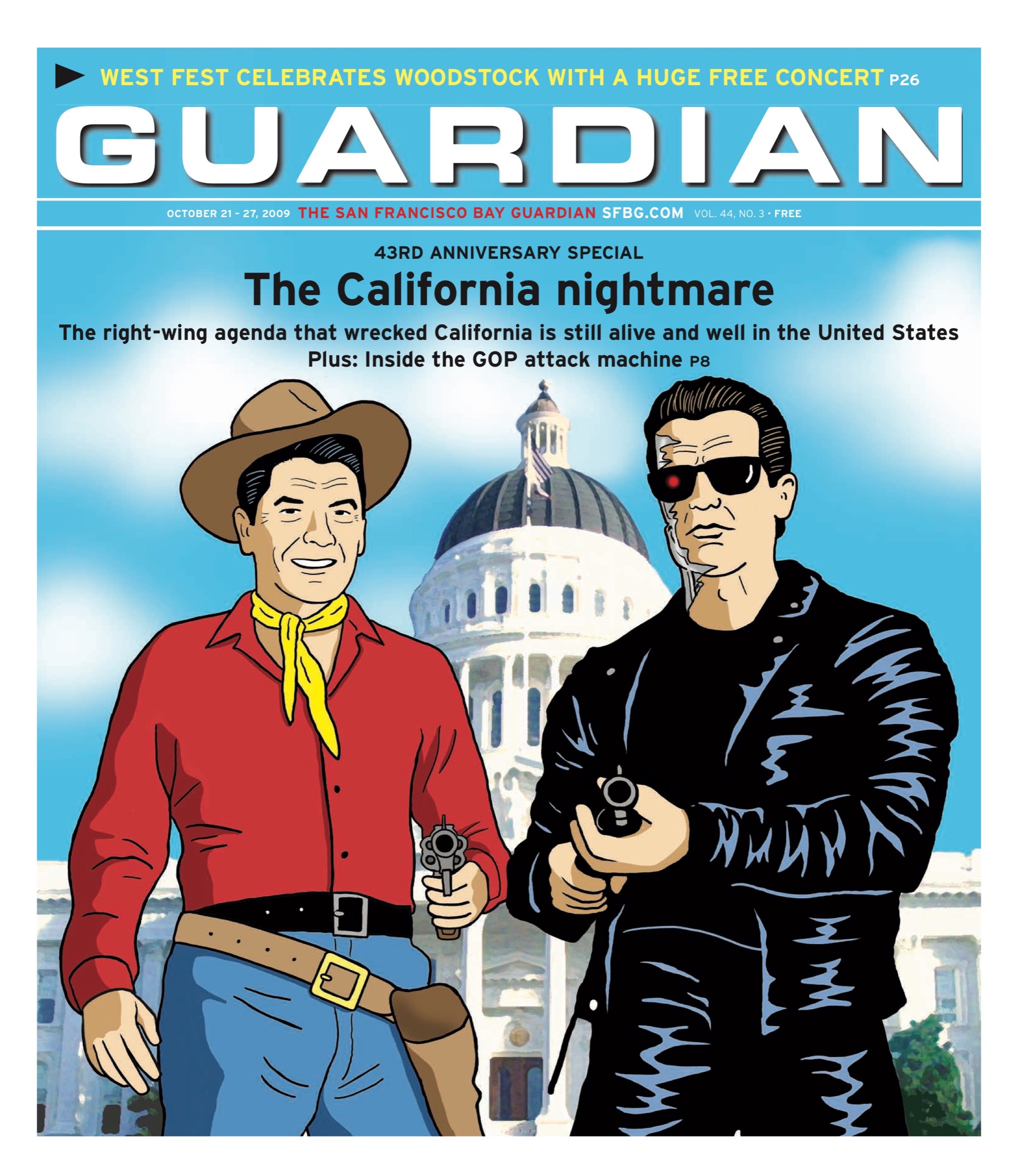
When the first issue of the Bay Guardian hit the stands in 1966, it was still really possible to talk about the California dream. The state had seemingly limitless potential and was in many way a model for the nation — a free public university system that was the envy of the world, an economy that provided jobs to hundreds of thousands of new arrivals, the beginnings of what would be the nation’s premier environmental movement pushing to save San Francisco Bay, save the coast, save Lake Tahoe … and the Free Speech Movement, the Summer of Love, the United Farm Workers Union, and so much more that was transforming politics and culture in the United States from the West Coast.

Twelve years later, it was all falling apart. Eight years of Gov. Ronald Reagan and then the passage of Proposition 13 launched a very different kind of movement out of the West, a movement that sought to dismantle the public sector and the social safety net, to treat government as the enemy, and to use culture wars to convince working-class Americans to vote against their own economic interests.

And now California is being described as the nation’s first failed state. Gov. Arnold Schwarzenegger — the second Republican actor to hold that role — has driven the state to the brink of bankruptcy. The University of California is drowning in red ink, raising fees and turning away students. The state’s water system is a mess; cities and counties are in fiscal collapse; the economy’s in the tank; and nobody seriously talks about a California dream anymore.

The story of how that happened — and how the diseases of tax-revolts, privatization, government corruption, and public disempowerment spread east from California — is the focus of this 43rd anniversary issue. It’s both enlightening and a bit scary to read through old issues, because in hundreds of stories over the past four decades, the Guardian has warned of exactly what was to come.

The very first issue of the Bay Guardian talked about the "historic election" pitting the incumbent, Democrat Pat Brown, against Reagan. A lot of people in the emerging "new left" were arguing that there wasn’t a bit of difference between the two, and that you might as well sit out the election. But the Guardian had a different take. The election was really about the direction California wanted to go, the paper said, a choice between a state that cares about the public sector and social welfare and a state where those things don’t matter.

"Reagan’s stands typify the temper of the cause," the Nov. 7, 1966 editorial stated. "He is on record, at various times, in opposition to the progressive income tax, Social Security, Medicare, the anti-poverty program, farm subsidies, the TVA, the Civil Rights Act, the Voting Rights Act, public housing, federal aid to education, and veterans hospitalization for anything other than service-connected disabilities. How can a man or a movement govern the state of California with such a political philosophy?"

Reagan’s election may have seemed like a fluke, but it was nothing of the sort. By the mid 1960s, with the counterculture — and equally important, the economic left — looking to make major inroads in American policy, the broad outlines of a right-wing attack plan were in place.

That’s something the Guardian always recognized — that powerful people who moved the levers of government typically did so with a long-term plan.

In San Francisco, part of that plan was the transformation of a human-scale city to a West Coast version of Manhattan. The idea: tear up South of Market (then mostly low-income housing) for a shiny new convention center and hotels. Dump dozens of big high-rise office buildings downtown. Construct a fixed-rail system to carry suburban commuters into the dense downtown. Drive up property values — massively — and if that means blue collar jobs and working class people had to go to make way for wealthier office workers, so be it. In the end, of course, the architects of the plan — landowners, developers, bankers, and big business leaders — became immensely wealthy.

On the state and national level, their plans were broader. Even so, they had one major aim: throttle the pubic sector. Cut off the funding for government programs, reduce regulations, undermine any concept of a welfare estate — and cut taxes on the rich.

As we report on page 8, the architects of this plan are happy today to talk about how it worked — how Reagan launched his war on government back in the 1970s, how a group of well-funded think tanks developed plans, and political consultants took advantage of people’s fears (and the Democratic Party’s failures) to put those plans into action.

The movement really got off the ground in 1978 with the passage of Proposition 13.

Prop. 13 emerged from a state in the middle of a massive growth spurt and a heated political cauldron of money, race, and Legislative failure. Howard Jarvis, a Republican landlord lobbyist who hated taxes, hated government, hated public schools, and disdained most Californians — "63 percent of [public school] graduates are illiterate" and would have no need for public libraries, he once quipped — took advantage of a gaping hole in political leadership and set off a movement that would cripple the United States of America.

The measure marked the final, fatal end in California of the era known as the ’60s — a period when the left was ascendant, when taxes on the wealthy funded education, infrastructure and programs for inner cities, and when economic and cultural liberalization seemed to be spreading across the nation.

Rising property values, driven by rapid population growth, were driving up property taxes — and the problem was real. Long-time residents, particularly people on fixed incomes, saw their taxes rise so high they couldn’t afford to stay in their homes. The Legislature could have addressed that (with, say, a split-roll measure that taxed residential and commercial property at different rates) but utterly failed to move on the crisis.

A series of assessor’s office scandals didn’t help, either. And, at the same time, the California Supreme Court ruled that rich school districts had to share revenue with poor districts, infuriating wealthy white property owners.

Jarvis and his partner Paul Gann circulated petitions to roll back property taxes and make it almost impossible to raise taxes in the future. It passed with 65 percent of the vote.

Of course, big businesses (particularly utilities) were the big winners. As the Guardian pointed out on June 1, 1978, the top five utilities in California alone (including Pacific Gas and Electric Co.) would gain billions from the tax cuts.

But beneath it all was a simmering discontent with government — something Jarvis had set afire and would later be used by Ronald Reagan and the right-wing operatives who backed him to undermine the New Deal, the social safety net, and the basic social contract in America. The antitax folks played to white people who didn’t want to see their money going to minorities, to the middle-class folks who thought (thanks to the assessor scandals) their tax money was being wasted by corruption — and to a lot of younger people coming out of the 1960s who had learned from Vietnam, COINTELPRO, and Watergate not to trust government.

The Bay Guardian opposed the measure strongly: "Most analyses indicate that without replacement taxes, hundreds of thousands of California public servants would be thrown out of work (which is exactly what Howard Jarvis intends) … " a May 18, 1978 editorial noted. "Vote for Prop. 13 only if you favor decreased government services (including cutbacks in everything from libraries to schools to street-cleaning crews and possibly police and fire departments) and are fond of half-baked measures that favor the rich."

Prop. 13 set off a national movement to cut taxes — and riding that wave, Reagan was elected president in 1980. He immediately set about attempting to slash taxes on big business and the wealthiest Americans, and eliminate environmental, workplace safety, and employment regulations.

You can see the results in California — and across the nation. The very strategies that emerged in this state and that the right has supported over the years have come very close to destroying the United States economy, leaving millions out of work — while the gap between the rich and the poor has risen to unsustainable levels.

Part of the reason this national attack on government and the public sector worked was the failure of Democrats to recognize that corruption matters. It was no small wonder that Californians were losing faith in government — in the 1970s and 1980s, the state Legislature, under the Democratic control of Speaker Willie Brown, was awash in sleaze, paralyzed by lobbyist influence and campaign money. Yet leading Democrats, fearful of Brown’s power, did little to reign in the appalling corruption.

In fact, when Brown became mayor of San Francisco, the entire Democratic Party, from the president of the United States on down, seemed to treat him as royalty — despite the fact that he was selling the city to every developer and corporate lobbyist who waved money under his nose. When taxpayers knew that a large part of their money was going to fund juicy jobs for Brown’s cronies and pet projects, it was hard to argue for higher taxes.

And it was the Democratic Party leadership in San Francisco who presided over two of the greatest examples of privatization of public resources in modern history: the Presidio and the Raker Act. Rep. Nancy Pelosi was the author of the bill that, for the first time, turned a national park over to the private sector — and hardly a Democratic leader in the city dared to lift a finger in opposition. And for decades — since the Guardian first broke the story in 1969 — the city’s Democratic power brokers have bowed and genuflected to PG&E and allowed the private utility to control the local electric grid and block implantation of the federal law that mandates public power for San Francisco.

And now PG&E wants to pull off one of the greatest feats of privatization in American history. The company has launched a ballot initiative that would wipe out any further attempts at public power in California, essentially guaranteeing that private companies, not the public sector, control the vast, critical resource of electric power in this state.

It’s the latest big battle between two divergent visions of America — and this time, the folks who have done so much damage to this state and this nation can’t be allowed to win. In fact, maybe the campaign against PG&E can be the turning point, the time when California realizes that privatization, attacks on the public sector, tax cuts for the rich, and political sleaze are a formula for disaster.

Attack of the right-wing nuts

0

news@sfbg.com

In April 2006, with the approval ratings of President George W. Bush plummeting, his senior political advisor, Karl Rove, began discussing a plan to turn things around.

His strategy: attack progressive organizations that were registering low-income people to vote and helping them fight corporate power — and claim it was about voter fraud.

The main White House target, newly released records show, was the Association of Community Organizations for Reform Now (ACORN). By the end of 2006, Rove would oversee the removal of eight U.S. attorneys, including two who refused to press bogus charges against ACORN in New Mexico and Missouri, and a third under similar suspicions in Washington state.

ACORN made a convenient target for Rove and his gang — and the well-orchestrated attacks on that group, which have exploded into the headlines this year, provide a compelling case study in how the right wing operates in this country.

Although it was the GOP that removed tens of thousands of likely Democratic voters from the rolls in the 2000 and 2004, the Republicans and their allies were able to make the issue of voter fraud all about ACORN, using a handful of isolated problems to undercut an organization focused on giving a voice to poor people.

Founded in Little Rock, Ark. at the end of the 1960s, ACORN has grown into the nation’s top community-organizer group, thanks to success in improving poor people’s housing, wages, and educational access. By the eve of the 2008 presidential election, ACORN had helped register more than 1.3 million voters — mostly young, low-income minorities — in 21 states, including the battleground states of Florida, Pennsylvania, Michigan, and Ohio.

As The Nation put it, these successes made ACORN “something of a right-wing bogeyman.”

And while the recent furor over a conservative videographer secretly taping ACORN employees saying dumb things has somehow become one of the big political stories of the year, the major media have mostly ignored how this attack is part of a larger conservative strategy.

In August, hundreds of pages of e-mails and transcripts related to the 2006 U.S. attorney-firing scandal were released to the press and public — but few news outlets mentioned that Rove was focused on attacking ACORN’s voter registration efforts, even though ACORN and voter fraud are repeatedly mentioned in these documents.

“This is about a campaign that goes back a decade to big business and that people who don’t like what ACORN does and is effective at — namely, helping groups to organize and put pressure on banks around sub[prime] mortgage loans to stop racial discrimination,” Peter Dreier, a professor of politics at Occidental College, told us.

It wasn’t really about voter fraud. As former U.S. Attorney David Iglesias, a Republican from New Mexico, recently stated on The Rachel Maddow Show: “They were looking at numbers [and] didn’t like the demographic tidal wave that was coming their way so they wanted to engage the machinery of the Justice Department to stop that wave.”

After two years of investigating ACORN and other supposed perpetrators of left-wing voter fraud, Igelias said, “I couldn’t find one case I could prosecute.”

But for the right-wing attack machine, it didn’t matter — the damage was done.


THEIR MASTERS’ VOICE

White House communications strategist Anita Dunn created a stir in mid-October when she told CNN host Howie Kurtz that Fox News “is really more of a wing of the Republican Party. … Let’s not pretend they’re a news network like everybody else is.”

It didn’t take long for Fox commentator Glenn Beck to retaliate. In a series of broadcasts, he attacked Dunn, compared the Obama administration to a communist dictatorship, and likened the criticism to the Holocaust. “Ask yourself this question,” Beck said during a radio segment, vaguely addressing people he called “good journalists” at other mainstream news networks. “When they’re done with Fox, and you decide to speak out on something — it’s the old ‘first they came for the Jews, and I wasn’t Jewish.'” Beck concluded the segment by warning his audience, “this is how a dictatorship always starts.”

Beck’s comment may strike San Francisco progressives as outrageous, but given the rhetoric routinely issuing from the right-wing megaphone, it’s also 100 percent predictable.

But when Dunn called Fox News Channel an arm of the GOP, she was dead on. Consider the history of its chairman and CEO, Roger Ailes, who ran Richard Nixon’s 1968 presidential campaign and later those of presidents Ronald Reagan and George H.W. Bush, guiding them all to victory through his brilliant and successful media campaign strategies.

“Roger Ailes is a newsman with a profound disdain for newsmen,” according to a New York magazine profile. “Fox News is being promoted as an anti-network, a news channel designed to appeal to the people … who don’t trust [the others].” Portrayed in the story as a “self-described paranoid,” Ailes reportedly resigned from an earlier position as head of CNBC after questions were raised about his desire to use his position as a weapon against his enemies.

Fox News is an outgrowth of its parent company, Rupert Murdoch’s News Corporation. A look at the board of directors of this multinational giant yields some startling insight into who controls the “fair and balanced” news network. Ailes himself has a seat at the table — but not every board member has a background in media.

News Corp. board member Viet Dinh, for example, is an attorney who came to the United States as a boy from Vietnam. In a 2002 interview with the Los Angeles Times, Dinh, who then served as an assistant attorney general at the Department of Justice, recalled an exchange he had with then-Attorney General John Ashcroft in the wake of the Sept. 11 attacks. “He told me: ‘The art of leadership is the redefinition of the possible. I want you to be the think tank to help me redefine the possible for the Department of Justice.'”

Dinh successfully redefined “the possible” by acting as a primary author of the USA PATRIOT Act, quickly propelling himself to prominence as a darling of conservatives and an enemy of civil liberties watchdog groups. A law professor at Georgetown University, Dinh is also founder and chief of Bancroft Associates PLLC, a consulting firm that specializes in helping Fortune 500 companies “navigate the federal and state criminal or civil investigations, congressional investigations, and complex litigation,” according to the firm’s Web site. It also specializes in public relations.

Another board member is José Maria Aznar, former prime minister of Spain. Aznar was born into a politically active, conservative family in Spain in 1953, and both his father and grandfather held government jobs under Gen. Francisco Franco, the fascist dictator. Aznar was handpicked by Manuel Fraga, a minister under Franco, to succeed him in leading Spain’s center-right People’s Party (Partido Popular), according to an article in the U.K.’s The Independent.

Aznar now serves as president of the Foundation for Social Studies and Analysis, a right-wing think tank based in Spain that, according to its Web site, works closely with the CATO Institute, the Heritage Foundation, and other conservative U.S. think tanks.

Occupying other seats at News Corp.’s board table is an assortment of professors, attorneys, public-relations experts, and businessmen with their fingers in a variety of banks and multinational corporations. Among the more familiar names are Phillip Morris, Ford Motor Co., Hewlett Packard, Goldman Sachs, HSBC North America, and JP Morgan Chase. Lesser known are the investment banking firms that have stakes in the petroleum industry, utilities, mining companies, and real estate.

While the connections between corporate interests and the country’s leading conservative propagandist are extensive and obvious, there’s a stark contrast between the message delivered by Fox News and the interests of its parent company.

Fox News plays up the theme of patriotism and reinforces the idea that there is a distinction between “real Americans” and outsiders. But Fox’s board is made up of members whose lives and economic interests are scattered across the globe, but have one common thread: they all control extraordinary sums of concentrated wealth.


PROPAGANDA AND EMOTIONS

While Dunn called Fox News Channel an arm of the Republican Party, others have gone so far as to label its content pure propaganda — and incredibly effective propaganda at that.

“This is very, very sophisticated propaganda,” says Bryant Welch, a clinical psychologist, author, and expert on political manipulation. “I don’t think progressives really get it that it’s a technique being used all the time.”

Welch said when he began working as a Washington, D.C., lobbyist on behalf of the American Psychological Association years ago, he started observing the tricky political maneuverings at play in the nation’s capital through the eyes of a psychotherapist who had spent some 30,000 hours helping patients confront their deep-seated hang-ups.

To his surprise, Welch found that some of the most successful right-wing political operatives also seemed to have an understanding of psychology — although they use the knowledge very differently. “A lot of it is psychological manipulation,” Welch asserts.

George Lakoff, a professor of linguistics at UC Berkeley and author of Don’t Think of an Elephant: Know Your Values and Frame the Debate, offered a similar analysis. He said Republicans approach issues as a marketing challenge. “They’ve learned from the cognitive scientists. Even if they don’t understand the science, they know how to do marketing.”

Welch, who is also an attorney and Huffington Post blogger, provides an analysis of how the right wing gets its message across in his book, State of Confusion: Political Manipulation and the Assault on the American Mind. He argues that public relations professionals, right-wing commentators, and others in the business of shaping public opinion are skilled at tapping into widespread feelings of anxiety and uncertainty.

“In this world, things are confusing,” he explains. “You’ve got to be constantly adapting and assimiutf8g new information. When times get confusing, people have a hard time forming a sense of what’s real.”

Right-wing television and radio personalities like Sean Hannity, Glenn Beck, or Rush Limbaugh prey on this widespread uncertainty, Welch argues, by providing viewers and listeners with an absolute version of reality that is easily grasped, neatly divided into right and wrong, and spelled out in very certain terms.

“The thing that Bill O’Reilly and Sean Hannity do is, they sound very powerful, certain, and aggressive,” Welch told us. “[Viewers] identify with that strength. They draw a sense of security from someone who has certainty about what is real.”

Viewers who find that their anxiety subsides when they tune in are hard-pressed to go back and reexamine their views later on, Welch said, because they’re satisfied with the answers they’ve been given. And in right-wing messaging, those answers consistently cast government as the enemy.

On Fox and AM radio, the use of repetition helps drive home an idea until it becomes a conviction in the mind of a listener. Television reinforces those key phrases with patriotic color schemes. The whole package is designed to transform an audience’s sense of bewilderment over a complex world into trust in spokespeople helping them make sense of it.

The right-wing commentators’ success lies partly in their ability to harness core human emotions such as paranoia or envy, Welch said. He pointed to the health care debate as an example, noting how Fox News has repeatedly played up the false concept of “death panels” to create fear.

To counter this tactic, Lakoff suggests that the left would do well to learn how to frame things in moral terms instead of playing defense against right-wing spin masters.

President Obama’s problem, Lakoff said, is that he is still trying to unify the country. “More power to him, but I don’t believe it’s possible,” Lakoff said. “Republican presidential candidate Sen. John McCain got 47 percent of the vote, bad as he was, and given how terrible a campaign he ran, and given that Obama ran a perfect campaign. So Obama’s election was not a landslide, even though he had one of the best campaign organizations and one of the best framed campaigns ever.” Obama doesn’t play the same manipulative games, Lakoff noted. “Obama believes that if you just tell the truth, it’ll be OK, and every day have a truth squad to find the conservative lies,” Lakoff said. “What he didn’t understand was that by focusing on the conservative lies, he was in fact helping the conservative cause. It’s like Richard Nixon saying, ‘I’m not a crook.'” That why Lakoff says it’s so important for Obama, and for the progressive movement in general, to define the moral imperative behind empowering the people and their government to create a better world, then aggressively push a campaign to do so. “It’s the ‘this is the right thing to do’ approach,” Lakoff explained. “And once it’s been framed that way, then you can say what’s false or true. But you should never go on the defensive first. As soon as you go point by point, you are on the defensive.”

The lesson of California

0

news@sfbg.com

Much of the right-wing agenda that has thrown this nation into economic chaos can be traced back to what was once called the Golden State.

The tax revolts that started here under Gov. Ronald Reagan and continued to sweep the country and the world under President Reagan never abated. Indeed, they have only been strengthened by the big business power that created and benefited from them.

But now that California is showing signs of being the country’s first failed state — caught in fiscal freefall and mired in political gridlock as a generation’s worth of neglected problems surge to the surface — this state has become a cautionary tale for that anti-government ideology.

Trends in America tend to start out west, and the economic and political disaster that California has become contains critical lessons for the rest of the country.

Lewis Uhler — president and founder of the National Tax Limitation Committee — speaks candidly and proudly of his key early role in helping build a conservative movement to limit the size of government and do battle with those who want the public sector to actively promote social and economic justice.

Uhler, a UC Berkeley Boalt Hall School of Law graduate who did legal work for conservative causes in the 1960s, was tapped by then-Gov. Reagan in 1970 to be the director of the Office of Economic Opportunity, a federally-funded legal assistance program created as part of President Lyndon Johnson’s war on poverty.

While that may seem like a strange role for an avowed conservative and former member of the John Birch Society, Uhler says Reagan basically brought him in to wreck the program and fight the feds. “I was asked to put my money where my mouth was for my conservative philosophy,” Uhler told the Guardian. “OEO was set up to ensure conflict and confrontation … The mission of legal services was to change public policy through lawsuits they decided to file. I thought it was a corruption of the legal system.”

At the time, public-interest law and liberal economic and social policies were on the rise in California and spreading to the rest of the nation. So the Reaganites fought back.

Rather than helping poor plaintiffs file environmental, consumer protection, equal rights, or other types of lawsuits designed to level the playing field with powerful interests, Uhler blocked lawsuits brought by attorneys he calls “ambulance-chasers” and gutted the program. “Ultimately,” he said, “we vetoed funding for California Rural Legal Assistance.”

And for his efforts, Uhler was rewarded with a cabinet-level position: assistance secretary of the Health and Welfare Agency. Again, his role wasn’t to make the agency more effective, but to make it less effective in a realm where he believes government was too big and too active.

“The problem was uncontrolled state and local spending,” Uhler said. “Intuitively, everyone who gathered around Reagan shared the same philosophy that government doesn’t really contribute anything to economic growth.”

In 1972, Reagan gave Uhler the opportunity to work more directly on the mission of cutting taxes and shrinking the size of government, naming him chair of the Governor’s Tax Reduction Task Force. It was, in many ways, the beginning of the vast right-wing conspiracy.

“I asked to be given the chance to go across the country and find the best free market minds in the country to develop these policies,” Uhler said, explaining that he wanted to borrow the liberal strategy of giving an academic veneer to their ideas, as presidents Kennedy and Johnson had done in the realm of foreign policy. “Our side had never really done that.”

Uhler’s first stop was the University of Chicago School of Economics, where he met with noted free market economists Milton Friedman, James Buchanan, and George Stigler, who were brought into the cause.

Today’s vast network of conservative think tanks didn’t exist at that time, so Uhler tapped conservative thinkers from the American Enterprise Institute and the Hoover Institute at Stanford University, as well as other conservative economists such as Peter Drucker from Claremont McKenna College.

“There were 35 people who helped us design the first effort at a constitutional initiative in California to limit year-over-year growth of the state’s general fund,” Uhler said. “All of us as free market enthusiasts and economists all shared the belief that government beyond a certain level eats the seed corn of the nation and doesn’t produce anything.”

While voters narrowly rejected their group’s first effort to cap government growth — Proposition 1 on the November 1973 ballot — the ground had been prepared and the seeds had been sown for the tax revolts that would sweep the country in the late 1970s, with many of the campaigns coordinated by Uhler and the organization he formed for that purpose in 1975, the National Tax Limitation Committee, and a rapidly growing network of similar, interconnected organizations.

As Uhler worked with Reagan to weaken California’s government from within, his fellow travelers were developing national and international strategies to create aggressive, coordinated, well-funded campaigns to attack government and spread the free market dogma.

In August 1971, Lewis Powell — a conservative corporate attorney who President Richard Nixon had just nominated to the U.S. Supreme Court (where he served from 1972-87) — wrote a confidential memorandum to the leadership of the U.S. Chamber of Commerce titled “Attack on the American Free Enterprise System.”

He sounded the alarm that the ascendant environmental and consumer movements were going to destroy capitalism in the country unless corporate America aggressively fought back in a coordinated fashion, which he spelled out in great detail.

He called for all major corporations to develop aggressive legal and public relations strategies for fighting the left, creation of a network of think tanks and media outlets to push the conservative message, manipulation of the legal system, and sponsorship of university programs to study conservative ideas and incubate future leaders — which all came to pass in the coming decades.

“American business [is] ‘plainly in trouble’; the response to the wide range of critics has been ineffective and has included appeasement: the time has come — indeed, it is long overdue — for the wisdom, ingenuity, and resources of American business to be marshaled against those who would destroy it,” Powell wrote.

Part of that strategy involved having the federal government promote and popularize free market economic theories being developed by Friedman and his colleagues at the University of Chicago, a movement that is well-documented by journalist Naomi Klein in her book The Shock Doctrine: The Rise of Disaster Capitalism.

In 1971, Friedman and his colleagues began working with rich conservatives in Chile who were allied with Gen. Augusto Pinochet, who in turn were conspiring with the CIA to overthrow and assassinate the democratically elected, leftist President Salvador Allende, which they successfully did on Sept. 11, 1973.

Friedman’s economic theories called for a radical restructuring of society — slashing taxes and social spending; removing most regulation and trade restrictions; crushing labor unions; promoting economic growth at any cost — and Pinochet executed the strategy in brutal fashion, ordering the death of at least 3,200 of his political opponents, including the car-bomb assassination of economist Orlando Letelier in Washington, D.C., in 1976.

Friedman and Pinochet consulted openly and shared a basic disdain for social programs and progressive taxation. “The major error, in my opinion,” Friedman wrote in a letter to Pinochet in 1975, referring to the government antipoverty programs Pinochet dismantled, was “to believe that it is possible to do good with other people’s money.”

The model Pinochet and Friedman developed in Chile would eventually go global — promoted by its top cheerleaders, Reagan and British Prime Minister Margaret Thatcher — and be implemented (with disastrous results for most citizens but creating huge profits for wealthy individuals and corporations) in Indonesia, Bolivia, Argentina, Peru, Russia, Poland, South Africa, Japan, and elsewhere.

But with the corporate media and conservative opinion-shapers focused mostly on economic growth — ignoring persistent poverty and the brutal tactics used to suppress the popular movements that tried to resist Friedman’s “economic shock therapy” — Friedman had become a sort of free-market prophet by the time he died in 2006.

“In the torrent of words written in eulogy to Milton Friedman, the role of shocks and crises to advance his worldview received barely a mention,” Klein wrote. “Instead, the economist’s passing provided an occasion for a retelling of the official story of how his brand of radical capitalism became government orthodoxy in almost every corner of the globe.”

California’s fiscal shackles have been in place since 1978, when Proposition 13 and subsequent measures capped property taxes and required an undemocratic two-thirds vote to either raise taxes or pass the annual budget.

A Republican landlord lobbyist named Howard Jarvis charged onto the field that Reagan, Uhler, and their team had prepared and took advantage of a gaping hole in political leadership to set off a movement that would cripple the United States of America.

There was some logic to it then. Times were good in California in the 1970s, good enough that people were flocking to the state by the millions. That was driving up property values — and thus property taxes.

Jarvis bought his home for $8,000 in 1946; 30 years later, it was assessed at $80,000. In fact, inflation was running at close to 10 percent a year in California. Homeowners were getting huge tax hikes each year, and tenants were getting huge rent hikes at a time when state government had a budget surplus.

Homeowners saw millions of dollars sitting in the coffers in Sacramento while they couldn’t pay their tax bills. Yet nobody in the Legislature or governor’s office came up with a solution.

So when Jarvis showed up with petitions to roll back property taxes and prevent future increases, he found a broad base of support. Even tenants went along — Jarvis and his gang promised that property-tax cuts would be passed on to tenants and would mean the end of the escautf8g rent hikes.

Jarvis collected signatures for a radical measure that essentially blocked all property tax increases and allowed new assessment only when a parcel sold. It was, in the end, a huge tax giveaway to major corporations. Since commercial property turned over far less often than residential property (and since commercial sales could be hidden as stock transfers), big businesses wound up paying far less of the state’s tax burden. Corporations used to pay about two-thirds of the state’s property taxes, and individuals one-third; now that is reversed.

It didn’t help tenants, either. Few of the landlords who saw the benefits of Prop. 13 passed the money along to their renters. Most just kept it. San Francisco activist Calvin Welch likes to say that Howard Jarvis was “the father of rent control.”

The campaign against Prop. 13 warned of the dangers of cutting local government; police and fire chiefs appeared in ads opposing it. But the No on 13 folks never talked about the huge windfall big corporations would get from the measure, or the huge disparities in wealth that would be created by defunding government and dereguutf8g corporations.

If the goal was to skew the concentration of wealth in the state, it worked brilliantly. According to the California Budget Project (CBP) of the Franchise Tax Board, recent data taken before the current economic recession illustrates an ever-widening chasm between the wealthiest taxpayer and the working-class person.

The total adjusted personal income for Californians rose by nearly $64 billion in 2006-07 — with approximately three-quarters of that increase going to the top fifth of wealthiest taxpayers, and 30 percent going to the top 1 percent. That left only $19 billion for everyone else.

“The average taxpayer in the top 1 percent experienced a $128,261 increase in AGI [adjusted gross income] between 2006 and 2007, which was more than three times the total AGI of the average middle-income taxpayer in 2007 ($36,115),” stated the June 2009 report.

This continues a long-term trend in which the wealthy continue to leave the average income-earner behind in a trail of dollar-sign dust. From 1995 to 2007, income gains for that top 1 percent come to a whopping 117.3 percent increase — nearly 13 times more than the gains of the middle-income taxpayer.

The nation’s income gap has reached a “level higher than any other since 1917,” according to a paper by University of California, Berkeley economic professor Emmanuel Saez. According to Saez’s analysis of census data, there’s been a steady increase in the income gap since the 1970s, rising 20 percent over the years.

Yet even today, the defenders of Prop. 13 continue to sound the same consistent themes. “Those who are directly involved in government are a militant special interest,” Howard Jarvis Taxpayer Association executive director Kris Vosburgh told us. “They don’t like anything that limits their revenue stream.”

While that last statement could be applied equally to corporations or other private sector enterprises, as Vosburgh reluctantly admitted when asked, he continues to imply malevolence to those who defend government. He said the state’s current fiscal collapse can only be solved by slashing government expenditures.

“It is not valid to be talking about revenue-side solutions,” he said. “Our position is the state has enough money to accomplish its goals.”

People have never liked paying taxes, but the antitax movement is about far more than just that basic individual desire to hold onto our money.

The attacks were well planned, carefully targeted, and part of a much larger effort aimed at maintaining corporate and conservative power, undermining the New Deal, reducing taxes on the rich, and radically reducing the size and scope of the public sector.

As Powell called for, corporations have aggressively challenged, in legal courts and those of public opinion, every significant progressive advance — from San Francisco’s attempt at universal health care to California’s tentative first steps to address global warming.

With a level of discipline unheard of on the left, conservative opinion-shapers pound their talking points and enforce party unity through mechanisms like the “no new taxes” pledge that every Republican in the California Legislature has signed and heeded, under the very real threat of recall.

Opposition to taxes is now so deeply embedded into the psyche of the California electorate, and such a core tenet of today’s Republican Party, that elected officials who tout fiscal responsibility allowed the state’s debts to go unpaid (destroying its credit rating in the process) and its education and transportation systems to be decimated rather considering new revenues.

Gov. Arnold Schwarzenegger’s spokesperson Aaron McLear told us, “He believes we ought to live within our means and pay for only the programs we can afford.”

That simple talking point gets repeated no matter how the question is asked, or when we point out that it means we’re being forced to live within historic lows this year. But they claim the people support them.

“We had tax increases on the May ballot and they were rejected by a 2-1 margin. We should listen to the will of the voters,” McLear said.

Never mind that this regressive, dishonest package of temporary tax hikes was opposed by the Guardian and a variety of pro-tax progressive groups. McLear wouldn’t even admit that point or respond to it honestly.

And he’s certainly right that most polls show a majority of Californians don’t want new taxes. But these polls also show that people want continued government services, more investment in our neglected state infrastructure, and a whole bunch of other contradictory things.

That’s why newspapers and analysts around the world are looking at California, the world’s eighth largest economy, and wondering (as the Guardian of London headline asked Oct. 4): “Will California become America’s first failed state?”

In many ways, it already is. The question now is whether we’ll try to learn from and correct our mistakes. Ryan Riddle contributed to this report. ———–

THE CONSERVATIVE RELIGION

When I asked Lewis Uhler, one of the architects of the Reagan revolution, what Americans believed in these days — where the people he likes to talk about who hate the government (but are also admittedly disillusioned with Wall Street) turn — he answered simply: religion.

It should come as no surprise that many religious fundamentalists tend to side with the free market conservatives — both ideologies require a leap of faith and ignoring certain troubling facts, such as increasing disparities of wealth, natural resource depletion, and global warming.

Their arguments mostly make sense — until these inconvenient truths come up.

Certainly, turning over more public resources to free market capitalists, cutting taxes, and slashing government regulation will spur private sector economic growth, just as advocates claim.

But that growth has a cost. The wealth won’t be shared by everyone. Indeed, poverty has persisted even through even the economic boom of the 1990s — but almost everyone will be affected by underfunded road, education, public safety, and other essential systems.

As the conservative movement has successfully limited taxes and cut regulation over the last 40 years, working class wages have stagnated as the rich have gotten richer. Many of the world’s oil reserves have peaked and gone into decline, and rapidly increasing carbon emissions have collected in the atmosphere and caused global warming.

So how do conservatives respond to these realities as they argue for the continued dismantling of government, which is the only entity with the scope and incentive to deal with these problems? They simply deny them.

Uhler decried the “pseudoscience of climate change” as hindering economic progress and claimed that there’s actually been a global cooling trend in the last 10 years. (Actually the last 10 years have been some of the hottest on record, causing glaciers around the world to melt, according to data and observations from a consensus of the world’s climate scientists, including NASA, the Union of Concerned Scientists, and the United Nations Climate Change Conference.)

It’s the same story with the consolidation of wealth, which hurts the free market fantasy that letting the super-wealthy keep more money will eventually trickle down to benefit us all. Uhler simply denied the growing disparity of wealth, saying the “movement between quintiles is significant.”

He was talking about people’s ability to go from poor to rich with a little hard work and initiative, the core idea of free market conservatives. But data from the U.S. Census Bureau and many other entities indicate that median wages have been stagnant for decades (which wouldn’t be true if there was lots of upward mobility) and that most of the wealth created in the U.S. over the last 40 years has pooled with the top 1 percent.

In fact, when it comes to measuring social impacts, Uhler has simply one metric: “Governments at all levels are twice the size they should be to maximize economic growth.” (Steven T. Jones)


A tale of two hoaxes

1

by Rebecca Bowe

YesMen.jpg

Bonner & Ass 2.jpg

Politico has reported that the Yes Men, a left-leaning activist group that has created public-relations messes for big business before, fooled Reuters, CNBC, and the Washington Post this morning by issuing a fake press release from the U.S. Chamber of Commerce declaring that it had withdrawn its opposition to the climate-change bill.

This is from the fake press release:

“We believe that strong climate legislation is the best way to ensure American innovation, create jobs, and make sure the U.S. and the world are on track to reduce global carbon emissions, and to provide for the needs of the American business community for generations to come,” said the spokesman, Hingo Sembra.

“The new position is an about-face on climate policy for the Chamber, which previously lobbied against government action. The shift comes after the defection of several prominent members of the Chamber, including PG&E, Apple, PNM Resources, and Exelon.

Here’s the reaction from a Chamber of Commerce spokesman (as reported by Fox News) after the COC figured out they’d gotten punked:

“Public relations hoaxes undermine the genuine effort to find solutions on the challenge of climate change,” spokesman Thomas Collamore said. “These irresponsible tactics are a foolish distraction from the serious effort by our nation to reduce greenhouse gases.”

The Yes Men are self-styled pranksters, their media stunts are immediately recognized for being the bold political statements that they are, and they serve to amplify public pressure on crucial issues such as human rights or global warming. Although the Yes Men may have temporarily posed as Chamber of Commerce press contacts, it’s worth noting that there’s a huge difference between that media stunt and the AstroTurf hoax that PR firm Bonner & Associates evidently thought it could get away with this past summer.

The PR firm, which was tapped by the American Coalition for Clean Coal Energy (ACCCE), sent forged letters opposing the climate bill purporting to be from the National Association for the Advancement of Colored People (NAACP) and other minority groups. Bonner & Associates is now under Congressional investigation for the fake letters.

A popular term for this PR tactic is AstroTurfing: Creating the illusion of a grassroots campaign driven by ordinary people when in fact the campaign is a targeted attack powered by millions of dollars to advance a business agenda. And according to an article in the National Journal, AstroTurfing is on the rise.

According to a quote from a Congressional aide that appeared in that story:

“I think what we’ve seen, especially this summer with the energy and health care debates, is that AstroTurf has become much more widespread than I think we’ve ever seen it before … The American public is honestly confused about what is real and what is not.”

So while the Yes Men’s “foolish distraction” may have been successful in focusing attention on how big business is trying to block efforts to address climate change, don’t forget that they aren’t the only ones pulling a fast one — and the tricksters on the business side are trying to avoid the attention of the media, rather than attract it. By the way, there’s a movie coming out soon called The Yes Men Fix the World. It opens Oct. 30 in the Bay Area.

In Mexico, a bitter battle over electricity

0

By John Ross

MEXICO CITY — During the first week of October, the increasingly unpopular government of Felipe Calderon stepped up its ongoing war of words against the Mexican Electricity Workers Union (SME), one of the nation’s oldest labor organizations founded at the apogee of the landmark Mexican Revolution in 1914 when workers repeatedly shut down the Canadian-owned Mexican Light & Power Company. Now, with the centennial of the Revolution on deck in 2010, the SME’s survival as a union is in jeopardy and it may never make it to the birthday party.

Following the nationalization of electricity generation and distribution under President Adolfo Lopez Mateos in 1960, the SME (“Esmay”) won collective bargaining agreements for the newly created Luz y Fuerza Del Centro that distributes about a fifth of the nation’s energy to Mexico City and four surrounding states. Mexico’s second power utility, the Federal Electricity Commission (CFE) services the rest of the country and its workers are represented by a “charro” (company) union under the thumb of the Institutional Revolutionary Party (PRI) that ran the lives of Mexicans from the cradle to the grave for 71 years until it was displaced from power by Calderon’s rightist PAN in 2000.

Although the SME had longstanding ties to the PRI, it maintained a modicum of critical independence. Communists and Trotskyists wielded influence in union circles and decorated the walls of the union headquarters with proletarian murals. The Sindicato Mexicano de Electricistas has always been good for 40,000 boots on the ground when it comes to social protest. After the 1985 Mexico City earthquake that took up to 30,000 lives, SME workers rescued victims trapped in the rubble of fallen buildings and worked tirelessly around the clock to restore power in working class colonies. In contrast, the PRI-run government abandoned “los de abajo” (“those down below”) to their own fate.

Three years ago, after hotly contested presidential elections, the SME cautiously lined up with Andres Manuel Lopez Obrador (AMLO) after Calderon was awarded victory over the leftist leader in fraud-marred balloting. Calderon has never forgiven the union’s 66,000 members – 44,000 active workers and 22,000 pensioners – for this partisan sin.

Prop. D and privatization

5

By Tim Redmond

Randy Shaw has a piece in Beyond Chron today that takes issue with our endorsement on Prop. D.

It’s a fair discussion and a reasonable debate — I understand why some progressives support Prop. D, and I don’t think they’re wrong or evil for doing so. This one’s a tough call — I’m willing to accept stuff like electronic billboards that I don’t want to see in most parts of the city if it will really bring new life mid-Market, which desperately needs investment and energy.

But Shaw’s piece brings up a larger issue, one that’s part of the topic of our anniversary issue next week, so it’s worth comment.

Here’s what he wrote:

The San Francisco Bay Guardian said many good things about Prop D, but urged a No vote after focusing on the CBD factor: “But the process this measure describes isn’t at all democratic. The CBD board selects its own members, and the only oversight the city has is the ability of the Board of Supervisors to abolish the agency.”

Of course, any funding allocation process used by Prop D could have been similarly attacked. Would the Guardian prefer that the Mayor’s Office allocate Prop D funds? If so, its editorial board should reread my pieces on the Newsom Administration’s rigged RFP/RFQ processes.

Hard to argue with that, on the surface: Yes, the bidding process out of the Mayor’s Office is fucked up. Yes, there is almost always some level of corruption at City Hall (any City Hall).

But that doesn’t mean that the private sector ought to take over thing like zoning and resource allocation.

Private nonprofits like the Central Market Community Benefits District play a role in the city’s life, and that’s fine. Some nonprofits (like the one Randy Shaw runs) get city contracts to do work the city can’t do very well, and that’s also fine.

But the public sector — however flawed, however corrupt at times — still has to have the final say over regulations and the way money gets spent on public services. That’s how democracy works.

I remember once when we were intervieweing a very appealing, smart and generally progressive candidate for city assessor a few years back, and we asked him how he would go about bringing in more revenue. He told us he wasn’t sure that was a good idea, because “Willie Brown and his friends will just waste it.”

True — Brown and his friends wasted a lot of money. And that kind of corruption in government has helped the right wing push its anti-public-sector agenda. And people who says that “at least Willie Brown made the trains run on time” miss the point – corruption undermines faith in government.

But overall, using that argument to push for privatization of public resources is a dangerous way to go.

Remember: The money that would be paid by billboard owners to the CBD amounts to a tax on the new billboards. That tax ought to be collected by the city, and elected city officials should decide how it’s spent. Proponents of the measure told us they didn’t want to let the supervisors hold hearings, write the legislation or put it on the ballot because the city would then have control over the final shape of the measure. For example, Sup. Chris Daly wanted much of the billboard money to go for low-income housing — which isn’t where the CBD folks wanted it to go.

Sorry, but that’s a decision for elected officials to make. I’ll support new billboards when I know that there will be a public process (and public-sector process) determining how the boards are sited, how they’re taxed and where the extra cash is spent.

Billboards and blight

0

GREEN CITY David Addington presents a tempting vision for revitalizing the seedy mid-Market area, a kind of something-for-nothing deal that helps the children, property owners, and residents of the Tenderloin and relieves that burden from the cash-strapped city government.

All we, as San Francisco voters, have to do is accept a few new billboards, which voters banned in 2002 by passing Proposition G. Well, actually, more than a few. More like a cacophony of flashy and interconnected electronic signs and large billboards on top of the area’s 52 buildings. Proposition D, which Addington wrote and sponsors, would allow an unlimited number of business and general advertising signs along Market Street between Fifth and Seventh streets.

"I’m not afraid of signs," Addington says in his Southern drawl as we walk the neighborhood where he owns the Warfield Theater, the old Hollywood Billiards building, and the new Show Dogs gourmet hot dog joint next to the Golden Gate Theater, and where he seems to know everyone from scruffy street souls to his fellow business people.

As Addington points out, this is the most dilapidated stretch of Market Street, rife with vacant storefronts and cheap retail outlets, but bordered by U.N. Plaza on one side and the bustling Westfield Mall and Powell Street cable car stop on the other. It’s a two-block stretch that is neglected and ignored by much of the outside world.

"To change that, you’re going to have to make a dramatic visual presentation," Addington said, laying out a vision of a glitzy, twinkling theater district that lights up the neighborhood and beckons visitors. And the kicker is that by doing so, advertisers would pour millions of dollars of revenue into improving and promoting the neighborhood.

Property owners would get most of that money: 60 percent for most of them, but 80 percent those with street-level theaters, museums, or other interactive uses. "The idea is to create more ground-floor entertainment uses," he said, which, in turn, would liven up the neighborhood.

The rest of the money — and all the sign permits and approvals — would be controlled by the Central Market Community Benefits District (CBD). Some of the money would go to things like a ticket kiosk, some to creating a master plan for the neighborhood, some to beautification programs, and some to youth programs in the Tenderloin, which Addington has used as a major selling point for Prop. D.

"This measure will change the lives of the kids of the Tenderloin next year," said Addington, whose money and vision have garnered significant support from across the political spectrum, including a majority of the Board of Supervisors, much of it locked down before most people even saw the measure coming.

But opponents say problems with the measure go far beyond just accepting billboards as the answer to blight, which is a tough enough sell in sign-wary San Francisco. They note that the measure for the first time usurps city authority over permits and gives it to a CBD, which profits from the signs and has no incentive to put the brakes on. Further, the vaguely written measure has no guarantees for how the money will be spent, or if the kids will indeed get any of it.

"We definitely need to do something about Market Street, but Prop. D isn’t the thing," said Tom Radulovich, executive director of Livable City and the measure’s chief critic. "It’s very disturbing for those of us who believe in public process."

The Planning Department also raises concerns. Planning Director John Rahaim wrote in a scathing July 24 memo that the measure creates vague structures and logistical difficulties and tries to regulate sign content and delegate city authority in ways that may be illegal.

"Such unprecedented delegation of power to a private entity may create the risk of legal liability for the city. Moreover, because of the new powers that would be assigned to the CBD, concern regarding the CBD’s membership, decision-making process, and accountability are apparent," he wrote.

Radulovich also takes issue with Addington’s contention that the measure is needed to restore the luster of the once-vibrant theater district. "There’s no legislative reason to do this if it’s theater marquees you want," Radulovich said. "Prop. D is really about big billboards on the tops of buildings."

Brütal odyssey

0

>>Read Ben Richardson’s full interview with Tim Schafer here

arts@sfbg.com

GAMER "The first time we pitched it, they wanted us to change the genre, to make it about country or hip-hop or something."

Game designer Tim Schafer is sitting in his SoMa office, in his favorite chair — appropriately, a rocking chair — and talking about his masterpiece. "They were saying, ‘Why don’t you open it to all music?’ We said, ‘Look — this is a game about epic battles, good vs. evil, Braveheart-type moments. And heavy metal is the musical genre that focuses heavily on folklore. It sings about medieval combat. It’s really the only genre that makes sense for it.’"

The game is Brütal Legend (Double Fine/EA), and in the end, Schafer got his way. Taking control of Eddie Riggs, a grizzled roadie voiced by Jack Black, the player journeys through a metal landscape inspired by the album covers the designer studied in his youth. Wielding a massive battle-ax and a magical guitar, Riggs encounters righteous friends and fiendish foes, including characters voiced by luminaries like Lemmy Kilmister, Ozzy Osbourne, Rob Halford, and Lita Ford. The soundtrack is a carefully compiled list of headbang-inducing classics.

Schafer agrees that the game is his most personal creation to date. "All games are wish fulfillments. All games are about fantasy. This is a game where I’ve been able to make my own wish fulfillment. I would like to go back in time with a cool car and a battle-axe while listening to heavy metal."

THE TROOPER

Growing up in Sonoma, the designer escaped his suburban life by rocking out to Ozzy Osbourne, Black Sabbath, Judas Priest, and Iron Maiden. He would drive down to San Francisco for shows, catching sets at Mabuhay Gardens or the Stone. The music introduced him to a mythic world of horned hell-monsters, glistening chrome, and mortal combat, a world he never quite left behind.

He attended both UC Santa Cruz and UC Berkeley, dividing his attention between computer programming and creative writing, two talents he would later fuse. At Berkeley, he took a class on folklore from Alan Dundes, a provocative professor whose belief in the power of folklore influenced Schafer’s work tremendously. In 1989, he got a job in San Rafael at Lucasfilm Games, now LucasArts. He was assigned to The Secret of Monkey Island, a comedic adventure game by designer Ron Gilbert. Monkey Island was the perfect vehicle for Schafer’s talents, taking full advantage of his boundless imagination, storytelling sense, and biting wit. It is best remembered for its "insult sword fighting" section, in which dueling buccaneers trade verbal jabs in lieu of physical ones.

Mitch Krpata, game critic for the Boston Phoenix and author of the blog Insult Swordfighting, identified the defining quality of Schafer’s LucasArts output via e-mail: "Character. There are a few archetypes that most games go to again and again: silent man of action, easygoing everyman, tormented soul out for revenge. Schafer’s protagonists aren’t like that. They’re individuals. They’re good guys, but they have flaws, and their flaws aren’t things like they just care too much, dammit."

BE QUICK OR BE DEAD

After finishing the biker-themed Full Throttle in 1995, Schafer hunted inspiration. It came to him as an unlikely combination of themes, both closely tied to his San Francisco home. Initially, he was devouring classic noir films at the Lark and Castro theatres. A trip to the Day of the Dead parade in the city’s Mission District delivered the epiphany. The higher-ups at LucasArts had been agitating for a game with 3-D graphics, a prospect he did not relish. "I really hated the look of 3-D art back then, because it looked like a nylon stretched over a cardboard box," he remembers.

Picking through a table of Day of the Dead ephemera, the idea came: "I saw those calavera statues. Instead of modeling all of the bones in papier-mâché, they’ll just make a tube and paint the bones on the outside. I was like, ‘This is just like bad 3-D art. This is great!’"

Additional fodder was provided by doctor visits to 450 Sutter — a building that combines Art Deco architecture with Mayan motifs — and Schafer began work on his most ambitious project to date. Drawing on his collegiate folklore training, he and his team wove together elements of Day of the Dead tradition, Aztec folk tales, and noir cinema to create 1998’s Grim Fandango (LucasArts), a sprawling epic of crime and love in which all the characters were stylized, calavera-style skeletons "living" in the Land of the Dead. Featuring a labyrinthine, affecting story, delectable hard-boiled dialogue, and stunning art direction, it is still ranked among the best games of all time.

RUNNING FREE

Schafer left LucasArts in 1999, concerned that the company would exercise its ownership of his beloved characters without his participation. He wanted to found his own studio in San Francisco. As he told me over the phone, "Working at a company where you can look out the window and see the city outside is just so inspiring. It’s not just about having great restaurants at lunch, though that’s part of it." Starting in his living room "in a bathrobe and flip-flops," the nascent Double Fine Productions — named after a "double fine zone" sign on the Golden Gate bridge — jumped from location to location, including an unheated warehouse with a rodent problem and a toilet that often unleashed an "ocean of human waste" into the office.

The first Double Fine game was 2005’s Psychonauts, an ambitious project about a summer camp for psychic kids that failed to reach the wide audience it deserved. Even in this rarefied setting, Schafer included bits of the city’s lore. A character named Boyd was based on a homeless man who hung out near the team’s offices, doing odd jobs and enlightening the Double Fine crew with his extensive conspiracy theories.

"Sometimes he would just be on a rant about [how] the government would be trying to read his mind using satellites, or using the broken glass in the streets to bend their optics around," Schafer recalls. "He just produced great quotes: ‘I don’t want to be liquid, I want to be a turtle with rockets strapped to my back!’" Deciding to include him in the game, the designer painstakingly created a flow-chart that would procedurally generate conspiracy theories for Boyd to spout onscreen. "He constructs it by coming up with a conspirator, what their plan is, what the victim of it is, and strings it all together with a bunch of coughing and stuff."

FROM HERE TO ETERNITY

Brütal Legend, Double Fine’s latest game, was released Oct. 13, and gamers across the country will have the opportunity to play through the piece of San Francisco folklore most familiar to Schafer: the one based on himself. By making a game about a character transported from our familiar world into an ax-happy metal battleground, the designer has turned his story, the story of a misfit headbanger from a city steeped in metal history, into a new kind of 21st century myth.

Endorsements

0

San Francisco is facing the worst budget crisis in modern history. More than 1,000 employees, mostly front-line workers in the Department of Public Health, have been laid off, and the red ink continues. Yet the only measure on the November ballot that would raise any money for the city is Sup. Bevan Dufty’s plan to sell off naming rights for Candlestick Park.

That’s pathetic. During the summer budget discussions, Mayor Newsom vowed to work with business, labor, and the supervisors to come up with a reasonable plan to bring in some new cash for the city. But that collapsed — largely because state law would have made it hard to raise taxes this fall without a unanimous vote of the supervisors. And while eight members were willing to put a revenue measure on the ballot, the three supervisors closest to the mayor — Sean Elsbernd, Carmen Chu, and Michela Alioto-Pier, all Newsom appointees — refused to go along. And the mayor made only a weak effort to change their minds.

So while Democrats everywhere decry Gov. Arnold Schwarzenegger’s insistence on a cuts-only budget, the Democratic mayor of San Francisco has forced essentially the same approach on this city. The only revenue increases we’re seeing are fees, like Muni fare hikes, that amount to taxes on the poor.

That’s the state of San Francisco as we head into what will almost certainly be a low-turnout election. Only two elected officials are on the ballot, and both are unopposed. Five ballot measures — several fairly significant — round out the local ballot. And with no big-name races at the top, they will win or lose on the votes of a small majority.

That’s too bad, because the issues matter. Vote Nov. 3 — and let’s hope next year’s ballot actually includes some new, progressive taxes.

OUR RECOMMENDATIONS


City Attorney

Dennis Herrera

San Francisco hasn’t always had a good track record with city attorneys. George Agnost, who ran the office in the 1970s and 1980s, was a dour, secretive, conservative lawyer who let downtown call all the shots. Louise Renne, who took over from Agnost, ran the office in the 1990s as if it was a wholly-owned subsidiary of Pacific Gas and Electric Co. Herrera, who took over in 2001, has been a major improvement. He’s turned the office into a modern operation, professionalized the administration, and taken on an activist role on consumer, environmental, and public-interest issues. He’s been a big supporter of marriage equality and of the city’s landmark health-care legislation. On his own initiative, he sued to end gender rating in health insurance and crack down on predatory payday lenders. He also moved to enforce health codes in housing and has been out front going after corrupt landlords like Skyline Realty.

We have some concerns about Herrera. Although he’s been far more sunshine-friendly than his predecessors, open-government activists are still sometimes forced to sue the city to get access to records. He won’t use his power as city attorney to enforce the Raker Act and bring public power to San Francisco. And during the current budget crisis, he cut the number of city attorney hours the supervisors can use to draft legislation.

And if, as rumored, he wants to run for mayor, Herrera needs to start taking public stands on major issues — like the unfairness of the local tax code and the need for new revenue.

But we’re happy to endorse him for another term.

Treasurer

Jose Cisneros

The incumbent treasurer is running unopposed, and we see no reason not to endorse him. He’s done some very positive things: Cisneros worked to get the big downtown law firms and other partnerships to pay their fair share of city taxes. He closed a tax loophole exploited by the big airlines that put up flight crews in local hotels.

He also convinced local banks and credit unions to accept consular identification cards to allow immigrants to open accounts and has pushed those institutions to offer "second-chance banking" to people with past credit problems. During his tenure, more than half of the 50,000 households in the city that lacked bank accounts have been able to get away from predatory check-cashing outfits and open legitimate accounts.

As an elected official, however, he could be doing a lot more. The city still keeps all its short-term accounts in one bank — Bank of America, which isn’t even local. Cisneros has promised to open that deal up to competitive bidding, but doesn’t have a timeline. And although nobody knows better than the treasurer how unfair and regressive the city’s tax codes are, he has never spoken out or offered any solutions. Cisneros says he wants his office to be apolitical, but city money is, by its nature, a political issue, and we’d like to see a little more leadership from the person who handles it. But overall, he’s a professional money manager who’s done a decent job and deserves another term.

Proposition A

Budget process

YES

We’re a little nervous about Prop. A, which would institute a two-year budget cycle for the city. Sup. Chris Daly, who opposes it, points out that the city controller’s budget projections are often wrong — badly wrong — and trying to plan 24 months ahead when economic conditions (and thus the city’s revenue stream) can change so quickly and unpredictably is a dangerous game.

But on balance, the approach in Prop. A makes sense. The budget debates would still take place every year, and the supervisors would still have to approve an annual budget — although the budget would be a rolling two-year projection. So next year, the board would approve a budget for 2010 and 2011, the following year for 2011 and 2012, and so on — leaving plenty of room for adjusting to meet economic changes. And two-year cycles might make it easier for nonprofits that rely on city funding to do some serious long-term planning.

Equally important, Prop. A requires the police and firefighters to negotiate their union contracts the same time the other unions do — before the budget deadline. The current system allows those unions to make demands that are unrelated to — and often outside — the current year’s budget realities.

Every progressive on the board except Daly supports this, and Sups. Alioto-Pier, Elsbernd and Chu oppose it.

Proposition B

Board of Supervisors aides

YES

This one’s a no-brainer. The City Charter mandates that each supervisor be allowed to hire two aides. The requirement dates back to a long-ago era when city budgets were far smaller, problems were less pressing and complex, and the supervisors worked part-time. It makes perfect sense to take such an archaic law out of the City Charter and allow the supervisors to set their own budgets — and staffing levels — the same way the mayor does. Vote yes.

Proposition C

Candlestick Park Naming Rights

NO

You have to give Sup. Bevan Dufty, the author of Prop. C, credit for trying. He’s looking for any angle he can use to help keep the 49ers in town, and allowing a corporate sponsor to pay for naming rights might possibly help cover the immense cost of substantially renovating aging Candlestick Park. And, like Prop. D (see below), this measure has a nice beneficiary: part of the money from naming rights would go to save the jobs of recreation directors, many of whom have faced budget-driven layoffs.

We agree that rec directors play a crucial role, particularly in neighborhoods with large numbers of at-risk youth. And we wish the Chamber of Commerce, Sup. Elsbernd, and other supporters of Prop. C were willing to accept some progressive tax hikes to fund those jobs.

But this isn’t a good deal. The city owns the stadium; the taxpayers financed its construction and spent 30 years paying off the bonds. But the 49ers, a private outfit owned by a very wealthy family, would get half the money from any naming deal. And the money that would come in would be radically short of what the team would need to rebuild the ‘Stick. Vote no.

Proposition D

Mid-Market special sign district

NO

Again: credit for the effort. David Addington, who owns the Warfield Theater and several other properties on mid-Market Street, accurately notes that the city’s main thoroughfare, between Fifth and Seventh streets, is rundown, ignored, and badly in need of an economic boost. He argues that allowing new digital billboards would create something of a Times Square in San Francisco, attracting tourists and turning mid-Market into a thriving theater district. Nothing else the city has done has worked — why not give this a try?

We aren’t necessarily opposed to digital billboards and we’d love to see mid-Market reinvigorated. But Prop. D would give too much authority to an unelected, unrepresentative group. It would amount to privatizing city planning and set a terrible precedent.

Under the measure, the Central Market Community Benefits District, a private group of property owners, organizations, and residents, would be authorized to approve new general advertising billboards as large as 500 square feet. The ads would have to meet city codes, but the Planning Department and supervisors would have no ability to block new installations. And the money — potentially millions of dollars a year — would go entirely to the property owners and the CBD, which would decide how to distribute it.

Yes, like Prop. C, this measure would help a worthy group: some of the new money would go to youth programs in the Tenderloin. But the process this measure describes isn’t at all democratic. The CBD board selects its own members, and the only oversight the city has is the ability of the Board of Supervisors to abolish the agency and start over.

We’re open to new ideas for central Market Street. We’re open to lights and ads and maybe even billboards. But we’re not willing to turn over zoning and public finance decisions to a private group. Vote no.

Proposition E

Advertisements on city property

YES

Proposition E, written by former Sup. Jake McGoldrick, would freeze new commercial billboards and ads on street furniture at 2008 levels and outlaw advertising on public buildings. It’s an extension of existing city policy, which seeks to limit the increasing blight of commercial ads in public space. Vote yes.

Hear from constitutional convention proponents

11

By Melanie Ruiz

California’s government is broken, unable to deal with this state’s many challenges, and it’s time for fundamental reform. That call was sounded in the summer of 2008 by Jim Wunderman, president and CEO of the Bay Area Council (BAC), and it was heeded by disparate allies who formed a movement that is pushing for a constitutional convention.

Tomorrow, Oct. 14, representatives from the BAC, Courage Campaign, California Forward and Political Reform Program at the New America Foundation will explain why a convention is necessary to get California out of crisis and gridlock and into prosperity. San Francisco Young Democrats (SFYD) and Citizen Hope (the grassroots political group that formed about Barack Obama successful presidential campaign) are sponsoring the panel discussion starting at 7 pm at the California State Building Auditorium, 455 Golden Gate Ave. The event is free.

One of the biggest impediments to good government is the hefty two-thirds vote requirement for passing budgets and raising taxes. Though supporters of this initiative often have opposing views on controversial issues like taxes, they all agree that one of the oldest state constitutions needs an overhaul.

Seamy dreams

0

arts@sfbg.com

Sex and violence are old bedfellows in art cinema. A line can be drawn from the sliced eyeball in Un Chien Andalou (1929) through A Clockwork Orange (1971), Bonnie and Clyde (1967), and David Cronenberg’s earlier films, right up to Charlotte Gainsbourg’s clitoridectomy in Lars von Trier’s latest provocation Antichrist. The quickest way to expose the hypocrisies of bourgeois morality still seems to be the willful conflation and graphic depiction of bodily harm and bodily pleasure.

The late ’60s and early ’70s films of Koji Wakamatsu — showcased in Yerba Bunea Center for the Arts’ thrilling retrospective, "Pink Cinema Revolution" — present a fascinating case for the political uses of gratuity. Extremely low-budget, alternately frenetic and plodding, frontloaded with sexualized violence, grizzly killings, S&M and rape, and pulsing with the radical politics of their era, Wakamatsu’s films are disturbing, messy, and electric. When, by a fluke, Secrets Behind the Wall (1965) got past Japan’s film rating board and screened at the Berlin International Film Festival that year, the audience couldn’t have prepared themselves for the sight of a stifled housewife hungrily licking the keloid scars of her lover, a Hiroshima survivor.

Although he was a contemporary of Seijun Suzuki, Shohei Imamura, and Nagisa Oshima, Wakamatsu doesn’t slot so easily into the cannon of the nuberu bagu, Japan’s response to the cinematic new waves churning across Europe at the time (noted Japanese film scholar Donald Richie still contends that Wakamatsu "makes embarrassing soft-core psychodramas"). A farmer’s son who had worked odd construction jobs and served time before ever stepping behind a camera, Wakamatsu fell into filmmaking without the formal training or academic background held by many of his peers. Hired by Nikkatsu in 1963, he quickly started churning out pinku eiga or "pink films," the highly profitable genre of soft-core quickies that often displayed wild creativity in the face of a the (still-standing) taboo against onscreen genital realism.

Wakamatsu eventually quit Nikkatsu (after the studio, fearing government action, gave the potential embarrassment Secrets a low-profile domestic release despite the acclaim it received in Berlin) and formed his own studio, Wakamatsu Pro, using the pink film industry mainly as a distribution network for his increasingly extreme experiments, which could barely be described as "soft-core." In Violent Virgin (1969), men and women brutally subject a young couple to all manner of sexual degradations, resulting in the woman’s crucifixion; Violated Angels (1967), based on Richard Speck’s 1966 killing spree, ends with the killer surrounded by a bloody rosette of his flayed victims; Go, Go Second Time Virgin (1969) follows the strange, nihilistic love that develops between two abused teenagers.

Paralleling the growing output of Wakamatsu Pro was the off-screen rise of the radical left wing and student movements. Extremist political groups like the Red Army Faction, and the closely related Japanese Red Army and United Red Army (whose twisted genealogy and downfall Wakamatsu follows in his most recent feature United Red Army (2007), which closes out the series), held the Japanese government accountable for aiding and abetting the U.S. in Vietman and demanded a complete overhaul of the standing social and political structure by any means necessary.

While one can see in the radical assaults on the status quo of sexual relations, filmmaking, and normative citizenship staged in Wakamatsu’s films as being in concert with the rhetoric of the extreme political left, he was not above pointing out its ridiculousness as well. More often than not, the leftists in Wakamatsu films are a confused bunch whose political motives are frequently (and humorously) cross-wired to their libidinal impulses. In Ecstasy of the Angels (1970) the hormonal militants (named, perhaps in a nod to G.K. Chesterton’s anarchist satire The Man Who Would be Thursday, after the days of the week) spout secret code meaningless even to them in between having sex at the drop of a hat.

A fitting close to the series, United Red Army finds Wakamatsu taking a sober look back over the era that fuelled his most prolific years as a filmmaker, accounting for both the revolutionary promises and grim dissolution of Japan’s student protest movement. Combining documentary footage with staged reenactments, United Red Army is a stylistic 360 from Wakamatsu’s earlier work. The grueling, three-hour history lesson spares no detail in documenting the titular faction’s descent from idealism into the sadistic purging of its own members to its highly publicized last stand at a mountain ski resort.

Much like Uli Edel’s The Baader Meinhof Complex, another recent film that examines ’60s political terrorism, United Red Army is difficult to watch because of the factual nature of its exposition and its refusal to judge, even when depicting the URA’s darkest hours. It’s a surprisingly objective coda to the wild, dark films that precede it in "Pink Cinema Revolution," which are as much documents as products of their time. As Jasper Sharp writes in his recent survey of pink cinema, Behind the Pink Curtain, Wakamatsu’s films are, "not only visual testimonies to an era of new sexual frankness and a deep uncertainty in which oblivion seemed to lurk around the corner," but they also offer, in retrospect, prescient glimpses of the underlying forces that would propel the radical left to its own dissolution.


"Pink Cinema Revolution: The Radical Films of Koji Wakamatsu"

Oct 8-29, $8

Yerba Buena Center for the Arts

701 Mission, SF
(415) 978-2787, www.ybca.org

After the peak

0

news@sfbg.com

To prepare for the inevitable decline in fossil fuel production, San Francisco’s Peak Oil Preparedness Task Force (see "Running on Empty," 1/30/08) has concluded the city needs to rapidly implement the community choice aggregation and its related renewable energy projects, beef up "buy local" programs, convert unused land (including some park and golf course property) into public food gardens, and consider implementing city carbon, gas, vehicle, and fast food taxes.

The task force presented its findings, contained in a 125-page report, to the Board of Supervisors’ Government Audit and Oversight Committee on Sept. 24. It notes the city’s weak current position with respect to the economy, food security, and transportation, yet it remains to be seen how the Board of Supervisors will answer the task force’s call. Sup. Ross Mirkarimi says he will look for ways to initiate some of the short- and long-term recommendations "to legitimize its most salient parts."

San Francisco is the largest U.S. city to produce a sweeping report on the potential impacts of peak oil, a term that refers to the point of maximum oil production, after which extracting dwindling supplies gets steadily more difficult and expensive. Although there isn’t consensus on when the peak will come, the task force’s message is clear: action must be taken now. "The transition cannot be done quickly; the city faces a limited window of opportunity to begin, after which adaptation will become enormously difficult, painful, and expensive," concludes the report. Without sufficient preparation, dwindling supplies of oil and fossil fuel could have dire impacts on San Francisco’s economy, food supply, and security.

Many actions recommended by the task force focus on developing local sustainability. For example, disaster planning needs to cover peak oil phenomena. If delivery of food is delayed or reduced due to fuel shortage, food prices could soar, creating a great need for local options, particularly for low-income families. So the report recommends maximizing the amount of time San Francisco can sustain itself locally.

Specifically, implementing an aggressive "Buy Local First" program that prompts public institutions to purchase regionally produced food when possible would encourage more local food production. A fast food tax could further support this goal. Other recommendations include establishing food production education programs and conducting a comprehensive evaluation of which public lands could be converted to food production. Although the Bay Area is capable of producing enough food to sustain itself, food currently being produced is not diverse enough, and much of it is exported.

The report also warns of the social unrest that could result from improper preparation. San Francisco’s economy depends heavily on travel and visitors, with about 18 percent of city revenue coming from tourism. Escautf8g energy costs and its myriad impacts could send the economy into a prolonged downward spiral.

"With food becoming increasingly expensive, travel and the distribution of goods significantly affected, and unemployment climbing, economically vulnerable populations — including a high percentage of people of color — could experience increasing malnutrition, and some may not be able to maintain health without government intervention," the report reads.

Such future scenarios should affect today’s decisions in all realms, including transportation. Tom Radulovich, executive director of Livable Cities and an elected BART board member, said at the Sept. 24 hearing that it doesn’t make sense to fund highway expansions when future resources might not be able to support even the current number of automobiles on the roads.

In fact, he said, there is a cultural shift already underway in which people want to move away from the car-dependant suburbs and into more pedestrian-friendly urban areas, although policymakers haven’t caught up with this trend yet. While BART and Muni fight uphill battles to expand public transit service with dwindling resources, Radulovich pointed out that the Bay Area Metropolitan Transport Commission (MTC) is proposing to direct $6.4 billion toward highway expansion, despite a decline in vehicle miles traveled. Livable Cities coauthored a resolution, recently approved by the Board of Supervisors, urging the MTC to redirect these funds toward improving transit.

As oil becomes scarcer, the need to create and improve communities where people can safely get around by foot or bicycle will be paramount. Ben Lowe, a task force member specializing in transportation security, noted how important it is to look for regional solutions that go beyond individual cities. There is no magic single solution, but dealing with limited-supply and cost-prohibitive oil requires numerous small solutions as we make this transition.

The main obstacle, as Mirkarimi sees it, is that the sense of urgency is not there. Public officials need to educate the public and "to find something, key pieces of legislation, to rally around," he said. He plans to look into formal ways to keep the seven task force members involved in this process, for example, by matching them with policy experts who can facilitate creation of pertinent legislation.

The task force’s mantra for dealing with forthcoming shortages in oil is to integrate peak oil consideration into government planning and all the decisions made by the mayor and Board of Supervisors. Mirkarimi warns that it would be myopic for San Franciscans not to deliberate on the dangers and opportunities outlined in this report.

Read the report at www.sfenvironment.org/our_policies/overview.html?ssi=20.

Wake up, City Hall – and get moving on CCA

0

EDITORIAL San Francisco’s chance to create a semblance of public power, through community choice aggregation, faces a devastating threat from Pacific Gas and Electric Co. — and the city needs to move with a sense of real urgency to get this program off the ground.

CCA would allow San Francisco to buy electric power in bulk and sell it to customers at a reduced cost. It wouldn’t create a true public-power system — PG&E would still own the transmission facilities. And while customers would see price breaks, the city wouldn’t make much money off the deal. But it would be a major step toward breaking PG&E’s illegal monopoly.

The giant private utility desperately wants to avoid that, but right now its options are limited: The state law that authorizes CCAs, written by then-state Sen. Carole Migden (D-San Francisco), bars utilities from interfering with or trying to shoot down community attempts are creating the buying coops. So PG&E is paying to collect signatures for a statewide ballot initiative that would mandate a two-thirds vote before any city, county, or public agency can attempt to create or expand a public-power utility.

We all know what the two-thirds vote requirement has done in Sacramento — it’s paralyzed the Legislature. The PG&E initiative would do the same thing, making it almost impossible for any community to get rid of the dirty, high-priced power the utility peddles.

It’s going to take a huge statewide effort to defeat that initiative, and San Francisco — the only city with a federal mandate for public power — ought to be leading the way. Sup. Ross Mirkarimi has been pushing the issue, and the supervisors have passed a resolution opposing the measure. That’s a start, but city officials need to do a lot more. We suspect the initiative may violate Midgden’s law — by any reasonable standard, PG&E is interfering with the rights of local government here — and San Francisco City Attorney Dennis Herrera is investigating the issue. He needs to move aggressively and quickly to determine whether the city has a legal case that could get the measure thrown off the ballot. If so, he needs to connect with city attorneys in other public-power cities and launch a full-scale legal assault.

But if it looks as if a legal strategy won’t fly. Herrera, Mayor Gavin Newsom, the city’s state Legislative delegation and every other elected official in San Francisco needs to be speaking out against the measure — and working to set up a statewide coalition that can raise money to defeat it. The measure can’t be fought just with a few press conferences and statements of support — every public-power city, including Los Angeles, Sacramento, and Santa Clara, needs to be on board, with a high-profile campaign committee and public officials across the state holding fundraisers and looking to build a war chest in the millions of dollars.

And in the meantime, San Francisco absolutely must be moving at full speed to get its own CCA measure passed, in place and under way before this initiative gets on the ballot. For several years now, the San Francisco Public Utilities Commission has been dragging its feet on CCA, and General Manager Ed Harrington is hardly making it a top priority. That has to change, now. Mirkarimi, as chair of the board’s Local Agency Formation Commission, is pushing the PUC to get the process moving, and the mayor, who claims to support CCA, needs to direct Harrington to press forward as if there were a hard deadline of next spring for implementation. Because if the PG&E measure makes the spring 2010 ballot, and wins, San Francisco’s program will have to be fully under way — or it will be dead.

Other than Mirkarimi, who is trying to organize statewide opposition, nobody at City Hall seems to be taking this threat seriously. It’s time to wake up, folks — the future of public power, and all the benefits it could bring San Francisco, is on the line. *

Newsom goes ballistic at SEIU

11

By Tim Redmond

The mayor is getting a wee bit sensitive about a flier from SEIU local 1021 that accuses him of breaking his word during contract talks. And he’s clearly getting more and more angry at the 1021 activists who are following him to fundraising events and making noise about his labor record. (The union plans to appear in Los Angeles Oct. 5 when Newsom holds a gala with Bill Clinton)

In fact, on Sept 28th, around 6:45 p.m., union member (and certified nurses assistant) Evalyn Morales approached the mayor at a Filipino Americans for Progress event and handed him a copy of the flier (PDF). It charges that the mayor had cut a deal with the union that he hasn’t kept:

“The deal was that city workers would make $38 million in concessions to help with the city’s half-billion budget deficit if the city would let the workers keep their jobs long enough (5 more months) for government, business and city workers to put a revenue measure on the Nov. 2009 ballot. …. Suddenly, the deal’s off … Newsom and his board allies prevented a revenue measure from reaching the ballot.”

And it notes that 600 union workers have received layoff notices — and virtually all of them are women of color.

(They’re also mostly lower-level jobs — the Management Employees Association hasn’t faced any real layoffs, and the mayor’s staffers — including five people in the press office — continue to be well compensated.)

Newsom, according to Morales, was furious to see the flier. And apparently he lost his shit. Here’s her account of the interaction, taken from a sworn statement she filed with the union:

“He said ‘this is a lie,’ referring to the flier. “I don’t want to do anything to deal with the union. I hate Robert [SEIU organizer Robert Haaland]. What you’re doing now is hurting me …. I hate Robert. I don’t want to do anything for the union.”

Harsh.

In fact, Local 1021 is planning to file a complaint with California’s Public Employee Relations Board citing the mayor’s statements as intimidation and harassment.

Now: I can’t speak to the legality of what the mayor did under labor law, but I can say that it fits in with something we’ve seen all too much over the years: Newsom loses his temper over little stuff. He can’t take a punch; the minute you go after him he gets all pissy and says stupid stuff (like “I hate Robert.” How statesmanlike and gubernatorial.)

Nathan Ballard, his press secretary, isn’t exactly conciliatory, either. Here’s what he sent me when I asked him about the incident:

Balmy Alley kicks off block party season

0

By Caitlin Donohue

balmyalley2_0909.jpg
“Naya Bihana” (A New Dawn), a Martin Travers mural in Balmy Alley commemorating the struggle for freedom in Tibet.

Balmy Alley is awesome. In general, I am content to mosey through this painty wonderland with a loved one, preferably with a cup of coffee from Phil’z or a $1.50 24th street taco grasped firmly in my paw. But this Friday there’s a top-shelf chance to enjoy Balmy in my most favoritest form of celebration: the block party.

The alleyway gallery on Balmy Street was started in 1975 by Mujeres Muralistas, and exploded into its present glory in 1985, when three dozen muralists threw up 27 pieces on the back road’s garage doors, walls and sitting stoops. Originally a celebration of Latin American indigenous culture and refutation of our government’s malicious shenanigans south of the border, its walls now include send-ups of Mission gentrification and a commemoration of the Katrina tragedy. It has become an important focal point of the neighborhood and is a kickass place for a block party.

Americans for Prosperity: another right wing attack dog

0

Text by Sarah Phelan

dad_big.jpg
Groups like Americans for Prosperity want to revive Reagonomics. At the cost of your public health care option.

Just got an email from Americans For Prosperity, which bills itself as “being committed to educating citizens about economic policy and a return of the federal government to its Constitutional limits.” In other words, AFP is yet another right wing pit bull that favors the free-for-all market economic philosophy, which brought us Enron and the subprime mortgage fiasco, in which the rich get richer with minimum accountability and responsibility to the very tax payers that they allegedly champion. Sweet.

And this time, AFP is announcing a National Call Congress Day (Oct. 5), which they claim is necessary, “As Democratic Leaders Continue to Rush Radical Health Care Reform,” as well as rallying folks to the 2009 Defending the American Dream Summit in Arlington, Virginia (see banner above), replete with pix of Ronald Reagan. Lovely.

AFP, which also champions “exposing the ballooning costs of global warming hysteria,” boasts as its current Vice President Ed Frank, a former Bush staffer, who last year described the congressional showdown over off-shore drilling as “a political fight the free-market guys actually can win.”

Hmm. In other words, the folks opposing public health care option are the same folks who supported Palin’s “drill, baby drill” mantra last year? Nice. No wonder APF raked in over $ 5 million in 2007 alone.

Yeah, well it sounds like Oct 5 is a good day to call Congress, and demand a public health care option by telling your local representative the simple truth: including a public health care option is the morally right thing to do. Period.

Censored!

0

news@sfbg.com

Peter Phillips, director of Project Censored for 13 years, says he’s finished with reform. It’s impossible, he said in a recent interview, to try to get major news media outlets to deliver relevant news stories that serve to strengthen democracy.

"I really think we’re beyond reforming corporate media," said Phillips, a professor of sociology at Sonoma State University and director of Project Censored. "We’re not going to break up these huge conglomerates. We’re just going to make them irrelevant."

Every year since 1976, Project Censored has spotlighted the 25 most significant news stories that were largely ignored or misrepresented by the mainstream press. Now the group is expanding its mission — to promote alternative news sources. But it continues to report the biggest national and international stories that the major media ignored.

The term "censored" doesn’t mean some government agent stood over newsrooms with a rubber stamp and forbid the publication of the news, or even that the information was completely out of the public eye. The stories Project Censored highlights may have run in one or two news outlets, but didn’t get the type of attention they deserved.

The project staff begins by sifting through hundreds of stories nominated by individuals at Sonoma State, where the project is based, as well as 30 affiliated universities all over the country.

Articles are verified, fact-checked, and selected by a team of students, faculty, and evaluators from the wider community, then sent to a panel of national judges to be ranked. The end product is a book, co-edited this year by Phillips and associate director Mickey Huff, that summarizes the top stories, provides in-depth media analysis, and includes resources for readers who are hungry for more substantive reporting.

Project Censored doesn’t just expose gaping holes in the news brought to you by the likes of Fox, CNN, or USA Today — it also shines a light on less prominent but more incisive alternative-media sources serving up in-depth investigations and watchdog reports.

Phillips is stepping down this year as director of Project Censored and turning his attention to a new endeavor called Media Freedom International. The organization will tap academic affiliates from around the world to verify the content put out by independent news outlets as a way to facilitate trust in these lesser-known sources. "The biggest question I got asked for 13 years was, who do you trust?" he explained. "So we’ve really made an effort in the last three years to try to address that question, in a very open way, in a very honest way, and say, these are [the sources] who we can trust."

Benjamin Frymer, a sociology professor at Sonoma State who is stepping into the role of Project Censored director, says he believes the time is ripe for this kind of push. "The actual amount of time people spend reading online is increasing," Frymer pointed out. "It’s not as if people are just cynically rejecting media — they’re reaching out for alternative sources. Project Censored wants to get involved in making those sources visible."

The Project Censored book this year uses the term "truth emergency."

"We call it an emergency because it’s a democratic emergency," Huff asserted. In this media climate, "we’re awash in a sea of information," he said. "But we have a paucity of understanding about what the truth is."

The top 25 Project Censored stories of 2008-09 highlight the same theme that Phillips and Huff say has triggered the downslide of mainstream media: the overwhelming influence of powerful, profit-driven interests. The No. 1 story details the financial sector’s hefty campaign contributions to key members of Congress leading up to the financial crisis, which coincided with a weakening of federal banking regulations. Another story points out that in even in the financial tumult following the economic downturn, special interests spent more money on Washington lobbyists than ever before.

Here’s this year’s list.

1. CONGRESS SELLS OUT TO WALL STREET


The total tab for the Wall Street bailout, including money spent and promised by the U.S. government, works out to an estimated $42,000 for every man, woman, and child, according to American Casino, a documentary about sub prime lending and the financial meltdown. The predatory lending free-for-all, the emergency pumping of taxpayer dollars to prop up mega banks, and the lavish bonuses handed out to Wall Street executives in the aftermath are all issues that have dominated news headlines.

But another twist in the story received scant attention from the mainstream news media: the unsettling combination of lax oversight from national politicians with high-dollar campaign contributions from financial players.

"The worldwide economic meltdown and the bailout that followed were together a kind of revolution, a coup d’état," Matt Taibbi wrote in "The Big Takeover," a March 2009 Rolling Stone article. "They cemented and formalized a political trend that has been snowballing for decades: the gradual takeover of the government by a small class of connected insiders who used money to control elections, buy influence, and systematically weaken financial regulations."

In the 10-year period beginning in 1998, the financial sector spent $1.7 billion on federal campaign contributions, and another $3.4 billion on lobbyists. Since 2001, eight of the most troubled firms have donated $64.2 million to congressional candidates, presidential candidates, and the Republican and Democratic parties.

Wall Street’s spending spree on political contributions coincided with a weakening of federal banking regulations, which in turn created a recipe for the astronomical financial disaster that sent the global economy reeling.

Sources: "Lax Oversight? Maybe $64 Million to DC Pols Explains It," Greg Gordon, Truthout.org and McClatchey Newspapers, October 2, 2008; "Congressmen Hear from TARP Recipients Who Funded Their Campaigns," Lindsay Renick Mayer, Capitol Eye, February 10, 2009; "The Big Takeover," Matt Taibbi, Rolling Stone, March 2009.

2. DE FACTO SEGREGATION DEEPENING IN PUBLIC EDUCATION


Latinos and African Americans attend more segregated public schools today than they have for four decades, Professor Gary Orfield notes in "Reviving the Goal of an Integrated Society: A 21st Century Challenge," a study conducted by UCLA’s Civil Rights Project. Orfield’s report used federal data to highlight deepening segregation in public education by race and poverty.

About 44 percent of students in the nation’s public school system are people of color, and this group will soon make up the majority of the population in the U.S. Yet this racial diversity often isn’t reflected from school to school. Instead, two out of every five African American and Latino youths attend schools Orfield characterizes as "intensely segregated," composed of 90 percent to 100 percent people of color.

For Latinos, the trend reflects growing residential segregation. For African Americans, the study attributes a significant part of the reversal to ending desegregation plans in public schools nationwide. Schools segregated by race and poverty tend to have much higher dropout rates, more teacher turnover, and greater exposure to crime and gangs, placing students at a major disadvantage in society. The most severe segregation is in Western states, including California.

Fifty-five years after the Supreme Court’s Brown vs. Board of Education ruling, Orfield wrote, "Segregation is fast spreading into large sectors of suburbia, and there is little or no assistance for communities wishing to resist the pressures of resegregation and ghetto creation in order to build successfully integrated schools and neighborhoods."

Source: "Reviving the Goal of an Integrated Society: A 21st Century Challenge," Gary Orfield, The Civil Rights Project, UCLA, January 2009

3. SOMALI PIRATES: THE UNTOLD STORY


Somali pirates off the Horn of Africa were like gold for mainstream news outlets this past year. Stories describing surprise attacks on shipping vessels, daring rescues, and cadres of ragtag bandits extracting multimillion dollar ransoms were all over the airwaves and front pages.

But even as the pirates’ exploits around the Gulf of Aden captured the world’s attention, little ink was devoted to factors that made the Somalis desperate enough to resort to piracy in the first place: the dumping of nuclear waste and rampant over-fishing their coastal waters.

In the early 1990s, when Somalia’s government collapsed, foreign interests began swooping into unguarded coastal waters to trawl for food — and venturing into unprotected Somali territories to cheaply dispose of nuclear waste. Those activities continued with impunity for years. The ramifications of toxic dumping hit full force with the 2005 tsunami, when leaking barrels were washed ashore, sickening hundreds and causing birth defects in newborn infants. Meanwhile, the uncontrolled fishing harvests damaged the economic livelihoods of Somali fishermen and eroded the country’s supply of a primary food source. That’s when the piracy began.

"Did we expect starving Somalians to stand passively on their beaches, paddling in our nuclear waste, and watch us snatch their fish to eat in restaurants in London and Paris and Rome?" asked journalist Johann Hari in a Huffington Post article. "We didn’t act on those crimes — but when some of the fishermen responded by disrupting the transit-corridor for 20 percent of the world’s oil supply, we begin to shriek about ‘evil.’"

Sources: "Toxic waste behind Somali piracy," Najad Abdullahi, Al Jazeera English, Oct. 11, 2008; "You are being lied to about pirates," Johann Hari, The Huffington Post, Jan. 4, 2009; "The Two Piracies in Somalia: Why the World Ignores the Other," Mohamed Abshir Waldo, WardheerNews, Jan. 8, 2009

4. NORTH CAROLINA’S NUCLEAR NIGHTMARE


The Shearon Harris nuclear plant in North Carolina’s Wake County isn’t just a power-generating station. The Progress Energy plant, located in a backwoods area, bears the distinction of housing the largest radioactive-waste storage pools in the country. Spent fuel rods from two other nuclear plants are transported there by rail, then stored beneath circuutf8g cold water to prevent the radioactive waste from heating.

The hidden danger, according to investigative reporter Jeffery St. Clair, is the looming threat of a pool fire. Citing a study by Brookhaven National Laboratory, St. Clair highlighted in Counterpunch the catastrophe that could ensue if a pool were to ignite. A possible 140,000 people could wind up with cancer. Contamination could stretch for thousands of square miles. And damages could reach an estimated $500 billion.

"Spent fuel recently discharged from a reactor could heat up relatively rapidly and catch fire," Robert Alvarez, a former Department of Energy advisor and Senior Scholar at the Institute for Policy Studies noted in a study about safety issues surrounding nuclear waste pools. "The fire could well spread to older fuel. The long-term contamination consequences of such an event could be significantly worse than Chernobyl."

Shearon Harris’ track record is pocked with problems requiring temporary shutdowns of the plant and malfunctions of the facility’s emergency-warning system.

When a study was sent to the Nuclear Regulatory Commission highlighting the safety risks and recommending technological fixes to address the problem, St. Clair noted, a pro-nuclear commissioner successfully persuaded the agency to dismiss the concerns.

Source: "Pools of Fire," Jeffrey St. Clair, CounterPunch, Aug. 9, 2008

5. U.S. FAILS TO PROTECT CONSUMERS AGAINST TOXICS


Two years ago, the European Union enacted a bold new environmental policy requiring close scrutiny and restriction of toxic chemicals used in everyday products. Invisible perils such as lead in lipstick, endocrine disruptors in baby toys, and mercury in electronics can threaten human health. The European legislation aimed to gradually phase out these toxic materials and replace them with safer alternatives.

The story that has gone unreported by mainstream American news media is how this game-changing legislation might affect the U.S., where chemical corporations use lobbying muscle to ensure comparatively lax oversight of toxic substances. As global markets shift to favor safer consumer products, the U.S. Environmental Protection Agency is lagging in its own scrutiny of insidious chemicals.

As investigative journalist Mark Schapiro pointed out in Exposed: The Toxic Chemistry of Everyday Products and What’s at Stake for American Power, the EPA’s tendency to behave as if it were beholden to big business could backfire in this case, placing U.S. companies at a competitive disadvantage because products manufactured here will be regarded with increasing distrust.

Economics aside, the implications of loose restrictions on toxic products are chilling: just one-third of the 267 chemicals on the EU’s watch list have ever been tested by the EPA, and only two are regulated under federal law. Meanwhile, researchers at UC Berkeley estimate that 42 billion pounds of chemicals enter American commerce daily, and only a fraction have undergone risk assessments. When it comes to meeting the safer, more stringent EU standard, the stakes are high — with consequences including economic impacts as well as public health.

Sources: "European Chemical Clampdown Reaches Across Atlantic," David Biello, Scientific American, Sept. 30, 2008; "How Europe’s New Chemical Rules Affect U.S.," Environmental Defense Fund, Sept. 30, 2008; "U.S. Lags Behind Europe in Reguutf8g Toxicity of Everyday Products," Mark Schapiro, Democracy Now! Feb. 24, 2009

6. AS ECONOMY SHRINKS, D.C. LOBBYING GROWS


In 2008, as the economy tumbled and unemployment soared, Washington lobbyists working for special interests were paid $3.2 billion — more than any other year on record. According to the Center for Responsive Politics, special interests spent a collective $32,523 per legislator, per day, for every day Congress was in session.

One event that triggered the lobbying boom, according to CRP director Sheila Krumholz, was the federal bailout — with the federal government ensuring that the lobbyists got a piece of the pie. Ironically, some of the first in line were the same players who helped precipitate the nation’s sharp economic downturn by engaging in high-risk, speculative lending practices.

"Even though some financial, insurance and real estate interests pulled back last year, they still managed to spend more than $450 million as a sector to lobby policymakers," Krumholz noted. "That can buy a lot of influence, and it’s a fraction of what the financial sector is reaping in return through the government’s bailout program."

The list of highest-ranking spenders on Washington lobbying reads like a roster of some of the most powerful interests nationwide. Topping the list was the health sector, which spent $478.5 million lobbying Congress last year. A close runner-up was the finance, insurance, and real-estate sector, spending $453.5 million. Pharmaceutical companies plunked down $230 million; electric utilities spent $156.7 million; and oil and gas companies paid lobbyists $133.2 million.

Source: "Washington Lobbying Grew to $3.2 Billion Last Year, Despite Economy," Center for Responsive Politics, Open Secrets.org

7. OBAMA’S CONTROVERSIAL DEFENSE APPOINTEES


President Barack Obama’s appointments to the Department of Defense have raised serious questions among critics who’ve studied their track records. Although the news media haven’t paid much attention, the defense appointees bring to the administration controversial histories and conflicts of interest due to close ties to defense contractors.

Obama’s decision to retain Robert Gates, Secretary of Defense under President George W. Bush, marks the first time in history that a president has opted to keep a defense secretary of an outgoing opposing party in power.

Gates, a former CIA director, has faced criticism for allegedly spinning intelligence reports for political means. In Failure of Intelligence: The Decline and Fall of the CIA, author and former CIA analyst Melvin Goodman described him as "the chief action officer for the Reagan administration’s drive to tailor intelligence reporting to White House political desires." Gates also came under scrutiny for questions surrounding whether he misled Congress during the Iran-contra scandal in the mid-1980s, and was accused of withholding information from intelligence committees when the U.S. provided military aid to Saddam Hussein during the Iran-Iraq war.

Critics are also uneasy about the appointment of Deputy Defense Secretary William Lynn, who formerly served as a senior vice president at defense giant Raytheon Company and was a registered lobbyist for Raytheon until July 2008. Lynn, who previously served as Pentagon comptroller under the Clinton administration, came under fire during his confirmation hearing for "questionable accounting practices." The Defense Department failed multiple audits under Lynn’s leadership because it was unable to properly account for $3.4 trillion in financial transactions made over the course of several years.

Sources: "The Danger of Keeping Robert Gates," Robert Parry, ConsortiumNews.com, Nov. 13, 2008; "Obama’s Defense Department Appointees- The $3.4 Trillion Question," Andrew Hughes, Global Research, Feb. 13, 2009; "Obama Nominee Admiral Dennis Blair Aided perpetrators of 1999 church Killings in East Timor," Allan Nairn, Democracy Now! Jan. 7, 2009; "Ties to Chevron, Boeing Raise Concern on Possible NSA Pick," Roxana Tiron, The Hill, Nov. 24, 2008


8. BIG BUSINESS CHEATS THE IRS


The Cayman Islands and Bermuda are magnets for Bank of America, Citigroup, American International Group, and 11 other financial giants that were the beneficiaries of the federal government’s 2008 Wall Street bailout. It’s not the balmy weather that inspires some of America’s wealthiest companies to open operations in the Caribbean archipelago: the offshore oases provide safe harbors to stash cash out of the reach of Uncle Sam.

According to a 2008 report by the Government Accountability Office, which was largely ignored by the news media, 83 of the top publicly-held U.S. companies, including some receiving substantial portions of federal bailout dollars, have operations in tax havens that allow them to avoid paying their fair share to the Internal Revenue Service. The report also spotlighted the activities of Union Bank of Switzerland (UBS), which has helped wealthy Americans to use tax schemes to cheat the IRS out of billions.

In December 2008, banking giant Goldman Sachs reported its first quarterly loss, and promptly followed up with a statement that its tax rate would drop from 34.1 percent to 1 percent, citing "changes in geographic earnings mix" as the reason. The difference: instead of paying $6 billion in total worldwide taxes as it did in 2007, Goldman Sachs would pay a total of $14 million in 2008. In the same year, it received $10 billion and debt guarantees from the U.S. government.

"The problem is larger than Goldman Sachs," U.S. Representative Lloyd Doggett, a Texas Democrat who serves on the tax-writing House Ways and Means Committee, told Bloomberg News. "With the right hand out begging for bailout money, the left is hiding it offshore."

Sources: "Goldman Sachs’s Tax Rate Drops to 1 percent or $14 Million," Christine Harper, Bloomberg News, Dec. 16, 2008; "Gimme Shelter: Tax Evasion and the Obama Administration," Thomas B. Edsall, The Huffington Post, Feb. 23, 2009

9. U.S. CONNECTED TO WHITE PHOSPHOROUS STRIKES IN GAZA


In mid-January, as part of a military campaign, the Israeli Defense Forces fired several shells that hit the headquarters of a United Nations relief agency in Gaza City, destroying provisions for basic aid like food and medicine.

The shells contained white phosphorous (referred to as "Willy Pete" in military slang), a smoke-producing, spontaneously flammable agent designed to obscure battle territory that also can ignite buildings or cause grotesque burns if it touches the skin.

The attack on the relief-agency headquarters is just one example of a civilian structure that researchers discovered had been hit during the January air strikes. In the aftermath of the attacks, Human Rights Watch volunteers found spent white phosphorous shells on city streets, apartment roofs, residential courtyards, and at a U.N. school in Gaza.

Human Rights Watch says the IDF’s use of white phosphorous violated international law, which prohibits deliberate, indiscriminate, or disproportionate attacks that result in civilian casualties. After gathering evidence such as spent shells, the organization issued a report condemning the repeated firing of white phosphorus shells over densely populated areas of Gaza as a war crime. Amnesty International, another human rights organization, followed suit by calling upon the United States to suspend military aid to Israel — but to no avail.

The U.S. was a primary source of funding and weaponry for Israel’s military campaign. Washington provided F-16 fighter planes, Apache helicopters, tactical missiles, and a wide array of munitions, including white phosphorus.

Sources: "White Phosphorus Use Evidence of War Crimes Report: Rain of Fire: Israel’s Unlawful Use of White Phosphorus in Gaza," Fred Abrahams, Human Rights Watch, March 25, 2009; "Suspend Military Aid to Israel, Amnesty Urges Obama after Detailing U.S. Weapons Used in Gaza," Rory McCarthy, Guardian/U.K., Feb. 23, 2009; "U.S. Weaponry Facilitates Killings in Gaza," Thalif Deen, Inter Press Service, Jan. 8, 2009; "U.S. military resupplying Israel with ammunition through Greece," Saed Bannoura, International Middle East Media Center News, Jan. 8, 2009.

10. ECUADOR SAYS IT WON’T PAY ILLEGITIMATE DEBT


When President Rafael Correa announced that Ecuador would default on its foreign debt last December, he didn’t say it was because the Latin American country was unable to pay. Rather, he framed it as a moral stand: "As president, I couldn’t allow us to keep paying a debt that was obviously immoral and illegitimate," Correa told an international news agency. The news was mainly reported in financial publications, and the stories tended to quote harsh critics who characterized Correa as an extreme leftist with ties to Venezuelan President Hugo Chavez.

But there’s much more to the story. The announcement came in the wake of an exhaustive audit of Ecuador’s debt, conducted under Correa’s direction by a newly created debt audit commission. The unprecedented audit documented hundreds of allegations of irregularity and illegality in the decades of debt collection from international lenders. Although Ecuador had made payments exceeding the value of the principal since the time it initially took out loans in the 1970s, its foreign debt had nonetheless swelled to levels three times as high due to extraordinarily high interest rates. With a huge percentage of the country’s financial resources devoted to paying the debt, little was left over to combat poverty in Ecuador.

Correa’s move to stand up against foreign lenders did not go unnoticed by other impoverished, debt-ridden nations, and the decision could set a precedent for developing countries struggling to get out from under massive debt obligation to first-world lenders.

Ecuador eventually agreed to a restructuring of its debt at about 35 cents on the dollar. Nonetheless, the move served to expose deficiencies in the World Bank system, which provides little recourse for countries to resolve disputes over potentially illegitimate debt.

Sources: "As Crisis Mounts, Ecuador Declares Foreign Debt Illegitimate and Illegal," Daniel Denvir, Alternet, November 26, 2008; "Invalid Loans to Ecuador: Who Owes Who," Committee for the Integral Audit of Public Credit, Utube, Fall 2008; "Ecuador’s Debt Default," Neil Watkins and Sarah Anders, Foreign Policy in Focus, Dec. 15, 2008

——–

OTHER STORIES IN THE TOP 25

11. Private Corporations Profit from the Occupation of Palestine

12. Mysterious Death of Mike Connell—Karl Rove’s Election Thief

13. Katrina’s Hidden Race War

14. Congress Invested in Defense Contracts

15. World Bank’s Carbon Trade Fiasco

16. US Repression of Haiti Continues

17. The ICC Facilitates US Covert War in Sudan

18. Ecuador’s Constitutional Rights of Nature

19. Bank Bailout Recipients Spent to Defeat Labor

20. Secret Control of the Presidential Debates

21. Recession Causes States to Cut Welfare

22. Obama’s Trilateral Commission Team

23. Activists Slam World Water Forum as a Corporate-Driven Fraud

24. Dollar Glut Finances US Military Expansion

25. Fast Track Oil Exploitation in Western Amazon

Read them all at www.projectcensored.org

Editor’s Notes

0

tredmond@sfbg.com

We were talking at dinner the other night about how — how? — Barack Obama, who is so good at communicating to the voters, who has a chief of staff with world-class political savvy and some of the best advisors in the business, who has from the start exuded this aura of competence … managed to get so badly rolled in the health-care debate.

One of my friends, who has a background in business and finance, suggested that the president could have gone to the Republicans with a grand deal — in exchange for accepting some major changes in the health-care system, including dings for big pharma and health insurance companies, the Democrats would accept tort reform in the medical malpractice arena, sticking it to their traditional friends the trial lawyers. A few national opinion columnists have suggested the same thing.

Then we heard the argument that Obama shouldn’t have let Congress set the terms of engagement, that he should have presented a specific plan of his own, or at least the basic outlines of a plan, and pushed for it. Or maybe he should have just accepted the fact that the Republicans would never go for anything he wanted and given up on bipartisanship from the start.

But all that misses an essential fact: there is still a climate of hostility toward government in this country, and the insurance industry is expert at using right-wing populist sentiment for its own political ends. Once the discussion was about the government deciding whether to kill grandma, the whole thing was in the shitter.

It didn’t have to be that way. Suppose Obama had started off by accepting that populist anger and then did what the likes of ol’ Huey Long used to do — turn it against not just the government, but big business? What if he’d started on day one saying that the issue wasn’t health care reform, it was insurance company reform, pointed directly to the villains here — the big, rich, Wall Street-backed New York insurance giants — and asked whether you wanted not bureaucrats but high-roller greedheads in fancy shoes deciding that grandma had to die?

Play the outsider here — Obama’s never had much dealing with the big insurance folks. Force the likes of Max Baucus (D-Mont.) into a corner. Make the plutocrats — and, yes, their captive Washington pawns — the target of that populist anger. It’s like his line on the banks — I don’t want to take them over, but the folks in charge have screwed up so badly that I have to.

Sun Tzu, the great Chinese general and philosopher, always said that the winner in a battle is not the one with the superior army, but the one who chooses the battlefield. Obama chose wrong here, and even all the power of the presidency and solid majorities in both houses might not be enough to turn it around.