Golden Gate Park

THE GUARDIAN PRESENTS: BEAUTY AND THE BEAT: A Celebration of Balenciaga and Spain

0

Musicians, flamenco dancers and local beauty makers will come together for one special evening to honor, evoke and celebrate the truly original work of famed haute couture master Cristóbal Balenciaga.

Live Music and Dance provided by Trio Paz
Vintage Latin Sounds by DJette Dulcinea
Hosted Beauty Bar provided by: Nob Hill Spa, SFIEC, & Dream Girl Makeup Institute

Visit the Guardian table to enter to take a quick Balenciaga quiz and enter to win gift certificates from the Spanish Table and Thirsty Bear Brewing!
Friday, May 13 from 6pm –8:45pm @ The de Young Museum, 50 Hagiwara Tea Garden Drive in Golden Gate Park

Canine conflict

34

news@sfbg.com

San Francisco enjoys proximity to natural beauty and recreation on a scale unlike any other major urban area in the country. The 75,000-acre Golden Gate National Recreation Area offers city dwellers almost 60 miles of rugged coastline, forested hiking trails, and scenic beaches to enjoy. In most cases, people can bring their dogs.

While the city is notoriously difficult to raise human children in, four-legged friends flourish in an environment that celebrates their existence. With a multitude of dog-friendly parks, pet hotels, and ubiquitous doggie boutiques to accommodate the estimated 120,000 dogs that call San Francisco home, the canines and their companions form their own political constituency.

So it’s only natural that GGNRA’s Draft Dog Management Plan, which restricts dog walking in the park, has the pet set howling. The plan would limit off-leash dogs to 21 different areas of the park, including some of the most popular places such as Crissy Field, Fort Funston, and Ocean Beach, and ban dogs from some areas, like Muir Beach, where they have long been welcome.

The 2,400-page plan has been in the works since 2002, created out of the need to uphold the agency’s duty to protect the sensitive wildlife and plant species in the park while accommodating a growing population of visitors. Since its unveiling in January, thousands have rallied against it, filing so many comments to the National Park Service that it has extended the public comment period until May 30.

Currently, dogs are allowed off-leash in small fraction of the GGNRA lands and on-leash throughout most of the park. The proposed plan offers six alternatives for each of the 21 areas examined, all strengthening existing — but often ignored — leashing policies and reducing areas where dogs are allowed to roam tether-free.

“This is overly restrictive and unrealistic,” said Martha Walters, chair of the Crissy Field Dog Group. “There are certainly more management measures that can be taken with signage and educational outreach to protect these environments without having to impose this plan.”

Opposition has been widespread among pet owners and groups like the SPCA and Animal Care and Control. The Board of Supervisors voted 10-1 on April 26 to adopt a resolution formally opposing the plan, although the city has no jurisdiction over the area.

“It’s one thing to make sure we protect endangered species, but this plan doesn’t just do that,” said District 8 Sup. Scott Wiener, who authored the resolution. “This is a much more extreme proposal that is a significant restriction to dogs.”

Opponents fear the plan will force more dogs into city parks where overcrowding and aggressive behavior could become problems. Dog owners and advocates stress that responsible dog guardianship can be compatible with environmental stewardship, and that the NPS should better enforce the pet policy already in place.

“This is not right for our community,” said Jennifer Scarlett, codirector of the SPCA. “I would never want to wish harm on any wildlife, but it’s a piece of land stuck in one of the most densely populated cities in the country.”

But the GGNRA is still part of NPS, although many existing national environmental policies have largely been ignored here.

“We don’t get to choose whether or not to fulfill federal mandates,” said Alexandra Picavet, public affairs specialist for the GGNRA.

The GGNRA allows leashed dogs in more places than any other national park, and is the only park in the entire NPS system that allows off-leash dogs. It achieved National Park status in 1972, but its unique position as the backyard of a major city caused it to bend the rules when it came to letting the dogs out.

“The policy was adopted by the superintendent at the time of the GGNRA, and even that wasn’t really enforced,” GGNRA spokesperson Howard Levitt told us. “This was relatively early in the parks history, and in the early days, we didn’t really understand the importance of natural resources and history in the park.”

According to NPS, GGNRA is home to more threatened and endangered species than Yellowstone, Yosemite, Sequoia, Death Valley, and Kings Canyon national parks combined. It has a higher concentration of sensitive species than all but four of the 394 parks in the system.

The new pet plan would not be implemented until late 2012, after public comment is taken and the plan is revised. For six to 12 months, monitoring areas to measure compliance with leash laws will be conducted. If 75 percent of users do not comply, further restrictions will be made.

Current regulations are broken everyday at Ocean Bean and Fort Funston. Like the lax marijuana laws that are synonymous with San Francisco, leash laws have historically been considered more of a suggestion than a rule. At Crissy Field, one of the most popular recreation spaces for off-leash dogs, NPS observed dog owners disobeying the guidelines more than 60 percent of the time.

Many people do not realize that the four-mile stretch of Ocean Beach slated for restriction currently only allows dogs from May to June, or that the Great Meadow of Upper Fort Mason has never allowed the many off leash dogs seen there every day. Dog advocates say better signage about existing rules would help.

“To me, they went this way instead of having any intermediate steps in current policy and off leash areas,” said Rebecca Katz, director of the Animal Care and Control. “I am not supportive of the alternative. This isn’t like any other national park, and we don’t want it to be.”

On a recent visit to Fort Funston, it was evident that the park was, as some environmentalists call it, a de facto off-leash area. Dozens of dogs, most off leash, romped in the windy dunes, far outnumbering dog owners and professional dog walkers. Most dogs happily jumped from car to sand without ever being put on a leash.

Longtime San Francisco resident Candy Deboer and her giant schnauzer, Leila, have been coming to the park for years after finding city parks unsatisfactory.

“Golden Gate Park? I’ve tried that and I ended up stepping over hypodermic needles,” Deboer said. “Plus, I have a dog that loves junkie poop. I grew up camping, hiking, and fishing. I know how to preserve wildlife and take care of a park.”

Many said closing Fort Funston and Ocean Beach in March during tsunami warnings resulted in horribly crowded dog parks, and felt that GGNRA’s plan would deliver more of the same.

“We are using the parks the way they are supposed to be used,” said San Francisco resident Willa Hagerty, who also spoke at some of the hearings on the plan. “If we are doing something wrong, let us know with signs or fences.”

For some, walking dogs isn’t just a means of enjoying the outdoors, it’s a source of income. “The plan would really affect a lot of jobs like mine,” said SF resident and dog walker Josh Boutelle, who impressively handled eight different dogs while on a run for SF Pup Prep. “There will be more incidents in parks when there is crowding.”

Although everyone surveyed at Fort Funston stridently opposed the plan, most supported regulations in some form, from limiting the number of dogs professional walkers can handle to requiring leashes in some parts of the park. Sup. Wiener is also in the process of devising regulations for dog walking in city parks.

But the GGNRA plan has pitted environmentalists against dog advocates. The Sierra Club and Golden Gate Audubon Society support the plan and even argue that more restrictions are needed than proposed. Those groups, along with six other organizations including the California Native Plant Society and Nature in the City, wrote a letter to the Board of Supervisors April 8 opposing Wiener’s resolution.

“The GGNRA was created in part to bring a national park-caliber experience to all Bay Area residents and visitors, not to expand recreation opportunities for dog owners,” the letter states. “Contrary to what some are saying, the proposed plan is not about keeping dogs out of the GGNRA. Rather, it is about inviting dogs into the park in a manner that is sustainable and fair to all park users.”

The Sierra Club has even used the dog debate as a big factor for its mayoral endorsement. Sen. Leland Yee has spoken in support of the plan, while mayoral candidates Sup. John Avalos and Board President David Chiu voted to oppose it.

“I’m concerned that the Sierra Club is going to use a microscope on a tiny, insignificant measure to make a decision on mayoral endorsement,” Avalos told us. “The dog policy is insignificant compared to so many other environmental issues.”

Others disagree. Michael Lynes, director of the Golden Gate Audubon society, thought Wiener’s resolution was hasty and did a disservice to the years of work NPS has put into the plan.

“They keep talking about the impacts to the city, while here they are trying to do something that impacts the National Park,” Lynes said. “The resolution is really strange. It opposes the Park Service’s effort to regulate land in a way that is sustainable and equitable.”

Opponents say evidence of dog-induced damage to wildlife and humans is unclear, but the plan gives hundreds of pages of studies and incident reports. In 2008, nearly 900 dog-related incidents were reported, including attacks on vulnerable populations such as young children, seniors, and, disabled people. In 2005, Guide Dogs for the Blind found that 89 percent of their graduates had guide dogs interfered with by off leash dogs.

Plus, as difficult as it may be for dog lovers to fathom, not everyone wants to be around dogs when enjoying the outdoors. Currently, dogs are allowed on all but one major trail in the GGRNA, and China Beach in the Presidio is the only beach where people can have a dog-free experience.

“At the end of the day,” Lynes said, “people don’t want to change their behavior.”


On the Cheap Listings

0

On the Cheap listings are compiled by Jackie Andrews. Submit items for the listings at listings@sfbg.com. For further information on how to submit items for the listings, see Picks.

WEDNESDAY 4

Asterisk zine party Public Works, 161 Erie, SF; www.publicsf.com. 8pm, free. Celebrate one year of Asterisk, the fabulous print and online magazine highlighting all things San Francisco, with a party catered by Charanga and drinks specials courtesy of Blue Angel Vodka. Plus, the amazing soul group Nick Waterhouse and the Tarots will be performing and Erik Otto art displayed for you to enjoy while DJs get you dancing. There’s so much going on tonight, it’s hard to believe the party is free, but be sure to donate a few bills to benefit Renaissance Entrepreneurship Center, the non-profit that does a lot of good things for small business here in the city.

Zyzzyva spring celebration The Booksmith, 1644 Haight, SF; www.booksmith.com. 7:30pm, free. This art and lit journal (named after the last word in the dictionary, a genus of weevil, but you already know that, right?) has gone through some changes recently. When founder Howard Junker announced he would be stepping down as editor after 25 years, Laura Cogan jumped at the opportunity and has been busy cleaning house in the form of sprucing up the website and adding a blog, among other things. Joining her at tonight’s celebration. Reading selections from their work, will be Robin Ekiss, Tom Barbash, and Vanessa Hua.

THURSDAY 5

Craft bar Museum of Craft and Folk Art, 51 Yerba Buena Lane, SF; www.mocfa.org. 6-8pm, $5, t-shirts and totes are an extra $5. Make Sister Corita-style posters, t-shirts, and tote bags in honor of her messages of love and peace during the social upheavals of the 1960s and ’70s. The museum will have silk screens set up with inks prepared in advance to match her period colors – think day-glo – as well as all of the supplies needed. Also, enjoy a special live performance from Coconuts and free-flowing Trumer Pils courtesy of the Berkeley brewery.

FRIDAY 6

Bikes and Beats Public Works, 161 Erie, SF; www.publicsf.com. 10pm-3am, $6-10. Check out this new collaborative that merges Bay Area bike and music scenes at a party that benefits Sunday Streets and the urban sustainability guerrillas known as the Wigg Party. They’ve got bike-themed crafts and screenprinting planned, as well as food vendors, art, fashion, raffle prizes, and more. And it wouldn’t be a party without music, so they went ahead and wisely reserved, not one, but two rooms for DJs, live performances, and video installations.

SATURDAY 7

Mother’s Day book Sale Adobe Books, 3166 16th St, SF; www.adobebooksbackroomgallery.blogspot.com. 11am-5pm, free. Get lost in the organized-by-color bookshelves today at Adobe. This little gem of a bookstore will be selling all of their stock at a discount in honor of mothers everywhere. Books outside are all one dollar while everything inside the store is marked 25 percent off. Plus, check out the current exhibition in the backroom gallery for artwork related to the publication of Berkeley-based Allone Co. Editions’ From the Golden West Notebook, a work inspired by the ACE Double books of the fifties.

El Cerrito city-wide garage sale Various locations, El Cerrito; www.el-cerrito.org. 9am-3pm, free. Holy moly, this event is every collector and spendthrift’s dream come true – 67 garage sales all happening at once, carrying everything from furniture to household items to records and vintage clothing. Plot your route in advance – download the map complete with listings and take it with you on your meticulously planned hunt for one-of-a-kind bargain treasures. Rent a Zip Car – no, rent a U-Haul if you have to – because you’re not gonna want to miss this.

SUNDAY 8

Mother’s Day rose show Hall of Flowers, Golden Gate Park, SF; www.sfrosesociety.com. Noon-12:30-4pm, free. Score some serious bonus points with Mom this year and treat her to a lovely afternoon among the roses. The San Francisco Rose Society continues its annual Mother’s Day tradition of filling Golden Gate Park’s Hall of Flowers with spectacular rose exhibits of all varieties. Stroll along the fragrant and breathtaking paths between noon and 4pm, after which the public is invited to take home free roses!

TUESDAY 10

Emperor Norton history lesson Cafe Royal, 800 Post, SF; (415) 641-6033. 8pm, free. Attend this informal history lesson from historian Peter Molan, and learn all about the once celebrated San Francisco character – the self-proclaimed “Emperor of these United States” and later, the “Protector of Mexico”. Though considered insane by his fellow San Franciscans, he was well-loved and his regal decrees often humored. The day after he collapsed and died on a street corner in 1880, 30,000 people packed the streets to mourn his death.


Our Weekly Picks: April 4-10, 2011

0

WEDNESDAY

APRIL 27


EVENT

The Right to Be Lazy

You know you want to fight zombies. But how? Perhaps answers are still alive in the reissued book, The Right to Be Lazy, by Paul LaFargue, the Cuban-born son-in-law of Karl Marx. Featuring its editor, Bernard Marszalek, and others, this Shaping San Francisco panel will discuss this book that, according to Marszalek, has been reproduced and distributed more widely than any other Marxist text save LaFargue’s papa-in-law’s commie manifesto. The author is sarcastic, sardonic, and satirical, a necessary combo when considering post-capitalistic visions of abundance and cooperation trumping standard issue toil and sacrifice. Because as anyone who’s walked through the Financial District will tell you, zombies are freakin’ hard to kill. (Kat Renz)

7:30 p.m., free

CounterPULSE

1310 Mission, SF

(415) 626-2060

www.counterpulse.org


MUSIC

“Steve Ignorant presents CRASS songs 1977-82, Last Supper”

Is this really Crass? Well, Penny Rimbaud isn’t involved, and originally opposed cofounder Steve Ignorant performing the band’s music. But when you’re talking about anarcho-punks, everyone is their own leader and does what they want. So this is the final Crass run for Ignorant, backed by Gizz Butt, Bob Butler, Spike T. Smith, and reportedly a female vocalist (to handle feminist material from classic album Penis Envy.) Despite being influential, politically-minded figures in 1970s English punk rock, Crass never really toured in the U.S., which means this may be the best opportunity that fans have had to hear the material live, as well as the last. (Ryan Prendiville) With Goldblade

9 p.m., $21

Slim’s

333 11th St., SF

(415) 255-0333

www.slims-sf.com


THURSDAY

APRIL 28


MUSIC

Accept

For those of us who learned to throw horns in the early 1990s with the help of Headbangers Ball, we got a healthy dose of contemporary clips along with the classics of the metal genre. This was how I first came across Accept’s “Fast As A Shark” and “Balls To The Wall,” two awesomely shredding tunes — indeed, “Balls” was the German band’s signature song, and its accompanying video was also a favorite on Beavis and Butthead. Get ready for some serious head-banging and sing-along anthems tonight as the band returns to the states supporting its new release, Blood Of The Nations. (Sean McCourt)

With Sabaton

8 p.m., $30

Regency Ballroom

1300 Van Ness, SF

(415) 673-5716

www.theregencyballroom.com


EVENT

“Beatles and Beetles”

Would you bet more people can name the fab four members of the Beatles — or four kinds of beetles, those six-legged insects making up a quarter of the earth’s animal species? But really, why the burden of mutual exclusivity when both are celebrated at this week’s NightLife at California Academy of Sciences? It’s a fortunate homonymity, pairing the museum’s beetle expert David Kavanaugh with live music from Beatles experts in the form of tribute band the Sun Kings. Plus, it’s the U.S. debut of “The Beatles Hidden Gallery,” photos documenting the boys mere months before Beatlemania invaded the land like a blight of beetles. (Renz)

With DJs Aaron Axelsen and Omar

6 p.m., $12

California Academy of Sciences

55 Music Concourse, Golden Gate Park, SF

(415) 379-8000

www.calacademy.org


MUSIC

Sean Smith

Since 2005, virtuoso Sean Smith has recorded numerous albums of solo guitar and collaborations. Taking after the iconic John Fahey, the finger-style guitarist wows audiences with immense technical skill and songwriting — crafting a new American Primitive. Having toured the U.S. extensively, Smith has shared the bill with Will Oldham (Bonnie “Prince” Billy), Six Organs of Admittance, and Bob Lind, among others. In March 2008, he joined the ranks of Citay as one of the two lead guitarists. Smith leads his electric power trio featuring Spencer Owen and Marc Dantona in selections from his upcoming full length, Huge Fluid Freedom(Jen Verzosa)

With the Singleman Affair and Mitchell and Manley

9 p.m., $6

Hemlock Tavern

1131 Polk, SF

(415) 923-0923

www.hemlocktavern.com


FRIDAY

APRIL 29


MUSIC

Mudhoney

Although it never quite attained the levels of fame and fortune of some of their hometown contemporaries, Mudhoney was one of the first (and best) bands to come out of Seattle during the late 1980s and early 1990s alternative rock explosion. With fuzzed-out guitars, heavy riffs, and songs like “Touch Me I’m Sick,” “Sweet Young Thing Ain’t Sweet No More,” and “Suck You Dry,” the band was the embodiment of what became the “grunge” movement — and it’s one of the only original groups around today, still kicking out the jams to loyal fans on new album The Lucky Ones. (Sean McCourt)

9:30 p.m., $20

New Parish

579 18th St., Oakl.

www.thenewparish.com


DANCE

Sean Dorsey Dance

Sean Dorsey Dance has been working on The Secret History of Love (Part 1) for the last two years, and the project itself looks back much further, exploring the ways in which transgender and queer people have forged bonds through the decades. Drawing from extensive research at the GLBT Historical Society and interviews with community members, Dorsey continues to place direct elements of storytelling at the forefront of modern dance. With this show, he focuses on courageous acts of love and protest dating back to Stonewall. (Johnny Ray Huston)

Fri/29–Sun/1, 8 p.m.; $15-$20

Z Space at Theater Artaud

450 Florida, SF

(800) 838-3006

www.freshmeatproductions.org


DANCE

Kate Weare Company

Ukuleles, banjos, and fiddles, oh my. Performed to live, onstage music by bluegrass band the Crooked Jades, the Kate Weare Company’s Bright Land addresses American ideals, weaving threads of music, stories, and history represented by transatlantic folk music. With the Crooked Jades’ musical arrangements of traditional Celtic, English, and American songs, Weare’s ferocious artists and passionate choreography reinvent old-world music for the modern age in a layered collaborative form. Performer and composer Jeff Kazor blurs genres with haunting ballads and upbeat dance tunes and Weare’s dancers reveal powerful relationships enacting capsules of history and narrative. The Bay Area is a second home for the dance company — catch them while they visit this coast. (Julie Potter)

Fri/29–Sat/30, 8 p.m.;

Sun/1, 7 p.m., $15–$18

ODC Theater

3153 17th St., SF

(415) 863-9834

www.odctheater.org


SATURDAY

APRIL 30


MUSIC

Debbie Neigher

Art program counselor, member of the San Francisco indie-rock outfit Phantom Kicks, singer-songwriter, and pianist: Debbie Neigher can do it all. While she was DIY-ing her upcoming self-titled full length album, pop-folk icon and owner of Tiny Telephone recording studio John Vanderslice came out of retirement from producing records “in the luckiest freak accident” to work with her. In Neigher’s upcoming album, her silky soprano showcases her versatility in the effervescent “Frames” and the painfully courageous “Pink Chalk.” Neigher was the winner of West Coast Songwriters Best Song competition for the track “What Say You Now”; she was also nominated for SF Deli Magazine’s Emerging Artist Award of 2010. (Verzosa)

With tidelands

7:30 p.m., $7

Make-Out Room

3225 22nd St., SF

(415) 647-2888

www.makeoutroom.com


FILM

Jaws

When I was a little kid, just thinking of the two-note intro to John Williams’ theme from Jaws was enough to make me want to jump out of the bathtub, let alone the murky waves of the Pacific I frolicked in down at the beach in Santa Cruz. Modern teenage movie-goers may flock to the latest Saw rip-off in search of some cinematic terror, but as the rest of us know, it’s what you don’t see that really scares the shit out of you — and Steven Spielberg made the most of that with his 1975 masterpiece. Just in time for when you would wish all those damn spring breakers would be eaten alive, tonight’s screening (presented as a double-feature with Spielberg’s 1977 Close Encounters of the Third Kind) will undoubtedly make someone new afraid to go into the water. (McCourt)

2 and 7 p.m., $7.50–$10

Castro Theatre

429 Castro, SF

(415) 621-6120

www.castrotheatre.com


EVENT

Red Vic fundraiser

Listen up, San Francisco, cause this shit’s serious. The rep house movie theater is on the verge of extinction, and perhaps none are as precariously situated as the Red Vic (also the only collectively-owned movie theater in California). We owe it to our artistic sprits to not let these beloved institutions die out, but that takes more than just a fond thought. It takes patronage. Lucky for us, the Red Vic is making it easy to go and spend a whole day and drop a reasonable wad on “donations” — from a movie poster auction from 1-6 p.m., followed by a triple-header curated by Mr. “Midnites for Maniacs” Jesse Hawthorne Ficks from 7 p.m. on, and concluding with a midnight screening of San Francisco’s favorite cult film The Room (2003), all for way less than you’d spend on some crap IMAX travesty at the Metreon. (Nicole Gluckstern)

1 p.m., $10–$20 suggested donation

Red Vic Movie House

1727 Haight, SF

(415) 668-3994

www.redvicmoviehouse.com


MUSIC

Blondes

One video has Blondes playing in a laser-filled garage that could be anywhere. Another account has it DJing at the top of the Standard in New York. One listener describes the music as ecstatic, but it’s also been branded “snoozetronica.” Blondes is not another emerging duo in full electro-attack mode. Not “the next” Daft Punk or even the Twelves. It’s two Oberlin-educated guys who see themselves entering a musical landscape where everything may have been done. If the beats they build piece-by-piece seem inclusive — heavy but melodic, driving but not to the point of driving your body down — it’s because they’re looking for leftover limits. (Prendiville)

With Wav Dwgs and DJ Pickpocket

9:30 p.m., $5–$10

Public Works

161 Erie, SF

(415) 932-0955

www.publicsf.com


DANCE

“Dancing in the Park”

The Bay Area celebrates National Dance Week (through Sunday, May 1) in myriad ways, but few are as inviting and comprehensive as the Mark Foehringer Dance Project/SF’s “Dancing in the Park.” The extravaganza takes over the venerable Bandshell in Golden Gate Park for the fifth year in a row. The fun starts with a one-hour young choreographers’ showcase. Sample classes in modern, salsa, improv, and hip-hop will then share the space with more than two dozen professional (including Axis Dance Company, Robert Moses’ Kin, and Amy Seiwert/im’i-jre) and community groups (like Zoha, Sambamora, and SoulForce). At 2:30 p.m., Foehringer’s own dancers offer excerpts from their repertoire celebrating having survived and thrived for 15 years. (Rita Felciano)

11 a.m.–4:30 p.m., free

Music Concourse Bandshell

55 Hagiwara Tea Garden, Golden Gate Park, SF

www.mfdpsf.org 


The Guardian listings deadline is two weeks prior to our Wednesday publication date. To submit an item for consideration, please include the title of the event, a brief description of the event, date and time, venue name, street address (listing cross streets only isn’t sufficient), city, telephone number readers can call for more information, telephone number for media, and admission costs. Send information to Listings, the Guardian Building, 135 Mississippi St., SF, CA 94107; fax to (415) 487-2506; or e-mail (paste press release into e-mail body — no text attachments, please) to listings@sfbg.com. Digital photos may be submitted in jpeg format; the image must be at least 240 dpi and four inches by six inches in size. We regret we cannot accept listings over the phone.

Your world, in toothpicks

0

I rolled underneath the Rice A Roni cable car, dodged security at the Transamerica Pyramid, ricocheted down the curves of Lombard. Passing the Cliff House, I waved at the ocean, but all too soon I’m back by the dragons of Chinatown, still spinning. Oh hey, there’s the Palace of Fine Arts, enclosing the heart Tony Bennett left behind (there it is!). My tour ricocheted me by the windmills near Ocean Beach, and then I’m somersaulting (rapidly! picking up speed!) til I hit the Golden Gate Bridge, where Humphrey the Whale flipped me an appreciative hey-ho with his tail. Nearing the end of the journey, I hit Alcatraz en route to my resting place in Fleishhacker Pool. 

Oh, to be a ping pong ball in the thrall of Scott Weaver‘s universe.

Weaver is the father of “Rolling Through the Bay,” a towering testament to the romance of San Francisco now on view at the Exploratorium that has taken Weaver approximately 3,000 hours to complete. The epic video in which Weaver — a long time Bay resident whose great-grandpappy owned a vineyard a block from where the Transamerican Pyramid now stands — genially describes his work of art has scored the discovery museum big points with media outlets throughout the city (seriously, this video — this video is blog GOLD). 

The video proved so popular, in fact, that it spawned a follow-up focusing on the charismatic Weaver and the tricks of his trade themselves. Spoiler: his preferred toothpick brand to work with is Diamond.

The sculpture, Weaver estimates, is the third or fourth largest in the world, but the other guys don’t have the finely tuned kinetic features of his creation. Or, one imagines, the intricately worked personal references to the artist himself: Tony Bennett’s heart is made from toothpicks thrown at Weaver’s wedding. Golden Gate Park’s shubbery is partially composed of toothpicks Weaver has collected from around the world, including some bizarro ones from Morocco. Weaver’s built sculptures of his face into the wooden, pointy metropolis, and the toll booth on the Golden Gate Bridge proudly displays the time his son was born.

Anyways, major claps to the Exploratorium for putting the whole shebang on display. Kudos also to toothpicks for impeling me to revisit the Exploratorium website, which is totally chockful of ridiculously scientifical content like this

Click here to see a large-size image of the sculpture and revel in its majesty.

Scott Weaver’s “Rolling Through the Bay”

Through June 18

Exploratorium

3601 Lyon, SF

(415) 561-0363

www.exploratorium.edu


Supes vote on Botanical Garden fees

The Board of Supervisors voted on April 12 to keep in place nonresident fees at the San Francisco Botanical Garden for at least another two years, rejecting a proposal by Sup. John Avalos to do away with the fees and make up for the shortfall with a portion of revenues brought in by a real-estate transfer tax that was approved by voters last year.

Advocating for his position, Avalos stood to tell a story about his last visit to the Botanical Garden. “A couple months ago, I was able to go there with my kids,” he began. “I went in, I was asked for my ID, I showed my ID. I noticed the next person who came in after me looked very agitated when she got to the gate. She said the F-word very loud, and she started to walk away. I approached her, and I said, ‘hey what’s going on?’ And she said, ‘I come here everyday, and I’m being asked for my ID, and I have to go back to my house to get it because I don’t have it with me today.'”

She wasn’t the only person who seemed disgruntled by the gatekeeper that day. “On my way out, I noticed a few tourists coming up,” Avalos continued. “It looked like they were from Germany. They walked up to the gate and then they walked back away from the gate. They clearly did not go in because they did not want to pay the fee.” A couple in their 60s tried to enter, but they did not go in because they didn’t have their IDs proving that they lived in San Francisco, he added.

Bottom line: “The gate and the fee has really diminished what people’s enjoyment of the park has been like for decades,” he said. “Can’t there just be one fee that we don’t raise? Can this be that one fee? I don’t think that’s asking too much.” He also noted that budget analyst’s report showed that the fees did not bring in the revenue that had been anticipated, a point echoed by Sups. Ross Mirkarimi and David Campos.

Yet Avalos’ pitch wasn’t enough to persuade his colleagues. On the question of whether money from the real-estate transfer tax revenues should be used to make up for the nonresident fees so that the Botanical Garden could be free for everyone, supervisors said no on a 7-4 vote, with Sups. Eric Mar, Mirkarimi, Campos, and Avalos voting yes.

The board also voted on whether the nonresident admission fees should be extended beyond June 30, 2011 (a date set when the fee was initially imposed), as proposed by Mayor Ed Lee. Board President David Chiu offered an amendment that the fees would only remain in place for two years, after which point the debate could be rehashed. The amendment was adopted, and the mayor’s proposal passed on a 6-5 vote, with Sups. Jane Kim, Mar, Mirkarimi, Avalos, and Campos voting no.

So, that’s how it went down at the board. If you’re a nonresident, the Botanical Garden still isn’t free.

Since Kim and Avalos both shared their accounts of visiting the Botanical Garden, I thought I’d share my own photos and impressions from a visit on a recent afternoon, when I had several hours to myself to explore Golden Gate Park’s haven of greenery. Admission was free, since I’d planned ahead to bring my ID.

The day was sunny and warm, and I spent a long time photographing the light streaming through a cluster of bamboo and sitting by a pond watching some water bugs skip around on the surface. It was a welcome escape from city life with an element of educational value, since all the plants are labeled with plaques identifying their Latin names, common names, and places of origin.

I noticed two people sitting wordlessly together in the sun. The woman, who seemed to be a caregiver, was seated on a bench, and beside her was an elderly man in a wheelchair with a blanket over his lap. The man seemed to be very frail. Yet he wore a serene expression, and was clearly enjoying the calm and quiet afternoon.

I don’t know if they paid to get in or not. As Board President David Chiu noted at the meeting before voting in favor of keeping the fee in place, “We don’t live in a perfect world.” You can argue about the privatization of parks, or about the need to find all possible sources of revenue in order to fend off cuts to city-funded services. Nevertheless, it’s sad to think of the folks who would be barred from the simple pleasure of sitting in the sun surrounded by natural beauty, because they can’t afford to pay.

Survivin’ sunshine: Sunday Streets Great Highway, 4/10/11

2

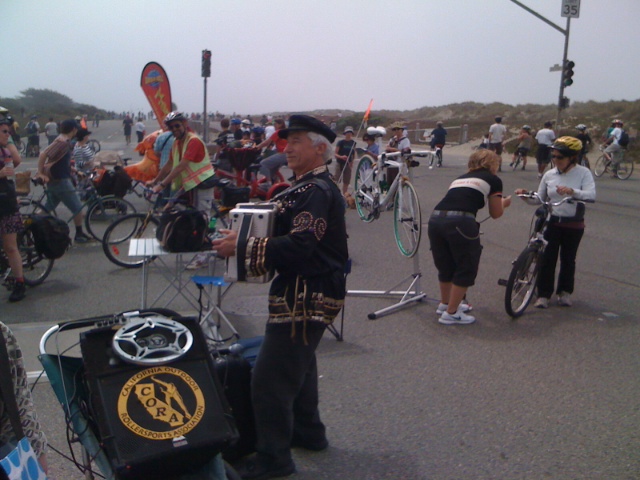
A friend made a good point today: in case shit hits the fan, you could do worse than own a bicycle. Think about it: earthquake, tsunami, governmental shut-down, what have you — gas is not going to be cheap or easy to get, and you’re still going to need to be able to get around. Why the morbid turn of conversation? Probs because we spent today cruising through (a completely unmorbid) Sunday Streets, Great Highway edition.

Crashing waves and hordes of bikers, you see, were the catalyst for all the survivalist talk — as well as my own, admittedly poor follow-up thought that bike folk could build coalitions with the gun rights groups over the question of self-sufficiency.

But around me, folks were reveling in their break from excessive use of fossil fuels, not morosing out. The second Sunday Streets of the year was not the most densely packed and attraction-studded event the series has held (the Mission, etc., makes for better people watching, strictly speaking) but it was the most pleasant this year to traverse on a bike.

Long, glorious stretch of beachside road, the SF Arts Commission Streets Smarts program’s DIY mural wallRock the Bike utilizing its double decker pedal tree to pump up the crowd and simultaneously get people stoked for June’s Bicycle Music Festival, a Twister game courtesy of the Urban Diversion folks greeted bikers emerging from Golden Gate Park, locally screen-printed whale tees hawked by a guy who lives across the street — not to mention your usual Sunday afternoon Lindy Hop session and an attempt at breaking the Guinness record for longest chain of roller skaters, both out on JFK Drive by the deYoung. And the bao truck, of course. 

Anyway, just another sunny weekend in SF. I’m sure you were braving the sunshine and high winds somewhere equally lovely, but all the same you might like to see how your city brethren survived their Sunday.

Sunday Streets could spawn skating world records

0

A Guinness world record for the longest roller skating chain may be broken here in San Francisco this weekend. The car-free Sunday Streets returns to the Great Highway and Golden Gate Park, where “godfather of skating” David Miles plans to break the record now held by Samsung Asia Pte Ltd. in Singapore, with 280 skaters on August 6, 2006.

In addition to the going for the longest chain of skaters record, he’ll also create the record for longest skating serpentine and longest chain of inline skating as well. For the longest inline skater record, each skater must hold onto the other skaters hips as the group moves together a distance of at least 400 meters without breaking the chain. For the longest serpentine, which includes both inline and regular roller skates, participants must hold hands and follow the head of the serpentine as he or she makes turns to the left and right and moves forward creating a snake like motion with the skaters.

Mayor Ed Lee has agreed to participate and possibly lead a group as well. Although Sunday Streets event is free, registration to participate in this record is $10 and skate rental is $5. Skaters who plan to be part of the record must be registered and can do so here. Miles says there are currently 120 participants signed up but people wanting to participate can register the day of the event starting at 8a.m. The first attempt to break the record starts at 11 a.m. starting at the skating center at 6th Ave and JFK. In addition, Miles and his crew will be performing a “Thriller” dance on skate and “Cha-Cha-Cha Slide” starting at 2:30 p.m.

Sunday Streets also offers free bike rentals for one hour from Bike and Roll and Bay City Bikes at JFK and Transverse or at Lincoln and Great Highway. The seven-person funcycle will be on route and can be flagged down for a try. Roller skate rentals will be at 6th Ave and JFK. Rock the Bike returns with a bike pedal-powered stage at the Rivera sea wall on the Great Highway. For five hours, feel free to walk, run, bike, skate, or waddle. Other fun activities will start at the end of Martin Luther King Drive.

At this event, The Department of Public Works in collaboration with the SF Arts will host a free mural wall painting at The Great Highway and Lincoln. The art piece will be 40 foot long on a blank wall and everyone is invited to paint on it. Spray paint is provided and Francisco “Twick” Aquino, who created the mural at 21st and Capp streets in the Mission, will be the guest host at the free wall.

Sunday Streets encourages people to enjoy streets as open space and perform or lead activities such as yoga. The idea of this event comes from Bogota, Columbia and San Francisco joined this global movement in 2008 to create a healthier city.

“As San Franciscans, we are tapping into what communal creating is,” Sunday Street Coordinator Susan King said. “For 2011, Sunday Streets created a new policy for programming events, allowing for greater community participation and, allowing for more spontaneous activities. We are making participation more accessible and leading activities at Sunday Streets easier…the space itself is the activity.”

Miles also says, “when roads are closed to traffic, we can do all the things we are supposed to do, like be active and be healthy.”

The car- free event will last from 11am to 4pm, rain or shine.

Green days

0

news@sfbg.com

1892: The Sierra Club is established by John Muir and a group of professors from UC Berkeley and Stanford in San Francisco. In its first conservation campaign, the club leads efforts to defeat a proposed reduction in the boundaries of Yosemite National Park.

1902: After two years of intense lobbying and fundraising, the Sempervirens Club, the first land conservation organization on the west coast, is successful in establishing Big Basin Redwoods State Park — the first park established in California under the new state park system.

1910: The first municipally owned and operated street car service commences in San Francisco.

1918: Save the Redwoods League is established in San Francisco. A leader in proactive land conservation, SRL would go on to assist in the purchase of nearly 190,000 acres to protect redwoods and help develop more than 60 redwood parks and reserves that old these ancient trees in California.

1934: The East Bay Regional Park is established as the first regional park district in the nation. This radical Depression-era idea would much set the tone as the Bay Area land conservation vision expanded.

1934: The Marin Conservation League is founded by wealthy Republican women. Three years later, at the league’s behest, the Marin County Board of Supervisors adopts the first county zoning ordinance in the state in 1937. Over the next 10 years, the league helps create State Parks at Stinson Beach, Tomales Bay, Samuel P. Taylor, Angel Island, and expand Mt Tamalpais State Park.

1956: San Francisco activists, led in party by Sue Bierman, launch a campaign to stop a freeway that would have run through Golden Gate Park. It marks the first time city residents successfully block a freeway project and launches the urban environmental movement in America.

1958: Citizens for Regional Recreation and Parks is founded. It becomes People for Open Space in 1969 and morphs in 1987 into the Greenbelt Alliance. Their efforts lead to the creation of the Mid-Peninsula Open Space District in 1972 and Suisun Marsh in 1974.

1960: Sierra Club Executive Director David Brower launches a brand new organizing and educational concept, the exhibit format “coffee table” book series, with This Is the American Earth, featuring photos by Ansel Adams and Nancy Newhalland. These elegant coffee-table books introduced the Sierra Club to a wide audience. Fifty thousand copies are sold in the first four years, and by 1960 sales exceed $10 million. The environmental coffee table book emerged as part of a campaign to persuade Congress to enact the Wilderness Bill, legislation that would guarantee the permanence of the nation’s wild places.

1961: Save San Francisco Bay Association is founded by Sylvia McLaughlin, Kay Kerr and Ester Gulick to end unregulated filling of San Francisco Bay and to open up the Bay shoreline to public access.

1961: Pacific Gas and Electric Co. announces plans to build a nuclear power plant at Bodega Bay. Rancher Rose Gaffney, UC Berkeley professor Joe Neilands and others mount what will become the first citizen movement in the country to stop a nuclear plant. The Bodega Bay campaign marks the birth of the antinuclear movement.

1965: Responding to Bay Area citizens’ demands for protection of the bay’s natural environment, the California state legislature passes the McAteer-Petris Act, which establishes the San Francisco Bay Conservation and Development Commission (BCDC) and charges it with preparing a plan for the long-term use and protection of the Bay and with regulating development in and around it.

1965: Fred Rohe opens New Age Natural Foods on Stanyan Street in San Francisco. He goes on to open the first natural foods restaurant in 1967, Good Karma Cafe on Valencia Street. Rohe would go on to open the first natural foods distribution company in Northern California, New Age Distributing in San Jose in 1970 and found Organic Merchants (OM), the first natural foods retailer trade group.

1967: The Human Be-in is held Jan. 14 in Golden Gate Park (as a prelude to the Summer of Love) with as a major theme higher consciousness, ecological awareness, personal empowerment, cultural and political decentralization.

1967: Alan Chadwick comes to UC Santa Cruz and establishes the Student Garden Project and training program, which would train hundreds of today’s organic farmers.

1968: The Whole Earth Catalogue, published by the Point Foundation and edited by Stewart Brand out of Gate 5 Road in Sausalito is introduced, providing tools, philosophy, and reviews to the growing back-to-the-land movement, helping promote ecological living and culture alternative sustainable culture decades before those words became mainstream.

1969: Brower, after losing his job at the Sierra Club in part because of his opposition to the Diablo Canyon nuclear power plant, founds Friends of the Earth, the cutting edge activist group that would eventually have affiliates in 77 nations around the globe and become the world’s largest grassroots environmental network.

1970: Peninsula resident Neil Young writes and sings the lyrics “Look at Mother Nature on the Run in the 1970s.”

1970: Berkeley Ecology Center opens.

1971: Sierra Club Legal Defense Fund is established, marking the beginning of an explosion in environmental law.

1971: Alice Waters opens Chez Panisse, serving up California Cuisine and altering the Bay Area diet helping to create a market for local fresh organic fruits and vegetables. 1971: Berkeley resident Francis Moore Lappé publishes her best-selling book Diet for a Small Planet. Two million copies are sold and as the first book to expose the enormous waste built into U.S. grain-fed meat production, for her a symbol of a global food system creating hunger out of plenty; her effort alters millions of diets.

1971: San Francisco dressmaker Alvin Duskin launches a campaign to limit high-rise office development in San Francisco, creating new allies and a new coalition for urban environmentalism.

1972: The Trust for Public Land, a national, nonprofit land conservation organization that conserves land for people to enjoy as parks, gardens, historic sites, and rural lands, is founded by Huey Johnson, Doug Ferguson and Marty Rosen in San Francisco. TPL would go on to protect 2.8 million acres of land and is key in getting land trusts started in Napa, Sonoma, Marin, Big Sur, and around the state.

1972: The Don Edwards San Francisco Bay National Wildlife Refuge, first urban wildlife refuge in the United States, is established, encompassing 30,000 acres of open bay, salt pond, salt marsh, mudflat, upland and vernal pool habitats located in South Bay.

1972: The Save Our Shores campaign, developed in part by Bay Area residents, results in a state initiative, the Coastal Act of 1972, which is passed by the voters and establishes the first comprehensive coastal watershed policy in the nation.

1974: Berkeley Ecology Center starts the first curbside recycling approach in California, one of first such programs in the nation.

1974: The Farallones Institute in Berkeley begins building the first urban demonstration of an ecological living center with the Integral Urban House, a converted Victorian using solar and wind technologies, a composting toilet, extensive gardens, and energy and resource conservation features. It serves as an early model for the emerging Appropriate Technology Movement.

1975: Berkeley resident Ernest Callenbach self publishes Ecotopia after a round of rejections from New York publishers; it ultimately sells more than a million copies and becomes an environmental classic.

1975: San Francisco’s first community gardens are established at Fort Mason and elsewhere.

1975: The Marine Mammal Center, a nonprofit veterinary research hospital and educational center dedicated to the rescue and rehabilitation of ill and injured marine mammals, primarily elephant seals, harbor seals, and California sea lions, is established in the Marin Headlands.

1978: Raymond Dasmann and Peter Berg coin the term Bioregionalism in the publication of Reinhabiting a Separate Country, published by Berg’s Planet Drum Foundation in San Francisco. It represents a fresh, comprehensive way of defining and understanding the places where we live, and of living there sustainably and respectfully through ecological design.

1979 Greens Restaurant opens at Fort Mason in San Francisco and quickly establishes itself as a pioneer in promoting vegetarian cuisine in the United States.

1980: The Marin Agricultural Land Trust is established by Wetland Biologist Phyllis Faber and diary farmer Ellen Straus.

1980: Berkeley resident Richard Register coins the term “depave” — to undo the act of paving, to remove pavement so as to restore land to a more natural state. Depaving begins to spread to create many inner city urban gardening projects.

1981-82: Register and other activists, bring about the first urban day lighting of a creek in Berkeley’s Strawberry Creek Park where a 200-foot section of the creek is removed from a culvert beneath an empty lot and transformed into the centerpiece of a park.

1982: Earth First, a radical environmental group founded by Dave Foreman and Mike Roselle, sponsors the first demonstration against Burger King in San Francisco for using beef grown on land hacked out of rain forests. The demonstrations spread, turn in to a boycott, and after sales drop 12 percent, Burger King cancels $35 million worth of beef contracts in Central America and announces it will stop importing rainforest beef.

1983: Local residents Randy Hayes and Toby Mcleod release the documentary film The Four Corners, A National Sacrifice Area? , which conveys the cultural and ecological impacts of coal strip-mining, uranium mining, and oil shale development in Utah, Colorado, New Mexico, and Arizona — homeland of the Hopi and Navajo. The film wins an Academy Award and illustrates serious environmental justice issues 10 years before that term is coined.

1985: The Rainforest Action Network, established in San Francisco, emerges from the Burger King action.

1986: Fifteen years after Duskin’s first anti-high-rise initiative efforts, San Francisco finally passes Prop. M, the nation’s most important sustainable growth law.

1988: Register invents a stencil to be used next to street storm drains that says “don’t dump — drains to bay.” The wastewater pollution mitigation education concept spreads around the region and nation and then becomes an international volunteer effort to lessen pollution in urban runoff, which generally flows untreated into creeks and saltwater.

1989: Carl Anthony, Karl Linn, and Brower establish the Urban Habitat Program in San Francisco, one of the first environmental justice organizations in the country.

1989: Laurie Mott of the National Resource Defense Council’s SF office rattles the apple industry by engineering a suspension of the use of the pesticide Alar by the Environmental Protection Agency. A national debate ensues.

1992: Berkeley writer Theodore Roszak coins both the term and field of ecopsychology in his book The Voice of the Earth. The movement he helps found asks if the planetary and the personal are pointing the way forward to some new basis for a sustainable economic and emotional life.

1992: The first Critical Mass bike ride (initially called a “Commute Clot”) is held in San Francisco. Similar rides, typically held on the last Friday of every month, began to take place in more than in over 300 cities around the world.

1993: The U.S. Green Building Council is founded by David Gottfriend in Oakland. The council becomes the most important environmental trade organization in the world. In 1998, the council develops the LEED (Leadership in Energy and Environmental Design) Green Building Rating System, which provides a suite of standards for environmentally sustainable construction and design.

1995: The Edible Schoolyard is established by Chez Panisse Foundation at Martin Luther King Jr. Middle School in Berkeley. It serves as a model for similar programs in New Orleans and Brooklyn, and inspires garden programs at other schools across the country.

1999: The Green Resource Center starts as a joint project of the City of Berkeley, the Northern California Chapter of Architects, Designers and Planners for Social Responsibility (ADPSR), and the Sustainable Business Alliance.

2000: Wendy Kallins, working with the Marin Bicycle Coalition, begins a Safe Route to Schools program in Marin to encourage students to walk or bicycle to school. The program is so successful that Congress allocates more than $600 million for similar efforts across the country.

2001: The first Green Festival is held in San Francisco.

2001: Berkeley becomes first city in nation with curbside recycling trucks powered by recycled vegetable oil, thanks to a campaign by the Berkeley Ecology Center.

2002: San Francisco adopts a greenhouse gas reduction initiative that aims to reduce the city’s greenhouse gas emissions to 20 percent below 1990 levels by 2012.

2003: Bay Area Build It Green is formed by a number of local and regionally focused public agencies, building industry professionals, manufactures, and suppliers. Its activities are focused on increasing the supply of green homes, raising consumer awareness about the benefits of building green, and providing Bay Area consumers and residential building industry professionals a trusted source of information.

2005: San Francisco passes the Precautionary Principle Purchasing Ordinance, which requires the city to weigh the environmental and health costs of its $600 million in annual purchases — for everything from cleaning

supplies to computers.

2006: Bay Localize is launched in the East Bay with the aim to work to build a cooperative, inclusive movement toward regional self-reliance and increase community livability and local resilience for all while decreasing fossil fuel use.

2007: In an effort to meet the challenges of global warming, carbon pollution and job creation, East Bay activist Van Jones declares that the nation is going to have to weatherize millions of homes and install millions of solar panels. His best-selling book, The Green Collar Economy, stimulates a national movement and a new organization, Green For All.

2007: San Francisco begins collecting fats, oils and grease from residential and commercial kitchens, for free, to recycle into biofuel for the city’s municipal vehicles, the largest biofuel-powered municipal fleet in the United States.

2008: San Francisco becomes the first U.S. city to establish green building standards.

2010: The Green Building Opportunity Index names San Francisco and Oakland the top two cities in the nation for green buildings.

2010: San Francisco becomes home to the Sunset Reservoir Solar Project, the largest solar-powered municipal installation in California.


On the Cheap Listings

0

On the Cheap listings are compiled by Jackie Andrews. Submit items for the listings at listings@sfbg.com. For further information on how to submit items for the listings, see Picks.

WEDNESDAY 6

Fantomas by the Bay City Lights Books, 261 Columbus, SF; (415) 362-8193 , www.citylightsf.com. 7pm, free. Help kick off a four day celebration of Pierre Souvestre and Marcel Allain’s literary pulp arch-villain, Fantomas, with a reception and absinthe-tasting featuring readings, lectures, film screenings, art exhibitions, and performances by Robin Walz, Daniel Handler, Mel Gordon, Howard Rodman, Jill Tracy, and more.

Japan relief fundraiser Project One Gallery & Lounge, 251 Rhode Island, SF; (415) 938-7173, www.p1sf.com. 7pm-2am, $10. Join forces with the American Red Cross to raise money for those who have been affected by the earthquake and tsunami in Japan with DJs, drinks, and dancing. All proceeds from the bar – including tips! – as well as the door price will go directly to the cause. While you’re here, check out the gallery’s current exhibition, “Warhol Reimagined: The New Factory”.

THURSDAY 7

Iconic gay paper celebrates 40th anniversary GLBT History Museum, 4127 18th St., SF; (415) 621-1107, www.glbthistory.org. 7pm, $5. Tonight, the Bay Area Reporter, the country’s oldest continuously published newspaper, celebrates its 40th anniversary and will launch their first ever Best of the Gays reader’s poll with an awards ceremony – be sure to vote online beforehand. Plus, a new special exhibit chronicling B.A.R.’s struggle to secure justice and equality for the entire gay-munity.

FRIDAY 8

West Portal Avenue sidewalk sale West Portal between Ulloa and 15th St., SF; www.pacificfinearts.com. 10am-5pm, free. Today, the West Portal neighborhood — bustling with quaint stores, restaurants, and coffeehouses — will line it’s main thoroughfare with an arts and crafts exhibition. Come admire the work of over 60 artists, including Mendy Marks and Locke Heemstra. Expect to find everything from jewelry and photography to handcrafted leather bags, sheepskin slippers, and more.

Community Wellness Fair Glide Memorial Church, 330 Ellis, SF; www.glide.org. 10am-2pm, free. While the rest of the country debates health care reform, we in San Francisco enjoy plenty of health care options for the under-insured. Today, everyone can celebrate health and wellness as Glide Health Services launches their new Wellness Center – which will build upon their holistic healthcare approach by adding nutrition and cooking classes, stress reduction services, and even relationship help. There will be games, prizes, healthy vendors, and free health screenings for the whole family.

SATURDAY 9

Cesar Chavez Day celebration Dolores Park, Dolores and 19th St., SF; www.cesarchavezday.org. 10am-6pm, free. Celebrate the legacy of Caesar Chavez, the American farm worker and activist who helped found the National Farm Workers Association, at this day-long celebration featuring a parade and street fair. Assemble at Dolores park at 10 am and march toward the 24th Street fair where festival booths, speakers, and other entertainment await.

Obscura Day festivities Peralta Hacienda Historical Park, 2465 34th Ave., Oakl.; www.peraltahacienda.org. 2:30-5:30pm, free. Peek behind the scenes at Peralta Hacienda on Obscura Day, an international day of expeditions, back-room tours, and hidden treasures in cities and towns around the world. Here, step back in time and experience a Victorian farmhouse by candlelight while enjoying tamales in the kitchen. Or, if you’re brave enough, try to catch a glimpse of the ghost of Maria Peralta!

SUNDAY 10

Sunday Streets Great Highway, SF; www.sundaystreetssf.com. 11am-4pm, free. The second “Streets” of the season will begin at the SF Zoo and follow the Great Highway down to Golden Gate Park and continue down JFK Drive, ending at Sloat. Bring your roller skates, unicycle, skateboard, or just a plain pair of walking shoes and enjoy the activities and vendors that line the nearly six miles of car-free roads.

MONDAY 11

“How to coexist with coyotes” San Francisco Public Library Sunset Branch, 1305 18th Ave., SF.; (415) 355-2808, www.sfpl.org. 7-8:30pm, free. Coyotes are making a comeback here in San Francisco, and the resident expert on the topic, filmmaker Melissa Peabody, will show and discuss her film San Francisco: Still Wild at Heart and tell you how our new furry friends add richness and surprise to our already kooky town.

TUESDAY 12

Lit & Lunch with Yiyun Li Minna Street gallery, 111 Minna, SF.; www.catranslation.org. 12:30-1:30pm, free. Fans of Yiyun Lee the novelist may not be aware of her lesser known translations of the works of the late Chinese writer Shen Congwen. Tonight, Li will discuss Congwen’s modernist style and how he challenged the political sensors in China.


Roller derby: the San Francisco treat

4

Drizzly March was a slow time for San Fran sports fans — the last Super Bowl Sunday pig-in-a-blanket put to bed a month before, the NBA trade deadline past and playoffs a distant dream; and today’s April 1 major league baseball opening games an agonizing countdown away. Short of swimming through the dreary rains to San Jose’s Shark Tank, what’s a rowdy, rooting beer-guzzler to do?

Heading to Golden Gate Park to cheer on some equally rowdy rollers might not be the first thought that comes to mind, but it’s exactly what thousands of die-hard derby-goers did on March 19, when the storied San Francisco Bay Bombers elbowed past the Brooklyn Red Devils in the American Roller Skating Derby league’s world championship game.

Some may not consider a wet night in a packed Kezar Pavilion to be a legit answer to the pro-sports dry spell. But the Bay Area-based ARSD league is serious about its professional status, taking pride in everything from the team uniforms to the traditional banked track – a far cry, if you please, from the fishnets and flat floors of newer leagues

Bombers’ general manager Jim Fitzpatrick, who skated for the team from 1977 to 1987, has now delivered his third straight league title since rejoining as GM in 2007 (the ARSD doesn’t hold its championship game every year). For his efforts, he’s received three straight general manager of the year awards. But for him, the real thrill is keeping banked track derby – and its SF history – alive. 

“As a little kid growing up in San Francisco roller derby was huge,” Fitzpatrick said. “Everyone watched the Bombers on TV, everyone knew them. I dreamed about playing for them in Kezar. Now, I want to honor the tradition of the old derby.”

The venerable “old derby” is rooted in19th century roller marathons that lasted for days, sometimes caused deaths, and, on the whole, managed to acquire a reputation as less-than-legitimate. The sport was popularized as a Depression-era divertissement by Chicagoan Leo Seltzer, who in 1935 built a banked track and took it on the road, dubbing it the Transcontinental Roller Derby. At each stop, skaters would circle the wooden ring as many as 57,000 times, simulating a days-long journey from New York to California, with lit-up placeholders marking teams’ make-believe progress across a billboard-sized map of the U.S.. 

Derby historians credit crowds’ hunger for blood (not that 57,000 laps would be tedious otherwise, Nascar notwithstanding) with the spectacle’s increasing focus on physical contact and frightening pile-ups. The endurance element gave way to a derby more similar to that of today, where a “jammer” on each team gains points by bumping, jumping and jostling past opposing teams’ “blockers.” 

In 1949, Seltzer created the National Roller Derby League to showcase the scintillating sport, which was poised to become a television sensation. Echoing his earlier pilgrim’s progress, he packed up the whole shebang and moved it first to Los Angeles and then to the Bay, where the 1954 formation of the San Francisco Bay Bombers created a lasting sports legacy with some of the game’s most enduring stars. (Bomber Joanie Weston was even reputed to be the era’s highest-paid female athlete.) 

The iconic Bombers were the epitome of the banked track derby that aficionados like Fitzpatrick remember watching on their family room TV sets as youths. Dozens of games a year were taped in Kezar Pavilion, adjacent to then-home of both the Oakland Raiders and the San Francisco 49ers. From there, KTVU broadcast Bombers’ games to hundreds of cities nationwide, making roller derby the Rice-a-Roni of sports, synonymous with San Francisco. 

Seltzer eventually transferred ownership to his son, Jerry, who would later recall the glory of San Francisco’s skating days, when Kezar regularly sold out. And just for an added taste of legitimacy: the Bombers shared locker rooms with their NFL stadium-mates. 

“There were no dressing rooms in Kezar Stadium,” the younger Seltzer wrote in a blog he kept, “so when the 49ers played a home game they used the tacky dressing rooms in the Pavilion. Sometimes there was virtually no overlap between the time the players left and our teams arrived, to really scummy and wet dressing rooms.” 

Fitzpatrick affirmed that the dressing rooms still exist today, though Kezar Stadium has been knocked down and rebuilt. Under the parking lot, connected to a tunnel that once funneled the teams out to a roaring crowd, the rooms are a kind of shrine to days-gone-by – days when the 49ers and the Raiders would lace up roller skates and join the Bombers on the banked track, sometimes indulging in a bit of competitive action off the football field.

“Of course,” Fitzpatrick said, “That was before the NFL took off and salaries skyrocketed.  Once that happened, the guys couldn’t afford to be fooling around.”

Though their fun ended, there was still plenty of thrill left on the banked track. The ‘60s marked the height of television popularity for the Bombers who, across the nation, were considered the team to beat.

Seltzer’s league folded in 1973, a disaster attributed to everything from the rising cost of fuel to the diversification of televised sports and events. Since then, leagues have appeared, disappeared, fractured and gone defunct, the sport’s popularity waxing and waning, the focus shifting between skill and sensation. 

“Other games and jams have come along,” Fitzpatrick explained, applying the term “silly stuff,” to a whole array of roller sports, from L.A.-based Roller Games to CBS’ over the top show Roller Jam. Fitzpatrick even alluded to “midgets on skates” – and while that might be happening somewhere out there, it doesn’t take tiny rollers to get folks to think of derby as sports entertainment: the WWE on wheels, with sexpot women in the starring roles. 

Mixed-gender for-profit leagues like the Bombers’ league ARSD leave off the false eyelashes, but fans still debate whether the scores – and punches – are fake.

According Fitzpatrick, the Bombers’ aggression is all real.

“It’s a competitive sport,” he said, “based on contact and maneuverability. It’s like when someone cuts you off on the road – like road rage, tempers flare.”

Fitzpatrick’s sincerity never falters, and it’s clear he’s proud of his skaters when he describes how player coach Richard Brown scored the last point of the 43-40 game despite sweltering heat, or when he hails rookie Crista Chua as the female standout who learned under fire and performed under pressure, despite the championship being only her second real game.

And for their part, the players are just as serious. Chua said she trains hard for the team, staying in shape with running, weights, extra skating practices, and yoga sessions to stay flexible. 

Despite the sensationalism, Fitzpatrick’s goal is to keep roller derby on track – and so far, his efforts have resulting in a sterling record. Will it ever be as good as lacing up the ol’ skates for a game of his own? According to Fitzpatrick, it’s even better.

“To see something completely disappear, and then to be able to carry on – I’m that much more grateful,” he said.

As for the future: “I want to keep on the path, looking ahead to great skating and great ability. There’s always going to be showmanship in every sport, but I want to honor the athleticism.”


Rec & Park begins HANC eviction before Board vote

Just as the Board of Supervisors was gearing up to vote at its Mar. 8 meeting on a resolution defending the Haight Ashbury Neighborhood Council (HANC) Recycling Center against eviction from Golden Gate Park, Sup. Ross Mirkarimi noted that the Recreation & Parks Department had already filed an unlawful detainer against HANC, the first legal move in an eviction process. “I think that only escalates the matter, in what I believe is an unprincipled way,” Mirkarimi said.

“It’s very unfortunate that we did have this unlawful detainer action being filed,” Sup. David Campos noted. “I am hopeful that the city reconsiders that action.”

Mirkarimi had originally drafted the resolution to urge Rec & Park to “rescind the eviction of the HANC Recycling Center from Golden Gate Park.”
Board President David Chiu made a move to amend Mirkarimi’s resolution, replacing the part about rescinding the eviction with some language calling for Rec & Park to “negotiate in good faith.” Mirkarimi’s resolution also requested the Rec & Park and the Department of the Environment to establish a “comprehensive Parks recycling program utilizing the expertise, volunteer base, and facilities of the HANC Recycling Center in Golden Gate Park.”

Mirkarimi stressed the need for the city to assist HANC in finding a new location, and questioned how the loss of the recycling service offered by HANC could possibly be replaced by vending machines in nearby grocery stores. “We’re going to have a people-traffic problem … I guarantee that that problem’s going to escalate exponentially,” Mirkarimi said.

Mirkarimi’s resolution passed 6-5, with Sups. Scott Wiener, Carmen Chu, Malia Cohen, Sean Elsbernd, and Mark Farrell dissenting. However, the District 5 supervisor acknowledged in his comments that Rec & Park is not accountable to the board, so the resolution may not have any effect on the outcome. “Let’s keep in mind, decisions by Rec & Park — it’s one of two commissions citywide whose decisions are not appealable by the Board of Supervisors,” Mirkarimi said. “They work as a parallel government.” As things stand, Rec & Park commissioners are appointed by the mayor. Alluding to a charter amendment that would have changed that governance to include Board of Supervisors’ appointees, Mirkarimi said, “I’m sure soon that that’s going to come back.”

Reached by phone, Rec & Park Policy and Public Affairs Director Sarah Ballard did not directly answer a question about why Rec & Park went ahead with the legal filings for HANC’s eviction before the Board had a chance to vote on Mirkarimi’s resolution. “We have plans to build a community garden at that site,” Ballard said. “And we’d like to get started.”

Eric Brooks, speaking on behalf of Our City, did not mince words during public comment. “This is an agency that is out of control, totally full of itself, and belligerent to the Board of Supervisors and toward the public when it comes to these issues,” Brooks said. “I think it’s really time for the Board of Supervisors to take strong action to democratize Rec & Park, to change the way that the Rec & Park Commission is constructed so that the Board has a majority of those selected — until this agency can show that it’s not a rogue agency.”

Board to vote on resolution opposing HANC eviction

Last week, Mayor Ed Lee met for around 45 minutes with Ed Dunn and Jim Rhoads of the Haight Ashbury Neighborhood Council (HANC) Recycling Center, Melanie Nutter of the Department of the Environment, and some others who have been in discussions over HANC’s pending eviction from Golden Gate Park.

“The mayor wanted us to consider alternatives to the site we’re in,” Rhoads told the Guardian after the meeting. He noted that ideas had been floated about relocating HANC to a parcel owned by the Port of San Francisco in District 10, or creating a mobile recycling unit.

“He clearly had been lobbied hard by his own staff,” Rhoads said of Lee, referring to Rec & Park General Manager Phil Ginsburg and others in that department who recommended HANC’s removal from Golden Gate Park.

But HANC doesn’t want to relocate, and the organization has the support of several members of the Board of Supervisors. At today’s March 8 Board of Supervisors meeting, the board will vote on a resolution “requesting the Recreation and Parks Department to rescind the eviction of the HANC Recycling Center from Golden Gate Park,” sponsored by Sups. Ross Mirkarimi, John Avalos, Eric Mar, and David Campos. While the Board cannot compel the Recreation & Park department to reverse its decision, Lee does have that authority.

Meanwhile, HANC’s attorney, Robert DeVries, believes that the notice of termination issued by Rec & Park was improper under state tenant laws, and he issued a letter to the city last week stating as much. March 4, the date Rec & Park named as the termination of HANC’s lease, came and went without incident, and HANC is likely to file a lawsuit if the city moves to carry out an eviction.

Until that happens, “We’re just going to continue to operate,” Rhoads said, “for what period of time, I don’t know.”

Get hammered

10

culture@sfbg.com

Until recently, its existence has played out quietly in Alabama basements and Vermont backyards. If you’ve seen anyone engaging in it, chances are it was a group of raucous bros on YouTube or Elijah Wood and Jimmy Fallon on The Late Show. If you saw it up close, you may have fled the general area.

Though its origins are obscure, most agree that Stump, the rather insane game in question, comes from some densely wooded part of Maine. It’s since been zigzagging its way across the country, through college campuses and rowdy backyards. Recently it made its way to the Bay Area.

“I first learned about it because I walked into my friend’s basement and there were 20 people screaming drunk throwing hammers. It turned out they’d been having these Stump parties every week for a while,” said Richmond resident Elon Ullman. “After a while, we got good at it and started adding our own variations.”

“Beer pong and flipcup are pretty one-dimensional,” adds Penn Chan, who attends Bard College in Annandale-on-Hudson, N.Y., (where the game was introduced by a Wisconsin girl called “Sparky”) with Ullman. “Stump evolves as people who’ve played in different areas come together and discuss how they’ve played.”

The fundamentals are simple: a hammer, some nails, and a stump. You toss the hammer in the air so that it revolves completely, catch it, and bring it down on the nail without breaking its momentum. If you drive your opponent’s nail all the way into the stump, you win. It’s usually played as a drinking game — you drop your hammer, you drink. You catch it awkwardly, you drink. You drink if you miss the nail and hit the stump, or if you hit your own nail, or if somebody else hits your nail, etc.

Rowan McCallister demonstrates a double toss

Because Stump is usually played in large, chaotic groups, hitting anything at all is a matter of chance. But if you take it seriously as a game of skill, a whole series of choices opens up, starting with where to place your nail. A stump that’s seen a few games has its own unique geography. Nail “cities,” twisted lumps of jagged metal, spring up in heavily used areas of the stump. Danger can attend: it’s possible to put your nail so close to an opponent’s that, in trying to hit your nail, he risks shredding his knuckles.

“The first rule of Stump is, if you bleed you have to bleed on the stump. The second rule is, no coagulating,” says David Liefert, who’ll be a junior at San Francisco State University this fall. On a warm Saturday a couple weeks ago, he invited me over to watch a few games. He and his friend Rowan McCallister, also a student at SF State, started playing Stump with Elon last summer, and created their own variations. Longer, thicker nails make for a longer game. Gold nails sink faster. Players can flip the hammer more than once, and can choose whether to flip it forward or backward.

Blood on the stump

Then there’s the question of the hammer itself. Metal hammers are evenly weighted, while the head of a wooden hammer is much heavier than the shaft. This tends to make the hammer spin fast and wild — it’s harder to control, but it’s also easier to make it flip over twice. Liefert and McCallister play a few rounds with a wooden hammer, then switch to the metal hammer for a two-flip game. The change throws them both off. On his first toss, McCallister miscalculates and wings the hammer over his shoulder. “Shit,” they both call out automatically, following the arc of the flying hammer.

“It looks like we’re doing something really wrong,” Ullman says. “I’ve always wondered what would happen if I were to play in Golden Gate Park. Could we be charged with anything?”

San Francisco park rangers could not be reached for comment, but Article Four of the city’s Park Code — under the heading “Disorderly Conduct” — contains at least three sections that might apply, including injunctions against “throw[ing] or propel[ling] objects of a potentially dangerous nature,” damaging or removing existing wood, and, crucially, “consumption of alcoholic beverages in the Panhandle, Stanyan Meadow, and Sharon Meadow.”

When I’ve watched people playing Stump, I’ve been struck by how often the word “respect” comes up. If a player flubs a throw and graciously declines to take his shot, it’s traditional for his opponents to say “respect” and drink. Unlike other drinking games, though, correct technique is emphasized and style is rewarded. “It’s chaotic but intellectual,” says Ullman. “It’s like physical chess.”

If you’re interested in playing Stump, e-mail David Liefert at baystump@yahoo.com.

Meet the new boss

3

news@sfbg.com

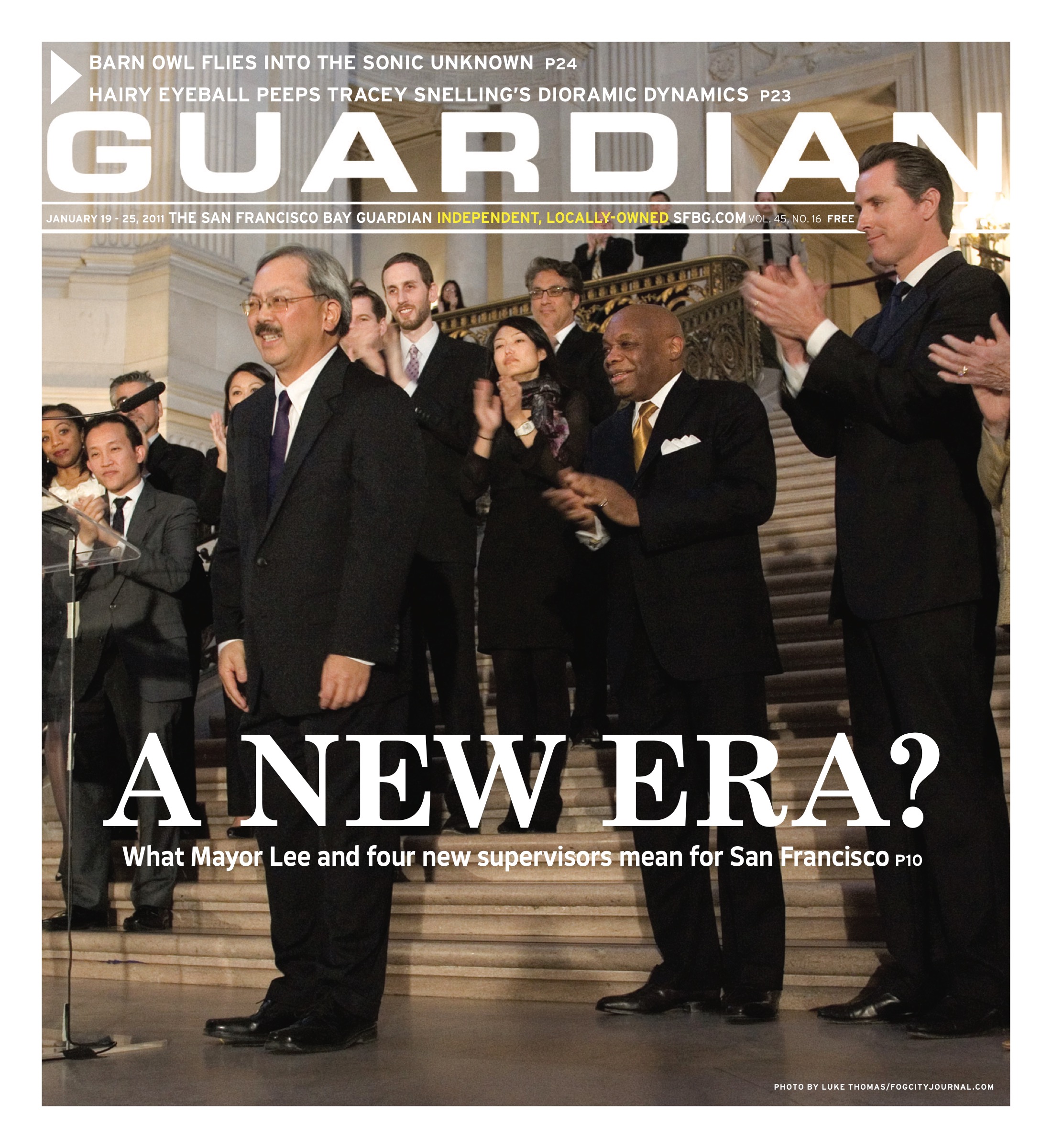
The Guardian hasn’t been invited into City Hall’s Room 200 for a long time. Former Mayor Gavin Newsom, who frequently criticized this newspaper in his public statements, had a tendency to freeze out his critics, adopting a supercilious and vinegary attitude toward any members of the press who questioned his policy decisions. So it was almost surreal when a smiling Mayor Ed Lee cordially welcomed two Guardian reporters into his stately office Feb. 15.

Lee says he plans to open his office to a broader cross-section of the community, a move he described as a way of including those who previously felt left out. Other changes have come, too. He’s replaced Newsom’s press secretary, Tony Winnicker, with Christine Falvey, former communications director at the Department of Public Works (DPW). He’s filled the Mayor’s Office with greenery, including giant tropical plants that exude a calming green aura, in stark contrast to Newsom — whose own Room 200 was sterile and self-aggrandizing, including a portrait of Robert Kennedy, in whose footsteps Newsom repeatedly claimed to walk.

When it comes to policy issues, however, some expect to see little more than business-as-usual in the Mayor’s Office. Democratic Party chair Aaron Peskin, a progressive stalwart, said he sees no substantive changes between the new mayor and his predecessor. “It seems to me that the new administration is carrying forward the policies of the former administration,” Peskin said. “I see no demonstrable change. And that makes sense. Lee was Willie Brown and former Mayor Gavin Newsom’s handpicked successor. So he’s dancing with the guys that brought him in.”

Sup. David Campos, viewed as part of the city’s progressive camp along with Peskin, took a more diplomatic tack. “So far I’ve been very pleased with what I’ve seen,” Campos noted. “I really appreciate that he’s reached out to the community-based organizations and come out to my district and done merchant walks. I think we have to wait to see what he does on specific policy issues.”

But while Lee has already garnered a reputation for being stylistically worlds apart from Newsom, he still hews close to his predecessor’s policies in some key areas. In our interview, Lee expressed an unwillingness to consider tax-revenue measures for now, but said he was willing to take condo conversions into consideration as a way to bring in cash. He was unenthusiastic about community choice aggregation and dismissive of replacing Pacific Gas & Electric Co. with a public-power system. He hasn’t committed to overturning the pending eviction of the Haight Ashbury Neighborhood Council’s recycling center, and he continued to argue for expanding Recology’s monopoly on the city’s $206 million annual trash stream, despite a recent Budget and Legislative Analyst’ report that recommended putting the issue to the voters.

Public Defender Jeff Adachi, who met Lee in 1980 through the Asian Law Caucus, said Lee would be facing steep challenges. “It’s a fascinating political karmic outcome that he is now our appointed mayor. He didn’t seek it out, as he says, but the opportunity he has now is to focus his efforts on fixing some of the problems that have gone unaddressed for decades, pension reform being one of them. I think he realizes he has a limited time to achieve things of value. The question I and others have is, can he do it?”


THE RELUCTANT MAYOR

Lee identified as a non-politician, patently rejecting the notion that he would enter the race for mayor. In meetings with members of the Board of Supervisors at the end of 2010, he said he didn’t want the job.

Yet while vacationing in Hong Kong, Lee became the subject of a full-court press. “When the lobbying and phone calls started … clearly they meant a lot to me,” Lee told us, adding that the choice “was very heavy on my mind.” He finally relented, accepting the city’s top post.

Although rumors had been circulating that Lee might seek a full term, he told the Guardian he’s serious about serving as a caretaker mayor. “If I’m going to thrust all my energy into this, I don’t need to have to deal with … a campaign to run for mayor.”

Adachi offered an interesting take on Lee as caretaker: “Somewhere along the way, [Lee] became known as the go-to guy in government who could take care of problems,” Adachi said, “like the Wolf in Pulp Fiction.”

Sounding rather unlike Harvey Keitel’s tough-talking character, Lee noted, “One of my goals is to rebuild the trust between the Mayor’s Office and the Board of Supervisors. I think I can do that by being consistent with the promises I make.”

Lee’s vows to keep his promises, mend rifts with the board, and stay focused on the job could be interpreted as statements intended to set him apart from Newsom, who was frequently criticized for being disengaged during his runs for higher office, provoking skirmishes with the board, and going back on his word.

The new mayor also said he’d be willing to share his working calendar with the public, something Newsom resisted for years. Kimo Crossman, a sunshine advocate who was part of a group that began submitting requests for Newsom’s calendar in 2006, greeted this news with a wait-and-see attitude. “I’ve already put in a request,” Crossman said. “Politicians are always in support of sunshine — until they have to comply with it.”


THE ELEPHANT IN THE ROOM

Pointing to the tropical elephant-ear plants adorning his office, Lee noted that elephants are considered lucky in Chinese culture. With the monstrous issues of pension reform and a gaping budget deficit hitting his mayoral term like twin tornadoes, it might not hurt to have some extra luck.

Pension reform is emerging as the issue du jour in City Hall. A round of talks on how to turn the tide on rising pension costs has brought labor representatives, Sup. Sean Elsbernd, billionaire Warren Hellman, City Attorney Dennis Herrera, labor leaders, and others to the table as part of a working group.

Gabriel Haaland, who works for SEIU Local 1021, sounded a positive note on Lee. “He’s an extraordinarily knowledgeable guy about government. He seems to have a very collaborative working style and approach to problem-solving, and he is respectful of differing opinions,” Haaland said. “Where is it going to take us? I don’t know yet.”

Lee emphasized his desire to bring many stakeholders together to facilitate agreement. “We’re talking about everything from limiting pensionable salaries, to fixing loopholes, to dealing with what kinds of plans we can afford in the health care arena,” he noted. Lee said the group had hashed out 15 proposals so far, which will be vetted by the Controller’s Office.

A central focus, Lee said, has been “whether we’ve come to a time to recognize that we have to cap pensions.” That could mean capping a pension itself, he said, or limiting how much of an employee’s salary can be counted toward his or her pension.

Since Lee plans to resume his post as city administrator once his mayoral term has ended, he added a personal note: “I want to go back to my old job, do that for five years, and have a pension that is respectable,” he said. “At the same time, I feel others who’ve worked with me deserve a pension. I don’t want it threatened by the instability we’re headed toward and the insolvency we’re headed toward.”


BRACING FOR THE BUDGET

If pension reform is shaping up to be the No. 1 challenge of Lee’s administration, tackling the city budget is a close second. When Newsom left office, he passed Lee a budget memo containing instructions for a 2.5 percent reduction in most city departments, part of an overarching plan to shave 10 percent from all departments plus another 10 percent in contingency cuts, making for a bruising 20 percent.

Lee said his budget strategy is to try to avert what Sup. David Chiu once characterized as “the typical Kabuki-style budget process” that has pitted progressives against the mayor in years past. That means sitting down with stakeholders early.

“I have opened the door of this office to a number of community groups that had expressed a lot of historical frustration in not being able to express to the mayor what they feel the priorities of their communities are,” Lee said. “I’ve done that in conjunction with members of the Board of Supervisors, who also felt that they weren’t involved from the beginning.”

Affordable-housing advocate Calvin Welch said Lee’s style is a dramatic change. “I think he’s probably equaled the total number of people he’s met in six weeks with the number that Newsom met in his seven years as mayor,” Welch said.

Sup. Carmen Chu, recently installed as chair of the Budget & Finance Committee, predicted that the budget will still be hard to balance. “We are still grappling with a $380 million deficit,” Chu told us, noting that there are some positive economic signs ahead, but no reason to expect a dramatic improvement. “We’re been told that there is $14 million in better news. But we still have the state budget to contend with, and who knows what that will look like.”

Sup. John Avalos, the former chair of the Board’s powerful Budget Committee, said he thinks the rubber hasn’t hit the road yet on painful budget decisions that seem inevitable this year — and the outcome, he said, could spell a crashing halt to Ed Lee’s current honeymoon as mayor.

“We are facing incredible challenges,” Avalos said, noting that he heard that labor does not intend to open up its contracts, which were approved in 2010 for a two-year period. And federal stimulus money has run out.


DID SOMEONE SAY “CONDO CONVERSIONS”?

Asked whether he supported new revenue measures as a way to fill the budget gap, Lee initially gave an answer that seemed to echo Newsom’s inflexible no-new-taxes stance. “I’m not ready to look at taxes yet,” he said.

He also invoked an idea that Newsom proposed during the last budget cycle, which progressives bitterly opposed. In a conversation with community-based organizations about “unpopular revenue-generating ideas,” Lee cautioned attendees that “within the category of unpopular revenue-generating ideas are also some that would be very unpopular to you as well.”

Asked to explain, Lee answered: “Could be condo conversion. Could be taxes. I’m not isolating any one of them, but they are in the category of very unpopular revenue-generating ideas, and they have to be carefully thought out before we determine that they would be that seriously weighed.”

Ted Gullicksen, who runs the San Francisco Tenants Union, said tenant advocates have scheduled a meeting with Lee to talk about condo conversions. Thanks to Prop. 26’s passage in November 2010, he said, any such proposal would have to be approved by two-thirds of the board or the voters. “It’s pretty clear that any such measure would not move forward without support from all sides,” Gullicksen said. “If anyone opposes it, it’s going to go nowhere.”

Gullicksen said he’d heard that Lee is willing to look at the possibility of significant concessions to renter groups in an effort to broker a condo conversion deal, such as a moratorium on future condo conversions. “If, for example, 1,000 TICs [tenants-in-common] became condos under the proposal, then we’d need a moratorium for five years to minimize and mitigate the damages,” Gullicksen explained.

More important, some structural reform of TIC conversions may be on the table, Gullicksen said. “And that would be more important than keeping existing TICs from becoming condos.”

Gullicksen acknowledged that Lee has the decency to talk to all the stakeholders. “Newsom never attempted to talk to tenants advocates,” he said.


GREEN, WITHIN LIMITS

Lee’s two children are in their early 20s, and the mayor said he takes seriously the goal of being proactive on environmental issues in order to leave them with a more sustainable San Francisco. He trumpeted the city’s green achievements, saying, “We’re now on the cutting edge of environmental goals for the city.”

Leading bicycle activist Leah Shahum of the San Francisco Bicycle Coalition had praise for Lee on bike issues. “I’m really encouraged by his very public support of the new green separate bikeways on Market Street and his interest and commitment to creating more,” she said. “I believe Mayor Lee sees the value of connecting the city with cross town bicycle lanes, which serve a wide range of folks, including business people and families.”

Yet some proponents of green causes are feeling uncertain about whether their projects will advance under Lee’s watch.

On the issue of community choice aggregation (CCA), the ambitious green-energy program that would transfer Pacific Gas & Electric Co. customers to a city-run program with a cleaner energy mix, Lee — who helped determine rates as city administrator — seemed lukewarm. “I know Mr. [Ed] Harrington and his staff just want to make sure it’s done right,” he said, referring to the general manager of the city’s Public Utilities Commission, whose tepid attitude toward the program has frequently driven him to lock horns with the city’s chief CCA proponent, Sup. Ross Mirkarimi.

Lee noted that CCA program goals were recently scaled back. He also said pretty directly that he opposes public power: “We’re not in any day getting rid of PG&E at all. I don’t think that is the right approach.”

The controversial issue of the Haight Ashbury Neighborhood Council Recycling Center’s pending eviction from Golden Gate Park still hangs in the balance. The Recreation and Park Commission, at Newsom’s behest, approved the eviction despite overwhelming community opposition.

Lee said he hadn’t looked at the issue closely. “I do know that there’s a lot of strong debate around the viability, what that operation attracts and doesn’t attract,” he said. “I had the owner of HANC here along with a good friend, Calvin Welch, who made a plea that I think about it a bit. I agreed that I would sit down and talk with what I believe to be the two experts involved in that decision: Melanie Nutter at the Department of the Environment and then Phil Ginsburg at the Rec and Park.” Nutter and Ginsburg supported HANC’s eviction.

Welch, who is on the board of HANC, noted that Lee could be swayed by his staff. “The bunch around Newsom had old and bad habits, and old and bad policies. In dealing with mayors over the years, I know how dependent they are on their staff. They’re in a bubble, and the only way out is through a good staff. Otherwise, Lee will come to the same conclusions as Newsom.”

HANC’s Jim Rhoads told the Guardian he isn’t feeling reassured. “He said he would keep asking people about it. Unfortunately, if he asked his own staff, it would be a problem because they’re leftovers from Newsom.”

Speaking of leftovers, Lee also weighed in on the debate about the city’s waste-management contract — and threw his support behind the existing private garbage monopoly. Campos is challenging a perpetual waste-hauling contract that Recology has had with the city since 1932, calling instead for a competitive-bidding process. When the Department of the Environment recommended awarding the city’s landfill disposal contract to Recology last year, it effectively endorsed a monopoly for the company over managing the city’s entire waste stream, at an estimated value of $206 million per year.

The final decision to award the contract was delayed for two months at a February Budget & Finance Committee hearing. Campos is contemplating putting the issue to the voters this fall, provided he can find six votes on the Board.

“I know that Sup. Campos had given his policy argument for why he wants that revisited,” Lee said. “I have let him know that the Recology company in its various forms has been our very dependable garbage-hauling company for many, many decades. … I feel that the company has justified its privilege to be the permit holder in San Francisco because of the things that it has been willing to do with us. Whether or not we want to use our time today to revisit the 1932 ordinance, for me that wouldn’t be a high priority.”


UNFINISHED BUSINESS

In the last week of 2010, Avalos pushed through groundbreaking local-hire legislation, without the support of then Mayor Gavin Newsom or his chief of staff, Steve Kawa, who wanted Avalos to back off and let Newsom takeover the task.

With Lee now in Room 200, things appear to be moving forward on local hire, in face of misleading attacks from Assemblymember Jerry Hill (D-San Mateo), who wants to make sure no state money is used on local-hire projects, presumably because the building trades are upset by it. And Kawa, whom Lee has retained as chief of staff, doesn’t really support the legislation. Indeed, Kawa’s presence in the Mayor’s Office has his detractors believing that the new boss in Room 200 is really the same as the old boss.

“I feel like things are moving forward in the right direction around local hire, though a little more quietly than I’d like,” Avalos told the Guardian. Avalos noted that he is going to hold a hearing in March on implementing the legislation that should kick in March 25.

Welch said he believes that if Lee starts replacing staff wholesale, it could indicate two things: he’s a savvy guy who understands the difficulties of relying on Newsom’s chief of staff Steve Kawa for a budget, and he’s not ruling out a run for mayor.

“If I was in his position, the first thing out of my mouth would be, ‘I’m not running.’ I think he’s very focused in the budget. And it’s going to make or break him. But if he starts overriding Kawa and picks staff who represent him … well, then I’d revisit the question of whether he’s contemplating a run for mayor, say, around June.”

Travels in a strange sushi

0

Tanuki Restaurant on California and Sixth Avenue was my first taste of the Richmond and my millionth of raw fish. On a quiet block in unfamiliar territory far from Mother Mission, I saw her “Open Sushi” neon sign and walked towards the light. But before I go on, I should admit that my heart belongs to another: We Be Sushi on 16th and Valencia. Theirs is simple, clean, casual, and delicious fish. But as every baby bird must one day leave its nest, so must I leave my small, insular universe to discover nourishment in new land.

The Richmond – what are you? I took the #33 past Golden Gate Park and – I know I am a ridiculous Mission idiot – entered the Twilight Zone. Where were all the people? Why are the streets so wide? Why is the sky so big? I guess there were some inhabitants, but they all seemed eerily calm, mustache-less. And there was so much space between them. There I was: a stranger in a strange land trying to get a spicy tuna roll.

The disconnect was heightened upon entering Tanuki, where my friend and I were faced with that awkward bad thing where you try to give the other tables space, but your server forces you to sit next to them anyway. I comforted myself with the thought that cultural immersion really is the best way of getting to know a place.


Counter attack. Photo by Alex Fine

And what a place! We were in a 1970s ski lodge. Well not literally, you’d have to ignore the long white counter and glassed-in fish with industrious chef behind — but with the low ceilings, suspicious wood paneling, and ESPN playing on the TV that hung over the small center dining room I caught a fresh-faced, schussing vibe. There were a few other tables near us: two hetero single lady couples complaining about men, one deliriously happy Midwestern-looking middle-aged duo, and a table of dudes desperately trying to make it known that they were a band. Everyone was white. But enough about the vibes, you crunchy Mission-ite. How was the food?

I am but a casual fisherperson. Virtually all I know about sushi is based on subtle inclination, hunch, and rumor that I can’t remember the origin of. I don’t think I’m alone there. But whether or not sushi is an ancient Japanese art or a conspiracy created by the US government, most of us can agree that it’s lovable fare (even when it’s not from We Be). 

But as far as I’m concerned, there are two kinds of sushi. One, a simple, minimal kind that allows you to fully taste its one or two ingredients. Two, the kind where the rolls are named things like Kamikaze and Oompa Loompa Sex Party and contain a million varieties of mayonnaise, teriyaki sauce, and what basically amounts to ketchup. 

I enjoy both — and I’m not making any sort of heady, stuck-up judgment about which is better (see my knowledge-of-sushi caveat above). But what I am saying is that Tanuki was inching towards the latter kind. And it was a little expensive — most menu items were between $10 and $20. 

On that menu: hot hamachi, oyster shooters, carpaccio, and clams in miso soup, to name but a few offerings. Everyone around us was ordering one oyster shooter after another – delicacies I still can’t categorically define, but “shooter” anything and I start to have my doubts. 

We started with a large green salad and a seaweed salad. The seaweed salad was good, but seaweed salad is hard to screw up. The green salad was huge and semi-warm with mushy tomatoes and watered-down miso dressing. It grossed me out, but you couldn’t tell from the way I wolfed it down. My friend got a huge bowl of shrimp tempura in udon noodle soup. Halfway through she exclaimed, “I want a beer and a peanut butter Snickers.” I tried it and thought the udon noodles were fun and chewy, the broth satisfying. But I agreed that Snickers might be in order. 

I had a house roll: crab, salmon, tuna, and avocado in a moat of spicy mayo and teriyaki sauce. It was great because it was huge, and spicy, and I was starving. I didn’t pay much attention to the fish — how could I? It was covered in creamy sauce. There’s nothing wrong with that, but it does seem rather base to smother something expensive in sriracha mayo. 

I’m not whining. Much. I’m just saying that, as I finished the last droopy bites of my pal’s udon, the servers throwing me shade nearby, and the sound of show tune instrumentals playing softly overhead, it dawned on me that sometimes; it’s ok to stick with We Be Sushi.


Tanuki Restaurant

Mon- Sun 11 a.m.–10 p.m.

4419 California, SF

(415) 752-5740

Beer and Wine

MC/V

Moderately Noisy

Wheelchair Accessible


Danny Glover, DCCC stand up for HANC

The Haight Ashbury Neighborhood Council (HANC) Recycling Center has gained some powerful allies in its ongoing fight against eviction.

A YouTube video posted over the weekend shows actor Danny Glover, a resident of the Haight, sitting in his car at the recycling center. If it were shut down, “I would be dismayed,” Glover tells a staff member. He also says, “It would be a tragedy. It would be a great loss to this city.” (Scroll down to watch.)

On Jan. 26, the Democratic County Central Committee (DCCC) voted in favor of a resolution calling for the HANC recycling center to stay at its location behind the Kezar Stadium in Golden Gate Park. The statement noted that “San Francisco is notoriously underserved by recycling centers,” adding that “people want to receive their California Redemption Value deposit, especially in this depressed economy, which can only be done at recycling centers.”
 
In recent weeks, Sup. Eric Mar told the Guardian he was strongly supportive of the recycling center’s continued operation in the park. He added that he planned to encourage Mayor Ed Lee to overturn the eviction.

The San Francisco Recreation & Park Commission voted in December 2010 to evict the recycling center from a paved lot in Golden Gate Park, where it has been operating for more than three decades. Since the center was originally on a quarterly lease, it was given 90 days notice — but HANC’s lawyer contends that it could legally occupy the property till June.

The eviction, supported by former Mayor Gavin Newsom and a commission composed of his appointees, was widely viewed by recycling center supporters as a form of political payback. HANC, a progressive organization that was at odds with the Newsom administration on a variety of issues, was particularly outspoken against the sit/lie ordinance, which Newsom placed on the ballot.

A neighborhood group, the Inner Sunset Park Neighbors, also supported the ouster of HANC, citing quality-of-life issues such as aggressive panhandling and public safety concerns that the group believes to be linked to recycling center patrons. Rec & Park plans to use the lot for a community garden, at a cost of $250,000.

http://www.youtube.com/watch?v=l09tUCChOiA

Burn the Bay

0

Self-medicate and simmer? Hardly. A nice big toke deserves (another and) a trip out and about to see some of the Bay Area’s finest sites to be stoned in. Just don’t flash that bong around — we hear that shit’s still illegal (?). Here are the Guardian staff picks for places around town that your buzz will love.


GOOD MANG KOK BAKERY

Post-Mary munchies are no joking matter. Yeah, you laugh when your buddy eats sausages dipped in maple syrup, but when it’s your turn the joke’s on you. Fortunately, Good Mang Kok Bakery in Chinatown is there to get you through those funky hunger spells. It’s got it all: pork buns, shrimp dumplings, egg tarts, mochi, sesame balls, chow mein — more grease and sugar than you can shake a spliff at. The joint (ha!) smells like stoner heaven, but the best part about Good Mang Kok is that it won’t leave a dent in your wallet — three steamed pork buns cost only $1.50 and all the food a stoner can eat won’t ever cost more than a 10 spot. Peep the window sign that says “Dim Sum Nice Food” and you’ll know you’re at the right place.

1039 Stockton, SF. (415) 397-2688


KADAMPA BUDDHIST TEMPLE’S “MEDITATIONS ON WORLD PEACE”

It’s Sunday morning, you’re stoned, and your heart is full of love. Kumbaya friend, mosey down to the Mission’s Kadampa Buddhist Temple for its weekly group meditation on world peace — because we all know that war, violence, and suffering are huge mellow-harshers. Inside the small building you’ll find a meeting room lined with chairs, Buddhist art, and sculpture — take a seat and be on time. Class includes a guided prayer, a spiritual teaching (try not to space, because if you pay attention here you can learn a lot), and refreshments. Every level of experience is welcome and no stoner will be turned away for lack of funds.

Sundays, 10:30 a.m.–noon, $10 donation suggested. 3324 17th St., SF. (415) 503-1187, www.meditationinnortherncalifornia.org


REVOLUTION CAFE

We regard the Revolution Cafe as its own mythic country, one in which bearded men and dashing women from various cosmopolitan European, Latin-American, and African cities epically lounge, smoke from their spliffs still lingering in their leather jackets and hand-woven mountain sweaters. In this convivial company, there is no better vantage point to regard the Mission’s ragtag parade from behind the fog of (medicinal, surely) Humboldt fog, particularly with a glass of house red or cappuccino in hand. Languid inter-table conversation is a mandate on the Revolution porch — retreat inside to giggle at The Awl’s witticisms on your laptop or take in the piano-guitar duo occupying Rev’s tiny corner that is allotted to its live music offerings.

3248 22nd St., SF. (415) 642-0474


ZEUM

Who says you have to be a kid to get a kick out of this museum’s interactive art and technology exhibits? Twist one up and try your hand at photo manipulation, animation, and video-mixing geared toward the mini-mind. And while we’re feeding our heads here, why not go truly techno-psychedelic with the kids’ museum’s Z Dance — dance in front of a green screen and a computer will transfer your image to a trippy backdrop (see Jefferson Airplane’s Smothers Brothers Comedy Hour performance of “White Rabbit” for inspiration). For gizmo gear-heads to blasé Betties, some advice for truly groking the beauty of Zeum: nothing will awaken your childlike wonder like a little William’s Wonder.

221 Fourth St., SF. (415) 820-3320, www.zeum.org


SEWARD STREET SLIDES

In 1966, Seward Street minipark was the site of a neighborhood sit-in that saved the last remaining open space between Seward and Corwin streets from encroaching development. Honor the community protesters’ struggle in true ’60s spirit by lighting up, grabbing a cardboard box, and flying down the polished concrete flumes for freedom (you can also slide at the chutes in Children’s Playground and Bernal Heights). Getting blazed is a good way to mitigate small bruises and the burn of climbing to the top of the remarkably long chute. But if intoxication and high velocity isn’t your favorite mix, there are plenty of places to perch peacefully and watch the action.

Acme between Seward and Corwin, SF


BERKELEY BOWL

This locally-owned grocery chain is a stoner’s dream, whether you alight on the 40,000 square foot megastore or the sleek new western location complete with parking lot: an added convenience for pre-browse hot-boxing. From asparagus to zatar (a Lebanese spice related to mint), the Technicolor aisles tantalize tokers’ taste buds, and are the ideal playscape for customer antics — shopping cart drag races are not unheard of. Feeling peckish? Avoid being “that hippy” shoving patchouli-scented paws in the bulk bins. Try baking among the baked goods at the store café, where you’ll find plenty of fresh soups, sandwiches, and company to ponder universal truths with.

2020 Oregon, Berk. (510) 843-6929; 920 Heinz, Berk. (510) 898-9555, www.berkeleybowl.com


WESTFIELD MALL ESCALATORS

Try to accomplish anything at the Westfield Mall while sober and you will surely end up crying outside of Jamba Juice, then struggling for hours more just to find the first floor exit. A better way of approaching the shiny downtown consumerist behemoth is to get faded and ride the escalators for, like, a really long time. The inter-floor specimens at the Westfield are a sight to behold. Unlike boring linear escalators, these zigzag upward and downward in Escher-esque profundity, caged in the mall’s dome-like interior. Those seeking ascent or descent must navigate a loop of shiny retail spaces just to find their way to the next moving staircase. Keep your wits about you — if you know which way is up, you may just reach Century Theatres!

865 Market, SF. (415) 512-6776, www.westfield.com/sanfrancisco


AUDIUM

Seeing the sights while stoned is all well and good, but you can give your optic nerves the night off and still totally trip off of SF. The wonder that makes it all possible is the Audium, where synapse-stimulating sound sculptures are unleashed on listeners seated in a round auditorium that is darkened to blackness to further heighten the experience. This place was constructed to get you high off auditory fumes. Sayeth Stan Shaff, the composer who co-masterminded the Audium concept back in the 1950s: “As people walk into a work, they become part of its realization. From entrance to exit, Audium is a sound-space continuum.” Somehow we’ve made it through this entire paragraph without using the term “mind-blowing.” Shoulder pat.

Performances Fridays and Saturdays, 8:30 p.m. 1616 Bush, SF. (415) 771-1616, www.audium.org


NORTHERN CALIFORNIA COAST GALLERY AT THE STEINHART AQUARIUM

Look, for those riding the green hornet, buzziness doesn’t get much better done than at the California Academy of Sciences. The Morrison Planetarium sends not just cosmic gas and glistening stars whirling around your dome, but protozoan tendrils and glimmering ambient sounds as well, as part of the current “Life” show. Iridescent butterflies flit unfettered about the Buckyball-like “Rainforests of the World” structure. And of course there’s Claude the preening albino alligator and a clownish troupe of cavorting penguins. But for sheer shivery loveliness, we like to slip into the basement for the Steinhart Aquarium’s gorgeously curated exhibits of regional undersea habitats. The Philippine Coral Reef wastes our retinas with its neon delights and the generalist Water Planet Galleries include infinite otherworldly species. But it’s the Northern California Coast Gallery that keeps us rooted in a meditative pose with its hypnotically undulating anemones and sensuously intertwined towers of opalescent kelp. Think about it. That’s, like, right off Ocean Beach, dude. Your pipe is your snorkel.

55 Music Concourse Dr., Golden Gate Park, www.calacademy.org

List assembled by Emily Appelbaum, Marke B., Caitlin Donohue, and Hannah Tepper.

Lee should stop the recycling eviction

3

EDITORIAL Mayor Ed Lee needs to demonstrate, as we noted last week, that he’s making a clean break from the politics and policies of the Newsom administration — and there are things he can do immediately to reassure San Franciscans that he’s going to offer more than another 11 months of a failed administration.

He can start by calling off the eviction of the Haight Ashbury Neighborhood Recycling Center.

The move by Newsom to evict the recycling center, on the edge of Golden Gate Park, was part of his administration’s war on the poor. It made no sense from a financial or environmental perspective. The center, which pays rent to the city, would be replaced by a community garden, which would pay nothing. The center creates green jobs that pay a living wage; all the workers would be laid off under Newsom’s plan. The center also operates a native plant nursery and provides a drop-off recycling site for local businesses.

A community garden makes only limited sense in a shady area that gets fog most of the year.

The only reason Newsom was determined to get rid of the place is that low-income people who collect bottles and cans around the city (an environmentally positive activity, by the way) come by the center to drop them off and pick up a little cash. Some of the wealthier residents of the Haight don’t like poor people wandering through their neighborhood. It’s class warfare, declared by the Newsom administration — and Lee, who got his start as a poverty lawyer, doesn’t have to tolerate it.

Lee should direct the Recreation and Parks Department to cease the eviction proceedings and negotiate a long-term lease for the Frederick Street site.

It seems like a small item in the long list of issues the new mayor will have to deal with — but the HANC recycling center has strong symbolic importance. Ending the eviction and allowing the center to stay would be a sign that Lee intends to be a mayor who is willing to work with the progressives and that he’s not going to try to solve all the city’s problems by blaming, harassing, and criminalizing people who are barely surviving in San Francisco.

The new mayor could take another simple step toward broad credibility by opening up his office — to the public and the press. Under Newsom, Room 200 was an unfriendly place to outsiders, and often the news media were treated as enemies. Lee should start holding regular press conferences — not just stage-managed events designed to showcase one issue, but broad-ranging, open sessions where reporters can ask questions about anything his administration is doing. And he ought to direct his press office to make compliance with the Sunshine Ordinance a priority.

For starters, he could release whatever proposed budget cuts Newsom left behind. It’s hard to believe the former mayor just turned them over to Lee without a list of things that were on the chopping block. The sooner the public sees where the previous administration was going, the sooner we can all determine what, if anything, Lee will do differently.

Ms. Behavior

0

arts@sfbg.com

DANCE Fat chance Aura Fischbeck could have escaped becoming a dancer. Her mother was one of the last students of legendary German Expressionist dancer Mary Wigman; her father is an actor/musician who pioneered multimedia dance theater in the 1960s. Additionally, she had an older sister, also a dancer. “[She] was always a step or two ahead of me,” Fischbeck remembers. “I grew up surrounded by dance, but I didn’t like some of the politics that go with the profession.”

So what’s a gal to do? Fischbeck was drawn to poetry and history, but the pull of “embodying ideas,” as she puts it, was too strong. If you can’t fight ’em, join ’em; Fischbeck became a dancer.

The Philadelphia-born, Naropa University-trained dancer recently met me for an interview at CounterPulse during a break from rehearsing the upcoming world premiere of Bodies That Won’t Behave, to be presented this weekend in a double bill with The Riley Project. Although her company, Aura Fischbeck Dance, is only two years old, she has been dancing, rehearsing, choreographing, studying (with Kathleen Hermesdorf), and producing in SF ever since she hit town seven years ago. She immediately hooked up with Joe Landini when he opened The Garage in 2007. Since then, she has participated in just about all of the various programs that home-for-dancers offers.

As a choreographer, Fischbeck’s work — such as Relay and her solo Compass — has resembled a dialogue between a kind of abandon that looks spontaneous or improvised but isn’t, and a fascination with control and formalized structures. She has managed to put a personal, fresh twist on this common tension between two modes of being. It’s a pull she readily admits to in her own life. “I want to let loose and let go, and then I have to reign myself in.” In Fischbeck’s choreography you can also see a strong conceptual basis, much as you do in the work of people she admires: Miguel Gutierrez, Ralph Lemon, John Jasperse, and Jess Curtis.

In the trio for Bodies, which Gretchen Garnett, Julie Potter and Travis Rowland are rehearsing when I arrive at CounterPULSE, Fischbeck is working with “proper” and “improper” behavior. (An accompanying video by Chris Wise shows the dancers “misbehaving” in Golden Gate Park.) Fischbeck doesn’t make moral judgments about comportment. She wants to explore the body as a vessel for conflicting values.

In an e-mail later the same day, Fischbeck is at pains to articulate the motivating force behind Bodies: “The idea of misbehavior is unpacked in this work as a way of expressing love and acceptance for our imperfections,” she writes, “and for allowing the parts of ourselves that are awkward or unkempt or simply uncontrollable to be witnessed and celebrated.”

What you are likely to see on stage this weekend is comédie humaine: three dancers, with Potter as the smallest one in the middle, on adjacent folding chairs trying to negotiate individual and common spaces. During the rehearsal, this attempt to balance conflicting interests very quickly began to look like a fierce competition. Attempts to navigate and hoard resulted in moments that are frustrating, painful, hilarious, tender, and just plain awkward. When the trio finally broke into spaciously flowing unisons even those soon began to hiccup and disintegrate.

Bodies will be seen in conjunction with two premieres by Leigh Riley, All You Need and DuBeUs. All You Need grew out of Riley’s interest in Aristotle’s concepts of love: philia, eros, storge, and agape. “I grew up in a Christian tradition where we always heard about those four different kinds of love,” Riley explains. “But I really wanted to make four very different duets.” DuBeUs is a collaborative quintet for Caroline Alexander, Jennifer Bennett, Leah Curran, Stacy Swann, and Katharine Vigmostad. It examines the demands on an individual’s identity when belonging to and assimilating into a group, such as happened, for instance, throughout “Don’t ask, don’t tell.” *

AURA FISCHBECK DANCE AND RILEY PROJECT

Fri./21-Sat./22, 8 p.m. Sun./23, 2 p.m.; $12–$20

CounterPULSE

1310 Mission, SF

(415) 626-2060

www.brownpaperickets.com

They have issues: Members of the new Board speak

20

Board President David Chiu touched off a broad political discussion in recent weeks with his statement that officials were elected “not to take positions, but to get things done.” Delivered just before his reelection as Board President with the solid backing of the board’s moderate faction, Chiu’s comment has been viewed in light of City Hall’s shifting political dynamic, a subject the Guardian explores in a Jan. 19 cover story. Politics aside, Chiu’s statement also begs the question: Just what do members of the board hope to get done, and how do they propose to accomplish the items on their agenda?
Last week, Guardian reporters tracked down every member of the board to find out. We asked, what are your top priorities? And how do you plan to achieve them? Some spoke with us for 25 minutes, and others spoke for just 5 minutes, but the result offers some insight into what’s on their radar. Not surprisingly, getting the budget right was mentioned by virtually everyone as a top priority, but there are sharp differences in opinion in terms of how to do that. Several supervisors, particularly those in the moderate wing, mentioned ballooning pension and healthcare costs. Aiding small business also emerged as a priority shared by multiple board members.

Sup. Eric Mar
District 1

Issues:
*Budget
*Assisting small businesses
*Programs and services for seniors
*Food Security
*Issues surrounding Golden Gate Park

Elected in 2008 to represent D1, Sup. Eric Mar has been named chair of the powerful Land Use & Economic Development Committee and vice chair of the City Operations and Neighborhood Services Committee.

Asked to name his top priorities, Mar said, “A humane budget that protects the safety net and services to the must vulnerable people in San Francisco is kind of the critical, top priority.”

It’s bound to be difficult, he added. “That’s why I wish it could have been a progressive that was chairing the budget process. Now, we have to work with Carmen Chu to ensure that it’s a fair, transparent process.”

A second issue hovering near the top of Mar’s agenda is lending a helping hand to the small businesses of the Richmond District. “There’s a lot of anxiety about the economic climate for small business. We’re trying to work closely with some of the merchant associations and come up with ideas on how the city government can be more supportive,” he said. Mar also spoke about the need to respond to the threat of big box stores, such as PetCo, that could move in and harm neighborhood merchants. “I’m worried about too many of the big box stores trying to come in with an urban strategy and saying that they’re different — but they sure have an unfair advantage,” he noted.

Programs and services for the senior population ranked high on his list. Mar noted that he’d been working with senior groups on how to respond to a budget analyst’s report showing a ballooning need for housing – especially affordable housing – for seniors. “It’s moving from the Baby Boom generation to the Senior Boomers, and I think the population, if I’m not mistaken, by 2020 it’s going up 50 percent,” he said. “It’s a huge booming population that I don’t think we’re ready to address.”

Addressing food security issues through the Food Security Task Force also ranked high on Mar’s list, and he noted that he’s been working with a coalition that includes UCSF and the Department of Public Health to study the problem. “We’ve had a number of strategy meetings already, but we’re trying to launch different efforts to create healthier food access in many of our lowest income neighborhoods,” Mar said.

Finally, Mar talked about issues relating to the park. “I do represent the district that has Golden Gate Park, so I’m often busy with efforts to preserve the park, prevent privatization, and ensure enjoyment for the many residents not just in the Richmond but throughout the city that enjoy the park.” Although it’s not technically in his district, Mar noted that he is very supportive of HANC Recycling Center – and plans to advocate on their behalf to Mayor Lee.

Sup. Mark Farrell
District 2
Issues:
*Pension reform
*Long-term economic plan for city
*Job creation
*Quality-of-life issues

Elected to replace termed-out D2 Sup. Michela Alioto-Pier, Farrell has been named vice-chair of the Government Audits & Oversight Committee and a member of the Rules Committee. A native of D2, Farrell told the Guardian he believes his roots in the city and background as a venture capitalist would be an asset to the city’s legislative body. “I know at the last board, Carmen [Chu] was the only one who had any finance background,” he said. “To have someone come from the private sector with a business / finance background, I really do believe … adds to the dialogue and the discussion here at City Hall.”

Along those lines, Farrell said one of his top priorities is the budget. “I’m not on the budget and finance committee this time around, but given my background, I am going to play a role in that,” he said.

So what’s his plan for closing the budget deficit? In response, he alluded to slashing services. “In the past, there have been views that we as a city don’t provide enough services and we need to raise revenues to provide more, or the perspective that we first need to live within our means and then provide more services. Everyone’s going to disagree, but I’m in the latter camp,” he said. “I do believe we need to make some tough choices right now – whether it be head count, or whether it be looking at …pension reform. I do believe pension reform needs to be part of the dialogue. Unfortunately, it’s unsustainable.”

He also said he wanted to be part of “trying to create and focus on a framework for a long-term financial plan here in San Francisco.”

Secondly, Farrell discussed wanting to put together a “jobs bill.”

“Jobs is a big deal,” he said. “It’s something I want to focus on. There are only so many levers we can pull as a city. I think the biotech tax credits have spurred a lot of business down in Mission Bay.”

Next on Farrell’s agenda was quality-of-life issues, but rather than talk about enforcing San Francisco’s sit/lie ordinance – supported by political forces who organized under the banner of maintaining ‘quality-of-life’ – Farrell revealed that he is incensed about parking meter fines. “It is so strikingly unjust when you are 1 minute late to your parking meter and you have a $65 parking fine,” he said.

Farrell also mentioned development projects that would surely require time and attention. “CPMC is going to be a major dominant issue,” he said. He also mentioned Doyle Drive, and transitional age youth housing projects proposed in D2 – but as far as the housing project planned for the King Edward II Inn, which has generated some controversy among neighborhood groups, he didn’t take a strong position either way, saying he wanted to listen to all the stakeholders first.

Board President David Chiu
District 3
Issues:
*Budget
*Preserving neighborhood character
*Immigrant rights
*Preserving economic diversity
*Transit

Elected for a second two-year term as President of the Board, D3 Sup. David Chiu is rumored to be running in the mayor’s race, after he turned down former Mayor Gavin Newsom’s offer to appoint him as District Attorney. That offer was made after Kamala Harris won the state Attorney General’s race this fall. And when Chiu turned it down, former Mayor Gavin Newsom shocked just about everybody by appointing San Francisco Police Chief George Gascon, who is not opposed to the death penalty and was a longtime Republican before he recently registered as a Democrat, instead.

A temporary member of the Board’s Budget acommittee, Chiu is also a permanent member of the Board’s Government Audits & Oversight Committee.

Asked about his top priorities, Chiu spoke first and foremost about  “ensuring that we have a budget that works for all San Franciscans, particularly the most vulnerable.” He also said he wanted to see a different kind of budget process: “It is my hope that we do not engage in the typical, Kabuki-style budget process of years past under the last couple of mayors, where the mayor keeps under wraps for many months exactly what the thinking is on the budget, gives us something on June 1 for which we have only a couple of weeks to analyze, and then engage in the tired back-and-forth of debates in the past.” Chiu also spoke about tackling “looming pension and health care costs.”

Another priority, he said, was “Ensuring that our neighborhoods continue to remain the distinctive urban villages that they are, and protecting neighborhood character,” a goal that relates to “development, … historic preservation, [and] what we do around vacant commercial corridors.”

*Immigrant rights also made his top-five list. “I was very sad that last November we didn’t prevail in allowing all parents to have a right and a voice in school board elections,” he said, referencing ballot measure Proposition D which appeared on the November 2010 ballot. “I think we are going to reengage in discussion around Sanctuary City, another topic I have discussed twice already with Mayor Lee.”

Another issue for Chiu was  “ensuring again that hopefully San Francisco continues to remain an economically diverse city, and not just a city for the very wealthy.” He spoke about reforming city contracts: “In particular, dealing with the fact that in many areas, 70 to 80 percent of city contracts are awarded to non-San Francisco businesses. … I think there is more significant reform that needs to happen in our city contracting process.” Another economic-diversity measure, he said, was tax policy, “particularly around ensuring that our business tax is incenting the type of economic growth that we want.”

Finally, Chiu spoke about “Creating a transit-first city. This is not just about making sure MUNI is more reliable and has stable funding, but ensuring that we’re taking steps to reach a 2020 goal of 20 percent cycling in the city. Earlier this week I called for our transit agencies to look at pedestrian safety, because we are spending close to $300 million a year to deal with pedestrian deaths and injuries.”

Sup. Carmen Chu
District 4
*Budget
*Core Services
*Jobs
*Economy

Chiu has just named Sup. Carmen Chu as chair of the powerful Board and Finance Committee. And Chu, who worked as a budget analyst for Newsom’s administration, says the budget, core services, employment and the economy are her top priorities.

“My hope is that this year the budget is going to be a very collaborative and open process,” Chu said.

Chu believes workers benefits will be a central part of the budget-balancing debate.
“Any conversation about the long-term future of San Francisco’s budget has to look at the reality of where the bulk of our spending is,” she said.

Chu noted that the budget debate will have to take the state budget into account.
“At the end of the day, we need to take into account the context of the state budget, in terms of new cuts and taxes, because anything we do will be on top of the state level.

“We need to ask who do these measures really impact,” she added, noting that there were attempts to put revenue measures on the ballot last year.

Sup. Ross Mirkarimi
District 5
* Local Hire / First Source / Reentry programs
* Budget / generating revenue
* Infrastructure improvements
*Reversing MTA service cuts

With only two years left to serve on the Board, D5 Sup. Ross Mirkarimi has been named chair of the Board’s Public Safety Committee and vice-chair of the Budget and Finance Committee.

“One of my top priorities is building on and strengthening the work that I’ve already done and that Avalos is doing on mandatory local hire and First Source programs,” Mirkarimi said. He also spoke about “strengthening reentry programs for those coming out of the criminal justice system, because we still have an enormously high recidivism rate.”

The budget also ranked high on Mirkarimi’s list, and he stressed the need for “doing surgical operations on our budget to make sure that services for the vulnerable are retained, and looking for other ways to generate revenue beyond the debate of what’s going on the ballot.

“For instance, I helped lead the charge for the America’s Cup, and while the pay-off from that won’t be realized for years, the deal still needs to be massaged. What we have now is an embryonic deal that still needs to be watched.”

Mirkarimi mentioned safeguarding the city against privatization, saying one of his priorities was “retooling our budget priorities to stop the escalating practice of privatizing city services.”

 He spoke about “ongoing work citywide to make mixed-use commercial and residential infrastructure improvements, which coincide with bicycle and pedestrian improvements.”

Finally, Mirkarimi said he wanted to focus on transportation issues. “As Chair of the Transportation Authority, if I even continue to be chair, to take the lead on signature transit projects and work with the M.T.A. to reverse service cuts.”

Sup. Jane Kim
District 6
Issues:
*Jobs
*Economic Development
*Small Business
*Pedestrian Safety
*Legislation to control bedbug infestations

Elected to replace termed-out D6 Sup. Chris Daly, Kim has been named chair of the Rules Committee and a member of the Budget & Finance committee.

Kim believes that she will prove her progressive values through her work and she’s trying to take the current debate about her allegiances on the Board in her stride.

“The one thing I learned from serving on the School Board was to be really patient,” Kim told me, when our conversation turned to the issue of “progressive values.”

“I didn’t want to be President of the School Board for the first few years, because I loved pushing the envelope,” Kim added, noting that as Board President David Chiu is in the often-unenviable position of chief negotiator between the Board and the Mayor.

But with Ed Lee’s appointment as interim mayor, Kim is excited about the coming year.
“There are a lot of new opportunities, a different set of players, and it’s going to be very interesting to learn how to traverse this particular scene.”

Kim is kicking off her first term on the Board with two pieces of legislation. The first seeks to address bedbug infestations. “Particularly around enforcement, including private landlords,” Kim said, noting that there have also been bedbug problems in Housing Authority properties.

Her second immediate goal is to look at pedestrian safety, a big deal in D6, which is traversed by freeways with off-ramps leading into residential zones.
“Pedestrian safety is a unifying issue for my district, particularly for all the seniors,” Kim said, citing traffic calming, speed limit enforcement and increased pedestrian traffic, as possible approaches.

Beyond those immediate goals, Kim plans to focus on jobs, economic development and small businesses in the coming year. “What can we do to create jobs and help small businesses? That is my focus, not from a tax reduction point of view, but how can we consolidate the permitting and fees process, because small businesses are a source of local jobs.”

Kim plans to help the Mayor’s Office implement Sup. John Avalos’ local hire legislation, which interim Mayor Ed Lee supports, unlike his predecessor Mayor Gavin Newsom.

“Everyone has always liked the idea of local hire, but without any teeth, it can’t be enforced,” Kim observed. “It’s heartbreaking that young people graduate out of San Francisco Unified School District and there’s been not much more than retail jobs available.”

She noted that jobs, land use and the budget are the three overarching items on this year’s agenda. “I’m a big believer in revenue generation, but government has to come half-way by being able to articulate how it will benefit people and being able to show that it’s more than just altruistic. I think we have to figure out that balance in promoting new measures. That’s why it’s important to be strong on neighborhood and community issues, so that folks feel like government is listening and helping them. I don’t think it’s a huge ask to be responsive to that.”

Kim said she hoped the new mayor would put out a new revenue measure, enforce local hire, and implement Sup. David Campos’ legislation to ensure due process for immigrant youth.

“I think Ed can take a lot of the goodwill and unanimous support,” Kim said. “We’ve never had a mayor without an election, campaigns, and a track record. Usually mayors come in with a group of dissenters. But he is in a very unique position to do three things that are very challenging to do. I hope raising revenues is one of those three. As a big supporter of local hire, I think it helps having a mayor that is committed to implement it. And I’m hoping that Ed will implement due process for youth. For me, it’s a no brainer and Ed’s background as a former attorney  for Asian Law Caucus is a good match. Many members of my family came to the U.S. as undocumented youth, so this is very personal. Kids get picked up for no reason and misidentified. People confuse Campos and Avalos, so imagine what happens to immigrant youth.”

Sup. Sean Elsbernd
District 7
Issues:
*Parkmerced
*Enforcing Prop G
*Pension & healthcare costs
*CalTrain

With two years left to serve on the Board, D7 Sup. Sean Elsbernd has been named vice-chair of the Rules Committee and a member of the City Operations & Neighborhood Services Committee. He was congratulated by Chinatown powerbroker Rose Pak immediately after the Board voted 11-0 to nominated former City Administrator Ed Lee as interim mayor, and during Lee’s swearing-in, former Mayor Willie Brown praised Elsbernd for nominating Lee for the job.

And at the Board’s Jan. 11 meeting before the supervisors voted for Lee, Elsbernd signaled that city workers’ retirement and health benefits will be at the center of the fight to balance the budget in the coming year.

Elsbernd noted that in past years, he was accused of exaggerating the negative impacts that city employees’ benefits have on the city’s budget. “But rather than being inflated, they were deflated,” Elsbernd said, noting that benefits will soon consume 18.14 percent of payroll and will account for 26 percent in three years. “Does the budget deficit include this amount?” he asked.

And at the afterparty that followed Lee’s swearing in, Public Defender Jeff Adachi, who caused a furor last fall when he launched Measure B, which sought to reform workers’ benefits packages, told the Guardian he is not one to give up lightly. “We learned a lot from that,” Adachi said. “This is still the huge elephant in City Hall. The city’s pension liability just went up another 1 percent, which is another $30 million.”

As for priorities, Elsbernd broke it down into district, city, and regional issues. In D7, “Hands-down, without question the biggest issue … is Parkmerced,” he said, starting with understanding and managing the environmental approval process. If it gets approved, he said his top concerns was that “the tenant issue. And the overriding concern of if they sell, which I think we all think is going to happen in the near-term – do those guarantees go along with the land?”

Also related to Parkmerced was planning for the traffic conditions that the development could potentially create, which Elsbernd dubbed a “huge 19th Avenue issue.”

Citywide, Elsbernd’s top priorities included enforcing Proposition G – the voter-approved measure that requires MUNI drivers to engage in collective bargaining – and tackling pension and healthcare costs. He spoke about “making sure that MTA budget that comes to us this summer is responsive” to Prop G.

As for pension and healthcare, Elsbernd said, “I’ve already spent a good deal of time with labor talking about it, and will continue to do that.” But he declined to give further details. Asked if a revenue-generating measure could be part of the solution to that problem, Elsbernd said, “I’m not saying no to anything right now.”

On a regional level, Elsbernd’s priority was to help CalTrain deal with its crippling financial problem. He’s served on that board for the last four years. “The financial situation at CalTrain – it is without question the forgotten stepchild of Bay Area transit, and the budget is going to be hugely challenging,” he said. “I think they’ll survive, but I think they’re going to see massive reductions in services.”

Sup. Scott Wiener
District 8
Issues:
*Transportation
*Reasonable regulation of nightlife & entertainment industry
*Pension reform

Elected in November 2010 to replace termed-out D8 Sup. Bevan, Wiener has been named a temporary member of the Board’s Budget and Finance Committee and a permanent member of the Land Use and Economic Development Committee.

“Transportation is a top priority,” Wiener said. ‘That includes working with the M.T.A. to get more cabs on the street, and making sure that the M.T.A. collectively bargains effectively with its new powers, under Prop. G.”

“I’m also going to be focusing on public safety, including work around graffiti enforcement, though I’m not prepared to go public yet about what I’ll be thinking,” he said.

“Regulating nightlife and entertainment is another top priority,” Wiener continued. “I want to make sure that what we do is very thoughtful in terms of understanding the economic impacts, in terms of jobs and tax  revenues, that this segment has. With some of the unfortunate incidents that have happened, it’s really important before we jump to conclusions that we figure out what happened and why. Was it something the club did inappropriately, or was it just a fluke? That way, we can avoid making drastic changes across the board. I think we have been very reactive to some nightclub issues. I want us to be more thoughtful in taking all the factors into consideration.”

“Even if we put a revenue measure on the June or November ballot, we’d need a two-thirds majority, so realistically, it’s hard to envision successfully securing significant revenue measure before November 2012,” Wiener added. “And once you adopt a revenue measure, it takes time to implement it and revenue to come in, so it’s hard to see where we’ll get revenue that will impact the 2012 fiscal year. In the short term, for fiscal year 2011/2012, the horse is out of the barn”

“As for pension stuff, I’m going to be very engaged in that process and hopefully we will move to further rein in pension and retirement healthcare costs.”

Sup. David Campos
District 9
Issues:
*Good government
*Community policing
*Protecting immigrant youth
*Workers’ rights and healthcare

Elected in 2008, D9 Sup. David Campos has been named chair of the Board’s Government Audit & Oversight Committee and a member of the Public Safety Committee. And, ever since he declared that the progressive majority on the Board no longer exists, in the wake of the Board’s 11-0 vote for Mayor Ed Lee, Campos has found his words being used by the mainstream media as alleged evidence that the entire progressive movement is dead in San Francisco.

“They are trying to twist my words and make me into the bogey man,” Campos said, noting that his words were not a statement of defeat but a wake-up call.

“The progressive movement is very much alive,” Campos said. “The key here is that if you speak your truth, they’ll go after you, even if you do it in a respectful way. I didn’t lose my temper or go after anybody, but they are trying to make me into the next Chris Daly.”

Campos said his overarching goal this year is to keep advancing a good government agenda.

“This means not just making sure that good public policy is being pursued, but also that we do so with as much openness and transparency as possible,” he said.

As a member of the Board’s Public Safety Committee, Campos says he will focus on making sure that we have “as much community policing as possible.

He plans to focus on improving public transportation, noting that a lot of folks in his district use public transit.

And he’d like to see interim mayor Ed Lee implement the due process legislation that Campos sponsored and the former Board passed with a veto-proof majority in 2009, but Mayor Gavin Newsom refused to implement. Campos’ legislation sought to ensure that immigrant youth get their day in court before being referred to the federal immigration authorities for possible deportation, and Newsom’s refusal to implement it, left hundreds of youth at risk of being deported, without first having the opportunity to establish their innocence in a juvenile court.
‘We met with Mayor Lee today,” Campos told the Guardian Jan. 18. “And we asked him to move this forward as quickly as possible. He committed to do that and said he wants to get more informed, but I’m confident he will move this forward.”

Campos also said he’ll be focusing on issues around workers’ rights and health care.
“I want to make sure we keep making progress on those fronts,” Campos said.

“It’s been a rough couple of days,” Campos continued, circling back to the beating the press gave him for his “progressive” remarks.“But I got to keep moving, doing my work, calling it as a I see it, doing what’s right, and doing it in a respectful way. The truth is that if you talk about the progressive movement and what we have achieved, which includes universal healthcare and local hire in the last few years, you are likely to become a target.”

Sup. Malia Cohen
District 10
Issues:
*Public safety
*Jobs
*Preserving open space
*Creating Community Benefit Districts
*Ending illegal dumping
Elected to replace termed-out D10 Sup. Sophie Maxwell, Cohen has been named chair of the City & School District committee, vice chair of the Land Use and Economic Development Committee and vice chair of the Public Safety Committee.

Cohen says her top priorities are public safety, jobs, open space, which she campaigned on, as well as creating community benefits districts and putting an end to illegal dumping.

“I feel good about the votes I cast for Ed Lee as interim mayor and David Chiu as Board President. We need to partner on the implementation of local hire, and those alliances can help folks in my district, including Visitation Valley.”

“I was touched by Sup. David Campos words about the progressive majority on the Board,” she added. “I thought they were thoughtful.”

Much like Kim, Cohen believes her legislative actions will show where her values lie.
“I’d like to see a community benefits district on San Bruno and Third Street because those are two separate corridors that could use help,” Cohen said. 

She pointed to legislation that former D10 Sup. Sophie Maxwell introduced in November 2010, authorizing the Department of Public Works to expend a $350,000 grant from the Solid Waste Disposal Clean-Up Site trust fund to clean up 25 chronic illegal dumping sites.
“All the sites are on public property and are located in the southeast part of the city, in my district,” Cohen said, noting that the city receives over 16,000 reports of illegal dumping a year and spends over $2 million in cleaning them up.

Sup. John Avalos
District 11
*Implementing Local Hire
*Improving MUNI / Balboa Park BART
*Affordable housing
*Improving city and neighborhood services

Sup. John Avalos, who chaired the Budget committee last year and has just been named Chair of the Board’s City Operations and Neighborhood Services Committee, said his top priorities were implementing local hire, improving Muni and Balboa Park BART station, building affordable housing at Balboa, and improving city and neighborhood services.

“And despite not being budget chair, I’ll make sure we have the best budget we can,” Avalos added, noting that he plans to talk to labor and community based organizations about ways to increase city revenues. “But it’s hard, given that we need a two-thirds majority to pass stuff on the ballot,” he said.

Last year, Avalos helped put two measures on the ballot to increase revenues. Prop. J sought to close loopholes in the city’s current hotel tax, and asked visitors to pay a slightly higher hotel tax (about $3 a night) for three years. Prop. N, the real property transfer tax, h slightly increased the tax charged by the city on the sale of property worth more than $5 million.

Prop. J secured only 45.5 percent of the vote, thereby failing to win the necessary two-thirds majority. But it fared better than Prop. K, the competing hotel tax that Newsom put on the ballot at the behest of large hotel corporations and that only won 38.5 percent of the vote. Prop. K also sought to close loopholes in the hotel tax, but didn’t include a tax increase, meaning it would have contributed millions less than Prop. J.

But Prop. N did pass. “And that should raise $45 million,” Avalos said. “So, I’ve always had my sights set on raising revenue, but making cuts is inevitable.”


Editorial: New Mayor Ed Lee should stop the recycling eviction

8

Mayor Ed Lee needs to demonstrate, as we noted in last week’s editorial, that he’s making a clean break from the politics and policies of the Newsom administration and there are things he can do immediately to reassure San Franciscans that he’s going to offer more than another 11 months of a failed administration.

He can start by calling off the eviction of the Haight Ashbury Neighborhood Recycling Center.

The move by Newsom to evict the recycling center, on the edge of Golden Gate Park, was part of his administration’s war on the poor. It made no sense from a financial or environmental perspective. The center, which pays rent to the city, would be replaced by a community garden, which would pay nothing. The center creates green jobs that pay a living wage; all the workers would be laid off under Newsom’s plan. The center also operates a native plant nursery and provides a drop-off recycling site for local businesses.

A community garden makes only limited sense in a shady area that gets fog most of the year.

The only reason Newsom was determined to get rid of the place is that low-income people who collect bottles and cans around the city (an environmentally positive activity, by the way) come by the center to drop them off and pick up a little cash. Some of the wealthier residents of the Haight don’t like poor people wandering through their neighborhood. It’s class warfare, declared by the Newsom administration and Lee, who got his start as a poverty lawyer, doesn’t have to tolerate it.

Lee should direct the Recreation and Parks Department to cease the eviction proceedings and negotiate a long-term lease for the Frederick Street site.

It seems like a small item in the long list of issues the new mayor will have to deal with but the HANC recycling center has strong symbolic importance. Ending the eviction and allowing the center to stay would be a sign that Lee intends to be a mayor who is willing to work with the progressives and that he’s not going to try to solve all the city’s problems by blaming, harassing, and criminalizing people who are barely surviving in San Francisco.

The new mayor could take another simple step toward broad credibility by opening up his office to the public and the press. Under Newsom, Room 200 was an unfriendly place to outsiders, and often the news media were treated as enemies. Lee should start holding regular press conferences not just stage-managed events designed to showcase one issue, but broad-ranging, open sessions where reporters can ask questions about anything his administration is doing. And he ought to direct his press office to make compliance with the Sunshine Ordinance a priority.

For starters, he could release whatever proposed budget cuts Newsom left behind. It’s hard to believe the former mayor just turned them over to Lee without a list of things that were on the chopping block. The sooner the public sees where the previous administration was going, the sooner we can all determine what, if anything, Lee will do differently.