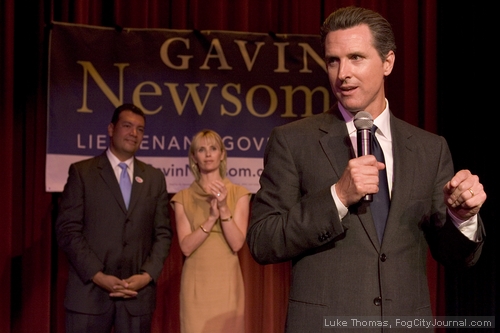
Gavin Newsom

Cake throws down to bring solar to Telegraph Hill

0

The high-water mark in the unsuccessful 2008 campaign to pass Proposition H, the Clean Energy Act – a partial public power measure that Pacific Gas & Electric buried with a deceptive, $10 million propaganda blitz – was arguably when the hit band Cake played a benefit concert for the measure at The Independent.

Tonight (July 1), the ever eco-conscious Cake returns to that venue with a similar mission, this time dubbed Climatepalooza 2010, with the goal of building a solar roof at the Telegraph Hill Community Center, honoring a request by Telegraph Hill political powerhouse and San Francisco Democratic Party chair Aaron Peskin and Prop. H campaign manager Julian Davis, who has a personal relationship with some band members.

“Climatepalooza 2010 promises to be a wonderful event. It give folks a chance to hear some great music and do the right thing for the environment, and it also supports Tel-Hi, a vitally important neighborhood institution,” Peskin said in a statement released by the nonprofit group One Atmosphere, which has also been involved in organizing the event.

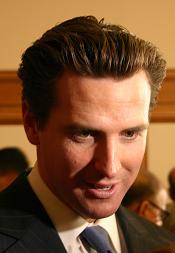
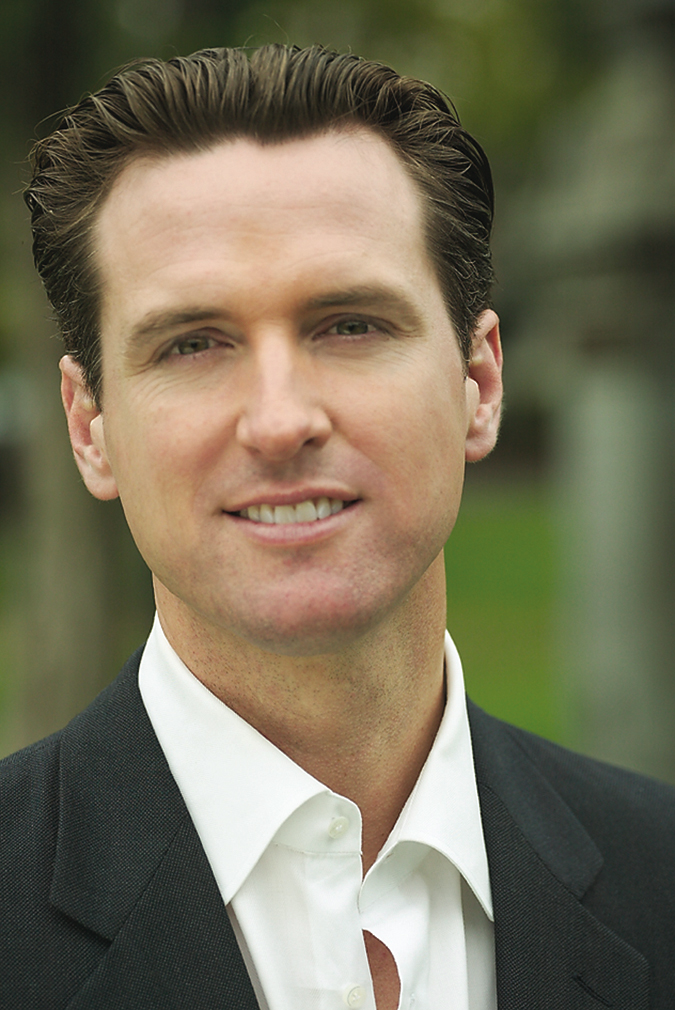
That group, which has worked Al Gore, Nancy Pelosi, and other party bigwigs also got a quote from Mayor Gavin Newsom (who opposed Prop. H): “It’s great to see San Francisco putting together events like Climatepalooza. It combines the best of San Francisco – caring for your neighbors, doing something positive for the environment, and having a great time. Everyone needs to help in the fight against global warming. This is a terrific way for people to get involved.”

Apparently Cake and the power of the sun can create unlikely bedfellows.

Is there still a political machine in San Francisco?

2

There’s some interesting discussion going on about Jane Kim, Willie Brown, Gavin Newsom, and political machines here. Check it out if you haven’t read it already.

SFBG Radio: Meg ducks debates, Gav’s oil money and crazy CEO pay

2

Today, Johnny and Tim talk about why Meg Whitman is ducking debates, why Gavin Newsom has money invested in oil company stocks — and why a corporate CEO can buy an $8 million resort property the same week he lays off 8,000 workers. You can listen after the jump.

sfbgradio6/30/2010 by bgedit

Stories highlight Newsom’s hypocrisy

4

A pair of interesting stories in today’s Chronicle paint Mayor Gavin Newsom as a self-serving hypocrite, highlighting how his cuts-only budget proposals ignore the city’s long-term needs and have led Moody’s to lower the city’s credit rating, and how his green rhetoric is belied by his oil industry investments, including in the company responsible for the ongoing oil leak in the Gulf.

The Guardian has long noted how fiscally irresponsible Newsom’s budgets have been, with our latest editorial calling for Newsom to finally offer support for some of the revenue measures now being explored by the Board of Supervisors, which will need strong support from everyone in City Hall to have a chance of winning voter approval.

The Controller’s Office and now Moody’s have confirmed that Newsom’s reckless and gimmicky budget leaves a long-term budget hole even as it does short-term damage to the city’s social safety net and public health programs. But instead of acknowledging that reality, Newsom flak Tony Winnicker is still offering snide, Republican-style put-downs of the supervisors who are actually working hard to improve the city’s fiscal health while Newsom is out running for state office, afraid he will be criticized for supporting the tax revenue this city desperately needs.

As for Newsom’s oil industry investments, well, they speak for themselves. His whole political career, and even the restaurant and bar career before that, was built on a foundation of oil money heaped upon him by the Gettys. And even after he found there was political gold to be mined from green rhetoric, he has continued to financially support and profit from the oil industry.

Many Guardian readers have long said that we should just give up on Newsom, calling him a shameless and self-serving politician of the very worst sort. Maybe they’re right. But if Newsom wants to earn our support in his race for lieutenant governor – whose most important responsibilities are his key votes in deciding whether to support new offshore oil drilling in California and whether to continue pushing myopic cuts-only budgets for the public university systems – then now is the time for him to show some political courage by disinvesting from the oil industry and supporting a responsible city budget that includes new revenue measures for which he should actively campaign this fall.

Editorial: Put new taxes in the budget

5

Mayor Gavin Newsom still wants to balance this year’s municipal budget with no new taxes (although he’s happy to raise the fees to use city facilities). The supervisors are looking at a different approach: John Avalos, chair of the budget committee, told us he’d like to see $100 million in new revenue on the table.

Some of that might come from a fee on liquor sales. There’s a hotel tax measure being circulated, and the supervisors are also looking at a raising the real estate transfer tax on high-end properties and imposing a commercial rent tax. All but the liquor fee would require a majority vote on the November ballot.

So far, Newsom hasn’t given any indication that he’ll support any new taxes — and that’s due in significant part to his campaign for lieutenant governor. The mayor doesn’t want to get hit by his Republican opponent as a tax-and-spend liberal, so he’s holding the line, cutting essential services instead of looking for progressive ways to bring in new revenue.

But voters up and down the state have shown their willingness to approve new taxes to save essential services, and it’s likely that San Franciscans will do the same — particularly if the folks at City Hall are united in their support.

So here’s an idea for the supervisors: why not include that new revenue as part of this year’s budget?

There’s no legal reason the budget can’t be balanced in part on the assumption of new income. November is almost halfway through the fiscal year, but more than $50 million of that revenue would be available for the 2010-11 budget.

There are distinct advantages to including that money in the budget, starting with fewer budget cuts and layoffs now. There’s also a clear political advantage: if the voters realize what’s at stake — that the money has already been earmarked and that voting it down would mean immediate reduction in vital services — the message of the importance of approving the tax measures would be even stronger.

Equally important, it would force the mayor to show his hand. Newsom would almost certainly prefer to duck the issue, to take a neutral stand on the tax measures (“let the voters decide”). He might wind up opposing all of them. But if the money’s already in the budget, what can he do? Without that tax money, the budget won’t be legally balanced. Without his support, that tax money might not come through.

It’s a risky move. If the voters reject the tax hikes, the supervisors and the mayor would be forced to make painful midyear cuts. But they’ll have to make those cuts anyway, either now or in November. And once you shut down services or eliminate nonprofit contracts, it’s much harder and more expensive to start them up again.

So this might be the year to take the calculated gamble: assume that money’s going to be there. Then everyone, including the mayor, can help make sure that it actually is.

Put new taxes in the budget

2

EDITORIAL Mayor Gavin Newsom still wants to balance this year’s municipal budget with no new taxes (although he’s happy to raise the fees to use city facilities). The supervisors are looking at a different approach: John Avalos, chair of the budget committee, told us he’d like to see $100 million in new revenue on the table.

Some of that might come from a fee on liquor sales. There’s a hotel tax measure being circulated, and the supervisors are also looking at raising the real estate transfer tax on high-end properties and imposing a commercial rent tax. All but the liquor fee would require a majority vote on the November ballot.

So far, Newsom hasn’t given any indication that he’ll support any new taxes — and that’s due in significant part to his campaign for lieutenant governor. The mayor doesn’t want to get hit by his Republican opponent as a tax-and-spend liberal, so he’s holding the line, cutting essential services instead of looking for progressive ways to bring in new revenue.

But voters up and down the state have shown their willingness to approve new taxes to save essential services, and it’s likely that San Franciscans will do the same — particularly if the folks at City Hall are united in their support.

So here’s an idea for the supervisors: why not include that new revenue as part of this year’s budget?

There’s no legal reason the budget can’t be balanced in part on the assumption of new income. November is almost halfway through the fiscal year, but more than $50 million of that revenue would be available for the 2010-11 budget.

There are distinct advantages to including that money in the budget, starting with fewer budget cuts and layoffs now. There’s also a clear political advantage: if the voters realize what’s at stake — that the money has already been earmarked and that voting it down would mean immediate reduction in vital services — the message of the importance of approving the tax measures would be even stronger.

Equally important, it would force the mayor to show his hand. Newsom would almost certainly prefer to duck the issue, to take a neutral stand on the tax measures ("let the voters decide"). He might wind up opposing all of them. But if the money’s already in the budget, what can he do? Without that tax money, the budget won’t be legally balanced. Without his support, that tax money might not come through.

It’s a risky move. If the voters reject the tax hikes, the supervisors and the mayor would be forced to make painful midyear cuts. But they’ll have to make those cuts anyway, either now or in November. And once you shut down services or eliminate nonprofit contracts, it’s much harder and more expensive to start them up again.

So this might be the year to take the calculated gamble: assume that money’s going to be there. Then everyone, including the mayor, can help make sure that it actually is.

Editor’s Notes

23

Tredmond@sfbg.com

Jane Kim, the San Francisco school board president running for supervisor in District 6, has a tough question to answer. When there’s already a solid progressive in the race, Debra Walker, someone who has lived in the district for years and agrees with Kim on almost all the key issues, why is Kim running?

She gave a hint at her campaign kickoff June 24 on how she’s going to portray herself: "I’m not part of anyone’s machine, and I’m certainly not part of anyone’s master plan." It’s an attractive statement — nobody likes machine politics — and the idea that she’s an independent candidate makes her all the more appealing.

Except that it also says something about the progressive movement in San Francisco — and that’s a little disturbing. Because no matter how you try to spin it, when you say you aren’t part of anyone’s machine, you’re implying that maybe your opponents are.

Let me take a step back here, because this is important stuff. There’s a fine line between an effective, organized political coalition that can actually win elections and a political machine, which stifles political innovation and grassroots candidates. And in part it’s about motivation.

When Willie Brown ran San Francisco, it was all about Willie Brown. I’ve never believed the guy had much of an ideology or that any political cause really mattered to him; he loved power, he knew how to use it and he didn’t want to give it up. That was the bottom line.

Now that he’s pretty much out of the picture — although he was at Kim’s party, he’s not a factor anymore — there’s a very different power balance in this city. There’s nobody at City Hall (or in Sacramento, or Washington, or downtown, or anywhere else) who has machine-style control of local politics.

There are people who can build coalitions that work — Aaron Peskin, for example, did exceptionally well with putting together a campaign to elect progressive Democratic County Central Committee elections. And there are people who would love to be power brokers.

But I’ve been around politics here a long time, and I can tell you: Aaron Peskin doesn’t have a machine. Neither does Mark Leno, or Gavin Newsom, or Tom Ammiano, or David Chiu, or anyone else. Thanks in part to district elections, there aren’t many call-up votes on the Board of Supervisors these days. In fact, the left in San Francisco is famously unable to agree on much of anything half the time. Note, for example, the fact that Chiu — often called a Peskin ally — is not supporting Peskin’s candidate in D-6. He’s with Jane Kim.

The thing is, unlike the players in a typical political machine, most of the progressives care about issues. It’s about a shared ideology more than it’s about power. That’s a hugely important difference.

The way the mainstream media has it, the San Francisco left is either fatally fractured and can’t do anything — or it’s becoming a machine. For the moment — a great moment — neither is true. Let’s all keep that in mind. Because when we beat each other up with words like "machine," we undermine the whole progressive movement.

Bad way to start a campaign.

Fiscal solidarity

0

OPINION As Mayor Gavin Newsom prepares to skip town for the bleak limelight of Sacramento, he has left a resounding parting shot with massive budget cuts to those San Franciscans most in need of public aid: seniors, youth, homeless people, folks with mental illnesses, health clinic patients … the list goes on.

Newsom has balanced his final budget (and his campaign for lieutenant governor) largely on the backs of the poor, working-class, multiracial, and immigrant San Franciscans, as well as the nonprofits and city workers who deliver vital services.

The Newsom budget actually adds costs: by cutting services for the treatment and prevention of substance abuse and for youth crime prevention and supportive housing, for instance, it destabilizes lives and forces people right back into the treatment systems that are being cut — adding new human and fiscal costs.

"Every cut has a constituency," Newsom’s PR people say repeatedly. And that’s precisely what the mayor is counting on — that each "constituency" will fight on its own, for its own fiscal scraps. He’s wrong.

As members of a broad coalition of community and neighborhood-based organizations, labor unions, and civic leaders and residents across the city, we stand together in opposition to Newsom’s cuts-only budget and his attempts to divide "constituencies."

Fiscal solidarity means we recognize that an injury to one is an injury to all. "Constituencies" are in fact people whose lives cut across multiple budget line items. Cutting city parks is also a senior issue, as well as a youth issue. Closing mental health programs for the poor is not only an unnecessary moral outrage — it’s a public health and safety issue.

As members and supporters of unions and nonprofits, which are sometimes pit against each other in budget cut wars, we declare mutual support. The mayor’s cuts will mean drastically reduced services for those who need them most and deep staff cuts for city employees and nonprofit workers. We may work for different institutions under different budget line-items, but we’re fighting together as one community — one big "constituency."

Budget wars artificially divide communities that overlap and intermingle. Expressions of unity are put to the test by the budget "add-back" process that forces community groups to scuffle for scraps of cash — groups serving populations in critical need are set against each other, and whole communities are reduced to line-items.

We’re standing against fiscal wedge politics and demanding a real alternative. The budget must protect those most in need and be balanced by cutting first from the top instead of the bottom.

We are united for solutions — progressive tax measures on key wealth sectors that can and must pay their fair share to keep San Francisco the beautiful, thriving, diverse, and culturally rich city it is. We’re standing up for the city Newsom’s leaving, for the communities he’s cutting, and for progressive revenue — a tax to make downtown hotels pay their fair share, and a gross receipts tax on large businesses for starters.

Mayor Newsom: if you cut one of us, you cut us all.

This statement was signed by Christopher Cook, Budget Justice Coalition; Gabriel Haaland, SEIU 1021*; Gordon Mar, Jobs with Justice*; Eric Quezada, Dolores Street Community Services*; N’Tanya Lee, Coleman Advocates for Children and Youth*; Jennifer Friedenbach, Coalition on Homelessness; Guiliana Milanese, Jobs with Justice*; Christina Olague, Senior Action Network*; Sheila Tully, California Faculty Association, SF State*; Chelsea Boilard, Coleman Advocates for Children and Youth*; Joseph Smooke, Bernal Heights Neighborhood Center*; Carl Finamore, delegate, SF Labor Council*

* names for ID purposes only

Raising revenues on the backs of the East Bay/working class

32

If you are one of the many thousands of people who commute the Bay Bridge each day, then you already know that the  toll is going to increase on Thursday, July 1 to $6 during commute hours, and that the car pool is going to stop being free and start costing $2:50 (and you’ll need a Fastrak pass to use it). Tolls will also rise to $5 on Antioch, Benicia-Martinez, Carquinez, Dumbarton, Richmond-San Rafael and San Mateo-Hayward bridges. What you may not know is that San Francisco is also planning to start charging fees this summer to  “out-of-towners” to access certain facilities.

http://www.youtube.com/watch?v=pCivf4OMuqY

As an East Bay resident and a member of San Francisco’s workforce, I understand the logic behind all these toll and fee increases: raise tolls to get cars off roads, people onto public transit, and spare the air in the process. And raise entrance fees for tourists, so as to generate revenue for cash-strapped city departments.

And yet, it feels like working-class folks who can’t afford to raise their families in San Francisco keep getting stuck with the bill for the excesses of the city’s real estate market, while the folks who made money gaming the real estate market in the ’90s and the Noughties keep leading the “no new taxes, lots of new fees” mantra.

That extra $2 a day to get to work is going to cost working folks about $500 more a year, at a time when wages are either stagnant or being cut. So, don’t be surprised if we stop spending any money on buying food in the city, to make ends meet. But should we also plan to stop visiting fee-charging city facilities?

I ask because a recent article in the Chronicle pointed out that “Out-of-town visitors will have to start paying an admission fee to San Francisco’s tranquil and well-tended Botanical Garden in Golden Gate Park, now that the Board of Supervisors signed off on the proposal after months of heated public debate.”

San Francisco residents will continue to get free entry, the article reported, but other adults will have to pay $7 to get into the Botanical Garden, starting in late July or early August. (Discounts will be offered to seniors and youth.)

“The total price for a family will be capped at $15,” the Chron reported, ” and the money-making initiative is expected to generate $250,000 a year for the city’s strapped Recreation and Park Department, officials say.”

It’s not clear from that report whether the city’s commuters who now account for more than 50 percent of the city’s workforce) are classified as “out-of-towners?” And if it turns out that we are not, I’ll post an update here in short order. But I suspect we are, since we don’t actually live here, (even if we do spend half our lives working in a building within city limits).

Update: Lisa Van Cleef, public spokesperson for the Botanical Gardens (a former SFBG worker, when the Guardian was still on York Street) confirmed that Mayor Gavin Newsom is expected to sign the Botanical Gardens fee hike legislation by the end of this week.

“All San Francisco residents have free admission,” Van Cleef emailed. “Non-residents including those who work in SF, will pay the $7.00.”

In her email, Van Cleef made a great case for visiting the Botanical Gardens.

“It is very different than a park,” she wrote. “With 26 distinct gardens and collections, our visitors can experience incredible rarities from  Asia, Australia, New Zealand, Central and South America, and South Africa, plus our award-winning California Native Plant Garden 
complete with a century-old redwood forest. Hundreds of our plants are rare and/or endangered in the wild.Right now, the Passionflowers, Chilean, Australian and Perennial gardens are looking exceptionally great with lots in bloom.”

So, I guess I’ll be tempted to visit, fee or no, even as I wish for a more equitable way to generate new city revenues, in future.

Now, it’s easy to demonize folks who drive to work from the East Bay, as being irresponsible climate change inducing air polluters. But I can’t help noticing that many folks on the road alongside me each morning are driving beat-up pick-ups full of work tools and cars full of infant seats and toys. These are working class family-oriented folks who definitely pay their “entrance fee” into the city each day. (And then there’s the fact that we are paying to cross a bridge that no longer feels entirely safe to drive across, but that’s a whole other story.)

But when out-of-town commuters use public transit, it can take several hours each way–between bad connections and cut services–unless we live and work close to BART. And those hours spent waiting for the T-Third or changing buses adds up to precious time we don’t spend with our families, and costs a lot in child care.

That’s why I’m getting sick of the  “cyclists v drivers” debate in San Francisco. Because it’s a divisive, misleading debate. There are saints and sinners on both sides of that debate’s equation, but when it comes to actually getting folks off the road and onto public transit, the real issue continues to be the cost of housing and the lack of a truly comprehensive public transit system in San Francisco. And I’m not seeing the kind of planning in the pipeline that would allow working-class families to move back into town and/or make traveling to and from the East Bay less of a nightmare.

Instead, there are plans to build thousands and thousands of condos where a couple could possibly raise one child–until the crying and the constant bits of Lego underfoot in the condo’s swag carpetting get them fleeing to the Oakland hills, and beyond.

So, go ahead and bite me and the rest of the working class commuters with more fees, both at the toll booths and at the entrance gate to  the Botanical Gardens. We don’t have much choice but to pay them, if we want to keep our jobs in the city, and enjoy ourselves in our downtime before making the return commute. But milking us is not going to solve the underlying problem in a city that sold out to the highest bidder a long time ago. Yes, this is a bit of a “whine” piece, and it’s coming from someone who enjoys navigating her “London Taxi” as I like to call my anonomobile, through the roughest of city streets. But seriously folks, when is someone going to have the balls to raise taxes on the rich in this richest of cities and stop sticking it to the poor?

“No new taxes,” but fees and restrictions may apply

The agenda for the June 29 Board of Supervisors meeting reads like the fine print of a credit card statement, with fees piled upon more fees.  Mayor Gavin Newsom is proposing a slew of increases to sums that must be forked over for a wide array of city services or permits as a way to bridge a gaping budget gap. With major cuts to critical services in the face of a dramatic revenue shortfall, it’s not surprising that the city is tightening its squeeze to make up for some of the damage.

Some of the proposals make a certain amount of sense. There are higher fees proposed for an underground parking lot at Golden Gate Park, which could potentially help dissuade motorists and promote more environmentally friendly transportation options. There are higher fees for tow truck operators, which most anyone who’s ever involuntarily had their car towed could get behind. And the fee for discharging a cannon may go up from $400 to $636. While we’re pretty sure that last one is more likely to irk people who attend military ceremonies, we nonetheless take delight in imagining a rambunctious crew of pirates spilling into the board chambers to oppose it.

But this roster of Newsom’s new hidden fees begs an important question: Why is a mayor so adamantly against raising taxes bent on vacuuming more money out of the pockets of small business owners with higher fees? After all, many of these proposed increases will squeeze struggling, Mom-and-Pop businesses just a little tighter. City permits for auto wreckers, billiard parlors, junk dealers, and massage establishments may go up significantly. The fee for taking an EMT course may get higher. Permits for selling food on the street, driving a pedicab, dealing in second-hand auto parts, or operating a shooting gallery could also increase. Even the annual permit fee for street artists (several of whom we wrote about in our Streets Issue) is getting more expensive.
 
The list of fee hikes is on the agenda for Tuesday’s meeting, and was referred to the full board by the Budget & Finance Subcommittee. Supervisors recently proposed a number of new revenue generating measures including a nickel-per-drink tax on alcoholic beverages, an increase to the hotel tax, and a restructuring of the business payroll tax.

“There are no new taxes in this budget,” Newsom declared during a June 1 announcement in which he unveiled his 2010-2011 budget. “I know some folks just prefer tax increases. I don’t.”

But why reject taxes outright and then quietly propose a bunch of fees that will place a higher burden on the individuals they impact?

“No new taxes” may sound like music to the ears of a public awash in financial woes, but Newsom’s hidden fees are not unlike taxes. Under this philosophy, it’s not desirable to ask everyone to pitch in an extra nickel the next time they buy a cocktail, but there’s no problem with asking the bar to fork over hundreds more annually for a health inspection. That doesn’t seem to be as simple as a campaign-ready “no new taxes” slogan, but then again, there’s a reason credit card companies bury their hidden fees in the fine print.

Supreme Court rejects Healthy SF challenge

1

The U.S. Supreme Court has decided not to consider a challenge to the Healthy San Francisco program that provides low-cost health coverage to city residents, partially funded by employers who refuse to provide health insurance for their employees, a mandate that prompted a lawsuit from the Golden Gate Restaurant Association.

The decision was a big victory for low-wage workers in the city, as well as California Assembly member Tom Ammiano, who was the driving force behind the program as a member of the Board of Supervisors, taking abuse from the business community for almost a year and holding firm on the need for employers to take responsibility for their employees. Without that mandate, Ammiano successfully argued, businesses that didn’t offer health benefits would enjoy a competitive advantage and their employees’ health care costs would often end up be paid by city taxpayers.

“Today’s Supreme Court decision is an affirmation of San Francisco’s landmark efforts to provide affordable health care to the uninsured. With over 50,000 people receiving health care services and prescription drugs, Healthy San Francisco is a national model for what can be accomplished when the public and private sector work in partnership towards a common goal”, Ammiano said in a prepared statement.

Mayor Gavin Newsom was eventually persuaded to support the mandate and he worked with Ammiano in crafting the final program, which he has since trumpeted as his own while campaigning for governor and then lieutenant governor, for which he won the Democratic nomination.

“The Supreme Court’s rejection of the challenge to Healthy San Francisco is a victory for the 53,000 San Franciscans who have healthcare today through our groundbreaking universal healthcare program. Healthy San Francisco is a model for healthcare reform that works. The High Court’s decision today ensures we can continue providing health care coverage to thousands who would otherwise go without care,” Newsom said in a prepared statement.

Newsom is a former restauranteur and GGRA member, but he did little to dissuade the group from bringing the lawsuit or in urging them to drop it. Many restaurants in San Francisco have taken to adding surcharges on customers’ bills, explicitly citing the increased cost of offering health insurance. But no restaurants that I know of include explicit surcharges for the membership dues they pay to GGRA or the extra contributions some restaurants made to continue pushing this lawsuit after the Ninth Circuit Court of Appeals ruled in the city’s favor.

City Attorney Dennis Herrera, who personally lobbied the Obama Administration to change the federal government stance on whether employer mandates violate federal law, also released a statement thanking the relevant players and singling out businesses that opposed the GGRA lawsuit: “I applaud Assemblymember Tom Ammiano and Mayor Gavin Newsom for their leadership in crafting this policy.  We should be very thankful to the Ninth Circuit Court of Appeals, too, whose thorough decision powerfully affirmed our arguments that Healthy San Francisco’s spending provisions were reasonable, fair and legal.  I would finally express my gratitude to all those from the business community who voiced their support for this program — especially Zazie and Medjool Restaurants, and Nibbi Construction, which filed amicus briefs on our behalf.”

Agnos: “I think Gavin’s gonna lose”

11

Former San Francisco Mayor Art Agnos told the Guardian last night that he’d welcome the chance to be appointed a “caretaker mayor” for a year if Mayor Gavin Newsom wins his race for lieutenant governor, but he doesn’t think he’ll get that chance because “I think Gavin’s gonna lose.”

Agnos is one of several names that have been bandied about in the discussions of who the Board of Supervisors might appoint as acting mayor for a year if none of the top candidates running for mayor in 2011 – such as Aaron Peskin, Mark Leno, Leland Yee, or Dennis Herrera – are able to get six votes on the board in January 2010, when Newsom would vacate the Mayor’s Office if he moves on to Sacramento.

“I’m available, but I don’t need it,” Agnos said, noting that he would agree to not run for a full-term in 2011, which would be the main criteria for a caretaker mayor, a concept that would prevent any mayoral candidate from gaining the advantage of incumbency.

But Agnos said that Abel Maldonado, the Republican nominee for lieutenant governor, will be a tough challenge for Newsom, both because he’s a moderate Latino with a compelling personnel story, and because rich Republican gubernatorial nominee Meg Whitman will likely give Maldonado all the money and support he needs so she doesn’t have a Democratic rival as lieutenant governor.

As Agnos told us, “She will give him whatever he need to bury Newsom.”

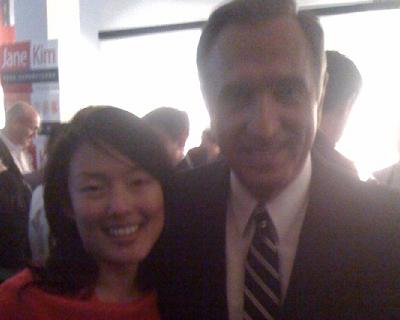
Kim launches D6 campaign, stressing independence from “machine” politics

45

Jane Kim launched her campaign for the District 6 seat on the Board of Supervisors last night during a spirited event at 111 Minna, showcasing some high-profile supporters and giving a speech that began with touting her early work on immigrant rights and homeless issues and ended with the declaration, “I’m not part of anyone’s machine and I’m certainly not a part of anyone’s master plan.”

That emphasis on her independence could be seen as a subtle dig at Debra Walker, another progressive who has been running for the seat for the last two years, who locked down early support from many progressive groups and officials, and whose supporters were unhappy with Kim’s late decision to enter the race, concerned it might split the vote and allow downtown-backed Theresa Sparks — who could be viewed as a “machine” candidate on the other end of the political spectrum — to steal the seat for the moderates.

When I asked what “machine” she meant and whether the comment was a reference to Walker’s supporters, Kim wouldn’t clarify the comment, refusing to criticize the Walker campaign and saying only, “I want to be a part of a new political process.”

And that new process seems to rely heavily on the energy of young people, including many of color, who dominated the crowd last night. Kim also signaled that she will be pushing a fairly bold progressive agenda that includes more city support for schools, Muni, immigrants, and low-income families, and making the streets more vibrant and democratic.

“The mantra of our campaign is to make our neighborhoods complete,” Kim said.

She proposed making substantial pedestian and bicycle improvements on several streets in her district, including 2nd, Folsom, Taylor, and Turk streets, creating more bikes lanes that are separated from car traffic, and turning many of the alleys in her district into more active public spaces. She called for the city to help fund youth programs and a longer school year and to offer more support to small businesses, which she called the city’s most important job generator.

Kim, a civil rights attorney and president of the school board, also emphasized the need to improve the tone of political debate in the city, which she helped accomplish on the school board (whose vice president, Hydra Mendoza, an employee of Mayor Gavin Newsom, was there in support). “People are disillusioned and disappointed with the process and the bickering,” Kim said.

Among Kim’s supporters at the event were Board of Supervisors President David Chiu, former Mayor Art Agnos, filmmaker Kevin Epps, Police Commissioner and immigrant rights activist Angela Chan, transportation activist Dave Synder, and representatives from a wide variety of community groups.

“She has epitomized the progressive values that I think all of San Francisco shares,” Chiu told the crowd, later adding, “She will be a part of the next generation of political leaders of San Francisco.”

“I’m really proud that Jane has put herself out there as a future leader and our supervisor,” said Epps, later adding, “I think Jane really has her ear to the streets.”

Kim pledged to run a clean campaign focused on her issues, and her only supporter to voice overt criticism of Walker was Agnos, who said he was impressed with Kim’s work with him last year in fighting Prop. D, which would have removed mid-Market from the city ban on new billboards, a measure that Walker supported.

“Prop. D for me was a tipping point, and Debra went with the commercial interests,” Agnos told the Guardian.

But Kim, 32, says her reason for running is to help push a progressive vision for the city and bring new blood into the political process.

“I have to tell you, I never wanted to go into politics,” she told the crowd. “But I had the desire to see some real change.”

CompStat vs. community policing

0

By Alex Emslie


news@sfbg.com


Two competing visions for the San Francisco Police Department are central to a looming debate involving the mayor and his police chief, who favor the high-tech yet impersonal CompStat model, and progressive members of the Board of Supervisors who are pushing for a community-based, cops-walking-beats blueprint for SFPD.


District 5 Sup. Ross Mirkarimi introduced a proposed ballot measure on June 7 that would require the police chief to institute foot patrols in all districts and ask the Police Commission to establish a written community policing policy. SFPD Chief George Gascón opposes the initiative, instead favoring a reliance on the new CompStat system to determine how best to use police resources.


The terms “CompStat” and “community policing” have become trendy buzz words, UC Berkeley law professor Franklin Zimring told the Guardian, so they mean different things to the police departments that employ them, muddying the waters of the current debate.


“When labels get popular, they get pasted into lots of different things,” said Zimring, who wrote The Great American Crime Decline (Oxford University Press, 2006) and is working on a second book about the crime rate drop in the 1990s in New York City, where CompStat orginated. Yet the two models point to differing law enforcement philosophies.


At its most basic, CompStat uses computerized crime mapping software to drive police deployment decisions. It emphasizes lowering a city’s crime rate by centralizing authority, spotting statistical trends, and targeting crime hot spots. Community policing, a model embraced by many U.S. police departments in the 1980s and ’90s before CompStat swept the nation, grounds police officers in the neighborhoods they serve, decentralizing authority. The model seeks to prevent crime with regular patrols that develop relationships on their beats and lets the community help set law enforcement priorities.


“There is not community policing in San Francisco,” Mirkarimi — the only member of the board to go through the police academy — told the Guardian. “I don’t care what anybody says. If they say there is, then it is isolated. It’s unique to that particular experience or location.”


Proponents of CompStat insist the new model is really just a part of community policing. Gascón wrote a letter to the Board of Supervisors in February saying the proposed legislation “oversteps the jurisdiction of the legislative branch,” “attempts to give district station captains authority and discretion that rightfully belong to the chief of police,” and “will deprive the department of the flexibility it needs to address public safety throughout the city.”


Mirkarimi doesn’t oppose CompStat and said he sees merit in the program’s statistical collection, which has long been a shortcoming in the SFPD. “But I caution against any over-reliance on CompStat as a method that dictates how policing and public safety should be applied,” Mirkarimi told us. “Because the casualty of this over-reliance will be a compromising of any hopes of having true community policing.”


The SFPD website portrays CompStat as starting with data collection and then, similar to community policing, encouraging officers to find creative solutions to ongoing problems, anything from singular incidents of burglary to repeated graffiti or even a spike in murders. The crime triangle, a lasting symbol of community policing, illustrates that victims, suspects, and locations are all necessary for crime to thrive, and successfully policing even one of those factors can prevent crime. But CompStat programs often lack sustained commitment to building relationships with neighborhoods.


“Compstat seemed to engender a pattern of organizational response to crime spikes in hot spots that was analogous to the Whack-a-Mole game found at fairs and carnivals,” argued a 2003 study commissioned by the national Police Foundation titled “CompStat in Practice: An in-depth Analysis of Three Cities.”


The study found immediate contradictions in Lowell, Mass.; Minneapolis, and Newark, N.J. between beat officers’ new responsibility to “simply follow their superiors’ orders” and the community policing model that cast them as individual, authoritative protectors of their neighborhoods. CompStat centralizes authority with the higher echelons of SFPD. It includes bimonthly meetings in which station captains are grilled by SFPD brass and are expected to answer for the statistics in their district.


“Given the gap between the two models of policing, CompStat naturally tends to encounter the greatest resistance in departments that are most committed to community policing,” the study found.


Understaffed and poorly trained crime analysis units tasked with deciphering data patterns into useful correlations (for example, between drug crimes and murder) was another barrier to the success of CompStat outlined in the study. SFPD’s crime analysis unit consists of three civilians housed at the Hall of Justice, SFPD spokesperson Lt. Lyn Tomioka told us. They are not deployed to district stations and are supervised by a lieutenant who also has other responsibilities.


“There are a lot of rough edges. There’s a lot of non-fit there,” Zimring told the Guardian. “Who sets the priorities? CompStat priorities are always crime prevention, and they are set, and tactics are provided, by the chief of police. He is, in the immortal words of George W. Bush, ‘the decider.’ Community policing is supposed to be more cooperative and organic.”


Gascón initiated CompStat in San Francisco in October 2009, although Mayor Gavin Newsom has been touting the CompStat model since he first ran for mayor in 2003, when a campaign policy brief gushed about its “accurate and timely intelligence, rapid deployment, effective tactics, and relentless follow-up and assessment.” Initially, however, SFPD only took baby steps, using a confusing plot system to map crimes. That changed when Gascón took over as police chief last August, bringing experience in the program with him from the Los Angeles Police Department.


SFPD officials say vendor contract costs to start the system’s electronic crime mapping were less than $1 million, and an additional $1 million has been proposed for next year’s budget for technology upgrades in the CompStat unit. But the numbers so far haven’t backed up the boldest claims. SFPD reports 24 homicides this year as of June 12, up 20 percent from last year’s rate for early June. Homicide arrests are down from 12 last year to eight this year. Occurrences of rape are also up by 12 percent, but overall violent crime is down 2 percent compared to this time last year.


Gascón wrote that foot patrols are a valuable tool for community policing in San Francisco, but he doesn’t want to be forced to maintain them with limited staffing. Newsom’s proposed budget maintains current SFPD staffing, 2,317 sworn officers, while many other city departments received deep staffing cuts. Progressive supervisors have pledged to closely scrutinize SFPD’S budget.


Community policing was law enforcement’s response to civil unrest in the 1960s and ’70s, when police were seen as the enforcers of institutional power. Previous beat patrol methods largely ended when the 911 system came along, and the emphasis was placed on calls for service, statistics, and response times, leaving officers with little time to patrol and prevent crime.


The change to community policing emphasized neighborhood input and officers becoming an organic part of the community they served. Citizen contributions, generally through community meetings, began to drive decision-making. Foot patrols were revived and officers were once again expected to have a physical presence and a connection to the community they served.


That change was seen as particularly important in poor neighborhoods and communities of color, where police can sometimes be seen as an occupying army and residents were reluctant to cooperate with investigations. Officials hoped to prevent crimes by showing a presence in neighborhoods rather than simply reacting to them when someone called.


Mirkarimi says a CompStat-driven police force would be a return to that reactive model, potentially sacrificing the long-term commitment required to build trust between a neighborhood and its police department, which is central to community policing. “[CompStat] undermines the principles and practices of community policing because true community policing requires a discipline and a protocol that is sustained,” he said.


While either approach can theoretically result in the same practices, such as a foot beat patrol in a given neighborhood, Zimring said the reasoning behind it depends on the model. “CompStat to begin with is completely crime-driven,” Zimring said. “The reason you have it is to reduce crimes. It involves computerized mapping of crimes. It involves allocating resources to so-called hot spots, and it involves the police department imposing its own priorities as opposed to implementing community priorities.”


The Board of Supervisors will consider Mirkarimi’s measure and SFPD budget in July, airing a debate that could continue on to the November ballot, when voters would decide whether to maintain their faith in CompStat and the SFPD or ask for more community policing and foot patrols.

Danger zone

0

rebeccab@sfbg.com

Rita Connolly, a registered nurse who has worked with inmates in San Francisco jails since 1985, says she’ll never forget the time she had to act fast to save a prisoner’s life.

The man had just arrived from a different jail and was waiting to go through intake. He was slumped over and looking ill, too weak to voice a complaint. Several worried inmates beckoned Connolly over, and once she examined him, she realized he was in the midst of a heart attack. He was rushed to the emergency room. He lived — but sustained irreversible heart damage.

“He could have been someone who didn’t live,” Connolly told the Guardian, but he also could have had a better outcome. The inmate had alerted someone that he was having chest pains earlier in the day, she later learned, as he was boarding a bus from an Alameda County Jail. A medical services worker examined him just before the bus left, but allowed him to proceed. By the time he arrived in San Francisco, the warning signals had progressed to a full-blown heart attack.

The story highlights an extreme example of a trend Connolly said she observes regularly — inmates from counties that use privatized jail health services aren’t receiving the same standard of care that San Francisco provides. Sometimes, there are obvious signs that the care is inadequate, placing inmates’ health at risk.

Alameda’s jail health services contractor, Tennessee-based Prison Health Services Inc. (PHS), has made headlines before for a track record marred by inmate deaths and lawsuits alleging negligence. PHS has expressed interest in contracting with San Francisco if the city opened the door to privatization, which Mayor Gavin Newsom has once again proposed in his latest budget.

That budget also calls for cuts to community-based health and human service programs that threaten to erode the safety net for those battling mental health issues, drug addiction, and chronic health problems, all proposals now being weighed by the Board of Supervisors Budget and Finance Committee.

But it is the debate over whether to make a $11 million cut to jail health services that raises the most thorny and telling questions about what sacrifices are considered acceptable — and what populations can be the most easily targeted — in the quest to balance a budget without the tax increases that Newsom opposes.


OPEN WOUNDS

In San Francisco, the city’s Department of Public Health contracts with the Sheriff’s Department to address inmates’ medical needs. Privatized jail health care would be cheaper, though by how much is a moving target. But nobody is arguing that the care would be better.

Newsom’s budget proposes switching to a private firm as early as January 2011 to help solve a daunting budget deficit. The proposal originated with the Mayor’s Office, and Sheriff Mike Hennessey — whose department would realize the potential savings — went along by including the item in his departmental budget.

In years past, the Board of Supervisors has repeatedly resisted the proposal and is likely to do so again — but rejecting it would mean finding up to $11 million in savings elsewhere.

“The fear is that when you bring privatization into the picture, there is a financial pressure to cut corners. And even though that may end up saving some money … the price that comes with it is too high,” Sup. David Campos said at a recent budget hearing. Referencing stories about inmates who died needlessly in jail under the care of for-profit firms, Campos said he isn’t willing to risk a similar tragedy occurring in San Francisco.

The proposal has been floated repeatedly since as far back as the early 1990s, according to healthcare workers whose jobs have been jeopardized by privatization before. Newsom proposed the cut last year, and the year before.

“In absence of the budget problem, [Hennessey] probably would not have proposed this, nor would we have proposed this,” Newsom’s budget director, Greg Wagner, told members of the Budget and Finance Committee at a May 26 hearing, adding that the mayor shares concerns about prisoner safety. Newsom’s office did not return multiple calls requesting comment for this story.

The U.S. Supreme Court recently agreed to a hear an appeal by the state of California to the federal court ruling that substandard medical care in California prisons constitutes cruel and unusual punishment and necessitates the early release of about 40,000 prisoners. At the May 26 hearing, healthcare workers familiar with the interiors of county jails and state penitentiaries came forward with horror stories.

“Every week I receive at least one inmate who has an open gunshot wound. They have not seen medical care in the county jails,” Dr. Elena Tootell, chief medical officer at San Quentin state prison, told committee members. “It’s quite surprising to me that they send inmates with gunshot wounds to prison. They just walk off the bus. They often have paper towels stuck to their bodies, seeping the blood. And then we are obligated to take care of them. This does not happen from San Francisco County, I’m going to tell you that right now.”

Tootell said she’d observed a significant difference between those counties using private firms and those using public health care. “They will have a fracture — they’ve never been splinted, they’ve never seen a doctor. They’re on anticoagulation [medication], but haven’t had their blood checked in weeks and have bruises all over their body.”

Connolly echoed similar concerns. For example, she told the Guardian, she’s found herself asking questions like, “You were on AIDS medication before you got arrested and now you’re not?”

Susanne Paradis, a healthcare research contractor with SEIU Local 1021, rejects the premise that the same services could be provided at a lower price. Under a private model, she says, the priority is to keep costs low — and that means doing less.

A key issue, Paradis said, is that private firms tend to rely more heavily on licensed vocational nurses (LVNs) — lower-paid medical staffers who aren’t trained to assess patient’s medical needs and cannot administer the same care that registered nurses (RNs) can. Using PHS data, Paradis found that in Alameda, there is one RN for every 92 inmates, compared with one RN per 32 inmates in San Francisco.

“An RN has the ability to assess, observe, and determine if there’s emergency care needed,” Paradis explained. “An LVN does not have the ability to do that.”

John Poh, a nurse practitioner stationed at a jail in San Francisco’s Hall of Justice, explained the difference this way: “The more RNs you have working for you, the fewer deaths you have.”

PHS, an obvious point of comparison with San Francisco since it serves Alameda, declined to answer questions about its services. Instead, media spokesperson Pat Nolan e-mailed a brief statement. “We are excited to hear that San Francisco is considering the contracting of correctional health care,” he wrote. “Should the city choose to go through an RFP process, we would look forward to participating. We think it is the right thing to do for the city and its taxpayers.”


LINES OF DEFENSE

While those incarcerated in San Francisco jails can be thought of by some as criminals, nuisances, or miscreants, those requiring medical attention are patients in the eyes of the jail healthcare workers.

Inmates routinely enter the system with diabetes, HIV/AIDS, hepatitis C, heart problems, liver disease, and substance abuse issues, Connolly said. On occasion, a woman will arrive in jail only to learn that she is pregnant. Mental health problems are common, and some battle psychiatric issues in combination with physical ailments.

“Overall, our patient population has had little access to health care. For many people, we’re the only show in town,” Connolly noted.

Poh said some problems could spiral out of control if jail health staff didn’t nip them in the bud. If an inmate is exhibiting signs of tuberculosis, for instance, they’ll immediately get a mask and be sent to the hospital for screening. Sexually transmitted diseases are also a priority for treatment. “You don’t want that person going out infected,” Poh explained.

The city takes a proactive stance when it comes to treating inmates, Poh said, because at the end of the day, county jail is a revolving door. “Everybody leaves county jail. They’re either going home, to a program, or to prison.” If people are released back into the community with contagious, untreated health problems, the risk of exposure can spread beyond jailhouse walls.

San Francisco’s current system is considered a first line of defense, in which inmates are “seen as members of the community who happen to be in jail right now,” Paradis said.

Privatizing jail-health services would constitute a blow to a wider public health safety net in San Francisco that is already weathering painful cuts. At a June 15 Beilenson Hearing, a state-mandated opportunity for community members to explain the impacts of proposed health and human services cuts to the Board of Supervisors, people came out in droves to protest cuts to programs serving vulnerable residents.

Kristie Miller, executive assistant of the Standing Against Global Exploitation (SAGE) Project, told the Guardian that her organization serves 350 clients a year who are victims of human trafficking and commercial sexual exploitation. The organization stands to lose its mental health funding, so Miller had come out to speak against the cut. “It provides trauma-focused psychotherapy for survivors who’ve experienced a lot of abuse, violence, and exploitation,” she said.

Jeff Schindler, chief development officer for the Haight Ashbury Free Clinics, said he was there protesting a 79 percent funding cut to his organization’s 108-bed residential program on Treasure Island. “We won’t have a place for people to actually go into residential treatment for their mental health and substance abuse issues,” he said. “These are individuals who are going to get their needs met somehow, somewhere, and generally that’s going to be at San Francisco General Hospital.”

It’s in this context that the proposal to contract out for jail health services is being proposed. “It’s easy to dismiss prisoners as probably the least valued sector of our society,” Deirdre Wilson, of the California Coalition for Women Prisoners, noted at a May 26 hearing. “But the right to health care is a human right.”


FOR THE RECORD

According to an estimate prepared by the Sheriff’s Department, the city could save anywhere from $11 million to $14 million by contracting out for jail health services, and Newsom’s budget assumes a savings of “over $11 million per year.”

However, the Controller’s Office continues to revise that figure as the debate shifts and concerns are raised about the skill mix that a private firm would use. “We don’t really know what it would cost to contract out, unless there was an RFP and a response to the proposal and some discussion about what the staffing requirements would be,” Deputy City Controller Monique Zmuda explained at a June 17 hearing. She added that the potential range of savings spanned from $3 million to $11 million annually, depending on decisions that would have to be made about acceptable staffing levels.

San Francisco’s inmate population has shrunk in the wake of the crime lab scandal, and a city-owned facility in San Bruno has been temporarily shuttered. Sheriff Hennessey told the Guardian he believed medical care in the jails could be provided either by city workers or a private firm, but added that he’s “quite happy” with the status quo. Noting that 25 of the 58 counties in California already use private firms, he added, “It’s not an unusual or unique thing.” Hennessey also said the decision was linked to a broader philosophical and political question, and that he doubted there was support on the board for the proposal to go forward.

Mitch Katz, director of the city’s Department of Public Health, did not directly say whether he supported Newsom’s proposal. “I think our Jail Health Services does a great job, but I do understand that the city is facing an extremely difficult budget year and that ultimately the budget must be balanced,” Katz wrote in an e-mail.

Gabriel Haaland, who represents SEIU Local 1021 union members whose jobs would be affected by the proposal, voiced strong opposition at a June 17 Budget and Finance Committee meeting. “‘We don’t care about these people because they’re poor and they’re in jail.’ That’s the message” in the decision to contract out, Haaland charged. The item was continued and will be revisited as budget deliberations unfold.

Following Recology’s $$$ to Environment Commission and DCCC

7

If you’ve been looking for a financial connection between the city’s tentative decision to award the next landfill disposal contract to Recology, which plans to dispose of our trash in Yuba County, then you’ll be interested in this campaign finance item: Because records show that Recology contributed $5,000 last year to SF Forward, a San Francisco Chamber of Commerce political action committee, which also got Money  from Bechtel, Medjool, PG&E, Charles Schwab, and Shorenstein Realty.

Recology Vice President and Group Manager John Legnitto is Chamber’s Chair Elect.

In the last two years, the Chamber contributed $10,000 to Plan C, a political action committee that advocates for more condo conversions and less tenants’ rights.And Plan C gave Commission of the Environment President Matt Tuchow $3,300 for his failed 2010 Democratic CCC bid.

So, while the transactions were legal, with the money laundered twice in between, these dollar connections will probably have folks opposed to the city’s plan to dispose of its waste in Recology’s landfill in Yuba County asking if this explains why Tuchow decided to limit public comment to only one minute when folks wanted to voice concerns at a March 23 hearing at the Environment Commission about an alleged lack of fairness and transparency in the decision to award the contract to Recology.

Especially those folks who drove three hours from Yuba County, which is where Recology proposes to send our trash. And folks who helped negotiate the city’s current trash disposal contract and were shocked that the city would set a one-minute time limit on what they claim is a $1 billion contract, once you factor in the cost of transportation, new trash processing facilities and an as yet unbuilt rail spur that Recology needs inYuba County to transfer trash from the Union Pacific line to its landfill in Wheatland,

Tuchow, who works in the Global Compliance and Ethics Division of McKesson Corporation in San Francisco, had not returned calls as of blog post  time, but if and when he does, I’ll be sure to post an update here.

Meanwhile, it doesn’t look as if Recology’s bucks and/or Mayor Gavin Newsom’s powergrabbing antics, are going to be able to help shoehorn Tuchow onto the DCCC, even in light of Newsom’s newly hatched plan for dominion for the following reasons:

1. Results from the June 8 election show that Tuchow was fourth failed runner up in the DCCC 12th district. (Milton Marks, Sup. Eric Mar, Melanie Nutter, Arlo Smith, Connie O’Connor, Tom A. Hsieh, Jane Morrison, Mary Jung, Sandra Lee Fewer, Michael Bornstein, Sup. John Avalos and Bill Fazio were the top vote getters to win seats, beating out Larry Yee, Jake McGoldrick, Hene Kelly and then Tuchow, in that order.)

2.. It’s not clear if Newsom’s plan for the DCCC is even legal.

3. Even if Newsom’s plan survives a legal challenge, it’s not clear that the law would have the retroactive effect necessary to oust Mar and Avalos.

4. And even if it did, under state law,  DCCC Chair Aaron Peskin would get to appoint folks to fill those vacancies,
“This is about clean money and good government,” Newsom spokesman Tony Winnicker told reporters of Newsom’s DCCC plan.

So, let’s hope the Mayor’s Office applies the same standards when it comes to opening the landfill disposal contract bids this summer and shining light on the money that’s influencing the city’s garbage disposal contract. 

Meanwhile, Peskin, who was reached by cell phone somewhere near Moab, in Utah, where he’s taking his annual camping and hiking trip with his wife, told the Guardian that Newsom “is not thinking very far ahead” with his latest dominion scheme.


Newsom’s plan for DCCC domination

4

Gavin’s not quite ready to take over the world, or even California, but he’s not leaving office without trying to mess up the progressive majority on the Democratic County Central Committee. The plan he hatched June 15: Ban elected city officials from sitting on the DCCC. The idea: Get rid of Supervisors David Campos, David Chiu, John Avalos and Eric Mar. The overall plan: With the progressive supervisors — who have high name recognition and thus get easily elected — gone, the Newsom allies can take back control of the local Democratic Party.


It’s a pretty blatant move — far beyond Aaron Peskin’s so-called coup. And I must say, it’s a bit hypocritical.


See, the DCCC isn’t just made up of 24 elected members. Every San Francisco Democrat who holds state or national office — or who is a candidate for state or national office — is also an automatic member. So Senator Diane Feinstein is a DCCC member; so is House Speaker Nancy Pelosi, Assemblymember Tom Ammiano and Sen. Mark Leno. And guess who gets a seat this fall? Lt. governor candidate Gavin Newsom. People like Feinstein and Pelosi never show up; at best, they send a proxy. They rarely pay much attention to the local party, don’t help out much with party fundraising, don’t even come to the party’s annual dinner (Newsom didn’t show this year, even though he’s the mayor of a Democratic city.)


There have been members of the Board of Supervisors on the DCCC for years. The late Sue Bierman was always a member, and actually cared about and paid attention to the local Democratic Party. Leslie Katz was a member as a supe, and still is. It’s never been that big a deal to anyone — until the progressives starting winning seats. Then suddenly it’s a horrible conflict.


The real conflict has nothing to do with city officials sitting on the committee; it’s the fundraising issue. The city’s campaign finance rules don’t apply to DCCC races, so candidates for DCCC who are also running for supervisor — Scott Wiener, Rafael Mandelman, Debra Walker — can raise unlimited money for their DCCC races and use that additional name recognition for the fall elections. The thing is, I think most of the candidates who benefit from this loophole agree that it needs to be fixed; Mandelman certainly does, and he’s told me that several times. I couldn’t reach Walker or Wiener this morning, but I’d be very surprised if both of them wouldn’t endorse some kind of contribution limits for DCCC races.


I asked Newsom’s press spokesperson, Tony Winnicker, if the mayor would support fundraising limits. Apparently he doesn’t (or at least, he doesn’t want to push the issue):


“For this November’s local ballot, which the Mayor can place an initiative on, we propose eliminating the potential conflict that exists between City officeholders also holding office as elected County Party Committee members.”


How about getting rid of all the elected officials, and creating a real grassroots county committee? No, that won’t fly with Newsom either. Winnicker:


It’s appropriate for state and federal Democratic elected officials from San Francisco to serve on the Democratic County Central Committee.


The city/local offices — Mayor, Board, Treasurer, Assessor, City Atty, Sheriff, District Atty, Public Defender — are nonpartisan offices who have direct oversight over City business. That’s the difference and conflict. This is a local initiative, so our focus and concern is local good government and local conflicts or appearance of conflicts.


From everything I can figure, Newsom doesn’t want campaign-finance reform and doesn’t want to put the party in the hands of local activists; he just wants to get rid of the supervisors who take positions he doesn’t like. That seems like a pretty bad way to make public policy. 


UPDATE: Just talked to Scott Wiener, who told me he agrees that the whole issue of DCCC campaign spending ought to be on the table. And he said he is not at this point prepared to support Newsom’s initiative. “I have concerns with the number of elected officials on the DCCC,” he said, “but there are times when it’s entirely appropriate to have people who have a demonstrated commitment to the DCCC and then get elected supervisor to stay on it.”

San Franciscans decry Newsom’s public health cuts

8

By Alex Emslie

More than 100 concerned citizens, mental health providers, SRO hotel representatives, and clients of San Francisco’s community behavioral health programs spoke to the Board of Supervisors yesterday at a Beilenson hearing, which the state requires of counties that slash public health services, decrying crippling cuts in the mayor’s proposed budget.

Mayor Gavin Newsom proposed cutting the Department of Public Health’s funding by close to $31 million in next year’s budget currently before the Board of Supervisors. The board can choose to add funding back into departments that were cut before approving the final budget by the end of July.

“These are all services that we value,” DPH director Dr. Mitch Katz said following nearly four hours of public testimony. “We have to make difficult choices because of the state of the city’s budget. We recognize that it is never desirable for us to make cuts.”

Sup. John Avalos, who chairs the Budget and Finance Committee, said the city Budget Analyst’s Office was examining cost savings within the police and fire departments to free up money for the DPH. “I, as budget chair, am working with my colleagues to prevent these cuts that you are concerned about. We have to find cost savings in our budget across other departments.”

Avalos added that cutting other departments wouldn’t solve San Francisco’s looming deficit for years to come, and that taxation must be part of San Francisco’s budget solution. “If we don’t find a significant amount of revenue, looking at progressive forms of taxation, we’ll be in the same boat next year, but even worse, because we don’t expect to have the authorization of federal money [that the city received last year] to help us out.”

Tale of two landfills

2

Sarah@sfbg.com

Everyone should make a pilgrimage to the landfill where their city’s garbage is buried. For San Francisco residents to really understand the current trash situation — and its related issues of transportation, environmental justice, greenhouse gas reduction, corporate contracting, and pursuing a zero waste goal — that means taking two trips.

The first is a relatively short trek to Waste Management’s Altamont landfill in the arid hills near Livermore, which is where San Francisco’s trash has been taken for three decades. The next is a far longer journey to the Ostrom Road landfill near Wheatland in Yuba County, a facility owned by Recology (formerly NorCal Waste Systems, San Francisco’s longtime trash collector) on the fertile eastern edge of the Sacramento Valley, where officials want to dispose of the city’s trash starting in 2015.

Both these facilities looked well managed, despite their different geographical settings, proving that engineers can place a landfill just about anywhere. But landfills are sobering reminders of the unintended consequences of our discarded stuff. Plastic bags are carried off by the wind before anyone can catch them. Gulls and crows circle above the massive piles of trash, searching for food scraps. And the air reeks of methane, a potent greenhouse gas that is second only to carbon dioxide as a manmade cause of global warming.

It’s also a reminder of a fact most San Franciscans don’t think much about: The city exports mountains of garage into somebody else’s backyard. While residents have gone a long way to reduce the waste stream as city officials pursue an ambitious strategy of zero waste by 2020, we’re still trucking 1,800 tons of garbage out of San Francisco every day. And now we’re preparing to triple the distance that trash travels, a prospect some Yuba County residents find troubling.

“The mayor of San Francisco is encouraging us to be a green city by growing veggies, raising wonderful urban gardens, composting green waste and food and restaurant scraps,” Irene Creps, a San Franciscan who owns a ranch in Wheatland, told us. “So why is he trying to dump San Francisco’s trash in a beautiful rural area?”

Behind that question is a complicated battle with two of the country’s largest private waste management companies bidding for a lucrative contract to pile San Francisco’s trash into big mountains of landfill far from where it was created. This is big and dirty business, one San Francisco has long chosen to contract out entirely, unlike most cities that at least collect their own trash.

So the impending fight over who gets to profit from San Francisco’s waste, a conflict that is already starting to get messy, could illuminate the darker side of our throwaway culture and how it is still falling short of our most wishful rhetoric.


TALKING TRASH

The recent recommendation by a city committee to leave the Altamont landfill and turn almost all the city’s waste functions — collection, sorting, recycling, and disposal — over to Recology (see “Trash talk,” 3/30) angered Waste Management as well as some environmentalists and Yuba County residents.

WM claimed the contract selection process had been marred by fraud and favoritism, and members of YUGAG( Yuba Group Against Garbage) charged that sending our trash on a train through seven counties will affect regional air quality and greenhouse gas emissions and target a poor rural community. Observers also want details such as whether San Francisco taxpayers will have to pay for a new rail spur and a processing facility for organic matter.

Mark Westlund of the Department of Environment told the Guardian that negotiations between the city and Recology are continuing and the contract bids remain under seal. “Hopefully they’ll be concluded in the near future,” Westlund said. “I can’t pinpoint an exact date because the deal is still being fleshed out, but some time this summer.”

Under the tentative plan, Recology’s trucks would haul San Francisco’s trash across the Bay Bridge to Oakland, where the garbage would be loaded onto trains three times a week and hauled to Wheatland. Recology claims its proposal is better for the environment and the economy because it takes trucks off the road and removes organic matter from the waste before it reaches the landfill and turns into methane gas.

But WM officials reject the claim, noting that both facilities will convert methane to electricity, energy now used to fuel the trucks going to Altamont. The landfill produces 8.5 MW of electricity annually, some of which is converted into 4.7 million gallons of liquid natural gas used by 300 trucks. The Ostrom Road facility would produce far less methane, using it to create 1.5 MW of electricity annually.

Recology officials say removing organic matter to produce less methane is an environmental plus because much of the methane from Altamont escapes into the atmosphere and adds to global warming, although WM claims to capture 90 percent of it. Yet David Assman, deputy director of the San Francisco Department of the Environment, doesn’t believe WM figures, telling us that they are “not realistic or feasible.”

State and federal environmental officials say about a quarter of the methane gas produced in landfills ends up in the atmosphere. “But they acknowledge that this is an average. Some landfills can be worse, others much better if they have a good design. And there is no company that has done as much work on this as Waste Management,” company spokesperson Chuck White told us, citing WM-sponsored studies indicating a methane capture rate as high as 92 percent. “The idea of 90 percent capture of methane is very credible if you are running a good operation.”

Ken Lewis, director of WM’s landfills, said the facility’s use of methane to cleanly power its trucks has been glossed over in the debate over this contract. “We’re just tapping into the natural carbon cycle,” Lewis told us.

But Recology spokesperson Adam Alberti (who works for Singer & Associates, San Francisco’s premier crisis communications firm) counters that it’s better to avoid producing methane in the first place because some of it escapes and adds to global warming, which Recology claims it will do by sorting the waste, in the process creating green jobs in the organics recycling and reducing the danger of the gases leaking or even exploding.

“But what has Recology done to show us that the capture rate at their Ostrom landfill is on the high side?” Lewis asks. “Folks in San Francisco say it’s not possible, but we’ve got published reports.”

Assman admits that San Francisco won’t be able to ensure that other municipalities that use Ostrom Road will be focusing on organics recycling. While questions remain about how that facility will ultimately handle a massive influx of garbage, Altamont has been housing the Bay Area’s trash for decades. And even though San Francisco’s current contract will expire by 2015, this sprawling facility nestled in remote hillsides can still handle more trash for decades to come.


ZERO SUM

Perhaps the most striking aspect of the Altamont landfill is the 30-foot-tall fence that sits on a ridge on the perimeter of the facility. It’s covered with plastic bags that have escaped the landfill and rolled like demonic tumbleweeds along what looks like a desolate moonscape.

Wind keeps the blades turning on the giant Florida Power-owned windmills that line the Altamont hills, but it also puffs plastic bags up like little balloons that take off before the bulldozers can compress them into the fill. Lewis said he bought a special machine to suck up the bags, and employs a team of workers to collect them from the buffer zone surroundinge site.

Although difficult to control or destroy, plastic bags are not a huge part of the waste volume. San Francisco has already banned most stores from using them, and the California Legislature is contemplating expanding the ban statewide in a effort to limit a waste product now adding to a giant trash heap in the middle of the Pacific Ocean.

“Plastic bags are a visual shocker,” said Marc Roberts, community development director for the city of Livermore. “In that sense, they are similar to Styrofoam. It’s pretty nasty stuff, can get loose, and doesn’t break down. But they’re not a major part of the volume.”

Yet Roberts said that these emotional triggers give us a peek into the massive operations that process the neverending stream of waste that humans produce and don’t really think about that often.

“Our world is so mechanized,” Roberts observed. “Stuff disappears in middle of night, and we don’t see where it goes.”

San Francisco officials confirm that the trend of disappearing stuff in the night will continue, no matter which landfill waste disposal option the city selects.

“No matter what option, it’s going to involve some transportation to wherever,” Assman said. Currently, Recology and WM share control over San Francisco’s waste stream. But that could change if the waste disposal contract goes to Recology.

A privately-held San Francisco firm, Recology has the monopoly over San Francisco’s waste stream from curbside collection to the point when it heads to the landfill. Waste Management, a publicly-traded company that is the nation’s largest waste management operation, owns 159 of the biggest landfills in the nation, including Altamont, the seventh-largest capacity landfill in the nation.

San Francisco started sending its trash to Altamont in 1987, when it entered into a contract with Waste Management for 65 years or 15 million tons of capacity, a level expected to be hit by 2015, triggering the current debate over whether it would be better to send San Francisco’s waste on a northbound train.


TRAIN TO WHEATLAND

Creps, 76, a retired school teacher, warns folks to watch out for rattlesnakes as she shows them around this flood-prone agricultural community.

“This is an ancient sea terrace, and now it’s fertile grazing ground between creeks,” Creps said as we walked around the ranchland that Creps’ grandfather settled when he came to California in 1850. Today he lies buried here in a pioneer cemetery, along with Creps’ adopted daughter, Sophie, who was killed at age 27 after she witnessed a friend’s murder in Oakland in 2006.

Creps’ cousin, Bill Middleton, who grows walnuts on a ranch adjacent to hers, worries about the landfill’s potential impact on the groundwater. “The water table is really high here, so you’ve go a whole pond of water sitting under this thing,” Middleton said.

Wheatland’s retired postmaster, Jim Rice, recalled that when the landfill opened on Ostrom Road in the 1980s, individual cities had veto power over any expansion plans. “But Chris Chandler, who was then the Assembly member for Sutter County and is now a judge, carried a bill in legislature to do away with veto power,” Rice said.

“So we lost out and ended up with a dump,” Middleton said.

Creps believes the landfill should be for the use of local residents only. “There’s a lot of development going on around here and the population is going to grow,” she said. “But at this rate, this landfill will be used up before Yuba and the surrounding counties can use it. And that’s not fair. They think they can get a foothold in places off the beaten path.”

Yet not everyone in Yuba County hates San Francisco’s Ostrom Road plan. On June 7, the Yuba-Sutter Economic Development Corporation backed Recology’s plan to build a rail spur to cover the 100 yards from the Union Pacific line to the landfill site.

EDC’s Brynda Stranix said the garbage deal is still subject to approval by San Francisco officials, but will bring needed money to the county. “The landfill is already permitted to take up to 3,000 tons of garbage a day and it’s taking in about 800 tons a day now,” Stranix said.

If the deal goes through, it would triple the current volume at the landfill, entitling Yuba County to $22 million in host fees over 10 years.

Recology’s Phil Graham clarified that Ostrom Road is considered a regional landfill, one that has already grown to 100 feet above sea level and is permitted to rise another 165 feet into the air. “So even with the waste stream from San Francisco,” he said, “we’ll still be operating well under the tonnage limits.”

“The world has changed. Federal regulations come in, and landfill operations change,” Recology’s Alberti said as we toured the site. “And there really are no longer any local landfills. This one is already operating, accepting regional waste.”

He claimed that Livermore residents had similar concerns to those now expressed in Yuba County when San Francisco’s waste started going to Altamont. Livermore and Sierra Club brought a lawsuit around plans to expand the dump, a suit that forced WM to create an $10 million open space fund.

Alberti said he understands that people like Creps are concerned. “But we are not seeking an expansion. The only thing we are asking for is a rail track.

“From our point of view it’s simple,” he continued. “We have the facility; Ostrom Road is close to rail; and it’s not open to the public. So it’s a tightly contained working area.”

Graham, the facility’s manager, also dismissed concerns that the landfill might harm the groundwater or the health of the local environment. “A lot of people don’t know how highly regulated we are,” he said. “That’s why we are having public meetings. Our compass is out in the community. These are people we work and live with.”

Alberti said YUGAG and other opponents of the landfill aren’t numerous. “If we draw the circle wider to the two-county area, how many people even know a landfill is operating here?”

Graham takes that as a testament to how well the facility is operated. “I consider that a compliment. Obviously, we weren’t causing any problems.”


TRASH MONOPOLY

Those who run both landfills say they recognize that their industry’s heyday is over, and that the future will bring a more complicated system that sends steadily less trash to the landfills.

“Eventually we will be all out of business,” Alberti predicted. “One reason we changed our name was knowing that landfills are not sustainable. And that’s a significant difference. Waste Management is the largest landfill owner in the world. Recology is a recycling company that owns a few landfills and, for that reason, does innovative things like the food scraps program.”

But the company with the new green name has traditionally been a powerhouse in San Francisco’s trash industry, becoming a well-entrenched monopoly after buying out two local competitors — Sunset Scavenger and Golden Gate Disposal and Recycling — a triad that has long held exclusive rights over the city’s waste.

The 1932 Refuse Collection and Disposal Ordinance gave the company now calling itself Recology a rare and enviably monopoly on curbside collection, one that had no expiration date and would be difficult to change. “So legally, it’s not an option,” Assman said.

Retired Judge Quentin Kopp, a former member of the Board of Supervisors and California Legislature, got involved in an unsuccessful effort to break Recology’s curbside monopoly in the 1990s when the company then known as NorCal Waste asked for another rate increase. But he found the contractual structure to be almost impossible to break.

“The DPW director examines all the allowable elements and makes recommendations to the Rate Board,” Kopp said. “And the Rate Board consists of three people: the chief administrative officer, the controller, and the general manager of the San Francisco Public Utilities Commission.”

SFPUC General Manager Ed Harrington says Recology’s curbside monopoly is unusual compared to other places, but it also makes the company a strong contender to the landfill contract. “It comes down to economies of scale. If you don’t have a contract with a facility that does recycling or waste disposal, you can collect the garbage, but where are you going to take it?”

Harrington said the situation was better before Recology purchased Sunset Scavenger, which mostly handled residential garbage, and Golden Gate, which mostly handled commercial garbage. Today, he said, the city has little control over commercial garbage rates or Recology’s overall finances. “That made it more difficult, and we only set the rate of residential garbage collection,” Harrington observed. “They have never come before the rate appeal board over commercial rates. I have asked who subsidizes whom, the commercial or the residential, and they say they think the commercial. But we have no ability to govern or manage those rates.”

WM’s Skolnick said a positive outcome of the current contract negotiations would be to break Recology’s monopoly on curbside collection. “We have to work to keep our business. That’s the competitive process. But we have a competitor that can encroach into our area even though we can’t encroach on San Francisco. And they claim to have one of the most competitive rates in the country — but try getting those numbers,” he said.

WM’s David Tucker added: “We’d like if San Francisco jumped into the 21st century and had a competitive bid process.”


DIRTY BUSINESS

The battle between WM’s local landfill option and Recology’s plan for a longer haul but with more diversion of organic materials is complicated, so much so that the local Sierra Club chapter has yet to take a position.

Glen Kirby of the Sierra Club’s Alameda County chapter told the Guardian that the Sierra Club’s East Bay, San Francisco, and Yuba chapters are taking a “wait and see what becomes public next” stance for now. But insiders say the club’s national position is against landfill gas conversion projects like that at Altamont, possibly favoring Recology’s bid.

Recology proponents claim the Sierra Club didn’t initially oppose landfill gas conversions because its members in the East Bay benefit from an open space fund that WM pays into as mitigation for a 1980 expansion at the Altamont. And Alberti claimed that WM’s analysis of greenhouse gas emissions from the competing waste transportation plans was flawed.

“Their calculation is a shell game. And it relies on Recology using diesel when we are using green biodiesel trains. This is not your grandfather’s train any more. One train equals 200 trucks,” Alberti said.

But WM’s Lewis defends the company’s analysis, which showed Recology’s bid to be worse for greenhouse gas emissions than WM’s.

“Landfill gas is a byproduct of an existing system,” Lewis said, noting that 43 percent of the trash buried at Altamont comes from San Francisco. The implication is that a large part of the methane in the landfill comes from — and benefits — San Francisco.

“We are delivering waste products that contain organics,” he said. “We realized that we could flare methane [to burn it up] or produce electricity. California has very aggressive landfill gas requirements, and the collection rates are relatively good at most sites. But once you’ve collected it, what to do? Historically, they flared the gas. Twenty years ago, there was not a lot of technology to allow anything else.”

Lewis says WM began producing electricity from the gas in 1987. “What we do in the future is decoupled from what was giving us the methane in the past,” he said. “Today we are managing what was brought here 15-20 years ago. It’s your hamburger, cardboard, and paper that has been sitting up there since 1998. We’re doing something good with something that we used to flare.”

“If Altamont was closed today, the gas yield coming off it would be enough to produce 10,000 gallons a day for the next 25 years,” WM’s Bay Area president Barry Skolnick interjected.

And Lewis observed that if you take organics out of the waste stream, as Recology proposes, that matter has value, whether in a digester to produce energy or a composting operation. That complicates the comparison of the two bids.

“We agree that if you can get that waste out in a clean form, that’s a good thing,” Lewis said. “But composting is a very highly polluting approach. In the process of degrading, it gives off a lot of volatiles and carbon dioxide. So air districts have not traditionally been very positive on sitting aerobic composting facilities.”


WHAT’S NEXT?

The contract that San Francisco has tentatively awarded to Recology is for 5 million tons or 10 years, whichever comes sooner. As such, it’s a much smaller contract than the city’s 1987 contract with WM, mostly because the future is uncertain.

But trucks will remain a part of the equation. Recology is proposing to continue driving 92 truckloads of garbage over the Bay Bridge per day, possibly to keep the Teamsters happy, frustrating transportation advocates who believe direct rail haul or barges across the bay would be greener options.

In December 2009, Mayor Gavin Newsom and Bob Morales, director of the Teamsters Union Waste Division, cowrote an op-ed in the Sunday Sacramento Bee, in which they argued the case for increased recycling and composting as a “zero waste” strategy for California and as a way to generate green jobs and reduce global warming.

“Equally important for the future of our green economy is that recycling and composting mean jobs,” Newsom and Morales wrote. “The Institute for Local Self-Reliance reports that every additional 10,000 tons recycled translates into 10 new frontline jobs and 25 new jobs in recycling-based manufacturing.”

Newsom and Morales clarified that they do not support waste-to-energy or landfilling as part of their zero waste vision.

“It makes no sense to burn materials or put them in a hole in the ground when these same materials can be turned into the products and jobs of the future,” they stated.

Yet WM’s Skolnick sees a certain hypocrisy in San Francisco turning its back on the methane gas that its garbage helped create at Altamont over the past three decades. “Here’s a very progressive city, and we want to take their waste from the last 30 years and use gas from it to fuel their trucks,” he said. “But they want to haul waste three times as far to Wheatland. What does that say about San Francisco’s mission to become the greenest city?”

David Pilpel, a political activist who has followed the contract, agreed that San Francisco officials can’t simply walk away from Altamont and call it a green move, but he would like to see the city use rail rather than trucks. “Instead of putting stuff on long-haul trucks, put it on a rail gondola and haul it around the peninsula to Livermore,” he said. “The Altamont expansion was for San Francisco’s purposes. So to say now, ‘We’ll go elsewhere,’ is lame.”

Sally Brown, a research associate professor at the University of Washington, acknowledges that landfills have done a great job of giving us places to dump our stuff and can be skillfully engineered to release less methane and capture more productive biogases.

“However, we are entering a new era where resources are limited and carbon is king,” Brown wrote in the May 2010 edition of Biocycle magazine. “In this new era, dumping stuff may cease to be an option because that stuff has value. and that value can be efficiently extracted for costs that are comparable to or lower than the costs — both environmental and monetary — associated with dumping.”

The San Francisco Board of Supervisors will vote on the contract later this year, deciding whether to validate the Department of the Environment’s choice of Recology or go with WM. Either way, lawsuits are likely to follow.


Voters are pissed

0

By Guardian News Staff

news@sfbg.com

After spending more than $70 million, two big corporations failed to convince Californians to vote their way. After spending nearly $70 million, the former head of a big corporation easily convinced Californians to vote her way. And that outcome is not as schizophrenic as it sounds.

On one level, the outcome of the June 8 election was a sign of the anti-corporate anger seething through the California electorate. “BP, Goldman Sachs, PG&E — anything that seems connected to a big corporation is in serious trouble right now,” one political insider, who asked not to be named, told us.

Yet two candidates who were very much corporate icons — Meg Whitman and Carly Fiorina — won handily in the Republican primaries and now have a real chance to become the state’s next governor and junior senator. What’s happening? It’s fascinating. The voters in the nation’s most populous state are pissed off — at big business, at government, at the oil spill, at 10 percent unemployment, at Washington, at Sacramento, at Wall Street. It’s an unsettled electorate, uncertain about its future and looking for something new, and definitely despising power.

There’s a populist fervor out there, and it’s going to define this fall’s expensive, dirty, and high-stakes battle for California’s future.


THE MAYOR GOES STATEWIDE

Addressing a crowd of supporters gathered at Yoshi’s San Francisco on election night, San Francisco Mayor Gavin Newsom — who easily beat opponent Janice Hahn to claim the Democratic nomination for lieutenant governor — said he was excited to be part of a crucial political year for the Golden State.

“We’re very proud to be in a position to be the Democratic nominee and to work with the other Democratic nominees,” Newsom told supporters. He lavished praise on the Democratic nominee for governor, Jerry Brown — the man who just last year he was trying to beat in a primary — telling stories about his father’s long relationship with the former governor and expressing his admiration. “I couldn’t be more proud to quasi- be on a ticket with Jerry Brown,” he said.

The race for lieutenant governor may prove one of the most interesting this election season — and not just because a victory for Newsom would transform San Francisco politics. Newsom’s opponent is Abel Maldonado, a moderate Republican who enjoys popularity among the growing, influential Latino community, and who Newsom’s team said will be a formidable challenge.

The campaign could revolve around an intriguing question. At a time when the Republican Party has been taken over by virulent anti-immigrant politicians — Whitman and Fiorina have both made harsh statements about illegal immigrants and vowed never to support “amnesty” (that is, immigration reform) — will Latino voters go for a white Democrat over a Latino Republican?

“You talk to them about all the same issues you talk to all voters about: jobs, education, and health care,” Newsom political strategist Dan Newman said when asked whether Newsom could win over Latino voters. “Latinos, like all voters, will appreciate someone with a proven record of success.”

Pollster Ben Tulchin also downplayed the trouble Newsom could encounter in winning the Latino vote. “With what’s going on in Arizona, they are very wary of Republicans,” Tulchin said, but then added: “We don’t want to underestimate the challenge we have. There’s never been a moderate Latino on the statewide ballot.”

Newsom sounded another alarm. If Whitman decides to help Maldonado, the race will get even tougher. “We’re running against Meg Whitman’s checkbook,” the mayor said.

“Expect to see Meg and Abel together a whole lot in the next few months,” one consultant predicted.

If Newsom wins, San Francisco will get a new mayor a year early — and the district-elected Board of Supervisors will choose the person to fill out the last year of Newsom’s term. Technically, the current board will still be in office then, but the task may well fall to the next board — which makes the local November elections even more important.

“Everyone is gaming this out and trying to figure out what happens,” political consultant Alex Clemens said during a post-election wrap-up at the San Francisco Planning and Urban Research Association office. “There will be a lot of dominoes to fall and deals to be cut.”

Meanwhile, Newsom’s nomination for lieutenant governor places many San Franciscans in an uncomfortable position, one that was illustrated well by Newsom’s victory speech, in which he proudly rejected taxes. Although most San Francisco progressives are disenchanted with their fiscally conservative mayor, few would rather vote for Maldonado.

Tim Paulson, the SF Labor Council president, was at the Newsom event gritting his teeth as he talked about the opportunity progressives now have to work with “a mayor of San Francisco we have issues with.” Now, he noted, “There is going to be a real campaign around this man. It could establish a narrative for what California is about.”


POWERFUL WOMEN

At Delancey Street on election night, San Francisco District Attorney Kamala Harris talked about getting “tough and smart on crime,” addressing gang-related criminal activity but also focusing on corporate criminals. She talked about cracking down on predatory lenders, supporting health care reform, and protecting California’s environment. And she made a point of dragging in BP.

“It must be the work of the next attorney general to ensure that the disaster and tragedy that happened in the Gulf of Mexico never happens in California,” she said, warning of attacks on AB 32, which set California’s 2020 greenhouse gas emissions reduction goal into law in 2006.

Of course, Harris now has to take on her southern counterpart, Los Angeles DA Steve Cooley, who is a moderate but comes in with much stronger law enforcement support. If Harris wins, it will go a long way to prove that opposition to the death penalty isn’t fatal in California politics, and that voters are finally ready for a women of color as the top law enforcement official — a first in state history.

But she and Newsom will both have to overcome likely attacks for the San Francisco’s crime lab scandal, one of many hits to be magnified by the size of Whitman’s war chest.

Whitman, who trounced opponent Steve Poizner in the primary, is riding the crest of a new wave of Republican-style “feminism,” starring her, Fiorina, and Fox news pundit Sarah Palin as female champions of the right-wing agenda. A few short months ago, it looked as if Brown was in serious trouble. But that was before Whitman and Insurance Commissioner Steve Poizner got into an $85 million bloodbath that left the winner of the GOP primary badly wounded. Whitman wants to play off the populist uprising by portraying herself as an outsider running against a career politician; Poizner gave her a huge scare by hammering her ties to Goldman Sachs.

That Wall Street narrative is one Democrats will push against Whitman and Fiorina. “I think it is stunningly politically tone deaf to nominate two Wall Street CEOs to the top of the ticket,” Newman said. Voters will decide whether they are fresh voices with new ideas or corporate hacks who laid off Californians and made fortunes with dubious stock market deals.

Brown leads in the polls — narrowly — but he’s vulnerable. He’s taken so many stands over so many years and Whitman’s fortune will hammer any openings they see. Brown is only slowly getting into campaign mode, but it’s no secret what he has to do. If the campaign is about Jerry Brown, unconventional politician, against Meg Whitman, Wall Street darling, then he wins.

But to take advantage of that, Brown has to offer some concrete solutions to the state’s problems — and he has to start acting like the progressive he once was. “If I were him, I’d run hard to the left,” a consultant who isn’t involved in any of the gubernatorial campaigns said.

The conventional wisdom had Barbara Boxer in trouble, too — but she’s a savvy campaigner who has beaten the odds before. And while the senator appears ripe for attack — almost 30 years in Washington, a voting record perhaps a bit more liberal than the state as a whole — her opponent, Fiorina, has baggage too.

For starters, Fiorina’s entire pitch is that she — like Whitman — would bring business-world savvy to politics. But as CEO of HP, “she was about perks and pink slips,” Newman said. “She laid off Californians and shipped those jobs overseas while enriching herself.”

Her own primary pushed her far to the right (at one point, in an embarrassing sop to the National Rifle Association, she actually argued that suspected terrorists on the federal no-fly list should be able to buy handguns). And speaking of feminist values, her anti-abortion positions won’t help her in a decidedly pro-choice state.


PROP. 16 GOES DOWN

The defeat of Proposition 16 will go down in history as one of the most remarkable campaigns ever. It was, Sup. Ross Mirkarimi noted, “a righteous win:” The No on 16 campaign spent less than $100,000 and still captured 52 percent of the vote. Another narrow corporate-interest measure, Mercury Insurance’s Prop. 17, faced a similar fate.

One reason: PG&E’s $50 million campaign backfired, making voters suspicious of the company’s propaganda. Another: it lost overwhelmingly in its own service area, the company rejected by those who know it best.

Now PG&E CEO Peter Darbee, who pushed to mount the expensive campaign, must return to his shareholders empty-handed — and that’s going to cause problems. “I assume the leadership of PG&E will be called to task,” Clemens said. “They truly rolled the dice.”

The day after the election, PG&E shares dropped 2.2 percent, a possible sign of shaken investor confidence. Mindy Spatt of the Utility Reform Network (TURN), a nonprofit that worked on the No on 16 effort, described the situation succinctly. “Peter Darbee’s got egg on his face,” she said. “Big-time.”

Mirkarimi has witnessed other battles with PG&E, and said this probably wouldn’t be the last. “PG&E, every time we want to have a seat at the table, tries to take us out, like assassins,” he said. “If they were smart, they would take us up on what we asked many years ago, and that is to abide by peaceful coexistence.”

On the statewide level, the bold and expensive deceptions pushed by PG&E and Mercury Insurance were countered by only a handful of super-committed activists and a broad cross-section of newspaper editorials, a reminder that newspapers — battered by the economy and technological changes — are neither dead nor irrelevant.

One of the wild cards of the election was Prop. 14, which will eliminate party primaries for state offices — and potentially shake up the state’s entire political structure. “This is a big deal even if we don’t know how it’s going to play out,” consultant David Latterman said at the SPUR event.

Interestingly, the only two counties that voted No on 14 were the most progressive — San Francisco — and the most conservative, Orange.

Progressives did well in San Francisco, expanding their majority on the Democratic County Central Committee. “In an environment where it was about hundreds of millions of dollars from PG&E and Meg Whitman and Chris Kelly outspending us, we showed that San Francisco is San Francisco and we support San Francisco values,” DCCC chair Aaron Peskin told us.

Money used to define the debates in San Francisco, but the dominant narratives are now being written by the coalition of tenants, environmentalists, workers, social justice advocates, and others who backed a progressive slate of DCCC candidates, which took 18 of the 24 seats on a body that makes policy and funding decisions for the local Democratic Party.

“This time it was the coalition that really made the difference,” DCCC winner Michael Bornstein said on election night. “Frankly, our people worked harder.”

Board of Supervisors President David Chiu agreed, telling us, “For the Central Committee, the message is people power wins.”

The lesson from this election is that people are starting to get wise to corporate deceptions. And they’re realizing that with hard work and smart coalition-building, the people can still prevail.

Steven T. Jones, Rebecca Bowe, Sarah Phelan, and Tim Redmond contributed to this report.


Reading the June election tea leaves

0

Everyone’s reading the tea leaves after the local election. The November supes races will be a huge deal, and it’s really tempting to try to figure out what the DCCC results mean for the fall. Paul Hogarth at BeyondChron takes it on here. Chris Daly (no surprise) disagrees.


Let me see if I can sort some of this out.


Hogarth’s basic argument is that the progressives didn’t really do so well in the election:


“In District 8, moderate Scott Wiener finished 1,400 votes ahead of progressive Rafael Mandelman – as the two face the same electorate in November. The renters’ financial hardship measure, Proposition F, lost badly citywide – and finished far worse in neighborhoods that are usually pro-tenant. Debra Walker fared well in her run for DCCC, but most of her votes were not in District 6 – and results there suggest that another candidate for Supervisor could make such a race highly competitive.”


Hogarth is completely upfront and honest about disclosing that he’s a supporter of one of Walker’s opponents, Jane Kim — a former Green who is now a Democrat (and is very much a progressive), but wasn’t in the DCCC race. Theresa Sparks wasn’t in the DCCC race either. Nor was Jim Meko. There are several strong candidates in that race, and they don’t break down along easy political lines. So looking at how many votes Walker got in D6 seems a little off point; there’s nobody to compare her to.


Back to D8. Hogarth:


“Now we know [the D8 breakdown], and the numbers are even worse for Mandelman. Scott Wiener finished approximately 1,400 votes ahead in District 8 (my vote count shows him at 5,954 to Mandelman’s 4,561.) As a comparison, in December 2002 – the last time District 8 saw a hotly contested race on “moderate v. progressive” lines – Bevan Dufty got 11,000 votes, Eileen Hansen 10,000.”


That would seem to make Wiener the much stronger candidate going into the fall.


But there’s another key factor here: turnout. Low-turnout races are mostly (not always, but mostly) better for the more conservative candidate, and in this case, the turnout was really low. Just 32 percent of the voters went to the polls.


Let’s take a look at the 2002 election, the last time we had an open seat in D 8 with a progressive and a moderate running. In the general election in November, progressive Eileen Hansen came in first, with 9,820 votes to Bevan Dufty’s 8,795. But another progressive, Tom Radulovich was also in the race, and this was before ranked-choice voting. Radulovich got 5,221 votes, the majority of which probably would have gone to Hansen.


Turnout was a little over 50 percent.


In the runoff, in December, turnout dropped to 38.8 percent. Dufty got 11,096 votes, and Hansen 9,995. You could argue that most of the Radulovich votes went to Dufty — possible — but more likely, in the runoff, the more liberal voters who had come out in November to vote for Gray Davis for governor and also voted for Hansen just stayed home in December.


And this fall, Wiener will be more in the position that Hansen was in: There’s a third candidate in the race, Rebecca Prozan, and she’s more likely to take votes from Wiener than from Mandelman. And, of course, there’s RCV this time around — and with two gay men and a lesbian in the race, nobody really knows how the second-choice votes will play out.


Daly plays with the turnout numbers:


For the sake of argument, let’s concede that Mandelman starts out 1000-1400 votes behind Wiener among the 11,000 or so District 8 Democrats who voted for DCCC last week. Given that over 31,000 District 8 residents voted in the 2006 Supervisor race (in a contest that was not the most competitive,) we can assume that at least 20,000 additional people will vote this November. In a 2-person contest, Mandelman would need to win 53.5% of these votes in order to win. Given that less frequent voters trend significantly more progressive, and with the addition of Democratic Party branding and the weight of its mail program, 53.5% is almost assured.


Well, I dunno — in 2002, with a contested governor’s race and a contested D8 race, only 26,600 people voted, but it’s safe to say the numbers will be well above 11,000. And it’s not a two-person contest. But I think it’s also safe to say that those higher-turnout voters are the votes most likely to swing toward Mandelman.  


Jim Stearns, a political consultant with long experience in San Francisco (and no candidate in the D8 race), has another interesting analysis he sent over to me:


“Mandelman’s strategy was to spend his limited resources as part of a team effort to maintain progressive leadership on the DCCC. In so doing, he focused more heavily on slate cards that went district-wide than on mailers in District 8 promoting his own candidacy.


 Wiener, on the other hand, abandoned his fellow moderates and spent his money mostly on his own candidacy. This shortsighted strategic blunder will be extremely costly for Wiener in November.


 The result? Wiener got more votes in District 8, but lost his bid to regain his position as chair of the DCCC. Mandelman got fewer votes, but has significantly increased his chances of winning the Democratic Party endorsement this November. That endorsement is worth far more than the mere 1,000 vote difference between Wiener and Mandelman today.”


None of this means Walker will beat Kim and Sparks in November, or that Mandelman will beat Wiener and Prozan. It just means that I suspect the DCCC results don’t really say much about the relative strengths of any of the candidates when it comes to a focused, district-centered race in a high-turnout fall election.


I emailed Hogarth and ran the turnout argument by him. His response:


I tried to caution in my piece that there’s only so much you can see in the numbers — and that you’re right; voter turnout in November will be a lot higher.  Maybe I should have made this a bigger point.  But progressives are deluding themselves if they think turnout will be as high as it was in November 2008.  And if I were Rafael, I would have reason to worry that Scott did so much better than me in D8.  Also keep in mind that, despite the drop-off of DCCC voters, 48% of people in D8 who participated in this election cast a ballot for Scott Wiener.


Correct — turnout won’t be as high as it was in the presidential race. But it might very well be as high as it was in 2002, when there was a contested race for governor, as there will be this fall. Lots of Democratic candidates — particularly Gavin Newsom and Kamala Harris — will be doing GOTV operations in the city, and while Newsom and Harris won’t be supporting Mandelman, I don’t think either of them will limit their turnout efforts to precincts that run toward Wiener. The more liberal dems who vote in November, the better Harris and Newsom do against Republicans; that’s what they care about.


There’s no question that Scott Wiener will be a formidable contender in November. He’s got money, he’s got Mark Leno, and he’s running in a district that has elected moderate gay men since the return of district elections. But it’s remarkable how well the progressives have done in swing districts of late (see: Eric Mar, John Avalos), and Mandelman will, as Daly says, be the consensus candidate of every progressive group in town. He’ll almost certainly have the Democratic Party — which matters even more when Democrats at the top of the ticket are driving turnout. And he’ll have the same sort of boots on the ground that gave Mar a victory in a very tight race.


At this point, I think Mandelman and Wiener both have a shot at finishing first; it will probably be very close. And Rebecca Prozan runs third.


Oh, and the tenant measure? It lost because there wasn’t an effective campaign behind it. Tenant measures don’t automatically win in tenant-heavy San Francisco; time and again over the years we’ve seen that when there’s a measure that pushes the edge (and face it, I strongly supported Prop. F, but it was pushing the edge) and there’s landlord money against it, you need a full-scale concerted campaign for it. Progressives were paying a lot of attention to the DCCC, and to defeating Props. 16 and 17. Prop. F got lost. I’m not happy about that, but I’m not terribly surprised, either — and I don’t think it means much in the long run.


Chris Daly went a bit too far attacking Hogarth for his connections to Mark Leno, who is a Wiener supporter, and suggesting that the folks at BeyondChron — who are, after all, first and foremost tenant lawyers — are going to be backing Scott Wiener in the fall. I don’t see that happening; I can’t imagine it happening. I just think they read a little too much into the DCCC results.

Why Newsom loves sit-lie

43

To the surprise of exactly nobody, Mayor Gavin Newsom is putting his sit-lie law on the November ballot. And I think he’s thrilled about it.


The last thing the mayor wanted was to have the supervisors approve its own version. He’d much rather have his name on it. This way, he not only gets a wedge issue to attack the progressives in the fall; he gets to run his statewide campaign as someone who’s cracking down on the homeless. It’s tough for a San Francisco politician to win in more conservative parts of the state — but if he can say he stood up to those crazy “ultra-liberals” on the board and is willing to beat up on the poor and homeless, he can shed some of that liberal image.


But it’s not clear that the strategy will work at home. Even David Latterman, a political consultant for Scott Wiener and other downtown-backed candidates, downplayed the role that sit-lie will play in the fall election. “It’s just a wedge issue and it’s not going to change people’s minds on who they support,” Latterman told a crowd that including Chron columnist CW Nevius — who is perhaps the most enthusiastic backer of the measure — during a post-election wrapup at SPUR on June 10.


And among the DCCC candidates in this election, the only one to really champion sit-lie and make it a part of his campaign was David Villa-Lobos, who is also running to replace Chris Daly on the Board of Supervisors, but who finished 26th out of 30 candidates in District 12.


The law also seems a little hinky. It would ban sitting on the sidewalk — or “any object placed on the sidewalk, like a crate or folding chair,” according to the Chron. Everywhere I go in the city these days, people are sitting on folding chairs on the sidewalk — typically eating at a restaurant or cafe that has outdoor seating. I suspect many of those eateries have no specific permits to put chairs on the sidewalk; they just do it, which is fine, and nobody minds.


But technically, I guess, outdoor diners could be cited under the mayor’s law. Or the cops could just ignore them, and decide how and where to enforce the law. Which is never a good thing.


I asked the mayor’s press office for clarification on this point, and I’m still waiting for a response.

Newsom’s fiscal conservatism undermines his agenda

15

Gavin Newsom’s nomination for lieutenant governor places many San Franciscans in an uncomfortable position, one that was illustrated well by the victory speech that he gave last night just as our story our on his latest budget – in which he proudly rejected taxes in favor of deep spending cuts and future budget deficits — was coming off the presses.

Even though most San Francisco progressives don’t like our fiscally conservative mayor, few of us would rather vote for his Republican challenger, Abel Maldonado, despite the fact that this moderate Latino is actually fairly close to Newsom ideologically. “We don’t want to underestimate the challenge we have. There’s never been a moderate Latino on the statewide ballot,” Newsom pollster Ben Tulchin told me last night.

SF Labor Council President Tim Paulson was at the Newsom event gritting his teeth as he talked about the opportunity progressives now have to work with “a mayor of San Francisco we have issues with,” noting that, “What I find interesting in the easy win for Newsom is how there is going to be a real campaign around this man. It could establish a narrative for what California is about.”

And he’s right, but the danger is if Newsom sticks with his inflexible and longstanding “no new taxes” stance then the narrative could be that neither major political party’s top nominees are willing to tap millionaires, oil companies, and other entities that can afford it in order to fund education, health care, and the development of a green economy, which Newsom said are his top priorities. That and “jobs,” by which he means only private sector jobs, based on his past statements and actions and current failure to support new tax measures.

But Newsom doesn’t seem to see the glaring contradiction in his political philosophy, which he illustrated as he told a story about the potential to achieve strong economic growth while aggressively pursuing solutions to global warming and other environmental challenges, which he and progressives both seem to believe are not just possible, but “the opportunity of a lifetime.”

Newsom noted that the only four wealthy countries that signed the Kyoto Protocols and met their greenhouse gas reduction goals – Sweden, Denmark, United Kingdom, and Germany – have similar economic strategies. “All four of these countries had three things in common vis-a-vis the United States: Lower unemployment, higher growth, and lower income disparities,” he said.

Yet Newsom left out another key commonality that was even more central to their success, and big reason for two of Newsom’s three items: All have far higher tax rates than the U.S. and a more vibrant, respected, and well-funded public sector that was able to guide that economic transformation and ensure a smart, equitable distribution of the country’s wealth – something Newsom has been overtly hostile to as mayor and while campaigning for statewide office.

Nonetheless, he continued, “What’s interesting about these four countries is they dramatically shifted their framework in terms of economic growth and economic development towards a cleaner and greener energy future and they were rewarded with higher growth and lower unemployment. I think that’s suggestive, in the context of this debate.”

So do I, suggestive of the need for Newsom (and Jerry Brown) to finally realize it’s going to take money and a rejuvenated public sector to meet his stated goals for education, health care, and the environment. In San Francisco, his reluctance to challenge the Chamber of Commerce fallacy that taxes kill growth has left a legacy of dangerously diminished social services and increasing budget deficits running indefinitely into the future.

But the four countries that Newsom claims to admire don’t think that way. They don’t boast of cutting social services while proposing even more business tax cuts, and they don’t say things like, “It’ll take an entrepreneurial look at solving problems in this state.” He’s sounds like Meg Whitman and the Republicans.

What we need is the other Gavin Newsom, the one who last night also said, “Now is the time for serious problem solving in California….It is a time for California to fundamentally change.”

But first, Mr. Mayor, you’re going to need to embrace a few fundamental changes of your own.


Passionate progressive people prevail

3

At risk of being overly alliterative, this primary election was about the power of progressive principles pushed by passionate people, as several politicos told me last night. That was evident in the success of the progressive slate for the Democratic County Central Committee and in the defeat of Propositions 16 and 17 despite about $70 million in corporate spending.

Money used to define the debates in San Francisco and throughout California, but the dominant narratives are now being written by the coalition of tenants, environmentalists, workers, social justice advocates, and others who backed the Bay Guardian’s slate of DCCC candidates, which took 18 of the 24 seats on a body that makes policy and funding decisions for the local Democratic Party.

“This time, it was the coalition that really made the difference,” DCCC winner Michael Bornstein told me last night. “Frankly, our people worked harder.”

Board of Supervisor President David Chiu agreed, telling me, “For the Central Committee, the message is people power wins.”

Despite the post-election punditry by the Chron’s CW Nevius that “moderates” just didn’t rise up like he had hoped, the most obvious reality is this election demonstrated the power of progressives who embrace San Francisco values – from valuing diversity and the environment to believing in economic justice – and the potential for success when we really stand up for them. One reason why even our would-be exports, Gavin Newsom and Kamala Harris, prevailed last night could be that liberal San Francisco just isn’t widely viewed with the same scorn felt by Nevius and the so-called “moderates,” who want to “take back” the city from progressives.

“In an environment where it was about hundreds of millions of dollars from PG&E and Meg Whitman and Chris Kelly outspending us, we showed that San Francisco is San Francisco and we support San Francisco values,” DCCC chair Aaron Peskin told me last night.

On the statewide level, the bold and expensive deceptions pushed by PG&E and Mercury Insurance were countered only by a handful of super committed activists and a broad cross-section of newspaper editorials, yet because the basically progressive message was so consistent – don’t let powerful corporations fool you into giving up your rights and protections – the Proposition 16 and 17 campaigns turned into epic failures that will feed distrust of corporations.

“California voters proved once again that they can’t be fooled by tens of millions of dollars in deceptive advertising by insurance companies,” Harvey Rosenfield of Consumer Watchdog said today of Prop. 17.

And that failure could feed and empower an ascendant progressive movement. The local Sierra Club’s John Rizzo told me at the DCCC slate party last night that PG&E will be hurt by its overreaching: “The $50 million they spent on this is totally backfiring. Whatever environmental reputation they had has now been totally trashed.”

As it should be. The lesson from last night is that people are starting to get wise to corporate deceptions, and they’re realizing that with hard work and smart coalition-building, the people can still prevail.