Gavin Newsom

Chronicle finally uses the P word: Progressive

41

The San Francisco Chronicle ran a good story yesterday on progressives hopes for appointing one of our own as the next mayor. But beyond being fair to progressives that are often demonized by a newspaper whose political sympathies lie with the downtown crowd, the article was notable for something else: it’s use of the word “progressive.”

For years, Chronicle editors have refused to use the word that is most commonly used to describe the people and ideology that controls a majority of the Board of Supervisors, opting instead to label progressives as “far-left” or “ultra-liberal,” while the economic conservatives in town get the reasonable-sounding label “moderate.”

Sources tell the Guardian that this bit of Orwellian wordsmithing started with former Editor Phil Bronstein and was fueled by Mayor Gavin Newsom complaining to Chronicle editors that calling his political enemies “progressives” made us sound too reasonable, rather than the wild-eyed radicals he considered us to be.

I and others have discussed this with Chronicle Metro Editor Audrey Cooper, and her bewildering argument is that progressive “is a politically loaded term that doesn’t mean much to our readers.” I’ve pointed out that the word is quite descriptive and has deep historical roots in California and its own caucus in Congress – and that labeling us “ultra-liberal” is far more loaded and pejorative – but to no avail.

I ran into the writer of yesterday’s story – Rachel Gordon, a solid reporter and former colleague from the City Desk NewsHour television program – at the Board of Supervisors meeting yesterday afternoon and she said that political reporters at the Chronicle have long been pushing to use “progressive” and the editors finally changed the policy.

I have a message in to Cooper and I’ll follow up in Comments if I learn anything more about how and why the decision was made. But it’s good to know the paper of record is now letting progressives be progressives. Maybe now we can get rid of the “moderate” label. How about SoLibEconoCons (socially liberal economic conservatives)? OK, maybe that still needs some work.

Progressives show unity as board approves mayoral succession process

21

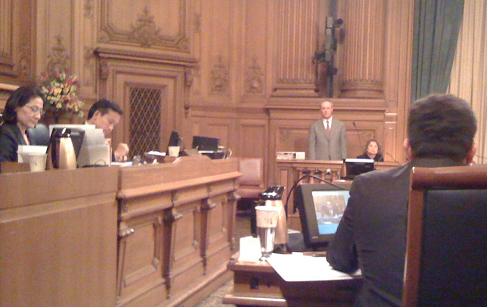
The San Francisco Board of Supervisors unanimously approved a process for replacing Mayor Gavin Newsom last night after the progressive majority stuck together on a pair of key procedural votes and some parliamentary jousting provided a preview of the high-stakes power struggle that will begin Dec. 7.

Sup. Sean Elsbernd led the board moderates (Sups. Carmen Chu, Michela Alioto-Pier, Bevan Dufty, and Sophie Maxwell) in trying to dilute the voting power of the six progressives on the board (Sups. David Chiu, Chis Daly, David Campos, Eric Mar, Ross Mirkarimi, and John Avalos) and ensure they can’t vote as a bloc to choose the new mayor.

State conflict-of-interest rules spelled out by the California Political Reform Act and associated rulings prevent supervisors from voting in their economic interests, as becoming mayor would be. So Board Clerk Angela Calvillo and the Santa Clara County Counsel’s Office (legal counsel in the matter after our own City Attorney’s Office recused itself) created procedures whereby all nominees leave the room while the remaining supervisors vote.

But as Daly noted, clearing several supervisors from the room would make it unlikely that those remaining to come up with six votes for anyone. He also said the system would deny too many San Franciscans of a representative in this important decision and allow sabotage by just a few moderate supervisors, who could vote with a majority of supervisors present to adjourn the meeting in order to push the decision back to the next board that is sworn in on Jan. 11.

“The process before us is flawed,” Daly said.

So Daly sought to have the board vote on every nomination as it comes up, but Elsbernd argued that under Robert’s Rules of Order, nominations don’t automatically close like that and to modify a board rule that contradicts Robert’s Rules requires a supermajority of eight votes. Calvillo, who serves as the parliamentarian, agreed with that interpretation and Chiu (who serves as chair and is the final word on such questions) ruled that a supermajority was required.

Although some of his progressive colleagues privately grumbled about a ruling that ultimately hurt the progressives’ preferred system, Chiu later told the Guardian, “I gotta play umpire as I see the rules…We need to ensure the process and how we arrive at a process is fair and transparent.”

Nonetheless, Chiu voted with the progressives on the rule change, which failed on a 6-5 vote. But Daly noted that supervisors may still refuse nominations and remain voting until they are ready to be considered themselves, which could practically have the same effect as the rejected rule change. “If we think that’s a better way to do it, we can do it, but we don’t need to fall into the trap and subterfuge of our opponents,” Daly told his colleagues.

Elsbernd then moved to approve the process as developed by Calvillo, but Daly instead made a motion to amend the process by incorporating some elements on his plan that don’t require a supermajority. After a short recess to clarify the motion, the next battleground was over the question of how nominees would be voted on.

Calvillo and Elsbernd preferred a system whereby supervisors would vote on the group of nominees all at once, but Daly argued that would dilute the vote and make it difficult to discern which of the nominees could get to six votes (and conversely, which nominees couldn’t and could thereby withdraw their nominations and participate in the process).

“It is not the only way to put together a process that relies on Robert’s Rules and board rules,” Daly noted, a point that was also confirmed at the meeting by Assistant Santa Clara County Counsel Orry Korb under questioning from Campos. “There are different ways to configure the nomination process,” Korb said. “Legally, there is no prohibition against taking single nominations at a time.”

So Daly made a motion to have each nominee in turn voted up or down by the voting board members, which required only a majority vote because it doesn’t contradict Robert’s Rules of Order. That motion was approved by the progressive supervisors on a 6-5 vote.

Both sides at times sought to cast the other as playing procedural games, and both emphasized what an important decision this is. “This is without a question the most important vote that any of us will take as a member of the Board of Supervisors and one that everyone is watching,” Elsbernd said of choosing a new mayor.

So after the divisive procedural votes played out, Chiu stepped down from the podium and appealed for unity around the final set of procedures. He said that San Franciscans need to have confidence that the process is fair and accepted by all, and so, “It would be great if we have more than a 6-5 vote on this.”

As the role call was taken, Carmen Chu was the first moderate to vote “yes,” and her colleagues followed suit on a 11-0 vote to approve the process. At that point, the board could have begun taking nominations, but it was already 7 p.m. and both Daly and Chiu argued to delay that process by couple weeks.

“We owe it to ourselves and this city to have a discussion [of what qualities various supervisors want to see in a new mayor] before we get into names and sequestration,” Daly said.

He and other progressive proposed to continue this discussion to Dec. 7, but Elsbernd – who was visibly agitated by the discussion – suddenly moved to table the item (which would end the discussion without spelling out the next step), a motion rejected on a 4-7 vote, with Maxwell joining the progressives.

The discussion ended with a unanimous vote to continue the item to Dec. 7, when supervisors will discuss what they want in a new mayor and possibly begin the process of making and voting on nominations. Anyone who receives six votes will need to again be confirmed during the board meeting on Jan. 4, a day after Newsom assumes the office of lieutenant governor.

Green vs. “green”

12

rebeccab@sfbg.com

Years ago, Greg Gaar was a scavenger, wandering the neighborhoods around Twin Peaks picking up bottles and other kinds of recyclable trash. He began working at the Haight Ashbury Neighborhood Council (HANC) Recycling Center in 1982.

During his tenure, a project designed primarily to divert waste from the landfill expanded to include a unique San Francisco native plant nursery. Located on a converted parking lot on Frederick Street near Lincoln Boulevard, the recycling center is a drop-off for recyclable materials, including used veggie oil, and a source for soil and 65 species of potted plants.

Gaar started small. “I took some seeds,” he explained, “and scattered them into a flat. They came up like fur on a dog’s back.” Over the years, he researched the natural history of the area, saved seeds, and cultivated the grounds surrounding the recycling center. HANC also converted a traffic triangle across the street into a thriving garden.

The Recreation and Parks Department, directed by Phil Ginsburg — former chief of staff to Mayor Gavin Newsom — is seriously considering a plan to evict HANC recycling center and replace it with a garden resource center.

While trading one garden center for another might not seem like a big deal, it appears to be an attack on poor people who make their living recycling cans and bottles, a group that organized to oppose Proposition L, the sit-lie ordinance that Newsom supported in this election.

Or as HANC Executive Director Ed Dunn put it: “He’s going to take it from his enemies and give it to his friends.”

The HANC recycling center has leased Rec and Park property since its inception in 1974, and it’s been at its current location for 30 years. HANC does not receive any city funding for the center, and it pays a small amount in rent for use of the parking lot. It processes roughly 160 tons of recycling per month.

Newsom has worked hard to cultivate his reputation as a green mayor and promote green-job creation, but evicting the recycling center would kill 10 green jobs. Many of the employees were formerly homeless and previously earned petty cash gathering cans to exchange at the center’s buyback station. They were hired without any help from San Francisco taxpayers and now they’re earning living wages while diverting waste from the landfill.

But some neighborhood residents are annoyed by the presence of people who arrive at the center with shopping carts filled to the brim with bottles and cans that they can exchange for cash. Buyback hours are held from 10 a.m. to 3 p.m., so during those times, people who haul around bundles of recyclables line up to receive modest rewards for their hours of effort.

HANC, a progressive organization, publicly and vehemently opposed Prop. L, the voter-approved ordinance that bans sitting and lying down on city sidewalks. Newsom enthusiastically endorsed Prop. L.

Dunn believes the recycling center is being targeted due to HANC’s position on that issue. “It’s all about political payback,” says Dunn. Incidentally, Haight voters rejected sit-lie and HANC sees the pending recycling-center eviction as part of the same agenda. “It’s all part of the gentrification that’s enveloping San Francisco,” said Jim Rhoads, who chairs the HANC Recycling Committee.

Once word of the plans got out, letters started pouring into to Newsom’s and Ginsburg’s offices from the Sierra Club, San Francisco Tomorrow, the Senior Action Network, and other organizations. Additionally, the center’s supporters mailed at least 400 postcards opposing the eviction.

Residents have voiced complaints about the shopping-cart recyclers, some of whom are homeless. The Inner Sunset Park Neighbors (ISPN), which is petitioning Rec and Park to evict the recycling center, has a message posted on its website linking the shopping-cart pushers with “quality-of-life issues such as aggressive panhandling, drug use/dealing, and public safety.” ISPN also charges that the recyclers swipe cans and bottles from rolling curbside bins. The neighborhood group had not responded to requests for an interview by press time.

Rhoads believes that if the recycling buyback program is removed, it would only encourage panhandling — after all, people already lacking basic resources would lose a critical source of income. “People will be very desperate,” he said. According to the results of a HANC survey, one in six recyclers regularly turning up at the center to exchange bottles for cash sleeps outside.

The Recreation and Park Commission will discuss the possible HANC eviction at its Dec. 2 meeting. And since the recycling center is on a month-to-month lease, the 36-year-old green resource could soon suffer eviction. There’s likely to be significant resistance, since the HANC Recycling Center has forged partnerships with urban-agriculture projects throughout the city.

It was a fiscal sponsor of the Garden for the Environment and donated several tons of cardboard for mulching at Hayes Valley Farm. The HANC nursery project has distributed plants to urban agriculture projects throughout the city, including school garden plots, urban habitat corridors designed to protect rare species, and the Mission Greenbelt Project, a network of sidewalk gardens in the Mission.

Details on the proposed garden resource center that would be installed in lieu of the HANC Recycling Center are sketchy. An artist’s rendering of the plan, drawn up by the city’s Department of Public Works, envisions an outdoor classroom amphitheatre, raised garden beds, a semi dwarf orchard, and a composting area. However, Guardian inquiries to Rec and Park requesting more specific details about funding and operation went unanswered by press time. 

The screwy rules for mayoral succession

0

EDITORIAL The clerk of the Board of Supervisors, at the request of Board President David Chiu, has released a proposal for the selection process for a new mayor, and it’s about as complicated and confusing as everyone expected. That’s in part the result of the vagueness of the City Charter, which simply specifies that a vacancy in the office of mayor shall be filled by a San Francisco registered voter chosen by a majority of the supervisors but offers no procedural clues on how to get there. And the Political Reform Act sets very strict limits on conflicts of interest for elected officials in California; a supervisor, for example, can’t vote for himself or herself or do anything to promote his or her candidacy for an office that comes with a pay raise.

In the end, the proposal leaves limited room for public input — and makes it very difficult for any sitting supervisor, particularly one of the progressives, to wind up winning the job.

The way the rules are laid out, the board would accept nominations — but any sitting supervisor who accepted the nomination would have to leave the room at once, cease all communication with his or her colleagues, and play no role in further deliberations or voting. Since it’s entirely possible that several supervisors — and possibly several progressives — could be nominated, the process would cripple the final outcome since the only ones allowed to vote would be the remaining board members whose names aren’t in the mix.

That skews the outcome heavily toward one of two options: the supervisors appoint someone who isn’t on the board — or Chiu winds up as both acting mayor and board president because nobody else can muster six votes. The only other option: The progressives all stick together, line up in advance behind a candidate who’s currently on the board, and find one more vote for that person.

The whole thing is so screwy that the supervisors ought to make some changes before they adopt it and try, to the extent that it’s legal, to inject some sanity into the process.

For example: Instead of opening the nominations, collecting a long list of names, sending all of the sitting supervisors on that list out of the room and then voting, the board could take the names one at a time. A supervisor gets nominated, leaves the room, and the votes are tallied; if he or she has fewer than six, the process starts again. (The problem: who goes first — because the first person eliminated can’t be nominated again. To be fair, there would have to be some sort of random drawing of which supervisor could make the first nomination — which alone might add too much random chance to the outcome.)

Then there’s the question of when this all takes place. If the process starts now and an interim mayor is chosen, the board will have to reconfirm that person Jan. 4 when Gavin Newsom actually resigns to take over as lieutenant governor. There’s a chance something could go wrong in the meantime and the board would have to change its vote, and there’s a chance that state law would prevent a supervisor who won from acting in any way to influence the final vote. But those are better risks than the option of leaving everything to the last day. And if the board decides that it can’t or shouldn’t act until Jan. 4, special meetings ought to be calendared for Jan. 5, 6, and 7 to give the current board more than one day to make the final decision.

And before anything happens, the board needs to schedule at lest one open hearing to get input from the public on the qualifications for the next mayor and on potential candidates.

The bottom line: any candidate who wants to get progressive support needs to be willing to do more than sign legislation and manage the city. He or she needs to be willing to use political capital and the mayor’s bully pulpit to make the case for progressive change — on taxes, services, the budget, and an overall civic vision. And the six board members on the left need to stick together, or that won’t happen.

Editorial: The screwy process for selecting a mayor

19

The clerk of the Board of Supervisors, at the request of Board President David Chiu, has released a proposal for the selection process for a new mayor, and it’s about as complicated and confusing as everyone expected. That’s in part the result of the vagueness of the City Charter, which simply specifies that a vacancy in the office of mayor shall be filled by a San Francisco registered voter chosen by a majority of the supervisors but offers no procedural clues on how to get there. And the Political Reform Act sets very strict limits on conflicts of interest for elected officials in California; a supervisor, for example, can’t vote for himself or herself or do anything to promote his or her candidacy for an office that comes with a pay raise.


In the end, the proposal leaves limited room for public input — and makes it very difficult for any sitting supervisor, particularly one of the progressives, to wind up winning the job.


The way the rules are laid out, the board would accept nominations — but any sitting supervisor who accepted the nomination would have to leave the room at once, cease all communication with his or her colleagues, and play no role in further deliberations or voting. Since it’s entirely possible that several supervisors — and possibly several progressives — could be nominated, the process would cripple the final outcome since the only ones allowed to vote would be the remaining board members whose names aren’t in the mix.


That skews the outcome heavily toward one of two options: the supervisors appoint someone who isn’t on the board — or Chiu winds up as both acting mayor and board president because nobody else can muster six votes. The only other option: The progressives all stick together, line up in advance behind a candidate who’s currently on the board, and find one more vote for that person.


The whole thing is so screwy that the supervisors ought to make some changes before they adopt it and try, to the extent that it’s legal, to inject some sanity into the process.


For example: Instead of opening the nominations, collecting a long list of names, sending all of the sitting supervisors on that list out of the room and then voting, the board could take the names one at a time. A supervisor gets nominated, leaves the room, and the votes are tallied; if he or she has fewer than six, the process starts again. (The problem: who goes first — because the first person eliminated can’t be nominated again. To be fair, there would have to be some sort of random drawing of which supervisor could make the first nomination — which alone might add too much random chance to the outcome.)


Then there’s the question of when this all takes place. If the process starts now and an interim mayor is chosen, the board will have to reconfirm that person Jan. 4 when Gavin Newsom actually resigns to take over as lieutenant governor. There’s a chance something could go wrong in the meantime and the board would have to change its vote, and there’s a chance that state law would prevent a supervisor who won from acting in any way to influence the final vote. But those are better risks than the option of leaving everything to the last day. And if the board decides that it can’t or shouldn’t act until Jan. 4, special meetings ought to be calendared for Jan. 5, 6, and 7 to give the current board more than one day to make the final decision.


And before anything happens, the board needs to schedule at lest one open hearing to get input from the public on the qualifications for the next mayor and on potential candidates.


The bottom line: any candidate who wants to get progressive support needs to be willing to do more than sign legislation and manage the city. He or she needs to be willing to use political capital and the mayor’s bully pulpit to make the case for progressive change — on taxes, services, the budget, and an overall civic vision. And the six board members on the left need to stick together, or that won’t happen.

Processing the mayoral transition

5

The question of who will be the next mayor of San Francisco wasn’t any clearer by the end of the Nov. 16 Board of Supervisors meeting, but many expressed a desire for an open and transparent process with accountability to the public. The board approved a motion by Board President David Chiu to have the Clerk of the Board propose an process for selecting a successor mayor, which will come under consideration at the next meeting. But with only a handful of board meetings left before the new board is sworn in on Jan. 8, there is a high level of anticipation.

Clerk of the Board Angela Calvillo confirmed that her office is drafting a proposed process for mayoral selection. Calvillo said the proposal would be submitted for consideration at next week’s meeting, and it will be available to the public on the city website by Friday, Nov. 19.

Essentially, the board could choose from a number of options at its next meeting on how to appoint a successor mayor once Mayor Gavin Newsom vacates office. Whatever the Board decides prior to Jan. 3, when Newsom is sworn in as Lt. Governor, will not have the force of law, since there won’t yet be a vacancy. So a second vote will have to be taken Jan. 4 to make the official appointment. Newsom has said he is “99 percent sure” that he will vacate the Office of the Mayor on Jan. 3.

According to Santa Clara County attorneys — who are filling in for City Attorney Dennis Herrera since he has a conflict-of-interest as a mayoral candidate — neither the Charter nor the Municipal Code dictates a specific process for the Board to use in selecting a successor mayor. So, the board could either follow the regular appointments procedure under the current Board Rules, or it could devise its own process.

The Clerk of Board is now hammering out that unique process, as directed by the board, and the board may vote to modify and adopt that process next week — but since a vote to adopt it would constitute an amendment to the board rules, it would require a super-majority of eight votes.

If there aren’t eight votes, then the board may still opt to set forth an appointment process under the current board rules. “I strongly believe that we do have the ability to effectuate an appointment without amending the board rules,” Sup. Chris Daly said. Daly told the Guardian that he has submitted a motion to take nominations and appoint a successor mayor, which will appear on the adoption without committee reference calendar at next Tuesday’s Board meeting. However, a similar motion put forth by Sup. John Avalos wasn’t able to gain the needed support.

If the board went through the normal appointments process, it would require sending nominees through the Rules Committee for consideration – but since it wouldn’t be practical to have just three members of the board recommend a mayoral appointment to the full board, all 11 supervisors could sit as a Committee of the Whole instead.

The timing is important because if supervisors cannot agree upon a process, or gain enough support for a single nominee, then the task will fall to the new Board of Supervisors, who will be sworn in Jan. 8. If the current board doesn’t reach a decision by Jan. 4, Board President David Chiu will automatically become acting mayor. Once the new board is sworn in, it can continue whatever appointment process has been set in motion or decide to initiate a new process for appointing a successor mayor. If the current board appoints a successor mayor, however, the new board cannot revoke or otherwise affect that appointment.

There are a slew of questions still at play. For example, under conflict-of-interest laws, when some one is nominated as successor mayor, he or she must leave the room and is barred from influencing the process in any way. The idea was bandied about at the Nov. 16 Board meeting to require nominees to respond to questions from the board as part of a public forum, but it’s unclear how a supervisor who has been nominated could respond to questions from his or her colleagues while being sequestered and prohibited from influencing the process.

Although word went out that interested members of the public should show up at City Hall around 4 p.m. Nov. 16 to weigh in on the discussion about appointing a successor mayor, the conversation didn’t get underway till much later.

Sup. John Avalos had submitted a motion to vote on an interim mayor and then vote a second time to ratify that appointment once Mayor Gavin Newsom had vacated office. However, his motion was amended to simply take public input and discuss the process of appointing a successor mayor.

Members of the public waited patiently, and when it was time, they lined up behind the speakers podium wearing neon sunburst stickers that read, “Let the Sun Shine In!” Local writer, artist, and activist Tommi Avicolli Mecca even sang the refrain of the song by that name, before imploring the Supes to “Get this done now, and give us a good, progressive interim mayor.”

Labor activist Gabriel Haaland urged the current board to agree upon an appointment instead of handing the responsibility over to the next board. “People who’ve never held an office hour in their life should not be making this decision,” Haaland said.

Christopher Cook highlighted the challenges that the new mayor would face. “We’re talking about a less-than-average amount of time to prepare for an absolute maelstrom,” with regard to the city budget, Cook noted.

“Let the sun shine in” seemed to be the catchphrase of the evening. Before the public weighed in, Sup. Chris Daly called for an open, transparent process for the appointment of the new mayor. “Conversations about mayoral transition have been happening behind closed doors, not in public session, for the better part of this past year,” Daly charged. “It’s time to hear from the public.”

But just how, exactly, the appointment process will work is anything but clear and sunny – at least for the time being.

Meanwhile, Judge Quentin Kopp, who was a member of the Board of Supervisors when a successor mayor was appointed on Dec. 4, 1978 — one week after the assassinations of Mayor George Moscone and Sup. Harvey Milk — said the process of choosing a new mayor was simpler back then.

In that case, then-Sup. Dianne Feinstein was the only nominee. She was appointed with six votes. Two, including Kopp, voted no, and there were two absences (Harvey Milk had been assassinated one week prior, and Dan White was in jail). Feinstein, who was made to leave the room during the vote, abstained. However, before the vote was called, Feinstein was able to vote against a motion for a continuance — a power she likely would not have had if current political-reform laws were in place.

“It’s simple,” Kopp said. “Why are they complicating it?”

He scoffed at the circuitous discussion happening now, and said some one else had called him with the same inquiry earlier that same day. “Once again, our overpaid supervisors are making work for themselves,” he said. “It’s called busywork.”

And that might be the most insightful statement yet – after all, while the process points are debated over and over again, there is more time for supervisors to determine just who might be able to collect the six votes needed to be elected mayor of San Francisco.

Questions for the next mayor

4

EDITORIAL The progressives on the Board of Supervisors are a long way from united on a possible mayoral candidate, and if they can’t come together, the person who finishes Gavin Newsom’s term will be a compromise candidate, either a short-term caretaker (not the greatest option) or someone who’s more in the moderate camp but a candidate the left can work with — for 2011 and possibly four years after that.

We’re glad to see the proposal by Sup. John Avalos to begin the mayoral selection process early. Picking a mayor in a mad scramble on the day Newsom steps down is a recipe for chaos — and potentially a bad outcome. And as the process begins, the last thing the city needs is a mayor chosen through a backroom deal.

But it’s entirely appropriate for progressive board members to set some standards and to ask the people who are angling for the job to make clear exactly what their positions would be on key policy issues.

In other words, anyone who wants to be the interim mayor — and possibly mayor for the next five years or longer — should have to answer, directly and without hedging, question like these:

How much new revenue does San Francisco need to solve its budget problems, and where, specifically, should it come from? This is the central issue facing the city, now and for the indefinite future. San Francisco’s budget has a structural deficit of at least $250 million, and it simply can’t be closed by cuts alone. What taxes will you pledge to support — and put political capital and fundraising clout behind when they go on the ballot?

What specific programs ought to be cut? Everyone likes to talk about the city living within its means, but that ends up leading to a series of death-by-1,000-cuts decisions that year after year devastate services to the poor. Don’t tell us you need to look at budget figures and work it out later; the big-ticket items are no secret. What’s on the chopping block — and what isn’t?

Will you work to promote public power? How will you expedite community choice aggregation, and will you support a ballot measure to replace Pacific Gas and Electric Co. with a full-scale municipal electric utility?

What are your law enforcement priorities? If money’s tight, should the San Francisco police be hassling nightclubs, or should more resources go into the homicide division? How important are foot patrols, and which neighborhoods should get them? Will the SFPD and juvenile authorities continue to turn young people over to federal immigration authorities?

Who should pay to fix Muni? Should the burden of paying for the transit system fall primarily on the riders (through fare increases and reduced services) or should big downtown businesses and retailers (the major beneficiaries of the system) pay more? Should car owners pay higher fees (including parking fees and congestion management fees) to subsidize transit? Which specific fees would you be willing to push for?

Who should the city build housing for? Right now, much of the new housing stock is aimed at the very rich — and San Francisco is turning into a bedroom community for Silicon Valley. Would you set housing policy to conform with the city’s General Plan assertion that more than half of all new housing should be below market rate? How would you make that balance happen? Should the city spend a significant amount of money for affordable housing, and who should pay for it?

Do you agree that public sector jobs are as important as private sector jobs in San Francisco? Would you support the tax plan proposed by Sup. David Chiu?

Do you support giving the supervisors appointments to all major commissions?

Do you think the city should be doing more to stop TICs and condo conversions and to preserve existing rental housing?

That’s just the beginning of a long list of questions — but the progressives on the board should make sure they have answers before agreeing to support anyone, as a caretaker or interim mayor.

Gavin Newsom, Republican

1

I mean, isn’t this exactly what the Republicans have been saying in Sacramento, paralyzing the state by refusing to accept any new taxes? Is that the attitude Newsom wants to bring to his new job? What’s he going to do when Jerry Brown announces a package of tax hikes for the June ballot and wants his loyal Lt. to go around the state and campaign for them? Or is there a different standard for the state budget?


I don’t get it, Gav. 

Questions for the next mayor

19

 The progressives on the Board of Supervisors are a long way from united on a possible mayoral candidate, and if they can’t come together, the person who finishes Gavin Newsom’s term will be a compromise candidate, either a short-term caretaker (not the greatest option) or someone who’s more in the moderate camp but a candidate the left can work with for 2011 and possibly four years after that.

We’re glad to see the proposal by Sup. John Avalos to begin the mayoral selection process early. Picking a mayor in a mad scramble on the day Newsom steps down is a recipe for chaos and potentially a bad outcome. And as the process begins, the last thing the city needs is a mayor chosen through a backroom deal.

But it’s entirely appropriate for progressive board members to set some standards and to ask the people who are angling for the job to make clear exactly what their positions would be on key policy issues.

In other words, anyone who wants to be the interim mayor and possibly mayor for the next five years or longer should have to answer, directly and without hedging, question like these:

How much new revenue does San Francisco need to solve its budget problems, and where, specifically, should it come from? This is the central issue facing the city, now and for the indefinite future. San Francisco’s budget has a structural deficit of at least $250 million, and it simply can’t be closed by cuts alone. What taxes will you pledge to support and put political capital and fundraising clout behind when they go on the ballot?

What specific programs ought to be cut? Everyone likes to talk about the city living within its means, but that ends up leading to a series of death-by-1,000-cuts decisions that year after year devastate services to the poor. Don’t tell us you need to look at budget figures and work it out later; the big-ticket items are no secret. What’s on the chopping block and what isn’t?

Will you work to promote public power? How will you expedite community choice aggregation, and will you support a ballot measure to replace Pacific Gas and Electric Co. with a full-scale municipal electric utility?

What are your law enforcement priorities? If money’s tight, should the San Francisco police be hassling nightclubs, or should more resources go into the homicide division? How important are foot patrols, and which neighborhoods should get them? Will the SFPD and juvenile authorities continue to turn young people over to federal immigration authorities?

Who should pay to fix Muni? Should the burden of paying for the transit system fall primarily on the riders (through fare increases and reduced services) or should big downtown businesses and retailers (the major beneficiaries of the system) pay more? Should car owners pay higher fees (including parking fees and congestion management fees) to subsidize transit? Which specific fees would you be willing to push for?

Who should the city build housing for? Right now, much of the new housing stock is aimed at the very rich and San Francisco is turning into a bedroom community for Silicon Valley. Would you set housing policy to conform with the city’s General Plan assertion that more than half of all new housing should be below market rate? How would you make that balance happen? Should the city spend a significant amount of money for affordable housing, and who should pay for it?

Do you agree that public sector jobs are as important as private sector jobs in San Francisco? Would you support the tax plan proposed by Sup. David Chiu?

Do you support giving the supervisors appointments to all major commissions?

Do you think the city should be doing more to stop TICs and condo conversions and to preserve existing rental housing?

That’s just the beginning of a long list of questions but the progressives and other supervisors  on the board should make sure they have answers before agreeing to support anyone, as a caretaker or interim mayor.


Yee launches mayoral bid as supervisors consider their options

0

Amid the jockeying for position on who will be San Francisco’s next mayor, Sen. Leland Yee this morning filed paperwork at the SF Elections Department to form a mayoral exploratory committee before a throng of journalists who were invited yesterday for a big “announcement.”

Yee diligently hit his talking points and did little to divert from a script emphasizing his deep local roots, his belief in being a humble public servant, and how this action was “beginning a conversation with San Franciscans” about “what they want of their city government and their next mayor.” Yee used the word “conversation” so many times that an AP reporter asked him to explain his issues and reasons for running without using the word “conversation,” a word Yee still slipped into his answer.

Meanwhile, members of the Board of Supervisors yesterday introduced competing motions for naming an interim mayor to replace Gavin Newsom while he leaves in January to become lieutenant governor. Sups. John Avalos, David Campos, and Chris Daly are seeking to have the board vote on a replacement mayor as soon as next week, while Board President David Chiu asked the board clerk’s office to develop a framework and process for choosing a new mayor. Asked whether he has the six votes needed to take up the matter next week, Avalos told the Guardian, “That’s my hope, but we’ll see.”

While Yee seems focused on winning the mayoral election next fall, rather than winning six votes on the board now, he told reporters, “I have the highest regard for members of the Board of Supervisors…They have a tremendous challenge in front of them and I wish them well.”

In his prepared statement that listed his contact person as Jim Stearns, a political consultant who usually works for progressive candidates and ballot measures, Yee sought to differentiate himself from Newsom, who has had hostile relations with the board throughout his seven-year tenure. “I want to see the Mayor work with, and not against the Board of Supervisors,” Yee said in that statement.

Asked by the Guardian to elaborate on what appears to be a critique of Newsom, Yee demurred. “I’m not going to judge this mayor. History will do that,” he said.

Playing it safe for now could be a sound strategy for Yee, who would be the city’s first Chinese-American mayor and who has a history of endorsing progressive candidates and positions, but who also just raised and spent more than $1.2 million (much of it in big corporate donations that far exceed limits on local donations that his committee will now allow him to begin collecting) on his uncontested Senate reelection, including giving six-figures to Stearns and spending almost as much on polling.

Stearns tells the Guardian that, consistent with his message today, Yee will run a very positive campaign. “We’re going to run a different kind of campaign, a very collaborative campaign,” he said. “This city deserves a different kind of campaign where people are just firing their guns at each other.”

Dodging bullets

14

steve@sfbg.com

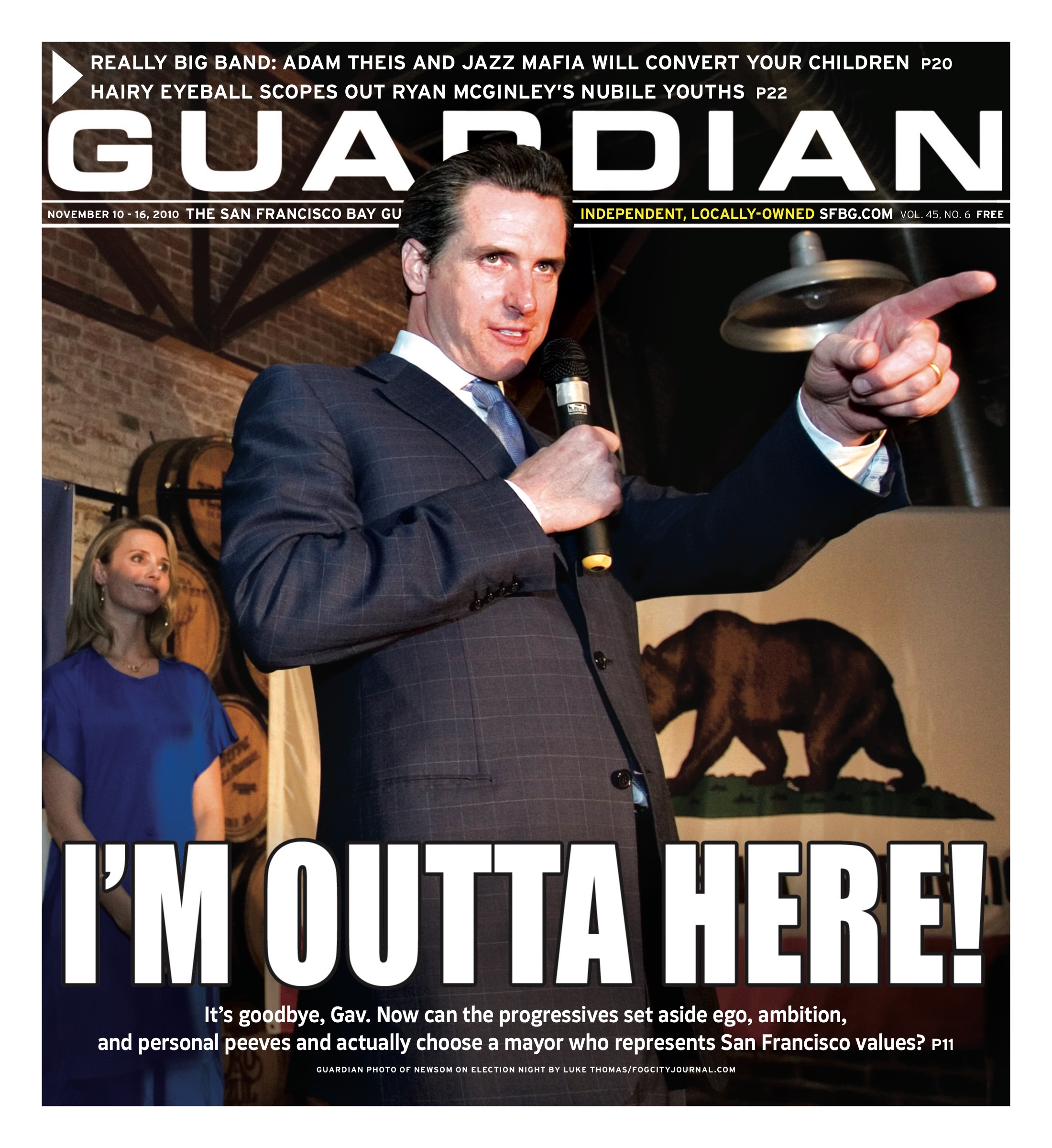
Progressives in San Francisco dodged a few bullets on election night, which was the highest hope that many held in a campaign season dominated by conservative money and messaging. The Board of Supervisors retained a progressive majority, Prop B’s attack on public employees went down, the wealthy will pay more property transfer taxes, and — perhaps the best news of all — Gavin Newsom is leaving for Sacramento a year before his mayoral term ends.

But economically conservative and downtown-backed campaigns and candidates scored the most election-night victories in San Francisco, killing a temporary hotel tax hike pushed hard by labor and several progressive-sponsored ballot measures, and winning approval for the divisive sit-lie ordinance and Prop. G, removing Muni driver pay guarantees, which had the widest margin of the night: 65-35 percent.

“Ultimately, downtown did well,” progressive political consultant Jim Stearns told us on election night, noting how aggressive spending by downtown business and real estate interests ended a string of progressive victories in the last several election cycles. He cited the likely election of Scott Wiener in District 8 and the strong challenge in District 2 by Mark Farrell to perceived frontrunner Janet Reilly, who had progressive and mainstream endorsements.

A preliminary Guardian analysis of reported spending by independent expenditure committees shows that groups affiliated with downtown or supporting more conservative candidates spent about $922,435, the biggest contributions coming from conservative businessman Thomas Coates and the San Francisco Board of Realtors, compared to $635,203 by more progressive organizations, mostly the San Francisco Democratic Party and San Francisco Labor Council.

That spending piggy-backed on national campaigns that were also skewed heavily to conservative and corporate-funded groups and messaging that demonized government and public employee unions, playing on people’s economic insecurities during a stubborn recession and jobless recovery.

Stearns said voters are having a hard time in this economy “and they don’t like to see the government spending.” He said national polls consistently show that people are more scared of “big government” than they are “big corporations,” even if San Francisco progressives tend to hold the opposite view.

And even that narrow defeat came after an almost unprecedented opposition campaign that included every elected official in San Francisco except the measure’s sponsor, Public Defender Jeff Adachi, and both the labor movement and many moderate groups.

“The campaign on this was extraordinary and caught fire at the end,” Alex Clemens, founder of Barbary Coast Consulting, said at SPUR’s Nov. 4 election wrap-up event. In particular, the message about how much Prop B would increase the health care costs on median-income city employees seemed to resonate with voters.

“We are really happy that Prop. B is going down because it was such a misguided measure. It was not well thought through,” Labor Council President Tim Paulson told the Guardian at the election night party labor threw with the San Francisco Democratic Party at Great American Music Hall. “San Francisco voters are the smartest in America.”

Paulson was also happy to see those voters approve taxing the transfer of properties worth more than $5 million, “because San Franciscans know that everyone has to pay their fair share.”

In the Board of Supervisors races, it was basically a status quo election that shouldn’t alter the body’s current politics dynamics much. Sup. Bevan Dufty will be replaced with fellow moderate Scott Wiener in D8 and Sup. Chris Daly by progressive Jane Kim in D6. The outcome of races to replace ideological wobbler Sup. Sophie Maxwell in D10 and conservative Michela Alioto-Pier in D2 may not be conclusively known for at least a few more days (maybe longer if the close races devolve into lawsuits), but neither is a seat that would diminish the board’s progressive majority.

Progressives could have made a gain if Rafael Mandelman had won in D8, but he was seven points behind Wiener on election night and even more after the initial ranked choice tally was run on Nov. 5. And in D6, fears that downtown-backed candidate Theresa Sparks might sneak past dueling progressive candidates Jane Kim and Debra Walker never materialized as Sparks finished far behind the lefty pair.

Consultant David Latterman, who worked for Sparks, told us on election night that he was surprised to see that Kim was the choice of 32 percent of early absentee voters “because we targeted those voters.” By comparison, Walker was at 20 percent and Sparks was at 21 percent in the initial returns, which tend to be more conservative. By the end of the night, Kim had 31.3 percent, Walker 27.7 percent, and Sparks just 16.5 percent.

“If she did that well with absentees, it seems like it was Jane’s race to win. If they choose Jane, they wanted Jane. It’s just that simple,” Latterman told us on election night.

At her election night party, Kim credited her apparent victory to a strong campaign that she said fielded 400 volunteers on Election Day, most wearing the bright red T-shirts that read “See Jane Run” on the back. “I feel good,” Kim told the Guardian. “What I’m really happy about is we ran a really good campaign.”

In the end, Kim’s campaign was put over the top by the second-place votes of Sparks’ supporters, with 769 votes going to Kim and 572 to Walker in the first preliminary run of ranked-choice voter tabulations. But despite the bad blood that developed between progressives in the Kim and Walker campaigns, Board President David Chiu, an early Kim supporter, sounded a conciliatory note, telling the Guardian on election night, “Given where Debra and Jane are, I’m glad that we’re going to keep this a progressive seat.”

The next mayor

108

tredmond@sfbg.com

By the time a beaming Mayor Gavin Newsom took the stage at Tres Agaves, the chic SoMa restaurant, on election night, enough results were in to leave no doubt: the top two places on the California ballot would go to the Democrats. Jerry Brown would defeat Meg Whitman in the most expensive gubernatorial race in American history — and Newsom, who once challenged Brown in the primary and dismissed the office of lieutenant governor, would be Brown’s No. 2.

It might not be a powerful job, but Newsom wasn’t taking it lightly anymore. “We can’t afford to continue to play in the margins,” he proclaimed proudly, advancing a vague but ambitious agenda. “There is absolutely nothing wrong with California that can’t be fixed with what’s right with California.”

But around the city, as results trickled in for the local races, the talk wasn’t about Newsom’s role in the Brown administration, or the change the Democrats might bring to Sacramento. It was about the profound change that could take place in his hometown as he vacates the office of mayor a year early — and opens the door for the progressives who control the Board of Supervisors to appoint a chief executive who agrees with, and is willing to work with, the majority of the district-elected board.

At a time when the Republican takeover of Congress threatens to create gridlock in Washington, there’s a real chance that San Francisco’s government — often paralyzed by friction between Newsom and the board — could take on an entirely new direction. It’s possible that the progressives, long denied the top spot at City Hall, could put a mayor in office who shares their agenda.

This could be a turning point in San Francisco, a chance to put the interests of the neighborhoods, the working class, small businesses, the environmental movement, and economic justice ahead of the demands of downtown and the rich. All the pieces are in place — except one.

To make a progressive vision happen, the fractious (and in some cases, overly ambitious) elected leaders of the progressive movement will have to recognize, just for a little while, that it’s not about any individual. It’s not about David Chiu, or Ross Mirkarimi, or Chris Daly, or John Avalos, or Eric Mar, or David Campos, or Jane Kim, or Aaron Peskin. It’s not about any one person’s career or personal power.

It’s about a progressive movement and the issues and causes that movement represents. And if the folks with the egos and personal gripes and career designs can’t set them aside and do what’s best for the movement as a whole, then the opportunity of a generation will be wasted.

Folks: this is a hard thing for politicians to recognize. But right now it’s not about you. It’s about all of us.

It’s an odd time in San Francisco, fraught with political hazards. And it’s so confusing that no one — not the elected officials, not the pundits, not the lobbyists, not the insiders — has any clear idea who will occupy Room 200 in January.

Here’s the basic scenario, as described by past opinions of the city attorney’s office:

Under the state Constitution, Newsom will take office as lieutenant governor Jan. 3, 2011. The City Charter provides that a vacancy in the Mayor’s Office is filled by the president of the Board of Supervisors until the board can choose someone to fill the job until the end of the term — in this case, for 11 more months.

So if all goes according to the rules (and Newsom doesn’t try to play some legal game and delay his swearing-in), David Chiu will become acting mayor on Jan.3. He’ll also retain his job as board president.

On Jan. 4, the current members of the Board of Supervisors will hold a regularly scheduled Tuesday meeting — and the election of a new mayor will be on the agenda. If six of the current supervisors can agree on a name (and sitting supervisors can’t vote for themselves) then that person will immediately take office and finish Newsom’s term.

If nobody gets six votes — that is, if the board is gridlocked — Chiu remains in both offices until the next regular meeting of the board — a week later, when the newly elected supervisors are sworn in.

The new board will then elect a board president — who will also instantly become acting mayor — and then go about trying to find someone who can get six votes to take the top job. If that doesn’t work — that is, if the new board is also gridlocked — then the new board president remains acting mayor until January 2012.

There are at least three basic approaches being bandied about. Some people, including Newsom and some of the more conservative members of the board, want to see a “caretaker” mayor, someone with no personal ambition for the job, fill out Newsom’s term, allowing the voters to choose the next mayor in November, 2011. That has problems. As Campos told us, “The city has serious budget and policy issues and it’s unlikely a caretaker could handle them effectively.” In other words, a short-termer will have no real power and will just punt hard decisions for another year.

Then there’s the concept of putting in a sacrificial progressive — someone who will push through the tax increases and service cuts necessary to close a $400 million budget gap, approve a series of bills that stalled under Newsom, take the hits from the San Francisco Chronicle, and step out of the way to let someone else run in November.

The downside of that approach? It’s almost impossible for a true progressive to raise the money needed to beat a downtown candidate in a citywide mayor’s race. And it seems foolish to give up the opportunity to someone in the mayor’s office who can run for reelection as an incumbent.

Which is, of course, the third — and most intriguing — scenario.

The press, the pundits, and the mayor have for the past few months been pushing former Sup. Peskin as the foil, trying to spin the situation to suggest that the current chair of the local Democratic Party is angling for a job he wouldn’t win in a normal election. But right now, Peskin is no more a front-runner than anyone else. And although he’s made no secret in the past of wanting the job, he’s been talking of late more about the need for a progressive than about his own ambitions.

“If the board chose [state Assemblymember] Tom Ammiano, I would be thrilled to play a role, however small, in that administration,” Peskin told us.

In fact, Peskin said, the supervisors need to stop thinking about personalities and start looking at the larger picture. “If we as a movement can’t pull this off, then shame on us.”

Or as Sup. Campos put it: “We have to come together here and do what’s right for the progressive movement.”

Two years ago, the San Francisco left was — to the extent that it’s possible — a united electoral movement. In June, an undisputed left slate won a majority on the Democratic County Central Committee. In November 2008, Districts 1, 3, 5, and 11 saw consensus left candidates running against downtown-backed opponents — and won. In D9, three progressives ran a remarkably civil campaign with little or no intramural attacks.

The results were impressive. As labor activist Gabriel Haaland put it, “we ran the table.”

But that unity fell apart quickly, as a faction led by Daly sought to ensure that Sup. Ross Mirkarimi couldn’t get elected board president. Instead that job went to Chiu — the least experienced of the supervisors elected in that class, and a politician who is, by his own account, the most centrist member of the liberal majority.

This fall, the campaign to replace Daly in D6 turned nasty as both Debra Walker and Jane Kim openly attacked each other. Walker sent out anti-Kim mailers, and Kim’s supporters charged that Walker was part of a political machine — a damaging (if silly) allegation that created a completely unnecessary rift on the left.

And let’s face it: those fights were all about personality and ego, not issues or progressive strategy. Mirkarimi and Daly have never had any substantive policy disagreements, and neither did Walker and Kim.

In the wake of that, progressives need to come together if they want to take advantage of the opportunity to change the direction of the city. It’s not going to be easy.

“We’re good at losing,” Daly said. “I’m afraid we’re doing everything we can to blow it.”

The cold political calculus is that none of the current board members can count on six votes, and neither can Peskin or any of the other commonly mentioned candidates. The only person who would almost certainly get six votes today is Ammiano — and so far, he’s not interested.

“I know you never say never in politics, but I’m happy here in Sacramento. Eighty-six percent of the voters sent me back for another term, and I think that says something,” he told us.

It’s hardly surprising that someone like Ammiano, who has a secure job he likes and soaring approval ratings, would demur on taking on what by any account will be a short-term nightmare. The city is still effectively broke, and next year’s budget shortfall is projected at roughly $400 million. There’s no easy way to raise revenue, and after four years of brutal cuts, there’s not much left to pare. The next mayor will be delivering bad news to the voters, making unpleasant and unpopular decisions, infuriating powerful interest groups of one sort or another — and then, should he or she want the job any longer, asking for a vote of confidence in November.

Yet he power of incumbency in San Francisco is significant. The past two mayors, Newsom and Willie Brown, were reelected easily, despite some serious problems. And an incumbent has the ability to raise money that most progressives won’t have on their own.

Chiu thus far is being cautious. He told us his main concern right now is ensuring that the process for choosing the next mayor is open, honest, and legally sound. He won’t even say if he’s officially interested in the job (although board observers say he’s already making the rounds and counting potential votes).

And no matter what happens, he will be acting mayor for at least a day, which gives him an advantage over anyone else in the contest.

But some of the board progressives are unhappy about how Chiu negotiated the last two budget deals with Newsom and don’t see him as a strong leader on the left.

Ross Mirkarimi is the longest-serving progressive (other than Daly, who isn’t remotely a candidate), and he’s made no secret of his political ambitions. Then there’s Campos, an effective and even-tempered supervisor who has friendly relationships with the board’s left flank and with centrists like Bevan Dufty. But even if Dufty (who I suspect would love to be part of electing the first openly gay mayor of San Francisco) does support Campos, he’d still need every other progressive supervisor. Campos also would need Chiu’s vote to go over the top. Which means Chiu — who needs progressive support for whatever his political future holds — would have to set aside his own designs on the job to put a progressive in office.

In other words, some people who want to be mayor are going to have to give that up and support the strongest progressive. “If there’s someone other than me who can get six votes, then I’m going to support that person,” Campos noted.

Then there are the outsiders. City Attorney Dennis Herrera has already announced he plans to run in the fall. If the board’s looking for a respected candidate who can appeal to moderates as well as progressives, his name will come up. So will state Sen. Mark Leno, who has the political gravitas and experience and would be formidable in a re-election campaign in November. Leno doesn’t always side with the left on local races; he supported Supervisor-elect Scott Wiener, and losing D6 candidate Theresa Sparks. But he has always sought to remain on good terms with progressives.

All that assumes that the current board will make the choice — and even that is a matter of strategic and political dispute. If the lame duck supervisors choose a mayor — particularly a strong progressive — you can count on the San Francisco Chronicle, Newsom, and the downtown establishment to call it a “power grab” and cast doubt on the legitimacy of the winner.

“But choosing a mayor is the legal responsibility of this board and they ought to do their jobs,” Peskin said.

The exact makeup of the next board was still unclear at press time. Jane Kim is the likely winner in D6 and has always been a progressive on the School Board. She’s also close to Chiu, who strongly supported her. If Malia Cohen or Lynette Sweet wins D10, it’s unlikely either of them will vote for a progressive mayor.

Newsom also might try to screw things up with a last-minute power play. He could, for example, simply refuse to take the oath of office as lieutenant governor until after the new board is seated.

Chiu’s allies say it makes sense for the progressives to choose a mayor who’s not identified so closely with the left wing of the board, who can appeal to the more moderate voters. That’s a powerful argument, and Herrera and Leno can also make the case. The progressive agenda — and the city — would be far better off with a more moderate mayor who is willing to work with the board than it has been with the arrogant, recalcitrant, and distant Newsom. And if the progressives got 75 percent of what they wanted from the mayor (as opposed to about 10 percent under Newsom), that would be cause to celebrate.

But to accept that as a political approach requires a gigantic assumption. It requires San Franciscans to give up on the idea that this is still, at heart, a progressive city, that the majority of the people who live here still believe in economic and social justice. It means giving up the dream that San Francisco can be a very different place, a city that’s not afraid to defy national trends and conventional wisdom, a place where socioeconomic diversity is a primary goal and the residents are more important than the big companies that try to make money off them. It means accepting that even here, in San Francisco, politics have to be driven by an ever-more conservative “center.”

It may be that a progressive can’t line up six votes, that a more moderate candidate winds up in the Mayor’s Office. But a lot of us aren’t ready yet to give up hope.

Additional reporting by Noah Arroyo.

Editor’s Notes

0

tredmond@sfbg.com

Way back in 1986, Tom Hsieh Sr., an architect and one of the most conservative members of the Board of Supervisors, called his colleague Harry Britt — by all accounts the most liberal supervisor — and asked for a meeting. The way both men described it to me at the time, Britt was a little mystified; why would someone who was on the opposite end of the political spectrum want to be pals?

Well, it turned out that Hsieh had a message for his colleague. "Someday," Hsieh told Britt, "the gays and the Asians will be running this town, and we might as well get along."

It’s taken a while, but Hsieh (whose son is a moderate-to-conservative political consultant and activist) was prophetic. One of the little-noticed facts about this supervisorial election is that the majority of the members of the next Board of Supervisors will be either Asian or gay. And the odds are pretty good that the person in the Mayor’s Office in 2012 will be Asian (David Chiu, Leland Yee, Phil Ting) or gay (Tom Ammiano, David Campos, Mark Leno).

I mention that bit of interesting history as a sort of a prelude to the fascinating historic challenge facing progressives in San Francisco today. At a time when the rest of the country seems to be drifting (at least for the moment) to the right, San Francisco has a chance to go to the left. There hasn’t been a mayor the progressives supported in this town in at least 20 years (and that’s if you count Art Agnos, which is a bit of a stretch). With Gavin Newsom (will he be San Francisco’s last straight white mayor?) leaving early in his term, the supervisors could profoundly change the direction of the city.

And they could also duck, punt, or make a terrible mistake.

If the board wants to appoint someone who’s going to promote a progressive agenda, that person not only needs to be able to get six votes in January, but hold on to the seat until November — when the competition will be intense. And any progressive mayor will be vilified by the local daily papers, mocked by the national media, and held to an almost impossible standard by his or her constituents.

You wonder why anyone would want the job.

But taking on that insane challenge is also about history, and about proving that this city is (still) different. And the person in the job is going to need a whole lot of help and support. I have to believe that we’re up to it.

How not to choose a mayor

5

EDITORIAL There are plenty of good arguments among progressives about who would be the best person to replace Gavin Newsom as mayor and how the Board of Supervisors should make that decision. It’s a complicated situation: The next mayor will face a horrible budget deficit, all sorts of tough decisions — and then face the voters in 10 months. And if the board appoints a progressive, that person will face a hostile daily newspaper and several well-funded opponents in the fall.

But we know there are some very bad scenarios, some things the board and the potential mayor contenders shouldn’t do — because in the end, the process needs to be free of any sort of backroom taint.

Here are some basic ground rules for the next two months.

Newsom shouldn’t try to mess around with the selection of his successor. The mayor decided to run for state office with the full knowledge that he would leave behind a vacancy that the supervisors would fill. He has no business playing political and legal games to skew the results. For example, some say Newsom is considering delaying his swearing in, now set for Jan 3, 2011, for a week to prevent the current supervisors from voting on an interim mayor. That would be a bad faith, manipulative move. He made his choice; now he needs to get out of the way and let the City Charter process work.

The current board should have a fair shot at electing Newsom’s replacement. The day after Newsom takes office as lieutenant governor, the current board will meet for one last time — and by law, they should and will have a chance to find a candidate who can get six votes to serve out Newsom’s term. Any parliamentary moves that serve only to delay the vote and push the decision to the new board would be inappropriate.

The idea of a “caretaker” mayor is fraught with problems — and Willie Brown shouldn’t even be on the list. Newsom is pushing the idea of a true interim mayor, someone who won’t run for the job in November and will simply keep the lights on for 11 months. That means ignoring the city’s serious structural problems. A caretaker would have no authority and little ability change things. And the notion that’s being floated around of former mayor Willie Brown stepping in is disgraceful. Brown was a terrible mayor, and a rerun of that nightmare — even of only 11 months — is the last thing San Francisco needs.

Kamala Harris shouldn’t be a player in this game. If Harris, the current district attorney, is elected state attorney general, her job will be open too — and it’s easy to see how Newsom could use that as a plum to get his way. If Harris resigns before Newsom is sworn in, Newsom would get to appoint her replacement — and if that appointee is currently on the Board of Supervisors, Newsom would get to fill a seat on the board too. Harris needs to stay out of that unseemly sort of deal.

All the rules and procedures need to be made public, now. The legalities of this transition are tricky. Could the current board appoint an interim mayor now, knowing that a vacancy will occur, or must they wait until Newsom has actually resigns? Could Newsom delay his swearing in? The supervisors need to get legal advice on every possible scenario — and make it public. The last thing anyone needs in this confusion period is secrecy.

Plenty of people will be unhappy with whatever plays out. But if the process is bad, the result will be a mayor with no legitimacy.

Mayoral question perplexes the pundits

14

Today’s post-election analysis session at the San Francisco Planning and Urban Research Association featured the usual room full of smart political minds from across the ideological spectrum – including those of hosts Alex Clemens and David Latterman – but nobody had any real insights into the big question on everyone’s minds: who will be the next mayor?

Everyone agrees that Gavin Newsom is headed to Sacramento in January, and state law calls for him to become lieutenant governor (and resign as mayor) on Jan. 3. At that point, Board President David Chiu becomes acting mayor, and the current Board of Supervisors is scheduled to meet Jan. 4 and could vote for a new interim mayor. The newly elected board takes office a week later and as its first order of business it will elect a new president, who becomes the new acting mayor, and if the old board can’t elect an interim, then the new one could elect an interim mayor, who would serve until after the mayoral election in November.

It’s tough enough for anyone to get to six votes, particularly considering supervisors can’t vote for themselves, but the deal-making could also involve the district attorney’s job. If Kamala Harris holds her slim current lead for attorney general, the new mayor would get to appoint her replacement. And if Rep. Nancy Pelosi decides to resign, that plum job would mix things up further. So everything is revolving around the vote for mayor right now.

“Everything comes back to this,” Latterman said, as he and Clemens basically had to shrug off questions about who has the inside track to be mayor. There are just too many variables involved, too many possible deals that could be cut, too many ambitious politicians in the mix, not to mention innumerable outsiders who could be tapped (hmmm…Mayor Jones, it does have a ring to it).

Latterman, a downtown consultant who helps update the Progressive Voter Index (created by SF State Professor Rich DeLeon), noted that the citywide results in the election once again showed that the overall city electorate is more moderate than progressive, particularly because the districts that have the strongest voter turnout (Districts 2, 4, and 8) are also some of the city’s most conservative.

As a result, he said, “The city is not voting for a far left mayor come November, so [progressives] will do whatever they can to get a mayor now.” Progressives are indeed hoping to get one of their own into Room 200 in January, and they hope that would allow whoever is chosen to win over enough voters to remain after November.

As a result, conservatives and most moderates will dig in, with many pushing the idea of a “caretaker mayor” so the playing field between left and right is still fairly even this fall.

“This is a World Series for political junkies,” Clemens said, who had the funniest way of casting the question: Normally, about 11 people run for mayor and the whole city picks one, he said, “but this is the opposite.” These 11 supervisors have the whole city to pick a mayor from, and at this point, it’s anyone’s guess who that will be.

What beard does Newsom fear?

7

Mayor Gavin Newsom seemed to jokingly endorse Giants closer Brian Wilson for mayor at the parade Nov. 3rd (and Wilson might have endorsed his BDSM-loving neighbor), but maybe the mayor’s words have been misinterpreted. Maybe he was referring to another local player when he proclaimed the words “fear the beard.” Just a thought.


Newsom endorses Wilson, who endorses “the machine”

11

As Mayor Gavin Newsom prepares to leave San Francisco for the Lieutenant Governor’s Office in Sacramento, he has burned enough bridges here that he’s not going to have much of a role in picking his successor. But he made a play today during the Giants World Series celebration at City Hall that just may resonate with local voters and elected officials alike.

“This town is going to need another mayor soon, and I have just three words: fear the beard,” Newsom said as he wrapped up his speech to a crowd of several hundred thousand fans, giving his cheeky endorsement to the Giants’ star closing pitcher, Brian Wilson.

But during his own speech, Wilson respectfully declined the opportunity. “I don’t think I’m up to that job, but I know someone who is: Where’s the machine?” Wilson told the crowd, appearing to give the nod to the next speaker, Giants star pitcher Tim Lincecum, who didn’t take himself out of the running.

“All I can say is thank you and go San Francisco!” Lincecum said.

So, what do you say, San Francisco? Are we ready for Mayor Lincecum?

Is this a joke? Maybe not, after all, while being interviewed before the festivities began, a jubilant Newsom said, “The politicians need to step out of the way and that’s when you can restore a sense of pride to the city.” And in your case, Mister Mayor, we at the Guardian couldn’t agree more. Have a great trip to Sacramento!

UPDATE: A friend has now clued me in to the possibility that Wilson wasn’t actually endorsing Lincecum, but his BDSM neighbor. Huh? Yeah, I’m not sure either, but check this out: http://www.youtube.com/watch?v=6ckloLGOgVo


Election 2010: SF’s season of political madness

7

You can draw — or not draw — all sorts of conclusions about the meaning of last night’s national election, but I can tell you what the state and local results mean: A season of political madness. As of the first week in January, San Francisco will have a new mayor and (probably) a new district attorney, and neither will be elected by the voters. And if some pundits are correct and Nancy Pelosi decides to retire rather than taking a seat on the back bench, then a once-in-a-lifetime change to take a safe seat in Congress will open up. And man, will the mad scramble be on.


Gavin Newsom will be sworn in as lt. governor the same day that Kamala Harris (if her lead in the polls holds) will be sworn in as attorney general. In theory, that means Board President David Chiu will become acting mayor — with the authority to appoint a new district attorney. That’s if Harris doesn’t step down a day early, allowing Newsom to appoint her replacement. Deals are being offered and tossed around already (and one of the interesting elements is that Chiu has always been interested in the D.A.’s job — which would open up not only the board presidency but his D3 seat.)


Then the current board members will have five days before their terms end to choose a new mayor by majority vote (except that no supervisor can vote form him or herself), and in the meantime, Chiu will be both acting mayor and board president. If the supes can’t make a decision, the new board — and we still don’t know who will be on that board — will get a chance to elect both a new board president (and acting mayor) and a new mayor.


And to make it more complicated, a number of the people being looked at for the mayor’s job — and some of the people who plan to run for mayor next November — would also be very interested in Pelosi’s seat.


This election isn’t over yet — but already, I promise you, the talks are on and everyone’s thinking about the deal.


It’s going to be crazy — and it also offers progressives a rare change to reshape city politics. No matter what happens with the D6 and D10 races, progressives will hold the board majority. If they can work together — thinking about the larger agenda, not just their personal egos — this could turn out very well indeed.

Election 2010: Labor and progressives dodge a bullet

22

Bucking a national conservative, anti-government political trend, San Franciscans stayed with some fairly progressive politics on election night, rejecting a measure to demonize public employees (Prop. B), giving progressive John Rizzo far more votes than his City College of San Francisco board rivals, and taking far more liberal positions in state ballot measures and candidates than California voters, who were already far to the left of national voters.
“We are really happy that Prop. B is going down because it was such a misguided measure. It was not well thought through,” San Francisco Labor Council President Tim Paulson told the Guardian at the party labor threw with the San Francisco Democratic Party at Great American Music Hall. “San Francisco voters are the smartest in America.”
Paulson was also happy to see those voters approve Prop. N, taxing the transfer of properties worth more than $5 million, “because San Franciscans know that everyone has to pay their fair share.”
Another labor priority, Prop. J, the temporary hotel tax increase, lost by a narrow margin after Mayor Gavin Newsom and his downtown allies opposed it, and the online travel company spent millions of dollars to bury Prop. K – a Newsom-created rival measure that would have closed a loophole that lets the company avoid paying the hotel tax.
Rizzo said he was happy to far outpoll Lawrence Wong and Anita Grier as the three incumbents ran uncontested for their City College board seats, which should put him in a leadership position in the troubled district. “There is a tradition at City College that the highest vote getter gets the presidency, so I’m pretty happy,” Rizzo told us on election night.
There were some conservative victories in San Francisco, including approval of Prop. L, which criminalizes sitting or lying on sidewalks, and Prop. G, which will reduce Muni operator wages and change work rules after getting the approval of about 63 percent of voters.
“Ultimately, downtown did well,” progressive political consultant Jim Stearns said, noting how aggressive spending by downtown business and real estate interests ended a string of progressive victories in the last several election cycles, including the likely election of Scott Wiener in D8 and the strong challenge in D2 by Mark Farrell to perceived frontrunner Janet Reilly, who had progressive endorsements.
Stearns said national polls have shown that people are more afraid of big government than big corporations, whereas progressives tend to hold the opposite view. “That national atmosphere definitely had an impact on even races locally,” Stearns said.
But in San Francisco, the progressives retain a strong position in the political debates to come.

Election 2010: Theresa Sparks supporters await results

District 6 candidate Theresa Sparks showed up fashionably late for her own election night gathering at Don Ramon’s Mexican restaurant in the South of Market neighborhood. Election results are still coming in, and she told the crowd, “We’ll just watch it together and see what happens.” Early results show Jane Kim as the favored candidate in the district so far, but as everyone here seems to be telling one another, “it’s going to be a long night.”

Rob Black of the San Francisco Chamber of Commerce was in attendance, as well as Francis Tsang, who works in Mayor Gavin Newsom’s press office. 

Katra Briel said she had known Sparks for years, and was one of the first to volunteer for her campaign. Being out on the streets and talking to voters about the election was “really enlightening,” she said, but “sometimes the things reminded me of the 7th grade — it seemed like more of a popularity contest than being about the issues.” Briel said she sees Sparks as “the kind of person we need in government.”

John Zowine, another campaign volunteer, said he was inspired to do phone banking for Sparks after a five-year stretch without being involved in any campaigns. “I was really impressed with her,” he said. Asked how he was feeling about the outcome of the race, Zowine said, “I would think that with all those endorsements, and Gavin’s support, she should do really well.”


Election 2010: More good news on the state front

4

You can put this one in the bank: Brown is the next governor, Boxer remains a senator and Gavin Newsom is going to Sacramento, quite possibly on the coat tails of the man he at one point tried to challenge for the top job. And there’s more good news for Dems: Tom Torlakson looks solid for state superintendent of public instruction and Dave Jones is going to be the next insurance commissioner.


The only top Dem who isn’t faring well is Kamala Harris, who is lagging in her race against Steve Cooley for attorney general. This is a big one: Cooley wants to defend prop. 8.

Locals for hire

2

sarah@sfbg.com

It’s no secret that San Francisco’s construction industry is going through hard times, a situation that translates into lost opportunities for working class San Franciscans. But that bad situation is being made worse by contractors on local projects hiring workers from outside the city.

Recent studies reveal that under the city’s First Source program, which requires contractors to make “good faith efforts” to reach the goal of hiring 50 percent of their workers from within the city, San Francisco has failed to meet its goals on publicly funded projects.

Sup. John Avalos has introduced legislation that seeks to address this shortfall by requiring contractors to meet the city’s hiring goals or face fines. But some union leaders whose members don’t live in San Francisco are grumbling that the proposal is not workable.

Local unemployed workers are expressing support for the Avalos legislation, as they step up efforts to get UC San Francisco to commit to local hiring plans at its $1.5 billon Mission Bay hospital construction site, which lies a Muni T-Third ride away from some of the city’s most economically distressed neighborhoods.

And now everyone is anxiously wondering where Mayor Gavin Newsom will land on the legislation and on UCSF’s hiring goals in what may be his last weeks as chief executive of San Francisco.

As of press time, Newsom was running neck-to-neck with Abel Maldonaldo in the lieutenant governor’s race, leaving voters uncertain whether Newsom will be mayor in January or second-in-command statewide — a promotion that would land him a seat on the UC Board of Regents but shift his primary allegiance from the City and County of San Francisco to the entire state of California.

When Avalos stood outside City Hall last month and announced his proposal to mandate local hiring on publicly-funded construction projects, he was joined by Sups. Sophie Maxwell and David Campos, Board President David Chiu, community advocates, construction contractors, neighborhood leaders, and union members.

“My legislation will ensure that San Franciscans have a guaranteed shot to work on the city’s public works projects and that the local dollars invested in public infrastructure will be recycled back into San Francisco’s economy and local communities,” Avalos said.

Avalos’ legislation came in the wake of two reports confirming that local construction workers were having a hard time getting work. A report that Chinese Affirmative Action and Brightline Defense released in August estimated that only 24 percent of workers on publicly funded sites are local residents.

And a report released by L. Luster and Associates in mid-October, at the behest of the Redevelopment Agency and Office of Economic and Workforce Development, found that only 20 percent of workers hired at 29 publicly funded construction projects in the past year were local residents.

Avalos’ legislation would mandate assessment of liquidated damages against contractors and subcontractors who fail to meet minimum local hiring requirements and establish monitoring, enforcement, and administrative procedures in support of this policy. It would phase in these requirements over three years, starting at 30 percent the first year.

Avalos noted that his legislation was developed through a series of meetings with city agencies, the Mayor’s Office, labor and building trade unions, the environmental community, neighborhood advocates, contractors, local hiring advocates, and unemployed workers. And he vowed to keep the roundtable approach.

Patrick Mulligan, financial secretary of Carpenters Local 22, told the Guardian that his union, whose members are specific to San Francisco, generally supports local hiring. “But there are some general concerns with the legislation,” said Mulligan, who has lived his whole life in San Francisco and got his first job through a local hiring program. “We have standing contractual agreements with contractors, so whatever legislation gets passed, it will have to be meshed with the existing situation. If these were boom times, people might see it differently. But it’s hard times at the union hall.”

Mulligan also lamented the lack of process for the community to vet whether UC has a local hiring plan at construction projects that impact their neighborhood. “But contractors want the best workforce they can get. And in lean times, they can afford to be more selective and don’t necessarily want to include training time on the job,” he said. “But we feel that it’s inappropriate for contractors to bring their entire crew from outside of town.”

Michael Theriault, secretary-treasurer of the San Francisco Building and Construction Trades Council, told the Guardian that Avalos’ legislation was unworkable because construction workers cannot afford housing in San Francisco and too few qualified workers live in the city.

“We take workers from San Francisco into our apprenticeship program constantly, but they get to a certain point in their careers and find that the city builds well on the low-end and the high-end, but doesn’t build workforce housing. So they end up in Antioch, Vallejo, Fairfield, and Modesto, and commute back in,” Theriault said. “That problem has not been addressed by the city, and it’s at the root of why local hiring programs aren’t working.”

Newsom spokesperson Tony Winnicker said the mayor “supports stronger local hire requirements” even as he expressed concerns with Avalos’ proposal. “We’ll continue to work with the supervisors, the building trade unions and the community on legislation that achieves both realistic and legally enforceable local job guarantees for city projects,” he said.

Winnicker noted that the city already supports local hiring through CityBuild and the San Francisco Public Utilities Commission. “But we believe we can do better,” he added.

Avalos, whose legislation is scheduled for a Nov. 8 hearing of the board’s Land Use and Economic Development Committee, said he sees his proposal as a starting point. “We’ll see where it ends up,” Avalos told the Guardian. “We could pass legislation that wants 50 percent local hiring next year, and it would probably get vetoed and it wouldn’t be realistic. So we have to phase it in and make sure we are creating a system that is going to push the trades to be more inclusive of local residents.”

Meanwhile, unemployed workers — some in unions, others not — continue to protest the lack of a local hire plan at UCSF’s $1.5 billion Mission Bay hospital project, which is funded through debt financing, philanthropic gifts, and university reserves.

“We want to make sure folks get trained and everything that’s necessary, so there is no dispute,” Aboriginal Blacks United member Alex Prince said at an Oct. 27 protest at the Mission Bay site. The protest came one month after Newsom wrote to UCSF Chancellor Susan Desmond-Hellmann noting that the hospital was breaking ground “just as continuing high unemployment rates were devastating the city’s most distressed communities,including neighborhoods impacted by the Mission Bay expansion.”

“There are estimates that up to 40 percent of the members of our local construction trade unions are currently out-of-work,” Newsom wrote. “It would be helpful if you could share the commitments that UCSF has made on the issue of local hiring, particularly around employing residents of San Francisco’s most distressed communities in southeast San Francisco, and the results of those efforts to date.” Winnicker said UCSF has not yet responded.

Barbara French, UCSF’s vice chancellor for university relations, told the Guardian that UCSF is working to evaluate hiring needs for phase of the project, talking to the unions, and intends to make its findings public in December.

“We have had a voluntary local hiring policy since 1993,” French said, confirming that in the past 17 years, the university has reached a 12 percent local hire rate on average. “Sometimes it was 7 percent, sometimes it was 24 percent … Our [goal] is to reach a number that is beyond what we reached before but which is realistic.”

Recently French told community-based organizations that UCSF hadn’t signed a contract with the contractor at its Mission Bay hospital project, didn’t have the permits yet, and that the recent community celebrations didn’t mark the start of active construction at the site.

French said general hiring at Mission Bay will begin in December. “We don’t get any city funds at this site, so our commitment is voluntary. But we feel very strongly that we have to reach out,” she said.

Avalos acknowledged that UC is not under San Francisco’s jurisdiction and can’t be compelled to do more local hiring. “But we know that they are doing a critical amount of building and investing taxpayer dollars, and that this land use impacts the surrounding community. So it makes sense that we have local hire legislation and access to serious end-use jobs at the hospital.”

Election Night Parties

7

These are heady days to live in San Francisco, what with the Giants’ World Series victory last night, Halloween festivities the night before, and today’s Dia de los Muertos, which I believe is Spanish for Election Night (okay, we know they’re different, but given this year’s electoral slate, we couldn’t resist). It’s also a big election for The City, with our own Gavin Newsom and Kamala Harris seeking statewide office, a pivotal Board of Supervisors election, and some controversial propositions.

As usual, we’ll be covering and blogging all the election action live on this site. But if you’d like to get out there and mix and mingle with the politicos yourself, here’s the list of parties, which will be updating as we learn about more of them:

Board of Supervisors

D2

Janet Reilly – La Barca Restaurant, 2036 Lombard St. @ Fillmore

D6

Debra Walker- 8-10pm Outsider (894 Geary) and 10-12:30am, Great American Music Hall, 859 O’Farrell

Jane Kim: Public Works, 161 Erie Street @ Mission

Jim Meko- Campaign HQ, 364 10th Street

James Keys- Amsterdam Cafe (937 Geary, between Larkin and Polk)

Theresa Sparks: Don Ramon’s, 225 11th Street

Glendon “Anna Conda” Hyde: Eagle Tavern, 12th and Harrison

D8

Rafael Mandelman – Pilsner Inn, 225 Church St., @ Market

Scott Weiner: Harvey’s. 500 Castro @ 18th

Rebecca Prozan: Noe Valley Tavern, 4054 24th St., between Noe and Castro

D10

Lynette Sweet: Campaign HQ, 1 Rhode Island

Chris Jackson: Campaign HQ, 93 Leland Ave.

Dewitt Lacy: Bloom’s Saloon, 1918 18th @ Missouri

Steve Moss: Goat Hill Pizza, 300 Connecticut

Tony Kelly, Potrero Hill Neighborhood House, 953 DeHaro,

Malia Cohen: Poquito’s, 2368 3rd Street

SF School Board

Kim-Shree Maufas – Circulating with stops at Walker Democratic Party parties.

Hydra Mendoza: Mercury Lounge, 1582 Folsom St., @ 11th St.

Margaret Brodkin: home, 45 Graystone Terrace

Emily Murase: 6-9pm 142 Clearfield Drive (Between Ocean and Eucalyptus

Interest Groups

SF Labor Council/Democratic Party: Great American Music Hall, 859 O’Farrell St.

League of Pissed Off Voters: El Rio, 3158 Mission

Conservatives/Tea Party California Council: Pirro’s Restaurant, 2244 Taraval

SF Propositions

No on B – Great American Music Hall, with Dems/Labor

Yes on Prop B/Adachi: Lava Lounge, 527 Bryant Street

Yes on D, Mercury Lounge, 1582 Folsom @ 12th

No on L: Great American Music Hall, with Dems/Labor

Yes on L: Hobson’s Choice, 1601 Haight

State and Federal Races

John Dennis for Congress: Nectar Wine lounge, 3330 Steiner (off Lombard)

Jerry Brown for Governor: Fox Theater, 1807 Telegraph Ave, Oakland

Gavin Newsom for Lt. Gov: Tres Agaves – La Plaza De Agave Room, 130 Townsend @ 2nd

Kamala Harris for Attorney General, Delancey Street Foundation, 600 Embarcadero


Rebecca Kaplan for Oakland Mayor: Everett & Jones BBQ, 126 Broadway, Oakland

Hey, D2 voters: BOO!!!!

19

Why are the rich people in District 2 so scared of Chris Daly, Aaron Peskin, and other progressives? Just the hint that a supervisorial candidate like Janet Reilly might have some vague, tangential connection to a (gasp!) progressive is enough send trembles of fear through their delicate nervous systems, and to fill mailboxes with alarmist warnings of dark progressive plots.

“I eat small children,” Daly deadpanned when I asked him about the campaign by candidate Mark Farrell and some of his wealthy venture capitalist buddies – along with moneyed socialite Dede Wilsey, the yacht-loving, renter-hating Thomas Coates, and their Common Sense Voters SF front group – to hurt frontrunner Reilly’s chances by inaccurately claiming she’s somehow Daly’s puppet.

Nevermind the fact that Daly doesn’t support Reilly, and that he wouldn’t even endorse Reilly a few year ago during her Assembly campaign against Fiona Ma when the Guardian and many progressives were supporting Reilly. “Fiona was a better supervisor than Reilly is going to be,” Daly told us, a prediction that I don’t agree with, but one that shows how ridiculous the website, mailers, and doorhangers that claim Daly is “behind Janet Reilly’s agenda” are.

Nonetheless, Mayor Gavin Newsom, who supports Reilly, has sent out two press releases in the last two days claiming that “Janet Reilly opposes Chris Daly’s agenda as much as I do. She has the full support of our city’s greatest moderate leaders and she will be a strong moderate voice on the board.”

Daly, who is amused by this fearful battle of the rich people, couldn’t agree more. “There is no bigger opponent of Daly’s agenda to build more affordable housing in San Francisco than Gavin Newsom and Janet Reilly. Because that’s my biggest issue,” Daly told us. “Apparently they are afraid of affordable housing in D2.”

But Daly isn’t the only boogeyman who strikes terror into the hearts of the residents of Sea Cliff, Pacific Heights, and other wealthy D2 enclaves. Farrell and his ilk also made such a big deal of Reilly’s association with Peskin, who actually is supporting Reilly, that she announced that if Newsom leaves for Sacramento in January, her vote for interim mayor would only go to a moderate who had never served on the Board of Supervisors with any current members, thus eliminating the chance of supporting Peskin.

Although we at the Guardian held our noses and endorsed Reilly as the best of a bunch of bad choices in San Francisco’s most conservative district, we were appalled during her endorsement interview at just how myopically conservative she had become since her Assembly run, when universal health care was her big issue. Listen for yourself here and decide whether she’s planning to be Daly’s minion.

Geez, what exactly are these people so scared of? Perhaps it’s as simple as Lewis Lapham put it a couple weeks ago, when we discussed the political dynamics of big cities: “The rich are afraid of the poor.”