food

Events listings

0

Events listings are compiled by Paula Connelly. Submit items for the listings at listings@sfbg.com.

WEDNESDAY 24

SF Noir Museum of African Diaspora, Marcus Books, The Atrium, and other Bay Area locations, for more information, visit www.sfnoir.org. Wed. – Sun., $10-$75. Celebrate Black History month at this year’s culinary arts focused SF Noir, featuring food wine and entertainment that highlight the best in Black cuisine.

"World without us" Herbst Theater, 401 Van Ness, SF; (415) 561-6582. 7:30pm, $10. Attend this Long Now Foundation’s Seminar About Long-Term Thinking, where journalist Alan Weisman will discuss his experience traveling the world to investigate what happens when humans stop occupying an area.

BAY AREA

Bike Repair Class Cycles of Change APC Bike Shop, 650 W. Ranger, Alameda; (510) 898-7830. 6:30pm, $80-$150 sliding scale for all four classes. Learn how to fix your bike at this four part basic bike maintenance training program run by a nonprofit community bike shop. Classes include bike anatomy, brakes, shifting, and wheels.

Working in the Shadows Revolution Books, 2425 Channing, Berk.; (510) 848-1196. 7pm, free. Hear Gabriel Thompson discuss his new book, Working in the Shadows: A year of doing the jobs (most) Americans won’t do, about a year spent working all over the United States alongside Latino immigrants.

THURSDAY 25

God, Seed San Francisco Center for the Book, 300 DeHaro, SF; (415) 565-0545. 7pm, free. Attend this reading and slide show presentation based on Bay Area artist Lorna Stevens and poet Rebecca Foust’s new collaborative book, that is a collection of poems and art about the environment.

Historic Wineries of California California Historical Society Museum, 678 Mission, SF; (415) 357-1848. 6pm, $25. Attend this wine tasting and history lesson all in one, with winemakers representing some of the oldest, family-owned California wineries telling tales of growing up on vineyards and offering tastings of their latest vintage.

Kamau Patton and Sara Kraft Yerba Buena Center for the Arts, Gallery 3, 701 Mission, SF; (415) 978-2787. 7pm, $7. Local visual artist Kamau Patton and performance artist Sarah Kraft come together to discuss commonalities within their artistic practice, presenting samples of sounds image and text to illustrate their discussion.

Love Your Body Now Center for Sex and Culture, 1519 Mission, SF; (415) 255-1155. 7:30pm, $10-$30 sliding scale. This interactive workshop allows participants to explore the roots of their own body issues, how it has affected them, and how to combat the barrage of media that focuses on perfection.

FRIDAY 26

Pacific Orchid Exposition Fort Mason Center, Bay at Franklin, SF; (415) 665-2468. Fri. and Sun 10am-5pm, Sat. 10am-6pm; $14. Check out over 150,000 unique orchids from around the world, with educational displays and demonstration. This year’s theme of "Carnaval" will highlight the diverse natural habitats of orchids.

BAY AREA

Seed Swap Ecology Center, 2530 San Pablo, Berk.; (510) 658-9178. 7pm, food and seeds to share or $10 donation. Hang out with fellow local gardeners at this pot luck, seed swap, and party. Bring food, seeds, or a garden related treasure to raffle and you can get in for free.

SATURDAY 27

Chinese New Year Treasure Hunt Hunt begins at Justin Herman Plaza, Market at Embarcadero, SF; (415) 564-9400. 4:30pm, $30-$40. Channel your inner stealthy Tiger at this treasure hunt and urban sleuthing game taking place on the streets of Chinatown, North Beach, and Telegraph Hill. Rain or shine.

Lunar New Year Festival Chinese Cultural Center, 3rd floor, 750 Kearny, SF; (415) 986-1822. Sat.-Sun. 11am-4pm, free. Usher in the year of the Tiger at this Spring Festival celebration featuring lion dancing, performances, activities, fortune telling, art, and more.

Magazine Day Booksmith, 1644 Haight, SF; (415) 863-8688. 1pm, $5. Break out your piles of unread magazines and share them with other magazine lovers as Booksmith turns itself into a giant magazine reading room for the day featuring discussions about magazine publishing, wine, snacks, and plenty of mags to take home from the communal piles.

Art to Empower Africa Space Gallery, 1141 Polk, SF; camfedfundraisersf.org. 7pm, free. Buy donated art from local artists at this auction where all of the proceeds will go to benefit Camfed, an organization that empowers girls in Africa by using a community-based, holistic approach to long-term education, small business training, and HIV prevention.

SUNDAY 28

Ayibobo! Glide Memorial Church, 330 Ellis, SF; (415) 626-7500. 1pm, free. Join San Francisco poet Laureates Lawrence Ferlinghetti, Jack Hirschman, and Janice Mirikitani at this poetry reading and benefit for Haiti. Donations will be given to Doctors Without Borders.

Benefit for the Boob Wild Side West, 424 Cortland, SF; breastcanceremergencyfund.org. 4pm, $5-$20 donation. The Sisters of Perpetual Indulgence are hosting this fundraiser for the Breast Cancer Emergency Fund featuring burlesque performances, drag kings, comedy, sex education, raffle prizes, and more.

TUESDAY 2

Bike Touring 101 San Francisco Bicycle Coalition, Suite 1550, 995 Market, SF; www.sfbike.org. 6:30pm, free. This workshop will go over the basics of bicycle touring, like what you need, what you don’t need, and best practices to keep you happy and healthy on the road. Bring your bicycle to find out if it’s suited for bike touring.

Breakfast with a hot Guerrilla

9

By Robyn Johnson

My social media tuning fork started vibrating with reports of a new street food vendor making ground in Oakland. My unmitigated Oaktown pride compelled me to investigate.

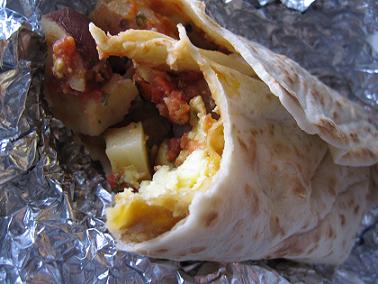
Guerrilla Grub has indeed set up shop at the prime commuter hub of the MacArthur BART stop, serving breakfast burritos out of a pushcart adorned with its evocative fist-gripping-a-fork logo for early morning riders. Besides the hot dog guy, I have never seen a street food vendor at MacArthur. In fact, outside of Fruitvale taco trucks and the odd ambitious cupcakers at Art Murmur, I haven’t seen a street food vendor anywhere in the East Bay. Could a true revolution be at hand?

Guerrilla Grub is not a bad start by any means.

Although there’s nothing that you wouldn’t find outside of a “traditional” breakfast burrito — flour tortilla, scrambled eggs, potatoes, sautéed onions, salsa, cheddar cheese, and a chorizo option — it’s put together with a competency that makes one darn savory (yet not overwhelmingly heavy) morning meal.

I went with the chorizo version to maximize my pleasure. At three bucks, it was well worth it. The chorizo did not perspire grease, as it is apt to do, and the red potato pieces added a nice, solid texture. The spiciness was enough to keep it exciting but not too overloaded for the typical norteno palate… my lips were tingly and my nose was running, but I loved every minute of it. Upon first try, it wins for flavor, non-sogginess, balance of flavors, and for perfect portion size. I usually feel like I’ve OD’d on carbs after a burrito, but Guerrilla Grub’s fare is the right size to energize commuters just beginning their day.

All in all, the revolution gets my fist pump of approval. Hopefully, Oakland will see more carts in the future.

Poll: Voters give $11 billion water bond thumbs down

3

By Rebecca Bowe

There is very weak support across political and geographic boundaries in California for a proposed $11 billion water bond that will go on the November ballot, according to the results of a poll released yesterday.

Just 34 percent of respondents said they would vote yes on the proposed $11 billion bond, while 55 percent said they would vote no. A more detailed breakdown revealed that 32 percent of likely voters indicated that they would definitely vote no, while only 12 percent said they would definitely vote yes.

“This bond is in deep trouble,” said Ben Tulchin of Tulchin Research, the firm that conducted the poll. “No bond has ever won statewide that started with a majority against it. It faces a real uphill battle.” Tulchin Research conducted the poll at the request of groups opposing the bond. The poll surveyed 600 likely voters across California, asking respondents to share their opinions after reading them the title and summary.

Tulchin, who has conducted polls for bonds and ballot initiatives throughout California, said support for proposals typically start at a high point and then decline as the election date nears. “In this case, the bond is starting at a low point,” he said. “In general, you want to see support around 60 percent” to win on a proposal, he said. “This is nothing near that.”

The proposed bond would include funding for a variety of water-infrastructure projects including new dams and reservoirs. Its primary backers include Gov. Arnold Schwarzenegger, who last year said he would reject any water bill that didn’t include a plan to fund new water-storage projects, and major agricultural interests who are concerned about secure water availability for irrigation purposes.

Mark Schlosberg, of San Francisco-based Food & Water Watch, opposes the bond.

“It’s the wrong bond, at the wrong time, and it does the wrong thing,” Schlosberg told the Guardian. He described it as a measure that could result in giveaways to corporate interests, such as developers of major desalination facilities. Some $1 billion of the bond is earmarked to go toward water recycling or desalination projects.

Schlosberg said he expects big agriculture and other backers to spend “tens of millions” in support of the proposed bond. But in the face of high unemployment and cuts to education, public safety and other services, “We can’t afford to spend $11 billion on this boondoggle,” he said.

Meanwhile, Congressional representatives have been airing concerns regarding water policy too. According to this post on Calitics, four members of the house recently sent a letter to Sen. Diane Feinstein blasting her plan to introduce legislation to speed pumping out of the Delta.

Appetite: Forecast — a downpour of delicious varietals and gourmet bites

0

It’s been a stunning week of sunny weather… We may get a little rain on Saturday, but no problem if we can spend the afternoon indoors sipping delicious wine, right? On Sat/20, the largest competition of American wines in the world takes place in Fort Mason’s Festival Pavilion.

The San Francisco Chronicle Wine Competition features literally thousands of our country’s best with gourmet bites along the way. Maybe it’s Sonoma Artisan Foie Gras or A Perfect Pear‘s delicious jams. Or you can sample what the CCA students are cooking up.

The event started in 1983 as an annual fundraiser for the Santa Rosa Junior College Wine Studies Program & Culinary Arts Program (now that’s a mouthful), and was then known as the humble Cloverdale Citrus Fair wine competition — eventually growing to the point where it moved to SF. More than 4800 nationwide wines are judged in January by 60 industry judges. The gold medal wines are offered to you — that’s a lot of wine tasting!

You’ll taste wines of many a varietal and within a wide price range, like a Norton from Missouri, Rieslings from both coasts, or a Chambourcin from the Finger Lakes. Fort Mason is yours to roam: sipping, nibbling, taking in views of Golden Gate Bridge. Rainy or not, that sounds like a sweet Saturday.

San Francisco Chronicle Wine Competition
Sat/20; 2-5pm, $60 advance/ $80 at the door
Fort Mason Center Festival Pavillion, 38 Fort Mason 11
www.winejudging.com
twitter.com/sfcwinecomp

Check out Virginia’s culinary itinerary site www.theperfectspotsf.com for more food news and views.

Uproot: Playing with the new Food Environment Atlas

0

By Robyn Johnson

The USDA’s freshly released Food Environment Atlas has been getting some buzz the last few days, coinciding with Michelle Obama’s recent vow to tackle childhood obesity and food accessibility issues and a lot of dialogue and ranting going on in the media about big bad Agribusiness and the hyper-idealism and hypocrisy of the locavore movement. (Mrs. Obama herself has drawn some fire — critics have taken aim at her overstatement of the severity of the rise of obesity and its possible fallout, the “inappropriateness” of mentioning her own daughters’ brush with chubbiness, and her dodginess about important societal causes of childhood obesity. Oh, the pitfalls of a crusading First Lady!)


The atlas interactively charts 90 indicators of the food environment, like availability of fresh produce, fast food restaurants, and grocery stores, amount of physical activity evidenced in the population, and food costs and taxes. Users can generate maps showing variations countywide, regionally, or by state, depending on the data available. Users can also make advance searches for multiple factors, like poverty prevalence plus number of farmers markets available, if you want to carefully dance the line between correlation and causation. Other features include percentages of low-income homes over a mile away from grocery stores, types and quantities of foods eaten at home, food insecurity, obesity rates, farm to school programs, and a slew of other statistical information. (For a real horror show search for low-income preschool obesity rates).

This map shows the availability of farmers markets (or lack thereof) throughout the country.

I can’t say for certain since the highly trafficked link has been breaking throughout the day, but the atlas seems to work best at giving a broader comparative perspective of the food-related socioeconomic issues of the US. When trying to identify the relative culinary desert commonly known as West Oakland, the entire Bay Area portion of the map stayed the same minty green that denotes a high access to grocery stores — clearly not the case. That being said, some interesting disparities crop up. Colorado is among the highest of the states for fast food spending per person, but also has one of the least obese populations — Coloradoans also drink the least amount of soda and rank in the highest category for exercise. Play around and see what you can find, but you may not want to jump to any conclusions ….

Alerts

0

alerts@sfbg.com

WEDNESDAY, FEB. 17

Same Sex Marriage Forum

Attend this forum about which entity — the state or the federal government — should define marriage. The forum is led by a panel of experts from human rights organizations and SF Chief Deputy City Attorney Therese Stewart, attorney for the plaintiffs in the current court case challenging Proposition 8.

6:30 p.m., $20

Commonwealth Club

595 Market, 2nd floor, SF

(415) 597-6700


THURSDAY, FEB. 18

Human rights in Chiapas

Hear Victor Hugo López of Fray Bartolomé de las Casas Human Rights Center (Frayba) in San Cristóbal de las Casas, Chiapas, Mexico. López will discuss human rights and the prospects for political change in the region in 2010. Frayba produces human rights reports, defends cases in court, and supports indigenous communities under attack.

7:30 p.m., $5–$10 sliding scale

La Peña Cultural Center

3105 Shattuck, Berk.

(510 654-9587


Wreaking HavoQ

Attend this organizing meeting for Pride at Work, a queer advocacy group fighting for economic and social justice. The meeting will cover upcoming projects such as fighting the gentrification of queer neighborhoods, resisting attacks on immigrants, and advocating for queer workers’ rights.

6 p.m., free

UNITE HERE Local 2

209 Golden Gate, SF

sfprideatwork.org


SUNDAY, FEB. 21

Day of Remembrance

Commemorate the anniversary of Executive Order 9066, which led to the incarceration of 120,000 people of Japanese descent in 1942 during World War II. The event features a speech by California Assembly Member Warren Furutani (D-Long Beach), a performance by Purple Moon Dance Project, a candle- lighting ceremony, and more. Reception to follow at the Japanese Cultural and Community Center at 1840 Sutter.

2 p.m., free

Kabuki Sundance Cinema

1881 Post, SF

(415) 921-5007


Peacemas

Celebrate the anniversary of the peace symbol with an evening of entertainment that includes inspirational clown Wavy Gravy, Selma Vincent as Mrs. T. Bill Banks of the National Association of Rich People, jazz violinist India Cooke, and more.

7 p.m., free

Redwood Gardens

2950 Derby, Berk.

(510) 845-5481


Yeasayers for Prop. 15

Hear Sen. Mark Leno (D-SF), Assembly Member Tom Ammiano (D-SF), and other luminaries speak in support of the California Fair Elections Act, or Proposition 15, on the upcoming June ballot. The act would pilot a voluntary system of public financing for secretary of state campaigns, which means elected officials can spend less time fund-raising and more time solving California’s problems.

1 p.m., free

San Francisco Main Library

100 Larkin, SF

(415) 648-6740


TUESDAY, FEB. 23


A chicken in every yard

Learn the logistics of raising chickens in a urban environment at this workshop with Alexis Koefoed. The Soul Food Farm maven will answer questions about the legality of raising chickens in your area, what it costs to raise chickens, where to buy chicks, and more. There are two sessions.

6 p.m. and 7:30 p.m., $20

18 Reasons

593 Guerrero, SF email info@18reasons.org 2 Mail items for Alerts to the Guardian Building, 135 Mississippi St., SF, CA 94107; fax to (415) 255-8762; or e-mail alert@sfbg.com. Please include a contact telephone number. Items must be received at least one week prior to the publication date.

Film Listings

0

Film listings are edited by Cheryl Eddy. Reviewers are Kimberly Chun, Michelle Devereaux, Max Goldberg, Dennis Harvey, Johnny Ray Huston, Erik Morse, Louis Peitzman, Lynn Rapoport, Ben Richardson, and Matt Sussman. The film intern is Peter Galvin. For rep house showtimes, see Rep Clock. For first-run showtimes, see Movie Guide. Due to the Presidents’ Day holiday, theater information was incomplete at presstime.

SF INDIEFEST

The 12th San Francisco Independent Film Festival runs through Thurs/18 at the Roxie, 3117 16th St, SF. For tickets (most shows $11), visit www.sfindie.com. All times pm.

WED/17

Down Terrace 7:15. No One Knows About Persian Cats 7:15. Godspeed 9:30. At the Foot of a Tree 9:30.

THURS/18

Art of the Steal 7:15. TBA 7:15. Harmony and Me 9:30. TBA 9:30.

OPENING

*”Academy Award-Nominated Short Films: Animated” Just because it’s animation doesn’t mean it’s just for kids. Like the live-action Oscar-nominated shorts, this year’s animated selections have got range, from the traditionally child-friendly to downright vulgar. Skewing heavily towards CG fare, the shorts vary from a Looney Tunes-style chase for an elderly woman’s soul (The Lady and the Reaper) to the Wallace and Gromit BBC special, A Matter of Loaf and Death. Most entertaining by far is Logorama, an action-packed tale set in a world populated by familiar trademarked logos. Any film that casts the Michelin man as a garbage-mouthed cop on the case of a renegade Ronald McDonald deserves to win all the awards in the universe. (1:35) (Galvin)

*”Academy Award-Nominated Short Films: Live Action” Aren’t you tired of wondering what all the fuss is about when the Academy awards their Oscar for Best Short? In an effort to give audiences a chance to play along, Shorts International is screening these less-seen works together. Though one or two of the five nominated films threaten to adhere to the Academy’s penchant for either heartbreaking or heartwarming, the majority are surprisingly oddball picks. Perhaps most odd of all is Denmark/U.S. submission The New Tenants. Feeling a tad forced but no less funny for it, Tenants draws on celebrities like Vincent D’Onofrio and comedian Kevin Corrigan to bring life to this surreal adaptation by Anders Thomas Jensen (2006’s After the Wedding). My pick would be Sweden’s gloriously goofy Instead of Abracadabra, which stars a stay-at-home slacker as he puts on a magic show for his father’s birthday. Obviously, some selections are going to be better than others, but hey, they’re shorts. If you don’t like one, just wait 10 minutes and you’ll find yourself somewhere completely different. (1:35) (Galvin)

Happy Tears Director Mitchell Litchenstein’s second film attempts to take on the family drama in the similarly warped fashion that his 2007 debut Teeth skewed the horror genre. Unfortunately, his thoroughly offbeat humor continues to be as much of a liability as a asset, and in this case the genre isn’t nearly as forgiving of clumsiness. Parker Posey and Demi Moore star as dissimilar sisters tasked with caring for their father (Rip Torn), who copes with dementia. Posey turns in an animated performance that will gain her as many fans as it alienates, and Moore is surprisingly pleasant as a level-headed hippie. As the sisters interrogate a flighty nurse (Ellen Barkin) who may or may not be a crackhead, clean up after their incontinent father, and dig for treasure in the backyard, the restless plot creates a murky mix of flat humor, heavy drama and conventional whimsy. A subplot involving Posey’s fiance dealing with the legacy of his famous father’s art feels tangential, but may provide the most autobiographical moments in the film. The title Happy Tears is borrowed from the record-selling 1964 painting and Lichtenstein is indeed the son of legendary pop-art painter Roy Lichtenstein. Perhaps these moments function as catharsis for the director, but until he learns to better manage his impulses, his films will continue to be more awkward than funny. (1:36) (Galvin)

*Leonard Cohen: Live at the Isle of Wight 1970 The dawn of the Me Decade saw the largest-ever music festival to that date —albeit one that was such a logistical, fiscal and hygenic disaster that it basically killed the development of similar events for years. This was the height of “music should be free” sentiments in the counterculture, with the result that many among the estimated six to eight hundred thousand attendees who overwhelmed this small U.K. island showed up without tickets, refused to pay, and protested in ways that included tearing down barrier walls and setting fires. It was a bummer, man. But after five days of starry acts often jeered by an antsy crowd — including everyone from Joni, Hendrix, Dylan, Sly Stone, the Who and the Doors to such odd bedfellows as Miles Davis, Tiny Tim, Voices of East Harlem, Supertramp, and Gilberto Gil — Canadian troubador Cohen appeared at 4 a.m. on a Monday to offer balm. Like director Murray Lerner’s 1995 Message to Love, about the festival as a whole, this footage has been shelved for decades, but it bounces right back from the dead — albeit soothingly. Cohen seems blissed out, pupils like black marbles, his between-song musings are as poetical as those fascinating lyrics, and his voice is suppler than the rasp it would soon become. Kris Kristofferson, Judy Collins, Joan Baez, and bandmate Bob Johnson offer reflections 40 years later. But the main attraction is obviously Cohen, who is magnetic even if an hour of (almost) nothing but ballads reveals how stylistically monotone his songwriting could be. (1:04) Roxie. (Harvey)

*The Most Dangerous Man in America: Daniel Ellsberg and the Pentagon

Papers For many, Daniel Ellsberg is a hero — a savior of American First Amendment rights and one of the most outspoken opponents of the Vietnam war. But as this documentary (recently nominated for an Academy Award) shows, it’s never an an easy decision to take on the U.S. government. Ellsberg himself narrates the film and details his sleepless nights leading up to the leak of the Pentagon Papers — the top secret government study on the Vietnam war — to the public. Though there are few new developments in understanding the particulars of the war or the impact the release of the Papers had on ending the conflict, the film allows audiences to experience the famous case from Ellsberg’s point of view, adding a fresh and poignantly human element to the events; it’s a political documentary that plays more like a character drama. Whether you were there when it happened or new to the story, there is something to be appreciated from this tale of a man who fell out of love with his country and decided to do something about it. (1:34) (Galvin)

My Son, My Son, What Have Ye Done See “Ain’t No Iguana.” (1:31) Castro.

*North Face You’ll never think of outerwear the same way again — and in fact you might be reaching for your fleece and shivering through the more harrowing climbing scenes of this riveting historical adventure based on a true tale. Even those who consider themselves less than avid fans of outdoor survival drama will find their eyes frozen, if you will, on the screen when it comes to this retelling/re-envisioning of this story, legendary among mountaineers, of climbers, urged on by Nazi propaganda, to tackle the last “Alpine problem.” At issue: the unclimbed north face of Switzerland’s Eiger, a highly dangerous and unpredictable zone aptly nicknamed “Murder Wall.” Two working-class friends, Toni Kurz (Benno Fürmann of 2008’s Jerichow) and Andi Hinterstoisser (Florian Lukas) — here portrayed as climbing fiends driven to reach summits rather than fight for the Nazis — take the challenge. There to document their achievement, or certain death, is childhood friend and Kurz’s onetime sweetheart Luise (Johanna Wokalek, memorable in 2008’s The Baader Meinhof Complex), eager to make her name as a photojournalist while fending off the advances of an editor (Ulrich Tukur) seeking to craft a narrative that positions the contestants as model Aryans. But the climb — and the Eiger, looming like a mythical ogre — is the main attraction here. Filmmaker Philipp Stölzl brings home the sheer heart-pumping exhilaration and terror associated with the sport — and this specific, legendarily tragic climb — by shooting in the mountains with his actors and crew, and the result goes a way in redeeming an adventure long-tainted by its fascist associations. (2:01) Smith Rafael. (Chun)

Shutter Island Martin Scorsese directs Leonardo DiCaprio in this adaptation of the Dennis Lehane novel, a mystery set at an isolated 1950s insane asylum. (2:18)

ONGOING

Avatar James Cameron’s Avatar takes place on planet Pandora, where human capitalists are prospecting for precious unobtainium, hampered only by the toxic atmosphere and a profusion of unfriendly wildlife, including the Na’vi, a nine-foot tall race of poorly disguised cliches. When Jake Sully (Sam Worthington), a paraplegic ex-marine, arrives on the planet, he is recruited into the “Avatar” program, which enables him to cybernetically link with a part-human, part-Na’vi body and go traipsing through Pandora’s psychedelic underbrush. Initially designed for botanical research, these avatars become the only means of diplomatic contact with the bright-blue natives, who live smack on top of all the bling. The special effects are revolutionary, but the story that ensues blends hollow “noble savage” dreck with events borrowed from Dances With Wolves (1990) and FernGully: The Last Rainforest (1992). When Sully falls in love with a Na’vi princess and undergoes a spirit journey so he can be inducted into the tribe and fight the evil miners, all I could think of was Kevin Bacon getting his belly sliced in The Air Up There (1994). (2:42) (Richardson)

The Blind Side When the New York Times Magazine published Michael Lewis’ article “The Ballad of Big Mike” — which he expanded into the 2006 book The Blind Side: Evolution of a Game — nobody could have predicated the cultural windfall it would spawn. Lewis told the incredible story of Michael Oher — a 6’4, 350-pound 16-year-old, who grew up functionally parentless, splitting time between friends’ couches and the streets of one of Memphis’ poorest neighborhoods. As a sophomore with a 0.4 GPA, Oher serendipitously hitched a ride with a friend’s father to a ritzy private school across town and embarked on an unbelievable journey that led him into a upper-class, white family; the Dean’s List at Ole Miss; and, finally, the NFL. The film itself effectively focuses on Oher’s indomitable spirit and big heart, and the fearless devotion of Leigh Anne Tuohy, the matriarch of the family who adopted him (masterfully played by Sandra Bullock). While the movie will delight and touch moviegoers, its greatest success is that it will likely spur its viewers on to read Lewis’ brilliant book. (2:06) (Daniel Alvarez)

The Book of Eli The Book of Eli isn’t likely to win many prizes, but it could eventually be up for a lifetime achievement award in the “most sentimental movie to ever feature multiple decapitations by machete” category. Denzel Washington plays the titular hero, displaying scant charisma as a post-apocalyptic drifter with a beatific personality and talent for dismemberment. Eli squares off against an evil but urbane kleptocrat named Carnegie (Gary Oldman phoning in a familiar “loathsome reptile” performance). Convinced that possession of Eli’s book will place humanity’s few survivors in his thrall, Carnegie will do anything to get it, even pimping out the daughter (Mila Kunis, utterly unconvincing) of his blind girlfriend (Jennifer Beals, who should stick to playing people who can see). The two slumming lead actors chase each other down the highway, pausing for some spiritual hogwash and an exchange of gunfire before limping towards an execrable twist ending. At least there’s a Tom Waits cameo. (1:58) (Richardson)

Broken Embraces Pedro Almodóvar has always dabbled in the Hitchcockian tropes of uxoricide, betrayal, and double-identity, but with Broken Embraces he has attained a polyglot, if slightly mimicking, fluency with the language of Hollywood noir. A story within a story and a movie within a movie, Embraces begins in the present day with middle-aged Catalan Harry Caine (Lluís Homar), a blind screenwriter who takes time between his successful writing career to seduce and bed young women sympathetic to his disability. “Everything’s already happened to me,” he explains to his manager, Judit (Blanca Portillo). “All that’s left is to enjoy life.” But this life of empty pleasures is brought to a sudden halt when local business magnate Ernesto Martel (José Luis Gómez) has died; soon after, Ernesto Jr. (Rubén Ochandiano), who has renamed himself Ray X, visits Caine with an unusual request. The action retreats 14 years when Caine was a young (and visually abled) director named Mateo Blanco; he encounters a breathtaking femme fatale, Lena (Penelope Cruz) — an actress-turned-prostitute named Severine, turned secretary-turned-trophy wife of Ernesto Martel — when she appears to audition for his latest movie. If all of the narrative intricacies and multiplicitous identities in Broken Embraces appear a bit intimidating at first glance, it is because this is the cinema of Almodóvar taken to a kind of generic extreme. As with all of the director’s post-’00 films, which are often referred to as Almodóvar’s “mature” pictures, there is a microscopic attention to narrative development combined with a frenzied sub-plotting of nearly soap-operatic proportions. But, in Embraces, formalism attains such prominence that one might speculate the director is simply going through the motions. The effect is a purposely loquacious and overly-dramatized performance that pleasures itself as much by setting up the plot as unraveling it. (2:08) Smith Rafael. (Morse)

Crazy Heart “Oh, I love Jeff Bridges!” is the usual response when his name comes up every few years for Best Actor consideration, usually via some underdog movie no one saw, and the realization occurs that he’s never won an Oscar. The oversight is painful because it could be argued that no leading American actor has been more versatile, consistently good, and true to that elusive concept “artistic integrity” than Bridges over the last 40 years. It’s rumored Crazy Heart was slotted for cable or DVD premiere, then thrust into late-year theater release in hopes of attracting Best Actor momentum within a crowded field. Lucky for us, this performance shouldn’t be overlooked. Bridges plays “Bad” Blake, a veteran country star reduced to playing bars with local pickup bands. His slide from grace hasn’t been helped by lingering tastes for smoke and drink, let alone five defunct marriages. He meets Jean (Maggie Gyllenhaal), freelance journalist, fan, and single mother. They spark; though burnt by prior relationships, she’s reluctant to take seriously a famous drunk twice her age. Can Bad handle even this much responsibility? Meanwhile, he gets his “comeback” break in the semi-humiliating form of opening for Tommy Sweet (Colin Farrell) — a contemporary country superstar who was once Bad’s backup boy. Tommy offers a belated shot at commercial redemption; Jean offers redemption of the strictly personal kind. There’s nothing too surprising about the ways in which Crazy Heart both follows and finesses formula. You’ve seen this preordained road from wreckage to redemption before. But actor turned first-time director Scott Cooper’s screenplay honors the flies in the windshield inherited from Thomas Cobb’s novel — as does Bridges, needless to say. (1:51) (Harvey)

Creation Critically drubbed in its high-profile slot as the 2009 Toronto International Film Festival’s opening-night film, this handsome costume drama isn’t all that bad — but neither is it very good. Offscreen married couple Paul Bettany and Jennifer Connelly play Mr. and Mrs. Darwin in the mid-1850s, just as he’s about to incite a still-active public firestorm with The Origin of the Species. Charles is hardly in any shape to face such controversy, as the death of favorite daughter Annie (Martha West) has had a grave impact on both his psychological and physical health. That event has only strengthened wife Emma’s Christian faith, while destroying his own. Also arguing against the evolutionary tract’s publication is their close friend Reverend Innes (Jeremy Northam); contrarily urging Darwin to go ahead and “kill God” are fellow scientitific enthusiasts played by Toby Jones and Benedict Cumberbatch. Director Jon Amiel lends considerable visual panache, but Creation ultimately misses the rare chance to meaningfully scrutinize rationalism vs. religious belief perhaps the industrial era’s most importantly divisive issue — in favor of conventional dramatic dwelling on grief over a child’s loss. The appealing Bettany is somewhat straitjacketed by a character that verges on being a sickly bore, while Connolly is, as usual, a humorless one. (1:58) (Harvey)

Dear John As long as you know what you’re getting yourself into, Dear John is a solid effort. Not extraordinary by any means, it’s your standard Nicholas Sparks book-turned-film: boy meets girl — drama, angst, and untimely death ensue. Here, Channing Tatum stars at the titular John, a soldier on leave who falls in love with the seemingly perfect Savannah (Amanda Seyfried). Both actors are likable enough that their romance is charming, if not always believable. And Dear John‘s plot turns, while not quite surprising, are at least dynamic enough to keep the audience engaged. But at the end of the day, this is still a Nicholas Sparks movie — even with the accomplished Lasse Hallström taking over directorial responsibilities. There are still plenty of eye-roll moments and, more often than not, Dear John employs the most predictable tearjerking techniques. By the time you realize why the film is set in 2001, it’s September 11. Sad? Surely. Cheap? You betcha. (1:48) (Peitzman)

District 13: Ultimatum Often cited by the uninformed as a wellspring of all that is artsy and pretentious about film, France is also home to some quality action movies. District 13: Ultimatum is the second in a series of breezy, adrenalized crime capers about a Parisian housing project and the politicians that secretly crave its destruction, and it succeeds as a satisfying reprise of the original’s inventive stunt-work and good-natured self-mockery. Cyril Raffaeli (a sort of Frenchified Bruce Willis) returns as Captain Damien Tomasso, a principled super-cop whose friendship with hunky petty criminal Leito (David Belle) carries over from the first film. Belle is widely acknowledged as the inventor of parkour, the French martial art of death-defying urban gymnastics, and an avalanche of clever fight choreography ensues as the pair karate kick their way toward the bottom of the conspiracy and a showdown with the forces of evil: an American conglomerate called “Harriburton.” (1:41) (Richardson)

Edge of Darkness (1:57)

*An Education The pursuit of knowledge — both carnal and cultural — are at the tender core of this end-of-innocence valentine by Danish filmmaker Lone Scherfig (who first made her well-tempered voice heard with her 2000 Dogme entry, Italian for Beginners), based on journalist Lynn Barber’s memoir. Screenwriter Nick Hornby breaks further with his Peter Pan protagonists with this adaptation: no man-boy mopers or misfits here. Rather, 16-year-old schoolgirl Jenny (Carey Mulligan) is a good girl and ace student. It’s 1961, and England is only starting to stir from its somber, all-too-sober post-war slumber. The carefully cloistered Jenny is on track for Oxford, though swinging London and its high-style freedoms beckon just around the corner. Ushering in those freedoms — a new, more class-free world disorder — is the charming David (Peter Sarsgaard), stopping to give Jenny and her cello a ride in the rain and soon proffering concerts and late-night suppers in the city. He’s a sweet-faced, feline outsider: cultured, Jewish, and given to playing fast and loose in the margins of society. David can see Jenny for the gem she is and appreciate her innocence with the knowing pleasure of a decadent playing all the angles. The stakes are believably high, thanks to An Education‘s careful attention to time and place and its gently glamored performances. Scherfig revels in the smart, easy-on-eye curb appeal of David and his friends while giving a nod to the college-educated empowerment Jenny risks by skipping class to jet to Paris. And Mulligan lends it all credence by letting all those seduced, abandoned, conflicted, rebellious feelings flicker unbridled across her face. (1:35) Smith Rafael. (Chun)

*Fantastic Mr. Fox A lot of people have been busting filmmaker Wes Anderson’s proverbial chops lately, lambasting him for recent cinematic self-indulgences hewing dangerously close to self-parody (and in the case of 2007’s Darjeeling Limited, I’m one of them). Maybe he’s been listening. Either way, his new animated film, Fantastic Mr. Fox, should keep the naysayer wolves at bay for a while — it’s nothing short of a rollicking, deadpan-hilarious case study in artistic renewal. A kind of man-imal inversion of Anderson’s other heist movie, his debut feature Bottle Rocket (1996), his latest revels in ramshackle spontaneity and childlike charm without sacrificing his adult preoccupations. Based on Roald Dahl’s beloved 1970 book, Mr. Fox captures the essence of the source material but is still full of Anderson trademarks: meticulously staged mise en scène, bisected dollhouse-like sets, eccentric dysfunctional families coming to grips with their talent and success (or lack thereof).(1:27) (Devereaux)

*Fish Tank There’s been a string of movies lately pondering what Britney once called the not-a-girl, not-yet-a-woman syndrome, including 2009’s An Education and Precious: Based on the Novel Push By Sapphire. Enter Fish Tank, the gritty new drama from British filmmaker Andrea Arnold. Her films (including 2006’s Red Road) are heartbreaking, but in an unforced way that never feels manipulative; her characters, often portrayed by nonactors, feel completely organic. Fish Tank‘s 15-year-old heroine, Mia (played by first-time actor Katie Jarvis), lives with her party-gal single mom and tweenage sister in a public-housing high-rise; all three enjoy drinking, swearing, and shouting. But Mia has a secret passion: hip-hop dancing, which she practices with track-suited determination. When mom’s foxy new boyfriend, Connor (Michael Fassbender, from 2008’s Hunger) encourages her talent, it’s initially unclear what Connor’s intentions are. Is he trying to be a cool father figure, or something far more inappropriate? Without giving away too much, it’s hard to fear too much for a girl who headbutts a teenage rival within the film’s first few minutes — though it soon becomes apparent Mia’s hard façade masks a vulnerable core. Her desire to make human connections causes her to drop her guard when she needs it the most. In a movie about coming of age, a young girl’s bumpy emotional journey is expected turf. But Fish Tank earns its poignant moments honestly — most coming courtesy of Jarvis, who has soulfullness to spare. Whether she’s acting out in tough-girl mode or revealing a glimpse of her fragile inner life, Arnold’s camera relays it all, with unglossy matter-of-factness. (2:02) Smith Rafael. (Eddy)

44 Inch Chest You couldn’t ask for a much better cast than the one 44 Inch Chest offers. The film’s a veritable who’s who of veteran British actors: Tom Wilkinson, Ray Winstone, John Hurt, Ian McShane. The story’s a bit less exceptional, though kudos to director Malcolm Venville and co-writers Louis Mellis and David Scinto for subverting expectations. While the movie’s poster suggests a gritty crime thriller, 44 Inch Chest is actually a somewhat subtle character drama. Winstone stars as Colin, a man devastated after his wife Liz (Joanna Whalley) leaves him for a younger man. His mobster friends encourage him to kidnap her new squeeze, nicknamed Loverboy (Melvil Poupaud), as revenge. But don’t expect any Tarantino-esque torture scenes: 44 Inch Chest spends most of its time revealing what’s going on in Colin’s head while he struggles to make sense of his friends’ conflicting philosophies. Hurt’s Old Man Peanut is the obvious standout, but McShane should also be commended for playing a character who is suave and confident, despite being a gay man named Meredith. (1:34) (Peitzman)

From Paris with Love Every so often, I walk out of a film feeling like I’ve been repeatedly buffeted by blows to the face. Transformers 2: Revenge of the Fallen (2009) had this effect, and it is now joined by From Paris With Love, a movie so aggressively stupid that the mistaken assumption that it was adapted from a video game could be construed as an insult to video games. John Travolta shows up chrome-domed as Charlie Wax, a loose-cannon CIA operative with a lot of transparently screenwritten machismo and an endless appetite for violence. He is joined by Jonathan Rhys Meyers, sporting a risible American accent, and the two embark on a frantic journey across the French capital that is almost as racist as it is misogynistic. I could fill an entire issue of this newspaper eviscerating this movie —suffice to say, don’t see it. (1:35) (Richardson)

The Hurt Locker When the leader of a close-knit U.S. Army Explosive Ordnance Disposal squad is killed in action, his subordinates have barely recovered from the shock when they’re introduced to his replacement. In contrast to his predecessor, Sgt. James (Jeremy Renner) is no standard-procedure-following team player, but a cocky adrenaline junkie who puts himself and others at risk making gonzo gut-instinct decisions in the face of live bombs and insurgent gunfire. This is particularly galling to next-in-command Sanborn (Anthony Mackie). An apolitical war-in-Iraq movie that’s won considerable praise for accuracy so far from vets (scenarist Mark Boal was “embedded” with an EOD unit there for several 2004 weeks), Kathryn Bigelow’s film is arguably you-are-there purist to a fault. While we eventually get to know in the principals, The Hurt Locker is so dominated by its seven lengthy squad-mission setpieces that there’s almost no time or attention left for building character development or a narrative arc. The result is often viscerally intense, yet less impactful than it would have been if we were more emotionally invested. Assured as her technique remains, don’t expect familiar stylistic dazzle from action cult figure Bigelow (1987’s Near Dark, 1989’s Blue Steel, 1991’s Point Break) — this vidcam-era war movie very much hews to the favored current genre approach of pseudo-documentary grainy handheld shaky-cam imagery. (2:11) (Harvey)

*The Imaginarium of Doctor Parnassus From the title to the plot to the execution, The Imaginarium of Doctor Parnassus is the kind of movie you’re told not to see sober. This is a film in which Tom Waits plays the Devil, in which characters’ faces change repeatedly, in which Austin Powers‘ Verne Troyer makes his triumphant big-screen return. The story is your basic battle between good and evil, with Doctor Parnassus (Christopher Plummer) struggling to save souls from Mr. Nick (Waits) in order to protect his daughter Valentina (Lily Cole). Meanwhile, Valentina is wooed by the mysterious Tony, played by Heath Ledger in his final film role — along with Johnny Depp, Jude Law, and Colin Farrell. There are plenty of big important themes to be analyzed here, but it’s honestly more fun to simply get lost in Doctor Parnassus’ Imaginarium. Director and co-writer Terry Gilliam has created a world and a mythology that probably takes more than one viewing to fully comprehend. Might as well let yourself get distracted by all the shiny colors instead. (2:02) (Peitzman)

Invictus Elected President of South Africa in 1995 — just five years after his release from nearly three decades’ imprisonment — Nelson Mandela (Morgan Freeman) perceives a chance to forward his message of reconciliation and forgiveness by throwing support behind the low-ranked national rugby team. Trouble is, the Springboks are currently low-ranked, with the World Cup a very faint hope just one year away. Not to mention the fact that despite having one black member, they represent the all-too-recent Apartheid past for the country’s non-white majority. Based on John Carlin’s nonfiction tome, this latest Oscar bait by the indefatigable Clint Eastwood sports his usual plusses and minuses: An impressive scale, solid performances (Matt Damon co-stars as the team’s Afrikaaner captain), deft handling of subplots, and solid craftsmanship on the one hand. A certain dull literal-minded earnestness, lack of style and excitement on the other. Anthony Peckham’s screenplay hits the requisite inspirational notes (sometimes pretty bluntly), but even in the attenuated finals match, Eastwood’s direction is steady as she goes — no peaks, no valleys, no faults but not much inspiration, either. It doesn’t help that Kyle Eastwood and Michael Stevens contribute a score that’s as rousing as a warm milk bath. This is an entertaining history lesson, but it should have been an exhilarating one. (2:14) (Harvey)

It’s Complicated Allow me to spoil one line in It’s Complicated, because I believe it sums up — better than I ever could — everything right and wrong with this movie: “I prefer a lot of semen.” Bet you never thought you’d hear Meryl Streep say that. The thrill of movies like It’s Complicated (see also: Nancy Meyer’s 2003 senior romance Something’s Gotta Give) is in seeing actors of a certain age get down and dirty. There is something fascinating (and for audiences of that same age, encouraging) about watching Alec Baldwin inadvertently flash a webcam or Streep and Steve Martin making croissants while stoned. Once the novelty wears off, however, It’s Complicated is a fairly run-of-the-mill romcom. Sure, the story’s a bit more unusual: 10 years after their divorce, Jane (Streep) and Jake (Baldwin) begin having an affair. But the execution is full of the same clichés you’ve come to expect from the genre, including plenty of slapstick, miscommunication, and raunchy humor. It’s delightful to see such talented actors in a film together. Less delightful when they’re shotgunning weed and saying “oh em gee.” (2:00) (Peitzman)

*The Last Station Most of the buzz around The Last Station has focused on Helen Mirren, who takes the lead as the Countess Sofya, wife of Leo Tolstoy (Christopher Plummer). Mirren is indeed impressive — when is she not? — but there’s more to the film than Sofya’s Oscar-worthy outbursts. The Last Station follows Valentin Bulgakov (James McAvoy), hired as Tolstoy’s personal secretary at the end of the writer’s life. Valentin struggles to reconcile his faith in the anarchist Christian Tolstoyan movement with his sympathy for Sofya and his budding feelings for fellow Tolstoyan Masha (Kerry Condon). For the first hour, The Last Station is charming and very funny. Once Tolstoy and Sofya’s relationship reaches its most volatile, however, the tone shifts toward the serious — a trend that continues as Tolstoy falls ill. After all the lighthearted levity, it’s a bit jarring, but the solid script and accomplished cast pull The Last Station together. Paul Giamatti is especially good as Vladimir Chertkov, who battles against Sofya for control of Tolstoy’s will. You’ll never feel guiltier for putting off War and Peace. (1:52) (Peitzman)

Legion (1:40)

The Lovely Bones There comes a point when the boy with every toy should have some taken away, in order to improve focusing skills. Ergo, it seemed like a good idea when Peter Jackson became attached to The Lovely Bones. A (relatively) “small” story mixing real-world emotions with the otherworldly à la 1994’s Heavenly Creatures? Perfect. His taste for the grotesque would surely toughen up the hugely popular novel’s more gelatinous aspects. But no: these Bones heighten every mush-headed weakness in the book, sprinkling CGI sugar on top. Alice Sebold’s tale of a 1970s suburban teenager murdered by a neighbor is one of those occasional books that becomes a sensation by wrapping real-world horror (i.e. the brutal, unsolved loss of a child) in the warm gingerbread odor of spiritual comfort food. Susie Salmon (Saoirse Ronan of 2007’s Atonement) narrates from a soft-focus wish-fulfillment afterlife in which she can watch (and occasionally be seen by) those left behind. Bones is sentimentally exploitative in an ingenious way: it uses the protagonist’s violent victimization to stir a vague New Age narcissism in the reader. Susie is, yes, an “ordinary” girl, but she (and we) are of course so loved and special that all heavenly rules must be suspended just for her. Ultimately, divine justice is wrought upon her killer (Stanley Tucci, whose appropriately creepy scenes are the film’s best) — but why didn’t it intervene in time to save his prior victims? Guess they weren’t special enough. This is specious material — powerful in outline, woozy in specifics — that needed a grounding touch. But Jackson directs as if his inspirations were the worst of coproducer Steven Spielberg (i.e., those mawkish last reels) and Baz Luhrmann (in empty kitsch pictorialism). Seriously, after a while I was surprised no unicorns jumped o’er rainbows. (2:15) (Harvey)

Me and Orson Welles It’s 1937, and New York City, like the rest of the nation, presumably remains in the grip of the Great Depression. That trifling historical detail, however, is upstaged in Richard Linklater’s Me and Orson Welles (adapted from the novel by Robert Kaplow) by the doings at the newly founded Mercury Theatre. There, in the equally tight grip of actor, director, and company cofounder Orson Welles — who makes more pointed use of the historical present, of Italian fascism — a groundbreaking production of Shakespeare’s Julius Caesar hovers on the brink of premiere and possible disaster. Luckily for swaggering young aspirant Richard (High School Musical series star Zac Efron), Welles (Christian McKay), already infamously tyrannical at 22, is not a man to shrink from firing an actor a week before opening night and replacing him with a 17-year-old kid from New Jersey. Finding himself working in perilous proximity to the master, his unharnessed ego, and his winsome, dishearteningly pragmatic assistant, Sonja (Claire Danes), our callow hero is destined, predictably, to be handed some valuable life experience. McKay makes a credible, enjoyable Welles, presented as the kind of engaging sociopath who handles people like props and hails ambulances like taxicabs. Efron projects a shallow interior life, an instinct for survival, and the charm of someone who has had charming lines written for him. Still, he and Welles and the rest are all in service to the play, and so is the film, which offers an absorbing account of the company’s final days of rehearsal. (1:54) (Rapoport)

Nine Though it has a terrific concept — translating Fellini’s 1963 autobiographical fantasia 8 1/2 into musical terms — this Broadway entity owed its success to celebrity, not artistry. The 1982 edition starred Raul Julia and a host of stage-famed glamazons; the 2003 revival featured Antonio Banderas and ditto. Why did Rob Marshall choose it to follow up his celebrated-if-overrated film of 2002’s Chicago (overlooking his underwhelming 2005 Memoirs of a Geisha)? Perhaps because it provided even greater opportunity for lingerie-clad post-Fosse gyrations, starry casting, and production numbers framed as mind’s-eye fantasies just like his Chicago. (Today’s audiences purportedly don’t like characters simply bursting into song — though doesn’t the High School Musical series disprove that?) Daniel Day-Lewis plays Guido, an internationally famed, scandalous Italian film director who in 1965 is commencing production on his latest fantastical epic. But with crew and financiers breathing down his neck, he’s creatively blocked — haunted by prior successes, recent flops, and a gallery of past and present muses. They include Marion Cotillard (long-suffering wife), Penélope Cruz (mercurial mistress), Nicole Kidman (his usual star), Judi Dench (costume designer-mother figure), Sophia Loren (his actual mamma), Fergie (his first putana), and Kate Hudson (a Vogue reporter). All can sing, pretty much, though Nine‘s trouble has always been Maury Weston’s generic songs. This is splashy entertainment, intelligently conceived (not least by Michael Tolkin and the late Anthony Minghella’s screenplay, which heightens the structural complexity of Arthur Kopit’s original book) and staged. But despite taking place almost entirely in its protagonist’s head, psychological depth is strictly two-dimensional. One longs for the suggestive intellectual nuance Marcello Mastroianni originally brought to Fellini’s non-singing Guido — something Nine doesn’t permit the estimable Day-Lewis. (2:00) (Harvey)

*Percy Jackson and the Olympians: The Lightning Thief It would be easy to dismiss Percy Jackson and the Olympians: The Lightning Thief as an unabashed Harry Potter knock-off. Trio of kids with magic powers goes on a quest to save the world in a Chris Columbus adaptation of a popular young adult series — sound familiar? But The Lightning Thief is sharp, witty, and a far cry from Columbus’ joyless adaptation of Harry Potter and the Sorcerer’s Stone (2001). Logan Lerman stars as Percy Jackson, the illegitimate son of Poseidon and Catherine Keener. Once he learns his true identity at Camp Half-Blood, he sets off on a quest with his protector, a satyr named Grover, and potential love interest Annabeth, daughter of Athena. Along the way, they bump into gods and monsters from Greek mythology — with a twist. Think Percy using his iPhone to fight Medusa (Uma Thurman), or a land of the Lotus-Eaters disguised as a Lady Gaga-blasting casino. A worthy successor to Harry Potter? Too soon to say, but The Lightning Thief is at least a well-made diversion. (1:59) (Peitzman)

*Precious: Based on the Novel Push By Sapphire This gut-wrenching, little-engine-that-could of a film shows the struggles of Precious, an overweight, illiterate 16-year-old girl from Harlem. Newcomer Gabourey Sidibe is so believably vigilant that her performance alone could bring together the art-house viewers as well as take the Oscars by storm. But people need to actually go and experience this film. While Precious did win Sundance’s Grand Jury and Audience Award awards this year, there is a sad possibility that filmgoers will follow the current trend of “discussing” films that they’ve actually never seen. The daring casting choices of comedian Mo’Nique (as Precious’ all-too-realistically abusive mother) and Mariah Carey (brilliantly understated as an undaunted and dedicated social counselor) are attempts to attract a wider audience, but cynics can hurdle just about anything these days. What’s most significant about this Dancer in the Dark-esque chronicle is how Damien Paul’s screenplay and director Lee Daniels have taken their time to confront the most difficult moments in Precious’ story –- and if that sounds heavy-handed, so be it. Stop blahging for a moment and let this movie move you. (1:49) (Jesse Hawthorne Ficks)

*Saint John of Las Vegas Saint John of Las Vegas gives Steve Buscemi-philes a good long, yummy drink of our nerd overlord. His goofy Mr. Pink anti-cool has weathered nicely into a finely wrinkled facsimile of those nicotine-stained, pompadoured and comb-overed casino codgers you can find dug in on Vegas’ Fremont Street. Here, his John’s a gambler fed up with the long odds and late nights, running from a vaguely sketchy past, so he has decided to consciously choose the straight path. Read: a solid cubicle job at an auto insurance company. After summoning the courage to make a play for a raise (and sexy coworker Jill, played by Sarah Silverman), John is enlisted by his tough little man of a boss (Peter Dinklage) to become a fraud inspector. He’s placed under the tutelage of Virgil (Romany Malco of Weeds) — this is, after all, very, very loosely based a certain Divine Comedy. Off our would-be pals go on John’s tryout case, Virgil aloof and knowing and John empathizing with the many quirky characters they encounter. When their journey ends, you can’t help but be disappointed because you really don’t want this sweet-natured first film by director-writer and onetime Silicon Valley hotshot Hue Rhodes to end. It’s such a treat to watch Buscemi work, pulling the spooky-tooth tics and rattled nerves out of his bag of mannerisms. And it’s fitting that he has arrived here, because from its star to its bit players, Saint John offers a gentle Hail Mary to the usually less-than-visible guys and gals in the cameos. (1:25) (Chun)

*A Serious Man You don’t have to be Jewish to like A Serious Man — or to identify with beleaguered physics professor Larry Gopnik (the grandly aggrieved Michael Stuhlbarg), the well-meaning nebbishly center unable to hold onto a world quickly falling apart and looking for spiritual answers. It’s a coming of age for father and son, spurred by the small loss of a radio and a 20-dollar bill. Larry’s about-to-be-bar-mitzvahed son is listening to Jefferson Airplane instead of his Hebrew school teachers and beginning to chafe against authority. His daughter has commandeered the family bathroom for epic hair-washing sessions. His wife is leaving him for a silkily presumptuous family friend and has exiled Larry to the Jolly Roger Motel. His failure-to-launch brother is a closeted mathematical genius and has set up housekeeping on his couch. Larry’s chances of tenure could be spoiled by either an anonymous poison-pen writer or a disgruntled student intent on bribing him into a passing grade. One gun-toting neighbor vaguely menaces the borders of his property; the other sultry nude sunbather tempts with “new freedoms” and high times. What’s a mild-mannered prof to do, except envy Schrodinger’s Cat and approach three rungs of rabbis in his quest for answers to life’s most befuddling proofs? Reaching for a heightened, touched-by-advertising style that recalls Mad Men in look and Barton Fink (1991) in narrative — and stooping for the subtle jokes as well as the ones branded “wide load” — the Coen Brothers seem to be turning over, examining, and flirting with personally meaningful, serious narrative, though their Looney Tunes sense of humor can’t help but throw a surrealistic wrench into the works. (1:45) (Chun)

*Sherlock Holmes There is some perfunctory ass-kicking in director Guy Ritchie’s big-ticket adaptation of the venerable franchise, but old-school Holmes fans will be pleased to learn that the fisticuffs soon give way to a more traditional detective adventure. For all his foibles, Ritchie is well-versed in the art of free-wheeling, entertaining, London-based crime capers. And though Sir Arthur Conan Doyle’s legendary characters have been freshened up for a contemporary audience, the film has a comfortingly traditional feel to it. The director is lucky to have an actor as talented as Robert Downey Jr. in the title role, and the pair make good use of the American’s talents to create a Holmes resplendent in diffident, pipe-smoking, idiosyncratic glory. Though the film takes liberal creative license with the literary character’s offhand reference to martial prowess, it’s all very English, very Victorian (flying bowler hats, walking sticks, and bare-knuckle boxing), and more or less grounded in the century or so of lore that has sprung up around the world’s greatest detective. Jude Law’s John Watson is a more charismatic character this time around, defying the franchise’s tradition, and the byzantine dynamics of the pair’s close friendship are perfectly calibrated. The script, by Michael Robert Johnson, Anthony Peckham, and Simon Kinberg, suffers a little by borrowing from other Victorian crime fictions better left untouched, but they get the title character’s inimitable “science of deduction” down pat, and the plot is rife with twists, turns, and inscrutable skullduggery. (2:20) (Richardson)

A Single Man In this adaptation of Christopher Isherwood’s 1964 novel, Colin Firth plays George, a middle-aged gay expat Brit and college professor in 1962 Los Angeles. Months after the accidental death of Jim (Matthew Goode), his lover for 16 years, George still feels worse than bereft; simply waking each morning is agony. So on this particular day he has decided to end it all, first going through a series of meticulous preparations and discreet leave-takings that include teaching one last class and having supper with the onetime paramour (Julianne Moore) turned best friend who’s still stuck on him. The main problem with fashion designer turned film director Tom Ford’s first feature is that he directs it like a fashion designer, fussing over surface style and irrelevant detail in a story whose tight focus on one hard, real-world thing–grief–cries for simplicity. Not pretentious overpackaging, which encompasses the way his camera slavers over the excessively pretty likes of Nicholas Hoult as a student and Jon Kortajarena as a hustler, as if they were models selling product rather than characters, or even actors. (In fact Kortajarena is a male supermodel; the shocker is that Hoult is not, though Hugh Grant’s erstwhile About a Boy co-star is so preening here you’d never guess.) Eventually Ford stops showing off so much, and A Single Man is effective to the precise degree it lets good work by Goode, Moore and especially the reliably excellent Firth unfold without too much of his terribly artistic interference. (1:39) (Harvey)

*Terribly Happy The Coen Brothers’ Blood Simple (1984) is the obvious corollary for this coolly humorous Danish import, though director/co-writer Henrik Ruben Genz’s firmly dampened-down thriller of sorts is also touched by David Lynch’s parochial surrealism and Aki Kaurismäki’s backwater puckishness. Happy isn’t quite the word for handsome, seemingly upstanding cop Jakob (Robert Hansen), reassigned from the big city of Copenhagen to a tiny village in South Jutland. There he slowly learns that the insular and self-sufficient locals are accustomed to fixing problems on their own and that cows, trucks, and other troubles have a way of conveniently disappearing into the bog. When buxom blonde Ingerlise (Lene Maria Christensen) whispers to him that her husband Jørgen (Kim Bodnia) beats her, Jakob begins to find his moral ground slipping away from him — while his own dark secrets turn out to be not so secret after all. More of a winkingly paranoid, black-hearted comedy about the quicksand nature of provincial community and small-town complicity than a genuine murder mystery, Terribly Happy wears its inspirations on its sleeve, but that doesn’t stop this attractively-shot production from amusing from start to finish, never tarrying too long to make a point that it gets mired in the bog that swallows all else. (1:42) (Chun)

Up in the Air After all the soldiers’ stories and the cannibalism canards of late, Up in the Air‘s focus on a corporate ax-man — an everyday everyman sniper in full-throttle downsizing mode — is more than timely; it’s downright eerie. But George Clooney does his best to inject likeable, if not quite soulful, humanity into Ryan Bingham, an all-pro mileage collector who prides himself in laying off employees en masse with as few tears, tantrums, and murder-suicide rages as possible. This terminator’s smooth ride from airport terminal to terminal is interrupted not only by a possible soul mate, fellow smoothie and corporate traveler Alex (Vera Farmiga), but a young tech-savvy upstart, Natalie (Anna Kendrick), who threatens to take the process to new reductionist lows (layoff via Web cam) and downsize Ryan along the way. With Up in the Air, director Jason Reitman, who oversaw Thank You for Smoking (2005) as well as Juno (2007), is threatening to become the bard of office parks, Casual Fridays, khaki-clad happy hours, and fly-over zones. But Up in the Air is no Death of a Salesman, and despite some memorable moments that capture the pain of downsizing and the flatness of real life, instances of snappily screwball dialogue, and some more than solid performances by all (and in particular, Kendrick), he never manages to quite sell us on the existence of Ryan’s soul. (1:49) (Chun)

Valentine’s Day Genre moviemaking loves it a gimmick — and nothing gets more greeting-card gimmicky or sell-by-date corny than the technique of linking holidays and those mandatory date nights out. You’re shocked that nobody thought of this chick flick notion sooner. Valentine’s Day is no My Bloody Valentine (1981, 2009) — it aspires to an older, more yupscale lady’s choice-crowd than the screaming teens that are ordinarily sought out by horror flicks. And its A-list-studded cast — including Oscar winners Julia Roberts, Jamie Foxx, and Kathy Bates as well as seemingly half of That ’70s Show‘s players — is a cut above TV tween starlets’ coming-out slasher slumber parties. It partly succeeds: bringing Valentine’s haters into the game as well as lovers is a smart ploy (although who believes that the chic-cheekbones-and-fulsome-lips crew of Jessica Biel and Jennifer Garner would be dateless on V-Day?), and the first half is obviously structured around the punchlines that punctuate each scene — a winning if contrived device. Juggling multiple storylines with such a whopping cast lends an It’s a Mad Mad Mad Mad World (1963) quality to the Jessica- and Taylor-heavy shenanigans. And some tales get a wee bit more weight than others (the charisma-laden scenes with Bradley Cooper and Roberts cry out for added screentime), creating a strangely lopsided effect that adds unwanted tedium to an affair that should be as here-today-gone-tomorrow as a Whitman’s Sampler. (1:57) (Chun)

When in Rome From the esteemed director of Ghost Rider (2007) and Daredevil (2003) comes a romantic comedy about a New York workaholic (Kristen Bell) who drunkenly takes magic coins from a fountain of love while on a trip to Rome. She soon finds herself pursued by a gaggle of goons keen on winning her affection, incited by the ancient Roman magic. With a supporting cast that includes Danny DeVito, Will Arnett, and That Guy From Napoleon Dynamite, there’s way too much going on for anyone to get a decent amount of screen time to strut their stuff. The budding relationship between Bell and charming sports reporter Nick (Josh Duhamel) is largely predictable fluff but pleasant enough for those of you who like that sort of thing. However, if you’re looking for a romantic pre-Valentine’s Day date movie, be warned that When in Rome is generally more interested in slapstick than sweetness. (1:31) (Galvin)

*The White Ribbon In Michael Haneke’s The White Ribbon, his first German-language film in ten years, violence descends on a small northern German village mired in an atmosphere of feudalism and protestant repression. When, over the course of a year, a spate of unaccountable tragedies strikes almost every prominent figure as well as a powerless family of tenant farmers, the village becomes a crucible for aspersion and unease. Meanwhile, a gang of preternaturally calm village children, led by the eerily intense daughter of the authoritarian pastor, keep appearing coincidentally near the sites of the mysterious crimes, lending this Teutonic morality play an unsettling Children of the Corn undertone. Only the schoolteacher, perhaps by virtue of his outsider status, seems capable of discerning the truth, but his low rank on the social pecking order prevent his suspicions from being made public. A protracted examination on the nature of evil — and the troubling moral absolutism from which it stems. (2:24) (Nicole Gluckstern)

The Wolfman Remember 2000’s Hollow Man, an update of 1933’s The Invisible Man so over-the-top that it could only have been brought to you by a post-Starship Troopers (1997) Paul Verhoeven? Fear not, Lon Chaney, Jr. fanclub members — The Wolfman sticks fairly true to its 1941 predecessor, setting its tale of a reluctant lycanthrope in Victorian England, where there are plenty of gypsies, foggy moors, silver bullets, angry villagers, and the like. Benicia Del Toro plays Lawrence Talbot, who’s given an American childhood backstory to explain his out-of-place stateside accent (and a Mediterranean-looking mother to make up for the fact that he’s supposed to be the son of Anthony Hopkins). Soon after returning to his estranged father’s crumbling manor, Lawrence is chomped by a you-know-what. Next full moon, Lawrence realizes what he’s become; murderous rampages and much angst ensue. (He’s kind of like the Incredible Hulk, except much hairier). Director Joe Johnston (a tech whiz who worked on the original Star Wars movies, and helmed 2001’s Jurassic Park III), doesn’t offer much innovation on the werewolf legend (or any scares, for that matter). But the effects, including transformation scenes and claw-tastic gore, are predictably top-notch. (2:05) (Eddy)

The Young Victoria Those who envision the Victorian Age as one of restraint and repression will likely be surprised by The Young Victoria, which places a vibrant Emily Blunt in the title role. Her Queen Victoria is headstrong and romantic — driven not only by her desire to stand tall against the men who would control her, but also by her love for the dashing Prince Albert (Rupert Friend). To be honest, the story itself is nothing spectacular, even for those who have imagined a different portrait of the queen. But The Young Victoria is still a spectacle to behold: the opulent palaces, the stunning gowns, and the flawless Blunt going regal. Her performance is rich and nuanced — and her chemistry with Prince Albert makes the film. No, it doesn’t leave quite the impression that 1998’s Elizabeth did, but it’s a memorable costume drama and romance, worthy of at least a moderate reign in theaters. (1:40) (Peitzman)

Youth in Revolt At first glance, Youth in Revolt‘s tragically misunderstood teenage protagonist Nick Twisp is typical of actor Michael Cera’s repertoire of lovesick, dryly funny, impossibly sensitive and meek characters, although his particularly miserable family life does ratchet up the pathos. The Sinatra-worshipping Nick spends his time being shuttled between his bitter, oversexed divorced parents (Jean Smart and Steve Buscemi), who generally view him as an afterthought. When Nick meets Sheeni Saunders (newcomer Portia Doubleday), a Francophile femme fatale in training, she instructs him to “be bad.” Desperately in lust, he readily complies, developing a malevolent, supremely confident alter ego, François Dillinger. With his bad teenage moustache, crisp white yachting ensemble, and slow-burn swagger, François conjures notions of a pubescent Patricia Highsmith villain crossed with a dose of James Spader circa Pretty in Pink. While the film itself is tonally wobbly (whimsical Juno-esque animated sequences don’t really mesh with a guy surreptitiously drugging his girlfriend), Cera’s startlingly self-assured, deadpan-funny performance saves it from devolving into smarmy camp. In an added bonus, his split-personality character plays like an ironic commentary on Cera’s career so far — imagine Arrested Development‘s George-Michael Bluth setting fire to a large swath of downtown Berkeley instead of the family banana stand. (1:30) (Devereaux)

REP PICKS

*”For the Love of It: Seventh Annual Festival of Amateur Filmmaking” See “Playtime.” Pacific Film Archive.

La Maison de Himiko The second of two Isshin Inudou films screening at Viz Cinema, this 2005 entry is more assured and professional than previous offering Josee, the Tiger, and the Fish (2003). It carries similar trademarks — being prone to wandering and dilly-dallying — but at least it’s willing to make bold statements. A struggling receptionist follows the promise of money to a part-time position in a gay nursing home, forcing a confrontation with her estranged father who founded it. The characters that inhabit the home are exceedingly colorful, each with his own air of mystery, and none more than the head caretaker, played skillfully by Jô Odagiri. At once affecting and obvious, celebratory and critical, La Maison de Himiko plays a hard game and hits more than it misses. Moments of quirky comedy are reminiscent of the work or Katsuhito Ishii (2004’s The Taste of Tea) and Inudou’s past experience as a director of Japanese commercials has a pleasant effect on the crisp cinematography. (2:11) Viz Cinema. (Galvin)

Tuba

0

A score or so years ago, the corner of 22nd and Guerrero streets was one of the gastronomic hotspots of the city. (A score, as we will all recall from our civics class parsings of Lincoln’s Gettysburg Address, is 20 years.) On one corner stood, from 1989, Arnold Tordjman’s eclectic and imaginative Flying Saucer, replete with neon flying saucers in the windows, while across the street was Robert Reynolds’ Le Trou, which from the early 1980s offered a monthly rotation of regional French cooking. By the early 1990s, a glam trattoria called Mangiafuoco completed the triad.

But these sorts of convergences, like all magic, tend not to last too long. A city’s tectonic plates shift. Both Flying Saucer and Mangiafuoco vanished shortly after the turn of the millennium, becoming (respectively) Tao Café, a handsome Vietnamese restaurant, and (after some throat-clearing) La Provence, a handsome Provençal restaurant. These successors are good restaurants, but they are not as compelling as the restaurants they replaced.

Nowhere is this shift more apparent than in the Le Trou space. The first successor was the Moa Room, which served New Zealander food. Then came the dot-com edition of NeO, with its white walls, white tables, white everything — it was like being inside the sperm scene from Woody Allen’s movie Everything You Always Wanted to Know About Sex. All-white was evidently a bit much, for NeO was soon reinvented along Day Glo-Cubist lines before vanishing altogether. It was briefly succeeded by a good Indian restaurant whose owner ended up moving to Dallas, but not before painting the walls red, and those red walls constitute part of the inheritance of what is now a Turkish enterprise called Tuba.

Tuba opened early in the new year and is already packing them in. In a flaccid economy, it’s good to see any small business thriving, but Tuba, like its many predecessors, isn’t laid out to accommodate a crush of patrons. There is no host’s station or waiting area at the front; instead the door opens to rows of tables on either side and a clear if narrow path to the bar at the rear, where the staff congregates. On a crowded night, you might make it all the way back there before bumping into the host.

Why the big crowds? Part of the reason must be that the neighborhood, once edgy, is now well-to-do, and the array of restaurants (there’s also a nice sushi spot just a few doors down) draws strollers who scan posted menus. If this place doesn’t appeal, walk a few steps to that one or — in the extreme — cross the street. Tuba’s prices are also gentle; even the menu’s highest peaks scarcely rise to the mid-teens.

Then there’s the draw of the Turkish food itself. It’s Mediterranean, and eastern Mediterranean, with obvious affinities for the neighboring cuisines of Greece, Lebanon, and the Arab Middle East. It suggests simplicity, honesty, healthfulness; there is plenty of yogurt, lamb, and eggplant. At the same time, it has its own character and distinctive dishes.

The signature Turkish specialty in America might be sigara boregi ($7), cigar-like phyllo flutes filled with feta cheese and some spinach and deep-fried to a delicate, flaky crispness. When fresh, as at Tuba, their texture is wonderful; the cylinders are like edible (and still slightly molten) gold. But I found the feta’s assertiveness and saltiness to be near the border of acceptability, even as softened by the spinach. They’re also incredibly rich, which is a factor you have to weigh in relation to the fabulous round loaves of warm, focaccia-like bread you’re brought at the outset and might have trouble resisting. (The bread, unlike focaccia, contains no oil, our server told me. But it’s just as pillowy.)

White bean salads are common throughout the Mediterranean. Tuba’s is called piyaz ($6), and is heartily spiked with garlic, lemon, and parsley. Then there is the baked eggplant casserole musakka ($13) — layers of eggplant and potato dressed with cheese, a spicy tomato sauce, and béchamel sauce. Many of us probably think of this as a Greek dish while tending to forget that Greece was the subject of a hostile takeover by Turkey for several centuries.

Among the most appealing of the larger courses is beyti ($14), a flatbread rolled into a cylinder around a filling of spiced ground beef and lamb, sliced into disks and plated with yogurt and spicy tomato sauce. It’s very shareable, so don’t be shocked if others at your table score their fair share.

TUBA

Dinner: Sun.-Thurs., 5–10 p.m.; Fri.-Sat., 5-11 p.m.

1007 Guerrero, SF

(415) 826-8822

Alcohol pending

AE/MC/V

Noisy

Wheelchair accessible

Labor’s love lost

4

Note: This file has been corrected from an earlier version.

rebeccab@sfbg.com

Two recent events could have major implications for Service Employees International Union Local 1021 — San Francisco’s largest public-sector union and an important ally for progressives — for better or for worse. And this union’s fate seems closely tied to that of the progressive movement in San Francisco.

The first event was likened to a “nuclear bomb in the morning paper” by one observer, and might be interpreted as the kickoff to a fierce budget battle. Mayor Gavin Newsom announced that he is considering a plan to help solve next year’s budget deficit by laying off 10,000 full-time city workers and rehiring them at 37.5 hours, which would amount to a sweeping 6.25 percent pay cut for workers and an estimated $50 million in savings for a fiscally impaired city.

Though it was framed by Newsom spokesperson Tony Winnicker as one preliminary cost-saving option among many, the proposal received prominent front-page coverage in the San Francisco Chronicle, even before official discussions were called between the mayor and public sector unions. Since SEIU Local 1021 represents 17,000 members in San Francisco and a majority of the city’s 26,000 total employees, it would likely absorb the greatest impact if such a plan went through.

At the same time the mayor’s startling announcement hit newsstands, SEIU was in the midst of mailing out ballots to its membership for union elections. “I don’t know whether it’s a coincidence, or if the city is taking advantage of the fact that SEIU is absorbed in its elections,” Sin Yee Poon, an SEIU chapter president for Human Services Agency workers, told us while pointing out that the events happened simultaneously.

With three separate slates of candidates vying for control of SEIU Local 1021, grudges between warring internal factions have intensified into bitter sparring matches. The timing is unfortunate — just as SEIU’s internal turmoil is coming to a head, one of its greatest battles is pending over an unprecedented $522 million budget shortfall that looms like a dark cloud over the city. The deficit will surely result in job losses, and the public sector union’s ability to mount resistance even as it wrestles with internal strife is shaping up to be a key question.

This pivotal moment carries wider political implications considering that the progressive organization has in the past helped seal an alliance between San Francisco’s left-leaning leaders and organized labor through the San Francisco Labor Council.

With SEIU besieged by infighting and soon to be hurting from wage slashes and layoffs, more conservative factions of the labor community, such as the San Francisco Firefighters Union and the Building and Construction Trades Council, have recently been butting heads with progressive members of the Board of Supervisors.

At the same time, forces on all sides are beginning to eye the coveted seats up for election in June at the Democratic County Central Committee, a Democratic Party hub that is a cornerstone of local political influence, as well as the seats that will open up on the Board of Supervisors in November. Negotiations between unions and the mayor are ongoing, and mayoral spokesperson Tony Winnicker was quick to note that Newsom is open to options, other than reconfiguring 10,000 city jobs, that organized labor brings to the table. At the same time, the Guardian heard from numerous sources that city workers felt outraged and blindsided by Newsom’s decision to air the plan in the Chronicle instead of bringing stakeholders to the table.

SEIU Local 1021 President Damita Davis-Howard told us she thinks the idea of taking $50 million out of the pockets of working people in a rocky economy is wrong-headed.

“This was devastating,” said Davis-Howard, who is running for a newly created union position called chief elected officer, which is different from the union president, and similar to an executive-director post. “The mayor might as well have raised their taxes, because if you decrease their pay by 6.25 percent, they will still have the same amount of work, they will still have to pay the same mortgage, they will still have to buy the same food, the same PG&E, and they’ll be doing it with a lot less money. If any idea like this were to go through, it would actually remove the very fabric or fiber of San Francisco. It would really cut to the core of the very being of San Francisco. … I don’t see how anybody could believe that we could continue being the city that we love being with this kind of action.”

Winnicker, the mayoral spokesperson, cast it as a plan that could avert hundreds or even thousands of layoffs. “This year the easy decisions are behind us,” he noted in a recent discussion with the Guardian.

Solving last year’s fiscal shortfall was far from easy — budget tussles between frontline city workers and the mayor got ugly, and even then, the city received millions in federal stimulus dollars to cushion the blow. A similar plan of sweeping hourly cuts was floated then too, but it didn’t gain enough traction to move forward.

“The mayor is facing a huge budget deficit, there’s no question about it — but he has not lifted one finger to raise a dime in revenue,” charged SEIU member Ed Kinchley, who works at San Francisco General Hospital. As for how the union might respond if such a proposal went through, he speculated, “I think it’s the kind of thing that could lead to a strike. A big fight.”

While the city charter bars strikes by public employees, Kinchley’s comment indicates the level of frustration among SEIU’s rank-and-file.


The proposal could present a common enemy and a rallying point for a union in disarray. Internal jockeying for elected positions can be fierce in any organization, but for San Francisco’s service-workers union, the rifts are particularly deep.

The elections, which will be decided Feb. 28, mark the first time since a radical restructuring in 2007 that members will collectively decide who should lead. In 2007, the face of SEIU was changed across California when the international president, Andy Stern, began consolidating dozens of far-flung locals into centralized, beefier entities in a bid to maximize political effectiveness (California comprises roughly one-third of the entire union’s membership).

Local 1021 came into existence when 10 locals were conglomerated into one 54,000-member giant — hence the “10-to-one” label — representing health care and frontline service workers from the Bay Area to the Oregon border. 

In San Francisco, where a large segment of its members are based, the shift was interpreted by some as a power grab, and it triggered a period of ongoing strife between those allied with Stern and the international wing on one side, and those dissatisfied with changes they saw as antithetical to the democratic ideals championed by Local 790, its predecessor, on the other.

In the years following the reorganization, Stern began trying to aggregate members by raiding other unions to consolidate power. But campaigns to bring in members from United Healthcare Workers (UHW) and fend off membership losses to the newly created National Union of Healthcare Workers (NUHW) have consumed money and resources that some members told the Guardian would’ve been better spent bolstering national support for health-care reform and the Employee Free Choice Act. According to one source, SEIU spent $10 million on a Fresno battle against NUHW.*

A fight waged between SEIU Local 1021 and UNITE HERE Local 2, a hotel-workers union that was historically allied with Local 1021’s predecessor, left some members especially stung because it marred a longstanding relationship between two groups of frontline workers.

“Andy Stern has concentrated more and more power into the hands of a group of so-called elite members of the union,” Kinchley told the Guardian. Stern’s top-down leadership style and growth-oriented objectives “run pretty harshly against what many of us believe is in the best interest of our workers locally,” he added.

In recent weeks, divisions have deepened further. A staff person who preferred not to be identified for fear of retribution filed charges with the U.S. Department of Labor against a supervisor, who is aligned with the international faction, for alleged harassment and bullying. Another complaint was filed with union leadership alleging that union bylaws were violated when membership money was authorized, but not spent, to conduct a poll without proper approval.*

“There’s a fiscal rogue-ness about it. [Davis-Howard] does whatever she wants, and she spends our dues money without authorization from anybody,” Kinchley charged.

Stern appointed Davis-Howard, and now she is running for election on a slate aligned with the international wing. When the Guardian tried to reach her to discuss union elections, spokesperson Carlos Rivera told us that Davis-Howard found it inappropriate to publicly discuss internal divisions.

Sin Yee Poon is running as her opponent on a reform slate, formed by members disaffected by the international’s modus operandi. “For the whole reform group, we’re disappointed with the general direction of corporate unionism,” Poon told the Guardian. Stressing that she believes grassroots, democratic ideals have eroded since the restructuring, she said members in her camp are agitated when they see resources siphoned into raids on other unions such as UNITE HERE and UHW. “We want it to be member-driven,” she said. “The raiding of other unions is absolutely not OK.”


The internal strife could have a wider ripple effect. SEIU Local 1021 has historically been influential in securing an alliance between the city’s labor community and San Francisco’s progressive leadership. During the last round of elections for San Francisco’s Board of Supervisors, Sups. John Avalos and Eric Mar campaigned and ultimately were elected with strong fundraising support from the labor council.

Yet in recent weeks, several skirmishes pitted certain factions of the labor community against progressive members of the Board of Supervisors. Outrage bubbled up from the firefighters — and ultimately the labor council as a whole — against a charter amendment proposed by Sup. John Avalos that would have extended the minimum number of work hours for firefighters.

Billed as a cost-saving measure, the proposal might have ultimately resulted in fewer firefighter jobs, but it was designed to spread the pain of budget cuts more equitably by grazing public safety departments instead of just inflicting blows on frontline and healthcare workers.

After Labor Council Executive Director Tim Paulson came out strongly against it, Avalos abandoned the idea. A source from within the labor council, who spoke on background only, described it as an opportunity for the labor council to come together and unite on class interests.

The political posturing that came out of that fight shook even Sup. David Campos, who vocally called for equitably sharing the pain during last year’s budget debacle. “This isn’t the way to do it,” Campos said when asked about Avalos’ failed charter amendment. “And I worry about the negative impact on labor and the progressive board. There are larger issues at play here. The entire progressive agenda is at stake. We need to think long-term about the specific issues plus the future of the progressive movement.”

Sup. Sean Elsbernd’s bid to reform the pension system to save money has provoked yet another fight with SEIU Local 1021. Union members argue that if they are asked to contribute to their own retirement funds, which would become mandatory under this proposal, then they should be given the same wage increase that other unions were granted when they agreed to similar terms.

But when Sup. Eric Mar tried to amend Elsbernd’s proposal by inserting language guaranteeing that pay increase, Elsbernd said it would cost the city millions more. If Mar’s amended version goes forward, “you’ll be going to the voters by yourself,” Elsbernd told the progressive-leaning supervisor at a Feb. 9 board meeting.


Another fight has erupted over 555 Washington, a tower proposed to go up beside the TransAmerica Pyramid, which was debated at a joint hearing Feb. 11 between the Planning Commission and the Recreation and Park Commission. For members of the Building & Construction Trades Council, which represents unionized carpenters, plumbers, and other workers in development-related trades, the project represented jobs — the screaming priority in an economy where funding for new construction has trickled to almost nil.

“There is, in general in San Francisco progressive politicians, a knee-jerk reaction to development projects,” Building & Trades Council Secretary Treasurer Michael Theriault told us. As a council representing people whose livelihoods depend on private sector construction, “We have a particular quandary,” he said. “We need politicians who at the same time are friendly to labor and understand that development is an economic tool that can help the city.”

The arm of labor representing Theriault’s council has been slammed with job losses due to the economic downturn, and he’s publicly expressed frustration when projects of this scale are shot down.

“What the mayor did, what Elsbernd did, and what Avalos did are all the same thing: They all staked out a position, put a provocative idea on the table, and forced unions to have a discussion with a gun to their head in a non-constructive way,” Mike Casey, president of UNITE HERE Local 2 and a member of the labor council’s Executive Committee.

A source familiar with the inner workings of the labor council said the tension between building trades and firefighters versus more left-leaning members of the labor community has been in existence for decades, and it isn’t anything new — particularly in the months preceding election season.

Casey challenged the very notion that there is a subculture of the labor council that isn’t progressive, pointing out that labor came together as whole to support Sups. Avalos, Mar, and David Chiu — “and I personally would do it again in a heartbeat,” he added. Internal catfights and struggles for control come with the territory in a democratic, diverse organization, he said. “As a group of working people, I have great regard for the membership [of SEIU Local 1021],” he said. “Occasionally there’s a dustup. In my experience, after the dust settles, more often that not, unions come out stronger for it.”.

*Corrections made to the original file.

War and pensi

0

le.chicken.farmer@gmail.com

CHEAP EATS Dear Earl Butter,

I’m not mad at you for writing to me about German food. Nothing, not even the shit that I am in, can change the way I feel about sausage. In fact, I ate at Schmidt’s before I left, for practice, and ordered the same thing you did, and felt similarly, which is to say: happy.

Those were the days!

These are something else. I changed my return ticket to leave from Rome so as not to have to set foot on German soil, or even fly through German air space, ever again. Of course, it’s not their air or soil, per se, that I object to. I have no problem with German things, or even the things that German people do.

It’s the people themselves I hate — although, technically, I suppose, I don’t hate all of them. Or even most of them. I hate less than 10 German people. I hate two. Well, really, one.

But Earl, I have enough hatred for that one German person to probably qualify as a racist, or at any rate go to war. In Paris — did I tell you? — I stayed a half a block away from the Palais de l’Élysée. Baked Nicolas Sarkozy some cookies, just to let him know I was in the ‘hood, in case if he ever needed to borrow anything.

“I love your butter,” I said. I said if the Germans ever invaded his country again, not to bother with the White House — contact me directly. I would defend his cows with the passion and recklessness of a heart-broked chicken farmer from hell, which equals about 40,000 troops.

In Rome my cousin Stefano said, over homemade carbonara, “Non pensi, mia cugina. Non pensi. Ti voglio bene. No go into depression. You get strong, like me. Very important, no depression. No pensi.”

I’ll tell you a secret, Earl: Pensi means “think,” but I accidentally typed “penis” that last time, which made me laugh. Out loud. On the airplane. I’m on an airplane, trying not to penis. Cousin Stefano spent two months in a mental hospital after his wife cheated on him.

His mom, my Zia Carmella, is in the hospital dying. I stood by her bedside and watched her move her lips. Sometimes she was trying to eat, and sometimes she was trying to talk. My Italian’s not great. Her voice is almost gone. Her body too.

Italy’s a little warmer than France, and a lot warmer, in both senses of the word, than Germany. The people here actually want to talk to you, even if your Italian’s not so good. They are open-hearted, expressive, humorfully passionate people, and eaters, and they don’t care if you use your hands. An elegant, classy waitress in a nice restaurant laughed at me for eating the way they taught me to in Germany.

I hate to hate, Earl, but I have to at least try. I loved so much, it would be the end of me not to something. I would blow away. A German psychologist whose ex-ex never in eight years said “I love you” mistakes my passion for mental instability. I’ll take it.

Ti voglio bene.”

My mentally unstable cousin, who met me twice, can say it. With tears in her eyes, my aunt, who can’t of course remember me, moves her lips.

Dearest Daniest,

That is great. I went to Pakwan in the Mission on 16th Street, between Valencia and Guerrero with Joel and Chris, who is your brother, and Mike, who is your cousin-in-law. Joel was getting used to being 42 that very day. And Mike, well, you know Mike, he lives in a house in Glen Park.

We enjoyed the saag gosht ($7.99), which is the delicious, spicy lamb with the spinach, the saag daal ($5.50), which is the lentils and spinach, the saag paneer ($6.99), which is the cheese balls and the spinach, the chicken tikka masala ($6.99), which is Joel’s favorite, and the fish curry ($6.99) which is the special, and very, very spicy. And by that I mean great. Plus the naan, Daani, the naan. We also enjoyed each other, very much.

yers,

Earl Butter

PAKWAN

Mon.-Sun., 11:30 a.m.–11 p.m.

3180 16th St, SF

(415) 255-2440

Cash only

BYOB


Editorial: How to create jobs in San Francisco

3

If Newsom decides to solve the city’s $520 million deficit with cuts alone, he will be taking more than $1 billion out of the local gross domestic product

EDITORIAL If Mayor Gavin Newsom is serious about stimulating the San Francisco economy, he ought to start with a basic number that the city’s own economist, Ted Egan, passed along to us this week. The number is 2.11 — and Egan says that’s the multiplier effect of cuts in local public spending.
In other words, every dollar Newsom cuts from the city budget has a ripple effect of taking $2.11 out of the San Francisco economy. Which means that if the mayor decides to solve the city’s $520 million deficit with cuts alone, he’ll be taking more than $1 billion out of the local gross domestic product.
And that, in a nutshell, is the problem with the mayor’s economic stimulus package: it’s entirely aimed at the private sector, with no regard for how it will hit public spending.
A dose of reality here — public-sector jobs are also jobs. People who work in the public sector pay rent and mortgages and buy clothes and food for their kids and go shopping in local stores and go to local clubs and restaurants and pay taxes — and have the same economic impacts on the economy as private-sector workers. If you lay off nurses and recreation directors, those people stop spending money in town, and you continue the vicious cycle that has made this recession so deep and painful.
And if your entire economic stimulus program is aimed at cutting private sector taxes, it’s going to lead to public sector job losses. And those losses will undermine much of the impact of any gains you might get from private sector job growth.
Egan predicts that Newsom’s program of eliminating the payroll tax for new hires would create 4,330 new jobs in the city. We find that something of a stretch — it’s hard to imagine how any struggling small business would find eliminating a small tax enough reason to hire a new worker, and small businesses provide the vast majority of the private-sector jobs in San Francisco. But even if it’s accurate, it’s a fairly tiny gain. The city’s lost more than 35,000 jobs since 2007, and when the economy rebounds in the next two years, Egan predicts about 20,000 new jobs in the city even without the stimulus.
Egan also acknowledged to us last year that “the consensus among economists is that most of the time government spending stimulates the economy more” [than tax cuts].”
That’s particularly true in a city where the largest employers are all in the public sector (see opinion piece this page).
If the mayor and the supervisors actually want to create jobs in San Francisco, there are plenty of things they can do — starting with finding ways to close as much of the budget gap as possible without layoffs. Here are some possible approaches.
• Put a major revenue measure on the November ballot that saves city jobs without costing private sector jobs. There are several ways to do this, but all of them start with the well-demonstrated concept that transferring wealth from the rich to the poor and middle-class — that is, giving money to people most likely to spend it — is good for job creation. One option: shift the payroll tax to a gross receipts tax and charge bigger companies a higher rate. Another: a commuter tax on income earned above $50,000 a year would charge wealthier people who use city services and don’t pay for them.
• Issue infrastructure bonds. The notion that cities can’t borrow money the way the federal government does to fund economic stimulus programs is just wrong. San Francisco can sell bonds for a wide range of projects, from affordable housing to alternative energy projects to public works programs that are badly needed and could put San Franciscans directly to work. But it can’t be small-time projects; to make a difference, direct stimulus needs to be big, perhaps $1 billion. San Francisco’s property owners, who ultimately are on the hook for the bonds, are by and large (thanks to Prop. 13) entirely able to handle more payments.
• Lend more money to small businesses. The biggest obstacle to small business hiring isn’t taxes but a lack of credit. The $73 million Newsom is going to spend on tax cuts would create far more jobs as part of a city-sponsored microloan fund. Newsom’s efforts on that front are still very small scale.
There’s so much more the city can do — but cutting taxes and losing city jobs is the wrong way to turn around the economy.

How to create jobs in SF

10

EDITORIAL If Mayor Gavin Newsom is serious about stimulating the San Francisco economy, he ought to start with a basic number that the city’s own economist, Ted Egan, passed along to us this week. The number is 2.11 — and Egan says that’s the multiplier effect of cuts in local public spending.

In other words, every dollar Newsom cuts from the city budget has a ripple effect of taking $2.11 out of the San Francisco economy. Which means that if the mayor decides to solve the city’s $520 million deficit with cuts alone, he’ll be taking more than $1 billion out of the local gross domestic product.

And that, in a nutshell, is the problem with the mayor’s economic stimulus package: it’s entirely aimed at the private sector, with no regard for how it will hit public spending.

A dose of reality here — public-sector jobs are also jobs. People who work in the public sector pay rent and mortgages and buy clothes and food for their kids and go shopping in local stores and go to local clubs and restaurants and pay taxes — and have the same economic impacts on the economy as private-sector workers. If you lay off nurses and recreation directors, those people stop spending money in town, and you continue the vicious cycle that has made this recession so deep and painful.

And if your entire economic stimulus program is aimed at cutting private sector taxes, it’s going to lead to public sector job losses. And those losses will undermine much of the impact of any gains you might get from private sector job growth.

Egan predicts that Newsom’s program of eliminating the payroll tax for new hires would create 4,330 new jobs in the city. We find that something of a stretch — it’s hard to imagine how any struggling small business would find eliminating a small tax enough reason to hire a new worker, and small businesses provide the vast majority of the private-sector jobs in San Francisco. But even if it’s accurate, it’s a fairly tiny gain. The city’s lost more than 35,000 jobs since 2007, and when the economy rebounds in the next two years, Egan predicts about 20,000 new jobs in the city even without the stimulus.

Egan also acknowledged to us last year that “the consensus among economists is that most of the time government spending stimulates the economy more” [than tax cuts].”

That’s particularly true in a city where the largest employers are all in the public sector (see opinion piece this page).

If the mayor and the supervisors actually want to create jobs in San Francisco, there are plenty of things they can do — starting with finding ways to close as much of the budget gap as possible without layoffs. Here are some possible approaches.

Put a major revenue measure on the November ballot that saves city jobs without costing private sector jobs. There are several ways to do this, but all of them start with the well-demonstrated concept that transferring wealth from the rich to the poor and middle-class — that is, giving money to people most likely to spend it — is good for job creation. One option: shift the payroll tax to a gross receipts tax and charge bigger companies a higher rate. Another: a commuter tax on income earned above $50,000 a year would charge wealthier people who use city services and don’t pay for them.

Issue infrastructure bonds. The notion that cities can’t borrow money the way the federal government does to fund economic stimulus programs is just wrong. San Francisco can sell bonds for a wide range of projects, from affordable housing to alternative energy projects to public works programs that are badly needed and could put San Franciscans directly to work. But it can’t be small-time projects; to make a difference, direct stimulus needs to be big, perhaps $1 billion. San Francisco’s property owners, who ultimately are on the hook for the bonds, are by and large (thanks to Prop. 13) entirely able to handle more payments.

Lend more money to small businesses. The biggest obstacle to small business hiring isn’t taxes but a lack of credit. The $73 million Newsom is going to spend on tax cuts would create far more jobs as part of a city-sponsored microloan fund. Newsom’s efforts on that front are still very small scale.

There’s so much more the city can do — but cutting taxes and losing city jobs is the wrong way to turn around the economy.


Souls and stars

0

le.chicken.farmer@gmail.com

CHEAP EATS Dear Earl Butter,

I have accidentally fallen into the hands of hippies. They come from Pleiades, which is not a planet but a star cluster. How cool is that?

I used to love to be able to say, "I come from San Francisco." Suddenly it seems boring. Still, I bet we have better Mexican food than they do on Pleiades. Or in the Pleiades. (Not sure how to say this. I’ll have to ask.)

Other important points to remember are the number seven, some thing (or place or person or pizza joint) called "the Source," and that the universe is pure love. Like every other believer in reincarnation I have met, these ones claim to be "old souls."

I asked what I always ask: if time doesn’t really exist, as they also claim, how can one soul be any older than another?

They look at me like I’m a very young soul — which I would rather be, between me and you, because your face isn’t wrinkly yet and you sleep better. But technically I haven’t figured out yet about soul, meaning I don’t believe I exactly have one.

As for the universe being pure love … all I can say is I miss the smell of chicken shit and the feel of cold, dead, free-range chicken hearts in my small white hands. Not to mention the livers, and the taste of liver. And the fresh scallops we cut still pulsing from their shells and fried in butter with garlic. I miss these things, and love.

It was hard to be in Paris, too, without a heart. My brother-in-law’s brother and his girlfriend were immediate sympaticos, but they had to go to work, and so I wandered the streets and museums in almost utter amazement and disbelief — mostly that I was alone, but also the architecture and art.

I should have never left Paris, like I should have never left the chicken farm before that. But here I am in the South of France, which reminds me of Northern California, except substitute olive trees for vineyards. Jean Gene the Frenchman, who met me here, is traveling with a German disaster of his own. She’s more depressed than I am, in spite of being an old soul from the Pleiades, and her German accent is not good for me.

Back at the car after a day of hiking and sitting on cliffs high over the Mediterranean Sea, she offered me her hand and said, "Let’s make a pact. We each give it six more months, and then kill ourselves."

I just looked at her like she was from some other planet, or star cluster. "I only have one life," I said, finally. "For me, suicide is not an option."

She seemed surprised. Nevertheless, she’s a very good driver. Today we went to visit an obscure half-ruined chapel in the mountains called Notre Dame de Oeufs, or Our Lady of Eggs. No lie. People light candles and leave eggs there. The hippies said some prayers. I looked at the eggs.

Dearest Dani,

That is great. I should stop saying so much great stuff about Joel, but here is one thing. He will eat lunch with you if you are in a pinch. We went to Schmidt’s. It is right near Joel’s office. It is a little pricey for me for lunch, but I enjoyed myself nevertheless. We had lunch for $10 each.

We each got the grilled sausage. Joel got the kielbasa, which I am familiar with from my childhood and from Timmy Binko. And I got the smoked wild boar.

Modest size plates with a good-sized sausage, delicious potato salad, and sauerkraut, sweet and hot mustards, absolutely great! We both picked the wrong day to go, because neither of us could have a beer, but they’ve got a beer list longer than the menu. We were both dying to have one. Plenty of other stuff on the menu, and chalkboards of specials. This place is dark and elegant, but simple. And what I enjoyed most was that it was quiet. If there was music playing, I didn’t hear any, and I found this very refreshing.

SCHMIDT’S

Daily: 11 a.m.–3 p.m., 5:30 p.m.–11 p.m.

2400 Folsom, SF

(415) 401-0200

Beer and wine

Cash only

The “jobs” shell game

0

Written with Nima Maghame

news@sfbg.com

While many San Francisco city officials have been trying to figure out how to close a projected budget deficit of more than $520 million, Mayor Gavin Newsom has spent the last month trying to make that spending gap even larger by aggressively pushing a variety of business tax cuts that economists say will do little to improve the local economy and could actually make it worse.

Newsom first proposed his so-called “local economic stimulus package” a year ago during his ill-fated run for governor, just as President Barack Obama was pushing his own economic stimulus plan. But unlike the federal government’s $787 billion plan, about a third of which involved tax cuts demanded by conservatives, Newsom proposed to cut local business taxes while also deeply slashing local government spending and laying off hundreds of city workers.

Most economists say that’s a terrible idea. In fact, a report issued at the time by Moody’s Investor Services made it clear that every dollar of direct government spending adds about $1.60 into the economy (or $1.73 if it’s on food stamps, the most stimulative spending government can make), whereas business tax cuts add only about $1 to the economy for every dollar spent.

We clashed with the Mayor’s Office at the time on our Politics blog (see “Mayor Newsom doesn’t understand economics,” 2/13/09), with Newsom’s spokesperson telling us the mayor was relying on the input of City Economist Ted Egan. But when we interviewed Egan about the issue, he agreed that it’s a bad idea to slash government spending to pay for tax cuts.

“We were in no way saying you should cut taxes to stimulate the economy, particularly if it means reducing government spending,” Egan told us then. And when we asked directly whether it’s better for San Francisco’s economy for the city to directly spend a dollar on payroll or to give that dollar away in a private sector tax break, he told us, “The consensus among economists is that most of the time government spending stimulates the economy more.”

The Board of Supervisors basically ignored Newsom’s proposal. But he revived it last month, expanding the proposals with even more private sector subsidies and making them the centerpiece of his Jan. 13 State of the City speech, publicly pushing it since then with a series of public events at businesses located in the city.

And this time — with the local economy still slow, projected city budget deficits bigger than ever, and little serious talk about how the city can bring in more money — it appears the proposals will be the subject of a series of hearings before Board of Supervisors’ committees in the coming weeks.

Newsom’s tax cut proposals include a proposal to waive the 1.5 percent payroll tax (the city’s main business tax) for all new hires; extend and expand the payroll tax exemption for biotech companies (see “Biotech’s bonanza,” p. 12); give small businesses tax credits for their spending on health plans; and allow developers to pass one-third of their affordable housing in-lieu fees onto future homeowners.

Newsom and his Press Secretary Tony Winnicker have spoken euphorically about the proposals, saying they’re desperately needed to spur the local economy. “We believe that enacting these tax incentives, particularly the payroll tax credit for new hires, is one of the single biggest things we can do for economic growth,” Winnicker said.

Despite repeated questions about the economists’ concerns over financing tax cuts with government spending cuts, we couldn’t get them to address the tradeoff directly. “The mayor will support critical public services,” was all Winnicker would say about the deep cuts that Newsom is expected to announce in his June 1 budget.

Sup. John Avalos, who chairs the Board of Supervisors Budget and Finance Committee, expressed more skepticism about the mayor’s proposals. “Do tax breaks have the intended effect of stimulating the economy? As we underfund government services, are we getting a net gain or are we getting something taken away? For the very small businesses in my district, it’s going to be trickle-down economics. It’s very unrelated and unmeasurable in benefit,” he told us.

David Noyola, board aide to President David Chiu, said his boss is supporting the biotech tax credit but reserving judgment on the rest. “It’s going to be a cost-benefit analysis,” Noyola said. “When we’re talking about jobs, we’re talking about public and private sector jobs, always.”

While Egan’s economic analysis predicts tax cuts will encourage some economic growth, even he is circumspect about the good it will do, particularly without finding a way to avoid deep cuts in city spending. “The truth of the matter is that our stimulus efforts are small because the city has relatively small power to affect the local economy,” Egan told us.

That’s the consensus economic opinion. Huge federal spending can help a national economy a little bit, but local economies are just different animals that local governments are largely powerless to really alter, particularly through tax cuts.

“I agree with Egan: city government has little power over the local economy,” Mike Potepan, an urban development economist at San Francisco State University, told the Guardian.

Both economists agree that tying tax cuts to job creation or development stimulus is better than general tax cuts, but that neither is good if it means laying off more city workers.

“Research shows that by cutting taxes you have more business activity where studies show it is likely to effect employment,” Potepan said. “On the other side, you have to think about revenue. Cities are going to have to balance their budgets, which could mean a cut in services.”

Author Greg LeRoy expresses a more critical perspective in his book The Great American Jobs Scam: Corporate Tax Dodging and the Myth of Job Creation (1995, Berrett-Koehler), amassing evidence from economic studies and CEO surveys that corporate tax breaks, even those tied to new job creation, have almost no effect on private companies’ decisions about where to locate and whether to hire.

“How can companies get away with this? Because the system is rigged. Corporations have it down to a science. They have learned how to chant ‘jobs, jobs, jobs’ to win huge corporate tax breaks — and still do whatever they wanted all along,” LeRoy writes. “That’s the Great American Jobs Scam: an intentionally constructed system that enables corporations to exact huge taxpayer subsidies by promising quality jobs — and lets them fail to deliver. The other benefit often promised — higher tax revenues — often proves false as well.”

While proposing to forgo collecting millions of dollars in payroll taxes (the Controller’s Office is still working on a projected total for the tax cut package), the Mayor’s Office also wants to spur development of new housing with a proposal that would delay collection of needed affordable housing money by more than a decade.

After hearing mostly from a large crowd of desperate developers and construction workers during a Jan. 21 hearing on the proposal, the Planning Commission approved the package on a 4-3 vote, with the mayor’s appointees in agreement and the board’s appointees in dissent. It will be considered by the Board of Supervisors Land Use Committee sometime after Feb. 12.

The most controversial part of the fee reform package involves reducing the fee developers pay to support affordable housing by 33 percent, then charging a 1 percent transfer tax to subsequent buyers of those homes. Egan estimates developers would save almost $20,000 per housing unit, and that it would take an average of 16 years for the city to recover that money. But for high-rise luxury condos, the city would eventually recover about $27,000 per unit.

“It’s a classic make-an-investment-now-to-get-more-later strategy,” Michael Yarne, who crafted the policy for the Mayor’s Office of Economic and Workforce Development at Newsom’s direction, told the Guardian.

“If it makes it feasible for projects to be started, then it is worth passing,” Tim Colen, a representative of San Francisco Housing Action, said at the Planning Commission hearing, expressing hope that it will help create desperately needed construction jobs and new market rate housing.

But affordable housing advocates and some progressives criticize the policy as completely backward, saying that affordable housing development is desperately needed now, during these tough economic times, rather than a policy that encourages more market rate housing and bails out bad investments made at the height of the real estate bubble.

“What the city needs to do is directly build affordable housing, for which there is a demand,” affordable housing activist Calvin Welch told us. “The problem is that the banks don’t want to lend these guys money because they know nobody can afford to buy houses at the prices that these guys are demanding.”

Debra Walker, who is running for supervisor from District 6 and voted against the proposal when it came before the Building Inspection Commission (the sole vote on a commission dominated by mayoral appointees), agrees.

“The whole argument is that it stimulates development, but it doesn’t,” Walker said, arguing that the incremental gains (about 25 housing units per year, Egan estimates) will be offset by delayed affordable housing construction. “There would be more economic stimulus by using the fee to build more affordable housing.”

Instead, it simply shifts resources to favored entities: from home owners to developers, in the case of the affordable housing fees, or in the case of the tax credits, from the public to the private sector. But Newsom’s office just doesn’t see it that way.

“The Guardian believes in protecting public sector employees over private sector employees,” was how Winnicker formulated our understanding of what the economists are saying. “Most people don’t work for the city, and if we can support private sector jobs, that adds to sales tax revenues and benefits the economy. Despite a short-term impact of the tax credit, that’s a benefit.”

Adam Lesser contributed to this report


Our weekly picks

0

WEDNESDAY (10th)

EVENT

Electronic Frontier Foundation: 20 Years

With technology becoming ever more an integral part of our daily lives, important issues surrounding digital rights continue to arise in new forms, be they regarding net neutrality, government wiretapping, or downloading music. The Electronic Frontier Foundation, a nonprofit civil liberties organization, was founded in 1990 to defend people’s rights in the areas of free speech, innovation, privacy and more. EFF celebrates its 20th anniversary tonight with a party and fundraiser hosted by Mythbusters’ Adam Savage, featuring music, entertainment, and tech luminaries such as Apple cofounder Steve Wozniak and Lotus 1-2-3 program designer Mitch Kapor. (Sean McCourt)

8 p.m., $30

DNA Lounge

375 11th St., SF.

(415) 626-1409

www.dnalounge.com, www.eff.org

THURSDAY (11th)

VISUAL ART

ARTEMIO: “Gersamkunstwerk”; Frankie Martin: “Through the Vortex”

Nothing sounds more disparate than “guns, grenades, bombs, and machetes” assembled into a mandala; and video of a “1,000 mile, California coastal bicycle” voyage. But who knows, juxtapositions create funny things like frisson. What distinguishes Mexico City conceptual artist ARTEMIO from New York “nomadic inter-media artist” Frankie Martin could potentially create a third work where the paradoxical polarities and politics of drug wars infiltrate the narratives of mobile subjectivity this side of the leisure-born border. I’m thinking something like Road Rash, the 1991 Sega Genesis video game where motorcyclists beat each other with chains and baseball bats in a race to the champagne and bikini line. You might see something a bit more sophisticated. (Spencer Young)

7–11 p.m. (through March 13), free

Queen’s Nails Projects

3191 Mission, SF

(415) 314-6785

www.queensnailsprojects.com

FRIDAY (12th)

FILM

“A Valentine’s Tribute Weekend to John Hughes”

When the Oscars’ people-who-died montage rolls around in March, more than one child of the ’80s will raise a fist for John Hughes, the writer-director-producer of many of the era’s most beloved teen films. Midnites for Maniacs programmer and host Jesse Hawthorne Ficks feels your pain — he’s assembled seven of Hughes’ enduring classics for a two-day feast of class- and clique-disrupting romances, multiple Ringwalds, touchy-feely grandmas, homemade prom dresses, Ferraris, the best fucking movie about travel ever (you can bet your John Candy it ain’t Up in the Air), and Bueller … Bueller … Bueller. The marathon begins tonight with Some Kind of Wonderful . Angst ahead! (Cheryl Eddy)

7:30 p.m. (Some Kind of Wonderful), 9:30 p.m. (Ferris Bueller’s Day Off) and 11:45 p.m. (National Lampoon’s Vacation); through Sat/13, $10 per day

Castro Theater

429 Castro, SF

(415) 621-6120

www.ticketweb.com

MUSIC

San Francisco Bluegrass and Old-Time Festival

Old-timey — it’s not just for lemonade, hoop skirts, handlebar mustaches, and dial-ups. It’s also for the retro-coolly acronymed SFBOT, raising its analog arms and taking over dozens of the Bay’s venues with that sweet, sweet sound of everyone’s favorite time period: yore. Loudon Wainwright III, Stairwell Sisters, Water Tower Bucket Boys, Asylum Street Spankers, and a strummin’ army of fiddlers, yelpers, crooners, stompers, hoofers, and juggers blow wildly through the roots of this 11th annual harmonic convergence. Oh yes, there shall be banjos. (Marke B.)

Various times, venues, and prices (through Feb. 24)

Tonight: Red Molly, Stairwell Sisters

8 p.m., $19.50

Freight and Salvage

2020 Addison, Berk.

www.sfbluegrass.org

MUSIC

Mahogany Soul Series: Chico DeBarge, Martin Luther

It’s Friday night — time to mellow out to some old school soul sounds. Chico DeBarge is a charismatic and skilled songwriter and producer long known for making the ladies swoon with his sensual singing style. He’s joined by fellow R&B man Martin Luther. Also in the mix is DJ Sake-1. Part of Ineffable Music Group’s Mahogany Soul Series, this event is a trifecta for R&B lovers. (Lilan Kane)

9 p.m. $16–$20

Shattuck Down Low

2284 Shattuck, Berk.

(650) 291-1732

ineffablerecords.inticketing.com

MUSIC

Badfish: A Tribute to Sublime

Badfish, named after a song on Sublime’s 40 Oz. to Freedom (Gasoline Alley/MCA, 1992), has helped keep the Sublime spirit alive. The group formed in 2001 when they met at the University of Rhode Island, where they were computer science majors. They’ve quickly garnered a fanbase in the college music scene and have played to sold out crowds since 2006. The members are also in their own non-tribute band, Scotty Don’t, which usually serves as the opening act for Badfish shows. (Kane)

9 p.m., $65–$84

Regency Ballroom

1290 Sutter, SF

(415) 673-5716

www.theregencyballroom.com

SATURDAY (13th)

EVENT

Alameda Zombie Crawl

Movies (and music videos) have taught us that zombies can run, swim, operate amusement park machinery, and perform synchronized dances. It turns out the undead even enjoy exotic cocktails — ergo, the first annual Alameda Zombie Crawl, which kicks off with drink specials (including, duh, Zombies) at the Forbidden Island Tiki Lounge. The brain-chomping masses will then head to Scobies Sports Bar and Grill and Lost Weekend Lounge, before breaking off into smaller groups to terrorize shopping malls and farmhouses in rural Pennsylvania. Come dressed to kill — er, like you’ve already been killed; there’ll be makeup assistance ashore the Island for anyone who doesn’t have Tom Savini-style gore-and-latex skills. (Eddy)

7 p.m. (makeup starting at 5 p.m., $5–$50), free

Forbidden Island Tiki Lounge

1304 Lincoln, Alameda

alamedazombie@live.com

EVENT/DANCE

Black Choreographers Festival

The Black Choreographers Festival kicks off its three-weekend run in Oakland with workshops, public discussions, $10 master classes, and seminars. New this is year is a free film series presented in partnership with see.think.dance. Starting this Saturday in Oakland, it includes documentaries, feature films, and shorts from Africa and the diaspora. Also this weekend is a Sunday morning youth meet, after which the young dancers invite the public to an afternoon concert. Despite videos and all manner of documentation, dance still gets passed on directly from one body to the next. This is an opportunity to see the next generation. Participating groups include Dimensions Extensions Dance Ensemble, Destiny Arts, Oakland School of the Arts, San Francisco School of the Arts, and On Demand. (Rita Felciano)

1–6 p.m. (also Sun/14, 4 p.m.; festival through Feb 28), free–$10

Malonga Casquelourd Center for the Arts

1428 Alice, Oakl.

(888) 819-9106

www.bcfhereandnow.com

EVENT

Workshop: “DIY Valentine — Sexy Bedroom”

Extravagant gifts and pricey candlelit dinners for the big V day have, more or less, become a thing of the past. In this economy, many are having to craft new ways of celebrating the day dedicated to all things love. Fortunately Kelly Malone is giving a sultry tutorial on how the ladies, and even gents, can spice up their bedrooms for the big night. At Workshop, you’ll learn how perfect a seductive cocktail, tease your hair like Brigitte Bardot, create alluring smoky eyes, and transform your unadorned room into a lair fit for a sex kitten. (Elise-Marie Brown)

5:30 p.m., $40 (sign-up required)

Workshop

1798 McAllister, SF

(415) 874-9186

www.workshopsf.org

DANCE

Company C Contemporary Ballet

At nine, Company C Contemporary Ballet has found its groove. Two things stood out at last month’s Walnut Creek performances that will be repeated on this side of the Bay this weekend. These are beautifully alert dancers who can shine in a wide range of repertoire. Being in a small company, they switch gears rapidly and admirably. Also, founding Artistic Director Charles Anderson has a gift for programming. He commissioned Amy Seiwert in a hot nightclub number, brought Lar Lubovitch’s flowing Cavalcade to a tough Steve Reich score, introduced Charles Moulton’s ingenious Nine Person Ball Passing to a new generation, and choreographed his own Akimbo. He knows what’s he’s doing. (Felciano)

8 p.m. (also Sun/14, 2 p.m.), $18–$40

Yerba Buena Center for the Arts

Novellus Theater

701 Mission, SF

415 978-ARTS

www.ybca.org

SUNDAY (14th)

EVENT/FILM/MUSIC

Marc Huestis Presents “Justin Bond: Close to You” and Whatever Happened to Susan Jane?

“Did he beat you, girl? You got burned if he didn’t beat you, girl.” I can’t think of any better romantic advice than that, gleaned from a scene in Marc Huestis’ San Francisco new wave comedy from 1982, Whatever Happened to Susan Jane? Besides drag queen wisdom, the flick dispenses some great back-in-vogue music, including tunes from Tuxedo Moon and Indoor Life. A DVD release screening of it is just the prelude to a night with SF girl-gone-good Justin Bond, who’ll be singing Carpenters hits with a 10-piece orchestra, and hosting special guests the Thrillpeddlers. Trash the Ipecac and be my bloody, melancholy valentine. (Johnny Ray Huston)

Susan Jane: noon, $8

Justin Bond: 8:15 p.m., $25–$75

Castro Theatre

419 Castro, SF

(415) 621-6120

www.ticketweb.com

MUSIC

Girls, Smith Westerns

Girls were last year’s critical darlings, but their tour mates the Smith Westerns have perhaps a more interesting rise to fame. Hailing from Chicago, the four members range from 17 to 19 years old. They play the sort of Nuggets rock that went out of style 20 years before they were born. With songs like “Girl in Love” and “Be My Girl,” these guys wear their hearts on their sleeves — and really, isn’t that what Valentine’s Day is all about? (Peter Galvin)

With Magic Kinds, Hunx and the Punkettes

7 30 p.m., $16, sold out

Great American Music Hall

859 O’Farrell, SF

(415) 885-0750

www.gamh.com

MUSIC

The Damned

Planting its stake in music history as the first U.K. punk band to release a single and tour the U.S., the Damned turned heads with “New Rose” and “Neat Neat Neat.” But since today is Valentine’s Day, perhaps its tune “Love Song” is most appropriate to sing along to: “I’ll be the ticket if you’re my collector/ I’ve got the fare if you’re my inspector/ I’ll be the luggage, if you’ll be the porter/ I’ll be the parcel, if you’ll be my sorter.” Join founding members Dave Vanian and Captain Sensible for a chaotic romp through the old days and slam dance with your sweetheart. (McCourt)

With Hewhocannotbenamed and the Generators

8 p.m. (7 p.m. doors), $30 ($54.95 with dinner)

Slim’s

333 11th St., SF

(415) 255-0333

www.slims-sf.com

MUSIC

Leela James

Leela James’s debut album A Change Is Gonna Come (Warner Bros., 2005) received rave reviews from critics and comparisons to Aretha Franklin and Chaka Khan. After four years and a break from a major label, she’s returned with her self-produced sophomore record, Let’s Do It Again (Shanachie Records). The album was recorded using live takes, much like the original soul recordings created at Stax and Muscle Shoals. James pays homage to her musical influences with covers by Betty Wright, Bobby Womack, and the Staples Singers, to name a few. Attention soul lovers: let loose some raw emotion on V-Day. (Kane)

7 p.m. $30

Yoshi’s SF

1330 Fillmore, SF.

(415) 655-5600

www.yoshis.com

TUESDAY (16th)

MUSIC

Fat Tuesday Mardi Gras Party!: Dirty Dozen Brass Band, Zigaboo Modeliste & the New Aahkesstra, DJ Harry D

Oh Mardi Gras, the time of year where beads almost help people avert indecent exposure and jazz bands blare throughout the streets. It’s one of those rare moments that I find myself wanting to be in a city other than San Francisco. But since some of us can’t fly down to New Orleans for the week, the next best thing to the Southern goodness that is Louisiana is the Fat Tuesday party going down at the Independent. Listen to the sounds of the Dirty Dozen Brass Band while downing a glass of bourbon, and be transported to the place of deep, dark bayous and ambrosial gumbo. (Brown)

7:30 p.m., $22

Independent

628 Divisadero, SF

(415) 771-1421

theindependentsf.com

EVENT

“Ask a Scientist: Quantum Mechanics”

Although most of us are glad to be done with school and liberated from 10-page papers and final exams, every now and then it’s nice to learn something new. With the “Ask A Scientist” series anyone can unfold the scientific mysteries that make up the world we inhabit, at least on a level that can be taught in two hours. Discover how energy and matter make up quantum mechanics, how an object can be in two places at once, and other science stuff. (Brown)

7:00 p.m., free (excluding food or drinks)

Horatius

350 Kansas, SF

www.askascientistsf.com

The Guardian listings deadline is two weeks prior to our Wednesday publication date. To submit an item for consideration, please include the title of the event, a brief description of the event, date and time, venue name, street address (listing cross streets only isn’t sufficient), city, telephone number readers can call for more information, telephone number for media, and admission costs. Send information to Listings, the Guardian Building, 135 Mississippi St., SF, CA 94107; fax to (415) 487-2506; or e-mail (paste press release into e-mail body — no text attachments, please) to listings@sfbg.com. We cannot guarantee the return of photos, but enclosing an SASE helps. Digital photos may be submitted in jpeg format; the image must be at least 240 dpi and four inches by six inches in size. We regret we cannot accept listings over the phone.


Film Listings

0

Film listings are edited by Cheryl Eddy. Reviewers are Kimberly Chun, Michelle Devereaux, Max Goldberg, Dennis Harvey, Johnny Ray Huston, Erik Morse, Louis Peitzman, Lynn Rapoport, Ben Richardson, and Matt Sussman. The film intern is Peter Galvin. For rep house showtimes, see Rep Clock. For first-run showtimes, see Movie Guide.

SF INDIEFEST

The 12th San Francisco Independent Film Festival runs through Feb. 18 at the Roxie, 3117 16th St, SF. For tickets (most shows $11), visit www.sfindie.com. All times pm.

WED/10

City Island 7:15. Oh My God! It’s Harrod Blank! 7:15. Limbo Lounge 9:30. "Games of Telephone" (shorts program) 9:30.

THURS/11

Blood of Rebirth 7:15. West of Pluto 7:15. My Movie Girl 9:30. "None of the Above" (shorts program) 9:30.

FRI/12

Double Take 7:15. High on Hope 7:15. Down Terrace 9:30. Last Son 9:30.

SAT/13

"Access Denied" (shorts program) 2:45. Last Son 2:45. No One Knows About Persian Cats 5. René 5. Harmony and Me 7:15. Zooey and Adam 7:15. Easier With Practice 9:30. Godspeed 9:30.

SUN/14

Art of the Steal 2:45. Double Take 2:45. "An Animated World" (shorts program) 5. TBA 5. Corner Store 7:15. TBA 7:15. At the Foot of a Tree 9:30. TBA 9:30.

MON/15

"An Animated World" (shorts program) 7:15. Easier with Practice 7:15. "Access Denied" (shorts program) 9:30. High on Hope 9:30.

TUES/16

René 7:15. TBA 7:15. Zooey and Adam 9:30. Corner Store 9:30.

OPENING

Percy Jackson and the Olympians: The Lightning Thief Chris Columbus directs this adaptation of the popular children’s fantasy novel. (1:59) Elmwood.

*Saint John of Las Vegas See "Even Steven." (1:25) Embarcadero, California.

*Terribly Happy The Coen Brothers’ Blood Simple (1984) is the obvious corollary for this coolly humorous Danish import, though director/co-writer Henrik Ruben Genz’s firmly dampened-down thriller of sorts is also touched by David Lynch’s parochial surrealism and Aki Kaurismäki’s backwater puckishness. Happy isn’t quite the word for handsome, seemingly upstanding cop Jakob (Robert Hansen), reassigned from the big city of Copenhagen to a tiny village in South Jutland. There he slowly learns that the insular and self-sufficient locals are accustomed to fixing problems on their own and that cows, trucks, and other troubles have a way of conveniently disappearing into the bog. When buxom blonde Ingerlise (Lene Maria Christensen) whispers to him that her husband Jørgen (Kim Bodnia) beats her, Jakob begins to find his moral ground slipping away from him — while his own dark secrets turn out to be not so secret after all. More of a winkingly paranoid, black-hearted comedy about the quicksand nature of provincial community and small-town complicity than a genuine murder mystery, Terribly Happy wears its inspirations on its sleeve, but that doesn’t stop this attractively-shot production from amusing from start to finish, never tarrying too long to make a point that it gets mired in the bog that swallows all else. (1:42) Lumiere, Shattuck. (Chun)

Valentine’s Day Romantic comedy or horror flick? (1:57) Cerrito, Shattuck, Sundance Kabuki.

The Wolfman Benicio Del Toro stars as the hairy antihero. (2:05) Sundance Kabuki.

ONGOING

Avatar James Cameron’s Avatar takes place on planet Pandora, where human capitalists are prospecting for precious unobtainium, hampered only by the toxic atmosphere and a profusion of unfriendly wildlife, including the Na’vi, a nine-foot tall race of poorly disguised cliches. When Jake Sully (Sam Worthington), a paraplegic ex-marine, arrives on the planet, he is recruited into the "Avatar" program, which enables him to cybernetically link with a part-human, part-Na’vi body and go traipsing through Pandora’s psychedelic underbrush. Initially designed for botanical research, these avatars become the only means of diplomatic contact with the bright-blue natives, who live smack on top of all the bling. The special effects are revolutionary, but the story that ensues blends hollow "noble savage" dreck with events borrowed from Dances With Wolves (1990) and FernGully: The Last Rainforest (1992). When Sully falls in love with a Na’vi princess and undergoes a spirit journey so he can be inducted into the tribe and fight the evil miners, all I could think of was Kevin Bacon getting his belly sliced in The Air Up There (1994). (2:42) 1000 Van Ness, Sundance Kabuki. (Richardson)

The Blind Side When the New York Times Magazine published Michael Lewis’ article "The Ballad of Big Mike" — which he expanded into the 2006 book The Blind Side: Evolution of a Game —nobody could have predicated the cultural windfall it would spawn. Lewis told the incredible story of Michael Oher — a 6’4, 350-pound 16-year-old, who grew up functionally parentless, splitting time between friends’ couches and the streets of one of Memphis’ poorest neighborhoods. As a sophomore with a 0.4 GPA, Oher serendipitously hitched a ride with a friend’s father to a ritzy private school across town and embarked on an unbelievable journey that led him into a upper-class, white family; the Dean’s List at Ole Miss; and, finally, the NFL. The film itself effectively focuses on Oher’s indomitable spirit and big heart, and the fearless devotion of Leigh Anne Tuohy, the matriarch of the family who adopted him (masterfully played by Sandra Bullock). While the movie will delight and touch moviegoers, its greatest success is that it will likely spur its viewers on to read Lewis’ brilliant book. (2:06) Elmwood, Oaks. (Daniel Alvarez)

The Book of Eli The Book of Eli isn’t likely to win many prizes, but it could eventually be up for a lifetime achievement award in the "most sentimental movie to ever feature multiple decapitations by machete" category. Denzel Washington plays the titular hero, displaying scant charisma as a post-apocalyptic drifter with a beatific personality and talent for dismemberment. Eli squares off against an evil but urbane kleptocrat named Carnegie (Gary Oldman phoning in a familiar "loathsome reptile" performance). Convinced that possession of Eli’s book will place humanity’s few survivors in his thrall, Carnegie will do anything to get it, even pimping out the daughter (Mila Kunis, utterly unconvincing) of his blind girlfriend (Jennifer Beals, who should stick to playing people who can see). The two slumming lead actors chase each other down the highway, pausing for some spiritual hogwash and an exchange of gunfire before limping towards an execrable twist ending. At least there’s a Tom Waits cameo. (1:58) 1000 Van Ness. (Richardson)

Broken Embraces Pedro Almodóvar has always dabbled in the Hitchcockian tropes of uxoricide, betrayal, and double-identity, but with Broken Embraces he has attained a polyglot, if slightly mimicking, fluency with the language of Hollywood noir. A story within a story and a movie within a movie, Embraces begins in the present day with middle-aged Catalan Harry Caine (Lluís Homar), a blind screenwriter who takes time between his successful writing career to seduce and bed young women sympathetic to his disability. "Everything’s already happened to me," he explains to his manager, Judit (Blanca Portillo). "All that’s left is to enjoy life." But this life of empty pleasures is brought to a sudden halt when local business magnate Ernesto Martel (José Luis Gómez) has died; soon after, Ernesto Jr. (Rubén Ochandiano), who has renamed himself Ray X, visits Caine with an unusual request. The action retreats 14 years when Caine was a young (and visually abled) director named Mateo Blanco; he encounters a breathtaking femme fatale, Lena (Penelope Cruz) — an actress-turned-prostitute named Severine, turned secretary-turned-trophy wife of Ernesto Martel — when she appears to audition for his latest movie. If all of the narrative intricacies and multiplicitous identities in Broken Embraces appear a bit intimidating at first glance, it is because this is the cinema of Almodóvar taken to a kind of generic extreme. As with all of the director’s post-’00 films, which are often referred to as Almodóvar’s "mature" pictures, there is a microscopic attention to narrative development combined with a frenzied sub-plotting of nearly soap-operatic proportions. But, in Embraces, formalism attains such prominence that one might speculate the director is simply going through the motions. The effect is a purposely loquacious and overly-dramatized performance that pleasures itself as much by setting up the plot as unraveling it. (2:08) Clay, Smith Rafael. (Morse)

Crazy Heart "Oh, I love Jeff Bridges!" is the usual response when his name comes up every few years for Best Actor consideration, usually via some underdog movie no one saw, and the realization occurs that he’s never won an Oscar. The oversight is painful because it could be argued that no leading American actor has been more versatile, consistently good, and true to that elusive concept "artistic integrity" than Bridges over the last 40 years. It’s rumored Crazy Heart was slotted for cable or DVD premiere, then thrust into late-year theater release in hopes of attracting Best Actor momentum within a crowded field. Lucky for us, this performance shouldn’t be overlooked. Bridges plays "Bad" Blake, a veteran country star reduced to playing bars with local pickup bands. His slide from grace hasn’t been helped by lingering tastes for smoke and drink, let alone five defunct marriages. He meets Jean (Maggie Gyllenhaal), freelance journalist, fan, and single mother. They spark; though burnt by prior relationships, she’s reluctant to take seriously a famous drunk twice her age. Can Bad handle even this much responsibility? Meanwhile, he gets his "comeback" break in the semi-humiliating form of opening for Tommy Sweet (Colin Farrell) — a contemporary country superstar who was once Bad’s backup boy. Tommy offers a belated shot at commercial redemption; Jean offers redemption of the strictly personal kind. There’s nothing too surprising about the ways in which Crazy Heart both follows and finesses formula. You’ve seen this preordained road from wreckage to redemption before. But actor turned first-time director Scott Cooper’s screenplay honors the flies in the windshield inherited from Thomas Cobb’s novel — as does Bridges, needless to say. (1:51) California, Embarcadero, Empire, 1000 Van Ness, Piedmont, Sundance Kabuki. (Harvey)

Creation Critically drubbed in its high-profile slot as the 2009 Toronto International Film Festival’s opening-night film, this handsome costume drama isn’t all that bad — but neither is it very good. Offscreen married couple Paul Bettany and Jennifer Connelly play Mr. and Mrs. Darwin in the mid-1850s, just as he’s about to incite a still-active public firestorm with The Origin of the Species. Charles is hardly in any shape to face such controversy, as the death of favorite daughter Annie (Martha West) has had a grave impact on both his psychological and physical health. That event has only strengthened wife Emma’s Christian faith, while destroying his own. Also arguing against the evolutionary tract’s publication is their close friend Reverend Innes (Jeremy Northam); contrarily urging Darwin to go ahead and "kill God" are fellow scientitific enthusiasts played by Toby Jones and Benedict Cumberbatch. Director Jon Amiel lends considerable visual panache, but Creation ultimately misses the rare chance to meaningfully scrutinize rationalism vs. religious belief perhaps the industrial era’s most importantly divisive issue — in favor of conventional dramatic dwelling on grief over a child’s loss. The appealing Bettany is somewhat straitjacketed by a character that verges on being a sickly bore, while Connolly is, as usual, a humorless one. (1:58) Opera Plaza. (Harvey)

Dear John As long as you know what you’re getting yourself into, Dear John is a solid effort. Not extraordinary by any means, it’s your standard Nicholas Sparks book-turned-film: boy meets girl — drama, angst, and untimely death ensue. Here, Channing Tatum stars at the titular John, a soldier on leave who falls in love with the seemingly perfect Savannah (Amanda Seyfried). Both actors are likable enough that their romance is charming, if not always believable. And Dear John‘s plot turns, while not quite surprising, are at least dynamic enough to keep the audience engaged. But at the end of the day, this is still a Nicholas Sparks movie — even with the accomplished Lasse Hallström taking over directorial responsibilities. There are still plenty of eye-roll moments and, more often than not, Dear John employs the most predictable tearjerking techniques. By the time you realize why the film is set in 2001, it’s September 11. Sad? Surely. Cheap? You betcha. (1:48) 1000 Van Ness, Shattuck, Sundance Kabuki. (Peitzman)

District 13: Ultimatum Often cited by the uninformed as a wellspring of all that is artsy and pretentious about film, France is also home to some quality action movies. District 13: Ultimatum is the second in a series of breezy, adrenalized crime capers about a Parisian housing project and the politicians that secretly crave its destruction, and it succeeds as a satisfying reprise of the original’s inventive stunt-work and good-natured self-mockery. Cyril Raffaeli (a sort of Frenchified Bruce Willis) returns as Captain Damien Tomasso, a principled super-cop whose friendship with hunky petty criminal Leito (David Belle) carries over from the first film. Belle is widely acknowledged as the inventor of parkour, the French martial art of death-defying urban gymnastics, and an avalanche of clever fight choreography ensues as the pair karate kick their way toward the bottom of the conspiracy and a showdown with the forces of evil: an American conglomerate called "Harriburton." (1:41) Lumiere. (Richardson)

Edge of Darkness (1:57) Empire, 1000 Van Ness, SF Center.

*An Education The pursuit of knowledge — both carnal and cultural — are at the tender core of this end-of-innocence valentine by Danish filmmaker Lone Scherfig (who first made her well-tempered voice heard with her 2000 Dogme entry, Italian for Beginners), based on journalist Lynn Barber’s memoir. Screenwriter Nick Hornby breaks further with his Peter Pan protagonists with this adaptation: no man-boy mopers or misfits here. Rather, 16-year-old schoolgirl Jenny (Carey Mulligan) is a good girl and ace student. It’s 1961, and England is only starting to stir from its somber, all-too-sober post-war slumber. The carefully cloistered Jenny is on track for Oxford, though swinging London and its high-style freedoms beckon just around the corner. Ushering in those freedoms — a new, more class-free world disorder — is the charming David (Peter Sarsgaard), stopping to give Jenny and her cello a ride in the rain and soon proffering concerts and late-night suppers in the city. He’s a sweet-faced, feline outsider: cultured, Jewish, and given to playing fast and loose in the margins of society. David can see Jenny for the gem she is and appreciate her innocence with the knowing pleasure of a decadent playing all the angles. The stakes are believably high, thanks to An Education‘s careful attention to time and place and its gently glamored performances. Scherfig revels in the smart, easy-on-eye curb appeal of David and his friends while giving a nod to the college-educated empowerment Jenny risks by skipping class to jet to Paris. And Mulligan lends it all credence by letting all those seduced, abandoned, conflicted, rebellious feelings flicker unbridled across her face. (1:35) Bridge, Shattuck, Smith Rafael. (Chun)

*Fantastic Mr. Fox A lot of people have been busting filmmaker Wes Anderson’s proverbial chops lately, lambasting him for recent cinematic self-indulgences hewing dangerously close to self-parody (and in the case of 2007’s Darjeeling Limited, I’m one of them). Maybe he’s been listening. Either way, his new animated film, Fantastic Mr. Fox, should keep the naysayer wolves at bay for a while — it’s nothing short of a rollicking, deadpan-hilarious case study in artistic renewal. A kind of man-imal inversion of Anderson’s other heist movie, his debut feature Bottle Rocket (1996), his latest revels in ramshackle spontaneity and childlike charm without sacrificing his adult preoccupations. Based on Roald Dahl’s beloved 1970 book, Mr. Fox captures the essence of the source material but is still full of Anderson trademarks: meticulously staged mise en scène, bisected dollhouse-like sets, eccentric dysfunctional families coming to grips with their talent and success (or lack thereof).(1:27) Elmwood, SF Center. (Devereaux)

*Fish Tank There’s been a string of movies lately pondering what Britney once called the not-a-girl, not-yet-a-woman syndrome, including 2009’s An Education and Precious: Based on the Novel Push By Sapphire. Enter Fish Tank, the gritty new drama from British filmmaker Andrea Arnold. Her films (including 2006’s Red Road) are heartbreaking, but in an unforced way that never feels manipulative; her characters, often portrayed by nonactors, feel completely organic. Fish Tank‘s 15-year-old heroine, Mia (played by first-time actor Katie Jarvis), lives with her party-gal single mom and tweenage sister in a public-housing high-rise; all three enjoy drinking, swearing, and shouting. But Mia has a secret passion: hip-hop dancing, which she practices with track-suited determination. When mom’s foxy new boyfriend, Connor (Michael Fassbender, from 2008’s Hunger) encourages her talent, it’s initially unclear what Connor’s intentions are. Is he trying to be a cool father figure, or something far more inappropriate? Without giving away too much, it’s hard to fear too much for a girl who headbutts a teenage rival within the film’s first few minutes — though it soon becomes apparent Mia’s hard façade masks a vulnerable core. Her desire to make human connections causes her to drop her guard when she needs it the most. In a movie about coming of age, a young girl’s bumpy emotional journey is expected turf. But Fish Tank earns its poignant moments honestly — most coming courtesy of Jarvis, who has soulfullness to spare. Whether she’s acting out in tough-girl mode or revealing a glimpse of her fragile inner life, Arnold’s camera relays it all, with unglossy matter-of-factness. (2:02) Lumiere, Smith Rafael. (Eddy)

44 Inch Chest You couldn’t ask for a much better cast than the one 44 Inch Chest offers. The film’s a veritable who’s who of veteran British actors: Tom Wilkinson, Ray Winstone, John Hurt, Ian McShane. The story’s a bit less exceptional, though kudos to director Malcolm Venville and co-writers Louis Mellis and David Scinto for subverting expectations. While the movie’s poster suggests a gritty crime thriller, 44 Inch Chest is actually a somewhat subtle character drama. Winstone stars as Colin, a man devastated after his wife Liz (Joanna Whalley) leaves him for a younger man. His mobster friends encourage him to kidnap her new squeeze, nicknamed Loverboy (Melvil Poupaud), as revenge. But don’t expect any Tarantino-esque torture scenes: 44 Inch Chest spends most of its time revealing what’s going on in Colin’s head while he struggles to make sense of his friends’ conflicting philosophies. Hurt’s Old Man Peanut is the obvious standout, but McShane should also be commended for playing a character who is suave and confident, despite being a gay man named Meredith. (1:34) Lumiere. (Peitzman)

From Paris with Love Every so often, I walk out of a film feeling like I’ve been repeatedly buffeted by blows to the face. Transformers 2: Revenge of the Fallen (2009) had this effect, and it is now joined by From Paris With Love, a movie so aggressively stupid that the mistaken assumption that it was adapted from a video game could be construed as an insult to video games. John Travolta shows up chrome-domed as Charlie Wax, a loose-cannon CIA operative with a lot of transparently screenwritten machismo and an endless appetite for violence. He is joined by Jonathan Rhys Meyers, sporting a risible American accent, and the two embark on a frantic journey across the French capital that is almost as racist as it is misogynistic. I could fill an entire issue of this newspaper eviscerating this movie —suffice to say, don’t see it. (1:35) 1000 Van Ness. (Richardson)

The Hurt Locker When the leader of a close-knit U.S. Army Explosive Ordnance Disposal squad is killed in action, his subordinates have barely recovered from the shock when they’re introduced to his replacement. In contrast to his predecessor, Sgt. James (Jeremy Renner) is no standard-procedure-following team player, but a cocky adrenaline junkie who puts himself and others at risk making gonzo gut-instinct decisions in the face of live bombs and insurgent gunfire. This is particularly galling to next-in-command Sanborn (Anthony Mackie). An apolitical war-in-Iraq movie that’s won considerable praise for accuracy so far from vets (scenarist Mark Boal was "embedded" with an EOD unit there for several 2004 weeks), Kathryn Bigelow’s film is arguably you-are-there purist to a fault. While we eventually get to know in the principals, The Hurt Locker is so dominated by its seven lengthy squad-mission setpieces that there’s almost no time or attention left for building character development or a narrative arc. The result is often viscerally intense, yet less impactful than it would have been if we were more emotionally invested. Assured as her technique remains, don’t expect familiar stylistic dazzle from action cult figure Bigelow (1987’s Near Dark, 1989’s Blue Steel, 1991’s Point Break) — this vidcam-era war movie very much hews to the favored current genre approach of pseudo-documentary grainy handheld shaky-cam imagery. (2:11) Opera Plaza, Shattuck.. (Harvey)

*The Imaginarium of Doctor Parnassus From the title to the plot to the execution, The Imaginarium of Doctor Parnassus is the kind of movie you’re told not to see sober. This is a film in which Tom Waits plays the Devil, in which characters’ faces change repeatedly, in which Austin Powers‘ Verne Troyer makes his triumphant big-screen return. The story is your basic battle between good and evil, with Doctor Parnassus (Christopher Plummer) struggling to save souls from Mr. Nick (Waits) in order to protect his daughter Valentina (Lily Cole). Meanwhile, Valentina is wooed by the mysterious Tony, played by Heath Ledger in his final film role — along with Johnny Depp, Jude Law, and Colin Farrell. There are plenty of big important themes to be analyzed here, but it’s honestly more fun to simply get lost in Doctor Parnassus’ Imaginarium. Director and co-writer Terry Gilliam has created a world and a mythology that probably takes more than one viewing to fully comprehend. Might as well let yourself get distracted by all the shiny colors instead. (2:02) Shattuck, Sundance Kabuki. (Peitzman)

Invictus Elected President of South Africa in 1995 — just five years after his release from nearly three decades’ imprisonment — Nelson Mandela (Morgan Freeman) perceives a chance to forward his message of reconciliation and forgiveness by throwing support behind the low-ranked national rugby team. Trouble is, the Springboks are currently low-ranked, with the World Cup a very faint hope just one year away. Not to mention the fact that despite having one black member, they represent the all-too-recent Apartheid past for the country’s non-white majority. Based on John Carlin’s nonfiction tome, this latest Oscar bait by the indefatigable Clint Eastwood sports his usual plusses and minuses: An impressive scale, solid performances (Matt Damon co-stars as the team’s Afrikaaner captain), deft handling of subplots, and solid craftsmanship on the one hand. A certain dull literal-minded earnestness, lack of style and excitement on the other. Anthony Peckham’s screenplay hits the requisite inspirational notes (sometimes pretty bluntly), but even in the attenuated finals match, Eastwood’s direction is steady as she goes — no peaks, no valleys, no faults but not much inspiration, either. It doesn’t help that Kyle Eastwood and Michael Stevens contribute a score that’s as rousing as a warm milk bath. This is an entertaining history lesson, but it should have been an exhilarating one. (2:14) Oaks, SF Center. (Harvey)

It’s Complicated Allow me to spoil one line in It’s Complicated, because I believe it sums up — better than I ever could — everything right and wrong with this movie: "I prefer a lot of semen." Bet you never thought you’d hear Meryl Streep say that. The thrill of movies like It’s Complicated (see also: Nancy Meyer’s 2003 senior romance Something’s Gotta Give) is in seeing actors of a certain age get down and dirty. There is something fascinating (and for audiences of that same age, encouraging) about watching Alec Baldwin inadvertently flash a webcam or Streep and Steve Martin making croissants while stoned. Once the novelty wears off, however, It’s Complicated is a fairly run-of-the-mill romcom. Sure, the story’s a bit more unusual: 10 years after their divorce, Jane (Streep) and Jake (Baldwin) begin having an affair. But the execution is full of the same clichés you’ve come to expect from the genre, including plenty of slapstick, miscommunication, and raunchy humor. It’s delightful to see such talented actors in a film together. Less delightful when they’re shotgunning weed and saying "oh em gee." (2:00) Empire, Sundance Kabuki. (Peitzman)

*The Last Station Most of the buzz around The Last Station has focused on Helen Mirren, who takes the lead as the Countess Sofya, wife of Leo Tolstoy (Christopher Plummer). Mirren is indeed impressive — when is she not? — but there’s more to the film than Sofya’s Oscar-worthy outbursts. The Last Station follows Valentin Bulgakov (James McAvoy), hired as Tolstoy’s personal secretary at the end of the writer’s life. Valentin struggles to reconcile his faith in the anarchist Christian Tolstoyan movement with his sympathy for Sofya and his budding feelings for fellow Tolstoyan Masha (Kerry Condon). For the first hour, The Last Station is charming and very funny. Once Tolstoy and Sofya’s relationship reaches its most volatile, however, the tone shifts toward the serious — a trend that continues as Tolstoy falls ill. After all the lighthearted levity, it’s a bit jarring, but the solid script and accomplished cast pull The Last Station together. Paul Giamatti is especially good as Vladimir Chertkov, who battles against Sofya for control of Tolstoy’s will. You’ll never feel guiltier for putting off War and Peace. (1:52) Albany, Embarcadero. (Peitzman)

Legion (1:40) 1000 Van Ness.

The Lovely Bones There comes a point when the boy with every toy should have some taken away, in order to improve focusing skills. Ergo, it seemed like a good idea when Peter Jackson became attached to The Lovely Bones. A (relatively) "small" story mixing real-world emotions with the otherworldly à la 1994’s Heavenly Creatures? Perfect. His taste for the grotesque would surely toughen up the hugely popular novel’s more gelatinous aspects. But no: these Bones heighten every mush-headed weakness in the book, sprinkling CGI sugar on top. Alice Sebold’s tale of a 1970s suburban teenager murdered by a neighbor is one of those occasional books that becomes a sensation by wrapping real-world horror (i.e. the brutal, unsolved loss of a child) in the warm gingerbread odor of spiritual comfort food. Susie Salmon (Saoirse Ronan of 2007’s Atonement) narrates from a soft-focus wish-fulfillment afterlife in which she can watch (and occasionally be seen by) those left behind. Bones is sentimentally exploitative in an ingenious way: it uses the protagonist’s violent victimization to stir a vague New Age narcissism in the reader. Susie is, yes, an "ordinary" girl, but she (and we) are of course so loved and special that all heavenly rules must be suspended just for her. Ultimately, divine justice is wrought upon her killer (Stanley Tucci, whose appropriately creepy scenes are the film’s best) — but why didn’t it intervene in time to save his prior victims? Guess they weren’t special enough. This is specious material — powerful in outline, woozy in specifics — that needed a grounding touch. But Jackson directs as if his inspirations were the worst of coproducer Steven Spielberg (i.e., those mawkish last reels) and Baz Luhrmann (in empty kitsch pictorialism). Seriously, after a while I was surprised no unicorns jumped o’er rainbows. (2:15) 1000 Van Ness. (Harvey)

Me and Orson Welles It’s 1937, and New York City, like the rest of the nation, presumably remains in the grip of the Great Depression. That trifling historical detail, however, is upstaged in Richard Linklater’s Me and Orson Welles (adapted from the novel by Robert Kaplow) by the doings at the newly founded Mercury Theatre. There, in the equally tight grip of actor, director, and company cofounder Orson Welles — who makes more pointed use of the historical present, of Italian fascism — a groundbreaking production of Shakespeare’s Julius Caesar hovers on the brink of premiere and possible disaster. Luckily for swaggering young aspirant Richard (High School Musical series star Zac Efron), Welles (Christian McKay), already infamously tyrannical at 22, is not a man to shrink from firing an actor a week before opening night and replacing him with a 17-year-old kid from New Jersey. Finding himself working in perilous proximity to the master, his unharnessed ego, and his winsome, dishearteningly pragmatic assistant, Sonja (Claire Danes), our callow hero is destined, predictably, to be handed some valuable life experience. McKay makes a credible, enjoyable Welles, presented as the kind of engaging sociopath who handles people like props and hails ambulances like taxicabs. Efron projects a shallow interior life, an instinct for survival, and the charm of someone who has had charming lines written for him. Still, he and Welles and the rest are all in service to the play, and so is the film, which offers an absorbing account of the company’s final days of rehearsal. (1:54) Opera Plaza. (Rapoport)

Nine Though it has a terrific concept — translating Fellini’s 1963 autobiographical fantasia 8 1/2 into musical terms — this Broadway entity owed its success to celebrity, not artistry. The 1982 edition starred Raul Julia and a host of stage-famed glamazons; the 2003 revival featured Antonio Banderas and ditto. Why did Rob Marshall choose it to follow up his celebrated-if-overrated film of 2002’s Chicago (overlooking his underwhelming 2005 Memoirs of a Geisha)? Perhaps because it provided even greater opportunity for lingerie-clad post-Fosse gyrations, starry casting, and production numbers framed as mind’s-eye fantasies just like his Chicago. (Today’s audiences purportedly don’t like characters simply bursting
into song — though doesn’t the High School Musical series disprove that?) Daniel Day-Lewis plays Guido, an internationally famed, scandalous Italian film director who in 1965 is commencing production on his latest fantastical epic. But with crew and financiers breathing down his neck, he’s creatively blocked — haunted by prior successes, recent flops, and a gallery of past and present muses. They include Marion Cotillard (long-suffering wife), Penélope Cruz (mercurial mistress), Nicole Kidman (his usual star), Judi Dench (costume designer-mother figure), Sophia Loren (his actual mamma), Fergie (his first putana), and Kate Hudson (a Vogue reporter). All can sing, pretty much, though Nine‘s trouble has always been Maury
Weston’s generic songs. This is splashy entertainment, intelligently conceived (not least by Michael Tolkin and the late Anthony Minghella’s screenplay, which heightens the structural complexity of Arthur Kopit’s original book) and staged. But despite taking place almost entirely in its protagonist’s head, psychological depth is strictly two-dimensional. One longs for the suggestive intellectual nuance Marcello Mastroianni originally brought to Fellini’s non-singing Guido — something Nine doesn’t permit the estimable Day-Lewis. (2:00) Opera Plaza. (Harvey)

*Precious: Based on the Novel Push By Sapphire This gut-wrenching, little-engine-that-could of a film shows the struggles of Precious, an overweight, illiterate 16-year-old girl from Harlem. Newcomer Gabourey Sidibe is so believably vigilant that her performance alone could bring together the art-house viewers as well as take the Oscars by storm. But people need to actually go and experience this film. While Precious did win Sundance’s Grand Jury and Audience Award awards this year, there is a sad possibility that filmgoers will follow the current trend of "discussing" films that they’ve actually never seen. The daring casting choices of comedian Mo’Nique (as Precious’ all-too-realistically abusive mother) and Mariah Carey (brilliantly understated as an undaunted and dedicated social counselor) are attempts to attract a wider audience, but cynics can hurdle just about anything these days. What’s most significant about this Dancer in the Dark-esque chronicle is how Damien Paul’s screenplay and director Lee Daniels have taken their time to confront the most difficult moments in Precious’ story –- and if that sounds heavy-handed, so be it. Stop blahging for a moment and let this movie move you. (1:49) Cerrito, Shattuck. (Jesse Hawthorne Ficks)

*A Serious Man You don’t have to be Jewish to like A Serious Man — or to identify with beleaguered physics professor Larry Gopnik (the grandly aggrieved Michael Stuhlbarg), the well-meaning nebbishly center unable to hold onto a world quickly falling apart and looking for spiritual answers. It’s a coming of age for father and son, spurred by the small loss of a radio and a 20-dollar bill. Larry’s about-to-be-bar-mitzvahed son is listening to Jefferson Airplane instead of his Hebrew school teachers and beginning to chafe against authority. His daughter has commandeered the family bathroom for epic hair-washing sessions. His wife is leaving him for a silkily presumptuous family friend and has exiled Larry to the Jolly Roger Motel. His failure-to-launch brother is a closeted mathematical genius and has set up housekeeping on his couch. Larry’s chances of tenure could be spoiled by either an anonymous poison-pen writer or a disgruntled student intent on bribing him into a passing grade. One gun-toting neighbor vaguely menaces the borders of his property; the other sultry nude sunbather tempts with "new freedoms" and high times. What’s a mild-mannered prof to do, except envy Schrodinger’s Cat and approach three rungs of rabbis in his quest for answers to life’s most befuddling proofs? Reaching for a heightened, touched-by-advertising style that recalls Mad Men in look and Barton Fink (1991) in narrative — and stooping for the subtle jokes as well as the ones branded "wide load" — the Coen Brothers seem to be turning over, examining, and flirting with personally meaningful, serious narrative, though their Looney Tunes sense of humor can’t help but throw a surrealistic wrench into the works. (1:45) Oaks, Opera Plaza. (Chun)

*Sherlock Holmes There is some perfunctory ass-kicking in director Guy Ritchie’s big-ticket adaptation of the venerable franchise, but old-school Holmes fans will be pleased to learn that the fisticuffs soon give way to a more traditional detective adventure. For all his foibles, Ritchie is well-versed in the art of free-wheeling, entertaining, London-based crime capers. And though Sir Arthur Conan Doyle’s legendary characters have been freshened up for a contemporary audience, the film has a comfortingly traditional feel to it. The director is lucky to have an actor as talented as Robert Downey Jr. in the title role, and the pair make good use of the American’s talents to create a Holmes resplendent in diffident, pipe-smoking, idiosyncratic glory. Though the film takes liberal creative license with the literary character’s offhand reference to martial prowess, it’s all very English, very Victorian (flying bowler hats, walking sticks, and bare-knuckle boxing), and more or less grounded in the century or so of lore that has sprung up around the world’s greatest detective. Jude Law’s John Watson is a more charismatic character this time around, defying the franchise’s tradition, and the byzantine dynamics of the pair’s close friendship are perfectly calibrated. The script, by Michael Robert Johnson, Anthony Peckham, and Simon Kinberg, suffers a little by borrowing from other Victorian crime fictions better left untouched, but they get the title character’s inimitable "science of deduction" down pat, and the plot is rife with twists, turns, and inscrutable skullduggery. (2:20) 1000 Van Ness, SF Center, Shattuck. (Richardson)

A Single Man In this adaptation of Christopher Isherwood’s 1964 novel, Colin Firth plays George, a middle-aged gay expat Brit and college professor in 1962 Los Angeles. Months after the accidental death of Jim (Matthew Goode), his lover for 16 years, George still feels worse than bereft; simply waking each morning is agony. So on this particular day he has decided to end it all, first going through a series of meticulous preparations and discreet leave-takings that include teaching one last class and having supper with the onetime paramour (Julianne Moore) turned best friend who’s still stuck on him. The main problem with fashion designer turned film director Tom Ford’s first feature is that he directs it like a fashion designer, fussing over surface style and irrelevant detail in a story whose tight focus on one hard, real-world thing–grief–cries for simplicity. Not pretentious overpackaging, which encompasses the way his camera slavers over the excessively pretty likes of Nicholas Hoult as a student and Jon Kortajarena as a hustler, as if they were models selling product rather than characters, or even actors. (In fact Kortajarena is a male supermodel; the shocker is that Hoult is not, though Hugh Grant’s erstwhile About a Boy co-star is so preening here you’d never guess.) Eventually Ford stops showing off so much, and A Single Man is effective to the precise degree it lets good work by Goode, Moore and especially the reliably excellent Firth unfold without too much of his terribly artistic interference. (1:39) Embarcadero, 1000 Van Ness, Piedmont, Shattuck. (Harvey)

Up in the Air After all the soldiers’ stories and the cannibalism canards of late, Up in the Air‘s focus on a corporate ax-man — an everyday everyman sniper in full-throttle downsizing mode — is more than timely; it’s downright eerie. But George Clooney does his best to inject likeable, if not quite soulful, humanity into Ryan Bingham, an all-pro mileage collector who prides himself in laying off employees en masse with as few tears, tantrums, and murder-suicide rages as possible. This terminator’s smooth ride from airport terminal to terminal is interrupted not only by a possible soul mate, fellow smoothie and corporate traveler Alex (Vera Farmiga), but a young tech-savvy upstart, Natalie (Anna Kendrick), who threatens to take the process to new reductionist lows (layoff via Web cam) and downsize Ryan along the way. With Up in the Air, director Jason Reitman, who oversaw Thank You for Smoking (2005) as well as Juno (2007), is threatening to become the bard of office parks, Casual Fridays, khaki-clad happy hours, and fly-over zones. But Up in the Air is no Death of a Salesman, and despite some memorable moments that capture the pain of downsizing and the flatness of real life, instances of snappily screwball dialogue, and some more than solid performances by all (and in particular, Kendrick), he never manages to quite sell us on the existence of Ryan’s soul. (1:49) California, Cerrito, 1000 Van Ness, Piedmont, SF Center, Sundance Kabuki. (Chun)

When in Rome From the esteemed director of Ghost Rider (2007) and Daredevil (2003) comes a romantic comedy about a New York workaholic (Kristen Bell) who drunkenly takes magic coins from a fountain of love while on a trip to Rome. She soon finds herself pursued by a gaggle of goons keen on winning her affection, incited by the ancient Roman magic. With a supporting cast that includes Danny DeVito, Will Arnett, and That Guy From Napoleon Dynamite, there’s way too much going on for anyone to get a decent amount of screen time to strut their stuff. The budding relationship between Bell and charming sports reporter Nick (Josh Duhamel) is largely predictable fluff but pleasant enough for those of you who like that sort of thing. However, if you’re looking for a romantic pre-Valentine’s Day date movie, be warned that When in Rome is generally more interested in slapstick than sweetness. (1:31) 1000 Van Ness. (Galvin)

*The White Ribbon In Michael Haneke’s The White Ribbon, his first German-language film in ten years, violence descends on a small northern German village mired in an atmosphere of feudalism and protestant repression. When, over the course of a year, a spate of unaccountable tragedies strikes almost every prominent figure as well as a powerless family of tenant farmers, the village becomes a crucible for aspersion and unease. Meanwhile, a gang of preternaturally calm village children, led by the eerily intense daughter of the authoritarian pastor, keep appearing coincidentally near the sites of the mysterious crimes, lending this Teutonic morality play an unsettling Children of the Corn undertone. Only the schoolteacher, perhaps by virtue of his outsider status, seems capable of discerning the truth, but his low rank on the social pecking order prevent his suspicions from being made public. A protracted examination on the nature of evil — and the troubling moral absolutism from which it stems. (2:24) Albany, Embarcadero. (Nicole Gluckstern)

The Young Victoria Those who envision the Victorian Age as one of restraint and repression will likely be surprised by The Young Victoria, which places a vibrant Emily Blunt in the title role. Her Queen Victoria is headstrong and romantic — driven not only by her desire to stand tall against the men who would control her, but also by her love for the dashing Prince Albert (Rupert Friend). To be honest, the story itself is nothing spectacular, even for those who have imagined a different portrait of the queen. But The Young Victoria is still a spectacle to behold: the opulent palaces, the stunning gowns, and the flawless Blunt going regal. Her performance is rich and nuanced — and her chemistry with Prince Albert makes the film. No, it doesn’t leave quite the impression that 1998’s Elizabeth did, but it’s a memorable costume drama and romance, worthy of at least a moderate reign in theaters. (1:40) Oaks. (Peitzman)

Youth in Revolt At first glance, Youth in Revolt‘s tragically misunderstood teenage protagonist Nick Twisp is typical of actor Michael Cera’s repertoire of lovesick, dryly funny, impossibly sensitive and meek characters, although his particularly miserable family life does ratchet up the pathos. The Sinatra-worshipping Nick spends his time being shuttled between his bitter, oversexed divorced parents (Jean Smart and Steve Buscemi), who generally view him as an afterthought. When Nick meets Sheeni Saunders (newcomer Portia Doubleday), a Francophile femme fatale in training, she instructs him to "be bad." Desperately in lust, he readily complies, developing a malevolent, supremely confident alter ego, François Dillinger. With his bad teenage moustache, crisp white yachting ensemble, and slow-burn swagger, François conjures notions of a pubescent Patricia Highsmith villain crossed with a dose of James Spader circa Pretty in Pink. While the film itself is tonally wobbly (whimsical Juno-esque animated sequences don’t really mesh with a guy surreptitiously drugging his girlfriend), Cera’s startlingly self-assured, deadpan-funny performance saves it from devolving into smarmy camp. In an added bonus, his split-personality character plays like an ironic commentary on Cera’s career so far — imagine Arrested Development‘s George-Michael Bluth setting fire to a large swath of downtown Berkeley instead of the family banana stand. (1:30) 1000 Van Ness. (Devereaux)

REP PICKS

Josee, The Tiger and The Fish A breakout hit in Japan, Isshin Inudou’s 2003 indie romance begins as a typically mannered Japanese melodrama, but proceeds to flirt with something deeper beneath the surface. Tsuneo is an average Osakan college student, chasing girls and working part-time at a mahjong parlor, until he stumbles upon Josee, a young girl with cerebral palsy. As Tsuneo begins to spend more time with Josee, it becomes unclear whether he is falling in love with her or merely cultivating another conquest. While toeing the line between giddy romance and darker drama can cause certain emotional scenes to ring false, it also delivers moments of brilliance that elevate an otherwise muddled storyline. Less affecting and exhaustive than Korea’s Oasis (2002), also a cerebral palsy love story, Josee feels comparatively slight. Though he often suggests a deeper meaning, Inudou never outright makes a statement. Whether such open-endedness is enough for you will be a matter of personal taste. (1:56) Viz Cinema. (Galvin)

Music Listings

0

Music listings are compiled by Paula Connelly and Cheryl Eddy. Since club life is unpredictable, it’s a good idea to call ahead to confirm bookings and hours. Prices are listed when provided to us. Submit items at listings@sfbg.com. For further information on how to submit items for the listings, see Picks.

WEDNESDAY 17

ROCK/BLUES/HIP-HOP

Tommy Castro Biscuits and Blues. 8pm, $20.

Deeper, Socialized, American Professionals El Rio. 7pm, $5.

Epica, Threat Signal, Blackguard Slim’s. 8pm, $18.

Excuses for Skipping, Jetskiis, DJ Omar Harlot, 46 Minna, SF; www.harlotsf.com. 9pm, $5.

Indian Wars, Dead Ghosts, Bare Wires Pissed Off Pete’s, 4456 Mission, SF; www.pissedoffpetes.com. 9pm.

Mark Matos and Os Beaches, Little Wings, Apache Thunderbolt, Moomaw Hemlock Tavern. 9pm, $7.

Sister Grizzly, Big Blue Whale, Meta Elbo Room. 9pm, $6.

Theory of a Deadman, Halestorm, Adelitas Way, Taking Dawn Regency Ballroom. 7pm, $25.

White Cloud, Ash Reiter, TV Mike and the Scarecrowes Rickshaw Stop. 8pm, $10.

DANCE CLUBS

Booty Call Q-Bar, 456 Castro; www.bootycallwednesdays.com. 9pm. Juanita Moore hosts this dance party, featuring DJ Robot Hustle.

Fringe Madrone Art Bar. 9pm, free. With DJs Blondie K and subOctave spinning indie music videos.

Hands Down! Bar on Church. 9pm, free. With DJs Claksaarb, Mykill, and guests spinning indie, electro, house, and bangers.

Jam Wednesday Infusion Lounge. 10pm, free. DJ Slick Dee.

Mary-Go-Round LookOut, 3600 16th St., SF; (415) 431-0306. 10pm, $5. A weekly drag show with hosts Cookie Dough, Pollo Del Mar, and Suppositori Spelling.

RedWine Social Dalva. 9pm-2am, free. DJ TophOne and guests spin outernational funk and get drunk.

Respect Wednesdays End Up. 10pm, $5. Rotating DJs Daddy Rolo, Young Fyah, Irie Dole, I-Vier, Sake One, Serg, and more spinning reggae, dancehall, roots, lovers rock, and mash ups.

Synchronize Il Pirata, 2007 16th St.; (415) 626-2626. 10pm, free. Psychedelic dance music with DJs Helios, Gatto Matto, Psy Lotus, Intergalactoid, and guests.

Yoruba Dance Sessions Bacano! Som., 2925 16th St., SF; (415) 558-8521. 9pm, free. With resident DJ Carlos Mena and guests spinning afro-deep-global-soulful-broken-techhouse.

THURSDAY 18

ROCK/BLUES/HIP-HOP

Alkaline Trio, Cursive, Dear and Departed Regency Ballroom. 8pm, $23.

Brendan Benson, Frank Fairfield Independent. 8pm, $16.

Big Nasty, Honey Dust, Rattlesnakes Rock-It Room. 9pm, $3.

Daniel Castro Biscuits and Blues. 8pm, $15.

G. Love and Special Sauce, Redeye Emperor Fillmore. 8pm, $25.

I Love My Label, Gang of Fourty, Economen Knockout. 9:30pm, $6.

DJ Lebowitz, Binky, Reaction Hotel Utah. 8pm, $8.

Rykarda Parasol, Chambers, Summer Blonde Hemlock Tavern. 9pm, $8.

*POS, Grieves + Budo, Dessa Bottom of the Hill. 9pm, $12.

“Rex Foundation Presents: The Make Believe Ball” Great American Music Hall. 8pm, $10. Celebration of the Grateful Dead’s 1975 GAMH concert.

Sermon, Richard Bitch, Slipstream Sparrows Rickshaw Stop. 8pm, $10. With a live performance by the Devil-Ettes and Mini-Skirt Mob.

JAZZ/NEW MUSIC

Terry Disley Experience Coda. 9:30pm, $7.

Zapp Yoshi’s San Francisco. 8 and 10pm, $18-25.

FOLK/WORLD/COUNTRY

Cowlicks, Whiskey Richards, Mad Cow String Band, Lady A and Her Heel Draggers Café du Nord. 8:30pm, $15. Part of the SF Bluegrass and Old-Time Festival.

High Country, Dark Hollow Atlas Café. 7pm, free. Part of the SF Bluegrass and Old-Time Festival.

Nell Robinson and Red Level, Gayle Lynn and the Hired Hands, Kitchen Help Amnesia. 9pm, $8. Part of the SF Bluegrass and Old-Time Festival.

DANCE CLUBS

Afrolicious Elbo Room. 9:30pm, $5-6. DJs Pleasuremaker, Señor Oz, and guests Yogoman Burning Band spin Afrobeat, Tropicália, electro, samba, and funk.

Caribbean Connection Little Baobab, 3388 19th St; 643-3558. 10pm, $3. DJ Stevie B and guests spin reggae, soca, zouk, reggaetón, and more.

Club Jammies Edinburgh Castle. 10pm, free. DJs EBERrad and White Mice spinning reggae, punk, dub, and post punk.

Drop the Pressure Underground SF. 6-10pm, free. Electro, house, and datafunk highlight this weekly happy hour.

Electric Feel Lookout. 9pm, $2. With DJs subOctave and Blondie K spinning indie music videos.

Good Foot Yoruba Dance Sessions Bacano! Som., 2925 16th St., SF; (415) 558-8521. 9pm, free. A James Brown tribute with resident DJs Haylow, A-Ron, and Prince Aries spinning R&B, Hip hop, funk, and soul.

Koko Puffs Koko Cocktails, 1060 Geary; 885-4788. 10pm, free. Dubby roots reggae and Jamaican funk from rotating DJs.

Mestiza Bollywood Café, 3376 19th St., SF; (415) 970-0362. 10pm, free. Showcasing progressive Latin and global beats with DJ Juan Data.

Nightvision Harlot, 46 Minna, SF; (415) 777-1077. 9:30pm, $10. DJs Jacques Renault and Sleazemore spinning house, electro, hip hop, funk, and more.

Popscene 330 Rich. 10pm, $10. Rotating DJs spinning indie, Britpop, electro, new wave, and post-punk.

Solid Club Six. 9pm, $5. With resident DJ Daddy Rolo and rotating DJs Mpenzi, Shortkut, Polo Mo’qz and Fuze spinning roots, reggae, and dancehall.

FRIDAY 19

ROCK/BLUES/HIP-HOP

Airfix Kits, Tropical Sleep, Ingot Rot Hemlock Tavern. 9:30pm, $6.

Birdmonster, Girl Band, Boy in the Bubble, Here Come the Savoirs Bottom of the Hill. 9pm, $12.

Face the Rail, La Corde Pissed Off Pete’s, 4456 Mission, SF; www.pissedoffpetes.com. 9pm, $5.

Funk Revival Orchestra Mojito. 9pm, $5.

JGB, Melvin Seals, Stu Allen Great American Music Hall. 9pm, $25.

Junior Panthers, Addison, High Nobles Café du Nord. 9:30pm, $10.

Los Lonely Boys, Alejandro Escovedo, Carrie Rodriguez Fillmore. 9pm, $28.50.

Oona, Soft White Sixties, Sonya Cotton Red Devil Lounge. 8pm, $10. Proceeds benefit the San Francisco-set independent film I Think It’s Raining.

Rod Piazza and the Mighty Flyers Biscuits and Blues. 8 and 10pm, $22.

Pirate Radio, Alright Class, El Capitan Hotel Utah. 9pm, $8.

“Scatterbrain Jamboree 2010” Thee Parkside. 9pm, $16. With Top Critters, Unit Breed, Helene Renaut, Sleeptalks, Ugly Winner, and DJ Neil Martinson.

Sidestepper, Diego’s Umbrella, DJ Stepwise Independent. 9pm, $20.

Sloan, HIJK Slim’s. 9pm, $15.

Stripmall Architecture Retox Lounge. 9:30pm, $8.

Sweet Psychosis, Death Valley High, Blush My Dear, Goodbye Gadget, DJ Hem-Dog Elbo Room. 9pm, $8.

JAZZ/NEW MUSIC

Audium 9 1616 Bush, SF; (415) 771-1616. 8:30pm, $15.

Black Market Jazz Orchestra Top of the Mark. 9pm, $10.

Isaac Delgado Bimbo’s 365 Club. 8 and 10:30pm, $35-40.

8 Legged Monster Coda. 10pm, $10.

Eric Kurtzrock Trio Ana Mandara, Ghirardelli Square, 891 Beach, SF; (415) 771-6800. 8pm, free.

Lucid Lovers Rex Hotel, 562 Sutter, SF; (415) 433-4434. 6-8pm.

RTD3, Tony Dryer and Jacob Felix Heule Meridian Gallery, 535 Powell, SF; (415) 398-7229. 8pm, $5-10.

Savanna Jazz Trio Savanna Jazz. 8pm, $5.

Terry Disley Experience Vin Club, 515 Broadway, SF; (415) 277-7228. 7:30pm, free.

Zapp Yoshi’s San Francisco. 8 and 10pm, $23-30.

FOLK/WORLD/COUNTRY

*Sonya Cotton Red Devil Lounge. 7pm, donations encouraged. With Oona Garthwaite.

Earl Brothers, Dalton Mountain Gang, Forest Fires Plough and Stars. 9pm, $10-15 sliding scale. Part of the SF Bluegrass and Old-Time Festival.

Jackstraw, Crooked Jades, Black Crown Stringband Noe Valley Ministry, 1021 Sanchez, SF; (415) 454-5238. 7:30pm, $20.

Mt. Diablo String Band, Roadoilers Red Poppy Art House. 8pm, $10-15 sliding scale. Part of the SF Bluegrass and Old-Time Festival.

BAY AREA

Balandougou Kan Connection, Lanyee La Peña Cultural Center. 8pm, $15. An evening of West African music and dance in response to recent political unrest in Guinea.

DANCE CLUBS

Activate! Lookout, 3600 16th St; (415) 431-0306. 9pm, $3. Face your demigods and demons at this Red Bull-fueled party.

Bar on Church 9pm, free. With DJ Kid Sysko spinning mash ups, hip hop, and top 40.

Blow Up Rickshaw Stop. 10pm, $10-15. With Roxy Cottontail.

Deep Fried Butter, 354 11th St., SF; (415) 863-5964. DJs jaybee, David Justin, and Dean Manning spinning indie, dance rock, electronica, funk, hip hop, and more.

Dirty Rotten Dance Party Madrone Art Bar. 9pm, $5. With DJs Morale, Kap10 Harris, and Shane King spinning electro, bootybass, crunk, swampy breaks, hyphy, rap, and party classics.

Exhale, Fridays Project One Gallery, 251 Rhode Island; (415) 465-2129. 5pm, $5. Happy hour with art, fine food, and music with Vin Sol, King Most, DJ Centipede, and Shane King.

Fat Stack Fridays Koko Cocktails, 1060 Geary, SF; (415) 885-4788. 10pm, free. With rotating DJs Romanowski, B-Love, Tomas, Toph One, and Vinnie Esparza.

Flourish Paradise Lounge. 9pm, $7. With DJs Campbell and Andre spinning a classy queer dance party.

Gay Asian Paradise Club Eight, 1151 Folsom, SF; www.eightsf.com. 9pm, $8. Featuring two dance floors playing dance and hip hop, smoking patio, and 2 for 1 drinks before 10pm.

Good Life Fridays Apartment 24, 440 Broadway, SF; (415) 989-3434. 10pm, $10. With DJ Brian spinning hip hop, mashups, and top 40.

Hellatight Amnesia. 9pm, $5. With DJs Asti Spumante and Vinnie Esparza spinning 80s, soul, hip hop, and disco.

Hot Chocolate Milk. 9pm, $5. With DJs Big Fat Frog, Chardmo, DuseRock, and more spinning old and new school funk.

Look Out Weekend Bambuddha Lounge. 4pm, free. Drink specials, food menu and resident DJs White Girl Lust, Swayzee, Philie Ocean, and more.

Loose Stud. 10pm-3am, $5. DJs Domino and Six spin electro and indie, with vintage porn visual projections to get you in the mood.

M4M Fridays Underground SF. 10pm-2am. Joshua J and Frankie Sharp host this man-tastic party.

Oldies Night Knockout. 9pm, $2-4. Doo wop, one-hit wonders, soul, and more with DJs Primo, Daniel, and Lost Cat.

TekAndHaus Anu, 43 6th St., SF; (415) 543-3505. 10pm, free. With DJs Jason Short, Kim Kong, and Zenith.

SATURDAY 20

ROCK/BLUES/HIP-HOP

ALO Fillmore. 8pm, $32.50.

BLVD, Mimosa Independent. 9pm, $15.

Café R & B Biscuits and Blues. 8 and 10pm, $22.

Hot Lunch, Sassy!, Smoke Stacks Hemlock Tavern. 9:30pm, $7.

I The Mighty, Via Coma, Finish Ticket, Ryan Karazija Bottom of the Hill. 9pm, $10.

*Nodzzz Grace Cathedral, 1100 California, SF; (415) 869-7817. 7pm. Part of EpiscoDisco.

“Scatterbrain Jamboree 2010” Thee Parkside. 3pm, $10. With Street Score, Hightower, Clay Wheels, Dan P and the Bricks, Hans Keller, Evacuee, and more.

Super Adventure Club, Tiger Cat, Robustitron, Weather Pending Hotel Utah. 9pm, $8.

Weapons of the Future, Shovelman El Rio. 7pm, free.

Wicked Mercies, Titan-Ups, Minks El Rio. 9:30pm, $8.

JAZZ/NEW MUSIC

Audium 9 1616 Bush, SF; (415) 771-1616. 8:30pm, $15.

Bop City Coda. 10pm.

Eric Kurtzrock Trio Ana Mandara, Ghirardelli Square, 891 Beach, SF; (415) 771-6800. 8pm, free.

Ricardo Scales Top of the Mark. 9pm, $15.

Susanna Smith and Band Savanna Jazz. 8pm, $8.

Indre Viskontas and Allison Lovejoy Red Poppy Art House. 8pm, $12-15.

Zapp Yoshi’s San Francisco. 8 and 10pm, $30.

FOLK/WORLD/COUNTRY

Gayle Schmitt and the Toodala Ramblers Randall Museum, 199 Museum Way, SF; (415) 554-9600. 1pm and 3pm, $6-9. Part of the SF Bluegrass and Old-Time Festival.

Old Tunnel Road, West County Professional Tea Sippers, Redwing, Bay Island Ramblers, Anderson Family Bluegrass Swedish American Hall (upstairs from Café du Nord). 4pm, $5. Part of the SF Bluegrass and Old-Time Festival.

Pine Box Boys, Pine Hill Haints, Old Man Markley Café du Nord. 9pm, $15. Part of the SF Bluegrass and Old-Time Festival.

Peter Rowan Bluegrass Band, Eric and Suzy Thompson Slim’s. 9pm, $18. Part of the SF Bluegrass and Old-Time Festival.

Square Dance feat. Water Tower Bucket Boys, Striped Pig Stringband Swedish American Hall (upstairs from Café du Nord). 8pm, $15. Part of the SF Bluegrass and Old-Time Festival.

DANCE CLUBS

Bar on Church 9pm. Rotating DJs Foxxee, Joseph Lee, Zhaldee, Mark Andrus, and Niuxx.

Booty Bassment Knockout. 10pm, $5. DJs Ryan Poulsen and Dimitri Dickenson spin booty-shaking hip-hop.

Cock Fight Underground SF. 9pm, $6. Locker room antics galore with electro-spinning DJ Earworm and hostess Felicia Fellatio.

Dead After Dark Knockout. 6-9pm, free. With DJ Touchy Feely.

Fire Corner Koko Cocktails, 1060 Geary; 885-4788. 9:30pm, free. Rare and outrageous ska, rocksteady, and reggae vinyl with Revival Sound System and guests.

HYP Club Eight, 1151 Folsom, SF; www.eightsf.com. 10pm, free. Gay and lesbian hip hop party, featuring DJs spinning the newest in the top 40s hip hop and hyphy.

Industry Mighty. 10pm, $20. With DJs Abel, Rico, Russ Rich, and Byron Bonsall.

NonStop Bhangra Rickshaw Stop. 9pm, $20. With Dholrhythms and DJ Jimmy Love.

OK Hole Amnesia. 9pm, $5. With live performances by Sex Worker and JAWS and a DJ set by Marbeya Sound.

Prince vs. Michael Madrone Art Bar. 8pm, $5. With DJs Dave Paul and Jeff Harris battling it out on the turntables with album cuts, remixes, rare tracks, and classics.

Saturday Night Live Fat City, 314 11th St; selfmade2c@yahoo.com. 10:30pm.

Saturday Night Soul Party Elbo Room. 10pm, $10. Sixties sould with DJs Lucky, Phengren Oswald, and Paul Paul.

Social Club LookOut, 3600 16th St., SF; (415) 431-0306. 9pm. Shake your money maker with DJs Lee Decker and Luke Fry.

Spirit Fingers Sessions 330 Ritch. 9pm, free. With DJ Morse Code and live guest performances.

TremoloSF Noc Noc, 557 Haight, SF; (415) 861-5811. 9:30pm, free. With DJ Zazou spinning shoegaze, new wave, and dreampop.

Vitalic Mezzanine. 9pm, $20.

SUNDAY 21

ROCK/BLUES/HIP-HOP

Pete Bernhard, Jake Mann, Leopold and His Fiction Café du Nord. 8pm, $10.

Nick Castro and the Young Elders, Raul Rauelsson, Kacey Johansing Hemlock Tavern. 5:30pm, $6.

Marco Eneidi, Steve Adams Group Hemlock Tavern. 9pm, $7.

Insomniacs Biscuits and Blues. 8pm, $15.

Instrumental Dynamic Duo Crack Spackle El Rio. 7pm, free.

Jorma Kaukonen, G.E. Smith Great American Music Hall. 8pm, $26.

*MC Lars, k.flay, ytcracker Bottom of the Hill. 7pm, $12.

Powerdove, Ramon and Jessica, Team Nistro Hotel Utah. 8pm, $6.

Bob Schneider, Smile Smile Independent. 8pm, $20.

Sharp Objects, Rebel Spell, Dreadful Children, Ruleta Rusa Knockout. 5:30pm, $6.

JAZZ/NEW MUSIC

“A Great Night in the Fillmore” Yoshi’s San Francisco. 7pm, $50. Benefit for the California Jazz Foundation, hosted by Rita Moreno and featuring John Handy, Bobby Hutcherson, Tuck and Patti, Wayne Wallace Latin Jazz Quintet, and more.

Bobbe Norris and Larry Dunlap Noe Valley Ministry, 1021 Sanchez, SF; www.noevalleyministry.org/jazzvespers. 5pm, free.

Tinariwen Palace of Fine Arts Theatre, 3301 Lyon, SF; www.sfjazz.org. 7pm, $25-65.

DANCE CLUBS

DiscoFunk Mashups Cat Club. 10pm, free. House and 70’s music.

Dub Mission Elbo Room. 9pm, $6. Dub, roots, and classic dancehall with DJ Sep, Ludachris, and guest Jeremy Sole.

Gloss Sundays Trigger, 2344 Market, SF; (415) 551-CLUB. 7pm. With DJ Hawthorne spinning house, funk, soul, retro, and disco.

Good Clean Fun LookOut, 3600 16th St., SF; (415) 431-0306. 3pm, $2. With drink specials, DJs and tasty food.

Honey Soundsystem Paradise Lounge. 8pm-2am. “Dance floor for dancers – sound system for lovers.” Got that?

Jock! Lookout, 3600 16th; 431-0306. 3pm, $2. This high-energy party raises money for LGBT sports teams.

Kick It Bar on Church. 9pm. Hip-hop with DJ Zax.

Lowbrow Sunday Delirium. 1pm, free. DJ Roost Uno and guests spinning club hip hop, indie, and top 40s.

Religion Bar on Church. 3pm. With DJ Nikita.

Stag AsiaSF. 6pm, $5. Gay bachelor parties are the target demo of this weekly erotic tea dance.

MONDAY 22

ROCK/BLUES/HIP-HOP

Blacklisted, Skin Like Iron, Grace Alley Thee Parkside. 8pm, $8.

Build Them to Break, Sprains, Daikon El Rio. 7pm, $5.

Disgust of Us, Venus Bogardus, Tomihira Elbo Room. 9pm, $5.

Fanfarlo, April Smith and the Great Picture Show Great American Music Hall. 8pm, $16.

*Sir Lord Von Raven, Fancy Space People, Harry Merry Knockout. 9pm, $7.

We the Kings, Mayday Parade, A Rocket to the Moon, There for Tomorrow Regency Ballroom. 6:30pm, $19.

DANCE CLUBS

Bacano! Som., 2925 16th St., SF; (415) 558-8521. 9pm, free. With resident DJs El Kool Kyle and Santero spinning Latin music.

Black Gold Koko Cocktails, 1060 Geary; 885-4788. 10pm-2am, free. Senator Soul spins Detroit soul, Motown, New Orleans R&B, and more — all on 45!

King of Beats Tunnel Top. 10pm. DJs J-Roca and Kool Karlo spinning reggae, electro, boogie, funk, 90’s hip hop, and more.

M.O.M. Madrone Art Bar. 6pm, free. With DJ Gordo Cabeza and guests playing all Motown every Monday.

Manic Mondays Bar on Church. 9pm. Drink 80-cent cosmos with Djs Mark Andrus and Dangerous Dan.

Monster Show Underground SF. 10pm, $5. Cookie Dough and DJ MC2 make Mondays worth dancing about, with a killer drag show at 11pm.

Network Mondays Azul Lounge, One Tillman Pl; www.inhousetalent.com. 9pm, $5. Hip-hop, R&B, and spoken word open mic, plus featured performers.

Spliff Sessions Tunnel Top. 10pm, free. DJs MAKossa, Kung Fu Chris, and C. Moore spin funk, soul, reggae, hip-hop, and psychedelia on vinyl.

TUESDAY 23

ROCK/BLUES/HIP-HOP

Buxter Hoot’n, Red Abbey El Rio. 7pm, $5.

Calling Doctor Howard, Benvenue, Raelin Bottom of the Hill. 9pm, $8.

Congress Elbo Room. 9pm, $8.

Groundation Independent. 9pm, $25.

Tony Lucca, Keaton Simons Hotel Utah. 8pm, $12.

Nicole Reynolds, Andy Markham El Rio. 8pm, free.

Richard Thompson Band Great American Music Hall. 8pm, $28.

Kelley Stoltz, Royalchord, Greg Dalbey, Prairie Dog Hemlock Tavern. 9pm, $7.

DANCE CLUBS

Alcoholocaust Presents Argus Lounge. 9pm, free. Play “Stump the Wizard” with DJs What’s His Fuck and The Wizard.

Eclectic Company Skylark, 9pm, free. DJs Tones and Jaybee spin old school hip hop, bass, dub, glitch, and electro.

La Escuelita Pisco Lounge, 1817 Market, SF; (415) 874-9951. 7pm, free. DJ Juan Data spinning gay-friendly, Latino sing-alongs but no salsa or reggaeton.

Rock Out Karaoke! Amnesia. 7:30pm. With Glenny Kravitz.

Share the Love Trigger, 2344 Market, SF; (415) 551-CLUB. 5pm, free. With DJ Pam Hubbuck spinning house.

Womanizer Bar on Church. 9pm. With DJ Nuxx.

Alerts

0

alerts@sfbg.com

THURSDAY, FEB. 11

Let BART know


Protest the upcoming BART Board meeting, which follows BART attorney Dale Allen’s announcement that BART intends to "vigorously fight [a lawsuit brought by friends of Oscar Grant] based on their contributing actions to the tragic accident." Ex-BART police officer Johannes Mehserle is being tried for murder in the case.

9 a.m., free

Kaiser Center

20th St. Mall, third floor

344 20th St., Oakl.

indybay.org/oscargrant

Responding to Mein Kampf


Attend this exhibit by French artist Linda Ellia, where pages of Hitler’s book Mein Kampf (My Struggle) have been transformed by artists, youths, and citizens into transformative artistic responses to the text creating a new book, Notre Combat (Our Struggle).

11 a.m., $10

Contemporary Jewish Museum

736 Mission, SF

(415) 655-7800

She wrote it


Attend the first lecture in the Radical Women’s 2010 Feminist Theory Series for a discussion with author and socialist feminism pioneer Clara Fraser on her book Revolution, She Wrote.

7 p.m., free

Radical Women

625 Larkin, Suite 202, SF

(415) 864-1278

V-Day East Bay


Celebrate the diversity and strength of local women at this performance of Eve Ensler’s play The Vagina Monologues starring local women. Proceeds benefit global women’s organizations.

8 p.m., $10

La Peña Cultural Center

3105 Shattuck, Berk.

(510) 849-2568?

Eat right


Dine and do good. Pick up a copy of Young Workers United 2010 Restaurant Guide to Guilt-Free Eating, which recognizes restaurants in San Francisco that provide good working environments and delicious food.

6:30 p.m., $5–$10 suggested donation

Women’s Building

Audre Lorde Room

3543 18th St., SF

(415) 621-4155

FRIDAY, FEB. 12

Black Rock


Attend this screening of the Kevin Epps film, The Black Rock: The Untold Story of the Black Experience on Alcatraz, which chronicles the role of African Americans in the history of Alcatraz.

8 p.m., $6

Artists’ Television Access

992 Valencia, SF

www.blackalcatraz.com

SATURDAY, FEB. 13

Save Stowe Lake Boathouse


Enjoy free festivities and snacks for the whole family at this historic boathouse building and help send a message to the SF Recreation and Park Department that you oppose the take-over of the top floor of the boathouse for an indoor, privately-owned restaurant. Rain cancels.

11 a.m., free

Stowe Lake Boathouse

Golden Gate Park

50 Stow Lake Drive, SF

www.savestowlake.org

TUESDAY, FEB. 16

MTA Not ATM


Protest Muni’s service cutbacks and fee hikes at this rally and press conference preceding a 2 p.m. MTA board meeting. Demand that the city implement progressive taxes instead of "taxing" the people who rely on Muni to get to work.

1 p.m., free

Steps of City Hall

1 Dr. Carlton B. Goodlett Place, SF

(415) 821-6545

Mail items for Alerts to the Guardian Building, 135 Mississippi St., SF, CA 94107; fax to (415) 255-8762; or e-mail alert@sfbg.com. Please include a contact telephone number. Items must be received at least one week prior to the publication date.

Events Listings

0

Events listings are compiled by Paula Connelly. Submit items for the listings at listings@sfbg.com. For further information on how to submit items for the listings, see Picks.

WEDNESDAY 10

Bear Rendezvous Locations throughout San Francisco Wed. through Mon., visit www.bosf.org/bearrendezvous for a schedule of events, times, and prices. The theme of this year’s Bear Rendezvous is "Sin, Fire, and Gold" and includes events like beer busts, dance lessons, happy hours, movie screenings, art shows, pub crawls, beer busts, and more to raise funds for non-profit organizations that promote and assist the GLBTQQI community.

How to do Magic Tricks Bazaar Café, 5927 California, SF; (415) 831-5620. 7pm, $1 suggested donation. Attend this month’s "How – To Night" and learn how to do magic tricks with professional magician Robert Strong. Suggested items to bring include coins, a deck of cards, a dollar bill, business card, 6 feet of rope, and scissors. Extra supplies will also be available there.

THURSDAY 11

BAY AREA

"Counter Culture" Pegasus Books Downtown, 2349 Shattuck, Berk.; (510) 649-1320. 7:30pm, free. Hear oral historian, photographer, and former waitress Candacy Taylor discuss her new book, Counter Culture: The American Coffee Shop Waitress, and uncover the experiences of diner waitresses from a sociological perspective.

Sweetheart Bingo Rhythmix Cultural Works, 2513 Blanding, Alameda; (510) 865-5060. 7:30pm; $20 for 10 games, includes a free drink. This three ring bingo circus is not like your grandmother’s bingo, with cash and gift certificate prizes, circus arts, food and drinks for purchase, music and carnival games. Proceeds benefit Rhythmix Cultural Works.

FRIDAY 12

Love on Wheels Rickshaw Stop, 155 Fell, SF; www.sfbike.org/love. 6pm, $10. Join other single cyclists for a chance at romance at this recreation of the original 1970’s Dating Game where bachelors and bachelorettes select hidden dates to roll away with to hip local spots.

Lunar New Year Flowers San Francisco Conservatory of Flowers, 100 John F Kennedy Drive, Golden Gate Park, SF; (415) 831-2090. 9am, $5; runs through Feb. 28. Celebrate the year of the Tiger by enjoying a special display of Chinese miniature plant landscapes, a tradition that dates back over 2,000 years.

Soul Food for Thought Herbst Theater, 401 Van Ness, SF; (415) 392-4400. 8pm, $10-40. Celebrate Black History Month at this fundraiser for the International Fund for Africa featuring comedian MC Leo Flowers, music from R&B legend Lenny Williams, live music, dance, thought-provoking speakers, and more.

SATURDAY 13

Hot glass, Cold beer Public Glass, 1750 Armstrong, SF; (415) 671-4916. 6pm, $25 includes a glass drinking vessel or glass heart made by Public Glass artists. Enjoy a cold one while watching glassblowing demonstrations by artists Jaime Guerrero and Guido Gerlitz. Featuring live music with Joel Streeter and Max Delaney.

Love Dub Yoga Tree Castro Studio, 97 Collingwood, SF; (415) 701-YOGA. 8:30pm, $45. Open your heart and share the love with those in need at this fundraiser for the Save the Redwood Tree Foundation, Surfriders, and Power to the Peaceful featuring a Native American blessing, a Hatha yoga session, guided meditation, and ending in a live reggae concert.

Sea Watch Meet at Louis’ Restaurant, 902 Point Lobos, SF; (415) 349-5787, email mbzlat@yahoo.com to RSVP. 8am, free. Look for the Marbled Murrelet, California Sea Otter, and Steller Sea Lion on this sea watch for endangered sea creatures.

Vegan Bakesale Ike’s Place, 3506 16th St., SF; www.vegansaurus.com. 11am, free. Enjoy goods from local professional and amateur bakers while helping to raise money for the Harvest Home Sanctuary, a rescue for domesticated and farmed animals, and Cycles of Change APC, a non-profit community bike shop in Alameda.

BAY AREA

Alameda Zombie Crawl Starts at Forbidden Island Tiki Lounge, 1304 Lincoln, Alameda; (510) 749-0332. 7pm; free. Zombie make-up available at 5pm, from $5-25. Join other zombie lovers for a "Valentine’s Eve of the Living Dead" starting at the Forbidden Island Tiki lounge and continuing to Scobies Sports Bar and Grill and Lost Weekend Lounge before the zombies are unleashed on the rest of Alameda.

Love Mission Chabot Space and Science Center, 10000 Skyline, Oak; (510) 336-7311. 1:30pm and 3:30pm, $85 per couple. Go on a Valentine’s Day love mission at this simulated space mission to find the red planet.

SUNDAY 14

LoveSick 3 Mighty, 119 Utah, SF; (650) 524-0056. 7pm, $15-20. Cure what ails you at this lingerie fashion show featuring live music, DJ sets, an art installation, trunk sale, kissing booth, raffle, and more.

Pet Adoption Day Amoeba Music S.F., 1855 Haight, SF; (415) 831-1200. 11am, free. Find yourself somebody to love at this pet adoption event on Valentine’s Day in support of Muttville Senior Dog Rescue, a non-profit dedicated to creating better lives for older dogs.

BAY AREA

Muir Woods after Dark Meet at Muir Woods National Monument Visitors Center, Mill Valley; (415) 349-5787. 5pm, $5. Hear the rich sounds of nature in Muir Woods after dark and learn about the nesting Northern Spotted Owl. Bring a flashlight and wear sturdy shoes.

TUESDAY 16

Eve Ensler Commonwealth Club, 2nd floor, 595 Market, SF; (415) 597-6705. 6:30pm, $20. Hear author and anti-violence feminist Eve Ensler discuss the daily struggles faced by women around the world and how they have overcome obstacles at this talk and booksigning for "I am an Emotional Creature."

Strong Beer Month pours it on, is strong

0

There’s not a lot to look forward to in February. Unless, of course, you happen to be into beer. (And, er, love.) Yes, we’re currently in the middle of a great SF Beer Week. But the city has also embarked on an entire month of sudsy exploration. A proud tradition imported from Munich, Germany, strong beer (Starkbier) festivals have become part of the beer drinker’s winter calendar worldwide. In San Francisco, where good beer is as easy to find as a decent burrito, and not much more expensive, Strong Beer Month, co-hosted by Magnolia Pub and Brewery and 21st Amendment (both of which make their own) still stands out on the beer enthusiast radar as a special occasion. First, because it’s about beer. Second, because it’s about strong beer – as in extra-alcoholic. And mostly, because like any celebration of the craft of beer-making, it’s full of delicious and surprising nuances.

Maybe the first surprise to the uninitiated is discovering just how many various beer styles are represented in the festival. The original Starkbier might have been the monastic Doppelbock (famously brewed to chase away the Lenten doldrums, and “replace” the food not allowed to be eaten by the monks who first brewed it), but any beer can be made stronger by the addition of extra malts or sugars. There’s hardly a repeat flavor to be found on the combined menus of the 12 strong beers on tap offered throughout the month at Magnolia and 21st Amendment. Punchcards are available at both locations, and the lucky drinker who manages to get through all 12 during the course of the month, gets a commemorative glass.

The good news, for everyone concerned (and especially your liver), is that the strong beer limit is three nightly at each location, so you can take your time
getting around to them all.

I wrangled brewmaster and owner Dave McLean to give me a brief lowdown on all the strong beers available at Magnolia this year.

Magnolia’s Dave dives in. Photo by Jennifer Yin

The venerable Old Thunderpussy Barleywine, named for iconic restaurateur Magnolia Thunderpussy (as is Magnolia), who originally occupied the location, is entering its 13th year of notoriety. Clocking in at a respectable 10.8% alcohol content, this traditional, English-style barleywine is a sentimental favorite for the Magnolia brew-crew and clientele alike. Other returnees include the malt-rich imperial stout—Smokestack Lightning—and the hop-tastic Promised Land IPA, plus a back-by-popular-demand rye beer, the Delilah Jones, the premise of which makes my mouth water.

It was the new brews, though, that intrigued me the most: the Belgian-style Four Winds Quadrupel, and this year’s contender for “most interesting experiment” — Let It Rauch. This tastebud-stunner contains the famous smoked Bamberg malt used in other smoked beers. But instead of using a lager yeast, Magnolia went with an alt-bier yeast from Düsseldorf, giving it, as Dave puts it, a brighter, more vibrant mouth-feel and ale-like notes.

Magnolia taps at the ready. Photo by Jennifer Yin

Next I dropped in on 21st Amendment and slaked my growing thirst with a tasting of each of the six beers in their lineup. I started with a tipple of their experimental BeerSchool, basically a dry-hopped blonde. Definitely one for the ale-lover, though not nearly as much as the next beer on the tasting rotation: Imperial Jack. This extra special bitter practically sings “Hail Britannia” on your tongue while waving the Union Jack.

But when I got to the Two Lane Blacktop I knew I was in love. A double black IPA, super well-balanced, subtly woody, and smooth on the palate. Blind Lust was next, a blended Belgian-style brew with a “splash” of Lindeman’s Lambic. A sort of cherry cough-drop meets summer meadow affair, or like a frolic in the raspberry bushes. It’s the 10-year anniversary of 21st Amendment’s barleywine, Lower de Boom, which I found to be surprisingly subtle: amber-colored, hop-fragrant, and, despite an alcohol-by-volume of 11.2 percent, dangerously drinkable.


Incidentally, this delish drink won 3rd place last year at Toronado’s annual Barleywine Festival (coming up again on the 13-14th of February!), an award which seems well-deserved. By the time it was time to taste the Hop Crisis, my tastebuds were already in a bit of a crisis, but like a good triple-IPA should, it cut straight through the nerve. The aggressive nose was like snorting an entire packet of cascade hops in an isolation chamber, and after a few sips, my tongue went numb! Probably not a beer for the fair-weather beer dabbler, but definitely a hop-lover’s tour de force.

So what’s the final verdict? It’s beer. It’s strong. And best of all, you still have three weeks to try some yourself.

Strong Beer Month

www.strongbeermonth.com

through February

at

Magnolia Pub and Brewery

1398 Haight, SF

www.magnoliapub.com

and

21st Ammendment Brewery Cafe

563 Second St., SF.

www.21st-ammendment.com

Internship Programs

0

EDITORIAL INTERNSHIPS

What we offer

The Bay Guardian offers opportunities for its interns to develop reporting skills and to write numerous articles. We also provide workshops for interns on city politics, research and writing skills, and freelancing. Interns advance at their own pace. Although there are no guarantees, interns should leave the paper writing better and faster.

What we’re looking for

We are looking for self-motivated people with strong research, fact-checking, and writing skills, but prior journalistic experience is not required. Some familiarity with the Bay Area is helpful. In choosing interns, we take into consideration how well our intern program mirrors the readership our newspaper serves. People of color, lesbians, gay men, and bisexuals are strongly encouraged to apply. Applicants from both student and nonstudent populations are welcome.

What we expect

News interns help staff reporters with research and news gathering and develop their own short articles. They cover events, write blog entries, and in time some may write longer features.

For those whose interests lean more toward arts and entertainment, there are slots open for A&E interns, who write previews and short reviews, and potentially longer pieces. A&E interns also contribute regularly to the paper’s Pixel Vision (arts and culture) and Noise (music) blogs. These interns are hired based on writing skills and their knowledge of music, film, visual art, theater, dance, or any combination of the above. Knowledge of the local arts scene is a big plus.

Our Culture interns focus on food, shopping, fashion, nightlife, history, and other aspects of city living and global culture. They help out with special issues and contribute incisive blog posts and feature articles. As with A&E interns, our selection is based on writing skills, web-savviness, and eagerness to explore the city in all its cultural aspects. 

Web interns write blog posts, contribute to ongoing features, and help edit and post sfbg.com. Proven experience in these areas and familiarity with blogging and social networking is a plus. The web internship offers a chance to cover a specific area of interest, develop online features, and expand one’s web presence. 

Internships require a commitment of two full days each week (during regular business hours) for four months. Interns’ schedules will be arranged at an orientation prior to the internship. All internships are voluntary and unsalaried.

HOW TO APPLY

News internship: Send a resumé, cover letter, and three writing samples (clips are preferable) to Steven T. Jones, SFBG, 835 Market Street, Suite 550, SF, CA 94103 or email steve@sfbg.com

Culture and A&E internships: Send a résumé, cover letter, and three writing samples (published clips are preferable; blog entries are acceptable; please, no academic samples!) to Cheryl Eddy, SFBG, 550 Market Street, Suite 550, SF, CA 94103 — or email to cheryl@sfbg.com


Anyone interested in applying to more than one internship position should send separate applications and should inform each department of the different positions s/he is applying to.

INTERNSHIP DATES

Fall internship: begins in early September. APPLICATION DEADLINE: AUG 27

Winter/Spring internship: begins early January. 

Summer internship: begins in early May. (We understand that school schedules vary, so we’re somewhat flexible on summer start/end dates. Please indicate your availability in your cover letter.)

THE SAN FRANCISCO BAY GUARDIAN

550 Market Street, Suite 550

San Francisco, CA 94103


Work for the Guardian

0

ADVERTISING ACCOUNT EXECUTIVE

Anxious to stay connected with the food and beverage industry without spending all your time waiting tables or hunched over a bar? Then come work as a San Francisco Bay Guardian account executive and help us grow our Food + Drink section.

The ideal candidate is a hard-working, energetic individual who wants to help local restaurants, bars, clubs and merchants of all types develop successful advertising and marketing campaigns. We are looking for someone whose customer service skills have made them successful in hospitality but who is now interested in reclaiming their evenings and weekends.

As a media account executive at the San Francisco Print Media Co., you will also be able to sell into the SF Examiner and SF Weekly. Compensation potential is $50,000-60,000 in your first year with San Francisco’s leading media company.

But you should be motivated not only by personal success, but also by a desire to help clients grow their businesses. Advertising account executives can deploy a wide array of tools to assist their clients, from conventional print advertising to web banners, mobile ads, email blasts, social media and other promotional opportunities.

We offer a competitive base salary, plus commission incentives, with opportunities for career advancement and a full benefits program that includes Medical, Dental, Vision, 401(k), and a company sponsored Life/AD&D/Disability program. Applicants must be eligible to work in the United States for any employer. The Examiner is an EEO Employer.

Between our three publications, the Guardian, Weekly and Examiner reach more readers than any other media outlet and have their finger on the pulse of Bay Area culture, dining, drinking and nightlife. If this opportunity appeals to you, please e-mail us a resume and a passionate cover letter explaining why you’re the right person for the job. 


PROMOTIONS TEAM MEMBER PART-TIME

The San Francisco Print Media Co. is looking for motivated, energetic and outgoing individuals to join our Street Team. This is a part-time, entry level position that does require some early mornings, nights and weekends. The ideal candidate will be organized, hard-working, responsible and capable of multitasking in a fast paced environment. Individuals who excel as Street Team members may be asked to stay on in other capacities.

The Street Team members will act as San Francisco Examiner, The SF Bay Guardian and The SF Weekly brand ambassadors at on-site promotions, in addition to other in-office duties as needed within the San Francisco Print Media Co.’s Marketing Department. On-site responsibilities include but are not limited to assisting with events, set-up/tear-down of equipment, distributing promotional material, interface with clients, readers and the general public. Duties within the Promotions Department will include but are not limited to assisting with event preparation (packing event materials, gassing and loading car), and other general office duties as needed.

The ideal candidate will be a team player who possesses excellent written, verbal, computer and communications skills, with an interest in marketing and promotions. Street Team members must demonstrate a positive attitude, be cheerful and cooperative at all times in order to maintain a productive work environment.

Other requirements:
– Must be 21 or older with a High School Degree or GED
– College students preferred but not required
– Must maintain a flexible schedule and be able to work days/evenings/weekends/holidays
– Valid driver license and a clean driving record is required
– Proficient in Microsoft Office
– Social Media Savvy
– Maintain a professional appearance

Applicants should be able to work evenings, weekends and holidays, and be eligible to work in the United States for any employer. The San Francisco Print Media Co. is an EEO employer that supports diversity in the workplace.

To apply for this position, please email your resume and a cover letter to advjobs@sfexaminer.com. No phone calls, please.

Psst … wanna buy Mission Street Food?

0

By Robyn Johnson

missionfood0210.jpg
Fly-by-night no more? Photo from SF Eater

First off, if you haven’t taken the Mission Street Food ride, then you should. Every Thursday and Saturday night, Lung Shan Restaurant, normally a modest-to-divey Chinese food establishment located off Mission and 18th Street, transforms a la Cinderella into a singular dining adventure. A dimly lit ambience with strings of red, white lights strung along the wall below oddly works in harmony with the kitschy Oriental tableaux. Diners are seated family style, due to the long lines and cramped space, so you might find yourself making a few new friends.

And each day rotating guest chefs craft a unique menu that aspires to the innovative, fun, and cheap. Gourmetification of so-called low-brow foods are the delicious norm; for example this Thursday, in honor of the Superbowl, you can order Frito Pie, which their site describes as “smoked short rib and beef tongue chili with Frito crust with a [vegetarian] option of smoked scallion and pasilla chili with Rancho Gordo Pinto Beans.”

If all this wasn’t unconventional enough, Mission Street Food donates all its profits to charity, about $22,000 in its first year of operation. And now, they want to go full-time. Like their current business model—symbiotically renting space from a restaurant that couldn’t afford to stay open seven days week—the venture has an equally unique idea to front the capital needed to create a permanent restaurant. Husband and wife team Anthony Myint and Karen Leibowitz are asking for 100 investors to each pay $500, with a promise of annual dividends around $70. At any time the investor can cash out for $1000 worth of gift certificates redeemable at the restaurant. It’s just crazy enough to work.

Want to take a bite?