Films

Woodyland

0

YEAR IN FILM The defining adjective for Woody Harrelson is hard to pin, but I’d nominate … limber. Not just because he’s a deft physical comedian — in The Late Henry Moss, a star-encrusted but not very good Sam Shepard play that premiered in San Francisco in 2000, he stole the show from the likes of Sean Penn, Nick Nolte, and Cheech Marin with a 20-minute bit as a cabbie stuck in a front door. But also because he undergoes gymnastic changes from one screen role to another without ever seeming to break a sweat, or lose

his essential congeniality.

He appears to be a laid-back guy, and he’s a certainly a laid-back actor — one never sees the heavy Actor Man gears rotating (unlike with Sean Penn). It all seems to be pure pleasure and/or instinct. Maybe because he makes it look so easy — and because he’s so good a goofball — Harrelson has seemed kinda taken for granted, a guy who lucked out in TV (Cheers), then movies. He’s had a haphazard career by the usual upwardly-mobile standards, mixing leads, support parts, cameos, mainstream and indie projects, network guest spots, heavy drama and low comedy. One suspects he takes work because he likes the people involved or it sounds like fun. No wonder he’s not the possessor of a screen image as carefully calibrated (and, at least until recently, lucrative) as Tom Cruise.

I’m sure there was no intentionality involved — dig the randomness of his 2008 output — but 2009 turns out a year that insisted attention be paid. Closet Harrelson fans (why would you hide that love?) emerged. How could they not? His conspiracy theorist was the sole spontaneous note in humungous idiot’s-delight 2012. He gave the sublime Steve Zahn a run for his scene-owning money in undervalued indie flop Management, as principal rival for Jennifer Aniston’s affections.

More significantly, he ruled as brokenhearted macho blowhards in two wildly different films. In Zombieland, his joyriding undead hunter has gorgeous comic rapport with Jesse Eisenberg’s shambling teen coward, improving their material considerably. That surprise box-office triumph was followed by underachiever The Messenger, in which Harrelson plays the officer who trains-partners Ben Foster in the terrible task — considered by many the military’s worst job — of informing home-front families their loved ones

have been killed.

Harrelson’s role in that was sarcastic, hostile, loutish, hilarious, tender, tragic — a tribute to director-coscenarist Oren Moverman, for sure, but especially to the actor he rightly figured as best possible choice. It’s a beautiful performance. But in a toss-up between that and Zombieland, I’d be hard-pressed to choose a favorite.

Yet even those movies don’t let Harrelson dominate as in Defendor, a 2009 Toronto International Film Festival premiere not due theatrically until next year. In that, he plays a near-homeless schizophrenic who imagines himself a superhero. That tricky role brings out nearly all his colors, especially the loopy, athletic, and pathos-driven ones.

It’s another small film in a career whose highlights are often under-the-radar, like his gay Southerner escort to Manhattan socialites in 2007’s The Walker; the quiet hired gun in 2007’s No Country For Old Men; guess-who in 1996’s The People vs. Larry Flynt; the grenade recipient in 1998’s The Thin Red Line; and so forth. Not to mention such funny-farm swerves as Natural Born Killers (1994), Kingpin (1996), Wag the Dog (1997), and (in drag) Anger Management (2003).

To his credit, Harrelson has also been a high-profile spokesman for hemp, veganism, and overall greening. At his Mill Valley Festival tribute in October, he was charmingly abashed by his own success and serious about attributing achievement to others. All this overcoming a most unfortunate familial background fictionalized in fellow-Texan-turned-local-playwright Octavio Solis’ brilliant Santos & Santos.

Will he age out? Unlikely — already straddling Steve Buscemi and Matthew McConaughey terrain, he can be our next Jeff Bridges for another 30 years.

Pure war

0

YEAR IN FILM As the U.S. invasion of Afghanistan and Iraq nears its second decade, the question of its influence on modern American cinema has been redoubled by this year’s sampling of seminal combat films. Not only were Quentin Tarantino’s epical Inglourious Basterds and Kathryn Bigelow’s anti-epic The Hurt Locker two of the best releases of 2009, they represented a startling mutation in the zeitgeist’s popular narratives of geopolitics, absenting the requisite leitmotifs of nationalism, ethic, and archive. The disappearance of a moral imperative in Inglourious‘ Holocaust revenge parable and Locker‘s chronicle of an adrenaline junkie flummoxed numerous critics who admonished them for a dangerous aestheticization of war. Having accentuated the alternative fantasies and ecstasies of military violence, Tarantino and Bigelow committed the cardinal sin of privileging the inner experience of war over its ancillary politics, or, rather, made them one in the same.

Most of the putatively titled “war on terror” pictures, solidified as a genre in the aftermath of 9/11, fulfilled one of several bog-standard paradigms: the preening, ideological propaganda of Michael Moore (2004’s Fahrenheit 9/11) and Errol Morris (2003’s The Fog of War and 2008’s Standard Operating Procedure), with its leftist moralizing thinly camouflaged as real “documents” of war; the quasi-jingoist paeans to American imperialism in Black Hawk Down (2001) and We Were Soldiers (2002); and the grid-skipping, pan-global tourist thrillers Syriana (2005), The Kingdom (2007), and Body of Lies (2008). Regardless of their ideological positions, all of these war on terror films linked cinematic politics with moral engagement and the need for historicizing the truth of combat.

But Inglourious and Locker fail to follow any of the necessary formulae and are thereby excluded from the generic privilege of the modern war film. In its attempt at a sui generis retributive fantasy, Inglourious details a vicious gang of Jews who collect Nazi scalps and immolate Hitler in a third-act ejaculation as cartoonish as it is intertextual. Treading in a Pynchonian zone of alternative history, the film not only lampoons but seeks to rewrite the archive of the 20th century.

But Tarantino’s violence is not ballasted by any of the ruminative “what ifs” (what if the Holocaust could have been prevented? What if you could kill Hitler?) that have become the ethicist’s fundamental paradox. He obviates such moral concerns in favor of bloody spectacle and, in so doing, risks erasing the last, sacred vestiges of the Holocaust — namely, that it occurred. In Tarantino’s comic-book universe, fiction-making refuses to be caught in the crossfire between truth and engagement. The Slovenian philosopher Slavoj Žižek alludes to as much in his recent treatise on violence when he claims “the threat today is not passivity, but the pseudo-activity, the urge to ‘be active,’ to ‘participate.’ Those in power often prefer even a ‘critical’ participation, a dialogue, to silence. Sometimes, doing nothing is the most violent thing to do.” Such valuations are a disturbing reproach to the oft-repeated Holocaust maxim, “Never again.”

Similarly, Bigelow’s film pivots on the saga of American IED fatalities in Iraq, but celebrates as heroes morally dubious outlaws playing in the postmodern desert of the real. Locker‘s insidious epigram, “The rush of battle is a potent and often lethal addiction, for war is a drug” — lifted from Chris Hedges’ War is a Force That Gives Us Meaning — sums up a picture that is as much about the sensory pleasures of combat as its horrific ugliness. While Bigelow turns to the hard-boiled Americana of Samuel Fuller and Howard Hawks for her inspiration, she has translated them through what French cultural theorist Paul Virilio might term “dromocratic” consciousness, where traditional cinematic politics have disappeared and been replaced with a hyperreal “logistics of perception.”

The result is an apolitical pleasure dome of sensory overload; guns become canons, explosions appear as living sculpture, urban war zones are makeshift playgrounds. Like Inglourious Basterds, The Hurt Locker delights in its own ethical and political vacuum, generating fantasies of immolation without sourcing it as either a psychological grotesque (e.g. PTSD) or an ideological other (i.e. Nazis or Iraqis). When the IED experts finally reach the end of their tour, the tedious suburban lives that await them are a pathetic denouement. Is it possible, Bigelow seems to muse, that the real American dream lies on the battlefield and not the home front?


Spooky-normal activity

0

YEAR IN FILM This year was scary enough — what with the collapsing economy, rising unemployment rate, a summer of celebrity deaths, and new lows reached by reality TV programming — that going to see a horror movie became a kind of respite from the constant feed of depressing shit plastered across news crawls, posted to blogs, and bolded in headlines. Who wouldn’t take the escapist thrills of the Saw VI‘s elaborate, Rube Goldbergian endgames over the quick, “painless” death meted out by a pink slip? Then again, Paranormal Activity reminded us that the scariest thing these days is to be a homeowner.

Hollywood, no doubt, was counting its pennies as much as the movie-going public: hence the slew of classic horror franchise remakes, resurrections, and continuations. In addition to Saw VI, the body count included The Final Destination (a.k.a. Final Destination: Death Trip 3D), the umpteenth return of Jason Voorhees in Friday the 13th, Rob Zombie’s H2: Halloween 2, and remakes of violent classics such as The Last House on the Left, My Bloody Valentine 3D, and The Stepfather.

I admire the bald-faced cynicism of these releases, especially with canonical titles like Last House and Friday the 13th. It’s a post-Scream series world, after all. The big studios know that fresh-faced, hormonal PYTs still want to see glossy versions of themselves get butchered by roving psychopaths and Freudian straw men in masks, but with a hat tip to the fact that most audiences have seen it all before.

Films that attempted to twist the received formulas and court the same demographic of Jigsaw and Mike Meyers devotees fared with mixed results. Jennifer’s Body, which should have been the supernatural follow-up to 2004’s Mean Girls, couldn’t find the right balance between funny and scary due to the ill-fit of Megan Fox’s blandness and Diablo Cody’s overly-precious zingers. Drag Me to Hell, Sam Raimi’s PG-13 tour de force, on the other hand, offered a master class in how to elicit the perfect uneasy mix of chills and laughs with nary a disemboweling (I would include the raucous Zombieland in the same camp).

And then there is Ti West’s little indie that could, The House of the Devil, which meticulously recreates the aesthetic of the cheap video nasties of the early 1980s. The film’s spot-on production design and anticlimatic resolution shouldn’t detract from West’s considerable talents as a conductor of suspense. But it’s interesting how House returns us to the decade that spawned the very slashers that Hollywood continues to remake, and one that started out, as we are now, in a bleak recession. Timeliness aside, House offers an object lesson in how to do something new with something familiar — a lesson Hollywood would do well to study in 2010.

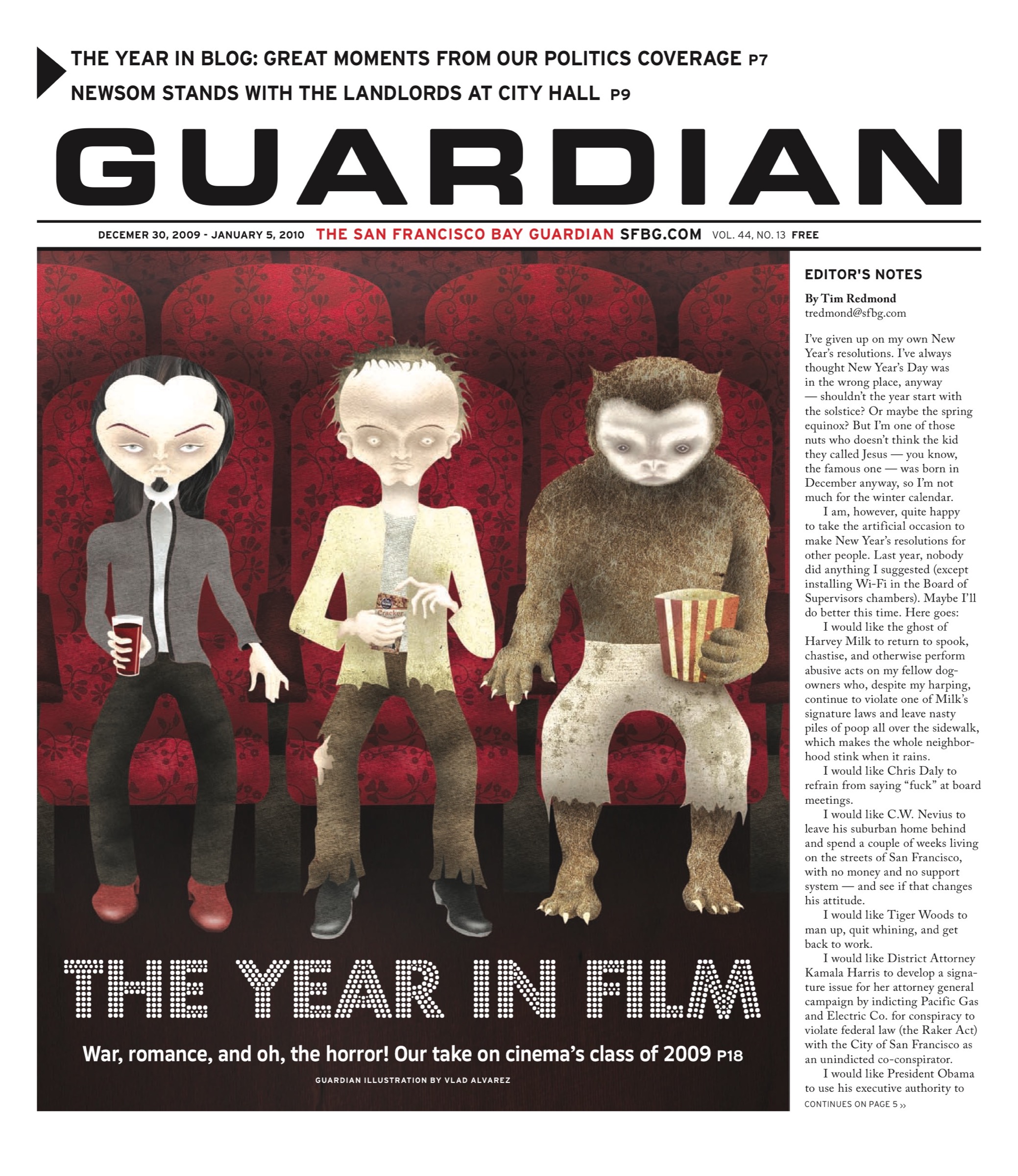
The year in film

0

YEAR IN FILM More than $10 billion in movie tickets were sold in 2009 — a new all-time high in a year stuffed with so many all-time lows, cinematic and otherwise. Many of those tickets, I’m afraid, provided entry to the garish, ghoulish Transformers: Revenge of the Fallen, far and away the year’s top-grossing release, though the top 10 did include at least one movie I can recommend (Star Trek) without feeling like a sellout. Nestled at No. 5 is The Twilight Saga: New Moon, part of a cultural phenomenon so huge the movie itself seemed like an afterthought. You have to scroll all the way to the 27th slot to find the year’s true top grosser: Paranormal Activity, which earned over $100 mil off a reportedly sub-$15,000 budget (less than a third what it cost to make 1999’s The Blair Witch Project, an obvious influence).

Paranormal Activity‘s success gives me hope, though I fear its inevitable shaky-cam imitators more than unexplained bumps in the night. Where there’s a buck, Hollywood will follow. This year, big-budget movies stepped up their games, employing IMAX, 3-D, and ever-more sophisticated CG to lure crowds on opening weekend. Avatar, which uses all three to greater effect than perhaps ever before, appears to be attracting gobs of people who’re simply curious to see what the fuss is about (my take: effects good, story crap. And for the record, I actually liked 1997’s Titanic). Multiplexes, with their corporate hookups and direct lines to movie studios, are thrilled by cinemaniacs eager to binge on new technology; brisk business proves 10-foot tall alien Smurfs are alluring enough to fill seats with butts that usually spend Friday nights at home, on the couch, watching DVR’d TV on a 60-inch flat-screen.

Of course, small, independently-owned theaters that can’t afford to upgrade their projection equipment to accommodate films like Avatar just might be screwed in 2010 and beyond. Hell, even the big guys have to contend with ever-shorter time periods between theatrical and DVD releases — sometimes these events happen simultaneously — and increasingly popular video-on-demand services offered by cable companies. Sometimes there’s a disconnect between versions that can affect the experience: Norwegian chiller Dead Snow was available to home audiences in dubbed form weeks before it rolled out at the Roxie, with subtitles (FYI: Nazi zombies are far more enjoyable when subtitled).

Still, think of all the scary shit you have to put up with simply by going to the movies: incessant texters; $15 tickets; people who cart their wee ones to hard-R fare; chatterboxes; seat-kickers; teenagers; jerks who sit in the middle of the row despite their pea-sized bladders; I could go on. Can you blame people who’d rather unspool their bootlegged copies of District 9 from the comfort of their own La-Z-Boys?

Yes! I can (and will) blame ’em — because true movie magic absolutely must include a big screen, preferably one that won’t fit into your living room. Even if you fear the megaplex, in the Bay Area we have access to a huge array of rep-house, art-house, and independently-owned screening venues. In short, there are still plenty of places to kick it old-school, movie geeks. So get out there and pass the popcorn!

Top films of 2009! SFBG film critics weigh in, part two

0

More top ten lists — and lists of other stripes as well! And don’t forget to check out our annual Year in Film issue, out Wed/30.

strange.jpg
Jerry McDaniel in Everything Strange and New.

Dennis Harvey’s Overlooked Performances of 2009

1. Liam Neeson in Five Minutes of Heaven (Oliver Hirschbiegel, UK)
2. Anna Faris and Celia Weston in Observe and Report (Jody Hill, USA)
3. Steve Zahn in Management (Stephen Belber, USA)
4. Everyone in A Perfect Getaway (David Twohy, USA); Still Walking (Hirokazu Koreeda, Japan); Black Dynamite (Scott Sanders, USA); and Everything Strange and New (Frazer Bradshaw, USA)
5. Katie Featherston and Micah Sloat in Paranormal Activity (Oren Peli, USA)
6. Alec Baldwin in Lymelife (Derick Martini, USA)
7. Spock (Zachary Quinto and Leonard Nimoy) in Star Trek (J.J. Abrams, USA/Germany)
8. Michael Cera in Paper Heart (Nicholas Jasenovec, USA)
9. Kali Hawk in Couples Retreat (Peter Billingsly, USA)
10. Paul Rudd in I Love You, Man (John Hamburg, USA)
11. Zach Gilford in Dare (Adam Salky, USA)
12. Woody Harrelson in Zombieland (Ruben Fleischer, USA) and 2012 (Roland Emmerich, USA/Canada)
13. Michael Shannon and John Ventimiglia, The Missing Person (Noah Buschel, USA)

paranormal-activity-dwrks2.jpg
A scene from Paranormal Activity.

Top films of 2009! SFBG film critics weigh in, part one

0

It’s that time of year again — Oscar contenders (and wannabes) are hogging the theaters, and just about every film writer who put fingers to keyboard in 2009 is making his or her top ten list. Here at the Guardian, some of us make top ten lists, and some of us make whatever kind of list we want. Check out our annual Year in Film issue, out Wed/30, and read on for our contributors’ top (and otherwise) picks.

A_Single_Man_Movie_Poster-Colin_Firth-Julianne_Moore.jpg

Louis Peitzman’s Top Ten Performances of 2009

1. Colin Firth in A Single Man (Tom Ford, USA)
2. Mo’Nique in Precious: Based on the Novel Push by Sapphire (Lee Daniels, USA)
3. Christoph Waltz in Inglourious Basterds (Quentin Tarantino, USA/Germany)
4. Marion Cotillard in Nine (Rob Marshall, USA/Italy)
5. Anna Kendrick in Up in the Air (Jason Reitman, USA)
6. Jackie Earle Haley in Watchmen (Zack Snyder, USA)
7. Michael Stuhlbarg in A Serious Man (Ethan Coen and Joel Coen, USA/UK/France)
8. Sasha Grey in The Girlfriend Experience (Steven Soderbergh, USA)
9. Meryl Streep in Julie and Julia (Nora Ephron, USA)
10. Carey Mulligan in An Education (Lone Scherfig, UK)

inglorious_basterds.jpg
Brad Pitt in Inglourious Basterds.

Erik Morse’s Top Ten Films of 2009

1. Inglourious Basterds (Quentin Tarantino, USA)
2. The Missing Person (Noah Buschel, USA)
3. The Beaches of Agnès (Agnès Varda, France)
4. Coraline (Henry Selick, USA)
5. Still Walking (Hirokazu Koreeda, Japan)
6. The Hurt Locker (Kathryn Bigelow, USA)
7. The White Ribbon (Michael Haneke, Austria/Germany/France/Italy)
8. Mother (Bong Joon-ho, South Korea)
9. Broken Embraces (Pedro Almodóvar, Spain)
10. Thirst (Chan-wook Park, South Korea)

Erik Morse’s honorable mentions: Goodbye Solo (Ramin Bahrani, USA); Revanche (Götz Spielmann, Austria); Tyson (James Toback, USA); Orphan (Jaume Collet-Serra, USA/Canada/Germany/France); Examined Life (Astra Taylor, Canada); Science is Fiction: 23 Films by Jean Painleve (Criterion Collection DVD); Rembrandt’s J’accuse (Peter Greenaway, Netherlands/Germany/Finland); Valentino: The Last Emperor (Matt Tyrnauer, USA); Jennifer’s Body (Karyn Kusama, USA)

goodbye_solo_01.jpg
Scene from Goodbye Solo.

Grey’s anatomy: An interview with Sasha Grey

0

To state that hardcore porn nymphet Sasha Grey has mainstream appeal is like arguing a truism. Thrust onto billboards and magazine covers, written into highly publicized Hollywood movies, integrated into our cultural vernacular, Sasha Grey didn’t just cross over into mainstream territory; we brought her here.

It’s easy to see why, among the many female performers in adult entertainment, Sasha Gray has become the unwitting locus of the public’s gaze and speculation. Next to those flaxen, suprafemale Barbies who dominated porn in the 90s, Grey’s handsome brunette naturalism seems somehow transgressive. Grey’s bosoms are not big enough to generate their own gravity, and her smooth, skin-colored skin and svelte muscularity are the products of youth and genetics rather than of dubious cosmetic procedure. With her placid, heavy-lidded eyes, broad forehead, and insistent jawline, Grey’s face looks real rather than representational. She looks like the pretty 21-year-old that she is — with an age appropriate penchant for darkening her already dark Mediterranean eyebrows — and it’s this sense of the familiar that makes Grey, a real girl among a valley of dolls, so erotically appealing.


Sasha Gray in an ad for American Apparel

The media has the tendency to describe Grey in extreme binaries: young yet wise, beautiful yet intelligent, intellectual yet a porn star, and so on. In a sense, this tendency is understandable. Most writers, yours humbly included, are not citizens of the adult entertainment world. It’s tempting for writers to use obtuse paradoxes and reductive generalizations when describing those who seem, by virtue of their work, so fascinatingly equivocal. And Grey doesn’t make our jobs any easier, with her casual mentions of Baudrillard and Sartre, her appreciation of Godard, and her use of the adjective “Jungian,” while cheerfully inhabiting an industry that we take for granted as being intellectually unconcerned. As fellow twenty-something with an affection for cultural theory and French New Wave, I relate to some of her interests, but beyond that, my interpretive abilities hit a wall and all that’s left is conjecture. Grey is a descriptive paradox, and it would not surprise me if she preferred it that way.

Grey was recently announced as this year’s keynote speaker at the 2010 AVN Awards and I had the opportunity to interview her. Not wanting to add to the guesswork that surrounds Grey’s celebrity or to embark on a vague meditation of the porn-star psyche, I limited the questions to her involvement with the AVN ceremony. The result was simple, straightforward and, at least for me, refreshing.

SFBG: As such a young performer — and one relatively new to the adult entertainment industry — are you comfortable with the responsibility of giving the AVN keynote address?

SG: This has been an incredibly exciting year for me, and I feel each year I continue to excel… but the industry has changed rapidly, in my almost fourth year of experience. I am proud that I have the chance to share my voice with the industry and show appreciation for the fans that support my career and adult film-making.

SFBG: At the moment, what are some of the most important issues or concerns for the adult entertainment community?

SG: First and foremost the never-ending battle of obscenity laws, i.e. the ongoing case against Evil Angel Video. If Evil Angel is found guilty, we’ll be rolling backwards in time when Naked Lunch was banned for obscenity. Secondly, the state of AIM Healthcare, where all performers are tested, could be shut down any day due to grueling legal battles with Cal OSHA, which would temporarily shut the business down until there’s a replacement testing facility… and who knows how long that could take.

SFBG: You’ve performed in so many films and been in the spotlight for so long that it feels strange for me to ask, but are you nervous about giving this speech?

SG: Nope.

SFBG: This will be your third year attending the AVN Awards. Do you enjoy the ceremony?

SG: The awards show has always been a fun way to end a long week of press and meeting fans, and there’s certainly the neverending people watching which always entertains!

SFBG: Just out of curiosity, have you read “Big Red Son” by the late David Foster Wallace? He attended the AVNs 11 years ago and wrote about his overwhelmingly negative experiences as a journalist and onlooker. He prescribed the AVNs as a humble alternative to self-castration and described the adult industry as “predictably vulgar.”

SG: No I haven’t. Why do you think they don’t hold most awards shows in Vegas? People would be letting their inhibitions go! Vegas: a great example of the Jungian idea, the duality of man. People put on a mask; those who don’t ordinarily drink too much yet end up wasted, spend too much money on strippers and gambling, etc, this goes for 90% of people who visit the city of sin. People from the adult industry or those who mingle with its crowds are aware that Vegas calls for celebration, and they are usually comfortable letting their inhibitions go, or wearing these masks. I am sure this might intimidate an onlooker with no knowledge of the adult entertainment community, but this doesn’t reflect the day-to-day life of the businessmen and women that run this industry.

SFBG: What did it feel like to win your first AVN award in 2007, less than a year after having entered the industry?

SG: It was a real shock, I had only been in the business for five months before the nominations went out, so I was just happy to be nominated.

SFBG: You’ve won 4 AVN awards in 4 separate categories. Of these awards, which one meant the most to you?

SG: Female Performer of The Year of course!

SFBG: In your own career, are awards a huge honor for you, or just icing on the cake?

SG: I used to think they were something to add to your resume, until I actually won. The anticipation, being unsure, and then winning… yeah it’s incredibly gratifying.

Bridges abides

0

FILM “Oh, I love Jeff Bridges!” is the usual response when his name comes up every few years for Best Actor consideration, usually via some underdog movie no one saw, and the realization occurs that he’s never won an Oscar. (Unlike, say, Roberto Benigni.) It is often said with a guilty-sigh undertone otherwise reserved for neglected relatives or loyal but inconvenient friends — people you know you shouldn’t keep forgetting about.

The oversight is painful because it could be argued that no leading American actor has been more versatile, consistently good, and true to that elusive concept “artistic integrity” than Bridges over the last 40 years. When you think about more conspicuous “great” screen actors of his generation — DeNiro, Nicholson, Pacino, Hoffman — it’s hard to deny that they’ve long since fallen into shtick, caricature, and somnambulism in mostly unworthy vehicles, occasionally showing a flash of prime alertness.

Whereas Bridges never rested on his laurels, or lack thereof. Of course he had a great ’70s — who didn’t? — in movies widely acclaimed (1972’s Fat City, 1971’s The Last Picture Show), fascinatingly quirky (1976’s Stay Hungry, 1975’s Rancho Deluxe and Hearts of the West, 1974’s Thunderbolt and Lightfoot, 1979’s Winter Kills), or just lucky to have him (the ’76 King Kong, 1978 Farrah Fawcett vehicle Somebody Killed Her Husband).

But while other stars caved to the more formulaic commerciality of the 1980s and onward, Jeff Bridges managed his career as before, mixing rare commercial hits (1985’s Jagged Edge, 1991’s The Fisher King, and 1984’s Starman — in which he’s an alien sweeter and surely sexier than E.T.) with mainstream bunts (1996’s The Mirror Has Two Faces, 1996’s White Squall, 1982’s beloved TRON). Not to mention the many, variably unpopular, cult-accruing smaller films he’s spectacular in: Cutter’s Way (1981), American Heart (1992), Fearless (1993), The Big Lebowski (1998), Simpatico (1999), and The Door in the Floor (2004). All Oscar-worthy performances, but Oscar seldom embraces flops, sleepers, and critics’ case-pleadings — the latest of which would be Crazy Heart.

It’s rumored this movie was slotted for cable or DVD premiere, then thrust into late-year theater release in hopes of attracting Best Actor momentum within a crowded field. (It’s a much more paltry year for actresses, as usual). Lucky for us, this performance shouldn’t be overlooked. Bridges plays “Bad” Blake, a veteran country star reduced to playing bars with local pickup bands. His slide from grace hasn’t been helped by lingering tastes for smoke and drink, let alone five defunct marriages.

In Houston he meets Jean (Maggie Gyllenhaal), freelance journalist, fan, and single mother. They spark; though burnt by prior relationships, she’s reluctant to take seriously a famous drunk twice her age — even if he charms both mom and four-year-old tyke (the improbably named Jack Nation). Can Bad handle even this much responsibility?

Meanwhile, he gets his “comeback” break in the semi-humiliating form of opening for Tommy Sweet (Colin Farrell) — a ponytailed, stadium-playing contemporary country superstar who was once Bad’s backup boy. Tommy offers a belated shot at commercial redemption; Jean offers redemption of the strictly personal kind.

Bridges and Farrell can both really sing. (The former has long been a singer-songwriter-guitarist, though a pretty dull one.) Robert Duvall can’t, but then as producer and excellent support player (Bad’s old barkeep friend), he’s allowed some self-indulgence.

There’s nothing too surprising about the ways in which Crazy Heart both follows and finesses formula. You’ve seen this preordained road from wreckage to redemption before. But actor turned first-time director Scott Cooper’s screenplay honors the flies in the windshield inherited from Thomas Cobb’s novel.

As does Bridges, needless to say. Here he’s fleshy, hairy, wheezy — well-intentioned, but charming and untrustworthy at once. He rules an otherwise ordinary film like Mickey Rourke did 2008’s The Wrestler. But here’s guessing the relative lack of flamboyance (or salvation from the skids) won’t do Jeff Bridges similar favors. Again.

CRAZY HEART opens Fri/25 in San Francisco.

SCENE: Lazer Sword zaps the boom-blap

0

By Michael Krimper. From SC ENE: The Guardian Guide to Nightlife and Glamour, on stands in the Guardian now!

119-lazer.jpg
Lazer Sword photo by Beryl Fine

San Francisco-bred electronic duo, Lazer Sword, has a secret weapon. Bryant Rutledge (a.k.a. Low Limit) and Antaeus Roy (a.k.a. Lando Kal) have developed a musically enhanced dehydration gun that zaps the sweat out of dance crowds like a soul-sonic Super Soaker. There’s no escaping it. Inside investigators report that this weapon emerged mysteriously from a Mission District apartment building in 2006, conceived from a reactive mixture of 1980s sci-fi psychedelia and a futuristic bass-rattling force unanticipated by even the most forward-thinking predictions of the oncoming 2010s. It’s manufactured out of grime-ridden computer technology and 8-bit video game parts, designed with the stuttering ferocity of electro-house synthetics and drum machines, and blessed by the hustlers and gangstas of swagger rap. Welcome to Lazer Sword’s boom blap.

And just like one of those vintage sci-fi films, Rutledge and Roy seem to be on their way to world domination. The duo just returned from their second European tour, slaying dance floors from London, England, to Bialystok, Poland. “Crowds overseas are pretty open to electronic music in general,” says Rutledge, “but I get the feeling that two guys jamming on their midi controllers making weird rap beats mixed with dolphin noises and Hanna Barbera samples is a little different and new for them.” Unabashed, Lazer Sword welcomes the challenge of converting unknowing club fiends, wallflowers, and beat heads alike to their leftfield, electro hip-hop bounce. “There’s always an awesome feeling when the crowd doesn’t know what to expect at first,” Roy weighs in, “then over time, cats are dripping in sweat and falling over themselves.”

Peeping Tomás

0

Pedro Almodóvar has always dabbled in the Hitchcockian tropes of uxoricide, betrayal, and double-identity, but with Broken Embraces he has attained a polyglot, if slightly mimicking, fluency with the language of Hollywood noir. A story within a story and a movie within a movie, Embraces begins in the present day with middle-aged Catalan Harry Caine (Lluís Homar), a blind screenwriter who takes time between his successful writing career to seduce and bed young women sympathetic to his disability. “Everything’s already happened to me,” he explains to his manager, Judit (Blanca Portillo). “All that’s left is to enjoy life.” But this life of empty pleasures is brought to a sudden halt when Judit reports that a local business magnate Ernesto Martel (José Luis Gómez) has died; soon after, Ernesto Jr. (Rubén Ochandiano), who has renamed himself Ray X, visits Caine with an unusual request. Judit’s son, Diego (Tamar Novas), who is also Caine’s secretary, is a witness to these strange circumstances and inquires into the mysterious past of Caine.

To wit, the action retreats 14 years when Caine was a young (and visually abled) director named Mateo Blanco. In the classic noir set-up, Blanco encounters a breathtaking femme fatale, Lena (Penelope Cruz) — an actress-turned-prostitute named Severine, turned secretary-turned-trophy wife of Ernesto Martel — when she appears to audition for his latest movie, Girls and Suitcases. As Lena’s marriage with the aging Martel is one of convenience, she quickly engages in a torrid off-camera affair with Mateo. But their tryst is compromised by the constant presence of Ernesto Jr., who has been tapped by his father to shoot a behind-the-scenes “documentary” of Lena and Mateo for his own private consumption. When the secret is exposed with the help of a freelance lip-reader (in a classic Almodóvarian scene), the fates of Mateo, Lena, Ernesto, and Judit collide with tragic consequences.

If all of the narrative intricacies and multiplicitous identities in Broken Embraces appear a bit intimidating at first glance, it is because this is the cinema of Almodóvar taken to a kind of generic extreme. As with all of the director’s post-’00 films — All About My Mother (1999), Talk to Her (2002), Bad Education (2004), and Volver (2006) — which are often referred to as Almodóvar’s “mature” pictures, there is a microscopic attention to narrative development combined with a frenzied sub-plotting of nearly soap-operatic proportions. But, in Embraces, formalism attains such prominence that one might speculate the director is simply going through the motions. The effect is a purposely loquacious and overly-dramatized performance that pleasures itself as much by setting up the plot as unraveling it. So, throughout the overlong 127 minute film, two distinct types of scenes become readily apparent: those which are Almodóvar at his best — arriving with a striking visual and musical style and leaving one nearly breathless; and Almodóvar at his worst — those which are purely convention, lumber about far too long and veer into dialogic minutiae. If the audience can withstand these long-winded asides, the cinematic prize is great indeed.

For a obsessive appropriationist, Almodóvar has never been so blatantly referential as he is in Broken Embraces. Apart from the most obvious nods to Hitchcock, the director has included scenic love-letters to Michael Powell’s Peeping Tom (1960), Roberto Rossellini’s Voyage to Italy (1954), and Nicholas Ray’s In a Lonely Place (1950). Those fans of Almodóvar’s 80s comedies will even recognize the director’s send-up of his own oeuvre in Girls and Suitcases, a potpourri of Women on the Verge of a Nervous Breakdown (1988) and What Have I Done to Deserve This? (1984) Whether or not this confirms that the young iconoclast Almodóvar has, in his old age, become an unashamed nostalgic merits some debate. But, regardless of the verdict, Broken Embraces proves itself to be an impressive lexicon.

Broken Embraces opens Fri/18 in San Francisco.

Our weekly picks

0

WEDNESDAY 16th

FILM

Free Form Film Series: "Awesome and Painful"


The folks from Lost Media Archive and the FFFF (Free Form Film Festival) have a Christmas treat for y’all: a screening of the "universally loathed" Star Wars Holiday Special. Before that, six dudes from various parts of the U.S. will treat viewers to experimental videos. With titles like Hulk Smash, Cakestain! and Polygon Sun, it’s likely — well, very likely (I did some interweb research) — that these videos are of the laffy taffy, low-tech, seizure-inducing variety. While this might suggest everything jejune and sarcastic, I would also qualify that suggest with smartly so. (Spencer Young)

8 p.m., $6

Artists’ Television Access

992 Valencia, SF

(415) 824-3890

www.atasite.org

THURSDAY 17th

FILM

Kenneth Anger: Restored Prints


Not one to dabble so much as drench himself in the occult, Kenneth Anger has been dubbed a weirdo. Committed to the underground, his short films are weird, too, but in an interesting and entertaining kind of way as opposed to creepy and cloying. Two of the Anger movies showing tonight — Scorpio Rising (1960) and Kustom Kar Kommandos (1964) — worship handsome James Dean-type men and their equally handsome machines through serene, phantasmagoric pans across shiny engines, belt buckles, and bulging biceps, all queerly contrasted with 1960s pop. The other two films on the program, Fireworks (1947) and Rabbit’s Moon (1950/1971) are equally hunky-dory. Also, the 82-year-old weirdo might be in attendance. (Young)

7 p.m., $7–$10

Phyllis Wattis Theater

San Francisco Museum of Modern Art

151 Third St., SF

(415) 357-4000

www.sfmoma.org

MUSIC

Popscene Holiday Gala with Mike Relm


‘Tis the season for video mashups. The holidays always make me want to break out the TV Carnage DVDs — nothing says gift quite like John Ritter making horrified faces to Rosie O’Donnell’s performance in Riding the Bus With My Sister (2005). Mike Relm is one of SF’s chief video turntablists, with a resume that includes Mike Patton’s Peeping Tom project. He won my heart by naming his debut DVD Clown Alley, after the defunct semi-North Beach burger dive known to inspire the Guardian’s own Marke B. to break into song. He makes the scene at Popscene’s festive gala. (Johnny Ray Huston)

With DJ Sharp

10 p.m.–2 a.m., $5–$10

330 Ritch

330 Ritch, SF

(415) 541-9574

www.popscene-sf.com

FRIDAY 18th

PERFORMANCE

Hubba Hubba Revue’s Chrismanukkah


Hubba Hubba Revue is big in England. Word of the SF burlesque troupe’s shenanigans had reached my burlesexual friend Lou Lou, who knows about tassel-twirling because, back in Blighty, she’s a "maid" who flounces about the stage between acts cleaning up the dancers’ tossed underthings. Lou Lou was convinced "the maid" was a universal feature of burlesque shows, and was surprised to learn that in the Hubba Hubba Revue, her role is played by a man-monkey named Zip the What-Is-It, bald but for a tuft of hair on his crown. Things are different here. But they do have lovely ladies stripping all retro-like and enough shiny bells and whistles to keep even the burlesque-shy (does such a person exist?) jaw-dropped and fancy free. The troupe’s holiday celebration promises peace and goodwill to (wo)man, and performances by Bunny Pistol, Professor Shimmy, and Meshugga Beach Party, a Jewish folk surf jam experience. (Caitlin Donohue)

9 p.m., $12–$15

DNA Lounge

375 11th St., SF

(415) 626-1409

www.dnalounge.com

www.hubbahubbarevue.com

LIT

Glam Gender Release Party


You can never have too much drag for the holidays. Or can you? No, no you can’t — especially if your stocking is not only filled with enough bird seed to size you up to a triple-D cup, but also with the ravishing new book Glam Gender, a glossy to-die-for tome self-published by photographer Marianne Larochelle and art director-stylist-drag legend Jose Guzman Colon, a.k.a. Putanesca. Contained within is an encyclopedia of the most well-known local drag queens of the past decade, including many no longer with us. The project, with punchy bios written by paparazzi punk Bill Picture, was "such a beautiful thing to work on," Putanesca told me. "It’s a real community celebration, and also a bit insane." Freshly released, the book will be available — along with glorious prints and most of the queens themselves — at zany Victorian wonderland Finn’s Funhouse. Watch your dress. (Marke B.)

6–10 p.m., free

Finn’s Funhouse

814 Grove, SF

www.glamgender.com

MUSIC

Super Adventure Club


Up-sides to cold weather: the dependable absence of mosquitoes, eggnog, layers of $4 Goodwill sweaters that nicely camouflage Christmas cookie bulge, and socially acceptable hibernation. Wait, scratch that last one — you’re going out. You’ll wanna brave those arctic winds for multitasking duo Jake Woods and Michael Winger, who combine their strange genius to form Super Adventure Club, a band you could like for the name alone, but don’t have to because their punchy riffs on everything from German "üntz" music to French love songs deliver a restorative kick to the circulation system. I straight up challenge you to get through their set — or that of headliners Diego’s Umbrella — without jumping about like a crazy person. You’ve got a tough first step past the front welcome mat, but know — just know — that your winter woes are about to melt like a square snowflake in funky town. (Donohue)

With Diego’s Umbrella and How To Win at Life

9 p.m., $8

Elbo Room

(415) 552-7788

647 Valencia, SF

www.elbo.com

SATURDAY 19th

EVENT

Renegade Craft Fair


December mall jaunts tend to induce claustrophobia, Santa terrors, and unpredictable, Manchurian Candidate-style reactions to all those cheery Christmas carols. Avoid the commercial hustle at the Renegade Craft Fair, founded in 2003 in Chicago — where a Renegade Handmade store remains open year-round — and now a multicity phenomenon. SF’s version opens shop just in time for the last-minute gift scramble, with more than 150 local DIY denizens (who had to apply to participate, so you won’t have to sift though sub-par crap) offering up all manner of bow-worthy ideas: fabric goods, silkscreened art, jewelry, accoutrements for babies, housewares, toys, stationary, and more. (Cheryl Eddy)

Through Sun/20

11 a.m.–7 p.m., free

Herbst Pavilion, Fort Mason Center

Marina at Laguna, SF

www.renegadecraft.com/holiday-sf

PERFORMANCE

Trannyshack Star Search


The queen, apparently, is not dead. Beloved and be-loathed trash-drag emporium Trannyshack glitter-axed its weekly operations at the Stud last year. But like the chunky-jewelried zombie ass-slave Mrs. Roper hostess that she is, Heklina rises from the ash heap of Manhunt addiction to bring back the Trannyshack Star Search competition, thirsty for new blood to fill her ghoulish needs. She’ll be joined onstage by the wonderfully horrific Peaches Christ to oversee performances by "special" guest judges Sherry Vine and Kembra Pfahler of the Voluptuous Horror of Karen Black. Hoku Mama, Putanesca, Princess Kennedy, and Anjie Myma also judge the 10 hopefuls, and DJ Omar glam-sluts up the crowd, if that’s even more possible. (Marke B.)

10 p.m.–3 a.m., $15–$20

DNA Lounge

(415) 626-1409

375 11th St., SF

www.dnalounge.com

EVENT/PERFORMANCE

Circus Ignite!


Does it seem like circus is everywhere? It’s true. And that’s not just in local venues, mainstream media, and fashion. Circus groups are taking their clowning, juggling, stilting, and acrobatics out of American cities and into under-served communities across the world. They’re entertaining, educating, inspiring self-esteem, and fostering cross-cultural communication in communities affected by natural disaster, dislocations, and military conflicts. One such group is Dreamtime Circus, a fantastic organization that launched with a trip to India last year and plans to spend next spring in Peru. Help support the cause by attending this weekend’s fundraiser, featuring DJs, a silent auction, and performances. (Molly Freedenberg)

9 p.m.–4 a.m., $12–$20

Siberia

314 11th St, SF

(415) 552-2100

www.dreamtimecircus.org

EVENT/MUSIC

Carols in the Caves


Candlelight. Cave acoustics. Ancient instruments playing age-old carols. And you as part of the angel choir. Could there be anything more classically festive than Carols in the Caves? The brainchild of percussionist/musician the Improvisator (a.k.a. David Auerbach), this tradition has been delighting audiences for 24 years in a variety of caves and wine cellars around the Bay Area. This time Auerbach brings his dulcimers, flutists, drums, and bells to Hans Fahden Vineyards, a gorgeous property on a ridge above Calistoga that features panoramic views of Mount Saint Helena. Buy your tickets, save some extra cash to purchase wine, and get ready to settle in to a sound spa for the mind. (Freedenberg)

2 p.m. (also Sun/20), $45

Hans Fahden Vineyards

4855 Petrified Forest, Calistoga

(707) 224-4222

www.cavemusic.com

FILM

The Birds


So … 500,000 European starlings did an air show in Bodega Bay, I mean Sacramento, this past week. Video evidence is flying across the Internet. It’s official, a real-life version of The Birds (1963) can’t be far off. Of all of Hitchcock’s classics, this is the one best served by the big screen. If you’ve only seen it on TV, you don’t know it. Out of your gilded cages, Melanie Daniels fans, and into the Castro to fend off angry beaks with your impeccably manicured hands. (Huston)

2:30 and 7 p.m. (double feature with Notorious), $7.50–$10

Castro Theatre

429 Castro, SF

(415) 621-6120

www.castrotheatre.com

SUNDAY 20th

MUSIC

Brian Setzer Orchestra


Brian Setzer has made a long-lasting career of resurrecting musical styles from the past with his formidable talents. He first came to fame as leader of the Stray Cats, energizing traditional rockabilly with his scorching guitar skills. He then went on to revamp swing and the classic big band sound of the 1930s and ’40s with the Brian Setzer Orchestra, whose hits included a cover of Louis Prima’s "Jump Jive An’ Wail." Tonight’s stop here in SF is part of Setzer’s seventh annual "Christmas Rocks!" tour, featuring revved-up versions of timeless holiday songs like "Jingle Bells" and "White Christmas," as well as selections from his own hit discography.(Sean McCourt)

8 p.m., $55–$69.50

The Warfield

982 Market, SF

(415) 775-7722

www.thewarfieldtheatre.com

TUESDAY 22nd

VISUAL ART

Taravat Talepasand: "Situation Critical"


Bay Area artist Taravat Talepasand’s explorations of cultural mores in Iran and America manifest as everything from motorcycles to graphite drawings. Her second show at Marx and Zavaterro casts a sharp eye at xenophobia and assorted manias circa-1979, among other things. "Situation Critical" should be worth a visit simply to see the nightmarish Disney-esque painting Ayatollah Land. (Huston)

10:30 a.m.–5 p.m., free

Marx and Zavattero

77 Geary, second floor, SF

(415) 627-9111
www.marxzav.com

Rep Clock

0

Schedules are for Wed/16–Tues/22 except where noted. Director and year are given when available. Double features are marked with a •. All times are p.m. unless otherwise specified.

ARTISTS’ TELEVISION ACCESS 992 Valencia, SF; www.atasite.org. $7. "Free Form Film Festival:" Star Wars Holiday Special (Binder, 1978), plus experimental videos, Wed, 8. Other Cinema:" "New Experimental Works," Sat, 8:30.

CAFÉ OF THE DEAD 3208 Grand, Oakl; (510) 931-7945. Free. "Independent Filmmakers Screening Nite," Wed, 6:30.

CASTRO 429 Castro, SF; (415) 621-6120, www.castrotheatre.com. $7.50-10. "Hitch for the Holidays:" •Rear Window (Hitchcock, 1954), Wed, 2:30, 7, and Shadow of a Doubt (Hitchcock, 1943), Wed, 4:45, 9:10; •Rebecca (Hitchcock, 1940), Thurs, 2, 7, and Marnie (Hitchcock, 1964), Thurs, 4:30, 9:30; Vertigo (Hitchcock, 1958), Fri, 2, 4:30, 7, 9:30; •The Birds (Hitchcock, 1963), Sat, 2:30, 7, and Notorious (Hitchcock, 1946), Sat, 4:55, 9:20; •The 39 Steps (Hitchcock, 1935), Sun, 1:30, 6, and North by Northwest (Hitchcock, 1959), Sun, 3:30, 8; •Strangers on a Train (Hitchcock, 1951), Tues, 2:30, 7, and The Man Who Knew Too Much (Hitchcock, 1956), Tues, 4:35, 9. Theater closed Mon.

CHRISTOPHER B. SMITH RAFAEL FILM CENTER 1118 Fourth St, San Rafael; (415) 454-1222, www.cafilm.org. $6.50-10. The Private Lives of Pippa Lee (Miller, 2009), call for dates and times. "Short Films from the 2009 Sundance Film Festival," Wed-Thurs, call for times.

EXPLORATORIUM 3601 Lyon, SF; www.exploratorium.edu. Free with museum admission ($9-14). A Child’s Christmas in Wales, Sat, 2.

GRACE NORTH CHURCH 2138 Cedar, Berk; (510) 464-4640, www.verticalpool.com. $6-10. The Greater Circulation (Alli, 2005), Fri, 8.

JOYCE GORDON GALLERY 406 14th St, Oakl; (510) 465-8928, www.joycegordongallery.com. Free. One Time (Doukas, 1969-71), Thurs, 8.

PACIFIC FILM ARCHIVE 2575 Bancroft, Berk; (510) 642-5249, www.bampfa.berkeley.edu. $5.50-9.50. "An Evening with Mark Morris:" Cello Suite #3: Falling Down Stairs (Sweete, 1995), Wed, 7; Cabin in the Sky (Minnelli, 1943), Wed, 9. "A Woman’s Face: Ingrid Bergman in Europe:" Autumn Sonata (Bergman, 1978), Thurs, 7. "Otto Preminger: Anatomy of a Movie:" Carmen Jones (1955), Fri, 6:30; Bonjour Tristesse (1958), Sat, 6:30 and Sun, 5; Skidoo (1968), Sat, 8:30; Bunny Lake is Missing (1965), Sun, 7. "Four by Hungarian Master Miklós Janksó:" Silence and Cry (1967), Fri, 8:40.

PARAMOUNT THEATRE 2025 Broadway, Oakl; 1-800-745-3000, www.ticketmaster.com. $5. Willy Wonka and the Chocolate Factory (Stuart, 1971), Fri, 8.

RED VIC 1727 Haight, SF; (415) 668-3994. $6-10. It Might Get Loud (Guggenheim, 2009), Wed-Thurs, 7:15, 9:20 (also Wed, 2). Not Quite Hollywood (Hartley, 2009), Fri-Sat, 7:15, 9:25 (also Sat, 2, 4:15). The City of Lost Children (Jeunet and Caro, 1995), Sun-Mon, 7, 9:25 (also Sun, 2, 4:20). Scrooged (Donner, 1988), Tues, 7:15, 9:25.

ROXIE 3117 and 3125 16th St, SF; (415) 863-1087, www.roxie.com. $5-9.75. Call for shows and times.

SAN FRANCISCO MUSEUM OF MODERN ART 151 Third St, SF; www.sfmoma.org. $10. "Kenneth Anger: Restored Prints," Thurs, 7. With Kenneth Anger in person.

SAN FRANCISCO PUBLIC LIBRARY Koret Auditorium, 100 Larkin, SF; www.sfpl.org. Free. "Back in the GDR: The Berlin Wall and the Former East Germany on Film:" Night Crossing (Mann, 1981), Thurs, noon. Large-screen video presentation.

YERBA BUENA CENTER FOR THE ARTS 701 Mission, SF; (415) 978-2787, www.ybca.org. $6-8. "The Joy of Life:" "Short Films by Curt McDowell," Thurs, 7:30; "Holiday Free Surprise Screening!", Sat, 7:30; Emmet Otter’s Jug-Band Christmas (Henson, 1977), Sun, 2.<\!s>

Film listings

0

Film listings are edited by Cheryl Eddy. Reviewers are Kimberly Chun, Michelle Devereaux, Max Goldberg, Dennis Harvey, Johnny Ray Huston, Louis Peitzman, Lynn Rapoport, Ben Richardson, Matt Sussman, and Laura Swanbeck. The film intern is Fernando F. Croce. For rep house showtimes, see Rep Clock. For first-run showtimes, see Movie Guide.

OPENING

Avatar Special effects master and woeful screenplay-penner James Cameron returns, for better and worse. (2:42)

Broken Embraces Pedro Almodóvar has always dabbled in the Hitchcockian tropes of uxoricide, betrayal, and double-identity, but with Broken Embraces he has attained a polyglot, if slightly mimicking, fluency with the language of Hollywood noir. A story within a story and a movie within a movie, Embraces begins in the present day with middle-aged Catalan Harry Caine (Lluís Homar), a blind screenwriter who takes time between his successful writing career to seduce and bed young women sympathetic to his disability. "Everything’s already happened to me," he explains to his manager, Judit (Blanca Portillo). "All that’s left is to enjoy life." But this life of empty pleasures is brought to a sudden halt when local business magnate Ernesto Martel (José Luis Gómez) has died; soon after, Ernesto Jr. (Rubén Ochandiano), who has renamed himself Ray X, visits Caine with an unusual request. The action retreats 14 years when Caine was a young (and visually abled) director named Mateo Blanco; he encounters a breathtaking femme fatale, Lena (Penelope Cruz) — an actress-turned-prostitute named Severine, turned secretary-turned-trophy wife of Ernesto Martel — when she appears to audition for his latest movie. If all of the narrative intricacies and multiplicitous identities in Broken Embraces appear a bit intimidating at first glance, it is because this is the cinema of Almodóvar taken to a kind of generic extreme. As with all of the director’s post-’00 films, which are often referred to as Almodóvar’s "mature" pictures, there is a microscopic attention to narrative development combined with a frenzied sub-plotting of nearly soap-operatic proportions. But, in Embraces, formalism attains such prominence that one might speculate the director is simply going through the motions. The effect is a purposely loquacious and overly-dramatized performance that pleasures itself as much by setting up the plot as unraveling it. For the complete version of this review, visit www.sfbg.com. (2:08) Clay. (Erik Morse)

Did You Hear About the Morgans? A married couple (Hugh Grant and Sarah Jessica Parker) move from Manhattan to a small town after witnessing a murder. (1:48)

In Search of Beethoven After the success of his In Search of Mozart, director Phil Grabsky applies his truth-seeking documentary template to Ludwig van Beethoven, a composer so genius he continued creating (and to a lesser extent, performing) even as he succumbed to deafness. Still photos, paintings, interviews with historians and musicologists, and visits to actual Beethoven haunts, along with dramatic readings of the maestro’s letters (by actor David Dawson) and stern narration (by actor Juliet Stevenson, who also loaned her pipes to Mozart), flesh out this biographical portrait. But its most stirring moments come courtesy of its musical performances (by seasoned professionals) of Moonlight Sonata and other notable works. As the doc proves, there’s no better insight into Beethoven’s tumultuous, sometimes tortured life than the notes he left behind. (2:18) Roxie. (Eddy)

*35 Shots of Rum Claire Denis’s portrait in domesticity is so patiently timed and achingly photographed (by her longtime cinematographer Agnès Godard) that your own life routines are liable to seem freshly poetic in its afterglow. We begin with familiar images of transitory longing: trains switching tracks, keeping time. A man smokes a cigarette at dusk, its embers warming his dark skin. He is Lionel (Alex Descas), a Metro operator who lives simply in a boxy apartment building in the outer rings of Paris. He returns home from work with a rice cooker for his twentysomething daughter, Josephine (Mati Diop), though Denis allows their relationship to remain unclear for a while (she is remarkably free when it comes to exposition). Coincidentally, serious Jo has bought herself a cooker on the same day. There’s a whole untold story about the rice cooker, but Denis is content watching them appreciatively spoon out the first batch in their pajamas. The attention to generations, meals, the trains and the small comic gestures (a well-timed fart, an awry romantic moment in the Seine) all suggest Ozu, but the elliptical rhythms and sensual apprehension of bodies is pure Denis. She once did a documentary about a choreographer (2005’s Towards Mathilde), and she approaches everyday life as a kind of dance. Lionel and Jo’s relationship is unlike almost any other father-daughter dynamic in recent movie memory — nonverbal, but clearly loving. If the other characters are kept at arm’s length, that’s because Lionel and Jo keep their safe haven so closely guarded. Things begin to unspool, as they must, in a memorable restaurant dance sequence that makes exquisite use of the Commodores’ 1985 platter, "Nightshift." (1:39) (Goldberg)

The Young Victoria Those who envision the Victorian Age as one of restraint and repression will likely be surprised by The Young Victoria, which places a vibrant Emily Blunt in the title role. Her Queen Victoria is headstrong and romantic — driven not only by her desire to stand tall against the men who would control her, but also by her love for the dashing Prince Albert (Rupert Friend). To be honest, the story itself is nothing spectacular, even for those who have imagined a different portrait of the queen. But The Young Victoria is still a spectacle to behold: the opulent palaces, the stunning gowns, and the flawless Blunt going regal. Her performance is rich and nuanced — and her chemistry with Prince Albert makes the film. No, it doesn’t leave quite the impression that 1998’s Elizabeth did, but it’s a memorable costume drama and romance, worthy of at least a moderate reign in theaters. (1:40) Embarcadero. (Peitzman)

ONGOING

Armored (1:28) 1000 Van Ness.

The Blind Side When the New York Times Magazine published Michael Lewis’ article "The Ballad of Big Mike" — which he expanded into the 2006 book The Blind Side: Evolution of a Game —nobody could have predicated the cultural windfall it would spawn. Lewis told the incredible story of Michael Oher — a 6’4, 350-pound 16-year-old, who grew up functionally parentless, splitting time between friends’ couches and the streets of one of Memphis’ poorest neighborhoods. As a sophomore with a 0.4 GPA, Oher serendipitously hitched a ride with a friend’s father to a ritzy private school across town and embarked on an unbelievable journey that led him into a upper-class, white family; the Dean’s List at Ole Miss; and, finally, the NFL. The film itself effectively focuses on Oher’s indomitable spirit and big heart, and the fearless devotion of Leigh Anne Tuohy, the matriarch of the family who adopted him (masterfully played by Sandra Bullock). While the movie will delight and touch moviegoers, its greatest success is that it will likely spur its viewers on to read Lewis’ brilliant book. (2:06) 1000 Van Ness. (Daniel Alvarez)

Brothers There’s nothing particularly original about Brothers — first, because it’s based on a Danish film of the same name, and second, because sibling rivalry is one of the oldest stories in the book. The story is fairly straightforward: good brother (Tobey Maguire) goes AWOL in Afghanistan, bad brother (Jake Gyllenhaal) comforts his sister-in law (Natalie Portman), attraction develops, but then — and here’s where things get awkward — good brother comes home. Throughout much of Brothers, the script is surprisingly restrained, holding the film back from Movie of the Week territory. Those moments of subtlety are the movie’s strongest, but by the end they’ve given way to giant, maudlin explosions of angst, which aren’t nearly as impressive. Still, the acting is consistently strong. Maguire is especially good as Captain Sam Cahill in a performance that runs the gamut from doting father to terrifyingly unbalanced. It’s unfortunate that the quiet scenes, in which all the actors excel, are overshadowed by the big, plate-smashing ones. (1:50) 1000 Van Ness, Sundance Kabuki. (Peitzman)

Christmas with Walt Disney Specially made for the Presidio’s recently opened Walt Disney Family Museum, this nearly hour-long compilation of vintage Yuletide-themed moments from throughout the studio’s history (up to Walt’s 1966 death) is more interesting than you might expect. The engine is eldest daughter Diane Disney Miller’s narrating reminiscences, often accompanied by excerpts from an apparently voluminous library of high-quality home movies. Otherwise, the clips are drawn from a mix of short and full-length animations, live-action features (like 1960’s Swiss Family Robinson), TV shows Wonderful World of Disney and Mickey Mouse Club, plus public events like Disneyland’s annual Christmas Parade and Disney’s orchestration of the 1960 Winter Olympics’ pageantry. If anything, this documentary is a little too rushed –- it certainly could have idled a little longer with some of the less familiar cartoon material. But especially for those who who grew up with Disney product only in its post-founder era, it will be striking to realize what a large figure Walt himself once cut in American culture, not just as a brand but as an on-screen personality. The film screens Nov 27-Jan 2; for additional information, visit http://disney.go.com/disneyatoz/familymuseum/index.html. (:59) Walt Disney Family Museum. (Harvey)

Disney’s A Christmas Carol (1:36) 1000 Van Ness.

*An Education The pursuit of knowledge — both carnal and cultural — are at the tender core of this end-of-innocence valentine by Danish filmmaker Lone Scherfig (who first made her well-tempered voice heard with her 2000 Dogme entry, Italian for Beginners), based on journalist Lynn Barber’s memoir. Screenwriter Nick Hornby breaks further with his Peter Pan protagonists with this adaptation: no man-boy mopers or misfits here. Rather, 16-year-old schoolgirl Jenny (Carey Mulligan) is a good girl and ace student. It’s 1961, and England is only starting to stir from its somber, all-too-sober post-war slumber. The carefully cloistered Jenny is on track for Oxford, though swinging London and its high-style freedoms beckon just around the corner. Ushering in those freedoms — a new, more class-free world disorder — is the charming David (Peter Sarsgaard), stopping to give Jenny and her cello a ride in the rain and soon proffering concerts and late-night suppers in the city. He’s a sweet-faced, feline outsider: cultured, Jewish, and given to playing fast and loose in the margins of society. David can see Jenny for the gem she is and appreciate her innocence with the knowing pleasure of a decadent playing all the angles. The stakes are believably high, thanks to An Education‘s careful attention to time and place and its gently glamored performances. Scherfig revels in the smart, easy-on-eye curb appeal of David and his friends while giving a nod to the college-educated empowerment Jenny risks by skipping class to jet to Paris. And Mulligan lends it all credence by letting all those seduced, abandoned, conflicted, rebellious feelings flicker unbridled across her face. (1:35) (Chun)

Everybody’s Fine Robert De Niro works somewhere between serious De Niro and funny De Niro in this portrait of a family in muffled crisis, a remake of the 1991 Italian film Stanno Tutti Bene. The American version tracks the comings and goings of Frank (De Niro), a recently widowed retiree who fills his solitary hours working in the garden and talking to strangers about his children, who’ve flung themselves across the country in pursuit of various dreams and now send home overpolished reports of their achievements. Disappointed by his offspring’s collective failure to show up for a family get-together, he embarks on a cross-country odyssey to connect with each in turn. Writer-director Kirk Jones (1998’s Waking Ned Devine) effectively underscores Frank’s loneliness with shots of him steering his cart through empty grocery stores, interacting only with the occasional stock clerk, and De Niro projects a sense of drifting disconnection with poignant restraint. But Jones also litters the film with a string of uninspired, autopilot comic moments, and manifold shots of telephone wires as Frank’s children (Kate Beckinsale, Drew Barrymore, and Sam Rockwell) whisper across the miles behind their father’s back — his former vocation, manufacturing the telephone wires’ plastic coating, funded his kids’ more-ambitious aims — feel like glancing blows to the head. A vaguely miraculous third-act exposition of everything they’ve been withholding to protect both him and themselves is handled with equal subtlety and the help of gratingly precocious child actors. (1:35) 1000 Van Ness. (Rapoport)

*Fantastic Mr. Fox A lot of people have been busting filmmaker Wes Anderson’s proverbial chops lately, lambasting him for recent cinematic self-indulgences hewing dangerously close to self-parody (and in the case of 2007’s Darjeeling Limited, I’m one of them). Maybe he’s been listening. Either way, his new animated film, Fantastic Mr. Fox, should keep the naysayer wolves at bay for a while — it’s nothing short of a rollicking, deadpan-hilarious case study in artistic renewal. A kind of man-imal inversion of Anderson’s other heist movie, his debut feature Bottle Rocket (1996), his latest revels in ramshackle spontaneity and childlike charm without sacrificing his adult preoccupations. Based on Roald Dahl’s beloved 1970 book, Mr. Fox captures the essence of the source material but is still full of Anderson trademarks: meticulously staged mise en scène, bisected dollhouse-like sets, eccentric dysfunctional families coming to grips with their talent and success (or lack thereof).(1:27) Empire, 1000 Van Ness, SF Center, Sundance Kabuki. (Devereaux)

Invictus Elected President of South Africa in 1995 — just five years after his release from nearly three decades’ imprisonment — Nelson Mandela (Morgan Freeman) perceives a chance to forward his message of reconciliation and forgiveness by throwing support behind the low-ranked national rugby team. Trouble is, the Springboks are currently low-ranked, with the World Cup a very faint hope just one year away. Not to mention the fact that despite having one black member, they represent the all-too-recent Apartheid past for the country’s non-white majority. Based on John Carlin’s nonfiction tome, this latest Oscar bait by the indefatigable Clint Eastwood sports his usual plusses and minuses: An impressive scale, solid performances (Matt Damon co-stars as the team’s Afrikaaner captain), deft handling of subplots, and solid craftsmanship on the one hand. A certain dull literal-minded earnestness, lack of style and excitement on the other. Anthony Peckham’s screenplay hits the requisite inspirational notes (sometimes pretty bluntly), but even in the attenuated finals match, Eastwood’s direction is steady as she goes — no peaks, no valleys, no faults but not much inspiration, either. It doesn’t help that Kyle Eastwood and Michael Stevens contribute a score that’s as rousing as a warm milk bath. This is an entertaining history lesson, but it should have been an exhilarating one. (2:14) 1000 Van Ness, SF Center, Sundance Kabuki. (Harvey)

Me and Orson Welles It’s 1937, and New York City, like the rest of the nation, presumably remains in the grip of the Great Depression. That trifling historical detail, however, is upstaged in Richard Linklater’s Me and Orson Welles (adapted from the novel by Robert Kaplow) by the doings at the newly founded Mercury Theatre. There, in the equally tight grip of actor, director, and company cofounder Orson Welles — who makes more pointed use of the historical present, of Italian fascism — a groundbreaking production of Shakespeare’s Julius Caesar hovers on the brink of premiere and possible disaster. Luckily for swaggering young aspirant Richard (High School Musical series star Zac Efron), Welles (Christian McKay), already infamously tyrannical at 22, is not a man to shrink from firing an actor a week before opening night and replacing him with a 17-year-old kid from New Jersey. Finding himself working in perilous proximity to the master, his unharnessed ego, and his winsome, dishearteningly pragmatic assistant, Sonja (Claire Danes), our callow hero is destined, predictably, to be handed some valuable life experience. McKay makes a credible, enjoyable Welles, presented as the kind of engaging sociopath who handles people like props and hails ambulances like taxicabs. Efron projects a shallow interior life, an instinct for survival, and the charm of someone who has had charming lines written for him. Still, he and Welles and the rest are all in service to the play, and so is the film, which offers an absorbing account of the company’s final days of rehearsal. (1:54) Shattuck. (Rapoport)

Ninja Assassin Let’s face it: it’d be nigh impossible to live up to a title as awesome as Ninja Assassin –- and this second flick from V for Vendetta (2005) director James McTeigue doesn’t quite do it. Anyone who’s seen a martial arts movie will find the tale of hero Raizo overly familiar: a student (played by the single-named Rain) breaks violently with his teacher; revenge on both sides ensues. That the art form in question is contemporary ninja-ing adds a certain amount of interest, though after a killer ninja vs. yakuza opening scene (by far the film’s best), and a flashback or two of ninja vs. political targets, the rest of the flick is concerned mostly with either ninja vs. ninja or ninja vs. military guys. (As ninjas come "from the shadows," most of these battles are presented in action-masking darkness.) There’s also an American forensic researcher (Noemie Harris) who starts poking around the ninja underground, a subplot that further saps the fun out of a movie that already takes itself way too seriously. (1:33) 1000 Van Ness. (Eddy)

Pirate Radio I wanted to like Pirate Radio, a.k.a., The Boat That Rocked –- really, I did. The raging, stormy sounds of the British Invasion –- sex, drugs, rock ‘n’ roll, and all that rot. Pirate radio outlaw sexiness, writ large, influential, and mind-blowingly popular. This shaggy-dog of a comedy about the boat-bound, rollicking Radio Rock is based loosely on the history of Radio Caroline, which blasted transgressive rock ‘n’ roll (back when it was still subversive) and got around stuffy BBC dominance by broadcasting from a ship off British waters. Alas, despite the music and the attempts by filmmaker Richard Curtis to inject life, laughs, and girls into the mix (by way of increasingly absurd scenes of imagined listeners creaming themselves over Radio Rock’s programming), Pirate Radio will be a major disappointment for smart music fans in search of period accuracy (are we in the mid- or late ’60s or early or mid-’70s –- tough to tell judging from the time-traveling getups on the DJs, played by Philip Seymour Hoffman and Rhys Darby, among others?) and lame writing that fails to rise above the paint-by-the-numbers narrative buttressing, irksome literalness (yes, a betrayal by a lass named Marianne is followed by "So Long, Marianne"), and easy sexist jabs at all those slutty birds. Still, there’s a reason why so many artists –- from Leonard Cohen to the Stones –- have lent their songs to this shaky project, and though it never quite gets its sea legs, Pirate Radio has its heart in the right place –- it just lost its brains somewhere along the way down to its crotch. (2:00) 1000 Van Ness. (Chun)

Planet 51 (1:31) 1000 Van Ness.

*Precious: Based on the Novel Push By Sapphire This gut-wrenching, little-engine-that-could of a film shows the struggles of Precious, an overweight, illiterate 16-year-old girl from Harlem. Newcomer Gabourey Sidibe is so believably vigilant (she was only 15 at the time of filming) that her performance alone could bring together the art-house viewers as well as take the Oscars by storm. But people need to actually go and experience this film. While Precious did win Sundance’s Grand Jury and Audience Award awards this year, there is a sad possibility that filmgoers will follow the current trend of "discussing" films that they’ve actually never seen. The daring casting choices of comedian Mo’Nique (as Precious’ all-too-realistically abusive mother) and Mariah Carey (brilliantly understated as an undaunted and dedicated social counselor) are attempts to attract a wider audience, but cynics can hurdle just about anything these days. What’s most significant about this Dancer in the Dark-esque chronicle is how Damien Paul’s screenplay and director Lee Daniels have taken their time to confront the most difficult moments in Precious’ story –- and if that sounds heavy-handed, so be it. Stop blahging for a moment and let this movie move you. (1:49) SF Center, Sundance Kabuki. (Jesse Hawthorne Ficks)

*The Princess and the Frog Expectations run high for The Princess and the Frog: it’s the first Disney film to feature an African American princess, the first 2D Disney cartoon since the regrettable Home on the Range (2004), and the latest entry from the writing-directing team responsible for The Little Mermaid (1989) and Aladdin (1992). Here’s the real surprise — The Princess and the Frog not only meets those expectations, it exceeds them. After years of disappointment, many of us have given up hope on another classic entry into the Disney 2D animation canon. And yet, The Princess and the Frog is up there with the greats, full of catchy songs, gorgeous animation, and memorable characters. Set in New Orleans, the story is a take off on the Frog Prince fairy tale. Here, the voodoo-cursed Prince Naveen kisses waitress Tiana instead — transferring his froggy plight to her as well. A fun twist, and a positive message: wishing is great, but it takes hard work to make your dreams come true. For those of us raised on classic Disney, The Princess and the Frog is almost too good to believe. (1:37) 1000 Van Ness. (Peitzman)

*The Private Lives of Pippa Lee Rebecca Miller’s latest is that seldom-produced thing, the female midlife crisis movie. Daughter to playwright Arthur Miller, a titan of Big Theme manly guilts, her projects are indie-scaled, about troubled domestic minutae, with whimsical twists of fate that methodical realist Arthur would never have countenanced. She’s been consistently interesting since 1995’s striking Angela — first among many narratives from the viewpoint of a child struggling in the shadow of an overwhelming and/or unstable parent. In Private Lives, Pippa (Robin Wright Penn) has her own monstrous parental past. Like many people hailing from chaos, Pippa has turned self-conscious model citizen. In drifting early adulthood, she glommed onto the first man who respected her mind — or did he just recognize a rudderless, much younger woman susceptible to flattery? Ever since she’s been ideal consort to newly retired publisher Herb (Alan Arkin), as well as doting mother to their variably grateful children. Barely 40 and living in an old folks’ village, Pippa is starting to think her life a tad ridiculous. Such nagging but inchoate doubt is underlined by the return of a widow neighbor’s shaggy, somewhat surly son (Keanu Reeves) to Chez Mom after his latest failure at adulthood. Opposites attract, though it’s more complicated than that. Miller’s cluttered canvas also makes room for teensy-to-major characters played by Shirley Knight, Blake Lively, Robin Weigert, Julianne Moore, and Monica Bellucci. As is her wont, she piles on both invigorating insights and a few too many whiplash narrative left turns. But The Private Lives of Pippa Lee has charm and idiosyncrasy to spare. (1:40) Smith Rafael. (Harvey)

A Single Man In this adaptation of Christopher Isherwood’s 1964 novel, Colin Firth plays George, a middle-aged gay expat Brit and college professor in 1962 Los Angeles. Months after the accidental death of Jim (Matthew Goode), his lover for 16 years, George still feels worse than bereft; simply waking each morning is agony. So on this particular day he has decided to end it all, first going through a series of meticulous preparations and discreet leave-takings that include teaching one last class and having supper with the onetime paramour (Julianne Moore) turned best friend who’s still stuck on him. The main problem with fashion designer turned film director Tom Ford’s first feature is that he directs it like a fashion designer, fussing over surface style and irrelevant detail in a story whose tight focus on one hard, real-world thing–grief–cries for simplicity. Not pretentious overpackaging, which encompasses the way his camera slavers over the excessively pretty likes of Nicholas Hoult as a student and Jon Kortajarena as a hustler, as if they were models selling product rather than characters, or even actors. (In fact Kortajarena is a male supermodel; the shocker is that Hoult is not, though Hugh Grant’s erstwhile About a Boy co-star is so preening here you’d never guess.) Eventually Ford stops showing off so much, and A Single Man is effective to the precise degree it lets good work by Goode, Moore and especially the reliably excellent Firth unfold without too much of his terribly artistic interference. (1:39) Sundance Kabuki. (Harvey)

2012 I don’t need to give you reasons to see this movie. You don’t care about the clumsy, hastily dished-out pseudo scientific hoo-ha that explains this whole mess. You don’t care about John Cusack or Woody Harrelson or whoever else signed on for this embarrassing notch in their IMDB entry. You don’t care about Mayan mysteries, how hard it is for single dads, and that Danny Glover and Chiwetel Ejiofor jointly stand in for Obama (always so on the zeitgeist, that Roland Emmerich). You already know what you’re in store for: the most jaw-dropping depictions of humankind’s near-complete destruction that director Emmerich –- who has a flair for such things –- has ever come up with. All the time, creative energy, and money James Cameron has spent perfecting the CGI pores of his characters in Avatar is so much hokum compared to what Emmerich and his Spartan army of computer animators dish out: the U.S.S. John F. Kennedy emerging through a cloud of toxic dust like some Mary Celeste of the military-industrial complex, born aloft on a massive tidal wave that pulverizes the White House; the dome of St. Paul’s flattening the opium-doped masses like a steamroller; Hawaii returned to its original volcanic state; and oodles more scenes in which we are allowed to register terror, but not horror, at the gorgeous destruction that is unfurled before us as the world ends (again) but no one really dies. Get this man a bigger budget. (2:40) 1000 Van Ness. (Sussman)

The Twilight Saga: New Moon Oh my God, you guys, it’s that time of the year: another Twilight chapter hits theaters. New Moon reunites useless cipher Bella (Kristen Steward) and Edward (Robert Pattinson), everyone’s favorite sparkly creature of darkness. Because this is a teen wangstfest, the course of true love is kind of bumpy. This time around, there’s a heavy Romeo and Juliet subplot and some interference from perpetually shirtless werewolf Jacob (Taylor Lautner). Chances are you know this already, as you’ve either devoured Stephenie Meyer’s book series or you were one of the record-breaking numbers in attendance for the film’s opening weekend. And for those non-Twilight fanatics — is there any reason to see New Moon? Yes and no. Like the 2008’s Twilight, New Moon is reasonably entertaining, with plenty of underage sexual tension, supernatural slugfests, and laughable line readings. But there’s something off this time around: New Moon is fun but flat. For diehard fans, it’s another excuse to shriek at the screen. For anyone else, it’s a soulless diversion. (2:10) Empire, 1000 Van Ness, SF Center, Sundance Kabuki. (Peitzman)

Up in the Air After all the soldiers’ stories and the cannibalism canards of late, Up in the Air‘s focus on a corporate ax-man — an everyday everyman sniper in full-throttle downsizing mode — is more than timely; it’s downright eerie. But George Clooney does his best to inject likeable, if not quite soulful, humanity into Ryan Bingham, an all-pro mileage collector who prides himself in laying off employees en masse with as few tears, tantrums, and murder-suicide rages as possible. This terminator’s smooth ride from airport terminal to terminal is interrupted not only by a possible soul mate, fellow smoothie and corporate traveler Alex (Vera Farmiga), but a young tech-savvy upstart, Natalie (Anna Kendrick), who threatens to take the process to new reductionist lows (layoff via Web cam) and downsize Ryan along the way. With Up in the Air, director Jason Reitman, who oversaw Thank You for Smoking (2005) as well as Juno (2007), is threatening to become the bard of office parks, Casual Fridays, khaki-clad happy hours, and fly-over zones. But Up in the Air is no Death of a Salesman, and despite some memorable moments that capture the pain of downsizing and the flatness of real life, instances of snappily screwball dialogue, and some more than solid performances by all (and in particular, Kendrick), he never manages to quite sell us on the existence of Ryan’s soul. (1:49) SF Center. (Chun)

Queen EB: Emily Blunt on “The Young Victoria”

0

By Louis Peitzman

Emily Blunt quickly made a name for herself with a breakthrough supporting role in The Devil Wears Prada (2006). Since then, she’s appeared in numerous films, including The Jane Austen Book Club (2007), Charlie Wilson’s War (2007), and Sunshine Cleaning (2008), garnering plenty of fans and critical attention. Now she takes on her largest role yet as the titular queen in The Young Victoria.

San Francisco Bay Guardian: How do you approach a role when you’re playing a historical figure?

Emily Blunt: Well, you want to do it justice, and factually of course, you want to remain as close to what you’ve researched. In a way there’s a challenge because it’s your take on her as well. And it’s not that I wanted to make her contemporary, but I wanted to have a fresher look on that period, so that I presented her as the girl rather than as the queen. Because I think that’s more relatable, and I think that people can understand being young and being in love and feeling overwhelmed, rather than a rather stiff portrayal of a monarch. Not many people can relate to that. What I loved about the script is that it allowed us so much room to explore the private side of her. The public side was such a performance, in a way. And that’s what I loved — I found it revealing and intimate, and I liked that.

Magnetic Fields, Mark Kozelek, Atlas Sound to play Noise Pop 2010 Feb. 23-March 1

0

magneticfields.jpg

By Kimberly Chun

Word’s come in about the dates and lineup for Noise Pop 2010 – this year highlighting headliner Magnetic Fields. This from the organizers:

“Event Producers, Noise Pop Industries, have announced the dates of the West Coast’s premiere celebration of independent music, film and art – Noise Pop 2009. The 18th annual Noise Pop Festival will take place February 23 through March 1, 2009 at venues throughout San Francisco, CA.

“Early artist confirmations include Magnetic Fields [above], Mark Kozelek, Rogue Wave, Atlas Sound, The Soundtrack of Our Lives, Four Tet, John Vanderslice, We Were Promised Jet Packs, Wallpaper, Zee Avi, The Limousines & Foreign Born. More shows will be announced in the coming weeks along with films, art shows, and more.

Jiz Lee: “An exciting time for queer porn”

2

By Juliette Tang

jiz11209.jpg
Photo of Jiz Lee by Nikola Tamindzic for Fleshbot

Jiz Lee exudes three things not frequently associated in tandem — sex appeal, brains, and sweetness — and copiously at that. High of cheekbone and strong of jaw, with a slinky frame and a startling, beautiful ethnic ambiguity, Jiz Lee has a face and name you don’t forget upon encountering. She walks the line between coquettish charm and full-on bravado, and in this she succeeds, exhibited tellingly by the opening line of the biography portion of her personal website: “With an ejaculation scene that knocked the concept of the facial cumshot on its ass, Jiz Lee unloaded into the revolutionary world of queer porn cinema.”

With degrees in dance and theater arts, Jiz Lee’s performance career began well before she started removing her garments on camera. Happily for her fans, she began to perform in queer porn while still remaining active in the local dance community, and she’s capably straddled both worlds ever since. I ran into Jiz in excess of five times before gathering my wits about to coherently request an interview, but I finally managed it. We emailed back and forth a few weeks ago and discussed her work as an adult performer, an artist, and a sex-positive activist.

SFBG: So, Jiz, what’s your back-story? What brought you to San Francisco and what led you to start performing in queer porn?

JL: I moved to the SF Bay Area from Hawai`i in 1999 to attend Mills College. My interests for a major were between experimental music (I was 1st chair French Horn throughout school and was part of the Select Band which toured the state. Band Geek!), in high school I had also performed in dramatic plays, and I was also in the Ensemble, the top level of dance which gave concerts regularly and through which I was able to take masterclass with well-known choreographers. (My background in dance began with Hula Auana and some Hula Kahiko and Tahitian which I performed with a Hula Halau and then in high school studied Limón modern dance technique and musical theater. I ended up finishing college with a B.A. in Dance and a minor in Theater Arts, along with a well-rounded liberal arts education that included Women/Gender Studies, and Queer Studies.

After graduation and working with several dance companies and non-profits, I began to feel the burn out. One of the festivals I produced lead me to meet Shawn, who now goes by Syd Blakovich. Syd told me about Shine Louise Houston’s new queer porn company Pink & White Productions, and asked if I were interested in shooting. I had become very comfortable with my naked body, particularly after touring with a modern dance troupe in a naked performance. I was also comfortable with my sexuality. I had seen “Please Dont Stop” “Hard Love & How to Fuck in High Heels” and Sex, Flesh in Blood”, however at the time there weren’t any porn opportunities available to me that I knew about until I met Shine, who’s first film was “The Crash Pad” and it’s all history from there.

I’ve since appeared in all of Shine’s feature films as well as her website, each of which has been awarded a Feminist Porn Award (in Toronto), the most recent being Champion which won Movie of the Year. I have also performed for Madison Young, and for Courtney Trouble who has run her queer company No Fauxxx for several years. Most recently I had the chance to work with Belladonna, a performer who was an inspiration to me when I first saw her work — she was the only pornstar I had seen with a shaved head. She’s athletic and a great performer and she’s very queer to me. “Strapped Dykes” releases soon and I was both honored to be a part of it, and thrilled about the rise of butch/genderqueer visibility in porn with casting of performers like myself.

jiz21209.jpg
Jiz Lee and Gay Pornstar Arpad Miklos, photo by Nikola Tamindzic

SFBG: Not only are you a performer, but you’re an activist as well. You’ve said on your blog that “performing is a feat of radical activism in itself”. How would you describe the particular kind of activism that reveals itself in your work as an adult performer? In what sense does it transcend the realm from pure entertainment into that of political, social, or cultural activism?

JL: I could write books and books on my thoughts on sex as a medium for social change and where this now fits within what could be defined as a renaissance of queer porn. This is not so much about the work “I’m” doing, but of the movement that is happening right now in a broader way. Work that new pornographers are doing, the talent who’s doing it with them, the sex toy retailers funding a lot of the work, and the growing audience of what used to be “niche” however is at this very moment entering mainstream adult industry consciousness — meaning that the money is there. There’s a major consumer shift happening, and if Oprah says women watch porn, you can bet the change is here. I think explicit queer sexuality on film will permeate the adult industry by opening dialogues about gender, sexuality, and sexual acts — queer porn can bring the seldom seen female-bodied authentic sexual response and pleasure to the screen, even going beyond basic female orgasm; the lack of which has given ‘porn’ a bad rap. Queer porn has the potential to affect the industry with celebrated natural sex acts including fisting, female ejaculation, sex while menstruating, and also safer sex practices.

Our weekly picks

0

WEDNESDAY 9th

DANCE/PERFORMANCE

Keith Hennessy: Saliva: The Making of and Saliva


Saliva is probably Keith Hennessy’s best known and least seen work of the last 20 years. When it premiered on a cold December night in 1988 under a San Francisco freeway overpass — and when it was performed again in March 1989 — it had not been advertised, word got around in the underground arts community. Saliva was a ritualistic solo in which Hennessy forcefully, poetically, and hopefully spoke for his own manhood and for a community caught in the anguish of AIDS. To use spit — an "uncouth" bodily fluid — as healing balm was a revolutionary act in both humanistic and theatrical terms. It may be difficult in 2009 to recreate the sense of pain, helplessness, and fury that generated the work. But isn’t that what memorials are for? Lest we forget, these events are the opening act of a celebration of Hennessy’s work and contribution to the Bay Area that continues in January. (Rita Felciano)

Saliva: The Making of discussion and screening: 7:30 p.m., free

CounterPULSE

1310 Mission, SF

Saliva performance: Sun/13, 8 p.m.; $15–$25 (no one turned away)

check www.circozero.org for location, SF

www.brownpapertickets.com

THURSDAY 10th

MUSIC

Espers


Don’t expect fairy folk and mythical critters to prance through the new Espers album, III (Drag City) — regardless of song titles like "Trollslända." That’s Swedish for dragonfly, band member Meg Baird assures me. Despite appearances and a name that evokes paranormal-minded cultists, it’s clear the group of mostly Philadelphians is more earthy and no-nonsense, as Baird reels off the various scratch song names and ideas Espers toyed with as they were making III — a witchy, intoxicating blend of psychedelia, prog, and English folk revival. For Baird’s interview, see this week’s Noise blog. (Kimberly Chun)

With Wooden Shjips and Colossal Yes

8 p.m., $13–$15

The Independent

628 Divisadero, SF

(415) 771-1421

www.independentsf.com

EVENT

Historic Libations


San Franciscans have long enjoyed a romance with alcohol — from the debauchery of the Barbary Coast era to the modern renaissance of the artisan cocktail, the City by the Bay knows how to knock ’em back. You can celebrate this high-proof history at Historic Libations, a party inspired by Cocktail Boothby‘s American Bartender (Anchor Distilling, 152 pages, $14.95), an expanded reprint of a classic 1891 book by one of the city’s earliest and most influential mixologists. Revelers can sample a variety of uniquely San Francisco cocktails, including the pisco sour and the Martinez. At the end of the festivities, they’ll be given their own copy of the book to take home and consult to perfect historic and potent concoctions. (Sean McCourt)

6 p.m., $40–$50

California Historical Society

678 Mission, SF.

(415) 357-1848, ext. 229

www.californiahistoricalsociety.org.

THEATER

SF Mime Troupe 50th Anniversary Exhibition Birthday Bash


Even if 50 is the new 40, it’s rare for many 50-year-olds to be as robust as the SF Mime Troupe. Challenging entrenched racism, endemic poverty, and politics-as-usual regionally and nationally since 1959, the Mime Troupe has earned theatre’s greatest awards — three Obies, a Tony, and an obscenity trial. Celebrate a half-century of provocative street performance — and toast the next 50 with one of San Francisco’s most venerable, anti-institutional institutions— at this birthday party, which includes a special staging of its 1981 Christmas Carol remix Ghosts, an ode to those displaced by the building of the nearby Moscone Center. Stop back on Saturday for a four-hour interactive workshop with Mime Troupe collective members Ed Holmes and Keiko Shimosanto in which participants will be called upon to create their own "anticonsumption" pageant and parade it through downtown SF. (Nicole Gluckstern)

Performance: 7:30 p.m., free

Workshop: Sat/12, 12:30 p.m., $15

Yerba Buena Center for the Arts

701 Mission, SF

(415) 978-2787

www.ybca.org

www.sfmt.org

FRIDAY 11th

FILM/MUSIC

Artists’ Television Access 25th Anniversary


The year 1984 contained delights and horrors, some more Orwellian than others: Ronald Reagan, Apple computers, Cabbage Patch Kids, Mary Lou Retton, Gremlins, Dynasty, New York’s "subway vigilante," American punk rock, etc. Amid that churning, neon-wearing, Cold War-tensed milieu, Artists’ Television Access was formed, and the activism-through-art hub has been keeping tabs on news and culture ever since. Toast 25 years of independent, radical, community-oriented programming at ATA’s Valencia Street gallery, the site of both a decades-spanning screening of works by staff and associates (Lise Swenson, Craig Baldwin, Rigo 23, Konrad Steiner) and a day-long musical get-down (with Ash Reiter, Eats Tapes, a raffle, and much more). (Cheryl Eddy)

"ATA 25: Quarter Century of Alternative Work": 7:30 p.m., free

"Underground — Experimental — Unstoppable": Sun/13, 11 a.m.–10 p.m., $10

Artists’ Television Access

992 Valencia, SF

(415) 824-3890

www.atasite.org

MUSIC

Eyehategod


Hell yeah, y’all: New Orleans’ legendary Eyehategod is coming to town, seeping into your eardrums on a slow-moving sludge tide of doom, noise, reefer smoke, and fuck-the-system politics. Singer Mike Williams famously overcame his heroin addiction during a post-Katrina jail stint, and the band — semi-dispersed since the early aughts, with most members engaged in other projects (Down, Mystick Krewe of Clearlight, Soilent Green, etc.) — is at last back on the road. Everyone who’s been fiending since 1993’s Take as Needed for Pain (Century Media) can finally feast on what Decibel magazine called "a series of buzzing, lurching dirges steeped in feedback and contempt." (Eddy)

With Stormcrow, Brainoil, Acephalix

8 p.m., $20

DNA Lounge

375 11th St, SF

(415) 626-1409

www.dnalounge.com

DANCE

Mark Morris Dance Company: The Hard Nut


If you have never seen The Hard Nut, Mark Morris’ extraordinarily musical and equally touching and hilarious version of the holiday classic, go now. The times are a-changing in Berkeley as well, and it may be quite some time until this glittering jewel comes back. The company is not scheduled to perform it here again in the near future. Morris set the piece in a cartoon version of the ’60s, removed some of the sugar but not much of the sweetness, kept the family spirit (though somewhat reinterpreted) alive, and heard things in the music as only he can. You will never see a dance of the Snowflakes — brilliant — like that and the grand pas de deux becomes a glorious grand pas de tutti. The score — Morris used every single note — will be performed live by the Berkeley Symphony conducted by Robert Cole. (Rita Felciano)

7 p.m., (through Dec. 20), $36–$62

Zellerbach Hall

UC Berkeley Campus, Berk.

(510) 642-9988

www.calperfs.berkeley.edu

SATURDAY 12th

EVENT

Tetris Tournament


Hey Tetris Master, here’s your chance to finally go out on Saturday night, do something semi-social at an art gallery, and win a prize — all while playing your favorite game of Tuck-Every-Tile-Rack-In-Snugly. But don’t get carried away: although you’ll have a chance to impress everyone with your phenomenal organizational skills, you won’t be taking anyone home. One other thing: you’re not going to have those cute little Tetris ditties to keep you in rhythm. Instead, there will be live bands (Microfiche, White Cloud, and Middle D). They might remind of those well-worn synth loops, but they’re more dynamic, more human. This is the night you’ve been waiting for; don’t let that sheep baaaaaah. (Spencer Young)

8 p.m., $5–$15 (free with membership)

The Lab

2948 16th St., SF

(415) 864 8855

www.thelab.org

FILM

San Francisco Silent Film Festival Winter Event


Perfectly timed as an antidote for all the year-end noise at first-run theaters, the SF Silent Film Festival Winter Event dips into cinema history, unspooling films made long before Peter Jackson got his mitts on CG technology or Guy Ritchie decided Sherlock Holmes should learn kung fu. The four selections include a 1927 Thailand-shot adventure from the future minds behind the original King Kong (1933), Chang: A Drama of the Wilderness; a U.S. premiere (90 years after the fact!) in Abel Gance’s 1919 World War I epic J’accuse; the Tod Browning-Lon Chaney collabo West of Zanzibar (1928); and a pair for Buster Keaton fans: the 1921 short The Goat, and delightful 1924 featurette Sherlock Jr. (Eddy)

11:30 a.m., $14–$17 per film (all-day pass, $52)

Castro Theatre

429 Castro, SF

1 (800) 838-3006

www.silentfilm.org

EVENT

Bazaar Bizarre


Handmade letterpress stationery, Scottish shortbread, dolls dressed up in home-knitted pinafores, wind chimes made from rusted dining utensils — love those old fairs and festivals. This local incarnation of the nationwide Bazaar Bizarre includes a one-woman metal studio, ceramic wares, boutique cupcakes, children’s clothes, hand-bound books, silk-screened apparel — and birds as finger jewelry. There will also be music by Slide and Spin Studios, crafty workshops, and giveaways. Get ready to overdose on cuteness and creativity. (Jana Hsu)

Noon–-6 p.m. (also Sun/13, noon–6 p.m.), $2 (children free)

San Francisco County Fair Building

Golden Gate Park

Ninth Ave and Lincoln, SF

(415) 831-5500

www.bazaarbizarre.org

SUNDAY 13th

MUSIC

Jenny Scheinman


As any music aficionado knows, describing an act that avoids prescribed categories can result in verbal apoplexy of a most unfortunate kind. How then to best convey the many talents of one Humboldt County-born Jenny Scheinman, whose collaborative projects and studio sessions have ranged over the years from avant-garde jazz to moody blues, and whose formidably-wielded violin is the perfect foil for her straight-shooting, honky-tonk-inflected voice? From John Zorn’s Tzadik label to Lucinda Williams’ recording sessions, Sheinman’s been making a widening splash since leaving the Bay Area in 1999. Skillfully combining a wiser-than-her-years strain of down-home melancholia with sturdy yet evocative multilayered orchestral composition, her appeal lies not in a narrowness of focus, but an expansive, expressive musical palette. She’s showcasing her range in three separate sets — an instrumental duet with pianist Myra Melford, a vocal set with guitarist Robby Giersoe, and a final act with singer-songwriter Bruce Cockburn. (Nicole Gluckstern)

8 p.m., $18.50–$19.50

Freight and Salvage

2020 Addison, Berkeley

(510) 644-2020

www.freightandsalvage.org

www.jennyscheinman.com

TUESDAY 15th

MUSIC

Kid Cudi


More Urban Outfitters than the rooftops of Brooklyn, Kid Cudi has successfully capitalized off of Kanye West’s hipster niche. For the MTV crowd in search of someone less embarrassing than West, Kid Cudi is their go-to neon hoodie. He makes intergalactic pop-hop mixed with lazy lyrics like "The lonely stoner needs to free his mind at night" and "I’ve got some issues that nobody can see<0x2009>/And all of these emotions are pouring out of me." A poet he ain’t. It’s more spectacle than speculation. The songs "Heart of Lion" and "Up Up & Away" are infectious with youthful ambition, and we’re reminded this is a kid from Cleveland who now wears his Air Yeezys on the streets of Brooklyn. Is this the future of hip-hop? I don’t know. I just came here to get high and dance in my skinny jeans. (Lorian Long)

8 p.m., $29.75–$33.00

Regency Ballroom

1290 Sutter, SF

415-673-5716

www.theregencyballroom.com

The Guardian listings deadline is two weeks prior to our Wednesday publication date. To submit an item for consideration, please include the title of the event, a brief description of the event, date and time, venue name, street address (listing cross streets only isn’t sufficient), city, telephone number readers can call for more information, telephone number for media, and admission costs. Send information to Listings, the Guardian Building, 135 Mississippi St., SF, CA 94107; fax to (415) 487-2506; or e-mail (paste press release into e-mail body — no text attachments, please) to listings@sfbg.com. We cannot guarantee the return of photos, but enclosing an SASE helps. Digital photos may be submitted in jpeg format; the image must be at least 240 dpi and four inches by six inches in size. We regret we cannot accept listings over the phone.

Film listings

0

Film listings are edited by Cheryl Eddy. Reviewers are Kimberly Chun, Michelle Devereaux, Max Goldberg, Dennis Harvey, Johnny Ray Huston, Louis Peitzman, Lynn Rapoport, Ben Richardson, Matt Sussman, and Laura Swanbeck. The film intern is Fernando F. Croce. For rep house showtimes, see Rep Clock. For first-run showtimes, see Movie Guide.

OPENING

Invictus Elected President of South Africa in 1995 — just five years after his release from nearly three decades’ imprisonment — Nelson Mandela (Morgan Freeman) perceives a chance to forward his message of reconciliation and forgiveness by throwing support behind the low-ranked national rugby team. Trouble is, the Springboks are currently low-ranked, with the World Cup a very faint hope just one year away. Not to mention the fact that despite having one black member, they represent the all-too-recent Apartheid past for the country’s non-white majority. Based on John Carlin’s nonfiction tome, this latest Oscar bait by the indefatigable Clint Eastwood sports his usual plusses and minuses: An impressive scale, solid performances (Matt Damon co-stars as the team’s Afrikaaner captain), deft handling of subplots, and solid craftsmanship on the one hand. A certain dull literal-minded earnestness, lack of style and excitement on the other. Anthony Peckham’s screenplay hits the requisite inspirational notes (sometimes pretty bluntly), but even in the attenuated finals match, Eastwood’s direction is steady as she goes — no peaks, no valleys, no faults but not much inspiration, either. It doesn’t help that Kyle Eastwood and Michael Stevens contribute a score that’s as rousing as a warm milk bath. This is an entertaining history lesson, but it should have been an exhilarating one. (2:14) Sundance Kabuki. (Harvey)

Me and Orson Welles See “Citizen Welles.” (1:54)

*The Princess and the Frog Expectations run high for The Princess and the Frog: it’s the first Disney film to feature an African American princess, the first 2D Disney cartoon since the regrettable Home on the Range (2004), and the latest entry from the writing-directing team responsible for The Little Mermaid (1989) and Aladdin (1992). Here’s the real surprise — The Princess and the Frog not only meets those expectations, it exceeds them. After years of disappointment, many of us have given up hope on another classic entry into the Disney 2D animation canon. And yet, The Princess and the Frog is up there with the greats, full of catchy songs, gorgeous animation, and memorable characters. Set in New Orleans, the story is a take off on the Frog Prince fairy tale. Here, the voodoo-cursed Prince Naveen kisses waitress Tiana instead — transferring his froggy plight to her as well. A fun twist, and a positive message: wishing is great, but it takes hard work to make your dreams come true. For those of us raised on classic Disney, The Princess and the Frog is almost too good to believe. (1:37) Shattuck. (Peitzman)

*The Private Lives of Pippa Lee See “Life Out of Balance.” (1:40) Albany, Bridge, Smith Rafael.

A Single Man Tom Ford directs Colin Firth and Julianne Moore in this 1960s-set tale of a man mourning the death of his longtime partner. (1:39) Sundance Kabuki.

Uncertainty A knocked-up girl (Lynn Collins) and a guy with a coin in his pocket (Joseph Gordon-Levitt) stand on the Brooklyn Bridge, circle the issue, flip the coin, then bolt in opposite directions. The coin was clearly purchased in some dusty, mysterious Chinatown magic shop from a loopy-seeming octogenarian codger, because at each end of the bridge, the pair reunite for two 24-hour bouts of the title’s psychological state that unspool side by side in time but diverge in mood and pace and genre: on the Brooklyn side, we get a slow-paced family drama; in Manhattan, a pulse-raising action-thriller. In other words, a monument, a monumental decision, and a premise spun out of such pure and visible artifice that it seems unlikely to translate into absorbing filmmaking. It does, though, somehow, in the hands of writer-directors Scott McGehee and David Siegel (2005’s Bee Season, 2001’s The Deep End), who adroitly move Uncertainty’s central characters through familial scenes weighted down by quiet grief, strife, love, and worry and through the more heightened anxiety of chase and gunplay and ceaseless surveillance. While the framework remains a distracting fact, something constructed while we watched and then imposed on us, the film, heavily improvised, is carefully edited to guide us without tripping between the two threads of story. And in each — in what is becoming a pleasurable habit — we watch Gordon-Levitt bring texture and depth to the smallest moments in a conversation or scene. (1:45) Roxie. (Rapoport)

ONGOING

Armored (1:28) 1000 Van Ness, Shattuck.

*Bad Lieutenant: Port of Call New Orleans Consider that ridiculous title. Though its poster and imdb entry eliminate the initial article, it appears onscreen as The Bad Lieutenant: Port of Call New Orleans. That’s the bad lieutenant, not to be confused with Abel Ferrara’s 1992 Bad Lieutenant. The bad lieutenant has a name: Terence McDonagh, and he’s a police officer of similarly wobbly moral fiber. McDonagh’s tale — inspired by Ferrara and scripted by William Finkelstein, but perhaps more important, filmed by Werner Herzog and interpreted by Nicolas Cage — opens with a snake slithering through a post-Hurricane Katrina flood. A prisoner has been forgotten in a basement jail. McDonagh and fellow cop Stevie Pruit (Val Kilmer) taunt the man, taking bets on how long it’ll take him to drown in the rising waters. An act of cruelty seems all but certain until McDonagh, who’s quickly been established as a righteous asshole, suddenly dives in for the rescue. Unpredictability, and quite a bit of instability, reigns thereafter. Every scene holds the possibility of careening to heights both campy and terrifying, and Cage proves an inspired casting choice. At this point in his career, he has nothing to lose, and his take on Lt. McDonagh is as haywire as it gets. McDonagh snorts coke before reporting to a crime scene; he threatens the elderly; he hauls his star teenage witness along when he confronts a john who’s mistreated his prostitute girlfriend (Eva Mendes); he cackles like a maniac; he lurches around like a hunchback on crack. Not knowing what McDonagh will do next is as entertaining as knowing it’ll likely be completely insane. (2:01) Shattuck, Smith Rafael. (Eddy)

The Blind Side When the New York Times Magazine published Michael Lewis’ article “The Ballad of Big Mike” — which he expanded into the 2006 book The Blind Side: Evolution of a Game —nobody could have predicated the cultural windfall it would spawn. Lewis told the incredible story of Michael Oher — a 6’4, 350-pound 16-year-old, who grew up functionally parentless, splitting time between friends’ couches and the streets of one of Memphis’ poorest neighborhoods. As a sophomore with a 0.4 GPA, Oher serendipitously hitched a ride with a friend’s father to a ritzy private school across town and embarked on an unbelievable journey that led him into a upper-class, white family; the Dean’s List at Ole Miss; and, finally, the NFL. The film itself effectively focuses on Oher’s indomitable spirit and big heart, and the fearless devotion of Leigh Anne Tuohy, the matriarch of the family who adopted him (masterfully played by Sandra Bullock). While the movie will delight and touch moviegoers, its greatest success is that it will likely spur its viewers on to read Lewis’ brilliant book. (2:06) 1000 Van Ness, Sundance Kabuki. (Daniel Alvarez)

Brothers There’s nothing particularly original about Brothers — first, because it’s based on a Danish film of the same name, and second, because sibling rivalry is one of the oldest stories in the book. The story is fairly straightforward: good brother (Tobey Maguire) goes AWOL in Afghanistan, bad brother (Jake Gyllenhaal) comforts his sister-in law (Natalie Portman), attraction develops, but then — and here’s where things get awkward — good brother comes home. Throughout much of Brothers, the script is surprisingly restrained, holding the film back from Movie of the Week territory. Those moments of subtlety are the movie’s strongest, but by the end they’ve given way to giant, maudlin explosions of angst, which aren’t nearly as impressive. Still, the acting is consistently strong. Maguire is especially good as Captain Sam Cahill in a performance that runs the gamut from doting father to terrifyingly unbalanced. It’s unfortunate that the quiet scenes, in which all the actors excel, are overshadowed by the big, plate-smashing ones. (1:50) 1000 Van Ness, Shattuck, Sundance Kabuki. (Peitzman)

*Capitalism: A Love Story Gun control. The Bush administration. Healthcare. Over the past decade, Michael Moore has tackled some of the most contentious issues with his trademark blend of humor and liberal rage. In Capitalism: A Love Story, he sets his sights on an even grander subject. Where to begin when you’re talking about an economic system that has defined this nation? Predictably, Moore’s focus is on all those times capitalism has failed. By this point, his tactics are familiar, but he still has a few tricks up his sleeve. As with Sicko (2007), Moore proves he can restrain himself — he gets plenty of screen time, but he spends more time than ever behind the camera. This isn’t about Moore; it’s about the United States. When he steps out of the limelight, he’s ultimately more effective, crafting a film that’s bipartisan in nature, not just in name. No, he’s not likely to please all, but for every Glenn Beck, there’s a sane moderate wondering where all the money has gone. (2:07) Roxie. (Peitzman)

Christmas with Walt Disney Specially made for the Presidio’s recently opened Walt Disney Family Museum, this nearly hour-long compilation of vintage Yuletide-themed moments from throughout the studio’s history (up to Walt’s 1966 death) is more interesting than you might expect. The engine is eldest daughter Diane Disney Miller’s narrating reminiscences, often accompanied by excerpts from an apparently voluminous library of high-quality home movies. Otherwise, the clips are drawn from a mix of short and full-length animations, live-action features (like 1960’s Swiss Family Robinson), TV shows Wonderful World of Disney and Mickey Mouse Club, plus public events like Disneyland’s annual Christmas Parade and Disney’s orchestration of the 1960 Winter Olympics’ pageantry. If anything, this documentary is a little too rushed –- it certainly could have idled a little longer with some of the less familiar cartoon material. But especially for those who who grew up with Disney product only in its post-founder era, it will be striking to realize what a large figure Walt himself once cut in American culture, not just as a brand but as an on-screen personality. The film screens Nov 27-Jan 2; for additional information, visit http://disney.go.com/disneyatoz/familymuseum/index.html. (:59) Walt Disney Family Museum. (Harvey)

*Collapse Michael Ruppert is a onetime LAPD narcotics detective and Republican whose radicalization started with the discovery (and exposure) of CIA drug trafficking operations in the late 70s. More recently he’s been known as an author agitator focusing on political coverups of many types, his ideas getting him branded as a factually unreliable conspiracy theorist by some (including some left voices like Norman Solomon) and a prophet by others (particularly himself). This documentary by Chris Smith (American Movie) gives him 82 minutes to weave together various concepts — about peak oil, bailouts, the stock market, archaic governmental systems, the end of local food-production sustainability, et al. — toward a frightening vision of near-future apocalypse. It’s “the greatest preventable holocaust in the history of planet Earth, our own suicide,” as tapped-out resources and fragile national infrastructures trigger a collapse in global industrialized civilization. This will force “the greatest age in human evolution that’s ever taken place,” necessitating entirely new (or perhaps very old, pre-industrial) community models for our species’ survival. Ruppert is passionate, earnest and rather brilliant. He also comes off at times as sad, angry, and eccentric, bridling whenever Smith raises questions about his methodologies. Essentially a lecture with some clever illustrative materials inserted (notably vintage educational cartoons), Collapse is, as alarmist screeds go, pretty dang alarming. It’s certainly food for thought, and would make a great viewing addendum to concurrent post-apocalyptic fiction The Road. (1:22) Shattuck. (Harvey)

La Danse: The Paris Opera Ballet (2:38) Smith Rafael.

Disney’s A Christmas Carol (1:36) 1000 Van Ness.

*An Education The pursuit of knowledge — both carnal and cultural — are at the tender core of this end-of-innocence valentine by Danish filmmaker Lone Scherfig (who first made her well-tempered voice heard with her 2000 Dogme entry, Italian for Beginners), based on journalist Lynn Barber’s memoir. Screenwriter Nick Hornby breaks further with his Peter Pan protagonists with this adaptation: no man-boy mopers or misfits here. Rather, 16-year-old schoolgirl Jenny (Carey Mulligan) is a good girl and ace student. It’s 1961, and England is only starting to stir from its somber, all-too-sober post-war slumber. The carefully cloistered Jenny is on track for Oxford, though swinging London and its high-style freedoms beckon just around the corner. Ushering in those freedoms — a new, more class-free world disorder — is the charming David (Peter Sarsgaard), stopping to give Jenny and her cello a ride in the rain and soon proffering concerts and late-night suppers in the city. He’s a sweet-faced, feline outsider: cultured, Jewish, and given to playing fast and loose in the margins of society. David can see Jenny for the gem she is and appreciate her innocence with the knowing pleasure of a decadent playing all the angles. The stakes are believably high, thanks to An Education’s careful attention to time and place and its gently glamored performances. Scherfig revels in the smart, easy-on-eye curb appeal of David and his friends while giving a nod to the college-educated empowerment Jenny risks by skipping class to jet to Paris. And Mulligan lends it all credence by letting all those seduced, abandoned, conflicted, rebellious feelings flicker unbridled across her face. (1:35) Albany, Piedmont. (Chun)

The End of Poverty? (1:46) Four Star.

Everybody’s Fine Robert De Niro works somewhere between serious De Niro and funny De Niro in this portrait of a family in muffled crisis, a remake of the 1991 Italian film Stanno Tutti Bene. The American version tracks the comings and goings of Frank (De Niro), a recently widowed retiree who fills his solitary hours working in the garden and talking to strangers about his children, who’ve flung themselves across the country in pursuit of various dreams and now send home overpolished reports of their achievements. Disappointed by his offspring’s collective failure to show up for a family get-together, he embarks on a cross-country odyssey to connect with each in turn. Writer-director Kirk Jones (1998’s Waking Ned Devine) effectively underscores Frank’s loneliness with shots of him steering his cart through empty grocery stores, interacting only with the occasional stock clerk, and De Niro projects a sense of drifting disconnection with poignant restraint. But Jones also litters the film with a string of uninspired, autopilot comic moments, and manifold shots of telephone wires as Frank’s children (Kate Beckinsale, Drew Barrymore, and Sam Rockwell) whisper across the miles behind their father’s back — his former vocation, manufacturing the telephone wires’ plastic coating, funded his kids’ more-ambitious aims — feel like glancing blows to the head. A vaguely miraculous third-act exposition of everything they’ve been withholding to protect both him and themselves is handled with equal subtlety and the help of gratingly precocious child actors. (1:35) 1000 Van Ness. (Rapoport)

*Everything Strange and New In Frazer Bradshaw’s Everything Strange and New, Wayne (Jerry McDaniel), wears overalls too large and a look of pained, dazed acquiescence. It’s as if not just his clothes but his life were given to the wrong person — and there’s a no-exchange policy. He loves wife Reneé (the writer Beth Lisick) and their kids. But those two unplanned pregnancies mean she’s got to stay home; daycare would cost more than she’d earn. So every day Wayne returns from his dead-end construction job to the home whose mortgage holds them hostage; and every time Reneé can be heard screaming at their not-yet-school-age boys, at the end of her tether. Sometimes he silently just turns around to commiserate over beer with buddies likewise married with children, but doing no better. Wayne’s voiceover narration endlessly ponders how things got this way — more or less as they should be, yet subtly wrong. He might be willing (or at least able) to let go of the idea of happiness. But Reneé’s inarticulate fury at her stifling domestication keeps striking at any nearby punching bag, himself (especially) included. Something’s got to change. But can it? Veteran local experimentalist and cinematographer Bradshaw’s first feature, which he also wrote, never stoops to narrative cliché. Or to stylistic ones, either — there’s a spectral poetry to the way he photographs the Oakland flats. (1:24) Roxie. (Harvey)

*Fantastic Mr. Fox A lot of people have been busting filmmaker Wes Anderson’s proverbial chops lately, lambasting him for recent cinematic self-indulgences hewing dangerously close to self-parody (and in the case of 2007’s Darjeeling Limited, I’m one of them). Maybe he’s been listening. Either way, his new animated film, Fantastic Mr. Fox, should keep the naysayer wolves at bay for a while — it’s nothing short of a rollicking, deadpan-hilarious case study in artistic renewal. A kind of man-imal inversion of Anderson’s other heist movie, his debut feature Bottle Rocket (1996), his latest revels in ramshackle spontaneity and childlike charm without sacrificing his adult preoccupations. Based on Roald Dahl’s beloved 1970 book, Mr. Fox captures the essence of the source material but is still full of Anderson trademarks: meticulously staged mise en scène, bisected dollhouse-like sets, eccentric dysfunctional families coming to grips with their talent and success (or lack thereof).(1:27) Empire, 1000 Van Ness, SF Center, Sundance Kabuki. (Devereaux)

The Maid In an upper-middle class subdivision of Santiago, 40-year-old maid Raquel (Catalina Saavedra), perpetually stony and indignant, operates a rigorous dawn-to-dusk routine for the Valdez family. Although Raquel rarely behaves as an intimate of her longtime hosts, she remains convinced that love, not labor, bonds them. (Whether the family shares Raquel’s feelings of devotion is highly dubious.) When a rotating cast of interlopers is hired to assist her, she stoops to machinations most vile to scare them away — until the arrival of Lucy (Mariana Loyola), whose unpredictable influence over Raquel sets the narrative of The Maid on a very different psychological trajectory, from moody chamber piece to eccentric slice-of-life. If writer-director Sebastián Silva’s film taunts the viewer with the possibility of a horrific climax, either as a result of its titular counterpart — Jean Genet’s 1946 stage drama The Maids, about two servants’ homicidal revenge — or from the unnerving “mugshot” of Saavedra on the movie poster, it is neither self-destructive nor Grand Guignol. Rather, it it is much more prosaic in execution. Sergio Armstrong’s fidgety hand-held camera captures Raquel’s claustrophobic routine as it accentuates her Sisyphean conundrum: although she completely rules the inner workings of the house, she remains forever a guest. But her character’s motivations often evoke as much confusion as wonder. In the absence of some much needed exposition, The Maid’s heavy-handed silences, plaintive gazes, and inexplicable eruptions of laughter feel oddly sterile, and a contrived preciousness begins to creep over the film like an effluvial whitewash. Its abundance makes you aware there is a shabbiness hiding beneath the dramatic facade — the various stains and holes of an unrealized third act. (1:35) Shattuck. (Erik Morse)

The Men Who Stare at Goats No! The Men Who Stare at Goats was such an awesome book (by British journalist Jon Ronson) and the movie boasts such a terrific cast (George Clooney, Kevin Spacey, Jeff Bridges, Ewan McGregor). How in the hell did it turn out to be such a lame, unfunny movie? Clooney gives it his all as Lyn Cassady, a retired “supersolider” who peers through his third eye and realizes the naïve reporter (McGregor) he meets in Kuwait is destined to accompany him on a cross-Iraq journey of self-discovery; said journey is filled with flashbacks to the reporter’s failed marriage (irrelevant) and Cassady’s training with a hippie military leader (Bridges) hellbent on integrating New Age thinking into combat situations. Had I the psychic powers of a supersoldier, I’d use some kind of mind-control technique to convince everyone within my brain-wave radius to skip this movie at all costs. Since I’m merely human, I’ll just say this: seriously, read the book instead. (1:28) Shattuck. (Eddy)

*The Messenger Ben Foster cut his teeth playing unhinged villains in Alpha Dog (2006) and 3:10 to Yuma (2007), but he cements his reputation as a promising young actor with a moving, sympathetic performance in director Oren Moverman’s The Messenger. Moverman (who also co-authored the script) is a four-year veteran of the Israeli army, and he draws on his military experience to create an intermittently harrowing portrayal of two soldiers assigned to the U.S. Army’s Casualty Notification Service. Will Montgomery (Foster) is still recovering from the physical and psychological trauma of combat when he is paired with Tony Stone (Woody Harrelson), a by-the-book Captain whose gruff demeanor and good-old-boy gallows humor belie the complicated soul inside. Gut-wrenching encounters with the families of dead soldiers combine with stark, honest scenes that capture two men trying to come to grips with the mundane horrors of their world, and Samantha Morton completes a trio of fine acting turns as a serene Army widow. (1:45) Shattuck, Smith Rafael. (Richardson)

Ninja Assassin Let’s face it: it’d be nigh impossible to live up to a title as awesome as Ninja Assassin –- and this second flick from V for Vendetta (2005) director James McTeigue doesn’t quite do it. Anyone who’s seen a martial arts movie will find the tale of hero Raizo overly familiar: a student (played by the single-named Rain) breaks violently with his teacher; revenge on both sides ensues. That the art form in question is contemporary ninja-ing adds a certain amount of interest, though after a killer ninja vs. yakuza opening scene (by far the film’s best), and a flashback or two of ninja vs. political targets, the rest of the flick is concerned mostly with either ninja vs. ninja or ninja vs. military guys. (As ninjas come “from the shadows,” most of these battles are presented in action-masking darkness.) There’s also an American forensic researcher (Noemie Harris) who starts poking around the ninja underground, a subplot that further saps the fun out of a movie that already takes itself way too seriously. (1:33) 1000 Van Ness, Shattuck. (Eddy)

Old Dogs John Travolta and Robin Williams play lifelong friends, business partners, and happily child-free bachelors whose lives change when the latter is forced to care for the 7-year-old twins (Conner Rayburn, Ella Bleu Travolta) he didn’t know he’d sired. You know what this will be like going in, and that’s what you get: a predictable mix of the broadly comedic and maudlin, with a screenplay that feels half-baked by committee, and direction (by Walt Becker, who’s also responsible for 2007’s Wild Hogs) that tries to compensate via frantic over-editing of setpieces that end before they’ve gotten started. The coasting stars seem to be enjoying themselves, but the momentary cheering effect made by each subsidiary familiar face –- including Seth Green, Bernie Mac, Matt Dillon, Ann-Margret, Amy Sedaris, Dax Shepard, Justin Long, and Luis Guzman, some in unbilled cameos –- sours as you realize almost none of them will get anything worthwhile to do. (1:28) 1000 Van Ness. (Harvey)

Pirate Radio I wanted to like Pirate Radio, a.k.a., The Boat That Rocked –- really, I did. The raging, stormy sounds of the British Invasion –- sex, drugs, rock ‘n’ roll, and all that rot. Pirate radio outlaw sexiness, writ large, influential, and mind-blowingly popular. This shaggy-dog of a comedy about the boat-bound, rollicking Radio Rock is based loosely on the history of Radio Caroline, which blasted transgressive rock ‘n’ roll (back when it was still subversive) and got around stuffy BBC dominance by broadcasting from a ship off British waters. Alas, despite the music and the attempts by filmmaker Richard Curtis to inject life, laughs, and girls into the mix (by way of increasingly absurd scenes of imagined listeners creaming themselves over Radio Rock’s programming), Pirate Radio will be a major disappointment for smart music fans in search of period accuracy (are we in the mid- or late ’60s or early or mid-’70s –- tough to tell judging from the time-traveling getups on the DJs, played by Philip Seymour Hoffman and Rhys Darby, among others?) and lame writing that fails to rise above the paint-by-the-numbers narrative buttressing, irksome literalness (yes, a betrayal by a lass named Marianne is followed by “So Long, Marianne”), and easy sexist jabs at all those slutty birds. Still, there’s a reason why so many artists –- from Leonard Cohen to the Stones –- have lent their songs to this shaky project, and though it never quite gets its sea legs, Pirate Radio has its heart in the right place –- it just lost its brains somewhere along the way down to its crotch. (2:00) Oaks, Piedmont, 1000 Van Ness. (Chun)

Planet 51 (1:31) Oaks, 1000 Van Ness.

*Precious: Based on the Novel Push By Sapphire This gut-wrenching, little-engine-that-could of a film shows the struggles of Precious, an overweight, illiterate 16-year-old girl from Harlem. Newcomer Gabourey Sidibe is so believably vigilant (she was only 15 at the time of filming) that her performance alone could bring together the art-house viewers as well as take the Oscars by storm. But people need to actually go and experience this film. While Precious did win Sundance’s Grand Jury and Audience Award awards this year, there is a sad possibility that filmgoers will follow the current trend of “discussing” films that they’ve actually never seen. The daring casting choices of comedian Mo’Nique (as Precious’ all-too-realistically abusive mother) and Mariah Carey (brilliantly understated as an undaunted and dedicated social counselor) are attempts to attract a wider audience, but cynics can hurdle just about anything these days. What’s most significant about this Dancer in the Dark-esque chronicle is how Damien Paul’s screenplay and director Lee Daniels have taken their time to confront the most difficult moments in Precious’ story –- and if that sounds heavy-handed, so be it. Stop blahging for a moment and let this movie move you. (1:49) SF Center, Shattuck, Sundance Kabuki. (Jesse Hawthorne Ficks)

Red Cliff All Chinese directors must try their hands at a historical epic of the swords and (arrow) shafts variety, and who can blame them: the spectacle, the combat, the sheer scale of carnage. With Red Cliff, John Woo appears to top the more operatic Chen Kaige and a more camp Zhang Yimou in the especially latter department. The body count in this lavishly CGI-appointed (by the Bay Area’s Orphanage), good-looking war film is on the high end of the Commando/Rambo scale. The endless, intricately choreographed battle scenes are the primary allure of this slash-’em-up, whittled-down version of the Chinese blockbuster, which was released in Asia as a four-hour two-parter. Yet despite some notably handsome cinematography that rivals that of the Lord of the Rings trilogy in its painterliness, seething performances by players like Tony Leung and Fengyi Zhang, and recognizable Woo leitmotifs (a male bonding-attraction that’s particularly pronounced during Leung and Takeshi Kaneshiro’s zither shred-fests, fluttering doves, a climactic Mexican standoff, the added jeopardy of a baby amid the battle), the labyrinthian complexity of the story and its multitude of characters threaten to lose the Western viewer –- or anyone less than familiar with Chinese history –- before strenuous pleasures of Woo’s action machine kick in. The completely OTT finale will either have you rolling your eyes its absurdity or laughing aloud at its contrived showmanship. Despite Woo’s lip service to the virtues of peace and harmony, is there really any other way, apart from the warrior’s, in his world? (2:28) Shattuck. (Chun)

The Road After an apocalypse of unspecified origin, the U.S. –- and presumably the world –- is depleted of wildlife and agriculture. Social structures have collapsed. All that’s left is a grim survivalism in which father (Viggo Mortensen) and son (whimpery Kodi Smit-McPhee) try to find food sources and avoid fellow humans, since most of the latter are now cannibals. Flashbacks reveal their past with the wife and mother (Charlize Theron) who couldn’t bear soldiering on in this ruined future. Scenarist Joe Penhall (a playwright) and director John Hillcoat (2005’s The Proposition) have adapted Cormac McCarthy’s novel with painstaking fidelity. Their Road is slow, bleak, grungy and occasionally brutal. All qualities in synch with the source material –- but something is lacking. One can appreciate Hillcoat and company’s efforts without feeling the deep empathy, let alone terror, that should charge this story of extreme faith and sacrifice. The film just sits there –- chastening yet flat, impact unamplified by familiar faces (Robert Duvall, Guy Pearce, Molly Parker) road-grimed past recognition. (1:53) California, Piedmont. (Harvey)

*A Serious Man You don’t have to be Jewish to like A Serious Man — or to identify with beleaguered physics professor Larry Gopnik (the grandly aggrieved Michael Stuhlbarg), the well-meaning nebbishly center unable to hold onto a world quickly falling apart and looking for spiritual answers. It’s a coming of age for father and son, spurred by the small loss of a radio and a 20-dollar bill. Larry’s about-to-be-bar-mitzvahed son is listening to Jefferson Airplane instead of his Hebrew school teachers and beginning to chafe against authority. His daughter has commandeered the family bathroom for epic hair-washing sessions. His wife is leaving him for a silkily presumptuous family friend and has exiled Larry to the Jolly Roger Motel. His failure-to-launch brother is a closeted mathematical genius and has set up housekeeping on his couch. Larry’s chances of tenure could be spoiled by either an anonymous poison-pen writer or a disgruntled student intent on bribing him into a passing grade. One gun-toting neighbor vaguely menaces the borders of his property; the other sultry nude sunbather tempts with “new freedoms” and high times. What’s a mild-mannered prof to do, except envy Schrodinger’s Cat and approach three rungs of rabbis in his quest for answers to life’s most befuddling proofs? Reaching for a heightened, touched-by-advertising style that recalls Mad Men in look and Barton Fink (1991) in narrative — and stooping for the subtle jokes as well as the ones branded “wide load” — the Coen Brothers seem to be turning over, examining, and flirting with personally meaningful, serious narrative, though their Looney Tunes sense of humor can’t help but throw a surrealistic wrench into the works. (1:45) California, Piedmont. (Chun)

2012 I don’t need to give you reasons to see this movie. You don’t care about the clumsy, hastily dished-out pseudo scientific hoo-ha that explains this whole mess. You don’t care about John Cusack or Woody Harrelson or whoever else signed on for this embarrassing notch in their IMDB entry. You don’t care about Mayan mysteries, how hard it is for single dads, and that Danny Glover and Chiwetel Ejiofor jointly stand in for Obama (always so on the zeitgeist, that Roland Emmerich). You already know what you’re in store for: the most jaw-dropping depictions of humankind’s near-complete destruction that director Emmerich –- who has a flair for such things –- has ever come up with. All the time, creative energy, and money James Cameron has spent perfecting the CGI pores of his characters in Avatar is so much hokum compared to what Emmerich and his Spartan army of computer animators dish out: the U.S.S. John F. Kennedy emerging through a cloud of toxic dust like some Mary Celeste of the military-industrial complex, born aloft on a massive tidal wave that pulverizes the White House; the dome of St. Paul’s flattening the opium-doped masses like a steamroller; Hawaii returned to its original volcanic state; and oodles more scenes in which we are allowed to register terror, but not horror, at the gorgeous destruction that is unfurled before us as the world ends (again) but no one really dies. Get this man a bigger budget. (2:40) Empire, California, 1000 Van Ness. (Sussman)

The Twilight Saga: New Moon Oh my God, you guys, it’s that time of the year: another Twilight chapter hits theaters. New Moon reunites useless cipher Bella (Kristen Steward) and Edward (Robert Pattinson), everyone’s favorite sparkly creature of darkness. Because this is a teen wangstfest, the course of true love is kind of bumpy. This time around, there’s a heavy Romeo and Juliet subplot and some interference from perpetually shirtless werewolf Jacob (Taylor Lautner). Chances are you know this already, as you’ve either devoured Stephenie Meyer’s book series or you were one of the record-breaking numbers in attendance for the film’s opening weekend. And for those non-Twilight fanatics — is there any reason to see New Moon? Yes and no. Like the 2008’s Twilight, New Moon is reasonably entertaining, with plenty of underage sexual tension, supernatural slugfests, and laughable line readings. But there’s something off this time around: New Moon is fun but flat. For diehard fans, it’s another excuse to shriek at the screen. For anyone else, it’s a soulless diversion. (2:10) Empire, 1000 Van Ness, SF Center, Sundance Kabuki. (Peitzman)

Up in the Air After all the soldiers’ stories and the cannibalism canards of late, Up in the Air’s focus on a corporate ax-man — an everyday everyman sniper in full-throttle downsizing mode — is more than timely; it’s downright eerie. But George Clooney does his best to inject likeable, if not quite soulful, humanity into Ryan Bingham, an all-pro mileage collector who prides himself in laying off employees en masse with as few tears, tantrums, and murder-suicide rages as possible. This terminator’s smooth ride from airport terminal to terminal is interrupted not only by a possible soul mate, fellow smoothie and corporate traveler Alex (Vera Farmiga), but a young tech-savvy upstart, Natalie (Anna Kendrick), who threatens to take the process to new reductionist lows (layoff via Web cam) and downsize Ryan along the way. With Up in the Air, director Jason Reitman, who oversaw Thank You for Smoking (2005) as well as Juno (2007), is threatening to become the bard of office parks, Casual Fridays, khaki-clad happy hours, and fly-over zones. But Up in the Air is no Death of a Salesman, and despite some memorable moments that capture the pain of downsizing and the flatness of real life, instances of snappily screwball dialogue, and some more than solid performances by all (and in particular, Kendrick), he never manages to quite sell us on the existence of Ryan’s soul. (1:49) SF Center. (Chun)

*William Kunstler: Disturbing the Universe A middle-class suburban lawyer radicalized by the Civil Rights era, Kunstler became a hero of the left for his fiery defenses of the draft-card-burning Catonsville Nine, the Black Panthers, the Chicago Twelve, and the Attica prisoners rioting for improved conditions, and Native American protestors at Wounded Knee in 1973. But after these “glory days,” Kunstler’s judgment seemed to cloud while his thirst for “judicial theatre” and the media spotlight. Later clients included terrorists, organized-crime figures, a cop-killing drug dealer, and a suspect in the notorious Central Park “wilding” gang rape of a female jogger –- unpopular causes, to say the least. “Dad’s clients gave us nightmares. He told us that everyone deserves a lawyer, but sometimes we didn’t understand why that lawyer had to be our father” says Emily Kunstler, who along with sister Sarah directed this engrossing documentary about their late father. Growing up under the shadow of this larger-than-life “self-hating Jew” and “hypocrite” –- as he was called by those frequently picketing their house –- wasn’t easy. Confronting this sometimes bewildering behemoth in the family, Disturbing the Universe considers his legacy to be a brave crusader’s one overall –- even if the superhero in question occasionally made all Gotham City and beyond cringe at his latest antics. (1:30) Roxie. (Harvey)

Rep Clock

0

Schedules are for Wed/9 Tues/15 except where noted. Director and year are given when available. Double features are marked with a •. All times are p.m. unless otherwise specified.

ARTISTS’ TELEVISION ACCESS 992 Valencia, SF; www.atasite.org. $6-10. “Video Games,” works by students in Conceptual Information Arts at San Francisco State University, Thurs, 7. “ATA 25: Quarter Century of Alternative Works,” screening celebrating ATA’s 25th anniversary, Fri, 7:30. “Underground, Experimental, Unstoppable: Celebrating 25 Years of Artists’ Television Access!”, with live music and more, Sun, 11am-11pm. “Other Cinema:” The Earth is Young (Gitlin), plus works by Ben Rivers and more, Sat, 8:30. La Americana, Tues, 7:30.

CAFÉ OF THE DEAD 3208 Grand, Oakl; (510) 931-7945. Free. “Independent Filmmakers Screening Nite,” Wed, 6:30.

CASTRO 429 Castro, SF; (415) 621-6120, www.castrotheatre.com. $5-10. “Samuel Goldwyn Presents:” •Strike Me Pink (Taurog, 1936), Wed, 1:15, 5, 8:50, and Kid Millions (Del Ruth, 1934), Wed, 3:10, 7; •Wuthering Heights (Wyler, 1939), Thurs, 2:45, 7, and The Bishop’s Wife (Koster, 1947), Thurs, 4:50, 9:05. “Midnites for Maniacs: Ladies of the Eighties Triple Feature:” •Jumpin’ Jack Flash (Marshall, 1986), Fri, 7:15; Desperately Seeking Susan (Seidelman, 1985), Fri, 9:15; Liquid Sky (Tsuckerman, 1982), Fri, 11:30. “San Francisco Silent Film Festival Winter Event:” Chang: A Drama of the Wilderness (Cooper and Schoedsack, 1927), Sat, 11:30am; J’accuse (Gance, 1919), Sat, 2; Sherlock Jr. (Keaton, 1924) with “The Goat” (Keaton and St. Clair, 1921), Sat, 7; West of Zanzibar (Browning, 1929), Sat, 9:15. Tickets for this event, $14-17; visit www.silentfilm.org. The Wizard of Oz (Fleming, 1939), Sun, 1, 3:30, 4:45, 8. Theater closed Mon-Tues.

CHRISTOPHER B. SMITH RAFAEL FILM CENTER 1118 Fourth St, San Rafael; (415) 454-1222, www.cafilm.org. $6.50-10. Bad Lieutenant: Port of Call New Orleans (Herzog, 2009), call for dates and times. La Danse: The Paris Opera Ballet (Wiseman, 2009), call for dates and times. The Messenger (Moverman, 2009), call for dates and times. Red Cliff (Woo, 2008), call for dates and times. “Twisted Shorts Holiday Film Festival,” Thurs, 7. The Private Lives of Pippa Lee (Miller, 2009), Dec 11-17, call for times. “Short Films from the 2009 Sundance Film Festival,” Dec 11-17, call for times. Sniff, The Dog Movie (Stone, 2009), Sat, 4:15. “The Films of My Life: Terry Zwigoff:” It’s a Gift (McLeod, 1934), Sat, 7:30.

CONTEMPORARY JEWISH MUSEUM 736 Mission, SF; (415) 655-7881, www.thecjm.org. $15. “8by8: Hanukkah Festival Shorts at the Super 8 Hanukkah Festival,” Sat, 7.

HUMANIST HALL 390 27th St, Oakl; www.humanisthall.org. $5. Blue Planet: Ocean World, Wed, 7:30.

PACIFIC FILM ARCHIVE 2575 Bancroft, Berk; (510) 642-5249, www.bampfa.berkeley.edu. $5.50-9.50. “Otto Preminger: Anatomy of a Movie:” Advise and Consent (1962), Wed, 7; The Moon is Blue (1953), Fri, 8:20; Saint Joan (1957), Sat, 6:30; The Man with the Golden Arm (1955), Sat, 8:40; Exodus (1960), Sun, 3. “In Time: The Films of Alain Resnais:” “Short Films by Alain Resnais (1950-58),” Thurs, 7; La guerre est finie (1966), Tues, 7. “Four by Hungarian Master Miklós Janksó:” Red Psalm (1972), Fri, 6:30.

RED VIC 1727 Haight, SF; (415) 668-3994. $6-10. Xanadu (Greenwald, 1980), Wed, 2, 7:15, 9:15. Dear and Yonder (Campbell and Lessler, 2009), Thurs, 7:15, 9:15. Inglourious Basterds (Tarantino, 2009), Fri-Sat, 5, 8 (also Sat, 2). Bright Star (Campion, 2009), Sun-Mon, 7, 9:30 (also Sun, 2, 4:20). Mad Max (Miller, 1979), Tues, 7:15, 9:15.

ROXIE 3117 and 3125 16th St, SF; (415) 863-1087, www.roxie.com. $5-9.75. Capitalism: A Love Story (Moore, 2009), Thurs, 8:45. Collision (Doane, 2009), Wed, 7, 9. Everything Strange and New (Bradshaw, 2008), Wed-Thurs, 7, 8:45. William Kunstler: Disturbing the Universe (Kunstler and Kunstler, 2009), Thurs, 7. Uncertainty (McGehee and Siegel, 2008), Dec 11-17, call for times.

SAN FRANCISCO CINEMATHEQUE San Francisco Museum of Modern Arts, 151 Third St, SF; www.sfcinema.org. $10. “Recent Restorations: Rare Films of George and Mike Kuchar,” Thurs, 7.

SAN FRANCISCO PUBLIC LIBRARY Koret Auditorium, 100 Larkin, SF; www.sfpl.org. Free. “Back in the GDR: The Berlin Wall and the Former East Germany on Film:” The Spy Who Came in From the Cold (Ritt, 1965), Thurs, noon. Large-screen video presentation.

YERBA BUENA CENTER FOR THE ARTS 701 Mission, SF; (415) 978-2787, www.ybca.org. $6-8. “The Joy of Life:” It’s a Gift (McLeod, 1934), Thurs, 7:30; “That’s Entertainment III” (1994), Sat, 7:30; Hoppity Goes to Town (aka Mr. Bug Goes to Town) (Fleischer, 1941), Sun, 2.

They were expendable

0

“Camera movement” doesn’t even begin to describe the orchestral coordination of tracks, pans, tilts, zooms, and compositional dimensionality comprising Miklós Jancsó’s boldly vertiginous 10-minute takes. The Pacific Film Archive screens a quartet of the Hungarian director’s influential but rarely shown films from the late 1960s and early ’70s, each a kinesthetic rumination on the awful coordinates of martial law — and perhaps the closest cinema has ever come to the epic poetry of The Iliad.
Raymond Durgnat’s account of Jancsó’s “calligraphic” camerawork helps distinguish the director’s style from formalist theorizations of the long take. From Touch of Evil (1958) to Children of Men (2006), thrilling tracking shots have come to stand as the summit of cinema’s realist plenitude. With Janscó, like Stanley Kubrick, omniscience itself is held in doubt. In The Round-Up (1966), a distressing parable of interrogation set during an 1848 campaign against insurgent outlaws, Jancsó’s free-floating camera paradoxically registers the blinkered confusion of imprisonment. The volatility of view calls attention to the partiality of witnessing. Simultaneously, the repetitive movements of degradation and violence signal a repertoire of human evil surpassing any single individual, nation, or war.
In Jancsó’s dialectical form, a Marxist apprehension of the enduring structures of power jostles against the individual’s frightened namelessness. As with Jean Renoir, the long take is not at odds with montage’s multiplication of meaning. Take the first scene after the opening titles of The Red and the White (1967). The camera glides after two Bolsheviks in flight from the counterrevolutionaries — slowly, as if in foreknowledge of the coming reversal. As they wade into a narrow river (the geography of the scene bears curious resemblance to one in 2007’s No Country for Old Men), the composition opens up terrain where another band of cavalrymen are mounting a charge. The two men beat a retreat, and now the recessing camera leads them on. One man hides behind a tree, becoming a surrogate for our own position; the other is not so lucky. An ushanka-clad counterrevolutionary soldier bullies the Bolshevik into the shallow water. The shot cues the man’s final movement: like a felled tree he topples into the drink, the first of many searing images worthy of Goya’s The Disasters of War.
Unlike most combat films, time does not bend to the casualties of war in this scene. The shot proceeds after the man is shot, the seconds flowing over crime and banality alike. You can watch one of these films a dozen times having only seen it once.
Jancsó’s durational use of Cinemascope means that actors cover a lot of physical ground in his shots. The cracked Martian expanse of the Hungarian steppe is their mortal stage, a no-place that pictorially undoes the idea of historical setting. Jancsó’s early films are often linked to the crushed Hungarian Revolution of 1956, but in truth they offer no such comfort of specificity. To the contrary, the films demonstrate how state-sanctioned violence vanquishes particularization, making them more relevant to our Guantanamo-Abu Ghraib era than anything coming to a theater near you.
It was only while watching Red Psalm (1972) that I realized the utopic possibilities of Jancsó’s reanimation of historical space. The film, composed of 28 shots in Van Gogh color, stages a late 19th century confrontation between peasant socialists and nationalist conservatives as a series of concentric rings in which the Marxist call for an alternative course of history is richly imagined, if still damned. Twelve-minute takes notwithstanding, any talk of “real time” in such film is preposterous. Serge Bozon’s 2007 film La France broached a similarly musical vision of armed struggle, but Jancsó’s swirling analysis of fate, theatre, ritual, song, idealism, God, grain, and horror is something uniquely sublime.

FOUR BY HUNGARIAN MASTER MIKLÓS JANCSÓ
Dec. 5–18, $5.50–$9.50
Pacific Film Archive
2757 Bancroft, Berk.
(510) 642-5249
www.bampfa.berkeley.edu

Our weekly picks

0

WEDNESDAY 25th

MUSIC

Sex Worker


In the current folds of neo-psychedelia, kids don’t require drugs to lose their shit. They need only close their eyes and wait for the neon to swirl, the monologues to multiply. Sex Worker, the solo effort of Daniel Martin-McCormick of Mi Ami, is one such manifestation of this hide-and-seek schizo entanglement, where fits of stretched, ethereal sound get densely layered with Martin-McCormick’s fractured vocal tantrums. Actually, I have no idea what I’m talking about. I’m basing this on two MySpace songs. The truth is, you’re still in town. And you didn’t go home to Utah (or some other whoopee cushion state) because you thought staying in SF during the holiday would be more entertaining than having that same conversation with that same uncle over the same plate of Jell-O and mashed potatoes. And you’re right. This is guaranteed to be more exciting. (Spencer Young)

With Psychic Reality, Jealousy

9:30 p.m., $6

Hemlock Tavern

1131 Polk, SF

www.hemlocktavern.com

VISUAL ART

Ara Peterson: "Turn Into Stone"


Not every artist who has representation has it from a gallery that’s a near-ideal showcase for her or his work. But such is the case for Ara Peterson, whose large-scale experiments with form and color are given the right amount of white space by Ratio 3. "Turn Into Stone" is composed of two bodies of work. The first is a series of backgammon tables designed and created by Peterson and his father, Jack. In terms of influence, these pieces extend patrilineal influence yet further, drawing from the youngest Peterson’s memories of his great-grandfather’s ceramic paintings. The 21-century Albers extended lines of color — or, to use the artist’s phrase "long impervious vibes" — in the other body of work make for a good wood-and-acrylic-paint contrast with Marcus Linnebrink’s current epoxy resin and pigment pieces at Patricia Sweetow Gallery. And that’s not even getting into the show’s giant intestinal orange tubes. (Johnny Ray Huston)

11 a.m.-6 p.m. (continues through Dec. 19), free

Ratio 3

1447 Stevenson, SF

(415) 821-3371

www.ratio3.org

EVENT

San Francisco Gourmet Chocolate Tour


If you’re in the mood for a culinary adventure, you’ll likely love-love-lovey Gourmet Walks’ three-hour tour devoted to treats by local artisan chocolatiers. You might be looking for petit fours of bitter chocolate rust. Or perhaps you’re the type to appreciate crepe de chine encrusted with whole goji berries from your local farmers market, or you’re one of the growing number of dog owners looking for some white chocolate-covered canine biscuits. Maybe you just like chocolate. If any of the above apply, you’ll a chance to encounter a newsstand with 200-plus candy bars and a Swiss place beloved by the mighty Oprah on this jaunt. Oh, and you’ll definitely get a free cup of piping hot cocoa. (Jana Hsu)

10:30 a.m. (also Fri., 10:30 a.m.; Sat., 2 p.m.), $49

Union Square to waterfront, SF

(800) 838-3006

www.brownpapertickets.com

www.gourmetwalks.com

MUSIC

Del Tha Funkee Homosapien


Who is the cousin of Cube, the secret Native Tongue, the psychedelic seer, the time-traveler who had been to 3030 and back before he even met Gorillaz? Dude, it’s Del tha Funkee Homosapien. In addition to a footwear project with Osiris Shoes, Del’s been putting out recordings at a furious pace of late: the latest — after this year’s self-released Funkman and Automatic Statik — might be Parallel Uni-verses (Gold Dust) a collabo with Tame One of Artifacts. The man who prices his music in response to the economy brings his stimulus package to the stage tonight. (Huston)

With Bukue One, Serendipity Project, Hopie Spitshard

9 p.m., $19–$22

Great American Music Hall

859 O’Farrell, SF

(888) 233-0449

www.gamh.com

FRIDAY 27th

DANCE

The Velveteen Rabbit


In a time when babies are practically born with electronic hamsters to pet and Transformers to hug, one wonders whether there still is place in a child’s life for a velveteen rabbit that loses its whiskers and a practically tail-less toy horse. The success of ODC/Dance’s now 23-year-old The Velveteen Rabbit proves that there are plenty of kids, parents, and grandparents who see the fun and heartache in this lovely story about love, loss, and growing up. Of course, it helps that ODC went for quality when they first scratched the money together for a production of this evergreen: KT Nelson for choreography, Benjamin Britten for music, Brian Wildsmith for costumes and sets, and our own Geoff Hoyle for narration. Margery Williams’ story may be a classic, but so is ODC’s translation to the stage. (Rita Felciano)

2 p.m.(through Dec. 13), $10–$45

Novellus Theater

Yerba Buena Center for the Arts

701 Mission, SF

(415) 978-2787

www.ybca.org

MUSIC

Peaches


The first time I saw Peaches was by accident. She somehow snuck herself onto a tour with …And You Will Know Us by the Trail of Dead, a solid yet serious emo rock band. Peaches, too, was solid — or ripe, rather — but only semiserious, and she was neither emo nor rock (despite the suggestion of her most successful song to date, "Fuck the Pain Away"). She was more electroshock than electroclash, dancing provocatively to simple but catchy prerecorded tracks and flaunting giant rubber dildos while Germanic pubic hair spilled out her kid-sized leotard. Since then I’ve learned that it’s imperative to abandon your dull, serious self at a Peaches show. Otherwise she’ll find you in the crowd and call you out by slapping your face with God knows what. (Young)

With Amanda Blank, Wallpaper

9 p.m., $25

Regency Ballroom

1290 Sutter, SF

www.theregencyballroom.com

EVENT

The Great Dickens Christmas Fair


The Great Dickens Christmas Fair aims to take attendees back to the era of the author’s novels, not to mention the holiday season of one of his more popular tales. But it also is a Bay Area tradition that carries its own history, dating back to 1970. The fair has more than its fair share of devoted attendees — among them Father Christmas, Ebeneezer Scrooge, the Cratchit Family (including Tiny Tim), Oliver Twist, Mr. Pickwick, and perhaps even Charles Dickens. They know the truth: nothing’s better for the body than a hot toddy. (Hsu)

11 a.m.–7 p.m. (through Dec. 20)

$10–$22 ($25–$55 for season passes)

Cow Palace Exhibition Halls

2600 Geneva, SF

(800) 510-1558

www.dickensfair.com

FILM

"Otto Preminger: Anatomy of a Movie"


He came from Vienna, and he conquered Hollywood. Well, it took a hot minute — occasional thespian Otto Preminger was also cast as a Nazi in multiple films. But directing was his true talent, and he proved a master in multiple genres: 1944 noir Laura; 1947 Joan Crawford melodrama Daisy Kenyon; 1959 courtroom drama Anatomy of a Murder; 1962 political thriller Advise and Consent; 1957 historical biopic Saint Joan, starring a then-unknown Jean Seberg (who later played the enfant terrible in 1958’s Bonjour Tristesse); 1955 Frank Sinatra junkie drama The Man with the Golden Arm; and 1955’s Carmen Jones, with Dorothy Dandridge leading an all-African American cast. This Pacific Film Archive series, loaded with restored and rare prints of all of the above and more, also tosses in a couple of unclassifiable gems: 1965’s Bunny Lake is Missing (whodunnit?) and 1968’s Skidoo (LSD dunnit!) (Cheryl Eddy)

7 p.m. (Laura) and 8:50 p.m. (Fallen Angel), continues through Dec. 20; $5.50–$9.50

Pacific Film Archive

2575 Bancroft, Berk.

(510) 642-5249

www.bampfa.berkeley.edu

SATURDAY 28th
FILM

Secrets of the Shadow World


Season’s greetings from George Kuchar! San Francisco’s busy underground laureate is featured in a recent documentary portrait, an upcoming SF Cinematheque program of vintage 8mm restorations, and Yerba Buena’s "Tropical Vultures" exhibit. Visit Yerba Buena this Saturday and your gallery admission is good for a special screening of Secrets of the Shadow World (1989-1999). A prime slab of the Kucharesque, this Rockefeller Foundation-funded (!) paranormal video dive incorporates reconnaissance with John Keel, the recently deceased author of 1975’s Mothman Prophecies, along with essayistic inquiries into the ontology of digital imagery and Sasquatch droppings. (Max Goldberg)

2 p.m., Free with Gallery Admission

Yerba Buena Center for the Arts

701 Mission, SF

415-978-2787

www.ybca.org

LIT/MUSIC/VISUAL ART

"You Are Her: Riot Grrrl and Underground Female Zines of the 1990s"


Matt Wobensmith’s zine shop Goteblüd was the toast of the town at this October’s New York Art Book Fair, with Holland Cotter of The New York Times singling it out in a report on the event. Wobensmith has already shared a lion’s-size library of queer zines with curious local paper tigers via Goteblüd’s first local show — now, it’s the paper tigresses’ turn for a treat, thanks to "You Are Her," a pretty much astonishingly expansive — though not if you know Wobensmith’s dedication to the cause — collection of riot grrrl and other female-centric 1990s zines available for viewing and reading. Behold copies of Bikini Kill, Double Bill, Girl Germs, Hey Soundguy (by Corin Tucker), I Heart Amy Carter and Jigsaw (by Donna Dresch), my first love Teenage Gang Debs, and Way Down Low. Behold Sassy in its glossy glory. Be glad you live in SF, where you can see this stuff for real — for realz. (Huston)

Noon–5 p.m. (show continues through Jan. 2010), free

Goteblüd

766 Valencia, SF

www.goteblud.livejournal.com

MONDAY 30th

VISUAL ART


"What About Me?!: New Faces in Contemporary Self Portraiture"


First off, kudos to the Peanut Gallery for its name. Second, the young space’s latest show has a strong sense of variety. At a glance, what I really like are the vast differences between Dean Dempsey’s colorful backlit image of himself times five post-racketball in a locker room; Richard Bluecloud Cataneda’s black-and-white vision of himself times nine in street, ceremonial, and clown guises; and Susan Wu’s 10 card-size drawings that render her face, disembodied, as masks of a sort. These contrasts demonstrate the breadth and potential of contemporary self-portraiture rather than its narcissistic pitfalls. (Huston)

Noon–6 p.m., free

The Peanut Gallery

855 Folsom, #108, SF

(415) 341-0074

www.thepeanutgallerysf.blogspot.com

TUESDAY 1st

MUSIC

Conspiracy of Beards


Few beards exist in the 30-man a capella choir Conspiracy of Beards. This is not surprising, considering they sing the songs of Leonard Cohen, who seems to prefer the scrape of a razor to any soft cushion. If you were rich (or desperate) enough to pay the $90 ticket fee to see Mr. Cohen back in April at the Paramount in Oakland, then you know it was for the words. A poet dressed in a musician’s clothing, Cohen is most potent when his lyrics do all the songs’ work, which they usually do. The a capella setup of Conspiracy of Beards proves to be genius when you hear 30 men singing "Giving me head on the unmade bed." Cohen’s signature synthpop sound is delivered courtesy of the bass vocals on songs like "First We Take Manhattan" and "Tower of Song." And "Famous Blue Raincoat" is more ominous than sad. Don’t be surprised if the Cafe Du Nord suddenly becomes a cathedral. (Lorian Long)

With StitchCraft, King City

8:30 p.m., $10

Cafe Du Nord

2170 Market, SF

(415) 861-5016

www.cafedunord.com
The Guardian listings deadline is two weeks prior to our Wednesday publication date. To submit an item for consideration, please include the title of the event, a brief description of the event, date and time, venue name, street address (listing cross streets only isn’t sufficient), city, telephone number readers can call for more information, telephone number for media, and admission costs. Send information to Listings, the Guardian Building, 135 Mississippi St., SF, CA 94107; fax to (415) 487-2506; or e-mail (paste press release into e-mail body — no text attachments, please) to listings@sfbg.com. We cannot guarantee the return of photos, but enclosing an SASE helps. Digital photos may be submitted in jpeg format; the image must be at least 240 dpi and four inches by six inches in size. We regret we cannot accept listings over the phone.

Valley of the dolls

0

CULT HORROR Many babysitters had the bejesus scared out of them by the 1975 TV movie classic Trilogy of Terror, in which Karen Black is attacked by a "Zuni fetish doll" come to malevolent life. Yet among key 1970s horror films, this one inspired relatively little imitation, unless Chucky and myriad Gremlins knockoffs count. One exception, however, remains among those subterranean titles so improbable people don’t quite believe it exists until they see it — then they can’t believe what they’re seeing. That would be Black Devil Doll From Hell, a no-budget camcorder wonder gone straight to video (and Hell?) in 1984.

It was produced, directed, written, scored, and edited — all very badly — by Philadelphia auteur Chester Novell Turner, whose whereabouts or even continued pulse no one seems sure about after he completed a second, even more obscure feature. (That 1987 horror omnibus, Tales from the Quadead Zone, is currently on YouTube. It’s hypnotically dreadful but no BDDFH.)

Shirley L. (for Latanya) Jones, definitely not to be confused with the Partridge Family lady, plays a Marian the Librarian type who buys a ventriloquist-dummy-looking doll from a junk shop. It begins inserting itself into her hitherto virginal, God-fearing thoughts … then into other places, barking some of the most ludicrously filthy dialogue in cinematic history.

Naturally, being pleasured by a jive-talking misogynist puppet can’t end well for our heroine. As if atoning for its own egregious sins, the film ends with an actual church ceremony whose sermonizing goes on even longer than its slug-slow opening credits. Stupefying, hilarious, endless (even at 70 minutes) and unforgettable, Black Devil Doll from Hell has inspired various tributes. My favorite written one is BlackHorrorMovies.com’s description: "The little train wreck that could."

Full-blown cinematic tribute — in comparatively glorious HD — just arrived on DVD after a couple years of inciting fanboy love and occasional outrage on the horror festival circuit. Black Devil Doll (2007) has puppet sex, wildly padded closing credits, an animated prelude in which G turns to X ("Rated X by an all-white jury!" tipping hat to 1971’s Sweet Sweetback’s Badasssss Song), and significant acknowledgement of "breast augmentation by Dr. Leonard Gray of San Francisco." (No joke — he’s got a Web site.)

Yup, this Black Devil Doll is local, shot in the East Bay by brothers Shawn and Jonathan Lewis, with multitasking cinematographer John Osteen. Antioch has never looked more … Antioch. There, executed Black Power revolutionist and multiple rapist-murder of white chicks Mubia Abul-Jama is reincarnated as an evil doll fully kitted out in 1970s pimpwear and jiving potty mouth. (Before you get too offended, let us note here the wiseass creators are themselves African American.) He makes himself at home with chesty Heather, but turns homicidal once she invites over equally bimbolicious pals Natasha, Candi, Buffi, and Brandi for an evening of wine coolers and Twister.

Those roles are played by thespians with names like Precious Cox, whom you probably won’t be seeing at Berkeley Rep anytime soon. Nonetheless, this new Doll is enthusiastically finagled: even when the joke runs thin, all concerned bat it out of the park in terms of sheer energy, recalling Russ Meyer’s turbo-charged expressions of knowingly absurd sexploitation. Turner’s Hell was awesome for its ineptitude and unintentional humor. The Lewis’ Doll is sheer intentional (albeit heterosexual) camp, joyous enough in its deliberate cheese and craftily rude dynamism to be equally hilarious in an entirely different way.

www.blackdevildoll.com

Film listings

0

Film listings are edited by Cheryl Eddy. Reviewers are Kimberly Chun, Michelle Devereaux, Max Goldberg, Dennis Harvey, Johnny Ray Huston, Louis Peitzman, Lynn Rapoport, Ben Richardson, Matt Sussman, and Laura Swanbeck. The film intern is Fernando F. Croce. For rep house showtimes, see Rep Clock. For first-run showtimes, see Movie Guide.

OPENING

Christmas with Walt Disney Specially made for the Presidio’s recently opened Walt Disney Family Museum, this nearly hour-long compilation of vintage Yuletide-themed moments from throughout the studio’s history (up to Walt’s 1966 death) is more interesting than you might expect. The engine is eldest daughter Diane Disney Miller’s narrating reminiscences, often accompanied by excerpts from an apparently voluminous library of high-quality home movies. Otherwise, the clips are drawn from a mix of short and full-length animations, live-action features (like 1960’s Swiss Family Robinson), TV shows Wonderful World of Disney and Mickey Mouse Club, plus public events like Disneyland’s annual Christmas Parade and Disney’s orchestration of the 1960 Winter Olympics’ pageantry. If anything, this documentary is a little too rushed –- it certainly could have idled a little longer with some of the less familiar cartoon material. But especially for those who who grew up with Disney product only in its post-founder era, it will be striking to realize what a large figure Walt himself once cut in American culture, not just as a brand but as an on-screen personality. The film screens Nov 27-Jan 2; for additional information, visit http://disney.go.com/disneyatoz/familymuseum/index.html. (:59) Walt Disney Family Museum. (Harvey)

*Fantastic Mr. Fox "See 21st Century Fox." (1:27) Four Star, Marina.

Ninja Assassin Let’s face it: it’d be nigh impossible to live up to a title as awesome as Ninja Assassin –- and this second flick from V for Vendetta (2005) director James McTeigue doesn’t quite do it. Anyone who’s seen a martial arts movie will find the tale of hero Raizo overly familiar: a student (played by the single-named Rain) breaks violently with his teacher; revenge on both sides ensues. That the art form in question is contemporary ninja-ing adds a certain amount of interest, though after a killer ninja vs. yakuza opening scene (by far the film’s best), and a flashback or two of ninja vs. political targets, the rest of the flick is concerned mostly with either ninja vs. ninja or ninja vs. military guys. (As ninjas come "from the shadows," most of these battles are presented in action-masking darkness.) There’s also an American forensic researcher (Noemie Harris) who starts poking around the ninja underground, a subplot that further saps the fun out of a movie that already takes itself way too seriously. (1:33) (Eddy)

Oh My God? See "Pray Tell." (1:38) Lumiere.

Old Dogs John Travolta and Robin Williams play lifelong friends, business partners, and happily child-free bachelors whose lives change when the latter is forced to care for the 7-year-old twins (Conner Rayburn, Ella Bleu Travolta) he didn’t know he’d sired. You know what this will be like going in, and that’s what you get: a predictable mix of the broadly comedic and maudlin, with a screenplay that feels half-baked by committee, and direction (by Walt Becker, who’s also responsible for 2007’s Wild Hogs) that tries to compensate via frantic over-editing of setpieces that end before they’ve gotten started. The coasting stars seem to be enjoying themselves, but the momentary cheering effect made by each subsidiary familiar face –- including Seth Green, Bernie Mac, Matt Dillon, Ann-Margret, Amy Sedaris, Dax Shepard, Justin Long, and Luis Guzman, some in unbilled cameos –- sours as you realize almost none of them will get anything worthwhile to do. (1:28) Oaks. (Harvey)

Red Cliff All Chinese directors must try their hands at a historical epic of the swords and (arrow) shafts variety, and who can blame them: the spectacle, the combat, the sheer scale of carnage. With Red Cliff, John Woo appears to top the more operatic Chen Kaige and a more camp Zhang Yimou in the especially latter department. The body count in this lavishly CGI-appointed (by the Bay Area’s Orphanage), good-looking war film is on the high end of the Commando/Rambo scale. The endless, intricately choreographed battle scenes are the primary allure of this slash-’em-up, whittled-down version of the Chinese blockbuster, which was released in Asia as a four-hour two-parter. Yet despite some notably handsome cinematography that rivals that of the Lord of the Rings trilogy in its painterliness, seething performances by players like Tony Leung and Fengyi Zhang, and recognizable Woo leitmotifs (a male bonding-attraction that’s particularly pronounced during Leung and Takeshi Kaneshiro’s zither shred-fests, fluttering doves, a climactic Mexican standoff, the added jeopardy of a baby amid the battle), the labyrinthian complexity of the story and its multitude of characters threaten to lose the Western viewer –- or anyone less than familiar with Chinese history –- before strenuous pleasures of Woo’s action machine kick in. The completely OTT finale will either have you rolling your eyes its absurdity or laughing aloud at its contrived showmanship. Despite Woo’s lip service to the virtues of peace and harmony, is there really any other way, apart from the warrior’s, in his world? (2:28) Embarcadero, Smith Rafael. (Chun)

The Road After an apocalypse of unspecified origin, the U.S. –- and presumably the world –- is depleted of wildlife and agriculture. Social structures have collapsed. All that’s left is a grim survivalism in which father (Viggo Mortensen) and son (whimpery Kodi Smit-McPhee) try to find food sources and avoid fellow humans, since most of the latter are now cannibals. Flashbacks reveal their past with the wife and mother (Charlize Theron) who couldn’t bear soldiering on in this ruined future. Scenarist Joe Penhall (a playwright) and director John Hillcoat (2005’s The Proposition) have adapted Cormac McCarthy’s novel with painstaking fidelity. Their Road is slow, bleak, grungy and occasionally brutal. All qualities in synch with the source material –- but something is lacking. One can appreciate Hillcoat and company’s efforts without feeling the deep empathy, let alone terror, that should charge this story of extreme faith and sacrifice. The film just sits there –- chastening yet flat, impact unamplified by familiar faces (Robert Duvall, Guy Pearce, Molly Parker) road-grimed past recognition. (1:53) Embarcadero, California, Piedmont. (Harvey)

Sophie’s Revenge Zhang Ziyi stars as the titular woman who seeks you-know-what after her boyfriend dumps her. (1:47) Four Star.

ONGOING

Art and Copy Doc maker Doug Pray (1996’s Hype!, 2001’s Scratch, 2007’s Surfwise) uses the mid-twentieth century’s revolution in advertising to background an absorbing portrait of the industry’s leading edge, with historical commentary, philosophical observations, and pop-psych self-scrutiny by some of the rebel forces and their descendants (including locals Jeff Goodby and Rich Silverstein). We see the ads that made a permanent dent in our consciousness over the past five decades. We hear conference-room tales of famous campaigns, like "Got Milk?" and "I Want My MTV." And during quieter interludes, stats on advertising’s global cultural presence drift on-screen to astonish and unnerve. Lofty self-comparisons to cave painters and midwives may raise eyebrows, but Pray has gathered some of the industry’s brighter, more engaging lights, and his subjects discuss their métier thoughtfully, wittily, and quite earnestly. There are elisions in the moral line some of them draw in the process, and it would have been interesting to hear, amid the exalted talk of advertising that rises to the level of art, some philosophizing on where all this packaging and selling gets us, in a branding-congested age when it’s hard to deny that breakneck consumption is having a deleterious effect on the planet. Instead the film occasionally veers in the direction of becoming an advertisement for advertising. Still, Art and Copy complicates our impressions of a vilified profession, and what it reveals about these creatives’ perceptions of their vocation (one asserts that "you can manufacture any feeling that you want to manufacture") makes it worth watching, even if you usually fast-forward through the ads. (1:30) Roxie. (Rapoport)

*Bad Lieutenant: Port of Call New Orleans Consider that ridiculous title. Though its poster and imdb entry eliminate the initial article, it appears onscreen as The Bad Lieutenant: Port of Call New Orleans. That’s the bad lieutenant, not to be confused with Abel Ferrara’s 1992 Bad Lieutenant. The bad lieutenant has a name: Terence McDonagh, and he’s a police officer of similarly wobbly moral fiber. McDonagh’s tale — inspired by Ferrara and scripted by William Finkelstein, but perhaps more important, filmed by Werner Herzog and interpreted by Nicolas Cage — opens with a snake slithering through a post-Hurricane Katrina flood. A prisoner has been forgotten in a basement jail. McDonagh and fellow cop Stevie Pruit (Val Kilmer) taunt the man, taking bets on how long it’ll take him to drown in the rising waters. An act of cruelty seems all but certain until McDonagh, who’s quickly been established as a righteous asshole, suddenly dives in for the rescue. Unpredictability, and quite a bit of instability, reigns thereafter. Every scene holds the possibility of careening to heights both campy and terrifying, and Cage proves an inspired casting choice. At this point in his career, he has nothing to lose, and his take on Lt. McDonagh is as haywire as it gets. McDonagh snorts coke before reporting to a crime scene; he threatens the elderly; he hauls his star teenage witness along when he confronts a john who’s mistreated his prostitute girlfriend (Eva Mendes); he cackles like a maniac; he lurches around like a hunchback on crack. Not knowing what McDonagh will do next is as entertaining as knowing it’ll likely be completely insane. (2:01) Embarcadero, Shattuck, Smith Rafael, Sundance Kabuki. (Eddy)

The Blind Side When the New York Times Magazine published Michael Lewis’ article "The Ballad of Big Mike" — which he expanded into the 2006 book The Blind Side: Evolution of a Game —nobody could have predicated the cultural windfall it would spawn. Lewis told the incredible story of Michael Oher — a 6’4, 350-pound 16-year-old, who grew up functionally parentless, splitting time between friends’ couches and the streets of one of Memphis’ poorest neighborhoods. As a Sophomore with a 0.4 GPA, Oher serendipitously hitched a ride with a friend’s father to a ritzy private school across town and embarked on an unbelievable journey that led him into a upper-class, white family; the Dean’s List at Ole Miss; and, finally, the NFL. The film itself effectively focuses on Oher’s indomitable spirit and big heart, and the fearless devotion of Leigh Anne Tuohy, the matriarch of the family who adopted him (masterfully played by Sandra Bullock). While the movie will delight and touch moviegoers, its greatest success is that it will likely spur its viewers on to read Lewis’ brilliant book. (2:06) Cerrito, 1000 Van Ness, Presidio, Sundance Kabuki. (Daniel Alvarez)

*Capitalism: A Love Story Gun control. The Bush administration. Healthcare. Over the past decade, Michael Moore has tackled some of the most contentious issues with his trademark blend of humor and liberal rage. In Capitalism: A Love Story, he sets his sights on an even grander subject. Where to begin when you’re talking about an economic system that has defined this nation? Predictably, Moore’s focus is on all those times capitalism has failed. By this point, his tactics are familiar, but he still has a few tricks up his sleeve. As with Sicko (2007), Moore proves he can restrain himself — he gets plenty of screen time, but he spends more time than ever behind the camera. This isn’t about Moore; it’s about the United States. When he steps out of the limelight, he’s ultimately more effective, crafting a film that’s bipartisan in nature, not just in name. No, he’s not likely to please all, but for every Glenn Beck, there’s a sane moderate wondering where all the money has gone. (2:07) Red Vic, Roxie. (Peitzman)

Coco Before Chanel Like her designs, Gabrielle "Coco" Chanel was elegant, très chic, and utterly original. Director Anne Fontaine’s French biopic traces Coco (Audrey Tautou) from her childhood as a struggling orphan to one of the most influential designers of the 20th century. You’ll be disappointed if you expect a fashionista’s up close and personal look at the House of Chanel, as Fontaine keeps her story firmly rooted in Coco’s past, including her destructive relationship with French playboy Etienne Balsar (Benoît Poelvoorde) and her ill-fated love affair with dashing Englishman Arthur "Boy" Capel (Alessandro Nivola). The film functions best in scenes that display Coco’s imagination and aesthetic magnetism, like when she dances with Capel in her now famous "little black dress" amidst a sea of stiff, white meringues. Tautou imparts a quiet courage and quick wit as the trailblazing designer, and Nivola is unmistakably charming and compassionate as Boy. Nevertheless, Fontaine rushes the ending and never truly seizes the opportunity to explore how Coco’s personal life seeped into her timeless designs that were, in the end, an extension of herself. (1:50) Opera Plaza, Shattuck. (Swanbeck)

Defamation When you begin to perceive all criticism as persecutorial, you might forget it’s possible to be wrong. That’s the worry driving Yoav Shamir’s Defamation, opening theatrically following a stormy reception at July’s San Francisco Jewish Film Festival. The documentarian (2003’s Checkpoint) says that as an Israeli Jew he’s never actually experienced anti-Semitism. So he sets out to explore that prejudice’s status quo — or so he claims, somewhat disingenuously. Because Defamation‘s real agenda is positing anti-Semitism as a distorted, exploited, propagandic bludgeon used to taint any critique of Israeli government policies or the foreign lobbies supporting them. This is a theory bound to inflame angry emotions, not least the "self-hating Jew" accusation. It must be said that Shamir lays himself at risk — à la Michael Moore — of selectively gathering only evidence that supports his agenda. Anti-Semitism certainly does exist today, in many different forms, around the world. And if Defamation‘s deliberate omissions and occasional snarky tone hamper its case, Shamir nonetheless makes legitimately troubling points. His most controversial interviewee is Norman Finklestein, whose book The Holocaust Industry got him pilloried as a Holocaust denier (untrue) and quite likely cost him his teaching position. The son of Shoah survivors, he thinks "the Nazi Holocaust is now the main ideological weapon for launching wars of aggression" and that "pathological narcissism" desensitizes many American Jews to other people’s sufferings. The author can be persuasively reasonable. To Defamation‘s credit, however, it doesn’t yell "Cut!" when Finklestein whips himself into a crank-case frenzy that masochistically self-destructs his credibility. Absolute righteousness ain’t pretty, anywhere on the political spectrum. (1:33) Roxie. (Harvey)

Disney’s A Christmas Carol (1:36) 1000 Van Ness.

*An Education The pursuit of knowledge — both carnal and cultural — are at the tender core of this end-of-innocence valentine by Danish filmmaker Lone Scherfig (who first made her well-tempered voice heard with her 2000 Dogme entry, Italian for Beginners), based on journalist Lynn Barber’s memoir. Screenwriter Nick Hornby breaks further with his Peter Pan protagonists with this adaptation: no man-boy mopers or misfits here. Rather, 16-year-old schoolgirl Jenny (Carey Mulligan) is a good girl and ace student. It’s 1961, and England is only starting to stir from its somber, all-too-sober post-war slumber. The carefully cloistered Jenny is on track for Oxford, though swinging London and its high-style freedoms beckon just around the corner. Ushering in those freedoms — a new, more class-free world disorder — is the charming David (Peter Sarsgaard), stopping to give Jenny and her cello a ride in the rain and soon proffering concerts and late-night suppers in the city. He’s a sweet-faced, feline outsider: cultured, Jewish, and given to playing fast and loose in the margins of society. David can see Jenny for the gem she is and appreciate her innocence with the knowing pleasure of a decadent playing all the angles. The stakes are believably high, thanks to An Education‘s careful attention to time and place and its gently glamored performances. Scherfig revels in the smart, easy-on-eye curb appeal of David and his friends while giving a nod to the college-educated empowerment Jenny risks by skipping class to jet to Paris. And Mulligan lends it all credence by letting all those seduced, abandoned, conflicted, rebellious feelings flicker unbridled across her face. (1:35) Albany, Embarcadero, Piedmont. (Chun)

*Good Hair Spurred by his little daughter’s plaintive query ("Daddy, how come I don’t have good hair?"), Chris Rock gets his Michael Moore freak on and sets out to uncover the racial and cultural implications of African-American hairstyling. Visiting beauty salons, talking to specialists, and interviewing celebrities ranging from Maya Angelou to Ice-T, the comic wisecracks his way into some pretty trenchant insights about how black women’s coiffures can often reflect Caucasian-set definitions of beauty. (Leave it to Rev. Al Sharpton to voice it ingeniously: "You comb your oppression every morning!") Rock makes an affable guide in Jeff Stilson’s breezy documentary, which posits the hair industry as a global affair where relaxers work as "nap-antidotes" and locks sacrificially shorn in India end up as pricey weaves in Beverly Hills. Maybe startled by his more disquieting discoveries, Rock shifts the focus to flamboyant, crowd-pleasing shenanigans at the Bronner Bros. International Hair Show. Despite such softball detours, it’s a genial and revealing tour. (1:35) Opera Plaza. (Croce)

*The House of the Devil Ti West’s The House of the Devil is a retro thrillfest quite happy to sacrifice the babysitter to the Dark Lord. "Based on true unexplained events" (uh-huh), the buzzed-about indie horror has fanboy casting both old school (Dee Wallace, Mary Woronov, Tom Noonan — all performing seriously rather than campily) and new (AJ Bowen of 2007’s The Signal and mumblecore regular Greta Gerwig). Its heroine (Jocelin Donahue), a 1980 East Coast collegiate sophomore desperate for rent cash so she can escape her dorm roomie’s loud nightly promiscuity, signs on for a baby- (actually, grandma-) sitting gig advertised on telephone poles. For tonight. During a lunar eclipse. Bad move. Devil takes its time, springing nothing lethal until nearly halfway through. Its period setting allows for ultratight jeans, feathered hair, rotary dialing, a synth-New Wavey score, and other potentially campy elements the film manages to render respectfully appreciative rather than silly. Ultimately, it isn’t significantly better than various fine indie horrors of recent vintage and various nationality that went direct to DVD. (Quality, let alone originality, aren’t necessarily a commercial pluses in this genre.) But it is dang good, and that cuts it above most current theatrical horror releases. (1:33) Lumiere. (Harvey)

The Maid In an upper-middle class subdivision of Santiago, 40-year-old maid Raquel (Catalina Saavedra), perpetually stony and indignant, operates a rigorous dawn-to-dusk routine for the Valdez family. Although Raquel rarely behaves as an intimate of her longtime hosts, she remains convinced that love, not labor, bonds them. (Whether the family shares Raquel’s feelings of devotion is highly dubious.) When a rotating cast of interlopers is hired to assist her, she stoops to machinations most vile to scare them away — until the arrival of Lucy (Mariana Loyola), whose unpredictable influence over Raquel sets the narrative of The Maid on a very different psychological trajectory, from moody chamber piece to eccentric slice-of-life. If writer-director Sebastián Silva’s film taunts the viewer with the possibility of a horrific climax, either as a result of its titular counterpart — Jean Genet’s 1946 stage drama The Maids, about two servants’ homicidal revenge — or from the unnerving "mugshot" of Saavedra on the movie poster, it is neither self-destructive nor Grand Guignol. Rather, it it is much more prosaic in execution. Sergio Armstrong’s fidgety hand-held camera captures Raquel’s claustrophobic routine as it accentuates her Sisyphean conundrum: although she completely rules the inner workings of the house, she remains forever a guest. But her character’s motivations often evoke as much confusion as wonder. In the absence of some much needed exposition, The Maid’s heavy-handed silences, plaintive gazes, and inexplicable eruptions of laughter feel oddly sterile, and a contrived preciousness begins to creep over the film like an effluvial whitewash. Its abundance makes you aware there is a shabbiness hiding beneath the dramatic facade — the various stains and holes of an unrealized third act. (1:35) Clay, Shattuck. (Erik Morse)

The Men Who Stare at Goats No! The Men Who Stare at Goats was such an awesome book (by British journalist Jon Ronson) and the movie boasts such a terrific cast (George Clooney, Kevin Spacey, Jeff Bridges, Ewan McGregor). How in the hell did it turn out to be such a lame, unfunny movie? Clooney gives it his all as Lyn Cassady, a retired "supersolider" who peers through his third eye and realizes the naïve reporter (McGregor) he meets in Kuwait is destined to accompany him on a cross-Iraq journey of self-discovery; said journey is filled with flashbacks to the reporter’s failed marriage (irrelevant) and Cassady’s training with a hippie military leader (Bridges) hellbent on integrating New Age thinking into combat situations. Had I the psychic powers of a supersoldier, I’d use some kind of mind-control technique to convince everyone within my brain-wave radius to skip this movie at all costs. Since I’m merely human, I’ll just say this: seriously, read the book instead. (1:28) 1000 Van Ness, Presidio, Shattuck, Sundance Kabuki. (Eddy)

*The Messenger Ben Foster cut his teeth playing unhinged villains in Alpha Dog (2006) and 3:10 to Yuma (2007), but he cements his reputation as a promising young actor with a moving, sympathetic performance in director Oren Moverman’s The Messenger. Moverman (who also co-authored the script) is a four-year veteran of the Israeli army, and he draws on his military experience to create an intermittently harrowing portrayal of two soldiers assigned to the U.S. Army’s Casualty Notification Service. Will Montgomery (Foster) is still recovering from the physical and psychological trauma of combat when he is paired with Tony Stone (Woody Harrelson), a by-the-book Captain whose gruff demeanor and good-old-boy gallows humor belie the complicated soul inside. Gut-wrenching encounters with the families of dead soldiers combine with stark, honest scenes that capture two men trying to come to grips with the mundane horrors of their world, and Samantha Morton completes a trio of fine acting turns as a serene Army widow. (1:45) Albany, Smith Rafael. (Richardson)

*Michael Jackson’s This Is It Time –- and a tragic early death –- has a way of coloring perception, so little surprise that these thought pops into one’s head throughout This Is It: when did Michael Jackson transform himself into such an elegant, haute-pop sylph? Such a pixie-nosed, lacy-haired petit four of music-making delicacy? And where can I get his to-die-for, pointy-shouldered, rhinestone-lapeled Alexander McQueen-ish jacket? Something a bit bewitching this way comes as Michael Jackson –- now that he’s gone, seemingly less freakish than an outright phenomenon –- gracefully flits across the screen in this final (really?) document of his last hurrah, the rehearsals for his sold-out shows at O2 Arena in London. This Is It is far from perfect: this grainy video scratchpad of a film obviously wasn’t designed by the perfectionist MJ to be his final testament to pop. Director Kenny Ortega does his best to cobble together what looks like several rehearsal performances with teary testimonials from dancers (instilled with the intriguing idea that they are extensions of the surgery-friendly Jackson’s body onstage), interviews with musicians, minimal archival footage, and glimpses of Jacko protesting about being encouraged to "sing through" certain songs when he’s trying to preserve his voice, urging the band to play it "like the record," and still moving, dancing, and gesticuutf8g with such grace that you’re left with more than a tinge of regret that "This Is It," the tour, never came to pass. It’s a pure, albeit adulterated, pleasure to watch the man do the do, even with the gaps in the flow, even with the footage filtered by a family intent on propping up the franchise. Amid the artistry and kitsch, critics, pop academics, and superfans will find plenty to chew over –- from Jackson’s curiously timed physical complaints as the Jackson 5 segment kicks in, to the surreally CGI-ed, golden-age-of-Hollywood mash-up sequence. (1:52) 1000 Van Ness, Presidio, SF Center, Shattuck. (Chun)

New York, I Love You A dreamy mash note to the city that never sleeps, New York, I Love You is the latest installment in a series of omnibus odes to world metropolises and the denizens that live and love within the city limits. Less successful than the Paris, je t’aime (2006) anthology — which roped in such disparate international directors as Gus Van Sant and Wes Craven, Alfonso Cuaron and Olivier Assayas — New York welcomes a more minor-key host of directors to the project with enjoyable if light-weight results. Surely any bite of the Big Apple would be considerably sexier. Bradley Cooper and Drea de Matteo tease out a one-night stand with legs, and Ethan Hawke and Maggie Q generate a wee bit of verbal fire over street-side cigs, yet there’s surprisingly little heat in this take on a few of the 8 million stories in the archetypal naked city. Most memorable are the strangest couplings, such as that of Natalie Portman, a Hasidic bride who flirtatiously haggles with Irrfan Khan, a Jain diamond merchant, in a tale directed by Mira Nair. Despite the pleasure of witnessing Julie Christie, Eli Wallach, and Cloris Leachman in action, many of these pieces — written by the late Anthony Minghella, Israel Horovitz, and Portman, among others — feel a mite too slight to nail down the attention of all but the most desperate romantics. (1:43) Lumiere, Shattuck. (Chun)

*Paranormal Activity In this ostensible found-footage exercise, Katie (Katie Featherson) and Micah (Micah Sloat) are a young San Diego couple whose first home together has a problem: someone, or something, is making things go bump in the night. In fact, Katie has sporadically suffered these disturbances since childhood, when an amorphous, not-at-reassuring entity would appear at the foot of her bed. Skeptical technophile Micah’s solution is to record everything on his primo new video camera, including a setup to shoot their bedroom while they sleep — surveillance footage sequences that grow steadily more terrifying as incidents grow more and more invasive. Like 1999’s The Blair Witch Project, Oren Peli’s no-budget first feature may underwhelm mainstream genre fans who only like their horror slick and slasher-gory. But everybody else should appreciate how convincingly the film’s very ordinary, at times annoying protagonists (you’ll eventually want to throttle Micah, whose efforts are clearly making things worse) fall prey to a hostile presence that manifests itself in increments no less alarming for being (at first) very small. When this hits DVD, you’ll get to see the original, more low-key ending (the film has also been tightened up since its festival debut two years ago). But don’t wait — Paranormal‘s subtler effects will be lost on the small screen. Not to mention that it’s a great collective screaming-audience experience. (1:39) Metreon, 1000 Van Ness. (Harvey)

*Paris Cédric Klapisch’s latest offers a series of interconnected stories with Paris as the backdrop, designed — if you’ll pardon the cliché — as a love letter to the city. On the surface, the plot of Paris sounds an awful lot like Paris, je t’aime (2006). But while the latter was composed entirely of vignettes, Paris has an actual, overarching plot. Perhaps that’s why it’s so much more effective. Juliette Binoche stars as Élise, whose brother Pierre (Romain Duris) is in dire need of a heart transplant. A dancer by trade, Pierre is also a world-class people watcher, and it’s his fascination with those around him that serves as Paris‘ wraparound device. He sees snippets of these people’s lives, but we get the full picture — or at least, something close to it. The strength of Paris is in the depth of its characters: every one we meet is more complex than you’d guess at first glance. The more they play off one another, the more we understand. Of course, the siblings remain at the film’s heart: sympathetic but not pitiable, moving but not maudlin. Both Binoche and Duris turn in strong performances, aided by a supporting cast of French actors who impress in even the smallest of roles. (2:04) Opera Plaza. (Peitzman)

Pirate Radio I wanted to like Pirate Radio, a.k.a., The Boat That Rocked –- really, I did. The raging, stormy sounds of the British Invasion –- sex, drugs, rock ‘n’ roll, and all that rot. Pirate radio outlaw sexiness, writ large, influential, and mind-blowingly popular. This shaggy-dog of a comedy about the boat-bound, rollicking Radio Rock is based loosely on the history of Radio Caroline, which blasted transgressive rock ‘n’ roll (back when it was still subversive) and got around stuffy BBC dominance by broadcasting from a ship off British waters. Alas, despite the music and the attempts by filmmaker Richard Curtis to inject life, laughs, and girls into the mix (by way of increasingly absurd scenes of imagined listeners creaming themselves over Radio Rock’s programming), Pirate Radio will be a major disappointment for smart music fans in search of period accuracy (are we in the mid- or late ’60s or early or mid-’70s –- tough to tell judging from the time-traveling getups on the DJs, played by Philip Seymour Hoffman and Rhys Darby, among others?) and lame writing that fails to rise above the paint-by-the-numbers narrative buttressing, irksome literalness (yes, a betrayal by a lass named Marianne is followed by "So Long, Marianne"), and easy sexist jabs at all those slutty birds. Still, there’s a reason why so many artists –- from Leonard Cohen to the Stones –- have lent their songs to this shaky project, and though it never quite gets its sea legs, Pirate Radio has its heart in the right place –- it just lost its brains somewhere along the way down to its crotch. (2:00) 1000 Van Ness, Piedmont, Sundance Kabuki. (Chun)

Planet 51 (1:31) Oaks, 1000 Van Ness.

*Precious: Based on the Novel Push By Sapphire This gut-wrenching, little-engine-that-could of a film shows the struggles of Precious, an overweight, illiterate 16-year-old girl from Harlem. Newcomer Gabourey Sidibe is so believably vigilant (she was only 15 at the time of filming) that her performance alone could bring together the art-house viewers as well as take the Oscars by storm. But people need to actually go and experience this film. While Precious did win Sundance’s Grand Jury and Audience Award awards this year, there is a sad possibility that filmgoers will follow the current trend of "discussing" films that they’ve actually never seen. The daring casting choices of comedian Mo’Nique (as Precious’ all-too-realistically abusive mother) and Mariah Carey (brilliantly understated as an undaunted and dedicated social counselor) are attempts to attract a wider audience, but cynics can hurdle just about anything these days. What’s most significant about this Dancer in the Dark-esque chronicle is how Damien Paul’s screenplay and director Lee Daniels have taken their time to confront the most difficult moments in Precious’ story –- and if that sounds heavy-handed, so be it. Stop blahging for a moment and let this movie move you. (1:49) SF Center, Shattuck, Sundance Kabuki. (Jesse Hawthorne Ficks)

*The September Issue The Lioness D’Wintour, the Devil Who Wears Prada, or the High Priestess of Condé Nasty — it doesn’t matter what you choose to call Vogue editor-in-chief Anna Wintour. If you’re in the fashion industry, you will call her — or at least be amused by the power she wields as the overseer of style’s luxury bible, then 700-plus pages strong for its legendary September fall fashion issue back in the heady days of ’07, pre-Great Recession. But you don’t have to be a publishing insider to be fascinated by director R.J. Cutler’s frisky, sharp-eyed look at the making of fashion’s fave editorial doorstop. Wintour’s laser-gazed facade is humanized, as Cutler opens with footage of a sparkling-eyed editor breaking down fashion’s fluffy reputation. He then follows her as she assumes the warrior pose in, say, the studio of Yves St. Laurent, where she has designer Stefano Pilati fluttering over his morose color choices, and in the offices of the magazine, where she slices, dices, and kills photo shoots like a sartorial samurai. Many of the other characters at Vogue (like OTT columnist André Leon Talley) are given mere cameos, but Wintour finds a worthy adversary-compatriot in creative director Grace Coddington, another Englishwoman and ex-model — the red-tressed, pale-as-a-wraith Pre-Raphaelite dreamer to Wintour’s well-armored knight. The two keep each other honest and craftily ingenious, and both the magazine and this doc benefit. (1:28) Presidio. (Chun)

*A Serious Man You don’t have to be Jewish to like A Serious Man — or to identify with beleaguered physics professor Larry Gopnik (the grandly aggrieved Michael Stuhlbarg), the well-meaning nebbishly center unable to hold onto a world quickly falling apart and looking for spiritual answers. It’s a coming of age for father and son, spurred by the small loss of a radio and a 20-dollar bill. Larry’s about-to-be-bar-mitzvahed son is listening to Jefferson Airplane instead of his Hebrew school teachers and beginning to chafe against authority. His daughter has commandeered the family bathroom for epic hair-washing sessions. His wife is leaving him for a silkily presumptuous family friend and has exiled Larry to the Jolly Roger Motel. His failure-to-launch brother is a closeted mathematical genius and has set up housekeeping on his couch. Larry’s chances of tenure could be spoiled by either an anonymous poison-pen writer or a disgruntled student intent on bribing him into a passing grade. One gun-toting neighbor vaguely menaces the borders of his property; the other sultry nude sunbather tempts with "new freedoms" and high times. What’s a mild-mannered prof to do, except envy Schrodinger’s Cat and approach three rungs of rabbis in his quest for answers to life’s most befuddling proofs? Reaching for a heightened, touched-by-advertising style that recalls Mad Men in look and Barton Fink (1991) in narrative — and stooping for the subtle jokes as well as the ones branded "wide load" — the Coen Brothers seem to be turning over, examining, and flirting with personally meaningful, serious narrative, though their Looney Tunes sense of humor can’t help but throw a surrealistic wrench into the works. (1:45) California, Embarcadero, Empire, Piedmont. (Chun)

2012 I don’t need to give you reasons to see this movie. You don’t care about the clumsy, hastily dished-out pseudo scientific hoo-ha that explains this whole mess. You don’t care about John Cusack or Woody Harrelson or whoever else signed on for this embarrassing notch in their IMDB entry. You don’t care about Mayan mysteries, how hard it is for single dads, and that Danny Glover and Chiwetel Ejiofor jointly stand in for Obama (always so on the zeitgeist, that Roland Emmerich). You already know what you’re in store for: the most jaw-dropping depictions of humankind’s near-complete destruction that director Emmerich –- who has a flair for such things –- has ever come up with. All the time, creative energy, and money James Cameron has spent perfecting the CGI pores of his characters in Avatar is so much hokum compared to what Emmerich and his Spartan army of computer animators dish out: the U.S.S. John F. Kennedy emerging through a cloud of toxic dust like some Mary Celeste of the military-industrial complex, born aloft on a massive tidal wave that pulverizes the White House; the dome of St. Paul’s flattening the opium-doped masses like a steamroller; Hawaii returned to its original volcanic state; and oodles more scenes in which we are allowed to register terror, but not horror, at the gorgeous destruction that is unfurled before us as the world ends (again) but no one really dies. Get this man a bigger budget. (2:40) California, Empire, Marina, 1000 Van Ness. (Sussman)

The Twilight Saga: New Moon Oh my God, you guys, it’s that time of the year: another Twilight chapter hits theaters. New Moon reunites useless cipher Bella (Kristen Steward) and Edward (Robert Pattinson), everyone’s favorite sparkly creature of darkness. Because this is a teen wangstfest, the course of true love is kind of bumpy. This time around, there’s a heavy Romeo and Juliet subplot and some interference from perpetually shirtless werewolf Jacob (Taylor Lautner). Chances are you know this already, as you’ve either devoured Stephenie Meyer’s book series or you were one of the record-breaking numbers in attendance for the film’s opening weekend. And for those non-Twilight fanatics — is there any reason to see New Moon? Yes and no. Like the 2008’s Twilight, New Moon is reasonably entertaining, with plenty of underage sexual tension, supernatural slugfests, and laughable line readings. But there’s something off this time around: New Moon is fun but flat. For diehard fans, it’s another excuse to shriek at the screen. For anyone else, it’s a soulless diversion. (2:10) Cerrito, Empire, 1000 Van Ness, Presidio, SF Center. (Peitzman)

(Untitled) The sometimes absurd pretensions of the modern art world have –- for many decades –- been so easily, condescendingly ridiculed that its intelligently knowing satire is hard to come by. (How much harder still would it be for a fictive film to convey the genius of, say Anselm Kiefer? Even Ed Harris’ 2000 Pollock less vividly captured the art or its creation –- better done by Francis Ford Coppola and Nick Nolte in their 1989 New York Stories segment –- than the usual tortured-artist histrionics.) Bay Arean Jonathan Parker attempts to correct that with this perhaps overly low-key witticism. Erstwhile Hebrew Hammer Adam Goldberg plays a composer of painfully retro, plink-plunk 1950s avant-gardism. (His favorite instrument is the tin bucket.) His lack of success is inevitable yet chafes nonetheless, because he’s a) humorlessly self-important, and b) sibling to a painter (Eion Bailey) whose pleasant, unchallenging abstracts are hot properties amongst corporate-art buyers. But not hot enough for his gorgeous agent (Marley Shelton), who puts off showing him at her Chelsea gallery in favor of cartoonishly "edgy" artists –- like soccer hooligan Vinnie Jones as a proponent of lurid taxidermy sculpture –- and takes a contrary (if unlikely) fancy to Goldberg. (How could her educated like not know his music is even less cutting-edge than the brother’s canvases?) (Untitled) holds interest, but it’s at once too glib and modest –- exaggerative sans panache. This is equivalently if differently problematic from Parker’s 2005 Henry James-goes-Marin County The Californians. It can’t compare to his 2001 feature debut, the excellent Crispin Glover-starring translation of Melville’s Bartleby to Rhinoceros-like modern office culture. (1:30) Bridge, Shattuck. (Harvey)

Where the Wild Things Are From the richly delineated illustrations and sparse text of Maurice Sendak’s 1963 children’s book, director Spike Jonze and cowriter (with Jones) Dave Eggers have constructed a full-length film about the passions, travails, and interior/exterior wanderings of Sendak’s energetic young antihero, Max. Equally prone to feats of world-building and fits of overpowering, destructive rage, Max (Max Records) stampedes off into the night during one of the latter and journeys to the island where the Wild Things (voiced by James Gandolfini, Catherine O’Hara, Forest Whitaker, Chris Cooper, Lauren Ambrose, Paul Dano, and Michael Berry Jr.) live — and bicker and tantrum and give in to existential despair and no longer all sleep together in a big pile. The place has possibilities, though, and Max, once crowned king, tries his best to realize them. What its inhabitants need, however, is not so much a visionary king as a good family therapist — these are some gripey, defensive, passive-aggressive Wild Things, and Max, aged somewhere around 10, can’t fix their interpersonal problems. Jonze and Eggers do well at depicting Max’s temporary kingdom, its forests and deserts, its creatures and their half-finished creations from a past golden era, as well as subtly reminding us now and again that all of this — the island, the arguments, the sadness — is streaming from the mind of a fierce, wildly imaginative young child with familial troubles of his own, equally beyond his power to resolve. They’ve also invested the film with a slow, grim depressive mood that can make for unsettling viewing, particularly when pondering the Maxes in the audience, digesting an oft-disheartening tale about family conflict and relationship repair. (1:48) 1000 Van Ness, Sundance Kabuki. (Rapoport)

*William Kunstler: Disturbing the Universe A middle-class suburban lawyer radicalized by the Civil Rights era, Kunstler became a hero of the left for his fiery defenses of the draft-card-burning Catonsville Nine, the Black Panthers, the Chicago Twelve, and the Attica prisoners rioting for improved conditions, and Native American protestors at Wounded Knee in 1973. But after these "glory days," Kunstler’s judgment seemed to cloud while his thirst for "judicial theatre" and the media spotlight. Later clients included terrorists, organized-crime figures, a cop-killing drug dealer, and a suspect in the notorious Central Park "wilding" gang rape of a female jogger –- unpopular causes, to say the least. "Dad’s clients gave us nightmares. He told us that everyone deserves a lawyer, but sometimes we didn’t understand why that lawyer had to be our father" says Emily Kunstler, who along with sister Sarah directed this engrossing documentary about their late father. Growing up under the shadow of this larger-than-life "self-hating Jew" and "hypocrite" –- as he was called by those frequently picketing their house –- wasn’t easy. Confronting this sometimes bewildering behemoth in the family, Disturbing the Universe considers his legacy to be a brave crusader’s one overall –- even if the superhero in question occasionally made all Gotham City and beyond cringe at his latest antics. (1:30) Opera Plaza, Shattuck. (Harvey)