Films

The art of play

0

arts@sfbg.com

FILM Through the rear window of a nondescript vehicle, three lines of dotted lights stream by in the darkness. The perspective shifts, and you realize you are at the seat of a car, driving through a tortuous tunnel, about to emerge into a skylit, open highway. You’re unsure of your location, or even your destination, but slowly, like a detective story, clues help you piece together some semblance of meaning and purpose. You peer into the rear-view mirror, dive into the road flickering behind you, and let your mind wander beyond that concrete past.

From there, animated filmmaker and multimedia artist Al Jarnow guides you on a hypnotic trip through the interconnected pathways of nature, art, and machinery in Autosong (1976). The dark tunnel returns anew, and the car disappears, unhinging your viewpoint in a disembodied drift. Oceanic tides wash away the whirling road and grids of cubes emerge, twisting in harmony as Jarnow deconstructs the geometrical notions that give form to subjectivity, motion, and space. “In my experimental films I leaned more toward music than a traditional narrative structure,” Jarnow says, calling from his home and studio in Long Island. “Themes build up and then repeat, come back slightly changed and repeat again… like a jazz variation on a theme.”

Brooklyn-born Jarnow found a supportive and inspired community for animated films in New York during the 1970s and ’80s. Trained originally as a painter, he fell into the medium by chance, coaxed by a friend into animating humorist Edward Lear’s offshoot love story The Owl and the Pussycat (1968) with his wife Jill Jarnow’s vibrant paintings. “As we were in the process of making that film, I started doing experiments. And the thrill of seeing something move, and come alive, just woke up a whole new world for me,” Jarnow says. Fascinated with “sculpting in time” more than conventional cartoon plots, Jarnow populated his mesmerizing worlds with an atypical cast of characters and ideas.

Jarnow’s experimental shorts — handcrafted from cell-animation, stop-motion, painting, drawing, and photography — revel in the unending process of exploration and discovery. In left field films like Cubits (1978), Jarnow wields an unlikely power, bringing abstract concepts and formal procedures to life. Ink-drawn geometric shapes dance in rhythm on flashcards like robotic pop-lockers, revealing both operations of motion and a methodical creative process. Yet the logical rigor underpinning Jarnow’s stories feels human and impassioned, saturated with a visceral aura of wonder that is far removed from a scientist’s sterile research lab. Call Jarnow the Carl Sagan of animators (well, a bit more fun than that). “I think art is a form of play,” he says. “It’s a tactile experience of experimenting with the world around you, pushing it this way or that way, and seeing what happens. It’s as much for children as grownups.”

So it’s fitting that Jarnow also brought that playful spirit to bear on educational shorts for PBS’s Sesame Street and 3-2-1 Contact. In his first commercial piece, Yak (1970), the talking beast drops knowledge about the letter y, before running headfirst into the screen and terrifying many an imaginative youngin’ under the sheets (just check the YouTube comments). In Facial Recognition (1978), humans reproduce the computational functions of a dot-matrix printer, thanks to stop-motion magic. And billions of years are reduced to two minutes in the time-lapse of Cosmic Clock (1979), where the lifetime of a boy, a city, and nature all pass through their respective cycles (the last civilization even blasts off into space in a moment’s flash).

Even though Jarnow’s multilayered vision made a lasting impression on a whole generation in heyday of the Children’s Television Workshop, no one knew the author behind the box — and very few had the opportunity to penetrate NYC’s avant-garde animators scene. But earlier this year Jarnow finally got his due. Chicago’s archival imprint Numero Group digitally transferred 45 of Jarnow’s 16mm shorts and compiled them in a handsomely packaged DVD. Celestial Navigations: The Short Films of Al Jarnow includes a 30-minute documentary and 60 pages of liner notes. The title piece, Jarnow’s most explicit scientific voyage, traces the window-light defining his studio walls from equinox to equinox, montaged with heliocentric frames of Stonehenge. It’s stunning — and difficult — but with some patience, you can travel the cosmos with the druids and back again.

The retrospective is hardly exhaustive. “Making art is a way of learning about the world,” Jarnow says. “It’s a way of processing the information coming in through you.” Jarnow hasn’t stopped experimenting with new artistic forays, ceaselessly searching for engaging mediums to provoke and compel. From installing exhibits at San Francisco’s Exploratorium (which set the framework for cofounding the Long Island Children’s Museum) and developing interactive computer software to making ephemeral sculpture on the beach, Jarnow continues to make a playful game, and invoke an animated wonder, of the world.

AL JARNOW: CELESTIAL NAVIGATIONS

Screening and Q&A with Al Jarnow

April 22, 7:15 and 9:30 p.m., $6–$9

Red Vic Movie House

1727 Haight, SF

(415) 668-3994

www.redvicmoviehouse.com

www.protozone.net/AJ/Jarnow 


Rep Clock

0

Schedules are for Wed/14–Tues/20 except where noted. Director and year are given when available. Double features are marked with a •. All times are p.m. unless otherwise specified.

ARTISTS’ TELEVISION ACCESS 992 Valencia, SF; www.atasite.org. $5-7. "OpenScreening," Thurs, 8. For participation information, email ataopenscreening@atasite.org. The Life of the World to Come: The Mountain Goats in Solo and Duo Performances (Johnson, 2010), Fri, 7:30 and 9. "Other Cinema:" California is an Island (Cump, 2010), Sat, 8:30.

BERKELEY FELLOWSHIP OF UNITARIAN UNIVERSALISTS Fellowship Hall, 1924 Cedar, Berk; www.bfuu.org. Donations accepted. "Palestine: Occupied Lives, Non-Violence, and Steadfastness:" Checkpoint (Shamir), Fri, 7.

CAFÉ OF THE DEAD 3208 Grand, Oakl; (510) 931-7945. Free. "Independent Filmmakers Screening Nite," Wed, 6:30.

CASTRO 429 Castro, SF; (415) 621-6120, www.castrotheatre.com. $7.50-10. A Single Man (Ford, 2009), Wed-Thurs, 2:30, 4:35, 7, 9:05. "Epidemic Film Festival," works by Academy of Art students, Fri, 4-8. "Midnites for Maniacs:" •Willy Wonka and the Chocolate Factory (Stuart, 1971), Sat, 1:15, and The Witches (Roeg, 1990), Sat, 3. House (Obayashi, 1977), Sat, 7:30, 9:45. "’06 Quake Memorial Evening:" San Francisco (Van Dyke, 1936), Sun, 6. With a live performance by Blackie Norton’s Paradise Club Band.

CHRISTOPHER B. SMITH RAFAEL FILM CENTER 1118 Fourth St, San Rafael; (415) 454-1222, www.cafilm.org. $6.50-10. Breath Made Visible (Gerber, 2009), call for dates and times. The Girl With the Dragon Tattoo (Oplev, 2009), call for dates and times. The Greatest (Feste, 2009), call for dates and times. Vincere (Bellocchio, 2009), call for dates and times. Exit Through the Gift Shop (Banksy, 2010), April 16-22, call for times. A Night at the Opera (Wood, 1935), Thurs, 7.

HUMANIST HALL 390 27th St, Oakl; www.humanisthall.org. $5. Grizzly Road, Wed, 7:30.

MECHANICS’ INSTITUTE 57 Post, SF; (415) 393-0100, rsvp@milibrary.org. $10. "CinemaLit Film Series: Day and Noir:" The Accused (Dieterle, 1948), Fri, 6.

PACIFIC FILM ARCHIVE 2575 Bancroft, Berk; (510) 642-5249, www.bampfa.berkeley.edu. $5.50-9.50. "Film 50: History of Cinema:" Eternal Sunshine of the Spotless Mind (Gondry, 2004), Wed, 3. "Private Lives: The Films of Alain Cavalier:" La recontre (1996), Wed, 7; Thérèse (1986), Fri, 7; •Lieux saints (2007) and Alain Cavalier, 7 Chapters, 5 Days, 2 Rooms w/Kitchen (Limosin, 1995), Tues, 7. "Cine/Spin:" Sherlock Jr. (Keaton, 1924), Thurs, 7:30. "Joseph Losey: Pictures of Provocation:" The Prowler (1951), Fri, 9:10. "Life, Death, and Technicolor: A Tribute to Jack Cardiff:" The Barefoot Contessa (Mankiewicz, 1954), Sat, 6:30. "Celebrating Chekhov:" Chekhov’s Motives (Muratova, 2002), Sat, 8:50; A Hunting Accident (Lotyanu, 1978), Sun, 5:15. "What’s It All Mean: Films by William T. Wiley and Friends:" "Wiley Selects" (1968-70), Sun, 3.

PIEDMONT 4186 Piedmont, Oakl; (510) 464-5980. $5-8. "Cult Classics Attack 5:" Howl’s Moving Castle (Miyazaki, 2004), Fri-Sat, midnight; Sun, 10am.

RED VIC 1727 Haight, SF; (415) 668-3994. $6-10. "Dennis Nyback’s Forbidden Cinema:" "Terrorism Light and Dark," Wed-Thurs, 7; "I Know Why You’re Afraid," Wed-Thurs, 9:30. "The Hippie Temptation," Fri, 7:15, 9:15. The Big Lebowski (Coen, 1998), Sun-Tues, 4:20, 7, 9:25 (also Sun, 2).

ROXIE 3117 and 3125 16th St, SF; (415) 863-1087, www.roxie.com. $5-9.75. It Came from Kuchar (Kroot, 2009), April 16-22, call for times.

SAN FRANCISCO CINEMATHEQUE California College of Arts, 1111 Eighth Street, SF; www.sfcinema.org. $10. "States of Belonging Program IV," Wed, 7:30. With filmmaker Lynne Sachs in person. Victoria Theatre, 296116th St, SF; www.sfcinema.org. $50. "Crossroads: A Festival of New and Rediscovered Film and Video," Fri, 8; Sat, 1, Sun, 2.

SAN FRANCISCO PUBLIC LIBRARY Koret Auditorium, 100 Larkin, SF; www.sfpl.org. Free. "Canines on Camera:" Hound of the Baskervilles (Fisher, 1959), Thurs, noon.

VIZ CINEMA New People, 1746 Post, SF; www.newpeopleworld.com/films. $8-10. Eatrip (Nomura, 2009), Wed-Thurs, call for times. Gravity’s Clowns (Mori, 2009), April 16-29, call for times.

YERBA BUENA CENTER FOR THE ARTS 701 Mission, SF; (415) 978-2787, www.ybca.org. $6-8. "The Word and the Image: Films by Marguerite Duras:" The Truck (1977), Thurs, 7:30. "Independent Inuit Film: The Fast Runner Trilogy:" The Journals of Knud Rasmussen (Kunuk and Cohn, 2006), Sat, 7:30. "Dennis Nyback Presents: So, You Wanna Fight!", Sun, 2.

Uncovering visions with SFMAPP

0

Maybe we’re a little too old to go searching for chocolate eggs and ginormas white bunnies in grassy fields, but last weekend there was an alternative Easter scavenger hunt for grown-ups, thanks to SFMAPP, the San Francisco Mission Arts & Performance Project. This bi-monthly art event brings together artists, musicians and poets and scatters them among cafes, backyards, and galleries for a diverse evening of music and art in sometimes the most unexpected places.

With my buddy Clairebear, we headed out into the cold April night. First we stopped at Red Poppy Art House where we listened to Benn Bacot sing some classy jazz tunes, while we mused over our recently acquired treasure map. After consulting our map we both agreed that our next stop must be the Secret Garden. I mean how cool is that — we were off to a Secret Garden and, yes, we got lost on the way. It was that secret.

After a few wrong turns, we finally walked down a sweet smelling path to the garden and found a small crowd of people (or should we call them garden elves?) listening to Jonathan Stephen and his friend Josh play a lovely cover of a well-known mandolin piece by Chris Thile. The stage was perfectly centered under a canopy of trees draped in twinkling lights, which created a truly magical ambiance.

Back en-route, we headed to Area 2881, where we were greeted with a sign that read “Rotating Amusement Devices by Carl Pisaturo.” Sweet. What the heck does that mean? When we got inside the gallery, we encountered metallic sculptures whirling and twirling at varying velocities that were incredibly entertaining to look at. With added spacey music and pink and purple light filling the room, it was a totally awesome experience.

Back to the mapp! Trotting along, we stopped at Galeria de la Raza for a movie overload in a piece called “Hollywoodpedia” by Mexican artist Artemio, that collaged together clips from thousands of popular films, based on themes like Love, Failure, and War. The project took years to make and millions of hours of movie-watching to complete, but was definitely worth the oh-so-clever final product.

By that time, Clairebear and I were hungry, but luckily there was a foodie stop on the mapp, so we headed to La Victoria Bakery for live music and snacks from “Sweet Corazon De La Mission” that included delightful edibles by local food cart vendors. We ended the evening at Precita Eyes, to gaze over the colorful mural-style art pieces filling their gallery. Clairebear and I both agreed, it was best scavenger hunt we’d even been on, despite the lack of chocolate bunnies.

Hey kids! It’s Panique time!

0

CULT DVD Alejandro Jodorowsky and Fernando Arrabal have overlapped their whole lives. The Chilean Jodorowsky and Spanish Arrabal arrived in Paris is the mid-1950s, eventually cofounding (with late, lesser remembered artist French artist Roland Topor) the Mouvement Panique — a post-surreallist group named after the god Pan and dedicated to “terror, humor, simultaneity.” The two initially focused on theatrical performance and have in subsequent decades created massive bodies of plays, poetry, novels, visual art (paintings for Arrabal, comic books for Jodorowsky), and more. Internationally, they’ve been most widely experienced as filmmakers of some notoriety whose sporadic work in that medium was busiest during the wide-open late 1960s and early ’70s.

Jodorowsky, of course, rates high on any cineaste’s list of cult idols for the blood-soaked spaghetti western Christ parable El Topo (1970) and mystical-baroque colossus The Holy Mountain (1973), both recently freed from decades of legal trouble for legitimate DVD release. Arrabal’s films have been even harder to see and have fallen into comparative obscurity, partly because they’re less “fun” despite sharing much in the way of striking, shocking, and frequently blasphemous imagery.

In 2005 Cult Epics brought out a collection comprising his first three features: Viva la muerte (1970) and The Guernica Tree (1975), two violently grotesque fantasias about the Spanish Civil War whose dead included his own assassinated painter father, a loyal Republican; plus I Will Walk Like a Crazy Horse (1972), a no-less surreal yet strangely touching love story of sorts between an urban playboy on the run and the three-foot-tall male desert hermit.

Given their penchant for full-frontal nudity, antifascist politics, desecration of religious iconography, and other MPAA-unratable themes, perhaps the weirdest overlap between the two most famous “Panique” insurrectionists is that each once strayed into the alien realm of family entertainment. (They no doubt seized this inapt moment as a respite from perpetual funding woes, which famously scuttled Jodorowsky’s ready-to-go Dune and his El Topo sequel.)

Unsurprisingly, the results did not send Disney into a market-dominance panique. In fact, Jodorowsky’s 1978 for-hire project Tusk was, at least until recently. one of the most infamously unseen movies ever made, a literally and figuratively elephantine India adventure deemed unwatchable for any audience. Check out the cruddy French-language dupe with Spanish subtitles on YouTube and see how far curiosity gets you.

Arrabal’s kid flick wasn’t quite so fully buried, but it too has remained an obscure object of completist desire. Fortunately his second and final DVD collection from Cult Epics just arrived to fill that need. Nominally released in 1982, French-Canadian coproduction The Emperor of Peru stars Mickey Rooney — there goes the scenery in one big chew — as a wuvvable wheelchair-bound eccentric found living in the forest by three children on summer holiday. A former steam train engineer, he teaches them to run an abandoned locomotive so they can take their Cambodian-refugee friend back home to his parents. Never mind that there’s probably not much rail linking the South of France and Phnom Penh, let alone that in 1982 the Khmer Rouge remained very active.

How many children’s films would have dialogue like “Father’s in a concentration camp”? Emperor‘s real raison d’être, in any case, is its myriad fantasy sequences, sprung from the childish imagination of Toby (Jonathan Starr). In his daydreams he’s a firefighter or astronaut whose heroic deeds are applauded by such bystanders as Napoleon Bonaparte. Amid the goofy, mostly innocuous proceedings are stray moments of unmistakable Arrabal — as when Rooney, in full Arabian Nights regalia, is surrounded at imperial court by dwarf attendants. (Arrabal has a thing for little people.)

The new collection also includes Car Cemetery, a 1983 New Wave “punk” pose fest with Gallic pop king Alain Bashing as a postapocalyptic rock star Christ (ouch indeed). Among other rarities are Arrabal’s delightful hour-long 1992 video Farewell, Babylon!, a collage of past works, impish narrative, and sampled New Yorkers including Spike Lee and Melvin Van Peebles.

Way out Middle East

0

arts@sfbg.com

FILM One frontier in which Israel remains politically left-forward is that of gay rights. Civil marriage, military service, foreign-partner naturalization, and job discrimination issues are all much more progressively legislated than in the U.S. — let alone the rest of the Middle East, where flogging, prison, or even execution punish homosexual "crimes." Nonetheless, as in much of the world today, fundamentalist religious currents endanger progress already made and still being worked toward.

Three out of five films in the "Out in Israel" series at the Roxie deal with strife between gay and Orthodox religious communities. Copresented by San Francisco’s Jewish Film Festival, they’re all part of a larger lineup of April events assembled by the Israeli Consulate in honor of Israel’s Gay Pride Month.

The oldest feature here is from 1992, though it feels like 1972 — Amos Guttman’s 16mm-shot Amazing Grace has the technical simplicity and variably professional acting of early gay-themed movies from just about any nation, whatever their era. And like most such, it’s a downer in which everyone is depressed, isolated, and broke. Young Jonathan (Gal Hoyberger) is fed up, especially with his quarrelsome family and slutty ex-boyfriend, when he meets handsome new neighbor Thomas (Sharon Alexander). Unfortunately the New York City-returned older musician is more interested in using drugs than love to drown his HIV-positive self-pity.

Israel’s gay cinema pioneer, Guttman died of AIDS the following year at age 38 without achieving anything like the popular success that greeted Eytan Fox a decade later. Fox’s 2002 international breakthrough Yossi and Jagger, originally made for local TV, stars Ohad Knoller and Yehuda Levi as IDF officers stationed in a mountain bunker on the Lebanon border. They’re carrying on a giddy affair almost no one knows about till tragedy intervenes. But Avner Bernheimer’s astute screenplay is still only half done: the rest of Fox’s finest effort to date finds closeted grief exacerbated by psychological theft and stinging injustice.

Moving from secular to religious conflict, the remaining "Out in Israel" features focus on clashes with those who view homosexuality’s mere existence as an affront to God. Nitzan Giladi’s documentary Jerusalem Is Proud to Present (2007) opens with Jewish, Muslim, and Christian clerics — united at last — condemning the city’s planned hosting of the 2006 International World Pride Parade as "nothing less than the attempted spiritual rape of this holy city." Violent rioting by Orthodox sects, death threats to gay leaders, and more attempts to shut down the event before it happens, succeeding somewhat yet also prompting righteous obstinacy from the LGBT community. One can laugh queasily at the grandmotherly type who claims HIV infection will jump 300 percent because those gays "just grab people" for their "orgies." But you’ll want to sucker-punch the loudmouthed Brooklyn rabbi who flies in just to spew his smirking homophobia.

Two recent features illustrate the impasse between homosexuality and ultra-Orthodox values in intimate dramatic terms. Haim Tabakman’s debut feature, 2009’s Eyes Wide Open (the only series program with a ticket charge; all others are free), watches trouble brew when a kosher butcher (Zohar Shtrauss) grows dangerously fond of the alluring new assistant Ezri (Ran Danker), whose reputation as a "curse to righteous men" precedes him. While borderline mannered in its minimalist dialogue and direction, the film packs a potent
punch.

Contrastingly not at all interested in restraint is Avi Nesher’s The Secrets (2007), about two girls (Ania Bukstein, Michal Shtamler) discovering Sapphic love at a women’s seminary. They also embark on a secret program of ritual cleansings for a prison-released French murderess (Fanny Ardant, atypically hammy) dying of both cancer and heart disease. It’s too bad the series’ sole lesbian feature is so melodramatically over the top. Then again, it’s probably pretty tasteful by the standards of a director previously associated with schlock like 2000’s Raw Nerve (Mario Van Peebles meets Nicollette Sheridan!) and 2001’s Tales from the Crypt Presents: Voodoo.

OUT IN ISRAEL

April 8–29, free–$8

Roxie

3117 16th St, SF

Rep Clock

0

Schedules are for Wed/7–Tues/13 except where noted. Director and year are given when available. Double features are marked with a •. All times are p.m. unless otherwise specified.

ARTISTS’ TELEVISION ACCESS 992 Valencia, SF; www.atasite.org. $6. "Films by Lukas Lukasik," short films, Fri, 8pm. "Other Cinema:" With the Wind in Our Hair (Sachs, 2010), Sat, 8:30. Co-presented with San Francisco Cinematheque as part of its "States of Belonging" series. "Brunch," live electronics and 4D phantasmagoria by Craig Baldwin and others, Sun, 11-6.

CAFÉ OF THE DEAD 3208 Grand, Oakl; (510) 931-7945. Free. "Independent Filmmakers Screening Nite," Wed, 6:30.

CASTRO 429 Castro, SF; (415) 621-6120, www.castrotheatre.com. $7.50-10. "Legendary Composers: Lalo Schifrin:" •The President’s Analyst (Flicker, 1967), Wed, 2:15, 7, and Kelly’s Heroes (Hutton, 1970), Wed, 4:15, 9:05; •Enter the Dragon (Clouse, 1973), Thurs, 7, and Hell in the Pacific (Boorman, 1968), Thurs, 9. "Midnites for Maniacs: In-One-End-And-Out-The-Other Triple Feature:" •The Gate (Takács, 1987), Fri, 7:30; Hackers (Softley, 1995), Fri, 9:30; and Prince of Darkness (Carpenter, 1987), Fri, 11:45. $10 for one or all three films. Sunrise (Murnau, 1927), Sun, 1:30, 4, 7:30. Theater closed Mon-Tues.

CERRITO 10070 San Pablo, El Cerrito; www.rialtocinemas.com. $7. "Cerrito Classics:" Diva (Beineix, 1982), Thurs, 7:15.

CHRISTOPHER B. SMITH RAFAEL FILM CENTER 1118 Fourth St, San Rafael; (415) 454-1222, www.cafilm.org. $6.50-10. Breath Made Visible (Gerber, 2009), call for dates and times. The Girl With the Dragon Tattoo (Oplev, 2009), call for dates and times. The Most Dangerous Man in America: Daniel Ellsberg and the Pentagon Papers (Ehrlich and Goldsmith, 2009), call for dates and times. A Prophet (Audiard, 2009), call for dates and times. Vincere (Bellocchio, 2009), call for dates and times. The Greatest (Feste, 2009), April 9-15, call for times.

HUMANIST HALL 390 27th St, Oakl; www.humanisthall.org. $5. If Only I Were an Indian (Paskievich, 1996), Wed, 7:30.

LUMIERE 1572 California, SF; (415) 267-4893. $8-10.50. 2012: Time for Change (Amorim, 2010), Fri-Sun, 7.

MECHANICS’ INSTITUTE 57 Post, SF; (415) 393-0100, rsvp@milibrary.org. $10. "CinemaLit Film Series: Day and Noir:" Born to Kill (Wise, 1947), Fri, 6.

PACIFIC FILM ARCHIVE 2575 Bancroft, Berk; (510) 642-5249, www.bampfa.berkeley.edu. $5.50-9.50. "Film 50: The History of Cinema:" Annie Hall (Allen, 1977), Wed, 3. "What’s a Matta U?": Somersault (Shortland, 2004), Wed, 7. "Joseph Losey: Pictures of Provocation:" King and Country (1966), Thurs, 7:30; Boom! (1968), Fri, 9; Mr. Klein (1976), Sat, 8:20. "Celebrating Chekhov:" An Unfinished Piece for Player Piano (Mikhalkov, 1977), Fri, 7; The Lady with the Dog (Heifitz, 1960), Sat, 6:30. "What’s It All Mean: Films by William T. Wiley and Friends:" "Films by Wiley and Robert Nelson," Sun, 3. "Life, Death, and Technicolor: A Tribute to Jack Cardiff:" Pandora and the Flying Dutchman (1951), Sun, 5:15. "Dotted Lines: Women Filmmakers Connect the Past and the Present:" "Stages of Belonging: Films by Lynne Sachs (1994-2009)," Tues, 7:30. Co-presented by the San Francisco Cinematheque.

PIEDMONT 4186 Piedmont, Oakl; (510) 464-5980. $5-8. "Cult Classics Attack 5:" City of Lost Children (Jeunet and Caro, 1995), Fri-Sat, midnight.

PLAYLAND-NOT-AT-THE-BEACH 10979 San Pablo, El Cerrito; (510) 592-3002, www.playland-not-at-the-beach.org. Free with museum admission ($10-15). Playland Remembered! (Wyrsch, 2010), Sat-Sun, every half hour starting at 10:30.

PRESENTATION THEATER USF School of Education Building, 2350 Turk, SF; (415) 422-6525. Free. Speaking in Tongues (Jarmel and Schneider, 2009), Thurs, 7.

RED VIC 1727 Haight, SF; (415) 668-3994. $6-10. My Son, My Son, What Have Ye Done (Herzog, 2009), Wed, 2, 7:15, 9:20. Crazy Heart (Cooper, 2009), Thurs-Sat, 7:15, 9:35 (also Sat, 2, 4:20). The Most Dangerous Man in America: Daniel Ellsberg and the Pentagon Papers (Ehrlich and Goldsmith, 2009), Sun-Tues, 7:15, 9:20 (also Sun, 2, 4).

ROXIE 3117 and 3125 16th St, SF; (415) 863-1087, www.roxie.com. $5-9.75. Breath Made Visible (Gerber, 2009), Wed-Thurs, 6:45, 8:30. "San Francisco International Women’s Film Festival," Wed, 7, 9:15. "Out in Israel Film Series," Thurs, 7, 9:15. Call for Fri-Tues shows and times.

SAN FRANCISCO CINEMATHEQUE Oddball Film + Video, 3225 22nd St, SF; www.sfcinema.org. $10. "States of Belonging Program II," Sun, 8. With filmmaker Lynne Sachs in person.

SAN FRANCISCO INTERNATIONAL WOMEN’S FILM FESTIVAL Various Bay Area locations; www.sfwff.com. Ticket prices vary. The Women’s Film Institute presents their sixth annual festival of women filmmakers and films. Wed-Sun.

VIZ CINEMA New People, 1746 Post, SF; www.newpeopleworld.com/films. $8-10. Sakuran (Ninagawa, 2007), Wed-Thurs, call for times. Eatrip (Nomura, 2009), April 10-15, call for times.

YERBA BUENA CENTER FOR THE ARTS 701 Mission, SF; (415) 978-2787, www.ybca.org. $6-8. "The Word and the Image: Films by Marguerite Duras:" Destroy, She Said (1969), Thurs, 7:30. "Independent Inuit Film: The Fast Runner Trilogy:" Before Tomorrow (Cousineau and Ivalu, 2008), Fri, 7:30; Atanarjuat, the Fast Runner (Kunuk, 2001), Sun, 2.

Events listings

0

Events listings are compiled by Paula Connelly. Submit items for the listings at listings@sfbg.com.

WEDNESDAY 7

California Nights California Historical Society Museum, 678 Mission, SF; (415) 357-1848. 6pm, free. Connect, learn, and discuss the future of the Golden State at this open house in conjunction with the current exhibition, Think California, a collection of artwork, artifacts, and ephemera that represent different parts of California’s history.

Castro Farmers’ Market Noe between Market and Beaver, SF; for a list of farmers’ markets in the area, visit pcfma.com. 4-8pm, free. Attend the seasonal opening of the Castro Farmers’ Market and enjoy fresh fruits and vegetables, live music, a blessing by the Sisters of Perpetual Indulgence, and more.

Women’s International Film Festival Various Bay Area locations, visit http://www.sfwff.com/ for more information. Wed. – Sun., ticket prices vary. Choose from a diverse selection of films made by female filmmakers from around the world, featuring work by local and international women in all areas of film, in short and feature productions.

THURSDAY 8

1369 Lights Blue Six Acoustic Room, 3043 24th St., SF; www.moholyground.org. 7pm, $5. Be among the first to get a copy of the new Moholy Ground Magazine, the New Photography Journal. Meet Moholy Ground staff and featured artists and enjoy cocktails and music from DJ BoomBostic spinning soul, motown, and funk. The Moholy Ground Project publishes nonprofit art journals and books and provides low cost promotions and marketing to art organizations and individuals involved in the art community.

BAY AREA

Freedom Dreams @ 17th, 510, 17th St., Oak.; (415) 777-5500. 7pm, $5-$20 sliding scale. Attend the launch party for Community United Against Violence’s (CUAV) Safetyfest, a festival celebration safe ways for queer and trans people in the Bay Area to strut their stuff. Proceeds to benefit CUAV’s programs supporting LGBTQQ survivors of hate and domestic violence.

Three Ring Bingo RhythMix Cultural Works, 2513 Blanding, Alameda; (510) 865-5060. 7:30pm; $20, including one drink. Play ten knockout rounds of Bingo while enjoying performance art spectacles complete with live entertainment, tumbling numbers, cash prizes, the Yay Girls, Lucky Lucy, and emcee Mr. Entertainment.

FRIDAY 9

BAY AREA

"What I Learned at Straight Camp" UC Berkeley Campus, room 2050 VLSB, Dwinelle Hall, off Bancroft and Telegraph, Berk.; atheists.meetup.com. 7pm, free. Hear about Ted Cox’s undercover stint in gay-to-straight therapy programs at this presentation including music, videos, and a live demonstration. Cox is a godless writer from Sacramento.

SATURDAY 10

Cesar E. Chavez Parade and Festival Parade starts at 19th St. and Guerrero; 24th Street Fair, 24th St. between Treat and Bryant, SF; (415) 621-2665. Noon parade, 1pm street fair; free. People of all races and creeds are encouraged to participate in honoring the life and work of civil rights and labor leader Cesar E. Chavez at this parade and festival featuring live music, ethnic dance, entertainment, food vendors, and more.

BAY AREA

Yuri’s Night Bay Area NASA Ames Research Center, Hangar 211, Moffett Field, Mountain View; ybna.org. Noon – Midnight, $49.50. Join other space enthusiasts to interact with exhibits from a wide range of groups including Google Earth, Zero Gravity Arts Consortium, Loco Bloco, the Astronomical Society of the Pacific, and more and catch the huge line up of musical acts to be performing on two stages including N.E.R.D., the Black Keys, Les Claypool, Common, and more.

SUNDAY 11

Reinventing Porcelain San Francisco Airport Commission Aviation Library and Louis A. Turpen Aviation Museum, Departures Level, International Terminal, San Francisco International Airport, SF; (650) 821-6700. 1:30pm, free. Attend this lecture with Malcolm D. Gutter, professor at Foothill College and UC Berkeley Extension, about the development of Meissen, Europe’s oldest porcelain, during the Golden Age. This lecture is in conjunction with the exhibit, "Evolution of a Royal Vision: The Birth of Meissen Porcelain," through Sept. 13.

Phillip Schultz Space Gallery, 1141 Polk, SF; (415) 377-3325. 3pm, free. Hear Pulitzer Prize winning poet Philip Schultz read and discuss selections from his recent book of poetry, The God of Loneliness, at this celebration of the third anniversary of Writers Studio Workshops in San Francisco.

Wildflower Ramble Mt. Livermore, Angel Island Park; (415) 435-3522. From Tiburon take 10am ferry, meet at Gift Shop at 10:30am. From San Francisco take 10:35am Blue and Gold Fleet ferry from Pier 41, meet at Visitor’s Center at 11am; $5. Learn about the wildflowers that grow on Mt. Livermore on this docent led, 4 1/2 mile hike. Wear comfortable, layered clothing. Bring lunch and liquids.

MONDAY 12

No Rich, No Poor! Modern Times Bookstore, 888 Valencia, SF; (415) 282-9246. 7pm, free. Join Charles Andrews in this discussion based on his new book about whether capitalism can be repaired or if it needs to be replaced and what a potential new "program of common prosperity" could look like.

Post-Punk Extravaganza Needles and Pens, 3253 16th St., SF; (415) 255-1534. 7pm, free. Join Microcosm Publishing for their West Coast author tour featuring zine author Joe Biel showing his latest documentary, If It Ain’t Cheap It Ain’t Punk, followed by a Q&A about DIY Publishing, Mia Partlow and Michael Hoerger presenting the secret history of food and espionage in conjunction with their new book, Edible Secrets, and more.

Alerts

0

alert@sfbg.com

WEDNESDAY, APRIL 7

The Human Cost of Food


Join the Green Café Network, Mission Pie, and local farmers for a discussion about the different models of farm labor structure and how individual consumers, cafes, and restaurants can integrate this knowledge into their sourcing decisions and methods. It’s an idea whose time has come: fooders and foodies working together to balance social and economic justice goals with economic demands.

6:30 p.m., $5–$10 suggested donation

Kitchen at Mission Pie

2901 Mission, SF

(415) 282-1500

greencafenetwork.org

FRIDAY, APRIL 9

Berkeley Critical Mass


Join this "spring renewal ride" to celebrate Berkeley Critical Mass’ 17th year of protests on wheels. Bring noise-makers, bike decorations, food to share, and bike lights.

6 p.m., free

Berkeley BART

Center at Shattuck, Berk.

www.berkeleycriticalmass.org

SATURDAY, APRIL 10

Forum for Choice 2010


Hear candidates for governor, attorney general, and insurance commissioner take part in an in-depth discussion on a woman’s right to choose and the government’s role in making reproductive health decisions that affect all of us. Confirmed participants are Jerry Brown, Hector De La Torre, Rocky Delgadillo, Kamala Harris, Dave Jones, Chris Kelly, Ted Lieu, Pedro Nava, and Alberto Torrico.

8:30 a.m.; $50, $15 for students

Nob Hill Masonic Center

1111 California, SF

forumforchoice.com

Hilltop Park Beautification Day


Join AmeriCorps members of Habitat for Humanity as they maintain and beautify Hilltop Park, an under-utilized public outdoor space in the Bayview neighborhood that has fallen into disrepair due to budget cuts at SF’s Recreation and Park Department.

9 a.m., free

Across from 52 Whitney Young Circle construction site, SF

www.habitatgsf.org

San Francisco Green Festival


Volunteer or attend the Spring 2010 San Francisco Green Festival, a sustainability event featuring talks by authors, educators, and leaders; exhibits from ecofriendly businesses; workshops, films, activities, vegetarian food, and more.

Sat. 10 a.m.–7 p.m., Sunday 11 a.m.– 6 p.m.

$15 weekend, $10 one-day; $5 seniors, bike, and public transit riders;

free for volunteers, students, and youth.

SF Concourse Exhibition Center

635 Eighth St., SF

www.greenfestivals.org

SUNDAY, APRIL 11

Cuba and U.S.


Attend this afternoon of presentations and discussions about Cuba, the U.S. blockade, how to visit, how to get involved advocating for Cuba, and how you can get involved with freeing the Cuban Five.

3 p.m., $5

La Pena Cultural Center

3105 Shattuck, Berk.

(510) 849-2568 or email cucaravan@igc.org

Mail items for Alerts to the Guardian Building, 135 Mississippi St., SF, CA 94107; fax to (415) 255-8762; or e-mail alert@sfbg.com. Please include a contact telephone number. Items must be received at least one week prior to the publication date.

City limits

0

arts@sfbg.com

FILM Looking at a map of Paris, the city’s rings resemble those of the giant Sequoia cross-section in Vertigo (1958), the one Kim Novak points to saying, “Somewhere in here I was born … and here I died.” It’s a touchstone scene for Chris Marker, one he recasts in both La Jetée (1962) and Sans Soleil (1983), though the Paris metaphor is prompted by his lesser known essay film, Le joli mai (“May the beautiful,” filmed with the venerable cinematographer Pierre Lhomme). The usual critical operations fail a filmmaker so fruitfully difficult to pin down, so:

C is for cat, Marker’s spirit animal from the beginning. Grinning or otherwise, “a cat is never on the side of power.” The feline kind presents respite and provocation in his films, and solidarity only glimpsed. To quote Montaigne, Marker’s ancestor in essay, “When I play with my cat, how do I know that she is not passing time with me rather than I with her?”

H is for happiness, the pop-survey platter on which Le joli mai turns. “Are you happy?” “Will you go on being happy?” The questions are pointedly pat, but Marker’s sync sound inquests press into speculative existentialism.

R is for Rouch, Jean, whose Chronicle of a Summer (1961, codirected with Edgar Morin) is Le joli mai‘s most obvious predecessor. In this film, ethnographer-poet Rouch turns the lightweight 16mm camera (a then-new invention) back on his own means of gathering information about “this strange tribe living in Paris.”

I is for interview: insistence and incredulity.

S is for statistics and the survey, the source of Le joli mai’s troubled lyricism. A concluding litany of figures (4,000 kilograms of butter, 600 tons of falling dust, 14 suicides) holds a strange mirror up to the urban organism. S is also for the spider crawling us across a dully pontificating Parisian’s shoulder—breaking decorum, the camera zooms in on the arthropod, delightfully bored. And also: Simone Signoret’s voice; scavenging the street’s interruptions and silences; the situationists, especially Guy Debord’s psychogeographic maps of Paris; and the speed of thought.

M is for May, the month of Le joli mai‘s game of hopscotch. It seems an auspicious choice given the famous Paris May still to come, but then again, as Marker argues in A Grin without a Cat (1977), 1968 came late. M is also for Michel Legrand’s drizzly score and Masculin féminin (1966) — Godard’s film owes a clear debt to Le joli mai‘s upended reportage.

A is for Algeria, Le joli mai‘s structuring absence. Filmed as military operations drew to a close, the shadow of occupation hangs over the stock market trading floor, a young couple’s difficulty talking about themselves, and, finally, the devastating testimony of a young Algerian man living in France. As for contemporary parallels of a civilian population’s repressing atrocities carried out in its name, let us simply say the complacency documented in Le joli mai still needs toppling.

R is for revolution, an endeavor in form and content. We love Marker for being the rare eyewitness not to reduce the 1960s to disavowal or twinkling hagiography, and for his willingness to draw different lines in the sand.

K is for Krasna, Sandor, one of Maker’s most reliable aliases, a migrant intellectual. Lately he has taking to posting elegant black-and-white stills of Paris street protestors, circa 2003, on his Flickr account. Five decades on, Marker still dissects the crowd, searching the “sum of solitudes” described in Le joli mai.

E is for essay, the quicksilver genre straddling verb and noun. The fact that La Jetée is still Marker’s best known film means he’s not well known (in the States, anyway), but how many consciousnesses has he burned?

R is for revision since “You never know what you may be filming.”

POETRY MEETS POLITICS: THE ESSAY — CHRIS MARKER’S LE JOLI MAI

Thurs/1, 7 p.m., $5

Phyllis Wattis Theater

San Francisco Museum of Modern Art

151 Third St., SF

www.sfmoma.org

Let’s hear it for the Boy Boy

4

arts@sfbg.com

MUSIC One morning, I woke up to a call from a woman named Tasha. “Messy Marv wants to speak to you,” she says. Uh-oh, I think, what’d I do? Mess isn’t the kind of guy who calls just to chop it up. “He wants you to write an article,” she says. This isn’t my usual method, but given the difficulty of touching down with the Fillmore District native, I’ll tape first and ask questions later. Mess has largely been out of state since getting out of jail (for a weapons charge) in late 2007, and his absence has inspired controversy in the Moe, so I’m wondering if he wants to address it.

But Mess has other things on his mind when he phones from Miami.

“Let’s talk about 400,000 units independently,” he begins, an impressive tally of cumulative sales in the Bay. Mess’s fanbase extends well beyond the region; he’s been featured on discs by the likes of Killer Mike and Tech9ine, Snoop Dogg shouts him out on Malice in Wonderland (Doggystyle/Priority, 2009), and he provided a 20-year-old Keyshia Cole her first real exposure on his third album, Still Explosive (M Ent., 2001). Cole’s returning the favor by recording a single with Mess, “Luv Somebody,” for his album, The Cooking Channel, slated for July 7.

But even this isn’t what he wants to talk about. Right now Mess is all about his corporation, Scalen, LLC, whose name derives from one of Mess’ aliases, Messcalen. Scalen began as Mess’s record label, which he recently rebranded Click Clack Records to signify its integration into the new company whose other divisions include Scalen Films and Scalen Clothing.

“The beginning of my career was all music,” Mess says. “But now I’m a CEO.” In the era of Jay-Z and P. Diddy, most rappers have aspired to their own corporations. Yet in the perpetually underfunded Bay, such dreams tend to remain unrealized. But Mess, who’s been moving units since age 15, appears to be realizing the goal. Scalen Films already has two DVDs in the can for release later this year: Gigantic, a documentary on Mess’ life, and All Gas No Breaks, his dramatic debut. He’s shopping his reality show, Mr. Ghetto Celebrity, whose trailer can be seen on his Web site, scalenllc.com. He’s got dudes like Big Boi wearing Scalen t-shirts and plans to launch two lines in the fall: Cupcakes (for women) and Slick Talk (for men). But the most immediate project is a 12-disc, limited edition set of Mess’s back catalog, Project Suppastarr, due April 1. Priced at $50 and including a Scalen shirt and autographed posters, the project is designed “to give the consumers something for their money.” (“It’s a $340 value,” he claims on his Web site infomercial.)

As we wrap up, I ask Mess about the Fillmore controversy. Two Fillmore rappers formerly on Click Clack Records, Young Boo and M-Kada, have released a harsh diss video, “Last of Us,” challenging Mess’ hood credentials. It’s included on Where’s Messy Marv? (Homewrecka Ent., 2010), an entire DVD devoted to Mess bashing. All this is on top of a major beef last year with his childhood friend and collaborator, San Quinn, which, despite being quashed, has left lingering ill-will in Fillmore. Mess, however, just laughs at the turmoil.

“You grow out of situations,” he says. “This is based on me growing up, and a lot of people don’t understand that. I just look at it like promotion — they my street team. I’m not paying for once.”

Nonetheless, Mess wants to leave the drama behind, going so far as to rebrand himself as the Boy Boy Young Mess for this new stage of his career. “I’ve transformed into another person. I’m a whole new entertainer, man, father. I’ll still always be ‘Messy Marv.’ But a lot came with that name, so I’m going to leave it where it is.”

Just “Duck”-y

1

CULT FILM STAR Although the mainstream Hollywood press and audiences at large may not have flocked to theaters in support of the initial release of Howard the Duck in 1986, a core group of devoted fans and successive generations of viewers have elevated the film to cult classic status, resulting in a long-awaited special edition DVD release last year.

Ed Gale, the actor who stepped inside the Howard costume and helped bring the character to life, will be appearing at this weekend’s WonderCon, the largest comic book and pop culture convention in Northern California, to meet fans and sign autographs (look for him at booth M19 in the Autograph Area, room 105).

In what was his first Hollywood role (it was actually the first movie he even auditioned for), Gale used highly energetic body language to convey the emotions of the diminutive yet daring duck. That high level of energy expenditure took a physical toll on the actor — and the restrictions presented by the full-body costume made even simple things, such as eating, very difficult.

“When it became apparent I was losing too much weight too fast — I lost 11 pounds in 30 days — they had to give me straws with protein shakes, or they’d drop M&M’s down my beak,” Gale remembered, speaking over the phone from Los Angeles.

Filmed largely in the Bay Area (the characters visit the California Academy of Sciences, take taxis in the Sunset District, and fly over the rooftops of downtown Petaluma), Howard the Duck had the backing of George Lucas as executive producer — which is one reason Gale suspects the movie was treated so harshly by critics when it appeared to be a financial failure.

“We as a society love to build people up and then tear them down, apparently they felt it was time to tear George Lucas down. But the power of the people has proved them wrong.”

Gale, who has also appeared in films like Child’s Play (1988) and Spaceballs (1987), along with more recent roles in television including My Name is Earl and Bones, says Howard is still the most popular character he has played. He’s looking forward to returning to San Francisco.

“The adage that my manager told me was, ‘If you’re going to be good, be the best. If you’re going to be bad, be the worst, and you’ll never be forgotten.’ And with Howard the Duck and all the great fans, that has never been more true,” he said. “I definitely want to meet a whole new bunch of friends in the city where it all began.” (Sean McCourt)

WONDERCON 2010

Fri/2, noon–-7 p.m.; Sat/3, 10 a.m.–7 p.m.;

Sun/4, 11 a.m.–-5 p.m., $5-$40

Moscone Center South

747 Howard, SF

www.comic-con.org/wc/

www.edgale.com

Rep Clock

0

Schedules are for Wed/31–Tues/6 except where noted. Director and year are given when available. Double features are marked with a •. All times are p.m. unless otherwise specified.

ARTISTS’ TELEVISION ACCESS 992 Valencia, SF; www.atasite.org. $6. "Cut and Run presents A Night of Storytelling," short films, Fri, 8pm. "Other Cinema:" Nosferatu (Murnau, 1922), with a soundtrack by Evolution Control Committee, Sat, 8:30.

BALBOA 3630 Balboa, SF; (415) 221-8184. $6.50-9. Gumby Dharma (Marchesi, 2006), Thurs, 7.

BERKELEY FELLOWSHIP OF UNITARIAN UNIVERSALISTS Fellowship Hall, 1924 Cedar, Berk; www.bfuu.org. Donations accepted. "Palestine: Occupied Lives, Non-Violence, and Steadfastness:" Encounter Point (Avni and Bacha, 2006), Fri, 7.

CAFÉ OF THE DEAD 3208 Grand, Oakl; (510) 931-7945. Free. "Independent Filmmakers Screening Nite," Wed, 6:30.

CASTRO 429 Castro, SF; (415) 621-6120, www.castrotheatre.com. $7.50-10. Alice in Wonderland (Burton, 2010), Wed-Thurs, 1, 4, 7, 9:45. "Legendary Composers: Lalo Schifrin:" •THX 1138 (Lucas, 1971), Fri, 7, and The Beguiled (Siegel, 1971), Fri, 8:45; •Bullitt (Yates, 1968), Sat, 2:35, 7, and Dirty Harry (Siegel, 1971), Sat, 4:30, 9; •Cool Hand Luke (Rosenberg, 1967), Sun, 2:05, 6:35, and Cincinnati Kid (Jewison, 1965), Sun, 4:30, 9.

CHRISTOPHER B. SMITH RAFAEL FILM CENTER 1118 Fourth St, San Rafael; (415) 454-1222, www.cafilm.org. $6.50-10. The Art of the Steal (Argott, 2009), call for dates and times. The Girl With the Dragon Tattoo (Oplev, 2009), call for dates and times. The Most Dangerous Man in America: Daniel Ellsberg and the Pentagon Papers (Ehrlich and Goldsmith, 2009), call for dates and times. A Prophet (Audiard, 2009), call for dates and times. Breathe Made Visible (Gerber, 2009), April 2-8, call for times. Vincere (Bellocchio, 2009), April 2-8, call for times.

HUMANIST HALL 390 27th St, Oakl; www.humanisthall.org. $5. The Greater Circulation (Alli, 2005), Wed, 7:30.

MECHANICS’ INSTITUTE 57 Post, SF; (415) 393-0100, rsvp@milibrary.org. $10. "CinemaLit Film Series: Day and Noir:" The Strange Love of Martha Ivers (Milestone, 1946), Fri, 6.

MUSEUM OF PERFORMANCE AND DESIGN 401 Van Ness, Fourth Flr, SF; www.mpdsf.org. $20. The Life and Times of the Red Dog Saloon (Works, 1996), Fri, 7.

PACIFIC FILM ARCHIVE 2575 Bancroft, Berk; (510) 642-5249, www.bampfa.berkeley.edu. $5.50-9.50. "Film 50: History of Cinema:" Memories of Underdevelopment (Gutierrez Alea, 1968), Wed, 3. "Private Lives: The Films of Alain Cavalier:" Portraits (1988-92), Wed, 7; Le combat dans l’île (1962), Sat, 8:30. La Danse: The Paris Opera Ballet (Wiseman, 2009), Thurs, 7. "Joseph Losey: Pictures of Provocation:" Blind Date (1959), Fri, 7; Modesty Blaise (1966), Fri, 9; King and Country (1966), Sun, 5:45. "Celebrating Chekhov:" The Seagull (Karasik, 1970), Sat, 6:30. "Life, Death, and Technicolor: A Tribute to Jack Cardiff:" The Red Shoes (Powell and Pressburger, 1948), Sun, 3. "Dotted Lines: Women Filmmakers Connect the Past and the Present:" Reconstruction (Lusztig, 2001), Tues, 7:30.

PIEDMONT 4186 Piedmont, Oakl; (510) 464-5980. $5-8. "Cult Classics Attack 5:" Jurassic Park (Spielberg, 1993), Fri-Sat, midnight; Sun, 10am.

RED VIC 1727 Haight, SF; (415) 668-3994. $6-10. The Imaginarium of Dr. Parnassus (Gilliam, 2009), Wed, 2, 4:30, 7, 9:30. Black Dynamite (Sanders, 2009), Thurs-Sat, 7:15, 9:15 (also Sat, 2, 4). Monty Python’s Life of Brian (Jones, 1979), Sun-Mon, 7:15, 9:20 (also Sun, 2, 4). My Son, My Son, What Have Ye Done (Herzog, 2009), April 6-7, 7:15, 9:20 (also April 7, 2).

ROXIE 3117 and 3125 16th St, SF; (415) 863-1087, www.roxie.com. $5-9.75. Wed-Thurs, closed for renovation. Breath Made Visible (Gerber, 2009), April 2-8, call for times.

SAN FRANCISCO CINEMATHEQUE San Francisco Museum of Modern Art, 151 Third St, SF; www.sfcinema.org. $5 or free with museum admission ($12). "75 Years in the Dark: Poetry Meets Politics, The Essay," Thurs, 7. Yerba Buena Center for the Arts, 701 Mission, SF; www.sfcinema.org. $10. "Two Together One: Stanton Kaye and Jim McBride," Fri, 7; "Two Together Two: Jim McBride and Stanton Kaye," Sat, 7.

YERBA BUENA CENTER FOR THE ARTS 701 Mission, SF; (415) 978-2787, www.ybca.org. $6-8. "The Word and the Image: Films by Marguerite Duras:" India Song (1975), Thurs, 7:30.

Events listings

0

Events listings are compiled by Paula Connelly. Submit items for the listings at listings@sfbg.com. For further information on how to submit items for the listings, see Picks.

THURSDAY 1

Last Gasp Anniversary Show 111 Minna Gallery, 111 Minna, SF; (415) 974-1719. 6pm, free. Celebrate the 40th anniversary of Last Gasp, publisher of underground books and comics, at this party and art show featuring art by Gary Baseman, Tim Biskup, Glenn Barr, Robert Crumb, and many more, and readings by local writers, including San Francisco Poet Laureate Diane di Prima.

St. Stupid’s Day Begins at Justin Herman Plaza, Embarcadero at Market, SF; www.saintstupid.com. Noon, free. Help bring color, music, and satire to the financial district’s "temples of the Free Market" at this parade featuring a "dead lottery ticket" offering at the Federal Reserve Bank headquarters, a penny toss at the "banker’s heart," a "sock exchange" at the old Pacific Stock Exchange building, and more. Brought to you by the First Church of the Last Laugh.

BAY AREA

"Book Smart" Oakland Public Library, Temescal Branch, 5205 Telegraph, Oak.; (510) 597-5049. Through April 30, free. Peruse the library while taking in a unique art exhibit of mixed-media paintings by Nancy Mizuno Elliott that will be scattered throughout the library to surprise people as they browse the stacks, exploring the interconnectedness of solitude and stimulation.

FRIDAY 2

Al-Mutanabbi Street San Francisco Zen Center, 300 Page, SF; (415) 255-6524. 7:30pm, free. Attend the first U.S. exhibition of the al-Mutanabbi Street Broadside Project, a collection of poetry and art commemorating the 2007 car bombing of Baghdad’s historic book-selling al-Mutanabbi Street, featuring a poetry reading by contributing authors. Donations will be accepted for Doctors Without Borders.

La Mesa Red Poppy Art House, 2698 Folsom, SF; (415) 826-2402. 8pm, free. Take part in this peer-to-peer salon featuring traditional musicians, dancers, and artists from the Alliance for California Traditional Arts (ACTA) Roundtable Series, which aims to strengthen Bay Area intercultural traditional arts networks and leadership.

SATURDAY 3

Big Idea Night Yerba Buena Center for the Arts, 701 Mission, SF; (415) 978-2787. 9pm, free. RSVP recommended: www.ybcafree.org. Celebrate the role we all play in the underground arts community at this event put together by the Oakland based art collective The People featuring DJs, dance demonstrations, live painting, participatory art, live dance videography, a local Caribbean food vendor, extended hours for current exhibits, and more.

"Consumed" Femina Potens Art Gallery, 2199 Market, SF; (415) 864-1558. 7:30pm, free. Sate your artistic hunger at the opening of a month long exhibit titled, "Consumed – Affairs with the edible," featuring artwork by Maria Kretschmann, Malia Schlaefer, Liz Maher, and Francesca Berrini that address women’s complex relationship with food. Meet the artists, rub elbows with fellow foodies, and enjoy refreshments and snacks.

Exploratorium Film Collection Exploratorium, McBean Theater, 3601 Lyon, SF; (415) 561-0360. 2pm; included in the price of admission, $15. Watch contemporary film works alongside classic experimental, documentary, and science films from the Exploratorium’s 16 mm collection as part if their 40th anniversary Cinema Arts Program.

Healthy Saturdays Golden Gate Park, JFK Drive between Tea Garden and Transverse, SF; www.sfbike.org/?ggp. All day every Saturday from April thru September, free. Enjoy the kick off of the season of car-free Saturdays in Golden Gate park weather you’re a skater, bicyclist, pedestrian, or onlooker.

Skate this Art Gallery 28, 1228 Grant, SF; (415) 563-6965. 6pm, free. Learn more about the art of skateboarding at the opening of this annual exhibit while helping to raise money for the North Beach Citizens (NBC) center, an outreach program for the disabled and homeless of North Beach. Reception to feature skateboard art auction, raffles, film screenings, poetry readings, and more.

Starchild on Sit Lie Magnet, 4122 18th St., SF; (415) 581-1600. 7pm, free. Hear Starchild, a bisexual, libertarian, activist, sex worker, and supervisorial candidate, discuss the proposed Sit/Lie law with Jon Sugar. The law proposes to ban sitting and lying on sidewalks in SF and will soon be voted on by the Board of Supervisors. Live music to follow.

West Coast Live San Francisco Ferry Building, Port Commission Room, second floor, 101 Embarcadero, SF; (415) 433-9500. 10am, $18. Attend a live broadcast of West Coast Live hosted by Sedge Thomson with special guests Anchee Min, Walter Mosley, and Olympia Dukakis, and featuring music by Dana Cooper and the Exceptional Mike Greensill. West Coast Live broadcasts from locations that convey the culture and sounds of the West to listeners.

SUNDAY 4

Spring Celebration and Easter Parade Union Street, Gough to Fillmore, SF; www.unionstreetsf.com. 10am-5pm, free. Catch the 2pm Easter parade, enjoy outdoor dining at temporary sidewalk bistros, listen to live music, compete in the Easter bonnet contest, and take part in some of the family oriented activities being offered at this local celebration of Spring.

MONDAY 5

Film Arts Forum Mezzanine, 444 Jessie, SF; (415) 625-8880. 7pm, $8. Join the San Francisco Film Society (SFFS) for an arts forum titled, "Tales from Terror," an appreciation, dissection, and dismantling of the misunderstood horror genre and its ties to the Bay Area.

Director Atom Egoyan talks remakes, marriage, and “Chloe”

0

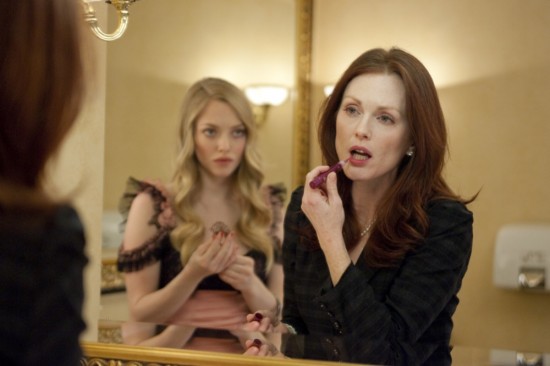
Canadian director Atom Egoyan (1994’s Exotica, 1997’s The Sweet Hereafter) was recently in town to discuss Chloe, his latest film, which producer Ivan Reitman commissioned him to direct. Based on, but markedly different from, the 2003 French film Nathalie, Chloe follows the unexpected course of events triggered when the middle-aged Catherine (Julianne Moore), suspecting her husband David (Liam Neeson) of having an affair, hires luxe call-girl Chloe (Amanda Seyfried) to tempt him.

San Francisco Bay Guardian: Do you know what attracted Ivan Reitman to this project?

Atom Egoyan: My only clue, really, is that in looking at his filmography, he made a film [in 1993] called Dave, which I enjoyed because it really is also a study of a marriage, a marriage that had gone completely cold. Sigourney Weaver plays the wife of a president, played by Kevin Kline, and they can’t stand each other. He dies, and a ringer is brought in, also played by Kevin Kline. All they have to do is make public appearances, because this couple doesn’t talk to each other in private at all. And she finds herself strangely falling in back love with her husband, and of course it isn’t her husband, it’s a surrogate. I think I understand why the person who made that film would be attracted to Chloe, because it’s dealing with similar themes.

SFBG: This is the first time you’ve directed a feature film script you haven’t written. Have you been approached before?

AE: Oh yes, all the time [gestures to two stacks at the end of the table, two and four inches thick, respectively]. I’ve had an agent since Exotica, sending me scripts. I was actually about to do a script after Exotica, a thriller, with Warner Brothers, and I spent a year in LA. And like anyone else, you can spend time there and have meetings and sort of not make movies. And I had an opportunity in Canada to make a certain type of  movie, so I went back and made The Sweet Hereafter, and I didn’t really ever regret that decision. I’m still sent scripts all the time. And some of them are tempting, some of them are films that you’d be interested in watching, but my question is, would I be able to spend a year, year-and-a-half, two years making the film, and remaining interested, and then talking about it?

SFBG: The script contains some of the recurrent themes in your work — identity, secrets, history; were there any other aspects that drew you to it?

AE: It was the study of a marriage. I thought it was a challenge to deal with this issue and this script that was written by a women, dealing with this very specific issue of a woman who feels she’s disappearing, and the crisis that it brings on in her, but also the very extreme action that she takes as a result. She wants to prove her husband is having an affair, and there are other ways of doing that than hiring a prostitute [laughs]. What she wants to do is not just prove he’s having an affair, but re-eroticize an image of him. because she can’t do that herself. There is something that Chloe’s stories are eliciting in her that she’s finding very compelling, and it’s a reconnection with her husband, a connection she once had. Unbeknownst to her, I think Chloe is finding it very powerful telling these stories to her of these encounters which she actually is having, though not necessarily [exactly as she is describing them]. It’s basically the story of these two women’s fantasies colliding in ways that they aren’t necessarily aware of.

SFBG: Did Reitman have something in mind that he wanted to change or add to the original film, a specific reason for wanting a remake? Had you seen Nathalie, and did you think about doing a remake?

AE: That’s the strange thing, I’ll tell you. I did see Nathalie, at the Toronto Film Festival in 2003. I enjoyed the film, and I know [director] Anne Fontaine, she’s a friend, someone I’ve known in Paris. It never would have occurred to me to do a remake. I wouldn’t have thought it was a particularly interesting premise to explore, but Ivan did. And then Ivan hired Erin Cressida Wilson to write the script, and by the time I got the script, it was intriguing. There were problems with it for me — it really pushed the thriller aspect way too far, so I felt it had to be pulled back, because the ending in the script I got was wildly different.

SFBG: Did you change anything else? The names are so tailored to the characters — “Catherine” means “pure,” “Chloe” means “blooming,” and “David” means “beloved” — that I wondered whether you or Erin had chosen them.

AE: Erin did. I think Erin’s incredibly attendant to all those things. She’s a really great writer and it was really a pleasure working with her, but I think there were things she felt she was being pushed to bring forward, certain more formulaic expectations of where the film should go. [Egoyan describes the specifics of making the ending less melodramatic. Redacted to avoid spoilers.] That alteration tonally just changes the whole film. I never wanted to demonize Chloe — I mean, the instigator in all this is Catherine, in a way, and I felt for Chloe and I wanted that to form our sense of who she was.

SFBG: You normally have great compassion for and involvement with your characters — and yet we never really find out anything about Chloe, not even if that’s really her name. Was there originally more story or backstory for her?

AE: Yeah, there was. But I think we must understand through the nature of her interaction with Catherine that there’s something she hasn’t received in her life, and I think we can figure that out, there are clues to that. I just didn’t want to make it too explicit because that felt reductive.

SFBG: She’s not really getting all that much from Catherine, is she?

AE: But she is. And it’s only my interpretation, I never want to assert orthodoxy over these movies, because I want them to be open, but I see that [how she comes to feel about] Catherine, all that she has from Catherine really is that someone is listening to her so attentively, listening to her tell stories about her day-to-day life. She’s paid to be forgotten. When they meet, Chloe’s crying in a bathroom cubicle, there’s some crisis that she’s experiencing, and from the moment that she meets Catherine, although you could say she sees her as a prospective client, I think there’s something in the first gesture, something that Catherine does, in that first touch — Chloe over-responds to it, maybe, but she needs to at that point.

SFBG: I wondered if this difference, that we never find out more about Chloe, was rooted in the fact that you hadn’t written the script.

AE: I have to admit, there is something, in retrospect, talking about it now, almost a year later, to do with Adoration [Egoyan’s 2009 film, starring his wife and longtime collaborator Arsinee Khanjian]. The deployment of exposition in the last part of that movie just doesn’t work for me somehow, when they begin to actually explain who they are. I really love the beginning of that film, the way it’s structured, and the way these [metaphoric] balls are being juggled — I don’t need to know exactly where and why, exactly what Arsinee is doing. Both these films involve  women are trying to get into the house of someone they either are in love with or were in love with. But if you make the comparison with Arsinee’s character in Adoration, the audience cannot have access to why that woman in that strange outfit wants to get into this house. There’s no way that that invites identification, and yet there’s tension and mystery….

SFBG: There was originally also more story and backstory on the son?

AE: Yes, Max Thieriot’s a really wonderful actor and he has a great story, which we had to cut. This will be on the  “deleted scenes” on the DVD. There’s a conversation with Catherine and Chloe about Catherine’s background….

SFBG: How long would the film have been if —

AE: The problem really wasn’t about the length, it just became unwieldy, it didn’t play right.

SFBG: The original script was set here. Was San Francisco’s iconic status as a locus for hedonism and sexual freedom a significant factor in Wilson’s original script?

AE: Yes, but there were things about it that made me recoil, because first, I was trying to wrap my head around the issue, how do you photograph this city in a way that hasn’t been shown before, when it’s been so detailed through films. My attraction to filming in Toronto is that it’s a place with a very distinct iconography — except most people don’t know what it is, so it creates this interesting tension. We’ve shown this film to a lot of people outside of Toronto, especially outside of Canada, and they’re going, “Where. Is. This. Place?” They feel they should know but they don’t.

SFBG: Because we’ve all seen Toronto masquerading as New York.

AE: Exactly. Toronto is like Chloe, paid to be something else. It becomes a controlling metaphor throughout the film.

SFBG: Was it relevant at all to the making of this movie that you and Arsinee had separated?

AE: We’re trying again. But I’ll be honest, it was a tough time for us when I was shooting, so . . . a lot of reflection on marriage. So this ended up being a strange and personal movie, and I was very thankful for Erin to have written it, because there is no way I could have gone to these [emotional] places as I was experiencing that. But we’re in a better place now.

Chloe opens Fri/26 in Bay Area theaters. Go here for Lynn Rapoport’s review of the film in this week’s Guardian.

Moore and less

0

FILM The people in Atom Egoyan’s movies have a tendency to be hiding things — pieces of their history, damages inflicted along the way, and complex motivations that are keys to our understanding of how the lives in a knotted web intersect and affect one another. We follow these expressive yet withholding characters, often back and forth through time, and collect subjective and fractional versions of the truth. Like the films themselves, Egoyan’s touch can be heavy — the characters saddled with exposition, the presence of coincidence at the intersections verging on the magical. He’s also proved that his intricate planning can backfire spectacularly (see: 2005’s Where the Truth Lies). But the results of his maneuverings rarely feel inconsequential: we are told, and have reason to believe, that our actions, our ideas, and even our untrustworthy narrations are freighted with meaning, for ourselves and those around us, in our peripheral vision and far out of sight.

The theme of undependable narrative surfaces in Egoyan’s newest film, Chloe (a remake of French director Anne Fontaine’s 2003 Nathalie), but here the artifice — of the premise itself — is so hard to move past as to feel at times like a barrier, rather than a passageway into the interior of a handful of lives. We do see interiors, in the beautiful, chilly household of Catherine (Julianne Moore), a Toronto doctor who suspects that her professor husband, David (Liam Neeson), may be cheating on her. And one of the more haunting images in the film is the painful sight of Catherine drifting through their home at night, barred from the rooms where her husband and teenage son (Max Thieriot) carry on their private, unknowable lives.

Why this unbearable situation would lead her to contact Chloe (Amanda Seyfried), a beautiful young call girl she just met, and hire her to engineer an interaction with David to test his fidelity, is not quite clear. Nonetheless, one masochistic transaction leads to another, and in a series of lavish and exquisite settings, we, along with Catherine, are treated to the erotic details of Chloe’s encounters with David, which begin to charge the connection between the two women as well.

Moore’s work is as fine as ever, and she invests with pathos the role of a woman anxiously examining both her marriage and herself for signs of frailty and decay. But Egoyan has settled for something here: trying to beguile and seduce us. And in the end, this is more disturbing, and surprising, than the rather sharp turn Chloe makes into the landscape of the erotic thriller, where it takes the shape of an unbelievable story we’ve been told many times before. (Lynn Rapoport)

CHLOE opens Fri/26 in Bay Area theaters.

To read Mara Math’s interview with Atom Egoyan, go here.

Rainbow flex

0

arts@sfbg.com

FILM The tagline “in glorious Technicolor” was never done more justice than when cinematographer Jack Cardiff was behind the camera. Whether summoning vertiginous Himalayan vistas, making a pair of scarlet ballet shoes outshine Dorothy’s ruby slippers, or accentuating a female star’s sensuality while also capturing her intelligence, Cardiff’s mastery of light and his bold, at times hallucinatory, use of super-saturated color put him in a class above in a field already filled with so many greats.

The Pacific Film Archive pays tribute to Cardiff starting this week, in a modest five-film retrospective, “Life, Death, and Technicolor,” that kicks off with the three films he shot for fellow Brit Michael Powell — A Matter Of Life and Death (1946), Black Narcissus (1947), and The Red Shoes (1948) — that represent the pinnacle of his talents. Certainly, the series’ other two films, Pandora and the Flying Dutchman (1951) and The Barefoot Contessa (1954), have their charms (namely, Ava Gardner). But in a long and distinguished career that started in the silent era and included stints with Huston, Hitchcock, and Welles, as well as lensing some of the screen’s great female beauties, Cardiff’s work with Powell and his partner Emeric Pressburger remains unsurpassed.

Like the art historical precedents he cited as influences — apparently, his knowledgeable explanations of Caravaggio and Vermeer’s technique landed him the job with Technicolor — Cardiff understood the affective power of color and used his palette to ratchet up the emotional intensity of Powell and Pressburger’s lush melodramas to new extremes. The red lipstick that Kathleen Byron’s near-hysteric Sister Ruth applies before Deborah Kerr’s shocked Sister Clodagh in Black Narcissus; the marine blue of the fairy tale gown Moira Shearer’s dancer wears to meet the ballet impresario in The Red Shoes; and the sudden floods of color in A Matter of Life and Death during its periodic switchovers from black and white stock.

And yet Cardiff’s technical achievements extend far beyond his eye for hue. All the Pandoran CGI eye-candy generated by James Cameron’s digital production army dulls in comparison to the kaleidoscopic Himalayan countryside, with its snow-capped crags and verdant foliage, that Cardiff conjured up entirely within a London studio for Black Narcissus. Likewise, the ballet-within-the-film sequence in The Red Shoes, which takes us beyond the theater proscenium into a gorgeous and melancholy land of a thousand dances, stands alone as one of the single-most gorgeous 20 minutes ever committed to film (as those who recently caught a restored print of the film at the Castro Theatre can attest to).

Indeed, the superlatives come easy with Cardiff. If you go to one of these films, you’ll see why. Your senses will thank you.

LIFE, DEATH, AND TECHNICOLOR: A TRIBUTE TO JACK CARDIFF

March 25-April 17, $5.50–$9.50

Pacific Film Archive

2575 Bancroft, Berk.

(510) 642-5249

www.bampfa.berkeley.edu


Rep Clock

0

Schedules are for Wed/24–Tues/30 except where noted. Director and year are given when available. Double features are marked with a •. All times are p.m. unless otherwise specified.

ARTISTS’ TELEVISION ACCESS 992 Valencia, SF; www.atasite.org. $6. "Other Cinema:" Live A/V synthesis with Shimomitsu, Softserve, Cyrus Tabar, and more, Sat, 8:30.

BALBOA 3630 Balboa, SF; (415) 221-8184. $6.50-9. "Creature Features:" Horror Express (Martin, 1972), Thurs, 7.

CAFÉ OF THE DEAD 3208 Grand, Oakl; (510) 931-7945. Free. "Independent Filmmakers Screening Nite," Wed, 6:30.

CASTRO 429 Castro, SF; (415) 621-6120, www.castrotheatre.com. $7.50-10. Alice in Wonderland (Burton, 2010), through April 1, 1, 4, 7, 9:45.

CHRISTOPHER B. SMITH RAFAEL FILM CENTER 1118 Fourth St, San Rafael; (415) 454-1222, www.cafilm.org. $6.50-10. The Art of the Steal (Argott, 2009), call for dates and times. The Girl With the Dragon Tattoo (Oplev, 2009), call for dates and times. The Most Dangerous Man in America: Daniel Ellsberg and the Pentagon Papers (Ehrlich and Goldsmith, 2009), call for dates and times. A Prophet (Audiard, 2009), call for dates and times. They Came to Play (Rotaru, 2008), Wed, 7:30. With film subjects, pianists Ken Iisaka and Esfir Ross, performing live.

HUMANIST HALL 390 27th St, Oakl; www.humanisthall.org. $5. "Loaded Visions," short videos by Antero Alli, Wed, 7:30.

MARINES MEMORIAL THEATRE 609 Sutter, Second Flr, SF; (415) 771-6900, www.marinesmemorialtheatre.com. $5-18. The Most Dangerous Man in America: Daniel Ellsberg and the Pentagon Papers (Ehrlich and Goldsmith, 2009), Fri, 6:30. Event includes post-screening discussion with film subject Ellsberg and former U.S. Congressman Pete McCloskey.

MECHANICS’ INSTITUTE 57 Post, SF; (415) 393-0100, rsvp@milibrary.org. $10. "CinemaLit Film Series: Star Power, A Month of Meryl Streep:" The Hours (Daldry, 2002), Fri, 6.

PACIFIC FILM ARCHIVE 2575 Bancroft, Berk; (510) 642-5249, www.bampfa.berkeley.edu. $5.50-9.50. "Life, Death, and Technicolor: A Tribute to Jack Cardiff:" A Matter of Life and Death (Powell and Pressburger, 1946), Thurs, 7; Black Narcissus (Powell and Pressburger, 1947), Sat, 8:35. "Joseph Losey: Pictures of Provocation:" Eve (1962), Fri, 7; Time Without Pity (1957), Fri, 9:20; Accident (1967), Sun, 5:45. "Celebrating Chekhov:" Uncle Vanya (Konchalovsky, 1970), Sat, 6:30; Ward No. 6 (Shakhnazarov with Gornovsky, 2009), Sun, 4. "What’s It All Mean: Films by William T. Wiley and Friends:" "Films by Wiley and Friends (1963-71)," Tues, 7:30.

PIEDMONT 4186 Piedmont, Oakl; (510) 464-5980. $5-8. "Cult Classics Attack 5:" A Clockwork Orange (Kubrick, 1971), Fri-Sat, midnight.

RED VIC 1727 Haight, SF; (415) 668-3994. $6-10. The Road (Hillcoat, 2009), Wed-Thurs, 7, 9:20 (also Wed, 2). Inglourious Basterds (Tarantino, 2009), Fri-Sat, 8 (also Sat, 2, 5). The Room (Wiseau, 2003), Fri-Sat, midnight. An Education (Scherfig, 2009), Sun-Mon, 7:15, 9:20 (also Sun, 2, 4). The Imaginarium of Dr. Parnassus (Gilliam, 2009), March 30-31, 7, 9:30 (also March 31, 2, 4:30).

ROXIE 3117 and 3125 16th St, SF; (415) 863-1087, www.roxie.com. $5-9.75. Closed for renovation until April 1.

SAN FRANCISCO CINEMATHEQUE Ovila Amphitheater at USF, 2130 Fulton, SF; www.sfcinema.org. Free. Ukranian Time Machine (Uman, 2008), with filmmaker Naomi Uman in person, Mon, 8.

YERBA BUENA CENTER FOR THE ARTS 701 Mission, SF; (415) 978-2787, www.ybca.org. $6-8. "Human Rights and Film:" Promised Lands (Sontag, 1974), Thurs, 7:30; American Radical: The Trials of Norman Finkelstein (Ridgen and Rossier, 2009), Sun, 2.

Film listings

0

Film listings are edited by Cheryl Eddy. Reviewers are Kimberly Chun, Michelle Devereaux, Max Goldberg, Dennis Harvey, Johnny Ray Huston, Erik Morse, Louis Peitzman, Lynn Rapoport, Ben Richardson, and Matt Sussman. The film intern is Peter Galvin. For rep house showtimes, see Rep Clock. For first-run showtimes, see Movie Guide.

OPENING

Chloe See "Moore and Less." (1:36) Elmwood, SF Center, Sundance Kabuki.

Greenberg Roger Greenberg (Ben Stiller) is 40, and you might think he’s going through a midlife crisis — if he hadn’t been in pretty much this same crisis for 15 years or more. Still very edgy and fragile after a nervous breakdown-sparked institutional stay, he’s holing up at the comfortable Hollywood home of a big-deal brother while the latter and family are on vacation in Vietnam. (The implication being that Roger is most welcome here when no one else actually has to endure his prickly, high maintenance company.) While in residence he reconnects with old friends including the ex-girlfriend (Jennifer Jason Leigh) he dumped yet never quite got over — though clearly she did — and the ex-bandmate (Rhys Ifans) he burned by wrecking their one shot at a major-label deal. He also gets involved, kinda-sorta, with big bro’s personal assistant Florence (mumblecore regular Greta Gerwig), whose passivity and low self-esteem make her the rare person who might consider a relationship with someone this impossible. Like all Noah Baumbach films, especially the slightly overrated Squid and the Whale (2005) and vastly underrated Margot at the Wedding (2007), his latest pivots around a pathologically self-absorbed and insensitive protagonist who exasperates anyone unlucky or blind enough to fall into his or her orbit. Working from a story co-conceived by spouse Leigh, Baumbach’s script sports his usual sharp dialogue, penetrating individual scenes, and narrative surprises. But it also gets stuck in dislikable Roger’s rut, finding conflict easily but stubbornly resisting even the smallest useful change. For all its amusing and uncomfortable moments, Greenberg emerges a dual character slice with no real point. Neither Roger or Beth reward long scrutiny (least of all as a hapless potential couple), while the few screen minutes Ifans and Leigh get make you wish their roles had hijacked the focus instead. (1:40) Piedmont, Shattuck. (Harvey)

Hot Tub Time Machine At last, Crispin Glover returns to his time-travel movie roots! (1:55) California.

How to Train Your Dragon Yet another 3D cartoon for the kiddies. At least this one is about Vikings. (1:38)

*The Sun It may have taken five years for Alexander Sokurov’s The Sun (2005) to reach local theaters, but then the Russian master’s contemplation of Emperor Hirohito’s last days as Godhead is decidedly out of time. Painterly and slow like all Sokurov’s work, the film specifically follows his estranged reconstructions of Hitler’s retreat with Eva Braun (1999’s Moloch) and Lenin’s demise (2000’s Taurus). In August 1945, Hirohito broke with tradition by making a direct appeal to the Japanese people to end military operations; soon thereafter he renounced his divine rights. The Sun‘s elliptical narration intuits the emperor’s paled existence, and Issey Ogata’s lead performance, centering on a fish-out-of-water puckering of the lips, amply conveys the shuttered hours of a man who, in experience if not in fact, is not quite human. The muted use of available light and a disquieting sound design (faraway air-raid sirens yield to the barest brush of a finger) eschew historiography’s harsh glare, instead returning primal scenes of power to a dreamlike state of unknowing. Sokurov’s most hallucinatory effects are reserved for ashen views of firebombed Tokyo which float free from perspective or clear boundary; a brief fantasy in which fish-like warplanes spew apocalyptic destruction suggests the emperor’s childlike imagination and set the stage for his historical date with General MacArthur, realized by Sokurov less as a diplomatic breakthrough than a leaden twilight. (1:50) Shattuck. (Goldberg)

Waking Sleeping Beauty Hollywood history is full of epic rivalries, juicy scandals, multi-million-dollar mistakes, and triumphant comebacks. Sometimes, all of the above and more can be contained within a single studio, or even a single studio division, or even a single studio division during a finite number of years, as illustrated by this insidery peek at Disney’s animation division. The doc gives a bit of background, but focuses its attentions on 1984-1994, a ten-year span that saw the floundering department struggle through post-Walt, identity-crisis blues before blossoming into a rejuvenated powerhouse. Waking Sleeping Beauty director Don Hahn was a producer on the Oscar-nominated Beauty and the Beast (1991), so he’s uniquely positioned to tell the story as it unfolded, using home movies and countless interviews. High points include a glimpse of late composer Howard Ashman introducing his demo for the iconic Little Mermaid (1989) tune "Under the Sea" (it was Ashman’s idea to give the crab character a Jamaican accent), and plenty of dish on the legendary Jeffrey Katzenberg-Michael Eisner feud. (1:26) Embarcadero. (Eddy)

ONGOING

Ajami You may recognize the title of Yaron Shoni and Scandar Copti’s debut collaboration as one of five films nominated for a 2010 Academy Award in the Foreign Category. Though it didn’t bring home the grand prize, Ajami remains a complex and affecting story about desperation and its consequences in a religiously-mixed town in Israel. As we follow the lives of four of Ajami’s residents the narrative shifts perspective almost maddeningly, switching characters seemingly at the height of each story’s action. But once all of the stories fully intersect, the final product has the distinction of feeling both meticulously calculated and completely natural. I was most impressed to learn that Shani and Copti prepared their actors with improvised role-playing rather than scripts. By withholding what was going to happen in a scene before shooting, we are treated to looks of surprise and emotion on actor’s faces that never feel unnatural. Attaining such a level of realism may be Ajami‘s crowning achievement; it can’t have been easy to make a foreign world feel so familiar. (2:00) Shattuck. (Galvin)

Alice in Wonderland Tim Burton’s take on the classic children’s tale met my mediocre expectations exactly, given its months of pre-release hype (in the film world, fashion magazines, and even Sephora, for the love of brightly-colored eyeshadows). Most folks over a certain age will already know the story, and much of the dialogue, before the lights go down and the 3-D glasses go on; it’s up to Burton and his all-star cast (including numerous big-name actors providing voices for animated characters) to make the tale seem newly enthralling. The visuals are nearly as striking as the CG, with Helena Bonham Carter’s big-headed Red Queen a particularly marvelous human-computer creation. But Wonderland suffers from the style-over-substance dilemma that’s plagued Burton before; all that spooky-pretty whimsy can’t disguise the film’s fairly tepid script. Teenage Alice (Mia Wasikowska) displaying girl-power tendencies is a nice, if not surprising, touch, but Johnny Depp’s grating take on the Mad Hatter will please only those who were able to stomach his interpretation of Willy Wonka. (1:48) Castro, Empire, 1000 Van Ness, SF Center, Sundance Kabuki. (Eddy)

*The Art of the Steal How do you put a price on something that’s literally priceless? The Art of the Steal takes an absorbing look at the Barnes Collection, a privately-amassed array of Post-Impressionist paintings (including 181 Renoirs) worth billions — and the many people and corporate interests who schemed to control it. Founder Albert C. Barnes was an singular character who took pride in his outsider status; he housed his art in a specially-constructed gallery far from downtown Philadelphia’s museum scene, and he emphasized education and art appreciation first and foremost. But he had no heirs, and after his death in 1951, opportunists began circling his massive collection; the slippery political and legal dealings that have unfolded since then are nearly as jaw-dropping as Barnes’ prize paintings. Philly documentarian Don Argott has a doozy of a subject here, and his skillful, even suspenseful film does it justice. (1:41) Smith Rafael. (Eddy)

The Blind Side When the New York Times Magazine published Michael Lewis’ article "The Ballad of Big Mike" — which he expanded into the 2006 book The Blind Side: Evolution of a Game — nobody could have predicated the cultural windfall it would spawn. Lewis told the incredible story of Michael Oher — a 6’4, 350-pound 16-year-old, who grew up functionally parentless, splitting time between friends’ couches and the streets of one of Memphis’ poorest neighborhoods. As a sophomore with a 0.4 GPA, Oher serendipitously hitched a ride with a friend’s father to a ritzy private school across town and embarked on an unbelievable journey that led him into a upper-class, white family; the Dean’s List at Ole Miss; and, finally, the NFL. The film itself effectively focuses on Oher’s indomitable spirit and big heart, and the fearless devotion of Leigh Anne Tuohy, the matriarch of the family who adopted him (masterfully played by Sandra Bullock). While the movie will delight and touch moviegoers, its greatest success is that it will likely spur its viewers on to read Lewis’ brilliant book. (2:06) Oaks. (Daniel Alvarez)

Brooklyn’s Finest "Really? I mean, really?" asked the moviegoer beside me as the final freeze-frame of Brooklyn’s Finest slapped our eyeballs. Yes, that’s the sound of letdown, despite the fact that Brooklyn’s Finest initially resembled a promisingly gritty juggling act in the mode of The Wire and Cop Land (1997), Taxi Driver (1976) and Training Day (2001). Bitter irony flows from the title — and from the lives, loves, bad habits, pressure-cooker stress, and unavoidable moral dilemmas of three would-be everyday cops, all occupying several different rungs on a food chain where right and wrong have an unpleasant way of switching sides. Eddie (Richard Gere) is the veteran officer just biding his time till he gets his pension, all while comforting himself with the meager sensuous attentions of hooker Chantel (Shannon Kane). Sal (Ethan Hawke) is the bad detective, stealing from the dealers to fund a dream home for his growing family with Angela (Lili Taylor). Tango (Don Cheadle) is the undercover detective who has cultivated friendships with dealers like Caz (Wesley Snipes) and sacrificed his marriage for a long-promised promotion from his lieutenant (Will Patton) and his superior (Ellen Barkin, in likely the most misogynist portrayal of a lady with a badge to date). You spend most of Brooklyn’s Finest waiting for these cops to collide in the most unfortunate, messiest way possible, but instead the denouement leaves will leave one wondering about unresolved threads and feeling vaguely unsatisfied. In any case, director Antoine Fuqua and company seem to pride themselves on their tough-minded if at times cartoonish take on law enforcement, with Hawke in particular turning in a memorably OTT and anguished performance. (2:13) 1000 Van Ness. (Chun)

The Bounty Hunter There’s a real feeling of impotence in reviewing a movie whose ad was pasted on the side of the bus you took to the screening. This thing is determined to be seen, and that’s a true shame. Those who heed the call of the ubiquitous marketing campaign will have to sit through a dull parade of contrivances concerning a bounty hunter (Gerard Butler) whose latest catch is his court-skipping ex-wife (Jennifer Aniston). She’s a hotshot city journalist who’s forced to continue her investigation of a police cover-up while handcuffed to a car door and bickering with her old flame. The trajectory of the plot is obvious enough, but there’s so little chemistry between the two actors that the inevitable reconciliation practically constitutes a twist ending. Aniston saw fit not to whine her way through this role, which is something, but nothing nearly as complimentary can be said about Butler. He emotes in lurches, with the presence of a guy who’s not sure acting is the right direction for his life but still really wants to give it a go. If "This. Is. Sparta!" weren’t burned into my brain I would swear the man had never been in front of a camera before. (1:50) 1000 Van Ness, SF Center, Sundance Kabuki. (Jason Shamai)

The Crazies Disease and anti-government paranoia dovetail in this competent yet overwhelmingly non-essential remake of one of George A. Romero’s second-tier spook shows. In a small Iowa hamlet overseen by a benevolent sheriff (Timothy Olyphant) and his pregnant wife (Radha Mitchell), who’s also the town doctor, a few odd incidents snowball into all-out chaos when a mysterious, unmarked plane crashes into the local water supply. Before long, the few residents who aren’t acting like homicidal maniacs are rounded up by an uber-aggressive military invasion. Though our heroes convey frantic panic as they try to figure out what the hell is going on, The Crazies never achieves full terror mode. It’s certainly watchable, and even enjoyable at times. But memorable? Not in the slightest. (1:41) 1000 Van Ness. (Eddy)

Crazy Heart "Oh, I love Jeff Bridges!" is the usual response when his name comes up every few years for Best Actor consideration, usually via some underdog movie no one saw, and the realization occurs that he’s never won an Oscar. The oversight is painful because it could be argued that no leading American actor has been more versatile, consistently good, and true to that elusive concept "artistic integrity" than Bridges over the last 40 years. It’s rumored Crazy Heart was slotted for cable or DVD premiere, then thrust into late-year theater release in hopes of attracting Best Actor momentum within a crowded field. Lucky for us, this performance shouldn’t be overlooked. Bridges plays "Bad" Blake, a veteran country star reduced to playing bars with local pickup bands. His slide from grace hasn’t been helped by lingering tastes for smoke and drink, let alone five defunct marriages. He meets Jean (Maggie Gyllenhaal), freelance journalist, fan, and single mother. They spark; though burnt by prior relationships, she’s reluctant to take seriously a famous drunk twice her age. Can Bad handle even this much responsibility? Meanwhile, he gets his "comeback" break in the semi-humiliating form of opening for Tommy Sweet (Colin Farrell) — a contemporary country superstar who was once Bad’s backup boy. Tommy offers a belated shot at commercial redemption; Jean offers redemption of the strictly personal kind. There’s nothing too surprising about the ways in which Crazy Heart both follows and finesses formula. You’ve seen this preordained road from wreckage to redemption before. But actor turned first-time director Scott Cooper’s screenplay honors the flies in the windshield inherited from Thomas Cobb’s novel — as does Bridges, needless to say. (1:51) Piedmont, 1000 Van Ness, Shattuck, Sundance Kabuki. (Harvey)

Diary of a Wimpy Kid Spoiler alert: nothing happens in Diary of a Wimpy Kid. That was OK when it was just a book—author Jeff Kinney’s illustrated novel works due in large part to his whimsical drawings and tongue-in-cheek humor. It’s a kids’ book, but it’s fun for adults, too. The same can’t be said for the film adaptation: Diary of a Wimpy Kid sticks close to its source material without the creativity necessary to make it work on the big screen. As in the book, Greg Heffley (Zachary Gordon) navigates the treacherous terrain of middle school, struggling to cope with an awkward best friend, a brutal older brother, and parents who just don’t understand. All the actors turn in solid performances — Gordon is a particularly good find. But there’s so little here to work with. The best that can be said about Diary of a Wimpy Kid is that it’s cute and mostly harmless: a pleasant diversion for young’uns, and a tolerable bore for the parents they drag along. (2:00) 1000 Van Ness. (Peitzman)

*An Education The pursuit of knowledge — both carnal and cultural — are at the tender core of this end-of-innocence valentine by Danish filmmaker Lone Scherfig (who first made her well-tempered voice heard with her 2000 Dogme entry, Italian for Beginners), based on journalist Lynn Barber’s memoir. Screenwriter Nick Hornby breaks further with his Peter Pan protagonists with this adaptation: no man-boy mopers or misfits here. Rather, 16-year-old schoolgirl Jenny (Carey Mulligan) is a good girl and ace student. It’s 1961, and England is only starting to stir from its somber, all-too-sober post-war slumber. The carefully cloistered Jenny is on track for Oxford, though swinging London and its high-style freedoms beckon just around the corner. Ushering in those freedoms — a new, more class-free world disorder — is the charming David (Peter Sarsgaard), stopping to give Jenny and her cello a ride in the rain and soon proffering concerts and late-night suppers in the city. He’s a sweet-faced, feline outsider: cultured, Jewish, and given to playing fast and loose in the margins of society. David can see Jenny for the gem she is and appreciate her innocence with the knowing pleasure of a decadent playing all the angles. The stakes are believably high, thanks to An Education‘s careful attention to time and place and its gently glamored performances. Scherfig revels in the smart, easy-on-eye curb appeal of David and his friends while giving a nod to the college-educated empowerment Jenny risks by skipping class to jet to Paris. And Mulligan lends it all credence by letting all those seduced, abandoned, conflicted, rebellious feelings flicker unbridled across her face. (1:35) Oaks, Smith Rafael. (Chun)

*The Ghost Writer Roman Polanski’s never-ending legal woes have inspired endless debates on the interwebs and elsewhere; they also can’t help but add subtext to the 76-year-old’s new film, which is chock full o’ anti-American vibes anyway. It’s also a pretty nifty political thriller about a disgraced former British Prime Minister (Pierce Brosnan) who’s hanging out in his Martha’s Vineyard mansion with his whip-smart, bitter wife (Olivia Williams) and Joan Holloway-as-ice-queen assistant (Kim Cattrall), plus an eager young biographer (Ewan McGregor) recently hired to ghost-write his memoirs. But as the writer quickly discovers, the politician’s past contains the kinds of secrets that cause strange cars with tinted windows to appear in one’s rearview mirror when driving along deserted country roads. Polanski’s long been an expert when it comes to escalating tension onscreen; he’s also so good at adding offbeat moments that only seem tossed-off (as when the PM’s groundskeeper attempts to rake leaves amid relentless sea breezes) and making the utmost of his top-notch actors (Tom Wilkinson and Eli Wallach have small, memorable roles). Though I found The Ghost Writer‘s ZOMG! third-act revelation to be a bit corny, I still didn’t think it detracted from the finely crafted film that led up to it. (1:49) California, Piedmont, Sundance Kabuki. (Eddy)

*The Girl With the Dragon Tattoo By the time the first of Stieg Larsson’s so-called "Millennium" books had been published anywhere, the series already had an unhappy ending: he died (in 2004). The following year, The Girl With the Dragon Tattoo became a Swedish, then eventually international sensation, its sequels following suit. The books are addicting, to say the least; despite their essential crime-mystery-thriller nature, they don’t require putting your ear for writing of some literary value on sleep mode. Now the first of three adaptive features shot back-to-back has reached U.S. screens. (Sorry to say, yes, a Hollywood remake is already in the works — but let’s hope that’s years away.) Even at two-and-a-half hours, this Girl With the Dragon Tattoo by necessity must do some major truncating to pack in the essentials of a very long, very plotty novel. Still, all but the nitpickingest fans will be fairly satisfied, while virgins will have the benefit of not knowing what’s going to happen and getting scared accordingly. Soon facing jail after losing a libel suit brought against him by a shady corporate tycoon, leftie journalist Mikael Blomkvist (Michael Nyqvist) gets a curious private offer to probe the disappearance 40 years earlier of a teenage girl. This entangles him with an eccentric wealthy family and their many closet skeletons (including Nazi sympathies) — as well as dragon-tattooed Lisbeth Salander (Noomi Rapace), androgynous loner, 24-year-old court ward, investigative researcher, and skillful hacker. Director Niels Arden Oplev and his scenarists do a workmanlike job — one more organizational than interpretive, a faithful transcription without much style or personality all its own. Nonetheless, Larsson’s narrative engine kicks in early and hauls you right along to the depot. (2:32) Albany. (Harvey)

Green Zone Titled for the heavily-guarded headquarters of international occupation in Baghdad, Green Zone reunites director Paul "Shaky-Cam" Greengrass with star Matt Damon, the two having previously collaborated on the last two Bourne films. Instead of a super-soldier, this time around Damon just plays a supremely insubordinate one as he attempts to uncover the reason why his military unit can’t find any of Saddam’s WMDs. With the aid of the CIA, a Wall Street Journal reporter and a friendly Iraqi, Damon goes rogue in order to suss out the source of the misinformation. The Iraq War action is decent if scarce, but an overindulgence in (you guessed it) shaky-cam and political jargon cannot hide the fact that Green Zone‘s plot is simplistic and probably light on actual facts. Damon makes a fine cowboy-cum-hero, but the effectiveness of the mix of patriotism and Pentagon paranoia will vary based on your penchant for such things. Still, Green Zone moves fast enough that it remains worth a matinee for conspiracy thriller aficionados. (1:55) Empire, 1000 Van Ness, Sundance Kabuki. (Galvin)

The Hurt Locker When the leader of a close-knit U.S. Army Explosive Ordnance Disposal squad is killed in action, his subordinates have barely recovered from the shock when they’re introduced to his replacement. In contrast to his predecessor, Sgt. James (Jeremy Renner) is no standard-procedure-following team player, but a cocky adrenaline junkie who puts himself and others at risk making gonzo gut-instinct decisions in the face of live bombs and insurgent gunfire. This is particularly galling to next-in-command Sanborn (Anthony Mackie). An apolitical war-in-Iraq movie that’s won considerable praise for accuracy so far from vets (scenarist Mark Boal was "embedded" with an EOD unit there for several 2004 weeks), Kathryn Bigelow’s film is arguably you-are-there purist to a fault. While we eventually get to know in the principals, The Hurt Locker is so dominated by its seven lengthy squad-mission setpieces that there’s almost no time or attention left for building character development or a narrative arc. The result is often viscerally intense, yet less impactful than it would have been if we were more emotionally invested. Assured as her technique remains, don’t expect familiar stylistic dazzle from action cult figure Bigelow (1987’s Near Dark, 1989’s Blue Steel, 1991’s Point Break) — this vidcam-era war movie very much hews to the favored current genre approach of pseudo-documentary grainy handheld shaky-cam imagery. (2:11) Shattuck. (Harvey)

*The Last Station Most of the buzz around The Last Station has focused on Helen Mirren, who takes the lead as the Countess Sofya, wife of Leo Tolstoy (Christopher Plummer). Mirren is indeed impressive — when is she not? — but there’s more to the film than Sofya’s Oscar-worthy outbursts. The Last Station follows Valentin Bulgakov (James McAvoy), hired as Tolstoy’s personal secretary at the end of the writer’s life. Valentin struggles to reconcile his faith in the anarchist Christian Tolstoyan movement with his sympathy for Sofya and his budding feelings for fellow Tolstoyan Masha (Kerry Condon). For the first hour, The Last Station is charming and very funny. Once Tolstoy and Sofya’s relationship reaches its most volatile, however, the tone shifts toward the serious — a trend that continues as Tolstoy falls ill. After all the lighthearted levity, it’s a bit jarring, but the solid script and accomplished cast pull The Last Station together. Paul Giamatti is especially good as Vladimir Chertkov, who battles against Sofya for control of Tolstoy’s will. You’ll never feel guiltier for putting off War and Peace. (1:52) Albany. (Peitzman)

*The Most Dangerous Man in America: Daniel Ellsberg and the Pentagon Papers For many, Daniel Ellsberg is a hero — a savior of American First Amendment rights and one of the most outspoken opponents of the Vietnam war. But as this documentary (recently nominated for an Academy Award) shows, it’s never an an easy decision to take on the U.S. government. Ellsberg himself narrates the film and details his sleepless nights leading up to the leak of the Pentagon Papers — the top secret government study on the Vietnam war — to the public. Though there are few new developments in understanding the particulars of the war or the impact the release of the Papers had on ending the conflict, the film allows audiences to experience the famous case from Ellsberg’s point of view, adding a fresh and poignantly human element to the events; it’s a political documentary that plays more like a character drama. Whether you were there when it happened or new to the story, there is something to be appreciated from this tale of a man who fell out of love with his country and decided to do something about it. (1:34) Shattuck, Smith Rafael. (Galvin)

*Mother You can guarantee that a movie titled Mother is not gonna be a love fest, ever. And through the lens of The Host (2006) director-writer Bong Joon-ho, motherly love becomes downright monstrous — though altogether human. Much credit goes to the wonderful lead actress Kim Hye-ja as the titular materfamilias, who’s frantically self-sacrificing, insanely tenacious, quaintly charming, wolfishly fearsome, and wildly guilt-ridden, by turns. On the surface, she’s a sweetly innocuous herbalist and closet acupuncturist — happily, and a wee bit too tightly, tethered to her beloved son Yoon Do-joon (Won Bin). He’s a slow-witted, forgetful, and easily confused mop-top who flies into deadly rages when taunted or called a "’tard." When Do-joon is quickly arrested and charged with the murder of schoolgirl Moon Ah-jung (Mun-hee Na), Mom snaps into action with a panic-stricken, primal ferocity and goes in search of the killer to free her boy. But there’s more to Do-joon, his studly pal Jin-tae (Ku Jin), and Moon Ah-jung than meets the eye, and Mother discovers just how much she’s defined, and twisted, herself in relation to her son. Bong gives this potentially flat and cliched noirish material genuine lyricism, embedding his anti-heroine in a rural South Korean landscape like a penitent wandering in an existential desert, gently echoing filmmakers such as Ingmar Bergman and Abbas Kiarostami and beautifully transcending genre. (2:09) Shattuck. (Chun)

Our Family Wedding America Ferrera and Lance Gross play a couple of lovebirds who must jump through some serious family hoops before they get married in the mostly serviceable Our Family Wedding. What begins as a dual Guess Who’s Coming to Dinner, with the differences in each family’s traditions forcing complications and compromises, soon loses sight of its matrimonial plot as the focus steers towards a childish rivalry between the fathers. While it’s being marketed as a goofy comedy, the final product seeks a relatively sentimental tone, which makes the few slapstick moments — like a goat trying to rape Academy Award-winning actor Forest Whitaker — seem pretty inappropriate. Still, for some audiences the well-tread plot will act as comfort food: they fight, they make up, and it all ends in a big wedding where we watch the characters dance for damn near ten minutes. (1:41) 1000 Van Ness. (Galvin)

*A Prophet Filmmaker Jacques Audiard has described his new film, A Prophet, as "the anti-Scarface." Yet much like Scarface (1983), A Prophet bottles the heady euphoria that chases the empowerment of the powerless and the rise of the long-shot loner on the margins. In its almost-Dickensian attention to detail, devotion to its own narrative complexity, and passion for cinematic poetry, A Prophet rises above the ordinary and, through the prism of genre, finds its own power. The supremely opportunistic, pragmatically Machiavellian intellectual and spiritual education of a felon is the chief concern of here. Played by Tahar Rahim with guileless, open-faced charisma, Malik is half-Arab and half-Corsican — and distrusted or despised by both camps in the pen. When he lands in jail for his six-year sentence, he’s 19, illiterate, friendless, and vulnerable. His deal with the devil — and means of survival — arrives with Reyeb (Hichem Yacoubi), temporarily locked up before his testifies against the mob. Corsican boss Cesar Luciani (Niels Arestrup) wants him dead, and Malik is tagged to penetrate Reyeb’s cell with a blade hidden in mouth. After Malik’s gory rebirth, it turns out that the teenager’s a seer in more ways than one. From his low-dog position, he can eyeball the connections linking the drugs entering the prison to those circulating outside, as well as the machinations intertwining the Arab and Corsican syndicates. It’s no shock that when Cesar finds his power eroding and arranges prison leaves for his multilingual crossover star that Malik serves not only his Corsican master, but also his own interests, and begins to build a drug empire rivaling his teacher’s. Throughout his pupil’s progress, Audiard demonstrates a way with Henri Cartier-Bresson’s decisive moment, and when Malik finally breaks with his Falstaffian patriarch, it makes your heart skip a beat in a move akin to the title of the director’s last film. This Eurozone/Obama-age prophet is all about the profit — but he’s imbued with grace, even while gaming for ill-gotten gain. (2:29) Shattuck, Smith Rafael. (Chun)

Remember Me Ominously set in New York City during the summer of 2001, Remember Me, starring Robert Pattinson (of the Twilight series) and Emilie de Ravin (of TV’s Lost), pretty much answers the question of whether it’s still too soon to make the events of September 11 the subject of a date movie. Or rather, not the subject so much as the specter waiting just off-camera for its walk-on while brooding 21-year-old Tyler Hawkins (Pattinson) quotes Gandhi, gets into brawls, gets drunk, writes letters to his dead brother, and otherwise channels despondency and rage into various salubrious outlets. One of these is romancing (under circumstances severely testing the viewer’s credulity) de Ravin’s Ally Craig, grappling somewhat more constructively with her own familial tragedy. Ally is the sort of self-possessed, strong-willed young woman whose instincts, shortly after she’s been backhanded by her drunk father (Chris Cooper), tell her to placate and have sex with her drunk boyfriend when he comes home enraged after battling his own father (Pierce Brosnan). She is there to teach Tyler, through quirky habits like eating dessert first, what director Allen Coulter (2006’s Hollywoodland) wishes to teach us: that time is short and one must fill one’s life with meaningful actions — like throwing a fire extinguisher through a window to convince a classroom of tweens to stop bullying one’s little sister. The film is seeded with allusions to an impending catastrophe that feels less integrated than exploited. And it’s uncomfortable seeing the fall of the towers used to make the ground shake under a sweet, fairly depthless depiction of love and grief. (2:08) Empire, 1000 Van Ness, Sundance Kabuki. (Rapoport)

Repo Men If you are considering going to see Repo Men you’ll need to go ahead and turn off your brain first — the guy who wrote it sure did. The script is jam-packed with contrivances and tonal inconsistencies, which is a shame because the plot had potential. In a near future when mechanical replacement organs are a reality, Jude Law plays Remy, an ex-soldier hired by the Union to find recipients that cannot afford their bills and repossess their artificial organs to return to the manufacturer. After a freak accident, Remy needs a replacement organ himself and when he can’t pay, the Union sends his childhood friend and ex-partner Jake (Forest Whitaker) to retrieve it. Repo Men is at its best when it embraces its cartoonishness, when the film is so stupid that it transcends the hodge-podge story and glows with goofy grotesque action. If you can, stick around ’til the climax that includes an Old Boy (2003) homage (rip-off) and one of the more laugh-out-loud ridiculous endings I’ve seen in a long time. But high-art, this ain’t. (1:53) 1000 Van Ness, Shattuck, Sundance Kabuki. (Galvin)

The Runaways In Floria Sigismondi’s tale of the rise and fall of a 1970s all-girl band, LA producer Kim Fowley (Michael Shannon) proclaims that the Runaways are going to save rock and roll. It’s hard to gauge the sincerity of this pronouncement, but you can certainly hear, in songs like "Cherry Bomb" and "Queens of Noise," how the band must have brightened a landscape overrun by kings of prog rock. Unfortunately, a handful of teenagers micromanaged by a sleazy, abusive nutcase proved not quite up to the task, though the band did launch the careers of metal guitarist Lita Ford (Scout Taylor-Compton) and, more famously, Joan Jett (Kristen Stewart). Sigismondi’s film entertainingly sketches the Runaways’ beginnings in glam rock fandom and gradual attainment of their own rabid fan base. We get Currie lip-synching Bowie to catcalls at the high school assembly, Jett composing "Cherry Bomb" with Fowley, glamtastic hair-and-wardrobe eye candy, pills-and-Stooges-fueled intra-band fooling around, and five teenage girls sent off sans chaperone on an international tour with substantial quantities of hard drugs in their carry-on luggage. What follows is less pretty: a capsule version of the band’s disintegration after the departure of bottoming-out 16-year-old lead singer Cherie Currie (Dakota Fanning). In a film darkened by Currie’s trajectory, Jett’s subsequent success is a feel-good coda, but it’s awkwardly attached and emblematizes one of The Runaways‘ main problems. When the band begins to fall apart, the film doesn’t know which way to turn and ends up telling no one’s story well. (1:42) 1000 Van Ness, SF Center. (Rapoport)

She’s Out of My League From the co-writers of the abysmal Sex Drive (2008), She’s Out of My League could be another 90-minute assemblage of gross-out humor, dick jokes, and unabashed homophobia. As it turns out, the latest offering from Sean Anders and John Morris is legitimately funny — far better than the trailer (and that half-assed title) would have you believe. The adorkable Jay Baruchel stars as Kirk, a hapless loser who finds himself dating bonafide hottie Molly (Alice Eve). Once you get past the film’s silly conceit — Kirk’s only "movie ugly," and personality goes a long way — you’re left with a surprisingly charming comedy. The characters are amusing and the wit is sharp. Not to mention the fact that She’s Out of My League offers a downright heartfelt message. There’s a sincerity here that feels genuine instead of just tacked-on: yeah, yeah, it’s about what’s inside that counts, but there’s more to it than that. Ignore the dreadful "jizz in my pants" scene, and the movie’s almost an old-fashioned romcom. (1:44) 1000 Van Ness, SF Center. (Peitzman)

Shutter Island Director Martin Scorsese and muse du jour Leonardo DiCaprio draw from oft-filmed novelist Dennis Lehane (2003’s Mystic River, 2007’s Gone Baby Gone) for this B-movie thriller that, sadly, offers few thrills. DiCaprio’s a 1950s U.S. marshal summoned to a misty island that houses a hospital for the criminally insane, overseen by a doctor (Ben Kingsley) who believes in humane, if experimental, therapy techniques. From the get-go we suspect something’s not right with the G-man’s own mind; as he investigates the case of a missing patient, he experiences frequent flashbacks to his World War II service (during which he helped liberate a concentration camp), and has recurring visions of his spooky dead wife (Michelle Williams). Whether or not you fall for Shutter Island‘s twisty game depends on the gullibility of your own mind. Despite high-quality performances and an effective, if overwrought, tone of certain doom, Shutter Island stumbles into a third act that exposes its inherently flawed and frustrating storytelling structure. If only David Lynch had directed Shutter Island — it could’ve been a classic of mindfuckery run amok. Instead, Scorsese’s psychological drama is sapped of any mystery whatsoever by its stubbornly literal conclusion. (2:18) California, 1000 Van Ness, Sundance Kabuki. (Eddy)