Film

The “Roman Wild West”: chatting with “Centurion” director Neil Marshall

0

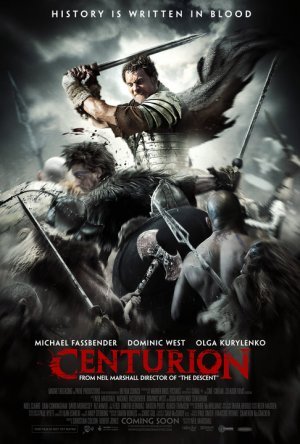
Genre junkies, rejoice! Neil Marshall — 2002 werewolf thriller Dog Soldiers, 2005 cave-monster chiller The Descent, and 2008 post-apocalyptic actioner Doomsday — has a brand-new film: Centurion. The latest from the man some call “the new John Carpenter” is getting a release with actual fanfare (however humble in comparision to, say, The Expendables or whatever), though you’d best hustle to the theater if you care to see Centurion, about a Roman soldier doing battle with tribal Picts in what’s now Scotland, on the big screen. (It’s also now available On Demand, but c’mon: the big screen is always better.) Evident in Marshall’s films is the fact that he himself is a movie fan, which makes him all the more pleasurable to talk to. [Spoiler warning: there are some. Just so you know.]

San Francisco Bay Guardian: Centurion takes a documented event, the building of Hadrian’s Wall, and creatively fills in some of the history surrounding it. Why did you write the story this way?

Neil Marshall: It was kind of a case of compacting a couple of dates, which weren’t that far apart anyway. The myth of the Ninth Legion is based around 117 AD, which is when the film is set. That was when the entire Ninth Legion marched into Scotland and supposedly vanished without a trace. Historians have since been spoilsports and disproved that, and proved that they were attacked but they didn’t get massacred, they were dispersed, and such like. But then, in 122 AD, Hadrian’s Wall started being built. And I just thought, “Well, couldn’t I tie the two in together somehow, that logically, what happened to the Ninth Legion could have been part of the reason for Hadrian to build the wall in the first place?” So, yeah, it was a question of kind of condensing that slightly.

In terms of the Ninth Legion legend, I kind of went with that old adage: when the legend becomes fact, print the legend. Because it’s far more interesting! But the story was kind of book ended: yes, my Ninth Legion goes into Scotland, and at the end of it, it becomes a cover-up by the Romans. Which is kind of what happened in truth, that they disbanded the legion to avoid the embarrassment of having lost so many people to the Picts. So I was playing around to a degree, and I know that to a large extent the story is a fiction, a hypothesis of what might have happened to them based on the legend, but I tried to make that within the most authentic world I could create.

SFBG: The historical setting is new for you. Had you been wanting to do a period film?

NM: I’d been itching to do a historical movie. I love those kind of movies. I love watching those kind of movies. What guy wouldn’t want to make a movie about Romans and Picts, and ancient history, and battles, and stuff like that? It’s great fun! I’d grown up with all that history as well. In Newcastle, it’s one end of Hadrian’s Wall. So I was surrounded by Roman history — ruins of forts, Roman roads, and all sorts of stuff. You can’t avoid it if you grow up in that part of the world. We used to go on school trips to these places, and my dad’s a big history buff, and all that kind of stuff. I think it was kind of in my blood that I would want to make a movie about this stuff, one day or another.

SFBG: Unlike your previous films, Centurion doesn’t have a supernatural element. Did you decide that ahead of time, on purpose?

NM: It was very tempting. When I first came up with the story, I’d just made Dog Soldiers. And when I heard about the entire legion vanishing without a trace, initially I went down a supernatural path. I was thinking, was it gonna be some monsters? An alien abduction? Were they eaten by the Loch Ness Monster or something? And then I quickly thought, “I don’t want to immediately repeat myself. What might have actually happened to them? Who are these Picts?” I mean, these Picts sound pretty scary, because the Romans built this 60-mile wall to keep them out. So I figured maybe I didn’t need to go down a supernatural path to find a terrifying opponent or enemy. And that’s when I kind of based it more in reality, I guess.

SFBG: Something else that’s new is Centurion‘s romantic subplot. It softens the tone of the film somewhat. Why did you decide to include that?

NM: Yes, it’s new for me. Um, I don’t know. It just felt right. I thought, maybe it’s time I do have a bit of a romance in one of my films. It’s a long way from suddenly going down the route of turning to romantic comedies, but a little bit of a love story going on seemed like, I don’t know, a step for me. Getting older, maybe maturing as a writer. I didn’t really think about it that much. It just naturally fell into place.

The other thing is that, in the original draft of the script, there was more to [Imogen Poots’] character [Arianne] than just being a love interest. In the original ending of the film, it’s revealed that she’s half-sister to [Olga Kurylenko’s character] Etain, and it was Etain who in fact gave her the cut on the face, and there’s this really kind of issue between the two of them. Originally, Etain survived until the end of the film, when it was Arianne who killed her and not Quintus. When I was writing the film, it seemed like less of just a love story and more of an integral part of the plot.

SFBG: Why did you change it?

NM: It was under producer pressure. I don’t know why they wanted to change it, but they kind of pressured me into changing it. Those are the perils. Even in a low-budget film like this, the idea that I have absolute control is a myth. [Laughs.]

SFBG: Even with a low budget, it seems like you got a good cast together.

NM: We were incredibly lucky with timing. When we cast Michael [Fassbender, who plays Quintus], I hadn’t seen Hunger (2008), and Inglourious Basterds (2009) hadn’t been released yet. But we knew that he’d done this stuff. I’d actually auditioned both him and Dominic [West, who plays Virilus] for Doomsday. Due to scheduling difficulties I wasn’t able to get either of them in that movie but I still wanted to work with them. So when the opportunities came to have them in this movie, I just jumped at the chance. So that just fell into place perfectly. The rest of was just getting the best caliber of actors that we could in those roles. We were very lucky. Somebody like David Morrissey — I never figured he would take what is essentially a supporting role, but he was just really itching to do an action movie, and, you know, play a Roman soldier and hack people to bits with swords. So, he jumped at the chance. Same with everybody else, really.

SFBG: Were you a fan of [Dominic West’s TV show] The Wire?

NM: Oh yeah. I’m a huge fan of Dominic. Amazing work in The Wire. Really phenomenal stuff. So phenomenal, I think, that many people forget that he’s an English guy. [Laughs] He’s such a larger-than-life presence as well, and it was perfect for the role of Virilus.

SFBG: When I talked to you about The Descent, we discussed how the movie was incredibly physical though it was shot mostly on sets. With Centurion, it seems like you actually went out and shot it in the elements. Did that present any particular challenges?

NM: The first day of filming, we were 3,000 feet up a mountain in a blizzard, and it was minus 18 degrees. That set the standard for the rest of the shoot. I deliberately went out to get the most miserable, hard conditions that we could find. My ethos in this film was to kind of do the anti-300. It was never gonna be on a soundstage. It was never gonna be green-screen, and all kind of in slo-mo. This was gonna be in the rain, in the mud, in the snow, and it was gonna be tough, very very tough for everyone involved. And everybody embraced that. The crew, the cast. I warned everybody beforehand: “You know, this isn’t going to be easy. This is gonna be tough.” And everybody signed up for it, and nobody ever complained because they were just 100 percent for it.

SFBG: You said that there were four films that influenced you when making The Descent: Deliverance (1972), The Shining (1980), Alien (1979), and The Texas Chain Saw Massacre (1974). Did you have any touchstones like that when making Centurion? Braveheart (1995) or Gladiator (2000) …

NM: Actually, I tried to put Braveheart and Gladiator to the back of my mind as much as possible. With this one, it was like The Warriors (1979), She Wore a Yellow Ribbon (1949), Fort Apache (1948), Last of the Mohicans (1992). Stuff like that. I actually saw a lot of Westerns, and not many Roman movies at all. Chase movies, things like Figures in a Landscape (1970) which is a kind of obscure movie about people running across mountaintops.

SFBG: What elements of the Western do you think you brought to Centurion?

NM: I see this as a Western in two ways. Historically, it’s a Western, because this frontier, ancient Britain, was the equivalent of the Roman’s Wild West. It was their furthest Western frontier. It was lawless, it was violent. They were battling the natives. So it was their Wild West. As a film, I consider it to be akin to John Ford’s cavalry movies. The Romans are the cavalry, the Picts are the Comanches, and the landscape is absolutely integral to everything. I kind of had that in the back of my mind all the time. And also from the point of view that, if Ford was trying to make those movies today, they’d be seen as incredibly un-PC, because you’re telling them from the point of view of the invading army. Which is exactly what I’m doing here, telling it from the Roman point of view. I was never saying the Roman point of view was right. I was just saying, that’s what it was.

SFBG: The main Roman character has a change of heart from beginning to end.

NM: Absolutely. It’s primarily about the individuals. I’m not asking the audience to sympathize with the Romans. I am asking the audience to sympathize with Quintus and his band of brothers as it were, because they kind of get left in the lurch and are disillusioned by the whole system. They basically just want to get home.

SFBG: There’s also a more contemporary subtext within the film, since the invading-army story mirrors the current Iraq war in some ways. Did you set out to make that parallel?

NM: I didn’t write it with that in mind, but it became really obvious when I was writing it that there is a subtext there. Things are happening today that were happening 2,000 years ago. This is about a superpower marching into a country and being held back by a guerrilla fighting style. The comparisons are screamingly obvious. But, once I recognized that fact, I made a conscious decision not to turn it into a political allegory, to ram it down the audience’s throat, or make that kind of movie. It had to be seen first and foremost as a historical action-adventure movie. And if people read that into it, if people see that, that’s fantastic. It’s certainly there. But it shouldn’t distract from the story.

SFBG: What’s next for you?

NM: I’m producing a film called The Ghost of Slaughterford, that’s being directed by my wife, Axelle Carolyn [who plays a supporting role in Centurion]. For myself, I’m attached to a project that Sam Raimi’s producing, called Burst. It’s gonna be a horror movie, it’s in 3D, and it’s all about people exploding.

SFBG: Ah, I was going to ask you what you thought of the 3D trend. Obviously you’re in favor!

NM: I’m gonna give it a go. I’m dubious about the 3D trend. I’m worried that it’s going to be applied to anything and everything, when it should be very specialized. But it’s a great tool, and I want to have a go at seeing what I can do with it.

http://www.youtube.com/watch?v=yiQCofKrYAI

Centurion opens Fri/27 in Bay Area theaters.

Film listings

0

Film listings are edited by Cheryl Eddy. Reviewers are Kimberly Chun, Michelle Devereaux, Peter Galvin, Max Goldberg, Dennis Harvey, Johnny Ray Huston, Louis Peitzman, Lynn Rapoport, Ben Richardson, and Matt Sussman. For rep house showtimes, see Rep Clock. For first-run showtimes, see Movie Guide.

OPENING

Avatar: Special Edition Now with nine extra minutes? Wasn’t this movie long enough the first time? (2:51)

Cairo Time Patricia Clarkson plays a married magazine editor who unexpectedly falls in love while on vacation in Cairo. (1:29) Embarcadero, Piedmont, Shattuck, Smith Rafael.

*Centurion Neil Marshall is the kind of filmmaker who inspires glee among horror and action junkies, but indifference among mainstream moviegoers. Centurion isn’t likely to change this. It’s the second century, and Romans are invading what’s now the Scottish Highlands, much to the displeasure of the Picts, the tribal people who’re already living there. Enter Quintus Dias (Michael Fassbender), a Roman soldier who becomes the de facto leader of an ever-shrinking group of men trapped behind enemy lines after their general (The Wire‘s Dominic West) is captured. Devotees of Marshall (2002’s Dog Soldiers, 2005’s The Descent, 2008’s Doomsday) will recognize certain elements: an ensemble cast, a military setting, the presence of a fierce female (Bond heroine Olga Kurylenko, who makes Pict warrior drag both spooky and sexy). Unlike his earlier films, though, there’s no supernatural twist; it’s just good old battlefield guts and gore. Sure, the romantic subplot feels a little forced, but this is genre filmmaking in its purest form, to be celebrated with gusto by those who appreciate grisly decapitations and the like. (Read my interview with Marshall at www.sfbg.com/pixel_vision.) (1:39) Lumiere, Shattuck. (Eddy)

Flipped I’m sure a "he said/she said" film exists that makes good on the premise, but Rob Reiner’s Flipped doesn’t quite cut it. Nestled safely in 1960s small-town America, the film is first narrated by Bryce, an eighth grader who’s spent the past four years rebuking the advances of Juli, the girl who lives across the street. Bryce is a pretty typical boy, bumbling and unsure of just what he wants, but soon the story "flips" and we see the same events narrated from Juli’s POV. Juli is drawn to Bryce’s "sparkling eyes," yes, but with a poor family and an annoyingly sincere love for life, she has problems outside of lusting for Bryce. Based on a tween-hit novel by author Wendelin Van Draanen, the story’s familiarity perhaps stems from the source material — in my experience those sorts of novels rarely invite readers older than high school — and similarly in the case of Flipped, I think this might be something we should leave to the kids. (1:30) Embarcadero. (Galvin)

The Last Exorcism Latest in a long line of Louisiana preachers, genial extrovert Cotton Marcus (Patrick Fabian) isn’t even sure he believes in God anymore — but it’s the family business, and it’s a living. He definitely doesn’t believe in demonic possession, yet has presided over many an "exorcism" if only to fool the psychologically damaged into thinking they’re "cured" of delusional ails. But now he’s decided such hijinks might be more harmful than helpful. So to debunk the whole idea, he takes a documentary filmmaking crew on one last "soul-saving" trek, answering a desperate letter from a widowed farmer (Louis Herthum) whose 16-year-old daughter (Ashley Bell) is believed possessed. Cotton deploys theatrical tricks to rig an alleged purging of Satan’s minion. And it works … but this wouldn’t be a horror movie if that rationalist triumph didn’t turn out to be a false finish, followed by all kinds of inexplicable WTF. German director Daniel Stamm’s first English-language feature (written by Huck Botko and Andrew Gurland) is being positioned by Lionsgate as the next viral word-of-mouth horror sensation a la prior faux-docs The Blair Witch Project (1999) and Paranormal Activity (2007). But the "reality" illusion is more transparent here. Despite some clever buildup tactics, okay twists, and a handful of scares, this ultimately disappoints — a preview audience’s catcalls at its underwhelming fadeout suggested there will be no Last Exorcism 2. (1:27) Shattuck. (Harvey)

*Mesrine: Killer Instinct This first half of a two-part film about notorious French bank robber Jacques Mesrine examines the early life of its subject, before he was a flamboyant, headline-grabbing folk hero. The very first scene uses 70s-style split-screens to revel Mesrine’s violent 1979 death; writer-director Jean-François Richet (2005’s Assault on Precinct 13) then jumps back 15 or so years for a glimpse of our (anti-) hero’s soldiering days in Algeria. Before long, "Jacky" (an outstanding Vincent Cassel, in a César-winning performance) is back in Paris, horrifying his upper-class parents and young wife by choosing the underworld over conventional pencil-pushing. (A near-unrecognizable Gérard Depardieu appears as a mob boss.) Killer Instinct, which is adapted from Mesrine’s own prison-penned autobiography, suffers from some standard biopic problems — it tries to cram in too much, and feels mighty rushed at times. But there’s still plenty of bad, bad behavior to enjoy, including the film’s spectacular last act, a breakneck recreation of one of the daring prison escapes that helped make Mesrine a legend. Continuation Mesrine: Public Enemy No. 1, which beings where this film ends, comes out Sept 3. (1:53) Embarcadero, Shattuck. (Eddy)

Takers This just in: Hayden Christensen still getting work. (1:57) Shattuck.

*The Two Escobars In America, the World Cup ends, and most sports fans turn their attentions elsewhere. In other countries, soccer is a year-round happening that inspires religious devotion. Putting this fact into perspectives both glorious and cruel is The Two Escobars, Jeff and Michael Zimbalist’s involving new doc about the rise of "narco-soccer" in Colombia, circa the coke-crazed 1980s and early 90s. One Escobar, we’ve all heard of: Pablo, a noted drug kingpin who was also a hero to the slum-dwellers who benefited from his donations of housing and, perhaps more importantly, soccer fields. A rabid footy fan himself, Pablo invested in Colombian teams, an influx of cash that helped the national team become one of the strongest in the world. Escobar number two is Andrés, the affable, wholesome defender who served as team captain in the 1994 World Cup. The events that caused both Escobars to meet untimely and brutal deaths are detailed here, by people who knew them well, in a moving, well-edited film that’s as cautionary as it is celebratory. Highly recommended. (1:40) Sundance Kabuki. (Eddy)

ONGOING

*Animal Kingdom More renowned for its gold rush history and Victorian terrace homes than its criminal communities, Melbourne, Australia gets put on the same gritty map as Martin Scorsese’s ’70s-era New York City and Quentin Tarantino’s ’90s Los Angeles with the advent of director-writer David Michôd’s masterful debut feature. The metropolis’ sun-blasted suburban homes, wood-paneled bedrooms, and bleached-bone streets acquire a chilling, slowly building power, as Michôd follows the life and death of the Cody clan through the eyes of its newest member, an unformed, ungainly teenager nicknamed J (James Frecheville). When J’s mother ODs, he’s tossed into the twisted arms of her family: the Kewpie doll-faced, too-close-for-comfort matriarch Smurf (Jacki Weaver), dead-eyed armed robber Pope (Ben Mendelsohn), Pope’s best friend Baz (Joel Edgerton), volatile younger brother and dealer Craig (Sullivan Stapleton), and baby bro Darren (Luke Ford). Learning to hide his responses to the escalating insanity surrounding the Codys’ war against the police — and the rest of the world — and finding respite with his girlfriend, Nicky (Laura Wheelwright), J becomes the focus of a cop (Guy Pearce) determined to take the Codys down — and discovers he’s going to have use all his cunning to survive in the jungle called home. Stunning performances abound — from Frecheville, who beautifully hides a growing awareness behind his character’s monolithic passivity, to the adorably scarifying Weaver — in this carefully, brilliantly detailed crime-family drama bound to land at the top of aficionados’ favored lineups, right alongside 1972’s The Godfather and 1986’s At Close Range and cult raves 1970’s Bloody Mama and 1974’s Big Bad Mama. (2:02) Shattuck, Sundance Kabuki. (Chun)

Army of Crime In 1941 Paris, a group of resistance fighters — mostly foreign-born, many Jewish — form an underground network to sabotage the ever-growing Nazi presence in France. Their schemes range from the clever (playing loud piano to disguise the sound of a printing press) to the violent (grenades tossed under buses). Tension builds as the film progresses, though we learn in the first three minutes which characters will have "Died for France" at the end. In addition to its important historical lesson (with a modern-day nod toward the shifting definition of what makes a terrorist), Army of Crime also boasts a strong, easy-on-the-eyes ensemble cast and a depiction of wartime Paris that favors glamorous nostalgia. (2:13) Sundance Kabuki. (Eddy)

Cats and Dogs: The Revenge of Kitty Galore (1:40) 1000 Van Ness, SF Center.

The Concert (1:47) Clay.

Cyrus It’s tempting to label Mark and Jay Duplass’ Cyrus as "mumblecore goes mainstream." Yes, the mumblecore elements are all there: plentiful moments of awkward humiliation, characters fumbling verbally and sometimes physically in desperate attempts to establish emotional connections, and a meandering, character-driven plot, in the sense that the characters themselves possess precious little drive. The addition of bona fide indie movie stars John C. Reilly, Catherine Keener, and Marisa Tomei — not to mention Hollywood’s chubby-funny guy du jour, Jonah Hill — could lead some to believe that the DIY-loving Duplass brothers (2005’s The Puffy Chair, 2008’s Baghead) have gone from slacker disciples of John Cassavetes (informally known as "Slackavetes") to worshippers at the slickly profane (with a heart) altar of Judd Apatow. But despite the presence of Apatow protégé Hill (2007’s Superbad) in the title role, Cyrus steers clear of crowd-pleasing bombast, instead favoring small, relatively naturalistic moments. That is to say, not much actually happens. Mumblecore? More or less. Mainstream? Not exactly. Despite playing a character with some serious psychological issues, Hill comes off as likeable. Unfortunately the movie is neither as broadly comic nor as emotionally poignant as it needs to be — the two opposing forces seem to cancel each other out like acids and bases. (1:32) Four Star. (Devereaux)

Despicable Me Judging from the adorable, booty-shaking, highly merchandisable charm of its sunny-yellow Percocet-like minions, Despicable Me‘s makers have more than a few fond memories of the California Raisins. That gives you an idea of the 30-second attention-span level at work here. Thanks to Pixar and company, our expectations for animated features are high, but despite the single lob at Lehman Brothers aimed toward the grown-ups, the humor here is pitched straight at the eight and younger crowd: from the mugging, child-like minions to the all-in-good-fun, slightly quease-inducing 3-D roller-coaster ride. Gru (Steve Carell) is Despicable‘s also-ran supervillain — a bit too old and too unoriginal for a game that’s been rigged in the favor of the youthful, annoyingly perky Vector (Jason Segel), who’s managed to swipe the Giza Pyramids and become the world’s number one bad dude. When Vector steals away the crucial shrink ray needed for Gru’s plot to thieve the moon, the latter pulls out the big guns: three adorable orphans who have managed to penetrate Vector’s defenses with their fund-raising cookie sales. It turns out kids have their own insidiously heart-warming way of wrecking havoc on one’s well-laid plans. Filmmakers Pierre Coffin and Chris Renaud do their best to exploit the 3-D medium, but Avatar (2009) this is not. Nor will many adults be able to withstand the onslaught of cute undertaken by all those raisins, I mean, minions. (1:35) SF Center. (Chun)

Dinner for Schmucks When he attracts favorable notice and a possible promotion from his corporate boss, Tim (Paul Rudd) is invited to an annual affair in which executives compete to see who can dig up the freakiest loser dweeb for everyone to snicker at. He literally runs into the perfect candidate: Barry (Steve Carrell), an IRS employee whose hobby is making elaborate tableaux with stuffed dead nice in tiny human clothes. He’s also the sort of person who, in trying to be helpful, inevitably wreaks havoc on the unlucky person being helped. Which means the 24 hours or so before the "Biggest Idiot" contest provide plenty of time for well-intentioned Barry to nearly destroy Tim’s relationship with a girlfriend (Stephanie Szostak), reunite him with Crazy Stalker Chick (Lucy Punch), and imperil his wooing of a multimillion-dollar account. Director Jay Roach (of the Austin Powers and Meet the Fockers series) has a full load of comedy talent on board here. So why are the results so tepid? This remake softens the bite of Francis Veber’s 1998 original French The Dinner Game by making Tim not a yuppie scumbag but a nice guy who just happens to have a jerk’s job (his company seizes ailing firms and liquidates them), and who doesn’t really want to expose hapless Barry to humiliation. But even with that satirical angle removed and a wider streak of sentimentality, it should cough up more laughs than it does. (1:50) 1000 Van Ness, SF Center. (Harvey)

*The Disappearance of Alice Creed The reliably alarming Eddie Marsen (concurrently Life During Wartime‘s pederast) plays bullying Vic, one-half of a criminal duo — with puppyish Danny (Martin Compston) his younger subordinate — who abduct grown child of wealth Alice (Gemma Arterton) for ransom in a carefully-thought-out kidnapping. This simple setup, for the most part very simply set in the two abandoned-apartment-complex rooms where Alice is held captive, allows talented British writer-director J. Blakeson to spring a number of escalating narrative surprises. The whole endeavor is almost too chamber-scaled to justify being seen on the big screen (let alone being shot in widescreen format). But it does have some mighty satisfying tricks up its sleeve. (1:40) Sundance Kabuki. (Harvey)

Eat Pray Love The new film based on Elizabeth Gilbert’s chart-busting memoir, Eat Pray Love, benefits greatly from the lead performance by Julia Roberts, an actor who can draw from her own reserves of pathos when a project has none of its own. The adaptation, about a whiny American author farting around the globe in search of what amounts to spiritual room service, is nothing without her. The journey begins with the Type-A, book contract-inspired premise that Gilbert will travel to three appointed countries over the course of a year in order that, having thrice denied herself absolutely nothing, she might come out the other end a better-balanced human being. The first stop is Italy, where her entire plan is to finally unbutton her jeans and indulge in a celebrated cuisine, as if her home base of Manhattan were a culinary backwater. But this film is all about tired equivalencies, so Italy equals food, and expressive hand gestures, and "the art of doing nothing." India, her next stop, equals enlightenment (her discovery that the guru she’s come to see is currently at an ashram in New York is an irony lost on the movie). And Bali, her final getaway, apparently equals contradictory but flattering aphorisms and thematically hypocritical romances. The sole appeal to a moviegoer here is aspirational. What’s so embarrassing about Eat Pray Love is its insistence that this appeal sprouts from the spiritual quest itself, and not just from the privilege that enables Gilbert to have such an extravagant quest in the first place. But then, self-awareness is supposed to be a obstacle to enlightenment. She’s got nothing to worry about there. (2:30) Empire, Marina, 1000 Van Ness, SF Center, Sundance Kabuki. (Jason Shamai)

The Expendables Exactly what you’re expecting: a completely ludicrous explosion-o-thon about mercenaries hired by Bruce Willis to take down a South American general who’s actually a puppet for evil CIA agent-turned-coke kingpin Eric Roberts. Clearly, Sylvester Stallone (who directed, co-wrote, stars, and even coaxed a cameo out of Schwarzenegger) knows his audience, but The Expendables — bulging with a muscle-bound cast, including Dolph Lundgren, Terry Crews, Jason Statham, and Steve Austin, plus Jet Li, who suffers many a short-guy joke — is content to simply tap every expected rung on the 80s-actioner homage ladder. There’s no self-awareness, no truly witty one-liners, no plot twists, and certainly no making a badass out of any female characters (really, couldn’t the South American general’s daughter have packed some heat, or kicked someone in the balls — anything besides simply heaving her cleavage around?) The only truly memorable thing here is the inclusion of Mickey Rourke as Stallone’s tattoo-artist pal; I would possibly wager that Rourke was allowed to write his own weepy monologue, delivered in a close-up so extreme it’s more mind-searing than any of the film’s many machine-gun brawls. (1:43) 1000 Van Ness, Sundance Kabuki. (Eddy)

The Extra Man The polar opposite of buddy cop action flicks and spoofs a la The Other Guys, with only a faint resemblance to the bromances of Judd Apatow, Adam McKay, Will Ferrell, Seth Rogen, and so on, The Extra Man is a gently weird throwback to another era, much like its title character, Henry Harrison (Kevin Kline). Sweet, cross-dressing-curious teacher and would-be writer Louis Ives (Paul Dano) is drifting though life passively when he stumbles on eccentric playwright Harrison’s room-for-let and his oddball realm of hangers-on. A blustery, prickly, proudly misogynistic collector of Christmas balls, given to spasms of improvisational dancing, Harrison relishes his role as an escort to aged socialites, crankily shucking and jiving to score invites to fancy dinner parties and vacation homes in Florida. When Ives isn’t courting environmental magazine editor Mary (Katie Holmes) or hiding from the fearsome-looking wooly recluse Gershon (John C. Reilly), the mentor-able young man turns out to be more adept at the role than Harrison ever imagined. And like fossilized grande dames in Chanel, literate audiences also might be charmed by director-writer Shari Springer Berman’s unassuming, crushed-out bon mot, based on the novel by Jonathan Ames, to a few mannered, less-than-examined, happily twisted New York City subcultures. (1:45) Opera Plaza. (Chun)

Get Low Born from the true story of Felix Bush, an eccentric Tennessee hermit who invited the world to celebrate his funeral in advance of his own death, Get Low is a loose take on what might inspire a man to do a thing like that. It’s a small story, and unlikely to attract the attention of popcorn-addled viewers in the midst of the summer blockbuster season, but Get Low has a whopper of a character in Felix Bush. Robert Duvall becomes Bush, constructing a quiet man who sees it all and speaks only when he has something to say, and supporting roles from Sissy Spacek and Bill Murray are expectedly solid, but the real surprise is what a strong eye director Aaron Schnieder has. In allowing scenes to unfold on their own terms and in their own time, Schneider gives a real humanity to what could have been a Hallmark movie. (1:42) Albany, Embarcadero, Piedmont. (Galvin)

*The Girl Who Played With Fire Lisbeth Salander is cooler than you are. The heroine of Stieg Larsson’s bestselling book series is fierce, mysterious, and utterly captivating: in the movie adaptations, she’s perfectly realized by Noomi Rapace, who has the power to transform Lisbeth from literary hero to film icon. Rapace first impressed audiences in The Girl With the Dragon Tattoo (2009), a faithful adaptation of Larsson’s premiere novel, and she returns as Lisbeth in The Girl Who Played With Fire. The sequel, as is often the case, isn’t quite on par with the original, but it’s still a page-to-screen success. And while the first film spent equal time on journalist Mikael Blomkvist (Michael Nyqvist), The Girl Who Played With Fire is almost entirely Lisbeth’s story. Sure, there’s more to the movie than the hacker-turned-sleuth — and the actor who plays her — but she carries the film. Rapace is Lisbeth; Lisbeth is Rapace. I’d watch both in anything. (2:09) Lumiere, Shattuck, Smith Rafael. (Peitzman)

*I Am Love I Am Love opens in a chilly, Christmastime Milan and deliberately warms in tandem with its characters. Members of the blue-blood Recchi family are content hosting lavish parties and gossiping about one another, none more than the matriarch Emma (Tilda Swinton). But when prodigal son Edoardo befriends a local chef, Emma finds herself taken by both the chef’s food and his everyman personality, and is reminded of her poor Soviet upbringing. The courtship that follows is familiar on paper, but director Luca Guadagnino lenses with a strong style and small scenes acquire a distinct energy through careful editing and John Adams’ unpredictable score. Swinton portrays Emma’s unraveling with the same gritty gusto she brought to Julia (2008), and her commitment to the role recognizes few boundaries. You’ve probably seen this story before, but it has rarely been this powerful. (2:00) Opera Plaza. (Galvin)

Inception As my movie going companion pointed out, "Christopher Nolan must’ve shit a brick when he saw Shutter Island." In Nolan’s Inception, as in Shutter Island, Leonardo DiCaprio is a troubled soul trapped in a world of mind-fuckery, with a tragic-vengeful wife (here, Marion Cotillard) and even some long-lost kids looming in his thoughts at all times. But Inception, about a team of corporate spies who infiltrate dreams to steal information and implant ideas, owes just as much to The Matrix (1999), Eternal Sunshine of the Spotless Mind (2004), and probably a James Bond flick or two. Familiar though it may feel, at least Inception is based on a creative idea — how many movies, much less summer blockbusters, actually require viewer brain power? If its complex house-of-cards plot (dreams within dreams within dreams) can’t quite withstand nit-picking, its action sequences are confidently staged and expertly directed, including a standout sequence involving a zero-gravity fist fight and elevator ride. Though it’s hardly genius — and Leo-recycle aside — Inception is worth it, if you don’t mind your puzzle missing a few pieces. (2:30) Empire, Marina, 1000 Van Ness, Sundance Kabuki. (Eddy)

*Joan Rivers: A Piece of Work Whether you’re a fan of its subject or not, Ricki Stern and Annie Sundberg’s documentary is an absorbing look at the business of entertainment, a demanding treadmill that fame doesn’t really make any easier. At 75, comedian Rivers has four decades in the spotlight behind her. Yet despite a high Q rating she finds it difficult to get the top-ranked gigs, no matter that as a workaholic who’ll take anything she could scarcely be more available. Funny onstage (and a lot ruder than on TV), she’s very, very focused off-, dismissive of being called a "trailblazer" when she’s still actively competing with those whose women comics trail she blazed for today’s hot TV guest spot or whatever. Anyone seeking a thorough career overview will have to look elsewhere; this vérité year-in-the-life portrait is, like the lady herself, entertainingly and quite fiercely focused on the here-and-now. (1:24) Four Star, Opera Plaza. (Harvey)

*The Kids Are All Right In many ways, The Kids Are All Right is a straightforward family dramedy: it’s about parents trying to do what’s best for their children and struggling to keep their relationship together. But it’s also a film in which Jules (Julianne Moore) goes down on Nic (Annette Bening) while they’re watching gay porn. Director Lisa Cholodenko (1998’s High Art) co-wrote the script (with Stuart Blumberg), and the film’s blend between mainstream and queer is part of what makes Kids such an important — not to mention enjoyable — film. Despite presenting issues that might be contentious to large portions of the country, the movie maintains an approachability that’s often lacking in queer cinema. Of course, being in the gay mecca of the Bay Area skews things significantly — most locals wouldn’t bat an eye at Kids, which has Nic and Jules’ children inviting their biological father ("the sperm donor," played by Mark Ruffalo) into their lives. But for those outside the liberal bubble, the idea of a nontraditional family might be more eye-opening. It’s not a message movie, but Kids may still change minds. And even if it doesn’t, the film is a success that works chiefly because it isn’t heavy-handed. It refuses to take itself too seriously. At its best, Kids is laugh-out-loud funny, handling the heaviest of issues with grace and humor. (1:47) Bridge, California, Piedmont, Presidio, SF Center. (Peitzman)

Lebanon "Das Boot in a tank" has been the thumbnail summary of writer-director Samuel Maoz’s film in its festival travels to date, during which it’s picked up various prizes including a Venice Golden Lion. On the first day of Israel’s 1982 invasion (which Maoz fought in), an Israeli army tank with a crew of three fairly green 20-somethings — soon joined by a fourth with even less battle experience — crosses the border, enters a city already halfway reduced to rubble, and promptly gets its inhabitants in the worst possible fix, stranded without backup. Highly visceral and, needless to say, claustrophobic (there are almost no exterior shots), Lebanon may for some echo The Hurt Locker (2009) in its intense focus on physical peril. It also echoes that film’s lack of equally gripping character development. But taken on its own willfully narrow terms, this is a potent exercise in squirmy combat you-are-thereness. (1:33) Lumiere, Smith Rafael. (Harvey)

Lottery Ticket (1:39) 1000 Van Ness.

*Mao’s Last Dancer Based on the subject’s autobiography of the same name, this Australian-produced drama chronicles the real-life saga of Li Cunxin (played as child, teen, and adult by Huang Wen Bin, Chengwu Guo, and Chi Cao), who was plucked from his rural childhood village in 1972 to study far from home at the Beijing Dance Academy. He attracted notice from Houston Ballet artistic director Ben Stevenson (Bruce Greenwood) during a cultural-exchange visit, and was allowed to go abroad for a Texas summer residency. At first the film looks headed toward well-handled but slightly pat inspirational territory pitting bad China against good America, as it cuts between Li’s grueling training by (mostly) humorless Party ideologues, and his astonishment at the prosperity and freedom in a country he’d been programmed to believe was a capitalist hellhole of injustice and deprivation. (Though as a Chinese diplomat cautions, not untruthfully, he’s only been exposed to "the nice parts.") Swayed by love and other factors, Li created an international incident — tensely staged here — when he chose to defect rather than return home. But Jan Sardi’s script and reliable Aussie veteran Bruce Beresford’s direction refuse to settle for easy sentiment, despite a corny situation or two. Our hero’s new life
isn’t all dream-come-true, nor is his past renounced without serious consequence (a poignant Joan Chen essays his peasant mother). The generous ballet excerpts (only slightly marred by occasional slow-mo gimmickry) offer reward enough, but the film’s greatest achievement is its honestly earning the right to jerk a few tears. (1:57) Albany, Embarcadero, Sundance Kabuki. (Harvey)

Nanny McPhee Returns Emma Thompson is back as the titular Mary Poppins type who’s far from practically perfect, her extreme case of the uglies lessening whenever children in her charge learn a "lesson." The family in need this time belongs to harried Isabel Green (Maggie Gyllenhaal, trying a little too hard like everyone here), who’s got way more than she can handle raising three unruly children and running an English farm while her husband’s away fighting World War II. Making matters worse is the arrival of a horribly bratty nephew and niece fleeing the London Blitz, not to mention the constant pestering of a brother-in-law (Rhys Ifans) who wants the farm sold to cover his secret gambling debts. Enter guess who, restoring order and civility with the thump of her magic walking stick. The first Nanny McPhee (2005) movie, adapted from Christianna Brand’s children’s books by Thompson and directed by Kirk Jones, was an old-fashioned delight adults could thoroughly enjoy. This sequel, again written by Thomson though directed by Susanna White, is roughly what Babe: Pig in the City (1998) was to the original Babe (1995): something endearingly simple and charming turned shrill, overproduced, and charmless, with way too many CGI animals doing stupid things (like porcine synchronized swimming). It’s bad enough that Ralph Fiennes and Ewan McGregor — no doubt beguiled by the earlier film — chose to do thankless cameos in such dross. But it’s pretty unforgivable that Dame Maggie Smith should suffer a career nadir as a senile old dear who at one point happily plops down on a big pat of cow shit. (1:48) 1000 Van Ness, Presidio, Shattuck. (Harvey)

The Other Guys Will Ferrell and Adam McKay can do no wrong in some bro-medy aficionados’ eyes, but The Other Guys is no Talladega Nights: The Ballad of Ricky Bobby (2006) or Anchorman: The Legend of Ron Burgundy (2004). The other two Ferrell-McKay team-ups made short work of men’s jobs, in addition to genre filmmaking tropes, with crisper, cut-to-the-gag punchiness. And despite its laugh-out-loud first quarter — and some surprising TLC references by Michael Keaton, of all people, The Other Guys is about half a genuinely hilarious film that pokes fun at masculinity, as well as, interestingly, whiteness and beyond-the-pale, big-bucks white-collar crime. This lampoon of action buddy-cop flicks is dealt a semi-fatal blow when excess-loving, damage-dealing supercops Samuel Jackson and Dwayne Johnson exit, manically chewing scenery as they go. Two forgotten desktop jocks, forensic accounting investigator-with-a-past Allen (Ferrell) and ragaholic screwup Terry (Mark Wahlberg), must step it up when the dynamic duo dissipates, and go after crooked financier David Ershon (Steve Coogan). The second half of The Other Guys could have used some of the dramatic tension budding between buddy team Jackson-Johnson and reluctant cohorts Ferrell-Wahlberg, especially when Wahlberg begins to get bogged down in single-gear disbelief. But perhaps we should just be grateful for what few yuks we can glean from the atrocities of Great Recession-era robber barons. (1:47) California, 1000 Van Ness, Presidio. (Chun)

Pirahna 3D (1:29) 1000 Van Ness.

Salt Angelina Jolie channels the existential crisis of Jason Bourne and the DIY spirit of MacGyver in a film positing that America’s most pressing concern is extant Russian cold warriors, who are plotting to reestablish their country’s pre-glasnost glory via nuclear holocaust and a Dark Angel–style army of spy kids. Jolie plays CIA agent Evelyn Salt, a woman who can stymie the top-shelf surveillance system at work using her undergarments and fashion a shoulder-mounted rocket out of interrogation-room furniture and cleaning supplies. These talents surface after Salt is accused of being a Russian operative in league with the aforementioned disturbers of the new world order and takes flight, with her agency coworkers (Liev Schreiber and Chiwetel Ejiofor) in hot pursuit. What ensues is a vicious and confounding assault on the highest levels of the U.S. government, most known rules of logic, and the viewer’s patience and powers of suspending disbelief. Salt’s off-the-ranch maneuverings are moderately engaging, particularly in the first leg of the chase, but clunky expository flashbacks, B-movie-grade dialogue, and an absurd plotline slow the momentum considerably. (1:31) 1000 Van Ness, Sundance Kabuki. (Rapoport)

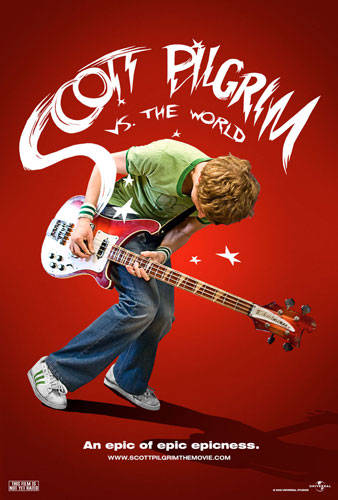
*Scott Pilgrim vs. The World For fans of Bryan Lee O’Malley’s just-completed comics saga Scott Pilgrim, the announcement that Edgar Wright (2004’s Shaun of the Dead, 2007’s Hot Fuzz) would direct a film version was utterly surreal. Geeks get promises like this all the time, all too often empty (Guillermo del Toro’s Hobbit, anyone?). But miraculously, Wright indeed spent the past five years crafting the winning Scott Pilgrim vs. the World. The film follows hapless Toronto 20-something Scott Pilgrim (Michael Cera), bassist for crappy band Sex Bob-omb, as he falls for delivery girl Ramona Flowers (Mary Elizabeth Winstead), only to find he must defeat her seven evil exes — like so many videogame bosses — before he can comfortably date her. As it happens, he’s already dating a high-schooler, Knives (Ellen Wong), who’s not coping well with Scott moving on. Cera plays a good feckless twerp; his performance isn’t groundbreaking, but it dodges the Cera-playing-his-precious-self phenomenon so many have lamented. The film’s ensemble cast maintains a sardonic tone, with excellent turns by Alison Pill, Aubrey Plaza, and newcomer Wong. Jason Schwartzman is perfectly cast as the ultimate evil ex-boyfriend — there’s really no one slimier, at least under 35.The film brilliantly cops the comics’ visual language, including snarky captions and onomatopoetic sound effects, reminiscent onscreen of 1960s TV Batman. Sometimes this tends toward sensory overload, but it’s all so stylistically distinctive and appropriate that excess is easily forgiven. (1:52) California, Four Star, Presidio. (Sam Stander)

Step Up 3D The third installment of the Step Up enterprise graduates performing arts high school and moves to the sidewalks, rooftops, and warehouses of New York City, as well as the occasional venue — part underground club, part ad-plastered sports arena — where packs of street dancers battle and mop up the floor with their rivals, employing only the weaponry of a fierce routine. That, and the fast-forward button in the editing suite — beyond drop kicks and droplets of water coming out of the screen at your face, Step Up 3D unabashedly adopts the choreographed F/X of contemporary action films, manipulating footage to make the dancers look like nimble, ferocious, supernatural creatures with a youthful disdain for gravity and the space-time continuum. There is a plot of sorts, involving a crew called the Pirates; their fearless leader Luke (Rick Malambri); his mysterious lady friend Natalie (Sharni Vinson); an NYU freshman named Moose (Adam Sevani of 2008’s Step Up 2: The Streets), who was, in Luke’s oft-repeated words, "born from a boombox" (or BFAB); and the warehouse wonderland where the Pirates live and train, amid a decor of tape-deck-womb walls and galleries of limited-edition sneakers. It’s best, though, not to follow along too closely on the rare occasions when director Jon Chu (Step Up 2) mistakenly lets more than four lines of earnest dialogue stack up without a dance-scene intervention. The near-continuous wave of choreographed outbursts is like eye candy injected with multiple shots of 5-Hour Energy drink, but those who flinch at the idea of Auto-Tuning dance performance may want to stay home and rent 2000’s Center Stage. (1:46) 1000 Van Ness, SF Center. (Rapoport)

*The Switch Has any hard-working actor ever made as many mediocre, albeit vigorously marketed, movies as Jennifer Aniston? It seems like an age since her last good one, Nicole Holofcener’s Friends with Money (2006), though some might go as far back as 2002’s The Good Girl, her dramatic and cinematic breakthrough. Perhaps that dry spell seems extra long due to Aniston’s tabloid overexposure, or maybe it’s just the feeble conceits (a la 2009’s Love Happens) that Aniston allows herself to get roped into. In any case, armed with a sharp script based on a Jeffrey Eugenides short story and a less-than-perfect but comically well-equipped everyman foil in Jason Bateman, The Switch turns out to be a refreshing break from Aniston’s run of predictability: it’s actually good, girl (if a bit far-fetched that even a neurotic, successful financial whiz could be so emotionally constipated). Heeding her biological alarm clock over the objections of best friend Wally (Bateman), Kassie (Aniston) decides to get artificially inseminated by handsome, smart, and charming donor Roland (Patrick Wilson), but nothing goes according to plan when Wally gets wasted at her insemination party and — no use crying over spilled semen — woozily decides to substitute his own emissions for Roland’s. Funny, tender, heart-strings-tugging shenanigans ensue when Kassie returns to NYC after seven years with her adorable, neurotic mini-Wally Sebastian (Thomas Robinson). Bateman is as reliably excellent as ever. Blades of Glory (2007) directors Will Speak and Josh Gordon put care into the details — from the lighting, to the scene-swiping cameos by Juliette Lewis and Jeff Goldblum, to the on-point yet relatively realistic dialogue, and it shows, making this, along with The Kids Are All Right, a, ahem, seminal year for donor-coms. (1:56) 1000 Van Ness, Shattuck. (Chun)

Tales from Earthsea Drawn from Ursula K. Le Guin’s Earthsea series of fantasy novels, the feature debut of Goro Miyazaki, the legendary Hayao Miyazaki’s son, is the latest to come out of Japan’s Studio Ghibli. It tells the story of angsty patricidal prince-refugee Arren, who finds himself in the company of the wise Archmage Sparrowhawk and must help him and his friends defeat a Maleficent-esque evil sorcerer. But this film’s fantastical world tends too often toward the unengagingly mundane, with a cast of half-baked archetypes battling over overwrought metaphysical concepts. To boot, too many of the weird creatures and unreal elements seem reminiscent of the elder Miyazaki’s creations in films like Princess Mononoke (1997) and Spirited Away (2001). Ghibli is famed for its relentlessly creative productions, but Earthsea misses the mark, even if it is entirely watchable. It’s worth noting that Le Guin herself has written a lengthy piece on the film’s many problems. (1:55) Sundance Kabuki. (Stander)

*Toy Story 3 You’ve got a friend in Pixar. We all do. The animation studio just can’t seem to make a bad movie — even at its relative worst, a Pixar film is still worlds better than most of what Hollywood churns out. Luckily, Toy Story 3 is far from the worst: it’s actually one of Pixar’s most enjoyable and poignant films yet. Waiting 11 years after the release of Toy Story 2 was, in fact, a stroke of genius, in that it amplifies the nostalgia that runs through so many of the studio’s releases. The kids who were raised on Toy Story and its first sequel have now grown up, gone to college, and, presumably, abandoned their toys. For these twentysomethings, myself included, Toy Story 3 is a uniquely satisfying and heartbreaking experience. While the film itself may not be the instant classic that WALL-E (2008) was, it’s near flawless regardless of a viewer’s age. Warm, funny, and emotionally devastating—it’s Pixar as it should be. (1:49) Shattuck. (Peitzman)

Vampires Suck (1:40) 1000 Van Ness.

The Wildest Dream: Conquest of Everest The Everest documentary has, by now, become a genre unto itself. It’s got its own tropes (sweeping shots of the mountain’s face, somber voice-over philosophizing about the human struggle with nature) and its own canon (topped, perhaps, by the harrowing 1998 IMAX hit Everest). The latest entry into this field is National Geographic Entertainment’s The Wildest Dream, which chronicles early-20th century explorer George Mallory’s lifelong — and ultimately life-ending — quest to reach Everest’s summit, and modern mountaineer Conrad Anker’s attempt to recreate his predecessor’s final climb. Director Anthony Geffen unfolds his tale in standard adventure-doc fashion. We get a lot of scratchy footage from Mallory’s climbs, a few risibly awkward dramatic re-creations, and quite a lot of portentous voiceover work. These are worn techniques, to be sure, but that doesn’t make the story told any less compelling. Mallory himself emerges as a particularly fascinating figure — a talented and charming scholar, a devoted husband, and an irresponsible, borderline suicidal obsessive. It’s a shame that we’re only able to observe him at a century’s distance. (1:33) Opera Plaza. (Zach Ritter)

*Winter’s Bone Winter’s Bone has already won awards at the Berlin International Film Festival and the Sundance Film Festival, but it’s the kind of downbeat, low-key, quiet film that may elude larger audiences (and, as these things go, Oscar voters). Like Andrea Arnold’s recent Fish Tank, it tells the story of a teenage girl who draws on unlikely reserves of toughness to navigate an unstable family life amid less-than-ideal economic circumstances. And it’s also directed by a woman: Debra Granik, whose previous feature, 2004’s Down to the Bone, starred Vera Farmiga (2009’s Up in the Air) as a checkout clerk trying to balance two kids and a secret coke habit. Drugs also figure into the plot of the harrowing Winter’s Bone, though its protagonist, Ree Dolly (Jennifer Lawrence), is faced with a different set of circumstances: her meth head father has jumped bail, leaving the family’s humble mountain home as collateral; the two kids at stake are her younger siblings. With no resources other than her own tenacity, Ree strikes out into her rural Missouri community, seeking information from relatives who clearly know where her father is — but ain’t sayin’ a word. It’s a journey fraught with menace, shot with an eye for near-documentary realism and an appreciation for slow-burn suspense; Lawrence anchors a solid cast with her own powerful performance. Who says American independent film is dead? (1:40) Empire, Four Star, Opera Plaza, Shattuck. (Eddy)


Rep Clock

0

Schedules are for Wed/25–Tues/31 except where noted. Director and year are given when available. Double and triple features are marked with a •. All times are p.m. unless otherwise specified.

ARTISTS’ TELEVISION ACCESS 992 Valencia, SF; www.atasite.org. $3-6. "Animated Art," short films, Fri, 8. "Other Cinema Digital and Alternative Digital Domain: Kwik Gigs 66," short films, videos, and live performance, Sat, 9.

BERKELEY FELLOWSHIP OF UNITARIAN UNIVERSALISTS 1924 Cedar, Berk; (510) 841-4824, www.bfuu.org. Free. King Corn (Woolf, 2007), Thurs, 7:30.

CANNERY 2801 Leavenworth, SF; (415) 771-3112, www.thecannery.com. Free. Nine Months (Columbus, 1995), Sun, 8.

CASTRO 429 Castro, SF; (415) 621-6120, www.castrotheatre.com. $7.50-10. •Kick Ass (Vaughn, 2010), Wed, 2:35, 7, and Splice (Natali, 2009), Wed, 4:35, 9:15. •The Thing (Carpenter, 1982), Thurs, 7, and Videodrome (Cronenberg, 1982), Thurs, 9:10. "Blonde Bombshells:" •Gentlemen Prefer Blondes (Hawks, 1953), Fri, 3, 7, and The Seven Year Itch (Wilder, 1955), Fri, 4:50, 8:50; •Gentlemen Prefer Blondes (Hawks, 1953), Sat, 3:20, 7:10, and How To Marry a Millionaire (Negulesco, 1953), Sat, 1:30, 5:10, 9; •The Girl Can’t Help It (Tashlin, 1956), Sun, 1, 4:50, 8:30, and Gentlemen Prefer Blondes (Hawks, 1953), Sun, 3, 6:45; •The Big Heat (Lang, 1953), Mon, 1:30, 5:10, 8:55, and Bus Stop (Logan, 1956), Mon, 3:20, 7; •The Burglar (Wendkos, 1957), Tues, 1:35, 5:05, 8:45, and The Public Enemy (Wellman, 1931), Tues, 3:25, 7.

CHRISTOPHER B. SMITH RAFAEL FILM CENTER 1118 Fourth St, San Rafael; (415) 454-1222, www.cafilm.org. $6.50-10.25. The Girl Who Played With Fire (Alfredson, 2009), call for dates and times. Lebanon (Maoz, 2009), call for dates and times. Cairo Time (Nadda, 2009), Aug 27-Sept 2, call for times.

"FILM NIGHT IN THE PARK" This week: Union Square, Geary at Powell, San Francisco; (415) 272- 2756, www.filmnight.org. Donations accepted. Rear Window (Hitchcock, 1954), Sat, 8.

HUMANIST HALL 390 27th St, Oakl; www.humanisthall.org. $5. 2001: A Space Odyssey (Kubrick, 1968), Wed, 7:30.

JACK LONDON SQUARE East lawn, Oakl; www.jacklondonsquare.com. Free. "Waterfront Flicks:" Quantum of Solace (Forster, 2008), Thurs, 7:30.

PACIFIC FILM ARCHIVE 2575 Bancroft, Berk; (510) 642-5249, www.bampfa.berkeley.edu. $5.50-9.50. "Akira Kurosawa Centennial:" Rhapsody in August (1991), Wed, 7; Dreams (1990), Sat, 5:30; Madadayo (1993), Sun, 7. "Modernist Master: The Cinema of Francesco Rosi:" Neapolitan Diary (1992), Thurs, 7; The Moment of Truth (1965), Sat, 8:30. "Viva La Revolución: Celebrating the Hundredth Anniversary of Mexico’s Revolution:" Reed: Insurgent Mexico (Leduc, 1971), Fri, 7. "Free Outdoor Screening:" "Shelf Life: Weird and Wonderful Shorts from the PFA Collection," Fri, 8:30.

RED VIC 1727 Haight, SF; (415) 668-3994. $6-9. Micmacs (Jeunet, 2009), Wed-Thurs, 7, 9:15 (also Wed, 2). Best Worst Movie (Stephenson, 2010), Fri-Sat, 7:15, 9:15 (also Sat, 2, 4). 2Everything2Terrible2: Tokyo Drift Sun-Mon, 7:15, 9:15. Reefer Madness (Gasnier, 1936), Tues, 7:15, 9:15.

ROXIE 3117 and 3125 16th St, SF; (415) 863-1087, www.roxie.com. $5-11.50. "Not Necessarily Noir:" •A Town Has Turned to Dust (Frankenheimer, 1958), Wed, 6:15, 9:45, and The Sadist (Landis, 1963), Wed, 8; •House of Horrors (Yarbrough, 1946), Thurs, 5:30, 8:30, and The Face Behind the Mask (Florey, 1941), Thurs, 7, 9:50; •Obsession (De Palma, 1976), Fri, 6, 10, and Last Embrace (Demme, 1979), Fri, 8; •Romeo is Bleeding (Medak, 1993), Sat, 2, 6, 10, and Breathless (McBride, 1983), Sat, 4, 8; •Blue Collar (Schrader, 1978), Sun-Mon, 5:45, 9:50 (also Sun, 1:30), and Bad Lieutenant (Ferrara, 1992), Sun-Mon, 8 (also Sun, 3:45); •Cutter’s Way (Passer, 1981), Tues, 5:30, 9:45, and Thief (Mann, 1981), Tues, 7:30.

VICTORIA THEATRE 2961 16th St, SF; www.threeminutepictureshow.com. $5-10. "Three-Minute Picture Show Presents:" "The Twinking To-Do," films for kids, Sat, 4; "Black Tie Gala and Film Screening," short films, Sat, 8.

VIZ CINEMA New People, 1746 Post, SF; www.vizcinema.com. $10. "Kurosawa On Sword Battles: Samurai Saga Vol. 2:" Rashomon (1950), Wed, 5; Sanjuro (1962), Wed, Fri, and Sun, 7; Thurs and Mon, 4:45; Yojimbo (1961), Thurs, 7; Fri and Tues, 4:30; Sat, 1:30; Throne of Blood (1957), Sat-Sun, 4; Tues and Sept 2, 7; Sept 1, 4:30; The Hidden Fortress (1958), Sat, Mon, and Sept 1, 7; Sun, 1; Sept 2, 4.

YERBA BUENA CENTER FOR THE ARTS 701 Mission, SF; (415) 978-2787, www.ybca.org. $6-8. "Dark in August: Rare Vampire Films:" Near Dark (Bigelow, 1987), Thurs, 7:30; Vampire Hookers (Santiago, 1978), Fri, 7:30; Vampyr (Dreyer, 1932), Sat, 7:30 and Sun, 4:30. "Something From Nothing: Films on Design and Architecture:" The Visual Language of Herbert Matter (Caduff, 2010), Sun, 2.

Alerts

0

ALERTS

By Kristen Peters

alert@sfbg.com

WEDNESDAY, AUG. 25

"This in Itself is A Victory"


Celebrate the community of resistance that met the G8/G20 leaders in Ontario, Canada, in June to support actions for queer and transgender rights; environmental justice; income equity and community control over resources; gender justice, and disability rights; migrant justice; and an end to war and occupation. Attend a panel discussion with queer-identified Canadian activist Gesig Issac and local filmmaker Sarolta Jane as they analyze the convergence, its successes and failures, and post-mobilization issues.

7:30 p.m., $3–$5 donation suggested

Station 40

3030 B 16th St., SF

www.g20.torontomobilize.org/node/432

THURSDAY, AUG. 26

Innovations in Social Justice


Find out more about the cutting-edge social justice work of several leaders and organizations active in the Bay Area and beyond. The event features talks about new approaches to social justice, a Q&A session, and time to share ideas with local activists.

6:30 p.m., $5

David Brower Center

Suite 400

2150 Allston, Berk.

www.socialjusticeinnovation.eventbrite.com

Radical Love Workshop


Hear from educator and spokesperson from the polyamory community Wendy-O Matik as she presents the major concepts and challenges that are faced trying to reinvent relationships outside the dominant social paradigm. The evening includes a briefing of her book, Redefining Our Relationships: Guidelines for Responsible Open Relationships, a feminist critique of love and relationships, and a discussion intended to create a nonjudgmental support group.

7:30 p.m., $5–$10

Gilman Street Project

924 Gilman, Berk.

www.wendyomatik.com

SATURDAY, AUG. 28


Women’s Rights Day Celebration


Join Radical Women as they celebrate Women’s Rights Day with a focus on the struggle for immigrant rights, featuring a screening of the documentary film Made in L.A., in which three garment workers fight against unfair working conditions. Participants will be given the opportunity to deliver statements against SB1070 in an open mic segment following the film. A $7.50 summer buffet with vegetarian options precedes the screening at 6:15 p.m.

7:00 p.m., free

Suite 202

625 Larkin, SF

(415) 864-1278

SUNDAY, AUG. 29


Big Oil Teach-in


Discover the issues surrounding big oil companies, their local impacts, and positive solutions to the problem. The briefing will be followed by a mass show of resistance and an educational segment to prepare participants to join the nonviolent campaign or just learn about what’s involved. Attendees are encouraged to arrive on time and stay the whole time.

1 p.m., free

Frank Ogawa Plaza

Between 14th and Broadway, Oakl.

www.actforclimatejustice.org/west

MONDAY, AUG. 30


Katrina anniversary


Get involved in the efforts to stand up to big oil companies by marching on the five-year anniversary of Hurricane Katrina. The resistance will target the offices of BP and Chevron for their roles in environmental and community destruction in the gulf, the Bay Area, and around the world. The protest will also pressure the EPA to respond to increased drilling and to act on climate change.

11:30 a.m., free

Justin Herman Plaza

1 Market, SF

www.actforclimatejustice.org/west

VIRGINS & REJECTS FILM FESTIVAL

0

The Digital Filmmaking & Video Production department at The Art Institute of California- San Francisco proudly presents the 2nd annual Virgins and Rejects Film Festival. The Virgins and Rejects Film Festival is open to all filmmakers and gives them the opportunity to showcase their work for the first time. The festival debuted last year in San Francisco, California with a successful program of short media by filmmakers who had either never entered into a festival or had been rejected by previous festivals.
 
We are now seeking submissions for the 2nd annual Virgins & Rejects Film Festival. Submissions can be of any genre, and should range in length from 1-15 minutes. A full list of submission guidelines can be found at the Virgins & Rejects website.
 
Once chosen, the films will be screened at the Virgins & Rejects Film Festival held at the Roxie Theatre on Thursday, October 7th, 2010.

Appetite: 2 delicious food events on the horizon

1

8/21 LA COCINA SF STREET FOOD FESTIVAL: Everyone who was there last year recalls the nightmare that was the SF Street Food Festival: three hour waits for a bite, only to find much of it gone by the time you reached the front of the line. I went at the 11am start time last year, yet still only got to try two vendors in two hours. At least I was able to hang out in the cocktail and beer garden awhile, as I heard that, too, was an impossible wait before long.

The organizers of the event are intent on making it different this year. Only time will tell, but the physical space is seven times larger, with four times as many vendors. I have long been a fan of La Cocina as a community treasure, and there are some new people behind the scenes this year who have a good track record with organizing large events. I’m hopeful… but you’ll still find me there at 11am, just in case.

Yes, beer, wine and spirits gardens have returned. You know I’m looking forward to cocktails by bartenders from Rye, The Alembic, and Beretta. There’s an eating contest hosted by none other than Pepto-Bismol (oh, the irony!) How about a scavenger hunt and silent auction? Or an after party at Cocomo with live salsa, dancing and street food? La Cocina will host the first annual San Francisco Street Food Conference on August 22-23 following the festival, with panelists discussing the political, economic, and social impact of street food vending.

At the festival, expect 40 food vendors and restaurants, plenty of drink and a celebration of all things street food in SF. Whether you’re eating street food treats from stellar restaurants like Aziza, Nombe or Flour+Water, from actual street carts and trucks like Curry Up Now or Kung Fu Tacos, or La Cocina greats such as Kika’s and El Huarache Loco, you should not leave hungry.

Saturday, August 21, 11am-7pm
In the Mission at Folsom from 24th-26th Sts., 25th from Shotwell-Treat Sts., Treat St. from 25th-26th Sts.; Garfield Park
Passports for eating range from $25-$150 can be purchased in advance, or bought a la carte the day of
www.sfstreetfoodfest.com

8/27-29 EAT REAL FESTIVAL IN JACK LONDON SQUARE: I also attended Oakland’s three-day Eat Real Festival last year and, being in a much bigger space with more vendors, it was considerably easier to navigate than the SF Street Food Festival. In fact, I tried well over a 15 vendors last year, finding many exciting eats and drinks from SF and East Bay purveyors. About five hours into Saturday, the heat and lines became unbearable, but I got in five great hours of eating first, with no body-to-body crowds.

Eat Real Fest focuses on sustainably produced products and regional food producers and farmers. With 80 street food trucks and carts comes a limitless amount of eating possibilities. There’s also an Urban Homesteading Zone highlighting DIY food acts like canning and preserving, cheesemaking, animal husbandry, and vertical gardening – with contests, in case you want to enter your own wares. Try fermentation tasting stations with kombucha, wine, handcrafted beer, iced teas and lemonades. There’s an outdoor short film fest, a literary portion of the festival with Bay Area writers talking food, and an entertainment stage with music, sure, but also pizza tossing, noodle pulling and a Flying Knives butchery contest.

Friday-Sunday, 8/27-29, 2pm-9pm (Fri), 10:30am-9pm (Sat), 10:30am-5pm (Sun)
Jack London Square, Oakland
Food and drink tickets will be sold on-site
www.eatrealfest.com

Arnold’s budget casts most vulnerable as The Expendables

5

As California’s Budget Conference Committee moves forward with negotiations for the 2010 budget, Assembly member Nancy Skinner (D-Berkeley) is promoting her movie, “Faces Behind the Governor’s Cuts,” to different Bay Area venues in an effort to send a message to Gov. Arnold Schwarzenegger that his proposed cuts on services ignore the needs of the poor, parents who use child care facilities, and the elderly.
http://www.youtube.com/watch?v=cA3UieZCYj0

Skinner had her first screening of the movie just days after the blockbuster premiere of “The Expendables,” which includes a Schwarzenegger cameo. Yet instead of high packed action featuring a slew of legendary actions stars, Skinner presents a one minute short featuring interviews with home care workers, a single mother, a teacher, and an elder day care provider – all of whom would be severely impacted by the Schwarzenegger’s budget proposals.

The Budget Conference Committee released its balanced budget on August 4, rejecting Schwarzenegger’s cuts on jobs, senior care, and closure of child care centers – exactly the issues that the stars of Skinner’s film address. The committee suggested ways of raising revenue in lieu of cuts on vital services, such as closing the oil drilling loophole and delaying new corporate tax breaks. Despite the Committee settling on a budget with $14 billion in spending reductions and $4 billion in new revenue, Schwarzenegger still wants more cuts.

Yet Skinner says that Schwarzenegger’s plan would cost more than 430,000 private sector, local government and school jobs. The committee’s budget protects these jobs and creates thousands of new jobs from a $300 million private sector jobs fund.

“Unemployment is not the path to economic recovery,” Skinner told the Guardian. “There’s a way to craft a budget that protects people and jobs and it’s going to require a little revenue. There’s no way to do an all cuts budget – at this point in time – that doesn’t bring harm.”

Schwarzenegger spokesman Aaron McLear didn’t see Skinner’s movie, but responded to Skinner’s concerns, telling us, “We understand Assemblywoman Skinner supports a massive tax increase to protect public employee pensions and the status quo for unions. We simply disagree.”

But looking beyond tensions between Schwarzenegger’s camp and the budget committee are the people these budget decisions affect – parents who work full time and use state-subsidized care for their children and the in-home attendants who the elderly rely on for care.

Daniel McGrath is an in-home supportive services (IHSS) caregiver who takes regular trips to Sacramento to speak out about the issue. “Life and death should never be on the table,” McGrath told us. “These disabled, elderly, and sick community members – our grandparents, brothers, sisters, cousins – are the most vulnerable in our society and the fact that they have to fight for themselves is ridiculous.”

McGrath accompanies his clients, Mark Beckwith, to Sacramento despite a health condition that only allows Beckwith to move his fingers. Beckwith comes to Sacramento to send the message that “the IHSS program saves the state so much money. In institutions like nursing homes, it costs five times as more.”

In addition to cuts to elderly care, Schwarzenegger’s budget plan cuts eliminates child care programs – a blow to parents who work full time and cannot afford to pay for market rate child care and will have no choice but to quit their jobs to take care of their children full time.

Michelle Alvarez, an administrative assistant at UC Berkeley, said in a written statement, “I don’t think my family would have been able to survive with out the help of BUSD preschools and after school programs. The state childcare has allowed me to have a stable job here at UC Berkeley for the past 8 years. Without the state childcare, it would be hard for not just my family, but other low income families to keep our jobs or go to school and care for our kids.”

As the budget committee and Schwarzenegger continue to duke out their differences, the fate of these people lingers in the distance. But Skinner poses a question for Schwarzenegger to think about: “For the governor, it appears that the numbers math is easy, but what about the human math – the impact on people, their livelihood, their jobs, and the ability to live independently?”

Lights out!

0

NOIR (AND NOT) FILM SERIES Like many of its hardboiled antiheros, film noir is a career criminal on the lam. Constantly eluding the clutches of the historically particular and categorically retentive, it’s especially skilled at flying under the radar only to stealthily reappear years down the line. Just look at the number of times it has been sighted (as well as cited) since its initial appearance in postwar France, when critics first identified something particulier about the 1930s and ’40s American films that filled Parisian cinemas.

Noir’s notorious elasticity is on full display in “Not Necessarily Noir,” an extraordinary police lineup of double bills organized by the Roxie’s resident noir programmer Elliot Lavine. Following on the heels of Lavine’s May series “I Still Wake Up Dreaming,” which celebrated the down and dirty world of B pictures, the two-week long “Not Necessarily Noir,” as its title indicates, includes films that scan as noir more in terms of their sensibility than which video store shelf they’d sit on. From Cold War sci-fi (the original 1956 Invasion of the Body Snatchers kicks off the series) to more contemporary dramas such as Abel Ferrara’s Bad Lieutenant (1992) — and let’s not forget the 1983 WTF remake of Breathless starring Richard Gere — “Noir” plays fast and loose with genre and decade but ensures that at the core of each of its titles gleams a heart of darkness.

I’m hoping that the recent return of Mad Men will boost interest in the early 1960s rarities Lavine has programmed, all of which make the bad behavior and private tribulations of the Sterling Cooper Draper Pryce suits look like kid stuff. Let’s start with The Sadist (1961), James Landis’ lean and nasty B&W attempt to jump on Psycho‘s bandwagon. The picture’s reputation as an honorary precursor to 1974’s The Texas Chainsaw Massacre is much deserved thanks to Arch Hall Jr.’s gonzo performance as the titular thrill-killer.

With his incessant giggle, bleached pompadour, 10-yard stare, and an overhanging brow worthy of Ansel Adams, Hall Jr. is hillbilly nut-job personified, and it’s a pleasure to which him terrorize a trio of uptight schoolteachers stranded at a remote gas station. Credit is also due to the striking compositions of cinematographer Vilmos Zsigmond, who would in later decades become the Oscar-winning go-to man for Hollywood blockbusters such as The Deer Hunter (1978) and Close Encounters of the Third Kind (1977).

The psychological thriller Mirage (1965) is another title that tips its hat to Hitchcock (as does Brian De Palma’s 1976 Vertigo redo Obsession, which screens in the series’ second week). Gregory Peck stars as a bewildered accountant whose world starts to fall apart when he realizes that his daily routine has actually been a byproduct of long-term amnesia. As he attempts to recover his life pre-memory loss, first with the aid of a hired detective (Walter Matthau in a great supporting bit) and then with an old flame (Diane Baker), he discovers that someone is invested in keeping him in the dark — for good.

The real gem, though, is Jack Garfein’s criminally unavailable Something Wild (1961), which plays with his only other feature, the homoerotic military school drama The Strange One (1957). You know the gloves are off when within its first five minutes the ravishing Carroll Baker, the film’s star and director’s then-wife, is graphically raped. After running away to Manhattan, Baker’s traumatized victim is rescued from a suicide attempt by Mike (Ralph Meeker, star of 1955’s Kiss Me Deadly), a drunken mechanic who locks her in his rundown flat. Though, at times, Meeker and Baker lay on the Method acting pretty thick, Aaron Copland’s dissonant original score and cinematographer Eugen Schüfftan’s remarkable black and white photography of New York’s slums and skyscrapers push Something Wild into wonderfully strange, surreal places.

Week two, which focuses more on recent incarnations of noir, might rankle purists, but offers plenty of bullets, bloodlust, and good men turned bad. Quentin Tarantino favorite Rolling Thunder (1978) offers much gruesome fun as its claw-wielding, Vietnam vet protagonist hunts down his family’s murderers. Also worthy of rediscovery are Ivan Passer’s harrowing Cutter’s Way (1981), which also centers around a group of dissolute ‘Nam vets, and neo-noir proponent Paul Schrader’s Blue Collar (1988), a similarly working-man-minded drama about the fallout of a union office heist bungled by a group of broke Detroit auto workers.

NOT NECESSARILY NOIR

Aug. 20–Sept. 2, $5–$ 9.75

Roxie Theater

3117 16th St., SF

(415) 863-1087

www.roxie.com

Rep Clock

0

Schedules are for Wed/18–Tues/24 except where noted. Director and year are given when available. Double and triple features are marked with a •. All times are p.m. unless otherwise specified.

ARTISTS’ TELEVISION ACCESS 992 Valencia, SF; www.atasite.org. $3-6. “OpenScreening,” Thurs, 8. For participation information, contact ataopenscreening@atasite.org. “Other Cinema Digital and Alternative Digital Domain present Kwik Gigs 66: Time,” works by Cal Volner-Dison, Hannah Ruskin, and more, Sat, 9. “ATA Sunday Salon,” live music with ASSS, Jesse Kudler and Chandan Narayan, and Particle Board, Sun, 4.

CANNERY 2801 Leavenworth, SF; (415) 771-3112, www.thecannery.com. Free. Sister Act (Ardolino, 1992), Sun, 8.

CASTRO 429 Castro, SF; (415) 621-6120, www.castrotheatre.com. $7.50-10. “Double Stanwyck:” •The Bitter Tea of General Yen (Capra, 1933), Wed, 2:30, 5:40, 8:55, and Baby Face (Green, 1933), Wed, 4:15, 7:30. •Greenberg (Baumbach, 2010), Thurs, 3, 7, and Please Give (Holofcener, 2010), Thurs, 5:05, 9:10. “Midnites for Maniacs: Bullies Getting Bullied:” •Revenge of the Nerds (Kanew, 1984), Fri, 7:30; The Outsiders: The Original Cut (Coppola, 1983), Fri, 1983; and Class of 1984 (Lester, 1982), Fri, 11:45. “Harryhausen 90: Day One:” •The 7th Voyage of Sinbad (Juran, 1958), Sat, 1:30, 7:30; Jason and the Argonauts, (Chaffey, 1963), Sat, 3:20, 9:15; and The Golden Voyage of Sinbad (Rózsa, 1973), Sat, 5:25. “Harryhausen 90: Day Two:” •Earth vs. the Flying Saucers (Sears, 1956), Sun, 1:30, 7; 20 Million Miles to Earth (Juran, 1957), Sun, 3:10, 8:45; and It Came From Beneath the Sea (Juran, 1957), Sun, 5:15.

CHRISTOPHER B. SMITH RAFAEL FILM CENTER 1118 Fourth St, San Rafael; (415) 454-1222, www.cafilm.org. $6.50-10.25. The Girl Who Played With Fire (Alfredson, 2009), call for dates and times. Lebanon (Maoz, 2009), Aug 20-26, call for times. Everything Strange and New (Bradshaw, 2009), Sun, 6:30. With filmmaker Frazer Bradshaw and star Jerry McDaniel in person.

“FILM NIGHT IN THE PARK” This week: Creek Park, 451 Sir Francis Drake Blvd, San Anselmo; (415) 272-2756, www.filmnight.org. Donations accepted. Notorious (Hitchcock, 1946), Fri, 8; Coraline (Selick, 2009), Sat, 8.

HUMANIST HALL 390 27th St, Oakl; www.humanisthall.org. $5. Forbidden Planet (Wilcox, 1956), Wed, 7:30.

MECHANICS’ INSTITUTE 57 Post, SF; (415) 393-0100 (reservations required). $10. “CinemaLit: Musicals With a Message:” Chicago (Marshall, 2002), Fri, 6.

PACIFIC FILM ARCHIVE 2575 Bancroft, Berk; (510) 642-5249, www.bampfa.berkeley.edu. $5.50-9.50. “Akira Kurosawa Centennial:” Dersu Uzala (1972), Wed, 7; The Quiet Duel (1949), Thurs, 7; Ran (1985), Sat, 5:30 and Sun, 7:30. “Viva La Revolución: Celebrating the Hundredth Anniversary of Mexico’s Revolution:” Let’s Go With Pancho Villa! (de Fuentes, 1935), Fri, 7; La soldadera (Bolaños, 1966), Fri, 9. “Modernist Master: The Cinema of Francesco Rosi:” To Forget Palermo (1990), Sat, 8:30. “Film on Film Foundation Presents:” Endless Lvoe (Zeffirelli, 1981), Sun, 4.

RED VIC 1727 Haight, SF; (415) 668-3994. $6-9. The Killer Inside Me (Winterbottom, 2010), Wed-Thurs, 7, 9:20 (also Wed, 2). Joan Rivers: A Piece of Work (Stern and Sundberg, 2010), Fri-Sat, 7:15, 9:15 (also Sat, 2). Blank Slate Sun, 4 (free admission). Get Him To the Greek (Stoller, 2010), Sun-Tues, 7, 9:20 (also Sun, 2).

ROXIE 3117 and 3125 16th St, SF; (415) 863-1087, www.roxie.com. $5-11.50. Alamar (González-Rubio, 2009), Wed-Thurs, 7:15, 8:45. Lourdes (Hausner, 2009), Wed-Thurs, 7, 9. “Not Necessarily Noir:” The Creeping Unknown (Guest, 1956), Fri, 5:45, 9:15; Invasion of the Body Snatchers (Siegel, 1956), Fri, 7:30, 11; 13 West Street (Leacock, 1962), Sat, 2:15, 6:15, 10; Mirage (Dmytryk, 1965), Sat, 4, 8; The Strange One (Garfein, 1957), Sun-Mon, 8 (also Sun, 4); Something Wild (Garfein, 1961), Sun-Mon, 6, 10 (also Sun, 2); Terror in a Texas Town (Lewis, 1958), Tues, 6:15, 9:50; Day of the Outlaw (De Toth, 1959), Tues, 8. VIZ CINEMA New People, 1746 Post, SF; www.vizcinema.com. $10. “Bay Area Filmmakers Series Vol. 2: Junichi Suzuki War Documentaries:” Toyo’s Camera (2008), Wed-Thurs, 12:50 and 5; 442: Live With Honor, Die With Dignity (2010), Wed-Thurs, 2:50 and 7. “Kurosawa On Sword Battles: Samurai Saga Vol. 2:” Seven Samurai (1954), Fri, 7; Sat, 1; Sun, 3:30; Rashomon (1950), Sat and Mon, 7; Sun, 1; Aug 24-25, 5; Yojimbo (1961), Mon, Aug 27, and Aug 31, 4:30; Tues and Aug 26, 7; Aug 28, 1:30. YERBA BUENA CENTER FOR THE ARTS 701 Mission, SF; (415) 978-2787, www.ybca.org. $6-8. “Something From Nothing: Films on Design and Architecture:” Rem Koolhaas: A King of Architecht (Heidingsfelder and Tesch, 2008), Sun, 2.

Our Weekly Picks: August 18-24, 2010

0

WEDNESDAY 18

THEATER

Macbeth

Cal Shakes follows its recent production of MacHomer with the original Macbeth — and proof that pop culture is but a palimpsest. This company always manages to inject new life into any well-known or overdone Shakespeare play and here, the troupe remains loyal to the dark side of everyone’s favorite regicidal maniac. The website boasts that this version doesn’t “shy away from the brutal, violent nature of the work,” so it would be imprudent of you to bring your children. Macbeth, with all its insoluble blood stains, C-sections, and beheadings will remind you of how fucked up the theater really could be back in the 1600s. (Ryan Lattanzio)

Through Sept. 12

Tues-Sun, performance times vary, $20–$65

California Shakespeare Theater

100 California Shakespeare Theater Way, Orinda

(510) 548-9666

www.calshakes.org


EVENT

“Tick-Tock: Linear and Visceral Expressions of Time”

In conjunction with its Now and When exhibition (on view through Sept. 4), the San Francisco Arts Commission is hosting a discussion on time between Jeannene Przyblysk, executive director of the San Francisco Bureau of Urban Secrets, and Alexander Rose, executive director of the Long Now Foundation. Time, they will argue, doesn’t just operate on a linear schedule: the past and future can be bent, juxtaposed, and collaged into other events and moments that allow the malleability of memory and untethering of tomorrow. The effects of this loosening carry a visceral register. Baby, this is moving too fast, can we slow it down a bit to figure things out? (Spencer Young)

6:30-8 p.m., free (reservations required)

SFAC Main Gallery

401 Van Ness, SF

(415) 554-6080

www.sfartscommission.org


MUSIC

WAVVES

Twentysomething Nathan Williams has had a pretty unbelievable couple of years, teeter-tottering between indie blog success and proud poster child for a recent glut of lazy-sounding DIY bands. Williams does little to sway critics from seeing him only as the latter — most of his lyrics glorify either weed or “being bored” — but there has always been a charming immediacy to his lackadaisical approach. Having stumbled on a winning blueprint like that, it comes as a surprise to listen to Williams’ latest album, King of the Beach, and find that the musician appears to have grown weary of making that same record over and over again. In dropping a lot of the scuzz and picking up the late Jay Reatard’s solid backing band, Beach primes Williams as the poster child for something completely different: the party record of the summer. (Peter Galvin)

With Young Prisms

7:30 p.m., $14

Rickshaw Stop

155 Fell, SF

(415) 861-2011

www.rickshawstop.com


THURSDAY 19

THEATER

“Solo Performance Workshop Festival”

From under the radar comes this showcase of new and recently acclaimed solo performance, as the Solo Performance Workshop celebrates five years developing original work in StageWerx’s sub–Sutter Street lair. The venue may be underground, but shows spawned under direction of founders Bruce Pachtman (Don’t Make Me Look Too Psychotic) and performer-director W. Kamau Bell (The W. Kamau Bell Curve) have gone on to far-flung success. Some of these — including Jennifer Jajeh’s I Heart Hamas and Enzo Lombard’s Love, Humiliation, and Karaoke — return for the two-week fest, which also launches Bell’s latest venture: AAAAAAAAAARGH!: A Solo Comedy About How Frustrating Frustration Can Be. All of which stands to be pretty satisfying, actually. (Robert Avila)

Through Aug. 29

Thurs.–Sat., 8 p.m.; Sun., 7 p.m., $20–$30

StageWerx Theatre

533 Sutter, SF

www.stagewerx.org


VISUAL ART

“Photographer: unknown

Photography has served a casual or practical purpose in countless lives ever since cameras were widely available to the public. Still, most amateur photographers in years past probably never expected their work to be up on a gallery wall. Taking the opposite approach, Robert Tat Gallery seeks out vernacular photographs (photos not intended as art) worthy of appreciation in a new context. Their “accidental art” photos are “generally acquired at flea markets, antique stores, estate sales, or literally just ‘found.'” The gallery’s press release traces the appreciation of such found photos back to the Dada movement. But since we still haven’t fully realized the wealth of art around us, it’s exciting to see a gallery celebrating the supposedly mundane. (Sam Stander)

Through Nov. 27

Tues.–Sat., 11 a.m.–5:30 p.m. and by appointment, free

Robert Tat Gallery

49 Geary, Suite 211, SF

(415) 781-1122

www.roberttat.com


FRIDAY 20

DANCE

Stepology’s 2010 Bay Area Rhythm Exchange

It’s time to tap into the spirit of Gregory Hines and Fred Astaire. Stepology (the nonprofit tap organization founded by renowned tap dancer John Kloss) makes it easy to channel the tap masters with the annual Bay Area Tap Festival. Inspiring dancers and nondancers alike, Stepology’s week-long tap extravaganza brings some of the nation’s most talented tappers together to lead classes, workshops, and demonstrations. The festival culminates with the Bay Area Rhythm Exchange, an annual concert performance. Acclaimed musicians and tap artists Channing Cook Holmes, John Kloss, Mark Mendonca, Jason Rogers, Dormeshia Sumbry-Edwards, Sam Weber, and Lukas Weiss (to name a few) grace the stage at this year’s Rhythm Exchange. (Katie Gaydos)

Through Aug. 21

8 p.m., $25

Herbst Theatre

401 Van Ness, SF

(415) 392-4400

www.stepology.com


SATURDAY 21

FILM

Bassem Yousri

Catch two experimental documentaries by Bassem Yousri, a recipient of a 2009-10 Kala Fellowship, as part of the ongoing series “Residency Projects,” featuring works by all the fellowship artists. Yousri’s films, Keep Recording (2009) and Still Recording, are set in Cairo and Philadelphia, respectively. His premise is the same for each: use a low-budget video camera and record footage of the city and its people. In Godfrey Reggio fashion, Yousri navigates unfamiliar urban contexts, and the films’ meanings arise through this kind of episodic assembling where artist is at the mercy of environment. (Lattanzio)

2 p.m., free

Kala Gallery

2990 San Pablo, Berk

(510) 841-7000

www.kala.org


MUSIC

“Joe Strummer Tribute”

A tribute show can be a dicey prospect, especially if the artist being honored isn’t alive to comment. Sometimes it’s better to leave a dead legend’s legacy well enough alone instead of trying to embroider it posthumously. Still, when it comes to someone like Joe Strummer, different rules apply. Annual tributes to the punk pioneer have been held in SF for the past seven years, and something tells me that their focus on local bands would have gibed well with Strummer’s music-to-the-people ethos. This year’s show features the Armagideons, the Hooks, Monkey, Sistas in the Pit, Stigma 13, and Interecords, and its proceeds benefit Strummerville, a charity that provides funds and support to struggling musical talents the world over. (Zach Ritter)

9 p.m., $10

Bottom of the Hill

1233 17th St., SF

(415) 621-4455

www.bottomofthehill.com


DANCE

“House Special 2010”

ODC Theater’s “House Special” gives selected choreographers two weeks to create new dance works before premiering them in the intimate ODC Dance Commons. Now the two weeks are up and the show is ready. Although vastly different in terms of choreographic styles and interests, the three artists in residence all share a common passion for social activism. Brazilian native Tania Santiago and her dance company Aguas Da Bahia explore the deep roots of Afro-Brazilian traditions; Jesselito Bie’s Steamroller Dance Company’s newest work Big Homo Love Explosion explores sexuality, gender, and race; while Pearl Ubungen’s SF Bardo Project investigates the cultural landscape of the city while contemplating death and dying from a Tibetan Buddhist perspective. (Gaydos)

8 p.m., $15

ODC Dance Commons

351 Shotwell, SF

(415) 863-9834

www.odctheater.org


EVENT

Art and Soul Festival

No “adjectives on the typewriter” can quite sum up why Cake was a perfect soundtrack for the 1990s, and an even better one for the shift into the aughts and beyond. This year, for the 10th anniversary of Oakland’s Art and Soul Festival, John McCrea and his fellow fellas bring rockable irony to the Main Stage. Don’t remember “Shadow Stabbing” or “Never There”? Fear not. Cake hasn’t released a studio album since 2004, so this show will definitely jog your memory with the hits — and very few of the songs in their canon aren’t hits. Hailing from Sacramento, this band seems to understand West Coast sensibilities of spliffs, catchy riffs, and kicking it with friends to some music under a Saturday sunset. (Lattanzio)

Sat/21, 12:30 p.m. (Cake plays at 4:30 p.m.);

Sun/22, 12:45 p.m., $8–$15

12th and Broadway, Oakl

www.artandsouloakland.com


SUNDAY 22

FILM

Endless Love

Critically mauled at the time, this 1981 adaptation of Scott Spencer’s acclaimed novel is being offered up for “rediscovery and reevaluation” by the ever-idiosyncratic local Film on Film Foundation. Martin Hewitt plays David, a high school senior who finds the warm family vibe he lacks at home at the Butterfields, where 15-year-old daughter Jade (Brooke Shields, still wet from 1980’s The Blue Lagoon) is his girlfriend. But his passion for her runs a little too hot, even for this very free-thinking clan, and when he’s banned from future contact, he concocts a scheme to restore his status that turns disastrous. An amour fou melodrama further inflamed by director Franco Zeffirelli’s customary gauzy romanticism — and providing him with opportunity for more exposed boy butt than 1968’s Romeo and JulietEndless Love likewise swoons over roiling teenage libidos with a near-gaga intensity. There is a certain amount of adult actor hysteria and overripe sweetness, as well as only semi-convincing eroticism. But Shields is perfectly adequate in her last adolescent part, and Hewitt, whose career didn’t last, is excellent as the obsessed BF whose love is maybe a little too endless. Other attractions include a very young James Spader as Jade’s snarky older brother and Tom Cruise (his first role) as one of their friends. Yes, the book was better (if also a little overripe). But belying its camp reputation, this movie is actually pretty good. (Dennis Harvey)

4 p.m., $8

Pacific Film Archive

2757 Bancroft, Berk.

www.filmonfilm.org


TUESDAY 24

MUSIC

Bad Brains

Ever since their seminal 7-inch debut, 1980’s Pay to Cum, the Bad Brains have hewed a truly bizarre path through the musical landscape, perfecting punk rock and reggae on the strength of jazz fusion-honed technical ability and a commitment to speed. Their career (and that of unpredictable singer H.R.) has been peripatetic for many years now, but despite the profusion of Jah-loving jam-outs at recent shows, there’s only one Bad Brains, and they’re not getting any younger. Go to see — without hyperbole — one of the most unique bands to ever play rock ‘n’ roll. (Ben Richardson)

With Broun Fellinis

9 p.m., $26

Slim’s

333 11th St, SF

(415) 255-0333

www.slims-sf.com 


The Guardian listings deadline is two weeks prior to our Wednesday publication date. To submit an item for consideration, please include the title of the event, a brief description of the event, date and time, venue name, street address (listing cross streets only isn’t sufficient), city, telephone number readers can call for more information, telephone number for media, and admission costs. Send information to Listings, the Guardian Building, 135 Mississippi St., SF, CA 94107; fax to (415) 487-2506; or e-mail (paste press release into e-mail body — no text attachments, please) to listings@sfbg.com. We cannot guarantee the return of photos, but enclosing an SASE helps. Digital photos may be submitted in jpeg format; the image must be at least 240 dpi and four inches by six inches in size. We regret we cannot accept listings over the phone.


Listen to the animals

0

MUSIC Moira Scar is from the Bay Area, but it would be better to put it this way: from a time and space at the edge of one of Jack Smith’s 15-hour performances in a crustacean imaginative nethersphere, the musical entity that is Moira Scar has arrived. The duo’s self-released vinyl debut Slink to Intensity is made up of seven songs. Some manifest in frenetic outer space garage sounds. Others conjure sprawling free-jazz fantasy lands just beyond the negative space of a film frame. Slink to Intensity also features three photos of the group’s LuLu Gamma Ray and Roxy Monoxide in nakedly wild attire. The spirit of Mary Daly would approve. I recently asked Moira Scar about itself.

SFBG Moira Scar moves, but not in a typical running or walking way. it meanders or sallies forth, wiggles like a wildebeest, dances or slinks to intensity. What kind of human or animal actions do you find inspiring, and what reactions do you want people to have to your music?

Roxy Monoxide To become your own mystical beast. Still influenced by the made-up animal friends of childhood, along with the ideal that we can somehow stand up with the wild animals of the world and learn to coexist as animals again. But then again, stuck between predator and prey, the tiger mouth chews on her own zebra hinds, kind of like ouroboros.

LuLu Gamma Ray Haunting tones of the waddell seals inspire, along with loud boomings of the Lyrebird, which has two sound sources and can produce a far greater variety of sounds than human beings. Animals and plants have wide ranges of emotions, vast intelligence, and can impart important information if only we’d listen.

SFBG Can you tell me a bit about the vintage-horror film analog sounds in "You Make Me Scream" and how you made them?

LLGR The eerie entrancing sounds are made with a CAT SRM2 70’s analog synth’s pulse width modulation. I play electronic music and musique concrete in the lineage of Delia Derbyshire, Ruth White, Sun Ra, and David Tudor, as well as other courageous musical astronauts.

SFBG What is Moira Scar’s favorite Nino Rota score? For me, you also bring to mind the organ sounds in the movie Carnival of Souls.

LLGR Nina Rota’s cut-up method in Juliette of the Spirits is influential, and also the camp and beauty of organists Korla Pandit and Anton LaVey. Many spirits passed and future possess the vessel’s Pelvis and Saphoid, and are warped and distorted through our lens to create the Muse-ick

SFBG What do you like about Jean Vigo’s L’Atalante?

RM The bittersweet realism with poetic montage, the slacker anarchy and feebleness of our lives expressed through human and cat coexistence aboard barge on 1930s Seine and Paris backdrops, with antagonistic relationships and the wise drunken fool; Moira Scar can’t help but being romantic in spite of our psycho-depressive tendencies, or maybe because of them.

SFBG What drug is most recommended for listening to Moira Scar?

RM Moira is the drug. We have been told that we are like watching Forbidden Zone on acid, and some fans enjoy their lubricants while dancing to Scar. But for us the muse possession is the best high.

SFBG What is Moira Scar’s vision of the future?

RM A show with Bambi Lake, M. Lamar, the Deepthroats, and Omnivourous Sinsillium; and us as vegan witches in a world of cannibal zombies.

LLGR To wake the audience from corporate hypnosis with insect and alien soundscapes. Realign nutrinos and journey through the wormhole with us!

RM and LLGR Transmogrify!

MOIRA SCAR

With Tongue and Teeth, Deep Teens

Aug. 26, 9 p.m., 21 and over

The Stud Bar

399 Ninth St., SF

www.studsf.com


Aug. 31, 10 p.m., all ages

SubMission

2183 Mission, SF

www.sf-submission.com

On the Cheap Listings

0

On the Cheap listings are compiled by Paula Connelly. Submit items for the listings at listings@sfbg.com. For further information on how to submit items for the listings, see Picks.

WEDNESDAY 18

“El Grito de la Mission” Southern Exposure, 3030 20th St., SF; (415) 863-2141. 6pm, free. Join Southern Exposures and the youth, artists, and community partners who participated in the Mission Voices Summer program for a final exhibition featuring new work, installations, interactive performance, food, and refreshments.

Hear It Local 111 Minna Gallery, 111 Minna, SF; (415) 974-1719. 6:30pm, free. Celebrate the San Francisco launch of www.hearitlocal.com, which provides a community-building platform for the local, independent music scene. Featuring performances by the Nice Guy Trio, Quinn Deveaux, and Kelly MacFarling, a music photography exhibit by Niall David and Audra Marie Dewitt, and more.

NASA Space Telescope Randall Museum, 199 Museum Way, SF; (415) 554-9600. 7:30pm, free. Astrophysicist Bryan Mendez will tell all there is to know about NASA’s new Wide-field Infrared Survey Explorer (WISE) telescope, launched unmanned in 2009 to search for asteroids, stars, the origins of stellar and planetary systems, and anything else the galaxies could reveal.

THURSDAY 19

Chrome Chrome Retail, 580 4th St., SF; (415) 820-5070. Noon, free. All Chrome products will be 30% off all day while all proceeds from the Noon-3 BBQ and the 4pm-8pm dollar beer happy hour will benefit the San Francisco Bike Kitchen.

Drunken Dish Asian Art Museum, 200 Larkin, SF; (415) 581-3500. 5pm, $10. Head to this month’s installment of Matcha, the Asian Art Museum’s monthly late night discounted party, for a talk and demonstration on Shanghai cuisine, specifically, how to make drunken chicken. Also featuring special gallery tours, cocktails, DJ music, and more.

Jaws Hyde Street Pier, 2905 Hyde, SF; (415) 561-6662. 7:30pm, $5 suggested donation. If you thought Jaws was frightening to watch on land, see if you can survive watching it on the Eureka, “the longest floating wooden ship on Earth.” Part of the San Francisco Maritime Nat’l Park Association’s film series to raise money to benefit their education and preservation programs.

“Persistent Voices” Magnet, 4122 18th St., SF; (415) 581-1600. 8pm, free. Inspired by the anthology, Persistent Voices: Poetry by Writers Lost to AIDS, poets will read and perform works from the anthology in addition to some new pieces inspired by the book. Featured readers include Judy Grahn, Kevin Killian on Steve Abbott, Jaime Cortez, Thandiwe Thomas, and more.

SF Jazz Summerfest Union Square, Geary at Powell, SF; www.sfjazz.org. 6pm, free. Heat up your foggy summer blues with a free jazz concert in the park with Lavay Smith and Her Red Hot Skillet Lickers, known for performing classic jazz and blues mixed with big band, salsa grooves.

SATURDAY 21

Dahlias Hall of Flowers, 9th Ave. at Lincoln, SF; (415) 994-2448. Sat. 10am-5pm, Sun. 10am-4pm; free. Did you know that the Dahlia is San Francisco’s official flower? The Dahlia Society of California, responsible for the planting and upkeep of Golden Gate Park’s Dahlia Dell, is holding it’s annual show and exhibition of these fantastic flowers.

Hello Kitty Must Die San Francisco Public Library, Chinatown branch, 1135 Powell, SF; (415) 355-2888. 2:30pm, free. Hear author Angela S. Choi read from and discuss her new book, that rips into stereotypes about the well-groomed, well-behaved Asian wife with a tale about a serial killer happy to teach others how to get rid of unwanted fiancés and bosses.

Hot Glass Cold Beer Public Glass, 1750 Armstrong, SF; (415) 671-4916. 6pm; $25 donation, includes glass and beer. Take in an evening of glassblowing demonstrations by artists Paul DeSomma, Marsha Blaker, and Jeff Rogers while listening to live music and enjoying cold beer in your new one-of-a-kind, hand blown drinking glass.

SF Street Food Fest Folsom between 25th and 26th St., SF; (415) 824-2729 ext. 303. 11am-7pm, free. Enjoy some casual, affordable, delicious food made by San Francisco food entrepreneurs. Hosted by La Cocina, this Street Food Festival aims to further advocate for the creation of policies that support the formalization of mobile food vending to connect communities to a food from all classes and cultures.

BAY AREA

Art and Soul Frank H. Ogawa Plaza, City Center, 14th St. and Broadway, Oakl.; (510) 444-CITY. Sat.-Sun. noon-6pm, $10. Celebrate the past, present and future music of Oakland at this two-day concert and marketplace featuring music performances by Cake, En Vogue, Tony! Toni! Toné!, MC Hammer, Pete Escovedo, The Bittersweets, Lenny Williams, and more. Also featuring an Artisan Marketplace, with crafts and art for purchase, food vendors offering multicultural menus, dance performances, and activities.

SUNDAY 22

Sunday Streets John F. Kennedy Drive and MLK Drive, Golden Gate Park, SF; Great Highway from Lincoln to SF Zoo, SF; www. sundaystreetssf.com. 10am-3pm, free. Take to the streets for a day of healthy, family-friendly activities. This month’s street closure is “Penguins to penguins,” or Golden Gate Park to the SF Zoo.

TUESDAY 24

“Microscopic Giant” Space Gallery, 1141 Polk, SF; www.bucktoothmechanics.blogspot.com. 8pm, free. A night of local creativity with spoken word performances, storytelling, and poetry by Tracy Jones, April Wolfe, Steven Gray, Charlie Getter, and the host of NPR’s Snap Judgment Glynn Washington, open mic, live painting by artists Aaron Lawrence, Nolan Yelonek, and Noa- , and live music by DigDug.

Film Listings

0

Film listings are edited by Cheryl Eddy. Reviewers are Kimberly Chun, Michelle Devereaux, Max Goldberg, Dennis Harvey, Johnny Ray Huston, Louis Peitzman, Lynn Rapoport, Ben Richardson, and Matt Sussman. 

OPENING

*Animal Kingdom More renowned for its gold rush history and Victorian terrace homes than its criminal communities, Melbourne, Australia gets put on the same gritty map as Martin Scorsese’s ’70s-era New York City and Quentin Tarantino’s ’90s Los Angeles with the advent of director-writer David Michôd’s masterful debut feature. The metropolis’ sun-blasted suburban homes, wood-paneled bedrooms, and bleached-bone streets acquire a chilling, slowly building power, as Michôd follows the life and death of the Cody clan through the eyes of its newest member, an unformed, ungainly teenager nicknamed J (James Frecheville). When J’s mother ODs, he’s tossed into the twisted arms of her family: the Kewpie doll-faced, too-close-for-comfort matriarch Smurf (Jacki Weaver), dead-eyed armed robber Pope (Ben Mendelsohn), Pope’s best friend Baz (Joel Edgerton), volatile younger brother and dealer Craig (Sullivan Stapleton), and baby bro Darren (Luke Ford). Learning to hide his responses to the escalating insanity surrounding the Codys’ war against the police — and the rest of the world — and finding respite with his girlfriend, Nicky (Laura Wheelwright), J becomes the focus of a cop (Guy Pearce) determined to take the Codys down — and discovers he’s going to have use all his cunning to survive in the jungle called home. Stunning performances abound — from Frecheville, who beautifully hides a growing awareness behind his character’s monolithic passivity, to the adorably scarifying Weaver — in this carefully, brilliantly detailed crime-family drama bound to land at the top of aficionados’ favored lineups, right alongside 1972’s The Godfather and 1986’s At Close Range and cult raves 1970’s Bloody Mama and 1974’s Big Bad Mama. (2:02) Metreon, Shattuck. (Chun)

Army of Crime In 1941 Paris, a group of resistance fighters — mostly foreign-born, many Jewish — form an underground network to sabotage the ever-growing Nazi presence in France. Their schemes range from the clever (playing loud piano to disguise the sound of a printing press) to the violent (grenades tossed under buses). Tension builds as the film progresses, though we learn in the first three minutes which characters will have “Died for France” at the end. In addition to its important historical lesson (with a modern-day nod toward the shifting definition of what makes a terrorist), Army of Crime also boasts a strong, easy-on-the-eyes ensemble cast and a depiction of wartime Paris that favors glamorous nostalgia. (2:13) Sundance Kabuki. (Eddy)

Hugh Hefner: Playboy, Activist, and Rebel See “Bunny Business.” (2:04) Lumiere, Shattuck.

Lebanon Das Boot in a tank” has been the thumbnail summary of writer-director Samuel Maoz’s film in its festival travels to date, during which it’s picked up various prizes including a Venice Golden Lion. On the first day of Israel’s 1982 invasion (which Maoz fought in), an Israeli army tank with a crew of three fairly green 20-somethings — soon joined by a fourth with even less battle experience — crosses the border, enters a city already halfway reduced to rubble, and promptly gets its inhabitants in the worst possible fix, stranded without backup. Highly visceral and, needless to say, claustrophobic (there are almost no exterior shots), Lebanon may for some echo The Hurt Locker (2009) in its intense focus on physical peril. It also echoes that film’s lack of equally gripping character development. But taken on its own willfully narrow terms, this is a potent exercise in squirmy combat you-are-thereness. (1:33) Embarcadero, Shattuck, Smith Rafael. (Harvey)

Lottery Ticket When Bow Wow wins $370 million in the lottery, his neighbors are, understandably, a bit jealous. The all-star ensemble also features Ice Cube, Loretta Devine, Mike Epps, and Charlie Murphy. (1:39)

*Mao’s Last Dancer Based on the subject’s autobiography of the same name, this Australian-produced drama chronicles the real-life saga of Li Cunxin (played as child, teen, and adult by Huang Wen Bin, Chengwu Guo, and Chi Cao), who was plucked from his rural childhood village in 1972 to study far from home at the Beijing Dance Academy. He attracted notice from Houston Ballet artistic director Ben Stevenson (Bruce Greenwood) during a cultural-exchange visit, and was allowed to go abroad for a Texas summer residency. At first the film looks headed toward well-handled but slightly pat inspirational territory pitting bad China against good America, as it cuts between Li’s grueling training by (mostly) humorless Party ideologues, and his astonishment at the prosperity and freedom in a country he’d been programmed to believe was a capitalist hellhole of injustice and deprivation. (Though as a Chinese diplomat cautions, not untruthfully, he’s only been exposed to “the nice parts.”) Swayed by love and other factors, Li created an international incident — tensely staged here — when he chose to defect rather than return home. But Jan Sardi’s script and reliable Aussie veteran Bruce Beresford’s direction refuse to settle for easy sentiment, despite a corny situation or two. Our hero’s new life isn’t all dream-come-true, nor is his past renounced without serious consequence (a poignant Joan Chen essays his peasant mother). The generous ballet excerpts (only slightly marred by occasional slow-mo gimmickry) offer reward enough, but the film’s greatest achievement is its honestly earning the right to jerk a few tears. (1:57) Albany, Embarcadero. (Harvey)

Nanny McPhee Returns Emma Thompson reprises her role as the magical nanny, this time helping out harried mother Maggie Gyllenhaal. (1:48) Presidio, Shattuck.

The Switch Sperm-donor humor: now officially a tired trend. (1:56) Shattuck.

Vampires Suck And they’re ripe for parody, too. (1:40)

ONGOING

Agora (2:06) Shattuck.

*Alamar (1:13) Roxie.

Cats and Dogs: The Revenge of Kitty Galore (1:40) 1000 Van Ness, SF Center.

The Concert (1:47) Clay.

Despicable Me (1:35) 1000 Van Ness, SF Center.

Dinner for Schmucks (1:50) 1000 Van Ness, SF Center.

*The Disappearance of Alice Creed (1:40) Sundance Kabuki.

Eat Pray Love The new film based on Elizabeth Gilbert’s chart-busting memoir, Eat Pray Love, benefits greatly from the lead performance by Julia Roberts, an actor who can draw from her own reserves of pathos when a project has none of its own. The adaptation, about a whiny American author farting around the globe in search of what amounts to spiritual room service, is nothing without her. The journey begins with the Type-A, book contract-inspired premise that Gilbert will travel to three appointed countries over the course of a year in order that, having thrice denied herself absolutely nothing, she might come out the other end a better-balanced human being. The first stop is Italy, where her entire plan is to finally unbutton her jeans and indulge in a celebrated cuisine, as if her home base of Manhattan were a culinary backwater. But this film is all about tired equivalencies, so Italy equals food, and expressive hand gestures, and “the art of doing nothing.” India, her next stop, equals enlightenment (her discovery that the guru she’s come to see is currently at an ashram in New York is an irony lost on the movie). And Bali, her final getaway, apparently equals contradictory but flattering aphorisms and thematically hypocritical romances. The sole appeal to a moviegoer here is aspirational. What’s so embarrassing about Eat Pray Love is its insistence that this appeal sprouts from the spiritual quest itself, and not just from the privilege that enables Gilbert to have such an extravagant quest in the first place. But then, self-awareness is supposed to be a obstacle to enlightenment. She’s got nothing to worry about there. (2:30) Cerrito, Elmwood, Empire, Marina, 1000 Van Ness, SF Center, Sundance Kabuki. (Jason Shamai)

The Expendables Exactly what you’re expecting: a completely ludicrous explosion-o-thon about mercenaries hired by Bruce Willis to take down a South American general who’s actually a puppet for evil CIA agent-turned-coke kingpin Eric Roberts. Clearly, Sylvester Stallone (who directed, co-wrote, stars, and even coaxed a cameo out of Schwarzenegger) knows his audience, but The Expendables — bulging with a muscle-bound cast, including Dolph Lundgren, Terry Crews, Jason Statham, and Steve Austin, plus Jet Li, who suffers many a short-guy joke — is content to simply tap every expected rung on the 80s-actioner homage ladder. There’s no self-awareness, no truly witty one-liners, no plot twists, and certainly no making a badass out of any female characters (really, couldn’t the South American general’s daughter have packed some heat, or kicked someone in the balls — anything besides simply heaving her cleavage around?) The only truly memorable thing here is the inclusion of Mickey Rourke as Stallone’s tattoo-artist pal; I would possibly wager that Rourke was allowed to write his own weepy monologue, delivered in a close-up so extreme it’s more mind-searing than any of the film’s many machine-gun brawls. (1:43) 1000 Van Ness, Sundance Kabuki. (Eddy)

The Extra Man (1:45) Elmwood, Embarcadero.

Farewell (1:53) Opera Plaza, Shattuck.

Get Low Born from the true story of Felix Bush, an eccentric Tennessee hermit who invited the world to celebrate his funeral in advance of his own death, Get Low is a loose take on what might inspire a man to do a thing like that. It’s a small story, and unlikely to attract the attention of popcorn-addled viewers in the midst of the summer blockbuster season, but Get Low has a whopper of a character in Felix Bush. Robert Duvall becomes Bush, constructing a quiet man who sees it all and speaks only when he has something to say, and supporting roles from Sissy Spacek and Bill Murray are expectedly solid, but the real surprise is what a strong eye director Aaron Schnieder has. In allowing scenes to unfold on their own terms and in their own time, Schneider gives a real humanity to what could have been a Hallmark movie. (1:42) Albany, Embarcadero, Piedmont. (Peter Galvin)

*The Girl Who Played With Fire (2:09) Embarcadero, Piedmont, Shattuck, Smith Rafael.

*The Girl With the Dragon Tattoo (2:32) Shattuck.

Harimaya Bridge (2:00) Four Star.

*I Am Love (2:00) Elmwood, Opera Plaza.

Inception (2:30) Empire, Marina, 1000 Van Ness, Sundance Kabuki.

*Joan Rivers: A Piece of Work (1:24) Opera Plaza, Red Vic.

*The Kids Are All Right In many ways, The Kids Are All Right is a straightforward family dramedy: it’s about parents trying to do what’s best for their children and struggling to keep their relationship together. But it’s also a film in which Jules (Julianne Moore) goes down on Nic (Annette Bening) while they’re watching gay porn. Director Lisa Cholodenko (1998’s High Art) co-wrote the script (with Stuart Blumberg), and the film’s blend between mainstream and queer is part of what makes Kids such an important — not to mention enjoyable — film. Despite presenting issues that might be contentious to large portions of the country, the movie maintains an approachability that’s often lacking in queer cinema. Of course, being in the gay mecca of the Bay Area skews things significantly — most locals wouldn’t bat an eye at Kids, which has Nic and Jules’ children inviting their biological father (“the sperm donor,” played by Mark Ruffalo) into their lives. But for those outside the liberal bubble, the idea of a nontraditional family might be more eye-opening. It’s not a message movie, but Kids may still change minds. And even if it doesn’t, the film is a success that works chiefly because it isn’t heavy-handed. It refuses to take itself too seriously. At its best, Kids is laugh-out-loud funny, handling the heaviest of issues with grace and humor. (1:47) Bridge, California, Cerrito, 1000 Van Ness, Piedmont, Presidio, SF Center. (Peitzman)

*Life During Wartime The Kids Are Alright isn’t the only film this summer that subtly skewers the suburban upper-middle class by following a seemingly well-adjusted family as they’re thrown into crisis when a shadowy father figure attempts to enter their orbit. Only in the case of Todd Solondz’s Life During Wartime, instead of a sperm donor, Dad is a convicted child molester. A quasi-sequel to 1998’s Happiness, Life picks up 10 years later to survey the still-damaged Jordan sisters. After discovering that her husband Allen (Michael Kenneth Williams) is still making sexually harassing phone calls, mousy Joy (squeaky-voiced British actress Shirley Henderson) flees to Florida, where her older sister Trish (Allison Janney) has attempted to start a new life for herself and her children. Oldest Billy (Chris Marquette) is now a bitter college student, and youngest son Timmy (Dylan Riley Snyder) still doesn’t know the horrible truth about his father Bill (Ciarán Hinds), who has just been released from prison. Third sister Helen (Ally Sheedy), has had success in Hollywood, but still feels victimized by her family. Despite the entirely new cast, happiness remains just as elusive as before. Pleasure, when it can be found, is fleeting. Characters’ awkward conversations with each other inevitably sputter and stall, and even the best intentions are no measure against disaster. Solondz may be a scathing observer, but he is not above being sympathetic when its called for. Neither does he gloss over the serious questions — what are the limits of forgiveness? When is forgetting necessary? (1:37) Lumiere. (Sussman)

Lourdes (1:39) Roxie.

Middle Men (1:45) 1000 Van Ness, Sundance Kabuki.

The Other Guys (1:47) California, 1000 Van Ness, Presidio.

Patrik Age 1.5 (1:38) Lumiere.

Peepli Live (1:46) Balboa.

Salt (1:31) 1000 Van Ness, Sundance Kabuki.

*Scott Pilgrim vs. The World For fans of Bryan Lee O’Malley’s just-completed comics saga Scott Pilgrim, the announcement that Edgar Wright (2004’s Shaun of the Dead, 2007’s Hot Fuzz) would direct a film version was utterly surreal. Geeks get promises like this all the time, all too often empty (Guillermo del Toro’s Hobbit, anyone?). But miraculously, Wright indeed spent the past five years crafting the winning Scott Pilgrim vs. the World. The film follows hapless Toronto 20-something Scott Pilgrim (Michael Cera), bassist for crappy band Sex Bob-omb, as he falls for delivery girl Ramona Flowers (Mary Elizabeth Winstead), only to find he must defeat her seven evil exes — like so many videogame bosses — before he can comfortably date her. As it happens, he’s already dating a high-schooler, Knives (Ellen Wong), who’s not coping well with Scott moving on. Cera plays a good feckless twerp; his performance isn’t groundbreaking, but it dodges the Cera-playing-his-precious-self phenomenon so many have lamented. The film’s ensemble cast maintains a sardonic tone, with excellent turns by Alison Pill, Aubrey Plaza, and newcomer Wong. Jason Schwartzman is perfectly cast as the ultimate evil ex-boyfriend — there’s really no one slimier, at least under 35.The film brilliantly cops the comics’ visual language, including snarky captions and onomatopoetic sound effects, reminiscent onscreen of 1960s TV Batman. Sometimes this tends toward sensory overload, but it’s all so stylistically distinctive and appropriate that excess is easily forgiven. (1:52) California, Four Star, Presidio, Shattuck. (Stander)

Step Up 3D (1:46) 1000 Van Ness, SF Center.

Tales from Earthsea Drawn from Ursula K. Le Guin’s Earthsea series of fantasy novels, the feature debut of Goro Miyazaki, the legendary Hayao Miyazaki’s son, is the latest to come out of Japan’s Studio Ghibli. It tells the story of angsty patricidal prince-refugee Arren, who finds himself in the company of the wise Archmage Sparrowhawk and must help him and his friends defeat a Maleficent-esque evil sorcerer. But this film’s fantastical world tends too often toward the unengagingly mundane, with a cast of half-baked archetypes battling over overwrought metaphysical concepts. To boot, too many of the weird creatures and unreal elements seem reminiscent of the elder Miyazaki’s creations in films like Princess Mononoke (1997) and Spirited Away (2001). Ghibli is famed for its relentlessly creative productions, but Earthsea misses the mark, even if it is entirely watchable. It’s worth noting that Le Guin herself has written a lengthy piece on the film’s many problems. (1:55) Sundance Kabuki. (Sam Stander)

*Toy Story 3 (1:49) 1000 Van Ness, Shattuck, Sundance Kabuki.

Vengeance Prolific Hong Kong director Johnnie To’s two best films to date are 1999’s The Mission and its sorta-sequel, 2006’s Exiled. Both are about hired killers going about their business — a favored To plot that allows him to explore his fascination with male bonding, particularly amid crooks who fiercely adhere to the underworld’s sticky loyalty codes. His latest stateside release is 2009’s Vengeance; I had to double-check to make sure this was a new movie, because how could To have not made one called Vengeance already? The turf is classic To; The Mission and Exiled star Anthony Wong is, of course, the chief assassin; as always, he’s a cool, stone-faced cat of the sunglasses-at-night variety. There are elegantly staged gun battles, a post-skirmish tending-our-wounds scene, a daring getaway via a series of fire escapes, and lots of slo-mo. But there’s one new element here: 60-something Johnny Hallyday, dubbed “the French Elvis” in the 1960s. His Costello is a killer-turned-chef seeking revenge for the death of his Macau-based daughter’s family. He hasn’t been in the game for decades, so he hires Wong and co. to help him annihilate the bad guys. Hallyday has a certain glamorous presence, but at times it feels like he’s been grafted onto Vengeance just so it won’t feel like To is repeating himself (again). Costello is losing his memory at a rapid rate, so much time is spent waiting for him to shuffle through his Memento-style sheaf of Polaroids, struggling to recall who he’s with, why he’s there, and finally, “What is revenge?” Indeed, as another character points out, “What does revenge mean when you can’t remember anything?” Wong’s gunslingers may have just met Costello, but he’s paid for their loyalty — and earned their respect. Plus, his Paris restaurant is called “Frères,” so of course his newfound “brothers” will finish the job. (1:48) Four Star, Sundance Kabuki. (Eddy)

The Wildest Dream: Conquest of Everest (1:33) Opera Plaza.

*Winter’s Bone (1:40) Empire, Lumiere, Shattuck.

Bunny business

0

arts@sfbg.com

FILM The overlapping causes of liberating women and liberating sexuality have long been frenemies. There is no reconciling how the sexual revolution forwarded both women’s independence and their exploitation as sexual objects by industries overwhelmingly focused on male desire and purchasing power.

Nobody figures higher in that saga than Hugh Hefner. Fair to say he probably played as big a role in triggering said revolution (at least for men) as the pill. Yet he also cemented Slim-Waisted Young Blonde With Big Tits (real or factory-ordered) as the prevailing straight-male standard for desirability. An image that, decades later, strangleholds popular imaginations and private insecurities more than ever.

Brigitte Berman’s new Canadian documentary Hugh Hefner: Playboy, Activist, and Rebel acknowledges that conflict without seriously exploring it. Instead, her focus is on "Hef"’s admittedly under-appreciated role as force for progressive change. Not just in expected arenas like censorship and sex laws, but also in public-spirited concerns from racial equity to film preservation. Hef has put his money where his editorial mouth is, with a passion probably equal to (if for many incongruous with) his need to be surrounded by glossy babes now one-fourth his octogenarian age.

One can fault Berman, as the purported first outsider "granted full access" to peek past Playboy‘s corporate gates, for not being tough enough. Hefner’s personal life (such as it’s been for a lifelong, briefly speed-addicted workaholic) isn’t much touched on. First wife and family simply vanish from the narrative once our protagonist decides to become his publication’s suave, anything-but-monogamous "playboy" archetype.

No ex-wives are heard from, no kids aside from Christie Hefner, who became her absentee father’s empirical second-in-command. No ex-girlfriends either, apart from Playmate-turned-B-movie-regular Shannon Tweed, who admits that being his "No. 1 girl" still wasn’t enough because "I don’t share well."

Casting him as a First Amendment and civil rights champion, the film skimps on the full breadth of artistic-slash-business involvements, from two decades’ worth of softcore video Playmate "portraits" (do I own the 1994 La Toya Jackson one? Does it contain a gauzy music vid implying sexual abuse by Papa Joe? Double yes!) to prior dabblings producing regular movies. (The regular dabblings included Roman Polanski’s 1971 post-Manson Macbeth and Peter Bogandovich’s fine 1979 Saint Jack, not to mention hard-to-find 1973 flop The Naked Ape, a sketch-format riff on Desmond Morris’ pop anthropology tome. Its awkward, touching mix of wink-wink smut and crusading good intentions distill peak-years Playboy.) Nor does it acknowledge the Playboy empire’s latter-day struggles as the Internet has rendered print erotica a quaint antiquity.

Beyond these omissions, Berman still strains to encompass a very colorful life in two full hours. Even if it eventually feels like a very long Wikipedia bio, her film is never boring. And Hefner remains notably articulate, despite all eccentricities. (Natch, he’s interviewed throughout in silk pajamas or velvet bathrobes, currently cohabiting with just three drastically younger blondes — down from a post-second marriage harem of seven.)

Playboy (initially to be called Stag Party) started in 1953 as a direct response to Hefner’s coldly unaffectionate family background and dissatisfaction with his prematurely boring home-career respectability. Raising funds himself, he gained enormous attention with a first issue featuring pre-stardom nude photos of Marilyn Monroe that everyone had heard about but few had seen.

Promoting "a healthier attitude toward sex," not to mention the shocking notion that "nice girls like sex too" — Playboy then sought to pedestal "girls next door" rather than pro models or strippers — swiftly brought a backlash. A successful fight against the U.S. Postal Service was just its first legal battle. As noted in the film, the most morally righteous opponents often proved the most hypocritical, including Charles Keating — who pronounced pornography "part of the Communist conspiracy," then decades later went to prison for 1980s Savings and Loan fraudulence — and fundamentalist Christians like late loon Jerry Falwell.

Meanwhile Hefner used the enormously popular periodical (and syndicated TV variety-show spin-offs Playboy’s Penthouse and Playboy After Dark) to articulate a "Playboy philosophy" stretching way beyond hedonistic libertarianism. He employed Red Scare-blacklisted talent; showcased African Americans in hitherto segregated contexts; and campaigned for abortion and birth control rights and against draconian punishments for sodomy and marijuana. The girly mag gave voice to countercultural and anti-Vietnam War sentiments, deliberately stirring controversy via in-depth interviews such as Roots author Alex Haley’s with American Nazi Party leader George Lincoln Rockwell.

Hefner got an eventual NAACP award, among other kudos. But as Dr. Ruth (or is it Bill Maher? Sorry, there are too many celebrities sampled to keep track) says, the "escapist" side that spun Bunny boobs into bazillions overshadowed the earnest intellectual. Veteran feminist Susan Brownmiller is cast as the unsexy scold who loses points for labeling Playboy‘s often extraordinary taste in literary and critical voices (Updike, Mailer, Bradbury, etc.) a mere clever ruse to legitimize its jismy gist. Yet who can argue with her vintage challenge that Hefner demonstrate true gender equality by going public "with a cotton-tail on your rear end"?

It would be nice to hear from more critical voices — not just the odd ludicrous one, like born-again MOR crooner and repentant former Playboy subscriber Pat Boone. Blaming Hefner for "breaking the moral compass" of our nation, he’s the sole interviewee photographed against a wall of vainglorious mementos — apart from KISS’ aviator-shaded Gene Simmons, presumably grumpy because for once he’s discussing someone else’s slutty serial cocksmanship. (These two have more in common than they’ll acknowledge: see Boone’s unforgettable 1997 CD In a Metal Mood.)

By any fair appraisal, Hefner looms large among 20th-century societal game-changers. This undeniably entertaining documentary celebrates his heroism. Yet it can’t help getting across on cheesier snapshots. Who can resist glimpses of Playboy’s Roller-Disco and Pajama Party, a 1979 prime-time network WTF featuring the combined talents of Richard Dawson, Chuck Mangione, the Village People, and Wayland Flowers and Madame? Plus jiggling Playmates on wheels, of course. Now that is a Rorschach of American "liberation" as fucked-up perfect as you’ll never find.

HUGH HEFNER: PLAYBOY, ACTIVIST, AND REBEL opens Fri/20 in Bay Area theaters.

Reading Hef for the articles

0

“Did you see the film? Are you one of the ones who thinks it was biased?” So begins my phone interview with Briggitte Berman, director of the new documentary Hugh Hefner: Playboy, Activist, Rebel. Her movie, (which Dennis Harvey will review in this week’s SFBG) has been criticized for being an overly laudatory look at the life of the man who’s sparked a thousand sexual hegemonies, though few would deny that Berman’s put together an entertaining ride. But enough about cinematic merits. Did she get loose at the Playboy mansion while filming? What are those things like for a woman actually wearing clothes?

Wrong question. “I don’t like big parties. I don’t go to big parties. I am a film maker,” Bergman replies, stiffly. 

Now, were I composing a piece on the Sultan of Smut, Hefner’s bacchanals would be one of the first places I’d hit to get background — even if that film, as Berman is quick to specify, seeks to examine not “merely” Hef’s personal life so much as the social legacy he’s created. 

And let’s be real, the man is a walking reality TV show: his personal excesses are the social legacy. Perhaps therein lies the key to the way the film shies away from the meaty dilemma at the heart of Hef. Berman just doesn’t care for the naughty bits.

After all, she clearly prefers Hef’s famously couth intellectual side. The filmmaker first came into contact with the icon via his admiration for her film on the jazz musician Bix Beiderbecke. Their acquaintance has taken place not in the grotto, but in the well-appointed Mansion dens where Hefner stages his regular film nights, screening old classics for an audience of similarly ancient chums. 

Couth Hef, gettin’ things done. Photo courtesy of Playboy Archives

This is the Hefner one reads for the articles, and it’s the one that Playboy, Activist, and Rebel makes the most of. We get to hear much about the man’s pro-integration stance (his Playboy clubs were the first mixed-race venues to host Black stand-up comedians), his crusade for women’s reproductive rights, and his battles with governmental persecution – his persistence in hiring black-listed artists for his TV shows was truly admirable. Berman catches Jesse Jackson on-screen calling Hef an activist, for chrissakes.

It’s all, like I said, really interesting, and will probably teach viewers a thing or three about the civil rights movement and precursors to the Sexual Revolution. But the key word here is precursors. When we look back on the magazine’s heyday from our queasy 21st century enlightenment, it’s plain to see all was not groovy in the land of rabbit ears. 

Which brings us to the bunny suits, the corset, heels, and floppy ear ensemble sported by the female employees of Hef’s infamous string of nightclubs. It always comes back to the bunny suits. Now, I’m not one to cry foul on the basis of corset alone – I know many a woman who gets off on having a cinched waist and four-inch spikes on her hind paws. There’s a moment in the film where Hefner is called out on a talk show by two feminists. They ask him, if the bunny suits aren’t meant to be demeaning and reductive, why doesn’t Hef strap on one of those cotton tails himself? 

His answer is unconvincing, and the women have a valid point. If Hefner was so into being more open about our sex lives, why were men never shown cavorting through the debaucherous scenes of his pictorials? “What I was trying to say quite frankly,” he shares in one of his many lengthy on-screen interviews in Playboy, Activist, and Rebel “is that sex is okay and nice girls like sex too.” Well, we all know what Hef’s “nice girl” looks like. Leaving aside all issues of body type normativity on the pages of Playboy, (we shouldn’t) is/was this really a vision of sexual freedom, or the freedom of one man to be sexual in his one, very particular way?

Berman didn’t look at this, and she should have. “I have made several documentaries about complex individuals and he is a very complex man. I didn’t make a film about dolphins. I leave that to other filmmakers,” she tells me (oh snap, The Cove, you Lisa Frank binder, you – Berman’s calling you out!). But the Hefner film differs from Berman’s other depictions of complex figures in that we already know how the person in question has colored our lives. Hef is a pop culture powerhouse, unlike Bix Beiderbecke or Artie Shaw, some of Berman’s previous targets.

So it’s not enough to give token opposition air time to one or two Boomer feminist thinkers who will merely tell us the same things we already know about disrespectful imagery and the like. For me, they didn’t come close to countering Gene Simmons telling the camera that women are “more sexually disconnected” because our genitals aren’t rubbing against our pants leg 24/7. Scenes with Dr. Ruth notwithstanding, it was time for Berman to roll out someone who understands the value of what Hef did, but also someone who could critique his methods in a way that’s constructive to the generations that are not scandalized by that Marilyn Monroe centerfold in Playboy’s debut issue. 

Before we hung up, I had one more query for Berman. “Does Hef get it when people called him misogynistic? Does he see what they taking issue with?” 

“If you ask me whether he has a sense,” she began. “I suggest you ask him that. The totality of who Mr. Hefner is – no film can ever reveal that. Sometimes the person him or herself doesn’t know that.”

But at the ripe old age of 84, one would like to think Mr. Hefner would be working on it. Berman could have spent her time on this film getting her hands a little dirty. She could have asked Hef to consider how he might have constructed the imagery of his empire – gasp! — differently. Now that would be some good reality TV. 


Hugh Hefner: Playboy, Activist, and Rebel starts Fri/20 at Lumiere Theatre and Shattuck Cinemas


Veterans of discrimination

0

So you’re a gung-ho Hawaiian high schooler who wants to protect your country back in the early ’40s. You join the ROTC, which leads to a spin through the Territorial Guard. You’re then kicked out of service, because of where your family’s from. In fact, you’re now considered an enemy alien! Fancy. Such was the plight of the protagonists of Junichi Suzuki’s 442: Live With Honor, Die With Dignity (which starts Fri/13 at Viz Cinema), Japanese-Americans who went on to become one of the most decorated squadrons in U.S. military history.

How would you react in a similar situation? In anger, disgust, maybe by sewing a maple leaf on your rucksack and thumbing for passage to points north on passing ocean liners? Oddly, the young men from the film did the opposite. They reinvested in their home, forming a club that reflected the closest thing to service in the military they could still rope down and jumping in flat bed trucks to help their peers still in the armed forces out with construction projects around Honolulu (in Hawaii, it was deemed “not practicable” to export the vast Japanese immigrant to internment camps and instead strict curfew laws and energy blackouts were enacted). The Varsity Victory Volunteers, they called themselves. 

Junichi Suzuki’s 442: Live With Honor, Die With Dignity

Eventually, the army realized the guys weren’t terrorists and put them to work, stationing them on the front lines of WWII’s most dangerous conflicts. They done real good in battles – but paid for it, suffering 93% casulty rates by the military’s conservative counts (9,486 Purple Hearts were awarded and the company started out with only 3,000 soldiers!), all while many of their family members on the mainland were imprisoned in massive U.S. detention centers. 

It’s a compelling story about racism in our country, and I’m glad Suzuki tracked it down. But at its heart, 442 is still a war movie: grainy original footage and those slow zoom-ins on photos that the History Channel so dearly wishes was an appropriate stand-in for action. The most vivid scenes are those of the surviving members of the company that the filmmaker tracked down for an interview. They’re men who move slow, play golf, farm plots of land with their families. Veterans, dig? Doing what they wanted to do all along: be a legitimate, unconditional citizen of our country. 

The film is being shown as part of Viz Cinema’s multi-movie look at the work of Junichi Suzuki, whose been kicking around in director’s chairs forI over 27 years. Previously, the theater showed Suziki’s Toyo’s Camera, which includes footage from a camera that Toyo Miyatake snuck into the internment camp where he was sent during the war. From whence does Suzuki’s motivation spring to make such exhaustively well-researched looks at our country’s past and the history of his people? You can as him yourself — he’ll be at every screening of 442 on Fri/13 and Sat/14 at Viz.


442: Live With Honor, Die With Dignity

opens Fri/13 (through Thurs/19) 2:50, 7 p.m., $10

Viz Cinema

New People

1746 Post, SF

(415) 525-8600

www.newpeopleworld.com


Edgar Wright vs. the World

0

Go here to read Sam Stander’s review of Scott Pilgrim vs. the World in this week’s Guardian. What follows is Stander’s complete interview with director Edgar Wright.

San Francisco Bay Guardian: What is your favorite visual effect or sight gag in all of Scott Pilgrim?

Edgar Wright: Oh my god. There’s so much … I probably have to pick, off the top of my head, I like watching the twins scene because it was only very recently finished, so I’d have to pick that.
 
SFBG: How did you originally get involved in adapting Scott Pilgrim?

EW: I was given the book six years ago, when the first volume came out, by … the producers who had kind of leapt on the rights to it before it was even in bookstores. And I really loved the book, and I thought it would be a really interesting thing to try and adapt. At that point there was only the one book. [We] began a five-year process of working on it as [author Bryan Lee O’Malley] continued to develop the books, so the development of the film and the books kind of went in tandem in places. So it’s kind of been, six years ago I was given the book, and now the final book just was released, and the film is coming out, too.
SFBG: How many books were there when the film was in production? Were there four?

EW: By the time we started filming, there were five and the sixth book had been kind of half-written. But over the course of the production, I’m thinking of various stages where we stalled for time as much as we could, so that we could get as much material as possible. But there was a decision made early on that the two things would have to be different beasts, and Bryan was certainly aware of that, and understood that that would be the case. In a way, I think he actually preferred there being two different versions, that the film could be an alternate-reality version of the comic.
 
SFBG: But you still definitely kept a lot of the details of the comic. I was curious what inspired the choice to visually represent sound effects.

EW: I kind of figured that, you know, it’s a huge part of comics that most people completely jettison, because usually comic book adaptations are striving for reality. I thought, as well, it made sense within Scott Pilgrim that the character would choose to live his life like that, that Scott Pilgrim, as a character who’s grown up on a diet of Saturday morning cartoons and gaming, would actually choose to live his life that way if he could, and have points pop up and sound effects pop out when the doorbell rings. Because the books are funny and imaginative, it was just a way of embracing that kind of imagination within the artwork. It wasn’t a film where we had to strive for absolute realism like The Dark Knight. We had a chance to embrace the bubblegum, pop art nature of the artwork.

SFBG: It reminded me in places of the opening titles to ’60s Batman, which I enjoyed.

EW: Oh, I was always a fan of that show as a kid. I like some of those ’60s comic book adaptations that would embrace the form of the comics a little more. I guess, you know, in the ’80s, with the Tim Burton Batman, comic book movies started to strive for legitimacy, but we didn’t really have to do that with this. It was something where we could actually have fun with the form.
 
SFBG: I was wondering if the characters of Shaun from Shaun of the Dead or Tim from Spaced — how you see them in relation to Scott as a protagonist, or even Ramona?

EW: I think Scott Pilgrim has some things in common with Shaun and Tim Bisley. Tim Bisley and Shaun are both older than Scott Pilgrim, and I think maybe, you know, Tim is in his mid-20s, so he’s a bit more frustrated than Scott Pilgrim is. I think Scott Pilgrim is still in that sort of stage in his life where he’s powered by blind optimism, and I don’t think he’s necessarily a character who’s been worn down by the harsh realities of life yet, and that kind of effects everything he does, in terms of — the way that he pursues Ramona is like the way you pursue a shiny object in a videogame. I don’t think he’s really had his hard knocks yet, and this film is slightly about him getting his karmic comeuppance. I think Shaun is Scott Pilgrim plus about ten years, where he’s kind of settled into a slightly more lazy, depressed state. He’s kind of given up, slightly.
 
SFBG: I was curious, who came first: Gideon or Jason Schwartzman?

EW: Gideon came first. There was a drawing of Gideon back in 2004. I remember when I first read the first book, there was the first book and the script for the second book, but then there were also sketches of all the other exes and their stats that Bryan had drawn. So he’d drawn all of them way back in 2004. But the Gideon sketch back in 2004 looks uncannily like Jason and what he eventually drew for the sixth book.
 
SFBG: In light of having just made a movie entirely referencing videogames, what do you have to say to Roger Ebert’s constant claim that videogames aren’t a form of art?

EW: I think that the film shows both the good and the bad, in a way, in terms of, there’s elements of Scott Pilgrim’s character as maybe a slightly thoughtless person in the way that he powers through life and doesn’t necessarily think about the feelings of the people around him, and even treating them sometimes like bit players on his quest, that that shows maybe a downside to being lost in the world of gaming, and he’s forced to face the consequences later in the film. But then, I think sometimes the criticism about videogames stems from games that are pretty generic, because there is art and brilliant design and amazing ideas at work in gaming and game design, and I think that that would be difficult to deny, in a sense, that there are artists as good as the people working at Pixar working in games today.

But I think that some of the negative articles that are written about games are usually referring to games that are more generic and just concentrate on violence and destruction, that are kind of Xeroxes of films. So I think sometimes there are probably some games that undo the good work done by others, maybe. I’m sure that’s part of it. And then you get videogame adaptations … that are Xeroxes of a Xerox. I can see where that criticism comes from, I don’t necessarily agree with it, because I feel like … on a design level, Nintendo has become sort of the Walt Disney for our era, in a way. I mean, the characters are so identifiable and so beloved. And you get some games that are just works of beauty and interaction, so I can see it go both ways, you know. I would hope Roger Ebert would enjoy this film on the basis that we namechecked Beyond the Valley of the Dolls, so I would hope we could score brownie points even if he didn’t like the videogame stuff in it.
 
SFBG: With the development of the characters, certainly a lot of the comedy of the characters in the comics comes from playing with various stereotypes — of the way people behave in relationships, also jokes about Knives’ Chinese heritage and Wallace being gay, and different characters coming from different contexts like that. I was curious what level of depth do you perceive these characters having, as opposed to being sort of absurd caricatures?

EW: Well, I think a lot of those people came from friends and colleagues of Bryan Lee O’Malley, because Toronto is a very multicultural society, and Bryan himself is half Irish and half Japanese. The two characters you just mentioned, I know Knives and Wallace are based on real people. In the books at least, and certainly in the film, it’s an attempt to show actually a very ethnic community. We tried, in terms of the gay characters in the film to kind of, in hopefully a progressive way, not make a big deal about it. I’m actually quite proud that we have a PG-13 rating when sometimes that has been, you know — depicting homosexual relationships is sometimes frowned upon by the MPAA, or given a more restrictive rating. So it’s actually nice in a studio comedy to have characters who are gay and out, and there’s no stigma about it whatsoever.
 
SFBG: Definitely, in the United States, Shaun of the Dead and Hot Fuzz are really seen as archetypally very English comedies. Were you trying to work as a Canadian comedy director with Scott Pilgrim, or how do you see it relating to that?

EW: I don’t know, I’ve always found that question difficult to answer because I don’t really know how my sense of humor or what I find funny particularly relates to Britain, because I grew up on comedy from all around the world. Obviously, I really like a lot of British comedy, but a lot of my favorite comedy films are American. I wouldn’t like to thing that my sense of humor is completely defined by where I’m from. So I didn’t try and put a Canadian hat on to direct Scott Pilgrim. I tried to just be myself.
 
SFBG: I was curious about the music in the movie. I thought it was really interesting that you got some of the bands that it seemed like Bryan Lee O’Malley was sort of lampooning in the comic to do the actual music, and I was wondering what the process was for picking those bands and getting them involved.

EW: Basically, we had an embarrassment of riches in terms of the people that came on to collaborate. I know that Bryan had drawn Envy Adams based on a live shot of Metric in performance … but I think that most of the bands are a mélange of bands that he played with when he was in a band himself. I think some of the bands in Scott Pilgrim are kind of lampooning his own efforts, and other bands that were doing that circuit at the time. But, you know, in terms of the artists coming on board, everybody was really excited to be a part of it. And I think in the case of the bands, they got to also play a part, they’re sort of almost cast as characters in the film. I mean, Broken Social Scene’s songs in the film don’t sound anything like Broken Social Scene, and Beck was channeling his earlier, fuzzier roots. So I think people had fun playing a part rather than playing themselves. Even the Metric track that’s in the film is them almost doing a pastiche of themselves. In that case, with the track “Black Sheep,” [Metric frontwoman] Emily Haines had said it was a track they left off the last album because they thought it maybe sounded like somebody doing an impression of Metric. And so when I heard that, I said, ‘Well, that’s the song that we want!’”
 
SFBG: You also worked on the screenplay for the upcoming Tintin film, right?
EW: I did. Not for very long, sadly, because I got busy on Scott Pilgrim, but I worked on a couple of drafts, and it was very exciting to work on.
 
SFBG: Was that adaptation-of-a-comic experience similar to Scott Pilgrim or notably different?

EW: Well, different in the sense that [Tintin creator] Hergé is dead, so you don’t get a chance to — in that case, radically different, because you’re only going on his work and his life, rather than actually being able to talk to the creator himself. Unlike with Scott Pilgrim, I couldn’t call Hergé every day, so I could only go on reading those books and trying to recapture how I felt about them when I was eight when I read them.
 
SFBG: All right, anything else you want to say about the film?

EW: Go and see it in theaters.

Scott Pilgrim vs. the World opens Fri/13 in Bay Area theaters.

‘Love Over 60’ adds wisdom to poetic desire

0

   
    It’s fair to say that a lot of Western love poetry is biased towards youth and the male perspective. You could blame the influence of the British Romantics, who for all their unquestionable genius were essentially a bunch of horny twentysomethings who discovered that eloquence could get them laid. You could trace the prejudice back to Renaissance sonneteers, to the Greco-Roman Classics, or even to the general patriarchal bent of our culture. Politics—identity politics included—are pretty inimical to art, and you’d be missing the point if you looked at the whole corpus of poems dealing with sex and desire and saw only a conspiracy to propagate male supremacy and ageism. Still, it doesn’t make you a philistine if you point out that female voices—especially the older ones—are sometimes excluded from this particular canon.
    Last Thursday’s reading at Moe’s books didn’t explicitly acknowledge these realities, but it didn’t exactly have to. The title of the new compilation from which the evening’s content was culled—Love Over 60: An Anthology of Women’s Poems (Mayapple Press, 126 pages, $16.95)—is tough to read as anything but a rebuttal to those who see erotic verse as a young man’s game. The poems themselves dealt with love in a variety of forms—we heard lots about sexual love, sure, but there were also plenty of lines dedicated to its maternal, aesthetic, and metaphysical cousins.
    The first poet who read was Ellery Akers, an occasional writer of fiction and self-described naturalist. Akers presented two pieces, each of which combined a biologist’s fascination with minute organic phenomena with a poet’s worshipful awe of nature. In “The Naturalist in Love,” her eroticism was frank and explicit, though it always arrived filtered through a scrim of natural metaphor. Her overall ethos is pantheistic, drawing no division between her desire for her partner and her all-encompassing love of the natural world. It was vibrant, zesty, smart stuff, but Akers did employ the occasional hackneyed image, especially when she explored the erotic potential—“slide its wet petals apart”– of flowers. 
    Akers was followed by Gail Entrekin, who dished out a rapid series of witty, slice-of-life vignettes. These pieces were charming, funny, and insightful, but they were hampered somewhat by their resolute literalism. There’s nothing that says a poem has to be obscure or packed with dense figurative language, but snappy lines are generally a poor substitute for truly arresting imagery. The exception was her closing poem “Recovery Room,” a shattering but ultimately hopeful portrayal of long-term illness.
    After Entrekin, Kathie Isaac-Luke, a Registered Nurse and the editor of Caesura literary journal, took the mike. Her poems were rife with choice language—the line “I cannot walk her to the stars that guide her” from the parental ode “Blame Aphrodite” really stuck in my head. Furthermore, “Alchemy,” her wistful, joyous paean to classic cinema, seemed the most deeply-felt and potentially the strongest piece read that evening. 
    Following that, things got a little darker.  The final three poets—Rosalie Nelson, Carol Wade Lundberg, and Ellaraine Lockie—expressed degrees of sorrow and anger that hadn’t been present in the preceding poems. This sometimes got a little heavy-handed, particularly in Lockie’s “Translation of a facelift.” She made up for it, though, with her wonderfully ambivalent dialogue “Wings Clipped,” which managed to combine an amusing intergenerational exchange with an overwhelming sense of existential dread. Wade Lundberg’s “Under a Thin Film of Ice” was similarly ambivalent, and ended up being one of the evening’s highlights.
    If the reading—and by extension the collection—had a unifying theme, it was experience. Taken together, the poems implied that a lifetime of love and loss doesn’t make the palate jaded, but instead makes it richer, allowing for an appreciation of subtle hues and undertones. There’ll always be a place in poetry for callow young men, but if Love Over 60 is any indication, perhaps they could benefit from occasionally listening to their elders. 
   

Queen Carol

0

Let me tell you what I think about when I think about Carol Channing: “Jam tomorrow, jam yesterday, but never, ever, ever jam today.” And then she turns herself into a sheep.

That’s not a fever dream: it’s one of the more absurd scenes from the 1985 TV movie Through the Looking Glass, featuring Channing as the batty White Queen. Channing’s 60-year career spans film, television, and theater — she’s probably best known for her iconic roles in Broadway shows Hello, Dolly! and Gentlemen Prefer Blondes. And yet, in my mind, she’s waving her arms wildly and ranting nonsense at poor Alice.

In a way, that’s fair. It’s difficult to get a handle on Channing. I don’t think she could do it herself.

“I haven’t the slightest idea,” she said when I asked about the longevity and diversity of her career. “We’re all surprised at everything that happens to us.”

At nearly 90, Channing continues to perform. She’ll be in San Francisco for the Richmond/Ermet AIDS Foundation’s 16th annual Help is On the Way benefit concert. AIDS relief is one of Channing’s longest-running causes, inspired by a longtime friendship with the queer community.

“Way back in 1950, I don’t know what, we opened in San Francisco with Gentlemen Prefer Blondes,” she recalled. “They tell me there wasn’t a blonde wig left in San Francisco. They all came dressed as me.”

And because of her pioneering work, the gay community has continued to support her. Well, that and her status as Broadway legend: it kind of goes with the territory. Until talking to her, however, I had no idea about the politics of being a gay icon.

“They made me their queen, for life,” Channing explained. “The empress is only for three years — but they made me their queen.”

I didn’t have the nerve to ask where Liza Minnelli and Barbra Streisand fit into this hierarchy for fear I’d stir up tension and incite a coup. But Channing is more concerned with her current cause, the Carol Channing and Harry Kullijian Foundation for the Arts, which seeks to preserve arts education to keep kids in school.

“This is a crisis now in our country,” Channing lamented. “Not everybody gets it.”

Luckily, she laid it out for me: “Each of us sees the world differently. All the artist does is recreate what was already created, but as they see it. And once you start expressing how you see the world, it opens up the brain.”

And you were expecting “Raspberries!”  

HELP IS ON THE WAY XVI: THAT’S ENTERTAINMENT

Sun/15, 7:30 p.m., $75

Herbst Theatre

401 Van Ness, SF

(415) 392-4400

www.cityboxoffice.com


The Photo Issue: Parker Tilghman

0

SFBG Your website is more cunningly organized than a lot of photographer’s or artist’s sites. How does it relate to your photography?
Parker Tilghman I feel like my site isn’t fully representative of what I’m doing now. I’m in this weird exploration phase. I’m enjoying the medium as much as possible while I have access to tools at CCA. My website began as a creative outlet and a place to show my photography. It started with nightlife photography, but I got over it quickly. Once school started I didn’t have time to go out and I stopped working in that way to focus on my studies.

SFBG One of my favorite photos from the “night.” series on your site is of Fauxnique.
PT That was from [her show] Faux Real. It was such a cool number. I took that the last or second to last night [of the run]. I just happened to be in the front of the stage, and I was really excited when I got it. I showed it to Marc [Kate], her husband, and he was all about it. She’s so talented and I’m really thrilled about the success she has been achieving. 

SFBG “night.” also includes a photo of Veronica Klaus.
PT Veronica is probably one of my favorite women in SF. She’s amazing – so sweet and full of life and energy. One photo of her is from a big gay wedding that I shot shortly after Prop 8 passed. The other is of her and Joey Arias. Joey and Veronica were co-hosting Tingel Tangel that month. We did it really quick and dirty in the downstairs basement of The Great American Music Hall. The people behind the event wanted it to be done that night and I said if I was going to do it I wanted to take the time to do it right. I chose a spot and I set up all of my lights, but didn’t realize I was in front of the bathroom – someone took a major shit and it smelled really bad. Joey had to go on in about 15 minutes. I shot a few rolls and prayed for the best. It was classic.

SFBG Some of the bedroom and intimate interior shots from “lover no longer.” remind me a bit of the Boston School – Mark Morrisroe, David Armstrong, Nan Goldin – but they are mixed with outdoor scenes. Can you tell me a bit about that series and its subject?
PT He was this boy I was absolutely in love with. One of the first I felt I was actually in love with. He was living in NY and in graduate school at Columbia getting his MFA. Our time together was intense and very in the moment. He was here this time last year visiting me for a few weeks. The interior shots were taken in my apartment with a Polaroid Spectra. I would shoot without the flash in order to get these blurry, creepy images. I realized after we broke up that I never had a full head-on shot of him. It made sense because he was so far away both literally and emotionally. I was totally heartbroken but I  didn’t want to be a bitchy queen about it. I wanted to honor him in some way.
There are a lot of nude portraits of boys I don’t have on my site because everyone does that now. I have a beautiful collection of images of boys that I’ve encountered throughout my life. The images are a reminder of those relationships, sexual and otherwise.

SFBG You’ve made triptychs, and also series’ of related but varying images. What attracts you to that approach?
PT I’m obsessed with repetition – and how it can express obsession. People are drawn to form connections when they are confronted with multiple images in the same work. I’m interested in forming a communication between the images, whether they have something visually in common or not. In life I tend do the same stupid things over and over again. The repetition is an aesthetic choice, but it also forms a rhythm I become comfortable with and great things happen in that cycle.

SFBG What was it like to photograph Daniel Nicoletta?
PT I love Danny. He is such an idol to me and when I met him I was starstruck in a way. I think about it now and it seems silly because he is such a sweet man. I grew up queer in a small town in South Carolina. He was one of the first gay photographers I learned about through reading about Harvey Milk. He doesn’t have the recognition as a photographer that he deserves outside of SF. I feel that he has that potential now and I am very excited for him.
We spent a wonderful day together at Danny’s house when I photographed him. Danny was a bit of a bossy bottom — he tried to tell me what to do, but soon realized what he was doing and said, “I’m sorry, I’ll stop.” That image was the one moment where he let his guard down. He was fantastic and I still remain in close contact with him.
Recently, I’ve been spending some time with Arthur Tress. I photographed him last week. These photographers are coming into my life and I feel I can learn so much from them. They were there through the AIDS crisis and the Stonewall riots. They paved the way for me to make the work I am doing now.

SFBG “RGB” might be the most striking series on your site, both because of the colors and the sudden bursts of motion.
PT The original installation is on three separate televisions screens turned on their sides.  It’s fully dimensional and takes on aspects of 2-D, 3-D, and 4-D based mediums. They’re animated GIFS. I took the photographs with a stereoscopic lens and compiled the images in Photoshop to make them 3-D.
Stereoscopic imagery has been around since photography’s inception and you can still get these cheap stereoscopic lenses from Japan for about $100. At the time that I was heavily immersed in color theory- and constantly thinking about red, green, and blue. I wanted to play with those ideas on top of underlying notion of digital identity.

SFBG “marshall’s beach.” is different from some of the other series’ on your site in that it isn’t populated. Instead, you photograph detritus. It made me think of a time when I was on a beach with friends in Bolinas, and everyone was shell collecting, and I was most attracted to this bright yellow plastic bottle of Joy dishwashing liquid.
PT That series is more or less a placeholder for my site, although I do find the images to be beautiful. I was out at the beach on my birthday. The best thing I found in the sand that day was a deflated Mylar “Happy Birthday” balloon. I came back three days later and it was still there, so I kept it.
I saw this shirt on the pathway down to the water and thought, “Oh, someone’s cruising.” I walked through the bushes, but they were gone. All that was left were their condoms and lube on the ground. I began noticing that all the trash was in pairs around the area. I don’t think I’m the kind of photographer who just goes out and shoots rolls of film in hopes of finding something. That’s a boring task to me, but I like the idea of queer documentation in whatever form that takes.

SFBG That story makes me think about the waterfront and different photographers who’ve used it either to create gay photography, or documented gay life in that kind of zone. Alvin Baltrop did so in the Piers in New York, and his photos are also now a record of a Manhattan that doesn’t exist anymore. The other night I met an artist, Doug Ischar, who has a book of mid-1980s photos [Marginal Waters] of a sunbathing and cruising space in Chicago that also is no longer around. SF Camerawork had a show devoted to Alan B.Stone, who took pre-Stonewall photos of the Montreal coastline. And here in SF Denny Denfield was doing 3-D physique photography on the beaches.
PT Have you see Arthur Tress’s images from the New York piers in the ’70s? They’re fucking stunning – beautiful and violently sexual. He wouldn’t have sex with his subjects. The way he got off was by photographing these beautiful men in sexy, compromising spaces.
I like work like that because, while I’m a pervy gay boy at heart, I don’t want sex to be the overwhelming projection. I love Mapplethorpe, but more for the technical perfection and beautiful tones achieved in his prints than the blatantly sexual subject matter. I don’t want overwhelming sexuality to be present in my work because some people can’t get past it and it hinders further exploration.
For me, it’s more about having subtle undertones that are a little uncomfortable. You can feel its presence, but aren’t quite sure what is off. I think the magenta in the “Untitled.” color series is a good example of that. It has this underlying tone of strange eroticism that isn’t immediately recognizable.

SFBG There’s a specific alphabet on your main page, and around half of the letters aren’t attached to images yet. What’s to come?
PT I’m going to fill them up eventually. Knowing me, in a year’s time the entire site will be completely different. I like the format – if you get it, you get it. I live in the Tenderloin and within two days I got called a faggot twice walking down the street. I’ve been called a faggot my whole life, but I was in my own fucking neighborhood and I was just wearing boots and flannel! I didn’t even look that gay. I wanted to do something with the word ‘faggot’ and liked the idea of removing it from the alphabet completely. I like making people confused.

SFBG The image in the Guardian’s Photo Issue comes from “untitled (transparencies).” Can you tell me a bit about that series?
PT For this project I spent hours in the darkroom and sometimes forgot to eat or sleep. For me, it always starts as an aesthetic choice. I know a lot of people don’t like that idea, but I need something beautiful to work from as a point of departure. I wanted to play with pure color and investigate it was much as could within the photographic medium. I knew I wanted deep, rich color. I tried a bunch of crazy experiments with my film like pushing and pulling 5 or 6 stops at a time. I began using positive transparency film and printing it on normal color paper in order to produce a negative image. They’re double-exposed and manipulated in-camera. I can’t give away all my secrets.  There were tons of problem solving moments where I thought I would have a nervous breakdown, but it was fun to run with and work through.
The images themselves are horrific if you really look at them. I was reading a lot of Julia Kristeva, especially her writings about abjection and the duality of horror. She really defined what I was doing. I think in terms of queer art and culture she has so much to say, without even realizing it. There are so many connecting channels, even though her writing can be excruciatingly painful to read.
I was excited about making something beautiful and ugly at the same time by mutilating the figures. It’s something I’m proud enough to show, which is a big thing for me.

SFBG Your portraits of women have a mix of directness and depth.
PT Nude female portraiture is something straight male photographers do all the time. Being a gay male, the sexual tension was completely removed, which makes the gaze and the pose of the women very different.
A portrait shoot with me is like a two hour-long conversation. People ask about my camera because it’s big and imposing and it freaks them out sometimes.
I was interested in showcasing these queer women and normalizing them in a way. One person told me it’s like Cathy Opie without everything that makes them who they are. She’s concerned with all the surroundings that make them queer, while I’m interested in them when they are most vulnerable.

SFBG You’ve combined photography with different forms, from installation to bookmaking. What do you like about changing formats?
PT This is going to sound arrogant, but I don’t want to be just a photographer. I’m excited by having the opportunity to change and explore other mediums to achieve what I want. I don’t even really foresee that stopping in the near future. At the same time I’m interested in refining and focusing on what I’m trying to say and getting past making things just because they’re pretty.

SFBG What’s next?
PT I’m still playing with processes and have recently begun shooting directly onto color paper with an 8×10 camera to make paper negatives. I’m creating large wall installations of several small images. The color and detail I have been achieving is simply out of this world.

Our Weekly Picks: August 11-17, 2010

0

WEDNESDAY 11

MUSIC

Carla Bozulich’s Evangelista

Anyone who’s witnessed Carla Bozulich live knows the former Geraldine Fibbers frontperson is a true force of nature, bravely following her muse into the flatlands of Texas, onto arena-sized stages, or to the ear-scorching reaches of experimental music. For the past month, the Bay Area has been home to the artistically restless Bozulich, who says she never stays anywhere for very long. Still, this is her refuge as she writes her fourth album with Evangelista for the respected Constellation imprint — recording once again with players in Godspeed You! Black Emperor — before she heads out again. This fall, she’ll be directing and performing at a massive multiday installation-performance in Krems, Austria. Godspeed you, Ms. Bozulich, who hopes to “shake things up a bit” at her favorite old haunt, Cafe Du Nord, with guests Ava Mendoza on guitar and John Eichenseer on viola. (Kimberly Chun)

With Common Eider, King Eider

9:30 p.m., $14

Café Du Nord

2170 Market, SF

(415) 861-5016

www.cafedunord.com


EVENT

Henry Lee

Once a prolific Chronicler of one of the biggest media snafus in recent Bay Area memory, Henry Lee adapted and expanded his coverage of the Hans Reiser murder case for his true crime book Presumed Dead. What elevates it beyond a sensationalist paperback is Lee’s cogent reportage and willingness to think more about the unthinkable (spousicide, for one) than most would ever dare. He starts with the life of murder victim Nina Sharanova and weaves his way into the nitty-gritty of the case. Even before this summer’s publication, Lee proved himself a stalwart for local journalism — and for all the other strong stomachs out there delivering cold, hard truths. (Ryan Lattanzio)

7 p.m., free

Books, Inc.

1760 Fourth St., Berk.

(510) 525-7777

www.booksinc.net


THURSDAY 12

EVENT


Infinite City: Right Wing of the Dove”

The release of Rebecca Solnit’s Infinite City: A San Francisco Atlas — a book that digs through the dense and dirty histories, cultures, and sites of the Bay Area with help from cartographers, artists, and writers — is preceded by a series of cartographic “live art” events at the San Francisco Museum of Modern Art and in the Bay Area at large. Part two of this series is a screening of In Smog and Thunder: The Great War of the Californias (2003), written and art-directed by Sandow Birk. Drawing from his own experience amid the antagonisms of these two cities, Birk satirically envisions a civil war between Los Angeles and SF, and his 100-plus artworks comically probe the ongoing geo-ideo-cultural tension. Afterward, Solnit leads a post-screening discussion on the contradictory relationship between our liberal values and local economy. That SF and LA are cultural foils is well-known. But Solnit points out, friction is being made closer to home. (Spencer Young)

7 p.m., free with museum admission ($9–$18)

SFMOMA

Phyllis Wattis Theater

151 Third St, SF

(415) 357-4000

www.sfmoma.org


THEATER/DANCE

Rapid Descent Physical Performance Company

Love ain’t easy. Relationships are intense, emotionally draining, and take up too much time. What then (besides cuddling) keeps us coupling up? New Zealand playwright Gary Henderson might have the answer. And thanks to choreographer Megan Finlay and her physical performance company Rapid Descent, you won’t have to go all the way to New Zealand to find out. Finlay brings Henderson’s Skin Tight to San Francisco and reworks the original script to incorporate dance as well as live music by trumpeter Aaron Priskorn. Centering around the enduring love of one couple (played by Beth Deitchman and Nathaniel Justiniano), Skin Tight exposes the visceral complexity of hostility and attachment. (Katie Gaydos)

Through Aug. 28

Thurs.–Sat., 8 p.m., $20–$35

CounterPULSE

1310 Mission, SF

www.counterpulse.org


ROCK

Dawes

The California Academy of Sciences, a place that puts nature on its proper pedestal, is a great venue for Dawes. The band has appreciation not just for its own musical genealogy, but also for the mysteries of the American landscape. This folk rock quartet, helmed by the Goldsmith brothers, saw Americana anew on the debut album North Hills, undoubtedly a nod to that small-town Louisiana region. The songcraft recalls the harmonic pastures of Crosby, Stills, and Nash. Like a pair of Levis, Dawes’ faded wear-and-tear is contrived — yet it feels genuine, and that’s what counts. A song like “Take Me Out Of The City” gives a microcosmic view of the band’s guitar-plucking, straw-gnawing aesthetic. (Lattanzio)

6 p.m., $12

California Academy of Sciences

55 Music Concourse Dr., SF

(415) 379-8000

www.calacademy.org


MUSIC

Reverend Horton Heat

It may be hard to believe, but the rockabilly juggernaut that is the Reverend Horton Heat will be hitting the 25 year mark soon — and as fans of the Texas trio know, the band’s strong suit is its live show. So in fitting fashion, it has decided to celebrate its upcoming milestone by filming a live set in our fair city’s legendary music venue, the Fillmore, for a special release next year. Although the band will be sure to touch on material from its latest album, Laughin’ and Cryin’ With The Reverend Horton Heat, expect Jim Heath, Jimbo Wallace, and Paul Simmons to dig into their back catalog for some oldies and goodies as well. (Sean McCourt)

With Split Lip Rayfield, Hillstomp

9 p.m., $25

Fillmore

1805 Geary, SF

www.thefillmore.com


FRIDAY 13

EVENT

Terry Zwigoff

On Aug. 10, there were two things of utmost importance you should’ve celebrated: National S’mores Day and the arrival of Terry Zwigoff’s 1995 documentary Crumb on Criterion Collection DVD. Zwigoff, personal hero of many (including myself), will be at Amoeba to sign copies of that new release plus his 1985 film Louie Blue, also slated for Criterion treatment. Blues musicians Frank Fairfield and Blind Boy Paxton will accompany, which fits the bill since Zwigoff has made the blues and its many subgenres a focus of his films. He probably saw some of himself in Seymour, the LP-loving and lovable schlub in Ghost World (2001), just as he understood artist R. Crumb’s grotesque genius. (Lattanzio)

6 p.m., free

Amoeba Music

1855 Haight, SF

(415) 831-1200

www.amoeba.com


COMEDY

Bobcat Goldthwait

Although he is perhaps most initially recognizable for his high-pitched, scratchy voice and wacky mannerisms from his appearances in 1980s movies and comedy specials, Bobcat Goldthwait is a man of many talents. From his breakout acting roles in flicks, including the Police Academy series, to his live album Meat Bob, to directing his first film Shakes The Clown in 1991, the versatile performer has had an ever-expanding resume. He even opened for Nirvana on its 1993 U.S. tour. Last year saw the release of his critically acclaimed film World’s Greatest Dad, and his newest project is directing a U.K. musical production based on the Kinks’ Schoolboys in Disgrace album. Be sure to catch the hilarious — and busy — man live on stage while you can. (McCourt)

Through Sat/14

8 p.m. and 10:15 p.m., $20.50

Cobb’s Comedy Club

915 Columbus, SF

(415) 928-4320

www.cobbscomedyclub.com


SATURDAY 14

MUSIC

Stone River Boys

Although their recent debut album Love On The Dial was born in the midst of enduring personal tragedies, the Stone River Boys created a collection of inspiring tunes that meld country with a host of other roots rock influences. Featuring guitarist Dave Gonzalez (the Paladins and the Hacienda Brothers) and singer Mike Barfield (the Hollisters), the group came together a couple of years ago while the two were trying to help raise money for friend and fellow musician Chris Gaffney’s cancer treatments. “Gaff” passed away before the benefit tour could begin, but the resulting music is a fitting tribute, carrying the torch and keeping the infectious spirit of their friendship alive. (McCourt)

With Carolyn Wonderland, Mother Truckers

9 p.m., $15

Slim’s

333 11th St., SF

(415) 255-0333

www.slims-sf.com


SUNDAY 15

MUSIC

Dan Sartain

How did a lip-stachioed rocker from Birmingham, Ala., become the poster child for the garage roots revival? Well, he didn’t really; Jack White already had that crown. But years of paying tribute to the gods of garage and blues eventually landed Sartain on a tour with the White Stripes in 2007 — the subsequent 7-inch release for White’s Third Man label now seems like your textbook well, of course! facepalm moment. The pair’s aesthetics of “garage-a-billy” with a Morricone spaghetti western tinge are invariably complementary. And although it may seem a disservice to all the time Sartain put into his sound before this epic meeting of minds, you have to admit there are worse career maneuvers than being linked to Jack White. (Peter Galvin)

With Leopold and His Fiction, Twinks

9 p.m., $8

Hemlock Tavern

1131 Polk, SF

(415) 923-0923

www.hemlocktavern.com


MUSIC

Rasputina

Fourteen years on from the advent of Rasputina’s cello-goth-lite musical stylings on Thanks for the Ether, the trio is touring behind its latest record Sister Kinderhook. Vocalist-songwriter-cellist Melora Creager is the only remaining original member (in fact, the band’s lineup has even changed since recording the album, with percussionist Catie D’Amica stepping down). Rasputina seems to be maintaining its historical fascination here — the album’s embroidered cover anachronistically purports that it was “wrought by Rasputina circa 1809.” They’re well-matched with supporting act Larkin Grimm, a skilled practitioner of weird folk and one-time member of Dirty Projectors whose riveting life story incorporates being born into a cult, studying at Yale, and spending time in Thailand and Guatemala. (Sam Stander)

With Larkin Grimm

8 p.m., $16

Great American Music Hall

859 O’Farrell, SF

(415) 885-0750

www.gamh.com


MONDAY 16

EVENT

Alison Gopnik

UC Berkeley psychology and philosophy professor Alison Gopnik is responsible for groundbreaking work exploring the ways young children think and learn. She’ll be reading from her latest book, The Philosophical Baby, just a few blocks from Berkeley campus. A Chronicle bestseller, the book continues to delve into developmental psychology for new insight into some momentous topics (it is, after all, subtitled What Children’s Minds Tell Us About Truth, Love, and the Meaning of Life). Heavy subject matter, to be sure. But since it’s also about babies, you can temper those overwhelmingly deep thoughts with cuteness and chortling. Oh, and an inborn template for the scientific method, apparently. (Stander)

7:30 p.m., free

Pegasus Books Downtown

2349 Shattuck, Berk.

(510) 649-1320

www.pegasusbookstore.com


TUESDAY 17

EVENT

“Idiolexicon”

It’s changed over the years, for better and for worse, but the Bay Area is still a hospitable place for poets. Just look at the newly opened café-performance space Rancho Parnassus. According to its website, RP’s goal is “to get the abundant untapped talent around Sixth Street working together.” Toward this end, the venue is hosting an installment of the “Idiolexicon” series, with readings from local poets Carrie Hunter, Della Watson, and Jessica Wickens. All three are billed as experimental, but their work also bears more than a hint of high-modernist influence. Watson’s unconventional syntax is reminiscent of Gertrude Stein, while Hunter’s “Kine(sta)sis” evokes Poundian Imagism. On the page, it’s all pretty effective stuff. Come to the reading, and you can decide how it plays live. (Zach Ritter)

7 p.m., free

Rancho Parnassus

132 Sixth St, SF

(415) 503-0700

www.idiolexicon.com 


The Guardian listings deadline is two weeks prior to our Wednesday publication date. To submit an item for consideration, please include the title of the event, a brief description of the event, date and time, venue name, street address (listing cross streets only isn’t sufficient), city, telephone number readers can call for more information, telephone number for media, and admission costs. Send information to Listings, the Guardian Building, 135 Mississippi St., SF, CA 94107; fax to (415) 487-2506; or e-mail (paste press release into e-mail body — no text attachments, please) to listings@sfbg.com. We cannot guarantee the return of photos, but enclosing an SASE helps. Digital photos may be submitted in jpeg format; the image must be at least 240 dpi and four inches by six inches in size. We regret we cannot accept listings over the phone.

Bay Area assemblage

3

arts@sfbg.com

FILM/MUSIC/VISUAL ART Since July 9, local artist David Wilson has programmed the Friday night L@TE shows at the Berkeley Art Museum, in conjunction with “Gatherings,” his installment in the site’s MATRIX series. On Friday the 13th, Wilson concludes his summer contributions to L@TE with presentations by Jamie Stewart, the veritable prince of darkness for Oakland-based indie band Xiu Xiu, and Bay Area film critic Max Goldberg. The program is not only about gatherings in nature but also the assemblage of disparate art forms. Wilson has traversed between media to suss out the kind of aesthetics you can see, and invisible aesthetics that can only be heard. Or as he puts it in an e-mail: “I have been organizing a seasonal series of performances that foster collaborations with different artists and performers and bring people together in unique circumstances.”

Adjacent to Thom Faulder’s BAMscape — a massive orange installation that doubles as sculpture and furniture, beckoning spectators to “sit on it” but also turning them off with its uncomfortable wood seating — Wilson has placed what he calls “a large cove structure of found wood.” It works like an indoor amphitheater. This summer it has become the playing space of musicians such as Grouper and Gamelan Sekar Jaya. Wilson also has framed some works in conjunction with the interactive architecture installed in the gallery. “I’ve been making art about place and experience in place,” he writes. “Often this takes shape as a series of drawings made during explorations through the hills, or as a single drawing of a place.”

When he’s not brooding onstage or exploring childhood trauma in Xiu Xiu, Oakland native Stewart has cultivated a rather self-effacing hobby: bird-watching. “I find myself inexplicably in North Carolina,” he tells me in a phone interview. He’s been living there for about two years. “There are a lot of hunting stores … [with] rows and rows of different animal calls. A lot of these are really horrifying. The hunting bird calls sound like the environment completely exploding.”

I ask Stewart not to be totally forthcoming about his performance, as the element of mystery and the unexpected will be crucial to this event. “It’s an ambient piece,” he says. “I have a really extensive collection of gongs and animal calls and I will be using these together, but with long periods of silence. It’s an attempt to incorporate ideas of 1950s minimalist composition insofar as focusing on the pauses in sound, animal sounds, and a certain amount of physicality.”

In trying to realize the chasm between din and utter silence, Stewart cites composer Rhys Chatham’s Two Gongs (1971) as an inspiration. Of ambient music, Stewart explains, “It ends up being less of a musical experience and more of a psychological and physical experience.”

The aural and physical aspects of Stewart’s contribution — since he will be running from gong to gong — collide with the almost exclusive visual focus of Goldberg’s carefully curated selection of short films, all culled from Canyon Cinema. In the same way that the aural, physical, and visual get cozy and find a crossroads at BAM, the trio of Wilson, Stewart, and Goldberg will gather and treat BAM like a bazaar for the exchange of artistic interests.

Goldberg, a friend of Wilson’s and an admirer of Xiu Xiu (and Guardian contributer), says in an interview that the films he curated are “tuned into different ideas about recording nature. It’s not just observing. You’re in the midst and you encounter it.” For the exhibit, he sought “aesthetically amazing works” because he is “eager to capture the eyes of people who might not know about experimental cinema.”

The six shorts include films by Jeanne Liotta, Len Lye, and avant-garde household name (because there are so many of those!) Stan Brakhage. One of the most stunning works is Ben Russell’s 2007 Black and White Trypps Number Three, which turns a mosh pit into a fugue state with epileptic, chiaroscuro-heavy visuals. “They’re all films with no spoken language, and that was unintended,” Goldberg tells me. He’s curious about BAM-as-theater since it is “not a controlled environment for viewing films.” The projector will be placed right in the audience, in BAMscape’s center.

While Stewart’s performance and Goldberg’s handpicked film selection will not occur at the same time, they will operate in tandem, addressing the aesthetic concerns of place — and its, well, place in nature — while creating a multisensory experience: a disquieting yet provocative full-course feast for the open eyes, ears, and mind.

L@TE: JAMIE STEWART AND FILM PROGRAM BY MAX GOLDBERG

7:30 p.m., $5

Berkeley Art Museum

2625 Durant, Berk.

(510) 642-0808

www.bampfa.berkeley.edu


Triad quartet

0

cheryl@sfbg.com

FILM In 2008, the Pacific Film Archive did a retrospective on prolific Hong Kong director Johnnie To, highlighted by his two best films to date: 1999’s The Mission and its sorta-sequel, 2006’s Exiled. Both are about hired killers going about their business — a favored To plot that allows him to explore his fascination with male bonding, particularly amid crooks who fiercely adhere to the underworld’s sticky loyalty codes.

His latest stateside release is 2009’s Vengeance; I had to double-check to make sure this was a new movie, because how could To have not made one called Vengeance already? And a casual fan could be forgiven if he or she found this film familiar. The turf is classic To: hired killers, etc. The Mission and Exiled star Anthony Wong is, of course, the chief assassin; as always, he’s a cool, stone-faced cat of the sunglasses-at-night variety. Taking orders from Simon Yam (as always, buffoonish-homicidal), Wong and his men (fellow To faves Lam Ka Tung and Lam Suet) blow away disloyal minions. There are elegantly staged gun battles, a post-skirmish tending-our-wounds scene, a daring getaway via a series of fire escapes, and lots of slo-mo.

So why not just stay home and rent Exiled instead? Well, there’s one new element here: 60-something Johnny Hallyday, dubbed “the French Elvis” in the 1960s. His Costello is a killer-turned-chef seeking revenge for the death of his Macau-based daughter’s family. He hasn’t been in the game for decades, so he hires Wong and company to help him annihilate the bad guys. Hallyday has a certain glamorous presence, but at times it feels like he’s been grafted onto Vengeance just so it won’t feel like To is repeating himself (again). Costello is losing his memory at a rapid rate, so much time is spent waiting for him to shuffle through his Memento-style sheaf of Polaroids, struggling to recall who he’s with, why he’s there, and finally, “What is revenge?”

Indeed, as another character points out, “What does revenge mean when you can’t remember anything?” Wong’s gunslingers may have just met Costello, but he’s paid for their loyalty — and earned their respect. Plus, his Paris restaurant is called “Frères,” so of course his newfound “brothers” will finish the job. Forgetfulness (for Costello) and déjà vu (for everyone else) aside, when the focus onscreen turns to servin’ up some payback, To fans will be in bullet-ballet heaven.

VENGEANCE opens Fri/13 at the Sundance Kabuki.


Geek love

0

arts@sfbg.com

FILM For fans of Bryan Lee O’Malley’s just-completed comics saga Scott Pilgrim, the announcement that Edgar Wright (2004’s Shaun of the Dead, 2007’s Hot Fuzz) would direct a film version was utterly surreal. Geeks get promises like this all the time, all too often empty (Guillermo del Toro’s Hobbit, anyone?). But miraculously, Wright indeed spent the past five years crafting the winning and astoundingly faithful (if slightly divergent plot-wise) Scott Pilgrim vs. the World. The film follows hapless Toronto 20-something Scott Pilgrim (Michael Cera), bassist for crappy band Sex Bob-omb, as he falls for delivery girl Ramona Flowers (Mary Elizabeth Winstead), only to find he must defeat her seven evil exes — like so many videogame bosses — before he can comfortably date her. As it happens, he’s already dating a high-schooler, Knives (Ellen Wong), who’s not coping well with Scott moving on.

To address a primary concern up front, Cera plays a good feckless twerp. His performance isn’t groundbreaking, but it dodges the Cera-playing-his-precious-self phenomenon so many have lamented. Scott is the protagonist, surely, but he’s not exactly a hero. He’s a puny human, which makes his (mostly) unstoppable fighting technique all the more impressive. He’s battling larger-than-life foes imbued with real-life superpowers like self-confidence and cultural cache. The film’s ensemble cast maintains a sardonic tone, with excellent turns by Alison Pill, Aubrey Plaza, and newcomer Wong. Jason Schwartzman is perfectly cast as the ultimate evil ex-boyfriend, hipster asshole Gideon Graves — there’s really no one slimier, at least under 35.

Some of Pilgrim‘s characters operate on winking stereotypes, most notably the pronouncedly Chinese Knives and Scott’s “totally gay” roommate Wallace (Kieran Culkin). The comics’ light gags can seem a tad tasteless when applied to “real” people. But for all Wallace’s comically exaggerated promiscuity, hetero Scott cheats on his partner in a truly reprehensible manner. Says Wright, speaking over the phone, “We tried, in terms of the gay characters in the film to kind of, in hopefully a progressive way, not make a big deal about it.”

The film brilliantly cops the comics’ visual language, including snarky captions and onomatopoetic sound effects, reminiscent onscreen of 1960s TV Batman. Sometimes this tends toward sensory overload, but it’s all so stylistically distinctive and appropriate that excess is easily forgiven. “It wasn’t a film where we had to strive for absolute realism like [2008’s] The Dark Knight,” Wright explains. “We had a chance to embrace the bubblegum, Pop art nature of the artwork.”

All the action in the movie is videogame-derived, with pixel-drenched effects and 8-bit bleats galore; call it the film’s mise-en-Sega. It’s hard to think of another movie that has hewed this aesthetically close to videogames as a form — maybe Tron (1982) — since game-to-film adaptations often try to mine the source material for other genre signifiers. Besides comics and games, Pilgrim finds a third frame of reference in indie rock. The characters’ bands seem like riffs on certain Canadian acts, but Wright says they’re more “a mélange of bands that [O’Malley] played with when he was in a band himself.” Among the contributors to the diegetic soundtrack are Broken Social Scene, Metric, and Beck, who are, as Wright says, “playing a part rather than playing themselves.”

If Pilgrim is a hit, steel yourself for a whole wave of candy-coated imitators. But for now, revel in the fact that we have a film that so intuitively understands its characters and its audience. It’s a killer action film, a charming rom-com, and a weirdo cult rock movie all rolled into one. As the back cover of the first volume of the comic reads, “This is Scott Pilgrim. This is your life.”

SCOTT PILGRIM VS. THE WORLD opens Fri/13 in Bay Area theaters.

MORE AT SFBG.COM Pixel Vision blog: Sam Stander’s complete Edgar Wright interview.