Film

Hot sexy events: March 30-April 5

0

Which does SF care more about: sex education or Internet technologies? This weekend’s Sex::Tech conference renders the question moot, for the moment. The conference’s two days are devoted to exploring the ways kids’ sexual health can be improved using the wonders that modern living’s servitude to screens can produce. 

But look at me getting all BDSM! (Hard to forget my computer domme even for a moment.) This is gonna be an awesome event. And it looks to be a hot topic: presale tickets and youth-accompanied adult passes have already sold out, but you can still register on-site.

Among the various speakers are three young women who have produced short films on the meaning of masculinity for today’s youth, online peer educators, university experts who will speak to the utility of web-collected data in health studies, and tech-savvy peeps eager to make the connection between our addiction to the Internet and improved sex ed. So what’s the best way to communicate the importance of STD testing? These folks have got an app for that.  


“Etiquette, Protocol, and Postures: A Formal Kink Educational Series”

Show your respect for your BDSM relationship by learning the rules of the rope. Special attention is paid to adapting the standard kink protocol to your own personal situation. Slave bethie taps on five years of kink fealty to make your submissive/dominant persona soar.  

Thurs/31 8-10 p.m., $20

SF Citadel

1277 Mission, SF

(415) 626-2746

www.sfcitadel.org 


“Fist Full of Film: Blood, Gore, and Girls”

The best chance you have this week to watch The Craving, director Val Killmore’s lesbian canniball thriller. And don’t worry, you won’t have to go home all riled up and looking for blood: Femina Potens is sponsoring a play party after this film screening featuring horror movie-themed BDSM performances and so much more. Sign up for a yearlong Femina Potens membership if you’d like to attend the after-party. 

Thurs/31 8-10 p.m., $10

Mission Control

www.feminapotens.org


Kok Bar opening party 

Twinks and punks and leather daddies – jocks, bears, skins oh my! The bar that used to be Chaps has shuffled off its unecessary association with any article of clothing and is going straight to the point. So let’s celebrate the opening of a brand new hole in the city, one that will celebrate all the fucks of years past and looks forward to those of the future. 

Fri/1 9 p.m., free

Kok Bar

1225 Folsom, SF

www.kokbarsf.com


Bent: Wild

SF’s party for kinky 18 to 30-something year olds gets feral with this month’s theme: wild animals. Dress up in your furry finery and avail yourself to the Citadel’s dungeon play spaces, take in the animal exhibition show at 10:30 p.m., or hell – bust out your animal instincts and show your stripes in the show yourself. 

Fri/1 9 p.m.-2 a.m., $20

SF Citadel

1277 Mission, SF

(415) 626-2746

www.sfcitadel.org 


Sex::Tech conference

Instead of your usual debauchery and deviance (or hey, in addition to them), here are some things you can learn this weekend: youth perspective on public health issues, how to make an app using new software technologies, how edu-tainment works as a preventative health tool, and what exactly goes on behind the scenes at 16 and Pregnant. Oh yes. 

Sat/2-Sun/3, $300

Stanford Court Renaissance Hotel

905 California, SF

www.sextech.org


“Cultivating the Deep Heart: Deeper Explorations of Tantra”

Tantra teacher Evalena Rose instructs on how to shift your kundalini energies to produce the biggest bang in the bedroom. The class focuses on exercises that will help you activate, open, and get ready for that “full body orgasm.” Explosion! 

Sun/3 $20-25 single, $35-45 couple

Good Vibrations

1620 Polk, SF

(415) 345-0500

www.goodvibes.com 


The world Maclaine made

2

arts@sfbg.com

FILM For a biographical abstract of Christopher Maclaine, try the famous first lines of Allen Ginsberg’s Howl. For greater precision, observe poet David Meltzer’s letter to film historian P. Adams Sitney (reproduced in Radical Light: Alternative Film and Video in the San Francisco Bay Area, 1945-2000): “Poet, filmmaker, stand-up comic, bagpiper, chaser of mysteries.” Meltzer’s letter continues, “In the mid-’60s sacrificed his nervous system to methedrine.” Stan Brakhage wrote of Maclaine, “He courted madness and he finally got it.” Before he did, he completed four films, the first of which — his preemptive magnum opus, The End (1953) — flattened a very young Brakhage at its infamous Art in Cinema premiere. Sixty-seven years after the museum crowd balked at Maclaine’s celluloid testament, the film is back at the San Francisco Museum of Modern Art.

We still haven’t found the categories that will contain Maclaine’s non-sync film of revelations: a found-footage narrative composed of original materials; a lettrist pulp fiction; a proto-punk murder ballad radioed to the void; a hipster “duck and cover” drill with time enough for Beethoven and Bartok. Like Sunset Blvd. (1950), The End is narrated from beyond the grave — only this voice (Maclaine’s) speaks behind nuclear holocaust rather than mere murder. First thing, we see the mushroom cloud (annihilation was in the air: America had recently tested the hydrogen bomb in the Pacific). Maclaine insinuates us over extended black leader: “Soon we shall meet the cast. Observe them well. See if they are not yourselves. And if you find none of them to be so, then insert yourself into this revue.” The cast, he explains, were his friends: “They all have stories. We shall be able to learn a little about each of them before our time runs out.”

The following 30 minutes snakes through six sections and four clearly identified characters. Though the cast is unwitting of the coming apocalypse, they are not innocent of its destructive energies. Before the blast, two die by their own hand and one on the wrong side of a stranger’s gun. The fourth, an innocent poet in a cruel world (played by Wilder Bentley II, who will be in attendance for the Thurs., March 31 screening), seeks redemption as a leper. They are all on the run from America — each “couldn’t face the 20th century.” Maclaine’s montage scatters images from the different mini-narratives and pulls together a mash of insert motifs that function as another layer of poetic commentary — a lyrical compliment to the voice-over’s epic address.

The cubist construction of these episodes is such that you would know a bomb had gone off even if you hadn’t seen the mushroom cloud. Scholar J.J. Murphy helpfully suggests Charlie Parker’s phrasing as a possible influence on Maclaine’s frenzied cutting, though the North Beach Scotsman also seems to anticipate the rhythms of Blank Generations to come. There are many jolting connections throughout The End, some delightfully unforeseen (the Powell Street trolley turnaround next to a gun barrel’s spin) and others simply damning (dramatization of a suicide’s collapse intertwined with documentary footage of a homeless man flat on the street). The montage reaches its zenith in the film’s closing moments, when a tumble of images registering sexual release and last-gasp poignancy are set to “Ode to Joy” as final shards of the known world.

It’s hard to fathom The End‘s originality now that so many of its techniques have become familiar avant-garde strategies. At the time, most experimental films strove for self-conscious lyricism, drawing on abstraction, silence, and psychosexual expressionism to articulate a space outside society. Maclaine dramatizes the break, never more explicitly than when he directly addresses the audience (“The person next to you is a leper!”) With its strong conviction that death itself has changed, The End is often discussed as an expression of atomic-age nihilism. Even more radical is the way Maclaine channels what was then still a new mode of address: the live television feed, which Sen. Joe McCarthy was just then exploiting in his Voice of America hearings. A decade before Marshall McLuhan’s Understanding Media, Maclaine intuits the connections between medium and message — the mushroom cloud and television being two sides of the same terrifying totality.

Maclaine made only three short films after The End, all of which will be shown Thursday night: The Man Who Invented Gold (1957), Beat (1958), and Scotch Hop (1959). None of these match The End‘s x-ray vision, although The Man Who Invented Gold and Beat both unfold the same vivid imagination of the San Francisco terrain. Scotch Hop is something different and, on first viewing, my favorite of the later works: the Scotsman’s equivalent of Olympia (1938), with low angles and slow motion placing bagpipers, log-throwers, and fiercely proud dancers on a heroic plain. Brakhage claims it a masterpiece in his poignant remembrance of Maclaine in his book Film at Wit’s End, but there’s little doubt that The End had the more profound impact on his own filmmaking — specifically in the way it demonstrated the liberating effects of a film grammar built of “mistakes.”

Meanwhile, the search for Maclaine continues in a serial analysis of The End on SFMOMA’s Open Space blog by filmmaker and projectionist Brecht Andersch in collaboration with Hell on Frisco Bay blogger Brian Darr. As of this writing, “The The End Tour” has reached its 15th installment. All together, it constitutes a supremely dedicated work of media archaeology, and one of the liveliest works of film criticism I’ve encountered in some time. Andersch and Darr’s spirited dissection of the film’s psychogeographic dynamics has illuminated the film’s subliminal operations as well as its creative mapping of the local landscape. Most remarkable is their discovery that a prominent patch of graffiti (“PRAY”) that appears in the film is still tattooed on a China Beach wall — as if Maclaine’s imagined nuclear blast fixed it there for all time.

IN SEARCH OF CHRISTOPHER MACLAINE: MAN, ARTIST, LEGEND

Thurs/31, 7 p.m., $10

San Francisco Museum of Modern Art

151 Third St., SF

(415) 357-4000

www.sfmoma.org


Our Weekly Picks: March 30-April 5, 2011

0

WEDNESDAY 30

DANCE

Paul Taylor Dance Company

Forget retirement. Choreographer Paul Taylor is going strong, continuing to make new work at 80, and his illustrious company brings to the West Coast eight dances between three different repertory programs, presented by San Francisco Performances. A cornerstone of American dance, the company showcases newer works like the heralded Promethean Fire alongside Taylor’s classic dances such as the iconic Cloven Kingdom and the radiant Brandenburgs. The April 2 performance features a “Dance With the Dancers” soiree immediately following the concert, an opportunity to meet the artists who make the work of this dance master come to life (event ticket required). (Julie Potter)

Wed/30–Sat/2, 8 p.m.; Sun/3, 2 p.m., $35–$60

Yerba Buena Center for the Arts

Novellus Theater

701 Mission, SF

(415) 392-2545

www.sfperformances.org


THURSDAY 31

DANCE

Nrityagram Dance Ensemble

Hailing from a true dance village built on 10 acres of converted farmland in Bangalore, the Nrityagram Dance Ensemble considers dance a way of life and practices the art of transferring knowledge from guru to disciple. In addition to training skilled performers, the intentional community, founded by Odissi dancer Protima Gauri, requires each dancer to closely study mythology and the epics, Sanskrit, yoga, meditation, and the martial arts. This haven for the study, practice, and teaching of classical dance leads to a brilliant ensemble. Watch the layers of tradition and driving rhythms of hands, feet, and ankle bells unfold onstage in the their latest work, Pratima: Reflection. (Potter)

8 p.m., $25––$75

Palace of Fine Arts Theater

3301 Lyon, SF

(415) 392-4400

www.palaceoffinearts.org


EVENT

“The State of Sex and Dating in SF”

Although it’s touted as one of the most romantic cities in the U.S., San Francisco is overrun with single folk. Sure, our fair city is sex-positive and open-minded — but a seemingly endless number of possibilities can mean that hook-ups and relationships can be more complicated here than in other places. Examining the state of the union(s) — and the happily unattached — is a panel of dating gurus and sexperts, including San Francisco Writer’s Grotto cofounder Ethan Watters, Sasha “Quirkyalone” Cagen, OneTaste founder Nicole Daedone, author N.W. Smith, and sex blogger Violet Blue. (Jen Verzosa)

6:30 p.m., $7–$20

Commonwealth Club

595 Market, SF

(After party 7:30 p.m., Eve, 575 Howard, SF)

www.tickets.commonwealthclub.org


FRIDAY 1

EVENT

WonderCon

The world of superheroes, monsters, fantasy, science fiction, and other realms of the imagination come to life in San Francisco as the 25th annual WonderCon gets underway, attracting thousands of fans to one of the largest such gatherings in the country. A variety of special events, including panel discussions, meet and greets, screenings, and workshops accompany the hundreds of vendors, comic book artists, and writers who turn the Moscone Center into a geek paradise. Highlights this year include a sneak peak at the new Green Lantern film, a talk with The Walking Dead writer Robert Kirkman , and local filmmaker Tom Wyrsch’s new documentary Back To Space-Con, about the roots of Bay Area sci-fi conventions. (Sean McCourt)

Fri/1, noon–-7 p.m.; Sat/2, 10 a.m.–7 p.m.;

Sun/3, 11 a.m.–5 p.m., $5–$40

Moscone Center South

747 Howard, SF

www.comic-con.org/wc


PERFORMANCE

“Roccopura: The Misadventures of Pancho Sanza”

Mash together circus zaniness, a rock opera, and gratuitous audience immersion and you get Roccopura: The Misadventures of Pancho Sanza. Boenobo the Klown, frontman of the band Gooferman, has been writing this show for two years and intensively developing the production for the last five months, working with his cohorts in Gooferman, Sisters of Honk, Vau de Vire Society, Circus Metropolus, and the Burley Sisters. The resulting two-act extravaganza promises to take SF’s burgeoning indie circus scene (see “Cue the clowns,” 12/3/08) higher heights and more decadent depths at the same time. It appropriately premieres on April Fool’s Day, but these fools also hope for a longer run, so catch it now and give them the bounce they need. (Steven T. Jones)

8 p.m., $25–$45

DNA Lounge

375 11th St, SF

www.roccopura.com


MUSIC

Lozen

With arms outstretched and praying, the Apache warrior, Lozen, could ascertain the movements of her enemies, be they U.S. or Mexican cavalries — a useful prophetic power as she fought alongside the likes of Geronimo. It’s doubtful the band Lozen has any foes, for the Tacoma, Wash., twosome synergistically embodies more raw force than most bands twice its size. Sometimes recalling a weirder side of the Breeders, or a sludgy-drudgy Luscious Jackson, or the Melvins (but with roaming female harmonies), the power of Lozen is in being experimental and fun while still super-heavy. As for their namesake fighter, she died of tuberculosis as a P.O.W. in an Alabama jail. (Kat Renz)

With Walken, Dog Shredder, Pins of Light

9 p.m., $8

Hemlock Tavern

1131 Polk, SF

(415) 923-0923

www.hemlocktavern.com


SATURDAY 2

MUSIC

Baseball Project

Just in time for the start of the 2011 baseball season and the Giants’ home opener comes the Baseball Project, an all-star band that sings about — you guessed it — America’s favorite pastime. Featuring Peter Buck (R.E.M.), Steve Wynn (Gutterball), Scott McCaughey (Young Fresh Fellows), and Linda Pitmon (The Miracle 3), these heavy hitters of rock just released their second album, Vol. 2: High and Inside, featuring loving odes to players of the past, as well as an infectious tribute track to San Francisco’s own World Series Champions, “Panda and The Freak.” (McCourt)

With Minus 5 and Steve Wynn

9 p.m., $17

Slim’s

333 11th St., SF

(415) 255-0333

www.slims-sf.com


MUSIC

Sonny Smith

A massive undertaking that reads like something Stephin Merritt would have dreamed up, Sonny Smith’s 100 Records project is a clever exercise in songwriting and a reminder of just how cool music packaging can be. Writing 100 in whatever style he felt like at the time, Smith created fictional bands with fully fleshed-out bios to accompany them. He’s slowly since been releasing them in beautiful 45 box-sets with sleeves and artwork assigned to each group. Psych-rock, surf, reggae, garage … all are touched on, and this will be your chance to see Smith embody some of these personas (Loud Fast Fools, Fuckaroos, Earth Girl Helen) live. If that wasn’t enough, he’ll be throwing in a set with his main project, Sonny and the Sunsets. (Landon Moblad)

With Sandwitches

9 p.m., $15

Amnesia

853 Valencia, SF

(415) 970-0012

www.amnesiathebar.com


SUNDAY 3

MUSIC

Crowbar

Few bands are as instantly recognizable as Crowbar. Hear a couple depressing, chromatic bars of guitarist Kirk Windstein’s impossibly low, grinding tone, and you’ll know immediately who you’re dealing with. After staggering out of the swamp of New Orleans’ fertile early-’90s sludge metal scene, the band has clung to survival for two decades, churning out an inexhaustible repertoire of ugly, Sabbath-derived riffs, muddying them liberally with hardcore’s urgency and anger. Crowbar’s dirge-like compositions are a musical representation of its members’ often harrowing lives, and the band’s lyrics speak unflinching truth on many subjects, including Windstein’s struggle with addiction. Unadorned, unvarnished, and unapologetic, the band also leaves no head un-banged. (Ben Richardson)

With Helmet, Saint Vitus, Kylesa, Red Fang, Howl, and Atlas Moth

8 p.m., $25

Mezzanine

444 Jessie, SF

(415) 625-8880

www.mezzaninesf.com


FILM

“Fearless: Chinese Independent Documentaries”

There is a long history of radical documentaries that contest official histories and sanctioned depictions of everyday life, but rare is the concentrated activism we see in the Yerba Buena Center for the Arts series “Fearless: Chinese Independent Documentaries.” These risk-taking records of injustice bear no resemblance to the easy history lessons and celebrity profiles that pass for documentary in the HBO/Sundance sphere. With extended running times and steadfast dedication to witnessing people, places, and histories the Chinese government would just as soon erase, the films are monumental in the deepest sense. “Fearless” opens with Karamay, Xu Win’s six-hour examination of a tragic fire that killed 323 people while leaving several officials unharmed. As with several of the films that follow, the exhaustiveness of the treatment is itself a rebuke to the government’s suppression of the facts. (Max Goldberg)

April 3–21

Karamay today, 1 p.m., $8

Yerba Buena Center for the Arts

701 Mission, SF

(415) 978-2700

www.ybca.org


MONDAY 4

PERFORMANCE

Los Muñequitos de Matanzas

Cuba’s biggest export used to be sugar. These days what the country sends abroad — or at least tries to — is much sweeter and much healthier: dance and music. Whether ballet or folklórico, the product is consistently astounding. Yet our benighted government does everything it can to “protect” us — from what? Professionalism made possible by a government that believes arts education is integral to the GNP? What’s wrong about getting to know expressions of a country’s soul? Last time Los Muñequitos de Matanzas performed here, to huge acclaim, was in 1992. Now, as a kind of preview, the San Francisco International Arts Festival (coming up May 18-June 5) brings these master percussionists back. Of course, they’ll bring dancers — six of them. Have you ever heard of rumbas and sambas without dancers? (Rita Felciano)

7 p.m., $15–$50

Mission High School

3750 18th St. SF

1-800-838-3006

www.sfiaf.org


TUESDAY 5

MUSIC

Ben Kweller

Hate to break it to you, but the heyday of emo music is long gone. But before you rip your heart out of your chest, cheer up, emo kid: singer, songwriter, and multi-instrumentalist Ben Kweller is back in town to rock your striped socks off. In 2002, Kweller released his first full length album, Sha Sha (with the hit “Wasted and Ready”), showcasing the versatility of his pop-to-folk-to-punk sound. Although he has the astonishing aptitude for challenging the limitations of these genres, Kweller comes full circle in 2009’s Changing Horses as he returns to his small-town roots. Isn’t country kind of the original emo, anyway? (Verzosa)

With Pete Yorn and Wellspring

8 p.m., $25

Regency Ballroom

1300 Van Ness, SF

1-800-745-3000

www.theregencyballroom.com 


The Guardian listings deadline is two weeks prior to our Wednesday publication date. To submit an item for consideration, please include the title of the event, a brief description of the event, date and time, venue name, street address (listing cross streets only isn’t sufficient), city, telephone number readers can call for more information, telephone number for media, and admission costs. Send information to Listings, the Guardian Building, 135 Mississippi St., SF, CA 94107; fax to (415) 487-2506; or e-mail (paste press release into e-mail body — no text attachments, please) to listings@sfbg.com. Digital photos may be submitted in jpeg format; the image must be at least 240 dpi and four inches by six inches in size. We regret we cannot accept listings over the phone.

Film Listings

0

Film listings are edited by Cheryl Eddy. Reviewers are Kimberly Chun, Michelle Devereaux, Peter Galvin, Max Goldberg, Dennis Harvey, Johnny Ray Huston, Louis Peitzman, Lynn Rapoport, Ben Richardson, and Matt Sussman. For rep house showtimes, see Rep Clock. For first-run showtimes, see Movie Guide.

OPENING

*The Elephant in the Living Room Or, the mountain lion in the kitchen. The gaboon viper in the garage. Americans are crazy enough without needing to keep dangerously exotic pets, but keep them they do, as director Michael Webber discovers in this surprisingly emotional documentary. The film focuses on a pair of Ohio men: the fearless, big-hearted Tim Harrison, a cop and firefighter who’s also the point person when a cast-off or escaped pet’s in a jam; and Terry Brumfield, weakened by depression and the effects of a lingering truck accident, who keeps a pair of fully-grown lions in a dilapidated cage in his junk-strewn yard. As Tim tends to his real-life superhero duties (including going incognito to an exotic pet show and purchasing the deadliest snake on offer, then taking it to a venom lab where it’s put to work saving lives), Terry worries over the continued care of his prized pets, who he sees as family members. The two men inevitably meet, and their relationship is the heart of Webber’s film, which touches on the more sensational aspects of wild-animal ownership via news reports (remember that chimpanzee who ate that woman’s face off?) while never making Terry out to be a villain. On a more selfish note, here’s hoping any puff adder habitats in my neighborhood remain securely latched. (1:43) Four Star. (Eddy)

Hop Comedy about a live-action guy tangling with an animated Easter bunny, from the same director who made Alvin and the Chipmunks (2007) and Garfield: A Tail of Two Kitties (2006). (1:30) Presidio, Shattuck.

Insidious Saw (2004) and Paranormal Activity (2007) creators join forces for this PG-13 horror movie about a family whose young son is menaced by evil spirits. (1:42)

Miral Slumdog Millionaire (2008) beauty Freida Pinto stars in Julian Schnabel’s drama about an orphan girl growing up amid Israel-Palestine unrest. (1:42) Embarcadero.

*Orgasm, Inc. Liz Canner’s doc begins as she’s hired to do some editing work for a drug company in need of a loop of erotic videos to excite the women who’re testing its latest invention: a cream targeting so-called “Female Sexual Dysfunction.” As it turns out, basically everyone with a lab is frantically trying to develop a female Viagra; potential profits could rake in billions. Canner’s intrigued enough to leave the porn-editing bay and further investigate the race to scientifically calculate exactly what women need to achieve orgasm. Of course, it’s not as simple as what men need — though that doesn’t stop pharmaceutical giants from pushing potentially harmful drugs, inventors from convincing women to get invasive operations to test something called the “Orgasmatron” (note: Woody Allen not included), surgeons from pimping scary “genital reconstruction surgery,” or TV doctors from defining what a “normal” woman’s sex life should be. San Francisco’s own Dr. Carol Queen is among the inspiring experts interviewed to help cut through all the big-money bullshit; she’ll be part of a panel discussion after the film’s Monday, April 4, 6:45 p.m. show. Director Canner will appear Saturday, April 2, from 8:30-9:30 p.m. at Good Vibrations (www.goodvibes.com) on Valencia Street. (1:19) Roxie. (Eddy)

Potiche When we first meet Catherine Deneuve’s Suzanne — the titular trophy wife (or potiche) of Francois Ozon’s new airspun comedy — she is on her morning jog, barely breaking a sweat as she huffs and puffs in her maroon Adidas tracksuit, her hair still in curlers. It’s 1977 and Suzanne’s life as a bourgeois homemaker in a small provincial French town has played out as smoothly as one of her many poly-blend skirt suits: a devoted mother to two grown children and loving wife who turns a blind eye to the philandering of husband Robert (Fabrice Luchini), Suzanne is on the fast track to comfortable irrelevance. All that changes when the workers at Robert’s umbrella factory strike and take him hostage. Suzanne, with the help of union leader and old flame Babin (Gerard Depardieu, as big as a house), negotiates a peace, and soon turns around the company’s fortunes with her new-found confidence and business savvy. But when Robert wrests back control with the help of a duped Babin, Suzanne does an Elle Woods and takes them both on in a surprise run for political office. True to the film’s light théâtre de boulevard source material, Ozon keeps things brisk and cheeky (Suzanne sings with as much ease as she spouts off Women’s Lib boilerplate) to the point where his cast’s hammy performances start blending into the cheery production design. Satire needs an edge that Potiche, for all its charm, never provides. (1:43) Clay, Shattuck, Smith Rafael. (Sussman)

*Rubber This starts out just on the right side of self-conscious prank, introducing a droll fourth-wall-breaking framework to a serenely surreal central conceit: An old car tire abandoned in the desert miraculously animates itself to commit widespread mayhem. Credit writer-director-editor-cinematographer-composer Quentin Dupieux for an original concept and terrific execution, as our initially wobby antihero wends its way toward civilization, discovering en route it can explode (or just crush) other entities with its “mind.” Which this rumbling black ring of discontent very much enjoys doing, to the misfortune of various hapless humans and a few small animals. Rubber is an extended Dadaist joke that has adventurous fun with filmic and genre language. Beautifully executed as it is, the concept tires (ahem) after a while, reality-illusion games and comedic flair flagging by degrees. Still, it’s so polished and resourceful a treatment of an utterly peculiar idea that no self-respecting cult film fan will want to say they didn’t see this during its initial theatrical run. (1:25) Lumiere. (Harvey)

*Source Code A post-9/11 Groundhog Day (1993) with explosions, Inception (2010) with a heart, or Avatar (2009) taken down a notch or dozen in Chicago —whatever you choose to call it, Source Code manages to stand up on its own wobbly Philip K. Dick-inspired legs, damn the science, and take off on the wings of wish fulfillment. ‘Cause who hasn’t yearned for a do-over — and then a do-over of that do-over, etc. We could all be as lucky — or as cursed — as soldier Colter Stevens (Jake Gyllenhaal), who gets to tumble down that time-space rabbit hole again and again, his consciousness hitching a ride in another man’s body, while in search of the bomber of a Chicago commuter train. On the upside, he gets to meet the girl of his dreams (Michelle Monaghan) — and see her getting blown to smithereens again and again, all in the service of his country, his commander-cum-link to the outside world (Vera Farmiga), and the scientist masterminding this secret military project (Jeffrey Wright). On the downside, well, he gets to do it over and over again, like a good little test bunny in pinball purgatory. Fortunately, director Duncan Jones (2009’s Moon) makes compelling work out of the potentially ludicrous material, while his cast lends the tale a glossed yet likable humanity, the kind that was all too absent in Inception. (1:33) Marina. (Chun)

Super Naive, vaguely Christian, and highly suggestible everyman Frank (Rainn Wilson) snaps when his wife (Liv Tyler) is seduced away by sleazy drug dealer Jacques (Kevin Bacon). With a little tutoring from the cute girl at the comic store, Libby (Ellen Page), he throws together a pathetically makeshift superhero costume and equally makeshift persona as the Crimson Bolt. Time to dress up and beat down local dealers, child molesters, and people who cut in line with cracks like, “Shut up, crime!” Frank’s taking stumbling, fumbling baby steps toward rescuing his lady love, but it becomes more than simply his mission when Libby discovers his secret and tries to horn in on his act as his kid sidekick Boltie. Alas, what begins as a charming, intriguing indie about dingy reality meeting up with violent vigilantism goes full-tilt Commando (1985), with all the attendant gore and shocks. In the process director James Gunn (2006’s Slither) completely squanders his chance to peer more deeply into the dark heart of the superhero phenom, topping off this vaguely Old Testament reading of good and evil with an absolutely incoherent ending. (1:36) Embarcadero, California. (Chun)

ONGOING

The Adjustment Bureau As far as sci-fi romantic thrillers go, The Adjustment Bureau is pretty standard. But since that’s not an altogether common genre mash-up, I guess the film deserves some points for creativity. Based on a short story by Philip K. Dick, The Adjustment Bureau takes place in a world where all of our fates are predetermined. Political hotshot David Norris (Matt Damon) is destined for greatness — but not if he lets a romantic dalliance with dancer Elise (Emily Blunt) take precedence. And in order to make sure he stays on track, the titular Adjustment Bureau (including Anthony Mackie and Mad Men‘s John Slattery) are there to push him in the right direction. While the film’s concept is intriguing, the execution is sloppy. The Adjustment Bureau suffers from flaws in internal logic, allowing the story to skip over crucial plot points with heavy exposition and a deus ex machina you’ve got to see to believe. Couldn’t the screenwriter have planned ahead? (1:39) Four Star, 1000 Van Ness, Piedmont, Presidio, SF Center, Shattuck, Sundance Kabuki. (Peitzman)

*Battle: Los Angeles Michael Bay is likely writhing with envy over Battle: Los Angeles; his Transformers flicks take a more, erm, nuanced view of alien-on-human violence. But they’re not all such bad guys after all; these days, as District 9 (2009) demonstrated, alien invasions are more hazardous to the brothers and sisters from another planet than those trigger-happy humanoids ready to defend terra firma. So Battle arrives like an anomaly — a war-is-good action movie aimed at faceless space invaders who resemble the Alien (1979) mother more than the wide-eyed lost souls of District 9. Still reeling from his last tour of duty, Staff Sergeant Nantz (Aaron Eckhart) is ready to retire, until he’s pulled back in by a world invasion, staged by thirsty aliens. In approximating D-Day off the beach of Santa Monica, director Jonathan Liebesman manages to combine the visceral force of Saving Private Ryan (1998) with the what-the-fuck hand-held verite rush of Cloverfield (2008) while crafting tiny portraits of all his Marines, including Michelle Rodriguez, Ne-Yo, and True Blood‘s Jim Parrack. A few moments of requisite flag-waving are your only distractions from the almost nonstop white-knuckle tension fueling Battle: Los Angeles. (1:57) 1000 Van Ness, Shattuck. (Chun)

*Black Swan “Lose yourself,” ballet company head Thomas (Vincent Cassel) whispers to his leading lady, Nina (Natalie Portman), moments before she takes the stage. But Nina is already consumed with trying to find herself, and rarely has a journey of self-discovery been so unsettling. Set in New York City’s catty, competitive ballet world, Black Swan samples from earlier dance films (notably 1948’s The Red Shoes, but also 1977’s Suspiria, with a smidgen of 1995’s Showgirls), though director Darren Aronofsky is nothing if not his own visionary. Black Swan resembles his 2008 The Wrestler somewhat thematically, with its focus on the anguish of an athlete under ten tons of pressure, but it’s a stylistic 180. Gone is the gritty, stripped-down aesthetic used to depict a sad-sack strongman. Like Dario Argento’s 1977 horror fantasy, the gory, elegantly choreographed Black Swan is set in a hyper-constructed world, with stabbingly obvious color palettes (literally, white = good; black = evil) and dozens of mirrors emphasizing (over and over again) the film’s doppelgänger obsession. As Nina, Portman gives her most dynamic performance to date. In addition to the thespian fireworks required while playing a goin’-batshit character, she also nails the role’s considerable athletic demands. (1:50) Red Vic. (Eddy)

*Carancho What Psycho (1960) did for showers this equally masterful, if far more bloody, neo-noir is bound to do for crossing the street at night. Argentine director Pablo Trapero has spun his country’s grim traffic statistics (the film’s opening text informs us that more than 8,000 people die every year in road accidents at a daily average of 22) into a Jim Thompson-worthy drama of human ugliness and squandered chances. Sosa (Ricardo Darín of 2009’s The Secret in Their Eyes) is the titular “carancho,” or buzzard, a disbarred lawyer-turned-ambulance chaser who swoops down on those injured in road accidents on behalf of a shady foundation that fixes personal injury lawsuits. It’s only a matter of time before he crosses paths with and falls for Lujan (a wonderful Martina Gusman, also of Trapero’s 2008 Lion’s Den), a young ambulance medic battling her own demons and a grueling work schedule. A May-December affair begins to percolate until Sosa botches a job and incurs the wrath of the foundation, kicking off a chain reaction that only leads to further tragedy for him and his newfound love. Trapero keeps a steady hand at the wheel throughout, deftly guiding his film through intimate scenes that lay bare Lujan’s quiet desperation and Sosa’s moral ambivalence as well as genuinely shocking moments of violence. The Academy passed over Carancho as one of this year’s nominees for Best Foreign Language Film, but Hollywood would do well to learn from talent like Trapero’s. (1:47) Lumiere, Shattuck. (Sussman)

*Cedar Rapids What if The 40 Year Old Virgin (2005) got so Parks and Rec‘d at The Office party that he ended up with a killer Hangover (2009)? Just maybe the morning-after baby would be Cedar Rapids. Director Miguel Arteta (2009’s Youth in Revolt) wrings sweet-natured chuckles from his banal, intensely beige wall-to-wall convention center biosphere, spurring such ponderings as, should John C. Reilly snatch comedy’s real-guy MVP tiara away from Seth Rogen? Consider Tim Lippe (Ed Helms of The Hangover), the polar opposite of George Clooney’s ultracompetent, complacent ax-wielder in Up in the Air (2009). He’s the naive manchild-cum-corporate wannabe who never quite graduated from Timmyville into adulthood. But it’s up to Lippe to hold onto his firm’s coveted two-star rating at an annual convention in Cedar Rapids. Life conspires against him, however, and despite his heartfelt belief in insurance as a heroic profession, Lippe immediately gets sucked into the oh-so-distracting drama, stirred up by the dangerously subversive “Deanzie” Ziegler (John C. Reilly), whom our naif is warned against as a no-good poacher. Temptations lie around every PowerPoint and potato skin; as Deanzie warns Lippe’s Candide, “I’ve got tiger scratches all over my back. If you want to survive in this business, you gotta daaance with the tiger.” How do you do that? Cue lewd, boozy undulations — a potbelly lightly bouncing in the air-conditioned breeze. “You’ve got to show him a little teat.” Fortunately Arteta shows us plenty of that, equipped with a script by Wisconsin native Phil Johnston, written for Helms — and the latter does not disappoint. (1:26) California, Four Star, Sundance Kabuki. (Chun)

Certified Copy Abbas Kiarostami’s beguiling new feature signals “relationship movie” with every cobblestone step, but it’s manifestly a film of ideas — one in which disillusionment is as much a formal concern as a dramatic one. Typical of Kiarostami’s dialogic narratives, Certified Copy is both the name of the film and an entity within the film: a book written against the ideal of originality in art by James Miller (William Shimell), an English pedant fond of dissembling. After a lecture in Tuscany, he meets an apparent admirer (Juliette Binoche) in her antique shop. We watch them talk for several minutes in an unbroken two-shot. They gauge each other’s values using her sister as a test case — a woman who, according to the Binoche character, is the living embodiment of James’ book. Do their relative opinions of this off-screen cipher constitute characterization? Or are they themselves ciphers of the film’s recursive structure? Kiarostami makes us wonder. They begin to act as if they were married midway through the film, though the switch is not so out of the blue: Kiarostami’s narrative has already turned a few figure-eights. Several critics have already deemed Certified Copy derivative of many other elliptical romances; the strongest case for an “original” comes of Roberto Rossellini’s Voyage to Italy (1954). The real difference is that while Rossellini’s masterpiece realizes first-person feelings in a third-person approach, Kiarostami stays in the shadow of doubt to the end. (1:46) Embarcadero, Shattuck, Smith Rafael. (Goldberg)

Desert Flower Based on the best-selling “model memoir,” Desert Flower spins the remarkable tale of Waris Dirie, who fled across the Somalian desert as a young teen to escape an arranged marriage. The marriage was not the most cruel tradition to be imposed on the girl, however — as a toddler, she’d been circumcised, and the crude operation (designed to keep her “pure” until marriage) caused her pain for years after. Waris (played as an adult by Ethiopian supermodel Liya Kebede) eventually makes her way to London, where she’s discovered by a top photographer (Timothy Spall) while mopping floors at a fast-food restaurant. Part culture-clash drama, part girl-power success story (Waris befriends a spunky Topshop clerk, played by Sally Hawkins), Desert Flower is directed (by Sherry Hormann) with the heavy-handedness of a TV movie. But the film does a powerful job drawing attention to a subject not often discussed — despite the efforts of activists like the real-life Dirie, female circumcision still affects some 6,000 girls a day — and for that it cannot be faulted. (2:00) Sundance Kabuki. (Eddy)

Diary of a Wimpy Kid: Rodrick Rules (1:36) 1000 Van Ness.

Even the Rain It feels wrong to criticize an “issues movie” — particularly when the issues addressed are long overdue for discussion. Even the Rain takes on the privatization of water in Bolivia, but it does so in such an obvious, artless way that the ultimate message is muddled. The film follows a crew shooting an on-location movie about Christopher Columbus. The film-within-a-film is a less-than-flattering portrait of the explorer: if you’ve guessed that the exploitation of the native people will play a role in both narratives, you’d be right. The problem here is that Even the Rain rests on our collective outrage, doing little to explain the situation or even develop the characters. Case in point: Sebastian (Gael García Bernal), who shifts allegiances at will throughout the film. There’s an interesting link to be made between the time of Columbus and current injustice, but it’s not properly drawn here, and in the end, the few poignant moments get lost in the shuffle. (1:44) Balboa, Opera Plaza. (Peitzman)

I Am File in the dusty back drawer of An Inconvenient Truth (2006) wannabes. The cringe-inducing, pretentious title is a giveaway — though the good intentions are in full effect — in this documentary by and about director Tom Shadyac’s search for answers to life’s big questions. After a catastrophic bike accident, the filmmaker finds his lavish lifestyle as a successful Hollywood director of such opuses as Bruce Almighty (2003) somewhat wanting. Thinkers and spiritual leaders such as Desmond Tutu, Howard Zinn, UC Berkeley psychology professor Dacher Keltner, and scientist David Suzuki provide some thought-provoking answers, although Shadyac’s thinking behind seeking out this specific collection of academics, writers, and activists remains somewhat unclear. I Am‘s shambling structure and perpetual return to its true subject — Shadyac, who resembles a wide-eyed Weird Al Yankovic — doesn’t help matters, leaving a viewer with mixed feelings, less about whether one man can work out his quest for meaning on film, than whether Shadyac complements his subjects and their ideas by framing them in such a random, if well-meaning, manner. And sorry, this film doesn’t make up for Ace Ventura: Pet Detective (1994). (1:16) Shattuck. (Chun)

*The Illusionist Now you see Jacques Tati and now you don’t. With The Illusionist, aficionados yearning for another gem from Tati will get a sweet, satisfying taste of the maestro’s sensibility, inextricably blended with the distinctively hand-drawn animation of Sylvain Chomet (2004’s The Triplets of Belleville). Tati wrote the script between 1956 and 1959 — a loving sendoff from a father to a daughter heading toward selfhood — and after reading it in 2003 Chomet decided to adapt it, bringing the essentially silent film to life with 2D animation that’s as old school as Tati’s ambivalent longing for bygone days. The title character should be familiar to fans of Monsieur Hulot: the illusionist is a bemused artifact of another age, soon to be phased out with the rise of rock ‘n’ rollers. He drags his ornery rabbit and worn bag of tricks from one ragged hall to another, each more far-flung than the last, until he meets a little cleaning girl on a remote Scottish island. Enthralled by his tricks and grateful for his kindness, she follows him to Edinburgh and keeps house while the magician works the local theater and takes on odd jobs in an attempt to keep her in pretty clothes, until she discovers life beyond their small circle of fading vaudevillians. Chomet hews closely to bittersweet tone of Tati’s films — and though some controversy has dogged the production (Tati’s illegitimate, estranged daughter Helga Marie-Jeanne Schiel claimed to be the true inspiration for The Illusionist, rather than daughter and cinematic collaborator Sophie Tatischeff) and Chomet neglects to fully detail a few plot turns, the dialogue-free script does add an intriguing ambiguity to the illusionist and his charge’s relationship — are they playing at being father and daughter or husband and wife? — and an otherwise straightforward, albeit poignant tale. (1:20) Four Star, Opera Plaza. (Chun)

Inside Job Inside Job is director Charles Ferguson’s second investigative documentary after his 2007 analysis of the Iraq War, No End in Sight, but it feels more like the follow-up to Alex Gibney’s Enron: The Smartest Guys in the Room (2005). Keeping with the law of sequels, more shit blows up the second time around. As with No End in Sight, Ferguson adeptly packages a broad overview of complex events in two hours, respecting the audience’s intelligence while making sure to explain securities exchanges, derivatives, and leveraging laws in clear English (doubly important when so many Wall Street executives hide behind the intricacy of markets). The revolving door between banks, government, and academia is the key to Inside Job‘s account of financial deregulation. At times borrowing heist-film conventions (it is called Inside Job, after all), Ferguson keeps the primary players in view throughout his history so that the eventual meltdown seems anything but an accident. The filmmaker’s relentless focus on the insiders isn’t foolproof; tarring Ben Bernanke, Henry Paulson, and Timothy Geithner as “made” guys, for example, isn’t a substitute for evaluating their varied performances over the last two years. Inside Job makes it seem that the entire crisis was caused by the financial sector’s bad behavior, and this too is reductive. Furthermore, Ferguson does not come to terms with the politicized nature of the economic fallout. In Inside Job, there are only two kinds of people: those who get it and those who refuse to. The political reality is considerably more contentious. (2:00) Opera Plaza. (Goldberg)

*Jane Eyre Do we really need another adaptation of Jane Eyre? As long as they’re all as good as Cary Fukunaga’s stirring take on the gothic romance, keep ’em coming. Mia Wasikowska stars in the titular role, with the dreamy Michael Fassbender stepping into the high pants of Edward Rochester. The cast is rounded out by familiar faces like Judi Dench, Jamie Bell, and Sally Hawkins — all of whom breathe new life into the material. It helps that Fukunaga’s sensibilities are perfectly suited to the story: he stays true to the novel while maintaining an aesthetic certain to appeal to a modern audience. Even if you know Jane Eyre’s story — Mr. Rochester’s dark secret, the fate of their romance, etc. — there are still surprises to be had. Everyone tells the classics differently, and this adaptation is a thoroughly unique experience. And here’s hoping it pushes the engaging Wasikowska further in her ascent to stardom. (2:00) Albany, Embarcadero, Piedmont, Sundance Kabuki. (Peitzman)

Kill the Irishman If you enjoy 1970s-set Mafia movies featuring characters with luxurious facial hair zooming around in Cadillacs, flossing leather blazers, and outwitting cops and each other — you could do a lot worse than Kill the Irishman, which busts no genre boundaries but delivers enjoyable retro-gangsta cool nonetheless. Adapted from the acclaimed true crime book by a former Cleveland police lieutenant, the film details the rise and fall of Danny Greene, a colorful and notorious Irish-American mobster who both served and ran afoul of the big bosses in his Ohio hometown. During one particularly conflict-ridden period, the city weathered nearly 40 bombings — buildings, mailboxes, and mostly cars, to the point where the number of automobiles going sky-high is almost comical (you’d think these guys would’ve considered taking the bus). The director of the 2004 Punisher, Jonathan Hensleigh, teams up with the star of 2008’s Punisher: War Zone, Ray Stevenson, who turns in a magnetic performance as Greene; it’s easy to see how his combination of book- and street smarts (with a healthy dash of ruthlessness) buoyed him nearly to the top of the underworld. The rest of the cast is equally impressive, with Vincent D’Onofrio, Val Kilmer, Christopher Walken, and Linda Cardellini turning in supporting roles, plus a host of dudes who look freshly defrosted from post-Sopranos storage. (1:46) SF Center. (Eddy)

The King’s Speech Films like The King’s Speech have filled a certain notion of “prestige” cinema since the 1910s: historical themes, fully-clothed romance, high dramatics, star turns, a little political intrigue, sumptuous dress, and a vicarious taste of how the fabulously rich, famous, and powerful once lived. At its best, this so-called Masterpiece Theatre moviemaking can transcend formula — at its less-than-best, however, these movies sell complacency, in both style and content. In The King’s Speech, Colin Firth plays King George VI, forced onto the throne his favored older brother Edward abandoned. This was especially traumatic because George’s severe stammer made public address tortuous. Enter matey Australian émigré Lionel Logue (Geoffrey Rush, mercifully controlled), a speech therapist whose unconventional methods include insisting his royal client treat him as an equal. This ultimately frees not only the king’s tongue, but his heart — you see, he’s never had anyone before to confide in that daddy (Michael Gambon as George V) didn’t love him enough. Aww. David Seidler’s conventionally inspirational script and BBC miniseries veteran Tom Hooper’s direction deliver the expected goods — dignity on wry, wee orgasms of aesthetic tastefulness, much stiff-upper-lippage — at a stately promenade pace. Firth, so good in the uneven A Single Man last year, is perfect in this rock-steadier vehicle. Yet he never surprises us; role, actor, and movie are on a leash tight enough to limit airflow. (1:58) Empire, 1000 Van Ness, Piedmont, Shattuck, Sundance Kabuki. (Harvey)

*Last Lions It’s hard being a single mom. Particularly when you are a lioness in the Botswana wetlands, your territory invaded and mate killed by an invading pride forced out of their own by encroaching humanity. Add buffalo herds (tasty yes, but with sharp horns they’re not afraid to use) and crocodiles (no upside there), and our heroine is hard-pressed to keep herself alive, let alone her three small cubs. Derek Joubert’s spectacular nature documentary, narrated by Jeremy Irons (in plummiest Lion King vocal form) manages a mind-boggling intimacy observing all these predators. Shot over several years, while seeming to depict just a few weeks or months’ events, it no doubt fudges facts a bit to achieve a stronger narrative, but you’ll be too gripped to care. Warning: those kitties sure are cute, but this sometimes harsh depiction of life (and death) in the wild is not suitable for younger children. (1:28) Opera Plaza. (Harvey)

*Limitless An open letter to the makers of Limitless: please fire your marketing team because they are making your movie look terrible. The story of a deadbeat writer (Bradley Cooper) who acquires an unregulated drug that allows him to take advantage of 100 percent of his previously under-utilized brain, Limitless is silly, improbable and features a number of distracting comic-book-esque stylistic tics. But consumed with the comic book in mind, Limitless is also unpredictable, thrilling, and darkly funny. The aforementioned style, which includes many instances of the infinite regression effect that you get when you point two mirrors at each other, and a heavy blur to distort depth-of-field, only solidifies the film’s cartoonish intentions. Cooper learns foreign languages in hours, impresses women with his keen attention to detail, and sets his sights on Wall Street, a move that gets him noticed by businessman Carl Van Loon (Robert DeNiro in a glorified cameo) as well as some rather nasty drug dealers and hired guns looking to cash in on the drug. Limitless is regrettably titled and masquerades in TV spots as a Wall Street series spin-off, but in truth it sports the speedy pacing and tongue-in-cheek humor required of a good popcorn flick. (1:37) 1000 Van Ness, Presidio, SF Center. (Galvin)

*The Lincoln Lawyer Outfitted with gym’d-tanned-and-laundered manly blonde bombshells like Matthew McConaughey, Josh Lucas, and Ryan Phillippe, this adaptation of Michael Connelly’s LA crime novel almost cries out for an appearance by the Limitless Bradley Cooper — only then will our cabal of flaxen-haired bros-from-other-‘hos be complete. That said, Lincoln Lawyer‘s blast of morally challenged golden boys nearly detracts from the pleasingly gritty mise-en-scène and the snappy, almost-screwball dialogue that makes this movie a genre pleasure akin to a solid Elmore Leonard read. McConaughey’s criminal defense attorney Mickey Haller is accustomed to working all the angles — hence the title, a reference to a client who’s working off his debt by chauffeuring Haller around in his de-facto office: a Lincoln Town Car. Haller’s playa gets truly played when he becomes entangled with Louis Roulet (Phillippe), a pretty-boy old-money realtor accused of brutally attacking a call girl. Loved ones such as Haller’s ex Maggie (Marisa Tomei) and his investigator Frank (William H. Macy) are in jeopardy — and in danger of turning in some delightfully textured cameos — in this enjoyable walk on the sleazy side of the law, the contemporary courtroom counterpart to quick-witted potboilers like Sweet Smell of Success (1957). (1:59) Balboa, Marina, 1000 Van Ness, SF Center, Sundance Kabuki. (Chun)

Mars Needs Moms (1:28) 1000 Van Ness.

The Music Never Stopped Based on a Dr. Oliver Sacks case history, this neurological wild-ride focuses on the generation gap in extremis: after a ’60s teenage son rebels against his parents, staying incommunicado in the interim, he resurfaces over two decades later as a disoriented, possibly homeless patient they’re called to identify at a hospital. He’s had a benign brain tumor removed — yet it had grown so large before surgery that it damaged gray-matter areas including those handling recent memory. As a result, Gabriel (Lou Taylor Pucci) relates to Mr. (J.K. Simmons) and Mrs. Sawyer (a terrific but underutilized Cara Seymour) as if they were still his upstate NY domestic keepers. A radiant Julia Ormond plays the music therapist who convinces them Gabe might respond to music, which had helped serially glue and sever the father-son bond decades earlier. This is an inherently fascinating psychological study. But director Jim Kohlberg and his scenarists render it placidly inspirational, with too little character nuance, scant period atmosphere (somewhat due to budgetary limitations), and weak homage to the Grateful Dead (ditto) rendering an unusual narrative oddly formulaic. (1:45) Shattuck, Sundance Kabuki. (Harvey)

*Of Gods and Men It’s the mid-1990s, and we’re in Tibhirine, a small Algerian village based around a Trappist monastery. There, eight French-born monks pray and work alongside their Muslim neighbors, tending to the sick and tilling the land. An emboldened Islamist rebel movement threatens this delicate peace, and the monks must decide whether to risk the danger of becoming pawns in the Algerian Civil War. On paper, Of Gods and Men sounds like the sort of high-minded exploitation picture the Academy swoons over: based on a true story, with high marks for timeliness and authenticity. What a pleasant surprise then that Xavier Beauvois’s Cannes Grand Prix winner turns out to be such a tightly focused moral drama. Significantly, the film is more concerned with the power vacuum left by colonialism than a “clash of civilizations.” When Brother Christian (Lambert Wilson) turns away an Islamist commander by appealing to their overlapping scriptures, it’s at the cost of the Algerian army’s suspicion. Etienne Comar’s perceptive script does not rush to assign meaning to the monks’ decision to stay in Tibhirine, but rather works to imagine the foundation and struggle for their eventual consensus. Beauvois occasionally lapses into telegraphing the monks’ grave dilemma — there are far too many shots of Christian looking up to the heavens — but at other points he’s brilliant in staging the living complexity of Tibrihine’s collective structure of responsibility. The actors do a fine job too: it’s primarily thanks to them that by the end of the film each of the monks seems a sharply defined conscience. (2:00) Albany, Lumiere. (Goldberg)

Paul Across the aisle from the alien-shoot-em-up Battle: Los Angeles is its amiable, nerdy opposite: Paul, with its sweet geeks Graeme (Simon Pegg) and Clive (Nick Frost), off on a post-Comic-Con pilgrimage to all the US sites of alien visitation. Naturally the buddies get a close encounter of their very own, with a very down-to-earth every-dude of a schwa named Paul (voiced by Seth Rogen), given to scratching his balls, spreading galactic wisdom, utilizing Christ-like healing powers, and cracking wise when the situation calls for it (as when fear of anal probes escalates). Despite a Pegg-and-Frost-penned script riddled with allusions to Hollywood’s biggest extraterrestrial flicks and much 12-year-old-level humor concerning testicles and farts, the humor onslaught usually attached to the two lead actors — considered Lewis and Martin for pop-smart Anglophiles — seems to have lost some of its steam, and teeth, with the absence of former director and co-writer Edgar Wright (who took last year’s Scott Pilgrim vs. the World to the next level instead). Call it a “soft R” for language and an alien sans pants. (1:44) 1000 Van Ness. (Chun)

*Phil Ochs: There But For Fortune When Phil Ochs was at his peak, he was one of the finest polemical folksingers to come out of the ’60s, and when he tumbled from those heights, the fall was terrible: he lost more than friends and fame — he appeared to completely lose himself, to substance abuse and mental illness. Director Kenneth Bowser does the singer-songwriter justice with this documentary, threading to-the-ramparts tunes like “Hazard, Kentucky,” questioning numbers a la “Love Me, I’m a Liberal,” and achingly beautiful songs such as “Jim Dean of Indiana” throughout political events of the day, scenes from a protest movement that were inextricably entangled with Ochs’ oeuvre. Along with the many clips of Ochs in performance are interviews with the artist’s many friends, cohorts, and fans including Van Dyke Parks (who is becoming a Thurston Moore-like go-to for a generation’s damaged voices), brother (and music archivist) Michael Ochs, Joan Baez, Tom Hayden, Peter Yarrow, Billy Bragg, daughter Meegan Ochs, and Ed Sanders. Expect an education in Ochs’ art, but also, perhaps more importantly (to the singer-songwriter), a glimpse into a time and place that both fed, fueled and bestowed meaning on his songs. Bowser succeeds in paints the portrait of a performer that was both idealistic and careerist, driven to fight injustice yet also propelled to explore new creative avenues (like recording with local musicians in Africa). Did Ochs fall — by way of drink, drugs, and mental illness — or was he pushed, as the artist claimed when he accused CIA thugs of destroying his vocal chords? The filmmaker steps back respectfully, allowing us to draw our own conclusion about this life lived fully. (1:38) Balboa, Smith Rafael. (Chun)

*Queen of the Sun: What Are the Bees Telling Us? There are plenty of docs out there detailing the slow decline of the human race — self-inflicted decline, that is, thanks to our disregard for long-term environmental damage caused by our greedy, polluting ways. But unlike the recent Carbon Nation (2010), for example, which took a broad look at renewable energy, Queen of the Sun studies a far more specific issue. A tiny one, in fact: the size of a honeybee. Of course, as the movie points out, this honeybee-sized disaster is actually a global disaster in the making. The latest from Taggart Siegel, director of 2005’s The Real Dirt on Farmer John, investigates the global bee crisis, talking to numerous beekeepers and scientists to discover why bees are disappearing, how their mass-vanishing act affects the food chain, and what (if anything) can be done before it’s too late. Creative animation and quite a few characters (including a shirtless French guy who tickles his hive with his graying mustache) keep Queen of the Bees from feeling too much like a lecture; in fact, it’s quite an eye-opener. You’ll think twice before ever swatting another bee. (1:23) Roxie. (Eddy)

Rango (1:47) Empire, Presidio, 1000 Van Ness, Sundance Kabuki.

Red Riding Hood In order to appreciate a movie like Red Riding Hood, you have to be familiar with the teen supernatural romance genre. Catherine Hardwicke’s sexy reinterpretation of the fairy tale is not high art: the script is often laughable, the acting flat, and the werewolf CGI embarrassing. But there’s something undeniably enjoyable about Red Riding Hood, especially in the wake of the duller, more sexually repressed Twilight series. Amanda Seyfried stars as Valerie, a young woman living in a village of werewolf cannon fodder. She’s torn between love and duty — or, more accurately, Peter (Shiloh Fernandez) and Henry (Max Irons). Meanwhile, a vicious werewolf hunter (Gary Oldman) has arrived to overact his way into killing the beast. It’s a silly story with plenty of hamfisted references to the original fairy tale, but if you can embrace the camp factor and the striking visuals, Red Riding Hood is actually quite fun. Though, to be fair, it might help if you suffer through Beastly first. (1:38) 1000 Van Ness, SF Center. (Peitzman)

Sucker Punch If steampunk and Call of Duty had a baby, would it be called Baby Doll? That seems to be the question posed by director-cowriter Zack Snyder with his latest edge-skating, CGI-laden opus. Neither as saccharine and built-for-kids as last year’s Legend of the Guardians, nor as doomed and gore-besotted as 2006’s 300, Sucker Punch instead reads as a grimy Grimm’s fairy tale built for girls succored on otaku, Wii, and suburban pole dancing lessons. Already caught in a thicket of storybook tropes, complete with a wicked stepfather and vulnerable younger sister, Baby Doll (Emily Browning) is tossed into an asylum for wayward girls, signed up for a lobotomy that’s certain to put her in la-la land for good. Fortunately she has a great imagination — and a flair for disassociating herself from the horrors around her —and the scene suddenly shifts to a bordello-strip club populated by such bad-girls-with-hearts-of-gold as Sweet Pea (Abbie Cornish) and sister Rocket (Jena Malone). There Baby Doll discovers yet another layer in the gameplay: like a prospective hoofer in Dancing with the Stars, she must dance her way to the next level or next prize — while deep in her imagination, she sees herself battling giant samurai, robot-zombie Nazis, dragons, and such, assisted by the David Carradine-like, cliché-spouting wise man (Scott Glenn) and accompanied by an inspiring score that includes Björk’s “Army of Me” and covers of the Pixies and Stooges. Things take a turn for the girl gang-y when she recruits Sweet Pea, Rocket, and other random stripper-‘hos (Vanessa Hudgens and Real World starlet Jamie Chung) in her scheme to escape. Why bother, one wonders, since Baby Doll seems to be a genuine escape artist of the mind? The ever-fatalistic Snyder obviously has affection for his charges: when the shadows inevitably close in, he delicately refrains from the arterial spray as the little girls bite the dust in what might be the closest thing to a feature-length anime classic that Baz Luhrmann would give his velvet frock coat to make. (2:00) Empire, 1000 Van Ness, Presidio. (Chun)

*Win Win Is Tom McCarthy the most versatile guy in Hollywood? He’s a successful character actor (in big-budget movies like 2009’s 2012; smaller-scale pictures like 2005’s Good Night, and Good Luck; and the final season of The Wire). He’s an Oscar-nominated screenwriter (2009’s Up). And he’s the writer-director of two highly acclaimed indie dramas, The Station Agent (2003) and The Visitor (2007). Clearly, McCarthy must not sleep much. His latest, Win Win, is a comedy set in his hometown of New Providence, N.J. Paul Giamatti stars as Mike Flaherty, a lawyer who’s feeling the economic pinch. Betraying his own basic good-guy-ness, he takes advantage of a senile client, Leo (Burt Young), when he spots the opportunity to pull in some badly-needed extra cash. Matters complicate with the appearance of Leo’s grandson, Kyle (newcomer Alex Shaffer), a runaway from Ohio. Though Mike’s wife, Jackie (Amy Ryan), is suspicious of the taciturn teen, she allows Kyle to crash with the Flaherty family. As luck would have it, Kyle is a superstar wrestler — and Mike happens to coach the local high school team. Things are going well until Kyle’s greedy mother (Melanie Lynskey) turns up and starts sniffing around her father’s finances. Lessons are learned, sure, and there are no big plot twists beyond typical indie-comedy turf. But the script delivers more genuine laughs than you’d expect from a movie that’s essentially about the recession. (1:46) Bridge, California, SF Center. (Eddy)

Winter in Wartime (1:43) Embarcadero, Shattuck, Smith Rafael.

REP PICKS

Fat, Sick & Nearly Dead Joe Cross appears in person for a special screening of his weight-loss documentary; visit www.balboamovies.com for details and advance tickets. (1:40) Balboa.

*Some Girls Do, The President’s Analyst This last double bill in the Vortex Room’s March of vintage espionage offers something silly and something sublime. The former is journeyman U.K. director Ralph Thomas’ 1969 feature, a slick 007 knockoff with Richard Johnson — a homelier Sean Connery lookalike — being pursued far and wide by foes of “the world’s first supersonic airliner.” Plus a lot of sexy girls, natch, including Ohio-born starlet Synde Rome — whose stunning filmography would include roles opposite Marty Feldman, David Bowie, and The Pumaman (1960), not to mention a Polanski movie — as miniskirted twit “Flicky,” and Israeli bombshell Daliah Lavi. The semi-spoof no doubt taxed the finances of Rank Organization, that British studio remembered for its muscleman-striking-gong logo, which had missed out on the Bond bonanza. It’s enjoyably dated disposable entertainment. By contrast, 1967’s The President’s Analyst by writer-director Theodore J. Flicker, whose non-promotion to the status of Woody Allen or Mel Brooks deprived us of unimaginable comic gold, is possibly the greatest of all 1960s movie satires. A marvelous James Coburn plays the title figure, whose privileged access to the Oval Office results in tracking by assassins worried he “knows too much,” to the free world’s peril. Parodying everything from spy flicks to emergent hippie culture, it’s an undervalued classic you’ll remain unacquainted with at your peril. Vortex Room. (Harvey)


 

Rep Clock

0

Schedules are for Wed/30–Tues/5 except where noted. Director and year are given when available. Double and triple features are marked with a •. All times are p.m. unless otherwise specified.

ARTISTS’ TELEVISION ACCESS 992 Valencia, SF; www.atasite.org. $6. “Other Cinema:” April Fool’s special with books and films about pranksters, Sat, 8:30.

BIG UMBRELLA STUDIOS 906 1/2 Divisadero, SF; www.bigumbrellastudios.com. $1. “This is No Joke: These Movies Were Really Made:” •The Room (Wiseau, 2003), and Troll 2 (Fragasso, 1990), Fri, 7.

CASTRO 429 Castro, SF; (415) 621-6120, www.castrotheatre.com. $7.50-10. “Sing-a-long:” The Wizard of Oz (Fleming, 1939), Wed-Thurs, 7 (also Wed, 2). •Pee-Wee’s Big Adventure (Burton, 1985), Thurs, 7:30, and Edward Scissorhands (Burton, 1990), Thurs, 9:20. The African Queen (Huston, 1951), Sat-Sun, 2, 4:30, 7, 9:20.

CHRISTOPHER B. SMITH RAFAEL FILM CENTER 1118 Fourth St, San Rafael; (415) 454-1222, www.cafilm.org. $6.50-15. Certified Copy (Kiarostami, 2010), Wed-Thurs, call for times. Phil Ochs: There But For Fortune (Bowser, 2010) Wed-Thurs, call for times. Winter in Wartime (Koolhoven, 2009), call for dates and times. The Storm That Swept Mexico (Teles and Ragin, 2011), Thurs, 7. Trophy Wife (Ozon, 2010), April 1-7, call for times.

GOETHE-INSTITUT SAN FRANCISCO 530 Bush, SF; (415) 263-8760. $7. “From the Wild West to Outer Space: East German Films:” Hot Summer (Hasler, 1968), Thurs, 7.

HUMANIST HALL 390 27th St, Oakl; www.humanisthall.org. $5. “Re-Imagining Gaza,” short films produced by Palestinian youth, Wed, 7.

MECHANICS’ INSTITUTE 57 Post, SF; (415) 393-0100, rsvp@milibrary.org. $10. “CinemaLit Film Series: French Twist:” Irma Vep (Assayas, 1996), Fri, 6.

PACIFIC FILM ARCHIVE 2575 Bancroft, Berk; (510) 642-5249, www.bampfa.berkeley.edu. $5.50-9.50. “Film 50: History of Cinema: Fantasy Films and Realms of Enchantment:” The City of Lost Children (Jeunet and Caro, 1995), Wed, 3:10. “Radical Light: Alternative Film and Video in the San Francisco Bay Area:” “Different Tongues: Film in Dialogue With Music, Literature, and Dance,” Wed, 7:30; “Preserving the Avant-Garde at PFA,” Sun, 3. “Behind the Scenes: The Art and Craft of Cinema: Patricia Woodbridge on Art Direction:” “Lecture by Patricia Woodbridge” followed by I Am Legend (Lawrence, 2007), Thurs, 7; Shutter Island (Scorsese, 2010), Sun, 5:30. “Under the Skin: The Films of Claire Denis:” Beau travail (Denis, 1999), Fri, 7; Trouble Every Day (Denis, 2001), Fri, 8:30; Wings of Desire (Wenders, 1988), Sat, 8:30. “Afterimage: Filmmakers and Critics in Conversation: Patricio Guzmán with Jorge Ruffinelli:” Salvador Allende (Guzmán, 2004), Sat, 6:30.

PARAMOUNT 2025 Broadway, Oakl; 1-800-745-3000, www.ticketmaster.com. $5. Pillow Talk (Gordon, 1959), Fri, 8.

RED VIC 1727 Haight, SF; (415) 668-3994; www.redvicmoviehouse.com. $6-10. The Mystery of Kaspar Hauser (Herzog, 1974), Wed, 2, 7, 9:20. Kaboom (Araki, 2010), Thurs-Sat, 7:15, 9:15 (also Sat, 2, 4). Black Swan (Aronofsky, 2010), Sun-Mon, 7, 9:20 (also Sun, 2, 4:15). The Housemaid (Im, 2010), April 5-6, 7:15, 9:20 (also April 6, 2).

ROXIE 3117 and 3125 16th St, SF; (415) 863-1087, www.roxie.com. $5-9.75. Queen of the Sun: What Are the Bees Telling Us? (Siegel, 2010), Wed-Thurs, 7, 8:45. “Men and Machine Guns:” Ninja Turf (Park, 1985), Fri, 7:30; Miami Connection (Park, 1987), Fri, 9:15. Orgasm, Inc. (Canner, 2009), April 1-7, 6:45, 8:30, 10 (no 8:30 show Sun/3; also Sat-Sun, 1:30, 3:15, and 5).

SAN FRANCISCO MUSEUM OF MODERN ART 151 Third St., SF; www.sfmoma.org. $10. “San Francisco Cinematheque:” “Radical Light: In Search of Christopher Maclaine: Man, Artist, Legend,” Thurs, 7.

SAN FRANCISCO MAIN LIBRARY 100 Larkin, SF; www.sfpl.org. Free. Bicycle Bride (Zee, 2010), Sun, 2.

VORTEX ROOM 1082 Howard, SF; www.myspace.com/thevortexroom. $5 donation. “Thursday Film Cult:” •Some Girls Do (Thomas, 1969), Thurs, 9, and The President’s Analyst (Flicker, 1967), Thurs, 11. YERBA BUENA CENTER FOR THE ARTS 701 Mission, SF; (415) 978-2787, www.ybca.org. $6-8. “Human Rights Watch Film Festival:” In the Land of the Free (Jean, 2009), Thurs, 7:30. “Iran Beyond Censorship:” Close-Up (Kiarostami), Fri-Sat, 7:30; Crimson Gold (Panahi, 2003), Sun, 2; White Meadows (Rasoulof, 2009), Sun, 4. “San Francisco Cinematheque:” “Two Together One: Stanton Kaye and Jim McBride,” Fri, 7; “Two Together Two,” Sat, 7. These events, $10. “Fearless: Chinese Independent Documentaries:” Karamay (Xu, 2010), Sun, 1.<\!s>*

A.C.T Presents No Exit

0

Experience “epic, voyeuristic, theater-as-film staging” (Calgary Herald) as A.C.T. presents the U.S. premiere of Jean-Paul Sartre’s redefined classic No Exit, fresh from sold-out performances across Canada. When a mysterious valet ushers three people into a shabby hotel room, they soon discover that hell isn’t fire and brimstone at all—it’s other people. Sartre’s famous existential masterpiece, skillfully reimagined through the perspective of a series of hidden cameras, turns the stage into a cinema, and the audience into voyeurs, as a thrillingly staged “live film” takes place before your eyes. A.C.T. continues its tradition of bringing the work of innovative international artists to the Bay Area with this riveting multimedia event. Order online at www.act-sf.org/noexit or call 415.749.2228.

Wednesday, April 13th at 7PM The Guardian Arts Series presents exciting and affordable shows appealing to the young arts enthusiast.  Register online & stay informed of the next great show — don’t pass the G.A.S!  Enjoy a complimentary happy hour in A.C.T.’s Sky Bar serving Bear Flag wine, Cabot Cheese, and Pretzel Crisps with the purchase of a 10UP ticket provided by SFBG & A.C.T.

ENTER TO WIN a pair of tickets to the, April 13th reception and show by sending your full name to promos@sfbg.com (subject line: No Exit) no later than April 4th. Winners will be contacted via email. Tickets will be held under the winners name at will call; you must provide a valid photo ID for entry. 


Maine’s labor mural not the first time we’ve wiped off workers’ history

1

At a certain point, you kind of have to wonder what the end goal is. What did Maine governor Paul LePage stand to benefit from taking down a painting in the state’s Labor Department building that glorifies the history of American workers?

For the record, here’s a piece of what Mainers aren’t going to get to see anymore when they’re getting their Labor Department errands done (you can click the image below to see the whole 36-foot piece):

LePage’s press secretary said that the governor feels that the 11 panel piece, which was painted by artist Judy Taylor in 2007 to represent the history of labor, is too sympathetic with labor. Also this, from HuffPo:

LePage’s office originally said that the governor made his decision after complaints from businesses owners, eventually pointing to a single anonymous letter, in which the author said that when looking at the mural, he or she felt like it was something from “communist North Korea.”

Sigh. Apparently, he’s looking to achieve a little visual parity in the building with the “side” of business, which apparently is not fairly done by works that honor the history of people working in them. That’s also why he called to rename the Labor Department’s conference rooms, which are labeled with the names of famous union leaders like Cesar Chavez of the United Farm Workers and — gasp! — Frances Perkins, the first woman to be appointed secretary in the U.S. cabinet who was Secretary of Labor in the 1930s-’40s. 

The issue has its historical precedent, of course (and I’m not making the totalitarian jump that some are quick to launch into).

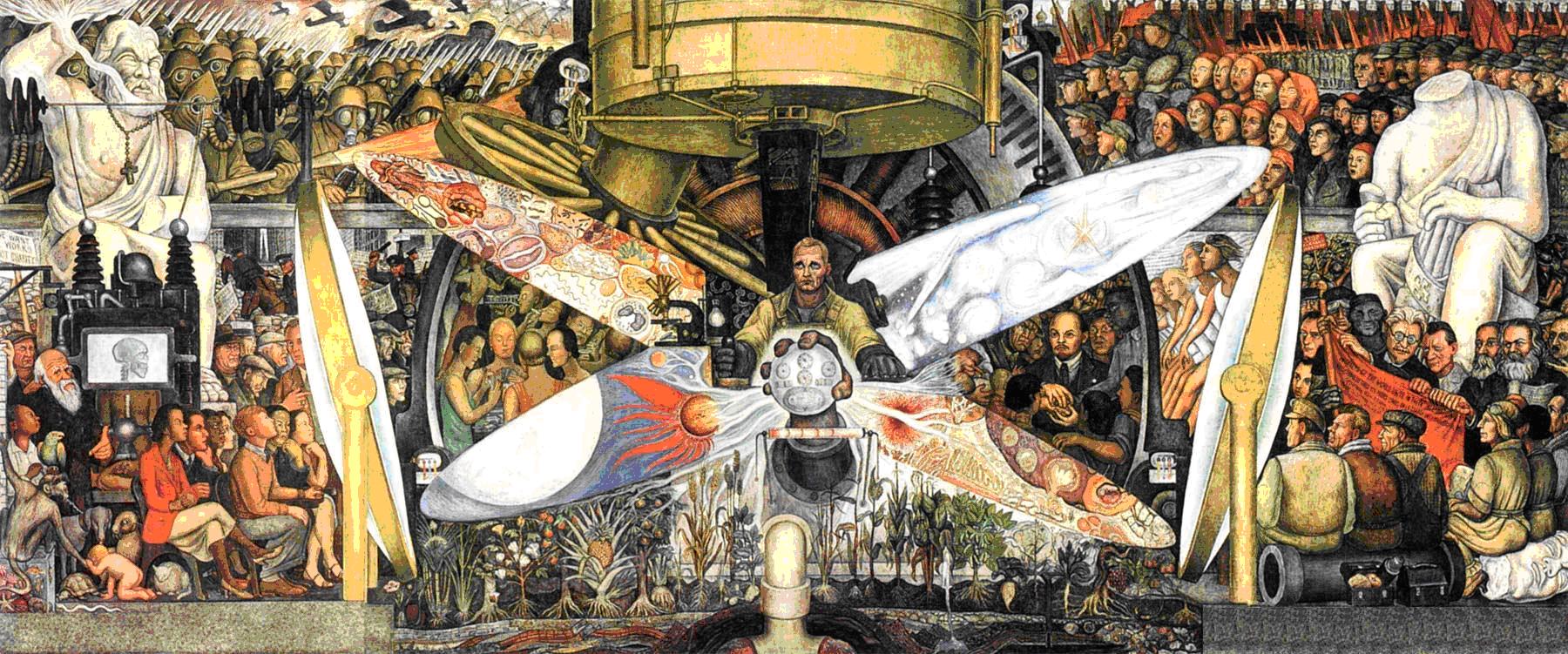
Artist Ben Wood, whose plan to recreate a centuries-old Ohlone mural on the Mission Market we covered in the paper a few weeks ago, made a short film on the Rockefeller Center Diego Rivera mural that was ordered removed because Rivera had snuck a portrait of Lenin into the fresco’s depicted multitudes.

Goes to show you how much we’ve progressed – now, you don’t even have to show Communist Party leaders, the reality and triumphs of working class people are enough to be considered unpalatable (and unfair?) by business leaders. 

And don’t get me started on Italian street artist Blu’s dollar bill-draped coffins, whitewashed from a wall the Museum of Contemporary Art in Los Angeles a day after he painted the thing. Dead soldiers = not on our walls. Not mention a poorly-executed gambit by Vancouver, Canada to remove an anti-Olympic art installation on a gallery’s storefront.

“Man at the Crossroads” (here, a partial view of the mural) was not a big hit with the business set either 

The removal of Blu’s MOCA piece incited artist protests

SF muralists, which side are you on? How does it make you feel to see this kind of thing happen to art?

NY Export: Opus Jazz — where dancers get to be themselves

0

The empty, Depression-era McCarren Park Pool in Brooklyn was, until 2009, a hip venue packed with vibrant twenty-somethings for concerts and summer “pool parties” alike. It’s also appropriately the location for the opening dance scene in NY Export: Opus Jazz, a film celebrating youthful exuberance, during which, fresh-faced New York City Ballet members in sneakers and street clothes perform the original 1958 Jerome Robbins choreography from the ballet of the same name. Exuding vigor and cool, the film, conceived by New York City Ballet soloists Ellen Bar and Sean Suozzi, marks the first return of Robbins’ choreography to the streets of New York since West Side Story. NY Export: Opus Jazz made its San Francisco premiere on Fri./25 at the Ninth Street Independent Film Center as part of the San Francisco Dance Film Festival, directed by Greta Schoenberg.

During the first movement, a linked chain of dancers, captured from above, curves into a semi-circle on top of peeling painted swim lanes. The dancers sway, snap their fingers and throw high kicks under the arch of crumbling brick that frames the pool. The next movement of Robbins’ dance emerges when four men and the sizzling Georgina Pazcoguin tear into Richard Prince’s jazz score in an abandoned parking garage. Leaping to their stomachs and sliding on the cement, the men appear smaller than the statuesque female standing in the foreground of certain camera shots, adding to Pazcouguin’s powerful presence. Each dance scene alternates with footage of city life (traveling on a train, gathering at a diner), thus incorporating the soundscape of Manhattan’s taxis and horns.

Trailer for NY Export: Opus Jazz:

M

As the whole ensemble gathers at a school gym, sneakers squeak on the shellacked wood floor and dancers take turns curling their hands into fists and thrusting the pelvis. Arial shots capture the colorful formations as dancers weave between each other on the basketball court. Men playfully shimmy and quick flashes of partnering send dancers into the air. The performers get to be themselves in this film: both dancers and city dwellers, with Robbins’ still-relevant choreography as the vehicle for expressing youthful vibrancy.

Later, Craig Hall and Rachel Rutherford perform the seductive duet during sunset on Manhattan’s Highline, their tension-filled embrace revealing a sense of yearning. With all of the film’s dance set in abandoned surroundings, including the final movement performed onstage at an empty theater, NY Export: Opus Jazz suggests that the dancers truly perform for the joy of themselves and each other, rather than any outside audience. The resulting most ravishing spirit is addictive – that of being young and alive in the Big Apple.

NY Export: Opus Jazz is available for purchase at www.opusjazz.com.


Sister Liz : A loving look back at “Liz: Unhinged”

0

This review originally appeared (as “Liztrionics: Taylor blows hinges off YBCA!”) in the Dec. 5-11, 2001 issue of the Bay Guardian:

“Elizabeth Taylor is my sister. You might as well know it.”

So begins A Superficial Estimation, poet John Wieners‘s homage to the women in his life, including his aunt, Dorothy Lamour, and his mother, Bette Davis. Overtly conflating movie stars with family is A Superficial Estimation‘s gay masterstroke, one typical of the tiny tome’s undersung author. Liz gets the first chapter; Wieners lovingly notes that she “peruses her surroundings with dignity and harmony,” which leads one to believe that he’s describing his sister before the era — 1968 to 1973 — covered in film curator Joel Shepard‘s current Yerba Buena Center for the Arts series “Liz: Unhinged.” Beginning with a Boom! and ending with Ash Wednesday‘s on-screen plastic surgery, these were Liz’s Divine years: the period when she treated audiences to one throttlehold after another, angrily rubbing their faces into her larger-than-larger-than-life image.

This is star power as deadly weaponry. Daring to dive into Liz in the book Deeper Into Movies, Pauline Kael — reviewing X, Y, and Zee — deems Taylor “Beverley Hills Chaucerian,” a “great bawd” with upholstered hair who uses vulgarity as “a form of assault.” Actually, that movie is the sweetest concoction in “Liz: Unhinged”‘s liquored quartet. (Lore has it that Boom!‘s cast began each day with Bloody Marys.) X, Y, and Zee is a sort of Who’s Afraid of Virginia Woolf?-lite, with Michael Caine pinch-hitting for Richard Burton. “I just love eating between meals,” Liz proclaims, but the real bite is in her voice, a tone that translates to “Fuck you! All of you!” Caine and smug other woman Susanna York share precious mmoments (replete with silhouettes in sunset) on the glorious coast of Scotland, but who cares when they’re up against Liz, wearing a gold headband as she roars at her hairdresser, “Yes, I am a bitch! Open and straight!”

Yes, indeed — thank god. Bitchy Liz has been credited as the first major female star to use the word “fuck” in a movie (Boom!), a rather literal factoid; her line readings regularly translate sunny nicety into no-shit-Sherlock sarcasm. When she breaks free from the florid language of Tennessee Williams, Edna O’Brien, and other, less-esteemed screenwriters, unhinged Liz shoots off an arsenal of yuck-yucks, yoo-hoos, grunts, groans, seagull shrieks of panicky delight, and crying jags that mutate into laughing fits. She triumphs over blue eye shadow. She dons kaftans, cloaks, shawls, ponchos, and diaphanous nightgowns; at one point (in Boom!) her ensemble matches the lamps in her room. And then there’s the headwear, one fur hat after another, capped by a piece (also in Boom!) that transforms her cranium into a dangerous stalactite formation. Gorge your eyes before she gouges them out.

Elizabeth Taylor (with Noël Coward) in Boom!:

Other period details recur throughout “Liz: Unhinged.” Cannelloni is devoured, mineral water flows freely, Liz’s beauty is haunted by Parma violets in not one but two of these burnt offerings: Boom! and Ash Wednesday. Liz herself is a wilted flower in the latter, but then, full-body plastic surgery (captured in loving detail) is exhausting. Especially when it’s meant to win back the arthritic caresses of Henry Fonda. Now, Liz, we know you can do better than that — even if you aren’t sick and tired of wearing loose wraps.

Joseph Losey’s Secret Ceremony locks Liz and a wigged-out Mia Farrow in a mansion to play a fatal game of pseudo-profound, authentically pretentious hide-and-seek. The same director’s Boom!, made the same year (1968) is a sort of debauched Contempt; the film finds Liz dictating her memoirs over an elaborate intercom system and entertaining the Witch of Capri (played by Noël Coward, since Katherine Hepburn — cementing her snooty, uptight image — rejected the part). “Pain…injection!” Liz’s hypochondriac gulps at the outset, shortly before Losey’s portent-laden camera lands on her biggest diamond ring. (Another bit of lore: during this era, Taylor was paid for her jet-setting film roles in rare jewels rather than money.) “Bring me my menthol inhaler and tweezers!” she demands a little later, after coughing up a lung and comparing an X-ray machine to a “baby buggy from Mars.” Death comes in the bedroom, in the form of a bloated, red-eyed Richard Burton.

Motion pictures

0

arts@sfbg.com

DANCE Dance and the camera have a long-lasting love/hate relationship. Films that honor the art, such as 1948’s The Red Shoes or 1951’s An American in Paris with its extraordinary dream sequence, are rare. Although dancers like that their performances acquire an afterlife, they also hate giving up three-dimensionality for two-dimensional space. Nor are they fond of editing practices that alter continuity, control a viewer’s focus, and favor smiles over feet. Nonetheless, a recently discovered snippet of film that showed Diaghilev’s Ballets Russes in a blurry clip of Les Sylphides, apparently the only extant film of the legendary company, sent dance historians into a tizzy.

Now in its second annual incarnation, the San Francisco Dance Film Festival concerns itself with more contemporary dance films. The advent of inexpensive, lightweight cameras has made possible a new genre, “screendance,” which features choreography designed for the camera. Los Angeles and New York City have long had had festivals honoring these creations. Now the Bay Area, after previously unsuccessful attempts by presenters like Cynthia Pepper and Charlotte Shoemaker, is getting its own look at what’s floating out there. “We received 110 submissions from 25 countries,” producer Greta Schoenberg says of this year’s selection process.

Schoenberg has assembled a program in which shorts are bookended by longer films such as Victoria Marks’ ground-breaking 1993 Outside In and the San Francisco premiere of Finite and Infinite by RJ Muna, who is best known for his spectacularly airborne dance photography. Historian/critic Joanna Harris will also show rare films of Bay Area dance pioneers and work by avant-garde filmmaker Maya Deren.

In the Bay Area, a small but growing group of dancers is intrigued by the specific requirements of dancing for the camera. Among them are Private Freeman, Nol Simonse, and Maria Kotchekova, who in 2009 won the solo gold medal on the TV show Superstars of Dance. Schoenberg cast her film noir Nightingale, which receives its world premiere at the sold-out opening night gala, with local dancers. Freeman is one of them.

“I like the idea that film can focus a viewer as long as it wants,” Freeman says. “I also like that you have a 360-degree sense of space. You are working with different concepts of continuity and detail. At the same time, when you have several takes, you need to remember how exactly you had positioned your leg.”

Brevity, with most works typically lasting between three and 10 minutes, characterizes most “screendances” Even the experienced Mitchell Rose, who recently moved to the Bay Area to teach Dance on Camera at Mills College, stuck to this YouTube-friendly time frame when making his wondrous Modern Daydreams: Part One (2001).

The 18 selections in this year’s San Francisco Dance Film Festival stick to the norms. Marta Renzi’s Texas Plate (2007), a romance to music by singer-songwriter Patti Scialfa, is two minutes. A journey onto a wooded mountain, Stronger (2010), by the U.K.’s Wilkie Branson, takes four minutes. Dutch director Carmen Rozestraten’s trip into a Catalan woman’s dream world in After the Water the Clouds (2009) requires nine.

Neither Schoenberg nor documentary and experimental filmmaker Ben Pierce — a former San Francisco Ballet principal dancer who showed work in last year’s festival — can explain the logic behind the short format. Perhaps, they suggest, it’s what audiences want to see, and what festivals like theirs prefer to program. The time frames of YouTube, where a lot of these works end up, is a definite reason. Lack of financing for bigger projects may be another. It’s also possible that the creators of these collaborative ventures haven’t developed the necessary technical chops to master longer works yet.

One festival juror intrigued by the buzz around dance on screen is ODC associate director and choreographer KT Nelson. She finds herself fascinated by the idea of honing in very closely to the body (“Let’s say to the crook of an elbow”) or to create a work in a completely different setting (“Water, for instance”). She hasn’t jumped in yet — but there’s always next year.

SAN FRANCISCO DANCE FILM FESTIVAL

Thurs/24 through Sun/27, $10–$25 ($75–$125 for workshops)

See website for venues

www.sfdancefilmfest.org

Fruits of labor

0

arts@sfbg.com

FILM One of the first things cinema learned to say was “you are there.” The Lumières sent their lightweight cameras around the world and were soon able to transport their Parisian audience to remote settings — a fine flexing of industrial capitalism. If Werner Herzog used to have the market on art-cinema primitivism cornered, the recent films making up the “First Person Rural” series at the Pacific Film Archive take a different tack, disavowing outlandish narratives of madness and expedition for reality-hungry visions of work and rough beauty. As a group, they privilege phenomenal experience to exposition; affective texture to intelligibility; nonverbal utterance to patent explication. They often seem more in line with epic poetry than documentary realism.

Argentine director Lisandro Alonso’s stoic debut La Libertad (2001) led the way to many of the decade’s shorn agricultural narratives. To begin, we watch a young man work a tree into lumber and eat and nap in a lean-to a few shades rougher than Thoreau’s Walden. In the film’s second half, the man turns his labor into capital, transporting, selling, and spending before returning to camp to eat a freshly caught armadillo as lightning flashes in the distance. The slow time of the man’s routines defines the temporality of the film, and Alonso’s bold compositions in turn monumentalize the man’s tasks. What to make of this aesthetic surplus of the man’s labor remains an open question.

The issue of poetic license is even more pressing in Agrarian Utopia (2009), a work of social (hyper) realism focused on a family of Thai subsistence farmers. In contrast to their crushing penury is the rich HD cinematography: every grain of rice and droplet of water makes its stunning mark. Hitching scripted social drama to a loose documentary style joining scenes, director Urophong Raksasad proposes three possible utopic frameworks for the farming family: urban demonstrations calling for political reform, a hippie neighbor’s sustainable farming practices, and the ecstatic vision of the camera itself. The limitations of the first two should give us pause over the third; this is the rare film about poverty that doesn’t imagine its lyricism as a redemptive force.

There’s no question of any kind of utopia in Eugenio Polgovsky’s Tropic of Cancer (2004), a video report from the Mexican desert that’s bruising and cunning in equal measure. Polgovsky shows us the hard lives of peasants who scour the arid landscape for (unfriendly) critters they can sell alongside a godforsaken highway. Their middle-class customers seem primarily concerned with animals’ living conditions — one of many bitter ironies registered in Polgovsky’s sharply assertive montage.

Strong as it is, Tropic of Cancer doesn’t cry out for repeat viewings — not the case with Sweetgrass (2010) and Alamar (2009), both among the finest films of recent years. With Sweetgrass especially, it’s only after you’ve surrendered to its sensory richness as a recording (the multichannel sound mix combines with the physical camerawork for a nearly Whitmanesque extension of perception) that you can begin to digest its cross-purposed contemplation of the final sheep drive across a mountainous western-mythic landscape.

Writing about Jean-François Millet’s peasant subjects, the critic John Berger observed that the French painter’s personal nostalgia extended to history: “Most of what he knew about peasants was that they were reduced to a brutal existence, especially the men. He sensed, it seems to me, two things which, at the time, few others foresaw: that the poverty of the city and its suburbs; and that the market created by industrialization, to which the peasantry was being sacrificed, might one day entail the loss of all sense of history.” The “First Person Rural” films mark this loss with immersion, and in so doing leave us with the lingering sense that it is we and not the films’ subjects who are “out of time.”

“FIRST PERSON RURAL: THE NEW NONFICTION”

March 26–April 27, $5.50–$9.50

Pacific Film Archive

2575 Bancroft, Berk.

(510) 642-5249

www.bampfa.berkeley.edu

#Winning

1

cheryl@sfbg.com

FILM Is Tom McCarthy the most versatile guy in Hollywood? He’s a successful character actor (in big-budget movies like 2009’s 2012; smaller-scale pictures like 2005’s Good Night, and Good Luck; and the final season of The Wire). He’s an Oscar-nominated screenwriter (2009’s Up). And he’s the writer-director of two highly acclaimed indie dramas, The Station Agent (2003) and The Visitor (2007).

Clearly, McCarthy must not sleep much, though he was perky on a recent visit to San Francisco to discuss Win Win, a comedy set in his hometown of New Providence, N.J. Paul Giamatti stars as Mike Flaherty, a lawyer who’s feeling the economic pinch. Betraying his own basic good-guy-ness, he takes advantage of a senile client, Leo (Burt Young), when he spots the opportunity to pull in some badly-needed extra cash.

Matters complicate with the appearance of Leo’s grandson, Kyle (newcomer Alex Shaffer), a runaway from Ohio. Though Mike’s wife, Jackie (Amy Ryan), is suspicious of the taciturn teen, she allows Kyle to crash with the Flaherty family. As luck would have it, Kyle is a superstar wrestler — and Mike happens to coach the local high school team. Things are going well until Kyle’s greedy mother (Melanie Lynskey) turns up and starts sniffing around her father’s finances. Lessons are learned, sure, but the script delivers more genuine laughs than you’d expect from a movie that’s essentially about the recession.

SFBG You were a high school wrestler. Did you always want to make a movie about your experiences?

Tom McCarthy I don’t think when I was [wrestling] I ever thought I would be doing this. But one day I was thinking about high school wrestling — that it would be a funny thing that’s not touched on very much in movies, not since [1985’s] Vision Quest, really. I’m always looking for something that I can connect with that I haven’t seen before, however simple that thing might be. So I called Joe [Tiboni], who developed the story with me. He used to wrestle with me, and we had a really funny conversation about how weird the sport is and what our memories were. When I decided to do that [for my next film], I brought him on, because I thought it would be a really fun experiment working with an old friend like that. Our lives are so different now, but we’re still very connected.

SFBG Obviously you had to cast a kid to play Kyle who could wrestle first, and act second. Was that tough?

TM Wrestling is a really tough sport to fake. So I just made a gut call: “Let’s get a wrestler.” I think the dialogue, and the way I crafted the script, lent itself to it. I said, “Let’s go find the right kid.” And we did. He just had a unique sensibility about him, and I knew he had such a great group of actors around him that it felt right. When we got to the wrestling sequences, they were a joy to shoot. What you see there is real.

SFBG Did you see the wrestling theme as a metaphor for Mike’s struggles?

TM It certainly presented itself to that. I think it’s gonna be hard for a lot of people for a long time. Decent people, like Mike Flaherty, will find short cuts, and those shortcuts might not always be, morally or legally, the right way to go. My philosophy is that’s how we got into this mess: a lot of pretty good people made a lot of bad choices. Selfish decisions. That, to me, is more interesting that this idea of, like, the hundred evil men of Wall Street who pulled these strings and put us all in this situation.

SFBG Gotta ask, since you’re from New Jersey and you use one of the band’s songs in the film. Are you a Bon Jovi fan?

TM Who isn’t? [Laughs.] I actually wasn’t a huge Bon Jovi fan, but whenever it’s on, how can you not rock out? And I gotta say, [Jon Bon Jovi] was awesome. He gave us the song for a bargain-basement price. And it felt really right for Jackie’s character — it felt like it was coming directly from that world.

WIN WIN opens Fri/25 in Bay Area theaters.


Teenage ghosts

0

MUSIC Hold a séance on a wet afternoon or rainy evening. Party down and commiserate with the ghosts and dancing skeletons of wrecked love past as they float from your stereo. Put on Dirty Beaches’ Badlands (Zoo Music) and Hunx and His Punx’s Too Young to Be in Love (Hardly Art) and invite the dead boyfriends and lonesome girlfriends of ’60s teenage rock and pop to shimmy with your ex- memories in the living room. Meet 2011 with them, alone.

The motor at the center of Dirty Beaches’ “A Hundred Highways” is the melody of “I Will Follow Him,” an emphatic-to-the-point-of-crazed declaration of affection made popular in 1963 by a four-foot nine-inch 14-year-old named Little Peggy March. A man-band from Vancouver, B.C., Alex Zhang Hungtai transforms the vocal of March’s hit into a brittle, rusty bassline that’s like a piston from the title vehicle of John Carpenter’s 1983 film Christine, and then douses it with corrosive flames of distorted guitar, brooding into his mic all the while.

The sinister allure of “A Hundred Highways” is enhanced by a cultural connotation that flickers outside of the song itself, namely Kenneth Anger’s use of March’s version of “I Will Follow Him” (as well as her pathos-ridden 1963 ballad “Wind-Up Doll”) in the 1964 film Scorpio Rising. In Anger’s movie, March’s song strikes a comic note, accompanying Hollywood footage of Jesus, but the malevolent spell characteristic of Anger’s overall work is what carries over to the sound of Dirty Beaches, as much as the anguished yelps and cries and sonic minimalism of Suicide, the group always referenced in writing about Hungtai’s music.

History, personal and societal, has a way of adding dark undercurrents to songs that might seem innocent at first. David Lynch and Martin Scorsese learned this from Anger, and the documentary filmmaker Adam Curtis mines this to revelatory effect in the 2009 movie It Felt Like A Kiss, which uses songs produced and recorded by convicted murderer Phil Spector — most potently, the Crystals’ 1962 “He Hit Me (And It Felt Like a Kiss” and Tina Turner’s 1966 “River Deep, Mountain High” — to score an account of the 1960s that’s as attuned to all-too-human triumphs and failures as it is to the insidious undercurrents and machinations of governmental forces. Good times go bad.

Hunx of Hunx and His Punx is familiar with a different kind of Badlands than the war zones zeroed in on by Curtis, or the Jesus and Mary Chain-esque one invoked by Dirty Beaches’ album title. The songs on Too Young to Be in Love are overtly gay, in the sense that he’s singing about boys and men, but to pigeonhole them as gay music would be not just blinkered, but blind to the innovative aspect of the group’s dynamic, which refashions and outright recasts old rock and pop sounds of female and male desire and emotion in new ways.

The traditional if not downright hoary emblem-bearer of “gay music” is the dancefloor diva, ever ready to express the need for everlasting love or tonight’s trick via a sampled or studio-processed wail. Hunx and His Punx create a different dynamic, with Hunx (a.k.a. Seth Bogart) and bandmate Shannon Shaw trading vocals in a manner that counters unbridled true romance with an irony gleaned from experience.

Too Young to Be in Love‘s opening track “Lovers Lane” sounds as classically ’50s-’60s retro as its title, yet Shaw’s untamed, hair-raising voice haunts the deathly boy-loses-boy scenario that Bogart stars in and narrates, arch and sincere in turn. We all want to go to lovers’ lane, but do we want to stay there, in the dark?

At other ingenious times, Hunx’s band is a girl-gang warning bashers and bullies to back off from his romance (“My Boyfriend’s Coming Back”). They harmonize with Hunx as he traipses faux-innocently away from heartbreak (Too Young to Be in Love‘s sublime title track) and with Bogart as he stares down the legacy of his father’s suicide (the closer, “Blow Me Away”). On the classic “The Curse of Being Young,” Hunx does his best Mary Weiss while his bandmates supply the sophisticated boom boom, adding a little more yearning with each chorus, until the listener is left alone with Shaw’s feral, fateful incantation. Games of keep away have lasting impact. Bad boys navigate badlands and sometimes wind up bad men. Maybe you’re never too old to be too young to be in love.

Our weekly Picks: March 23-29, 2011

0

THURSDAY 24

MUSIC

Music For Animals

The catchy tunes of the self-proclaimed “cult” Music For Animals — San Francisco quartet Nick Bray (guitar), Jay Martinovich (vocals), Eli Meyskens (bass guitar), and Ryan Malley (drums) — evoke 1980s classic pop rock while simultaneously embodying the twee music of the here-and-now. While comparisons have been drawn to other electropop acts like the Killers and Kaiser Chiefs, Music for Animals’ neon-retro fans have embraced the band as its own indie rock entity. Its high-energy shows can include wacky antics, making for a perfect opportunity to bust a move. Join the cult! (Jen Verzosa)

With Foreign Resort and Matinees

9 p.m., $8

Hemlock Tavern

1131 Polk, SF

www.hemlocktavern.com


FILM

Disposable Film Festival

Hollywood churns out a huge number of what you might call disposable films (Drive Angry 3D: use once and destroy). San Francisco’s Disposable Film Festival applies the adjective instead to the technology used to create each of its entries: readily available and often handheld devices like cell phones, point-and-shoot cameras, webcams, and so on. Celebrate the all-access-ness of 21st century filmmaking by checking out tonight’s always-popular competitive shorts program; weekend events include an industry panel entitled “How to Become A Disposable De Palma,” a spotlight on filmmaker Christopher McManus, a concert and workshop with YouTube music-video darlings Pomplamoose, and more. (Cheryl Eddy)

Through Sun/27

Competitive shorts night tonight, 8 p.m., $12

Castro Theatre

429 Castro, SF

www.disposablefilmfest.com


EVENT

Neil Strauss

I’m not sure what I like most about Neil Strauss. A six-time New York Times best-selling author and contributing editor at Rolling Stone, he coauthored memoirs with Jenna Jameson and Mötley Crüe. He lived with Dave Navarro for a year and went undercover in the “seduction community” to write about pick-up artists. He was in Beck’s gloriously goofy “Sexx Laws” video. His new book of celebrity chatter, Everyone Loves You When You’re Dead: Journeys Into Fame and Madness, features pop culture personalities from Britney Spears to Stephen Colbert. But his 227 “moments of truth” aren’t in-depth, traditional Q&A pieces. Instead, Strauss wove together the most intriguing few minutes of each interview. Huh? How? Ask him yourself. (Kat Renz)

7:30 p.m., free

Booksmith

1644 Haight, SF

(415) 863-8688

www.booksmith.com


MUSIC

Phantom Kicks

Taking after the Grizzly Bear-meets-Radiohead, now-disbanded Raised By Robots, the San Francisco-based trio of Tanner Pikop (guitar-vocals-keyboard), Phil Pristia (guitar-vocals), and Mike Rieger (drums) — better known as Phantom Kicks — is experimental, ethereal post-punk born of white space à la the xx. Even without an album, Phantom Kicks’ eerie electro pop has garnered notoriety throughout the Bay Area after gigs at numerous local venues and festivals, sharing the bill with other local indie greats like My First Earthquake, the Dont’s, Skeletal System, and Sunbeam Rd. And its days as a live-only entity are soon to end: Phantom Kicks’ debut EP, Tectonics, is due in April. (Verzosa)

With Adventure and Exray’s

8 p.m., $6

Milk Bar

1840 Haight, SF

www.milksf.com


FILM

San Francisco Dance Film Festival

Now in its second year, the San Francisco Dance Film Festival, presented by Motion Pictures and the Ninth Street Independent Film Center, features three evenings of screenings as well as workshops on shooting and editing dance footage. In addition to selections of work by local and international dance filmmakers, Friday night’s lineup includes the San Francisco premiere of NY Export: Opus Jazz, a reimagining of Jerome Robbins’ 1958 “ballet in sneakers” danced by members of the New York City Ballet. This is the first return of Robbins’ choreography to the streets of New York City since the 1961 movie version of West Side Story. (Julie Potter)

Through Sat/26

6:30, 8, and 9:15 p.m., $10

Ninth Street Independent Film Center

145 Ninth St., SF

(415) 625-6100

www.sfdancefilmfest.org


FRIDAY 25

PERFORMANCE

Free: Voices from Beyond the Curbside

Destiny Arts Center in Oakland has been around so long — it was founded in 1988 — that you tend to take it for granted. Better stop doing that, especially in this climate of shrinking resources for socially-engaged arts programs. Destiny provides a safe place, activities, and role models during after school, weekend, and summer programs. Students ages three to 18 learn martial arts, dance (modern, hip-hop, and aerial), theater, self-defense, and conflict resolution. All these elements come into play one more time during this year’s Destiny Youth Company’s big-time production at Laney College. Created by the students with the guidance of adult artist-teachers, Free explores concepts of personal and social freedom (and the lack thereof). The program also features documentary filmmaker David Collier’s video of the process that made Free possible. (Rita Felciano)

Through April 3

Fri.–Sat., 7:30 p.m. (also April 2–3, 2 p.m.), $6–$25

Laney College

900 Fallon, Oakl.

1-800-838-3006

www.brownpapertickets.com


ROCK

Vastum

Vastum, from the Latin vastus: immense. Empty. Wasted. It’s easy to feel that way bumbling home from a dime-a-dozen metal show — depthless, bored, and boozed. But the three times I’ve seen Vastum, I almost pissed myself with joy: my fingers can form horns again, my head bangs rather than bobbles, my tired faith is revived. With members from two stalwart San Francisco bands, Saros and Acephalix, the five-piece delivers precision death metal with a little punk, classically fast and aggressive with none of the cheesiness often befalling the genre. The venue’s a gem, too: an all-ages Oakland warehouse run by an old-school artist and a gargantuan raptor. (Renz)

With Embers, Atriarch, and Headless Lizzy and Her Icebox Pussy

9 p.m., $6

First Church of the Buzzard

2601 Adeline, Oakland

Facebook: Vastum


MUSIC

Wye Oak

Rock duos tend to strive toward sounding greater than their parts. Wye Oak, composed of Baltimore-based musicians Jenn Wasner and Andy Stack, are no exception. Rather than pure bombast, the two play into the contradiction of expectations on almost every track. Wasner’s guitar and lyricism are the initial focus, typically heavily folk-influenced backed by true multi-instrumentalist Stack, who plays drums and keyboard at the same time. As the melodic verses build into the explosive choruses, so do the 1990s alternative rock influences, recalling Yo La Tengo, Sonic Youth, and My Bloody Valentine. It’s an attention-grabbing effect and in a smaller venue should be impossible to ignore. (Ryan Prendiville)

With Callers and Sands

10 p.m., $12

Bottom of the Hill

1233 17th St., SF

(415) 621-4455

www.bottomofthehill.com


SATURDAY 26

DANCE

“Pilot 58: Fight or Flight”

It may not take a village to produce a dance concert, but a collective of choreographers sure makes the process more creative and exciting. Or at least that’s the lesson gleaned from the participants in Pilot, ODC’s self-producing incubator that selects six dance artists to work together on a shared bill. Known as a springboard for emerging choreographers, Pilot showcases new and under-the-radar dance from fresh choreographic voices: Raisa Punkki, Byb Chanel Bibene, Bianca Cabrera, Katharine Hawthorne, Ashley Johnson, and Erica Jeffrey. Arriving at choreography through notably different experiences, the evening brings a host of ideas to the table, from moving light sources to little dance cartoons. (Potter)

Sat/26–Sun/27, 8 p.m. (also Sun/27, 4 p.m.), $12

ODC Studio B

351 Shotwell, SF

(415) 863-6606

www.odcdance.org


SUNDAY 27

MUSIC

Rotting Christ

Though not as famed as other loci of Lucifer, Greece has a long and distinguished black metal history. Delightfully named Rotting Christ was founded in 1987 by brothers Sakis and Themis Tolis, who have been plying their blast-beaten trade ever since, much to the dismay of born-again Christian headbanger Dave Mustaine of Megadeth, who refused to play at a Greek music festival once he learned that Rotting Christ was on the bill. The hellbound Hellenic quartet is joined on its current tour by cult favorites Melechesh, a “Mesopotamian” metal band — composed of Israeli expatriates based in Amsterdam — whose distinctive sound combines razor-wire riffing with idiosyncratic Middle Eastern harmonies and rhythms. On a more somber note, this show will be the last promoted by Shawn “Whore for Satan” Phillips, whose retirement will be a deeply-felt loss for metal, both in San Francisco and elsewhere. (Ben Richardson)

With Melechesh, Hate, Abigail Williams, and Lecherous Nocturne

7:30 p.m., $25

DNA Lounge

375 11th St., SF

(415) 626-1409

www.dnalounge.com


MONDAY 28

MUSIC

Röyksopp

Fame can go in divergent ways. For Norwegian electronic duo Röyksopp, the breakthrough was “Remind Me,” a catchy 2002 cut featuring vocals from Kings of Convenience’s Erlend Øye. In the U.K. it picked up Best Video at the Europe Music Awards that year. In the U.S., however, a version of the song is associated with a Geico commercial featuring a caveman. Look past that though, as the pair of musicians have otherwise proven themselves as standouts on the electronic scene, releasing ethereal downtempo compositions. Live, their performances are more amped up and free-ranging, involving unexpected covers like Queens of the Stone Age’s “Go With The Flow.” (Prendiville)

With Jon Hopkins

8 p.m., $30

Regency Ballroom

1300 Van Ness, SF

1-800-745-3000

www.theregencyballroom.com


TUESDAY 29

DANCE

Alvin Ailey American Dance Theater

Under the directorship of Judith Jamison, Alvin Ailey American Dance Theater became the country’s most popular dance troupe, with an impressive infrastructure and a $3 million budget. Now it will be up to Robert Battle, its new artistic director, to build a repertoire that matches the troupe’s organizational achievements. His appointment was something of a surprise; he never danced with Ailey and, at 37. he is young to assume that kind of responsibility. (Jamison was 43). Programs A and C on this year’s Zellerbach schedule each feature one of his choreographies. Whatever he does in terms of programming, he is not likely to offer fewer glimpses of Revelations, the company’s bread and butter. But how about presenting it with live music? The Bay Area has some excellent gospel choirs. (Felciano)

March 29–April 2, 8 p.m. (also April 2, 2 p.m.);

April 3, 3 p.m., $34–$62

8 p.m., $34–$62

Zellerbach Hall

Bancroft at Telegraph, Berk.

(510) 642-9988

www.calperformances.org 

The Guardian listings deadline is two weeks prior to our Wednesday publication date. To submit an item for consideration, please include the title of the event, a brief description of the event, date and time, venue name, street address (listing cross streets only isn’t sufficient), city, telephone number readers can call for more information, telephone number for media, and admission costs. Send information to Listings, the Guardian Building, 135 Mississippi St., SF, CA 94107; fax to (415) 487-2506; or e-mail (paste press release into e-mail body — no text attachments, please) to listings@sfbg.com. Digital photos may be submitted in jpeg format; the image must be at least 240 dpi and four inches by six inches in size. We regret we cannot accept listings over the phone.

King of the spook house

0

BRAZILIAN CULT HORROR English-language horror cinema has had its share of actors identified with playing one particular role over and over, from Bela Lugosi’s Dracula to Robert Englund’s Freddy Krueger. But we’ve never had anything quite like José Mojica Marins and his infamous Zé do Caixão (José of the Grave). Known to cult movie fans worldwide as Coffin Joe, this top-hatted, cape-flaring, bearded undertaker with extra-long curved fingernails and a mile-wide sadistic streak has been a sort of folk hero in Brazil for nearly 50 years.

His vehicles are unique fever dreams — alternately silly, shocking, or surreal, when not all three at once — that take great pleasure thumbing nose at traditional morality and any institutional authority, whether state or (especially) church. “Destroy me, I believe in nothing!” he dared God while desecrating graves in his first film, 1963’s At Midnight I’ll Take Your Soul. God demurred, perhaps intimidated.

This week sees the U.S. release (in Synapse’s Blu-ray/DVD combo pack) of 2008’s Embodiment of Evil. It’s Marins’ return to the role after a long layoff, and to the director’s seat after a longer one — apparently since 1987’s 48 Hours of Hallucinatory Sex, last among the porn movies he was reduced to during an extended career lull. (Those films are said to be stubbornly, grotesquely anti-erotic, which would be entirely in character.) It’s an official conclusion to the “Coffin Joe Trilogy” left off in 1967’s This Night I’ll Possess Your Corpse, which was advertised promising “200 Snakes! 300 Spiders! 1,000 Extras! The most terrifying film in the world!” and certainly gave sensation-seeking patrons their money’s worth with a prolonged color climax depicting the torments of a papier-mâché hell.

That makes Embodiment perhaps the longest-delayed end to a horror trilogy, kicking Dario Argento’s ass — you will recall his “Three Witches” triptych of 1977’s amazing Suspiria, 1980’s incoherent but picturesque Inferno, and 2007’s daft Mother of Tears. Perhaps Embodiment‘s biggest shock arrives when it opens with the 20th Century Fox logo — clearly somebody is still very big in Brazil. Otherwise it’s back to blaspheming basics for our antihero, who after many years is being released from prison, despite having apparently “killed nearly 30 guys just in jail.” (Never a paragon of political correctitude, Marins has the warden reluctantly “letting the beast loose” and telling his terrified guards: “Any of you turns chicken on me, I’ll get you to stand watch at the queers ward!”)

Once out, Coffin Joe resumes his lifelong quest to find a “perfect woman” capable of bearing a child “higher than God, lower than Satan,” thus allowing our “visionary of the superior bloodline” to achieve immortality. This he’ll do “even if it means imploding the entire cosmos!” For all his hubris, however, this archvillain is still scared shitless whenever his past victims appear as accusatory apparitions.

As ever, auditioning mates (most screaming kidnapees) involves “testing” for fear and resilience in ways they’re unlikely to survive. En route he also acquires lots of new enemies and is happy to orchestrate their grotesque demises too. If Coffin Joe is a sort of spook house incarnation of ideas from Nietzsche and Sade — he’s a mortal superman imposing his will on those haplessly constrained by the societal conventions he scorns — his horrors are hardly grandiose; instead they are manic plunges into the realm of ick.

One unfortunate’s face meets a bucket o’ bugs; another is coated with hot cheese, followed by hungry rats. While CJ evinces disgust at how the world has changed during his long absence (favela kids sniffing glue, etc.), his new adventure takes advantage of some new cultural norms, including goth-punk henchmen, seemingly real body piercings, and a young priest who enjoys applying electric nipple clamps at the altar. (None of this is as memorable as one “terrifying” vision in 1970’s LSD-themed Awakening of the Beast: mooning butts with cartoon faces painted on, several clutching plastic “noses” ‘tween cheeks. Run for your lives!)

Far from the best Coffin Joe movie, Embodiment nonetheless brings the crazy with Marins’ distinctive zeal for outrageous offense. His once frequently-banned works now look loopy and quaint, yet there’s still a subversive edge. Then again, he’s also a lot like the snickering older brother at the Halloween party who thrusts blindfolded kids’ hands into cold wet spaghetti, crowing “WORMS!”

Live Shots: Fujiya and Miyagi with Fol Chen, the Independent, 3/21/2011

0

Techno spaz dance-off. That’s how the evening started.


Fol Chen was on stage and one of their guitarists was doing some spaztastic moves, while his doppelganger in the front row played along. This went on for several of Fol Chen’s songs, the leg kicking, the head bopping. It was quite entertaining to watch. The rest of Fol Chen, wearing matching red band-camp uniforms, were equally enthusiastic on stage, while they belted out a song about a wedding cake.

Then it was the headliner’s, Fujiya and Miyagi, turn on stage. They did not rip out the cray-cray dance moves, but they did figure in some funky guitar riffs. This British band, with their whisper-sung lyrics and eery keyboard chords, create sounds that make you feel like you’re in a dark, dramatic film, speeding by on a subway, rain pouring down outside, and you have no idea where you’re even going. It’s music to get lost in, to daydream with, and hey, maybe even enjoy with your bowl of minestrone.

Film Listings

0

Film listings are edited by Cheryl Eddy. Reviewers are Kimberly Chun, Michelle Devereaux, Peter Galvin, Max Goldberg, Dennis Harvey, Johnny Ray Huston, Louis Peitzman, Lynn Rapoport, Ben Richardson, and Matt Sussman. For rep house showtimes, see Rep Clock. For first-run showtimes, see Movie Guide.

OPENING

The Beaver Jodie Foster directs and co-stars in this film about a man (Mel Gibson) who communicates using a hand puppet. No word if said hand puppet calls anyone “sugar tits.” (1:30)

*Carancho What Psycho (1960) did for showers this equally masterful, if far more bloody, neo-noir is bound to do for crossing the street at night. Argentine director Pablo Trapero has spun his country’s grim traffic statistics (the film’s opening text informs us that more than 8,000 people die every year in road accidents at a daily average of 22) into a Jim Thompson-worthy drama of human ugliness and squandered chances. Sosa (Ricardo Darín of 2009’s The Secret in Their Eyes) is the titular “carancho,” or buzzard, a disbarred lawyer-turned-ambulance chaser who swoops down on those injured in road accidents on behalf of a shady foundation that fixes personal injury lawsuits. It’s only a matter of time before he crosses paths with and falls for Lujan (a wonderful Martina Gusman, also of Trapero’s 2008 Lion’s Den), a young ambulance medic battling her own demons and a grueling work schedule. A May-December affair begins to percolate until Sosa botches a job and incurs the wrath of the foundation, kicking off a chain reaction that only leads to further tragedy for him and his newfound love. Trapero keeps a steady hand at the wheel throughout, deftly guiding his film through intimate scenes that lay bare Lujan’s quiet desperation and Sosa’s moral ambivalence as well as genuinely shocking moments of violence. The Academy passed over Carancho as one of this year’s nominees for Best Foreign Language Film, but Hollywood would do well to learn from talent like Trapero’s. (1:47) Lumiere, Shattuck. (Sussman)

Desert Flower Based on the best-selling “model memoir,” Desert Flower spins the remarkable tale of Waris Dirie, who fled across the Somalian desert as a young teen to escape an arranged marriage. The marriage was not the most cruel tradition to be imposed on the girl, however — as a toddler, she’d been circumcised, and the crude operation (designed to keep her “pure” until marriage) caused her pain for years after. Waris (played as an adult by Ethiopian supermodel Liya Kebede) eventually makes her way to London, where she’s discovered by a top photographer (Timothy Spall) while mopping floors at a fast-food restaurant. Part culture-clash drama, part girl-power success story (Waris befriends a spunky Topshop clerk, played by Sally Hawkins), Desert Flower is directed (by Sherry Hormann) with the heavy-handedness of a TV movie. But the film does a powerful job drawing attention to a subject not often discussed — despite the efforts of activists like the real-life Dirie, female circumcision still affects some 6,000 girls a day — and for that it cannot be faulted. (2:00) (Eddy)

Diary of a Wimpy Kid: Rodrick Rules Sequel to last year’s hit comedy based on the best-selling YA books by Jeff Kinney. (1:36)

Kill the Irishman If you enjoy 1970s-set Mafia movies featuring characters with luxurious facial hair zooming around in Cadillacs, flossing leather blazers, and outwitting cops and each other — you could do a lot worse than Kill the Irishman, which busts no genre boundaries but delivers enjoyable retro-gangsta cool nonetheless. Adapted from the acclaimed true crime book by a former Cleveland police lieutenant, the film details the rise and fall of Danny Greene, a colorful and notorious Irish-American mobster who both served and ran afoul of the big bosses in his Ohio hometown. During one particularly conflict-ridden period, the city weathered nearly 40 bombings — buildings, mailboxes, and mostly cars, to the point where the number of automobiles going sky-high is almost comical (you’d think these guys would’ve considered taking the bus). The director of the 2004 Punisher, Jonathan Hensleigh, teams up with the star of 2008’s Punisher: War Zone, Ray Stevenson, who turns in a magnetic performance as Greene; it’s easy to see how his combination of book- and street smarts (with a healthy dash of ruthlessness) buoyed him nearly to the top of the underworld. The rest of the cast is equally impressive, with Vincent D’Onofrio, Val Kilmer, Christopher Walken, and Linda Cardellini turning in supporting roles, plus a host of dudes who look freshly defrosted from post-Sopranos storage. (1:46) (Eddy)

*Queen of the Sun: What Are the Bees Telling Us? There are plenty of docs out there detailing the slow decline of the human race — self-inflicted decline, that is, thanks to our disregard for long-term environmental damage caused by our greedy, polluting ways. But unlike the recent Carbon Nation (2010), for example, which took a broad look at renewable energy, Queen of the Sun studies a far more specific issue. A tiny one, in fact: the size of a honeybee. Of course, as the movie points out, this honeybee-sized disaster is actually a global disaster in the making. The latest from Taggart Siegel, director of 2005’s The Real Dirt on Farmer John, investigates the global bee crisis, talking to numerous beekeepers and scientists to discover why bees are disappearing, how their mass-vanishing act affects the food chain, and what (if anything) can be done before it’s too late. Creative animation and quite a few characters (including a shirtless French guy who tickles his hive with his graying mustache) keep Queen of the Bees from feeling too much like a lecture; in fact, it’s quite an eye-opener. You’ll think twice before ever swatting another bee. (1:23) Roxie. (Eddy)

Sucker Punch From what I can tell, Sucker Punch is Zach Snyder’s remake of his 300 (2006), except with jailbait instead of Spartans. (2:00) Presidio.

*Win Win See “#Winning.” (1:46) Bridge.

Winter in Wartime A 13-year-old boy joins the resistance movement in 1945 Nazi-occupied Holland. (1:43) Embarcadero, Shattuck, Smith Rafael.

ONGOING

The Adjustment Bureau As far as sci-fi romantic thrillers go, The Adjustment Bureau is pretty standard. But since that’s not an altogether common genre mash-up, I guess the film deserves some points for creativity. Based on a short story by Philip K. Dick, The Adjustment Bureau takes place in a world where all of our fates are predetermined. Political hotshot David Norris (Matt Damon) is destined for greatness — but not if he lets a romantic dalliance with dancer Elise (Emily Blunt) take precedence. And in order to make sure he stays on track, the titular Adjustment Bureau (including Anthony Mackie and Mad Men‘s John Slattery) are there to push him in the right direction. While the film’s concept is intriguing, the execution is sloppy. The Adjustment Bureau suffers from flaws in internal logic, allowing the story to skip over crucial plot points with heavy exposition and a deus ex machina you’ve got to see to believe. Couldn’t the screenwriter have planned ahead? (1:39) Marina, 1000 Van Ness, Piedmont, SF Center, Shattuck, Sundance Kabuki. (Peitzman)

*Battle: Los Angeles Michael Bay is likely writhing with envy over Battle: Los Angeles; his Transformers flicks take a more, erm, nuanced view of alien-on-human violence. But they’re not all such bad guys after all; these days, as District 9 (2009) demonstrated, alien invasions are more hazardous to the brothers and sisters from another planet than those trigger-happy humanoids ready to defend terra firma. So Battle arrives like an anomaly — a war-is-good action movie aimed at faceless space invaders who resemble the Alien (1979) mother more than the wide-eyed lost souls of District 9. Still reeling from his last tour of duty, Staff Sergeant Nantz (Aaron Eckhart) is ready to retire, until he’s pulled back in by a world invasion, staged by thirsty aliens. In approximating D-Day off the beach of Santa Monica, director Jonathan Liebesman manages to combine the visceral force of Saving Private Ryan (1998) with the what-the-fuck hand-held verite rush of Cloverfield (2008) while crafting tiny portraits of all his Marines, including Michelle Rodriguez, Ne-Yo, and True Blood‘s Jim Parrack. A few moments of requisite flag-waving are your only distractions from the almost nonstop white-knuckle tension fueling Battle: Los Angeles. (1:57) California. (Chun)

Biutiful Uxbal (Javier Bardem) has problems. To name but a few: he is raising two young children alone in a poor, crime-beset Barcelona hood. He is making occasional attempts to rope back in their bipolar, substance-abusive mother (Maricel Álvarez), a mission without much hope. He is trying to stay afloat by various not-quite legal means while hopefully doing the right thing by the illegals — African street drug dealers and Chinese sweatshop workers — he acts as middleman to, standing between them and much less sympathetically-inclined bossmen. He’s got a ne’er-do-well brother (Eduard Fernandez) to cope with. Needless to say, with all this going on (and more), he isn’t getting much rest. But when he wearily checks in with a doc, the proverbial last straw is stacked on his camelback: surprise, you have terminal cancer. With umpteen odds already stacked against him in everyday life, Uxbal must now put all affairs in order before he is no longer part of the equation. This is Alejandro González Iñárritu’s first feature since an acrimonious creative split with scenarist Guillermo Arriaga. Their films together (2006’s Babel, 2003’s 21 Grams, 2000’s Amores Perros) have been criticized for arbitrarily slamming together separate baleful storylines in an attempt at universal profundity. But they worked better than Biutiful, which takes the opposite tact of trying to fit several stand-alone stories’ worth of hardship into one continuous narrative — worse, onto the bowed shoulders of one character. Bardem is excellent as usual, but for all their assured craftsmanship and intense moments, these two and a half hours collapse from the weight of so much contrived suffering. Rather than making a universal statement about humanity in crisis, Iñárritu has made a high-end soap opera teetering on the verge of empathy porn. (2:18) Shattuck. (Harvey)

*Black Swan “Lose yourself,” ballet company head Thomas (Vincent Cassel) whispers to his leading lady, Nina (Natalie Portman), moments before she takes the stage. But Nina is already consumed with trying to find herself, and rarely has a journey of self-discovery been so unsettling. Set in New York City’s catty, competitive ballet world, Black Swan samples from earlier dance films (notably 1948’s The Red Shoes, but also 1977’s Suspiria, with a smidgen of 1995’s Showgirls), though director Darren Aronofsky is nothing if not his own visionary. Black Swan resembles his 2008 The Wrestler somewhat thematically, with its focus on the anguish of an athlete under ten tons of pressure, but it’s a stylistic 180. Gone is the gritty, stripped-down aesthetic used to depict a sad-sack strongman. Like Dario Argento’s 1977 horror fantasy, the gory, elegantly choreographed Black Swan is set in a hyper-constructed world, with stabbingly obvious color palettes (literally, white = good; black = evil) and dozens of mirrors emphasizing (over and over again) the film’s doppelgänger obsession. As Nina, Portman gives her most dynamic performance to date. In addition to the thespian fireworks required while playing a goin’-batshit character, she also nails the role’s considerable athletic demands. (1:50) Shattuck. (Eddy)

*Cedar Rapids What if The 40 Year Old Virgin (2005) got so Parks and Rec‘d at The Office party that he ended up with a killer Hangover (2009)? Just maybe the morning-after baby would be Cedar Rapids. Director Miguel Arteta (2009’s Youth in Revolt) wrings sweet-natured chuckles from his banal, intensely beige wall-to-wall convention center biosphere, spurring such ponderings as, should John C. Reilly snatch comedy’s real-guy MVP tiara away from Seth Rogen? Consider Tim Lippe (Ed Helms of The Hangover), the polar opposite of George Clooney’s ultracompetent, complacent ax-wielder in Up in the Air (2009). He’s the naive manchild-cum-corporate wannabe who never quite graduated from Timmyville into adulthood. But it’s up to Lippe to hold onto his firm’s coveted two-star rating at an annual convention in Cedar Rapids. Life conspires against him, however, and despite his heartfelt belief in insurance as a heroic profession, Lippe immediately gets sucked into the oh-so-distracting drama, stirred up by the dangerously subversive “Deanzie” Ziegler (John C. Reilly), whom our naif is warned against as a no-good poacher. Temptations lie around every PowerPoint and potato skin; as Deanzie warns Lippe’s Candide, “I’ve got tiger scratches all over my back. If you want to survive in this business, you gotta daaance with the tiger.” How do you do that? Cue lewd, boozy undulations — a potbelly lightly bouncing in the air-conditioned breeze. “You’ve got to show him a little teat.” Fortunately Arteta shows us plenty of that, equipped with a script by Wisconsin native Phil Johnston, written for Helms — and the latter does not disappoint. (1:26) California, Empire, Sundance Kabuki. (Chun)

Certified Copy Abbas Kiarostami’s beguiling new feature signals “relationship movie” with every cobblestone step, but it’s manifestly a film of ideas — one in which disillusionment is as much a formal concern as a dramatic one. Typical of Kiarostami’s dialogic narratives, Certified Copy is both the name of the film and an entity within the film: a book written against the ideal of originality in art by James Miller (William Shimell), an English pedant fond of dissembling. After a lecture in Tuscany, he meets an apparent admirer (Juliette Binoche) in her antique shop. We watch them talk for several minutes in an unbroken two-shot. They gauge each other’s values using her sister as a test case — a woman who, according to the Binoche character, is the living embodiment of James’ book. Do their relative opinions of this off-screen cipher constitute characterization? Or are they themselves ciphers of the film’s recursive structure? Kiarostami makes us wonder. They begin to act as if they were married midway through the film, though the switch is not so out of the blue: Kiarostami’s narrative has already turned a few figure-eights. Several critics have already deemed Certified Copy derivative of many other elliptical romances; the strongest case for an “original” comes of Roberto Rossellini’s Voyage to Italy (1954). The real difference is that while Rossellini’s masterpiece realizes first-person feelings in a third-person approach, Kiarostami stays in the shadow of doubt to the end. (1:46) Clay, Shattuck, Smith Rafael. (Goldberg)

Even the Rain It feels wrong to criticize an “issues movie” — particularly when the issues addressed are long overdue for discussion. Even the Rain takes on the privatization of water in Bolivia, but it does so in such an obvious, artless way that the ultimate message is muddled. The film follows a crew shooting an on-location movie about Christopher Columbus. The film-within-a-film is a less-than-flattering portrait of the explorer: if you’ve guessed that the exploitation of the native people will play a role in both narratives, you’d be right. The problem here is that Even the Rain rests on our collective outrage, doing little to explain the situation or even develop the characters. Case in point: Sebastian (Gael García Bernal), who shifts allegiances at will throughout the film. There’s an interesting link to be made between the time of Columbus and current injustice, but it’s not properly drawn here, and in the end, the few poignant moments get lost in the shuffle. (1:44) Opera Plaza, Shattuck. (Peitzman)

*Heartbeats Twenty-one-year-old French Canadian Xavier Dolan — who wrote, directed, and starred in 2009’s I Killed My Mother — returns with the romantic farce Heartbeats, a film peppered with homages to the films, art, and literature that inspired it. While the story is simple — friends Francis (Dolan) and Marie (Monia Chokri) both fall for stunning stranger Nicolas (Niels Schneider) — Dolan’s visual references give his film weight. As with his first movie, he draws from his own life, though Heartbeats is more an amalgamation of stories than Dolan’s singular experience. (1:35) Lumiere. (Peitzman)

*The Human Resources Manager What happens when a nameless, faceless “human resource” begin to resolve into a palpably real being with hopes, fears, loved ones, a hometown, a past? The harried Human Resources Manager of a big Jerusalem bakery finds out when one of his employer’s foreign workers is killed in a suicide bombing. After her body remains unclaimed in a city morgue, his employer is tagged with callous indifference, and it’s up to the beleaguered HR Manager (Mark Ivanir) — already suffering from something of an existential crisis — to undertake damage control. That task turns out to be absurdly above and beyond the ordinary when he retraces his late charge’s footsteps and tracks down her family in Romania, dogged by a meddling reporter (Guri Alfi). Back in the bleak old country, “neither east nor west,” as he’s constantly reminded, the HR Manager encounters a suitably salty, strange array of characters — the earthy Consul (Rozina Cambos) and the deceased’s divorced husband (Reymond Amsalem) and her feral son (Noah Silver) — though who can actually claim the lady’s remains? The troublesome chore turns into a journey about reconnecting with the people the HR Manager stopped seeing as full-fledged, complicated beings. Working from A.B. Yehoshua’s 2006 novel, A Woman in Jerusalem, director Eran Riklis deigns to give his characters names, apart from the dead, and instead focuses on crafting a carefully balanced, altogether enjoyable and accessible black comedy, rendering it all with a delicate touch that Anton Chekhov might have approved of. (1:43) Opera Plaza. (Chun)

I Am File in the dusty back drawer of An Inconvenient Truth (2006) wannabes. The cringe-inducing, pretentious title is a giveaway — though the good intentions are in full effect — in this documentary by and about director Tom Shadyac’s search for answers to life’s big questions. After a catastrophic bike accident, the filmmaker finds his lavish lifestyle as a successful Hollywood director of such opuses as Bruce Almighty (2003) somewhat wanting. Thinkers and spiritual leaders such as Desmond Tutu, Howard Zinn, UC Berkeley psychology professor Dacher Keltner, and scientist David Suzuki provide some thought-provoking answers, although Shadyac’s thinking behind seeking out this specific collection of academics, writers, and activists remains somewhat unclear. I Am‘s shambling structure and perpetual return to its true subject — Shadyac, who resembles a wide-eyed Weird Al Yankovic — doesn’t help matters, leaving a viewer with mixed feelings, less about whether one man can work out his quest for meaning on film, than whether Shadyac complements his subjects and their ideas by framing them in such a random, if well-meaning, manner. And sorry, this film doesn’t make up for Ace Ventura: Pet Detective (1994). (1:16) Shattuck. (Chun)

*The Illusionist Now you see Jacques Tati and now you don’t. With The Illusionist, aficionados yearning for another gem from Tati will get a sweet, satisfying taste of the maestro’s sensibility, inextricably blended with the distinctively hand-drawn animation of Sylvain Chomet (2004’s The Triplets of Belleville). Tati wrote the script between 1956 and 1959 — a loving sendoff from a father to a daughter heading toward selfhood — and after reading it in 2003 Chomet decided to adapt it, bringing the essentially silent film to life with 2D animation that’s as old school as Tati’s ambivalent longing for bygone days. The title character should be familiar to fans of Monsieur Hulot: the illusionist is a bemused artifact of another age, soon to be phased out with the rise of rock ‘n’ rollers. He drags his ornery rabbit and worn bag of tricks from one ragged hall to another, each more far-flung than the last, until he meets a little cleaning girl on a remote Scottish island. Enthralled by his tricks and grateful for his kindness, she follows him to Edinburgh and keeps house while the magician works the local theater and takes on odd jobs in an attempt to keep her in pretty clothes, until she discovers life beyond their small circle of fading vaudevillians. Chomet hews closely to bittersweet tone of Tati’s films — and though some controversy has dogged the production (Tati’s illegitimate, estranged daughter Helga Marie-Jeanne Schiel claimed to be the true inspiration for The Illusionist, rather than daughter and cinematic collaborator Sophie Tatischeff) and Chomet neglects to fully detail a few plot turns, the dialogue-free script does add an intriguing ambiguity to the illusionist and his charge’s relationship — are they playing at being father and daughter or husband and wife? — and an otherwise straightforward, albeit poignant tale. (1:20) Opera Plaza. (Chun)

Inside Job Inside Job is director Charles Ferguson’s second investigative documentary after his 2007 analysis of the Iraq War, No End in Sight, but it feels more like the follow-up to Alex Gibney’s Enron: The Smartest Guys in the Room (2005). Keeping with the law of sequels, more shit blows up the second time around. As with No End in Sight, Ferguson adeptly packages a broad overview of complex events in two hours, respecting the audience’s intelligence while making sure to explain securities exchanges, derivatives, and leveraging laws in clear English (doubly important when so many Wall Street executives hide behind the intricacy of markets). The revolving door between banks, government, and academia is the key to Inside Job‘s account of financial deregulation. At times borrowing heist-film conventions (it is called Inside Job, after all), Ferguson keeps the primary players in view throughout his history so that the eventual meltdown seems anything but an accident. The filmmaker’s relentless focus on the insiders isn’t foolproof; tarring Ben Bernanke, Henry Paulson, and Timothy Geithner as “made” guys, for example, isn’t a substitute for evaluating their varied performances over the last two years. Inside Job makes it seem that the entire crisis was caused by the financial sector’s bad behavior, and this too is reductive. Furthermore, Ferguson does not come to terms with the politicized nature of the economic fallout. In Inside Job, there are only two kinds of people: those who get it and those who refuse to. The political reality is considerably more contentious. (2:00) Lumiere. (Goldberg)

*Jane Eyre Do we really need another adaptation of Jane Eyre? As long as they’re all as good as Cary Fukunaga’s stirring take on the gothic romance, keep ’em coming. Mia Wasikowska stars in the titular role, with the dreamy Michael Fassbender stepping into the high pants of Edward Rochester. The cast is rounded out by familiar faces like Judi Dench, Jamie Bell, and Sally Hawkins — all of whom breathe new life into the material. It helps that Fukunaga’s sensibilities are perfectly suited to the story: he stays true to the novel while maintaining an aesthetic certain to appeal to a modern audience. Even if you know Jane Eyre’s story — Mr. Rochester’s dark secret, the fate of their romance, etc. — there are still surprises to be had. Everyone tells the classics differently, and this adaptation is a thoroughly unique experience. And here’s hoping it pushes the engaging Wasikowska further in her ascent to stardom. (2:00) Albany, Embarcadero, Piedmont, Sundance Kabuki. (Peitzman)

The King’s Speech Films like The King’s Speech have filled a certain notion of “prestige” cinema since the 1910s: historical themes, fully-clothed romance, high dramatics, star turns, a little political intrigue, sumptuous dress, and a vicarious taste of how the fabulously rich, famous, and powerful once lived. At its best, this so-called Masterpiece Theatre moviemaking can transcend formula — at its less-than-best, however, these movies sell complacency, in both style and content. In The King’s Speech, Colin Firth plays King George VI, forced onto the throne his favored older brother Edward abandoned. This was especially traumatic because George’s severe stammer made public address tortuous. Enter matey Australian émigré Lionel Logue (Geoffrey Rush, mercifully controlled), a speech therapist whose unconventional methods include insisting his royal client treat him as an equal. This ultimately frees not only the king’s tongue, but his heart — you see, he’s never had anyone before to confide in that daddy (Michael Gambon as George V) didn’t love him enough. Aww. David Seidler’s conventionally inspirational script and BBC miniseries veteran Tom Hooper’s direction deliver the expected goods — dignity on wry, wee orgasms of aesthetic tastefulness, much stiff-upper-lippage — at a stately promenade pace. Firth, so good in the uneven A Single Man last year, is perfect in this rock-steadier vehicle. Yet he never surprises us; role, actor, and movie are on a leash tight enough to limit airflow. (1:58) Embarcadero, Empire, 1000 Van Ness, Piedmont, Shattuck, Sundance Kabuki. (Harvey)

*Last Lions It’s hard being a single mom. Particularly when you are a lioness in the Botswana wetlands, your territory invaded and mate killed by an invading pride forced out of their own by encroaching humanity. Add buffalo herds (tasty yes, but with sharp horns they’re not afraid to use) and crocodiles (no upside there), and our heroine is hard-pressed to keep herself alive, let alone her three small cubs. Derek Joubert’s spectacular nature documentary, narrated by Jeremy Irons (in plummiest Lion King vocal form) manages a mind-boggling intimacy observing all these predators. Shot over several years, while seeming to depict just a few weeks or months’ events, it no doubt fudges facts a bit to achieve a stronger narrative, but you’ll be too gripped to care. Warning: those kitties sure are cute, but this sometimes harsh depiction of life (and death) in the wild is not suitable for younger children. (1:28) Opera Plaza, Shattuck. (Harvey)

*Limitless An open letter to the makers of Limitless: please fire your marketing team because they are making your movie look terrible. The story of a deadbeat writer (Bradley Cooper) who acquires an unregulated drug that allows him to take advantage of 100 percent of his previously under-utilized brain, Limitless is silly, improbable and features a number of distracting comic-book-esque stylistic tics. But consumed with the comic book in mind, Limitless is also unpredictable, thrilling, and darkly funny. The aforementioned style, which includes many instances of the infinite regression effect that you get when you point two mirrors at each other, and a heavy blur to distort depth-of-field, only solidifies the film’s cartoonish intentions. Cooper learns foreign languages in hours, impresses women with his keen attention to detail, and sets his sights on Wall Street, a move that gets him noticed by businessman Carl Van Loon (Robert DeNiro in a glorified cameo) as well as some rather nasty drug dealers and hired guns looking to cash in on the drug. Limitless is regrettably titled and masquerades in TV spots as a Wall Street series spin-off, but in truth it sports the speedy pacing and tongue-in-cheek humor required of a good popcorn flick. (1:37) 1000 Van Ness, Presidio, SF Center. (Galvin)

*The Lincoln Lawyer Outfitted with gym’d-tanned-and-laundered manly blonde bombshells like Matthew McConaughey, Josh Lucas, and Ryan Phillippe, this adaptation of Michael Connelly’s LA crime novel almost cries out for an appearance by the Limitless Bradley Cooper — only then will our cabal of flaxen-haired bros-from-other-‘hos be complete. That said, Lincoln Lawyer‘s blast of morally challenged golden boys nearly detracts from the pleasingly gritty mise-en-scène and the snappy, almost-screwball dialogue that makes this movie a genre pleasure akin to a solid Elmore Leonard read. McConaughey’s criminal defense attorney Mickey Haller is accustomed to working all the angles — hence the title, a reference to a client who’s working off his debt by chauffeuring Haller around in his de-facto office: a Lincoln Town Car. Haller’s playa gets truly played when he becomes entangled with Louis Roulet (Phillippe), a pretty-boy old-money realtor accused of brutally attacking a call girl. Loved ones such as Haller’s ex Maggie (Marisa Tomei) and his investigator Frank (William H. Macy) are in jeopardy — and in danger of turning in some delightfully textured cameos — in this enjoyable walk on the sleazy side of the law, the contemporary courtroom counterpart to quick-witted potboilers like Sweet Smell of Success (1957). (1:59) Marina, 1000 Van Ness, SF Center, Sundance Kabuki. (Chun)

Mars Needs Moms (1:28) 1000 Van Ness, SF Center.

The Music Never Stopped Based on a Dr. Oliver Sacks case history, this neurological wild-ride focuses on the generation gap in extremis: after a ’60s teenage son rebels against his parents, staying incommunicado in the interim, he resurfaces over two decades later as a disoriented, possibly homeless patient they’re called to identify at a hospital. He’s had a benign brain tumor removed — yet it had grown so large before surgery that it damaged gray-matter areas including those handling recent memory. As a result, Gabriel (Lou Taylor Pucci) relates to Mr. (J.K. Simmons) and Mrs. Sawyer (a terrific but underutilized Cara Seymour) as if they were still his upstate NY domestic keepers. A radiant Julia Ormond plays the music therapist who convinces them Gabe might respond to music, which had helped serially glue and sever the father-son bond decades earlier. This is an inherently fascinating psychological study. But director Jim Kohlberg and his scenarists render it placidly inspirational, with too little character nuance, scant period atmosphere (somewhat due to budgetary limitations), and weak homage to the Grateful Dead (ditto) rendering an unusual narrative oddly formulaic. (1:45) Shattuck, Sundance Kabuki. (Harvey)

*Of Gods and Men It’s the mid-1990s, and we’re in Tibhirine, a small Algerian village based around a Trappist monastery. There, eight French-born monks pray and work alongside their Muslim neighbors, tending to the sick and tilling the land. An emboldened Islamist rebel movement threatens this delicate peace, and the monks must decide whether to risk the danger of becoming pawns in the Algerian Civil War. On paper, Of Gods and Men sounds like the sort of high-minded exploitation picture the Academy swoons over: based on a true story, with high marks for timeliness and authenticity. What a pleasant surprise then that Xavier Beauvois’s Cannes Grand Prix winner turns out to be such a tightly focused moral drama. Significantly, the film is more concerned with the power vacuum left by colonialism than a “clash of civilizations.” When Brother Christian (Lambert Wilson) turns away an Islamist commander by appealing to their overlapping scriptures, it’s at the cost of the Algerian army’s suspicion. Etienne Comar’s perceptive script does not rush to assign meaning to the monks’ decision to stay in Tibhirine, but rather works to imagine the foundation and struggle for their eventual consensus. Beauvois occasionally lapses into telegraphing the monks’ grave dilemma — there are far too many shots of Christian looking up to the heavens — but at other points he’s brilliant in staging the living complexity of Tibrihine’s collective structure of responsibility. The actors do a fine job too: it’s primarily thanks to them that by the end of the film each of the monks seems a sharply defined conscience. (2:00) Albany, Embarcadero. (Goldberg)

Paul Across the aisle from the alien-shoot-em-up Battle: Los Angeles is its amiable, nerdy opposite: Paul, with its sweet geeks Graeme (Simon Pegg) and Clive (Nick Frost), off on a post-Comic-Con pilgrimage to all the US sites of alien visitation. Naturally the buddies get a close encounter of their very own, with a very down-to-earth every-dude of a schwa named Paul (voiced by Seth Rogen), given to scratching his balls, spreading galactic wisdom, utilizing Christ-like healing powers, and cracking wise when the situation calls for it (as when fear of anal probes escalates). Despite a Pegg-and-Frost-penned script riddled with allusions to Hollywood’s biggest extraterrestrial flicks and much 12-year-old-level humor concerning testicles and farts, the humor onslaught usually attached to the two lead actors — considered Lewis and Martin for pop-smart Anglophiles — seems to have lost some of its steam, and teeth, with the absence of former director and co-writer Edgar Wright (who took last year’s Scott Pilgrim vs. the World to the next level instead). Call it a “soft R” for language and an alien sans pants. (1:44) California, Four Star, 1000 Van Ness, Presidio. (Chun)

*Phil Ochs: There But For Fortune When Phil Ochs was at his peak, he was one of the finest polemical folksingers to come out of the ’60s, and when he tumbled from those heights, the fall was terrible: he lost more than friends and fame — he appeared to completely lose himself, to substance abuse and mental illness. Director Kenneth Bowser does the singer-songwriter justice with this documentary, threading to-the-ramparts tunes like “Hazard, Kentucky,” questioning numbers a la “Love Me, I’m a Liberal,” and achingly beautiful songs such as “Jim Dean of Indiana” throughout political events of the day, scenes from a protest movement that were inextricably entangled with Ochs’ oeuvre. Along with the many clips of Ochs in performance are interviews with the artist’s many friends, cohorts, and fans including Van Dyke Parks (who is becoming a Thurston Moore-like go-to for a generation’s damaged voices), brother (and music archivist) Michael Ochs, Joan Baez, Tom Hayden, Peter Yarrow, Billy Bragg, daughter Meegan Ochs, and Ed Sanders. Expect an education in Ochs’ art, but also, perhaps more importantly (to the singer-songwriter), a glimpse into a time and place that both fed, fueled and bestowed meaning on his songs. Bowser succeeds in paints the portrait of a performer that was both idealistic and careerist, driven to fight injustice yet also propelled to explore new creative avenues (like recording with local musicians in Africa). Did Ochs fall — by way of drink, drugs, and mental illness — or was he pushed, as the artist claimed when he accused CIA thugs of destroying his vocal chords? The filmmaker steps back respectfully, allowing us to draw our own conclusion about this life lived fully. (1:38) Smith Rafael. (Chun)

Rango (1:47) Empire, Presidio, 1000 Van Ness, Sundance Kabuki.

Red Riding Hood In order to appreciate a movie like Red Riding Hood, you have to be familiar with the teen supernatural romance genre. Catherine Hardwicke’s sexy reinterpretation of the fairy tale is not high art: the script is often laughable, the acting flat, and the werewolf CGI embarrassing. But there’s something undeniably enjoyable about Red Riding Hood, especially in the wake of the duller, more sexually repressed Twilight series. Amanda Seyfried stars as Valerie, a young woman living in a village of werewolf cannon fodder. She’s torn between love and duty — or, more accurately, Peter (Shiloh Fernandez) and Henry (Max Irons). Meanwhile, a vicious werewolf hunter (Gary Oldman) has arrived to overact his way into killing the beast. It’s a silly story with plenty of hamfisted references to the original fairy tale, but if you can embrace the camp factor and the striking visuals, Red Riding Hood is actually quite fun. Though, to be fair, it might help if you suffer through Beastly first. (1:38) 1000 Van Ness, Shattuck, SF Center. (Peitzman)

*True Grit Jeff Bridges fans, resist the urge to see your Dude in computer-trippy 3D and make True Grit your holiday movie of choice. Directors Ethan and Joel Coen revisit (with characteristic oddball touches) the 1968 Charles Portis novel that already spawned a now-classic 1969 film, which earned John Wayne an Oscar for his turn as gruff U.S. Marshall Rooster Cogburn. (The all-star cast also included Dennis Hopper, Glen Campbell, Robert Duvall, and Strother Martin.) Into Wayne’s ten-gallon shoes steps an exceptionally crusty Bridges, whose banter with rival bounty hunter La Boeuf (a spot-on Matt Damon) and relationship with young Mattie Ross (poised newcomer Hailee Steinfeld) — who hires him to find the man who killed her father — likely won’t win the recently Oscar’d actor another statuette, but that doesn’t mean True Grit isn’t thoroughly entertaining. Josh Brolin and a barely-recognizable Barry Pepper round out a cast that’s fully committed to honoring two timeless American genres: Western and Coen. (1:50) Shattuck. (Eddy)

Unknown Everything is blue skies as Dr. Martin Harris (Liam Neeson) flies to Germany for a biotech conference, accompanied by lovely wife Elizabeth (January Jones in full Betty Draper mode). Landing in Berlin things quickly become grey, as he’s separated from his wife and ends up in a coma. Waking in a hospital room, Harris experiences memory loss, but like Harrison Ford he’s getting frantic with an urgent need to find his wife. Luckily she’s at the hotel. Unluckily, so is another man, who she and everyone else claims is the real Dr. Harris. What follows is a by-the-numbers thriller, with car chases and fist fights, that manages to entertain as long as the existential question is unanswered. Once it’s revealed to be a knock-off of a successful franchise, the details of Unknown‘s dated Cold War plot don’t quite make sense. On the heels of 2008’s Taken, Neeson again proves capable in action-star mode. Bruno Ganz amuses briefly as an ex-Stasi detective, but the vacant parsing by bad actress Jones, appropriate for her role on Mad Men, only frustrates here. (1:49) 1000 Van Ness, SF Center. (Ryan Prendiville)

You Won’t Miss Me Look at this fucking hipster: dour, aimless Shelly (Stella Schnabel, daughter of Julian) has her own New York City apartment (plus access to a country home, the ability to travel to Atlantic City on a whim, etc.) despite having no apparent source of income. Shelly drifts, going on auditions to further her as-yet unsuccessful acting career; leaving monotone voice mails for her mother; visiting her therapist; hooking up with assorted unwashed dudes; and hanging out with her insipid friends, one of whom helps our hapless 21st century protagonist set up her very first email account. That Shelly is depressed is a given; why anyone would choose to watch this drag of a film is a mystery. Director Ry Russo-Young aims to break up the angst by deploying an array of formats — from Super 8 to Flip — but no amount of artsy quirks (or cameos recognizable only to mumblecore enthusiasts) can make up for You Won’t Miss Me‘s uninvolving plot and unsympathetic characters. For a less painful (though by no means pain-free) experience, seek out last year’s similar Tiny Furniture instead. (1:21) Roxie. (Eddy)

REP PICKS

Dimension 5 and ESPY The Vortex Room March series of vintage espionage obscurities continues with this double bill of two particularly off-radar relics. First up is a 1966 U.S. B-flick that was one of a gazillion cheap James Bond imitations flooding the market at the time. It stars Jeffrey Hunter — a fading late 50s movie star who this same year made the mistake of surrendering Star Trek‘s Kirk role to William Shatner. He’s Justin Power, a big swingin’ dick type who works for “Espionage, Inc.,” surrounded by a bevy of pantingly available female assistants. He discovers a “fantastic Red plot” to “destroy Los Angeles unless all Allied forces are withdrawn from Southeast Asia” being executed by Bond villain Harold “Oddjob” Sakata, who shows off his wrestling physique in a wheelchair and barks things (obviously dubbed by another actor) like “You?! Attack me?! Your superior?!?!” Our hero is thrown a “horizontal curve” by the “curious cat” Kitty (France Nguyen of 1958’s South Pacific and 1993’s Joy Luck Club), an ally with her own hidden agenda. The cheesy big gimmick is Power’s use of a “time travel belt,” but the main attraction today is the film’s occasionally jaw-dropping sexist and racist condescensions. More overtly fantasy-oriented is 1974’s Japanese ESPY from director Jun Fukuda, a veteran of Toho Godzilla epics. Gifted with telekinetic powers, racecar driver Miki (handsome ex-model Masao Kusakari, still active in movies and TV) is drafted into a organization of similar extra-normal abilities to avert international crisis — unknown forces are assassinating world leaders attempting to negotiate peace in various trouble spots. Turns out “superhumans” living among us want to winnow the “weak” human race. It’s good mutants vs. these bad mutants in a globe-trotting adventure that anticipates elements of X-Men (2000), The Fury (1978), Scanners (1981), and even Team America: World Police (2004) while hovering on the borders of spy, kung fu, disaster flick, and (briefly but memorably) sexploitation … with a very groovy 70s soundtrack to boot. Vortex Room. (Harvey)<\!s>2


Rep Clock

0

Schedules are for Wed/23–Tues/29 except where noted. Director and year are given when available. Double and triple features are marked with a •. All times are p.m. unless otherwise specified.

ARTISTS’ TELEVISION ACCESS 992 Valencia, SF; www.atasite.org. $6. Sweet Crude (Cioffi), Wed, 7:30. With special guest Emem Okon, a women’s rights activist and advocate from Nigeria. “Free Form Film Series: TransCosmic Geometry,” Thurs, 8. “Re-Imagining Gaza: Screenings of Short Films,” Fri, 8. “Other Cinema:” Rachel (Bitton, 2009), plus more films about Israel and Palestine, Sat, 8:30.

CASTRO 429 Castro, SF; (415) 621-6120, www.castrotheatre.com. $7.50-10. •Kuroneko (Shindo, 1968), Wed, 3:10, 7, and House (Obayashi, 1977), Wed, 5:05, 9. “Disposable Film Festival,” short films made on cell phones and other “everyday devices,” Thurs, 8. This event, $12; advance tickets at www.brownpapertickets.com. “Sing-a-long:” The Wizard of Oz (Fleming, 1939), March 25-31, 7 (also Sat and Wed, 2).

CHRISTOPHER B. SMITH RAFAEL FILM CENTER 1118 Fourth St, San Rafael; (415) 454-1222, www.cafilm.org. $6.50-15. Certified Copy (Kiarostami, 2010), Wed-Thurs, call for times. Phil Ochs: There But For Fortune (Bowser, 2010) Wed-Thurs, call for times. Winter in Wartime (Koolhoven, 2009), March 25-31, call for times.

DELANCEY SCREENING ROOM 600 Embarcadero, SF; www.thackarystime.com. Free (seating limited; please RSVP to bstrebel@sbcglobal.net). Thackary’s Time (Klausner and Strebel), Wed, 7.

HUMANIST HALL 390 27th St, Oakl; www.humanisthall.org. $5. Overdose: The Next Financial Crisis (Borgs, 2010), Wed, 7:30.

MECHANICS’ INSTITUTE 57 Post, SF; (415) 393-0100, rsvp@milibrary.org. $10. “CinemaLit Film Series: Heros and Misfits: The Films of Stephen Frears:” Dirty Pretty Things (2002), Fri, 6.

NINTH STREET INDEPENDENT FILM CENTER 145 Ninth St, SF; www.sfdancefilmfest.org. $15. “San Francisco Dance Film Festival,” dance films from around the globe, Fri-Sat, 6pm.

PACIFIC FILM ARCHIVE 2575 Bancroft, Berk; (510) 642-5249, www.bampfa.berkeley.edu. $5.50-9.50. “Under the Skin: The Films of Claire Denis:” Nénette and Boni (Denis, 1996), Fri, 7; Beau travail (Denis, 1999), Fri, 9; Down By Law (Jarmusch, 1986), Sat, 8:30. “First Person Rural: The New Nonfiction:” La libertad (Alonso, 2001), Sat, 6:30; Agrarian Utopia (Raksasad, 2009), Sun, 3; The Sky Turns (Álvarez, 2004), Sat, 5:30.

RED VIC 1727 Haight, SF; (415) 668-3994; www.redvicmoviehouse.com. $6-10. Rushmore (Anderson, 1998), Wed, 2, 7:15, 9:15. “Regurgitated: A Multimedia Comedy Show About Food,” performance by Michael Capozzola, Thurs, 7:30, 9. Poison (Haynes, 1991), Fri-Sat, 7:15, 9:15 (also Sat, 2, 4). Somewhere (Coppola, 2010), Sun-Mon, 7:15, 9:20 (also Sun, 2, 4:15). The Mystery of Kaspar Hauser (Herzog, 1974), March 29-30, 7, 9:20 (also March 30, 2).

ROXIE 3117 and 3125 16th St, SF; (415) 863-1087, www.roxie.com. $5-9.75. You Won’t Miss Me (Russo-Young, 2009), Wed-Thurs, 7, 8:50. Queen of the Sun: What Are the Bees Telling Us? (Siegel, 2010), Fri-Mon, 7, 9 (also Sat-Sun, 1:45, 3:30, and 5:15); March 29-31, 7, 8:45.

VORTEX ROOM 1082 Howard, SF; www.myspace.com/thevortexroom. $5 donation. “Thursday Film Cult:” •Dimension 5 (Adreon, 1966), Thurs, 9, and ESPY (Komatsu, 1974), Thurs, 11. YERBA BUENA CENTER FOR THE ARTS 701 Mission, SF; (415) 978-2787, www.ybca.org. $6-8. “Volume 14: Middle East,” nine videos focusing on the Middle East compiled by ASPECT: The Chronicle of New Media Art, Thurs-Sat, noon-8; Sun, noon-6. “Human Rights Watch Film Festival:” Last Best Chance (Camerini and Robertson, 2010), Thurs, 7:30. “Iran Beyond Censorship:” Close-Up (Kiarostami), Fri-Sat, 7:30; Crimson Gold (Panahi, 2003), Sun, 2; White Meadows (Rasoulof, 2009), Sun, 4.

5 Things: March 22, 2011

2

>>1. MIGHTY BIG HEAD Definitely check out the new Olmec: Colossal Masterworks of Ancient Mexico exhibit at the de Young — the museum’s permanent Oceania collection is jutifiably famous (and controversial), and the level of expertise at showcasing indigenous culture and art bleeds perfectly into the realm of ancient Veracruzians as well … 

>>2. TEENAGE KICKS OFF Here’s a teaser and blog for Teenage, the new film by Matt Wolf, director of the beautiful Arthur Russell doc Wild Combination. Wolf’s new movie is based on a book by Jon Savage, and grew out of Wolf’s experience as a pubescent, zine-producing Smiths fan in the 1990s.

>>3. FALLOUT FREE (SO FAR) The Guardian’s systems administrator, Adam, fashioned a Geiger counter over the weekend, and today used it to measure the radioactivity on the dust collected in his car filter during his commute from the East Bay (apparently this is a good thing to measure.) The verdict? All is normal! Average count is 21 counts per minute.


>>4. ANCHOR GETS HEAVY Brit liquor mogul Keith Greggor is settling into his place at the helm of Anchor Brewery and now the 115 year old SF craft brewery looks to make waves in the future of the city’s booze tourism. The company’s looking to expand its distilling operations (currently occupying a forklift-guarded section behind the brewery’s bottle line) into a building across the street. More accesible, plus more room for making 125 proof 18th century-style whiskies.Below, a pic of the Anchor staff in 1978.

>>5. STEAM IT OUT OK the world seems crazy right now? If you have an extra $25 to spare (we don’t usually, either, but we scraped it up), a trip to the Kabuki Springs and Spa in Japantown for a couple hours of steaming, sauna, soaking, and meditation really does help.

EcoTuesday goes Free Range

0

If you’re one of the 12 million people whose enviro-mind was blown by the online video “The Story of Stuff,” you may have the opportunity to ask the film’s executive producer, Erica Priggen, for more insights into communicating the damage of global consumerism via viral animation.


Priggen will speak at tomorrow’s (3/22) San Francisco EcoTuesday event, a networking opportunity for sustainable business leaders held the fourth Tuesday of every month in nine cities across the nation – including communities like SF that have long been on the sustainability forefront, and cities like Cleveland and Detroit that are expanding their green horizons. The Tuesday talks supplement a website chock full of interesting news and blog posts, and speakers can be anyone with a new take on sustainable business.

http://www.youtube.com/watch?v=9GorqroigqM

Priggen is the executive producer at Free Range Studios in Berkeley, and oversees the company’s video and entertainment media department for clients such as 350.org and the Alliance for Climate Education. The creators of the award winning Story of Stuff series company’s mission is to “empower individuals to tranform society through the innovative use of digital media, storytelling, graphic design and strategy,” which is great. And their stuff is just plain amusing, which is also pretty nice.

San Francisco EcoTuesday
Tues/22, 6 p.m., $5 with online registration, $10 at the door
601 Townsend, SF
www.meetup.com/San-Francisco-EcoTuesday


5 Things: March 18, 2011

0

>>ANTIQUING IN THE DAMP This rainy weekend may be the perfect time to check out Hayes Valley’s new curiousity shop, Reliquary, holding it’s grand opening party at 5 p.m. today. Toddle past after work (with your cutest brolly in tow, of course) to check out the shop’s handmade Afghani dresses and antique Zippo lighters. Bonus: the shop’s Tumblr tipped us off to amazing afterlife art: a photo series of the turquoise, pink, and cardinal mineral deposits that have grown off tins of cremated ashes found in the Oregon asylum where One Flew Over the Cuckoo’s Nest was filmed.

>>BIG ASS MOON Just when we finally found out what the back of that big pizza pie in the sky looked like, here it comes again to hit our eyes with it’s closest and biggest showing in two decades — this weekend’s full moon is set to be a huge stunner

Hate to see you go, love to watch you leave

>>THE WEIRDEST SHOW IN TOWN Afrikaaner hip-hop freakouts Die Antwoord star in this short film in which they play animal-suited, wheelchair-bound, societally belittled, balloon-loving murderers. Of course. 

Wheelchairs: the new fixies?

>>o-O It had to happen sooner or later — an entire drag show devoted to Oprah. AND it’s actually a full comedy-drama, with music, lighting, ironic spiritual uplift, and probably some BBQ to boot. Suppositori Spelling and her merry band of sketchy queens has relocated their Sunday night dragstravaganza, Cocktailgate, from butch bar Truck to new big dance club Rebel. In honor of the move, they present OPRAH: THE DRAGSICAL, a one-time-only bonanza of something. Hie thee to 1760 Market at 10pm on Sun/19 and bring a tissue (or win a trip to Australia?).

>>PAWS ON DECK We were at City Hall for some politickin’ the other dusk, but were momentarily derailed by this magnificent skateboarding bulldog in Civic Center Plaza. Sorry for the hootin’ and hollerin’ towards the end of the clip – completely unavoidable.

Yes, we started Youtube account just to post this.