Film

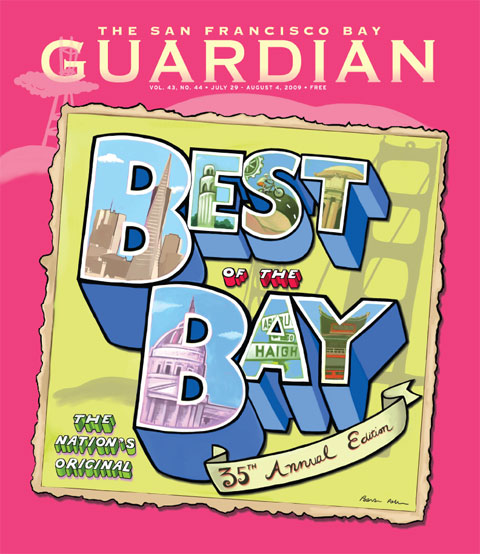
Best of the Bay 2009: Readers Poll Winners

0

Readers Poll — Food and Drink

BEST OVERALL RESTAURANT

Chez Panisse

1517 Shattuck, Berk. (510) 548-5525, www.chezpanisse.com

BEST NEW RESTAURANT

Sidebar

542 Grand, Oakl. (510) 452-9500, www.sidebar-oakland.com

BEST CAFÉ

Cafe Flore

2298 Market, SF. (415) 621-8579, www.cafeflore.com

BEST BOWL OF NOODLES

King of Thai

Various locations

BEST TAQUERIA

Taqueria Cancun

Various locations

BEST SMALL PLATES

Cha Cha Cha

1801 Haight, SF. (415) 386-7670; 2327 Mission, SF. (415) 824-1502, www.cha3.com

BEST SUSHI

Blowfish Sushi to Die For

2170 Bryant, SF. (415) 285-3848, www.blowfishsushi.com

BEST ITALIAN RESTAURANT

Delfina

3621 18th St., SF. (415) 552-4055, www.delfinasf.com

BEST MIDDLE EASTERN RESTAURANT

La Mediterranee

Various locations, www.cafelamed.com

BEST INDIAN RESTAURANT

Dosa

955 Valencia, SF. (415) 642-3672; 1700 Fillmore, SF. (415) 441-3672, www.dosasf.com

BEST LATIN AMERICAN RESTAURANT

La Mar Cebicheria

Pier 1 ½, SF. (415) 397-8880, www.lamarcebicheria.com

BEST ASIAN RESTAURANT

Slanted Door

1 Ferry Building, Suite 5, SF. (415) 861-8032, www.slanteddoor.com

BEST PIZZA

Little Star

846 Divisadero, SF. (415) 441-1118; 400 Valencia, SF. (415) 551-7827, www.littlestarpizza.com

BEST SANDWICH

Mr. Pickles

Various locations, www.mrpicklesinc.com

BEST BRUNCH

Ella’s

500 Presidio, SF. (415) 441-5669, www.ellassanfrancisco.com

BEST LUNCH

San Francisco Soup Company

Various locations, www.sfsoupco.com

BEST BURGER AND FRIES

BurgerMeister

Various locations, www.burgermeistersf.com

BEST BARBECUE

Big Nate’s

1665 Folsom, SF. (415) 861-4242

BEST RESTAURANT WITH A VIEW

Green’s

Building A, Fort Mason Center, SF. (415) 771-6222, www.greensrestaurant.com

BEST LATE-NIGHT RESTAURANT

Grubstake

1525 Pine, SF. (415) 673-8268, www.sfgrubstake.com

BEST SPLURGE RESTAURANT (MORE THAN $20 PER PERSON)

Boulevard

1 Mission, SF. (415) 543-6084, www.boulevardrestaurant.com

BEST CHEAP RESTAURANT (LESS THAN $6 PER PERSON)

Tu Lan

8 Sixth St., SF. (415) 626-0927, tulansf.blogspot.com

BEST APPETIZERS

Kokkari

200 Jackson, SF. (415) 981-0983, www.kokkari.com

BEST DESSERT

Mission Pie

2901 Mission, SF. (415) 282-1500, www.missionpie.com

BEST SERVICE

Gary Danko

800 North Point, SF. (415) 749-2060, www.garydanko.com

BEST VEGETARIAN RESTAURANT

Millenium

580 Geary, SF. (415) 345-3900, www.millenniumrestaurant.com

BEST VEGAN RESTAURANT

Café Gratitude

Various locations, www.cafegratitude.com

BEST COFFEEHOUSE

Blue Bottle

Various locations, www.bluebottlecoffee.net

BEST TEA SHOP

Lovejoy’s

1351 Church, SF. (415) 648-5895, www.lovejoystearoom.com

BEST OVERALL BAR

Broken Record

1166 Geneva, SF. (415) 963-1713, www.brokenrecordsf.com

BEST WINE BAR

Yield

2490 Third Street, SF. (415) 401-8984, www.yieldsf.com

BEST SELECTION OF BEERS

Toronado

547 Haight, SF. (415) 863-2276, www.toronado.com

BEST COCKTAILS

Alembic

1725 Haight, SF. (415) 666-0822, www.alembicbar.com

BEST BLOODY MARY

Zeitgeist

199 Valencia, SF. (415) 255-7505

BEST BAKERY

Tartine

600 Guerrero, SF. (415) 487-2600, www.tartinebakery.com

BEST BUTCHER SHOP

Drewes Bros. Meats

1706 Church, SF. (415) 821-0515, www.drewesbros.com

BEST CHEESE SHOP

Cheeseboard

1504 Shattuck, Berkeley. (510) 549-3183, www.cheeseboardcollective.coop

BEST CHOCOLATIER

Recchiuti

1 Ferry Building, Suite 30, SF. (415) 834-9494, www.recchiuti.com

BEST FARMERS MARKET

Ferry Plaza

1 Ferry Building, SF. (415) 983-8000, www.ferrybuildingmarketplace.com

BEST LOCAL PRODUCE DELIVERY SERVICE/CSA

Farm Fresh to You

1 Ferry Building, Suite 9, SF. (415) 834-9981, www.farmfreshtoyou.com

Readers poll — Arts and Nightlife

BEST MOVIE THEATER

Castro Theatre

429 Castro, SF. (415) 621-6120, www.castrotheatre.com

BEST REP FILM HOUSE

Red Vic

1727 Haight, SF. (415) 668-3994, www.redvicmoviehouse.com

BEST THEATER COMPANY

American Conservatory Theater

405 Geary, SF. (415) 749-2228, www.act-sf.org

BEST DANCE COMPANY

ODC

351 Shotwell, SF. (415) 863-6606, www.odcdance.org

BEST ART GALLERY

City Art Gallery

828 Valencia, SF. (415) 970-9900, www.cityartgallery.org

BEST MUSEUM

California Academy of Sciences

55 Music Concourse Dr., SF. (415) 379-8000, www.calacademy.org

BEST EMERGING ARTIST

Jacinta Vlach

www.jacintavlach.com

BEST ART COLLECTIVE

Root Division

3175 17th St., SF. (415) 863-7668, www.rootdivision.org

BEST LOCAL WRITER

Stephen Elliot

www.stephenelliott.com

BEST LOCAL ZINE

Hamburger Eyes

www.hamburgereyes.com

BEST LOCAL PUBLISHING HOUSE

Last Gasp

777 Florida, SF. (415) 824-6636, www.lastgasp.com

BEST LOCAL RECORD LABEL

Six Degrees

www.sixdegreesrecords.com

BEST DANCE CLUB

DNA Lounge

375 11th St., SF. (415) 626-1409, www.dnalounge.com

BEST ROCK CLUB

Bottom of the Hill

1233 17th St., SF. (415) 626-4455, www.bottomofthehill.com

BEST HIP-HOP CLUB

Club Six

60 Sixth St., SF. (415) 863-1221, www.clubsix1.com

BEST JAZZ CLUB

Yoshi’s

510 Embarcadero West, Oakl. (510) 238-9200; 1330 Fillmore, SF. (415) 655-5600, www.yoshis.com

BEST SALSA CLUB

Cafe Cocomo

650 Indiana, SF. (415) 824-6910, www.cafecocomo.com

BEST PUNK CLUB

Thee Parkside

1600 17th St., SF. (415) 252-1330, www.theeparkside.com

BEST AFTER-HOURS CLUB

Endup

401 Sixth St., SF. (415) 646-0999, www.theendup.com

BEST HAPPY HOUR

El Rio

3158 Mission, SF. (415) 282-3325, www.elriosf.com

BEST DIVE BAR

500 Club

500 Guerrero, SF. (415) 861-2500, www.fivehundredclub.com

BEST SWANKY BAR

Bourbon and Branch

501 Jones, SF. (415) 931-7292, www.bourbonandbranch.com

BEST TRIVIA NIGHT

Edinburgh Castle

950 Geary, SF. (415) 885-4074, www.castlenews.com

BEST JUKEBOX

Lucky 13

2140 Market, SF. (415) 487-1313

BEST KARAOKE BAR

The Mint

1942 Market, SF. (415) 626-4726, www.themint.net

BEST CLUB FOR QUEER MEN

Bearracuda

www.bearracuda.com

BEST CLUB FOR QUEER WOMEN

Lexington Club

3464 19th St., SF. (415) 863-2052, www.lexingtonclub.com

BEST CLUB FOR TRANNIES

Divas

1081 Post, SF. (415) 474-3482, www.divassf.com

BEST SINGER-SONGWRITER

Kitten on the Keys

www.suzanneramsey.net

BEST METAL ACT

Ludicra

www.myspace.com/ludicra

BEST ELECTRONIC MUSIC ACT

DJ Earworm

www.djearworm.com

BEST HIP-HOP ACT

Trackademicks

www.myspace.com/trackademicks

BEST INDIE ACT

Loquat

www.loquatmusic.com

BEST COVER BAND

Smash-Up Derby

www.smashupderby.com

BEST DJ

Richie Panic

www.richiepanic.com

BEST BURLESQUE ACT

Twilight Vixen Revue

www.twilightvixen.com

BEST DRAG ACT

Fauxnique

www.fauxnique.net

BEST COMEDIAN

Marga Gomez

www.margagomez.com

BEST MAGICIAN

Chin-Chin

www.chin-chin.com

BEST OPEN MIC NIGHT

Mondays at Hotel Utah

500 Fourth St., SF. (415) 546-6300, www.hotelutah.com

BEST LITERARY NIGHT

Writers with Drinks

www.writerswithdrinks.com

Readers Poll — Outdoors and Sports

BEST PROFESSIONAL SPORTS TEAM

San Francisco Giants

sanfrancisco.giants.mlb.com

BEST NON-PROFESSIONAL SPORTS TEAM

B.ay A.rea D.erby Girls

www.bayareaderbygirls.com

BEST GYM

Mission Cliffs

2295 Harrison, SF. (415) 550-0515, www.touchstoneclimbing.com/mc.html

BEST YOGA STUDIO

Yoga Tree

Various locations, www.yogatreesf.com

BEST DANCE STUDIO

Cheryl Burke

1830 17th St., SF. (415) 252-9000, www.cherylburkedance.com

BEST PUBLIC SPORTS FACILITY

AT&T Park

24 Willie Mays Plaza, SF. (415) 972-2000

BEST SPORTING GOODS STORE

Sports Basement

500 Bryant, SF. (415) 575-3000; 610 Old Mason, SF. (415) 437-0100, www.sportsbasement.com

BEST PLACE TO BUY CAMPING GEAR

REI

Various locations, www.rei.com

BEST PLACE TO BUY BIKES AND GEAR

Valencia Cyclery

1065 and 1077 Valencia, SF. (415) 550-6600, www.valenciacyclery.com

BEST PERSONAL TRAINER

Christabel Zamor

www.hoopgirl.com

BEST SKATE SPOT

Potrero del Sol

25th Street and Utah, SF

BEST PUBLIC POOL

Rossi Pool

600 Arguello, SF. (415) 666-7014

BEST SURF SPOT

Linda Mar

BEST PARK FOR HIKING

Land’s End

BEST NUDE BEACH

Baker Beach

BEST CLOTHED BEACH

Stinson Beach

BEST NATURE SPOT FOR PEOPLE WITH DISABILITIES

Crissy Field

BEST PICNIC SPOT

Dolores Park

BEST PUBLIC PARK

Golden Gate Park

BEST DOG PARK

Fort Funston

BEST CAMPGROUND

Angel Island

BEST PLACE TO WATCH THE SUNRISE

Twin Peaks

BEST PLACE TO WATCH THE SUNSET

Ocean Beach

BEST PLACE TO SEE THE STARS

Mt. Tamalpais

BEST CITY VISTA

Bernal Hill

Readers Poll — Shopping

BEST INDEPENDENT BOOKSTORE

Green Apple Books and Music

506 Clement, SF. (415) 387-2272, www.greenapplebooks.com

BEST USED BOOKSTORE

Green Apple Books and Music

BEST SPECIALTY BOOKSTORE

Green Arcade

1680 Market, SF. (415) 431-6800, www.thegreenarcade.com

BEST COMIC BOOK STORE

Isotope

326 Fell, SF. (415) 621-6543, www.isotopecomics.com

BEST MAGAZINE SELECTION

Fog City News

455 Market, SF. (415) 543–7400, www.fogcitynews.com

BEST PLACE TO BUY VINYL

Amoeba

1855 Haight, SF. (415) 831-1200; 2455 Telegraph, Berk. (415) 549-1225, www.amoeba.com

BEST PLACE TO BUY CDS

Amoeba

BEST PLACE TO RENT MOVIES

Le Video

1231 Ninth Ave., SF. (415) 566-3606, www.levideo.com

BEST CLOTHING STORE (WOMEN)

Ambiance

Various locations, www.ambiancesf.com

BEST CLOTHING STORE (MEN)

Sui Generis

2265 Market, SF. (415) 437-2265, www.suigenerisconsignment.com

BEST CLOTHING STORE (KIDS)

Peek-A-Boutique

1306 Castro, SF. (415) 641-6192, www.peekabootiquesf.com

BEST LOCAL DESIGNER

Colleen Mauer

3361 Mission, SF. (415) 637-7762, www.colleenmauerdesigns.com

BEST VINTAGE CLOTHING STORE

La Rosa

1711 Haight, SF. (415) 668-3744

BEST PLACE TO BUY EYEWEAR

City Optix

2145 Chestnut, SF. (415) 921-1188; 1685 Haight, SF. (415) 626-1188, www.cityoptix.com

BEST THRIFT STORE

Out of the Closet

Various locations, www.outofthecloset.org

BEST SHOE STORE

Shoe Biz

Various locations, www.shoebizsf.com

BEST NEW FURNITURE STORE

Propeller

555 Hayes, SF. (415) 701-7767, www.propellermodern.com

BEST SECOND-HAND FURNITURE STORE

Community Thrift

623 Valencia St. (415) 861-4910, www.communitythriftsf.org

BEST FLEA MARKET

Alameda Flea Market

2100 Ferry Point, Suite 100, Alameda. (510) 522-7500, www.antiquesbythebay.net

BEST HARDWARE STORE

Cole Hardware

Various locations, www.colehardware.com

BEST TOY STORE

The Ark

Various locations, www.thearktoys.com

BEST SHOP FOR PARENTS-TO-BE

Natural Resources

1367 Valencia, SF. (415) 550-2611, www.naturalresources-sf.com

BEST PET SHOP

B&B Pets

4820 Geary, SF. 1-866-476-7734, www.bandbpetsupplies.net

BEST QUIRKY SPECIALTY STORE

Five and Diamond

510 Valencia, SF. (415) 255-9747, www.fiveanddiamond.com

BEST ECO-FRIENDLY RETAILER

Rainbow Grocery

1745 Folsom, SF. (415) 863-0620, www.rainbow.coop

Readers Poll — Sex and Romance

BEST RESTAURANT TO SPARK ROMANCE

Chez Spencer

82 14th St., SF. (415) 864-2191, www.chezspencer.net

BEST ONLINE PERSONALS

Eros Guide

www.eros-guide.com

BEST PLACE TO MEET SOMEONE

Dolores Park Café

501 Dolores, SF. (415) 621-2936, www.doloresparkcafe.org

BEST FIRST DATE SPOT

Foreign Cinema

2534 Mission, SF. (415) 648-7600, www.foreigncinema.com

BEST PLACE FOR AN ILLICIT TRYST

Hot Tubs on Van Ness

2200 Van Ness, SF. (415) 441-8827, www.thehottubs.com

BEST BREAKUP SPOT

The Bitter End

441 Clement, SF. (415) 221-9538

BEST PLACE TO BUY WEDDING WEAR

Dark Garden

321 Linden, SF. (415) 431-7684, www.darkgarden.com

BEST PLACE TO GET HITCHED

City Hall

1 Dr. Carlton B. Goodlett Place, SF. (415) 554-6068, www.sfgov.org

BEST HOT TUB RENTAL

Piedmont Springs

3939 Piedmont, Oakland. (510) 652-9191, www.piedmontsprings.com

BEST FLOWER SHOP

Church Street Flowers

212 Church, SF. (415) 553-7762, www.churchstreetflowers.com

BEST COUPLES COUNSELOR

Dossie Easton

406 16th Ave., SF. (415) 752-7455, www.dossieeaston.com

BEST PLACE TO BUY LINGERIE

Dollhouse Bettie

1641 Haight, SF. (415) 252 7399, www.dollhousebettie.com

BEST PLACE TO BUY SEX TOYS

Good Vibrations

Various locations, www.goodvibes.com

BEST PLACE TO BUY FETISH GEAR

Mr. S and Madame S.

385 Eighth St., SF. (415) 863-9447, www.madame-s.com, www.mr-s-leather.com

BEST ADULT VIDEO STORE

Folsom Gulch

947 Folsom, (415) 495-6402

BEST STRIP CLUB

Lusty Lady

1033 Kearny, SF. (415) 391-3126, www.lustyladysf.com

BEST SEX CLUB

Eros

2051 Market, SF. (415) 255-4921, www.erossf.com

BEST CRUISING SPOT

Powerhouse

1347 Folsom, SF. (415) 552-8689, www.powerhouse-sf.com

BEST SEX-EDUCATION RESOURCE

Center for Sex and Culture

1519 Mission, SF. (415) 255-1155, www.centerforsexandculture.com

BEST SEX WRITER

Violet Blue

www.tinynibbles.com

Readers Poll — City Living

BEST LOCAL BLOG

Muni Diaries

www.munidiaries.com

BEST LOCAL WEB SITE

Broke Ass Stuart’s Goddamn Website

www.brokeassstuart.com

BEST TATTOO ARTIST

Idexa at Black and Blue

381 Guerrero, SF. (415) 626-0770, www.blackandbluetattoo.com

BEST TATTOO SHOP

Black Heart

177 Valencia, SF. (415) 431-2100, www.blackhearttattoosf.com

BEST POLITICIAN YOU LOVE TO HATE

Gavin Newsom

1 Dr. Carlton B. Goodlett Place, Room 200, SF. (415) 554-6141, www.sfgov.org

BEST POLITICIAN

Gavin Newsom

BEST LOCAL NONPROFIT

SF SPCA

2500 16th St., SF. (415) 554-3000, www.sfspca.org

BEST TV NEWSCASTER

Dana King, CBS 5

855 Battery St., SF. (415) 362-555, www.cbs5.com

BEST LOCALLY PRODUCED TV SHOW

Distortion 2 Static

570 Beale St, Suite 204, SF. www.distortion2static.com

BEST RADIO STATION

Energy, 92.7 FM

400 Second St., Suite 300, SF. (415) 356-1600, www.energy927fm.com

BEST STREET FAIR

Folsom Street Fair

965 Mission, Suite 200, SF. (415) 777-3247, www.folsomstreetfair.org

BEST DOG-WALKING SERVICE

Mighty Dog Walking

(415) 235-5151, www.mightydogwalking.com

BEST PET GROOMER

Little Ark

748 14th St., SF. (415) 626-7574

BEST VETERINARIAN

Especially Cats

1339 Taraval, SF. (415)-681-5553, www.especiallycats.com

BEST CAMP FOR KIDS

Camp Galileo

Various locations, www.galileo-learning.com

BEST DENTIST

Melissa Chavez, DDS

2460 Mission St. Suite 201, SF. (415) 821-0101

BEST DOCTOR

Erika Horowitz, ND

1615 20th St., SF. (415) 643-6600, www.somaacupuncture.com

BEST PLUMBER

ACE Plumbing and Rooter

945 Taraval, Suite 201, SF. (415) 824-6333, www.aceplumbingandrooter.com

BEST ELECTRICIAN

Wells Electrical

80 Duboce, SF. (415) 255-7831

BEST MOVING SERVICE

Delancey Street Movers

600 Embarcadero, SF. (415) 512-5110, www.delanceystreetfoundation.org

BEST MASSAGE THERAPIST

Joshua Alexander, CMT

29 Saturn, SF. www.joshuaalexandercmt.com

BEST ALTERNATIVE HEALING

Immune Enhancement Project

3450 16th St., SF. (415) 252-8711, www.iepclinic.com

BEST CAR MECHANICS

Art’s Automotive

2871 San Pablo Ave., Berkeley. (510) 540-7093, www.artsautomotive.com

BEST BICYCLE MECHANICS

Box Dog Bikes

494 14th St., SF. (415) 431-9627, www.boxdogbikes.com

BEST SALON

Edo Salon

601 Haight, SF. (415) 861-0131, www.edosalon.com

BEST DAY SPA

Blue Turtle

57 West Portal, SF., 170 Columbus, SF. (415) 699-8494, www.blueturtlespa.com

BEST SHOE REPAIR

Haight Street Shoe Repair

1614 Haight, SF. (415) 565-6710

BEST TAILOR

San Francisco Tailors

109 Geary, Suite M, SF. (415) 392-6611

BEST LOCAL ANIMAL RESCUE

Rocket Dog Rescue

(415) 642-4786, www.rocketdogrescue.org

BEST LAUNDROMAT

Brain Wash

1122 Folsom, SF. (415) 431-9274, www.brainwash.com

Readers Poll — Classics

BEST CLASSIC RESTAURANT

Zuni

1658 Market, SF. (415) 552-2522, www.zunicafe.com

BEST CLASSIC BAR

Specs’ Twelve Adler Museum

12 William Saroyan Pl., SF. (415) 421-4112

BEST MUSIC ORGANIZATION

San Francisco Gay Men’s Chorus

www.sfgmc.org

BEST ARTS ORGANIZATION

Intersection for the Arts

446 Valencia, SF. (415) 626-3311, www.theintersection.org

BEST CLASSIC RETAIL SHOP

City Lights

261 Columbus, SF. (415) 362-8193, www.citylights.com

BEST LANDMARK

Golden Gate Bridge

BEST HISTORICAL BUILDING

Ferry Building

BEST RESOURCE FOR BAY AREA HISTORY

California Historical Society

678 Mission, SF. (415) 357-1848, www.californiahistoricalsociety.org

BEST CLASSIC AUTHOR

Dashiell Hammett

BEST CLASSIC ARTIST

Ruth Asawa

BEST CLASSIC MUSICIAN

Carlos Santana

BEST CLASSIC ACTIVISTS

Del Martin and Phyllis Lyon

BEST CLASSIC POLITICIAN

Harvey Milk

BEST CLASSIC SONG ABOUT SAN FRANCISCO

“I Left My Heart in San Francisco”

BEST FILM MADE OR SET IN SAN FRANCISCO

Milk

Meet Lolita… and dig on New People’s Tokyo trends

0

Text and photos by Caitlin Donohue

Lolita 1 0110.JPG
“Sweet lolita” Maria Elena-Diaz is cute as a button shopping at SF’s new hotspot for Japanese subculture

It is rare that you see live baby dolls perusing the racks at an American mall. Abercrombie & Fitch just isn’t cornering the bonnet and bloomer market these days.

But- not to sound redundant- the Japanese do things differently. Case in point: New People, the newest import shopping center to open up in Japantown. It’s here that a subculture from the Empire of the Sun based on dressing like Strawberry Shortcake is finding new visibility in San Francisco.

New People is a vast complex of urban Japanese culture, housing five floors of various wonders and accoutrements. One story is devoted to art, a gallery showing sleekly interesting works in a variety of mediums from stuffed animal chandeliers to leaves rendered in ceramic. One floor’s all about film, now featuring a full month of movies about music in the basement theater. They’ve got a small café offering Blue Bottle coffee and bento boxes that encourages leisurely manga perusal and a vast selection of Japanese tchotchkes- smoke machines, psychedelic origami paper and brave vegetable action figures. But it’s their floor devoted to hard-to-find Japanese clothing labels that makes New People a truly unique place.

The mall is the home of Kyoto-based Sou Sou shoes- tabi footwear in stylee patterns reminiscent of children’s bedding with unusual, toe-cleaving designs. It is also the only west coast retailer of clothing brands Black Peace Now and Baby, The Stars Shine Bright– two O.G. names in the lolita/goth scene from Tokyo.

The weird Film Commission battle

0

By Tim Redmond

Joshua Sabatini at the Ex has been following the strange saga of Mayor Gavin Newsom’s attempt to fire Stefani Coyote, who’s been the head of the Film Commission for five years. And it’s very strange.

A month ago, Matier and Ross broke the story that Coyote had been asked to resign. But apparently there’s no resignation letter — because she never actually quit.

And Newsom doesn’t have the legal authority to fire the commission director; only the members of the commission can do that.

So the panel met Dec. 28 — and instead of going along with the mayor’s wishes, the commissioners rejected the demand and asked Newsom to meet with them to discuss it.

And guess what? The mayor still thinks he’s firing her. And Chris Daly wants an investigation.

Wonder how this one will turn out.

Spooky-normal activity

0

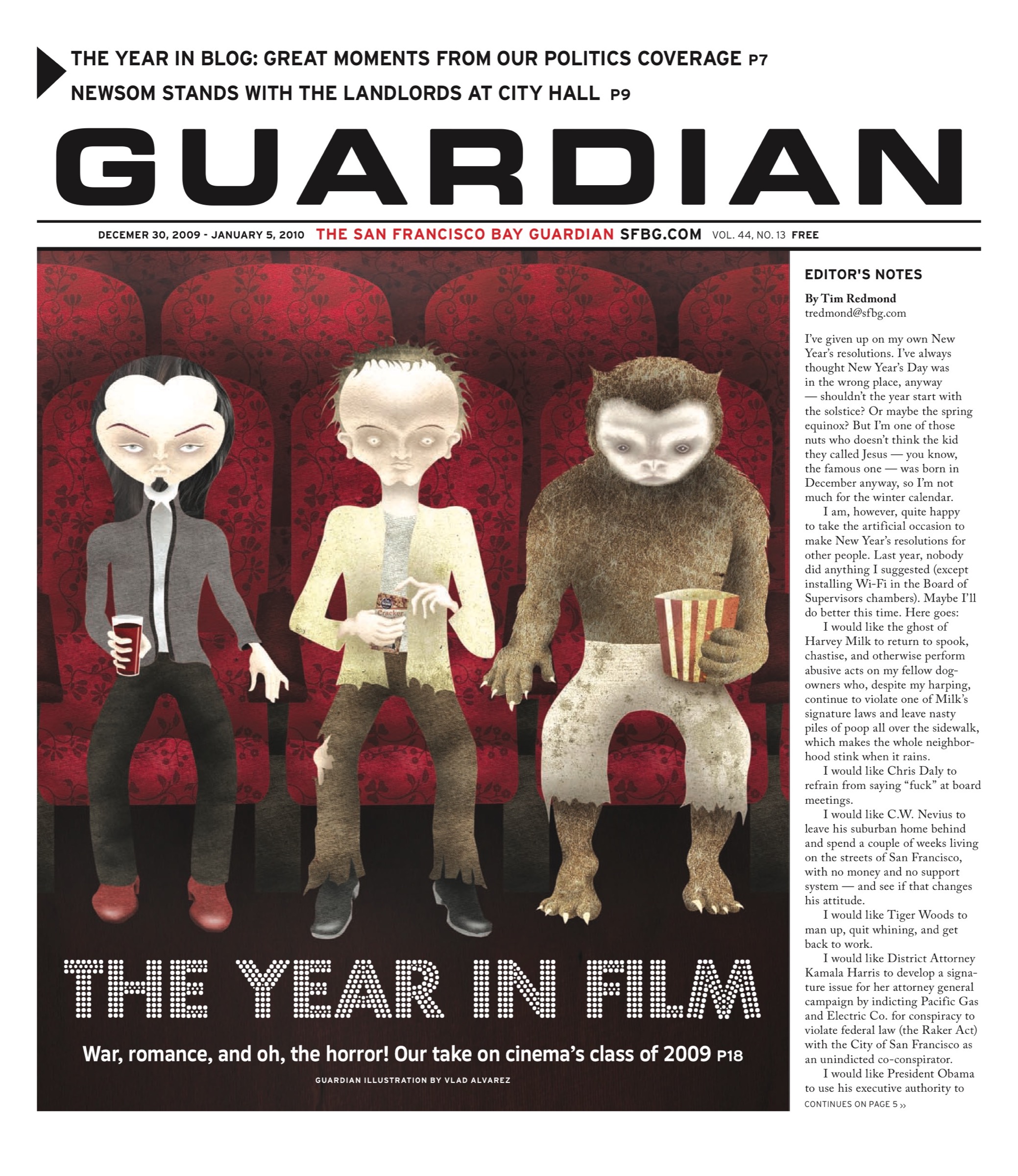
YEAR IN FILM This year was scary enough — what with the collapsing economy, rising unemployment rate, a summer of celebrity deaths, and new lows reached by reality TV programming — that going to see a horror movie became a kind of respite from the constant feed of depressing shit plastered across news crawls, posted to blogs, and bolded in headlines. Who wouldn’t take the escapist thrills of the Saw VI‘s elaborate, Rube Goldbergian endgames over the quick, “painless” death meted out by a pink slip? Then again, Paranormal Activity reminded us that the scariest thing these days is to be a homeowner.

Hollywood, no doubt, was counting its pennies as much as the movie-going public: hence the slew of classic horror franchise remakes, resurrections, and continuations. In addition to Saw VI, the body count included The Final Destination (a.k.a. Final Destination: Death Trip 3D), the umpteenth return of Jason Voorhees in Friday the 13th, Rob Zombie’s H2: Halloween 2, and remakes of violent classics such as The Last House on the Left, My Bloody Valentine 3D, and The Stepfather.

I admire the bald-faced cynicism of these releases, especially with canonical titles like Last House and Friday the 13th. It’s a post-Scream series world, after all. The big studios know that fresh-faced, hormonal PYTs still want to see glossy versions of themselves get butchered by roving psychopaths and Freudian straw men in masks, but with a hat tip to the fact that most audiences have seen it all before.

Films that attempted to twist the received formulas and court the same demographic of Jigsaw and Mike Meyers devotees fared with mixed results. Jennifer’s Body, which should have been the supernatural follow-up to 2004’s Mean Girls, couldn’t find the right balance between funny and scary due to the ill-fit of Megan Fox’s blandness and Diablo Cody’s overly-precious zingers. Drag Me to Hell, Sam Raimi’s PG-13 tour de force, on the other hand, offered a master class in how to elicit the perfect uneasy mix of chills and laughs with nary a disemboweling (I would include the raucous Zombieland in the same camp).

And then there is Ti West’s little indie that could, The House of the Devil, which meticulously recreates the aesthetic of the cheap video nasties of the early 1980s. The film’s spot-on production design and anticlimatic resolution shouldn’t detract from West’s considerable talents as a conductor of suspense. But it’s interesting how House returns us to the decade that spawned the very slashers that Hollywood continues to remake, and one that started out, as we are now, in a bleak recession. Timeliness aside, House offers an object lesson in how to do something new with something familiar — a lesson Hollywood would do well to study in 2010.

This Week’s Picks

0

WEDNESDAY 30th

DANCE

Rhythm & Motion 30th Anniversary Dance Bash

If you’re really going to throw down on the dance floor this New Year’s Eve, it’s time to train, and there is no better time or place than the 30th birthday celebration of Rhythm and Motion, a center for global dance and dance workout created by Consuelo Faust. The events include team-taught, all-star master classes, an evening performance by the Rhythm and Motion teachers, and a dance party finale. Everyone is invited. (Johnny Ray Huston)

10 a.m.–midnight, free

ODC Dance Commons

351 Shotwell, SF

(415) 863-9830 x100

www.rhythmandmotion.com

MUSIC

X

Legendary Los Angeles punk rockers X distinguished themselves from other bands of their era by honing the same searing energy that propelled their counterparts and adding the rock solid rhythms of DJ Bonebrake, the guitar virtuosity of Billy Zoom, and the poetic lyrics and intimate vocal interplay of John Doe and Exene Cervenka. This holiday season finds the band celebrating a “Merry Xmas,” having recently released new recordings of holiday favorites “Jingle Bells” and “Santa Claus Is Coming To Town.” Despite Cervenka’s recent multiple sclerosis diagnosis, she and the band sound stronger than ever. They’re the perfect musical friends to help welcome in a rockin’ New Year. (Sean McCourt)

With Dave Gleason and the Golden Cadillacs (Wed.) and the Heavenly States (Thurs.)

9 p.m. (also Thurs/31), $31–$71

Slim’s

333 11th St., SF

(415) 255-0333

www.slims-sf.com.

THURSDAY 31st

MUSIC

Boyz IV Men

Don’t be fooled: you might think this band altered their name in parodic jest, but really, it was just an evasive maneuver to throw everyone off while they continue campaigning under their banner of complicit subjection to everything that is male. Boyz IV Men like to think of it as being in the closet — a closet inside an even bigger closet. Their sound is of equal subterfuge: two of them play children’s keyboards with pinky fingers while the third cranks out aggressive, tantrum-driven disco beats. This is all to say that I also grow my beard out for every one of their shows. Spending NYE with a bunch of sweaty, hairy-chested boys and men? Count. Me. Down. (Spencer Young)

With 1.2..3 … Knife!, DJ Summer Camp, and B4M DJ Set

9 p.m., free

Five Points Art House

72 Tehama, SF

(415) 989-1166

www.fivepointsarthouse.com

FILM

“Quintessential Chaplin”

Things you could do tonight at the movie theater: visit an overstuffed multiplex, and suffer through something with the word “Squeakquel” in its title. What you should do instead: head to gorgeous Grace Cathedral for three Charlie Chaplin shorts with live organ accompaniment by Dorothy Papadakos. The bill compiles three movies from 1917: The Cure, in which the Little Tramp is a drunk on the mend; The Immigrant, in which he encounters immediate money woes upon landing in America; and The Adventurer, in which he’s an escaped convict. Classic shenanigans all, with nary a chipmunk in sight. (Cheryl Eddy)

7 and 10 p.m., $10–$15

Grace Cathedral

1100 California, SF

(415) 392-4400

www.gracecathedral.org

MUSIC

Disco 2010 with Glass Candy

Mirror mirror, on the wall, which is the fairest disco NYE event of all? No question: it’s Disco 2010. Aside from some Popscene DJ spots, this is a showcase for the formidable Johnny Jewel, bringing two of his musical projects together on one bill. Most people know of Glass Candy and their aerobic appeal. Not as well-known and newer on the scene is Desire, whose debut recording on Italians Do it Better brought one of 2009’s catchiest and most haunting pop songs, “Don’t Call,” a four-minute breakup anthem that tapped into the “Billie Jean” backbeat before MJ’s death, adding a mournful but propulsive string arrangement to a tale of new independence. (Huston)

9 p.m., $45

Rickshaw Stop

155 Fell, SF

(415) 861-2011

www.rickshawstop.com

FRIDAY 1st

EVENT

Supper Club’s Breakfast in Bed

I enjoy my bed. Comfortable, familiar, a place where everybody knows my name. But after this year’s fabulous New Year’s Eve carousing, how anticlimactic will it be to sink into the same old sheets? Luckily, I don’t have to, because Supper Club is planning a party. Breakfast in Bed includes a breakfast buffet, mimosas, the chain’s trademark mattress hangouts, and house beats that are respectful of the fact that this is probably not the first party you’ve gone to in the last 12 hours. For $140, you and three of your accomplices can even reserve your own bedstead, complete with pillow-side food and drink service. If you’re not a total hedonistic degenerate, you can go to bed when the ball drops and head out here sober to live vicariously through the hangovers of others. (Caitlin Donohue)

5–11 a.m., $10–$40

Supper Club

657 Harrison, SF

(415) 348-0900

www.supperclub.com

SATURDAY 2nd

VISUAL ART

“When Lives Become Form: Contemporary Brazilian Art, From the 1960s to the Present”

Kick off the new year with a blast of Technicolor via this traveling exhibition dedicated to the formidable and ever-morphing visual art and music phenom known as tropicália. With a range that extends from the Brazilian movement’s originator, Hélio Oiticica, to newer artists such as the pre-Ryan Trecartin and pre-Paper Rad color assaults of assume vivid astro focus, “When Lives Become Form” might make it a little easier to forgive Os Mutantes for that McDonald’s commercial. (Huston)

Noon-8 p.m. (through Jan. 31), $5–$7

Yerba Buena Center for the Arts

701 Mission, SF

(415) 978-2787

www.ybca.org

SUNDAY 3rd

FILM

You, the Living

“Be pleased then, you the living, in your delightfully warmed bed, before Lethe’s ice-cold wave will lick your escaping foot.” This Goethe quote opens Roy Andersson’s You, the Living, the sequel to his 2000 tragicomedy Songs From the Second Floor. Composed of 50 absurdist vignettes, You, the Living does not transcend existential ennui; neither does it wallow in angst. Rather, it couples pain with love, portraying a bleakly comic world where despair and happiness carry the same weight. The palette of drab blues and yellows mimic the color of pills, and one could say the film serves as an advertisement for Prozac. The dissonant noise of sousaphones, bass drums, and banjos create an artifice of comedic musicality set against a backdrop of frumpy bedrooms, bars, and office buildings, where nothing really happens. Just everyday life. (Lorian Long)

2, 4, 7:15 and 9:20 p.m. (also Mon/4, 7:15 and 9:20 p.m.)

Red Vic Movie House

1727 Haight, SF

(415) 668-3994

www.redvicmoviehouse.com

CLASS

Yoga and Ayurveda for Real Life

Here, tallied and totaled, is the approximate intake of the average festive individual over the last week: a cheese plate, a bite of questionable ham, three scoops of black-eyed peas, two pounds of turkey, 15 latkes with applesauce, 110 frosted cookies, a barely edible door off of some poor child’s gingerbread house, a carafe of mulled cider, six cups of eggnog, eight flutes of champagne, a half bottle of Jack Daniels, three trips to the mall after you said you weren’t going to go this year, and the guilt of getting a camera tripod from Aunt Sara when you sent her a very nice bar of soap. A few days late. Yes, your body hates you. Get back in its good graces with a class from one of the most affordable, least judging yoga/massage studios in the city. The Mindful Body’s Kate Lumsden is offering a tutorial on integrating yoga — back? — into your life for the new year, the perfect chance to feel centered again before Monday. (Donohue)

1–4 p.m., $35

The Mindful Body

2876 California, SF

(415) 931-2639

www.themindfulbody.com

MUSIC

Hunx and His Punx, Brilliant Colors

The world was in need of a true gay Teen Beat pin-up, not a closeted one. Luckily, the fun and sexy Hunx came to the rescue, posing in a jockstrap splayed out on a bed filled with pop culture treasures. He’s made some great clips with music video wunderkind Justin Kelly, and his new LP Gay Singles (True Panther/Matador) is great front and back — as evidenced by its cover, which presents crotch-and-ass close-ups of zebra bikini briefs. Do your makeup, and then do someone at this show, which doubles the pop appeal with Slumberland girls Brilliant Colors. (Huston)

With Gun Outfit

9 p.m., $6

Hemlock Tavern

1131 Polk, SF

(415) 923-0923

www.hemlocktavern.com

TUESDAY 5th

MUSIC

Pirate Cat Radio Benefit Show

After 13 years of putting the “arr!” in radio (sorry, couldn’t resist), Pirate Cat Radio has officially been fucked by the FCC. The corporate whores slapped the unlicensed broadcast radio station with a $10,000 fine back in August, and gave founder Daniel K. Roberts (“Monkey”) 30 days to either pay up or challenge the fine. As Roberts fights to put Pirate back on the air, several benefit shows are being held to help save SF’s favorite renegade station. One such show will be at Bottom of the Hill, where local music cuties Hey Young Believer and Blood and Sunshine will play electropop alongside UK electronic artist Con Brio. (Long)

8:30 p.m., $9

Bottom of the Hill

1233 17th St., SF

(415) 621-4455

www.bottomofthehill.com

FILM

Rocky

SFMOMA’s “Museum Highs, Museum Lows” film series continues the binary theme of last year’s film series “Vegas Highs, Vegas Lows,” but shifts locales. The Italian stallion, Mr. Balboa, starts things off, not just because he’s everyone’s favorite underdog — and thus the perfect archetype for overcoming the terrible economy — but because he’s enshrined in bronze at the top of the Philadelphia MoMA’s steps. The thought behind this whole “High/Low” dichotomy is in line with camp — so bad it’s good — so perhaps SFMOMA’s is out to reverse Philly MoMA’s embarrassment about the statue. But who cares about that damned thing? It’s Rocky’s will to survive that we want to see. (Young)

Noon, free

Phyllis Wattis Theater

San Francisco Museum of Modern Art

151 Third St., SF

(415) 357-4400

www.sfmoma.org

The year in film

0

YEAR IN FILM More than $10 billion in movie tickets were sold in 2009 — a new all-time high in a year stuffed with so many all-time lows, cinematic and otherwise. Many of those tickets, I’m afraid, provided entry to the garish, ghoulish Transformers: Revenge of the Fallen, far and away the year’s top-grossing release, though the top 10 did include at least one movie I can recommend (Star Trek) without feeling like a sellout. Nestled at No. 5 is The Twilight Saga: New Moon, part of a cultural phenomenon so huge the movie itself seemed like an afterthought. You have to scroll all the way to the 27th slot to find the year’s true top grosser: Paranormal Activity, which earned over $100 mil off a reportedly sub-$15,000 budget (less than a third what it cost to make 1999’s The Blair Witch Project, an obvious influence).

Paranormal Activity‘s success gives me hope, though I fear its inevitable shaky-cam imitators more than unexplained bumps in the night. Where there’s a buck, Hollywood will follow. This year, big-budget movies stepped up their games, employing IMAX, 3-D, and ever-more sophisticated CG to lure crowds on opening weekend. Avatar, which uses all three to greater effect than perhaps ever before, appears to be attracting gobs of people who’re simply curious to see what the fuss is about (my take: effects good, story crap. And for the record, I actually liked 1997’s Titanic). Multiplexes, with their corporate hookups and direct lines to movie studios, are thrilled by cinemaniacs eager to binge on new technology; brisk business proves 10-foot tall alien Smurfs are alluring enough to fill seats with butts that usually spend Friday nights at home, on the couch, watching DVR’d TV on a 60-inch flat-screen.

Of course, small, independently-owned theaters that can’t afford to upgrade their projection equipment to accommodate films like Avatar just might be screwed in 2010 and beyond. Hell, even the big guys have to contend with ever-shorter time periods between theatrical and DVD releases — sometimes these events happen simultaneously — and increasingly popular video-on-demand services offered by cable companies. Sometimes there’s a disconnect between versions that can affect the experience: Norwegian chiller Dead Snow was available to home audiences in dubbed form weeks before it rolled out at the Roxie, with subtitles (FYI: Nazi zombies are far more enjoyable when subtitled).

Still, think of all the scary shit you have to put up with simply by going to the movies: incessant texters; $15 tickets; people who cart their wee ones to hard-R fare; chatterboxes; seat-kickers; teenagers; jerks who sit in the middle of the row despite their pea-sized bladders; I could go on. Can you blame people who’d rather unspool their bootlegged copies of District 9 from the comfort of their own La-Z-Boys?

Yes! I can (and will) blame ’em — because true movie magic absolutely must include a big screen, preferably one that won’t fit into your living room. Even if you fear the megaplex, in the Bay Area we have access to a huge array of rep-house, art-house, and independently-owned screening venues. In short, there are still plenty of places to kick it old-school, movie geeks. So get out there and pass the popcorn!

Woodyland

0

YEAR IN FILM The defining adjective for Woody Harrelson is hard to pin, but I’d nominate … limber. Not just because he’s a deft physical comedian — in The Late Henry Moss, a star-encrusted but not very good Sam Shepard play that premiered in San Francisco in 2000, he stole the show from the likes of Sean Penn, Nick Nolte, and Cheech Marin with a 20-minute bit as a cabbie stuck in a front door. But also because he undergoes gymnastic changes from one screen role to another without ever seeming to break a sweat, or lose

his essential congeniality.

He appears to be a laid-back guy, and he’s a certainly a laid-back actor — one never sees the heavy Actor Man gears rotating (unlike with Sean Penn). It all seems to be pure pleasure and/or instinct. Maybe because he makes it look so easy — and because he’s so good a goofball — Harrelson has seemed kinda taken for granted, a guy who lucked out in TV (Cheers), then movies. He’s had a haphazard career by the usual upwardly-mobile standards, mixing leads, support parts, cameos, mainstream and indie projects, network guest spots, heavy drama and low comedy. One suspects he takes work because he likes the people involved or it sounds like fun. No wonder he’s not the possessor of a screen image as carefully calibrated (and, at least until recently, lucrative) as Tom Cruise.

I’m sure there was no intentionality involved — dig the randomness of his 2008 output — but 2009 turns out a year that insisted attention be paid. Closet Harrelson fans (why would you hide that love?) emerged. How could they not? His conspiracy theorist was the sole spontaneous note in humungous idiot’s-delight 2012. He gave the sublime Steve Zahn a run for his scene-owning money in undervalued indie flop Management, as principal rival for Jennifer Aniston’s affections.

More significantly, he ruled as brokenhearted macho blowhards in two wildly different films. In Zombieland, his joyriding undead hunter has gorgeous comic rapport with Jesse Eisenberg’s shambling teen coward, improving their material considerably. That surprise box-office triumph was followed by underachiever The Messenger, in which Harrelson plays the officer who trains-partners Ben Foster in the terrible task — considered by many the military’s worst job — of informing home-front families their loved ones

have been killed.

Harrelson’s role in that was sarcastic, hostile, loutish, hilarious, tender, tragic — a tribute to director-coscenarist Oren Moverman, for sure, but especially to the actor he rightly figured as best possible choice. It’s a beautiful performance. But in a toss-up between that and Zombieland, I’d be hard-pressed to choose a favorite.

Yet even those movies don’t let Harrelson dominate as in Defendor, a 2009 Toronto International Film Festival premiere not due theatrically until next year. In that, he plays a near-homeless schizophrenic who imagines himself a superhero. That tricky role brings out nearly all his colors, especially the loopy, athletic, and pathos-driven ones.

It’s another small film in a career whose highlights are often under-the-radar, like his gay Southerner escort to Manhattan socialites in 2007’s The Walker; the quiet hired gun in 2007’s No Country For Old Men; guess-who in 1996’s The People vs. Larry Flynt; the grenade recipient in 1998’s The Thin Red Line; and so forth. Not to mention such funny-farm swerves as Natural Born Killers (1994), Kingpin (1996), Wag the Dog (1997), and (in drag) Anger Management (2003).

To his credit, Harrelson has also been a high-profile spokesman for hemp, veganism, and overall greening. At his Mill Valley Festival tribute in October, he was charmingly abashed by his own success and serious about attributing achievement to others. All this overcoming a most unfortunate familial background fictionalized in fellow-Texan-turned-local-playwright Octavio Solis’ brilliant Santos & Santos.

Will he age out? Unlikely — already straddling Steve Buscemi and Matthew McConaughey terrain, he can be our next Jeff Bridges for another 30 years.

Pure war

0

YEAR IN FILM As the U.S. invasion of Afghanistan and Iraq nears its second decade, the question of its influence on modern American cinema has been redoubled by this year’s sampling of seminal combat films. Not only were Quentin Tarantino’s epical Inglourious Basterds and Kathryn Bigelow’s anti-epic The Hurt Locker two of the best releases of 2009, they represented a startling mutation in the zeitgeist’s popular narratives of geopolitics, absenting the requisite leitmotifs of nationalism, ethic, and archive. The disappearance of a moral imperative in Inglourious‘ Holocaust revenge parable and Locker‘s chronicle of an adrenaline junkie flummoxed numerous critics who admonished them for a dangerous aestheticization of war. Having accentuated the alternative fantasies and ecstasies of military violence, Tarantino and Bigelow committed the cardinal sin of privileging the inner experience of war over its ancillary politics, or, rather, made them one in the same.

Most of the putatively titled “war on terror” pictures, solidified as a genre in the aftermath of 9/11, fulfilled one of several bog-standard paradigms: the preening, ideological propaganda of Michael Moore (2004’s Fahrenheit 9/11) and Errol Morris (2003’s The Fog of War and 2008’s Standard Operating Procedure), with its leftist moralizing thinly camouflaged as real “documents” of war; the quasi-jingoist paeans to American imperialism in Black Hawk Down (2001) and We Were Soldiers (2002); and the grid-skipping, pan-global tourist thrillers Syriana (2005), The Kingdom (2007), and Body of Lies (2008). Regardless of their ideological positions, all of these war on terror films linked cinematic politics with moral engagement and the need for historicizing the truth of combat.

But Inglourious and Locker fail to follow any of the necessary formulae and are thereby excluded from the generic privilege of the modern war film. In its attempt at a sui generis retributive fantasy, Inglourious details a vicious gang of Jews who collect Nazi scalps and immolate Hitler in a third-act ejaculation as cartoonish as it is intertextual. Treading in a Pynchonian zone of alternative history, the film not only lampoons but seeks to rewrite the archive of the 20th century.

But Tarantino’s violence is not ballasted by any of the ruminative “what ifs” (what if the Holocaust could have been prevented? What if you could kill Hitler?) that have become the ethicist’s fundamental paradox. He obviates such moral concerns in favor of bloody spectacle and, in so doing, risks erasing the last, sacred vestiges of the Holocaust — namely, that it occurred. In Tarantino’s comic-book universe, fiction-making refuses to be caught in the crossfire between truth and engagement. The Slovenian philosopher Slavoj Žižek alludes to as much in his recent treatise on violence when he claims “the threat today is not passivity, but the pseudo-activity, the urge to ‘be active,’ to ‘participate.’ Those in power often prefer even a ‘critical’ participation, a dialogue, to silence. Sometimes, doing nothing is the most violent thing to do.” Such valuations are a disturbing reproach to the oft-repeated Holocaust maxim, “Never again.”

Similarly, Bigelow’s film pivots on the saga of American IED fatalities in Iraq, but celebrates as heroes morally dubious outlaws playing in the postmodern desert of the real. Locker‘s insidious epigram, “The rush of battle is a potent and often lethal addiction, for war is a drug” — lifted from Chris Hedges’ War is a Force That Gives Us Meaning — sums up a picture that is as much about the sensory pleasures of combat as its horrific ugliness. While Bigelow turns to the hard-boiled Americana of Samuel Fuller and Howard Hawks for her inspiration, she has translated them through what French cultural theorist Paul Virilio might term “dromocratic” consciousness, where traditional cinematic politics have disappeared and been replaced with a hyperreal “logistics of perception.”

The result is an apolitical pleasure dome of sensory overload; guns become canons, explosions appear as living sculpture, urban war zones are makeshift playgrounds. Like Inglourious Basterds, The Hurt Locker delights in its own ethical and political vacuum, generating fantasies of immolation without sourcing it as either a psychological grotesque (e.g. PTSD) or an ideological other (i.e. Nazis or Iraqis). When the IED experts finally reach the end of their tour, the tedious suburban lives that await them are a pathetic denouement. Is it possible, Bigelow seems to muse, that the real American dream lies on the battlefield and not the home front?


The Dobler Effect

0

YEAR IN FILM If 2008 was the year of the bromance, 2009 likely sounded its death knell. (The title alone of the March release I Love You, Man proves the genre blip has said everything it possibly could.) This can only mean one thing: confused hetero men-children have returned to their first loves, idealized pretty-girl ciphers who fulfill their wanton need to worship and be “understood.” This year in particular has seen a resurgence of those impossibly sensitive, crush-worthy romantic misfits. Sadly, as in the past, they usually spurn flesh-and-blood females for unattainable pseudo-goddesses.

Call it the Dobler effect, in honor of every indie girl’s sigh-inducing Valentino, Lloyd Dobler. The raw heart of Cameron Crowe’s gushy-earnest 1989 romantic dramedy, Say Anything, Lloyd (John Cusack) falls for Diane Court (Ione Skye), a brainy, humorless beauty who eventually succumbs to his potent weirdo charms. But Lloyd puts Diane on a pedestal so high it’s a wonder she can even hear his proclamations of undying devotion. For me at least, Say Anything has always posed a conundrum: if the awkward, goofball guys are all going for the gorgeous ice princesses (and getting them), who’s left for all of us — I mean, those — awkward, goofball gals?

At least Crowe made Diane a complex character in her own right, unlike Mark Webb’s creation of Summer in his clever yet ultimately trite breakout hit, (500) Days of Summer. Tom (Joseph Gordon-Levitt), his lovelorn protagonist, embarks on a love affair with Summer (Zooey Deschanel), a free-spirited, haughty, and (according to omniscient voice-over) spellbindingly hot woman who tears out Tom’s heart like so much ribbon from the mixtape of a hated ex.

While Tom decides his idealization of Summer is the product of insidious pop romanticism, that’s not entirely the case: Summer herself is its product. She simply transforms from the personification of Tom’s need to be needed to that of his need to be free of that need. (Did I mention Tom is pretty needy?) A disingenuous apparition, she’s as workshopped as any of the insipid, sentimental slogans Tom conjures at his day job for a greeting card company. Perhaps that’s the point, but it doesn’t make her, or rather the idea of her, any more palatable.

The movie may be emblematic of the Dobler effect, but 2009 did offer some light at the end of this tunnel of one-sided love. Released early in the year and largely overlooked, James Gray’s romantic drama Two Lovers offers a stinging rebuke of the Pedestal Girl in a way (500) Days of Summer only pretends to. But in terms of romantic trope blow-ups, Charlyne Yi in Paper Heart outdoes them all. A quasi-documentary love story, the film’s meta-conceit might be wobbly, but that doesn’t make its message any less refreshing. Yes, the weirdo goofball finally gets her man. It seems in 2009, we can finally chalk one up for all the real girls.

Raison ritual

0

YEAR IN FILM “We could live like this forever.” Josephine, the serious young woman in Claire Denis’ gorgeous chamber drama 35 Shots of Rum, whispers this line to her father while they’re camped out on the beach. It’s unclear, however, whether she’s referring to this particular sandy spot or the rituals of home and work that structure the film. As with Chris Chong’s remarkable short, Block B, 35 Shots of Rum (a ritual in the title itself) is set in a superficially unattractive apartment complex. Beyond the concrete is an intricate network of human relations. In the republic of cinema, the Denis film descends from that great poet of routine life, Yasujiro Ozu. Daily rituals dilate exposition and emotion; the safe enclosure of home unfolds in time.

Many of the most indelible, mood-lifting moments of my sporadic year of film-going arrived in the deepened presence of ritual: two shots of espresso, in separate cups; dismantling a bomb; shaving radishes; sheering sheep; the ecstatic sweat of a Lightning Bolt concert; the murderous talk surrounding a stand-up act. The Limits of Control cracks a zen joke out of those scenes that take us to edge of plotlessness; The Hurt Locker posits them at the lip of death. Every genre has its rites, but ritual is roped off by an extraordinary and transformative act of concentration: not so much a slice of life, as the heart of it.

To begin with an imperfect example, take Funny People. The informal joke workshops are the best thing about Judd Apatow’s chef-d’oeuvre by some distance — a romantic plot is deathly flat next to the backstage lollygagging. Likewise, for all The Hurt Locker‘s amazing mappings of harm’s way and its rigorous equation of work and action, Kathryn Bigelow’s film sags in the bland passages earmarked for character development. However momentarily, both movies put the blockbuster through paces.

Rituals, as I’ve described them, give us time to think and feel, and thus crop up with greater frequency in experimental work (ritual makes the documentary-fiction divide matter less). In Heddy Honigmann’s Oblivion, political history flows from her interview subjects’ ingenious livelihoods. Representatives of the service class relay personal and national narratives at work, their gestures embodying resilience and wisdom beyond the bounds of political rhetoric.

A clarifying admiration of labor also animates Sweetgrass, Ilisa Barbash and Lucien Castaing-Taylor’s near-wordless immersion into a final sheep drive across Montana. Recorded with ethnographic grit and uncommon lyricism, the film counterpoints detailed sound recordings with monumental, temporal landscape photography. A peculiar mix of estrangement (the implacable animal stare) and intimacy (the last cowboys’ muttered curses), Sweetgrass packages a dying way of life as a wayward phenomenological experience — the ritual as haunting.

Rendered as cinema, there is every possibility that ritual will make for a trance. Ben Russell actively cultivates this state in his Black and White Trypps series. Excerpts of all six of these shorts, as well as a 10-minute slice of Russell’s acclaimed feature debut, Let Each One Go Where He May, are available on his Vimeo site, but seeing the third installment in 35mm at the Pacific Film Archive raised the stakes considerably. In it, Russell sends a beam of light into the teenage sprawl of a Lightning Bolt show, creating a visible field barely broad enough for one or two wild faces. The crowd’s pulse makes for an ephemeral, twisting portrait. Projected on the big screen, the baroque expanse of sound and black gave the mined portraits a distinctly transcendent aura. Russell’s Warhol-worthy idea locates solitude in collectivity and authenticity in performance. The 11-minute film also invites us to reconsider the coordinates of that other common ritual that brings us alone together in the dark — cinema.

2000 and gone

0

YEAR IN FILM I will follow him. The opening moments of Pablo Stoll’s Hiroshima convey that sentiment’s dedication in a single shot, a lengthy behind-the-shoulder look at Stoll’s brother Juan Andres as he traverses a suburban street in Uruguay. Such a simple film, Hiroshima: a day-in-the-life structure; silent film intertitles instead of spoken dialogue; “only” one brother’s look at another. Yet there is passion beneath Juan Andres Stoll’s mute detachment, and grief beneath Pablo Stoll’s at times humorous familial portrait of a half-somnambulant with dark circles around his eyes. The passion is revealed in the final scene, when the film’s potent and unconventional use of music reaches a climax. The grief floats around the edges of the screen, and is locked within the closing dedication to Juan Pablo Rebella, Stoll’s co-director on 2001’s 25 Watts and 2004’s Whisky, who killed himself with a gun three years ago, at 32.

Mapping infinite negative space within the movie maze, I can’t help but see Stoll’s brother as Rebella, and connect Hiroshima’s opening shot with the last major shot of Whisky: an uncomfortably extended look at forsaken Marta (Mirella Pascual), tears streaming down her face, in the back of a taxi going who knows where. When Whisky was released, that scene might have seemed like a pale descendant of the notorious 10-minute crying jag at the end of Tsai Ming-liang’s 1994 Vive l’amour. But as time goes on, the increasingly arch Tsai’s vision of isolated sorrow seems less genuine, if not potent. In contrast, Whisky‘s farewell is some kind of transformation, a baton, both end and beginning.

Wherever he may go. Last week, rummaging through a drawer, I came across Alexis Tioseco’s card. My heart hurt more than usual. I remember when I first saw Alexis, at a screening of Jacques Rivette’s Out 1 in Vancouver. During short breaks between segments of Rivette’s 12-hour opus, I’d wonder who he was, recognizing he was important to me before we’d even said hello. A few days later, after we’d met, I remember him walking out of an obnoxiously provocative film, and how his wasn’t an empty or dramatic gesture, just an honest decision. At the end of the festival, Alexis, the filmmaker John Torres, Chi-hui Yang, and I had dinner, and over the course of close conversation with knees touching, I realized my nascent crush was actually a matter of meeting someone extraordinary whom I admired. A month or two later, Alexis let me excerpt part of one of his best essays for the type of year-end Guardian film issue you’re reading now.

On Sept. 1, Alexis and his girlfriend and fellow writer Nika Bohinc were shot to death in their apartment in Manila. There are tributes to them online, many written by people who knew him far better than I. I’m trying now, but I can’t pay respect to Alexis yet. When I’m not feeling rage about his killing, I’m haunted by the purity of his commitment to film and his culture, and how I fall short of it. (As for most U.S. film critics, don’t get me started. The entertain-me imperial indulgence typical of them is especially disgusting in the context of Alexis’s death, a context it now lives within for me.) My failure is something I think about daily, and aim to change.

This is not sentimental. Alexis wasn’t faultless, but he was that special. I remember coming across a short entry on one of Alexis’s sites that not just pointedly but also poignantly exposed the colonialism of a Bruce Baillie film. That little piece of illustrated writing provided a counterpoint to Apichatpong Weerasethakul’s valuable appreciations of Baillie. I thought about it this year through tear-blurred eyes while watching Apichatpong’s For Alexis. “The Letter I Would Love to Read to You In Person,” Alexis’s essay for Nika, is a great piece of film writing. Its title is downright painful to behold. Revolutions happen like refrains in a song, he wrote. I will follow him, wherever I may go.


Top films of 2009! SFBG film critics weigh in, part two

0

More top ten lists — and lists of other stripes as well! And don’t forget to check out our annual Year in Film issue, out Wed/30.

strange.jpg
Jerry McDaniel in Everything Strange and New.

Dennis Harvey’s Overlooked Performances of 2009

1. Liam Neeson in Five Minutes of Heaven (Oliver Hirschbiegel, UK)
2. Anna Faris and Celia Weston in Observe and Report (Jody Hill, USA)
3. Steve Zahn in Management (Stephen Belber, USA)
4. Everyone in A Perfect Getaway (David Twohy, USA); Still Walking (Hirokazu Koreeda, Japan); Black Dynamite (Scott Sanders, USA); and Everything Strange and New (Frazer Bradshaw, USA)
5. Katie Featherston and Micah Sloat in Paranormal Activity (Oren Peli, USA)
6. Alec Baldwin in Lymelife (Derick Martini, USA)
7. Spock (Zachary Quinto and Leonard Nimoy) in Star Trek (J.J. Abrams, USA/Germany)
8. Michael Cera in Paper Heart (Nicholas Jasenovec, USA)
9. Kali Hawk in Couples Retreat (Peter Billingsly, USA)
10. Paul Rudd in I Love You, Man (John Hamburg, USA)
11. Zach Gilford in Dare (Adam Salky, USA)
12. Woody Harrelson in Zombieland (Ruben Fleischer, USA) and 2012 (Roland Emmerich, USA/Canada)
13. Michael Shannon and John Ventimiglia, The Missing Person (Noah Buschel, USA)

paranormal-activity-dwrks2.jpg
A scene from Paranormal Activity.

Top films of 2009! SFBG film critics weigh in, part one

0

It’s that time of year again — Oscar contenders (and wannabes) are hogging the theaters, and just about every film writer who put fingers to keyboard in 2009 is making his or her top ten list. Here at the Guardian, some of us make top ten lists, and some of us make whatever kind of list we want. Check out our annual Year in Film issue, out Wed/30, and read on for our contributors’ top (and otherwise) picks.

A_Single_Man_Movie_Poster-Colin_Firth-Julianne_Moore.jpg

Louis Peitzman’s Top Ten Performances of 2009

1. Colin Firth in A Single Man (Tom Ford, USA)
2. Mo’Nique in Precious: Based on the Novel Push by Sapphire (Lee Daniels, USA)
3. Christoph Waltz in Inglourious Basterds (Quentin Tarantino, USA/Germany)
4. Marion Cotillard in Nine (Rob Marshall, USA/Italy)
5. Anna Kendrick in Up in the Air (Jason Reitman, USA)
6. Jackie Earle Haley in Watchmen (Zack Snyder, USA)
7. Michael Stuhlbarg in A Serious Man (Ethan Coen and Joel Coen, USA/UK/France)
8. Sasha Grey in The Girlfriend Experience (Steven Soderbergh, USA)
9. Meryl Streep in Julie and Julia (Nora Ephron, USA)
10. Carey Mulligan in An Education (Lone Scherfig, UK)

inglorious_basterds.jpg
Brad Pitt in Inglourious Basterds.

Erik Morse’s Top Ten Films of 2009

1. Inglourious Basterds (Quentin Tarantino, USA)
2. The Missing Person (Noah Buschel, USA)
3. The Beaches of Agnès (Agnès Varda, France)
4. Coraline (Henry Selick, USA)
5. Still Walking (Hirokazu Koreeda, Japan)
6. The Hurt Locker (Kathryn Bigelow, USA)
7. The White Ribbon (Michael Haneke, Austria/Germany/France/Italy)
8. Mother (Bong Joon-ho, South Korea)
9. Broken Embraces (Pedro Almodóvar, Spain)
10. Thirst (Chan-wook Park, South Korea)

Erik Morse’s honorable mentions: Goodbye Solo (Ramin Bahrani, USA); Revanche (Götz Spielmann, Austria); Tyson (James Toback, USA); Orphan (Jaume Collet-Serra, USA/Canada/Germany/France); Examined Life (Astra Taylor, Canada); Science is Fiction: 23 Films by Jean Painleve (Criterion Collection DVD); Rembrandt’s J’accuse (Peter Greenaway, Netherlands/Germany/Finland); Valentino: The Last Emperor (Matt Tyrnauer, USA); Jennifer’s Body (Karyn Kusama, USA)

goodbye_solo_01.jpg
Scene from Goodbye Solo.

Grey’s anatomy: An interview with Sasha Grey

0

To state that hardcore porn nymphet Sasha Grey has mainstream appeal is like arguing a truism. Thrust onto billboards and magazine covers, written into highly publicized Hollywood movies, integrated into our cultural vernacular, Sasha Grey didn’t just cross over into mainstream territory; we brought her here.

It’s easy to see why, among the many female performers in adult entertainment, Sasha Gray has become the unwitting locus of the public’s gaze and speculation. Next to those flaxen, suprafemale Barbies who dominated porn in the 90s, Grey’s handsome brunette naturalism seems somehow transgressive. Grey’s bosoms are not big enough to generate their own gravity, and her smooth, skin-colored skin and svelte muscularity are the products of youth and genetics rather than of dubious cosmetic procedure. With her placid, heavy-lidded eyes, broad forehead, and insistent jawline, Grey’s face looks real rather than representational. She looks like the pretty 21-year-old that she is — with an age appropriate penchant for darkening her already dark Mediterranean eyebrows — and it’s this sense of the familiar that makes Grey, a real girl among a valley of dolls, so erotically appealing.


Sasha Gray in an ad for American Apparel

The media has the tendency to describe Grey in extreme binaries: young yet wise, beautiful yet intelligent, intellectual yet a porn star, and so on. In a sense, this tendency is understandable. Most writers, yours humbly included, are not citizens of the adult entertainment world. It’s tempting for writers to use obtuse paradoxes and reductive generalizations when describing those who seem, by virtue of their work, so fascinatingly equivocal. And Grey doesn’t make our jobs any easier, with her casual mentions of Baudrillard and Sartre, her appreciation of Godard, and her use of the adjective “Jungian,” while cheerfully inhabiting an industry that we take for granted as being intellectually unconcerned. As fellow twenty-something with an affection for cultural theory and French New Wave, I relate to some of her interests, but beyond that, my interpretive abilities hit a wall and all that’s left is conjecture. Grey is a descriptive paradox, and it would not surprise me if she preferred it that way.

Grey was recently announced as this year’s keynote speaker at the 2010 AVN Awards and I had the opportunity to interview her. Not wanting to add to the guesswork that surrounds Grey’s celebrity or to embark on a vague meditation of the porn-star psyche, I limited the questions to her involvement with the AVN ceremony. The result was simple, straightforward and, at least for me, refreshing.

SFBG: As such a young performer — and one relatively new to the adult entertainment industry — are you comfortable with the responsibility of giving the AVN keynote address?

SG: This has been an incredibly exciting year for me, and I feel each year I continue to excel… but the industry has changed rapidly, in my almost fourth year of experience. I am proud that I have the chance to share my voice with the industry and show appreciation for the fans that support my career and adult film-making.

SFBG: At the moment, what are some of the most important issues or concerns for the adult entertainment community?

SG: First and foremost the never-ending battle of obscenity laws, i.e. the ongoing case against Evil Angel Video. If Evil Angel is found guilty, we’ll be rolling backwards in time when Naked Lunch was banned for obscenity. Secondly, the state of AIM Healthcare, where all performers are tested, could be shut down any day due to grueling legal battles with Cal OSHA, which would temporarily shut the business down until there’s a replacement testing facility… and who knows how long that could take.

SFBG: You’ve performed in so many films and been in the spotlight for so long that it feels strange for me to ask, but are you nervous about giving this speech?

SG: Nope.

SFBG: This will be your third year attending the AVN Awards. Do you enjoy the ceremony?

SG: The awards show has always been a fun way to end a long week of press and meeting fans, and there’s certainly the neverending people watching which always entertains!

SFBG: Just out of curiosity, have you read “Big Red Son” by the late David Foster Wallace? He attended the AVNs 11 years ago and wrote about his overwhelmingly negative experiences as a journalist and onlooker. He prescribed the AVNs as a humble alternative to self-castration and described the adult industry as “predictably vulgar.”

SG: No I haven’t. Why do you think they don’t hold most awards shows in Vegas? People would be letting their inhibitions go! Vegas: a great example of the Jungian idea, the duality of man. People put on a mask; those who don’t ordinarily drink too much yet end up wasted, spend too much money on strippers and gambling, etc, this goes for 90% of people who visit the city of sin. People from the adult industry or those who mingle with its crowds are aware that Vegas calls for celebration, and they are usually comfortable letting their inhibitions go, or wearing these masks. I am sure this might intimidate an onlooker with no knowledge of the adult entertainment community, but this doesn’t reflect the day-to-day life of the businessmen and women that run this industry.

SFBG: What did it feel like to win your first AVN award in 2007, less than a year after having entered the industry?

SG: It was a real shock, I had only been in the business for five months before the nominations went out, so I was just happy to be nominated.

SFBG: You’ve won 4 AVN awards in 4 separate categories. Of these awards, which one meant the most to you?

SG: Female Performer of The Year of course!

SFBG: In your own career, are awards a huge honor for you, or just icing on the cake?

SG: I used to think they were something to add to your resume, until I actually won. The anticipation, being unsure, and then winning… yeah it’s incredibly gratifying.

8, 9 … 2010

0

1. SF garage rock goes pop This year saw Bay Area garage rock go pop in style and impact without losing its soul. I’m thinking of the Fresh and Onlys, and of Ty Segall’s second solo effort Lemons (Goner), a lovely one. I’m thinking of Girls’ Album (True Panther/Matador), which threw down the crossover-move gauntlet with no shame in its game: Christopher Owens’ interviews were as entertaining as his music and brasher — his real talk about sex and drugs made good headline fodder for the excitable British press, but contained the kind of truth that honors life over rules or boring definitions. The secret keeper, though, was the Mantles’ self-titled debut on Siltbreeze. Drew Cramer’s lead guitar and Michael Oliveras’ vocals were even better live, the mark of a band in bloom.

2. The AfroSurreal In May, D. Scot Miller helped put together a special AfroSurreal issue of the Guardian, a collection of words and visions journeying beyond the potential of Barack Obama’s presidency. The Kehinde Wiley piece on the cover wasn’t the only AfroSurreal image on this paper’s front pages — just last week, Conrad Ruiz’s Godzilla-size Yes We Can stomped around the city. Musically, AfroSurrealism manifested in the mind- and mirror-bending quality Dam-Funk’s Toeachizown (Stones Throw) and the rehab hallucinations and Dante-like funeral marches of Chelonis R. Jones’s Chatterton (Systematic). It floated in through cracks in the time warp as well: the ghetto opera of 24 Carat Black’s Gone: The Promises of Yesterday (Numero Group); the proto-punk of Death’s For the World to See (Drag City), especially “Politicians in My Eyes”; and weirdest of all, the gothic funk and skronk of Wicked Witch’s Chaos: 1978-1986 (E.M.).

3. 21st century goth From blackness to deathly whiteface — something gothic this way came in 2009, thanks to Cold Cave’s Cremations (Hospital Productions) and Love Comes Close (Matador). Both staked a claim that the genre is as applicable as death metal to a post-Bush presidency globe. But while those albums notched acclaim and attention, the similar yet more audacious Cure and Cabaret Volatire moves of Jones’ months-earlier Chatterton went ignored and unappreciated. Evidence of racism, proof that German techno only gets appreciated years after the fact, or both?

4. Hauntological mutations In 2009’s sonic mansion, ghosts haunted the hallways leading to and from the gothic banquet hall, and hauntology — a Derrida term applied to music by the critic Simon Reynolds — continued to morph, just as any self-respecting specter should, well beyond dubstep. The maze-like passages of Rooj’s The Transactional Dharma of Rooj (Ghost Box) and Broadcast and the Focus Group’s Broadcast and the Focus Group Investigate Witch Cults of the Radio Age (Warp) both suggested that spirits have short attention spans, while Demdike Stare’s Symbiosis (Modern Love) traded seances on wet afternoons for retro-futurist meetings with medieval wicked witches.

5. Library music For evidence that the past resides in and fuels the present, go to the library. Specifically, to the abundant compilations and Web sites dedicated to library music — the scores of incidental music produced and recorded for soundtrack use on film, television, and radio. In the wake of his gorgeous book The Music Library (Fuel Publishing), Jonny Trunk released more albums devoted to library labels. The Parisian DJs Alexis Le-Tan and Jess put out a pair of Space Oddities library collections — one electronic, one psychedelic — on Permanent Vacation. Wax Poetics published a lengthy piece to the subject. In an interview, Trunk noted that his Scrapbook (Trunk) shares the same fast-change aesthetics of Broadcast and the Focus Group’s hauntological recordings, just one example of how library music of the past forms the music of now.

6. The new ambient The new ambient is not afraid of extreme melancholy, or long compositions — no longer only Kompact, it can be epic. One of the form’s peak representatives is San Francisco’s Brock Van Wey, whose White Clouds Drift On and On (Echospace) bravely strived for, and sometimes reached, sublime solitude. Another was Klimek, whose Movies is Magic (Anticipate), on which a track such as “pathetic and dangerous” lives up to its death-knell title. The last was Leyland Kirby. His three-CD contribution sums up the current moment in both its title and the name of its label: Sadly, the Future is No Longer What it Was (History Always Favours the Winners).

7. 2009=1989, synthpop and shoegaze I explored this theme in last week’s Decade in Music issue. See: Atlas Siund (in particular “Shelia,”), Crocodiles, Fuck Buttons, Loop, Night Control, Pains of Being Pure at Heart, Washed Out (responsible for two of this year’s most gorgeous tracks, “Belong” and “Hold Out”), Wavves, and the xx.

8. How old is now? As the music industry continues to fracture, reissues or uncovered old sounds were as vital and revelatory as new releases. In San Francisco, this meant new rereleases by San Francisco Express, the Units, and most excitingly, Honey Soundsystem’s work on behalf of Patrick Cowley and Jorge Socarras’ Catholic project. Beyond SF, it meant a one-of-a-kind treasure like Connie Converse’s How Sad, How Lovely (Lau derette): one woman, one guitar, one tape recorder, and perhaps the best music of this sad, lovely year.

Watching the detective

0

FILM Like many movies to come before it, and surely many to come after, Sherlock Holmes is completely misrepresented by its trailer. The producers were understandably eager to get butts in the seats on Christmas, and for modern audiences, butts in the seats means fists in the face during commercial breaks.

There is some perfunctory ass-kicking in director Guy Ritchie’s big-ticket adaptation of the venerable franchise, but old-school Holmes fans will be pleased to learn that the fisticuffs soon give way to a more traditional detective adventure. For all his foibles, Ritchie is well-versed in the art of free-wheeling, entertaining, London-based crime capers. And though Sir Arthur Conan Doyle’s legendary characters have been freshened up for a contemporary audience, the film has a comfortingly traditional feel to it.

Ritchie is lucky to have an actor as talented as Robert Downey Jr. in the title role, and the pair make good use of the American’s talents to create a Holmes resplendent in diffident, pipe-smoking, idiosyncratic glory. Though the film takes liberal creative license with the literary character’s offhand reference to martial prowess, it’s all very English, very Victorian (flying bowler hats, walking sticks, and bare-knuckle boxing), and more or less grounded in the century or so of lore that has sprung up around the world’s greatest detective.

Jude Law’s John Watson is a more charismatic character this time around, defying the franchise’s tradition, and the byzantine dynamics of the pair’s close friendship are perfectly calibrated. Holmes and Watson join forces with Irene Adler (Rachel McAdams), a Yankee femme fatale who has also been fleshed out from between the lines, and take on the sinister Lord Blackwood, played menacingly by Ritchie veteran Mark Strong.

The script, by Michael Robert Johnson, Anthony Peckham, and Simon Kinberg, suffers a little by borrowing from other Victorian crime fictions better left untouched, but they get the title character’s inimitable “science of deduction” down pat, and the plot is rife with twists, turns, and inscrutable skullduggery. Holmesians have suffered since the death of Jeremy Brett (whose portrayal of the sleuth Downey can rival, but never outstrip), and it is a pleasure to inform them, along with the rest of the nation’s holiday moviegoers, that the game is once again afoot.

SHERLOCK HOLMES opens Fri/25 in Bay Area theaters.

Bridges abides

0

FILM “Oh, I love Jeff Bridges!” is the usual response when his name comes up every few years for Best Actor consideration, usually via some underdog movie no one saw, and the realization occurs that he’s never won an Oscar. (Unlike, say, Roberto Benigni.) It is often said with a guilty-sigh undertone otherwise reserved for neglected relatives or loyal but inconvenient friends — people you know you shouldn’t keep forgetting about.

The oversight is painful because it could be argued that no leading American actor has been more versatile, consistently good, and true to that elusive concept “artistic integrity” than Bridges over the last 40 years. When you think about more conspicuous “great” screen actors of his generation — DeNiro, Nicholson, Pacino, Hoffman — it’s hard to deny that they’ve long since fallen into shtick, caricature, and somnambulism in mostly unworthy vehicles, occasionally showing a flash of prime alertness.

Whereas Bridges never rested on his laurels, or lack thereof. Of course he had a great ’70s — who didn’t? — in movies widely acclaimed (1972’s Fat City, 1971’s The Last Picture Show), fascinatingly quirky (1976’s Stay Hungry, 1975’s Rancho Deluxe and Hearts of the West, 1974’s Thunderbolt and Lightfoot, 1979’s Winter Kills), or just lucky to have him (the ’76 King Kong, 1978 Farrah Fawcett vehicle Somebody Killed Her Husband).

But while other stars caved to the more formulaic commerciality of the 1980s and onward, Jeff Bridges managed his career as before, mixing rare commercial hits (1985’s Jagged Edge, 1991’s The Fisher King, and 1984’s Starman — in which he’s an alien sweeter and surely sexier than E.T.) with mainstream bunts (1996’s The Mirror Has Two Faces, 1996’s White Squall, 1982’s beloved TRON). Not to mention the many, variably unpopular, cult-accruing smaller films he’s spectacular in: Cutter’s Way (1981), American Heart (1992), Fearless (1993), The Big Lebowski (1998), Simpatico (1999), and The Door in the Floor (2004). All Oscar-worthy performances, but Oscar seldom embraces flops, sleepers, and critics’ case-pleadings — the latest of which would be Crazy Heart.

It’s rumored this movie was slotted for cable or DVD premiere, then thrust into late-year theater release in hopes of attracting Best Actor momentum within a crowded field. (It’s a much more paltry year for actresses, as usual). Lucky for us, this performance shouldn’t be overlooked. Bridges plays “Bad” Blake, a veteran country star reduced to playing bars with local pickup bands. His slide from grace hasn’t been helped by lingering tastes for smoke and drink, let alone five defunct marriages.

In Houston he meets Jean (Maggie Gyllenhaal), freelance journalist, fan, and single mother. They spark; though burnt by prior relationships, she’s reluctant to take seriously a famous drunk twice her age — even if he charms both mom and four-year-old tyke (the improbably named Jack Nation). Can Bad handle even this much responsibility?

Meanwhile, he gets his “comeback” break in the semi-humiliating form of opening for Tommy Sweet (Colin Farrell) — a ponytailed, stadium-playing contemporary country superstar who was once Bad’s backup boy. Tommy offers a belated shot at commercial redemption; Jean offers redemption of the strictly personal kind.

Bridges and Farrell can both really sing. (The former has long been a singer-songwriter-guitarist, though a pretty dull one.) Robert Duvall can’t, but then as producer and excellent support player (Bad’s old barkeep friend), he’s allowed some self-indulgence.

There’s nothing too surprising about the ways in which Crazy Heart both follows and finesses formula. You’ve seen this preordained road from wreckage to redemption before. But actor turned first-time director Scott Cooper’s screenplay honors the flies in the windshield inherited from Thomas Cobb’s novel.

As does Bridges, needless to say. Here he’s fleshy, hairy, wheezy — well-intentioned, but charming and untrustworthy at once. He rules an otherwise ordinary film like Mickey Rourke did 2008’s The Wrestler. But here’s guessing the relative lack of flamboyance (or salvation from the skids) won’t do Jeff Bridges similar favors. Again.

CRAZY HEART opens Fri/25 in San Francisco.

Art, work, and artwork

0

VISUAL ART The global financial crisis continues to impoverish and displace those within reach of its residual tremors. Yet in the art realm, there have been signs of hope. Recent fairs — Frieze Art Fair in October and Art Basel Miami Beach earlier this month — brought reports of strong sales and optimism within the distressed economy. So why are artists everywhere worried about their futures, and more critically, panicking about their present tenses? The squeeze has to do with the work in artwork. More often than not, artists aren’t getting paid for their work.

The general prosperity of the current art market does not reflect the financial success of most artists — it just means that artworks are selling, and many of those works are by artists who are already established or dead. The other artists, the worried ones, the ones scraping by on paint chips and uncreative, menial part-time jobs and unpaid internship after unpaid internship, are starting to organize. And talk. Worried as well, I recently attended two events, one in New York and the other in Oakland, that call for a shift of terrain in art/work.

The New York event, titled, “What Is the Good of Work?” — the second in a four-part series organized by Goethe-Institut New York — was more abstract in its approach, seeking to redefine work through film and literature. For instance, when British novelist Tom McCarthy roused Herman Melville’s character Bartleby in order to express the potentials of “recess” in a “recession” and promote a politics of pause as escapist rather than reactionary, an audience member inquired: “But how can this be implemented in real life?” Here, McCarthy went quiet. The rest of the panel, too, including the nihilist philosopher Simon Critchley, only seemed capable of speculating on a new function of work, as opposed to how this new work would, well, work.

Comparatively, the Oakland event was more concerned with brass tacks. Organized by Sight School, an artist-run storefront newly opened in November, its aim “to create dialogue around new modes of living and being in the world in order to reveal connections between art and life” was actually visualized.

The evening began with local artists and writers reading primarily from a newspaper compiled by the Chicago-based collective Temporary Services. In it, more than 40 artists and writers pinpoint problematic issues and propose a way out. The front page introduction succinctly outlines its motivations:

We can see how the collapse of the economy is affecting everyone. Something must be done. Let’s talk. No, it can’t wait. Things are bad. We have to work things out. We can only do it together. What do we know? What have others tried? What is possible? How do we talk about it? What are the wildest possibilities? What are the pragmatic steps? What can you do? What can we do?

FREE / TAKE A COPY. MAKE AN EXHIBITION.

HOST A DISCUSSION IN YOUR TOWN.

The urgency of this situation was emphasized most strongly by Julian Myers, an assistant professor of curatorial practice at California College of the Arts. He fervently read the group Research and Destroy’s “Communiqué from an Absent Future: On the Terminus of Student Life,” which was drafted in response to the current University of California crises. Myers conveyed the text’s uncomfortably accurate detail of a bankrupt future not just for students, but anyone not already financially secure. The text incensed everyone in the room, as they realized the gravity of student debts and of academia as a new factory — a neverending rabbit hole of false security.

The last reader, Natasha Wheat, decided not to read at all; rather, she turned to the audience and asked, “What does a just art economy looks like?” Immediately, people chimed in. The space turned into a sauna of conjectures, arguments, personal anecdotes, and pleas. A variety of ideas and subjects — everything from emphasizing the importance of guilds and collectives to providing braces for children — were bandied about. These rants often lacked direction. Many were fueled by emotion and gave way to incomprehensible babble about new economies without realizing the previous paths paved by Marx, Adam Smith, and Keynes. But the passion, heretofore dormant, was inspiring.

Interestingly, the only thing missing from all the cries of desperation was a focus on artwork itself. In this small storefront room, everyone — artists, writers, curators, historians, and spectators — was hyper-aware about the lack of funding. But ironically, art had gone missing as well. Not many will disagree with the assertion that workers deserve payment for their labor, but what if their work blows? If I actively paint a canvas for eight hours a day, and no one finds it of value, why should I get paid? If money were a given, we’d all be doodling for dollars.

Zachary Royer Scholz, one of the readers and most intelligent contributors to the discussions, ended the event with a similar concern. He shifted the blame away from the economy and back toward the art. “Canada has strong government and institutional funding for its artists, but look at its art … it sucks!” Just then, a man on the opposite side of the room descended on Scholz, barking in protest. His ass-length dreads swung in tandem with his raised fists. It looked like a fight might break out, but the affront turned out to be performative — the room was filled with artists, after all.

I don’t find it coincidental that Dave Hickey’s The Invisible Dragon: Essays On Beauty (University of Chicago Press, 152 pages, $22) stirred from its coma this year. Its polemics could not be revived at a better time. First released in 1993, the book has been out of print for several years. Hickey originally pulled the plug because the “intensity and icy aggression” of The Invisible Dragon’s provocation was too great. In other words, people were pissed because Hickey insisted on the importance of art’s beauty.

In the collection’s first essay, “Enter The Dragon: On the Vernacular of Beauty,” Hickey argues that beauty has been replaced by meaning, and laments the art market baton swap from art dealers to institutions. “The institution’s curators hold a public trust,” Hickey writes. “They must look attentively and genuinely care about what artists mean, and what this meaning means in a public context — and, therefore, almost of necessity, they must distrust appearances.”

The problem, according to Hickey, parallels the one in Michel Foucault’s 1975’s Discipline and Punish, wherein punishment shifts from the external, via physical torture as public spectacle, to the internal — torture of the soul and mind via incarceration and criminal psychiatry. In effect, it’s a shift of gaze and surveillance: we now internalize this gaze and monitor ourselves.

But what does this have to do with art? Art limited to meaning loses its subversive potential; it gets too worried and existential. By contrast, allowing art to express itself through appearances also allows it to find new folds within an otherwise predetermined economy of signs — an economy controlled exclusively by arts institutions.

I imagine if Hickey had been in that room that evening, he would have stood up early on to demand that everyone stop acting like economists: You’re artists, dammit. You’re not here to fix the economy, you’re here to create things. Now go out and make shit — but for Christ’s sake, make it beautiful. *

www.sightschool.wordpress.com; www.temporaryservices.org

Some kind of mastodon

0

119-metal.jpg
Guardian illustration of Mastodon’s Brent Hinds, Dimebag Darrell, and Metallica’s Lars Ulrich by Matt Furie and Aiyana Udesen

DECADE IN MUSIC When Limp Bizkit took the stage at Woodstock ’99, its sophomore album, Significant Other (Interscope/MCA), had been in stores for a month, debuting at No. 1 on the Billboard charts. For a group whose previous apex was the metaphorical perfection of its "band emerges from giant toilet" set design at the ’98 Ozzfest, this was a huge accomplishment. The album would go on to sell more than 16 million copies.

Despite this gargantuan haul, something changed forever that night in Rome, N.Y. Having whipped the crowd into a frenzy while performing the band’s hit single "Break Stuff," Limp Bizkit singer Fred Durst bore the brunt of the criticism in the aftermath of a concert that devolved into chaos, arson, and rape. The justice of these allegations was dubious, but the damage had been done. The red-capped rap-rocker and his band never recovered, and a new decade began, one that had no time for Chocolate Starfish and the Hot Dog Flavored Water (Interscope), or the entire genre of "nü metal," which had begun an inescapable demise, coughing out System of a Down’s bizarre masterpiece Toxicity (American) in 2001 like the final contrition of a dying sinner.

Having survived the deteriorated septums of the 1980s and the deteriorated JNCO hemlines of the 1990s, metal was finally afforded a fresh start. There was an explosion of post-hardcore and "screamo" artists, of varying quality. European imports that had weathered the U.S.’s fallow period enjoyed new-found appreciation; the Gothenburg death metal sound stormed across the Atlantic, though it was soon to be done to, well, death by a crop of Second World imitators. Seeds were also sown in these early years for two trends that would suffuse the decade to come. The release in 2002 of Isis’ Oceanic (Ipecac) and Killswitch Engage’s The End of Heartache (Roadrunner) fomented an explosion of glacial, Neurosis-inspired instrumental "post-metal" on the one hand, and mall-friendly, screaming-to-crooning metalcore on the other.

Tragedy struck in 2004, and metal fans reeled as they learned that Damageplan guitarist "Dimebag" Darrell Abbott had been shot and killed while performing at a Columbus, Ohio, nightclub. The Texan’s groundbreaking sounds had given many a headbanger hope during the nü metal years. And though the breakup of Abbott’s band Pantera in 2003 had been a heavy blow, the senseless crime perpetrated by schizophrenic ex-Marine Nathan Gale (who killed four in total) threw an entire musical community into mourning. The untimely death of one of the genre’s true geniuses will be a unmistakable blot on the decade when the historical long view is taken.

While the wounds of a recent passing were still healing, multi-putf8um Bay Area thrashers Metallica picked at older scars, releasing the introspective documentary Some Kind of Monster (2004), to critical acclaim. An unfettered look at a band with more than 20 years of emotional baggage to work through, the film was unswervingly painful to watch. Nevertheless, the publicly humiliating therapy proved effective, and Metallica emerged with more purpose than it had mustered in years. It is matched in its renewed vigor by a growing crop of classic metal bands that have staggered out of the ’90s with new tours, new albums, reunited lineups, and a new generation of fans, including their Bay Area peers Testament, Exodus, and Death Angel.

These graying warriors have been introduced to younger audiences by a proliferation of national package tours, which bundle large stables of artists to appeal to the widest possible audiences, leading in turn to widespread temporal and subgeneric cross-pollination. The venerable Ozzfest franchise led the charge before succumbing to economic privation, though not before a 2005 spat between the members of Iron Maiden and Ozzy Osbourne’s wife-cum-manager Sharon culminated in the indefatigable Irons being hassled onstage by her egg-throwing minions.

The release of Guitar Hero II (Harmonix/RedOctane/Activision) in 2006 was similarly instrumental in the revitalization of metal and guitar-driven music more generally. Though the first installment sold well, it was the sequel that ushered in the phenomenon as we know it today, and an unimpeachable track list opened the ears of the video-gaming public to a world of distorted possibility. It was as adept at resurrecting older artists as it was at breaking younger ones, and metal mainstays like Mastodon and the Sword owe the tastemakers at Harmonix a debt of thanks.

Mastodon’s rise to prominence as America’s premier young metal band marks a fitting end to this decade of destruction. Raised on ’70s prog, ’80s thrash, and the hardscrabble underground music of the ’90s, its music is as aggressively technical and high-brow as Limp Bizkit’s was simple and mookish. 2003’s Leviathan (Relapse) and follow-ups Blood Mountain (Relapse, 2006) and Crack the Skye (Relapse, 2009) encapsulate an era hungry for music that is simultaneously heavy, challenging, and as ambitious as the output of metal’s resurrected masters. Now we must await the riffs of this century’s teenage years.

Peeping Tomás

0

Pedro Almodóvar has always dabbled in the Hitchcockian tropes of uxoricide, betrayal, and double-identity, but with Broken Embraces he has attained a polyglot, if slightly mimicking, fluency with the language of Hollywood noir. A story within a story and a movie within a movie, Embraces begins in the present day with middle-aged Catalan Harry Caine (Lluís Homar), a blind screenwriter who takes time between his successful writing career to seduce and bed young women sympathetic to his disability. “Everything’s already happened to me,” he explains to his manager, Judit (Blanca Portillo). “All that’s left is to enjoy life.” But this life of empty pleasures is brought to a sudden halt when Judit reports that a local business magnate Ernesto Martel (José Luis Gómez) has died; soon after, Ernesto Jr. (Rubén Ochandiano), who has renamed himself Ray X, visits Caine with an unusual request. Judit’s son, Diego (Tamar Novas), who is also Caine’s secretary, is a witness to these strange circumstances and inquires into the mysterious past of Caine.

To wit, the action retreats 14 years when Caine was a young (and visually abled) director named Mateo Blanco. In the classic noir set-up, Blanco encounters a breathtaking femme fatale, Lena (Penelope Cruz) — an actress-turned-prostitute named Severine, turned secretary-turned-trophy wife of Ernesto Martel — when she appears to audition for his latest movie, Girls and Suitcases. As Lena’s marriage with the aging Martel is one of convenience, she quickly engages in a torrid off-camera affair with Mateo. But their tryst is compromised by the constant presence of Ernesto Jr., who has been tapped by his father to shoot a behind-the-scenes “documentary” of Lena and Mateo for his own private consumption. When the secret is exposed with the help of a freelance lip-reader (in a classic Almodóvarian scene), the fates of Mateo, Lena, Ernesto, and Judit collide with tragic consequences.

If all of the narrative intricacies and multiplicitous identities in Broken Embraces appear a bit intimidating at first glance, it is because this is the cinema of Almodóvar taken to a kind of generic extreme. As with all of the director’s post-’00 films — All About My Mother (1999), Talk to Her (2002), Bad Education (2004), and Volver (2006) — which are often referred to as Almodóvar’s “mature” pictures, there is a microscopic attention to narrative development combined with a frenzied sub-plotting of nearly soap-operatic proportions. But, in Embraces, formalism attains such prominence that one might speculate the director is simply going through the motions. The effect is a purposely loquacious and overly-dramatized performance that pleasures itself as much by setting up the plot as unraveling it. So, throughout the overlong 127 minute film, two distinct types of scenes become readily apparent: those which are Almodóvar at his best — arriving with a striking visual and musical style and leaving one nearly breathless; and Almodóvar at his worst — those which are purely convention, lumber about far too long and veer into dialogic minutiae. If the audience can withstand these long-winded asides, the cinematic prize is great indeed.

For a obsessive appropriationist, Almodóvar has never been so blatantly referential as he is in Broken Embraces. Apart from the most obvious nods to Hitchcock, the director has included scenic love-letters to Michael Powell’s Peeping Tom (1960), Roberto Rossellini’s Voyage to Italy (1954), and Nicholas Ray’s In a Lonely Place (1950). Those fans of Almodóvar’s 80s comedies will even recognize the director’s send-up of his own oeuvre in Girls and Suitcases, a potpourri of Women on the Verge of a Nervous Breakdown (1988) and What Have I Done to Deserve This? (1984) Whether or not this confirms that the young iconoclast Almodóvar has, in his old age, become an unashamed nostalgic merits some debate. But, regardless of the verdict, Broken Embraces proves itself to be an impressive lexicon.

Broken Embraces opens Fri/18 in San Francisco.

Our weekly picks

0

WEDNESDAY 16th

FILM

Free Form Film Series: "Awesome and Painful"


The folks from Lost Media Archive and the FFFF (Free Form Film Festival) have a Christmas treat for y’all: a screening of the "universally loathed" Star Wars Holiday Special. Before that, six dudes from various parts of the U.S. will treat viewers to experimental videos. With titles like Hulk Smash, Cakestain! and Polygon Sun, it’s likely — well, very likely (I did some interweb research) — that these videos are of the laffy taffy, low-tech, seizure-inducing variety. While this might suggest everything jejune and sarcastic, I would also qualify that suggest with smartly so. (Spencer Young)

8 p.m., $6

Artists’ Television Access

992 Valencia, SF

(415) 824-3890

www.atasite.org

THURSDAY 17th

FILM

Kenneth Anger: Restored Prints


Not one to dabble so much as drench himself in the occult, Kenneth Anger has been dubbed a weirdo. Committed to the underground, his short films are weird, too, but in an interesting and entertaining kind of way as opposed to creepy and cloying. Two of the Anger movies showing tonight — Scorpio Rising (1960) and Kustom Kar Kommandos (1964) — worship handsome James Dean-type men and their equally handsome machines through serene, phantasmagoric pans across shiny engines, belt buckles, and bulging biceps, all queerly contrasted with 1960s pop. The other two films on the program, Fireworks (1947) and Rabbit’s Moon (1950/1971) are equally hunky-dory. Also, the 82-year-old weirdo might be in attendance. (Young)

7 p.m., $7–$10

Phyllis Wattis Theater

San Francisco Museum of Modern Art

151 Third St., SF

(415) 357-4000

www.sfmoma.org

MUSIC

Popscene Holiday Gala with Mike Relm


‘Tis the season for video mashups. The holidays always make me want to break out the TV Carnage DVDs — nothing says gift quite like John Ritter making horrified faces to Rosie O’Donnell’s performance in Riding the Bus With My Sister (2005). Mike Relm is one of SF’s chief video turntablists, with a resume that includes Mike Patton’s Peeping Tom project. He won my heart by naming his debut DVD Clown Alley, after the defunct semi-North Beach burger dive known to inspire the Guardian’s own Marke B. to break into song. He makes the scene at Popscene’s festive gala. (Johnny Ray Huston)

With DJ Sharp

10 p.m.–2 a.m., $5–$10

330 Ritch

330 Ritch, SF

(415) 541-9574

www.popscene-sf.com

FRIDAY 18th

PERFORMANCE

Hubba Hubba Revue’s Chrismanukkah


Hubba Hubba Revue is big in England. Word of the SF burlesque troupe’s shenanigans had reached my burlesexual friend Lou Lou, who knows about tassel-twirling because, back in Blighty, she’s a "maid" who flounces about the stage between acts cleaning up the dancers’ tossed underthings. Lou Lou was convinced "the maid" was a universal feature of burlesque shows, and was surprised to learn that in the Hubba Hubba Revue, her role is played by a man-monkey named Zip the What-Is-It, bald but for a tuft of hair on his crown. Things are different here. But they do have lovely ladies stripping all retro-like and enough shiny bells and whistles to keep even the burlesque-shy (does such a person exist?) jaw-dropped and fancy free. The troupe’s holiday celebration promises peace and goodwill to (wo)man, and performances by Bunny Pistol, Professor Shimmy, and Meshugga Beach Party, a Jewish folk surf jam experience. (Caitlin Donohue)

9 p.m., $12–$15

DNA Lounge

375 11th St., SF

(415) 626-1409

www.dnalounge.com

www.hubbahubbarevue.com

LIT

Glam Gender Release Party


You can never have too much drag for the holidays. Or can you? No, no you can’t — especially if your stocking is not only filled with enough bird seed to size you up to a triple-D cup, but also with the ravishing new book Glam Gender, a glossy to-die-for tome self-published by photographer Marianne Larochelle and art director-stylist-drag legend Jose Guzman Colon, a.k.a. Putanesca. Contained within is an encyclopedia of the most well-known local drag queens of the past decade, including many no longer with us. The project, with punchy bios written by paparazzi punk Bill Picture, was "such a beautiful thing to work on," Putanesca told me. "It’s a real community celebration, and also a bit insane." Freshly released, the book will be available — along with glorious prints and most of the queens themselves — at zany Victorian wonderland Finn’s Funhouse. Watch your dress. (Marke B.)

6–10 p.m., free

Finn’s Funhouse

814 Grove, SF

www.glamgender.com

MUSIC

Super Adventure Club


Up-sides to cold weather: the dependable absence of mosquitoes, eggnog, layers of $4 Goodwill sweaters that nicely camouflage Christmas cookie bulge, and socially acceptable hibernation. Wait, scratch that last one — you’re going out. You’ll wanna brave those arctic winds for multitasking duo Jake Woods and Michael Winger, who combine their strange genius to form Super Adventure Club, a band you could like for the name alone, but don’t have to because their punchy riffs on everything from German "üntz" music to French love songs deliver a restorative kick to the circulation system. I straight up challenge you to get through their set — or that of headliners Diego’s Umbrella — without jumping about like a crazy person. You’ve got a tough first step past the front welcome mat, but know — just know — that your winter woes are about to melt like a square snowflake in funky town. (Donohue)

With Diego’s Umbrella and How To Win at Life

9 p.m., $8

Elbo Room

(415) 552-7788

647 Valencia, SF

www.elbo.com

SATURDAY 19th

EVENT

Renegade Craft Fair


December mall jaunts tend to induce claustrophobia, Santa terrors, and unpredictable, Manchurian Candidate-style reactions to all those cheery Christmas carols. Avoid the commercial hustle at the Renegade Craft Fair, founded in 2003 in Chicago — where a Renegade Handmade store remains open year-round — and now a multicity phenomenon. SF’s version opens shop just in time for the last-minute gift scramble, with more than 150 local DIY denizens (who had to apply to participate, so you won’t have to sift though sub-par crap) offering up all manner of bow-worthy ideas: fabric goods, silkscreened art, jewelry, accoutrements for babies, housewares, toys, stationary, and more. (Cheryl Eddy)

Through Sun/20

11 a.m.–7 p.m., free

Herbst Pavilion, Fort Mason Center

Marina at Laguna, SF

www.renegadecraft.com/holiday-sf

PERFORMANCE

Trannyshack Star Search


The queen, apparently, is not dead. Beloved and be-loathed trash-drag emporium Trannyshack glitter-axed its weekly operations at the Stud last year. But like the chunky-jewelried zombie ass-slave Mrs. Roper hostess that she is, Heklina rises from the ash heap of Manhunt addiction to bring back the Trannyshack Star Search competition, thirsty for new blood to fill her ghoulish needs. She’ll be joined onstage by the wonderfully horrific Peaches Christ to oversee performances by "special" guest judges Sherry Vine and Kembra Pfahler of the Voluptuous Horror of Karen Black. Hoku Mama, Putanesca, Princess Kennedy, and Anjie Myma also judge the 10 hopefuls, and DJ Omar glam-sluts up the crowd, if that’s even more possible. (Marke B.)

10 p.m.–3 a.m., $15–$20

DNA Lounge

(415) 626-1409

375 11th St., SF

www.dnalounge.com

EVENT/PERFORMANCE

Circus Ignite!


Does it seem like circus is everywhere? It’s true. And that’s not just in local venues, mainstream media, and fashion. Circus groups are taking their clowning, juggling, stilting, and acrobatics out of American cities and into under-served communities across the world. They’re entertaining, educating, inspiring self-esteem, and fostering cross-cultural communication in communities affected by natural disaster, dislocations, and military conflicts. One such group is Dreamtime Circus, a fantastic organization that launched with a trip to India last year and plans to spend next spring in Peru. Help support the cause by attending this weekend’s fundraiser, featuring DJs, a silent auction, and performances. (Molly Freedenberg)

9 p.m.–4 a.m., $12–$20

Siberia

314 11th St, SF

(415) 552-2100

www.dreamtimecircus.org

EVENT/MUSIC

Carols in the Caves


Candlelight. Cave acoustics. Ancient instruments playing age-old carols. And you as part of the angel choir. Could there be anything more classically festive than Carols in the Caves? The brainchild of percussionist/musician the Improvisator (a.k.a. David Auerbach), this tradition has been delighting audiences for 24 years in a variety of caves and wine cellars around the Bay Area. This time Auerbach brings his dulcimers, flutists, drums, and bells to Hans Fahden Vineyards, a gorgeous property on a ridge above Calistoga that features panoramic views of Mount Saint Helena. Buy your tickets, save some extra cash to purchase wine, and get ready to settle in to a sound spa for the mind. (Freedenberg)

2 p.m. (also Sun/20), $45

Hans Fahden Vineyards

4855 Petrified Forest, Calistoga

(707) 224-4222

www.cavemusic.com

FILM

The Birds


So … 500,000 European starlings did an air show in Bodega Bay, I mean Sacramento, this past week. Video evidence is flying across the Internet. It’s official, a real-life version of The Birds (1963) can’t be far off. Of all of Hitchcock’s classics, this is the one best served by the big screen. If you’ve only seen it on TV, you don’t know it. Out of your gilded cages, Melanie Daniels fans, and into the Castro to fend off angry beaks with your impeccably manicured hands. (Huston)

2:30 and 7 p.m. (double feature with Notorious), $7.50–$10

Castro Theatre

429 Castro, SF

(415) 621-6120

www.castrotheatre.com

SUNDAY 20th

MUSIC

Brian Setzer Orchestra


Brian Setzer has made a long-lasting career of resurrecting musical styles from the past with his formidable talents. He first came to fame as leader of the Stray Cats, energizing traditional rockabilly with his scorching guitar skills. He then went on to revamp swing and the classic big band sound of the 1930s and ’40s with the Brian Setzer Orchestra, whose hits included a cover of Louis Prima’s "Jump Jive An’ Wail." Tonight’s stop here in SF is part of Setzer’s seventh annual "Christmas Rocks!" tour, featuring revved-up versions of timeless holiday songs like "Jingle Bells" and "White Christmas," as well as selections from his own hit discography.(Sean McCourt)

8 p.m., $55–$69.50

The Warfield

982 Market, SF

(415) 775-7722

www.thewarfieldtheatre.com

TUESDAY 22nd

VISUAL ART

Taravat Talepasand: "Situation Critical"


Bay Area artist Taravat Talepasand’s explorations of cultural mores in Iran and America manifest as everything from motorcycles to graphite drawings. Her second show at Marx and Zavaterro casts a sharp eye at xenophobia and assorted manias circa-1979, among other things. "Situation Critical" should be worth a visit simply to see the nightmarish Disney-esque painting Ayatollah Land. (Huston)

10:30 a.m.–5 p.m., free

Marx and Zavattero

77 Geary, second floor, SF

(415) 627-9111
www.marxzav.com

Rep Clock

0

Schedules are for Wed/16–Tues/22 except where noted. Director and year are given when available. Double features are marked with a •. All times are p.m. unless otherwise specified.

ARTISTS’ TELEVISION ACCESS 992 Valencia, SF; www.atasite.org. $7. "Free Form Film Festival:" Star Wars Holiday Special (Binder, 1978), plus experimental videos, Wed, 8. Other Cinema:" "New Experimental Works," Sat, 8:30.

CAFÉ OF THE DEAD 3208 Grand, Oakl; (510) 931-7945. Free. "Independent Filmmakers Screening Nite," Wed, 6:30.

CASTRO 429 Castro, SF; (415) 621-6120, www.castrotheatre.com. $7.50-10. "Hitch for the Holidays:" •Rear Window (Hitchcock, 1954), Wed, 2:30, 7, and Shadow of a Doubt (Hitchcock, 1943), Wed, 4:45, 9:10; •Rebecca (Hitchcock, 1940), Thurs, 2, 7, and Marnie (Hitchcock, 1964), Thurs, 4:30, 9:30; Vertigo (Hitchcock, 1958), Fri, 2, 4:30, 7, 9:30; •The Birds (Hitchcock, 1963), Sat, 2:30, 7, and Notorious (Hitchcock, 1946), Sat, 4:55, 9:20; •The 39 Steps (Hitchcock, 1935), Sun, 1:30, 6, and North by Northwest (Hitchcock, 1959), Sun, 3:30, 8; •Strangers on a Train (Hitchcock, 1951), Tues, 2:30, 7, and The Man Who Knew Too Much (Hitchcock, 1956), Tues, 4:35, 9. Theater closed Mon.

CHRISTOPHER B. SMITH RAFAEL FILM CENTER 1118 Fourth St, San Rafael; (415) 454-1222, www.cafilm.org. $6.50-10. The Private Lives of Pippa Lee (Miller, 2009), call for dates and times. "Short Films from the 2009 Sundance Film Festival," Wed-Thurs, call for times.

EXPLORATORIUM 3601 Lyon, SF; www.exploratorium.edu. Free with museum admission ($9-14). A Child’s Christmas in Wales, Sat, 2.

GRACE NORTH CHURCH 2138 Cedar, Berk; (510) 464-4640, www.verticalpool.com. $6-10. The Greater Circulation (Alli, 2005), Fri, 8.

JOYCE GORDON GALLERY 406 14th St, Oakl; (510) 465-8928, www.joycegordongallery.com. Free. One Time (Doukas, 1969-71), Thurs, 8.

PACIFIC FILM ARCHIVE 2575 Bancroft, Berk; (510) 642-5249, www.bampfa.berkeley.edu. $5.50-9.50. "An Evening with Mark Morris:" Cello Suite #3: Falling Down Stairs (Sweete, 1995), Wed, 7; Cabin in the Sky (Minnelli, 1943), Wed, 9. "A Woman’s Face: Ingrid Bergman in Europe:" Autumn Sonata (Bergman, 1978), Thurs, 7. "Otto Preminger: Anatomy of a Movie:" Carmen Jones (1955), Fri, 6:30; Bonjour Tristesse (1958), Sat, 6:30 and Sun, 5; Skidoo (1968), Sat, 8:30; Bunny Lake is Missing (1965), Sun, 7. "Four by Hungarian Master Miklós Janksó:" Silence and Cry (1967), Fri, 8:40.

PARAMOUNT THEATRE 2025 Broadway, Oakl; 1-800-745-3000, www.ticketmaster.com. $5. Willy Wonka and the Chocolate Factory (Stuart, 1971), Fri, 8.

RED VIC 1727 Haight, SF; (415) 668-3994. $6-10. It Might Get Loud (Guggenheim, 2009), Wed-Thurs, 7:15, 9:20 (also Wed, 2). Not Quite Hollywood (Hartley, 2009), Fri-Sat, 7:15, 9:25 (also Sat, 2, 4:15). The City of Lost Children (Jeunet and Caro, 1995), Sun-Mon, 7, 9:25 (also Sun, 2, 4:20). Scrooged (Donner, 1988), Tues, 7:15, 9:25.

ROXIE 3117 and 3125 16th St, SF; (415) 863-1087, www.roxie.com. $5-9.75. Call for shows and times.

SAN FRANCISCO MUSEUM OF MODERN ART 151 Third St, SF; www.sfmoma.org. $10. "Kenneth Anger: Restored Prints," Thurs, 7. With Kenneth Anger in person.

SAN FRANCISCO PUBLIC LIBRARY Koret Auditorium, 100 Larkin, SF; www.sfpl.org. Free. "Back in the GDR: The Berlin Wall and the Former East Germany on Film:" Night Crossing (Mann, 1981), Thurs, noon. Large-screen video presentation.

YERBA BUENA CENTER FOR THE ARTS 701 Mission, SF; (415) 978-2787, www.ybca.org. $6-8. "The Joy of Life:" "Short Films by Curt McDowell," Thurs, 7:30; "Holiday Free Surprise Screening!", Sat, 7:30; Emmet Otter’s Jug-Band Christmas (Henson, 1977), Sun, 2.<\!s>

Film listings

0

Film listings are edited by Cheryl Eddy. Reviewers are Kimberly Chun, Michelle Devereaux, Max Goldberg, Dennis Harvey, Johnny Ray Huston, Louis Peitzman, Lynn Rapoport, Ben Richardson, Matt Sussman, and Laura Swanbeck. The film intern is Fernando F. Croce. For rep house showtimes, see Rep Clock. For first-run showtimes, see Movie Guide.

OPENING

Avatar Special effects master and woeful screenplay-penner James Cameron returns, for better and worse. (2:42)

Broken Embraces Pedro Almodóvar has always dabbled in the Hitchcockian tropes of uxoricide, betrayal, and double-identity, but with Broken Embraces he has attained a polyglot, if slightly mimicking, fluency with the language of Hollywood noir. A story within a story and a movie within a movie, Embraces begins in the present day with middle-aged Catalan Harry Caine (Lluís Homar), a blind screenwriter who takes time between his successful writing career to seduce and bed young women sympathetic to his disability. "Everything’s already happened to me," he explains to his manager, Judit (Blanca Portillo). "All that’s left is to enjoy life." But this life of empty pleasures is brought to a sudden halt when local business magnate Ernesto Martel (José Luis Gómez) has died; soon after, Ernesto Jr. (Rubén Ochandiano), who has renamed himself Ray X, visits Caine with an unusual request. The action retreats 14 years when Caine was a young (and visually abled) director named Mateo Blanco; he encounters a breathtaking femme fatale, Lena (Penelope Cruz) — an actress-turned-prostitute named Severine, turned secretary-turned-trophy wife of Ernesto Martel — when she appears to audition for his latest movie. If all of the narrative intricacies and multiplicitous identities in Broken Embraces appear a bit intimidating at first glance, it is because this is the cinema of Almodóvar taken to a kind of generic extreme. As with all of the director’s post-’00 films, which are often referred to as Almodóvar’s "mature" pictures, there is a microscopic attention to narrative development combined with a frenzied sub-plotting of nearly soap-operatic proportions. But, in Embraces, formalism attains such prominence that one might speculate the director is simply going through the motions. The effect is a purposely loquacious and overly-dramatized performance that pleasures itself as much by setting up the plot as unraveling it. For the complete version of this review, visit www.sfbg.com. (2:08) Clay. (Erik Morse)

Did You Hear About the Morgans? A married couple (Hugh Grant and Sarah Jessica Parker) move from Manhattan to a small town after witnessing a murder. (1:48)

In Search of Beethoven After the success of his In Search of Mozart, director Phil Grabsky applies his truth-seeking documentary template to Ludwig van Beethoven, a composer so genius he continued creating (and to a lesser extent, performing) even as he succumbed to deafness. Still photos, paintings, interviews with historians and musicologists, and visits to actual Beethoven haunts, along with dramatic readings of the maestro’s letters (by actor David Dawson) and stern narration (by actor Juliet Stevenson, who also loaned her pipes to Mozart), flesh out this biographical portrait. But its most stirring moments come courtesy of its musical performances (by seasoned professionals) of Moonlight Sonata and other notable works. As the doc proves, there’s no better insight into Beethoven’s tumultuous, sometimes tortured life than the notes he left behind. (2:18) Roxie. (Eddy)

*35 Shots of Rum Claire Denis’s portrait in domesticity is so patiently timed and achingly photographed (by her longtime cinematographer Agnès Godard) that your own life routines are liable to seem freshly poetic in its afterglow. We begin with familiar images of transitory longing: trains switching tracks, keeping time. A man smokes a cigarette at dusk, its embers warming his dark skin. He is Lionel (Alex Descas), a Metro operator who lives simply in a boxy apartment building in the outer rings of Paris. He returns home from work with a rice cooker for his twentysomething daughter, Josephine (Mati Diop), though Denis allows their relationship to remain unclear for a while (she is remarkably free when it comes to exposition). Coincidentally, serious Jo has bought herself a cooker on the same day. There’s a whole untold story about the rice cooker, but Denis is content watching them appreciatively spoon out the first batch in their pajamas. The attention to generations, meals, the trains and the small comic gestures (a well-timed fart, an awry romantic moment in the Seine) all suggest Ozu, but the elliptical rhythms and sensual apprehension of bodies is pure Denis. She once did a documentary about a choreographer (2005’s Towards Mathilde), and she approaches everyday life as a kind of dance. Lionel and Jo’s relationship is unlike almost any other father-daughter dynamic in recent movie memory — nonverbal, but clearly loving. If the other characters are kept at arm’s length, that’s because Lionel and Jo keep their safe haven so closely guarded. Things begin to unspool, as they must, in a memorable restaurant dance sequence that makes exquisite use of the Commodores’ 1985 platter, "Nightshift." (1:39) (Goldberg)

The Young Victoria Those who envision the Victorian Age as one of restraint and repression will likely be surprised by The Young Victoria, which places a vibrant Emily Blunt in the title role. Her Queen Victoria is headstrong and romantic — driven not only by her desire to stand tall against the men who would control her, but also by her love for the dashing Prince Albert (Rupert Friend). To be honest, the story itself is nothing spectacular, even for those who have imagined a different portrait of the queen. But The Young Victoria is still a spectacle to behold: the opulent palaces, the stunning gowns, and the flawless Blunt going regal. Her performance is rich and nuanced — and her chemistry with Prince Albert makes the film. No, it doesn’t leave quite the impression that 1998’s Elizabeth did, but it’s a memorable costume drama and romance, worthy of at least a moderate reign in theaters. (1:40) Embarcadero. (Peitzman)

ONGOING

Armored (1:28) 1000 Van Ness.

The Blind Side When the New York Times Magazine published Michael Lewis’ article "The Ballad of Big Mike" — which he expanded into the 2006 book The Blind Side: Evolution of a Game —nobody could have predicated the cultural windfall it would spawn. Lewis told the incredible story of Michael Oher — a 6’4, 350-pound 16-year-old, who grew up functionally parentless, splitting time between friends’ couches and the streets of one of Memphis’ poorest neighborhoods. As a sophomore with a 0.4 GPA, Oher serendipitously hitched a ride with a friend’s father to a ritzy private school across town and embarked on an unbelievable journey that led him into a upper-class, white family; the Dean’s List at Ole Miss; and, finally, the NFL. The film itself effectively focuses on Oher’s indomitable spirit and big heart, and the fearless devotion of Leigh Anne Tuohy, the matriarch of the family who adopted him (masterfully played by Sandra Bullock). While the movie will delight and touch moviegoers, its greatest success is that it will likely spur its viewers on to read Lewis’ brilliant book. (2:06) 1000 Van Ness. (Daniel Alvarez)

Brothers There’s nothing particularly original about Brothers — first, because it’s based on a Danish film of the same name, and second, because sibling rivalry is one of the oldest stories in the book. The story is fairly straightforward: good brother (Tobey Maguire) goes AWOL in Afghanistan, bad brother (Jake Gyllenhaal) comforts his sister-in law (Natalie Portman), attraction develops, but then — and here’s where things get awkward — good brother comes home. Throughout much of Brothers, the script is surprisingly restrained, holding the film back from Movie of the Week territory. Those moments of subtlety are the movie’s strongest, but by the end they’ve given way to giant, maudlin explosions of angst, which aren’t nearly as impressive. Still, the acting is consistently strong. Maguire is especially good as Captain Sam Cahill in a performance that runs the gamut from doting father to terrifyingly unbalanced. It’s unfortunate that the quiet scenes, in which all the actors excel, are overshadowed by the big, plate-smashing ones. (1:50) 1000 Van Ness, Sundance Kabuki. (Peitzman)

Christmas with Walt Disney Specially made for the Presidio’s recently opened Walt Disney Family Museum, this nearly hour-long compilation of vintage Yuletide-themed moments from throughout the studio’s history (up to Walt’s 1966 death) is more interesting than you might expect. The engine is eldest daughter Diane Disney Miller’s narrating reminiscences, often accompanied by excerpts from an apparently voluminous library of high-quality home movies. Otherwise, the clips are drawn from a mix of short and full-length animations, live-action features (like 1960’s Swiss Family Robinson), TV shows Wonderful World of Disney and Mickey Mouse Club, plus public events like Disneyland’s annual Christmas Parade and Disney’s orchestration of the 1960 Winter Olympics’ pageantry. If anything, this documentary is a little too rushed –- it certainly could have idled a little longer with some of the less familiar cartoon material. But especially for those who who grew up with Disney product only in its post-founder era, it will be striking to realize what a large figure Walt himself once cut in American culture, not just as a brand but as an on-screen personality. The film screens Nov 27-Jan 2; for additional information, visit http://disney.go.com/disneyatoz/familymuseum/index.html. (:59) Walt Disney Family Museum. (Harvey)

Disney’s A Christmas Carol (1:36) 1000 Van Ness.

*An Education The pursuit of knowledge — both carnal and cultural — are at the tender core of this end-of-innocence valentine by Danish filmmaker Lone Scherfig (who first made her well-tempered voice heard with her 2000 Dogme entry, Italian for Beginners), based on journalist Lynn Barber’s memoir. Screenwriter Nick Hornby breaks further with his Peter Pan protagonists with this adaptation: no man-boy mopers or misfits here. Rather, 16-year-old schoolgirl Jenny (Carey Mulligan) is a good girl and ace student. It’s 1961, and England is only starting to stir from its somber, all-too-sober post-war slumber. The carefully cloistered Jenny is on track for Oxford, though swinging London and its high-style freedoms beckon just around the corner. Ushering in those freedoms — a new, more class-free world disorder — is the charming David (Peter Sarsgaard), stopping to give Jenny and her cello a ride in the rain and soon proffering concerts and late-night suppers in the city. He’s a sweet-faced, feline outsider: cultured, Jewish, and given to playing fast and loose in the margins of society. David can see Jenny for the gem she is and appreciate her innocence with the knowing pleasure of a decadent playing all the angles. The stakes are believably high, thanks to An Education‘s careful attention to time and place and its gently glamored performances. Scherfig revels in the smart, easy-on-eye curb appeal of David and his friends while giving a nod to the college-educated empowerment Jenny risks by skipping class to jet to Paris. And Mulligan lends it all credence by letting all those seduced, abandoned, conflicted, rebellious feelings flicker unbridled across her face. (1:35) (Chun)

Everybody’s Fine Robert De Niro works somewhere between serious De Niro and funny De Niro in this portrait of a family in muffled crisis, a remake of the 1991 Italian film Stanno Tutti Bene. The American version tracks the comings and goings of Frank (De Niro), a recently widowed retiree who fills his solitary hours working in the garden and talking to strangers about his children, who’ve flung themselves across the country in pursuit of various dreams and now send home overpolished reports of their achievements. Disappointed by his offspring’s collective failure to show up for a family get-together, he embarks on a cross-country odyssey to connect with each in turn. Writer-director Kirk Jones (1998’s Waking Ned Devine) effectively underscores Frank’s loneliness with shots of him steering his cart through empty grocery stores, interacting only with the occasional stock clerk, and De Niro projects a sense of drifting disconnection with poignant restraint. But Jones also litters the film with a string of uninspired, autopilot comic moments, and manifold shots of telephone wires as Frank’s children (Kate Beckinsale, Drew Barrymore, and Sam Rockwell) whisper across the miles behind their father’s back — his former vocation, manufacturing the telephone wires’ plastic coating, funded his kids’ more-ambitious aims — feel like glancing blows to the head. A vaguely miraculous third-act exposition of everything they’ve been withholding to protect both him and themselves is handled with equal subtlety and the help of gratingly precocious child actors. (1:35) 1000 Van Ness. (Rapoport)

*Fantastic Mr. Fox A lot of people have been busting filmmaker Wes Anderson’s proverbial chops lately, lambasting him for recent cinematic self-indulgences hewing dangerously close to self-parody (and in the case of 2007’s Darjeeling Limited, I’m one of them). Maybe he’s been listening. Either way, his new animated film, Fantastic Mr. Fox, should keep the naysayer wolves at bay for a while — it’s nothing short of a rollicking, deadpan-hilarious case study in artistic renewal. A kind of man-imal inversion of Anderson’s other heist movie, his debut feature Bottle Rocket (1996), his latest revels in ramshackle spontaneity and childlike charm without sacrificing his adult preoccupations. Based on Roald Dahl’s beloved 1970 book, Mr. Fox captures the essence of the source material but is still full of Anderson trademarks: meticulously staged mise en scène, bisected dollhouse-like sets, eccentric dysfunctional families coming to grips with their talent and success (or lack thereof).(1:27) Empire, 1000 Van Ness, SF Center, Sundance Kabuki. (Devereaux)

Invictus Elected President of South Africa in 1995 — just five years after his release from nearly three decades’ imprisonment — Nelson Mandela (Morgan Freeman) perceives a chance to forward his message of reconciliation and forgiveness by throwing support behind the low-ranked national rugby team. Trouble is, the Springboks are currently low-ranked, with the World Cup a very faint hope just one year away. Not to mention the fact that despite having one black member, they represent the all-too-recent Apartheid past for the country’s non-white majority. Based on John Carlin’s nonfiction tome, this latest Oscar bait by the indefatigable Clint Eastwood sports his usual plusses and minuses: An impressive scale, solid performances (Matt Damon co-stars as the team’s Afrikaaner captain), deft handling of subplots, and solid craftsmanship on the one hand. A certain dull literal-minded earnestness, lack of style and excitement on the other. Anthony Peckham’s screenplay hits the requisite inspirational notes (sometimes pretty bluntly), but even in the attenuated finals match, Eastwood’s direction is steady as she goes — no peaks, no valleys, no faults but not much inspiration, either. It doesn’t help that Kyle Eastwood and Michael Stevens contribute a score that’s as rousing as a warm milk bath. This is an entertaining history lesson, but it should have been an exhilarating one. (2:14) 1000 Van Ness, SF Center, Sundance Kabuki. (Harvey)

Me and Orson Welles It’s 1937, and New York City, like the rest of the nation, presumably remains in the grip of the Great Depression. That trifling historical detail, however, is upstaged in Richard Linklater’s Me and Orson Welles (adapted from the novel by Robert Kaplow) by the doings at the newly founded Mercury Theatre. There, in the equally tight grip of actor, director, and company cofounder Orson Welles — who makes more pointed use of the historical present, of Italian fascism — a groundbreaking production of Shakespeare’s Julius Caesar hovers on the brink of premiere and possible disaster. Luckily for swaggering young aspirant Richard (High School Musical series star Zac Efron), Welles (Christian McKay), already infamously tyrannical at 22, is not a man to shrink from firing an actor a week before opening night and replacing him with a 17-year-old kid from New Jersey. Finding himself working in perilous proximity to the master, his unharnessed ego, and his winsome, dishearteningly pragmatic assistant, Sonja (Claire Danes), our callow hero is destined, predictably, to be handed some valuable life experience. McKay makes a credible, enjoyable Welles, presented as the kind of engaging sociopath who handles people like props and hails ambulances like taxicabs. Efron projects a shallow interior life, an instinct for survival, and the charm of someone who has had charming lines written for him. Still, he and Welles and the rest are all in service to the play, and so is the film, which offers an absorbing account of the company’s final days of rehearsal. (1:54) Shattuck. (Rapoport)

Ninja Assassin Let’s face it: it’d be nigh impossible to live up to a title as awesome as Ninja Assassin –- and this second flick from V for Vendetta (2005) director James McTeigue doesn’t quite do it. Anyone who’s seen a martial arts movie will find the tale of hero Raizo overly familiar: a student (played by the single-named Rain) breaks violently with his teacher; revenge on both sides ensues. That the art form in question is contemporary ninja-ing adds a certain amount of interest, though after a killer ninja vs. yakuza opening scene (by far the film’s best), and a flashback or two of ninja vs. political targets, the rest of the flick is concerned mostly with either ninja vs. ninja or ninja vs. military guys. (As ninjas come "from the shadows," most of these battles are presented in action-masking darkness.) There’s also an American forensic researcher (Noemie Harris) who starts poking around the ninja underground, a subplot that further saps the fun out of a movie that already takes itself way too seriously. (1:33) 1000 Van Ness. (Eddy)

Pirate Radio I wanted to like Pirate Radio, a.k.a., The Boat That Rocked –- really, I did. The raging, stormy sounds of the British Invasion –- sex, drugs, rock ‘n’ roll, and all that rot. Pirate radio outlaw sexiness, writ large, influential, and mind-blowingly popular. This shaggy-dog of a comedy about the boat-bound, rollicking Radio Rock is based loosely on the history of Radio Caroline, which blasted transgressive rock ‘n’ roll (back when it was still subversive) and got around stuffy BBC dominance by broadcasting from a ship off British waters. Alas, despite the music and the attempts by filmmaker Richard Curtis to inject life, laughs, and girls into the mix (by way of increasingly absurd scenes of imagined listeners creaming themselves over Radio Rock’s programming), Pirate Radio will be a major disappointment for smart music fans in search of period accuracy (are we in the mid- or late ’60s or early or mid-’70s –- tough to tell judging from the time-traveling getups on the DJs, played by Philip Seymour Hoffman and Rhys Darby, among others?) and lame writing that fails to rise above the paint-by-the-numbers narrative buttressing, irksome literalness (yes, a betrayal by a lass named Marianne is followed by "So Long, Marianne"), and easy sexist jabs at all those slutty birds. Still, there’s a reason why so many artists –- from Leonard Cohen to the Stones –- have lent their songs to this shaky project, and though it never quite gets its sea legs, Pirate Radio has its heart in the right place –- it just lost its brains somewhere along the way down to its crotch. (2:00) 1000 Van Ness. (Chun)

Planet 51 (1:31) 1000 Van Ness.

*Precious: Based on the Novel Push By Sapphire This gut-wrenching, little-engine-that-could of a film shows the struggles of Precious, an overweight, illiterate 16-year-old girl from Harlem. Newcomer Gabourey Sidibe is so believably vigilant (she was only 15 at the time of filming) that her performance alone could bring together the art-house viewers as well as take the Oscars by storm. But people need to actually go and experience this film. While Precious did win Sundance’s Grand Jury and Audience Award awards this year, there is a sad possibility that filmgoers will follow the current trend of "discussing" films that they’ve actually never seen. The daring casting choices of comedian Mo’Nique (as Precious’ all-too-realistically abusive mother) and Mariah Carey (brilliantly understated as an undaunted and dedicated social counselor) are attempts to attract a wider audience, but cynics can hurdle just about anything these days. What’s most significant about this Dancer in the Dark-esque chronicle is how Damien Paul’s screenplay and director Lee Daniels have taken their time to confront the most difficult moments in Precious’ story –- and if that sounds heavy-handed, so be it. Stop blahging for a moment and let this movie move you. (1:49) SF Center, Sundance Kabuki. (Jesse Hawthorne Ficks)

*The Princess and the Frog Expectations run high for The Princess and the Frog: it’s the first Disney film to feature an African American princess, the first 2D Disney cartoon since the regrettable Home on the Range (2004), and the latest entry from the writing-directing team responsible for The Little Mermaid (1989) and Aladdin (1992). Here’s the real surprise — The Princess and the Frog not only meets those expectations, it exceeds them. After years of disappointment, many of us have given up hope on another classic entry into the Disney 2D animation canon. And yet, The Princess and the Frog is up there with the greats, full of catchy songs, gorgeous animation, and memorable characters. Set in New Orleans, the story is a take off on the Frog Prince fairy tale. Here, the voodoo-cursed Prince Naveen kisses waitress Tiana instead — transferring his froggy plight to her as well. A fun twist, and a positive message: wishing is great, but it takes hard work to make your dreams come true. For those of us raised on classic Disney, The Princess and the Frog is almost too good to believe. (1:37) 1000 Van Ness. (Peitzman)

*The Private Lives of Pippa Lee Rebecca Miller’s latest is that seldom-produced thing, the female midlife crisis movie. Daughter to playwright Arthur Miller, a titan of Big Theme manly guilts, her projects are indie-scaled, about troubled domestic minutae, with whimsical twists of fate that methodical realist Arthur would never have countenanced. She’s been consistently interesting since 1995’s striking Angela — first among many narratives from the viewpoint of a child struggling in the shadow of an overwhelming and/or unstable parent. In Private Lives, Pippa (Robin Wright Penn) has her own monstrous parental past. Like many people hailing from chaos, Pippa has turned self-conscious model citizen. In drifting early adulthood, she glommed onto the first man who respected her mind — or did he just recognize a rudderless, much younger woman susceptible to flattery? Ever since she’s been ideal consort to newly retired publisher Herb (Alan Arkin), as well as doting mother to their variably grateful children. Barely 40 and living in an old folks’ village, Pippa is starting to think her life a tad ridiculous. Such nagging but inchoate doubt is underlined by the return of a widow neighbor’s shaggy, somewhat surly son (Keanu Reeves) to Chez Mom after his latest failure at adulthood. Opposites attract, though it’s more complicated than that. Miller’s cluttered canvas also makes room for teensy-to-major characters played by Shirley Knight, Blake Lively, Robin Weigert, Julianne Moore, and Monica Bellucci. As is her wont, she piles on both invigorating insights and a few too many whiplash narrative left turns. But The Private Lives of Pippa Lee has charm and idiosyncrasy to spare. (1:40) Smith Rafael. (Harvey)

A Single Man In this adaptation of Christopher Isherwood’s 1964 novel, Colin Firth plays George, a middle-aged gay expat Brit and college professor in 1962 Los Angeles. Months after the accidental death of Jim (Matthew Goode), his lover for 16 years, George still feels worse than bereft; simply waking each morning is agony. So on this particular day he has decided to end it all, first going through a series of meticulous preparations and discreet leave-takings that include teaching one last class and having supper with the onetime paramour (Julianne Moore) turned best friend who’s still stuck on him. The main problem with fashion designer turned film director Tom Ford’s first feature is that he directs it like a fashion designer, fussing over surface style and irrelevant detail in a story whose tight focus on one hard, real-world thing–grief–cries for simplicity. Not pretentious overpackaging, which encompasses the way his camera slavers over the excessively pretty likes of Nicholas Hoult as a student and Jon Kortajarena as a hustler, as if they were models selling product rather than characters, or even actors. (In fact Kortajarena is a male supermodel; the shocker is that Hoult is not, though Hugh Grant’s erstwhile About a Boy co-star is so preening here you’d never guess.) Eventually Ford stops showing off so much, and A Single Man is effective to the precise degree it lets good work by Goode, Moore and especially the reliably excellent Firth unfold without too much of his terribly artistic interference. (1:39) Sundance Kabuki. (Harvey)

2012 I don’t need to give you reasons to see this movie. You don’t care about the clumsy, hastily dished-out pseudo scientific hoo-ha that explains this whole mess. You don’t care about John Cusack or Woody Harrelson or whoever else signed on for this embarrassing notch in their IMDB entry. You don’t care about Mayan mysteries, how hard it is for single dads, and that Danny Glover and Chiwetel Ejiofor jointly stand in for Obama (always so on the zeitgeist, that Roland Emmerich). You already know what you’re in store for: the most jaw-dropping depictions of humankind’s near-complete destruction that director Emmerich –- who has a flair for such things –- has ever come up with. All the time, creative energy, and money James Cameron has spent perfecting the CGI pores of his characters in Avatar is so much hokum compared to what Emmerich and his Spartan army of computer animators dish out: the U.S.S. John F. Kennedy emerging through a cloud of toxic dust like some Mary Celeste of the military-industrial complex, born aloft on a massive tidal wave that pulverizes the White House; the dome of St. Paul’s flattening the opium-doped masses like a steamroller; Hawaii returned to its original volcanic state; and oodles more scenes in which we are allowed to register terror, but not horror, at the gorgeous destruction that is unfurled before us as the world ends (again) but no one really dies. Get this man a bigger budget. (2:40) 1000 Van Ness. (Sussman)

The Twilight Saga: New Moon Oh my God, you guys, it’s that time of the year: another Twilight chapter hits theaters. New Moon reunites useless cipher Bella (Kristen Steward) and Edward (Robert Pattinson), everyone’s favorite sparkly creature of darkness. Because this is a teen wangstfest, the course of true love is kind of bumpy. This time around, there’s a heavy Romeo and Juliet subplot and some interference from perpetually shirtless werewolf Jacob (Taylor Lautner). Chances are you know this already, as you’ve either devoured Stephenie Meyer’s book series or you were one of the record-breaking numbers in attendance for the film’s opening weekend. And for those non-Twilight fanatics — is there any reason to see New Moon? Yes and no. Like the 2008’s Twilight, New Moon is reasonably entertaining, with plenty of underage sexual tension, supernatural slugfests, and laughable line readings. But there’s something off this time around: New Moon is fun but flat. For diehard fans, it’s another excuse to shriek at the screen. For anyone else, it’s a soulless diversion. (2:10) Empire, 1000 Van Ness, SF Center, Sundance Kabuki. (Peitzman)

Up in the Air After all the soldiers’ stories and the cannibalism canards of late, Up in the Air‘s focus on a corporate ax-man — an everyday everyman sniper in full-throttle downsizing mode — is more than timely; it’s downright eerie. But George Clooney does his best to inject likeable, if not quite soulful, humanity into Ryan Bingham, an all-pro mileage collector who prides himself in laying off employees en masse with as few tears, tantrums, and murder-suicide rages as possible. This terminator’s smooth ride from airport terminal to terminal is interrupted not only by a possible soul mate, fellow smoothie and corporate traveler Alex (Vera Farmiga), but a young tech-savvy upstart, Natalie (Anna Kendrick), who threatens to take the process to new reductionist lows (layoff via Web cam) and downsize Ryan along the way. With Up in the Air, director Jason Reitman, who oversaw Thank You for Smoking (2005) as well as Juno (2007), is threatening to become the bard of office parks, Casual Fridays, khaki-clad happy hours, and fly-over zones. But Up in the Air is no Death of a Salesman, and despite some memorable moments that capture the pain of downsizing and the flatness of real life, instances of snappily screwball dialogue, and some more than solid performances by all (and in particular, Kendrick), he never manages to quite sell us on the existence of Ryan’s soul. (1:49) SF Center. (Chun)

Magnetic Fields, Mark Kozelek, Atlas Sound to play Noise Pop 2010 Feb. 23-March 1

0

magneticfields.jpg

By Kimberly Chun

Word’s come in about the dates and lineup for Noise Pop 2010 – this year highlighting headliner Magnetic Fields. This from the organizers:

“Event Producers, Noise Pop Industries, have announced the dates of the West Coast’s premiere celebration of independent music, film and art – Noise Pop 2009. The 18th annual Noise Pop Festival will take place February 23 through March 1, 2009 at venues throughout San Francisco, CA.

“Early artist confirmations include Magnetic Fields [above], Mark Kozelek, Rogue Wave, Atlas Sound, The Soundtrack of Our Lives, Four Tet, John Vanderslice, We Were Promised Jet Packs, Wallpaper, Zee Avi, The Limousines & Foreign Born. More shows will be announced in the coming weeks along with films, art shows, and more.