Events

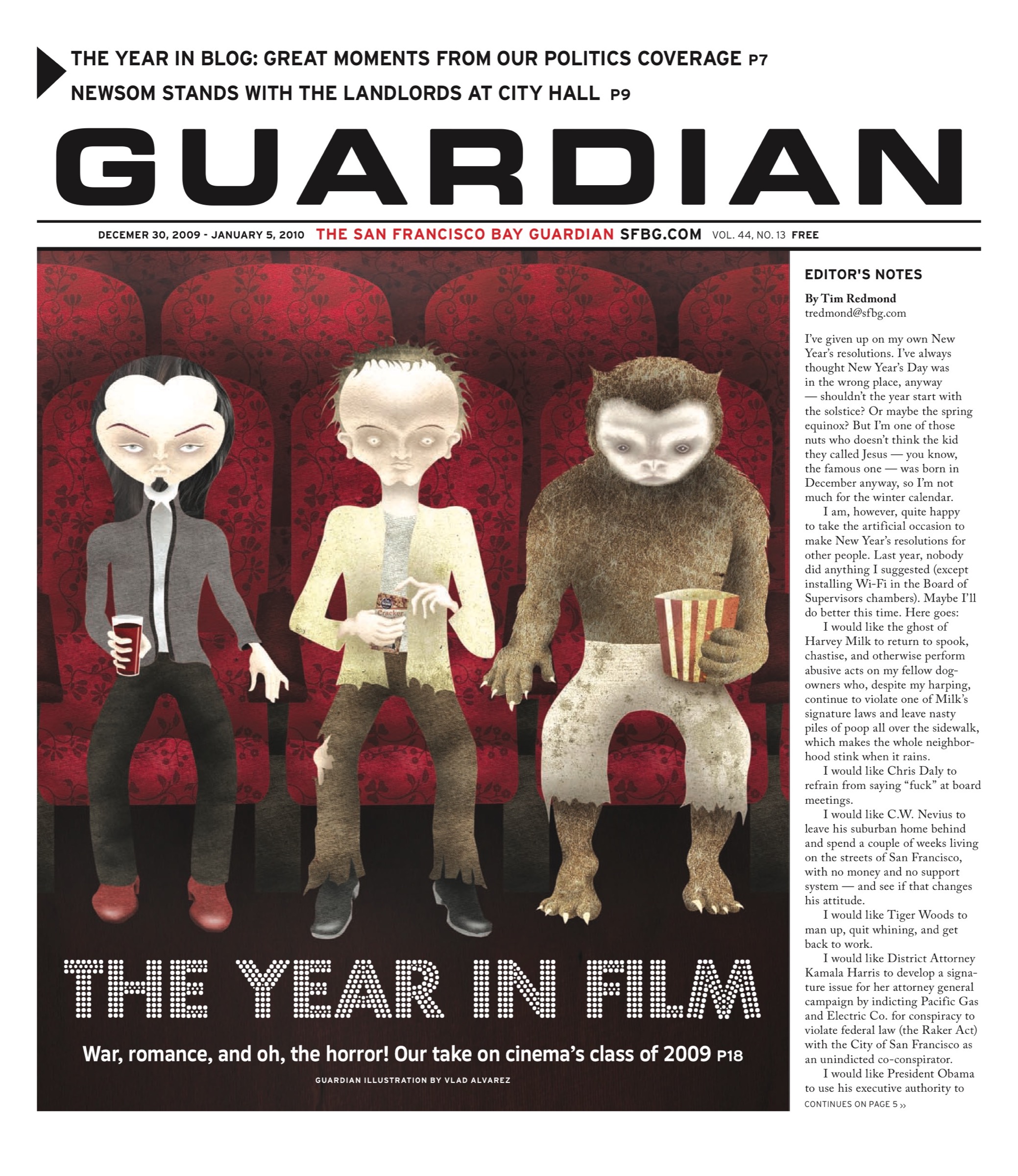
The year in film

0

YEAR IN FILM More than $10 billion in movie tickets were sold in 2009 — a new all-time high in a year stuffed with so many all-time lows, cinematic and otherwise. Many of those tickets, I’m afraid, provided entry to the garish, ghoulish Transformers: Revenge of the Fallen, far and away the year’s top-grossing release, though the top 10 did include at least one movie I can recommend (Star Trek) without feeling like a sellout. Nestled at No. 5 is The Twilight Saga: New Moon, part of a cultural phenomenon so huge the movie itself seemed like an afterthought. You have to scroll all the way to the 27th slot to find the year’s true top grosser: Paranormal Activity, which earned over $100 mil off a reportedly sub-$15,000 budget (less than a third what it cost to make 1999’s The Blair Witch Project, an obvious influence).

Paranormal Activity‘s success gives me hope, though I fear its inevitable shaky-cam imitators more than unexplained bumps in the night. Where there’s a buck, Hollywood will follow. This year, big-budget movies stepped up their games, employing IMAX, 3-D, and ever-more sophisticated CG to lure crowds on opening weekend. Avatar, which uses all three to greater effect than perhaps ever before, appears to be attracting gobs of people who’re simply curious to see what the fuss is about (my take: effects good, story crap. And for the record, I actually liked 1997’s Titanic). Multiplexes, with their corporate hookups and direct lines to movie studios, are thrilled by cinemaniacs eager to binge on new technology; brisk business proves 10-foot tall alien Smurfs are alluring enough to fill seats with butts that usually spend Friday nights at home, on the couch, watching DVR’d TV on a 60-inch flat-screen.

Of course, small, independently-owned theaters that can’t afford to upgrade their projection equipment to accommodate films like Avatar just might be screwed in 2010 and beyond. Hell, even the big guys have to contend with ever-shorter time periods between theatrical and DVD releases — sometimes these events happen simultaneously — and increasingly popular video-on-demand services offered by cable companies. Sometimes there’s a disconnect between versions that can affect the experience: Norwegian chiller Dead Snow was available to home audiences in dubbed form weeks before it rolled out at the Roxie, with subtitles (FYI: Nazi zombies are far more enjoyable when subtitled).

Still, think of all the scary shit you have to put up with simply by going to the movies: incessant texters; $15 tickets; people who cart their wee ones to hard-R fare; chatterboxes; seat-kickers; teenagers; jerks who sit in the middle of the row despite their pea-sized bladders; I could go on. Can you blame people who’d rather unspool their bootlegged copies of District 9 from the comfort of their own La-Z-Boys?

Yes! I can (and will) blame ’em — because true movie magic absolutely must include a big screen, preferably one that won’t fit into your living room. Even if you fear the megaplex, in the Bay Area we have access to a huge array of rep-house, art-house, and independently-owned screening venues. In short, there are still plenty of places to kick it old-school, movie geeks. So get out there and pass the popcorn!

Game Theory: USF Women’s Basketball vs. Tennessee 12/21/09

0

By Caitlin Donohue

Sports give me that same special something that I love about all cultural events- even if you don’t know what the hell is going on, they’re great to project onto. The thrill of victory, the crush of defeat, these are clichés for a reason. You can dig an athlete’s face when they get that big win or fall down on their ass- whether you hit the courts on the regular or get more exercise on your daily commute (/flight from the cops/stripper pole).

So the Guardian’s getting physical, San Francisco. Here’s the first installation of our new local sport series, “Game Theory.” Feel free to holler at us if you’ve got a big game coming up.

****************
usf 1 1209.jpg
Lady Don Brittany Brumfield gets low on D against Tennessee. Photo by Erik Anderson

When we walked into the University of San Francisco War Memorial basketball court, the Lady Dons were down by twenty points. In the first quarter. Which would be a huge bummer if you didn’t take into account the following background informations:

Curtain calls

0

THEATER Up to around 8:30 p.m. on Dec. 12, Thrillpeddlers were having a very good year. One of 2009’s Goldie recipients, the city’s connoisseurs of Grand Guignol–style fresh flesh were riding a remarkable wave of success with their inspired revival of Pearls over Shanghai, by San Francisco’s storied Cockettes, when an altogether different current overtook them.

No doubt the vicious cold snap of those days had something to do with it, but sources report that a 100-year-old water main located just outside the front door of the Hypnodrome — Thrillpeddlers’ rumored-to-be-haunted haunt at 10th and Division streets — let loose some 2 million gallons of water, the bulk of which burst into the packed theater in a two-foot high crest that inundated the stage smack in the middle of actor and artistic director Russell Blackwood’s exquisite tap number, “Cruising.” Cast and audience members alike scurried through one of those evacuations they’re always vaguely referring to by law just prior to curtain or takeoff. In this case, escape was made through the back dressing room, where SF firemen heroically carried audience members and heavily tarted-up actors to safety as the power was cut, owing to the very real danger of electric shock. I’m happy to report that the piano was saved, thanks to quick coordination of hands from both sides of the footlights, but clearly there’s a very soggy theater to deal with, so more than ever your prayers, and much better yet your patronage, should be directed toward the intrepid Thrillpeddlers. (Shows resume Jan. 1.)

Now this just goes to show that, one, I’m never there on the best night. And, two, the year ain’t over until it’s over. So let’s say this year-end wrap up, while it tries to take in all sides, is necessarily partial and provisional.

On the bright side:

Skylight at Ashby Stage. David Hare’s play dexterously puts the nuts and bolts of modern politics into modern romance like no other, but it came to life in director Patrick Dooley’s production for Shotgun Players better than I could have hoped were I coughing up three figures for a Broadway ticket. Leads Emily Jordan and John Mercer were startlingly good.

Killing My Lobster’s Pure Shock Value at the Exit. Odds were against them in producing their second full-length play, if only because the first, Peter Sinn Nachtrieb’s Hunter Gatherers, was so strong. But KML pulled it off.

Jericho Road Improvement Association at Phoenix Theatre. Hella Fresh Theater’s strong debut was a solid production of writer-director John Rosenberg’s West Oakland tale, a neighborhood story that navigated the complexities of history, race, and social roles with intelligence and real dramatic force. Sadly for us, Hella Fresh has freshly relocated east to Philly, but they contributed to a memorable year.

On the dark side:

Thom Pain (based on nothing) at Exit on Taylor. Cutting Ball’s strong local premiere of Will Eno’s broodingly sardonic off-Broadway hit featured an exceptionally fearless and intimidating solo turn by actor Jonathan Bock.

The Lieutenant of Inishmore at Berkeley Rep. Maybe this belongs on the light side. It depends how you take to a stage strewn with sawed off limbs and cat brains, all awash in veritable barrels of blood. I found it amusing.

The Creature at Thick House. Trevor Allen’s appealingly shrewd adaptation of Mary Shelley’s Frankenstein began as a podcast but, under director Rob Melrose and a great design team, blossomed into a supple, protean piece of live theater. The three-person cast was very strong, but James Carpenter’s beautifully wrought performance in the title role managed to surprise even those who know he’s one of the top actors on Bay Area stages.

The Walworth Farce at UC Berkeley’s Zellerbach. Leading Irish playwright Enda Walsh’s darkly hilarious, structurally ingenious, and all-around exhilarating play was more like farcical tragedy, or tragical farcity, which is to say something very fresh and gripping. Druid Ireland matched it perfectly in their incredibly deft and intelligent production.

On the right side:

SF Mime Troupe’s Too Big to Fail. “Right” isn’t the best adjective to stick in front of the Mime Troupe, but as free-theater-in-the-park hell-raisers for 50 years and counting you know whose side they’re on. Anniversary events continue through the New Year (sfmt.org).

On the tight side:

Fat Pig at Aurora Theatre. Aurora’s production of Neil LaBute’s play had a very strong ensemble going for it. There were others too this year, some of the most memorable including casts of Jack Goes Boating (also at Aurora), In the Next Room, or the vibrator play (Berkeley Rep), The Model Apartment (Traveling Jewish Theater), This World in a Woman’s Hands (Shotgun Players); Old Times (TheatreFIRST), and two exceptional ensembles courtesy of Off-Broadway West in The Homecoming and A View from the Bridge, respectively.

On the hype side:

American Idiot at Berkeley Rep. Actual satisfaction with Michael Mayer (Spring Awakening) and Green Day’s Broadway-bound behemoth proved inversely proportional to the hype. (Among new musicals about American 20-somethings, the real McCoy was up the hill at UC Berkeley in the premiere of Joe Goode’s Dead Boys.)

Also, Spamalot. Rhymed with everything but laughed-a-lot.

On the south side:

Ghosts of the River at Brava. The second collaboration between playwright Octavio Solis and director Larry Reed’s Shadowlight Productions, a set of immigrant ghost tales set along the Rio Grande, was as aesthetically unique and engaging as it was humane and thought provoking.

Also from the Mission District: Theatre Rhinoceros vacated its space on 16th Street after god knows how long to wander itinerant for a while. They are still very much around and active, though (therhino.org).

And from Intersection for the Arts came word of the tragic loss of a large and unique talent: actor and Campo Santo cofounder Luis Saguar, gone at 52. Saguar was an integral and always fascinating part of some exceptional theater history, and you never saw another actor quite like him. To help the family he leaves behind, donations are being accepted through Intersection for the Arts (www.theintersection.org/luis/).

Art, work, and artwork

0

VISUAL ART The global financial crisis continues to impoverish and displace those within reach of its residual tremors. Yet in the art realm, there have been signs of hope. Recent fairs — Frieze Art Fair in October and Art Basel Miami Beach earlier this month — brought reports of strong sales and optimism within the distressed economy. So why are artists everywhere worried about their futures, and more critically, panicking about their present tenses? The squeeze has to do with the work in artwork. More often than not, artists aren’t getting paid for their work.

The general prosperity of the current art market does not reflect the financial success of most artists — it just means that artworks are selling, and many of those works are by artists who are already established or dead. The other artists, the worried ones, the ones scraping by on paint chips and uncreative, menial part-time jobs and unpaid internship after unpaid internship, are starting to organize. And talk. Worried as well, I recently attended two events, one in New York and the other in Oakland, that call for a shift of terrain in art/work.

The New York event, titled, “What Is the Good of Work?” — the second in a four-part series organized by Goethe-Institut New York — was more abstract in its approach, seeking to redefine work through film and literature. For instance, when British novelist Tom McCarthy roused Herman Melville’s character Bartleby in order to express the potentials of “recess” in a “recession” and promote a politics of pause as escapist rather than reactionary, an audience member inquired: “But how can this be implemented in real life?” Here, McCarthy went quiet. The rest of the panel, too, including the nihilist philosopher Simon Critchley, only seemed capable of speculating on a new function of work, as opposed to how this new work would, well, work.

Comparatively, the Oakland event was more concerned with brass tacks. Organized by Sight School, an artist-run storefront newly opened in November, its aim “to create dialogue around new modes of living and being in the world in order to reveal connections between art and life” was actually visualized.

The evening began with local artists and writers reading primarily from a newspaper compiled by the Chicago-based collective Temporary Services. In it, more than 40 artists and writers pinpoint problematic issues and propose a way out. The front page introduction succinctly outlines its motivations:

We can see how the collapse of the economy is affecting everyone. Something must be done. Let’s talk. No, it can’t wait. Things are bad. We have to work things out. We can only do it together. What do we know? What have others tried? What is possible? How do we talk about it? What are the wildest possibilities? What are the pragmatic steps? What can you do? What can we do?

FREE / TAKE A COPY. MAKE AN EXHIBITION.

HOST A DISCUSSION IN YOUR TOWN.

The urgency of this situation was emphasized most strongly by Julian Myers, an assistant professor of curatorial practice at California College of the Arts. He fervently read the group Research and Destroy’s “Communiqué from an Absent Future: On the Terminus of Student Life,” which was drafted in response to the current University of California crises. Myers conveyed the text’s uncomfortably accurate detail of a bankrupt future not just for students, but anyone not already financially secure. The text incensed everyone in the room, as they realized the gravity of student debts and of academia as a new factory — a neverending rabbit hole of false security.

The last reader, Natasha Wheat, decided not to read at all; rather, she turned to the audience and asked, “What does a just art economy looks like?” Immediately, people chimed in. The space turned into a sauna of conjectures, arguments, personal anecdotes, and pleas. A variety of ideas and subjects — everything from emphasizing the importance of guilds and collectives to providing braces for children — were bandied about. These rants often lacked direction. Many were fueled by emotion and gave way to incomprehensible babble about new economies without realizing the previous paths paved by Marx, Adam Smith, and Keynes. But the passion, heretofore dormant, was inspiring.

Interestingly, the only thing missing from all the cries of desperation was a focus on artwork itself. In this small storefront room, everyone — artists, writers, curators, historians, and spectators — was hyper-aware about the lack of funding. But ironically, art had gone missing as well. Not many will disagree with the assertion that workers deserve payment for their labor, but what if their work blows? If I actively paint a canvas for eight hours a day, and no one finds it of value, why should I get paid? If money were a given, we’d all be doodling for dollars.

Zachary Royer Scholz, one of the readers and most intelligent contributors to the discussions, ended the event with a similar concern. He shifted the blame away from the economy and back toward the art. “Canada has strong government and institutional funding for its artists, but look at its art … it sucks!” Just then, a man on the opposite side of the room descended on Scholz, barking in protest. His ass-length dreads swung in tandem with his raised fists. It looked like a fight might break out, but the affront turned out to be performative — the room was filled with artists, after all.

I don’t find it coincidental that Dave Hickey’s The Invisible Dragon: Essays On Beauty (University of Chicago Press, 152 pages, $22) stirred from its coma this year. Its polemics could not be revived at a better time. First released in 1993, the book has been out of print for several years. Hickey originally pulled the plug because the “intensity and icy aggression” of The Invisible Dragon’s provocation was too great. In other words, people were pissed because Hickey insisted on the importance of art’s beauty.

In the collection’s first essay, “Enter The Dragon: On the Vernacular of Beauty,” Hickey argues that beauty has been replaced by meaning, and laments the art market baton swap from art dealers to institutions. “The institution’s curators hold a public trust,” Hickey writes. “They must look attentively and genuinely care about what artists mean, and what this meaning means in a public context — and, therefore, almost of necessity, they must distrust appearances.”

The problem, according to Hickey, parallels the one in Michel Foucault’s 1975’s Discipline and Punish, wherein punishment shifts from the external, via physical torture as public spectacle, to the internal — torture of the soul and mind via incarceration and criminal psychiatry. In effect, it’s a shift of gaze and surveillance: we now internalize this gaze and monitor ourselves.

But what does this have to do with art? Art limited to meaning loses its subversive potential; it gets too worried and existential. By contrast, allowing art to express itself through appearances also allows it to find new folds within an otherwise predetermined economy of signs — an economy controlled exclusively by arts institutions.

I imagine if Hickey had been in that room that evening, he would have stood up early on to demand that everyone stop acting like economists: You’re artists, dammit. You’re not here to fix the economy, you’re here to create things. Now go out and make shit — but for Christ’s sake, make it beautiful. *

www.sightschool.wordpress.com; www.temporaryservices.org

Hot sex events this week: Dec 9-15

0

Compiled by Molly Freedenberg

sexevents_1216.jpg

The Twilight Vixen Revue, shown here at last year’s Hubba Hubba Revue Christmas special, will make an appearance at Friday’s Chrismanukkah show.

————-

>> International Day to End Violence Against Sex Workers
Annie Sprinkle and Kimberly Kline host a rememberance ritual at Femina Potens before leading a solidarity stroll down Market to the St. James Infirmary.

Thurs/17, 6pm
Femina Potens
2199 Market, SF
www.feminapotens.org

————-

>> Holiday treats and personal shoppers
Pamper your way into the holidays with complimentary chocolates and wine on select evenings, when personal shoppers will help you pick out items for everyone on your erotic gift list.

Thurs/17-Sat/19, 6-9pm
Free
All Good Vibrations locations
www.goodvibes.com

————-

>> Ecstasies and Elegies
Sex workers, advocates, friends, families, and allies observe the International Day to End Violence Against Sex Workers with an evening of works by current and former sex worker performance artists, writers, and visionaries.

Fri/18, 7:30pm
$10-$20
Center for Sex and Culture
1519 Mission, SF
sexandculture.org

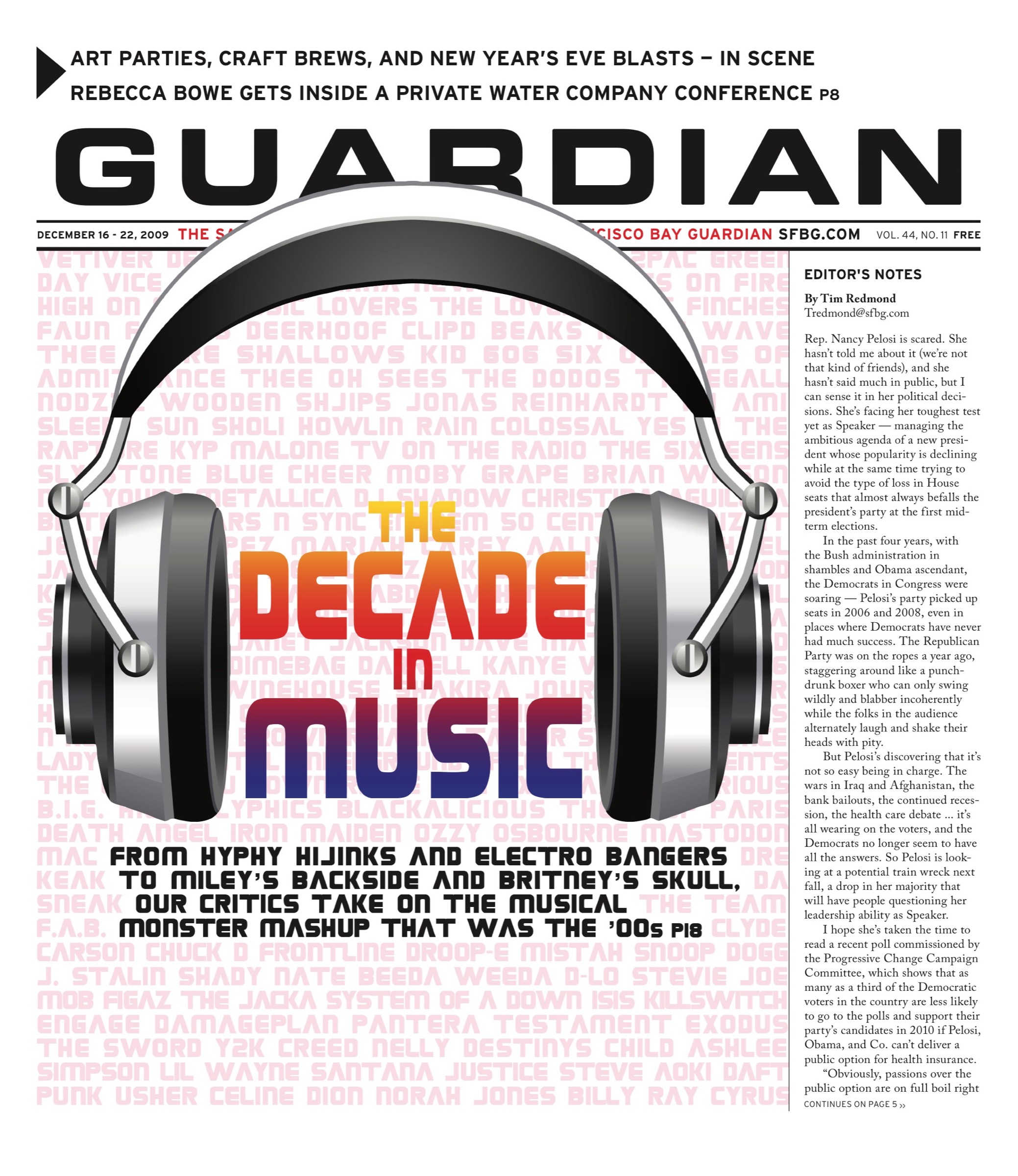
You ought-sa know

0

FEBRUARY 2000

Christina Aguilera defeats Britney Spears in the Battle of the Midriff-Baring Blondes (i.e., wins the Best New Artist Grammy). The first words of her acceptance speech are "Oh my god, you guys!"

APRIL 2000

Pop goes the world: ‘N SYNC sells 2.4 million copies of No Strings Attached (Jive) in its first week of release, a sales record which still stands. To date it has sold over 15 million copies.

Metallica files suit against Napster, accusing internet pirates of stealing their booty — er, royalties.

Pop goes the world, part two: Britney Spears releases Oops! … I Did It Again (Jive). Album title will take on extra meaning in 2004, when Spears takes the vows twice in a single year (her first marriage is annulled after 55 hours; her second produces a pair of sons in quick succession).

MAY 2000

Eminem releases The Marshall Mathers LP (Aftermath). Two years later, he picks up a Best Song Oscar for "Lose Yourself," the theme from his critically-acclaimed 8 Mile. Eminem’s cinematic success was not to be repeated by his otherwise successful protégé, 50 Cent (see: 2005’s dismal Get Rich or Die Tryin’).

OCTOBER 2000

Chocolate Starfish and the Hot Dog Flavored Water (Interscope) drops; it’s an early contender for worst album title of the decade. Related: "Limp Bizkit" is probably the worst band name of all time.

FEBRUARY 2001

Jennifer Lopez has the number one album (Epic’s J.Lo) and movie (The Wedding Planner) in the country. Media frenzy peaked with Bennifer fever (2002) and national-punchline Gigli (2003).

JULY 2001

Mariah Carey’s downward spiral begins, including a bizarre appearance on MTV’s Total Request Live and the ill-timed release of Glitter, soon after the September 11 attacks. Carey later reclaimed her pop-diva throne with 2005’s The Emancipation of Mimi (Island).

AUGUST 2001

Aaliyah dies in a Bahamas plane crash.

SEPTEMBER 2001

America: A Tribute to Heroes airs on all major networks. It’s the first in a series of concerts featuring big-name performers that would crop up after every major disaster throughout the decade, including the Indonesian tsunami, Hurricane Katrina, and the death of Michael Jackson.

APRIL 2002

Lisa "Left Eye" Lopes dies in a car crash in Honduras.

JUNE 2002

R. Kelly is charged with having sex with a minor after a certain videotape goes viral. "Trapped in the Closet," his 22-part 2005 "hip-hopera," proves even more fascinating.

SEPTEMBER 2002

Kelly Clarkson wins the first season of the hugely popular talent contest American Idol. In Clarkson’s wake: pop stardom, fellow success stories like Carrie Underwood (and failures — anyone seen Taylor Hicks lately?), a zillion rip-off competition shows, a thousand moments of zen with Paula Abdul, and the baffling "Claymate" phenomenon.

NOVEMBER 2002

Michael Jackson. Blanket. Balcony.

DECEMBER 2002

Whitney Houston informs Diane Sawyer that "crack is wack."

FEBRUARY 2003

Famed producer and legendary oddball Phil Spector arrested after a woman he’d just met, actress Lana Clarkson, is shot to death in his mansion. In 2009, after two trials (the first ended in a mistrial), he’s found guilty of second-degree murder.

At a Rhode Island nightclub, 100 people are killed when a fire breaks out during a Great White concert.

MARCH 2003

On the eve of the Iraq War, Dixie Chick, Texan, and American hero Natalie Maines informs a British crowd: "We’re ashamed that the President of the United States is from Texas." Backlash, and a feud with uber-patriotic fellow country star Toby Keith — who had a 2002 hit with "Courtesy of the Red, White, and Blue (The Angry American)" — ensues.

AUGUST 2003

Madonna smooches Britney Spears and Christina Aguilera onstage at the MTV Video Music Awards. Oh my god, you guys!

SEPTEMBER 2003

Johnny Cash goes to meet the Ghost Riders in the Sky. Two years after his death, Walk the Line gives him Hollywood biopic treatment; Reese Witherspoon picks up an Oscar for portraying June Carter, who died just months before her husband.

NOVEMBER 2003

Michael Jackson is arrested for child molestation, not long after the broadcast of Martin Bashir’s fairly skeevy Living with Michael Jackson interviews.

Newlyweds: Nick and Jessica debuts. (Spoiler: they get divorced in 2006!)

FEBRUARY 2004

Janet Jackson. Superbowl. Boob.

JUNE 2004

Dave Chappelle’s Lil John imitation became the imitation you loved to imitate. Whuuut?

AUGUST 2004

Look out, brah! A bus belonging to the Dave Matthews Band dumps 800 pounds of shit off a Chicago bridge and onto a tour boat.

OCTOBER 2004

Ashlee Simpson pulls a Milli Vanilli on Saturday Night Live.

DECEMBER 2004

Heavy metal guitarist Dimebag Darrell shot to death while performing in Columbus, Ohio.

FEBRUARY 2005

YouTube is born.

JUNE 2005

Michael Jackson found not guilty. Dove Lady celebrates.

SEPTEMBER 2005

"George Bush doesn’t care about black people." — Kanye West, during NBC’s live "Concert for Hurricane Relief."

JANUARY 2006

High School Musical airs. Sequels, worldwide fame for even lesser cast members, and nude photo scandals await.

MARCH 2006

Three 6 Mafia win an Oscar for Hustle and Flow jam "It’s Hard Out Here for a Pimp," which they perform live at the ceremony as fossilized Academy members gape in confusion.

JUNE 2006

Over a quarter of a million people download "Hips Don’t Lie" in its first week online, despite the fact that the Shakira track is so utterly inescapable it’s incredible anyone would choose to listen to it during any spare moments when it wasn’t playing already.

OCTOBER 2006

Amy Winehouse releases Back to Black (Island Records); the would-be retro pop queen’s career screeches to a halt after various addictions take hold. For the next few years, Winehouse’s downfall is gleefully chronicled and circulated by paparazzi worldwide.

FEBRUARY 2007

American Idol also-ran Jennifer Hudson wins an Oscar for her supporting performance in Dreamgirls. The gracious Hudson somehow keeps the phrase "In your face, Simon!" out of her acceptance speech.

Britney Spears. Clippers. Hair. (Chris. Crocker.)

JUNE 2007

The Sopranos airs its last episode. Journey’s "Don’t Stop Believin" becomes a new-old sensation.

OCTOBER 2007

Radiohead self-release In Rainbows, allowing customers to determine their own price for the album’s download.

DECEMBER 2007

Jamie Lynn Spears, 16-year-old sister of Britney, announces she’s knocked up. Oh my god, you guys!

APRIL 2008

Miley Cyrus lets Annie Leibovitz take a vaguely smutty photo of her for Vanity Fair.

AUGUST 2008

Stefani Joanne Angelina Germanotta, a.k.a. Lady Gaga, releases The Fame (Interscope). Pop domination imminent.

SEPTEMBER 2008

Blink-182 drummer Travis Barker and Adam "DJ AM" Goldstein are the sole survivors of a small plane crash in South Carolina. Goldstein is found dead in August 2009, leading to more than one tasteless Final Destination joke.

NOVEMBER 2008

Long-gestating, near-mythical Guns N’ Roses album Chinese Democracy (Geffen) finally drops. World shrugs, admits they’ll always prefer Appetite for Destruction (Geffen) no matter what Axl does from here on out.

FEBRUARY 2009

Christian Bale’s angry rant at a crew member on the set of Terminator: Salvation becomes an Internet sensation. A dance remix follows almost instantaneously. "What don’t you fucking understand?"

Chris Brown beats up then-girlfriend Rihanna. He pleads guilty in August; as part of his sentence, he must stay 100 yards away from Rihanna (10 yards at public events) for five years.

JUNE 2009

Michael Jackson dies.

SEPTEMBER 2009

Berkeley Repertory Theater premieres American Idiot, a musical based on the 2004 Green Day album.

"Taylor, I’m really happy for you, and I’m gonna let you finish, but Beyoncé had one of the best videos of all time." — Kanye West, MTV Video Music Awards. This is the only interesting thing that has ever happened to Taylor Swift.

Shades of green

0

news@sfbg.com

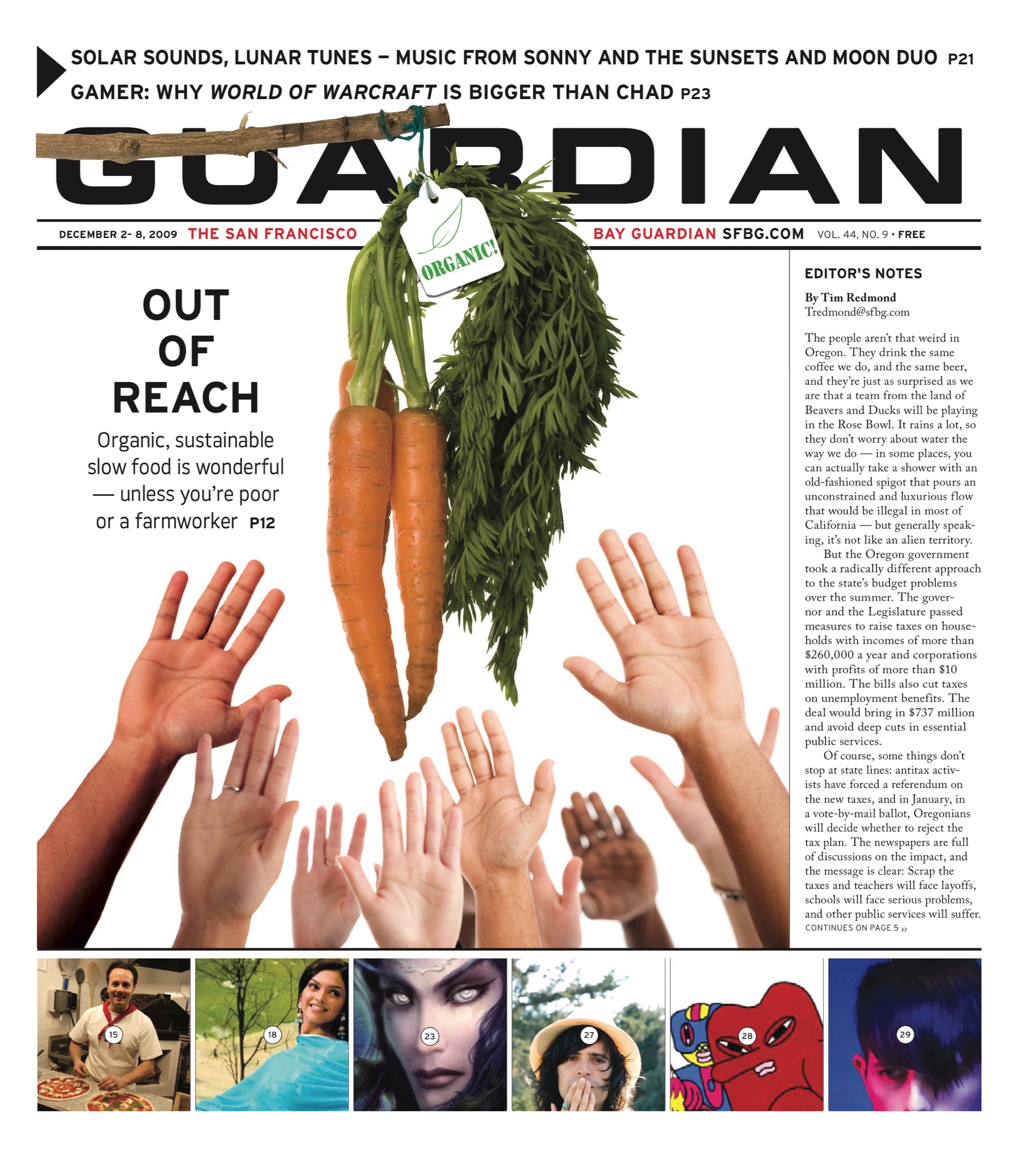
Can "green" consumerism help "green" the planet? In other words, can we spend our way to a better future? Or is the demand for more environmentally benign products and services just a way of making people feel better while delaying capitalism’s inevitable day of reckoning?

To explore these questions, consider the San Francisco Green Festival, the second-most attended green festival in the world and what organizers say is the country’s largest sustainability event. More than 40,000 people and 350 companies visited the eighth annual festival, held last month at the San Francisco Concourse Exhibition Center.

The emphasis of the event was on the power of purchasing. Just about everything was for sale, from fair-trade chocolate and hemp sweaters to paper journals made from Sri Lankan elephant dung. Certified "green" companies were happy to spend from $5,000 to $100,000 for their stalls and passersby shopped for guilt-free gifts. But critics of the trend question whether green consumption is ever better than no consumption at all.

"I believe we are getting to the point of urgency. We are beyond incremental reform and need significant structural change," said Brahm Ahmadi, cofounder and executive director of People’s Grocery. "What we really need to do is fundamentally shift the level of consumerism — not just shift into the consumption of more sustainable things — but realize that we need to consume less as a society."

The 2008 Living Planet Report, produced by the World Wildlife Fund, indicates that our global footprint now exceeds the world capacity to regenerate by about 30 percent. The report notes that if demands on the planet continue at the same rate, by the mid-2030s, we will need to the equivalent of two planets to maintain our lifestyles.

Ahmadi said trade-show events like the Green Festival can function as a good point of entry for people interested in reducing their own ecological footprint, but added that they don’t go nearly far enough in addressing the problem. They may even hinder people’s understanding of what needs to be done.

"The problem is that the words "green," "local," and "sustainable" can be used interchangeably now. They have become another sort of brand element in marketing," he said. "If this festival is the first step in a multistep strategy on how to change the planet, then that is great. But impressions aren’t set up in a way that puts the consumer on the path to a longer-term perspective."

For example, the Green Festival isn’t local. Although festival organizers say it promotes local companies that make green products, a spokeswoman admitted that about 40 percent of the exhibitors reside more than 150 miles from the site — the criteria one must meet to be deemed local by the festival.

Kevin Danaher, founder of Green Festivals and the cofounder of Global Exchange, told the Guardian that the festival costs almost $1 million to put on and makes $10,000–$30,000 in profit each year. He stressed that the aim of the event is to accelerate the transition to a green economy, an economy he says "will make better profits by saving nature rather than destroying it.

"We are trying to take enterprise away from big corporations and redefine it," Danaher continued. "For us, free enterprise should mean the freedom for everybody to be enterprising, the realization that alternative business models can make better profits than traditional ones."

Although Danaher claims the festival is an "enterprise-based event that encourages people to consume less," he believes it’s better to meet consumer demand with a green-mind business than leave it to be filled by a multinational corporation. "We know that people buy socks, toilet paper, and cat litter, and they can either buy the crappy corporate stuff or the good, green, socially-responsible stuff. That’s the choice," he said.

But Ahmadi sees a flaw in this premise. As long as progress is measured and defined by economic growth — the neverending requirement of the capitalist system — society will continue to fall short of sustainability targets, no matter what kind of products people buy, he said.

"At some point there is a threshold, even for green products, when the net benefits of producing the product will be surpassed," he said. "We need to go back to the framework that the economy is currently based on. At the moment, perpetual growth is the only way to assign value. But this linear way of thinking is dangerous to the sustainability of the planet. We must define value differently."

More than 125 speakers attended the event, including Democracy Now! founder Amy Goodman, nutrition expert Marion Nestle, and Mayor Gavin Newsom. Some even emphasized the tension inherent in staging the festival.

"It’s a good thing and a bad thing. People leave more conscious and aware, but they also leave a tremendous footprint getting here and leaving," said CEO of Gather restaurant Ari Derfel, who spoke on the main stage in front of a piece of art made from a year’s worth of his own trash. "People do engage in gross consumerist behavior. But they also get engaged with some companies that are doing incredible things."

Although he added that a green future must go beyond that represented at the Green Festival, he acknowledged that it represents the period of transition we now live in. "We can’t go from A to Z without touching on all the letters in between. And we are still in a consumer-based, material goods economy. We couldn’t make one wholesale swoop in one day."

Yet for Derrick Jensen, environmental activist and author of Endgame — a book that questions the inherently unsustainable nature of modern civilization — events like the Green Festival don’t really address the real problems at the center of the sustainability movement.

"I don’t see it as a transition," said Jensen, who made a speech at the event a few years ago. "It is not nearly sufficient. Now there is an attempt to add the word "green" before something and pretend that we’re actually going to make a significant difference. But this is problematic."

The problem, as he sees it, is that attendees simply learn to accept the existing economic system — and even believe it can become sustainable. They come to think that buying the right socks or toilet paper is helping to save the planet.

"Where is the overtly revolutionary material?" Jensen asked. "Where is the acknowledgement that capitalism needs to come down, or the discussion of the psychopathology of those in power? They talk only of alternative economies, but look what happened to every alternative economy — they get taken over and consumed by mainstream culture."

Jensen added that the notion of basing a revolution on changes to personal consumption is not only inherently flawed but dangerously misinformed. "This sort of festival is based on the mistaken notion that personal consumption represents a significant portion of the economy," he said. "In reality, 1,600 pounds of trash are produced per capita. If I reduce that to zero, it’s great. But per capita waste production by industries is on average 26 tons. That is 97 percent of all waste.

"This festival can make you feel good for one day, but then you just go back to normal life," he added. "And in some ways, it’s a real distraction. It makes people identify as consumers rather than citizens who have a whole range of resistance methods rather than just to buy or not buy."

Although Danaher stressed that each company at the festival went through Green America’s screening process — where they are subject to almost 250 questions analyzing their true social and environmental impact — Jensen said even "green" products often rely on the wasteful industrial system to be manufactured and transported.

"It is not difficult to see. You just can’t have infinite growth on a finite planet. The hyper-exploitation of even renewable resources won’t last, by definition. For any economic system to be sustainable, it has to benefit the land base it is based on."

Many of the companies at the event had obtained Green America’s sought-after Seal of Approval, which takes into account issues including the company’s manufacturing and marketing of products, as well as treatment of employees and effects on surrounding communities. At the same time, certain corporations that didn’t meet those criteria, like eBay, were invited anyway and labeled "corporate innovators."

Hamler said these are corporations that are moving toward social and environment responsibility, and they are still subject to a very strict review. Noting that only 60 out of every 300 corporations make the cut, she emphasized the changing nature of markets and the place for corporations within them.

Yet for Ahmadi, the very idea that large corporations can be a part of this change is misleading. "Even if a majority of their product line is green, the global ecological footprint of a corporation will almost always be beyond measure," he said. "The notion of consolidated corporations is counter to the diversity we need to create an equitable and sustainable economy."

While the Green Festival offsets the carbon emissions of its organizers and hosts carbon-offsetting companies, it doesn’t pretend to be a carbon-neutral event that covers anywhere near all its vendors and attendees. Indeed, environmental activist Josh Hart said that the system of carbon offsets — whereby people, companies, and states can claim to reduce their carbon emissions by investing in carbon-friendly projects elsewhere — represents yet another move in the wrong direction.

Hart went to festival as a representative of Cheatneutral, a satirical company that claims to offset romantic infidelity by paying someone else to be faithful. He said he wanted to expose the "pink elephant in the room" that no one else seemed to discuss at the festival.

"Offsetting is just another way of using the psychological technique of denial. It says you can carry on as normal but pay someone else to be green. This is the wrong approach and it is a fiction, not a reality," he told us. "The festival is putting itself forward as green, but people are doing this really unsustainable thing: flying out to the conference from all around the country for a few days and then leaving. This acts as a greater disservice to what we really need to be doing."

Although Lee did not yet know the carbon emissions total from this year’s festival, she said the five green festivals from last year produced about 900 tons of carbon –- the equivalent of roughly 355 roundtrip cross-continental flights — not including electricity, product consumption, or local travel.

But for Hart, this number represents a "massive underestimate" of the true carbon footprint, considering the number of people who attended the San Francisco event alone. He said the festival should take into account all the people who flew to the event, including company representatives and ticket-buyers, not just festival staff.

"The CO2 from a roundtrip flight from New York to San Francisco is around 2,280 kg, the equivalent of running a refrigerator for more than 22 years. It’s more than running a car all year," he said. "It’s staggering, really, how much carbon flying emits, and how incompatible aviation is with anything purporting to be green."

He added: "I think this issue goes straight to the battle over the heart of the green movement. Are we going to tell people that going green is easy and gloss over the difficult realities? Or are we going to be honest about the science that tells us that dramatic changes in lifestyles are required, in particular how we get around and what we consume?"

Yet for activists like Jenson, the extent to which the festival is carbon neutral is insignificant compared to the role the festival could play as a catalyst for future action.

"It is not the role of the activist to navigate systems of oppressive power, but instead to confront and take down those systems," Jensen said. "The point is, as far as an event like the Green Festival explicitly puts itself up as part of a larger culture of resistance, then I don’t have a problem with it. But if it suggests that in any way it is remotely sufficient to what we’re facing, then we have a problem."

Film listings

0

Film listings are edited by Cheryl Eddy. Reviewers are Kimberly Chun, Michelle Devereaux, Max Goldberg, Dennis Harvey, Johnny Ray Huston, Louis Peitzman, Lynn Rapoport, Ben Richardson, Matt Sussman, and Laura Swanbeck. The film intern is Fernando F. Croce. For rep house showtimes, see Rep Clock. For first-run showtimes, see Movie Guide.

OPENING

Avatar Special effects master and woeful screenplay-penner James Cameron returns, for better and worse. (2:42)

Broken Embraces Pedro Almodóvar has always dabbled in the Hitchcockian tropes of uxoricide, betrayal, and double-identity, but with Broken Embraces he has attained a polyglot, if slightly mimicking, fluency with the language of Hollywood noir. A story within a story and a movie within a movie, Embraces begins in the present day with middle-aged Catalan Harry Caine (Lluís Homar), a blind screenwriter who takes time between his successful writing career to seduce and bed young women sympathetic to his disability. "Everything’s already happened to me," he explains to his manager, Judit (Blanca Portillo). "All that’s left is to enjoy life." But this life of empty pleasures is brought to a sudden halt when local business magnate Ernesto Martel (José Luis Gómez) has died; soon after, Ernesto Jr. (Rubén Ochandiano), who has renamed himself Ray X, visits Caine with an unusual request. The action retreats 14 years when Caine was a young (and visually abled) director named Mateo Blanco; he encounters a breathtaking femme fatale, Lena (Penelope Cruz) — an actress-turned-prostitute named Severine, turned secretary-turned-trophy wife of Ernesto Martel — when she appears to audition for his latest movie. If all of the narrative intricacies and multiplicitous identities in Broken Embraces appear a bit intimidating at first glance, it is because this is the cinema of Almodóvar taken to a kind of generic extreme. As with all of the director’s post-’00 films, which are often referred to as Almodóvar’s "mature" pictures, there is a microscopic attention to narrative development combined with a frenzied sub-plotting of nearly soap-operatic proportions. But, in Embraces, formalism attains such prominence that one might speculate the director is simply going through the motions. The effect is a purposely loquacious and overly-dramatized performance that pleasures itself as much by setting up the plot as unraveling it. For the complete version of this review, visit www.sfbg.com. (2:08) Clay. (Erik Morse)

Did You Hear About the Morgans? A married couple (Hugh Grant and Sarah Jessica Parker) move from Manhattan to a small town after witnessing a murder. (1:48)

In Search of Beethoven After the success of his In Search of Mozart, director Phil Grabsky applies his truth-seeking documentary template to Ludwig van Beethoven, a composer so genius he continued creating (and to a lesser extent, performing) even as he succumbed to deafness. Still photos, paintings, interviews with historians and musicologists, and visits to actual Beethoven haunts, along with dramatic readings of the maestro’s letters (by actor David Dawson) and stern narration (by actor Juliet Stevenson, who also loaned her pipes to Mozart), flesh out this biographical portrait. But its most stirring moments come courtesy of its musical performances (by seasoned professionals) of Moonlight Sonata and other notable works. As the doc proves, there’s no better insight into Beethoven’s tumultuous, sometimes tortured life than the notes he left behind. (2:18) Roxie. (Eddy)

*35 Shots of Rum Claire Denis’s portrait in domesticity is so patiently timed and achingly photographed (by her longtime cinematographer Agnès Godard) that your own life routines are liable to seem freshly poetic in its afterglow. We begin with familiar images of transitory longing: trains switching tracks, keeping time. A man smokes a cigarette at dusk, its embers warming his dark skin. He is Lionel (Alex Descas), a Metro operator who lives simply in a boxy apartment building in the outer rings of Paris. He returns home from work with a rice cooker for his twentysomething daughter, Josephine (Mati Diop), though Denis allows their relationship to remain unclear for a while (she is remarkably free when it comes to exposition). Coincidentally, serious Jo has bought herself a cooker on the same day. There’s a whole untold story about the rice cooker, but Denis is content watching them appreciatively spoon out the first batch in their pajamas. The attention to generations, meals, the trains and the small comic gestures (a well-timed fart, an awry romantic moment in the Seine) all suggest Ozu, but the elliptical rhythms and sensual apprehension of bodies is pure Denis. She once did a documentary about a choreographer (2005’s Towards Mathilde), and she approaches everyday life as a kind of dance. Lionel and Jo’s relationship is unlike almost any other father-daughter dynamic in recent movie memory — nonverbal, but clearly loving. If the other characters are kept at arm’s length, that’s because Lionel and Jo keep their safe haven so closely guarded. Things begin to unspool, as they must, in a memorable restaurant dance sequence that makes exquisite use of the Commodores’ 1985 platter, "Nightshift." (1:39) (Goldberg)

The Young Victoria Those who envision the Victorian Age as one of restraint and repression will likely be surprised by The Young Victoria, which places a vibrant Emily Blunt in the title role. Her Queen Victoria is headstrong and romantic — driven not only by her desire to stand tall against the men who would control her, but also by her love for the dashing Prince Albert (Rupert Friend). To be honest, the story itself is nothing spectacular, even for those who have imagined a different portrait of the queen. But The Young Victoria is still a spectacle to behold: the opulent palaces, the stunning gowns, and the flawless Blunt going regal. Her performance is rich and nuanced — and her chemistry with Prince Albert makes the film. No, it doesn’t leave quite the impression that 1998’s Elizabeth did, but it’s a memorable costume drama and romance, worthy of at least a moderate reign in theaters. (1:40) Embarcadero. (Peitzman)

ONGOING

Armored (1:28) 1000 Van Ness.

The Blind Side When the New York Times Magazine published Michael Lewis’ article "The Ballad of Big Mike" — which he expanded into the 2006 book The Blind Side: Evolution of a Game —nobody could have predicated the cultural windfall it would spawn. Lewis told the incredible story of Michael Oher — a 6’4, 350-pound 16-year-old, who grew up functionally parentless, splitting time between friends’ couches and the streets of one of Memphis’ poorest neighborhoods. As a sophomore with a 0.4 GPA, Oher serendipitously hitched a ride with a friend’s father to a ritzy private school across town and embarked on an unbelievable journey that led him into a upper-class, white family; the Dean’s List at Ole Miss; and, finally, the NFL. The film itself effectively focuses on Oher’s indomitable spirit and big heart, and the fearless devotion of Leigh Anne Tuohy, the matriarch of the family who adopted him (masterfully played by Sandra Bullock). While the movie will delight and touch moviegoers, its greatest success is that it will likely spur its viewers on to read Lewis’ brilliant book. (2:06) 1000 Van Ness. (Daniel Alvarez)

Brothers There’s nothing particularly original about Brothers — first, because it’s based on a Danish film of the same name, and second, because sibling rivalry is one of the oldest stories in the book. The story is fairly straightforward: good brother (Tobey Maguire) goes AWOL in Afghanistan, bad brother (Jake Gyllenhaal) comforts his sister-in law (Natalie Portman), attraction develops, but then — and here’s where things get awkward — good brother comes home. Throughout much of Brothers, the script is surprisingly restrained, holding the film back from Movie of the Week territory. Those moments of subtlety are the movie’s strongest, but by the end they’ve given way to giant, maudlin explosions of angst, which aren’t nearly as impressive. Still, the acting is consistently strong. Maguire is especially good as Captain Sam Cahill in a performance that runs the gamut from doting father to terrifyingly unbalanced. It’s unfortunate that the quiet scenes, in which all the actors excel, are overshadowed by the big, plate-smashing ones. (1:50) 1000 Van Ness, Sundance Kabuki. (Peitzman)

Christmas with Walt Disney Specially made for the Presidio’s recently opened Walt Disney Family Museum, this nearly hour-long compilation of vintage Yuletide-themed moments from throughout the studio’s history (up to Walt’s 1966 death) is more interesting than you might expect. The engine is eldest daughter Diane Disney Miller’s narrating reminiscences, often accompanied by excerpts from an apparently voluminous library of high-quality home movies. Otherwise, the clips are drawn from a mix of short and full-length animations, live-action features (like 1960’s Swiss Family Robinson), TV shows Wonderful World of Disney and Mickey Mouse Club, plus public events like Disneyland’s annual Christmas Parade and Disney’s orchestration of the 1960 Winter Olympics’ pageantry. If anything, this documentary is a little too rushed –- it certainly could have idled a little longer with some of the less familiar cartoon material. But especially for those who who grew up with Disney product only in its post-founder era, it will be striking to realize what a large figure Walt himself once cut in American culture, not just as a brand but as an on-screen personality. The film screens Nov 27-Jan 2; for additional information, visit http://disney.go.com/disneyatoz/familymuseum/index.html. (:59) Walt Disney Family Museum. (Harvey)

Disney’s A Christmas Carol (1:36) 1000 Van Ness.

*An Education The pursuit of knowledge — both carnal and cultural — are at the tender core of this end-of-innocence valentine by Danish filmmaker Lone Scherfig (who first made her well-tempered voice heard with her 2000 Dogme entry, Italian for Beginners), based on journalist Lynn Barber’s memoir. Screenwriter Nick Hornby breaks further with his Peter Pan protagonists with this adaptation: no man-boy mopers or misfits here. Rather, 16-year-old schoolgirl Jenny (Carey Mulligan) is a good girl and ace student. It’s 1961, and England is only starting to stir from its somber, all-too-sober post-war slumber. The carefully cloistered Jenny is on track for Oxford, though swinging London and its high-style freedoms beckon just around the corner. Ushering in those freedoms — a new, more class-free world disorder — is the charming David (Peter Sarsgaard), stopping to give Jenny and her cello a ride in the rain and soon proffering concerts and late-night suppers in the city. He’s a sweet-faced, feline outsider: cultured, Jewish, and given to playing fast and loose in the margins of society. David can see Jenny for the gem she is and appreciate her innocence with the knowing pleasure of a decadent playing all the angles. The stakes are believably high, thanks to An Education‘s careful attention to time and place and its gently glamored performances. Scherfig revels in the smart, easy-on-eye curb appeal of David and his friends while giving a nod to the college-educated empowerment Jenny risks by skipping class to jet to Paris. And Mulligan lends it all credence by letting all those seduced, abandoned, conflicted, rebellious feelings flicker unbridled across her face. (1:35) (Chun)

Everybody’s Fine Robert De Niro works somewhere between serious De Niro and funny De Niro in this portrait of a family in muffled crisis, a remake of the 1991 Italian film Stanno Tutti Bene. The American version tracks the comings and goings of Frank (De Niro), a recently widowed retiree who fills his solitary hours working in the garden and talking to strangers about his children, who’ve flung themselves across the country in pursuit of various dreams and now send home overpolished reports of their achievements. Disappointed by his offspring’s collective failure to show up for a family get-together, he embarks on a cross-country odyssey to connect with each in turn. Writer-director Kirk Jones (1998’s Waking Ned Devine) effectively underscores Frank’s loneliness with shots of him steering his cart through empty grocery stores, interacting only with the occasional stock clerk, and De Niro projects a sense of drifting disconnection with poignant restraint. But Jones also litters the film with a string of uninspired, autopilot comic moments, and manifold shots of telephone wires as Frank’s children (Kate Beckinsale, Drew Barrymore, and Sam Rockwell) whisper across the miles behind their father’s back — his former vocation, manufacturing the telephone wires’ plastic coating, funded his kids’ more-ambitious aims — feel like glancing blows to the head. A vaguely miraculous third-act exposition of everything they’ve been withholding to protect both him and themselves is handled with equal subtlety and the help of gratingly precocious child actors. (1:35) 1000 Van Ness. (Rapoport)

*Fantastic Mr. Fox A lot of people have been busting filmmaker Wes Anderson’s proverbial chops lately, lambasting him for recent cinematic self-indulgences hewing dangerously close to self-parody (and in the case of 2007’s Darjeeling Limited, I’m one of them). Maybe he’s been listening. Either way, his new animated film, Fantastic Mr. Fox, should keep the naysayer wolves at bay for a while — it’s nothing short of a rollicking, deadpan-hilarious case study in artistic renewal. A kind of man-imal inversion of Anderson’s other heist movie, his debut feature Bottle Rocket (1996), his latest revels in ramshackle spontaneity and childlike charm without sacrificing his adult preoccupations. Based on Roald Dahl’s beloved 1970 book, Mr. Fox captures the essence of the source material but is still full of Anderson trademarks: meticulously staged mise en scène, bisected dollhouse-like sets, eccentric dysfunctional families coming to grips with their talent and success (or lack thereof).(1:27) Empire, 1000 Van Ness, SF Center, Sundance Kabuki. (Devereaux)

Invictus Elected President of South Africa in 1995 — just five years after his release from nearly three decades’ imprisonment — Nelson Mandela (Morgan Freeman) perceives a chance to forward his message of reconciliation and forgiveness by throwing support behind the low-ranked national rugby team. Trouble is, the Springboks are currently low-ranked, with the World Cup a very faint hope just one year away. Not to mention the fact that despite having one black member, they represent the all-too-recent Apartheid past for the country’s non-white majority. Based on John Carlin’s nonfiction tome, this latest Oscar bait by the indefatigable Clint Eastwood sports his usual plusses and minuses: An impressive scale, solid performances (Matt Damon co-stars as the team’s Afrikaaner captain), deft handling of subplots, and solid craftsmanship on the one hand. A certain dull literal-minded earnestness, lack of style and excitement on the other. Anthony Peckham’s screenplay hits the requisite inspirational notes (sometimes pretty bluntly), but even in the attenuated finals match, Eastwood’s direction is steady as she goes — no peaks, no valleys, no faults but not much inspiration, either. It doesn’t help that Kyle Eastwood and Michael Stevens contribute a score that’s as rousing as a warm milk bath. This is an entertaining history lesson, but it should have been an exhilarating one. (2:14) 1000 Van Ness, SF Center, Sundance Kabuki. (Harvey)

Me and Orson Welles It’s 1937, and New York City, like the rest of the nation, presumably remains in the grip of the Great Depression. That trifling historical detail, however, is upstaged in Richard Linklater’s Me and Orson Welles (adapted from the novel by Robert Kaplow) by the doings at the newly founded Mercury Theatre. There, in the equally tight grip of actor, director, and company cofounder Orson Welles — who makes more pointed use of the historical present, of Italian fascism — a groundbreaking production of Shakespeare’s Julius Caesar hovers on the brink of premiere and possible disaster. Luckily for swaggering young aspirant Richard (High School Musical series star Zac Efron), Welles (Christian McKay), already infamously tyrannical at 22, is not a man to shrink from firing an actor a week before opening night and replacing him with a 17-year-old kid from New Jersey. Finding himself working in perilous proximity to the master, his unharnessed ego, and his winsome, dishearteningly pragmatic assistant, Sonja (Claire Danes), our callow hero is destined, predictably, to be handed some valuable life experience. McKay makes a credible, enjoyable Welles, presented as the kind of engaging sociopath who handles people like props and hails ambulances like taxicabs. Efron projects a shallow interior life, an instinct for survival, and the charm of someone who has had charming lines written for him. Still, he and Welles and the rest are all in service to the play, and so is the film, which offers an absorbing account of the company’s final days of rehearsal. (1:54) Shattuck. (Rapoport)

Ninja Assassin Let’s face it: it’d be nigh impossible to live up to a title as awesome as Ninja Assassin –- and this second flick from V for Vendetta (2005) director James McTeigue doesn’t quite do it. Anyone who’s seen a martial arts movie will find the tale of hero Raizo overly familiar: a student (played by the single-named Rain) breaks violently with his teacher; revenge on both sides ensues. That the art form in question is contemporary ninja-ing adds a certain amount of interest, though after a killer ninja vs. yakuza opening scene (by far the film’s best), and a flashback or two of ninja vs. political targets, the rest of the flick is concerned mostly with either ninja vs. ninja or ninja vs. military guys. (As ninjas come "from the shadows," most of these battles are presented in action-masking darkness.) There’s also an American forensic researcher (Noemie Harris) who starts poking around the ninja underground, a subplot that further saps the fun out of a movie that already takes itself way too seriously. (1:33) 1000 Van Ness. (Eddy)

Pirate Radio I wanted to like Pirate Radio, a.k.a., The Boat That Rocked –- really, I did. The raging, stormy sounds of the British Invasion –- sex, drugs, rock ‘n’ roll, and all that rot. Pirate radio outlaw sexiness, writ large, influential, and mind-blowingly popular. This shaggy-dog of a comedy about the boat-bound, rollicking Radio Rock is based loosely on the history of Radio Caroline, which blasted transgressive rock ‘n’ roll (back when it was still subversive) and got around stuffy BBC dominance by broadcasting from a ship off British waters. Alas, despite the music and the attempts by filmmaker Richard Curtis to inject life, laughs, and girls into the mix (by way of increasingly absurd scenes of imagined listeners creaming themselves over Radio Rock’s programming), Pirate Radio will be a major disappointment for smart music fans in search of period accuracy (are we in the mid- or late ’60s or early or mid-’70s –- tough to tell judging from the time-traveling getups on the DJs, played by Philip Seymour Hoffman and Rhys Darby, among others?) and lame writing that fails to rise above the paint-by-the-numbers narrative buttressing, irksome literalness (yes, a betrayal by a lass named Marianne is followed by "So Long, Marianne"), and easy sexist jabs at all those slutty birds. Still, there’s a reason why so many artists –- from Leonard Cohen to the Stones –- have lent their songs to this shaky project, and though it never quite gets its sea legs, Pirate Radio has its heart in the right place –- it just lost its brains somewhere along the way down to its crotch. (2:00) 1000 Van Ness. (Chun)

Planet 51 (1:31) 1000 Van Ness.

*Precious: Based on the Novel Push By Sapphire This gut-wrenching, little-engine-that-could of a film shows the struggles of Precious, an overweight, illiterate 16-year-old girl from Harlem. Newcomer Gabourey Sidibe is so believably vigilant (she was only 15 at the time of filming) that her performance alone could bring together the art-house viewers as well as take the Oscars by storm. But people need to actually go and experience this film. While Precious did win Sundance’s Grand Jury and Audience Award awards this year, there is a sad possibility that filmgoers will follow the current trend of "discussing" films that they’ve actually never seen. The daring casting choices of comedian Mo’Nique (as Precious’ all-too-realistically abusive mother) and Mariah Carey (brilliantly understated as an undaunted and dedicated social counselor) are attempts to attract a wider audience, but cynics can hurdle just about anything these days. What’s most significant about this Dancer in the Dark-esque chronicle is how Damien Paul’s screenplay and director Lee Daniels have taken their time to confront the most difficult moments in Precious’ story –- and if that sounds heavy-handed, so be it. Stop blahging for a moment and let this movie move you. (1:49) SF Center, Sundance Kabuki. (Jesse Hawthorne Ficks)

*The Princess and the Frog Expectations run high for The Princess and the Frog: it’s the first Disney film to feature an African American princess, the first 2D Disney cartoon since the regrettable Home on the Range (2004), and the latest entry from the writing-directing team responsible for The Little Mermaid (1989) and Aladdin (1992). Here’s the real surprise — The Princess and the Frog not only meets those expectations, it exceeds them. After years of disappointment, many of us have given up hope on another classic entry into the Disney 2D animation canon. And yet, The Princess and the Frog is up there with the greats, full of catchy songs, gorgeous animation, and memorable characters. Set in New Orleans, the story is a take off on the Frog Prince fairy tale. Here, the voodoo-cursed Prince Naveen kisses waitress Tiana instead — transferring his froggy plight to her as well. A fun twist, and a positive message: wishing is great, but it takes hard work to make your dreams come true. For those of us raised on classic Disney, The Princess and the Frog is almost too good to believe. (1:37) 1000 Van Ness. (Peitzman)

*The Private Lives of Pippa Lee Rebecca Miller’s latest is that seldom-produced thing, the female midlife crisis movie. Daughter to playwright Arthur Miller, a titan of Big Theme manly guilts, her projects are indie-scaled, about troubled domestic minutae, with whimsical twists of fate that methodical realist Arthur would never have countenanced. She’s been consistently interesting since 1995’s striking Angela — first among many narratives from the viewpoint of a child struggling in the shadow of an overwhelming and/or unstable parent. In Private Lives, Pippa (Robin Wright Penn) has her own monstrous parental past. Like many people hailing from chaos, Pippa has turned self-conscious model citizen. In drifting early adulthood, she glommed onto the first man who respected her mind — or did he just recognize a rudderless, much younger woman susceptible to flattery? Ever since she’s been ideal consort to newly retired publisher Herb (Alan Arkin), as well as doting mother to their variably grateful children. Barely 40 and living in an old folks’ village, Pippa is starting to think her life a tad ridiculous. Such nagging but inchoate doubt is underlined by the return of a widow neighbor’s shaggy, somewhat surly son (Keanu Reeves) to Chez Mom after his latest failure at adulthood. Opposites attract, though it’s more complicated than that. Miller’s cluttered canvas also makes room for teensy-to-major characters played by Shirley Knight, Blake Lively, Robin Weigert, Julianne Moore, and Monica Bellucci. As is her wont, she piles on both invigorating insights and a few too many whiplash narrative left turns. But The Private Lives of Pippa Lee has charm and idiosyncrasy to spare. (1:40) Smith Rafael. (Harvey)

A Single Man In this adaptation of Christopher Isherwood’s 1964 novel, Colin Firth plays George, a middle-aged gay expat Brit and college professor in 1962 Los Angeles. Months after the accidental death of Jim (Matthew Goode), his lover for 16 years, George still feels worse than bereft; simply waking each morning is agony. So on this particular day he has decided to end it all, first going through a series of meticulous preparations and discreet leave-takings that include teaching one last class and having supper with the onetime paramour (Julianne Moore) turned best friend who’s still stuck on him. The main problem with fashion designer turned film director Tom Ford’s first feature is that he directs it like a fashion designer, fussing over surface style and irrelevant detail in a story whose tight focus on one hard, real-world thing–grief–cries for simplicity. Not pretentious overpackaging, which encompasses the way his camera slavers over the excessively pretty likes of Nicholas Hoult as a student and Jon Kortajarena as a hustler, as if they were models selling product rather than characters, or even actors. (In fact Kortajarena is a male supermodel; the shocker is that Hoult is not, though Hugh Grant’s erstwhile About a Boy co-star is so preening here you’d never guess.) Eventually Ford stops showing off so much, and A Single Man is effective to the precise degree it lets good work by Goode, Moore and especially the reliably excellent Firth unfold without too much of his terribly artistic interference. (1:39) Sundance Kabuki. (Harvey)

2012 I don’t need to give you reasons to see this movie. You don’t care about the clumsy, hastily dished-out pseudo scientific hoo-ha that explains this whole mess. You don’t care about John Cusack or Woody Harrelson or whoever else signed on for this embarrassing notch in their IMDB entry. You don’t care about Mayan mysteries, how hard it is for single dads, and that Danny Glover and Chiwetel Ejiofor jointly stand in for Obama (always so on the zeitgeist, that Roland Emmerich). You already know what you’re in store for: the most jaw-dropping depictions of humankind’s near-complete destruction that director Emmerich –- who has a flair for such things –- has ever come up with. All the time, creative energy, and money James Cameron has spent perfecting the CGI pores of his characters in Avatar is so much hokum compared to what Emmerich and his Spartan army of computer animators dish out: the U.S.S. John F. Kennedy emerging through a cloud of toxic dust like some Mary Celeste of the military-industrial complex, born aloft on a massive tidal wave that pulverizes the White House; the dome of St. Paul’s flattening the opium-doped masses like a steamroller; Hawaii returned to its original volcanic state; and oodles more scenes in which we are allowed to register terror, but not horror, at the gorgeous destruction that is unfurled before us as the world ends (again) but no one really dies. Get this man a bigger budget. (2:40) 1000 Van Ness. (Sussman)

The Twilight Saga: New Moon Oh my God, you guys, it’s that time of the year: another Twilight chapter hits theaters. New Moon reunites useless cipher Bella (Kristen Steward) and Edward (Robert Pattinson), everyone’s favorite sparkly creature of darkness. Because this is a teen wangstfest, the course of true love is kind of bumpy. This time around, there’s a heavy Romeo and Juliet subplot and some interference from perpetually shirtless werewolf Jacob (Taylor Lautner). Chances are you know this already, as you’ve either devoured Stephenie Meyer’s book series or you were one of the record-breaking numbers in attendance for the film’s opening weekend. And for those non-Twilight fanatics — is there any reason to see New Moon? Yes and no. Like the 2008’s Twilight, New Moon is reasonably entertaining, with plenty of underage sexual tension, supernatural slugfests, and laughable line readings. But there’s something off this time around: New Moon is fun but flat. For diehard fans, it’s another excuse to shriek at the screen. For anyone else, it’s a soulless diversion. (2:10) Empire, 1000 Van Ness, SF Center, Sundance Kabuki. (Peitzman)

Up in the Air After all the soldiers’ stories and the cannibalism canards of late, Up in the Air‘s focus on a corporate ax-man — an everyday everyman sniper in full-throttle downsizing mode — is more than timely; it’s downright eerie. But George Clooney does his best to inject likeable, if not quite soulful, humanity into Ryan Bingham, an all-pro mileage collector who prides himself in laying off employees en masse with as few tears, tantrums, and murder-suicide rages as possible. This terminator’s smooth ride from airport terminal to terminal is interrupted not only by a possible soul mate, fellow smoothie and corporate traveler Alex (Vera Farmiga), but a young tech-savvy upstart, Natalie (Anna Kendrick), who threatens to take the process to new reductionist lows (layoff via Web cam) and downsize Ryan along the way. With Up in the Air, director Jason Reitman, who oversaw Thank You for Smoking (2005) as well as Juno (2007), is threatening to become the bard of office parks, Casual Fridays, khaki-clad happy hours, and fly-over zones. But Up in the Air is no Death of a Salesman, and despite some memorable moments that capture the pain of downsizing and the flatness of real life, instances of snappily screwball dialogue, and some more than solid performances by all (and in particular, Kendrick), he never manages to quite sell us on the existence of Ryan’s soul. (1:49) SF Center. (Chun)

Alerts

0

alerts@sfbg.com

WEDNESDAY, DEC. 16

SF Carbon Collaborative


Attend this panel discussion on justice, equity, and sufficiency in climate negotiations and the role these values play in national and local climate action. Speakers include Jonah Sachs, cofounder of Free Range Studios and Linda Maepa, from Electron Vault Now.

6 p.m., free

Crocker Galleria

Green Zebra storefront

50 Post, SF

www.carboncollaborative.org

THURSDAY, DEC. 17

City College meeting


Attend this monthly business meeting of City College of San Francisco’s Board of Trustees. A video of the meeting will also be telecast on EaTV Cable Channel 27 at 8:30 p.m. Dec. 23.

6 p.m., free

Auditorium

City College

33 Gough Campus, SF

www.ccsf.edu

Stop the violence


Take part in the International Day to End Violence Against Sex Workers by attending this memorial vigil ritual at Femina Potens Art Gallery, a space dedicated to LGBT visual arts exhibitions, media arts events, public arts projects, performances, and educational programs.

7 p.m., free

Femina Potens Art Gallery

2199 Market, SF

(415) 864-1558

Protest BART’s police chief


Protest at a forum being held by BART to hear the community’s thoughts and opinions on choosing a new BART police chief. Don’t let Chief Gary Gee walk away from his job with no accountability for the Jan. 1 murder of Oscar Grant by a BART police officer.

6 p.m., free

Joseph P. Bort MetroCenter Auditorium

101 Eighth St., Oakl.

www.indybay.org/oscargrant

Traditional Seeds


Join in the dialogue about the value of traditional crop varieties and ecological agriculture in an increasingly unstable world climate at this talk featuring Debal Deb, ecologist and founding director of the Center for Interdisciplinary Studies in West Bengal, India.

7p.m.; free, donations for Dr. Deb’s initiatives accepted

Ecology Center

2530 San Pablo, Berk.

(510) 548-4915

Wine for a cause


Attend this wine tasting event titled "Drink Good Wine, Do Good Works" featuring wines that support access to healthcare for California vineyard workers. Donate canned goods to SF Food Bank for $5 off admission.

6 p.m., $15

Jovino

2184 Union, SF

(650) 796-1607

FRIDAY, DEC. 18

Say no to war


Rally to demand that we bring our troops home now.

2 p.m., free

Acton and University, Berk.

(510) 841-4143

Women in Black vigil


Protest the ongoing occupation of Palestine and attacks on Gazans by attending this vigil for Tristan Anderson, who was critically injured by Israeli forces, and by contacting the Consul General David Akov at the Israeli Consulate to demand an end to the violence at concal.sec@sanfrancisco.mfa.gov.il.

Noon, free

Bancroft and Telegraph, Berk.

(510) 548-6310

SATURDAY, DEC. 19

Single-payer now


Attend this healthcare forum and holiday potluck featuring presentations by Assembly Member Tom Ammiano, principal author of SB 810 California Universal Healthcare Act, and Rep. Eric Massa (D-N.Y.), one of two cosponsors of HR 676 . Single-payer legislation has been passed twice by the California legislature but was vetoed by Gov. Schwarzenegger.

3 p.m., free

St. Mary’s Cathedral

1111 Gough, SF

(415) 695-7891

Mail items for Alerts to the Guardian Building, 135 Mississippi St., SF, CA 94107; fax to (415) 255-8762; or e-mail alerts@sfbg.com. Please include a contact telephone number. Items must be received at least one week prior to the publication date.

Despite awesome FX, “Avatar” underwhelms

0

By Ben Richardson

James Cameron’s Avatar takes place on planet Pandora, where human capitalists are prospecting for precious unobtanium, hampered only by the toxic atmosphere and a profusion of unfriendly wildlife, including the Na’vi, a nine-foot tall race of poorly disguised cliches. When Jake Sully (Sam Worthington), a paraplegic ex-marine, arrives on the planet, he is recruited into the “Avatar” program, which enables him to cybernetically link with a part-human, part-Na’vi body and go traipsing through Pandora’s psychedelic underbrush. Initially designed for botanical research, these avatars become the only means of diplomatic contact with the bright-blue natives, who live smack on top of all the bling. The special effects are revolutionary, but the story that ensues blends hollow “noble savage” dreck with events borrowed from Dances With Wolves (1990) and Fern Gully: The Last Rainforest (1992). When Sully falls in love with a Na’vi princess and undergoes a spirit journey so he can be inducted into the tribe and fight the evil miners, all I could think of was Kevin Bacon getting his belly sliced in The Air Up There (1994).

Avatar opens Fri/18 in Bay Area theaters.

Kink launches slave society website

2

Text and photos by Steven T. Jones
peteracworth.jpg
Kink.com founder and CEO Peter Acworth

BDSM porn powerhouse Kink.com today launched a new website, TheUpperFloor.com, in which the top floor of its iconic Armory Building headquarters is transformed into a hierarchical community of masters, mistresses, and slaves and all levels in between, with Kink founder Peter Acworth at the top of the pecking order. And the Guardian was there to toast to and take in the debaucherous live-streaming debut.

While the domination-submission theme runs throughout Kink’s many websites, this one is especially intriguing for its intention to develop into a 24/7 community, with participants playing essentially permanent roles and the whole thing going out live to viewers, as today’s three-hour debut did to about 1,000 subscribers (initially, TheUpperFloor will be taped broadcasts and live events available to subscribers).
lillia.jpg
Lilla Katt was bound with rope and bamboo poles by Lochai

Acworth told us the concept realizes his original conception of what the Armory could become, turning BDSM fantasies into something like real life. “From the first time I saw the Armory was for sale, I couldn’t help but think of the Story of O and other stories,” he said, citing stories of women trained as sex slaves in dungeons and other BDSM fantasies. “So this sort of realizes that dream.”

Hot sex events this week: Dec 9-15

0

Compiled by Molly Freedenberg

sexevents_1209.jpg

Celebrate the 2010 Bare Chest Calendar with hotties like cover model John Lopez at Powerhouse this weekend.

————-

>> Barbary Coast Burlesque
For the last show at Annie’s, BCB will pull out all the stops to raise funds to help Satan’s Angel with her medical bills, including performances by Cock T’s, Dottie Lux, Balla Fire, the Devil-Ettes, and more.

Wed/9, 8pm
$5
Annie’s Social Club
917 Folsom, SF
www.anniessocialclub.com

————-

>> Sex Workers’ Writing Workshop
Gina de Vries hosts this workshop for current and former sex workers who want to share their writing and get honest, non-judgmental feedback.

Wed/9, 6-8pm
$10-$20
Center for Sex and Culture
1519 Mission, SF
www.sexandculture.org

————-

>> Intro to Burlesquercise Mini-Session
Bombshell Betty hosts a three week course including the bump-and-grind warmup and workout, lessons in how to create your own retro style dance moves, how to work a boa and twirl tassels, and more.

Wed/9, 7-8:30pm. Also Dec 16
$60
Center for Sex and Culture
1519 Mission, SF
www.bombshellbetty.net

————-

Events Listings

0

Events listings are compiled by Paula Connelly. Submit items for the listings at listings@sfbg.com. For further information on how to submit items for the listings, see Picks.

WEDNESDAY 9

Celebrating Greenaction Greenaction, Suite 712, 1095 Market, SF; (415) 248-5010. 5:30pm, donations appreciated. Celebrate 12 years of fighting for environmental justice with Greenaction at this party to honor community leaders and environmentally progressive San Francisco Supervisors.

THURSDAY 10

Glass of Water Modern Times Bookstore, 888 Valencia, SF; (415) 282-9246. 7pm, free. Hear Chicano poet, writer, and activist discuss his first novel, A Glass of Water.

Good Vibes Personal Shoppers Good Vibrations, 1620 Polk, SF; (415) 345-0400, and 603 Valencia, SF; (415) 522-5460. Thurs.-Sat. 6-9pm, free. Heat up the holidays and let the Good Vibrations on-hand experts help you pick out the perfect gift for everyone on your list, with complimentary wine and chocolates to get you in the mood.

Historic Libations California Historical Society Museum, 678 Mission, SF; (415) 357-1848. 6pm, $50. Try some historic cocktails, like the Boothby, Martinez, Gibson, or Pisco Sour, while learning about the history of mixed drinks and sampling hors d’oeurves. Guests receive a complimentary copy of Anchor Distilling Co. new edition of Cocktail Boothby’s American Bartender.

SF Wine Showcase Crushpad, 2573 3rd St., SF; www.sfwineassociation.com. 5:30pm, $25. Enjoy tastings from 20 boutique wineries that are part of the San Francisco Wine Association and find out what it means to be a high-end urban winery.

FRIDAY 11

Roots of Resistance Intertribal Friendship House, 523 International, Oak.; (510) 836-1955. 7pm, donations welcome. Attend this cultural holiday market and showcase of local artisans and enjoy art, performances, dance, drum, food, and solidarity.

SATURDAY 12

Bazaar Bizarre San Francisco County Fair Building, Golden Gate Park, SF; (415) 519-8527. Sat.-Sun. Noon-6pm, $2. Attend this indie craft show featuring artists and designers from across the country showcasing their DIY, hand-made goods. Half the proceeds from the door go to benefit San Francisco Arts Education programs.

Holiday Leather Brunch Edge Bar, 4149 18th St., SF; (415) 867-5004. 11am, $20. Enjoy bottomless mimosas, bloody marys, food, entertainment, and an auction at this 13th annual leather brunch to benefit the Positive Resource Center.

BAY AREA

Gay Elephants Humanist Hall, 390 27th St., Oak.; (510) 681- 9740. 6pm, $10. Check out this Ganesha Gala and learn to wear a Sari from a drag queen, take a Bollywood dance lesson, discuss ways to travel in India gayly, see Indian movies and more. Proceeds go to Jhilik, a school for tribal kids in India affiliated with Swanirvar.

Latkes and Beer Saul’s Restaurant and Deli, 1475 Shattuck, Berk.; (510) 848-DELI. Sat.-Sun. 11am, free. Take home latkes by the dozen or just nosh on some of these authentic potato pancakes while enjoying local microbrews.

Palestinian Crafts Sale St. John’s Church, 2727 College, Berk.; www.mecaforpeace.org. Noon, free. Help support the Middle East Children’s Alliance while enjoying Middle Eastern food and music and shopping for Palestinian embroidery, hand-blown glassware, ceramics, olive oil, textiles, and more.

Telegraph Holiday Fair Telegraph between Bancroft and Dwight, Berk; www.telegraphfair.com. Sat.- Sun. 11am-6pm, free. Join in the community cheer at this holiday street fair featuring fine art and gift items made by Northern California artists, music, and food vendors. Fair will continue Dec. 19-20, and Dec. 23-24.

SUNDAY 13

Perez Hilton Borders, 400 Post, SF; (415) 399-1633. 2pm, free. Get your brand new autographed copy of Perez Hilton’s new book Perez Hilton’s True Bloggywood Stories, which includes the best gossip of 2009, celebrity interviews, and "Perezzie" awards. Paparazzi encouraged.

Kimochi’s Silver Bells St. Mary’s Cathedral, 1111 Gough, SF; (415) 931-2294. 10am, free. Help support Kimochi’s programs and services for seniors at this unique, budget-friendly Asian and Pacific Island inspired arts and crafts fair featuring jewelry, stationary, ornaments, artwork, candles, and more.

MONDAY 14

Doctors Without Borders Century 9 San Francisco Centre, 5th floor, 845 Market, SF; (415) 538-8422. 8pm, $15. Get a first hand look at the field operations of Doctors Without Borders, a Nobel Peace Prize winning organization, in this documentary that follows frontline aid workers to the war-torn Congo and post-conflict Liberia. This one night only screening will be accompanied by a satellite broadcasted live panel discussion with workers and journalists, moderated by Elizabeth Vargas.

TUESDAY 15

Eating to Save the Earth San Francisco Public Library, 100 Larkin, SF; (415) 557-4400. 6pm, free. Join Linda Riebel, author of Eating to Save the Earth: Food Choices for a Healthy Planet¸ in a lively discussion on the ways omnivores, vegetarians, singles, and families can make environmentally responsible food choices.

Our weekly picks

0

WEDNESDAY 9th

DANCE/PERFORMANCE

Keith Hennessy: Saliva: The Making of and Saliva


Saliva is probably Keith Hennessy’s best known and least seen work of the last 20 years. When it premiered on a cold December night in 1988 under a San Francisco freeway overpass — and when it was performed again in March 1989 — it had not been advertised, word got around in the underground arts community. Saliva was a ritualistic solo in which Hennessy forcefully, poetically, and hopefully spoke for his own manhood and for a community caught in the anguish of AIDS. To use spit — an "uncouth" bodily fluid — as healing balm was a revolutionary act in both humanistic and theatrical terms. It may be difficult in 2009 to recreate the sense of pain, helplessness, and fury that generated the work. But isn’t that what memorials are for? Lest we forget, these events are the opening act of a celebration of Hennessy’s work and contribution to the Bay Area that continues in January. (Rita Felciano)

Saliva: The Making of discussion and screening: 7:30 p.m., free

CounterPULSE

1310 Mission, SF

Saliva performance: Sun/13, 8 p.m.; $15–$25 (no one turned away)

check www.circozero.org for location, SF

www.brownpapertickets.com

THURSDAY 10th

MUSIC

Espers


Don’t expect fairy folk and mythical critters to prance through the new Espers album, III (Drag City) — regardless of song titles like "Trollslända." That’s Swedish for dragonfly, band member Meg Baird assures me. Despite appearances and a name that evokes paranormal-minded cultists, it’s clear the group of mostly Philadelphians is more earthy and no-nonsense, as Baird reels off the various scratch song names and ideas Espers toyed with as they were making III — a witchy, intoxicating blend of psychedelia, prog, and English folk revival. For Baird’s interview, see this week’s Noise blog. (Kimberly Chun)

With Wooden Shjips and Colossal Yes

8 p.m., $13–$15

The Independent

628 Divisadero, SF

(415) 771-1421

www.independentsf.com

EVENT

Historic Libations


San Franciscans have long enjoyed a romance with alcohol — from the debauchery of the Barbary Coast era to the modern renaissance of the artisan cocktail, the City by the Bay knows how to knock ’em back. You can celebrate this high-proof history at Historic Libations, a party inspired by Cocktail Boothby‘s American Bartender (Anchor Distilling, 152 pages, $14.95), an expanded reprint of a classic 1891 book by one of the city’s earliest and most influential mixologists. Revelers can sample a variety of uniquely San Francisco cocktails, including the pisco sour and the Martinez. At the end of the festivities, they’ll be given their own copy of the book to take home and consult to perfect historic and potent concoctions. (Sean McCourt)

6 p.m., $40–$50

California Historical Society

678 Mission, SF.

(415) 357-1848, ext. 229

www.californiahistoricalsociety.org.

THEATER

SF Mime Troupe 50th Anniversary Exhibition Birthday Bash


Even if 50 is the new 40, it’s rare for many 50-year-olds to be as robust as the SF Mime Troupe. Challenging entrenched racism, endemic poverty, and politics-as-usual regionally and nationally since 1959, the Mime Troupe has earned theatre’s greatest awards — three Obies, a Tony, and an obscenity trial. Celebrate a half-century of provocative street performance — and toast the next 50 with one of San Francisco’s most venerable, anti-institutional institutions— at this birthday party, which includes a special staging of its 1981 Christmas Carol remix Ghosts, an ode to those displaced by the building of the nearby Moscone Center. Stop back on Saturday for a four-hour interactive workshop with Mime Troupe collective members Ed Holmes and Keiko Shimosanto in which participants will be called upon to create their own "anticonsumption" pageant and parade it through downtown SF. (Nicole Gluckstern)

Performance: 7:30 p.m., free

Workshop: Sat/12, 12:30 p.m., $15

Yerba Buena Center for the Arts

701 Mission, SF

(415) 978-2787

www.ybca.org

www.sfmt.org

FRIDAY 11th

FILM/MUSIC

Artists’ Television Access 25th Anniversary


The year 1984 contained delights and horrors, some more Orwellian than others: Ronald Reagan, Apple computers, Cabbage Patch Kids, Mary Lou Retton, Gremlins, Dynasty, New York’s "subway vigilante," American punk rock, etc. Amid that churning, neon-wearing, Cold War-tensed milieu, Artists’ Television Access was formed, and the activism-through-art hub has been keeping tabs on news and culture ever since. Toast 25 years of independent, radical, community-oriented programming at ATA’s Valencia Street gallery, the site of both a decades-spanning screening of works by staff and associates (Lise Swenson, Craig Baldwin, Rigo 23, Konrad Steiner) and a day-long musical get-down (with Ash Reiter, Eats Tapes, a raffle, and much more). (Cheryl Eddy)

"ATA 25: Quarter Century of Alternative Work": 7:30 p.m., free

"Underground — Experimental — Unstoppable": Sun/13, 11 a.m.–10 p.m., $10

Artists’ Television Access

992 Valencia, SF

(415) 824-3890

www.atasite.org

MUSIC

Eyehategod


Hell yeah, y’all: New Orleans’ legendary Eyehategod is coming to town, seeping into your eardrums on a slow-moving sludge tide of doom, noise, reefer smoke, and fuck-the-system politics. Singer Mike Williams famously overcame his heroin addiction during a post-Katrina jail stint, and the band — semi-dispersed since the early aughts, with most members engaged in other projects (Down, Mystick Krewe of Clearlight, Soilent Green, etc.) — is at last back on the road. Everyone who’s been fiending since 1993’s Take as Needed for Pain (Century Media) can finally feast on what Decibel magazine called "a series of buzzing, lurching dirges steeped in feedback and contempt." (Eddy)

With Stormcrow, Brainoil, Acephalix

8 p.m., $20

DNA Lounge

375 11th St, SF

(415) 626-1409

www.dnalounge.com

DANCE

Mark Morris Dance Company: The Hard Nut


If you have never seen The Hard Nut, Mark Morris’ extraordinarily musical and equally touching and hilarious version of the holiday classic, go now. The times are a-changing in Berkeley as well, and it may be quite some time until this glittering jewel comes back. The company is not scheduled to perform it here again in the near future. Morris set the piece in a cartoon version of the ’60s, removed some of the sugar but not much of the sweetness, kept the family spirit (though somewhat reinterpreted) alive, and heard things in the music as only he can. You will never see a dance of the Snowflakes — brilliant — like that and the grand pas de deux becomes a glorious grand pas de tutti. The score — Morris used every single note — will be performed live by the Berkeley Symphony conducted by Robert Cole. (Rita Felciano)

7 p.m., (through Dec. 20), $36–$62

Zellerbach Hall

UC Berkeley Campus, Berk.

(510) 642-9988

www.calperfs.berkeley.edu

SATURDAY 12th

EVENT

Tetris Tournament


Hey Tetris Master, here’s your chance to finally go out on Saturday night, do something semi-social at an art gallery, and win a prize — all while playing your favorite game of Tuck-Every-Tile-Rack-In-Snugly. But don’t get carried away: although you’ll have a chance to impress everyone with your phenomenal organizational skills, you won’t be taking anyone home. One other thing: you’re not going to have those cute little Tetris ditties to keep you in rhythm. Instead, there will be live bands (Microfiche, White Cloud, and Middle D). They might remind of those well-worn synth loops, but they’re more dynamic, more human. This is the night you’ve been waiting for; don’t let that sheep baaaaaah. (Spencer Young)

8 p.m., $5–$15 (free with membership)

The Lab

2948 16th St., SF

(415) 864 8855

www.thelab.org

FILM

San Francisco Silent Film Festival Winter Event


Perfectly timed as an antidote for all the year-end noise at first-run theaters, the SF Silent Film Festival Winter Event dips into cinema history, unspooling films made long before Peter Jackson got his mitts on CG technology or Guy Ritchie decided Sherlock Holmes should learn kung fu. The four selections include a 1927 Thailand-shot adventure from the future minds behind the original King Kong (1933), Chang: A Drama of the Wilderness; a U.S. premiere (90 years after the fact!) in Abel Gance’s 1919 World War I epic J’accuse; the Tod Browning-Lon Chaney collabo West of Zanzibar (1928); and a pair for Buster Keaton fans: the 1921 short The Goat, and delightful 1924 featurette Sherlock Jr. (Eddy)

11:30 a.m., $14–$17 per film (all-day pass, $52)

Castro Theatre

429 Castro, SF

1 (800) 838-3006

www.silentfilm.org

EVENT

Bazaar Bizarre


Handmade letterpress stationery, Scottish shortbread, dolls dressed up in home-knitted pinafores, wind chimes made from rusted dining utensils — love those old fairs and festivals. This local incarnation of the nationwide Bazaar Bizarre includes a one-woman metal studio, ceramic wares, boutique cupcakes, children’s clothes, hand-bound books, silk-screened apparel — and birds as finger jewelry. There will also be music by Slide and Spin Studios, crafty workshops, and giveaways. Get ready to overdose on cuteness and creativity. (Jana Hsu)

Noon–-6 p.m. (also Sun/13, noon–6 p.m.), $2 (children free)

San Francisco County Fair Building

Golden Gate Park

Ninth Ave and Lincoln, SF

(415) 831-5500

www.bazaarbizarre.org

SUNDAY 13th

MUSIC

Jenny Scheinman


As any music aficionado knows, describing an act that avoids prescribed categories can result in verbal apoplexy of a most unfortunate kind. How then to best convey the many talents of one Humboldt County-born Jenny Scheinman, whose collaborative projects and studio sessions have ranged over the years from avant-garde jazz to moody blues, and whose formidably-wielded violin is the perfect foil for her straight-shooting, honky-tonk-inflected voice? From John Zorn’s Tzadik label to Lucinda Williams’ recording sessions, Sheinman’s been making a widening splash since leaving the Bay Area in 1999. Skillfully combining a wiser-than-her-years strain of down-home melancholia with sturdy yet evocative multilayered orchestral composition, her appeal lies not in a narrowness of focus, but an expansive, expressive musical palette. She’s showcasing her range in three separate sets — an instrumental duet with pianist Myra Melford, a vocal set with guitarist Robby Giersoe, and a final act with singer-songwriter Bruce Cockburn. (Nicole Gluckstern)

8 p.m., $18.50–$19.50

Freight and Salvage

2020 Addison, Berkeley

(510) 644-2020

www.freightandsalvage.org

www.jennyscheinman.com

TUESDAY 15th

MUSIC

Kid Cudi


More Urban Outfitters than the rooftops of Brooklyn, Kid Cudi has successfully capitalized off of Kanye West’s hipster niche. For the MTV crowd in search of someone less embarrassing than West, Kid Cudi is their go-to neon hoodie. He makes intergalactic pop-hop mixed with lazy lyrics like "The lonely stoner needs to free his mind at night" and "I’ve got some issues that nobody can see<0x2009>/And all of these emotions are pouring out of me." A poet he ain’t. It’s more spectacle than speculation. The songs "Heart of Lion" and "Up Up & Away" are infectious with youthful ambition, and we’re reminded this is a kid from Cleveland who now wears his Air Yeezys on the streets of Brooklyn. Is this the future of hip-hop? I don’t know. I just came here to get high and dance in my skinny jeans. (Lorian Long)

8 p.m., $29.75–$33.00

Regency Ballroom

1290 Sutter, SF

415-673-5716

www.theregencyballroom.com

The Guardian listings deadline is two weeks prior to our Wednesday publication date. To submit an item for consideration, please include the title of the event, a brief description of the event, date and time, venue name, street address (listing cross streets only isn’t sufficient), city, telephone number readers can call for more information, telephone number for media, and admission costs. Send information to Listings, the Guardian Building, 135 Mississippi St., SF, CA 94107; fax to (415) 487-2506; or e-mail (paste press release into e-mail body — no text attachments, please) to listings@sfbg.com. We cannot guarantee the return of photos, but enclosing an SASE helps. Digital photos may be submitted in jpeg format; the image must be at least 240 dpi and four inches by six inches in size. We regret we cannot accept listings over the phone.

Film listings

0

Film listings are edited by Cheryl Eddy. Reviewers are Kimberly Chun, Michelle Devereaux, Max Goldberg, Dennis Harvey, Johnny Ray Huston, Louis Peitzman, Lynn Rapoport, Ben Richardson, Matt Sussman, and Laura Swanbeck. The film intern is Fernando F. Croce. For rep house showtimes, see Rep Clock. For first-run showtimes, see Movie Guide.

OPENING

Invictus Elected President of South Africa in 1995 — just five years after his release from nearly three decades’ imprisonment — Nelson Mandela (Morgan Freeman) perceives a chance to forward his message of reconciliation and forgiveness by throwing support behind the low-ranked national rugby team. Trouble is, the Springboks are currently low-ranked, with the World Cup a very faint hope just one year away. Not to mention the fact that despite having one black member, they represent the all-too-recent Apartheid past for the country’s non-white majority. Based on John Carlin’s nonfiction tome, this latest Oscar bait by the indefatigable Clint Eastwood sports his usual plusses and minuses: An impressive scale, solid performances (Matt Damon co-stars as the team’s Afrikaaner captain), deft handling of subplots, and solid craftsmanship on the one hand. A certain dull literal-minded earnestness, lack of style and excitement on the other. Anthony Peckham’s screenplay hits the requisite inspirational notes (sometimes pretty bluntly), but even in the attenuated finals match, Eastwood’s direction is steady as she goes — no peaks, no valleys, no faults but not much inspiration, either. It doesn’t help that Kyle Eastwood and Michael Stevens contribute a score that’s as rousing as a warm milk bath. This is an entertaining history lesson, but it should have been an exhilarating one. (2:14) Sundance Kabuki. (Harvey)

Me and Orson Welles See “Citizen Welles.” (1:54)

*The Princess and the Frog Expectations run high for The Princess and the Frog: it’s the first Disney film to feature an African American princess, the first 2D Disney cartoon since the regrettable Home on the Range (2004), and the latest entry from the writing-directing team responsible for The Little Mermaid (1989) and Aladdin (1992). Here’s the real surprise — The Princess and the Frog not only meets those expectations, it exceeds them. After years of disappointment, many of us have given up hope on another classic entry into the Disney 2D animation canon. And yet, The Princess and the Frog is up there with the greats, full of catchy songs, gorgeous animation, and memorable characters. Set in New Orleans, the story is a take off on the Frog Prince fairy tale. Here, the voodoo-cursed Prince Naveen kisses waitress Tiana instead — transferring his froggy plight to her as well. A fun twist, and a positive message: wishing is great, but it takes hard work to make your dreams come true. For those of us raised on classic Disney, The Princess and the Frog is almost too good to believe. (1:37) Shattuck. (Peitzman)

*The Private Lives of Pippa Lee See “Life Out of Balance.” (1:40) Albany, Bridge, Smith Rafael.

A Single Man Tom Ford directs Colin Firth and Julianne Moore in this 1960s-set tale of a man mourning the death of his longtime partner. (1:39) Sundance Kabuki.

Uncertainty A knocked-up girl (Lynn Collins) and a guy with a coin in his pocket (Joseph Gordon-Levitt) stand on the Brooklyn Bridge, circle the issue, flip the coin, then bolt in opposite directions. The coin was clearly purchased in some dusty, mysterious Chinatown magic shop from a loopy-seeming octogenarian codger, because at each end of the bridge, the pair reunite for two 24-hour bouts of the title’s psychological state that unspool side by side in time but diverge in mood and pace and genre: on the Brooklyn side, we get a slow-paced family drama; in Manhattan, a pulse-raising action-thriller. In other words, a monument, a monumental decision, and a premise spun out of such pure and visible artifice that it seems unlikely to translate into absorbing filmmaking. It does, though, somehow, in the hands of writer-directors Scott McGehee and David Siegel (2005’s Bee Season, 2001’s The Deep End), who adroitly move Uncertainty’s central characters through familial scenes weighted down by quiet grief, strife, love, and worry and through the more heightened anxiety of chase and gunplay and ceaseless surveillance. While the framework remains a distracting fact, something constructed while we watched and then imposed on us, the film, heavily improvised, is carefully edited to guide us without tripping between the two threads of story. And in each — in what is becoming a pleasurable habit — we watch Gordon-Levitt bring texture and depth to the smallest moments in a conversation or scene. (1:45) Roxie. (Rapoport)

ONGOING

Armored (1:28) 1000 Van Ness, Shattuck.

*Bad Lieutenant: Port of Call New Orleans Consider that ridiculous title. Though its poster and imdb entry eliminate the initial article, it appears onscreen as The Bad Lieutenant: Port of Call New Orleans. That’s the bad lieutenant, not to be confused with Abel Ferrara’s 1992 Bad Lieutenant. The bad lieutenant has a name: Terence McDonagh, and he’s a police officer of similarly wobbly moral fiber. McDonagh’s tale — inspired by Ferrara and scripted by William Finkelstein, but perhaps more important, filmed by Werner Herzog and interpreted by Nicolas Cage — opens with a snake slithering through a post-Hurricane Katrina flood. A prisoner has been forgotten in a basement jail. McDonagh and fellow cop Stevie Pruit (Val Kilmer) taunt the man, taking bets on how long it’ll take him to drown in the rising waters. An act of cruelty seems all but certain until McDonagh, who’s quickly been established as a righteous asshole, suddenly dives in for the rescue. Unpredictability, and quite a bit of instability, reigns thereafter. Every scene holds the possibility of careening to heights both campy and terrifying, and Cage proves an inspired casting choice. At this point in his career, he has nothing to lose, and his take on Lt. McDonagh is as haywire as it gets. McDonagh snorts coke before reporting to a crime scene; he threatens the elderly; he hauls his star teenage witness along when he confronts a john who’s mistreated his prostitute girlfriend (Eva Mendes); he cackles like a maniac; he lurches around like a hunchback on crack. Not knowing what McDonagh will do next is as entertaining as knowing it’ll likely be completely insane. (2:01) Shattuck, Smith Rafael. (Eddy)

The Blind Side When the New York Times Magazine published Michael Lewis’ article “The Ballad of Big Mike” — which he expanded into the 2006 book The Blind Side: Evolution of a Game —nobody could have predicated the cultural windfall it would spawn. Lewis told the incredible story of Michael Oher — a 6’4, 350-pound 16-year-old, who grew up functionally parentless, splitting time between friends’ couches and the streets of one of Memphis’ poorest neighborhoods. As a sophomore with a 0.4 GPA, Oher serendipitously hitched a ride with a friend’s father to a ritzy private school across town and embarked on an unbelievable journey that led him into a upper-class, white family; the Dean’s List at Ole Miss; and, finally, the NFL. The film itself effectively focuses on Oher’s indomitable spirit and big heart, and the fearless devotion of Leigh Anne Tuohy, the matriarch of the family who adopted him (masterfully played by Sandra Bullock). While the movie will delight and touch moviegoers, its greatest success is that it will likely spur its viewers on to read Lewis’ brilliant book. (2:06) 1000 Van Ness, Sundance Kabuki. (Daniel Alvarez)

Brothers There’s nothing particularly original about Brothers — first, because it’s based on a Danish film of the same name, and second, because sibling rivalry is one of the oldest stories in the book. The story is fairly straightforward: good brother (Tobey Maguire) goes AWOL in Afghanistan, bad brother (Jake Gyllenhaal) comforts his sister-in law (Natalie Portman), attraction develops, but then — and here’s where things get awkward — good brother comes home. Throughout much of Brothers, the script is surprisingly restrained, holding the film back from Movie of the Week territory. Those moments of subtlety are the movie’s strongest, but by the end they’ve given way to giant, maudlin explosions of angst, which aren’t nearly as impressive. Still, the acting is consistently strong. Maguire is especially good as Captain Sam Cahill in a performance that runs the gamut from doting father to terrifyingly unbalanced. It’s unfortunate that the quiet scenes, in which all the actors excel, are overshadowed by the big, plate-smashing ones. (1:50) 1000 Van Ness, Shattuck, Sundance Kabuki. (Peitzman)

*Capitalism: A Love Story Gun control. The Bush administration. Healthcare. Over the past decade, Michael Moore has tackled some of the most contentious issues with his trademark blend of humor and liberal rage. In Capitalism: A Love Story, he sets his sights on an even grander subject. Where to begin when you’re talking about an economic system that has defined this nation? Predictably, Moore’s focus is on all those times capitalism has failed. By this point, his tactics are familiar, but he still has a few tricks up his sleeve. As with Sicko (2007), Moore proves he can restrain himself — he gets plenty of screen time, but he spends more time than ever behind the camera. This isn’t about Moore; it’s about the United States. When he steps out of the limelight, he’s ultimately more effective, crafting a film that’s bipartisan in nature, not just in name. No, he’s not likely to please all, but for every Glenn Beck, there’s a sane moderate wondering where all the money has gone. (2:07) Roxie. (Peitzman)

Christmas with Walt Disney Specially made for the Presidio’s recently opened Walt Disney Family Museum, this nearly hour-long compilation of vintage Yuletide-themed moments from throughout the studio’s history (up to Walt’s 1966 death) is more interesting than you might expect. The engine is eldest daughter Diane Disney Miller’s narrating reminiscences, often accompanied by excerpts from an apparently voluminous library of high-quality home movies. Otherwise, the clips are drawn from a mix of short and full-length animations, live-action features (like 1960’s Swiss Family Robinson), TV shows Wonderful World of Disney and Mickey Mouse Club, plus public events like Disneyland’s annual Christmas Parade and Disney’s orchestration of the 1960 Winter Olympics’ pageantry. If anything, this documentary is a little too rushed –- it certainly could have idled a little longer with some of the less familiar cartoon material. But especially for those who who grew up with Disney product only in its post-founder era, it will be striking to realize what a large figure Walt himself once cut in American culture, not just as a brand but as an on-screen personality. The film screens Nov 27-Jan 2; for additional information, visit http://disney.go.com/disneyatoz/familymuseum/index.html. (:59) Walt Disney Family Museum. (Harvey)

*Collapse Michael Ruppert is a onetime LAPD narcotics detective and Republican whose radicalization started with the discovery (and exposure) of CIA drug trafficking operations in the late 70s. More recently he’s been known as an author agitator focusing on political coverups of many types, his ideas getting him branded as a factually unreliable conspiracy theorist by some (including some left voices like Norman Solomon) and a prophet by others (particularly himself). This documentary by Chris Smith (American Movie) gives him 82 minutes to weave together various concepts — about peak oil, bailouts, the stock market, archaic governmental systems, the end of local food-production sustainability, et al. — toward a frightening vision of near-future apocalypse. It’s “the greatest preventable holocaust in the history of planet Earth, our own suicide,” as tapped-out resources and fragile national infrastructures trigger a collapse in global industrialized civilization. This will force “the greatest age in human evolution that’s ever taken place,” necessitating entirely new (or perhaps very old, pre-industrial) community models for our species’ survival. Ruppert is passionate, earnest and rather brilliant. He also comes off at times as sad, angry, and eccentric, bridling whenever Smith raises questions about his methodologies. Essentially a lecture with some clever illustrative materials inserted (notably vintage educational cartoons), Collapse is, as alarmist screeds go, pretty dang alarming. It’s certainly food for thought, and would make a great viewing addendum to concurrent post-apocalyptic fiction The Road. (1:22) Shattuck. (Harvey)

La Danse: The Paris Opera Ballet (2:38) Smith Rafael.

Disney’s A Christmas Carol (1:36) 1000 Van Ness.

*An Education The pursuit of knowledge — both carnal and cultural — are at the tender core of this end-of-innocence valentine by Danish filmmaker Lone Scherfig (who first made her well-tempered voice heard with her 2000 Dogme entry, Italian for Beginners), based on journalist Lynn Barber’s memoir. Screenwriter Nick Hornby breaks further with his Peter Pan protagonists with this adaptation: no man-boy mopers or misfits here. Rather, 16-year-old schoolgirl Jenny (Carey Mulligan) is a good girl and ace student. It’s 1961, and England is only starting to stir from its somber, all-too-sober post-war slumber. The carefully cloistered Jenny is on track for Oxford, though swinging London and its high-style freedoms beckon just around the corner. Ushering in those freedoms — a new, more class-free world disorder — is the charming David (Peter Sarsgaard), stopping to give Jenny and her cello a ride in the rain and soon proffering concerts and late-night suppers in the city. He’s a sweet-faced, feline outsider: cultured, Jewish, and given to playing fast and loose in the margins of society. David can see Jenny for the gem she is and appreciate her innocence with the knowing pleasure of a decadent playing all the angles. The stakes are believably high, thanks to An Education’s careful attention to time and place and its gently glamored performances. Scherfig revels in the smart, easy-on-eye curb appeal of David and his friends while giving a nod to the college-educated empowerment Jenny risks by skipping class to jet to Paris. And Mulligan lends it all credence by letting all those seduced, abandoned, conflicted, rebellious feelings flicker unbridled across her face. (1:35) Albany, Piedmont. (Chun)

The End of Poverty? (1:46) Four Star.

Everybody’s Fine Robert De Niro works somewhere between serious De Niro and funny De Niro in this portrait of a family in muffled crisis, a remake of the 1991 Italian film Stanno Tutti Bene. The American version tracks the comings and goings of Frank (De Niro), a recently widowed retiree who fills his solitary hours working in the garden and talking to strangers about his children, who’ve flung themselves across the country in pursuit of various dreams and now send home overpolished reports of their achievements. Disappointed by his offspring’s collective failure to show up for a family get-together, he embarks on a cross-country odyssey to connect with each in turn. Writer-director Kirk Jones (1998’s Waking Ned Devine) effectively underscores Frank’s loneliness with shots of him steering his cart through empty grocery stores, interacting only with the occasional stock clerk, and De Niro projects a sense of drifting disconnection with poignant restraint. But Jones also litters the film with a string of uninspired, autopilot comic moments, and manifold shots of telephone wires as Frank’s children (Kate Beckinsale, Drew Barrymore, and Sam Rockwell) whisper across the miles behind their father’s back — his former vocation, manufacturing the telephone wires’ plastic coating, funded his kids’ more-ambitious aims — feel like glancing blows to the head. A vaguely miraculous third-act exposition of everything they’ve been withholding to protect both him and themselves is handled with equal subtlety and the help of gratingly precocious child actors. (1:35) 1000 Van Ness. (Rapoport)

*Everything Strange and New In Frazer Bradshaw’s Everything Strange and New, Wayne (Jerry McDaniel), wears overalls too large and a look of pained, dazed acquiescence. It’s as if not just his clothes but his life were given to the wrong person — and there’s a no-exchange policy. He loves wife Reneé (the writer Beth Lisick) and their kids. But those two unplanned pregnancies mean she’s got to stay home; daycare would cost more than she’d earn. So every day Wayne returns from his dead-end construction job to the home whose mortgage holds them hostage; and every time Reneé can be heard screaming at their not-yet-school-age boys, at the end of her tether. Sometimes he silently just turns around to commiserate over beer with buddies likewise married with children, but doing no better. Wayne’s voiceover narration endlessly ponders how things got this way — more or less as they should be, yet subtly wrong. He might be willing (or at least able) to let go of the idea of happiness. But Reneé’s inarticulate fury at her stifling domestication keeps striking at any nearby punching bag, himself (especially) included. Something’s got to change. But can it? Veteran local experimentalist and cinematographer Bradshaw’s first feature, which he also wrote, never stoops to narrative cliché. Or to stylistic ones, either — there’s a spectral poetry to the way he photographs the Oakland flats. (1:24) Roxie. (Harvey)

*Fantastic Mr. Fox A lot of people have been busting filmmaker Wes Anderson’s proverbial chops lately, lambasting him for recent cinematic self-indulgences hewing dangerously close to self-parody (and in the case of 2007’s Darjeeling Limited, I’m one of them). Maybe he’s been listening. Either way, his new animated film, Fantastic Mr. Fox, should keep the naysayer wolves at bay for a while — it’s nothing short of a rollicking, deadpan-hilarious case study in artistic renewal. A kind of man-imal inversion of Anderson’s other heist movie, his debut feature Bottle Rocket (1996), his latest revels in ramshackle spontaneity and childlike charm without sacrificing his adult preoccupations. Based on Roald Dahl’s beloved 1970 book, Mr. Fox captures the essence of the source material but is still full of Anderson trademarks: meticulously staged mise en scène, bisected dollhouse-like sets, eccentric dysfunctional families coming to grips with their talent and success (or lack thereof).(1:27) Empire, 1000 Van Ness, SF Center, Sundance Kabuki. (Devereaux)

The Maid In an upper-middle class subdivision of Santiago, 40-year-old maid Raquel (Catalina Saavedra), perpetually stony and indignant, operates a rigorous dawn-to-dusk routine for the Valdez family. Although Raquel rarely behaves as an intimate of her longtime hosts, she remains convinced that love, not labor, bonds them. (Whether the family shares Raquel’s feelings of devotion is highly dubious.) When a rotating cast of interlopers is hired to assist her, she stoops to machinations most vile to scare them away — until the arrival of Lucy (Mariana Loyola), whose unpredictable influence over Raquel sets the narrative of The Maid on a very different psychological trajectory, from moody chamber piece to eccentric slice-of-life. If writer-director Sebastián Silva’s film taunts the viewer with the possibility of a horrific climax, either as a result of its titular counterpart — Jean Genet’s 1946 stage drama The Maids, about two servants’ homicidal revenge — or from the unnerving “mugshot” of Saavedra on the movie poster, it is neither self-destructive nor Grand Guignol. Rather, it it is much more prosaic in execution. Sergio Armstrong’s fidgety hand-held camera captures Raquel’s claustrophobic routine as it accentuates her Sisyphean conundrum: although she completely rules the inner workings of the house, she remains forever a guest. But her character’s motivations often evoke as much confusion as wonder. In the absence of some much needed exposition, The Maid’s heavy-handed silences, plaintive gazes, and inexplicable eruptions of laughter feel oddly sterile, and a contrived preciousness begins to creep over the film like an effluvial whitewash. Its abundance makes you aware there is a shabbiness hiding beneath the dramatic facade — the various stains and holes of an unrealized third act. (1:35) Shattuck. (Erik Morse)

The Men Who Stare at Goats No! The Men Who Stare at Goats was such an awesome book (by British journalist Jon Ronson) and the movie boasts such a terrific cast (George Clooney, Kevin Spacey, Jeff Bridges, Ewan McGregor). How in the hell did it turn out to be such a lame, unfunny movie? Clooney gives it his all as Lyn Cassady, a retired “supersolider” who peers through his third eye and realizes the naïve reporter (McGregor) he meets in Kuwait is destined to accompany him on a cross-Iraq journey of self-discovery; said journey is filled with flashbacks to the reporter’s failed marriage (irrelevant) and Cassady’s training with a hippie military leader (Bridges) hellbent on integrating New Age thinking into combat situations. Had I the psychic powers of a supersoldier, I’d use some kind of mind-control technique to convince everyone within my brain-wave radius to skip this movie at all costs. Since I’m merely human, I’ll just say this: seriously, read the book instead. (1:28) Shattuck. (Eddy)

*The Messenger Ben Foster cut his teeth playing unhinged villains in Alpha Dog (2006) and 3:10 to Yuma (2007), but he cements his reputation as a promising young actor with a moving, sympathetic performance in director Oren Moverman’s The Messenger. Moverman (who also co-authored the script) is a four-year veteran of the Israeli army, and he draws on his military experience to create an intermittently harrowing portrayal of two soldiers assigned to the U.S. Army’s Casualty Notification Service. Will Montgomery (Foster) is still recovering from the physical and psychological trauma of combat when he is paired with Tony Stone (Woody Harrelson), a by-the-book Captain whose gruff demeanor and good-old-boy gallows humor belie the complicated soul inside. Gut-wrenching encounters with the families of dead soldiers combine with stark, honest scenes that capture two men trying to come to grips with the mundane horrors of their world, and Samantha Morton completes a trio of fine acting turns as a serene Army widow. (1:45) Shattuck, Smith Rafael. (Richardson)

Ninja Assassin Let’s face it: it’d be nigh impossible to live up to a title as awesome as Ninja Assassin –- and this second flick from V for Vendetta (2005) director James McTeigue doesn’t quite do it. Anyone who’s seen a martial arts movie will find the tale of hero Raizo overly familiar: a student (played by the single-named Rain) breaks violently with his teacher; revenge on both sides ensues. That the art form in question is contemporary ninja-ing adds a certain amount of interest, though after a killer ninja vs. yakuza opening scene (by far the film’s best), and a flashback or two of ninja vs. political targets, the rest of the flick is concerned mostly with either ninja vs. ninja or ninja vs. military guys. (As ninjas come “from the shadows,” most of these battles are presented in action-masking darkness.) There’s also an American forensic researcher (Noemie Harris) who starts poking around the ninja underground, a subplot that further saps the fun out of a movie that already takes itself way too seriously. (1:33) 1000 Van Ness, Shattuck. (Eddy)

Old Dogs John Travolta and Robin Williams play lifelong friends, business partners, and happily child-free bachelors whose lives change when the latter is forced to care for the 7-year-old twins (Conner Rayburn, Ella Bleu Travolta) he didn’t know he’d sired. You know what this will be like going in, and that’s what you get: a predictable mix of the broadly comedic and maudlin, with a screenplay that feels half-baked by committee, and direction (by Walt Becker, who’s also responsible for 2007’s Wild Hogs) that tries to compensate via frantic over-editing of setpieces that end before they’ve gotten started. The coasting stars seem to be enjoying themselves, but the momentary cheering effect made by each subsidiary familiar face –- including Seth Green, Bernie Mac, Matt Dillon, Ann-Margret, Amy Sedaris, Dax Shepard, Justin Long, and Luis Guzman, some in unbilled cameos –- sours as you realize almost none of them will get anything worthwhile to do. (1:28) 1000 Van Ness. (Harvey)

Pirate Radio I wanted to like Pirate Radio, a.k.a., The Boat That Rocked –- really, I did. The raging, stormy sounds of the British Invasion –- sex, drugs, rock ‘n’ roll, and all that rot. Pirate radio outlaw sexiness, writ large, influential, and mind-blowingly popular. This shaggy-dog of a comedy about the boat-bound, rollicking Radio Rock is based loosely on the history of Radio Caroline, which blasted transgressive rock ‘n’ roll (back when it was still subversive) and got around stuffy BBC dominance by broadcasting from a ship off British waters. Alas, despite the music and the attempts by filmmaker Richard Curtis to inject life, laughs, and girls into the mix (by way of increasingly absurd scenes of imagined listeners creaming themselves over Radio Rock’s programming), Pirate Radio will be a major disappointment for smart music fans in search of period accuracy (are we in the mid- or late ’60s or early or mid-’70s –- tough to tell judging from the time-traveling getups on the DJs, played by Philip Seymour Hoffman and Rhys Darby, among others?) and lame writing that fails to rise above the paint-by-the-numbers narrative buttressing, irksome literalness (yes, a betrayal by a lass named Marianne is followed by “So Long, Marianne”), and easy sexist jabs at all those slutty birds. Still, there’s a reason why so many artists –- from Leonard Cohen to the Stones –- have lent their songs to this shaky project, and though it never quite gets its sea legs, Pirate Radio has its heart in the right place –- it just lost its brains somewhere along the way down to its crotch. (2:00) Oaks, Piedmont, 1000 Van Ness. (Chun)

Planet 51 (1:31) Oaks, 1000 Van Ness.

*Precious: Based on the Novel Push By Sapphire This gut-wrenching, little-engine-that-could of a film shows the struggles of Precious, an overweight, illiterate 16-year-old girl from Harlem. Newcomer Gabourey Sidibe is so believably vigilant (she was only 15 at the time of filming) that her performance alone could bring together the art-house viewers as well as take the Oscars by storm. But people need to actually go and experience this film. While Precious did win Sundance’s Grand Jury and Audience Award awards this year, there is a sad possibility that filmgoers will follow the current trend of “discussing” films that they’ve actually never seen. The daring casting choices of comedian Mo’Nique (as Precious’ all-too-realistically abusive mother) and Mariah Carey (brilliantly understated as an undaunted and dedicated social counselor) are attempts to attract a wider audience, but cynics can hurdle just about anything these days. What’s most significant about this Dancer in the Dark-esque chronicle is how Damien Paul’s screenplay and director Lee Daniels have taken their time to confront the most difficult moments in Precious’ story –- and if that sounds heavy-handed, so be it. Stop blahging for a moment and let this movie move you. (1:49) SF Center, Shattuck, Sundance Kabuki. (Jesse Hawthorne Ficks)

Red Cliff All Chinese directors must try their hands at a historical epic of the swords and (arrow) shafts variety, and who can blame them: the spectacle, the combat, the sheer scale of carnage. With Red Cliff, John Woo appears to top the more operatic Chen Kaige and a more camp Zhang Yimou in the especially latter department. The body count in this lavishly CGI-appointed (by the Bay Area’s Orphanage), good-looking war film is on the high end of the Commando/Rambo scale. The endless, intricately choreographed battle scenes are the primary allure of this slash-’em-up, whittled-down version of the Chinese blockbuster, which was released in Asia as a four-hour two-parter. Yet despite some notably handsome cinematography that rivals that of the Lord of the Rings trilogy in its painterliness, seething performances by players like Tony Leung and Fengyi Zhang, and recognizable Woo leitmotifs (a male bonding-attraction that’s particularly pronounced during Leung and Takeshi Kaneshiro’s zither shred-fests, fluttering doves, a climactic Mexican standoff, the added jeopardy of a baby amid the battle), the labyrinthian complexity of the story and its multitude of characters threaten to lose the Western viewer –- or anyone less than familiar with Chinese history –- before strenuous pleasures of Woo’s action machine kick in. The completely OTT finale will either have you rolling your eyes its absurdity or laughing aloud at its contrived showmanship. Despite Woo’s lip service to the virtues of peace and harmony, is there really any other way, apart from the warrior’s, in his world? (2:28) Shattuck. (Chun)

The Road After an apocalypse of unspecified origin, the U.S. –- and presumably the world –- is depleted of wildlife and agriculture. Social structures have collapsed. All that’s left is a grim survivalism in which father (Viggo Mortensen) and son (whimpery Kodi Smit-McPhee) try to find food sources and avoid fellow humans, since most of the latter are now cannibals. Flashbacks reveal their past with the wife and mother (Charlize Theron) who couldn’t bear soldiering on in this ruined future. Scenarist Joe Penhall (a playwright) and director John Hillcoat (2005’s The Proposition) have adapted Cormac McCarthy’s novel with painstaking fidelity. Their Road is slow, bleak, grungy and occasionally brutal. All qualities in synch with the source material –- but something is lacking. One can appreciate Hillcoat and company’s efforts without feeling the deep empathy, let alone terror, that should charge this story of extreme faith and sacrifice. The film just sits there –- chastening yet flat, impact unamplified by familiar faces (Robert Duvall, Guy Pearce, Molly Parker) road-grimed past recognition. (1:53) California, Piedmont. (Harvey)

*A Serious Man You don’t have to be Jewish to like A Serious Man — or to identify with beleaguered physics professor Larry Gopnik (the grandly aggrieved Michael Stuhlbarg), the well-meaning nebbishly center unable to hold onto a world quickly falling apart and looking for spiritual answers. It’s a coming of age for father and son, spurred by the small loss of a radio and a 20-dollar bill. Larry’s about-to-be-bar-mitzvahed son is listening to Jefferson Airplane instead of his Hebrew school teachers and beginning to chafe against authority. His daughter has commandeered the family bathroom for epic hair-washing sessions. His wife is leaving him for a silkily presumptuous family friend and has exiled Larry to the Jolly Roger Motel. His failure-to-launch brother is a closeted mathematical genius and has set up housekeeping on his couch. Larry’s chances of tenure could be spoiled by either an anonymous poison-pen writer or a disgruntled student intent on bribing him into a passing grade. One gun-toting neighbor vaguely menaces the borders of his property; the other sultry nude sunbather tempts with “new freedoms” and high times. What’s a mild-mannered prof to do, except envy Schrodinger’s Cat and approach three rungs of rabbis in his quest for answers to life’s most befuddling proofs? Reaching for a heightened, touched-by-advertising style that recalls Mad Men in look and Barton Fink (1991) in narrative — and stooping for the subtle jokes as well as the ones branded “wide load” — the Coen Brothers seem to be turning over, examining, and flirting with personally meaningful, serious narrative, though their Looney Tunes sense of humor can’t help but throw a surrealistic wrench into the works. (1:45) California, Piedmont. (Chun)

2012 I don’t need to give you reasons to see this movie. You don’t care about the clumsy, hastily dished-out pseudo scientific hoo-ha that explains this whole mess. You don’t care about John Cusack or Woody Harrelson or whoever else signed on for this embarrassing notch in their IMDB entry. You don’t care about Mayan mysteries, how hard it is for single dads, and that Danny Glover and Chiwetel Ejiofor jointly stand in for Obama (always so on the zeitgeist, that Roland Emmerich). You already know what you’re in store for: the most jaw-dropping depictions of humankind’s near-complete destruction that director Emmerich –- who has a flair for such things –- has ever come up with. All the time, creative energy, and money James Cameron has spent perfecting the CGI pores of his characters in Avatar is so much hokum compared to what Emmerich and his Spartan army of computer animators dish out: the U.S.S. John F. Kennedy emerging through a cloud of toxic dust like some Mary Celeste of the military-industrial complex, born aloft on a massive tidal wave that pulverizes the White House; the dome of St. Paul’s flattening the opium-doped masses like a steamroller; Hawaii returned to its original volcanic state; and oodles more scenes in which we are allowed to register terror, but not horror, at the gorgeous destruction that is unfurled before us as the world ends (again) but no one really dies. Get this man a bigger budget. (2:40) Empire, California, 1000 Van Ness. (Sussman)

The Twilight Saga: New Moon Oh my God, you guys, it’s that time of the year: another Twilight chapter hits theaters. New Moon reunites useless cipher Bella (Kristen Steward) and Edward (Robert Pattinson), everyone’s favorite sparkly creature of darkness. Because this is a teen wangstfest, the course of true love is kind of bumpy. This time around, there’s a heavy Romeo and Juliet subplot and some interference from perpetually shirtless werewolf Jacob (Taylor Lautner). Chances are you know this already, as you’ve either devoured Stephenie Meyer’s book series or you were one of the record-breaking numbers in attendance for the film’s opening weekend. And for those non-Twilight fanatics — is there any reason to see New Moon? Yes and no. Like the 2008’s Twilight, New Moon is reasonably entertaining, with plenty of underage sexual tension, supernatural slugfests, and laughable line readings. But there’s something off this time around: New Moon is fun but flat. For diehard fans, it’s another excuse to shriek at the screen. For anyone else, it’s a soulless diversion. (2:10) Empire, 1000 Van Ness, SF Center, Sundance Kabuki. (Peitzman)

Up in the Air After all the soldiers’ stories and the cannibalism canards of late, Up in the Air’s focus on a corporate ax-man — an everyday everyman sniper in full-throttle downsizing mode — is more than timely; it’s downright eerie. But George Clooney does his best to inject likeable, if not quite soulful, humanity into Ryan Bingham, an all-pro mileage collector who prides himself in laying off employees en masse with as few tears, tantrums, and murder-suicide rages as possible. This terminator’s smooth ride from airport terminal to terminal is interrupted not only by a possible soul mate, fellow smoothie and corporate traveler Alex (Vera Farmiga), but a young tech-savvy upstart, Natalie (Anna Kendrick), who threatens to take the process to new reductionist lows (layoff via Web cam) and downsize Ryan along the way. With Up in the Air, director Jason Reitman, who oversaw Thank You for Smoking (2005) as well as Juno (2007), is threatening to become the bard of office parks, Casual Fridays, khaki-clad happy hours, and fly-over zones. But Up in the Air is no Death of a Salesman, and despite some memorable moments that capture the pain of downsizing and the flatness of real life, instances of snappily screwball dialogue, and some more than solid performances by all (and in particular, Kendrick), he never manages to quite sell us on the existence of Ryan’s soul. (1:49) SF Center. (Chun)

*William Kunstler: Disturbing the Universe A middle-class suburban lawyer radicalized by the Civil Rights era, Kunstler became a hero of the left for his fiery defenses of the draft-card-burning Catonsville Nine, the Black Panthers, the Chicago Twelve, and the Attica prisoners rioting for improved conditions, and Native American protestors at Wounded Knee in 1973. But after these “glory days,” Kunstler’s judgment seemed to cloud while his thirst for “judicial theatre” and the media spotlight. Later clients included terrorists, organized-crime figures, a cop-killing drug dealer, and a suspect in the notorious Central Park “wilding” gang rape of a female jogger –- unpopular causes, to say the least. “Dad’s clients gave us nightmares. He told us that everyone deserves a lawyer, but sometimes we didn’t understand why that lawyer had to be our father” says Emily Kunstler, who along with sister Sarah directed this engrossing documentary about their late father. Growing up under the shadow of this larger-than-life “self-hating Jew” and “hypocrite” –- as he was called by those frequently picketing their house –- wasn’t easy. Confronting this sometimes bewildering behemoth in the family, Disturbing the Universe considers his legacy to be a brave crusader’s one overall –- even if the superhero in question occasionally made all Gotham City and beyond cringe at his latest antics. (1:30) Roxie. (Harvey)


Ready, set, Whirling Dervish

0

By Caitlin Donohue

dervishes 1 1209.tif
Get lost in the whirl of the Mevlevi, better known as the Order of the Whirling Dervish

Recents events involving an unlit bicycle, an unsignaled left turn onto Geary and an unexpected phone call from the emergency room have impressed upon me the true cyclical nature of this crazy world we live in. Viewed from a properly meditative perspective (difficult when one is contemplating ambulance bills san health insurance), it can be a calming thought; that the ups and downs and round abouts we experience are merely a reflection of a turning universe.

The Order of the Whirling Dervish, or the Mevlevi, are a Sufi Islam sect that holds that to revolve is life’s original nature. Electrons, protons and neutrons revolve, the human being’s life cycle revolves from the earth to life and back again. The prophet Rumi developed their traditional “whirling” dance, the sema, 700 years ago to reflect this fact and to bring one closer to the “Perfect,” or the god force.

At one point banned from their religious practice in Turkey by a political regime for being excessively mystic, the Mevlevis are allowed to continue their sema in their home country for purposes of tourism- but not to vocalize their prayers to Allah. In 1986 the head of the Mevlevi sect sent his son to America to spread their beliefs. Since then, the Order has had several successful US sema tours- and apparently has accrued some American faithful as well. The US Mevlevi website posts an announcement of an “obligatory practice and tuning for all semazen (as the participants in the ritual dance are called) turning in SF and Sacramento” to proceed the public event at the Palace of Fine Arts on Friday.

In practice, the semazen are hypnotically tranquil in their dance. Traditional Sufi music accompanies the dancers, an atmospheric affair of sitars that provide fertile foundation for whatever meditation you bring to the performance. The men and women are dressed in white robes to signify “ego’s shroud” and tall camel hair fez-like hats portraying “ego’s tombstone.” They whirl about the floor on their right feet, weaving through one another in one long motion of prayer with one arm extending to Allah and one cradled in front of them, delivering a message to their fellow human beings on earth. Altogether, they look like maple tree seed pods, helicoptering down from their branches. Its calming, almost enough to make one appreciate that in life’s twists and turns lie an equilibrium of sorts.

In the meantime… anyone know a good bike lawyer?

Fri/11 8 p.m., $25- $45
The Palace of Fine Arts
3301 Lyon, SF
www.ciis.edu

Guarded secrets

5

By Rebecca Bowe

mystery box.jpg
How much did the mayor’s security detail cost when he campaigned outside SF? SFPD isn’t telling.

When San Francisco Police Department Assistant Chief Jim Lynch spoke before the Rules Committee this morning, he mentioned that the Police Chief George Gascon was unable to attend because he was at the swearing-in ceremony of Los Angeles’ new police chief.

“Out of curiousity,” Sup. Michela Alioto-Pier asked Lynch, “How many officers went to L.A. with Chief Gascon?” She was referring to his security detail for an event that was clearly unrelated to San Francisco city business.

Lynch replied that he could not say. When pressed whether security had in fact been provided for him by SFPD, he gave the same response. Sorry. Can’t tell you.

It’s the same response that Sup. Ross Mirkarimi received for months when he tried in vain to get the dollar amount for Mayor Gavin Newsom’s security detail for campaign-related events outside city and state borders. According to the SFPD, divulging that information could compromise security tactics.

The discussion at this morning’s Rules Committee focused on legislation authored by Mirkarimi, co-sponsored by Sups. John Avalos, David Campos, and Chris Daly, which would require elected officials to reimburse the city for the cost of “dignitary security” (think bodyguards) when that protection is provided on the campaign trail outside San Francisco.

“It’s not about one elected official,” Mirkarimi noted, while acknowledging that Newsom’s frequent travel had sparked interest in the issue. “It’s about reviewing standard operating procedure,” he said, and creating a system for cost recovery when taxpayer dollars are used to send SFPD forces off to campaign-related events. With the General Fund already in rough shape, Mirkarimi added, “fiscal vigilance is demanded.”

Hot sex events this week: Dec 2-8

0

Compiled by Molly Freedenberg

sexevents1202.jpg
Fetish star Rubber Doll performs at Saturday’s Von Gutenberg Fetish Ball.

————-

>> Intro to Burlesquercise Mini-Session
Bombshell Betty hosts a three week course including the bump-and-grind warmup and workout, lessons in how to create your own retro style dance moves, how to work a boa and twirl tassels, and more.

Wed/2, 7-8:30pm. Also Dec 9 and 16
$60
Center for Sex and Culture
1519 Mission, SF
www.bombshellbetty.net

————-

>> Sex Workers’ Writing Workshop
Gina de Vries hosts this workshop for current and former sex workers who want to share their writing and get honest, non-judgmental feedback.

Wed/2, 6-8pm
$10-$20
Center for Sex and Culture
1519 Mission, SF
www.sexandculture.org

————-

>> Miz Margo’s Going Away Big Dance Party
The Flying Fox is leaving for New York City and the burlesque community is seeing her off with a dance party featuring goth, deathrock, postpunk, and glam music.

Thurs/3, 10pm
$5
DNA Lounge
375 11th St, SF
www.dnalounge.com

————-

alt.sex.column: Attack of the 50-foot MILF

0

By Andrea Nemerson. Email your questions to andrea@mail.altsexcolumn.com. Read more of Andrea’s columns here.

AltSex_Icon.jpg

Dear Andrea:
I initially missed the hot-for-friend’s-mother definition of MILF, and was introduced to the phrase, sweetly, by a former lover. He wasn’t trying to separate the fuckable mothers from the nonfuckable, or fetishizing fecundity. Since we were both middle-aged, he wasn’t designating me a MILF based on the understanding of it that you and the writer of “Still Hot” hold [“Milfbone,” 11/18/09]. He simply meant that my being a mother was one of the things he found attractive about me — he is a devoted father — and that he wanted to fuck me. When you are covered with spit-up or finger paint, when most of your social events involve the PTA, it’s nice to know you’re still hot — maybe even hot because, rather than in spite of, your momitude.
His use of MILF made me feel attractive and desirable. It told me I was still sexy. Indeed, it implied that part of my appeal was my maturity: not the maternal qualities in an icky, “I want to suckle your milk-filled breasts” way, but that he preferred me to young ’uns and to the big-boobed brainless bimbos. “I think Stacy’s mom is way hotter than her teenage daughter; I’d rather F her, because, while society says I should de facto be more attracted to the young girl, I’m more into the woman my own age.” I doubt very much that I’m hot to a 14-year-old. But I might want to be to his dad.

Our Weekly Picks

0

WEDNESDAY 2

MUSIC
Baroness
Baroness became one of the most promising bands in heavy music with the release of 2007’s The Red Album (Relapse), generating high expectations for its new monochromatic opus, The Blue Album (Relapse), released this fall. Driven by the squalling vocals and versatile technique of guitarist John Baizley (who also has made a name for himself as a visual artist) the band has exceeded the high hopes of their fans with an offering that combines muscular riffing, allusive Southern flair, and affecting dynamics. Those gathered at Bottom of the Hill will rock out to standouts like “Ogeechee Hymnal” and “The Sweetest Curse.” (Ben Richardson)
With Earthless, Iron Age
9 p.m., $14
Bottom of the Hill
1233 17th, SF
(415) 626-4455
www.bottomofthehill.com

THURSDAY 3

EVENT
Handmade Ho-Down
Over 55 crafty bitches will participate in the Handmade Ho-Down, SoMa’s first craftstravaganza urban street fair. This means you will have 55 very good reasons to blow some cash. From pillows to wall prints, there will be something precious for everyone. Forget the stench of mothballs, this ain’t your grandmother’s fluorescent-lit craft show. And what’s a street fair in San Francisco without booze and music? There will be a full holiday bar along with a DJ so you can drink, dance, and shop to your heart’s content. Bring unused art supplies to benefit Drawbridge, a nonprofit art program for homeless and at-risk youth, and get there early for a free SWAG bag. (Lorian Long)
6 p.m., free
1015 Folsom
1015 Folsom, SF
www.handmadehodown.com

FILM
Black Christmas
Some call 1974’s Black Christmas the first-ever slasher film — it predates Halloween by four years, and its sorority-sister victims are picked off one by one as the movie progresses. (It also beat 1979’s When a Stranger Calls to the creepy prank-caller punch.) With an incredible cast (Olivia Hussey! Margot Kidder! John Saxon! Keir Dullea!) and atmospheric direction by the late, great Bob Clark (who also helmed that other holiday classic, 1983’s A Christmas Story), Black Christmas remains legitimately spooky, as well as one of the greatest holiday-horror flicks ever made. Traveling moviemeister Will the Thrill presents the film tonight with live music by Project Pimento; check the Thrillville Web site for deets on the Dec. 10 show in San Jose. (Cheryl Eddy)
8 p.m., $10
Four Star
2200 Clement, SF
(415) 666-3488
www.thrillville.net

FILM/MUSIC
Joshua Churchill and Paul Clipson
In conjunction with NOMA Gallery’s current “Until the Bright Logic is Won/Unwishpering as a Mirror is Believed” exhibit by artists Peggy Cyphers and Joshua Churchill, Churchill and Paul Clipson are presenting a this one-off sound and film performance. I’m imagining two hours filled with Brian Eno-y abstractions and spiritual glosses of nature’s lovely things. If that isn’t unclear enough, maybe the curious misspelling in the show’s title, lifted from Hart Crane’s poem “Legend,” might help. I’m referring to switcheroo of the h in “Unwishpering” (the original being “Unwhispering”). Assuming it was intentional, we now have a new word that undoes the whispering of a wish. Come witness this etymological birthing as Churchill and Clipson unwishper in your eyes and ears. (Spencer Young)
7-9 p.m., free
NOMA Gallery
80 Maiden Lane, 3rd floor, SF
(415) 391 0200
www.nomagallerysf.com

THEATER
Golden Girls: The Christmas Episodes
Dreading December’s inevitable mall trip? Consider Golden Girls’ Dorothy your inspiration: “You know Robbie wants a Batman hat. I went to six different stores, they were all sold out … Ugh, I cannot believe a person would push a perfect stranger out of the way, step on her hand, and give her an elbow to the forehead just for a Batman hat. But I did it anyway.” Ah Bea Arthur, what ever will we do without you? But although our favorite sassy grandmas may no longer be churning out the pithy one-liners they once were, their torch has happily been plucked and held aloft by San Francisco drag queens. The ladies will be performing two of the original series’ very special Christmas episodes line-for-line — rumor has it the fearsome foursome takes on a soup kitchen in one. Get some silver-haired sass for your holiday soul. (Caitlin Donohue)
7 and 9 p.m. (also Fri.-Sat., through Dec. 26), $20–$25
Mama Calizo’s Voice Factory
1519 Mission, SF
www.trannyshack.com
www.cookievision.com
www.ticketweb.com

FRIDAY 4
EVENT/VISUAL ART
The 13th Small Format Art Sale
My grandma did beautiful paintings of Texas hill country, but nowadays I’ve only got one ’cause the durn things are too large to qualify as carry-on luggage. Would that Grandma had lived in the age of the The Lab’s small-work-and-postcard art show. The space’s 13th annual celebration of all things tiny and beautiful is perfect for that nomadic creative type on your shopping list. And as a nomadic creative, I’m fully ready to celebrate some innovative, postal service-friendly designs, accumulated during an egalitarian open submissions call. If while there you are shoulder-tapped by a man or woman who wants to show you what’s in their pocket, be not alarmed. They’re a representative of the Museum of Pocket Art, a group that piggybacks larger gallery events to show wallet-sized works. Or they’re a total perv. Only one way to find out … (Caitlin Donohue)
6–-9 p.m. reception (continues through Sun/6), free
The Lab
2948 16th St., SF
(415) 864-8855
www.thelab.org
www.mopaonline.com

MUSIC
The Dead Hensons Finale Extravaganza
While cuddly Muppets and innovative creature designs are probably the first things that pop into most people’s minds when they hear the name Jim Henson, the late creative genius also incorporated wildly catchy music into his productions, using songs that still have the power to transport listeners back to their youth when hearing just a few bars of tunes such as “Pinball Number Count.” Capturing that unbridled sense of joy and innocence, The Dead Hensons perform selections from the early days of The Muppet Show and Sesame Street, and are known to cause spontaneous bouts of dancing and sing-alongs with their rockin’ interpretations. Tonight the eight-piece band will joined by several special guests, including members of Rogue Wave, No Doubt, and more. (Sean McCourt)
9:30 p.m., $12
Bottom of the Hill
1233 17th St., SF.
(415) 621-4455
www.bottomofthehill.com

EVENT/VISUAL ART
Lower Haight Art Walk
Whether you like it or not, the holidays are here. Avoid the bloated shopping malls and the schizophrenia of Union Square, and hit up the Lower Haight for its “Holiday Edition” Art Walk instead. The event takes place between the 400 and 700 blocks, and nearly 30 merchants will participate with live music, art shows, live painting, and waistband-threatening holiday munchies. There will be window and tree display contests, which means you might see Baby Jesus robotripping with a pacifier in his mouth, or Santa and Rudolph getting bestial under the mistletoe. This is the Lower Haight, after all, and one should expect something subversive and oddly charming from such a crazy yet cozy spot in the city. Fuck Macy’s and fuck carolers, the Xmas spirit thrives with the freaks and geeks of Haight Street. (Long)
7–10 p.m., free
Haight (between Pierce and Webster), SF
www.lowerhaight.org/events

SATURDAY 5

MUSIC
The Cranberries
Before emo came along and turned 13-year-olds into crybabies, there was the Cranberries. Dolores O’Riordan was the mouthpiece for many angst-ridden adolescent girls in the mid-1990s. Say what you will about the band, there’s no denying the sense of dreamy giddiness one feels whenever “Linger” or “Dreams” plays on the radio. Memories of flannel dresses, cassette tapes in your backpack, and the anticipation of another glorious episode of My So-Called Life can overwhelm you with sugary-sweet nostalgia. Following in the footsteps of such holy-shit! reunions like Pavement, Jesus Lizard, and Sunny Day Real Estate, the Cranberries — performing with the original lineup — could name their tour “Everyone Else Is Reuniting, So Why Can’t We?” It’s been seven years since the band last toured, so let’s hope “Zombie” still has sharp teeth. (Long)
8 p.m., $36
Regency Ballroom
1290 Sutter, SF
(415) 673-5716
www.theregencyballroom.com

EVENT/LIT/VISUAL ART
“Exercises in Seeing”
Wish you could give up the heavy-lidded responsibility of having eyeballs day in day out? Hate having to constantly gaze, blink, scan, squint, divert, and cry? And tired of going to art shows where all you do is look at things? Or maybe you just hate art altogether? Well, tonight’s your lucky night. You can wear two eye-patches if you want, because those pesky wet balls will be useless at this exhibit. For one night only, poet David Buuck will audibly walk you through artwork in the dark by 30 local and international artists — artwork even he hasn’t seen! All you have to do is listen or sleep or walk around and relive your first sexual experiences by “accidentally” groping people. (Young)
9 p.m.–6 a.m.
Queen’s Nails Projects
3191 Mission, SF
(415) 314-6785
www.queensnailsprojects.com

SUNDAY 6

FILM
Om Shanti Om
Om my gawd, y’all — Om Shanti Om is playing the Yerba Buena Center for the Arts! Set within the world of Bollywood, this 2007 monster hit from director-choreographer Farah Khan (she choreographed 2001’s Monsoon Wedding) works cameos galore into the tale of good-hearted, 1970s-era bit player Om (Shah Rukh Khan), who falls for movie star Shanti (Deepika Padukone), not realizing she’s already entangled with sinister producer Mukesh (Arjun Rampal). Stuff — betrayals, tragedy, reincarnation, revenge plots, haunting — happens, but you know you wanna see Om Shanti Om primarily for the glorious musical numbers, and for the mighty SRK, gloriously corny here (as always). (Eddy)
2 p.m., $6–$8
Yerba Buena Center for the Arts
701 Mission, SF
(415) 978-2787
www.ybca.org

MUSIC
Marduk
Formed in Sweden in 1990, legendary black metal group Marduk was designed, in the words of founding member Morgan Hakansson, to be “the most blasphemous metal act ever.” Although it draws from similar lyrical themes as other groups in its genre, such as the requisite references to Satanism and gore, Marduk adds several other diabolical layers, notably imagery and historical content from World War II. Marduk had to cancel its opening slot appearance for Mayhem earlier this year due to visa issues — this is the first chance in years for Bay Area metal fans to see one of the most brutal acts in our neck of the woods. (McCourt)
With Nachtmystium, Mantic Ritual, Black Anvil, Merrimack and DJ Rob Metal
8 p.m., $20
DNA Lounge
375 11th St., SF
(415) 626-1409
www.dnalounge.com

MONDAY 7
MUSIC
A Multimedia Event with Califone
The lonesome crowded West has an apt soundtrack in the music of Califone, whose very name evokes rustic Americana. Some groups never let a good song get in the way of atmosphere, while others are guilty of just the opposite. In contrast, Califone frequently manages to combine strong songcraft with an attention to scene-setting detail. And that it should — its new album All My Friends are Funeral Singers (Dead Oceans) shares the same title as the feature film directorial debut of the group’s Tim Rutili. In fact, tonight the band supplies a live score to Rutili’s movie, which stars Angela Bettis, the petite-but-tough-as-nails presence at the core of low-budget horrors such as May (2002) and Tobe Hopper’s not-bad 2003 remake of Toolbox Murders. A throwback to a time when actual actresses rather than Hollywood fembots had lead roles in U.S. movies, Bettis plays a fortune-teller who lives in an old house at the edge of the woods. Califone plays the music. (Johnny Ray Huston)
8 p.m., $16
Great American Music Hall
859 O’Farrell, SF
(415) 885-0750
www.gamh.com
The Guardian listings deadline is two weeks prior to our Wednesday publication date. To submit an item for consideration, please include the title of the event, a brief description of the event, date and time, venue name, street address (listing cross streets only isn’t sufficient), city, telephone number readers can call for more information, telephone number for media, and admission costs. Send information to Listings, the Guardian Building, 135 Mississippi St., SF, CA 94107; fax to (415) 487-2506; or e-mail (paste press release into e-mail body — no text attachments, please) to listings@sfbg.com. We cannot guarantee the return of photos, but enclosing an SASE helps. Digital photos may be submitted in jpeg format; the image must be at least 240 dpi and four inches by six inches in size. We regret we cannot accept listings over the phone.

Out of reach

0

news@sfbg.com

On a sunny afternoon in Civic Center Plaza, a remarkable bounty covered a buffet table: coconut quinoa, organic mushroom tabouli, homemade vegan desserts, and an assortment of other yummy treats. The food and event were meant to raise awareness about public school lunches, although it was hard to imagine these dishes, brought by well-heeled food advocates, sitting under the fluorescent lights of a San Francisco public school cafeteria.

The spread was for the Slow Food USA Labor Day “eat-in,” a public potluck meant to publicize the proposed reauthorization of the Child Nutrition Act, national legislation that regulates the food in public schools. The crowd was in a festive, light-hearted mood. There was a full program of speeches by sustainability experts and a plant-your-own-vegetable-seeds table set up in one corner of the plaza.

A bedraggled couple who appeared homeless made their way through the jovial crowd and started scooping up the food in a way that suggested it had been a long time since their last roasted local lamb shish kebob. Their presence shouldn’t have been a surprise; most events involving free trips down a food table are geared toward a different demographic in this park, which borders the Tenderloin.

In a flash, an event volunteer was on the case, nervous in an endearingly liberal manner. “Sir,” she began. “This food is for the Child Nutrition Act.” And then she paused, searching for what to say next. I imagined her thinking: “Sir, this food is to raise awareness about the availability of sustainable food to the lower classes, not to be eaten by them,” or, “Sir, this good, healthy, local food is not for you.”

But there was no good way to say what she meant to convey. She knew it, and delivered her final line hurriedly before walking away. “If you could just, well, just don’t take like 25 things, okay?” Indifferent to the volunteer’s unspoken reprimand, the couple continued to eat, ignoring the whispers and stares of the social crusaders around them, who all seemed to take issue with their participation in this carefully planned political action.

It was a telling scene from a movement that has yet to really confront its class issues. Though organic grocery stores and farmers markets have sprung up on San Francisco’s street corners, it remains to be seen whether our current mania for sustainable, local food will positively affect the lower classes, be they farm workers or poor families.

Even iconic food writer Michael Pollan acknowledges the challenge the sustainability movement faces in widening its relevance for the poor, citing the high cost of local and organic food as just one of the issues that Slow Foodies and their allies must tackle before they can count the “good food” movement a success.

LOCAL ORGANIC LABOR

For the average heirloom tomato eater, the words “organic farm” often conjure up an idyllic agrarian picture: happy communes of earnest farmers growing veggies straight from the goodness of their hearts. In reality, a lot of the people who plant, tend, and harvest produce are poorly paid Latino immigrants. And it might come as a surprise that those who work on small or organic farms often face the same exploitative working conditions as those in conventional agriculture.

To learn how organic farm workers should be treated, consider Swanton Berry Farm, whose fields stretch out along the coastal highway just north of Santa Cruz. Swanton was the first organic farm in California to sign a contract with the United Farm Workers, a move that highlights the owners’ conviction that farm workers be viewed as skilled professionals. Employees are offered ownership shares in the farm and are provided health insurance, retirement plans, comfortable housing, and unlimited time off to attend to pressing family matters.

“Organic is a lot cleaner. Working with pesticides, you have to worry about wearing gloves and covering your skin. Here, you can pick that strawberry right off the plant and eat it,” Adelfo Antonio told the Guardian. He has worked these fields for 20 years, the last five as a supervisor. His high regard for his job and employers is apparent. As we talked, he kept at least one eye fixed on his coworkers, who stretched plastic sheets across the dirt of the field to protect their rows of seed from the coming autumn winds.

Antonio said he appreciates the culture of mutual respect on this farm. “People like how they are treated here. When conflicts come up, our management is open to working through them,” he said. A few minutes later, a break was called, illustrating his point. There had been some disruptive behavior in the company housing and a discussion ensued between the crew and one of the farm’s owners about house rules. The group formulated a plan to avoid trouble in the future.

But Swanton’s egalitarian fields are the exception among American organic farms. The average salary of the estimated 900,000 farm workers in California — the birthplace of the organic and farm labor movements in the U.S. — is around $8,500, more than $2,000 below the federal poverty line.

In 2006, the California Institute for Rural Studies put out a rare study of working conditions on the state’s 2,176 organic farms that suggested that in some respects, workers are better off on conventional farms. Although the average wage was higher on organic fields — $8.20 for entry-level work, compared with $7.91 on conventional farms — traditional agriculture outstripped organic on certain employee benefits. A mere 36 percent of organic businesses were found to provide health insurance to their employees, as opposed to 46 percent on conventional farms.

Unable to rely on chemicals for pest control, organic farms often face higher labor costs in the fields. “Wages and benefits should always be viewed in the wider context of sustainability, and that includes a farm’s ability to stay in business from one year to the next, i.e. its profitability,” said Jane Baker, a spokesperson for California Certified Organic Farmers, the state’s major organic certification agency.

The inequity faced by farm workers belies the fact that the organic movement began as an alternative to the industrialized food system. “Back then, we never would have imagined that you’d be buying an organic product that was built on the backs of workers. For us, social justice was every bit as important as the environmental part,” said Marty Mesh, an organic farmer since 1973 and executive director of Florida Certified Organic Growers & Consumers.

Mesh was involved in the debates over the U.S. Department of Agriculture’s first codification of the National Organic Program. He said that although many farmers advocated for regulations surrounding working conditions, the federal government found it hard to stomach labor stipulations. Many involved felt their inclusion would hurt the growth of the organic industry. So the social movement aspect of organic farming was left on the cutting room floor.

That has not been the case overseas. The International Federation of Organic Agriculture Movements, whose organic label is recognized worldwide, adopted explicit social justice language in its basic standards in 2003, stating in their “Principles of Organic Agriculture” document that “organic agriculture should provide everyone involved with a good quality of life and contribute to … reduction of poverty.”

CCOF now offers a dual track certification process wherein California farms can forgo specific IFOAM requirements. The lack of guidelines of worker treatment has led to some problems. “We’ve seen many of the same issues on organic farms that we do in conventional agriculture, on small and big farms alike,” Michael Marsh, directing attorney of California Rural Legal Assistance, told us. CRLA is an organization that regularly provides low cost legal assistance to agricultural workers, whom Marsh has seen bring charges against organic farmers for cases of sexual harassment, underpayment, and job safety concerns.

Sometimes the organic label is even used to justify vioutf8g workers rights. In 2003, the California Legislature considered a bill that would ban “stoop labor,” activities like hand-weeding which require working in bent positions that can cause musculoskeletal degeneration. Organic farmers’ associations lobbied against the bill, claiming that pesticide-free agriculture would suffer under such restrictions. Also, although chemical pest-killers are banned from organic farming, some popular natural pesticides like copper and sulfur have been known to cause irritation of the throat, eyes, and respiratory system.

“This is one of the hardest nuts to crack in the sustainable food world,” said Michael Dimock, executive director of Roots of Change, a San Francisco-based foundation that has developed campaign strategies for improving agricultural working conditions. Three years ago, Dimock left his post as chairman at Slow Food USA, at a time when farm labor conditions “were generally not at the top of the list. Slow Food as an organization is just beginning to figure out what it can do in a meaningful way on this issue.”

Roots of Change has found some success in identifying farm labor challenges and possible solutions through a series of worker-grower forums. It has pinpointed immigration reform as one key to progress. Anywhere from 50 to 90 percent of farm workers in California are undocumented, which puts even fair bosses at risk of being prosecuted for employing illegal immigrants.

Many farm owners turn to labor contractors — essentially agricultural temp agencies — to supply field hands. Use of these middle men largely shields the owner from legal responsibility for illegal hiring, but “the bad farm labor contractors cheat workers, take their pay, and risk their health and safety,” Dimock said.

Some Californian farm labor contractors have become notorious for their disregard of minimum wage and other labor standards, taking advantage of workers who are discouraged to seek help for fear of deportation. The role played by irresponsible contractors is one of many issues that can remain unseen by the buyers of food from farms that rely on the inadequate public information available on agricultural working conditions.

WHEN BUSINESS AND LABOR COLLABORATE

Food management company Bon Appetit in Palo Alto has built a good reputation as a sustainable company, buying its produce and other foodstuffs as locally and organically as possible. “I’ve learned a lot working here,” said Jon Hall, head chef of Bon Appetit’s University of San Francisco cafeteria. “In other kitchens, if you can get something for five cents a pound cheaper, that’s what you buy. If I did that here, people would notice. [My bosses at Bon Appetit] would say, ‘Why’d you buy that?’ ”

But when Bon Appetit executives decided to take on the issue of worker treatment on the farms that supplied their food, they found it difficult to find reliable information on the subject. “We always felt like there was something there that needed to be done and change that needed to take place,” said vice president Maisie Greenwalt. “But we didn’t know who to talk to.”

Her cue to act came from the Coalition of Immokalee Workers, a group from Immokalee County, Fla. The farm workers’ organization brought nationwide publicity to the slavery-like conditions in the area’s tomato fields. Greenwalt accompanied the group on an information-gathering trip to Immokalee and saw firsthand the places where recent immigrants were held to work against their will, living in squalor and being paid little as $20 a week.

Greenwalt saw the travesty as a wake-up call. Collaborating with the Immokalee activists, Bon Appetit developed a workers’ rights contract that all their tomato suppliers must now sign. “After Bon Appetit sent me the contract, I sort of at first didn’t see the point. But then I spoke with the [Coalition of Immokalee Workers] and it made sense. Worker abuse has been around for centuries,” said Tom Wilson of Alderman Farms, one of the company’s tomato growers.
Greenwalt says Bon Appetit cafeterias were prepared to eliminate tomatoes from their menus. “Every chef and manager I talked to said they would rather not serve tomatoes than serve the tomatoes that were coming from these conditions.” But every one of their suppliers signed, agreeing to conditions such as a mandatory worker-controlled safety committee and a “minimum fair wage.”

The success convinced Bon Appetit that this style of food buyer participation is crucial to making positive progress on farm worker treatment. The company is now conducting a nationwide survey of working conditions on organic farms. “Labor’s not a new issue,” said Carolina Fojo, one of the company’s researchers. “But for some reason, people are just now talking about it. We’ve found it can be a sensitive topic for a lot of farmers.”

Visually, Hall’s USF food court is similar to traditional college eateries. But plate-side, Bon Appetit’s commitment to sustainability is clear; specials vary seasonally and food is sourced locally whenever possible. The price for a semester’s meal plan is $3,810, more than twice that of San Francisco State University. Hall’s customers, college students who may eat three meals a day here, often approach him with questions about their food. Queries range from where to how the food was grown, but in no instances that Hall has been aware of, about the workers who grew it.

Labor issues are not the popular cause these days, at least in the sustainable food movement. Unlike the “eat local” and organic food movements, equitable treatment of farm workers has yet to spawn trendy slogans for tote bags or a book on the best-seller list.

One UC Santa Cruz study found that, when asked to rank their concern about food system related topics, Central Coast grocery shoppers assigned higher concern levels to animal treatment on farms than that of humans. But Hall is confident this will change as Bon Appetit and others continue to bring attention to the economically disadvantaged on the front lines of our local and organic food systems.

“This is the next frontier,” he said. “I can see it brewing.”

SERVING THE CHILDREN

In school cafeterias across the city, a different low-income group has its own challenges fitting into the sustainable food movement. San Francisco Unified School District manages one of the city’s most important food sources.

Every school day, Student Nutrition Services dishes out 31,000 cafeteria meals; of those, 84 percent go to students who qualify for free lunch or for the reduced price of $2 for elementary school students. It is not a stretch to say that for many of these kids, this is their one chance at healthy food for the day — certainly their only chance to learn about local and organic food. But the school district faces one of the major issues the sustainability movement has yet to resolve. Local and organic food costs a lot to produce, which makes it more expensive. If pricing was more socially equitable and accounted for living wages for farm workers, costs might rise even more. This is a problem. Federal funds supply about $2.49 for each free student lunch in San Francisco and less for the meals of students who do not qualify for reduced prices. After logistical costs like labor and transportation are accounted for, 90 cents per meal is left over for the food itself.

This is not enough to fund a menu like Hall’s. Given the numbers, it should come as no surprise that examining an average SFUSD school lunch — as San Francisco Chronicle food critic Michael Bauer did in his Oct. 29 “Between Meals” online column — turns up a lot of recently thawed, bland food matter. But this is not to say that cafeteria meals have not seen progress. Student Nutrition Services eliminated junk food in 2003, signaling a new attention to nutrition on a menu previously dominated by pizza and french fries.

Unlike working conditions for farm workers, school lunches have the benefit of visibility to middle class consumers and activists. Demonstrable efforts are being made to send some of that 90-cent budget toward local food. But with such a limited budget, institutions like SFUSD can only address a small slice of what is important about sustainable food. Yes, efforts are being put toward buying kids local, pesticide-free food that doesn’t further jeopardize their future by using excessive fossil fuel on transportation. But these limited efforts do nothing to affect the social aspect of sustainability — those who produce the food are again left invisible.

The school salad bar program, started in 2007, uses organic and local vegetables in its buffet line as much as possible. The majority of the bars are strategically located in schools where more than half the student body qualifies for free and reduced-price lunches, a response to a Community Healthy Kids survey that put the number of ninth-graders who had eaten a single vegetable in the last week at 29 percent. Student reaction to the bars has been encouraging. Many poor families credit them with increasing the amount of produce in their kids’ diets.

“This program is an anomaly,” said Paula Jones, director of San Francisco Food Systems. “Other schools around the country just don’t see things like this.”

But a generation’s worth of antitax sentiment has limited the variety of the salad bars and other attempts at getting fresh food onto kids’ lunch trays. Due to high labor costs, the school district buys pre-chopped vegetables, severely limiting sourcing options. In the meantime, another generation of low-income kids is growing up on processed, packaged foods. Jones said making sustainable food available to all children is an issue the community must help take on. “The bottom line is, it’s going to take a lot of people talking about this to realize this is not just the school district’s problem.”

Jones’ organization works on getting healthy food to the city’s underserved populations. Nutritionally, this is the salient mission of our age. Despite its current vogue, only 10 percent of Americans buy organic, and shoppers who consistently choose healthy foods usually find themselves spending 20 percent more. Several California studies have indicated that socioeconomically depressed neighborhoods have disturbingly high rates of food insecurity and obesity.

Despite the enormity of the challenge, Jones remains positive. “We lead in this issue. San Francisco is ready, and we have the will.” She counts among the city’s biggest successes in this area the fact that all farmers markets, typically more expensive than average supermarkets, now accept food stamps.

THE FRESHEST FOR THE POOREST

On a bright autumn Wednesday, market assistant manager John Fernandez stands outside his “office,” a white van with the Heart of the City logo. The Heart of the City Farmers Market takes place in a plaza just between City Hall and the Tenderloin twice a week, year-round. Fernandez said it has the highest food stamp sales — second only to that of the Hollywood market — in California and has played a role in allowing low income families and individuals in the area to fit local and organic food into their budget.

Fernandez has worked here for 13 years, and said that the use of food stamps has doubled since last summer. Most of his food stamp customers are families and individuals coming back week after week. They pass by the van to have Fernandez swipe their food stamp cards through a machine and hand them the yellow plastic coins used to buy everything from persimmons to what is far and away the market’s most popular item: the live chickens that squawk from cages at one end of the line of stalls.

Efreh Ghanen was one of the shoppers we talked to who felt that being able to use her food stamps at the farmers market had improved the health of her family. Ghanen, who shops with her mother and sister, likened Heart of the City to the Yemeni markets where they bought their food growing up. “The honey, fruit, and vegetables here are fresher,” she said. “They just taste better.”

“I definitely wouldn’t be able to shop here if it weren’t for the food stamp program,” echoed Shana Lancaster. She teaches at Paul Revere Elementary School in Bernal Heights, a position funded through AmeriCorps whose low pay automatically qualifies her for the food stamp program. She selects an armful of organic Gala apples while noting the value of shopping local for working people like herself. “I like supporting the farmers. Everyone here at the market has a story. These days, everyone is struggling.”

But both Lancaster and Ghanen tell us that when they can’t afford to shop at the farmers markets, they head straight for corporate retailers like Safeway and Walgreens, buying whatever they need to get by.

Programs like these are essential if the sustainability movement is to remain relevant and widen its reach. Just as the environment will degrade if industrial agriculture continues unabated, so too will local and organic food sources falter if the majority of our society cannot afford to buy their wares.

In the end, the obstacles are about class. Low-income groups, be they the people who grow the organic food or the schoolchildren who benefit from eating it, need to become more of a focus of the “good food” movement. What Slow Foodies and other activists must keep in mind is that over-accessorizing a cause (as with esoteric artisan products and exclusive dining experiences) makes it less a vehicle for change and more like reshuffling of the same old injustices. Social change, by definition, has to be for everyone. Because elitism tastes as bad as it always has.

For more information, check out “Fair Food: Field to Table,” a multimedia project recently released by the California Institute for Rural Studies. CIRS is one of the leading researchers of working standards on Californian farms and its data is found throughout this article. Watch the Fair Food documentary for free at www.fairfoodproject.org.

Attack of the 50-foot MILF

0

andrea@mail.altsexcolumn.com
Dear Andrea:
I initially missed the hot-for-friend’s-mother definition of MILF, and was introduced to the phrase, sweetly, by a former lover. He wasn’t trying to separate the fuckable mothers from the nonfuckable, or fetishizing fecundity. Since we were both middle-aged, he wasn’t designating me a MILF based on the understanding of it that you and the writer of “Still Hot” hold [“Milfbone,” 11/18/09]. He simply meant that my being a mother was one of the things he found attractive about me — he is a devoted father — and that he wanted to fuck me. When you are covered with spit-up or finger paint, when most of your social events involve the PTA, it’s nice to know you’re still hot — maybe even hot because, rather than in spite of, your momitude.
His use of MILF made me feel attractive and desirable. It told me I was still sexy. Indeed, it implied that part of my appeal was my maturity: not the maternal qualities in an icky, “I want to suckle your milk-filled breasts” way, but that he preferred me to young ’uns and to the big-boobed brainless bimbos. “I think Stacy’s mom is way hotter than her teenage daughter; I’d rather F her, because, while society says I should de facto be more attracted to the young girl, I’m more into the woman my own age.” I doubt very much that I’m hot to a 14-year-old. But I might want to be to his dad.
So although I understand your discomfort with the acronym and the letter- writer’s outrage, I have a fondness for the term. When you are a mother, you’re different from when you weren’t a mother — not better or worse, but changed. If someone wants to F you, for whatever reason, you are by definition, a M he-or-she would L to F.
Finally, I don’t dismiss the power of words or names. I instruct young people not to use terms like “wife-beater.” I find it incredibly offensive to equate a still-libidinous woman over 40 with a predator, especially since she is simultaneously the object of contempt and ridicule. I get how insulting it is to be objectified and demeaned through language. And I am aware of the implicit sexism and cultural disregard for — -if not downright fear of — women’s sexuality. But.
Does everything have to be so complicated? Can we stop looking for reasons to be outraged?
Love,
Glad 2B
Dear B:
Certainly! But I don’t think “Still Hot” was outraged as much as she was puzzled and maybe made a little irritable by trying to figure out if she still rated as an attractive woman or only, now that she had a kid, as one of the scarce-enough-to-be-worth-a-special-coinage exceptions to a perceived rule (moms are not sexy). For myself, I at least hope I don’t go around wasting my outrage on silly examples of what I’m going to term “folk demographics,” terms spawned by popular culture to describe human phenomena of current cultural interest. Children dying for lack of health care? Outrage. New(ish) and offensive ways to categorize women by perceived attractiveness, not too different from the old ways? Annoyance. And by the way, I pretty much ceded you the column this week and think highly of you, but I was reading along, nodding happily, when I stumbled over “big-boobed brainless bimbo” and landed — thud — wondering how “B-B B B” is any less misogynist than “cougar.” It isn’t, of course. That sort of casual disparagement of other women is so pervasive it’s invisible, and so unquestioned we (all) do it ourselves without even noticing. But we could put “quit that” on our New Year’s resolution lists.
This whole subject reminds me of the time the first friend of ours to get pregnant (we are late bloomers) found herself wailing, hormonally, something like “I don’t want to be attractive just to the sort of people who would want you to know that they find pregnant women attractive!” Likewise, many an older woman could find herself lamenting being attractive only to the sort of men who would want you to know that they find older women attractive. One wants to be found attractive. One does not wish to be exoticized or, God forbid, humored.
I appreciate your spin on the phrase, and am glad you had the enviable experience of being found sexy for being exactly who you are. I don’t think MILF can be redeemed, though.
I recently read on one of the feminist blogs a post attempting to reframe the misogynist use of “douche” as invective (“Ew! It’s for vaginas!”). “Douches are bad for your ladybits,” reasoned the writer (more or less), “so it’s not anti-woman to call a smarmy, self-satisfied jerk a ‘douche.’ It’s pro-woman! Because douches are bad!”
Nice try, I thought. But calling a dude a douche is still pretty sexist. As for the fact that I also think it’s hilarious, well, please don’t be outraged!
Love,
Andrea

Events Listings

0

Events listings are compiled by Paula Connelly. Submit items for the listings at listings@sfbg.com. For further information on how to submit items for the listings, see Picks.

WEDNESDAY 2
Healthy Holiday Drinking Ferry Building, One Ferry Building, SF; (415) 291-3276 x103. 5:30pm, $30. Enjoy a holiday happy hour featuring Jim Beam cocktails made with early winter produce, samples of eight exotic liquor cocktails, and hors d’oeuvres from local restaurants. Vote for your favorite drink and be entered to win farmers market prizes.
The Moment of Psycho BookShop, 80 West Portal, SF; (415) 564-8080. 7pm, free. Hear film critic and historian David Thomson discuss his latest book The Moment of Psycho: How Alfred Hitchcock Taught America to Love Murder about the ways Hitchcock challenged Hollywood and altered our expectations for film.

THURSDAY 3
Handmade Ho Down 1015 Folsom, 1015 Folsom, SF; www.handmadehodown.com. 6pm, free. Bay Area artists selling their handmade goods on Etsy.com team up to present a night of shopping, holiday cocktails, and DJ music. Some proceeds to benefit DrawBridge.
High-Tech and the Written Word Mechanics’ Institute, 57 Post, SF; (415) 393-0100. Bay Area literary, publishing, and tech/media authorities come together to discuss the future of the book and printed word in the world of the internet and merging technologies. Featuring Daniel Handler, Brenda Knight, John McMurtrie, Annalee Newitz, Scott Rosenberg, and Oscar Villalon, moderated by Alan Kaufman.

FRIDAY 4
Green Sight and Sound Mina Dresden Gallery, 312 Valencia, SF; www.me-di-ate.net. 6pm, $35. Enjoy some ecoculture at this event featuring an art exhibition and silent auction of small works by environmental artists, wine, appetizers, and sweets from Bay Area purveyors, and live music performances.
Bay Area
Light Up the Holidays Jack London Square, Broadway at Embarcadero, Oak.; (510) 645-9292 x221. 5:30pm, free. Usher in the holiday season at this community event featuring an interactive palm tree light show, live dance and theater performances, live music, and more.

SATURDAY 5
Artist Bazaar Precita Eyes Mural Arts and Visitors Center, 2981 24th St., SF; (415)-285-2287. 7pm, free. Shop for some affordable original artwork by local artists while enjoying music by DJ Special K, a book signing by Precita Eyes Muralists, and affordable refreshments.
City Dance Cowell Theater, Fort Mason Center, SF; (415) 297-1172. 8pm, $15-23. Check out top-quality Bay Area dance performances with the Zhukov Dance Theater, Soul Sector, Loose Change, Funkanometry SF, and DS Players.
Deco the Halls Concourse Exhibition Center, 635 8th St., SF; (650) 599-DECO. Sat. 10am-6pm, Sun. 11am-5pm; $10. Attend the largest Art Deco and Modernism sale in the country featuring furniture, accessories, pottery, glass, art, books, jewelry, clothing, and more.
SF Camerawork Auction SF Camerawork, 2nd floor, 657 Mission, SF; (415) 512-2020. 1pm, $30. Bid on photographic art that fits a variety of budgets and interests from artists Robert Mapplethorpe, Todd Hido, Catherine Opie, and more. Proceeds help support SF Camerawork’s’ exhibition space, mentoring program for at-risk youth, and journal.
Slow Crab and Oyster Festival Potrero Hill Neighborhood House, 953 De Haro, SF; (415) 957-1313 x2. 6pm, $65. Celebrate the start of Dungeness Crab season at this dinner cooked by student chefs from the California Culinary Academy (CCA) featuring speakers, live blues music, and local beer.
Third Street Warehouse Sale 665 22nd St., SF; (415) 561-9703. 8:30am-4:30pm, free. Dozens of Bay Area designers and manufacturers are offering discounts on samples, overruns, and inventory of all kind of products from home décor and pet, to clothing and jewelry. Down the street at the same time, Rickshaw Bagworks (904 22nd St., SF; (415) 904-8368) is hosting a Flapjack Festival shopping and pancake event.
BAY AREA
Farmers’ Market Fair Civic Center Park, Center at Martin Luther King Jr. Way, Berk.; (510)548-3333. 10am-4pm, free. Shop for local crafts while stocking up on organic produce at this farmers’ market featuring live music throughout the day.
Fungus Fair Lawrence Hall of Science, Centennial Drive, Berk.; (510) 642-5132. Sat-Sun 10am-5pm, $6-12. Get up close to hundreds of wild mushrooms, eat edible mushrooms, learn cultivation techniques, watch culinary demonstrations, and become your own Mycologost (mushroom scientist) at this fair celebrating it’s 40th year.
Project Censored Book Release Odd Fellows Hall, 535 Pacific, Santa Rosa; (707) 874-2695. 6pm, $20. Celebrate the release of the 34th annual Project Censored, a list compiled by students and faculty at Sonoma State University of the most important news stories of the year censored by the mainstream media. To read this year’s stories, visit www.projectcensored.org.

SUNDAY 6
Passive Aggressive Artists Television Access (ATA), 992 Valencia, SF; (415) 863-2141. 5pm, $5-10 sliding scale. Attend SoEx’s 8th annual film and video screening juried by Andrea Grover featuring work from film and video artists Brian Andrews, Marlene Angeja, Miguel Arzabe, Clark Buckner, and more.
Winterfest 2009 SOMArts Gallery, 934 Brannan, SF; (415) 431-BIKE. 6pm; $15 for SFBC members, $40 for general public, includes a one year SF Bike Coalition membership. Enjoy a festive evening with fellow bike enthusiasts featuring New Belgium beer, DJs, food vendors, and deals on bikes, gear, art, and local bike crafts.
MONDAY 7
Double-Consciousness San Francisco Center for Psychoanalysis, 4th floor, 2340 Jackson, SF; (415) 563-5815. 7:30pm, free. Hear E. Victor Wolfenstein, Ph.d., psychoanalyst, author, and professor of political science at UCLA, explore double-consciousness and the subversion of love in Toni Morrison’s Tar Baby.
Save the Ant, Save the World Atlas Café, 3049 20th St., SF; (415) 648-1047. 7pm, free. Find out more about the huge role that ants play in our ecosystem at this talk where Dr. Brian Fisher will describe the unique behaviors and adaptations of these charismatic creatures.

SF cops shouldn’t seize DJs’ laptops

7

By Steven T. Jones
laptopdj.jpg
Going into another weekend, I find myself thinking about our story on San Francisco Police officers seizing DJs’ laptops as they raid house parties. The SF Weekly got on the story about the same time we did, but their music columnist got it into the paper a week before us. We furthered her reporting by naming the main cop culprit and showing the Chief’s Office knows about it, but it’s frustrating that the policy isn’t being addressed more directly, given the level of concern. Our story is getting a few comments and I’d love to hear others weigh in here on a tactic that seems punitive and perhaps unconstitutional.

That’s what I called it when SFPD spokesperson Lyn Tomioka wrote an e-mail to me defending the practice (I was the editor for our story, which was written by freelancer Joshua Emerson Smith). She wrote: “Our primary focus is always public safety. In the past we have seen over crowed [sic] events that the Fire Department would not have been able to rescue all of the people, in the event a fire broke out. Under age drinking is another concern and the serious issues that have been associated with that. There are other public safety issues that concern us.”

To which I responded: “I understand your concerns about fire and underaged drinking, but I’m still not clear what those things have to do with laptop computers or how their seizure proves anything. Playing music is not a crime, nor is having it on your computer. Frankly, the policy seems punitive and perhaps unconstitutional. We hope the SFPD will review this tactic, allow the public to weigh in on it, and consider modifying or rescinding it.”

What do you think?