Events

May the tastiest critter-friendly cupcake win

0

Your chops sink into the rich, sweet fluff and your lips are left with a coat of luscious frosting; cupcakes are the things dreams are made of and especially the dozens that will be up for tasting this weekend at the Rock Paper Scissors Collective‘s 2nd Annual Vegan Cupcake Bake-off. No butter, no eggs people– all that delicious and they’re animal friendly…pretty sure that will be my excuse for chomping well over five cups.

This bake-off isn’t meant for observation– four bucks gets you a napkin, fork, plate, and a chance to nimble and snack on a the tantalizing entries of frosted vegan treats. Try them all and then vote for your poison. Will it be chocolate drizzle or peachy keen? Oh, the choices we must make.

vegan cupcakes

Last year’s winner, Laurie Ellen, dazzled taste buds with her vegan strawberry-lemonade cupcakes and earned not the typical loads of ridiculous fame and fortune, but a sweet sense of local pride and a good, sugary feeling on her insides. Yum! The taste testing, the baking and more taste testing– I’m guessing the labor of a baker is quite hard to bear and if only I were best friends with one of these candied cooks, I could surely help out.

This baker’s triumph needed to be further explained and luckily Ellen was up for hinting at a couple of her yummy secrets. 


SFBG: Tell me about the crafting of your Strawberry-Lemonade recipe? 

Laurie: The recipe last year came out of a last minute dinner at a friends house. I decided to make some cupcakes using lemons from the meyer lemon tree in my backyard that had been fruiting gloriously and some strawberries a coworker brought into work which I had recently made into preserves. It was a union between making something seasonally relevant and making something with items in my pantry.

SFBG: How many cupcakes did you eat in preparation?

Laurie: Well, I usually eat one from every batch and I made about 6 batches leading up to and including the competition, so 6, at least.

SFBG: Who else ate them?

Laurie: Friends, coworkers, strangers, anyone who wanted one, I was itching for feedback.

SFBG: What was the best part about your winning cupcake last year?

Laurie: The people that came up to me after the competition telling me it was the first vegan baked good they had eaten and that it really surprised and challenged the notion of what they thought a cupcake was or could be.

SFBG: What drink would pair best with the strawberry lemonade cakes? Vodka? Milk? 

Laurie: An icy cold Arnold Palmer.

SFBG: Do you always bake vegan?

Laurie: About half the time. Although I am not vegan I have friends and family in my life who have a variety of dietary differences and if I am making something, especially dessert, I want everyone to be able to enjoy it. I think it has come in pretty handy and people are surprised and excited when they realize that they can enjoy dessert too.

SFBG: Any hints as to what you’ve whipped up for this year’s contest?

Laurie: You’ll have to come out to RPSC to check it out, it is a refreshing summer cupcake, I hope people will enjoy it.


Besides the bake-sale itself, Paper Rock Scissors will have a bunch of crazy-cupcaked themed events, good for distracting sugar teeth from the pans of goodies. A cookbook of all the vegan treat recipes will be for sale, meaning you can attempt to replicate your favorites. Bring-Your-Own-Tee shirt/totebag or whatever and get it branded with a lovely screen printed cupcake or grin with your mouth full in the cupcake photo-booth. 


2nd Annual Vegan Cupcake Bake-off!

Sat/22, 2-5pm, $4

Rock Paper Scissors Collective

2278 Telegraph, Oakland

www.rpscollective.com


The Governor and the condemned man

0

Dick Meister, a San Francisco-based columnist, covered the Caryl Chessman case as a reporter for The Associated Press, correspondent for The Nation
magazine, and commentator for Pacifica Radio, which won a Peabody Award for its coverage. Contact him through his website, www.dickmeister.com.

It’s February 19, 1960. Caryl Chessman, tall, broad-shouldered, hawk nosed, sits on the edge of a hard, narrow bed. Clenching his fists and biting his lips, he stares at the bare walls of Cell 2455, Death Row, then out through a small, barred window and across the dark waters of San Francisco Bay – from San Quentin Prison to the lights of the city.

One-hundred miles north, Edmund G. (Pat) Brown, the pudgy, owlish 32nd governor of California, also sits alone, perched on the edge of an overstuffed arm chair. Puffing incessantly on a cigar, he studies the ornate design in the pale green wallpaper that covers the walls of the Victorian parlor of the governor’s mansion in Sacramento, as he agonizes over whether to spare Caryl Chessman from execution the next morning.  Outside, I and a half-dozen other reporters, chilling in the harsh night air, anxiously await his decision.

It’s been fifty years. Yet the events of that cold February evening and those immediately preceding and following them, remain vivid in my memory, and surely in the memories of many others, as among the most dramatic in modern California history.  Californians weren’t alone in their concern over whether Chessman should be executed, for the Chessman case had become a major issue internationally, with millions urging Gov. Brown to spare Chessman.

Pat Brown was one of California’s finest governors. He was, as he once said of John Kennedy, a chief executive who carried out a strong belief  “in people and the political process for solving human problems.” Brown’s contributions were many, and among the most important were those stemming from that agonizing night. The evening was as significant for Chessman, whose courage and determination inspired people throughout the world to actively oppose capital punishment. His actions, as those of Brown, had a profound and lasting impact.

Brown was convinced that Chessman had been unjustly condemned. “They got him on technicalities,” the governor noted – not on charges of killing anyone, but under a law, since repealed, that made kidnapping for the purpose of robbery, with bodily harm a capital offense. Two cases were involved. In both, Chessman was charged with sexually attacking women, taking money from them and “kidnapping” them by, in one case, forcibly moving the woman from one room in a house to another and, in the other case, driving the alleged victim a few miles in a car.

Chessman insisted, at any rate, that he was not guilty, and for almost a dozen years up until that night 50 years ago, he had fended off execution. Six other times he had been scheduled for death but each time he had won reprieves from the courts, largely on the basis of his own carefully researched arguments against errors in the trial proceedings that had led to his death sentence. Finally, as he faced his seventh appointment in San Quentin’s gas chamber, Chessman appealed to the governor for executive clemency that would free him at last from the threat of execution.

Pat Brown was an avowed foe of the death penalty. But he insisted that as long as capital punishment was on California’s statute books, he had no choice but to “uphold and faithfully execute” the law, even including its unjust technicalities.

That’s what Brown had done earlier in his political career as district attorney for San Francisco and later as state attorney general, calling for the death penalty in legally appropriate cases. True, Brown had granted clemency to 22 of the 62 people who were scheduled for execution during his two terms as governor, but none of them attracted the public attention that Chessman drew.

None of the other condemned men had so loudly, so arrogantly and so eloquently proclaimed their innocence and disdain for the law that threatened them with death. Only Caryl Chessman had managed to stave off a death sentence for so long, damning and exposing in court and in the books he wrote from his prison cell, the serious failings of a legal system that relied on the gas chamber. Only Caryl Chessman rallied millions of people to support him and to oppose the law and those pledged to “uphold and faithfully execute” it.

Chessman, Brown complained at the time, sought “only vindication.” That the governor would not grant. Nor would he grant clemency to Chessman – because, said Brown,”the evidence of his guilt is overwhelming.” Many who were familiar with the case, including prominent lawyers and law enforcement, disagreed strongly with that assessment. But like the complaint that Chessman’s death sentence was based on “technicalities,” that was almost beside the point.

Much more important were the political considerations involved. Politically, Brown’s course was by far the wisest he could have taken. Virtually every newspaper in the state, virtually every politician and a clear majority of the general public were clamoring for the death of a man who so boldly had defied their system of justice, a man who had in effect dared them to “kill me if you can.”

“The mob may applaud treating me arbitrarily and arrogantly, history won’t,” Chessman wrote the governor. “But, then, history can’t vote.”

Chessman obviously had little reason for hope, as he sat on the edge of his hard prison bed on that February night a half-century ago, awaiting the morning and death.

But Gov. Brown was having second thoughts as he sat staring at the parlor wall in Sacramento. Brown flipped through a tall stack letters and telegrams from all over the world urging clemency for Chessman, some from close political allies such as Eleanor Roosevelt.
There also were petitions, including one from Brazil with more than two million signatures. Among the hundreds of telegrams was one from an assistant secretary of state warning there might be anti-American rioting throughout South America if Chessman went to the gas chamber. There was a telephone call from Brown’s 22-year-old son Jerry – who would one day be governor, too – arguing that Chessman be spared.

Most of all, there was Brown’s very troubled conscience. He began ‘”doubting the righteousness” of his position, he later told some reporters privately, now that he was “the one man on God’s green earth between another man and death.” Brown knew very well, however, that sparing Chessman would subject him to severe criticism that could do great harm to his extremely promising political career.

Finally, after two hours of hard, painful thought, Brown reached a decision.

The governor could not commute Chessman’s death sentence to life imprisonment or to any other lesser penalty. Under California law that would have required approval by the State Supreme Court, since Chessman had been convicted of more than one felony. And the court had previously voted 4-3 against commutation.  But the governor was able to grant Chessman a 60-day reprieve, in the meantime calling the State Legislature into special session to consider Brown’s proposal for abolition of the death penalty in California.

The furor was immediate and fierce. Letters poured into Brown’s office at the rate of 1,000 a day, attacking the governor and Chessman in foul, violent language. Newspaper editorialists were as outraged over Brown’s reprieve of a man they called a “depraved fiend . . . filthy monster . . . psychopath,” an example of “the scum among us which should be pushing up the daisies.”

Abortive movements for Brown’s impeachment or recall were begun, and legislators from both parties complained bitterly because the governor had in effect tossed the Chessman case to the Legislature, where 100 of the 120 seats were to be contested in the fall elections later that year.

Brown’s political influence dwindled rapidly, and he backed off on his promise to “do everything in my power” for the abolition proposal. He merely submitted it for the Legislature’s consideration.

 The abolition bill didn’t make it out of committee, even after Chessman urged that, if necessary, it be amended “in such a way as to exclude me.”  He told legislators, “I am willing to die if that will bring about this desperately needed social reform.”

Caryl Chessman was executed 50 years ago this month, on May 2, 1960.

Dick Meister covered the Caryl Chessman case as an Associated Press reporter.

Hot sexy events May 19-25

0

Original Plumbing is the new thing on the ‘zine scene — a local publication dedicated to exploring the panorama of beauty in the transexual male, which we first covered back in March (the magazine, not the beauty, we’ve been liking that for awhile now). They highlight all kinds of models; whatever your weight, hair placement, surgery status, it’s all gravy to Rocco Kayiatos and Amos Mac, the editors of OP. In addition, they’re tackling the political issues of the day, and their first issue included info on “how to be a man for free.“ Affordable, always sexy! Join up with Original Plumbing in the showers and spas of Eros this week at the release party for the the third issue of its glossy pages.


Original Plumbing Party

Celebrate the SF’s magazine’s health and safer sex issue at this sexy soirée — at the workplace of Niko, one of the models featured. Door prizes, wine, and the brains behind the mag will be in attendance.

Wed/19 7-9 p.m., free

Eros 

2051 Market, SF

(415) 255-4921

www.erossf.com

——————————————-

Non Monogamy for the Novice

M. Makael Newby discusses breaking down the societal ties that bind us to form a more perfect, three person or more, loving relationship. Figure out the difference between non-monogamy and just being a dirt bag to your partner, plus examine what’s up with physical versus emotional multi-partnering.

Wed/19 8-10 p.m., $25-30

Good Vibrations

603 Valencia, SF

(415) 522-5460

www.goodvibes.com

——————————————-

Fight Back!: Resistance Play and Kinky Wrestling

Stefano (of Stefano and Chey, hosts of Bent and long time sex educators) brings his experience getting bite marks out of leather to the topic of “illusion of force,” that popular, yet difficult to achieve fantasy of BDSM. In this class, he’ll teach about the physical techniques of a partner who feigns non-compliance, as well as the psychological processes at work.

Thurs/20 8-10 p.m., $15-20

SF Citadel

1277 Mission, SF

(415) 626-1746

www.sfcitadel.org

——————————————-

Light Heart, Heavy Hands: Sadistic Humor in Sex Play

Tee hee. Giggle giggle. Ha! How can you transform your sex play through the power of laughter? This class teaches ways to integrate a good guffaw into your kink for increased connection with your top, bottom, baby sitter, cell mate, schoolgirl… The list goes on. Just remember though, the women’s BDSM group Exiles’ monthly classes (of which this one is a part) are open only to those who do not identify as male.

Fri/21 8-10 p.m., $8 for members, $10 non members

Women’s Building

4543 18th St., SF

www.theexiles.org

——————————————-

Wet

Kinky Salon has put out a list of acceptable outfits for the undersea theme party they’re sponsoring this week at Mission Control. Here’s a truncated version. Ahem: scuba divers, clam jousters, Captain Nemo, manatees, sea lions, mermaids, kelp, krill, plankton, sea nymphs, and of course, the giant squid. With all that and more to choose from, you can’t help but dive into the sex-positive exploration at hand. Plus, the Lusty Ladies will be there!

Sat/22 10 p.m., $25-30

Mission Control

2519 Mission, SF

www.kinkysalon.com

——————————————-

Ride

You know you were born, born, born to be wild! Prove it to yourself at this big, hairy romp, where if you bring in your helmet, American Motorcycle Association card, or your club colors you can go ahead and get ready to get adored. It’s the leathermen affinity night at Eros. Rubber down and rubber on!

Mon/24 4-12 p.m., $7-17

Eros 

2051 Market, SF

(415) 255-4921

www.erossf.com

——————————————-

Wake Up Your Pelvic Floor

Physical therapist and Feldenkrais practitioner Deborah Bowes moves beyond Kegels to show women what more they can do to improve their sex lives through exercise. So relax that pelvic floor, strengthen that pelvic floor, learn to enjoy health… in a whole different way. It’s a great time to firm it up — next week’s the annual Masturbate-a-thon, hurrah!

Tues/25 8-10 p.m., $25-30

Good Vibrations 

1620 Polk, SF

(415) 345-0400

www.goodvibes.com 


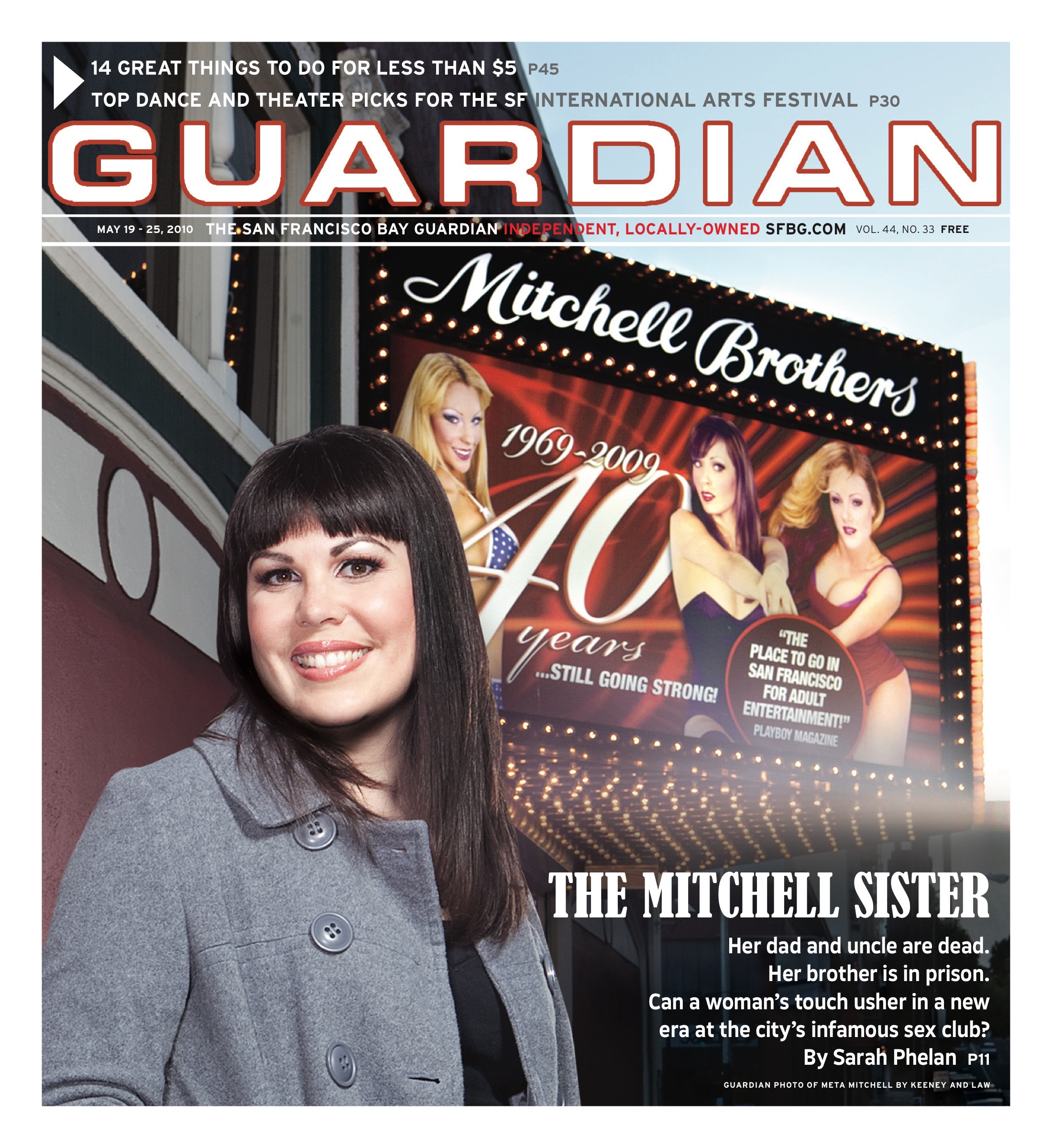
The Mitchell sister

3

sarah@sfbg.com

Porn heiress Meta Jane Mitchell Johnson is running a little late when I arrive at the Mitchell Brothers O’Farrell Theater, the adult entertainment establishment her father Jim Mitchell and uncle Artie Mitchell founded on the edge of the Tenderloin, just blocks from City Hall, July 4, 1969.

Johnson, 32, recently became co-owner of the theater and invited me over to discuss her vision for this notoriously hardcore strip club and the challenges she faces in an industry dominated by the Déjà Vu corporate strip club chain, in a town whose political leaders are still trying to figure out how best to regulate the clubs to ensure that their predominantly female workforce is properly compensated and protected from harassment in safe, sanitary conditions.

A young guy on the front register ushers me into a side room. The walls are decorated with photographs that recall the people and players who have made this club such a storied San Francisco institution and a landmark in the history of the sex industry.

There’s an image of a topless Marilyn Chambers, the star of Behind the Green Door, the porn film the Mitchell brothers shot and screened at the theater in 1972 and was a major hit after it became known that Chambers was also the wholesome face on Ivory Snow soap flakes box.

There is a photo of Artie with a young raven perched over his shoulder. It was taken in 1990 during a trip to Aspen, Colo., to support gonzo journalist Hunter S. Thompson, who worked at the club in the 1980s and was facing serious charges, including sexual assault and possession of drugs and explosives, that eventually got dropped.

Another shows both the Mitchell brothers, photographed when they were still young and rakish and battling the vice squad, even as they entertained the local political elite.

Today the brothers are dead, Artie from bullet wounds inflicted when Jim shot him with a rifle in February 1991; Jim from a heart attack in July 2007. And now Jim’s oldest son, James Mitchell, 28, is in jail awaiting trial for allegedly beating his ex-girlfriend Danielle Keller to death with a baseball bat in July 2009 and abducting their baby daughter, Samantha.

Unlike his father, who continued to run the Mitchell porn empire after serving less than three years for voluntary manslaughter, James is facing life behind bars.

“He is charged with six serious felonies and is facing life imprisonment with no possibility of parole,” Marin County Deputy Chief District Attorney Barry Borden said recently. Johnson told me that her brother no longer owns stock in Cinema 7, the corporation the Mitchell brothers founded to oversee their burgeoning sex business.

This latest family tragedy occurred in the wake of a $3.74 million class action suit that was settled in 2008. Brought by three MBOT dancers, the suit led to valid claims by 370 dancers who complained about Cinema 7’s “piece-rate” wage system. Under that system, the club compensated dancers solely for the number of private dances performed, waived meal and rest periods, and failed to reimburse dancers for costumes, props, and makeup.

Since then the club ended the piece-rate system, but introduced chips customers must buy to procure lap dances and encounters in small, curtained private rooms. On a recent night, the girls at the O’Farrell Theater remained smiling and bright-eyed as they succeeded in getting some customers to purchase chips for lap dances and private encounters. But the rest of the crowd remained largely silent and mostly tight-fisted as customers watched the club’s exotic dancers perform on its disco-balled stage.

All of which left me wondering if Johnson can succeed in overcoming her family history and reputation to make a difference for her workers and community while facing a nationwide recession in an industry dominated by an out-of-state chain.


THE UNLIKELY SAVIOR

Johnson greets me dressed in Ugg boots and jeans, apologizes for being tardy, and leads the way upstairs to the theater’s office so we can talk.

I first met Johnson in 2007 (“Behind the Mitchell’s Door,” 07/22/09) when she arrived at the theater in knee-high boots, clutching a massive lime handbag and a tiny dog named Baby. During that first encounter, three months after her father died, Johnson confided that when she took over the office, it was full of dildos dancers had given the Mitchell brothers. Placing her dog on the pool table that dominated the office, she said she planned to massage all this male energy toward femininity.

Today it looks as if she has started to deliver on that promise. The pool table is gone. The sofa where Hunter S. Thompson used to sit remains in the room. But now a clothesline runs between the office walls, draped with a stripper’s glove, stilettos, and a G-string emblazoned with the word “Gonzo,” presumably in honor of Thompson.

“It was a little thing we made to give away,” Johnson laughs.

She introduces her youngest brother and club co-owner, Justin. “Me and Justin are close. We are the owners and we are making some changes,” Johnson explains. “We are making the prices more reasonable so customers don’t have to spend an arm and a leg just to get a lap dance. And we’re going to hold events like poetry slams. We are trying to make the club fun again. We definitely see a hit due to the economy, but we’ve also been hit by the decision from the class action lawsuit.”

Johnson insists she and her brother aren’t “your typical strip club owners.”

Were in a symbiotic relationship with our dancers, she says. That sets us apart from other clubs. The dancers are our employees. We pay them minimum wage and workers comp. We cover their Healthy San Francisco costs. We incur a lot of expenses legally employing our dancers. But instead of crying about our handicap,’ she said, referring to treating dancers as employees, my goal is to show we can manage the club without a pimp mentality, without a How much can you shake them down for? approach.

“A lot of our employees have been here a long time and have had to deal with all the painful violent stuff too,” she continued. “And folks are still here, even though their hours got cut and they are not making as much money.

In 2007, Johnson told me that she resented the family business when she was growing up. “The boys could go inside, and I couldn’t,” she recalled. It wasn’t until 2004, when she was working as a mortgage consultant in a cubical farm in San Ramon that Johnson began to take pride in the business “as something that had taken care of us through the years.”

Johnson, who became the club’s scheduling manager in 2005, recalls the shock of losing her dad in 2007. “It was like being dumped in icy water,” she says. “At first we didn’t know how to handle it. But we learned. Five years ago, I was much more liable to listen to advice. But I need to be able to fall asleep feeling good. That involves treating people a certain way. I don’t think any other strip club in the country is being run the way this one is.”

Johnson got married and went on maternity leave in 2008. ” When my son was six months old, I came back for the club’s 40th anniversary party and I realized, they need me both of us [she and her brother]— as owners, steering the proverbial ship. No one else wants to be held accountable. We never discussed selling. Our father built this place. It’s completely shaped our lives. Good or bad, it’s ours.”


TOUGH INDUSTRY

As a nude strip club, Mitchell Brothers’ O’Farrell Theatre stands in direct competition with Crazy Horse on Market Street and the Déjà Vu-owned clubs including the Market Street Theaters, Gold Clubs and other spots in SoMa, and most of the clubs in North Beach. The exception is Lusty Lady, the only unionized, worker-owned peepshow in the country.

If you walk into the Gold Club in San Francisco, well, there are 50 other Gold Clubs in the country, so, its generic, Johnson says. But theyve got their business model. Were not trying to copy Déjà Vu or Crazy Horse. Were the Mitchell Brothers. Its been part of us and our whole history.

Dancers agree that the Lusty Lady isn’t in competition with Déjà Vu.

“They’re Walmart, and we’re the mom and pop store on the corner,” Lorelei*, a dancer at Lusty Lady, said. “At the Lusty, we pride ourselves on being alternative and having tattoos and piercings.”

Some dancers, who we’ve indicated with an asterisk after their altered names, voiced fear of being identified as critics of Déjà Vu’s business model.

“If Deja Vu found out I was shit-talking them I would probably get fired and be blacklisted from all their clubs,” Sugar* said. “If I were to get blacklisted, I’d be totally screwed because there are no other clubs in San Francisco,” where she doesn’t feel pressure to do more than dance, “which is not my thing.”

“Or the Lusty Lady, which doesn’t pay enough to cover my bills,” she continued. “But Deja Vu is notorious for being a terrible company to work for, mainly because of their outrageously high stage fees.”

Other dancers say they had to pay stage fees at the Déjà Vu-owned Hungry I, and sometimes went home empty-handed after eight-hour shifts when uninvited touching was common.

“The number one thing that would improve our work experience is if someone actually forced Deja Vu to stop charging us stage fees,” Amber* said. “Almost no one outside the industry knows that dancers pay money to go to work. A lot of customers think the clubs pay us, like, thousands of dollars. In San Francisco we pay between $100–$200 per shift, sometimes more.”

By law, dancers have the right to choose employee status, versus being considered independent contractors. “But that’s a joke,” Amber added. “If we choose employee status, we’re required to do a minimum of 10 lap dances per shift. The club keeps all that money, and we would get paid $12–$15 an hour.”

But Edi Thomas, counsel for Déjà Vus Centerfolds club, flatly denies that the dancers who perform at Centerfolds (the only nightclub in San Francisco authorized to operate as a Deja Vu Showgirls club) pay stage fees.

Rather, entertainers who perform at Centerfolds (and/or at Hungry I, the Condor, and Market Street) are paid a substantial percentage of the patron revenues generated from individual dance sales, Thomas stated.

The entertainers are issued Forms 1099 at year-end, reflecting the amounts they were paid by the nightclub, she said, which means the dancers are independent contractors, not employees. These nightclubs operate within the law and make every effort to assure that entertainers are well compensated and perform in safe and lawful environments.

There are, as in any industry, former and disgruntled workers carrying a desire to harm a nightclub or the industry for their own personal reasons, Thomas added. “But those workers do not represent the voice of the majority.


CENTER OF THE STORM

When the Mitchell Brothers founded their empire, it was against a backdrop of organized crime trying to exercise a monopoly on the porn industry. According to a 1977 U.S. Department of Justice report, members of La Cosa Nostra tried to request exclusive distribution of Mitchell Brothers’ porn films.

The Mitchells resisted for years, but DOJ claims they eventually entered into a contract with LCN’s Michael Zaffarano to distribute “Autobiography of a Flea.” the Mitchells also fought City Hall.

During the 1980s, Mayor Dianne Feinstein’s vice squad tried to close the Mitchell Brothers’ operations. But under Mayor Willie Brown, the former attorney for late Déjà Vu strip club owner Sam Conti, SFPD enforcement reportedly eased.

Then in 1997, Déjà Vu started to take control of the city’s sex clubs, introducing stage fees and private rooms. In 2002, three former MBOT dancers filed their suit against Cinema 7. The next year, three other dancers brought suits against Market Street Cinema and Century Theater. And in 2005, Deja Vu settled a class action labor suit with its dancers. Attorney Greg Walston, representing the dancers, said at the time that minimum pay rate would protect dancers from being forced into prostitution to make money.

Deja Vu threatened a counter-suit based on the allegations of prostitution at their clubs, but Walston told reporters: “The record speaks for itself.” Walston used police reports with prostitution allegations to bolster his case and said he was doing the job the District Attorney’s Office should have done.

In July 2008, when MBOT reached its $3.74 million class action settlement, Cinema 7 president Jeffrey Armstrong said that the corporation was “not able to pay the entire amount up front.” Instead, Mitchell matriarch Georgia Mitchell and her business partner John P. Morgan, then cotrustees of the Jim Mitchell 1990 Family Trust, which holds two-thirds of Cinema 7’s shares, pledged stock certificates as security interest.

But the debate about how to treat sex work in San Francisco continues. In November 2008, District Attorney Kamala Harris and Mayor Gavin Newsom opposed Proposition K, a local measure that tried to decriminalize prostitution by forbidding local authorities from investigating, arresting or prosecuting sex workers. They argued that the measure would increase prostitution on the streets, give pimps cover, and hamper efforts to stop sex trafficking. The measure failed.

At the time, Prop. K advocate Carol Leigh and cofounder of the Bay Area Sex Workers Advocacy Network said, “We feel that repressive policies don’t help trafficking victims, and that human rights-based approaches, including decriminalization, are actually more effective.”

Today, erotic dancers must identify which of a tangle of regulatory entities is the appropriate venue to lodge complaints. District Attorney spokesperson Erica Derryck said Harris is dedicated to prosecuting violent crimes committed against all San Franciscans, regardless of whether they happen in a club or an alley.

“If there are two drug dealers and one attacks the other, we’d prosecute. But that’s not to say there won’t also be consequences for underlying criminal behavior too,” she said. “But anyone who has been victimized should be confident of going to the police and reporting any incident.”

Derryck said public health and safety complaints can be lodged at entities that provide permits and licenses, including the Planning Department and Entertainment Commission.

“There might not be any criminal activity involved, but this route hits clubs in the pocket and is worth considering if dancers want to represent their grievances,” she said.

Meanwhile dancers say there is still pressure to do more than just dance in some clubs. “For some dancers, the clubs feel fine,” Lorelei says. “It’s a safe space where no ads are needed. They see it as a fair exchange. But if you just want to dance — when one girl is doing this, and another that, how are you supposed to make money?”

Other dancers wish managers wouldn’t abuse their power. “Sometimes they back you up,” Amber said. “Other nights, someone insults you and they won’t help.” And many wish management would try to make the clubs fun again.

“It used to be a party, but now it’s about the cheapest dirtiest fuck you can get,” Lorelei said. “Taking stage fees created a dark environment that carries over to the customers. It’s like we’re goats in a petting zoo begging, saying give me money, give me coke.”


FAMILY BUSINESS

Attorney Jim Quadra, who represented the dancers in the MBOT class action suit, said that for all the talk about treating dancers right, the Mitchells’ interest was money.

“At the time, a group of people thought the agenda was to get dancers to do more than dancing because that’s what brings in the revenue,” Quadra said. “But Meta comes off much better than the rest of her family.”

During the trial, Jim was asked if there were meetings where Cinema 7 personnel defined what they meant by a “lap dance” in the piece rate system.

“You need a lap for a lap dance,” Mitchell replied. “You are getting down to like, you know, lap dance, erotic theater, America. And your question is like just a waste of the public’s slender resources, like drop[ping] a basketball in the ghetto and asking, ‘Did you define what that is for them?'<0x2009>”

Johnson, who voluntarily took the witness stand, was asked if there was any reason dancers would be afraid of her father. “He can be a little gruff and he can be cranky, a grouchy old man,” she replied.

Today Johnson is moving ahead with a vision she began to outline in 2007, then put on hold until December 2009, when a law suit about the family trust fund was settled.

“We settled everything out of court in December with my grandmother, which was a nice Christmas present,” she says, confirming that she and her siblings succeeded in removing their 83-year grandmother, Georgia Mae Mitchell, as trustee of the Jim Mitchell family fund. They replaced her with their mother, Jim Mitchell’s ex-wife, Mary Jane Whitty-Grimm, who also has custody of James’s baby daughter, Samantha.

“Danielle’s mother has some personal problems … that made the court reluctant to give her custody of the baby. so they gave Samantha to Mary, who is a nice woman, who is married with a family,” former San Francisco D.A. Terence Hallinan told me, after James Mitchell replaced him with another private criminal defense attorney, Douglas Horngrad, in March.

In court filings related to the family trust fund, Mitchell matriarch Georgia Mae claimed her grandchildren’s lawsuit was intended to deny her jailed grandson James his share of the trust to defend against his serious felony charges.

“Justin asked me to take money out of the trust account of his brother James, and send it to his mother instead of paying his criminal defense attorney, Terence Hallinan,” the Mitchell matriarch claimed.

I asked Hallinan if the trust fund was the reason James Mitchell changed attorneys. “Yes and no,” Hallinan said. “It definitely had to do with money and who was going to run the club. The poor grandma, she is such a nice person. She was trying to play fair and be nice to all the kids. It’s not a really healthy family. ‘Rafe’ [James] is where he is. In my opinion, he is still not clear what happened or why.”

Johnson, for her part, says her brother James has mental health issues. “I don’t accept what he did,” she said. “I’m not making any excuses for it. He’s either insane or he’s a monster. But the family has an obligation to make sure he has legal defense. He was always a beneficiary of the trust. But he fired his lawyer, which is the worst thing he could have done.”

A restraining order Keller secured five days before she was murdered claims Mitchell abused her for years, had mood swings, used cocaine, and was addicted to methamphetamines.

“Danny should have left,” Johnson said.

It’s been painful to read the comments people leave,” she continued, referring to online reaction to her brother’s arrest that suggest the Mitchells are bad seed and should be wiped out. It’s not because James is a Mitchell, or because there’s some bad gene.”

Rather, she said he had serious unaddressed problems, “a time bomb that was going to explode and then it did in just about the most horrific way imaginable.”

“When I was 13, my father shot my uncle Artie. And when I was 31, James killed Danny,” she adds. “So I hope I don’t live to be 103.”


WOMEN’S WORK

In 1985, the O’Farrell Theater’s marquee famously read, “For show times call … ” followed by Mayor Feinstein’s phone number. But that was another era.

“I don’t know Dianne Feinstein,” Johnson says, as she shows me a cartoon R. Crumb drew in 1985 of then-Mayor Feinstein as Little Bo Peep, with a bunch of men, including political and law enforcement leaders, peeking out from under her skirts. “I know my father was never very fond of her. And I’m sure her reasons for wanting to shut the club down were based on the idea that women are being exploited and that we need to save them.”

Johnson says some of their dancers are single moms; some are young girls who can’t get enough work at retail jobs to pay their bills; and others are college students and graduates.

“There are as many stories as there are dancers. But the stereotype is that dancers are being exploited and have to be protected because they can’t protect themselves and no one really wants to dance. But when I came through the club door, I realized that many women want to do this and get upset if people try to save them. Some people feel that working in a strip club is bad, wrong, dirty. No. But it can be if you are pushed into it and don’t want to do it.”

Dancers the Guardian spoke to confirmed that they dislike being framed as victims. When we are painted as victims, we look stupid, Lorelei said. All we want is to make sure that folks are following the labor code and providing the same basic, decent working conditions youd get if you were working at a coffee shop.

But dancers know that some people are titillated by the idea of women being taken advantage of. “They don’t want that fantasy to go away, that she’s really a good girl and doesn’t want to do it,” Lorelei said. “If it turns out we are not traumatized, horrified, or disenfranchised, it ruins the whole fantasy.”

She fears that political leaders know bad things are happening but don’t want to talk about them for fear it implies they are permitting them. “The attitude is these women aren’t real, they are sex workers, so if they get raped or go missing, who cares?” Lorelei claimed. “We can’t admit they are the babysitter, the girl who sits next to you at the office.”

When Johnson began working at MBOT, she was shocked that the dancers were naked. “But no one is forcing anyone to be here,” she says. “Sure, some women dance out of necessity. But there are women who are really into it … What’s bad is the exploitation.”

It’s hard to tell from the outside whether the MBOT dancers are feeling better about their working conditions these days or whether having a woman in charge makes a big difference.

On a recent Saturday night, we were charged $40 to enter the club. The ticket gave us access to the theater’s main stage, where a succession of ethnically diverse and athletically built girls pranced, pole danced, and eventually took it all off — in tasteful fashion — as the customers threw tips on stage.

A friendly girl asked if we’d like some company but backed off gracefully when we declined to do more than chat. No one else tried to hustle us for the next hour, and we didn’t get the sense that these women were desperate to make more money. The private rooms remained empty during our visit. But there are VIP rooms that we didn’t have access to, and it’s possible more hardcore stuff was going on elsewhere in the club.

As we left, a tour bus pulled up outside, full of tourists who pressed their noses against the bus windows to eyeball the famed Mitchell Brothers establishment, drawn just to gawk at this titillating and complicated San Francisco institution.

Johnson and Mitchell believe their club gives women a path to financial independence and that having a female in charge makes a difference. They don’t need a man,” Johnson says. “In most strip clubs, the pay is all under the table, and the girls keep cash in shoe box under the bed.”

“Dodging the IRS,” Mitchell adds.

But they recognize that some dancers may be coming from abusive situations. Johnson said she realized one dancer was in trouble when she asked to be booked for every shift. “I looked at the situation and saw 16-hour days in stilettos and an exhausting schedule. It took a woman’s insight to work out what was going on.”

“It goes back to a woman’s touch, ” Mitchell says.

Johnson blames this nation’s puritanical roots for the abiding disapproval toward the sex industry and those who work in it.

“But it’s come a long way,” Mitchell interjects.” When this place first started, it got raided non-stop. Now it’s much more acceptable than 20 years ago. In the next 20 years, I’m optimistic that prostitution will be decriminalized, at least in our city, if not in our state.”

So is prostitution happening as much as some dancers say it is? “You can’t penalize people for surviving,” Johnson says. “What dancers do outside clubs is their business. We don’t have control over them. All we can do is worry about them. We don’t condone illegal activity inside the club. We don’t encourage or support it. That’s our official take.”

Johnson acknowledges the O’Farrell Theater may have the reputation for being perhaps the most hardcore club in the city. “But everything that happens here, happens elsewhere,” she says. “It’s the same exact deal except they don’t care at all, and we’re a family-run business.”

Mitchell observes that the O’Farrell Theater is huge part of the city’s tourism industry. “When conventions come through, we’re one of the prime tourist spots, along with Fisherman’s Wharf and the Golden Gate Bridge,” he said.

“San Francisco is known for its freewheeling sexuality, like the Folsom Street Fair,” Johnson adds. “People say San Francisco is Oakland’s slutty sister. And people come here because this club is an institution, a landmark in San Francisco.”

So can Johnson make a difference against this convoluted backdrop?

“It’s a benefit to have a female in management,” Johnson claims. “When we come up with an idea, I think: How will the dancers feel? We’re on the same team. I treat them like teammates. We’re not in a battle over who gets the most money. I can see through things. Women manipulate men, and dancers are in the business of manipulating men. It’s a sale. It’s a hustle. They have that mindset. But I say, no, you don’t need to make up situations. You just tell us what’s up. But that’s not the normal attitude. In most clubs, it’s ‘Shut up, do what we say, and pay your fees.'”

Johnson says she was recently at the AT&T store, and the girl asked where she worked. “I said, at a strip club. People find that incredibly interesting. This girl was 23 and she was not comfortable with the idea of dancing, but at the same time she was fascinated by it. And it’s not going away, women dancing and stripping, You can hate it; you can love it — it doesn’t matter.”

After so many years on the San Francisco scene, MBOT is striving to be a legitimate part of its neighborhood and the city’s business community. And to Johnson, some of that involves unfinished business.

Lou Silva was the artist who did the original mural of whales on the clubs wall. Thats what I remember as a child. My dad and uncle were connected to that community and the underground comic movement in the late 1970s. They made money, they wanted to spread the love around, so they did a giant art project on the side wall. And a couple of years before my uncle died, they started to redo it. But the project stopped when my uncle was shot. We are going to bring the whales back. Were working on it with an Academy of Art class. It will be far more peaceful and calm than a crazy jungle scene on the wall. We want to redo whales to demonstrate that we are interested in more than just sex and exploitation. We want to be connected to our community again.

Noting that the new mural is part of the beautification of Polk Street, Johnson concludes: The mural on the wall is unfinished because of Arties death. Now its time to finish it, not to have unfinished art on the wall because of some horrible, violent incident. Its an investment to show we are not the Mitchells everyone thinks we are.

Shake-shake-shake

1

superego@sfbg.com

SUPER EGO And so, my queer peeps, we finally get an official “day” that won’t automatically invoke thoughts of rainbow jock straps, hot pink pasties, inscrutable promotional booths, and Miller Lite sponsorships. I’m talking about the new Harvey Milk Day, May 22, which doesn’t yet involve an Altoids float full of Gold’s Gym refugees or a Virgin sweepstakes. But I’m sure we’ll try our damnedest!

J/k, j/k, don’t get your Pride panties all in a twist, just sayin’. It’s beyond lovely that Mr. Milk is finally being recognized by California, thanks to our perennially tanned, leather-pantsed, and boyish state Sen. Mark Leno. And it’ll be plum-dandy to (hopefully) refocus on the great political legacy of the queer movement.

That’s not to say we’re not gonna have ourselves a little party. All day Saturday, the Castro District will be abuzz with what looks like 20-hundred gonzo events, everything from a “Hotcakes for Harvey” brunch at the Harvey Milk Civil Rights Academy, to the crazy tricycle-race-meets-bar-crawl Tour de Castro with the Sisters of Perpetual Indulgence, to a, duh, “Milk & Cookies Street Fair.” Happily bewilder yourself by visiting www.milkday.org for the full rundown. Then, on Sun/23, the ginormous Kink Armory gets taken over for a hootin’ and hollerin’ Castro County Fair (www.castrocountyfair.org) and a fruity evening Milk Shake party hits 715 Harrison (www.milkshake2010.com). No, we don’t get a day off work, but if you’re queer, you best be workin’ all the time anyway.


TERRORBIRD

Oh yes, Terrorbird is a real thing, with terrorclaws. OK, it’s not that scary, but Terrorbird is one of the biggest local indie and electronic music promoters going, and it’s celebrating its fourth birthday with a beakin’ extravaganza. DJs Sugar & Gold and Disco Shawn work it out between primo acts Man/Miracle, Baths, the Splinters, and Sister Crayon.

Thu/20, 8 p.m., $5. Milk, 1840 Haight, SF. www.milksf.com


JD SAMSON

If you don’t have a kinda-crush on JD Samson, formerly of Le Tigre and now of MEN, you are not human. Samson will bring expertly fun electro-fied rock skills to “create space for rad people to dance and smile and hold each other.” Unicrons and The Workout host, Honey Soundsystem, Distorted Disco DJs, Fonzie, and more open up.

Fri/21, 9 p.m., $10. Triple Crown, 1772 Market, SF. www.triplecrownsf.com


FAREWELL J.PHLIP

Oh man, one of my favorite DJs in San Francisco is leaving, and I can’t even be mad at her because she’s (of course) going to Berlin. You can catch her waving a mind-melting techno adieu at the superior Phonic party at the EndUp on Thursday, or you can watch her wig out with world-famous Dirtybird labelmates Claude Vonstroke, Justin Martin, Christian Martin, and Worthy at Mezzanine. Better yet, do both for a double dose. See ya on the Phlipside, J.

Fri/21, 9 p.m.-4 a.m., $15. Mezzanine, 444 Jessie, SF. www.mezzaninesf.com


NGUZUNGUZU

Completely mad tropical bass rave sounds from this young Los Angeles duo who are blowing up the spotlight with that warped airhorn sound. Catch them rumbling the intimate 222 Hyde space with support from Ghosts on Tape, Disco Shawn, and Rollie Fingers.

Sat/22, 10 p.m., $5. 222 Hyde, SF. www.222hyde.com


SANGUINE SUNDAY

Soulful sassiness all Sunday afternoon at this North Beach throwdown. Mama Feelgood hostesses, soul food is served, tacos cost a dollar, local artists astound, and DJs Centipede, Romanowski, Aebldee, and Honey Knuckles knock on smooth beats of every genres — vinyl 45s only, folks!

Sun/23, 2 p.m.–7 p.m., free. Mojito, 1337 Grant, SF. www.myspace.com/mojitosf


CAPSULE DESIGN FESTIVAL

Look, to go out you don’t just need to have style, you need to be style. Which may explain why I’ve worn the same flannel shirt and Tigers ball cap to the club for the past five years. Meet me at this Hayes Valley afternoon extravaganza featuring more local underground designers than you can shake a wire hanger at (and curated by Javier Natureboy, so you know it’ll be edgy). Let’s put on a new attitude.

Sun/23, 11 a.m.–6 p.m., free. Hayes Green , SF. www.uniondesignsf.com

Quick Lit: May 19-May 25

0

Literary readings, book tours, and talks this week

Michael Chabon, Chuck Palahniuk, a celebration of Bukowski, Carol Queen revisits exhibitionism, Rebecca Solnit and Mona Caron create a California bestiary, and more

Wednesday, May 19

A California Bestiary
Authors Rebecca Solnit and Mona Caron partnered to create their own book of magical California beasts inspired by medieval bestiaries that were more fanciful than factual.
7 p.m., free
Green Arcade
1680 Market, SF
(415) 431-6800

Celebrate Bukowski
Celebrate the release of Absence of the Hero: Uncollected Stories and Essays by Charles Bukowski with editor David Calonne in conversation with Garrett Caples and readings from Stephen Elliot and Daphne Gottlieb.
7 p.m., free
City Lights Bookstore
261 Columbus, SF
(415) 362-8193

The Empire Strikes Out
Author Robert Elias reads from his new book The Empire Strikes Out: How baseball sold U.S. foreign policy and promoted the American way abroad, which takes an eye-opening look at baseball’s relationship to the American empire, from the revolutionary era to the present.
7:30 p.m., free
Pegasus Books Downtown
2349 Shattuck, Berk
(510) 649-1320

Michael Chabon
Join bestselling and Pulitzer Prize-winning author Michael Chabon as he discusses his new memoir, Manhood for Amateurs.
7:30 p.m., free
The Booksmith
1644 Haight, SF
(415) 863-8688

“Massive Stars and Their Temper Tantrums”
Join UC Berkeley professor Dr. Nathan Smith as he discusses the properties of the most massive stars, and the life and death of large, unstable stars, such as Eta Carinae.
7:30 p.m., free
Randall Museum
199 Museum Way, SF
(415) 554-9600
www.randallmuseum.org

Carol Queen
Attend a book party for Queen’s 1996 book, Exhibitionism for the Shy, featuring new chapters on internet exhibitionism and added interviews. Dress up, show off, and talk hot at this discussion on finding your own erotic identity and comfort zone to become the erotically outgoing soul you’d like to be.
6:30 p.m., free
Good Vibrations Berkeley
2504 San Pablo, Berk.
http://events.goodvibes.com

Thursday, May 20

An evening with Chuck Palahniuk
Hear the famed author of Fight Club discuss his new book Tell All, a Sunset Boulevard homage to Old Hollywood, filled with name-dropping and nostalgia.
7:30 p.m., $36
Swedish American Hall
2174 Market, SF
(415) 863-8688

California Condors
Learn more about the reestablished population of California Condors after their near extinction 30 years ago at this talk with National Park Service wildlife biologist Daniel George titled, “The Natural History and Future of California Condors.”
7:30 p.m., free
First Unitarian Universalist Church
1187 Franklin, SF
www.goldengateaudubon.org

The Food Industry
Hear Pulitzer Prize winner and New York Times reporter Michael Moss discuss lapses in food safety, nutrition related issues, the White House’s war on obesity and more in conversation with KQED reporter Sarah Varney.
Noon, $20
Commonwealth Club
2nd floor
595 Market, SF
(415) 597-6700

Hearts for Madeline
Hear author Page Hodel talk about her new book about when she met Madelene Rodriguez, who soon after died of cancer, and how she still leaves crafted hearts on her doorstep to say ‘I love you.’
7:30 p.m., free
Books Inc.
2275 Market, SF
(415) 864-6777

InsideStorytime: Crime
Enjoy readings from crime writers Lisa Lutz, author of The Spellmans Strike Again, Mark Coggins, author of The Big Wake-up, Seth Harwood, author of Jack Wakes Up, Mitzi Ngim, and Julie Graham with MC Ransom Stephens.
6:30 p.m., $3-$5 sliding scale
Café Royale
800 Post, SF
(415) 505-0869
www.insidestorytime.com

Low Bite
Attend this launch of Sin Soracco’s new prison novel about survival, dignity, friendship, and insubordination inside a women’s prison.
7 p.m., free
Modern Times Bookstore
888 Valencia, SF
www.mtbs.com

“Lyman vs. Niman: Can you be a good environmentalist and still eat meat?”
Raising livestock is resource-intensive and, we are beginning to learn, a significant contributor to greenhouse gas emissions. Nicolette Hahn Niman, a Marin rancher and author of Righteous Porkchop, will argue that there is an ecologically sustainable way to eat meat against Howard Lyman, the author of Mad Cowboy: Plain truth from a cattle rancher who won’t eat meat.
7 p.m., $10-$20
David Brower Center
Richard & Rhoda Goldman Theater
2150 Allston, Berk.
(510) 859-9100

Friday, May 21

To Teach: The Journey, In Comics
Graphic artist Ryan Alexander-Tanner brings William Ayers’ memoir To Teach: The journey of a teacher to life in this new graphic novel.
7 p.m., free
Green Arcade
1680 Market, SF
(415) 431-6800

Saturday, May 22

“Shanghai”
Attend an Asian Art Museum docent talk featuring a lecture and slideshow presentation about the museum’s exhibition “Shanghai.” The talk will be in English and Cantonese.
2:30 p.m., free
Chinatown Branch Library
Community Room
1135 Powell, SF
(415) 355-2888

Very Good-Looking Seeks Same
Author Robert Philipson will read from his new book, Very Good-Looking Seeks Same: Gay profiles in search of love, a new volume of transgressive, internet inspired poems, at this event featuring refreshments and live jazz music.
5 p.m., free
San Francisco LGBT Center
4th floor
1800 Market, SF
(415) 865-5555

Sunday, May 23

Broken Promises, Broken Dreams
Hear author Alice Rothchild explore the complexities of Jewish Israeli attitudes and the hardships of Palestinians living in the West Bank and Gaza through personal narratives based on work with medical delegations in the region.
3 p.m., free
Modern Times Bookstore
888 Valencia, SF
www.mtbs.com

Monday, May 24

Sunnyside
Bay Area author Glen David Gold discusses his new American epic, Sunnyside, starring Charlie Chaplin, about dreams, ambition, and the birth of modern America.
7:30 p.m., free
The Booksmith
1644 Haight, SF
(415) 863-8688


War: As Soldiers Really Live It

Hear Sebastian Junger discuss his new book about the reality of combat, the fear, honor and trust among men in an extreme situation whose survival depends on their absolute commitment to one another. His on-the-ground account follows a single platoon through a 15 month tour of duty in the most dangerous outpost in Afghanistan’s Korengal Valley.
7:30 p.m., $12
First Congregational Church of Berkeley
2345 Channing, Berk.
(510) 848-6767

Tuesday, May 25


A Poem for Mother Earth

Attend this poetry sharing and community healing ceremony featuring poetry, spoken word, and music from migrant Raza, indigenous youth, adults, and elders in poverty focused on the impacts of climate change  on indigenous peoples and poor people of color.
Noon, free
Galleria de la Raza
2857 24th St., SF
www.poormagazine.org

Benefits: May 19-May 25

0

Ways to have fun while giving back this week

Friday, May 21


Threatened, Endangered, Extinct

Celebrate 2010 Endangered Species Day at this lively discussion with experts currently creating strategies to protect biodiversity and convert consumers worldwide featuring cocktails, hors d’oeuvres, a silent auction including travel, restaurants, jewelry, limited edition signed wildlife prints, and more.
6 p.m., free
The University Club
800 Powell, SF
RSVP to sullivan@wildaid.org

Three-Minute Picture Show
Shake your booty to the music of Ron Silva and the Monarchs and enter to win raffle prizes from 3 Fish Studios, Books Inc., Gregory Cowley Photography, Interior Design Fair, Madrone Art Bar, and more at this benefit soiree featuring a screening of past Three-Minute Picture Show audience favorites.
7:30 p.m., $7
Make-Out Room
3225 22nd St., SF
www.threeminutepictureshow.com

Saturday, May 22

Bachelor Firefighter Auction
Bid on a smokin’ hot bachelor and enjoy raffle prizes, music, and other suprises at this fundraiser for the Alisa Ann Ruch Burn Foundation, a nonprofit dedicated to enhancing the lives of burn survivors and promoting burn prevention education.
8 p.m., $35
Sir Francis Drake Hotel
450 Powell, SF
http://buyfiremen.eventbrite.com

Harvey Milk Diversity Brunch
Celebrate the birthday and life of Harvey Milk, the first openly gay elected official. Enjoy well-known speakers from the LGBT community, food from Hott Box Catering, and more at this fundraiser for La Cocina, a small business support resource.
10:30 a.m., $65
The Arc of San Francisco
1500 Howard, SF
www.milkday.org

Public Glass Auction
Attend this benefit auction featuring the work of more than 60 renowned glass artists, wine, and hors d’ oeuvres. Proceeds will go towards Public Glass’ education program that reaches 300 students a year.
4:30 p.m., $50
First Unitarian Universalist Church and Center
1187 Franklin, SF
www.publicglass.org

Reliquarium
Attend this auction of reliquary-like objects representing the artistic DNA of writers and artists, housed in an attractive container. Participating artists include Justin Timberlake, Lemony Snicket, Jonathan Lethem, Anne Waldman, and more. Proceeds to benefit Small Press Traffic, an organization that brings together independent readers, writers, and presses.
5:30 p.m., $20 includes refreshments
California College of the Arts
Graduate Writing Studio
195 De Haro, SF
www.sptraffic.org

Sunday, May 23

Backyard BBQ for Chile
Join the Art House Gallery at this backyard potluck BBQ to benefit the Chile Earthquake Relief Effort featuring live music by Rafael Manriquez, Esteban Bello, Clara Bellino, and more. Look for the balloons.
Noon, $5-$50
Edith between Cedar and Lincoln, Berk.
(510) 472-3170

Castro County Fair
Join AIDS Emergency Fund on Harvey Milk weekend for a one of a kind county fair and fundraiser, featuring a dog-owner look alike contest, carnival games, country western dancing, a pie baking contest, an orchid show, field day events, and more.
10 a.m., $25
The Armory
14th at Mission, SF
www.castrocountyfair.org


Chance for Change

Enjoy a night of food, music, an auction, and a tribute to the struggles of homeless women and children at this fundraiser for Berkeley Women’s Daytime Drop-In Center, a daytime program for homeless women and their children.
3 p.m., $50
St. Alban’s Episcopal Church
1501 Washington, Albany
(510) 548-2884
www.womensdropin.org

Hidden Gems Garden Tour
Take a look at ten inspiring private gardens and public spaces with gardeners on hand to answer questions at this fundraiser for the new Potrero Hill Library.
10 a.m.; $25, $40 for two
Christopher’s Books
1400 18th St., SF
(415) 255-8802
All States Best Foods
1607 20th St., SF
(415) 642-3230

Stage listings

0

Stage listings are compiled by Guardian staff. Performance times may change; call venues to confirm. Reviewers are Robert Avila, Rita Felciano, and Nicole Gluckstern. Submit items for the listings at listings@sfbg.com.

THEATER

OPENING

The Apotheosis of Pig Husbandry SF Playhouse, 533 Sutter; www.sfplayhouse.org. $20-30. Previews Wed/19-Fri/21, 8pm. Opens Sat/22, 8pm. Runs Wed-Sat, 8pm. Through June 12. SF Playhouse presents the world premiere of William Bivins’ new play, set at the sleazy Lazy Eight Motel, as part of its stripped-down Sandbox Series.

Bone to Pick and Diadem Cutting Ball Theater, Exit on Taylor, 277 Taylor; 1-800-838-3006, www.cuttingball.com. $15-30. Previews Fri/21-Sat/22, 8pm; Sun/23, 5pm. Opens May 27, 8pm (gala opening May 28, 8pm). Runs Thurs-Sat, 8pm; Sun, 5pm. Through June 20. Cutting Ball Theater closes its tenth season with a pair of plays by Eugenie Chan.

The Breath of Life NohSpace, 2840 Mariposa; www.brownpapertickets.com. $25. Opens Fri/21, 8pm. Runs Thurs-Sat, 8pm; Sun, 5pm. Through June 6. Spare Stage Productions performs David Hare’s drama about a wife and mistress dumped by the same man.

How I Learned to Stop Worrying and Lost My Virginity SF Playhouse, 533 Sutter; www.sfplayhouse.org. $20. Opens Sun/23, 7pm. Runs Sun, 7pm. Through June 27. Aileen Clark returns with a special run of her autobiographical comedy.

"San Francisco International Arts Festival" Various venues; 1-800-838-3006, www.sfiaf.org. Most shows $25. May 19-31. In its seventh incarnation, the fest hosts dance, theater, and other artists from ten countries.

BAY AREA

God’s Ear Ashby Stage, 1901 Ashby, Berk; www.shotgunplayers.org. $15-28. Previews Wed/19, 7pm; Thurs/20, 8pm. Runs Wed, 7pm; Thurs-Sat, 8pm; and Sun, 5pm. Through June 20. Shotgun Players perform Jenny Schwartz’s drama about grief; Erica Chong Shuch directs.

ONGOING

An Apology for the Course and Outcome of Certain Events Delivered by Doctor John Faustus on This His Final Evening Garage, 975 Howard; 585-1221, http://pustheatre.com. $15. Thurs/20-Sat/22, 8pm. This new, relatively short play with the long title, presented by Performers Under Stress, struts and frets a wearying hour upon the stage as actor Scott Baker’s haughty and high-strung Faust, knowing he is bound for hell at the end of the evening, pleads his case before the audience, shadowed all the while by a speechless but expressive Mephistopheles (played with sly showmanship and moody animal intelligence by Valerie Fachman). Free brew aside, there’s little merit in playwright Mickle Maher’s self-conscious rambling, which more than anything chases its own tale — running in semantic circles without progressing anywhere or landing a bite. (Avila)

Andy Warhol: Good For the Jews? Jewish Theatre, 470 Florida; 292-1233, www.tjt-sf.org. $15-45. Thurs-Sat, 8pm; Sun, 2 and 7pm. Through June 20. Renowned monologist Josh Kornbluth is ready to admit his niche is a narrow one: he talks about himself, and more than that, he talks about his relationship to his beloved late father, the larger-than-life old-guard communist of Kornbluth’s breakthrough Red Diaper Baby. So it will not be surprising that in his current (and still evolving) work, created with director David Dower, the performer-playwright’s attempt to "enter" Warhol’s controversial ten portraits of famous 20th-century Jews (neatly illuminated at the back of the stage) stirs up memories of his father, along with a close family friend — an erudite bachelor and closeted homosexual who impressed the boyhood Josh with bedtime stories culled from his dissertation. The scenes in which Kornbluth recreates these childhood memories are among the show’s most effective, although throughout the narrative Kornbluth, never more confident in his capacities, remains a knowing charmer. (Avila)

Company Fat Exit Stage Left, 156 Eddy; www.brownpapertickets.com. $20-25. Thurs-Sat, 8pm. Through May 29. Exit Theatre and Pumpjam Productions perform Bill Levesque’s darkly comic play, set in the Depression-era South.

Eat, Pray, Laugh! Off-Market Theaters, 965 Mission; www.brownpapertickets.com. $20. Wed, 8pm. Through May 26. Off-Market Theaters presents stand up comic and solo artist Alicia Dattner in her award-winning solo show.

Echo’s Reach Brava Theater Center, 2781 24th St; 665-2275, www.citycircus.org. $14-35. Fri-Sat, 8pm (also Sat, 4pm); Sun, 4pm. Through May 30. City Circus premieres an urban fairytale by Tim Barsky.

Fishing Shotwell Studios, 3252 19th St; www.fishingtheplay.com. $25. Fri-Sat, 8pm. Through May 29. David Duman’s new play satirizes foodie culture.

Geezer Marsh MainStage, 1062 Valencia; 1-800-838-3006, www.themarsh.org. $20-50. Fri/21, 8pm; Sat/22, 8:30pm; Sun/23, 7pm. Geoff Hoyle presents a workshop performance of his new solo show about aging.

Giant Bones Exit Theatre, 156 Eddy; (650) 728-8098, www.brownpapertickets.com. $15-50. Thurs-Sat, 8pm. Through June 19. Fantasy author Peter S. Beagle (The Last Unicorn) penned the source material for Stuart Bousel’s world-premiere play.

*Hot Greeks Hypnodrome Theatre, 575 Tenth St; 1-800-838-3006, www.thrillpeddlers.com. $30-69. Thurs, 8pm; Sun, 7pm. Through June 27. On the principle that when you’ve got it you should really flaunt it, San Francisco’s Thrillpeddlers essay their second revival of a musical by the storied Cockettes. Hot Greeks, which premiered in midnight performances at the old Palace Theater in 1972, was the gleefully crazed cross-dressing troupe’s only other fully scripted musical besides, of course, Pearls Over Shanghai.

While not the Oresteia or anything, Hot Greeks is more than an excuse for a lot of louche, libidinous hilarity. Okay, not much more. But it is a knowing little romp — supported by some infectious songs courtesy of Martin Worman and Richard "Scrumbly" Koldewyn — wedding trashy high school romance with the trashy ancient Greece of Aristophanes and the Peloponnesian War. (Avila)

Marga Gomez is Proud and Bothered New Conservatory Theater Center, 25 Van Ness; 861-6988, www.nctcsf.org. $18-40. Thurs-Sat, 8pm (no show June 25); Sun, 2pm. Through June 26. Gomez performs her GLAAD Media award-winning comedy.

*Pearls Over Shanghai Hypnodrome, 575 Tenth St.; 1-800-838-3006, www.thrillpeddlers.com. $30-69. Fri-Sat, 8pm. Through June 26. Starting July 10, runs Sat, 8pm and Sun, 7pm. Through August 1. Thrillpeddlers presents this revival of the legendary Cockettes’ 1970 musical extravaganza.

Peter Pan Threesixty Theater, Ferry Park (on Embarcadero across from the Ferry Bldg); www.peterpantheshow.com. $30-125. Tues and Thurs, 7pm; Fri-Sat, 7:30pm (also Sat, 2pm); Wed, 2pm; Sun, 1 and 5pm. Through August 29. JM Barrie’s tale is performed in a specially-built 360-degree CGI theater.

The Real Americans The Marsh, 1062 Valencia; 826-5750, www.themarsh.org. $18-50. Wed-Thurs and May 28, 8pm; Sat, 5pm; Sun, 3pm. Through May 30. Starting July 8, runs Thurs-Fri, 8pm; Sat, 5pm; Sun, 3pm, through Aug 8. The Marsh presents the world premiere of Dan Hoyle’s new solo show.

Rhino Boxcar Playhouse, 505 Natoma; 776-1747, www.boxcartheatre.org. $14-25. Wed-Sat, 8pm. Through May 29. A stark spotlight, a vibrant cellist, masked players, and a chairless theatre space greet audience members attending Boxcar Theatre’s Ionesco adaptation, Rhino. Though encouraged to move about freely, most audience members (the night I attended) settled for turning their otherwise static bodies to follow the action occurring in every corner of the small room: a hypersomniac’s nightscapes, a lethargic love affair between a pair of petit bourgeoisie, the slowly unraveling radio announcer reporting on the encroaching tide of rhinoceres, a fraught spinster hysterical over the fate of her pussy (cat). Though a courageous choice in staging, it didn’t quite provide the feeling of the familiar under siege that it could have with more overt interaction with the not-quite-captive-enough public. And while certain of the short snipped scenes were tense and evocative — in particular the homesick lamentations and anxiety-laden dreams of Eugene (Ross Pasquale) — less subtle imaginings such as the intermittent lockstep marches fell flat. Bad German accents have a well-respected place in Monty Python sketches and the like — not so much in a play whose original strength of metaphor doesn’t need such obvious machinations. However, in keeping with an already-established Boxcar Theatre tradition, design elements such as lighting (Nick A. Olivero) and sound design (Sara Huddleston) were impeccable. (Nicole Gluckstern)

*Round and Round the Garden American Conservatory Theater, 415 Geary; 749-2228, www.act-sf.org. $10-82. Wed/19-Sat/22, 8pm (also Wed/19 and Sat/22, 2pm); Sun/23, 2pm. American Conservatory Theater offers a canny and contagious production of Alan Ayckbourn’s 1973 sex farce, one of the gems in the British playwright’s well-loved trilogy, "The Norman Conquests," which variously lands on the same group of related characters — centered on the loveable and lovelorn reprobate Norman (a charmingly unstrung Manoel Felciano) — during the course of a single weekend spent in giddy, desperate, troubled infidelities. Director John Rando and a razor-sharp cast deliver a very entertaining evening. (Avila)

Sandy Hackett’s Rat Pack Show Marines’ Memorial Theater, 609 Sutter; 771-6900. $30-89. Thurs/20-Sat/22, 8pm (also Sat/22, 2pm); Sun/23, 2pm. Starting May 28, runs Fri-Sat, 8pm (also Sat, 2pm); Sun, 2pm. Through June 27. From somewhere before the Beatles and after Broadway "Beatlemania" comes this big band cigarettes-and-high-ball nightclub act, recreating the storied Vegas stage shenanigans of iconic actor-crooners Frank Sinatra (David DeCosta), Dean Martin (Tony Basile), and Sammy Davis Jr. (Doug Starks), and sidekick comedian Joey Bishop (Sandy Hackett). The band is all-pro and the songs sound great — DeCosta’s singing as Sinatra is uncanny, but all do very presentable renditions of signature songs and standards. Meanwhile, a lot of mincing about the stage and the drink cart meets with more mixed success, and I don’t just mean scotch and soda. The Rat Pack is pre-PC, of course, but the off-color humor, while no doubt historically sound, can be dully moronic. (Avila)

Speed the Plow Royce Gallery, 2910 Mariposa; 1-866-811-4111, www.speedtheplowsf.com. $28. Thurs-Sat, 8pm. Through June 19. Expression Productions performs David Mamet’s black comedy.

Very Warm for May Eureka Theatre, 215 Jackson; 255-8207. $38-44. Wed/19, 7pm; Thurs/20-Fri/21, 8pm; Sat/22, 6pm; Sun/23, 3pm. 42nd Street Moon kicks off their Jerome Kern Celebration with this Oscar Hammerstein II script that features Kern’s final Broadway score.

What Mama Said About Down There Our Little Theater, 287 Ellis; 820-3250, www.theatrebayarea.org. $15-25. Thurs-Sun, 8pm. Through July 30. Writer-performer-activist Sia Amma presents this largely political, a bit clinical, inherently sexual, and utterly unforgettable performance piece.

BAY AREA

*East 14th: True Tales of a Reluctant Player Marsh Berkeley, 2120 Allston, Berk; www.themarsh.org. $20-50. Fri/21, June 4, 11, 18, 9pm; Sat/22, June 12, 8pm; May 30, June 6, 20, 7pm. Through June 20. Don Reed’s solo play, making its Oakland debut after an acclaimed New York run, is truly a welcome homecoming twice over. (Avila)

In the Wake Berkeley Repertory Theatre, Roda Theatre, 2015 Addison, Berk; (510) 647-2949, www.berkeleyrep.org. $13.50-71. Opens Wed/19, 8pm. Runs Tues and Thurs-Sat, 8pm (also Thurs and Sat, 2pm; no matinees Thurs/20, May 29, June 3, 12, or 17; no show June 25); Wed and Sun, 7pm (also Sun, 2pm). Through June 27. Berkeley Rep and Center Theatre Group perform Lisa Kron and Leigh Silverman’s drama about a woman on the verge of a nervous breakdown after she begins to question her faith in country, relationships, and herself.

Twelfth Night La Val’s Subterranean, 1834 Euclid, Berk; www.impacttheatre.com. $10-20. Thurs-Sat, 8pm. Through June 12. You’ve got to hand it to Impact Theatre: they make reimagining Shakespeare look so darned easy. To set a crass comedy about class, obsession, and mistaken identity at "Illyria Studios" in the heart of tawdry Tinseltown seems like such an obvious take, you wonder why it took someone so long to get around to doing it. True, the execution is not as vivacious as last year’s A Midsummer Night’s Dream, but overall, the enthusiastic cast and timeless humor win the night. (Gluckstern)

What Just Happened? Cabaret at the Marsh Berkeley, 2120 Allston, Berk; 1-800-838-3006, www.themarsh.org. $20-50. Fri/21, 9pm; Sat/22, 8pm. Nina Wise’s show, an improvised work based on personal and political recent events, extends and re-opens at a new venue.

The World’s Funniest Bubble Show Marsh Berkeley, 2120 Allston, Berk; (415) 826-5750, www.themarsh.org. $10-50. Sun, 11am. Through June 27. The Amazing Bubble Man, a.k.a. Louis Pearl, performs his family-friendly show.

PERFORMANCE/DANCE

"Baggage Allowance" Z Space at Theater Artaud, 450 Florida; www.brownpapertickets.com. Thurs-Sat, 8pm; Sun, 3pm. $16-20. Composer and artist Pamela Z presents her world-premiere multi-layered performance work.

"BorderOUT Collaborative: Noche de Inspiracion y Tradicion" Red Poppy Art House, 2698 Folsom; 826-2402. Fri, 8pm. $10-15. Music, theater, spoken word, acrobatics, stilt walking, and more from BorderOUT’s LGBTQ immigrant artists.

Crooked Jades with Kate Weare Dance Co. Noe Valley Ministry, 1021 Sanchez; 454-5238, www.noevalleymusicseries.com. Sat, 8pm. $20. The old-time music group performs with the modern dance company.

"Dream Come True: All-Female Battle and Showcase" City Dance Studios, 10 Colton; www.myspace.com/allfemalebattle. Sat, 8pm. $10-15. MCs, DJs, musicians, and dancers participate in this b-girl competition.

Sara Shelton Mann and David Szlasa Yerba Buena Center for the Arts, Novellus Theater, 700 Howard; 978-2787, www.ybca.org. Thurs-Sat, 8pm. $30. The choreorgrapher and media artist present a world premiere collaboration, tribes/dominion.

"2010 Rhino Benefit Spectacular" Eureka Theatre, 215 Jackson; 1-800-838-3006, www.therhino.org. Tues, 8pm. $20. Raise money for queer theater pioneers Theatre Rhinoceros by attending this show, featuing Leanne Borghese, Connie Champagne, Matthew Martin, and other performers.

Film listings

0

Film listings are edited by Cheryl Eddy. Reviewers are Kimberly Chun, Michelle Devereaux, Max Goldberg, Dennis Harvey, Johnny Ray Huston, Erik Morse, Louis Peitzman, Lynn Rapoport, Ben Richardson, and Matt Sussman. The film intern is Peter Galvin. For rep house showtimes, see Rep Clock. For first-run showtimes, see Movie Guide.

OPENING

The City of Your Final Destination In James Ivory’s latest literary adaptation, Omar (Omar Metwally), an Iranian American graduate student of Latin American literature, precipitously descends on a rural estate in Paraguay, hoping to petition the relatives of deceased writer Jules Gund for authorization to write his biography. Numbering among the somewhat complicated ménage are Gund’s widow, Caroline (Laura Linney), his mistress, Arden (Charlotte Gainsbourg), their child, Portia (Ambar Mallman), the author’s brother, Adam (Anthony Hopkins), and Adam’s lover, Pete (Hiroyuki Sanada), a household that the film depicts as caught in a sedative isolation obstructing any progress or flourishing or change. But where Gund’s violent suicide has failed to produce a cataclysmic shift, the somewhat hapless Omar manages to interrupt their idle routines and mobilize them, stirring up sentiment and ambition. The notion of redirected fate is telegraphed by the title, but what the film does best is show the calm before the storm (really more of a heavy downpour) — and showcase the fineness of Hopkins’s and Linney’s dramatic abilities. In the final act, we see the characters being moved about rather than moved, and the sound of screeching brakes applied as the film reaches its conclusion undoes much of the subtlety invested in their performances. (1:58) Embarcadero, Shattuck. (Rapoport)

*Dirty Hands The 1990s-ish iconoclastic, workaholic breed of Asian hipster is obsessively worked by David Choe in Dirty Hands. Exhaustively documenting the Los Angeles-born artist for eight years as he matures before our eyes, director Harry Kim charts the growth spurts: from mischievous tot to shoplifter and graf artist to porn illustrator to street-art superstar to spiritual penitent after a stint in a Tokyo jail. The filmmaker doesn’t seem to know quite when to stop, but then neither does his subject: an obviously intelligent, playful talent who specializes in compulsively analyzing himself and pushing himself to the limits of the law, his work, and his own (r)evolution as a human being. So driven in his pursuit of edge-skating experiences that he comes off as less hipster than haunted, Choe and his Bukowskian tendencies, Vice aesthetics, and "deep" thoughts rivet long after the bodily fluids and sensory overload murals congeal. (1:33) Roxie. (Chun)

Kites This Bollywood action-romance is "presented by" Brett Ratner (apparently, he helped re-edit this English version). (1:30)

MacGruber Will Forte’s bemulleted, MacGyver-biting Saturday Night Live character gets his own movie. (1:39)

Paper Man Though certainly offbeat enough to fall into the quirky indie category, Paper Man reminds us that weird is not always good. There’s very little original about the main conceit: plagued by writer’s block, Richard Dunn (Jeff Daniels) rents a house in Montauk where he befriends outcast Abby (Emma Stone), a teenage girl with a tragic past. The film’s unique addition is Richard’s imaginary friend Captain Excellent, played by Ryan Reynolds in full-on superhero attire. But Captain Excellent is so absurdly campy that he’s almost too much to take — which wouldn’t be such a problem if Paper Man weren’t asking us to take it seriously. The wacky superhero scenes are mostly out-of-place, and all the heavy drama moments fall flat. But even without the muddled tone, Paper Man is riddled with clichés. We’ve seen enough of the zany manchild learning valuable life lessons, and the troubled teen forming an unlikely bond. At this point, there’s nothing super about it. (1:50) Lumiere. (Peitzman)

Shrek Forever After 3D Mike Myers has sure gotten a lot of longevity out of his Scottish accent. (1:33) Four Star, Presidio.

ONGOING

Alice in Wonderland Tim Burton’s take on the classic children’s tale met my mediocre expectations exactly, given its months of pre-release hype (in the film world, fashion magazines, and even Sephora, for the love of brightly-colored eyeshadows). Most folks over a certain age will already know the story, and much of the dialogue, before the lights go down and the 3-D glasses go on; it’s up to Burton and his all-star cast (including numerous big-name actors providing voices for animated characters) to make the tale seem newly enthralling. The visuals are nearly as striking as the CG, with Helena Bonham Carter’s big-headed Red Queen a particularly marvelous human-computer creation. But Wonderland suffers from the style-over-substance dilemma that’s plagued Burton before; all that spooky-pretty whimsy can’t disguise the film’s fairly tepid script. Teenage Alice (Mia Wasikowska) displaying girl-power tendencies is a nice, if not surprising, touch, but Johnny Depp’s grating take on the Mad Hatter will please only those who were able to stomach his interpretation of Willy Wonka. (1:48) SF Center. (Eddy)

*Babies Thomas Balmes’ camera records the first year in the lives of four infants in vastly different circumstances. They’re respectively born to hip young couple in Tokyo’s high-tech clutter; familiar moderately alterna-types (the father is director Frazer Bradshaw of last year’s excellent indie drama Everything Strange and New) in S.F.’s Mission District; a yurt-dwelling family isolated in the vast Mongolian tundra; and a Namibian village so maternally focused that adult menfolk seem to have been banished. Yes, on one level this is the cutest li’l documentary you ever saw. But if you were planning to avoid thinking that is all (or most) of what Babies would be like, you will miss out bigtime. Void of explanatory titles, voice-over narration, or subtitle translations, this is a purely observatory piece that reveals just how fascinating the business of being a baby is. There’s very little predictable pooping, wailing, or coddling. Instead, Balmes’ wonderful eye captures absorbing moments of sussing things out, decision-making, and skill learning. While the First World tykes firstborns both — are hauled off to (way) pre-school classes, the much less day planned Third Worlders have more complex, unmediated dealings with community. Those range from fending off devilish older siblings to Mongol Bayarjargal’s startlingly casual consorting with large furry livestock. (Imagine the horror of parents you know were their baby found surrounded by massive cows — a situation that here causes no concern whatsoever for adults, children, or bovines.) So accustomed to the camera that it doesn’t influence their behavior, the subjects here are viewed with an intimacy that continually surprises. Babies is getting a wider-than-usual release for a documentary, one cannily timed to coincide with Mother’s Day. But don’t be fooled: this movie is actually very cool. (1:19) Albany, Empire, 1000 Van Ness, Piedmont, Smith Rafael, Sundance Kabuki. (Harvey)

The Back-Up Plan (1:40) SF Center.

*Casino Jack and the United States of Money Casino Jack is big-budget documentary filmmaking, glossy and prone to expensive music cues, but I suppose you get a license to be flashy when you’ve proven to be as good at it as Alex Gibney. The director of Enron: The Smartest Guys in the Room (2005) and Academy Award winner Taxi to the Dark Side (2007), Gibney sets his sights on Washington lobbyist Jack Abramoff with an abundantly in-depth exploration of government greed and fraud. Investigating Abramoff’s indiscretions, from his introduction as chairman of the College Republicans, to his illegal selling of House votes for sweatshops in the Mariana Islands and over-billing of numerous Indian casinos, Gibney solidly serves Abramoff his just desserts. The director is equally interested in questioning the kind of government America has fostered that turns a blind eye to this sort of behavior. (2:02) Opera Plaza, Shattuck. (Galvin)

*City Island The Rizzo family of City Island, N.Y. — a tiny atoll associated historically with fishing and jurisdictionally with the Bronx — have reached a state where their primary interactions consist of sniping, yelling, and storming out of rooms. These storm clouds operate as cover for the secrets they’re all busy keeping from one another. Correctional officer Vince (Andy Garcia) pretends he’s got frequent poker nights so he can skulk off to his true shameful indulgence: a Manhattan acting class. Perpetually fuming spouse Joyce (Julianna Margulies) assumes he’s having an affair. Daughter Vivian (Dominik García-Lorido) has dropped out of school to work at a strip joint, while the world class-sarcasms of teenager Vinnie (Ezra Miller) deflect attention from his own hidden life as an aspiring chubby chaser. All this (plus everyone’s sneaky cigarette habit) is nothing, however, compared to Vince’s really big secret: he conceived and abandoned a "love child" before marrying, and said guilty issue has just turned up as a 24-year-old car thief on his cell block. Writer-director Raymond De Felitta made a couple other features in the last 15 years, none widely seen; if this latest is typical, we need more of him, more often. Perfectly cast, City Island is farcical without being cartoonish, howl-inducing without lowering your brain-cell count. It’s arguably a better, less self-conscious slice of dysfunctional family absurdism than Little Miss Sunshine (2006) — complete with an Alan Arkin more inspired in his one big scene here than in all of that film’s Oscar-winning performance. (1:40) Lumiere, Shattuck. (Harvey)

Clash of the Titans The minds behind Clash of the Titans decided their movie should be 3D at the last possible moment before release. Consequently, the 3D is pretty janky. I don’t know what the rest of the film’s excuse is. Clash of the Titans retreads the 1981 cult classic with reasonable faithfulness, though Ray Harryhausen’s stop-motion effects have been (of course) replaced with CG renderings of all the expected monsters, magic, gods, etc. Liam Neeson and Ralph Fiennes — as other reviews have pointed out: Schindler’s List (1993) reunion! — glow and glower as Zeus and Hades, while Sam Worthington (2009’s Avatar) once again fills the role of bland hero, this time as a snooze-worthy Perseus. You might have fun in the moment with Clash of the Titans, but it’s hardly memorable, and certainly nowhere near epic. (1:58) SF Center. (Eddy)

Date Night By today’s comedy standards, Date Night is positively old-fashioned: a case of mistaken identity causes a struggling married couple (Steve Carell and Tina Fey) to be tangled in a ransom plot for a stolen flash drive that belongs to a local mob boss. Unfussy plots are par for the course for films belonging to the all-but-lost "madcap all-nighter" genre, and in this case the simplicity of the set-up becomes Date Night‘s greatest asset, allowing Carell and Fey free reign to joke and ad lib lines. Like it or loathe it, the pair’s trademark senses of humor are the movie, and they arrange some pretty gleefully entertaining bits on the fly. Toss in a bunch of cameos from the likes of Ray Liotta and Mark Wahlberg and you’ve got yourself a bona fide movie-film, but it’s difficult not to see what Date Night might have been with just a smidge more effort. (1:27) 1000 Van Ness, SF Center. (Galvin)

*Exit Through the Gift Shop Exit Through the Gift Shop is not a film about the elusive graffiti-cum-conceptual artist and merry prankster known as Banksy, even though he takes up a good chunk of this sly and by-no-means impartial documentary and is listed as its director. Rather, as he informs us — voice electronically altered, face hidden in shadow — in the film’s opening minutes, the film’s real subject is one Thierry Guetta, a French expat living in LA whose hangdog eyes, squat stature, and propensity for mutton chops and polyester could pass him off as Ron Jeremy’s long lost twin. Unlike Jeremy, Guetta is not blessed with any prodigious natural talent to propel him to stardom, save for a compulsion to videotape every waking minute of his life (roughly 80 percent of the footage in Exit is Guetta’s) and a knack for being in the right place at the right time. When Guetta is introduced by his tagger cousin to a pre-Obamatized Shepard Fairey in 2007, he realizes his true calling: to make a documentary about the street art scene that was then only starting to get mainstream attention. Enter Banksy, who, at first, is Guetta’s ultimate quarry. Eventually, the two become chummy, with Guetta acting as lookout and documenter for the artist just as the art market starts clambering for its piece of, "the Scarlet Pimpernel of street art," as one headline dubs him. When, at about three quarters of the way in, Guetta, following Banksy’s casual suggestion, drops his camcorder and tries his hand at making street art, Exit becomes a very different beast. Guetta’s flashy debut as Mr. Brainwash is as obscenely successful as his "art" is terribly unimaginative — much to the chagrin of his former documentary subjects. But Guetta is no Eve Harrington and Banksy, who has the last laugh here, gives him plenty of rope with which to truss himself. Is Mr. Brainwash really the ridiculous and inevitable terminus of street art’s runaway mainstream success (which, it must be said, Banksy has handsomely profited from)? That question begs another: with friends like Banksy, who needs enemies? (1:27) Embarcadero, Shattuck, Smith Rafael, Sundance Kabuki. (Sussman)

Furry Vengeance (1:32) SF Center.

*The Ghost Writer Roman Polanski’s never-ending legal woes have inspired endless debates on the interwebs and elsewhere; they also can’t help but add subtext to the 76-year-old’s new film, which is chock full o’ anti-American vibes anyway. It’s also a pretty nifty political thriller about a disgraced former British Prime Minister (Pierce Brosnan) who’s hanging out in his Martha’s Vineyard mansion with his whip-smart, bitter wife (Olivia Williams) and Joan Holloway-as-ice-queen assistant (Kim Cattrall), plus an eager young biographer (Ewan McGregor) recently hired to ghost-write his memoirs. But as the writer quickly discovers, the politician’s past contains the kinds of secrets that cause strange cars with tinted windows to appear in one’s rearview mirror when driving along deserted country roads. Polanski’s long been an expert when it comes to escalating tension onscreen; he’s also so good at adding offbeat moments that only seem tossed-off (as when the PM’s groundskeeper attempts to rake leaves amid relentless sea breezes) and making the utmost of his top-notch actors (Tom Wilkinson and Eli Wallach have small, memorable roles). Though I found The Ghost Writer‘s ZOMG! third-act revelation to be a bit corny, I still didn’t think it detracted from the finely crafted film that led up to it. (1:49) Opera Plaza, Presidio. (Eddy)

*The Girl With the Dragon Tattoo By the time the first of Stieg Larsson’s so-called "Millennium" books had been published anywhere, the series already had an unhappy ending: he died (in 2004). The following year, The Girl With the Dragon Tattoo became a Swedish, then eventually international sensation, its sequels following suit. The books are addicting, to say the least; despite their essential crime-mystery-thriller nature, they don’t require putting your ear for writing of some literary value on sleep mode. Now the first of three adaptive features shot back-to-back has reached U.S. screens. (Sorry to say, yes, a Hollywood remake is already in the works — but let’s hope that’s years away.) Even at two-and-a-half hours, this Girl With the Dragon Tattoo by necessity must do some major truncating to pack in the essentials of a very long, very plotty novel. Still, all but the nitpickingest fans will be fairly satisfied, while virgins will have the benefit of not knowing what’s going to happen and getting scared accordingly. Soon facing jail after losing a libel suit brought against him by a shady corporate tycoon, leftie journalist Mikael Blomkvist (Michael Nyqvist) gets a curious private offer to probe the disappearance 40 years earlier of a teenage girl. This entangles him with an eccentric wealthy family and their many closet skeletons (including Nazi sympathies) — as well as dragon-tattooed Lisbeth Salander (Noomi Rapace), androgynous loner, 24-year-old court ward, investigative researcher, and skillful hacker. Director Niels Arden Oplev and his scenarists do a workmanlike job — one more organizational than interpretive, a faithful transcription without much style or personality all its own. Nonetheless, Larsson’s narrative engine kicks in early and hauls you right along to the depot. (2:32) Bridge, Piedmont, Shattuck. (Harvey)

The Greatest Lofty title aside, there’s nothing particularly extraordinary about The Greatest. In many ways, it’s your standard grief porn, in that it focuses on a group of characters mourning a dead teenager for an hour and a half. On the other hand, the cast is tremendous — Susan Sarandon and Pierce Brosnan are solid as the parents of the broken Brewer family, but the young actors give the most memorable performances. Fresh off her Oscar nomination for An Education (2009), Carey Mulligan continues to mingle precociousness and naiveté. The Greatest also showcases the very talented Johnny Simmons, whose past films — Hotel for Dogs (2009) and Jennifer’s Body (2009) — haven’t exactly earned him exposure. For its genre, then, The Greatest is actually quite good. It has plenty of charm mixed with moments of genuine emotion, often marked by much welcome restraint. But even with a slight twist on the convention (Mulligan’s Rose is pregnant with the dead kid’s baby), it’s still just a well-made tearjerker. (1:36) Smith Rafael. (Peitzman)

Harry Brown Shades of Dirty Harry (1971) for the tea cozy and tweed set: elegantly rendered and very nicely played, Harry Brown might be the dark, late-in-the-day elder brother to 1971’s Get Carter, in the hands of eponymous lead Michael Caine. He’s a pensioner mourning the passing of his beloved wife, his mysterious life as a Marine stationed in Northern Ireland firmly behind him. Then his chess-playing pal Leonard (David Bradley) is terrorized and killed by the unsavory gang of heroin dealing hoodlums who lurk near their projects in a tunnel walkway like gun-toting, foul-mouthed, sociopathic trolls. Harry Brown is, er, forced to forsake a vow of peace and go commando on the culprits’ asses, triggering some moments of ultraviolence that are unsettling in their whole-hearted embrace of vigilante justice. Like predecessors similarly fixated on vengeance in their respective urban hells, a la Hardcore (1979) and Taxi Driver (1976) (Harry Brown echoes key moments in the latter, in particular — see, for instance, its keenly tense, eerily humorous gun shopping scene), Harry Brown is essentially an arch-conservative film, if good looking and even likable with Caine meting out the punishment. The overall denouement just might make some seniors feel very, very good about the coiled potential for hurt embedded in their aging frames. (1:42) Embarcadero, Shattuck, Sundance Kabuki. (Chun)

How to Train Your Dragon (1:38) 1000 Van Ness.

The Human Centipede (First Sequence) Director Tom Six had a vision, a glorious dream of surgically connecting three human beings via their gastro-intestinal systems, or as Kevin Smith would say — "ass to mouth." When two girlfriends on a road trip across Europe get a flat tire, they stumble upon the home of a mad doctor (Dieter Laser) with a similar dream, who drugs them and ties them up in his basement laboratory. The Human Centipede is an entry into the torture porn arena, but it feels especially icky because you just know that the girls have zero chance of escaping the "100 percent medically accurate!" surgery. Once hooked up, there’s nowhere for the film to go and two out of three actors can’t talk because they are sewn to someone else’s anus. Still, as one-note as The Human Centipede is, I think we’d do well to encourage more films to be as batshit insane as this one. (1:30) Bridge. (Galvin)

*Iron Man 2 Tony Stark (Robert Downey Jr.) returns, just as rich and self-involved as before, though his ego his inflated to unimaginable heights due to his superheroic fame. Pretty much, he’s put the whole "with great power comes great responsibility" thing on the back burner, exasperating everyone from Girl Friday Pepper Potts (Gwyneth Paltrow); to BFF military man Rhodey (Don Cheadle, replacing the first installment’s Terrence Howard); to certain mysterious Marvels played by Samuel L. Jackson and Scarlett Johansson; to a doofus-y rival defense contractor (Sam Rockwell); to a sanctimonius Senator (Garry Shandling). Frankly, the fact that a vengeful Russian scientist (Mickey Rourke) is plotting Tony’s imminent death is a secondary threat here — for much of the film, Tony’s biggest enemy is himself. Fortunately, this is conveyed with enjoyable action (props to director Jon Favreau, who also has a small role), a witty script (actor Justin Theroux — who knew? He also co-wrote 2008’s Tropic Thunder, by the way), and gusto-going performances by everyone, from Downey on down. Stay for the whole credits or miss out on the geek-gasm. (2:05) California, Castro, Empire, Four Star, Marina, 1000 Van Ness, Presidio, Sundance Kabuki. (Eddy)

Just Wright (1:51) 1000 Van Ness.

*Kick-Ass Based on a comic book series by Mark Millar, whose work was also the model for 2008’s Wanted, Kick Ass is a similarly over-the-top action flick that plays up its absurdity to even greater comedic effect. High school nerd Dave (Aaron Johnson) decides to become the world’s first real superhero. Donning a green wetsuit he bought on the internet and mustering some unlikely courage, he takes to the streets to avenge wrongdoing. Unsurprisingly, Dave is immediately beaten almost to death because he’s just a kid who has no idea what he’s doing, but Kick-Ass‘ greatest achievement is knowing exactly how to subvert audience expectations. Scenes that marry the film’s innocent story with enormously exaggerated violence enhance the otherwise Superbad-lite high-school comedy unfolding around them, and a parallel plot-line involving Nicolas Cage instructing his 12-year-old daughter to commit grievous murders will probably end up being the most gratifying aspect of the film. Though too much set-up and spinning gears mars the middle act, it’s hard to fault the film for competently setting up one of the most crowd-pleasing endings in recent memory. (1:58) 1000 Van Ness, SF Center. (Galvin)

Letters to Juliet If you can stomach the inevitable Barbara Cartland/Harlequin-romance-style clichés — and believe that Amanda Seyfried as a New Yorker fact-checker — then Letters to Juliet might be the ideal Tuscan-sunlit valentine for you. Seyfried’s Sophie is on a pre-honeymoon trip to Verona with her preoccupied chef-restaurateur intended, Victor (Gael Garcia Bernal), who’s more interested in sampling cheese and purchasing vino than taking in the romantic attractions of Verona with his fiancée. Luckily she finds the perfect diversion for a wannabe scribe: a small clutch of diehard romantics enlisted by the city of Verona to answer the letters to Juliet posted by lovelorn ladies. They’re Juliet’s secretaries — never mind that Juliet never managed to maintain a successful or long-term relationship herself. When Sophie finds a lost, unanswered letter from the ’50s, she sets off sequence of unlikely events, as the letter’s English writer, Claire (Vanessa Redgrave), returns to Verona with her grandson Charlie (Christopher Egan), in search of her missed-connection, Lorenzo. Alas, Lorenzo’s long gone, and the fact-checker decides to help the warm-hearted, hopeful Claire find her lost lover. Unfortunately Sophie’s chemistry with both her matches isn’t as powerful as Redgrave’s with real-life husband Franco Nero — after all he was Lancelot to her Guenevere in 1967’s Camelot and the father of her son. Still, Redgrave’s power as an actress — and her relationship with Nero — adds a resonance that takes this otherwise by-the-numbers romance to another level. (1:46) Marina, 1000 Van Ness, Piedmont, SF Center, Sundance Kabuki. (Chun)

The Little Traitor Lynn Roth’s film is set in 1947 Palestine, shortly before Israel became a state. Young Proffi Liebowitz (Ido Port) wasn’t yet born when his parents fled the Holocaust in Poland, but he’s politically tuned-in enough to form a mini-resistance group with his neighborhood pals, who plot against the occupying British forces (sample act of rebellion: "British Go Home" graffiti). Caught one night scampering home after the citywide curfew, Proffi meets Sergeant Dunlop (Alfred Molina), whose kindness makes the boy realize his black-and-white view of the enemy might have some room for color after all. Of course, Proffi’s friendship with the Brit, who teaches him to play snooker and pronounce complicated English words like "flatulence," is not received well by his community (see: film’s title). Despite its political undertones, this is a pretty standard coming-of-age tale (including the de rigueur "peeping on the sexy neighbor" subplot). Too bad the director decided to film so much of it in English — kid actor Port is far less cloying when he’s speaking his native Hebrew. (1:29) Opera Plaza. (Eddy)

*Mid-August Lunch Gianni Di Gregorio’s loose, engaging comedy is about an aging bachelor still living with his ancient mum in their Rome flat. When his landlord offers to forgive some debts in return for briefly taking in his own elderly ma, Gianni (played by the director himself) soon finds himself in cat-herding charge of no less than five old ladies who delight in one another’s company while running him ragged. Gomorrah (2008) screenwriter Di Gregorio used nonprofessionals to play those parts in this semi improvised miniature, which is as light and flavorful as a first course of prosciutto and mozzarella. It’s a solid addition to the canon of palate-pleasing culinary flicks such as Big Night (1996) and Babette’s Feast (1987), as opposed to the repulsive ones like Super Size Me (2004) or Monty Python’s The Meaning of Life (1983). (1:15) Opera Plaza, Shattuck. (Harvey)

La Mission A veteran S.F. vato turned responsible — if still muy macho — widower, father, and Muni driver, fortysomething Che (Benjamin Bratt) isn’t the type for mushy displays of sentiment. But it’s clear his pride and joy is son Jess (Jeremy Ray Valdez), a straight-A high school grad bound for UCLA. That filial bond, however, sustains some serious damage when Che discovers Jes has a secret life — with a boyfriend, in the Castro, just a few blocks away from their Mission walkup but might as well be light-years away as far as old-school dad is concerned. This Bratt family project (Benjamin’s brother Peter writes-directs, his wife Talisa Soto Bratt has a supporting role) has a bit of a predictable TV-movie feel, but its warm heart is very much in the right place. (1:57) Opera Plaza, Shattuck, SF Center. (Harvey)

Mother and Child Adoption advocates who railed against Orphan (2009) should turn their sights on Mother and Child, a ridiculous melodrama with a thoroughly vile message. I’d wager writer-director Rodrigo García didn’t set out to make an anti-adoption film: this is a movie about the relationship between mothers and daughters. But the undertones are impossible to miss. Annette Bening plays Karen, a miserable woman consumed by regret for putting her daughter up for adoption 37 years ago. That biological daughter is Elizabeth (Naomi Watts), who — despite having been adopted at birth — speaks dismissively of her "adoptive" parents as though they were never really hers. She’s cold and manipulative, sleeping with her boss and married neighbor because she can. Mother and Child offers no real explanation for why these women are so unpleasant, so we’re forced to conclude it’s the four decades-old adoption. Despite a stellar cast, which also includes Kerry Washington, Samuel L. Jackson, and S. Epatha Merkerson, the film’s misguided politics are too distracting to ignore. (2:06) Shattuck, Sundance Kabuki. (Peitzman)

A Nightmare on Elm Street I’ll say this about the remake of A Nightmare on Elm Street: it could have been worse. Yes, it’s pointless and unimaginative and producer Michael Bay should still be ashamed, but I didn’t hate every minute of it. Don’t get me wrong, the movie is not good. It’s not terrible, if only because it has a few decent scares — all of which are, of course, shamelessly lifted from the original. Mostly, however, A Nightmare on Elm Street is a waste of time, updating Freddy Krueger with an icky twist (which I won’t spoil here) and culling together more jump scares than should ever be shoved into one film. The cast is passable, with relative newbie Rooney Mara taking on Nancy — she’s fine but forgettable. Jackie Earle Haley does a solid job with Freddy, but he was doomed from the start, just by virtue of not being Robert Englund. This Freddy is more brutal, to be sure, but he’s also far less fun. One pun in the entire movie? He might as well be Jason Voorhees. (1:42) 1000 Van Ness. (Peitzman)

*October Country In taking on the subject of family in the documentary October Country, co-directors Michael Palmieri and Donal Mosher face some imposing specters, and I’m not just talking about the varied stories of the Mosher family. If there’s any micro-genre within documentary that has become embattled over the past decade, it’s the family portrait, thanks to controversial or contentious works such as Andrew Jarecki’s Capturing the Friedmans and Jonathan Caouette’s Tarnation (both from 2003), son-of-Grey Gardens freakouts which incited claims of exploitation and sensationalism on their paths to a larger public profile. Palmieri’s and Mosher’s movie is a quieter work, yet it isn’t folksy in a complacent Sundance manner, either. The list of the maladies plaguing the Mosher clan — physical abuse, drug abuse, war trauma, custody battles, and abortion, to name a handful — would provoke an ambulance-chasing impulse in some filmmakers, blood ties be damned. But Palmieri (who edited and did cinematography) and Mosher (a former San Francisco resident whose photo essays on his family were shown at Artists’ Television Access) realize these are common American problems, and their treatment of them is at once deeper and more ephemeral. They use the passage of a year from one Halloween to the next to reveal the changes wrought — or evident — on a person’s face, and when they can, a person’s life. (1:20) Roxie. (Huston)

*OSS 117: Lost in Rio The Cold War heated up a public appetite for spy adventures well before James Bond became a pop phenomenon. In fact, Ian Fleming hadn’t yet created 007 in 1949, when Jean Bruce commenced writing novels about Hubert Bonisseur de La Bath, a.k.a. Agent OSS 117. This French superspy was ready-made to join the ranks of umpteen 007 wannabes, appearing in somewhere between six and 11 films (it’s unclear whether all involved de La Bath, or were just Bruce-based) through 1970, played by at least four actors. The series remained well-known enough to get a new life in 2006 when director Michel Hazanavicius and top French comedy star Jean Dujardin sought to spoof 1960s espionage flicks a la Austin Powers: International Man of Mystery (1997). That was a big hit, so now we’ve got a sequel. OSS 117: Lost in Rio isn’t as fresh or funny as the preceding Cairo, Nest of Spies. But it’s still a whole lot fresher and funnier than Austin Powers Nos. two (1999) and three (2002). Dujardin’s de La Bath is the very model of jet-set masculinity, twisting the night away at a ski chalet with umpteen soon-to-be-machine gunned "Oriental" lovelies in the opening sequence. Of course such pleasure pursuits take place strictly between car chases, shootouts, and karate fights. Agreeably silly, Lost in Rio doesn’t go for Hollywood-style slapstick and grossout yuks. Instead, its biggest laughs are usually droll throwaways, as when 117 explains a shocking sudden costume change with the unlikely declaration "I sew," or during an LSD-dosed hippie orgy proves quite willing to go with the flow — even when that involves another guy’s groovy finger breaching security up the pride of French intelligence’s derriere. (1:37) Lumiere, Shattuck, Smith Rafael. (Harvey)

*Please Give Manhattan couple Kate (Catherine Keener) and Alex (Oliver Platt) are the proprietors of an up-market vintage furniture store — they troll the apartments of the recently deceased, redistributing the contents at an astonishing markup — and they’ve purchased the entire apartment of their elderly next-door neighbor (Ann Guilbert). As they wait for her to expire so they can knock down a wall, they try not to loom in anticipation in front of her granddaughters, the softly melancholic Rebecca (Rebecca Hall) and the brittle pragmatist Mary (Amanda Peet). Filmmaker Nicole Holofcener has entered this territory before, examining the interpersonal pressures that a sizable income gap can exert in 2006’s Friends with Money. Here she turns to the pangs and blunderings of the liberal existence burdened with the discomforts of being comfortable and the desire to do some good in the world. The film capably explores the unexamined impulses of liberal guilt, though the conclusion it reaches is unsatisfying. Like Holofcener’s other work, Please Give is constructed from the episodic material of mundane, intimate encounters between characters whose complexity forces us to take them seriously, whether or not we like them. Here, though, it offers these private connections as the best one can hope for, a sort of domestic grace accrued by doing right, authentically, instinctively, by the people in your immediate orbit, leaving the larger world to muddle along on its axis as best it can. (1:30) Clay, SF Center, Shattuck. (Rapoport)

Princess Kaiulani Well-meaning and controversial (the independent’s first title, Barbarian Princess, and the tragic events it depicts has distressed some native Hawaiians) in its own inoffensive way, Princess Kaiulani is unfortunately overshadowed by star Q’orianka Kilcher’s first film, 2005’s The New World, in which she portrayed Pocahontas. The Hawaii-raised Kilcher appears to be getting typecast as a tragic, romanticized native royal. Still, if you can get past director Marc Forby’s weak attempts to match New World director Terrence Malick’s searingly poetic montages and the clunky History Channel-by-the-numbers screenplay, you might give a little credit to the makers for bringing to the screen the tale of Hawaii’s last intelligent, beautiful, and accomplished princess — a young woman determined to fight an overthrow of the Hawaiian monarchy and battle its annexation against the white land owners and descendents of missionaries who tried to block the voting rights of native Hawaiians. Kilcher possesses some of the noble charisma claimed by the real Kaiulani, but the obligatory romance superimposed on the narrative and the neglect of some of genuinely promising threads, such as Kaiulani’s friendship with Robert Louis Stevenson, make Princess Kaiulani feel as faux as those who pretended to Hawaii’s rule. (2:10) Embarcadero. (Chun)

Robin Hood Like it or not, we live in the age of the origin story. Ridley Scott’s Robin Hood introduces us to the outlaw while he’s still in France, wending his way back to Albion in the service of King Richard III. The Lionheart soon takes an arrow in the neck in order to demonstrate the film’s historical bona fides, and yeoman archer Robin Longstride (Russell Crowe) — surrounded by a nascent band of merry men — accidentally embroils himself in a conspiracy to wrest control of England. The complications of this intrigue hie Robin to Nottingham, where he is thrown together with Maid Marion (Cate Blanchett), a plucky rural aristocrat who likes getting her hands dirty almost as much as she likes a bit of smoldering Crowe seduction. A lot of hollow medieval verisimilitude ensues, along with a good bit of slow-mo swordplay, but the cumulative effect is tepid and rote. (2:20) Empire, 1000 Van Ness, Presidio, Sundance Kabuki. (Richardson)

The Secret in Their Eyes (2:07) Albany, Embarcadero.

Touching Home Hometown boys (Logan and Noah Miller) make good in this based-on-a-true-story tale of identical twins who must divide their time at home between training for major league baseball and looking after their alcoholic father. The brothers, who also wrote and directed the film, aim for David Gordon Green by way of Marin, but fall short of mastering that director’s knack for natural dialogue. Ed Harris is, unsurprisingly, compelling as the alcoholic father, but the actors in the film who are not named Ed Harris tend to contribute to the script’s distracting histrionics. Touching Home has some amazing NorCal cinematography, and I could see how family audiences might enjoy its "feel bad, then feel good" style of melodrama. But while it’s awkward to say that someone’s real-life experiences come off as trite, there are moments here that feel as clichéd as a Lifetime movie. (1:48) Smith Rafael. (Galvin)

Vincere Given the talent involved, Vincere should be a better film that it is. Director Marco Bellocchio has a lengthy track record of successes, and star Giovanna Mezzogiorno is one of the biggest names in contemporary Italian cinema. The based-on-a-true-story plot is certainly worthy of being filmed: Mezzogiorno plays Ida Dalser, secret wife of Mussolini and mother of the dictator’s first-born son. When Ida begins to make trouble for Il Duce by publicly proclaiming their marriage, she is locked away in a mental hospital. But while Vincere‘s subject is compelling, the film as a whole falls flat. Moments of greatness are few and far between, and the rest of the movie gets by on mediocrity. It’s likely the fault lies with the script, which is too scattered and unfocused to maintain an audience’s focus. Why after almost two hours of watching Ida’s struggle are we suddenly left with her son’s descent into madness? How depressing that a film about a woman forgotten by history is, itself, mostly forgettable. (2:02) Smith Rafael. (Peitzman)

On the Cheap Listings

0

On the Cheap listings are compiled by Paula Connelly. Submit items for the listings at listings@sfbg.com.

THURSDAY 20

Open Show #13 Rayko, 428 3rd St., SF; (415) 495-3773. 7pm, free. Attend this interactive art salon and social mixer where five curated presenters will showcase a 20 image story or a 4-7 minute multimedia/video project. The audience is encouraged to engage presenters with questions and feedback.

FRIDAY 21

Bead and Design Show Hotel Whitcomb, 1231 Market, SF; (530) 274-2222. Fri.-Sun. 10am-6pm; $10, good for all three days. Visit more than 150 artists and artisan exhibitors displaying and selling precious stones, jewelry, vintage and contemporary beads, metalwork, cloisonné, ceramics, handmade clothing, and more. You can also check out workshops and demonstrations in techniques such as jewelry design, metal work, bead making, found object jewelry, and more.

Fourteen Hills San Francisco Motorcycle Club, 2194 Folsom, SF; http://14hills.net. 7pm, free. Get a taste of new work by emerging and established writers at this Spring 2010 release of Fourteen Hills, San Francisco State University’s international literary magazine featuring poetry, fiction, short plays, literary nonfiction, and art. The release party to feature readings, art, DJ music, food, and great raffle prizes.

BAY AREA

Skank Bloc Bologna Number Four Berkeley Art Museum, 2625 Bancroft, Berk.; (510) 642-0808. 7:30pm, $5. Attend the release party for Anne Colvin’s Skank Bloc Bologna, a looseleaf collection of works from an international cast of artists, writers, and poets, featuring a duet of music and verse with artist William Wiley playing the didgeridoo and poet Michael Hannon reciting.

SATURDAY 22

Harvey Milk Day Various locations throughout the Castro, SF; visit www.milkday.org for more info. 8am-2am, various prices. Celebrate the Castro neighborhood and its vibrant culture and history on the first ever Harvey Milk Day, a day of recognition for civil rights activist Harvey Milk, who was assassinated in 1978. Events and activities to include a milk and cookies street fair, a free screening of “Milk” at the Castro theater, a Tour de Castro Tricycle race, a dedication of a new Civil Rights mural, and much more.

Open Gardens Angle of Repose, 1625 Plymoth, SF; Boyd’s Passage to India, 2619 Baker, SF; Live Oak Garden, 106 Collins, SF; Playful Pines Street Gardens, 2418 Pine, SF; Sea Cliff, 4 Sea Cliff, SF; Urban Labyrinth Garden, 1620 Plymouth, SF; 1-888-842-2442. 10am-4pm, $5 per garden. Take a stroll through some of San Francisco’s private gardens and help support the Garden Conservancy’s work to preserve exceptional American gardens.

BAY AREA

Slicing the Budgetary Pie Berkeley Fellowship of Unitarian Universalists’ Hall, 1924 Cedar, Berk.; www.notmypriorities.org. 7pm; free, donations encouraged. Discuss the U.S.’s budget priorities and the militarism of our society with the group Not My Priorities while sharing some delicious pie. If you’d like to donate a pie, email office@bfuu.org.

SUNDAY 23

All You Can Dance Day Alonzo King LINES Dance Center, 5th floor, 26 7th St., SF; (415) 863-3040. 1pm, $5. Sample half hour dance classes geared towards adult dancers of all levels including hip hop, ballet, jazz, and more.

Capsule Design Festival Octavia between Fell and Grove, SF; http://uniondesignsf.com. 11am, free. Celebrate Bay Area fashion, accessory, and house wares designers at this all day outdoor street fair featuring 140 independent designers, music, food, and a special section of SF couture.

Sunday Streets Bayview 3rd St. and King to Terry Francois to Mariposa, 3rd St. from Mariposa to Carroll (Bayview Playground), SF; sundaystreetssf.com. 10am-5pm, free. Stroll, skate, cycle, people watch, or participate in activities and events spaced out along the car-free route at this Bayview Sunday Streets celebration coupled with the Bayview Festival. Meet up with the San Francisco Bike Coalition at Illinois and 3rd St. at 3pm for a tour of some of the newest bike lanes in town.

MONDAY 24

Make My Monday Fort Mason Center Firehouse, Laguna at Beach, SF; www.fortamson.org/mmm. 6:30pm, free. Support the local art community at this art-making party featuring music, cocktails, and freshly made art for sale for $5-$50. Watch at artist Rebecca Peters hand-colors linocuts and Robert Harris creates triptychs, while DJ Fingersnaps will set the mood.

Sheryl WuDunn Palace of Fine Arts Theater, 3301 Lyon, SF; (510) 786-2500, ext. 226. 6:30pm, free. Hear Pulitzer Prize- winning journalist and co-author of Half the Sky: Turning Oppression into Opportunity for Women Worldwide, Sheryl WuDunn, in conversation with Kavita Ramdas, president and CEO of the Global Fund for Women, as they discuss how to empower women worldwide with financial resources.

BAY AREA

Chill with the Union Night Bay Area IWW Office, 2022 Blake, Berk.; bayarea.iww.org. 7pm, free. Find out more about the Industrial Workers of the World Union (IWW), network, and socialize at this event featuring a talk about green-worker alliances with Judy Bari, Darryl Cherneym and Earth First.

TUESDAY 25

Bishop Christopher Sanyajo LGBT Community Center, 1800 Market, SF; www.clgs.org. 6pm, free. Attend this public forum featuring Bishop Christopher Sanyojo, a Ugandan voice for equality, in conversation with Rev. Roland Stringfellow.

For Lit, Talks, and Benefits listings, visit the Pixel Vision blog at www.sfbg.com/pixel_vision.

Shine up your trikes: Tour de Castro’s wheelin’ through

0

Sat/22 — hereforthwith known to the State of California and someday to the US and World as Harvey Milk Day — is going to be a big gay deal. One of the primo partyish events, however, will be the tricycle-team race Tour de Castro, put on by those gloriously roamin’-handed Sisters of Perpetual Indulgence. Grab two-to-five friends to make your trike-team, and register by Sat/15 for a totally fun-filled way to celebrate Ms. Milk AND raise money for AIDS. Straight people totally accepted! (We’re open like that). Bonus: It’s also a bar crawl. Details after the jump.

FROM UNDER THE DESK OF SISTER VIVA L’AMOUR

The Tour de Castro is a race, bar crawl, costume, raffle, and fundraiser extravaganza benefiting AIDS/LifeCycle 9 bike riders who are still need of donations to reach the minimum $3,000 required to participate in the annual ride. As in previous years, the Sisters of Perpetual Indulgence want to make sure everyone rides!

Teams of 2 to 5 riders will race to several Upper Market/Castro neighborhood “pit stops”. Participants are asked to find sponsors who pledge a donation to the riders for each stop they successfully complete. A grand prize is awarded to the team raising the most donations. The first three contestants to win the “race” also will win prizes. Other prize categories include best gluts [sic], best costume, most outrageous and best decorated tricycle.

REGISTER ONLINE AT http://www.thesisters.org/tdc

Ending the crackdown is as easy as ABC

0

Sup. Bevan Dufty brought a surprise guest to the “Death of Fun” panel at SPUR that we each served on last night: Steve Hardy, director of the California Department of Alcoholic Beverage Control, an agency that has played a key role in the crackdown on San Francisco nightlife.

Hardy sounded a conciliatory tone, telling me that ABC agent Michelle Ott is no longer working with SFPD officer Larry Bertrand – the undercover duo has wreaked havoc on clubs and parties – and telling the large crowd that he’s trying to heed the criticisms and change his agency’s ways. Well, sort of.

“We’re working very hard to create an image that does not draw so much hostility,” Hardy said, later complaining about the state budget shortfall’s squeeze on his agency and saying, “It’s wearing thin and there’s no relief.”

Hardy said he was raised and still lives in San Francisco and served as an SFPD beat cop before a 25-year career staffing the California Legislature, mostly with the Senate Committee on Government Organization. Three years ago, he was appointed by Gov. Arnold Schwarzenegger to run the ABC, an agency that has cited many SF clubs for noise complaints and not serving enough food with their booze, and private parties for serving alcohol without permits.

“We do have a tremendous relationship with the SFPD,” he told the crowd, as if that weren’t already clear.

SFPD Inspector Dave Falzon of the Vice Crimes Division, another panelist, repeatedly emphasized the department’s desire to improve communications with the community, which has organized against the crackdown by forming the California Music and Culture Association. And Falzon announced a new SFPD initiative to centralize and streamline its permitting functions for clubs and special events.

But when I was answered a question about what we’d like to see in terms of improved communication by saying I wanted the SFPD to finally grant the Guardian’s longstanding request to interview Bertrand (whose brutal and illegal actions have been publicly condoned by his captain) and to directly address the community’s concerns about the SFPD’s hostility to nightlife, I didn’t get much of a responsive answer from Falzon.

Two separate legal teams who are suing the department for its overreaching tactics are also seeking to depose Bertrand and his superiors, and to review Bertrand’s personnel file, but the city has so far been stonewalling them. The consensus on the panel was that city leaders haven’t adequately valued nightlife or special events or sent the message to various city departments that protecting the urban culture from bureaucratic excess is important.

For example, in the current budget crisis, most departments that deal with clubs and special events have adopted full cost recovery policies, and then jacked up those costs with demands that promoters pay for excessive police protection and other services. Just a few weeks ago, the Municipal Transportation Agency approved a budget that made full cost recovery official policy, thus jacking up prices for all events that require street closures or Muni diversions.

Who’s to blame? Well, Dufty and Sup. Ross Mirkarimi (who also served on the panel) each laid the blame squarely on Mayor Gavin Newsom, who they say has abdicated his responsibility to lead city departments through the sometimes complicated balancing act between protecting the urban culture and being sensitive to neighborhood concerns, leaving the city essentially rudderless on an issue vital to maintaining San Francisco’s status as a world-class city.

Hot sexy events: May 12-18

0

By the looks of things, I’m set to become the sexiest lady in San Francisco. After all, two of my favorite activities, reading and riding bikes, are being sex-a-fied and objectified this week — and I kinda like it. Check out Dr. Sketchy’s Cute Girls on Bicycles, and Naked Girls Reading for a double dose of tame-ass female hotness (Sketchy’s girls will have clothes on, but the bookworms will be in all their literary glory). Geez, I hope next week doesn’t bring a Naked Girls Drinking Beer night, or a Naked Girls Using Too Many Adjectives In Their Writing night — they’ll be ripping off my clothes in the streets!

Some Like It Hot: Spice Play

Those spices. Not only do they make your food more delicious, but now they can add a mouth-watering dimension to your BDSM play. This paidiea (“learning through play”) evening starts out with a brown bag dinner/munch, progresses to hands-on demonstration, and ends up with an open play sesh, so that you can put into practice the tasty recipes you’ve learned.

Thurs/11 7:30-10:30, $25 sliding scale, $3 materials

SF Citadel

1277 Mission, SF

www.edukink.org

——————————————-

Dr. Sketchy’s Cute Girls on Bicycles

Ah, the voluptuous curve of the fender, the power and thrust of a true wheel, the tough love of a Brooks saddle… bikes are sexy enough, and when you pair them with lovely ladies — well the result just makes you want to draw! So goes the reasoning of Dr. Sketchy, who is showcasing bike blogger Meli Burgueño, builder of Pelican bikes Constance Cavallas, and Amanda Lanker of Pushbikes Ladies Ride. 

Thurs/11 7-10 p.m., $7-10 

111 Minna Gallery

111 Minna, SF

www.drsketchysf.com

——————————————-

Kevin Simmonds’ MASS

Witness a poetic recasting of male sexuality at this multimedia work by renaissance man Kevin Simmonds, who will utilize the bodies of 30 men to pose as St. Sebastian in this mass. Promises to be nothing like your altar boy experience, although the homo-erotic overtones of the Catholic Church might just poke their head out from under the priestly robes.

Sat/15 7 p.m.-8:30 p.m., free

Good Vibrations

1620 Polk, SF

(415) 345-0400

www.goodvibes.com

——————————————-

Personal Thinking Patterns and Sex

How come dirty talk, costume play, and quickie stroking gets some people off and gets some people to flee? Well, apparently it has to do with the makeup of your “personal thinking pattern,” and hypnotherapist Heron Saline is here to introduce you to the driving manual of your mind. The class also allows time for sexual goal strategizing, which is nice.

Sat/15 10 a.m.- 5 p.m., $75-90

Center for Sex and Culture

1519 Mission, SF

(415) 706-9740

www.sexandculture.org

——————————————-

Naked Girls Reading

Nothing more pleasing than a thrilling climax… in a book’s plot. This event really makes those “Reading is Sexy” bumper stickers put their money where their mouth (and boob) is, and features the out-loud talents of burlesque beauties Dottie Lux, Isis Star and Ruby Vixen.

Sat/15 7-9 p.m., $15 general admission, $20 front row

Center for Sex and Culture

1519 Mission, SF

www.nakedgirlsreading.com

——————————————-

Men in Gear

Time to get all kitted out in your finest leather and spurs — Chaps is throwing it’s weekly party for men who wear their hearts on their assless chaps and stompin’ boots. Drink specials for all those who come appropriately attired. And no cover!

Sat/15 9 p.m. – 12 a.m., free

Chaps

1225 Folsom, SF

(415) 863-1699

www.chapsbarsanfrancisco.com

——————————————-

Age Play Adventure

Bring your Little to this special day of Citadel fun for those into age play. Diapering service provided, rumors of a dirty pediatrician on-site are unconfirmed, but probably true.

Sun/16 1-5 p.m.

SF Citadel

1519 Mission, SF

For more information email monikahottie@yahoo.com


The sound of the city

3

STREETS OF SAN FRANCISCO Do you have a favorite musician who plays outside in San Francisco? I’d name many, if I knew their names. There’s the kid no older than 10 who led a two-piece rock band (himself on voice-guitar) through a great show to a growing crowd at Dolores Park, then played soccer immediately after. There’s the guy at 24th Street BART who sounds like Johnny Cash. There’s the man with the white guitar by San Francisco Center, and the guy who used to sing opera by Macy’s. It’s all too easy to miss the sound of life when your ears are plugged by little headphones. With that in mind, and with Heddy Honigmann’s great 1998 documentary The Underground Orchestra as one inspiration, it seemed right to talk to some of the people who make music for those who listen. Thanks to Elise-Marie Brown, Nicole Gluckstern, D. Scot Miller and Amber Schadewald for their contributions to this piece. (Johnny Ray Huston)


Name: Antone Lee

What styles of music do you play? I play a mix of folk and modern country on my guitar. Most of my music is original.

Where are your favorite places to play? I usually like to play down here (Civic Center BART station) because of the great sound and acoustics in the hallway.

How long have you been gigging on the streets or underground? I’ve been playing on the streets since I quit my job 3 years ago. This is what I do for a living. It’s pure joy.

What do you like about it and why do you do it? I like vibing off of people as they come and go. It’s nice to play whatever I’m feeling at the moment.

What don’t you like about it? Sometimes the people walking by can be sort of distracting. I usually just close my eyes and sink into the song.

Do you have recordings or a Web site? I have a MySpace (www.myspace.com/antoneleemusic) where some of my songs are, but I have about thirty songs that I’m waiting to record.

What street musicians and other musicians do you admire? I really like Fiddle Dave. He’s got a great original bluegrass sound. I also like Federico who plays more gypsy-styled café music.(Elise-Marie Brown)

Name: Ilya Kreymer

What styles of music do you play? I play eastern European music. A lot of Klezmer, Russian and Balkan music.

Where are your favorite sites to play? My favorite places to busk are the BART stations in the Mission, and also farmers’ markets. I usually like to busk two or three times a week.

How long have you been playing on the streets or underground? For five months.

What do you like about it, and why do you do it? I like the fact that it gives me a chance to practice and I get to see how people react to the music. The acoustics in the 16th and 24th BART stations are especially good. It’s also a good way to meet other musicians.

What don’t you like about it? Obviously there’s a lot of outside noise. You never know when you might be interrupted. Sometimes I might be doing really well and no one will be there to listen, but when I mess up more people might be around.

Do you have recordings or a Web site? I’ve actually got some recordings on reverbnation (www.reverbnation.com). But I’m hoping to update it soon with more songs. I’m also working on having a band that plays Russian music, too.

What street musicians or other musicians do you admire? There’s an accordion player that plays down at Civic Center. I think during morning rush hour. He also does magic tricks and wears outfits that match his accordion. He’s a longtime busker who I really admire.

What’s been your best experience playing? I had a really good experience at the Alemany market recently. A friend of mine was working at the farmers’ market. I was busking next to her booth while she danced. People were stopping by and taking notice, so that was really nice. (Brown)


Names: The Haight Street Vagabonds: Peter, Bucky, Crisp and Jack

Where do you play? Fisherman’s Wharf, on the sidewalk next to Cold Stone Creamery.

What styles of music do you play? Gypsy music, folk, Russian Folk. We jam. That’s like asking what kind of music the Grateful Dead play.

What are your usual instruments? Broken mandolin, harmonica, pots and pans, guitar, hand drums, children’s toys, hands, feet.

Why do you play? For fun, to entertain, and to keep our spirits up. I don’t want the money — then I feel like I’m whoring myself out to capitalism. I want food, beer, weed, cigarettes, and the best thing — instruments!

When do you play? Everyday. Sometimes the members change. Sometimes people walking by will join for a few minutes, hours or days.

How many years have you been playing on the street? Crisp has been playing for a year, Bucky since he left home four years ago at age 14.

What’s your philosophy about music? The best music has never been recorded. The best music is played for family and friends, at night, around a campfire. Or when you’re alone. (Amber Schadewald)

Name: Benjamin Barnes

What styles of music do you play? I play guitar and viola, but violin projects better and I know a lot of repertory. I’ve got maybe 3 hours of Bach memorized. It’s a meditative thing. There are six sonatas and six cello suites, and I play the cello suites on viola and violin. They’re nice profound pieces and sometimes people will stop and listen. I was playing Bach’s Chaconne and this guy stopped and listened to the whole piece and tipped me afterward.

Where are your favorite places to play? The Mission BART stations. The acoustics aren’t bad — you get a little reverb like you would in a hall. The first place I played was Powell Street station. It was 1989. I put my can down and basically practiced and made 15 dollars. I packed it all up and went home and threw the money on my bed and laughed. I was working at a coffee shop and putting myself through school.

I had a string quartet (the Rilke String Quartet) and we used to play at Montgomery and Embarcadero. We called it guerrilla musicianship.

What do you like about it, and why do you do it? It’s fulfilling to play these great pieces. I’ve been working on memorizing all these pieces and finding new ways to interpret them.

I was just in NY and saw people busking in Central Park and Greenwich Village. There’s a famous violinist, Joshua Bell, who played in the NY subway for a couple hours, and no one recognized him or that he was playing on a Stradivarius. Most people walked by or gave him a dollar, and one kid played air violin. He made 26 dollars.

Do you have recordings or a Web site? I have a lot of songs and string quartet and solo viola stuff that I’ve written and played on my website (www.benjaminbarnes.com). You can download it for free. There’s a spot where you can make a donation. I’ve gotten about 26 dollars. (Laughs)

I’m playing a free show at Caffeinated Comics on May 16th. We’re going to play an acoustic show, with songs I wrote and Bowie covers, Beatles covers, Led Zep and “The Devil Went Down to Georgia.” (Huston)

Name: Anthony

Where are your favorite places to play? Montgomery Bart Station, sometimes Fisherman’s Wharf.

What styles of music do you play? Love songs.

What are your favorite songs? “All The Woman I Need” by Luther Vandross, and anything Barry White.

How many years have you been playing on the street? 10.

What are your necessary accessories? Sparkly blue nail polish, mini Bible, Newports.

How long do you play? I stay until my dick gets hard and then probably longer.

Why do you do it? To entertain people and make some money. I don’t play for my health. (Schadewald)

Name: Brass Liberation Orchestra

When was the BLO founded? 2002-ish

How many members are there? Probably about 20 at the moment. 50 or more for the life of the band.

Where are your favorite spots to play? How do you get the word out? We play for change: picket lines, street marches, demonstrations. Wherever people want to dance in the street. We mostly play at events that other people are publicizing, (but) when we do our own shows, we use email and word of mouth.

What’s been your most memorable performance? Depends on who you ask! Demos at the start of the Iraq War where the band was arrested en masse? Oakland Oscar Grant marches? Whole Foods “Hey Mackey” pro-healthcare protest?

Are there other street bands you admire? There are many street bands whose music we admire. Some bands with similar political orientation include Rude Mechanical Orchestra (NYC), Chaotic Insurrection Ensemble (Montreal), Cackalack Thunder (Greensboro, NC). We also respect the youth work of Loco Bloco in the Mission, who are currently facing a budget crisis and could use some fundraising support.

What’s your favorite song to play together? A lot of us love New Orleans Second Line, and also Balkan brass music. One song we play at almost every gig is “Roma Rama,” a simplified Balkan-style tune written for us by Axel Hererra. (Nicole Gluckstern)

Name: Federico Petrozzino

What styles of music do you play? I play mostly folk and Beatles covers.

Where are your favorite places to play? I’ve played at Mills College and Ireland’s 32. But I make my living as a street musician playing around here (Powell BART station).

How long have you been playing on the streets or underground? I’ve been out here for about 3 months since I got in to town from Argentina.

What do you like about it, and why do you do it? It’s nice when you feeling like you’re doing good and people will walk by and smile or give you a wink.

What don’t you like about it? To be honest, I love the bums. But sometimes they can be crazy, which can turn some people away. It’s a distraction, but we try to be respectful.

Do you have recordings or a Web site? I have some of my stuff at purevolume (www.purevolume.com/fefon). The next step is to play at more places in the area.

What street musicians and other musicians do you admire? Frank Lynn. He’s been down here for over 30 years and is kind of a father to all of us street musicians. He’s an amazing musician and only plays on two strings. He has such a deep voice and everyone respects him.

What’s been your best experience playing? Just watching parents teach their children to appreciate music and give money. It’s great to see them learn how to be humble and respectful of the arts. (Brown)


Name: Larry “Bucketman” Hunt

How long have you been playing music? I’ve playing drums for 49 years. My first kit was a set of buckets when I was three years old.

I’m not from here. I’m from Kansas and I’ve had the chance to play with some of the greats all across the United States — Jimmy Smith, Pearl Bailey, The Drifters. I played with John Lee Hooker when he opened up the Boom Boom Room. This is what I do.

Where are your favorite places to play? 4th and Market, Powell and Geary (with New Funk Generation).

What don’t you like about playing music on the streets or underground? Old Navy, the Flood Building, their security is chasing me off now. I’ve been out here for fourteen years, was in Pursuit Of Happyness with Will Smith, and now they’re trying to get rid of me. They call the cops. The cops don’t want to do it, but they have to. (D. Scot Miller)


Democratizing the streets

steve@sbg.com

It’s hard to keep up with all the changes occurring on the streets of San Francisco, where an evolving view of who and what roadways are for cuts across ideological lines. The car is no longer king, dethroned by buses, bikes, pedestrians, and a movement to reclaim the streets as essential public spaces.

Sure, there are still divisive battles now underway over street space and funding, many centered around the San Francisco Municipal Transportation Agency, which has more control over the streets than any other local agency, particularly after the passage of Proposition A in 2007 placed all transportation modes under its purview.

Transit riders, environmentalists, and progressive members of the Board of Supervisors are frustrated that Mayor Gavin Newsom and his appointed SFMTA board members have raised Muni fares and slashed service rather than tapping downtown corporations, property owners, and/or car drivers for more revenue.

Board President David Chiu is leading the effort to reject the latest SFMTA budget and its 10 percent Muni service cut, and he and fellow progressive Sups. David Campos, Eric Mar, and Ross Mirkarimi have been working on SFMTA reform measures for the fall ballot, which need to be introduced by May 18.

But as nasty as those fights might get in the coming weeks, they mask a surprising amount of consensus around a new view of streets. “The mayor has made democratizing the streets one of his major initiatives,” Newsom Press Secretary Tony Winnicker told the Guardian.

And it’s true. Newsom has promoted removing cars from the streets for a few hours at a time through Sunday Streets and his “parklets” in parking spaces, for a few weeks or months at a time through Pavement to Parks, and permanently through Market Street traffic diversions and many projects in the city’s Bicycle Plan, which could finally be removed from a four-year court injunction after a hearing next month.

Even after this long ban on new bike projects, San Francisco has seen the number of regular bicycle commuters double in recent years. Bike to Work Day, this year held on May 13, has become like a civic holiday as almost every elected official pedals to work and traffic surveys from the last two years show bikes outnumbering cars on Market Street during the morning commute.

If it wasn’t for the fiscal crisis gripping this and other California cities, this could be a real kumbaya moment for the streets of San Francisco. Instead, it’s something closer to a moment of truth — when we’ll have to decide whether to put our money and political will into “democratizing the streets.”


RECONSIDERING ROADWAYS

After some early clashes between Newsom and progressives on the Board of Supervisors and in the alternative transportation community over a proposal to ban cars from a portion of John F. Kennedy Drive in Golden Gate Park — a polarizing debate that ended in compromise after almost two acrimonious years — there’s been a remarkable harmony over once-controversial changes to the streets.

In fact, the changes have come so fast and furious in the last couple of years that it’s tough to keep track of all the parking spaces turned into miniparks or extended sidewalks, replacement of once-banished benches on Market and other streets, car-free street closures and festivals, and healthy competition with other U.S. cities to offer bike-sharing or other green innovations.

So much is happening in the streets that SF Streetsblog has quickly become a popular, go-to clearinghouse for stories about and discussions of our evolving streets, a role that the San Francisco Bicycle Coalition — itself the largest grassroots group in the city, with more than 11,000 paid members — recently recognized with its Golden Wheel award.

“I think we are at a tipping point. All these little things have been percolating,” said San Francisco Planning Urban Research Association director Gabriel Metcalf, listing examples such as the creative reuse of San Francisco street space by Rebar and other groups (see “Seizing space,” 11/18/09), experiments in New York and other cities to convert traffic lanes to bicycle and pedestrian spaces, a new generation of more forward-thinking traffic engineers and planning professionals working in government, and more aggressive advocacy work by the SFBC, SPUR, and other groups.

“I think it’s all starting to coalesce,” Metcalf said. “Go to 17th and Valencia [streets] and feel what it’s like to have a sidewalk that’s wide enough to be comfortable. Or go ride in the physically separated bike lane on Market Street. Or take your kids to the playground at Hayes Green that used to be a freeway ramp.”

Politically, this is a rare area of almost universal agreement. “This is an issue where this mayor and this board have been very aligned,” Metcalf said. Winnicker, Newsom’s spokesperson, agreed: “The mayor and the board do see this issue very similarly.”

Mirkarimi, a progressive who chairs the Transportation Authority, also agreed that this new way of looking at the streets has been a bright spot in board-mayoral relations. “It is evolving and developing, and that’s a very good thing,” Mirkarimi said.

Both Winnicker and Mirkarimi separately singled out the improvements on Divisidero Street — where the median and sidewalks have been planted with trees and vegetation and some street parking spaces have been turned into designated bicycle parking and outdoor seating — as an example of the new approach.

“It really is a microcosm of an evolving consciousness,” Mirkarimi said of the strip.

Sunday Streets, a series of events when the streets are closed to cars and blossom with life, is an initiative proposed by SFBC and Livable City that has been championed by Newsom and supported by the board as it overcame initial opposition from the business community and some car drivers.

“There is a growing synergy toward connecting the movements that deal with repurposing space that has been used primarily for automobiles,” Sunday Streets coordinator Susan King told us.

Newsom has cast the greening initiatives as simply common sense uses of space and low-cost ways of improving the city. “A lot of what the mayor and the board have disagreements on, some of that is ideological,” Winnicker said. “But streets, parks, medians, and green spaces, they are not ideological.”

Maybe not, but where the rubber is starting to meet the road is on how to fund this shift, particularly when it comes to transit services that aren’t cheap — and to Newsom’s seemingly ideological aversion to new taxes or charges on motorists.

“We’re completely aligned when it comes to the Bike Plan and testing different things as far as our streets, but that all changes with the MTA budget,” said board President David Chiu, who is leading the charge to reject the budget because of its deep Muni service cuts. “Progressives are focused on the plight of everyday people who can’t afford to drive and park a car and have to rely on Muni. So it’s a question of on whose back will you balance the MTA budget.”


WHOSE STREETS?

The MTA governs San Francisco’s streets, from deciding how their space is allocated to who pays for their upkeep. The agency runs Muni, sets and administers parking policies, regulates taxis, approves bicycle-related improvements, and tries to protect pedestrians.

So when the mayoral-appointed MTA Board of Directors last month approved a budget that cuts Muni service by 10 percent without sharing the pain with motorists or pursuing significant new revenue sources — in defiance of pleas by the public and progressive supervisors over the last 18 months — it triggered a real street fight.

The Budget and Finance Committee will begin taking up the MTA budget May 12. And progressive supervisors, frustrated at having to replay this fight for a second year in a row, are pursuing a variety of MTA reforms for the November ballot, which must be submitted by May 18.

“We’re going to have a very serious discussion about MTA reform,” Chiu said, adding, “I expect there to be a very robust discussion about the MTA and balancing that budget on the backs of transit riders.”

Among the reforms being discussed are shared appointments between the mayor and board, greater ability for the board to reject individual initiatives rather than just the whole budget, changes to Muni work rules and compensation, and revenue measures like a local surcharge on vehicle license fees or a downtown transit assessment district.

Last week Chiu met with Newsom on the MTA budget issue and didn’t come away hopeful that there will be a collaborative solution such as last year’s compromise. But Chiu said he and other supervisors were committed to holding the line on Muni service cuts.

“I think the MTA needs to get more creative. We have to make sure the MTA isn’t being used as an ATM with these work orders,” Chiu said, referring to the $65 million the MTA pays to the Police Department and other agencies every year, a figure that steeply increased after 2007. “My hope is that the MTA board does the right thing and rolls back some of these service reductions.”

Transit riders have been universal in condemning the MTA budget. “The budget is irresponsible and dishonest,” said San Francisco Transit Riders Union project director Dave Snyder. “It reveals the hypocrisy in the mayor’s stated environmental commitments. This action will cut public transit permanently and that’s irresponsible.”

But the Mayor’s Office blames declining state funding and says the MTA had no choice. “It’s an economic reality. None of us want service reductions, but show us the money,” Winnicker said.

That’s precisely what the progressive supervisors are trying to do by exploring several revenue measures for the November ballot. But they say Newsom’s lack of leadership on the issue has made that difficult, particularly given the two-third vote requirement.

“There’s been a real failure of leadership by Gavin Newsom,” Mirkarimi said.

Newsom addressed the issue in December as he, Mirkarimi, and other city officials and bicycle advocates helped create the city’s first green “bike box” and honor the partial lifting of the bike injunction, sounding a message of unity on the issue.

“I can say this is the best relationship we’ve had for years with the advocacy community, with the Bicycle Coalition. We’ve begun to strike a nice balance where this is not about cars versus bikes. This is about cars and bikes and pedestrians cohabitating in a different mindset,” Newsom said.

Yet afterward, during an impromptu press conference, Newsom spoke with disdain about those who argued that improving the streets and maintaining Muni service during hard economic times requires money, and Newsom has been the biggest impediment to finding new revenue sources.

“Everyone is just so aggressive on trying to raise revenue. We’ve been increasing the cost of going on Muni the last few years. I think people need to consider that,” Newsom said. “We’ve increased the cost of parking tickets, increased the cost of using a parking meter, and we’ve raised the fares. It’s important to remind people of that. The first answer to every question shouldn’t be, OK, we’re going to tax people more or increase their costs.

“You have to be careful about that,” he continued. “So my answer to your question is two-fold. We’re going to look at revenue, but not necessarily tax increases. We’re going to look at revenue, but not necessarily fine increases. We’re going to look at revenue, but not necessarily parking meter increases. We’re going to look at new strategies.”

Yet that was six months ago, and with the exception of grudgingly agreeing to allow a small pilot program in a few commercial corridors to eliminate free parking in metered spots on Sunday, Newsom still hasn’t proposed any new revenue options.

“The voters aren’t receptive to new taxes now,” Winnicker said last week. Mirkarimi doesn’t necessarily agree, citing polling data showing that voters in San Francisco may be open to the VLF surcharge, if we can muster the same kind of political will we’re applying to other street questions.

“It polls well, even in a climate when taxation scares people,” Mirkarimi said.


BIKING IS BACK

It was almost four years ago that a judge stuck down the San Francisco Bicycle Plan, ruling that it should have been subjected to a full-blown environmental impact report (EIR) and ordering an injunction against any projects in the plan.

That EIR was completed and certified by the city last year, but the same anti-bike duo who originally sued to stop the plan again challenged it as inadequate. The case will finally be heard June 22, with a ruling on lifting the injunction expected within a month.

“The San Francisco Bicycle Plan project eliminates 56 traffic lanes and more than 2,000 parking spaces on city streets,” attorney Mary Miles wrote in her April 23 brief challenging the plan. “According to City’s EIR, the project will cause ‘significant unavoidable impacts’ on traffic, transit, and loading; degrade level of service to unacceptable levels at many major intersections; and cause delays of more than six minutes per street segment to many bus lines. The EIR admits that the “near-term” parts of the project alone will have 89 significant impacts of traffic, transit, and loading but fails to mitigate or offer feasible alternatives to each of these impacts.”

Yet for all that, elected officials in San Francisco are nearly unanimous in their support for the plan, signaling how far San Francisco has come in viewing the streets as more than just conduits for cars.

City officials deny that the bike plan is legally inadequate and they may quibble with a few of the details Miles cites, but they basically agree with her main point. The plan will take away parking spaces and it will slow traffic in some areas. But they also say those are acceptable trade-offs for facilitating safe urban bicycling.

The city’s main overriding consideration is that we must do more to get people out of their cars, for reasons ranging from traffic congestion to global warming. City Attorney’s Office spokesperson Matt Dorsey said that it’s absurd that the state’s main environmental law has been used to hinder progress toward the most environmentally beneficial and efficient transportation option.

“We have to stop solving for cars, and that’s an objective shared by the Board of Supervisors, and other cities, and the mayor as well,” Dorsey said.

Even anti-bike activist Rob Anderson, who brought the lawsuit challenging the bike plan, admits the City Hall has united around this plan to facilitate bicycling even if it means taking space from automobiles, although he believes that it’s a misguided effort.

“It’s a leap of faith they’re making here that this will be good for the city,” Anderson told us. “This is a complicated legal argument, and I don’t think the city has made the case.”

A judge will decide that question following the June 22 hearing. But whatever way that legal case is decided, it’s clear that San Francisco has already changed its view of its streets and other once-marginalized transportation choices like the bicycle.

Even the local business community has benefited from this new sensibility, with bicycle shops thriving around San Francisco and local bike messenger bag companies Timbuk2 and Rickshaw Bags experiencing rapid growth thanks to a doubling of the number of regular bicyclists in recent years.

“That’s who we’re aiming at, people who bike every day and make bikes a central part of their lives,” said Mike Waffenfels, CEO of Timbuk2, which in February moved into a larger location to handle it’s growth. “It’s about a lifestyle.”

For urban planners and advocates, it’s about making the streets of San Francisco work for everyone. As Metcalf said, “People need to be able to get where they’re going without a car.”

Goat news

4

City Grazing, the adorable weed-eating goat herd in Bayview, has a ton of upcoming events, starting tomorrow, May 12, at 6 p.m., when City Grazing founder David Gavrich will talk at a community forum on the urban farming movement at the Commonwealth Club.

Other speakers include Novella Carpenter (author of Farm City), Jason Mark, manager of Alemany Farm and editor of Earth Island Journal. Tickets are $20 and the price includes local, sustainable food. 

On Sunday, June 20, City Grazing’s ambassador Momma Goat will be at the Giants County Fair with her two 3-month-old kids as part of CUESA’s Urban Eats program

And on Sunday June 27, City Grazing will make goat history by providing the first goats ever to join the SF Pride Parade!  So, keep an eye out for their Goat Float.

The organization is also finalizing its new state of the art goat shelter design, redesigning its website, and looking for volunteers. Maa!

360-degrees “Muralismo”

0

caitlin@sfbg.com

STREETS OF SAN FRANCISCO In the late 1960s, when the muralismo movement began gaining strength among artists and community organizers in the Mission District, or in the 1970s when pioneer female street artists Mujeres Muralistas first picked up their brushes to trick out Balmy Alley, they probably weren’t thinking about the de Young Museum and slick coffee table books.

But, to appropriate Jay-Z, street art’s got a new bitch — the fine art world. With the 2009 release of Precita Eyes’ eye-popping Street Art San Francisco: Mission Muralismo (www.missionmuralismo.com) and the corresponding year-long event series the picture book of the storied mural hood has spawned at the de Young museum, neighborhood tags and tableaus are gaining a stronger foothold in the world of high art. That is to say, the world of art that people pay big money for.

Banksy’s recent film, Exit Through the Gift Shop, and the attendant media frenzy about several tie-in works appearing around town, is the hyped-out crest of spray-can crazy that’s got San Francisco in its grip. Galleries like Project One, White Walls, and 1AM are selling works for hundreds and thousands of dollars that you once saw on the wall of your neighborhood elementary school or liquor store. High class Union Square Hotel Des Arts offers visitors the chance to sleep in well-appointed rooms designed by “street” artists Apex, Shepard Fairey, and Chor Boogie. It’s hip to be street, stay up to get down, yadda yadda.

So what’s new? After all, Jean-Michel Basquiat zoomed from asphalt to canvas, sparking a meteoric career that collectors loved to cop a piece of in the 1980s. In graffiti’s early days, New York taggers struggled to retain control of their art in the face of soaring price tags, grasping middlemen, and ad execs who recognized the power of the bubble letter to sell. Past generations of SF artists like Twist and Mars One have graduated from the streets entirely. “You need money to do bigger and better things,” White Walls curator Justin Giarla told me. “Galleries are another possible venue to find yourself in history books, museums.”

Mission Muralismo offers a seductively jumbled history. Its pages, a nonlinear whirl of street art celebrated in situ, are perfect for a disparate neighborhood art movement that includes Latin American freedom songs, urban rustic neo-folk, and unapologetic civil disobedience. Editor Annice Jacoby says it took years of “digging through people’s closets” to create.

“You have to find a container that reflects the contradictions and surprises of the street,” Jacoby told me. “This whole place [the Mission] is like a gallery, proliferating and procreating.” To encapsulate the movement’s feel, she took images of temporal art — murals tend to last no more than 12 years before they start to deteriorate — and laid them alongside thoughtful essays by artists and other key Mission figures.

It would be easy to mistake the whirl surrounding Muralismo as another round of outsider art profiteering. Easy, that is, if you didn’t know Precita Eyes’ history of sponsoring social justice-based community murals. Easy, if you forget that the de Young events don’t directly commodify in the murals depicted in the book by swallowing them whole — those murals are pretty well stuck to their walls. Easy, if you’ve never seen the diverse crowds the events draw and the enthusiasm and respect shown by all sides.

“You mention Basquiat, and what happened there is that collectors started recognizing his work and showing it. This is different — we’re not bringing in the art,” de Young director of public programs Renee Baldocchi. Her museum’s First Fridays Mission Muralismo events, part of its Friday night “Cultural Encounters” series, are more than opportunistic book tie-ins. They aim to focus on the culture of the artists themselves. Key figures in the mural movement featured in the book like Juana Alicia, the Billboard Liberation Front, and Jet Martinez (muralist and artistic director of the Clarion Alley Mural Project), come in to lecture — street artists, lecturing? — to packed crowds on what they do, why it’s important, and how you can do it too. “We’re hoping that by inviting them in to talk about their art, it makes more people aware of them in the world,” Baldocchi says.

“The [de Young] events, I see them attracting a lot of young people,” says Jaime Cortez, an artist who coordinated the Galeria de la Raza digital billboard campaign in the 1990s and AIDS awareness mural projects. “I think that’s because of the big name graffiti artists the events draw.” Perhaps these functions are less about changing the meaning of the murals they celebrate than the high art venue they’re being celebrated in.

“It’s not like they’re having a show of muralists [at the de Young],” says Martinez, who has feet in both the street and gallery art worlds. Jet spoke at the Mission Muralismo event highlighting Clarion Alley. “They’re providing a forum where we can speak about this art,” he said.

Hopefully there are some lifted conversations going on, because the color and uniqueness of the Mission’s public art is pretty dope. “You’re dealing with a monumental subject,” Jacoby acknowledges. “You have to find a container that reflects the contradictions and surprises of the street.”

Debates don’t get much weirder than ones about where art “belongs.” But what’s certain is that with all the attention — the de Young events, the Banksy histrionics — more people are seeing the writing on the wall. “Oftentimes we’re in a hurry; we don’t stop to look at the murals,” Baldocchi says. “This is providing a forum so that when we do go down into the Mission, we can look at them and think about what’s being said — especially the social justice side.” *

MISSION MURALISMO

First Fridays, 5 p.m., free

de Young Museum

50 Hagiwara Tea Garden Dr., SF.

(415) 750-3600

www.famsf.org/deyoung


Stage listings

0

Stage listings are compiled by Guardian staff. Performance times may change; call venues to confirm. Reviewers are Robert Avila, Rita Felciano, and Nicole Gluckstern. Submit items for the listings at listings@sfbg.com.

THEATER

OPENING

Giant Bones Exit Theatre, 156 Eddy; (650) 728-8098, www.brownpapertickets.com. $15-50. Thurs-Sat, 8pm. Through June 19. Fantasy author Peter S. Beagle (The Last Unicorn)  penned the source material for Stuart Bousel’s world-premiere play.

BAY AREA

In the Wake Berkeley Repertory Theatre, Roda Theatre, 2015 Addison, Berk; (510) 647-2949, www.berkeleyrep.org. $13.50-71. Previews Fri/14-Sat/15 and Tues/18, 8pm; Sun/16, 7pm. Opens May 19, 8pm. Runs Tues and Thurs-Sat, 8pm (also Thurs and Sat, 2pm; no matinees May 20, 29, June 3, 12, or 17; no show June 25); Wed and Sun, 7pm (also Sun, 2pm). Through June 27. Berkeley Rep and Center Theatre Group perform Lisa Kron and Leigh Silverman’s drama about a woman on the verge of a nervous breakdown after she begins to question her faith in country, relationships, and herself.

ONGOING

An Apology for the Course and Outcome of Certain Events Delivered by Doctor John Faustus on This His Final Evening Garage, 975 Howard; 585-1221, http://pustheatre.com. $15. Thurs-Sat, 8pm. Through May 22. This new, relatively short play with the long title, presented by Performers Under Stress, struts and frets a wearying hour upon the stage as actor Scott Baker’s haughty and high-strung Faust, knowing he is bound for hell at the end of the evening, pleads his case before the audience, shadowed all the while by a speechless but expressive Mephistopheles (played with sly showmanship and moody animal intelligence by Valerie Fachman). The case at hand revolves around a masterwork of nonsense over which Faust (its composer) and the devil compete: a set of journals filled entirely with hatch marks. Why exactly is difficult to understand for more than one reason, not the least being the tedium of the monologue itself, which is only temporarily relieved by the arrival of some cheap canned beer. Free brew aside, there’s little merit in playwright Mickle Maher’s self-conscious rambling, which more than anything chases its own tale — running in semantic circles without progressing anywhere or landing a bite. (Avila)

Andy Warhol: Good For the Jews? Jewish Theatre, 470 Florida; 292-1233, www.tjt-sf.org. $15-45. Thurs-Sat, 8pm; Sun, 2 and 7pm. Through June 20. Renowned monologist Josh Kornbluth is ready to admit his niche is a narrow one: he talks about himself, and more than that, he talks about his relationship to his beloved late father, the larger-than-life old-guard communist of Kornbluth’s breakthrough Red Diaper Baby. So it will not be surprising that in his current (and still evolving) work, created with director David Dower, the performer-playwright’s attempt to “enter” Warhol’s controversial ten portraits of famous 20th-century Jews (neatly illuminated at the back of the stage) stirs up memories of his father, along with a close family friend — an erudite bachelor and closeted homosexual who impressed the boyhood Josh with bedtime stories culled from his dissertation. The scenes in which Kornbluth recreates these childhood memories are among the show’s most effective, although throughout the narrative Kornbluth, never more confident in his capacities, remains a knowing charmer. But the story’s central conceit, concerning his ambivalence over presenting a showing of “Warhol’s Jews” at San Francisco’s Contemporary Jewish Museum, feels somehow artificial. It’s almost a stylized rendition of the secular-Jewish moral quandary and neurotic obsession driving Kornbluth works of the past — or in other words, all surface, not unlike the work of another shock-haired artist, but less meaningfully so. (Avila)

The Diary of Anne Frank Next Stage, 1620 Gough; 1-800-838-3006, www.custommade.org. $10-28. Thurs/13-Sat/14 8pm; Sun/15, 7pm. Custom Made performs Wendy Kesselman’s modern take on the classic. Eat, Pray, Laugh! Off-Market Theaters, 965 Mission; www.brownpapertickets.com. $20. Wed, 8pm. Through May 26. Off-Market Theaters presents stand up comic and solo artist Alicia Dattner in her award-winning solo show.

Echo’s Reach Brava Theater Center, 2781 24th St; 665-2275, www.citycircus.org. $14-35. Fri-Sat, 8pm (also Sat, 4pm); Sun, 4pm. Through May 30. City Circus premieres an urban fairytale by Tim Barsky.

Fishing Shotwell Studios, 3252 19th St; www.fishingtheplay.com. $25. Fri-Sat, 8pm. Through May 29. David Duman’s new play satirizes foodie culture.

Geezer Marsh MainStage, 1062 Valencia; 1-800-838-3006, www.themarsh.org. $20-50. Fri, 8pm; Sat, 8:30pm; Sun, 7pm (Sun/9 show at 8pm). Through May 23. Geoff Hoyle presents a workshop performance of his new solo show about aging.

*Hot Greeks Hypnodrome Theatre, 575 Tenth St; 1-800-838-3006, www.thrillpeddlers.com. $30-69. Thurs, 8pm; Sun, 7pm. Through June 27. See review at www.sfbg.com.

*Pearls Over Shanghai Hypnodrome, 575 Tenth St.; 1-800-838-3006, www.thrillpeddlers.com. $30-69. Fri-Sat, 8pm. Through June 26. Starting July 10, runs Sat, 8pm and Sun, 7pm. Through August 1. Thrillpeddlers presents this revival of the legendary Cockettes’ 1970 musical extravaganza.

Peter Pan Threesixty Theater, Ferry Park (on Embarcadero across from the Ferry Bldg); www.peterpantheshow.com. $30-125. Tues and Thurs, 7pm; Fri-Sat, 7:30pm (also Sat, 2pm); Wed, 2pm; Sun, 1 and 5pm. Through August 29. JM Barrie’s tale is performed in a specially-built 360-degree CGI theater.

The Real Americans The Marsh, 1062 Valencia; 826-5750, www.themarsh.org. $18-50. Wed-Thurs and May 28, 8pm; Sat, 5pm; Sun, 3pm. Through May 30. Starting July 8, runs Thurs-Fri, 8pm; Sat, 5pm; Sun, 3pm, through Aug 8. The Marsh presents the world premiere of Dan Hoyle’s new solo show.

*Round and Round the Garden American Conservatory Theater, 415 Geary; 749-2228, www.act-sf.org. $10-82. Tues-Sat, 8pm (also Wed and Sat, 2pm); Sun, 2pm. Through May 23. American Conservatory Theater offers a canny and contagious production of Alan Ayckbourn’s 1973 sex farce, one of the gems in the British playwright’s well-loved trilogy, “The Norman Conquests,” which variously lands on the same group of related characters — centered on the loveable and lovelorn reprobate Norman (a charmingly unstrung Manoel Felciano) — during the course of a single weekend spent in giddy, desperate, troubled infidelities. “Round and Round the Garden” takes place behind the ivy-covered walls of the house where the weekend unfolds, in the titular garden, as Tom (Dan Hiatt) and Annie (Delia MacDougall) meet in uncomfortable tension and bland civility, soon followed by Norman, Annie’s brother and Norman’s brother-in-law Reg (Anthony Fusco), Reg’s wife Sarah (Marcia Pizzo), and Norman’s own far-from-clueless wife Ruth (René Augesen). Stirring up these convoluted relationships is Norman’s fervent desire to seduce one or better yet both of his sisters-in-law, but plot details are really secondary to the chaotic spirit of the dance, not to mention the wonderful ensemble work underway. Director John Rando and a razor-sharp cast deliver a very entertaining evening effortlessly evoking the wandering, convention-flouting — but also still awkwardly conventional — 1970s, as seemingly sophisticated characters prowl (in some cases on all fours) amid the verdant Viagra of scenic designer Ralph Funicello’s magnificent backyard habitat. (Avila)

Sandy Hackett’s Rat Pack Show Marines’ Memorial Theater, 609 Sutter; 771-6900. $30-89. Thurs-Sat, 8pm (also Sat, 2pm); Sun, 2pm. Through May 23. Starting May 28, runs Fri-Sat, 8pm (also Sat, 2pm); Sun, 2pm. Through June 27. From somewhere before the Beatles and after Broadway “Beatlemania” comes this big band cigarettes-and-high-ball nightclub act, recreating the storied Vegas stage shenanigans of iconic actor-crooners Frank Sinatra (David DeCosta), Dean Martin (Tony Basile), and Sammy Davis Jr. (Doug Starks), and sidekick comedian Joey Bishop (Sandy Hackett). The excuse, if one were needed, is that god (voiced in mealy nasal slang by Buddy Hackett, appropriately enough) has deemed a Rat Pack encore of supreme importance to the continued unfurling of his inscrutable plan, and thus unto us a floorshow is given. The band is all-pro and the songs sound great — DeCosta’s singing as Sinatra is uncanny, but all do very presentable renditions of signature songs and standards. Meanwhile, a lot of mincing about the stage and the drink cart meets with more mixed success, and I don’t just mean scotch and soda. The Rat Pack is pre-PC, of course, but the off-color humor, while no doubt historically sound, can be dully moronic — and the time-warp didn’t prevent someone in opening night’s audience from laying into Hackett’s opening monologue for a glib reference to suicide. Though talk about killing: thanks to the heckler, the actor — son to Buddy and the show’s co-producer (alongside chanteuse Lisa Dawn Miller, who sings a cameo as Frank’s “One Love”) — got more life out of that joke over the rest of the evening than any other bit. (Avila)

Speed the Plow Royce Gallery, 2910 Mariposa; 1-866-811-4111, www.speedtheplowsf.com. $28. Thurs-Sat, 8pm. Through June 19. Expression Productions performs David Mamet’s black comedy.

Tartuffe Studio 205 at Off-Market Theater, 965 Mission; 377-5882, http://generationtheatre.com. $20-25. Fri/14-Sat/15, 8pm; Sun/16, 3pm. Generation Theatre performs a new English translation of Molière’s classic, in Alexandrine verse.

Tell It Slant Southside Theater, Fort Mason Center, Bldg D, Marina at Laguna; www.tixbayarea.com. $20-40. Fri/14-Sat/15, 8pm; Sun/16, 2pm. BootStrap Foundation presents Sharmon J. Hilfinger and Joan McMillen’s musical about Emily Dickinson.

Very Warm for May Eureka Theatre, 215 Jackson; 255-8207. $38-44. Wed, 7pm; Thurs-Fri, 8pm; Sat, 6pm; Sun, 3pm. Through May 24. 42nd Street Moon kicks off their Jerome Kern Celebration with this Oscar Hammerstein II script that features Kern’s final Broadway score.

What Mama Said About Down There Our Little Theater, 287 Ellis; 820-3250, www.theatrebayarea.org. $15-25. Thurs-Sun, 8pm. Through July 30. Writer-performer-activist Sia Amma presents this largely political, a bit clinical, inherently sexual, and utterly unforgettable performance piece.

BAY AREA

Girlfriend Berkeley Repertory Theatre, Thrust Stage, 2025 Addison, Berk; (510) 647-2949, www.berkeleyrep.org. $27-71. Wed/12, 7pm; Thurs/13-Sat/15, 8pm (also Sat/15, 2pm); Sun/16, 2 and 7pm. If you like Matthew Sweet’s songs you’ll probably like the spirited renditions in this new boy-meets-boy musical, which borrows its title from Sweet’s famous 1991 album. The songs, backed by a solid band in a recessed fake-wood-paneled den at the back of the stage, underscore the fraught but exhilarating emotional bond between two Nebraska teens at the end of their high school careers and the cusp of an anxious, ambiguous independence. The performances and chemistry generated by actors Ryder Bach and Jason Hite under Les Waters’ sharp direction are marvelous, delivering perfectly the inherent honesty and feeling in Todd Almond’s book, while Joe Goode’s beautifully understated choreography adds a fresh, youthful insouciance to the staging. But the story is a small one, not just a small town story, and its short, predictable arc makes for a slackness not altogether compensated for by the evocative tension between the lovers. (Avila)

Oliver! Julia Morgan Center for the Arts, 2640 College, Berk; www.berkeleyplayhouse.org. $24-33. Fri/14, 7:30pm; Sat/15, 2 and 7pm; Sun/16, 1 and 6pm. Berkeley Playhouse performs the Dickens-based musical.

Terroristka Berkeley City Club, 2315 Durant, Berk; (415) 891-7235, www.brownpapertickets.com. $12-20. Thurs/13-Sat/15, 8pm; Sun/16, 5pm. Threshold: Theatre on the Verge performs Rebecca Bella’s drama, based on the true story of a Chechen woman trained as a suicide bomber.

Twelfth Night La Val’s Subterranean, 1834 Euclid, Berk; www.impacttheatre.com. $10-20. Thurs-Sat, 8pm. Through June 12. You’ve got to hand it to Impact Theatre: they make reimagining Shakespeare look so darned easy. To set a crass comedy about class, obsession, and mistaken identity at “Illyria Studios” in the heart of tawdry Tinseltown seems like such an obvious take, you wonder why it took someone so long to get around to doing it. True, the execution is not as vivacious as last year’s A Midsummer Night’s Dream; there’s a lot of static standing around, particularly in the thus-rendered anti-climactic final act, and maybe a touch too much reliance on the karaoke machine prop (which is featured at its best during a stirring rendition of “Alone” courtesy of Cindy Im as Feste). But overall, the enthusiastic cast and timeless humor win the night. Especially strong comic performances are delivered by Valerie Weak and Jai Sahai as the troublesome twosome Toby Belch and Andrew Aguecheek while Seth Thygesen as Orsino maintains his now-familiar, yet thoroughly believable persona of oblivious yet jocular playboy. But it is Maria Giere as the cross-dressing, love-smitten Viola who displays the most range — from her ballsy attempts to fully inhabit her disguise as the page Cesario to her cringing attempts to have her beloved Orsino see through it. (Gluckstern)

What Just Happened? Cabaret at the Marsh Berkeley, 2120 Allston, Berk; 1-800-838-3006, www.themarsh.org. $20-50. Fri, 9pm; Sat, 8pm. Through May 27. Nina Wise’s show, an improvised work based on personal and political recent events, extends and re-opens at a new venue.

The World’s Funniest Bubble Show Marsh Berkeley, 2120 Allston, Berk; (415) 826-5750, www.themarsh.org. $10-50. Sun, 11am. Through June 27. The Amazing Bubble Man, a.k.a. Louis Pearl, performs his family-friendly show.

PERFORMANCE/DANCE

“Dis-Oriented” Mission Cultural Center, 2868 Mission; www.brownpapertickets.com. Fri, 8pm. $15-20. A trio of Asian American women (Zahra Noorbakhsh, Collenn “Coke” Nakamoto, and Thao P. Nguyen) performs solo works.

“Raw and Uncut Choreography Showcase” Garage, 975 Howard, SF; 518-1517, www.975howard.com. Tues, 8pm. $10-20. With guest choreographer Josh Beamish, plus locals Christine Cali, Andi Clegg, Shaunna Vella, and more.

*Smuin Ballet Yerba Buena Center for the Arts, 700 Howard; 978-ARTS, www.smuinballet.org. Fri-Sat, and May 11-14, 8pm (also Sat, 2pm); Sun, 2pm (also Sun/9, 7pm). Through May 16. $18-56. Smuin is gone, but under the leadership of Celia Fushille, the company has not yet strayed very far from his heritage. The rep is still heavy on the fast and the fun; audiences and dancers alike enjoy it. Fushille’s big addition — and it’s a good one — is Jiry Kylian’s Petite Mort, a marvelous piece of fluff with rolling hoop skirts and twirling foils, set to sublime Mozart. Since the name “little death” also refers to the result of what people do in private, you can read your own metaphor into it. Chinese-American Ma Cong’s French Twist is a hilarious dancing machine run at top speed. Tough to do, well done. Smuin’s Songs of Mahler opens a program that is balanced, fresh, and easy on the eyes. (Felciano)

“Super Hero Movies and Recycled Grooves” de Young Museum’s Koret Auditorium, 50 Hagiwara Tea Garden Dr, Golden Gate Park; 750-3600, www.stagewrite.org. Fri, 6:30pm; May 21, 11am. Free. Fifth graders (from Starr King Elementary) penned the plays, inspired by de Young artwork; professional actors (from StageWrite) perform them.


Rep Clock

0

Author and activist Cornel West appears in Justin Dillon’s doc about human trafficking, Call + Response. It screens Sun/16 at the Christopher B. Smith Rafael Film Center.

Schedules are for Wed/12–Tues/18 except where noted. Director and year are given when available. Double features are marked with a •. All times are p.m. unless otherwise specified.

ARTISTS’ TELEVISION ACCESS 992 Valencia, SF; www.atasite.org. $7. “Other Cinema:” Leslie Raymond and Jason Jay Stevens present a new A/V performance, Sat, 8:30.

CAFÉ OF THE DEAD 3208 Grand, Oakl; (510) 931-7945. Free. “Independent Filmmakers Screening Nite,” Wed, 6:30.

CASTRO 429 Castro, SF; (415) 621-6120, www.castrotheatre.com. $7.50-10. Iron Man 2 (Favreau, 2010), call for dates and times.

CERRITO 10070 San Pablo, El Cerrito; www.rialtocinemas.com. $7. “Cerrito Classics:” Chinatown (Polanski, 1974), Thurs, 7:15.

CHRISTOPHER B. SMITH RAFAEL FILM CENTER 1118 Fourth St, San Rafael; (415) 454-1222, www.cafilm.org. $6.50-10. Babies (Balmès, 2010), call for dates and times. Exit Through the Gift Shop (Banksy, 2010), call for dates and times. The Girl With the Dragon Tattoo (Oplev, 2009), call for dates and times. The Greatest (Feste, 2009), call for dates and times. Touching Home (Miller and Miller, 2009), call for dates and times. Vincere (Bellocchio, 2009), call for dates and times. Tenderloin (Anderson, 2009), Wed, 7. OSS 117: Lost in Rio (Hazanavicius, 2009), May 14-20, call for times. Call + Response (Dillon, 2008), Sun, 6:30.

GOOD HOTEL Parking lot, Seventh Street at Minna, SF; www.disposablefilmfest.com/events. Free. “Disposable Film Festival: Bike-In Screening,” short films, Wed, 8.

HUMANIST HALL 390 27th St, Oakl; www.humanisthall.org. $5. Destiny (Chahine, 1997), Wed, 7:30.

JACK LONDON SQUARE PAVILION THEATER 98 Broadway, Oakl; www.oakuff.org. Free. “Oakland Underground Film Festival: Remembering Playland (Wyrsch, 2010), Sat, 7:30.

MECHANICS’ INSTITUTE 57 Post, SF; (415) 393-0100, rsvp@milibrary.org. $10. “CinemaLit Film Series: Heroic Horizons: The View from Australia:” My Brilliant Career (Armstrong, 1979), Fri, 6.

PACIFIC FILM ARCHIVE 2575 Bancroft, Berk; (510) 642-5249, www.bampfa.berkeley.edu. $5.50-9.50. Theater closed through May 28.

PIEDMONT 4186 Piedmont, Oakl; (510) 464-5980. $5-8. “Cult Classics Attack 5:” Ghostbusters (Reitman, 1984), Fri-Sat, midnight; Sun, 10am.

RED VIC 1727 Haight, SF; (415) 668-3994. $6-10. The Last Station (Hoffman, 2009), Wed, 2, 7, 9:25. “Oscar Nominated Short Films 2010:” “Animation Program,” Thurs-Sat, 7:15 (also Sat, 2); “Live Action Program,” Thurs-Sat, 9:15 (also Sat, 4). It’s a Mad, Mad, Mad, Mad, World (Kramer, 1963), Sun-Mon, 5, 8 (also Sun, 2). Fish Tank (Arnold, 2009), May 18-19, 7, 9:20 (also May 19, 2). ROXIE 3117 and 3125 16th St, SF; (415) 863-1087, www.roxie.com. $5-9.75. October Country (Palmieri and Mosher, 2009), Wed-Thurs, call for times. “I Still Wake Up Dreaming! Noir is Dead/Long Live Noir:” •High Tide (Reinhardt, 1947), Fri, 6, 8:45, and Mysterious Intruder (Castle, 1946), Fri, 7:30, 10; •99 River Street (Karlson, 1953), Sat, 1:30, 4:45, 8, and Shield for Murder (O’Brien, 1954), Sat, 3:10, 6:20, 9:45; •Nightmare (Shane, 1956), Sun, 2, 5, 8, and The Mark of the Whistler (Castle, 1944), Sun, 3:45, 6:45, 9:45; •The Lady Confesses (Newfield, 1945), Mon, 6:40, 9:25, and Jealousy (Machaty, 1945), Mon, 8; •The Invisible Wall (Forde, 1947), Tues, 6:30, 9:30, and Treasure of Monte Cristo (Berke, 1949), Tues, 8.

VIZ CINEMA New People, 1746 Post, SF; www.newpeopleworld.com/films. $8-10. “Kaiju Shakedown: Godzillathon!:” Godzilla vs. Hedorah (Banno, 1971), Wed, 5; Godzilla vs. Gigan (Fukuda, 1972), Wed, 7; Godzilla vs. Megalon (Fukuda, 1973), Thurs, 5; Godzilla vs. Mechagodzilla (Fukuda, 1974), Thurs, 7.

YERBA BUENA CENTER FOR THE ARTS 701 Mission, SF; (415) 978-2787, www.ybca.org. $6-8. “To the Limit: Pina Bausch on Film:” The Complaint of the Empress (Bausch, 1989), Thurs, 7:30. Typeface (Nagan, 2009), Sat, 6, 8; Sun, 2, 4.

Carville: like Black Rock City, but more history-like

0

Repurposed streetcars perch haphazardly in dunes not yet cowed by asphalt and the Java Beach coffeeshops. They’re homes to a community of urban escapists and artists. Some of them have front porches, some of them house bicycle clubs. It’s like a Dali painting, it’s like the boxcar children — but it’s also an accurate picture of the first non-indigenous inhabitants of the Sunset, on whom local historian Woody LaBounty has written an awesome book, Carville-by-the-Sea.

The book’s images of 19th century Carville are chicken soup for the boho soul. I want one. My room mate wants one. LaBounty himself says he’d live in one — were the lone streetcars still surviving in the western neighborhoods’ not firmly in the grips of their current owners. There’s even one still-standing house built in 1908 that’s made of three cars; a two street car living room, and a bedroom from one that was horse drawn.

One of Carville-by-the-Sea‘s trippy colorized historical photographs

There used to be hundreds of these things. People moved out to Ocean Beach despite the subpar public transit service that places without sidewalks are often subject to — when the community was first started in 1895 was a steam car that ran out Lincoln Way down to the Cliff House, a service intended mainly for the weekend day trippers. They went to escape the city, to improve their health. There were bars and restaurants in street cars, shoe repair stores, artist studios.

So how did I not know about these things before? LaBounty says he grew up in the Richmond in the ‘60s and 70’s, a few blocks from one of the surviving streetcars, which latched a steampunk-sized hold in his childhood psyche.

More pages from Carville-by-the-Sea. Where’s a Delorean when you need one?

“I loved planes, trains, and automobiles, so living in a street car — it just seemed like the coolest thing in the world,” says LaBounty, who is one of the founders of the Western Neighborhoods Project, proprietor of what is reportedly the most popular SF history website/propagator of history walks, plays, and films by teenagers who interview older residents in their neighborhoods. “I used to watch Wild, Wild West, the ‘60s TV show, and they were living in a train, which I thought was great.”

To research, he began interviewing historians he knew, and motor vehicle enthusiastists, and learning all he could about the old community on the beach. Though he’s privy to all kinds of juicy info on the town’s colorful past, LaBounty found interest in his stories of the bohos and families living on the cars really captured listeners. “We all thought, there needs to be a book on this,” he says. “And then I realized that I should probably write it.”

So here it is, colorized like the postcards of yore for that extra oomph of fantasy creation. Newspaper articles from the 19th century on the streetcars, biographies of the community’s founding members, lots of lovely photos from the dunes.

La Bounty’s doing a series of live talks on his Carville expertise which are open to the public. Just be forewarned: he’s not versed in how to get you a steetcar of your own. Still fun to hear, though.

Carville-by-the-Sea presentation
Wed/19 7 p.m., free
History Guild of Daly City/Colma
Doelger Senior Center
Westlake Park
101 Lake Merced, Daly City
www.carville-book.com

Hot sexy events: May 5-11

1

This week has us reaching back through the mists of time for our sex events — you don’t think you just evented that move from last week’s date yourself, did you? Every moan, every thrust, has been brought to you in part by our ancestors (except for the extensive acronyms on Craig’s List, most of those are today’s originalities). So let’s bring it back, shall we? This week you get the chance at SF Citadel’s Sadie Hawkins to recall those butterflies produced by asking out that alpha dog to the high school dance, or for lovemaking even more steeped in antiquity, head to Good Vibes’ lesbian tantra tell-all. Just don’t expect these traditions to have gone un-improved throughout the years — after all, the Kama Sutra’s only got 64 positions on it’s pages. I think San Francisco’s got it beat by a couple dozen.

Lesbian Tantra
The ancient art of love is just so dreamy, but the thousand year old illustrations in the Kama Sutra can be so heterocentric. Fear not, lady lovers, for sexpert Pamela Madison has you covered — in slick perspiration, creative positioning, and deep luxurious breath. Please note: clothes that allow for a bit of freedom of movement is preferred. Oh yes.
Wed/5 8-10 p.m., $25 single/$45 pair pre registered, $30 single/$50 pair drop-in
Good Vibrations
603 Valencia, SF
(415) 522-5460
www.goodvibes.com

Natural Sexual Health
Get your sexy on with this one-time course on holistic healing for horny hurrah. Nutritionist Bari Mandelbaum shares her learnin’ on non-urban legend aphrodisiacs, physical exercises to help improve the biology of your desire, general healthy body, healthy mind schtuff — and “using food to set a mood”? Hello, George Costanza!
Thurs/6 6:30 p.m., $20-40 sliding scale
Center for Sex and Culture
1519 Mission, SF
(415) 255-1155
www.sexandculture.org

Tubesteak Connection
DJ Bus Station John presides over this slide into hot and sweaty — rock to bath house beats, feel the slightly seedy vibes, and make some new friends down in the Tenderloin gay fun zone of choice.
Aunt Charlie’s
133 Turk, SF
(415) 441-2922
www.auntcharlieslounge.com

Spring Hook-up
Consider Eclipse the monthly Lion’s Club dinner for kinky women and trans-people. The get together fundraises, supports like-minded artists, and demos new toys of interest for their community of pervs — all in the luxe dungeon place space of the SF Citadel. So frolick away, you’re building your networks while you do so.
Fri/7 8 p.m.- 1 a.m., $25 for members (free for volunteers)
SF Citadel
1277 Mission, SF
(415) 626-1746
www.sfcitadel.org

Sadie Hawkins Spring Fling
Has the change in seasons brought out some new proclivities in your BDSM fantasy fold? Try out a new role, a new scene, and a nice new ruffled tuxedo shirt or prom dress at the Citadel’s role-reversing square dance of clamps and corsages.
Sat/8 8 p.m.- 1 a.m., $25 for members (free for volunteers)
SF Citadel
1277 Mission, SF
(415) 626-1746
www.sfcitadel.org

Bear-E-Oke
There’s nothing sexier than a lusciously pelted man singing into the head of a microphone. So whether it’s slow jams, epic ballads, or gruff, furry roars that get you going, head down to Powerhouse for some exhibitionist fun.
Sun/9 7 p.m., free
Powerhouse
1347 Folsom, SF
(415) 552-8689
www.powerhouse-sf.com

Pantheistic party

caitlin@sfbg.com

CULTURE “I get asked by friends and family constantly about what pagan means,” says JoHanna White, president of the Pagan Alliance’s board of directors and parade coordinator for Berkeley’s Paganfest. So, hey, what does pagan mean? “I always tell them the Alliance’s definition: earth-based, nature- and justice-centered, and observant of polytheistic faiths and traditions.”

That’s a lot to wrap one’s brain around. But be it Wicca, Hellenism, shamanism, or adherence to traditional indigenous faiths, more and more people are turning to paganism these days, evidenced by soaring attendance at events like Pantheacon, an annual gathering of rituals and healing circles that has regularly outgrown venues since its inception 16 years ago. White’s colleague, Alliance cofounder Arlynne Camire, attributes the growth to “people’s awareness of what’s happening to the Earth,” concerns over climate change, and other worrisome trends.

Camire helped start Paganfest in 2000 as a way to raise public awareness about the pagan faith, to render themselves visible. That first year involved a fair in People’s Park and a procession down Telegraph Avenue. These days the fair includes several pavilions (druid storytelling, green, arts and crafts) and a dazzling array of community altars. A ritual is usually conducted and there are prizes for best kids’ costumes and artworks. “There are pagans in every walk of life,” says Camire, a Hayward city planner. “Paganfest is essentially a pride festival.”

Public manifestations are important for any minority — especially one like paganism, a belief system that many come to in solitude, not knowing that a welcoming community of believers awaits. Festival organizers regularly provide masks to pagans who haven’t yet made the decision to share their faith publicly, a process the community has dubbed “coming out of the broom closet.”

As White tells me about the anxiety that can be associated with becoming an “out” pagan, I remark that it sounds a lot like coming to terms with one’s alternative sexuality. “You should talk to this year’s Keeper of the Light, Joi Wolfwomyn. She’s a radical faerie and knows a lot about this stuff,” she counsels. I take her up on the advice. Days later, I sit in a coffee shop in Oakland awaiting Paganfest 2010’s parade marshal, realizing I neglected to ask Joi what she looks like. I needn’t have worried. In walks a person with green dreadlocks down to the small of the back, piercings galore, and leaves tattooed over a bearded face, carrying a wooden staff and a fuzzy rainbow backpack. Joi, is that you?

It is. We talk for more than an hour and, by the end, the articulate trans person STET has taught me a lot about paganism: its inclusiveness (“To me, paganism just means you honor the earth.”), its presence in pop culture (“Avatar was a very pretty piece of paganism propaganda.”), and the advantages of embracing one’s beliefs and values publicly(“By creating myself as I have, all people have to do is be within 100 feet of me to think.”)

Of course, not all pagans have etched their faith on their epidermis. Wolfwomyn is emphatic about the community’s diversity in this respect. “There are pagan Republicans, there are pagan anarchists, there are pagan everything — but we all honor the earth.” It’s inspiring to meet a person so open to the possibilities of belief. In an instant, the possibilities of such an expansive faith dawn on me. A new kind of acceptance beckons. What has monotheism ever done for our society, anyway? 

PAGANFEST 2010

Sat/8 10 a.m.–5:30 p.m., free

Civic Center Park

Martin Luther King Jr. and Allston, Berk.

(510) 872-1188

www.thepaganalliance.org


Luis Echegoyen’s old school Mission cool

3

Back when he was a television star in El Salvador, Luis Echegoyen could have little guessed that fifty year later he’d be performing in his own poetry reading in San Francisco of classic Spanish authors (Sat/8, Mission Cultural Center for Latino Arts). But it’s not the least probable feat that legendary Spanish language Bay area news anchor Echegoyen has accomplished — after all, poetry is his retirement project.

Echegoyen was famous in El Salvador when he made his first trip to the United States. A television and stage star, he had joined a troupe of artists who were performing in high schools and colleges across the country in a sort of cultural education tour for North American students. But when he arrived in San Francisco in November of 1962, he stayed. His sister lived here, and he heard that San Francisco State had a top-shelf drama program, where he planned on continuing the five years of formal stage education he had received back home.

But “I didn’t have the English,” Echegoyen tells me. He’s now a stately older gent in a turned-out suit, reminiscent of his days as a storied San Franciscan Spanish language news anchor. He shares his memories with me in a room at the Mission Cultural Center, and they’re fascinating, scenes set in the familiar streets of the Mission, but with reality set at a different angle from historical currencies.

With the education system unassailable, he turned to what he knew best; Spanish language show biz. His first major project was a radio show called Escala de Fama, which was being recorded in front of a live audience at the Victoria Theater. Echegoyen was a rookie at KOFY, which broadcasted Escala, but he could tell the hosts of the variety show needed help.

“The audience was very rowdy,” he recalls. “The announcers were afraid of the audience, they would hide behind the curtains!” He grabbed the mic, and drew on his years of experience during El Salvador‘s golden age of show business, cracking jokes and walking through the aisles of the Victoria. The spotlights followed him, and he hosted Escala for the next 13 years. Luis had arrived in San Francisco.

It’s fascinating to hear someone talk, as Luis does, about the way the Mission neighborhood was generations ago. It doesn’t sound so very different — sure, less fixed gear bikes — but the immigrant families packed into subdivided Victorians were already there, without many of the resources they needed to thrive. This was back before the advent of the social organizations that today call the Mission home. “Kids didn’t have anywhere to go; no parks, no gyms, no after school programs. I said, ‘okay, we need a park, we need a gym,’” says Luis.

Avance Luis! The man in magazine covers

And if talking with the man taught me one thing, it was this; what Echegoyen decides to do, Echegoyen does. To fix the issues he saw, he got in deep with a whole laundry list of community organizations; Bay Area Neighborhood Development, Mission Coalition Organization, and the Economic Opportunity Council, to name a few. He started working on seniors’ issues, delinquency issues, economic issues. Most importantly, he parlayed his growing radio and television celebrity into making change.

At one point, the Parks & Recreation department responded to his entreaties to build a park almost sarcastically, saying that if he wanted a park for his adopted neighborhood, they’d build it — if he could find an empty lot in the well-populated Mission neighborhood. On his way to shoot a news story with his camera crew, Echegoyen saw one, a dump site in the outer Mission/Bernal Hieghts.

He broadcasted from the site, sitting amidst the rubble. “I said ‘this is an empty lot, and we can use it to build a park. Let’s go to City Hall, and ask for a park to be built in this place.” Which of course, he did himself, only to find that Parks & Rec themselves were the property’s owners. Today, the park is there, testament to Echegoyen’s ability to use his broadcast skills and community position to effect change.

“You have to use the media to benefit the community. I went out on the streets, I found problems. Some of the problems were solved, some not,” he says, looking back at his activist career.

Today Echegoyen is retired, the first Latino inductee in the silver and gold circles of the National Academy of Television Arts and Sciences, a winner of a Lifetime Achievement Special Emmy.

“Luis has always been a leader in the community,” says Cynthia Harris, anchor of Univision KDTV’s En la Bahia, a local Spanish language news show of which Echegoyen was producer and host for many years. During his tenure, Luis brought in neighborhood leaders, as well as  local and international Latino artists. Harris says it was projects like these that reflect Echegoyen’s startling impact on San Francisco. “It was an opportunity for the Latino community to have a say — something that previously that hasn’t existed.”

Clearly, this is a man who’s earned his retirement. Although Echegoyen is active in senior education through AARP, two scholarship organizations for low income students, and is currently toying with the idea of organizing an artists’ flea market in the Mission, his pet project of the moment takes the stage at Mission Cultural Center for Latino Arts this weekend.

He’ll be reading poetry, the Spanish language masters. He’s a connoisseur of the art form, having recently recorded four volumes of poetic anthologies he‘s releasing one at a time on CD. “Poetry is so ample,” he tells me, proudly handing over a copy of volume one. “It’s really painful to be choosing which to include on the CDs.”

Sat/8 7 p.m., $15
Mission Cultural Center for Latino Arts
2868 Mission, SF
(415) 643-5001
www.missionculturalcenter.org