Events

Hot sexy events October 20-26

0

You thought the real Halloween parties started next weekend? Ha! Wrong on two counts.

For one, you’re in San Francisco, so you know this is gonna be a ghoul gala that leaks out into the preceding and following weeks, if not months. Two, the portal to the other world opens the 22nd, not the 31st! (silly) Luckily, you have your deranged BDSM maniacs at the SF Citadel to remind you of the fact with Chamber of Horrors. For those together enough to have assembled their monster ‘fit early, a swell party to play out this journey into another realm where “the gods of old reach out from their dark place,” according to the press release. After all, what better place to witness the chaos that will ensue than a good old-fashioned dungeon? Whips at the ready, there’s gonna be evil spirits to subdue.

Air Sex Championships

Will this be sexy? Will you learn anything from a passel of performers humping the air, licking the air, squeezing the air’s titties? This grand tradition was started by a Japanese chap bereft of solid human beings to sex up. Now people across the world pretend, solo, on-stage, to being sexing – with clothes on. But will it… turn you on? For now, let’s file under maybe, but the event warrants exploration.

Wed/20 8 p.m., $15

The Independent

628 Divisadero, SF

(415) 771-1421

www.theindependentsf.com


Anal Pleasure for Couples

Honey a little wary of rear entry? Best to leave some things to the experts. Reassure them that nothing but good will befall them at this class with Lolo Winters, sex educator, who’ll be teaching on toys, position, and pleasure. Open to all genders and orientations.

Wed/20 6-8 p.m., $20-$25

Good Vibrations

1620 Polk, SF

(415) 354-0500

www.goodvibes.com


Chamber of Horrors

Hobgoblins and naughty, naughty night horrors reign at this dungeon play party. Get the Halloween heebie-jeebies started early and get in touch with your evil side. 

Fri/22 8 p.m., $25

SF Citadel 

1277 Mission, SF

(415) 626-1746

www.sfcitadel.org


Steamworks Full Moon Party

Steamworks launches a new play party! How’s it going to be different from their standard showers ‘n’ sex-a-thon? DJs? A $5 off discount when you tell them about the ad on their website? Sexy full moon graphics on the flier? Does it really matter – you’re getting laid!

Fri/22-Sat/23 8 a.m., $17-55

Steamworks

2107 4th St., Berk.

(510) 845-8992

www.steamworksonline.com


Exotic Erotic Ball and Expo

Time for marabou, corsetry, and befeathered top hats! Exotic Erotic is back for its 31st year of SF-born and bred debauchery. This year the whole shebang is on the water at Craneway Pavilion and there will be porn star performers from across the globe (even a chance to make it with your favorite!), orgasmic bingo, the Family Stone on stage, and a slew of fine purveyors of lust capitalism at the accompanying EE Expo.

Expo: Fri/22 4 p.m.-midnight and Sat/23 noon-6 p.m., $20

Ball: Sat/23 8 p.m.-2 a.m., $79-169

Craneway Pavilion

1414 Harbour Way South, Richmond

www.exoticeroticball.com


Breast Workshop Fiesta

Because you know it’s breast cancer awareness month – why not make it breast awareness month? Talking of tricks with the titties, Femina Potens is holding a special night of boobies, starring busty starlets Maxine Holloway and Bella Rossi, whose proceeds go straight to Shanti’s Lifelines breast cancer program. Squeeze ’em, ladies. 

Mon/25 6 p.m., $7-$20 sliding scale

Femina Potens

2199 Market, SF

(415) 864-1558

www.feminapotens.org


Wall Street hold ’em

0

arts@sfbg.com

FILM Inside Job is director Charles Ferguson’s second investigative documentary after his 2007 analysis of the Iraq War, No End in Sight, but it feels more like the follow-up to Alex Gibney’s Enron: The Smartest Guys in the Room (2005). Keeping with the law of sequels, more shit blows up the second time around. As with No End in Sight, Ferguson adeptly packages a broad overview of complex events in two hours, respecting the audience’s intelligence while making sure to explain securities exchanges, derivatives, and leveraging laws in clear English (doubly important when so many Wall Street executives hide behind the intricacy of markets).

The revolving door between banks, government, and academia is the key to Inside Job‘s account of financial deregulation. At times borrowing heist-film conventions (it is called Inside Job, after all), Ferguson keeps the primary players in view throughout his history so that the eventual meltdown seems anything but an accident. Even apparent detours prove narrowly targeted. The subject of Wall Street’s venal appetites for drugs and prostitutes, for instance, is introduced first as farce and second as potential traction for broader criminal investigations. Presumably a junior partner might give up valuable information so as not to be made into another Eliot Spitzer, who, incidentally, comes off quite well in Inside Man.

While the fat cats only show up thanks to the CSPAN archive, several free market economists do sit for interviews with Ferguson. They probably regret doing so now — he reserves special scorn for the academic class of boosters. Frederic Mishkin is a typical case. Formerly a member of the Board of Governors at the Federal Reserve, he quickly becomes a muttering mess under Ferguson’s questioning. Mishkin quit the Treasury in August 2008, at the height of the crisis, to return to Columbia University to finish more pressing work: a textbook. In 2006, Mishkin coauthored a rosy report on Iceland’s doomed markets, pocketing a nice commission from the country’s Chamber of Commerce. Mysteriously, the title of the report changed from “Financial Stability in Iceland” to “Financial Instability in Iceland” on Mishkin’s CV — confronted with the discrepancy, he croaks something about a typo.

Ferguson’s relentless focus on the insiders isn’t foolproof. Tarring Ben Bernanke, Henry Paulson, and Timothy Geithner as “made” guys, for example, isn’t a substitute for evaluating their varied performances over the last two years. Inside Job makes it seem that the entire crisis was caused by the financial sector’s bad behavior, and this too is reductive. To take just one example, China figures into the film only as laborers losing their jobs due to market volatility — part of the story, certainly, but so is that government’s devaluation of its currency.

Furthermore, Ferguson does not come to terms with the politicized nature of the economic fallout. In Inside Job, there are only two kinds of people: those who get it and those who refuse to. The political reality is considerably more contentious. Americans on the right and left may well share disgust at the bailouts, but they’re drawing very different conclusions from the government’s cash infusions. Ferguson builds something of a false consensus between his talking heads, never asking them, for example, whether they think Fannie Mae or Countrywide was a bigger boogeyman (politically, the answer says a lot). In this regard, a general assessment in a recent article by Paul Krugman and Robin Wells holds for Inside Job: “Books on the Great Recession are still pouring off the presses … but they don’t offer much guidance on the most pressing problem at hand, which is how to deal with the continuing consequences of the last [bubble].” 

INSIDE JOB opens Fri/22 in Bay Area theaters.

How they’re sitting

182

caitlin@sfbg.com

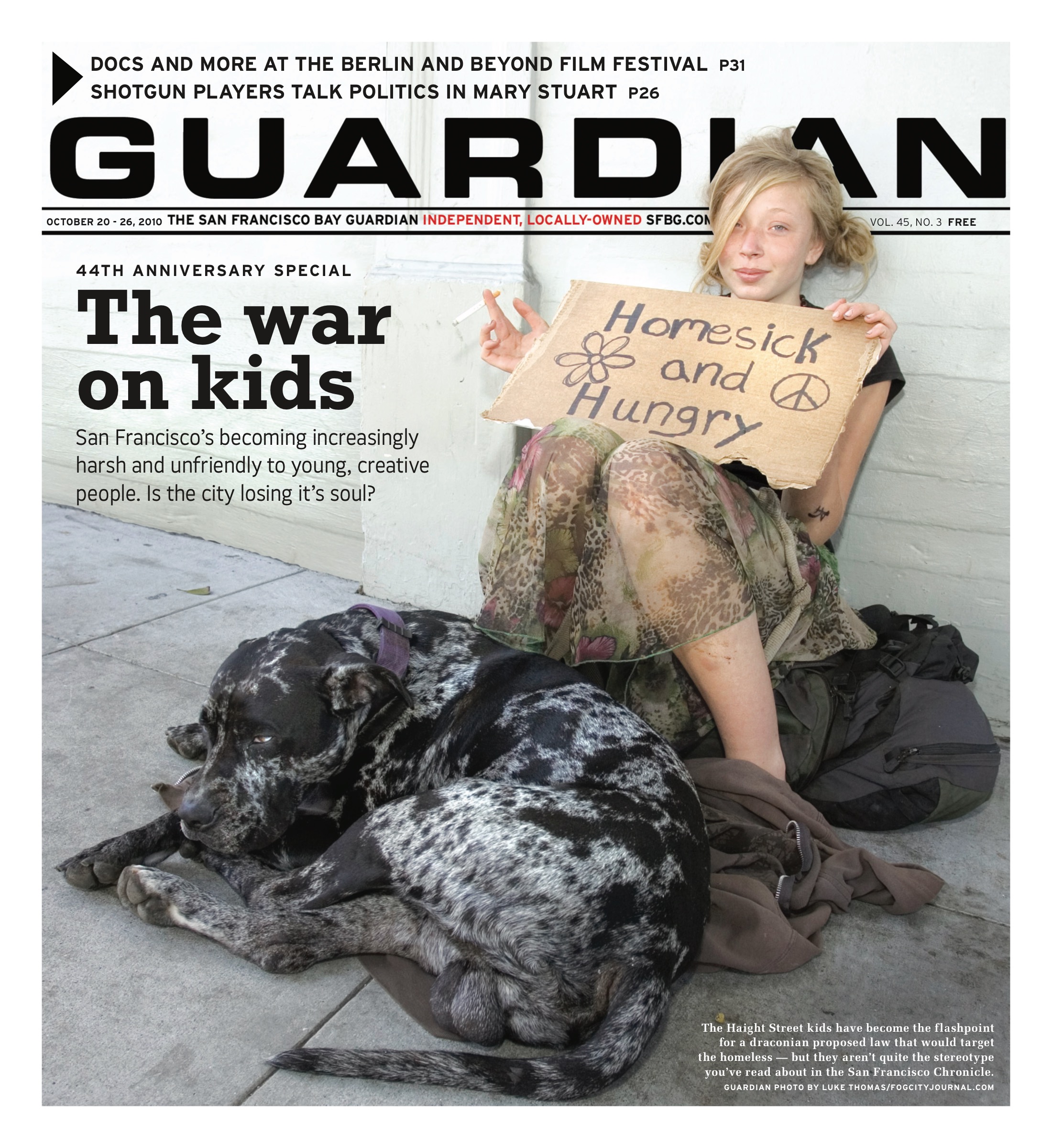
I’ve been hanging out with the Haight Street kids. Over the course of a week or so, I smoked weed, drank malt liquor, witnessed nasty run-ins with police officers — all events that anyone who has walked down the sidewalks of that legendary street would expect. But I also met people who’d give away their last dollar to a friend, people who know a thing or two about community, and people who don’t see sidewalks only as thoroughfares to commerce.

Ironically, though the homeless kids on Haight are the explicit inspiration for Proposition L, the sit-lie measure on the Nov. 2 ballot, their voices have been significantly absent from the vitriolic debate on its merits and faults. Ironic because of all people, it’s these young men and women — and the citizens of San Francisco who interact humanely with them — who could teach us the most about what public space in San Francisco could be.

I didn’t just stand with a notebook, fire questions, and walk away. I took a seat and spent time with the kids, to see for myself whether its true that they’re harassing people, letting their dogs run amok, and generally ruining everyone’s lives as much as sit-lie supporters say they are. That it turned out to be uplifting was an added bonus. I got to see what many don’t on their way to shop for souvenir bongs, retro dresses, and designer skateboards — the reason young people from around the country come to the neighborhood.

It doesn’t have anything to do with fancy Victorians and boutiques, which may explain the disconnect between the street kids and their detractors. They come for the legacy of individuals brave enough to slough off social mores that Haight-Ashbury residents are so ostensibly proud of — not to mention the companionship of others who are comfortable with their rejection of and by society. They come to share stories and pipes and encouragement, and it was cool to watch a streetscape in San Francisco that wasn’t geared solely to commerce.

And while the young people I talked to told me how much they liked to travel, to live free of convention and without ties to the workday world, after a while most acknowledged that they had left behind families who couldn’t or didn’t care for them, home situations that were uncomfortable enough to make life on the streets seem like a better alternative.

Although violent incidents, uncivil behavior, and threatening dogs are well-documented by other news sources, I didn’t see any of that when I was hanging out on Haight. That doesn’t mean that these things don’t exist — but it might suggest that some of the strident supporters of Prop. L are seeing what they want to see.

SPANGING

Steven, who asked us not to use his full name, is 20 and homeless. He grew up in Stockton, became a welder after high school, then decided he “didn’t want the hassle” of staying put for a wage job. His fingernails play host to an ungodly amount of dirt, but his tight blonde curls, pretty golden eyes (“they look like a lion’s!” says one friend in amazement) and mellow, generous demeanor make him a popular hub among his homeless peers.

It doesn’t hurt that he sells weed, small amounts at a time to passing tourists and acquaintances. He silently passes a pipe around to his companions with the slightest provocation. Steven approached me on the street before he knew I was a journalist, a fact that seemed to make little difference to him.

He says he came to the Haight “for the people,” for the area’s reputation of open souls and unconventional artists that originated in the glory days of Janis Joplin and the Grateful Dead. Like most of the kids I talked to, he eschewed the often dangerous shelter scene to sleep in Golden Gate Park or nearby Buena Vista Park despite the police surveillance that could result in spendy fines for park camping.

Although Steven’s worldly possessions fit into the large camping backpack he carries with him 24 hours a day, and even though he’s been living on Haight less than nine months — broken by a jaunt to Eugene, Ore., where he found it “too rainy” to join the town’s expansive street kid community — he doesn’t plan on being homeless forever. It’s just that nothing about this economic climate inspires him to sell his freedom for a paycheck. He plans to go to a four-year college eventually. He sees an education as the only way to get a “real” job. “But until then, why not do this?” he asks. I’m not sure if he’s waiting for my answer.

“This” is sit on Haight Street and “spange,” the term used for “flying a sign” and asking shoppers and neighbors walking by for money, often in a creative way. Of the many crimes street kids are guilty of in the eyes of supporters, spanging is the only one Prop. L would effect.

If Francisco voters approve it, anyone who sits or reclines on the sidewalk (with exceptions for the handicapped and those with permits — but not for the tired, workers on breaks, or people waiting for buses) will be subject to a fine of $50 to $100 for the first offense and $300 to $500, or a maximum of 10 days in jail, for someone found guilty twice within 24 hours of unduly supporting his or her body on the sidewalk between 7 a.m. and 11 p.m. Similar laws can be found up and down the West Coast — although Portland’s was pulled from the books last year after being found unconstitutional because it targeted the homeless.

I ask street kid after street kid why they’ve chosen this lifestyle. Many wouldn’t have it any other way. “Why do people want us off the street?” says Oz, a 21 year old from upstate New York who deals alongside Steven. “Probably because they can’t do this themselves.”

Though I’m skeptical at first, after a while I see why the unconventional group of “travelers” on Haight choose to spend their time spanging. Conversations get struck up with the most unusual people — the old hippie who bought a new Mad Hatter cap for the weekend, the suburban woman who might or might not like to buy some weed (she can’t decide). When a few businesses ask us to move so they can sweep the sidewalk or clear a doorway, the street kids I’m watching relocate with little protest. Many who walk past Steven seemed to find humor in his sign, which that day reads “Are you one paycheck away from having this be your job too?” He says he likes to switch his message daily. “Keep it fresh.”

By hanging out with the spangers, I get to see a Haight Street with human interaction at its core. People walk by, often dropping off surprisingly generous gifts: a ex-Grateful Dead roadie with a massive beard who lives in Fairfax and stopped by the neighborhood for a quick lunch with his daughter parks in front of Steven’s group and approaches them. “You kids hungry? You look like you could use a pizza.”

He emerges a half-hour later with a large cheese pie and drives away after chatting for a few minutes about the old days, to the glee of the group (many of the street kids are Dead Heads). The kids eat their fill, then start handing out the remaining pizza to people walking by, a comic role reversal. “I like to support the community — they get back all the money they get sucked out of them,” Steven tells me.

“NARCOTIC FUELED, ANTISOCIAL THUGS”

The campaign to put a sit-lie ordinance into effect in San Francisco kicked into gear with a Saturday morning stroll. As San Francisco Chronicle columnist C.W. Nevius — who regularly publicizes complaints against the Haight street kid culture — reported Feb. 27, Mayor Gavin Newsom recently relocated to the neighborhood and saw evidence of drug use on the main stretch of Haight where he was walking with his infant daughter. “As God as my witness, there’s a guy on the sidewalk smoking crack,” Newsom reportedly said.

The mayor threw his support behind a sentiment already being voiced by the Haight Ashbury Improvement Association, a resident-merchant alliance in the area. HAIA sees the street kids as disruptive outsiders. “These are not the flower children of the 1960s. It’s narcotic fueled, antisocial thugs who act like a quasi-gang,” Ted Loewenberg, president of the association, was quoted as saying in Business Week.

Adds the Prop L website: ” … the Haight-Ashbury district — once synonymous with peace and love — this corridor is now a hot spot for street bullies, pit bulls, and drug abuse.” It’s a deft cultural lobotomy that dissociates drugs from the Summer of Love, and a devious one that implies that street kids weren’t major players in that social revolution.

As for the bullies, I didn’t see any violence from the street kids in the days and nights I spent out on Haight Street.

I couldn’t get cops to talk to me about it, either. There were two police officers on foot traversing Haight’s main strip and I introduced myself when they stood chatting with a coffee shop owner in the afternoon sunshine and asked them about the sort of neighborhood complaints they regularly received about the street kids.

“No comment,” Cop No. 1 told me. Okay, Cop No. 2, your thoughts? “I don’t speak English.”

To my requests that they share their view of crime on Haight, I could get one response: “It’s complicated.” Later, when I returned to write down their badge numbers, they were standing silently, staring at a lone young man sitting against a wall next to his skateboard. The kid was looking at the ground. Eventually they handcuffed him and put him in a police car while he pleaded meekly about it “only being a little bit of weed — and I was only skateboarding on the sidewalk.”

The most aggression I witnessed from any party took place while I was tapping my feet to a group of traveling bluegrass musicians performing around 10 p.m. on a Thursday. Their cover of Del Shannon’s “Runaway” had inspired an older homeless man to strike up a curiously graceful stomp dance on the sidewalk. He was so drunk and fully immersed in the music that the bottle of Jim Beam in his flailing hand didn’t even register when the police officer approached him and asked, “What do you think you’re doing?”

The musicians began to pack up. “I could have told you this would happen 20 minutes ago,” one tells me, nodding toward the old man. “Don’t say a word or I’ll fucking take you in,” said the cop, who poured out the half-full bottle and wrote a ticket for the older man, who had made a few feeble protests that ended abruptly with the cop’s obscenity.

The officer said he’d received a complaint about the music, a line I heard from each cop I came into contact with on Haight — including one officer who cautioned a family with a toddler to pack up the bracelets they were selling to pay the towing charges on their van. “People don’t like to see people with kids out here, you better move it along,” the cop said.

“I’ve seen aggression because people start shit,” Steven tells me when I ask him about his experience with street violence. A man has just walked by chanting “dirty, dirty” in Steven’s and his friends’ faces. “They don’t like to see people sit on the ground.”

“There are people who come down here just to make themselves look better,” chimes in Oz. “Like ‘ha ha ha, I have air conditioning.’ All kinds of people start shit”

I asked if they knew they were the focus of a massive political debate in San Francisco. “No, what debate?” asked Steven.

“You mean sit-lie?” Oz asks. “It probably has to do with tourism. I don’t see why else they would do that.”

Even the most well-known recent case of Haight Street violence — which was reported June 11 by New York Times reporter Scott James as having “inspired a grass roots movement” that propelled Prop. L, seems to be a question of mutual aggression on the two sides of the street kids issue.

The story goes that a man named Thomas was hosing down the sidewalk in front of his house — a practice that is growing more common in the Haight to make property inhospitable to the homeless. He found himself “surrounded and engaged in a heated confrontation,” as James reports. Thomas reportedly shouted “Do you want a piece of me?” and a scuffle erupted between him and Chad Potter, a 26-year old homeless man, culminating with Potter being arrested and set free the next day. Thomas says Potter and friends continued to harass him after the incident.

James Orr, 24, is busking with his flute when I meet him sitting by a store that sells flowing hippie skirts and bumper stickers that command future tailgaters to “Coexist.” He’s looking to trade his wind instrument for a banjo, which he plays in addition to guitar. A rolling stone, Orr is in town for the Hardly Strictly Bluegrass festival that weekend — he travels the country going to festivals, and even scored a job recently at upstate New York’s Mountain Jam for the event’s blog site, taking photos with a borrowed camera of performances by (ex-member of The Band) Levon Helm and Michael Franti.

Orr’s quite erudite and eager to “say something articulate” about the situation of the street kids and travelers on Haight. He tells me that yeah, he’s seen aggression go down here on occasion. But he resents those situations leading to laws against sitting on the street.

“It’s another example of the few that do mess up casting a bad light on everyone else. Most of us just want to make some money, put a smile on someone’s face.” As a busker, he finds it baffling that people who are against the presence of the homeless would want him to stop plying his trade by making sitting illegal. “You should point out also that it’s how we make money!” he exclaims.

THE PIT BULLS

Snarling ruffians on frayed rope leashes stalking the city streets! As evidenced by the Civil Sidewalks campaign, dogs — specifically pit bulls — are another source of controversy on the pavement. Last December, SFist identified a C.W. Nevius tirade against the breed as example of its ongoing feature “Pit Bull Hate Watch.” The paper has pointed out that the demonized dogs can make great members of society and are often the subject of a media smear campaign.

But for many homeless youth, their dogs aren’t the means of imposing chaos on the gentry. They keep them for the same reasons we do: friendship, protection, love — and during the days I spent on Haight, it was a pleasure to pat the doggies while interviewing their owners. Most were as gentle and laid back as the kids they sprawled next to, a reasonably expected result from the 24 hours a day of socialization with humans that the homeless lifestyle affords.

Smiley is an inveterate street kid unlikely to go indoors anytime soon. “I don’t know how to do anything else,” she tells me. Now in her early 20s with a shock of magenta, purple, and dirty blonde hair and fanciful purple ear plugs that pierce her lobes before spiraling nearly to her shoulders, she’s been traveling since she was 12 — “a Bohemian by blood,” as she puts it. Not only did her parents move their household regularly throughout her childhood, but their heritage is Romani, from the traveling tribes of Eastern Europe.

For Smiley, travel outside the bounds of business trips and weekend vacations is her life’s norm, and Haight Street’s legacy resounds in her nomadic soul. “Most of the people that travelers idolize were here,” she tells me.

Smiley has a year-old behemoth black mutt with droopy eyes. He obliges her as she leans into him holding her spanging sign, which tells the world the pup needs Benadryl for an upcoming van ride to Southern California. “He’s carsick,” she tells me sheepishly. She admits that the dog can limit her mobility on public transportation, but his benefits outweigh his cost. He keeps her warm at night — and, more important for a young woman who is often on her own, he protects her. For a moment breaking out of tough girl mode, she tell me, “oh yeah, I don’t have to worry about anything when he’s around.”

We talk about the perceived threat of dogs on Haight Street. “They want us to leash them, which I guess I understand — but look at that!” A well-dressed woman in her 40s has her Chihuahua off its leash and it has run into the busy street, with her in hot pursuit. “That dog’s out of control,” Smiley smiles.

PISS

Sitting against a mural on a wall where Haight meets Clayton, I watch Piss, an outgoing, gangly guy in his early 20s with a curly blonde mohawk in a growing-out stage. I ask him where he got his unusual moniker. “I like to get drunk and piss on things,” he says.

Well. Originally from Billings, Mont., Piss has been traveling since his mid-teens. “Let’s just say me and my family don’t get along,” he tells me.

His answers to my questions about why he’s on the streets follow a path I see with many of the younger homeless youth: they insist that the lure of the open road was too hard to ignore, but eventually reveal that their parents kicked them out or were unable to care for them at a young age. Many, like Juju, another small-time weed dealer I met, bounced from family member to family member until frictions with them and their significant others left no recourse but the street.

Piss says he’s been to every state in the country, plus Canada and Mexico. With so many years on the road, he is, as they say, letting his freak flag fly. Piss has a blue, vaguely tribal tattoo that curls around his right eye. He’s wearing white tube socks on the dirty pavement. At first glance, he could be crazy — and maybe he is. Whatever his motivation for travel, it’s not to blend in with the locals.

Piss is also actively spanging passersby in a manner that oscillates between off-putting and charming. “You got some money for some crack and ice cream?” he inquires of a passing trio of young women. They shake their head, but before they’re gone completely he continues “I’m just kidding! I don’t like ice cream! Hey miss, you have a nice ass … day!”

Over the course of the hour that I watch him a stand up routine emerges. Beneath the grime, he’s a charismatic kid with an enviable sense of comedic timing.

As he ranges up and down a 20-foot stretch of sidewalk, belly laughs are elicited from a few targets, dollars surfacing here and there. One man carrying an accordion and wearing an expensive-looking pair of leather Chaco sandals donates a handful of strawberries to Piss and to those of us acting as his entourage.

But Piss’ play is a little rough — like a big puppy — and he’s alienating the people who don’t crack up over crack. A couple of people walk away quickly from his petitions shaking their heads over one of the zingers, their suspicions confirmed about those rowdy Haight Street kids.

He’s not doing anything more than what young travelers do all over the world. Thousands of families bid see you later to young adults en route to Prague, Peru, and Perth each year, where they lug their dirty backpacks through the world’s most wondrous towns.

Of course, these kids aren’t sleeping in the public parks of Cuzco — but in countries with plenty of cheap travelers’ hostels, you don’t have to. And though international flights cost more than the van rides and freight train hops that brought in most of the Haight Street kids, backpackers abroad do the same things: take fewer showers and flaunt social norms — not because they want to cause a problem for the natives of the lands they pass through, but because they are young, and discovering themselves for the first time, and can’t see much past that. Piss isn’t being violent, but he has lost the language to deal with “normies” and he’s seen as unpredictable to the not-traveling, not-disenfranchised around him. Which to those who see public space as a place that should be predictable, mean he’s a threat.

The clash between the settled and transient in the Haight is not new. Indeed, it’s what made the neighborhood famous. As far back as the mid-1960s, officials have been simultaneously fighting and publicizing the Haight’s worldwide reputation as a traveler’s meeting place, a place with a culture of loosened societal moorings and enlightenment through free love, drugs, and art.

Businesses claim that the omnipresent homeless drive away paying customers from Haight Street. It a curious claim in an area where the vagrant hippie culture made the place the tourist attraction it is today, and one that is belied by the entry of Whole Foods, which plans to open a branch this year at a lot at Haight and Stanyan vacant since 2006. When contrasted with the Tenderloin — another neighborhood with a visible street community — and its chronic problems attracting a grocery store, the Haight street kids’ effect on local commerce doesn’t seem to be all that grave.

They certainly aren’t making the place any less desirable of a neighborhood to live in for the wealthy. Real estate website Trulia.com puts the median listing price for homes in the Haight-Ashbury neighborhood at $962,264.

The Haight Street kids I spoke could all too easily see what sit-lie would mean for San Francisco. When you control public space, you control who is in public space — and they have no illusions about whether or not they’re included in the perfect world of those who push the measure. If it’s enacted, the subculture that made Haight famous — part of which still survives today in a different form — would be gone, leaving it sterile and safe for the head shops and clothing boutiques, an even less authentic version of the ’60s love fest their patrons come to the street for. One wonders if a scrubbed-clean Haight is even what the residents and business owners who have thrown their lot behind sit-lie truly want, or if they’ve been duped into sit-lie’s efficacy by the same forces that on a national level have convinced us that curtailing civil liberties will lead to freedom for the real Americans. It comes down to this: What do we want Haight Street to be? Do we want to capitalize and benefit from the accepting, messy, wildly creative legacy the 20th century endowed our streets, or do we want a clean, friendly, outdoor mall? The powers of homogenization and gentrification can demonize the little heathens on Haight Street all they want, but they’ve miscalculated if they think that they don’t belong in San Francisco — after all, Haight created them, not the other way around.

Our 44th Anniversary Issue also includes stories by Sarah Phelan on SF’s disadvantaged youth, Rebecca Bowe’s look at ageing out of the foster care system, and Tim Redmond’s editorial on the issues facing our rising generation

Rep clock

0

Schedules are for Wed/20–Tues/26 except where noted. Director and year are given when available. Double and triple features are marked with a •. All times are p.m. unless otherwise specified.

ARTISTS’ TELEVISION ACCESS 992 Valencia, SF; www.atasite.org. $6-10. “Fifth ATA Film and Video Festival: Human Nature,” Thurs, 8; “Lo-Fi Future,” Fri, 8. “PXL This 19,” toy camera film festival, Sat, 8:30. For related events visit www.laughtears.com/PXL-THIS-19.html. “ATA and Alternative Tentactles Present:” •The Widower (1999) and Terminal City Richochet (1990), DVD and CD release double feature, Sun, 7.

CASTRO 429 Castro, SF; (415) 621-6120, www.castrotheatre.com. $7.50-10. I Am Love (Guadagnino, 2009), Wed, 2, 4:30, 7, 9:20. The Kids Are All Right (Cholodenko, 2010), Thurs, 2:30, 4:45, 7, 9:10. “15th Berlin and Beyond Film Festival,” Oct 22-28. Visit www.berlinbeyond.com for complete schedule and tickets ($10-11.50).

CHRISTOPHER B. SMITH RAFAEL FILM CENTER 1118 Fourth St, San Rafael; (415) 454-1222, www.cafilm.org. $6.50-10.25. 36 (Marchal, 2005), Wed-Thurs, 6:30, 9. Inside Job (Ferguson, 2010), Oct 22-28, call for times. My Dog Tulip (Fierlinger and Fierlinger, 2009), Oct 22-28, call for times.

HUMANIST HALL 390 27th St, Oakl; www.humanisthall.org. $5. The Whale Warrior: Pirate for the Sea (Colby, 2009), Wed, 7:30.

MECHANICS’ INSTITUTE 57 Post, SF; (415) 393-0100 (reservations required). $10. “CinemaLit: Apocalypse Noir:” Dead of Night (Cavalcanti, Crichton, Dearden, and Hamer, 1945), Fri, 6.

PACIFIC FILM ARCHIVE 2575 Bancroft, Berk; (510) 642-5249, www.bampfa.berkeley.edu. $5.50-9.50. “Radical Light: Alternative Film and Video in the San Francisco Bay Area:” “1969-79,” Wed, 7:30. “Elegant Perversions: The Cinema of João César Monteiro:” Come and Go (2003), Thurs, 7; The Hips of J.W. (1997), Sun, 7. “Days of Glory: Revisiting Italian Neorealism:” The Bicycle Thief (De Sica, 1948), Fri, 7 and Sat, 6:30; Bitter Rice (De Santis, 1949), Fri, 9. “Shakespeare on Screen:” King Lear (Kozintsev, 1970), Sat, 8:30; Antony and Cleopatra (Heston, 1972), Sun, 4.

RED VIC 1727 Haight, SF; (415) 668-3994. $6-10. Stingray Sam (McAbee, 2009), Wed, 2, 7:15, 9:15. Winter’s Bone (Granik, 2010), Thurs-Sat, 7:15, 9:25 (also Sat, 2). The Girl Who Played With Fire (Alfredson, 2010), Sun, 2, 5, 8 and Mon-Tues, 7:30.

ROXIE 3117 and 3125 16th St, SF; (415) 863-1087, www.roxie.com. $5-9.75. “SF DocFest,” through Oct 28. Program information at www.sfindie.com.

SAN FRANCISCO MUSEUM OF MODERN ART 151 Third St, SF; www.sfmoma.org. $5. “San Francisco Cinematheque Presents:” “Private Lives: Beth Custer Ensemble and the Films of Alexander Hammid,” Thurs, 7; My Grandmother (Mikaberidze, 1929), with the Beth Custer Ensemble, Thurs, 9.

VICTORIA THEATER 2961 16th St, SF; www.peacheschrist.com. $20. “The Peaches Christ Experience in 4D:” All About Evil (Grannell, 2010), Thurs-Sun, 8. With the Midnight Mass Players.

VIZ CINEMA New People, 1746 Post, SF; www.vizcinema.com. $10. “Ozu and His Muse: Setsuko Hara,” Late Spring (1949), Wed, 4:30; Early Summer (1954), Wed, 7:15 and Thurs, 4:30; Tokyo Twilight (1947), Thurs, 7:15. “Taiwan Film Days:” Monga (Doze, 2010), Fri, 6:15 and 9:40; Let’s Fall In Love (Wu, 2009), Sat, 1:30 and Sun, 4:10; Seven Days in Heaven (Liu and Wang, 2009), Sat, 4 and Sun, 9:10; Hear Me (Cheng, 2009), Sat, 6:40; Tears (Chen, 2009), Sat, 9:30 ansd Sun, 6:40; No Puedo Vivir Sin Ti (Dai, 2009), Sun, 2.

YERBA BUENA CENTER FOR THE ARTS 701 Mission, SF; (415) 978-2787, www.ybca.org. $6-8. “Sing! The Music of Sesame Street,” Thurs, 7:30; Sun, 2. “San Francisco Jewish Film Festival Presents: Tough Guys: Images of Jewish Gangsters in Film:” Straight is the Way (Sloane, 1934), Sun, 2.

Psychic Dream Astrology

0

October 20-26

ARIES

March 21-April 19

It’s not about what’s happening, it’s about how you deal with it, Aries. Take a moment of repose to assess how you’re choosing to deal with the events of your life. Take responsibility by being present.

TAURUS

April 20-May 20

Enjoy your riches without feeling entitled to them. The Universe wants you to be happy, but not to attach yourself to the things or situations that inspire those feelings. Blocks to joy can be used as tools to creating more of it.

GEMINI

May 21-June 21

In order to pull off the growth spurt you’re supposed to be engaged in you have to be willing to actually change, Gem. Sounds fine from a distance, but once you get to it, it can be stressful. Expect the unexpected in your heart.

CANCER

June 22-July 22

If you stubbornly refuse to let go of what needs to go, things aren’t likely to get better, Moon(Mister)Sister. Stop focusing on what others are or aren’t doing and keep your eyes on your own work. Change your part this week.

LEO

July 23-Aug. 22

Don’t keep waiting for your circumstances push you to actively deal with stuff. It’s far better to make a mistake in your efforts to improve things than to be a passive participant in your own life.

VIRGO

Aug. 23-Sept. 22

Plant the seeds of your best intentions, Virgo. As you struggle with your worries, make a realistic best-case scenario list. Affix your ruminations on two positive thoughts for every bummer you’re tripping out on.

LIBRA

Sept. 23-Oct. 22

Fake it till you make it is a great approach sometimes, but this ain’t that time. If you feel scared or uncertain, be upfront about it. Don’t compensate by acting all tough! Defensiveness is Libra’s enemy No. 1 this week.

SCORPIO

Oct. 23-Nov. 21

What are you missing, Scorpio? Look deeper at yourself and your situation because you’re seeing what’s right in front of your face. Escapism has its value and its time, but it isn’t here and now. Deal head-on with life.

SAGITTARIUS

Nov. 22-Dec. 21

It’s time to develop tools for dealing with frustration and overwhelemedness. Focus on the things you value or are most committed to and put everything else in the backseat for now.

CAPRICORN

Dec. 22-Jan. 19

Be on the lookout for new insights into the fine art of taking care of your rusty heart. Pursue a fine balance between going with the flow and setting clear boundaries based on your stellar self-knowledge.

AQUARIUS

Jan. 20-Feb. 18

Your ego is a sports car in a Canadian winter. It’s hot, others are impressed, but it won’t take you everywhere you wanna go and is likely to break down from the conditions. Use your humility and courage instead.

PISCES

Feb. 19-March 20

The time is ripe to take some risks! Pursue emotional growth by opening to ideas or actions you haven’t done before. A little discomfort today is worth it if you’re creating a more awesome tomorrow.

Jessica Lanyadoo has been a Psychic Dreamer for 16 years. Check out her website at www.lovelanyadoo.com or contact her for an astrology or intuitive reading at (415) 336-8354 or dreamyastrology@gmail.com.

On the cheap listings

0

Events listings are compiled by Caitlin Donohue. Submit items for the listings at listings@sfbg.com.

WEDNESDAY 20

hell strung and crooked Release Party The Beat Museum, 540 Broadway, SF; www.thebeatmuseum.com. 6pm, free. The Beat Museum helps to present a night of intensely creative bards from the world over in anticipation of the release of their new poetry tome.

Smack Dab Open Mic Magnet, 4122 18th St., SF; wwwmagnetsf.org. 8pm, free. All ages and genders are welcome to this open mic, which sets a medley of musicians and poets onstage to the tune of five minutes a piece. No open mic traumas here, people.

THURSDAY 21

Art Attack One Year Anniversary supperclub, 657 Harrison, SF; www.visualsby3.com. 9:30 pm, $8. The flopsy, floozy art performance group celebrates its first 365 days on this earth with a burlesque-off featuring Alotta Boutté, Scotty the Blue Bunny, and more local A-listers from the world of tassels and tease.

"Graphic Details: Confessional Comics by Jewish Women" Cartoon Art Museum, 655 Mission, SF; (415) CAR-TOON, www.cartoonart.org. 7pm, $5. Beyond the kvetch and kibitz, female Jewish cartoonists have proven themselves adept at a stark, honest rendering of life in the 21st century. Hear them discuss their art at this panel discussion.

Jo Scott-Coe Books Inc., 2275 Market, SF; (415) 864-6777, www.booksinc.net. 7:30 pm, free. An ex-public school teacher exposes the subtle and overt forms of violence in the education system in her latest book, which she’ll discuss at this bookstore klatch.

BAY AREA

Homeless Connect Health Fair Multi Service Center, 2362 Bancroft, Berk; (510) 809-8516, www.sites.google.com/site/bfhphealth. Noon, free. Vision screenings, STD tests, flu shots, therapist and addiction referrals, haircuts, and more at this gathering of service providers for the homeless.

FRIDAY 22

UN-65 Muir Woods Walking Tour Cathedral UN Grove, Muir Woods, Sausalito; (415) 267-1866; www.una-sf.org. 11am, free. Advance registration requested. Mark 65 years of the United Nations’ brand of global collaboration with this trek through the redwoods, a cup of tea, and some Qi Gong — a path braved by UN founders in 1945.

Fog City Necropolis 354 5th St., SF; (415) 606-2503. 7pm, 10pm. Take a tour through SF’s interactive haunted house, whose theme this year is a truly scary trope: eviction! Evade the undead grasp of Jack Kerouac, Frida Kahlo, the crazy cat man of the Presidio, and more so that you can live to pay rent again.

BAY AREA

"Analysis of the Tea Party Movement" UC Berkeley Alumni House, Bancroft and Telegraph, Berk; www.ccsrwm.berkeley.edu/conferences. 8:30am-5:30am, free. Political scientists and sociologists take a look at America’s most grating political movement: are the Tea Partiers part of a grass roots campaign, a media-driven construction, or something in between?

SATURDAY 23

Actors Theatre Season Kick-Off Actors Theatre, 855 Bush, SF; (415) 345-1287; www.actorstheatresf.org. 7 pm, $10. A cabaret to celebrate the new stage season, featuring the psychedelic tropes of comedian Wil Franken, and the world premiere of William Blake Sings the Blues, penned by the theater’s own company member.

Bernal Yoga Literacy Series Bernal Yoga, 461 Cortland, SF; (4125) 643-9007, www.bernalyoga.com. 8pm, $5 suggested donation. Tsering Wangmo Dhopma and Stephen O’Connor, writers both, will fill the chakras of this neighborhood ayurvedic space with readings from their recent publications.

Bring Your Own Queer Festival Music Concourse, Golden Gate Park, SF; www.byoq.org. Noon-6pm, free. Pack a gay in your rucksack for this community collaboration of art, performance, and music, featuring DJ collectives Honey Soundsystem and Hard French, the Bay Area Derby Girls, and a rescue dog fashion show.

Drag Racing Day Velma’s, 2246 Jerrold, SF; (415) 824-4606. Noon, by donation. A Bayview family needs help raising funds for their drag racing team. They make their own motors and transmissions! Grab a bite at this neighborhood restaurant while you watch racing footage and dad Mike Henery’s presentation to interested young people.

Potrero Hill History Night International Studies Academy, 655 De Haro, SF; (415) 863-0784. 5:30 pm barbeque, $6; 7 pm historical program, free. A movie on Potrero Hill public housing, urban gardening in the neighborhood, and hood tales from 50-year residents like "Goat Hill Phil."

Seismic Safety Fair San Francisco General Hospital, 1001 Potrero, SF; www.sfdph.org/dph/rebuildsfgh. 9am, free. Feeling a little shaky? SF General’s setting aside a day to explain the base-isolated design of its new earthquake retrofitting. It’s meant to be the most seismically-resistant plan available today, so go on and get grounded.

BAY AREA

Cal Science and Engineering Festival Haas Pavilion, Bancroft, Berk; (510) 642-0352, www.scienceatcal.berkeley.edu/festival. 10am, free. Kids been clamoring to touch a real human brain? Bring ’em to this hands-on extravaganza of natural science — for free.

Fantastic Fountain Thistle Recovery Work Party Highway 92-W and I-280-N, San Mateo. 9am, free with RSVP. Remove invasive pampas grass and Australian tea tree so that our small bristly friend the fountain thistle can continue to live long and prosper in the Bay Area.

SUNDAY 24

Sunday Streets: Civic Center and Tenderloin Civic Center Plaza, SF; www.sundaystreetssf.com. 10 am- 3pm, free. The last Sunday Streets car-free community event takes the action to the heart of downtown, with clear biking and walking from a roller disco outside the Asian Art Museum to the Tenderloin National Forest.

Tricycle Music Fest West Various libraries and times, SF; www.sfpl.org/tricycle. Free. Three wheel from library to library or plunk the kiddies in front of a show of their choosing for this day of kids’ music, that effervescent establisher of early literary skills.

Alerts

0

news@sfbg.com

WEDNESDAY, OCT. 20


Oakland candidates forum

The Alameda County Democratic Lawyers Club hosts at forum featuring the candidates for Oakland mayor and Alameda County Superior Court judge. With the Oakland mayor’s race between well-funded favorite Don Perata and progressive challengers Rebecca Kaplan and Jean Quan heating up as it comes into the home stretch, this could be a fun one.

5–7 p.m., $25 for members, $30 for nonmembers

Everett & Jones BBQ Restaurant

126 Broadway, Oakl.

510-836-7563

demlawyers.org/events

THURSDAY, OCT. 21


Save the Dolphins

Earth Island Institute presents “From Flipper to The Cove to Blood Dolphin$: A Conversation with Ric O’Barry,” a plea to save dolphins for being slaughtered in Taiji, Japan. O’Barry, star of the Oscar-winning documentary The Cove and the Animal Planet TV miniseries Blood Dolphin$, will update his campaign with information and video footage from his recent trip to Japan.

7 p.m., $5–$20 sliding scale

The David Brower Center

2150 Allston Way, Berk.

510-859-9100

www.eii.org/events/dolphin

FRIDAY, OCT. 23


Ports blocked for Oscar Grant

The International Longshore and Warehouse Union Local 10 has called for a shutdown of Bay Area ports to call for justice in the case of Oscar Grant, who was fatally shot by BART police officer Johannes Mehserle on an Oakland train platform on New Year’s Day 2009. “Bay Area ports will shut down that day to stand with the black community and others against the scourge of police brutality,” said Jack Heyman, an executive board member for the union. Mehserle was convicted of involuntary manslaughter in July and is scheduled to be sentenced Nov. 5.

All day, free

Ports through the Bay Area

www.ilwu10.org

jackheyman@comcast.net

SUNDAY, OCT. 24


Sunday Streets

The final Sunday Streets car-free event of the season will for the first time travel through the streets of the Tenderloin and Civic Center area. Bicyclists, pedestrians, and skaters travel a route that passes City Hall, Boedekker Park, Tenderloin Recreation Center, and the Tenderloin National Forest in Cohen Alley, off Ellis near Leavenworth, featuring live performances, the Funkytown Roller Disco, and free bike rental and repair stations. This event also coincides with the second annual Tricycle Music Festival, with live music from 11 a.m. to 2 p.m. on the steps of the Main Library.

10 a.m.–3 p.m., free

Civic Center/Tenderloin

sundaystreets@gmail.com

415-344-0489. ext. 2

www.sundaystreetssf.com

MONDAY, OCT. 25


Earth-a-llujah Revival

Reverend Billy and the Church of Life After Shopping Choir returns to San Francisco as part of their Earth-a-llujah, Earth-a-llujah Revival Tour, bringing the environmentalist and anti-consumerist gospel to the Mission District. Fresh off of a run for the mayor of New York City and successful campaign to get Chase Manhattan Bank to disinvest in mountaintop removal coal mining, Rev. Billy (a.k.a. performance artist Billy Talen, who got his start here in SF) and his flock will fill you with the Holy Spirit and exorcise you of your credit cards. Hallelujah!

7 p.m., $12

Victoria Theater

2961 16th St., SF

(415) 863-7576

www.revbilly.com/events/cali-tour

www.brownpapertickets.com/event/133698

Exotic Erotic’s 31st round

1

Perhaps you’ve seen them around town. The neon pink fliers announcing that SF’s most gloriously trashy tradition, the Exotic Erotic Ball and Expo, beckons saucily to you this weekend (Fri/22 and Sat/23). Were you curious about the providence of the posters’ graphic design, this just in from founder-behatted cartoon character Perry Mann: “we’re very aware that it’s breast cancer month.”

Well that would explain all the boob examiners! 2010 marks Mann’s 31st year of organized orgy, which nowadays draws in around 10,000 gawkers and pervs a year for onstage sex shows by world famous porn performers, elaborate fetish costuming, ribald entertainment (“we’ve got… orgasmic bingo? I don’t know what that is,” Mann admits to me on the phone), and surprisingly serious musical guests. Sort of. This year is the Family Stone, minus Sly. “We reached out to Sly,” Mann tells me. “If he can get off his crack pipe, he’ll show.”

Mann, who started the Ball famously as a fundraiser for buddy Louis Abolafia’s Nudist Party run at the presidency, has endured his fair share of setbacks in holding the event. A venue change under fractious circumstances (there’s been a few of them over the years associated with the ball, as the East Bay Express recently reported, including complaints that organizers withhold promised prizes from contest winners) has left the EEB with a venue that’s a touch more intimate than last year’s Cow Palace: the Craneway Pavilion, which has about 15 percent less capacity as the Cow. 

A consummate promoter, its difficult to get Mann off his press release script on the phone. We don’t chat about his assertions that disappointing ticket sales in years past were due to corrupted ticket-selling websites. We do, however, manage to cover event logistics. The Pavilion is basically a large glass box on the water, which is… less than ideal? ideal? for a show full of dedicated exhibitionists. The VIP section takes the aquatic escapade to another level: guests willing to pony up the $169 get to shiver their timbers on the San Francisco Belle, a riverboat whose very girth and heft seemed to impress Mann. 

This year’s VIP performance takes on occult themes – vampires being the sex gods of 2010 that they are. Those interested in taking the ticket price plunge can find a preview of events on the Belle at sex blogger (and performer that night), Fleur De Lis SF’s account of dress rehearsals.

And for the pervs off the A-list, don’t worry gang, Exotic Erotic is nothing if not democratically-inclined. In fact, big money’s on the random hallways and corners around Craneway to be where the real action’s at – but if you’re going for the canned stuff, the stages will play host to shows by Noname Jane, Dutch fetish model Ancilia Tilia, Eden Berlin, The Men of Exotica, and the Surreal SF Devil Girls.

Ready yet? Not til you’ve got your outfit, you’re not. The Ball has an anything-goes philosophy when it comes to, well, most things – and the motto definitely extends to sartorial affairs. Past attendees have rocked Bumblebee Transformer ‘fits, every possible form of lingerie — even, Mann tells me, a functioning bathtub that housed three friends for a night. 

“The whole event is about love, it’s really all about love,” says Mann, who himself will be rocking his customary top hat tricked out with “XXXI” in honor of the event’s 31st year spelled out in diamonds. Given his hopes that this year will correct a string of lackluster lust profiteering, his next comment should be a given. 

“Not real diamonds,” he clarifies. 


Exotic Erotic Ball and Expo

Expo: Fri/22 4 p.m.-midnight and Sat/23 noon-6 p.m., $20

Ball: Sat/23 8 p.m.-2 a.m., $79-169 

Craneway Pavilion

1414 Harbour Way South, Richmond

www.exoticeroticball.com


Markus James’ West African happiness surplus

0

In an age of endless crossover between most conceivable forms of music, it’s but small surprise that a Caucasian man from Virginia is making blues with West African witch doctors. What rarely gets discussed in these cross-ocean collaborations is the social aspect of the fusion. What did the artists eat for lunch the day they recorded that track? In what language was the “and-a-one” that started off the first take? 

We had the opportunity to chat over the phone with Bay Area artist Markus James, who has parlayed his time with Malian string musicians into elemental blues tracks. You can hear them on both his new album, Snakeskin Violin, and at his live show (at the Ashkenaz, Fri/22) with The Wassonrai, who are West African musicians that rep for jam band track longevity – strains of which James says is indigenous everywhere from Mali to Jackson, Mississippi — into their already formidable blend of blues past and present. James said (and we’re paraphrasing here) that the secret to fusion collaborations all lies in your location-resonation, but that’s just his perspective.


San Francisco Bay Guardian: When did you first hear African music? Did you know right at the start the depths you would dive into it?

Markus James: I don’t know if anyone really knows what is going to take them. The lights really went on for me when I heard Ali Farka Toure. He played traditional West African music on the electric guitar and it came out sounding like John Lee Hooker. That was where I really felt the powerful connection between all the music I grew up loving: rock, and soul music, and of course blues music, and the connection between that and its ancient roots in West Africa.


SFBG: What did African music pick up in the United States to become blues?

MJ: The roots of blues music go way back, specifically to pentatonic [five note as opposed to our eight note system] music traditions there. Pentatonic music really resonates with what we think of as blues music. There is a direct correlation between what I call country blues, or old school blues music, and some of these music traditions that I’m talking about in West Africa. Not just the notes and the musical scale, but the groove, the rhythm. For example, in West Africa women are often pounding the millet for that evening’s food. The have this six-foot tall piece of wood – it’s like a mortar and pestle. Another woman, or a girl, is scooping it back underneath so that the wood hits the grain. They get these rhythms going that are like goom-chack-goom-chack. Then people start playing on calabashes with this rhythm, and the rhythm is virtually identical to what we call the shuffle rhythm that you hear in a lot of old blues music, Chicago blues music, and rock music. If you go over to West Africa and you start playing what we call country blues, people will just start playing along with it and they’ll say oh, that’s our music.


SFBG: On “I Won’t Let It” you perform spoken word over the music. Is there a legacy in African music of that spoken word tradition?

MJ: Absolutely. There’s a whole caste of artists called griots. Their specialty is preserving history through story-songs, but also singing praise songs to whoever’s in power at the time. They will break into long passages of rhythmically chanted tone-poem language. That’s all there. 


SFBG: You do a lot of cross-culture collaboration. Does the dynamic get tricky when you come from one of the wealthiest nations in the world?

MJ: Not really. I’ll give you an example. I was introduced to a 75-year old man who is the spiritual leader of the Holehoire religion in Timbuktu, Mali. He is what we would call a healer, or in older parlance, a witch doctor. He is like a medium, and his whole role in the community is to communicate with the jinn, their spirits. His instrument is a gourd with the skin of a river snake stretched across it, the string is horse hair. He has a whole repertoire of melodies and rhythms that he plays, the purpose of which are to call certain spirits for certain purposes, to ask for rain, or to ask for good luck, a million things.

He came over to our adobe-walled house where I had my little set-up going and we started playing music together. I was playing guitar and he was shifting back and forth between his two instruments, and he would sing a little line and I would sing something. I told him, I’m making a recording in blues, which is an African-American tradition, if this thing turns out pretty good I might put it on a CD – and I’m paying him, which he’s happy about. And I said before I do anything I want to bring it back to you because I know this is really – I don’t know how I said it to him but I’d say it to you, this is really deep waters. This is considered the pre-voodoo religion. He said sure, fine, great, I hope somebody enjoys it.

The next year I came back and I played him what I had made out of it, it’s this song on Snakeskin Violin, it’s called “Sundown Pearl” I played it for him and he started beaming and smiling and saying this is very good, this is going to be very successful. When I see him I give him something which anticipates the day when I might get some royalties from it. My friends that I’ve made there, it’s hard for them to understand that I’m not really selling a lot of CDs here but they’re very happy that there’s a revenue stream.


SFBG: You’re a vegetarian. I’m curious — I’m a vegetarian too – how is it to travel in Africa without eating meat?

MJ: They assumed at first that I must be deranged. It was absolutely inconceivable that someone could live without eating meat. Even the West African artists I perform with here in the US, it’s taken them awhile to accept it, even though they know other people here. I’m trying to think what it would be like to tell someone here. It’d be like saying I went down to the Bay and I just skipped across it to Berkeley. 


SFBG: You can’t even do it with food — our society has such an individualized view of eating. 

MJ: You know, I’m eating rice down there without the meat sauce, but I’m still in this communal meal zone. My friends will explain, he’s a vegetarian, and that means he doesn’t believe in eating meat, and he appears to be healthy. Something that I could not have foreseen was that I’d become a emissary for vegetarianism in West Africa.

People say, you come from a rich country, and they come from a poor country, so what is politically correct? I think when some people go to West Africa they resonate with it, they connect with it. You come to realize that what we think of as wealth and poverty is very relative to our perspective. Here you might say that we’re wealthy because we have a car, or a house, or roads that allow you to go 60 miles per hour. What we have may not necessarily translate into what they would consider to be joy, happiness, abundance, peacefulness. They’re certainly not stuck in traffic jams and trying to make mortgage payments. We might be looking at a little of a joy deficit and over there they have a happiness surplus. I know that’s simplistic, but that’s my perception. 


Markus James and the Wassonrai

Fri/22 9:30pm, $10-12

Ashkenaz

1317 San Pablo, Berk.

(510) 525-5054

www.ashkenaz.com


Beating chest for APE

0

I used to live in a town where the alternative-alternative (holler!) weekly had a comics page. Paging to the back of said volume each seven days I’d look for Tony Millionaire’s joint, Maakies. Millionaire’s rounding out a phalanx of guest speakers at this weekend’s APE (Sat/16 and Sun/17), so I’m thinking back to the days when his preciously drawn little derelicts marked my Wednesdays.

The motivation behind my penchant remains slightly cloudy – for why did I seek out these troublemakers? The Maakies are a band of animals and multilated pirate-types (maybe they’re all animals, come to think of it, just horribly alcoholic, crass animals who enjoy tweezing their own belly button hair). A perennial reader favorite, Drinky Crow does little more than you’d think he would – a standard DC portrayal captures a moment in time when some unidentified bottle of hooch hangs suspended in the air, supported only by the gullet into which it is pouring. His eyes are mainly x’s. He does not wear a hat, but his monkey (?) friend Gabby does. They do foul things involving body functions and emotional pathology.

The Maakies occupy a world known by most faves of alternative comics — a dark world, yes, one that is stacked against the protagonists, but none the less a world in which fun can be had. Not the least of which is that fun that is perpetuated by the comic characters against those around them. Can’t deal? Drink yourself into a stupor! End frame. See you next week.

APE artists self-portraiture (clockwise from top left): Lynda Barry, Daniel Clowes, Megan Kelso, Tony Millionaire, Tommy Kovac, and Rich Koslowski 

This is the sort of comic made possible by the alterna-crowd, the alterna-paper, the alterna-comic – all of which will be celebrated and feted as is their due at this year’s Alternative Press Expo. It is part of the juggernaut that is Wonder Con-Comic Con, although attendees at APE assume much less widely known personas in their Lycra and face paint.

This year features the usual reams of special guests. Lynda Barry lends her star power, a maker of ‘zine style comics about horribly awkward, dastardly endearing adolescent girls. Also present will be Ghost World penner Daniel Clowes, Megan Kelso, and Renée French. Most of these writer-illustrators have a solid decade or more under their belt of paneling for society’s disenfranchised.

And new to the APE stage is an innovative new style of meet and greet, always an informal function at these mega-events. Writers and artists will get a chance to speed date at the Comics Collaboration Connection, shopping for creative partners in a dance of I-like-you-do-you-like-me furtiveness. Drop your card in the designated envelope if you want to make a graphic novel! Of course, there will be aisles upon aisles of purveyors of already-collaborated-on comics to inspire you, as well.

Anyways, Tony Millionaire will be there, which is exciting. Sources tell me he’ll be the gentleman wearing a tux in the artist spotlight from 5-6 p.m. on Saturday. Get ready for some inquiries into zero gravity bottle support, Mr. Millionaire – I’ll have what Drinky’s having. 

Alternative Press Expo (APE) 2010

Sat/16 and Sun/17 11 a.m.-6 p.m., $10-$20

Concourse Exhibition Center

635 Eighth St., SF

www.comic-con.org


Hot sexy events October 13-19

0

Support your local sex workers! We are lucky to live in a city where those salacious somebodies that will take their kits off in the name of our pleasure and payment don’t have to lay down and take it when the man gets all censorious and grabby – lucky to live in a city where St. James’ Infirmary exists, that is. The Lusty Ladies agree, and on Sat/16 they’re holding their annual Playday for St. J’s – 16 hours of girl-on-girl-on-call for justice.

For there was a time where if you got picked up providing sex to paying customers, you got stuck. We’re talking hypodermic needles – part of a policy that used to go down in SF that forced sex workers to give up blood samples in jail for mandatory STD testing. As you can imagine, this was not always done in the most respectful of manners. Enter St. James’, founded by sex worker advocacy group COYOTE (Call Off Your Old Tired Ethics). The center holds a health clinic, trainings and support groups, hormone therapy programming, peer counseling, and oh so much more. Why on earth not head down to the Lusty to make sure our ladies – and gentlemen – of the night continue to be treated as such?

Original Plumbing Bathhouse Reception

Celebrate the notion that a photo-heavy magazine of transmen is one of the most hot publication debuts to hit the racks in 2010 – Original Plumbing’s fourth issue is out! And it features a hunky lineup of working stiffs, all of whom will be at the wine and cheese reception, open to all genders and levels of ab definition.

Thu/14 7 p.m., free

Eros

2051 Market, SF

(415) 255-4921

www.originalplumbing.com


Spanking and Paddling

Don’t worry, consoles the description of this Edu Kink offering: “there will be plenty of spanking time.” That’s because even though this is technically a class on spanking – its possible childhood associations, how to deal with them should they arise, on technique, and enjoying the spank on the receiving end – Edu Kink’s Paideia workshop series has a focus on lecture leading to experience. So prepare you that booty, naughty kids.

Fri/15 7:30-10:30 p.m., $15-$25 sliding scales

SF Citadel

1277 Mission, SF

(415) 626-1746

www.edukink.org


Pink Blues Dance

What better way to amp up for Mission Control’s pansexual play party than this week’s warmup: a chance to swing those hips to the down ‘n’ out blues on the dance floor. Costumes not required, but membership to the club (and a smile) is. 

Fri/15 9 p.m.-2:30 a.m., $20-$30 members only

Mission Control 

2519 Mission, SF

www.missioncontrolsf.org 


Naked Girls Reading

What’s that chill that just ran down your spine? Are you frozen in fear by a classic ghost story, channeling the pre-Halloween vibe – or are you just naked? It could easily be both at this storytelling series that pairs the city’s sexologists and stage presences with a favorite book, a mic, and little else. Watch for the SF Ghost Society’s Elissa Fricano’s tales of personal encounters with the world beyond.

Sat/16 8 p.m., $15-$20

Center for Sex and Culture

1519 Mission, SF

(415) 225-1155

www.sexandculture.org


Peter Acworth’s Birthday Deviance

Everyone needs a little extra attention on their birthday. And on the founder of Kink.com’s 40th, you can only imagine what form that personal touch will take. Our town’s foremost world-class fetish porn palace opens its virtual doors to members who want to join in on the fun online. Visit www.theupperfloor.com on Saturday evening and watch live as hot doms and slaves create sexy mayhem during a celebratory dinner in Peter’s honor.

Sat/16 6:30-11 p.m., free for Kink.com members, $.25 cents per minute for nonmembers

www.theupperfloor.com


Lusty Lady Playday RXXX

That’s right, get your dirty, dirty prescription for a Saturday in the hospital – or rather, nurse’s office. The Lusties will be pulling on the rubber gloves for a day of sexual healing. Girl-on-girl action all day long, with a portion of the proceeds going to everyone’s favorite hustler health care provider, St. James’ Infirmary.

Sat/16 11 a.m.-3 a.m., $5 before 10 p.m., $10 after

The Lusty Lady

1033 Kearny, SF

(415) 391-3126

www.lustyladysf.com


How To Be a Top Presenter

Have you been there, done that when it comes to the sex education classes at Good Vibes and the host of other venues around our pervy city that like to teach on the tactics of titillation? Take your love of lovin’ to the next level with this little one-off. Dr. Charlie Glickman is sharing the secrets of his sexpert trade: how to plan and orchestrate sex ed for adults.

Tues/19 6-8 p.m., $20-$25

Good Vibrations

1620 Polk, SF

(415) 345-0500

www.goodvibes.com


It’s not easy being an arrogant know-it-all

0

arts@sfbg.com

WRITERS ISSUE Having to constantly suffer the company of the ignorant, it’s difficult to suppress my condescension. After all, I know about obscure music and books that few others know of and this makes me superior.

For that matter, I must also tolerate the naive with regard to politics and current events. It is a constant struggle to maintain a civil façade, to avoid an outburst. After all, the polite response to the uninformed is not to point out their glaring faults but to gently correct their errors in a subtle, guiding way. Maintaining patience is not easy.

I was talking the other day to an acquaintance (it’s hard for people to actually be friends with one as superior as me) and I was shocked to find he’d never heard of Sainkho Namtchylak. Come on, what rock do you have to be living under to not know of the Tuvan throat-singing virtuoso — a singer who makes Diamanda Galas sound like Whitney Houston — who collaborates with free-jazzers like saxophonist Evan Parker? I tried not to be too disdainful as I informed him of her numerous releases on the British record label, Leo. It’s just so difficult not to get sarcastic when faced with that sort of colossal ignorance and cultural complacency.

Do these people just take whatever is offered them on MTV, instead of digging deeper? I have to laugh at the people who think they’re hip just because they listen to something they consider obscure, like Borbetomagus. Come on, they’ve been around forever. Even some grunge-listening moron who hasn’t picked up a magazine since Forced Exposure turned into a mail-order company knows that.

How did I become as I am: namely, one of the most hip people on the planet, endowed with a broad cultural knowledge? Obscurantists are made, not born. To tell the wounding truth, my strength came from weakness. In high school, I was a geek, woefully ignorant of popular culture and rock music in particular. My reading was predominantly in the genre of science fiction. I listened to the folk and classical music my parents preferred and, for exoticism’s sake, enjoyed the synthesizer stylings of Wendy Carlos and Tomita. Children have no taste. We’re shaped (or should I say twisted?) by our environment.

Once I discovered punk rock, I shot up like a late bloomer whose delayed pubescence doesn’t preclude his growth to a height greater than six feet. I devoured the Trouser Press Record Guide, listened to lots of music from the collections of friends. I started reading obscure magazines that reviewed music none of my friends listened to and I was an early adopter of the Internet: I had email in college in 1984 and my Usenet newsgroup posts archived on Google Groups date back that far, before the 1987 Great Renaming, which reorganized online discussion forums. I was an invited member of a secret e-mail music list called “Music-flamers” in 1986.

Let’s face it, it’s too easy to put someone down for being a fan of Korn or Britney Spears (what’s the difference, really?). I prefer to insult people for being so obvious as to be fans of virtually mainstream 1970s British psyche-folk group Caravan instead of Everyone Involved or fill-in-the-blank with your favorite ultra-obscure, private pressing, un-reissued psyche-folk LP of the early ’70s.

Why should music be something that we have in common, something that might bring us together, when it can be a soapbox to stand on to put us above other people? Why settle for the pleasure of turning on someone to good music when you can use it to put them down? If you can tell me, I’ll let you listen to my copy of Jim French and Galas’ If Looks Could Kill or Orchid Spangiafora’s Flee Past’s Ape Elf

Excerpted from The International Homosexual Conspiracy (Manic D Press, 224 pages, $14.95).


Moving portraits

0

cheryl@sfbg.com

WRITERS ISSUE The Metreon is handy if you require 10 different Inception showtimes. But watching a movie there is not same as seeing one — even the same one — at a circa-1922 palace like the Castro Theatre, a space lovingly dedicated to the specific pleasure of Going To The Movies. Edited by Julie Lindow (a former Castro employee), the brand-new Left in the Dark: Portraits of San Francisco Movie Theatres (Charta Art Books, $39.95) compiles essays from Bay Area film advocates, paying homage to San Francisco’s dwindling population of theaters. The book is illustrated by photographer R.A. McBride’s colorful, often haunting images of spaces robust (the Roxie) and ravaged (the New Mission).

Cinephiles will recognize most of the contributors, including San Francisco International Asian American Film Festival director Chi-hui Yang (topic: Chinatown cinemas); Landmark Theatre cofounder and current Balboa Theatre proprietor Gary Meyer (a personal timeline of his life as an exhibitor); and Guardian writer D. Scot Miller (a look at theaters in the onetime “Harlem of the West,” the Fillmore), among others. There’s also an interview with author Rebecca Solnit, who points out that the shared-experience aspect of movie-going is lost in a multiplex environment. Buying a ticket in a theater inside a mall, she writes, “you don’t have that funny sudden spiritual bond that this person next to you in line, who looks so different, also wants to see cowboys.”

Even before they met, Lindow and McBride had a mutual interest in local theaters. “I had been thinking about doing a book to help the movie theaters. At a party that Melinda Stone [another of Left in the Dark‘s essayists] had, I met Rebecca [McBride] and she had started her series of [theater] photographs. So we thought, that might make a great book if we combine these two things together. And then she handled the photos, and I handled the text.” The collaborative spirit continued to the selection of contributors. Lindow says making a connection with one author would lead to her to another; she describes the writing process as a true community effort.

By contrast, McBride found that accessing every venue she wanted to document wasn’t easy (she was flatly denied access to Cow Hollow’s Metro shortly before it closed). She also made some surprising discoveries (a toilet in the projection booth at the Clay, for example).

“There were over 100 theaters at one point in the San Francisco Bay Area — and I’ve only photographed 19 of them,” McBride says, with a certain amount of wistfulness. “One my favorites was the Coronet, which is now gone.”

LEFT IN THE DARK: PORTRAITS OF SAN FRANCISCO MOVIE THEATRES

Wed/13, 5:30 p.m. reception;

7 p.m., slideshow with R.A. McBride

SF Camerawork

657 Mission, second floor, SF

www.sfcamerawork.org

More events at www.leftinthedark.info


Our Weekly Picks: October 13-19

0

WEDNESDAY 13

MUSIC

Vader

Vader’s history stretches back almost 30 years. Borrowing Darth’s moniker might not have been the world’s most original idea, but they were likely among the first to have done it. The Polish death metal stalwarts formed in 1983 in Olstzyn, deep behind the Iron Curtain. Successful demo recordings got them hooked with Earache Records, and the band has been pillaging the world’s stages ever since. Guitarist-singer Piotr Wiwczarek is the only original member left in the fold, but the band’s anthemic music is as potent as ever, mixing impossibly thick blast beats with heavy slabs of neoclassical melody. Their upcoming album Return to the Morbid Reich is a nod to the 1990 demo that made their name; this tour, they’re inviting you along for the ride. (Ben Richardson)

With Immolation, Abigail Williams, Lecherous Nocturne, and Pathology

6:30 p.m., $22

DNA Lounge

375 11th St., SF

(415) 626-1409

www.dnalounge.com


THURSDAY 14

DANCE

Lines Ballet

The story of Scheherazade and her 1,001 nights of tales to postpone her beheading by the Persian king has intrigued and captivated audiences for ages. Choreographer Alonzo King’s dance adaptation Scheherazade delves beyond the story to explore themes ranging from the symbolism of abused women to the transformative power imbued in the tales. The company of chiseled titans dance alongside tabla master Zakir Hussain’s score, which incorporates traditional Persian instrumentation into the original classical composition by Rimsky-Korsakov. The piece premiered in Monaco last December; San Franciscans can now experience King’s artistic rendering of Scheherazade’s classic tale for themselves. (Emmaly Wiederholt)

Through Oct. 24

Thurs/14, 7 p.m.; Fri.–Sat., 8 p.m.;

Sun., 5 p.m.; Oct. 20–21, 7:30 p.m., $25–$75

Yerba Buena Center for the Arts

Novellus Theater

700 Howard, SF

(415) 978-2787

www.linesballet.org


FILM

“Jim Henson and Friends: Inside the Sesame Street Vault”

Consider the Muppet. Made of foam and googly eyes, set atop spindly legs under a mop of primary-color hair, these brave figures have become our children’s teachers on a level unparalleled in the world of infotainment. We’re talking street, of course — Sesame Street, which since its 1969 debut has won 97 Emmy awards, more than any other show. Yerba Buena Center for the Art is running a series of Sesame clip collections, and today’s viewing pays homage to the contributions of the show’s early creative team, with a special furry hug to creator Jim Henson, and little-seen guest appearances from the show’s early days. (Caitlin Donohue)

7:30 p.m. (also Sat/16, 2 p.m.), $6–$8

Yerba Buena Center for the Arts

701 Mission, SF

(415) 978-2787

www.ybca.org


DANCE

“CounterPULSE’s Performing Diaspora: Sri Susilowati”

Stripping world dance of its trappings is quite the rage these days. But few have done it so radically as Indonesian classical dancer did Sri Susilowati at last year’s Performing Diaspora festival. Yet this was the same artist who, only a few months before at the Ethnic Dance Festival, had performed an exquisite, contemporary Javanese mourning dance. Now she is back, having been invited to expand on her 2009 piece. Susilowati may look one of those ethereal dance creatures whose bodies are so stylized that it’s difficult to think of them having earthly passions. Yet they do. Hint on Susilowati: food. Another Indonesian dancer, Prumsodun Ok, opens the show for her. (Rita Felciano)

Thurs/14–Sat/16, 8 p.m.; Sun/17, 3 p.m., $24

CounterPULSE

1310 Mission St./SF

(415) 626-2060

www.brownpapertickets.com


MUSIC

Fresh and Onlys and Kelley Stoltz

San Francisco-based artists the Fresh and Onlys and Kelley Stoltz will both have new albums on hand at this double CD release blowout. The new Fresh and Onlys disc, Play It Strange, showcases the band’s garage-rocky spin on 1960s pop, and was recorded for the first time outside of a DIY studio setup with Comets on Fire producer Tim Green. Stoltz releases his newest batch of throwbacks to the Beatles’ and Beach Boys’ style of sunny pop with To Dreamers. This is a perfect night to come out and support local music. (Landon Moblad)

With Carletta Sue Kay

9:30 p.m., $12

Café Du Nord

2170 Market, SF

(415) 861-5016

www.cafedunord.com


FRIDAY 15

DANCE

Dandelion Dancetheater

Known for its loud, provocative works merging dance, drama, and music, Dandelion Dancetheater turns its attention to motherhood in MamaLOVE: Seeds of Winter. The seven-women cast explores mom-related themes by diffusing fairy tales, myths, and lullabies to discover the context and relevance of the cultural archetypes and stereotypes surrounding motherhood. Each evening brings a rotating roster of guest mama-choreographers: Mary Carbonara, Tammy Cheney, Laura Elaine Ellis, Suzanne Gallo, Dana Lawton, Laura Renaud-Wilson, and Chingchi Yu. Directed by Kimiko Guthrie, the show promises to be haunting, hilarious, and not to be missed as the mom-artists address the complexities of love, loss, connection, and independence. (Wiederholt)

Though Oct. 24

Fri-Sat, 8 p.m.; Sun, 7 p.m. (also Oct. 24, 3 p.m.), $12-15

Shawl Anderson Dance Center

2704 Alcatraz, Berk.

(510) 654-5921

www.dandeliondancetheater.org


SATURDAY 16

MUSIC

Longplayer San Francisco: 1,000 Years in Three Simultaneous Acts”

As a founding member of legendary rabble-rousers the Pogues, Jem Finer helped the band deconstruct traditional Irish music and create a new musical creature out of its varied influences. Taking this willingness to experiment with different sounds and ideas and bringing it to another level, Finer composed Longplayer, a piece designed to last 1,000 years and played on instruments such as Tibetan bowl gongs. Today’s special performance will be a 1,000-minute excerpt performed by 18 musicians on a custom-built, 60-foot-wide circular “instrument” — so slow down and take some time to absorb some art that goes against today’s faster-is-better mentality. (Sean McCourt)

7 a.m.–11:40 p.m., $25–$28

Yerba Buena Center For The Arts Forum

701 Mission, SF

(415) 978-2787

www.ybca.org


EVENT

“ODC Theater’s JumpstART”

Several years and millions of bucks in the making, ODC is at last ready to unveil its new state-of-the-art “cultural campus” in the Mission in a celebratory free day of “dance, theater, performance, and community.” With more than 20 performers and organizations participating, there will be something for everybody — yes, even clogging — at this one-of-a-kind public offering. A glance at the roster includes such names as Scott Wells and Dancers, Robert Moses’ Kin, Killing My Lobster, Youth Speaks, and of course ODC/Dance, all curated by ODC Theater director Rob Bailis in collaboration with the likes of choreographer Joe Goode, world music expert Lilly Kharrazi, and playwright-director Mark Jackson. (Robert Avila)

Noon–11 p.m., free (tickets available one hour prior to each performance)

ODC Theater

3153 17th St, SF

(415) 863-9834

www.odcdance.org


DANCE

Trolley Dances

I still wish they’d call them Street Car Dances instead of Trolley Dances, because that’s what they are, but the name is a registered trademark and has its origins in San Diego (where they actually have trolleys). However, there is nothing else I would change on these annual easy-rider events. They are pure fun, and curator Kim Epifano always comes up with an intriguing lineup of entertainers. This year you’ll see, among others, dancers from Joe Goode Performance Group, Sara Shelton Mann, Ensohza Minyoshu (traditional Japanese folk music and dance), and Sunset Chinese Folk Dance Group. And do look out for a special treat on Ninth Ave for our animal friends, courtesy of brilliant maskmaker Mike Stasiuk. Boarding takes place at Duboce Park. (Felciano)

Through Sun/17

11 a.m. (runs every 45 minutes until 2:45 p.m.), free with Muni fare ($2)

Duboce at Scott, SF

(415) 226-1139

www.epiphanydance.org


EVENT

ArtSpan Open Studios

Do you ever want to stroll into other people’s homes simply from sweet curiosity? Perhaps you covet thy neighbor’s art, or maybe just appreciate light and shadow and like talking with the peeps who represent it? Do all three at the largest and oldest open studios event in the country. The self-guided art tour is ongoing through October, but this weekend doors will open in the artsy northern and eastern neighborhoods. From the nude drawings of Derriere Guard (ahem, Beavis) to the ultraviolet photos of South African succulents, it’s the best opportunity to get to know your local artists. And maybe take home a derriere or two. (Kat Renz)

Through Oct. 31

Sat.–Sun., 11 a.m.–-6 p.m., free

Bayview, Excelsior, Financial District, North Beach, Potrero, Russian Hill, SoMa,Tenderloin

(415) 861-9838

www.artspan.org


SUNDAY 17

MUSIC

BATUSIS

Featuring two of the founding architects of punk rock — guitarists Sylvain Sylvain from the New York Dolls and Cheetah Chrome from the Dead Boys — Batusis already has its street cred and headliner status firmly in place. Taking its name from the groovy dance that Adam West performed in the campy 1960s Batman TV show, the band came together and released a new self-titled EP earlier this year that’s steeped in the sounds that earned these six string slingers their place in the punk pantheon in the first place. This dynamic duo may not be so young anymore, but they’re sure as hell just as loud and snotty. (McCourt)

With Re-Volts

8 p.m., $12–$15

Thee Parkside

1600 17th St., SF

(415) 252-1330

www.theeparkside.com


MONDAY 18

MUSIC

David Bazan

Previously known for fronting the popular indie-rock project Pedro the Lion, David Bazan has returned to working under his own name. His most recent solo album, Curse Your Branches, covers some religious-themed lyrical ground that fans should be familiar with by now, like the tales of sinners losing their way and Bazan grappling with his own faith. But it also presents itself in a much more upbeat, poppier setting than we’re used to, often at odds with the reflective and sometimes dark themes of the songs. Moody, country-tinged Baltimore duo Wye Oak opens. (Moblad)

8 p.m., $15

Independent

628 Divisadero, SF

(415) 771-1421

www.theindependentsf.com 


The Guardian listings deadline is two weeks prior to our Wednesday publication date. To submit an item for consideration, please include the title of the event, a brief description of the event, date and time, venue name, street address (listing cross streets only isn’t sufficient), city, telephone number readers can call for more information, telephone number for media, and admission costs. Send information to Listings, the Guardian Building, 135 Mississippi St., SF, CA 94107; fax to (415) 487-2506; or e-mail (paste press release into e-mail body — no text attachments, please) to listings@sfbg.com. We cannot guarantee the return of photos, but enclosing an SASE helps. Digital photos may be submitted in jpeg format; the image must be at least 240 dpi and four inches by six inches in size. We regret we cannot accept listings over the phone.


Big Oil’s false choice

0

rebeccab@sfbg.com

Tapping into voters’ economic insecurities at a time of record high unemployment rates, out-of-state oil interests say addressing global warming will cost California more jobs. But a broad coalition that includes environmentalists and top business groups argue that just the opposite is true, saying the economy will suffer if we suddenly kill the incentives now driving the clean energy industry, one business sector that actually grew during the recession.

Proposition 23 would indefinitely suspend Assembly Bill 32, California’s Global Warming Solutions Act. Texas oil companies are bankrolling the initiative, spending millions of dollars to convince voters that they must choose between saving jobs and saving the environment. Since jobs are more important right now, they argue, the environment will have to wait.

But the other side — which includes groups such as the Chamber of Commerce, whose top priority is always job creation — is promoting the compelling idea that the path to economic recovery lies in rising to the challenge of climate change. They argue that addressing global warming now isn’t just about avoiding more out-of-control wildfires, diminishing crop yields, prolonged intense droughts, coastal flooding, and other calamities that climate scientists say global warming will bring to California. It’s also about creating jobs now and trying to lower California’s 12.4 percent unemployment rate, the third highest nationwide.

The push to defeat Prop. 23 has brought together prominent business people, public-health advocates like the American Lung Association, big green organizations such as the Sierra Club, and environmental-justice advocates who are pushing for green jobs as a way to fend off poverty and tackle air quality problems in disadvantaged neighborhoods. If the coalition of unlikely allies is successful, Big Oil’s comfortable lock on the energy market could be thrown off balance by California’s emerging green economy.

“Ultimately, we think it’s going to be a David vs. Goliath battle, because they have very deep pockets,” said No on 23 campaign spokesperson Steve Maviglio. “The proponents are playing to the fears of those most affected by the economy.”

When voters decide on this one, it will signify a choice to proceed down one of two paths at an important crossroads. A global climate summit in Copenhagen late last year failed to produce an effective response to climate change. A push for a federal cap-and-trade system to combat global warming yielded similarly disappointing results. AB32 presents a third chance to set a new standard, and a precedent, for curbing greenhouse gas emissions. But if Prop. 23 passes, environmentalists will have struck out.

A report issued in July by the National Academy of Sciences lays bare the far-reaching implications of policy decisions around climate change. “Emissions reductions choices made today matter in determining impacts experienced not just over the next few decades,” the report notes, “but in coming centuries and millennia.”


CLOSE RACE

In 2006, Gov. Arnold Schwarzenegger signed AB32, mandating a statewide reduction of greenhouse gases to 1990 levels by the year 2020. The law is slated to go into full effect in January 2012, when a cap-and-trade system will make it more costly and burdensome for major polluters to continue burning high quantities of fossil fuels, among other strategies.

The law helps alternative energy companies and creates incentives for large and small businesses to green their operations. Prop. 23, deceptively titled the “California Jobs Initiative,” would suspend AB32 until the state’s unemployment rate drops to 5.5 percent for four consecutive quarters. A decade could pass before such a market condition is in place — in the past 40 years, it’s occurred just three times.

Speaking at the Commonwealth Club in Santa Clara in September, Schwarzenegger blasted Texas-based oil companies Tesoro Corporation and Valero Energy Corporation, which have contributed a combined $5.6 million to the Prop. 23 campaign, for trying to deceive California voters. “They are creating a shell argument that this is about saving jobs,” Schwarzenegger said. “Does anybody really believe that these companies, out of the goodness of their black oil hearts, are spending millions and millions of dollars to protect jobs? It’s not about jobs at all, ladies and gentlemen. It is about their ability to pollute and thus protect their profits.”

Prop. 23 has been unpopular even among many traditional right-wing and business interests. Oil giants Chevron and BP have remained neutral on it. Republican gubernatorial candidate Meg Whitman also renounced it, but straddled the fence by vowing to suspend AB32 for a year anyway.

According to a breakdown of campaign spending issued by opponents, oil interests contributed 97 percent of the funding for Prop. 23, while out-of-state interests were responsible for 89 percent. Kansas-based Koch Industries, run by billionaire siblings David and Charles Koch, dropped $1 million into the effort. The Koch brothers have been singled out as the financial backbone of the Tea Party.

Yet despite bipartisan opposition in Sacramento, polls suggest Prop. 23 could be a close race. A recent Los Angeles Times poll showed a dead heat among California voters, with 40 percent in favor, 38 percent opposed, and about one-fifth of likely voters undecided. The television commercials advocating Yes on 23 drive home a simple yet misleading message: “Save jobs. Stop the energy tax.” A spokesperson from the Yes on 23 campaign did not return the Guardian’s calls seeking comment.

Ironically, jobs are also the cornerstone of the No on 23 campaign’s arguments. “We have very heavy hitters who see this as a job killer,” Maviglio said. The campaign is highlighting the fact that the only economic area that has experienced growth amid the recession is green tech.

Democratic gubernatorial candidate Jerry Brown referenced green jobs as a bright hope for economic recovery in a televised debate against Whitman, and the prospect of green job creation as a way to alleviate poverty is clearly articulated in The Green Collar Economy, a widely influential book by Green for All founder Van Jones. Green for All has joined the Greenlining Institute and a host of 80 organizations statewide in a united front against Prop. 23, called Communities United Against Prop. 23, which is part of the larger opposition campaign dubbed Communities United Against the Dirty Energy Prop.

Low-income communities and communities of color will be disproportionately affected if Prop. 23 wins, said Orson Aguilar, executive director of the Greenlining Institute. “The communities we represent are feeling a double impact,” Aguilar noted. “They’re suffering from pollution,” since power plants and polluting industries tend to be sited in low-income communities, “and they’re suffering from unemployment and the economic crisis. There definitely is a double-whammy.”


LOCAL MOMENTUM

At a recent green business symposium hosted by Urban Solutions, a nonprofit that aids small businesses and seeks to create job opportunities in low-income communities, a Castro District merchant explained her decision to enter green-business certification process. “I’m dedicated to going green because, No. 1, it’s the right thing to do,” said Elaine Jennings, who runs Small Potatoes Catering & Events. “No. 2, it’s the right thing to do. And No. 3, it’s the right thing to do.”

But the moderator of the panel, a business reporter, wasn’t as interested in the moral rationale — instead, she followed up by asking whether going green was a wise financial move. Anthony Tsai, green business program manager at Urban Solutions, made the case that it is. Water bills have gone up 40 percent since 2000, Tsai said. Electricity costs have gone up 60 percent and waste disposal fees have increased 250 percent. By conserving energy and water and reducing waste, small businesses can save money during tough economic times.

Aguilar sees energy-efficiency building retrofits as an opportunity to create jobs for disadvantaged populations. In order to comply with the climate regulations under AB32, energy-efficiency retrofits would have to be completed to hit conservation targets. “We have thousands, if not millions, of buildings in California that need to be retrofitted,” he said. “A lot of people who are out of work are in the construction industry. Latinos and African Americans were hit hard when construction fell.” With energy retrofits and solar-panel installations on the agenda, AB32 could be good news for electricians, too, Aguilar said.

There are signs that AB32 is already giving green business a lift. A manufacturer of electric delivery trucks, for example, relocated from Mexico to California’s Central Valley late last year. A wind-energy company recently relocated to San Diego from Spain. The solar industry is growing faster in California, particularly in the Bay Area, than anywhere else nationwide. And in the past five years, roughly $9 billion in venture capital investment has gone into clean tech industries, with more going to California than any other state.

“Prop. 23 would essentially pull the rug out from under this explosive growth, which we’re experiencing during a recession,” Maviglio noted.

Jeanine Cotter, CEO of Luminalt, an independently owned San Francisco solar and installation company, is active in the campaign to defeat Prop. 23. “There is an entire ecosystem that feeds off of good policy,” Cotter said. If Prop. 23 passes, “we will lose the spark that we have and we will go backward.”

Despite the economic downturn, Luminalt experienced its best year in 2009 in the six-year history of the company, and if AB32 goes into effect in 2012 as planned, the demand for new solar installations will only grow. But with less than a month to go before the election, Cotter said she was alarmed by the lack of awareness about Prop. 23, even among environmentalists.

“We were at West Coast Green with No on 23 literature,” she said, referencing a widely attended green-business conference, “and I was shocked at how many people didn’t know what it is.”


RISKING IT

Small business owners and conscience-driven activists aren’t the only ones touting this theory of a new energy economy. The San Francisco Chamber of Commerce, a fiscally conservative business association that is often at odds with environmentalists and progressives, is actively campaigning against Prop. 23 — and it’s not out of any sense of moral duty.

If Prop. 23 succeeds, explained Chamber spokesperson Rob Black, it will scare off the venture capitalists. “For them, water’s like money,” he explained. “It will flow to the easiest place to invest.” Regulation like AB32 guarantees a return on investment for climate-friendly technology, he added. But if that regulatory structure is thrown into question, investors may flee overseas because investing would be too risky. “If we walk away from clean tech, the next Microsoft will be a Chinese company,” Black said.

Donnie Fowler, a political consultant who has worked for Al Gore and other top Democrats, is a senior adviser to the Clean Economy Network and a leader in the effort to defeat Prop. 23. Oil companies “went to Washington and spent hundreds of millions” lobbying against climate change regulations, Fowler pointed out. “Now they’ve opened up a second front. If California goes backward, all of those senators and Congressional representatives will say, ‘No way … I’m surely not taking a political risk. If they went backward, there’s no reason we should go forward.'”

Fowler said that for environmentalists, voting No on 23 could be seen as an affirmation of statewide efforts to address climate change in a meaningful way. “This is a real opportunity,” he said, “for Californians to stand up and say we’ve had enough. We are going to take a stand — right now.”

www.stopdirtyenergyprop.com

www.communitiesagainstprop23.com

Open Studios spotlight: Calixto Robles

1

Because Open Studios is about more than just the free wine and occasional sushi board score. Really! The annual organized voyeurism of creative space in the city will showcase artists’ studios in different neighborhoods each weekend this month. In gleeful anticipation, we visited screen-printer and long time Mission visual artist Calixto Robles, who is helping to throw open the doors to his Life Art Studios (151 Potrero, SF) this weekend.


“Meeting new people, that’s the best thing.” Robles is sitting in his studio of six years, surrounded by shelf upon shelf of his lucid dream style paintings, screen printed posters, and a new project that will be on sale at this weekend’s Open Studios: T-shirts covered in iconic prints from the world’s religions, their overlapping designs forming a riotous invocation of peace.

Get inside Calixto’s mind… or at least his print shop

The T-shirts designs are echoes of similar schemas on canvasses that sit on the ground near Robles’ desk area. The Virgin of Guadalupe (herself a figure with one foot in Catholic lore and another in indigenous Mexican faith), Buddha, and Hindu gods, the word “peace” thrown in at intervals for good measure. The brightly colored collages are a favorite of Carlos Santana, who is a good friend of Robles. In fact, the canvasses by Robles’ feet represent different options for Santana to peruse for his family Christmas card this year. 

The beauty of Open Studios is the ability to sample divergent snippets of San Francisco artistic life. In addition to Life Art’s neighborhood in the corner of the Mission that abuts SoMa and Potrero Hill, this weekend’s event will feature open doors in Bernal Heights, Castro, Duboce, Eureka Valley, Glen Park, Mission, Noe Valley, and Portola. Art Span, the organization of artists that coordinates the event, does so to connect artists with budding art aficionados in the hopes of connection at the point of inspiration.

Robles, a longtime Mission resident from Oaxaca who was part of the art movement that erupted in opposition to the dot com evictions of the late ’90s, has participated in for “fix or six years” in Open Studios. He’s exhibited his art for visitors in both group studios and in his home on Guerrero Street, relishing the opportunity to let passers-by into his private creating space. 

Lotus hearts, community art at Open Studios 2010

He’s famous for his screen prints. Wife and fellow artist Alexandra Blum and he bought an ancient printing press from UC Berkeley years ago. It now sits in the center of his studio, an aluminum print  on top of it featuring a “Justicia” banner that a friend drew for Calixto to print. One wall of the lobby gallery of Life Art is still covered in handmade Mexican propaganda posters that Robles and friends displayed in a recent exhibition of political art. 

The beauty of Open Studios, Robles says, is not always the financial bottom line. Rather, it’s the chance to share art with those around us, people with whom you’d never otherwise find yourself discussing artistic vision. 

This weekend will be the first time that Life Art hosts a group show — exciting for that particular artist community, whose artist produce disparate works from Calixto’s peace prints to massive canvasses covered with a mixture of adhesive and table salt. The artists hope to benefit from the foot traffic of people strolling between SOMAarts Cultural Center and Art Explosion, the massive warren of studios that both sit a block from Life Art and will also be participating in this weekend’s Open Studios. 

Some people, Robles tells me, pass through quickly after scanning the works on the wall – but other art fans will go for the more interactive experience. Chill with the guy who makes Carlos Santana’s Christmas cards? It’s a good reason to hit the studio circuit. 


Open Studios: Bernal Heights, Castro, Duboce, Eureka Valley, Glen Park, Mission, Noe Valley, Portola

Sat/9 and Sun/10 11 a.m.-6 p.m., free

151 Potrero, SF

www.artspan.org


Hot sexy events Oct 6-12

0

It’s about that time, cats and kittens. Time to start fantasizing — Halloween is just around the corner. And though everyone and their mother is going to be Stephen Colbert’s Muslim vampire this year, many will seize the autumnal juncture as an opportunity to whore it up and out – in a good way! 

After all, who doesn’t love the sexy nurses, kitties, police officers, and Snookies that stalk the city bars each year on the 31st? Look, the point is that on this day of days society indulges those that follow their dreams. May as well make it a wet dream, no? Sexy Muslim vampire it is! Oh, and here are some sexy events that’ll wet your whistle this week, with an emphasis on finding that alluring inner equilibrium.

Bawdy Storytelling

Two events this week to get you hooked into what’s happening in Dixie De La Tour’s recurring sexcapade storytelling series: one, a best-of edition featuring writers and comedians from around town (Wed/6) and two, a back alley Lit Crawl edition of Bawdy that’ll have Clarion Alley echoing with the retelling of disastrous dates and tales of unconventional canoodling.  

Bawdy Storytelling: Graphic Confessions

Wed/6 8 p.m., $10

The Blue Macaw

2565 Mission, SF

www.bawdystorytelling.com


Bawdy in the Alley

Sat/9 8:30-9:30 p.m., free

Clarion Alley between 17th and 18th St., SF

www.bawdystorytelling.com


Declaring Our Erotic

Jen Cross knows that erotic writing isn’t just a pleasure to read – for some, the act of writing down passions can be a cathartic, even therapeutic event. That’s why she’s offering this eight-week class for survivors of LGBT sexual trauma. The syllabus promises a safe space to reconnect with your body’s desires and memories. And of course, a chance to write some hot, dirty smut. 

First class Thu/7 6:30-9 p.m., $225-250

email jennifer@writingourselveswhole.com for details


Urge

Put the Citadel’s 5,400 square feet of devious dungeon to use to use for the whipping, slapping, burning, and loving of young loins – hot young male whippersnappers will be the only ones invited to this get together of BDSM blowout. 

Fri/8 9 p.m.- 1:30 a.m., $25

SF Citadel

1277 Mission, SF

(415) 626-1746

www.sfcitadel.org


Steven Saylor

Love, sex, and intrigue in the palace! But this ain’t no corset-buster. No, Steven Saylor’s new book Empire is a males-only play space – the plotline follows Emperor Nero’s eunuch lover Sporus, who becomes the hottest piece of tranny ass on the Forum. Let Saylor woo you into a new love of history at this talk about his latest historical tome of carnal knowledge.

Mon/11 7:30 p.m., free

A Different Light Bookstore

489 Castro, SF

(415) 431 0891 

www.adl-books.blogspot.com


Grizzly’s Bullwhips by the Bay

Don’t worry baby, they got loaner whips. Put your lusted one’s mind at ease by polishing up your whipping skills at this bimonthly peer skill share class by the sea. It’s about safety, kids! After all, when the singletails start flying, you can’t always guarantee that Grizzly, the organizer of the get-togethers, will be there with spare protective goggles to guard those bedroom eyes.

Sun/10 11:30 a.m.- 1 p.m., free

Southeast of the Golden Gate Park Polo Fields, SF

www.laughingbear.org


Body Love for Better Sex

How would you spread your legs if you weren’t worried about chunky inner thighs? Body anxiety can be the nemesis of good sex –  but Virgie Tovar, fat positive sex educator, is here to help you titter about Miss Body Anxiety until she drops out of school due to social anxiety. Which is to say, help you feel as pretty as you are. Aww. No more naked nervousness, bam.

Mon/11 6-8 p.m., $20-25

Good Vibrations

1620 Polk, SF

(415) 345-0500

www.goodvibes.com


No brains required

0

Dead Rising 2

Blue Castle (Capcom)

Xbox 360/PS3/PC

GAMER If Dead Rising was a videogame homage to Dawn of the Dead (1978), then Dead Rising 2 has taken a big leap forward in the George Romero zombie timeline, landing somewhere near the patchy neighborhood of 2005’s Land of the Dead.

Set a few years after the events of the original, the sequel depicts a society well past the shock and dismay of the zombie outbreak: it’s begun to make money off it. At the game’s outset, motocross driver Chuck Greene is a contestant on a competition TV show called Terror is Reality, where the goal is to slice up zombies on a motorcycle outfitted with chainsaws. This is not a game that takes itself terribly seriously. The original Dead Rising had plenty of goofy material, from Mega Man costumes to psychopathic clowns, but it was also grounded so strongly in its homage to the Romero film that the goofiness felt like icing on a cake. Here, goofiness takes center stage. This isn’t quite a criticism, mind you, and the silly fun you have in Dead Rising 2 beats the pants off watching 2007’s Diary of the Dead any day.

After his appearance on Terror is Reality, and an apparent terrorist attack that caused zombies to break into the show’s studios, Chuck finds himself quarantined on a patch of the Vegas strip with three days to solve mysteries and make sure that his daughter receives her daily shot that prevents her from turning into a member of the undead. As in the original, you’re largely free to go where you like for the three days, but dilly-dallying comes at the expense of saving other survivors. That clock is always ticking down, and it quickly becomes clear that it’s impossible to do everything the game offers in the time given, forcing you to make choices about whom to save and which mysteries to investigate.

This isn’t some complex moral exercise: the real reason to play Dead Rising 2 is to kill lots of zombies. We’re talking thousands upon thousands, filling every screen. Luckily, Las Vegas is packed with the tools of zombie disposal, from lawnmowers to novelty foam fingers, and the game introduces a new system of combining items to make them doubly efficient and doubly hilarious. Grab that rake and attach a car battery and you have an electric rake — perfect for zapping zombies at a safe distance.

Other than the new location and the combo items, developer Capcom didn’t mess much with the formula; in fact, a number of the game’s sections are indistinguishable from the first title. The option to play cooperatively with a friend is welcome, but the multiplayer portion is more afterthought than anything. It’s not reinventing the wheel, but there aren’t a lot of games in the “zombie sandbox” genre and the overwhelming wealth of stuff to do in Dead Rising 2 suggests you’ll be slicing up zombies and making yourself laugh for a long time to come.

Valley highs

0

arts@sfbg.com

FILM This year’s Mill Valley Film Festival, the 33rd — we’ll refrain from crucifying it — brings the usual assortment of visiting celebrities starting their Oscar thumpage early at an event with a rep for anticipating next February’s Academy winners. Some have local roots (Annette Bening, Sam Rockwell, James Franco), some don’t (Alejandro González Iñárritu, Edward Norton, Julian Schnabel).

All will be happy, or at least willing, to discuss their creative process from the Rafael or Sequoia stages. But insight into the artistic mind is also available in several lower-profile programs about Bay Area innovators in various media, most made by Bay Area filmmakers.

Tom Ropelewski’s Child of Giants: My Journey With Maynard Dixon and Dorothea Lange is both an appreciation of brilliance — the late, briefly married titans of 20th century Western painting and photography — and a measurement of how difficult it can be to live with. Like many true mavericks, Dixon and Lange drew little distinction between their artistic and personal lives, operating by rules of their own devising that others had to either obey or get the hell out of the way.

Not given much choice in the matter were their two sons, interviewed here. Overshadowed and occasionally neglected by parents (biological and step-) whose notions of progressive upbringing could be dictatorial and harshly critical, one played the passive-obedience card, while the other rebelled to the point of youthful homelessness. Still, they’re forgiving — as a granddaughter puts it, “I can’t pass judgment because I’m not a genius.”

There are no next-generation tattlers in the happier creative vistas of Elizabeth Federici and Laura Harrison’s Space, Land and Time: Underground Adventures with Ant Farm and Emiko Omori’s Ed Hardy: Tattoo the World. The first chronicles the architectural, performance, and media-manipulation of the 1970s SF trickster collective most famously responsible for Amarillo, Texas, automotive cemetery Cadillac Ranch, which one admirer calls “the greatest human undertaking since the Tower of Babel — which failed, and [this] prevailed.” SoCal custom car fanatic and surfer-turned-SF- counterculture-celeb Hardy provides an endearingly modest guide through a career that, perhaps more than any other, revolutionized and popularized U.S. body art.

Among Bay Area narrative features, Scared New World (2005) director Chris Brown’s new Fanny, Annie and Danny hews back to the train-wreck parenting theme. Its three disparately damaged adult siblings seem tragicomedically bad enough company until we meet the monster who made them. Mother Edie (Colette Keen) presides over their climactic Christmas dinner like a lion tamer snapping bullwhip over yelping puppies. Seldom have sing-along carols sounded so hateful.

Ranging farther afield, MVFF 2010 likewise offers a chance to be first on your block to see this year’s Oscar bait (The King’s Speech, 127 Hours) and A-list festival favorites (Blue Valentine, Tiny Furniture). But since those will be coming round soon enough to regular theaters, you’d be better off sampling some of the many features unlikely to be seen again hereabouts.

Several happen to be beautifully photographed foreign titles sharing a certain religious-allegorical dimension. Based on a Gabriel García Márquez story, Hilda Hidalgo’s Costa Rican-Colombian Of Love and Other Demons finds a teenage, early colonialist-era noble dragged to a nunnery, where her rabies symptoms are taken for demonic possession — and where she awakens a priest’s well-buried sensual side. Vardis Marinakis’ Greek Black Field finds a 17th century novice fleeing her convent with a wounded military deserter; in the forest primeval, their own sensual awakening hits a surprising major hurdle. Adán Aliaga’s gorgeous black and white Estigmas follows a burly gentle giant whose picaresque adventures are cursed and redeemed by bleeding stigmata that mysteriously appear on his hands one day.

Special events include an Oct. 8 concert celebrating what would have been John Lennon’s 70th birthday; on Oct. 16 Tim Rutili’s eccentric supernatural whimsy All My Friends Are Funeral Singers, with live accompaniment by his band Califone. Then there’s the Oct. 12 revival of 30-year-old The Empire Strikes Back, the best Star Wars movie. (I might also call it the only really good one, but dare not risk the wrath of fanboys.) Who’s to say a certain Marin resident, employer, and longtime MVFF supporter won’t drop by for the occasion? You never know. 

MILL VALLEY FILM FESTIVAL

Oct 7–17, most shows $12.50

Various venues in Mill Valley, Corte Madera, and San Rafael

1-877-874-6833

www.mvff.com

The family Yañez and their evolving altars

0

To hear father and son artistic team Rene and Rio Yañez talk about San Francisco’s Day of the Dead celebration is to realize how much the holiday has taken on its own light here in the city. “It’s about personal experience, but also politics,” Rene says. The duo have crafted another year of homage to the dead around us — and in so doing also reflect a shifting scene in San Francisco art.

No art event in the city reflects evolving tradition more than the Yañezs’ yearly exhibit of Dia de los Muertos altars at SOMArts Cultural Center (opening Fri/8). As the three of us sit in Rene’s office at SOMArts next to the cow brain in a mason jar on top of which the elder Yañez — the center’s director of special projects — has stacked a pair of headphones and a plush Taco Bell chihuahua, Rene tells his son and myself about the first public Day of the Dead celebration in San Francisco.

Rene, a seminal figure in the Mission art scene, held the first year of the altar installations in the early ’70s at his neighborhood community art hub from that time, Galería de la Raza. In an area full of Central and South American activists who had lost their home due to oppressive regimes and political exile, he and other artists figured it was time to start acknowledging the Mexican holiday of death, parody, and remembrance in their new community. 

In Mexico, Dia de los Muertos is celebrated by the gathering of family, of processions to the cemetery to mark loved ones’ graves with ofrendas of marigolds, sugar skulls, and refreshments. In the Mission, that feeling of community and import was to be replicated with a distinctly San Franciscan twist. “We talked about creating a ritual, ceremonial exhibit,” Rene says.

In those early days, it was mainly the Latinos that lived in the neighborhood that came to see the altars that Yañez and fellow artists created in the Galería. But soon, word of the popular exhibit spread, and it became a teaching moment for those outside the culture. School groups would come by for a field trip, occasions for which the Galeria printed out Day of the Dead lesson plans. 

Still, not every one immediately understood the holiday’s significance. “It’s not really a morbid holiday,” Rene tells me. “People use it to make fun of death, some people make political statements, some people use humor.” That approach “made some people preoccupied,” Rene says, a smile flickering over his face. “They were seeing skulls and things like that.” “It’s about celebrating death as a part of life,” Rio supplies.

Of course, things have changed over the last forty years. Nowadays, the esoteric procession that began in the Mission in the ’80s to mark the holiday has grown into a 15,000 person yearly event, and has been jokingly termed “Day of the Dead Gringos” and “Gringos Gone Wild” by some local blogs for the Burning Man-style theatrical costumes, stilting, and concept artwork contributed by those with nary a drop of Latino blood in their body.

Which, Rio Yañez says, is just fine. Rio – who dad Rene jokingly calls “a cholo hipster” – was born and raised in the Mission, watching his family stave off eviction notices during the dot com boom and beyond during times when rent prices in his neighborhood have soared. Unlike many of his childhood friends, he has chosen to remain in the Mission, and having graduated from CalArts, now partners with his father at SOMArts. 

In the Day of the Dead celebration’s cultural inclusivity, Rio finds a positive benefit for the city’s diverse tribes. “It’s a way of sharing culture – even with all the drunk hipsters just having a good time marching there’s still a community spirit.” When I ask him whether the Mission Latino community can still claim ownership of the procession, he replies diplomatically. “The neighborhood has changed so much — the parade is a reflection of that.”

Rene concurs. “I haven’t experienced a neighborhood that hasn’t changed,” he tells me.

That kind of cultural shift is reflected in the Yañez-curated SOMArts exhibition. Past years’ exhibits have paid homage to deceased family members, to the victims of disasters like Hurricane Katrina, and even to the artists themselves – last year one contributor passed away during the altar’s run at SOMArts, and her installation was augmented by fellow mourners to reflect the snuffing of a creative life. Although the papel picado and traditional iconography remain a part of the vast labyrinth of artists’ contributions at SOMArts, the things mourned and celebrated ring universal, hurts and hopes accessible to everyone present in the melting pot of the city.

This year, the Day of the Dead artists come from all over, and hail from all age groups. Some, like CJ Grossman, Susan Matthews, and Jos Sances have been working with Rene on the exhibit since the late ’80s. Others, like photographer Amanda Lopez, have been brought in by Rio, who is aiding in the transition to online culture, contributing his own photographic skills to the effort, and scouts talent from the younger artistic circles he runs in.

Which isn’t to say that Rene hasn’t taken advantage of some of today’s most cutting edge art technologies, including the Avatar-inspired mania for 3D. Before I leave SOMArts, he produces a sheaf of 3D renderings he’s created on the computer and a flashy pair of red and blue-lensed glasses – far more impressive than anything that I’ve been handed en route to Toy Story 3

I put them on, and a galaxy of Mexican masked wrestlers, women, and designs pop up at varying levels in front of my eyes. The images, Rene tells me, will be projected on the walls of the Day of the Dead exhibit to create a saturated visual experience. More evidence of tradition – and the family Yañez – gathering no moss in the name of art. 


Dia de los Muertos Exhibition: Honoring Revolution With Visions of Healing

(through Nov. 6)

Opening reception: Fri/8 6- 9 p.m., $5-10 sliding scale

SOMArts Cultural Center

934 Brannan, SF

(415) 863-1414

www.somarts.org