Events

Outlaw representation

0

> a&eletters@sfbg.com

I love Dick and I cannot lie. I am of course referring to my Chocolate City homeboy Richard Bruce Nugent — who was never called "Dick," but was outfitted with "Paul Arbian" and other choice names by his friend, rival, and fellow Harlem/Negro Renaissance leader Wallace Thurman. Nugent, who died impoverished but grand in 1987, has been one of my abiding heroes since childhood. But with the rediscovery and publication of Gentleman Jigger (Da Capo Press, 332 pages, $18), in which Nugent names and reclaims his uptown good and hard times from speakeasies to sidewalks, the youngest Harlem Renaissance genius truly ceases to be a cipher.

I first read about Nugent at age 10, in David Levering Lewis’s epic study When Harlem Was in Vogue (Penguin, 1989). A provocative iconoclast and bon vivant, Nugent — who’d had the nerve to live past 27 and even be a vital raconteur during his sunset-and-threadbare years — enjoyed a meteoric ascent into the flux of my prepubescent consciousness. My Nuge was clearly brilliant, and a proto–rock star due to the mere rumor of his gay lit landmark from 1926, the short story "Smoke, Lilies and Jade." Though raised sheltered in Washington, DC’s Adams-Morgan black bohemia of the 1980s, I inchoately got that the Harlem Renaissance was the official coming out of black queer radical subculture — a coming out linked to Nugent’s historic meet-cute with Langston Hughes at one of DC salon hostess Georgia Douglas Johnson’s "Saturday nighters."

Having followed a trajectory similar to Nugent’s leap from DC to NYC, I still find him inspiring. His Gentleman Jigger reads eerily, stunningly, as if it were written about a black blogospheric bohemia that continues to wrestle with the ish Hughes laid out in his famed 1926 essay "The Negro Artist and the Racial Mountain." Although Nugent appears to have been scooped (possibly ripped off) in defining le tout fashionable Harlem by his prematurely dead and duskier podnuh Thurman, he almost lived to witness the emergence of such latter-day inheritors of his vision as poet Essex Hemphill and cultural critic Ernest Hardy.

Editor Thomas Wirth, who maintains a Nugent Web site and worked on Duke University Press’s 2002 Nugent collection Gay Rebel of the Harlem Renaissance, has done us all a great service by unearthing and recolutf8g Nugent’s masterful roman á clef. It’s an intriguing, nudge-winky funhouse that holds a mirror to the New Negritude milieu circa 1927 while presenting a flipside to the Niggerati Manor events captured in Thurman’s 1932 Infants of the Spring (Northeastern). With its wit, passion, racial skullduggery, fearless self-analysis, and an arch framing of uptown/downtown creative types fit to rival Ann Douglass’s nonfiction ’20s Manhattan history Terrible Honesty (Farrar, Straus and Giroux), Gentleman Jigger pulls off the shroud of dilettante-ism that obscured Nugent for decades. Twentieth-century sexual revolt was not always about a Revue Négre pickaninny and her bananas — or a notorious Englishman’s liver lips. It was also the province of dangerous minds with a will to political or social activism.

In Gentleman Jigger, at a soiree held by Serge Von Vertner, Nugent’s alter-ego Stuart Brennen holds forth: "Oh, I always sprawl," he declaims. "Sprawling is a Negro art. Else you might never know I was one. Appearances are so deceitful, and that would never do. So I merely flaunt a trademark."

If that ain’t a postmortem fit for the post-Basquiat, post-Gnarls, Black Renaissance 3.0 era, then I don’t know what is.

Labor’s merger pains

0

› jesse@sfbg.com

Part one of a series on the emerging problems with labor mergers

For well over 100 years, San Francisco hod carriers — workers who assist stone, brick, and plaster masons — have gathered at the Local 36 hiring hall to find work. Though not as large and bustling as it was in its heyday, the hall, now situated in Daly City, still serves as an important social as well as professional gathering place for San Francisco and San Mateo County "hoddies."

But on Monday, March 10 and Tuesday the 11th, when the union’s members arrived to put in for jobs, they found the entrance shuttered and a paper sign taped to the door.

"This Office Will be Temporarily Closed Due to the Transition of the Separation between Local Unions," the sign read. Several South Bay phone numbers were listed below — one for the dispatch office at Local 270, a much larger South Bay chapter of the Laborer’s International Union of North America (LIUNA), and one for Carlos Lujan, 270’s business manager. When the workers tried to call the numbers to secure work, they claim officials at 270 told them they couldn’t help them.

Meanwhile, several told the Guardian they could hear the phone ringing through the hiring hall door as calls from contractors came into the office. Every phone call most likely meant a job that would not be filled by one of the willing workers left outside.

"I felt abandoned," 25-year union member Jerrold ‘JJ’ Jones told the Guardian. Jones told us he waited for nearly three hours for the hall to open on March 11, only to give up in frustration. "Here I pay dues six months in advance and because that hall is closed, I didn’t have the opportunity to go out for a job that day."

A LESS THAN PERFECT UNION


The reasons for the hall’s closure trace back to an ill-fated merger between Local 36 and Local 270. The story is more than just a tiff in a relatively small labor group; it’s symbolic of a much wider issue that’s beginning to explode in organized labor.

In recent years, unions across the country have been encouraging smaller locals like 36 to join with larger shops to increase their clout and negotiating power. Supporters say these mergers create organizations better able to stand up to giant businesses and institutions.

But the trend also has drawbacks: more members under the aegis of one organization means more power in fewer hands — and sometimes, a lack of union democracy.

Local 36 seemed a prime candidate for merger, with only 120 members. Local 270 had more than 4,000 dues-paying workers and hefty political and trust fund accounts. But high-placed sources within the San Jose local tell us that it’s had serious turmoil over the past year — and the members from San Francisco say they feel left out.

Local 270’s leader, Carlos Lujan, is the subject of an investigation by the international union’s inspector general. Documents provided to the Guardian show that the inspector general has been looking into several complaints about Lujan’s leadership, including his conduct of meetings. An official from the parent union has observed the last three executive board gatherings and is expected to file a report with the Washington brass in the coming weeks.

"Clearly there are troubles out there," attorney Bob Luskin of the Washington firm Patton, Boggs, told us. Luskin acts as the union’s special counsel. "The marriage [between 36 and 270] looked like a good idea at first," he said. "But in the end, it didn’t turn out so well."

Much of the current internal strife at Local 270 appears to have begun when Lujan announced his retirement at the end of March 2007. Two weeks prior to his planned departure, Lujan’s advisors proposed a post-retirement consultant’s job for him. According to a complaint filed with the Department of Fair Housing and Employment by former 270 employee Leslie Scanagatta, the consulting gig would have paid Lujan $500 a week, and the union would pay to fly him from his home in Texas to San Jose for meetings.

Scanagatta’s complaint states that Lujan became angry after she and several other officials voiced concerns with the plan. It alleges that Lujan declared to another union official that she would "be terminated by the end of the week" — which she was.

"It was devastating," Scanagatta, who now works for Santa Cruz County, said. "I was laid off for eight months and I’ve taken a 38 percent pay cut now."

Lujan did not return repeated phone calls seeking comment.

One of the people pushing for Lujan’s consultant job was Edgar Calonje. Calonje, who worked for the union as an independent contractor, said he met with Lujan before the boss announced his retirement, and that Lujan told him and Enrique Arguello, a member of 270’s executive board, that he was planning "to get his retirement [benefits] and consultant fees as well."

"We thought if we helped him [get the deal], we would be in good shape," Calonje said by phone from Nicaragua, where he was visiting family. "But that’s not what happened."

First, Lujan withdrew his retirement and decided to stay on. Then, in November 2007, Colanje lost his job — after, he says, a private memo he had written surfaced in which he criticized Lujan’s leadership and integrity.

Shortly after Colanje was let go, Arguello — who now says he didn’t actively support Lujan’s retirement plan — resigned from his job as a business agent rather than accept a demotion. A Nov. 28 letter from Lujan to Arguello obtained by the Guardian states, "the reason for the change in your position was because the pattern of actions made by you in the past could put this Local in a difficult position."

THE LOCK OUT


Early in 2008, the atmosphere of dissension in San Jose began to affect the hiring hall in Daly City, and eventually boiled over into physical confrontation. First, former Local 36 business manager Alex Corns clashed with Lujan and resigned in a huff from his new job at 270. Then Will Davis, who ran the Daly City hall after the merger, was dismissed. A March 6 letter from Lujan to Davis cites Davis’s "lack of commitment to work under my agenda as Business Manager" as the reason for his termination.

The following afternoon, Friday, March 7, Davis and Corns arrived at the hall to find the locks changed. That evening, they told us, a group of former Local 36 members met in a pizza parlor across from the shuttered hall and decided to petition the International to grant Local 36 back its independence. According to their account of what happened next, which was verified by Sgt. Ron Mussman of the Daly City Police Department, when Davis, Corns, and the other participants in the meeting emerged from the pizza parlor, they saw Lujan sitting in his pickup truck, which was parked in the restaurant’s lot. Across the street, two officials from 270 were inside the hiring hall removing computer equipment.

The now-dissident union members surrounded Lujan’s vehicle. Lujan fled the scene, according to worker and police accounts, allegedly striking one of the members in the forearm with his car as he backed up. The incensed crowd moved across the street and the workers from 270 barricaded themselves inside the hall. Lujan reportedly flagged down a police car as he drove away and the cops drove to the hall to escort the two men from San Jose safely out of the building.

Corns and Davis said they could not secure keys to the hall’s new locks by the time of Monday morning’s job call. For two consecutive mornings, out-of-work union members were turned away. Corns told us he finally called a local locksmith late Tuesday morning, March 11, so that members could be dispatched to jobs the following day.

HOW BIG IS TOO BIG?


For Corns, the failed merger with Local 270 is a personal as well as a professional tragedy: he was instrumental in helping 36 join with 270 after Lujan’s election as the bigger local’s business manager. Now he feels responsible for jeopardizing the organization he’s worked for since he was a teenager.

"I’ve been in the union for 35 years," Corns said, his voice choking up. "This is so heartbreaking to me."

Beyond the problems with one controversial business manager, Corns says the story is about the larger problem: increasingly top-down union management. In late February, he told us, 70 members of Local 36 voted unanimously to secede from 270 and become an autonomous chapter again. A representative from LIUNA was present at the vote and confirmed their version of the events for us. Despite the members’ calls for autonomy, officials in LIUNA’s International office in Washington, DC refused to go along; instead, on March 13, union brass granted their secession from Local 270 but immediately forced 36 into another merger — this time with a chapter based in Oakland, Local 166.

As a result of the two mergers, Corns says, the assets of Local 36 have been swallowed up by the larger chapters. He produced old bank account statements for us that showed well more than $100,000 in Local 36’s coffers before the organization joined with 270. Now, he says, he doesn’t know where that money is. Laborer’s International spokesperson Jacob Hay told us that the parent union is undertaking a "reconciliation process" to determine how much of Local 36’s money should go to Oakland and how much should stay in San Jose. Despite the apparent desire for independence among 36’s members, Hay argued that the union is making the right decision by forcing them into another merger.

"We think that it is in the best interests of smaller locals like [36] to join with larger, more powerful locals," he said. "You have more collective bargaining power with larger numbers [of members] … the goal here is to get all the hod carriers in the Bay Area into one local."

Will Davis and other Local 36 members do not share Hay’s bigger-is-better enthusiasm. "We’ve never gotten a good reason why we can’t just have the local back," Davis said. "We’ve never done anything wrong. We’ve never been under investigation. Why are we being punished for something we didn’t do?"

Editor’s Note: In the paper edition of this article, the Guardian misidentified two dates. Lujan announced his retirement in 2007, and the atmosphere of dissension began to affect the hiring hall in Daly City early in 2008.

Rip up the mayor’s club-violence plan

0

EDITORIAL Back in January, 34-year-old Clarence Corbin was shot and killed during a fight outside Jelly’s Dance Café nightclub in Mission Bay. Mayor Gavin Newsom leapt into action, announcing that this sort of violence was unacceptable. We’re with the mayor on that, although we wish he’d shown the same kind of energy in dealing with the epidemic of shootings in the Bayview and Western Addition over the past few years.

But his solution — a crackdown on nightclub promoters — is unlikely to do anything about violence and will almost certainly damage the creative underside of the city’s entertainment scene.

Sup. Sophie Maxwell is carrying the mayor’s legislation, which she introduced March 4. Some of the provisions just seem silly: the bill, for example, would ban "loitering" within 10 feet of a club between 9 p.m. and 3 a.m. Of course, people stand outside clubs all the time — among other things, to smoke cigarettes — so the bill says smokers would be exempted. So would people who are waiting for cabs. People who simply wanted some fresh air or to make a phone call (or to make out away from the dance floor) would be subject to fines. The loitering law, like most similar laws, seems like a blueprint for discriminatory and illegal enforcement. (Will young African American men get cited more often than white people? Of course they will.)

How are the cops going to decide who’s really waiting for a ride (cabs can take half an hour to arrive on a Saturday night) and who’s just hanging out? Might potential troublemakers just light up a cigarette and thus be free from legal action? It’s hard to see the practical logic here.

Then there’s the provision that would require promoters who hold two or more club events a year to obtain a permit (and presumably, pay a fee). Applicants would have to have proof of $1 million in liability insurance.

That, frankly, would kill a whole lot of small-time events in San Francisco.

Although Newsom complained to the press about "fly-by-night promoters," the city’s full of well-established people who do shows at various clubs with various programs a few times a year or a few times a month — and most of them are small-time operators. Very few have ever had any problems with the law, or promoted a show that led to violence — but most of them would have to shut down, because the $1 million in insurance money would be too expensive.

The Bay Area Reporter suggested March 13 that the bill could harm nonprofit events promoters by forcing them to devote much of the charitable take from their shows to paying for insurance and security plans.

We just don’t see how any of this really addresses the problem of violence outside of San Francisco clubs (and we don’t really see that clubs are to blame for much of the violence in the city anyway). When Sup. Ross Mirkarimi tried to get Mayor Newsom to put cops on foot in high-crime areas, the mayor balked. When Sup. Chris Daly tried to create a violence-prevention program that might have actually gotten to the root causes of this horrible pattern of kids killing one another, the mayor rejected it.

Instead, he wants to create a strange and ineffective plan to give police an excuse to arrest the wrong people that will penalize the small promoters who every week give so much to the city’s cultural landscape.

If club owners are concerned about crowds fomenting violence outside their doors, then the problem needs to be addressed. But this is an ass-backward way to do it. The supervisors need to rip this plan apart and start fresh.

Careers & Ed: Symphony of instruction

0

› culture@sfbg.com

It may have been San Francisco’s Davies Symphony Hall, but at times it felt more like a Pentecostal revival meeting. Forget about rules or decorum: when the spirit moved them, this crowd let loose. Imaginary batons twirled. Heads tick-tocked. Feet tapped. Giggling and applause burst out at all the wrong times.

You haven’t really experienced the symphony until you’ve sat among 2,200 first and second graders at their first live orchestra performance, hundreds of them conducting the orchestra from their seats.

"Movement is exactly what we want," says Ronald Gallman, director of the San Francisco Symphony’s Education Programs, Youth Orchestra and Adventures in Music (AIM) program. "We wouldn’t be doing our jobs if they were sitting with their hands folded in their laps."

Not everyone acts like inspired little savages; others revel in acting like adults. One girl watched the performance through a pair of improvised opera classes — tiny binoculars she brought from an explorer’s kit at home.

It’s somewhat of a relief to learn that kids of the iPod generation can still appreciate classical music. It helps that musicians in the AIM program understand a few basic principles of child psychology: keep performances short, allow plenty of opportunities to shout out and move around, and throw in a fart joke or two for good measure (the tuba player who introduced his instrument with a flatulent blast got the biggest laughs of any joke in the performance).

Founded in 1988, the AIM program serves first through fifth graders at every public elementary school in San Francisco — an impressive 75 schools — as well as third through fifth graders in some private and parochial schools, totaling more than 22,000 children. Beyond the innovation, this is only possible because the AIM program is funded entirely by private donors, foundations, and events like the Black and White Ball — which means that it’s offered at no cost to the schools. According to Gallman, this level of commitment to building equitable access to music education in public schools makes the San Francisco Symphony stand apart as a national leader.

The symphony performance is just one piece of the larger AIM curriculum, which includes four ensemble shows per year at each school as well as comprehensive materials to help teachers build interdisciplinary lesson plans around the AIM performances. Each school is able to choose the ensembles it wants — with options including jazz and all varieties of world music — thus allowing for culturally appropriate programming at different schools.

At the Claire Lilienthal School in the Richmond District on a recent school day, the Drei Brass trio had been chosen to perform for a gymnasium full of first and second graders seated on the floor, each of whom had been given a brightly colored plastic kazoo.

"Our show today is about three brass instruments and vibration!" announced Alicia Telford, the Drei Brass french horn player, her eyes wide and one eyebrow arched. She showed the kids how to feel the vibration in their vocal chords when they sung by placing a hand on the front of their neck.

Each of the brass players introduced himself as "an ambassador of ppppfffft," demonstrating that the music coming out of their instruments begins with a simple pppfffft blown into the mouthpiece — the same ppppfffft sound that the kids blow into their kazoos.

They also peppered their classical performance with recognizable tunes that the kids could intuitively follow, like the finger-snapping Pink Panther theme.

Kazoo-induced hyperactivity aside, it seems that teachers by and large are nothing but grateful for the AIM programming in their schools.

"Music is a great way to keep some children engaged who might not be the best readers or [who are] a bit behind. It’s a great way to keep them in the school system through high school."

According to JR Jowkalsky, a reading teacher at Willie L. Brown Jr. elementary school in the Bayview, the number of students who pursue orchestra or band in middle school has "mushroomed" as a result of the AIM Program.

Keith Jones, who has been teaching for 20 years and currently runs the 40-piece band at Willie L. Brown, reports that about one-sixth of the potential band students participate in the music program. Anything over 10 or 15 percent participation is considered good.

"AIM has given me 10 violins, symphony tickets for the kids, concerts here at school," he said. "It provides things that I could never provide to my students."

While the AIM program alone cannot revive public-school music education in an era of restricted funding, it’s not a far stretch to say that exposing every single public school student by the end of fifth grade to five symphony visits and 20 ensemble performances must help pick up the slack.

Now, if only there was something AIM could do to preserve the sense of wonder and complete abandon with which these kids enjoyed the symphony for the first time, conducting wildly from their seats like no one is watching.

Raise your voice for nightlife!

0

There’s some heinous new legislation targeted at pretty much killing independent nightlife in the city coming up, folks. Mayor Gavin Newsom and Supe Sophie Maxwell think it’ll curb violence happening outside some of the bigger clubs, but the proposals — requiring even the smallest promoters to apply for permits and show proof of $1 million in liability insurance, as well as citing anyone who stands outside a club for more than three minutes unless smoking or hailing a cab — would wipe out a ton of vital little parties and charitable events after dark. Read more about it here. (And look for our editorial on the subject in Wednesday’s Guardian.)

nightlife.jpg
Nightlife: Even Swedish kids like it!

Here’s your chance to speak up about this to the Entertainment Commision! Info courtesy of the fab DJ Raverpup, who’s spearheading the resistance.

Hi everyone,

Just a reminder that tomorrow, Tuesday, April 1, the Entertainment Commission meeting will have the new promoter permits on the agenda, and the floor will be open for members of the public to make comments for up to three minutes. We need to get a good turnout of independent promoters (and party people) to comment on this and make it apparent how this new legislation will affect us and San Francisco nightlife. The meeting will be at 4PM at City Hall; follow the link below for more information.

http://www.sfgov.org/site/entertainment_page.asp?id=78062

Who shot Tupac? LA Times apologies for latest botch in the continuing, sensational saga

0

tupac sml.bmp

By Jamilah King

By now, the latest “who-shot-Tupac” fiasco is all over the news. The basics go something like this: LA Times reporter Chuck Phillips writes a groundbreaking investigative story that strongly implicates P. Diddy’s camp in the 1994 shooting that sparked the whole East Coast/West Coast feud. The piece, which relied entirely on a confidential source, sent shockwaves through the music industry.

Meanwhile, hiphopdx and the Smoking Gun were all, like, “Ummm…no.”

Now, the story is under investigation because it turns out that Phillips’s confidential witness is a con man. The paper posted an apology on their Web site late last night.

From the Smoking Gun:

The con man, James Sabatino, 31, has long sought to insinuate himself, after the fact, in a series of important hip-hop events, from Shakur’s shooting to the murder of the Notorious B.I.G. In fact, however, Sabatino was little more than a rap devotee, a wildly impulsive, overweight white kid from Florida whose own father once described him in a letter to a federal judge as “a disturbed young man who needed attention like a drug.”

Whoops.

Maybe the problem with journalism is that it’s always more than just a story. In this case, what’s really at stake is justice, that elusive and ever-changing ideal that’s been teasing black folks since slavery. The sensationalism that surrounds the Tupac-Biggie saga often overshadows the innate dreams that each rapper carried on his shoulders. They were the larger-than-life personalities who spoke for thousands of complex individuals caught up between the failures of the Civil Rights Movement and the success of Reaganomics. Of course, such artists weren’t without their gluttonous and painful vices, but so goes life for artists in their early 20s.

Ill doctrine takes the paper – and the industry – to task:

Superlist: Make some noise

0

› superlists@sfbg.com

Don’t despair if your frequent oral treatises to progressive ideals end up falling on deaf ears. Instead, let your feet walk and your trumpet talk. Armed with even an undernourished musical skill and the will to disregard noise ordinances in your neighborhood, you can find a street band, whether bawdy or principled, to soundtrack your most ardently held beliefs. Oh, you’ll be heard all right.

Bateria Lucha (www.baterialucha.org) could be loosely translated as "drums for the struggle," but essentially the passion of the Brazilian percussion tradition to which the name refers has no cognate in staid English. Catalyzed by the initial uproar over the current Iraq war, Lucha founder Derek Wright envisioned a musical force that would unify and groove-ify the chants of protesters, not drown out their message. Today, aspiring bateristas can join Wright for multilevel Brazilian percussion workshops each Thursday in Oakland in preparation for Bateria Lucha’s musical surge tactics, employed everywhere from picket lines to San Francisco Carnaval.

If you’ve ever joined a human blockade on Market or picketed the Woodfin Hotel, you’ve certainly had your marching morale boosted by the Brass Liberation Orchestra (< a href="http://www.brassliberation.org" target="blank_">www.brassliberation.org). Hailing from Oakland and San Francisco, this dedicated group takes peace and social justice activism seriously, even when enticing a city block of protesters to shake it to the Black Eyed Peas. Dispatching a spirited crew of brass, woodwind, and percussion players to rallies and events around the region, the BLO welcomes new members who can keep pace with the music and the cause.

If it’s spectacle you seek, look no further than Extra Action Marching Band (www.extra-action.com), the drum majors of San Francisco values since 1999. Credited with being among the early subverters of the once mannerly marching band aesthetic, Extra Action still manages to shock audiences with antics and braggadocio, often posing profound questions such as: why perform on a stage when you can dance naked on top of the bar?

Offering youth classes in San Francisco since 1994, the leadership of Loco Bloco (www.locobloco.org) has already raised a generation of students into its own ranks. Each year, the nonprofit’s mentors in Brazilian drumming and dance prepare a performance group for participation in San Francisco’s Carnaval. Drawing a strong contingency of players already affiliated with Loco Bloco, rehearsals preceding the May parade are open to all ages and abilities. The $5 class fee for adult Carnaval participants goes toward scholarships for youth.

Oakland’s Loyd Family Players (www.theloydfamilyplayers.com) are no purists. Beats and hooks from the band members’ own diverse musical backgrounds have found their way into this bateria’s boisterous repertoire. Nevertheless, the lineup of Brazilian surdos, snare drums, shakers, and bells still carries the distinctive thump of authentic samba at its craziest. Props go to the fiercest female percussion section around.

A spirit of cheerful anarchy sustains the Los Trancos Woods Community Marching Band (www.ltwcmb.com), which began its long life on New Years Day, 1960, in a hilltop village tucked away behind Palo Alto. The application for new members requires only "the desire to have a good time," and rehearsals are limited to once a year. You can tag along with their procession through North Beach on Columbus Day as long as your "uniform" is suitably absurd, but you’ll know you’re really in the club when you find yourself halfway to Monterey honking New Orleans–style kazoo in the Castroville Artichoke Festival Parade.

The Musicians Action Group (Magband@aol.com), a self-described circle of "old left wingers," roots its music in the history of American activism, performing songs of the labor, antiwar, and civil rights movements. Born out of a need to make noise about social justice, MAG has played at major demonstrations and protests since 1981. The group welcomes newcomers who share their mission of supporting progressive causes with music that is historically and politically significant.

Stop the Cow Palace land grab

0

EDITORIAL Technically, the Cow Palace isn’t in San Francisco, but it’s part of the larger city’s history. It was the site of two historic political conventions, a string of historic concerts, and lots of less memorable smaller events. It’s home to the Grand National Rodeo. For a lot of people who care about links to the city’s past, it’s a treasure. For the half-million or so folks who pass through the doors every year, and the dozens of promoters who use the cavernous hall for expositions, shows, and performances that don’t fit anywhere else, it’s an invaluable part of the local cultural scene.

For people who worry about earthquakes and catastrophes, it has immense appeal — the place could serve as a gigantic shelter, with beds, showers, a huge parking lot for staging, and room to land helicopters in the event of a disaster.

To real estate developers, it’s a potential gold mine. And to Daly City, where the Cow Palace sits, it’s an opportunity to create a huge new complex of condos and retail stores that would bring in millions in new taxes.

So when state Sen. Leland Yee introduced a bill that would force the state to declare the Cow Palace surplus property and sell it to Daly City, the battle lines were drawn. A front-page story in the San Francisco Chronicle suggested that the venerable place could be razed for redevelopment. Supporters have come forward to talk about its role in the community and its value as a venue. The Daly City manager, Pat Martel, argued that the place gives her city nothing whatsoever in terms of taxes and hosts some events — like a gun show and the Exotic Erotic Ball — that her constituents find offensive.

What’s missing from most of this debate is the fact that this is 68 acres of prime real estate that’s still publicly owned. Declaring it surplus would almost certainly lead to the privatization of an immense block of potentially priceless urban land.

Yee’s bill, SB 1527, is just the latest chapter in a battle over the Cow Palace that goes back several years. The board that oversees the facility, which reports to the state Department of Agriculture, has been negotiating with Daly City to lease 13 acres of parking lot and underused land for development. That would allow the city to build some new housing, seek a supermarket that the neighborhood badly needs, and add to the local tax base. But the talks have stalled — and after Daly City hired powerhouse lobbyist and former assemblymember Bill Duplissea to take the case to the Legislature, and Daly City’s council asked for help, Yee stepped up.

SB 1527 mandates that the state sell the property to Daly City, with the proceeds going to pay off some of the debt the state incurred through the governor’s misguided deficit-recovery bonds. Yee argues that the state needs the money in this brutal year to save public education, and we understand how powerful that message can be — but selling off public land to cover budget shortfalls is almost always a terrible idea.

There’s little doubt what the endgame is here: Daly City doesn’t have the cash to buy 68 acres that will be worth hundreds of millions of dollars at fair market value. All the small municipality will be is a conduit — the land will be quickly flipped and sold (or leased for very long terms) to private developers.

The Yee bill is designated an "urgency measure," which means it could be approved as early as April. That’s ridiculous; there is no urgency here. This is a huge decision, and needs a lot more public discussion and debate.

We suspect that there’s a way to meet Daly City’s needs for development without turning over the entire 68 acres. There’s almost certainly a way for the Cow Palace to remain and for some of its land to be used for housing and retail.

But we haven’t even seen a template for what sort of project would go on the site. How much of the housing would be affordable? How much of the retail would serve the community? Would this become another chain-store-and-luxury-condo site with gated homes in an economically depressed area? What will the San Francisco neighborhoods that border on the site get out of it? Will there be any new parkland or open space? How will a large commercial complex there affect traffic, noise, pollution, displacement, and other environmental factors in the surrounding areas?

How on earth can you talk about selling off such a huge chunk of public land without even talking about how it will be used?

This is nuts. Yee’s bill needs to be defeated, and all the parties (including the San Francisco city planners and supervisors) need to start cautious, long-term discussions about the Cow Palace, its land, and the needs of the public. Otherwise this will appear — with justification — to be nothing but a sellout of gargantuan proportions.

The Guardian Iraq War casualty report (03/24/08)

0

For a breakdown of the positions that relevant politicians are taking on the war in Iraq, visit the slate.com link below. 36 U.S. soldiers were killed this month, which means at least one U.S. soldier was killed for every day that passed. Click here to view.

Casualties in Iraq

U.S. military:

4 U.S. Soldiers were killed in a bomb blast on Sunday bringing the American soldier death toll to 4,000, according to CNN.

The New York Times created a web page called Faces of the Dead, where you can view specific information about all of the U.S. Soldiers who have died in Iraq.

4,276: Killed since the U.S. invasion of Iraq 3/20/03

Source: http://www.icasualties.org/

145 : Died of self-inflicted wounds, according to http://www.icasualties.org/

For the Department of Defense reports go to: http://www.defenselink.mil/

For a more detailed list of U.S. Military killed in the War in Iraq go to: www.cnn.com

To view a breakdown of U.S. military casualties by state of residence, click here.

Iraqi civilians:

82,394 – 89,914: Killed since 1/03

Source: http://www.iraqbodycount.net

For a list of recent events that have resulted in Iraqi casualties, visit :
http://www.iraqbodycount.org/database/recent/

For first hand accounts of the grave situation in Iraq, visit some of these blogs:
www.ejectiraqikkk.blogspot.com
www.healingiraq.blogspot.com
www.afamilyinbaghdad.blogspot.com

Iraq Military:

30,000?: Killed since 2003

Source: http://www.infoshout.com

Journalists:

127 journalists have been killed since the start of the war in March, according to CPJ.


Refugees:

2.2 million: Iraqis displaced internally

2 million: Iraqis displaced to neighboring states

Incessant violence across much of Iraq’s central and southern regions has forced tens of thousands of people to leave their homes every month, presenting the international community with a humanitarian crisis even larger than the upheaval aid agencies had planned for during the 2003 war, according to United Nations High Commissioner for Refugees’ estimates.

U.S. Military Wounded:

132,199: Wounded from 3/19/03 to 3/01/08

Source: http://www.icasualties.org/


The Guardian cost of Iraq war report (03/24/08): So far, $505 billion for the U.S., $63 billion for California and $1 billion for San Francisco.

Compiled by Paula Connelly

Here is a running total of the cost of the Iraq War to the U.S. taxpayer, provided by the National Priorities Project located in Northampton, Massachusetts. The number is based on Congressional appropriations. Niko Matsakis of Boston, MA and Elias Vlanton of Takoma Park, MD originally created the count in 2003 on costofwar.com. After maintaining it on their own for the first year, they gave it to the National Priorities Project to contribute to their ongoing educational efforts.

To bring the cost of the war home, please note that California has already lost $63 billion and San Francisco has lost $1 billion to the Bush war and his mistakes. In San Francisco alone, the funds used for the war in Iraq could have been used to provide 3,144,442 homes with renewable electricity, 726,370 people with health care, or 31,528 public safety. For a further breakdown of the cost of the war to your community, see the NPP website aptly titled “turning data into action.”

For more information on what the war is costing the United States visit the American Service Friends Committee website here.

The Guardian Iraq War casualty report (03/19/08)

0

For a breakdown of the positions that relevant politicians are taking on the war in Iraq, visit the slate.com link below. 36 U.S. soldiers were killed this month, which means at least one U.S. soldier was killed for every day that passed. Click here to view.

Casualties in Iraq

A female suicide bomber killed five Iraqi civilians today in Northeast Baghdad, according to the L.A. Times.

Yesterday, 2 U.S. soldiers and 52 Iraqi civilians, including 6 youths, were killed in bombings across Baghdad on the same day that Vice President Cheney visited the country to discuss security, according to the BBC.

Iraqi civilians:

82,249 – 89,760: Killed since 1/03

Source: http://www.iraqbodycount.net

For a list of recent events that have resulted in Iraqi casualties, visit :
http://www.iraqbodycount.org/database/recent/

For first hand accounts of the grave situation in Iraq, visit some of these blogs:
www.ejectiraqikkk.blogspot.com
www.healingiraq.blogspot.com
www.afamilyinbaghdad.blogspot.com

U.S. military:

4,268: Killed since the U.S. invasion of Iraq 3/20/03

Source: http://www.icasualties.org/

145 : Died of self-inflicted wounds, according to http://www.icasualties.org/

For the Department of Defense reports go to: http://www.defenselink.mil/

For a more detailed list of U.S. Military killed in the War in Iraq go to: www.cnn.com

To view a breakdown of U.S. military casualties by state of residence, click here.

Iraq Military:

30,000?: Killed since 2003

Source: http://www.infoshout.com

Journalists:

127 journalists have been killed since the start of the war in March, according to CPJ.org.


Refugees:

2.2 million: Iraqis displaced internally

2 million: Iraqis displaced to neighboring states

Incessant violence across much of Iraq’s central and southern regions has forced tens of thousands of people to leave their homes every month, presenting the international community with a humanitarian crisis even larger than the upheaval aid agencies had planned for during the 2003 war, according to United Nations High Commissioner for Refugees’ estimates.

U.S. Military Wounded:

132,199: Wounded from 3/19/03 to 3/01/08

Source: http://www.icasualties.org/

The Guardian cost of Iraq war report (03/19/08): So far, $503 billion for the U.S., $63 billion for California and $1 billion for San Francisco.

Compiled by Paula Connelly

Here is a running total of the cost of the Iraq War to the U.S. taxpayer, provided by the National Priorities Project located in Northampton, Massachusetts. The number is based on Congressional appropriations. Niko Matsakis of Boston, MA and Elias Vlanton of Takoma Park, MD originally created the count in 2003 on costofwar.com. After maintaining it on their own for the first year, they gave it to the National Priorities Project to contribute to their ongoing educational efforts.

To bring the cost of the war home, please note that California has already lost $63 billion and San Francisco has lost $1 billion to the Bush war and his mistakes. In San Francisco alone, the funds used for the war in Iraq could have been used to provide 3,144,442 homes with renewable electricity, 726,370 people with health care, or 31,528 public safety. For a further breakdown of the cost of the war to your community, see the NPP website aptly titled “turning data into action.”

For more information on what the war is costing the United States visit the American Service Friends Committee website here.

Resistance is futile — or is it?

0

It was a time without precedent in American history. The commander-in-chief voiced his intention to take the country to war — a voluntary, preemptive war with no clear catalyst, no faraway invasion or Pearl Harbor or sinking of the Maine and millions of people shouted their opposition. With plenty of time to avert war, the protesters warned the invasion would be a costly disaster.

They were right. And it didn’t matter.

The war in Iraq was a test of our democratic ideals. It was a test that this country failed, a failure that has been felt by the people of the United States, Iraq, and elsewhere for the last five years. For many, the refusal of the US government to heed the demands of its citizens left them disillusioned and disempowered.

But others say it sparked a political change that woke up an apathetic citizenry, pulled the Democratic Party back to the left, and may have averted war with Iran.

It’s certainly arguable that the presidential campaign of Barack Obama owes its energy and success in part to the antiwar movement — and if Obama wins, he will be the first president in a long time who took office thanks to the support of a strong grassroots progressive movement.

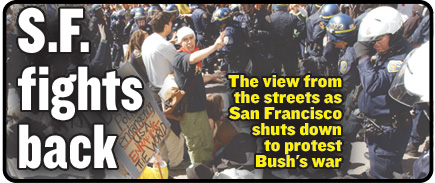
Nowhere was the clash of people power and government will more acute than on the streets of San Francisco, where a series of massive marches, some drawing nearly 100,000 people, filled the streets prior to the invasion of Iraq on March 19, 2003. The onset of war led protesters to effectively shut down the city, resulting in about 2,300 arrests and millions of dollars in costs to the city.

President George W. Bush dismissed the protests, of course, but he wasn’t the only one. Political leaders such as Rep. Nancy Pelosi, then-Mayor Willie Brown and soon-to-be Mayor Gavin Newsom (who didn’t attend any of the marches, unlike progressives on the Board of Supervisors) condemned the peace movement for hurting an innocent city. But with the “battle for San Francisco” making international news, the protesters were more concerned with the global audience.

A month earlier, on the weekend of Feb. 15 and 16, there were coordinated protests against the impending war in about 800 cities around the world, drawing around 10 million people. The peace march in Rome included about 3 million people, earning a listing in the Guinness Book of World Records as the largest anti-war rally in history. People have never made such a loud and clear statement against an incipient war.

Beyond the numbers, the antiwar movement was also right. On every major issue and prediction, the messages from the street proved correct while those from the White House were wrong. The US wasn’t welcomed as liberators. There were no weapons of mass destruction. Iraq after the invasion isn’t a stable democracy or shining beacon to anyone but the new generation of jihadis Bush created.

We can blame a hard-headed president, ineffectual opposition party, failure of the national media, or the national climate of fear following Sept. 11. But rather than refighting that lost battle, now is the time to gain perspective on the events of five years ago and determine what it means for democracy and the post-Bush national agenda.


TO THE STREETS

There were two main umbrella groups organizing protests before the war: Direct Action to Stop the War (DASW) and International ANSWER (Act Now to Stop War and End Racism). ANSWER has remained active and DASW has recently been reconstituted for the fifth anniversary of the war, using direct action in San Francisco as well as other urban centers and outposts like Chevron’s refinery in Richmond, which has reportedly been processing Iraqi oil.

“With the fifth anniversary coming up, we’re going back to direct action on the streets,” said Henry Norr of DASW. “But I don’t have any illusions that it’s going to be like it was five years ago.”

The maddening march to an ill-advised war created a political dynamic in which a broad cross-section of Americans was willing to hit the streets.

“We had a wonderfully diverse group of people, from soccer moms to anarchists,” said Mary Bull, who cofounded DASW, a collective of various affinity groups and concerned individuals formed in October of 2002 as Bush started beating the drums of war.

It was a group fiercely determined to prevent the war — and really believed that was possible. In fact, Bull recalls how she and other members of the group burst out crying at one meeting when a key activist said the war was going to happen.

Richard Becker, who cofounded ANSWER and serves as its West Coast coordinator, said that in the summer of 2002, “we came to the conclusion that [the war] was going to happen.” The group called its first big protest for Sept. 15, 2002, and another one two weeks later. But the movement really exploded on Oct. 26 when almost 100,000 people took to Market Street, much of it a spontaneous popular uprising.

“We were overwhelmed,” Becker said. “We were in a perpetual state of mobilization to keep up with what was going on. But then it didn’t stop the war.”

Did he think they could?

“I think a lot of people thought maybe it was possible to stop it. And we thought maybe it was possible to stop it,” Becker said.

The high point, according to Becker and Norr, was Feb. 17, 2003, when the New York Times ran a front page analysis piece entitled “A new power in the streets” that claimed “the huge anti-war demonstrations around the world this weekend are reminders that there may still be two superpowers on the planet: the United States and world public opinion.” But then Colin Powell went to the United Nations to argue for the invasion, and the Democrats in Congress did nothing, and it became clear war was coming.

Norr stayed out there protesting, being arrested several times and even shot in the leg by Oakland police with a rubber bullet during a protest at the Oakland docks. And he thinks some good came from the experience.

“The lesson for people is the political and economic elites are committed to preserving and extending empire. And they basically say as much in their own writing,” Norr said. “Wars are not anomalies.”

Despite being a frustrating and depressing exercise, most saw benefits to the failed movement. “People got an incredible education about how the system really worked,” Becker said. “Building a movement is mostly about a series of setbacks.”

Medea Benjamin, cofounder of both Global Exchange and CodePink and fixture of the anti-establishment peace movement for years, was upbeat about the protests. “We did our job as citizens. We did what we were supposed to do: organize, get people to take action, get people onto the streets,” she said. “We did everything we could think of.

“What you take from it is we don’t have a very well-developed democracy because the people spoke and the government didn’t listen.”

25war2_Lars1.jpg The ever-evolving “Democracy Wall” on Valencia Street, March 2003, helped stir up debate (Photo by Lars Howlett)


FACING ARREST

The collective action of five years ago starts with a series of personal stories — tens of thousands of them — so let me briefly begin with mine.

My arrival in San Francisco was closely tied to the march to war. I was living in Sacramento and working as the news editor of the Sacramento News & Review when Bush began his saber rattling against Saddam Hussein, but by the end of 2002 I had a falling out with my boss and found myself jobless.

Like most Northern Californians who opposed the war, I came to San Francisco on Jan. 18 to make my voice heard and experienced a bit of serendipity on my way to Justin Herman Plaza: while reading the Guardian on Muni, I saw their advertisement for a city editor, a job that was ideal for me at a paper I’ve always loved. Needless to say, it was a great day, empowering and full of possibilities.

Less than two months later I was on the job, and on the second week of that job I was back on the turbulent streets of San Francisco, part of a Guardian team covering the eruption of this city on the first full day of war. When I stepped off the cable car just after 7 a.m., people were streaming up Market Street and I joined them.

When a large group stopped at the intersection of Market and Beale, I stopped too, taking notes and bearing witness to this historic, exciting event. I had a press pass issued by the California Highway Patrol that allowed me to cross police lines, so when police in riot gear surrounded us and threatened arrest, I held my ground with 100 or so protesters.

After interviewing about a dozen people about why they were there and that they hoped to accomplish (see “On the bus: Journalists, lawyers, four-year-olds — the cops were ready to bust anyone Thursday morning“), I was arrested with the others and taken to a makeshift jail and processing center at Pier 27 (no charges were filed in my case, and charges against all of the 2,300 people arrested here in those first few days of the war were later dropped).

I recently tracked down a few of the people who appeared in my article, including Daphne and Ross Miller, who were at the center of the most interesting drama to play out during our standoff with the police. She’s a family practice physician, he’s an architect, and they live in Diamond Heights with their two children, Emet, who is almost 9, and Arlen, 12, who was away on vacation when the war began.

“We were genuinely shocked that the war started,” Ross told me. “We were at some of the earlier protests and really thought there was no way [Bush] could do it.”

They woke up March 20, 2003, to news that the war had begun and immediately walked to the BART station with Emet and rode to the Embarcadero station, not really planning for the day ahead but just knowing that they had to make themselves heard.

“We were pissed as hell. I don’t think I’ve ever been so angry in my life,” Daphne said.

They quickly came up with a plan. “We basically decided that if anyone was going to be arrested, it was going to be Ross and I’d stay with Emet. But it didn’t end up that way and I ended up in the arrest circle.”

Daphne had their house keys and threw them over the police line to Ross at one point. A photographer in the circle had gotten shots of a man named Roman Fliegel being roughed up by police as they pulled him off his bicycle, which was towing a trailer with a sound system, and decided to throw his backpack with camera gear out as well. When Ross — who had four-year-old Emet on his shoulders — caught it and refused police orders to give it to them, police grabbed Emet and roughly arrested Ross, leaving a gash on his forehead.

“Rage surged through the crowd, and it seemed as if things might get ugly, but the police kept a tight lid on the situation, using their clubs to shove back protesters who had moved forward,” I wrote at the time.

Emet was delivered into the circle with Daphne as the arrests continued, many quite rough. “At that point, as a mom, I had to exercise the most restraint ever,” said Daphne, who was angry about the situation but fearful about what she was exposing her son to. “Please, don’t let any violence happen here,” she pleaded with the crowd. Eventually, commanders on the scene let the mother and child go.

“The officer who let me go said that if he saw me again out there, he would call Child Protective Services on me,” Daphne said. But two days later, still brimming with outrage at her country’s actions, she ditched a downtown medical conference to rejoin the street protests, this time solo.

The couple say they’ve lost friendships over the war and have become more engaged with politics, coming to believe that Bush and the neocons are malevolent figures who knew how badly the war would go and did it anyway to establish a large, permanent military base in Iraq.

“Since that day, we’ve been far more active,” Ross said. “We realized you can’t just trust the system. You have to push.”

But that determination was mixed with feelings of disempowerment and depression. They attended some of the protests that following year, but the couple — like most people — just stopped going at some point because they seemed so futile.

“There was a horrible sense of resignation and a genuine depression that followed,” Ross told me.

The nadir was when Bush was reelected and they considered leaving the country. But then, Ross said, “we decided we’re not just going to run away and we’re not going to accept this.” Looking back, even with the scare over Emet, they express no regrets.

“It was the right thing to do because it was the wrong war to have. I’d do it again and again and again if I had to,” Ross said

They’re guardedly hopeful that Barack Obama could begin to turn things around if he’s elected. “I think the right president can at least start to dismantle this,” Daphne said. “I think thousands of people marching in the streets is something he would listen to.”

25war3_Charles1.jpg A die-in on the streets of San Francisco in March 2007 marked the fourth anniversary of the invasion (Photo by Charles Russo)


WITNESS TO HISTORY

Covering the peace movement in those early days was a heady experience, like reporting on a revolutionary uprising or working in a foreign country where the people are organized and active enough to be able to shut down society and brave enough to risk bodily injury for their beliefs.

I was at the founding meeting of CodePink — which became the most effective group at personally confronting the warmongers and keeping the war in the public eye — one evening at Muddy Waters in the Mission District shortly after the war started.

Looking back, Benjamin rattled off a long list of the alliances the group built — with labor, churches, businesses, and a wide array of social movements — and creative actions intended to build and demonstrate popular support for ending the war.

“We’ve done so many things and what did we get? We got a surge,” she said. “It shows the crisis in our democracy, the crisis of the two-party system, the crisis of a dysfunctional opposition party.”

Yet she said the peace movement has been remarkably successful in convincing the public that the war was a mistake and that it’s time for the troops to come home, even if the Democrats have been slow to respond to that shift.

“The progress we’ve made is turning around public opinion and that’s going to play a big role in the upcoming elections,” she said. For Norr, the role of the news media is a particular sore spot. He was a technology reporter for the San Francisco Chronicle who called in sick on the first full day of war and was arrested on Market Street with his wife and daughter, resulting in suspension by editor Phil Bronstein for his actions.

I wrote several stories on the issue, which culminated in Norr being fired and Bronstein unilaterally banning Chron employees from peace protests. I even borrowed CodePink’s guerilla tactics when Bronstein repeatedly refused to return my calls or address why he had singled out antiwar protesters for uniquely punitive treatment. I confronted him during a speech he gave at the Commonwealth Club (see “Lies and half-truths,” 5/7/03). That was the tenor of the times: we were all tired of being lied to and we decided to push back.

Norr was particularly frustrated with his own paper’s reporting of the war and started sending articles by the foreign press to his paper’s news desk, trying to wake his colleagues up to the pro-war propaganda being passed off as journalism in this country.

He was also disappointed with the country and with the Chronicle — both the management and his fellow reporters, who did little to support him — but the experience caused him to return to his roots as a progressive activist.

“The war and losing the job and everything brought an abrupt end to my consumerist phase and dumped me back into the world of being an activist,” said Norr, who serves on the KPFA 94.1 FM local station board and has made three recent trips to the Palestinian territories while working with the International Solidarity Movement.

Benjamin said Americans shouldn’t expect the next president to end the war — not without lots of pressure from a renewed and vocal peace movement. “This is the time to set the stage for the post-Bush agenda,” Benjamin said. “Don’t put your hopes in Barack Obama in getting us out of Iraq. Put your hopes in the people.”

25war4_Lane1.jpg A rally and nonviolent direct action at the Richmond refinery targeted Chevron on March 15 (Photo by Lane Hartwell)


THE AFTERMATH

The San Francisco Police Department, which spent more than $2 million on overtime costs responding to peace protests between March 15 and April 16, 2003, generally behaved with restraint and professionalism, but there were several exceptions.

The most costly and disturbing incident came when Officer Anthony Nelson began aggressively swinging his long riot baton at protesters, badly shattering the arm of peaceful protester Linda K. Vaccarezza, who suffered a permanent disability in her career as a court reporter.

Nelson’s incident report falsely stated that Vaccarezza had threatened him with a sign attached to a solid pole, but video of the incident later clearly showed there was no pole and that she was retreating when he teed off on her (see “The home front,” 05/19/04).

Vaccarezza received an $835,000 settlement from the city in November of 2004. On Oct. 5, 2005, two and a half years after the incident, SFPD fired Nelson for lying about what happened that day, and the City Attorney’s Office has been successfully fighting Nelson’s appeals in court ever since, putting in more than $100,000 in attorney time and costs into the Nelson and Vaccarezza cases.

The other significant ongoing litigation from the antiwar protests involved Mary Bull, who was arrested during an early protest for pouring fake blood in front of the entrance to Chevron’s San Francisco office before being allegedly strip searched and left naked in her San Francisco Jail cell for 36 hours.

Ironically, Bull was among those who brought a successful class action lawsuit against Sacramento County after she and others protesting a logging plan were strip searched, setting a precedent and led most counties to reform their strip-search policies. She used her share of the $15 million judgment to buy an organic permaculture farm in Sebastopol.

Her San Francisco case, in which Bull won a multimillion-dollar judgment, is still under appeal and now in mediation. Bull said the protests five years ago did make a difference, something she tells those who fret about its apparent failure. “I tell them to look at what issues the candidates are talking about now and I thank them for protesting then.”

“Even though we had millions throughout the world, we were sort of blocked, but now we’re regaining that momentum,” Melodie Barclay, a massage therapist who was also arrested with me on the first day of the war, told me recently. “We can’t judge it by the fact that we didn’t get the momentum we wanted.”

Norr started his antiwar activism working with Students for a Democratic Society in Boston, protesting the Vietnam War, which he said shares many similarities with the current situation, for good or for ill. He said that people tend to forget that while the protests then were huge and helped end the war, the movement did wane after Nixon ended the draft and substituted massive aerial bombardment for boots on the ground.

“The protests dropped off considerably,” he said. “A lot of the things that drove people to take risks in the late ’60s had faded by the early ’70s.”

He thinks the current administration learned a lesson from those days: it’s easier to maintain a war effort if the average citizen isn’t affected.

But there are other factors as well keeping a lid on the antiwar outrage.

“The culture has changed too. Young people are oversaddled with debt. People in schools seem to be docile. The culture as a whole seems to be more individualist and consumerist,” Norr said.

Yet some young people have woken up and many of them are funneling their energies into a peace group that was formed in the summer of 2005: World Can’t Wait, as in: the world can’t wait for the end of Bush’s second term before we change our direction and leadership.

“We don’t just want them gone, we need to repudiate their program,” said Giovanni Jackson, a 26-year-old WCW student organizer. “If we’re going to change anything, we need the youth.”

Jackson was at WCW’s founding convention in New York City, which came just as New Orleans was being flooded and then essentially abandoned by the federal government.

“When [Kerry] lost, people felt demoralized and World Can’t Wait kind of stepped into that situation,” Jackson said. “There was a lot of demoralization in the antiwar movement at that time.”

The group organized protests and student walkouts on Nov. 2, 2005.

“Everyone has their moments of doubt,” he said, “but I’m motivated by the crimes we see everyday.”


THE LESSONS

One of the biggest barriers to galvanizing people and turning the fifth anniversary of the war into something that might make a difference is the presidential election, which is diverting the energy of many potential protesters — and at the same time, offering some hope that a new president may lead to peace.

After all, every single one of the Democratic presidential candidates has promised to withdraw troops from Iraq, with varying timelines and numbers of US personnel left behind. And with enough encouragement, they might be willing to help change the status quo.

Many of the activists who volunteered their time and money to help move the Obama campaign into its front-runner position came out of the antiwar movement, and Obama’s strong stand against the war has been a key factor in his popularity.

Becker and some other activists don’t have much faith that a change in presidents will change the course in Iraq, although he agrees that much of the energy now surrounding Barack Obama derives directly from the antiwar movement.

“There’s been a huge upsurge of hope for Obama and that he might bring about the kind of change we need,” Bull said, adding that she doesn’t share that hope, believing the only path to peace is to pressure Obama and other leaders to commit to more progressive positions.

Norr said, “On one level, people have illusions about the power of peaceful protests. People believe in democracy, as well they should. We feel like the rulers should be paying attention to public opinion.

“It’s a remarkable story how broadly and quickly the American people have turned against the war. Public opinion was certainly ahead of the Democrats.”

And people will only grow more disenchanted with Iraq and its multitude of costs. “The people here are paying for this war, and everyday we have new stories about health clinics being shut down,” Becker said.

Becker was amazed last March as massive demonstrations for immigrant rights seemed to explode out of nowhere. “We think there will be more things like that,” he said.

Because after five years of organizing communities to resist the military-industrial complex’s plans, Becker thinks there’s been some visible progress.

“There isn’t a town or hamlet in the US that doesn’t have activism going on, but you wouldn’t know it from the corporate media,” Becker said. “It’s a mistake for people to feel discouraged.”


The Guardian Iraq War casualty report (03/17/08)

0

At least 39 Iraqi civilians were killed today in a suicide bombing at a mosque in Karbala, according to the Associated Press.

For a breakdown of the positions that relevant politicians are taking on the war in Iraq, visit the slate.com link below. 36 U.S. soldiers were killed this month, which means at least one U.S. soldier was killed for every day that passed. Click here to view.

Casualties in Iraq

Iraqi civilians:

82,199 – 89,710: Killed since 1/03

Source: http://www.iraqbodycount.net

For a list of recent events that have resulted in Iraqi casualties, visit :
http://www.iraqbodycount.org/database/recent/

For first hand accounts of the grave situation in Iraq, visit some of these blogs:
ejectiraqikkk.blogspot.com
healingiraq.blogspot.com
afamilyinbaghdad.blogspot.com

U.S. military:

4,266: Killed since the U.S. invasion of Iraq 3/20/03

Source: http://www.icasualties.org/

145: Died of self-inflicted wounds, according to http://www.icasualties.org/

For the Department of Defense reports go to: http://www.defenselink.mil/

For a more detailed list of U.S. Military killed in the War in Iraq go to: www.cnn.com

To view a breakdown of U.S. military casualties by state of residence, click here.

Iraq Military:

30,000?: Killed since 2003

Source: http://www.infoshout.com

Journalists:

127: journalists have been killed since the start of the war in March, according to www.cpj.org.

Refugees:

2.2 million: Iraqis displaced internally

2 million: Iraqis displaced to neighboring states

Incessant violence across much of Iraq’s central and southern regions has forced tens of thousands of people to leave their homes every month, presenting the international community with a humanitarian crisis even larger than the upheaval aid agencies had planned for during the 2003 war, according to United Nations High Commissioner for Refugees’ estimates.

U.S. Military Wounded:

132,199: Wounded from 3/19/03 to 3/01/08

Source: http://www.icasualties.org/


The Guardian cost of Iraq war report (03/17/07): So far, $503 billion for the U.S., $63 billion for California and $1 billion for San Francisco.

Compiled by Paula Connelly

Here is a running total of the cost of the Iraq War to the U.S. taxpayer, provided by the National Priorities Project located in Northampton, Massachusetts. The number is based on Congressional appropriations. Niko Matsakis of Boston, MA and Elias Vlanton of Takoma Park, MD originally created the count in 2003 on costofwar.com. After maintaining it on their own for the first year, they gave it to the National Priorities Project to contribute to their ongoing educational efforts.

To bring the cost of the war home, please note that California has already lost $63 billion and San Francisco has lost $1 billion to the Bush war and his mistakes. In San Francisco alone, the funds used for the war in Iraq could have been used to provide 3,144,442 homes with renewable electricity, 726,370 people with health care, or 31,528 public safety. For a further breakdown of the cost of the war to your community, see the NPP website aptly titled “turning data into action.”

For more information on what the war is costing the United States visit the American Service Friends Committee website here.

SXSW: Touch down! Plans, schplans…

0

cas sml.jpg
Won’t you listen to Cassettes Won’t Listen.

“Punk rock – we don’t have that category in this country.” Oh, the quotables already emanating from Austin, Texas – albeit from a boomer-rock-oriented radio commentator interviewing aging Aussie punk vets.

SXSW, here we go again. The plane was packed on the way from Denver to Austin. Baggage claim was filled with checked guitars and black-garbed hollow-eyed scenesters. Todd P already had a Juicebox show going at 2 a.m. at his party central, Ms. Bea’s. And rumors are already swirling – has Dolly Parton cancelled? Is it possible to squirm into the already-closed-guestlist Playboy afterhours party Thursday night? Where is Perez Hilton having his ssseeecccret soiree (with Robyn no doubt working her rework of Snoop Dogg’s “Sex Eruption”)? Rachel Ray is having a party – huh?! You can spend more time planning your sked than actually seeing music, but the one-man band sounds of Cassettes Won’t Listen drew me into the Austin Convention Center’s dark, semi-depressing, school-caf-like Daystage.

Most disturbing news: so many longtimers aren’t making it this year due to industry cutbacks. Most disturbing stuff in the fest bag o’ fliers: an Armed Forces Entertainment card with a little green toy soldier attached (“Plug in your weapon, turn up the power and fire away. Your limo is a Humvee and your ride is a Blackhawk”). War is so cute – and glamorous! And a card announcing a casting call for Blue Man (I guess the blue face paint fits any ole one – except maybe women?).

What’s up tonight? Free Yr Radio is throwing a bash with Simian Mobile Disco, Yeasayer (all the buzz here, natch), and Times New Viking (Ohio-ans do it so good) at La Zona Rosa, a black rock showcase with Lightspeed Champion courtesy of Vice, a Kills show at the Fader Fort, an Emusic showcase, White Williams at the Gorilla vs Bear party. Also drool-worthy is the Terrorbird/Forcefield PR party with Yacht, Raveonettes, Why?, These New Puritans, the Blow, Radar Bros., Bowerbirds, and the return of the Mae Shi. Kimya Dawson will likely be at the Keep Austin Good event at San Hotel’s parking lot, and Dan Deacon and Deer Tick are making some very late-night noise – shhhh! – at one o’ UT Austin’s quads at, oh, 2 a.m. And most of those events aren’t even official.

Saint Peter

0

› a&e@sfbg.com

Arguably no modern film director made a better sustained entrance than Peter Bogdanovich, whose first four features were all triumphs. Targets (1968) was a chilling conceit that brought Hollywood pretend terror (Boris Karloff basically playing himself) against a modern real-world horror, the randomly mass-murdering sniper. That critical success led to a major studio deal to adapt (with then wife and collaborator Polly Platt) Larry McMurtry’s novel The Last Picture Show (1971), a melancholy black-and-white flashback to 1950s rural Texas. It won two Oscars, was nominated for five more, and served as a launching pad for actors including Jeff Bridges, Ellen Burstyn, and Cybill Shepherd. Next came What’s Up, Doc? (1972), a delightful, San Francisco–set nod to 1930s screwball comedies with Barbra Streisand and Ryan O’Neal. Its huge success was equaled by 1976’s Paper Moon, with O’Neal and daughter Tatum as a Depression-era confidence duo.

That’s a heady four hits in five years — and they’ll all be shown at the Castro Theatre in a tribute to the director presented by Midnites for Maniacs’ Jesse Hawthorne Ficks. Another four films will be seen in director’s cuts different from original theatrical versions. Further, Bogdanovich himself will be on hand at all but the earliest matinees. He’s a great raconteur who’s insightfully frank about the ups and downs of an eventually checkered career.

"Ups and downs" puts it mildly. While Bogdanovich started out on top, Hollywood relished kicking him with each downward step. But he’s still here — and especially visible recently, thanks to his role on The Sopranos as Lorraine Bracco’s shrink. Behind the camera too, he’s gotten love lately from the four-hour DVD documentary Tom Petty and the Heartbreakers: Runnin’ Down a Dream (2007). Bogdanovich, who hasn’t directed a big-screen movie since 2001’s lamentably underseen The Cat’s Meow with Kirsten Dunst, hopes to soon start shooting an adaptation of Tracey Letts’s jet-black stage comedy Killer Joe — and he’s got other irons in the fire.

If it’s thus a fine moment to be Bogdanovich, there have been many not-so-great ones. Phoning recently from Los Angeles, he recalls that before the debut of Daisy Miller (1974), his first commercial failure, critic Judith Crist asked him, "Is it good? It better be … because they’re waiting for you." Catching major flack for that film was Shepherd, the model-turned-actress he left Platt for.

"Peter and Cybill" were inseparable, possibly obnoxious. They cohosted The Tonight Show for a week and were reportedly arch as hell. They occupied the inaugural cover of People, with the headline "Living Together Is Sexy." The director quotes Cary Grant (doing a perfect vocal imitation) advising, "Petah, please stop telling people you’re happy and in love!" Asked why, Grant said, "Because they aren’t happy and in love."

Even those who liked Daisy Miller went Attila on 1975’s At Long Last Love, a lavish tribute to ’30s musicals with Cole Porter songs recorded live by some actors who were trained singers (Madeleine Kahn) and others who weren’t (Shepherd, Burt Reynolds). It was meant to be charming. It got the most vitriolic reviews this side of Battlefield Earth. Bogdanovich now says, "We rushed and fucked it up. The first preview in San Jose was an unmitigated disaster. Then we recut and remixed, and it played quite well. But I made some calamitous changes after that, and didn’t preview it again before release. We were just killed. Later we made a different edit. When Jesse called me to say he was showing it, I said, ‘Why?’ ‘I like it.’ ‘Oh, you’re the one.’<0x2009>"

The Castro will screen that improved edit — which is charming. Although the title is still a pseudonym for "turkey," At Long Last Love has never been released on video or DVD. In a town where success usually excuses all egotism, Bogdanovich had still somehow crossed a line. His failures were blamed on sheer arrogance. "I got a lot of that," he says — though back then a purportedly imperious on-set demeanor and statements like "I’m not modest, I’m not humble, and the more success I have, the more critics will resent me" surely didn’t help. He’d had the temerity to befriend Hollywood legends including Grant, John Ford, and Orson Welles — who was practically a permanent houseguest. Who the hell did he think he was?

Cynics had already interpreted Bogdanovich’s hit homages to Hollywood’s past as evidence he didn’t have an original thought in his head. Then they gloated over his nonhits. Despite the star power of Reynolds and both O’Neals, Nickelodeon was a 1976 Christmas flop. (Forced to shoot in color, Bogdanovich says, "It’s another movie in black and white" — which is how he’ll show it at the Castro.)

Despite excellent reviews, 1979’s Paul Theroux adaptation Saint Jack didn’t find an audience. Ditto 1981’s They All Laughed, an enchanting, ensemble romantic comedy. It was (among other things) a valentine to his new love and protégée, erstwhile Playboy centerfold Dorothy Stratten — who shortly after filming ended was killed by the thuggish promoter-husband she’d tried to leave amicably. That murder-suicide was followed by more ugliness: a war of words between Bogdanovich and Hugh Hefner; "dramatization" of the tragedy in 1983’s Star 80 ("I begged Bob Fosse not to do it") and a TV movie; and distribution problems for They All Laughed that cost him millions. Sympathy soured when Bogdanovich became involved with Dorothy’s younger sister, Louise — who was all of six months older than his own daughter. (Nonetheless, their eventual marriage lasted 13 years.)

Bogdanovich had a left-field comeback in 1985’s Mask, with Eric Stoltz as Elephant Kid and Cher as biker-chick mom. But even that was marred by public sparring with both Cher and studio execs. The latter substituted Bob Seger tunes for Bruce Springsteen ones key to the story’s real-life inspiration. (The Castro’s "theatrical world premiere" cut restores all the Bruuuuce.) Whether good, bad, or indifferent, his subsequent ventures flopped. In an eerie echo of past events, 1993’s The Thing Called Love came out (barely) after star River Phoenix OD’d. Bogdanovich turned to directing TV episodes (including for The Sopranos) and cable movies. It wasn’t a comedown, he says. "The scripts were good … and I got to work with actors like Cicely Tyson, Sidney Poitier, and George Segal."

Bogdanovich also relit an acting career abandoned decades earlier. Having written essays about film history (notably for Esquire) before moving to Hollywood, he thinks his industry hater trail is partly due to perception of him as critic turned filmmaker. He considers the roughly 45 stage productions he acted in (and the 6 he directed) from age 15 to 24 as his real prior job.

Given all past tempests, Bogdanovich seems on good terms with his exes — Shepherd (in town with the play Curvy Widow) has promised to show up at the Castro late Friday for The Last Picture Show and At Long Last Love; Louise is flying in to talk about her late sister when They All Laughed shows on Sunday.

Is it painful for them to see Dorothy Stratten onscreen? "Yeah, especially now that [costar] John Ritter has died," he says. "But you know, when you see it with an audience, it’s OK — it takes the pain somewhat away. One of the peripheral tragedies [to Stratten’s death] was that the movie was never properly seen in its day. You couldn’t really look at it in the way it was meant to be enjoyed."

A GENUINE TRIBUTE TO PETER BOGDANOVICH

Fri/7–Sun/9, $10 per day ($25 weekend pass)

Castro Theatre

429 Castro, SF

www.castrotheatre.com, www.ticketweb.com

SF activists campaign for Obama in Texas

1

cat julain obama-small.jpg
Cat Rauschuber, Barack Obama and Julian Davis in Texas.
By Julian Davis and Catherine Rauschuber
(San Antonio, Texas) __ When we arrived here Friday afternoon, we had little idea what our experience of campaigning for Barack Obama would hold. We have several friends who are field organizers for the campaign and have been hopping from state to state, adding to Obama’s string of electoral victories. Now three of them are in Texas, Cat’s home state and the place that feels like ground zero in the presidential campaign right now. We decided to come to San Antonio, where campaign-diva Natasha Marsh was organizing a largely Latino district on the west side. Julian had never been to Texas before.

Since our arrival Friday, this experience has been nothing short of amazing. Friday evening we volunteered at a rally where Obama spoke that drew a crowd of 10,000 people. It was the perfect introduction to what the weekend would hold – the energy in the crowd, the diversity of attendees, the commanding and inspiring message of the candidate. Little did we know at the time that this would be the first of three events we would have the opportunity to see – and even interact with – the Senator.

What a pain

0

› andrea@altsexcolumn.com

Dear Readers:

In the process of starting to crawl out of my "I just had two babies! Leave me alone!" cocoon, I’ve been teaching some new workshops, one on what it’s really like to have twins, and one that I’m calling "Is There Sex after Motherhood?" — hoping the idea comes across even though motherhood is, technically, a lifelong venture ending in death, after which, one assumes, not so much sex. I debuted the sex one recently at the original "clean, well-lighted place for buying things to stick up your hoo-ha," Good Vibrations. There was a decent crowd, and everybody seemed to have a good time; and when we got to the Q&A, I was gratified by the number of questions. (That’s how you can tell if people were interested in your presentation, right? Not so interested = polite thanks and drifting away; interested = hang around asking questions until the management kicks you out.) There’s some serious sadness haunting the new and newish mothers though, so while it’s all good and fun to talk about how a simple blow job between child care tasks can save your marriage (ask me how!), some of the questions stayed with me after we’d cleared away the cookies and juice (yes, mothers are served toddler snacks, don’t ask me why) and gone home.

It’s surely true that during the first few years after having kids, your sex life tends to be … well, "lackluster" is a nice word, but I think "laughable" might be more accurate in a lot of cases. Some of the women at these events are really beating themselves up over it though, which I guess is expected and is why I’m talking about this stuff in the first place, but one of them really saddened me when she said, quite matter-of-factly, that intercourse was still quite uncomfortable for her several years later and she hadn’t mentioned this to her husband. "I think you need to communicate with your husband," the other speaker, a therapist, offered. "I think you should find out what hurts and make it stop hurting," I countered.

How many women, mothers or not, are having painful sex and just not mentioning it? The most common cause of uncomfortable insertive sex is nothing more complicated than a case of "not ready–itis" or lack of lubrication, but a Harvard study cited by the National Vulvodynia Association (see www.nva.org/media_corner/fact_sheet.html) estimates that 16 percent of women in the United States suffer from the chronic vulvar pain called vulvodynia or its subtype, vulvar vestibulitis, affecting just the opening to the vagina. That’s a lot of women! Most are young when it starts, and most can locate no particular event or infection that set it off, but the pain can be paralyzing (many describe it as feeling like acid was poured onto sensitive tissues, or "like knives"). So we have a mysterious etiology; a location in the parts that many women simply don’t mention in public, even if that public comprises their doctor, themselves, and nobody else; and an exclusively female population of sufferers; and what do we get? Predictably, silence, confusion, and shame. And while I have never been a big fan of men-versus-women jokes and somehow doubt that if men got pregnant, ma- or paternity leave really would be two years long with full pay (come on!), if men often had agonizing, unexplained pain in their manly man parts, surely they wouldn’t have been subjected to generations of doctors pronouncing it "all in your head."

The good news — there has to be some — is that vulvodynia is finally getting the research money and attention it deserves. Recent research (see www.nytimes.com/2008/01/29/health/29brod.html?_r=1&ref=science) has turned up solid, quantifiable, and most important, curable causes of the pain: some women, the researchers found, had serious inflammation two cell layers deep that had not responded to steroids, a typical treatment. What’s even more interesting is that many of the women have a genetic abnormality — as I’m sure they could’ve guessed, considering the kind of hypersensitivity they’ve been putting up with — in which there are too many nerve fibers in the area, which produces a pain response to what in other women would just be normal sensation, like the pressure from your jeans against your crotch while seated. The linked article contains some success stories; the treatments (surgical or medical) are not perfect, but they have the potential to make life worth living again for some women who’ve been silently suffering, too embarrassed or too debilitated to say anything about it. That does count as good news, no?

I don’t really see a National Crotch Pain Month hitting the calendar anytime soon, but I do see this as the beginning of the end of one more way for women to suffer in silence and shame, so a cautious hooray for that.

Love,

Andrea

Andrea is home with the kids and going stir-crazy. Write her a letter! Ask her a question! Send her your tedious e-mail forwards! On second thought, don’t do that. Just ask her a question.

“Low Life Slow Life: Part One”

0

REVIEW "Low Life Slow Life: Part One" is a self-curated portrait of the artist Paul McCarthy as a young man told with a few of his favorite things. It’s a very personal exhibit, much of it culled from the archives of a now-grown enfant terrible, and lays out a canny narrative about artistic influence that throws the viewer more than a few MacGuffins.

Before McCarthy fully developed his taboo-vioutf8g aesthetic — which found its most abject expression in his foodstuff- and prosthesis-filled performance pieces of the 1970s and ’80s — he was a Utah painting student whose first steps in using his body as a medium were guided by the action-based events of artists such as Allan Kaprow, Kazuo Shiraga, and Yves Klein. A first edition of Kaprow’s canon-making Assemblage, Environments, and Happenings (H.N. Abrams) is on display here, alongside paintings, photographs, sculptures, and printed matter by or related to several of the artists included in the 1966 volume.

Much of what McCarthy has chosen would slot neatly into the syllabus for one of the art history classes he now teaches at the University of California at Los Angeles. Which is to say that he is aware of how institutions inevitably shape an artist’s time on Earth into a career, placing it within a historical context in relation to and often as a reaction against other artists. McCarthy’s piss take on these sorts of creative genealogies starts with Dada collagist John Heartfield’s swastika-shaped Tannenbaum (1934), then jumps 30-odd years to Joseph Beuys’s 1962 sculpture made with fallen pine needles, whose brown color is shared by McCarthy’s dead Xmas tree and bric-a-brac pileup (2007). The trees’ tinder skeletons look like the survivors of a pillow fight on a paintball range. Wisely, McCarthy leaves other works out of such daisy chains of facetious art history scholarship. Mike Henderson’s giant, ghoulish oils Nonviolence and Castration (1968) stand alone as apocalyptic visions of the dark underside of American life. I wonder if they remind McCarthy of his salad days of stuffing Barbies up his ass while besmirched with ketchup. (Matt Sussman)

LOW LIFE SLOW LIFE: PART ONE Through April 12. Tues. and Thurs., 11 a.m.–7 p.m.; Wed. and Fri.–Sat., 11 a.m.–6 p.m. CCA Wattis Institute for Contemporary Art, 1111 Eighth St., SF. (415) 551-9210, www.wattis.org

Your funny Valentines

0

› kimberly@sfbg.com

SONIC REDUCER "It’s 60 percent embarrassing and 40 percent hot. And the hotness is derived from how embarrassing it is. Or maybe that’s just me."

Talkin’ ’bout Valentine’s Day, the big VD, that bad case of lovin’ you, with a digest-to-impress din-din and a small but meaningful token of my esteem. Specifically, Club Neon organizer Jamie Guzzi, a.k.a. DJ Jamie Jams, is speaking of Club Neon’s fourth annual Valentine’s Underwear Party.

Yep, I know you know good times sans culottes have been happening for aeons — years, even — on a, ahem, more informal basis, way before Fuse TV’s Pants-Off Dance-Off. But guarens, it’ll be way sweeter and sexier at Club Neon: the first year at the Hush Hush, in 2003, "people were pretty tentative, and there were still lurkers," Guzzi says. "When you hear about these sorts of events, it’s more of a creepier crowd. When people first hear about it, they think it’s a Power Exchange or more Burning Man kind of thing — a lot of people you don’t want to see in underwear leering at each other. But this is a more indie crowd, and the kids are all cute and twee, and everyone shows up in American Apparel underwear." At least the clothing company’s soft tease is good for something more than selling terry cloth hot pants: vive le thunderwear as social equalizer!

"When you’ve got a couple hundred people in underwear, it’s pretty hard to front," Guzzi says, explaining that the idea emerged after he got frustrated with kids dressed to the nines vibing one another. The bonus: once stripped down at Club Neon’s key soiree, Guzzi claims, "you end up realizing that a lot of your friends are way cute. It shuffles the deck in terms of who’s attractive!"

And thank St. Valentine for dynamos like Guzzi. Sour grapes, bitter pills, badasses, bummed punks, gloomy goths, and hardcore realists have long realized all holidays have become co-opted as multimillion-dollar promotional vehicles to buy more, by playing off residual guilt, goodwill, or simply that overarching existential emptiness concerning life’s perpetual gerbil wheel. But what if you decide to suspend disbelief and descend into the commercialized maelstrom, mindfully participating in the recommended shopping, wining, and dining rituals? You’re accustomed to rocking outside the system, so what to do with your bad self when you need back in? Still no reservations? I’ve got a few ideas for every subculty cutie.

Indie Rock Ian Grub: fixed with a laid-back bike ride to Bernal Heights’ MaggieMudd for Mallow Out! vegan cones. Gift: an all-show pass to the Noise Pop or Mission Creek music fest or a steamy copy of the baby-making Juno soundtrack.

Hyphy Heather Grub: grind down on maple syrup–braised short ribs at the bupscale 1300 on Fillmore. Or for old times’ sake, snatch Sunday brunch at the latest Powell’s Place in Bayview (2246 Jerrold) now that gospel star Emmitt Powell has been forced to relocate. Gift: she voted for Barack Obama, but today she’ll swoon for Mac Dre’s Pill Clinton (Thizz Ent., 2007).

Metal Sven Grub: pick up a nice red wine and some stinky cheese for a Mountain View Cemetery picnic in Oakland — pretend you’re downing the fresh blood and putrid flesh of virgins. Gift: Santa Cruz combo Decrepit Birth’s Diminishing Between Worlds (Unique Leader) inspires … birth control.

Techno Cal Grub: nibble sour plum, shiso, and flaxseed sushi and other vegan Japanese delights at Medicine New-Shojin Eatstation. Gift: avert your eyes from the Versace boutique on your way outta the Crocker Galleria minimall, and here you go, the Field’s From Here We Go Sublime (Kompakt, 2007)

Country Kat Grub: fried rabbit — oh hell, we’re in former cow country, go for the porterhouse at the deliciously ’40s-western retro-authentic Hayward Ranch. Tip the blue-haired waitress well — she’s gotta have the patience of St. Val to deal with you two after your fourth Bloody Mary. Gift: seal the deal with Queen of the Coast (Bear Family, 2007), a four-CD box set of tunes by Bonnie Owens, who stole both Buck Owens’s and Merle Haggard’s hearts.

Jam Band Jessie Grub: grab your nut cream at Café Gratitude and chase each other around the table with wheatgrass shots. New game: if you don’t make me utter the goofy menu item names, I will be grateful. Gift: crash into the Dave Matthews and Tim Reynolds: Live at Radio City Music Hall Blu-ray DVD (Sony, 2007).

So hurry up and give your favorite pop tot some love — or you just might find yourself without on VD.

CLUB NEON’S VALENTINE’S UNDERWEAR PARTY

With DJs Jamie Jams, Emdee, Little Melanie, and Aiadan

Thurs/14, 9 p.m., $5

Make-Out Room

3225 22nd St., SF

www.neonsf.com

LOVE VENUS, LOVE DENGUE FEVER

J’adore Dengue Fever’s new Venus on Earth (M80), and the band provides the perfect post-love-in aperitif with Sleepwalking Through the Mekong. The John Pirozzi documentary on the Los Angeles combo’s trip to Cambodia ended up involving more than anyone anticipated. "Every contact was, like, ‘Don’t worry about anything! Just show up! Everything will be great!’<0x2009>" tour mastermind and bassist Senon Williams explains. "We’d be, like, ‘Where are we playing?’ ‘I don’t know. Just show up!’ So we were all nervous going over there. We had all our instruments, but we needed amplifiers and PAs and a crowd to play to." Fortunately, Dengue Fever were quickly booked to appear on Cambodian Television Network, and a two-song turn mushroomed into 10 numbers and a two-hour appearance. "Instantly, we became famous across the country," Williams tells me, "because everyone watches TV there."

SLEEPWALKING THROUGH THE MEKONG

Fri/15, 9:30 p.m.; Sat/16, 12:30 p.m.; $10.50

Victoria Theatre

2961 16th St., SF

www.sfindie.com

Mike Lacey ducks the big ones

0

I missed the trial on Friday, so if the SF Weekly’s hit man, Andy Van De Voorde, wants to take a swing at me for posting information on the testimony, fine: I’m smiling, Andy. (I’m also not the only person in the courtroom from the Guardian who knows what’s going on and can take notes.)

But before we get to the day’s events, let me do my all-too-regular Van De Voorde correction file. From his most recent blog:

“What’s your official title?” asked Weekly attorney H. Sinclair Kerr Jr. in what is a traditional first question for witnesses.

“I’m the executive editor of the company and apparently the mascot,” Lacey replied.

The remark was a reference to testimony from Guardian executive editor Tim Redmond, who last week said under oath he thought of Lacey as a New Times mascot.

Um, no Andy. I didn’t say that, under oath or otherwise. That testimony was from Jennifer Lopez, who used to work for the SF Weekly.

And jeez, Andy’s in court every day.

Another correction:

[Guardian attorney Ralph] Alldredge was also skeptical about why [New Times CEO Jim] Larkin hasn’t attended the trial—an odd question given that he could have subpoenaed the New Times executive.

Actually, Andy, you might check with your lawyers: This is a California case, and as long as Larkin doesn’t live here and can’t be found within the borders of the state, we can’t subpoena him. Interesting that he hasn’t shown up once for the trial; if he had, we could have compelled him to take the stand and answer a few questions.

Now then, since we have that cleared up, let me go to the day’s events. Here’s our report:

Mike Lacey took the stand in the Guardian’s predatory pricing trial against the SF Weekly and had some trouble answering some key questions.

The editor in chief of the SF Weekly’s parent chain, the VVM/New Times/SF Weekly, said at one point that the SF Weekly was a better paper in “most all respects” to its competitor, the Guardian.

Lacey said that the Weekly was better in layout, stories, design, graphics, readers, everything. Also, he said that the Guardian was “obsessed with City Hall and City Hall minutiae” and the city was full of young people who didn’t vote and weren’t interested in politics and they came to the Weekly.

If the Weekly is such a better paper, Guardian Attorney Ralph Alldredge prodded on cross examination, why does the Weekly sell its advertising at rates so much lower than the Guardian? Why doesn’t a Weekly advertising sales person sell its advertising space at a rate higher than the Guardian? Why doesn’t the Weekly command a premium price?

Lacey ducked the questions.

Accidental tranny

0

› superego@sfbg.com

SUPER EGO Guilty! I’m totally real-time guilty. Yeps, frenz, I’m that spastic whore on the dance floor whooping like a neon cough, flinging my Mary Kate triceps up when a thump drops in the mix. If a club has one of those heinous black lights at the door, I sneak in the back so no one spots the glowing spunk on my skirt or my phosphorescent VCR. I always ask for extra antioxidant-rich lychees in my pomegranatini, to offset the American Spirits. OK, I’ve blown the DJ. And although I’ve never stuffed a tube sock down my sequined thong or Botoxed my rosy areolae, those are my fake digits you just beamed into your contacts, sweetness. Thanks for the pomegranatini. Call me!

Also, I take things for granted. Some parties in this town have been around since Y2K was ripped-knee-high to a troll doll (New Wave City, 1984, Popscene, Death Guild, Red Wine Social, Qoöl). I’ve surely enjoyed them all. But in my ravenous quest for novelty I’ve watched them gradually fade from my schedule, like tears of joy evaporating on a monitor. Thus I was shocked when word squirted down the pudding pipe that — after 12 years of lunatic antics at the Stud — weekly trash-drag frenzy Trannyshack was slamming its barn door shut in August. Just where the heck will club pervs get their weekly fix of "two trannies, one cup"?

"I never intended to become a professional drag queen, Marke B. It was almost an accident," Trannyshack hostess Heklina said, laughing groggily into the phone when I rang for dish. I’d woken her up: it was 2 p.m. "I was merely dabbling in drag when the Stud approached me a dozen years ago to fill the Tuesday night slot. It’s been wonderful, but I’m ready for a change — and I’m too much of a control freak to let Trannyshack go on without me."

The lady was feeling candid. "I’m done with punk-rock drag," she added. "I’m tired of feeling like I have to haul in my own amps, manage the entire bar, and clean up afterwards. At this point I simply want to walk onstage and have the light show ready and the sound board all cued up. And I want more challenges, to work more in theater, expand my horizons, travel, figure myself out. You get trapped in a persona. This great thing comes along, people love it, and then suddenly it’s your whole life. For 12 years. Time for a breather!"

Hold on to your panicked panties, though. "Trannyshack the brand isn’t going away," Heklina continued. "I’m working on making it a monthly party somewhere nice, and we’ll still do big events like the annual pageant, Trannyshack Reno, international gigs, and maybe bring back the cruise." The weekly Trannyshack’s planning to go out with a bang too: a countdown of greatest hits and command performances has begun, with Ana Matronic of Scissor Sisters hosting Feb. 12 and an explosive 12th-birthday blowout Feb. 19.

Heklina is one of the OG rave-era club kids who made San Francisco fabulously unsafe at any speed, and Trannyshack freed drag from its Judy Garland fetters, flooding punk spirit — and oodles of bodily fluids — into the stalls of gay nightlife. The ‘Shack’s now venerable enough to be thought mainstream by some young turks, but it still feels like the scene’s bloody wig’s been yanked off.

TRANSPORTING How’s this for a leap of global proportions? The papacito of the nightlife’s global grooves movement, DJ Cheb i Sabbah — himself a proprietor of one of SF’s longest-running parties, 1002 Nights (now at Nickie’s in the Lower Haight on Tuesdays) — has just released another stunningly internationalist CD, Devotion (Six Degrees), and he’ll be throwing down, celebration-wise, at the huge returning one-off Worldly at Temple. Boosting Cheb’s subcontinental turntable wizardry live will be Pakistani vocalist Riffat Sultana and percussionists Salar Nadar and Mitch Hyare. Also trading on the tables: electrotabla etherealist Karsh Kale and bhangra breakster Janaka Selekta. Fold dem paper planes and twirl.

TRANNYSHACK

Tuesdays, 9 p.m., $8

Stud

399 Ninth St., SF

(415) 866-6623

www.studsf.com

www.trannyshack.com

CHEB I SABBAH AT WORLDLY

Sat/9, 10 p.m., $8

Temple

540 Howard, SF

www.templesf.com

www.chebisabbah.com

The governor’s spending addiction

0

OPINION Just five months after boasting that California’s "budget deficit is zero," Gov. Arnold Schwarzenegger recently came back to tell us the state is facing a staggering $14.5 billion shortfall over the next 18 months.

To deal with this amazing turn of events he is now proposing that we slash funding for our court system; virtually close down our state parks system; cut more than $4.5 billion from K–12 education; decimate our AIDS Drug Assistance Program; further reduce reimbursement rates for health care providers; put the children of mothers on state assistance at risk of homelessness; deny the blind, the elderly, and the disabled even a minimal cost-of-living adjustment; and continue to underfund our higher education systems.

Voters should rightfully be bewildered and seriously concerned. How and when did this crisis happen? How could the state go from a budget deficit of zero to one of $14.5 billion in just five months?

The governor’s earlier boast about our nonexistent budget deficit was a great line from a great showman. But it failed to tell the real story.

The fact remains that Schwarzenegger created the beginnings of this budget catastrophe on his very first day in office, when he followed through on a campaign pledge he made during the 2003 recall election. His promise was to rescind the restoration of the vehicle license fee.

The VLF was created in 1935 as a 1.5 percent tax on the purchase price of every automobile sold in California. Iconic Republican governor Earl Warren raised it to 2 percent in 1948. VLF revenue does not go to the state’s General Fund. Rather, it goes to local governments to pay for fire and police protection, keep libraries and parks open, and keep our streets clean.

In 1998, at the height of the dot-com boom, when California had surplus tax revenue, the Stage Legislature offered car owners a temporary relaxation on the VLF. The average 2 percent VLF was then $300. The "good times" tax break lowered the amount car owners paid to just $100. The state picked up the remaining $200 so local governments would continue to receive the entire $300. At the time this cost the GF around $5 billion annually. The deal was to continue as long as there were "sufficient general funds" to make up the difference.

In 2003, after the boom went bust, we faced a $38 billion state budget deficit. Then-governor Gray Davis’s finance director correctly determined that there were no longer sufficient general funds to continue the good times tax break. The VLF was restored to where it had been for 50 years.

Candidate Schwarzenegger seized on the issue, and the rest is history. Unfortunately, the $6.15 billion that Schwarzenegger is now spending annually on the VLF tax break is money we don’t have. Neither are the billions he’s spending to cover that debt, which stands at more than $20 billion over the past four years. Combined, the cost of the VLF tax break and the debt to service it account for almost 90 percent of our current budget deficit.

Without the governor’s reckless and profligate spending habit, our state would have no budget crisis and there would be no need to dismantle essential governmental services.

We need to finally have an honest conversation with the voters of California. One can debate whether or not the VLF spending program is a good idea. What is not debatable is that the ongoing GF cost of the VLF spending program is the main cause of our budget woes.

An immediate intervention is necessary. We must break the governor’s spending addiction to correct the course of our state.

Mark Leno

Mark Leno represents Assembly District 13 in Sacramento.

G-Spot: Valentine’s Day events

0

PARTIES, EVENTS, AND BENEFITS

Amor del Mar Aquarium of the Bay, Pier 39, Embarcadero at Bay; 623-5326, www.aquariumofthebay.com. Feb 14, 6pm, $100. Celebrate San Francisco’s love affair with the bay and support the nonprofit Aquarium of the Bay Foundation at this gala celebration featuring global cuisine, decadent drinks, live music, and exhibitions.

Erotic Playground One Taste, 1074 Folsom; www.tantriccircus.com. Sat/9, 8pm; $30 single women, $50 single men, $60 couples. The Tantric Circus presents a sexy evening of burlesque, striptease, male lap dance, fruit feeding, DJs, and more.

Eternal Spring SomArts Bay Gallery, 934 Brannan; 1-888-989-8748, eternalspring08.com. Sat/9, 2-10pm, $7. Celebrate life, love, arts, and creativity at this all-day event including a fashion show, performances, free classes (hoop, poi, yoga, and more!), DJs, and shopping.

Heroes and Hearts Luncheon Union Square; 206-4478, www.sfghf.net. Feb 14, 11:30am, $300. Celebrate those who have helped the community and support the San Francisco General Hospital Foundation by attending this luncheon and auction of artist-created tabletop heart sculptures.

My Sucky Valentine XIII ARTworkSF Gallery, 49 Geary; 673-3080, www.artworksf.com. Feb 14, 8pm, $15-25. Listen to tales of tainted love and bad sex by good writers including Thomas Roche, Carol Queen, Michelle Tea, and mi blue, all to benefit the Women’s Community Clinic and the St. James Infirmary.

One Night Stand X ARTworkSF Gallery, 49 Geary; 673-3080, www.artworksf.com. Sat/9, 6-11pm, $15-25. Support the Center for Sex and Culture and the SF Artists Resource Center at this sexy multimedia event including live nude models, paint wrestling, erotic food feeding, and performances.

PINK’s 2nd Annual Valentine’s Day Party Look Out Bar, 3600 16th St; 703-9751, www.mypartner.com. Sat/9, 8pm-2am, $25. MyPartner.com cohosts this year’s party and benefit for the GLBT Historical Society. About 300 single gay guys are expected to enjoy an open Svedka vodka bar and hobnobbing with guests like Assemblymember Mark Leno and Sup. Bevan Dufty.

Poetry Battle of (All) the Sexes Beat Museum, 540 Broadway; 863-6306, www.poormagazine.org. Feb 14, 7:30pm; $20 to fight, $15 to watch. Challenge your partner (or future partner) to a battle of spoken word, hip-hop, poetry, or flowetry in the ring at this benefit for Poor magazine.

Prom Pete’s Tavern, 128 King; 817-5040, www.petestavernsf. Feb 14, 9pm, $10. What’s more romantic than prom? Prom in the ’80s! Enjoy music, decorations, mock gambling, and dancing, all to benefit Voices, a nonprofit that works with emancipated foster youths. Admission includes one drink, gambling chips, and a photo.

Queen of Arts: A Profane Valentine Coronation Sssshh…!, 535 Florida; www.anonsalon.com/feb08. Feb 15, 10pm, $10-20. The production team that brought us Sea of Dreams presents a sexy night of DJs, dancing, art, and performance, including Kitty-D from Glitch Mob, Mancub from SpaceCowboys, Fou Fou Ha!, and Merkley.

Queen of Hearts Ball Mighty, 119 Utah; 974-8985, www.goodvibes.com. Feb 14, 8pm, $25. Good Vibrations and Dr. Carol Queen host this decadent fairy-tale-themed costume party featuring MC Peaches Christ, circus performances by Vau de Vire Society, a fetish fashion show, and dancers from the Lusty Lady.

Romancing the Reptiles: Wild Love! Tree Frog Treks, 2112 Hayes; 876-3764, www.treefrogtreks.com. Sat/9, noon-2pm; $40 adults, $25 kids. Join animal care director Ross Beswick as you learn about how animals pick their mates and where baby animals come from.

Sensualité 111 Minna, 111 Minna; www.celesteanddanielle.com/party.html. Feb 15, 9pm; $15 advance, $20 at the door. Wear something sexy to this multimedia Valentine’s Day event featuring aphrodisiac appetizers, exotic rhythms, tarot readings, performances, a raffle, and a no-host bar.

Sweet Valentine’s Cruise Pier 431/2; 673-2900, www.redandwhite.com. Feb 14, 5pm; $48 adult, $34 youth. Join the Red and White Fleet for a romantic, fun, two-hour cruise of the San Francisco Bay, including a lavish appetizer buffet by Boudin and a complimentary beverage.

Transported SF Valentine’s Singles Party Pickup at Rite Spot, 2099 Folsom; transportedsf.com. Feb 14, 7:30pm, $21.49. Join DJs Ana Sia and Felina aboard the biodiesel Transported SF bus for sultry sounds, schmoozing with other singles, and stops at gorgeous outdoor dancing locales.

Woo at the Zoo San Francisco Zoo; Sloat at 47th St; 753-7236, www.sfzoo.org. Sat/9, Feb 13-15, 6pm; Sun/10, Feb 17, noon; $75. This multimedia event, conducted by Jane Tollini of the now-defunct Sex Tours, explores the sexual and mating behaviors of animals. Also featuring champagne and romantic refreshments.

BAY AREA

Flamenco, Candlelight and Roses Café de la Paz, 1600 Shattuck, Berk; (510) 287-8700, www.cafedelapaz.net. Feb 14, 5:30, 6, 8, and 8:30pm; Feb 15-16, 6:30pm; $75-115. The nuevo Latino café celebrates the sweet side of love with three days of dinner plus a show, featuring the acclaimed Caminos Flamencos dance company.

Nest Firecracker Valentine Event Nest, 1019 Atlas Peak, Napa; (707) 255-7484. Sat/9-Sun/10, 10am-6pm, $5. Celebrate Chinese New Year and Valentine’s Day together while shopping for unique gifts and making art projects with scrapbook artist Janine Beard, all to benefit the "Nest Egg" fund through the Arts Council of Napa.

Sweetheart Tea Yerba Buena Nursery, 19500 Skyline, Woodside; (650) 851-1668, www.yerbabuenanursery.com. Sat/9, noon, $25. Enjoy a traditional tea service with a special Valentine’s Day menu, followed by a stroll through the nursery’s gorgeous gardens.

Week of Valentines at Habitot Children’s Museum Habitot Children’s Museum, 2065 Kittredge, Berk; (510) 647-1111, www.habitot.org. Fri/8-Sat/9, 9:30am-4:30pm; Feb 12-14, 9:30am-1pm; $6 per child, $5 for accompanying adult. Contribute to a large heart sculpture and create handmade cards from recycled materials. Bring valentine-making supplies to receive a free adult admission pass.

FILM, MUSIC, AND PERFORMANCE

The Adventures of Priscilla, Queen of the Desert California Palace of the Legion of Honor, 100 34th Ave; 1-866-912-6326, www.legionofhonor.org. Feb 14, 5:30pm, $10-20. The Cinema Supper Club at the Legion of Honor presents this film as part of "The Real Drama Queens" series, including a special exhibition opening at 5:30pm, dinner seating at 6pm (reservations made separately; call 750-7633), and film screening at 8pm.

BATS Improv Valentine’s Day Show Bayfront Theater, Fort Mason Center, bldg B, Marina at Laguna; 474-6776, www.improv.org. Feb 14, 8pm; $10 advance, $15 at the door. Whether you’re flying solo, with friends, or on a date, this audience-participation show is the perfect place to enjoy the funny side of romance.

The Best American Erotica Modern Times Bookstore, 888 Valencia; 282-9246, www.moderntimesbookstore.com. Feb 13, 7:30pm, free. Celebrate the 15th anniversary of the series with this showcase of standout stories, including a hot and edgy piece from Susie Bright.

Boston Marriage Theatre Rhinoceros, 2926 16th St; 861-5079, www.therhino.org. Feb 7-March 2, call or see Web site for schedule, $15-35. Join Anna and Claire and their crazy maid for Theatre Rhinoceros’s version of David Mamet’s same-sex romp.

Brainpeople Zeum, 221 Fourth St; 749-2228, Thurs-Sat, 8pm (also Sat, 2pm); Sun, 2pm. Through Feb 16. $20. American Conservatory Theater presents the world-premiere production of this newest work by José Rivera, screenwriter of The Motorcycle Diaries, about two women who reckon with their pasts in an apocalyptic future.

The Eyes of Love Mechanics’ Institute, 57 Post; 393-0100, www.milibrary.com. Feb 14, 7:30pm; $15 members, $25 public. Back by popular demand, chanteuse Helene Attia will select from her vast repertoire of love songs, classic and contemporary. Admission includes hors d’oeuvres, libations, and dessert.

Hope Briggs and Friends: A Musical Valentine Herbst Theatre, War Memorial Veterans Bldg, 401 Van Ness; 392-4400, www.cityboxoffice.com. Feb 17, 3pm, $25-50. Celebrated soprano Hope Briggs shares favorite opera arias alongside 15-year-old singing sensation Holly Stell and virtuoso violinist Dawn Harms.

How We First Met Herbst Theatre, War Memorial Veterans Bldg, 401 Van Ness; 392-4400, www.howwefirstmet.com. Feb 14, 8pm, $22-35. Real audience stories are spun into a comedy masterpiece in this one-of-a-kind hit show.

In Search of the Heart of Chocolate Delancey Street Foundation, 600 Embarcadero; 310-0290, www.chocumentary.com. Tues/12, 6:30 and 7:30pm, $10. Bay Area filmmaker Sarah Feinbloom screens her new chocumentary, about Noe Valley’s Chocolate Covered and its customers. Screenings followed by a chocolate reception featuring art and live music.

I Used to Be So Hot Intersection for the Arts, 446 Valencia; 626-2787, www.theintersection.org. Feb 14, 7 and 9pm; Feb 15-16, 8pm; $20. InnerRising Productions presents comedian Mimi Gonzalez, a Detroit native who’ll take you on a journey through sexual politics and queer discovery.

Lovers and Other Monsters Hypnodrome, 575 10th St; 377-4202, thrillpeddlers.com. Feb 12-16, 8pm; Feb 17, 7pm; $20-34.50. With a diabolical nod to Valentine’s (and Presidents’) Day, Thrillpeddlers presents a weeklong rotating lineup of live music, exquisite torture, and expert testimony, including Jill Tracy, Jello Biafra, and Creepshow Camp horror theater.

Miss Ann Peterson’s Broken Heart Red Poppy Art House, 2698 Folsom; 1-800-838-3006, www.tangolamelodia.com. Feb 13-16, 8pm, $15. See the premiere of Tango la Melodia’s new multimedia production, a three-night concert featuring original music, poetry, and performance set in the romantic, sexy Roaring ’20s.

Mortified: Doomed Valentine’s Show Make-Out Room, 3225 22nd St; www.makeoutroom.com, www.getmortified.com. Fri/8, Mon/11, 8pm; $12 advance, $15 at the door. Share the pain, awkwardness, and bad poetry associated with love as performers read from their teen-angst artifacts. The creator of the nationwide and NPR phenomenon, David Nadleberg, will be in attendance in celebration of the release of Mortified: Love Is a Battlefield (Simon Spotlight).

Not Exactly Valentine’s Show Purple Onion, 140 Columbus; 567-7488, www.talkshowsf.com. Mon/11, 7pm, $18-20. Presented by Talk Show Live, Beth Lisick talks about her latest work and performs from her slam repertoire, chocolatier Chuck Siegel of Charles Chocolates gives an interview and tasting, Vicki Burns performs a program of "sort-of romantic standards," and Kurt Bodden reads a short story by James Thurber.

Philosophy/Art Salon: What is Erotic? Femina Potens Art Gallery, 2199 Market; 217-9340, www.feminapotens.com. Feb 16, 6:30-8:30pm, $10-25. Philosopher Rita Alfonso joins erotica writer Jennifer Cross and artist Dorian Katz for a brief show-and-tell followed by a Socratic dialogue on the question "What makes for erotic art?"

Romeo and Juliet: Gala 40th Anniversary Screening Castro Theatre, 429 Castro; 863-0611, www.thecastrotheatre.com. Feb 14, 7pm; $25 adult, $12.50 youth. Marc Huestis and the Istituto Italiano di Cultura present a 40th-anniversary screening of Franco Zeffirelli’s romantic classic, with star Olivia Hussey in attendance and a live musical performance.

Valentine’s Day Film Program: Labor of Love Exploratorium, 3601 Lyon, McBean Theater; www.exploratorium.edu. Sat/10, 2pm, free with museum admission ($9-14). In the spirit of Valentine’s Day, the Exploratorium presents a program of short, expressive films about people who love what they do.

BAY AREA

The Gin Game Pacheco Playhouse, 484 Ignacio Blvd, Novato; 883-4498, www.pachecoplayhouse.org. Feb 14, 8pm, $10 special Valentine’s Day price. Bay Area theater vets Norman A. Hall and Shirley Nilsen Hall star in D.L. Coburn’s production of the 1978 Pulitzer Prize-winning play in which two residents of an "aged home" find comfort and competition in the constant shuffling of cards and eventually unravel bits of their past they may rather fold than show.

Giselle Zellerbach Hall, UC Berkeley, Lower Sproul Plaza (near Bancroft at Telegraph), Berk; (510) 642-9988. Feb 14-16, 8pm; Feb 17, 3pm; $34-90. Cal Performances presents Nina Ananiashvili and the State Ballet of Georgia performing the beloved ballet, accompanied by the Berkeley Symphony Orchestra.

Love Fest La Peña Cultural Center, 3105 Shattuck, Berk; (510) 849-2568, www.lapena.org. Feb 14, 7:30pm; $12 advance, $14 at the door. HBO Def Poet Aya de Leon hosts this alt-V Day evening of spoken word and music that focuses on love of self, spirit, community, family, peace, and democracy, including readings from her collection of "Grown-Ass-Woman" poems.

Songs of Love Two Bird Cafe, 625 Geronimo Valley, San Geronimo; 488-0105, mikelipskinjazz.com. Feb 14, 7-9pm, free. Jazz vocalist duo Mike and Dinah Lee present a Valentine’s Day concert at Two Bird, which will feature a special menu.

Viva la Musica! St. Mark’s Catholic Church, 325 Marine View, Belmont; (650) 281-9663, www.vivalamusica.org. Feb 14, 8-10pm, $15. Share a romantic musical evening with heart-melting chamber music, intimate solos, sassy choral numbers, and gifts of chocolate for audience members.

ART SHOWS

Flowers from a Nuclear Winter: A Live Art Installation by Rod Pujante Exploratorium, 3601 Lyon, Phyllis Wattis Webcast Studio; 561-0363, www.exploratorium.edu. Feb 16, 11am-4pm, free with museum admission ($9-14). Cosponsored by the Black Rock Arts Foundation and the Exploratorium, Burning Man artist Rod Pujante performs a live demonstration of transparent-flower making, converting waste into a dreamscape.

Modern Love Lost Art Salon, 245 S Van Ness; 861-1530, www.lostartsalon.com. Feb 14, 5:30-8:30pm, free. Celebrate Valentine’s Day at an opening reception for this show of work selected from Lost Art’s library of more than 3,000 pieces from the mid-20th century.

BAY AREA

Red Cake Gallery: February Open House Call for directions to private home; (510) 759-4516, www.redcakegallery.com. Feb 23, 6-10pm; Feb 24, March 1, 1-4pm; Feb 25-29, 6-8pm; free. Have your cake and eat it too at this post-Valentine showcase of work by Red Cake artists, to be held in a private San Francisco home.

CLASSES AND WORKSHOPS

Aphrodisiac Cooking Class Sur la Table, 77 Maiden; 732-7900, www.surlatable.com. Feb 15, 6:30pm, $170 per couple. Learn to make a delicious, sensual meal at this couples’ class hosted by chef Diane Brown, author of The Seduction Cookbook (Innova, 2005).

Chocolate, Strawberries and Lapdancing Center for Healing and Expression, 1749 O’Farrell; (510) 291-9779, www.slinkyproductions.com. Tues/12, 8pm; $110 per couple, $160 per threeple. Be the best seat in the house at the Slinky Productions lap dance class for couples, which includes chocolate, strawberries, and champagne.

Letterpress Valentines San Francisco Center for the Book, 300 De Haro; 565-0545, sfcb.org. Fri/8, 2-5pm, $65 (including materials). Experienced and novice printmakers alike can enjoy an afternoon making letterpress cards with Megan Adie.

Valentine Special: Xara Flower-Making Workshop Exploratorium, 3601 Lyon, Skylight Area. Feb 14 and 16, noon-2pm, free with museum admission ($9-14). Attorney and Burning Man artist Mark Hinkley teaches attendees how to make fake flowers from recycled bottles. All materials provided; ages 6 and up.

BAY AREA

Celebrating the Masculine and Feminine Odd Fellows Hall, 839 Main, Redwood City; (650) 780-0769. Feb 16, 10am-6pm, $150-175. Join Valerie Sher, Jackie Long, and Jim Benson on a journey toward wholeness as we explore who we are as men and women.

A Night of Bond, James Bond Bay Club of Marin, 330 Corte Madera, Corte Madera; 945-3000. Feb 14, 7pm, $35-45 (includes drinks and appetizers). Skip the prix fixe dinner and join certified matchmaker Joy Nordenstrom for a Bond-themed workshop about cultivating passionate relationships, including a contest for best male and female Bond-inspired costumes.

NYC Fashion Week = SF blues

0

Yes, I’m a total fashion whore, but I live in SF — land of lame Macy’s Passports and a dowager-drenched SF Fashion Week. Thus, this is one of my long-distancest fashion-whoriest times around — fab collection mania in the tents of Manhattan. Yep, it’s New York Fashion Week — oops make that Mercedes-Benz Fall Fashion Week 2008 — be-nimbused by similar breathtaking events in Europe and beyond (RIP, Valentino).

Of course, I’m no high-class ass licker, and even though club and youth cultures have taken over the runways in the past two decades (fuck yeah I worked me some 1987 Gaultier, bitches), I’m not really into the celebrity car crash and knit cowl collision that fashion’s become (far too many uppity students in really tiny glasses). What I really like to do is see what I like and then approximate it subtly with thrift store finds and a little Stitch Witchery. It’s the way of my people.

patrikervella.JPG
You will most guaranteed see this hotness Patrik Ervell look on the children — as soon as we scrap all the teflon off our popcorn bags. (photo from NYTimes)

Anyway, if you’re not glued right now to Cathy Horyn’s Runway blog on NYTimes (or, somewhat conversely, Cintra Wilson’s feel-my-pain coverage in Salon), let alone the zillions of little bloglets covering every blouson swag and belled neck, then you are dead to me right now. Now excuse me, I have to figure out how to squeeze my shamelessly ethnic boot into even more stovepipe pants, dammit.

TRAGIC COUNT/COMMITTEE TO PROTECT JOURNALISTS REPORT

0

*Novye Izvestia*
No 17
February 5, 2008

*TRAGIC COUNT*

Author: Yevgenia Zubchenko

*COMMITTEE TO PROTECT JOURNALISTS IS CRITICAL OF THE STATE OF AFFAIRS WITH FREEDOM OF EXPRESSION IN RUSSIA*

Committee to Protect Journalists (CPJ) presented its latest report titled Attacks On The Media (2007). At least 65 journalists were murdered worldwide in the line of duty, almost half of them in Iraq. The state of affairs with freedom of expression in Russia was castigated as unacceptable.
CPJ, an international non-governmental organization with headquarters in New York, has been drafting these reports for years. Authors of the latest indicate that 2007 became the worst year since 1994 when 66 journalists had been killed. Iraq is branded in the document as “a slaughterhouse for the press”: over 170 journalists and technicians of media outlets perished in this country since March 2003. China on the other hand is the leader in the number of imprisoned journalists (29 editors and journalists). According to CPJ, 127 journalists were imprisoned throughout the world by December 1, 2007.
Authors of the report analyze the situation in Russia and point out that the recent parliamentary campaign included “certain events disturbing for the media and civil society.” CPJ experts are convinced that media outlets and non-governmental organizations in Russia with the temerity to criticize the regime are put under pressure or closed altogether. “The Russian authorities made use of the charges of extremism and bureaucratic means of punishment,” the report stated. Still, the authors did comment on “certain progress” made in investigation of assassinations of Igor Domnikov, Yuri Schekochikhin, and Anna Politkovskaya (all of them Novaya Gazeta journalists).
CPJ analysts also commented on the new trends in the relations between the powers-that-be and the media. “Regional authorities used fabricated charged in connection copyright violations or the use of piratical software to shut down independent or oppositionist media outlets on the eve of elections,” experts said. The report made a reference to Sergei Kurt-Adjiyev, Novaya Gazeta (Samara) editor charged with the use of unlicensed software.
As for assassinations, the CPJ report only mentions the death of Ivan Safronov, military observer of Kommersant. According to the Glasnost Protection Foundation in the meantime, 8 journalists including Safronov perished in Russia in 2007. “They mostly concentrate on whatever deaths foment scandals or whatever, while a great deal of journalists killed in the provinces are never even mentioned,” Glasnost Protection Foundation President Aleksei Simonov said. On the other hand, data always differ depending on the criteria used by the compiling organization. Reporters Without Frontiers, for example, claims that 86 journalists were killed in 2007 while the International Journalistic Organization compiled a list of 100 (but this structure does not differentiate between journalists and their assistants).
In any event, specialists tend to agree with CPJ’s conclusions on the state of affairs with freedom of expression in Russia. “They say true,” Igor Yakovenko, General Secretary of the Russian Journalistic Union, said. “Most media outlets accepted the rules of the game forced on them by the authorities. By and large, there is nobody left to apply pressure to.” “Most journalists are trying to revert to the double-think practiced in the Soviet Union,” Yakovenko said.
Simonov agrees that journalists in Russia gave in. “Freedom of expression exists only in several newspapers, one radio broadcaster, and one program on REN-TV channel,” Simonov said. “All others play one and the same tune.”