Event

Blown coverage

0

Most major media outlets are cautious about the war in Iraq these days. Other than times like, say, the fifth anniversary, they don’t cover the war every day, and when they do, they usually provide some sense of the war’s enormous costs, as well as its unpopularity both here and abroad.

But that wasn’t always the case. When George W. Bush beat the drums of war five years ago, most news organizations did little to question the president’s rhetoric. Some even played an active role in selling his case to the public.

“Although some raised doubts, none of the major newspapers were completely against the war,” Greg Mitchell, editor of Editor and Publisher magazine, told the Guardian. According to a 2003 survey by Mitchell’s publication, about 24 percent of newspapers questioned Bush’s arguments prior to the invasion, while the rest supported or were impartial to them.

“Very few disagreed with Bush’s language when he used terms like axis of evil and evildoers,” said David Domke, associate professor of communication at the University of Washington. Domke analyzed 320 editorial pages of the country’s top 10 newspapers between Sept. 11 and the beginning of the Iraq War. He found very little scrutiny or questioning of the administration’s case.

Another 2003 study, this one published in the Newspaper Research Journal, examined coverage by The New York Times and Washington Post between Sept. 11 and Oct. 7, 2001. The study concluded that most editorials in the influential papers simply reiterated White House opinions. This passive acceptance of administration spin did not just influence public opinion, the Journal argued. It also set the tone for news coverage across the country.

Broadcast media mimicked the pro-war bent of the country’s major newspapers. “Overwhelmingly, the expert sources [on television] were pro-war, even [on] PBS,” said Isabel Macdonald, communications director of Fairness and Accuracy in Reporting (FAIR).

In the weeks following Colin Powell’s presentation to the United Nations, FAIR found that 75 percent of the 393 sources who appeared on ABC, CBS, NBC, and PBS nightly news were current or former military officials. Only one speaker, Sen. Edward Kennedy (D-Mass.) denounced the invasion.

Since the invasion five years ago, the public’s approval of the Iraq War has gone from about 70 percent to 35 percent. Recent editorials reflect this drastic shift. A July 2007 study by Politico.com found that newspaper opinion pieces are now much more critical of the war. The New York Times called for a troop withdrawal on July 8, 2007. The Fort Worth Star-Telegram, which twice endorsed Bush, called for a withdrawal several months before the Times. Another traditionally conservative daily, the Dallas Morning News, also asked for troop reductions.

Once the war started going badly, “a lot of military elite jumped ship,” Robert McChesney of the media reform organization Free Press told the Guardian. “Reporters have changed their stance because their sources have given them a different point of view.”

The alternative press, on the other hand, was consistently against the war from the start, and alternative weeklies provided some of the most significant coverage of the antiwar movement. The Guardian editorialized against the war, did cover stories against the war and pushed the agenda on a regular basis – and we weren’t alone.

We emailed editors of papers belonging to the Association of Alternative Newsweeklies to get a sense of how many were out in front against the invasion, and the results were impressive. All over the country, in big cities and small towns, alt-weeklies were filling the role that the daily papers and TV stations didn’t.

Among the papers that published articles critical of Bush’s war plans and that reported favorably on the protests: Tucson Weekly. Athens (Ohio) News. Boulder Weekly. Long Island Press. North Coast Journal. Monterey Coast Weekly. Random Lengths (San Pedro). Memphis Flyer. Boston Phoenix. ArtVoice (Buffalo). Rochester City Newspaper. Colorado Springs Independent.

“We came out against it immediately,” wrote Bradley Zeve, publisher of the Coast Weekly. “And we sent a report to Iraq.”

Said Robbie Woliver, editor in chief of Long Island Press: “We were on this from the start and even had some amazing ongoing coverage by a reporter who was non-embedded. Back then that was pretty rare.”

Paemla White at Boulder Weekly noted that her paper “wrote a mondo article covering every single antiwar event in the week prior to shock and awe in an effort to prove conclusively that there was opposition.”

Ken Neill, publisher of the Memphis Flyer, reminded us that his paper was “ahem, outspoken in our editorials and in coverage of marches, etc.” That’s something of an understatement – Neill and his publication were among the most vociferous opponents of the war in the country.

In fact, most of the alts were writing about the war well ahead of the invasion: “Don’t forget that we gave the anti-war perspective BEFORE the war started,” said James Allen, publisher of Random Lengths.

The Village Voice and the L.A. Weekly both had strong antiwar articles in 2003. But they’re now part of the same chain that owns the SF Weekly, and the chain (now called Village Voice Media) doesn’t allow editorials in its publications. In fact, the Weekly made fun of the antiwar protesters (including the Guardian staff).

But overall, if you wanted to find out the other side of the war story, the alternative weeklies were offering it.

Resistance is futile — or is it?

0

It was a time without precedent in American history. The commander-in-chief voiced his intention to take the country to war — a voluntary, preemptive war with no clear catalyst, no faraway invasion or Pearl Harbor or sinking of the Maine and millions of people shouted their opposition. With plenty of time to avert war, the protesters warned the invasion would be a costly disaster.

They were right. And it didn’t matter.

The war in Iraq was a test of our democratic ideals. It was a test that this country failed, a failure that has been felt by the people of the United States, Iraq, and elsewhere for the last five years. For many, the refusal of the US government to heed the demands of its citizens left them disillusioned and disempowered.

But others say it sparked a political change that woke up an apathetic citizenry, pulled the Democratic Party back to the left, and may have averted war with Iran.

It’s certainly arguable that the presidential campaign of Barack Obama owes its energy and success in part to the antiwar movement — and if Obama wins, he will be the first president in a long time who took office thanks to the support of a strong grassroots progressive movement.

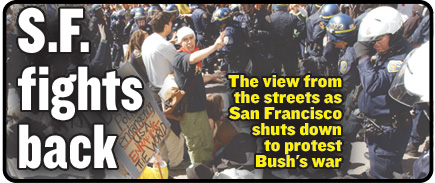
Nowhere was the clash of people power and government will more acute than on the streets of San Francisco, where a series of massive marches, some drawing nearly 100,000 people, filled the streets prior to the invasion of Iraq on March 19, 2003. The onset of war led protesters to effectively shut down the city, resulting in about 2,300 arrests and millions of dollars in costs to the city.

President George W. Bush dismissed the protests, of course, but he wasn’t the only one. Political leaders such as Rep. Nancy Pelosi, then-Mayor Willie Brown and soon-to-be Mayor Gavin Newsom (who didn’t attend any of the marches, unlike progressives on the Board of Supervisors) condemned the peace movement for hurting an innocent city. But with the “battle for San Francisco” making international news, the protesters were more concerned with the global audience.

A month earlier, on the weekend of Feb. 15 and 16, there were coordinated protests against the impending war in about 800 cities around the world, drawing around 10 million people. The peace march in Rome included about 3 million people, earning a listing in the Guinness Book of World Records as the largest anti-war rally in history. People have never made such a loud and clear statement against an incipient war.

Beyond the numbers, the antiwar movement was also right. On every major issue and prediction, the messages from the street proved correct while those from the White House were wrong. The US wasn’t welcomed as liberators. There were no weapons of mass destruction. Iraq after the invasion isn’t a stable democracy or shining beacon to anyone but the new generation of jihadis Bush created.

We can blame a hard-headed president, ineffectual opposition party, failure of the national media, or the national climate of fear following Sept. 11. But rather than refighting that lost battle, now is the time to gain perspective on the events of five years ago and determine what it means for democracy and the post-Bush national agenda.


TO THE STREETS

There were two main umbrella groups organizing protests before the war: Direct Action to Stop the War (DASW) and International ANSWER (Act Now to Stop War and End Racism). ANSWER has remained active and DASW has recently been reconstituted for the fifth anniversary of the war, using direct action in San Francisco as well as other urban centers and outposts like Chevron’s refinery in Richmond, which has reportedly been processing Iraqi oil.

“With the fifth anniversary coming up, we’re going back to direct action on the streets,” said Henry Norr of DASW. “But I don’t have any illusions that it’s going to be like it was five years ago.”

The maddening march to an ill-advised war created a political dynamic in which a broad cross-section of Americans was willing to hit the streets.

“We had a wonderfully diverse group of people, from soccer moms to anarchists,” said Mary Bull, who cofounded DASW, a collective of various affinity groups and concerned individuals formed in October of 2002 as Bush started beating the drums of war.

It was a group fiercely determined to prevent the war — and really believed that was possible. In fact, Bull recalls how she and other members of the group burst out crying at one meeting when a key activist said the war was going to happen.

Richard Becker, who cofounded ANSWER and serves as its West Coast coordinator, said that in the summer of 2002, “we came to the conclusion that [the war] was going to happen.” The group called its first big protest for Sept. 15, 2002, and another one two weeks later. But the movement really exploded on Oct. 26 when almost 100,000 people took to Market Street, much of it a spontaneous popular uprising.

“We were overwhelmed,” Becker said. “We were in a perpetual state of mobilization to keep up with what was going on. But then it didn’t stop the war.”

Did he think they could?

“I think a lot of people thought maybe it was possible to stop it. And we thought maybe it was possible to stop it,” Becker said.

The high point, according to Becker and Norr, was Feb. 17, 2003, when the New York Times ran a front page analysis piece entitled “A new power in the streets” that claimed “the huge anti-war demonstrations around the world this weekend are reminders that there may still be two superpowers on the planet: the United States and world public opinion.” But then Colin Powell went to the United Nations to argue for the invasion, and the Democrats in Congress did nothing, and it became clear war was coming.

Norr stayed out there protesting, being arrested several times and even shot in the leg by Oakland police with a rubber bullet during a protest at the Oakland docks. And he thinks some good came from the experience.

“The lesson for people is the political and economic elites are committed to preserving and extending empire. And they basically say as much in their own writing,” Norr said. “Wars are not anomalies.”

Despite being a frustrating and depressing exercise, most saw benefits to the failed movement. “People got an incredible education about how the system really worked,” Becker said. “Building a movement is mostly about a series of setbacks.”

Medea Benjamin, cofounder of both Global Exchange and CodePink and fixture of the anti-establishment peace movement for years, was upbeat about the protests. “We did our job as citizens. We did what we were supposed to do: organize, get people to take action, get people onto the streets,” she said. “We did everything we could think of.

“What you take from it is we don’t have a very well-developed democracy because the people spoke and the government didn’t listen.”

25war2_Lars1.jpg The ever-evolving “Democracy Wall” on Valencia Street, March 2003, helped stir up debate (Photo by Lars Howlett)


FACING ARREST

The collective action of five years ago starts with a series of personal stories — tens of thousands of them — so let me briefly begin with mine.

My arrival in San Francisco was closely tied to the march to war. I was living in Sacramento and working as the news editor of the Sacramento News & Review when Bush began his saber rattling against Saddam Hussein, but by the end of 2002 I had a falling out with my boss and found myself jobless.

Like most Northern Californians who opposed the war, I came to San Francisco on Jan. 18 to make my voice heard and experienced a bit of serendipity on my way to Justin Herman Plaza: while reading the Guardian on Muni, I saw their advertisement for a city editor, a job that was ideal for me at a paper I’ve always loved. Needless to say, it was a great day, empowering and full of possibilities.

Less than two months later I was on the job, and on the second week of that job I was back on the turbulent streets of San Francisco, part of a Guardian team covering the eruption of this city on the first full day of war. When I stepped off the cable car just after 7 a.m., people were streaming up Market Street and I joined them.

When a large group stopped at the intersection of Market and Beale, I stopped too, taking notes and bearing witness to this historic, exciting event. I had a press pass issued by the California Highway Patrol that allowed me to cross police lines, so when police in riot gear surrounded us and threatened arrest, I held my ground with 100 or so protesters.

After interviewing about a dozen people about why they were there and that they hoped to accomplish (see “On the bus: Journalists, lawyers, four-year-olds — the cops were ready to bust anyone Thursday morning“), I was arrested with the others and taken to a makeshift jail and processing center at Pier 27 (no charges were filed in my case, and charges against all of the 2,300 people arrested here in those first few days of the war were later dropped).

I recently tracked down a few of the people who appeared in my article, including Daphne and Ross Miller, who were at the center of the most interesting drama to play out during our standoff with the police. She’s a family practice physician, he’s an architect, and they live in Diamond Heights with their two children, Emet, who is almost 9, and Arlen, 12, who was away on vacation when the war began.

“We were genuinely shocked that the war started,” Ross told me. “We were at some of the earlier protests and really thought there was no way [Bush] could do it.”

They woke up March 20, 2003, to news that the war had begun and immediately walked to the BART station with Emet and rode to the Embarcadero station, not really planning for the day ahead but just knowing that they had to make themselves heard.

“We were pissed as hell. I don’t think I’ve ever been so angry in my life,” Daphne said.

They quickly came up with a plan. “We basically decided that if anyone was going to be arrested, it was going to be Ross and I’d stay with Emet. But it didn’t end up that way and I ended up in the arrest circle.”

Daphne had their house keys and threw them over the police line to Ross at one point. A photographer in the circle had gotten shots of a man named Roman Fliegel being roughed up by police as they pulled him off his bicycle, which was towing a trailer with a sound system, and decided to throw his backpack with camera gear out as well. When Ross — who had four-year-old Emet on his shoulders — caught it and refused police orders to give it to them, police grabbed Emet and roughly arrested Ross, leaving a gash on his forehead.

“Rage surged through the crowd, and it seemed as if things might get ugly, but the police kept a tight lid on the situation, using their clubs to shove back protesters who had moved forward,” I wrote at the time.

Emet was delivered into the circle with Daphne as the arrests continued, many quite rough. “At that point, as a mom, I had to exercise the most restraint ever,” said Daphne, who was angry about the situation but fearful about what she was exposing her son to. “Please, don’t let any violence happen here,” she pleaded with the crowd. Eventually, commanders on the scene let the mother and child go.

“The officer who let me go said that if he saw me again out there, he would call Child Protective Services on me,” Daphne said. But two days later, still brimming with outrage at her country’s actions, she ditched a downtown medical conference to rejoin the street protests, this time solo.

The couple say they’ve lost friendships over the war and have become more engaged with politics, coming to believe that Bush and the neocons are malevolent figures who knew how badly the war would go and did it anyway to establish a large, permanent military base in Iraq.

“Since that day, we’ve been far more active,” Ross said. “We realized you can’t just trust the system. You have to push.”

But that determination was mixed with feelings of disempowerment and depression. They attended some of the protests that following year, but the couple — like most people — just stopped going at some point because they seemed so futile.

“There was a horrible sense of resignation and a genuine depression that followed,” Ross told me.

The nadir was when Bush was reelected and they considered leaving the country. But then, Ross said, “we decided we’re not just going to run away and we’re not going to accept this.” Looking back, even with the scare over Emet, they express no regrets.

“It was the right thing to do because it was the wrong war to have. I’d do it again and again and again if I had to,” Ross said

They’re guardedly hopeful that Barack Obama could begin to turn things around if he’s elected. “I think the right president can at least start to dismantle this,” Daphne said. “I think thousands of people marching in the streets is something he would listen to.”

25war3_Charles1.jpg A die-in on the streets of San Francisco in March 2007 marked the fourth anniversary of the invasion (Photo by Charles Russo)


WITNESS TO HISTORY

Covering the peace movement in those early days was a heady experience, like reporting on a revolutionary uprising or working in a foreign country where the people are organized and active enough to be able to shut down society and brave enough to risk bodily injury for their beliefs.

I was at the founding meeting of CodePink — which became the most effective group at personally confronting the warmongers and keeping the war in the public eye — one evening at Muddy Waters in the Mission District shortly after the war started.

Looking back, Benjamin rattled off a long list of the alliances the group built — with labor, churches, businesses, and a wide array of social movements — and creative actions intended to build and demonstrate popular support for ending the war.

“We’ve done so many things and what did we get? We got a surge,” she said. “It shows the crisis in our democracy, the crisis of the two-party system, the crisis of a dysfunctional opposition party.”

Yet she said the peace movement has been remarkably successful in convincing the public that the war was a mistake and that it’s time for the troops to come home, even if the Democrats have been slow to respond to that shift.

“The progress we’ve made is turning around public opinion and that’s going to play a big role in the upcoming elections,” she said. For Norr, the role of the news media is a particular sore spot. He was a technology reporter for the San Francisco Chronicle who called in sick on the first full day of war and was arrested on Market Street with his wife and daughter, resulting in suspension by editor Phil Bronstein for his actions.

I wrote several stories on the issue, which culminated in Norr being fired and Bronstein unilaterally banning Chron employees from peace protests. I even borrowed CodePink’s guerilla tactics when Bronstein repeatedly refused to return my calls or address why he had singled out antiwar protesters for uniquely punitive treatment. I confronted him during a speech he gave at the Commonwealth Club (see “Lies and half-truths,” 5/7/03). That was the tenor of the times: we were all tired of being lied to and we decided to push back.

Norr was particularly frustrated with his own paper’s reporting of the war and started sending articles by the foreign press to his paper’s news desk, trying to wake his colleagues up to the pro-war propaganda being passed off as journalism in this country.

He was also disappointed with the country and with the Chronicle — both the management and his fellow reporters, who did little to support him — but the experience caused him to return to his roots as a progressive activist.

“The war and losing the job and everything brought an abrupt end to my consumerist phase and dumped me back into the world of being an activist,” said Norr, who serves on the KPFA 94.1 FM local station board and has made three recent trips to the Palestinian territories while working with the International Solidarity Movement.

Benjamin said Americans shouldn’t expect the next president to end the war — not without lots of pressure from a renewed and vocal peace movement. “This is the time to set the stage for the post-Bush agenda,” Benjamin said. “Don’t put your hopes in Barack Obama in getting us out of Iraq. Put your hopes in the people.”

25war4_Lane1.jpg A rally and nonviolent direct action at the Richmond refinery targeted Chevron on March 15 (Photo by Lane Hartwell)


THE AFTERMATH

The San Francisco Police Department, which spent more than $2 million on overtime costs responding to peace protests between March 15 and April 16, 2003, generally behaved with restraint and professionalism, but there were several exceptions.

The most costly and disturbing incident came when Officer Anthony Nelson began aggressively swinging his long riot baton at protesters, badly shattering the arm of peaceful protester Linda K. Vaccarezza, who suffered a permanent disability in her career as a court reporter.

Nelson’s incident report falsely stated that Vaccarezza had threatened him with a sign attached to a solid pole, but video of the incident later clearly showed there was no pole and that she was retreating when he teed off on her (see “The home front,” 05/19/04).

Vaccarezza received an $835,000 settlement from the city in November of 2004. On Oct. 5, 2005, two and a half years after the incident, SFPD fired Nelson for lying about what happened that day, and the City Attorney’s Office has been successfully fighting Nelson’s appeals in court ever since, putting in more than $100,000 in attorney time and costs into the Nelson and Vaccarezza cases.

The other significant ongoing litigation from the antiwar protests involved Mary Bull, who was arrested during an early protest for pouring fake blood in front of the entrance to Chevron’s San Francisco office before being allegedly strip searched and left naked in her San Francisco Jail cell for 36 hours.

Ironically, Bull was among those who brought a successful class action lawsuit against Sacramento County after she and others protesting a logging plan were strip searched, setting a precedent and led most counties to reform their strip-search policies. She used her share of the $15 million judgment to buy an organic permaculture farm in Sebastopol.

Her San Francisco case, in which Bull won a multimillion-dollar judgment, is still under appeal and now in mediation. Bull said the protests five years ago did make a difference, something she tells those who fret about its apparent failure. “I tell them to look at what issues the candidates are talking about now and I thank them for protesting then.”

“Even though we had millions throughout the world, we were sort of blocked, but now we’re regaining that momentum,” Melodie Barclay, a massage therapist who was also arrested with me on the first day of the war, told me recently. “We can’t judge it by the fact that we didn’t get the momentum we wanted.”

Norr started his antiwar activism working with Students for a Democratic Society in Boston, protesting the Vietnam War, which he said shares many similarities with the current situation, for good or for ill. He said that people tend to forget that while the protests then were huge and helped end the war, the movement did wane after Nixon ended the draft and substituted massive aerial bombardment for boots on the ground.

“The protests dropped off considerably,” he said. “A lot of the things that drove people to take risks in the late ’60s had faded by the early ’70s.”

He thinks the current administration learned a lesson from those days: it’s easier to maintain a war effort if the average citizen isn’t affected.

But there are other factors as well keeping a lid on the antiwar outrage.

“The culture has changed too. Young people are oversaddled with debt. People in schools seem to be docile. The culture as a whole seems to be more individualist and consumerist,” Norr said.

Yet some young people have woken up and many of them are funneling their energies into a peace group that was formed in the summer of 2005: World Can’t Wait, as in: the world can’t wait for the end of Bush’s second term before we change our direction and leadership.

“We don’t just want them gone, we need to repudiate their program,” said Giovanni Jackson, a 26-year-old WCW student organizer. “If we’re going to change anything, we need the youth.”

Jackson was at WCW’s founding convention in New York City, which came just as New Orleans was being flooded and then essentially abandoned by the federal government.

“When [Kerry] lost, people felt demoralized and World Can’t Wait kind of stepped into that situation,” Jackson said. “There was a lot of demoralization in the antiwar movement at that time.”

The group organized protests and student walkouts on Nov. 2, 2005.

“Everyone has their moments of doubt,” he said, “but I’m motivated by the crimes we see everyday.”


THE LESSONS

One of the biggest barriers to galvanizing people and turning the fifth anniversary of the war into something that might make a difference is the presidential election, which is diverting the energy of many potential protesters — and at the same time, offering some hope that a new president may lead to peace.

After all, every single one of the Democratic presidential candidates has promised to withdraw troops from Iraq, with varying timelines and numbers of US personnel left behind. And with enough encouragement, they might be willing to help change the status quo.

Many of the activists who volunteered their time and money to help move the Obama campaign into its front-runner position came out of the antiwar movement, and Obama’s strong stand against the war has been a key factor in his popularity.

Becker and some other activists don’t have much faith that a change in presidents will change the course in Iraq, although he agrees that much of the energy now surrounding Barack Obama derives directly from the antiwar movement.

“There’s been a huge upsurge of hope for Obama and that he might bring about the kind of change we need,” Bull said, adding that she doesn’t share that hope, believing the only path to peace is to pressure Obama and other leaders to commit to more progressive positions.

Norr said, “On one level, people have illusions about the power of peaceful protests. People believe in democracy, as well they should. We feel like the rulers should be paying attention to public opinion.

“It’s a remarkable story how broadly and quickly the American people have turned against the war. Public opinion was certainly ahead of the Democrats.”

And people will only grow more disenchanted with Iraq and its multitude of costs. “The people here are paying for this war, and everyday we have new stories about health clinics being shut down,” Becker said.

Becker was amazed last March as massive demonstrations for immigrant rights seemed to explode out of nowhere. “We think there will be more things like that,” he said.

Because after five years of organizing communities to resist the military-industrial complex’s plans, Becker thinks there’s been some visible progress.

“There isn’t a town or hamlet in the US that doesn’t have activism going on, but you wouldn’t know it from the corporate media,” Becker said. “It’s a mistake for people to feel discouraged.”


SXSW: Playboy bods and yobs, “Body of War,” sniffing a Siltbreeze

0

stopallwarsign.jpg
Signage modification – Austin, Texas-style. All photos by Kimberly Chun.

What a weird lil’ South By this is? Can it get any stranger than the evening of March 13, which started out at Stubb’s for a sold-out anti-war concert, “Body of War,” linked to the feature documentary on 25-year-old Tomas Young, who was paralyzed from a bullet to his spine, taken after serving in Iraq for less than a week. System of a Down’s Serj Tankian accompanied himself on piano, Billy Bragg presented a powerful “Farmer Boy,” and Kimya Dawson, Ben Harper, and RX Bandits filled out the bill. (Sightings of the Dawson’s infant being cartered by her partner, abounded throughout the fest).

excocaine.jpg
Gimme more Ex Cocaine.

Then it was off to the Siltbreeze showcase at Soho Lounge for a hand drum-driven Ex Cocaine from Missoula, Montana, and the stirring guitar-electronics invocations of Blues Control from Brooklyn. Good to see such a sizable crowd out for what many might see as a micro-niche night.

bluescontrol sml.jpg
Outta-hand Blues Control.

Made few pitstops at Friends for the soon-to-be capacity Carbon/Silicon showcase (witness the scores of disappointed Clash fans milling around before their 11:30 p.m. set outside, cordoned off by police tape just so they don’t get raucous). London’s Noah and the Whale plied their rootsy folky harmonies with sweetness and high spirits.

noahandthewhale sml.jpg
Swallow this: Noah and the Whale.

More ambitious but definitely more streamlined lineup-wise, was Florence and the Machine, also from London town, over at BBC/Steve Lamacq’s event at the Rio. Like a sweet, over-the-top cross between Kate Bush and a high school musical theater star, Flo mimed drowning, quasi-tap-danced, and threw her gold-sequined jacket to an audience member when she grew encumbered. All accompanied only by ukulele. And with plenty of drama for all.

florenceandthemach sml.jpg
The Fantasticks, anyone? Florence and the Machine.

daftbunny sml.jpg

Time to queue for the Playboy/C3 (presenters of Lollapalooza, et al) ninth annual late-night party. The line wound round the block of the “301” warehouse and the media line (through the back entrance – I felt like I ought to be helping with the dishes!) was just as crazed. Once inside, after watching oodles of would-be media types getting turned away at the list, I spied Perez Hilton all in white, with white shorn locks, got my beverage (check the ample barbecue midnight snack), and studied the Heavy as they cozied up to playmates in sad drooping bunny ears and cotton tails.

playboy1.jpg
Things got Heavy.

bunny.jpg

SXSW: Touch down! Plans, schplans…

0

cas sml.jpg
Won’t you listen to Cassettes Won’t Listen.

“Punk rock – we don’t have that category in this country.” Oh, the quotables already emanating from Austin, Texas – albeit from a boomer-rock-oriented radio commentator interviewing aging Aussie punk vets.

SXSW, here we go again. The plane was packed on the way from Denver to Austin. Baggage claim was filled with checked guitars and black-garbed hollow-eyed scenesters. Todd P already had a Juicebox show going at 2 a.m. at his party central, Ms. Bea’s. And rumors are already swirling – has Dolly Parton cancelled? Is it possible to squirm into the already-closed-guestlist Playboy afterhours party Thursday night? Where is Perez Hilton having his ssseeecccret soiree (with Robyn no doubt working her rework of Snoop Dogg’s “Sex Eruption”)? Rachel Ray is having a party – huh?! You can spend more time planning your sked than actually seeing music, but the one-man band sounds of Cassettes Won’t Listen drew me into the Austin Convention Center’s dark, semi-depressing, school-caf-like Daystage.

Most disturbing news: so many longtimers aren’t making it this year due to industry cutbacks. Most disturbing stuff in the fest bag o’ fliers: an Armed Forces Entertainment card with a little green toy soldier attached (“Plug in your weapon, turn up the power and fire away. Your limo is a Humvee and your ride is a Blackhawk”). War is so cute – and glamorous! And a card announcing a casting call for Blue Man (I guess the blue face paint fits any ole one – except maybe women?).

What’s up tonight? Free Yr Radio is throwing a bash with Simian Mobile Disco, Yeasayer (all the buzz here, natch), and Times New Viking (Ohio-ans do it so good) at La Zona Rosa, a black rock showcase with Lightspeed Champion courtesy of Vice, a Kills show at the Fader Fort, an Emusic showcase, White Williams at the Gorilla vs Bear party. Also drool-worthy is the Terrorbird/Forcefield PR party with Yacht, Raveonettes, Why?, These New Puritans, the Blow, Radar Bros., Bowerbirds, and the return of the Mae Shi. Kimya Dawson will likely be at the Keep Austin Good event at San Hotel’s parking lot, and Dan Deacon and Deer Tick are making some very late-night noise – shhhh! – at one o’ UT Austin’s quads at, oh, 2 a.m. And most of those events aren’t even official.

Falling flat

0

It was clear early on that the Slow Beer Festival, presented March 1 by Slow Food San Francisco and the San Francisco Brewers Guild, was more of an excuse to get drunk in a convention hall on a Saturday afternoon than to explore how beer could be sustainable. Twelve NorCal microbreweries lined the green-hued cement walls of the County Fair Building — Marin Brewing, Speakeasy, Anderson Valley, Red Seal, and so on. An administrator at the front desk, though, couldn’t tell me what the difference was between a Slow Beer and your everyday microbrew (though she did say it was "a good question"). The man at the nationally distributed Gordon Biersch stand said bluntly, "Yeah, we’re a corporation."

Normally I’d say, "Fill up my glass and pass me another Gambone-mushroom-and-cheese skewer [drizzled in salsa verde]!" Here, though, I began to actually wonder how beer could be incorporated in the Slow Food ideology. As the manifesto says, "May suitable doses of guaranteed sensual pleasure and slow, long-lasting enjoyment preserve us from the contagion of the multitude who mistake frenzy for efficiency."

The Slow Foodists seek not just to change the food we consume but to change how we consume it as well. So isn’t a sterile room for beer tasting just stripping beer down to its flavor, and not about the way we experience it? At the festival, on one side of the gate there was a crowded room with a slender outdoor food garden and (by my estimate) 200 gallons of beer; on the other side, a park blanketed in sunshine. The latter setting might be better for bringing out the true sensual pleasures of beer. Next year, why not save money on the room deposit and hold the event in Michael Pollan’s backyard?

Diamonds are harder than gym bodies

0

Black Lizard made me gay. Or, at the very least, Kenji Fukasaku’s 1968 jewel-toned mod noir opened my quasicloseted 16-year-old eyes to a certain queer aesthetic — one which foregrounds its own artifice by using Aubrey Beardsley’s illustrations for Oscar Wilde’s Salome as wallpaper; one which dresses deviance in a gown with a 25-foot-long feathered train; and one which knows that the flipside of fabulousness is utter ridiculousness. It certainly wasn’t something I was seeing in the twink-filled issues of XY foisted upon me by my Pride ring–wearing, secret community college beau, but something closer to what I later found in John Waters’s films with Divine, James Bidgood’s diaphanous beefcake photography, and Ronald Firbank’s deeply purple prose.

However, unlike the above artists, Fukasaku was heterosexual, and Black Lizard represents an anomaly within a career that included much macho studio boilerplate. Even at his finest, Fukasaku had a flair for rough stuff: he directed some of the best yakuza films ever made (Battles Without Honor and Humanity [1973–74]) and ended his career with 2000’s controversial adolescent bloodbath and political fable Battle Royale. Yet, as with Joseph L. Mankiewicz’s practically flaming 1959 adaptation of Tennessee Williams’s Suddenly, Last Summer, there was just the right combination of elements (and most importantly, the right combination of peacocks involved) to make Black Lizard one of queer cinema’s unsung gems. Which is precisely why freelance curator T. Crandall chose the film to kick off his rep series, "The Revival House: Classic Queer Cinema," at Artists’ Television Access.

As clichéd as such a phrase may be, Black Lizard is awash in precious stones and glittering surfaces — but none shine with as much brilliance as the transvestite Akihiro Miwa (credited as Maruyama), who plays the titular jewel connoisseur and criminal mastermind that kidnaps specimens of human beauty to freeze them in eternal tableaux vivant on her island lair. The film is completely Akihiro’s: her entrances stop time, her song is a siren call which causes men to become her slaves, her lavish outfits become more so with each new scene. "The face of Garbo is an Idea, that of Hepburn, an Event," quipped Roland Barthes (referring to Audrey, not Kate). Miwa’s face, whose mouth morphs rubber band–like from a sour moue into the devouring O of a deep cackle unleashed, is a gloss on Barthesian idealness.

Prior to Fukasaku’s film, Miwa had appeared in the same role in Yukio Mishima’s long-running stage adaptation of pre-World War II mystery and suspense novelist Edogawa Rampo’s 1934 short story "Black Lizard." Rampo’s tale was one of many starring his Sherlock Holmes, the brilliant detective Gogoro Akechi, who in Mishima and Fukaaku’s retelling falls heart-first into a dangerous pas de deux with his androgynous quarry. Miwa was a successful nightclub entertainer active in avant-garde theater (and she still is: last year, she starred in a Tokyo production of Jean Genet’s The Eagle Has Two Heads) when she met Mishima — our second of the aforementioned peacocks — who was haunting Tokyo gay bars to "research" his 1953 novel Forbidden Colors.

It’s not hard to see why Rampo’s story of a moribund ice queen obsessed with changeless beauty appealed to Mishima. By 1968, Mishima was that queen, fully immersed in his own homoerotic brand of aestheticized Emperor worship, which would reach its grisly apogee in his ritual suicide four years later. Prior to Black Lizard, his muscular body had already been given the coffee table book treatment in Ba-ra-kei: Ordeal by Roses (Aperture, 1971), where Hosoe Eiko’s photographs present the author posed as a martyred St. Sebastian or as a snowbound samurai. Appropriately, he makes his cameo in Fukasaku’s film as one of Black Lizard’s frozen exemplars of aesthetic perfection— a brawny sailor, no less.

In the end, though, diamonds are harder than gym-wrought muscle, and it was Miwa’s flash, not Mishima’s flesh, that held my attention — at least consciously — upon my first adolescent exposure to Black Lizard. Many viewings later, Mishima seems pathetically unaware of the self-parody he’s partaking in. But Miwa’s exquisite luminescence remains untarnished.

THE REVIVAL HOUSE: BLACK LIZARD

March 19, 8 p.m.; $6

Artists’ Television Access

992 Valencia, SF

(415) 824-3890

www.myspace.com/therevivalhouse

Girls Rocked!

0

By Justin Juul

girlsrock.jpg

What? You haven’t seen “Girls Rock! The Movie” yet? It’s a documentary about a rock n’ roll camp in Portland Oregon that teaches young girls how to overcome oppression, fight off attackers, and most importantly how to rock! I recently attended the film’s East Bay premier at The Shattuck Cinema in Berkeley with my girlfriend, Heather Duthie, who has been working with the film’s co-directors Arnie Johnson (a frequent Guardian contributor) and Shane King for the past six months. So there’s your full disclosure of my interest in the movie. But really: I never knew girls could be so awesome!

Two different bands played to a sold-out theater full of prepubescent girls and their super hip mothers or fathers. The girls entered the theater timid and meek, but after hearing The Kitties play a punk version of “These Boots Are Made for Walkin’” and watching Girls Rock! star, Palace, scream obscenities and punch people in the face, they were able to bang their heads and throw up the horns without a touch of bashfulness. Let’s hope and pray they stay the course. The last thing we need is another Britney, however punk rock she has become.

Here’s where to see it.

And here’s some pics from the event

“Speaking Fierce”

0

PREVIEW The first time I discovered feminism wasn’t just for white women who ate organic produce, I was eavesdropping on one of my mom’s phone calls. She was going off about some ex-boyfriend and a few "lazy-ass mothafuckas" before declaring that neither her mother, nor her mother’s mother, nor her mother’s mother’s mother had taken any bullshit and she didn’t plan to break the chain now. Put in those terms, my 10-year-old brain started to think that the word feminism might just apply to every woman I knew who had the nerve to survive in my Fillmore neighborhood. Years later, I picked up Colonize This! Young Women of Color on Today’s Feminism (Seal Press, 2002), coedited by Daisy Hernandez and Bushra Rehman, and read about how other women my age were piecing together their own narratives of empowerment. Nowadays, Brooklyn-born Rehman is probably best known for writing on-the-road adventure stories about runaway Desi girls. She’s featured in this evening of art, spoken word, humor, and music in celebration of International Women’s Day. The night also includes performances by Bay Area soul diva Jennifer Johns and poetry collective Climbing PoeTree. Aside from celebrating stories of creative resistance, the event supports the Women of Color Resource Center, which works with war vets and teaches media production to low-income women of color in Oakland.

"SPEAKING FIERCE" Thurs/6, 7–9 p.m., $10–$25 (no one turned away for lack of funds). First Congregational Church, 2501 Harrison, Oakl.; (510) 444-2700, ext. 305, www.coloredgirls.org

SFIAAFF: Take one

0

>Buddha Collapsed out of Shame (Hana Makhmalbaf, Iran, 2007) Buddha marks the feature debut of Hana Makhmalbaf, one of acclaimed Iranian director Mohsen Makhmalbaf’s daughters (she made her first short, The Day My Aunt Was Ill (1997), when she was only 9 years old). It has already won eight awards at different international film festivals, a fact that becomes more impressive when one considers the filmmaker’s age: she’s 19. Reminiscent of Abbas Kiarostami’s cinema, her first feature is shot in a neorealist style in Bamian, Afghanistan, and features a 5-year-old girl named Baktay (the extraordinary Nikbakht Noruz) as its main character. In following the youngster during her struggles to attend school, the film becomes a stunning exploration of how Afghanistan’s violent political history affects its youth. (Maria Komodore) March 15, 12:45 p.m., Castro; Tues/18, 8:45 p.m., Pacific Film Archive.

>Happiness (Hur Jin-ho, South Korea, 2007) One of the most adept melodramatists working in South Korea, Hur casts an affectionate, gently comic glance on the see-sawing declines and resurrections of the hard-partying, handsomely weather-beaten Young-su (the talented Hwang Jung-min), an aging club kid with a raging case of cirrhosis. Luckily, the man is able to rub a few brain cells together and get himself to a rural health retreat that specializes in detoxifying worst-case-scenarios with clean living, herb gathering, fresh air, and outrageously light exercise. Young-su is also lucky enough to win over the clinic’s sweet, fragile princess, Eun-hee (Lim Soo-jung), who suffers from lung disease and just might keel over if forced to break into anything more strenuous than a stroll. But can you keep the playboy down on the farm once his liver is back in business? (Kimberly Chun) March 15, 6 p.m., Castro; March 16, 5 p.m., PFA; March 22, 7 p.m., Camera.

Never Forever (Gina Kim, South Korea/USA, 2007) At first, it’s purely business: as a last-resort response to her Korean American husband’s infertility, Sophie (The Departed‘s Vera Farmiga, sporting an ice-blond ‘do) lurks after a Korean immigrant (Jung-woo Ha) she spots at a fertility clinic. She pays him big bucks to have sex with her and possibly make a baby — therefore saving her husband (David L. McInnis) from depression and getting his intensely Christian family off their backs. Of course, things get complicated mighty fast. Farmiga is riveting in this deliberately quiet (save its melodramatic violin-heavy score) drama, a delicate exploration of doing the wrong thing for the right reasons — and grappling with the sudden realization that wrong and right are often not so easy to define. (Cheryl Eddy) March 15, 9:15 p.m., Clay; March 16, 7:50 p.m., PFA.

>Ping Pong Playa (Jessica Yu, USA, 2007) Energetic direction by Jessica Yu — best-known for docs like the Henry Darger portrait In the Realms of the Unreal (2004) and the Oscar-winning short Breathing Lessons (1996) — perfectly complements a star-making turn by Jimmy Tsai as Christopher "C-Dub" Wang, a slacker who discovers he’s got talent as a ping-pong teacher and, eventually, competitor. Yu and Tsai cowrote the hip-hop flavored script, filled with rapid-fire dialogue and culturally targeted zingers (as when C-Dub assures an opponent, "I hope you’re hungry, because I’m about to serve you some Chinese take-out!"). Winning from start to finish, Ping Pong Playa achieves the near-impossible: it makes infectious hilarity seem entirely effortless. (Cheryl Eddy) March 14, 6:45 p.m., Clay; March 17, 9:30 p.m., Kabuki; March 22, 2:15 p.m., Camera.

Santa Mesa (Ron Morales, USA/Philippines, 2008) Ron Morales’s first feature focuses on 12-year-old Hector (Jacob Kiron Shalov) and his efforts to fit in when he’s forced to leave the United States (where he was born and raised) to be with his grandmother Lita (celebrated Filipino actor Angie Ferro) in Manila, Philippines, after his mother’s death. Despite Shalov’s awkward performance and some uneasy sentimental scenes, Mesa‘s yellow-hued cinematography attractively portrays the colorful, throbbing city, and the young boy’s eagerness to internalize his surroundings without knowing how to speak Tagalog is brave and touching. (Komodore) March 15, 7 p.m., Clay; March 22, 4:30 p.m., Camera.

>3 Days to Forever (Riri Raza, Indonesia, 2007) After a night of partying makes Ambar (Adinia Wirasti) miss a flight to her sister’s wedding, she hitches along with cousin Yusuf (Nicholas Saputra), who’s in charge of driving a set of delicate dishes to the event. Drugs, detours planned and accidental, and frank talk about what it’s like to be a rebellious teen in Indonesia (Ambar’s sister is getting married because her parents caught her having sex) — and an uncertain teen, period — color this road movie. 3 Days to Forever echoes 2001’s Y tu mamá también‘s racy tone and the-journey-is-the-life-lesson message, and boasts similarly photogenic young leads. Bonus for armchair travelers: it also makes Indonesia look like the most magical place on earth. (Cheryl Eddy) March 14, 9:30 p.m., Kabuki; March 18, 9:30 p.m., Clay; March 23, 2:15 p.m., Castro.

Traveling with Yoshitomo Nara (Koji Sakebe, Japan, 2007) Punk’s not dead! And neither are the wide-eyed little girls, drowsy dogs, and the other indelibly etched creatures that populate Yoshitomo Nara’s oeuvre: they’re alive and evolving in Nara’s studio. Koji Sakabe and his crew tail the artist as he travels to public appearances at museums and radio stations where he’s treated like a rock star; as he creates a massive village installation in his hometown of Hirosaki, Japan; and then follow Nara back to his studio, where he conjures his avatars of cuteness all by his lonesome. That’s where things get interesting: watching the bashful yet driven enigma study his own paintings, one hand on his camouflage-encased hip, and then home in with a brush on a fillip in a wide-eyed tot’s ‘do. (Kimberly Chun) March 16, 12:30 p.m., Clay; March 23, 2 p.m., Camera.

The Unseeable (Wisit Sasanatieng, Thailand, 2006) For those whose eyes are still adjusting from the ultraviolet palette of Wisit Sasanatieng’s stunning debut, the genre-bending 1999 western Tears of the Black Tiger, the clammy greens and dusky grays that hang over The Unseeable feel like so much dust on the lens that can’t be wiped off. Unfortunately, you can still see everything coming from a mile away in this ghost tale of a country mouse trapped in (where else?) a decaying mansion. At least the magical touches of 2005’s Citizen Dog seem like genuine quirks in the fabric of reality. Here, the supernatural is an excuse to trot out tired new Asian horror staples like the crazy old lady or spooky child, and the multiple twists of the Shining-aping finale only work to make an already shaky premise all the more hamstrung. (Matt Sussman) March 16, 9:45 p.m., Kabuki; March 21, 9:15 p.m., PFA; March 23, 4:45 p.m., Camera.

>> Complete Asian American Film Fest coverage

SFIAAFF: Manila: the drama

0

› johnny@sfbg.com

Over roughly the past year, Brillante Mendoza has brought a pair of films to festivals that pack a particular one-two punch when they are programmed to play at the same event. Foster Child first bears witness to the final day that caretaker Thelma Maglangqui (superb veteran actress Cherry Pie Picache) mothers three-or-four-year-old mestizo John-John (Kier Segundo), and as sunlight gives way to night, it follows her from a Manila slum into the ostentatious hotel where she passes him over to wealthy white foster parents from San Francisco. Slingshot also uses a real-time conceit, but in an entirely different manner — locked within the mazelike alleys and shanties of Manila’s Mandaluyong City, it foregoes long takes and methodical passages to careen as if the camera were a baton passed from one preoccupied, panicky person to another. Or perhaps more aptly, as if the point of view was a valuable that one character fleeces from another’s pocket.

As a melodrama, Foster Child fits into the dominant genre of Filipino feature films that screen at international festivals — a genre that certain North American critics might enjoy more than writers such as Richard Bolisay and Alexis Tioseco, whose critical conversations are as vital to thriving "CineManila" activity as any current filmmaker. In a piece on one of Tioseco’s excellent Web sites, Criticine, Noel Vera recalls a Rotterdam screening where fellow film scholar and Chicago-based critic Jonathan Rosenbaum compared Mike De Leon’s Kisapmata (1981) to Rainer Werner Fassbinder’s Martha (1974). Perhaps in that spirit, Rosenbaum’s contemporary, the critic and influential programmer Tony Rayns, has likened Foster Child to Fassbinder as well.

I’d add another comparison that, however Eurocentric, is meant as a great compliment: Foster Child shares a number of similarities with Douglas Sirk’s mother of all melodramas, Imitation of Life (1959), such as a harshly ironic perspective on maternal bonds in a racist, capitalist world. When Mendoza’s film reaches its final wrenching moments — and Thelma seems stripped, at least temporarily, of life (even the future repetition of her foster maternal duties is harrowing) — a lesser director would have simply milked the pathos. Instead, Mendoza allows no mercy to invade his sympathy, presenting a sequence that calls to mind a scenario depicting Lana Turner’s selfish protests by the bedside of her dying maid Annie (Juanita Moore) in 1959’s Imitation of Life, a sight that is extra bitter because Annie’s lost daughter Sarah Jane (Susan Kohner) can be seen smiling in a nearby framed picture within the shot. Foster Child‘s climactic heartbreak is set against a backdrop of vulgar department store displays that privilege white glamour and which celebrate a false vision of familiar perfection. "The house that love built," proclaims one callow ad, depicting a mother and child. The cruel gods of capitalist marketing provide perfectly horrible set design.

Those last glances, leading to a weary climb up a concrete public transit stairwell, also ricochet off Foster Child‘s sustained (and indeed Fassbinder-like) first shot: a silent, postcard-perfect view of Manila’s high-rise cityscape that gives way to a noisier look at the ramshackle slums at the feet of those skyscrapers. A more subtle echo occurs between two scenes that take place nearer to the narrative’s center: an idyllic, sunlit view of Thelma bathing John-John outside her home, and a later moment when she has to wash him in a hotel’s many-mirrored, intimidating bathroom.

Engaged Web sites such as Bolisay’s Lilok Pelikula (Sculpting Cinema) have greeted this neorealist symbolism, and Foster Child‘s standing ovation at the 2007 Cannes Film Festival, with some wariness. Indeed, it is frustrating if international audiences take Mendoza’s movies for the whole of Filipino independent film today, when thanks to the punk-fueled Khavn de la Cruz, the monumental Lav Diaz, the prodigiously visionary Raya Martin, and the autobiographical John Torres, CineManila is frankly more inspired than almost all of the indie film — and much of the experimental work — currently coming from the United States. Mendoza’s talent equals or bests anyone who has passed through the Sundance factory in the past decade, but he and his more formally radical contemporaries have to vie for the same too-few spaces allocated to feature films from the Philippines at most festivals.

By working within relatively linear narrative structures and feature-length frameworks, Mendoza veers toward the mainstream currents of vital Filipino independent cinema. But he’s demonstrating great versatility. Slingshot‘s burnt-brown palette, verging on black-and-white in nighttime scenes, contrasts greatly with the more colorful, sun-dappled view of slum life in Foster Child, which is so pleasant that soap bubbles blown by children float through one shot. But it would be a mistake to see Foster Child‘s view of cramped city blocks as purely idealized, simply because a fresh array of mothers with newborn babies can be found on every corner — a scene in which foster system overseer Bianca (comedienne Eugene Domingo) greets these women and knowingly checks in on their offspring has a sinister underpinning.

Its title translated from a term (tirador) denoting a street hustler, Slingshot is harder and faster — money or valuables are frequently handed from one character to another on the sly as people move in an out of a shot that is itself moving forward. A viewer had best be on the top of his or her game while watching, because everyone in the film is on the make. But the gay Mendoza brings a subversive eye to the masculine genre of action: he knows that harder and faster might seem tougher, but it doesn’t necessarily mean one is savvier. Interestingly, while Slingshot‘s critical reception in CineManila realms seems warmer than that given to Foster Child, the film has had its share of semiblind assessments in English-language publications. More than one critic has complained that the film wears a viewer out with its frantic pace before it abruptly ends. The reviews fail to note that Mendoza frames his many-stranded story line and slum-stranded characters amid a broader view of societal and political corruption. He kicks the story off with cops raiding blocks of Mandaluyong City to round up and arrest people who are then bailed out by politicians in exchange for votes. He fades out with a glimpse of a pickpocket at work during a quasireligious campaign rally dominated by empty, clichéd speeches.

Between those crowd scenes, Slingshot joins a wide variety of characters for intimate treks through semi-anonymous acts, only to abandon them — just as fate might and a politician’s promises are certain to. Tess (Angela Ruiz) steals video equipment to pay for a pair of dentures. Her illicit lover Rex (Kristofer King) neglects fatherhood in favor of druggy reverie. In an example of tail-biting irony, the impulsive Caloy (Coco Martin, whose open-faced melancholy carries over from Mendoza’s debut feature The Masseur [2005]) needs to scrape together cash to keep the pedicab that he’s using to earn money. Meanwhile, Leo (Nathan Ruiz, the gamine title character of Aureaus Solito’s 2005 The Blossoming of Maximo Oliveros, now adolescent and pimply) begins what will eventually become one of the worst days of his life by accidentally getting his dick caught in his pants zipper. The two-dimensional faces of political candidates — including actor Richard Gomez, then running in real life for a Senate position — look on from the campaign billboards and posters that dominate public spaces.

In the eyes of the official system, Lopez’s Leo is the thief character of Slingshot‘s Tagalog title, but in the real world he’s just one of many everyday bandits, who are doing whatever they can to survive while a faceless upper class profits from their votes. There’s a potent undercurrent to Lopez’s performance perhaps being the titular one, though, since it’s much harsher than the similar turn he delivered as Maximo in Solito’s comparatively romantic film festival favorite. The differences in pace and look between Foster Child and Slingshot demonstrate that Mendoza is capable of sculpting widely contrasting true visions of Manila’s streets, which in turn shows that the exact same setting can take on widely varying characteristics based on one’s perspective at any given moment.

Part of Mendoza’s versatility might be grounded in his background as a production designer under the name Dante Mendoza. It also might reflect a developing, nuanced queer sensibility, one that has forsaken forebear Mel Chiongo’s eye for international markets to also produce a feature, 2007’s Pantasya, that possibly plays off of Slingshot‘s view of corrupt police forces and probably adds a critical dimension to the age-old "I love a man in an uniform" motif of gay porn. After half a dozen features as a director, Mendoza has ranged from melodrama to action, from a pentet of gay sex fantasies to a story about education amid the Aeta tribe (2006’s Manoro). His next step will probably be hard to predict, and it’ll definitely be worth watching.

FOSTER CHILD

March 14, 6:45 p.m., Kabuki

March 16, noon, Kabuki

SLINGSHOT

March 15, 7 p.m., Pacific Film Archive

March 18, 7 p.m., Kabuki

>> Complete Asian American Film Fest coverage

Borts Minorts

0

PREVIEW Leap year is here! Looking for a suitably unusual event to celebrate this once-every-four-years occurrence? I strongly suggest scampering over to the Hemlock Tavern for a Club Chuckles lineup that’s poised to scramble the brain of any comedy connoisseur. Headliners Borts Minorts defy simple description. See, there’s this guy in a hooded white unitard and a headset mic who sings and flails and contorts — he might be an alien or an android, but it’s doubtful anything but an actual human would be able to bring such pure and bizarre joy to the stage. Equally enthusiastic are the Borts backup dancers, who flaunt leotards and fishnets (and the occasional pair of lederhosen), and whose energetic choreography demonstrates limber limbs and an admirable appreciation of jazz hands. Borts’s music is similarly befuddling, in the best possible way — a combination of samples, keyboards, horns, drums, theremin, slide whistles, a single-stringed bass made out of a snow ski, and god knows what else, but I guarantee you’ll not see anything as sense-assaultingly entertaining this leap year, or any other year. Local duo Ramshackle Romeos render classics like "Feelings" with nearly as many instruments as a full orchestra (including a mean musical saw), and comedians Drennon Davis and Alex Koll rock the mic between musical numbers.

BORTS MINORTS With Drennon Davis, Alex Koll, and Ramshackle Romeos. Fri/29, 9:30 p.m., $8. Hemlock Tavern, 1131 Polk, SF. (415) 923-0923, www.hemlocktavern.com

What a pain

0

› andrea@altsexcolumn.com

Dear Readers:

In the process of starting to crawl out of my "I just had two babies! Leave me alone!" cocoon, I’ve been teaching some new workshops, one on what it’s really like to have twins, and one that I’m calling "Is There Sex after Motherhood?" — hoping the idea comes across even though motherhood is, technically, a lifelong venture ending in death, after which, one assumes, not so much sex. I debuted the sex one recently at the original "clean, well-lighted place for buying things to stick up your hoo-ha," Good Vibrations. There was a decent crowd, and everybody seemed to have a good time; and when we got to the Q&A, I was gratified by the number of questions. (That’s how you can tell if people were interested in your presentation, right? Not so interested = polite thanks and drifting away; interested = hang around asking questions until the management kicks you out.) There’s some serious sadness haunting the new and newish mothers though, so while it’s all good and fun to talk about how a simple blow job between child care tasks can save your marriage (ask me how!), some of the questions stayed with me after we’d cleared away the cookies and juice (yes, mothers are served toddler snacks, don’t ask me why) and gone home.

It’s surely true that during the first few years after having kids, your sex life tends to be … well, "lackluster" is a nice word, but I think "laughable" might be more accurate in a lot of cases. Some of the women at these events are really beating themselves up over it though, which I guess is expected and is why I’m talking about this stuff in the first place, but one of them really saddened me when she said, quite matter-of-factly, that intercourse was still quite uncomfortable for her several years later and she hadn’t mentioned this to her husband. "I think you need to communicate with your husband," the other speaker, a therapist, offered. "I think you should find out what hurts and make it stop hurting," I countered.

How many women, mothers or not, are having painful sex and just not mentioning it? The most common cause of uncomfortable insertive sex is nothing more complicated than a case of "not ready–itis" or lack of lubrication, but a Harvard study cited by the National Vulvodynia Association (see www.nva.org/media_corner/fact_sheet.html) estimates that 16 percent of women in the United States suffer from the chronic vulvar pain called vulvodynia or its subtype, vulvar vestibulitis, affecting just the opening to the vagina. That’s a lot of women! Most are young when it starts, and most can locate no particular event or infection that set it off, but the pain can be paralyzing (many describe it as feeling like acid was poured onto sensitive tissues, or "like knives"). So we have a mysterious etiology; a location in the parts that many women simply don’t mention in public, even if that public comprises their doctor, themselves, and nobody else; and an exclusively female population of sufferers; and what do we get? Predictably, silence, confusion, and shame. And while I have never been a big fan of men-versus-women jokes and somehow doubt that if men got pregnant, ma- or paternity leave really would be two years long with full pay (come on!), if men often had agonizing, unexplained pain in their manly man parts, surely they wouldn’t have been subjected to generations of doctors pronouncing it "all in your head."

The good news — there has to be some — is that vulvodynia is finally getting the research money and attention it deserves. Recent research (see www.nytimes.com/2008/01/29/health/29brod.html?_r=1&ref=science) has turned up solid, quantifiable, and most important, curable causes of the pain: some women, the researchers found, had serious inflammation two cell layers deep that had not responded to steroids, a typical treatment. What’s even more interesting is that many of the women have a genetic abnormality — as I’m sure they could’ve guessed, considering the kind of hypersensitivity they’ve been putting up with — in which there are too many nerve fibers in the area, which produces a pain response to what in other women would just be normal sensation, like the pressure from your jeans against your crotch while seated. The linked article contains some success stories; the treatments (surgical or medical) are not perfect, but they have the potential to make life worth living again for some women who’ve been silently suffering, too embarrassed or too debilitated to say anything about it. That does count as good news, no?

I don’t really see a National Crotch Pain Month hitting the calendar anytime soon, but I do see this as the beginning of the end of one more way for women to suffer in silence and shame, so a cautious hooray for that.

Love,

Andrea

Andrea is home with the kids and going stir-crazy. Write her a letter! Ask her a question! Send her your tedious e-mail forwards! On second thought, don’t do that. Just ask her a question.

Building green in SF

0

› news@sfbg.com

GREEN CITY Wind turbines and solar panels may soon sprout on San Francisco rooftops as the city considers rival plans to implement mandatory green design standards for new residential and commercial buildings.

One ordinance proposed by Mayor Gavin Newsom’s Green Building Task Force would require new commercial construction of more than 5,000 square feet, residential buildings above 75 feet, and renovations to buildings of more than 25,000 square feet to be Leadership in Energy and Environmental Design (LEED) Gold certified by 2012, the second-highest designation.

The U.S. Green Building Council developed the point-based LEED system based on numerous green factors. The lowest green standard is LEED Certified, followed by Silver, Gold, and Putf8um. The new Academy of Sciences building, with the country’s largest living roof, is LEED Putf8um.

Newsom’s legislation would start off by mandating requiring only the lowest standard, LEED Certified, which requires 26 points, and gradually move to LEED Gold by 2012. But Board of Supervisors president Aaron Peskin has introduced an ordinance that would require the same buildings to immediately earn LEED Gold certification.

According to the LEED system, most existing buildings already have between 18 to 22 points, so Newsom’s proposed goal should be fairly easily attainable. A bike rack outside a building qualifies for 1 point. Proximity to mass transit gains another point, and Muni runs within two blocks of 90 percent of all San Francisco residences, according to the Municipal Transportation Agency.

At a green building standards workshop Feb. 20 at the San Francisco Green Party’s office, about 20 people voiced their concerns with the ordinances in front of three city commissioners.

"We need to correct the language to include all buildings," said panelist Patricia Gerber, a member of the city’s Peak Oil Preparedness Task Force. The San Francisco Office of Economic Analysis last year concluded both proposed ordinances would impact only 38 percent of the construction industry. "We should look to Europe for inspiration," Gerber recommended. "They have much stricter standards."

Some European nations started mandatory green construction in the mid-’90s, but critics say the United States has lagged.

"There are no minimum requirements on windows, insulation, and leaks," Gerber told the Guardian, describing the proposed ordinances. "LEED is a joke."

But Mark Westlund, spokesman for the Department of the Environment, defended Newsom’s longer LEED certification timeline. "We want to develop a green building plan that business can work with," he told us.

The Green Building Task Force claims that businesses need time to adjust to the higher costs associated with green materials, such as EnergyStar windows, can reduce heating costs by 30 to 40 percent. "They’re expensive because they’re used on a small scale. The minute they require it, it will become cheaper," John Rizzo, Green Party member and City College Trustee, told the audience. "It would be great if this could be done on a statewide level."

Panelists noted that green buildings save money in energy costs over the long run. Another criticism raised at the workshop was the Newsom plan’s loopholes. "Even if a project is approved green, it might not end up green," Gerber told us. If a construction company runs out of money for example, it can ask the planning director to waive LEED certification.

In addition, the event attendees questioned the credibility of the mayor’s Green Building Task Force, which does not include any environmentalists. Rather, it is composed of developers, financiers, architects, and engineers.

"We feel it represents a good variety of industry people, and so far we haven’t received any negative responses on the ordinance," Mark Palmer, San Francisco’s green building coordinator, told us.

Smaller residential buildings in San Francisco will not require LEED certification, but could be required to follow a GreenPoint scorecard developed by Berkeley nonprofit Build It Green.

Newsom’s ordinance will be presented March 19 at the Building Inspection Commission, which has already forwarded Peskin’s measure to he Board of Supervisors’ Land Use Committee. According to Peskin’s office, the two ordinances will likely be combined once supervisors decide which standard to seek.

Noise Pop: Hot shots

0

Mika Miko


Los Angeles’ proudly punky ladies have been busy tearing out new tunes back home. Expect them to show their hand in their constant quest to drive the audience bonkers. Also on board is more of their characteristically dark imagery. "There’s nothing worse than happy-joy-joy," drummer Kate Hall says. "You gotta go through some dark stuff." (Kimberly Chun)

With DJ Amp Live and Tempo No Tempo. Tues/26, 8 p.m., free for badge holders and VIPs. Rickshaw Stop, 55 Fell, SF. (415) 861-2011

Minipop


Indie pop rarely gets sweeter — or more radio-friendly — than in the hands of San Francisco’s preternaturally poised Minipop. The foursome found an avid listenership early in their career, and the recently released A New Hope (Take Root) finds the unit looking fondly back at the dreamy alt-pop of the early ’90s, with graceful nods to 4AD forebears. (Chun)

Feb. 27, 8:30 p.m., $12. Bottom of the Hill, 1233 17th St., SF. www.bottomofthehill.com

The Mumlers


Perhaps the Mumlers were channeling the spirit of William Mumler, a mid-19th-century man famous for claiming he could photograph ghosts, but once all seven band members touched their fingers to a Ouija board’s planchette, the board, they claim, spelled out their group’s name. Regardless, it’s clear their swaggered ruckus pop channels dead folk musicians galore. Despite the ghostly origins of their handle, the Mumlers’ live appearances tend into turn to lively celebrations, with the outfit dancing about the stage. Their repertoire of instruments rivals any philharmonic’s and includes guitars, drums, upright bass, various keyboards, euphonium, French horn, trumpet, clarinet, tambourine, pedal steel, and recently, eagle whistles from Mexico. While the tunes give old-time music an indie pop sheen, beneath the group’s sprawling arrangements the lyrics and vocal delivery compare to those of Johnny Cash’s later recordings — with a touch of early Bob Dylan. (Alex Felsinger)

With the Entrance Band, honey.mooon.tree, and Golden Animals. Feb. 27, 9 p.m., $14. Cafe du Nord, 2170 Market, SF. www.cafedunord.com

The Morning Benders


This group has no shortage of hooks and crescendos, and with a lighthearted indie pop style familiar enough to capture anyone’s attention and enough creativity to hold it, they stand out from their peers. Listeners have drawn comparisons to Voxtrot, the Shins, and Of Montreal for good reason, but in the end the Morning Benders’ biggest debt is to the Beatles. So far they’ve recorded all of their releases at home but have always managed to mimic that old analog sound, even when using nothing but a laptop and one microphone. With their upcoming debut, Talking Through Tin Cans (+1), they’ve successfully stepped into hi-fi wonder without losing their homespun feel. The Morning Benders don’t break any musical molds, but their solid songwriting and smooth deliver serve pop tradition well. (Felsinger)

With Kelley Stoltz, Grand Archives, and the Weather Underground. Feb. 28, 8 p.m., $14. Independent, 628 Divisadero, SF. www.theindependentsf.com

The Blacks


SF’s grungy indie rock band the Blacks sound so much like the Pixies that they ought to be called the Frank Blacks, but they trump the re-formed Pixies in stage presence tenfold. Vocalist JDK Blacker doesn’t sing much at all but rather focuses his energy on livening up the audience: sometimes he’ll help drummer Gavin Black smash cymbals, or perhaps he’ll simply thrash around with his trusty tambourine. Vocalist Luisa Black holds the group together with solid alternating rhythm and lead guitar, while Gavin Black’s drumming shines with stripped-down, solid beats. The Blacks take the simplicity of ’70s punk and garage rock and jump-start the attitude: the concept isn’t new, but then, a combo doesn’t need to be entirely original to rock. (Felsinger)

With Cursive, Darker My Love, and Judgement Day. Feb. 29, 8 p.m., $18. Great American Music Hall, 859 O’Farrell, SF. www.gamh.com

Jeffrey Lewis


Crass saved punk. They never fit the part, never ripped off the Rolling Stones, and never tried to become famous, because they genuinely wanted to create a better world and thought they could do so through music. But in the past four years every kid with a leather jacket has picked up an acoustic guitar to sing against the war and capitalism, recorded some songs on their PowerBook, then thrown them up on MySpace. Folk punk has swept the nation’s underground to the point where 924 Gilman Street Project hosts a monthly Acoustic Night. Bringing it full circle, New York City’s Jeffrey Lewis recently released 12 Crass Songs (Rough Trade), composed entirely of acoustic versions of Crass numbers, including some of the group’s best. Lewis came out of his city’s so-called antifolk scene — a Crass cover LP ought to be deemed anti–folk punk, right? — and his vocal patterns have a hushed, somewhat raplike flow. The CD’s best track has to be "Punk Is Dead," which Lewis delivers as a wistful ballad. Hearing a folk singer recite the lyrics 25 years after the first recorded incarnation makes more sense than ever — because the words are certainly truer today. (Felsinger)

With the Mountain Goats, OKAY, and Aim Low Kid. Feb. 29, 8 p.m., $18. Bimbo’s 365 Club, 1025 Columbus, SF. www.bimbos365club.com

British Sea Power


Do You Like Rock Music? is the provocative title of British Sea Power’s new Rough Trade LP. Well, sure, but do I like their brand of grand indie? Their engorged drums and highly dramatic overtures just might get them discounted as the Big Country of the ’00s, though their quieter moments and more experimental textures hint at increasing — and welcome — complexity and nuance. (Chun)

With 20 Minute Loop, Colour Music, and Off Campus. March 1, 9 p.m., $14. Bottom of the Hill, 1233 17th St., SF. www.bottomofthehill.com

Immigrant


These SF vets of Evening have come a long way from would-be bell-ringing bouts, taking on an epic yet poppy, synth-dappled alt-rock veneer with the self-released Novakinesis. (Chun)

With Panther, Wallpaper, and Distraction Fit. March 1, 9 p.m., $10–$12. Rickshaw Stop, 155 Fell, SF. (415) 861-2011

Port O’Brien


One might note that the flowing harmonies between the four members of Port O’Brien work so well onstage that the audience would be doing a disservice to the band if they joined in. But that would be an unfair request. Port O’Brien’s music emits the instant atmosphere of a warm campfire sing-along. The group’s more intimate acoustic concerts are now only rare gems, and their recorded efforts tend to fall short of capturing the same level of energy, yet their glowing personalities and dedication to the crowd are still evident at their amplified full-band performances. (Felsinger)

With Delta Spirit, What Made Milwaukee Famous, and the Mayfire. March 1, 9 p.m., $10–$12. Cafe du Nord, 2170 Market, SF. www.cafedunord.com

The Virgins


Imagine Julian Casablancas with a freshened-up adenoidal approach and jaded ‘tude intact, backed by sloppy-cool disco-rock rats. Equipped with a taste for that tatty late ’70s intersection where punk and disco met, snarled, and duked it out on the train on the way back to the boroughs, these New York City decadance-kins seem likely to outshamble Babyshambles and their louche ilk. Too bad you can only be a virgin once — wonder what the combo’s next trick will be? (Chun)

With Airborne Toxic Event, the Blakes, and Man/Miracle. March 1, 9 p.m., $12–$15. Mezzanine, 444 Jessie, SF. www.mezzaninesf.com

She get mad? Get MADE

0

By Candice Chan

In the (likely?) event that you forgot yesterday was, you know, that big romantic day, then be your own savior and invite your lady friend out on Sunday, February 17th for a night at Poleng Lounge. In all their glam and glory, the designers of MADE Jewelry – Debbie Sheen and Abigail Rivamonte – will be debuting their handmade feminine designs at a reduced price for all the event’s attendees.

zeebos1.jpg
Zeebos will save you!

With two lines of earrings (AM and PM) and a separate necklace line (Wrap), there’s likely to be at least one dangly item, if not many, that appeal to women who are constantly on the go. Each of the pieces has their own unique story – like the PM line’s Zeebos; a striped sequined homage to women who have paid their dues, earned their stripes and worked their way to the top – and are meant to represent the journeys of the ladies who don them.

“Tre”

0

REVIEW A semisequel to writer-director Eric Byler’s 2002 debut feature, Charlotte Sometimes, this low-key but quietly devastating relationship meltdown in the mode of Harold Pinter and Neil LaBute is his best work to date. Tre (Daniel Cariaga) is a burly, shaved-headed, aggro personality who burns rubber driving drunk and reckless one night to the Santa Monica Mountains house of longtime bud Gabe (Erik McDowell) and his girlfriend, Kakela (Kimberly-Rose Wolter). On the run from yet another bridge burned, Tre’s irked to find the guesthouse already occupied — by prickly Nina (Alix Koromzay), who has just left her husband. It’s dislike at first sight for the two temporary residents: she’s tightly wound, and he likes to push people’s buttons for the hell of it. Yet in Byler and Wolter’s screenplay, that negative spark doesn’t at all preclude their ending up in bed — it might even hasten the event. Meanwhile, Tre embarks on an even more perverse path, playing on rudderless trust funder Kakela’s self-doubts to seduce her away from the trusting, oblivious Gabe. Does this angry thirtysomething slacker antihero ("I reject the notion that a steady job makes me successful and a college degree makes me smart," he protests) simply see her as another female meal ticket? Is he really interested in her? Or is his agenda some complicated, half-acknowledged result of feelings of resentment and possessiveness toward his best friend? Tense and ambiguous, with sharp character detailing and explanatory background spaces left artfully blank, this is the kind of cunning, sardonic psychological study that pays off in grim affirmation of the worst suspicions about human nature. See it with someone you want to break up with.

TRE Opens Fri/15 at the Four Star Theater. See Movie Clock at sfbg.com

Super lessons

0

› news@sfbg.com

The Super Fat Tuesday presidential primary election in San Francisco was marked by some portentous trends and factors that could have a big impact on who becomes the Democratic Party nominee — and whether that person will be accepted as the people’s legitimate choice.

Consider the scene the night before the election. A small army of young people made its way up Market Street carrying signs and pamphlets supporting their candidate, Barack Obama, taking up positions outside Muni and BART stations and on high-profile corners to spread the message of change.

Meanwhile, inside the Ferry Building, Mayor Gavin Newsom and former president Bill Clinton convened one of several "town hall meetings" held simultaneously around the country to promote the presidential campaign of Hillary Clinton, who checked in on a satellite feed.

Among the many luminaries on hand was State Sen. Carole Migden, a superdelegate (one of 71 from California) who has not yet pledged her support to either Clinton or Obama and who could ultimately play a huge role in determining the nominee. Migden made a show of exchanging pleasantries with the former president, warmly embracing him in front of a crowd of about 250 people and more than a dozen news cameras before taking a seat nearby.

But Election Day was for the regular citizens, and once their votes were counted and analyzed, a couple of things became clear. Clinton won California with the absentee ballots that she had been banking for weeks thanks to her deeply rooted campaign organization. Her margin of victory among early voters was about 20 percentage points.

Yet a late surge of support for Obama caused him to win at the polls on Election Day, leading to his outright victory in San Francisco by a margin of about 15,000 votes, or almost 8 percentage points. It was a symbolic victory for progressives on the Board of Supervisors, who backed Obama while Newsom campaigned heavily for Clinton (see "Who Wants Change?," 1/30/08).

Obama and Clinton were close enough in California and the rest of the Super Fat Tuesday states that they almost evenly split the pledged delegates (those apportioned based on the popular vote). But if present trends continue, even after Obama’s sweep of four states that voted the weekend after California, neither he nor Clinton will have captured the 2,025 delegates they need to secure the nomination before August, when the Democratic National Convention convenes in Denver.

That means the nomination could be decided by superdelegates such as Migden, a group comprising congresspeople and longtime Democratic Party activists, from party chair Art Torres down to those with key family connections, such as Christine Pelosi and Norma Torres.

And that could be a nightmare scenario for a party that hopes to unify behind a campaign to heal the country’s divisions.

Political analyst David Latterman, president of Fall Line Analytics in San Francisco, said this election was marked by a higher than expected turnout and more people than usual voting on Election Day rather than earlier. In San Francisco turnout was more than 60 percent, including an astounding 88.4 percent among Democrats.

"In the last couple weeks there was a strong get-out-the-vote push by Obama’s people," Latterman said during a postelection wrap-up at the downtown office of the San Francisco Planning and Urban Research Association (SPUR), which he delivered along with campaign consultant Jim Stearns.

Latterman said that Obama surge, which drew out voters who were generally more progressive than average, may have been the margin that pushed Proposition A, the $185 million parks bond, to victory. It trailed among absentee voters but ended up less than five points above the 66.6 percent threshold it needed to pass.

"I don’t know if this would have passed or not if it had not been for the Obama push at the end," Latterman said.

Stearns agreed, saying, "In some ways, we should name every park in the city Obama Park."

At the measure’s election-night party at Boudin Bakery on Fisherman’s Wharf (where some of the bond money will renovate Pier 43), Yes on A campaign consultant Patrick Hannan told us he was worried as the initial results came in.

"That is a high threshold to hit," he said of the two-thirds approval requirement for bond measures.

But as the crowd nibbled on crab balls and sourdough bread, the results moved toward the more comfortable level of around 72 percent support, prompting great joyful whoops of victory.

Recreation and Park Department executive director Yomi Agunbiade acknowledged that the decision to place the measure on the February ballot rather than June’s was a leap of faith made in the hopes that the presidential election would cause a high turnout of Democrats.

"We’re excited," Agunbiade said at the party. "This was a hard-fought race that involved getting a lot of people out in the field and letting folks know what this was about — and we’re definitely riding the wave of high voter turnout."

The strong turnout helped Obama win half of the Bay Area counties, Sacramento, and much of the coast, including both the liberal north coast and the more conservative Santa Barbara and San Luis Obispo counties.

But Clinton’s advantages of socking away early absentee votes and her popularity with certain identity groups — notably Latino, Asian, and LGBT — helped her win California.

Yet Obama’s appeal reaches beyond Democratic Party voters. He got some late support from prominent local Green Party leaders, even though their party’s candidates include former Georgia congressional representative Cynthia McKinney and maybe Ralph Nader (see "Life of the Party," 1/16/08).

Sup. Ross Mirkarimi, a founder of the California Green Party who also worked on Nader’s 2000 presidential campaign, announced his endorsement of Obama at the candidate’s Super Fat Tuesday event at the Fairmont San Francisco. Mirkarimi also noted the support of Greens Mark Sanchez, president of the San Francisco Board of Education, and Jane Kim, the highest vote getter in the school board’s last race.

"I registered Green because I felt their values were closer to mine," Kim, who left the Democratic Party in 2004, later told the Guardian. "But I’ve always endorsed whoever I thought was the best candidate for any office…. I saw Obama as a candidate taking politics in a different direction that I hadn’t seen a national candidate take things before."

If Obama’s campaign can continue to develop as a growing movement running against the status quo, he could roll all the way into the White House. But it’s equally possible to imagine the Clintons using their deep connections with party elders to muscle the superdelegates into making Hillary the nominee.

Stearns said this scenario could hurt the party and the country: "I can’t imagine a worse outcome for the Democratic Party than to have Obama go into the convention ahead on delegates he’s won and have Hillary Clinton win on superdelegates."

Amanda Witherell and David Carini contributed to this report.

Activism brings hyphy back to Berkeley

0

hyphy flyer_front sml.bmp

By Jamilah King

Almost a week before the media was glowing with tales of unprecedented numbers of youth voters hitting the poles in this week’s primary elections, hundreds of young activists and music heads made their power known in Berkeley.

Last week, Cal’s Activism Right There conference brought new attention to the intersection of art and politics. The week-long conference culminated in a night of performances last Friday, Feb. 1. The night began with a panel that featured five generations of Cal activists, including Bettina Abtheker and onetime Guardian columnist Jeff Chang, who dissected everything from organizing during the Free Speech Movement to the myth of defeat during the Reagan years. The event also featured sick performances by spoken word artists, including a group from the Philadelphia called Ammo and iLL-Literacy and thieir band the Hi-Lifes.

But the climax of the event came when Zion I took the stage. Savvy bloggers have already detailed the sheer energy of the performance. As dozens – it looked like hundreds – of young folks crowded onto the stage and went dumb in what Zion I called one of their livest performances, the power of the hip-hop generation was felt loud and clear (pardon the poor video quality):

Get Your Rocks Off

0

By Colleen McCaffrey

Female erotica, wine and vegan cookies: no, not a perfect first date, although it would be good a place to take one. It’s that time of the month again: second Saturday, when female and trans literary talents – both well-established and up-and-coming – congregate at Femina Potens for the Award-Winning literary erotic event, Sizzle.

“We like co-presenting those [because] two people can learn a lot by sharing the stage with a hero and then having the same attention and soapbox for emerging artists still developing their own voice,” says host Madison Young, who is currently working on her memoir, The Tale of a Bondage Model, due out this spring.

feminapotens.jpg

How Obama and Clinton split California

0

We know that Barack Obama and Hillary Clinton basically split California, with the latter winning the popular vote by about 10 percentage points. But it’s interesting to look at how they split the Golden State using this map.

Clinton’s margin of victory seems to be counties with lots of Latino voters, which have been slow to warm to Obama. She posted her biggest numbers in the Central Valley counties of Stanislaus (60%), San Joaquin (58), Merced (59), Tulare (60), and Madera (56), and in the border county of Imperial (67).

Los Angeles Mayor Antonio Villaraigosa delivered his county for Clinton (55 to 41.5), but Mayor Gavin Newsom failed to do so in San Francisco, where Obama won by 8 points. The candidates split the Bay Area, with Alameda, Marin, and Sonoma counties joining SF in backing Obama and San Mateo, Santa Clara, Solano, and Contra Costa counties going for Clinton. Obama got Sacramento and Yolo counties, while Clinton took sprawling San Bernardino County by a large margin

Interestingly, coastal counties were more supportive of Obama, both on the liberal North Coast and more conservative San Luis Obispo and Santa Barbara counties. If there is one lesson to be learned, it is that Obama is going to have to make inroads with Latino voters, both in the primary and the main event if he gets there, particularly given John McCain’s reasonable immigration stance (as opposed to the hysterical and racist approaches of the other GOP contenders).

Climate change teach-in

0

› news@sfbg.com

GREEN CITY For Van Jones, going green is not just about buying a Prius, putting a solar panel on a vacation home, or purchasing groceries at Whole Foods, which he calls Whole Paycheck. It’s also about training former gangsters in green-collar jobs, equitably distributing toxic waste sites, and bringing organic produce into urban ghettos.

According to the Oakland activist, who cofounded the Ella Baker Center for Human Rights (see "Redefining Radicalism," 9/19/06), there is a serious social injustice on the horizon, and the fight against it may just be the next great political movement in the United States.

Speaking Jan. 30 at San Francisco State University’s teach-in on climate change, Jones called on students to be the next great generation by recognizing that the environmental crisis presents the biggest opportunity for poor people and minorities since the New Deal. Today it seems such grandiose statements calling an entire generation to action tend to lack an inspired audience. However, no one could deny Jones was onto something big after the packed crowd in Jack Adams Hall erupted in an ovation after his challenge to students to make history by addressing poverty and the environment together.

Green pathways out of poverty was just one topic discussed during the SFSU segment of "Focus the Nation" — billed as the nation’s largest-ever teach-in, with more than 1,500 schools and universities participating. The nationally coordinated event aimed to create one day of focused discussion on global warming solutions for the US. Throughout the day expert panels at SFSU discussed green efforts in their respective fields with an underlying message of public involvement.

Keynote speaker Michael Glantz of the National Center for Atmospheric Research jumped on the generational bandwagon, predicting the 21st century would be remembered as the climate century. However, Glantz stressed public pressure would be crucial, as lessons learned about the environment are generally not used during policy making. He cited detailed studies conducted in the early 1970s of melting arctic sea ice due to anthropogenic causes.

When asked how he would reply to arguments that humans aren’t causing climate change, Glantz noted the success of the environmental movement in marginalizing these beliefs: "I don’t think we need to spend time now dealing with the skeptics when Exxon and Shell are worried about global warming."

Faculty from the SFSU geography and geosciences departments presented new trends in climate change data and modeling, focusing on predictions for California. The panel reported the state’s average temperature is on the rise. Even with the best estimates for halting global warming, the Sierra Mountains are expected to lose 40 percent of their snowpack over the next 100 years. Agricultural production and quality in the Central Valley are also expected to decline, as some plants will not get the chill period they need.

Geography professor Andrew Oliphant worked with students to create a carbon footprint calculator for attendees to use throughout the day. Oliphant said the calculator was tailor-made specifically for the event so attendees could analyze their daily habits.

Students were also present throughout the event to answer questions on an informative poster display. The posters depicted breakdowns of greenhouse gases, rising sea levels in the Bay Area, and the formation of acid rain.

Erin Rodgers, an environmental advocate with the California Union of Concerned Scientists, discussed green policies at the state level. Rodgers focused on California’s groundbreaking initiative to reduce greenhouse gas emissions to 1990 levels by 2020, a cut of about 30 percent from current levels.

Experts have established detailed plans on how to reach the target reduction, with a large focus on transportation, although the California Air Resources Board has yet to embrace a comprehensive plan that will get anywhere close to the goals it is charged with meeting.

Cal Broomhead, climate programs manager at the San Francisco Department of the Environment, spoke on local green efforts. He praised the city for keeping the same levels of greenhouse gas emissions since 1990 and its continued use of the "Fab 3" composting and recycling program.

Broomhead also stressed the importance of furthering environmental education efforts: "Through education we can get people to adopt pro-green technologies and behaviors. Once you have the last remaining stragglers, then you can require them to participate through law."

Comments, ideas, and submissions for Green City, the Guardian‘s weekly environmental column, can be sent to news@sfbg.com.

G-Spot: Valentine’s Day events

0

PARTIES, EVENTS, AND BENEFITS

Amor del Mar Aquarium of the Bay, Pier 39, Embarcadero at Bay; 623-5326, www.aquariumofthebay.com. Feb 14, 6pm, $100. Celebrate San Francisco’s love affair with the bay and support the nonprofit Aquarium of the Bay Foundation at this gala celebration featuring global cuisine, decadent drinks, live music, and exhibitions.

Erotic Playground One Taste, 1074 Folsom; www.tantriccircus.com. Sat/9, 8pm; $30 single women, $50 single men, $60 couples. The Tantric Circus presents a sexy evening of burlesque, striptease, male lap dance, fruit feeding, DJs, and more.

Eternal Spring SomArts Bay Gallery, 934 Brannan; 1-888-989-8748, eternalspring08.com. Sat/9, 2-10pm, $7. Celebrate life, love, arts, and creativity at this all-day event including a fashion show, performances, free classes (hoop, poi, yoga, and more!), DJs, and shopping.

Heroes and Hearts Luncheon Union Square; 206-4478, www.sfghf.net. Feb 14, 11:30am, $300. Celebrate those who have helped the community and support the San Francisco General Hospital Foundation by attending this luncheon and auction of artist-created tabletop heart sculptures.

My Sucky Valentine XIII ARTworkSF Gallery, 49 Geary; 673-3080, www.artworksf.com. Feb 14, 8pm, $15-25. Listen to tales of tainted love and bad sex by good writers including Thomas Roche, Carol Queen, Michelle Tea, and mi blue, all to benefit the Women’s Community Clinic and the St. James Infirmary.

One Night Stand X ARTworkSF Gallery, 49 Geary; 673-3080, www.artworksf.com. Sat/9, 6-11pm, $15-25. Support the Center for Sex and Culture and the SF Artists Resource Center at this sexy multimedia event including live nude models, paint wrestling, erotic food feeding, and performances.

PINK’s 2nd Annual Valentine’s Day Party Look Out Bar, 3600 16th St; 703-9751, www.mypartner.com. Sat/9, 8pm-2am, $25. MyPartner.com cohosts this year’s party and benefit for the GLBT Historical Society. About 300 single gay guys are expected to enjoy an open Svedka vodka bar and hobnobbing with guests like Assemblymember Mark Leno and Sup. Bevan Dufty.

Poetry Battle of (All) the Sexes Beat Museum, 540 Broadway; 863-6306, www.poormagazine.org. Feb 14, 7:30pm; $20 to fight, $15 to watch. Challenge your partner (or future partner) to a battle of spoken word, hip-hop, poetry, or flowetry in the ring at this benefit for Poor magazine.

Prom Pete’s Tavern, 128 King; 817-5040, www.petestavernsf. Feb 14, 9pm, $10. What’s more romantic than prom? Prom in the ’80s! Enjoy music, decorations, mock gambling, and dancing, all to benefit Voices, a nonprofit that works with emancipated foster youths. Admission includes one drink, gambling chips, and a photo.

Queen of Arts: A Profane Valentine Coronation Sssshh…!, 535 Florida; www.anonsalon.com/feb08. Feb 15, 10pm, $10-20. The production team that brought us Sea of Dreams presents a sexy night of DJs, dancing, art, and performance, including Kitty-D from Glitch Mob, Mancub from SpaceCowboys, Fou Fou Ha!, and Merkley.

Queen of Hearts Ball Mighty, 119 Utah; 974-8985, www.goodvibes.com. Feb 14, 8pm, $25. Good Vibrations and Dr. Carol Queen host this decadent fairy-tale-themed costume party featuring MC Peaches Christ, circus performances by Vau de Vire Society, a fetish fashion show, and dancers from the Lusty Lady.

Romancing the Reptiles: Wild Love! Tree Frog Treks, 2112 Hayes; 876-3764, www.treefrogtreks.com. Sat/9, noon-2pm; $40 adults, $25 kids. Join animal care director Ross Beswick as you learn about how animals pick their mates and where baby animals come from.

Sensualité 111 Minna, 111 Minna; www.celesteanddanielle.com/party.html. Feb 15, 9pm; $15 advance, $20 at the door. Wear something sexy to this multimedia Valentine’s Day event featuring aphrodisiac appetizers, exotic rhythms, tarot readings, performances, a raffle, and a no-host bar.

Sweet Valentine’s Cruise Pier 431/2; 673-2900, www.redandwhite.com. Feb 14, 5pm; $48 adult, $34 youth. Join the Red and White Fleet for a romantic, fun, two-hour cruise of the San Francisco Bay, including a lavish appetizer buffet by Boudin and a complimentary beverage.

Transported SF Valentine’s Singles Party Pickup at Rite Spot, 2099 Folsom; transportedsf.com. Feb 14, 7:30pm, $21.49. Join DJs Ana Sia and Felina aboard the biodiesel Transported SF bus for sultry sounds, schmoozing with other singles, and stops at gorgeous outdoor dancing locales.

Woo at the Zoo San Francisco Zoo; Sloat at 47th St; 753-7236, www.sfzoo.org. Sat/9, Feb 13-15, 6pm; Sun/10, Feb 17, noon; $75. This multimedia event, conducted by Jane Tollini of the now-defunct Sex Tours, explores the sexual and mating behaviors of animals. Also featuring champagne and romantic refreshments.

BAY AREA

Flamenco, Candlelight and Roses Café de la Paz, 1600 Shattuck, Berk; (510) 287-8700, www.cafedelapaz.net. Feb 14, 5:30, 6, 8, and 8:30pm; Feb 15-16, 6:30pm; $75-115. The nuevo Latino café celebrates the sweet side of love with three days of dinner plus a show, featuring the acclaimed Caminos Flamencos dance company.

Nest Firecracker Valentine Event Nest, 1019 Atlas Peak, Napa; (707) 255-7484. Sat/9-Sun/10, 10am-6pm, $5. Celebrate Chinese New Year and Valentine’s Day together while shopping for unique gifts and making art projects with scrapbook artist Janine Beard, all to benefit the "Nest Egg" fund through the Arts Council of Napa.

Sweetheart Tea Yerba Buena Nursery, 19500 Skyline, Woodside; (650) 851-1668, www.yerbabuenanursery.com. Sat/9, noon, $25. Enjoy a traditional tea service with a special Valentine’s Day menu, followed by a stroll through the nursery’s gorgeous gardens.

Week of Valentines at Habitot Children’s Museum Habitot Children’s Museum, 2065 Kittredge, Berk; (510) 647-1111, www.habitot.org. Fri/8-Sat/9, 9:30am-4:30pm; Feb 12-14, 9:30am-1pm; $6 per child, $5 for accompanying adult. Contribute to a large heart sculpture and create handmade cards from recycled materials. Bring valentine-making supplies to receive a free adult admission pass.

FILM, MUSIC, AND PERFORMANCE

The Adventures of Priscilla, Queen of the Desert California Palace of the Legion of Honor, 100 34th Ave; 1-866-912-6326, www.legionofhonor.org. Feb 14, 5:30pm, $10-20. The Cinema Supper Club at the Legion of Honor presents this film as part of "The Real Drama Queens" series, including a special exhibition opening at 5:30pm, dinner seating at 6pm (reservations made separately; call 750-7633), and film screening at 8pm.

BATS Improv Valentine’s Day Show Bayfront Theater, Fort Mason Center, bldg B, Marina at Laguna; 474-6776, www.improv.org. Feb 14, 8pm; $10 advance, $15 at the door. Whether you’re flying solo, with friends, or on a date, this audience-participation show is the perfect place to enjoy the funny side of romance.

The Best American Erotica Modern Times Bookstore, 888 Valencia; 282-9246, www.moderntimesbookstore.com. Feb 13, 7:30pm, free. Celebrate the 15th anniversary of the series with this showcase of standout stories, including a hot and edgy piece from Susie Bright.

Boston Marriage Theatre Rhinoceros, 2926 16th St; 861-5079, www.therhino.org. Feb 7-March 2, call or see Web site for schedule, $15-35. Join Anna and Claire and their crazy maid for Theatre Rhinoceros’s version of David Mamet’s same-sex romp.

Brainpeople Zeum, 221 Fourth St; 749-2228, Thurs-Sat, 8pm (also Sat, 2pm); Sun, 2pm. Through Feb 16. $20. American Conservatory Theater presents the world-premiere production of this newest work by José Rivera, screenwriter of The Motorcycle Diaries, about two women who reckon with their pasts in an apocalyptic future.

The Eyes of Love Mechanics’ Institute, 57 Post; 393-0100, www.milibrary.com. Feb 14, 7:30pm; $15 members, $25 public. Back by popular demand, chanteuse Helene Attia will select from her vast repertoire of love songs, classic and contemporary. Admission includes hors d’oeuvres, libations, and dessert.

Hope Briggs and Friends: A Musical Valentine Herbst Theatre, War Memorial Veterans Bldg, 401 Van Ness; 392-4400, www.cityboxoffice.com. Feb 17, 3pm, $25-50. Celebrated soprano Hope Briggs shares favorite opera arias alongside 15-year-old singing sensation Holly Stell and virtuoso violinist Dawn Harms.

How We First Met Herbst Theatre, War Memorial Veterans Bldg, 401 Van Ness; 392-4400, www.howwefirstmet.com. Feb 14, 8pm, $22-35. Real audience stories are spun into a comedy masterpiece in this one-of-a-kind hit show.

In Search of the Heart of Chocolate Delancey Street Foundation, 600 Embarcadero; 310-0290, www.chocumentary.com. Tues/12, 6:30 and 7:30pm, $10. Bay Area filmmaker Sarah Feinbloom screens her new chocumentary, about Noe Valley’s Chocolate Covered and its customers. Screenings followed by a chocolate reception featuring art and live music.

I Used to Be So Hot Intersection for the Arts, 446 Valencia; 626-2787, www.theintersection.org. Feb 14, 7 and 9pm; Feb 15-16, 8pm; $20. InnerRising Productions presents comedian Mimi Gonzalez, a Detroit native who’ll take you on a journey through sexual politics and queer discovery.

Lovers and Other Monsters Hypnodrome, 575 10th St; 377-4202, thrillpeddlers.com. Feb 12-16, 8pm; Feb 17, 7pm; $20-34.50. With a diabolical nod to Valentine’s (and Presidents’) Day, Thrillpeddlers presents a weeklong rotating lineup of live music, exquisite torture, and expert testimony, including Jill Tracy, Jello Biafra, and Creepshow Camp horror theater.

Miss Ann Peterson’s Broken Heart Red Poppy Art House, 2698 Folsom; 1-800-838-3006, www.tangolamelodia.com. Feb 13-16, 8pm, $15. See the premiere of Tango la Melodia’s new multimedia production, a three-night concert featuring original music, poetry, and performance set in the romantic, sexy Roaring ’20s.

Mortified: Doomed Valentine’s Show Make-Out Room, 3225 22nd St; www.makeoutroom.com, www.getmortified.com. Fri/8, Mon/11, 8pm; $12 advance, $15 at the door. Share the pain, awkwardness, and bad poetry associated with love as performers read from their teen-angst artifacts. The creator of the nationwide and NPR phenomenon, David Nadleberg, will be in attendance in celebration of the release of Mortified: Love Is a Battlefield (Simon Spotlight).

Not Exactly Valentine’s Show Purple Onion, 140 Columbus; 567-7488, www.talkshowsf.com. Mon/11, 7pm, $18-20. Presented by Talk Show Live, Beth Lisick talks about her latest work and performs from her slam repertoire, chocolatier Chuck Siegel of Charles Chocolates gives an interview and tasting, Vicki Burns performs a program of "sort-of romantic standards," and Kurt Bodden reads a short story by James Thurber.

Philosophy/Art Salon: What is Erotic? Femina Potens Art Gallery, 2199 Market; 217-9340, www.feminapotens.com. Feb 16, 6:30-8:30pm, $10-25. Philosopher Rita Alfonso joins erotica writer Jennifer Cross and artist Dorian Katz for a brief show-and-tell followed by a Socratic dialogue on the question "What makes for erotic art?"

Romeo and Juliet: Gala 40th Anniversary Screening Castro Theatre, 429 Castro; 863-0611, www.thecastrotheatre.com. Feb 14, 7pm; $25 adult, $12.50 youth. Marc Huestis and the Istituto Italiano di Cultura present a 40th-anniversary screening of Franco Zeffirelli’s romantic classic, with star Olivia Hussey in attendance and a live musical performance.

Valentine’s Day Film Program: Labor of Love Exploratorium, 3601 Lyon, McBean Theater; www.exploratorium.edu. Sat/10, 2pm, free with museum admission ($9-14). In the spirit of Valentine’s Day, the Exploratorium presents a program of short, expressive films about people who love what they do.

BAY AREA

The Gin Game Pacheco Playhouse, 484 Ignacio Blvd, Novato; 883-4498, www.pachecoplayhouse.org. Feb 14, 8pm, $10 special Valentine’s Day price. Bay Area theater vets Norman A. Hall and Shirley Nilsen Hall star in D.L. Coburn’s production of the 1978 Pulitzer Prize-winning play in which two residents of an "aged home" find comfort and competition in the constant shuffling of cards and eventually unravel bits of their past they may rather fold than show.

Giselle Zellerbach Hall, UC Berkeley, Lower Sproul Plaza (near Bancroft at Telegraph), Berk; (510) 642-9988. Feb 14-16, 8pm; Feb 17, 3pm; $34-90. Cal Performances presents Nina Ananiashvili and the State Ballet of Georgia performing the beloved ballet, accompanied by the Berkeley Symphony Orchestra.

Love Fest La Peña Cultural Center, 3105 Shattuck, Berk; (510) 849-2568, www.lapena.org. Feb 14, 7:30pm; $12 advance, $14 at the door. HBO Def Poet Aya de Leon hosts this alt-V Day evening of spoken word and music that focuses on love of self, spirit, community, family, peace, and democracy, including readings from her collection of "Grown-Ass-Woman" poems.

Songs of Love Two Bird Cafe, 625 Geronimo Valley, San Geronimo; 488-0105, mikelipskinjazz.com. Feb 14, 7-9pm, free. Jazz vocalist duo Mike and Dinah Lee present a Valentine’s Day concert at Two Bird, which will feature a special menu.

Viva la Musica! St. Mark’s Catholic Church, 325 Marine View, Belmont; (650) 281-9663, www.vivalamusica.org. Feb 14, 8-10pm, $15. Share a romantic musical evening with heart-melting chamber music, intimate solos, sassy choral numbers, and gifts of chocolate for audience members.

ART SHOWS

Flowers from a Nuclear Winter: A Live Art Installation by Rod Pujante Exploratorium, 3601 Lyon, Phyllis Wattis Webcast Studio; 561-0363, www.exploratorium.edu. Feb 16, 11am-4pm, free with museum admission ($9-14). Cosponsored by the Black Rock Arts Foundation and the Exploratorium, Burning Man artist Rod Pujante performs a live demonstration of transparent-flower making, converting waste into a dreamscape.

Modern Love Lost Art Salon, 245 S Van Ness; 861-1530, www.lostartsalon.com. Feb 14, 5:30-8:30pm, free. Celebrate Valentine’s Day at an opening reception for this show of work selected from Lost Art’s library of more than 3,000 pieces from the mid-20th century.

BAY AREA

Red Cake Gallery: February Open House Call for directions to private home; (510) 759-4516, www.redcakegallery.com. Feb 23, 6-10pm; Feb 24, March 1, 1-4pm; Feb 25-29, 6-8pm; free. Have your cake and eat it too at this post-Valentine showcase of work by Red Cake artists, to be held in a private San Francisco home.

CLASSES AND WORKSHOPS

Aphrodisiac Cooking Class Sur la Table, 77 Maiden; 732-7900, www.surlatable.com. Feb 15, 6:30pm, $170 per couple. Learn to make a delicious, sensual meal at this couples’ class hosted by chef Diane Brown, author of The Seduction Cookbook (Innova, 2005).

Chocolate, Strawberries and Lapdancing Center for Healing and Expression, 1749 O’Farrell; (510) 291-9779, www.slinkyproductions.com. Tues/12, 8pm; $110 per couple, $160 per threeple. Be the best seat in the house at the Slinky Productions lap dance class for couples, which includes chocolate, strawberries, and champagne.

Letterpress Valentines San Francisco Center for the Book, 300 De Haro; 565-0545, sfcb.org. Fri/8, 2-5pm, $65 (including materials). Experienced and novice printmakers alike can enjoy an afternoon making letterpress cards with Megan Adie.

Valentine Special: Xara Flower-Making Workshop Exploratorium, 3601 Lyon, Skylight Area. Feb 14 and 16, noon-2pm, free with museum admission ($9-14). Attorney and Burning Man artist Mark Hinkley teaches attendees how to make fake flowers from recycled bottles. All materials provided; ages 6 and up.

BAY AREA

Celebrating the Masculine and Feminine Odd Fellows Hall, 839 Main, Redwood City; (650) 780-0769. Feb 16, 10am-6pm, $150-175. Join Valerie Sher, Jackie Long, and Jim Benson on a journey toward wholeness as we explore who we are as men and women.

A Night of Bond, James Bond Bay Club of Marin, 330 Corte Madera, Corte Madera; 945-3000. Feb 14, 7pm, $35-45 (includes drinks and appetizers). Skip the prix fixe dinner and join certified matchmaker Joy Nordenstrom for a Bond-themed workshop about cultivating passionate relationships, including a contest for best male and female Bond-inspired costumes.

G-Spot: Don’t fear the jeweler

0

› culture@sfbg.com

Poor well-intentioned, misunderstood, Valentine’s Day! For a holiday meant to joyously celebrate the plentiful doses of compassion and generosity love can bring, V Day has a notoriously bad reputation — probably because choosing the right gift on this, the third-largest retail day of the year, always elicits at least a little anxiety, occasionally a good deal of panic, and, in dire cases, even immense fear. Who knew that buying chocolates and flowers could bring on anxiety attacks and performance crises? In an attempt to give the little day that could a chance to redeem itself, we bring you this year’s shopping guide.

GRAB ‘N’ GO


The perfect floral accent to your V Day celebration is a must, and you’re sure to score an electric grin the size of Canada when you show up with a selection from Church Street Flowers (212 Church, SF; 415-553-7762, www.churchstreetflowers.com). With the beautiful arrangements and personalized advice, it’s tough to make a wrong choice. Can’t make it there to pick up les fleurs yourself? The shop offers same-day deliveries within city limits. No wonder it’s won Best of the Bay six years in a row.

Chocolate Covered (4069 24th St., SF; 415-645-8123) in Noe Valley packs a pleasurable punch with delectable sweets and knowledgeable staff. Keep an eye out for the owner, Jack, who will help you select exactly what you need — even if you aren’t quite sure yourself — in sugary cocoa form. Plus, the blue and white custom print boxes can feature almost any picture you want.

In your intrepid search for arm candy for your arm candy, make a stop at Manika Jewelry (11 Maiden Lane, SF; 415-399-1990, www.manikajewelry.com) in Union Square for unique, distinctive designs. A warm staff will help direct you through the wide selection, some of which is locally designed, to find a one-of-a-kind piece. And feel free to try pieces on, as this establishment isn’t shy about giving you a chance to find exactly what you want.

Sexy, snazzy, and a little taste of naughty come together at Agent Provocateur (54 Geary, SF; 415-421-0229, www.agentprovocateur.com). But its Swarovski crystal–encrusted riding crops might break the bank. For more monetarily accessible lingerie, mosey on over to Belle Cose (2036 Polk, SF; 415-474-3494) in Nob Hill. From comfy-cozy to rawr-tastic, a purchase from this store is sure to be worn many times — if not for long.

ADDIN’ A LITTLE FLAIR


Give a jewelry piece (or a pocketknife) extra pizzazz and a touch of thoughtfulness by including a tiny message somewhere on its shiny surface. You’ll be able to cue the oohs and aahs in surround sound if you enlist the help of Alden Engraving (208B Lily, SF; 415-252-9072, www.aldenengraving.com) in Hayes Valley to bring happiness in the form of script.

If you’ve got no time to scour the streets but are big on impressions, check out Apple’s new pink iPod nano (www.apple.com). This ridiculously adorable iPod comes not only in a V Day color favorite but with free laser engraving and free Apple gift wrap if you order online. It’s not quite the MacBook Air, but there will probably be very little complaining if you give something that pretty in pink.

Willing to drop a little more bank? Book a spa date for two at the Nob Hill Spa at the Huntington Hotel (1075 California, SF; 415-345-2888, www.huntingtonhotel.com). The space is picturesque and features an infinity pool overlooking the city, food service, and knockout massages. A day spent here will guarantee that postdate afterglow.

For those who are interested in a little stage-side romance, the American Conservatory Theater (405 Geary, SF; 415-749-2228, www.act-sf.org) opens its production of Blood Knot on Feb. 8. Granted, it’s not the most uplifting piece — the story features two brothers having existential crises in South Africa during the apartheid era. But it will still blow the socks off your theater-loving sweetie when you smoothly place the tickets on the table and say, "I thought we’d try something different tonight."

Those willing to trek across the bridge to the East Bay can spend an evening at the Berkeley Repertory Theatre (2025 Addison, Berk.; 510-647-2949, www.berkeleyrep.org), which is featuring Taking Over, Danny Hoch’s one-man show in which he hilariously morphs into multiple characters from one neighborhood. Another option? Catch Carrie Fisher’s biting repartee (yes, Princess Leia in the flesh) as she recalls her years in Hollywood in Wishful Drinking.

Of course, if the whole V Day extravaganza is causing unbearable amounts of stress, consider spending an afternoon strolling through the Japanese Tea Garden (Tea Garden and MLK Jr., SF; 415-752-4227) in Golden Gate Park. Its five acres of eclectic gardens and a Japanese-style teahouse mean it shouldn’t be hard for you to find the perfect spot for whispering romantic nothings into each other’s ears.

However, in the event you’re looking to spend an evening in, Good Vibrations (603 Valencia, SF; 415-522-5460. 1620 Polk, SF; 415-345-0400. www.goodvibes.com) is always a safe bet for fun goodies. The store’s recommendations for its wide range of adult toys are helpful and friendly, and you’ll be hard-pressed (heh heh) to not find something you’ll enjoy. Honestly, who could pass up chocolate body pens or a fun-filled match of the Tantric Lovers Game?

Obama’s party at the Fairmont Hotel

0

Finally settled in at the Fairmont downtown after searching fruitlessly in the beginning for a wireless connection.

The most significant thing I’ve seen so far tonight is Oakland City Attorney John Russo throwing his weight behind Obama and MCing tonight’s event. Last night we saw San Francisco City Attorney Dennis Herrera at a rally for Hillary attended by Bill Clinton, Gavin Newsom, Carole Migden and Oakland Vice Mayor Henry Chang.

So now at least we know who wants to return has-been bureaucrats to Washington and who might actually be interested in some original ideas at the federal level. We haven’t seen much talk from analysts about what an Obama cabinet might look like, but for some of us, that’s one of the most intriguing questions of all.