Energy

Ditching the paper cup

0

› news@sfbg.com

GREEN CITY Statistics show that Americans drink more than 400 million cups of coffee a day. While most buy the average Starbucks and Folgers blends, a growing number of consumers are beginning to care more about what’s in their cup and where it comes from.

I work part-time at Coffee to the People in the Haight, which specializes in high quality, Fair Trade products, and I often field questions from customers about the origin and certification of the shop’s java. But no one ever asks about the flush capacity of our toilets, or the environmental impact of our cleaning products, or whether all of our appliances meet Energy Star standards.

In the past, if they’d asked about such things, I would have told them that the toilet ran constantly, the petroleum-based dish soap we used probably killed fish in the Bay, and that the two refrigerators behind the counter had been around since before I was born.

It’s not that the owners never cared about having a greener business — they just couldn’t afford to pay attention. Stocking gourmet coffee and tea is costly, not to mention the astronomical rent and power bills they have to pay every month.

That’s where the Green Café Network comes in.

Environmental educator Kirstin Henninger founded the nonprofit collective a year ago to help its members achieve higher standards of environmental stewardship. So far, the network is composed of 10 cafés, including Coffee to the People. Owners meet periodically to discuss and share business strategies. Recently they went in together to purchase compostable to-go containers. They hope to do the same with eco-friendly cleaning supplies in the near future.

Henninger, 39, originally wanted to open a green coffee shop of her own. After surveying shop owners on their business practices, however, she saw a better way to make a difference. Many owners told her they had the desire to be more environmentally responsible, but not the know-how, staff, or money to put anything into action. So Henninger decided to do something to help them.

"Instead of me opening one more café, I realized a way I could have much more of an impact," she told the Guardian. "I saw potential to actually support a new movement toward a green economy, and that was much more possible by affecting multiple cafés instead of my one café."

Henninger said she chose to focus on neighborhood coffeehouses because they are often the center of close-knit communities. "By the process of cafés becoming green businesses, we aim to educate everyone in the mix," she said. "The owners, staff, customers, neighbors, other local businesses — this is a necessary part of the process of supporting a local, green economy." She also offers consulting to any business, coffee shop or not, that requests it.

Joining the group didn’t make Coffee to the People’s toilet stop running, but we are at least heading in the right direction. Henninger acknowledged that while customers notice changes in the products they pay for, other aspects of a green business go unappreciated. The ultimate goal for cafés in the group is to become certified green businesses (all Bay Area counties have a green business program). But the certification process can be misleading. Most localities only require that a business conform to five out of 20 guidelines, and once the placard is placed in the window, the motivation to complete the next 15 steps can tend to flag. Henninger hopes the members of her network, by working together and helping each other, will be as green as they can be.

"We need people striving to make the extra effort because it’s the right thing to do," she said. "I think that’s the challenge of the entire environmental movement."

Comments, ideas, and submissions for Green City, the Guardian‘s weekly environmental column, can be sent to news@sfbg.com.

Rip up the mayor’s club-violence plan

0

EDITORIAL Back in January, 34-year-old Clarence Corbin was shot and killed during a fight outside Jelly’s Dance Café nightclub in Mission Bay. Mayor Gavin Newsom leapt into action, announcing that this sort of violence was unacceptable. We’re with the mayor on that, although we wish he’d shown the same kind of energy in dealing with the epidemic of shootings in the Bayview and Western Addition over the past few years.

But his solution — a crackdown on nightclub promoters — is unlikely to do anything about violence and will almost certainly damage the creative underside of the city’s entertainment scene.

Sup. Sophie Maxwell is carrying the mayor’s legislation, which she introduced March 4. Some of the provisions just seem silly: the bill, for example, would ban "loitering" within 10 feet of a club between 9 p.m. and 3 a.m. Of course, people stand outside clubs all the time — among other things, to smoke cigarettes — so the bill says smokers would be exempted. So would people who are waiting for cabs. People who simply wanted some fresh air or to make a phone call (or to make out away from the dance floor) would be subject to fines. The loitering law, like most similar laws, seems like a blueprint for discriminatory and illegal enforcement. (Will young African American men get cited more often than white people? Of course they will.)

How are the cops going to decide who’s really waiting for a ride (cabs can take half an hour to arrive on a Saturday night) and who’s just hanging out? Might potential troublemakers just light up a cigarette and thus be free from legal action? It’s hard to see the practical logic here.

Then there’s the provision that would require promoters who hold two or more club events a year to obtain a permit (and presumably, pay a fee). Applicants would have to have proof of $1 million in liability insurance.

That, frankly, would kill a whole lot of small-time events in San Francisco.

Although Newsom complained to the press about "fly-by-night promoters," the city’s full of well-established people who do shows at various clubs with various programs a few times a year or a few times a month — and most of them are small-time operators. Very few have ever had any problems with the law, or promoted a show that led to violence — but most of them would have to shut down, because the $1 million in insurance money would be too expensive.

The Bay Area Reporter suggested March 13 that the bill could harm nonprofit events promoters by forcing them to devote much of the charitable take from their shows to paying for insurance and security plans.

We just don’t see how any of this really addresses the problem of violence outside of San Francisco clubs (and we don’t really see that clubs are to blame for much of the violence in the city anyway). When Sup. Ross Mirkarimi tried to get Mayor Newsom to put cops on foot in high-crime areas, the mayor balked. When Sup. Chris Daly tried to create a violence-prevention program that might have actually gotten to the root causes of this horrible pattern of kids killing one another, the mayor rejected it.

Instead, he wants to create a strange and ineffective plan to give police an excuse to arrest the wrong people that will penalize the small promoters who every week give so much to the city’s cultural landscape.

If club owners are concerned about crowds fomenting violence outside their doors, then the problem needs to be addressed. But this is an ass-backward way to do it. The supervisors need to rip this plan apart and start fresh.

Careers & Ed: Pedalheads

0

› culture@sfbg.com

For many of us, reminiscing to the warm spring days of childhood can be a tour adorned with dreamy bike rides through old neighborhoods or feverish races in back lot trails. But at some point, sadly, those plywood jumps crumbled, the mudholes dried up, our skinned knees healed, and ultimately, we bought cars and began our lifelong battles for parking. Well, at least some of us did. Others, such as the Oakland-based founders of Broakland Bicycles — Jason Grove, Jason Montano, and Steve Radonich — made biking their passion, zipping past the norm and into the bipedal future of urban transportation.

Handmade in Oakland, Broakland bicycles are fixed-gear bikes professionally designed to be sold for both the track and for everyday commutes. Reviving the triple-triangle frame made famous by GT Bicycles, the boys at Broakland have unleashed a uniquely Bay Area flavor of bike, complete with custom paint jobs by local graffiti artists. The old-school style and unquestionable quality of the work entrusted into these bikes dial them into that nexus where "great" separates itself from "good." But what really makes these cycles so special is the way the three unique personalities of Broakland’s classically East Bay designers shine through in their finished product.

BIKES BY THE NUMBERS


Jason Montano, also owner and chief mechanic of upbeat Oakland bike shop Montano Velo, is the numbers guy. He tweaks the fork rakes, offsets, bottom bracket drops, head angles, and seat angles, even if you don’t know what those things are. He hasn’t owned a car in eight years.

He’s as unlikely to be behind the wheel of a car as he is behind a desk. He’s more likely to be out riding his beauties or working on bikes at the shop. He admits that he doesn’t fit the classic model of a businessowner. "I don’t wear a suit," he said. "I am who I am. But if I couldn’t live doing what I’m doing, I wouldn’t do it."

So far, so good. The shop’s been open for four years and is doing well. And the Broakland line, unveiled a little over a year ago, has been garnering great reviews.

BIKE BUILDING AS SCIENCE


The ridiculously talented craftsman of the Broakland crew is Jason Grove, who is also the man behind Emeryville’s El Camino Fabrications. A welder who developed and refined his skills at the Seattle aerospace juggernaut Boeing, and he’s been building bikes for almost 18 years. Armed with his TIG welder, Jason prudently fashions the Broakland frames from high-grade aluminum and titanium tubing, utilizing a technique that fills the tubes with argon during welds to ensure extra durability and a longer shelf life.

His solar-powered shop, which doubles as his studio apartment, is impressively clean. He claims that clean air helps the welds gel. Confucians claim that a clean house creates good energies that help the mind think. In that vein, Grove prides himself on putting good energy into his product. "It’s all about good karma," he said. "And I think that goes into these bikes and makes them better for it."

THE ART OF THE BICYCLE


Broakland’s jack-of-all-trades is Steven "Stevie" Radonich. He’s the energetic hype man who makes sure that the bikes are as stylish as they are functional. Stevie, rider and art consultant for Broakland, has brought in East Bay graffiti artists Soul from the TDK crew and widely-known Goser to create custom paint jobs for these rides. Sleek marble, quintessential custom flame paint jobs, or graffiti-style lettering topped off with a beautiful finish elevate these high-end bikes beyond transportation or sport: they ascend into the realm of art.

THE PRODUCT


The prices on these masterpieces start with the Street Fighter model, a traditional track bike that runs about $1,350, including a base paint job. Things get pricier as you continue to trick them out. In the past, naysayers argued that spending so much moolah on a street bike is a fool’s errand for gearheads and overgrown kids whose cash burns a hole in their messenger bags. But that was before gas hit $4 a gallon. Now it makes as much sense to shell out for a bike you love as it ever did to do the same for a car.

And these designers are making sure their products are worth it. "Our bikes have to live up to our standards," Montano said. "If we build a bike we like to ride, then other people will like to ride them too."

The Broakland crew unveiled their first design in San Jose just over a year ago at the 2007 North American Handmade Bicycle Show, the four-year-old exhibition of the nation’s top designers and bikemakers. In February, the Broakland crew set up a display, including the cream-and-magenta-marbled Meat Wagon, now on exhibit in the window of Montano Velo, at the 2008 NAHBS in Portland, Ore.

When asked what these bikes mean to him, Jason Grove just laughed. "It’s nice having a solid ride."

Check out Broakland’s designs or pick up some gear at Montano Velo, 4266 Piedmont Ave., Oakl., (510) 654-8356, or at www.myspace.com/broaklandbicycles

Mexico’s comeback kid

0

MEXICO CITY — As Andres Manuel Lopez Obrador (AMLO), the leftist firebrand whom millions of Mexicans consider their legitimate president, made his way to the podium in the packed Zocalo plaza here March 18th, the 70th anniversary of the expropriation and nationalization of an oil industry now threatened with re-privatization, hundreds of senior citizens, AMLO’s firmest followers, rose as one from their seats of honor at the side of the stage, raised their frail fists in salute, and chanted that, despite the cobwebs of old age, they do not forget. “Tenemos Memoria!” We Have Memory!

What did they remember? Tiburcio Quintanilla, 83, remembers how when President Lazaro Cardenas called upon his countrymen and women to donate to a fund to pay indemnities to the gringo oil companies, he went with his father to the Palace of Bellas Artes and stood on line for hours with their chickens, their contribution to taking back “our chapopote (petroleum).” I was born in the same week that Lazaro Cardenas nationalized Mexico’s oil, I tell Don Tiburcio. I’m only a kid.

Up on the same stage from which he directed the historic seven-week siege of the capital after the Great Fraud of 2006 that awarded the presidency to his right-wing rival Felipe Calderon, AMLO looked more grizzled, weather-beaten, a little hoarse after two years on the road relentlessly roaming the Mexican outback bringing his message to “los de abajo” (those down below) and signing up nearly 2,000,000 new constituents for his National Democratic Convention (CND), which is increasingly embroiled in a bitter battle for control of the center-left Party of the Democratic Revolution (PRD.)

Now Lopez Obrador has thrust himself into the leadership of the movement to defend the nation’s oil industry (PEMEX) from privatization in the guise of Calderon’s energy-reform legislation.

Calderon and his cohorts seek to persuade Mexicans that PEMEX is broken, the reserves running out, and the nation’s only hope lies in deep-water drilling in the Gulf of Mexico. Drilling for what the Calderonistas describe as “The Treasure of Mexico” in a widely distributed, lavishly produced infomercial, will require an “association” with Big Oil. But as many experts, such as Cuauhtemoc Cardenas, son of the president who expropriated the oil in the first place, point out, it is not at all certain that these purported deep sea reserves are actually in Mexican waters.

AMLO’s March 18th “informative assembly” of the National Democratic Convention was certainly the most emotional since he convoked the CND on Independence Day in September 2006, after the courts had designated Calderon as president. Poised under a monumental tri-color flag that furled and unfurled dramatically in the spring zephyrs, and addressing tens of thousands of loyalists in the heart of the Mexican body politic, Lopez Obrador told the story of Mexico’s oil.

Oil is a patriotic lubricant here, and AMLO is imbued in what historians once called revolutionary nationalism, the apogee of which was Lazaro Cardenas’s March 18th 1938 order expropriating the holdings of 17 Anglo-American oil companies who were about to secede from the union and declare themselves “The Republic of the Gulf of Mexico.” AMLO recalled how the companies had defied a Supreme Court order to pay $26 million USD to the nation’s oil workers leaving General Cardenas (he had been a revolutionary general) no option but to take back Mexico’s oil. How patriotic Mexicans like Don Tiburcio and his father lined up to pay off the debt with their chickens and family jewels. Cardenas’s subsequent creation of a national oil corporation, “Petrolios Mexicanos” or PEMEX, was seen as the guarantee of a great future for Mexico.

But things have worked out differently.

“Privatization is corruption!” AMLO harangues, “The oil is ours! La Patria No Se Vende!”

“La Patria No Se Vende, La Patria Se Defiende!” the crowd roars back, “The country is not for sale, The country is to defend!” “Pais Petrolero, Pueblo Sin Dinero” – “Country With Oil, People Without Money!”

Lopez Obrador, or “El Peje,” as his followers affectionately nickname him, warms to the task, outlining plans for a new “civil insurrection” that will be led by “women commandos” who will encircle congress on the day energy reform legislation is introduced, shut down banks, the Stock Exchange, the airports, and block highways. If all that doesn’t work, AMLO calls for a national strike. All of this projected and highly illegal activism would unfold “peacefully, without violence” – El Peje is a disciple of Gandhi and often cites Dr. King in his calls to action.

Indeed, Lopez Obrador takes pains to warn the petroleum defenders about government provocateurs and those who would foment violence, perhaps a message to the Popular Revolutionary Army (EPR), which has thrice bombed PEMEX pipelines in the past year.

Andres Manuel Lopez Obrador is at his incendiary best as a leader of social upheaval. During the post-electoral struggle, he put 2,000,000 souls on the streets of Mexico City July 30th 2006, the largest political demonstration in the history of this contentious republic. Back in 1996, this reporter shadowed Lopez Obrador as he led Chontal Indian farmers in blocking 60 PEMEX oil platforms that had been contaminating their cornfields in his native Tabasco, a movement that catapulted AMLO into the presidency of the PRD, later to become the wildly popular mayor of Mexico City and the de facto winner of the 2006 presidential election.

Although Lopez Obrador once seemed assured of his party’s nomination in 2012, he is now challenged by his successor as the capital’s mayor, Marcelo Ebrard, who stood stolidly at his side during the March 18th convocation.

While Lopez Obrador held forth in the center of the republic, its titular president Felipe Calderon campaigned in El Peje’s home turf of Tabasco, the site of Mexico’s largest land-based deposits, touting the “association of capitals” as the key to the “Treasure of Mexico” and swearing up and down that he had no intention of privatizing PEMEX. The idea instead was to make the laws governing oil revenues more “flexible” (“flexabilizar”) and build a “strategic alliance” with the global oil titans.

To mark the 70th anniversary of General Cardenas’s brave act of revolutionary nationalism, Calderon shared a stage with Carlos Romero Deschamps, the boss of the corruption-ridden oil workers union, and Francisco Labastida, the once-ruling PRI party’s losing 2000 presidential candidate and now chairman of the Senate Energy Commission where the energy reform legislation will most probably be introduced.

In 2000, PEMEX illegally funneled $110,000,000 USD through Romero’s union into Labastida’s campaign coffers, a scandal known here as PEMEXgate, which has since been swept into the sea.

While Calderon embraced these scoundrels in the port of Paradise Tabasco, a thousand AMLO supporters were kept at bay a mile from the ceremony by a phalanx of federal police.

The most glaring absentee at the Tabasco séance was Calderon’s dashing young Secretary of the Interior, Juan Camilo Mourino, his former chief of staff who the president appointed to the second most powerful position in Mexico’s political hierarchy this past January to oversee negotiations between the parties on energy reform legislation. But Mourino’s creds were seriously damaged this past February 24th when Lopez Obrador released documents revealing that the then-future interior secretary’s family business had been awarded four choice PEMEX transportation contracts while he presided over the Chamber of Deputies Energy Commission.

The GES Corporation also won four other PEMEX contracts when Mourino was Calderon’s right-hand man during the much-questioned president’s stint as the nation’s energy secretary in the previous administration. AMLO accuses Mourino, who was born in Spain and may still be a Spanish citizen, of cutting a pre-privatization deal with the Spanish energy giant Repsol.

There were notable absences at AMLO’s big revival in the Zocalo too, among them Cuauhtemoc Cardenas, the scion of the general and founder of the PRD whose moral authority has been greatly eroded in recent years. Estranged from his protégé Lopez Obrador, whose cause he did not leap to after the 2006 election was stolen, Cardenas chose to “defend the petrolio” in his home state of Michoacan, to which he has semi-retired and where his son Lazaro, grandson of the “Tata,” is the outgoing governor.

Although young Lazaro has endorsed “the association of private capital” in PEMEX, his father has hedged on Calderon’s privatization plans, reserving judgment until legislation is actually presented. Cuauhtemoc has, however, urged that Mexico and the U.S. first settle the ownership of deep-water tracts in the Gulf before any legislation is ratified.

Deep-water exploration requires an 11-year construction and drilling cycle before wells come on line. According to the U.S. Department of Energy, Mexico has only ten years of proven reserves left.

Calderon’s legislative package is liable to steer away from constitutional amendment required for privatization and focus on secondary laws, a legaloid move that could take the wind out of Lopez Obrador’s sails. Manlio Fabio Beltrones, the PRI senate leader whose support Calderon needs to pass energy reform (not all PRIistas are expected to back it) once warned that a strong measure would “hand the presidency” to AMLO.

The other prominent no-show in Lopez Obrador’s revival tent in the Zocalo was Jesus Ortega, the front-runner for the PRD presidency in March 16th party elections. Ortega heads up the rival New Left faction, a group that is prone to negotiate with Calderon’s representatives despite AMLO’s insistence that the PRD continue to refuse to recognize what he labels the “spurious” president. Lopez Obrador backed former Mexico City interim mayor, the roly-poly ex-commie Alejandro Encinas in the race for the party presidency.

Ortega, a PRD senator, refused to attend the Zocalo rally because he said he feared for his personal safety after other leaders of the New Left faction (AKA “Los Chuchos” because so many top New Leftites are named Jesus – “chucho” is also an endearing name for a dog) had been roughed up by Lopez Obrador supporters during an anti-privatization demonstration at the PEMEX office towers some weeks earlier.

The head-to-head between Ortega and Encinas turned toxic overnight with mutual accusations of vote stealing, vote stuffing, vote buying, vote burning, voters “razored” from the voting lists, fake ballots and phony counts flying as if the March 16th debacle was a funny mirror reflection of July 2nd 2006, when Lopez Obrador was stripped of the presidency by Calderon’s chicanery. The PRD implosion has stoked the party’s enemies like Televisa, the TV tyrant, which devotes half its primetime news hour to the shenanigans. The television giant blacked out all news of similar fraud in the 2006 presidential election.

It is long-standing tradition that PRD internal elections will inevitably turn into a “desmadre” (disgrace.) Similar desmadres occurred in 1996, 1999, and again in 2002, the year Ortega first tried to take control after Rosario Robles, Cardenas’s successor as Mexico City mayor, bought the party presidency – her campaign was bankrolled by a crooked construction contractor who filmed videos of her go-fors pocketing boodles of bills with which he later tried to blackmail the PRD in general and Lopez Obrador in particular. “The horror is interminable,” laments Miguel Angel Velazquez who pens the “Lost City” column for the left daily La Jornada, a PRD paper.

The legitimacy of the March 16th results can be measured by the mechanism with which they will be determined. At the helm of the PRD’s internal electoral commission is one Arturo “The Penguin” Nunez, once the tainted president of the Federal Electoral Institute during his life as a PRIista, and the architect of countless PRI frauds, including one against Lopez Obrador in their native Tabasco.

In truth, Lopez Obrador has been running away from the “horror” of the PRD since the formation of the CND, a crusade to weld those who voted for AMLO in 2006 into a force for social and political change, and his base is now thought to be wider than that of the party. Should Encinas prevail in the brawl for the PRD presidency, Lopez Obrador’s hold on the party would still be tenuous – the Chuchos appear to have wrested many state elections – and he will look to the CND as he battles the privatizers. Indeed. The announced encirclement of congress by “woman commandos” will put pressure on the FAP – the Broad Political Front of left legislators led by the PRD – to pay attention and hold the line against privatization.

The Party of the Democratic Revolution was the Phoenix bird born in fire after the PRI stole the 1988 “presidenciales” from Cardenas. Its 16 original “currents” (now called “tribes”) included ex-PRIistas like Cardenas and Lopez Obrador, ex-communists (like Encinas), urban activists, peasants’ organizations, social democrats, and other left opportunists (like Ortega.)

In its early years, the party sought to define what it would be: a confluence of grassroots movements that ran candidates for public office as one means of achieving social change? Or an exclusively electoral formation intent on obtaining its quotient of power in which the party became an end in itself? Although the PRD has devolved into the latter, Lopez Obrador’s 2006 campaign reinvigorated the activist side of the equation.

Now, leading the defense of Mexican oil against the privatizers, AMLO has leveraged himself back into the political spotlight, and once again, is leading a reinvigorated challenge to the faltering Calderon who desperately needs to make good on his pledge to his Washington masters to privatize PEMEX.

John Ross is back in Mexico City purportedly working on a book about Mexico City. Write him at johnross@igc.org if you have further information.

Minilist: Organic U-pick farms

0

Can you even really call the pale hothouse imposters our supermarkets stock "fruit"? A visit to one of the local pick-it-yourself orchards might be in order to score you some succulent goodies at unbeatable prices. All of them are local, beautiful, and 100 percent organic — so make sure to bring your camera as well as your work ethic (and a few friends to help you carry it all).

A trip north to Sebastopol on Highway 101 brings you to Gabriel Farm (3175 Sullivan Road, Sebastopol; 707-829-0617, www.gabrielfarm.com), a u-pick where a fruit seeker can find 15 varieties of apples, blackberries, and Asian pears. The family-run farm uses solar energy, and each visitor receives a tour of the entire facility free. Call ahead to set a time.

An official site honored by the Landmark Society of Napa, Hoffman Farms (2125 Silverado Trail, Napa; 707-226-8938) offers a daily u-pick from August until early December. Originally the farm grew only pears, but now visitors can pick sugar prunes, peaches, persimmons, quinces, and walnuts. Though the farm is not certified organic, the Hoffmans do follow organic practices. Visitors should call ahead to make certain the owners are home.

The 200-acre spread at Swanton Berry Farm (Highway 1 at south end of Swanton Road loop, Davenport; 831-469-8804, www.swantonberryfarm.com) offers two kinds of berries for the intrepid u-picker: strawberries and olallieberries, which are a blackberry-raspberry crossbreed. Both are organically grown and both a steal at $2 a pound. These u-pick sites are run by unionized workers, and biking to either will earn you a 10 percent discount off their already low price. Strawberry seekers should report to the Swanton Berry Farm Stand, while those on the hunt for olallieberries or, in the fall and winter, fresh kiwis and Christmas trees, need to go to the Coastways Ranch (640 Cabrio Highway, Pescadero), across from Año Nuevo State Park.

Since 1922, Webb Ranch Farm (2720 Alpine Rd., Portola Valley; 650-854-5147, www.webbranchfarm.com) and the Webb family have been supplying San Mateo County with fresh produce. They now operate a weekends-only u-pick in the spring. Produce available during the summer includes raspberries, peppers, tomatoes, eggplants, and melons, ranging from $1–$2.50 a pound (eggplants, $2 each).

SXSW: This ain’t another fear and loathing praisesong

0

earl_greyhound.jpg
The race is on: Earl Greyhound made an appearance at the Afro-Punk/Matrix showcase at SXSW.

By Kandia Crazy Horse

In the wake of my man John Edwards’s withdrawal from the current presidential race and subsequent taking up the torch for our fair music editor’s fellow Punahou alumnus Obama as Negro First, I officially became old. So I lacked sufficient energy and brain cells to take on SXSW 2008 – but, music ‘ho that I am, I did it anyway.

Clearly, Barack Obama’s sustained ascent as the most dissected American presidential candidate has by now confirmed his superfly rock-star status, crowding and overshadowing the field pursued by artists with recent/forthcoming new releases such as Jack White of the Raconteurs, the brers of Gnarls Barkley, Union Jack black singing cowboy Lightspeed Champion, and Saul Williams, a.k.a., Niggy Tardust – the latter two made the South By scene all around hip Austin (and Gnarls appeared via tacked-up Odd Couple lampoons, courtesy of Atlantic). I hesitated to fly down into Bush Country, considering the volatile political climate at present and the specter of terrorism making every airport visit unpleasant at best.

And, too, I had personal reservations: at the last three South By festivals, my life has fallen apart by degrees: in 2006, with the diagnosis of my late Mother’s pancreatic cancer and decision to divorce being the absolute worst. Still, I was invited to speak about press and, whether SXSW has completely devolved into “hipster spring break with bands” in recent years, the festival retains the possibility to offer exposure to unheard-of music and/or reconnect with rarely seen friends from the Left Coast and abroad.

WEDNESDAY, MARCH 12

Rising before cockcrow at 3 a.m., I saddled up in bespoke hat, denim and black leather to hit a too-early flight out of NY LaGuardia and made it to Austin’s Bergstrom already dazed and confused via Houston connection from George Bush Airport. After a swift check-in at the Hilton Garden Inn downtown where I happened to run into my panel mate, Nick Baily of Shorefire Media, and we concurred that we were in the dark about how to express ourselves (one of last year’s highlights was meeting O.G. Expressor Charles Wright), it was off to run the Convention Center gauntlet in pursuit of festival badges, assorted data, schwag and making it to the panelists’ green room on time. No surreys nor press satoris available. So Nick and I jes’ winged it (wung it?) before a surprisingly full room, and tried our best to respond to the artists trailing in our wake all the way back to the hotel.

Or maybe just, No Joe Nation

0

Well, my blog item on some supporters of Ross Mirkarimi suggesting he run as a green for state Senate attracted calls almost the moment I posted it. And the callers have a point:

This isn’t just a San Francisco seat. Right now it’s a queer seat. And it’s possible that even the talk of Mirkarimi running could siphon away some of the energy that progressives say is needed to defeat Joe Nation.

For the record, I don’t think it’s a particularly good idea for Mirkarimi to run for state Senate; as I wrote, I think he would do better to stay in San Francisco. But I think the fact that this is even being talked about (and not by Ross, who I’m sure is flattered by it but who really isn’t pushing the issue) is evidence that there’s a concern out there about what would happen if neither Carole Migden nor Mark Leno wins the June primary.

Here’s the other option: Progressive supporters of both Leno and Migden could do something entirely radical, and come together to campaign to keep this a queer SF seat — which means running a campaign that says hey: Vote Leno. Or vote Migden. But don’t vote for Nation.

That might mean Migden and Leno deciding not to attack each other as Election Day approaches, and to save their negative campaigning for the candidate from Up North.

Gee, could they actually do that?

Taking flight

0

› a&eletters@sfbg.com

Even for a company as committed to keeping on the move as ODC/Dance, debuting five world premieres in two programs is pushing the envelope of what is creatively possible — not only for in-house choreographers Brenda Way and KT Nelson, but also for the performers who have to learn the stuff.

ODC’s dancers are up to the challenge. They are fast; they are athletic; and they luxuriate in their own physicality. They are gorgeous as individuals and as an ensemble. Daniel Santos speeds up a turn as if he’s being unspooled. In one second, Anne Zivolich curls up on the floor, seemingly to take a nap; in the next, she pounces into a partner’s arms. Private Freeman’s barrel turn impresses, but he’s riveting even doing something as simple as leading a snaking line of walkers. ODC’s resident poet, however, is Andrea Flores, who has a lush physicality and impeccable lines. There’s a hidden reserve about her that keeps you wondering whether she knows something you don’t.

The March 13 gala opening of "ODC/Dance Downtown" presented two of Way’s three premieres: Origins of Flight and Unintended Consequences: A Meditation, as well as Nelson’s 1998 Walk before Talk. Since Nelson has become a major company voice, it would have been good to have one of her premieres included on opening night. "Downtown"’s other premieres include Nelson’s A Walk in the Woods and Hunting and Gathering, and Way’s Life Is a House.

Set to an oddly collaged selection of music by baroque composers Arcangelo Corelli, Johann Heinrich Schmelzer, and Schmelzer’s student Heinrich Biber, the high-energy Flight was an expansive, fairly inviting exploration of one of dance’s fundamental units, the duet. It reveled in the richness of the body’s expressive capability and, by implication, in the myriad ways we relate to each other. But Flight could have used some restraint. Some of the gestural decorations looked overdone, like too much lace on a frock coat.

Way started out with a basic man-woman duo (Flores and Santos) in side-by-side, front-facing unisons, adding decorative flourishes of pointing fingers and shaking shoulders. The dancing was often front-oriented with one couple downstage and three other pairs in the background. Despite Flight‘s cheerleader-ish optimism, the piece’s quiet moments were its most telling. Dancers leaned against each other back-to-back, undertook odd little walks to a plucked-string sound, and best of all, a hand caressed a calf just because it was there.

Unintended Consequences: A Meditation was dedicated to Laurie Anderson and co-commissioned by the Equal Justice Society. Of the work, Way has said, "it shines a critical light on the current state of political affairs and our inadvertent complicity in them." But she is not given to rants. Her political message, if there is one, insinuated itself into our awareness the way Zivolich, with her spiky little skirt (designed by Way), disrupted order by seduction. Anderson’s best-known piece, United States (1981), is tough competition for Way’s intermittently captivating choreography. Consequences‘ most interesting part was the nonchalance with which dancers switched from the dancerly to the pedestrian. Men engaged a partner intimately and then just dropped them without missing a beat. Once the "O Superman" section started, the dance became ever more dreamlike. People froze, their eyes covered; they danced with phantom partners. No wonder you choked for a moment when Corey Brady, who initially had silently emerged from between two futuristic pillars of light (design by Alexander V. Nichols), in the end simply dropped.

Walk before Talk is one of Nelson’s Diablo Ballet commissions. Now 10 years old, the work’s fleet-footed pairing and embrace of a skippy spaciousness, as well as the center section’s more languid lingering, have stood up well. ODC’s dancers did it proud. Yayoi Kambara, ODC’s newest "mom," flew through its musical strains with the exhilaration of a spirit ready to shoot into fresh territory.

ODC/DANCE DOWNTOWN

Through March 30, check Web site for schedule

$10-$40

Yerba Buena Center for the Arts Theater

700 Howard, SF

(415) 978-ARTS, www.odcdance.org

South by Cynic

0

By Kimberly Chun


› kimberly@sfbg.com

SONIC REDUCER Date night, March 15, the closing Saturday eve of the South by Southwest music conference, and I swear, the biggest thrill around is my offroadin’ pedicab ride on my way to the Diesel:U:Music bash atop Mount San Jacinto, through the remains of the Mess with Texas 2 music-comedy day-party in Waterloo Park. How sad is that?

"I do yoga, so that helps," explains my "driver" Liam (his name changed to protect the innocent). The spines of his spindly, highly waxed mohawk shiver like excited mushrooms beneath a forager’s greedy digits and his wire-rimmed spectacles gently mist as he steps up and pedals hard, climbing the park’s slopes as the Texas Capitol shines reprovingly above. "Hopefully it’s not all blocked off — this is my favorite shortcut."

Some shortcut: we career down too-tight paved paths, nearly get decked by a hat vendor stand, then head off onto the grass and through the woods, plunk down a curb — with minimal lady-passenger spillage — and then get back on a path and through a parking structure and finally, somehow, we’re on San Jac. Saint Jack ‘n’ Coke be praised. Liam glances back, mildly beatific: "Wanna smoke a bowl?"

Hey, I’ve only downed a few gratis cans of Lone Stars and a tall sweet tea ‘n’ vodka so far tonight — and with only a giveaway energy bar to absorb it all. Welcome to Austin, Texas, and SXSW, the now unfailingly polite, organizationally fine-tuned, and increasingly disappointing group-grope-n-grip for the increasingly somber, not-so-extravagantly partying music biz. Sure, the numbers are there — the fest appears to be doing well, with more than 123,000 attendees and 1,500 showcased acts, while pouring more than $77 million in expenditures into Austin coffers, according to 2007 stats — and the nontoiling gawkers and stalkers still filled the streets for what has become the nation’s fave musical spring break. But how to quantify the new wave of malaise? Roughly parse the leavings in the tea cup: where were the conference heavies when Dolly Parton bowed out due to health issues, as did, ahem, the Lemonheads? Was 60-ish ex-Oakland R&B elder Darondo’s much-talked-of Ubiquity appearance the best of the fest — or was it Yeasayer or Vampire Weekend? Does Ice Cube really wanna forsake Friday for the rap game? Can all the Euro and overseas showcases sub for the dampened-down US major label presence due to layoffs and cutbacks? At the troubled heart of 2008’s decentralized music biz, few could be heard whooping it up or mourning over at the fall of New York Governor Eliot Spitzer, who as the state’s attorney general oversaw the uncovering of $50 million in unpaid royalties to musicians and served subpoenas against labels while investigating payola. Is it true, as so many I spoke to at SXSW have said, that "everything I’ve seen that I’ve liked, I’ve already seen before"? My, South By, how lame you were this year. (Can this trend bottom out? See Sonic Reducer’s 2007’s judgment: "But for a three-time SXSWhiner like myself … the fest generally underwhelmed this year," and 2006’s description of "the ground-level, vaguely dissatisfied vibe at this year’s fest — one studded with sentiments ranging from "there’s too many people here" to "everyone I’ve talked to is complaining about working too hard and not having any fun.")

Sure, there were plenty of free shows and oodles of guest-list jockeying, but when the most talked-about soirees were Perez Hilton’s hush-hush hoedown, Rachael Ray’s bid for day-party indie cred ("There better be good food!" one warily groaned), and natch, the Playboy after-hours warehouse rave — complete with more empties and Porta-Johns than you can shake a Hefty bag at — you can just toss the teacup and throw up your multi-wristbanded hands. The truth: do these brands, celebs, or marketing pipe dreams have anything to do with music? The sonic sustenance of SXSW has become secondary to product placement, relegated to background noise amid a recession-jittered hard sell. No surprise that my extremely random sampling of music lovers were uniformly disgruntled. They weren’t hearing the sounds that made it worth braving the yeehawing and puking hordes, risking podiatric agony for five whole nights.

Sure, there were revelatory moments: the grinning electro-diva Santogold, the crowd-entrancing the Whip, and teased blonde soulstress Duffy (dimpled Kate Bosworth-like everygirl to Amy Winehouse’s trouble-lady) were fab, as were Sightings and Evangelista. Lou Reed cracked mordantly wise even while hawking his new concert doc recreating Berlin (RCA, 1973), shades of Neil Young and Heart of Gold two years ago. SXSW organizers oughta take a cue from the packed "Vinyl Revival" panel, the teeming unofficial shows off the beaten Sixth Street path, where Monotonix raised the roof — and drum kit — at the Typewriter Museum, and where experi-punks screeched under sunny skies at Ms. Bea’s at shindigs hosted by Brooklyn party-starter Todd P, who was given his own official showcases this year. You can already make out signs of the next-gen underground filtering into Moby’s Girl Talk–like Playboy finale and folkie Liam Finn’s noise climax on DirectTV. Is the life-support-via-corporate-sponsorship worth the tourist buck, South By? Next time bring the focus back to the truly smokin’ sounds.

Also glad I saw: Black Moth Super Rainbow (spewing glitter and piñata), Joe Lean and the Jing Jang Jong (let the nouveau-mod boy-band revolution begin), Ra Ra Riot (kids love Arcade Fire!), High on Fire and Motorhead, Blitzen Trapper with Adam Stephens on harmonica, Justice and Moby’s DJ sets, Torche, High Places, Half Japanese (with a wiggly David Fair and Yo La Tengo’s Ira Kaplan on sax), Deer Tick, Scary Mansions, Inca Ore and Grouper, a musically unimaginative but enthusiastic Carbon/Silicon, Goat the Head, Lightspeed Champion, Sons and Daughters, the Kills, "Body of War," Yacht, Does It Offend You, Yeah?, Smalltown Supersounders Lindstrom and Kim Hiorthoy, Naked Raygun, the Dicks, the Ting Tings, Paper Rad, Samara Lubelski, and Black Helicopter.

Regret I missed: the Rascals, the Wombats, Barbara Mason, Jaymay, Bun B, the Bo-Keys, Game Rebellion, These New Puritans, Robyn, Pete Rock, Ruby Suns, Napalm Death, the Touch Alliance, Snowglobe, Kayo Dot, Ola Podrida, Bowerbirds, Dark Meat, White Rabbits, White Rainbow, El-P, Herman Dune, Holy Ghost!, Digitalism, Arp, Juiceboxxx, Supagroup, Daryl Hall, Meneguar, Black Ghosts, the Mirrors, Van Morrison, 17 Hippies, Afrobots, Working for a Nuclear Free City, Boyz Noize, Peggy Sue and the Pirates, Death Sentence: Panda!, Christian Kiefer, Megafaun, Salvador Santana Band, Psychic Ills, Devin the Dude, Passenger, the Morning Benders, the Tennessee Three, the Switches, Sera Cahoone, Little Freddie King, A-Trak, Kid Sister, the Clipse, Headlights, Los Llamarada, Pissed Jeans, Rob G, Wale, Dax Riggs, Neon Neon, These Are Powers, WILDILDLIFE, Clockcleaner, Look See Proof, the Cynics, Dusty Rhodes and the River Band, Rahdunes, Stars Like Fleas, and Cheveu.

Pigeon vs. Fuck: Pidgeon, the Pigeon Detectives, Pigeon John, and Woodpigeon go up against Fuck Buttons, Holy Fuck, and Fucked Up, umpired by CunninLynguists.

BLACK MOTH SUPER RAINBOW

Wed/19, 9 p.m., $12

Bottom of the Hill

1233 17th St., SF
www.bottomofthehill.com

Resistance is futile — or is it?

0

It was a time without precedent in American history. The commander-in-chief voiced his intention to take the country to war — a voluntary, preemptive war with no clear catalyst, no faraway invasion or Pearl Harbor or sinking of the Maine and millions of people shouted their opposition. With plenty of time to avert war, the protesters warned the invasion would be a costly disaster.

They were right. And it didn’t matter.

The war in Iraq was a test of our democratic ideals. It was a test that this country failed, a failure that has been felt by the people of the United States, Iraq, and elsewhere for the last five years. For many, the refusal of the US government to heed the demands of its citizens left them disillusioned and disempowered.

But others say it sparked a political change that woke up an apathetic citizenry, pulled the Democratic Party back to the left, and may have averted war with Iran.

It’s certainly arguable that the presidential campaign of Barack Obama owes its energy and success in part to the antiwar movement — and if Obama wins, he will be the first president in a long time who took office thanks to the support of a strong grassroots progressive movement.

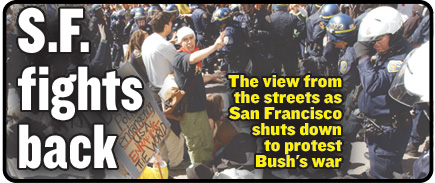
Nowhere was the clash of people power and government will more acute than on the streets of San Francisco, where a series of massive marches, some drawing nearly 100,000 people, filled the streets prior to the invasion of Iraq on March 19, 2003. The onset of war led protesters to effectively shut down the city, resulting in about 2,300 arrests and millions of dollars in costs to the city.

President George W. Bush dismissed the protests, of course, but he wasn’t the only one. Political leaders such as Rep. Nancy Pelosi, then-Mayor Willie Brown and soon-to-be Mayor Gavin Newsom (who didn’t attend any of the marches, unlike progressives on the Board of Supervisors) condemned the peace movement for hurting an innocent city. But with the “battle for San Francisco” making international news, the protesters were more concerned with the global audience.

A month earlier, on the weekend of Feb. 15 and 16, there were coordinated protests against the impending war in about 800 cities around the world, drawing around 10 million people. The peace march in Rome included about 3 million people, earning a listing in the Guinness Book of World Records as the largest anti-war rally in history. People have never made such a loud and clear statement against an incipient war.

Beyond the numbers, the antiwar movement was also right. On every major issue and prediction, the messages from the street proved correct while those from the White House were wrong. The US wasn’t welcomed as liberators. There were no weapons of mass destruction. Iraq after the invasion isn’t a stable democracy or shining beacon to anyone but the new generation of jihadis Bush created.

We can blame a hard-headed president, ineffectual opposition party, failure of the national media, or the national climate of fear following Sept. 11. But rather than refighting that lost battle, now is the time to gain perspective on the events of five years ago and determine what it means for democracy and the post-Bush national agenda.


TO THE STREETS

There were two main umbrella groups organizing protests before the war: Direct Action to Stop the War (DASW) and International ANSWER (Act Now to Stop War and End Racism). ANSWER has remained active and DASW has recently been reconstituted for the fifth anniversary of the war, using direct action in San Francisco as well as other urban centers and outposts like Chevron’s refinery in Richmond, which has reportedly been processing Iraqi oil.

“With the fifth anniversary coming up, we’re going back to direct action on the streets,” said Henry Norr of DASW. “But I don’t have any illusions that it’s going to be like it was five years ago.”

The maddening march to an ill-advised war created a political dynamic in which a broad cross-section of Americans was willing to hit the streets.

“We had a wonderfully diverse group of people, from soccer moms to anarchists,” said Mary Bull, who cofounded DASW, a collective of various affinity groups and concerned individuals formed in October of 2002 as Bush started beating the drums of war.

It was a group fiercely determined to prevent the war — and really believed that was possible. In fact, Bull recalls how she and other members of the group burst out crying at one meeting when a key activist said the war was going to happen.

Richard Becker, who cofounded ANSWER and serves as its West Coast coordinator, said that in the summer of 2002, “we came to the conclusion that [the war] was going to happen.” The group called its first big protest for Sept. 15, 2002, and another one two weeks later. But the movement really exploded on Oct. 26 when almost 100,000 people took to Market Street, much of it a spontaneous popular uprising.

“We were overwhelmed,” Becker said. “We were in a perpetual state of mobilization to keep up with what was going on. But then it didn’t stop the war.”

Did he think they could?

“I think a lot of people thought maybe it was possible to stop it. And we thought maybe it was possible to stop it,” Becker said.

The high point, according to Becker and Norr, was Feb. 17, 2003, when the New York Times ran a front page analysis piece entitled “A new power in the streets” that claimed “the huge anti-war demonstrations around the world this weekend are reminders that there may still be two superpowers on the planet: the United States and world public opinion.” But then Colin Powell went to the United Nations to argue for the invasion, and the Democrats in Congress did nothing, and it became clear war was coming.

Norr stayed out there protesting, being arrested several times and even shot in the leg by Oakland police with a rubber bullet during a protest at the Oakland docks. And he thinks some good came from the experience.

“The lesson for people is the political and economic elites are committed to preserving and extending empire. And they basically say as much in their own writing,” Norr said. “Wars are not anomalies.”

Despite being a frustrating and depressing exercise, most saw benefits to the failed movement. “People got an incredible education about how the system really worked,” Becker said. “Building a movement is mostly about a series of setbacks.”

Medea Benjamin, cofounder of both Global Exchange and CodePink and fixture of the anti-establishment peace movement for years, was upbeat about the protests. “We did our job as citizens. We did what we were supposed to do: organize, get people to take action, get people onto the streets,” she said. “We did everything we could think of.

“What you take from it is we don’t have a very well-developed democracy because the people spoke and the government didn’t listen.”

25war2_Lars1.jpg The ever-evolving “Democracy Wall” on Valencia Street, March 2003, helped stir up debate (Photo by Lars Howlett)


FACING ARREST

The collective action of five years ago starts with a series of personal stories — tens of thousands of them — so let me briefly begin with mine.

My arrival in San Francisco was closely tied to the march to war. I was living in Sacramento and working as the news editor of the Sacramento News & Review when Bush began his saber rattling against Saddam Hussein, but by the end of 2002 I had a falling out with my boss and found myself jobless.

Like most Northern Californians who opposed the war, I came to San Francisco on Jan. 18 to make my voice heard and experienced a bit of serendipity on my way to Justin Herman Plaza: while reading the Guardian on Muni, I saw their advertisement for a city editor, a job that was ideal for me at a paper I’ve always loved. Needless to say, it was a great day, empowering and full of possibilities.

Less than two months later I was on the job, and on the second week of that job I was back on the turbulent streets of San Francisco, part of a Guardian team covering the eruption of this city on the first full day of war. When I stepped off the cable car just after 7 a.m., people were streaming up Market Street and I joined them.

When a large group stopped at the intersection of Market and Beale, I stopped too, taking notes and bearing witness to this historic, exciting event. I had a press pass issued by the California Highway Patrol that allowed me to cross police lines, so when police in riot gear surrounded us and threatened arrest, I held my ground with 100 or so protesters.

After interviewing about a dozen people about why they were there and that they hoped to accomplish (see “On the bus: Journalists, lawyers, four-year-olds — the cops were ready to bust anyone Thursday morning“), I was arrested with the others and taken to a makeshift jail and processing center at Pier 27 (no charges were filed in my case, and charges against all of the 2,300 people arrested here in those first few days of the war were later dropped).

I recently tracked down a few of the people who appeared in my article, including Daphne and Ross Miller, who were at the center of the most interesting drama to play out during our standoff with the police. She’s a family practice physician, he’s an architect, and they live in Diamond Heights with their two children, Emet, who is almost 9, and Arlen, 12, who was away on vacation when the war began.

“We were genuinely shocked that the war started,” Ross told me. “We were at some of the earlier protests and really thought there was no way [Bush] could do it.”

They woke up March 20, 2003, to news that the war had begun and immediately walked to the BART station with Emet and rode to the Embarcadero station, not really planning for the day ahead but just knowing that they had to make themselves heard.

“We were pissed as hell. I don’t think I’ve ever been so angry in my life,” Daphne said.

They quickly came up with a plan. “We basically decided that if anyone was going to be arrested, it was going to be Ross and I’d stay with Emet. But it didn’t end up that way and I ended up in the arrest circle.”

Daphne had their house keys and threw them over the police line to Ross at one point. A photographer in the circle had gotten shots of a man named Roman Fliegel being roughed up by police as they pulled him off his bicycle, which was towing a trailer with a sound system, and decided to throw his backpack with camera gear out as well. When Ross — who had four-year-old Emet on his shoulders — caught it and refused police orders to give it to them, police grabbed Emet and roughly arrested Ross, leaving a gash on his forehead.

“Rage surged through the crowd, and it seemed as if things might get ugly, but the police kept a tight lid on the situation, using their clubs to shove back protesters who had moved forward,” I wrote at the time.

Emet was delivered into the circle with Daphne as the arrests continued, many quite rough. “At that point, as a mom, I had to exercise the most restraint ever,” said Daphne, who was angry about the situation but fearful about what she was exposing her son to. “Please, don’t let any violence happen here,” she pleaded with the crowd. Eventually, commanders on the scene let the mother and child go.

“The officer who let me go said that if he saw me again out there, he would call Child Protective Services on me,” Daphne said. But two days later, still brimming with outrage at her country’s actions, she ditched a downtown medical conference to rejoin the street protests, this time solo.

The couple say they’ve lost friendships over the war and have become more engaged with politics, coming to believe that Bush and the neocons are malevolent figures who knew how badly the war would go and did it anyway to establish a large, permanent military base in Iraq.

“Since that day, we’ve been far more active,” Ross said. “We realized you can’t just trust the system. You have to push.”

But that determination was mixed with feelings of disempowerment and depression. They attended some of the protests that following year, but the couple — like most people — just stopped going at some point because they seemed so futile.

“There was a horrible sense of resignation and a genuine depression that followed,” Ross told me.

The nadir was when Bush was reelected and they considered leaving the country. But then, Ross said, “we decided we’re not just going to run away and we’re not going to accept this.” Looking back, even with the scare over Emet, they express no regrets.

“It was the right thing to do because it was the wrong war to have. I’d do it again and again and again if I had to,” Ross said

They’re guardedly hopeful that Barack Obama could begin to turn things around if he’s elected. “I think the right president can at least start to dismantle this,” Daphne said. “I think thousands of people marching in the streets is something he would listen to.”

25war3_Charles1.jpg A die-in on the streets of San Francisco in March 2007 marked the fourth anniversary of the invasion (Photo by Charles Russo)


WITNESS TO HISTORY

Covering the peace movement in those early days was a heady experience, like reporting on a revolutionary uprising or working in a foreign country where the people are organized and active enough to be able to shut down society and brave enough to risk bodily injury for their beliefs.

I was at the founding meeting of CodePink — which became the most effective group at personally confronting the warmongers and keeping the war in the public eye — one evening at Muddy Waters in the Mission District shortly after the war started.

Looking back, Benjamin rattled off a long list of the alliances the group built — with labor, churches, businesses, and a wide array of social movements — and creative actions intended to build and demonstrate popular support for ending the war.

“We’ve done so many things and what did we get? We got a surge,” she said. “It shows the crisis in our democracy, the crisis of the two-party system, the crisis of a dysfunctional opposition party.”

Yet she said the peace movement has been remarkably successful in convincing the public that the war was a mistake and that it’s time for the troops to come home, even if the Democrats have been slow to respond to that shift.

“The progress we’ve made is turning around public opinion and that’s going to play a big role in the upcoming elections,” she said. For Norr, the role of the news media is a particular sore spot. He was a technology reporter for the San Francisco Chronicle who called in sick on the first full day of war and was arrested on Market Street with his wife and daughter, resulting in suspension by editor Phil Bronstein for his actions.

I wrote several stories on the issue, which culminated in Norr being fired and Bronstein unilaterally banning Chron employees from peace protests. I even borrowed CodePink’s guerilla tactics when Bronstein repeatedly refused to return my calls or address why he had singled out antiwar protesters for uniquely punitive treatment. I confronted him during a speech he gave at the Commonwealth Club (see “Lies and half-truths,” 5/7/03). That was the tenor of the times: we were all tired of being lied to and we decided to push back.

Norr was particularly frustrated with his own paper’s reporting of the war and started sending articles by the foreign press to his paper’s news desk, trying to wake his colleagues up to the pro-war propaganda being passed off as journalism in this country.

He was also disappointed with the country and with the Chronicle — both the management and his fellow reporters, who did little to support him — but the experience caused him to return to his roots as a progressive activist.

“The war and losing the job and everything brought an abrupt end to my consumerist phase and dumped me back into the world of being an activist,” said Norr, who serves on the KPFA 94.1 FM local station board and has made three recent trips to the Palestinian territories while working with the International Solidarity Movement.

Benjamin said Americans shouldn’t expect the next president to end the war — not without lots of pressure from a renewed and vocal peace movement. “This is the time to set the stage for the post-Bush agenda,” Benjamin said. “Don’t put your hopes in Barack Obama in getting us out of Iraq. Put your hopes in the people.”

25war4_Lane1.jpg A rally and nonviolent direct action at the Richmond refinery targeted Chevron on March 15 (Photo by Lane Hartwell)


THE AFTERMATH

The San Francisco Police Department, which spent more than $2 million on overtime costs responding to peace protests between March 15 and April 16, 2003, generally behaved with restraint and professionalism, but there were several exceptions.

The most costly and disturbing incident came when Officer Anthony Nelson began aggressively swinging his long riot baton at protesters, badly shattering the arm of peaceful protester Linda K. Vaccarezza, who suffered a permanent disability in her career as a court reporter.

Nelson’s incident report falsely stated that Vaccarezza had threatened him with a sign attached to a solid pole, but video of the incident later clearly showed there was no pole and that she was retreating when he teed off on her (see “The home front,” 05/19/04).

Vaccarezza received an $835,000 settlement from the city in November of 2004. On Oct. 5, 2005, two and a half years after the incident, SFPD fired Nelson for lying about what happened that day, and the City Attorney’s Office has been successfully fighting Nelson’s appeals in court ever since, putting in more than $100,000 in attorney time and costs into the Nelson and Vaccarezza cases.

The other significant ongoing litigation from the antiwar protests involved Mary Bull, who was arrested during an early protest for pouring fake blood in front of the entrance to Chevron’s San Francisco office before being allegedly strip searched and left naked in her San Francisco Jail cell for 36 hours.

Ironically, Bull was among those who brought a successful class action lawsuit against Sacramento County after she and others protesting a logging plan were strip searched, setting a precedent and led most counties to reform their strip-search policies. She used her share of the $15 million judgment to buy an organic permaculture farm in Sebastopol.

Her San Francisco case, in which Bull won a multimillion-dollar judgment, is still under appeal and now in mediation. Bull said the protests five years ago did make a difference, something she tells those who fret about its apparent failure. “I tell them to look at what issues the candidates are talking about now and I thank them for protesting then.”

“Even though we had millions throughout the world, we were sort of blocked, but now we’re regaining that momentum,” Melodie Barclay, a massage therapist who was also arrested with me on the first day of the war, told me recently. “We can’t judge it by the fact that we didn’t get the momentum we wanted.”

Norr started his antiwar activism working with Students for a Democratic Society in Boston, protesting the Vietnam War, which he said shares many similarities with the current situation, for good or for ill. He said that people tend to forget that while the protests then were huge and helped end the war, the movement did wane after Nixon ended the draft and substituted massive aerial bombardment for boots on the ground.

“The protests dropped off considerably,” he said. “A lot of the things that drove people to take risks in the late ’60s had faded by the early ’70s.”

He thinks the current administration learned a lesson from those days: it’s easier to maintain a war effort if the average citizen isn’t affected.

But there are other factors as well keeping a lid on the antiwar outrage.

“The culture has changed too. Young people are oversaddled with debt. People in schools seem to be docile. The culture as a whole seems to be more individualist and consumerist,” Norr said.

Yet some young people have woken up and many of them are funneling their energies into a peace group that was formed in the summer of 2005: World Can’t Wait, as in: the world can’t wait for the end of Bush’s second term before we change our direction and leadership.

“We don’t just want them gone, we need to repudiate their program,” said Giovanni Jackson, a 26-year-old WCW student organizer. “If we’re going to change anything, we need the youth.”

Jackson was at WCW’s founding convention in New York City, which came just as New Orleans was being flooded and then essentially abandoned by the federal government.

“When [Kerry] lost, people felt demoralized and World Can’t Wait kind of stepped into that situation,” Jackson said. “There was a lot of demoralization in the antiwar movement at that time.”

The group organized protests and student walkouts on Nov. 2, 2005.

“Everyone has their moments of doubt,” he said, “but I’m motivated by the crimes we see everyday.”


THE LESSONS

One of the biggest barriers to galvanizing people and turning the fifth anniversary of the war into something that might make a difference is the presidential election, which is diverting the energy of many potential protesters — and at the same time, offering some hope that a new president may lead to peace.

After all, every single one of the Democratic presidential candidates has promised to withdraw troops from Iraq, with varying timelines and numbers of US personnel left behind. And with enough encouragement, they might be willing to help change the status quo.

Many of the activists who volunteered their time and money to help move the Obama campaign into its front-runner position came out of the antiwar movement, and Obama’s strong stand against the war has been a key factor in his popularity.

Becker and some other activists don’t have much faith that a change in presidents will change the course in Iraq, although he agrees that much of the energy now surrounding Barack Obama derives directly from the antiwar movement.

“There’s been a huge upsurge of hope for Obama and that he might bring about the kind of change we need,” Bull said, adding that she doesn’t share that hope, believing the only path to peace is to pressure Obama and other leaders to commit to more progressive positions.

Norr said, “On one level, people have illusions about the power of peaceful protests. People believe in democracy, as well they should. We feel like the rulers should be paying attention to public opinion.

“It’s a remarkable story how broadly and quickly the American people have turned against the war. Public opinion was certainly ahead of the Democrats.”

And people will only grow more disenchanted with Iraq and its multitude of costs. “The people here are paying for this war, and everyday we have new stories about health clinics being shut down,” Becker said.

Becker was amazed last March as massive demonstrations for immigrant rights seemed to explode out of nowhere. “We think there will be more things like that,” he said.

Because after five years of organizing communities to resist the military-industrial complex’s plans, Becker thinks there’s been some visible progress.

“There isn’t a town or hamlet in the US that doesn’t have activism going on, but you wouldn’t know it from the corporate media,” Becker said. “It’s a mistake for people to feel discouraged.”


PG&E’s Green War Chest?

0

Greetings, Californians for a Clean Energy Future! Welcome to the fold of innocuous sounding, pseudo-environmental political front groups. This one is brought to us by our buddies over at Pacific Gas and Electric Co.

The group, which doesn’t seem to have a Web site or any other physical manifestation outside of filings with the California Secretary of State, already has $340,000 ready and waiting for the upcoming election cycle. According to a Secretary of State spokesperson, the group was born on Dec. 21, 2007. The only contact is the law firm Nielsen Merksamer, which has a history of teaming up with PG&E to break the law for political gain.

So far, they haven’t spent a cent — all of which were dumped into the committee by PG&E in three lump sums. Wonder what they’re going to spend all that money on? Since it’s calling itself a “coalition of environmentalists, taxpayers, and Pacific Gas and Electric Company,” it could go for or against nearly anything — including boosting Prop 98 on this June’s ballot. If passed, the measure would kill rent control and make it illegal for governments to use eminent domain to seize utility infrastructure and use it to provide the services themselves, an idea San Francisco has considered in the past and Stockton is currently pursuing.

Live – that’s just like you like those Living Legends

0

livinglegendssml.jpg

Living Legends
March 7, Fillmore

By Chris DeMento

Not much to say about Friday night’s hip-hop variety show at the Fillmore except that the Legends flat-out rocked it on some Altered Beast shit – that is, once again rising from the underground to save your 18-year-old daughter and all her tank-topped friends.

Grouch met with a warm reception, second only, of course, to Murs, who couldn’t get enough of the energy the crowd was giving him. Dude was bouncing around like a male cheerleader on an upskirt high at homecoming, but who could blame him? A Fillmore stuffed with youngsters was clearly about it, throwing up their double L’s and rhyming right along to Living Legends songs that have become new underground classics.

It was a grip of MCs sharing the stage together and having at posse cuts and shouting out Hieroglyphics Crew the way they’re wont to do. They themselves admitted that the audience’s youth made them feel a bit old.

Sunshine in the digital age

0

EDITORIAL The California Public Records Act needs an update. So does the state’s Brown Act, which mandates open meetings of government bodies, and the San Francisco Sunshine Ordinance. These are the landmark laws that keep government from operating in secret — but all were written long before the explosion of information technology profoundly changed the way city, state, and local agencies compile, sort, process, present, and preserve information.

And now, with agencies at every level trying to use information technology to hide data from the public and courts struggling with laws that didn’t anticipate the modern era, open-government advocates need to be working on every level to protect and expand access.

As we point out in this issue, technology can be used to spy, to hide, and to obfuscate — but it can also be used to make the operations and processes of the public sector far more open and accessible. Properly used, today’s information technology can vastly improve the way governments work — and it’s neither difficult nor expensive to make that happen.

The state Legislature, the San Francisco Board of Supervisors, and the Sunshine Task Force should be looking at ways to make sure that computers don’t increase secrecy — and to take advantage of the opportunities modern technology offers.

The Brown Act, passed in 1954, forbids public agencies from meeting in secret, except in very limited circumstances. The San Francisco Sunshine Ordinance goes further. The laws have been interpreted to mean that the members of a board or commission can’t use e-mail to discuss pending business; that would amount to a closed-door meeting. That same interpretation ought to apply to members participating in discussions on, say, a Yahoo! news group. Deliberations on a policy matter would be taking place outside of public view.

But what if the public was invited? What if a virtual discussion took place before or between traditional meetings — and any member of the public could log in from anywhere (work, home, the public library, terminals in City Hall) and watch? What if people — who are now allowed only a minute or two to comment in public meetings — were able to post longer, more detailed comments that policymakers would see during online discussions? What if the entire record of that meeting were instantly available on the Web, in a searchable form?

Would that be an increase in public access? What about the large number of people who still don’t have computers or Web access — would they be left out?

That’s just one of the questions sunshine advocates are talking about. Legislators need to be addressing the issues, too.

As Kimo Crossman reports on page 14, increasing public access doesn’t have to be difficult or expensive — in fact, there are ways to save the city money. One obvious idea: almost every document that’s produced by a city employee, including e-mail, is already considered a public record. Why not simply program the computers to make an instant copy of everything and post it to a public Web site? That way someone looking for memos from, say, the Public Utilities Commission addressing solar energy could simply search that site with those key words and come up with all of the records quickly.

That would save time for journalists and citizen watchdogs who now have to request those records from the agency — and it would save money for the city. If the documents were all searchable for anyone, there would be no need to spend time and money responding to public-records requests.

It wouldn’t be hard at all to add a "possibly confidential" key to records, preventing documents that really should remain secret from going into the public file. And the computers could automatically generate a list of the documents being withheld, so the public could find out what records are remaining out of view.

Over time, old paper records could be scanned and put on the site, too. And with electronic storage so cheap these days, there’s no reason why all public records can’t be preserved in an accessible form and location.

The County of Santa Clara a few years back began putting together a valuable data trove that included all of the county’s real estate and property ownership records. That allowed for the creation of a geographic information system that could be used to track property sales, taxes, crime rates, building permit applications, and much more. A wonderful public service — except that the county didn’t offer it to the public. The data was for sale, for more than $100,000 a license.

It took a lawsuit by the California First Amendment Coalition to force the county to back off and make the data public. But that’s just an example of a trend that’s cropping up all over the country: governments are developing ways to make more use of information — and then are trying to copyright it, sell it, and make money.

The problem with that, as attorney Rachel Matteo-Boehm, who handled the CFAC case, points out, is that it segregates access to information by wealth. The rich get the tools of technology to understand and use public data; the poor don’t.

It’s a dangerous trend and the Legislature should address it right away. Information created by public agencies using public data should be public — no excuses, no exceptions. And if the software that makes it easy to process that information is created by the public sector (or under contract to the public sector) the public needs free access to it.

The Legislature also needs to shoot down a series of attempts by the secrecy lobbyists to cut off access to new types of data. A bill now before the Assembly, AB 1978 by Assemblymember Jose Solorio (D-Anaheim), would exempt certain types of information from the Public Records Act. The bill appears to be aimed at overturning the Santa Clara decision but could also address an issue that has come up in San Francisco: that of so-called metadata in public documents.

Metadata is embedded information that may be in a file that doesn’t appear when the file is printed out. The City Attorney’s Office has been arguing that metadata isn’t public. That’s nonsense — it’s part of a public document, created at public expense by public employees. The Legislature needs to reject this bill — and instead pass a law that would specifically require agencies to release any internal data that’s created as part of a public record.

The San Francisco Sunshine Task Force is in the process of updating and improving the city’s landmark law, and it should seek to incorporate some of the suggestions above.

The Task Force also needs to be sure that the amendments to the law give that oversight body the teeth it needs to enforce public-access requirements. Far too often, city officials simply ignore task force findings, and, as Sarah Phelan reports on page 17, the Ethics Commission and the district attorney rarely follow up with sanctions.

For starters, the task force should have the right to subpoena documents and witnesses (without first asking the supervisors for approval — a cumbersome process). The panel should have its own full-time legal counsel. It should also have increased enforcement power: while giving the task force the right to levy fines and sanctions is politically tricky, a provision that allows the task force to order the release of documents — backed up with the full support of the City Attorney’s Office — ought to be part of the final package.

Bombs — and bongs — away!

0

Our coverage of the 26th San Francisco International Asian American Film Festival kicks off with Marke B writing about Harold and Kumar Escape from Guantanamo Bay, a sequel which offers a refreshing change from the stodgy fare that usually receives special presentations from less imaginative festivals. Marke asks star John Cho and screenwriters Jon Hurwitz and Hayden Schlossberg to pass though the bullshit detector, and they irreverently oblige. Elsewhere, Kimberly Chun surveys the influence of the late Edward Yang, one of the fathers of modern Taiwanese cinema, not that the Academy of Motion Picture Arts and Sciences – which recently left him out of their annual “In Memoriam” montage – would know. I take a look at Brillante Mendoza, whose brief directorial career to date is adding energy and variety to many-faceted CineManila activity. Keep an eye out for an upcoming interview with Mendoza in Pixel Vision, and check our short reviews of other SFIAAFF — now, that’s an acronym — features. (Johnny Ray Huston)

>> Multiculti cock-meat sandwich
Harold and Kumar Escape from Guantanamo Bay and invade the San Francisco International Asian American Film Festival
By Marke B.

>> Are you lonesome tonight?
Edward Yang searches for the personal amid the street gangs of Silicon Island
By Kimberly Chun

>> Manila: the drama
Brillante Mendoza looks at the costs of human lives
By Johnny Ray Huston

>> Take one
A quick guide to some Asian American Fest features

THE SAN FRANCISCO INTERNATIONAL ASIAN AMERICAN FILM FESTIVAL runs March 13-23 at the Castro Theatre, 429 Castro, SF; Kabuki Cinemas, 1881 Post, SF; Clay Theater, 2261 Fillmore, SF; Pacific Film Archive, 2757 Bancroft, Berk; and Camera 12 Cinemas, 201 South Second St., San Jose. For tickets (most shows $10) and more information, go to www.asianamericanmedia.org.

Spundae 15-Year Anniversary

0

PREVIEW When they founded Spundae in 1993, Peter Beckers and Guiv Naimi pioneered America’s electronic superclub a full two years before New York’s legendary (and sadly departed) Twilo. The duo managed to mix distinguished San Francisco talent — Jerry Bonham, Jondi and Spesh, Alain Octavo, Scott Carelli — with international superstars such as Pete Tong, Felix da Housecat, DJ Tiesto, Armin van Buuren, and Christopher Lawrence. After all the downs (a partnership-turned-rivalry with UK superclub Godskitchen, a stalled record label) and ups (an offshoot in Los Angeles, a partnership with luxurious Ruby Skye, international acclaim), Spundae stands firm as a distinctly American dance music bastion. Sasha and Digweed’s upcoming stop in late April demonstrates Spundae’s undiminished drawing power.

To celebrate 15 years of success, Spundae attracts (what else?) local and international talent for a two-day celebration. Qoöl masterminds Jondi and Spesh prepare the opening course of progressive house on Thursday, setting the table for two young coheadliners: Canadian Deadmau5, who creates a signature sound by pouring energy into coolly-synthed numbers and epic electro productions; and Brit James Zabiela, who combines glitchy effects and acid bass lines with nuanced drum patterns that betray a leaning toward intricate, sound-warping gear.

San Francisco takes the stage Friday, as longtime Spundae resident Alain Octavo and promoter extraordinaire Dr. Syd Gris fill the floors early with house and progressive trance. Reigning "Best American DJs" Josh Gabriel and Dave Dresden blend popular rock remixes, euphoric vocal tracks, and grittier, techno-based projections into a four-hour headlining set sure to showcase why they’ve become international favorites.

SPUNDAE 15-YEAR ANNIVERSARY Thurs/6, 9 p.m.–2 a.m., with James Zabiela, DeadMau5, and Jondi

and Spesh, $15; Fri/7, 9 p.m.–4 a.m., with Josh Gabriel and Dave Dresden, Syd Gris, and Alain Octavio,

$20 ($30 for both days). Ruby Skye, 420 Mason, SF. (415) 693-0777, www.spundae.com

A band apart

0

There’s never been any doubt pianist Gonzalo Rubalcaba could play. The 44-year-old Cuban émigré has been a highly favored sideman to top-shelf jazz leaders since landing in the United States some 15 years ago. He’s also had a steady recording contract with Blue Note and leads his own trios, which he dominates with an imposing virtuosity, an exacting sense of Cuban musical history, and a tense, brooding personality.

Now Rubalcaba has an exciting new quintet with a striking potential for challenging even his outsize talent. Culled from New York City’s best young players, his combo could be one of those very special groups whose exceptional parts create an even greater whole. Together almost a year, they’ve just released their first record, Avatar (Blue Note) and are embarking on their first West Coast tour, playing at both Yoshi’s locations over the course of a week. Avatar includes three compositions by saxophonist Yosvany Terry, whom Rubalcaba knew from their youth in Havana, Cuba, and who brings a modern, angular urbanity to the jazz traditions they are both well acquainted with. Trumpeter Mike Rodriquez played with Charlie Haden’s Liberation Music Orchestra and has become one of the most sought-after young players in jazz. Bassist Matt Brewer had been with saxophonist Greg Osby’s group and suggested the stunning drummer Marcus Gilmore. Brewer and Gilmore are still in their 20s and bring a vibrant, youthful energy to the group that complements Rubalcaba’s old-world, old-soul vibe. Avatar nods to Rubalcaba’s Latin-classical side, closing with his arrangement of Preludio Corto no. 2 for Piano by the Cuban composer Alejandro García Caturla, but the disc also showcases Terry’s funky "Hip Side," Brewer’s meditative "Aspiring to Normalcy," and Horace Silver’s enduring ballad "Peace."

It’s a riveting recording — and the combo’s live performances promise to be equally compelling. Of late, few major jazz ensembles stay together long enough to create really unique sounds and sensibilities. This particular quintet could have that kind of staying power.

GONZALO RUBALCABA

Mon/10–March 12, 8 and 10 p.m., $20–$24

Yoshi’s San Francisco

1330 Fillmore, SF

Also March 13–15, 8 and 10 p.m.; March 16, 7 and 9 p.m., $12–$22

Yoshi’s

510 Embarcadero West, Oakl.

(510) 238-9200, www.yoshis.com

SF activists campaign for Obama in Texas

1

cat julain obama-small.jpg
Cat Rauschuber, Barack Obama and Julian Davis in Texas.
By Julian Davis and Catherine Rauschuber
(San Antonio, Texas) __ When we arrived here Friday afternoon, we had little idea what our experience of campaigning for Barack Obama would hold. We have several friends who are field organizers for the campaign and have been hopping from state to state, adding to Obama’s string of electoral victories. Now three of them are in Texas, Cat’s home state and the place that feels like ground zero in the presidential campaign right now. We decided to come to San Antonio, where campaign-diva Natasha Marsh was organizing a largely Latino district on the west side. Julian had never been to Texas before.

Since our arrival Friday, this experience has been nothing short of amazing. Friday evening we volunteered at a rally where Obama spoke that drew a crowd of 10,000 people. It was the perfect introduction to what the weekend would hold – the energy in the crowd, the diversity of attendees, the commanding and inspiring message of the candidate. Little did we know at the time that this would be the first of three events we would have the opportunity to see – and even interact with – the Senator.

george micheal

0

GeorgeMichael1 sml.bmp

FOR IMMEDIATE RELEASE:

GEORGE MICHAEL ANNOUNCES FIRST NORTH AMERICAN TOUR IN 17 YEARS, A NEW ALBUM AND MAKES AMERICAN ACTING DEBUT

George Michael
HP Pavilion in San Jose on June 19th

Tickets are onsale Monday, April 7th at 10am!

San Francisco, CA (March 24, 2008) – After performing 80 shows in 12 European countries for a staggering 1.3 million fans over the past year alone, legendary superstar George Michael will be bringing his smash 25 LIVE tour to North American Arenas in the summer of 2008, including a local show at the HP Pavilion in San Jose on June 19th, in support of his new retrospective record. This will be Michael’s first North American tour in 17 years. His last Bay Area performance was on October 1st, 1991 at the Oakland Coliseum. The new record, titled Twenty-Five, will be released April 1st and is a 29-song, 2-CD set featuring several new songs (including duets with superstars Paul McCartney and Mary J. Blige) in addition to many of Michael’s iconic songs from both his solo and WHAM! career. In addition, a companion 2-disc DVD of 40 videos will also be made available.

The 25 LIVE tour broke several ticket sales records, most notably in Copenhagen. Michael’s concert at The Parken Stadium sold over 50,000 tickets in the matter of minutes, shattering the previous ticket sales record at the venue, formerly held by U2. On the 25 LIVE tour, Michael left both fans and critics alike in awe:

“It was a master class in pop genius.” – The Observer

“George proved he is simply one of the best vocalists this country has ever produced. A stunning performance.” – The Sun

“Worth waiting for. The show was, in every single meaning of the word, perfect.” – De Morgen

“A tremendous singer, a complete showman, all George Michael needs is a mike, his songs, and the magic on stage is instantaneous.” – La Parisien

The North American leg of the 25 LIVE tour will kick off in San Diego on June 17th and will continue through San Jose, Las Vegas, Los Angeles, Seattle, Vancouver, Minneapolis, Chicago, Dallas, Houston, New York and several other major cities. The tour will incorporate 22 shows over the course of seven weeks and Michael will perform material taken from the entire span of his career, including some classic Wham! tracks. Michael has recently teamed up with iTunes and Ticketmaster to produce an innovative media package which allows fans rare access to Michael’s videos, songs, and tickets to one of his North American 25 LIVE concerts. The package goes on sale on iTunes on March 25th.

Tickets to the 25 LIVE tour at the HP Pavilion will go on sale to the general public on Monday, April 7th at 10am at www.livenation.com, Ticketmaster outlets and charge by phone at 415-421-TIXS or 408-998-TIXS. Tickets are priced at $55.50, $89.50 and $175.50 for reserved seating plus applicable service charges.

George Michael has enjoyed one of the most successful and enduring careers in the history of pop music, selling more than 85 million records globally and encompassing seven US No. 1 singles, two Grammy awards, three American Music Awards, an MTV Video Music Award and two prestigious Ivor Novello awards for songwriting. His record “Faith” has sold over 20 million copies alone. In addition, Michael has garnered 11 British No. 1 singles and seven British No. 1 albums. He recently was declared the most played British artist on radio over the course of the last 20 years. On March 27th, Michael can be seen making his American acting debut on the new hit ABC series, Eli Stone, in which each episode is titled after one of his songs.

For more information about the George Michael, please visit:
www.georgemichael.com

For media inquiries, please contact:

North America:
Cindi Berger
Bianca Bianconi
PMK-HBH Public Relations
(212) 582-1111

International:
Connie Filippello
Connie Filippello Publicity
+44 (0) 207 229 5400

OFFICIAL 25 LIVE U.S. CONCERT DATES:

6/17 San Diego/San Diego Sports Arena
6/19 San Jose/HP Pavilion
6/21 Las Vegas/MGM Grand
6/22 Phoenix/US Airways Center
6/25 Los Angeles/Great Western Forum
7/2 Seattle/Key Arena
7/4 Vancouver/General Motors Place
7/7 St Paul/Xcel Energy Center
7/9 Chicago/United Center
7/13 Dallas/American Airlines Center
7/14 Houston/Toyota Center
7/17 Toronto/Air Canada Centre
7/18 Montreal/Bell Centre
7/21 New York/MSG
7/23 New York/MSG
7/26 Philadelphia/Wachovia Center
7/27 Boston/TD Banknorth Garden
7/29 Washington DC/Verizon Center
7/31 Atlanta/Philips Arena
8/2 Tampa/St Pete Times Forum
8/3 Sunrise/Bank Atlantic Center

###

Aaron Siuda | Marketing Director / Northwest – Music
(:: (415) 281.9216 / (415) 243-9532 fx
8:: aaronsiuda@livenation.com
*:: 260 5th Street | San Francisco, CA, USA | 94103

Yippie! More from ‘Chicago 10’ director Brett Morgan

0

chicago10 sml.bmp

By Jamilah King

When I walked into the Berkeley Cinema screening of the Chicago 10, I didn’t know what to expect. I had only a vague idea of the infamous Chicago Seven trial and felt oddly out of place among the aging hippies: I fully was prepared for another boring lesson on why my generation sucks.

Instead I was met with an engaging movie that eschews traditional documentary filmmaking to capture the playful exuberance of the Yippie generation. Through animation and rare video footage, Abbie Hoffman and Jerry Rubin came to life with a message of resistance that transcended decades. I spoke to Brett Morgan, the film’s director, over the phone (for the first part of the interview go here):

SFBG: You mentioned that you were trying to really capture the energy of the Yippies. Do you see any of that energy in today’s anti-war movement?

Brett Morgan: The thing about the Yippies that I love is the sense of playfulness and the fun, and I think if you go to YouTube you can see viral videos from Obama Girl to a whole range of stuff that’s pretty illuminating and exciting. I think there are leaders who have the charisma that an Abbie Hoffman had that just aren’t getting the same media play.

Newsom’s woman problem

0

OPINION Be nice, wait your turn, pay your dues, your time will come.

This is the “guidance” given to women in politics, and many of us have bided our time and paid our share of dues. But what happens when our time comes, and we speak out for what we believe in? We are called pushy, mean, controlling, or cold. And worse — we are stripped of our positions.

In the last month, four of the most respected women in city government have been removed from their posts:

Susan Leal is considered one of city government’s best managers and was leading the city toward a future of sustainable energy usage. According to the Chronicle, she was fired from her position as director of the San Francisco Public Utilities Commission because the Mayor did not consider her to be a “team player,” and because it appeared that Leal was readying herself for another run for Mayor in 2011.

Leah Shahum is a fearless bike advocate and Executive Director of the San Francisco Bicycle Coalition. She was removed from the city’s Municipal Transportation Agency for being an outspoken critic of the city’s inaction on promoting alternative forms of transportation.

Roma Guy is a fierce advocate for women’s health, a former lecturer in San Francisco State University’s health education department and a longtime progressive activist. She was removed from the city’s Health Commission without explanation.

Debra Walker is the only woman on the city’s powerful Building Inspection Commission, a longtime affordable housing activist, and a fighter for reform and transparency in the Department of Building Inspection (a male-dominated department in a male-dominated field). Walker lost her leadership position on the commission after she was targeted by the mayor’s office for openly disagreeing with his positions.

We can’t allow these affronts to go unnoticed and we can’t afford to lose more good women in poweror let the few that remain be silenced into inaction. It is time for women to stand behind our sisters who work hard every day to represent us in government, many on a volunteer basis, while also pursuing full time careers and caring for their families.

The National Women’s Political Caucus and the San Francisco Women’s Political Committee are working to increase the number of women in positions of influence in city government. In September of last year, 47 elected officials and other community leaders from the San Francisco women’s community came together for a Women’s Policy Summit where the participants agreed that our top priority is to promote more women to positions of influence in government.

Even though women comprise 51 percent of the voting population, we hold only 16 percent of the seats in Congress, 23 percent of state legislative seats nationwide, and 27 percent of the seats on the San Francisco Board of Supervisors. Only one elected executive office in San Francisco — district attorney — is held by a woman.

San Francisco must do more to promote women to leadership positions. We must also call on the mayor to appoint women to positions of influence in city government and demand an explanation when he removes qualified women from their posts without good cause. The time for patience and waiting our turn has passed. *

Alix Rosenthal, Amy Moy and Micha Liberty

Alix Rosenthal is the founder of the San Francisco Women’s Policy Summit. Amy Moy is president of the San Francisco Women’s Political Committee. Micha Liberty is president of the National Women’s Political Caucus (SF chapter).


Where to now, SFPUC?

0

› sarah@sfbg.com

Months after Mayor Gavin Newsom announced his intention to get rid of San Francisco Public Utilities Commission general manager Susan Leal, his appointees on the SFPUC board finally made if official on Feb. 20.

But the reasons for the previously unexplained move that have finally started coming from Newsom and his surrogates have only added to the confusion and concern over why Leal got canned and whether Newsom has compromised this important agency’s work for political reasons.

Leal was terminated without cause and is thus entitled to the $400,000 severance package from the contract Newsom used to convince her to move from city treasurer to SFPUC chief in 2004. Nonetheless, in the days leading up to the Feb. 20 hearing, the Mayor’s Office made a series of unsubstantiated allegations, including the claim that Leal botched negotiations with JPower over combustion turbines in Potrero Hill, that she was too much of a political animal and not enough of a team player, and that she didn’t focus enough on Newsom’s environmental initiatives like tidal power.

At first, Leal tried to handle her termination gracefully: for example, she told the Guardian that tidal power "is really expensive, doesn’t generate much power, and is a difficult process to get approved, environmentally speaking."

But then Newsom told reporters that city officials had discussed terminating Leal for cause, so that the SFPUC could avoid paying her severance, but eventually decided against it to avoid potentially expensive litigation costs. At that point, with the implication that she had done something wrong, Leal’s gloves came off.

"I really wanted to go out on the high road," Leal told us after Newsom’s latest allegations hit. "It’s unfortunate that the Mayor had to resort to 11th hour innuendo to try and justify what he did."

Leal notes that city officials never undertook a performance evaluation of Leal or the SFPUC, which would usually form the basis for an expensive effort to remove a high-profile public official. So why did Newsom really dump Leal?

Was it her creation of public power projects that earned her the scorn of Pacific Gas and Electric Co.? Was it her environmental initiatives, ranging from a biofuels program to a ban on bottled water, which seemed to show up Newsom? Was it the fact that she was a strong and independent woman in a male-dominated political landscape?

One clue can be found during the agency’s Nov. 14, 2007, meeting — just before Newsom announced he wanted Leal gone — in which SFPUC president Dick Sklar ripped into Barbara Hale, the assistant general manager for power, after she made a presentation on the agency’s long-term energy goals.

Sklar objected to Hale’s presentation, claiming, "It implied adoption of principles stating that the SFPUC was going to be in the public power business and take over public power generation in the city, making statement of principles totally inconsistent with anything the commission had adopted."

Equally disturbing to staff was the abusive way Sklar delivered his message.

"It was very painful," Leal told us. "It got so bad I had to intervene. I’m not going to allow my staff to be yelled at."

At issue was the agency’s plan to underground gas lines in Bernal Heights and extend its transmission lines, which Leal described as "a gimme. We have the easement all up the peninsula."

Beyond her openly pro–public power stance, Leal speculated that her friendly working relationship with the Board of Supervisors, including board president Aaron Peskin and Sups. Bevan Dufty and Sophie Maxwell, tweaked the mayor, who at times has seemed to have a personal vendetta against his former board colleagues.

"Maybe the mayor thinks that I’m too close with them. But we did more than just talk about climate change. We actually addressed it," said Leal, who convened a world-renowned climate change conference in San Francisco last year — on the same day Newsom was confronted by his then campaign manager Alex Tourk about the affair Newsom had with Tourk’s wife, Newsom’s commission appointments secretary Ruby Rippey-Tourk.

"Why am I fighting back, not going quietly?" said Leal, whose removal is effective March 21. "Because this is too big not to. I actually really like this job and will be going in to work for the next 30 days."

Addressing allegations that she mismanaged the JPower negotiations, Leal explained that PUC staff drew up a term sheet with JPower and presented it to the commission’s governing body. And it was at that point, said Leal, "that Commissioner Sklar popped off," claiming that the contract’s terms were terrible and should be renegotiated.

In the end, all five commissioners approved a description of the contemplated transaction with JPower, including a brief description of Sklar’s preferred alternative, which, as it turned out, had problems of its own.

"So, there never was a deal," Leal told us. "JPower was pushing the city to pay more money up front because it knows PG&E will do everything it can to make the implementation of JPower’s contract tough, and the city was pushing to pay the money later and so reduce its own risks."

Today, the PUC continues to work with JPower on a contract that has taken years to formulate and that, Leal notes, will ultimately allow the city to own the plant.

"So, if we want to shut it down, or run it on alternative fuel, we’ll have control," Leal told us. "My goal was to make the PUC as viable and green as possible."

She believes Sklar didn’t turn against her leadership until she started to push things that infringed on PG&E’s monopoly. "Did PG&E get me fired? If I was PG&E, I’d want me fired," Leal said.

Maxwell is a strong advocate of the Newark-to–San Francisco transmission line Leal sought, not just because it would help reduce environmental burdens in Maxwell’s heavily polluted southeast district but also because it would give the entire City more ability to bring in cleaner power.

"We could do large-scale solar in the Central Valley, as well as wind and geothermal energy. It would allow us to hook renewable power into statewide grid," Leal said, noting that the link would also allow the city to import the electricity it generates at Hetch Hetchy without using PG&E’s expensive lines.

Leal noted that under her leadership, the PUC tripled the city’s municipal solar generation. "But we don’t control residential solar. PG&E does," she said, noting the city is lagging at getting solar panels on homes but leading at doing in on public buildings. "It’s too bad PG&E couldn’t have made it easier for people."

Maxwell says she’ll miss Leal.

"I don’t think we’re going to be better off without her," Maxwell told us. "Susan is independent, a straight shooter, a grown up woman trying to make a difference and listening to all sides. She knew we had to be involved regionally. She also understood we have to have relationships with both sides of the hall."

Convinced that PG&E had something to do with Leal’s demise, Maxwell also believes the stinky sewage digesters, which sit down the road from her own house, need to be removed, not retrofitted, as Sklar recently advocated.

"The digesters need to go," Maxwell told the Guardian. "No other place in the nation, to my knowledge, has digesters within 25 feet of people’s homes."

Noting that Controller Ed Harrington, whom Newsom has nominated as the next general manager of the PUC, has a financial background, Maxwell says the question of what to do with the digesters should not be about money.

"We need to do the best we can for people, in the most economic and financially prudent was possible, but people must come first, "Maxwell told us.

Maxwell said these recent power struggles at the PUC convinced her to join seven other Supervisors in placing a charter amendment on the June ballot that will make it easier for supervisors to block mayoral appointees to the agency and will also require that PUC nominees have appropriate awareness and skills.

With a proposed $4.3 billion program in the works to upgrade the aging Hetch Hetchy system, which provides water to 2.4 million Bay Area residents, will the newly nominated Harrington be able to address water conservation, efficiency and recycling, without causing further harm to the Tuolumne River — all while dealing with battles over public power and wastewater concerns?

Noting that he began his City Hall career as Assistant General Manager for Finance at the PUC, a position he held for seven years before becoming City Controller 17 years ago, Harrington told us, "This is not the perfect way to walk into a position. Susan and I are old friends, she’s been very gracious, and has made it known that I had nothing to do with her removal. And I’m trying to be gracious. There’s no need to criticize her."

Leal, who calls Harrington a friend, said she believes Harrington "will push a little bit, but how much independence he can take and preserve remains the question."

Neither Sklar nor representatives from the Mayor’s Office returned calls from the Guardian. But Sup. Chris Daly, who saved Sklar’s neck by leaving the board one vote short of the supermajority required to reject a PUC mayoral appointee, told us, "I don’t think Sklar is Newsom’s tool. He’s bigger than that. If I thought he was not independent from PG&E, I wouldn’t have voted from him."

In fact, he said perceived lack of PG&E independence was why he joined seven other supervisors in voting against reappointing Ryan Brooks, who Newsom then nominated to the Planning Commission on the same day Leal was fired.

Building green in SF

0

› news@sfbg.com

GREEN CITY Wind turbines and solar panels may soon sprout on San Francisco rooftops as the city considers rival plans to implement mandatory green design standards for new residential and commercial buildings.

One ordinance proposed by Mayor Gavin Newsom’s Green Building Task Force would require new commercial construction of more than 5,000 square feet, residential buildings above 75 feet, and renovations to buildings of more than 25,000 square feet to be Leadership in Energy and Environmental Design (LEED) Gold certified by 2012, the second-highest designation.

The U.S. Green Building Council developed the point-based LEED system based on numerous green factors. The lowest green standard is LEED Certified, followed by Silver, Gold, and Putf8um. The new Academy of Sciences building, with the country’s largest living roof, is LEED Putf8um.

Newsom’s legislation would start off by mandating requiring only the lowest standard, LEED Certified, which requires 26 points, and gradually move to LEED Gold by 2012. But Board of Supervisors president Aaron Peskin has introduced an ordinance that would require the same buildings to immediately earn LEED Gold certification.

According to the LEED system, most existing buildings already have between 18 to 22 points, so Newsom’s proposed goal should be fairly easily attainable. A bike rack outside a building qualifies for 1 point. Proximity to mass transit gains another point, and Muni runs within two blocks of 90 percent of all San Francisco residences, according to the Municipal Transportation Agency.

At a green building standards workshop Feb. 20 at the San Francisco Green Party’s office, about 20 people voiced their concerns with the ordinances in front of three city commissioners.

"We need to correct the language to include all buildings," said panelist Patricia Gerber, a member of the city’s Peak Oil Preparedness Task Force. The San Francisco Office of Economic Analysis last year concluded both proposed ordinances would impact only 38 percent of the construction industry. "We should look to Europe for inspiration," Gerber recommended. "They have much stricter standards."

Some European nations started mandatory green construction in the mid-’90s, but critics say the United States has lagged.

"There are no minimum requirements on windows, insulation, and leaks," Gerber told the Guardian, describing the proposed ordinances. "LEED is a joke."

But Mark Westlund, spokesman for the Department of the Environment, defended Newsom’s longer LEED certification timeline. "We want to develop a green building plan that business can work with," he told us.

The Green Building Task Force claims that businesses need time to adjust to the higher costs associated with green materials, such as EnergyStar windows, can reduce heating costs by 30 to 40 percent. "They’re expensive because they’re used on a small scale. The minute they require it, it will become cheaper," John Rizzo, Green Party member and City College Trustee, told the audience. "It would be great if this could be done on a statewide level."

Panelists noted that green buildings save money in energy costs over the long run. Another criticism raised at the workshop was the Newsom plan’s loopholes. "Even if a project is approved green, it might not end up green," Gerber told us. If a construction company runs out of money for example, it can ask the planning director to waive LEED certification.

In addition, the event attendees questioned the credibility of the mayor’s Green Building Task Force, which does not include any environmentalists. Rather, it is composed of developers, financiers, architects, and engineers.

"We feel it represents a good variety of industry people, and so far we haven’t received any negative responses on the ordinance," Mark Palmer, San Francisco’s green building coordinator, told us.

Smaller residential buildings in San Francisco will not require LEED certification, but could be required to follow a GreenPoint scorecard developed by Berkeley nonprofit Build It Green.

Newsom’s ordinance will be presented March 19 at the Building Inspection Commission, which has already forwarded Peskin’s measure to he Board of Supervisors’ Land Use Committee. According to Peskin’s office, the two ordinances will likely be combined once supervisors decide which standard to seek.

More buzz for your buck

0

Intern Ailene Sankur discovers what’s been missing from her coffee: more coffee!

Buying coffee at 7-11 the other day (too lazy to find a coffee shop, too scared to drink more of my new roomie’s fair trade organic, $15-per-pound coffee), I found this amazing product. Stok, featured here on the Energy Fiend website, looks like a little creamer packet, but is actually more coffee for your coffee: a potent additive that’s the equivalent of one shot of espresso (FYI, espresso actually contains less caffeine than regular coffee, but still…).

stok-coffee-shots.jpg