Energy

PG&E granted cash reward, green light on power plant

0

While news surrounding Pacific Gas & Electric Co. has been dominated by a faulty weld and early warnings on the the San Bruno gas pipeline, which ruptured in a fatal explosion Sept. 9, the giant utility company received some good news at the Dec. 16 California Public Utilities Commission (CPUC) meeting.

Not only was PG&E awarded an additional $29 million cash reward for its performance in an energy efficiency program, bringing the total amount it’s received to $104 million, but it was granted commission approval to construct a new, $1.5 billion power plant in Oakley.

Ironically, the energy-efficiency program is designed to reduce the need to construct new power plants, which contribute to greenhouse gas emissions that are blamed for climate change.

The additional bonus was approved with a 3-2 vote on the “final true-up” of the energy-saving program. An independent CPUC evaluation of the utility’s performance in that program found that it fell short of the targets required to receive a cash bonus.

Commission President Michael Peevey justified the additional cash reward by saying utilities could not have known that the numbers they used to estimate energy savings were inflated, and that they would not have been able to adjust their energy-saving tactics in the middle of the program cycle to improve performance.

According to the Division of Ratepayer Advocates (DRA), a consumer-advocacy branch of the regulatory agency, “The CPUC today approved the additional $29.1 million award to PG&E in a 3-2 split vote, despite an Administrative Law Judge’s finding that no further bonuses should be awarded, nor penalties levied. Rather than receiving an additional $29 million bonus, PG&E should repay $74.9 million in bonuses already awarded for energy efficiency programs that failed to meet CPUC-established energy savings goals, and it should pay an additional $1.3 million in penalties, based on the original incentive mechanism.”

Barbara George, executive director of Women’s Energy Matters, blasted the decision. “In this shaky economy, it’s incredible that the Commission would force ratepayers to pay profits for utilities that missed their targets by a mile. This hurts everyone in California. Cities, businesses, and residential ratepayers will all have to pay twice for utilities’ failures — once for these undeserved ‘rewards,’ and again in high monthly utility bills that should have been reduced by these programs, but were not.”

The 4-1 vote to approve PG&E’s Oakley power plant was a reversal of an earlier commission decision rejecting the proposal. DRA weighed in on this item, too, saying data on PG&E power reserves suggests that the new facility is unnecessary.

“PG&E ratepayers are now on the hook for $1.5 billion in costs for energy they don’t need while being shut out of the decision-making process that will leave all PG&E customers with higher utility bills,” said DRA acting director Joe Como.

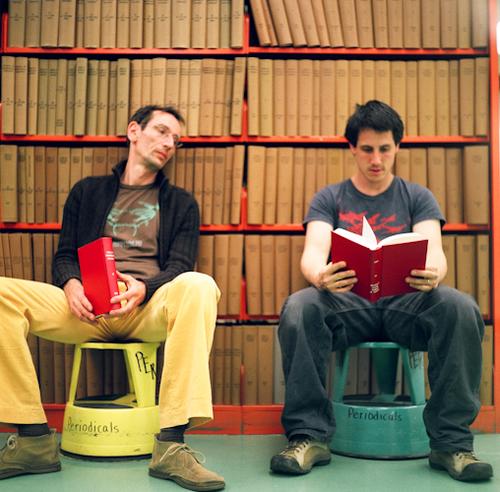
Q&A: The unexpurgated Books

0

Accurately summing up the music The Books create is a tall order. Folktronica, indie-pop, cut & paste, experimental — all these tags can loosely be assigned to it, but none can fully capture the group’s mix of acoustic virtuosity and trippy electronics. First meeting in New York City in 1999, Nick Zammuto and Paul de Jong soon began crafting their unique combination of found sounds, cello, guitars, vocals and studio experimentation. Their work has led to four albums, a remix collaboration with Prefuse 73, and a commission to create elevator music for the Ministry of Culture in Paris. Zammuto took some time to chat about the group’s use of samples and its newest release, The Way Out (Temporary Residence Limited). Below is a longer version of a Q&A that recently ran in the Guardian.

SFBG You guys seem to put a lot of thought into the venues you perform at. How do you choose?

Nick Zammuto At first, beggars can’t be choosers, so we kinda just played wherever people would have us. And then I think the promoters started to realize that our show just works better when there’s a little more focus and when the ceiling is high enough for our projection to look the way it should. More than anything, the venue — the shape of it and the sound of it — creates the evening. And it’s amazing how it brings out different characteristics in an audience. Part of it is what they bring and part of it is what we do. But there’s that third element, which is the venue. It’s a mysterious thing. I love shows that are sitting down because I think it brings out this more careful detail that we try to bring out in our records, which is difficult to translate to the stage when it’s a noisy environment and beers bottles clinking and stuff like that. But then again, I love the energy of shows that are standing up because people can express themselves easier and we get more feedback from the audience. So both have their benefits.

SFBG You’re playing with Gene Back this tour, which will be the first time you’ll be performing as a three-piece. How did this come about?
 
NZ He’s a guy from Brooklyn who we met through a project we did with a cellist named Zach Miskin. He was kinda Zach’s right-hand man for this project and he came up to record at my place and I was just really taken with his playing. He can play anything you put in front of him. He learns really fast, so it’s been great to throw stuff at him to see what he can do. He doesn’t disappoint.

SFBG How much of a collaborative process was it in terms of him adding or not adding his own touches to the existing material you guys will be performing?

NZ It depends on your definition of collaboration, but I think the energy he brings with his playing, it changes our set drastically and that’s definitely something we have no control over, you know. That’s his thing. He’s tried to execute the parts that we’ve created for him, but he’s also solved a lot of problems that we wouldn’t have foreseen, not being able to play them ourselves. And he loves to dive into things. For example, he can actually play the guitar riff on “Tokyo.” He came up to us and was like, “Hey, look what I can do.” That’s something we never expected to be able to play live, and sure enough, it’s in the set now because of him.

SFBG Speaking of the guitar line on “Tokyo,” that’s one of many parts on your guys’ albums that makes you wonder how exactly it was created and recorded.

NZ I think nothing is really what it seems on our records and we do a lot of work to cover our tracks in terms of where things come from and how things were made. But essentially, I played that guitar line just as it appears on the record, except it was about half the speed when I originally played it. I just sped it up to see what it would sound like. And it turned the tambour of the guitar into this high-strung, mandolin kind of sound, which was cool, so we kept it. My fingers just don’t move that fast. But luckily there are people out there who can execute my ideas (laughing).

SFBG As diverse as your music can be, there is still a very recognizable overall sound. But it’s not always easy to describe. After all these years, have you guys settled on a fallback response when someone asks what kind of music you make?

NZ The word we go back to because it’s kind of open-ended is “collage.” We pull things from all different places and try to put them together in some compelling way, and I guess the most basic word for that is collage. I think people try to attach all kinds of genre names to it, but none of it has really felt comfortable to us. We just kinda do what we do. But you know, sampling is a big part of what we’ve always done. Figuring out a way to connect all these disparate elements is the basic work we do. So, it feels like collage.

SFBG I’ve always been curious about how you find the material you sample. Where did the material featured on The Way Out come from?

NZ During our tours in 2006 and 2007, we stopped at thrift shops all along the way, wherever we could. We’d pick [up] VHS tapes and audio tapes. Paul is kind of in charge of the audio side of the collection and I do more of the video side. Basically, we take the tapes and digitize them and then go through them and save all the stuff we think might be useful, having no idea what it might be used for. If it kind of has this memorable, emotional quality, we save it and keep it around. And the cream rises to the surface, in a way. We end up with these samples that are so far and above anything that anyone would expect, and you just have to use them. So, we throw all those in a folder called “Must Be Used.” And that’s what starts a lot of the ideas for the compositions.

SFBG The answering machine messages in “Thirty Incoming” are simultaneously touching and kind of silly. How do you decide what musical tone and context you’re going to frame a sample in once you decide to use it?

NZ A sample like that just speaks to everyone, you know. And it’s interesting how the interpretation of that phone message varies from “Wow, this is the most sincere man I’ve ever heard in my life” — which was my interpretation when I first heard it — to “That’s creepy. I don’t know what I’d think if I got that message on my phone.” So, it just has this sort of supercharged quality to it where it means a lot to everyone who hears it, but for different reasons. You can’t really go wrong with it, unless you were to counteract its tone somehow. What it suggested to me was this oceanic kind of sound. Those lines go so deep, that it had to be this wave after wave of pulsating sound coming in and then receding. Then we tried to find musical elements that could achieve that sound. So, we ended up using cello and effected vocals, electric guitar and bass to pull it all together. And also this drum tom that I recorded last summer while we were in London. This is the first time we’ve used real drum sounds in forever. It was fun to work with that quality of sound.

SFBG Hearing drums sprinkled throughout was a nice surprise on this album. I particularly like the hi-hat pattern throughout “I Didn’t Know That.”

NZ That was a lucky find. It was from a rare record with only like 500 copies made in the 1970s. It’s from this black history record. And it’s just this great hi-hat riff that’s just there between these two spoken word tracks. When we heard it, we were like, “Wow, that’s totally amazing.”

SFBG Have you ever been contacted by someone who appears in one of the found samples you’ve used throughout your career?

NZ People ask this a lot, and we haven’t, I think for a couple of reasons. Like going back to the “30 Incoming” samples, that tape must be 20 years old already, so who knows how old those people are now. And you know, we’re a pretty small band and it doesn’t really go outside of a certain circle of people who listen to this kind of thing. So, I don’t know how it would get to them, unless it was through some crazy kind of way. Maybe it will happen someday.

It would probably take some crazy series of connections. But it’d have to be a crazy feeling for someone to stumble upon a song that contains something they said or did and most likely forgot about 20 or 30 years ago.

It feels like archeology, even though it’s of the recent past. It feels like there’s some distance between now and then, so it takes on a totally different meaning. There’s all this inadvertent cultural information in these tapes. Stuff that was in the background when people were making them, but now they become the foreground because it’s so different from how we are now. And it often comes across as funny. But it also has this unconscious quality to it, which is what I like about it. That none of this stuff is planned. It’s not preconceived what this stuff means. It’s really honest in the way it comes though. It’s just people being themselves.

SFBG As meticulous as you guys seem to be at crafting albums and each individual song, do you ever struggle with deciding when something is done being worked on?

NZ Yeah. I mean, I compose the stuff and it takes forever (laughing). And it’s a completely exhausting process. But you just kinda know when you’re done, because you don’t want to work on it anymore. It becomes like a zero-sum game. Nothing you can do can make it any better than what it is, so you just let it go. Tracks are never finished, they just kind of escape.

SFBG You switched from the European label Tomlab to the US-based Temporary Residence Limited for The Way Out. Is there a difference between how Europeans and Americans approach your music?

NZ I think Europeans think of us as kind of like a freak show (laughing). And they like us for that reason. But I think when we play in the US, there’s this familiarity because there’s more nostalgia to it. Because we all grew up in the times that we’re sampling from, the ’80s and ’90s mostly. It’s less of a freak show and more of a warm look at the past and where we came from. Kind of reclaiming our childhoods in a way.

SFBG What kind of music inspired you both during the creation of the new album? And is there something you’ve been particularly into as of late?

NZ Me personally, I’ve been on a big Police kick. I don’t know why. But going back to their catalog, I love the way their records are produced. And I especially love Stewart Copeland’s contribution. He can play the drums like no one else. It all has this clarity and precision and energy to it that I really love. So, I’ve kind of been studying that from more of a production standpoint. As for inspiration during The Way Out, during our visit to London in 2009, Nigel Godrich’s engineer Drew Brown invited us to Nigel’s studio for about a week. Nigel was away working on something else and Drew was like, “You should just go and play,” and we were like, “Are you kidding me?” (laughing). And seeing how that studio is put together and the music that has come out of it, Nigel’s and Drew’s way or working is really inspiring to me in terms of getting a mix that’s kind of warm and transparent but also really powerful. I think that had a direct effect on our record.

PG&E may receive millions for unverified energy savings

5

Pacific Gas & Electric Co. is poised to receive millions in shareholder bonuses for successfully administering a statewide energy-efficiency program designed to curb customers’ energy consumption. But consumer advocates have sounded the alarm that the utility doesn’t deserve it.
 Although PG&E claims it earned the cash because it achieved the targets of the energy-saving program, the utility’s findings are unverified. In fact, an independent California Public Utilities Commission (CPUC) evaluation found that instead of the A+ grade PG&E claims it achieved by meeting the goals of the program, the utility’s performance actually amounts to a D.

The cycle for the incentive program spans 2006 to 2008, and PG&E was already awarded $76.2 million for savings the utility said it achieved, even though its progress had yet to be measured against the findings of the independent report. The matter will be revisited at a Dec. 16 CPUC meeting, when commissioners decide how to handle the “final true-up” of the program for all four investor-owned utilities. PG&E and the three other utilities could be awarded millions more in bonuses.

The program was crafted as a way to bring energy companies on board with a prospect that normally wouldn’t make sense for their bottom line – encouraging customers to use less of the electricity they sell. In exchange for participating in a program that attempted to slash energy use by getting energy-efficient appliances, light bulbs, and information into the hands of consumers, the CPUC offered utilities a carrot for stepping up to the plate.
 
If the companies managed to hit 85 percent of the energy-savings targets or better, the state’s investor-owned utilities could be awarded cash bonuses that would get progressively larger with their degree of success. If the companies reached just 65 to 85 percent of the goals, they wouldn’t realize any gains or suffer any losses. And, if they fell below the 65 percent threshold, they would have to pay a penalty.

Although PG&E found in its own results that it met the targets handily, the CPUC report offered a different picture. Released in April 2010, after the first incentive award had been granted, the report found that PG&E achieved 71 percent, 60 percent, and 63 percent of their targets in three energy-saving categories. Basically, it flunked two out of three.

Now that the CPUC faces a decision on whether to award an additional bonus, and how much should be granted, no one seems to agree on just how the energy savings ought to be calculated. Several proposed options are on the table, based on different sets of numbers and the correspoding calculations. The question of how much energy PG&E actually saved is extraordinarily complex, and there seem to be multiple answers. The reward money, by the way, comes from ratepayers.

Commission President Michael Peevey is proposing that PG&E and the three other utilities receive additional incentive rewards totaling $62 million, based on numbers that push the utilities into the higher-scoring categories. Meanwhile, a proposed decision by an Administrative Law Judge recommends that commissioners neither penalize the utilities nor grant them any extra money.

However, the Division of Ratepayer Advovcates (DRA), an consumer-protection arm of the state agency, noted in a recent press statement that PG&E should have to give back the $76.2 million it already received, and face penalties for not meeting its goals. “Why would you give them bonuses for unverified savings?” asks Cheryl Cox, policy advisor for the DRA.

According to a DRA statement, “A comprehensive CPUC staff report released in April 2010 found that from 2006 to 2008, PG&E and the state’s other three major utilities (Southern California Edison, San Diego Gas and Electric Company, and Southern California Gas Company) did not make enough progress to trigger bonus payments; in fact, the report found that all four of the state’s largest investor owned utilities failed to meet the performance threshold set by the CPUC, and based on the CPUC’s bonus mechanism three utilities, including PG&E, should owe penalties.”

The whole debacle highlights a good question: Why are California energy companies in charge of running programs that encourage people to use less energy, anyhow? Cox noted that she sees an inherent conflict-of-interest in the mechanism, and believes that ratepayer dollars for energy-savings programs might be better spent in a state-administered program that could use market leverage to get manufacturers to offer more efficient products.

The whole point of the energy efficiency program is to reduce the need to build new power plants, she pointed out, but utilities’ performance so far calls into question whether it’s really been effectively reducing energy consumption. After all, PG&E is seeking to construct a new power plant in Oakley. As things stand, “We’re creating the illusion of getting energy efficiency savings,” Cox said.

Barbara George, director of Women’s Energy Matters, noted that PG&E had mis-used energy efficiency funds by directing some of the money into campaigns to thwart a fledgling Community Choice Aggregation program in Marin County.

“Each proposed decision jumbles the inputs differently, with mind-numbing complexity, but the purpose is the same — to avoid the penalties they owe for failing to meet their targets, and to justify the profits CPUC already gave them,” George said. “The proposed decisions can’t agree on exactly how to justify screwing the public, because the record supports none of them.”

Psychic Dream Astrology

0

Dec. 15-21

Mercury is still retrograde — communicate with care!

ARIES

March 21-April 19

Your most annoying struggles are trying to teach you something about the nature of compromise. There is a way to make compromises that aren’t actually compromising, but it takes care and foresight. Get to it.

TAURUS

April 20-May 20

Trying to change the past will get you in some demoralizing situations. Things are changing, and it’s necessary that you find peace in who you are and where you’re at right now.

GEMINI

May 21-June 21

Set your boundaries,then leave well enough alone. Guard against overanalyzing this week. Patience and perseverance are the name of the game, so make up your mind and stick to it.

CANCER

June 22-July 22

As long as you remain unclear about what to do, shift your focus to one thing: being nice to the people you rely on most. Close out the year with as much kindness as you have in you. Invest in what gives back.

LEO

July 23-Aug. 22

There’s a fine line between being selfish and pushy, and being a fierce Leo who knows what she wants. Make sure that doing what’s right for you doesn’t trample on other’s toes. Check your motives for best results.

VIRGO

Aug. 23-Sept. 22

Go with the flow that is coming at you. If you get too caught up with your strategies and goals, you might just miss out on what’s in front of your face. Overthinking things will be your undoing (for a change) this week.

LIBRA

Sept. 23-Oct. 22

The wisest thing you can do this week is let go, Libra. Sometimes all the processing in the world doesn’t change a thing — and you are being challenged to make changes instead of just thinking about them.

SCORPIO

Oct. 23-Nov. 21

Sometimes you have to disappoint others to do what’s right. Take a chance this week and stand up for what you feel is right for you. Be generous of spirit without watering down your needs.

SAGITTARIUS

Nov. 22-Dec. 21

Make sure your ego doesn’t get to drive you where you’re going next, even if you feel like it’s the clearest of your inner impulses. Frustrating stuff may be kicking your butt, so get creative with how you cope, stat.

CAPRICORN

Dec. 22-Jan. 19

As you go through meaningful internal shifts, the stars want you to embody courage. Don’t worry too much about the details. Focus your energy on making sure you don’t choose or avoid things out of a fear of change.

AQUARIUS

Jan. 20-Feb. 18

You need a break from people tugging on your energies. Instead of waiting till you shut down or your body forces you to rest, try having some healthy boundaries and balance between your need to recoup and be with others.

PISCES

Feb. 19-March 20

Spend your time and energy away from the stores and looking deep into your self, my sensitive friend. This week is all about introspection and getting present. You’ll have tons more emo space for others for the rest of the year! *

Jessica Lanyadoo has been a Psychic Dreamer for 16 years. Check out her website at www.lovelanyadoo.com or contact her for an astrology or intuitive reading at (415) 336-8354 or dreamyastrology@gmail.com.

Tiny Bones breaks out

41

Elise-Marie Franklin, a.k.a. Tiny Bones, breezes into Four Barrel Coffee in the Mission, turning several heads in her wake, and it’s like, “Wow, dayum, star power!” (She declines a cup of slow-drip because, “I have so much natural energy, I’d probably explode.” I can see that.)

The gorgeous young singer and musician looks destined to be the first pop star graduate of San Francisco’s storied hardcore electro scene, utilizing her various talents to combine underground and mainstream elements into a bewitching and surprisingly unique style. Together with her partner in music, local fameball Topher Lafata, a.k.a. Gold Chains, she’s finally started releasing tracks on their label New California Music (www.newcaliforniamusic.com) after a long gestation period.

“We’ve been working for three years on all of this and have dozens of songs ready to go, but we wanted everything to be just right — the music, the website, the label. It’s fantastic, because now we can do things our own way.”

Tiny Bones spent her childhood in Carmel and France, training from an early age in vocal techniques and multiple instruments. But she came of punk-rock age in the famous pit of Berkeley’s 924 Gilman and, later, the electro-styley, camera-ready world of club Blow Up. Add to all that a music appreciation that runs from the Ronettes to Eazy-E (with stops at Deniece Williams and Depeche Mode), and you’ve got a powerhouse of influences.

“I love so many different kinds of music that for me it’s less about the style than the fact that something’s authentic,” she told me. “I aim for that authenticity with my own music — I put all of myself into my songs and performance, I don’t believe in holding back.”

That perfect lack of restraint comes through in her stage persona, which mixes sexiness (“Sexuality is huge in my life, and I don’t shy away from it”) and smarts (Tiny Bones is a psychology grad student at UC Berkeley). Those two sides meld to humorous-hot effect in the video for her first single, a slow-building, tropical-tinged banger called “Heat.” It starts in a boardroom, with Tiny Bones setting feminist boundaries for her marketing campaign — no bikini-clad sexploitation, no oil, no fans in the hair — and then demolishing those boundaries in a tight gold tube top, owning her hotness and slaying the fanboys.

Tiny Bones has just released her second track, “Parley,” an epic hardcore electro breakup-party ballad that expertly hits an aching sweet spot between build and release around the two-minute mark and holds you there for the rest of the six-minute track. It’s pretty breathtaking in its ballsiness, and the video is a love letter to San Francisco, with guest spots from nightlife stars HOTTUB, the Tenderlions, Monistat, Merkeley???, Richie Panic, and more.

Tiny Bones is going to soon bring that San Fran ballsiness to the world, with a tour in the works, a full album, and a lot more partying (and studying). “This has always been my dream, to be a singer and make people happy and maybe inspire someone. Now I’m ready to go for it.”

Headbanging history

0

arts@sfbg.com

YEAR IN MUSIC Sometimes it appears that metal is aging backward in time, like a jean-jacketed, beer-swilling Benjamin Button. A cannibalistic hunger for old tropes sends budding musicians traveling deeper and deeper into the past for inspiration. By the beginning of 2010, the corpse of thrash metal was well and truly picked over, and as a legion of teenage “retro-thrashers” began to wear holes in their all-white high-tops, a new reverence emerged, one that looked beyond the aggression and speed of the middle 1980s, hearkening back to an earlier, heavier time.

This appetite for headbanging history was nurtured by 2010’s profusion of reunion tours. Emboldened by the music’s broadening audience, aging musicians the world over have been emerging from seclusion (voluntary or otherwise) and honing in on ticket territory that recently belonged to their younger colleagues.

Traditional doom metal was robustly resurrected; cult late-1970s acts St. Vitus and Pentagram both graced the stage at DNA Lounge, with mixed results. Considering the promise evinced by its summer 2009 appearance at the same venue, Pentagram was disappointing, though a last-minute lineup change was made the scapegoat. St. Vitus was another matter, thundering forth on the strength of guitarist Dave Chandler’s dive-bombing psychedelia and singer Scott “Wino” Weinrich’s booming baritone. The renewed vigor of the legendary L.A. outfit made the recent death of original drummer Armando Acosta especially poignant, though he had not played with the band for some time.

Metal was robbed of another sainted figure this year: Ronnie James Dio, whose inimitable voice and boundless energy made him one of the best-liked musicians in the business. His performances remained impeccable almost to the bitter end, which exacerbates the sense of loss. Fans can take comfort in the fact that he died during 2010, a year that witnessed a veritable renaissance of exactly the kind of late-1970s metal Dio did so much to popularize.

The fervor for classic, “traditional” metal was on display this past summer at Tidal Wave, a free concert in McClaren Park that featured three reinvigorated acts as its second-day capstone, each interpreting genre-progenitors Iron Maiden and Judas Priest in its own particular way. Anvil Chorus was formed during the dawn of the Reagan administration, and “Blondes in Black” and “Deadly Weapons” served as catchy centerpieces to an expertly-played set. Bay Area treasures Stone Vengeance, an all-African American trio from Hunter’s Point, showed why it has been able to survive for more than three-decades, combining engaging enthusiasm, unimpeachable technique, and a deep-seated sense of humor. U.K. legend Raven was the headliner, belying its advanced years thanks to rapid tempos, vertiginous falsetto, and captivating NWOBHM licks.

Elsewhere, German legend Accept released a new album and set out on the road, and long-running S.F. veterans Slough Feg returned this year with The Animal Spirits, a potent full-length. And yet a love of melody, guitar harmony, sung vocals, and galloping drums is no longer limited to hoary veterans. This year also witnessed a crop of new bands that drew heavily on late-1970s and early-1980s inspiration to craft a compelling crop of fiery LPs.

Sweden’s Enforcer (Diamonds) and Steelwing (Lord of the Wasteland) and L.A.’s Holy Grail (Crisis in Utopia) all took advantage of their klaxon-throated singers to release albums that draw heavily on classic Judas Priest, with a particular focus on high-register vocal melody and a bevy of shredding. Breakout Olympia, Wash., group Christian Mistress took a slightly different approach. The group’s EP Agony & Opium leavens influential British outfit Diamond Head with the unique, melancholy delivery of singer Christine Davis.

If metal spends 2011 in this same archaeological mind-set, the Blue Cheer comparisons will start to fly fast and thick. But while some may decry the stultification that accompanies veneration of the retro, they cannot deny its curatorial power. Like Dio himself, the metal of the past is destined to live again, in the overburdened eardrums of the present.

Potrero power plant could be shut down in February

0

The Potrero power plant could be shut down entirely by the end of February, the Guardian has learned. According to a report prepared for the Dec. 15 meeting of the California Independent System Operator (Cal-ISO) Board of Governors, an energy regulatory body, the aging power plant will soon be released from a Reliability Must-Run (RMR) contract requiring its continued operation for grid-reliability purposes.

“The ISO will provide an RMR termination notice to Mirant at the end of this month or in early January,” the report states, “which would terminate the RMR agreement by February 28, 2011.”

In August of 2009, San Francisco City Attorney Dennis Herrera reached an accord with Mirant Potrero LLC, the company that owns and operates the Potrero Power Plant, to shut down the plant by Dec. 31, 2010. Although the company agreed to the terms of shuttering the plant by the end of this year, there was a catch — the Cal-ISO would first have to terminate Mirant Potrero’s RMR contract. Apparently, that won’t happen till early next year, but this latest Cal-ISO report marks the first time the agency has committed to a specific date.

The Potrero power plant won’t be a necessary power source for San Francisco now that a new energy transmission line has been installed. The Trans Bay Cable, a 53-mile submarine power line that can transmit 400 megawatts of electricity from a Pittsburg substation to San Francisco, became fully operational on Nov. 23.

“The Trans Bay Cable finished its testing successfully and was put into successful service,” spokesperson P.J. Johnston told the Guardian. Meanwhile, a PG&E re-cabling project deemed important to San Francisco’s electricity reliability was completed Dec. 5.

“Having both of these projects completed and proven operationally reliable were the two key conditions for enabling the ISO to release the entire Potrero power plant from its reliability must-run contract obligation,” the Cal-ISO report notes.

Removing the Potero power plant from service will benefit San Francisco’s air quality, particularly in the city’s southeastern neighborhoods.

Forget “Deborah” — Debbie Gibson is back!

2

Despite having had a nearly 25-year (and counting) career in show business, singer Debbie Gibson is still full of youthful energy and excitement when talking about recent projects and what she has planned for the future — perhaps that is due in part to the fact that she had her first hit single and taste of fame when she was only 16 years old. The ever-vivacious Gibson is particularly excited about taking part in a benefit concert and cabaret show tonight here in San Francisco, “One Night Only: A Shrektacular Holiday Celebration,” which will also feature the cast of Shrek currently at the Orpheum Theatre, and raises funds for the Richmond/Ermet AIDS Foundation.

“Pretty much if I’m available, I can’t say no to this organization,” says Gibson, who has always been heavily involved with helping charitable groups throughout her career. “I really enjoy these intimate shows with solo theater performers, and it’s kind of a perfect fit for me — obviously I bring my pop persona to the table, but at the same time I’m part of the theater community, so it makes perfect sense really.”

The ‘80s pop chanteuse, famous for her initial hits such as “Only In My Dreams,” “Out of the Blue,” and “Electric Youth,” was one of the few stars of that time and genre who wrote and arranged much of her own material, which led to her successful forays into Broadway productions, and eventually into acting for film.

Her recent appearance in the cult B-movie Mega Shark vs. Giant Octopus has also sparked a new run of interest for celluloid gigs, with Gibson happily looking forward to the release of a new SyFy Channel movie, Mega Python vs. Gatoroid, which finds her teamed with another singer and actress who once vied for the same airwaves and video times as she did back in the 1980s — none other than Tiffany.

[Mega Shark] was so bad it was good; this one is smart, kitschy, and campy, it’s sexy sci-fi horror, and it was so much fun to do,” enthuses Gibson. “The first one was done a lot on blue screen, and all that; for this one I was hanging from rope ladders, crawling in the swamp, and climbing buildings. It was actually quite an action movie in addition to being a sci fi movie. Throw in a little food fight between me and Tiffany and there you go!”

Gibson says that both actresses had fun playing on their supposed rivalry from their youth, and that they didn’t mind that some of the people behind the film may have had, er, some ulterior motives. “We were like, ‘what dirty old men at SyFy sat around [asking] how they could get Tiffany and Debbie Gibson to get whipped cream on each other?'”

Gibson is referencing a scene from the movie — which comes out next month — that was released early, showing a drawn-out, extended cat fight between the two involving smashed cake, wrestling in a river, and a hilarious reference to the title of one of their hit songs. At tonight’s special show, Gibson is planning on performing a new song, one she hopes will provide a new take on holiday tunes, and also on her supposedly squeaky clean image from her past. 

“I wrote it about a year ago, and it’s a kind of a modern ‘Santa Baby,’ a sexy, jazzy, original Christmas song. It’s tongue in cheek,  mocking myself, it’s called ‘The Naughty List’ — I’ve always been the good girl and I’d very much like to be on ‘The Naughty List’ for once!”

http://www.youtube.com/watch?v=qf8BoWKeHow&feature=related

Debbie Gibson
Mon/13, 8 p.m., $35-$65
Theatre 39, Pier 39, SF
(415) 273-1620
www.helpisontheway.org

Psychic Dream Astrology

0

Dec. 8-14

Mercury goes retrograde on the 10th.

ARIES

March 21-April 19

There is no way out without going through it, Aries. Pair your desire for better circumstances with a willingness to do the work on yourself that’s needed. Don’t go for easy, go for real.

TAURUS

April 20-May 20

You’ve been making things happen and now it’s time to sit back and reexamine things. Reacquaint yourself with your relationships and investments to make sure you’re still pointed in the direction you wanna go.

GEMINI

May 21-June 21

The worst thing you can do right now is let your ego get in the way and act defensively with others. You may be going through a rough patch, and “fake it till ya make it” won’t work this week. Be authentic or duck and cover.

CANCER

June 22-July 22

Fretting over what is will be a major time and energy suck, Cancer. Make peace with the disquiet in your life so you can start investigating creative solutions instead of tripping over your own feet.

LEO

July 23-Aug. 22

Go against the wisdom of your own gut instincts this week and it’ll come back and bite you in the fanny later. If you don’t know the answer, don’t make any commitments. Stay true to you in all you do.

VIRGO

Aug. 23-Sept. 22

The relief you seek from your own over-thought thoughts is so simple, Virgo. Redirect your attention. Instead of trying to figure things out, get grounded by doing practical things to take care of you and yours.

LIBRA

Sept. 23-Oct. 22

Make up your mind or get outta the game, Libra. You may not be known for swift, decisive action, but this Mercury retrograde you can turn that around! Distill things to their simplest form and yea or nay on it.

SCORPIO

Oct. 23-Nov. 21

If you’ve got a question, ask it, because the worst thing you can do right now is stew in your own juices worrying over stuff. Set yourself in motion or you’ll end up quivering in your booties. More is more this week.

SAGITTARIUS

Nov. 22-Dec. 21

Major change doesn’t happen overnight, Sag. Actually, it sometimes does, but then the fallout plays itself out over time. Allow for things to develop while you improve on whatever you’re able to.

CAPRICORN

Dec. 22-Jan. 19

Be highly discerning right now, Cappy. No matter how you shake it, things are changing. Your job is to ensure that they are improving and that your life isn’t just shuffling your crap around. Do things right.

AQUARIUS

Jan. 20-Feb. 18

You are not in control and it would be a mistake to try to change that. Instead, create changes in yourself that allow for more freedom in how you relate to your life. Create happy, not perfect.

PISCES

Feb. 19-March 20

Check in with your heart instead of your head, Pisces. Go toward what feels right for you this week, even if you can see the merit of other choices. The time is brewing for major changes; trust your heart for now. *

Jessica Lanyadoo has been a Psychic Dreamer for 16 years. Check out her website at www.lovelanyadoo.com or contact her for an astrology or intuitive reading at (415) 336-8354 or dreamyastrology@gmail.com.

EDITORIAL: No PG&E caretaker

0

We’ve made it clear in several editorials that the Board of Supervisors would be wasting a great opportunity and making a political mistake by choosing a mayor who vows to serve only as a “caretaker” and not run in the fall. A caretaker would lack the authority to make the significant changes that are needed at City Hall — and a vow not to run again would deprive the voters of the right to choose the next chief executive of the city. What would happen if the interim mayor did a great job? What if the so-called caretaker turns out to be the perfect person to continue on in the role?

But the real danger is that the board might choose a caretaker who not only continues the dangerous and divisive policies of Mayor Gavin Newsom, but sends the city in the wrong direction on the key decisions that will come up in the next 12 months.

The budget crisis is going to be the central concern of both the mayor and the supervisors, but there’s plenty more on the agenda. For example, the city will be moving next year to implement community choice aggregation — and since Pacific Gas and Electric Co. fought bitterly (and apparently illegally) to block Marin County from implementing a similar program, the next mayor needs to be prepared to fight PG&E vigorously. So anyone who lacks a record of taking on PG&E, or is weak on CCA, should be disqualified.

There will be a significant number of commission appointments coming up — and since the members of some panels serve at the mayor’s pleasure, and other commissioners often resign to give a new mayor the chance to put his or her own people in charge, the next mayor can remake city government on a larger level. We just saw, in the atrocious vote to evict the Haight Ashbury Neighborhood Council’s recycling center, how badly the Recreation and Park Commission functions. The Public Utilities Commission has dragged its feet on CCA. The Port and Airports Commission need new blood. And quite a few department heads should be replaced. Anyone serving in the Mayor’s Office next year needs to be willing to make those moves.

A bad caretaker could do real, lasting damage to the city; allowing PG&E to torpedo CCA would set progressive energy policy back a decade. Let’s remember, the progressives have six votes on the board; if they’re unable to agree on a longer-term replacement and want a caretaker, that person needs to have strong progressive, anti-PG&E credentials. Otherwise San Franciscans will be regretting the decision for a long time to come

Psychic Dream Astrology

0

Dec.1-7

ARIES

March 21-April 19

Being in control is a terrible goal. Point your sails towards being free instead! As you practice cutting through your own crap and being more authentic, you’ll find choices you never knew you had.

TAURUS

April 20-May 20

You can love yourself out of the pickle you’re in or you can turn on the pressure and be a big bully. You may have to make difficult choices — but if you choose with your heart, you’ll know what’s right for you.

GEMINI

May 21-June 21

If you don’t open your mind to new possibilities, you’ll find yourself in a bad vibes hole. Stop searching for blame and whys and adjust to the problems around you. Then you’ll be able to cope with grace and clarity.

CANCER

June 22-July 22

Watch out for defensive feelings that scream “I deserve!” this week. We all deserve goodness, so do what’s right, even if it requires generosity when you feel lacking. High self-esteem trumps egoism.

LEO

July 23-Aug. 22

It’s hard to have limitations in the very areas that you want unrestrained growth and fun. Consciously deal with restrictions so that they don’t actually limit you. Prioritize so you focus on your favorite things.

VIRGO

Aug. 23-Sept. 22

Trusting in your gut instincts requires that you can clear your internal chatter enough to hear them. Even if your life is chaotic, seek out security that you believe in to help you get grounded.

LIBRA

Sept. 23-Oct. 22

Rushing toward or away from things will yield the same crappy results, Libra. There is opportunity for growth in how you deal with things this week, so slow down and look for it in all you do.

SCORPIO

Oct. 23-Nov. 21

This is an excellent time to start new things. The trick is to invest only as much energy and time as you can sustain, instead of investing all of it. Regulate so you don’t have to backtrack this week.

SAGITTARIUS

Nov. 22-Dec. 21

This is not a week for naps, Sag! Pull on your Action Slacks and hit the town, because you can make things happen with a bit of effort and luck. Enlist the aid of others and go for gold! What you plant will grow.

CAPRICORN

Dec. 22-Jan. 19

Your heart or your self esteem may be hurting, but don’t give up. Work on your insides so you can learn more about yourself through your struggles. If you’re gonna have problems, make sure they help you be a better you.

AQUARIUS

Jan. 20-Feb. 18

Take a proactive approach to creating peace in your life, Aquarius. As 2010 draws to its close, you should start early on your resolutions. What are you ready to let go of, and what’s your strategy? Set goals that make you happy.

PISCES

Feb. 19-March 20

You may have to make peace with a sad reality so you can move beyond it. Accepting that crappy things are true doesn’t make you the victim of le crap if you resolve to do something about it! Get to work. 

Jessica Lanyadoo has been a Psychic Dreamer for 16 years. Check out her website at www.lovelanyadoo.com or contact her for an astrology or intuitive reading at (415) 336-8354 or dreamyastrology@gmail.com.


Playlist

0

JANE BIRKIN

Di Doo Dah

(Light in the Attic)

Arriving in the wake of Light in the Attic’s reissue of the masterful L’Histoire de Melody Nelson, this, Birkin’s first proper — if such a word can be applied to anything involving Serge Gainsbourg — solo album, is a series of light delights. Jean-Claude Vannier trades his characteristic dark orchestration for a string sound that is agile and brighter. On the title track, Birkin revels — in a melancholy way — in her tomboyish characteristics, setting the stage for more pun-filled escapades in androgynous amorousness. Elsewhere, she’s a hitchhiker, a sidewalk cruiser, a hotel trick, a girl on a motorcycle, and other fantasy figurines. The most audacious song is “Les capotes anglaises,” which begins with her blowing up condoms and letting them float off a balcony. The special treat is “Le décadanse,” not so much a failed attempt at creating a dance craze as a successful erotic mockery of dance crazes. There, Gainsbourg appears for another classic duet.


DÂM-FUNK

Adolescent Funk

(Stones Throw)

The album’s name is apt, as these tracks, recorded between 1988 and 1992, capture Dâm-Funk’s sound and outlook in a teenage stage of sonic bumptiousness and lyrical lustiness. The content is spelled out in the titles: songs like “I Like Your Big Azz (Girl),” “Sexy Lady,” and “When I’m With U I Think of Her,” are a world away from the mystic leanings of more recent Dâm-Funk tracks like “Mirrors.” Equally direct are the album’s musings on existence, such as “I Love My Life.” The sound owes a debt to — or is a youthful outgrowth of — the early 1980s electro funk of Prince, Mandre, and others. Dâm-Funk has been honing his use of analog keyboards for a long time — when it comes to Korgs and Casios, he’s no new kid on the block, though he was back when these songs were captured on tape. The homecoming-dance cover art, selected by Peanut Butter Wolf from Dâm’s photo albums, captures the vintage feel perfectly.


THE FLYING LIZARDS

The Secret Dub Life of the Flying Lizards

(Staubgold)

Flying Lizards are best known for creating possibly the cheapest British chart-topper in history, a pots-and-pans 1979 cover of “Money (That’s What I Want),” distinguished by Deborah Evans’ hilarious deadpan vocal. As the title hints, Evans isn’t present on The Secret Dub Life of the Flying Lizards, nor are any other traditional vocalists — instead, main Lizard David Cunningham remixes 1978 source material by Jah Lloyd. The catch was that Cunningham only had a mono master tape to work with, rather than the plethora of tracks usually associated with dub. A lost gem from the early days of reggae-punk fusions and collisions, this album — with loops built from tape-splicing — reveals the dub underpinnings of Cunningham’s brash and innovative work on “Money.” An irreverent vanguard producer, he uses ping-pong balls to create ricochet effects on one track, just as “Money” seems to throw everything but the kitchen sink at listeners.


GIRLS

Broken Dreams Club EP

(True Panther Sounds)

One of the things that makes Girls so special is Christopher Owens’ ability to write so directly about the unavoidable aspects of life without falling into cliché. So it is on “Heartbreaker,” which begins with the observation, “When I look in the mirror/ I’m not as young as I used to be/ I’m not quite as beautiful as when you were next to me.” A newer addition to Girls’ nascent greatness, as displayed on this six-song collection, is their facility at traversing various genres while always sounding like themselves. The reggae and early rock ‘n’ roll fusion “Oh So Fortunate One,” the bossa nova touches of “Heartbreaker,” and the country lament of the superb title track (complete with pedal steel) sound like … Girls. While the sonic palette shifts from song to song — and sometimes within them — more than one composition evokes the anthemic balladry of their 2009 debut album’s “Hellhole Ratrace.” That’s no small achievement. The outlook, though, is less hopeful and more disillusioned. Who knows what the future holds.


GOLD PANDA

Lucky Shiner

(Ghostly International)

There should probably be a moratorium placed on the use of the word panda in group names, but the man known as Gold Panda can be forgiven, based on the sheer zinging energy of this album, which has nothing in common with any Beach Boys-flavored Animal Collective endeavors. One of Gold Panda’s trademarks is a sharply-edited, sped-up approach to vocal samples that makes Kanye West’s sound like screw. Instrumental tracks such as “Vanilla Minus,” “Snow & Taxis,” and the incandescent “Marriage” call the crackling warmth of the Field to mind, but their energy is more hyper, their outlook much more colorful. “Same Dream China” takes the glassy percussion of Pantha Du Prince’s “Stick to My Side” into out there realms — it’s one of a few tracks that maneuvers across a high wire just above exotica and Orientalism. A late contender for techno album of the year.


THE MANTLES

Pink Information

(Mexican Summer)

San Francisco’s the Mantles deliver great straightforward rock ‘n’ roll. Dressed in a cover by local artist Michelle Blade, this EP picks up where their debut album left off, as guitarist-singer Michael Olivares leads the charge with vocals that somehow manage to sneer and snarl and seem amiable at the same time. “Situations” is actually kind of harsh, taking a scenester or gold-digger to task for his or her shallow and failure-fated state of being. “Lily Never Married” is more reflective, a portrait of a spinster that opens into thoughts about family within a changing world. “Waiting Out the Storm” finds the group trying on its epic journey boots, and they fit just fine.


BRIAN MCBRIDE

The Effective Disconnect

(Kranky)

A disturbing subject yields mournful tone poems on this album by Stars of the Lid’s McBride, which collects elements of his soundtrack for Vanishing of the Bees, a 2009 documentary on colony collapse disorder. (Mercifully, voice over by Ellen Page is left off the album.) There’s no flight-of-the-bumblebee whimsy in McBride’s musical testimony to the spirit of the beehive. In the liner notes, he writes that filmmakers George Langworthy and Maryam Henein suggested he focus on “the gloriousness of the bees, the endurance and hardships of traditional beekeepers, pesticides, and the holistic nature of non-industrial agriculture.” These elements aren’t always clearly distinguished, but they are present in a manner that avoids cliché.


ARTHUR RUSSELL AND THE FLYING HEARTS FEATURING ALLEN GINSBERG

Ballad of the Lights

(Presspop Music)

“Ballad of the Lights” was performed by a friend at the late Arthur Russell’s funeral, which is as strong a proof as any that it is an important entry within his vast and diverse songbook. This two-song 10-inch vinyl release couples it with another recording from Russell’s many studio collaborations with Allen Ginsberg. Ginsberg’s recitals within “Ballad of the Lights” almost come off superfluous, except that they set the glory of the song’s resurrection-like structure in greater relief. The B-side, “Pacific High Studio Mantras,” is a Buddhist chant accompanied by instrumentation, and perhaps not intended for commercial release. (Ginsberg himself hinged back and forth about whether it should presented in this fashion.) Bob Dylan even figured briefly within Ginsberg’s and Russell’s endeavors, but with so few of them available, it’s hard to discern whether “Ballad of the Lights” is their best work. That it’s pretty great is clear, even if coupled with portraits by Archer Prewitt that play into the more cloying aspects of viewing artists as icons.


THE SOFT MOON

The Soft Moon

(Captured Tracks)

It’s no surprise that the debut album by Bay Area musician Luis Vasquez is dark and densely claustrophobic — nor is it a surprise that it’s excellent. It kicks off with one highlight from his earlier EPs, “Breathe the Fire,” where his whispered vocal — dancing over doom-laden bass and guitar worthy of Pornography-era Cure — manifests maximum sinuous menace. The death dance of “Circles” is more Sister of Mercy-like, but really, Vasquez transcends well-known goth and more obscure dark wave poses and influences through sheer intensity of focus. “Sewer Sickness” might be the album’s darkest and most compelling black pit, as Vasquez’s susurrant vocals take on the quality of a malevolent primal incantation.


SOLAR BEARS

She Was Coloured In

(Planet Mu)

Like Gold Panda, Solar Bears counter a dodgy name by delivering solid tunes. She Was Coloured In is more melodic than most recordings on Planet Mu. “Children of the Times” mixes Johnny Marr-caliber guitar shimmer with a Vocoder chorus that is sure to evoke comparisons to Air. Likewise, the title composition places Air-y elements up against Aphex Twin-like ambience. Enjoyably ham-fisted prog keyboard flourishes dive in and out of techno terrain on the title track. The chord changes and underpinnings of “Head Supernova” evoke Angelo Badalamenti’s scores for David Lynch. The riddle of Solar Bears is whether all these touchstones or influences add up to an act with its own identity or — perhaps no less an achievement in 2010 — a generically beautiful album.


JIM SULLIVAN

UFO

(Light in the Attic)

When an excellent songwriter disappears, his or her voice remains. There is proof of this in the recent issuing of Connie Converse’s priceless previously-private recordings, and now in this reissue of the 1969 debut album by Jim Sullivan, a ten-song collection that fuses orchestral ornamentation and plainspoken brevity. Sullivan vanished into the New Mexico desert one day in 1975, but his musical legacy is being revived, and rightfully so, as the best moments here are reminiscent of better-known contemporaries such as Fred Neil and Tim Hardin. All the doomed young men: there’s something eerie about the funereal string intro of the opening track “Jerome,” yet Sullivan’s music also possesses vitality and good cheer. Best of all is “UFO,” a graceful piece of baroque pop (and quintessential example of a California paranormal mindset), adorned with echo-laden effects that Malibu kinfolk and relative survivor Linda Perhacs might appreciate.


WILD NOTHING

Golden Haze EP

(Captured Tracks)

Captured Tracks is home to some of the most beautiful guitar sounds being made today, thanks to Beach Fossils and this group, who see no shame in sheer ’80s-ness. Wild Nothing hail from California, but England meets Australia (and gets along with it better than usual) on “Your Rabbit Feet,” as Slowdive-gone-fast guitar radiates around a vocal that’s equal parts Morrissey and Robert Forster in its offhand debonair delivery. “Take Me In” has another immediate, whirligig guitar melody, and a chorus as big as 100,000 violins. Gorgeous stuff.

What the Dickens

5

caitlin@sfbg.com

DAYS OF YORE For some, the holidays mean a frenzied stagger through the mall or a return to the cocoon of familial love. Others simply curl into a fetal position and try to block out consumerism’s bland canned tinkle of bells.

But for many in the Bay Area, the holidays mean donning some crinoline, a corset, or a snappy cravat and traipsing about a maze of freshly built village streets — engaging perfect strangers with a faux Victorian British accent. Such is life at the Great Dickens Christmas Fair, a nine-day event celebrating its 32nd year of “‘Appy Christmas, guv’nuh!”

In a foul, holiday-incurred blackness of a hangover, I was learning about the intricacies of epochal mass delusion in the Dickens family parlor — a party of cucumber sandwiches and polite conversation in a cozy corner of the Cow Palace, where the fair is set. Kevin Patterson, a beaming dandy of a man, greeted me with a blast of British cheer, although we quickly settled back into Californian when my somewhat reduced energy level and clumsy manhandling of a porcelain teacup became apparent.

Patterson’s parents started the fair, inspired by the sartorial glee of the Renaissance Pleasure Faire. “It was a natural shift from Queen Elizabeth and Shakespeare to Queen Victoria and Charles Dickens,” he tells me. Three generations of his family are now involved in its production, including his children and wife, Leslie. He says a fair of this kind exists nowhere else, not even in merry olde England.

I’m trying to figure out what makes a person want to be a part of such an involved pantomime. The three acres of Dickensian playground are host to more than 800 performers. There are the can-can girls flashing their bloomers at Mad Sal’s dockside alehouse, Father Christmas, homeless drunks, even the queen herself, who promenades past us to the loud delight of the waitstaff inside the family parlor.

The cast also includes a shriveled Scrooge (who is flown over from England specifically to play the role), dogs, and small children. Here and there dart 10-year-old boys delivering telegrams. Everyone is speaking in some approximation of Victorian dialect, and most seem reluctant to break through their shamming — we run into a belligerent William Sykes, apparently prior to being deported to Australia on charges of manslaughter, in one of the fair’s five (!) bars at one point and are nearly put off our spiced mead by his growlings.

It’s all about the season, Patterson explains. He tells me that the Victorian era, the birthplace of the Industrial Revolution, was when many of the traditions we celebrate today came about. “It was a simpler time.”

Perhaps, but not if you base your impressions of, say, the costume guidelines for the hundreds of cheery participants (easily seen on the fair’s website), or the dialect instructions, or the weekly e-mail missives that gently remind players that cell phones were not a feature of 1800s England and are not to be brandished, even if it is to take a photo of the live corset models or — gasp! — Dickens himself. “Authenticity is important. Most people in our cast care so much about doing it right,” says Patterson.

The rules of conduct are so expansive that classes are offered at a nearby high school in the weeks leading up to the fair for those hoping to brush up on their speech, improvisation skills (all the better to create the “environmental theater” effect Patterson IS looking for) as well as how to make your own clothing. Most people in those days had to, you know.

But the casual visitor to the Great Dickens Christmas Fair need not adhere to all these strictures, though I did feel très gauche in my jeans and hooded sweatshirt. We spent most of our time in the “unsavory” parts of town where custom dictates glottal stops for words with double t’s, and “anyfink” instead of “anything.” You find the filthiest drunks thereabouts, not to mention the boozy pub songs of Mad Sal’s, and a boudoir photography booth to show off your new spendy corsetry from Hayes Valley’s Dark Garden.

Not to mention an absinthe bar (pouring some local brews), hair-braiding salons, an explorer’s club, steampunk wonder shows, tarot readers, meat pies, crafts galore — and the happenstance magic of coming across a bunch of Dickensians spontaneously acting out some scene of yore-ness, not because they’re being watched by a gawking family but because they really, really like playing out life in Victorian England.

In one such scene, two women were strumming mandolins on the floor, their tiny ankle boots peeking out from voluminous skirts. Around them a perfectly period audience looked on from chairs set against the walls. Even in my slightly dehydrated, deflated state, I could enjoy their dedication to this homey weirdness.

“It’s our family holiday. We look forward to celebrating it every year,” twinkles Patterson, as I bid adieu to the posh environs of the family parlor. Charles Dickens himself sees me out onto the fake street outside, thanking me for attending his fair.

GREAT DICKENS CHRISTMAS FAIR

Sat/4–Sun/5, Dec.11–12, Dec.18–19;

11 a.m.–7 p.m., $12–$25

Cow Palace

2600 Geneva, SF

1-800-510-1558

www.dickensfair.com


The biggest fish

6

rebeccab@sfbg.com

Shortly after Larry Ellison, the billionaire CEO of Oracle Corp. and owner of the BMW Oracle Racing Team, won the 33rd America’s Cup off the coast of Valencia, Spain, in February 2010, a reception was held in his honor in the rotunda at San Francisco City Hall.

The event drew members of Ellison’s sailing crew, business and political heavyweights such as former Secretary of State George Schultz, and other VIPs. Attendees posed for photographs with the tall, glittering silver trophy at the base of the grand staircase.

As part of the celebration, Ellison helped Mayor Gavin Newsom into an official BMW Oracle Racing Team jacket, and Newsom granted Ellison a key to the city, a symbolic honor usually reserved for heads of state and the San Francisco Giants after they won the World Series. Shortly after, the mayor and the guest of honor, whom Forbes magazine ranked as the sixth-richest person in the world, sat down for a face-to-face.

That meeting marked the beginning of the city’s bid to host the 34th America’s Cup in San Francisco in 2013. Since securing the Cup, Ellison has made no secret of his desire to stage the 159-year-old sailing match against the iconic backdrop of the San Francisco Bay, a natural amphitheater that could be ringed with spectators gathered ashore while media images of the stunningly expensive yachts are broadcast internationally.

Newsom and other elected officials have feverishly championed the idea, touting it as an opportunity for a boost to the region’s anemic economy. The city’s Budget & Legislative Analyst projects roughly $1.2 billion in economic activity associated with the event — the real prize, as far as business interests are concerned. It would also create the equivalent of 8,840 jobs, mostly in the form of overtime for city workers and short-term gigs for the private sector.

While the idea has won preliminary support from most members of the Board of Supervisors, serious questions are beginning to arise as the finer details of the agreement emerge and the date for a final decision draws near.

Ellison and the race organizers would be granted control of 35 acres of prime waterfront property in exchange for selecting San Francisco as the venue for the Cup and investing $150 million into Port of San Francisco infrastructure. But the event would result in a negative net impact to city coffers.

Hosting the event and meeting Ellison’s demands for property would cost the city about $128 million, according the Budget & Legislative Analyst, just as city leaders grapple with closing a projected $712 million deficit in the budget cycle spanning 2011 and 2012.

Part of the impact is an estimated $86 million in lost revenue associated with rent-free leases the city would enter into with Ellison’s LLC, the America’s Cup Event Authority (ACEA). In exchange for selecting San Francisco as a venue and investing in port infrastructure, ACEA would win long-term control of Piers 30-32, Pier 50, and Seawall Lot 330 — waterfront real estate owned by the Port of San Francisco, with development rights included. Seawall Lot 330, a 2.5-acre triangular parcel bordered by the Embarcadero at the base of Bryant Street, would either be leased long-term or transferred outright to ACEA.

The most vociferous opponent of the America’s Cup plan is Sup. Chris Daly, who has voiced scathing criticism of the notion that the city would subsidize a billionaire’s yacht race at a time of fiscal instability. “The question is whether or not the package that San Francisco’s putting together is good or bad for the city,” Daly told the Guardian, “and whether or not it’s the best deal the city can get.”


THE CREW

According to a Forbes calculation from September 2010, Ellison’s net worth is $27 billion, making him several times wealthier than the City and County of San Francisco, which has a total annual budget of about $6 billion. Ellison reportedly spent $100 million and a decade pursuing the Cup.

As soon as Ellison expressed interest in bringing the Cup to San Francisco, Newsom began charting a course. Park Merced architect and Newsom campaign contributor Craig Hartman of the firm Skidmore, Owings & Merrill was tapped to reimagine the piers south of the Bay Bridge as the central hub for the event, and soon Hartman’s vision for a viewing area beneath a whimsical sail-like canopy was forwarded to the media.

The mayor also issued letters of invitation to form the America’s Cup Organizing Committee (ACOC), a group that would be tasked with soliciting corporate funding for the event. ACOC was convened as a nonprofit corporation, and it’s a powerhouse of wealthy, politically connected, and influential members.

Hollywood mogul Steve Bing, who’s donated millions to the Democratic Party and funded former President Bill Clinton’s 2009 trip to North Korea to rescue two imprisoned American journalists, is on the committee. So is Tom Perkins, a Silicon Valley venture capitalist, billionaire, and former mega-yacht owner who was once dubbed “the Captain of Capitalism” by 60 Minutes. George Schultz and his wife, Charlotte, are members. Thomas J. Coates, a powerful San Francisco real estate investor who dumped $1 million into a 2008 California ballot initiative to eliminate rent control, also has a seat. Coates resurfaced in the November 2010 election when he poured $200,000 into local anti-progressive ballot measures and the campaigns of economically conservative supervisorial candidates.

Billionaire Warren Hellman, San Francisco socialite Dede Wilsey, and former Newsom press secretary Peter Ragone are also on ACOC. There are representatives from Wells Fargo, AT&T, and United Airlines. One ACOC member directs a real estate firm that generated $2.5 billion in revenue in 2009. Another is Martin Koffel, CEO of URS Corp., an energy industry heavyweight that made $9.2 billion in revenue in 2009. There’s Richard Kramlich, a cofounder of a Menlo Park venture capital firm that controls $11 billion in “committed capital.” And then there’s Mike Latham, CEO of iShares, which traffics in pooled investment funds worth about $509 billion, according to a BusinessWeek article.

There’s also an honorary branch of ACOC composed of elected officials including House Minority Leader Nancy Pelosi, Gov. Arnold Schwarzenegger, Sen. Dianne Feinstein, and others. Their role is to help the Cup interface with various governmental agencies to control air space, secure areas of the bay exclusively for the event, set up international broadcasts, and bring foreign crew members and fancy sailboats into the United States without a hassle from immigration authorities.

ACOC is expected to raise $270 million in corporate sponsorships for the America’s Cup. That money will be funneled into the budget for ACEA. It’s unclear whether the $150 million ACEA is required to invest in city piers will be derived from ACOC’s fund drive.

The city also anticipates that ACOC would raise $32 million to help defray municipal costs. “However,” the Budget & Legislative Analyst report cautions, “there is no guarantee that any of the anticipated $32 million in private contributions will be raised.”

A seven-member board, chaired by sports management executive Richard Worth, will direct the ACEA, according to Newsom’s economic advisors, but the other six seats have yet to be filled. ACEA’s newly minted CEO is Craig Thompson, a native Californian who previously worked with a governing body for the Olympics and has helped coordinate major sporting events internationally. In an interview with sports blog Valencia Sailing, Thompson provided some insight on why major corporations might be inspired to donate to the cause. Basically, the Cup is the holy grail of networking events.

“It’s a very difficult economic situation we are going through, and it’s not the best time to be looking for sponsors for a major event,” Thompson acknowledged. “On the other hand, the America’s Cup is one of the very few activities … that offer access to really top-level individuals in terms of education or economic situation. The America’s Cup is a unique platform for a lot of companies that want access to those individuals that are very difficult to reach under normal circumstances. I can tell you for example that Oracle is very pleased with the marketing opportunity the America’s Cup has presented to them. They invite their best customers and are very successful in turning the America’s Cup into a platform for generating business. The same thing can be true for a lot of different companies that need access to wealthy individuals.”

But should San Francisco taxpayers really be subsidizing a networking event for the some of the business world’s richest and most powerful players?


TRANSFORMING THE WATERFRONT

Over the past four months, Newsom’s Office of Economic and Workforce Development (OEWD) has been negotiating with race organizers to hash out a Host City Agreement outlining the terms of bringing the America’s Cup to San Francisco.

The proposal will go before the Board of Supervisor’s Budget & Finance Committee on Dec. 8, and to the full board Dec. 14. A final decision on whether San Francisco will host the race is expected by Dec. 31. ACEA and ACOC will each sign onto the agreement with the City and County of San Francisco.

From the beginning, the event was envisioned as “the twin transformation,” according to OEWD — the America’s Cup would be transformed by attracting greater crowds and heightened commercial interest while San Francisco’s crumbling piers would be revitalized through ACEA’s $150 million investment in port infrastructure.

The plan paints downtown San Francisco as the “America’s Cup Village” during the sailing events, and a study produced by Beacon Economics estimates that the financial boost would come primarily from hordes of visitors flocking to the event — more than 500,000 are expected to attend. The city expects a minimum of 45 race days, including one pre regatta in 2011 and one in 2012 (or two in 2012 if the one in 2011 doesn’t happen), a challenger series in 2013, and a final match in 2013.

The transformation of the city’s waterfront would be dramatic. In addition to the rent-free leases for Piers 30-32, 50, and Seawall Lot 330, ACEA would be granted exclusive use of much of the central waterfront, water, and piers around Mission Bay, and water and land near Islais Creek during the course of the event. Under the Host City Agreement, race organizers would have use of water space spanning Piers 14 to 22 ½; Piers 28, 38, 40, 48, and 54, a portion of Seawall Lot 337, and Pier 80, where a temporary heliport would be sited.

Seawall Lot 330, a 2.5-acre parcel valued by the Port at $33 million, lies at the base of Bryant Street along the Embarcadero and has a nice unimpeded view of the bay. Piers 30-32 span 12.5 acres, and Pier 50 is 20 acres.

The Budget & Legislative Analyst’s study predicts that the ACEA could opt to build a 250-unit condo high-rise on Seawall Lot 330, deemed the most lucrative use. Under the Host City Agreement, the city would be obligated to remove Tidelands Trust provisions from Seawall Lot 330, which guarantee under state law that waterfront property is used for maritime functions or public benefit. Tweaking the law for a single deal would require approval from the State Lands Commission, but Newsom, in his new capacity as lieutenant governor, would cast one of the three votes on that body.

The combination of construction, demolition, lost rent revenue, police and transit, environmental analysis, and other event costs would hit the city with a bill totaling around $64 million, according to the Budget & Legislative Analyst study. Since city government would recoup around $22 million in revenue from hosting the Cup, the net impact would be around $42 million. That doesn’t include the potential $32 million assistance from ACOC.

At the same time, the city would stand to lose another $86.2 million by granting long-term development rights to 35 acres of Port property for 66 to 75 years without charging rent, bringing the total cost to $128 million. OEWD representatives played down that loss in potential revenue, saying past attempts to redevelop piers hadn’t been successful because none could handle the upfront investment to revitalize the crumbling piers.

The Host City Agreement has raised skepticism among Port staff and the Budget Analyst that tempered initial enthusiasm for the event. “The terms of the Host City Agreement will require significant city capital investment and will result in substantial lost revenue to the Port,” a Port study determined. Faith in that plan seems to be eroding and it may be scrapped for an alternative plan that’s cheaper for the city.

The Northern Waterfront alternative substitutes Piers 19-29 as the primary location for the event and eliminates the Mission Bay piers from the equation. Under this scenario, ACEA would invest an estimated $55 million, instead of $150 million. In exchange, it would receive long-term development rights to Piers 30-32 and Seawall 330 on “commercially reasonable terms,” according to a Port staff report.

Board of Supervisors President David Chiu requested that the Port explore that second option more fully, and the Port report notes that it would reduce the strain on Port revenue. The Northern Waterfront plan would cost the Port a total of $15.8 million, instead of $43 million, the report notes. Port staff recommended in its report that both the original agreement and the alternative be forwarded to the full board for consideration.


PHANTOM BIDS?

Under the competition’s official protocol, Ellison, as defender of the Cup, has unilateral power to decide where the next regatta will be held. Race organizers have said it’s a toss-up between San Francisco and an unnamed port in Italy — though it’s anyone’s guess how seriously a European site is being considered by a team headquartered at the Golden Gate Yacht Club, a stone’s throw from the Golden Gate Bridge.

According to a San Francisco Chronicle article published in early September, Newsom issued a memo stating that San Francisco was competing against Spain and Italy to become the chosen venue. Valencia was said to be offering a “generous financial bid,” and a group in Rome was rumored to have offered some $645 million to bring the Cup to Italian shores, the memo noted. It was a call for the city to present Ellison with the most attractive deal possible to compel him to pick San Francisco.

Speaking at an Oct. 4 Land Use Committee hearing, OEWD director Jennifer Matz told supervisors: “San Francisco was designated the only city under consideration back in July. Now we are competing against the prime minister of Italy and the king of Spain.”

However, the veracity of those claims came into question in mid-November. Daly, incensed that the Mayor’s Office never communicated with him about the Cup despite wanting to hold it in his sixth supervisorial district, launched his own personal investigation. He fired off an e-mail to Team Alinghi, a prior America’s Cup winner, and began communicating with other European contacts until he got in touch with someone in Valencia’s municipal government.

“I got a call back from a representative who basically said I should know something,” Daly recounted. Valencia, his source said, never submitted a bid to host the Cup. At a Nov. 13 press conference, Valencia’s mayor Rita Barbera confirmed this claim, according to a Spanish press report, expressing disappointment that the city had been eliminated from consideration as a host venue. “There was no formal bidding process,” she charged. She also denied reports that any money had been offered.

Meanwhile, the Budget Analyst was unable to find any concrete evidence that other host city bids had been submitted. “We have nothing to confirm that other offers have been made,” Fred Brousseau of the Budget Analyst’s office told the Guardian.

In response to Guardian queries about whether the Mayor’s Office had evidence that Italy had indeed submitted a bid, Project Manager Kyri McClellan of the OEWD forwarded a one-page resolution from the Italian prime minister assuring race organizers that there would be tax breaks, accelerated approvals, and other perks guaranteed if the Cup came to Italy. However, an Italian journalist who looked over the resolution told the Guardian that the document didn’t appear to be a formal bid, merely a response to a query from race organizers.

Daly has his doubts that either Valencia or the Italian port were ever seriously considered. “I think they were phantom bids,” he said, “created by either Larry Ellison or the Newsom administration … to place pressure on the Board of Supervisors.”

A representative from OEWD told the Guardian that officials have no reason to doubt that the European bids, and accompanying offers of money, were real. However, the city wasn’t privy to race organizer’s discussions about possible European venues. A final decision is expected before the end of the year.

Daly hasn’t held back in voicing opposition to the America’s Cup and blasted it at an Oct. 5 Board meeting. “This tacking around Sup. Daly will not get you in calmer waters,” Daly said. “I told myself I was not going to make a yachting reference. But I will bring a white squall onto this race and onto this Cup, and I will do everything in my power starting on Jan. 8 to make sure these boats never see that water.”


WIND IN WHOSE SAILS?

The America’s Cup would undoubtedly bring economic benefit to the area and create work at a time when jobs are scarce. Police officers would get overtime. Restaurant servers would be scrambling to keep up with demand. Construction workers seeking temporary employment would get gigs. Hotels would rake it in. Pier 39 would be booming. However, the Budget Analyst report cautioned: “It is unlikely that any labor benefits would remain in the years after the America’s Cup event is completed.”

Certain small businesses would catch a windfall. John Caine, owner the Hi Dive bar at Pier 28, didn’t hesitate when asked about his opinion on the city hosting the Cup. “Please come fix our piers. It’s a shout-out to Larry Ellison,” he said. Caine said he supports the America’s Cup bid 100 percent, and is excited about the boost it could give his business. The Hi Dive would not be required to relocate under the proposal, he added.

At the same time, other small business would be negatively affected, particularly those among the 87 Port tenants who would be forced to relocate to make way for the America’s Cup. The Budget Analyst’s report also notes that retail businesses in the area whose services had no appeal to race-goers might suffer from reduced access to their stores, since crowding and street closures would shut out their customers.

The sailing community has rallied in support of the Cup, and Newsom has received hundreds of e-mails from yachting enthusiasts from as far away as Hawaii and Florida promising to travel to San Francisco with all their sailing friends to watch the world-famous vessels compete.

Ariane Paul, commodore of a classic wooden boat club called the Master Mariners Benevolent Association, told the Guardian that she was excited about the opportunity for the America’s Cup to showcase sailing on the bay. “In the long term, it’s a win-win,” Paul said. “It would be great to have that boost.” As for the financial terms of the deal, she remained confident, saying, “I don’t think that the city is going to let Larry Ellison walk all over them.”

Sup. Ross Mirkarimi is often politically aligned with Daly, but not when it comes to the issue of the America’s Cup. As a kid growing up on the island of Jamestown, a tiny blue-collar community located off the coast of Rhode Island, Mirkarimi learned to sail and occasionally spent summers working as a deckhand. Every few years, the America’s Cup would come to nearby Newport, transforming the area into a bustling hub and bringing the locals into contact with famous sailors. It left an everlasting impression. When the BMW Oracle Racing Team secured the 33rd Cup off the coast of Valencia, Mirkarimi did a double-take when he saw a photograph of the winning team — his childhood friend from Rhode Island was on the crew.

Mirkarimi told the Guardian he supports bringing the Cup to San Francisco because of the economic boost the area will receive — if the Cup continues to return to San Francisco as it did for 53 years in Newport, he said, the city could look forward to a free gift in improved revenue associated with the event, and that could help quiet the tired annual debates over painful budget cuts.

At the same time, he acknowledged that the Budget Analyst report had prompted what he called healthy skepticism. “I think the onus is on the city and Cup organizers to make sure the benefits far, far outweigh the investment,” Mirkarimi said. “This effort is not just about making one of the wealthiest men in the United States that much more wealthy … That can’t be the case,” he said. “It has to be about what will the Cup do in order to be a win-win for the people of San Francisco.” Mirkarimi said he expected scrutiny of the details of the agreement at the Dec. 8 Budget and Finance Committee hearing: “Naturally, in this time of economic downturn … people want to know, what’s the outlay of cost, and what are we going to get in return?” 

Live Shots: Robyn, The Warfield, 11/23/2010

2

It’s not until I really started thinking about it that I realized how much I love Sweden. My best friend Karin is part Swedish. The American Girl Doll I had when I was little was the Swedish immigrant girl Kristen, decked out in her Saint Lucia holiday outfit. I used to work at a cafe in Seattle that served the best Swedish pancakes, ever, topped with lingonberry sauce. And the gorgeous singer Robyn is from Sweden, too.

She took the stage at the Warfield Theater last night as part of her US tour for her new three part album entitled Body Talk. Everyone and their hot boyfriends were at the show, some waving Swedish flags of robin egg blue and lemon yellow. Robyn has incredible energy on stage and authentic dance moves that make it obvious that she’s really having too much fun.

Her music appeals to everyone and on that note I’d like to mention the adorable 12 year old and her mom who I was standing next to during the show. 12-year-old-cutie was so excited to be there, along with the hordes of 20 to 30 somethings, who were serious about throwing back those cocktails. I dig all of Robyn’s new tracks, including the super hot “Dancing on My Own,” but then I remembered being thirteen again and listening to “Show Me Love” just really brings it all back.


Released, Steve Li urges passage of DREAM Act

8

On a cold and sunny morning in late November, as sharp winds stirred up fallen leaves, and most folks were beginning to slow down in anticipation of Thanksgiving, Shing Ma “Steve” Li, a 20-year-old nursing student from San Francisco who narrowly avoided deportation to Peru, whipped the local media into a energized frenzy by advocating for the passage of the DREAM Act during a press conference at the Asian Law Caucus, whose offices sits close to the Transamerica Pyramid, and a stone’s throw from the lantern-decorated streets of Chinatown and the neon-lit strip clubs of North Beach, in San Francisco.

The purpose of the press conference was to give thanks for Li’s release four days earlier from a federal detention facility in Arizona, outline why a hardworking student who has lived in San Francisco since he was 12, has no criminal record, and speaks Cantonese, English, French and Spanish, was incarcerated for two months and threatened with deportation. And ultimately, the event was aimed to stir up support for the DREAM ((Development, Relief and Education for Alien Minors) Act, bi-partisan legislation that leading congressional Democrats plan to put to a vote this month.

Senate Majority leader Harry Reid and House Speaker Nancy Pelosi have promised to move to a vote on the DREAM Act on November 29, during Congress’ lame duck session, a brief window of opportunity to complete action on stalled bills, before Republicans take charge of the House, and Democrats see their majority in the Senate shrink, come January 2011.

Li, his family and his legal counsel Sin Yen Ling, a senior staff attorney at the Asian Law Caucus, kicked off the press conference by acknowledging the many supporters whose phone-calling, letter writing and protesting outside Sen. Barbara Boxer’s offices in San Francisco, helped secure Li’s Nov. 19 release from a federal detention center in Arizona, after Sen. Dianne Feinstein introduced a private bill to delay Li’s deportation.

“I believe his removal would be unjust before the Senate gets to vote on the DREAM Act,” Feinstein said in a Nov. 19 press statement. Feinstein’s bill guarantees Li protection for 75 days after Congress’ lame-duck session end. And Li’s attorney Ling says Feinstein may reintroduce her private bill next year, and that ICE isn’t likely to deport Li in future, now that he is no longer considered a fugitive.

“We don’t feel that Feinstein’s private bill will pass, because of the result of the Nov. 2 election and the reality of partisan politics, but it’s unlikely that Steve will get deported again,” Ling said.

If passed, the DREAM Act would grant undocumented immigrants a pathway to citizenship, if they entered the United States before age 15 and have attended college or served in the military for two years.

Li’s ordeal—and his ensuing conversion to an ardent DREAM Act advocate—is happening against the backdrop of an increasingly anti-immigrant mood in the United States, as witnessed in Arizona, where state legislators passed SB 1070 earlier this year, and now in California, where a Tea Party member from Belmont wants California voters to weigh in on a similar initiative in 2012. And then there’s the sobering reality that come January, congressional Republicans, who are facing challenges from the far right-wing Tea Party,  take control of the House and are unlikely to advocate for immigration reform.

But Li, who is ethnically Chinese, and was born and raised in Peru until he was eleven years old, after his parents left China in the 1980s to escape its one-child policy, remained optimistic, as he drew on his recent experience to illustrate why Congress needs to passes the bi-partisan DREAM Act now.

“I’m still at risk of being deported,” Li said, noting that, each year, about 65,000 U.S.-raised students graduate from high school and would qualify for the DREAM Act, which addresses the fact that federal immigration law has no mechanism to consider the circumstances of youth who were brought here as minors and call the U.S. home, but can’t work legally, face barriers to accessing higher education, and live in constant fear of deportation.

“We have to work to do something to stop these students from being deported,” said Li, who wasn’t aware that a final deportation order had been issued against his family, when he was 14 years old and the U.S. denied his parents’ application for political asylum. “It’s important we push Congress, so no other student has to go through the same thing I did.”

“How many future doctors, engineers and scientists will the US lose,” Li added, questioning whether the US could end up deporting geniuses who might otherwise have discovered a cure for cancer, or invented ground-breaking sustainable energy technologies. “We are America’s future and we want to make a difference,” he said. “I still believe America is a great nation, a moral nation, and that Americans, if given all the information, will do the right thing.”

Li’s legal counsel Ling, recalled how Li and his parents were arrested on Sept. 15 by Immigration and Customs Enforcement (ICE) agents, and detained at ICE’s offices in downtown San Francisco, before being transferred to a jail in Sacramento County. “They were arrested as part of ICE’s fugitive operations program, which targets people who have failed to comply with final deportation orders,” she said.

The family was held there for three weeks, Ling said, before Li’s parents were released back to San Francisco, wearing electronic monitoring anklets. But Li was involuntarily transferred to a federal detention facility in Florence, Arizona, where he remained until mid-November. His transfer also made it impossible for his parents to visit, since, under the terms of their electronically monitored release by ICE, they are not allowed to leave San Francisco.

Ling said ICE blames a lack of bed space in the Bay Area for why they must transfer folks from San Francisco to Arizona, Texas or a facility near Bakersfield, California. But either way, the practice serves to isolate immigrant detainees from family and friends as they await deportation.

“Steve was released from Florence, Arizona, on Friday, Nov. 19, and then took a Greyhound bus, which arrived in San Francisco Saturday afternoon,” Ling said, noting that ICE wasn’t planning to notify her or Li’s family of his release, and that they typically drive folks to Phoenix and drop them off at the bus station.

Li’s mother Maria addressed the media in Cantonese, as she thanked Sen. Feinstein for allowing her son “to return to his mother’s embrace.”

And then Li, who says he is “a huge Giants fan” and “grew up reciting the pledge of allegiance at school, just like everybody else”, described his ordeal
.
“I always viewed myself as an American,” Li said, recalling how that perception was challenged when ICE raided his home and threw him in jail, this fall.
“I was shocked and confused, I felt it must have been a mistake” Li said, recalling that he was in the bathroom getting ready for school when the doorbell rang on Sept. 15.
“I didn’t expect anyone, so I woke up my mother, and she answered the door,” Li said.“Next thing, immigration agents came into the house. I didn’t know what was going on.They said they had to take me somewhere, that I had to be deported. “

Li said he was immediately separated from his mother and not allowed to ask ICE questions.
‘They searched me, threw me in the car, handcuffed me and took me to the immigration center,” Li said, referring to ICE’s office in downtown San Francisco.
“It was intimidating. I was scared of what was going to happen to me,” Li continued, describing how he was held for the rest of the day in a cell that contained 20 other people, some of whom had been transferred from other detention facilities and were already wearing prison clothing.

“I was fingerprinted, my photograph was taken and my situation was explained to me,” Li said, describing his shock at then being transferred in handcuffs and shackles by bus to a jail in Sacramento County with his parents, who were also handcuffed and shackled.
“It was traumatic to see my parents, who are hard-working people, be treated like that,” he said,

In Sacramento County, Li and another detainee were placed in a cell that contained bunk beds, a small table, a toilet and a sink.
“We could only go to the day room and watch TV for one hour a day,” he said. “The immigration authorities didn’t tell me anything, they just threw me from place to place.”

After three weeks, Li thought he was going to be released, when the prison authorities returned his clothes and got him to sign some paperwork. But instead, he was transferred to ICE’s San Francisco office on Sansome Street, put him in a holding cell, and told him he was being sent to Arizona to be processed for deportation,

“My whole world came down,” Li said. “I couldn’t talk to my parents, who had already been released. I thought of never being able to see my family and friends again. It was depressing.”

Things got worse when he was shackled, handcuffed, and loaded onto a bus which took him to Oakland airport, where he was put on a plane with a bunch of other deportation detainees.
“We were handcuffed and shackled to our seats, and I wondered what would happen if the plane went down,” Li said, describing a seemingly interminable journey to Arizona, which involved making landings in Los Angeles and San Diego.
“In San Diego, they took Mexicans off the bus, presumably to drive them to the border,” Li said.

Arriving in Arizona the following morning, Li was driven to an isolated federal detention facility in Florence, which is about 800 miles from San Francisco, where he was only allowed outside his cell for an hour a day.
“We were incarcerated all day and body searched multiple times in a facility, where there were three toilets and four showers between 64 people,” he said.

Locked up with 400 fellow detainees, Li heard a lot of stories that were similar to his: students who’d received a higher education and were very talented, but didn’t have legal status.

In particular, Li remembers one student he met during his Arizona incarceration.
“Like me, he came here with his parents and had no say in that decision, but was picked up as a result of new legislation in Arizona, “ he said.

Li’s arrest means he missed a semester of school, but he vows to continue his studies. And despite his traumatic experience, Li says he is not bitter.
“It went through my mind,” he said, “But I have learned a lot, including the fact that we have a broken immigration system. I urge everyone who qualifies for the DREAM Act to use their voice. They need to find the courage to use it and fight to change the law.”


Psychic Dream Astrology

0

Nov. 24-30

ARIES

March 21-April 19

There is no need to do anything except treat others as you’d want to be treated, Aries. Focus on being generous, fair-minded, and kind this week as you bumble through uncertainty about what you want next.

TAURUS

April 20-May 20

The holidays can be such a bummer, but here’s a magic ticket that can help you pass through this season with minimal scarring: create new relationships out of the old. Be bold enough to get closer to others.

GEMINI

May 21-June 21

Can you be totally you any old place, or does your youness shift with your environment? Practice staying your unique self in all circumstances and leave your social strategies at the door.

CANCER

June 22-July 22

Don’t cut off your nose to spite your face, no matter how mad you get at that mug! You’re on the verge of self sabotage and overthinking your problems, which will only make things worse. Go for stable if happy is outta reach.

LEO

July 23-Aug. 22

Get real, Leo! You have some stressful problems to deal with that require more than a good attitude right now. Stop feeding your valuable energy into a vacuum; less is more this week (including people).

VIRGO

Aug. 23-Sept. 22

Speak the truth as clearly as you know it and as directly as you can, Virgo. You’re at the start of something new that can only be achieved if you put yourself out there. If your truth is uncertain, share that too.

LIBRA

Sept. 23-Oct. 22

You cannot change or fix the past, not now or ever. Get real and deal with whatever is in front of you with all the patience and care that the important stuff of your life deserves. Just don’t repeat your old mistakes.

SCORPIO

Oct. 23-Nov. 21

You’re seeing things clearly, Scorpio, and are finally ready to deal with them. The trick is to pace yourself. Take on too much too quickly and you’ll burn out right away. Go slowly enough to heed your gut instincts.

SAGITTARIUS

Nov. 22-Dec. 21

Be decisive. You may not be able to choose your ideal, but go for the best mashup of awesome and okay that you can find. Revolution is well starred this week, but impulsive actions are not. Pursue what nurtures you most.

CAPRICORN

Dec. 22-Jan. 19

You can’t control the weather, your friends, or your family, but you can take responsibility for yourself and have a say in what happens in your life. Do what’s right by your own standards.

AQUARIUS

Jan. 20-Feb. 18

There’s no way to know the future. So much is uncertain, and it’s likely to be that way for a while. The best you can do is strive to take care of yourself around the stresses you feel, and to feel your feelings as they come.

PISCES

Feb. 19-March 20

Intimacy without independence is a ticking time bomb. No matter how much you love a person or thing, or how awesome these makes you feel, practice going without it a bit. Balance practical needs with your heart’s desires. *

Jessica Lanyadoo has been a Psychic Dreamer for 16 years. Check out her website at www.lovelanyadoo.com or contact her for an astrology or intuitive reading at (415) 336-8354 or dreamyastrology@gmail.com.

Lust for justice, Tony Serra style

0

“So Paulette Frankl, why did you want to write a book about Tony Serra?” It seems like a reasonable question. After all, the “long hair” woman before me spent a good 17 years of work on her biography of San Francisco’s most famous counter culture lawyer (book release party at Fort Mason Sat/20, btw). Her answer was a bit surprising. 

“I didn’t want to write a book about him! I wanted to be his artist!”

The inability (or lack of desire) to shape her own involvement in his life speaks to the abject admiration and connection to Serra that has been borne over the last few decades by Frankl. It’s a pull that led her to accompany the lawyer to hearings, speeches, client meetings, and quiet afternoons in Bolinas in the pursuit to capture his inner essence. It’s a pull that seems to baffle even her. 

She’s right when she says she didn’t set out to be a biographer. While living in a planned community (read: commune) outside the city, Frankl agreed to drive a friend to a three-day exam the friend was taking in San Francisco. While she was there, Frankl, a long time painter and sketcher, decided to follow up on a vague interest she’d had to get into court illustration. 

“I thought the lawyers always had money – the worse things get, the more money they get!” In Lust For Justice, her recently completed Serra biography, she tells the story of the first case she saw. A young woman apprehended in a drug bust was being pumped for the names of the dealers involved. In Lust for Justice, Frankl writes that woman said “if I rat they’ll kill me. I’ll be out of prison sooner than I’ll get out of the grave.” 

The pathos in the room was palpable, and it got her creative fruits juiced. Frankl was hooked on the court scene. But when she saw Serra, an SF native given to wearing thrift store finds in the court room and who makes a career of defending those against whom society’s odds were stacked – high profile cases like Huey Newton, Bear Lincoln, minorities facing racist institutions – she was no longer interested in drawing the cross-examination of any other defense counsel. 

Feel like a hung jury yet? Frankl captures the high Serra in Lust for Justice

“I sensed his energy,” she remembers. “I got him on an emotional basis.” Serra is prone to stalking like a lion in court rooms, using his whole body to put on courtroom theater that strikes past juries’ preconceptions to get to understanding on some archetypal level. Frankl shouldered her notepad and resolved to become his traveling court illustrator. “If I can ever capture this man and express him, I will have arrived as an artist,” she recalls thinking.

Serra eventually assented to her demands, and during the Ellie Nestler case – in which a mother from a small town in the Sierra Nevadas shot and killed her six year old son’s molester at the man’s preliminary hearing  –  she realized there was a larger story there, that of Serra’s unflinching dedication to repairing society’s inequities. 

“I said Tony, where’s the book about you? Let’s do it – my art, your words.” They drew up an informal contract on the hood of the car and away they went.

Only, not. Because the very reason Frankl was writing the book about him inevitably became the reason why she’d never have a co-collaborator on the project. “He just always in trial,” she sighed. Forget writing his autobiography, she soon found herself lucky if she could get an hour of his time to talk about the parts of his life she couldn’t see: his childhood, his underlying motivations. 

Many, faced with such apparent disinterest in their project, would have stepped back a bit, but speaking with Frankl it becomes clear that she saw this as no option at all. So enraptured of the man was she that to render his evocative court appearances she devised a new, impressionistic style of court illustration. One drawing (they are neatly captured throughout the self-published Lust for Justice) shows Serra’s hand extended in the closing arguments of the 1997 trial of a Native American charged with a cop killing. A bear crouches over Serra, an animal spirit that Frankl saw vividly during the trial itself.

Trippy? Well, yeah. Frankl’s ethos is firmly grounded in the LSD mind expansion of the ’60s. One chapter attributes Serra’s ability to transcend in his lawyerly duties, to whit: “he willed himself to align his body, mind, and soul with the highest calling of the law: the cause of justice.” The emotional connection she feels with Serra informs the book, which borders on the overly effusive praise of a disciple. But not a disciple that can’t get pissed off at their savior. “I don’t think I overglorify him,” Frankl told me, perhaps prepping for this inevitable assessment of her work. “I mean, he can be a real pain to be around! I wanted this to be my experience of him, though – and I do think of him as a great defense lawyer.”

As he is. And though perhaps Frankl isn’t a master wordsmith (to be fair, she doesn’t claim to be for a moment), but Serra’s story deserves to be available in book form. It’s is a story of a man who doesn’t compromise on anything – from courtroom theatrics to lost cause cases to getting high and/or performing Natvie American protective rites before court sessions. And he’s had some amazing legal victories for defendants against whom the odds were stacked, in a system that oftentimes seems as though it was designed to prevent that from happening.

Told by a woman who was there for much of the story, Lust for Justice certainly lives up to its red-blooded title. To check out the man himself, you can either start hanging out with in judge land, a la Frankl, or hit up her book release party tomorrow, where Tony Serra will be in attendance, no doubt holding court. 

Lust for Justice book release party

Sat/20 5-8 p.m., free

Room C-370

Fort Mason, SF

www.lustforjustice.net


also:

Lust for Justice book reading

Sun/21 1 p.m., free

Modern Times Bookstore

888 Valencia, SF

(415) 282-9246

www.mtbs.com


Return to me

0

If magical realism is rooted in Latin American cultures, nobody told Adia Tamar Whitaker. Her Ampey!, a 50-minute dance, chant, music, film, and narration piece, is an incantatory celebration of life — including the parts of life ingrained in our muscles and our dreams. If CounterPULSE’s Performing Diaspora program had produced nothing but Ampey!, it would have been worth doing. Performed by a stellar cast of dancers and musicians, Whitaker has succeeded in pulling together strands of complex subject matter into a first-rate, original piece of poetic theater.

Whitaker is equally skilled in verbal and movement languages. The blunt honesty with which she looks at herself, refusing to sentimentalize or overplay her sense of identity, gives Ampey! a strong backbone. The impetus for the work came from a trip to Ghana, where Whitaker traveled to explore her roots. A small-boned, light-skinned woman who shaves her head, she found herself at odds there. With Ampey!, she set out to explore the disconnect between her African and African American identities. Perhaps not surprisingly, she found misunderstandings on both sides. One of the show’s most insightful moments comes via a film clip, in which an elderly Ghanaian man talked about how outsiders not only view his country, but the whole continent.

Whitaker divides Ampey! into three acts: “Freedom,” “Home,” and “Family.” Her periodic narrations, on film, feel a bit like a personal travelogue, but they also create a sense of anticipation for the live segments. On stage, her persona shifts identity by moving from one dancer to another, an effective way of expanding the personal into a larger context.

In “Freedom,” the dancers, dressed in prim American school uniforms, dive into a high-energy children’s clapping dance, “Getting Lite.” With limbs flying, this is an exuberant, wildly energetic but also playful form of urban expression whose African origins — at least as seen here on stage — are unmistakable. A ring shout and a Haitian dance raise the volume of this affirmation of freedom, though in actually it is being denied. Strong vocalist-dancer Tossie Long, scurrying anxiously among the celebrants, acts as an Elder, cautioning Whitaker to be patient.

“Home” switches gears drastically. With one chair conspicuously empty and Whitaker as the lead vocalist, the dancers sit in a row, chanting and keeping the beat with gourd-like rattles. According to the program notes, the dance is a version of the Ghanaian agbadza, usually performed on an open field. Here, clapping and percussion underline rhythmical, forward-bending movements. The flowing harmonies set against that regular bending pattern proved to be hypnotic — I kept thinking of Muslims praying together on the floors of their mosques. Whitaker dedicated this section to her former teacher, Alicia Pierce, who died in San Francisco while Whitaker was learning this very dance in Ghana. This mourning dance, rising and falling, like waves, like deep breaths, was perhaps Ampey!‘s single most beautiful moment.

The final section, the somewhat problematic “Family,” finds Whitaker on her knees. Carefully measuring and pasting segments of tape, she tries to rearrange the complex floor patterns that look like a mixture of astrology charts and gym floors. As people in colorful garb spill onto the stage, she keeps up her task for a while. The scene becomes a marketplace, with dancers “selling” their wares to each other and to the audience. Here, the performers’ individuality — Eyla Moore, Stephanie Bastos, Veleda Roel, Zakiya Roehl, and Rashidi Omari Byrd — creates a vibrantly pulsating environment. Still, as Whitaker finally takes her place among them, the finale feels a little too easy. It is a lovely ending, but not a completely convincing one.

AMPEY!

Thurs/18–Sat/20, 8 p.m.;

Sun/21, 3 p.m., $19-$24

CounterPULSE

1310 Mission, SF

1-800-838-3006

www.counterpulse.org

45 sessions

0

If you type “Myron and E” into the search engine on YouTube.com, you’ll likely find a simple video clip of a record player with one of the duo’s 7-inch singles on the turntable. Play the video clip, and the turntable’s needle will descend on the vinyl. And then some of the most wonderfully sweet grooves will pipe through your speakers.

Ba-ba-ba’s fill the air, and the backbeat pops along like a Holland-Dozier-Holland gem, perhaps the Supremes’ “Back in My Arms Again.” The voice of Myron is ragged yet soulful and insistent. “This old heart of mine can’t take much more of what it’s been given,” he sings, as E contributes “shoo-bee-doo-wah” ad libs. “And you showed no shame breaking my heart.” The entire performance lasts just under three minutes, just like they used to make ’em.

The song, “It’s A Shame,” was released on Helsinki, Finland, imprint Timmion Records in January. It’s one of four singles Myron & E has recorded with The Soul Investigators, a Finnish soul band whose members run Timmion. (L.A.-based major-indie powerhouse Stones Throw Records has licensed two of the singles, “Cold Game” and “It’s A Shame,” for U.S. distribution.) All of the singles sound like a lark, but that’s part of their charm.

“It just came together,” says Myron Glasper, snapping his fingers to illustrate, during an interview at Eric Cooke’s apartment in the Lower Haight. Cooke, better known as DJ and producer E Da Boss, cohosts a club night at Oakland spot the Layover on Saturdays called “The 45 Session.” His bedroom is filled with boxes of 7-inch records, including mint copies of Myron & E’s latest jam with the Soul Investigators, “The Pot Club.” As an ode to “Oaksterdam” and California’s burgeoning cannabis industry, complete with midnight-hour “rapp” vocals from Myron, it’s the duo’s most contemporary-sounding effort to date. A full-length album, Going in Circles, is due for imminent release. E Da Boss thinks it’ll drop by December, but early 2011 appears more likely.

The Myron & E thing happened by accident. A few years ago, E Da Boss was on a European tour with local producer Nick Andre; as E Da Boss and Nick Andre, the duo has released projects such as 2010’s Robot Practice EP. Traveling through Helsinki, they met the Soul Investigators and sparked an impromptu jam session. E Da Boss grabbed a microphone and began singing. “They kept telling me, ‘You sound good, you must sing.’ I didn’t really pay attention to it,” he remembers. Later in 2008, E Da Boss was assembling a solo production showcase for Om Records, and reached out to The Soul Investigators for sounds he could chop up into hip-hop beats. (He says Om Records dismantled its hip-hop division before the album could drop. All that came from it was a 2007 single, “Go Left.”)

When E Da Boss contacted The Soul Investigators, the group made a counter-offer: if they sent him some music, would he sing on it? E Da Boss thought of Myron; the two have been friends since touring around the world as part of Blackalicious’ backing band. “When they sent the beat over, I called Myron and said, ‘These guys want me to sing on some stuff. Come over here and help me write a song.'” Within an hour, they wrote an endearingly classic tune called “Cold Game.”

Perhaps Myron and E Da Boss’ years of experience in the music industry accounts for their effortless throwback soul. Originally from Los Angeles, Myron has worked as a dancer (he made a few appearances on the classic hip-hop sketch comedy In Living Color), an R&B singer (he has recorded sessions with Sir Jinx, Foster & McElroy and Dwayne Wiggins), and a backup vocalist (for CeCe Peniston, the Coup, and Lyrics Born). When gigs are few, he even drives a big-rig truck. “Real talk, I will jump in the rig if there ain’t no work. Yeah, cuddy! Rrrr-rrr!” Myron says, eliciting peals of laughter as he trills a few lines from Willie Nelson’s “On the Road Again.”

Myron & E’s first four singles have made an impact among soul fans and bloggers in the States, but the two say they’ve had far more success in Europe. Last summer, they performed for thousands at Helsinki’s Pori Jazz Festival. Myron opines that audiences there are more accepting of all forms of music. “They can go from gangsta rap to Norah Jones,” he says. Suffice to say that U.S. audiences don’t want Snoop Dogg at a Norah Jones concert.

And then there’s the question of the “retro-soul” resurgence itself. It can hardly be called a trend anymore since it’s been more than a decade since Sharon Jones & the Dap-Kings recorded its first singles for the now-defunct Desco imprint, arguably marking the scene’s evolution from acid jazz revivalism to full-on deep funk aesthetics. Much of the genre’s creative energy hasn’t come from the black community, though, but from discerning record collectors inspired by a musical world that disappeared long ago. That has made for some uncomfortable conversations about appropriation — E Da Boss compares it to the way British rockers adopted Southern folk blues idioms in the 1960s.

“If I went up to the homies in the hood and said, ‘Let’s do this music,’ it probably won’t happen because it’s all about the R&B and neo-soul, the Chris Browns, and the R. Kellys,” Myron says. Some notable black artists like Raphael Saddiq, Cee-Lo Green, and Solange Knowles have begun using a “retro-soul” sound, particularly as the style has grown popular. Still, Myron & E know their efforts, however great, can’t compare to the soul legends of Motown and Stax. As Myron says, “It’s easy to make something that already exists better.”

MYRON & E

Backed by Hot Pocket; with Kings Go Forth, The Selector DJ Kirk

Fri/19, 10 p.m.; $10–$13

Elbo Room

647 Valencia, SF

(415) 552-7788

www.elbo.com

30-minute ride

0

arts@sfbg.com

MUSIC Imagine being an artist-musician type and juggling all your favorite things just to stay afloat. Considering the Guardian’s demographic, it’s probably not too hard to imagine. This could be you. I’m not saying I feel sorry for you; it actually sounds fun if you can make it work. But at the same time, it’s got to be a constant hustle. That’s exactly how it goes for KIT, a band that — with members based out of Los Angeles and Oakland — has the California coast on lockdown.

KIT’s new album Invocation is out on Upset the Rhythm. Admittedly, sometimes I judge albums by their covers, and on this one, the colorful heap of junk, outdated toys, and discarded household items by Jessalyn Aaland could certainly read as foreshadowing to the dissonance of the sounds inside. Guitarist George Chen’s clashing and self-described “burly” sound is apparent throughout the collection, a follow-up to 2007’s Broken Voyage (also on Upset the Rhythm). In its entirety, the record clocks in at about 30 minutes.

Producer Phil Elverum, fresh from working with Mirah, gave the album a more “linear and organic” approach, according to Chen, helping them shift away from the digital tinkering and overdubs of their first effort. “I really liked how he did heavy guitar rock on [Mount Eerie’s] Black Wooden Ceiling and got it into my head that he would be an interesting choice to work with,” says Chen.

The band agreed on its new Pacific Northwest producer, known for his unorthodox recordings with Mount Eerie and the Microphones. Previously KIT had employed its drummer, Vice Cooler, as producer, while bringing in an engineer or two. This time around, the band goes analog. Bassist Steve Touchton says the album was recorded in less than one week.

Comparisons between KIT and bands such as Erase Errata and Deerhoof (who they shared a split 7-inch single with) do make sense. The chanting repetition of the word destiny on “Golden” is pretty infectious. Overall, that track stands out as a winner. “Sharks” is for extended listening and will make you stagger with its penetrating, drone-like, single-note guitar lick. The mood to hear the cacophony near the end may not always strike you, but the song conveys a sense of urgency.

“Cloud Chaser” is about creating your own sunshine on a cloudy day. I’m not joking. Kristy Gesch, KIT’s vocalist, sings about seeing someone, who I can only imagine is her boo, during a dreary day, and how when they’re happy, she’s happy. The song’s chief strength is its haiku-like simplicity — the lyric is four lines long.

At times, the album’s drenched-in-sunshine sound is juxtaposed with darker lyrical content. “Broke Heart” sounds more like the death of a loved one than the kind of heartbreak you experience from a breakup. Gesch wails about a nightmare that is both unfortunate and permanent. Perhaps this is one of the reasons Invocation finds KIT in a more reflective and inward state. I can’t confirm what exactly went down in the band’s personal lives.

I have a feeling KIT is one of those bands that sounds even better live. I don’t mean this in an insulting way and am not saying they don’t translate well to record. Given the sheer energy of its sound and knowing the types of places it plays, KIT’s all-inclusive philosophy is a stance that says nay to the ageist outlook that only 21-and-ups should enjoy this kind of music.

“It does turn out that all-ages shows by their nature are more fun than bar shows,” says Chen. “The younger kids are more amped on hearing music and not just having it as a soundtrack to drinking.”

KIT

With No Babies, Black Widow, Forked

Sat/20, 3–5 p.m.;

all ages, $5

Artists’ Television Access

992 Valencia, SF

(415) 824-3890

Free parking

0

arts@sfbg.com

THEATER/DANCE In the world of performing arts, it often feels like there is a dearth of resources. The race for funding, rehearsal space, performance space, and audience attention can easily create disillusion. Lucky for San Francisco, there is a light in all this resource madness: the Garage, a small theater run by Joe Landini.

“There is a danger in believing in limited resources,” Landini recently said. He believes in abundance, that there is actually plenty of room for everyone who wants to create work, and that perpetuating this kind of thinking is essential to the mission of the Garage.

An unassuming building, the Garage’s little red door at 975 Howard St. leads into a modest foyer and black box theater. The basement houses a green room, dressing room, and prop closet in one. A lighting board allowing for tech support and sound can be found directly off the stage to the right of the audience seating. A single bathroom and sink are behind the stage’s back curtain. Yet despite its meager facilities, the Garage is home to a surprisingly large number of artists. Approximately 120 performers from diverse disciplines enjoy residencies at the Garage every year, culminating in more than 200 shows annually.

The Garage offers two kinds of residencies for performing artists: AIRspace (artist in residence), which is geared toward queer artists, and RAW (Resident Artist Workshop), the general program. Both are 12-week residencies culminating in a two-night performance run. Artists receive four hours a week of rehearsal space, totaling 48 hours, plus publicity and technical support. Resident artists may also have the opportunity to present their works-in-progress at the informal Raw and Uncut performance series. But perhaps the pièce de résistance of all this is that it comes at no cost to the artist: the Garage provides free rehearsal space, performance space, tech support, and press.

The Garage’s humble facility might be a clue to how this generosity is achieved. Another clue lies in the number of theater personnel; a friend who recently attended a Garage show commented on Landini’s presence, asking who the guy was who ushered, bartended, ran tech, and was basically the Garage’s ringmaster. In other words, there’s no staff and no expensive facility to run either. The Garage is funded entirely by grants and ticket sales, which goes to supporting the artists.

Angela Mazziotta moved to San Francisco earlier this year after completing her BFA in dance at the University of South Florida. Although she had choreographed within her BFA program, she had little experience creating work outside the college environment. Interested in further exploring her choreographic voice, she took up a residency at the Garage in August and will be presenting her new work, SMACKdab — a piece dissecting themes of belonging — Dec. 1-2 as part of the RAW performance series. While researching the dance community before moving to San Francisco, she stumbled across the Garage’s webpage and recalls feeling like the Garage sounded like a place she could start establishing herself. Mazziotta is an example of a newcomer to the SF dance scene who has been able to pursue her choreographic interests through the Garage’s magnanimity.

“The Garage is a place for anyone who wants to get their dance out there,” Mazziotta mused. More likely, the Garage is a place for anyone who wants to put anything out there. From traditional to classical to contemporary to avant-garde to downright insane, the breadth of the work presented at the Garage is staggering. Sometimes the Garage is sold out; other times there’s a sympathetic handful — but the work goes on.

Although the majority of resident artists come from dance backgrounds — due in part to Landini’s strong ties within the dance community — the Garage is by no means limited to dance. Anything performance-related — thespians, circus groups, musicians, poets, and artists of all walks have enjoyed time on the Garage’s stage — can ostensibly find a home there. The basic screening process includes a short write-up of the proposed work and a YouTube video of prior work, and the majority of applicants are granted residencies. This egalitarian mentality manifests the Garage’s guiding principle that anyone who is willing to give their time and energy in the name of art should have a place to do so.

Thus, a new dancer to the city who needs a place to start choreographing can begin at the Garage. A more established artist with limited funds who wants a theater to present work in is welcome there as well. A multidisciplinary artist interested in combining poetry and film would fit in. An eccentric group of performers who stand on their heads and juggle eggs with their feet could probably be accommodated as well. Imagination is the limit. Whatever the inclination or area of interest, the black box theater at 975 Howard will continue to house and assist performing artists through its generous programming and services. Everyone has a voice, and everyone who wants to should have a forum in which to express that voice. The Garage is a perfect example of an institution that supports and promotes the expression of all voices.

www.975howard.com

Fighting dirty

1

rebeccab@sfbg.com

One by one, representatives from California local governments who had gone toe-to-toe with Pacific Gas & Electric Co. recounted their war stories. They were weary, fatigued, and uncertain of the future. Their resources had been depleted by hefty legal expenses, and they were forever caught up in the game of trying to undo the damage of misinformation campaigns whipped up against them by PG&E. None had ever suspected that following state law would be so arduous.

At a Nov. 8 hearing of the California Senate Select Committee on Renewable Energy, held in San Rafael, officials from the San Joaquin Valley, Marin County, and San Francisco spoke about challenges they faced trying to initiate community choice aggregation (CCA) programs, which would create alternative electricity providers to PG&E.

In accordance with Assembly Bill 117, which allows local governments to purchase power in bulk and distribute it to a customer base using the infrastructure and billing systems operated by investor-owned utilities, representatives from local government agencies said they pursued CCAs to bolster local economies and benefit the environment — but quickly fell prey to fierce marketing campaigns.

So far, PG&E hasn’t faced any real consequences for trying to derail its competitors using unethical and sometimes illegal tactics, and the director of the California Public Utilities Commission, Paul Clanon, did not commit to imposing fines or sanctions against the company.


COOPERATING FULLY

Despite a requirement under AB117 that utilities must “cooperate fully” with CCA implementation, agency representatives testified that PG&E consistently tried to obstruct their success. The San Joaquin Valley Joint Power Authority’s CCA effort was suspended after a protracted legal battle, and has yet to be revisited.

At the hearing, Sen. Mark Leno listened attentively and offered sympathetic words of encouragement. “It is a superhuman accomplishment that you are even here with us today,” he jested after Dawn Weisz, interim director of the Marin Energy Authority (MEA), finished describing a litany of tactics the monolithic utility employed against Marin’s CCA.

Marin’s experience may foreshadow what’s in store for San Francisco. CleanPower SF, the city’s CCA program, is picking up steam again after an initial attempt to hire a contractor failed to yield an acceptable agreement. On Nov. 5, the San Francisco Public Utilities Commission (SFPUC) announced it had received four responses to a second RFP for an electricity service provider to administer the city’s CCA.

Already San Francisco has weathered some attacks. Sup. Ross Mirkarimi, who chairs the Local Agency Formation Commission (LAFCo) and has been a key figure in moving CCA forward, characterized Marin and San Francisco as “brothers and sisters in arms,” saying, “We would share what we knew of what we could expect, because we were no strangers to these tactics.”

Weisz noted that early on, PG&E sent lobbyists to meet privately with local elected officials. Soon after, the company upped the ante with a negative marketing campaign, distributing mailers that contained misleading information about the program. Their activity prompted a rebuke — but no fines — from the CPUC. “I sent PG&E a letter to say knock it off,” Clanon said at the hearing.

PG&E also set up a phone-banking operation to dial up every prospective CCA customer in Marin County and encourage them to opt out of the program and used false information to persuade customers to stick with PG&E service, Weisz charged. “Many were led to believe that their lights wouldn’t go on if they didn’t opt out,” she said.

Once the CCA was in operation, PG&E imposed a delay on the billing process that made one month’s bill artificially low and the subsequent bill abnormally high, making it appear that CCA rates were higher than PG&E rates. This gaffe, which the company chalked up as a technical error, amounted to a sleight-of-hand: “Our rates were set to match PG&E rates,” Weisz explained.

PG&E did not return calls seeking comment.

Against all odds, Marin County is forging ahead with a power program that offers a 26.5 percent renewable energy mix, with 78 percent of its power generated without greenhouse gas emissions. State records show that only 14 percent of PG&E’s energy comes for renewable sources, failing to meet a state requirement that utilities get at least 20 percent of their power from such sources.

Charles McGlashan, a Marin County supervisor who chairs the Marin Energy Authority, noted that implementing a CCA was the most effective method the county could have employed to reduce greenhouse gas emissions, yielding an estimated 500,000-ton reduction of greenhouse gas emissions annually.

While the potential exists for other municipalities to follow suit, PG&E smear campaigns will likely discourage similar projects. “This is a powerful opportunity that has been virtually destroyed by the antics of PG&E,” McGlashan said. “It has had an extraordinary chilling effect on the political leaders to even embark on such an enterprise.” Later he added, “I’m only doing it because I’m so hell-bent on answering the children’s questions about climate change.”


STORM COMING

Meanwhile, in San Francisco, CCA advocates are getting ready to batten down the hatches. “We’re under no illusion — PG&E will compete fiercely,” San Francisco Public Utilities Commission spokesperson Charles Sheehan told the Guardian. He said the city was taking a proactive approach by conducting early outreach to residents and holding public informational meetings about CleanPower SF.

The SFPUC has received four bids from prospective electricity service providers. The respondents are Constellation Energy Commodities Group, Shell Energy North America, Power Choice Inc. (which was selected during the last RFP process but was unable to secure a binding agreement with the city), and Noble Americas Energy Solutions, formerly known as Sempra Energy Solutions. During the Senate hearing, San Francisco CCA director Mike Campbell noted that the city expected to complete a scoring process and select one of the four by the end of the year. The goal is to be fully operational by 2011, he added.

Leno predicted resistance from PG&E. “It’s like a storm coming in,” he said. “We have no doubt of its arrival. They have endless opportunities for nefarious creativity.” He queried Clanon on why the PUC wouldn’t levy fines or sanctions against the utility for the negative campaigns it waged in Marin, as a way to signal that such activity wouldn’t be tolerated in San Francisco.

Clanon did not commit to taking such an action. “That’s a choice about how you get the right behavior,” he said. He noted that the CPUC issued a decision last May preventing the utility from distributing false or misleading information about CCAs or illegally soliciting opt-outs. Clanon warned that PG&E might not be deterred by “fines and sanctions and specific rules.” Pressed on this point later, Clanon told the Guardian that imposing fines or sanctions “would take a lot of resources by us” at a time when the state agency is consumed with other pressing issues, such as the aftermath of the San Bruno explosion caused by a PG&E gas pipeline rupture. “If you set a rule, more people get around the rule,” he said.

Even if the state regulatory body doesn’t hold PG&E’s feet to the fire, Mirkarimi won’t hold back. “We’re tired of the thuggery. We’re tired of the bullying,” he said. He alluded to the Raker Act, a 1913 act of Congress that allowed San Francisco to build the O’Shaughnessy Dam and draw water from the Hetch Hetchy Reservoir under the condition that no private profit was derived from the development, saying the arrangement had been subverted by PG&E. “We should be able to chart our own energy destiny,” Mirkarimi said.