Election

Why I’m with Carole Migden

0

OPINION With the election on the horizon, declared candidates have hired their campaign consultants, tested the field with expensive polls, and hit the city’s political club circuit hoping to lock up early endorsements. Unfortunately, the race getting the bulk of the attention is not San Francisco’s political watermark, November’s mayoral contest. It’s not even the new super-duper Tuesday presidential primary in February. As crazy as it may seem, the election getting the most attention in San Francisco right now is the June 2008 California State Senate primary.

After several months of polling and speculation, on March 2 Assemblymember Mark Leno announced that he would be challenging former ally and incumbent senator Carole Migden.

Make no mistake about it: Migden is one of the most fearsome politicians in Sacramento. She knows how to stand up to the governor, and she has a long list of progressive accomplishments, including authoring the state Clean Water Act, enabling local governments to do community choice aggregation, and protecting the vulnerable from predatory lending. Migden is already endorsed by progressive supervisors Jake McGoldrick and Gerardo Sandoval, progressive school board commissioner Eric Mar, former president of the Board of Supervisors Harry Britt, and progressive activists Debra Walker and Michael Goldstein. She’s also up double digits, so it’s time we call this one for Migden and get on with the job of putting a progressive in the Mayor’s Office.

Progressives know that to defeat Mayor Gavin Newsom this year, we will have to mount a significant and focused grassroots campaign. Any distractions will be costly. Migden-Leno is clearly a major distraction. Leno’s challenge takes both Leno and Migden off the progressive list of possible mayoral candidates. And more important, progressive energy, volunteers, and money that should be going into the effort to defeat Newsom will be gobbled up by the State Senate race.

Leno’s longtime political consulting firm, Barnes, Mosher, Whitehurst, and Lauter, is probably best known for its role in successfully challenging San Francisco’s soft-money regulations and then managing the record-shattering $3.2 million soft-money operation to reelect Mayor Willie Brown in 1999. BMW went on to help elect Newsom in 2003.

BMW not only provides the money and operations to get its candidates elected; the firm also — by its own proud account — seeks to influence these elected officials to get deals done for its corporate clients.

One of BMW’s biggest corporate clients is the Golden Gate Restaurant Association, which opposed San Francisco’s minimum-wage and paid-sick-leave laws and is now suing the city to stop it from enacting our universal health care plan. Progressives shouldn’t allow Leno and BMW to advance up the political ladder. *

Chris Daly

Supervisor Chris Daly represents District 6.

Next week: "Why we’re with Mark Leno," by Theresa Sparks and Cecilia Chung.

Out of downtown

0

› steve@sfbg.com

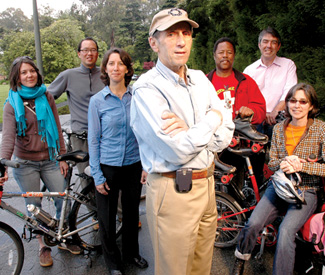
It wasn’t going well for Ted Strawser, predictably. The alternative transportation activist faced an uphill battle March 14 trying to convince a San Francisco Chamber of Commerce committee to endorse Healthy Saturdays, a plan to ban cars from part of Golden Gate Park.

Representatives of the park’s museums and Richmond District homeowners had just argued their case against the measure. “Visitors want access to our front door, and we want to give it to them,” Pat Kilduff, communications director for the Fine Arts Museums of San Francisco, indignantly told the group of two dozen business leaders gathered around a large conference table.

Strawser gave it his best shot: he talked about following the lead of other great cities to create car-free spaces; he said, “Golden Gate Park is one of the best parks in the nation, if not the world”; and he made a detailed case for closure. But around the table there were scowls, eye rolls, and other obvious signs that Strawser was being tolerated, not welcomed. Some — including chamber vice president Jim Lazarus — even started to interrupt and argue with him.

Then the man sitting next to Strawser spoke up. “I don’t think this is fair,” he said. And suddenly, everyone in the room shaped up. Strawser’s ally — his only supporter in the room — was somebody no chamber member could or would dismiss. Warren Hellman doesn’t shout or bang the table — but when he speaks, downtown pays attention.

Hellman, a prominent investment banker, told the committee members that he expected them to show the same respect for Strawser that they had for the previous two speakers. The nonsense ended, immediately.

And by the time Strawser turned the floor over to Hellman, the mood had changed. The group listened raptly, smiled, and nodded as Hellman spoke in his usual folksy, familiar, disarming style.

“It’s not a lot of fun when friends fall out,” he began, “because the previous speakers and many of you all agreed on the necessity of the garage [that was built in Golden Gate Park], and we worked together.”

He pointed out that many in the group had promised during the fall 2000 election to support Healthy Saturdays once the garage was built, although Hellman was now the only member of the coalition honoring that commitment. But he didn’t chide or shame his colleagues. That isn’t Hellman’s style.

Instead, he spoke their language. The garage has never been full and needs the money it can charge for parking to repay the bonds. This isn’t a fight that’s going away, since “part of the conflict is because this park is everybody’s park.” But there are “about 100 compromises not acceptable to either side that would move this forward.” And if a solution can’t be found, there will probably be an expensive ballot fight that nobody wants.

“My conclusion is we should attempt this test,” Hellman told the group. Ultimately, when the vote was later taken in secret, the chamber didn’t agree, although it did vote to back a trial closure after the California Academy of Sciences reopens next year.

At the meeting, Hellman openly called for Mayor Gavin Newsom to get involved in seeking a compromise, something Hellman said he had also just requested of the mayor at a one-on-one breakfast meeting. A couple of weeks later Newsom — who had already indicated his intention of vetoing the measure — did broker a compromise that was then approved by the Board of Supervisors.

As usual, Hellman didn’t take credit, content to quietly play a role in making San Francisco a better place.

Healthy Saturdays isn’t the most important issue in local history — but the significance of Hellman’s involvement can’t be underestimated. His alliance with the environmentalists and park advocates might even signal a sea change in San Francisco politics.

Warren Hellman represents San Francisco’s political and economic past. And maybe — as his intriguing actions of recent years suggest — its future.

This guy is a rich (in all senses of the word) and compelling figure who stands alone in this town. And even though his leadership role in downtown political circles has often placed him at odds with the Guardian, Hellman consented to a series of in-depth interviews over the past six months.

“Our family has been here since early in the 19th century, so we had real roots here,” Hellman told us. His great-grandfather founded Wells Fargo and survived an assassination attempt on California Street by a man who yelled, “Mr. Hellman, you’ve ruined my life,” before shooting a pistol and barely missing.

The Hellman family has been solidly ruling class ever since, rich and Republican, producing a long line of investment bankers like Warren.

Yet the 72-year-old comes off as more iconoclast than patrician, at least partly because of the influence of his irreverent parents, particularly his mother, Ruth, who died in 1971 in a scuba-diving accident in Cozumel, Mexico, at the age of 59. “She was entirely nuts,” Hellman said, going on to describe her World War II stint as a military flier in the Women’s Auxiliary Service Pilots and other colorful pursuits. “She just loved people, a little like I do. She collected people.”

Hellman grew up wealthy and cultured, but he also attended public schools, including Grant Grammar School and Lowell High School. In between, the young troublemaker did a stint at San Rafael Military Academy — “reform school for the rich,” as he called it — for stunts such as riding his horse to Sacramento on a whim.

After doing his undergraduate work at UC Berkeley, Hellman got his MBA from Harvard and went on to become, at the age of 26, the youngest partner ever at the prestigious Manhattan investment firm Lehman Bros. He developed into an übercapitalist in his own right and eventually returned home from New York and founded Hellman and Friedman LLC in San Francisco in 1984, establishing himself as the go-to financier for troubled corporations.

“He is really one of the pioneers of private equity,” said Mark Mosher, a longtime downtown political consultant and the executive director of Gov. Arnold Schwarzenegger’s California Commission on Jobs and Economic Growth, on which Hellman sits.

Hellman became what Business Week called “the Warren Buffett of the West Coast,” a man of extraordinary wealth and power. Among other accomplishments, Hellman took Levi Strauss private, recently made billions of dollars in profits selling DoubleClick to Google, and manages the assets of the California public employee retirement funds (CalPERS and CalSTRS), which are among the largest in the world.

Like many financial titans, Hellman has always been a generous philanthropist, giving to the arts, supporting schools in myriad ways, and funding the San Francisco Foundation and the San Francisco Free Clinic (which his children run). He vigorously competes in marathons and endurance equestrian events, often winning in his age bracket. And he has his humanizing passions, such as playing the five-string banjo and creating the popular Hardly Strictly Bluegrass festival.

But he’s also been a prime facilitator of downtown’s political power, which regularly flexes its muscle against progressive causes and still holds sway in the Mayor’s Office and other city hall power centers.

Hellman founded, funds, and is a board member of the Committee on Jobs, which is perhaps the city’s most influential downtown advocacy organization. Hellman and his friends Don Fisher, the founder of the Gap, and Sen. Dianne Feinstein also started SFSOS, which now wages the most vicious attacks on left-of-center candidates and causes.

When the de Young Museum and other cultural institutions were threatening to leave Golden Gate Park, Hellman almost single-handedly had an underground parking garage built for them, in the process destroying 100-year-old pedestrian tunnels and drawing scorn from the left. The Guardian called it “Hellman’s Hole.”

“We at the Bike Coalition very much started out on the opposite side of Warren Hellman,” San Francisco Bicycle Coalition executive director Leah Shahum told us. “We couldn’t have been more like oil and water on the garage issue.”

But over the past two years or so, Hellman’s profile has started to change. He went on to become an essential ally of the SFBC and other environmentalists and alternative transportation advocates who want to kick cars off JFK Drive in Golden Gate Park on weekends, crossing the downtown crowd in the process. He has shared his wealth with progressive groups such as Livable City, which often fights downtown, and has stuck up for edgy fun seekers over more conservative NIMBY types. He has also publicly repudiated the attacks of SFSOS and its spokesperson, Wade Randlett, and withdrawn his support from the group.

Hellman is still a Republican, but a thoughtful and liberal-minded one who opposed the Iraq War and wrote an article for Salon.com in February titled “If the United States Were a Company, Would George Bush Be Our CEO?” (His answer: hell no.) And to top it all off, Hellman sports a few tattoos and even attended 2006’s Burning Man Festival and plans to return this year.

Unguarded and reflective, Hellman’s comments to the Guardian foreshadow the possible future of capitalism and influence in San Francisco and point to potential political pathways that are just now beginning to emerge.

Our first conversation took place at the Guardian office two weeks before the November 2006 election, when it was starting to look like Nancy Pelosi had a good shot at becoming speaker of the House of Representatives.

“I think this election in two weeks is going to be really interesting,” Hellman told us.

This Republican was cheering for the Democrats to win. “They aren’t my kind of Republicans,” he said of the people in power. Hellman didn’t support the war or approve of how the Bush administration sold it, and he wanted Pelosi and the Democrats to hold someone accountable.

“What I’d like her to do is admit that we can’t get out [of Iraq immediately], but start to talk about what the fallout has been. Discuss the enormous cost in human life as well as money, and how it’s possible the war united the Middle East against us,” Hellman said.

The one thing he can’t abide is disingenuousness. Hellman speaks plainly and honestly, and he asked us to keep particularly caustic comments off the record only a few times during almost six hours’ worth of interviews. He was self-effacing about his political knowledge and seemed most interested in working through the problems of the day with people of goodwill.

Asked what he values most in the people he deals with, Hellman said, “It’s authenticity. Do they believe things because they believe in them, or do they believe in things because they’re cynical or they’re just trying to gain something?”

Locally, Hellman has reached out to people with varying worldviews and come to count many friends among those who regularly battle against downtown.

“I love to know people,” he said. “That’s probably the single thing that motivates me. When someone says to me, ‘How can you be friends with [then–head of SEIU Local 790] Josie Mooney?’ I say, ‘Look, I want to know Josie Mooney. And if she’s awful, then we won’t be friends.’ I’m just fascinated by getting to know people. And virtually always, they’re a little like Wagner operas: they’re better than they sound.”

Hellman was the chair of the Committee on Jobs when he got to know Mooney, who chaired the San Francisco Labor Council and was a natural political adversary for the pro-business group, particularly when Hellman was leading the fight to do away with the city’s gross receipts tax, which has proved to be costly for the city and a boon for downtown.

But after that victory, Hellman turned around and cochaired a campaign with Mooney to retool and reinstate the gross receipts tax in a way that he believed was more fair and helped restore the lost revenue to the city.

“We lost, but he put $100,000 of his own money into that campaign,” Mooney told us, noting that the proposed tax would have cost Hellman and Friedman around $70,000 a year. “I think he just thought the city needed the money. It was a substantive point of view, not a political point of view.”

Mooney considers Hellman both a friend and “an extraordinary human being…. He has made a huge contribution to San Franciscans that doesn’t relate to ideological issues. A tremendous thing about Warren is he’s not ideological, even in his political point of view…. On politics, I’d say he is becoming more progressive as he understands the issues that confront ordinary people.”

Mooney is one of the people who have helped bring him that awareness. When they first met, Mooney said, Hellman told her, “You’re the first union boss I ever met.” That might have been an epithet coming from some CEOs, but Hellman had a genuine interest in understanding her perspective and working with her.

“In a sense, I think that was a very good era in terms of cooperation between the Committee on Jobs and other elements of the city,” Hellman said. “Josie and I had already met, and we’d established this kind of logic where 80 percent of what we both want for the city we agree on, and 20 percent [of the time, we agree to disagree].”

Committee on Jobs executive director Nathan Nayman — who called Hellman “one of my favorite people in the world” — told us that Hellman feels more free than many executives to be his own person.

“He’s not with a publicly held company, and he doesn’t have to answer to shareholders,” Nayman said. “He takes a position and lives by his word. You don’t see many people like him in his income bracket.”

Hellman has become a trusted hub for San Franciscans of all political persuasions, Nayman said, “because he’s very genuine. He’s fully transparent in a city that likes to praise itself for transparency. What you see is what you get.”

Hellman expects the same from others, which is why he walked away from SFSOS (and convinced Feinstein to bolt as well) in disgust over Randlett’s scorched-earth style. Among other efforts, SFSOS was responsible for below-the-belt attacks on Sups. Chris Daly, Jake McGoldrick, and Gerardo Sandoval (whom a mailer inaccurately accused of anti-Semitism).

“If all things were equal, I’d just as soon that SFSOS went away,” Hellman said. “SFSOS started doing the opposite of what I thought they would be doing, so it was fairly easy for me to part company with them. What I thought we were doing is trying to figure out ways to make the city better, not just being an antagonistic, nay-saying attack organization. I’m not a huge fan of Gerardo Sandoval, but I thought the attacks on him were beyond anything I could imagine ever being in favor of myself. And it was a series of things like that, and I said I don’t want anything more to do with this.”

Downtown, they’re not always quite sure what to make of Hellman.

“Every once in a while, he does things that irritate people who are ideologically conservative,” Mosher said. “He took an immense amount of heat for supporting the Reiner initiative [which would have taxed the rich to fund universal preschool].”

He’s given countless hours and untold riches to public schools, doing everything from endowing programs to knocking on doors in support of bond measures and often pushing his colleagues to do the same.

“My connection to him has been through the school district, and he’s really been a prince,” Sup. Tom Ammiano said. “He has even stopped calling me antibusiness. He put a lot of his energy into improving public education, and so he shows it can be done.”

Progressives don’t always agree with Hellman, but they feel like they can trust him and even sometimes win him over. “If you get a relationship with him and you’re always honest about the facts and your own interests, he will listen, and that’s pretty remarkable,” Mooney said. “He shows a remarkable openness to people who have good ideas.”

His appreciation for people of all stripes often causes him to reject the conventional wisdom of his downtown allies, who viciously attacked the Green Party members of the Board of Education a few years ago.

“Everybody said, ‘Oh my god, Sarah Lipson, you know, she’s a Green Party member, she’s the furthest left-wing person on the board,’ blah, blah, blah,” he said. “And I phoned her up one day and said, ‘I’d really like to meet you.’ And she’s — leave aside the fact that I think she’s a very good person as a human being, but she’s a very thoughtful, analytic person. Listening to her opinions about things that are happening in the school district, I really respect that. I mean, what do I know about what’s going on in the school district? I know more now than I did then. But just getting to know people, and maybe get them to understand my point of view, which isn’t that penetrating.”

Many of his efforts have received little publicity, as when he saved the Great American Music Hall from closure by investing with Slim’s owner Boz Scaggs and helping him buy the troubled musical venue. “There are things that you and I don’t even have a clue that he has done,” Nayman said.

“He’s an interesting guy,” Mosher said. “He’s one of a dying breed, a liberal Republican. He has a social conscience and wants to use his money to do good.”

Actually, calling Hellman liberal might be going too far. In the end, he’s still very much a fiscal conservative. He doesn’t support rent control, district elections for the Board of Supervisors, taxing businesses to address social problems such as the lack of affordable health care, or limits on condo conversions.

He also opposes the requirement that employers provide health care coverage, which downtown entities are now suing the city to overturn, telling us, “In general, I don’t think it’s a good idea, because I’m still, even in my aging years, a believer that the marketplace works better than other things…. Universal health care I do believe in, but what I worry is that it’s going to be another damned bureaucracy and that it’s not going to work.”

Yet he doesn’t believe wealth is an indicator of worth, saying of his fortune, “It is luck. Most of what you do you aren’t better at than everyone.”

He doesn’t believe in the law of the jungle, in which the poor and weak must be sacrificed in the name of progress. In fact, he feels a strong obligation to the masses.

As he told us, “My mantra for capitalism — and I didn’t invent this, but I think it’s pretty good — is that capitalism won, and now we need to save the world from capitalism.”

Hellman looms large over downtown San Francisco. His Financial District office offers a panoramic view of the Bay Bridge, Treasure Island, the Ferry Building, and the rest of the city’s waterfront. He likes to be personally involved with his city and the companies in which Hellman and Friedman invests.

“Usually I’m directly involved,” he told us in an interview earlier this year. “I’ve always said that I don’t like to go to the racetrack to just look at the horses. The fun of being a principal is that you’re standing at the track and not saying, ‘Gee, that’s a beautiful gray horse.’ You’re saying, ‘Come on, he’s got to win!’ So I’m almost always invariably invested in the companies that we work with, either individually or through the firm.”

Unlike many Wall Street barons who strive to control a company and bring in new executives, flip it for a quick profit, or liquidate it, Hellman said his firm tries to identify solid companies and help facilitate what they do. “We don’t usually take over companies. I always think that we provide a service to help the businesses,” he said. “Our job is kind of the opposite of owning a factory. Our job is to be sure the people who run the business feel like it’s their business.”

Similarly, he thinks capitalists need to feel a sense of ownership over society’s problems, something he thinks is taking root in San Francisco and other economic centers, particularly among the younger generations. “It’s about understanding how much suffering there is on the other side and trying to figure out how that suffering can be alleviated,” he said. “I think it’s partly good economics that as you bring people up, they’re able to do more for society. If nothing else, they’re able to buy more and shop at a Wal-Mart or something — probably someplace you would wildly disapprove of — and buy goods and services. But I don’t think it’s that narrow.”

Rather, he believes that everyone has a little progressive in them, a little desire to cooperatively solve our collective problems rather than pass them off to future generations. He sees a marked change from his days at Lehman Bros.

“Everybody was into making it,” he said, noting that many capitalists then did charity work as a means of attaining social status but focused mostly on the accumulation of wealth. But, he said, the new generation of capitalists seems genuinely interested in improving the world.

“The feeling for giving back in the next generation, in the now 25- to 35-year-olds, it’s just an order-of-magnitude difference than it was for people who are now in their 40s and early 50s,” Hellman said. “I’m very encouraged.”

Yet the flip side is that, in Hellman’s view, downtown doesn’t wield as much power as it once did. Low political contribution limits have made politicians less dependent on downtown money, creating fewer shot callers, while democratizing tools such as the Internet have broadened the political dialogue.

“For the last 30 years we have become an increasingly tolerant city, and that’s great,” he said. “In the old days, [the Guardian] complained about downtown, and yeah, no shit, downtown really did control the city. The benefit was as that slipped away, the city became fairer and more open to argument. So now downtown hardly has any power at all anymore. In a sense, that’s a good thing. Tolerance grew tremendously when the city wasn’t dictated to.”

That tolerance caused street fairs to pop up all over town and festivals such as Hellman’s Hardly Strictly Bluegrass to blossom in Golden Gate Park. Bike lanes have taken space from cars, events such as Halloween in the Castro have gotten crazier, street protests have gotten bigger and more frequent, and people have felt more free to fly their freak flags. And all that freedom eventually triggered a backlash from groups of isolated NIMBYs who complain and often find sympathetic ears at city hall.

“Sometimes you get the feeling in this city that in the land of the tolerant, the intolerant are king,” said Hellman, whose festival has endured noise complaints even though the music is shut off by 7 p.m. “There is a continuing pressure to do away with fun, because fun is objectionable to someone, [but] we need to think about not creating a new dictatorship of a tiny group of people whose views are not in line with the opinion of most of the people of San Francisco…. You should try to balance the good of a lot of people versus the temporary annoyance of a few people.”

Preserving fun and a lively urban culture is a personal issue for Hellman, who plays the five-string banjo and calls his festival “the most enjoyable two days of the year for me.” He helps draw the biggest names in bluegrass music and acts like a kid in a candy shop during the event.

“I feel very strongly that an important part of our culture is built on the type of music and type of performance that goes on at Hardly Strictly Bluegrass,” Hellman said. From parables set to music to songs of struggle and the old union standards, “that kind of music is the conscience of our country.”

He considers bluegrass a vital and historically important form of political communication, more so than many of the upscale art forms that the rich tend to sponsor. “I’m glad that we have first-rate opera, but it’s equally important that we foster the kind of music, lyrics, etc., that support all this,” he said. “Somebody once said that most of the great Western philosophy is buried in the words of country songs. And that’s closer to the truth than most people think. A big passion of mine is to try to help — and people have defined it too narrowly — the kinds of music that I think have a hell of a lot to do with the good parts of our society.”

Perhaps surprisingly for a Republican venture capitalist from the older generation, Hellman also considers the countercultural freaks of San Francisco to be some of the “good parts of our society.” That’s why he attended Burning Man for the first time last year and why, he said, he loved it, as much for the culture and community as for the art.

“I went to Burning Man because as much as possible I want to experience everything,” he said. “I want to just see directly what it’s like. I knew I’d enjoy it. I never doubted that. But what really overwhelmed me is it was 40,000 people getting along with each other. I mean, it’s pretty intense. There were dust storms and the world’s most repulsive sight: nude men over 70 just dangling along. But I never saw an argument. It was 40,000 people just enjoying each other.”

It was most striking to Hellman because of the contrast with the rest of society. As he said, “I’ve never seen this country so divided.”

While Hellman supports Schwarzenegger — calling him “a good advertisement to California” — he has nothing good to say about his fellow Republican in the Oval Office. He calls Bush’s tenure “an absolute four-star disaster.” The invasion of Iraq is the most obvious problem, he said. “Our war policy has slowly veered from being ‘Don’t tread on me’ to we’re going to jump on your neck.”

But his antipathy to certain aspects of the Republican Party began even earlier, when the religious right began to take over.

“I thought we were not that polarized during the Clinton administration. I was somewhat encouraged,” Hellman said. “Maybe there was an undercurrent of strident religious behavior or strident conservatism, but not the conservatism that I think the Republican Party used to stand for, which was fiscal conservatism instead of social conservatism. Somehow, there was this angst in this country on the part of religious people who I guess felt this country was being taken away from them, and they were the kind of stalwart or underpinnings of society. And they took it back.”

But in the wake of that disaster, Hellman thinks, there is an opportunity for reasonable people of goodwill to set the future political course. As Nayman said of Hellman, “He does believe there is a middle way pretty much all the time.”

Politically, that’s why Hellman gravitates toward the moderates of both major parties, such as Schwarzenegger and Newsom. He looks for people who will marry his economic conservatism with a regard for things such as environmentalism and social justice.

“It’s very tough to be a big-city mayor,” Hellman said. “[Newsom is] probably the best mayor we’re entitled to. He’s got this fantastic balancing act.”

Hellman said downtown hasn’t been terribly happy with Newsom for supporting striking hotel workers, getting behind Ammiano’s health insurance mandate, supporting tax measures, and generally letting the Board of Supervisors set the city’s agenda for the past two years.

“Their measure is he has 80-percent-plus popularity, and he ought to spend some of it. Well, they might not agree with what he would spend it on. And he’s been unwilling to spend very much of it. In some parts of the business community there is disappointment with him, but I don’t think that’s right. He didn’t hide what he would be like.”

What Newsom said he would be — a big reason for his popularity — is a mayor for the new San Francisco, a place where the city’s traditional economic conservatism has been tempered by a greater democratization of power and an ascendant progressive movement that expects its issues to be addressed.

“I don’t like people who are intolerant,” Hellman said. “I don’t like people that are telling you something to get some outcome that, if you understood it, you probably wouldn’t want. I like people that are passionate.”

Asked, then, about Sup. Chris Daly, the nemesis of downtown and most definitely a man of strong political passions, he said, “I admire Chris Daly. I disagree with Chris on a lot of things he believes, but there are also probably a lot of things I would agree with Chris on. And I respect him.”

Hellman is the rare downtown power broker who wants to bridge the gap between Newsom — whom he calls a “moderate to conservative establishment person” — and progressives such as Daly, Mooney, and the Bicycle Coalition. The middle ground, he said, is often a very attractive place, as it was with Healthy Saturdays.

“I’m sure you spend time in the park on Sunday, and it’s a hell of a lot nicer in there on Sundays than Saturdays,” Hellman said. But even more important to him, this is about integrity and being true to what Golden Gate Park garage supporters promised back in 2000.

“They were proposing Saturday closing at that time, which I’ve always thought was a good idea,” he said. “And we made a commitment to them, or I thought we made a commitment to them, that let’s not have Saturday closure now, but as soon as the garage was done, we’d experiment with Saturday closure.”

We brought up what Fine Arts Museums board president Dede Wilsey has said of that pledge, that it was under different circumstances and that she never actually promised to support Saturday closure after the garage was completed.

“There’s a letter. She put it in writing,” he said of Wilsey. “She signed a letter on behalf of the museums saying that when the de Young is done, we should experiment with Saturday closings.”

The Bike Coalition’s Shahum said that even when Hellman was an enemy, he was a reasonable guy. But it’s in the past couple of years that she’s really come to appreciate the unique role he plays in San Francisco.

“He showed decency and respect toward us,” she said. “We never saw him as a villain, even though we disagreed completely. Later he really stepped up and has been a leader on Healthy Saturdays. And what I was most impressed with is that he was true to his word.”

Supervisor McGoldrick, who sponsored the measure, echoed the sentiment: “Hellman was certainly a man of his word who acted in a highly principled way.”

So why does Hellman now stand apart from the downtown crowd? Has he parted ways with the economic and cultural power brokers who were once his allies?

No, he said, “I think they parted ways with me.” *

 

The War on WiFi

0

By Sarah Phelan

images-war lies.jpg

Mayor Gavin Newsom’s tactics to push through a Google Earthlink Wifi franchise are beginning to look a lot like Bush’s efforts to invade Iraq: only this time the invasion is of Internet privacy, the big lie is that the Google Earthlink deal will bridge the digital divide, and critics of the deal are being smeared as racists.

Nothing of course could be further from the truth behind why the Board has been questioning Newsom’s Google-Earthlink deal for years, but trying getting that message through when the Mayor’s PR machine is set on a deafening pre-election spin cycle of false messaging.

Jerry Falwell is dead

0

falwell.jpg

By Tim Redmond

Back in the early 1980s, after Sister Boom Boom ran for supervisor on the “nun of the above” ticket, Jerry Falwell sent out a mass mailing to raise money for the Moral Majority featuring the Sisters of Perpetual Indulgence. The letter included a Gay Pride photo and a description of my favorite nuns as a deep threat to the moral fiber of America.

I did a story about it, and Sister Sadie Sadie the Rabbi Lady called me to get a copy of the letter and the photo, which the sisters took to Melvin Belli, the famous tort lawyer, who then sued Falwell for misappropriation of their images. I don’t know where the suit went in the end, but the whole thing made for a lot of fun stories — because back then, frankly, Falwell was the Devil Incarnate.

You don’t hear as much about him anymore, but now that he’s dead, it’s worth remembering that this guy was a key player in the birth of the religious right, the election of Ronald Reagan, and the beginnings of a movement of intolerance and hatred that still plagues us today.

I saw him debate Larry Flynt on Nightline once, shortly after Falwell sued Flynt for a parody ad in Hustler suggesting that the televangelist had sex with his mother in an outhouse. Falwell was sputtering about how horrible it was to even suggest such a thing; Flynt laughed and said:

“You forgot to tell em, Jerry, that you had to kick the goat out of the outhouse first.”

Falwell’s suit went all the way to the US Supreme Court, and wound up in a stunning victory for the First Amendment; the court ruled that obvious parodies of public figures can’t be grounds for libel or defamation suits. That decision was key to the Guardian’s victory in a libel suit brought by a local landlord, Adam Sparks, who we had accused in a parody issue of using electroshock treatment on his tenants.

So we’ve had some history with the prick. And with all due respect to the dear departed, I can’t say I’m sorry he’s finally out of the way.

NOTE: There will be quite a rally at 5 pm on 18th and Castro to speak out against Falwell’s legacy.

The progressive convention

0

By Tim Redmond

Supervisor Chris Daly is calling for a convention June 2nd to nominate a progressive candidate for mayor. It’s a nice idea, and I’m all for it — except that it would be a pretty major bust if we didn’t have anyone prepared to acutally run for mayor at that point.

So the convention forces the left to get its act together and sets a deadline for someone to come forward and agree to be the nominee. At this point, I’m seeing Ross Mirkarimi and Daly as the only two viable options, and I’m not yet entirely sure either one of them wants to do it. If Matt Gonzalez is going to run, it won’t be at this convention; he’s nowhere near ready to announce anything yet, and he tells me the only way he’d get in the race is later on, if there’s no viable candidate. (If either Daly or Mirkarimi is in the race, he won’t run at all.)

Paul Hogarth at BeyondChron argues that perhaps we shouldn’t bother at all; Newsom hasn’t been able to do all that much damage since he’s so weak, and every now and then he does something decent, so

“progressives should consider what part of their issue-based agenda is really getting stalled. It’s frustrating to have a Mayor who won’t even attend Question Time after the voters approved it, but the real question is whether progressives are better off letting Newsom be a lame duck for the next five years – than awakening a vindictive Mayor who would be more formidable after his re-election.”

I think there’s just too much coming up in the next four years (including the wholesale rezoning of the eastern neighborhoos, which is the last battle for blue-collar jobs and affordable housing in San Francisco) to let Newsom win without a fight. We might as well get on with it.

Istanbul May 11, 2007

0

By Bruce B. Brugmann

CNN today was drumming on with news of Tony Blair going and Gordon Brown coming in as prime minister of Great Britain. The Turkish Press was reporting that the national elections here had been moved up three months to July 22, and this surprised the political parties, who were alarmed and said they were forced to bring in the professionals to help them carry on effective campaigns during the short period left before the election. The Turkish Daily News, Turkey’s English daily, reported that there was no space left on the TV stations or on the billboards and that campaign ads would be competing with ice cream manufacturers.
On the plane coming in, Spiro Vryonis sat next to associate pubublisher Jean Dibble and filled her in on the elections from his perspective as a Byzantine scholar. Vryonis, retired director of the center for the study of Hellenism in Sacramento, told her that Prime Minister Recep Tayyip Erdogan supported his Foreign Minister Abdullah Gul for president. “They get along like two dogs until someone throws a bone between them,” he said.
Meanwhile, I found good advice in Time Out Istanbul, the city-living guide in English. It wrote about the art of Keyif, which translates as “a pleasurable state of idle relaxation.” The article said that Keyif has been honed down to an art form by the Trurks and laid out 10 ways of experiencing Keyif the Turkish way. My favorite was the idea of walking aimlessly along the Bosthorus, the body of water seperating Asia from Europe. It said that “you’ll be surprised how relaxing the Oriental art of walking around with no destination is.” The 58th International Press Institute world congress and general assembly starts tomorrow. So I think I’ll spend the rest of the afternoon doing Keyif. B3

Support for high-speed rail

0

High-speed rail got a timely and significant vote of support from the California Democratic Party on April 29 when delegates at the state convention approved a resolution pushing the project. The measure was the top vote getter, tied at 24 with a resolution urging accountability for the errors and deception that led to the Iraq War.

Yet a last-minute move weakening part of the measure raises questions about whether the Democrats are truly willing to fight Gov. Arnold Schwarzenegger, who has called for an indefinite delay in next year’s high-speed rail bond measure and proposed a budget that guts the California High-Speed Rail Authority (see "The Silver Bullet Train," 4/18/07).

The resolution praises the project as "a significant weapon against air pollution and global warming as it uses much less energy per passenger than cars and airplanes – and HSR will be even more essential if, as expected, petroleum supplies diminish in the future."

But state party leaders deleted language from the version that was submitted by San Francisco delegate Jane Morrison asking "that all California elected officials support the requested $103 million for HSR in the current state budget – and retain and support the $10 billion bond issue now scheduled for High Speed Rail in the 2008 election." Assemblymember Fiona Ma has emerged as the main legislative champion for the embattled project and helped push the resolution to the top of the legislative priority list. But she faces a big test in trying to get the money the project now needs.

Morrison told us, "We have to work to convince the legislature that we can afford it. That’s the hard part, so we’re not done yet."

A recent report from the Legislative Analyst’s Office criticized Schwarzenegger’s holding pattern as wasteful and concluded that the legislature should fully fund the project or vote to kill it. The report was titled "Time to Bite the Bullet for the Bullet Train."

There’s more on high-speed rail – including a telling exchange between the Guardian and the Governor’s Office – on our Politics blog, at www.sfbg.com/blogs/politics.

Editor’s Notes

0

> tredmond@sfbg.com

The delegates to the annual California Democratic Party convention began trickling into the San Diego Convention Center on April 27, and one of the first people they saw was Barbara Cummings. She had stationed herself about a block away from the entrance and was holding a big "Impeach Bush and Cheney" sign.

"It’s wonderful," the San Diego activist told me. "The delegates all want their pictures taken with us. The tourists want pictures too."

Inside the convention hall, the grassroots sentiment was pretty similar. The black "impeach" lapel stickers were everywhere, hundreds of delegates wore black "impeach" T-shirts, and impeachment banners and signs flew everywhere.

Within official party circles, though, the mood was slightly different. Art Torres, the chair of the state party, told the press early on that he expected the war and impeachment to dominate the convention, but when I asked him if there was any disconnect between the party faithful calling for impeachment and House Speaker Nancy Pelosi saying that wasn’t an option, he simply said, "No. That’s the Democratic Party." He added, "We see a distance between the grass roots and the leadership. That’s not uncommon."

In many ways, that was the theme of this convention. The California Democratic Party is changing, in part driven by a new wave of young, Internet-savvy activists and bloggers who are practically screaming for respect. And the old guard is having a very hard time giving up control.

At the Resolutions Committee meeting April 27, Torres, a smooth operator with more than 30 years’ experience in party politics, gave a textbook demonstration of how the powers that be keep the grass roots in line.

On one level, the resolutions that get passed at these conventions don’t matter that much; they don’t have any binding authority. But they do express the official position of the state party, can put pressure on Democratic elected officials – and sometimes highlight the schisms in the famously fractious organization.

In this case, activists had put forward a half-dozen reform proposals that all had the same issue at heart: control of state party money.

Howard Dean took on the old guard nationally when he decided to put money into party-building efforts and candidates in all 50 states; his fans in California want to see the state party follow that model in all 58 counties. They also want more transparency in how the money is handled.

The state party chair, of course, keeps a lot of his power and authority by controlling that cash, and the legislative leaders keep their powerful posts and ensure the loyalty of their troops in part by determining which Democrats get the resources in election years.

The resolutions called for an outside audit of party money and a formal 58-county strategy. Before a single supporter of those measures had a chance to speak, the chair of the Resolutions Committee turned the floor over to Torres – who suggested the whole thing be referred to a new task force, which he would appoint, for consideration at some time in the future. The committee chair quickly called for a motion and a vote, and the panel – also all appointed by Torres – swept every party-reform resolution right off the table.

The same pattern played out with impeachment; a strong grassroots effort became a weak final resolution. As one committee member told me, "Speaker Pelosi is against impeachment, so we can’t really vote for it."

With the early California primary, the state convention was a big-time event. Seven presidential candidates showed up, more than had ever come to a state party event in history. There was a palpable feeling of energy at the convention, a sense that this time around, the Democrats might actually be ready to win the White House.

On the convention floor the mood was festive as Hillary Clinton strode through a side entrance and walked past a mob of supporters to the stage. Her speech was about what I expected – standard stump lines, but well delivered and full of energy. She had the crowd with her for about 10 minutes, until she mentioned Iraq – at which point the boos and catcalls began, the people in the seats got restive, and the mood was shattered. "She still won’t apologize," one young delegate told me, shaking her head.

Barack Obama looked like the rock star he is, jogging through the entrance with a huge smile. In person he looks like he’s barely out of his 20s – and his army, while smaller then Clinton’s, was more diverse and a lot younger. He’s a dynamic speaker and got a huge ovation when he announced that "I stood up in 2002, when it wasn’t popular to stand up, and said [the war] was a bad idea."

Obama split without talking to the press. Clinton arrived 20 minutes late to a packed press conference and said very little of note.

John Edwards, who spoke Sunday morning, April 29, got his own star treatment and demonstrated a key difference with Clinton when he announced that "I voted for this war, and I was wrong to vote for this war." He was also the only candidate who actually talked about poverty in America. He showed up on time for his press availability; I managed to get the first question.

"Senator," I said, "the 25 top hedge fund managers in this country made enough money between them last year to pay the salaries of all 88,000 New York City public school teachers for three years. I know you want to repeal the Bush tax cuts, but beyond that, shouldn’t we actually raise taxes on the very rich so we can pay the teachers a little better?"

"It’s a good question," he said, "and it’s worthy of consideration." But for now, Edwards won’t go beyond restoring the tax code to its Bill Clinton-era levels, which are still far, far too rewarding to the tiny segment of the country that earns and controls the vast majority of the income and wealth.

I got to ask Sen. Chris Dodd of Connecticut the same question; he kindly agreed to a private interview and gave me 10 minutes or so. He, like Edwards, was kinda sorta maybe willing to consider raising taxes on people who make upward of $250 million a year.

I suppose this is progress.

All the liberal bloggers came to the April 27 evening fundraiser for Jerry McNerney, who defeated Ricahrd Pombo, and Charlie Brown, a Democrat who wants to unseat John Doolittle in congressional District 4 (north of Sacramento). Brown is a favorite of the blogosphere; he’s also a candidate who was barely on the official party radar when he ran in 2006.

All that has changed dramatically – with Doolittle circling the drain and Brown showing surprising strength. Even Pelosi plugged him from the convention stage.

But the only elected official I saw at the fundraiser was Assemblymember Mark Leno.

The people in the room represented a very different approach to state politics. It’s not even an entirely ideological division; it’s more about a form of activism. The bloggers (who aren’t just writing about the party but trying to change it) are still the party outsiders now – but they’ve already raised more money for Brown than any other single source, mostly in small contributions. And I suspect that if he gets elected, he’ll remember the people who were there for him first.

The outsiders still don’t understand how all the hardball politics work at conventions, but they’re learning. They’re also emerging as a tremendous force in American politics, and in California they’re knocking, loudly, on the state party doors. And Art Torres is a fool if he thinks he’s not going to have to let them in. *

For much, much more on the state convention, go to the Guardian politics blog at www.sfbg.com/blogs/politics.

Barons back off newspaper trial

0

See bottom of story for full Web package of Guardian newspaper-transaction coverage and documents related to the Reilly suit

Click here for the Reilly press conference documents.

Click here for the famous April 26, 2006 letter.

Well, it’s over before it ever truly began.

Clint Reilly’s federal civil suit against the Hearst Corp. and MediaNews Group, filed last year in an attempt to block the would-be competitors from sharing monopoly control of the Bay Area’s daily newspaper establishment, ended today in a settlement that left Reilly claiming victory.

The deal blocks any future business deals between Hearst, owner of the San Francisco Chronicle, and MediaNews, which now owns almost every other daily in the region.

The settlement saved some of the nation’s biggest newspaper barons from the prospect of a long and embarrassing trial that could have produced alarming revelations about the way the big publishers do business.

The case was set to go before a judge and jury April 30.

But in exchange, Reilly says he got most of what he was asking for – in particular, an end to the prospect of a Hearst-Media News business deal.

At a morning press conference April 25, Reilly announced that the settlement puts the Chronicle back into competition with local MediaNews properties.

“The purpose of my lawsuit,” Reilly told reporters, “was to ensure we will not have one company or one partnership owning every single paid subscription daily newspaper in the Bay Area … I strongly believe in newspaper competition. Newspapers create the record of our civic life.”

The local real-estate investor and former mayoral candidate forced the two companies, along with minority business partners the Stephens Group and Gannett Co., to promise they wouldn’t carry out the terms of a now-famous letter dated April 26, 2006 that outlined how Hearst and MediaNews could consolidate distribution and advertising operations among their local papers to create revenue.

That was just one of many proposed plans Reilly’s suit called a violation of federal antitrust laws. Also according to the settlement, Hearst’s $300 million stock investment in MediaNews, which CEO William Dean Singleton relied upon to complete his takeovers last spring of the San Jose Mercury News, the Contra Costa Times, the Monterey County Herald, and eventually, the Torrance Daily Breeze near Los Angeles, would rise and fall in value based only on the performance of MediaNews assets outside of the Bay Area.

The “tracking stock” scheme, as it’s known, was initially conceived this way to clear Hearst and MediaNews of immediate antitrust scrutiny by justice-department officials, but Hearst hoped it would later be converted into general MediaNews stock that included its Bay Area papers, a fact confirmed by records unearthed in an earlier phase of Reilly’s suit. Hearst, it turned out, much preferred that its huge investment include the totality of MediaNews.

But today’s settlement would keep that from happening, according to terms laid out between the parties, some of which they’ve agreed not to disclose.

Any talk of conjoined operations during the next three years between the companies would have to first be divulged to Reilly and his legal team.

Singleton has also agreed to turn over all executive meeting minutes of the California Newspapers Partnership, formed originally with Gannett and Stephens in 1999, that detail any negotiations with the Chronicle or other major media companies looking to do business with MediaNews in the Bay Area for the next three years.

In addition, Reilly will be permitted to recommend a citizen for appointment to the editorial boards of CNP’s Bay Area newspapers and will himself serve on the editorial board of at least one of them.

“The ten-month-long legal battle gave us a chance to see confidential documents between Hearst and MediaNews, Stephens and Gannett,” Reilly said. “Numerous documents show these newspaper companies and their executives are capable of the very cover-ups they so vigorously prosecute in politicians, executives and celebrities. I believe that their primary motivation for settling this case was their fear of exposing questionable competitive practices to public scrutiny.

“This is the second time Reilly has done this,” his attorney, Joe Alioto, told the reporters, referring to a 2000 suit Reilly filed to stop Hearst from shutting down the San Francisco Examiner. “And he does it because the government won’t do it. He does it all at his own cost and risk.”

—————————–

Reilly’s first antitrust assault on Hearst produced some sensational revelations – including the fact that the Examiner publisher sought to trade favorable editorial coverage of then-Mayor Willie Brown in exchange for Brown’s support of Hearst’s business deals.

With the settlement in place, Reilly’s second suit won’t produce that sort of high drama. But he has forced the release of records showing that Hearst and MediaNews wanted to develop close business ties – and there are more potentially explosive documents that may become public.

After the Guardian and Media Alliance intervened to have records previously sealed by the newspaper companies opened to public access, we learned for the first time that Hearst had considered selling the San Francisco Chronicle to Singleton in 2005. But the latter’s offer was chump change, coming just a few short years after Hearst had plowed through three quarters-of-a-billion dollars in its bid to take over the Chronicle and dump the San Francisco Examiner, which it had owned for more than a century. The terms were “totally unacceptable,” Hearst executive James Asher would tell the justice department in a September deposition that turned out to be among the most interesting and candid documents to surface from the intervention.

We learned that Hearst had spent more than 10 years gnashing at the bit for an opportunity to invest in the MediaNews business model, best described as a series of “clusters,” in which Singleton consolidates the operations of several regional newspapers, hacks madly at the payroll with a broadsword, and sends ill-fated staffers packing, from veteran editors with Pulitzers on their résumés to longtime press operators.

We learned that Hearst’s inspiration for its major stock investment in MediaNews began after the two became fast friends in Texas, Singleton’s home state. MediaNews in 1995 sold the assets of the Houston Post for $120 million to Hearst, which owned the Houston Chronicle, enabling Hearst to rid itself of a major-market competitor.

We learned that from day one, Hearst wanted its $300 million investment to directly hinge on Bay Area MediaNews properties as well, presumably meaning they believed it would make the investment more valuable, and also meaning Hearst would then have less of an incentive to compete directly with MediaNews. Would you if your competitor was holding $300 million of your money?

We also learned that an anticompetitive agreement to join advertising and distribution networks with MediaNews was required by Hearst “in order to proceed with the transaction,” according to a memo Hearst exec Asher sent to MediaNews president Joseph J. Lodovic IV in early 2006. In other words, a quid pro quo by its very definition.

We learned that contradictory legal strategies are far from off limits. The Hearst Corp. argued first in Reilly’s 2000 suit that the Bay Area is brimming with aggressive newspaper competition, and for that reason, he had no grounds to denounce the closure of the Examiner planned at the time. The papers argued in 2006, however, that newspaper competition in the Bay Area is actually all but non-existent because the markets are subdivided, so Clint Reilly doesn’t have anything to complain about.

Some of the most interesting material is still under court seal, including the depositions of senior publishing executives. But the settlement specifically allows Reilly to go back into court seeking an order to open those records, and he and Alioto vowed to do that very shortly.

—————————

Overall, it’s been a monumental year for newspapers, replete with massive waves of unfortunate irony. Banner headlines at dailies across the country have prophesied the death of newspapers, a trend story that Hearst and MediaNews tried to use in court to convince judge Illston that the industry was wilting under a consolidate-or-die atmosphere. A better analysis, of course, might conclude simply that shareholders aren’t getting the enormous returns they once did, with the exception of the Chronicle, which, we learned from Reilly’s suit, has been losing $1 million a week for Hearst — if not more.

A shareholder revolt broke to pieces one of the nation’s largest newspaper chains, Knight-Ridder, respected by many in the industry for its commitment to investigations, bold enterprise reporting and funding for national and international bureaus. The company was forced to sell after investors grew restless, and Singleton swept in to takeover the chain’s gem, the Merc, as well as the Times in Contra Costa County.

Layoffs ensued and MediaNews immediately began consolidating business-side functions in a single San Ramon office where operations for several papers could be managed at once. And MediaNews recently spiced up the company’s Web site, an emblem of its new dominant position. But like the old site, there’s very little information about the company’s journalism awards, and no bios of its editors, profiles of its reporters or portraits of anyone driving the company’s papers from the bottom up. Like the old site, there’s information for investors and photos of the company’s top executives, including one of Singleton smiling alongside company president Lodovic, who earned a $1 million bonus just as MediaNews consummated its marriage with Hearst last year.

At MediaNews papers in the Bay Area, single stories began appearing in several papers under one byline during Reilly’s suit meaning fewer perspectives for major Bay Area issues. Again with a touch of irony, one of the regular bylines on stories covering Reilly’s suit has been from veteran Merc reporter Pete Carey, who under the paper’s old owners helped win two Pulitzers, first for its joint 1985 coverage of the downfall of Filipino despot Ferdinand Marcos and second for stories explaining how red tape blocked needed retrofits at some California highways leading to greater infrastructure damage during the 1989 Loma Prieta earthquake.

In Minnesota, a Ridder family heir hung on as publisher of the St. Paul Pioneer Press after Singleton took it over last year with Hearst’s help before he left just recently for a job at the competing Minneapolis Star Tribune. The move has devolved into a bitter court dispute with Singleton, according to the Twin Cities alt weekly, City Pages. The Ridder family’s involvement with the Pi Press lasted more than 70 years.

Even Singleton’s beloved flagship paper, the Denver Post, couldn’t escape “industry changes” – that is, layoffs. The paper reported buyout offers to more than a third of its staff April 24.

But we have received a recent ominous sign of what’s to come just as Reilly inked his settlement with Hearst and MediaNews.

In an election for board directors at the April 24 annual meeting of the New York Times Co., 42 percent of the shareholders withheld their votes to protest the company’s stock structure, which keeps a controlling ownership stake in the hands of the Sulzberger family, the members of which have owned the Times for generations.

The Times – like the Washington Post – has staved off shareholder raids like the one that tanked Knight-Ridder by maintaining their own separate class of stock. The Sulzbergers have reiterated that the strategy enabled them to keep quality reporting at the paper’s forefront and short-term obsessions with profit at bay.

“Mr. Sulzberger dismissed the calls to separate his two titles,” a Times story on the meeting noted, “saying that holding both roles [of publisher and chairman] allows him to ‘balance the financial and journalistic needs of this institution.'”

But Wall Street’s war on newspapers, in the meantime, is likely not over.

“At the beginning of my case, I said that 25 years involvement in politics and government had taught me how important newspapers are to our democratic society,” Reilly said at the press conference. “I hope this lawsuit in 2007 will guarantee competition among newspapers for another generation in our city and the Bay Area.”

THE PAPER TRAIL
Several of the documents stemming from Clint Reilly’s antitrust claim against Hearst, MediaNews and other business collaborators in the California Newspapers Partnership

THE UNFOLDING STORY
Major Guardian stories and editorials published since last spring following the recent major Bay Area newspaper transactions and Clint Reilly’s resulting lawsuit

THE NEW-MEDIA SCOOP
Posts to the Politics Blog about the Clint Reilly suit

THE BRUCE BLOG ON MONOPOLY MEDIA
Keeping tabs on the Galloping Conglomerati via blog reports and impertinent questions

On point

0

> sarah@sfbg.com

April has been an exceptionally busy month for the artists at the Hunters Point Shipyard. In addition to dusting off work spaces in preparation for the upcoming Spring Open Studio, the 300-member colony is scrambling to track the implications of Mayor Gavin Newsom’s ever-shifting effort to keep the 49ers in town, particularly as it affects the artists who have rented space at the base for 30 years.

Newsom’s latest proposal involves building a football stadium in the shipyard rather than at Candlestick Point. That’s likely to displace a group that claims to be the largest colony of artists in the nation – unless the mayor can find a place for them in his hasty plans.

"Hellzapoppin’" is how shipyard artist Marc Ellen Hamel described the recent flurry of redevelopment-related meetings. Newsom says he needs to fast-track the transfer of the shipyard from the Navy to the city if he is to meet the 49ers’ deadline for being in a new stadium by 2012.

The blitz was triggered by the 49ers’ announcement in December 2006 that they were considering a move to Santa Clara – which team officials in part blamed on Newsom’s inattention – leading some Bayview-Hunters Point residents to complain that they’re paying the price for the administration’s fumble. Newsom has proposed folding Candlestick Point and the shipyard into a giant 2,000-acre redevelopment project – to be managed by the Lennar Corp., whose profits are nose-diving and which is being sued for alleged whistle-blower retaliation in connection with its failure to control toxic asbestos dust at the site.

"Newsom’s latest plan confirms his critics’ worst fears that this is a bait and switch," said builder Brian O’Flynn, who was part of last year’s referendum drive to put the city’s previous Bayview-Hunters Point redevelopment plan on the ballot and this year’s lawsuit to force a vote. "This latest plan is about political coverage for the mayor in an election year."

His group, Defend BVHP Committee, was already concerned about Newsom’s role in thwarting a vote on the old plan and has even more concerns about the new plan. "If the 49ers leave and the stadium plan is off the table, then Newsom’s latest proposal will make way for more condos for Lennar," O’Flynn told the Guardian.

Matt Dorsey of the City Attorney’s Office said that regardless of whether the city was right to strike down the referendum – as he maintains state case law required – the new plan will get more scrutiny. The Board of Supervisors voted in February to support Newsom’s approach to the shipyard but stipulated that the terms of any such transfer "require approval by the Recreation and Park Commission, the Board of Supervisors, and such other possible approvals, including voter approval."

The artists’ colony is waiting to learn the specifics of Lennar’s redevelopment proposal, which talks of creating "permanent space for the artists at Hunters Point Shipyard," along with new waterfront parks, 8,500 units of housing, and job-generating development. So far, Michael Cohen of the Mayor’s Office and Lennar’s Kofi Bonner are only shopping around what they call a "conceptual framework," which vaguely describes the parameters for merging the yard and Candlestick Point.

The city has promised to replace all existing low-income housing at the Alice Griffith projects and to phase in new units carefully so as not to displace current residents. The artists have not received such promises. They don’t know if they’ll end up paying double the price for half the space they currently occupy, which amounts to 248,400 square feet, according to building 101 artist David Trachtenberg.

But with Lennar announcing a two-year planning goal and talking about an arts-themed development, the colony is formuutf8g its own ideas about how such a plan could work.

"The shipyard is almost like an artists’ retreat," Estelle Akamine told us, as five colleagues spoke passionately about the light, desolation, and poppies that attract artists to the base.

"But it didn’t always feel like a retreat," recalled Akamine, who has rented at the shipyard for 18 years. "There was a lot of trauma in the 1980s when we thought that the USS Missouri was going to be home-ported here. So we’re very skeptical of plans. We were born out of politics."

The Mayor’s Office claims the city is working to expedite the cleanup and transfer of the shipyard not only to adhere to the 49ers’ timeline but also to "allow us to move forward with community benefits like parks, affordable housing, and jobs for the Bayview." Trachtenberg believes the mayor has a strong interest in keeping artists at the yard too.

Newsom promotes his proposal as a way to create jobs and revitalize the BVHP economy. Akamine said, "Artists are the tip of the iceberg. We’re the visible part of a huge, largely hidden industry." Recalling how artists in SoMa fell victim to the dot-com boom at the end of the ’90s, Akamine hopes such displaced organizations will be able to relocate to the shipyard.

"Why can’t we have galleries and suppliers down here too?" she asked.

April Hankins, who rents a studio in building 117, wants to see "performance space for productions, community theater and music, and touring groups. We are discussing space for classes. Ideally, it could make San Francisco a destination for the arts."

Dimitri Kourouniotis, who rents in building 116, is stoic about the inconvenience he’s already endured, thanks to the Navy’s radiological remediation on Parcel B, where his studio is situated.

"We have already had to leave temporarily," said Kourouniotis, explaining how a three-week project to remove radiological contamination from sewers and pipes ended up taking five months and left six buildings without running water or plumbing.

Hamel, who’s rented a studio in building 101 for 15 years, wants people to know that there’s "nothing wrong" with the artists at the shipyard. "We’re not contaminated, and none of the artists have had problems with illness from possible toxic elements," she says, while Hankins compares artists to the athletes that Newsom is apparently scrambling so hard to keep.

"Both need an arena in which to exhibit increasing skill," Hankins says. "An artist’s work and an athlete’s performance is their gift to their audience. In showing patronage, ball games with high ticket prices are attended; art is collected. In communities and teams, both nourish the culture of the city for which they perform. It would be a great loss to the Bay Area to have the shipyard artist community become a redevelopment casualty." *

Spring Open Studio runs April 28-29, 11 a.m.-6 p.m., at the Hunters Point Shipyard. For more information, go to www.springopenstudio.com.

State Senate race geting crowded

0

By Tim Redmond

The race for state Senate in San Francisco is getting more crowded: Joe Veronese, son of former Sup. Angela Alioto, appears to be ready to jump into the race. Fog City Journal had the scoop today:

Fog City has it on good authority (you can bet the farm!) Police Commissioner Joe Alioto-Veronese will, within two weeks, declare his candidacy for the 2008 California Senate District 3 race, taking on incumbent Senator Carole Migden and challenger Assemblymember Mark Leno.

I called Veronese, and he’s not by any means denying it. “We will be making an announcement very shortly,” he told me. I think that sounds like a go.

The politics of this are interesting: The polling data right now shows Migden well ahead in Marin County; Leno says his polls show him ahead in San Francisco. Adding more candidates to the mix in the city makes it all more confusing — and if Sup. Aaron Peskin jumps in, too (which he has threatened to do), that would take progressive votes from Leno and help Migden.

Egads. The election is still a year away.

BTW, I asked Veronese what case he would make for his election, and he told me: “My family has always been about public service.” He’ll need a little more in the way of issue than that.

SPANKING THE PRESS: Matt Taibbi and turd-tossing apes at the New York Post

1

By G.W. Schulz

The absolute best (and darkest) moments in Rolling Stone contributor Matt Taibbi’s book on the 2004 presidential election are not when he attacks the contemptible political antics of the candidates themselves, but when he savagely launches mortar shells at the national press corps trailing along on the campaign planes.

turd1.jpg

His most memorable direct hit is leveled at the New York Post and its election coverage under the weighty tutelage of media mogul Rupert Murdoch in a single, brilliant paragraph:

“It’s always a little surprising to remember that the New York Post has a ‘Washington bureau chief’ filing ostensibly factual stories from the Hill about the movements of the president and other real, breathing government officials. The effect of reading these touchingly earnest impersonations of credible journalism is a little like watching Koko the gorilla play with a kitten or punch the ‘buttons’ on a toy telephone. My God, you think. It’s so human! But sooner or later Koko plugs her ears with her own turds again, and she’s back to being just another loveable ape.”

Our illustrious executive editor, Tim Redmond, may actually dislike our praise of Taibbi’s ferocious Post critique. Long-time Guardian readers familiar with the paper’s old design know Tim adores the Post’s screaming banner headlines and splashed them similarly across the Guardian’s former front-page template for years without shame.

Screaming for vengeance

0

› a&eletters@sfbg.com

It was the unquiet dead, whispering in the dark, who set John Cobbett on his path.

In December 2001, Cobbett — a longtime Mission District rocker and guitar hero with such notably heavy outfits as Slough Feg, Ludicra, and Hammers of Misfortune — was on the East Coast visiting his identical twin brother, Aaron, a photographer living in Brooklyn, just across the East River from the smoldering ruins of the World Trade Center.

"I visited the site. It was at night and freezing cold," Cobbett notes. "I remember the sounds of the cranes and demolition machinery wrenching huge slabs of twisted metal and concrete from the wreckage. All through the night these eerie, mournful sounds reverberated off the surrounding towers. It was an incredibly haunted place."

The wound at that time was still so fresh, you see. But the grief, fear, and uncertainty were being transformed, alchemically, inexorably, into something very different: a television spectacle and a justification for war far removed from the dust, the heat, and the stench of burning corpses that Cobbett says lingered in his brother’s neighborhood for months.

As the tragedy played out — the dead painstakingly named and numbered, the TV newscasters falling easily into the cadence of wartime rhetoric — Cobbett realized he had to respond. But the methods of political rock seemed far too self-righteous, and even patronizing, given the scale of bloodletting and demagoguery.

The way forward was finally revealed one month later, during the 2002 Super Bowl halftime show, which included a performance by U2 and a remarkable moment of patriotic kitsch: at the show’s climax, Bono, with the names of the 9/11 victims scrolling overhead on a huge banner, opened his leather jacket to reveal the Stars and Stripes beneath.

The crowd went wild, but for Cobbett it was shameless propaganda. The phrase "trot out the dead" leaped into his head, and music and lyrics quickly followed.

"I got so fucking pissed," Cobbett says. "These victims are rolling over in the superheated rubble below Ground Zero. It was so cheap and so tawdry. I decided, ‘I’m going to take these motherfuckers to task.’ "

Gloriously rocking and extraordinarily angry, "Trot Out the Dead" would become one of several jaw-dropping centerpieces of The Locust Years (Cruz del Sur Music), a record that took five more years and several new band members to complete and may well be one of the most urgent and affecting works of rock ‘n’ roll — not to mention protest music — produced by a band in San Francisco or anywhere else. It is the soundtrack to the George W. Bush years, a musical wail of sorrow and fury all the more overwhelming for its mythic metal lyrics and its seamless blend of prog rock ambition, hard and heavy bombast, and massively killer riffage.

If this sounds over the top, well, it is, a fact to which Cobbett gleefully cops.

"No matter how ridiculous we are, no way can we get more stupid and ridiculous than the real thing," he says. "No matter how grandiose I can get with a metal song, there’s no way I can go to Iraq and start a war. No matter how sanctimonious I get, there’s no way I could match what was coming out of Rumsfeld’s mouth. The shit coming out of those people’s mouths — it was gold."

HAMMERS COME AND GO


One of five siblings born to a middle-class Rochester, NY, family ultimately sundered by divorce, the teenage Cobbett wound up in Washington, DC, in the 1980s and quickly fell in with the breakthrough hardcore scene of the era. Minor Threat, Bad Brains, and the Obsessed were his bread and butter, but with the emergence of Revolution Summer’s early emo bands in 1986, the music became, in his words, "specious and cloying."

Taking his cue from a friend who said he’d like San Francisco, Cobbett spontaneously packed his gear and hit the road. "Within a week I was living in the Mission District," he says, "and still do."

Before too long he had fallen in with Chewy Marzolo, a drummer with the heavy and hardcore outfit Osgood Slaughter. That carried them both into the 1990s, at which point the musical chairs began in earnest. Cobbett joined the Lord Weird Slough Feg, a band packing equal parts Celtic folk mythos and old-school metal pomp. There he connected with vocalist Mike Scalzi, who would later help define Hammers’ sound with a manly, operatic holler that would do Rob Halford proud.

Marzolo, meanwhile, was busily following what he calls a "one-band-to-the-next continuum" all the way to Cobbett’s first incarnation of Hammers of Misfortune in 1998. Along the way he founded Poverty Records, a vital imprint that documented the Mission’s explosion of grimy and creatively unfettered rock ‘n’ punk with a slew of 7-inch records and CDs from such essential bands as Fuckface, Lost Goat, Towel, and Hickey.

After an initial outing as Unholy Cadaver — a devil-voiced combo that congealed around San Francisco’s cultish homegrown black metal scene, along with such peers as Weakling and Ludicra — Hammers’ lineup was refined and completed with the addition of vocalist-bassist Janis Tanaka, late of L7 and Stone Fox. Black metal became not an end in itself but a subordinate element in a larger musical palette that came together on Hammers’ full-throttle debut, The Bastard (tUMULt, 2001). Despite its acoustic flourishes, spooky harmonies, medievalist illustrations, and Joseph Campbell–inspired lyrics, it ain’t no teenage Dungeons and Dragons fantasy adventure rewarding its heroes with heaps of treasure and experience points. The Bastard turns out to be an ecological revenge fantasy, in which the "trolls of wood and stone" storm the village to "slay the ones who chop and cut / Slay them in the their wooden huts." It’s a wicked metaphor for the fate awaiting those mortals who dare abuse the blessings of nature.

Despite the record’s subcultural acclaim from magazines such as Terrorizer and Lamentations of the Flame Princess — and the admiration heaped on its follow-up, The August Engine (Cruz del Sur Music, 2003), a hard rock parable of cliquish music-scene self-destruction — Hammers of Misfortune had chosen a road that was neither wide nor easy. What kind of metal was this anyway? True? Black? Epic? These fine points of genre fidelity may seem irrelevant to a die-hard music fan, but for labels the difference is a record they can sell or not. "I loved Hammers the first time I heard them, and it never occurred to me to question or examine their sound, which was this gloriously confusional, amazing, and intricate chunk of mind-blowing music, metal or otherwise," says Andee Connors, who put out The Bastard on his tUMULt imprint. "It might be confusing for folks who are very strict with their genre divisions."

There is only so much small labels can do, however, and Tanaka’s departure to play with pop vocalist Pink was another monkey wrench. The addition of Jamie Myers on bass and vocals carried Hammers through The Locust Years‘ recording sessions until she too took a bow, moving to Texas to raise her first child. Scalzi, disinclined to divide his time between two bands, also departed, to focus his attention entirely on Slough Feg.

ANTHEMS FOR DARK DAYS


Today Hammers are touring with a refreshed and potent lineup, teaming Marzolo and Cobbett with bassist Ron Nichols; vocalist and second guitarist Patrick Goodwin of retro muscle rockers Dirty Power; and the musically omnivorous vocalist Jessie Quattro, who was raised on Doc Watson and the hymns and "occasional barking" of Pentecostal Christianity. Sigrid Sheie, a classically trained pianist, has been a constant on the last two records, bringing musical formality and some of the most boss Hammond B-3 and Leslie keyboards heard in rock since the ’70s heyday of Deep Purple — particularly notable on "Election Day," the penultimate track on The Locust Years. The tune is a whirlwind instrumental workout that recalls such classics as Focus’s "Hocus Pocus" and Edgar Winter’s "Frankenstein."

The song is a joy to hear simply as rock ‘n’ roll and exemplifies the real musical exuberance Hammers bring to what is otherwise grim and woeful fare. The whole record leavens its bleak social commentary with what Cobbett describes as "little-kid enthusiasm" for rocking out in high style. The lyrics, while not necessarily dactylic hexameter, are still richly allusive as metalhead poetry, inviting listeners to suspend their disbelief, find their own meaning, and let the emotional sweep of the music fill in the blanks. Anything unstated by, for example, "Chastity Rides," a harmonically gorgeous paean to the Platonic ideal of politically conservative virtue, is made ever so explicit by the snarling, minor-key instrumental bridge. The same technique is also applied to great effect in "War Anthem," a stirring call to arms that blatantly steals its sentimental grandeur from "The Star-Spangled Banner" then yanks the veil aside to reveal the bald-faced rapacity of the masters of the war on terror — be they Islamofascists, Christian supremacists, or military-industrial profiteers.

From the record’s opening moments, with Cobbett’s guitar wailing like a thousand 9/11 banshees, to the dreadful prophecy of "Famine’s Lamp" — certainly one of the great rock ‘n’ roll dirges — clear through to the gleaming, high-tech, satellite-guided apocalypse of the album-closing "Widow’s Wall," The Locust Years appeals to me as a ferocious summation of all the shameless hypocrisy, betrayal, and avarice of the last six years. It is tremendously cathartic but not necessarily hopeful. The album’s title — borrowed from Winston Churchill, who coined the phrase in reference to the declines and compromises of the 1930s and their resolution in the gas chambers and killing fields of World War II — is an embittered indictment of the flag-waving, churchgoing citizen-consumer. Good Germans all, dutifully following their leader as the abyss yawns ever wider.

LITTLE USE FOR ILLUSION


No one in the band has any delusions that their underground heavy metal record is going to change the world — and not one of them seems willing to suck up to a music industry that would only turn it into focus-group approved, prechewed rage against the generic machine. Hammers is truly a Mission District group, deeply rooted in a seething community of fiercely — even dysfunctionally — independent musicians, labels, and fans with roots dating back at least 20 years.

But Hammers of Misfortune are also a band with a mission and a message — and a whole of good rockin’ to come. Sheie modestly hopes for at least a European tour and enough earnings to not have to worry about covering practice-space fees — then confesses she thinks the record deserves a Grammy. Quattro is in a similar mood, daydreaming of playing to an arena of "30,000 screaming fans." I hope it all comes true in spades.

As for Cobbett, he’s been touring with Ludicra and, fresh from exhibiting Hammers at South by Southwest, has a new concept album germinating in his mind. Something to do with a perfect storm known as Hurricane Katrina and the drowned city of New Orleans. Another victim of the locust years, to be immortalized in song.

The gods of metal are angry and sharpening their swords. *

HAMMERS OF MISFORTUNE

With Genghis Tron and Kylesa

Sun/25, 9 p.m., $10, all ages

Bottom of the Hill

1233 17th St., SF

(415) 621-4455

www.bottomofthehill.com

>

Editor’s Notes

0

› tredmond@sfbg.com

I am not taking sides yet in the Carole Migden–Mark Leno race; the election is still a blessed 14 months away. But I think that at this point I can stake out a clear position against calling one of the candidates a "kiddie porn king."

I wish this were a joke, but it’s not. A former aide to Migden, Michael Colbruno, who (like most of the rest of the known world) has a blog, posted an item earlier this month headlined "Kiddie Porn King in Senate Race."

Colbruno clearly supports his former boss, who is defending her State Senate seat against Assemblymember Leno. That’s fine. But attacking Leno as a kiddie porn king is the exact sort of nasty, sleazy, Karl Rove–style stuff that ought to have no place in a San Francisco campaign.

Let me lay out the background here, since it’s a case study in how political smears are created.

About a year ago Republicans in the state legislature started work on a bill that was aimed at cracking down on child molesters. It wound up on the ballot as Proposition 83, a draconian law that, among other things, would have barred any registered sex offender from living within 2,000 feet of a school or park and required them to wear an electronic monitoring bracelet for life.

Leno and Migden both opposed it.

But in the meantime, while the bill was being debated, Leno, chair of the Public Safety Committee, tried to offer a less heinous alternative. His measure was called AB 50, and while it tightened laws on sex crimes, it didn’t include the bracelets or the 2,000-foot residency requirement (which many law-enforcement types said were ineffective and unworkable).

During discussions on the bill, Leno tells me, Assemblymember Todd Spitzer, an Orange County Republican, approached Leno with an offer. "He told me that if I would accept several amendments, he’d support my bill," Leno says.

One Spitzer amendment would have tightened the laws on child pornography. At the time, possession of kiddie porn was a misdemeanor on the first offense; Spitzer’s proposal would have made it a felony if the offender possessed more than 100 pieces.

Sure, said Leno. No problem. (Spitzer, by the way, confirmed this account to me.)

That, in retrospect, was a mistake; in fact, I could argue that Leno was set up by the GOP. Because shortly afterward, the right-wing media blew up. Leno was accused of supporting the child-porn lobby; according to the likes of Fox News’s Sean Hannity, Leno was arguing that 99 pieces of kiddie porn were just fine. (The federal felony standard, by the way, is 75. Leno’s bill was amended — with his support — to 25, then one.)

Let’s remember: Leno’s bill actually tightened the existing law. I have two kids, and I’m not about to defend the peddlers of underage smut, but I really don’t think AB 50 made Leno a kiddie porn king.

I shudder to think about this becoming a campaign issue; I can already see the hit pieces (or whisper campaigns) circuutf8g in Marin and Sonoma counties, the more conservative parts of the district. Mark Leno, kiddie porn. Hard to turn that around.

Paul Hefner, a spokesperson for Migden’s campaign, told me she doesn’t approve of the post and wants to see a positive race. Good for her. But I suspect that if she were as offended as I am, she would call Colbruno and tell him to take that shit down. Now.

UPDATE: After ppress time for the print edition, Migden’s office informed me that the senator had asked Colbruno to take the post down. Colbruno told me he would do so. That was the right outcome; now let’s hope we don’t ever have to go through all of this again*

“The woman is the culprit”

1

By Steven T. Jones
Omigod. Like, omigod. Where do I even begin to dissect the comments by Gavin girlfriend Jennifer Siebel in today’s Chronicle Style section profile ? Let’s start with the money quote: “the woman is the culprit,” which she spoke in reference Ruby Rippey-Tourk, who had sexual relations with the mayor even though she was his employee and the wife of his right hand man. To be fair, maybe Siebel didn’t realize that she is the first Newsom proxy to attack Rippey-Tourk in print, something many journalists and women’s groups feared might happen in the election year. Because in reading this profile, she seems to be perfect for Newsom in several key ways: she’s gullible, good-looking, well-born, and not terribly smart. But that isn’t even the most interesting revelation in this article, which is that this relationship (which she claims is already “love” after six months) was arranged by Newsom’s political advisors (“after running a background check, one of the mayor’s staffers invited her”) and the Wilsey family (who is leading the oppositon to Healthy Saturdays and has convinced Newsom to oppose it) just as the news of Newsom dating a 20-year-old hostess broke and when the Rippey-Tourk affair was heading in that direction.

Free Muni: You read it here first

0

Tim Redmond

I’m glad to see the Mayor Newsom is looking into free bus service. It’s a great idea, even if, as Leftinsfnotes, it’s probably just a political ploy in an election year. And even if the Chron is already already trying to shoot it down.

When I first saw the headlines, I had one of those flashback moments; I realized that we’d already done this story, a long time ago. In fact, it was December, 1993 when the Guardian ran a cover story on the case for Free Muni. I dug it up from our archives; you can read it here.

28.09cover.jpg

Back then, the local economy was kind of a wreck, and beyond the environmental arguments, we wanted to make the case that eliminating bus fares would give the mostly working-class folks who ride the buses more moneny in their pockets, which would be a nice economic boost. The way to pay for it, of course, would be to tax downtown (making this a transfer of wealth from the rich to the poor, one of my favorite things in the world).

I don’t think Newsom is even looking at the economic arguments, but he should.

He also isn’t calling for a downtown transit tax increase to pay for this, either — but that’s the way to do it. Put the whole thing on the ballot — free Muni, paid for by, say, a $150 million annual assessment on downtown buildings. That might even win. Would Newsom support it?

James Madison Freedom of Information Award Winners

0

The Society of Professional Journalists’ Northern California Chapter has been handing awards for 22 years to journalists, educators, public officials, and citizens who best exemplify the importance of open and accountable government and a free and diligent press. And every year the Guardian recognizes the winners and helps highlight the important issues that they raise for the Bay Area and beyond. Here are this year’s winners:

Norwin S. Yoffie Career Achievement Award

ROWLAND "REB" REBELE


Three few years ago the Oakland Unified School District announced that, due to budget constraints, it was shutting down all the student-run newspapers in the district. Rowland "Reb" Rebele lives in Aptos, but he read about the shutdown in a San Francisco Chronicle column.

He picked up the phone, made some calls, and found out the situation was desperate and how much money was needed. He then wrote a check sufficient to resurrect the student newspapers for a year. Then he kept on writing checks to keep the papers going last year and again this year. This was typical of Rebele. No one asked him for help. He received virtually no acknowledgment for his gift. But his timely action turned the lights back on for fledgling newspapers that were out of money and, it seemed, out of luck.

Rebele is a First Amendment mensch (a description that James Madison, had he any familiarity with Yiddish, would have approved of). In his half century of publishing community newspapers that he owned and operated in Coalinga, Chula Vista, and Paradise in California and across the country, he was energetic, inspiring, and devoted to his readers and his communities, and a demon in pushing for open government and accountability. He pursued the same policies as a stalwart for half a century in the California Newspaper Publishers Association and as an activist president who brought key reforms and exceptional leaders to the organization.

Rebele has been a director of the California First Amendment Coalition for a decade. He quickly became the one truly indispensable member of the organization, pushing it, pulling it, holding it together, and cajoling it to broaden its activities because he felt the organization and its mission were vital.

He has also launched an innovative internship program at Stanford University. Rather than just give money to the school, he and his wife, Pat, created a program that has enabled dozens of students to get hands-on experience writing for real newspapers in California. Quietly and selflessly, Rebele has spent his newspaper career fighting the good fight for First Amendment and public interest principles. (Bruce B. Brugmann)

Beverly Kees Educator Award

ROBERT OVETZ


Art Institute of San Francisco instructor Robert Ovetz was fired after he criticized the administration for confiscating a magazine his students produced for his class last December.

Ovetz, who had taught at the institute for three years, told his students to create a "culturally critical" magazine as their final project for a cultural studies class he taught last fall. They produced a 36-page zine called Mute/Off.

Less than 24 hours after he and students distributed 500 copies of the magazine, which Ovetz printed with the institute’s copy machine, most were gone. Ovetz initially attributed their disappearance to popularity, but he soon learned from students that the administration of the school, which was purchased by Goldman Sachs and General Electric last year, had removed them from its campuses and even literally pulled them out of students’ hands.

"This is an example of how a corporation is not held accountable for upholding basic constitutional rights [to] free speech. This is a private company that’s operating as an institution of higher learning," Ovetz told the Guardian. "Its only interest is its bottom line, and its bottom line is profit."

Ovetz complained to the administration about vioutf8g the students’ freedom of speech and received his pink slip Dec. 20, 2006. Dean of Academic Affairs Caren Meghreblian told Ovetz the magazine possibly violated copyright law by reproducing corporate logos without permission and had grammatical errors. She also said a story in the magazine called "Homicide," about three white kids playing a video game as black gangsters, might be racist.

After Ovetz and students complained and the media reported the story, the administration allowed students to redistribute the magazines, but it still refuses to give Ovetz his job back. (Chris Albon)

To size up the magazine yourself, visit www.brandedmonkey.com/muteOffLowRes.pdf.

Citizen

RYAN MCKEE


The object of the California Public Records Act is to ensure the people’s right to know how their state and local governments are functioning. Newspapers are often the entities that test the limits and loopholes of the law. But in January 2006 an 18-year-old college student, Ryan McKee, undertook an audit of each of the 31 California state agencies that was the first of its kind. McKee tested how these agencies, which he personally visited, responded to simple requests to view and get copies of readily available public documents. The results revealed a disturbing pattern. Several agencies performed miserably, including the Department of Justice, which counsels and represents many other state agencies on the Public Records Act, and all of the agencies violated at least one aspect of the law. Common problems included asking for identification, making illegal charges, and taking longer than allowed to release information. McKee undertook the audit while volunteering for Californians Aware, a nonprofit where his father, Richard McKee, is president. A copy of the audit, including its results and grades, was sent to each agency to help it better understand and adjust to its responsibilities. (Sarah Phelan)

Journalists

MICHELE MARCUCCI AND REBECCA VESELY, ANG NEWSPAPERS


ANG Newspapers regional reporters Rebecca Vesely and Michele Marcucci are being honored for the series "Broken Homes" and their unflinching pursuit of public records that exposed negligent care administered to people with autism and other forms developmental disabilities. The series highlighted problems ranging from a lack of proper supervision to unlicensed officials working at health care facilities. Some of these offenses were then linked to patient deaths.

The award recognizes the daunting and tedious task that befell the journalists: 15 months of scouring thousands of hard-copy papers from dozens of sources that included licensing agencies, multiple law enforcement bureaus, and coroner’s offices. The results were entered into a database and cross-checked against other sources of information.

"It’s not like we work at the New York Times, where you can lock yourself in a room for a year. This is one-stop shopping here," Marcucci told the Guardian, noting that both reporters continued their daily beats while working on the project. The series was well received and helped prompt state officials to reinstate inspections of licensed facilities that had been eliminated due to budget cuts. (Christopher Jasmin)

ANDREW MCINTOSH AND JOHN HILL, SACRAMENTO BEE


Two reporters from the Sacramento Bee, Andrew McIntosh and John Hill, get Freedom of Information props for exposing the cronyism and the corruption of the California Highway Patrol.

The two wrote a series of articles detailing how the CHP violated state and department regulations in awarding contracts for items ranging from pistols to helicopters.

"The CHP spends hundreds of millions of dollars each year on equipment and goods," McIntosh told the Guardian. "That’s taxpayer money."

McIntosh said he and Hill took a systematic look at the department’s bidding process and found it was not competitive. The investigation led to the suspension of one officer, Gregory Williams, who the reporters found had awarded $600,000 worth of contracts to his daughter’s company for license plate scanning devices, $500,000 of which was canceled after the reporters exposed the scandal.

The reporters also found the CHP, which controls signature gathering at the Department of Motor Vehicles and other state buildings, denied more than 100 applications for permission to register voters or solicit signatures. Other stories pushed Senate majority leader Gloria Romero and Assemblymember Bonnie Garcia to call for a state audit of the CHP.

McIntosh told us the investigation showed "the CHP is not above public scrutiny or the law when it comes to business dealings." (Albon)

MEERA PAL, CONTRA COSTA TIMES


A good mayoral race isn’t really fun unless a bit of scandal emerges, like it did in Pleasanton two weeks before the November 2006 election.

Meera Pal decided to research the roots of a story that was handed to her by city council member Steve Brozosky, who was challenging incumbent mayor Jennifer Hosterman. Brozosky gave Pal e-mails his campaign treasurer obtained through open-records laws that showed Hosterman may have used her city e-mail account to solicit campaign donations and endorsements, a violation of state law.

But Pal went beyond Brozosky’s story and submitted her own public records requests for the city e-mail account of the mayor, as well as a year’s worth of e-mail from Brozosky and the three other council members.

Pal’s public records request revealed that Brozosky’s inbox was completely void of any e-mail, something neither he nor the city’s IT manager could explain. Brozosky is a computer expert who runs a company that vends city Web site software, so his technical expertise made the situation even more suspicious.

Investigations revealed it was just a setting on his computer that was inadvertently scrubbing the e-mail from the city’s server. Though both violations aren’t necessarily serious crimes, the race was close enough that dirt on either side could have had a profound impact on the outcome, and the results show 68,000 voters who were truly torn during the last two weeks before election day while Pal was reporting these stories. Hosterman eventually won by just 188 votes. (Amanda Witherell)

SUSAN SWARD, BILL WALLACE, ELIZABETH FERNANDEZ, AND SETH ROSENFELD, SAN FRANCISCO CHRONICLE


In the wake of 2003’s so-called Fajitagate police scandal — in which San Francisco officer Alex Fagan Jr. and others were accused of assaulting and then covering up their alleged vicious beating of innocent citizens — the San Francisco Chronicle uncovered records showing that Fagan’s short history on the force was marked by regular incidents of abusive behavior, the kind of records that should have served as a warning for the problems to come.

"We decided to take a look to see how common it was. And we spent a lot of time doing that," Steve Cook, the Chronicle editor of what became last year’s five-part "Use of Force" series, told the Guardian. The team used the Sunshine Ordinance to gather boxloads of records on use-of-force incidents, which it organized into a database that was then supplemented and cross-referenced with a wide variety of other public records, along with old-fashioned shoe leather reporting, all the while fighting through bureaucratic denials and delays.

Despite an embarrassing mislabeled photo on the first day of the series that served as fodder for attacks by the Police Department and Mayor’s Office, the series made clear that rogue cops were abusing their authority, totally unchecked by their supervisors. "We were proud of what we were able to show," Cook said. "We showed a department in need of some basic reforms."

The series helped spur the early intervention system that was recently approved by the Police Commission. It’s a good first step, but one criticized by the Chron and the Guardian for failing to include some key indicators used in other cities (see our editorial "Fix Early Warning for Cops," 2/28/07), something that Cook said requires ongoing vigilance by the press, to bring about needed reforms: "Only the news media is really going to accomplish this, if they stay with the story." (Steven T. Jones)

Legal counsel

DAVID GREENE


The First Amendment was never about money. Free speech is supposed to be free. But these days threats to the First Amendment are growing, more and more people who lack the resources of a major media outlet are in need of help — and there aren’t many places dedicated to offering that assistance, free.

That’s where David Greene and the First Amendment Project come in.

Since 1999, as a staff attorney and executive director, Greene has helped dozens of freelance journalists, students, nonprofit organizations, and independent media outlets protect and expand their free speech and open government rights.

The operation he runs is totally independent. That’s a key point in an era of massive media consolidation: when the Guardian sought earlier this year to find legal representation to force open the key records in a lawsuit over Dean Singleton’s local newspaper merger, we found that just about every local media law firm represented at least one of the parties to the case and thus was conflicted. The FAP was not.

Greene and the FAP have represented blogger Josh Wolf and freelancer Sarah Olson in landmark subpoena cases. Greene, with the American Civil Liberties Union of Northern California, wrote the amicus brief on behalf of noted literary artists in the California Supreme Court case In re George T., in which the court, relying heavily on the FAP brief, overturned the conviction of a juvenile who made threats to other students with a poem. And the struggle just goes on. The FAP is funded largely by private donations and always needs additional support.

"Unfortunately," Greene told us, "we have to turn away a lot more cases than we can take." (Tim Redmond)

News media

SAN JOSE MERCURY NEWS


After years of last-minute backroom deals at San Jose’s City Hall, things came to a head when the City Council rubber-stamped proposals to give a $4 million subsidy to the San Jose Grand Prix, $80 million for a stadium to keep the Earthquake soccer team from leaving town, and $45 million for new City Hall furniture.

Clearly, something had to give. But it was left to San Jose Mercury News editorial writers to push for transparent and accessible government and better enforcement of the state’s open government laws.

First they shamed the city, pointing out that "San Francisco, Oakland, even Milpitas have better public-access laws." Next they hammered then-mayor Ron Gonzales for saying that calls for more open government were "a bunch of nonsense." Then they printed guiding principles for a proposed sunshine ordinance that they’d developed in conjunction with the League of Women Voters and Mercury News attorney James Chadwick.

When city council member Chuck Reed was elected mayor on a platform of open government reforms, the paper still didn’t give up. Instead, it’s continuing to champion the need to bring more sunshine to San Jose and working with a community task force on breaking new ground, such as taping closed sessions so they can one day be made available when there’s no further need for secrecy.

Somehow the Merc also managed to pull off another amazing feat: the paper built public understanding of and support for sunshine along the way. (Phelan)

SAN MATEO COUNTY TIMES


When outbreaks of the highly contagious norovirus sprang up in a number of California counties, San Mateo County was among those hit. Public health officials, however, would not release the names of the facilities where numerous individuals became infected, citing concerns about privacy and not wanting to discourage facility managers from contacting health officials.

Nonetheless, the San Mateo County Times ran a series of reports on the outbreaks in the named and unnamed facilities. After publishing reports on unnamed facilities, the news staff began to receive phone calls from residents who wanted to know the names of the facilities. Times reporter Rebekah Gordon told us it became clear that the public wanted to know this information, and the paper fought the county’s secrecy.

Gordon learned that facilities are required by law to report outbreaks, regardless of the potential for media exposure. Times attorney Duffy Carolan sought out and won the disclosure of the names of four facilities.

"The county’s initial nondisclosure decision evoked public policy and public safety concerns at a very broad level, and nondisclosure would have had a very profound effect on the public’s ability to obtain information that affects their own health and safety. By persisting in the face of secrecy, the Times was able to establish a precedent and practice that will well serve to inform their readers in the future," Carolan told us.

The paper learned the outbreak was far more widespread than the county had admitted, finding 146 cases in six facilities. Gordon said, "The numbers were so much higher than we were ever led to believe." (Julie Park)

Online free speech

JOSH WOLF


Even as he sits inside the Federal Correctional Institute in Dublin, where he’s been denied on-camera and in-person interviews, jailed freelance journalist Josh Wolf manages to get out the message. Last month Wolf, who is imprisoned for refusing to give up video outtakes of a July 2005 anarchist protest in the Mission that turned violent, earned a place in the Guinness World Records for being the journalist to have served the longest jail term in US history for resisting a subpoena.

His thoughts on the agenda behind his incarceration were read at press conferences that day, reminding everyone of the importance of a free press. Meanwhile, Wolf has managed to continue operating his blog, www.joshwolf.net, by sending letters to family, friends, and fellow journalists, including those at the Guardian.

Wolf has also managed to create two other Web sites: www.mediafreedoms.net, which supports journalists’ resistance to government pressure, and www.prisonblogs.net, which allows prisoners to air thoughts and grievances. If Wolf can do all this from behind bars, imagine what he’ll do when he finally gets out. As Wolf would say, if we could only speak to him without reserving a phone interview 48 hours in advance: "Free press? Then free Josh Wolf!" (Phelan)

Public official

JOHN SARSFIELD


As district attorney for San Benito County, John Sarsfield upset the political applecart when he tried to prosecute the County Board of Supervisors for ignoring the Brown Act’s prohibitions on private communication and consensus building among board members on matters that involved employment decisions, personnel appeals, contracting, and land use–growth control issues.

His decision didn’t sit well in a county where battles over the future of the land have spawned Los Valientes, a secret society that has targeted slow-growth advocates and anyone who gets in its way — including believers in open government. So the board retaliated by defunding Sarsfield’s office, forcing the DA to file for a temporary restraining order against the board, the county administrative officer, and the county auditor, a countermove that kept his office operating and the investigation alive — until he lost his reelection bid to the board’s chosen candidate in January 2006.

One of Los Valientes’s targets, Mandy Rose, a Sierra Club member and slow-growth advocate, recalled how people on the outside warned Sarsfield what he was up against, "but he insisted on working within the system. It was what he believed in. Someone even said he was a Boy Scout."

For his efforts, Sarsfield’s life was turned into a living hell that cost him his dogs, his marriage, and eventually his job. But now, with this award, he gets some small recognition for fighting the good fight. And he has also been appointed special assistant inspector general within the Office of the Inspector General by Gov. Arnold Schwarzenegger. (Phelan)

Special citations

LANCE WILLIAMS AND MARK FAINARU-WADA, SAN FRANCISCO CHRONICLE


Investigative reporter Lance Williams and sportswriter Mark Fainaru-Wada joined forces in 2003 to take on what became one of the biggest — and most controversial — local news stories of the past five years.

The investigation of the Burlingame-based Bay Area Laboratory Co-operative, better known as BALCO, and the larger scandal of widespread steroid use among baseball players was, the San Francisco Chronicle editors decided, too big for one reporter.

In fact, it turned out to be big enough for a series of stories, a book, and a legal battle that almost sent the two writers to federal prison. The duo admits today it was mostly the fear of getting scooped that drove them through the story’s dramatic rise.

"I’m a baseball fan in recovery," Williams told the Guardian. "I used to think I knew the sport. I didn’t have a clue about this stuff. I’m not kidding you. I had no idea how much a part of baseball steroids had become … that whole sort of seamy underside of the drug culture and the game. I just didn’t know it was like that, and I think most fans don’t either."

Although prosecutors seemed to be focusing on BALCO executives, everyone following the story wanted to know what witnesses — in this case top sports stars — told a federal grand jury investigating the company. The outfit had allegedly distributed undetectable steroids and other designer drugs to some of the world’s greatest athletes, including Giants slugger Barry Bonds, who is on his way to making history with a new home run record.

In 2003 the Chronicle published lurid details of the grand jury’s investigation based on notes Williams and Fainaru-Wada had obtained from court transcripts leaked by an anonymous source. Bonds denied knowingly taking any steroids, but prosecutors waved in the air documents allegedly confirming his regular use of substances banned by Major League Baseball.

Furious prosecutors launched an investigation into the leak of secret grand jury transcripts. The reporters were called on to testify but refused — and so joined two other reporters last year threatened with jail time for resisting subpoenas. A lawyer stepped forward last month and admitted leaking the documents, but Williams and Fainaru-Wada came dangerously close to landing in the same East Bay lockup where blogger Josh Wolf is held for refusing to cooperate with a federal grand jury.

The rash of recent attacks on reporters by federal prosecutors has First Amendment advocates up in arms. After all, no one’s going to leak crucial information if the courts can simply bulldoze the anonymity that journalists grant whistleblowers. Fainaru-Wada and Williams have since inspired a bipartisan proposal in Congress to protect journalists at the federal level (dozens of states already have variations of a shield law in place).

"People roll their eyes when you start talking about the First Amendment," Fainaru-Wada said. "But the First Amendment is not about the press, it’s about the public."

In addition to the James Madison Freedom of Information Award, Williams and Fainaru-Wada’s coverage of the BALCO stories earned them the prestigious George Polk Award. But the story took a dark, unexpected turn last month.

Defense attorney Troy Hellerman, who represented one of the BALCO executives, pleaded guilty Feb. 15 to contempt of court and obstruction of justice charges and could serve up to two years in prison for admitting he twice allowed Fainaru-Wada to take notes from the grand jury’s sealed transcripts.

Just as he was spilling details in 2004, Hellerman demanded that a judge dismiss charges against his client, complaining that the leaks prevented a fair trial. He even blamed the leaks on prosecutors. A deputy attorney general called the moves "an especially cynical abuse of our system of justice."

Media critics lashed out at Williams and Fainaru-Wada for exploiting the leaks before and after Hellerman moved for a dismissal. Among those attacking the Chron reporters were Slate editor Jack Shafer and Tim Rutten at the LA Times, who described the conduct as "sleazy and contemptible."

Williams and Fainaru-Wada today still won’t discuss specifics about their sources, but Williams said without the leaks, names of the athletes involved would have otherwise been kept secret by the government even though the grand jury’s original BALCO investigation was complete.

"The witnesses didn’t have any expectation of privacy or secrecy of any kind," he said. "They were going to be trial witnesses. It was in that context that our reporting got under way. I am sensitive to the need of an investigative grand jury to remain secret. And I’m respectful in general of the government’s secrecy concerns. But it’s not the reporter’s job to enforce that stuff." (G.W. Schulz)

SARAH OLSON


When Oakland freelance writer and radio journalist Sarah Olson stood up to the Army by resisting a subpoena to testify in the case of Iraq war resister First Lt. Ehren Watada, she faced felony charges as well as jail time. But Olson understood that testifying against a source would turn her into an investigative tool of the federal government and chill dissent nationwide. "When the government uses a journalist as its eyes and ears, no one is going to talk to that journalist anymore," Olson told the Guardian.

She also objected to journalists being asked to participate in the prosecution of free speech. "The problem I have with verifying the accuracy of my reporting is that in this case the Army has made speech a crime," Olson said. Watada, whom Olson interviewed, has been charged with missing a troop movement and conduct unbecoming an officer, because he publicly criticized President George W. Bush and his illegal Iraq War.

In the end, Army prosecutors dropped the subpoena once Watada agreed to stipulate that Olson’s reporting was accurate. Olson, for her part, attributes the dropping of the subpoena to the support she received from media groups, including the Society for Professional Journalists. (Phelan)

Student journalist

STAFF OF THE LOWELL


The 2006 school year got off to a rough start for Lowell High School, one of the top-ranked public high schools in the country and certainly San Francisco’s finest. The school’s award-winning student newspaper the Lowell was covering it all.

After the October issue went to press, the school’s two journalism classes, which are solely responsible for writing and editing content for the monthly paper, received a visit from the school’s interim principal, Amy Hansen. Though Hansen says there was no attempt to censor the paper and the classes agree that no prior review was requested when it appeared that the students would be covering some controversial stories, the principal questioned their motivations as journalists and asked them to consider a number of complicated scenarios designed to make them second-guess their roles as reporters. The principal told the student journalists they had a moral responsibility, not to turn out the news, but to turn in their sources and information.

In separate meetings with each journalism class, Hansen questioned them about when it was appropriate to lay aside the pen and paper in the name of the law. The students maintained that as journalists they are in the position to report what happens and not pass moral judgment. Additionally, their privileged position as information gatherers would be compromised if they revealed their sources.

The lectures from Hansen did not deter the journalism classes from their basic mission to cover school news as objectively and thoroughly as possible. Even when police were called in to question Megan Dickey, who was withholding the name of a source she’d used in a story about a tire slashing, she still refused to say what she knew. (Witherell)

Whistleblower

MARK KLEIN


Mark Klein knew there was something fishy going on when his boss at AT&T told him that a representative of the National Security Agency would be coming by to talk to one of the senior technicians. Klein was a union communications tech, one of the people who keep the phone company’s vast network going every day. The NSA visitor stopped by, and before long Klein learned that AT&T’s building on Folsom Street would have a private room that none of the union techs would be allowed to enter.

Klein kept his eyes open and learned enough from company memos to conclude that the government was using AT&T’s equipment to monitor the private communications of unsuspecting and mostly undeserving citizens. When he retired in May 2004, he took a stack of material with him — and when he read in the New York Times a year and half later that the NSA had indeed been spying on people, he decided to go public.

The 62-year-old East Bay resident had never been a whistleblower. "I didn’t even know where to begin," he told us. So he surfed the Web looking for civil liberties groups and wound up contacting the Electronic Frontier Foundation.

It was a perfect match: the EFF was about to file a landmark class-action lawsuit against AT&T charging the company with collaborating with the government to spy on ordinary citizens — and Klein’s evidence was a bombshell.

"Mark Klein is a true American hero," EFF lawyer Kurt Opsahl told us. "He has bravely come forward with information critical for proving AT&T’s involvement with the government’s invasive surveillance program."

Federal Judge Vaughn Walker has kept Klein’s written testimony under seal, but the EFF is trying to get it released to the public. The suit is moving forward. (Redmond)

SPJ-NorCal’s James Madison Awards dinner is March 13 at 5:30 p.m. at Biscuits and Blues, 401 Mason, SF. Tickets are $50 for members and $70 for the general public. For more information or to see if tickets are still available, contact Matthew Hirsch at (415) 749-5451 or mhirsch@alm.com.

James Madison Freedom of Information Award Winners

0

The Society of Professional Journalists’ Northern California Chapter has been handing awards for 22 years to journalists, educators, public officials, and citizens who best exemplify the importance of open and accountable government and a free and diligent press. And every year the Guardian recognizes the winners and helps highlight the important issues that they raise for the Bay Area and beyond. Here are this year’s winners:

Norwin S. Yoffie Career Achievement Award

ROWLAND "REB" REBELE


Three few years ago the Oakland Unified School District announced that, due to budget constraints, it was shutting down all the student-run newspapers in the district. Rowland "Reb" Rebele lives in Aptos, but he read about the shutdown in a San Francisco Chronicle column.

He picked up the phone, made some calls, and found out the situation was desperate and how much money was needed. He then wrote a check sufficient to resurrect the student newspapers for a year. Then he kept on writing checks to keep the papers going last year and again this year. This was typical of Rebele. No one asked him for help. He received virtually no acknowledgment for his gift. But his timely action turned the lights back on for fledgling newspapers that were out of money and, it seemed, out of luck.

Rebele is a First Amendment mensch (a description that James Madison, had he any familiarity with Yiddish, would have approved of). In his half century of publishing community newspapers that he owned and operated in Coalinga, Chula Vista, and Paradise in California and across the country, he was energetic, inspiring, and devoted to his readers and his communities, and a demon in pushing for open government and accountability. He pursued the same policies as a stalwart for half a century in the California Newspaper Publishers Association and as an activist president who brought key reforms and exceptional leaders to the organization.

Rebele has been a director of the California First Amendment Coalition for a decade. He quickly became the one truly indispensable member of the organization, pushing it, pulling it, holding it together, and cajoling it to broaden its activities because he felt the organization and its mission were vital.

He has also launched an innovative internship program at Stanford University. Rather than just give money to the school, he and his wife, Pat, created a program that has enabled dozens of students to get hands-on experience writing for real newspapers in California. Quietly and selflessly, Rebele has spent his newspaper career fighting the good fight for First Amendment and public interest principles. (Bruce B. Brugmann)

Beverly Kees Educator Award

ROBERT OVETZ


Art Institute of San Francisco instructor Robert Ovetz was fired after he criticized the administration for confiscating a magazine his students produced for his class last December.

Ovetz, who had taught at the institute for three years, told his students to create a "culturally critical" magazine as their final project for a cultural studies class he taught last fall. They produced a 36-page zine called Mute/Off.

Less than 24 hours after he and students distributed 500 copies of the magazine, which Ovetz printed with the institute’s copy machine, most were gone. Ovetz initially attributed their disappearance to popularity, but he soon learned from students that the administration of the school, which was purchased by Goldman Sachs and General Electric last year, had removed them from its campuses and even literally pulled them out of students’ hands.

"This is an example of how a corporation is not held accountable for upholding basic constitutional rights [to] free speech. This is a private company that’s operating as an institution of higher learning," Ovetz told the Guardian. "Its only interest is its bottom line, and its bottom line is profit."

Ovetz complained to the administration about vioutf8g the students’ freedom of speech and received his pink slip Dec. 20, 2006. Dean of Academic Affairs Caren Meghreblian told Ovetz the magazine possibly violated copyright law by reproducing corporate logos without permission and had grammatical errors. She also said a story in the magazine called "Homicide," about three white kids playing a video game as black gangsters, might be racist.

After Ovetz and students complained and the media reported the story, the administration allowed students to redistribute the magazines, but it still refuses to give Ovetz his job back. (Chris Albon)

To size up the magazine yourself, visit www.brandedmonkey.com/muteOffLowRes.pdf.

Citizen

RYAN MCKEE


The object of the California Public Records Act is to ensure the people’s right to know how their state and local governments are functioning. Newspapers are often the entities that test the limits and loopholes of the law. But in January 2006 an 18-year-old college student, Ryan McKee, undertook an audit of each of the 31 California state agencies that was the first of its kind. McKee tested how these agencies, which he personally visited, responded to simple requests to view and get copies of readily available public documents. The results revealed a disturbing pattern. Several agencies performed miserably, including the Department of Justice, which counsels and represents many other state agencies on the Public Records Act, and all of the agencies violated at least one aspect of the law. Common problems included asking for identification, making illegal charges, and taking longer than allowed to release information. McKee undertook the audit while volunteering for Californians Aware, a nonprofit where his father, Richard McKee, is president. A copy of the audit, including its results and grades, was sent to each agency to help it better understand and adjust to its responsibilities. (Sarah Phelan)

Journalists

MICHELE MARCUCCI AND REBECCA VESELY, ANG NEWSPAPERS


ANG Newspapers regional reporters Rebecca Vesely and Michele Marcucci are being honored for the series "Broken Homes" and their unflinching pursuit of public records that exposed negligent care administered to people with autism and other forms developmental disabilities. The series highlighted problems ranging from a lack of proper supervision to unlicensed officials working at health care facilities. Some of these offenses were then linked to patient deaths.

The award recognizes the daunting and tedious task that befell the journalists: 15 months of scouring thousands of hard-copy papers from dozens of sources that included licensing agencies, multiple law enforcement bureaus, and coroner’s offices. The results were entered into a database and cross-checked against other sources of information.

"It’s not like we work at the New York Times, where you can lock yourself in a room for a year. This is one-stop shopping here," Marcucci told the Guardian, noting that both reporters continued their daily beats while working on the project. The series was well received and helped prompt state officials to reinstate inspections of licensed facilities that had been eliminated due to budget cuts. (Christopher Jasmin)

ANDREW MCINTOSH AND JOHN HILL, SACRAMENTO BEE


Two reporters from the Sacramento Bee, Andrew McIntosh and John Hill, get Freedom of Information props for exposing the cronyism and the corruption of the California Highway Patrol.

The two wrote a series of articles detailing how the CHP violated state and department regulations in awarding contracts for items ranging from pistols to helicopters.

"The CHP spends hundreds of millions of dollars each year on equipment and goods," McIntosh told the Guardian. "That’s taxpayer money."

McIntosh said he and Hill took a systematic look at the department’s bidding process and found it was not competitive. The investigation led to the suspension of one officer, Gregory Williams, who the reporters found had awarded $600,000 worth of contracts to his daughter’s company for license plate scanning devices, $500,000 of which was canceled after the reporters exposed the scandal.

The reporters also found the CHP, which controls signature gathering at the Department of Motor Vehicles and other state buildings, denied more than 100 applications for permission to register voters or solicit signatures. Other stories pushed Senate majority leader Gloria Romero and Assemblymember Bonnie Garcia to call for a state audit of the CHP.

McIntosh told us the investigation showed "the CHP is not above public scrutiny or the law when it comes to business dealings." (Albon)

MEERA PAL, CONTRA COSTA TIMES


A good mayoral race isn’t really fun unless a bit of scandal emerges, like it did in Pleasanton two weeks before the November 2006 election.

Meera Pal decided to research the roots of a story that was handed to her by city council member Steve Brozosky, who was challenging incumbent mayor Jennifer Hosterman. Brozosky gave Pal e-mails his campaign treasurer obtained through open-records laws that showed Hosterman may have used her city e-mail account to solicit campaign donations and endorsements, a violation of state law.

But Pal went beyond Brozosky’s story and submitted her own public records requests for the city e-mail account of the mayor, as well as a year’s worth of e-mail from Brozosky and the three other council members.

Pal’s public records request revealed that Brozosky’s inbox was completely void of any e-mail, something neither he nor the city’s IT manager could explain. Brozosky is a computer expert who runs a company that vends city Web site software, so his technical expertise made the situation even more suspicious.

Investigations revealed it was just a setting on his computer that was inadvertently scrubbing the e-mail from the city’s server. Though both violations aren’t necessarily serious crimes, the race was close enough that dirt on either side could have had a profound impact on the outcome, and the results show 68,000 voters who were truly torn during the last two weeks before election day while Pal was reporting these stories. Hosterman eventually won by just 188 votes. (Amanda Witherell)

SUSAN SWARD, BILL WALLACE, ELIZABETH FERNANDEZ, AND SETH ROSENFELD, SAN FRANCISCO CHRONICLE


In the wake of 2003’s so-called Fajitagate police scandal — in which San Francisco officer Alex Fagan Jr. and others were accused of assaulting and then covering up their alleged vicious beating of innocent citizens — the San Francisco Chronicle uncovered records showing that Fagan’s short history on the force was marked by regular incidents of abusive behavior, the kind of records that should have served as a warning for the problems to come.

"We decided to take a look to see how common it was. And we spent a lot of time doing that," Steve Cook, the Chronicle editor of what became last year’s five-part "Use of Force" series, told the Guardian. The team used the Sunshine Ordinance to gather boxloads of records on use-of-force incidents, which it organized into a database that was then supplemented and cross-referenced with a wide variety of other public records, along with old-fashioned shoe leather reporting, all the while fighting through bureaucratic denials and delays.

Despite an embarrassing mislabeled photo on the first day of the series that served as fodder for attacks by the Police Department and Mayor’s Office, the series made clear that rogue cops were abusing their authority, totally unchecked by their supervisors. "We were proud of what we were able to show," Cook said. "We showed a department in need of some basic reforms."

The series helped spur the early intervention system that was recently approved by the Police Commission. It’s a good first step, but one criticized by the Chron and the Guardian for failing to include some key indicators used in other cities (see our editorial "Fix Early Warning for Cops," 2/28/07), something that Cook said requires ongoing vigilance by the press, to bring about needed reforms: "Only the news media is really going to accomplish this, if they stay with the story." (Steven T. Jones)

Legal counsel

DAVID GREENE


The First Amendment was never about money. Free speech is supposed to be free. But these days threats to the First Amendment are growing, more and more people who lack the resources of a major media outlet are in need of help — and there aren’t many places dedicated to offering that assistance, free.

That’s where David Greene and the First Amendment Project come in.

Since 1999, as a staff attorney and executive director, Greene has helped dozens of freelance journalists, students, nonprofit organizations, and independent media outlets protect and expand their free speech and open government rights.

The operation he runs is totally independent. That’s a key point in an era of massive media consolidation: when the Guardian sought earlier this year to find legal representation to force open the key records in a lawsuit over Dean Singleton’s local newspaper merger, we found that just about every local media law firm represented at least one of the parties to the case and thus was conflicted. The FAP was not.

Greene and the FAP have represented blogger Josh Wolf and freelancer Sarah Olson in landmark subpoena cases. Greene, with the American Civil Liberties Union of Northern California, wrote the amicus brief on behalf of noted literary artists in the California Supreme Court case In re George T., in which the court, relying heavily on the FAP brief, overturned the conviction of a juvenile who made threats to other students with a poem. And the struggle just goes on. The FAP is funded largely by private donations and always needs additional support.

"Unfortunately," Greene told us, "we have to turn away a lot more cases than we can take." (Tim Redmond)

News media

SAN JOSE MERCURY NEWS


After years of last-minute backroom deals at San Jose’s City Hall, things came to a head when the City Council rubber-stamped proposals to give a $4 million subsidy to the San Jose Grand Prix, $80 million for a stadium to keep the Earthquake soccer team from leaving town, and $45 million for new City Hall furniture.

Clearly, something had to give. But it was left to San Jose Mercury News editorial writers to push for transparent and accessible government and better enforcement of the state’s open government laws.

First they shamed the city, pointing out that "San Francisco, Oakland, even Milpitas have better public-access laws." Next they hammered then-mayor Ron Gonzales for saying that calls for more open government were "a bunch of nonsense." Then they printed guiding principles for a proposed sunshine ordinance that they’d developed in conjunction with the League of Women Voters and Mercury News attorney James Chadwick.

When city council member Chuck Reed was elected mayor on a platform of open government reforms, the paper still didn’t give up. Instead, it’s continuing to champion the need to bring more sunshine to San Jose and working with a community task force on breaking new ground, such as taping closed sessions so they can one day be made available when there’s no further need for secrecy.

Somehow the Merc also managed to pull off another amazing feat: the paper built public understanding of and support for sunshine along the way. (Phelan)

SAN MATEO COUNTY TIMES


When outbreaks of the highly contagious norovirus sprang up in a number of California counties, San Mateo County was among those hit. Public health officials, however, would not release the names of the facilities where numerous individuals became infected, citing concerns about privacy and not wanting to discourage facility managers from contacting health officials.

Nonetheless, the San Mateo County Times ran a series of reports on the outbreaks in the named and unnamed facilities. After publishing reports on unnamed facilities, the news staff began to receive phone calls from residents who wanted to know the names of the facilities. Times reporter Rebekah Gordon told us it became clear that the public wanted to know this information, and the paper fought the county’s secrecy.

Gordon learned that facilities are required by law to report outbreaks, regardless of the potential for media exposure. Times attorney Duffy Carolan sought out and won the disclosure of the names of four facilities.

"The county’s initial nondisclosure decision evoked public policy and public safety concerns at a very broad level, and nondisclosure would have had a very profound effect on the public’s ability to obtain information that affects their own health and safety. By persisting in the face of secrecy, the Times was able to establish a precedent and practice that will well serve to inform their readers in the future," Carolan told us.

The paper learned the outbreak was far more widespread than the county had admitted, finding 146 cases in six facilities. Gordon said, "The numbers were so much higher than we were ever led to believe." (Julie Park)

Online free speech

JOSH WOLF


Even as he sits inside the Federal Correctional Institute in Dublin, where he’s been denied on-camera and in-person interviews, jailed freelance journalist Josh Wolf manages to get out the message. Last month Wolf, who is imprisoned for refusing to give up video outtakes of a July 2005 anarchist protest in the Mission that turned violent, earned a place in the Guinness World Records for being the journalist to have served the longest jail term in US history for resisting a subpoena.

His thoughts on the agenda behind his incarceration were read at press conferences that day, reminding everyone of the importance of a free press. Meanwhile, Wolf has managed to continue operating his blog, www.joshwolf.net, by sending letters to family, friends, and fellow journalists, including those at the Guardian.

Wolf has also managed to create two other Web sites: www.mediafreedoms.net, which supports journalists’ resistance to government pressure, and www.prisonblogs.net, which allows prisoners to air thoughts and grievances. If Wolf can do all this from behind bars, imagine what he’ll do when he finally gets out. As Wolf would say, if we could only speak to him without reserving a phone interview 48 hours in advance: "Free press? Then free Josh Wolf!" (Phelan)

Public official

JOHN SARSFIELD


As district attorney for San Benito County, John Sarsfield upset the political applecart when he tried to prosecute the County Board of Supervisors for ignoring the Brown Act’s prohibitions on private communication and consensus building among board members on matters that involved employment decisions, personnel appeals, contracting, and land use–growth control issues.

His decision didn’t sit well in a county where battles over the future of the land have spawned Los Valientes, a secret society that has targeted slow-growth advocates and anyone who gets in its way — including believers in open government. So the board retaliated by defunding Sarsfield’s office, forcing the DA to file for a temporary restraining order against the board, the county administrative officer, and the county auditor, a countermove that kept his office operating and the investigation alive — until he lost his reelection bid to the board’s chosen candidate in January 2006.

One of Los Valientes’s targets, Mandy Rose, a Sierra Club member and slow-growth advocate, recalled how people on the outside warned Sarsfield what he was up against, "but he insisted on working within the system. It was what he believed in. Someone even said he was a Boy Scout."

For his efforts, Sarsfield’s life was turned into a living hell that cost him his dogs, his marriage, and eventually his job. But now, with this award, he gets some small recognition for fighting the good fight. And he has also been appointed special assistant inspector general within the Office of the Inspector General by Gov. Arnold Schwarzenegger. (Phelan)

Special citations

LANCE WILLIAMS AND MARK FAINARU-WADA, SAN FRANCISCO CHRONICLE


Investigative reporter Lance Williams and sportswriter Mark Fainaru-Wada joined forces in 2003 to take on what became one of the biggest — and most controversial — local news stories of the past five years.

The investigation of the Burlingame-based Bay Area Laboratory Co-operative, better known as BALCO, and the larger scandal of widespread steroid use among baseball players was, the San Francisco Chronicle editors decided, too big for one reporter.

In fact, it turned out to be big enough for a series of stories, a book, and a legal battle that almost sent the two writers to federal prison. The duo admits today it was mostly the fear of getting scooped that drove them through the story’s dramatic rise.

"I’m a baseball fan in recovery," Williams told the Guardian. "I used to think I knew the sport. I didn’t have a clue about this stuff. I’m not kidding you. I had no idea how much a part of baseball steroids had become … that whole sort of seamy underside of the drug culture and the game. I just didn’t know it was like that, and I think most fans don’t either."

Although prosecutors seemed to be focusing on BALCO executives, everyone following the story wanted to know what witnesses — in this case top sports stars — told a federal grand jury investigating the company. The outfit had allegedly distributed undetectable steroids and other designer drugs to some of the world’s greatest athletes, including Giants slugger Barry Bonds, who is on his way to making history with a new home run record.

In 2003 the Chronicle published lurid details of the grand jury’s investigation based on notes Williams and Fainaru-Wada had obtained from court transcripts leaked by an anonymous source. Bonds denied knowingly taking any steroids, but prosecutors waved in the air documents allegedly confirming his regular use of substances banned by Major League Baseball.

Furious prosecutors launched an investigation into the leak of secret grand jury transcripts. The reporters were called on to testify but refused — and so joined two other reporters last year threatened with jail time for resisting subpoenas. A lawyer stepped forward last month and admitted leaking the documents, but Williams and Fainaru-Wada came dangerously close to landing in the same East Bay lockup where blogger Josh Wolf is held for refusing to cooperate with a federal grand jury.

The rash of recent attacks on reporters by federal prosecutors has First Amendment advocates up in arms. After all, no one’s going to leak crucial information if the courts can simply bulldoze the anonymity that journalists grant whistleblowers. Fainaru-Wada and Williams have since inspired a bipartisan proposal in Congress to protect journalists at the federal level (dozens of states already have variations of a shield law in place).

"People roll their eyes when you start talking about the First Amendment," Fainaru-Wada said. "But the First Amendment is not about the press, it’s about the public."

In addition to the James Madison Freedom of Information Award, Williams and Fainaru-Wada’s coverage of the BALCO stories earned them the prestigious George Polk Award. But the story took a dark, unexpected turn last month.

Defense attorney Troy Hellerman, who represented one of the BALCO executives, pleaded guilty Feb. 15 to contempt of court and obstruction of justice charges and could serve up to two years in prison for admitting he twice allowed Fainaru-Wada to take notes from the grand jury’s sealed transcripts.

Just as he was spilling details in 2004, Hellerman demanded that a judge dismiss charges against his client, complaining that the leaks prevented a fair trial. He even blamed the leaks on prosecutors. A deputy attorney general called the moves "an especially cynical abuse of our system of justice."

Media critics lashed out at Williams and Fainaru-Wada for exploiting the leaks before and after Hellerman moved for a dismissal. Among those attacking the Chron reporters were Slate editor Jack Shafer and Tim Rutten at the LA Times, who described the conduct as "sleazy and contemptible."

Williams and Fainaru-Wada today still won’t discuss specifics about their sources, but Williams said without the leaks, names of the athletes involved would have otherwise been kept secret by the government even though the grand jury’s original BALCO investigation was complete.

"The witnesses didn’t have any expectation of privacy or secrecy of any kind," he said. "They were going to be trial witnesses. It was in that context that our reporting got under way. I am sensitive to the need of an investigative grand jury to remain secret. And I’m respectful in general of the government’s secrecy concerns. But it’s not the reporter’s job to enforce that stuff." (G.W. Schulz)

SARAH OLSON


When Oakland freelance writer and radio journalist Sarah Olson stood up to the Army by resisting a subpoena to testify in the case of Iraq war resister First Lt. Ehren Watada, she faced felony charges as well as jail time. But Olson understood that testifying against a source would turn her into an investigative tool of the federal government and chill dissent nationwide. "When the government uses a journalist as its eyes and ears, no one is going to talk to that journalist anymore," Olson told the Guardian.

She also objected to journalists being asked to participate in the prosecution of free speech. "The problem I have with verifying the accuracy of my reporting is that in this case the Army has made speech a crime," Olson said. Watada, whom Olson interviewed, has been charged with missing a troop movement and conduct unbecoming an officer, because he publicly criticized President George W. Bush and his illegal Iraq War.

In the end, Army prosecutors dropped the subpoena once Watada agreed to stipulate that Olson’s reporting was accurate. Olson, for her part, attributes the dropping of the subpoena to the support she received from media groups, including the Society for Professional Journalists. (Phelan)

Student journalist

STAFF OF THE LOWELL


The 2006 school year got off to a rough start for Lowell High School, one of the top-ranked public high schools in the country and certainly San Francisco’s finest. The school’s award-winning student newspaper the Lowell was covering it all.

After the October issue went to press, the school’s two journalism classes, which are solely responsible for writing and editing content for the monthly paper, received a visit from the school’s interim principal, Amy Hansen. Though Hansen says there was no attempt to censor the paper and the classes agree that no prior review was requested when it appeared that the students would be covering some controversial stories, the principal questioned their motivations as journalists and asked them to consider a number of complicated scenarios designed to make them second-guess their roles as reporters. The principal told the student journalists they had a moral responsibility, not to turn out the news, but to turn in their sources and information.

In separate meetings with each journalism class, Hansen questioned them about when it was appropriate to lay aside the pen and paper in the name of the law. The students maintained that as journalists they are in the position to report what happens and not pass moral judgment. Additionally, their privileged position as information gatherers would be compromised if they revealed their sources.

The lectures from Hansen did not deter the journalism classes from their basic mission to cover school news as objectively and thoroughly as possible. Even when police were called in to question Megan Dickey, who was withholding the name of a source she’d used in a story about a tire slashing, she still refused to say what she knew. (Witherell)

Whistleblower

MARK KLEIN


Mark Klein knew there was something fishy going on when his boss at AT&T told him that a representative of the National Security Agency would be coming by to talk to one of the senior technicians. Klein was a union communications tech, one of the people who keep the phone company’s vast network going every day. The NSA visitor stopped by, and before long Klein learned that AT&T’s building on Folsom Street would have a private room that none of the union techs would be allowed to enter.

Klein kept his eyes open and learned enough from company memos to conclude that the government was using AT&T’s equipment to monitor the private communications of unsuspecting and mostly undeserving citizens. When he retired in May 2004, he took a stack of material with him — and when he read in the New York Times a year and half later that the NSA had indeed been spying on people, he decided to go public.

The 62-year-old East Bay resident had never been a whistleblower. "I didn’t even know where to begin," he told us. So he surfed the Web looking for civil liberties groups and wound up contacting the Electronic Frontier Foundation.

It was a perfect match: the EFF was about to file a landmark class-action lawsuit against AT&T charging the company with collaborating with the government to spy on ordinary citizens — and Klein’s evidence was a bombshell.

"Mark Klein is a true American hero," EFF lawyer Kurt Opsahl told us. "He has bravely come forward with information critical for proving AT&T’s involvement with the government’s invasive surveillance program."

Federal Judge Vaughn Walker has kept Klein’s written testimony under seal, but the EFF is trying to get it released to the public. The suit is moving forward. (Redmond)

SPJ-NorCal’s James Madison Awards dinner is March 13 at 5:30 p.m. at Biscuits and Blues, 401 Mason, SF. Tickets are $50 for members and $70 for the general public. For more information or to see if tickets are still available, contact Matthew Hirsch at (415) 749-5451 or mhirsch@alm.com.

Editor’s Notes

0

› tredmond@sfbg.com

I don’t think anyone has seriously challenged an incumbent San Francisco Democrat for a seat in the state legislature while I’ve lived here, and that’s going on 25 years. So we all know that the race between Mark Leno, the challenger, and Carole Migden, the state senator, marks a change in local politics.

For one thing, it’s a major race, for a key political position — and there’s no official establishment candidate. Both Leno and Migden have ties to some very powerful interests in town; both of them will be able to raise a lot of money and line up an impressive list of endorsements. But as we saw from Leno’s campaign kickoff March 2, the political split is going to be highly unusual in a town where grassroots progressives versus the downtown machine has been pretty much the political mantra for a generation.

Five years ago, when then-supervisor Leno and former supervisor Harry Britt fought for the open District 13 assembly seat, it wasn’t hard to take sides. The progressives were behind Britt (and so was Migden); the moderates, the business types, and kingmaker Willie Brown were behind Leno. But Leno has moved considerably to the left over the past few years and has been a good legislator. A lot of the former Britt supporters may well wind up in his camp this time around.

At his kickoff, though, that wasn’t what you saw: District Attorney Kamala Harris was by his side, along with Treasurer Phil Ting, Assemblymember Fiona Ma, and San Francisco Public Utilities Commission boss Susan Leal. Harris and Leal are decent people who have taken some good progressive stands, but they aren’t exactly a definitive lineup of San Francisco’s left leadership. Ma was a horrible supervisor. Community college board member Natalie Berg is nothing if not an old machine hack.

Migden isn’t exactly pals with everyone on the left in this town either: she pissed off a lot of party activists by supporting Steve Westly over Phil Angelides for governor (although she could certainly argue now, given Angelides’s rather poor showing, that the centrist Westly was a more practical choice). And she’s been far less visible in town than Leno, who really works the San Francisco constituency.

Neither Leno nor Migden has done anything remotely close to what Brown and Phil and John Burton did in their days in the state legislature (and later Congress). The level of fear and intimidation from the top dogs in the Democratic Party is well on the wane.

It’s going to be hard for local politicians to make a choice in this race — but not because they fear the consequences of defying one side or the other. Frankly, if you’re a member of the San Francisco Board of Supervisors or the school board or community college board, or a prominent fundraiser in the Democratic Party, neither Migden nor Leno is terribly scary.

This is a good thing. We’re making progress.

For the grassroots activists who will be propelling the campaigns on the ground, the challenge will be not just to promote their own candidates but to avoid a queer-left schism that will last beyond the election. Queer-labor activist Robert Haaland has a proposal, which is posted on the politics blog at www.sfbg.com: he suggests that everyone — not just the candidates but also their supporters — promise not to resort to sleazy attacks and to remember that we will all have to work together another day. Migden and Leno have both signed on. Now let’s see if they can force their campaign consultants and political allies to get with the program.

That would be progress indeed. *

Does it have to be a bloodbath?

2

By Tim Redmond

Already, I’m hearing whistpers from both sides of the Leno-Migden contest, and already, they’re getting nasty. Mark Leno told me this week that he will run an upbeat campaign, and that any negative attacks on Midgen “won’t come from me.” I suspect I will hear the same from Migden. But it’s common in campaigns for elected officials to try to take the high road and let others — their allies and suppoerters — do the dirty work.

So queer/labor activist Robert Haaland is asking not only the candidates, but their supporters in the queer and progressive communities, to pledge to keep this fight out of the gutter. Here’s a piece he sent me; I think everyone ought to read it, take it seriously, and sign on.

Our community was divided. Our LGBT clubs were separated. The streets of the Castro were full of opposing forces and consternation. During the 2001-2002 campaign for the 13th Assembly District seat, we were split and it was a difficult time.

Following that election campaign, we made a decision to begin the process of healing those divisions. The leaders of the Harvey Milk LGBT Democratic Club and the Alice B. Toklas LGBT Democratic Club, and the leaders of the campaigns, met together to salve these wounds and form a new alliance. This was not easy. It took years and much work within each to heal, listen, understand, and move forward together.

In the years since that election, our community has been in a renaissance. Our two LGBT Democratic Clubs have worked together like never before. We have seen tremendous and amazing accomplishments through those efforts. Our coordinated efforts as a community in opposition to the statewide Special Election in 2005 are an astounding example of what we can do when we work together.

Additionally, as efforts have moved forward in the LGBT community on issues such as marriage equality on the stairs of our City Hall, opposing racial discrimination in the Castro, speaking out against anti-LGBT commentary from the news media about our LGBT families, supporting statewide efforts for the advancement of our LGBT rights, and stopping attacks from the right-wing on our community, we have been able to work side-by-side in a way that was unthinkable during the 2001-2002 campaign.

This newfound coordination and organization between our Clubs and within our community has been crucial in working for the betterment and strength of our community as a whole. And we will not allow this community to be torn asunder again. Our friendships are too strong now. Our knowledge of the power of our coordinated efforts and their success is too deep. And our realization that we can move beyond minor disagreements and continue forward as friends and colleagues and community brothers and sisters is definite.

As our community begins the process of working on the upcoming state Senate campaign for June of 2008, we will not allow this to break our bonds. We demand that the candidates in the race do the following:

–Pledge that there will be no negative campaigning, against each other or supporters on any side
–Pledge that they individually will work to strengthen our community’s ties with one another
–Pledge that they will not work to form wedges and divisions among us as a community
–Pledge that they will regularly form bonds with all sides in the campaign
–Pledge respect, honor, decency, and above all, civility, towards all parties

We also urge our community’s leaders to pledge that they do the same. Regardless of anyone’s personal affiliations during this campaign, we will continue to form our alliances and friendships and move this community forward together. We are not going back. We have too much to gain by moving forward together.

Newsom needs to come clean

0

EDITORIAL It’s no surprise that Mayor Gavin Newsom doesn’t want to answer any more questions about his affair with Ruby Rippey-Tourk. The polls suggest that most of the voters have either forgiven him or never really cared in the first place, so it’s in his interest to move on and try to keep this from becoming a campaign issue.

And if it were just about sex, that would be fine with us too.

But from the start this sordid episode had some bad elements that are every bit a matter of public interest. Rippey-Tourk wasn’t just the wife of one of Newsom’s friends; she was an employee of the city, and in a not so indirect way, Newsom was her boss. And with the evidence that has surfaced that Rippey-Tourk was paid $21,755 for work she didn’t do, including paid leave for the time she was in rehab (something other city employees don’t get), there are real questions that the mayor needs to answer.

Let’s run down the situation, as far as we can establish it:

Rippey-Tourk and Newsom had an affair in 2005. That year she had 7 1/2 weeks of unpaid leave — a benefit that is not part of the standard package offered to city employees and not in any union contract.

In May 2006, Rippey-Tourk went into substance abuse rehab and was out of work until July. She was still listed on the city payroll until Sept. 1, when she was cut a check for $10,155. Ultimately, she was paid for 13 1/2 weeks (or 67 1/2 days) of unpaid leave. She was entitled to 10 vacation days and 13 sick days. That leaves 44 1/2 days that she didn’t work and technically shouldn’t have been paid for.

The Mayor’s Office says other city employees donated their unused vacation and sick time to her. It’s perfectly legal under city policy for employees to donate their paid time to a colleague who has to take a leave for a catastrophic, life-threatening illness. But alcohol and drug rehab don’t typically fall into that category.

The law says the Department of Public Health must certify that a city employee faces an actual life-threatening illness before the catastrophic leave policy comes into play. And the employee’s supervisor has to sign off on the decision.

So somebody at the DPH must have approved a leave for a worker who almost certainly didn’t qualify, and Rippey-Tourk’s immediate supervisor at the time, then–chief of staff Steve Kava, had to have gone along.

It doesn’t take much speculation to figure out what likely went on here: Newsom had his chief of staff give an employee who had slept with the mayor a benefit that other city employees don’t get, and the director of public health, who (more or less) reports to the mayor, went along with it. And a bunch of city money was involved.

So far nobody at City Hall will answer questions about how this happened, saying that it’s a matter of employee privacy. We agree that Rippey-Tourk (the real victim in all this) has been through plenty, and the public has no business examining her medical records. But the mayor has made a nasty mess of the situation, and he can’t be allowed to just skate away without explaining whether his office in effect paid hush money out of the public till to someone he had treated shabbily — and who had strong legal grounds to sue the city and deeply embarrass the mayor in an election year.

If Newsom would show up at a Board of Supervisors meeting, the way he’s supposed to, and answer questions, the public might glean a bit more information. But he’s refusing — and while the City Attorney’s Office is conducting a confidential investigation, that’s not good enough.

The supervisors should launch their own investigation — and they need to demand to see the key documents, talk to the key players (starting with Newsom, Kava, and Public Health Director Mitch Katz), and determine if the mayor violated city law and then tried to cover it up. The budget analyst, Harvey Rose, should be directed to investigate the use of city money here — and whether this practice is going on anywhere else in the city. It won’t be easy — but the supervisors have the legal authority to issue subpoenas, and while that power is rarely used, this might be an occasion that justifies it.

The cover-up is almost always worse than the crime — and if Newsom and his senior aides won’t tell the truth about what happened, there is going to be serious fallout. *

Leno’s running against Migden

2

By Tim Redmond

It’s official: I just spoke with Assemblymember Mark Leno, and he is, indeed, running for state Senate against incumbent Carole Migden. Leno will formally announce at a March 2 campaign kickoff fundraiser at Yerba Buena Gardens. But he’s in the race — and he told me very clearly that he’s in the race for good, even if the the voters overturn term limits for state legislators.

“I want to allow the voters of this senate district to have a choice,” Leno said. “My record of nine years in elected office demonstrates a very different style of inclusivity and respect.”

And that’s really what this race is going to be about: political style. There aren’t a whole lot of major issue on which Leno and Migden disagree, so while Leno told me he would “really be focussing on what I’m going to do positively,” there’s no doubt that the campaign will turn negative. Leno has to point to some of the problems Migden’s had in Sacramento — and Migden, who is a scrapper, will fight back.

The first big sign of how this race will play out will be who shows up to support Leno March 2. My bet: Mayor Gavin Newsom will be there (Leno is a big Newsom backer). Another guess: Sup. Chris Daly, who has been more friendly with Migden, will take a pass. So will Sup. Aaron Peskin.

In the end, this is going to be a bitter, ugly fight with San Francisco progressives on both sides (and caught in the middle). On the positive side, it’s a clear sign that the days of machine politics in San Francisco are over, dead, done for. Can you imagine Willie Brown letting an actual contested election happen on his watch?

And who knows; maybe Migden will decide she’d rather run for mayor.

I haven’t been able to get Migden on the phone directly, but she relayed this comment to me:

“I have not heard a credible justification for [Leno’s] candidadacy other than the fact that he’s out of a job.”

And so it begins.

The guns have won

0

With President George W. Bush proposing to push the price tag for the Iraq War up to nearly $600 billion — more than was spent on the Vietnam War — while seeking new cuts in our health care safety net, it would appear the debate over guns and butter is over. The guns have won.

Polls before the last election found that the two issues foremost in voters’ minds were the war and our ever-worsening health care crisis. More than ever, the two issues seem linked. With record budget deficits, substantially inflated by spending on the war, resources for health care and other critical domestic needs are increasingly starved.

On the same day the president was proposing another $245 billion to prosecute the war this year and next, which would bring the five-year total since the war began to a staggering sum of $589 billion, he also called for slashing $78.6 billion from Medicare and Medicaid over the next five years.

In addition, Bush wants Medicare recipients to pay higher premiums for prescription drugs and doctors’ services and is proposing to eliminate annual indexing of income thresholds, effectively another $10 billion in cuts.

Expanding children’s and preventive health programs and addressing "personal responsibility" by tackling childhood and adult obesity are supposedly atop everyone’s short list of health care priorities. But these now appear to be collateral damage.

Bush is seeking a $223 million reduction in spending for the Children’s Health Insurance Program and the elimination of a preventive health services block-grant program, $99 million a year to the states, used for obesity prevention and programs for chronic health conditions.

He’s also seeking millions in reductions for the National Cancer Institute, at the very moment some progress has been made in fighting cancer, and the Centers for Disease Control and Prevention for disease surveillance monitoring of bird flu and other approaching epidemics.

That’s just the cuts. There’s no mention of additional funding to address the national blight of 47 million uninsured Americans, another 17 million underinsured, the increased closure of public hospitals and clinics, including in half of the nation’s poor counties that no longer have a health center, and all the other dismal statistics that have dropped our country to 37th in the world in health care indicators.

Imagine for a moment how else we could have spent $589 billion.

With those same dollars you could buy health insurance for all the nation’s uninsured people for the next three years. Or you could fund the current federal program of spending on HIV/AIDS antiretroviral drugs for the next 60 years. Or you could cover the cost of educating an additional 39.2 million registered nurses.

And while there’s plenty of money to send more troops into harm’s way, veterans are feeling the pain of cuts in our nation’s health spending. According to the Department of Veterans Affairs, 263,257 veterans were denied enrollment for Veterans Benefits Administration health coverage in 2005. To cut costs, enrollment has been suspended for those deemed not to have service-related injuries or illnesses.

"A nation that continues year after year to spend more money on military defense than on programs of social uplift is approaching spiritual doom," Dr. Martin Luther King said. And, he might well have added, endangering the health security of its citizens at home. *

Deborah Burger

Deborah Burger is president of the California Nurses Association.

Editor’s Notes

0

› tredmond@sfbg.com

If the Matier and Ross report in the San Francisco Chronicle on Feb. 11 is to believed, then Mayor Gavin Newsom is actually taking his alcohol problem seriously. Mimi Silbert, who runs Delancey Street, told the dynamic duo that Newsom has been showing up every night for three or four hours of intense counseling and therapy. Good for him. If his problem is bad enough that he needs that much help, he’d probably be better off taking some time away from work, but I’m not him, and at least he’s trying.

Or so they say.

Of course, if the whole "treatment" thing is just an attempt to gain sympathy from the public and take the story away from his sordid affair, I suspect Newsom’s visits to Delancey Street will start to taper off fast — in which case a lot of people who have friends and family who truly have struggled with alcoholism will be properly pissed at his honor the mayor.

It’s going to sound like a cliché at this point, but I kinda think it’s true enough to make it our mantra for the fall: Newsom has been doing a rotten job of late, and if his personal problems are to blame for that, then he needs to get the hell out of politics until he’s a lot stabler, and if his personal problems aren’t to blame, then he’s just a weak and lame mayor. Either way, four more years doesn’t work.

Which brings us to the real question that was on everyone’s mind at the Guardian‘s 40th anniversary party last week: who?

Let me throw out some thoughts.

I’ll start with the wild card. There isn’t one. I see nobody hiding in the bushes who can run as a progressive and mount a serious campaign. We’ve got what we see. (Don’t talk to me about Art Agnos; the guy would have to enter a political 12-step, make a lot of amends, and admit all the things he did wrong as mayor last time around, and it ain’t happening.)

So here’s Scenario One: Newsom toughs it out, nothing else awful drops, and he stays in the race. Honestly, very few people are going to challenge him. Not Mark Leno, not Carole Migden, not Dennis Herrera, not Aaron Peskin. They don’t want to look like they’re exploiting Newsom’s personal problems, so they all wait four years.

So the left candidate is Ross Mirkarimi or Matt Gonzalez. If Gonzalez wants it, Mirkarimi steps out of the way. That could set up Matt vs. Gavin, round two, with Gonzalez as the candidate of the left and the Residential Builders Association, leaving people like me (who think land use is supremely important) tearing our hair out. And let’s remember that Jack Davis, the political mastermind, is going to be a player this time, and it won’t be with a loser like Tony Hall.

Scenario Two: Newsom decides, for whatever reason, to withdraw — and it’s a free-for-all. Gonzalez is suddenly not the leading candidate; that’s probably Leno, Herrera, or, on the outside, Kamala Harris. Which leaves the progressives with a sticky choice: stay with Gonzalez or accept someone who on paper (and on the record) is more centrist but will promise a whole lot to get our support and could be the odds-on favorite.

Throw in public financing and ranked-choice voting, and the election’s going to be like nothing there ever was in this town. I can’t wait. *