Election

Stage

0


Stage listings are compiled by Guardian staff. Performance times may change; call venues to confirm. Reviewers are Robert Avila, Rita Felciano, and Nicole Gluckstern. Submit items for the listings at listings@sfbg.com. For further information on how to submit items for the listings, see Picks. For complete listings, see www.sfbg.com.


OPENING

Equus Boxcar Theatre Playhouse, 505 Natoma; 776-1747, www.boxcartheatre.org. $10-25. Opens Wed/27, 8pm. Runs Wed-Sat, 8pm. Through Nov 20. Boxcar Theatre kicks off its fifth season with Peter Shaffer’s drama, directed by Erin Gilley.

Failure to Communicate The Garage, 975 Howard; (800) 838-3006, www.brownpapertickets.com. Call for prices. Opens Fri/29, 8pm. Runs Fri-Sat 8pm; Sun, 2pm. Through Nov 14. Perfomers Under Stress opens its sixth season with the world premiere of a physical theater piece by Valerie Fachman.

The Unexpected Man EXIT Theatre, 156 Eddy; (800) 838-3006, www.brownpapertickets.com. $18-25. Opens Fri/29. Runs Fri-Sat, 8pm; Sun, 3pm. Through Nov 14. Spare Stage revives Yasmina Reza’s ironic comedy, starring Ken Ruta.

BAY AREA

Becoming Britney Center REPortory Company, Knight Stage 3 Theatre, 1601 Civic Drive, Walnut Creek; (925) 943-SHOW, www.centerREP.org. $25. Previews Thurs/28-Fri/29, 8:15pm. Opens Sat/30, 8:15pm. Runs Thurs-Sat, 8:15pm; Sun, 2:15pm. Through Nov 14.Center REPortory Company presents an original musical about a naïve pop star, written by Molly Bell and Daya Curley.

Palomino Aurora Theatre, 2081 Addison, Berk; (510) 843-4822, www.auroratheatre.org. $10-55. Previews Fri/29-Sat/30 and Nov 3, 8pm; Sun/31, 2pm; Tues/2, 7pm. Opens Nov 4, 8pm. Runs Wed-Sat, 8pm; Sun, 2 and 7pm; Tues, 7pm. Through Dec 5. David Cale brings his new solo play about a gigolo to Aurora Theatre for its Bay Area premiere.

Pirates of Penzance Novato Theatre Company Playhouse, 484 Ignacio, Novato; 883-4498, www.novatotheatercompany.org. $12-22. Opens Thurs/28, 8pm. Runs Thurs-Sat, 8pm; Sun, 3pm. Through Nov 21. Novato Theatre Company revives the popular Gilbert and Sullivan swashbuckling tale.

ONGOING

Christian Cagigal’s Obscura: A Magic Show EXIT Cafe, 156 Eddy; (800) 838-3006, www.brownpapertickets.com. $15-25. Thurs-Sat, 8pm. Through Dec 18. Magician Christian Cagigal presents a mix of magic, fairy tales, and dark fables.

Dracula’s School for Vampires Young Performers Theatre, Fort Mason Center, Bldg C, Third Floor, Room 300; 346-5550, www.ypt.org. $7-10. Sat, 1 pm; Sun, 1 and 3:30pm. Through Nov 14. Young Performers Theatre presents a Dracula comedy by Dr. Leonard Wolf.

Equus Boxcar Theatre Playhouse, 505 Natoma; 776-1747, www.boxcartheatre.org. $10-25. Opens Wed/27, 8pm. Runs Wed-Sat, 8pm. Through Nov 20. Boxcar Theatre kicks off its fifth season with Peter Shaffer’s drama, directed by Erin Gilley.

Futurestyle ’79 Off-Market Theater, Studio 250, 965 Mission; (800) 838-3006, www.brownpapertickets.com. $15-20. Wed, 8pm. Through Wed/27. A fully improvised episodic comedy played against the backdrop of SF in 1979.

Glory Days Boxcar Studios, 125 Hyde; www.jericaproductions.com. $30. Fri-Sat, 8pm; Sun, 2pm (no performance Sun/31). Through Nov 7. Jerica Prodcutions and the Royal Underground Theatre company present Nick Blaemire’s and James Gardiner’s one-act musical.

Habibi Intersection for the Arts, 446 Valencia; 626-2787, www.theintersection.org. $15-25. Thurs-Sun, 8pm. Through Nov 7. Intersection for the Arts and Campo Santo present the world premiere of a play by Sharif Abu-Hamdeh.

*Hamlet Alcatraz Island; 547-0189, www.weplayers.org. By donation. Sat-Sun, times vary. Through Nov 21. Outside of an actual castle, it would hard to say what could serve as a more appropriate stand-in for Kronborg castle of Helsingør—also known as Elsinore—than the isolated fortress of Alcatraz Island, where WE Players are presenting Hamlet in all its tragic majesty. As audience members tramp along

stony paths and through prison corridors from one scene to the next, the brooding tension the site alone creates is palpable, and the very walls impart a sense of character, as opposed to window-dressing. Deftly leaping around rubble and rock, a hardy troupe of thespians and musicians execute the three-hour

production with neat precision, guiding the audience to parts of the island and prison edifice that aren’t usually part of the standard Alcatraz tour package. Incorporating movement, mime, live music, and carefully-engineered use of space, the Players turn Alcatraz into Denmark, as their physical bodies meld into Alcatraz. Casting actress Andrus Nichols as the discontent prince of Denmark is an incongruity that works, her passions’ sharp as her swordplay, the close-knit family unit of Laertes, Ophelia, and Polonius are emphatically human (Benjamin Stowe, Misti Boettiger, Jack Halton), and Scott D. Phillips plays the

appropriately militaristic and ego-driven Claudius with a cold steel edge. (Gluckstern)

Hedda Gabler Phoenix Theatre, suite 601, 414 Mason; (800) 838-3006, www.offbroadwaywest.org. $35.

The action unfolds in the parlor of the newly married Tesmans, young mediocre academic George (Adam Simpson) and town beauty Hedda, née Gabler (a crisp, tightly wound and nicely understated Cecilia Palmtag), a woman of exceptional intelligence, ambition and pride—to call her fiery wouldn’t be bad either, especially since she’s so fond of shooting off her late father’s pistols. Frustrated by her paltry new life, Hedda seeks news of an old flame, Eilert Lovborg (Paul Baird), via the admiring and vaguely lecherous Judge Brack (Peter Abraham) and a timid acquaintance from school days, Thea (Joceyln Stringer). The semi-wild but brilliant Lovborg has published a new book that imperils George’s chances for a professorship. Less interested in securing George’s career than controlling Lovborg’s destiny, Hedda soon manipulates events around her with bold determination and tragic consequences. Passionate, violent and psychologically complex, Henrik Ibsen’s titular heroine is at turns sympathetic and disturbing, an independent soul trapped in and warped by a society that allows her too little scope—a modern predicament that has inspired many modern and postmodern adaptations. Off Broadway West’s straight-ahead production of the late-19th-century drama, helmed by artistic director Richard Harder, remains faithful to the period setting. This includes Bert van Aalsburg’s respectable scenic design and Sylvia Kratins impressive costumes, as well as the old if fine translation by William Archer, who first introduced Ibsen to the English-speaking world. Unfortunately, the quaint diction is not handled with equal grace across an uneven cast. Palmtag’s solid, at times admirable performance in the lead, however, goes a good way toward grounding an otherwise patchy production. (Avila)

Last Days of Judas Iscariot Gough Street Playhouse, 1620 Gough; (510) 207-5774, www.CustomMade.org. $10-30. Thurs-Sat, 8pm. Through Sat/30. Custom Made Theatre Company presents the 2005 play by New York’s Stephen Adly Guirgis (Our Lady of 121st StreetJesus Hopped the A Train), which places purgatorial Judas (Kristoffer Alberto Barrera) on trial to determine his deserved fate for dropping a dime on Jesus and all that jazz. Flamboyant, sycophantic and horny prosecutor El-Fayoumy (Ben Ortega) and defense attorney Loretta (Amelia Avila) call between them a series of brow-raising witnesses—including Mother Teresa (Brandy Leggett), Sigmund Freud (Catz Forsman), and Satan (Richard Wenzel)—as Judas (seated on the upper tier of Sarah Phykitt’s suitably imposing split-level set) stares stoically in relative silence or appears in a series of childhood flashbacks. Characteristically funny and streetwise, as well as versed in the Catholic rigmarole as filtered through a NYC-boroughs sensibility, Guirgis’s play is also unusually tedious in its jokey, poky unfolding since—offering not much more than a cipher in the largely mute Iscariot—the proceedings lack a strong sense of dramatic stakes. It feels more like a revue than a play, or like an unnecessarily long-winded excuse for the final, well-turned concluding monologue by a heretofore marginal character (a speech delivered with admirable understatement by director Brian Katz). (Avila)

Law and Order: San Francisco Unit: The Musical! EXIT Theater, 156 Eddy; (800) 838-3006, www.brownpapertickets.com. $10. Mon, 8pm. Through Nov 15. Funny But Mean comedy troupe extends its newest show at a new venue.

Mary Stuart The Ashby Stage, 1901 Ashby, Berk; (510) 841-6500, www.shotgunplayers.org. $15-30. Thurs-Sat, 8pm; Sun, 5pm. (also Wed/27, Nov 3; 7pm). Through Nov 7. Shotgun Players presents Friedrich Schiller’s historical drama, directed by Mark Jackson.

*Pearls Over Shanghai Thrillpeddlers’ Hypnodrome, 575 10th St; (8008) 838-3006, www.brownpapertickets.com. $30-69. Sat, 8pm. Through Dec 19. Thrillpeddlers’ acclaimed production of the Cockettes musical continues its successful run.

Proof Exit Stage Left Theatre, 156 Eddy; www.belljartheatre.com. $20. Fri-Sat, 8pm. Through Sat/30. Bell Jar Theatre presents David Auburn’s award-winning play.

*The Real Americans The Marsh MainStage, 1062 Valencia; (800) 838-3006; www.themarsh.org. $20-50. Wed-Fri, 8pm; Sun, 5pm. Through Nov 6. The fifth extension of Dan Hoyle’s acclaimed show, directed by Charlie Varon.

*SHIToberfest Off-Market Theaters, 965 Mission; (800) 838-3006, www.brownpapertickets.com. $20. Fri-Sat, 8pm. Through Sat/30. This special October run of PianoFight’s bowel-loosening comedy series, the S.H.I.T. Show (for acronym fans, that’s the Stop Hating Imagination Time Show), revolves dizzyingly around the subject of beer, Germans and, perhaps less explicably, flatulent dolphins, among much else in the wide open seas of poor taste. Is it hilarious? It is. And you don’t even need to smuggle in a forty to make it so, though it certainly doesn’t hurt. Fine comic acting throughout a charismatic cast (including writer-director-producers Alex Boyd, Zach Cahn, Jed Goldstein, Ray Hobbs, Devin McNulty, Evan Winchester and Duncan Wold, with help from Nicole Hammersla, Gabrielle Patacsil, Rob Ready, Derricka Smith, Andy Strong, Jacque Vavroch and Dan Williams) combines here with generally solid to exceptional sketch work, video and song. Add in a permeating spirit of revelry, debauchery and irreverence and the evening becomes a diversion of the first order, culminating in an utterly sacrilicious sketch about a bunch of toasted beer-brewing monks treated to a papal visit—one of the best venial sins for your buck. When it comes to Octoberfesting this year, “Bavaria” is just S.H.I.T.–faced for Bay Area. (Avila)

Shocktoberfest!! 2010: Kiss of Blood Hypnodrome Theatre, 575 10th; (800) 838-3006, www.brownpapertickets.com. $25-35. Thurs-Fri, 8pm (Thurs/28-Sun/31 include performances of The Forsaken Laboratory by the Brazilian Grand Guignol group Vigor Mortis). Through Nov 19. Thrillpeddlers’ seasonal slice of eyeball is comprised of three playlets variously splattered with platelets, all directed by Russell Blackwood and bridged by a rousing burst of bawdy song from the full cast. Rob Keefe’s Lips of the Damned (after La Veuve by Eugene Heros and Leon Abric) takes place in a rat-infested museum of atrocities just before the fumigating starts, as an adulterous couple—comprised of a kinky married lady (a vivacious Kara Emry) and a naïve hunk from the loading dock (Daniel Bakken)—get their kicks around the guillotine display, and their comeuppance from the jilted proprietor (Flynn DeMarco). Keefe’s delightfully off-the-wall if also somewhat off-kilter Empress of Colma posits three druggy queens in grandma’s basement, where they practice and primp for their chance at drag greatness, and where newly crowned Crystal (a gloriously beaming Blackwood) lords it over resentful and suspicious first-runner-up Patty Himst (Eric Tyson Wertz) and obliviously cheerful, non-sequiturial Sunny (Birdie-Bob Watt). When fag hag Marcie (Emry) arrives with a little sodium pentothal snatched from dental school, the truth will out every tiny closeted secret, and at least one big hairy one. Kiss of Blood, the 1929 Grand Guignol classic, wraps things up with botched brain surgery and a nicely mysterious tale of a haunted and agonized man (Wertz) desperate to have Paris’s preeminent surgeon (DeMarco) cut off the seemingly normal finger driving him into paroxysms of pain and panic. Well-acted in the preposterously melodramatic style of the gory genre, the play (among one or two other things) comes off in a most satisfying fashion. (Avila)

Sunset Limited SF Playhouse, 533 Sutter; 677-9596, www.sfplayhouse.org. $40-50. Tues-Wed, 7pm; Thurs-Fri, 8pm; Sat, 3 and 8pm. Through Nov 6. This 2006 play by Cormac McCarthy exhibits some of the best and worst of the celebrated author, but significantly more of the latter. It sets an aging white academic and failed suicide (Charles Dean) in a room with his rescuer and would-be savior, a poor black social worker (Carl Lumbly), who has just snatched him from a railway platform ahead of a tête-à-tête with a train called the Sunset Limited. Both characters remain nameless, emphasizing the abstract pseudo-Socratic dimensions attendant on the dialogue-driven realism here (staged with a knowing wink in director Bill English’s scenic design, a partially walled wood-framed shack with see-through slits between the thin horizontal planking). The black man is a born-again Christian and ex-con convinced Jesus has just given him a major assignment. His dogmatic certainty is matched by the white man’s nihilism and despair. “I believe in the primacy of the intellect,” the miserable prof tells his host, who’s locked the door on his self-destructive guest in an effort to buy time to change his mind. Leaving aside the historically clichéd, problematic and baggage-heavy dynamic of a poor black American devoted to the welfare of a rich white one, neither man moves from his respective position one inch (at least until perhaps and partially at the very end), which constrains the dramatic development. Moreover, both sides argue feebly, mainly by gainsaying whatever it is the other one says, making this not a great intellectual debate either. SF Playhouse’s production sets two fine actors at this heavy-handed twofer, but little can be done to redeem so static and arid an exercise. (Avila)

Susie Butler Sings the Sarah Vaughan Songbook Exit Theater Cafe, 156 Eddy; (510) 860-0997, www.brownpapertickets.com. $15-20. Sat, 8:30pm. Through Nov 20. Local actress and singer Susie Butler takes on the Sassy songbook.

Zombie Town Stage Werx Theatre, 533 Sutter; www.stagewerx.org. (800) 838-3006, www.brownpapertickets.com. $24. Thurs-Sat, 8pm (also Sun/31, 5pm). Through Sun/31. Catharsis Theatre Collective presents a documentary play about zombie attacks in Texas.

BAY AREA

*Compulsion Berkeley Repertory Theatre, Thrust Stage, 2025 Addison; (510) 647-2949, www.berkeleyrep.org. $29-85. Dates and times vary. Through Sun/31. Director Oscar Eustis of New York’s Public Theater marks a Bay Area return with an imaginatively layered staging of Rinne Groff’s stimulating new play. Compulsion locates the momentous yet dauntingly complex cultural-political outcomes of the Holocaust in the career of a provocative Jewish American character, Sid Silver, driven by real horror, sometimes-specious paranoia, and unbounded ego in his battle for control over the staging of Anne Frank’s Diary. A commandingly intense and fascinatingly nuanced Mandy Patinkin plays the brash, litigious Silver, based on real-life writer Meyer Levin, a best-selling author who obsessively pursued rights to stage his own version of Anne Frank’s story. The forces competing for ownership of, and identification with, Anne Frank and her hugely influential diary extend far beyond her father Otto, Silver, or the diary’s publishers at Doubleday (represented here by a smooth Matte Osian in a variety of parts; and a vital Hannah Cabell, who doubles as Silver’s increasingly alarmed and alienated French wife). But the power of Groff’s play lies in grounding the deeply convoluted and compromised history of that text and, by extension, the memory and meanings of the Holocaust itself, in a small set of forceful characters—augmented by astute use of marionettes (designed by Matt Acheson) and the words of Anne Frank herself (partially projected in Jeff Sugg’s impressive video design). The productive dramatic tension doesn’t let up, even after the seeming grace of the last-line, which relieves Silver of worldly burdens but leaves us brooding on their shifting meanings and ends. (Avila)

Dracula Center REPertory Company, 1601 Civic, Walnut Creek; (925) 943-SHOW, www.centerrep.org. $36-42. Wed, 7:30pm; Thurs-Sat, 8pm; Sun, 2:30pm (also Nov 20, 8pm). Through Nov 20. Eugene Brancoveanu stars as the Count in a production directed by Michael Butler.

*East 14th: True Tales of a Reluctant Player Marsh Berkeley, 2120 Allston, Berk; www.themarsh.org. $20-50. Dates and times vary. Through Nov 21. Don Reed’s solo play, making its Oakland debut after an acclaimed New York run, is truly a welcome homecoming twice over. (Avila)

*The Great Game: Afghanistan Roda Theatre, 201 Addison, Berk; (510) 647-2949, www.berkeleyrep.org. $17-73. Call for times. Through Nov 7. Berkeley Rep presents the West Coast premiere of a three-part show about Afghanistan.

*Loveland The Marsh Berkeley, 2120 Allston Way; (800) 838-3006, www.brownpapertickets.com. $20-50. Fri, 7pm; Sat, 5pm. Through Nov 13. Ann Randolph’s acclaimed one-woman comic show about grief returns for its sixth sold-out extension.

Superior Donuts TheatreWorks at the Mountain View Center for the Performing Arts, 500 Castro; (650) 463-1960, www.theatreworks.org. $19-67. Tues-Wed, 7:30pm; Thurs-Fri, 8pm; Sat, 2 and 8pm; Sun, 2 and 7pm. Through Sun/31. This latest from Tracy Letts (August: Osage CountyKiller Joe) starts out as a delicious treat but a hollowness in the center of it all leaves one less than fully unsatisfied. Director Leslie Martinson’s cast shines, however, as the action unfolds in crisp, engaging scenes set in the titular run-down donut shop in Chicago’s slowly gentrifying Uptown neighborhood. Owner-operator Arthur Przybyszewski (Howard Swain) is an aging baby boomer and second-generation Polish immigrant who fled to Canada to avoid the Vietnam draft and returned years later to take over his parents shop, alienated and hesitant, though well liked by his regulars. At least most: As the play opens his shop has been vandalized. Two beat cops are on the scene, James (Michael J. Asberry) and Randy (Julia Brothers), the latter eventually displaying a visible crush on an oblivious, then discombobulated Arthur. When an impressive young African American man named Franco (Lance Gardner) comes in and charms his way into a job, Arthur gradually finds himself drawn out of his shell and faced with the challenge of valuing another human being more than his own hide—a challenge underscored by Arthur’s several monologues, in which his personal history comes to the fore. The play feels pat and a little lazy-sentimental in the end, but there’s no denying the entertainment afforded here, especially by the magnetic pairing of leads Swain and Gardner. (Avila)

Winter’s Tale Live Oak Theatre, 1301 Shattuck, Berk; (510) 649-5999, www.aeofberkeley.org. $12-15. Fri-Sat, 8pm (also Sun/31, Nov 7, and Nov 14, 2pm; Nov 18, 8pm). Through Nov 20. Actor’s Ensemble of Berkeley presents the rarely-performed Shakespeare play.

PERFORMANCE/DANCE

“Beloved: A Requiem for Our Dead” CELLspace, 2050 Bryant; (510) 207-6101. $10-20. Fri/29, 8pm. Mangos With Chili presents a night of conjuring, memory, mourning and celebration.

“The ChatRoulette Halloween Show” Makeout Room, 3225 22nd St; www.chatrouletteshow.com. $12-15. Sat/30, 7:30pm. The Illuminated Theater presents a special Halloween edition of its show.

Alicia Dattner Off-Market Theater, 965 Mission; (917) 363-9646, www.aliciadattner.com. $20. Fri/29, 8pm.

“Fright Nights at the Wharf” Castagnola’s, 286 Jefferson; (800) 838-3006, www.brownpapertickets.com. $10. Fri/29-Sat/30, 8pm. An evening of stand-up comedy by the water.

“Ghost Stories and other Horrors!” Jellyfish Gallery, 1286 Folsom; www.firesidestorytelling.com. $5. Wed/27, 8pm. Fireside Storytelling presents an evening of ghoulish tales.

“Kaleidoscope Cabaret” Brava Theater, 2781 24th St; (800) 838-3006, www.brownpapertickets.com. $20-25. Sat/30, 8pm. An evening of drag, burlesque, song, and aerial art by performers of color.

“Karaghiozis Saves the Economy” Hallidie Plaza, Market and 5th; 648-446, www.shadowlight.org. Free. Sun/31, 7pm. A Greek shadow theatre performance by Leonidas Kassapides.

“Make Drag, Not War!” Dance Mission Theater, 3316 24th St; www.dancemission.com. $15-20. Sun/31, 8pm. A drag show and dance party hosted by Artist Malcolm Drake.

“MUNI Diaries Live!” Makeout Room, 3225 22nd St; 647-2888, www.munidiaries.com. $5. Fri/29, 7:30pm. An evening of MUNI stories.

“Road trip to Pluto” 4 Star Theatre, 2200 Clement; (800) 838-3006, www.brownpapertickets.com. $9.99-12. Thurs/28, 8:30pm. Bitter Show reprises its contribution to the SF Fringe Fest.

“Romane Event Comedy Show: Super Special Election and Halloween Edition” Makeout Room, 3225 22nd St; 647-2888, www.pacoromane.com. Wed/27, 7:30pm. Paco Romane’s guests include Will Durst, Casey Ley, Grant Lyon, and Pamela Ames.

Devendra Sharma CounterPULSE, 1310 Mission; www.counterpulse.org. $14-24. Thurs/28-Sat/30, 8pm; Sun/31, 2pm. CounterPULSe’s “Performing Diaspora” program presents a contemporary take on Nautanki theater by Sharma.

“Stories From a Haunted Forest” Presidio’s Log Cabin, 1299 Story; www.bindlestiffstudio.org. Free. Sat/30, 7pm. Bindlestiff Studio presents a one-night-only phantasmic experience.

“Teatro Zinzombie!” Pier 29 at Battery; 438-2668, www.love.zinzanni.org. 117-167. Sun/31, 5:15pm. TeatroZinzanni is haunted for one night.

Trailer Park Boys Palace Fine Arts Theatre, 3601 Lyon; 567-6642, www.ticketmaster.com. $45-58. Thurs/28, 7:30pm. The fabled boys appear live in concert.

“Twilight Vixen Revue” SOMArts, 934 Brannan; (800) 838-3006, www.brownpapertickets.com. $12. A special Halloween edition.

“Upper Cut” The Dark Room, 2263 Mission; www.darkroomsf.com. $10. Thurs/28, 8pm. A weekly improve and sketch comedy open mic.

BAY AREA

Hubbard Street Dance Chicago Zellerbach Hall, UC Berkeley campus, Berk; (510) 642-9988, www.calperformances.org. $31-68. Fri/29-Sat/30, 8pm. The acclaimed dance company performs some West Coast premieres.

“Persephone’s Boots” Codornices Park, Berk; www.raggedwing.org. Free. Wed/27-Sun/31, 5:30pm. Ragged Wing Ensemble presents the world premiere of a performance created by Anna Schneiderman and the ensemble.




Cash not care

5

sarah@sfbg.com

With the general election just days away, campaign disclosure reports show that downtown interests are spending huge amounts of money to create a more conservative San Francisco Board of Supervisors and to pass Proposition B, Public Defender Jeff Adachi’s effort to make city workers pay more for their pensions and health insurance.

Much of the spending is coming from sources hostile to programs designed to protect tenants in the city, including rent control and limits on the conversion on rental housing units to condominiums. An ideological flip of the board, which currently has a progressive majority, could also have big implications on who becomes the next mayor if Gavin Newsom wins his race for lieutenant governor.

At press time, downtown groups were far outspending their progressive counterparts through a series of independent expenditure committees, most of which are controlled by notorious local campaign attorney Jim Sutton (see “The political puppeteer,” 2/4/04) in support of supervisorial candidates Mark Farrell in District 2, Theresa Sparks in District 6, Scott Wiener in District 8, and Steve Moss in District 10.

Prop. B has also been a big recipient of downtown’s cash, although labor groups have pushed back strongly with their own spending to try to kill the measure, which is their main target in this election.

But the biggest spender in this election appears to be Thomas J. Coates, 56, a major investor in apartments and mobile homes and a demonstrated enemy of rent control. He alarmed progressive groups by giving at least $250,000 to groups that support Farrell, Sparks, Wiener, Moss, and Prop. G, legislation that Sup. Sean Elsbernd placed on the ballot to cut transit operator wages and change Muni work rules.

Although Coates declines to identify with a political party on his voter registration, he donated $2,000 to President George W. Bush in 2004. More significantly, he was the biggest individual donor in California’s November 2008 election, when he contributed $1 million to Prop. 98, which sought to repeal rent control in California and limit the government’s right to acquire private property by eminent domain.

Coates, who is also a yachting enthusiast and sits on San Francisco’s America’s Cup Organizing Committee (ACOC), donated $100,000 on Oct. 20 for Farrell, $45,000 for Sparks, $45,000 for Moss, and $10,000 for Wiener through third-party independent expenditure committees such as the Alliance for Jobs and Sustainable Growth.

The group has already received thousands of dollars in soft money from the San Francisco Police Officer’s Association, the Building Operators and Managers Association, the Golden Gate Restaurant Association, and SEIU-United Healthcare Workers, which supports a high-end hospital and housing complex on Cathedral Hill.

Those downtown groups have spent close to $200,000 on English and Chinese language mailers and robo calls in support of Sparks, Wiener, and Moss in hopes of securing a right-wing shift on the board.

Progressive groups including California Nurses Association, the San Francisco Tenants Union, and the SF Labor Council have tried to fight back in the supervisorial races. While downtown groups spent more than $100,000 promoting Sparks in D6, labor and progressive groups spent $13,000 opposing Sparks and $72,000 supporting progressive D6 candidate Debra Walker.

In D8, progressive groups that include teachers, nurses, and transit riders have outspent the downtown crowd, plunking down $40,000 to oppose Wiener and $90,000 to support progressive candidate Rafael Mandelman. So far, downtown groups have spent about $100,000 to support Wiener.

But in D10, the district with the biggest concentration of low-income families and communities of color, downtown interests spent $52,000 supporting Moss and $5,000 on Lynette Sweet while the Tenants Union was only able to summon $4,000 against Moss. The SF Building and Construction Trades Council spent $4,000 on Malia Cohen.

But that’s small potatoes compared to what downtown’s heavy-hitters are spending. The so-called Coalition for Sensible Government, which got a $100,000 donation from the San Francisco Association of Realtors, has already collectively spent $96,000 in support of Sparks, Wiener, Moss, Sweet, Rebecca Prozan in D8, Prop. G and Prop. L (sit-lie) and to oppose Prop. M (the progressive plan for police foot patrols) and Prop. N (a transfer tax on properties worth more than $5 million).

The Coalition for Responsible Growth, founded by Anthony Guilfoyle, the father of Mayor Gavin Newsom’s ex-wife, Kimberly Guilfoyle (who now works as a Fox News personality), has received $85,000 from the Committee on Jobs, $60,000 from the Realtors, and $35,000 from SF Forward. It has focused on spending in support of Prop. G and producing a voter guide for Plan C, the conservative group that supports Sparks, Wiener, Sweet, and Moss

Coates’ donations raise questions about his preferred slate’s views on tenant and landlord rights. A principal in Jackson Square Properties, which specializes in apartments and mobile homes, Coates is the founding partner of Arroya & Coates, a commercial real estate firm whose clients include Walgreens, Circuit City, and J.P. Morgan Investment Management. In 2008, when he backed Prop. 98, Coates told the San Francisco Chronicle that rent control “doesn’t work.”

Ted Gullicksen, director of the SF Tenants Union (SFTU), which has collectively spent $30,000 opposing Sparks, Wiener, and Moss, is disturbed that Coates spent so much in support of this trio.

“Coates was the main funder of Prop. 98,” Gullicksen explained. “His property is in Southern California. He’s pumping a lot of money into supervisors. And he clearly has an agenda that we fear Moss, Sparks, and Wiener share — which is to make the existence of rent control an issue they will take up in the future if elected to the board.”

That threat got progressive and labor groups to organize an Oct. 26 protest outside Coates’ San Francisco law office, with invitations to the event warning, “Be there or be evicted!”

Sparks, Moss, and Wiener all claim to support rent control, despite their support by someone who seeks to abolish it. “I answered such on my questionnaire to the SFTU, which chose to ignore it,” Sparks told the Guardian via text message. “In addition, I’ve been put out of apartments twice in SF, once due to the Ellis Act. They ignore that fact as well.”

Records show that in May 2009, Moss — who bought a rent-controlled apartment building near Dolores Park in D8 for $1.6 million and he lived there from the end of 2007 to the 2010, when he decided to run for office in D10 — served a “notice to quit or cure” on a tenant who complained about the noise from Moss’ apartment. Ultimately, Moss settled without actually evicting his tenant.

“I read about Coats’ [sic] contribution in Bay Citizen,” Moss wrote in an e-mail to the Guardian. “This donation was made to an independent expenditure committee over which I have no control and almost no knowledge. I have stated throughout the campaign, and directly to the Tenants Union, that I believe current rent control policy should remain unmolested.”

But Moss is with downtown on other key issues. He supports Newsom’s sit-lie legislation and the rabidly anti-tenant Small Property Owners Association, whose endorsement he previously called a “mistake.”

Yet Moss, who sold a condo on Potrero Hill in 2007 for the same price he paid for the entire building in 2001, seems to voice more sympathy for property owners than renters, who make up about two-thirds of city residents. He told us, “Landlords feel that they are responsible for maintaining costly older buildings and that they are not provided with ways to upgrade their units in ways that share costs with tenants.”

Another realm where downtown seems to be trying to flip the Board of Supervisors on a significant agenda item is on health care, particularly the California Pacific Medical Center proposal to build a high-end hospital and housing project on Cathedral Hill in exchange for rebuilding St. Luke’s Hospital in the Mission.

The project has divided local labor unions. UHW supports the project and a slate of candidates that its parent union, Service Employees International Union, is opposing through SEIU Local 1021, which is supporting more progressive candidates. The California Nurses Association also opposes the project and candidates such as Wiener who back it.

“A recent mailer by CNA falsely says that CPMC is closing St. Luke’s and Davies,” CPMC CEO Warren Browner recently complained in a letter to the Board of Supervisors. “We are not. We are committed to building a state-of-the-art, high-quality replacement hospital at St. Luke’s and continuing to upgrade Davies.”

But the CPMC rebuild is contingent on the board approving the Cathedral Hill project. So the CNA mailer focused on what could happen if the city rejects the CPMC project: “We could lose two San Francisco hospitals if Scott Wiener is elected supervisor.”

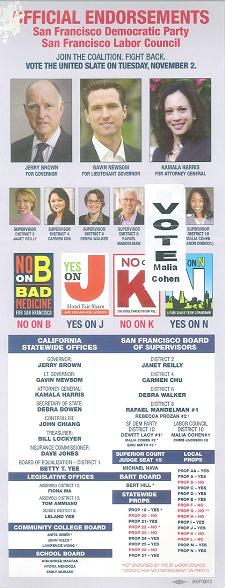
SEIU-UHW’s alliance with downtown groups and its use of member dues to attack progressive candidates places it at odds with SEIU Local 1021 and the SF Labor Council, which has endorsed Janet Reilly in D2, Walker in D6, Mandelman in D8, and Cohen (first choice) and Chris Jackson (second choice) in D10.

“We’re really disappointed that there are labor organizations that feel they have to team up with Golden Gate Restaurant Association, which is against health care [it challenged the city’s Healthy San Francisco program all the way to the U.S. Supreme Court], and with CPMC, which is working to keep nurses from joining a union,” Labor Council Director Tim Paulson said. “This alliance does not reflect what the San Francisco labor movement is about.”

Paulson said that the Labor Council values “sharing the wealth … So we don’t want Measure B [Jeff Adachi’s pension reform] or K [Newsom’s hotel tax loophole closure, which has a poison pill that would kill Prop. J, the hotel tax increase pushed by labor] or L [Newsom’s sit-lie legislation],” Paulson said.

CPMC’s plan is headed to the board in the next couple months, although Sup. David Campos is proposing that the city create a health services master plan that would determine what city residents actually need. Hospital projects would then be considered based on that health needs assessment, rather than making it simply a land use decision as it is now.

Moss told the Guardian that UHW endorsed him because of his positions on politicians and unions. “I agreed that politicians should get not involved in union politics,” Moss said. “The United Healthcare Workers seem to be a worthy group,” he added. “All they said was that they wanted to make sure that they had access.”

But CNA member Eileen Prendiville, who has been a registered nurse for 33 years, says she was horrified to see UHW members recently oppose Campos’ healthcare legislation. “I was shocked that they were siding with management,” she said.

Prendiville believes UHW is obliged to support CPMC’s Cathedral Hill plan, which is why it is meddling in local politics. In his letter to the board, Browner noted that his company and its parent company, Sutter Health, can’t legally do so directly. “The fact is that CPMC and Sutter Health are 501(c)(3) not-for-profit, nonpartisan organizations, and we neither endorse nor contribute to candidates,” Browner wrote.

“When UHW settled its contract with its members [as part of its fight with the rival National Union of Healthcare Workers], they had to publicly lobby for Cathedral Hill,” Prendiville claimed.

SEIU 1021 member Ed Kinchley, who works in the emergency room at SF General Hospital, is also furious that UHW is pouring money into downtown’s candidates and measures. “UHW isn’t participating in the Labor Council, it’s doing its own thing,” he said.

Kinchley said UHW, which is currently in trusteeship after a power struggle with its former elected leaders, is being controlled by SEIU’s national leaders, not its local membership, which explains why it’s aligned with downtown groups that have long been the enemy of labor.

“Sutter wants a monopoly on private healthcare and people like Rafael Mandelman and Debra Walker have been strong supporters of public healthcare,” Kinchley said. “I want someone who can straight-up say, here’s what’s important for families in San Francisco, especially something as important as healthcare. But it sounds like UHW is teaming up with the Chamber and supporting people who are not progressive.”


Editor’s notes

0

Tredmond@sfbg.com

At a certain point, you have to stop trying to project what’s going to happen and just wait for the election results. Because what matters now isn’t the $140 million Meg Whitman has spent or Carly Fiorina’s record at Hewlett-Packard or which aide to Jerry Brown called Whitman a whore. It’s who shows up to vote.

If I were Meg Whitman’s campaign manager, I’d stop spending money. Go into hiding. Pretend there’s nothing going on here, no big deal next Tuesday morning — and then pray for rain. Because the way Whitman wins — possibly the only way she wins — is if huge numbers of Californians don’t bother to vote.

If the turnout is reasonable — that is, if enough Democrats realize the danger posed by of the GOP candidate and go to the polls — then Jerry Brown is in. And if that happens, chances are good that the rest of the Democratic ticket — including Gavin Newsom and Kamala Harris — squeaks in, too. And then we can all start to have fun figuring out the future of San Francisco politics.

That, of course, depends on the same factor: Who’s going to show up to vote? Will all the tenants in District 8 — many of them unexcited about Jerry Brown — take the time to vote for Rafael Mandelman for supervisor? Will the progressive voters who have lived in District 6 for a while get to the polls in greater numbers than the conservative newcomers in the pricey condos? Will the next Board of Supervisors — which could be choosing the next mayor — be as progressive as the current board (which also might wind up choosing the next mayor?)

And who’s even on the mayoral short list?

At the Haight Ashbury Neighborhood Council forum Oct. 14, former Supervisor (and potential mayoral contender) Aaron Peskin noted that the person in Room 200 year “is going to have to take out the garbage.” The city’s going to face another awful budget deficit and a progressive interim mayor will have to make a lot of enemies. Who wants to face the voters in November 2011 after making more cuts and raising taxes?

Well, somebody needs to — because the “caretaker” mayor some people are pushing for won’t have the clout to make tough decisions. And frankly, a progressive with the power of incumbency might actually be able to win a full term, even up against a huge downtown war chest.

Fun stuff. Go out and vote.


Controlling big money campaigns

0

Big money moved into the district supervisorial races this fall. Downtown forces, working with landlords and a labor union that wants a giant new hospital on Van Ness Avenue, are pouring hundreds of thousands of dollars into races in Districts 6, 8, and 10, trying to alter the direction of the board by electing more conservative candidates. And while district races allow grassroots candidates without huge war chests a decent shot at winning, all this cash is going to have an impact — and might prove to be decisive in some races.

A lot of the money hasn’t been raised directly by candidates, either — it’s in the form of so-called independent expenditure committees, outside operations that, in theory, have no direct connection to any candidate. These committees can raise money without limits, spend it however they like, and ignore the limits that candidates face. And thanks to the U. S. Supreme Court, it’s almost impossible to regulate the committees. So the IEs, as they’re known, can put out attack ads, make scurrilous accusations, even lie outright — and have no accountability.

But San Francisco, which led the nation in using ranked-choice voting and has an impressive system for public financing of elections and disclosure, ought to be working to control this flood of sleaze. There are two major steps the supervisors should be looking at.

1. Respond to the money. San Francisco currently gives matching public funds to candidates who raise enough on their own to meet a threshold. That gives underfunded candidates at least a fighting chance to stay competitive. But it doesn’t address what happens when an outside group comes in and drops, say, $50,000 to promote or attack a candidate.

Unfortunately, federal law and court decisions limit the city’s ability to cap or restrict that spending. But the current system of matching public funds offers a potential alternative.

Suppose, for example, the city offered matching funds not just on the basis of what a candidate has raised — but also on the basis of what his or her opponents (including IEs) are spending. For example, if an IE spends $50,000 attacking a candidate, the city could give that candidate $50,000 (or, better, $100,000) to fight back.

That sounds like a lot of taxpayer dollars — but if the system is designed right, much of it will never be spent. Because the independent expenditure committees are only effective if the money is one-sided. Once these operators realize that all they’ve be doing by spending money against a candidate is increasing that candidate’s own resources, they’re far less likely to mount these campaigns.

The disclosure laws can be tightened too. Campaign ads and mailers have to say where the money’s coming from — but only in tiny type or in rushed voiceovers that few people notice. The federal government’s mandate that cigarette packages and ads have big, prominent statements about the health risks of smoking has been very effective. Requiring campaigns, particularly independent expenditure groups, to identify their major donors in large, visible type in prominent places on printed material and in clear language on radio or TV ads would help the voters understand the players — and the motivations — behind the campaign material.

2. Deal with the legal violations — promptly. A lot of these big-money campaigns have a tendency to skirt — or sometimes flagrantly violate — the city’s campaign law. And by the time the ethics Commission gets around to investigating (if that even happens) the election is over and it’s too late.

The supervisors ought to mandate that all credible allegations of election-law violations be investigated — and resolved if at all possible before Election Day. And if that means Ethics needs more staff, that’s a small price to pay for honest elections. 


Alerts

0

news@sfbg.com

THURSDAY, OCT. 29

Bert for BART

BART board candidate Bert Hill, who is endorsed by a broad array of progressive organizations in his bid to unseat Republican incumbent James Fang, will be campaigning and meeting commuters along with several of his campaign’s supporters.

4:30–7 p.m., free

Balboa Park BART Station

401 Geneva Ave., SF

www.bert4bart.org

FRIDAY, OCT. 29

Halloween Critical Mass

Find a costume, hop on your bicycle, and join the monthly Critical Mass bike ride, Halloween edition. This rolling street party is always a fun way to flip the normal transportation paradigm, but it’s even more festive when composed of zombies, naughty nurses, and sexy cops.

6 p.m., free

Justin Herman Plaza

Market and Embarcadero

www.sfcriticalmass.org

Zombie Flash Mob

Guardian sources have warned that a mob of zombies, possibly dressed in prom attire, will rampage through the streets of the Mission. They are said to be protesting being marginalized and are showing their solidarity with the LGBTQ community. Eventually, our sources say, they will converge at El Rio, 3158 Mission St., for a zombie prom featuring live music by Elle Niño and others, with a cover charge of $3 for the undead and $7 for the living.

8 p.m., free

Corner of 16th and Mission, SF

elleninosf@gmail.com

SUNDAY, OCT. 31

(SF) Rally to Restore Sanity

If you can’t make it to the National Mall in Washington, D.C. for the Rally to Restore Sanity and the March to Keep Fear Alive, the send-up of political events by Comedy Central satirists Jon Stewart and Steven Colbert, you can still take part in SF’s local version. The event include guest speakers, comedy, poetry, and dancing.

9 a.m.–3 p.m., free

Civic Center Plaza

Larkin and Grove, SF

www.sfsanityrally.com

MONDAY, NOV. 1

Urban Water Rates

Panelists from the industry will seek to answer whether water pricing at the urban water agency level can work as a water conservation tool, whether rate increases jeopardize revenue, and how to serve low-income and low-use customers. RSVP at info@whollyh2o.org.

1 p.m.–3 p.m., free

Jellyfish Gallery

1286 Folsom, SF

www.whollyh20.org

TUESDAY, NOV. 2

Election Day

This election features pivotal races for the governor of California, U.S. Senate, and San Francisco Board of Supervisors, as well as important local and state propositions, so don’t forget to vote. Use this week’s cover as a cheat sheet or view our complete endorsements. Also visit the Guardian’s Politics blog on Election Day for a rundown on the evening parties and follow our live election coverage there that night.

7 a.m. to 8 p.m., free

SF City Hall basement

1 Dr. Carlton B. Goodlett Place, SF

www.sfgov.org/elections


The politics of the World Series

15

Well, on one level there’s no political significance at all: Two teams made up of high-paid mercenaries who go where the money is and have only fleeting and often temporary connection to their respective cities will play for the national championship. The “World Series,” of course, is not a “world” anything since only two nations have ever been eligible to field teams.


Still: The Giants, a teram from San Francisco with a distictly nontraditional fan base is playing the team that launched the political career of George W. Bush.


Remember: Bush was a failed business owner and failed politician when he put together the group that bought the Texas Rangers in 1989. His initial investment was about $600,000, which he covered in part through a dubious stock sale. After he conviced the good people of Texas to foot most of the bill for a new stadium, the team shot up in value and he cashed out at $15 million.


He also built the contacts and political base that would lead to his election as governor of Texas. Which led to his election as president, two wars and the ecomic meltdown we’re all trying to survive today.


Is that the fault of the players who wear the Rangers uniform? Of course not. And I don’t know how many of the Giants players support same-sex marriage. But if there’s any symolism in pro sports, an underdog SF team taking on Bush’s legacy counts for something.


And does anyone really think Arlington, Texas would have embraced Tim Lincecum?


Go Giants.


Controlling big money campaigns

0

Thanks to the U. S. Supreme Court, it’s almost impossible to regulate the so-called independent expenditure committees.

EDITORIAL Big money moved into the district supervisorial races this fall. Downtown forces, working with landlords and a labor union that wants a giant new hospital on Van Ness Avenue, are pouring hundreds of thousands of dollars into races in Districts 6, 8, and 10, trying to alter the direction of the board by electing more conservative candidates. And while district races allow grassroots candidates without huge war chests a decent shot at winning, all this cash is going to have an impact — and might prove to be decisive in some races.


A lot of the money hasn’t been raised directly by candidates, either — it’s in the form of so-called independent expenditure committees, outside operations that, in theory, have no direct connection to any candidate. These committees can raise money without limits, spend it however they like, and ignore the limits that candidates face. And thanks to the U. S. Supreme Court, it’s almost impossible to regulate the committees. So the IEs, as they’re known, can put out attack ads, make scurrilous accusations, even lie outright — and have no accountability.

But San Francisco, which led the nation in using ranked-choice voting and has an impressive system for public financing of elections and disclosure, ought to be working to control this flood of sleaze. There are two major steps the supervisors should be looking at.

1. Respond to the money. San Francisco currently gives matching public funds to candidates who raise enough on their own to meet a threshold. That gives underfunded candidates at least a fighting chance to stay competitive. But it doesn’t address what happens when an outside group comes in and drops, say, $50,000 to promote or attack a candidate.
Unfortunately, federal law and court decisions limit the city’s ability to cap or restrict that spending. But the current system of matching public funds offers a potential alternative.

Suppose, for example, the city offered matching funds not just on the basis of what a candidate has raised — but also on the basis of what his or her opponents (including IEs) are spending. For example, if an IE spends $50,000 attacking a candidate, the city could give that candidate $50,000 (or, better, $100,000) to fight back.

That sounds like a lot of taxpayer dollars — but if the system is designed right, much of it will never be spent. Because the independent expenditure committees are only effective if the money is one-sided. Once these operators realize that all they’ve be doing by spending money against a candidate is increasing that candidate’s own resources, they’re far less likely to mount these campaigns.

The disclosure laws can be tightened too. Campaign ads and mailers have to say where the money’s coming from — but only in tiny type or in rushed voiceovers that few people notice. The federal government’s mandate that cigarette packages and ads have big, prominent statements about the health risks of smoking has been very effective. Requiring campaigns, particularly independent expenditure groups, to identify their major donors in large, visible type in prominent places on printed material and in clear language on radio or TV ads would help the voters understand the players — and the motivations — behind the campaign material.

2. Deal with the legal violations — promptly. A lot of these big-money campaigns have a tendency to skirt — or sometimes flagrantly violate — the city’s campaign law. And by the time the ethics Commission gets around to investigating (if that even happens) the election is over and it’s too late.

The supervisors ought to mandate that all credible allegations of election-law violations be investigated — and resolved if at all possible before Election Day. And if that means Ethics needs more staff, that’s a small price to pay for honest elections

Chevron spends big to fool voters

4

Bay Area-based oil giant Chevron is spending millions of dollars to influence this election and protect its financial interests, most notably by being the top contributor to the Prop. 26 campaign, which would make it almost impossible for Californians to impose fees that would help pay for environmental and public health programs.

Chevron, which reported a $5.4 billion record profit in the second quarter of this year, has given $3.75 million to the Yes on 26 campaign, according to campaign spending watchdog Maplight.org, beating the California Chamber of Commerce’s $3.5 million. Other big contributors include the American Beverage Association ($2 million) and Phillip Morris tobacco company ($1.75 million). The Yes on 26 campaign has raised about $16 million compared to the opposition raising less than $5 million from groups representing teachers, environmentalists and social justice advocates.

Prop. 26 would require a two-thirds super majority for the enactment of fees by the California Legislature or by the voters in cities, counties, or special districts, which has proven almost impossible to attain in the face of aggressive corporate-funded opposition campaigns. Such a high electoral bar would cripple the state’s ability to make big polluters and global warmers like Chevron – or the makers on alcohol or tobacco products – pay for their societal impacts.

But that payout isn’t even Chevron’s most audacious move of this election season. As the Bay Citizen reports, Chevron is almost spending $1 million on independent expenditures in support of their favored City Council candidates in Richmond, a city where Chevron has a big polluting oil refinery, in the hopes of buying a more friendly political environment.

Richmond officials have in recent years tried to get Chevron to mitigate its environmental impacts to the cash-strapped city and to pay a bit more in taxes, but Chevron responded with a lawsuit seeking a $26 million rebate on the property taxes that it paid to the city in past years, including 2007, when the company posted record profits of $18.7 billion.

Steve Moss: the big duck

68

WORKING DOGGEDLY TO PIN DOWN THE EDITOR OF THE POTRERO VIEW WHO IS ALSO A CANDIDATE FOR SUPERVISOR FROM DISTRICT 10

We’ve been trying to pin Steve Moss down on some key questions.  Over the weekend, I sent him some questions by email.  He responded, but ducked or ignored the real points and never gave us any straight answers.

Here’s our exchange, my questions and his answers — unedited,  followed by some comments from me as we doggedly try to make sense of where Steve Moss really stands on key issues in the district.


Dear Steve,

In your October, pre-election issue of the Potrero View, your signed column
compares the Guardian with Fox News and states that we are both  “advocacy groups disguised as news purveyors” who “whip mostly anonymous commentators on their websites to call political candidates ‘weasle, lying, doucebags’ and worse.” You also state that “these same outlets barely take the time to edit–much less fact check–their stories.”

As you know, our reporter Sarah Phelan has done factual reporting on you and your campaign (http://www.sfbg.com/2010/09/14/five-things-you-should-know-about-steve-moss) and she and I have both checked with you to respond to our points before publication.  We will continue our policy by submitting these email questions to you in advance of publication. Our deadline is 5 p.m. on Monday

l. What specific facts do you find inaccurate in our previous reporting on you and your campaign? (You mixed up a comment on a blog with Phelan’s actual story and reporting. Was this intentional?)

2. How much money have you and your various profit and nonprofit enterprises accepted from PG&E during this past year?

How much money have you accepted in total from PG&E during your many years of operating  your profit and nonprofit enterprises? Why did you change the pro-public power View of Ruth Passen to a PG&E-friendly View under your ownership?  (For example, Passen always supported public power but you as the new owner  refused to support the last public power initiative and said it was “too contentious.”)

3. Campaign finance records show that Thomas Coates, a Republican who spent $l million trying to overturn rent control in California in 2008, has just dumped
$45,000 into the so-called Alliance for Jobs and Sustainable Growth in support of your candidacy.  Public records also show that you served a cure or quit notice
to a tenant in your rent-controlled building in District 8. Would you comment on this? And would you state whether you support or oppose rent control?

4.  On the front page of the October View, your lead story reported on the troubles of the Neighborhood House under the headline, “NABE Reeling Under City Budget Cuts.” Your story noted that the Nabe had lost “nearly $400,000 in funding from the Department of Human Services (DHS) and the Department of Children, Youth and Their Families” and that individual donations had dropped by 75 per cent. The result, your story noted, was that the NABE “has been forced to eliminate teen-focused programming, reduce elementary school offerings by 25 per cent, lay-off staff and impose pay cuts.”

Each year, the NABE sponsors the Potrero Hill festival as a benefit to raise much-needed funds. This year the benefit was more critical than ever to reduce its  crippling deficit. Just as the View was going to press earlier this month,  I got a call at the Guardian from a representative of the festival with a startling bit of information. I was told that you, as the owner and editor-publisher of the View, and a candidate for supervisor from our district, were  refusing to run a full page ad for the festival, a key piece of the NABE’s promotion on the hill,if the ad contained the logo of the Guardian as a festival sponsor. 

The representative was concerned that, if you wouldn’t run the NABE ad, that the Guardian as a media sponsor wouldn’t run a NABE ad in the Guardian.
(I told him not to worry, do what he had to do to get the ad in the View, and that the Guardian would run the ad and double up on its promotion for the festival. The Guardian logo did not appear on the Nabe ad in the View but did appear on all other NABE promotions.)

Why did you make this threat to the NABE and its festival benefit? Were you serious?

5. You said in your endorsement interview at the Guardian that, if you were elected supervisor, you would give up the View. Do you still plan to do that, if elected? If so, how would you do that?

 
 Steve Moss responds:

1.  The entire way you’ve covered the District 10 election has been slanted towards the candidate you prefer, and against the candidates you dislike.  From this perspective the Guardian is not serving the role of a newspaper, but rather is acting as an independent expenditure committee on behalf of its chosen candidates and causes.  I’d be happy to select a panel of five independent journalists — you pick two, I’ll pick two, and the four can pick one — to render an opinion about how you’ve run the Guardian during this election cycle, and how I’ve run the View.

2.  In 2010 I believe SF Power has received less than $25,000 in payments related to the small business demand-response program it operates, as sanctioned by the California Public Utility Commission.  I’ve already provided you and your reporter with multiple responses to your requests about SF Power’s successfull advocacy related to CPUC orders requiring PG&E to fund programs focusing on working families and small businesses, all of which, as I’ve repeatedly pointed out, are a matter of public record.

The View has published several articles about community-based energy systems, and effective ways to achieve local control over the power grid, during my tenure as publisher. They are available on our website.

3.  I read about Coats’ contribution in Bay Citizen.  As you know, this donation was made to an independent expenditure committee over which I have no control and almost no knowledge.  I have stated throughout the campaign, and directly to the Tenants Union, that I believe current rent control policy should remain unmolested.

4.  I made no threat to the NABE.  In fact, the festival was featured on the front page of the November issue, with a story inside, and a full page ad.

5.  Yes.  A new editor will be found to run the View if I’m elected to office.


Okay, You aren’t responsive.   Let me try again, point by point:

l. I am not running for office. You are.  Please tell me where we are factually wrong in any of our reporting on you and your campaign.

As you know, we have contacted you in advance of publication for comment. And you have written us twice with generalities but no specifics on inaccurate reporting.

2. You defend your PG&E payments on the basis that it’s actually money from the California Public Utilities Commission that PG&E is required by law to put up for energy efficiency projects. However, Loretta Lynch, former president of the CPUC, told me that PG&E decides who gets the money and that fund recipients that “cross PG&E” are in danger of getting their funds cut off.

In other words, if  you  want to continue to fund your organization with upwards of more than $l million over three years, you must avoid angering the utility.  This may explain why the Potrero View under your ownership has switched from its historic position supporting public power under former owner Ruth Passen to going easy on PG&E and ducking a position on the most recent public power initiative (Proposition H).

The background: Your  non profit collected  $1,290,000 from the CPUC for energy efficiency projects over the past three years, according to SF Power’s annual revenues and estimated budgets from 2008 to 2010 as provided on its website.

The breakdown: $500,000 in 2008, $440,000 in 2009, $350,000 in 2010.

You  also got $150,000 from the San Francisco Public Utilities Commission in 2008 and $125,000 in 2009.  Your  non profit also got $50,000 chunks each year from the Richard and Rhoda Goldman fund, where his wife Debbie Findling works.   The Lisa and Douglas Goldman Fund kicked in $5,000 in 2008 and 2009.  The  Potrero View contributed $5,000 in 2008, $4,500 in 2009, and $5,000 in 2010.  A footnote stated that SF Power “is also informally negotiating with the California Air Resources Board, San Francisco’s Office of the Mayor, Mirant Corporation, and Pacific Gas and Electric Company, among others, for project funding support.”  Did you get any additional money from Mirant, PG&E,  the Mayor, or anybody else? Are you still negotiating? If not, when did you stop?

Lynch explained that “all energy efficiency programs in California are funded by ratepayer dollars that are collected by the utilities as part of each ratepayer’s utility bill.  Thus, California ratepayers, big and small, pay for all energy efficiency programs and each and every program is funded by ratepayers, not utilities.”

She said that the CPUC “sets broad parameters for each utility concerning the amount of overall energy efficiency savings to be achieved and in what customer classes (residential, small business, large business,etc.). But the utilities choose the program providers. The CPUC simply reviews the overall package provided by the utilities to check to see whether the energy efficiency savings targets are met.”

Thus, PG&E each year decides  the amount of money going to SF Community Power. Lynch noted that  some non profit people told her, when she was a commissioner, that “if you crossed PG&E, they would stop the funding.”
 
Lynch mentioned a meeting with you  that showed  PG&E’s influence on you, your non profit and the View. .
She said that, shortly after she was termed out as a CPUC  commissioner in 2009, you  asked her to meet with  him at Farleys coffee shop and asked her to serve on the board of his nonprofit. “I thanked him and said that he should consider my relationship with PG&E before making that offer if he was funded through PG&E, as PG&E and I have a very contentious relationship,  and that they would not be happy if I were on the board. He thanked me for telling him and agreed that I should not serve on the board.”  Lynch lives on Potrero Hill.

3. I followed up my rent control question:  “If state law were amended to allow it, would you support extending rent control to vacant apartments?”  No answer.

4. I got a call from Keith Goldstein, president of the Potrero Hill Association of Merchants and Businesses and co-chair of the festival. He had gotten an email from you  that read: “Please have the festival’s pr agent remove the Guardian’s logo from any complimentary ad the View is providing the festival in this month’s paper.” Why did you make  such an unprofessional move?   Would you have backed out of sponsoring this event if the Guardian logo had remained? Is that how you would behave as a supervisor?

5. If elected, do you plan to sell the View?  Will you continue to operate your non profit and take chunks of money from PG&E? If elected, would your income from PG&E disquality you from voting on PG&E and energy issues? At what point would you sever your relations, if at all,  with your non profit and PG&E?

6. If  you lose, will you (as your wife suggested in an email to friends) move back to your house on Liberty St in Distict 8?

We anxiously  await your response. B3

Wikileaks, military families and the importance of voting rights

5

As Wikileaks’ Iraq war logs continue to reveal the disturbing reality of Bush’s illegal war, and its founder, Julian Assange, continues to be demonized for leaking this information, military families are left wondering if their loved ones were endangered by the actions of rogue military contractors, if Iraqis were tortured by other Iraqis because of the failure of the Bush administration to crack down on this abuse—and whether the same thing is happening in Afghanistan.

Either way, the situation illustrates the importance of voting for ethical leadership, and San Francisco School Board candidate Margaret Brodkin is encouraging all overseas voters and their families, including those in the military, to submit their ballots for the November 2, 2010.

“The Department of Elections has issued 6060 ballots to San Francisco voters overseas,” Brodkin noted in a recent press release. “This population, which includes many military families, has received little to no attention in this election cycle. School Board Candidate Margaret Brodkin cares about families here, and throughout the world. We encourage input from families and parents living and working overseas, and want to know what types of changes you would like to see on the San Francisco Board of Education.”

As Brodkin notes, overseas voters can get more information on their voting rights at the California Secretary of State’s military and overseas voter information website. So, check it out, and use that vote wisely.

Republican who wants to overturn rent control pumps $200,000 into district elections

25

Thomas J, Coates, a big time investor in apartments and mobile homes, has dropped a total of $225,000 into five independent expenditure committees that are trying to push conservative-friendly candidates and measures over the victory line this fall.

Coates, a 56-year-old Republican (he donated $2,000 to George Bush in the 2004 presidential election) and yacht racing enthusiast, was the biggest single spender in the November 2008 election, when he contributed nearly $1 million to Prop. 98, a statewide measure that sought to repeal rent control in California and limit government’s right to seize private property by eminent domain.

And with only 11 days until the election, Coates has given local Republican war chests an enormous last-minute boost: He plunked $100,000 into Common Sense Voters, a committee in support of Mark Farrell in D2. He plunked $10,000 into the Alliance for Jobs and Sustainable Growth’s committee in support of Scott Wiener in D8. He plunked $45,000 into the Alliance’s committee in support of Theresa Sparks in D6. He dropped $45,000 into the Alliance’s committee in support of Steve Moss in D10. And he dropped another $25,000 into San Franciscans for a Better Muni, a committee in support of Measure G, which attempts to reform Muni by focusing on transit operator wages.

As the Guardian previously reported, this Alliance has received thousands from the SF Police Officer’s Association, the Building Operators and Managers Association, the Golden Gate Restaurant Association, and SEIU-United Healthcare Workers, which supports a mega-hospital on Cathedral Hill.

But Coates’ donation raises questions about his choices’ commitment to rent control. As Coates told the Chronicle in an interview in 2008, “There is a reason why 35 of 50 states expressly prohibit rent control by law – and the reason is it doesn’t work.”

Coates, who is a principal in Jackson Square Properties, which specializes in apartments and mobile homes, is also the founding partner of Arroya & Coates, a commercial real estate brokerage and investment firm whose clients include Walgreens, Circuit City, and J.P. Morgan Investment Management. And as campaign disclosures show, he’s dumped a large part of his money into the same conservative alliance that has already collectively spent almost $170,000 on Moss, Sparks and Wiener.

So far, labor has countered the Republican money by spending $70,000 in support of Debra Walker in D6 and $90,000 on Mandelman in D8, and the SF Tenants Union has spent a total of $20,000 on mailers opposing Moss, Sparks and Wiener. But collectively the downtown money, which is also being funnelled into several other independent expenditure committees, continues to massively outweigh the progressive bucks.

Coates’ phone line continues to register a “busy” signal, making it impossible to leave him a message, but I’d be happy to include his comments here, if and when I talk to him.

But Gullicksen said he was disturbed by Coates’ heavy spending on the supervisors’ races.

“Coates is the main funder of Prop. 98, his property is in Southern California, he’s pumping a lot of money into supervisors and he clearly has an agenda that we fear Moss, Sparks and Wiener share, which is to make the existence of rent control an issue the Board will take up, if those supervisors are elected.”

It will be interesting to see if Moss, Sparks and Wiener are prepared to pledge that they have no intention to attack rent control….so, stay tuned.

Meanwhile, labor is organizing a protest outside Coates office at 500 Washington Street at 5 p.m on Tuesday, Oct. 26.

“Be there or be evicted!” labor warned.


Newsom could be headed for victory

11

Gavin Newsom seems poised to win his race for lieutenant governor, at least as indicated by his opponent Abel Maldonado’s increasingly desperate campaign tactics and Newsom’s string of newspaper endorsements, including the Spanish language La Opinion, which chose to pass over a moderate Latino that it has endorsed in the past. The only question now is voter turnout, and whether Newsom’s negatives would be enough to drag him down if the Democratic base stays home in this lackluster election.

In its endorsement in Sunday’s paper, La Opinion wrote, “We are deeply disappointed that in this election [Maldonado] has opted for an opportunistic strategy of using images of undocumented criminals to earn political points. This is unacceptable and his charges against Newsom on this issue are inaccurate.” The reference was to Maldonado’s wild charges in an Oct. 15 debate that Newsom created San Francisco’s sanctuary city policies and was responsible for the fatal shootings of Bologna family members, allegedly by an undocumented immigrant who had once been in city custody. The reality was that Newsom inherited the sanctuary city policy and unilaterally weakened it after the Bologna shooting, even refusing to implement legislation approved by the Board of Supervisors (which Newsom vetoed but the board overrode) to require due process before those arrested are turned over to the feds for possible deportation.

While the paper didn’t seem to understand that Newsom has snubbed his nose at San Francisco progressives and petulantly fed a particularly divisive style of politics here, they do rightfully give him credit for running a complicated city, unlike the conservative city of Santa Maria where Maldonado was mayor and always did the bidding of the Chamber of Commerce, something I observed while working at the Santa Maria Times at the time. “The Democratic candidate has implemented solid, progressive management while leading a diverse city during a deep budget crisis. Newsom has proven to be creative, resourceful, and sensitive while forging alliances that improve the quality of life for his city’s residents,” La Opinion wrote. 

Then yesterday, as the Los Angeles Times reports on its blog, when Newsom held a campaign event trumpeting his support by Latino leaders such as Los Angeles Mayor Antonio Villaraigosa and labor leader Dolores Huerta, Maldonado showed up and sat in the back with his advisers during the event. Now that’s just strange.

A California Democratic Party e-mail blast this afternoon used a series of rhetorical questions to describe the campaign’s episodes: “So was Maldonado’s bizarre behavior an egotistical attempt to intimidate other Latinos who came to the event to support Newsom? Does he feel entitled to the appointed position now that he actually has to compete for voters in a real election? Is he desperate for media attention? Or does he just enjoy being a spectator, watching his opponent secure key Latino endorsements while his own campaign falls apart?”

But the real question is whether Democrats can mobilize enough voters to overcome Newsom’s negatives, from his arrogance to his personal foibles. When I did a search for Gavin Newsom’s name on Yahoo, which automatically guesses what you’re asking for based on past queries, the first three that listed were “Gavin Newsom girlfriend,” “Gavin Newsom divorce,” and “Gavin Newsom affair,” an apparent reference to his admitted affair with Ruby Rippey Tourk, who worked for him and was married to his reelection campaign manager.

So, if you support Newsom for this office — or even if you’re just anxious for him to leave San Francisco a year before his mayoral term expires — don’t forget to get out there and vote.

The myth of the overpaid public employee

31

Lots of press — as there should be  — on the new UC Berkeley study that debunks the myth of the overpaid public employee. The Chron had a decent story this morning, The Bay Citizen, which has been reporting pretty heavily on high wages and pensions in the public sector, acknowledged the study today. It’s a pretty big deal: Since much of the poltics of 2010 seems to be about bashing public employees and complaining about bloated pensions, some hard reality — backed up with a sophisticated regression analysis — was badly needed.

And the study is prettty clear: public employee salaries and pensions are not the cause of California’s (or San Francisco’s) budget problems:

The Great Recession continues to leave a great deal of economic pain and scarring in its wake. But, the
vilification of government workers is sorely misplaced and has left the real culprits of this devastating
downturn off the hook. Compensation received by public sector employees is neither the cause—nor can
it be the solution—to the state’s financial problems. Only an economic recovery can begin to plug the hole
in the state’s budget. Unfortunately, the current budget balancing efforts in California are anti-simulative
and further act to depress demand in an economy already operating way below capacity. Budget cuts have
helped to keep California’s unemployment rate well into the double-digits for over a year and a half—and
there is no end in sight. Thousands of California public employees have lost their jobs and many more
have forgone pay through forced furloughs and their families have experience considerable pain and disruption.
All the workers who have lost their jobs or took cuts in pay or benefits were made to do so not
because of their work performance, or because their services were no longer needed, nor because they were
overpaid. They were simply causalities among a list of millions of hard working innocent victims of a financial
system run amuck. Public sector workers help our communities to thrive and provide services that
make it worthwhile to live in them—it is wrong to blame them for the fallout from the greatest economic
downturn since the Great Depression. 

The study’s out in enough time to make a potential difference in the election — on both the state and the local level, attacks on public employees are driving major campaigns. Meg Whitman is all about tying Jerry Brown to those evil unions, and Prop.B, the measure to cut health care and pensions for city employees, is a wedge issue. A little logic shows that it’s not only misleading but factually wrong to blame the public-sector workers for the recession.

Register to vote before midnight

1

Did you know that you have until midnight today to register to vote? That you have until next Tuesday (Oct. 26) to request a vote-by-mail ballot?
And that you have until election night, which falls on November 2, Day of the Dead, to actually vote?

If you are not sure if you are eligible to vote, check the rules here. And then download a voter registration form here.

Or pick one up at the Department of Elections, the Department of Motor Vehicles, or at post offices and public libraries throughout San Francisco.

To register to vote, you’ll need a California driver’s license, a California identification number, or the last four digits of your Social Security number.

But what about if you are not sure if you are already registered to vote? Check the city’s online  records here.

Or not sure where your polling station is? Then click here, where you can also find a sample ballot to figure out who and what to vote for.

Either way, vote early, and vote often–and may the best candidates and measures win.

Get angry and make ’em do it!

9

After crashing the country’s economy and turning the world against us, Republicans are clawing their way back into power by stoking voter anger at political and economic systems that are stacked against the common citizen, a tactic that progressives need to adopt if we ever hope to move our agenda forward.

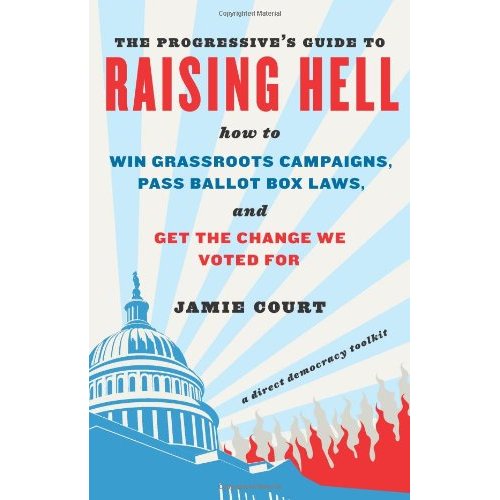
“Anger, not hope, is the fuel of political and economic change,” Jamie Court, head of Consumer Watchdog, writes in his new book, The Progressive’s Guide to Raising Hell: How to win grassroots campaigns, pass ballot box laws, and get the change we voted for (Chelsea Green Publishing, 2010).

Court writes that progressives are rightfully disappointed and disillusioned that after helping to elect President Barack Obama, he and Congressional Democrats turned around and gave Wall Street, the military-industrial complex, and the health insurance companies everything they wanted, with Obama even caving in on requiring all Americans to purchase health insurance, something he opposed as a candidate.


Yet Court said politicians never do the right thing and push progressive political change unless they’re forced to do so. He opened the book with a scene in which President Franklin Delano Roosevelt met with progressive political leaders, listened to their proposals, and then told them, “I agree. I am all for your plan. Now make me do it.”

It’s a concept that the conservative Tea Party movement understands well, and even though they may be crazy and wrongheaded in their utterly unsustainable and destabilizing policy agenda, they have effectively used anger as a political tool, and as a result, the NY Times reports they are poised to wield a disproportionate amount of political power after this election.

It’s the same story on the local level, where the only real anger in this election cycle is coming from those mad at public employee unions and their pension deals, and vagrants who sit uncivilly on sidewalks. These people will keep pushing for what they expect, but many progressives act as if it’s enough to prevent truly heinous Republicans like Meg Whitman from taking power, rather than trying to push Jerry Brown or Board of Supervisors’ progressives from day one to start empowering people over corporations.

“After the vote, power vacuums fill with familiar values, if not faces. Promises give way to fiscal realities, hope succumbs to pragmatism, and ambition concedes to inertia. The old tricks of interest group – confuse, diffuse, scare – prevail over the better angels of American nature,” Court writes, relaying a familiar electoral pattern.

Yet in this election, when the best outcome seems to be simply dodging a bullet, is there any hope for progressive political change? Isn’t the system just too broken? I asked Court these questions when he stopped by the Guardian office for a chat recently, and he retains a belief that with the right kind of tactics and agenda, progressives can still seize the political initiative and power.

http://www.youtube.com/watch?v=J3RD0YObHok

“I wrote it to reengage progressives because they are so despondent,” Court told me. “It’s about how to use anger and focus anger…Politicians don’t answer polite mobs, they only answer angry mobs and the Tea Party is the only angry mob in the room.”

Progressive have understandable doubts about the responsiveness of the current political system, but Court said, “I know if we don’t try to make it work, we’re never going to get there.”

And his book lays out the path to get there, step by step, based on some of the legislative and political successes that Consumer Watchdog and other progressives have had in recent years, such as rejecting the well-funded corporate con jobs in Propositions 16 and 17 earlier this year. Yet it involves an approach based on principle and not parties, and with being relentless in pursuing the kind of world we need.

“If you want to fight corporate power, you have to fight Democrats and Republicans,” Court said.

Specifically, Court is calling for progressives to push a California ballot measure that would establish a public health care option here, the very thing that Obama and the Democrats failed to include in their health reform package, and which will dash any hopes of it working if the people are forced to rely on unregulated insurance company products.

“The biggest thing is mandatory health insurance, which is a ticking time bomb,” Court said, one set to go off in 2014 when that aspect of Obama’s health care reform kicks in.

Corporate and political power working together seem to be a force too strong to overcome, but as Court writes, “Public opinion is the most powerful force in the world. While it can be muted, distracted, and co-opted, it cannot be controlled, except by the public.”

Willie Brown and accusations of machine politics in D6

70

A political mailer promoting progressive supervisorial candidate Jane Kim was funded primarily by former Mayor Willie Brown through a campaign committee that Kim consultant Enrique Pearce helped start and which was located in his office, the latest strange development in a race that is dividing the progressive movement at a crucial moment and prompting a nasty public debate over political “machines.”

It’s illegal for campaigns to coordinate activities with independent expenditure committees such as New Day for SF, which put out the glossy mailer proclaiming “Another renter supports Jane Kim for District 6 Supervisor” and calling her “The people’s candidate.” The most recent campaign finance statements, filed Oct. 4, listed the group’s treasurer as USF student Brent Robinson and the contact number being that of Pearce’s Left Coast Communications, where Robinson worked.

Pearce told the Guardian that he was involved in starting New Day for SF, but that he severed ties with the group and Robinson “about a month ago” when it seemed they might support Kim. “When it started to go down that path, we said that we can’t do that,” Pearce said, adding that he didn’t know why the forms still listed his phone number or why the receptionist in his office took a message for Robinson from the Guardian, although Pearce said they share a receptionist with other organizations. On Oct. 5, a day after the intial filing, the group filed a form to amend Robinson’s phone number.

The campaign finance form shows the group raised $9,200, including $5,000 from Brown on Sept. 30 and $2,500 from Twenty-Two Holdings LLC, which last year applied for a liquor license for the Wunder Brewing Co. Robinson did not return our calls for comment.

The Bay Guardian and other progressive voices used to decry the corrosive influence on San Francisco politics of the Democratic Party political machine established by Brown and former California Senate President (and current state party chair) John Burton. Although that machine is dormant now, the concept of machine politics has been revived in this election cycle by Kim and her allies, adding an ironic note to her support by Brown.

“I’m not a part of anyone’s machine and I’m certainly not a part of anyone’s master plan,” Kim declared during her June 24 campaign kickoff party, where Brown and former Mayor Art Agnos made an appearance. When I highlighted the remark in my coverage of the event, and its inference that Kim’s progressive rival Debra Walker was supported by a budding progressive political machine, it triggered a raging political debate about the concept that continues this day.

The nastiest salvos in that debate have recently been fired at the Bay Guardian and the San Francisco Democratic Party Central Committee – accusing us of being part of a political machine supporting Walker and excluding Kim (who got the Guardian’s #2 endorsement) – by Randy Shaw on his Beyond Chron blog. Shaw is one of two staff writers on the blog, along with Paul Hogarth, a Democratic Party activist and Kim campaign volunteer.

Shaw founded and runs the nonprofit Tenderloin Housing Clinic, which has millions of dollars in city contracts to administer SRO leases through Mayor Gavin Newsom’s Care Not Cash and other programs. He started BeyondChron a few years ago with seed money from Joe O’Donoghue, who was then president of the Residential Builders Association, a developer group that has sometimes clashed with Walker in her capacity as a member of the city’s Building Inspection Commission.

On Oct. 5 and then again on Oct. 12, Shaw wrote and prominently posted long stories promoting Kim’s candidacy and attacking us and the DCCC for not supporting her more strongly. In the first one, “In District 6, Jane Kim takes on the machine,” Shaw defended Burton but shared the Guardian’s criticism of how Brown behaved as mayor.

“Brown’s power was strictly personal, as became clear when his chosen Supervisor candidates were defeated in the 2000 elections,” Shaw wrote, criticizing political machines and writing that the progressive political movement is not “served when those seeking to run for office feel they must choose between ‘playing ball’ with political insiders and giving up their dreams.”

But is it possible that Shaw’s strident campaigning against Walker – indeed, his protege Hogarth planned to challenge Walker before Kim decided to get into the race – was prompted by Walker’s unwillingness to “play ball” with Shaw and his RBA backers? Should we be concerned that it’s actually Shaw who’s trying to build his own little political machine?

I’ve tried to discuss these issues with Shaw and Hogarth, including sending them a detailed list of questions (as has Guardian Executive Editor Tim Redmond), but they’ve been unwilling to respond, just as they were unwilling to contact us before writing two divisive hit pieces that were riddled with inaccuracies that they’ve refused to correct.

I’ve also left messages with Kim and others in her campaign to discuss machine politics and its implications – as well as Sup. Chris Daly, asking about the sometimes close relations that some progressive supervisors have had with Shaw and RBA developers over the years [UPDATE BELOW] – and we’re waiting to hear back.

But Pearce said voters shouldn’t read too much into a relatively small political contribution from Willie Brown, or from the “colorful writing” of Randy Shaw, emphasizing Kim’s independence and saying that was always what she intended to stress when she raised the specter of machine politics tainting the race.

“Randy Shaw is not a part of this campaign, and Willie Brown is certainly not a part of this campaign,” Pearce told us. In fact, Pearce even noted that his office is not a part of the Kim campaign, that they’re merely consultants to it. And he offered his hopes and belief that in 19 days when this campaign is over, progressives would overcome their differences and find a common agenda again. Let’s hope so.

UPDATE: Daly and I just connected and he had an interesting take on all this. He noted that when Brown was mayor, the base that he brought together included the RBA, Rose Pak and the Chinatown power brokers (who also seem to be backing Kim, who used to work as an activist/organizer in that community), and, improbably, both Labor and Downtown.

“But that’s not Gavin’s alignment, his alignment is just downtown. The RBA guys hate Gavin, mostly just because of who is is, a silver spoon guy who never worked a day in his life,” Daly said. So Matt Gonzalez, the board president who ran against Newsom in 2003, formed an alliance with the RBA and O’Donoghue, who already had a long relationship with Shaw, both personal and financial.

Daly also said that he thinks it’s a personality clash more than anything else that is driving Shaw’s opposition to Walker: “He just doesn’t like Debra.” In turn, that sort of personality-based politics — more than any differences in ideology, vision, or qualifications — is souring people in the two political camps on one another as this close election enters the home stretch. But will those resentments linger after this election? Probably, Daly said, although he plans to actively try to mediate the divide once the dust clears on this race.

“Luckily, we have a lot of young people entering the progressive movement,” Daly said. “There’s always a rejuvenation going on and one day the new leaders will be like, ‘Why do that guy and that guy hate each other?’ ‘I don’t know, I think it had something to do with the 2010 election.”

Maxwell disappoints by endorsing Sweet

10

To be honest, I wasn’t surprised that termed-out Sup. Sophie Maxwell endorsed D10 candidate Lynette Sweet yesterday. Just disappointed. And it’s not just because Sweet refused to come into the Guardian this fall for an endorsement interview (a stance that suggests that Sweet would be depressingly inaccessible to reporters that haven’t drunk her Kool-Aid—a stance that, unfortunately, reminds me of Mayor Gavin Newsom’s attitude towards the media).

I’d been hearing rumors that Maxwell was going to endorse Sweet since February, when Sweet, who’d already racked up Mayor Gavin Newsom’s D10 blessing at that point, showed up alongside Maxwell at the city’s kickoff event for Black history month.

Then there was the fact that during an interview in February for the Guardian’s kickoff article about the D10 race, Sweet spouted phrases that sounded eerily similar to Maxwell’s words.
“D10 is a pretty diverse district, but there is only one common thread: the need for economic development,” Sweet told me.

But a few days earlier when I interviewed Maxwell about a third, and ultimately unsuccessful, attempt to recall her , Maxwell talked of common threads:

 “I’m waiting for people to have a better understanding of what this community is, what the common thread running through it is, and how to use rank choice voting,” Maxwell said, by way of explaining why she wasn’t willing to endorse anyone that early in the race.

Now, it’s understandable that Maxwell would be looking for a candidate to carry on her legacy. But it she was looking for a moderate black female candidate  then why not endorse Malia Cohen, who isn’t hampered by all of Sweet’s dirty laundry—and has raised the most money in the race, so far?

Could it be that Cohen wouldn’t be down for the kind of dirty deal making that was par for the course back in the days when Willie Brown was still mayor and Sweet was the swing vote that crowned Lennar as master developer at the shipyard/Candlestick Point?

Rumor has it that Maxwell is upset at all the corporate money that’s flooding into this race in support of Steve Moss—and that she asked the other candidates to hold a press conference in which they decry this practice. Rumor also has it that Sweet signaled her willingness to join Tony Kelly, Dewitt Lacy, Chris Jackson and Eric Smith–to name a few–in making such a statement. But it hasn’t happened, yet. And the corporate money keeps rolling in for Moss.

Meanwhile, with three weeks until the election, D10 forums are beginning to sound like a parody of a “Lost” episode featuring a 22-member cast that all claim to represent the city’s polluted and economically depressed southeast sector:

“One of us is a BART director, one of us worked at City Hall, one of us is a community advocate, one of us is a City College Board member, one of us is a civil rights attorney, one of us is an affordable housing development director, one of us is a bio-diesel advocate, one of us is a public safety advocate, one of us was raised in the Bayview, one of us served on the Navy’s Restoration Advisory Board,” and so on.

I’m not saying this is wrong. Hell, I love all this diversity of choices. but I am concerned that, come election night, the progressive vote will get split into a million pieces, while deep-pocketed conservative forces like the Chamber of Commerce and Golden Gate Restaurant line up behind one candidate in an attempt to crush candidates that would stand up to their powerful influence at City Hall and truly represent the D10 community

Yes, there is ranked choice voting, and it’s unlikely that one candidate will win a majority of the vote in the first round. But it’s critical at this venture that progressives develop a winning strategy. D10 candidate Ed Donaldson told me recently that if a candidate who doesn’t represent the community’s concerns gets elected, then the community would respond just as they did around Maxwell—and organize a recall.

But wouldn’t it be better if the community can come together behind three truly progressive candidates and help them win the November election?

One of the key challenges in this race will be to win votes in Visitacion Valley, as well as in the Bayview and/or Potrero Hill.

In his latest column in the Chron, former mayor and Sweet supporter Willie Brown alluded to the importance of this in a city with ranked-choice voting:”It’s not getting much attention, but someone has finally figured out how to get the Asian vote out,” Brown observed.”You do it by mail. You get ballots and ballot books into every household, then have the whole family sit down together. The kids help with the translation, everyone talks things over and everyone votes.”

Meanwhile, D10 candidate Tony Kelly told me that Marlene Tran, who is tri-lingual (English, Cantonese, Vietnamese) and has a good handle on community issues in Viz Valley, has confirmed that Kelly is her second-ranked choice (presuming that she votes for herself in first place. of course).

Not a bad strategy–and one that other progressives need to consider, given ranked choice voting–and the brutal reality that they are going to be massively outspent in the next three weeks.


Downtown massively outspends progressives

17

With only three weeks until the election, downtown interests are massively outspending progressive groups.(Conservative estimates suggest a 5:1 ratio, based on an analysis of campaign finance disclosures at the Ethics Commission.) And these downtown interests have plenty in reserve, as cash is funneled into a bunch of improbably-named political action committees that hope to influence the outcome of district elections and local measures on the fall ballot.

The Alliance for Jobs and Sustainable Growth, which is backed by the Chamber of Commerce, the SF Police Officers Association, and United Health Care Workers, recently got an infusion of cash from the conservative-minded Building Owners and Managers Association and Golden Gate Restaurant Association. And the alliance is already spending gobs of money in support of Theresa Sparks in D6, Scott Wiener in D8 and Steve Moss in D10.

The Coalition for Sensible Government, which recently received a $100,000 injection of cash from the SF Association of Realtors, is spending in support of Sparks in D6, Wiener and Rebecca Prozan in D8, and Lynette Sweet and Moss in D10. The coalition is also spending in support of Proposition G (transit operator wages) and Prop. L (Newsom’s sit-lie legislation)  and in opposition to Prop. M (community policing/ foot patrols) and Prop N (property transfer tax).

And a PAC consisting of the Coalition for Responsible Growth, Plan C, San Franciscans for a Better Muni, SF Forward (sponsored by the SF Chamber of Commerce and SPUR) received $85,000 from the Committee on Jobs, $60,000 from the SF Association of Realtors, and $35,000 from SF Forward.

This PAC, which has already spent $466,000 this year, recently plunked down $1,000 to produce a voter guide for Plan C–a group that focuses on condo conversions and is endorsing Sparks in D6, Wiener in D8, and Sweet (as its first ranked choice) and Moss (as its second ranked choice) in D10.

It isn’t surprising that downtown PACs have deep pockets and almost identical slates. But it is a bit of a shocker that their slates are apparently almost identical to the Small Business Advocates, a group that has somewhat differing values and only a couple hundred members.

Reached by phone, SBA director Scott Hauge said the group has a couple hundred members–and claimed that SBA’s Board supports Sparks in D6, Moss in D10, and supports Measures G, K, L and opposes Measures J, M & N.

Hauge acknowledged that these positions are identical to those of downtown interests.
“We have been working with large companies,” Hauge said, claiming that small and big business’ interests are “the same” in this particular election cycle.

To date, neither the Chamber’s Steve Falk nor UHW’s Leon Chow have replied to the Guardian’s calls about the genesis of their so-called Alliance for Jobs and Sustainable Growth (Chow posted a comment on our politics blog and that is really not the same as a live conversation.)

But Tim Paulson, executive director of the San Francisco Labor Council wasn’t afraid to go on record in opposition to the Alliance and its 2010 slate.

“We’re really disappointed that there are labor organizations that feel they have to team up with Golden Gate Restaurant Association, which is against healthcare, and with CPMC [California Pacific Medical Center], which is working to keep nurses from joining a union,” Paulson said. “This alliance does not reflect what the San Francisco labor movement is about.”

A door hanger that the Labor Council distributed in conjunction with the SF Democratic Party confirms that both organizations support Debra Walker in D6 and Rafael Mandelman in D8. But while the Dem Party supports DeWitt Lacy, Malia Cohen and Eric Smith (in that order) in D10, the Labor Council only supports Cohen and Chris Jackson (in that order) in D10.

But despite their differing D10 candidate slate, both these progressive groups support Measures J, M and N, and oppose Measures B, K and L.

“When we see the Hotel Council stoop to attack Mike Casey, one of the greatest labor leaders in SF history, for fighting hotels who want to take away healthcare and diminish the retirement benefits for workers who make $25K to $30K a year, that’s really disturbing,” Paulson said, referring to a recent op-ed in the SF Examiner that was written by Patricia Breslin, executive director of the Hotel Council.

“And any union that makes an alignment with groups that don’t share the values of the San Francisco Labor Council, that’s really disturbing to me and the Labor Council,” Paulson said.

Noting that downtown is spending buckets of money on the election, Paulson observed that the Labor Council’s values are about “sharing the wealth.”

“So we don’t want Measure B [Jeff Adachi’s pension reform] or K (Newsom’s hotel tax) or L (Newsom’s sit-lie legislation),” Paulson concluded. “And we have three solid weeks to do this.”

Big Oil’s false choice

0

rebeccab@sfbg.com

Tapping into voters’ economic insecurities at a time of record high unemployment rates, out-of-state oil interests say addressing global warming will cost California more jobs. But a broad coalition that includes environmentalists and top business groups argue that just the opposite is true, saying the economy will suffer if we suddenly kill the incentives now driving the clean energy industry, one business sector that actually grew during the recession.

Proposition 23 would indefinitely suspend Assembly Bill 32, California’s Global Warming Solutions Act. Texas oil companies are bankrolling the initiative, spending millions of dollars to convince voters that they must choose between saving jobs and saving the environment. Since jobs are more important right now, they argue, the environment will have to wait.

But the other side — which includes groups such as the Chamber of Commerce, whose top priority is always job creation — is promoting the compelling idea that the path to economic recovery lies in rising to the challenge of climate change. They argue that addressing global warming now isn’t just about avoiding more out-of-control wildfires, diminishing crop yields, prolonged intense droughts, coastal flooding, and other calamities that climate scientists say global warming will bring to California. It’s also about creating jobs now and trying to lower California’s 12.4 percent unemployment rate, the third highest nationwide.

The push to defeat Prop. 23 has brought together prominent business people, public-health advocates like the American Lung Association, big green organizations such as the Sierra Club, and environmental-justice advocates who are pushing for green jobs as a way to fend off poverty and tackle air quality problems in disadvantaged neighborhoods. If the coalition of unlikely allies is successful, Big Oil’s comfortable lock on the energy market could be thrown off balance by California’s emerging green economy.

“Ultimately, we think it’s going to be a David vs. Goliath battle, because they have very deep pockets,” said No on 23 campaign spokesperson Steve Maviglio. “The proponents are playing to the fears of those most affected by the economy.”

When voters decide on this one, it will signify a choice to proceed down one of two paths at an important crossroads. A global climate summit in Copenhagen late last year failed to produce an effective response to climate change. A push for a federal cap-and-trade system to combat global warming yielded similarly disappointing results. AB32 presents a third chance to set a new standard, and a precedent, for curbing greenhouse gas emissions. But if Prop. 23 passes, environmentalists will have struck out.

A report issued in July by the National Academy of Sciences lays bare the far-reaching implications of policy decisions around climate change. “Emissions reductions choices made today matter in determining impacts experienced not just over the next few decades,” the report notes, “but in coming centuries and millennia.”


CLOSE RACE

In 2006, Gov. Arnold Schwarzenegger signed AB32, mandating a statewide reduction of greenhouse gases to 1990 levels by the year 2020. The law is slated to go into full effect in January 2012, when a cap-and-trade system will make it more costly and burdensome for major polluters to continue burning high quantities of fossil fuels, among other strategies.

The law helps alternative energy companies and creates incentives for large and small businesses to green their operations. Prop. 23, deceptively titled the “California Jobs Initiative,” would suspend AB32 until the state’s unemployment rate drops to 5.5 percent for four consecutive quarters. A decade could pass before such a market condition is in place — in the past 40 years, it’s occurred just three times.

Speaking at the Commonwealth Club in Santa Clara in September, Schwarzenegger blasted Texas-based oil companies Tesoro Corporation and Valero Energy Corporation, which have contributed a combined $5.6 million to the Prop. 23 campaign, for trying to deceive California voters. “They are creating a shell argument that this is about saving jobs,” Schwarzenegger said. “Does anybody really believe that these companies, out of the goodness of their black oil hearts, are spending millions and millions of dollars to protect jobs? It’s not about jobs at all, ladies and gentlemen. It is about their ability to pollute and thus protect their profits.”

Prop. 23 has been unpopular even among many traditional right-wing and business interests. Oil giants Chevron and BP have remained neutral on it. Republican gubernatorial candidate Meg Whitman also renounced it, but straddled the fence by vowing to suspend AB32 for a year anyway.

According to a breakdown of campaign spending issued by opponents, oil interests contributed 97 percent of the funding for Prop. 23, while out-of-state interests were responsible for 89 percent. Kansas-based Koch Industries, run by billionaire siblings David and Charles Koch, dropped $1 million into the effort. The Koch brothers have been singled out as the financial backbone of the Tea Party.

Yet despite bipartisan opposition in Sacramento, polls suggest Prop. 23 could be a close race. A recent Los Angeles Times poll showed a dead heat among California voters, with 40 percent in favor, 38 percent opposed, and about one-fifth of likely voters undecided. The television commercials advocating Yes on 23 drive home a simple yet misleading message: “Save jobs. Stop the energy tax.” A spokesperson from the Yes on 23 campaign did not return the Guardian’s calls seeking comment.

Ironically, jobs are also the cornerstone of the No on 23 campaign’s arguments. “We have very heavy hitters who see this as a job killer,” Maviglio said. The campaign is highlighting the fact that the only economic area that has experienced growth amid the recession is green tech.

Democratic gubernatorial candidate Jerry Brown referenced green jobs as a bright hope for economic recovery in a televised debate against Whitman, and the prospect of green job creation as a way to alleviate poverty is clearly articulated in The Green Collar Economy, a widely influential book by Green for All founder Van Jones. Green for All has joined the Greenlining Institute and a host of 80 organizations statewide in a united front against Prop. 23, called Communities United Against Prop. 23, which is part of the larger opposition campaign dubbed Communities United Against the Dirty Energy Prop.

Low-income communities and communities of color will be disproportionately affected if Prop. 23 wins, said Orson Aguilar, executive director of the Greenlining Institute. “The communities we represent are feeling a double impact,” Aguilar noted. “They’re suffering from pollution,” since power plants and polluting industries tend to be sited in low-income communities, “and they’re suffering from unemployment and the economic crisis. There definitely is a double-whammy.”


LOCAL MOMENTUM

At a recent green business symposium hosted by Urban Solutions, a nonprofit that aids small businesses and seeks to create job opportunities in low-income communities, a Castro District merchant explained her decision to enter green-business certification process. “I’m dedicated to going green because, No. 1, it’s the right thing to do,” said Elaine Jennings, who runs Small Potatoes Catering & Events. “No. 2, it’s the right thing to do. And No. 3, it’s the right thing to do.”

But the moderator of the panel, a business reporter, wasn’t as interested in the moral rationale — instead, she followed up by asking whether going green was a wise financial move. Anthony Tsai, green business program manager at Urban Solutions, made the case that it is. Water bills have gone up 40 percent since 2000, Tsai said. Electricity costs have gone up 60 percent and waste disposal fees have increased 250 percent. By conserving energy and water and reducing waste, small businesses can save money during tough economic times.

Aguilar sees energy-efficiency building retrofits as an opportunity to create jobs for disadvantaged populations. In order to comply with the climate regulations under AB32, energy-efficiency retrofits would have to be completed to hit conservation targets. “We have thousands, if not millions, of buildings in California that need to be retrofitted,” he said. “A lot of people who are out of work are in the construction industry. Latinos and African Americans were hit hard when construction fell.” With energy retrofits and solar-panel installations on the agenda, AB32 could be good news for electricians, too, Aguilar said.

There are signs that AB32 is already giving green business a lift. A manufacturer of electric delivery trucks, for example, relocated from Mexico to California’s Central Valley late last year. A wind-energy company recently relocated to San Diego from Spain. The solar industry is growing faster in California, particularly in the Bay Area, than anywhere else nationwide. And in the past five years, roughly $9 billion in venture capital investment has gone into clean tech industries, with more going to California than any other state.

“Prop. 23 would essentially pull the rug out from under this explosive growth, which we’re experiencing during a recession,” Maviglio noted.

Jeanine Cotter, CEO of Luminalt, an independently owned San Francisco solar and installation company, is active in the campaign to defeat Prop. 23. “There is an entire ecosystem that feeds off of good policy,” Cotter said. If Prop. 23 passes, “we will lose the spark that we have and we will go backward.”

Despite the economic downturn, Luminalt experienced its best year in 2009 in the six-year history of the company, and if AB32 goes into effect in 2012 as planned, the demand for new solar installations will only grow. But with less than a month to go before the election, Cotter said she was alarmed by the lack of awareness about Prop. 23, even among environmentalists.

“We were at West Coast Green with No on 23 literature,” she said, referencing a widely attended green-business conference, “and I was shocked at how many people didn’t know what it is.”


RISKING IT

Small business owners and conscience-driven activists aren’t the only ones touting this theory of a new energy economy. The San Francisco Chamber of Commerce, a fiscally conservative business association that is often at odds with environmentalists and progressives, is actively campaigning against Prop. 23 — and it’s not out of any sense of moral duty.

If Prop. 23 succeeds, explained Chamber spokesperson Rob Black, it will scare off the venture capitalists. “For them, water’s like money,” he explained. “It will flow to the easiest place to invest.” Regulation like AB32 guarantees a return on investment for climate-friendly technology, he added. But if that regulatory structure is thrown into question, investors may flee overseas because investing would be too risky. “If we walk away from clean tech, the next Microsoft will be a Chinese company,” Black said.

Donnie Fowler, a political consultant who has worked for Al Gore and other top Democrats, is a senior adviser to the Clean Economy Network and a leader in the effort to defeat Prop. 23. Oil companies “went to Washington and spent hundreds of millions” lobbying against climate change regulations, Fowler pointed out. “Now they’ve opened up a second front. If California goes backward, all of those senators and Congressional representatives will say, ‘No way … I’m surely not taking a political risk. If they went backward, there’s no reason we should go forward.'”

Fowler said that for environmentalists, voting No on 23 could be seen as an affirmation of statewide efforts to address climate change in a meaningful way. “This is a real opportunity,” he said, “for Californians to stand up and say we’ve had enough. We are going to take a stand — right now.”

www.stopdirtyenergyprop.com

www.communitiesagainstprop23.com

East Bay endorsements 2010

31

BART BOARD DISTRICT 4

ROBERT RABURN

Incumbent Carole Ward Allen has been a disappointment, part of the moribund BART establishment that wastes money on pointless extensions, ignores urban cores, and can’t control its own police force. Robert Raburn, a bicycle activist with a PhD in transportation and urban geography, would be a great replacement. If he’s elected, and Bert Hill wins in San Francisco, BART will have two more progressive transit activists to join Tom Radulovich. Vote for Raburn.


BERKELEY CITY AUDITOR

ANN-MARIE HOGAN

Hogan’s running unopposed and we see no reason not to support her for another term.


BERKELEY CITY COUNCIL

DISTRICT 1

LINDA MAIO

Maio in the past has had a decent progressive track record, but lately she’s been something of a call-up vote for Mayor Tom Bates. We’re not thrilled with her more recent positions years (against raising condo conversion fees and for new high-rises downtown), but she has no strong credible opponents. Green Party Jasper Kingeter has never run for elective office before and needs more seasoning.

DISTRICT 4

JESSE ARREGUIN

Arreguin and Kriss Worthington hold down the progressive wing on the City Council. He’s pushed the Berkeley police to stop impounding the cars of undocumented immigrants and is a foe of the development-at-all costs mentality of the mayor.

DISTRICT 7

KRISS WORTHINGTON

It’s disappointing that Mayor Tom Bates and his allies are trying to get rid of Worthington, who by our estimation is the best, hardest-working, and most progressive member of the City Council. He’s been willing to stand up to the mayor when he’s wrong — and has managed to force developers to build more affordable housing. He’s against the mayor’s downtown plan, but sees a way forward to a compromise that includes all the positive elements without big high-rises. Vote for Worthington.

DISTRICT 8

STEWART JONES

Gordon Wozniak, the incumbent, is the most conservative member of the City Council and has been a bad vote on almost everything. He’s going to be tough to beat in this district, but we’re giving the nod to Jones, a teacher, Green Party member, and neighborhood activist. He lacks experience, but almost anyone would be better than Wozniak.


BERKELEY RENT BOARD

ASA DODWORTH

LISA STEPHENS

JESSE TOWNLEY

PAM WEBSTER

DAVE BLAKE

KATHERINE HARR

There’s a six-person tenant slate running, with endorsements from Worthington, Arreguin, and other progressive leaders. The members couldn’t find an easy mnemonic, so they’ve used the last letters of their last names, which, in the right order, add up to SHERRY. We’ve listed them in the order they’ll appear on the ballot.


OAKLAND CITY AUDITOR

COURTNEY RUBY

Ruby’s moved the office forward a bit, and we don’t see any argument to replace her.


OAKLAND MAYOR

1. REBECCA KAPLAN

2. JEAN QUAN

The danger in this race is Don Perata, the former state Senate president, longtime power broker, and friend of developers who has, at the very least, a checkered ethical record that led at one point to a five-year federal corruption investigation (the investigation ended with no charges filed). Perata wants to use the mayor’s office to continue his role as a regional kingpin, and he has the support of Pacific Gas and Electric Co. and the big developers. No thanks.

Two strong progressive challengers are taking him on. Our first choice is Rebecca Kaplan, an at-large City Council member who is full of great, innovative ideas for Oakland. She wants to enforce an Oakland-first hiring law, work on transit-oriented development, and encourage small businesses that can attract some of the $2 billion a year Oakland loses in retail sales from local residents who shop out of town.

Kaplan told us she thinks that if Proposition 19 passes and local government has the right to regulate legal marijuana, Oakland is perfectly situated to take advantage of the new law. By combining pot sales and possibly on-site consumption with new restaurants, bike lanes, and street-level amenities, the city could revitalize neighborhoods and bring in significant new tax revenue.

She’s a big bicycle advocate, would consider a progressive city income tax, and is a strong supporter of public power. She also has a practical sense of how to solve problems.

Jean Quan has been active in Oakland politics for decades. She served 12 years on the school board, eight on the City Council, and has the experience, skills, and vision to run the city. She’s also almost tied in the polls with Perata, despite being outspent dramatically (and being the subject of some nasty, inaccurate Perata hit pieces). She told us she wants to be a cheerleader for the public schools, to work with local businesses, expand the high school internship program, and add city wrap-around services to public schools. She’s had a long, impressive record on environmental issues (she worked with San Francisco on a plastic bag ban and wrote Oakland’s Styrofoam ban). She recognizes that much of the city’s budget problem comes from the police department and police pensions. But she’s a little less aggressive than Kaplan about raising new revenue, and while she fully supports Prop. 19 and the Oakland plan for allowing commercial marijuana operations, she is, in her own words, “relatively conservative” on how far Oakland should go to allow sales and use in the city.

Kaplan’s got more of the cutting-edge progressive vision. Quan’s got more experience and a longer track record. They’re the two choices to beat Perata and save Oakland’s future, and we’re happy that ranked-choice voting allows us to endorse them both.


OAKLAND CITY COUNCIL

DISTRICT 2

JENNIFER PAE

Patricia Kernighan is among the most conservative votes on the council. She’s also representing a wealthy, conservative hills district and will be hard to beat. We’re endorsing Jennifer Pae, community outreach director for the East Bay Voter Education Consortium. She has the backing of progressives like Supervisor Keith Carson and Berkeley City Council Member Kriss Worthington (as well as the Alameda County Green Party). She’s a long shot, but better than the incumbent.

DISTRICT 4

DANIEL SWAFFORD

The front-runners in this race are probably Libby Schaaf, a former aide to Ignacio de la Fuente; Melanie Shelby, a small business owner; and Daniel Swafford, a business consultant. Schaaf is too close to her old boss. We liked Shelby, but she’s awfully vague on solutions to Oakland’s problems — and she voted for Prop. 8. She now says her position on same-sex marriage is “evolving,” and she supports equal rights for all couples. But that’s an awfully big issue to have taken an awfully wrong stand on just two years ago.

This leaves Swafford, a neighborhood activist who grew up in Oakland and was City Council Member Jean Quan’s appointee to the Neighborhood Crime Prevention Council and is a strong advocate of community policing. He gets the nod.

DISTRICT 6

JOSE DORADO

Conventional wisdom says Desley Brooks is almost certain to get reelected to this seat. Her only competition comes from Nancy Sidebotham, whose platform is all cops all the time, and Jose Dorado, a bookkeeper with little political experience. Brooks is a fierce advocate for her district and has been tough on banks and good on pushing local hiring, but has too many ethical problems to merit our endorsement. She has never denied that she kept her boyfriend’s daughter on as a $5,000-a-month aide while the young woman was a full-time student at Syracuse University in New York. When San Francisco Chronicle columnist Chip Johnson challenged some of her ethical lapses, she sued him for libel (the case was dismissed).

Dorado is a neighborhood activist who is running a grassroots campaign and, while he needs more experience, he’s raising good issues (like public financing of elections). And unlike Sidebotham, he’s supporting the revenue measures on the ballot.


East Bay Ballot Measures

BERKELEY MEASURE H

SCHOOL FACILITIES TAX

YES

The East Bay cities have done a much better job than San Francisco at using parcel taxes — a poor substitute for property taxes but still a relatively progressive form of revenue — to support schools and other public services. Measure H would continue an existing tax on residential and commercial buildings — 6.3 cents per square foot on residences and 9.4 cents on businesses — to pay for maintenance on public school buildings. Vote yes.


BERKELEY MEASURE I

SCHOOL BONDS

YES

Measure I is a $210 million bond act to expand and upgrade the public schools. Vote yes.


BERKELEY MEASURE T

CANNABIS PERMITS

YES

Measure T is on the ballot as part of Berkeley’s effort to implement Prop. 19, the statewide pot-legalization measure. Berkeley and Oakland are both ahead of San Francisco in planning for legal marijuana. Prop. T would allow six medical cannabis clinics with cultivation permits, but restrict future industrial pot uses to industrial districts. Vote yes.


OAKLAND MEASURE L

SCHOOL TAX

YES

Another parcel tax for schools, this one $195 a year for 10 years, essentially to offset state cuts. There’s an exemption for low-income taxpayers. Vote yes.


OAKLAND MEASURE V

CANNABIS TAXES

YES

If Oakland goes ahead with its plans to allow large-scale cultivation and passes this tax hike on pot sales (to $50 per $1,000 of gross revenue for medical pot and $100 per $1,000 for recreational pot) the city could take in as much as $30 million a year — almost enough to offset the budget deficit. Vote yes.


OAKLAND MEASURE W

PHONE LINE TAX

YES

Another creative — if imperfect — way to raise some revenue, Measure W puts a modest $1.99 a month tax on phone lines to raise money for the general fund. Vote yes.


OAKLAND MEASURE X

POLICE PARCEL TAX

NO

We typically support any reasonable tax on property to pay for public services, but we can’t back this one. Measure X would impose a fairly high ($360 a year) parcel tax on single-family homes — entirely to pay for cops. The police union has been intractable, refusing to give back any of its generous pension benefits to help solve the budget deficit. We can’t see raising taxes for that department alone when so much of Oakland is hurting for money.


OAKLAND MEASURE BB

POLICE FUNDING

YES

Measure BB would allow Oakland to continue collecting violence-prevention money under a previous ballot measure even if the police department falls below a mandated staffing level. It would give the City Council more flexibility in addressing public safety. Vote yes.


>>VIEW OUR COMPLETE ENDORSEMENTS FOR THE 2010 ELECTION

DADT ruling gives Obama an opportunity to lead

2

Now that a federal judge has ruled the U.S. military’s “don’t ask don’t tell” policy unconstitutional, President Barack Obama and the Democrats have an opportunity to demonstrate their stated commitment to equal rights for gays and lesbians – and, more generally, their willingness to boldly lead the country. And all they have to do is…nothing.

Actually, if Obama really wants to show some courage on the issue, he would announce that he’s doing nothing – that is, choosing not to appeal the ruling and to simply let it stand – now, before the mid-term elections next month. Sure, that might involve some political risk in conservative districts, but it would also demonstrate to voters on the left that this administration is actually willing to take a stand on an issue that is important to progressives and other believers in social justice.

Part of the problem that Democrats are facing in this election is that the Republican base, all those crazy teabaggers and ill-informed believers that Obama is a dangerous socialist, are fired up, but those in the Democratic Party base – workers, liberals, anti-war activists, and representatives of marginalized communities – don’t have much to cling to these days.

They’ve watched Obama escalate the so-called “war on terror,” do little to challenge Wall Street’s casino capitalism, prop up health insurance companies and call it “reform,” and let conservatives set the agenda while the Democrats dither on issues ranging from raising taxes on the rich to rebuilding the country’s infrastructure and social safety net.

Obama opposes same-sex marriage, and when the Democrat’s made a showy legislative move last month to end DADT, they quickly caved in the face of a Republican filibuster, making the whole gesture seem like a meaningless election year gimmick rather than an honest effort to end a policy that has always been unconstitutional, as this judge has now ruled.

So now, it’s gut check time. Obama needs to show what kind of president he wants to be. Will he do the right thing and finally provide the bold progressive leadership this country needs right now, or will he follow Bill Clinton’s lead and cave in to his conservative critics, maintaining his popularity and winning a second term by triangulating between the left and right, but leaving the country dangerously adrift in treacherous waters.

OFA opens SF office, hosts debate watch party

12


President Obama’s political operation, Organizing For America, is opening its first San Francisco office today (Tues/12), just in time to hold a watch party for this evening’s final California gubernatorial debate between Jerry Brown and Meg Whitman. So stop by 1406 Valencia at 6:30 for the debate, or stop by at 4 pm to watch Obama greet the crowd via video hookup.

Emily Dulcan, OFA’s California communications director, said the office will be focused on get-out-the-vote efforts for the Nov. 2 election, including phone banking and precinct walking for races that include Brown for Governor, U.S. Sen. Barbara Boxer’s reelection effort, Congressional races, and even some local measures.

“A lot of our volunteers hover between local races and the big races,” said Dulcan, who said she was starting to feel good about the chances of Democrats doing well at the polls. “People are really starting to see what’s at stake in this election. We can go back to the failed policies of the Republicans and President George W. Bush, or we can move forward under President Obama.”

While history and many pundits predict the Democrats will lose seats in Congress this fall – mostly because of the stubbornly bad economy and the fact that the party in power usually loses ground in the midterm elections – recent computer modeling by the New York Times showed there’s an almost unprecedented amount of uncertainty in forecasting how this election will really go. And that it could largely depend on which party can get out the vote in a fairly lackluster election season.

Janet Reilly wants a centrist mayor. Ick.

8

Janet Reilly’s the overwhelming frontrunner in District 2, and has the support of just about everyone in the Democratic Party establishment, including U.S. Senator Dianne Feinstein and Mayor Gavin Newsom. But she seems to be nervous that someone might suggest she would support a progressive (like, Gasp! Aaron Peskin) for mayor if Newsom leaves the city for Sacramento and the Lt. Guv’s office.


So she sent out an email to her supporters today, announcing that she wouldn’t support any current member of the board — or any former member of the board who has served with any current member of the board. You following? Here’s the message:


I would strongly support a true interim Mayor who pledges not to seek
re-election to a 4-year term. The interim Mayor’s sole ambition should
be to successfully steward the city until the people choose the next
Mayor. I believe this person should be a senior statesperson or a
non-partisan city official with unquestioned expertise and integrity.
There may be others who have never been elected who would be suitable
for the position.

In recent years, I have disagreed with the divisive politics of the
Board. Therefore, if given the chance, I will not cast my vote for
interim Mayor for any currently sitting or former Supervisor who has
served with any member of the current Board. We need a caretaker Mayor
who will guide San Francisco until voters choose long-term leadership in
the November 2011 election. This should be a thoughtful decision.

The next mayoral election will give the city an important opportunity to
chart its future. I think we need to let this debate take place without
any one candidate enjoying the advantage of incumbency.

If I am elected and called upon to vote on this matter, I will vote “no”
on any current member of the Board of Supervisors for interim Mayor, and
I will also vote “no” on any past Supervisor who has served with any
member of the current Board.

I would look for a moderate, custodian Mayor who will govern from the
center for all San Franciscans.


Gawd — governing from the center. What a joke. There is no center in San Francisco politics today, not for the mayor who has to decide whether to raise taxes or cut services, whether to deal with police and fire or stick public health, the schools, human services and rec-park with all the cuts. There are tough decisions coming up, and they’ll require a mayor to take a stand.


And if all Janet Reilly really wants is someone who can duck like a champion, it won’t be in the interest of any San Franciscans.


(I’ve tried to call Reilly for comment on this, but she hasn’t gotten back to me. She’s probably watching the Giants game, which is what I should be doing instead of blogging on this fine Monday afternoon. But I’ve got it on the radio. Go Giants.

Lacy’s face disfigured on Dem/Labor doorhanger

31

With only three weeks to go until the election. the dirty campaign tricks get stickier.

Top of the list of dirty tricks this week is the person(s) who pasted “Vote Malia Cohen” stickers atop the image of D10 candidate Dewitt Lacy on door hangers that the SF Democratic Party and the SF Labor Council produced  jointly for the November 2010 election. According to Lacy supporters, the offending stickers cropped up primarily on door hangers distributed on Potrero Hill, where Lacy lives, works and has a strong following.

The door hanger features a photo of Jerry Brown for Governor on one side—and thumbnails of the Dem/Council’s local picks on the other. These local picks include Newsom for Lt. Governor, Kamala Harris for Attorney General, Janet Reilly for D2 Supervisor, Carmen Chu for D4 supervisor, Debra Walker for D6 supervisor, Rafael Mandelman for D8 Supervisor and Dewitt Lacy and Malia Cohen for D10–except you can’t see Lacy’s face on the doorhangers that have been disfigured by Cohen stickers.

Historically, the SF Democratic Party only includes the picture of its top ranked candidate on door hangers, and this fall, the DCCC (the endorsing body of the local Dem Party) endorsed Lacy as its first-ranked candidate, Cohen as its second ranked candidate and Eric Smith as its third ranked candidate.

“But we included both Dewitt and Malia on this door hanger because we are doing it with the Labor Council and we have two different first-ranked candidates,” former Board President and current DCCC chair Aaron Peskin told the Guardian, noting that the Labor Council endorsed Cohen as top-ranked and Chris Jackson as its second-ranked candidate.

Cohen’s campaign manager Megan Hamilton told the Guardian that the Cohen campaign was “aware” of the stickers.
“But we did not put the stickers there,” Hamilton said.

Lacy, who dropped by the Guardian with dozens of defaced door hangers in hand, said a stream of supporters have complained about this latest dirty trick.

‘It’s misleading,” Lacy said. ‘If folks haven’t been paying attention, they won’t understand that I have been endorsed as the Democratic Party’s top choice.”

Lacy said the door hangers were distributed a couple of weeks ago at the DCCC’s election season kick-off event to people who were going to walk precincts.
”Of course, at that time, the door hangers weren’t terribly disfigured by someone sticking a ‘vote for Malia Cohen’ sticker over my smiling face,” Lacy added. “But it shows that these folks are nervous about the inroads my campaign has been making in this race. After each forum we have had folks come up to us and say they are excited by our campaign because they are looking for hope and leadership that really represents them.”

So what does Lacy, the top choice of the Democratic Party, look like when he doesn’t have a sticker over his face?

All smiles, after he completed his interview with the Guardian, which gave him its second-ranked endorsement in the D10 race, with Tony Kelly in top place and Chris Jackson in third.