Education

Oy-urveda

0

Dear Readers:

This week’s letter of greatest interest, a well-composed rant against my supposed blind devotion to Western medicine, ignorance of same, and lack of understanding of the holistic approach to complaints such as hyposexual desire disorder, is really, really long. Here is one of the good parts:

I am an ayurvedic practitioner (traditional Indian medicine) and am obliged to look at things holistically (meaning from the perspective of the WHOLE person, not just their vaginas.) From this perspective, "HSDD" is just a name given to the complaint of low libido that could be caused by anything from poor diet to bad relationship to hormonal imbalance to stressful work-life and everywhere in between. Drugs don’t cure these things, they just give temporary "help" that you pay for in side-effects, cardiac risks, and possible worsening of the condition over time. Take away the drug, and you still have the problem. There is a cure for HSDD. It’s called education, lifestyle, diet and emotional healing, not your beloved Flibanserin.

If you want to empower women, don’t push drugs; push health, self-acceptance, and self-love.

OK, hang on there. We misunderstand each other. Keep in mind that Flibanserin doesn’t work, hence is not beloved by me or anyone else. But what’s really important to restate is this: Female desire turns out to be rather complicated and often dependant on prerequisite (feeling desired in return, fr’instance) that there just isn’t going to be a pill for. Ever.

My ayurvedic friend is completely correct when she says that many physical and emotional stressors can affect a woman’s libido, few if any of which can be addressed by a simple rearrangement of neurotransmitters. BUT. If you truly believe in a holistic approach to sexual health, you have to add those neurotransmitters to the equation — because if they are not skipping merrily across the synapses the way they are supposed to, no amount of yoga and yogurt is going to make sex happen. That’s where a drug like Flibanserin (if it worked) could be useful.

Western medicine may often overlook the importance of well-being, self-acceptance, love, and fresh vegetables in its pursuit of mechanistic fixes for poorly understood problems. Doesn’t mean it doesn’t work, although it surely does have its limits — Prozac isn’t going to "make" you happy if your life sucks. If you’re lucky, it may allow you to get out of your own way enough to begin to address some of the suckage.

I am more than happy to concede that a more holistic approach would vastly improve Western medicine. Let’s have one! And while we’re at it, let’s have an end to misogyny and sexual double standards and the "second shift."

I do not expect a one-size-fits-all drug to fit all. But I do think a brain-chemistry drug could have a salutary effect on brain chemistry. And while I would expect an approach like yours to be more effective than any Flibberwhatsis for complaints of the soul, I am taking my infected toe to Dr. Western, MD. Ayurveda may be ancient and time-tested, but so is gangrene.

Love,

Andrea
Got a question? Email Andrea at andrea@mail.altsexcolumn.com

Film listings

0

Film listings are edited by Cheryl Eddy. Reviewers are Kimberly Chun, Michelle Devereaux, Max Goldberg, Dennis Harvey, Johnny Ray Huston, Erik Morse, Louis Peitzman, Lynn Rapoport, Ben Richardson, and Matt Sussman. For rep house showtimes, see Rep Clock. For first-run showtimes, see Movie Guide.

SAN FRANCISCO JEWISH FILM FESTIVAL

The 30th San Francisco Jewish Film Festival runs July 14-Aug 9 at the Castro, 429 Castro, SF; Roda Theatre, 2025 Addison, Berk; CineArts@Palo Alto Square, 3000 El Camino Real Bldg Six, Palo Alto; and Christopher B. Smith Rafael Film Center, 118 Fourth St, San Rafael. Tickets (most shows $11) are available by calling (415) 256-TIXX or visiting www.sfjff.org. For schedule, see www.sfbg.com.

OPENING

Agora There’s a good movie somewhere in Agora, but finding it would require severe editing. It’s not that the film is too long, though it does drag in stretches. The problem is that there are too many stories being told: Hypatia of Alexandria, the central figure, only emerges as the focus well into the film. Meanwhile, there’s Davus (Max Minghella), the slave boy in love with her; Orestes (Oscar Isaac), the student who tries to win her affection; Synesius (Rupert Evans), the devout Christian. We jump from character to character and plot to plot — the conflict between the pagans and the Christians, the conflict between the Christians and the Jews, and Hypatia’s studies in astronomy. Agora is so scattered that by the time it reaches its tragic conclusion — only a spoiler if you haven’t already Googled Hypatia — there’s little room to breathe, let alone grieve. While Hypatia herself is a fascinating subject, Agora is weighed down by all the stories it’s intent on cramming in. (2:06) Clay, Shattuck. (Peitzman)

*Anton Chekhov’s The Duel Conformity vs. freedom, small-town whispers vs. the heavy hand of the law — Georgian director Dover Kosashvili successfully teases out some of the tensions in the Anton Chekhov novella, encapsulating the provincial pressures brought to bear on deviants and nonconformists during a steamy summer in a seaside resort town in the Caucasus. Dissolute civil servant and would-be intellectual Laevsky (Andrew Scott) is in the bind, as he gripes to the town doctor Samoylenko (Niall Buggy). Laevsky has everything he wants: he’s coaxed the creamy, married Nadya (Fiona Glascott) into living with him openly, yet now that her husband has died, he desires nothing more than to be free of her. In the meantime upstanding zoologist Von Koren (Tobias Menzies) simmers in the background, gaging Laevsky’s social mores and practically oozing contempt. Matters come to a head as Laevsky begs a loan from Samoylenko to escape his ripening paramour, who is also beginning to feel the gracious perimeters of the town closing in around her. From the buttons-and-bows millinery details to the oppressive dark wood furnishings, Kosashvili even-handedly builds a compelling Victorian-era mise en scene that seems to perfectly evoke the Chekhov’s milieu — it’s only when the title entanglement comes to pass that we finally see which side he’s on. (1:35) Sundance Kabuki. (Chun)

Breathless Celebrate the 50th anniversary of Godard’s New Wave classic by checking out this restored, newly struck print. (1:30) Embarcadero, Cerrito.

Farewell In Joyeux Noel (2005) director Christian Carion’s new drama, a KGB agent slips top-secret documents to a French businessman, hoping to bring about the end of the Cold War. Fun fact: Fred Ward plays Reagan. (1:53)

*Great Directors See "Close-Up." (1:26) Opera Plaza, Shattuck.

The Lottery Children from Harlem and the Bronx hope to get into a prestigious school in this doc about the education reform movement. (1:21) Roxie.

Ramona and Beezus Beverly Cleary’s squabbling sisters hit the big screen in this live-action comedy. (1:44)

Salt Angelina Jolie plays a CIA officer accused of being a Russian spy. (1:31) Marina.

ONGOING

Beetle Queen Conquers Tokyo (1:30) Sundance Kabuki.

*City Island (1:40) Elmwood, Four Star.

Cyrus (1:32) California, Empire, Piedmont, Sundance Kabuki.

Despicable Me (1:35) 1000 Van Ness, Presidio, SF Center.

*Exit Through the Gift Shop (1:27) Lumiere.

Get Him to the Greek (1:49) 1000 Van Ness, Shattuck.

*The Girl Who Played With Fire (2:09) Albany, Embarcadero, Piedmont, Smith Rafael.

*The Girl With the Dragon Tattoo (2:32) Four Star, Lumiere, Shattuck, Smith Rafael.

Grown Ups (1:42) 1000 Van Ness, Shattuck.

*I Am Love (2:00) Albany, Embarcadero, Sundance Kabuki.

Inception As my movie going companion pointed out, "Christopher Nolan must’ve shit a brick when he saw Shutter Island." In Nolan’s Inception, as in Shutter Island, Leonardo DiCaprio is a troubled soul trapped in a world of mind-fuckery, with a tragic-vengeful wife (here, Marion Cotillard) and even some long-lost kids looming in his thoughts at all times. But Inception, about a team of corporate spies who infiltrate dreams to steal information and implant ideas, owes just as much to The Matrix (1999), Eternal Sunshine of the Spotless Mind (2004), and probably a James Bond flick or two. Familiar though it may feel, at least Inception is based on a creative idea — how many movies, much less summer blockbusters, actually require viewer brain power? If its complex house-of-cards plot (dreams within dreams within dreams) can’t quite withstand nit-picking, its action sequences are confidently staged and expertly directed, including a standout sequence involving a zero-gravity fist fight and elevator ride. Though it’s hardly genius — and Leo-recycle aside — Inception is worth it, if you don’t mind your puzzle missing a few pieces. (2:30) Cerrito, Empire, Marina, 1000 Van Ness, Presidio, Sundance Kabuki. (Eddy)

*Joan Rivers: A Piece of Work (1:24) Embarcadero, Shattuck.

John Rabe (2:14) Four Star.

*The Kids Are All Right (1:47) Bridge, California, Piedmont, SF Center.

*Knight and Day (2:10) 1000 Van Ness.

The Last Airbender (1:34) 1000 Van Ness, SF Center.

*Let It Rain (1:39) Opera Plaza, Shattuck.

Micmacs (1:44) Opera Plaza.

Predators (1:51) 1000 Van Ness.

*Restrepo (1:33) Lumiere, Shattuck.

The Secret in Their Eyes (2:07) Opera Plaza, Red Vic, Shattuck.

The Sorcerer’s Apprentice (1:43) Elmwood, 1000 Van Ness, Presidio, SF Center.

South of the Border (1:18) Elmwood, Sundance Kabuki.

*Stonewall Uprising (1:22) Lumiere.

Touching Home (1:48) Smith Rafael.

*Toy Story 3 (1:49) Empire, 1000 Van Ness, Presidio, Sundance Kabuki.

The Twilight Saga: Eclipse (2:04) 1000 Van Ness, Shattuck, Sundance Kabuki.

*Winter’s Bone (1:40) Embarcadero, Shattuck, Sundance Kabuki.

Congress is acting stupidly

1

Dick Meister, former labor editor of the SF Chronicle and KQED-TV Newsroom, has covered labor and politics for a half-century. Contact him through his website, www.dickmeister.com, which includes more than 250 of his recent columns.

AFL-CIO President Rich Trumka has it right. It’s not the heat in Washington, D.C., that’s bothering him and many other advocates of working people. It’s the stupidity – the economic stupidity of Congress refusing to give financial aid to states that badly need help in order t o save the jobs of some 300,000 teachers, nurses, firefighters, police and other public service workers who are facing layoffs because of budget deficits.

The possible remedy is at hand – a pending $100 billion jobs bill.  Most of the money would go to states for quickly creating or saving up to one million jobs in public and private employment, restoring government services that have been cut, and averting other planned cuts, mostly in education, public safety and job training.

Republican opposition has kept the jobs bill from passage. The GOP also opposes a companion bill that deals with another bit of economic stupidity in Washington – the stupidity of Congress’ refusal to extend the unemployment insurance benefits of the 1.4 million Americans who will run out of benefits by the end of July, and the 325,000 who already have run out of benefits.

By year’s end, more than eight million workers will have exhausted their benefits. Their regular benefits, averaging $300 a week, ran out after 26 weeks and have not been extended as they usually have been during periods of heavy unemployment. The House voted for extension, and President Obama urged extension. But the Senate has refused to act.

The AFL-CIO’s Trumka calls the situation tragic, as well he should. He notes that almost 15 million Americans are currently unemployed, a number that’s been growing by about 250,000 workers per week.

So, 15 million people who need jobs – many who desperately need jobs – are unable to find them. About one million have been jobless for more than a year.

Overall, the jobless make up about 10 percent of the workforce. They’ve been out of work an average of 35 weeks. Another 11 million Americans are underemployed, including temporary and part-time workers and others who are underutilized and underpaid.

Nearly half of all the jobless have been out of work for more than six months.  As Trumka says, “Families are stretched to the limit and state budgets are under incredible strain, putting hundreds of thousands more jobs in danger. Yet the Republicans in Congress repeatedly have blocked efforts to take action, create jobs and rebuild our battered economy.” Although it’s mainly Republicans who’ve opposed extension of benefits, some conservative Democrats have also opposed extension.

Trumka, noting that many politicians, including every member of the House, will be on the ballot in the coming mid-term elections, urges union members to demand that the office seekers take concrete action to “rebuild our economy and create jobs now.” If they don’t take action, Trumka warns, “they may not be elected officials anymore.”

New York Times’ columnist Paul Krugman blames Congress’ failure to provide relief to the jobless on “a coalition of the heartless, the clueless and the confused.”

Krugman defines the heartless as “Republicans who have made the cynical calculation that blocking anything President Obama tries to do – especially anything that  might ease the country’s economic problems – improves their chances in the midterm elections.

And the clueless? Try Sharron Angle, the Republican candidate for senator from Nevada. She’s repeatedly claimed that the unemployed are deliberately choosing to stay jobless so they can keep collecting the benefits of a few hundred dollars a week.

The confused include politicians and others who apparently are too confused to understand the obvious – that the unemployed need money, and will quickly spend whatever they get in the way of extended benefits, thus boosting consumer spending, helping create jobs quickly and otherwise expanding the economy.

Except to the heartless, clueless and confused, saving money at the expense of the unemployed by denying them benefits is, as Paul Krugman says, “cruel as well as misguided.”

Dick Meister, former labor editor of the SF Chronicle and KQED-TV Newsroom, has covered labor and politics for a half-century. Contact him through his website, www.dickmeister.com, which includes more than 250 of his recent columns.

Hot sexy events July 14-20

0

Brooke Magnanti didn’t always appreciate the transformative power of writing about sex. As “the most famous call girl in the world,” she wrote an infamous blog in the UK about her life and times as a prostitute. She got famous – although she kept her true identity concealed – and a hit TV show was made of her life. Her frank sex talk kept everyone intrigued, titillated, and humanized sex workers for an online audience. And then the tabloids found out who she was. 

And she was poked, prodded, harassed via email, her parents were interrogated, her ex boyfriend started getting all threaten-y. Her other career as a research scientist was called into question. Sucks. But she’s better now, happy she voiced her sexual reality, and as found her relationships deepen on account of it. She’s looking to teach you how to seize the power of the pen (and Ipad) for the same means this weekend, in a talk (Sat/17) and writing workshop (Sun/18) at Femina Potens gallery. She’s ex-hooker, hear her roar. 


Cock Rings

Dr. Charles Glickman wants you to squeeze the very most out of your cock collar – what a nice feller! He’ll be breaking down the anatomical mysticalism behind base camp, make sure you’re being safe, and, of course, talk ’bout fun new tricks to spice things up between you and your ringbearer. You doooo.

Wed/14 6:30-7:30 p.m., free

Good Vibrations

2504 San Pablo, Berk.

(510) 841-8987

www.goodvibes.com


Novice Night

Part expert panel discussion, part hands-on play time, this class is perfect for the new comer to the BDSM scene. Canes, clips, hoods, and needles? You can find it all here. Women only, please.

Fri/16 8-10 p.m., $4 members, $10 non-members

Women’s Building

3543 18th St., SF

www.theexiles.org


Great America Takeover

The SF Citadel wants you to arrive early at the castle, unload all your toys there, then head out for a day of thrill-seeking – on the rides at Great America. Say what? No, really. Wear your tourist clothes, and if you get a terrible sunburn all the better. Rosy cheeks knocks $5 off your admission for the Citadel dungeon play party upon the group’s return to the city.

Sat/17 meet at SF Citadel 10 a.m. for carpools to amusement park, $54.99 park admission

SF Citadel 

1277 Mission, SF

(415) 626-1746

www.sfcitadel.org


Writing Workshop with Belle De Jour

There is a blogger out there even sexier than I. UK digital dime, Belle De Jour (aka, Brooke Magnanti) shares her secrets for getting allll of you all on paper, or digital page, in this writing workshop not to be missed.

Sun/18 3 p.m., $15-20

Femina Potens

2199 Market, SF

(415) 864-1558

www.feminapotens.org


Fabulous Fellatio/Petting the Kitty

Gotta love that give and take. And should you and your sweetie want a refresher course on all ways to put the puff back into each other’s privates (sorry, I don’t know where I was going with that one), Good Vibes is supplying you with not one, but two evenings of education with sex educator Megan Andelloux. Go the first night for a crash course on phallus lovin’, the second for a crash course of cunnilingus. Study hard, kids.

FF: Mon/19 6-8 p.m., $25-30

PtK: Tues/20 6-8 p.m., $25-30

1620 Polk, SF

(415) 345-0400

www.goodvibes.com


Beginning Strip Class

Burlesque beauty Alotta Boutté brings her considerable, ahem, skills to the stripper pole in the dungeon basement of the Big Pink House. Wear clothing that’s comfortable — but not so comfortable you’ll mind leaving it on the floor.

Tues/20 7:30-9:30 p.m., $5

Big Pink House (contact for address)

(415) 292-3222

www.soj.org


On the cheap listings

0

On the Cheap listings are compiled by Paula Connelly. Submit items for the listings at listings@sfbg.com.

WEDNESDAY 14

Make Beer in Your Basement Bazaar Café, 5927 California, SF; (415) 831-5620. 7pm, free. Learn to make your own beer to both save money and get invited to more parties. Home brewer Caleb Shaffer presents an overview of the beer brewing process, complete with explanations on technique, equipment, and ingredients.

Vive le Film! Hotel Rex, 562 Sutter, SF; www.disposablefilmfest.com. 8pm, free. In honor of Bastille Day, the Disposable Film Festival will present a collection of disposable films with a French flare. Enjoy drink specials courtesy of Hotel Rex and valet bike parking provided by Globe Bikes.

THURSDAY 15

Hayes Valley Farm Tour Hayes Valley Farm, Laguna between Oak and Fell, SF; www.laborfest.net. 3pm, free. Attend this LaborFest sponsored tour of Hayes Valley Farm, an urban agriculture education and research project, and learn about the alliance of urban farmers, educators, and designers that comprise the Hayes Valley Farm Project Team and the innovative strategies used on the farm in order to meet the needs of our planet and the surrounding communities of San Francisco. Tours of the farm are held every Thursday and Sunday.

FRIDAY 16

Free Museum Weekend Various museums in San Francisco, visit www.onlyinsanfrancisco.com/target for exact dates and times. Fri.-Sun., free. The de Young Museum, Asian Art Museum, SFMOMA, Contemporary Jewish Museum, Museum of African Diaspora, Zeum, and the Yerba Buena Gardens Festival are all offering free admission days throughout the weekend for all ages along with hands-on art activities, and family friendly performances.

SATURDAY 17

“Art Show” Cat Club, 1190 Folsom, SF; (415) 703-8964. 5pm, $5 suggested donation. Watch interpretive drag performances devoted to the works of Keith Gaspari, who will be hosting along with the lovely Bebe Sweetbriar. Featuring works by local artists and performers, champagne toasts, a raffle, and special Bulleit bourbon cocktails to benefit Visual Aid, a non-profit that supports artists living with HIV.

“Beatles to Bowie” San Francisco Art Exchange, 458 Geary, SF; (415) 441-8840. 7pm, free. Attend the opening of this Rock n’ Roll photo exhibition displaying original photos showcasing the evolution of music from the British invasion to glam rock from 1962 to 1974. Featuring never before seen photos by Terry O’Neill.

Behind the Storefronts Chinese Cultural Center of San Francisco, 3rd floor, 750 Kearny, SF; (415) 252-2598. 2pm, free. Learn about how Art in Storefronts, a citywide project that temporarily places original art installations and murals into vacant storefront windows and exposed walls, from some of the artists and property owners who participated in the current Chinatown exhibition. An artist-led tour of the storefronts and murals will follow the discussion.

Night Light SOMArts Cultural Center, 934 Brannan, SF; (415) 552-1770. 9pm, $5 suggested donation. Get lost in a multimedia garden party featuring temporary multimedia, abstract sound, video, and film installation set in the garden of SOMArts. In conjunction with the current “Totally Unrealistic: the art of abstraction” exhibit.

Schools for Salone El Rio, 3158 Mission, SF; (415) 648-4767. 4pm, $10 suggested donation. Enjoy an afternoon of dancing, eating, drinking, and probable sunshine to benefit Schools for Salone, a non profit that build schools in Sierra Leone. Featuring music by DJs Marcos, Eschew, SpinCycle, PMS, and Ras Kanta, African food by Bissap Baobab, and raffle prizes.

Song and Poetry Swap The San Francisco Folk Music Club, 885 Clayton, SF; (415) 648-3457. 8pm, free. Join the Freedom Song Network to help keep the spirit of labor and political song alive in the Bay Area by bringing songs or poems to share at this swap of picket line, rally, and concert songs and poems. No musical training or talent required. Part of LaborFest 2010: www.laborfest.net.

Union Square Art Walk Participating galleries along Post and Sutter streets, SF; for exact locations visit http://artwalksf.com/. Noon-5pm, free. Take a free, self-guided walking tour of Union Square art galleries at this art walk featuring artist talks, performance art, live music, film screenings, refreshments, and more.

SUNDAY 18

Lots of Abundance Meet at CCA Farm, 8th St. at Hooper, SF; www.sfbike.org. 9:45am, $5 suggested donation. Discover local projects that reclaim abandoned lots and former freeways for public use and for the purpose of restoring connections to food on this two and a half hour bike tour led by TransitionSF and the San Francisco Permaculture Guild. The tour will highlight local efforts to create community and garner support for both the environment and the economy.

MONDAY 19

Ubu Roi Theater Pub, Café Royale, 800 Post, SF; www.sftheaterpub.wordpress.com. 8pm, free. Take in a one night performance of Alfred Jarry’s 1896 bawdy and nihilistic re-imagining of Macbeth, translated and modernized by Bennett Fisher. Enjoy this original work and workshop at the Café Royale bar featuring musical accompaniment by DJ Wait What.

For Lit, Talks, and Benefits listings, visit the Pixel Vision blog at www.sfbg.com/pixel_vision.

Get rid of the water bond, now

0

OPINION A Field Poll released last week showed decent support among progressives for Proposition 18, the $11 billion water bond on the November ballot. We shouldn’t let the bond’s cheery name fool us. Prop. 18 is a con job.

Sold as the Safe, Clean, and Reliable Drinking Water Act, Prop. 18 has been getting a lot of press recently for the “pork” that was added to it to gain votes when it went before the Legislature last November. But for progressives, the real concern isn’t the pork; it’s the other meat in the bond. Prop. 18 would maintain a status quo that’s bad for our budget and water supply.

With polls showing lagging support for the bond, Gov. Schwarzenegger asked the Legislature to delay the measure until 2012. Bay Area residents have nothing to gain from the measure — this year or in two years. We need our legislators to fight for the bond’s termination, now.

Prop. 18 provides a $2 billion downpayment for a peripheral canal to send more water from the Sacramento Delta to deep-pocketed interests to the south. In 1982, Northern Californians overwhelmingly rejected the peripheral canal; we should do the same with the bond. The Westlands Water District, Beverly Hills billionaire-owned Paramount Farms and other megafarms stand to gain immensely from any additional water these projects might bring. The Bay Area does not.

Worse, some of these landholders skip farming altogether in order to resell the water we’ve subsidized at a huge profit to real estate developers. They pay about $25 to $50 per acre-foot of water, but can easily resell the water for over $200 per acre-foot. Corporate giant Cargill is looking to buy water from landowners in Kern County to supply its proposed 12,000-unit housing development on bay salt marshes in Redwood City.

The meat of Prop. 18 is $3 billion for the construction of more dams, an expensive and inefficient way to manage water. California’s rivers already have hundreds of dams. The water that evaporates from them each year is enough to supply 4 million people.

With interest, Prop. 18 would add $24 billion in debt to the state’s General Fund — roughly $16 million a week for 30 years. Already facing a $19 billion deficit, California has made drastic cuts to vital public services like education, housing, and healthcare — and this bond will make things worse.

Although there is some money in the bond for projects that could actually benefit us, it’s too little, too late. And the state still has $7 billion available from past water bonds that has not been spent. When the Legislature passed a bill in 2009 to invest that money in regional water projects, the governor vetoed the bill. The same will likely be true here. And even if we do see that money someday, will the trade-offs be worth it?

There is no question that California needs to invest billions in rebuilding and upgrading our vital water infrastructure. Here in the Bay Area, we are already spending billions on rebuilding our sewer and drinking water systems. Unfortunately, the bond provides only a trickle of money for such important investments or to boost conservation and efficiency in the urban and agricultural sectors. It’s no wonder that the Sierra Club, Food & Water Watch, San Francisco Baykeeper, Clean Water Action, the California Teachers Association, and United Farm Workers all oppose the bond.

Fortunately, state Sens. Mark Leno, Leland Yee, and Ellen Corbett and Assembly Members Tom Ammiano, Loni Hancock, and Nancy Skinner all voted against placing this bond on the ballot. We now need them to step up and urge their colleagues not just to delay but to repeal this bond, now. *

Elanor Starmer is the western region director for the consumer advocacy nonprofit Food and Water Watch (www.foodandwaterwatch.org).

Meg, Jerry and the Latino vote

0

It’s easy for political analysts to talk about “the Latino vote” as if 15 million people in California all shared exactly the same views and cared about exactly the same issues. Which is nuts: Latino voters are a diverse group.


On the other hand, it’s safe to say that over the past 15 years or so, as the California Republican party has become more and more viciously anti-immigrant, Latinos have been rejecting GOP candidates. When Pete Wilson pushed Proposition 187 — which would have prevented undocumented Californians from receiving public health services and would have kicked their kids out of public schools — he wrote off an entire generation of Latino voters.


And Jerry Brown has a strong history of supporting causes that resonate with a lot of Latinos.


So in general, recognizing that not all Latinos remember Brown’s support for Cesar Chavez or cae about the creation of the Agricultural Labor Relations Board, it ought to be a good assumption that Brown will win the Latino vote by a pretty wide margin. The fact that Whitman is narrowing his lead among Latinos is, I think, a sign that Brown is resting too much on history and hasn’t offered much in the way of ideas about jobs, education, or any of the other crucial issues that middle-class voters of all ethnic groups care about.


Still, the Spanish language billboards were really dumb. For a campaign that’s been as disciplined and message driven as the Whitman effort, it’s kind of a surprise. All Meg has done is give Brown a nice weapon, a reason to talk about an area where she’s very weak. And the more he can keep playing on that — the more he can point out how far to the right she and her advisors really are on immigration — the more it hurts her.

Benefits: July 7-July 13

0

Ways to have fun while giving back this week


Thursday, July 8

Do Good Lab
Join the Do Good Lab to raise money for The Champions, a primary school for orphans and vulnerable children who lack access to state provided education. Baobab Restaurant will donate 20% of their proceeds to the project.
6 p.m., donations encouraged
Baobab Restaurant
2323 Mission, SF
www.do-good-lab.org

IFCO Pastors for Peace Cuba Caravan
Attend this sendoff and benefit for the 21st annual Cuba Caravan carrying 100 tons of humanitarian aid to the blockade-starved people of Cube featuring a potluck dinner at 6pm, speakers from the caravan, two short films, music by Dave Welsh, salsa dancing lessons, and more.
6:30 p.m., $10-$15 suggested donation
Berkeley Fellowship Unitarian Universalists
Fellowship Hall
1924 Cedar, Berk.
(510) 495-5132

Saturday, July 10

“Land, Villains, and Revolutionaries”
Take a walking tour across 200 years of the social movements of San Fransico history and help raise funds for Revolution Books’ ongoing program, Put Revolution on the Map.
1 p.m., $15
Meet at Cable Car turnaround
Powell and Market, SF
www.thecommonsSF.org

Sunday, July 11

ArtSeed Apprenticeships
Join Surfpulse for a benefit party and surf board raffle for ArtSeed’s Apprenticeships Program, which brings long term artist mentors into the lives of children. Featuring food, music, raffles, and surf flicks.
6 p.m., free
Joxer Daily’s
46 West Portal, SF
www.artseed.org

Berkeley East Bay Humane Society
Help raise funds for the Berkeley East Bay Humane Society, which suffered a tragic fire that destroyed most of the building and help get their adoption offices and hospital open again at this fundraiser featuring performances by over a dozen singer-songwriters.
2 p.m., $10 suggested donation
Starry Plough Pub
3101 Shattuck, Berk.
www.starryploughpub.com

Alerts

0

alert@sfbg.com

WEDNESDAY, JULY 7

Think Outside the Bomb


Learn about Think Outside the Bomb, a volunteer, youth-organized, grassroots network working for nuclear abolition. Also learn about its 2010 Disarmament Summer campaign at this presentation on nuclear weapons, the energy industry, and the human and environmental costs of nuclear weapons. Entertainment, special guests, and more.

7 p.m., free

The Long Haul

3124 Shattuck, Berk.

www.totbtour.wordpress.com

THURSDAY, JULY 8

"Sustainable Home Landscape"


Attend this panel discussion on how to harvest rainwater and reuse greywater in the urban landscape moderated by Cleo Woelfle-Erskine, one of the founders of Greywater Action. Learning how to conserve water at home is becoming increasingly important for Californians as we face drought and collapsing ecosystems.

6 p.m., free

San Francisco Public Library

Latino Hispanic Community Meeting Room

100 Larkin, SF

(415) 557-4484

SUNDAY, JULY 11

Pastors for Peace


Support the 21st Friendshipment Caravan to Cuba as it passes through San Francisco on its way to deliver humanitarian aid to Cuba and challenge the U.S. blockade. The caravan is visiting 130 U.S. and Canadian cities to educate people about the blockade while collecting construction, medical, and education supplies before traveling to Cuba without asking for a U.S. government license. Featuring a presentations and video.

2 p.m., free

Temple United Methodist Church

65 Beverly, SF

www.cuba726.org

More Drought Solutions


Learn how to save water in your house and yard with greywater systems, rainwater catchments, earthworks, and landscaping choices at this presentation and workshop with instructor Babak Tondre. The greywater system at EcoHouse was the first permitted residential greywater system in California. Return home with ideas and plans of your own.

10 a.m., $15

Ecology Center, Suite H

2530 San Pablo, Berk.

(510) 548-2220

MONDAY, JULY 12

The good tariffs

Attend this one-day conference titled "Feed-in Tariffs: A Time for Real Action on Renewable Energy in California" to discuss feed-in tariffs as way to stimulate investment in renewable energy, increase energy security, and promote economic development in California.

9 a.m.– 5 p.m., $30

City Club

11th Floor

155 Sansome, SF

www.pacificenvironment.org/FITconference

TUESDAY, JULY 13

Adoption options


Attend this informational workshop to find out about the possibilities of providing a permanent home to one of the 80,000 foster children in California. Adopt A Special Kid (AASK) is located in Oakland and provides social work services necessary for adoption as well as a monthly stipend until children reach the age of 18. All families welcome, including LGBT families, singles, partnered people, older people, disabled people, homeowners, and renters.

7 p.m., free

AASK Office, Suite 103

8201 Edgewater, Oakl.

(510) 553-1748 ext. 12

Mail items for Alerts to the Guardian Building, 135 Mississippi St., SF, CA 94107; fax to (415) 437-3658; or e-mail alert@sfbg.com. Please include a contact telephone number. Items must be received at least one week prior to the publication date.

Free art school

0

Yes, it is summer. And yes, you look great in your tankini chewing ice cream and leathering your face. I am aware that school is out of session and out of fashion. And I know the institutional dinosaurs in tweed make you sneeze. But school is cool again — or at least it’s not as stale and stubborn as it once was.

I’m referring to experimental art schools, or “artist-initiated schools.” Their history lies in previous alternative art education models like the Bauhaus school or Black Mountain College, which served to explore other, more inventive ways of teaching and creating. Current models are everywhere. Coupled with the reach of today’s technologies they’ve grown into nebulous networks that spread like rhizomes in response to (or refusal of) what’s been called “a crisis in contemporary art education.”

Two recently published books address the height of this concern and the new shifts occurring within art education: Rethinking the Contemporary Art School (Press of the Nova Scotia College of Art and Design, 234 pages, $25) and Art School (Propositions for the 21st Century) (MIT Press, 268 pages, $30). To get a grasp of how this has affected the Bay Area, I met with independent curator Joseph del Pesco to discuss some of the history and impetuses of these schools locally, including one of his own.

Pointing to Bauhaus founder Walter Gropius as a precursor, and his edict-turned-trope “art cannot be taught,” del Pesco says artist-initiated schools begin with “the idea that artists need an informal education,” which includes “informal spaces” away from art world market pressures and “collectors who cop the studios of the best MFA programs.”

These informal spaces might take shape in a proper building or institution, but they’re also known to saunter in the streets, rub elbows in Chinatown bars, and wander nomadically from site to site. The loose, open structure of these spaces is meant to compliment and encourage the artist as autodidactic, self-orienting, and adaptive. This as opposed to the more conventional learning institutions that structure education through rigid class times, grades, diplomas, and linear teacher-to-student pedagogy.

Regarding local experimental school models, del Pesco cites the Independent School of Art as “the most important example in the Bay Area.” “ISA was run on a barter-based tuition system and you basically got a free education from Jon Rubin [ISA’s initiator], who was teaching at CCA and SFAI at the time.” Although the school only ran for two years (2004–06, at which point Rubin took a teaching position at Carnegie Mellon University), del Pesco emphasizes ISA’s ability to function completely untethered as a nomadic network of artists who successfully organized projects and events. ISA’s endeavors included black market auctions where students made and sold forgeries of famous art works, then used the money to fund more ISA projects.

Del Pesco’s own “experimental school-without-walls,” Pickpocket Almanack, is slightly less ambitious in its approach. Instead, this “school” (del Pesco is highly reluctant to use this term and insists on its metaphorical value to dismiss any anxieties it might harbor) functions more as an “algorithmic calendar.”

“I think some of the most interesting things we have here in the Bay Area are the public programs. The lectures, the panel discussions, the screenings — those are our creative strengths,” del Pesco says. “And part of Pickpocket Almanack — part of its impetus — was to take advantage of that.”

Just as the name implies — “stolen calendar” (the “k” added as a nod to Benjamin Franklin’s Poor Richard’s Almanack) — Pickpocket Almanack “steals” from the slew of free public programs offered by the Bay Area’s art institutions and organizes the best into individual courses via the prowess of an appointed team of “experts” or faculty. The faculty involved in Pickpocket’s spring 2010 season ran a wide gamut: Claudia Altman-Siegel, owner and director of Altman Siegel Gallery; Jim Fairchild, Modest Mouse guitarist; Amy Franceschini, artist and member of the Futurefarmers collective who organized Playshop, another Bay Area artist-initiated school; Renny Pritikin, curator and codirector during one of the best eras of the now defunct alternative space New Langton Arts; and Jerome Waag, artist and chef involved in the experimental restaurant collaborative OPENrestaraunt.

Partnered with SFMOMA, one might suspect Pickpocket Almanack’s “experimental” claim to be somewhat compromised. Although this relationship might carry with it a few bureaucratic implications, del Pesco assured me that Pickpocket’s faculty isn’t expected to include any of the museum’s events into its courses. If anything the pairing provides a consolation prize for Pickpocket’s participants (“students” is another term del Pesco avoids): an SFMOMA ID card that allows free access to any public program.

“It’s kind of like a gesture that makes the material real in some way,” del Pesco says. Since Pickpocket’s participants sign up through the website and discuss events primarily through e-mail, an initial launch event and final wrap-up meeting have also been incorporated to give some semblance of actual participation. But there’s no set structure. Some faculty have organized events outside of the course calendar, among them Fairchild, who facilitated a conversation with musician John Vanderslice.

While participating, as in any community setting, there’s always a fear of lame ducks. The misanthropic can technically remain anonymous throughout the course. “But there’s some incentive to actually meet each other to make it not a community but a kind of informal network of relationships,” del Pesco says. He likes to think of Pickpocket as “a special encounter with knowledge, where you don’t have the weight of school and education and a degree and grades and all that other shit. It’s self-guided; it’s social; it’s about the relationship between you, the people in the course, and the faculty — the informal production of knowledge and making visible certain events going on in the Bay Area.”

Pickpocket’s next season begins in September. So you have plenty of time to get dumb in the sun. 

www.pickpocketalmanack.org

The problem with the Students First initiative

219

I’m not surprised that there’s an initiative in circulation that would set this as city policy:


The proximity of a student’s home to the assigned school should be the highest priority in San Francisco Unified School District’s student assignment system.


For those of you who are new to San Francisco: To enroll a child in a San Francisco public school, parents apply to seven schools and then pray their child gets into one of them. Unless a child has a sibling at a particular school, he or she will be assigned based on a secret algorithm created by monkeys throwing darts (or something like that).

Actually, most people (about 80 percent) get at least one of their school choices. And yeah, the algorithm is a bit complicated. But there’s a good reason why:

Many San Francisco neighborhoods are still racially segregated. Which means if everyone goes to his or her neigborhood school, we will have some schools at are 70 percent black, some that are 70 percent white and some that are 70 percent Asian. And that’s a bad idea.

San Francisco fought for years to comply with a 1983 consent decree in a lawsuit filed by the NAACP. THe idea was to desegregate the schools; part of the process that was developed involved giving parents a choice (which many want) over where to sent their kids — and a system for maintaining some degree of ethnic balance in the school. Subsequent litigation has made it almost impossible to use race as a factor in placing kids, so now the district uses a different system. Since we’ve stopped using race, the federal monitor reported five years ago on

the increasing resegregation prevalent in the District since 1999, and the parameters of an achievement gap that only became apparent over the past few years.


The district’s making progress on a lot of fronts, but the achievement gap and segregation are still serious issues in the district. The other serious issue is resources: In an era when there’s no public money, kids who go to schools where most of the parents are rich get better educational services. The parents raise money to pay for libraries, special classes, music, art, enrichment programs etc. Schools that have a demographic base that doesn’t allow for extensive fundraising can’t offer those programs to the students.

So ideally, you’d have a mix — poor kids and rich kids in the same schools. Some of that has happened at McKinley Elementary, where my daughter is going into third grade and my son just finished fifth. There are better-off families who contribute and raise money, people with financial connections who get grants etc. — and that benefits the majority of the kids, who come from lower-income families.

Actually, ideally you’d have fair property taxes, and every kid in every school would get enough tax money to thrive. But you get the point.

So this “neighborhood schools” rhetoric sounds good. But until we desegregate the neighborhoods — and change the distribution of wealth — it just ain’t gonna work. The system we have is imperfect — but it’s certainly better than what it could be if we just send everyone to school where they live.

The Unaccountable G-8

0

By Jeffrey Sachs

(Jeffrey D. Sachs is Professor of Economics and Director of the Earth Institute at Columbia University. He is also Special Adviser to United Nations Secretary-General on the Millennium Development Goals.)

NEW YORK – In hosting the 2010 G-8 summit of major economies (Canada, France, Germany, Italy, Japan, Russia, the United Kingdom, and the United States), Canadian Prime Minister Stephen Harper called for an “accountability summit,” to hold the G-8 responsible for the promises that it made over the years. So let’s make our own account of how the G-8 did. The answer, alas, is a failing grade. The G-8 this year illustrates the difference between photo-ops and serious global governance.


Of all of the G-8’s promises over the years, the most important was made to the world’s poorest people at the 2005 G-8 Gleneagles Summit in Scotland. The G-8 promised that, by this year, it would increase annual development assistance to the world’s poor by $50 billion relative to 2004. Half of the increase, or $25 billion per year, would go to Africa.

The G-8 fell far short of this goal, especially with respect to Africa. Total aid went up by around $40 billion rather than $50 billion, and aid to Africa rose by $10-$15 billion per year rather than $25 billion. The properly measured shortfall is even greater, because the promises that were made in 2005 should be adjusted for inflation. Re-stating those commitments in real terms, total aid should have risen by around $60 billion, and aid to Africa should have risen by around $30 billion.

In effect, the G-8 fulfilled only half of its promise to Africa – roughly $15 billion in increased aid rather than $30 billion. Much of the overall G-8 increase in aid went to Iraq and Afghanistan, as part of the US-led war effort, rather than to Africa. Among G-8 countries, only the UK is making a bold effort to increase its overall aid budget and direct a significant portion to Africa.

Since the G-8 was off track in its aid commitments for many years, I long wondered what the G-8 would say in 2010, when the commitments actually fell due. In fact, the G-8 displayed two approaches. First, in an “accountability report” issued before the summit, the G-8 stated the 2005 commitments in current dollars rather than in inflation-adjusted dollars, in order to minimize the size of the reported shortfall.

Second, the G-8 Summit communiqué simply did not mention the unmet commitments at all. In other words, the G-8 accountability principle became: if the G-8 fails to meet an important target, stop mentioning the target – a cynical stance, especially at a summit heralded for “accountability.”

The G-8 did not fail because of the current financial crisis. Even before the crisis, the G-8 countries were not taking serious steps to meet their pledges to Africa. This year, despite a massive budget crisis, the UK government has heroically honored its aid commitments, showing that other countries could have done so if they had tried.

But isn’t this what politicians like to do – smile for the cameras, and then fail to honor their promises? I would say that the situation is far more serious than that.

First, the Gleneagles commitments might be mere words to politicians in the rich world, but they are matters of life and death for the world’s poor. If Africa had another $15-$20 billion per year in development aid in 2010, as promised, with the amounts rising over future years (also as promised), millions of children would be spared an agonizing death from preventable diseases, and tens of millions of children would be able to get an education.

Second, the emptiness of G-8 leaders’ words puts the world at risk. The G-8 leaders promised last year to fight hunger with $22 billion in new funds, but so far they are not delivering. They promised to fight climate change with $30 billion of new emergency funds, but so far they are not delivering. My own country, the US, shows the largest gap between promises and reality.

Hosting this year’s G-8 summit reportedly cost Canada a fortune, despite the absence of any significant results. The estimated cost of hosting the G-8 leaders for 1.5 days, followed by the G-20 leaders for 1.5 days, reportedly came to more than $1 billion. This is essentially the same amount that the G-8 leaders pledged to give each year to the world’s poorest countries to support maternal and child health.

It is absurd and troubling to spend $1 billion on three days of meetings under any circumstances (since there are much cheaper ways to have such meetings and much better uses for the money). But it is tragic to spend so much money and then accomplish next to nothing in terms of concrete results and honest accountability. 

There are three lessons to be drawn from this sorry episode. First, the G-8 as a group should be brought to an end. The G-20, which includes developing countries as well as rich countries, should take over.

Second, any future promises made by the G-20 should be accompanied by a clear and transparent accounting of what each country will do, and when. The world needs true accountability, not empty words about accountability. Every G-20 promise should spell out the specific actions and commitments of each country, as well as the overall promise of the group.

Third, the world’s leaders should recognize that commitments to fight poverty, hunger, disease, and climate change are life-and-death issues that require professional management for serious implementation.

The G-20 meets later this year in South Korea, a country that has emerged from poverty and hunger over the past 50 years. South Korea understands the utter seriousness of the global development agenda, and the poorest countries’ needs. Our best hope is that South Korea will succeed as the next host country, picking up where Canada has fallen far short.

Jeffrey D. Sachs is Professor of Economics and Director of the Earth Institute at Columbia University. He is also Special Adviser to United Nations Secretary-General on the Millennium Development Goals.

Copyright: Project Syndicate, 2010.
www.project-syndicate.org
For a podcast of this commentary in English, please use this link:
http://media.blubrry.com/ps/media.libsyn.com/media/ps/sachs167.mp3

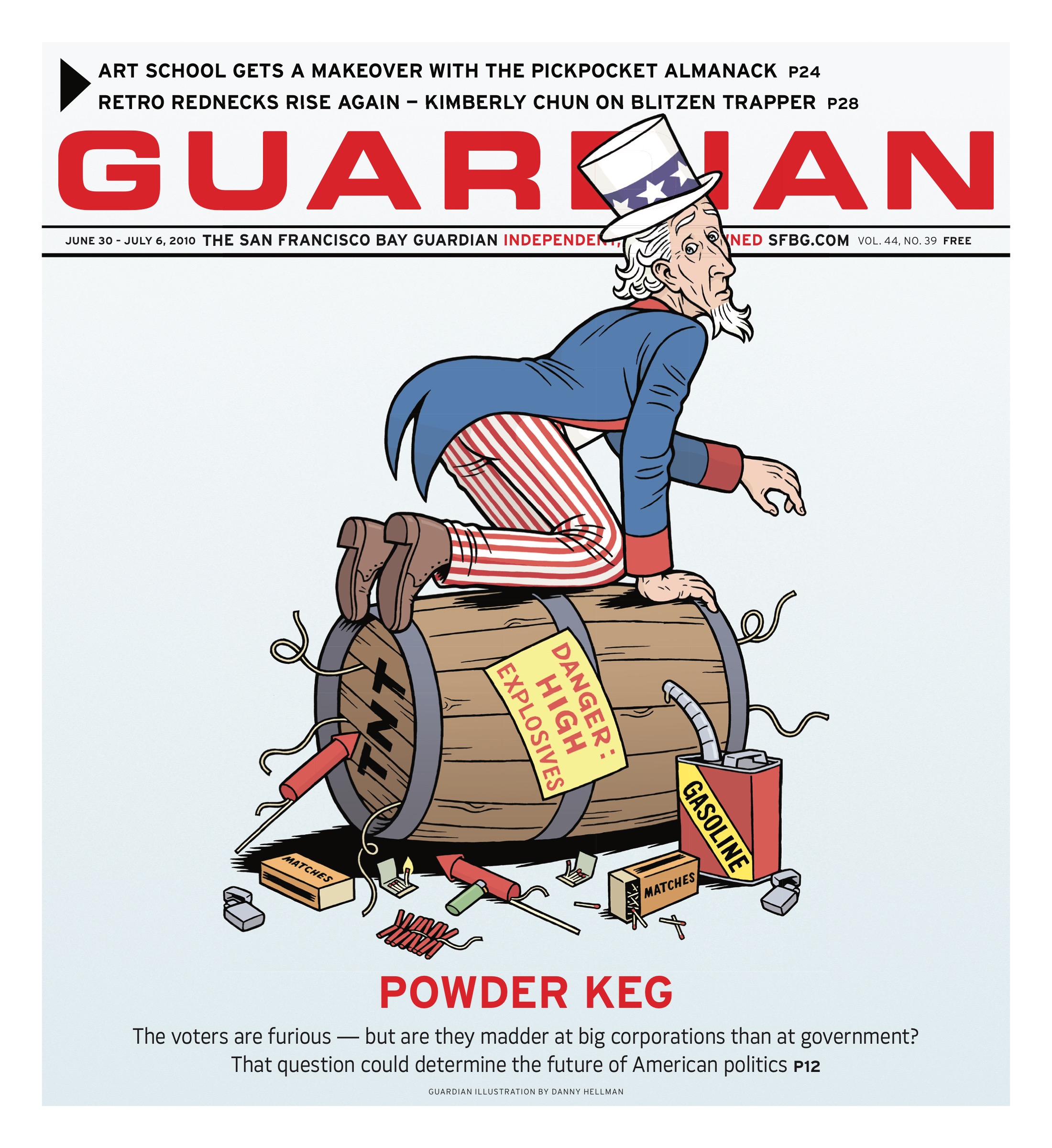
Powder keg

5

news@sfbg.com

Ask any pollster, political consultant, or academic who studies the American electorate about the mood of the voters this year and you’ll get the same one-word answer: Angry.

Everyone’s pissed — the liberals, the conservatives, the moderates, the people who don’t even know where they fit in. It’s an unsettled time and, potentially, very bad news for a progressive agenda that seeks to address issues ranging from poverty and war to the long-term health of the public and the planet.

The Democrats, who swept into power with an enormously popular president just 18 months ago, may lose control of Congress. The tea partiers have driven the Republicans so far to the right that some candidates for Senate are openly talking about eliminating Social Security. The unemployment rate — the single most important factor in the politics of the economy — remains high and doesn’t show any signs of improving.

And the progressive left seems frustrated and demoralized, particularly in California. The Golden State, which once led the nation in innovation and enlightened social policy, now seems to be leading the politically dysfunctional race to the bottom.

The nation could be headed for a dangerous era, rife with the potential for right-wing demagoguery and other nasty political schisms. The state of the economy could easily fuel a more powerful movement to shrink the scope of government and a continuing backlash against the public sector — and the financial backers of the antitax and antiregulation movement are drooling at the prospect.

But there’s also a chance for progressives to seize a populist narrative and shift the discussion away from traditional disagreements and toward those areas, particularly the destructive influence on government by powerful corporations, where the grassroots right and grassroots left might actually agree.

The anger that voters feel toward a government that isn’t meeting their needs is starting to find other outlets. People are as mad about the abuses of big business — the Wall Street meltdown, the bailouts, the BP oil spill, the political manipulation — as they are about the failures of Congress and the president. If you ask Americans of every political stripe who they least trust — big government or big business — even conservatives aren’t so sure anymore.

For 30 years, the central narrative of American politics has revolved around the size and effectiveness of government. Now there’s a chance to shift that entire debate in American politics toward the largely unchecked power of corporations. It is, populist writer Jim Hightower told us, “an enormous opportunity handed to us by the bastards.”

But so far, none of the Democratic leaders in California are taking advantage of it to start dispelling damaging myths and crafting political narratives that might begin to create some popular consensus around how to deal with society’s most pressing problems.


THE PEOPLE WANT TAXES

There have been many polls gauging voter anger, but one of the most comprehensive and interesting recent ones was “Californians and Their Government,” a collaborative study by the Public Policy Institute of California and the James Irvine Foundation that was released in May.

It shows that Californians are mad about the state’s fiscal problems, disgusted with their political leaders, divided by ideology, and deeply conflicted over the best way forward. An astounding 77 percent of respondents say California is headed in the wrong direction and 81 percent say the state budget situation is a “a big problem.”

But the anti-incumbent message isn’t necessarily an anti-government message. Most Californians are willing to put more of their cash into public-sector programs, even during this deep recession. When asked to name the most important issues facing the state, 53 percent mentioned jobs and the economy . The state budget, deficit, and taxes only got the top billing of 15 percent.

And contrary to the conventional wisdom espoused by moderate politicians and political consultants, most voters say they are willing to pay higher taxes to save vital services. “Californians tell us they continue to place a high value on education and want education to be protected from cuts. And they’re willing to commit their money to help fund that,” PPIC director Mark Baldassare told the Guardian.

The survey found that 69 percent of respondents say they would pay higher taxes to protect K-12 education from future cuts, while 54 percent each say they would pay higher taxes to prevent cuts to higher education and to health and human services programs. In other words, voters seem to recognize where we’ve cut too deeply — and where we haven’t cut enough: only 18 percent of respondents would be willing to pay higher taxes to prevent cuts to prisons and corrections.

Baldassare said the June primary results also showed that people are willing to pay more in taxes for the services they value. “Around the state, there was a lot of evidence that people responded favorably to requests by their local governments for money, particularly for schools,” he said.

Both the California Legislature and Gov. Arnold Schwarzenegger are held in very low esteem with voters, according to the PPIC study, and Schwarzenegger’s 23 percent rating is the lowest in the poll’s history.

Barbara O’Connor, political communications professor who heads the Institute for the Study of Politics and the Media at Sacramento State University, told us that voter unhappiness with elected leaders is no surprise. Right now, most people are afraid that their basic needs won’t be met over the long run.

“The common narrative is fear, and fear channels into anger,” O’Conner said.

And that fear is being tapped into strongly this year by the Republican candidates, who are trying to scare voters into embracing their promises to gut government and keep taxes as low as possible.

“If there’s any lesson to be learned from Meg and Carly’s early ads, it’s fear-mongering, fear-mongering all the time — and that doesn’t create a very positive narrative,” O’Connor said of gubernatorial candidate Meg Whitman and U.S. Senate candidate Carly Fiorina.

O’Connor noted that Barack Obama’s campaign had great success in using a positive, hopeful message and said she believes the right leader can also do so in California. “I talked to Jerry [Brown]’s people about it and said you can’t just run a negative campaign because that’s what Meg is doing.”

Despite the tenor of the times, O’Connor said she’s feeling hopeful about hope. She also believes Californians would respond well to a leader like Obama who tried to give them that hope — if only someone like Brown can pick up that mantle. “I think the environment is right for a positive message. But the question is: do we have people capable of delivering it?”

She said the no-new-taxes, dismantle-government rhetoric has started to wear thin with voters. “The real fiscal conservatives are badly outnumbered in Californian,” O’Connor said. As for the corporate sales jobs, O’Connor said voters have really started to wise up. “They aren’t going to be scammed.”

The results of the June primary election showed that voters across the spectrum were also disturbed by big special-interest money. Proposition 16, backed by $46 million from Pacific Gas and Electric Co., went down to defeat — even in counties that tend to vote Republican.

And this fall, with two rich former CEOs spending their personal wealth to win two of California’s top elected offices and energy companies pushing a measure to roll back California’s efforts to combat global warming, there could be great opportunity in a narrative targeting those at the top of our economic system.


THE TOP AND THE BOTTOM

Some observers say that whatever their shared feelings about corporate scams, conservatives and liberals in the state are just too far apart, and that there’s little hope for any substantive agreement. “People are becoming more polarized,” said consultant David Latterman, who often works for downtown candidates and interests. “I think we’re beyond compromise.”

Allen Hoffenblum, a Los Angeles-based Republican strategist, agreed. “The voter are all mad, but they’re mad at different things. I just don’t see where they come together.”

But Hightower, who has spent a lifetime in politics as a journalist, elected official, author, and commentator, has a different analysis.

“As I’ve rambled through life,” he wrote in a recent essay, “I’ve observed that the true political spectrum in our society does not range from right to left, but from top to bottom. This is how America’s economic and political systems really shake out, with each of us located somewhere up or down that spectrum, mostly down.

“Right to left is political theory; top to bottom is the reality we actually experience in our lives every day — and the vast majority of Americans know that they’re not even within shouting distance of the moneyed powers that rule from the top of both systems, whether those elites call themselves conservatives or liberals.”

In an interview, he told us he sees a lot of hope in the fractured and potentially explosive political ethos. “There’s all this anger,” he said. “People don’t know what to do. And I think the one focus that makes sense is the arrogance and abuse of corporate executives.”

In fact, Hightower pointed out, the teabaggers didn’t start out as part of the Republican machinery. “Wall Street and the bailouts sparked the tea bag explosion,” he said. It wasn’t until big right-wing outfits like the Koch brothers, who own oil and timber interests and fund conservative think tanks, started quietly funding tea party rallies that the anti-corporate, anti-imperial edge came off that particular populist uprising.

“At first, the teabaggers didn’t even know where the money was coming from,” Hightower said. “You can’t be mad at the teabaggers; we should have been out there organizing them first.”

There’s plenty of evidence that anger at big business is growing rapidly — and rivals the distrust of big government that has defined so much of American politics in the past 30 years. The bailouts were “the first time in a long time that people have been slapped in the face by collusion between big business and its Washington puppets,” Hightower noted.

Then there’s the Supreme Court decision in Citizens United v. Federal Elections Commission. In January, a sharply divided court ruled 5-4 that corporations had the right to spend unlimited amounts of money supporting or opposing political candidates. Progressives were, of course, outraged — but conservatives were, too.

Polls show that more than 80 percent of Democrats think the decision should be overturned. So do 76 percent of Republicans. “This is a winner for our side,” Hightower noted. “But our side’s not doing anything about it.”

Sure, President Obama denounced the ruling in his State of the Union speech and promised reform. But the bill the Democrats have offered in response does nothing to stop the flow of money; it would only increase disclosure requirements. And in response to furor from the National Rifle Association, it’s been amended and is now so full of holes that it doesn’t do much of anything.

Political consultants advising Whitman are clearly looking for ways to direct the voter unhappiness into a demand for lower taxes and smaller budgets. She’s already vowed to fire 40,000 state workers, and her most recent campaign ad attacks Brown for expanding public programs and raising the state deficit.

So far Brown hasn’t challenged that narrative — and some Democrats say he shouldn’t. It would be safer, they say, for Brown to get out front and demand his own cuts in Sacramento. “Going after public-sector pensions is a winner,” one Democratic campaign consultant, who asked not to be named, told us. “If Whitman beats Brown on those issues, she wins.”

But that approach is never going to be effective for Democrats. If the argument is over who can better cut government spending, the GOP candidates will always win. The better approach is to see if progressives can’t shift the debate — and the anger — toward the private sector.

As Hightower put it: “You can yell yourself red-faced at Congress critters you don’t like and demand a government so small that it’d fit in the backroom of Billy Bob’s Bait Shop and Sushi Stand, but you won’t be touching the corporate and financial powers behind the throne.”

That’s where the discussion has to start. And there’s no better place than California.

The Golden State is a great example of what happens when the tax- cutters win. In 1978, the liberals in Sacramento, operating with a huge state budget surplus, couldn’t figure out how to derail the populist anger of property tax hikes. So Proposition 13, the beginning of the great tax revolt, passed overwhelmingly. Over the next decade, more antitax initiatives went before the voters, and all were approved.

Now the state is heading toward fiscal disaster. The schools are among the worst-funded in the nation. The world-famous University of California system is on the brink of collapse. Community colleges are turning away students. The credit rating on California bonds have fallen so far that it’s hard for the state to borrow money. And there’s still a huge budget gap.

The tax-cut mentality that led to the so-called Reagan revolution started in California; a political movement that shifts the blame for many of the state’s problems away from government and onto big business ought to be able to start here as well. And it’s potentially a movement that could bring together people who normally find themselves on opposite sides of the fence.

A case in point: the measure the oil companies have put on the November ballot to repeal the state’s greenhouse gas limits. The corporations backing the initiative, led by Valero, argue that California’s attempts to slow climate change will cost jobs. That’s a line we’ve heard for decades. Every tax cut, every move toward deregulation, is defended as helping spur job growth.

But the past four presidents have done nothing but cut taxes and reduce regulations — and the result is facing Americans on the streets every day. There is also growing evidence that even Republican voters don’t believe everything big businesses tell them anymore. And they’re starting to grasp that sometimes deregulation leads to outcomes like larcenous CEOs and unstoppable oil leaks.

So the potential for a successful progressive populist movement is out there. But it’s not going to happen by spontaneous combustion.


SF SHOWS THE WAY

On the national level, one of the factors creating this gloomy electorate is the failure of President Obama to keep the coalition that elected him active and engaged. The intense partisanship in Washinton has turned off many independent Obama voters, while his progressive supporters have been disappointed by issues ranging from his escalation in Afghanistan to tepid reforms on health care and Wall Street.

“One of the narratives now is where are the Obama voters and will they participate?” Jim Stearns, a San Francisco political consultant who works mostly on progressive campaigns, told us. “They still love Obama but they’re not moved by him anymore.”

Perhaps more important, they have lost the sense of hope that he once instilled. The Republican Party’s descent into right-wing extremism and the strong anticorporate narratives that have emerged in the last year — from BP’s oil spill to PG&E’s political manipulation to Goldman Sachs’ self-dealing to the prospect of unrestricted corporate campaign propaganda unleashed by the Citizens United ruling — have created the possibility that the negative narratives by the left may crowd out the positive ones.

“Meg Whitman is someone you can hate. She’s the rich Republican CEO trying to buy her way into office,” Stearns said. “But it’s a depressing message.”

But Stearns said there is another, most hopeful political narrative that is emerging in San Francisco, one that might eventually grow into a model that could be used at the state and federal levels. “We’re lucky in San Francisco. Progressive voters are engaged.”

He noted that San Francisco’s voter turnout was higher than expected in the June primary, and far higher than the record low state number, even though there really weren’t any exciting propositions or closely contested races on the local ballot — except for the Democratic County Central Committee, where progressives maintained their newfound control. And it’s because of the organizing and coalition-building that the left has done.

“What you’ve seen over the last few years is a coalition of labor, neighborhood groups, environmentalists, and the progressives now operating through the Democratic Party. That’s a great coalition with a lot for people to trust,” Stearns said.

Meanwhile, downtown has all but collapsed as a unified political force. “They don’t really have a political infrastructure,” Stearns said of downtown. “Normally it would be the mayor who gets everyone in line and working together.”

Even Latterman, the downtown-oriented consultant, agrees that the business community is no longer setting San Francisco’s agenda because it’s become fractured and unable to push a consistent political narrative: “There’s certainly been a lack of coordination.”

He also agrees that progressives have become more organized and effective. “Clearly, the Democratic Party of San Francisco has become a conduit for progressive politics and politicians, but not issues,” Latterman said. “What a lot of people get wrong in the city is the difference between politics and policy.”

Part of the reason is economic. With scarce resources, a high threshold for approving new revenue sources, and a fiscally conservative mayor unwilling to talk taxes, it’s been difficult to move a progressive agenda for San Francisco. And in Sacramento, it’s barely part of the discussions.

“The people of California have been held hostage by a handful of Republicans who are making us cut everything we care about,” while in San Francisco “Newsom is taking an entirely Republican approach to the budget,” Stearns said.

Looking toward the fall races, Stearns said the progressive coalition and majority on the Board of Supervisors will be tested on issues such as Muni reform, and the question will be whether fiscal conservatives like Sup. Sean Elsbernd can blame Muni’s problems on drivers, or whether progressives can create and sell a broader package that includes new revenue and governance reforms.

“The drivers are going to get their guarantee taken out of the charter, that’s going to happen. But people know that isn’t all that’s wrong with Muni,” Stearns said.

But to craft a more comprehensive solution, he said the progressives are going to need to use their growing coalition to connect the dots for voters. “We need to run a citywide campaign around a whole constellation of issues,” Stearns said, citing Muni, schools, taxes, resistance to mean-spirited measures like sit-lie, and the larger issues raised by the Brown and Barbara Boxer campaigns. “We need to figure out a way to put all that in the same coalition and run one campaign around it. And we can do that because progressives retained control of the DCCC.”


THE STRUGGLE AHEAD

Although they’ve made great strides, San Francisco progressives are still struggling with a mayor who sees the solution to every budget crisis as cuts — and with a growing number of efforts to blame public employees for the city’s fiscal problems. Even Jeff Adachi, the public defender once considered a standard-bearer for progressive causes, is pushing a ballot measure that would require city workers to pay more for their pensions.

Gabriel Haaland, who works with Service Employees International Union Local 1021, made the right point in the pension debate. “Big financial institutions crashed the stock market,” he said recently, “and now they want to blame city workers.”

In a blog post on the political website Calitics, Robert Cruickshank put it clearly: “The notion that ‘everyone needs to give back’ just doesn’t make sense given our economic distress. We’ve already given back too much. We gave back our wages. We gave back our ability to afford health care and housing and transportation. We gave back the robust public- sector services that created widespread prosperity in the 1950s and 1960s. We gave back affordable, quality education. And too many of us have given back our future.

“No, it’s time for someone else to give back. It’s time for the wealthiest Californians and the large corporations to give back. For 30 years now they have benefited from economic policy designed to take money and benefits from the rest of us and give it to those who already have wealth and power.”

That’s a message that ought to appeal to anyone who’s hurting from this recession. It ought to cross red and blue lines. It ought to be the mantra of a new progressive populism that can channel voter anger toward the proper target: the big corporations that created the problems that are making us all miserable.

If Jerry Brown could adopt that narrative, he could change the state of California — and the state of the nation.


REELing against the tide

0

In a world of relative cinema-watching convenience, with Netflix and Blockbuster By Mail, the quirky neighborhood video rental store is going the way of the record store and the dodo. However, the East Bay still houses at least one fantastic holdout, REEL Video, located on Shattuck Ave. in Berkeley. But perhaps not for long — despite REEL’s unique stock and organization, it is in fact owned by Hollywood Video, which recently filed for bankruptcy and announced the liquidation of all its stores. Over the past few weeks, REEL was suddenly plastered with fliers addressing frequently-asked questions about the store’s imminent closure, and calling for customer input on the store’s uncertain future.


Thanks to its impressive Netflix-besting selection (a VHS copy of 1965’s Chimes at Midnight!) and its invitingly idiosyncratic shelving categories (e.g. “Your Mom,”” “So Bad It’s Half Off,” “One Man Army,” “British Television,” “Werner Herzog,” “Bromance”), REEL is a staple of the Berkeley film-buff/geek/cultist community. With a section devoted specifically to the beloved Criterion Collection, and a broad array of international cinema, it’s a great resource for UC Berkeley students studying film or just looking for a crazy popcorn movie on a Friday night (Black Gestapo, anyone?).

The latest press release from REEL details a proposed future for the store, wherein it would become “ a community movie education and gathering place in addition to its on-going video rental business.” REEL’s employees and other champions are seeking “angel investors” to help purchase the video collection and lease the store grounds, in preparation for their newly conceived “potentially non-profit” status.

On or around Wednesday, June 23, REEL launched www.savereelvideo.com; they’ve also set up SaveReelVideo@gmail.com for interested customers to communicate with the store’s management.

Get on this, people! A genuine outpost of cultural weirdness and passion is about to be subsumed by the tide. It seems these are slowly dissipating, at least in the non-virtual world, so we have to save what we can.

Tripping angles at the Exploratorium’s “Geometry Playground”

0

“We had to create something that never has been done before, but that people can use in an instant, and provides a transformative educational experience.” Peggy Monahan, project director at the Exploratorium, is taking me through the “Geometry Playground” two days before the exhibit opens to the public. Its an interactive math learning wonderland that her team has been working on for the past three years. I hate math, but the exhibit, which opens Fri/25, seems to have the power to make me think about geometry without that irritating urge to put my head on my desk and sleep that math tends to compel in the less numerically inclined among us.

Of course, it helps that there’s a big ass structure to play on. “This is the gyroid,” Monahan tells me. There’s no need to explain, actually, because her cohort has been hyping me about this 10 foot by 10 foot by 10 foot thing since before I arrived at the exhibit. “The gyroid is an unexpected, almost maze-like structure,” says Thomas Rockwell, an ex-playground designer who helped to mastermind the concept of the exhibit. “Two people can enter it next to each other, climb through it, and emerge on the other side without every having been in the same space.”

Sound like an acid trip? It looks like one, too. The Gyroid was made by Exploratorium “math genuis” (according to Monahan) Paul Stepahin, and exhibit developer Eric Dimond from a shape defined by a NASA scientist looking for structurally sound forms.

An exhibition technician puts the final touches on “Geometry Playground.” Photo by Caitlin Donohue

It’s a single surface, just whorling and swirling and segmented into tesselated “chips,” dubbed thusly by the Exploratorium ladies and gents because of the way they arrived at the museum, stacked in boxes like so many Pringles. It’s also super fun to climb in and on – its height makes for a perfect spot to sit and contemplate the museum’s buzzy air of science discovery.

Also on the scene; a play structure of stellated rhombic dodecahedrons, an anamorphic hopscotch court and chair that, though skewed crazily when viewed by the human eye, form perfect right angles in warped mirror columns placed nearby. A gear cube with eight interlocking components grinds toothily, improbably, when you turn the crank, the whole configuration forming a perfect cube once in a cycle.

“Geometry Playground,” on the whole, leaves a pretty wild impression. And that’s the point; it’s supposed to reawaken our natural interest in problem solving. “We all are natural geometers,”  Rockwell tells me over the phone. He sought funding for the exhibit from the National Science Foundation and the Gordon and Betty Moore Fund when he decided he wanted to make something “beautiful with mathematics,” like the Moorish architecture he saw when he was younger in Grenada, Spain. 

“I think geometry is something people naturally like to do. People love things like solving puzzles, building things, making dresses, knitting things.” Rockwell hopes the exhibit will also inspire educators to capitalize on students’ natural awe of shapes and angles. “When we teach [geometry] in school, we teach with numbers and problems,” Rockwell says. “We want educators to realize that there’s math education potential in all kinds of activities.” Like messing with hallucinatory playthings three years in the making. I’m not going to be doing better on my taxes any time soon, but that’s a good time on my abacus.


“Geometry Playground”

opens Fri/25 (through Sept. 6), $15

Exploratorium

3601 Lyon, SF

(415) 561-0360

www.exploratorium.edu

Benefits: June 23-June 29

0

Ways to have fun while giving back this week


Wednesday, June 23

Water Bond Happy Hour
Join the Food and Water Watch team in helping to get people to vote NO on the California Water Bond, which will appear on the November ballot. Meet other people who care about the issues and discuss a sustainable water future for California and how water issues effect us all. Featuring stainless steel water bottle raffles to benefit Food and Water Watch, a local non-profit corporate accountability organization.
6 p.m., free
Elixer Bar
3200 16th St., SF
www.foodandwaterwatch.org

Thursday, June 24

Ecocity Builders Art Auction
Ecocity Builders is a non-profit dedicated to reshaping cities, towns, and villages for the long-term health of human and natural systems. Attend this slient art auction to help raise funds for Ecocity featuring hors d’oeuveres and an artist talk with Richard Register.
6 p.m.; $50 donation, fee goes towards bidding
SPUR Urban Center
654 Mission, SF
(510) 452-9522
www.ecocitybuilders.org

Saturday, June 26

Like Water for Chocolate
Inspired by chapter three of Laura Esquivel’s acclaimed novel, Like Water for Chocolate, this fundraiser will feature the spice of Mexico and the heat of love simmering in this fusion of food and performance. Proceeds to benefit Word for Word and Z Space. There is no parking at the performance site. Guests should park at the Mill Valley Middle School parking lot, where they will be shuttled to Hillside Gardens starting at 4:15 p.m. The event will be held outdoors, so dress warmly and comfortably.
5 p.m., $250
Hillside Gardens, Mill Valley
via Mill Valley Middle School
425 Sycamore, Mill Valley
(415) 626-0453


Walk in the Wild
Attend the Oakland Zoo’s annual fundraiser featuing vendors from over 90 restauants, caterers, bakeries, wineries, and breweries offering beverages and cuisine to be enjoyed while walking around the zoo and live music and dancing. Proceeds support the Oakland Zoo’s conservation, education, and animal enrichment programs. This event is 21 and over.
5 p.m., $150
Oakland Zoo
9777 Golf Links Road, Oakl.
www.oaklandzoo.org
(510) 632-9525

Sunday, June 27

Fundraiser for Alan
Alan, who has worked as a waiter at the historic Old Clamhouse in Bayview for 12 years, was one of the four cyclist who were purposely run down by a driver on June 2nd in the Mission and Potrero Hill neighborhoods. Alan has severe injuries to his head and face and has had to undergo 14 hours of surgery. Help raise money for his medical bills at this fundraiser where a door donation of $20 gets you a plate of food from the buffet, one free drink, and two raffle tickets. Featuring live music and a DJ.
3 p.m., $20 donation
The Old Clamhouse
299 Bayshore, SF
(415) 826-4880


Monday, June 28

Honduras Resiste
Watch three videos presented by the Bay Area Latin America Solidarity Coalition (BALASC) on the one year military coup that happened in Honduras in 2009,starting with The Coup and the Popular Resistance, followed by Exposing a Fraudulent Election, and ending with False Democracy in Honduras, and the U.S. Complicity.  Proceeds to benefit the Popular Resistance in Honduras.
8 p.m., $6
Artists’ Television Access
992 Valencia, SF
http://balasc.org

The San Francisco Bay Guardian Presents: The Best of the Bay Rock Party!

0

Celebrating San Francisco values and the local heroes that represent them!

August 5th, 2010
Doors at 9PM – No Cover

Mezzanine
444 Jessie Street, San Francisco

Chuck Prophet – Headliner

Chuck Prophet shapes his restless career with inimitable subtle flair: a vivid parade of razor-edged one-liners camouflaged in a slack-jawed drawl, songs about heartbreak and everyman heroism, drenched in twisted lines of rude Telecaster.

Stephanie Finch and The Company Men
Stephanie Finch has recently released her new cd ‘Cry Tomorrow,’ a casually stunning love letter to classic song. An album whose sound recalls ‘Loaded’ era Velvet Underground tunes alongside The Modern Lovers and Brill Building pop. But ultimately all revolves around Stephanie Finch’s relaxed, cool, confident presence.  Produced by Chuck Prophet and backed by The Company Men: Prophet, Kelley Stoltz, and Rusty Miller. ‘Cry Tomorrow’ is an instant classic.

Stephanie’s already sung her roots out with Chuck Prophet.  And she has whispered softly with Red House Painters, on ‘Songs for a Blue Guitar’ with Mark Kozelek.  She also popped up as a cameo on the odd tribute for Joe South, and on the soundtrack to Sign Of God with Jonathon Richman. (If your cable’s paid up, you may have seen her playing Judy Collins in HBO’s Chicago 7 biopic).


The Bitter Honeys – Opening

The Bitter Honeys will be opening the show; performing their own original songs, inspired by the vocal harmony groups of the early and mid sixties.

MCing – The Freeze

The Freeze is a stage show like no other.  Six performers will take the crowd on a non-stop, hip-hop improv ride, spinning cues from the audience into instantaneous lyrics and fully realized musical numbers. An MC, a vocalist, and a live band make for an evening of live, kick-ass theater.  Founded by Freestyle Love Supreme’s Anthony Veneziale and the talents of Daveed Diggs (The Getback), Andrew Bancroft (aka Jelly Donut of Killing My Lobster), and Olive Mitra on bass, Mike “Agent” Smith on guitar, and Brian Rodvien on drums.  In simple terms, it’s the Wu Tang Clan meets Who’s Line is it Anyway in a live improvised rap concert. 

DJ set by DJ Ome

August marks the release of KFOG‘s Local Scene 7 CD, a collection of songs from talented musicians living and working in the San Francisco Bay Area that need to be heard.  (Best of the Bay Party headliner, Chuck Prophet, has been prominently featured on past discs, contributing tracks to volumes 1 and 2.)  Proceeds from CD sales benefit Music in Schools Today, a local non-profit that supports, develops and promotes music education for youth in schools and in the community.  Buy your CD for just $5 at the Best of the Bay Rock Party!

Photography by Liza Gershman.  Photobooth by Polite in Public.

In 1974 the Guardian blazed a trail by being the first paper to present “best of” awards. Every year since then we’ve given Best of the Bay recognition to the people, places, and things that make the Bay Area great.

Our 2010 Best of the Bay winners will be revealed in the Guardian’s July 28th issue and will include our annual Readers Poll which categories include: Food and Drink, Arts and Nightlife, Shopping, City Living, and a special reader’s own “Best of the Best.”

Hot sexy events: June 23-29

0

After what seems like months of pre parties, Pride has finally strapped on its bedazzled platforms and waltzed into our lives, so y’all are probs up to your ears in sexy this week. (If you’re not, be sure you head over to this week’s SFBG rundown of all things to be Proud of). But – sigh – soldier on we must! Here’s a few choice flakes from the snow storm of flesh that will soon envelope us all.


Annie Sprinkle and Beth Stephens: “Sybaritic Cougars with Ecosexual Tendencies”

Annie Sprinkle has done it all, and she’s done it all on camera. The feminist porn star started flashing those big old breasties back in the ‘70s, and god damn it, she’s earned the right to create whole new sexualities – the lady must get bored sometime! She and partner Beth Stephens have developed an art form surrounding “ecosexuality,” the sensual love of earth and sea that has them staging elaborate art weddings to mountains and ocean all over this crazy globe. Check out what they’ve been up to at this exhibit. Ooo, and check out what went down when I went to hang at her house the other week, while you’re at it.

Thurs/24 6-8 p.m., free

Good Vibrations

1620 Polk, SF

(415) 345-0400

www.goodvibes.com


G.A. Hauser

How does a lady write such hot, steaming gay romance? Must be an ardent lover of the adventures of the shaft. But the author of such bestsellers as Getting it in the End, Driving Hard, and Leather Boys does quite well for her and her sticky fingered readers – and she’s making a Pride week appearance to sign some new and lightly used literature. Hit her up between happy hour and your Thursday night romp of choice.

Thurs/24 7:30 p.m., free

A Different Light Bookstore

489 Castro, SF

(415) 431-0891

www.adleventscastro.blogspot.com


Faetopia Festival: Cunt for Fags

Oh lord, what is that? That, my friend, is what we call a vulva. I know that here in town we are blessed with quite a few gentlemen that are unacquainted with its charms, but c’mon guys – human body beautiful, education is power, etc., etc. Playa players Comfort and Joy is organizing this class geared at male homos that explains the intricacies of that whorled conch that each bio femme carries around with her. It’ll be enlightening, it’ll be squishy, it’ll make them less scary. Or you’ll be traumatized. Either way…

Fri/25 12:30-2 p.m., $15

Old Castro Tower Records building

2278 Market, SF

www.playajoy.org


Pink Pleasure Party

So you’ve taken in the Dyke March, and it was fantabulous – but where did that float inhabitant get that wonderful Mustang Vix Skin for her strap on? Good Vibes has all you need in the way of dyke-y glory, plus their post parade party is just a hop, skip, and a jump from the parade route. DJs, snacks, and prizes galore. And no cover, Hallelujah!

Sat/26 8-10 p.m., free

Good Vibrations

603 Valencia, SF

(415) 522-5460

www.goodvibes.com


San Fransexual

What’s up with all the labels? Can’t we just stick what we want, where we want, without worrying about what kind of “sexual” it is? Mission Control and Kinky Salon are here to tell you that you sure can; in fact, that’s the San Francisco way. So come on through, and get all inclusive with your loving at this party. Wear your latex, leather, and lace – just no street clothes please, this is the city of freak fashion we’re talking about here.

Sat/26 10 p.m.- 4 a.m., $25-30

Mission Control

2519 Mission, SF

(415) 

www.kinkysalon.com


Post Pride Cool Down Party

What does it mean, exactly, when the SF Citadel hosts an event that is “not a play party”? Ostensibly, it should imply there’s no BDSM romping going on, but at this particular post Pride “cool down,” there will be all the Citadel regulars showing off their skills – piercing demonstration, suspension performance, primal play and all – and naked people are definitely not a no-no. The event announcement is also quick to note that “naughty behavior [is] always welcome at the Citadel.” I say, carry on as you will, no one’s watching. Actually, a lot of people will be, but you know what I’m saying.

Sun/27 5-9 p.m., $10

SF Citadel

1277 Mission, SF

(415) 626 1746

www.sfcitadel.org


Frameline34: Local drama “The Stranger in Us”

0

Local filmmaker Scott Boswell may not have set out to make the film he ended up with, but he stands behind the finished product. The Stranger In Us stars ShortbusRaphael Barker as Anthony, a young man who moves from Virginia to San Francisco in order to live with his boyfriend Stephen (Scott Cox). When the relationship turns violent, Anthony finds solace in his friendship with Gavin (Adam Perez), an underage street huster. I spoke to Boswell and Barker about the film’s origins, its unique content, and what this year’s San Francisco International LGBT Film Festival says about the future of queer cinema.

San Francisco Bay Guardian: What was your inspiration for The Stranger In Us? Where did the story come from?

Scott Boswell: Ultimately the story ended up being fairly autobiographical. But it started in a different place. Originally — and Raphael knows this because we talked about it — originally, I had intended to do a much more experimental film, kind of a hybrid documentary-narrative, because of my fascination with the Polk Street, Tenderloin area, which I’ve always had since I moved here in the mid ‘90s. I had considered doing a bit of a portrait of the neighborhood, and kind of infusing actors into it, just shooting a lot of footage and seeing what we came up with. There’s a part of me that wishes I had still done that, but in all honesty, I can say that after Raphael expressed some interest in the project, I suddenly felt like it needed to be more narrative in its scope. He didn’t suggest that. It was just my intuition around the project. So I had been talking to him about doing it for months, without even having a complete script, and continued writing it and auditioning actors. Eventually it became much more traditional in terms of its narrative. It became what it is now.

SFBG: And Raphael, what brought you onto the project?

Raphael Barker: Scott. There wasn’t really a finished script and a lot of it was sort of up in the air, but I was just really comfortable with the process and how it evolved, because it was Scott. He and I just hit it off really well.

SFBG: Did you collaborate at all in terms of creating the character of Anthony or writing the script?

SB: Not so much on the script. I run a screenwriting group, here in the city. It’s a small group and we meet a couple times a month, and they had the most impact on the final script. However, there are quite a few places in the script where it suddenly says, “We’re gonna improv here.” And there are definitely scenes where the actors brought the dialog to the scene. Quite a few, actually, especially between his character and Gavin, the street kid. Largely because they had such wonderful chemistry, and I felt like I could trust them to pull it off.

SFBG: Raphael, can you talk about how the improv process was, as an actor?

RB: Scott would set up the scene and then let us go, and just see what happens. And then would make comments as necessary and readjustments. But I felt very free to just let the scene kind of take over and do its thing. I think Scott and I are just both very instinctual. Like, “That’s not how I planned it, but I kind of like it that way. Let’s play with that.” I think especially when you’re talking about Gavin, there was something almost unwritten about our relationship that was allowed to evolve through improv.

SB: Right, because there’s a piece that’s semi-autobiographical that has a place in history, and then there’s the piece that — I feel like Gavin’s character brings a newness, a sort of unfinished, still to be defined ending. There was something about the energy that really brought novelty to the script.

SFBG: You said originally you wanted to showcase this particular neighborhood in your film, and then it became more of a narrative. But it’s still a very San Francisco film. How did you go about capturing that?

SB: The main thing was choosing that location as his studio that he moves into after leaving Stephen, which actually wasn’t true to my experience. However, the person on which Stephen is most based actually lives there, so I kind of flipped it. And the character on whom Gavin is based actually hung out in the Castro, not the Tenderloin. So I flipped those around, and then because the character is so stuck and lost and wandering, he was able to go out into the street and that became the portrait of the neighborhood right there. We had spent a lot of time trying to work out just how we were going to portray that, and ultimately he’s always in the space. I actually did go out and shoot footage of the neighborhood without Raphael, and none of that is in the film.

SFBG: Anthony moves to San Francisco from Virginia, so he’s experiencing the city from an outsider’s perspective. Why did you decide to write him that way? And Raphael, how did that affect your performance?

SB: I think it’s a very common experience in San Francisco. It seems like the majority of people I meet here have migrated from somewhere else. And I think especially for gay men, when we arrive here, we don’t always quite find what we’re expecting, and especially for queer youth, which is an idea that Gavin embodies. I’m very interested in that sort of push-pull between the desire to be in the city of San Francisco and the challenges that you can face when you arrive. So I was interested in exploring that experience, and I’ve found subsequently that quite a few people — they’re almost always gay men — have come to me and said that they relate to that experience. Different generations of men, and different decades of coming here. It seems to be a continuing phenomenon in a way. In that sense, I think it’s very much a San Francisco story, even though it could probably happen in just about any urban area, especially when someone who doesn’t have experience in an urban environment suddenly arrives and is just thrown into it.

RB: I experienced something very similar coming out here to chase after someone I was pretty in love with, and then being dumped like a week and a half after moving here. And just feeling like I didn’t have that orientation anymore, and everything in the city was associated with this person. I’m sure I’ve one of millions of stories of people — with San Francisco being a kind of pilgrimage, then as soon as we get here we complain about it. But we wouldn’t want to be anywhere else, so there’s kind of that love-hate relationship with it. So I could definitely relate to coming out here to be with someone and having all that kind of expectation and hope, and then me kind of losing that central focus and orientation and realizing, “Now what?” I think that’s a theme that’s not just gay or even queer, but it seems like anyone I talk to who comes from a different place has that similar experience. They knew they needed to be out of wherever they were at, but they weren’t sure what they were exactly coming into.

SFBG: The film also deals with an abusive relationship, which is something we don’t see a lot of in queer cinema. I was wondering why you think that is, and also why you wanted to include it in your movie?

SB: I don’t know why it is, but because it is [not often seen] is one of the main reasons I wanted to include it. Hustlers and street kids appear in a lot of gay cinema  — and just to go down that tangent for a second — which is why I chose to not make that character the protagonist but a supporting role. In terms of same sex domestic violence, it is an issue that permeates probably just about any community, but I have seen and heard very little about it among same sex couples. There are some things, some things written and there’s an organization in San Francisco called Community United Against Violence that works to combat and end violence. So there are resources out there, but I wanted to explore it because it’s an issue that’s personal for me, on several levels. It’s something that I’ve experienced and it’s also something that I just personally have always cared about. I volunteered to do work at battered women’s shelters in the past—this was actually in Madison, Wisconsin, long before I’d ever had any kind of experience with it. What I find really interesting is the degree to which people don’t really understand it. No one thinks they’re going to enter a relationship like that. I certainly didn’t think so. I thought I understood it.

RB: Much less something that’s so countercultural in some sense.

SB: Yes, exactly.

RB: Like, “Oh, if I can requite this kind of relationship, that’s kind of the end game.”

SB: The thing is you don’t necessarily recognize it when you’re there. People always say, many people say and have said about this film, “Why does he stay? Why doesn’t he leave?” It’s interesting that people continue to not understand that issue, because it’s clearly a very common human experience. So I guess in a sense, that question to me opens up a dialog on the issue that I find very important. I’ve been asked that a lot from people, and so far, that’s only come from the very limited number of people who have seen [the film].

SFBG: Well, without sounding like I’m trying to justify the abuse at all, these characters are complex enough that you get a sense of why they’re together. You can see how they got to that point. How did you go about creating that, and making sure they weren’t too clear cut or one-dimensional?

RB: I think to show just how much we loved each other is one way to do it.

SB: Yeah, that was important. I approached this very much as a character piece. I mean, that’s what interests me as a filmmaker and as a writer. In terms of the kind of genres I might be able to work in, I think it’s an area I probably have more of a knack for. But I think it’s true for any genre you’re working in, you have to rewrite. You have to be able to get down the ideas and the scenes on paper, and then take a look at them and be open to feedback. And assessing where it is that they’re black-and-white or flat and one-dimensional, and trying to create scenes that are more organic and layered. So that’s what we did. Once I knew what the story was, it still took me a good nine months to write the thing before we started shooting.

SFBG: One last, much broader question. How have you seen queer cinema change over the years, and what is the direction that you see it taking?

SB: In just the past few days, in the films that I’ve seen at Frameline this year, I’m very excited. I think queer cinema has gotten better and better. I have reaffirmed my understanding of the necessity of LGBT festivals, because it has definitely gone through phases. There was kind of an indie new queer cinema in the early ‘90s, when Gus Van Sant was coming on the scene, and Gregg Arraki and Todd Haynes. Then in the later ‘90s and maybe early 2000s, it kind of evolved into a lighter, more mainstream cinema, which I actually don’t relate to as much. But the best of them are actually quite good. What I’ve seen more recently, and I hope our film falls into that, is really kind of the ability to look more closely at ourselves and tell our own stories without any kind of concern about the broader mainstream appeal. I know that those kinds of films still exist. I think that independent cinema has gotten to a place where it’s not just simply seeing ourselves portrayed on screen anymore, but it has to be good cinema now.

RB: I saw a lot of films at the Frameline festival two or three years ago when the documentary about the making of Shortbus came out, and it just made me realize that the quality — instead of it being a kind of niche genre, I don’t want to say the opposite of what you’re saying, but I almost see Frameline as becoming redundant, because the films are good enough to stand on their own. They don’t have to be a genre film or a niche or a sexuality genre film. We have to keep working and working toward the specific, and then eventually the specific becomes universal. And I think that’s the beauty of the films that are starting to come out. In the Frameline context, it’s going to actually make it almost redundant because they’re just going to be good films, period. That’s what excites me, because everyone’s experience is so unique. And sure, we’re working within paradigms and categories, but I think it’s just getting better.

SB: It’s interesting looking at where these films fit in in terms of festivals and markets and things like that. I guess what I was trying to say is that I feel like Frameline still needs to be around in order for these films to get shown, because they’re not all going to fit into SF International, they’re not all going to fit into all of the big festivals. The sort of bigger queer films coming out may not need Frameline. There have been a quite a few in recent years: Bad Education, Mysterious Skin, Capote. They’re playing at the bigger festivals or getting distribution without festivals. There is sort of a distinction there. But when I see something like I Killed My Mother, which just kind of knocked me on my ass because I thought it was so brilliant, I don’t know where else I would have seen it.

THE STRANGER IN US

Wed/23, 6:45 p.m., Roxie

Fri/25, 11 a.m., Castro

www.frameline.org


Native American artists take back culture of their art

0

“Museums are, historically, piles of loots with a roof on them,” says Kim Shuck as she carefully beads a black raven onto the back of a pow-wow vest in the de Young’s Kimball education gallery. I go to touch her intricate stitching, then draw my hand back. Shuck is telling me about her work’s cultural significance, the struggle of the Native American community to coexist with the white art world. Am I really about to manhandle her sacred creation? “I appreciate your impulse to touch, and then not be sure if you can,” she says laughing, as she grants her approval for me to poke and prod the curving lines of tiny beads. Moments like these are what her current project’s about – exposing folks to indigenous art, and teaching them the limits and guidelines to their interaction with it.

Shuck co founded the museum’s Native American Programs Board five years ago to address concerns from the indigenous community that their tribes’ artifacts were being treated disrespectfully by the museum. The board’s efforts have birthed a change in the way the de Young curates its Native American art – a change embodied in Shuck and artist Michael Horses’ living art display, which includes studio space so that visitors can interact with the artists as they continue to create. The work is been shown at the museum through Sun/27 and on Fri/25 they’ll celebrate the space with a closing reception. 

Horse and Shuck’s work, steeped in traditional mediums, is nonetheless an expression of Native Americans in the modern world. Horse is an imposing man who has been an activist since the days of the 1969-’71 Alcatraz occupation, owns Gathering Tribes gallery with his wife, and is a multi generation jewelery maker. He also played Deputy Hawk on TV’s “Twin Peaks.” His contribution to the exhibit, besides his silver kachina doll rings, is ledger art – traditional form paintings that he etches onto documents from the early 21st century days of Native American resettlement. In one farm, cavalry dashes across the canvas blasting horseback native warriors with their muskets. It is painted onto a general store’s ledger from the late 1800s, a clear comment on the presence of commerce in the tribe’s land. The artist periodically invite dancer friends to bless the space, creating kind of a party atmosphere. “We have people stop by here all the time, just to come see us,” says Shuck.

“Being an indigenous person is a constant state of explanation,” says artist Michael Horse of his modern day take on Native American resettlement. Photo by Caitlin Donohue

The basic problem their advisory board was formed to address, as Shuck and Horse expressed to me, is that many of the cultural objects that museums display as static art pieces were never meant to sit under a glass case. Native American art can be very place specific. Some accessories and apparel was painstakingly hand made to be used in special ceremonies, and not viewed by the public at all. To show a piece correctly, one must be aware of its nuances, and respectful of the object’s spirit and purpose. Moreover, the way Western institutions have “gathered” items in the past is a cause of great concern. “I don’t go into some of the cemeteries here and dig up Grandma because I want to see what pearls she wore,” Horse tells me.

But the de Young, to its credit, is one institution that is examining its collection, and seeking ways to collaborate with community members on its presentation and treatment. After the museum fielded a series of complaints from Native American activists on the way their heritage was being displayed, de Young director of public programs Renee Baldocchi contacted Shuck, an artist-professor that was active in SF State’s pioneering Native Studies program, for help. Understandably, Shuck was initially a bit distrustful of the olive branch the museum was extending.

“She wouldn’t even look me in the eye when we shook hands,” Baldocchi tells me. “But something happened, and a relationship was formed.” Shuck was struggling with anger about how her culture’s art had been treated in the past, but saw a benefit in working on change in the future. “Do we release [this art], ignore it, pretend it doesn’t exist? Some people do that, but it’s not my modality,” she tells me. A challenging partnership was born.

When the temporary storage of an important collection of baskets was proposed, museum officials worked with the activists and elders on the advisory board to make sure the vessels were given an appropriate send off. Traditional musicians played, and a microphone was provided so that those from the indigenous community could share their feelings on the baskets’ departure. “This museum is on the right pathway,” Horse tells me. “They’re small steps, but they’re sincere,” Baldocchi says.

On the whole, it reflects the museum’s realization that the way art from different cultures has been handled in the past was no longer good enough. “Instead of looking for that scholar voice, we were looking for people with a connection [to the art],” says Baldocchi, who has arranged similar efforts to the Native American board for other exhibits, such as their recent showing of crafts from Oceania. 

Even the dadas have had their day. For a surrealism show in 2000, the de Young summoned another marginalized SF community to inform them of the arts portent; the city’s dadaists. Like the Native American advisory board, they were locals who could shape their city museum’s look at their culture. The Bay area’s diversity is one more reason why the de Young can provide such diverse art coverage, says Baldocchi. “SF is an amazing resource right in our own backyard.”

June Artist in Residence: Kim Shuck and Michael Horse

through Sun/27, free

Kimball Education Gallery

de Young Museum

50 Hagiwara Tea Garden, SF

(415) 750-3600

www.famsf.org


The insanity of cutting pensions

15


The New York Times has picked up the pension-reform banner, promoting the issue to the lead story on the front page of the June 20th issue.


If, as the Times reports, some of the reformers want to cap pensions – that is, go for the folks at the very top of the pile – it’s worth discussing. But most of the “reform” ideas involve either cutting the take-home pay of existing employees, cutting the take-home pay of pensioners or making sure that future workers don’t get as much of a pension.
The problem with that is simple: We’re in a deep recession. And the last thing we need to do is cut paychecks and encourage people not to spend money.


Let me quote from a brilliant blog post on Calitics.com from the always insightful Robert Cruickshank:


Cutting pensions would be like taking a shotgun, aiming it at our feet, and pulling the trigger. It would cause a cascade of economic problems that would dramatically worsen our economic crisis…


And yet the solution being proposed – slashing benefits – will do absolutely nothing to make state government fiscally solvent. It will mean there’s less money available to spend, meaning less sales tax revenue. Less consumer activity means there’ll be less jobs available, meaning less income tax revenue. With fewer jobs available, and wage stagnation, and now the added financial burden of paying the costs of retired family members that used to be borne by the pensions and other state services that have been cut, younger folks won’t be able to sustain the economy. Retirees and baby boomers will have to sell their homes for the cash, and in a recessionary environment where the young aren’t able to afford the present market value, home values will spiral downward, causing further economic ripple effects as well as reducing property tax revenues.
 
… The notion that ‘everyone needs to give back’ just doesn’t make sense given our economic distress. We’ve already given back too much. We gave back our wages. We gave back our ability to afford health care and housing and transportation. We gave back the robust public sector services that created widespread prosperity in the 1950s and 1960s. We gave back affordable, quality education. And too many of us have given back our future.
No, it’s time for someone else to give back. It’s time for the wealthiest Californians, and the large corporations, to give back. For 30 years now they have benefited from economic policy designed to take money and benefits from the rest of us and give it to those who already have wealth and power.
We are now experiencing the predictable outcome of such policies – the worst recession in 60 years, an intractable downturn. The way out isn’t to worsen the crisis by slashing pensions. The way out is to return to the sensible tax rates of the 1950s and 1960s and make the rich pay.


That’s what I’m talking about.

The Gaza resolution

25

I know that the discussion over the John Avalos/Sophie Maxwell resolution on the Gaza flotilla took a long time, and kept the supervisors and assorted city employees at work until midnight, and Sweet Melissa says that cost the city some money. And she makes the same argument we hear all the time when these things come up:


Run for Congress. Jump onto a plane. Send money to a worthy organization. But don’t pat yourselves on the back for a job well done for getting a resolution passed at the San Francisco Board of Supervisors. No one cares what supervisors in San Francisco think about foreign policy — not other governments, not the U.S. government and especially not those of us who live here.


And while I agree that the Avalos/Maxwell resolution was long, and isn’t going to change anyone’s foreign policy, and a lot of the other supervisors wish the thing had never come up and consider it a terrible time suck, let me gently argue the contrary.


I remember back in 1984, when a group of Berkeley activists put a measure on that city’s ballot calling on the United States to reduce its aid to Israel by the amount that Israel was spending on settlements in the occupied territories. It bitterly divided the Berkeley City Council, stirred up a giant fuss on the city’s left and led to a long, dramatic meeting of the progressive coalition called Berkeley Citizens Action. BCA was at that point the equivalent of a political party that dominated city politics.


There were some BCA members who thought the measure was horrible, anti-semitic and needed to be killed. There were some who argued that the situation in the occupied territories was so bad that Americans needed to take a stand. There were others who said this was none of Berkeley’s business — much as a lot of San Francisco pundits say that the Avalos resolution was none of San Francisco’s business.


But I was there and I watched all of this come down — and in the end, it was a good thing for Berkeley, for progressive politics, and for the way the left in the Bay Area thought about the Middle East.


Lee Halterman, who was an aide to then-Rep Ron Dellums, chaired the BCA meeting where the measure was debated, and he did a fabulous job — everyone got a chance to speak, nobody was cut off, the discussion was remarkably civil and in the end, the group voted not to endorse either side. “This was healthy for BCA,” Halterman told me afterward. “This was a discussion that we needed to have.”


I didn’t know much of anything about the politics of Israel’s settlement policies back then, and I got quite an education. The Arab-American Anti-Discrimination committee folks came down to the Guardian and — calmly, without harsh rhetoric, explained why the continuing settlement construction was creating a serious obstacle to future peace (they were absolutely right). I learned that John B. Oakes, the former editorial page editor of the New York Times, had written a series of columns saying, in essence, that building all the new settlements was going to make a two-state solution almost impossible. Slowly, political observers who fully supported Israel on almost every issue were starting to question the Israeli government’s actions.


We heard the other side, too: Anna Rabkin, the Berkeley city auditor and an icon on the Berkeley left, came in and told us how painful this would be to progressive Jews and how harmful it would be to the progressive agenda. She made a powerful, impassioned argument. 


And all of this came to a head with a ballot campaign that generated both heat and light. We endorsed Measure E (I wrote the endorsement myself); it went down overwhelmingly, but it got a lot of people thinking. I think today it would pass overwhelmingly. And while the usual snipers complained the “Berserkeley” was wasting everyone’s time and money on a foreign policy statement that nobody would pay attention to anyway, I think a lot of us were glad it happened.


And I think that the members of Congress who represented the Bay Area were paying close attention.


So let’s not trash the Avalos/Maxwell resolution so quickly. Sometimes these debates are good; sometimes they help the local voters — who, after all, decide who to elect to Congress, the U.S. Senate and the White House — hear conflicting sides of a complicated story.


The Gaza flotilla wasn’t just about breaking the blockade; it was about getting people in the United States to pay attention to a terrible situation that the daily papers and TV stations typically ignore. I don’t see why it’s so bad for the San Francisco supervisors to help spread that word. 

Voters are pissed

0

By Guardian News Staff

news@sfbg.com

After spending more than $70 million, two big corporations failed to convince Californians to vote their way. After spending nearly $70 million, the former head of a big corporation easily convinced Californians to vote her way. And that outcome is not as schizophrenic as it sounds.

On one level, the outcome of the June 8 election was a sign of the anti-corporate anger seething through the California electorate. “BP, Goldman Sachs, PG&E — anything that seems connected to a big corporation is in serious trouble right now,” one political insider, who asked not to be named, told us.

Yet two candidates who were very much corporate icons — Meg Whitman and Carly Fiorina — won handily in the Republican primaries and now have a real chance to become the state’s next governor and junior senator. What’s happening? It’s fascinating. The voters in the nation’s most populous state are pissed off — at big business, at government, at the oil spill, at 10 percent unemployment, at Washington, at Sacramento, at Wall Street. It’s an unsettled electorate, uncertain about its future and looking for something new, and definitely despising power.

There’s a populist fervor out there, and it’s going to define this fall’s expensive, dirty, and high-stakes battle for California’s future.


THE MAYOR GOES STATEWIDE

Addressing a crowd of supporters gathered at Yoshi’s San Francisco on election night, San Francisco Mayor Gavin Newsom — who easily beat opponent Janice Hahn to claim the Democratic nomination for lieutenant governor — said he was excited to be part of a crucial political year for the Golden State.

“We’re very proud to be in a position to be the Democratic nominee and to work with the other Democratic nominees,” Newsom told supporters. He lavished praise on the Democratic nominee for governor, Jerry Brown — the man who just last year he was trying to beat in a primary — telling stories about his father’s long relationship with the former governor and expressing his admiration. “I couldn’t be more proud to quasi- be on a ticket with Jerry Brown,” he said.

The race for lieutenant governor may prove one of the most interesting this election season — and not just because a victory for Newsom would transform San Francisco politics. Newsom’s opponent is Abel Maldonado, a moderate Republican who enjoys popularity among the growing, influential Latino community, and who Newsom’s team said will be a formidable challenge.

The campaign could revolve around an intriguing question. At a time when the Republican Party has been taken over by virulent anti-immigrant politicians — Whitman and Fiorina have both made harsh statements about illegal immigrants and vowed never to support “amnesty” (that is, immigration reform) — will Latino voters go for a white Democrat over a Latino Republican?

“You talk to them about all the same issues you talk to all voters about: jobs, education, and health care,” Newsom political strategist Dan Newman said when asked whether Newsom could win over Latino voters. “Latinos, like all voters, will appreciate someone with a proven record of success.”

Pollster Ben Tulchin also downplayed the trouble Newsom could encounter in winning the Latino vote. “With what’s going on in Arizona, they are very wary of Republicans,” Tulchin said, but then added: “We don’t want to underestimate the challenge we have. There’s never been a moderate Latino on the statewide ballot.”

Newsom sounded another alarm. If Whitman decides to help Maldonado, the race will get even tougher. “We’re running against Meg Whitman’s checkbook,” the mayor said.

“Expect to see Meg and Abel together a whole lot in the next few months,” one consultant predicted.

If Newsom wins, San Francisco will get a new mayor a year early — and the district-elected Board of Supervisors will choose the person to fill out the last year of Newsom’s term. Technically, the current board will still be in office then, but the task may well fall to the next board — which makes the local November elections even more important.

“Everyone is gaming this out and trying to figure out what happens,” political consultant Alex Clemens said during a post-election wrap-up at the San Francisco Planning and Urban Research Association office. “There will be a lot of dominoes to fall and deals to be cut.”

Meanwhile, Newsom’s nomination for lieutenant governor places many San Franciscans in an uncomfortable position, one that was illustrated well by Newsom’s victory speech, in which he proudly rejected taxes. Although most San Francisco progressives are disenchanted with their fiscally conservative mayor, few would rather vote for Maldonado.

Tim Paulson, the SF Labor Council president, was at the Newsom event gritting his teeth as he talked about the opportunity progressives now have to work with “a mayor of San Francisco we have issues with.” Now, he noted, “There is going to be a real campaign around this man. It could establish a narrative for what California is about.”


POWERFUL WOMEN

At Delancey Street on election night, San Francisco District Attorney Kamala Harris talked about getting “tough and smart on crime,” addressing gang-related criminal activity but also focusing on corporate criminals. She talked about cracking down on predatory lenders, supporting health care reform, and protecting California’s environment. And she made a point of dragging in BP.

“It must be the work of the next attorney general to ensure that the disaster and tragedy that happened in the Gulf of Mexico never happens in California,” she said, warning of attacks on AB 32, which set California’s 2020 greenhouse gas emissions reduction goal into law in 2006.

Of course, Harris now has to take on her southern counterpart, Los Angeles DA Steve Cooley, who is a moderate but comes in with much stronger law enforcement support. If Harris wins, it will go a long way to prove that opposition to the death penalty isn’t fatal in California politics, and that voters are finally ready for a women of color as the top law enforcement official — a first in state history.

But she and Newsom will both have to overcome likely attacks for the San Francisco’s crime lab scandal, one of many hits to be magnified by the size of Whitman’s war chest.

Whitman, who trounced opponent Steve Poizner in the primary, is riding the crest of a new wave of Republican-style “feminism,” starring her, Fiorina, and Fox news pundit Sarah Palin as female champions of the right-wing agenda. A few short months ago, it looked as if Brown was in serious trouble. But that was before Whitman and Insurance Commissioner Steve Poizner got into an $85 million bloodbath that left the winner of the GOP primary badly wounded. Whitman wants to play off the populist uprising by portraying herself as an outsider running against a career politician; Poizner gave her a huge scare by hammering her ties to Goldman Sachs.

That Wall Street narrative is one Democrats will push against Whitman and Fiorina. “I think it is stunningly politically tone deaf to nominate two Wall Street CEOs to the top of the ticket,” Newman said. Voters will decide whether they are fresh voices with new ideas or corporate hacks who laid off Californians and made fortunes with dubious stock market deals.

Brown leads in the polls — narrowly — but he’s vulnerable. He’s taken so many stands over so many years and Whitman’s fortune will hammer any openings they see. Brown is only slowly getting into campaign mode, but it’s no secret what he has to do. If the campaign is about Jerry Brown, unconventional politician, against Meg Whitman, Wall Street darling, then he wins.

But to take advantage of that, Brown has to offer some concrete solutions to the state’s problems — and he has to start acting like the progressive he once was. “If I were him, I’d run hard to the left,” a consultant who isn’t involved in any of the gubernatorial campaigns said.

The conventional wisdom had Barbara Boxer in trouble, too — but she’s a savvy campaigner who has beaten the odds before. And while the senator appears ripe for attack — almost 30 years in Washington, a voting record perhaps a bit more liberal than the state as a whole — her opponent, Fiorina, has baggage too.

For starters, Fiorina’s entire pitch is that she — like Whitman — would bring business-world savvy to politics. But as CEO of HP, “she was about perks and pink slips,” Newman said. “She laid off Californians and shipped those jobs overseas while enriching herself.”

Her own primary pushed her far to the right (at one point, in an embarrassing sop to the National Rifle Association, she actually argued that suspected terrorists on the federal no-fly list should be able to buy handguns). And speaking of feminist values, her anti-abortion positions won’t help her in a decidedly pro-choice state.


PROP. 16 GOES DOWN

The defeat of Proposition 16 will go down in history as one of the most remarkable campaigns ever. It was, Sup. Ross Mirkarimi noted, “a righteous win:” The No on 16 campaign spent less than $100,000 and still captured 52 percent of the vote. Another narrow corporate-interest measure, Mercury Insurance’s Prop. 17, faced a similar fate.

One reason: PG&E’s $50 million campaign backfired, making voters suspicious of the company’s propaganda. Another: it lost overwhelmingly in its own service area, the company rejected by those who know it best.

Now PG&E CEO Peter Darbee, who pushed to mount the expensive campaign, must return to his shareholders empty-handed — and that’s going to cause problems. “I assume the leadership of PG&E will be called to task,” Clemens said. “They truly rolled the dice.”

The day after the election, PG&E shares dropped 2.2 percent, a possible sign of shaken investor confidence. Mindy Spatt of the Utility Reform Network (TURN), a nonprofit that worked on the No on 16 effort, described the situation succinctly. “Peter Darbee’s got egg on his face,” she said. “Big-time.”

Mirkarimi has witnessed other battles with PG&E, and said this probably wouldn’t be the last. “PG&E, every time we want to have a seat at the table, tries to take us out, like assassins,” he said. “If they were smart, they would take us up on what we asked many years ago, and that is to abide by peaceful coexistence.”

On the statewide level, the bold and expensive deceptions pushed by PG&E and Mercury Insurance were countered by only a handful of super-committed activists and a broad cross-section of newspaper editorials, a reminder that newspapers — battered by the economy and technological changes — are neither dead nor irrelevant.

One of the wild cards of the election was Prop. 14, which will eliminate party primaries for state offices — and potentially shake up the state’s entire political structure. “This is a big deal even if we don’t know how it’s going to play out,” consultant David Latterman said at the SPUR event.

Interestingly, the only two counties that voted No on 14 were the most progressive — San Francisco — and the most conservative, Orange.

Progressives did well in San Francisco, expanding their majority on the Democratic County Central Committee. “In an environment where it was about hundreds of millions of dollars from PG&E and Meg Whitman and Chris Kelly outspending us, we showed that San Francisco is San Francisco and we support San Francisco values,” DCCC chair Aaron Peskin told us.

Money used to define the debates in San Francisco, but the dominant narratives are now being written by the coalition of tenants, environmentalists, workers, social justice advocates, and others who backed a progressive slate of DCCC candidates, which took 18 of the 24 seats on a body that makes policy and funding decisions for the local Democratic Party.

“This time it was the coalition that really made the difference,” DCCC winner Michael Bornstein said on election night. “Frankly, our people worked harder.”

Board of Supervisors President David Chiu agreed, telling us, “For the Central Committee, the message is people power wins.”

The lesson from this election is that people are starting to get wise to corporate deceptions. And they’re realizing that with hard work and smart coalition-building, the people can still prevail.

Steven T. Jones, Rebecca Bowe, Sarah Phelan, and Tim Redmond contributed to this report.