Documentary

Stage Listings

0

Stage listings are compiled by Guardian staff. Performance times may change; call venues to confirm. Reviewers are Robert Avila, Rita Felciano, and Nicole Gluckstern. Submit items for the listings at listings@sfbg.com. For further information on how to submit items for the listings, see Picks.

THEATER

OPENING

Arctic Hysteria Bindlestiff Studio, 185 Sixth St, SF; www.brownpapertickets.com. $10-25. Previews Thu/26, 8pm. Runs Thu-Sat, 8pm (also Aug 4, 2pm). Through Aug 4. SNAP (Some New Arts Project) presents this movement-based dark comedy by Abi Basch, performed by Berlin’s Kinderdeutsch Projekts.

Project: Lohan Costume Shop, 1117 Market, SF; www.projectlohan.com. $25. Previews Thu/26, 8pm. Opens Fri/27, 8pm. Runs Thu-Sat, 8pm; Sun, 7pm. Through Aug 19. D’Arcy Drollinger pays tribute to the paparazzi target with this performance constructed solely from tabloids, magazines, court documents, and other pre-existing sources.

"Un-Abridged: The Best of Ten Years of Un-Scripted" SF Playhouse, 533 Sutter, SF; www.un-scripted.com. $10-20. Opens Thu/26, 8pm. Runs Thu-Sat, 8pm (also Aug 3, 10pm; no show Aug 4). Through Aug 18. The veteran Bay Area company celebrates its tenth anniversary season with a four-week retrospective of its favorite long- and short-form improv shows. Check website for schedule.

ONGOING

Absolutely San Francisco Alcove Theater, 414 Mason, Ste 502, SF; www.thealcovetheater.com. $32-50. Thu-Sat, 8pm. Through Aug 18. A multi-character solo show about the characters of San Francisco.

"Bay Area Playwrights Festival" Thick House, 1695 18th St, SF; www.playwrightsfoundation.org. $15. Various showtimes and dates through Sun/29. The 35th annual festival presents six new plays: Grounded by George Brant; Ideation by Aaron Loeb; Brahmani by Aditi Brennan Kapli; Samsara by Lauren Yee; The Hundred Flowers Project by Christopher Chen; and Tea Party by Gordon Dahlquist.

Duck Lake The Jewish Theater, 470 Florida, SF; www.duck-lake.com. $17-35. Fri/27-Sat/28, 8pm. By terns gross and engrossing, PianoFight’s Duck Lake — written and produced by associated sketch comedy locals Mission Control — proves a gangling but irresistible flight, a ballet-horror-comedy-musical with fair helpings of each. By the shore of the eponymous watery resort with a mysterious past as an animal testing site, a perennially "up-and-coming" theater director named Barry Canteloupe (poised and sassy Raymond Hobbs) marshals a pair of prosthetic teats and other trust-building paraphernalia in a cultish effort to bring off yet another reimagining of Swan Lake. His cast and crew include a rebounding TV starlet (a sure and winsome Leah Shesky), a lazy leading man (delightfully dude-ish Duncan Wold), a supremely confident and just god-awful tragedian (a duly expansive Alex Boyd), and a gleeful misfit of a tech guy (an innocently inappropriate, very funny Joseph Scheppers). When the thespians come beak-to-beak with a handsome local gang leader (a nicely multifaceted Sean Conroy) and his rowdy band of sun-addled jet-skiers (the awesome posse of Daniel Burke, David Burke, and Meredith Terry), a star-crossed college reunion ensues between the tattooed tough and the hapless production’s white swan. Meanwhile, "scary fucked-up super ducks" go on a killing rampage under tutelage of some cave-bound weirdo (an imposing, web-footed Rob Ready), leading to love, mayhem, and shameless appropriation of timeless musical numbers. It’s all supported by four tutu’d mallards (the po-faced, limber ensemble of Christy Crowley, Caitlin Hafer, Anne Jones, and Emma Rose Shelton) and flocks of murderous fellow fowl (courtesy of Crowley’s fine puppet design). And don’t worry about the convoluted plot, all will be niftily explained by an old codger of a groundskeeper (a hilariously persuasive Evan Winchester). If the action gets attenuated at times across two-plus hours, a beguilingly agile cast and robust concept more than compensate for the loosey-goosey. (Avila)

Enron Exit Theatre, 156 Eddy, SF; www.enron2012.com. $25. Thu-Sat, 8pm. Through Aug 17. In OpenTab’s production of British playwright Lucy Prebble’s 2009 Enron, tragedy plus time equals comedy plus puppets (in imaginative designs by Miyaka Cochrane), as fast-paced satire delivers a timely reconsideration of yet another infamous financial scandal. Some fictional elements shape the plotline but simplifying strategies serve well to clarify the real-life actions and consequences of Ken Lay (GreyWolf) and Jeffry Skilling’s (Alex Plant) deceptive energy-trading juggernaut, the onetime darling of Wall Street and the financial pages. There’s also much verbatim information (echoing the book and documentary, Enron: The Smartest Guys in the Room) enlivening the quick dialogue and underscoring the reckless, hubristic malfeasance that famously preyed on California’s electricity grid and threw Enron’s own employees under the bus. Director Ben Euphrat gets spirited and engaging performances from his principals, with especially nice work from Plant as a cruelly superior Skilling, Laurie Burke as ambitious straight-shooter Claudia Roe (a fictionalized composite creation of the playwright), and Nathan Tucker as manic sycophant Andy Fastow, feeding poisonous Enron debt into three beloved "raptors" (the pet names for some animated shadow companies arising from Fastow’s fast work in "structured finance"). At the same time, the staging can prove rough between concept and execution, with scenic elements sometimes confusing as well as aesthetically ragged (a red fabric serving as a large profit graph, for instance, just looks like some droopy inexplicable drapery at first; and the first puppets to appear are too small to be very effective either). Despite this messiness in terms of mise-en-scène, however, the play is generally clear-eyed and good for more than easy laughs — since no single villain but rather a system and culture are the proper targets here. As Prebble notes, the strategies developed by Enron, far from remaining beyond the pale, are now standard practices throughout the financial and corporate world. That, in some circles, is known as progress. (Avila)

Marat/Sade Brava Theatre, 2781 24th St, SF; (415) 863-0611, www.ticketfly.com. $20-38. Wed/25-Sat/28, 8pm; Sun/29, 7pm. In what may be the year’s most felicitous blend of company, producer, and material, Thrillpeddlers and Marc Huestis offer an exuberant, exquisitely trashy, and note-perfect revival of Peter Weiss’s radical 1963 play, permeating the enormous Brava Theater with an infectious delirium perfectly in sync with restive times. (Avila)

The Merchant of Venice Gough Street Playhouse, 1622 Gough, SF; www.custommade.org. $25-32. Thu-Sat, 8pm; Sun, 7pm. Extended through Aug 19. Custom Made Theater presents director Stuart Bousel’s generally sharp staging of Shakespeare’s perennially controversial but often-misunderstood play. The lively if uneven production ensures the involved storyline cannot be reduced to the problematical nature of its notorious Jewish villain, Shylock (played with a compellingly burdened intensity by a quick Catz Forsman), but rather has to be seen in a wider landscape of desire in which money, status, sex, gender, political and ethnic affiliations, and human bodies all mix, collide, and negotiate. To this end, this Merchant is set amid a contemporary financial district coterie (given plenty of scope in Sarah Phykitt’s thoughtfully pared-down scenic design), where titular melancholic businessman Antonio (Ryan Hayes) sticks his neck out (or anyway a pound of flesh) for his beloved friend Bassanio (Dashiell Hillman) — no doubt the unspoken source of Antonio’s brooding heart as staged here — as the latter seeks a loan with which to court the lovely and brilliant Portia (a winning Megan Briggs). While the subplot concerning the wooing and flight of Shylock’s daughter, Jessica (Kim Saunders), is less adeptly rendered, fluid pacing and a confident sense of the priorities of the drama overall offer a satisfying encounter with this fascinatingly subtle play. (Avila)

Les Misérables Orpheum Theatre, 1192 Market, SF; www.bestofbroadway-sf.com. $83-155. Tue-Sat, 8pm (also Wed and Sat, 2pm); Sun, 2pm. Through Aug 26. SHN’s Best of Broadway series brings to town the new 25th anniversary production of Cameron Mackintosh’s musical giant, based on the novel by Victor Hugo. The revival at the Orpheum does without the famous rotating stage but nevertheless spares no expense or artistry in rendering the show’s barrage of colorful Romantic scenes (with Matt Kinley’s scenic design drawing painterly inspiration from Hugo’s own oils) or its larger-than-life characters — first and foremost Jean Valjean (a slim but passionate Peter Lockyer), nemesis Javert (Andrew Varela), and rescued orphan beauty Cosette (Lauren Wiley). Chris Jahnke contributes new orchestrations to the rollicking original score by Claude-Michel Schönberg (music) and Herbert Kretzmer (lyrics) in this flagrantly sentimental, somewhat problematic but still-stirring meld of music and melodrama in dutiful overlapping service of box office treasure and powerful humanist aspirations. (Avila)

Sweeney Todd: The Demon Barber of Fleet Street Eureka Theatre, 215 Jackson, SF; www.rayoflighttheatre.com. $25-36. Thu-Sat, 8pm (also Sat, 2pm); Sun, 2pm. Through Aug 11. Halloween comes early this year thanks to Ray of Light Theatre’s production of Sweeney Todd and all its attendant horrors. Set in bleakest, Industrial Revolution-era London, this Sondheim musical pushes the titular Todd to enact a brutal vengeance on a world he perceives as having stolen the best of life from him, namely his family and his freedom. No fey, gothic vampire, ROLT’s Sweeney Todd (played by Adam Scott Campbell) is both physically and psychically imposing, built like a blacksmith and twice as dark. Pushed over the line between misanthropic and murderous, Sweeney Todd methodically plots his revenge on the hated Judge Turpin (portrayed with surprising sympathy by Ken Brill) while the comfortably comical purveyor of pies, Mrs. Lovett (Miss Sheldra), dreams of a sunnier future. Mrs. Lovett’s no-nonsense, wisecracking ways aside, there are few laughs to be had in this slow-burning dirge to the worst in mankind, and as the body count rises, it is made abundantly clear that all hope of redemption is also but a fantasy. Contributing to the dark mood are Maya Linke’s imposing, industrial set, Cathie Anderson’s ghostly green and hellfire amber lighting, and a spare chamber ensemble of six able musicians conducted by Sean Forte. (Gluckstern)

Vital Signs Marsh San Francisco, 1062 Valencia, SF; (415) 282-3055, www.themarsh.org. $15-50. Sat, 8:30pm. Extended through Aug 25. The Marsh San Francisco presents Alison Whittaker’s behind-the-scenes look at nursing in America.

Waiting… Larkspur Hotel Union Square, 525 Sutter, SF; www.brownpapertickets.com. $49-75. Thu-Sat, 8pm; Sun, 2pm. Through Aug 5. Comedy set behind the scenes at a San Francisco restaurant.

The Waiting Period MainStage, Marsh San Francisco, 1062 Valencia, SF; (415) 282-3055, www.themarsh.org. $15-50. Fri, 8pm; Sat, 5pm. Extended through August 4. Brian Copeland (comedian, TV and radio personality, and creator-performer of the long-running solo play Not a Genuine Black Man) returns to the Marsh with a new solo, this one based on more recent and messier events in Copeland’s life. The play concerns an episode of severe depression in which he considered suicide, going so far as to purchase a handgun — the title coming from the legally mandatory 10-day period between purchasing and picking up the weapon, which leaves time for reflections and circumstances that ultimately prevent Copeland from pulling the trigger. A grim subject, but Copeland (with co-developer and director David Ford) ensures there’s plenty of humor as well as frank sentiment along the way. The actor peoples the opening scene in the gun store with a comically if somewhat stereotypically rugged representative of the Second Amendment, for instance, as well as an equally familiar "doood" dude at the service counter. Afterward, we follow Copeland, a just barely coping dad, home to the house recently abandoned by his wife, and through the ordinary routines that become unbearable to the clinically depressed. Copeland also recreates interviews he’s made with other survivors of suicidal depression. Telling someone about such things is vital to preventing their worst outcomes, says Copeland, and telling his own story is meant to encourage others. It’s a worthy aim but only a fitfully engaging piece, since as drama it remains thin, standing at perhaps too respectful a distance from the convoluted torment and alienation at its center. (Avila)

BAY AREA

Bloody Bloody Andrew Jackson The Stage, 490 S. First St, San Jose; www.thestage.org. $25-$50. Wed/25-Thu/26, 7:30pm; Fri/27-Sat/28, 8pm; Sun/29, 2pm. An overrated president and rock musical at once, the 2010 Broadway hit by Alex Timbers (book) and Michael Friedman (music, lyrics) takes its first Bay Area bow in San Jose Stage’s ho-hum production, directed by Rick Singleton. In this proudly irreverent but rarely very witty take on mob-democracy and the pack of jackals that are our illustrious political forefathers, a vicious and ambitious cornpone Jackson (David Colston Corris, subbing for Jonathan Rhys Williams) takes his Indian-hating ways to the top of the political establishment on a wave of backwoods resentments and Tea Party-style populism. Present-day parallels should run deep here, but the play is so shallow in its humor that it feels one-note for the most part, while its South Park-like insouciance has an unintentional way of making jokes about the Trail of Tears feel "too soon." This American Idiocy and the 13 accompanying musical numbers are gamely if not always smoothly essayed by cast and band alike (under musical direction by Allison F. Rich), but dumb satire lines up with a generally unappealing score, straining after saucy eloquence while sounding derivative of the emo fare served up by the likes of Spring Awakening and that lot. A tack away from sheer vulgarity and buffoonery toward moralizing history lesson comes late in the hour and its guilty pretention — along with earlier gratuitous, vaguely uncomprehending references to Susan Sontag and Michel Foucault — only makes matters worse. (Avila)

King John Forest Meadows Amphitheater, 890 Belle, Dominican University of California, San Rafael; www.marinshakespeare.org. $20-35. Fri/27, Sun/29, Aug 4, 10-12, 8pm; Aug 5, 4pm. Marin Shakespeare Company kicks off its 2012 outdoor summer festival season with this history play.

The Kipling Hotel: True Misadventures of the Electric Pink ’80s Marsh Berkeley, 2120 Allston, Berk; (415) 282-3055, www.themarsh.org. $20-50. Sat, 8:30pm; Sun, 7pm. Extended through Aug 26. This new autobiographical solo show by Don Reed, writer-performer of the fine and long-running East 14th, is another slice of the artist’s journey from 1970s Oakland ghetto to comedy-circuit respectability — here via a partial debate-scholarship to UCLA. The titular Los Angeles residency hotel was where Reed lived and worked for a time in the 1980s while attending university. It’s also a rich mine of memory and material for this physically protean and charismatic comic actor, who sails through two acts of often hilarious, sometimes touching vignettes loosely structured around his time on the hotel’s young wait staff, which catered to the needs of elderly patrons who might need conversation as much as breakfast. On opening night, the episodic narrative seemed to pass through several endings before settling on one whose tidy moral was delivered with too heavy a hand, but if the piece runs a little long, it’s only the last 20 minutes that noticeably meanders. And even with some awkward bumps along the way, it’s never a dull thing watching Reed work. (Avila)

The Marvelous Wonderettes Fox Theatre, 2215 Broadway, Redwood City; www.broadwaybythebay.org. $20-48. Thu/26-Sat/28, 8pm (also Sat/28, 2pm); Sun/29, 2pm. Broadway By the Bay performs Roger Bean’s retro musical, featuring classic tunes of the 1950s and ’60s.

A Midsummer Night’s Dream Forest Meadows Amphitheater, 890 Belle, Dominican University of California, San Rafael; www.marinshakespeare.org. $20-35. Aug 12, Sept 2, 16, 23, and 30, 4pm; Aug 3, 5, 12, 18, 24, 26, Sept 7, 9, 15, 28-29, 8pm. Through Sept 30. Marin Shakespeare Company performs the Bard’s classic, transported to the shores of Hawaii.

Noises Off Live Oak Theatre, 1301 Shattuck, Berk; www.aeofberkeley.org. $15. Fri-Sat, 8pm; Aug 12, 2pm. Through Aug 18. Actors Ensemble of Berkeley performs Michael Frayn’s backstage comedy.

Roald Dahl’s Willy Wonka and the Chocolate Factory Julia Morgan Theatre, 2640 College, Berk; www.berkeleyplayhouse.org. $17-35. Thu, Sat, and Wed/25, 7pm (also Sat, 2pm); Sun, noon and 5pm. Through Aug 19. Berkeley Playhouse performs a musical based on the candy-filled book, with songs from the 1971 movie adaptation.

Upright Grand TheatreWorks at Lucie Stern Theatre, 1305 Middlefield, Palo Alto; www.theatreworks.org. $24-73. Tue-Wed, 7:30pm; Thu-Sat, 8pm (also Sat, 2pm); Sun, 7pm. Through Aug 10. TheatreWorks launches its 43rd season with the world premiere of Laura Schellhardt’s play about a musical father and daughter.

PERFORMANCE/DANCE

"Ballroom With a Twist" Marines’ Memorial Theatre, 609 Sutter, Second Flr, SF; www.marinesmemorialtheatre.com. Thu/26-Sat/28, 8pm (also Sat/28, 2pm); Sun/29, 2 and 6pm. $49-79. Dancing With the Stars pros and contestants from American Idol and So You Think You Can Dance perform pumped-up ballroom dance and music.

BATS Improv Bayfront Theater, B350 Fort Mason Center, SF; www.improv.org. Fri/27, 8pm: "Naked" Theatresports, $17. Sat/28, 8pm: "Spontaneous Broadway," $20.

"Comedy Showdown" Tommy T’s Comedy Showroom, 1000 Van Ness, SF; sayitlikethatcomedypresents.blogspot.com. Thu/26, 8 and 10pm. $15-20. Tony Sparks hosts this stand-up performance with Marvellus Marv, Glamis Rory, Jabari Davis, and more.

"Elect to Laugh" Studio Theater, Marsh San Francisco, 1062 Valencia, SF; (415) 282-3055, www.themarsh.org. Tue, 8pm. Through Nov 6. $15-50. Veteran political comedian Will Durst emphasizes he’s watching the news and keeping track of the presidential race "so you don’t have to." No kidding, it sounds like brutal work for anyone other than a professional comedian — for whom alone it must be Willy Wonka’s edible Eden of delicious material. Durst deserves thanks for ingesting this material and converting it into funny, but between the ingesting and out-jesting there’s the risk of turning too palatable what amounts to a deeply offensive excuse for a democratic process, as we once again hurtle and are herded toward another election-year November, with its attendant massive anticlimax and hangover already so close you can touch them. Durst knows his politics and comedy backwards and forwards, and the evolving show, which pops up at the Marsh every Tuesday in the run-up to election night, offers consistent laughs born on his breezy, infectious delivery. One just wishes there were some alternative political universe that also made itself known alongside the deft two-party sportscasting. (Avila)

"Folded Into a Tempest" Noh Space, 2840 Mariposa, SF; www.shashahigby.com. Fri/27-Sat/28, 8pm. $18-25. Sha Sha Higby performs an exploration of life, death, and rebirth using her unique sculptural costumes and puppetry.

"Jillarious Tuesdays" Tommy T’s Showroom, 1000 Van Ness, SF; www.jillarious.com. Tue, 7:30. Ongoing. $20. Weekly comedy show with Jill Bourque, Kevin Camia, Justin Lucas, and special guests.

"Majestic Musical Review Featuring Her Rebel Highness" Harlot, 46 Minna, SF; www.herrebelhighness.com. Sun, 5pm. Through Aug 12. $25-65. A trio of 18th century princesses (the graceful, full-throated, international team of Velia Amarasingham, Linsay Rousseau Burnett, and Maria Mikheyenko), chafing under the patriarchal constraints of their otherwise exalted status, metamorphose into a defiant band of disco queens in this stylish, high-kitsch musical revue by writer-producer Amarasingham and composer–musical director Simon Amarasingham. The action begins in desultory fashion, bar-side in the Harlot lounge, amid scuttlebutt from a pair of chatty housemaids (Meira Perelstein and a tuneful Diana DiCostanzo) overseen by a giddy royal valet (a gregariously foppish Michael Sommers, also the show’s emcee and narrator). When the dallying princesses finally arrive (sumptuously attired in appealing period costumes by Noric Design), they ascend a small stage attended by Lady Lucinda Pilon (a Goth-inflected Amber Slemmer, alternating nights with director Danica Sena), and launch into a slick set of tightly choreographed ‘autobiographical’ numbers as the prerecorded music progresses stylistically from smooth, harpsichord-tinted dance-floor beats to all-out four-on-the-floor Donna Summer–style revelry. Despite a certain static, slightly stark ambiance in the site-specific surroundings, with the right crowd and a couple of drinks this 90-minute revue is easily a doubly retro girl-power party for all. (Avila)

"The Romane Event" Make-Out Room, 3225 22nd St, SF; www.pacoromane.com. Wed/25, 7:30pm, $10. Stand-up comedy with DJ Real, Ivan Hernandez, Paco Romane, Ronn Vigh, and Alex White, with music by DJ Specific.

San Francisco Ballet Sigmund Stern Grove, 19th Ave and Sloat, SF; www.sterngrove.org. Sun/29, 2pm. Free. The company performs works by Balanchine, Myles Thatcher, Hans van Manen, and Christopher Wheeldon.

"Waiting: A Love Story" Mojo Theatre, 2940 16th St, Ste 217, SF; www.brownpapertickets.com. Sat/28, 8pm; Sun/29, 3pm. $15. Sherri Rose performs her comedy about the messy world of relationships.

Film Listings

0

Film listings are edited by Cheryl Eddy. Reviewers are Kimberly Chun, Max Goldberg, Dennis Harvey, and Lynn Rapoport. For rep house showtimes, see Rep Clock. Due to early deadlines for the Best of the Bay issue, theater information was not available at presstime.

OPENING

Ai Weiwei: Never Sorry Unstoppable force meets immovable object — and indeed gets stopped — in Alison Klayman’s documentary about China’s most famous contemporary artist. A larger than life figure, Ai Weiwei’s bohemian rebel persona was honed during a long (1981-93) stint in the U.S., where he fit right into Manhattan’s avant-garde and gallery scenes. Returning to China when his father’s health went south, he continued to push the envelope with projects in various media, including architecture — he’s best known today for the 2008 Beijing Olympics’ “Bird’s Nest” stadium design. But despite the official approval implicit in such high-profile gigs, his incessant, obdurate criticism of China’s political repressive politics and censorship — a massive installation exposing the government-suppressed names of children killed by collapsing, poorly-built schools during the 2008 Sichuan earthquake being one prominent example — has tread dangerous ground. This scattershot but nonetheless absorbing portrait stretches its view to encompass the point at which the subject’s luck ran out: when the film was already in post-production, he was arrested, then held for two months without official charge before he was accused of alleged tax evasion. (He is now free, albeit barred from leaving China, and “suspected” of additional crimes including pornography and bigamy.) (1:31) (Harvey) The Queen of Versailles Lauren Greenfield’s obscenely entertaining The Queen of Versailles takes a long, turbulent look at the lifestyles lived by David and Jackie Siegel. He is the 70-something undisputed king of timeshares; she is his 40-something (third) wife, a former beauty queen with the requisite blonde locks and major rack, both probably not entirely Mother Nature-made. He’s so compulsive that he’s never saved, instead plowing every buck back into the business. When the recession hits, that means this billionaire is — in ready-cash as opposed to paper terms — suddenly sorta kinda broke, just as an enormous Las Vegas project is opening and the family’s stupefyingly large new “home” (yep, modeled after Versailles) is mid-construction. Plugs must be pulled, corners cut. Never having had to, the Siegels discover (once most of the servants have been let go) they have no idea how to run a household. Worse, they discover that in adversity they have a very hard time pulling together — in particular, David is revealed as a remote, cold, obsessively all-business person who has no use for getting or giving “emotional support;” not even for being a husband or father, much. What ultimately makes Queen poignantly more than a reality-TV style peek at the garishly wealthy is that Jackie, despite her incredibly vulgar veneer (she’s like a Jennifer Coolidge character, forever squeezed into loud animal prints), is at heart just a nice girl from hicksville who really, really wants to make this family work. (1:40) Smith Rafael. (Harvey)

Red Lights Skeptics and budding myth busters, get ready. Maybe. Director-writer Rodrigo Cortés blends the stuff of thrillers and horror in this slippery take on psychics and their debunkers. Psychologist Margaret Matheson (Sigourney Weaver) and her weirdly loyal assistant Tom (Cillian Murphy) investigate paranormal phenomena — faith healers, trance mediums, ghost hunters, and psychics — in order to peer behind the curtain and expose all Ozs great and small. Spoon-bending blind ESP master Simon Silver (Robert De Niro) is their biggest prize: he’s come out of retirement after the death of his most dogged critic. Has Silver learned to kill with his mind? And can we expect a brain-blowing finale on the same level as The Fury (1978)? Despite all the high-powered acting talent in the room, Red Lights never quite convinces us of the urgency of its mission — it’s hard to swallow that the debunking of paranormal phenomenon rates as international news in an online-driven 24/7 multiniched news cycle — and feels like a curious ’70s throwback with its Three Days of the Condor-style investigative nail-biter arc, while supplying little of the visceral, camp showman panache of a De Palma. (1:53) (1:53) (Chun)

Ruby Sparks Meta has rarely skewed as appealingly as with this indie rom-com spinning off a writerly version of the Pygmalion and Galatea tale, as penned by the object-of-desire herself: Zoe Kazan. Little Miss Sunshine (2006) directors Jonathan Dayton and Valerie Faris helm this heady fantasy about a crumpled, geeky novelist, Calvin (Paul Dano), who’s suffering from the sophomore slump — he can’t seem to break his rock-solid writers block and pen a follow-up to his hit debut. He’s a victim of his own success, especially when he finally begins to write, about a dream girl, a fun-loving, redheaded artist named Ruby (scriptwriter Kazan), who one day actually materializes. When he types that she speaks nothing but French, out comes a stream of the so-called language of diplomacy. Calvin soon discovers the limits and dangers of creation — say, the hazards of tweaking a manifestation when she doesn’t do what you desire, and the question of what to do when one’s baby Frankenstein grows bored and restless in the narrow circle of her creator’s imagination. Kazan — and Dayton and Faris — go to the absurd, even frightening, limits of the age-old Pygmalion conceit, giving it a feminist charge, while helped along by a cornucopia of colorful cameos by actors like Annette Bening and Antonio Banderas as Calvin’s Big Sur-dwelling boho mom and her furniture-building boyfriend. Dano is as adorably befuddled as ever and adds the crucial texture of every-guy reality, though ultimately this is Kazan’s show, whether she’s testing the boundaries of a genuinely codependent relationship or tugging at the puppeteer’s strings. (1:44) (Chun)

Sacrifice Power-mad General Tu’an (Wang Xueqi) engineers the slaughter of the entire Zhao clan — including the newborn son who’s the last of the line. But the baby’s been swapped with the child of the doctor, Cheng Ying (Ge You), who delivered him, and the deception train pretty much goes off the rails after that. Suffice to say the Zhao heir survives while Cheng Ying’s wife and infant do not, and Tu’an is none the wiser. Revenge seems the only logical move, so Cheng Ying patiently waits years for the boy to grow up and learn martial arts from Tu’an, plotting that he’ll reveal the truth when the (kinda bratty) child becomes capable of killing his beloved “godfather” — a.k.a. the guy who massacred his family (and the family of his adoptive father). If that sounds complicated, know that this epic from Chen Kaige (1993’s Farewell My Concubine) has over two hours to get through all those plot mechanics. Also, it’s gorgeously shot, mixing the classy trappings of a big-budget historical melodrama with thunderous battles and scenes of brutal violence. (2:10) SF Film Society Cinema. (Eddy)

Shit Year Santa Cruz artist Cam Archer’s 2006 debut feature Wild Tigers I Have Known was a texturally gorgeous but content-lite exercise that often seemed like an extended audition for the role of Next Gus Van Sant. (The real one was, in fact, its executive producer.) This sophomore effort strikes pretty much the same (im-) balance. Colleen West (Ellen Barkin) is a famous, now middle-aged actress who decides to retire — why, we don’t know, particularly since she only seems more brittle, dissatisfied, and hollow upon retreating to an isolated home in a woodsy area. (She doesn’t even seem to like nature.) There, she tolerates a sorta-friendship with an irritatingly chirpy neighbor (Melora Walters), endures a visit by the irritatingly uncomplicated, stable brother she was never close to (Rick Einstein), and recalls an unfulfilling affair with her much younger co-star in a play (Luke Grimes). She also imagines (?) appointments with a terse interrogator (Theresa Randle) offering some sort of futuristic experience-simulation service in an eerie all-white environ. While one questions whether there actually was one, per se, Archer’s fragmentary script alternates these flashbacks, surreal interludes, and present-tense expressions of existential ennui (“I’m surrounded by a world of nothing,” Colleen moans) into pretty formations. The film’s B&W photography (by Aaron Platt), editing, production design, musical choices, etc. are all impeccably mannered. But our protagonist’s bored self-absorbsion and self-pity, lacking any backgrounding psychology, is ultimately as vacuous a dead-end as it is when Vincent Gallo is baring his soul. Having a bitchy, platinum-haired Barkin do the job for Archer makes the effect a little campier, but no more resonant. That said, this movie would probably seem brilliant if watched on quaaludes. (1:35) Roxie. (Harvey)

Step Up Revolution It’s Occupy meets The Goonies (1985) — with better moves than the “Truffle Shuffle” — when the dancin’ Step Up kids take on an evil developer who threatens their ‘hood. (1:20)

The Watch Suburban dudes (including Ben Stiller, Vince Vaughn, and Jonah Hill) band together when aliens make an unscheduled visit. (1:38)

The Well-Diggers Daughter Daniel Auteuil owes a debt of gratitude to Marcel Pagnol, courtesy of his breakthrough roles in the 1980s remakes of the writer and filmmaker’s Jean de Florette and Manon of the Spring. He returns the favor with his debut directorial work, reworking the 1940s film and crafting a loving, old-school tribute to Pagnol. The world is poised on the edge of World War I; Auteuil plays salt-of-the-earth Pascal Amoretti. The poor widower does the town’s dirty work (oh, the dangerous symbolism of hole-digging) and cares for his six daughters — his favorite, the eldest and the most beautiful, Patricia (Astrid Berges-Frisbey), has caught the eye of his assistant, Felipe (Kad Merad). The happy home — and tidy arrangement — is shattered, however, when Patricia meets an inconveniently dashing pilot Jacques Mazel (Nicolas Duvauchelle), who sweeps her away, in the worst way possible for a girl of her day. “You’ve sinned, and I thought you were an angel,” says the stunned father when he hears his beloved offspring is pregnant. “Angels don’t live on earth,” she responds. “I’m like any other girl.” Faced with the inevitable, Auteuil and company shine a sweet but, importantly, not saccharine light — one that’s as golden warm as the celebrated sunshine of rural Provence — on the proceedings. And equipped with Pagnol’s eloquent prose, as channeled through his love of the working folk, he restores this tale’s gently throwback emotional power, making it moving once more for an audience worlds away. (1:45) (Chun)

ONGOING

Abraham Lincoln: Vampire Hunter Are mash-ups really so 2001? Not according to the literary world, where writer Seth Graham-Smith has been doing brisk trade in gore-washing perfectly interesting historical figures and decent works of literature — a fan fiction-rooted strategy that now reeks of a kind of camp cynicism when it comes to a terminally distracted, screen-aholic generation. Still, I was strangely excited by the cinematic kitsch possibilities of Graham-Smith’s Lincoln alternative history-cum-fantasy, here in the hands of Timur Bekmambetov (2004’s Night Watch). Historians, prepare to fume — it helps if you let go of everything you know about reality: as Vampire Hunter opens, young Lincoln learns some harsh lessons about racial injustice, witnessing the effects of slavery and the mistreatment of his black friend Will. As a certain poetic turn would have it, slave owners here are invariably vampires or in cahoots with the undead, as is the wicked figure, Jack Barts (Marton Csokas), who beats both boys and sucks Lincoln’s father dry financially. In between studying to be a lawyer and courting Mary Todd (Mary Elizabeth Winstead), the adult Lincoln (Benjamin Walker) vows to take revenge on the man who caused the death of his mother and enters the tutelage of vampire hunter Henry (Dominic Cooper), who puts Abe’s mad skills with an ax to good use. Toss in a twist or two; more than few freehand, somewhat humorous rewrites of history (yes, we all wish we could have tweaked the facts to have a black man working by Lincoln’s side to abolish slavery); and Bekmambetov’s tendency to direct action with the freewheeling, spectacle-first audacity of a Hong Kong martial arts filmmaker (complete with at least one gaping continuity flaw) — and you have a somewhat amusing, one-joke, B-movie exercise that probably would have made a better short or Grindhouse-esque trailer than a full-length feature — something the makers of the upcoming Pride and Prejudice and Zombies should bear in mind. (1:45) (Chun)

The Amazing Spider-Man A mere five years after Sam Raimi and Tobey Maguire’s Spider-Man 3 — forgettable on its own, sure, but 2002’s Spider-Man and especially 2004’s Spider-Man 2 still hold up — Marvel’s angsty web-slinger returns to the big screen, hoping to make its box-office mark before The Dark Knight Rises opens in a few weeks. Director Marc Webb (2009’s 500 Days of Summer) and likable stars Andrew Garfield (as the skateboard-toting hero) and Emma Stone (as his high-school squeeze) offer a competent reboot, but there’s no shaking the feeling that we’ve seen this movie before, with its familiar origin story and with-great-power themes. A little creativity, and I don’t mean in the special effects department, might’ve gone a long way to make moviegoers forget this Spidey do-over is, essentially, little more than a soulless cash grab. Not helping matters: the villain (Rhys Ifans as the Lizard) is a snooze. (2:18) (Eddy)

Beasts of the Southern Wild Six months after winning the Grand Jury Prize at Sundance (and a Cannes Camera d’Or), Beasts of the Southern Wild proves capable of enduring a second or third viewing with its originality and strangeness fully intact. Magical realism is a primarily literary device that isn’t attempted very often in U.S. cinema, and succeeds very rarely. But this intersection between Faulkner and fairy tale, a fable about — improbably — Hurricane Katrina, is mysterious and unruly and enchanting. Benh Zeitlin’s film is wildly cinematic from the outset, as voiceover narration from six-year-old Hushpuppy (Quvenzhané Wallis) offers simple commentary on her rather fantastical life. She abides in the Bathtub, an imaginary chunk of bayou country south of New Orleans whose residents live closer to nature, amid the detritus of civilization. Seemingly everything is some alchemical combination of scrap heap, flesh, and soil. But not all is well: when “the storm” floods the land, the holdouts are forced at federal gunpoint to evacuate. With its elements of magic, mythological exodus, and evolutionary biology, Beasts goes way out on a conceptual limb; you could argue it achieves many (if not more) of the same goals Terrence Malick’s 2011 The Tree of Life did at a fraction of that film’s cost and length. (1:31) Smith Rafael. (Harvey)

Bernie Jack Black plays the titular new assistant funeral director liked by everybody in small-town Carthage, Tex. He works especially hard to ingratiate himself with shrewish local widow Marjorie (Shirley MacLaine), but there are benefits — estranged from her own family, she not only accepts him as a friend (then companion, then servant, then as virtual “property”), but makes him her sole heir. Richard Linklater’s latest is based on a true-crime story, although in execution it’s as much a cheerful social satire as I Love You Philip Morris and The Informant! (both 2009), two other recent fact-based movies about likable felons. Black gets to sing (his character being a musical theater queen, among other things), while Linklater gets to affectionately mock a very different stratum of Lone Star State culture from the one he started out with in 1991’s Slacker. There’s a rich gallery of supporting characters, most played by little-known local actors or actual townspeople, with Matthew McConaughey’s vainglorious county prosecutor one delectable exception. Bernie is its director’s best in some time, not to mention a whole lot of fun. (1:39) Smith Rafael. (Harvey)

The Best Exotic Marigold Hotel (1:42)

Brave Pixar’s latest is a surprisingly familiar fairy tale. Scottish princess Merida (voiced by Kelly Macdonald) would rather ride her horse and shoot arrows than become engaged, but it’s Aladdin-style law that she must marry the eldest son of one of three local clans. (Each boy is so exaggeratedly unappealing that her reluctance seems less tomboy rebellion than common sense.) Her mother (Emma Thompson) is displeased; when they quarrel, Merida decides to change her fate (Little Mermaid-style) by visiting the local spell-caster (a gentle, absent-minded soul that Ursula the Sea Witch would eat for brunch). Naturally, the spell goes awry, but only the youngest of movie viewers will fear that Merida and her mother won’t be able to make things right by the end. Girl power is great, but so are suspense and originality. How, exactly, is Brave different than a zillion other Disney movies about spunky princesses? Well, Merida’s fiery explosion of red curls, so detailed it must have had its own full-time team of animators working on it, is pretty fantastic. (1:33) (Eddy)

A Burning Hot Summer (1:35) SF Film Society Cinema.

Dark Horse You can look at filmmaker Todd Solondz’s work and find it brilliant, savage, and challenging; or show-offy, contrived, and fraudulent. The circles of interpersonal (especially familial) hell he describes are simultaneously brutal, banal, and baroque. But what probably distresses people most is that they’re also funny — raising the issue of whether he trivializes trauma for the sake of cheap shock-value yuks, or if black comedy is just another valid way of facing the unbearable. Dark Horse is disturbing because it’s such a slight, inconsequential, even soft movie by his standards; this time, the sharp edges seem glibly cynical, and the sum ordinary enough to no longer seem unmistakably his. Abe (Jordan Gelber) is an obnoxious jerk of about 35 who still lives with his parents (Mia Farrow, Christopher Walken) and works at dad’s office, likely because no one else would employ him. But Abe doesn’t exactly see himself as a loser. He resents and blames others for being winners, which is different — he sees the inequality as their fault. Dark Horse is less of an ensemble piece than most of Solondz’s films, and in hinging on Abe, it diminishes his usual ambivalence toward flawed humanity. Abe has no redemptive qualities — he’s just an annoyance, one whose mental health issues aren’t clarified enough to induce sympathy. (1:25) Smith Rafael. (Harvey)

The Dark Knight Rises Early reviews that called out The Dark Knight Rises‘ flaws were greeted with the kind of vicious rage that only anonymous internet commentators can dish out. And maybe this is yet another critic-proof movie, albeit not one based on a best-selling YA book series. Of course, it is based on a comic book, though Christopher Nolan’s sophisticated filmmaking and Christian Bale’s tortured lead performance tend to make that easy to forget. In this third and “final” installment in Nolan’s trilogy, Bruce Wayne has gone into seclusion, skulking around his mansion and bemoaning his broken body and shattered reputation. He’s lured back into the Batcave after a series of unfortunate events, during which The Dark Knight Rises takes some jabs at contemporary class warfare (with problematic mixed results), introduces a villain with pecs of steel and an at-times distractingly muffled voice (Tom Hardy), and unveils a potentially dangerous device that produces sustainable energy (paging Tony Stark). Make no mistake: this is an exciting, appropriately moody conclusion to a superior superhero series, with some nice turns by supporting players Gary Oldman and Joseph Gordon-Levitt. But in trying to cram in so many characters and plot threads and themes (so many prisons in this thing, literal and figural), The Dark Knight Rises is ultimately done in by its sprawl. Without a focal point — like Heath Ledger’s menacing, iconic Joker in 2008’s The Dark Knight — the stakes aren’t as high, and the end result feels more like a superior summer blockbuster than one for the ages. (2:44) (Eddy)

Farewell, My Queen (Benoît Jacquot, France, 2012) Opening early on the morning of July 14, 1789, Farewell, My Queen depicts four days at the Palace of Versailles on the eve of the French Revolution, as witnessed by a young woman named Sidonie Laborde (Léa Seydoux) who serves as reader to Marie Antoinette (Diane Kruger). Sidonie displays a singular and romantic devotion to the queen, while the latter’s loyalties are split between a heedless amour propre and her grand passion for the Duchess de Polignac (Virginie Ledoyen). These domestic matters and other regal whims loom large in the tiny galaxy of the queen’s retinue, so that while elsewhere in the palace, in shadowy, candle-lit corridors, courtiers and their servants mingle to exchange news, rumor, panicky theories, and evacuation plans, in the queen’s quarters the task of embroidering a dahlia for a projected gown at times overshadows the storming of the Bastille and the much larger catastrophe on the horizon. (1:39) (Rapoport)

Headhunters Despite being the most sought-after corporate headhunter in Oslo, Roger (Aksel Hennie) still doesn’t make enough money to placate his gorgeous wife; his raging Napoleon complex certainly doesn’t help matters. Crime is, as always, the only solution, so Roger’s been supplementing his income by stealthily relieving his rich, status-conscious clients of their most expensive artworks (with help from his slightly unhinged partner, who works for a home-security company). When Roger meets the dashing Clas Greve (Nikolaj Coster-Waldau of Game of Thrones) — a Danish exec with a sinister, mysterious military past, now looking to take over a top job in Norway — he’s more interested in a near-priceless painting rumored to be stashed in Greve’s apartment. The heist is on, but faster than you can say “MacGuffin,” all hell breaks loose (in startlingly gory fashion), and the very charming Roger is using his considerable wits to stay alive. Based on a best-selling “Scandi-noir” novel, Headhunters is just as clever as it is suspenseful. See this version before Hollywood swoops in for the inevitable (rumored) remake. (1:40) (Eddy)

Ice Age: Continental Drift (1:27)

The Intouchables Cries of “racism” seem a bit out of hand when it comes to this likable albeit far-from-challenging French comedy loosely based on a real-life relationship between a wealthy white quadriplegic and his caretaker of color. The term “cliché” is more accurate. And where were these critics when 1989’s Driving Miss Daisy and 2011’s The Help — movies that seem designed to make nostalgic honkies feel good about those fraught relationships skewed to their advantage—were coming down the pike? (It also might be more interesting to look at how these films about race always hinge on economies in which whites must pay blacks to interact with/educate/enlighten them.) In any case, Omar Sy, portraying Senegalese immigrant Driss, threatens to upset all those pundits’ apple carts with his sheer life force, even when he’s shaking solo on the dance floor to sounds as effortlessly unprovocative, and old-school, as Earth, Wind, and Fire. In fact, everything about The Intouchables is as old school as 1982’s 48 Hrs., spinning off the still laugh-grabbing humor that comes with juxtaposing a hipper, more streetwise black guy with a hapless, moneyed chalky. The wheelchair-bound Philippe (Francois Cluzet) is more vulnerable than most, and he has a hard time getting along with any of his nurses, until he meets Driss, who only wants his signature for his social services papers. It’s not long before the cultured, classical music-loving Philippe’s defenses are broken down by Driss’ flip, somewhat honest take on the follies and pretensions of high culture — a bigger deal in France than in the new world, no doubt. Director-writer Olivier Nakache and Eric Toledano aren’t trying to innovate —they seem more set on crafting an effervescent blockbuster that out-blockbusters Hollywood — and the biggest compliment might be that the stateside remake is already rumored to be in the works. (1:52) (Chun)

Jiro Dreams of Sushi Celebrity-chef culture has surely reached some kind of zeitgeist, what with the omnipresence of Top Chef and other cooking-themed shows, and the headlines-making power of people like Paula Deen (diabetes) and Mario Batali (sued for ripping off his wait staff). Unconcerned with the trappings of fame — you’ll never see him driving a Guy Fieri-style garish sports car — is Jiro Ono, 85-year-old proprietor of Sukiyabashi Jiro, a tiny, world-renowned sushi restaurant tucked into Tokyo’s Ginza station. Jiro, a highly-disciplined perfectionist who believes in simple, yet flavorful food, has devoted his entire life to the pursuit of “deliciousness” — to the point of sushi invading his dreams, as the title of David Gelb’s reverential documentary suggests. But Jiro Dreams of Sushi goes deeper than food-prep porn (though, indeed, there’s plenty of that); it also examines the existential conflicts faced by Jiro’s two middle-aged sons. Both were strongly encouraged to enter the family business — and in the intervening years, have had to accept the soul-crushing fact that no matter how good their sushi is, it’ll never be seen as exceeding the creations of their legendary father. (1:21) (Eddy)

Katy Perry: Part of Me (1:57)

Madagascar 3: Europe’s Most Wanted (1:33)

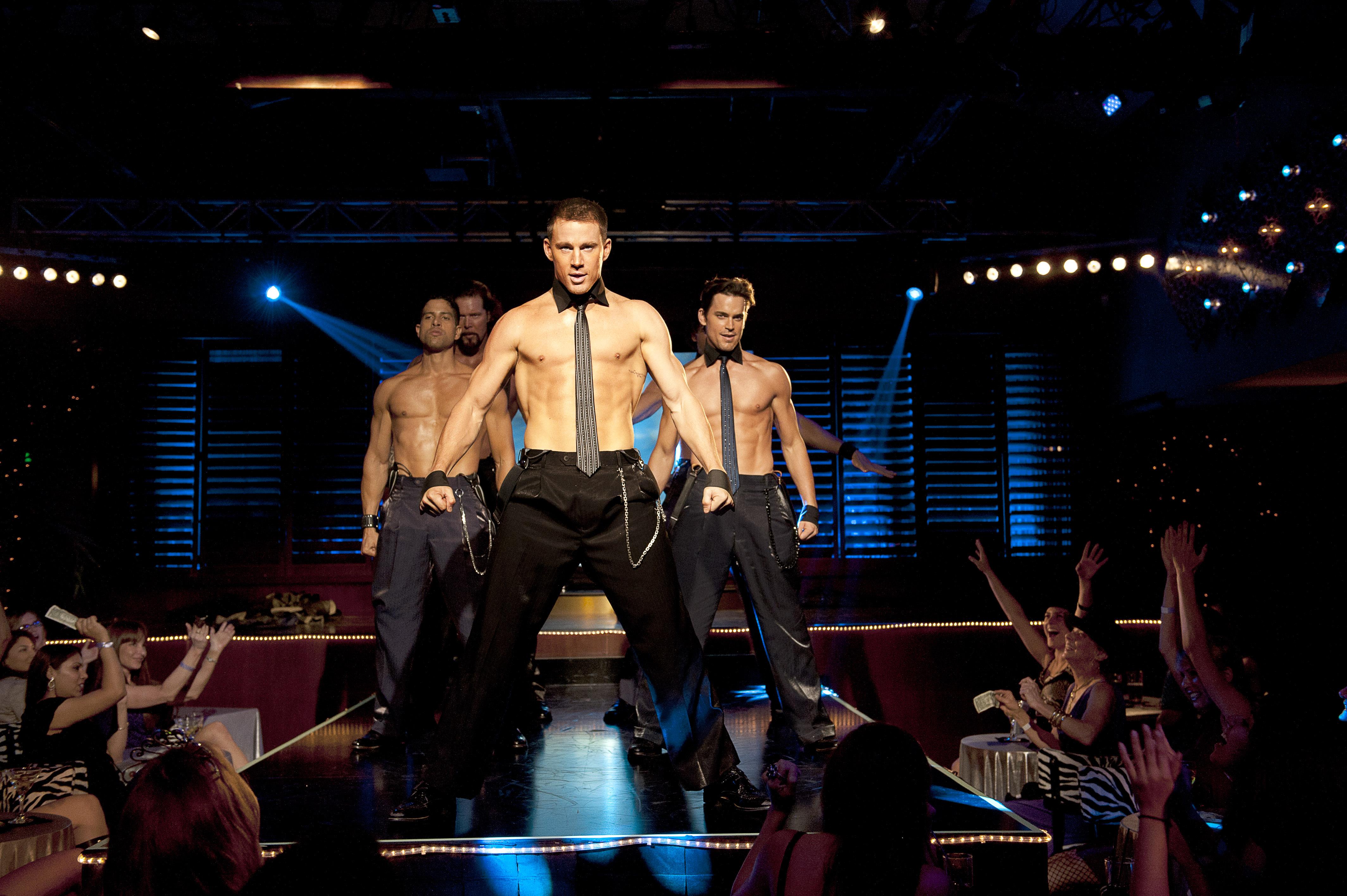
Magic Mike Director Steven Soderbergh pays homage to the 1970s with the opening shot of his male stripper opus: the boxy old Warner Bros. logo, which evokes the gritty, sexualized days of Burt Reynolds and Joe Namath posing in pantyhose. Was that really the last time women, en masse, were welcome to ogle to their heart’s content? That might be the case considering the outburst of applause when a nude Channing Tatum rises after a hard night in a threesome in Magic Mike‘s first five minutes. Ever the savvy film historian, Soderbergh toys with the conventions of the era, from the grimy quasi-redneck realism of vintage Reynolds movies to the hidebound framework of the period’s gay porn, almost for his own amusement, though the viewer might be initially confused about exactly what year they’re in. Veteran star stripper Mike (Tatum) is working construction, stripping to the approval of many raucous ladies and their stuffable dollar bills. He decides to take college-dropout blank-slate hottie Adam (Alex Pettyfer) under his wing and ropes him into the strip club, owned by Dallas (Matthew McConaughey, whose formidable abs look waxily preserved) and show him the ropes of stripping and having a good time, much to the disapproval of Adam’s more straight-laced sister Brooke (Cody Horn). Really, though, all Mike wants to do is become a furniture designer. Boasting Foreigner’s “Feels like the First Time” as its theme of sorts and spot-on, hot choreography by Alison Faulk (who’s worked with Madonna and Britney Spears), Magic Mike takes off and can’t help but please the crowd when it turns to the stage. Unfortunately the chemistry-free budding romance between Mike and Brooke sucks the air out of the proceedings every time it comes into view, which is way too often. (1:50) (Chun)

Marvel’s The Avengers The conflict — a mystical blue cube containing earth-shattering (literally) powers is stolen, with evil intent — isn’t the reason to see this long-hyped culmination of numerous prequels spotlighting its heroic characters. Nay, the joy here is the whole “getting’ the band back together!” vibe; director and co-writer Joss Whedon knows you’re just dying to see Captain America (Chris Evans) bicker with Iron Man (a scene-stealing Robert Downey Jr.); Thor (Chris Hemsworth) clash with bad-boy brother Loki (Tom Hiddleston); and the Hulk (Mark Ruffalo) get angry as often as possible. (Also part of the crew, but kinda mostly just there to look good in their tight outfits: Jeremy Renner’s Hawkeye and Scarlett Johansson’s Black Widow.) Then, of course, there’s Nick Fury (Samuel L. Jackson) running the whole Marvel-ous show, with one good eye and almost as many wry quips as Downey’s Tony Stark. Basically, The Avengers gives you everything you want (characters delivering trademark lines and traits), everything you expect (shit blowing up, humanity being saved, etc.), and even makes room for a few surprises. It doesn’t transcend the comic-book genre (like 2008’s The Dark Knight did), but honestly, it ain’t trying to. The Avengers wants only to entertain, and entertain it does. (2:23) (Eddy)

Moonrise Kingdom Does Wes Anderson’s new film mark a live-action return to form after 2007’s disappointingly wan Darjeeling Limited? More or less. Does it tick all the Andersonian style and content boxes? Indubitably. In the most obvious deviation Anderson has taken with Moonrise, he gives us his first period piece, a romance set in 1965 on a fictional island off the New England coast. After a chance encounter at a church play, pre-teen Khaki Scout Sam (newcomer Jared Gilman) instantly falls for the raven-suited, sable-haired Suzy Bishop (Kara Hayward, ditto). The two become pen pals, and quickly bond over the shared misery of being misunderstood by both authority figures and fellow kids. The bespectacled Sam is an orphan, ostracized by his foster parents and scout troop (much to the dismay of its straight-arrow leader Edward Norton). Suzy despises her clueless attorney parents, played with gusto by Bill Murray and Frances McDormand in some of the film’s funniest and best scenes. When the two kids run off together, the whole thing begins to resemble a kind of tween version of Godard’s 1965 lovers-on the-lam fantasia Pierrot le Fou. But like most of Anderson’s stuff, it has a gauzy sentimentality more akin to Truffaut than Godard. Imagine if the sequence in 2001’s The Royal Tenenbaums where Margot and Richie run away to the Museum of Natural History had been given the feature treatment: it’s a simple yet inspired idea, and it becomes a charming little tale of the perils of growing up and selling out the fantasy. But it doesn’t feel remotely risky. It’s simply too damn tame. (1:37) (Michelle Devereaux)

Patang (The Kite) Loving memories tethered to a place (Ahmedabad, India), moment (the city’s kite festival, the largest of its kind in the country), and season (according to the Hindu calendar, the event coincides with the day that wind direction shifts) beautifully suffuse this first feature film by director and co-writer Prashant Bhargava. Certainly Patang (The Kite) is the story of a family: Delhi businessman Jayesh (Mukund Shukla) has returned with his freewheeling, movie-camera-toting daughter Priya (Sugandha Garg) to his majestically ramshackle family home, where he supports his mother, sister-in-law (Seema Biswas of 1994’s Bandit Queen), and nephew Chakku (Nawazuddin Siddiqui). He’s come to indulge his childhood love of kite flying and to introduce Priya to Ahmedabad’s old-world sights and ways. Entangled among the strands of story are past resentments —harbored by Chakku against his paternalistic uncle — and new hopes, particularly in the form of a budding romance between Priya and Bobby (Aakash Maherya), the son of the kite shop owner. Above all — and as much a presence as any other — is the city, with its fleeting pleasures and memorable faces, captured with vérité verve and sensuous lyricism on small HD cameras by Bhargava and director of photography Shanker Raman. Their imagery imprints on a viewer like an early memory, darting to mind like those many bright kites dancing buoyantly in the city sky. (1:32) (Chun)

People Like Us The opening song — James Gang’s can’t-fail “Funk #49” — only partially announces where this earnest family drama is going. Haunted by a deceased music-producer patriarch, barely sketched-out tales of his misadventures, and a soundtrack of solid AOR, this film has mixed feelings about its boomer bloodlines, much like the recent Peace, Love and Misunderstanding: these boomer-ambivalent films are the inverse of celebratory sites like Dads Are the Original Hipsters. Commodity-bartering wheeler-dealer Sam (Chris Pine) is skating on the edges of legality — and wallowing in his own kind of Type-A prickishness — so when his music biz dad passes, he tries to lie his way out of flying back home to see his mother Lillian (Michelle Pfeiffer), with his decent law student girlfriend (Olivia Wilde). He doesn’t want to face the memories of his self-absorbed absentee-artist dad, but he also doesn’t want to deal with certain legal action back home, so when his father’s old lawyer friend drops a battered bag of cash on him, along with a note to give it to a young boy (Michael Hall D’Addario) and his mother Frankie (Elizabeth Banks), he’s beset with conflict. Should he take the money and run away from his troubles or uncover the mysterious loved ones his father left behind? Director and co-writer Alexa Kurtzman mostly wrote for TV before this, his debut feature, and in many ways People Like Us resembles the tidy, well-meaning dramas about responsibility and personal growth one might still find on, say, Lifetime. It’s also tough to swallow Banks, as gifted as she is as an actress, as an addiction-scarred, traumatized single mom in combat boots. At the same time People Like Us isn’t without its charms, drawing you into its small, specific dramas with real-as-TV touches and the faintest sexy whiff of rock ‘n’ roll. (1:55) (Chun)

Prometheus Ridley Scott’s return to outer space — after an extended stay in Russell Crowe-landia — is most welcome. Some may complain Prometheus too closely resembles Scott’s Alien (1979), for which it serves as a prequel of sorts. Prometheus also resembles, among others, The Thing (1982), 2001: A Space Odyssey (1968), and Event Horizon (1997). But I love those movies (yes, even Event Horizon), and I am totally fine with the guy who made Alien borrowing from all of them and making the classiest, most gorgeous sci-fi B-movie in years. Sure, some of the science is wonky, and the themes of faith and creation can get a bit woo-woo, but Prometheus is deep-space discombobulation at its finest, with only a miscast Logan Marshall-Green (apparently, cocky dude-bros are still in effect at the turn of the next millennium) marring an otherwise killer cast: Noomi Rapace as a dreamy (yet awesomely tough) scientist; Idris Elba as Prometheus‘ wisecracking captain; Charlize Theron as the Weyland Corportation’s icy overseer; and Michael Fassbender, giving his finest performance to date as the ship’s Lawrence of Arabia-obsessed android. (2:03) (Eddy)

Rock of Ages (2:03)

Romantics Anonymous An awkward, bumbling Parisian chocolatier named Jean-Rene (Benoît Poelvoorde) falls for his gorgeous, equally awkward sales rep, Angélique (Isabelle Carré), while never missing an opportunity to say the wrong thing, surrender to shyness, or panic under pressure. It’s crucial for films involving such protracted awkwardness to give the audience something to cling to emotionally, but instead we’re handed a limp, formulaic story, sorely underdeveloped characters, and lazy writing in which the protagonists act uncharacteristically stupid/gullible/oblivious for the sake of plot-expedience. Amélie (2001) mined similar thematic territory, but its success lay in the depth of its characters; Romantics Anonymous is about little more than the idea of two hopeless romantics, and that’s simply not enough to hold interest. It’s beautifully scored, lovingly shot, and steeped in vintage French atmosphere — but that doesn’t compensate for sketchy characterization and weak, predictable storytelling. (1:20) Roxie. (Taylor Kaplan) Safety Not Guaranteed San Francisco-born director Colin Trevorrow’s narrative debut feature Safety Not Guaranteed, written by Derek Connolly, has an improbable setup: not that rural loner Kenneth (Mark Duplass) would place a personal ad for a time travel partner (“Must bring own weapons”), but that a Seattle alt-weekly magazine would pay expenses for a vainglorious staff reporter (Jake Johnson, hilarious) and two interns (Aubrey Plaza, Karan Soni) to stalk him for a fluff feature over the course of several days. The publishing budget allowing that today is true science-fiction. But never mind. Inserting herself “undercover” when a direct approach fails, Plaza’s slightly goth college grad finds she actually likes obsessive, paranoid weirdo Kenneth, and is intrigued by his seemingly insane but dead serious mission. For most of its length Safety falls safely into the category of off-center indie comedics, delivering various loopy and crass behavior with a practiced deadpan, providing just enough character depth to achieve eventual poignancy. Then it takes a major leap — one it would be criminal to spoil, but which turns an admirable little movie into something conceptually surprising, reckless, and rather exhilarating. (1:34) (Harvey)

Savages If it’s true, as some say, that Oliver Stone had lost his way after 9/11 — when seemingly many of his worst fears (and conspiracy theories) came to pass — then perhaps this toothy noir marks his return: it definitely reads as his most emotionally present exercise in years. Not quite as nihilistic as 1994’s Natural Born Killers, yet much juicier than 2010’s Wall Street: Money Never Sleeps, this pulpy effort turns on a cultural clash between pleasure-seeking, honky Cali hedonists, who appear to believe in whatever feels good, and double-dealing Mexican mafia muscle, whose apparently ironclad moral code is also shifting like drifting SoCal sands. All are draped in the Stone’s favored vernacular of manly war games with a light veneer of Buddhistic higher-mindedness and, natch, at least one notable wig. Happy pot-growing nouveau-hippies Ben (Aaron Johnson), Chon (Taylor Kitsch), and O (Blake Lively) are living the good life beachside, cultivating plants coaxed from seeds hand-imported by seething Afghanistan war vet Chon and refined by botanist and business major Ben. Pretty, privileged sex toy O sleeps with both — she’s the key prize targeted by Baja drug mogul Elena (Salma Hayek) and her minions, the scary Lado (Benicio Del Toro) and the more well-heeled Alex (Demian Bichir), who want to get a piece of Ben and Chon’s high-THC product. The twists and turnarounds obviously tickle Stone, though don’t look much deeper than Savages‘ saturated, sun-swathed façade — the script based on Don Winslow’s novel shares the take-no-prisoners hardboiled bent of Jim Thompson while sidestepping the brainy, postmodernish light-hearted detachment of Quentin Tarantino’s “extreme” ’90s shenanigans. (1:57) (Chun)

Take this Waltz Confined to the hothouse months of a summer in Toronto, Take This Waltz is a steamy, sad takedown of (rather than a take on) the romantic comedy. That’s only because it’s very romantic and very funny, often at once, but otherwise the film has nothing in common with its generic sistren. It’s a feel-good movie for the cynics, directed by actor turned director Sarah Polley (2007’s Away From Her). Margot (Michelle Williams) is a writer married to Lou (Seth Rogen), who is sweet and caring and cooks chicken for a living. Both are in their late 20s, and they are obviously each others’ first loves. It is a love like that of children: idealistic and blooming, but they never have a serious conversation. Enter neighbor Daniel (Luke Kirby) — a conventionally sexier man than Lou, more swarthy and sweaty. Soon, Margot is conflicted and confused, torturing herself with some heavy emotional gymnastics and flip-flopping. Williams is always good at using her face to convey feeling. In one of two scenes of the film set on a Scrambler carnival ride, the entire arc of Margot registers on her facial gestures, from scared to elated to uncertain as the Buggles’ “Video Killed the Radio Star” surrounds her. Margot may be indecisive, but she is never docile about her desires. She does, inevitably, make a decision and there is eventual closure, unlike most everything else out there in the indie ether. (1:56) Smith Rafael. (Ryan Lattanzio)

Ted Ah, boys and their toys — and the imaginary friends that mirror back a forever-after land of perpetual Peter Pans. That’s the crux of the surprisingly smart, hilarious Ted, aimed at an audience comprising a wide range of classes, races, and cultures with its mix of South Park go-there yuks and rom-commie coming-of-age sentiment. Look at Ted as a pop-culture-obsessed nerd tweak on dream critter-spirit animal buddy efforts from Harvey (1950) to Donnie Darko (2001) to TV’s Wilfred. Of course, we all know that the really untamable creature here wobbles around on two legs, laden with big-time baggage about growing up and moving on from childhood loves. Young John doesn’t have many friends but he is fortunate enough to have his Christmas wish come true: his beloved new teddy bear, Ted (voice by director-writer Seth MacFarlane), begins to talk back and comes to life. With that miracle, too, comes Ted’s marginal existence as a D-list celebrity curiosity — still, he’s the loyal “Thunder Buddy” that’s always there for the now-grown John (Mark Wahlberg), ready with a bong and a broheim-y breed of empathy that involves too much TV, an obsession with bad B-movies, and mock fisticuffs, just the thing when storms move in and mundane reality rolls through. With his tendency to spew whatever profanity-laced thought comes into his head and his talents are a ladies’ bear, Ted is the id of a best friend that enables all of John’s most memorable, un-PC, Hangover-style shenanigans. Alas, John’s cool girlfriend Lori (Mila Kunis) threatens that tidy fantasy setup with her perfectly reasonable relationship demands. Juggling scary emotions and material that seems so specific that it can’t help but charm — you’ve got to love a shot-by-shot re-creation of a key Flash Gordon scene — MacFarlane sails over any resistance you, Lori, or your superego might harbor about this scenario with the ease of a man fully in touch with his inner Ted. (1:46) (Chun)

30 Beats A sweltering summer day or two in the city ushers in a series of youthful good-lookers, unencumbered and less than dressed, together in kind of NYC-based mini-La Ronde that I’m surprised Woody Allen hasn’t yet attempted. Fresh young thing Julie (Condola Rashad) is off to pop her cherry with lady’s man Adam (Justin Kirk of Weeds), who’s more accustomed to chasing than being chased. Unsettled, he consults with sorceress Erika (Jennifer Tilly), who plies him with sexual magic and then finds herself chasing down her booty-call bud, bike messenger Diego (Jason Day), who’s besotted with the physically and emotionally scarred Laura (Paz de la Huerta). What goes around comes around in director-writer Alexis Lloyd’s debut feature, but alas, not till it’s contorted and triangulated itself in at least one ridiculously solemn BDSM scene. Matters get trickier when romance begins to creep into these urban one-offs. Nonetheless, those with short attention spans who like their people-watching with a healthy splash of big-city hookups, might find this adult indie as refreshing as a romp with a beautiful stranger they’ve briefly locked eyes with. (1:28) (Chun)

To Rome with Love Woody Allen’s film legacy is not like anybody else’s. At present, however, he suffers from a sense that he’s been too prolific for too long. It’s been nearly two decades since a new Woody Allen was any kind of “event,” and the 19 features since Bullets Over Broadway (1994) have been hit and-miss. Still, there’s the hope that Allen is still capable of really surprising us — or that his audience might, as they did by somewhat inexplicably going nuts for 2011’s Midnight in Paris. It was Allen’s most popular film in eons, if not ever, probably helped by the fact that he wasn’t in it. Unfortunately, he’s up there again in the new To Rome With Love, familiar mannerisms not hiding the fact that Woody Allen the Nebbish has become just another Grumpy Old Man. There’s a doddering quality that isn’t intended, and is no longer within his control. But then To Rome With Love is a doddering picture — a postcard-pretty set of pictures with little more than “Have a nice day” scribbled on the back in script terms. Viewers expecting more of the travelogue pleasantness of Midnight in Paris may be forgiving, especially since it looks like a vacation, with Darius Khondji’s photography laying on the golden Italian light and making all the other colors confectionary as well. But if Paris at least had the kernel of a good idea, Rome has only several inexplicably bad ones; it’s a quartet of interwoven stories that have no substance, point, credibility, or even endearing wackiness. The shiny package can only distract so much from the fact that there’s absolutely nothing inside. (1:52) (Harvey)

Trishna Ever difficult to pin down, director Michael Winterbottom continues his restless flipping between the light (2010’s The Trip), artily experimental (2004’s 9 Songs), pulpy (2010’s The Killer Inside Me), and the dead serious (2007’s A Mighty Heart). Trishna, loosely based on Thomas Hardy’s Tess of the d’Urbervilles and set in small-town and big-city modern-day India, lines up neatly on the bookshelf alongside Winterbottom’s other Hardy bodice-ripper, 1996’s Jude. By chance beautiful village girl Trishna (Freida Pinto) falls in with the handsome, thoroughly Westernized Jay (Riz Ahmed) and his laddish pals on holiday. A truck accident leaves her father unable to provide for their family, so she goes to work at the luxury hotel owned by Jay’s father and overseen by his privileged son. There she gently gives him language tips, accepts his offer to educate her in travel industry management, and enjoys his growing attentions, until one day when he rescues her from roving thugs only to seduce her. Though she flees to her family home and eventually has an abortion, Trishna still proves to be an innocent and consents to live in Mumbai with Jay, who is flirting with the film industry and increasingly effaces his trusting girlfriend as their sexual game-playing becomes increasingly complicated. The shadows of both Hardy and Bollywood flit around Trishna, and this cultural transplant nearly works — the hothouse erotic entanglement between its two principals almost but not quite convinces one that Trishna would be driven to desperate ends. Still, even as Trishna, like Tess, infuriates with her passivity, her story occasionally enthralls — the fruit of Pinto’s surprisingly brave, transparent performance. (1:53) (Chun)

Tyler Perry’s Madea’s Witness Protection (1:54)

Your Sister’s Sister The new movie from Lynn Shelton — who directed star and (fellow mumblecore director) Mark Duplass in her shaggily amusing Humpday (2009) — opens somberly, at a Seattle wake where his Jack makes his deceased brother’s friends uncomfortable by pointing out that the do-gooder guy they’d loved just the last couple years was a bully and jerk for many years before his reformation. This outburst prompts an offer from friend-slash-mutual-crush Iris (Emily Blunt) that he get his head together for a few days at her family’s empty vacation house on a nearby island. Arriving via ferry and bike, he is disconcerted to find someone already in residence — Iris’ sister Hannah (Rosemarie DeWitt), who’s grieving a loss of her own (she’s split with her girlfriend). Several tequila shots later, two Kinsey-scale opposites meet, which creates complications when Iris turns up the next day. A bit slight in immediate retrospect and contrived in its wrap-up, Shelton’s film is nonetheless insinuating, likable, and a little touching while you’re watching it. That’s largely thanks to the actors’ appeal — especially Duplass, who fills in a blunderingly lucky (and unlucky) character’s many blanks with lived-in understatement. (1:30) (Harvey) *


Environmental groups call for fracking moratorium in California

8

California’s biggest environmental organizations are gathering in Sacramento tomorrow (Wed/25) to call for a moratorium on the controversial practice of hydraulic fracturing – also known as fracking, in which a mixture of water and chemicals is injected at high pressure deep underground to increase production in oil and natural gas wells – until its impacts are better understood.

The occasion is the last in a series of workshops on the issue by the California Department of Conservation’s Division of Oil, Gas and Geothermal Resources, which is considering new rules on a practice that is mostly unregulated in California. Other recent legislative and administrative efforts to address fracking have been scuttled by the powerful fossil fuel industry.

Earlier this year, Sen. Fran Pavley (D-Santa Monica) discovered that state officials didn’t even know how much fracking is happening in California – while it requires state permits to drill an oil or natural gas well, fracking them doesn’t – although the industry has since estimated that more than 600 wells were fracked last year, most of them in Kern Country around Bakersfield.

But there is growing concern by environmentalists that the oil industry plans to expand its use of fracking in the Monterey shale formations that run from the Central Coast to the Central Valley, where an estimated 15 billion barrels of oil could be extracted if loosened up by fracking.

“We’re calling for the Division of Oil and Gas to slow down and not rush through these regulations,” said Andrew Grinberg, spokesperson for Clean Water Action. “We’re calling for a moratorium until we have good regulations that ensure the protection of our water, air, health, and communities.”

Other organizations joining the event – which begins at 5:30pm outside the California Environmental Protection Agency building at 1001 1st St. in Sacramento, where the DOGGR hearing will be held at 7pm – and the call for a moratorium includes the Sierra Club, Planning and Conservation League, Center for Biological Diversity, Environment California, and Food & Water Watch.

Public concerns about fracking have been on the increase in recent years, fueled by a high-profile debate in New York about ending a state moratorium against the practice and by alarming stories of groundwater contamination caused by fracking – including cases in which hydrocarbon content in drinking water is so high that people could set their faucets on fire – told in the 2010 documentary film Gasland and other media accounts.

But Tupper Hull, spokesperson for the influential trade group Western States Petroleum Association, told us fracking has been happening in California for 60 years – almost exclusively in oil wells rather than for the natural gas fields discussed in Gasland – and that it has not caused any detrimental environmental impacts, nor has its use been increasing, despite the increased public attention to the practice.

“We understand there is a lot of interest in this topic and questions about the technology,” Hull said. “We expect there will be new regulations and whatever they are, we hope they are based on facts and science and not emotional responses.”

But he said WSPA opposes the call for a moratorium because “this is a technology that aids in the production of energy.”

Yet the environmental groups say the need for energy shouldn’t cause government to abdicate its role of studying and regulating a potentially harmful practice that was given a broad federal exemption from the Clean Water Act by Congress in 2005, when it approved the Energy Policy Act that was spearheaded by then-Vice President Dick Cheney.

Environmental groups dubbed it the “Halliburton loophole” after Cheney’s former employer, which has greatly expanded the use of fracking in the US.

Our Weekly Picks: July 18-24

0

WEDNESDAY 18

Waters

Former Port O’Brien band leader Van Pierzalowski founded Waters on the shores of Norway, New York, California, and Alaska. He’s now touring with his new Norwegian bandmates, for their album Out in the Light, and will open for Nada Surf in cities across US this summer, with a final stop in Oslo, Norway. Port O’Brien’s ragged edges and nautically inspired lyrics can still be found in this new project, but its debut album is receiving critical acclaim for its grungier sound, and for Pierzalowski’s decision to stretch out his vocals, reaching new heights. Check out standout track “Take Us Out to the Coast” and get ready to rock. (Shauna C. Keddy)

With Tijuana Panthers, Chasms, Churches

7:30pm, $12

Brick and Mortar Music Hall

1710 Mission, SF

(415) 800-8782

www.brickandmortarmusic.com


The Bouncing Souls

These New Jersey punks have been inciting fist pumping and circle pits for over 20 years, and they celebrated this milestone by self-releasing their ninth studio album Comet this week. The Bouncing Souls have been important players in the punk scene for years, pioneering the lighter side of the genre and hitting the road for seven Warped Tours. Their relentless touring has earned the Souls a dedicated, cross-generational following, from ’90s diehards to the teens who discovered them last summer. There’s nothing complex, nuanced, or hip about a Bouncing Souls song, but that’s what makes these party-punk anthems so accessible. Leave your thinking caps at home and get ready to rage. (Haley Zaremba)

With the Menzingers, Luther

8pm, $21

Slim’s

333 11th St, SF

(415) 255-0333

www.slimspresents.com


THURSDAY 19

Roy Davies

As founder, key songwriter, singer and guitarist for legendary British Invasion innovators the Kinks, Ray Davies penned classics such as “You Really Got Me,” “All Day and All of The Night,” “Lola,” and many more. His latest release, last year’s See My Friends featured a who’s who of legendary musical guests including Metallica, Bruce Springsteen, Lucinda Williams, Alex Chilton, and Billy Corgan, all performing with the icon on re-interpretations of his most famous tunes. Fans won’t want to miss the Rock and Roll Hall of Famer when he plays a relatively intimate show at the equally historic Fillmore here in San Francisco. (Sean McCourt)

With The 88

8pm, $50

Fillmore

1805 Geary, SF

(415) 371-5500

www.thefillmore.com


Beachwood Sparks

Many may recognize the warm and fuzzy sounds of Beachwood Sparks’ cover of Sade’s “By Your Side” from the indie-hit film Scott Pilgrim Vs. the World. Fans who have checked out their music beyond the popular cover will know that country and indie-rock sounds more so define this band. Its new album, The Tarnished Gold, finds the group over a decade into its career delivering just the kind of LA-influenced summer jams that have made it such a beloved California act. The album achieves a sound of great ease, and is receiving praise from the likes of NPR, which applauded the band for its ability to create a seemingly effortless sound that transports listeners. Beachwood Sparks’ Americana and ’70 pop sounds may induce listeners into making daisy chains in grassy fields. (Keddy)

With Allah-Las, Sweet Chariot, DJ Britt Govea

7:30pm, $18

Independent

628 Divisadero, SF

(415) 771-1421

www.theindependentsf.com


Fountains of Wayne

After a 16-year career, Fountains of Wayne is still tragically unknown. Even the Grammy it nabbed in 2003 was a nod to its obscurity — the band, which had been together for seven years at that point, was given the award for Best New Artist. After the band’s five minutes of fame with the Grammy moment and its cheesetastic international chart-topping single “Stacey’s Mom,” it faded again into the background. Years later, these guys can still write some wickedly funny pop songs and they’ll leave you wondering why they never fully broke through. (Zaremba)

With Mike Viola

8pm, $26

Great American Music Hall

859 O’Farrell, SF

(415) 885-0750

www.slimspresents.com


FRIDAY 20

Friday Nights at the de Young: African Diaspora

This week’s installment of Friday Nights at the de Young treats us to traditional African Manding music in both song and dance, along with an art demonstration by artist-in-residence alum Ramekon O’Arwisters. Attendees can bring their own pieces of fabric to the event and should be ready to share a life story: the goal of O’Arwisters’ demonstration is to examine weaving through storytelling and crocheting, giving a taste of the African-American folk art and textile tradition. The packed Friday night lineup also includes “Love Letters,” a lecture by C. Derrick Jones, nephew of Harlem Renaissance pioneer Aaron Douglas. Jones’ aerial dance group Catch Me Bird is currently putting together a project called Off the Walls, based on the work of his uncle. (Keddy)

6pm, free

De Young Museum

15 Hagiwara Tea Garden, SF

(415) 750-3600

deyoung.famsf.org


“Steve Prefontaine Film Festival”

Local distance runners who’re about to start tapering for the San Francisco Marathon (July 29!) — and have already planned their Olympics viewing parties (go Shalane!) — will not want to miss Film Night in the Park’s “Steve Prefontaine Film Festival,” highlighting the awesome achievements of the Oregon legend. The record-breaking athlete, who helped popularize running in the 1970s (the fact that he was a babe, mustache and all, didn’t hurt), died at age 24 in a single-car accident — giving rise to the nickname “the James Dean of running” — but remains an inspiration for his intense dedication to the sport. The Pre double-feature includes Robert Towne’s 1998 Without Limits, starring Billy Crudup (not to be confused with 1997’s competing biopic Prefontaine, starring Jared Leto), and the 1995 documentary Fire on the Track: The Steve Prefontaine Story. (Cheryl Eddy)

8pm, donations accepted

Creek Park

451 Sir Francis Drake Blvd., San Anselmo

www.filmnight.org


“PERSIAN LOOKING”

Maryam Rostami’s theatrical exploration of her Persian heritage has extended from deeply moving solo theater (last summer’s play-in-progress preview “Persepolis, Texas”) to hilariously relevant drag — not many performers can bring down the house with a number performed in a deconstructed burqa, using only eyebrows to “lip-sync.” Her latest ensemble piece, “PERSIAN LOOKING” is “specifically about the way that Middle Eastern women living in the West process the news that we hear about our sisters living in warzones back ‘home.” It’s paired with another cool-sounding examination of women in the contemporary world: Cara Rose DeFabio’s “She Was a Computer,” which uses language from obsolete computer manuals and the audience’s own cell phones, among other things, to look at how gadgetry and its social currency are passed down through female generations. (Marke B.)

8pm, $20

Also Sat/21, 8pm; Sun/22, 2pm and 8pm

CounterPulse

1310 Mission, SF

(415) 626-2060

www.counterpulse.org


Sam Bush

Multi-instrumentalist Sam Bush has been highly influential in the bluegrass and “newgrass” genres of Americana music, performing with artists such as Lyle Lovett, Bela Fleck, Emmylou Harris, and more, all while inspiring a world of fans with his excellent mandolin, fiddle, banjo, and guitar playing skills. Recently honored with the Americana Music Association Lifetime Achievement Award — quite a feat considering he only just turned 60 — Bush released his latest album Circles Around Me in 2009, and continues to thrive on stage, where he switches off instruments and energetically blends a host of sounds all into a joyous mix. (McCourt)

9pm, $26

Great American Music Hall

859 O’Farrell St., SF

(415) 885-0750

www.slimspresents.com


SATURDAY 21

Phono Del Sol Music and Food Festival

Out of the darkened beer-soaked clubs and into the dewy green park with you. The Phono Del Sol Music and Food Festival returns this weekend, and the price is still right. It’s just $7 to $10 max (unless you go VIP) for the pleasure of chilling in the grass with pals while rollicking locals Fresh & Onlys, sincere globe-trotters Unknown Mortal Orchestra, and Santa Barbara synth-and-flute freaks Gardens & Villa fill the park with sweet music. Produced by the Bay Bridged blog, this year’s curated lineup also includes Vivian Girl Katy Goodman’s shimmery solo effort La Sera, along with Northern California bred acts such as Dominant Legs, Sea of Bees, and Mwahaha. Its bears mention that the food lineup also rocks, and nearly a dozen local food trucks will come roaring over the hill: munch on the spicy fusion of Kung Fu Tacos, Doc’s of the Bay, Kasa Indian, Voodoo Van, Frozen Kuhsterd, and more. (Emily Savage)

Noon-6pm. $7–$10.

Potrero Del Sol Park

25th Street at Utah, SF

www.phonodelsol.com


My Best Fiend

One of a handful of of rock bands on the esteemed Warp Records’ largely electronic roster, My Best Fiend cranks out pastoral ballads of human frailty that mutate slyly into psychedelic, space-bound epics. The Brooklyn outfit’s debut full-length, In Ghostlike Fading, emanates a distinctly ’70s vibe, recalling the heady propulsion of Pink Floyd’s looser, slower jams; the stoned disillusionment of David Crosby’s If I Could Only Remember My Name; the sun-drenched melancholy of Neil Young’s Harvest. Not to be mistaken for a group of twentysomethings halfassedly replicating their parents’ record collections, My Best Fiend sets its tunnel vision on a specific time and place in rock music, channeling it poignantly, respectfully, ecstatically. (Taylor Kaplan)

With White Cloud

9pm, $10

Brick & Mortar Music Hall

1710 Mission, SF

(415) 800-8782

www.brickandmortarmusic.com


Sonny and the Sunsets

San Francisco native Sonny Smith likes to keep himself busy. This summer saw the release of his band’s third album in as many years. Before that he was was occupied with his “100 Albums” project, in which Smith collaborated with visual artists to invent 100 different album covers by 100 fake bands as well as a single off each of the faux records, which he wrote and recorded with the help of other Bay Area artists such as Ty Segall and Thee Oh Sees’ John Dwyer. Longtime Companion, his latest (real) effort, is not as grandiose or harebrained as some of Smith’s other creations, but its simple Americana charm is just as stunning. (Zaremba)

With Wet Illustrated, Pink Films, Cool Ghouls

9pm, $15

Independent

628 Divisadero, SF

(415) 771-1421

www.theindependentsf.com


TUESDAY 24

Ava Luna

Reminiscent of TV On the Radio in its thorny, postmodernist treatment of soul, punk, and R&B, and the Dirty Projectors, with their anything-goes vocal dynamics, Ava Luna’s sound is in a constant state of flux, too busy searching and experimenting to settle into a comfortable groove. Remarkably dense, brimming with tension, and jumping wildly between musical languages, the Brooklyn band’s newly released debut LP, Ice Level, bears the audacity of a group with a much longer resume. In an age of too many laptop shows, and rock bands resorting to predictable schtick, this dynamic seven-piece ought to deliver a richly stimulating, thrillingly unstable performance. (Kaplan)

With That Ghost, Youngman Grand

9pm, $10

Bottom of the Hill

1233 17th St., SF

(415) 621-4455

www.bottomofthehill.com

The Guardian listings deadline is two weeks prior to our Wednesday publication date. To submit an item for consideration, please include the title of the event, a brief description of the event, date and time, venue name, street address (listing cross streets only isn’t sufficient), city, telephone number readers can call for more information, telephone number for media, and admission costs. Send information to Listings, the Guardian Building, 135 Mississippi St., SF, CA 94107; fax to (415) 487-2506; or e-mail (paste press release into e-mail body — no text attachments, please) to listings@sfbg.com. Digital photos may be submitted in jpeg format; the image must be at least 240 dpi and four inches by six inches in size. We regret we cannot accept listings over the phone.

Film Listings

0

Film listings are edited by Cheryl Eddy. Reviewers are Kimberly Chun, Max Goldberg, Dennis Harvey, and Lynn Rapoport. For rep house showtimes, see Rep Clock.

OPENING

A Burning Hot Summer Two couples become entangled one hot Roman summer in Philippe Garrel’s New Wave-inspired drama. (1:35) SF Film Society Cinema.

The Dark Knight Rises Nolan, Bale, and the rest of the Gotham gang reunite for 2012’s most-anticipated superhero sequel. (2:44) Marina.

Dark Horse See "Do Not Disturb." (1:25) Embarcadero, SF Film Society Cinema, Shattuck, Smith Rafael.

Monty Python and the Holy Grail Back to taunt you a second (or hundredth) time, the 1975 comedy classic gets digitally remastered and boasts a new 12-minute short, "Terry Gilliam’s Lost Animations." (1:44) Lumiere.

Romantics Anonymous An awkward, bumbling Parisian chocolatier named Jean-Rene (Benoît Poelvoorde) falls for his gorgeous, equally awkward sales rep, Angélique (Isabelle Carré), while never missing an opportunity to say the wrong thing, surrender to shyness, or panic under pressure. It’s crucial for films involving such protracted awkwardness to give the audience something to cling to emotionally, but instead we’re handed a limp, formulaic story, sorely underdeveloped characters, and lazy writing in which the protagonists act uncharacteristically stupid/gullible/oblivious for the sake of plot-expedience. Amélie (2001) mined similar thematic territory, but its success lay in the depth of its characters; Romantics Anonymous is about little more than the idea of two hopeless romantics, and that’s simply not enough to hold interest. It’s beautifully scored, lovingly shot, and steeped in vintage French atmosphere — but that doesn’t compensate for sketchy characterization and weak, predictable storytelling. (1:20) Roxie. (Taylor Kaplan)

30 Beats A sweltering summer day or two in the city ushers in a series of youthful good-lookers, unencumbered and less than dressed, together in kind of NYC-based mini-La Ronde that I’m surprised Woody Allen hasn’t yet attempted. Fresh young thing Julie (Condola Rashad) is off to pop her cherry with lady’s man Adam (Justin Kirk of Weeds), who’s more accustomed to chasing than being chased. Unsettled, he consults with sorceress Erika (Jennifer Tilly), who plies him with sexual magic and then finds herself chasing down her booty-call bud, bike messenger Diego (Jason Day), who’s besotted with the physically and emotionally scarred Laura (Paz de la Huerta). What goes around comes around in director-writer Alexis Lloyd’s debut feature, but alas, not till it’s contorted and triangulated itself in at least one ridiculously solemn BDSM scene. Matters get trickier when romance begins to creep into these urban one-offs. Nonetheless, those with short attention spans who like their people-watching with a healthy splash of big-city hookups, might find this adult indie as refreshing as a romp with a beautiful stranger they’ve briefly locked eyes with. (1:28) Elmwood, Four Star. (Chun)

Trishna Ever difficult to pin down, director Michael Winterbottom continues his restless flipping between the light (2010’s The Trip), artily experimental (2004’s 9 Songs), pulpy (2010’s The Killer Inside Me), and the dead serious (2007’s A Mighty Heart). Trishna, loosely based on Thomas Hardy’s Tess of the d’Urbervilles and set in small-town and big-city modern-day India, lines up neatly on the bookshelf alongside Winterbottom’s other Hardy bodice-ripper, 1996’s Jude. By chance beautiful village girl Trishna (Freida Pinto) falls in with the handsome, thoroughly Westernized Jay (Riz Ahmed) and his laddish pals on holiday. A truck accident leaves her father unable to provide for their family, so she goes to work at the luxury hotel owned by Jay’s father and overseen by his privileged son. There she gently gives him language tips, accepts his offer to educate her in travel industry management, and enjoys his growing attentions, until one day when he rescues her from roving thugs only to seduce her. Though she flees to her family home and eventually has an abortion, Trishna still proves to be an innocent and consents to live in Mumbai with Jay, who is flirting with the film industry and increasingly effaces his trusting girlfriend as their sexual game-playing becomes increasingly complicated. The shadows of both Hardy and Bollywood flit around Trishna, and this cultural transplant nearly works — the hothouse erotic entanglement between its two principals almost but not quite convinces one that Trishna would be driven to desperate ends. Still, even as Trishna, like Tess, infuriates with her passivity, her story occasionally enthralls — the fruit of Pinto’s surprisingly brave, transparent performance. (1:53) Embarcadero, Shattuck. (Chun)

ONGOING

Abraham Lincoln: Vampire Hunter Are mash-ups really so 2001? Not according to the literary world, where writer Seth Graham-Smith has been doing brisk trade in gore-washing perfectly interesting historical figures and decent works of literature — a fan fiction-rooted strategy that now reeks of a kind of camp cynicism when it comes to a terminally distracted, screen-aholic generation. Still, I was strangely excited by the cinematic kitsch possibilities of Graham-Smith’s Lincoln alternative history-cum-fantasy, here in the hands of Timur Bekmambetov (2004’s Night Watch). Historians, prepare to fume — it helps if you let go of everything you know about reality: as Vampire Hunter opens, young Lincoln learns some harsh lessons about racial injustice, witnessing the effects of slavery and the mistreatment of his black friend Will. As a certain poetic turn would have it, slave owners here are invariably vampires or in cahoots with the undead, as is the wicked figure, Jack Barts (Marton Csokas), who beats both boys and sucks Lincoln’s father dry financially. In between studying to be a lawyer and courting Mary Todd (Mary Elizabeth Winstead), the adult Lincoln (Benjamin Walker) vows to take revenge on the man who caused the death of his mother and enters the tutelage of vampire hunter Henry (Dominic Cooper), who puts Abe’s mad skills with an ax to good use. Toss in a twist or two; more than few freehand, somewhat humorous rewrites of history (yes, we all wish we could have tweaked the facts to have a black man working by Lincoln’s side to abolish slavery); and Bekmambetov’s tendency to direct action with the freewheeling, spectacle-first audacity of a Hong Kong martial arts filmmaker (complete with at least one gaping continuity flaw) — and you have a somewhat amusing, one-joke, B-movie exercise that probably would have made a better short or Grindhouse-esque trailer than a full-length feature — something the makers of the upcoming Pride and Prejudice and Zombies should bear in mind. (1:45) 1000 Van Ness, SF Center. (Chun)

The Amazing Spider-Man A mere five years after Sam Raimi and Tobey Maguire’s Spider-Man 3 — forgettable on its own, sure, but 2002’s Spider-Man and especially 2004’s Spider-Man 2 still hold up — Marvel’s angsty web-slinger returns to the big screen, hoping to make its box-office mark before The Dark Knight Rises opens in a few weeks. Director Marc Webb (2009’s 500 Days of Summer) and likable stars Andrew Garfield (as the skateboard-toting hero) and Emma Stone (as his high-school squeeze) offer a competent reboot, but there’s no shaking the feeling that we’ve seen this movie before, with its familiar origin story and with-great-power themes. A little creativity, and I don’t mean in the special effects department, might’ve gone a long way to make moviegoers forget this Spidey do-over is, essentially, little more than a soulless cash grab. Not helping matters: the villain (Rhys Ifans as the Lizard) is a snooze. (2:18) Metreon, 1000 Van Ness, Presidio, Sundance Kabuki. (Eddy)

Ballplayer: Pelotero With upbeat music, slick editing, and narration by John Leguizamo, Ballplayer: Pelotero is an entertaining, enlightening investigation into exactly why the Dominican Republic produces so many baseball stars. Comparisons to acclaimed sports doc Hoop Dreams (1994) are apt, as filmmakers Ross Finkel, Trevor Martin, and Jonathan Paley travel to the DR to follow a pair of teenage baseball players dreaming of big-league stardom (and big-league paychecks). But the Hoop Dreams kids weren’t being confronted by the shady, sinister, bottom-line-obsessed recruiters working for Major League Baseball, which maintains a pee-wee farm system of sorts in the country to train young prospects — the best of whom are snapped up at the magic age of 16 for bargain-basement (relatively speaking) prices. And in this environment, questions about numbers reign supreme: how much with each kid be signed for? And, more intriguingly, is either youth lying about his true age? (1:12) SF Film Society Cinema. (Eddy)

Beasts of the Southern Wild Six months after winning the Grand Jury Prize at Sundance (and a Cannes Camera d’Or), Beasts of the Southern Wild proves capable of enduring a second or third viewing with its originality and strangeness fully intact. Magical realism is a primarily literary device that isn’t attempted very often in U.S. cinema, and succeeds very rarely. But this intersection between Faulkner and fairy tale, a fable about — improbably — Hurricane Katrina, is mysterious and unruly and enchanting. Benh Zeitlin’s film is wildly cinematic from the outset, as voiceover narration from six-year-old Hushpuppy (Quvenzhané Wallis) offers simple commentary on her rather fantastical life. She abides in the Bathtub, an imaginary chunk of bayou country south of New Orleans whose residents live closer to nature, amid the detritus of civilization. Seemingly everything is some alchemical combination of scrap heap, flesh, and soil. But not all is well: when "the storm" floods the land, the holdouts are forced at federal gunpoint to evacuate. With its elements of magic, mythological exodus, and evolutionary biology, Beasts goes way out on a conceptual limb; you could argue it achieves many (if not more) of the same goals Terrence Malick’s 2011 The Tree of Life did at a fraction of that film’s cost and length. (1:31) Bridge, California, Embarcadero, Smith Rafael. (Harvey)

Bel Ami Judging from recent attempts to shake off the gloomy atmosphere and undead company of the Twilight franchise, Robert Pattinson enjoys a good period piece, but hasn’t quite worked out how to help make one. Last year’s Depression-era Water for Elephants was a tepid romance, and Declan Donnellan and Nick Ormerod’s belle epoque–set Bel Ami is an ungainly, oddly paced adaptation of the Guy de Maupassant novel of the same name. A down-and-out former soldier of peasant stock, Georges Duroy (Pattinson) — or "Bel Ami," as his female admirers call him — gains a brief entrée into the upper echelons of France’s fourth estate and parlays it into a more permanent set of social footholds, campaigning for the affections of a triumvirate of Parisian power wives (Christina Ricci, Uma Thurman, and Kristin Scott Thomas) as he makes his ascent. His route is confusing, though; the film pitches forward at an alarming pace, its scenes clumsily stacked together with little character development or context to smooth the way, and Pattinson’s performance doesn’t clarify much. Duroy shifts perplexingly between rapacious and soulful modes, eyeing the ladies with a vaguely carnivorous expression as he enters drawing rooms, dining rooms, and bedrooms, but leaving us with little sense of his true appetites or other motivations. (1:42) Smith Rafael. (Rapoport)

Bernie Jack Black plays the titular new assistant funeral director liked by everybody in small-town Carthage, Tex. He works especially hard to ingratiate himself with shrewish local widow Marjorie (Shirley MacLaine), but there are benefits — estranged from her own family, she not only accepts him as a friend (then companion, then servant, then as virtual "property"), but makes him her sole heir. Richard Linklater’s latest is based on a true-crime story, although in execution it’s as much a cheerful social satire as I Love You Philip Morris and The Informant! (both 2009), two other recent fact-based movies about likable felons. Black gets to sing (his character being a musical theater queen, among other things), while Linklater gets to affectionately mock a very different stratum of Lone Star State culture from the one he started out with in 1991’s Slacker. There’s a rich gallery of supporting characters, most played by little-known local actors or actual townspeople, with Matthew McConaughey’s vainglorious county prosecutor one delectable exception. Bernie is its director’s best in some time, not to mention a whole lot of fun. (1:39) SF Center, Shattuck, Opera Plaza, Smith Rafael. (Harvey)

The Best Exotic Marigold Hotel (1:42) Opera Plaza, Piedmont.

Beyond the Black Rainbow Sci-fi in feel and striking look even though it’s set in the past (1983, with a flashback to 1966), Canadian writer-director Cosmatos’ first feature defies any precise categorization — let alone attempts to make sense of its plot (such as there is). Arboria is a corporate "commune"-slash laboratory where customers are promised what everyone wants — happiness — even as "the world is in chaos." Just how that is achieved, via chemicals or whatnot, goes unexplained. In any case, the process certainly doesn’t seem to be working on Elena (Eva Allan), a near-catatonic young woman who seems to be the prisoner as much as the patient of sinister Dr. Nyle (Michael Rogers). The barely-there narrative is so enigmatic at Arboria that when the film finally breaks out into the external world and briefly becomes a slasher flick, you can only shrug — if it had suddenly become a musical, that would have been just as (il-)logical. Black Rainbow is sure to frustrate some viewers, but it is visually arresting, and some with a taste for ambiguous, metaphysical inner-space sci-fi à la Solaris (1972) have found it mesmerizing and profound. As they are wont to remind us, half of its original audience found 1968’s 2001: A Space Odyssey boring, pointless and walk out-worthy, too. (1:50) Roxie. (Harvey)

Bonsái (1:35) SF Film Society Cinema.

Brave Pixar’s latest is a surprisingly familiar fairy tale. Scottish princess Merida (voiced by Kelly Macdonald) would rather ride her horse and shoot arrows than become engaged, but it’s Aladdin-style law that she must marry the eldest son of one of three local clans. (Each boy is so exaggeratedly unappealing that her reluctance seems less tomboy rebellion than common sense.) Her mother (Emma Thompson) is displeased; when they quarrel, Merida decides to change her fate (Little Mermaid-style) by visiting the local spell-caster (a gentle, absent-minded soul that Ursula the Sea Witch would eat for brunch). Naturally, the spell goes awry, but only the youngest of movie viewers will fear that Merida and her mother won’t be able to make things right by the end. Girl power is great, but so are suspense and originality. How, exactly, is Brave different than a zillion other Disney movies about spunky princesses? Well, Merida’s fiery explosion of red curls, so detailed it must have had its own full-time team of animators working on it, is pretty fantastic. (1:33) 1000 Van Ness, SF Center, Shattuck, Sundance Kabuki. (Eddy)

Crazy Wisdom Not exactly your average Buddhist leader, Chogyam Trungpa was one part monk to two parts rock star. Recognized as a reincarnated master while still an infant, he left Tibet behind to flee Chinese government forces in 1960, eventually landing in the UK, where he founded its first Buddhist center. A decade later he’d move to the US, founding its first Buddhist university. Amidst all that achievement and enlightenment-spreading, however, he also found time to marry a 16-year-old upper-class Brit, have myriad affairs with students, partially paralyze himself driving a car into a shop front, frequently get drunk in public, and so forth — even though, incongruously, he frowned upon marijuana (and rock music). All this made sense in a tradition of Tibetan Buddhist "crazy wisdom" — or so his supporters would (and still) claim in his defense. Having left this life at age 48, his body exhausted by decades of hedonistic excess, he still has a powerful hold over diverse, multi-faith followers and acquaintances who recall his extraordinary spiritual-personal magnetism. Johanna Demetrakas’ entertaining documentary gathers up testimony from a gamut of them, including Ram Dass, Allen Ginsberg, Robert Thurman, and Anne Waldman. (1:26) Roxie. (Harvey)

Farewell, My Queen (Benoît Jacquot, France, 2012) Opening early on the morning of July 14, 1789, Farewell, My Queen depicts four days at the Palace of Versailles on the eve of the French Revolution, as witnessed by a young woman named Sidonie Laborde (Léa Seydoux) who serves as reader to Marie Antoinette (Diane Kruger). Sidonie displays a singular and romantic devotion to the queen, while the latter’s loyalties are split between a heedless amour propre and her grand passion for the Duchess de Polignac (Virginie Ledoyen). These domestic matters and other regal whims loom large in the tiny galaxy of the queen’s retinue, so that while elsewhere in the palace, in shadowy, candle-lit corridors, courtiers and their servants mingle to exchange news, rumor, panicky theories, and evacuation plans, in the queen’s quarters the task of embroidering a dahlia for a projected gown at times overshadows the storming of the Bastille and the much larger catastrophe on the horizon. (1:39) Albany, Embarcadero. (Rapoport)

Headhunters Despite being the most sought-after corporate headhunter in Oslo, Roger (Aksel Hennie) still doesn’t make enough money to placate his gorgeous wife; his raging Napoleon complex certainly doesn’t help matters. Crime is, as always, the only solution, so Roger’s been supplementing his income by stealthily relieving his rich, status-conscious clients of their most expensive artworks (with help from his slightly unhinged partner, who works for a home-security company). When Roger meets the dashing Clas Greve (Nikolaj Coster-Waldau of Game of Thrones) — a Danish exec with a sinister, mysterious military past, now looking to take over a top job in Norway — he’s more interested in a near-priceless painting rumored to be stashed in Greve’s apartment. The heist is on, but faster than you can say "MacGuffin," all hell breaks loose (in startlingly gory fashion), and the very charming Roger is using his considerable wits to stay alive. Based on a best-selling "Scandi-noir" novel, Headhunters is just as clever as it is suspenseful. See this version before Hollywood swoops in for the inevitable (rumored) remake. (1:40) Opera Plaza. (Eddy)

Ice Age: Continental Drift (1:27) Metreon, 1000 Van Ness, Presidio.

The Intouchables Cries of "racism" seem a bit out of hand when it comes to this likable albeit far-from-challenging French comedy loosely based on a real-life relationship between a wealthy white quadriplegic and his caretaker of color. The term "cliché" is more accurate. And where were these critics when 1989’s Driving Miss Daisy and 2011’s The Help — movies that seem designed to make nostalgic honkies feel good about those fraught relationships skewed to their advantage—were coming down the pike? (It also might be more interesting to look at how these films about race always hinge on economies in which whites must pay blacks to interact with/educate/enlighten them.) In any case, Omar Sy, portraying Senegalese immigrant Driss, threatens to upset all those pundits’ apple carts with his sheer life force, even when he’s shaking solo on the dance floor to sounds as effortlessly unprovocative, and old-school, as Earth, Wind, and Fire. In fact, everything about The Intouchables is as old school as 1982’s 48 Hrs., spinning off the still laugh-grabbing humor that comes with juxtaposing a hipper, more streetwise black guy with a hapless, moneyed chalky. The wheelchair-bound Philippe (Francois Cluzet) is more vulnerable than most, and he has a hard time getting along with any of his nurses, until he meets Driss, who only wants his signature for his social services papers. It’s not long before the cultured, classical music-loving Philippe’s defenses are broken down by Driss’ flip, somewhat honest take on the follies and pretensions of high culture — a bigger deal in France than in the new world, no doubt. Director-writer Olivier Nakache and Eric Toledano aren’t trying to innovate —they seem more set on crafting an effervescent blockbuster that out-blockbusters Hollywood — and the biggest compliment might be that the stateside remake is already rumored to be in the works. (1:52) Clay, Piedmont, Shattuck. (Chun)

Jiro Dreams of Sushi Celebrity-chef culture has surely reached some kind of zeitgeist, what with the omnipresence of Top Chef and other cooking-themed shows, and the headlines-making power of people like Paula Deen (diabetes) and Mario Batali (sued for ripping off his wait staff). Unconcerned with the trappings of fame — you’ll never see him driving a Guy Fieri-style garish sports car — is Jiro Ono, 85-year-old proprietor of Sukiyabashi Jiro, a tiny, world-renowned sushi restaurant tucked into Tokyo’s Ginza station. Jiro, a highly-disciplined perfectionist who believes in simple, yet flavorful food, has devoted his entire life to the pursuit of "deliciousness" — to the point of sushi invading his dreams, as the title of David Gelb’s reverential documentary suggests. But Jiro Dreams of Sushi goes deeper than food-prep porn (though, indeed, there’s plenty of that); it also examines the existential conflicts faced by Jiro’s two middle-aged sons. Both were strongly encouraged to enter the family business — and in the intervening years, have had to accept the soul-crushing fact that no matter how good their sushi is, it’ll never be seen as exceeding the creations of their legendary father. (1:21) Lumiere. (Eddy)

Katy Perry: Part of Me (1:57) Metreon, 1000 Van Ness.

Madagascar 3: Europe’s Most Wanted (1:33) Metreon, 1000 Van Ness.

Magic Mike Director Steven Soderbergh pays homage to the 1970s with the opening shot of his male stripper opus: the boxy old Warner Bros. logo, which evokes the gritty, sexualized days of Burt Reynolds and Joe Namath posing in pantyhose. Was that really the last time women, en masse, were welcome to ogle to their heart’s content? That might be the case considering the outburst of applause when a nude Channing Tatum rises after a hard night in a threesome in Magic Mike‘s first five minutes. Ever the savvy film historian, Soderbergh toys with the conventions of the era, from the grimy quasi-redneck realism of vintage Reynolds movies to the hidebound framework of the period’s gay porn, almost for his own amusement, though the viewer might be initially confused about exactly what year they’re in. Veteran star stripper Mike (Tatum) is working construction, stripping to the approval of many raucous ladies and their stuffable dollar bills. He decides to take college-dropout blank-slate hottie Adam (Alex Pettyfer) under his wing and ropes him into the strip club, owned by Dallas (Matthew McConaughey, whose formidable abs look waxily preserved) and show him the ropes of stripping and having a good time, much to the disapproval of Adam’s more straight-laced sister Brooke (Cody Horn). Really, though, all Mike wants to do is become a furniture designer. Boasting Foreigner’s "Feels like the First Time" as its theme of sorts and spot-on, hot choreography by Alison Faulk (who’s worked with Madonna and Britney Spears), Magic Mike takes off and can’t help but please the crowd when it turns to the stage. Unfortunately the chemistry-free budding romance between Mike and Brooke sucks the air out of the proceedings every time it comes into view, which is way too often. (1:50) 1000 Van Ness, Presidio, Sundance Kabuki, SF Center. (Chun)

Marina Abramovic: The Artist is Present Matthew Akers’ sleek and telling doc explores the career and motivations of the legendary Serbian-born, New York-based performance artist on the occasion of 2010’s major retrospective and new work at the New York Museum of Modern Art. Abramovic, self-styled the "grandmother of performance art" at an eye-catching 63, steels herself with rare energy — and a determination to gain equal status for performance in the world of fine art — for an incredibly demanding new piece, The Artist Is Present, a quasi-mystical encounter between herself and individual museum patrons that takes the form of a three-month marathon of silent one-on-one gazing. Meanwhile, 30 young artists re-perform pieces from her influential career. Akers gains intimate access throughout, including Abramovic’s touching reunion with longtime love and artistic collaborator Ulay, while providing a steady pulse of suspense as the half-grueling, half-ecstatic performance gets underway. A natural charmer, Abramovic’s charismatic presence at MoMA is no act but rather a focused state in which audiences are drawn into — and in turn shape — powerful rhythms of consciousness and desire. (1:45) Roxie. (Robert Avila)

Marvel’s The Avengers The conflict — a mystical blue cube containing earth-shattering (literally) powers is stolen, with evil intent — isn’t the reason to see this long-hyped culmination of numerous prequels spotlighting its heroic characters. Nay, the joy here is the whole "getting’ the band back together!" vibe; director and co-writer Joss Whedon knows you’re just dying to see Captain America (Chris Evans) bicker with Iron Man (a scene-stealing Robert Downey Jr.); Thor (Chris Hemsworth) clash with bad-boy brother Loki (Tom Hiddleston); and the Hulk (Mark Ruffalo) get angry as often as possible. (Also part of the crew, but kinda mostly just there to look good in their tight outfits: Jeremy Renner’s Hawkeye and Scarlett Johansson’s Black Widow.) Then, of course, there’s Nick Fury (Samuel L. Jackson) running the whole Marvel-ous show, with one good eye and almost as many wry quips as Downey’s Tony Stark. Basically, The Avengers gives you everything you want (characters delivering trademark lines and traits), everything you expect (shit blowing up, humanity being saved, etc.), and even makes room for a few surprises. It doesn’t transcend the comic-book genre (like 2008’s The Dark Knight did), but honestly, it ain’t trying to. The Avengers wants only to entertain, and entertain it does. (2:23) Metreon. (Eddy)

Moonrise Kingdom Does Wes Anderson’s new film mark a live-action return to form after 2007’s disappointingly wan Darjeeling Limited? More or less. Does it tick all the Andersonian style and content boxes? Indubitably. In the most obvious deviation Anderson has taken with Moonrise, he gives us his first period piece, a romance set in 1965 on a fictional island off the New England coast. After a chance encounter at a church play, pre-teen Khaki Scout Sam (newcomer Jared Gilman) instantly falls for the raven-suited, sable-haired Suzy Bishop (Kara Hayward, ditto). The two become pen pals, and quickly bond over the shared misery of being misunderstood by both authority figures and fellow kids. The bespectacled Sam is an orphan, ostracized by his foster parents and scout troop (much to the dismay of its straight-arrow leader Edward Norton). Suzy despises her clueless attorney parents, played with gusto by Bill Murray and Frances McDormand in some of the film’s funniest and best scenes. When the two kids run off together, the whole thing begins to resemble a kind of tween version of Godard’s 1965 lovers-on the-lam fantasia Pierrot le Fou. But like most of Anderson’s stuff, it has a gauzy sentimentality more akin to Truffaut than Godard. Imagine if the sequence in 2001’s The Royal Tenenbaums where Margot and Richie run away to the Museum of Natural History had been given the feature treatment: it’s a simple yet inspired idea, and it becomes a charming little tale of the perils of growing up and selling out the fantasy. But it doesn’t feel remotely risky. It’s simply too damn tame. (1:37) California, Metreon, 1000 Van Ness, Piedmont, Presidio, Sundance Kabuki. (Michelle Devereaux)

Patang (The Kite) Loving memories tethered to a place (Ahmedabad, India), moment (the city’s kite festival, the largest of its kind in the country), and season (according to the Hindu calendar, the event coincides with the day that wind direction shifts) beautifully suffuse this first feature film by director and co-writer Prashant Bhargava. Certainly Patang (The Kite) is the story of a family: Delhi businessman Jayesh (Mukund Shukla) has returned with his freewheeling, movie-camera-toting daughter Priya (Sugandha Garg) to his majestically ramshackle family home, where he supports his mother, sister-in-law (Seema Biswas of 1994’s Bandit Queen), and nephew Chakku (Nawazuddin Siddiqui). He’s come to indulge his childhood love of kite flying and to introduce Priya to Ahmedabad’s old-world sights and ways. Entangled among the strands of story are past resentments —harbored by Chakku against his paternalistic uncle — and new hopes, particularly in the form of a budding romance between Priya and Bobby (Aakash Maherya), the son of the kite shop owner. Above all — and as much a presence as any other — is the city, with its fleeting pleasures and memorable faces, captured with vérité verve and sensuous lyricism on small HD cameras by Bhargava and director of photography Shanker Raman. Their imagery imprints on a viewer like an early memory, darting to mind like those many bright kites dancing buoyantly in the city sky. (1:32) Metreon. (Chun)

Peace, Love and Misunderstanding How is that even as a bona fide senior, Jane Fonda continues to embody this country’s ambivalence toward women? I suspect it’s a testament to her actorly prowess and sheer charisma that she’s played such a part in defining several eras’ archetypes — from sex kitten to counterculture-heavy Hanoi Jane to dressed-for-success feminist icon to aerobics queen to trophy wife. Here, among the talents in Bruce Beresford’s intergenerational chick-flick-gone-indie as a loud, proud, and larger-than-life hippie earth mama, she threatens to eclipse her paler, less colorful offspring, women like Catherine Keener and Elizabeth Olsen, who ordinarily shine brighter than those that surround them. It’s ostensibly the tale of high-powered lawyer Diane (Keener): her husband (Kyle MacLachlan) has asked for a divorce, so in a not-quite-explicable tailspin, she packs her kids, Zoe (Olsen) and Jake (Nat Wolff), into the car and heads to Woodstock to see her artist mom Grace (Fonda) for the first time in two decades. Grace is beyond overjoyed — dying to introduce the grandchildren to her protests, outdoor concerts, and own personal growhouse — while urbanite Diane and her kids find attractive, natch, diversions in the country, in the form of Jude (Jeffrey Dean Morgan), Cole (Chace Crawford), and Tara (Marissa O’Donnell). Yet there’s a lot of troubled water for the mother and daughter to cross, in order to truly come together. Despite some strong characterization and dialogue, Peace doesn’t quite fly — or make much sense at its close — due to the some patchy storytelling: the schematic rom-com arch fails to provide adequate scaffolding to support the required leaps of faith. But that’s not to deny the charm of the highly identifiable, generous-spirited Grace, a familiar Bay Area archetype if there ever was one, who Fonda charges with the joy and sadness of fallible parent who was making up the rules as she went along. (1:36) Smith Rafael. (Chun)

People Like Us The opening song — James Gang’s can’t-fail "Funk #49" — only partially announces where this earnest family drama is going. Haunted by a deceased music-producer patriarch, barely sketched-out tales of his misadventures, and a soundtrack of solid AOR, this film has mixed feelings about its boomer bloodlines, much like the recent Peace, Love and Misunderstanding: these boomer-ambivalent films are the inverse of celebratory sites like Dads Are the Original Hipsters. Commodity-bartering wheeler-dealer Sam (Chris Pine) is skating on the edges of legality — and wallowing in his own kind of Type-A prickishness — so when his music biz dad passes, he tries to lie his way out of flying back home to see his mother Lillian (Michelle Pfeiffer), with his decent law student girlfriend (Olivia Wilde). He doesn’t want to face the memories of his self-absorbed absentee-artist dad, but he also doesn’t want to deal with certain legal action back home, so when his father’s old lawyer friend drops a battered bag of cash on him, along with a note to give it to a young boy (Michael Hall D’Addario) and his mother Frankie (Elizabeth Banks), he’s beset with conflict. Should he take the money and run away from his troubles or uncover the mysterious loved ones his father left behind? Director and co-writer Alexa Kurtzman mostly wrote for TV before this, his debut feature, and in many ways People Like Us resembles the tidy, well-meaning dramas about responsibility and personal growth one might still find on, say, Lifetime. It’s also tough to swallow Banks, as gifted as she is as an actress, as an addiction-scarred, traumatized single mom in combat boots. At the same time People Like Us isn’t without its charms, drawing you into its small, specific dramas with real-as-TV touches and the faintest sexy whiff of rock ‘n’ roll. (1:55) SF Center. (Chun)

Pink Ribbons, Inc. This enraging yet very entertaining documentary by Canadian Léa Pool, who’s better known for her fiction features (1986’s Anne Trister, etc.), takes an excoriating look at "breast cancer culture" — in particular the huge industry of charitable events whose funds raised often do very little to fight the cease, and whose corporate sponsors in more than a few cases actually manufacture carcinogenic products. It’s called "cause marketing," the tactic of using alleged do gooderism to sell products to consumers who then feel good about themselves purchasing them. Even if said product and manufacturer is frequently doing less than jack-all to "fight for the cure." The entertainment value here is in seeing the ludicrous range to which this hucksterism has been applied, selling everything from lingerie and makeup to wine and guns; meanwhile the march, walk, and "fun run" for breast cancer has extended to activities as extreme (and pricey) as sky-diving.
Pool lets her experts and survivors critique misleading the official language of cancer, the vast sums raised that wind up funding very little prevention or cure research (as opposed to, say, lucrative new pharmaceuticals with only slight benefits), and the products shilled that themselves may well cause cancer. It’s a shocking picture of the dirt hidden behind "pink-washing," whose siren call nonetheless continues to draw thousands and thousands of exuberant women to events each year. They’re always so happy to be doing something for the sisterhood’s good — although you might be doing something better (if a little painful) by dragging friends inclined toward such deeds to see this film, and in the future question more closely just whether the charity they sweat for is actually all that charitable, or is instead selling "comforting lies." (1:38) Smith Rafael. (Harvey)

Prometheus Ridley Scott’s return to outer space — after an extended stay in Russell Crowe-landia — is most welcome. Some may complain Prometheus too closely resembles Scott’s Alien (1979), for which it serves as a prequel of sorts. Prometheus also resembles, among others, The Thing (1982), 2001: A Space Odyssey (1968), and Event Horizon (1997). But I love those movies (yes, even Event Horizon), and I am totally fine with the guy who made Alien borrowing from all of them and making the classiest, most gorgeous sci-fi B-movie in years. Sure, some of the science is wonky, and the themes of faith and creation can get a bit woo-woo, but Prometheus is deep-space discombobulation at its finest, with only a miscast Logan Marshall-Green (apparently, cocky dude-bros are still in effect at the turn of the next millennium) marring an otherwise killer cast: Noomi Rapace as a dreamy (yet awesomely tough) scientist; Idris Elba as Prometheus‘ wisecracking captain; Charlize Theron as the Weyland Corportation’s icy overseer; and Michael Fassbender, giving his finest performance to date as the ship’s Lawrence of Arabia-obsessed android. (2:03) Metreon, 1000 Van Ness, Sundance Kabuki. (Eddy)

Rock of Ages (2:03) SF Center.

Safety Not Guaranteed San Francisco-born director Colin Trevorrow’s narrative debut feature Safety Not Guaranteed, written by Derek Connolly, has an improbable setup: not that rural loner Kenneth (Mark Duplass) would place a personal ad for a time travel partner ("Must bring own weapons"), but that a Seattle alt-weekly magazine would pay expenses for a vainglorious staff reporter (Jake Johnson, hilarious) and two interns (Aubrey Plaza, Karan Soni) to stalk him for a fluff feature over the course of several days. The publishing budget allowing that today is true science-fiction. But never mind. Inserting herself "undercover" when a direct approach fails, Plaza’s slightly goth college grad finds she actually likes obsessive, paranoid weirdo Kenneth, and is intrigued by his seemingly insane but dead serious mission. For most of its length Safety falls safely into the category of off-center indie comedics, delivering various loopy and crass behavior with a practiced deadpan, providing just enough character depth to achieve eventual poignancy. Then it takes a major leap — one it would be criminal to spoil, but which turns an admirable little movie into something conceptually surprising, reckless, and rather exhilarating. (1:34) SF Center, Shattuck. (Harvey)

Savages If it’s true, as some say, that Oliver Stone had lost his way after 9/11 — when seemingly many of his worst fears (and conspiracy theories) came to pass — then perhaps this toothy noir marks his return: it definitely reads as his most emotionally present exercise in years. Not quite as nihilistic as 1994’s Natural Born Killers, yet much juicier than 2010’s Wall Street: Money Never Sleeps, this pulpy effort turns on a cultural clash between pleasure-seeking, honky Cali hedonists, who appear to believe in whatever feels good, and double-dealing Mexican mafia muscle, whose apparently ironclad moral code is also shifting like drifting SoCal sands. All are draped in the Stone’s favored vernacular of manly war games with a light veneer of Buddhistic higher-mindedness and, natch, at least one notable wig. Happy pot-growing nouveau-hippies Ben (Aaron Johnson), Chon (Taylor Kitsch), and O (Blake Lively) are living the good life beachside, cultivating plants coaxed from seeds hand-imported by seething Afghanistan war vet Chon and refined by botanist and business major Ben. Pretty, privileged sex toy O sleeps with both — she’s the key prize targeted by Baja drug mogul Elena (Salma Hayek) and her minions, the scary Lado (Benicio Del Toro) and the more well-heeled Alex (Demian Bichir), who want to get a piece of Ben and Chon’s high-THC product. The twists and turnarounds obviously tickle Stone, though don’t look much deeper than Savages‘ saturated, sun-swathed façade — the script based on Don Winslow’s novel shares the take-no-prisoners hardboiled bent of Jim Thompson while sidestepping the brainy, postmodernish light-hearted detachment of Quentin Tarantino’s "extreme" ’90s shenanigans. (1:57) Four Star, 1000 Van Ness, Presidio, SF Center. (Chun)

Snow White and the Huntsman It’s unclear why the zeitgeist has blessed us this year with two warring iterations of the Snow White fairy tale, one broadly comedic (April’s Mirror Mirror), one starkly emo. But it was only natural that Kristen Stewart would land in the latter rendering, breaking open the hearts of swamp beasts and swordsmen alike with the chaste glory of her mien. As Snow White flees the henchmen and hired killers dispatched by her seriously evil stepmother, Queen Ravenna (Charlize Theron), and traverses a blasted, virulent forest populated with hallucinogenic vapors and other life-threatening obstacles, Stewart need not act so much as radiate a dazzling benignity, weeping the tears of a martyr rather than a frightened young girl. (Unfortunately, when required to deliver a rallying declaration of war, she sounds as if she’s speaking in tongues after a heavy hit on the crack pipe.) It’s slightly uncomfortable to be asked, alongside a grieving, drunken huntsman (The Avengers’ Chris Hemsworth), a handful of dwarfs (including Ian McShane and Toby Jones), and the kingdom’s other suffering citizenry, to fall worshipfully in line behind such a creature. But first-time director Rupert Sanders’s film keeps pace with its lovely heroine visually, constructing a gorgeous world in which armies of black glass shatter on battlefields, white stags dissolve into hosts of butterflies, and a fairy sanctuary within the blighted kingdom is an eye-popping fantasia verging on the hysterical. Theron’s Ravenna, equipped in modernist fashion with a backstory for her sociopathic tendencies, is credible and captivating as an unhinged slayer of men, thief of youth, destroyer of kingdoms, and consumer of the hearts of tiny birds. (2:07) Metreon. (Rapoport)

Take this Waltz Confined to the hothouse months of a summer in Toronto, Take This Waltz is a steamy, sad takedown of (rather than a take on) the romantic comedy. That’s only because it’s very romantic and very funny, often at once, but otherwise the film has nothing in common with its generic sistren. It’s a feel-good movie for the cynics, directed by actor turned director Sarah Polley (2007’s Away From Her). Margot (Michelle Williams) is a writer married to Lou (Seth Rogen), who is sweet and caring and cooks chicken for a living. Both are in their late 20s, and they are obviously each others’ first loves. It is a love like that of children: idealistic and blooming, but they never have a serious conversation. Enter neighbor Daniel (Luke Kirby) — a conventionally sexier man than Lou, more swarthy and sweaty. Soon, Margot is conflicted and confused, torturing herself with some heavy emotional gymnastics and flip-flopping. Williams is always good at using her face to convey feeling. In one of two scenes of the film set on a Scrambler carnival ride, the entire arc of Margot registers on her facial gestures, from scared to elated to uncertain as the Buggles’ "Video Killed the Radio Star" surrounds her. Margot may be indecisive, but she is never docile about her desires. She does, inevitably, make a decision and there is eventual closure, unlike most everything else out there in the indie ether. (1:56) Lumiere, Shattuck, Smith Rafael. (Ryan Lattanzio)

Ted Ah, boys and their toys — and the imaginary friends that mirror back a forever-after land of perpetual Peter Pans. That’s the crux of the surprisingly smart, hilarious Ted, aimed at an audience comprising a wide range of classes, races, and cultures with its mix of South Park go-there yuks and rom-commie coming-of-age sentiment. Look at Ted as a pop-culture-obsessed nerd tweak on dream critter-spirit animal buddy efforts from Harvey (1950) to Donnie Darko (2001) to TV’s Wilfred. Of course, we all know that the really untamable creature here wobbles around on two legs, laden with big-time baggage about growing up and moving on from childhood loves. Young John doesn’t have many friends but he is fortunate enough to have his Christmas wish come true: his beloved new teddy bear, Ted (voice by director-writer Seth MacFarlane), begins to talk back and comes to life. With that miracle, too, comes Ted’s marginal existence as a D-list celebrity curiosity — still, he’s the loyal "Thunder Buddy" that’s always there for the now-grown John (Mark Wahlberg), ready with a bong and a broheim-y breed of empathy that involves too much TV, an obsession with bad B-movies, and mock fisticuffs, just the thing when storms move in and mundane reality rolls through. With his tendency to spew whatever profanity-laced thought comes into his head and his talents are a ladies’ bear, Ted is the id of a best friend that enables all of John’s most memorable, un-PC, Hangover-style shenanigans. Alas, John’s cool girlfriend Lori (Mila Kunis) threatens that tidy fantasy setup with her perfectly reasonable relationship demands. Juggling scary emotions and material that seems so specific that it can’t help but charm — you’ve got to love a shot-by-shot re-creation of a key Flash Gordon scene — MacFarlane sails over any resistance you, Lori, or your superego might harbor about this scenario with the ease of a man fully in touch with his inner Ted. (1:46) Four Star, Marina, Metreon, 1000 Van Ness, Shattuck, Sundance Kabuki. (Chun)

To Rome with Love Woody Allen’s film legacy is not like anybody else’s. At present, however, he suffers from a sense that he’s been too prolific for too long. It’s been nearly two decades since a new Woody Allen was any kind of "event," and the 19 features since Bullets Over Broadway (1994) have been hit and-miss. Still, there’s the hope that Allen is still capable of really surprising us — or that his audience might, as they did by somewhat inexplicably going nuts for 2011’s Midnight in Paris. It was Allen’s most popular film in eons, if not ever, probably helped by the fact that he wasn’t in it. Unfortunately, he’s up there again in the new To Rome With Love, familiar mannerisms not hiding the fact that Woody Allen the Nebbish has become just another Grumpy Old Man. There’s a doddering quality that isn’t intended, and is no longer within his control. But then To Rome With Love is a doddering picture — a postcard-pretty set of pictures with little more than "Have a nice day" scribbled on the back in script terms. Viewers expecting more of the travelogue pleasantness of Midnight in Paris may be forgiving, especially since it looks like a vacation, with Darius Khondji’s photography laying on the golden Italian light and making all the other colors confectionary as well. But if Paris at least had the kernel of a good idea, Rome has only several inexplicably bad ones; it’s a quartet of interwoven stories that have no substance, point, credibility, or even endearing wackiness. The shiny package can only distract so much from the fact that there’s absolutely nothing inside. (1:52) Embarcadero, 1000 Van Ness, Sundance Kabuki. (Harvey)

Tyler Perry’s Madea’s Witness Protection (1:54) Metreon.

Your Sister’s Sister The new movie from Lynn Shelton — who directed star and (fellow mumblecore director) Mark Duplass in her shaggily amusing Humpday (2009) — opens somberly, at a Seattle wake where his Jack makes his deceased brother’s friends uncomfortable by pointing out that the do-gooder guy they’d loved just the last couple years was a bully and jerk for many years before his reformation. This outburst prompts an offer from friend-slash-mutual-crush Iris (Emily Blunt) that he get his head together for a few days at her family’s empty vacation house on a nearby island. Arriving via ferry and bike, he is disconcerted to find someone already in residence — Iris’ sister Hannah (Rosemarie DeWitt), who’s grieving a loss of her own (she’s split with her girlfriend). Several tequila shots later, two Kinsey-scale opposites meet, which creates complications when Iris turns up the next day. A bit slight in immediate retrospect and contrived in its wrap-up, Shelton’s film is nonetheless insinuating, likable, and a little touching while you’re watching it. That’s largely thanks to the actors’ appeal — especially Duplass, who fills in a blunderingly lucky (and unlucky) character’s many blanks with lived-in understatement. (1:30) Opera Plaza. (Harvey)


Personal detectives

0

cheryl@sfbg.com

SFJFF This year’s San Francisco Jewish Film Festival includes a trio of documentaries inspired by ephemera: hand-scrawled memoirs and journals, decades-old letters, fading photographs, and yellowing newspapers, long-forgotten and crumpled into attics and storage closets.

Dust be damned, for all three filmmakers — Arnon Goldfinger (The Flat), David Fisher (Six Million and One), and Daniel Edelstyn (How to Re-Establish a Vodka Empire) — become obsessed with these scraps from the past, and with piecing together their family histories, all of which were studded with tragedy and rarely discussed with younger generations. The task requires the kind of determination that can only be mined from a deeply personal place — and it results in some deeply personal films.

The docs are similar, especially when viewed in the short span of a festival, but Goldfinger’s The Flat is the standout. It begins as the filmmaker’s family descends upon the Tel Aviv apartment of his recently-deceased grandmother, “a bit of a hoarder” who lived to 95 and seemingly never got rid of anything. This includes, as Goldfinger discovers, copies of the Joseph Goebbels-founded newspaper Der Angriff, containing articles about “the Nazi who visited Palestine.” The Nazi was Leopold von Mildenstein, an SS officer with an interest in Zionism. Turns out he made the journey in 1933 with his wife and a Jewish couple named Kurt and Gerda Tuchler — Goldfinger’s grandparents.

Understandably intrigued and more than a little baffled, Goldfinger investigates, finding letters and diary entries that reveal the unlikely traveling companions were close friends, even after World War II. His mother, the Tuchler’s daughter, prefers to “keep the past out,” but curiosity (and the pursuit of a good documentary) presses Goldfinger forward; he visits von Mildenstein’s elderly daughter in Germany, digs through German archives, and unearths even more surprises about his family tree. Broader themes about guilt and denial emerge — post-traumatic coping mechanisms that echo through generations.

Family is a favorite subject for fellow Israeli David Fisher (2000’s Love Inventory). For Six Million and One, he rounds up his brothers and sister for a visit to the Austrian concentration camp where their late father was held as a teen. The elder Fisher recorded his thoughts in a memoir that only David can bear to read. As the siblings engage in the odd pursuit of being tourists in a place of brutality — the film illustrates the town’s changing landscape through eerie, before-and-after photos — their playful arguments escalate into legit psychodrama as the camera rolls and four raw nerves react to their intense emotions.

Interspersed with this journey is David Fisher’s visit with some American veterans who saw unimaginable horrors when they arrived to liberate the camps. It becomes clear that post-traumatic stress doesn’t just affect Jewish families grappling with the after effects of the Holocaust. When Fisher wistfully remarks that his father never spoke about his experiences, an elderly solder tells him, “Maybe you’re better off not having heard the stories.”

Lighter in tone, but with an equally serious back story, is Daniel Edelstyn’s How to Re-Establish a Vodka Empire, which follows the British filmmaker’s quest to import the vodka made at the Ukrainian factory once owned by his great-grandfather. The disheveled Edelstyn, who admits he has no business experience, pinballs between charming and exasperating as he fumbles through meetings with distributors and dodges hostile locals in his grandmother’s hometown. Despite the film’s title, Edelstyn’s adventures in booze are less compelling than the tale of that grandmother, whose remarkable life is re-enacted with sepia-toned silent film-style clips (starring Edelstyn’s wife, Hilary Powell, who’s also the film’s cinematographer), and miniature animations.


THE MORE YOU KNOW

There’s more for fans of non-narrative cinema, as SFJFF unspools several biopics that also delve into troubled pasts — with significant triumphs along the way. No one embodies this more than Roman Polanski, subject of Roman Polanski: A Film Memoir, directed by Laurent Bouzereau and structured as a sit-down conversation with longtime Polanski pal and producer Andrew Braunsberg. If you’re hoping for hardball questions or new information on Polanski’s colorful life, prepare for disappointment; the familiar pillars of the Polanski legend (traumatic childhood growing up as a Polish Jew during World War II; filmmaking success with films like 1968’s Rosemary’s Baby and 1974’s Chinatown; wife Sharon Tate’s gruesome death at the hands of Charles Manson’s followers; and that oh-so-inconvenient sexual assault charge, which came back to haunt him 30 years after the fact) are all covered.

If you’ve read Roman By Polanski, the director’s autobiography, or seen the 2008 doc about his struggle with scandal, Roman Polanski: Wanted and Desired, this is familiar turf. But to hear the celebrated director share his memories in his own voice, encouraged by an interviewer he trusts, is a unique experience.

You won’t hear the spoken voice of passionate, patriotic Yoni Netanyahu, the Israeli commando who died leading the 1976 hostage-rescue mission at Uganda’s Entebbe Airport, in Ari Daniel Pinchot and Jonathan Gruber’s Follow Me: The Yoni Netanyahu Story. But Netanyahu — adored older brother of Benjamin Netanyahu, Israel’s current Prime Minister — was prolific letter-writer, and his words (read by actor Marton Csokas) are an invaluable component of this affectionate portrait. But it’s not all heroic platitudes: Netanyahu, who also fought in the Six Day War and the Yom Kippur War, put the military above everything else, including his marriage.

“I don’t ever remember walking as a young person,” jokes sportscasting great Marty Glickman at the start of James Freedman’s upbeat Glickman. “I always ran. It was just my nature to run.” Though he’s referring to his extraordinary sprinting ability, which got him all the way to the 1936 Olympics (where he was denied the chance for certain glory for Hitler-related reasons), it’s also kind of how he lived his life, attacking bigotry and adversity with sunny side-up resilience. Glickman died in 2001, but his life was well-documented — when he wasn’t making sports history, he was doing the play-by-play for it. As an influential broadcaster (basketball fans: he was the first one to say “Swish!”), there’s no shortage of famous fans willing to weigh in: Bob Costas, Bill Bradley, Jerry Stiller, Jim Brown, and Larry King, who has supremely high praise for Glickman’s skills: “It was like his voice was attached to the ball.”

SAN FRANCISCO JEWISH FILM FESTIVAL

July 19-August 6, most shows $12

Various Bay Area venues

www.sfjff.org


Batman approacheth…but what to see THIS weekend?

0

You already have your tickets for The Dark Knight Rises (opens July 20) — if not, you might want to get on that — but there’s an entire week between then and now. Parental types are already locked into Ice Age: Continental Drift, which, in addition to Ray Romano and company, features teenage mammoths voiced by Nicki Minaj and Drake and a baboon pirate captain voiced by Peter Dinklage. So there’s that. Cineastes won’t want to miss the San Francisco Silent Film Festival (check out Dennis Harvey’s tribute to featured filmmaker William Beaudine here).

The best of the rest includes an eye-opening doc about teen athletes being groomed for MLB in the Dominican Republic; a doc about a rebellious Tibetan Buddhist; a lush Marie Antoinette drama; a family drama set against the backdrop of a kite festival in India; and an Australian import about a dog whose scruffy brio united a hardscrabble community. Which one made me sob like a tween Belieber? Hint: its star has four legs and very pointy ears.

Ballplayer: Pelotero With upbeat music, slick editing, and narration by John Leguizamo, Ballplayer: Pelotero is an entertaining, enlightening investigation into exactly why the Dominican Republic produces so many baseball stars. Comparisons to acclaimed sports doc Hoop Dreams (1994) are apt, as filmmakers Ross Finkel, Trevor Martin, and Jonathan Paley travel to the DR to follow a pair of teenage baseball players dreaming of big-league stardom (and big-league paychecks). But the Hoop Dreams kids weren’t being confronted by the shady, sinister, bottom-line-obsessed recruiters working for Major League Baseball, which maintains a pee-wee farm system of sorts in the country to train young prospects — the best of whom are snapped up at the magic age of 16 for bargain-basement (relatively speaking) prices. And in this environment, questions about numbers reign supreme: how much with each kid be signed for? And, more intriguingly, is either kid lying about his true age? (1:12) SF Film Society Cinema. (Cheryl Eddy)

Crazy Wisdom Not exactly your average Buddhist leader, Chogyam Trungpa was one part monk to two parts rock star. Recognized as a reincarnated master while still an infant, he left Tibet behind to flee Chinese government forces in 1960, eventually landing in the UK, where he founded its first Buddhist center. A decade later he’d move to the US, founding its first Buddhist university. Amidst all that achievement and enlightenment-spreading, however, he also found time to marry a 16-year-old upper-class Brit, have myriad affairs with students, partially paralyze himself driving a car into a shop front, frequently get drunk in public, and so forth — even though, incongruously, he frowned upon marijuana (and rock music). All this made sense in a tradition of Tibetan Buddhist “crazy wisdom” — or so his supporters would (and still) claim in his defense. Having left this life at age 48, his body exhausted by decades of hedonistic excess, he still has a powerful hold over diverse, multi-faith followers and acquaintances who recall his extraordinary spiritual-personal magnetism. Johanna Demetrakas’ entertaining documentary gathers up testimony from a gamut of them, including Ram Dass, Allen Ginsberg, Robert Thurman, and Anne Waldman. (1:26) Roxie. (Dennis Harvey)

http://www.youtube.com/watch?v=Hu95AAbj7bE

Farewell, My Queen (Benoît Jacquot, France, 2012) Opening early on the morning of July 14, 1789, Farewell, My Queen depicts four days at the Palace of Versailles on the eve of the French Revolution, as witnessed by a young woman named Sidonie Laborde (Léa Seydoux) who serves as reader to Marie Antoinette (Diane Kruger). Sidonie displays a singular and romantic devotion to the queen, while the latter’s loyalties are split between a heedless amour propre and her grand passion for the Duchess de Polignac (Virginie Ledoyen). These domestic matters and other regal whims loom large in the tiny galaxy of the queen’s retinue, so that while elsewhere in the palace, in shadowy, candle-lit corridors, courtiers and their servants mingle to exchange news, rumor, panicky theories, and evacuation plans, in the queen’s quarters the task of embroidering a dahlia for a projected gown at times overshadows the storming of the Bastille and the much larger catastrophe on the horizon. (1:39) (Lynn Rapoport)

http://www.youtube.com/watch?v=E8dH2BEj5Os

Patang (The Kite) Loving memories tethered to a place (Ahmedabad, India), moment (the city’s kite festival, the largest of its kind in the country), and season (according to the Hindu calendar, the event coincides with the day that wind direction shifts) beautifully suffuse this first feature film by director and co-writer Prashant Bhargava. Certainly Patang (The Kite) is the story of a family: Delhi businessman Jayesh (Mukund Shukla) has returned with his freewheeling, movie-camera-toting daughter Priya (Sugandha Garg) to his majestically ramshackle family home, where he supports his mother, sister-in-law (Seema Biswas of 1994’s Bandit Queen), and nephew Chakku (Nawazuddin Siddiqui). He’s come to indulge his childhood love of kite flying and to introduce Priya to Ahmedabad’s old-world sights and ways. Entangled among the strands of story are past resentments —harbored by Chakku against his paternalistic uncle — and new hopes, particularly in the form of a budding romance between Priya and Bobby (Aakash Maherya), the son of the kite shop owner. Above all — and as much a presence as any other — is the city, with its fleeting pleasures and memorable faces, captured with vérité verve and sensuous lyricism on small HD cameras by Bhargava and director of photography Shanker Raman. Their imagery imprints on a viewer like an early memory, darting to mind like those many bright kites dancing buoyantly in the city sky. (1:32) (Kimberly Chun)

Red Dog Already a monster hit in Australia, provenance of the Babe movies, this animal-centric charmer comes to the Bay Area as part of the Windrider Bay Area Film Forum in Atherton. It’s based on Louis de Bernières’ collection of tales (and tall tales) about a legendary canine that roamed the country’s Northwestern wilderness in the 1970s. Director Kriv Stenders centers his film in the mining burg that erected a statue to the animal after its death — an event that serves as the movie’s starting point, as the townspeople gather to toast Red Dog’s many contributions to the community (in addition to providing a much-needed source of amusement in a bleak, barren place, he also became a mascot for the local union, match-made multiple couples, prevented a suicide-by-shark attempt, and engaged in epic brawls with his arch-nemesis, Red Cat). It’s a shaggy, sentimental story elevated by some appealing human performances — Josh Lucas is the token American star, though Aussie film fans will recognize Noah Taylor and Keisha Castle-Hughes — and, of course, one very charismatic pooch. If you can’t make the trek down the peninsula for the screening, Red Dog will be available On Demand starting August 14; the DVD will be out September 4. (1:32) Menlo-Atherton Performing Arts Center. (Eddy)

Film Listings

0

Film listings are edited by Cheryl Eddy. Reviewers are Kimberly Chun, Max Goldberg, Dennis Harvey, and Lynn Rapoport. For rep house showtimes, see Rep Clock. For complete film listings, see www.sfbg.com.

OPENING

Ballplayer: Pelotero With upbeat music, slick editing, and narration by John Leguizamo, Ballplayer: Pelotero is an entertaining, enlightening investigation into exactly why the Dominican Republic produces so many baseball stars. Comparisons to acclaimed sports doc Hoop Dreams (1994) are apt, as filmmakers Ross Finkel, Trevor Martin, and Jonathan Paley travel to the DR to follow a pair of teenage baseball players dreaming of big-league stardom (and big-league paychecks). But the Hoop Dreams kids weren’t being confronted by the shady, sinister, bottom-line-obsessed recruiters working for Major League Baseball, which maintains a pee-wee farm system of sorts in the country to train young prospects — the best of whom are snapped up at the magic age of 16 for bargain-basement (relatively speaking) prices. And in this environment, questions about numbers reign supreme: how much with each kid be signed for? And, more intriguingly, is either kid lying about his true age? (1:12) SF Film Society Cinema. (Eddy)

Bonsái Awkward young love blooms in this Chilean import, a hit at the 2012 San Francisco International Film Festival. (1:35) SF Film Society Cinema.

Crazy Eyes Los Angeles thirtysomething Zach (Lukas Haas, playing a character apparently based on writer-director Adam Sherman — which, if true, yikes) doesn’t do anything but party from the minute he wakes up ’till the moment he passes out. Since he’s conveniently, inexplicably rich, he also has plenty of time to chase tail; occasionally, very occasionally, he’ll make time for his concerned parents and young son, the product of a failed marriage to a woman openly portrayed as a gold digger. Adding to this noxious brew is Rebecca (Madeline Zima), Zach’s vapid drinking buddy; she refuses to have sex with him, so he becomes obsessed with her — see, she’s the one thing the man who has everything can’t have. Deep, man. This is the cinematic equivalent of all that slurring, flailing, late-night drama that goes down outside your local dive bar, amplified to magnificently self-indulgent levels. (1:36) Lumiere, Shattuck. (Eddy)

Crazy Wisdom Not exactly your average Buddhist leader, Chogyam Trungpa was one part monk to two parts rock star. Recognized as a reincarnated master while still an infant, he left Tibet behind to flee Chinese government forces in 1960, eventually landing in the UK, where he founded its first Buddhist center. A decade later he’d move to the US, founding its first Buddhist university. Amidst all that achievement and enlightenment-spreading, however, he also found time to marry a 16-year-old upper-class Brit, have myriad affairs with students, partially paralyze himself driving a car into a shop front, frequently get drunk in public, and so forth — even though, incongruously, he frowned upon marijuana (and rock music). All this made sense in a tradition of Tibetan Buddhist “crazy wisdom” — or so his supporters would (and still) claim in his defense. Having left this life at age 48, his body exhausted by decades of hedonistic excess, he still has a powerful hold over diverse, multi-faith followers and acquaintances who recall his extraordinary spiritual-personal magnetism. Johanna Demetrakas’ entertaining documentary gathers up testimony from a gamut of them, including Ram Dass, Allen Ginsberg, Robert Thurman, and Anne Waldman. (1:26) Roxie. (Harvey)

The Do-Deca-Pentathlon An annual family gathering sets the stage for revival of the poisonously competitive rivalry between two thirty-something siblings. Mark (Steve Zissis) has a devoted wife (Jennifer Lafleur), a teenage son (Red Williams), a home, and steady job, but he can still be easily goaded into a frustrated rage by brother Jeremy (Mark Kelly), who has none of the above but still gloats over his alleged victory in an adolescent fraternal mini-Olympics two decades earlier. Their uncomfortable reunion provides an opportunity to settle that score once and for all — even if they must (not very successfully) try to hide this epic athletic rematch between nearly middle-aged schlubs from their disapproving relatives. Penned by the Duplass Brothers (2011’s Jeff, Who Lives at Home), and shot several years ago, this feels like a Will Ferrell-John C. Reilly (or whoever) comedy writ small, with the variously normal and silly competitive heats only mildly amusing, and the character drama only slightly more depthed than it would be in a more commercial, slapsticky vehicle. Plus, it’s hard to care much about whether the bros achieve reconciliation, since Jeremy is a little too effectively drawn as an annoying, bullying prick in the early going. There’s a clever idea at Pentathlon‘s center, but this just passably diverting feature doesn’t make all that much of it. (1:30) Sundance Kabuki. (Harvey)

“Family Screening: The Storytellers Show” A one-time-only engagement, this cosmopolitan, family-friendly compilation of short films is a mixed bag, both content and quality-wise. Certain selections — the beautifully, imaginatively animated, Storyteller (Kahanikar) of England; the live-action, Aussie Play Lunch — are inhibited by the heavy-handed drive to tell a linear story or push a message, while others (the Tim Burton-ish, Alan Rickman-narrated Boy in the Bubble) put forth compelling narratives, hindered by wishy-washy CGI. Strongest are the visually-driven films (the silent, mixed-media Paper Piano from Venezuela, in which a young girl crosses the “dangerous urban jungle” to get to her music lesson), and those whose stories flow naturally (the live-action, left-field documentary The Vacuum Kid, about a tweenage boy who enthusiastically collects vacuum cleaners). As a whole, “The Storytellers Show” is perfectly viable entertainment — but with competition like A Cat in Paris, it’s not compulsory viewing, either. (1:06) SF Film Society Cinema. (Taylor Kaplan)

Farewell, My Queen (Benoît Jacquot, France, 2012) Opening early on the morning of July 14, 1789, Farewell, My Queen depicts four days at the Palace of Versailles on the eve of the French Revolution, as witnessed by a young woman named Sidonie Laborde (Léa Seydoux) who serves as reader to Marie Antoinette (Diane Kruger). Sidonie displays a singular and romantic devotion to the queen, while the latter’s loyalties are split between a heedless amour propre and her grand passion for the Duchess de Polignac (Virginie Ledoyen). These domestic matters and other regal whims loom large in the tiny galaxy of the queen’s retinue, so that while elsewhere in the palace, in shadowy, candle-lit corridors, courtiers and their servants mingle to exchange news, rumor, panicky theories, and evacuation plans, in the queen’s quarters the task of embroidering a dahlia for a projected gown at times overshadows the storming of the Bastille and the much larger catastrophe on the horizon. (1:39) Embarcadero. (Rapoport)

Ice Age: Continental Drift This time with pirates. (1:27) Presidio.

Magic of Belle Isle Morgan Freeman and Virginia Madsen star in this Rob Reiner-directed drama about an alcoholic writer who gets a new lease on life after befriending the neighbors at his lakeside cabin. (1:49) Opera Plaza.

Patang (The Kite) Loving memories tethered to a place (Ahmedabad, India), moment (the city’s kite festival, the largest of its kind in the country), and season (according to the Hindu calendar, the event coincides with the day that wind direction shifts) beautifully suffuse this first feature film by director and co-writer Prashant Bhargava. Certainly Patang (The Kite) is the story of a family: Delhi businessman Jayesh (Mukund Shukla) has returned with his freewheeling, movie-camera-toting daughter Priya (Sugandha Garg) to his majestically ramshackle family home, where he supports his mother, sister-in-law (Seema Biswas of 1994’s Bandit Queen), and nephew Chakku (Nawazuddin Siddiqui). He’s come to indulge his childhood love of kite flying and to introduce Priya to Ahmedabad’s old-world sights and ways. Entangled among the strands of story are past resentments —harbored by Chakku against his paternalistic uncle — and new hopes, particularly in the form of a budding romance between Priya and Bobby (Aakash Maherya), the son of the kite shop owner. Above all — and as much a presence as any other — is the city, with its fleeting pleasures and memorable faces, captured with vérité verve and sensuous lyricism on small HD cameras by Bhargava and director of photography Shanker Raman. Their imagery imprints on a viewer like an early memory, darting to mind like those many bright kites dancing buoyantly in the city sky. (1:32) Metreon. (Chun)

Red Dog Already a monster hit in Australia, provenance of the Babe movies, this animal-centric charmer comes to the Bay Area as part of the Windrider Bay Area Film Forum in Atherton. It’s based on Louis de Bernières’ collection of tales (and tall tales) about a legendary canine that roamed the country’s Northwestern wilderness in the 1970s. Director Kriv Stenders centers his film in the mining burg that erected a statue to the animal after its death — an event that serves as the movie’s starting point, as the townspeople gather to toast Red Dog’s many contributions to the community (in addition to providing a much-needed source of amusement in a bleak, barren place, he also became a mascot for the local union, match-made multiple couples, prevented a suicide-by-shark attempt, and engaged in epic brawls with his arch-nemesis, Red Cat). It’s a shaggy, sentimental story elevated by some appealing human performances — Josh Lucas is the token American star, though Aussie film fans will recognize Noah Taylor and Keisha Castle-Hughes — and, of course, one very charismatic pooch. If you can’t make the trek down the peninsula for the screening, Red Dog will be available On Demand starting August 14; the DVD will be out September 4. (1:32) Menlo-Atherton Performing Arts Center. (Eddy)

ONGOING

Beasts of the Southern Wild Six months after winning the Grand Jury Prize at Sundance (and a Cannes Camera d’Or), Beasts of the Southern Wild proves capable of enduring a second or third viewing with its originality and strangeness fully intact. Magical realism is a primarily literary device that isn’t attempted very often in U.S. cinema, and succeeds very rarely. But this intersection between Faulkner and fairy tale, a fable about — improbably — Hurricane Katrina, is mysterious and unruly and enchanting. Benh Zeitlin’s film is wildly cinematic from the outset, as voiceover narration from six-year-old Hushpuppy (Quvenzhané Wallis) offers simple commentary on her rather fantastical life. She abides in the Bathtub, an imaginary chunk of bayou country south of New Orleans whose residents live closer to nature, amid the detritus of civilization. Seemingly everything is some alchemical combination of scrap heap, flesh, and soil. But not all is well: when “the storm” floods the land, the holdouts are forced at federal gunpoint to evacuate. With its elements of magic, mythological exodus, and evolutionary biology, Beasts goes way out on a conceptual limb; you could argue it achieves many (if not more) of the same goals Terrence Malick’s 2011 The Tree of Life did at a fraction of that film’s cost and length. (1:31) Bridge, California, Embarcadero, Smith Rafael. (Harvey)

Neil Young Journeys Interested in going back further with Neil Young, back beyond 1969’s Everybody Knows This Is Nowhere? With Neil Young: Heart of Gold (2006) and Neil Young Trunk Show (2009) under his belt, Jonathan Demme has clearly earned the trust of the singer-songwriter, who occasionally likes to flex his multi-hyphenate creative muscles as a director himself, working under the name Bernard Shakey. The music-loving filmmaker tails Young as he drives through his hometown of Omemee, Ontario, shares glimpses of his school, named after his newspaper-man father, his small-town streets, and his home, and then takes it back to the stage and performs at Toronto’s Massey Hall. The stories and sights will interest mostly Young fans — you definitely get a feel for Young’s roots, but the place and its tales won’t jump out dramatically; they merely visualize factoids one can cull from sources like James McDonough’s bio Shakey — but performance dominates this concert film. Playing solo on guitar, harmonica, and in at least one memorable instance, pipe organ (for a hammered-home “After the Gold Rush”), the songs range from the still-moving, sprawling “Ohio” to “Love and War” off 2010’s Le Noise. It’s all love here for the Young diehard, though for an insightful, passionate tour doc, one might look to Shakey’s own CSNY/ Deja Vu (2008) or, for the performer’s finest cinematic performances, to Rust Never Sleeps (1979) and The Last Waltz (1978). (1:27) SF Center, Shattuck. (Chun) *


Film Listings

0

Film listings are edited by Cheryl Eddy. Reviewers are Kimberly Chun, Max Goldberg, Dennis Harvey, and Lynn Rapoport. For rep house showtimes, see Rep Clock. For complete film listings, see www.sfbg.com.

OPENING

Beasts of the Southern Wild See "Delta Delight." (1:31) Embarcadero.

Katy Perry: Part of Me The candy-colored pop star makes the logical leap to big-screen 3D. (1:57) Metreon.

Marina Abramovic: The Artist is Present Matthew Akers’ sleek and telling doc explores the career and motivations of the legendary Serbian-born, New York-based performance artist on the occasion of 2010’s major retrospective and new work at the New York Museum of Modern Art. Abramovic, self-styled the "grandmother of performance art" at an eye-catching 63, steels herself with rare energy — and a determination to gain equal status for performance in the world of fine art — for an incredibly demanding new piece, The Artist Is Present, a quasi-mystical encounter between herself and individual museum patrons that takes the form of a three-month marathon of silent one-on-one gazing. Meanwhile, 30 young artists re-perform pieces from her influential career. Akers gains intimate access throughout, including Abramovic’s touching reunion with longtime love and artistic collaborator Ulay, while providing a steady pulse of suspense as the half-grueling, half-ecstatic performance gets underway. A natural charmer, Abramovic’s charismatic presence at MoMA is no act but rather a focused state in which audiences are drawn into — and in turn shape — powerful rhythms of consciousness and desire. (1:45) SF Film Society Cinema. (Robert Avila)

Nobody Else But You The Marilyn Monroe pop-culture resurgence continues with director and co-writer Gérald Hustache-Mathieu’s appealingly low-key mystery, which pays homage to the iconic blonde while borrowing liberally from a pair of noir Lauras: Vera Caspary’s back-from-the-dead heroine, and Twin Peaks‘ unfortunate Ms. Palmer. Fortunately, Nobody Else But You is original enough to remain both suspenseful and highly entertaining. David (Jean-Paul Rouve), a detective novelist with writer’s block, travels from Paris to a small village where a Monroe-esque local beauty named Candice (Sophie Quinton) has just been found dead in a snowdrift. The official word is suicide, but David suspects something more sinister. With the help of a local cop (Guillaume Gouix), the newly inspired author investigates, urged onward by Candice’s evocative diary entries. Though it tries a little hard at times (drinking game: keep track of how many times the number five appears onscreen), Nobody Else But You is well worth seeking out; it layers European flair (translation: lots of casual nudity) over a plot that wouldn’t be out of place in an American indie — but relocated, memorably, to "the coldest town in France." (1:42) Lumiere, Shattuck. (Eddy)

Savages Weed dudes (Aaron Johnson and Taylor Kitsch) break bad, bro, by taking on a Mexican cartel in Oliver Stone’s latest. (1:57) Four Star, Marina.

Take this Waltz See "Sad Romance." (1:56) Embarcadero, Shattuck, Smith Rafael.

ONGOING

The Amazing Spider-Man A mere five years after Sam Raimi and Tobey Maguire’s Spider-Man 3 — forgettable on its own, sure, but 2002’s Spider-Man and especially 2004’s Spider-Man 2 still hold up — Marvel’s angsty web-slinger returns to the big screen, hoping to make its box-office mark before The Dark Knight Rises opens in a few weeks. Director Marc Webb (2009’s 500 Days of Summer) and likable stars Andrew Garfield (as the skateboard-toting hero) and Emma Stone (as his high-school squeeze) offer a competent reboot, but there’s no shaking the feeling that we’ve seen this movie before, with its familiar origin story and with-great-power themes. A little creativity, and I don’t mean in the special effects department, might’ve gone a long way to make moviegoers forget this Spidey do-over is, essentially, little more than a soulless cash grab. Not helping matters: the villain (Rhys Ifans as the Lizard) is a snooze. (2:18) Metreon, 1000 Van Ness, Presidio. (Eddy)

The Connection The first re-release in a project to restore all of quintessential 1960s American independent director Shirley Clarke’s features, this 1961 vérité-style drama was adapted from a controversial off-Broadway play by Jack Gelber. Set exclusively in a dingy Greenwich Village crash pad, it captures a little time in the lives of several junkies there — many off-duty jazz musicians — listlessly waiting for the return of their dealer, Cowboy. To mimic the stage version’s breaking of the fourth wall between actors and spectators, Clarke added the device of two fictive filmmakers who are trying to record this "shocking" junkie scene, yet grow frustrated at their subjects’ levels of cooperation and resistance. With actors often speaking directly to the camera, and all polished stage language and acting preserved, The Connection offers a curious, artificial realm that is nonetheless finally quite effective and striking. A prize-winner at Cannes, it nonetheless had a very hard time getting around the censors and into theaters back home. Hard-won achievement followed by frustration would be a frequent occurrence for the late Clarke, who would only complete one more feature (a documentary about Ornette Coleman) after 1964’s Cool World and 1967’s Portrait of Jason, before her 1997 demise. She was a pioneering female indie director — and her difficulty finding projects unfortunately
also set a mold for many talented women to come. (1:50) Roxie. (Harvey)

Magic Mike Director Steven Soderbergh pays homage to the 1970s with the opening shot of his male stripper opus: the boxy old Warner Bros. logo, which evokes the gritty, sexualized days of Burt Reynolds and Joe Namath posing in pantyhose. Was that really the last time women, en masse, were welcome to ogle to their heart’s content? That might be the case considering the outburst of applause when a nude Channing Tatum rises after a hard night in a threesome in Magic Mike‘s first five minutes. Ever the savvy film historian, Soderbergh toys with the conventions of the era, from the grimy quasi-redneck realism of vintage Reynolds movies to the hidebound framework of the period’s gay porn, almost for his own amusement, though the viewer might be initially confused about exactly what year they’re in. Veteran star stripper Mike (Tatum) is working construction, stripping to the approval of many raucous ladies and their stuffable dollar bills. He decides to take college-dropout blank-slate hottie Adam (Alex Pettyfer) under his wing and ropes him into the strip club, owned by Dallas (Matthew McConaughey, whose formidable abs look waxily preserved) and show him the ropes of stripping and having a good time, much to the disapproval of Adam’s more straight-laced sister Brooke (Cody Horn). Really, though, all Mike wants to do is become a furniture designer. Boasting Foreigner’s "Feels like the First Time" as its theme of sorts and spot-on, hot choreography by Alison Faulk (who’s worked with Madonna and Britney Spears), Magic Mike takes off and can’t help but please the crowd when it turns to the stage. Unfortunately the chemistry-free budding romance between Mike and Brooke sucks the air out of the proceedings every time it comes into view, which is way too often. (1:50) 1000 Van Ness, Presidio, SF Center. (Chun)

Ted Ah, boys and their toys — and the imaginary friends that mirror back a forever-after land of perpetual Peter Pans. That’s the crux of the surprisingly smart, hilarious Ted, aimed at an audience comprising a wide range of classes, races, and cultures with its mix of South Park go-there yuks and rom-commie coming-of-age sentiment. Look at Ted as a pop-culture-obsessed nerd tweak on dream critter-spirit animal buddy efforts from Harvey (1950) to Donnie Darko (2001) to TV’s Wilfred. Of course, we all know that the really untamable creature here wobbles around on two legs, laden with big-time baggage about growing up and moving on from childhood loves. Young John doesn’t have many friends but he is fortunate enough to have his Christmas wish come true: his beloved new teddy bear, Ted (voice by director-writer Seth MacFarlane), begins to talk back and comes to life. With that miracle, too, comes Ted’s marginal existence as a D-list celebrity curiosity — still, he’s the loyal "Thunder Buddy" that’s always there for the now-grown John (Mark Wahlberg), ready with a bong and a broheim-y breed of empathy that involves too much TV, an obsession with bad B-movies, and mock fisticuffs, just the thing when storms move in and mundane reality rolls through. With his tendency to spew whatever profanity-laced thought comes into his head and his talents are a ladies’ bear, Ted is the id of a best friend that enables all of John’s most memorable, un-PC, Hangover-style shenanigans. Alas, John’s cool girlfriend Lori (Mila Kunis) threatens that tidy fantasy setup with her perfectly reasonable relationship demands. Juggling scary emotions and material that seems so specific that it can’t help but charm — you’ve got to love a shot-by-shot re-creation of a key Flash Gordon scene — MacFarlane sails over any resistance you, Lori, or your superego might harbor about this scenario with the ease of a man fully in touch with his inner Ted. (1:46) California, Four Star, Marina, Metreon, 1000 Van Ness, Sundance Kabuki. (Chun)

To Rome with Love Woody Allen’s film legacy is not like anybody else’s. At present, however, he suffers from a sense that he’s been too prolific for too long. It’s been nearly two decades since a new Woody Allen was any kind of "event," and the 19 features since Bullets Over Broadway (1994) have been hit and-miss. Still, there’s the hope that Allen is still capable of really surprising us — or that his audience might, as they did by somewhat inexplicably going nuts for 2011’s Midnight in Paris. It was Allen’s most popular film in eons, if not ever, probably helped by the fact that he wasn’t in it. Unfortunately, he’s up there again in the new To Rome With Love, familiar mannerisms not hiding the fact that Woody Allen the Nebbish has become just another Grumpy Old Man. There’s a doddering quality that isn’t intended, and is no longer within his control. But then To Rome With Love is a doddering picture — a postcard-pretty set of pictures with little more than "Have a nice day" scribbled on the back in script terms. Viewers expecting more of the travelogue pleasantness of Midnight in Paris may be forgiving, especially since it looks like a vacation, with Darius Khondji’s photography laying on the golden Italian light and making all the other colors confectionary as well. But if Paris at least had the kernel of a good idea, Rome has only several inexplicably bad ones; it’s a quartet of interwoven stories that have no substance, point, credibility, or even endearing wackiness. The shiny package can only distract so much from the fact that there’s absolutely nothing inside. (1:52) Albany, Balboa, Embarcadero, Sundance Kabuki. (Harvey)

How they do it in New York: ‘Brooklyn Boheme’ premieres, SFNY goes out with a bang

0

Do people within a “scene” ever recognize it at the time? Does that self-awareness kill the vibe, or is it essential in forming a group identity? Perhaps the answers can be gleaned at the Thu/12 Bay Area premiere of hip-hop writer Nelson George’s latest flick Brooklyn Boheme — a documentary filled with glimpses of baby Rosie Perez, Erykah Badu, and Talib Kweli in the thick of their Fort Greene, Brooklyn heyday. The show’s being thrown down by SFNY,  the three-year event series concluding this week that has connected SF and NYC with promises of slick DJs in fancy hotels and bicoastal culture swap. 

Hip-hop historian Jeff Chang interviewed George about the period he explores in Boheme. In that exchange, George’s top five moments from Fort Greene circa mid-’80s to ’90s make it sound like a dream: 

“1. I had a book party for The Death of Rhythm & Blues at my place at 19 Willoughby Avenue in 1988 that attracted a very eclectic group of folks, from Russell Simmons to Melba Moore to supermodels. It was a very fun, memorable party.

2. Chris Rock coming over to that same apartment to pitch me the film that eventually became CB4.

3. Sneaking around one night to the apartments of two women who lived around the corner from each other for booty calls. A very risky, but exciting night.”

Judging from the trailer, Brooklyn Boheme is an insider’s look at the kids everyone wanted to be like in the ’90s. Yeah, that’s Michael Jordan hanging with Spike Lee, what? Mos Def — sorry, Yasiin Bey — pre-Hitchhiker’s Guide to the Galaxy, visual artist Lorna Simpson reminiscing on the productivity that came from hanging out around densely-packed, extravagantly brilliant people (Lorna, I’m down for tips on how to do this if you’re offering.) The snapshot of the temporary community is made even more poignant with the knowledge of what came about in the neighborhood later on. The trailer acknowledges that Fort Greene has become synonymous with gentrification. Blame it on the artists… 

After the flick, head to the Clift Hotel for sets by KM/FM (King Most, FA, and Marky), Wonway Posibul (Latin Soul Brothers-Thinkbeat Radio), Haylow (Roy Ayers Project-70/30), and Jerry Nice (Groove Merchant Records). 

Brooklyn Boheme premiere

Thu/12 8pm; $5 movie only, $15-$45 movie and afterparty

Clay Theater 

2261 Fillmore, SF


SFNY wrap party-Brooklyn Boheme afterparty

Thu/12 10pm-2am

Clift Hotel 

495 Geary, SF

sfny6.eventbrite.com

Abs! Abs! Abs! And a few other new movies…

0

As a nation reacts with faux-surprise to the news of TomKat’s demise, one question remains: what movie to see this weekend to ease the faux-pain? You could ogle Magic Mike‘s ludicrously luscious abs (review below); guffaw in spite of yourself at Family Guy creator Seth MacFarlane’s big-screen leap, Ted; or suffer through Woody Allen’s latest, To Rome With Love (a big reason I won’t be seeing it: Dennis Harvey’s review).

You could get in line for The Amazing Spider-Man, which I have seen but am not allowed to whisper a word about until its opening Tuesday, July 3. Ahem.

Or, you could hit up the Roxie, which is opening both a strange nugget of sci-fi-ish weirdness and a Beat-gen classic (and while you’re there, pick up tickets for the theater’s July 6 kung-fu double feature). Also of note: Canadian Léa Pool’s eye-opening documentary about “breast cancer culture.” Reviews below.

OR, you could get a jump start on the holiday by watching the most patriotic movie of all time, probably screening on a basic cable channel as you read this. Welcome to Earth!

Magic Mike With conservatives continuing to hammer away at the reproductive rights that we all took for granted, just so they can reset the time machine for the Eisenhower age, it speaks volumes that red-blooded American women are so excited about this movie. Their desire-slash-gaze continues to be marginalized, while throwback pinups and chesty manscapers continue to shoot come-hither looks to the dudes, both straight and gay. That might be why director Steven Soderbergh harks directly to the then-new freedoms of the ‘70s with the opening shot of his male stripper opus: the boxy old Warner Bros. logo, which evokes the gritty, sexualized days of Burt Reynolds, Raquel Welch, and Joe Namath posing in pantyhose. Was that really the last time women, en masse, were welcome to ogle to their heart’s content, pre-AIDS, pre-teen abstinence? That might be the case considering the outburst of applause when a nude Channing Tatum rises after a hard night in a threesome, in Magic Mike’s first five minutes.

Ever the savvy film historian, Soderbergh toys with the conventions of the era, from the grimy quasi-redneck realism of Reynolds’ ‘70s movies to the hidebound framework of the period’s gay porn, almost for his own amusement, though the viewer might be initially confused about exactly what year they’re in. Veteran star stripper Mike (Tatum) is working construction, stripping to the approval of many raucous ladies and their stuffable dollar bills, and jumping in the sack with psych student Joanna (Olivia Munn). He decides to take college-dropout blank-slate hottie Adam (Alex Pettyfer) under his wing and ropes him into the strip club, owned by Dallas (Matthew McConaughey, whose formidable abs look waxily preserved) and show him the ropes of stripping and having a good time, much to the disapproval of Adam’s more straight-laced sister Brooke (Cody Horn, daughter of Warner Bros. president Alan Horn). Really, though, all Mike wants to do is become a furniture designer.

Boasting Foreigner’s “Feels like the First Time” as its theme of sorts and spot-on, hot choreography by Alison Faulk (who’s worked with Madonna and Britney Spears), Magic Mike takes off and can’t help but please the crowd when it turns to the stage, with Tatum and McConaughey filling out the none-too-challenging narrative and their sparsely sketched characters where they can. Unfortunately the dour, chemistry-free budding romance between Mike and Brooke sucks the air out of the proceedings every time it comes into view, which is way too often. The ladies in the audience will also be frustrated that this wasn’t, say, a male version of Frederick Wiseman’s, ahem, penetrating 2011 Crazy Horse and certainly less of the thrill ride they might have been promised. (1:50) (Kimberly Chun)

Beyond the Black Rainbow Sci-fi in feel and striking look even though it’s set in the past (1983, with a flashback to 1966), Canadian writer-director Cosmatos’ first feature defies any precise categorization — let alone attempts to make sense of its plot (such as there is). Arboria is a corporate “commune”-slash laboratory where customers are promised what everyone wants — happiness — even as “the world is in chaos.” Just how that is achieved, via chemicals or whatnot, goes unexplained. In any case, the process certainly doesn’t seem to be working on Elena (Eva Allan), a near-catatonic young woman who seems to be the prisoner as much as the patient of sinister Dr. Nyle (Michael Rogers). The barely-there narrative is so enigmatic at Arboria that when the film finally breaks out into the external world and briefly becomes a slasher flick, you can only shrug — if it had suddenly become a musical, that would have been just as (il-)logical. Black Rainbow is sure to frustrate some viewers, but it is visually arresting, and some with a taste for ambiguous, metaphysical inner-space sci-fi à la Solaris (1972) have found it mesmerizing and profound. As they are wont to remind us, half of its original audience found 1968’s 2001: A Space Odyssey boring, pointless and walk out-worthy, too. (1:50) Roxie. (Dennis Harvey)

http://www.youtube.com/watch?v=l5TDkXnycrk

The Connection The first re-release in a project to restore all of quintessential 1960s American independent director Shirley Clarke‘s features, this 1961 vérité-style drama was adapted from a controversial off-Broadway play by Jack Gelber. Set exclusively in a dingy Greenwich Village crash pad, it captures a little time in the lives of several junkies there — many off-duty jazz musicians — listlessly waiting for the return of their dealer, Cowboy. To mimic the stage version’s breaking of the fourth wall between actors and spectators, Clarke added the device of two fictive filmmakers who are trying to record this “shocking” junkie scene, yet grow frustrated at their subjects’ levels of cooperation and resistance. With actors often speaking directly to the camera, and all polished stage language and acting preserved, The Connection offers a curious, artificial realm that is nonetheless finally quite effective and striking. A prize-winner at Cannes, it nonetheless had a very hard time getting around the censors and into theaters back home. Hard-won achievement followed by frustration would be a frequent occurrence for the late Clarke, who would only complete one more feature (a documentary about Ornette Coleman) after 1964’s Cool World and 1967’s Portrait of Jason, before her 1997 demise. She was a pioneering female indie director — and her difficulty finding projects unfortunately also set a mold for many talented women to come. (1:50) Roxie. (Dennis Harvey)

Pink Ribbons, Inc. This enraging yet very entertaining documentary by Canadian Léa Pool, who’s better known for her fiction features (1986’s Anne Trister, etc.), takes an excoriating look at “breast cancer culture” — in particular the huge industry of charitable events whose funds raised often do very little to fight the cease, and whose corporate sponsors in more than a few cases actually manufacture carcinogenic products. It’s called “cause marketing,” the tactic of using alleged do gooderism to sell products to consumers who then feel good about themselves purchasing them. Even if said product and manufacturer is frequently doing less than jack-all to “fight for the cure.” The entertainment value here is in seeing the ludicrous range to which this hucksterism has been applied, selling everything from lingerie and makeup to wine and guns; meanwhile the march, walk, and “fun run” for breast cancer has extended to activities as extreme (and pricey) as sky-diving. Pool lets her experts and survivors critique misleading the official language of cancer, the vast sums raised that wind up funding very little prevention or cure research (as opposed to, say, lucrative new pharmaceuticals with only slight benefits), and the products shilled that themselves may well cause cancer. It’s a shocking picture of the dirt hidden behind “pink-washing,” whose siren call nonetheless continues to draw thousands and thousands of exuberant women to events each year. They’re always so happy to be doing something for the sisterhood’s good — although you might be doing something better (if a little painful) by dragging friends inclined toward such deeds to see this film, and in the future question more closely just whether the charity they sweat for is actually all that charitable, or is instead selling “comforting lies.” (1:38) (Dennis Harvey)

Our Weekly Picks: June 27-July 3

0

WEDNESDAY 27

“Turbulence (a dance about the economy)”

Breaking down the proscenium is one thing. Favoring installations over stage presentation is another. But messing with the distinction of representation and participation is something else entirely. No one I know of so radically questions the very essence of performance as does Keith Hennessy. What do you call it when in the process of creation, the viewer disappears into the action? For Hennessy it’s a political act. “Turbulence, (a dance about the economy),” which he describes as a “collaborative failure,” was already in the making when Occupy Wall Street exploded. Just as in life, during the “Turbulence” presence at CounterPULSE last December, some people stepped up, others left, the majority sat and waited. (Rita Felciano)

8pm, free

CounterPULSE

1310 Mission, SF

(415) 626-2060

www.counterpulse.org


THURSDAY 28

Andy Rourke of the Smiths (DJ set)

Your inner disco dancer better not be dead, because Smiths bassist Andy Rourke is coming to town, with a crate of records in tow. Ever since he moved to NYC from across the pond, Rourke has become a fixture in the city’s DJ circuit. Instead of aiming for a unified sound with his sets, he jumps impulsively between pop, funk, and electronica, compiling a vibrantly erratic patchwork quilt of his musical influences. Will Rourke tip his hat to the Mozfather with a few beloved Smiths numbers when we least expect it? Only one way to find out, so, clubgoers of the world unite! (Taylor Kaplan)

With Aaron Axelsen and Omar

10pm, $12

Rickshaw Stop

155 Fell, SF

(415) 861-2011

www.rickshawstop.com


Russian Circles

These dudes produce a lot of noise for just three people. The Chicago-based Russian Circles employ heavy use of effects pedals to layer their instrumental, wallowing metal, creating a deep pitß of sound. Their songs seamlessly transition from chugging, mathematical guitar riffs to soft, melodic interludes. In concert, the band is impressively able to replicate and expand upon their complex recorded work, which features enough tempo, time signature, and key shifts to awe anyone with a basic understanding of music theory. It’s metal for the thinking (wo)man, but not to worry, it still shreds. (Haley Zaremba)

With Deafheaven, And So I Watch You From Afar

8pm, $14

Great American Music Hall

859 O’Farrell, SF

(415) 885-0750

www.gamh.com


FRIDAY 29

“The Official Blues Brothers Revue”

With an all-star musical cast and the comedic genius of John Belushi and Dan Aykroyd, the beloved 1980 film The Blues Brothers paired one of the best soundtracks of all time with an action packed storyline that continues to thrill. The movie — which screens at the Paramount Theatre in Oakland on Friday night — has also inspired a top notch musical tribute show, “The Official Blues Brothers Revue,” featuring the talents of Wayne Catania and Kieron Lafferty as Jake and Elwood, all with the approval of Belushi’s estate and Aykroyd. So put on your suits, shades, and fedoras and get ready to join the boys this weekend on their “mission from God!” (Sean McCourt)

Fri/29-Sat/30, 8 and 10pm, $25–$35

Yoshi’s

1330 Fillmore, SF

(415) 655-5600

www.yoshis.com


Pepper 19-Year Anniversary

It’s been 19 years since a gaggle of scruffy dance-and-drink fanatics took over Monday nights at Don’s Different Ducks bar in the Lower Haight, spun some funky house records, and imbibed with abandon, often using the plywood-covered pool table as a dance floor. Pepper, they called it, and although it’s moved around a lot since the Don’s days (it was one of the Guardian’s favorite roving parties of the 1990s), it’s still held strong, retaining its ragtag aura even as its players have become lionized. For this installment, at 222 Hyde in the Tenderloin, DJ Charlotte the Baroness returns from her new home in Chicago to join originator Toph One, fresh out of the hospital after a tragic hit-and-run, on the decks with the Pepper family. Good friends, good fortune, new faces, no-holds-barred dancing. (Marke B.)

9pm, $5

222 Hyde, SF

(415) 345-8222

www.222hyde.com


Dent May

She visits from Brooklyn, he attempts to show her a fun time. “You Can’t Force a Dance Party,” from 2009’s The Good Feeling Music of Dent May & His Magnificent Ukulele, wryly introduced May as an affective personality to rival Jonathan Richman and Jens Lekman. It’s not hard to see the autobiographical elements in his music when he sings of his native state, “For you I’ll try so hard to make you see, it ain’t so bad in Mississippi.” Dropping out of NYU, May returned home to work on music and helped found the Cats Purring arts collective/”infotainment cult.” With his new release, Do Things — a slice of sun that sounds like the product of playing with a drum machine after listening to “Wouldn’t It Be Nice” on repeat/acid — May proves that the party is wherever he goes. (Prendiville)

With Quintron and Miss Pussycat

9pm, $9–$12

New Parish

579 18th St., Oakl.

www.thenewparish.com


Sat/30 9:30pm, $10–$12

With Quintron and Miss Pussycat, Shannon and the Clams

Elbo Room

647 Valencia, SF (415) 552-7788

www.elbo.com


Sandwell District

The SF techno scene blossomed nicely in spring, a kaleidoscope of pixellated textures, live experiments, and visiting representatives of a global scene unburdened from any anti-intellectual strains by the rise of pop EDM. There was also some damn good dancing to be had, no lie. Perhaps auguring a summer full of even deeper, and, perhaps, harder sounds, a showcase from Berlin’s Sandwell District label kicks the season off with some sophisticated boom-boom from Function, Rrose, and Silent Servant at Public Works, presented by the As You Like It party crew. Entrancing UK slow-burn disco king Mark E gives something to swing our skirts to upstairs, and the whole shebang kicks off with the debut of Amélie Ravalec’s documentary Paris/Berlin: 20 Years of Underground Techno. (Marke B.)

9pm, $15–$20

Public Works

161 Erie, SF

(415) 932-0955

www.ayli-sf.com


SATURDAY 30

The Slow Motion Cowboys

The music of the Slow Motion Cowboys has a subtle summery ease — it makes you want to pick up a banjo and play along, perhaps while sipping some lemonade out on the porch. You’d close your eyes and strum along to the sounds of upright bass, gentle guitar picking, baritone ukulele, and fiddle. The group’s original songwriting style and arrangements capture that wistful feeling of yearning that so characterizes classic folk and bluegrass music. While contemporary enough to strike interest in a city audience, their sound is country enough to provide you with much needed peace of mind on a Saturday night out on the town. (Shauna C. Keddy)

6pm, $8–$10

Amnesia

835 Valencia, SF

(415) 970- 0012

www.amnesiathebar.com


Kafana Balkan

Admit it: you could use a lot more woozy oompah-pah in your life, a splash of wheeling fiddle-dee-dee, soaring hurrah, and bouncey bass arpeggio. Forget the automated four-four march of your quotidian existence, and whirl away from the rat race like a romanticized gypsy, a musical nomad free of the cubicle, the log-in, the comments section, the endless update. Kafana Balkan, one of our best Romani-inspired parties, mixes gypsy tunes and strong drink with a wee bit of playa dust to conjure non-stop ecstatic dancing: this blowout with live powerhouses Brass Menazeri and Fishtank Ensemble (and fantastic DJ Zeljko) is just the ticket to chase away any reality blues. (Marke B.)

9pm, $15

Great American Music Hall

859 O’Farrell, SF.

www.slimspresents.com


SUNDAY 1

Party Hard(ing)

When it comes to the high stakes game of gentrification, the Divisadero Corridor — lovingly dubbed DivCo by the passels of farmers market-minded individuals that have repopulated the once-African American, once-Western Addition — is betting high. The neighborhood has the critical mass of sustainability activists needed to launch high profile wars against big bank incursion, and drive the conversation on what kinds of new businesses belong on their street. The Harding Theater at 616 Divisadero is a new battle site. Neighborhood groups hope to thwart the efforts of condo developers and make it a community space. Today, come party and fundraise to that end with local vendors, barbers, musicians, and chefs in a gorgeous Alamo Square mansion. (Caitlin Donohue)

7-10pm, $20

Westerfield Mansion

1988 Fulton, SF

Facebook: Party Hard(ing)

www.nddivis.org


Lower Dens

Ever since Lower Dens made some year-end lists with 2010’s Twin Hand Movement, bandleader Jana Hunter has kept Kraftwerk’s Radio-Activity in heavy rotation. And, it shows. The Baltimore outfit’s breakthrough follow-up record, Nootropics, doubles down on thick, Krautrockabilly grooves, with the Zen-like propulsion of Lou Reed cruising the Autobahn. The production aesthetic is fascinating in its ability to sound both dry and soaked in reverb, and the album’s second half reveals a newfound interest in Musique concrète, giving the material an artier edge. Sure, they’ve upped their studio game, but the question remains: how will the band rock these songs in a live setting? (Kaplan)

With No Joy, Alan Resnick

8pm, $15

Independent

628 Divisadero, SF

(415) 771-1421

www.theindependentsf.com


MONDAY 2

The Casualties

Punk’s not dead! The Casualties made sure of it when they formed in New York in 1990 with the purpose of bringing punk back to its roots, in the style of the Exploited and pre-Rollins Black Flag. More than 20 years and eight studio albums later, they’re following through on their proclamation “The punx are fucking here/ You know who we are/ We’re here til the end/ Die hards! Die hards!” With over two decades to perfect their stage dives and liberty spikes, the Casualties are guaranteed to deliver a killer show. Expect some brutal circle pits. (Zaremba)

With Nekromantix, Down By Law, Lower Class Brats, the Sheds

7pm, $16

Oakland Metro Opera House

630 Third St, Oakl.

(510) 763-1146

www.oaklandmetro.org

The Guardian listings deadline is two weeks prior to our Wednesday publication date. To submit an item for consideration, please include the title of the event, a brief description of the event, date and time, venue name, street address (listing cross streets only isn’t sufficient), city, telephone number readers can call for more information, telephone number for media, and admission costs. Send information to Listings, the Guardian Building, 135 Mississippi St., SF, CA 94107; fax to (415) 487-2506; or e-mail (paste press release into e-mail body — no text attachments, please) to listings@sfbg.com. Digital photos may be submitted in jpeg format; the image must be at least 240 dpi and four inches by six inches in size. We regret we cannot accept listings over the phone.

Film Listings

0

Film listings are edited by Cheryl Eddy. Reviewers are Kimberly Chun, Max Goldberg, Dennis Harvey, and Lynn Rapoport. For rep house showtimes, see Rep Clock.

OPENING

The Amazing Spider-Man Spidey returns in a post-Raimi reboot. (Opens Tue/3.) (2:18)

Beyond the Black Rainbow Sci-fi in feel and striking look even though it’s set in the past (1983, with a flashback to 1966), Canadian writer-director Cosmatos’ first feature defies any precise categorization — let alone attempts to make sense of its plot (such as there is). Arboria is a corporate “commune”-slash laboratory where customers are promised what everyone wants — happiness — even as “the world is in chaos.” Just how that is achieved, via chemicals or whatnot, goes unexplained. In any case, the process certainly doesn’t seem to be working on Elena (Eva Allan), a near-catatonic young woman who seems to be the prisoner as much as the patient of sinister Dr. Nyle (Michael Rogers). The barely-there narrative is so enigmatic at Arboria that when the film finally breaks out into the external world and briefly becomes a slasher flick, you can only shrug — if it had suddenly become a musical, that would have been just as (il-)logical. Black Rainbow is sure to frustrate some viewers, but it is visually arresting, and some with a taste for ambiguous, metaphysical inner-space sci-fi à la Solaris (1972) have found it mesmerizing and profound. As they are wont to remind us, half of its original audience found 1968’s 2001: A Space Odyssey boring, pointless and walk out-worthy, too. (1:50) Roxie. (Harvey)

The Connection The first re-release in a project to restore all of quintessential 1960s American independent director Shirley Clarke’s features, this 1961 vérité-style drama was adapted from a controversial off-Broadway play by Jack Gelber. Set exclusively in a dingy Greenwich Village crash pad, it captures a little time in the lives of several junkies there — many off-duty jazz musicians — listlessly waiting for the return of their dealer, Cowboy. To mimic the stage version’s breaking of the fourth wall between actors and spectators, Clarke added the device of two fictive filmmakers who are trying to record this “shocking” junkie scene, yet grow frustrated at their subjects’ levels of cooperation and resistance. With actors often speaking directly to the camera, and all polished stage language and acting preserved, The Connection offers a curious, artificial realm that is nonetheless finally quite effective and striking. A prize-winner at Cannes, it nonetheless had a very hard time getting around the censors and into theaters back home. Hard-won achievement followed by frustration would be a frequent occurrence for the late Clarke, who would only complete one more feature (a documentary about Ornette Coleman) after 1964’s Cool World and 1967’s Portrait of Jason, before her 1997 demise. She was a pioneering female indie director — and her difficulty finding projects unfortunately also set a mold for many talented women to come. (1:50) Roxie. (Harvey)

Corpo Celeste A 13-year-old girl comes of age in Italy’s deeply Catholic Calabrian region. (1:40) SF Film Society Cinema.

Magic Mike A movie about male strippers with an unlikely director (Steven Soderbergh) and a predictably abs-tastic cast: Channing Tatum, Matthew McConaughey, and Joe Manganiello. (1:50)

People Like Us The opening song — James Gang’s can’t-fail “Funk #49” — only partially announces where this earnest family drama is going. Haunted by a deceased music-producer patriarch, barely sketched-out tales of his misadventures, and a soundtrack of solid AOR, this film has mixed feelings about its boomer bloodlines, much like the recent Peace, Love and Misunderstanding: these boomer-ambivalent films are the inverse of celebratory sites like Dads Are the Original Hipsters. Commodity-bartering wheeler-dealer Sam (Chris Pine) is skating on the edges of legality — and wallowing in his own kind of Type-A prickishness — so when his music biz dad passes, he tries to lie his way out of flying back home to see his mother Lillian (Michelle Pfeiffer), with his decent law student girlfriend (Olivia Wilde). He doesn’t want to face the memories of his self-absorbed absentee-artist dad, but he also doesn’t want to deal with certain legal action back home, so when his father’s old lawyer friend drops a battered bag of cash on him, along with a note to give it to a young boy (Michael Hall D’Addario) and his mother Frankie (Elizabeth Banks), he’s beset with conflict. Should he take the money and run away from his troubles or uncover the mysterious loved ones his father left behind? Director and co-writer Alexa Kurtzman mostly wrote for TV before this, his debut feature, and in many ways People Like Us resembles the tidy, well-meaning dramas about responsibility and personal growth one might still find on, say, Lifetime. It’s also tough to swallow Banks, as gifted as she is as an actress, as an addiction-scarred, traumatized single mom in combat boots. At the same time People Like Us isn’t without its charms, drawing you into its small, specific dramas with real-as-TV touches and the faintest sexy whiff of rock ‘n’ roll. (1:55) Shattuck. (Chun)

Pink Ribbons, Inc. This enraging yet very entertaining documentary by Canadian Léa Pool, who’s better known for her fiction features (1986’s Anne Trister, etc.), takes an excoriating look at “breast cancer culture” — in particular the huge industry of charitable events whose funds raised often do very little to fight the cease, and whose corporate sponsors in more than a few cases actually manufacture carcinogenic products. It’s called “cause marketing,” the tactic of using alleged do gooderism to sell products to consumers who then feel good about themselves purchasing them. Even if said product and manufacturer is frequently doing less than jack-all to “fight for the cure.” The entertainment value here is in seeing the ludicrous range to which this hucksterism has been applied, selling everything from lingerie and makeup to wine and guns; meanwhile the march, walk, and “fun run” for breast cancer has extended to activities as extreme (and pricey) as sky-diving. Pool lets her experts and survivors critique misleading the official language of cancer, the vast sums raised that wind up funding very little prevention or cure research (as opposed to, say, lucrative new pharmaceuticals with only slight benefits), and the products shilled that themselves may well cause cancer. It’s a shocking picture of the dirt hidden behind “pink-washing,” whose siren call nonetheless continues to draw thousands and thousands of exuberant women to events each year. They’re always so happy to be doing something for the sisterhood’s good — although you might be doing something better (if a little painful) by dragging friends inclined toward such deeds to see this film, and in the future question more closely just whether the charity they sweat for is actually all that charitable, or is instead selling “comforting lies.” (1:38) Opera Plaza, Shattuck, Smith Rafael. (Harvey)

Ted Here’s that crass comedy about a talking teddy bear from Seth MacFarlane you didn’t ask for. (1:46) California.

To Rome with Love See “Midnight in Woodyland.” (1:52) Albany, Embarcadero.

Tyler Perry’s Madea’s Witness Protection Pretty sure Madea has made more movies than James Bond at this point. (1:54)

ONGOING

Abraham Lincoln: Vampire Hunter Are mash-ups really so 2001? Not according to the literary world, where writer Seth Graham-Smith has been doing brisk trade in gore-washing perfectly interesting historical figures and decent works of literature — a fan fiction-rooted strategy that now reeks of a kind of camp cynicism when it comes to a terminally distracted, screen-aholic generation. Still, I was strangely excited by the cinematic kitsch possibilities of Graham-Smith’s Lincoln alternative history-cum-fantasy, here in the hands of Timur Bekmambetov (2004’s Night Watch). Historians, prepare to fume — it helps if you let go of everything you know about reality: as Vampire Hunter opens, young Lincoln learns some harsh lessons about racial injustice, witnessing the effects of slavery and the mistreatment of his black friend Will. As a certain poetic turn would have it, slave owners here are invariably vampires or in cahoots with the undead, as is the wicked figure, Jack Barts (Marton Csokas), who beats both boys and sucks Lincoln’s father dry financially. In between studying to be a lawyer and courting Mary Todd (Mary Elizabeth Winstead), the adult Lincoln (Benjamin Walker) vows to take revenge on the man who caused the death of his mother and enters the tutelage of vampire hunter Henry (Dominic Cooper), who puts Abe’s mad skills with an ax to good use. Toss in a twist or two; more than few freehand, somewhat humorous rewrites of history (yes, we all wish we could have tweaked the facts to have a black man working by Lincoln’s side to abolish slavery); and Bekmambetov’s tendency to direct action with the freewheeling, spectacle-first audacity of a Hong Kong martial arts filmmaker (complete with at least one gaping continuity flaw) — and you have a somewhat amusing, one-joke, B-movie exercise that probably would have made a better short or Grindhouse-esque trailer than a full-length feature — something the makers of the upcoming Pride and Prejudice and Zombies should bear in mind. (1:45) 1000 Van Ness, SF Center, Sundance Kabuki. (Chun)

Bel Ami Judging from recent attempts to shake off the gloomy atmosphere and undead company of the Twilight franchise, Robert Pattinson enjoys a good period piece, but hasn’t quite worked out how to help make one. Last year’s Depression-era Water for Elephants was a tepid romance, and Declan Donnellan and Nick Ormerod’s belle epoque–set Bel Ami is an ungainly, oddly paced adaptation of the Guy de Maupassant novel of the same name. A down-and-out former soldier of peasant stock, Georges Duroy (Pattinson) — or “Bel Ami,” as his female admirers call him — gains a brief entrée into the upper echelons of France’s fourth estate and parlays it into a more permanent set of social footholds, campaigning for the affections of a triumvirate of Parisian power wives (Christina Ricci, Uma Thurman, and Kristin Scott Thomas) as he makes his ascent. His route is confusing, though; the film pitches forward at an alarming pace, its scenes clumsily stacked together with little character development or context to smooth the way, and Pattinson’s performance doesn’t clarify much. Duroy shifts perplexingly between rapacious and soulful modes, eyeing the ladies with a vaguely carnivorous expression as he enters drawing rooms, dining rooms, and bedrooms, but leaving us with little sense of his true appetites or other motivations. (1:42) Lumiere, Smith Rafael. (Rapoport)

Bernie Jack Black plays the titular new assistant funeral director liked by everybody in small-town Carthage, Tex. He works especially hard to ingratiate himself with shrewish local widow Marjorie (Shirley MacLaine), but there are benefits — estranged from her own family, she not only accepts him as a friend (then companion, then servant, then as virtual “property”), but makes him her sole heir. Richard Linklater’s latest is based on a true-crime story, although in execution it’s as much a cheerful social satire as I Love You Philip Morris and The Informant! (both 2009), two other recent fact-based movies about likable felons. Black gets to sing (his character being a musical theater queen, among other things), while Linklater gets to affectionately mock a very different stratum of Lone Star State culture from the one he started out with in 1991’s Slacker. There’s a rich gallery of supporting characters, most played by little-known local actors or actual townspeople, with Matthew McConaughey’s vainglorious county prosecutor one delectable exception. Bernie is its director’s best in some time, not to mention a whole lot of fun. (1:39) Balboa, Embarcadero, Shattuck, SF Center, Smith Rafael. (Harvey)

The Best Exotic Marigold Hotel (1:42) Albany, Piedmont, Sundance Kabuki.

Brave Pixar’s latest is a surprisingly familiar fairy tale. Scottish princess Merida (voiced by Kelly Macdonald) would rather ride her horse and shoot arrows than become engaged, but it’s Aladdin-style law that she must marry the eldest son of one of three local clans. (Each boy is so exaggeratedly unappealing that her reluctance seems less tomboy rebellion than common sense.) Her mother (Emma Thompson) is displeased; when they quarrel, Merida decides to change her fate (Little Mermaid-style) by visiting the local spell-caster (a gentle, absent-minded soul that Ursula the Sea Witch would eat for brunch). Naturally, the spell goes awry, but only the youngest of movie viewers will fear that Merida and her mother won’t be able to make things right by the end. Girl power is great, but so are suspense and originality. How, exactly, is Brave different than a zillion other Disney movies about spunky princesses? Well, Merida’s fiery explosion of red curls, so detailed it must have had its own full-time team of animators working on it, is pretty fantastic. (1:33) Balboa, 1000 Van Ness, Shattuck, Sundance Kabuki. (Eddy)

A Cat in Paris This year’s Best Animated Film nominees: big-budget entries Kung Fu Panda 2, Puss in Boots, and eventual winner Rango, plus Chico and Rita, which opened just before Oscar night, and French mega-dark-horse A Cat in Paris. Sure, Jean-Loup Felicioli and Alain Gagnol’s film failed to cash in on 2011’s Paris craze, but it’s still a charming if featherweight noir caper, being released stateside in an English version that features the voices of Marcia Gay Harden and Anjelica Huston. A streetwise kitty named Dino spends his days hanging with Zoey, a little girl who’s gone mute since the death of her father — a cop killed in the line of duty. Zoey’s mother (Harden), also a cop, is hellbent on catching the murderer, a notorious crook named Costa who runs his criminal empire with Reservoir Dogs-style imprecision. At night, Dino sneaks out and accompanies an affable burglar on his prowlings. When Zoey falls into Costa’s clutches, her mom, the thief, and (natch) the feisty feline join forces to rescue her, in a series of rooftop chase scenes that climax atop Notre Dame. At just over an hour, A Cat in Paris is sweetly old-fashioned and suitable for audiences of all ages, though staunch dog lovers may raise an objection or two. (1:07) Opera Plaza. (Eddy)

The Dictator As expected, The Dictator is, yet again, Sacha Baron Cohen doing his bumbling-foreigner shtick. Said character (here, a ruthless, spoiled North African dictator) travels to America and learns a heaping teaspoon of valuable lessons, which are then flung upon the audience — an audience which, by film’s end, has spent 80 minutes squealing at a no-holds-barred mix of disgusting gags, tasteless jokes, and schadenfreude. If you can’t forgive Cohen for carbon-copying his Borat (2006) formula, at least you can muster admiration for his ability to be an equal-opportunity offender (dinged: Arabs, Jews, African Americans, white Americans, women of all ethnicities, and green activists) — and for that last-act zinger of a speech. If The Dictator doesn’t quite reach Borat‘s hilarious heights, it’s still proudly repulsive, smart in spite of itself, and guaranteed to get a rise out of anyone who watches it. (1:23) Metreon, Shattuck. (Eddy)

Elena The opening, almost still image of breaking dawn amid bare trees — the twigs in the foreground almost imperceptibly developing definition and the sky gradually growing ever lighter and pinker in the corners of the frame — beautifully exemplifies the crux of this well-wrought, refined noir, which spins slowly on the streams of dog-eat-dog survival that rush beneath even the most moneyed echelons of Moscow. Sixtyish former nurse Elena (Nadezhda Markina) is still little more than a live-in caretaker for Vladimir (Andrey Smirnov), her affluent husband of almost 10 years. She sleeps in a separate bed in their modernist-chic condo and dutifully funnels money to her beloved layabout son and his family. Vladimir has less of a relationship with his rebellious bad-seed daughter (Yelena Lyadova), who may be too smart and hedonistic for her own good. When a certain unlikely reunion threatens Elena’s survival — and what she perceives as the survival of her own spawn — a kind of deadly dawn breaks over the seemingly obedient hausfrau, and she’s driven to desperate ends. Bathing his scenes in chilled blue light and velvety dark shadows, filmmaker Andrey Zvyagintsev (2003’s The Return) keeps a detached but close eye on the proceedings while displaying an uncanny talent for plucking the telling detail out of the wash of daily routine and coaxing magnetic performances from his cast. (1:49) Lumiere. (Chun)

Found Memories The literal Portuguese-to-English translation of this film’s title — “stories that exist only when remembered” — is clunky, but more poignantly accurate than Found Memories. At first, it’s not entirely clear if Brazilian Júlia Murat is making a narrative or a documentary. In an tiny, isolated community populated by elderly people, Madalena (Sonia Guedes) follows a schedule she’s kept for years, probably decades: making bread, attending church, doing chores, tending the cemetery gates, writing love letters to a long-absent partner (“Isn’t it strange that after all these years, I still find your things around the house?”), and grousing at the “annoying old man” who grinds the town’s coffee beans. One day, young photographer Rita (Lisa Fávero) drifts into the village, an exotic import from the outside, modern world. Slowly, despite their differences, the women become friends. That’s about it for plot, but as this deliberately-paced film reflects on aging, dying, and memories (particularly in the form of photographs), it offers atmospheric food for thought, and a few moments of droll humor. Note, however, that viewer patience is a requirement to reap its rewards. (1:38) SF Film Society Cinema. (Eddy)

Headhunters Despite being the most sought-after corporate headhunter in Oslo, Roger (Aksel Hennie) still doesn’t make enough money to placate his gorgeous wife; his raging Napoleon complex certainly doesn’t help matters. Crime is, as always, the only solution, so Roger’s been supplementing his income by stealthily relieving his rich, status-conscious clients of their most expensive artworks (with help from his slightly unhinged partner, who works for a home-security company). When Roger meets the dashing Clas Greve (Nikolaj Coster-Waldau of Game of Thrones) — a Danish exec with a sinister, mysterious military past, now looking to take over a top job in Norway — he’s more interested in a near-priceless painting rumored to be stashed in Greve’s apartment. The heist is on, but faster than you can say “MacGuffin,” all hell breaks loose (in startlingly gory fashion), and the very charming Roger is using his considerable wits to stay alive. Based on a best-selling “Scandi-noir” novel, Headhunters is just as clever as it is suspenseful. See this version before Hollywood swoops in for the inevitable (rumored) remake. (1:40) Lumiere. (Eddy)

The Hunger Games Katniss Everdeen (Jennifer Lawrence) is a teenager living in a totalitarian state whose 12 impoverished districts, as retribution for an earlier uprising, must pay tribute to the so-called Capitol every year, sacrificing one boy and one girl each to the Hunger Games. A battle royal set in a perilous arena and broadcast live to the Capitol as gripping diversion and to the districts as sadistic propaganda, the Hunger Games are, depending on your viewpoint, a “pageant of honor, courage, and sacrifice” or a brutal, pointless bloodbath involving children as young as 12. When her little sister’s name comes up in the annual lottery, Katniss volunteers to take her place and is joined by a boy named Peeta Mellark (Josh Hutcherson), with whom she shares an old, unspoken bond. Tasked with translating to the screen the first installment of Suzanne Collins’s rabidly admired trilogy, writer-director Gary Ross (2003’s Seabiscuit, 1998’s Pleasantville) telescopes the book’s drawn-out, dread-filled tale into a manageable two-plus-hour entertainment, making great (and horrifying) use of the original work’s action, but losing a good deal of the narrative detail and emotional force. Elizabeth Banks is comic and unrecognizable as Effie Trinket, the two tributes’ chaperone; Lenny Kravitz gives a blank, flattened reading as their stylist, Cinna; and Donald Sutherland is sufficiently creepy and bloodless as the country’s leader, President Snow. More exceptionally cast are Woody Harrelson as Katniss and Peeta’s surly, alcoholic mentor, Haymitch Abernathy, and Stanley Tucci as games emcee Caesar Flickerman, flashing a bank of gleaming teeth at each contestant as he probes their dire circumstances with the oily superficiality of a talk show host. (2:22) 1000 Van Ness. (Rapoport)

Hysteria Tanya Wexler’s period romantic comedy gleefully depicts the genesis of the world’s most popular sex toy out of the inchoate murk of Victorian quackishness. In this dulcet version of events, real-life vibrator inventor Mortimer Granville (Hugh Dancy) is a handsome young London doctor with such progressive convictions as a belief in the existence of germs. He is, however, a man of his times and thus swallows unblinking the umbrella diagnosis of women with symptoms like anxiety, frustration, and restlessness as victims of a plague-like uterine disorder known as hysteria. Landing a job in the high-end practice of Dr. Robert Dalrymple (Jonathan Pryce), whose clientele consists entirely of dissatisfied housewives seeking treatments of “medicinal massage” and subsequent “parosysm,” Granville becomes acquainted with Dalrymple’s two daughters, the decorous Emily (Felicity Jones) and the first-wave feminist Charlotte (Maggie Gyllenhaal). A subsequent bout of RSI offers empirical evidence for the adage about necessity being the mother of invention, with the ever-underused Rupert Everett playing Edmund St. John-Smythe, Granville’s aristocratic friend and partner in electrical engineering. (1:35) Opera Plaza. (Rapoport)

The Intouchables Cries of “racism” seem a bit out of hand when it comes to this likable albeit far-from-challenging French comedy loosely based on a real-life relationship between a wealthy white quadriplegic and his caretaker of color. The term “cliché” is more accurate. And where were these critics when 1989’s Driving Miss Daisy and 2011’s The Help — movies that seem designed to make nostalgic honkies feel good about those fraught relationships skewed to their advantage—were coming down the pike? (It also might be more interesting to look at how these films about race always hinge on economies in which whites must pay blacks to interact with/educate/enlighten them.) In any case, Omar Sy, portraying Senegalese immigrant Driss, threatens to upset all those pundits’ apple carts with his sheer life force, even when he’s shaking solo on the dance floor to sounds as effortlessly unprovocative, and old-school, as Earth, Wind, and Fire. In fact, everything about The Intouchables is as old school as 1982’s 48 Hrs., spinning off the still laugh-grabbing humor that comes with juxtaposing a hipper, more streetwise black guy with a hapless, moneyed chalky. The wheelchair-bound Philippe (Francois Cluzet) is more vulnerable than most, and he has a hard time getting along with any of his nurses, until he meets Driss, who only wants his signature for his social services papers. It’s not long before the cultured, classical music-loving Philippe’s defenses are broken down by Driss’ flip, somewhat honest take on the follies and pretensions of high culture — a bigger deal in France than in the new world, no doubt. Director-writer Olivier Nakache and Eric Toledano aren’t trying to innovate —they seem more set on crafting an effervescent blockbuster that out-blockbusters Hollywood — and the biggest compliment might be that the stateside remake is already rumored to be in the works. (1:52) Embarcadero. (Chun)

The Invisible War Kirby Dick’s searing documentary takes a look at the prevalence of rape within U.S. military ranks, a problem whose unbelievably high levels of occurrence would long ago have caused huge public outcry and imposed reform in any other institutional context. Yet because it’s the military — where certain codes of loyalty, machismo, and insularity dominate from the grunt level to the highest ranks — the issue has not only been effectively kept secret, but perpetrators almost never suffer any disciplinary measures, let alone jail time or dishonorable discharges. Meanwhile the women — some studies estimate 20% of all female personnel (and 1% of the men) suffer sexual assault from colleagues — are further traumatized by an atmosphere that creates ideal conditions for stalking, rape, and “blame the victim” aftermaths from superiors. (Indeed, for many the superior to whom they would have reported an attack was the one who attacked them.) Most end up quitting promising service careers (often pursued because of generations of family enlistment), dealing with the serious mental health consequences on their own. The subjects who’ve come forward on the issue here are inspiring in their bravery, and dedication to a patriotic cause and vocation that ultimately, bitterly betrayed them. Their stories are so engrossing that The Invisible War is as compulsively watchable as its topic and statistics are inherently appalling. (1:39) Metreon. (Harvey)

Jiro Dreams of Sushi Celebrity-chef culture has surely reached some kind of zeitgeist, what with the omnipresence of Top Chef and other cooking-themed shows, and the headlines-making power of people like Paula Deen (diabetes) and Mario Batali (sued for ripping off his wait staff). Unconcerned with the trappings of fame — you’ll never see him driving a Guy Fieri-style garish sports car — is Jiro Ono, 85-year-old proprietor of Sukiyabashi Jiro, a tiny, world-renowned sushi restaurant tucked into Tokyo’s Ginza station. Jiro, a highly-disciplined perfectionist who believes in simple, yet flavorful food, has devoted his entire life to the pursuit of “deliciousness” — to the point of sushi invading his dreams, as the title of David Gelb’s reverential documentary suggests. But Jiro Dreams of Sushi goes deeper than food-prep porn (though, indeed, there’s plenty of that); it also examines the existential conflicts faced by Jiro’s two middle-aged sons. Both were strongly encouraged to enter the family business — and in the intervening years, have had to accept the soul-crushing fact that no matter how good their sushi is, it’ll never be seen as exceeding the creations of their legendary father. (1:21) Bridge. (Eddy)

Madagascar 3: Europe’s Most Wanted (1:33) Metreon, 1000 Van Ness.

Marvel’s The Avengers The conflict — a mystical blue cube containing earth-shattering (literally) powers is stolen, with evil intent — isn’t the reason to see this long-hyped culmination of numerous prequels spotlighting its heroic characters. Nay, the joy here is the whole “getting’ the band back together!” vibe; director and co-writer Joss Whedon knows you’re just dying to see Captain America (Chris Evans) bicker with Iron Man (a scene-stealing Robert Downey Jr.); Thor (Chris Hemsworth) clash with bad-boy brother Loki (Tom Hiddleston); and the Hulk (Mark Ruffalo) get angry as often as possible. (Also part of the crew, but kinda mostly just there to look good in their tight outfits: Jeremy Renner’s Hawkeye and Scarlett Johansson’s Black Widow.) Then, of course, there’s Nick Fury (Samuel L. Jackson) running the whole Marvel-ous show, with one good eye and almost as many wry quips as Downey’s Tony Stark. Basically, The Avengers gives you everything you want (characters delivering trademark lines and traits), everything you expect (shit blowing up, humanity being saved, etc.), and even makes room for a few surprises. It doesn’t transcend the comic-book genre (like 2008’s The Dark Knight did), but honestly, it ain’t trying to. The Avengers wants only to entertain, and entertain it does. (2:23) Metreon, 1000 Van Ness. (Eddy)

Men in Black III Why not? It’s been ten years since Men in Black II (the one where Lara Flynn Boyle and Johnny Knoxville — remember them? — played the villains), Will Smith has barely aged, and he hasn’t made a full-on comedy since, what, 2005’s Hitch? Here, he does a variation on his always-agreeable exasperated-guy routine, clashing with his grim, gimlet-eyed partner Agent K (Tommy Lee Jones, and in a younger incarnation, a spot-on Josh Brolin) in a plot that involves a vicious alien named Boris (Flight of the Conchords’ Jermaine Clement), time travel, Andy Warhol, the moon (as both space-exploration destination and modern-day space-jail location), and lines that only Smith’s delivery can make funny (“This looks like it comes from planet damn.“) It’s cheerful (save a bit of melodrama at the end), crisply paced, and is neither a must-see masterpiece nor something you should mindfully sleep through if it pops up among your in-flight selections. Oh, and it’s in 3D. Well, why not? (1:42) 1000 Van Ness, SF Center, Shattuck. (Eddy)

Moonrise Kingdom Does Wes Anderson’s new film mark a live-action return to form after 2007’s disappointingly wan Darjeeling Limited? More or less. Does it tick all the Andersonian style and content boxes? Indubitably. In the most obvious deviation Anderson has taken with Moonrise, he gives us his first period piece, a romance set in 1965 on a fictional island off the New England coast. After a chance encounter at a church play, pre-teen Khaki Scout Sam (newcomer Jared Gilman) instantly falls for the raven-suited, sable-haired Suzy Bishop (Kara Hayward, ditto). The two become pen pals, and quickly bond over the shared misery of being misunderstood by both authority figures and fellow kids. The bespectacled Sam is an orphan, ostracized by his foster parents and scout troop (much to the dismay of its straight-arrow leader Edward Norton). Suzy despises her clueless attorney parents, played with gusto by Bill Murray and Frances McDormand in some of the film’s funniest and best scenes. When the two kids run off together, the whole thing begins to resemble a kind of tween version of Godard’s 1965 lovers-on the-lam fantasia Pierrot le Fou. But like most of Anderson’s stuff, it has a gauzy sentimentality more akin to Truffaut than Godard. Imagine if the sequence in 2001’s The Royal Tenenbaums where Margot and Richie run away to the Museum of Natural History had been given the feature treatment: it’s a simple yet inspired idea, and it becomes a charming little tale of the perils of growing up and selling out the fantasy. But it doesn’t feel remotely risky. It’s simply too damn tame. (1:37) California, Metreon, Piedmont, Sundance Kabuki, Vogue. (Michelle Devereaux)

Oslo, August 31st Heroin movies are rarely much fun, and Oslo is no exception, though here the stress lies not in grisly realism but visceral emotional honesty. Following an abortive, Virginia Woolf-esque suicide attempt during evening leave from his rehab center, recovering addict Anders visits Oslo for a job interview. He reconnects bittersweetly with an old friend, tries and fails to meet up with his sister, and eventually submerges himself in the nightlife that once fueled his self-destruction. Expressionistic editing conveys Anders’ sense of detachment and urge for release, with scenes and sounds intercut achronologically and striking sound design which homes in on stray conversations. A late intellectual milieu is signified throughout, quite humorously, by serious discussions of popular television dramas, presumably an update of similar concerns addressed in Pierre Drieu La Rochelle’s 1931 novel Le Feu follet, on which the film is based. (1:35) Opera Plaza, Smith Rafael. (Sam Stander)

Peace, Love and Misunderstanding How is that even as a bona fide senior, Jane Fonda continues to embody this country’s ambivalence toward women? I suspect it’s a testament to her actorly prowess and sheer charisma that she’s played such a part in defining several eras’ archetypes — from sex kitten to counterculture-heavy Hanoi Jane to dressed-for-success feminist icon to aerobics queen to trophy wife. Here, among the talents in Bruce Beresford’s intergenerational chick-flick-gone-indie as a loud, proud, and larger-than-life hippie earth mama, she threatens to eclipse her paler, less colorful offspring, women like Catherine Keener and Elizabeth Olsen, who ordinarily shine brighter than those that surround them. It’s ostensibly the tale of high-powered lawyer Diane (Keener): her husband (Kyle MacLachlan) has asked for a divorce, so in a not-quite-explicable tailspin, she packs her kids, Zoe (Olsen) and Jake (Nat Wolff), into the car and heads to Woodstock to see her artist mom Grace (Fonda) for the first time in two decades. Grace is beyond overjoyed — dying to introduce the grandchildren to her protests, outdoor concerts, and own personal growhouse — while urbanite Diane and her kids find attractive, natch, diversions in the country, in the form of Jude (Jeffrey Dean Morgan), Cole (Chace Crawford), and Tara (Marissa O’Donnell). Yet there’s a lot of troubled water for the mother and daughter to cross, in order to truly come together. Despite some strong characterization and dialogue, Peace doesn’t quite fly — or make much sense at its close — due to the some patchy storytelling: the schematic rom-com arch fails to provide adequate scaffolding to support the required leaps of faith. But that’s not to deny the charm of the highly identifiable, generous-spirited Grace, a familiar Bay Area archetype if there ever was one, who Fonda charges with the joy and sadness of fallible parent who was making up the rules as she went along. (1:36) Smith Rafael. (Chun)

Prometheus Ridley Scott’s return to outer space — after an extended stay in Russell Crowe-landia — is most welcome. Some may complain Prometheus too closely resembles Scott’s Alien (1979), for which it serves as a prequel of sorts. Prometheus also resembles, among others, The Thing (1982), 2001: A Space Odyssey (1968), and Event Horizon (1997). But I love those movies (yes, even Event Horizon), and I am totally fine with the guy who made Alien borrowing from all of them and making the classiest, most gorgeous sci-fi B-movie in years. Sure, some of the science is wonky, and the themes of faith and creation can get a bit woo-woo, but Prometheus is deep-space discombobulation at its finest, with only a miscast Logan Marshall-Green (apparently, cocky dude-bros are still in effect at the turn of the next millennium) marring an otherwise killer cast: Noomi Rapace as a dreamy (yet awesomely tough) scientist; Idris Elba as Prometheus‘ wisecracking captain; Charlize Theron as the Weyland Corportation’s icy overseer; and Michael Fassbender, giving his finest performance to date as the ship’s Lawrence of Arabia-obsessed android. (2:03) Metreon, 1000 Van Ness, Sundance Kabuki. (Eddy)

Rock of Ages (2:03) 1000 Van Ness, SF Center, Sundance Kabuki.

Safety Not Guaranteed San Francisco-born director Colin Trevorrow’s narrative debut feature Safety Not Guaranteed, written by Derek Connolly, has an improbable setup: not that rural loner Kenneth (Mark Duplass) would place a personal ad for a time travel partner (“Must bring own weapons”), but that a Seattle alt-weekly magazine would pay expenses for a vainglorious staff reporter (Jake Johnson, hilarious) and two interns (Aubrey Plaza, Karan Soni) to stalk him for a fluff feature over the course of several days. The publishing budget allowing that today is true science-fiction. But never mind. Inserting herself “undercover” when a direct approach fails, Plaza’s slightly goth college grad finds she actually likes obsessive, paranoid weirdo Kenneth, and is intrigued by his seemingly insane but dead serious mission. For most of its length Safety falls safely into the category of off-center indie comedics, delivering various loopy and crass behavior with a practiced deadpan, providing just enough character depth to achieve eventual poignancy. Then it takes a major leap — one it would be criminal to spoil, but which turns an admirable little movie into something conceptually surprising, reckless, and rather exhilarating. (1:34) Metreon, Shattuck. (Harvey)

Seeking a Friend for the End of the World A first directorial feature for Lorene Scafaria, who’d previously written Nick and Norah’s Infinite Playlist (2008) — another movie dubiously convinced that sharing its Desert Island Discs equals soulfulness — Seeking is an earnest stab at something different that isn’t different enough. Really, the film isn’t anything enough — funny, pointed, insightful, surprising, whatever. Lars von Trier’s Melancholia (2011), for all its faults, ended the world with a bang. This is the whimper version. An asteroid is heading smack toward Earth; we are fucked. News of this certainty prompts the wife of insurance company rep Dodge Peterson (Steve Carell) to walk out — suggesting that with just days left in our collective existence, she would rather spend that time with somebody, anybody, else. When vandals force Dodge to flee his apartment building, he teams up with “flaky, irresponsible” neighbor Penny (Keira Knightley) for a tepid road-trip dramedy. Carell’s usual nuanced underplaying has no context to play within — Dodge is a loser because he’s … what? Too nice? His character’s angst attributable to almost nothing, Carell has little to play here but the same put-upon nice guy he’s already done and done again. So he surrenders the movie to Knightley, who exercises rote “quirky girl” mannerisms to an obsessive-compulsive degree, her eyes alone overacting so hard it’s like they’re doing hot yoga on amphetamines. It’s an empty, showy performance whose neurotically artificial character one can only imagine a naturally reserved man like Dodge would flee from. That we’re supposed to believe otherwise stunts Scafaria’s parting exhale of pure girly romanticism — admirable for its wish-fulfillment sweetness, lamentable for the extent that good actors in two-dimensional roles can’t turn passionate language into emotion we believe in. (1:41) Metreon, 1000 Van Ness, Piedmont, Shattuck, Sundance Kabuki. (Harvey)

Snow White and the Huntsman It’s unclear why the zeitgeist has blessed us this year with two warring iterations of the Snow White fairy tale, one broadly comedic (April’s Mirror Mirror), one starkly emo. But it was only natural that Kristen Stewart would land in the latter rendering, breaking open the hearts of swamp beasts and swordsmen alike with the chaste glory of her mien. As Snow White flees the henchmen and hired killers dispatched by her seriously evil stepmother, Queen Ravenna (Charlize Theron), and traverses a blasted, virulent forest populated with hallucinogenic vapors and other life-threatening obstacles, Stewart need not act so much as radiate a dazzling benignity, weeping the tears of a martyr rather than a frightened young girl. (Unfortunately, when required to deliver a rallying declaration of war, she sounds as if she’s speaking in tongues after a heavy hit on the crack pipe.) It’s slightly uncomfortable to be asked, alongside a grieving, drunken huntsman (The Avengers’ Chris Hemsworth), a handful of dwarfs (including Ian McShane and Toby Jones), and the kingdom’s other suffering citizenry, to fall worshipfully in line behind such a creature. But first-time director Rupert Sanders’s film keeps pace with its lovely heroine visually, constructing a gorgeous world in which armies of black glass shatter on battlefields, white stags dissolve into hosts of butterflies, and a fairy sanctuary within the blighted kingdom is an eye-popping fantasia verging on the hysterical. Theron’s Ravenna, equipped in modernist fashion with a backstory for her sociopathic tendencies, is credible and captivating as an unhinged slayer of men, thief of youth, destroyer of kingdoms, and consumer of the hearts of tiny birds. (2:07) Metreon, 1000 Van Ness, Shattuck. (Rapoport)

That’s My Boy (1:55) SF Center.

Ultrasonic Is it madness to imagine a stylish new twist on the claustrophobic conspiracy thriller? Multi-hyphenate director, co-writer, and cinematographer (and musician and software engineer) Rohit Colin Rao manages just that with this head-turning indie feature film debut, while managing to translate a stark indie aesthetic encapsulated by Dischord and Touch and Go bands, lovers of Rust Belt warehouses and waffle houses, culture vultures who revere both Don DeLillo and Wisconsin Death Trip, and critics who lean too hard on the descriptor “angular.” Musician Simon York (Silas Gordon Brigham) is one denizen firmly placed in that cultural landscape, but the pressures of funding his combo’s album, coping with the diminishing returns of his music teacher livelihood, and anticipating the arrival of a baby with his wife, Ruth (Cate Buscher), seem to be piling on his murky brow. Simon begins to hear a hard-to-pin-down sound that no one else can detect, though Ruth’s eccentric and possibly certified conspiracy-theorist brother Jonas (Sam Repshas) is quick to affirm — and build on — his fears. Painting his handsome, stylized mise-en-scène in noiry blacks and wintry whites, Rohit positively revels in this post-punk jewel of a world he’s assembled, and it’s a compelling one even if it’s far from perfect and ultimately shies away from the deepest shadows. (1:30) Roxie. (Chun)

Your Sister’s Sister The new movie from Lynn Shelton — who directed star and (fellow mumblecore director) Mark Duplass in her shaggily amusing Humpday (2009) — opens somberly, at a Seattle wake where his Jack makes his deceased brother’s friends uncomfortable by pointing out that the do-gooder guy they’d loved just the last couple years was a bully and jerk for many years before his reformation. This outburst prompts an offer from friend-slash-mutual-crush Iris (Emily Blunt) that he get his head together for a few days at her family’s empty vacation house on a nearby island. Arriving via ferry and bike, he is disconcerted to find someone already in residence — Iris’ sister Hannah (Rosemarie DeWitt), who’s grieving a loss of her own (she’s split with her girlfriend). Several tequila shots later, two Kinsey-scale opposites meet, which creates complications when Iris turns up the next day. A bit slight in immediate retrospect and contrived in its wrap-up, Shelton’s film is nonetheless insinuating, likable, and a little touching while you’re watching it. That’s largely thanks to the actors’ appeal — especially Duplass, who fills in a blunderingly lucky (and unlucky) character’s many blanks with lived-in understatement. (1:30) Embarcadero, Shattuck, Sundance Kabuki. (Harvey)

Win a pair of tickets to the premiere of Brooklyn Boheme and the SFNY Wrap Party afterwards

0

SFNY brings BK-to-the-BAY with the Bay Area premiere of Brooklyn Boheme, a feature documentary by Diane Paragas and Nelson George, at the historic Clay Theatre in the Fillmore District of San Francisco. Brooklyn Boheme pays homage to the black arts movement that flourished in Fort Greene, Brooklyn throughout the mid-80′s and 90′s. Brooklyn Boheme speaks to experiences familiar to many artistically significant neighborhoods across the US – the formation of a thriving community in the wake of inequality and marginalization, the creative potential of those communities, and the effects of gentrification as a result of various forms of urban renewal. Writer, historian, director, and Brooklyn resident Nelson George will be in attendance for an intimate discussion following the film.

Join San Francisco’s freshest DJ’s for the official after-party and the very last SFNY event, to be held at a secret location deep in the heart and soul of the City. For the past three years, SFNY has successfully connected local independent artists and businesses by providing opportunities for creative collaborations amongst attendees. With five milestone events to date, KM/FM has had the privilege of rocking alongside some of NYC’s most distinguished selectors at some of NYC’s most iconic designer hotels. SFNY humbly invites the left coast to do the right thing one last time… for more information about the event click here.

Enter for your chance to win a pair of tickets by emailing sfbgpromos@sfbg.com with the title as ‘SFNY’ and include your name and mailing address. One lucky winner will receive a pair off tickets to the event.  Winner will be announced on Monday, July 2nd.

Thursday, July 5, 7pm doors open, 8pm screening, 9:30pm discussion with Nelson George @ the Clay Theater, 2261 Fillmore Street, SF | $15
SFNY Wrap Party Secret Location, TBA, 10pm-2am • 21+

Free classes for all

0

Why should you need an expensive libereral arts education to ponder the question of realism, or pricey equipment to take a film making class? You don’t- the University of the Commons (UOTC) dove into its schedule of free, open to all classes a few weeks ago, and the effort is growing.

In a panel discussion at the summer session’s launch June 2, speakers placed the school in a radical context, mentioning other efforts such as D-Q University and Black Panther liberation schools like the Oakland Community School. 

The group’s mission statement says that the UOTC “aims to inspire participants to evolve more equitable and just societies and live more empowered and fulfilling lives.” The school isn’t accredited and students won’t get any formal acknowledgment of having taken classes there. 

It does, however, have some system-approved teachers. Dr. Barbara-Ann Lewis, who is teaching a class called Science Literacy to any and all who show up, is no newbie. She received her PhD in Soil Science from UC Berkeley in 1971, worked as a scientist at Argonne National Laboratory for seven years, and then taught environmental engineering at Northwestern for another 27. Since then she worked a stint as a violin-maker (“it’s good to have a trade,” she told me).

So what’s a pro like Lewis doing in a place like this? For her, its almost civic duty. “I want to teach the public,” she said. “The public votes, but has no idea about some of the real science behind the environmental issues.”

But in many of her university classes, “I had the standard students. They pay tuition, they come in, they don’t know too much about what’s going on in the world. They’ve lost their curiosity.”

She found students with that curiosity in her experience teaching with the Free University of San Francisco last year, Lewis says. “I had an 18-year-old and I had a 50-year-old in the class, lots of kinds of people, who all wanted to learn.”

Warren Lake of the San Francisco Free School, a similar effort that teaches free classes in the city, attended the launch in hopes of joining forces in some way with the UOTC. The Free School, Lake says, started with free yoga classes and has naturally offered movement, dance and other “right-brain pursuits,” compared to the UOTC’s heady academic offerings. Lake sees the Free School as “both a place to incubate teachers and for students to get together.” But when it comes to transferable skills and help along career paths, the picture is more complicated.

The Free School has been around for a few years now, and Lake says the accreditation issue is something he’s “thought about a lot.”

“There are different ways to show expertise,” said Lake. “Making a documentary or writing a book can often work as well as a college degree for showing you are interested of invested in something. There are different ways to market the experience.”

The University of the Commons is a great effort. But it brings up some questions. Who is it for? People who want an education but can’t afford one, now that the cost-free California community college system is a thing of the past? People who are already pretty well educated but always enjoy learning, not to mention generally fulfilling experiences? Students who want to supplement un-creative traditional schooling? People looking for friends and community who enjoy some learning on the side? Real change, liberation?

A Guardian article on a similar effort last year- the San Francisco Free University- pointed out that their effort was promising, admirable, and potentially very beneficial. It was also very white.

June 18, the pretty white- though, as members pointed out, also pretty female and queer- UOTC collective spent the majority of their meeting talking about “diversity and outreach.” They talked about teaching ethnic studies and women’s studies courses that are being cut out of public university curriculum. They talked about ideas for partnerships with organizations around the city that work with different groups, asking to see what kinds of free classes people there might want to participate in or teach. They talked about resources for classes in Mandarin and Spanish. They hope to plug in to existing efforts, and they hope to grow.

As of now, the classes range in the attendance. The students of Occupy U, a class discussing what worked and what didn’t in recent social justice efforts that focuses on Occupy, is about 11 mostly activist types, while From Mahler to the Music Video, a class tracing the history of music, has about 70 students that the instructor John Smalley says includes everyone from “professional musicians to homeless people.”

Next week will be the third week of classes, but you can still join in, although it might be a good idea to contact the instructor beforehand.

Science Literacy w/ Barbara-Ann Lewis

Tuesdays 5:30-7:30pm, Modern Times, 2919 24th St., SF

Responsive Cinema w/ Rand Crook

Tuesdays 7-9pm, the Emerald Tablet, 80 Fresno, SF

Intro to Western music: from Mahler to the music video w/ John Smalley

Saturdays 11am-1pm, Latino/Hispanic Community Meeting Room B, Main San Francisco Public Library, 100 Larkin, SF

History in digital culture w/ Molly Hankwitz

Sundays 6-8pm

Mutiny Radio Café, 2781 21st St

Occupy U w/ Stardust

Sundays 6-8pm, Modern Times, 2919 24th St., SF

www.uotc.org/wordpress

Pixar! Vampires! And more new movies to tide you over ’till the return of a certain web-slinger…

1

This week: Frameline continues. Where have you been?

Hollywood’s great hopes this week involve, as Game of Thrones would say, “the pointy end”: the arrow-slingin’ grrl rebel (a character type that’s all the rage lately) in Pixar’s Brave and and the monster-staking activities of the 16th prez in Abraham Lincoln: Vampire Hunter. (Let’s be honest, Abe: mash-ups are kinda 2001, and vampires are so 2008.) Our reviews below.

Also from the factory of mass-marketed dreams is Steve Carell’s uninspiring road trip into the apocalypse, Seeking a Friend for the End of the World. Read Dennis Harvey’s review here.

Abraham Lincoln: Vampire Hunter Are mash-ups really so 2001? Not according to the literary world, where writer Seth Graham-Smith has been doing brisk trade in gore-washing perfectly interesting historical figures and decent works of literature — a fan fiction-rooted strategy that now reeks of a kind of camp cynicism when it comes to a terminally distracted, screen-aholic generation. Still, I was strangely excited by the cinematic kitsch possibilities of Graham-Smith’s Lincoln alternative history-cum-fantasy, here in the hands of Timur Bekmambetov (2004’s Night Watch). Historians, prepare to fume — it helps if you let go of everything you know about reality: as Vampire Hunter opens, young Lincoln learns some harsh lessons about racial injustice, witnessing the effects of slavery and the mistreatment of his black friend Will. As a certain poetic turn would have it, slave owners here are invariably vampires or in cahoots with the undead, as is the wicked figure, Jack Barts (Marton Csokas), who beats both boys and sucks Lincoln’s father dry financially. In between studying to be a lawyer and courting Mary Todd (Mary Elizabeth Winstead), the adult Lincoln (Benjamin Walker) vows to take revenge on the man who caused the death of his mother and enters the tutelage of vampire hunter Henry (Dominic Cooper), who puts Abe’s mad skills with an ax to good use. Toss in a twist or two; more than few freehand, somewhat humorous rewrites of history (yes, we all wish we could have tweaked the facts to have a black man working by Lincoln’s side to abolish slavery); and Bekmambetov’s tendency to direct action with the freewheeling, spectacle-first audacity of a Hong Kong martial arts filmmaker (complete with at least one gaping continuity flaw) — and you have a somewhat amusing, one-joke, B-movie exercise that probably would have made a better short or Grindhouse-esque trailer than a full-length feature — something the makers of the upcoming Pride and Prejudice and Zombies should bear in mind. (1:45) (Kimberly Chun)

http://www.youtube.com/watch?v=TEHWDA_6e3M

Brave Pixar’s latest is a surprisingly familiar fairy tale. Scottish princess Merida (voiced by Kelly Macdonald) would rather ride her horse and shoot arrows than become engaged, but it’s Aladdin-style law that she must marry the eldest son of one of three local clans. (Each boy is so exaggeratedly unappealing that her reluctance seems less tomboy rebellion than common sense.) Her mother (Emma Thompson) is displeased; when they quarrel, Merida decides to change her fate (Little Mermaid-style) by visiting the local spell-caster (a gentle, absent-minded soul that Ursula the Sea Witch would eat for brunch). Naturally, the spell goes awry, but only the youngest of movie viewers will fear that Merida and her mother won’t be able to make things right by the end. Girl power is great, but so are suspense and originality. How, exactly, is Brave different than a zillion other Disney movies about spunky princesses? Well, Merida’s fiery explosion of red curls, so detailed it must have had its own full-time team of animators working on it, is pretty fantastic. (1:33) (Cheryl Eddy)

And, as always, there’s more! A doc shot on the frontlines of the Middle East conflict; a doc shot on the frontlines of the sexual-assault epidemic in the American military; a heroin movie; and a “claustrophobic conspiracy thriller” opening at the Roxie that looks to be this week’s hidden-gem pick.

http://www.youtube.com/watch?v=XID_UuxiGxM

5 Broken Cameras Palestinian Emad Burnat bought his first camcorder in 2005 with the intention of bottling family memories, but when Israeli forces began the construction of settlements in Bil’in (his home village in the West Bank) Burnat stumbled into activist-filmmaker territory. In documenting his community’s nonviolent resistance to the Israeli occupation, Burnat’s friends and family (much like his cameras) are shot at, injured, and even killed. His son Gabreel’s first words are “wall” and “cartridge,” epitomizing the psychological toll of the struggle. Israeli forces are depicted as an eerily faceless entity, with colonialist aspirations run amok. Burnat isn’t interested in highlighting the political delicacy of the situation, and frankly, he’s given us something far more powerful than your average piece of fair-and-balanced journalism on the Israel-Palestine conflict. Splitting the difference between home-video montage and war-zone nightmare, 5 Broken Cameras skillfully merges the political and the personal, profoundly humanizing the Palestinian movement for independence. (1:30) (Taylor Kaplan)

http://www.youtube.com/watch?v=3fBaFQk6aE0

The Invisible War Kirby Dick’s searing documentary takes a look at the prevalence of rape within U.S. military ranks, a problem whose unbelievably high levels of occurrence would long ago have caused huge public outcry and imposed reform in any other institutional context. Yet because it’s the military — where certain codes of loyalty, machismo, and insularity dominate from the grunt level to the highest ranks — the issue has not only been effectively kept secret, but perpetrators almost never suffer any disciplinary measures, let alone jail time or dishonorable discharges. Meanwhile the women — some studies estimate 20% of all female personnel (and 1% of the men) suffer sexual assault from colleagues — are further traumatized by an atmosphere that creates ideal conditions for stalking, rape, and “blame the victim” aftermaths from superiors. (Indeed, for many the superior to whom they would have reported an attack was the one who attacked them.) Most end up quitting promising service careers (often pursued because of generations of family enlistment), dealing with the serious mental health consequences on their own. The subjects who’ve come forward on the issue here are inspiring in their bravery, and dedication to a patriotic cause and vocation that ultimately, bitterly betrayed them. Their stories are so engrossing that The Invisible War is as compulsively watchable as its topic and statistics are inherently appalling. (1:39) (Dennis Harvey)

Oslo, August 31st Heroin movies are rarely much fun, and Oslo is no exception, though here the stress lies not in grisly realism but visceral emotional honesty. Following an abortive, Virginia Woolf-esque suicide attempt during evening leave from his rehab center, recovering addict Anders visits Oslo for a job interview. He reconnects bittersweetly with an old friend, tries and fails to meet up with his sister, and eventually submerges himself in the nightlife that once fueled his self-destruction. Expressionistic editing conveys Anders’ sense of detachment and urge for release, with scenes and sounds intercut achronologically and striking sound design which homes in on stray conversations. A late intellectual milieu is signified throughout, quite humorously, by serious discussions of popular television dramas, presumably an update of similar concerns addressed in Pierre Drieu La Rochelle’s 1931 novel Le Feu follet, on which the film is based. (1:35) (Sam Stander)

http://www.youtube.com/watch?v=vVKLCRnb51U

Ultrasonic Is it madness to imagine a stylish new twist on the claustrophobic conspiracy thriller? Multi-hyphenate director, co-writer, and cinematographer (and musician and software engineer) Rohit Colin Rao manages just that with this head-turning indie feature film debut, while managing to translate a stark indie aesthetic encapsulated by Dischord and Touch and Go bands, lovers of Rust Belt warehouses and waffle houses, culture vultures who revere both Don DeLillo and Wisconsin Death Trip, and critics who lean too hard on the descriptor “angular.” Musician Simon York (Silas Gordon Brigham) is one denizen firmly placed in that cultural landscape, but the pressures of funding his combo’s album, coping with the diminishing returns of his music teacher livelihood, and anticipating the arrival of a baby with his wife, Ruth (Cate Buscher), seem to be piling on his murky brow. Simon begins to hear a hard-to-pin-down sound that no one else can detect, though Ruth’s eccentric and possibly certified conspiracy-theorist brother Jonas (Sam Repshas) is quick to affirm — and build on — his fears. Painting his handsome, stylized mise-en-scène in noiry blacks and wintry whites, Rohit positively revels in this post-punk jewel of a world he’s assembled, and it’s a compelling one even if it’s far from perfect and ultimately shies away from the deepest shadows. (1:30) Roxie. (Chun)

LGBT Pride: the good, the bad and the ugly

0

OPINION No doubt about it, LGBT Pride is a mixed bag.

Long gone are the days when Gay Freedom Day, later Gay Pride, was a one-day affair, a protest march and celebration to commemorate the Stonewall Riots in New York City in June, 1969.

These days, it’s a month-long, corporate-sponsored, $1.8 million-dollar, glitzy affair with events at fancy hotels and a “parade” (not a march) that remains totally out of touch with the radical, grassroots activism that first created it. Not only are contingents charged to participate, but curbside barricades make it impossible for onlookers to jump in, and participants are asked to “donate” to enter the festival after the parade. Even if the pride committee waives the fee for small groups, why does anyone have to pay to be part of pride?

Especially given that it has corporate sponsors with very deep pockets. Some of those sponsors are strange — and ugly — bedfellows indeed. They include Wells Fargo and B of A, two banking institutions that have been foreclosing queer and other people out of their homes. Their motto might well be, “We take Pride in evicting you.” What does it say about our community that we allow these institutions to use our events to buy good PR? Banks don’t deserve good PR, especially when the government is not holding them accountable in any real way for what they continue to do to us.

Fortunately, there are pride events that remain true to the fiery, uncompromising spirit that was demonstrated by those queens who refused to go quietly into the paddy wagons 43 years ago. Including the Faetopia “pop-up queer arts, ecology, theater and community center” at the old Tower Records space at Market and Noe, with lots of great events continuing through June 22 (www.faetopia.com); and the Vito Russo documentary, Vito, at the Frameline Film Festival last week. Vito’s life of gay and AIDS activism is a reminder of why Pride month exists. It’s just a shame that Wells Fargo is a sponsor of the festival.

You won’t find banks sponsoring the Trans and the Dyke marches (Friday, June 22 and Saturday, 23 respectively). Nothing in Pride month comes closer to being like the 1970s gay Pride marches (that I miss so much) than these two grassroots efforts.

Finally, a coalition calling itself OccuPride plans to protest the “increasingly commercialized” Pride parade that caters “only to those of us with money to spend.” According to a press statement, it will also “honor our radical roots for full liberation for women, people of color, immigrants, the disabled, all the oppressed and marginalized.” Sounds like a Gay Liberation Front manifesto I helped write 42 years ago. Join up with OccuPride on June 24 at 10 AM at Mission and Main, or at Taylor and Turk at 2:30 PM for a rally on the site of the former Compton’s Cafeteria where, three years before Stonewall, drag queens rioted.

Like Vito a reminder of where we came from.

A longtime queer and tenants rights activist, Tommi Avicolli Mecca was involved with organizing Philly’s first pride march in 1972. He is editor of Smash the Church, Smash the State: the Early Years of Gay Liberation (City Lights).

Stage Listings

0

Stage listings are compiled by Guardian staff. Performance times may change; call venues to confirm. Reviewers are Robert Avila, Rita Felciano, and Nicole Gluckstern. Submit items for the listings at listings@sfbg.com. For further information on how to submit items for the listings, see Picks.

THEATER

OPENING

The Scottsboro Boys American Conservatory Theater, 415 Geary, SF; www.act-sf.org. $20-95. Previews Thu/21-Sat/23 and Tues/26, 8pm (also Sat/23, 2pm); Sun/24, 7pm. Opens June 27, 8pm. Runs Tue-Sat, 8pm (July 3 performance at 7pm; also Wed and Sat, 2pm; no matinee July 4); July 1 and 8, 7pm. Through July 15. American Conservatory Theater presents the Kander and Ebb musical about nine African American men falsely accused of a crime they didn’t commit in the pre-civil rights movement South.

ONGOING

Aftermath Stagewerx, 446 Valencia, SF; www.brownpapertickets.com. $25. Thu-Sat, 8pm. Through June 30. Theatre, Period presents Jessica Blank and Erik Jenson’s docu-drama, based on interviews with Iraqi civilians forced to flee after the US military’s arrival in 2003.

A Behanding in Spokane SF Playhouse, 533 Sutter, SF; www.sfplayhouse.org. $20-70. Tue-Thu, 7pm; Fri-Sat, 8pm (also Sat, 3pm). Through June 30. If Garth Ennis had been asked to write a comic book about a one-handed sociopath with a dark obsession, he might well have written something similar to Martin McDonagh’s A Behanding in Spokane. And admittedly, approached from that angle, a lot of the script’s dramatic flaws are more easily forgiven. There’s not a whole lot of subtle context or languid metaphor to be found in McDonagh’s criminal caper about the little-known “hand-dealing” trade, but as in Ennis’ best known work, Preacher, the pretty girl (Melissa Quine) is the smartest one in the room; the sociopath (Rod Gnapp) is interested in enacting as vicious a revenge on all humanity while spewing as many blatantly offensive invectives as possible; the boyfriend (Daveed Diggs) has some arrested development issues to work out; and the receptionist (Alex Hurt) takes the caricature of man-child to a whole new level. In fact, while all four actors deliver rock-solid performances of their mostly unsympathetic characters, it’s Hurt’s that impresses most. His spooky intensity and goofily tone-deaf determination plays like a combination of Adam Sandler and Arno Frisch, and if there’s a real sociopath in the room, the evidence suggests it’s probably him. Ultimately though the piece relies too heavily on hollow one-liners to remain interesting — a 20-minute farce stretched to 90 minutes — and quite unlike an Ennis comic, it does not leave one wanting more. (Gluckstern)

Bruja Magic Theatre, Fort Mason Center, Marina at Laguna, SF; www.magictheatre.org. $20-60. Wed/20-Sat/23, 8pm (also Sat/23, 2:30pm); Sun/24, 2:30pm. Although San Francisco’s Mission District is inexorably morphing into an empire of twee boutiques and haute cuisine, it’s still the first port of call for many Latin American migrants, and there are plenty of panaderias and botanicas tucked in between the sushi joints. In the Magic Theatre’s production of Bruja, playwright Luis Alfaro transplants the story of Medea to 24th Street by way of Michoacán, exploring the tension between retaining old-country values and staking out a future in a new world. Directed by artistic director Loretta Greco, the title role played by a stunning Sabina Zuniga Varela, this chamber version of the Greek tragedy hits hard, exposing each character’s darkest secrets to an unforgiving light. And every character, save the doomed brothers Acan and Acat (played the night I saw it by Daniel Castaneda and Gavilan Gordon-Chavez), has a secret to hide, even Medea, a curandera or healer by trade, whose powers run deeper and darker than her new world acquaintances, or even her old servant (Wilma Bonet) suspect. And when Jason (Sean San José) and his callous boss Creon (Carlos Aguirre), ruthlessly push Medea to her breaking point, her bloody vengeance proves, if little else, that she can play at ruthlessness better than anyone, whatever the consequences. (Gluckstern)

5 Lesbians Eating a Quiche Phoenix Theatre, 414 Mason, SF; www.tidestheatre.org. $20-38. Thu-Sat, 8pm (also Sat, 10pm). Through July 21. Tides Theatre performs Evan Linder and Andrew Hobgood’s comedy about five women forced into a bomb shelter during a mid-breakfast nuke attack.

The Full Monty Eureka Theatre, 215 Jackson, SF; www.roltheatre.com. $25-36. Thu-Sat, 8pm (also Sat, 2pm); Sun, 2pm. Through June 30. In desperate times, how far would you go to turn a buck? The central premise of the 1997 movie and its namesake musical comedy The Full Monty, the answer to this question is right in the title, which limits the suspense, but amps up the expectations. Set not in Sheffield, England as in the movie, but the similarly economically challenged climate of Buffalo, New York circa the late nineties, the comical romp follows a group of unemployed steel workers who decide, rather optimistically, that spending one night as exotic dancers will solve their immediate financial woes. Banish all notions of a Hot Chocolate sing-along; the soundtrack of the stage musical has little in common with its cinematic predecessor, but there are a couple of toe-tappers, particularly the songs writ for the ladies: a belter’s anthem for their spry but elderly accompanist Jeanette (Cami Thompson), a snarky commentary on male beauty, “The Goods,” for the ensemble. On opening night, Ray of Light’s production ran about 15 minutes long after a late start, and the tempo seemed sluggish in parts, but once it hits its stride, The Full Monty should provide a welcome antidote to the ongoing, we’re-still-in-a-recession blues, red leather g-strings and all. (Gluckstern) Fwd: Life Gone Viral Marsh San Francisco, 1062 Valencia, SF; (415) 282-3055, www.themarsh.org. $20-50. Sat, 8:30pm; Sun, 7pm (Sun/24, show at 2pm; July 15, show at 7:30pm). Extended through July 22. The internet becomes comic fodder for creator-performers Charlie Varon and Jeri Lynn Cohen, and creator-director David Ford.

Lips Together, Teeth Apart New Conservatory Theatre Center, 25 Van Ness, SF; www.nctcsf.org. $25-45. Wed-Sat, 8pm; Sun, 2pm. Through July 1. New Conservatory Theatre Center performs Terrence McNally’s play about two straight couples spending July 4 amid Fire Island’s gay community.

100 Saints You Should Know Thick House, 1695 18th St, SF; www.therhino.org. $10-30. Fri-Sat, 8pm; Sun, 3pm. Extended through July 1. Homespun scenic design notwithstanding, Theatre Rhinoceros and artistic director John Fisher offer a fine, engrossing production of this 2007 play by Kate Fodor (Hannah and Martin, RX), a sturdy comedy-drama about two fractured families colliding awkwardly in a sort of spiritual vacuum. Matthew (an intriguingly restrained Wiley Herman) is a desolate but forbearing Catholic priest sent on a leave of absence after a venial transgression involving some artful nude male photographs. Returning home, he endures a pained relationship with his devout, passively domineering Irish mother (Tamar Cohn, channeling a nicely measured mixture of stony discipline and childlike vulnerability). Soon Matthew gets an unexpected visit from single mom Theresa (a bright but shrewdly self-possessed Ann Lawler), a former Deadhead who now cleans the rectory and finds herself overcome with an urge to ask the gentle priest about prayer — just at the moment his faith seems to have left him. Meanwhile, Theresa’s too-cool-for-school teenager, Abby (a deft and hilarious Kim Stephenson), waits outside and does some preying of her own on a slower-witted but game young man from the neighborhood (a charmingly quirky Michael Rosen), both of them roiling with confused yearnings. The appealing characters and unexpected storyline come supported by some excellent dialogue, developing a searching theme that ultimately has less to do with formal religion than the ordinary but ineffable need it promises (problematically) to meet. “I think I could be religious or whatever if it made any sense,” notes Abby, “but it doesn’t make any sense.” It’s easy to agree with the teenager on this one. 100 Saints is a genuinely funny and compassionate play discerning enough to avoid naming the depths it sounds. (Avila)

Reunion SF Playhouse, Stage Two, 533 Sutter, SF; (415) 677-9596, www.sfplayhouse.org. $20. Wed-Thu, 7pm; Fri-Sat, 8pm. Through June 30. SF Playhouse presents a world premiere drama by local playwright Kenn Rabin.

“Risk Is This…The Cutting Ball New Experimental Plays Festival” Exit on Taylor, 277 Taylor, SF; (415) 525-1205, www.cuttingball.com. Free ($20 donation for reserved seating; $50 donation for five-play reserved seating pass). Fri-Sat, 8pm. Through July 14. Cutting Ball’s annual fest of experimental plays features two new works and five new translations in staged readings.

Slipping New Conservatory Theatre Center, 25 Van Ness, SF; www.nctcsf.org. $25-45. Wed-Sat, 8pm; Sun, 2pm. Through July 1. New Conservatory Theatre Center performs Daniel Talbott’s drama about a gay teen who finds new hope after a traumatic breakup.

Tenderloin Exit on Taylor, 277 Taylor, SF; (415) 525-1205, www.cuttingball.com. $10-50. Extended run: Thu/21, 7:30pm; Fri/22-Sat/23, 8pm (also Sat/23, 2pm); Sun/24, 5pm. Annie Elias and Cutting Ball Theater artists present a world premiere “documentary theater” piece looking at the people and places in the Cutting Ball Theater’s own ‘hood.

Vital Signs Marsh San Francisco, 1062 Valencia, SF; (415) 282-3055, www.themarsh.org. $15-50. Fri/22, 8pm; Sat, 8:30pm. Through July 21. The Marsh San Francisco presents Alison Whittaker’s behind-the-scenes look at nursing in America.

The Waiting Period MainStage, Marsh San Francisco, 1062 Valencia, SF; (415) 282-3055, www.themarsh.org. $15-50. Fri, 8pm; Sat, 5pm. Extended through July 7. Brian Copeland (comedian, TV and radio personality, and creator-performer of the long-running solo play Not a Genuine Black Man) returns to the Marsh with a new solo, this one based on more recent and messier events in Copeland’s life. The play concerns an episode of severe depression in which he considered suicide, going so far as to purchase a handgun — the title coming from the legally mandatory 10-day period between purchasing and picking up the weapon, which leaves time for reflections and circumstances that ultimately prevent Copeland from pulling the trigger. A grim subject, but Copeland (with co-developer and director David Ford) ensures there’s plenty of humor as well as frank sentiment along the way. The actor peoples the opening scene in the gun store with a comically if somewhat stereotypically rugged representative of the Second Amendment, for instance, as well as an equally familiar “doood” dude at the service counter. Afterward, we follow Copeland, a just barely coping dad, home to the house recently abandoned by his wife, and through the ordinary routines that become unbearable to the clinically depressed. Copeland also recreates interviews he’s made with other survivors of suicidal depression. Telling someone about such things is vital to preventing their worst outcomes, says Copeland, and telling his own story is meant to encourage others. It’s a worthy aim but only a fitfully engaging piece, since as drama it remains thin, standing at perhaps too respectful a distance from the convoluted torment and alienation at its center. (Avila)

BAY AREA

Black n Blue Boys/Broken Men Berkeley Repertory Theatre, Thrust Stage, 2025 Addison, Berk; www.berkeleyrep.org. $14.50-73. Wed/20 and Sun/24, 7pm (also Sun/24, 7pm); Thu/21-Sat/23, 8pm (also Sat/23, 2pm). Berkeley Rep presents a world premiere from writer-performer Dael Orlandersmith (a Pulitzer finalist for 2002’s Yellowman).

Emilie: La Marquise Du Chatelet Defends Her Life Tonight Berkeley City Club, 2315 Durant, Berk; www.brownpapertickets.com. $18-25. Thu-Sat, 8pm; Sun, 2pm. Through July 1. Symmetry Theatre Company presents Bay Area playwright Lauren Gunderson’s romantic drama centering on the life of 18th-century French physicist and mathematician, Émilie du Châtelet (Danielle Levin) and her (here tempestuous) long-term romance with Voltaire (Robert Parsons). In a familiar conceit left accordingly vague, fate rematerializes Emilie from some hazy afterlife so that she may relive key moments in her life and account for herself. A Cartesian mind/body split rules the replay, with Emilie finding herself painfully attenuated from the world of the senses — her flashback self (played by an impressive Blythe Foster) alone able to enjoy sensual contact with her surroundings. Meanwhile, love and loyalty face the test as Emilie goes head-to-head with a male-dominated scientific establishment over a certain theorem she calls “force vivre” — a formula into which Gunderson cleverly folds theoretical physics and the irrational heart. There’s even a visual aid: a running tally is kept throughout on a screen at the back of the stage, where hash marks appear and disappear under the headings “philosophy” and “love” as the scenes wind their desultory way back toward the moment of her demise. Chloe Bronzan directs a cast of strong actors but their work is uneven. Foster alone is consistently commanding in a part that, while minor, suggests what a more muscular approach overall might have accomplished. The normally formidable Parsons seems uncommitted in the part of Voltaire, admittedly a character too simpering and watery as written to merit much credence. Instead of palpable relationships — whether with lovers or ideas — Emilie deploys self-conscious verbiage, strained repartee and heavy thematic underscoring to churn what amounts to thin drama. (Avila)

Emotional Creature Berkeley Repertory Theatre, Roda Theatre, 2025 Addison, Berk; www.berkeleyrep.org. $14.50-73. Previews Wed/20-Thu/21, 8pm. Opens Fri/22, 8pm. Runs Tue and Thu-Sat, 8pm (also Sat, 2pm; no show July 13); Wed, 7pm (no show July 4); Sun, 2 and 7pm. Through July 15. Berkeley Rep presents Eve Ensler’s world premiere, based on her best-seller I Am an Emotional Creature: The Secret Life of Girls Around the World.

The Great Divide Ashby Stage, 1901 Ashby, Berk; www.shotgunplayers.org. $20-30. Wed/20-Thu/21, 7pm; Fri/22-Sat/23, 8pm; Sun/24, 5pm. Shotgun Players performs Adamn Chanzit’s drama about the hot topic of fracking, inspired by Ibsen’s An Enemy of the People.

The Kipling Hotel: True Misadventures of the Electric Pink ’80s New venue: Marsh Berkeley, 2120 Allston, Berk; (415) 282-3055, www.themarsh.org. $20-50. Sat, 8:30pm; Sun, 7pm. Extended through July 15. This new autobiographical solo show by Don Reed, writer-performer of the fine and long-running East 14th, is another slice of the artist’s journey from 1970s Oakland ghetto to comedy-circuit respectability — here via a partial debate-scholarship to UCLA. The titular Los Angeles residency hotel was where Reed lived and worked for a time in the 1980s while attending university. It’s also a rich mine of memory and material for this physically protean and charismatic comic actor, who sails through two acts of often hilarious, sometimes touching vignettes loosely structured around his time on the hotel’s young wait staff, which catered to the needs of elderly patrons who might need conversation as much as breakfast. On opening night, the episodic narrative seemed to pass through several endings before settling on one whose tidy moral was delivered with too heavy a hand, but if the piece runs a little long, it’s only the last 20 minutes that noticeably meanders. And even with some awkward bumps along the way, it’s never a dull thing watching Reed work. (Avila)

Not Getting Any Younger Marsh Berkeley, 2120 Allston, Berk; (415) 282-3055, www.themarsh.org. $15-50. Fri, 8pm; Sat, 5pm. Extended through June 30. Marga Gomez is back at the Marsh, a couple of too-brief decades after inaugurating the theater’s new stage with her first solo show — an apt setting, in other words, for the writer-performer’s latest monologue, a reflection on the inevitable process of aging for a Latina lesbian comedian and artist who still hangs at Starbucks and can’t be trusted with the details of her own Wikipedia entry. If the thought of someone as perennially irreverent, insouciant, and appealingly immature as Gomez makes you depressed, the show is, strangely enough, the best antidote. Note: review from the show’s 2011 run at the Marsh San Francisco. (Avila)

The Odyssey Angel Island; (415) 547-0189, www.weplayers.org. $40-76 (some tickets include ferry passage). Sat-Sun, 10:30am-4pm (does not include travel time to island). Through July 1. We Players present Ava Roy’s adaptation of Homer’s epic poem: an all-day adventure set throughout the nature and buildings of Angel Island State Park.

Salomania Aurora Theatre, 2081 Addison, Berk; www.auroratheatre.org. $30-55. Previews Wed/20, 8pm. Opens Thu/21, 8pm. Runs Tue, 7pm; Wed-Sat, 8pm; Sun, 2 and 7pm. Throgh July 22. Aurora Theatre Company closes its 20th season with writer-director Mark Jackson’s world premiere, commissioned especially for the company, about a San Francisco-born dancer notorious for her take on the “Dance of the Seven Veils.”

The Tempest Bruns Amphitheater, 100 California Shakespeare Theater Way, Orinda; (510) 809-3290, www.calshakes.org. $35-71. Wed/20-Thu/21, 7:30pm; Fri/22-Sat/23, 8pm (also Sat/23, 2pm); Sun/24, 4pm. California Shakespeare Theater opens its season with this dance-filled interpretation of the Bard’s classic tale.

Wheelhouse TheatreWorks at the Mountain View Center for the Performing Arts, 500 Castro, Mtn View; (650) 463-1960, www.theatreworks.org. $19-69. Tue-Wed, 7:30pm; Thu-Sat, 8pm (also Sat, 2); Sun, 2 and 7pm. Through July 1. TheatreWorks’ 60th world premiere is a musical created by and starring pop-rock trio GrooveLily.

The World’s Funniest Bubble Show Marsh Berkeley, TheaterStage, 2120 Allston, Berk; (415) 826-5750, www.themarsh.org. $8-50. Fri, 6pm; Sun/24 and June 30, 11am. Through June 30. Louis “The Amazing Bubble Man” Pearl returns with this kid-friendly, bubble-tastic comedy.

PERFORMANCE/DANCE

“Bare Bones Butoh Presents: Showcase 24” Studio 210, 3435 Cesar Chavez, SF; deborahslater.org/studio210.php. Fri/22-Sat/23, 8pm. $5-20. New material and works-in-progress by both local and national cutting-edge artists.

Alicia Dattner Exit Theatre, 156 Eddy, SF; www.theexit.org. Fri/22, 8pm. $26. The comedian performs.

“DEEPER, Architectural Meditations at CounterPULSE” CounterPULSE, 1310 Mission, SF; www.counterpulse.org. Fri-Sun, 8pm. Through July 1. $25. Lizz Roman and Dancers perform a site-specific work.

“Elect to Laugh” Studio Theater, Marsh San Francisco, 1062 Valencia, SF; (415) 282-3055, www.themarsh.org. Tue, 8pm. Through Nov 6. $15-50. Will Durst and friends perform in this weekly political humor show that focuses on the upcoming presidential election.

“hOPPomage” Shotwell Studios, 3252-A 19th St, SF; www.brownpapertickets.com. Fri/22-Sat/23, 8pm. $10-15. An evening of “mental dance” inspired by artist Dennis Oppenheim with Driveway Dancers.

“Jillarious Tuesdays” Tommy T’s Showroom, 1000 Van Ness, SF; www.jillarious.com. Tue, 7:30. Ongoing. $20. Weekly comedy show with Jill Bourque, Kevin Camia, Justin Lucas, and special guests.

“Majestic Musical Review Featuring Her Rebel Highness” Harlot, 46 Minna, SF

; www.herrebelhighness.com. Sun, 5pm. Through Aug 12. $25-65. Cocktails and hors d’oeuvres, performers in Baroque-chic gowns, music, and more.

“Mission in the Mix” Dance Mission Theatre, 3316 24th St, SF; www.brownpapertickets.com. Fri-Sat, 8pm; Sun, 7pm. Through July 1. $17. SF Hip-Hop DanceFest producer Micaya presents new work by her SoulForce Dance Company, plus guest performances.

“Porch Light: California Dreaming” Contemporary Jewish Museum, 736 Mission, SF; www.thecjm.org. Thu/21, 7pm. $15. Storytelling with Janet Varney, John Law, Dayvid Figler, and more.

San Francisco Ethnic Dance Festival Novellus Theater, Yerba Buena Center for the Arts, 700 Howard, SF; www.worldartswest.org. Sat/23-Sun/24, 3pm (also Sat/23, 3pm). $18-58. This weekend’s program includes dance Appalachia, Huntary, China, India, Mexico, the Middle East, Peru, Tahiti, and Zimbabwe.

Sex and the City: Live!” Rebel, 1760 Market, SF; www.brownpapertickets.com. Tue, 7 and 9pm. Through June 26. $25. Heklina, D’Arcy Drollinger, Lady Bear, Trixxie Carr play the fab four in this drag-tastic homage to the HBO series.

“Snob Theater” Dark Room, 2263 Mission, SF; snobtheater.tumblr.com. Fri/22, 10pm. $10. With comedians Rick Overton, Drennon Davis, Chris Thayer, and Coree Spencer, and musicians Debbie Neigher, Laura Weinbach, and Anton Patzner.

“When We Fall Apart” Z Space, 450 Florida, SF; www.zspace.org. Wed/20-Thu/21 and June 27-28, 7pm; Fri/22-Sat/23 and June 29-30, 7 and 9pm. $25-35. Joe Goode Performance Group presents a world premiere, an exploration of “home” with a set designed by architect Cass Calder Smith. *


Film Listings

0

Frameline36, the San Francisco International LGBT Film Festival, runs through Sun/24 at Castro Theatre, 429 Castro, SF; Roxie Theater, 3117 16th St., SF; Victoria Theatre, 2961 16th St., SF; and Rialto Cinemas Elmwood, 2966 College, Berk. For tickets (most shows $9-$11) and schedule, visit www.frameline.org.

OPENING

Abraham Lincoln: Vampire Hunter America’s 16th president jumps aboard the bloodsucker bandwagon. (1:45) Presidio.

Brave Kelly Macdonald, Emma Thompson, and Billy Connolly star in Pixar’s fantasy about a strong-willed girl who brings turmoil upon her Scottish kingdom when she defies a long-held tradition. (1:33) Balboa, Presidio, Shattuck.

5 Broken Cameras Palestinian Emad Burnat bought his first camcorder in 2005 with the intention of bottling family memories, but when Israeli forces began the construction of settlements in Bil’in (his home village in the West Bank) Burnat stumbled into activist-filmmaker territory. In documenting his community’s nonviolent resistance to the Israeli occupation, Burnat’s friends and family (much like his cameras) are shot at, injured, and even killed. His son Gabreel’s first words are “wall” and “cartridge,” epitomizing the psychological toll of the struggle. Israeli forces are depicted as an eerily faceless entity, with colonialist aspirations run amok. Burnat isn’t interested in highlighting the political delicacy of the situation, and frankly, he’s given us something far more powerful than your average piece of fair-and-balanced journalism on the Israel-Palestine conflict. Splitting the difference between home-video montage and war-zone nightmare, 5 Broken Cameras skillfully merges the political and the personal, profoundly humanizing the Palestinian movement for independence. (1:30) Embarcadero, Shattuck. (Taylor Kaplan)

Found Memories The literal Portuguese-to-English translation of this film’s title — “stories that exist only when remembered” — is clunky, but more poignantly accurate than Found Memories. At first, it’s not entirely clear if Brazilian Júlia Murat is making a narrative or a documentary. In an tiny, isolated community populated by elderly people, Madalena (Sonia Guedes) follows a schedule she’s kept for years, probably decades: making bread, attending church, doing chores, tending the cemetery gates, writing love letters to a long-absent partner (“Isn’t it strange that after all these years, I still find your things around the house?”), and grousing at the “annoying old man” who grinds the town’s coffee beans. One day, young photographer Rita (Lisa Fávero) drifts into the village, an exotic import from the outside, modern world. Slowly, despite their differences, the women become friends. That’s about it for plot, but as this deliberately-paced film reflects on aging, dying, and memories (particularly in the form of photographs), it offers atmospheric food for thought, and a few moments of droll humor. Note, however, that viewer patience is a requirement to reap its rewards. (1:38) SF Film Society Cinema. (Eddy)

The Invisible War Kirby Dick’s searing documentary takes a look at the prevalence of rape within U.S. military ranks, a problem whose unbelievably high levels of occurrence would long ago have caused huge public outcry and imposed reform in any other institutional context. Yet because it’s the military — where certain codes of loyalty, machismo, and insularity dominate from the grunt level to the highest ranks — the issue has not only been effectively kept secret, but perpetrators almost never suffer any disciplinary measures, let alone jail time or dishonorable discharges. Meanwhile the women — some studies estimate 20% of all female personnel (and 1% of the men) suffer sexual assault from colleagues — are further traumatized by an atmosphere that creates ideal conditions for stalking, rape, and “blame the victim” aftermaths from superiors. (Indeed, for many the superior to whom they would have reported an attack was the one who attacked them.) Most end up quitting promising service careers (often pursued because of generations of family enlistment), dealing with the serious mental health consequences on their own. The subjects who’ve come forward on the issue here are inspiring in their bravery, and dedication to a patriotic cause and vocation that ultimately, bitterly betrayed them. Their stories are so engrossing that The Invisible War is as compulsively watchable as its topic and statistics are inherently appalling. (1:39) Metreon. (Harvey) 

Oslo, August 31st Heroin movies are rarely much fun, and Oslo is no exception, though here the stress lies not in grisly realism but visceral emotional honesty. Following an abortive, Virginia Woolf-esque suicide attempt during evening leave from his rehab center, recovering addict Anders visits Oslo for a job interview. He reconnects bittersweetly with an old friend, tries and fails to meet up with his sister, and eventually submerges himself in the nightlife that once fueled his self-destruction. Expressionistic editing conveys Anders’ sense of detachment and urge for release, with scenes and sounds intercut achronologically and striking sound design which homes in on stray conversations. A late intellectual milieu is signified throughout, quite humorously, by serious discussions of popular television dramas, presumably an update of similar concerns addressed in Pierre Drieu La Rochelle’s 1931 novel Le Feu follet, on which the film is based. (1:35) Elmwood, Embarcadero, Smith Rafael. (Sam Stander)

Seeking a Friend for the End of the World See “Apocalypse Meh.” (1:41) Marina, Piedmont, Shattuck.

Ultrasonic Is it madness to imagine a stylish new twist on the claustrophobic conspiracy thriller? Multi-hyphenate director, co-writer, and cinematographer (and musician and software engineer) Rohit Colin Rao manages just that with this head-turning indie feature film debut, while managing to translate a stark indie aesthetic encapsulated by Dischord and Touch and Go bands, lovers of Rust Belt warehouses and waffle houses, culture vultures who revere both Don DeLillo and Wisconsin Death Trip, and critics who lean too hard on the descriptor “angular.” Musician Simon York (Silas Gordon Brigham) is one denizen firmly placed in that cultural landscape, but the pressures of funding his combo’s album, coping with the diminishing returns of his music teacher livelihood, and anticipating the arrival of a baby with his wife, Ruth (Cate Buscher), seem to be piling on his murky brow. Simon begins to hear a hard-to-pin-down sound that no one else can detect, though Ruth’s eccentric and possibly certified conspiracy-theorist brother Jonas (Sam Repshas) is quick to affirm — and build on — his fears. Painting his handsome, stylized mise-en-scène in noiry blacks and wintry whites, Rohit positively revels in this post-punk jewel of a world he’s assembled, and it’s a compelling one even if it’s far from perfect and ultimately shies away from the deepest shadows. (1:30) Roxie. (Chun)

Ongoing 

Bel Ami Judging from recent attempts to shake off the gloomy atmosphere and undead company of the Twilight franchise, Robert Pattinson enjoys a good period piece, but hasn’t quite worked out how to help make one. Last year’s Depression-era Water for Elephants was a tepid romance, and Declan Donnellan and Nick Ormerod’s belle epoque–set Bel Ami is an ungainly, oddly paced adaptation of the Guy de Maupassant novel of the same name. A down-and-out former soldier of peasant stock, Georges Duroy (Pattinson) — or “Bel Ami,” as his female admirers call him — gains a brief entrée into the upper echelons of France’s fourth estate and parlays it into a more permanent set of social footholds, campaigning for the affections of a triumvirate of Parisian power wives (Christina Ricci, Uma Thurman, and Kristin Scott Thomas) as he makes his ascent. His route is confusing, though; the film pitches forward at an alarming pace, its scenes clumsily stacked together with little character development or context to smooth the way, and Pattinson’s performance doesn’t clarify much. Duroy shifts perplexingly between rapacious and soulful modes, eyeing the ladies with a vaguely carnivorous expression as he enters drawing rooms, dining rooms, and bedrooms, but leaving us with little sense of his true appetites or other motivations. (1:42) Lumiere, Smith Rafael. (Rapoport) 

Bernie Jack Black plays the titular new assistant funeral director liked by everybody in small-town Carthage, Tex. He works especially hard to ingratiate himself with shrewish local widow Marjorie (Shirley MacLaine), but there are benefits — estranged from her own family, she not only accepts him as a friend (then companion, then servant, then as virtual “property”), but makes him her sole heir. Richard Linklater’s latest is based on a true-crime story, although in execution it’s as much a cheerful social satire as I Love You Philip Morris and The Informant! (both 2009), two other recent fact-based movies about likable felons. Black gets to sing (his character being a musical theater queen, among other things), while Linklater gets to affectionately mock a very different stratum of Lone Star State culture from the one he started out with in 1991’s Slacker. There’s a rich gallery of supporting characters, most played by little-known local actors or actual townspeople, with Matthew McConaughey’s vainglorious county prosecutor one delectable exception. Bernie is its director’s best in some time, not to mention a whole lot of fun. (1:39) Embarcadero, Four Star, Presidio, Shattuck, Smith Rafael. (Harvey)

The Best Exotic Marigold Hotel (1:42) Albany, Four Star, Piedmont, SF Center, Sundance Kabuki.

A Cat in Paris This year’s Best Animated Film nominees: big-budget entries Kung Fu Panda 2, Puss in Boots, and eventual winner Rango, plus Chico and Rita, which opened just before Oscar night, and French mega-dark-horse A Cat in Paris. Sure, Jean-Loup Felicioli and Alain Gagnol’s film failed to cash in on 2011’s Paris craze, but it’s still a charming if featherweight noir caper, being released stateside in an English version that features the voices of Marcia Gay Harden and Anjelica Huston. A streetwise kitty named Dino spends his days hanging with Zoey, a little girl who’s gone mute since the death of her father — a cop killed in the line of duty. Zoey’s mother (Harden), also a cop, is hellbent on catching the murderer, a notorious crook named Costa who runs his criminal empire with Reservoir Dogs-style imprecision. At night, Dino sneaks out and accompanies an affable burglar on his prowlings. When Zoey falls into Costa’s clutches, her mom, the thief, and (natch) the feisty feline join forces to rescue her, in a series of rooftop chase scenes that climax atop Notre Dame. At just over an hour, A Cat in Paris is sweetly old-fashioned and suitable for audiences of all ages, though staunch dog lovers may raise an objection or two. (1:07) Opera Plaza. (Eddy) 

Dark Shadows Conceptually, there’s nothing wrong with attempting to turn a now semi-obscure supernaturally themed soap opera with a five-year run in the late 1960s and early ’70s into a feature film. Particularly if the film brings together the sweetly creepy triumvirate of Tim Burton, Johnny Depp, and Helena Bonham Carter and emerges during an ongoing moment for vampires, werewolves, and other things that go hump in the night. Depp plays long-enduring vampire Barnabas Collins, the undead scion of a once-powerful 18th-century New England family that by the 1970s — the groovy decade in which the bulk of the story is set — has suffered a shabby deterioration. Barnabas forms a pact with present-day Collins matriarch Elizabeth (Michelle Pfeiffer) to raise the household — currently comprising her disaffected daughter, Carolyn (Chloë Grace Moretz), her derelict brother, Roger (Jonny Lee Miller), his mournful young son, David (Gulliver McGrath), David’s live-in lush of a psychiatrist, Dr. Hoffman (Carter), and the family’s overtaxed manservant, Willie (Jackie Earle Haley) — to its former stature, while taking down a lunatic, love-struck, and rather vindictive witch named Angelique (Eva Green). The latter, a victim of unrequited love, is the cause of all Barnabas’s woes and, by extension, the entire clan’s, but Angelique can only be blamed for so much. Beyond her hocus-pocus jurisdiction is the film’s manic pileup of plot twists, tonal shifts, and campy scenery-chewing by Depp, a startling onslaught that no lava lamp joke, no pallid reaction shot, no room-demolishing act of paranormal carnality set to Barry White, and no cameo by Alice Cooper can temper. (2:00) SF Center. (Rapoport)

The Dictator As expected, The Dictator is, yet again, Sacha Baron Cohen doing his bumbling-foreigner shtick. Said character (here, a ruthless, spoiled North African dictator) travels to America and learns a heaping teaspoon of valuable lessons, which are then flung upon the audience — an audience which, by film’s end, has spent 80 minutes squealing at a no-holds-barred mix of disgusting gags, tasteless jokes, and schadenfreude. If you can’t forgive Cohen for carbon-copying his Borat (2006) formula, at least you can muster admiration for his ability to be an equal-opportunity offender (dinged: Arabs, Jews, African Americans, white Americans, women of all ethnicities, and green activists) — and for that last-act zinger of a speech. If The Dictator doesn’t quite reach Borat‘s hilarious heights, it’s still proudly repulsive, smart in spite of itself, and guaranteed to get a rise out of anyone who watches it. (1:23) 1000 Van Ness, SF Center, Shattuck. (Eddy)

Double Trouble When crooks nab a priceless painting from a Taipei museum, two security guards — wannabe hero Jay (Jaycee “Son of Jackie” Chan) and Chinese-tourist-on-vacation Ocean (Xia Yu) — reluctantly team up to recover the piece. A road trip of sorts ensues, laden with petty bickering, wacky melees, bonding moments, mistaken identity, gangsters both comical and sinister, and other buddy-comedy trappings. As expected, there are a few high-flying fight scenes; in the film’s production notes, director David Hsun-Wei Chang reveals he was inspired by the Rush Hour movies. Alas, Chan is neither as charismatic nor as breathtakingly nimble as his father (and, obvi, Xia is no Chris Tucker). It should be noted, however, that one of the slithery art thieves is played by underwear model Jessica C., famed in Hong Kong for her “police siren boobs.” So there’s that. (1:29) Metreon. (Eddy)

Elena The opening, almost still image of breaking dawn amid bare trees — the twigs in the foreground almost imperceptibly developing definition and the sky gradually growing ever lighter and pinker in the corners of the frame — beautifully exemplifies the crux of this well-wrought, refined noir, which spins slowly on the streams of dog-eat-dog survival that rush beneath even the most moneyed echelons of Moscow. Sixtyish former nurse Elena (Nadezhda Markina) is still little more than a live-in caretaker for Vladimir (Andrey Smirnov), her affluent husband of almost 10 years. She sleeps in a separate bed in their modernist-chic condo and dutifully funnels money to her beloved layabout son and his family. Vladimir has less of a relationship with his rebellious bad-seed daughter (Yelena Lyadova), who may be too smart and hedonistic for her own good. When a certain unlikely reunion threatens Elena’s survival — and what she perceives as the survival of her own spawn — a kind of deadly dawn breaks over the seemingly obedient hausfrau, and she’s driven to desperate ends. Bathing his scenes in chilled blue light and velvety dark shadows, filmmaker Andrey Zvyagintsev (2003’s The Return) keeps a detached but close eye on the proceedings while displaying an uncanny talent for plucking the telling detail out of the wash of daily routine and coaxing magnetic performances from his cast. (1:49) Lumiere. (Chun)

Headhunters Despite being the most sought-after corporate headhunter in Oslo, Roger (Aksel Hennie) still doesn’t make enough money to placate his gorgeous wife; his raging Napoleon complex certainly doesn’t help matters. Crime is, as always, the only solution, so Roger’s been supplementing his income by stealthily relieving his rich, status-conscious clients of their most expensive artworks (with help from his slightly unhinged partner, who works for a home-security company). When Roger meets the dashing Clas Greve (Nikolaj Coster-Waldau of Game of Thrones) — a Danish exec with a sinister, mysterious military past, now looking to take over a top job in Norway — he’s more interested in a near-priceless painting rumored to be stashed in Greve’s apartment. The heist is on, but faster than you can say “MacGuffin,” all hell breaks loose (in startlingly gory fashion), and the very charming Roger is using his considerable wits to stay alive. Based on a best-selling “Scandi-noir” novel, Headhunters is just as clever as it is suspenseful. See this version before Hollywood swoops in for the inevitable (rumored) remake. (1:40) Lumiere. (Eddy)

The Hunger Games Katniss Everdeen (Jennifer Lawrence) is a teenager living in a totalitarian state whose 12 impoverished districts, as retribution for an earlier uprising, must pay tribute to the so-called Capitol every year, sacrificing one boy and one girl each to the Hunger Games. A battle royal set in a perilous arena and broadcast live to the Capitol as gripping diversion and to the districts as sadistic propaganda, the Hunger Games are, depending on your viewpoint, a “pageant of honor, courage, and sacrifice” or a brutal, pointless bloodbath involving children as young as 12. When her little sister’s name comes up in the ann­ual lottery, Katniss volunteers to take her place and is joined by a boy named Peeta Mellark (Josh Hutcherson), with whom she shares an old, unspoken bond. Tasked with translating to the screen the first installment of Suzanne Collins’s rabidly admired trilogy, writer-director Gary Ross (2003’s Seabiscuit, 1998’s Pleasantville) telescopes the book’s drawn-out, dread-filled tale into a manageable two-plus-hour entertainment, making great (and horrifying) use of the original work’s action, but losing a good deal of the narrative detail and emotional force. Elizabeth Banks is comic and unrecognizable as Effie Trinket, the two tributes’ chaperone; Lenny Kravitz gives a blank, flattened reading as their stylist, Cinna; and Donald Sutherland is sufficiently creepy and bloodless as the country’s leader, President Snow. More exceptionally cast are Woody Harrelson as Katniss and Peeta’s surly, alcoholic mentor, Haymitch Abernathy, and Stanley Tucci as games emcee Caesar Flickerman, flashing a bank of gleaming teeth at each contestant as he probes their dire circumstances with the oily superficiality of a talk show host. (2:22) 1000 Van Ness. (Rapoport)

Hysteria Tanya Wexler’s period romantic comedy gleefully depicts the genesis of the world’s most popular sex toy out of the inchoate murk of Victorian quackishness. In this dulcet version of events, real-life vibrator inventor Mortimer Granville (Hugh Dancy) is a handsome young London doctor with such progressive convictions as a belief in the existence of germs. He is, however, a man of his times and thus swallows unblinking the umbrella diagnosis of women with symptoms like anxiety, frustration, and restlessness as victims of a plague-like uterine disorder known as hysteria. Landing a job in the high-end practice of Dr. Robert Dalrymple (Jonathan Pryce), whose clientele consists entirely of dissatisfied housewives seeking treatments of “medicinal massage” and subsequent “parosysm,” Granville becomes acquainted with Dalrymple’s two daughters, the decorous Emily (Felicity Jones) and the first-wave feminist Charlotte (Maggie Gyllenhaal). A subsequent bout of RSI offers empirical evidence for the adage about necessity being the mother of invention, with the ever-underused Rupert Everett playing Edmund St. John-Smythe, Granville’s aristocratic friend and partner in electrical engineering. (1:35) Opera Plaza. (Rapoport)

The Intouchables Cries of “racism” seem a bit out of hand when it comes to this likable albeit far-from-challenging French comedy loosely based on a real-life relationship between a wealthy white quadriplegic and his caretaker of color. The term “cliché” is more accurate. And where were these critics when 1989’s Driving Miss Daisy and 2011’s The Help — movies that seem designed to make nostalgic honkies feel good about those fraught relationships skewed to their advantage—were coming down the pike? (It also might be more interesting to look at how these films about race always hinge on economies in which whites must pay blacks to interact with/educate/enlighten them.) In any case, Omar Sy, portraying Senegalese immigrant Driss, threatens to upset all those pundits’ apple carts with his sheer life force, even when he’s shaking solo on the dance floor to sounds as effortlessly unprovocative, and old-school, as Earth, Wind, and Fire. In fact, everything about The Intouchables is as old school as 1982’s 48 Hrs., spinning off the still laugh-grabbing humor that comes with juxtaposing a hipper, more streetwise black guy with a hapless, moneyed chalky. The wheelchair-bound Philippe (Francois Cluzet) is more vulnerable than most, and he has a hard time getting along with any of his nurses, until he meets Driss, who only wants his signature for his social services papers. It’s not long before the cultured, classical music-loving Philippe’s defenses are broken down by Driss’ flip, somewhat honest take on the follies and pretensions of high culture — a bigger deal in France than in the new world, no doubt. Director-writer Olivier Nakache and Eric Toledano aren’t trying to innovate —they seem more set on crafting an effervescent blockbuster that out-blockbusters Hollywood — and the biggest compliment might be that the stateside remake is already rumored to be in the works. (1:52) Embarcadero. (Chun)

Jiro Dreams of Sushi Celebrity-chef culture has surely reached some kind of zeitgeist, what with the omnipresence of Top Chef and other cooking-themed shows, and the headlines-making power of people like Paula Deen (diabetes) and Mario Batali (sued for ripping off his wait staff). Unconcerned with the trappings of fame — you’ll never see him driving a Guy Fieri-style garish sports car — is Jiro Ono, 85-year-old proprietor of Sukiyabashi Jiro, a tiny, world-renowned sushi restaurant tucked into Tokyo’s Ginza station. Jiro, a highly-disciplined perfectionist who believes in simple, yet flavorful food, has devoted his entire life to the pursuit of “deliciousness” — to the point of sushi invading his dreams, as the title of David Gelb’s reverential documentary suggests. But Jiro Dreams of Sushi goes deeper than food-prep porn (though, indeed, there’s plenty of that); it also examines the existential conflicts faced by Jiro’s two middle-aged sons. Both were strongly encouraged to enter the family business — and in the intervening years, have had to accept the soul-crushing fact that no matter how good their sushi is, it’ll never be seen as exceeding the creations of their legendary father. (1:21) Bridge. (Eddy)

Lola Versus Greta Gerwig’s embattled late-twentysomething, the titular Lola, apologetically invokes the Saturn return to explain the chaos that enters her life when her emotionally underdeveloped boyfriend proposes, panics, and dumps her. Workaday elements of the industry-standard romantic comedy surface, lightly revised: a crass, loopy BFF (co-writer Zoe Lister Jones) who can’t find true love and says things like “I have to go wash my vagina”; a vaguely soulful male friend (Hamish Linklater, 2011’s The Future) who’s secretly harboring nonplatonic feelings (or maybe just an opportunistic streak); wacky yet vaguely successful Age of Aquarius parents (a somewhat toneless Debra Winger and a nicely gone-to-seed Bill Pullman). One can see why it would be tempting to blame a planet’s galactic travels for the solipsistic meandering that Lola engages in, bemusedly lurching, often under chemical influences, from one bout of poor decision-making to the next. She claims to be searching for a path out of the chaos into some calmer place (fittingly, she’s a comp lit Ph.D. candidate who’s writing her dissertation on silence), but as the movie transports us mercilessly from one scene of turmoil to the next, we have little reason to believe her. The script has funny moments, and Gerwig sometimes succeeds in making Lola feel like a charming disaster, but her personal discoveries, while certainly valuable, feel false and forced. (1:26) Metreon. (Rapoport)

Madagascar 3: Europe’s Most Wanted (1:33) Balboa, Metreon, 1000 Van Ness, Presidio.

Marvel’s The Avengers The conflict — a mystical blue cube containing earth-shattering (literally) powers is stolen, with evil intent — isn’t the reason to see this long-hyped culmination of numerous prequels spotlighting its heroic characters. Nay, the joy here is the whole “getting’ the band back together!” vibe; director and co-writer Joss Whedon knows you’re just dying to see Captain America (Chris Evans) bicker with Iron Man (a scene-stealing Robert Downey Jr.); Thor (Chris Hemsworth) clash with bad-boy brother Loki (Tom Hiddleston); and the Hulk (Mark Ruffalo) get angry as often as possible. (Also part of the crew, but kinda mostly just there to look good in their tight outfits: Jeremy Renner’s Hawkeye and Scarlett Johansson’s Black Widow.) Then, of course, there’s Nick Fury (Samuel L. Jackson) running the whole Marvel-ous show, with one good eye and almost as many wry quips as Downey’s Tony Stark. Basically, The Avengers gives you everything you want (characters delivering trademark lines and traits), everything you expect (shit blowing up, humanity being saved, etc.), and even makes room for a few surprises. It doesn’t transcend the comic-book genre (like 2008’s The Dark Knight did), but honestly, it ain’t trying to. The Avengers wants only to entertain, and entertain it does. (2:23) Metreon, 1000 Van Ness, Sundance Kabuki. (Eddy)

Men in Black III Why not? It’s been ten years since Men in Black II (the one where Lara Flynn Boyle and Johnny Knoxville — remember them? — played the villains), Will Smith has barely aged, and he hasn’t made a full-on comedy since, what, 2005’s Hitch? Here, he does a variation on his always-agreeable exasperated-guy routine, clashing with his grim, gimlet-eyed partner Agent K (Tommy Lee Jones, and in a younger incarnation, a spot-on Josh Brolin) in a plot that involves a vicious alien named Boris (Flight of the Conchords’ Jermaine Clement), time travel, Andy Warhol, the moon (as both space-exploration destination and modern-day space-jail location), and lines that only Smith’s delivery can make funny (“This looks like it comes from planet damn.“) It’s cheerful (save a bit of melodrama at the end), crisply paced, and is neither a must-see masterpiece nor something you should mindfully sleep through if it pops up among your in-flight selections. Oh, and it’s in 3D. Well, why not? (1:42) 1000 Van Ness, SF Center, Shattuck. (Eddy)

Moonrise Kingdom Does Wes Anderson’s new film mark a live-action return to form after 2007’s disappointingly wan Darjeeling Limited? More or less. Does it tick all the Andersonian style and content boxes? Indubitably. In the most obvious deviation Anderson has taken with Moonrise, he gives us his first period piece, a romance set in 1965 on a fictional island off the New England coast. After a chance encounter at a church play, pre-teen Khaki Scout Sam (newcomer Jared Gilman) instantly falls for the raven-suited, sable-haired Suzy Bishop (Kara Hayward, ditto). The two become pen pals, and quickly bond over the shared misery of being misunderstood by both authority figures and fellow kids. The bespectacled Sam is an orphan, ostracized by his foster parents and scout troop (much to the dismay of its straight-arrow leader Edward Norton). Suzy despises her clueless attorney parents, played with gusto by Bill Murray and Frances McDormand in some of the film’s funniest and best scenes. When the two kids run off together, the whole thing begins to resemble a kind of tween version of Godard’s 1965 lovers-on the-lam fantasia Pierrot le Fou. But like most of Anderson’s stuff, it has a gauzy sentimentality more akin to Truffaut than Godard. Imagine if the sequence in 2001’s The Royal Tenenbaums where Margot and Richie run away to the Museum of Natural History had been given the feature treatment: it’s a simple yet inspired idea, and it becomes a charming little tale of the perils of growing up and selling out the fantasy. But it doesn’t feel remotely risky. It’s simply too damn tame. (1:37) California, Metreon, Piedmont, Sundance Kabuki. (Michelle Devereaux)

Music From the Big House See review at sfbg.com/pixel_vision. (1:27) Sundance Kabuki.

Peace, Love and Misunderstanding How is that even as a bona fide senior, Jane Fonda continues to embody this country’s ambivalence toward women? I suspect it’s a testament to her actorly prowess and sheer charisma that she’s played such a part in defining several eras’ archetypes — from sex kitten to counterculture-heavy Hanoi Jane to dressed-for-success feminist icon to aerobics queen to trophy wife. Here, among the talents in Bruce Beresford’s intergenerational chick-flick-gone-indie as a loud, proud, and larger-than-life hippie earth mama, she threatens to eclipse her paler, less colorful offspring, women like Catherine Keener and Elizabeth Olsen, who ordinarily shine brighter than those that surround them. It’s ostensibly the tale of high-powered lawyer Diane (Keener): her husband (Kyle MacLachlan) has asked for a divorce, so in a not-quite-explicable tailspin, she packs her kids, Zoe (Olsen) and Jake (Nat Wolff), into the car and heads to Woodstock to see her artist mom Grace (Fonda) for the first time in two decades. Grace is beyond overjoyed — dying to introduce the grandchildren to her protests, outdoor concerts, and own personal growhouse — while urbanite Diane and her kids find attractive, natch, diversions in the country, in the form of Jude (Jeffrey Dean Morgan), Cole (Chace Crawford), and Tara (Marissa O’Donnell). Yet there’s a lot of troubled water for the mother and daughter to cross, in order to truly come together. Despite some strong characterization and dialogue, Peace doesn’t quite fly — or make much sense at its close — due to the some patchy storytelling: the schematic rom-com arch fails to provide adequate scaffolding to support the required leaps of faith. But that’s not to deny the charm of the highly identifiable, generous-spirited Grace, a familiar Bay Area archetype if there ever was one, who Fonda charges with the joy and sadness of fallible parent who was making up the rules as she went along. (1:36) Opera Plaza, Shattuck, Smith Rafael. (Chun)

Prometheus Ridley Scott’s return to outer space — after an extended stay in Russell Crowe-landia — is most welcome. Some may complain Prometheus too closely resembles Scott’s Alien (1979), for which it serves as a prequel of sorts. Prometheus also resembles, among others, The Thing (1982), 2001: A Space Odyssey (1968), and Event Horizon (1997). But I love those movies (yes, even Event Horizon), and I am totally fine with the guy who made Alien borrowing from all of them and making the classiest, most gorgeous sci-fi B-movie in years. Sure, some of the science is wonky, and the themes of faith and creation can get a bit woo-woo, but Prometheus is deep-space discombobulation at its finest, with only a miscast Logan Marshall-Green (apparently, cocky dude-bros are still in effect at the turn of the next millennium) marring an otherwise killer cast: Noomi Rapace as a dreamy (yet awesomely tough) scientist; Idris Elba as Prometheus‘ wisecracking captain; Charlize Theron as the Weyland Corportation’s icy overseer; and Michael Fassbender, giving his finest performance to date as the ship’s Lawrence of Arabia-obsessed android. (2:03) Metreon, 1000 Van Ness, Sundance Kabuki. (Eddy)

Rock of Ages (2:03) California, Four Star, Marina, 1000 Van Ness, SF Center, Sundance Kabuki.

Safety Not Guaranteed San Francisco-born director Colin Trevorrow’s narrative debut feature Safety Not Guaranteed, written by Derek Connolly, has an improbable setup: not that rural loner Kenneth (Mark Duplass) would place a personal ad for a time travel partner (“Must bring own weapons”), but that a Seattle alt-weekly magazine would pay expenses for a vainglorious staff reporter (Jake Johnson, hilarious) and two interns (Aubrey Plaza, Karan Soni) to stalk him for a fluff feature over the course of several days. The publishing budget allowing that today is true science-fiction. But never mind. Inserting herself “undercover” when a direct approach fails, Plaza’s slightly goth college grad finds she actually likes obsessive, paranoid weirdo Kenneth, and is intrigued by his seemingly insane but dead serious mission. For most of its length Safety falls safely into the category of off-center indie comedics, delivering various loopy and crass behavior with a practiced deadpan, providing just enough character depth to achieve eventual poignancy. Then it takes a major leap — one it would be criminal to spoil, but which turns an admirable little movie into something conceptually surprising, reckless, and rather exhilarating. (1:34) Metreon, Shattuck. (Harvey)

Snow White and the Huntsman It’s unclear why the zeitgeist has blessed us this year with two warring iterations of the Snow White fairy tale, one broadly comedic (April’s Mirror Mirror), one starkly emo. But it was only natural that Kristen Stewart would land in the latter rendering, breaking open the hearts of swamp beasts and swordsmen alike with the chaste glory of her mien. As Snow White flees the henchmen and hired killers dispatched by her seriously evil stepmother, Queen Ravenna (Charlize Theron), and traverses a blasted, virulent forest populated with hallucinogenic vapors and other life-threatening obstacles, Stewart need not act so much as radiate a dazzling benignity, weeping the tears of a martyr rather than a frightened young girl. (Unfortunately, when required to deliver a rallying declaration of war, she sounds as if she’s speaking in tongues after a heavy hit on the crack pipe.) It’s slightly uncomfortable to be asked, alongside a grieving, drunken huntsman (The Avengers’ Chris Hemsworth), a handful of dwarfs (including Ian McShane and Toby Jones), and the kingdom’s other suffering citizenry, to fall worshipfully in line behind such a creature. But first-time director Rupert Sanders’s film keeps pace with its lovely heroine visually, constructing a gorgeous world in which armies of black glass shatter on battlefields, white stags dissolve into hosts of butterflies, and a fairy sanctuary within the blighted kingdom is an eye-popping fantasia verging on the hysterical. Theron’s Ravenna, equipped in modernist fashion with a backstory for her sociopathic tendencies, is credible and captivating as an unhinged slayer of men, thief of youth, destroyer of kingdoms, and consumer of the hearts of tiny birds. (2:07) Metreon, 1000 Van Ness, Shattuck. (Rapoport)

That’s My Boy (1:55) Metreon, SF Center.

Turn Me On, Dammit! The 15-year-old heroine of writer-director Jannicke Systad Jacobsen’s Turn Me On, Dammit! is first heard in voice-over, flatly cataloging the over familiar elements of the small town in rural Norway where she lives — and first seen lying on the kitchen floor of her house sharing an intimate moment with a phone sex operator named Stig (Per Kjerstad). Largely ruled by her hormones and longing to get it on with someone other than herself and the disembodied Stig, Alma (Helene Bergsholm) spends large segments of her life unspooling sexual fantasies starring Artur (Matias Myren), the boy she has a crush on, and Sebjorn (Jon Bleiklie Devik), who runs the grocery store where she works and is the father of her two closest friends: burgeoning political activist Sara (Malin Bjorhovde) and full-fledged mean girl Ingrid (Beate Stofring). Back in real life, a strange and awkward physical interaction with Artur leads Alma, excited and confused, to describe the experience to her friends, a mistake that precipitously leads to total social ostracism among her peers. With the possible exception of some unnecessary dog reaction shots during the aforementioned opening scene, documentary maker Jacobsen’s first narrative feature film is an engaging and impressive debut, presenting a sympathetic and uncoy depiction of a young girl’s sexuality and exploiting the rich contrast between Alma’s gauzier fantasies and the realities of her waking world to poignantly comic effect. (1:16) Opera Plaza. (Rapoport)

The Woman in the Fifth A rumpled American writer with a hinted-at dark past (Ethan Hawke) shows up in Paris, to the horror of his French ex-wife and confused delight of his six-year-old daughter. An ill-advised nap on public transportation results in all of his bags being stolen; broke and out of sorts, he takes a grimy room above a café and a gig monitoring the surveillance-cam feed at what’s obviously some kind of illegal enterprise. During the day he stalks his daughter and romances both sophisticated Margit (Kristen Scott Thomas) and nubile Ania (Joanna Kulig); he also dodges his hostile neighbor (Mamadou Minte) and shady boss (Samir Guesmi). Based on Douglas Kennedy’s novel, the latest from Pawel Pawlikowski (2004’s My Summer of Love), offers some third-act twists (gory, distressing ones) that suggest Hawke’s character (and, by extension, the viewer) may not be perceiving reality with 100 percent accuracy. Moody, melancholy, not-entirely-satisfying stuff. (1:23) SF Film Society Cinema. (Eddy)

Your Sister’s Sister The new movie from Lynn Shelton — who directed star and (fellow mumblecore director) Mark Duplass in her shaggily amusing Humpday (2009) — opens somberly, at a Seattle wake where his Jack makes his deceased brother’s friends uncomfortable by pointing out that the do-gooder guy they’d loved just the last couple years was a bully and jerk for many years before his reformation. This outburst prompts an offer from friend-slash-mutual-crush Iris (Emily Blunt) that he get his head together for a few days at her family’s empty vacation house on a nearby island. Arriving via ferry and bike, he is disconcerted to find someone already in residence — Iris’ sister Hannah (Rosemarie DeWitt), who’s grieving a loss of her own (she’s split with her girlfriend). Several tequila shots later, two Kinsey-scale opposites meet, which creates complications when Iris turns up the next day. A bit slight in immediate retrospect and contrived in its wrap-up, Shelton’s film is nonetheless insinuating, likable, and a little touching while you’re watching it. That’s largely thanks to the actors’ appeal — especially Duplass, who fills in a blunderingly lucky (and unlucky) character’s many blanks with lived-in understatement. (1:30) Albany, Embarcadero, Sundance Kabuki. (Harvey)


In case you have time between Frameline screenings: new movies!

1

This week: Frameline, Frameline, Frameline! Our coverage here. Ticket and schedule info here.

Hollywood’s two big releases are the Adam Sandler-Andy Samberg arrested-development yukfest That’s My Boy, and the Tom Cruise hair metal musical Rock of Ages. If you’re excited about either, you probably aren’t the type of person who gives two shits what movie critics say. Just a guess. So, enjoy. As you were.

Also of note for movie fans: the San Francisco Museum and Historical Society opens “The Stuff That Dreams Are Made Of: San Francisco and the Movies” this weekend. It features work by Madeleine Ellster herself, Kim Novak, plus:

“The exhibition paints a picture of the amazing breadth of the Bay Area’s film history and filmmaking community, using educational text panels, photographs, posters, vintage cameras, movie props and other objects. Slide shows, lectures, book signings, oral history recordings, screenings, and multimedia will also be part of the exhibition.”

(I can’t confirm there will be a Harry Callahan street shootin’ simulator, but that would be pretty awesome, no?)

But back to the movie theater:

This weekend, it’s a Duplass-a-thon, as Dennis Harvey reviews mumblecore’s first sex symbol in Safety Not Guaranteed and Your Sister’s Sister. Below, you’ll find our takes on another mumblecore overachiever, Greta Gerwig, who less success with the wee-bit-twee Lola Versus; handcuffed-together-at-a-music-festival (don’t ya hate when that happens?) rom-rom Tonight You’re Mine, featuring Natalie Tena (Osha for all my fellow Game of Thrones devotees also going through withdrawals); delightful coming-of-age Norwegian import Turn Me On, Dammit!; and The Woman in the Fifth, the latest movie to remind us that yes, Kristin Scott Thomas can totally speak French! And maybe the first to let us know that Ethan Hawke can, too.

http://www.youtube.com/watch?v=b5hYBMZft9w

Lola Versus Greta Gerwig’s embattled late-twentysomething, the titular Lola, apologetically invokes the Saturn return to explain the chaos that enters her life when her emotionally underdeveloped boyfriend proposes, panics, and dumps her. Workaday elements of the industry-standard romantic comedy surface, lightly revised: a crass, loopy BFF (co-writer Zoe Lister Jones) who can’t find true love and says things like “I have to go wash my vagina”; a vaguely soulful male friend (Hamish Linklater, 2011’s The Future) who’s secretly harboring nonplatonic feelings (or maybe just an opportunistic streak); wacky yet vaguely successful Age of Aquarius parents (a somewhat toneless Debra Winger and a nicely gone-to-seed Bill Pullman). One can see why it would be tempting to blame a planet’s galactic travels for the solipsistic meandering that Lola engages in, bemusedly lurching, often under chemical influences, from one bout of poor decision-making to the next. She claims to be searching for a path out of the chaos into some calmer place (fittingly, she’s a comp lit Ph.D. candidate who’s writing her dissertation on silence), but as the movie transports us mercilessly from one scene of turmoil to the next, we have little reason to believe her. The script has funny moments, and Gerwig sometimes succeeds in making Lola feel like a charming disaster, but her personal discoveries, while certainly valuable, feel false and forced. (1:26) (Lynn Rapoport)

Tonight You’re Mine Ah, the old chained-together gimmick, so effective in creating conflict in movies like 1973 women-in-prison classic Black Mama, White Mama. Alas, Tonight You’re Mine contains zero escaped cons, and is instead a pretty contrived love story about two rockers who’re inexplicably handcuffed together, mid-argument, by a mysterious man prowling the grounds at Scotland’s massive T in the Park music festival. Whether or not Adam (Luke Treadaway, last seen getting very stoned mid-alien invasion in 2011’s Attack the Block) and Morello (Game of Thrones‘ Natalie Tena) will ditch their clearly-wrong-for-them partners and fall for each other is hardly up for debate. What saves Tonight You’re Mine is its authentic rock-festival atmosphere; director David Mackenzie filmed amid the actual chaos of the 2010 T in the Park fest, so there’s plenty of mud, inebriated extras, and background music swirling around the budding romance. Also, though her character is underdeveloped here, Tena has a punky appeal that suggests a star on the rise. (1:20) (Cheryl Eddy)

http://www.youtube.com/watch?v=eySFZRVcHYM

Turn Me On, Dammit! The 15-year-old heroine of writer-director Jannicke Systad Jacobsen’s Turn Me On, Dammit! is first heard in voice-over, flatly cataloging the over familiar elements of the small town in rural Norway where she lives — and first seen lying on the kitchen floor of her house sharing an intimate moment with a phone sex operator named Stig (Per Kjerstad). Largely ruled by her hormones and longing to get it on with someone other than herself and the disembodied Stig, Alma (Helene Bergsholm) spends large segments of her life unspooling sexual fantasies starring Artur (Matias Myren), the boy she has a crush on, and Sebjorn (Jon Bleiklie Devik), who runs the grocery store where she works and is the father of her two closest friends: burgeoning political activist Sara (Malin Bjorhovde) and full-fledged mean girl Ingrid (Beate Stofring). Back in real life, a strange and awkward physical interaction with Artur leads Alma, excited and confused, to describe the experience to her friends, a mistake that precipitously leads to total social ostracism among her peers. With the possible exception of some unnecessary dog reaction shots during the aforementioned opening scene, documentary maker Jacobsen’s first narrative feature film is an engaging and impressive debut, presenting a sympathetic and uncoy depiction of a young girl’s sexuality and exploiting the rich contrast between Alma’s gauzier fantasies and the realities of her waking world to poignantly comic effect. (1:16) (Rapoport)

The Woman in the Fifth A rumpled American writer with a hinted-at dark past (Ethan Hawke) shows up in Paris, to the horror of his French ex-wife and confused delight of his six-year-old daughter. An ill-advised nap on public transportation results in all of his bags being stolen; broke and out of sorts, he takes a grimy room above a café and a gig monitoring the surveillance-cam feed at what’s obviously some kind of illegal enterprise. During the day he stalks his daughter and romances both sophisticated Margit (Kristen Scott Thomas) and nubile Ania (Joanna Kulig); he also dodges his hostile neighbor (Mamadou Minte) and shady boss (Samir Guesmi). Based on Douglas Kennedy’s novel, the latest from Pawel Pawlikowski (2004’s My Summer of Love), offers some third-act twists (gory, distressing ones) that suggest Hawke’s character (and, by extension, the viewer) may not be perceiving reality with 100 percent accuracy. Moody, melancholy, not-entirely-satisfying stuff. (1:23) SF Film Society Cinema. (Eddy)