Democrats

Something worth fighting for

0

› tredmond@sfbg.com

REVIEW If you want a guide to the players who are trying to refashion the Democratic Party in America, Matt Bai’s The Argument: Billionaires, Bloggers, and the Battle to Remake Democratic Politics is a nice handbook. It’s easy to read, brings the characters to life, and reveals how big chunks of money from a few very rich liberals are going to a handful of organizations and think tanks most people have never heard of. Not everything Bai says is true, but even where he’s wrong, it’s an interesting read.

Bai, a writer for the New York Times Magazine, offers a lot of interesting and useful history about the Howard Dean phenomenon and the rise of bloggers and online politics in the Democratic Party. His portrayals of some key bloggers, like Markos Moulitsas of Daily Kos, as people who lack ideology but demand respect is a bit off base, though. I think Moulitsas, for one, could easily outline an ideology, and if you read his stuff regularly, you get a pretty good sense of it.

Bai gives some credit to Dean and his supporters for creating a successful "50 state" strategy — investing party resources throughout the country, not just in targeted swing districts — and then claims (not entirely inaccurately) that the battle within the organization has been more about empowering the grassroots than about any specific policy prescription. But he doesn’t seem to recognize the inherent politics in community organizing: Saul Alinsky argued half a century before Dean that teaching marginalized groups how to exercise power was in itself a radical act, whether or not it was driven by a specific political analysis or ideology. (The Marxists have typically disagreed, and that battle has raged on the left for a long, long time, but Bai, who rarely writes about anything outside the mainstream of political thought, pays that history no heed.)

Still, Bai’s overall point — that the reformers in the party, particularly the ones with the big money, lack a coherent ideological vision for the country’s future — is both accurate and alarming. Nobody, Bai says, is making "the Argument" — the case for electing Democrats. In the 2006 congressional elections, "what voters had not done was endorse any Democratic argument — because, of course, there wasn’t one." All the party under the likes of Rep. Nancy Pelosi has been able to do is point out that Democrats aren’t Republicans (and aren’t quite as bad on the Iraq war) — and that, he notes, will never be a recipe for long-term success.

Anyone interested in the future of the Democratic Party and progressive politics ought to read this book, if only to get the discussion started. Bai makes a powerful statement: that transformational political change has typically come when there is a set of issues and governing philosophies that can be presented to the voting public. But he leaves the reader deeply dissatisfied — because he doesn’t offer any answers. It’s all fine and good to bash the reformers in the party, and I agree with a lot of his criticisms. But if you want to whine about the lack of an argument, you ought to spend some time thinking about what that argument might look like and putting it on paper.

A couple of years ago I was on a right-wing talk show arguing that Pelosi wasn’t exactly a "San Francisco liberal," and one of the hosts asked what that term mean. I gave it a try, on the fly, in the few seconds they allowed me. A San Francisco liberal, I said, believes that we should tax the rich to feed the poor, that we should protect the environment, including the urban environment, from the attack of greedy developers. A San Francisco liberal believes in civil liberties and civil rights, including same-sex marriage, and isn’t afraid to say so.

A San Francisco liberal, I would have added if they hadn’t cut me off, thinks the invasion of Iraq was wrong, the occupation is a disaster, and the only sane approach now is to get the US troops out of there. A San Francisco liberal believes that money has ruined politics and that the answer is not for the Democrats to try to raise more than the Republicans. A San Francisco liberal believes this city can and should be a force for progressive thought and set the standard for the rest of the country.

A San Francisco liberal isn’t afraid to lose.

There’s a lot more I could say, but that’s the start of an Argument. That wasn’t so hard, Matt, was it?

THE ARGUMENT: BILLIONAIRES, BLOGGERS, AND THE BATTLE TO REMAKE DEMOCRATIC POLITICS

By Matt Bai

Penguin Press

336 pages

$25.95

Democrats can end the war

0

iraqbeheading.jpg
Photo from www.mindprod.com/politics/iraqwarpix.html

Fairness and Accuracy in Reporting (FAIR) today published an excellent analysis of how the mainstream media and Democratic Party are falsely conveying a sense of official powerlessness to end the war in Iraq. The reality is that the Democrat-controlled Congress could defund the war effort immediately if it had the will to do so, forcing the Bush Administration to pursue a new strategy (ideally something along the lines of the McGovern plan).
Unfortunately, Nancy Pelosi is more concerned with expanding her party’s power than taking a principled stand that would save thousands of lives and begin restoring this country’s image in the eyes of the Muslim world. And none of the presidential candidates (except also-rans Ron Paul, Dennis Kucinich, and Mike Gravel) are offering plans for Iraq that will substantially reduce the long-term U.S. military involvement in the Middle East. That’s a disgrace that is being compounded by the mainstream media and its campaign to disempower the average American and ensure that our imperial experiment continues unchecked and unquestioned.

Petraeus’s War

0

EDITORIAL Nine Americans soldiers died in Iraq on Sept. 10, a few more than average, but overall it was just another typical day in a war that has cost a fortune, claimed the lives of 3,774 US troops and perhaps 600,000 Iraqis — and accomplished nothing.

While those (mostly) young people died in the desert, Gen. David Petraeus was in Washington, D.C., wearing a starched uniform shirt with four stars and seven rows of medals, telling members of Congress that the mission in Iraq is coming along just fine.

The surge, he insisted, is working, and there are signs of progress. He held up chart after chart showing that casualties and sectarian killings are down, that parts of Baghdad are becoming more secure — and that he expects to be able to end the surge and bring back the additional 30,000 troops by next summer.

What that means, in essence, is that the top general in Iraq thinks the United States will still need 130,000 troops in that country a year from now. That’s unacceptable — and it’s up to the Democratic leadership, which has been all too deferential to the military brass, to stand up and say so.

For months now, House Speaker Nancy Pelosi (D–San Francisco), who prematurely took impeachment off the table, has been telling her antiwar constituents that she wanted to wait until she heard from Petraeus before taking any action on the war. Now she’s heard. He’s said he doesn’t see any end to the occupation. He’s mouthing platitudes that clearly aren’t true (the violence now is still far worse than it was four years ago) and presenting an image of Iraq that is on its face false (a remarkable new poll by ABC News, the BBC, and Japanese broadcaster NHK concludes that 70 percent of Iraqis think the situation has gotten worse in the past six months and the surge is a failure). And he’s talking about al Qaeda and Iran in tones that suggest that the administration is looking for excuses to expand the conflict even further.

Pelosi should not be allowed any more excuses. She needs to begin moving for an immediate and dramatic troop reduction with an aggressive schedule for complete withdrawal. And if she has to, she should publicly state that the Democrats in Congress are prepared to cut off funding for the war.

This latest report should be a call to arms for the antiwar movement, which needs to be visible and active on every front — including reminding the Democratic presidential candidates that moderate, cautious statements about ending the war simply aren’t good enough. Anyone who wants the nomination for George W. Bush’s job ought to be willing to stand up and say what the clear majority of Americans think: it’s time to bring the troops home, now.

Iraq, Iran, Al Qaeda …. Iraq, Iran, Al Qaeda …

0

I’ve been listening to Gen Petraeus go on and on and on, and it’s stunning: He keeps talking about Iran and Al Qaeda. I’m having a very bad flashback here …. The whole message seems to be, things are getting better, the surge is working, and now we need to “defeat AL Qaeda” and (gasp) deal with Iran.

When he talked about the threat of Iran, one woman stood up in the chamber and shouted “That’s a lie.” She was quickly removed.

But here we go again … and all I can wonder is, this time around, will the Democrats shake off their fear of criticizing a Man in a Uniform and stand up to this nonsense?

Censored!

0

>>Project Censored’s 15 missed-story runners up

>>Big local stories that never made mainstream headlines

>>The story behind a censored story that was killed by The Nation

amanda@sfbg.com

There are a handful of freedoms that have almost always been a part of American democracy. Even when they didn’t exactly apply to everyone or weren’t always protected by the people in charge, a few simple but significant rights have been patently clear in the Constitution: You can’t be nabbed by the cops and tossed behind bars without a reason. If you are imprisoned, you can’t be incarcerated indefinitely; you have the right to a speedy trial with a judge and jury. When that court date rolls around, you’ll be able to see the evidence against you.

The president can’t suspend elections, spy without warrants, or dispatch federal troops to trump local cops or quell protests. Nor can the commander in chief commence a witch hunt, deem individuals "enemy combatants," or shunt them into special tribunals outside the purview of our 218-year-old judicial system.

Until now. This year’s Project Censored presents a chilling portrait of a newly empowered executive branch signing away civil liberties for the sake of an endless and amorphous war on terror. And for the most part, the major news media weren’t paying attention.

"This year it seemed like civil rights just rose to the top," said Peter Phillips, the director of Project Censored, the annual media survey conducted by Sonoma State University researchers and students who spend the year patrolling obscure publications, national and international Web sites, and mainstream news outlets to compile the 25 most significant stories that were inadequately reported or essentially ignored.

While the project usually turns up a range of underreported issues, this year’s stories all fall somewhat neatly into two categories — the increase of privatization and the decrease of human rights. Some of the stories qualify as both.

"I think they indicate a very real concern about where our democracy is heading," writer and veteran judge Michael Parenti said.

For 31 years Project Censored has been compiling a list of the major stories that the nation’s news media have ignored, misreported, or poorly covered.

The Oxford American Dictionary defines censorship as "the practice of officially examining books, movies, etc., and suppressing unacceptable parts," which Phillips said is also a fine description of what happens under a dictatorship. When it comes to democracy, the black marker is a bit more nuanced. "We need to broaden our understanding of censorship," he said. After 11 years at the helm of Project Censored, Phillips thinks the most bowdlerizing force is the fourth estate itself: "The corporate media is complicit. There’s no excuse for the major media giants to be missing major news stories like this."

As the stories cited in this year’s Project Censored selections point out, the federal government continues to provide major news networks with stock footage, which is dutifully broadcast as news. The George W. Bush administration has spent more federal money than any other presidency on public relations. Without a doubt, Parenti said, the government invests in shaping our beliefs. "Every day they’re checking out what we think," he said. "The erosion of civil liberties is not happening in one fell swoop but in increments. Very consciously, this administration has been heading toward a general autocracy."

Carl Jensen, who founded Project Censored in 1976 after witnessing the landslide reelection of Richard Nixon in 1972 in spite of mounting evidence of the Watergate scandal, agreed that this year’s censored stories amount to an accumulated threat to democracy. "I’m waiting for one of our great liberal writers to put together the big picture of what’s going on here," he said.

1. GOOD-BYE, HABEAS CORPUS


The Military Commissions Act, passed in September 2006 as a last gasp of the Republican-controlled Congress and signed into law by Bush that Oct. 17, made significant changes to the nation’s judicial system.

The law allows the president to designate any person an "alien unlawful enemy combatant," shunting that individual into an alternative court system in which the writ of habeas corpus no longer applies, the right to a speedy trial is gone, and justice is meted out by a military tribunal that can admit evidence obtained through coercion and presented without the accused in the courtroom, all under the guise of preserving national security.

Habeas corpus, a constitutional right cribbed from the Magna Carta, protects against arbitrary imprisonment. Alexander Hamilton, writing in the Federalist Papers, called it the greatest defense against "the favorite and most formidable instruments of tyranny."

The Military Commissions Act has been seen mostly as a method for dealing with Guantánamo Bay detainees, and most journalists have reported that it doesn’t have any impact on Americans. On Oct. 19, 2006, editors at the New York Times wrote, in quite definitive language, "this law does not apply to American citizens."

Investigative journalist Robert Parry disagrees. The right of habeas corpus no longer exists for any of us, he wrote in the online journal Consortium. Deep down in the lower sections of the act, the language shifts from the very specific "alien unlawful enemy combatant" to the vague "any person subject to this chapter."

"Why does it contain language referring to ‘any person’ and then adding in an adjacent context a reference to people acting ‘in breach of allegiance or duty to the United States’?" Parry wrote. "Who has ‘an allegiance or duty to the United States’ if not an American citizen?"

Reached by phone, Parry told the Guardian that "this loose phraseology could be interpreted very narrowly or very broadly." He said he’s consulted with lawyers who are experienced in drafting federal security legislation, and they agreed that the "any person" terminology is troubling. "It could be fixed very simply, but the Bush administration put through this very vaguely worded law, and now there are a lot of differences of opinion on how it could be interpreted," Parry said.

Though US Sens. Patrick Leahy (D-Vt.) and Arlen Specter (R-Pa.) moved quickly to remedy the situation with the Habeas Corpus Restoration Act, that legislation has yet to pass Congress, which some suspect is because too many Democrats don’t want to seem soft on terrorism. Until tested by time, exactly how much the language of the Military Commissions Act may be manipulated will remain to be seen.

Sources: "Repeal the Military Commissions Act and Restore the Most American Human Right," Thom Hartmann, Common Dreams Web site, www.commondreams.org/views07/0212-24.htm, Feb. 12, 2007; "Still No Habeas Rights for You," Robert Parry, Consortium (online journal of investigative reporting), consortiumnews.com/2007/020307.html, Feb. 3, 2007; "Who Is ‘Any Person’ in Tribunal Law?" Robert Parry, Consortium, consortiumnews.com/2006/101906.html, Oct. 19, 2006

2. MARTIAL LAW: COMING TO A TOWN NEAR YOU


The Military Commissions Act was part of a one-two punch to civil liberties. While the first blow to habeas corpus received some attention, there was almost no media coverage of a private Oval Office ceremony held the same day the military act was signed at which Bush signed the John Warner Defense Authorization Act, a $532 billion catchall bill for defense spending.

Tucked away in the deeper recesses of that act, section 1076 allows the president to declare a public emergency and dispatch federal troops to take over National Guard units and local police if he determines them unfit for maintaining order. This is essentially a revival of the Insurrection Act, which was repealed by Congress in 1878, when it passed the Posse Comitatus Act in response to Northern troops overstaying their welcome in the reconstructed South. That act wiped out a potentially tyrannical amount of power by reinforcing the idea that the federal government should patrol the nation’s borders and let the states take care of their own territories.

The Warner act defines a public emergency as a "natural disaster, epidemic, or other serious public health emergency, terrorist attack or incident, or other condition in any state or possession of the United States" and extends its provisions to any place where "the president determines that domestic violence has occurred to such an extent that the constituted authorities of the state or possession are incapable of maintaining public order." On top of that, federal troops can be dispatched to "suppress, in a state, any insurrection, domestic violence, unlawful combination, or conspiracy."

So everything from a West Nile virus outbreak to a political protest could fall into the president’s personal definition of mayhem. That’s right — put your picket signs away.

The Warner act passed with 90 percent of the votes in the House and cleared the Senate unanimously. Months after its passage, Leahy was the only elected official to have publicly expressed concern about section 1076, warning his peers Sept. 19, 2006, that "we certainly do not need to make it easier for presidents to declare martial law. Invoking the Insurrection Act and using the military for law enforcement activities goes against some of the central tenets of our democracy. One can easily envision governors and mayors in charge of an emergency having to constantly look over their shoulders while someone who has never visited their communities gives the orders." In February, Leahy introduced Senate Bill 513 to repeal section 1076. It’s currently in the Armed Services Committee.

Sources: "Two Acts of Tyranny on the Same Day!" Daneen G. Peterson, Stop the North America Union Web site, www.stopthenorthamericanunion.com/articles/Fear.html, Jan. 20, 2007; "Bush Moves toward Martial Law," Frank Morales, Uruknet.info (Web site that publishes "information from occupied Iraq"), www.uruknet.info/?p=27769, Oct. 26, 2006

3. AFRICOM


President Jimmy Carter was the first to draw a clear line between America’s foreign policy and its concurrent "vital interest" in oil. During his 1980 State of the Union address, he said, "An attempt by any outside force to gain control of the Persian Gulf region will be regarded as an assault on the vital interests of the United States of America, and such an assault will be repelled by any means necessary, including military force."

Under what became the Carter Doctrine, an outpost of the Pentagon, called the United States Central Command, or CENTCOM, was established to ensure the uninterrupted flow of that slick "vital interest."

The United States is now constructing a similar permanent base in Africa, an area traditionally patrolled by more remote commands in Europe and the Pacific. No details have been released about exactly what AFRICOM’s operations and responsibilities will be or where troops will be located, though government spokespeople have vaguely stated that the mission is to establish order and keep peace for volatile governments — that just happen to be in oil-rich areas.

Though the official objective may be peace, some say the real desire is crude. "A new cold war is under way in Africa, and AFRICOM will be at the dark heart of it," Bryan Hunt wrote on the Moon of Alabama blog, which covers politics, economics, and philosophy. Most US oil imports come from African countries — in particular, Nigeria. According to the 2007 Congressional Budget Justification for Foreign Operations, "disruption of supply from Nigeria would represent a major blow to US oil-security strategy."

Though details of the AFRICOM strategy remain secret, Hunt has surveyed past governmental statements and reports by other independent journalists to draw parallels between AFRICOM and CENTCOM, making the case that the United States sees Africa as another "vital interest."

Source: "Understanding AFRICOM," parts 1–3, b real, Moon of Alabama, www.moonofalabama.org/2007/02/understanding_a_1.html, Feb. 21, 2007

4. SECRET TRADE AGREEMENTS


As disappointing as the World Trade Organization has been, it has provided something of an open forum in which smaller countries can work together to demand concessions from larger, developed nations when brokering multilateral agreements.

At least in theory. The 2006 negotiations crumbled when the United States, the European Union, and Australia refused to heed India’s and Brazil’s demands for fair farm tariffs.

In the wake of that disaster, bilateral agreements have become the tactic of choice. These one-on-one negotiations, designed by the US and the EU, are cut like backroom deals, with the larger country bullying the smaller into agreements that couldn’t be reached through the WTO.

Bush administration officials, always quick with a charming moniker, are calling these free-trade agreements "competitive liberalization," and the EU considers them essential to negotiating future multilateral agreements.

But critics see them as fast tracks to increased foreign control of local resources in poor communities. "The overall effect of these changes in the rules is to progressively undermine economic governance, transferring power from governments to largely unaccountable multinational firms, robbing developing countries of the tools they need to develop their economies and gain a favorable foothold in global markets," states a report by Oxfam International, the antipoverty activist group.

Sources: "Free Trade Enslaving Poor Countries" Sanjay Suri, Inter Press Service (global news service), ipsnews.org/news.asp?idnews=37008, March 20, 2007; "Signing Away the Future" Emily Jones, Oxfam Web site, www.oxfam.org/en/policy/briefingpapers/bp101_regional_trade_agreements_0703, March 2007

5. SHANGHAIED SLAVES CONSTRUCT US EMBASSY IN IRAQ


Part of the permanent infrastructure the United States is erecting in Iraq includes the world’s largest embassy, built on Green Zone acreage equal to that of Vatican City. The $592 million job was awarded in 2005 to First Kuwaiti Trading and Contracting. Though much of the project’s management is staffed by Americans, most of the workers are from small or developing countries like the Philippines, India, and Pakistan and, according to David Phinney of CorpWatch — a Bay Area organization that investigates and exposes corporate environmental crimes, fraud, corruption, and violations of human rights — are recruited under false pretenses. At the airport, their boarding passes read Dubai. Their passports are stamped Dubai. But when they get off the plane, they’re in Baghdad.

Once on site, they’re often beaten and paid as little as $10 to $30 a day, CorpWatch concludes. Injured workers are dosed with heavy-duty painkillers and sent back on the job. Lodging is crowded, and food is substandard. One ex-foreman, who’s worked on five other US embassies around the world, said, "I’ve never seen a project more fucked up. Every US labor law was broken."

These workers have often been banned by their home countries from working in Baghdad because of unsafe conditions and flagging support for the war, but once they’re on Iraqi soil, protections are few. First, Kuwaiti managers take their passports, which is a violation of US labor laws. "If you don’t have a passport or an embassy to go to, what do you do to get out of a bad situation?" asked Rory Mayberry, a former medic for one of First Kuwaiti’s subcontractors, who blew the whistle on the squalid living conditions, medical malpractice, and general abuse he witnessed at the site.

The Pentagon has been investigating the slavelike conditions but has not released the names of any vioutf8g contractors or announced penalties. In the meantime, billions of dollars in contracts continue to be awarded to First Kuwaiti and other companies at which little accountability exists. As Phinney reported, "No journalist has ever been allowed access to the sprawling 104-acre site."

Source: "A U.S. Fortress Rises in Baghdad: Asian Workers Trafficked to Build World’s Largest Embassy," David Phinney, CorpWatch Web site, www.corpwatch.org/article.php?id=14173, Oct. 17, 2006

6. FALCON’S TALONS


Operation FALCON, or Federal and Local Cops Organized Nationally, is, in many ways, the manifestation of martial law forewarned by Frank Morales (see story 2). In an unprecedented partnership, more than 960 federal, state, and local police agencies teamed up in 2005 and 2006 to conduct the largest dragnet raids in US history. Armed with fistfuls of arrest warrants, they ran three separate raids around the country that netted 30,110 criminal arrests.

The Justice Department claimed the agents were targeting the "worst of the worst" criminals, and Attorney General Alberto Gonzales said, "Operation FALCON is an excellent example of President Bush’s direction and the Justice Department’s dedication to deal both with the terrorist threat and traditional violent crime."

However, as writer Mike Whitney points out on Uruknet.info, none of the suspects has been charged with anything related to terrorism. Additionally, while 30,110 individuals were arrested, only 586 firearms were found. That doesn’t sound very violent either.

Though the US Marshals Service has been quick to tally the offenses, Whitney says the numbers just don’t add up. For example, FALCON in 2006 captured 462 violent sex-crime suspects, 1,094 registered sex offenders, and 9,037 fugitives.

What about the other 7,481 people? "Who are they, and have they been charged with a crime?" Whitney asked.

The Marshals Service remains silent about these arrests. Whitney suggests those detainees may have been illegal immigrants and may be bound for border prisons currently being constructed by Halliburton (see last year’s Project Censored).

As an added bonus of complicity, the Justice Department supplied local news outlets with stock footage of the raids, which some TV stations ran accompanied by stories sourced from the Department of Justice’s news releases without any critical coverage of who exactly was swept up in the dragnets and where they are now.

Sources: "Operation Falcon and the Looming Police State," Mike Whitney, Uruknet.info, uruknet.info/?p=m30971&s1=h1, Feb. 26, 2007; "Operation Falcon," SourceWatch (project of the Center for Media and Democracy), www.sourcewatch.org/index.php?title=Operation_FALCON, Nov. 18, 2006

7. BLACKWATER


The outsourcing of war has served two purposes for the Bush administration, which has given powerful corporations and private companies lucrative contracts supplying goods and services to American military operations overseas and quietly achieved an escalation of troops beyond what the public has been told or understands. Without actually deploying more military forces, the federal government instead contracts with private security firms like Blackwater to provide heavily armed details for US diplomats in Iraq, Afghanistan, and other countries where the nation is currently engaged in conflicts.

Blackwater is one of the more successful and well connected of the private companies profiting from the business of war. Started in 1996 by an ex–Navy Seal named Erik Prince, the North Carolina company employs 20,000 hired guns, training them on the world’s largest private military base.

"It’s become nothing short of the Praetorian Guard for the Bush administration’s so-called global war on terror," author Jeremy Scahill said on the Jan. 26 broadcast of the TV and radio news program Democracy Now! Scahill’s Blackwater: The Rise of the World’s Most Powerful Mercenary Army was published this year by Nation Books.

Source: "Our Mercenaries in Iraq," Jeremy Scahill, Democracy Now!, www.democracynow.org/article.pl?sid=07/01/26/1559232, Jan. 26, 2007

8. KIA: THE NEOLIBERAL INVASION OF INDIA


A March 2006 pact under which the United States agreed to supply nuclear fuel to India for the production of electric power also included a less-publicized corollary — the Knowledge Initiative on Agriculture. While it’s purportedly a deal to assist Indian farmers and liberalize trade (see story 4), critics say the initiative is destroying India’s local agrarian economy by encouraging the use of genetically modified seeds, which in turn is creating a new market for pesticides and driving up the overall cost of producing crops.

The deal provides a captive customer base for genetically modified seed maker Monsanto and a market for cheap goods to supply Wal-Mart, whose plans for 500 stores in the country could wipe out the livelihoods of 14 million small vendors.

Monsanto’s hybrid Bt cotton has already edged out local strains, and India is currently suffering an infestation of mealy bugs, which have proven immune to the pesticides the chemical companies have made available. Additionally, the sowing of crops has shifted from the traditional to the trade friendly. Farmers accustomed to cultivating mustard, a sacred local crop, are now producing soy, a plant foreign to India.

Though many farmers are seeing the folly of these deals, it’s often too late. Suicide has become a popular final act of opposition to what’s occurring in their country.

Vandana Shiva, who for 10 years has been studying the effects of bad trade deals on India, has published a report titled Seeds of Suicide, which recounts the deaths of more than 28,000 farmers who killed themselves in despair over the debts brought on them by binding agreements ultimately favoring corporations.

Hope comes in the form of a growing cadre of farmers hip to the flawed deals. They’ve organized into local sanghams, 72 of which now exist as small community networks that save and share seeds, skills, and assistance during the good times of harvest and the hard times of crop failure.

Sources: "Vandana Shiva on Farmer Suicides, the U.S.-India Nuclear Deal, Wal-Mart in India," Democracy Now!, www.democracynow.org/article.pl?sid=06/12/13/1451229, Dec. 13, 2006; "Genetically Modified Seeds: Women in India take on Monsanto," Arun Shrivastava, Global Research (Web site of Montreal’s Center for Global Research), www.globalresearch.ca/index.php?context=viewArticle&code=ARU20061009&articleId=3427, Oct. 9, 2006

9. THE PRIVATIZATION OF AMERICA’S INFRASTRUCTURE


In 1956, President Dwight D. Eisenhower ushered through legislation for the greatest public works project in human history — the interstate highway system, 41,000 miles of roads funded almost entirely by the federal government.

Fifty years later many of those roads are in need of repair or replacement, but the federal government has not exactly risen to the challenge. Instead, more than 20 states have set up financial deals leasing the roads to private companies in exchange for repairs. These public-private partnerships are being lauded by politicians as the only credible financial solution to providing the public with improved services.

But opponents of all political stripes are criticizing the deals as theft of public property. They point out that the bulk of benefits is actually going to the private side of the equation — in many cases, to foreign companies with considerable experience building private roads in developing countries. In the United States these companies are entering into long-term leases of infrastructure like roads and bridges, for a low amount. They work out tax breaks to finance the repairs, raise tolls to cover the costs, and start realizing profits for their shareholders in as little as 10 years.

As Daniel Schulman and James Ridgeway reported in Mother Jones, "the Federal Highway Administration estimates that it will cost $50 billion a year above current levels of federal, state, and local highway funding to rehab existing bridges and roads over the next 16 years. Where to get that money, without raising taxes? Privatization promises a quick fix — and a way to outsource difficult decisions, like raising tolls, to entities that don’t have to worry about getting reelected."

The Indiana Toll Road, the Chicago Skyway, Virginia’s Pocahontas Parkway, and many other stretches of the nation’s public pavement have succumbed to these private deals.

Cheerleaders for privatization are deeply embedded in the Bush administration (see story 7), where they’ve been secretly fostering plans for a North American Free Trade Agreement superhighway, a 10-lane route set to run through the heart of the country and connect the Mexican and Canadian borders. It’s specifically designed to plug into the Mexican port of Lázaro Cárdenas, taking advantage of cheap labor by avoiding the International Longshore and Warehouse Union, whose members are traditionally tasked with unloading cargo, and the International Brotherhood of Teamsters, whose members transport that cargo that around the country.

Sources: "The Highwaymen" Daniel Schulman with James Ridgeway, Mother Jones, www.motherjones.com/news/feature/2007/01/highwaymen.html, Feb. 2007; "Bush Administration Quietly Plans NAFTA Super Highway," Jerome R. Corsi, Human Events, www.humanevents.com/article.php?id=15497, June 12, 2006

10. VULTURE FUNDS: DEVOURING THE DESPERATE


Named for a bird that picks offal from a carcass, this financial scheme couldn’t be more aptly described. Well-endowed companies swoop in and purchase the debt owed by a third world country, then turn around and sue the country for the full amount — plus interest. In most courts, they win. Recently, Donegal International spent $3 million for $40 million worth of debt Zambia owed Romania, then sued for $55 million. In February an English court ruled that Zambia had to pay $15 million.

Often these countries are on the brink of having their debt relieved by the lenders in exchange for putting the owed money toward necessary goods and services for their citizens. But the vultures effectively initiate another round of deprivation for the impoverished countries by demanding full payment, and a loophole makes it legal.

Investigative reporter Greg Palast broke the story for the BBC’s Newsnight, saying that "the vultures have already sucked up about $1 billion in aid meant for the poorest nations, according to the World Bank in Washington."

With the exception of the BBC and Democracy Now!, no major news source has touched the story, though it’s incensed several members of Britain’s Parliament as well as the new prime minister, Gordon Brown. US Reps. John Conyers (D-Mich.) and Donald Payne (D-N.J.) lobbied Bush to take action as well, but political will may be elsewhere. Debt Advisory International, an investment consulting firm that’s been involved in several vulture funds that have generated millions in profits, is run by Paul Singer — the largest fundraiser for the Republican Party in the state of New York. He’s donated $1.7 million to Bush’s campaigns.

Source: "Vulture Fund Threat to Third World," Newsnight, www.gregpalast.com/vulture-fund-threat-to-third-world, Feb. 14, 2007

>>More: The story of U.S. Senator Diane Feinstein’s conflict of interest

The Guardian Iraq War casualty report (9/4/07)

0

The Guardian Iraq War casualty report (9/4/07): New report: Iraq has failed to meet 11 of the 18 military and political objectives set by Congress and agreed on by Bush.

Compiled by Paula Connelly

Hearings on the Iraq war, in both the Senate and the House, will be held every day for the next week as Democrats seek to shape the debate over the war ahead. Democrats will bring a new report by the Government Accountability Office to the discussion, showing virtually no political progress by the Iraqi government as the latest evidence that President Bush’s military strategy is failing. The G.A.O. report concluded that “violence remains high” in Iraq amid mixed progress on security and that political reconciliation efforts remain far from sufficient, eight months after President Bush began his troop-increase plan. The report places greater emphasis on shortcomings than successes, saying that Iraq has failed to meet 11 of the 18 military and political objectives, or benchmarks, set by Congress and agreed on by Mr. Bush, while partially meeting four. Read more in today’s New York Times article.

Casualties in Iraq

U.S. military:

4,007: Killed since the U.S. invasion of Iraq 3/20/03

Source: http://www.icasualties.org/

118 : Died of self-inflicted wounds, according to http://www.icasualties.org/.

For the Department of Defense statistics go to: http://www.defenselink.mil/

For a more detailed list of U.S. Military killed in the War in Iraq go to: www.cnn.com

Iraqi civilians:

654,965 more Iraqis may have died since hostilities began in Iraq in March 2003 than would have been expected under pre-war conditions, according to a Johns Hopkins University study.

98,000:
Killed since 3/03

Source: www.thelancet.com

71,277 – 77,827: Killed since 1/03

Source: http://www.iraqbodycount.net

For a list of recent events that have resulted in Iraqi casualties, visit :
http://www.iraqbodycount.org/database/recent/

For first hand accounts of the grave situation in Iraq, visit some of these blogs:
www.ejectiraqikkk.blogspot.com
www.healingiraq.blogspot.com
www.afamilyinbaghdad.blogspot.com

Iraq Military:

30,000?: Killed since 2003

Source: http://www.infoshout.com

Journalists:

200 journalists have been killed since the start of the war in March 2003, according to Reporters Without Borders.

Refugees:

Border policies are tightening because one million Iraqi refugees have already fled to Jordan and another one million to Syria. Iraqi refugees who manage to make it out of Iraq still can’t work, have difficulty attending school and are not eligible for health care. Many still need to return to Iraq to escape poverty, according to BBC news.

2.2 million: Iraqis displaced internally

2 million: Iraqis displaced to neighboring states

Incessant violence across much of Iraq’s central and southern regions has forced tens of thousands of people to leave their homes every month, presenting the international community with a humanitarian crisis even larger than the upheaval aid agencies had planned for during the 2003 war, according to United Nations High Commissioner for Refugees’ estimates.

U.S. Military Wounded:

158,509: Wounded since 3/19/03 to 1/6/07

Source: http://www.icasualties.org/

The Guardian cost of Iraq war report (9/4/07): So far, $448 billion for the U.S., $56 billion for California and $1 billion for San Francisco.

Compiled by Paula Connelly

Here is a running total of the cost of the Iraq War to the U.S. taxpayer, provided by the National Priorities Project located in Northampton, Massachusetts. The number is based on Congressional appropriations. Niko Matsakis of Boston, MA and Elias Vlanton of Takoma Park, MD originally created the count in 2003 on costofwar.com. After maintaining it on their own for the first year, they gave it to the National Priorities Project to contribute to their ongoing educational efforts.

To bring the cost of the war home, please note that California has already lost $46 billion and San Francisco has lost $1 billion to the Bush war and his mistakes. In San Francisco alone, the funds used for the war in Iraq could have hired 21,264 additional public school teachers for one year, we could have built 11,048 additional housing units or we could have provided 59,482 students four-year scholarships at public universities. For a further breakdown of the cost of the war to your community, see the NPP website aptly titled “turning data into action.”

A vote on public broadband

0

EDITORIAL It’s annoying that San Francisco progressives and good-government voters will have to spend time and money this fall trying to defeat Mayor Gavin Newsom’s phony wi-fi initiative. It won’t be easy, either: the mayor is, in the words of one blogger, Sasha Magee, promising free ice cream. He’s telling San Franciscans that they can have wireless Internet access everywhere in town without paying a dime. Hard to get people to turn down that deal.

But the mayor isn’t telling the truth — and when this battle is over, the progressives need to offer a much better alternative.

For many people, the promise of Internet access in the mayor’s plan will prove to be entirely false. The wi-fi deal that Newsom has put together will probably work fine for people checking their e-mail on laptops from park benches downtown and outdoor tables at sidewalk cafés. But people who live or work deep inside buildings, far from windows and walls, won’t get any signal at all. And anyone who lives or works more than two stories up won’t get a signal either.

And of course, the free signal, when it works, won’t be fast enough to do much but (slowly) check your e-mail, if there are no attachments to download. You want real broadband, you’re going to have to pay a monthly fee.

That, as we have reported over and over, is because this is a private-sector deal: the network (if it’s actually built) will be owned by EarthLink and Google, and the two companies will be trying to make money off it. They’ll do that by selling premium service (that is, service at a rate most people would consider tolerable) and by targeting everyone on the network with ads.

Although the ballot measure is vague and legally meaningless, it will be the vote of confidence Newsom can use to push the Board of Supervisors to approve his EarthLink-Google deal — that is, unless, as has been widely suggested in the business media, EarthLink shifts direction and decides not to pursue any more municipal wi-fi deals and the city is left holding the bag. So advocates of a true universal broadband alternative need to start working now to present another, better option.

And the best way to do that is to begin drafting a comprehensive citywide broadband initiative for the June 2008 ballot.

Broadband access is and ought to be part of the city’s basic civil infrastructure — something that, like water (and, someday, electricity), is offered through a publicly owned and controlled system at the lowest possible rates. Low-cost broadband would be an immense advantage to local businesses and a huge convenience for local residents and (unlike Newsom’s joke of a deal) would actually do something to address the digital divide.

Wi-fi would be a part of the package, of course, but the plan should also include a citywide fiber-optic network that would bring reliable, fast, and technologically up-to-date Internet access to every address in the city. And while it would cost the city some money up front to build it, the system would almost certainly pay for itself in just a few years. And it could be paired with the construction of a citywide public power system.

Next June may not be a high-turnout election statewide, but in San Francisco, Democrats will be out in force with one of the most contested primaries in local history, pitting Assemblymember Mark Leno against Sen. Carole Migden for the Third District senate seat. Both candidates will be pushing voter turnout — and both can be pressured to support publicly owned municipal wi-fi as a campaign issue (and to back the growing antiprivatization agenda in San Francisco).

Defeating the mayor’s plan is just step one — and the time to start with step two is today.<\!s>*

Payphones: the deregulation factor

0

The disappearance of pay phones is linked in part to a decision by the George W. Bush administration to redefine what the word competition means.

In 2001, when the Republicans took control of the White House, Michael Powell, son of then–secretary of state Colin Powell, ascended to the top job at the Federal Communications Commission. Almost immediately, the FCC reinterpreted the 1996 Telecommunications Act. The act had sought to encourage competition among different pre-existing technological platforms — landline, wireless, cable, and Internet-based phones. It also encouraged the "emergence of competition within a platform or technology by providing competing providers with wholesale access to essential facilities" — mandating, for example, the sharing of wires — "and encouraging resale of services," Harold Feld, senior vice president of the Media Access Project in Washington, D.C., told the Guardian.

Under Powell, the FCC abandoned the strategy of encouraging such intramodal competition, which required continuing, close oversight, and — with the support of some Democrats — pushed for complete deregulation. The key: redefining competition.

Instead of trying to ensure that, for example, the market for landline phones was competitive, the regulators decided that as long as there was more than one player in the entire communications market, everything was just fine. So if Comcast and AT&T compete for broadband customers, it doesn’t matter if one has a monopoly (or an effective monopoly) on landlines.

"Intermodal versus intramodal was a radical reinterpretation of the ’96 act by Republicans," Feld said. The GOP paved the way for accelerated industry aggregation, into what is now widely recognized as a duopoly (AT&T versus Comcast).

And now those big carriers are more interested in more-lucrative technologies and large business accounts than in providing less-profitable neighborhood pay phone service. According to its public telecommunications repair office, AT&T plans to end its pay phone operations nationwide by the end of this year. As of November 2006, it was removing a total of 1,000 pay phones per week across 13 states, with 70,000 gone and 830,000 targeted.

And many of the remaining phones are broken. A New York Times survey of phones in the New York City subway system a decade ago showed that one-third were inoperable.

Basic phone rates can now rise, while the big exchange-operating phone companies are pulling out pay phones, shrinking the "platform" of which they still retain market control.

Increases in line charges and long-distance connection fees levied by the big phone companies make it harder for independent service providers to remain competitive, since they don’t control these fees and can’t charge more for service than less-affluent pay phone users can afford. And while proprietors of single sites that host pay phones once shared profits, many now have to pay high fees to retain the service. (Scott)

You can’t trust the voting machines

0

OPINION California’s secretary of state, Debra Bowen, has released a landmark report showing what all honest brokers admitted long ago: electronic voting systems are completely vulnerable to hackers. "The independent teams of analysts [hired by the state] were able to bypass both physical and software security measures in every system tested," her report states.

A report on accessibility for disabled voters found that none of the direct recording electronic (usually touch screen) voting systems met federal disability standards.

And yet US House Democrats and People for the America Way are busy hammering out a deal in Congress to institutionalize in federal law the continued use of such disastrous voting systems.

Out of touch much? Which part of a transparent, counted, paper ballot (not a "trail" or a "record") for every vote cast in America do these guys not understand?

Late Friday, as Bowen’s report was being released, US House Majority Leader Steny Hoyer (D-Md.) and Rep. Rush Holt (D-N.J.) finally came to terms, reportedly, on a deal for a revision of Holt’s House Resolution 811, dubbed the Federal Election Reform Bill, which allows for the use of DREs — as preferred, almost exclusively, by People for the American Way, elections officials, and voting-machine companies. Saturday’s New York Times confirmed that it was "Ralph G. Neas, president of People for the American Way, [who] helped broker the deal" between Holt and the House leadership.

And though Christopher Drew’s reporting at the New York Times is getting slightly better with each new story, it would be nice if the "paper of record" could learn enough about our voting systems to accurately report and help Americans understand what’s really at stake here and how the technology actually works.

Drew reported — misleadingly — that "the House bill would require every state to use paper records that would let voters verify that their ballots had been correctly cast and that would be available for recounts."

That’s just plain wrong. The fact is that adding "cash-register-style printers to … touch-screen machines," as Drew describes it, does not allow a voter to verify that his or her "ballots had been correctly cast." It allows voters only to verify that the paper record of their invisibly cast electronic ballot accurately matches their intentions, if they bother to check it (studies show most don’t) and if they’re able to notice errors on the printout (studies also show that most do not). The fact is, there is no way to verify that a person’s vote is correctly cast on a DRE touch-screen voting machine. Period.

Unless, of course, it’s me who is out of touch in presuming that if a ballot is cast, it means it will actually be counted by someone or something. Paper trails added to DRE systems are not counted; instead, only the internal, invisible, unverifiable ballots are. A "cash-register-style" printout prior to the ballot being cast and counted internally does nothing to change that. *

Brad Friedman

Brad Friedman writes on elections and political integrity for the Brad Blog at www.bradblog.com. A version of this piece first appeared as a post there.

Gutting campaign reform

0

EDITORIAL A bill that could gut many local campaign finance laws is zipping through the legislature with the support of both the Republican and Democratic parties — and only a few activists seem to be paying attention. We’ve written about the bill, AB 1430 by Assemblymember Martin Garrick (R–San Diego), on the politics blog at www.sfbg.com. It has already cleared the State Assembly, 77–0, and is headed to the State Senate floor, where only one member — Carole Migden of San Francisco — has come out in opposition.

The Republicans and the Democrats love this bill because it would allow their parties to use unlimited amounts of money to support local candidates. That’s become increasingly common in this state; when cities set strict limits on contributions to political candidates, the candidates simply ask their big-money backers to give the money to the state Republican or Democratic Party — which then funnels the laundered, uncontrolled, and often unreported cash into local campaigns.

In fact, the bill comes from the San Diego GOP, which is angry that the San Diego Ethics Commission tried to crack down on nearly a million dollars in unregulated money that went to local races last year.

The bill talks about "membership communications" — as if the parties were simple nonprofits that wanted to send newsletters to their members. That’s not what’s going on at all, and everyone with any sense knows it. Here’s the real story: while the federal and state governments have refused to do any real campaign finance reform, cities and counties all over California have tried to fill the gap. The San Francisco Ethics Commission — for all of its obviously failings (see "Whose Ethics?," 7/11/07) — has the authority and the mandate to regulate local campaigns far more tightly than the state’s Fair Political Practices Commission. So the big donors, working through the state parties, are trying to figure out ways to circumvent local rules.

The conservatives in the State Legislature love to talk about local control when it comes to workplace regulations, environmental protection, and schools — but when a bill like this comes along and threatens to eviscerate local control, they utter not a peep. Nor, for the most part, do the liberals, who are aligned with the Democratic Party and don’t want to defy its mandates.

The San Francisco Ethics Commission has asked Mayor Gavin Newsom and the supervisors to oppose this bill, but the board has taken no action, and the mayor says he actually supports the bill. That’s a disgrace: at the very least, the supervisors should pass a resolution opposing AB 1430 and force the mayor to veto it.

Migden, after talking to the folks at California Common Cause, the public interest campaign organization, took a bold stand against the measure, and she deserves tremendous credit for that. Now the rest of the senate — starting with Leland Yee of San Francisco and President Pro Tem Don Perata of Oakland — needs to go along and kill this monster. *

Editor’s Notes

0

› tredmond@sfbg.com

Fourth of July week is supposed to be slow; when I worked for a daily newspaper, we used to do long stories on the fireworks displays just to fill space on the pages. Not here. There’s so much going on it’s hard to keep track of it all, but here’s a quick rundown on what San Francisco is facing this week:

A bill that would lift a veil of secrecy hanging over police misconduct cases is stuck in the Assembly Committee on Public Safety — and Fiona Ma is one of those holding it up. Ma is a protégé of John Burton, who wasn’t easily intimidated, but she’s acting as if she’s terrified of the police lobby, which has mounted a major effort to kill the bill. It’s crazy — Ma has a fairly safe seat, and unlike some Democrats in marginal districts, she doesn’t have to fear that the cops will back a Republican against her. This is one of the worst moments in her career in Sacramento thus far, and she needs to get off the fence and back the bill when it comes up for reconsideration.

The long-awaited draft environmental impact report for the Eastern Neighborhoods zoning project just came out, and it says just about what I and many others had expected: following the proposals that the City Planning Department is putting forward would wipe out a fair number of blue-collar jobs and would not provide anywhere near enough affordable housing to meet the city’s stated needs. This ought to be a central issue in the mayor’s race (if there ever really is one); I’m not willing to accept as inevitable the loss of working-class San Francisco, and neither should the mayor.

Mayor Gavin Newsom finally signed the Community Choice Aggregation bill (see page 10) — but not with the sort of fanfare you’d expect for a program that could profoundly change the city’s energy future. Sen. Carole Migden has come forward with a bill to ensure that the power from city-owned renewable-energy projects is available to the city and doesn’t have to go into Pacific Gas and Electric Co.’s maw.

Speaking of Migden: who exactly is paying for all those billboards with her face on them, touting her leadership? As we discuss on the www.sfbg.com politics blog, it’s a fascinating question. Michael Colbruno, a spokesperson for Clear Channel, which owns the billboards, refuses to say. He insists that the ads are simply "issue advocacy," which means nobody has to disclose who paid the tab. I’m not going argue campaign law with Clear Channel, but I suspect that Migden knows who gave her this nice present, worth tens of thousands of dollars. Perhaps she’ll share that information with the rest of us.

In the meantime, the folks at the San Francisco Chamber of Commerce — those great champions of open government who love privatization and refused to support the Sunshine Initiative — have a sunshine measure of their own. They want the supervisors to hold hearings before placing anything on the ballot. That’s a direct attack on some recent ballot measures the chamber didn’t like.

I’m all for hearings. Hearings are good. But the law would require that the hearings be held 45 days in advance of the ballot, and that would be a serious drawback for progressives who want to get measures that couldn’t pass the board on the ballot. Frankly, I’m dubious about the chamber’s motives.*

From the ashes

0

› a&eletters@sfbg.com

"They may label you, try to classify you, and even call you a crazy bitch — but don’t flinch, just let them," Honey of Radio Phoenix says to the women of New York City after her black feminist–run station gets bombed by government agents, after her comrade in arms is found dead in her jail cell, as the fireworks are about to go off in a certain tall tower in Lower Manhattan.

There’s no denying the evocative weight of that last image these days. But Lizzie Borden’s 1983 Born in Flames — and in particular, advice like Honey’s — comes to mind every time I watch a film in which grrrls are running riot in the street or on the radio or in the clubs, a slowly but surely growing subgenre as the decades pass (at least in my home video collection).

In the thin line of plot running patchily through Borden’s vérité-style feature, surfacing at the Roxie Film Center on June 22, the War of Liberation has brought about a single-party system run by Socialist Democrats, the postrevolution economy is in the toilet, and working women are bearing the brunt of the mass layoffs that have ensued. Adelaide Norris (Jean Satterfield) is the leader of the Women’s Army, a loose circle of radical lesbian feminists — or vigilantes, as they’re called on the nightly news — who, among other pursuits, patrol the streets on bicycles with whistles at the ready in search of men behaving badly.

Norris begins to see their basically peaceful efforts to gain equality going nowhere and becomes convinced that armed struggle is the only way to get the government’s attention and force a change. When she dies in jail, the news sends a charge through the gathering underground, bringing together disconnected feminist forces that have long kept their distance. Borden’s aim, perhaps unrealistic and perhaps naive, is to present an expanding patchwork of radicalized women unified across lines of class and race in the face of overarching sexism.

You couldn’t call the women of Born in Flames riot grrrls with a straight face. The spiky commentators at Radio Regazza — trash-talking, white punk-rock counterparts to Radio Phoenix’s Honey — look familiar, but this is the second wave of feminism personified (evidenced, for one, by an unquestioning opposition to sex work). But if Borden’s point in setting Born in Flames in a future United States run by socialists, of all things, is that nothing much has changed for the second sex postrevolution, there’s a parallel in watching as a new clan of young women is born in flames onscreen every few years.

Such latter-day films — Kristine Peterson’s 1997 Slaves to the Underground, documenting the Portland DIY scene of the early ’90s; Barbara Teufel’s 2003 part-fiction, part-doc Gallant Girls, set amid the direct-action anarchopunks of late-’80s Berlin — regularly surface at the Frameline fest. And this year adds a couple more to the pack: closing night’s Itty Bitty Titty Committee, a tale of teen radicalization by But I’m a Cheerleader‘s Jamie Babbit (who cites Born in Flames as an inspiration), and the Spanish film El Calentito, by Chus Gutiérrez, set in 1981 on the eve of a coup d’état by Fascist vestiges of Francisco Franco’s gang. These, as well as Flames contemporaries Times Square (Allan Moyle, 1980) and Ladies and Gentlemen, the Fabulous Stains (Lou Adler, 1981), are filled with rude girls hijacking the radio waves or the stage, flinging out slogans and manifestos, and screaming bloody murder. Though only Borden’s future radicals are prepared to cause it. *

BORN IN FLAMES (Lizzie Borden, US, 1983). June 22, 10:30 p.m., Roxie

The war vote

0

EDITORIAL Democrat Dianne Feinstein, the senior senator from California, was "deeply disappointed" that the Iraq funding bill passed May 24 "fails to hold the president accountable for his flawed Iraq War policy." Or at least that’s what her official statement says. Yet like a majority of her colleagues, she voted in favor of spending another $100 billion on the war — because "it provides funding for our troops."

That’s the same line Sen. Jim Webb of Virginia used: the bill was "necessary to fund our troops who are now in harm’s way."

That, of course, is nonsense and a demonstration of how the Democratic leadership in Congress has failed to effectively confront a tottering, unpopular, lame-duck president on the most important issue facing the nation.

Let’s be real here: nobody was suggesting that the United States stop issuing paychecks to soldiers or that the money for their meals, uniforms, and ammunition be cut off. This was about politics, about who would blink first. And the Democrats gave up far too quickly.

George W. Bush had already vetoed one bill that would have tied war funding to a timetable for withdrawal. Some Democrats, including newly elected East Bay representative Jerry McNerny, argued that Congress ought to keep sending the same bill back, again and again — and tell the American people that it was Bush who was refusing to support the troops by not signing the measure. That would have set up a confrontation that sharpened the distinctions between Democrats and Republicans — and at a time when the president’s approval rating is below 30 percent and the war is immensely unpopular, it would have ultimately backfired on Bush. It would also have demonstrated to voters that the Democrats meant what they said when they made the war the central issue in the 2006 campaigns.

Instead, the party led by San Francisco’s Nancy Pelosi has apparently adopted a new strategy: wait for ’08. Instead of fighting aggressively to block any further war spending, the Democrats seem willing to let the conflict drag on for another year — hoping that the situation will get so much worse that it will guarantee a Democratic victory in the presidential race.

As pure politics, that may be smart: the more body bags arrive home each week, the fewer votes any Republican gets next fall. But as a matter of policy (and basic humanity), it’s unconscionable: Thousands more will die in the next 18 months. Billions of dollars will be wasted. The time to end the war is now, and we can all worry about the political consequences later.

Pelosi, to her credit, voted against the funding bill. So did Sen. Barbara Boxer. And all the Democrats promised that they wouldn’t let the issue die. The funding only lasts through September, and in the meantime, Congress will take up any number of other efforts to set timetables for withdrawal.

But this was the big one, the bill that could have forced an early end to the war. And it’s not surprising that so many of the millions of voters and grassroots activists who helped put the Democrats in power last fall are angry. Pelosi needs to show she can really lead this party and use the constitutional power the House and Senate have to withhold funding for the war. Forget the White House: another vote like this in September, and the party will have a hard time keeping the loyalists it needs to hold on to the power it has now. *

A chance to end police secrecy

0

EDITORIAL There’s still a chance to restore sunshine to police disciplinary records, but it’s going to take strong and visible support from public officials around the Bay Area.

A bill authored by Sen. Gloria Romero (D–Los Angeles), SB 1019, would allow the public limited access to hearings and reports on police misconduct. That’s nothing new; the San Francisco Police Commission has held disciplinary hearings in public for years. But a 2006 state Supreme Court decision, Copley v. Superior Court, barred that practice, giving peace officers a stunning and unprecedented level of protection from public oversight.

All the Romero bill would do is restore the law to where it was pre-Copley. It makes perfect sense: cops have immense authority and power, and when they abuse it, the public loses faith in the law enforcement process. As San Francisco sheriff Mike Hennessey points out in a letter supporting SB 1019, shedding some light on the system and ensuring that officers who are suspended or terminated for misconduct can’t avoid public scrutiny "will help law enforcement by allowing it to inform the public that internal discipline within public safety agencies is a serious matter and that steps are being taken to maintain that discipline."

Assemblymember Mark Leno (D–San Francisco) tried earlier this year to overturn the Copley decision, but his bill was bottled up in the Assembly Committee on Public Safety. Even his San Francisco colleague, Fiona Ma, wouldn’t vote in favor of the bill. Romero, the Senate majority leader, has done a bit better: SB 1019 squeaked through the Public Safety Committee on a 3–2 vote and is now headed for the Senate floor.

The vote there will be close too: the police secrecy lobby has pulled out all the stops to fight this, and even Democrats in Sacramento are afraid of offending police organizations. That’s why it’s important that community leaders around the Bay stand up and make clear that this is a bill with broad-based support.

The San Francisco Police Commission has endorsed it, as have the San Francisco supervisors. The city councils of Oakland and Berkeley are on record as supporting it. But we haven’t heard from Mayor Gavin Newsom or Oakland mayor Ron Dellums; both need to speak out in favor of the bill and let Romero know that she has their support.

Sen. Leland Yee told us he fully supports the bill; so does Sen. Carole Migden. So far, though, Don Perata, the State Senate president pro tem who represents Berkeley and Oakland — cities that have long-established police oversight agencies — hasn’t take a position. He needs to not only endorse the bill but use the considerable power of his office to push for its passage. Every vote will count on this one, and Perata’s constituents should let him know that they’re watching. *

Web Site of the Week

0

www.pdamerica.org


While the Democrats in Congress seem to have lost their will to fight President George W. Bush over the Iraq War and other imperial excesses, the Progressive Democrats of America are pushing impeachment and other radical remedies for what ails the country.

Prison insanity

0

EDITORIAL The dumbest, most expensive, and least effective solution to crime is to build more prisons. We have about 20 years of empirical data to prove that, right in California. Yet the state legislature and the governor have agreed to spend $8 billion, mostly in new bond money, to expand the bloated state prison system.

California currently locks up 173,000 people. Texas, that great liberal bastion of criminal coddling, only has 152,000 inmates. It’s staggering — and the billions this state has spent on cell blocks have had no measurable impact on the crime rate.

In fact, California has the highest prison return rate in the nation: seven in 10 people released from state prisons wind up behind bars again. The state’s ridiculously tough parole laws allow offenders to be locked up again for minor, harmless infractions.

The entire state corrections system is in such bad shape that the federal courts have threatened to throw it into receivership if some of the more glaring problems aren’t addressed. That’s why this package was rushed through without adequate debate and why so many Democrats went along with it.

But the bill that the legislature passed does nothing to address those problems.

The centerpiece of the measure is an ambitious, very expensive plan to build 53,000 new prison beds over the next five years. The sad fact is that the construction boom won’t do much of anything to solve the overcrowding problem: like freeways, prisons fill up as fast as they are built. So in five years, the state will have another 50,000 inmates, and the prisons will still be overcrowded.

And of course, nowhere in the deal is there any proposal for how the state will find the extra money to pay the operating costs of all these new prison facilities. Instead, the prison budget will continue to crowd out social programs (and the bonds will make it harder to pass a high-speed rail bond this fall).

Assembly Speaker Fabian Núñez and State Senate President Don Perata made statements highly critical of the plan, and Núñez demanded that the governor resolve a lot of the lingering problems before the construction begins. But they both voted for the bill. (One of the few who didn’t was Sen. Carole Migden, to her great credit.)

The Democrats in the legislature need to go back and start dismantling this bill before it’s too late — and need to take up serious sentencing reform. If they won’t, activists ought to look at a November ballot measure. We don’t want to see a federal takeover either — but anything would be better than this mess. *

Out of downtown

0

› steve@sfbg.com

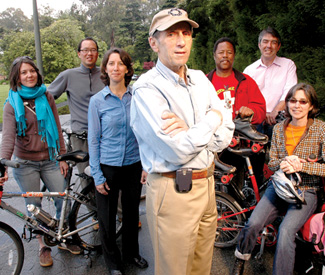
It wasn’t going well for Ted Strawser, predictably. The alternative transportation activist faced an uphill battle March 14 trying to convince a San Francisco Chamber of Commerce committee to endorse Healthy Saturdays, a plan to ban cars from part of Golden Gate Park.

Representatives of the park’s museums and Richmond District homeowners had just argued their case against the measure. “Visitors want access to our front door, and we want to give it to them,” Pat Kilduff, communications director for the Fine Arts Museums of San Francisco, indignantly told the group of two dozen business leaders gathered around a large conference table.

Strawser gave it his best shot: he talked about following the lead of other great cities to create car-free spaces; he said, “Golden Gate Park is one of the best parks in the nation, if not the world”; and he made a detailed case for closure. But around the table there were scowls, eye rolls, and other obvious signs that Strawser was being tolerated, not welcomed. Some — including chamber vice president Jim Lazarus — even started to interrupt and argue with him.

Then the man sitting next to Strawser spoke up. “I don’t think this is fair,” he said. And suddenly, everyone in the room shaped up. Strawser’s ally — his only supporter in the room — was somebody no chamber member could or would dismiss. Warren Hellman doesn’t shout or bang the table — but when he speaks, downtown pays attention.

Hellman, a prominent investment banker, told the committee members that he expected them to show the same respect for Strawser that they had for the previous two speakers. The nonsense ended, immediately.

And by the time Strawser turned the floor over to Hellman, the mood had changed. The group listened raptly, smiled, and nodded as Hellman spoke in his usual folksy, familiar, disarming style.

“It’s not a lot of fun when friends fall out,” he began, “because the previous speakers and many of you all agreed on the necessity of the garage [that was built in Golden Gate Park], and we worked together.”

He pointed out that many in the group had promised during the fall 2000 election to support Healthy Saturdays once the garage was built, although Hellman was now the only member of the coalition honoring that commitment. But he didn’t chide or shame his colleagues. That isn’t Hellman’s style.

Instead, he spoke their language. The garage has never been full and needs the money it can charge for parking to repay the bonds. This isn’t a fight that’s going away, since “part of the conflict is because this park is everybody’s park.” But there are “about 100 compromises not acceptable to either side that would move this forward.” And if a solution can’t be found, there will probably be an expensive ballot fight that nobody wants.

“My conclusion is we should attempt this test,” Hellman told the group. Ultimately, when the vote was later taken in secret, the chamber didn’t agree, although it did vote to back a trial closure after the California Academy of Sciences reopens next year.

At the meeting, Hellman openly called for Mayor Gavin Newsom to get involved in seeking a compromise, something Hellman said he had also just requested of the mayor at a one-on-one breakfast meeting. A couple of weeks later Newsom — who had already indicated his intention of vetoing the measure — did broker a compromise that was then approved by the Board of Supervisors.

As usual, Hellman didn’t take credit, content to quietly play a role in making San Francisco a better place.

Healthy Saturdays isn’t the most important issue in local history — but the significance of Hellman’s involvement can’t be underestimated. His alliance with the environmentalists and park advocates might even signal a sea change in San Francisco politics.

Warren Hellman represents San Francisco’s political and economic past. And maybe — as his intriguing actions of recent years suggest — its future.

This guy is a rich (in all senses of the word) and compelling figure who stands alone in this town. And even though his leadership role in downtown political circles has often placed him at odds with the Guardian, Hellman consented to a series of in-depth interviews over the past six months.

“Our family has been here since early in the 19th century, so we had real roots here,” Hellman told us. His great-grandfather founded Wells Fargo and survived an assassination attempt on California Street by a man who yelled, “Mr. Hellman, you’ve ruined my life,” before shooting a pistol and barely missing.

The Hellman family has been solidly ruling class ever since, rich and Republican, producing a long line of investment bankers like Warren.

Yet the 72-year-old comes off as more iconoclast than patrician, at least partly because of the influence of his irreverent parents, particularly his mother, Ruth, who died in 1971 in a scuba-diving accident in Cozumel, Mexico, at the age of 59. “She was entirely nuts,” Hellman said, going on to describe her World War II stint as a military flier in the Women’s Auxiliary Service Pilots and other colorful pursuits. “She just loved people, a little like I do. She collected people.”

Hellman grew up wealthy and cultured, but he also attended public schools, including Grant Grammar School and Lowell High School. In between, the young troublemaker did a stint at San Rafael Military Academy — “reform school for the rich,” as he called it — for stunts such as riding his horse to Sacramento on a whim.

After doing his undergraduate work at UC Berkeley, Hellman got his MBA from Harvard and went on to become, at the age of 26, the youngest partner ever at the prestigious Manhattan investment firm Lehman Bros. He developed into an übercapitalist in his own right and eventually returned home from New York and founded Hellman and Friedman LLC in San Francisco in 1984, establishing himself as the go-to financier for troubled corporations.

“He is really one of the pioneers of private equity,” said Mark Mosher, a longtime downtown political consultant and the executive director of Gov. Arnold Schwarzenegger’s California Commission on Jobs and Economic Growth, on which Hellman sits.

Hellman became what Business Week called “the Warren Buffett of the West Coast,” a man of extraordinary wealth and power. Among other accomplishments, Hellman took Levi Strauss private, recently made billions of dollars in profits selling DoubleClick to Google, and manages the assets of the California public employee retirement funds (CalPERS and CalSTRS), which are among the largest in the world.

Like many financial titans, Hellman has always been a generous philanthropist, giving to the arts, supporting schools in myriad ways, and funding the San Francisco Foundation and the San Francisco Free Clinic (which his children run). He vigorously competes in marathons and endurance equestrian events, often winning in his age bracket. And he has his humanizing passions, such as playing the five-string banjo and creating the popular Hardly Strictly Bluegrass festival.

But he’s also been a prime facilitator of downtown’s political power, which regularly flexes its muscle against progressive causes and still holds sway in the Mayor’s Office and other city hall power centers.

Hellman founded, funds, and is a board member of the Committee on Jobs, which is perhaps the city’s most influential downtown advocacy organization. Hellman and his friends Don Fisher, the founder of the Gap, and Sen. Dianne Feinstein also started SFSOS, which now wages the most vicious attacks on left-of-center candidates and causes.

When the de Young Museum and other cultural institutions were threatening to leave Golden Gate Park, Hellman almost single-handedly had an underground parking garage built for them, in the process destroying 100-year-old pedestrian tunnels and drawing scorn from the left. The Guardian called it “Hellman’s Hole.”

“We at the Bike Coalition very much started out on the opposite side of Warren Hellman,” San Francisco Bicycle Coalition executive director Leah Shahum told us. “We couldn’t have been more like oil and water on the garage issue.”

But over the past two years or so, Hellman’s profile has started to change. He went on to become an essential ally of the SFBC and other environmentalists and alternative transportation advocates who want to kick cars off JFK Drive in Golden Gate Park on weekends, crossing the downtown crowd in the process. He has shared his wealth with progressive groups such as Livable City, which often fights downtown, and has stuck up for edgy fun seekers over more conservative NIMBY types. He has also publicly repudiated the attacks of SFSOS and its spokesperson, Wade Randlett, and withdrawn his support from the group.

Hellman is still a Republican, but a thoughtful and liberal-minded one who opposed the Iraq War and wrote an article for Salon.com in February titled “If the United States Were a Company, Would George Bush Be Our CEO?” (His answer: hell no.) And to top it all off, Hellman sports a few tattoos and even attended 2006’s Burning Man Festival and plans to return this year.

Unguarded and reflective, Hellman’s comments to the Guardian foreshadow the possible future of capitalism and influence in San Francisco and point to potential political pathways that are just now beginning to emerge.

Our first conversation took place at the Guardian office two weeks before the November 2006 election, when it was starting to look like Nancy Pelosi had a good shot at becoming speaker of the House of Representatives.

“I think this election in two weeks is going to be really interesting,” Hellman told us.

This Republican was cheering for the Democrats to win. “They aren’t my kind of Republicans,” he said of the people in power. Hellman didn’t support the war or approve of how the Bush administration sold it, and he wanted Pelosi and the Democrats to hold someone accountable.

“What I’d like her to do is admit that we can’t get out [of Iraq immediately], but start to talk about what the fallout has been. Discuss the enormous cost in human life as well as money, and how it’s possible the war united the Middle East against us,” Hellman said.

The one thing he can’t abide is disingenuousness. Hellman speaks plainly and honestly, and he asked us to keep particularly caustic comments off the record only a few times during almost six hours’ worth of interviews. He was self-effacing about his political knowledge and seemed most interested in working through the problems of the day with people of goodwill.

Asked what he values most in the people he deals with, Hellman said, “It’s authenticity. Do they believe things because they believe in them, or do they believe in things because they’re cynical or they’re just trying to gain something?”

Locally, Hellman has reached out to people with varying worldviews and come to count many friends among those who regularly battle against downtown.

“I love to know people,” he said. “That’s probably the single thing that motivates me. When someone says to me, ‘How can you be friends with [then–head of SEIU Local 790] Josie Mooney?’ I say, ‘Look, I want to know Josie Mooney. And if she’s awful, then we won’t be friends.’ I’m just fascinated by getting to know people. And virtually always, they’re a little like Wagner operas: they’re better than they sound.”

Hellman was the chair of the Committee on Jobs when he got to know Mooney, who chaired the San Francisco Labor Council and was a natural political adversary for the pro-business group, particularly when Hellman was leading the fight to do away with the city’s gross receipts tax, which has proved to be costly for the city and a boon for downtown.

But after that victory, Hellman turned around and cochaired a campaign with Mooney to retool and reinstate the gross receipts tax in a way that he believed was more fair and helped restore the lost revenue to the city.

“We lost, but he put $100,000 of his own money into that campaign,” Mooney told us, noting that the proposed tax would have cost Hellman and Friedman around $70,000 a year. “I think he just thought the city needed the money. It was a substantive point of view, not a political point of view.”

Mooney considers Hellman both a friend and “an extraordinary human being…. He has made a huge contribution to San Franciscans that doesn’t relate to ideological issues. A tremendous thing about Warren is he’s not ideological, even in his political point of view…. On politics, I’d say he is becoming more progressive as he understands the issues that confront ordinary people.”

Mooney is one of the people who have helped bring him that awareness. When they first met, Mooney said, Hellman told her, “You’re the first union boss I ever met.” That might have been an epithet coming from some CEOs, but Hellman had a genuine interest in understanding her perspective and working with her.

“In a sense, I think that was a very good era in terms of cooperation between the Committee on Jobs and other elements of the city,” Hellman said. “Josie and I had already met, and we’d established this kind of logic where 80 percent of what we both want for the city we agree on, and 20 percent [of the time, we agree to disagree].”

Committee on Jobs executive director Nathan Nayman — who called Hellman “one of my favorite people in the world” — told us that Hellman feels more free than many executives to be his own person.

“He’s not with a publicly held company, and he doesn’t have to answer to shareholders,” Nayman said. “He takes a position and lives by his word. You don’t see many people like him in his income bracket.”

Hellman has become a trusted hub for San Franciscans of all political persuasions, Nayman said, “because he’s very genuine. He’s fully transparent in a city that likes to praise itself for transparency. What you see is what you get.”

Hellman expects the same from others, which is why he walked away from SFSOS (and convinced Feinstein to bolt as well) in disgust over Randlett’s scorched-earth style. Among other efforts, SFSOS was responsible for below-the-belt attacks on Sups. Chris Daly, Jake McGoldrick, and Gerardo Sandoval (whom a mailer inaccurately accused of anti-Semitism).

“If all things were equal, I’d just as soon that SFSOS went away,” Hellman said. “SFSOS started doing the opposite of what I thought they would be doing, so it was fairly easy for me to part company with them. What I thought we were doing is trying to figure out ways to make the city better, not just being an antagonistic, nay-saying attack organization. I’m not a huge fan of Gerardo Sandoval, but I thought the attacks on him were beyond anything I could imagine ever being in favor of myself. And it was a series of things like that, and I said I don’t want anything more to do with this.”

Downtown, they’re not always quite sure what to make of Hellman.

“Every once in a while, he does things that irritate people who are ideologically conservative,” Mosher said. “He took an immense amount of heat for supporting the Reiner initiative [which would have taxed the rich to fund universal preschool].”

He’s given countless hours and untold riches to public schools, doing everything from endowing programs to knocking on doors in support of bond measures and often pushing his colleagues to do the same.

“My connection to him has been through the school district, and he’s really been a prince,” Sup. Tom Ammiano said. “He has even stopped calling me antibusiness. He put a lot of his energy into improving public education, and so he shows it can be done.”

Progressives don’t always agree with Hellman, but they feel like they can trust him and even sometimes win him over. “If you get a relationship with him and you’re always honest about the facts and your own interests, he will listen, and that’s pretty remarkable,” Mooney said. “He shows a remarkable openness to people who have good ideas.”

His appreciation for people of all stripes often causes him to reject the conventional wisdom of his downtown allies, who viciously attacked the Green Party members of the Board of Education a few years ago.

“Everybody said, ‘Oh my god, Sarah Lipson, you know, she’s a Green Party member, she’s the furthest left-wing person on the board,’ blah, blah, blah,” he said. “And I phoned her up one day and said, ‘I’d really like to meet you.’ And she’s — leave aside the fact that I think she’s a very good person as a human being, but she’s a very thoughtful, analytic person. Listening to her opinions about things that are happening in the school district, I really respect that. I mean, what do I know about what’s going on in the school district? I know more now than I did then. But just getting to know people, and maybe get them to understand my point of view, which isn’t that penetrating.”

Many of his efforts have received little publicity, as when he saved the Great American Music Hall from closure by investing with Slim’s owner Boz Scaggs and helping him buy the troubled musical venue. “There are things that you and I don’t even have a clue that he has done,” Nayman said.

“He’s an interesting guy,” Mosher said. “He’s one of a dying breed, a liberal Republican. He has a social conscience and wants to use his money to do good.”

Actually, calling Hellman liberal might be going too far. In the end, he’s still very much a fiscal conservative. He doesn’t support rent control, district elections for the Board of Supervisors, taxing businesses to address social problems such as the lack of affordable health care, or limits on condo conversions.

He also opposes the requirement that employers provide health care coverage, which downtown entities are now suing the city to overturn, telling us, “In general, I don’t think it’s a good idea, because I’m still, even in my aging years, a believer that the marketplace works better than other things…. Universal health care I do believe in, but what I worry is that it’s going to be another damned bureaucracy and that it’s not going to work.”

Yet he doesn’t believe wealth is an indicator of worth, saying of his fortune, “It is luck. Most of what you do you aren’t better at than everyone.”

He doesn’t believe in the law of the jungle, in which the poor and weak must be sacrificed in the name of progress. In fact, he feels a strong obligation to the masses.

As he told us, “My mantra for capitalism — and I didn’t invent this, but I think it’s pretty good — is that capitalism won, and now we need to save the world from capitalism.”

Hellman looms large over downtown San Francisco. His Financial District office offers a panoramic view of the Bay Bridge, Treasure Island, the Ferry Building, and the rest of the city’s waterfront. He likes to be personally involved with his city and the companies in which Hellman and Friedman invests.

“Usually I’m directly involved,” he told us in an interview earlier this year. “I’ve always said that I don’t like to go to the racetrack to just look at the horses. The fun of being a principal is that you’re standing at the track and not saying, ‘Gee, that’s a beautiful gray horse.’ You’re saying, ‘Come on, he’s got to win!’ So I’m almost always invariably invested in the companies that we work with, either individually or through the firm.”

Unlike many Wall Street barons who strive to control a company and bring in new executives, flip it for a quick profit, or liquidate it, Hellman said his firm tries to identify solid companies and help facilitate what they do. “We don’t usually take over companies. I always think that we provide a service to help the businesses,” he said. “Our job is kind of the opposite of owning a factory. Our job is to be sure the people who run the business feel like it’s their business.”

Similarly, he thinks capitalists need to feel a sense of ownership over society’s problems, something he thinks is taking root in San Francisco and other economic centers, particularly among the younger generations. “It’s about understanding how much suffering there is on the other side and trying to figure out how that suffering can be alleviated,” he said. “I think it’s partly good economics that as you bring people up, they’re able to do more for society. If nothing else, they’re able to buy more and shop at a Wal-Mart or something — probably someplace you would wildly disapprove of — and buy goods and services. But I don’t think it’s that narrow.”

Rather, he believes that everyone has a little progressive in them, a little desire to cooperatively solve our collective problems rather than pass them off to future generations. He sees a marked change from his days at Lehman Bros.

“Everybody was into making it,” he said, noting that many capitalists then did charity work as a means of attaining social status but focused mostly on the accumulation of wealth. But, he said, the new generation of capitalists seems genuinely interested in improving the world.

“The feeling for giving back in the next generation, in the now 25- to 35-year-olds, it’s just an order-of-magnitude difference than it was for people who are now in their 40s and early 50s,” Hellman said. “I’m very encouraged.”

Yet the flip side is that, in Hellman’s view, downtown doesn’t wield as much power as it once did. Low political contribution limits have made politicians less dependent on downtown money, creating fewer shot callers, while democratizing tools such as the Internet have broadened the political dialogue.

“For the last 30 years we have become an increasingly tolerant city, and that’s great,” he said. “In the old days, [the Guardian] complained about downtown, and yeah, no shit, downtown really did control the city. The benefit was as that slipped away, the city became fairer and more open to argument. So now downtown hardly has any power at all anymore. In a sense, that’s a good thing. Tolerance grew tremendously when the city wasn’t dictated to.”

That tolerance caused street fairs to pop up all over town and festivals such as Hellman’s Hardly Strictly Bluegrass to blossom in Golden Gate Park. Bike lanes have taken space from cars, events such as Halloween in the Castro have gotten crazier, street protests have gotten bigger and more frequent, and people have felt more free to fly their freak flags. And all that freedom eventually triggered a backlash from groups of isolated NIMBYs who complain and often find sympathetic ears at city hall.

“Sometimes you get the feeling in this city that in the land of the tolerant, the intolerant are king,” said Hellman, whose festival has endured noise complaints even though the music is shut off by 7 p.m. “There is a continuing pressure to do away with fun, because fun is objectionable to someone, [but] we need to think about not creating a new dictatorship of a tiny group of people whose views are not in line with the opinion of most of the people of San Francisco…. You should try to balance the good of a lot of people versus the temporary annoyance of a few people.”

Preserving fun and a lively urban culture is a personal issue for Hellman, who plays the five-string banjo and calls his festival “the most enjoyable two days of the year for me.” He helps draw the biggest names in bluegrass music and acts like a kid in a candy shop during the event.

“I feel very strongly that an important part of our culture is built on the type of music and type of performance that goes on at Hardly Strictly Bluegrass,” Hellman said. From parables set to music to songs of struggle and the old union standards, “that kind of music is the conscience of our country.”

He considers bluegrass a vital and historically important form of political communication, more so than many of the upscale art forms that the rich tend to sponsor. “I’m glad that we have first-rate opera, but it’s equally important that we foster the kind of music, lyrics, etc., that support all this,” he said. “Somebody once said that most of the great Western philosophy is buried in the words of country songs. And that’s closer to the truth than most people think. A big passion of mine is to try to help — and people have defined it too narrowly — the kinds of music that I think have a hell of a lot to do with the good parts of our society.”

Perhaps surprisingly for a Republican venture capitalist from the older generation, Hellman also considers the countercultural freaks of San Francisco to be some of the “good parts of our society.” That’s why he attended Burning Man for the first time last year and why, he said, he loved it, as much for the culture and community as for the art.

“I went to Burning Man because as much as possible I want to experience everything,” he said. “I want to just see directly what it’s like. I knew I’d enjoy it. I never doubted that. But what really overwhelmed me is it was 40,000 people getting along with each other. I mean, it’s pretty intense. There were dust storms and the world’s most repulsive sight: nude men over 70 just dangling along. But I never saw an argument. It was 40,000 people just enjoying each other.”

It was most striking to Hellman because of the contrast with the rest of society. As he said, “I’ve never seen this country so divided.”

While Hellman supports Schwarzenegger — calling him “a good advertisement to California” — he has nothing good to say about his fellow Republican in the Oval Office. He calls Bush’s tenure “an absolute four-star disaster.” The invasion of Iraq is the most obvious problem, he said. “Our war policy has slowly veered from being ‘Don’t tread on me’ to we’re going to jump on your neck.”

But his antipathy to certain aspects of the Republican Party began even earlier, when the religious right began to take over.

“I thought we were not that polarized during the Clinton administration. I was somewhat encouraged,” Hellman said. “Maybe there was an undercurrent of strident religious behavior or strident conservatism, but not the conservatism that I think the Republican Party used to stand for, which was fiscal conservatism instead of social conservatism. Somehow, there was this angst in this country on the part of religious people who I guess felt this country was being taken away from them, and they were the kind of stalwart or underpinnings of society. And they took it back.”

But in the wake of that disaster, Hellman thinks, there is an opportunity for reasonable people of goodwill to set the future political course. As Nayman said of Hellman, “He does believe there is a middle way pretty much all the time.”

Politically, that’s why Hellman gravitates toward the moderates of both major parties, such as Schwarzenegger and Newsom. He looks for people who will marry his economic conservatism with a regard for things such as environmentalism and social justice.

“It’s very tough to be a big-city mayor,” Hellman said. “[Newsom is] probably the best mayor we’re entitled to. He’s got this fantastic balancing act.”

Hellman said downtown hasn’t been terribly happy with Newsom for supporting striking hotel workers, getting behind Ammiano’s health insurance mandate, supporting tax measures, and generally letting the Board of Supervisors set the city’s agenda for the past two years.

“Their measure is he has 80-percent-plus popularity, and he ought to spend some of it. Well, they might not agree with what he would spend it on. And he’s been unwilling to spend very much of it. In some parts of the business community there is disappointment with him, but I don’t think that’s right. He didn’t hide what he would be like.”

What Newsom said he would be — a big reason for his popularity — is a mayor for the new San Francisco, a place where the city’s traditional economic conservatism has been tempered by a greater democratization of power and an ascendant progressive movement that expects its issues to be addressed.

“I don’t like people who are intolerant,” Hellman said. “I don’t like people that are telling you something to get some outcome that, if you understood it, you probably wouldn’t want. I like people that are passionate.”

Asked, then, about Sup. Chris Daly, the nemesis of downtown and most definitely a man of strong political passions, he said, “I admire Chris Daly. I disagree with Chris on a lot of things he believes, but there are also probably a lot of things I would agree with Chris on. And I respect him.”

Hellman is the rare downtown power broker who wants to bridge the gap between Newsom — whom he calls a “moderate to conservative establishment person” — and progressives such as Daly, Mooney, and the Bicycle Coalition. The middle ground, he said, is often a very attractive place, as it was with Healthy Saturdays.

“I’m sure you spend time in the park on Sunday, and it’s a hell of a lot nicer in there on Sundays than Saturdays,” Hellman said. But even more important to him, this is about integrity and being true to what Golden Gate Park garage supporters promised back in 2000.

“They were proposing Saturday closing at that time, which I’ve always thought was a good idea,” he said. “And we made a commitment to them, or I thought we made a commitment to them, that let’s not have Saturday closure now, but as soon as the garage was done, we’d experiment with Saturday closure.”

We brought up what Fine Arts Museums board president Dede Wilsey has said of that pledge, that it was under different circumstances and that she never actually promised to support Saturday closure after the garage was completed.

“There’s a letter. She put it in writing,” he said of Wilsey. “She signed a letter on behalf of the museums saying that when the de Young is done, we should experiment with Saturday closings.”

The Bike Coalition’s Shahum said that even when Hellman was an enemy, he was a reasonable guy. But it’s in the past couple of years that she’s really come to appreciate the unique role he plays in San Francisco.

“He showed decency and respect toward us,” she said. “We never saw him as a villain, even though we disagreed completely. Later he really stepped up and has been a leader on Healthy Saturdays. And what I was most impressed with is that he was true to his word.”

Supervisor McGoldrick, who sponsored the measure, echoed the sentiment: “Hellman was certainly a man of his word who acted in a highly principled way.”

So why does Hellman now stand apart from the downtown crowd? Has he parted ways with the economic and cultural power brokers who were once his allies?

No, he said, “I think they parted ways with me.” *

 

Dr. Dean’s cure for division

0

By Steven T. Jones
Democratic National Committee chairman Howard Dean fired up the party faithful during a fundraiser at the Palace Hotel in San Francisco last night, displaying the passionate oratory that inspired the grassroots but prompted the mainstream media to turn on him during his run for president in 2004.
dean.jpg
File photo from the Guardian of London

He said the Republican takeover of Congress in 1994 started “a national nightmare,” but with the Democrats retaking Congress in November, “we are on the way back.” He implored party activists that the power to fundamentally transform the country is in their hands. “It is all about grassroots and knocking on doors,” Dean said. “The 30-second ads are not going to cut it anymore.”
Yet for all his rhetoric about the superiority of Democratic Party values — such as environmentalism and opposition to poverty and war — there was something unsettlingly simplistic in Dean’s tendency to label Democrats good and Republicans bad.

Support for high-speed rail

0

High-speed rail got a timely and significant vote of support from the California Democratic Party on April 29 when delegates at the state convention approved a resolution pushing the project. The measure was the top vote getter, tied at 24 with a resolution urging accountability for the errors and deception that led to the Iraq War.

Yet a last-minute move weakening part of the measure raises questions about whether the Democrats are truly willing to fight Gov. Arnold Schwarzenegger, who has called for an indefinite delay in next year’s high-speed rail bond measure and proposed a budget that guts the California High-Speed Rail Authority (see "The Silver Bullet Train," 4/18/07).

The resolution praises the project as "a significant weapon against air pollution and global warming as it uses much less energy per passenger than cars and airplanes – and HSR will be even more essential if, as expected, petroleum supplies diminish in the future."

But state party leaders deleted language from the version that was submitted by San Francisco delegate Jane Morrison asking "that all California elected officials support the requested $103 million for HSR in the current state budget – and retain and support the $10 billion bond issue now scheduled for High Speed Rail in the 2008 election." Assemblymember Fiona Ma has emerged as the main legislative champion for the embattled project and helped push the resolution to the top of the legislative priority list. But she faces a big test in trying to get the money the project now needs.

Morrison told us, "We have to work to convince the legislature that we can afford it. That’s the hard part, so we’re not done yet."

A recent report from the Legislative Analyst’s Office criticized Schwarzenegger’s holding pattern as wasteful and concluded that the legislature should fully fund the project or vote to kill it. The report was titled "Time to Bite the Bullet for the Bullet Train."

There’s more on high-speed rail – including a telling exchange between the Guardian and the Governor’s Office – on our Politics blog, at www.sfbg.com/blogs/politics.

Editor’s Notes

0

> tredmond@sfbg.com

The delegates to the annual California Democratic Party convention began trickling into the San Diego Convention Center on April 27, and one of the first people they saw was Barbara Cummings. She had stationed herself about a block away from the entrance and was holding a big "Impeach Bush and Cheney" sign.

"It’s wonderful," the San Diego activist told me. "The delegates all want their pictures taken with us. The tourists want pictures too."

Inside the convention hall, the grassroots sentiment was pretty similar. The black "impeach" lapel stickers were everywhere, hundreds of delegates wore black "impeach" T-shirts, and impeachment banners and signs flew everywhere.

Within official party circles, though, the mood was slightly different. Art Torres, the chair of the state party, told the press early on that he expected the war and impeachment to dominate the convention, but when I asked him if there was any disconnect between the party faithful calling for impeachment and House Speaker Nancy Pelosi saying that wasn’t an option, he simply said, "No. That’s the Democratic Party." He added, "We see a distance between the grass roots and the leadership. That’s not uncommon."

In many ways, that was the theme of this convention. The California Democratic Party is changing, in part driven by a new wave of young, Internet-savvy activists and bloggers who are practically screaming for respect. And the old guard is having a very hard time giving up control.

At the Resolutions Committee meeting April 27, Torres, a smooth operator with more than 30 years’ experience in party politics, gave a textbook demonstration of how the powers that be keep the grass roots in line.

On one level, the resolutions that get passed at these conventions don’t matter that much; they don’t have any binding authority. But they do express the official position of the state party, can put pressure on Democratic elected officials – and sometimes highlight the schisms in the famously fractious organization.

In this case, activists had put forward a half-dozen reform proposals that all had the same issue at heart: control of state party money.

Howard Dean took on the old guard nationally when he decided to put money into party-building efforts and candidates in all 50 states; his fans in California want to see the state party follow that model in all 58 counties. They also want more transparency in how the money is handled.

The state party chair, of course, keeps a lot of his power and authority by controlling that cash, and the legislative leaders keep their powerful posts and ensure the loyalty of their troops in part by determining which Democrats get the resources in election years.

The resolutions called for an outside audit of party money and a formal 58-county strategy. Before a single supporter of those measures had a chance to speak, the chair of the Resolutions Committee turned the floor over to Torres – who suggested the whole thing be referred to a new task force, which he would appoint, for consideration at some time in the future. The committee chair quickly called for a motion and a vote, and the panel – also all appointed by Torres – swept every party-reform resolution right off the table.

The same pattern played out with impeachment; a strong grassroots effort became a weak final resolution. As one committee member told me, "Speaker Pelosi is against impeachment, so we can’t really vote for it."

With the early California primary, the state convention was a big-time event. Seven presidential candidates showed up, more than had ever come to a state party event in history. There was a palpable feeling of energy at the convention, a sense that this time around, the Democrats might actually be ready to win the White House.

On the convention floor the mood was festive as Hillary Clinton strode through a side entrance and walked past a mob of supporters to the stage. Her speech was about what I expected – standard stump lines, but well delivered and full of energy. She had the crowd with her for about 10 minutes, until she mentioned Iraq – at which point the boos and catcalls began, the people in the seats got restive, and the mood was shattered. "She still won’t apologize," one young delegate told me, shaking her head.

Barack Obama looked like the rock star he is, jogging through the entrance with a huge smile. In person he looks like he’s barely out of his 20s – and his army, while smaller then Clinton’s, was more diverse and a lot younger. He’s a dynamic speaker and got a huge ovation when he announced that "I stood up in 2002, when it wasn’t popular to stand up, and said [the war] was a bad idea."

Obama split without talking to the press. Clinton arrived 20 minutes late to a packed press conference and said very little of note.

John Edwards, who spoke Sunday morning, April 29, got his own star treatment and demonstrated a key difference with Clinton when he announced that "I voted for this war, and I was wrong to vote for this war." He was also the only candidate who actually talked about poverty in America. He showed up on time for his press availability; I managed to get the first question.

"Senator," I said, "the 25 top hedge fund managers in this country made enough money between them last year to pay the salaries of all 88,000 New York City public school teachers for three years. I know you want to repeal the Bush tax cuts, but beyond that, shouldn’t we actually raise taxes on the very rich so we can pay the teachers a little better?"

"It’s a good question," he said, "and it’s worthy of consideration." But for now, Edwards won’t go beyond restoring the tax code to its Bill Clinton-era levels, which are still far, far too rewarding to the tiny segment of the country that earns and controls the vast majority of the income and wealth.

I got to ask Sen. Chris Dodd of Connecticut the same question; he kindly agreed to a private interview and gave me 10 minutes or so. He, like Edwards, was kinda sorta maybe willing to consider raising taxes on people who make upward of $250 million a year.

I suppose this is progress.

All the liberal bloggers came to the April 27 evening fundraiser for Jerry McNerney, who defeated Ricahrd Pombo, and Charlie Brown, a Democrat who wants to unseat John Doolittle in congressional District 4 (north of Sacramento). Brown is a favorite of the blogosphere; he’s also a candidate who was barely on the official party radar when he ran in 2006.

All that has changed dramatically – with Doolittle circling the drain and Brown showing surprising strength. Even Pelosi plugged him from the convention stage.

But the only elected official I saw at the fundraiser was Assemblymember Mark Leno.

The people in the room represented a very different approach to state politics. It’s not even an entirely ideological division; it’s more about a form of activism. The bloggers (who aren’t just writing about the party but trying to change it) are still the party outsiders now – but they’ve already raised more money for Brown than any other single source, mostly in small contributions. And I suspect that if he gets elected, he’ll remember the people who were there for him first.

The outsiders still don’t understand how all the hardball politics work at conventions, but they’re learning. They’re also emerging as a tremendous force in American politics, and in California they’re knocking, loudly, on the state party doors. And Art Torres is a fool if he thinks he’s not going to have to let them in. *

For much, much more on the state convention, go to the Guardian politics blog at www.sfbg.com/blogs/politics.

Reilly’s victory

0

EDITORIAL In the days following the historic settlement of Clint Reilly’s lawsuit against the Bay Area’s newspaper barons, the local dailies, the media blogs, and the trade publications such as Editor and Publisher were buzzing with debate and speculation over a few of the agreement’s terms.

Would Reilly actually get space in the local papers to make his political points every month? Where would that space go? Would it be paid ad space, or would he get it free? Would he be able to appoint a citizen member to the editorial boards of Dean Singleton’s dailies (including the San Jose Mercury News and the Contra Costa Times)? Or could the papers’ managers reject his nominations?

Back and forth, back and forth. And all of it entirely missed the point.

This was the fine print of the deal, the stuff that, a few months from now, nobody will remember or care about. You could get the real news from the headline in a blog post by former Chronicle city editor Alan Mutter: "Hearst-MediaNews deal scuttled."

That’s what happened here: Reilly, acting with his own money, with no support from the federal or state regulators, broke up a deal that would have put the owners of the Chronicle directly in business with Singleton’s MediaNews Group, the owner of almost every other major daily in the region. It would have been the end of daily newspaper competition in the Bay Area.

The Hearst Corp., documents that came out during the suit showed, wanted to combine some printing, distribution, and sales efforts with MediaNews Group. And Hearst wanted to convert an investment in MediaNews into direct stock in the company’s local papers. That would have, in effect, made one of the last non-MediaNews papers in the area part of the same business group.

As G.W. Schulz reports in "Beyond the Reilly Settlement," on page 11, if Reilly hadn’t intervened, nobody would have known about it until it was over and too late to stop. That’s the point here, and that’s what journalists, political scientists, and critics ought to be talking about.

Instead, we’ve heard outrage from some editors over the fact that Reilly might get some space in the papers. It’s really a nonissue; he could have bought ad space for his opinions anyway, and all that the settlement did was give him that space free. And a lot of papers ask citizens to serve on advisory boards; Reilly’s nominees are very unlikely to change anyone’s editorial policies.

Meanwhile, where is the outrage over the original Hearst-MediaNews deal, which would have ended editorial competition the same way the 1965 joint operating agreement between the Chronicle and San Francisco Examiner did? Where is the outrage, for that matter, over the fact that the Chronicle is now putting ads not from Clint Reilly but from Pacific Gas and Electric Co. – greenwashing ads that are demonstrable lies – on the front page of the paper, without even a tagline that says "paid advertisement"? Where is the outrage over the fact that Democrats Bill Lockyer (the former attorney general) and Jerry Brown (who now holds the job) were ready to stand back and let all this happen?

And where is the concern among all these civic-minded types about the fact that despite Reilly’s best efforts, it’s entirely possible Hearst will wind up trying to sell the Chron to Singleton anyway – and none of the federal or state authorities seem to care?

Remember, if Reilly hadn’t sued, one of the most dangerous, rotten tricks in newspaper history might have gone unchallenged.

As it is, the full information only came to light because the Guardian and Media Alliance went into court to force it open – and now Reilly and his attorney, Joe Alioto, have the right under the settlement to seek federal Judge Susan Illston’s permission to make the remainder of the key records – including the settlement agreement – public. They should do so, immediately, and Illston should grant their request. The public interest in the newspaper barons’ schemes couldn’t possibly be greater. *

Dem Con Sunday: Maxine Waters for president

0

By Tim Redmond

The warm up for John Edwards is L.A. Rep. Maxine Waters — and she utterly steals the show. “We cannot deal with our domestic agenda until we end this war in Iraq,” she says to rousing cheers. She talks about “the most dastardly lie ever told to the American people by their president.” She goes through an amazing litany of what’s gone wrong in Iraq, then says:

“Democrats, your presidential candidates and elected officials must stop nuancing and playing it safe.”

I’m voting Maxine for president.

Dem Con: Saturday afternoon

0

By Tim Redmond

I got a chance to talk briefly last night with Rep. Jerry McNerney, the man who defeated Richard Pombo, and I asked him what the Democrats would do after Bush vetoes the Iraq funding cutoff. “Bring it back again, and again, and again,” he told me. “That’s what I would do.”

At least it’s a plan.

Arnold’s dishonest rail stand

0

TGVtrain.web.jpg
By Steven T. Jones
Why can’t Gov. Arnold Schwarzenegger or his proxies explain their opposition to high-speed rail? They try, as they must. After all, this is a green project lauded across the ideological spectrum and around the world for its potential to prevent global warming, dirty air, and clogged freeways and airports.
But all the answers Arnold’s people give are illogical, unresponsive, or contradicted by the experts. In the end, it appears the Schwarzenegger administration is simply unwilling to support high-speed rail or to level with the public about why. Legislators and other Democrats say they’re solidly behind the project, something that will be tested this weekend in San Diego when the state party convention considers a resolution of support authored by longtime party activist Jane Morrison of San Francisco.
“It’s very timely because the governor is trying to cut the budget [for the California High Speed Rail Authority] back to $1 million and delay the bond measure,” Morrison told the Guardian. “I think this is a terribly important project.”