Democrats

Half a decade of war

0

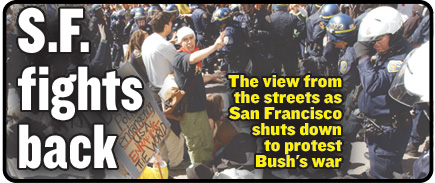
EDITORIAL Five years ago, the antiwar movement shut down San Francisco. It was a moment in history, one of those times that those of us who were there will never forget. No cars on Market Street. No cars on Mission Street. No business as usual anywhere downtown. Just a powerful statement that the city was not going to pretend that invading Iraq was an acceptable move.

And yet, for five years, the war has gone on. Sometime this spring, it’s likely the total number of American soldiers killed in the pointless military adventure will pass 4,000. And that’s just a fraction of the carnage: according to iraqbodycount.org, more than 89,000 civilians have died since the George W. Bush administration launched the invasion in March 2003.

There will be any number of newspaper stories, special reports and anniversary programs in the next few weeks, but of all the facts and statistics they’ll cite about the war, one ought to be at the top:

The antiwar movement was right.

Everything that the activists in the streets (and the very few newspapers that supported them, like this one) said at the time would prove to be absolutely true. As Steven T. Jones notes on page 14, there were no weapons of mass destruction. There was no link between Saddam Hussein and al-Qaeda. Iraq had nothing to do with Sept. 11. United States troops were not welcomed as liberators. There is no functioning Iraqi democracy. The situation in the Middle East is more unstable now than it was five years ago. Nothing has come of this war except disaster, death, and a bill to the American people that could reach $3 trillion.

In fact, Bush’s war is one of the main reasons that the economy is such a mess today — and that’s something the Democratic presidential candidates need to be talking about.

There has been nowhere near enough debate over the cost of the war. Bush has managed to fund the entire effort through supplemental appropriations, without once presenting a full budget to Congress. And the Democrats, fearing political criticism if they cut funding to troops who are in harm’s way, have gone along with every single spending request.

That’s been a huge factor in the nation’s mounting budget deficits and rapidly growing debt. And unlike deficit spending that funds social and infrastructure priorities, the red ink has done little to create jobs or improve the economy. It’s well known that military spending does less to help economic growth and recovery than any other type of government program. Put another way: If the $3 trillion that will go to the Iraq war were put into any other public venture, it would have tremendous positive consequences for society. It could, for example, preserve Social Security for another entire generation without new taxes or benefit cuts.

But those sorts of choices haven’t been presented to the public, because the war has been sold as a painless effort that requires no national sacrifice. And the bills won’t all come due until this president is gone and his successor has to deal with a deep recession, a horrible budget mess, growing unemployment, and a legacy of international distrust.

The good news is that the antiwar activism has forced both presidential candidates to pledge to bring the troops home — and Barack Obama could be the first president in years to be elected in large part on the basis of a strong grassroots peace movement. But the next president won’t stop the war without continued, constant pressure. It’s easy to think of the antiwar movement as a failure and to get discouraged — but this is not time to let down. If a Democrat wins the White House, visible and organized activism will be more important than ever. And this time, it might actually change American politics.

Editor’s Notes

0

"At 11 a.m., Thursday, March 20, I found myself at the corner of Market and Beale streets, looking at the startling emptiness of the Financial District." (See "The days SF stood still," [03/26/03]).

That’s where I was five years ago. You remember where you were, too: it was one of those moments in time that nobody forgets. Shock and Awe lit up the sky over Iraq, President George W. Bush announced the glorious military victory that was on the way, and the politicians — even the Democrats — were so busy praising the troops in the field that nobody stopped to ask how this was all going to end.

As we report this week, the major newspapers didn’t, either. In fact, in a survey by Editor and Publisher magazine, more than 75 percent of the papers supported Bush’s arguments for war. The airwaves were filled with generals and admirals talking up the invasion; the antiwar movement was marginalized.

And while the mainstream media were waving flags and cheering, the alternative press was presenting the other side of the issue. "Bush’s war represents a dangerous turning point for the United States," we wrote on March 26, 2003.

I sent out an e-mail to my colleagues in the Association of Alternative Newsweeklies this week asking how many of the weeklies were strongly against the war, and the answers started pouring in immediately. Tucson Weekly. San Diego City Beat. Boulder Weekly. Monterey Coast Weekly. Boston’s The Phoenix. The North Coast Journal. Random Lengths. The Memphis Flyer. Rochester City Newspaper. Creative Loafing. And that’s just a few of the names on the list.

Overall, the independent and alternative media were in the vanguard, providing the information that the big outfits wouldn’t.

Resistance is futile — or is it?

0

It was a time without precedent in American history. The commander-in-chief voiced his intention to take the country to war — a voluntary, preemptive war with no clear catalyst, no faraway invasion or Pearl Harbor or sinking of the Maine and millions of people shouted their opposition. With plenty of time to avert war, the protesters warned the invasion would be a costly disaster.

They were right. And it didn’t matter.

The war in Iraq was a test of our democratic ideals. It was a test that this country failed, a failure that has been felt by the people of the United States, Iraq, and elsewhere for the last five years. For many, the refusal of the US government to heed the demands of its citizens left them disillusioned and disempowered.

But others say it sparked a political change that woke up an apathetic citizenry, pulled the Democratic Party back to the left, and may have averted war with Iran.

It’s certainly arguable that the presidential campaign of Barack Obama owes its energy and success in part to the antiwar movement — and if Obama wins, he will be the first president in a long time who took office thanks to the support of a strong grassroots progressive movement.

Nowhere was the clash of people power and government will more acute than on the streets of San Francisco, where a series of massive marches, some drawing nearly 100,000 people, filled the streets prior to the invasion of Iraq on March 19, 2003. The onset of war led protesters to effectively shut down the city, resulting in about 2,300 arrests and millions of dollars in costs to the city.

President George W. Bush dismissed the protests, of course, but he wasn’t the only one. Political leaders such as Rep. Nancy Pelosi, then-Mayor Willie Brown and soon-to-be Mayor Gavin Newsom (who didn’t attend any of the marches, unlike progressives on the Board of Supervisors) condemned the peace movement for hurting an innocent city. But with the “battle for San Francisco” making international news, the protesters were more concerned with the global audience.

A month earlier, on the weekend of Feb. 15 and 16, there were coordinated protests against the impending war in about 800 cities around the world, drawing around 10 million people. The peace march in Rome included about 3 million people, earning a listing in the Guinness Book of World Records as the largest anti-war rally in history. People have never made such a loud and clear statement against an incipient war.

Beyond the numbers, the antiwar movement was also right. On every major issue and prediction, the messages from the street proved correct while those from the White House were wrong. The US wasn’t welcomed as liberators. There were no weapons of mass destruction. Iraq after the invasion isn’t a stable democracy or shining beacon to anyone but the new generation of jihadis Bush created.

We can blame a hard-headed president, ineffectual opposition party, failure of the national media, or the national climate of fear following Sept. 11. But rather than refighting that lost battle, now is the time to gain perspective on the events of five years ago and determine what it means for democracy and the post-Bush national agenda.


TO THE STREETS

There were two main umbrella groups organizing protests before the war: Direct Action to Stop the War (DASW) and International ANSWER (Act Now to Stop War and End Racism). ANSWER has remained active and DASW has recently been reconstituted for the fifth anniversary of the war, using direct action in San Francisco as well as other urban centers and outposts like Chevron’s refinery in Richmond, which has reportedly been processing Iraqi oil.

“With the fifth anniversary coming up, we’re going back to direct action on the streets,” said Henry Norr of DASW. “But I don’t have any illusions that it’s going to be like it was five years ago.”

The maddening march to an ill-advised war created a political dynamic in which a broad cross-section of Americans was willing to hit the streets.

“We had a wonderfully diverse group of people, from soccer moms to anarchists,” said Mary Bull, who cofounded DASW, a collective of various affinity groups and concerned individuals formed in October of 2002 as Bush started beating the drums of war.

It was a group fiercely determined to prevent the war — and really believed that was possible. In fact, Bull recalls how she and other members of the group burst out crying at one meeting when a key activist said the war was going to happen.

Richard Becker, who cofounded ANSWER and serves as its West Coast coordinator, said that in the summer of 2002, “we came to the conclusion that [the war] was going to happen.” The group called its first big protest for Sept. 15, 2002, and another one two weeks later. But the movement really exploded on Oct. 26 when almost 100,000 people took to Market Street, much of it a spontaneous popular uprising.

“We were overwhelmed,” Becker said. “We were in a perpetual state of mobilization to keep up with what was going on. But then it didn’t stop the war.”

Did he think they could?

“I think a lot of people thought maybe it was possible to stop it. And we thought maybe it was possible to stop it,” Becker said.

The high point, according to Becker and Norr, was Feb. 17, 2003, when the New York Times ran a front page analysis piece entitled “A new power in the streets” that claimed “the huge anti-war demonstrations around the world this weekend are reminders that there may still be two superpowers on the planet: the United States and world public opinion.” But then Colin Powell went to the United Nations to argue for the invasion, and the Democrats in Congress did nothing, and it became clear war was coming.

Norr stayed out there protesting, being arrested several times and even shot in the leg by Oakland police with a rubber bullet during a protest at the Oakland docks. And he thinks some good came from the experience.

“The lesson for people is the political and economic elites are committed to preserving and extending empire. And they basically say as much in their own writing,” Norr said. “Wars are not anomalies.”

Despite being a frustrating and depressing exercise, most saw benefits to the failed movement. “People got an incredible education about how the system really worked,” Becker said. “Building a movement is mostly about a series of setbacks.”

Medea Benjamin, cofounder of both Global Exchange and CodePink and fixture of the anti-establishment peace movement for years, was upbeat about the protests. “We did our job as citizens. We did what we were supposed to do: organize, get people to take action, get people onto the streets,” she said. “We did everything we could think of.

“What you take from it is we don’t have a very well-developed democracy because the people spoke and the government didn’t listen.”

25war2_Lars1.jpg The ever-evolving “Democracy Wall” on Valencia Street, March 2003, helped stir up debate (Photo by Lars Howlett)


FACING ARREST

The collective action of five years ago starts with a series of personal stories — tens of thousands of them — so let me briefly begin with mine.

My arrival in San Francisco was closely tied to the march to war. I was living in Sacramento and working as the news editor of the Sacramento News & Review when Bush began his saber rattling against Saddam Hussein, but by the end of 2002 I had a falling out with my boss and found myself jobless.

Like most Northern Californians who opposed the war, I came to San Francisco on Jan. 18 to make my voice heard and experienced a bit of serendipity on my way to Justin Herman Plaza: while reading the Guardian on Muni, I saw their advertisement for a city editor, a job that was ideal for me at a paper I’ve always loved. Needless to say, it was a great day, empowering and full of possibilities.

Less than two months later I was on the job, and on the second week of that job I was back on the turbulent streets of San Francisco, part of a Guardian team covering the eruption of this city on the first full day of war. When I stepped off the cable car just after 7 a.m., people were streaming up Market Street and I joined them.

When a large group stopped at the intersection of Market and Beale, I stopped too, taking notes and bearing witness to this historic, exciting event. I had a press pass issued by the California Highway Patrol that allowed me to cross police lines, so when police in riot gear surrounded us and threatened arrest, I held my ground with 100 or so protesters.

After interviewing about a dozen people about why they were there and that they hoped to accomplish (see “On the bus: Journalists, lawyers, four-year-olds — the cops were ready to bust anyone Thursday morning“), I was arrested with the others and taken to a makeshift jail and processing center at Pier 27 (no charges were filed in my case, and charges against all of the 2,300 people arrested here in those first few days of the war were later dropped).

I recently tracked down a few of the people who appeared in my article, including Daphne and Ross Miller, who were at the center of the most interesting drama to play out during our standoff with the police. She’s a family practice physician, he’s an architect, and they live in Diamond Heights with their two children, Emet, who is almost 9, and Arlen, 12, who was away on vacation when the war began.

“We were genuinely shocked that the war started,” Ross told me. “We were at some of the earlier protests and really thought there was no way [Bush] could do it.”

They woke up March 20, 2003, to news that the war had begun and immediately walked to the BART station with Emet and rode to the Embarcadero station, not really planning for the day ahead but just knowing that they had to make themselves heard.

“We were pissed as hell. I don’t think I’ve ever been so angry in my life,” Daphne said.

They quickly came up with a plan. “We basically decided that if anyone was going to be arrested, it was going to be Ross and I’d stay with Emet. But it didn’t end up that way and I ended up in the arrest circle.”

Daphne had their house keys and threw them over the police line to Ross at one point. A photographer in the circle had gotten shots of a man named Roman Fliegel being roughed up by police as they pulled him off his bicycle, which was towing a trailer with a sound system, and decided to throw his backpack with camera gear out as well. When Ross — who had four-year-old Emet on his shoulders — caught it and refused police orders to give it to them, police grabbed Emet and roughly arrested Ross, leaving a gash on his forehead.

“Rage surged through the crowd, and it seemed as if things might get ugly, but the police kept a tight lid on the situation, using their clubs to shove back protesters who had moved forward,” I wrote at the time.

Emet was delivered into the circle with Daphne as the arrests continued, many quite rough. “At that point, as a mom, I had to exercise the most restraint ever,” said Daphne, who was angry about the situation but fearful about what she was exposing her son to. “Please, don’t let any violence happen here,” she pleaded with the crowd. Eventually, commanders on the scene let the mother and child go.

“The officer who let me go said that if he saw me again out there, he would call Child Protective Services on me,” Daphne said. But two days later, still brimming with outrage at her country’s actions, she ditched a downtown medical conference to rejoin the street protests, this time solo.

The couple say they’ve lost friendships over the war and have become more engaged with politics, coming to believe that Bush and the neocons are malevolent figures who knew how badly the war would go and did it anyway to establish a large, permanent military base in Iraq.

“Since that day, we’ve been far more active,” Ross said. “We realized you can’t just trust the system. You have to push.”

But that determination was mixed with feelings of disempowerment and depression. They attended some of the protests that following year, but the couple — like most people — just stopped going at some point because they seemed so futile.

“There was a horrible sense of resignation and a genuine depression that followed,” Ross told me.

The nadir was when Bush was reelected and they considered leaving the country. But then, Ross said, “we decided we’re not just going to run away and we’re not going to accept this.” Looking back, even with the scare over Emet, they express no regrets.

“It was the right thing to do because it was the wrong war to have. I’d do it again and again and again if I had to,” Ross said

They’re guardedly hopeful that Barack Obama could begin to turn things around if he’s elected. “I think the right president can at least start to dismantle this,” Daphne said. “I think thousands of people marching in the streets is something he would listen to.”

25war3_Charles1.jpg A die-in on the streets of San Francisco in March 2007 marked the fourth anniversary of the invasion (Photo by Charles Russo)


WITNESS TO HISTORY

Covering the peace movement in those early days was a heady experience, like reporting on a revolutionary uprising or working in a foreign country where the people are organized and active enough to be able to shut down society and brave enough to risk bodily injury for their beliefs.

I was at the founding meeting of CodePink — which became the most effective group at personally confronting the warmongers and keeping the war in the public eye — one evening at Muddy Waters in the Mission District shortly after the war started.

Looking back, Benjamin rattled off a long list of the alliances the group built — with labor, churches, businesses, and a wide array of social movements — and creative actions intended to build and demonstrate popular support for ending the war.

“We’ve done so many things and what did we get? We got a surge,” she said. “It shows the crisis in our democracy, the crisis of the two-party system, the crisis of a dysfunctional opposition party.”

Yet she said the peace movement has been remarkably successful in convincing the public that the war was a mistake and that it’s time for the troops to come home, even if the Democrats have been slow to respond to that shift.

“The progress we’ve made is turning around public opinion and that’s going to play a big role in the upcoming elections,” she said. For Norr, the role of the news media is a particular sore spot. He was a technology reporter for the San Francisco Chronicle who called in sick on the first full day of war and was arrested on Market Street with his wife and daughter, resulting in suspension by editor Phil Bronstein for his actions.

I wrote several stories on the issue, which culminated in Norr being fired and Bronstein unilaterally banning Chron employees from peace protests. I even borrowed CodePink’s guerilla tactics when Bronstein repeatedly refused to return my calls or address why he had singled out antiwar protesters for uniquely punitive treatment. I confronted him during a speech he gave at the Commonwealth Club (see “Lies and half-truths,” 5/7/03). That was the tenor of the times: we were all tired of being lied to and we decided to push back.

Norr was particularly frustrated with his own paper’s reporting of the war and started sending articles by the foreign press to his paper’s news desk, trying to wake his colleagues up to the pro-war propaganda being passed off as journalism in this country.

He was also disappointed with the country and with the Chronicle — both the management and his fellow reporters, who did little to support him — but the experience caused him to return to his roots as a progressive activist.

“The war and losing the job and everything brought an abrupt end to my consumerist phase and dumped me back into the world of being an activist,” said Norr, who serves on the KPFA 94.1 FM local station board and has made three recent trips to the Palestinian territories while working with the International Solidarity Movement.

Benjamin said Americans shouldn’t expect the next president to end the war — not without lots of pressure from a renewed and vocal peace movement. “This is the time to set the stage for the post-Bush agenda,” Benjamin said. “Don’t put your hopes in Barack Obama in getting us out of Iraq. Put your hopes in the people.”

25war4_Lane1.jpg A rally and nonviolent direct action at the Richmond refinery targeted Chevron on March 15 (Photo by Lane Hartwell)


THE AFTERMATH

The San Francisco Police Department, which spent more than $2 million on overtime costs responding to peace protests between March 15 and April 16, 2003, generally behaved with restraint and professionalism, but there were several exceptions.

The most costly and disturbing incident came when Officer Anthony Nelson began aggressively swinging his long riot baton at protesters, badly shattering the arm of peaceful protester Linda K. Vaccarezza, who suffered a permanent disability in her career as a court reporter.

Nelson’s incident report falsely stated that Vaccarezza had threatened him with a sign attached to a solid pole, but video of the incident later clearly showed there was no pole and that she was retreating when he teed off on her (see “The home front,” 05/19/04).

Vaccarezza received an $835,000 settlement from the city in November of 2004. On Oct. 5, 2005, two and a half years after the incident, SFPD fired Nelson for lying about what happened that day, and the City Attorney’s Office has been successfully fighting Nelson’s appeals in court ever since, putting in more than $100,000 in attorney time and costs into the Nelson and Vaccarezza cases.

The other significant ongoing litigation from the antiwar protests involved Mary Bull, who was arrested during an early protest for pouring fake blood in front of the entrance to Chevron’s San Francisco office before being allegedly strip searched and left naked in her San Francisco Jail cell for 36 hours.

Ironically, Bull was among those who brought a successful class action lawsuit against Sacramento County after she and others protesting a logging plan were strip searched, setting a precedent and led most counties to reform their strip-search policies. She used her share of the $15 million judgment to buy an organic permaculture farm in Sebastopol.

Her San Francisco case, in which Bull won a multimillion-dollar judgment, is still under appeal and now in mediation. Bull said the protests five years ago did make a difference, something she tells those who fret about its apparent failure. “I tell them to look at what issues the candidates are talking about now and I thank them for protesting then.”

“Even though we had millions throughout the world, we were sort of blocked, but now we’re regaining that momentum,” Melodie Barclay, a massage therapist who was also arrested with me on the first day of the war, told me recently. “We can’t judge it by the fact that we didn’t get the momentum we wanted.”

Norr started his antiwar activism working with Students for a Democratic Society in Boston, protesting the Vietnam War, which he said shares many similarities with the current situation, for good or for ill. He said that people tend to forget that while the protests then were huge and helped end the war, the movement did wane after Nixon ended the draft and substituted massive aerial bombardment for boots on the ground.

“The protests dropped off considerably,” he said. “A lot of the things that drove people to take risks in the late ’60s had faded by the early ’70s.”

He thinks the current administration learned a lesson from those days: it’s easier to maintain a war effort if the average citizen isn’t affected.

But there are other factors as well keeping a lid on the antiwar outrage.

“The culture has changed too. Young people are oversaddled with debt. People in schools seem to be docile. The culture as a whole seems to be more individualist and consumerist,” Norr said.

Yet some young people have woken up and many of them are funneling their energies into a peace group that was formed in the summer of 2005: World Can’t Wait, as in: the world can’t wait for the end of Bush’s second term before we change our direction and leadership.

“We don’t just want them gone, we need to repudiate their program,” said Giovanni Jackson, a 26-year-old WCW student organizer. “If we’re going to change anything, we need the youth.”

Jackson was at WCW’s founding convention in New York City, which came just as New Orleans was being flooded and then essentially abandoned by the federal government.

“When [Kerry] lost, people felt demoralized and World Can’t Wait kind of stepped into that situation,” Jackson said. “There was a lot of demoralization in the antiwar movement at that time.”

The group organized protests and student walkouts on Nov. 2, 2005.

“Everyone has their moments of doubt,” he said, “but I’m motivated by the crimes we see everyday.”


THE LESSONS

One of the biggest barriers to galvanizing people and turning the fifth anniversary of the war into something that might make a difference is the presidential election, which is diverting the energy of many potential protesters — and at the same time, offering some hope that a new president may lead to peace.

After all, every single one of the Democratic presidential candidates has promised to withdraw troops from Iraq, with varying timelines and numbers of US personnel left behind. And with enough encouragement, they might be willing to help change the status quo.

Many of the activists who volunteered their time and money to help move the Obama campaign into its front-runner position came out of the antiwar movement, and Obama’s strong stand against the war has been a key factor in his popularity.

Becker and some other activists don’t have much faith that a change in presidents will change the course in Iraq, although he agrees that much of the energy now surrounding Barack Obama derives directly from the antiwar movement.

“There’s been a huge upsurge of hope for Obama and that he might bring about the kind of change we need,” Bull said, adding that she doesn’t share that hope, believing the only path to peace is to pressure Obama and other leaders to commit to more progressive positions.

Norr said, “On one level, people have illusions about the power of peaceful protests. People believe in democracy, as well they should. We feel like the rulers should be paying attention to public opinion.

“It’s a remarkable story how broadly and quickly the American people have turned against the war. Public opinion was certainly ahead of the Democrats.”

And people will only grow more disenchanted with Iraq and its multitude of costs. “The people here are paying for this war, and everyday we have new stories about health clinics being shut down,” Becker said.

Becker was amazed last March as massive demonstrations for immigrant rights seemed to explode out of nowhere. “We think there will be more things like that,” he said.

Because after five years of organizing communities to resist the military-industrial complex’s plans, Becker thinks there’s been some visible progress.

“There isn’t a town or hamlet in the US that doesn’t have activism going on, but you wouldn’t know it from the corporate media,” Becker said. “It’s a mistake for people to feel discouraged.”


Rally Against Pink Slips

0

Hundreds of people– teachers, administrators, school staff, parents, children, union members, state and city officials– gathered in front of the State Building at McAllister and Van Ness, to demand job security for educators and to put education at the top of California’s priority list.
Governor Schwarzenegger’s 2008-09 budget proposes a $4.8 billion cut in state education funds. This would create a $40 million deficit for the San Francisco Unified School District and, in anticipation, the City’s Board of Education sent out 535 pink slips to administrators and certified teachers this week. Paraprofessionals and support staff wait in limbo to learn how many of their positions are on the chopping block.
Organization and activism were in full effect at the rally: participants wore pink clothes, and carried pink balloons and signs to flaunt their opposition to termination notices; letters were written to Schwarzenegger; people carried signs reading ‘Sell a Hummer, Fund a School’ and ‘Terminate the Terminator’; chants of ‘Books Not Bombs!’ rang out; car horns blared in support.
Superintendent Carlos Garcia, who was in Sacramento yesterday with 100 state superintendents and 60 City principals to speak out against the cuts, displayed an oversized pink slip addressed to Arnold, and incited the crowd with the statement, “The fight is just starting…let’s keep the fight going!”
A number of local politicians offered words of outrage towards Schwarzenegger, as well as support of educators. Mayor Gavin Newson stated, “It goes without saying that we are opposed to the governor’s cuts.” He added that the city is not going to sit back and wait for the state to solve its woes, noting “There’s a $40 million problem, but we have a $30 million solution in our back pocket.” This refers to the City’s current $122 million rainy day fund that would divert 25% one-time infusion to SFUSD during a crisis.
State Assembly members Mark Leno and Fiona Ma also spoke. Both made specific mention of a bill, to be introduced tomorrow by Democrats in Sacramento, proposing a 6% severance tax on oil production in the state, as well as well as a 2% windfall profits tax on oil companies that could create $1.2 billion in funds to mitigate budget cuts. State Senator Carole Midgen vowed “We will never let them cut our schools”, and Supervisor Ross Mirkarimi called this endeavor a “Fight against the lack of common sense” of the Governor.
The stars of the day were the teachers, and one who received a pink slip is Tara Ramos. She is a second year probationary teacher of Spanish in 4th and 5th grades at Paul Revere Elementary in Bernal Heights. Revere is one of eight Dream Schools in SFUSD, which face especially rigorous standards in the No Child Left Behind era because a majority of students are at-risk, non-native speakers, and low proficiency.
Ramos said, “100% of the staff told the principal they want to come back,” in a recent staff meeting, yet 21 of 30 certified teachers got served notices this week, and many paraprofessionals have job insecurity.
While explaining the ‘Program Improvement’ requirements of NCLB–where standardized test scores are analyzed by factors such as race–Ramos stated, “Look at our population of kids at Paul Revere…the number of white kids you can count on one hand.” The irony of the whole situation is not lost on her or her colleagues: the tough schools that are full of young teachers face the most uncertainty; layoffs and rehirings create a cyle of shortages and voids; teachers are under constant scrutiny to raise test scores, and now have to worry about their jobs.
“It’s not fair,” Ramos said adamantly. Yet, her priority remains the children. “I’m not so worried about my job. I’m here for the kids…I can get another job.”
As Superintendent Garcia stated, the fight is just starting, so pay attention to this important issue. Write, call, or email the Governor’s office if you are opposed to his cuts, and hold all the officials accountable to their promises of support and finances. This is a social justice issue at its core.

Got moths? Read Dr. Harder’s debunking report

4

Dr Daniel Harder, one of the authors of the report into integrated pest management practices in New Zealand, told me that he was motivated to go to New Zealand to carry out research on the Light Brown Apple Moth, because he is the executive director of UC Santa Cruzs arboretum, which has over 10,000 species in its plant collections that are from New Zealand and Australia, and therefore wants to protect these collections.

“We have a long standing relationship with people in those countries and so we called them and asked, ‘what’s up with this insect?'” Harder recalls.

He says USCS’s arborteum uses integrated pest management techniques and was found to have LBAM when inspected last fall.
“We elected not to use organophosphates,” Harder said, noting that while the arboretum sells plants, and likes the revenue from them, it’s not in the same situation as local farms and nurseries, who saw significant revenue loss last fall, if they had been sprayed, compared to farmers and growers who could say they were outside the spray 9and therefore quarantine) zone.

Harder said that the main reason New Zealand controls LBAM, which he says is a “minor pest” is because it’s a trade barrier to shipping to the United States, just as the US now faces quarantines from Canada and Mexico over LBAM’s detection in California.
“China has been considering quarantining California, too” Harder says.

With 17 million people now in CDFA’s proposed spray zone, Harder says “The gorilla in the room is the eradication program, which as proposed, won’t work.”

To read more about the moths in all their fluttering glory, read the report, authored by Harder and Soquel nursery owner Jeff Rosendale, at the website of Assemblymember John Laird, who has been dealing with aerial spraying since last fall, when CDFA did their aerial bombardment of Santa Cruz and Monterey counties.
http://democrats.assembly.ca.gov/members/a27/pdf/HarderNZReportFINAL.pdf

Chemicals and quarantines

0

› sarah@sfbg.com

As the California Department of Food and Agriculture (CDFA) pushes ahead with plans to aerially spray the Bay Area with pheromones to eradicate the light brown apple moth (LBAM), the San Francisco Board of Supervisors has signed onto state senator Carole Migden’s efforts to ask CDFA to put a moratorium on the spraying.

"We haven’t seen this level of concern and debate since the medfly days of then governor Jerry Brown," Sup. Ross Mirkarimi told the Guardian. "At this point, spraying sounds premature and reckless, even though I understand this is a nasty invasive pest."

Meanwhile, four members of the California State Assembly, including San Francisco’s Mark Leno, are working collaboratively on a group of LBAM-related measures to address health, scientific, and efficacy issues that remain unresolved since the agency’s multimillion-dollar eradication campaign began last year.

Leno’s part in this collaboration with fellow assembly members John Laird, Loni Hancock, and Jared Huffman involves demanding that CDFA complete an environmental impact report (EIR) before being able to apply pesticide in an urban area for LBAM eradication, which can be a lengthy process.

"By making this an urgency measure, it would take immediate effect," Leno told the Guardian. "We recognize that urban areas are concerned about health and safety, that LBAM is a real threat to the agricultural industry, and that the other side must be considered."

Last year, the United States Department of Agriculture (USDA) and CDFA both gave LBAM emergency status after the tiny, leaf-rolling Australian native was found in a Berkeley backyard, the first time it was confirmed in the continental United States.

As the USDA’s Larry Hawkins told the Guardian, the federal declaration of emergency allowed his department to access the Commodity Credit Corporation, a federally owned and operated entity within the USDA that supports and protects farm income and prices.

So far, the USDA has allocated $90 million to cover the costs of what Hawkins called "an expensive regulatory program," along with those of developing suitable pesticides and a nationwide survey to see if the moth has spread beyond California.

Hawkins claims the state separately declared an LBAM emergency — a move that allowed CDFA to go ahead and abate the pest — and that impacted the state’s normal EIR process.

"Emergency status doesn’t relieve [CDFA] of EIR requirements, but it allows them to do it simultaneously," Hawkins explained.

Since then some citizen activists have challenged the moth’s emergency status, claiming that there is no evidence that LBAM has severely damaged or infested local crops. But Hawkins says this purported lack of evidence proves that the government’s eradication program is working.

"We know the insect exists, that it destroys crops in other countries, and now you find the same insect here," said Hawkins, whose department has predicted that LBAM could inhabit 80 percent of the United States and nibble on 2,000 plant species.

"So, we can logically conclude it will cause damage here. The reason you haven’t seen major damage here is because we’ve found it early enough to deal with it before it becomes substantial. And the reason you won’t find reports of major LBAM damage in New Zealand or Australia is because they are constantly using pesticides," Hawkins said.

Asked if the USDA will fully disclose the ingredients of any product the state plans to use aerially, Hawkins said, "We cannot force a private company to reveal all their ingredients. But we have told all those companies that hope to provide products that they should expect to reveal them all."

Critics of the state’s pheromone spraying program observe that Suterra LLC, which manufactured the spray used over Santa Cruz and Monterey counties, refused to release the full ingredients until it was sued — and Gov. Arnold Schwarzenegger demanded immediate full disclosure.

These same critics also note that Schwarzenegger, who continues to support CDFA’s LBAM-eradication program, received $144,600 in campaign contributions from Los Angeles–based Roll International owners Stewart and Lynda Resnick, who control Suterra, Fiji Water, Paramount Agribusiness, and the Franklin Mint.

Records show the Resnicks donate broadly, mostly to Democrats — including the gubernatorial campaigns of Steve Westly and Phil Angelides, and US Sens. Hillary Clinton, John Edwards, and Barack Obama — with a lesser-size donation to Republican presidential front-runner John McCain, proving they play both sides of the fence.

With researchers testing a variety of LBAM-related products in New Zealand, Hawkins hopes to have a product formulated for California by June 1, which is when spraying is scheduled to resume in Santa Cruz and Monterey; spraying in the Bay Area is set for Aug. 1.

"We would like to give communities maximum notice, but we’re also working towards a beginning-of-June date, and as much as we’d like to insert artificial time frames, the insect couldn’t care less. It’s on a biological time table and is multiplying every day," Hawkins said.

David Dilworth of the Monterey nonprofit group Helping Our Peninsula’s Environment, which advocates the use of targeted pheromone-baited sticky traps, conceded that even if CDFA was forced to stop the aerial spraying, the USDA could spray anyway.

"But it would take them several months to organize, and we don’t believe they have the constitutional power," claimed Dilworth, whose organization is preparing a 60-day notice of intent to sue the USDA and the United States Environmental Protection Agency.

Meanwhile, organic farmers find themselves in an uncomfortable limbo that continues to shift. Take the Santa Cruz–based California Certified Organic Farmers (CCOF). Last fall, CCOF supported the aerial pheromone spray after the National Organics Program approved it, meaning sprayed farmers didn’t lose organic certification

But March 4, CCOF spokesperson Viella Shipley told the Guardian that the group is about to release a revised position on the spraying, and could not comment further "because CCOF’s government affairs committee has not yet approved this revised position."

"We lobbied for an organically approved product and supported it last fall when lots of our members were suffering because they were in quarantine and couldn’t sell beyond county lines," was all Shipley would say.

Meanwhile, organic farmers who spoke on condition of anonymity largely supported aerial spraying for economic and environmental reasons.

"If the moth isn’t dealt with now, it’ll become a bigger problem, from both an environmental and toxic perspective," one farmer told us, citing the already high costs of controlling such bugs as coddling moths and medflies.

"This is somebody else’s pest at the moment, a nonnative pest," he said. "If farmers have to start dealing with LBAM as well, they’ll be ruined."

He also cited his belief that there aren’t 40 million pheromone-soaked twist ties on the market, which is what the CDFA claims is needed to blanket infested counties from the ground up with female pheromones to confuse the males.

Nigel Walker, an organic farmer in Dixon, recalled the devastating costs of quarantine thanks to a medfly-infested mango that someone brought back from Hawaii.

"Their vacation cost me $60,000 because of lost sales," Walker said. "So, for God’s sake, don’t bring, mail, or FedEx fruit and vegetables into California, because border inspectors are looking for bombs and terrorists, not produce and moths.

"We live in a global economy, and we have trade agreements that say if one person gets a pest, you have to do something about it," Walker added. "Nobody wants to be sprayed. Even when I spray organic seaweed on my fruit trees, I wear a mask. So I understand the gut reaction. But by refusing to be sprayed, you’re punishing the wrong person — the farmer — who already has to deal with the vagaries of the weather, the marketplace, and pests like the medfly."

Chris Mittelstaedt, who lives in San Francisco with his family and runs Fruitguys, a small business that delivers organic fruit to offices, said he’s personally against the spraying. "But as a company, we are going to wait a few weeks before letting people know what we officially think or endorse as a plan of action," Mittelstaedt told us.

Other city dwellers are less ambivalent. Frank Eggers, a former Fairfax mayor who is organizing a group called Stop the Spray, said, "[World Trade Organization] stuff is driving this so-called moth emergency.

"We’re allowing other countries to quarantine our produce. And with the global economy, climate change, and travel, we’re going be facing this issue continuously. But we can’t keep putting poison on our land, or say we’ll put you in quarantine if you don’t accept our aerial bombardment," he said.

Paul Schramski, state director of Pesticide Watch, worries that the state and federal agencies are still not listening to the people of California.

"If this is not being driven by trade agreements, then I’m not sure what is the driver. We don’t have all the facts. But it’s not being driven by actual crop damage," Schramski said. "We agree that this invasive moth should be controlled, but it’s a false premise to believe that the choice is between aerial spraying or nothing. The state has known since August that the public was opposed to spraying, so why aren’t we producing more twist ties?"

CDFA, which used $500,000 in USDA funds to hire PR agency Porter Novelli last November at the height of public outcry, is currently researching pheromone products that last up to 90 days and is also planning to use pheromone-loaded twist ties, sticky traps, and stingerless parasitic wasps in its LBAM program.

"We believe this to be a biological emergency," CDFA public affairs supervisor Steve Lyle told us. "If we waited a year or two, so we could first do an EIR, we would lose the battle and become generally infested."

Ironically, California’s best hope for not being sprayed ad infinitum may lie in the discovery that the moth has spread to other states.

"It would make a significant impact if we were to find the insect established in other places," the USDA’s Hawkins told us. "It doesn’t mean we would throw up our hands and walk away, but it would remove some of the argument that the rest of America is at risk from California if other states already have it."

But until that time, Hawkins warned that if state legislators demand a moratorium, forced spraying won’t be the federal government’s only option: "Maybe California would have to be quarantined. And now we are talking about hundreds of millions of dollars."

Questioning Matt

0

Matt Gonzalez consulted few of his colleagues in San Francisco’s progressive political community before announcing Feb. 28 at the National Press Club in Washington, DC, that he’ll be Ralph Nader’s running mate on another quixotic run for president.

That’s fairly typical for Gonzalez, who has tended to keep mostly his own counsel for all of his big political decisions: switching from Democrat to Green in 2000; successfully running for president of the San Francisco Board of Supervisors in 2002; jumping into the mayor’s race at the last minute the next year; abruptly deciding not to run for reelection to his supervisorial seat in 2004; and — last year — deciding against another run for mayor while being coy about his intentions until the very end.

But if he had polled those closest to him politically, Gonzalez would have learned what a difficult and divisive task he’s undertaken (something he probably knew already given what a polarizing figure Nader has become). Not one significant political official or media outlet in San Francisco has voiced support for his candidacy, and some have criticized its potential to pull support away from the Democratic Party nominee and give Republican John McCain a shot at the White House.

In fact, most of his ideological allies are enthusiastically backing the candidacy of Barack Obama, who Gonzalez targeted with an acerbic editorial titled “The Obama Craze: Count Me Out” on the local BeyondChron Web site on the eve of his announcement (while not telling BeyondChron staffers of his impending announcement, to their mild irritation).

It’s telling that all of the top Green Party leaders in San Francisco — including Sup. Ross Mirkarimi, school board president and supervisorial candidate Mark Sanchez, and Jane Kim, who got the most votes in the last school board election after Gonzalez encouraged her to run — have endorsed Barack Obama.

Mirkarimi, who ran Nader’s Northern California presidential effort in 2000 and ran Gonzalez’s 2003 mayoral campaign, has had nothing but polite words for Gonzalez in public, but he reaffirmed in a conversation with the Guardian that his support for Obama didn’t waver with news of the Nader-Gonzalez ticket.

Mirkarimi has a significant African American constituency in the Western Addition and has worked hard to build ties to those voters. He’s also got a good head for political reality — and it’s hard to blame him if he thinks that the Nader-Gonzalez effort is going nowhere and will simply cause further tensions between Greens and progressive Democrats.

Sup. Chris Daly is strongly supporting Obama and said the decision of his former colleague to run didn’t even present him with a dilemma: “It’s unfortunately not a hard one — or fortunately, depending on how you look at it.”

Daly doesn’t think the Nader-Gonzalez will have much impact on the presidential race or the issues it’s pushing. “The movement for Obama is so significant that it eclipses everything else,” Daly told us. “This is a once-in-a-lifetime opportunity to change how politics happens in this country.”

While few San Francisco progressives argue that Obama’s policy positions are perfect, Daly doesn’t agree with Gonzalez’s critique of Obama’s bad votes and statements. “I don’t understand the argument that you should only back a candidate that you agree with all the time,” Daly said. “If that was the case, I would only ever vote for myself.”

On the national level, Gonzalez told us that he was running to challenge the two-party hold on power and to help focus Nader’s campaign on issues like ballot access for independent candidates. “If I’m his running mate, then we’ll be talking about electoral reform,” he said.

On a local level, the Gonzalez move will have a complicated impact. It will, in some ways, damage his ability to play a significant role in San Francisco politics in the future. That’s in part because Gonzalez has taken himself out of the position of a leader in the local progressive movement.

San Francisco progressives don’t like lone actors: the thousands of activists in many different camps don’t always agree, but they like their representatives to be, well, representative. That means when housing activists — one of Daly’s key constituencies — need someone to carry a major piece of legislation for them, they expect Daly to be there.

Sup. Tom Ammiano hasn’t come up with his landmark bills on health care, public power, and other issues all by himself; he’s been part of a coalition that has worked at the grassroots level to support the work he’s doing in City Hall.

Daly sought to find a mayoral candidate last year through a progressive convention. That seemed a bit unorthodox to the big-time political consultants who like to see their candidates self-selected and anointed by powerful donors, but it was very much a San Francisco thing. This is a city of neighborhoods, coalitions, and interest groups that try to hold their elected officials accountable.

Obama’s politics are far from perfect, and Nader and Gonzalez have very legitimate criticisms of the Democratic candidates and important proposals for electoral reform. But right now the grassroots action in San Francisco and elsewhere in the country the movement-building excitement — is with Barack Obama. The activists who made the Gonzalez mayoral effort possible are now working on the Obama campaign.

In fact, Daly has repeatedly voiced hope that an Obama victory could help empower the progressive movement in San Francisco and give it more leverage against moderates like Mayor Gavin Newsom who support Hillary Clinton (see “Who Wants Change?” 1/30/08).

Daly said the Gonzalez decision complicates that narrative a little. “I don’t think it’s undercut,” Daly said, “but I think it’s confused a bit.”

“Raise taxes. That clear enough?”

0

I guess there’s something to be said for term limits. State Senate President Don Perata, who will be out of office next year, said loud and clear yesterday something that’s needed to be said for a long time in this state: The governor’s budget cuts are unacceptable. And the state needs to find some new revenue.

The L.A. Times reports on a Perata press conference:

Perata drew his line in the sand while standing with his successor as Senate chief, Democrat Darrell Steinberg of Sacramento, and other Democratic senators and school leaders. Perata said the governor’s proposal to cut school spending by 10% is unacceptable, and Democrats will reject any budget that includes less for education next year than this year.

Asked how Democrats propose to make up the difference, Perata said: “Raise taxes. That clear enough? Raise taxes.”

Given the state’s dire finances, he said, “no one is going to tell me . . . the average Californian would not be willing to pay pennies on the dollar more for an education system . . . that is worth what we believe California is about.”

David Dayen at Calitics has the right line on this:

The second statement is exactly the way to play this. California is worth paying for. This state deserves a better education system than it’s getting, a better health care system than it’s getting, better infrastructure than it’s getting. Because of the broken revenue model, we can’t even fund the landmark global warming law that got the Governor on the cover of all those magazines. Paying for this state to have the society everyone generally wants is a patriotic act. That’s exactly the frame the Democrats are using.

There’s a hint of a “go-for-broke” strategy here, which I believe is sped up by the transition in the leadership. We’ve needed to have this fight for 20 years.

And so, the fight begins.

Dems running out of ballots in Texas

0

*UPDATE: It’s happening in Ohio, too.

Below is a quick post from the Austin American-Statesman. Does the shortage of ballots in some states foreshadow the Dems taking on traditionally Republican sections of the country?

Williamson Democratic ballots running low
By Andrea Lorenz | Tuesday, March 4, 2008, 01:44 PM

So many Democrats have voted in Republican stronghold Williamson County that ballots are already running low in some precincts.

“I have a little bit of concern that (the Democrats) didn’t order enough ballots,” Elections Administrator Rick Barron said.

Democratic election workers in some Williamson County precincts have called the county elections office today to say they’re already halfway through their ballots, and the afternoon and early evening heavy traffic has yet to happen.

The Democrats ordered about 50,000 paper ballots, Barron said, and the Republicans ordered 57,000. Each Williamson County polling location has one electronic voting machine. If precincts run out of paper ballots completely, voters will be directed to the machines, Barron said, which could mean long lines later today.

The location most in danger is Precinct 382 at Cactus Ranch Elementary School in Round Rock. Richard Torres, the chair of the Williamson County Democratic Party, said two more electronic machines are being delivered to Cactus Ranch to make up for it.

Torres said his party ordered 4.5 times as many ballots as the Secretary of State recommended, according to the state formula of how many people to expect to vote.

“People are just coming out all over the place,” Torres said.

Barron also clarified that the problems with the Williamson County election site did not cause a crash of the system, but the site was only allowing 150 people on the site at one time. This created a system down notice to the other people trying to access the site. The problem has been fixed, he said, by allowing more users to visit the site.

Gonzalez joins Nader’s pursuit of infamy

1

matt-cover.jpg
Our Nov. 19, 2003 cover story
It’s bad enough that Ralph Nader is running for president yet again, but whatever. He’s already ruined his once stellar reputation and nobody was going to take another sequel that seriously. Yet I’m truly saddened by today’s news that Matt Gonzalez has agreed to be Nader’s running mate and angry about Matt’s deceptive, preemptive effort (in a guest editorial in yesterday’s Beyond Chron) to knock Barack Obama down a few notches.

That seems to signal this independent, ego-driven campaign’s desire to once again paint the Democrats and Republicans with the same broad brush, denying the obvious difference between Obama and John McCain, as well as the need to be strategic in running for this high-profile office during such a divisive era. In doing so, they undermine the legitimate and desperately needed feeling of hope that Obama is inspiring, sowing cynicism and giving McCain a chance to win the White House.

Nader has always bristled at the “spoiler” label, saying he has a right to run and force a debate on his issues. That’s true. But when Gonzalez characterizes Obama’s campaign as, “one of accommodation and concession to the very political powers that we need to reign in and oppose if we are to make truly lasting advances,” it’s clear that they really aren’t aiming much higher than spoiler.

And if they help spoil an ascendant Obama campaign, they will do irreparable harm to the peace movement, the chance for fundamental change, efforts to bring together progressives and communities of color, people’s sense of hope, and to their own reputations.

The real FISA problem

0

EDITORIAL It’s no secret that the nation’s telecommunications companies have been spying on Americans without any sort of legal warrants. The New York Times broke that story in December 2005 — and not long after that a San Francisco man who had worked for AT&T came forward to describe how private calls were routed to a secret building on Folsom Street where the feds could listen in.

The courts are sorting out whether that was a violation of the Foreign Intelligence Surveillance Act of 1978, which contains at least some limited provisions protecting privacy. But in the meantime, the George W. Bush administration wants to update FISA — and include retroactive immunity for the telecom companies. Even if AT&T, Verizon, and others broke the law by allowing federal agents to snoop on their customers, Bush says, they should pay no price.

The American Civil Liberties Union, the Electronic Frontier Foundation, and other public interest groups have been pushing to block immunity; unfortunately, the Senate (with California’s Dianne Feinstein on the wrong side) has gone along with what Bush wants. The House has a better bill, and the two are headed for a conference committee. Activists are demanding Speaker Nancy Pelosi stand firm and refuse to allow passage of any bill that protects the phone companies from past misdeeds.

That’s the right approach, and we agree. But we have to ask: why are the Democrats so willing to support this law in the first place?

FISA was created in response to the Counter Intelligence Program abuses of the 1960s, and it provides some modest protection for citizens. But it created a special secret court that could authorize wiretaps with very little oversight. The government’s warrant requests have almost never been rejected. Sometimes the court has issued them after the fact, retroactively approving wiretaps that have been done with no judicial oversight at all. The current version of FISA is better than what Bush wants — but it could be vastly improved.

We’ve never been fans of secret legal proceedings and special, shadowy courts that operate as an arm of law enforcement. The entire premise of FISA seems awfully shaky: if the FBI or the National Security Agency needs to tap someone’s phone, why can’t it go before a federal judge, using the normal procedures for wiretap and search warrant authorizations, just like everyone else? Is there any evidence that the federal courts are unable to handle that job or that the judiciary is too unwilling to allow the government to use all of the tools it needs to track terrorists?

Is the United States any safer with the authority to spy on Americans almost entirely removed from the oversight process established by the Constitution?

The real threat here is the growing one to privacy and civil liberties — and the best way to address it is to simply refuse to reauthorize FISA, start from scratch, hold hearings, get public testimony, and rewrite the law in a way that protects the public, not just the FBI, the NSA, and telecom companies. That’s what Pelosi ought to be pushing for.

Super lessons

0

› news@sfbg.com

The Super Fat Tuesday presidential primary election in San Francisco was marked by some portentous trends and factors that could have a big impact on who becomes the Democratic Party nominee — and whether that person will be accepted as the people’s legitimate choice.

Consider the scene the night before the election. A small army of young people made its way up Market Street carrying signs and pamphlets supporting their candidate, Barack Obama, taking up positions outside Muni and BART stations and on high-profile corners to spread the message of change.

Meanwhile, inside the Ferry Building, Mayor Gavin Newsom and former president Bill Clinton convened one of several "town hall meetings" held simultaneously around the country to promote the presidential campaign of Hillary Clinton, who checked in on a satellite feed.

Among the many luminaries on hand was State Sen. Carole Migden, a superdelegate (one of 71 from California) who has not yet pledged her support to either Clinton or Obama and who could ultimately play a huge role in determining the nominee. Migden made a show of exchanging pleasantries with the former president, warmly embracing him in front of a crowd of about 250 people and more than a dozen news cameras before taking a seat nearby.

But Election Day was for the regular citizens, and once their votes were counted and analyzed, a couple of things became clear. Clinton won California with the absentee ballots that she had been banking for weeks thanks to her deeply rooted campaign organization. Her margin of victory among early voters was about 20 percentage points.

Yet a late surge of support for Obama caused him to win at the polls on Election Day, leading to his outright victory in San Francisco by a margin of about 15,000 votes, or almost 8 percentage points. It was a symbolic victory for progressives on the Board of Supervisors, who backed Obama while Newsom campaigned heavily for Clinton (see "Who Wants Change?," 1/30/08).

Obama and Clinton were close enough in California and the rest of the Super Fat Tuesday states that they almost evenly split the pledged delegates (those apportioned based on the popular vote). But if present trends continue, even after Obama’s sweep of four states that voted the weekend after California, neither he nor Clinton will have captured the 2,025 delegates they need to secure the nomination before August, when the Democratic National Convention convenes in Denver.

That means the nomination could be decided by superdelegates such as Migden, a group comprising congresspeople and longtime Democratic Party activists, from party chair Art Torres down to those with key family connections, such as Christine Pelosi and Norma Torres.

And that could be a nightmare scenario for a party that hopes to unify behind a campaign to heal the country’s divisions.

Political analyst David Latterman, president of Fall Line Analytics in San Francisco, said this election was marked by a higher than expected turnout and more people than usual voting on Election Day rather than earlier. In San Francisco turnout was more than 60 percent, including an astounding 88.4 percent among Democrats.

"In the last couple weeks there was a strong get-out-the-vote push by Obama’s people," Latterman said during a postelection wrap-up at the downtown office of the San Francisco Planning and Urban Research Association (SPUR), which he delivered along with campaign consultant Jim Stearns.

Latterman said that Obama surge, which drew out voters who were generally more progressive than average, may have been the margin that pushed Proposition A, the $185 million parks bond, to victory. It trailed among absentee voters but ended up less than five points above the 66.6 percent threshold it needed to pass.

"I don’t know if this would have passed or not if it had not been for the Obama push at the end," Latterman said.

Stearns agreed, saying, "In some ways, we should name every park in the city Obama Park."

At the measure’s election-night party at Boudin Bakery on Fisherman’s Wharf (where some of the bond money will renovate Pier 43), Yes on A campaign consultant Patrick Hannan told us he was worried as the initial results came in.

"That is a high threshold to hit," he said of the two-thirds approval requirement for bond measures.

But as the crowd nibbled on crab balls and sourdough bread, the results moved toward the more comfortable level of around 72 percent support, prompting great joyful whoops of victory.

Recreation and Park Department executive director Yomi Agunbiade acknowledged that the decision to place the measure on the February ballot rather than June’s was a leap of faith made in the hopes that the presidential election would cause a high turnout of Democrats.

"We’re excited," Agunbiade said at the party. "This was a hard-fought race that involved getting a lot of people out in the field and letting folks know what this was about — and we’re definitely riding the wave of high voter turnout."

The strong turnout helped Obama win half of the Bay Area counties, Sacramento, and much of the coast, including both the liberal north coast and the more conservative Santa Barbara and San Luis Obispo counties.

But Clinton’s advantages of socking away early absentee votes and her popularity with certain identity groups — notably Latino, Asian, and LGBT — helped her win California.

Yet Obama’s appeal reaches beyond Democratic Party voters. He got some late support from prominent local Green Party leaders, even though their party’s candidates include former Georgia congressional representative Cynthia McKinney and maybe Ralph Nader (see "Life of the Party," 1/16/08).

Sup. Ross Mirkarimi, a founder of the California Green Party who also worked on Nader’s 2000 presidential campaign, announced his endorsement of Obama at the candidate’s Super Fat Tuesday event at the Fairmont San Francisco. Mirkarimi also noted the support of Greens Mark Sanchez, president of the San Francisco Board of Education, and Jane Kim, the highest vote getter in the school board’s last race.

"I registered Green because I felt their values were closer to mine," Kim, who left the Democratic Party in 2004, later told the Guardian. "But I’ve always endorsed whoever I thought was the best candidate for any office…. I saw Obama as a candidate taking politics in a different direction that I hadn’t seen a national candidate take things before."

If Obama’s campaign can continue to develop as a growing movement running against the status quo, he could roll all the way into the White House. But it’s equally possible to imagine the Clintons using their deep connections with party elders to muscle the superdelegates into making Hillary the nominee.

Stearns said this scenario could hurt the party and the country: "I can’t imagine a worse outcome for the Democratic Party than to have Obama go into the convention ahead on delegates he’s won and have Hillary Clinton win on superdelegates."

Amanda Witherell and David Carini contributed to this report.

The Chicken Doves

0

Click on the title below for full article.

The Chicken Doves
Elected to end the war, Democrats have surrendered to Bush on Iraq and betrayed the peace movement for their own political ends

by Matt Taibbi

Editor’s Notes by Tim Redmond

0

› tredmond@sfbg.com

There are plenty of stark contrasts between the Republican and Democratic presidential campaigns, starting with the fact that all of the Republicans sound like morons and both the Democrats have credible policy ideas that they appear to have thought about.

But the thing that struck me most in the week before the California primary was the tone of the GOP debate at the Reagan Library in Simi Valley, where John McCain, Mitt Romney, Mike Huckabee, and Ron Paul spent an inordinate amount of time arguing over who was the most authentic conservative.

The c word came up about every five seconds. I’m a right-wing conservative! No, no, I’m even more conservative. Hey, I’m so conservative I think all the immigrants ought to be lassoed with a chain and dragged back to Mexico behind a Hummer. Romney even hit McCain for winning the New York Times endorsement, saying that means he isn’t a real conservative.

And I wondered: what would the world be like if the Democrats were arguing over who was the best liberal?

Imagine if Barack Obama and Hillary Clinton fought over who can be most trusted to reverse the 25-year trend of economic and social inequality in the United States, who would most effectively tax the rich and shift some of the wealth to the middle class and poor. Imagine if they fought over whose health care plan would move the nation toward a single-payer system with no private insurance participation? Clinton: "I’ll cut the defense budget so fast that the military-industrial complex will think it’s 1976 all over again." Obama: "Yeah? Well, I’ll eliminate 90 percent of the nuclear arsenal, quit selling high-tech weapons to trouble spots around the world, and institute an excess-profits tax on any corporation that milks the taxpayer in a defense contract." Take that.

I have a friend who’s in the political consulting business; he works on big national campaigns and does high-level strategy for the Democratic Party. He’ll laugh when he reads this; when I say this kind of stuff, he shakes his head and says, "This is a conservative country."

But I don’t believe it.

Another political consultant, a guy who’s run some of the most important liberal campaigns in the state over the past couple of decades, stopped by our office a few weeks ago, and after he talked about an energy plan he’s pushing, I took him aside and asked one of my favorite questions:

How much money would it take — what kind of a campaign would you have to run, and for how long — to counter a quarter century of brilliant, effective right-wing propaganda and reconvince the American people to have faith in the public sector? What would we have to do to make people think — as they did during the ’30s, ’40s, ’50s, and ’60s — that government is part of the solution, not part of the problem? If some rich person put up a billion dollars, could you do it?

"It wouldn’t take that much," the guy said. But from the look on his face, I suspect he thought it would be close.

I used to blame the media for all of this, but I’ve been in the media for a very long time now, and I don’t think it’s that easy. Somewhere along the line the bad guys figured out that if they repeated their message often enough and funded their think tanks and promoted their political leaders, eventually they’d sell a scam of cosmic proportions to the electorate. We could tell our story too, if we thought it was important enough.

Democratic Party Time

0

About 75 Democrats clenching glasses of beer and wine gawk at plasma TV’s at Jillian’s bar in SOMA tonight predicting which candidate will win California and eventually the presidency.

San Francisco based Democracy Action is hosting the party for Democrats who eagerly await the primary results. They debate whether Obama or Clinton is the better choice.

“It’s too early to say who’s going to win,” Alec Bash, President of Democracy Action, told the Guardian. “Back in ’04, we thought Kerry would win by a landslide.”

Who can beat McCain?

0

obama-sized.jpgmccain-sized.jpgclinton.jpg
If, as seems fairly likely at this point, John McCain comes out of Super Fat Tuesday with a lock on the Republican nomination, the most important question for Democrats is who can beat him. Most polls have Barack Obama narrowly beating McCain and Hillary Clinton narrowly losing to him, although it’s pretty early in the process and the margins are too narrow to put too much stock in them at this point. But there’s good reason to believe that Obama would have a far easier time beating McCain than Clinton would.
And that’s something primary voters should think seriously about before casting their ballots today.

Who wants change?

0

› steve@sfbg.com

On the rainy afternoon of Jan. 8, Mayor Gavin Newsom strode through the familiar Delancey Street Foundation complex’s main courtyard — a bodyguard holding his umbrella over him — and entered a conference room filled with local political luminaries just as the taiko drummers finished their performance.

A few hours earlier Newsom had taken the oath of office and given his second-term inaugural address during a lavish ceremony at City Hall, where he told the crowd, "Here in San Francisco our point of reference is often our minor political disagreements." But now he joined his fiancée, Jennifer Siebel, in the front row of a relatively spare ceremony to watch District Attorney Kamala Harris take her oath of office.

Although Newsom and Harris are more like political rivals than allies, their speeches sounded similar themes — accountability, unity, addressing systemic problems with common sense governance — and were liberal by national standards but safely centrist by San Francisco’s metric.

Yet these two top politicians, like many others in the Bay Area, have cast their lots with two very different national political movements, as the well-connected crowd was subtly reminded when Sen. Dianne Feinstein prepared to administer Harris’s oath of office.

The choice of Feinstein already seemed notable to those who remembered when she publicly chastised Harris for refusing to seek the death penalty for a cop killer in 2004. It was the old, white, establishment stalwart hectoring a rising black star from a new generation for a gutsy decision to stick with her professed progressive values.

But Feinstein now spoke admiringly of how women run the District Attorney’s Office and Police, Fire, and other departments. "San Francisco today is in the hands of women. Who would have thought?" the former mayor said, extending her hopeful assessment to mention that "a woman is likely to be our nominee for president of the United States."

There were murmurs from Harris’s corner and an awkwardness that hung thick in the air. This was because unlike Feinstein, Newsom, and most of the powerful establishment Democrats in San Francisco, who have endorsed Hillary Clinton for president, Harris was an early and high-profile supporter of Barack Obama.

That difference seems especially significant to San Francisco progressives and others who are wary of another Clinton returning to the White House and excited about the upstart candidacy of a younger black man who got into politics pounding the streets of Chicago as a community organizer.

Political endorsements are often like ideological tea leaves. Sometimes support stems from a personal relationship with the candidate, but usually it signals more of a philosophical affinity, a desire to either take a chance with something new or stick with a known quantity, which seems to be the case with this presidential primary election.

"It boils down to this: are you part of the Willie Brown, John Burton political machine, in which case you’re with Hillary, or are you part of the free-thinking folks who really want to see change?" Board of Supervisors president Aaron Peskin — who considers himself part of the latter group and has endorsed Obama — said to the Guardian.

Peskin noted that all of the elected officials in San Francisco who got their jobs through a Newsom appointment — Sups. Sean Elsbernd and Michela Alioto-Pier, Assessor Phil Ting, and Treasurer José Cisneros — have endorsed Clinton, whose campaign has been notorious locally for pressuring top Democrats to get on board.

"We are the campaign of inspiration, not obligation," said Debbie Mesloh, a former Harris spokesperson now on loan to the Obama campaign. "I think people are really tired of Bush-Clinton-Bush-Clinton."

But Elsbernd — like many other Clinton endorsers — played down the differences between the top two candidates and doesn’t see much symbolism in the endorsements, although he does acknowledge that those who prefer to work within the system tend to support Clinton, while those "who are always pushing the system to go further" seem to be backing Obama, or John Edwards in some cases.

"If Sen. Obama or Sen. Clinton were on the Board of Supervisors, they’d probably be to the right of me," said Elsbernd, whom most observers consider the board’s most conservative member, later adding, "Whoever wins the nomination, San Francisco will be heavily supportive of [him or her]."

But Sup. Chris Daly — who, like Peskin and many others, backed Edwards four years ago and supports Obama this time — thinks an Obama victory would be hugely important both locally and nationally in terms of opening up the Democratic Party and the country to new ideas.

"Hillary Clinton clearly represents the establishment, closely aligned to the [Democratic Leadership Council], and Obama represents a change from that. If Obama wins, it would send a serious wave of change through the Democratic Party and open up opportunities for progressives," Daly told us.

He also said progressive Democrats are "like the redheaded stepchildren of the party," consistently marginalized by leaders like Speaker of the House Nancy Pelosi, Feinstein, and Newsom. Daly said he liked the policies and messages of Edwards and Dennis Kucinich but identifies with Obama’s roots as a community organizer and feels he’s the best hope for change. Daly said an Obama victory would "mainstream activist politics, which is what I practice."

Many Clinton supporters aren’t afraid of the establishment label, which progressives often use as an epithet and indicator of a brand of politics mired in status quo constructs.

"To me, that’s one of her strengths. She knows how government works and will be ready to lead on day one, and if that’s called establishment, that’s OK with me," said Laura Spanjian, a vocal Clinton campaigner and elected member of the San Francisco Democratic County Central Committee.

There are some mainstream candidates who have bucked the norm. Sen. Barbara Boxer, who is definitely to Feinstein’s left, and Pelosi have decided not to endorse any of the Democratic primary candidates. And Sup. Bevan Dufty, who is often a Newsom ally, has endorsed Obama.

"I truly feel he is unique among the candidates as far as being able to repair our relationship with the rest of the world," said Dufty, who said he identifies with African American politics, having been raised by a civil rights activist and later working for groundbreaking Congressperson and presidential candidate Shirley Chisholm and former mayor Willie Brown. "I think Obama is much better situated to bring about a new dynamic."

Eric Jaye, owner of Storefront Political Media and the top consultant to Newsom’s two successful mayoral campaigns, told us, "There’s no doubt that prominent endorsers, like Kamala Harris for Barack Obama or Gavin Newsom for Hillary Clinton, stake some political capital in their endorsements. But I don’t think it matters that much."

In fact, rather than altering local political dynamics or the careers of aspiring politicians, Jaye said, the split endorsements of local officials is positive: "We’ve hedged our bets, so whoever wins is going to love San Francisco and our top leaders."

Bring back the car tax

0

EDITORIAL Assemblymember Mark Leno has shared with us some numbers from the legislature’s budget office, and they’re pretty compelling. Of the $14.5 billion shortfall the governor says we’ll see in the next 18 months, a full $9.36 billion — 65 percent — comes from exactly one source. That’s Gov. Arnold Schwarzenegger’s political decision to get rid of the state’s motor vehicle license fee. He calls it the car tax.

It’s crazy: for years the people of California paid the fee, which used to be 2 percent of the car’s value, to register their cars. It’s not a perfect tax, but it’s not a terrible one — people with expensive cars pay more — and it brought in a huge amount of money. When Schwarzenegger ran for office he promised to get rid of it, and that’s one of the first things he did after he was elected — but he never explained how the state was going to cover the cost.

California hasn’t been overspending on education and parks. It hasn’t been wasting huge amounts of money on social services or sending too much to cities. The state was already living on a rather modest budget. And then along came the recession, the huge interest payments ($2 billion) on the governor’s recent bail-out bonds, and the elimination of the vehicle license fee, and suddenly, there’s a massive budget shortfall.

The legislature’s pretty hamstrung here: Leno and some others will try, and try mightily, to bring in some new money, but it takes two-thirds of the State Assembly and the State Senate to pass a budget, and the Republicans, who have sworn on Ronald Reagan’s grave never to raise taxes, control more than a third of each house. And everyone, even the liberal Democrats, agrees that if you take a poll, the vast majority of Californians will oppose reinstating the dreaded "car tax."

But if you asked the question right — "Would you pay $200 per year to save public education, parks, and health services in California?" — you might get a better answer. This needs to be a massive, statewide campaign and education program — because unless we can turn around sentiment on the vehicle license fee, the next few years are going to be very, very ugly

Car Feebates! Brilliant!

0

The California State Assembly is expected to vote this week on a plan to give rebates to people who buy little, awesome, eco-happy cars and tax the folks with Napoleon complexes.

The California Clean Car Discount Act would hit the gas drunks with a $2,500 fee at time of purchase, while smaller, more fuel-efficient car buyers would get a rebate for their smart shopping.

Last year a similar bill was stopped due to intense lobbying by auto dealers of a septet of wimpy LA Democrats who ultimately abstained from voting. The LA Times ran a good piece on the bill today, with some hilariously stupid quotes from folks opposing it. For example: “What if some poor guy in Watts retires and says, ‘I want an SUV,’ ” Dymally said. “Do you punish him for that?”

Um, yeah. Precisely.

If passed, the new law could put a big dent in our greenhouse gas emissions, 40 percent of which come from vehicles. Now all we need is massive tax write-offs for people who don’t own cars at all.

Demo slap fight: A burst of Durst

0

Who will take on the banks? asks Columnist Robert Scheer. Will Durst reports on the slap happy Democrats.

B3 note: Columnist Robert Scheer asked the correct question in his Jan. 23 op ed piece in the San Francisco Chronicle: “Who will take on the banks?” He noted that Clinton, Obama, and Edwards “lamely attempted to deal with the dire consequences of the banking meltdown without confronting the banks. They made all the proper concerned noises about millions of folks losing their retirement savings and homes, but none was willing to say what Kucinich would have: Bankers are crooks who will steal from the public unless the government holds them responsible.”

Scheer rightly noted that deregulation became “the mantra covering corporate theft in both Republican and Democratic administrations, and it is amazing that not one of her interlocutors adt the South Carolina debate asked Hillary Clinton about her husband’s signing of the Gramm-Leach-Bliley Act of l999, which permitted banks, stockbrokers and insurance companies to merge, overturning one of the major regulatory achievements of the New Deal.” So who will take on the banks that brought on the mortgage crisis? B3 note: It is to the Chronicle’s credit that they run Scheer’s excellent political column, the column that was too liberal for the Los Angeles Times.

Meanwhile, Will Durst takes on the slap happy Democrats.

Endorsements

0

President, Democrat

BARACK OBAMA


This is now essentially a two-person race for the Democratic nomination, and no matter how it comes down, it’s a historic moment: neither of the front-runners for the White House (and by any standard, the Democratic nominee starts off as the front-runner) is a white man. And frankly, the nation could do a lot worse than either President Hillary Clinton or President Barack Obama.

But on the issues, and because he’s a force for a new generation of political activism, our choice is Obama.

Obama’s life story is inspirational, and his speeches are the stuff of political legend. He can rouse a crowd and generate excitement like no presidential candidate has in many, many years. He has, almost single-handedly, caused thousands of young people to get involved for the first time in a major political campaign.

The cost of his soaring rhetoric is a disappointing lack of specific plans. It can be hard at times to tell exactly what Obama stands for, exactly how he plans to carry out his ambitious goals. His stump speeches are riddled with words like change and exhortations to a new approach to politics, but he doesn’t talk much, for example, about how to address the gap between the rich and the poor, or how to tackle urban crime and poverty, or whether Israel should stop building settlements in the occupied territories.

In fact, our biggest problem with Obama is that he talks as if all the nation needs to do is come together in some sort of grand coalition of Democrats and Republicans, of "blue states and red states." But some of us have no interest in making common cause with the religious right or Dick Cheney or Halliburton or Don Fisher. There are forces and interests in the United States that need to be opposed, defeated, consigned to the dustbin of history, and for all of Obama’s talk of unity, we worry that he lacks the interest in or ability to take on a tough, bloody fight against an entrenched political foe.

Still, when you look at his positions, he’s on the right track. He wants to raise the cap on earnings subject to Social Security payments (right now high earners don’t pay Social Security taxes on income over $97,000 a year). He wants to cut taxes for working-class families and pay for it by letting the George W. Bush tax cuts on the rich expire (that’s not enough, but it’s a start). He wants to double fuel-economy standards. His health care plan isn’t perfect, but it’s about the same as all the Democrats offer.

And he’s always been against the war.

It’s hard to overstate the importance of that. Obama spoke out against the invasion when even most Democrats were afraid to, so he has some credibility when he says he’s going to withdraw all troops within 16 months and establish no permanent US bases in Iraq.

Hillary Clinton has far more extensive experience than Obama (and people who say her years in the White House don’t count have no concept of the role she played in Bill Clinton’s administration). We are convinced that deep down she has liberal instincts. But that’s what’s so infuriating: since the day she won election to the US Senate, Clinton has been trianguutf8g, shaping her positions, especially on foreign policy, in an effort to put her close to the political center. At a time when she could have shown real courage — during the early votes on funding and authorizing the invasion of Iraq — she took the easy way out, siding with President Bush and refusing to be counted with the antiwar movement. She has refused to distance herself from such terrible Bill Clinton–era policies as welfare reform, the North American Free Trade Agreement, and don’t ask, don’t tell. We just can’t see her as the progressive choice.

We like John Edwards. We like his populist approach, his recognition that there are powerful interests running this country that won’t give up power without a fight, and his talk about poverty. In some ways (certainly in terms of campaign rhetoric) he’s the most progressive of the major candidates. It is, of course, a bit of a political act — he was, at best, a moderate Southern Democrat when he served in the Senate. But at least he’s raising issues nobody else is talking about, and we give him immense credit for that. And we’ve always liked Dennis Kucinich, who is the only person taking the right positions on almost all of the key issues.

But Edwards has slid pretty far out of the running at this point, and Kucinich is an afterthought. The choice Californians face is between Hillary Clinton and Barack Obama. And Obama, for all of his flaws, has fired up a real grassroots movement, has energized the electorate, and is offering the hope of a politics that looks forward, not back. On Feb. 5, vote for Barack Obama.

President, Republican

RON PAUL


We have a lot of disagreements with Ron Paul and his libertarian worldview. He opposes the taxes that we need to make civil society function and the government regulations that are essential to protecting the most powerless members of society. From its roots in the Magna Carta and Adam Smith’s economic theories to the Bill of Rights, it’s clear the United States was founded on a social compact that libertarians too often seem to deny. And Paul compounds these ills in the one area in which he departs from the libertarians: he doesn’t support federal abortion rights. He’s been associated with some statements that are racially insensitive (to say the least). He clearly shouldn’t be president.

But he won’t — Paul isn’t going to win the nomination. So it’s worthwhile endorsing him as a protest vote for two reasons. His presence on the ballot serves to show up some of the hypocrisies of the rest of the GOP field — and he is absolutely correct and insightful on one of the most important issues of the day: the war.

Paul is alone among the Republican candidates for president in sounding the alarm that our country is pursuing a dangerous, shortsighted, hypocritical, expensive, and ultimately doomed strategy of trying to dominate the world militarily. He opposed the invasion of Iraq and thinks the US should pull out immediately. It’s immensely valuable to have someone like that in the GOP debates, speaking to the conservative half of our country about why this policy violates the principles they claim to hold dear.

Paul is absolutely correct that if we stopped trying to police the world, ended the war on drugs, and quit negotiating trade deals that favor multinational corporations over American families and workers, we would be a far more free and prosperous nation.

President, Green

CYNTHIA MCKINNEY


We endorsed Ralph Nader for president in 2000, in large part as a protest vote against the neoconservative politics of the Bill Clinton administration (the North American Free Trade Agreement, the General Agreement on Tariffs and Trade, welfare "reform," etc.). And Nader’s Green Party campaign had a place (particularly in a state the Democrats were going to win anyway). We’ve never been among those who blame Nader for Al Gore’s loss — Gore earned plenty of blame himself. But four years later we, like a lot of Nader’s allies and supporters, urged him not to run — and he ignored those pleas. Now he may be seeking the Green Party nomination again. Nader hasn’t formally announced yet, but he’s talking about it — which means he still shows no interest in being accountable to anyone. It’s too bad he has to end his political life this way.

Fortunately, there are several other credible Green Party candidates. The best is Cynthia McKinney, the former Georgia congressional representative, who has switched from the Democratic to the Green Party and is seeking a spot on the top of the ticket. McKinney has her drawbacks, but we’ll endorse her.

The real question here is not who would make a better president (that’s not in the cards, of course) but who would do more to build the Green Party and promote the best course for a promising third party that still hasn’t developed much traction as a national force. We’ve been clear for years that the Greens should be working from the grass roots up: the party’s first priority should be electing school board members, community college board members, members of boards of supervisors and city councils. Over time, leaders like Mark Sanchez, Jane Kim, Matt Gonzalez, and Ross Mirkarimi can start competing for mayor’s offices and posts in the State Legislature and Congress. Running a presidential candidate only makes sense as part of a party-building operation. (That’s what Nader did in 2000, and for all the obvious reasons he’s incapable of doing it today.)

But the Greens insist on running candidates for president, so we might as well pick the best one.

McKinney has a lot to offer the Greens. She’s an experienced legislator who has won several tough elections and taken on a lot of tough issues. As an African American woman from the South, she can also broaden the party’s base. She was a solid progressive in Congress, where she was willing to speak out on issues that many of her colleagues ducked (she was, for example, one of the few members to push for an impeachment resolution).

McKinney has her downside — in recent years she’s been flirting with the loony side of the left, getting a bit close to some Sept. 11 conspiracy theories that hurt her credibility (although she’s also made some very good points about the attacks and the lack of a serious investigation into what happened). And some of her supporters have made alarmingly anti-Semitic statements (from which, to her credit, she has attempted to distance herself). But she has to come out now, strongly, to denounce those sorts of comments and show that she can build a real coalition.

With those (serious) reservations, we’ll give her the nod.

Proposition 91 (use of gas tax)

NO


Prop. 91 is essentially an effort to ensure that revenue from the state’s gas tax goes only to roads and highways. It’s a moot point anyway: Proposition 1A, which passed last year, did the same thing, and now even proponents of 91 are urging a No vote.

But we’re going to take this opportunity to reiterate our opposition to Prop. 1A, Prop. 91, and any other ridiculous effort to restrict the use of gasoline tax revenues.

It should be clear to everyone at this point that the widespread overuse of automobiles is having far bigger impacts on California than just wear and tear on the roads. Cars are the biggest single cause of global warming, and they kill and injure more Californians than guns do, causing enormous costs that are borne by all of us. Driving a car is expensive for society, and drivers ought to be paying some of those costs. That should mean extra gas taxes and a reinstatement of the vehicle license fee to previous levels (and extra surcharges for those who drive Hummers and other especially wasteful, dangerous vehicles). That money ought to go to the state General Fund so California doesn’t have to close state parks and slash spending on schools and social services, as Gov. Arnold Schwarzenegger is proposing.

Proposition 92 (community college funding)

YES


Prop. 92 is another example of how desperate California educators are and how utterly dysfunctional the state’s budget process has become.

The measure is complicated, but it amounts to a plan to guarantee community colleges more money — a total of about $300 million a year — and includes provisions to cut the cost of attending the two-year schools. Those are good things: community colleges serve a huge number of students — about 10 times as many as the University of California system — many of whom come from lower-income families who can’t afford even a small fee increase. And, of course, as the state budget has gotten tighter, community college fees have gone up in the past few years — and as a result, attendance has dropped.

Part of the way Prop. 92 cuts fees is by divorcing community college funding from K–12 funding — and that’s created some controversy among teachers. Current state law requires a set percentage of California spending (about 40 percent) to go to K–12 and community college education, but there’s no provision to give more money to the community colleges when enrollment at those institutions grows faster than K–12 enrollment.

Some teachers fear that Prop. 92 could lead to decreased funds for K–12, and that’s a real concern. In essence, this measure would add $300 million to the state budget, and it includes no specific funding source. This worries us. In theory, the legislature and the governor ought to agree that education funding matters and find the money by raising taxes; in practice, this could set up more competition for money between different (and entirely worthy) branches of the state’s public education system — not to mention other critical social services.

But many of the same concerns were voiced when Prop. 98 was on the ballot, and that measure probably saved public education in California. The progressives on the San Francisco Board of Education all support Prop. 92, and so do we. Vote yes.

Proposition 93 (term limits)

YES


This is pathetic, really. The term-limits law that voters passed in 1990 has been bad news, shifting more power to the governor and ensuring that the State Assembly and the State Senate will be filled with people who lack the experience and institutional history to fight the Sacramento lobbyists (who, of course, have no term limits). But the legislature isn’t a terribly popular institution, and the polls all show that it would be almost impossible to simply repeal term limits. So the legislature — led by State Assembly speaker Fabian Núñez, who really, really wants to keep his job — has proposed a modification instead.

Under the current law, a politician can serve six years — three terms — in the assembly and eight years — two terms — in the senate. Since most senators are former assembly members, that’s a total of 14 years any one person can serve in the legislature.

Prop. 93 would cut that to 12 years — but allow members to serve them in either house. So Núñez, who will be termed out this year, could serve six more years in the assembly (but would then be barred from running for the senate). Senators who never served in the assembly could stick around for three terms.

That’s fine. It’s a bit better than what we have now — it might bring more long-term focus to the legislature and eliminate some of the musical-chairs mess that’s brought us the Mark Leno versus Carole Migden bloodbath.

But it’s sad that the California State Legislature, once a model for the nation, has been so stymied by corruption that the voters don’t trust it and the best we can hope for is a modest improvement in a bad law. Vote yes.

Propositions 94, 95, 96, and 97 (Indian gambling compacts)

NO


We supported the original law that allowed Indian tribes to set up casinos, and we have no regrets: that was an issue of tribal sovereignty, and after all the United States has done to the tribes, it seemed unconscionable to deny one of the most impoverished populations in the state the right to make some money. Besides, we’re not opposed in principle to gambling.

But this is a shady deal, and voters should reject it.

Props. 94–97 would allow four tribes — all of which have become very, very wealthy through gambling — to dramatically expand the size of their casinos. The Pechanga, Morongo, Sycuan, and Agua Caliente tribes operate lucrative casinos in Southern California, spend a small fortune on lobbying, and convinced Gov. Arnold Schwarzenegger to give them permission to create some of the largest casinos in the nation. Opponents of this agreement have forced the issue onto the ballot.

The tribes say the deals will bring big money into the state coffers, and it’s true that more gambling equals more state revenue. But the effective tax rate on the slot machines (and this is all about slot machines, the cash engines of casinos) would be as little as 15 percent — chump change for a gambling operation. And none of the other tribes in the state, some of which are still desperate for money, would share in the bounty.

The big four tribes refuse to allow their workers to unionize. While we respect tribal sovereignty, the state still has the right to limit the size of casinos, and if the tribes want the right to make a lot more money, they ought to be willing to let their workers, not all of them Indians, share in some of the rewards. We’re talking billions of dollars a year in revenue here; paying a decent salary is hardly beyond the financial ability of these massive operations.

The governor cut this deal too fast and gave away too much. If the tribes want to expand their casinos, we’re open to allowing it — but the state, the workers, and the other tribes deserve a bigger share of the revenue. Vote no on 94-97.

Proposition A (neighborhood parks bond)

YES


This $185 million bond has the support of a broad coalition of local politicians and activists, Mayor Gavin Newsom, and every member of the Board of Supervisors. It would put a dent in the city’s serious backlog of deferred maintenance in the park system.

The measure would allocate $117.4 million for repairs and renovations of 12 neighborhood parks, selected according to their seismic and safety needs as well as their usage levels. It would also earmark $11.4 million to replace and repair freestanding restrooms, which, the Recreation and Park Department assures us, will be kept open seven days a week.

The bond also contains $33.5 million for projects on Port of San Francisco land, including a continuous walkway from Herons Head Park to Pier 43 and new open spaces at regular intervals along the eastern waterfront. While some argue that the Port should take care of its own property, it’s pretty broke — and there’s a growing recognition that the city’s waterfront is a treasure, that open space should be a key component of its future, and that it doesn’t really matter which city agency pays for it. In fact, this bond act would provide money to reclaim closed sections of the waterfront and create a Blue Greenway trail along seven miles of bay front.

One of the more questionable elements in this bond is the $8 million earmarked for construction and reconstruction of city playfields — which includes a partnership with a private foundation that wants to install artificial turf. There’s no question that the current fields are in bad repair and that users of artificial turf appreciate its all-weather durability. But some people worry about the environmental impact of the stuff, which is made from recycled tires, while others wonder if this bond will end up giving control of 7 percent of our parkland to the sons of Gap founder Don Fisher (their City Fields Foundation is the entity contributing matching funds for city-led turf conversions). Although the Rec and Park Department has identified 24 sites for such conversions, none can take place without the Board of Supervisors’ approval — and the supervisors and the Rec and Park Commission needs to make it clear that if neighbors don’t want the artificial turf, it won’t be forced on them.

Prop. A also earmarks $5 million for trail restoration and $5 million for an Opportunity Fund, from which all neighborhoods can leverage money for benches and toilets through in-kind contributions, sweat equity, and noncity funds.

And it includes $4 million for park forestry and $185,000 for audits.

With a 2007 independent analysis identifying $1.7 billion in maintenance requirements, this is little more than a start, and park advocates need to be looking for other, ongoing revenue sources. But we’ll happily endorse Prop. A.

Proposition B (deferred retirement for police officers)

YES


We’ve always taken the position that relying exclusively on police officers to improve public safety is as useless as simply throwing criminals behind bars — it’s only part of the solution and will never work as an answer all on its own.

But we’re also aware that the city is suffering a dramatic shortage of police officers; hundreds are expected to retire within a few short years, and those figures aren’t being met by an equal number of enrollees at the academy.

So we’re supporting Prop. B, even if it’s yet another mere stopgap measure the police union has dragged before voters, and even though the San Francisco Police Officers Association is often hostile to attempted law enforcement reforms and is never around when progressives need support for new revenue measures.

Prop. B would allow police officers who are at least 50 years of age and who have served for at least 25 years to continue working for three additional years with their regular pay and benefits while the pension checks they’d have otherwise received collect in a special account with an assured annual 4 percent interest rate.

The POA promises Prop. B will be cost neutral to taxpayers, and the city controller will review the program in three years to ensure that remains the case. Also at the end of three years, the Board of Supervisors, with a simple majority vote, could choose to end or extend it.

POA president Gary Delagnes added during an endorsement interview that department staffers in San Francisco who reach retirement age simply continue working in other police jurisdictions. If that’s the case, we might as well keep them here.

No other city employees are eligible for such a scheme, which strikes us as unfair. And frankly, one of the main reasons the city can’t hire police officers is the high cost of living in San Francisco — so if the POA is worried about recruitment, the group needs to support Sup. Chris Daly’s affordable-housing measure in November.

But we’ll endorse Prop. B.

Proposition C (Alcatraz Conversion Project)

NO


We understand why some people question why a decaying old prison continues to be a centerpiece of Bay Area tourism. A monument to a system that imprisoned people in cold, inhumane conditions doesn’t exactly mesh with San Francisco values.

But the Alcatraz Conversion Project, which proposes placing a half–golf ball–like Global Peace Center atop the Rock, is a wacky idea that looks and sounds like a yuppie tourist retreat and does little to address the island’s tortured past. People don’t have to support everything with peace in the title.

The proposal includes a white domed conference center for nonviolent conflict resolution, a statue of St. Francis, a labyrinth, a medicine wheel, and an array of what proponents call "architecturally advanced domed Artainment multimedia centers."

We agree with the ideal of dedicating the island to the Native Americans who fished and collected birds’ eggs from this once guano-covered rock for thousands of years and whose descendants carried out a bold occupation at the end of the 1960s. But this proposal seems based on wishful thinking, not fiscal or environmental realities.

The plan is backed by the Global Peace Foundation, which is a branch of the San Francisco Medical Research Foundation, a Mill Valley nonprofit founded by Marin resident and Light Party founder Da Vid. It’s just goofy. Vote no.

Next week: Alameda County endorsements.

A no-new-cuts budget

0

EDITORIAL It’s time for Democrats in Sacramento to show some political courage. Gov. Arnold Schwarzenegger has thrown down the gauntlet, offering a budget plan that isn’t just brutal and wrong — it’s a train wreck, a catastrophe that would devastate public education, parks, and basic services in California for years to come. The Democrats need to publicly declare this dead on arrival and offer an alternative plan that closes most of the $14 billion deficit with new taxes.

The budget deficit is serious business: it represents more than 10 percent of the state budget, and, after a series of tough years that have left California in debt, it’s not going to be easy to eliminate. And we recognize that Schwarzenegger is serious about across-the-board cuts — he’s willing to eliminate 6,000 jobs from the bloated prison system and let 22,000 inmates out early. That’s long overdue, and those savings can be incorporated in any final plan.

But slicing the education budget by $4 billion is insane. We’re not just talking about government employees losing their jobs or reducing bureaucratic overhead — this is about threatening the future of a generation of California kids. Those kinds of cuts — which absolutely will translate into a loss of teachers, school closures, and the end of music, art, and science programs — aren’t just one-year measures that can be repaired later. These are deep reductions in the state’s commitment to educating children who can’t afford private schools — and those kids will suffer for years.

Closing parks, cutting social programs, and eviscerating aid to cities — which will mean another round of cuts at the local level — would do serious damage to California. And none of it is necessary.

The governor’s pledge not to raise taxes demonstrates that, for all his talk of bipartisanship, at heart he’s a George W. Bush Republican. Cutting state spending at this level as the nation heads into a recession is insane; all the governor’s plan would do is drive the economy further into the tank, destroy more jobs, and reduce tax revenue, making next year’s problem even worse.

Think about it for a second: just restoring the vehicle license fee, which is a modest tax on car ownership, would bring in more than $4 billion, enough to save public education.

The richest Californians have done very well under the Bush tax cuts. And the deficits that those tax cuts created are part of California’s budget problem. Even increasing state income taxes slightly on those very-high-wage earners would bring in as much as $3 billion, according to the California Tax Reform Association — and since the rich can deduct state taxes from their federal payments, this would ultimately be a way to transfer money from Washington DC back to California.

That state’s sales tax code is still stuck in another era, and all sorts of things defined as services don’t get taxed at all — even though, according to the CTRA, "many ‘services’ are actually the temporary use of tangible commodities, such as admission to sporting events, ski resorts, golf courses, amusement parks, gyms and concerts, and should be in the tax base." Fixing that problem would bring in another $4 billion.

In other words, a few modest changes in the tax laws that would affect only the rich and those with excess disposable income would solve the budget deficit without cutting any services at all (except prisons, which need to be cut anyway). And that’s without even addressing the regressive mess that is Proposition 13.

A revenue-based solution would also prevent a deep hit to the economy, because shifting money from the very rich (who don’t tend to spend their marginal dollars) to the poor (who tend to put every new dollar right into the economy) is always a source of economic stimulus.

The Democratic leadership knows this. Most of the rank-and-file Democrats in the State Legislature know this. It’s not rocket science. But politicians in California are terrified of raising taxes — but in 2008 they have to get over it. It’s the responsibility of the Democratic leadership to educate the public about the real choices here, the real economics, the real stakes — and the only humane, credible solutions. If they cower in fear and cave in to the governor now, it’s hard to imagine when they will ever be able to take a stand.

New Hampshire: The ‘Bradley Effect?’

0

B3 note: “Can Hillary Cry Her Way Back to the White House?” was the headline over today’s New York Times column by Maureen Dowd. Dowd wrote that “the Obama campaign calculated that they had the women’s vote over the weekend but watched it slip away…in the end, she had to fend off calamity by playing the female victim, both of Obama and of the press. Hillary has barely talked to the press throughout her race, yet the Cllintons this week whined mightily that the press prefers Obama.”

I liked the line by an interviewee on Quake radio who mentioned an Ellen Goodman column in the Boston Globe earlier on. Goodman argued that, if the men piled on Hillary, the women would vote for her. But I mainly liked the fact that the voters of New Hampshire, not the pollsters and the pundits, decided the outcome and surprised everyone. That is good news.

Then there is “The Bradley Effect,” which is a reason why many thought Los Angeles Mayor Tom Bradley lost a gubernatorial election in l982 after having a substantial lead in both the pre-election and exit polls. Will Durst
wonders if “The Bradley Effect” kicked in in New Hampshire and if it won’t be a major factor in the campaign.

SHADOWS TRUMP HOPE.

By Will Durst

Listen my friends and you will hear a tale of a
fateful night. It’s a tale no other dare speak of. Not
a matter of political correctness. It is shame. Of
which I have little. If any. Okay. None. So here goes.
What follows is the real and true story of how Hillary
Clinton overcame a double digit same day deficit and
won the New Hampshire Primary. A tale of a race and of
race.

We all know what happened, but like the knickers of a
Guatemalan nanny bent over a laundry basket in the
room just off the kitchen, we pretend not to notice.
Tom Brokaw knows. John King knows. Okay, maybe Laura
Ingraham doesn’t know, but how is that different?
Hillary knows. Barack not only knows, he feels it in
his bones like a creeping worm of osteoporosis every
day of his life but he’ll never say a word.

It was not a polling glitch. It was not co- opting the
mantra of “change.” It was not Hillary’s vulnerability
in Saturday’s debate or her moist eyes in that
Portsmouth coffee shop. It was not Bill turning into a
60 foot George Bailey Transformer rampaging through
Bedford Falls. It was a little bit of the teeniest
kind of invisible fear. A form of prejudice detritus
known as “the Bradley Effect.”

In 1982, Los Angeles Mayor Tom Bradley, an African-
American, was 10 points ahead in the polls the day
before his California Gubernatorial election against
George Deukmejian. 10 points ahead. Day before the
election. He lost. Sound familiar? Ding. Ding. Ding.
Give that man a kewpie doll.

To add insult to injury, Bradley led in the EXIT
polls. Which means people not only lied about how they
were going to vote, they lied about how they did vote.
Proof positive that something crazy happens inside the
heads of white people when they get behind that
polling curtain. But after two terms of George Bush,
that ain’t new news.

Why didn’t the “Bradley Effect” rear its ugly head in
Iowa? Simple. We’re not talking about racism, we’re
talking about nervousness. A fear that attacks your
marrow in the dark. In Iowa, everyone watches you
vote. No curtain to hide behind in a caucus. You bunch
in a corner in full sight of all your neighbors under
a bright fluorescent light. In New Hampshire, it’s
just you and your demons. Your inner New England
demons. And hope tends to dissipate in those lonely
enclosures. No matter how warm the January night, it
gets dark at five up there. Northwoods dark, where
shadows trump hope.

The difference was women over 40. Which, forgive me,
but in both New Hampshire and Iowa means white women.
In the Hawkeye State, they went with the black guy in
the wide open. In the Granite State, behind the
curtain, they chose the white woman. I know. I know. I
know. Sacrilege! Implying discrimination exists in
America today. Blaspheme! Accusing DEMOCRATS of
possible prejudice. Heresy! But its not bigotry so
much as it is dread. Obloquy! “What?” Never mind.
Suffice to say that in the last six years, we’ve been
taught to fear. Bang! Salivate.

One can only hope the Clinton campaign understands
this and doesn’t convince themselves it was their
wacky emotional leakage weekend strategy that turned
the tide, because that would mean 10 months of Bill
shrieking and Hillary keening, and nobody wants that.
The only thing worse would be to go on pretending this
Effect does not exist, because future opponents are
already drawing up plans to ramp it up.

Comic, actor, writer, Will Durst had to look up
“obloquy.” It means the same kind of stuff the other
words do.

will durst
wing commander
durstco
“you want the best, so do we”
2107 van ness ave
suite 402
san francisco 94109
877 SATIRIST service
415 441 3669 office
415 298 1874 cell
durst@willdurst.com
willdurst.com