

Conservative

The lesson of California

0

news@sfbg.com

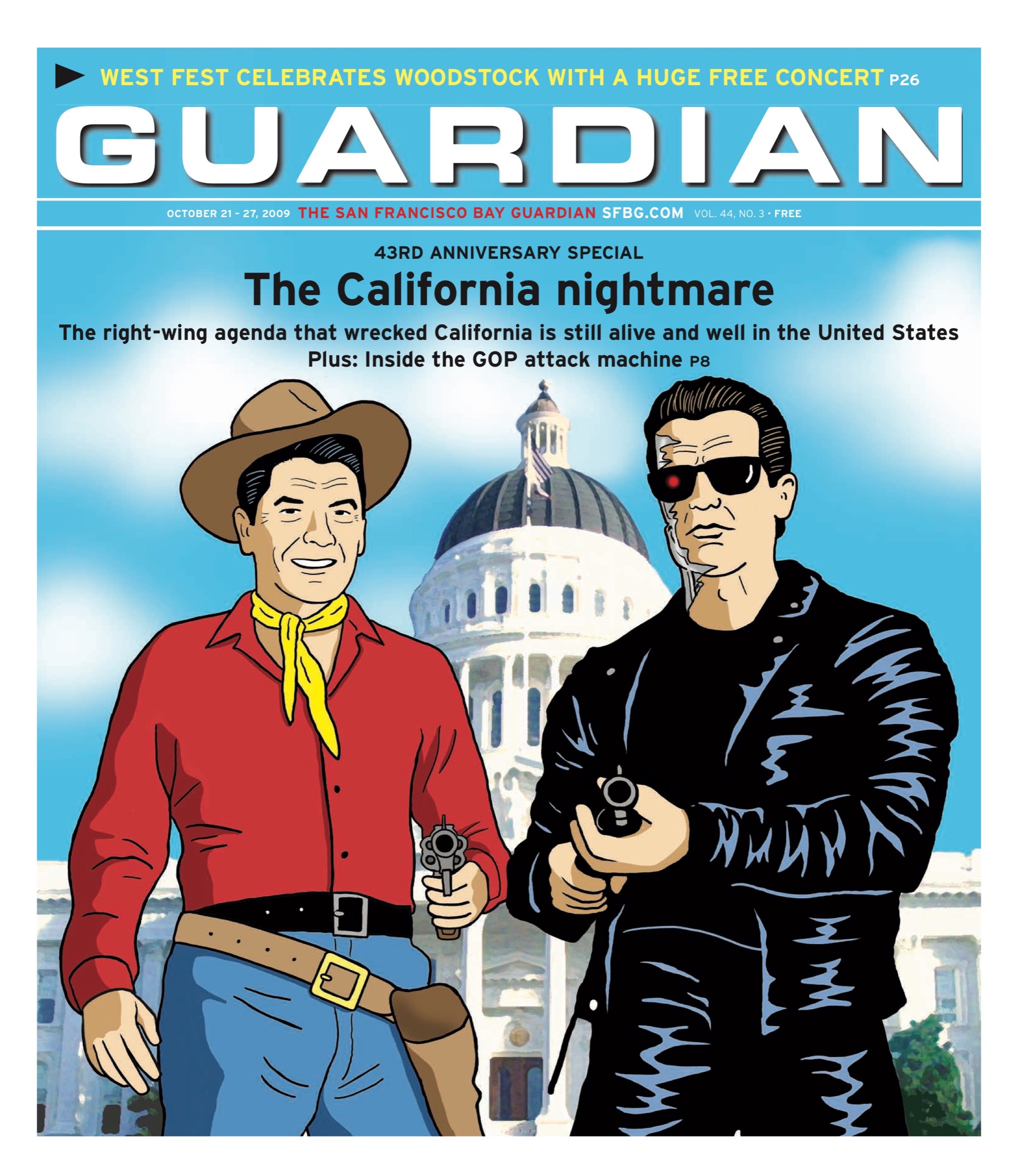
Much of the right-wing agenda that has thrown this nation into economic chaos can be traced back to what was once called the Golden State.

The tax revolts that started here under Gov. Ronald Reagan and continued to sweep the country and the world under President Reagan never abated. Indeed, they have only been strengthened by the big business power that created and benefited from them.

But now that California is showing signs of being the country’s first failed state — caught in fiscal freefall and mired in political gridlock as a generation’s worth of neglected problems surge to the surface — this state has become a cautionary tale for that anti-government ideology.

Trends in America tend to start out west, and the economic and political disaster that California has become contains critical lessons for the rest of the country.

Lewis Uhler — president and founder of the National Tax Limitation Committee — speaks candidly and proudly of his key early role in helping build a conservative movement to limit the size of government and do battle with those who want the public sector to actively promote social and economic justice.

Uhler, a UC Berkeley Boalt Hall School of Law graduate who did legal work for conservative causes in the 1960s, was tapped by then-Gov. Reagan in 1970 to be the director of the Office of Economic Opportunity, a federally-funded legal assistance program created as part of President Lyndon Johnson’s war on poverty.

While that may seem like a strange role for an avowed conservative and former member of the John Birch Society, Uhler says Reagan basically brought him in to wreck the program and fight the feds. “I was asked to put my money where my mouth was for my conservative philosophy,” Uhler told the Guardian. “OEO was set up to ensure conflict and confrontation … The mission of legal services was to change public policy through lawsuits they decided to file. I thought it was a corruption of the legal system.”

At the time, public-interest law and liberal economic and social policies were on the rise in California and spreading to the rest of the nation. So the Reaganites fought back.

Rather than helping poor plaintiffs file environmental, consumer protection, equal rights, or other types of lawsuits designed to level the playing field with powerful interests, Uhler blocked lawsuits brought by attorneys he calls “ambulance-chasers” and gutted the program. “Ultimately,” he said, “we vetoed funding for California Rural Legal Assistance.”

And for his efforts, Uhler was rewarded with a cabinet-level position: assistance secretary of the Health and Welfare Agency. Again, his role wasn’t to make the agency more effective, but to make it less effective in a realm where he believes government was too big and too active.

“The problem was uncontrolled state and local spending,” Uhler said. “Intuitively, everyone who gathered around Reagan shared the same philosophy that government doesn’t really contribute anything to economic growth.”

In 1972, Reagan gave Uhler the opportunity to work more directly on the mission of cutting taxes and shrinking the size of government, naming him chair of the Governor’s Tax Reduction Task Force. It was, in many ways, the beginning of the vast right-wing conspiracy.

“I asked to be given the chance to go across the country and find the best free market minds in the country to develop these policies,” Uhler said, explaining that he wanted to borrow the liberal strategy of giving an academic veneer to their ideas, as presidents Kennedy and Johnson had done in the realm of foreign policy. “Our side had never really done that.”

Uhler’s first stop was the University of Chicago School of Economics, where he met with noted free market economists Milton Friedman, James Buchanan, and George Stigler, who were brought into the cause.

Today’s vast network of conservative think tanks didn’t exist at that time, so Uhler tapped conservative thinkers from the American Enterprise Institute and the Hoover Institute at Stanford University, as well as other conservative economists such as Peter Drucker from Claremont McKenna College.

“There were 35 people who helped us design the first effort at a constitutional initiative in California to limit year-over-year growth of the state’s general fund,” Uhler said. “All of us as free market enthusiasts and economists all shared the belief that government beyond a certain level eats the seed corn of the nation and doesn’t produce anything.”

While voters narrowly rejected their group’s first effort to cap government growth — Proposition 1 on the November 1973 ballot — the ground had been prepared and the seeds had been sown for the tax revolts that would sweep the country in the late 1970s, with many of the campaigns coordinated by Uhler and the organization he formed for that purpose in 1975, the National Tax Limitation Committee, and a rapidly growing network of similar, interconnected organizations.

As Uhler worked with Reagan to weaken California’s government from within, his fellow travelers were developing national and international strategies to create aggressive, coordinated, well-funded campaigns to attack government and spread the free market dogma.

In August 1971, Lewis Powell — a conservative corporate attorney who President Richard Nixon had just nominated to the U.S. Supreme Court (where he served from 1972-87) — wrote a confidential memorandum to the leadership of the U.S. Chamber of Commerce titled “Attack on the American Free Enterprise System.”

He sounded the alarm that the ascendant environmental and consumer movements were going to destroy capitalism in the country unless corporate America aggressively fought back in a coordinated fashion, which he spelled out in great detail.

He called for all major corporations to develop aggressive legal and public relations strategies for fighting the left, creation of a network of think tanks and media outlets to push the conservative message, manipulation of the legal system, and sponsorship of university programs to study conservative ideas and incubate future leaders — which all came to pass in the coming decades.

“American business [is] ‘plainly in trouble’; the response to the wide range of critics has been ineffective and has included appeasement: the time has come — indeed, it is long overdue — for the wisdom, ingenuity, and resources of American business to be marshaled against those who would destroy it,” Powell wrote.

Part of that strategy involved having the federal government promote and popularize free market economic theories being developed by Friedman and his colleagues at the University of Chicago, a movement that is well-documented by journalist Naomi Klein in her book The Shock Doctrine: The Rise of Disaster Capitalism.

In 1971, Friedman and his colleagues began working with rich conservatives in Chile who were allied with Gen. Augusto Pinochet, who in turn were conspiring with the CIA to overthrow and assassinate the democratically elected, leftist President Salvador Allende, which they successfully did on Sept. 11, 1973.

Friedman’s economic theories called for a radical restructuring of society — slashing taxes and social spending; removing most regulation and trade restrictions; crushing labor unions; promoting economic growth at any cost — and Pinochet executed the strategy in brutal fashion, ordering the death of at least 3,200 of his political opponents, including the car-bomb assassination of economist Orlando Letelier in Washington, D.C., in 1976.

Friedman and Pinochet consulted openly and shared a basic disdain for social programs and progressive taxation. “The major error, in my opinion,” Friedman wrote in a letter to Pinochet in 1975, referring to the government antipoverty programs Pinochet dismantled, was “to believe that it is possible to do good with other people’s money.”

The model Pinochet and Friedman developed in Chile would eventually go global — promoted by its top cheerleaders, Reagan and British Prime Minister Margaret Thatcher — and be implemented (with disastrous results for most citizens but creating huge profits for wealthy individuals and corporations) in Indonesia, Bolivia, Argentina, Peru, Russia, Poland, South Africa, Japan, and elsewhere.

But with the corporate media and conservative opinion-shapers focused mostly on economic growth — ignoring persistent poverty and the brutal tactics used to suppress the popular movements that tried to resist Friedman’s “economic shock therapy” — Friedman had become a sort of free-market prophet by the time he died in 2006.

“In the torrent of words written in eulogy to Milton Friedman, the role of shocks and crises to advance his worldview received barely a mention,” Klein wrote. “Instead, the economist’s passing provided an occasion for a retelling of the official story of how his brand of radical capitalism became government orthodoxy in almost every corner of the globe.”

California’s fiscal shackles have been in place since 1978, when Proposition 13 and subsequent measures capped property taxes and required an undemocratic two-thirds vote to either raise taxes or pass the annual budget.

A Republican landlord lobbyist named Howard Jarvis charged onto the field that Reagan, Uhler, and their team had prepared and took advantage of a gaping hole in political leadership to set off a movement that would cripple the United States of America.

There was some logic to it then. Times were good in California in the 1970s, good enough that people were flocking to the state by the millions. That was driving up property values — and thus property taxes.

Jarvis bought his home for $8,000 in 1946; 30 years later, it was assessed at $80,000. In fact, inflation was running at close to 10 percent a year in California. Homeowners were getting huge tax hikes each year, and tenants were getting huge rent hikes at a time when state government had a budget surplus.

Homeowners saw millions of dollars sitting in the coffers in Sacramento while they couldn’t pay their tax bills. Yet nobody in the Legislature or governor’s office came up with a solution.

So when Jarvis showed up with petitions to roll back property taxes and prevent future increases, he found a broad base of support. Even tenants went along — Jarvis and his gang promised that property-tax cuts would be passed on to tenants and would mean the end of the escautf8g rent hikes.

Jarvis collected signatures for a radical measure that essentially blocked all property tax increases and allowed new assessment only when a parcel sold. It was, in the end, a huge tax giveaway to major corporations. Since commercial property turned over far less often than residential property (and since commercial sales could be hidden as stock transfers), big businesses wound up paying far less of the state’s tax burden. Corporations used to pay about two-thirds of the state’s property taxes, and individuals one-third; now that is reversed.

It didn’t help tenants, either. Few of the landlords who saw the benefits of Prop. 13 passed the money along to their renters. Most just kept it. San Francisco activist Calvin Welch likes to say that Howard Jarvis was “the father of rent control.”

The campaign against Prop. 13 warned of the dangers of cutting local government; police and fire chiefs appeared in ads opposing it. But the No on 13 folks never talked about the huge windfall big corporations would get from the measure, or the huge disparities in wealth that would be created by defunding government and dereguutf8g corporations.

If the goal was to skew the concentration of wealth in the state, it worked brilliantly. According to the California Budget Project (CBP) of the Franchise Tax Board, recent data taken before the current economic recession illustrates an ever-widening chasm between the wealthiest taxpayer and the working-class person.

The total adjusted personal income for Californians rose by nearly $64 billion in 2006-07 — with approximately three-quarters of that increase going to the top fifth of wealthiest taxpayers, and 30 percent going to the top 1 percent. That left only $19 billion for everyone else.

“The average taxpayer in the top 1 percent experienced a $128,261 increase in AGI [adjusted gross income] between 2006 and 2007, which was more than three times the total AGI of the average middle-income taxpayer in 2007 ($36,115),” stated the June 2009 report.

This continues a long-term trend in which the wealthy continue to leave the average income-earner behind in a trail of dollar-sign dust. From 1995 to 2007, income gains for that top 1 percent come to a whopping 117.3 percent increase — nearly 13 times more than the gains of the middle-income taxpayer.

The nation’s income gap has reached a “level higher than any other since 1917,” according to a paper by University of California, Berkeley economic professor Emmanuel Saez. According to Saez’s analysis of census data, there’s been a steady increase in the income gap since the 1970s, rising 20 percent over the years.

Yet even today, the defenders of Prop. 13 continue to sound the same consistent themes. “Those who are directly involved in government are a militant special interest,” Howard Jarvis Taxpayer Association executive director Kris Vosburgh told us. “They don’t like anything that limits their revenue stream.”

While that last statement could be applied equally to corporations or other private sector enterprises, as Vosburgh reluctantly admitted when asked, he continues to imply malevolence to those who defend government. He said the state’s current fiscal collapse can only be solved by slashing government expenditures.

“It is not valid to be talking about revenue-side solutions,” he said. “Our position is the state has enough money to accomplish its goals.”

People have never liked paying taxes, but the antitax movement is about far more than just that basic individual desire to hold onto our money.

The attacks were well planned, carefully targeted, and part of a much larger effort aimed at maintaining corporate and conservative power, undermining the New Deal, reducing taxes on the rich, and radically reducing the size and scope of the public sector.

As Powell called for, corporations have aggressively challenged, in legal courts and those of public opinion, every significant progressive advance — from San Francisco’s attempt at universal health care to California’s tentative first steps to address global warming.

With a level of discipline unheard of on the left, conservative opinion-shapers pound their talking points and enforce party unity through mechanisms like the “no new taxes” pledge that every Republican in the California Legislature has signed and heeded, under the very real threat of recall.

Opposition to taxes is now so deeply embedded into the psyche of the California electorate, and such a core tenet of today’s Republican Party, that elected officials who tout fiscal responsibility allowed the state’s debts to go unpaid (destroying its credit rating in the process) and its education and transportation systems to be decimated rather considering new revenues.

Gov. Arnold Schwarzenegger’s spokesperson Aaron McLear told us, “He believes we ought to live within our means and pay for only the programs we can afford.”

That simple talking point gets repeated no matter how the question is asked, or when we point out that it means we’re being forced to live within historic lows this year. But they claim the people support them.

“We had tax increases on the May ballot and they were rejected by a 2-1 margin. We should listen to the will of the voters,” McLear said.

Never mind that this regressive, dishonest package of temporary tax hikes was opposed by the Guardian and a variety of pro-tax progressive groups. McLear wouldn’t even admit that point or respond to it honestly.

And he’s certainly right that most polls show a majority of Californians don’t want new taxes. But these polls also show that people want continued government services, more investment in our neglected state infrastructure, and a whole bunch of other contradictory things.

That’s why newspapers and analysts around the world are looking at California, the world’s eighth largest economy, and wondering (as the Guardian of London headline asked Oct. 4): “Will California become America’s first failed state?”

In many ways, it already is. The question now is whether we’ll try to learn from and correct our mistakes. Ryan Riddle contributed to this report. ———–

THE CONSERVATIVE RELIGION

When I asked Lewis Uhler, one of the architects of the Reagan revolution, what Americans believed in these days — where the people he likes to talk about who hate the government (but are also admittedly disillusioned with Wall Street) turn — he answered simply: religion.

It should come as no surprise that many religious fundamentalists tend to side with the free market conservatives — both ideologies require a leap of faith and ignoring certain troubling facts, such as increasing disparities of wealth, natural resource depletion, and global warming.

Their arguments mostly make sense — until these inconvenient truths come up.

Certainly, turning over more public resources to free market capitalists, cutting taxes, and slashing government regulation will spur private sector economic growth, just as advocates claim.

But that growth has a cost. The wealth won’t be shared by everyone. Indeed, poverty has persisted even through even the economic boom of the 1990s — but almost everyone will be affected by underfunded road, education, public safety, and other essential systems.

As the conservative movement has successfully limited taxes and cut regulation over the last 40 years, working class wages have stagnated as the rich have gotten richer. Many of the world’s oil reserves have peaked and gone into decline, and rapidly increasing carbon emissions have collected in the atmosphere and caused global warming.

So how do conservatives respond to these realities as they argue for the continued dismantling of government, which is the only entity with the scope and incentive to deal with these problems? They simply deny them.

Uhler decried the “pseudoscience of climate change” as hindering economic progress and claimed that there’s actually been a global cooling trend in the last 10 years. (Actually the last 10 years have been some of the hottest on record, causing glaciers around the world to melt, according to data and observations from a consensus of the world’s climate scientists, including NASA, the Union of Concerned Scientists, and the United Nations Climate Change Conference.)

It’s the same story with the consolidation of wealth, which hurts the free market fantasy that letting the super-wealthy keep more money will eventually trickle down to benefit us all. Uhler simply denied the growing disparity of wealth, saying the “movement between quintiles is significant.”

He was talking about people’s ability to go from poor to rich with a little hard work and initiative, the core idea of free market conservatives. But data from the U.S. Census Bureau and many other entities indicate that median wages have been stagnant for decades (which wouldn’t be true if there was lots of upward mobility) and that most of the wealth created in the U.S. over the last 40 years has pooled with the top 1 percent.

In fact, when it comes to measuring social impacts, Uhler has simply one metric: “Governments at all levels are twice the size they should be to maximize economic growth.” (Steven T. Jones)


 

Fair: Limbaugh’s long record of racist remarks

0

fair.gif

Limbaugh defenders ignore his record of racist and race-bating remarks over a long period of time
10/16/09

In the wake of Rush Limbaugh being booted from a group of investors bidding to buy the St. Louis Rams football team, a minor media tempest has been stirred by conservative commentators who charge that Limbaugh has been falsely accused of making racist remarks.

Central to their charge are two quotes allegedly made by Limbaugh–in which the radio host supposedly praised slavery and Martin Luther King assassin James Earl Ray–that cannot be documented and may be bogus. Many of the commentators claim that the case against Limbaugh is based on little more than the two dubious quotes.

Why do they hate America and love Brazil?

2


What we have here with Rush Limbaugh and staffers at the Weekly Standard is a coup de foudre, a thunderbolt of love that strikes without warning and cannot be denied.

By Jess Brownell

(Jess Brownell is our Voice of the Heartland, observing the political scene as a freelance writer from Milwaukee.)

According to news reports, staffers at the conservative Weekly Standard cheered when they learned that Rio de Janeiro rather than Chicago had been selected to host the 2016 Olympics. Rush Limbaugh pronounced himself “gleeful,” I’m told. Others in that camp were equally pleased at the result.

Why do these people hate America?

Understand that I ask the question in a plaintive tone. In the past they were the people who could always be depended upon to love America unconditionally, without reservations, with all their hearts and souls, forever and ever, amen. When others ventured to criticize some little American venture – Viet Nam, Iraq – they were the ones who told us to love our country or leave it. They carried around flags to wrap themselves in whenever they thought the occasion called for it and a camera was in the vicinity. They admired the men and women of our armed forces so much they might almost have become one of them had they not heard a higher call to punditry. Now, without warning, they have transferred their undying affection to Brazil. How could this happen?

Turf war

0

news@sfbg.com

The signs around Kimbell Playground in the Western Addition announce the field’s closure for construction until April 2010. Although they detail the extensive renovations, there is no hint that controversy swirls around one particular aspect: replacing living grass with synthetic turf.

In 2004, the San Francisco Recreation and Park Department issued an assessment of the city’s recreation facilities that estimated the city needed 30 softball fields and 35 soccer fields to match demand from the city’s players. Looking to get the most playing time from existing facilities, Rec and Park officials turned to turf.

Yet concerned citizens, community groups, and environmental organizations are trying to stop the conversion until the impacts of turf are better understood. Both sides say they are fighting for the welfare of San Francisco’s children. City officials tout increased availability of fields and reduced maintenance costs, while activists cite a wide variety of health and environmental issues.

"No one is happy about taking natural grass away," Rec and Park project manager Dan Mauer told the Guardian, "but we’re trying to meet multiple demands with limited resources."

In fact, the department’s steadily dwindling budgets led it to privatize the transition. In 2005, Rec and Park began collaborating with the newly formed nonprofit City Fields Foundation, signing a formal memorandum of understanding in 2006. This public-private partnership determined that without the resources to buy real estate for new fields, putting artificial turf on existing fields was the best alternative.

The transition began in 2006 with Garfield Square and Silver Terrace Playground; the partnership deemed both a success, and pushed for more. In February 2008, voters passed Proposition A, a $185 million parks bond that included $8.5 million earmarked for "park playfields repair and reconstruction." The legal text makes no mention of synthetic turf, but the money was intended to match funds from City Fields for the installation of turf, lights, and other improvements to designated fields.

The project is estimated to cost $45 million, with $25 million coming from City Fields and $20 million from the city. Although cash-strapped Park and Rec department officials stress the financial benefits, environmental concerns prompted the department to create a Synthetic Playfields Task Force in March 2008 with 16 volunteer members.

The task force was charged with evaluating peer-reviewed data on a new generation of artificial turf that improved on the older variety, commonly referred to by the brand that popularized it, AstroTurf. The new turf was less likely to cause injury than its predecessor and could withstand higher levels of play than grass, which takes time to absorb rainfall and must rest and regrow after heavy use.

The Synthetic Fields Task Force identified 11 possible issues of public concern and made a number of emphatic recommendations on how to proceed, including avoiding products with lead and investigating alternatives to rubber infill. Despite this, it didn’t call for a moratorium and conversions continued.

The city has converted four sites, soon to be five, and added lights at a sixth as part of the Playfields Initiative. According to City Fields Foundation spokesperson Patrick Hannan, "These fields have gone from being fields of last resort to some of the most requested fields in the city." According to organization’s estimates, the addition of lights and turf has added more than 27,000 hours of playtime to the first five sites.

Perhaps no one is more enthusiastic about synthetic turf than the sons of the late Gap, Inc. founder Donald Fisher, a regular funder of conservative causes. Bill, John, and Bob Fisher founded and partially funded City Fields Foundation "to give back to the city and provide children with access to the same fields and opportunities they had as children," Hannan said.

Opponents argue that synthetic fields are not the same ones the Fishers played on as children. In January 2008, Pinky Kushner of the Sierra Club sent a letter asking the Recreation and Park Department to suspend the program until "it can be demonstrated that these projects will have no negative impacts on the environment or on human health and enjoyment of public open space."

Her letter references the city’s Precautionary Principle, a policy whereby the city seeks to avoid taking action that might harm the environment even when there is a "lack of full scientific certainty about cause and effect." SF’s Environment Deparment says the principle "does not advocate the avoidance of any and all potential environmental risks." Rather, it "advocates for a public process in which the benefits of an action or technology are weighed against potential risks."

Rec-Park and City Fields are confident the Synthetic Playfields Task Force inquiry meets the requirements. But Sup. Ross Mirkarimi has authored a resolution asking for a moratorium on turf conversion until the state completes a study on the issue. Gov. Arnold Schwarzenegger signed legislation in September 2008 tasking state agencies to study the turf question and submit a report by September 2010.

Even if it passes, Mirkarimi’s resolution is nonbinding and unlikely to halt the current conversion of Kimbell Field. But it does have support from activists who believe synthetic turf poses a health risk. In several parks, community members lobbied against the proposed conversions and successfully convinced City Fields and Rec and Park not to move forward.

Franco Mancini, president of Friends of McLaren Park, described how a few residents were initially opposed to the proposed fences and lighting but soon became embroiled in the larger issue of synthetic turf and "playing Russian roulette with our children’s safety."

The new synthetic turf consists of a polypropylene fabric backing, an infill of crumb rubber made from shredded tires, and polyethylene fibers that replicate blades of grass. One of the principal concerns is that the crumb rubber infill, made from up to 50,000 tires per field, contains hazardous materials that pose potential health risks. Other health concerns are the presence of lead as a color fixative and the possibility of zinc leaching into the groundwater.

There are also concerns about what to do with the fields when they wear out and whether particles leach into the environment, problems Rec and Park officials have promised to work with turf companies to address. But so far research into the environmental impacts of turf have yielded conflicting results.

Resident Kelley Watts is concerned the "research is only in the very beginning stages" and compares the situation to the 1940s and ’50s when conflicting research about cigarettes was emerging.

Concerns that turf overheats on hot days led to ongoing moratoriums in Los Angeles and New York City. San Francisco’s mild climate doesn’t create the same problem, although it does have the underlying issue that synthetic turf absorbs heat and replaces carbon-absorbing grass, contributing to what is known as the "heat-island effect," a factor in global warming.

The Athena Institute, an Ontario, Canada, nonprofit, estimates that for the average synthetic soccer field to be carbon-neutral, 1,861 trees would have to be planted and allowed to grow for 10 years.

Kimball Field is in the process of converting but the next project, and potential fight, will be at Golden Gate Park’s Beach Chalet soccer fields next year.

Endorsements

0

San Francisco is facing the worst budget crisis in modern history. More than 1,000 employees, mostly front-line workers in the Department of Public Health, have been laid off, and the red ink continues. Yet the only measure on the November ballot that would raise any money for the city is Sup. Bevan Dufty’s plan to sell off naming rights for Candlestick Park.

That’s pathetic. During the summer budget discussions, Mayor Newsom vowed to work with business, labor, and the supervisors to come up with a reasonable plan to bring in some new cash for the city. But that collapsed — largely because state law would have made it hard to raise taxes this fall without a unanimous vote of the supervisors. And while eight members were willing to put a revenue measure on the ballot, the three supervisors closest to the mayor — Sean Elsbernd, Carmen Chu, and Michela Alioto-Pier, all Newsom appointees — refused to go along. And the mayor made only a weak effort to change their minds.

So while Democrats everywhere decry Gov. Arnold Schwarzenegger’s insistence on a cuts-only budget, the Democratic mayor of San Francisco has forced essentially the same approach on this city. The only revenue increases we’re seeing are fees, like Muni fare hikes, that amount to taxes on the poor.

That’s the state of San Francisco as we head into what will almost certainly be a low-turnout election. Only two elected officials are on the ballot, and both are unopposed. Five ballot measures — several fairly significant — round out the local ballot. And with no big-name races at the top, they will win or lose on the votes of a small majority.

That’s too bad, because the issues matter. Vote Nov. 3 — and let’s hope next year’s ballot actually includes some new, progressive taxes.

OUR RECOMMENDATIONS


City Attorney

Dennis Herrera

San Francisco hasn’t always had a good track record with city attorneys. George Agnost, who ran the office in the 1970s and 1980s, was a dour, secretive, conservative lawyer who let downtown call all the shots. Louise Renne, who took over from Agnost, ran the office in the 1990s as if it was a wholly-owned subsidiary of Pacific Gas and Electric Co. Herrera, who took over in 2001, has been a major improvement. He’s turned the office into a modern operation, professionalized the administration, and taken on an activist role on consumer, environmental, and public-interest issues. He’s been a big supporter of marriage equality and of the city’s landmark health-care legislation. On his own initiative, he sued to end gender rating in health insurance and crack down on predatory payday lenders. He also moved to enforce health codes in housing and has been out front going after corrupt landlords like Skyline Realty.

We have some concerns about Herrera. Although he’s been far more sunshine-friendly than his predecessors, open-government activists are still sometimes forced to sue the city to get access to records. He won’t use his power as city attorney to enforce the Raker Act and bring public power to San Francisco. And during the current budget crisis, he cut the number of city attorney hours the supervisors can use to draft legislation.

And if, as rumored, he wants to run for mayor, Herrera needs to start taking public stands on major issues — like the unfairness of the local tax code and the need for new revenue.

But we’re happy to endorse him for another term.

Treasurer

Jose Cisneros

The incumbent treasurer is running unopposed, and we see no reason not to endorse him. He’s done some very positive things: Cisneros worked to get the big downtown law firms and other partnerships to pay their fair share of city taxes. He closed a tax loophole exploited by the big airlines that put up flight crews in local hotels.

He also convinced local banks and credit unions to accept consular identification cards to allow immigrants to open accounts and has pushed those institutions to offer "second-chance banking" to people with past credit problems. During his tenure, more than half of the 50,000 households in the city that lacked bank accounts have been able to get away from predatory check-cashing outfits and open legitimate accounts.

As an elected official, however, he could be doing a lot more. The city still keeps all its short-term accounts in one bank — Bank of America, which isn’t even local. Cisneros has promised to open that deal up to competitive bidding, but doesn’t have a timeline. And although nobody knows better than the treasurer how unfair and regressive the city’s tax codes are, he has never spoken out or offered any solutions. Cisneros says he wants his office to be apolitical, but city money is, by its nature, a political issue, and we’d like to see a little more leadership from the person who handles it. But overall, he’s a professional money manager who’s done a decent job and deserves another term.

Proposition A

Budget process

YES

We’re a little nervous about Prop. A, which would institute a two-year budget cycle for the city. Sup. Chris Daly, who opposes it, points out that the city controller’s budget projections are often wrong — badly wrong — and trying to plan 24 months ahead when economic conditions (and thus the city’s revenue stream) can change so quickly and unpredictably is a dangerous game.

But on balance, the approach in Prop. A makes sense. The budget debates would still take place every year, and the supervisors would still have to approve an annual budget — although the budget would be a rolling two-year projection. So next year, the board would approve a budget for 2010 and 2011, the following year for 2011 and 2012, and so on — leaving plenty of room for adjusting to meet economic changes. And two-year cycles might make it easier for nonprofits that rely on city funding to do some serious long-term planning.

Equally important, Prop. A requires the police and firefighters to negotiate their union contracts the same time the other unions do — before the budget deadline. The current system allows those unions to make demands that are unrelated to — and often outside — the current year’s budget realities.

Every progressive on the board except Daly supports this, and Sups. Alioto-Pier, Elsbernd and Chu oppose it.

Proposition B

Board of Supervisors aides

YES

This one’s a no-brainer. The City Charter mandates that each supervisor be allowed to hire two aides. The requirement dates back to a long-ago era when city budgets were far smaller, problems were less pressing and complex, and the supervisors worked part-time. It makes perfect sense to take such an archaic law out of the City Charter and allow the supervisors to set their own budgets — and staffing levels — the same way the mayor does. Vote yes.

Proposition C

Candlestick Park Naming Rights

NO

You have to give Sup. Bevan Dufty, the author of Prop. C, credit for trying. He’s looking for any angle he can use to help keep the 49ers in town, and allowing a corporate sponsor to pay for naming rights might possibly help cover the immense cost of substantially renovating aging Candlestick Park. And, like Prop. D (see below), this measure has a nice beneficiary: part of the money from naming rights would go to save the jobs of recreation directors, many of whom have faced budget-driven layoffs.

We agree that rec directors play a crucial role, particularly in neighborhoods with large numbers of at-risk youth. And we wish the Chamber of Commerce, Sup. Elsbernd, and other supporters of Prop. C were willing to accept some progressive tax hikes to fund those jobs.

But this isn’t a good deal. The city owns the stadium; the taxpayers financed its construction and spent 30 years paying off the bonds. But the 49ers, a private outfit owned by a very wealthy family, would get half the money from any naming deal. And the money that would come in would be radically short of what the team would need to rebuild the ‘Stick. Vote no.

Proposition D

Mid-Market special sign district

NO

Again: credit for the effort. David Addington, who owns the Warfield Theater and several other properties on mid-Market Street, accurately notes that the city’s main thoroughfare, between Fifth and Seventh streets, is rundown, ignored, and badly in need of an economic boost. He argues that allowing new digital billboards would create something of a Times Square in San Francisco, attracting tourists and turning mid-Market into a thriving theater district. Nothing else the city has done has worked — why not give this a try?

We aren’t necessarily opposed to digital billboards and we’d love to see mid-Market reinvigorated. But Prop. D would give too much authority to an unelected, unrepresentative group. It would amount to privatizing city planning and set a terrible precedent.

Under the measure, the Central Market Community Benefits District, a private group of property owners, organizations, and residents, would be authorized to approve new general advertising billboards as large as 500 square feet. The ads would have to meet city codes, but the Planning Department and supervisors would have no ability to block new installations. And the money — potentially millions of dollars a year — would go entirely to the property owners and the CBD, which would decide how to distribute it.

Yes, like Prop. C, this measure would help a worthy group: some of the new money would go to youth programs in the Tenderloin. But the process this measure describes isn’t at all democratic. The CBD board selects its own members, and the only oversight the city has is the ability of the Board of Supervisors to abolish the agency and start over.

We’re open to new ideas for central Market Street. We’re open to lights and ads and maybe even billboards. But we’re not willing to turn over zoning and public finance decisions to a private group. Vote no.

Proposition E

Advertisements on city property

YES

Proposition E, written by former Sup. Jake McGoldrick, would freeze new commercial billboards and ads on street furniture at 2008 levels and outlaw advertising on public buildings. It’s an extension of existing city policy, which seeks to limit the increasing blight of commercial ads in public space. Vote yes.

The Chron, the guv and the issues

3

By Tim Redmond

It’s as if the San Francisco Chronicle didn’t recognize that there are real issues facing California — and that the governor is acting like a thug, threatening the future of the state and clowning around like it doesn’t matter.

Check this out: The Chron’s editorial page criticizes Tom Ammiano for standing up to the governor:

But Assemblyman Tom Ammiano crossed the line when he shouted “You lie!” at Gov. Arnold Schwarzenegger during a Democratic fundraiser in San Francisco on Wednesday night. Ammiano reportedly went even further on the crass-o-meter when he suggested that the governor could kiss his posterior.

.

(By the way, this is San Francisco — it’s okay for the daily newspaper to say “ass.”)

And then suggests that this was just a nice event at which

The governor was invited for a brief visit to a Democratic Party event by former Mayor Willie Brown

(By the way, Brown is also a San Francisco Chronicle columnist)

without ever saying that Brown had no business bringing the governor — who is so openly threatening the Democrats with mass bill vetoes that Sen. Mark Leno is forced to ask “are we dealing with the Mob or the governor of California?” — to a Democratic party fundraiser.

Brown was playing his normal games, goofing around and ignoring the life-and-death issues at stake. He and Arnold are buds, and Brown backed Schwarzenegger for governor over a Democrat. He knew bringing the guy into that room would create a furor, and he knew that the governor would love it (it helps him with his conservative base to get booed by San Francisco Democrats.)

Ammiano knows all that, too, and frankly, was somewhat reserved in his comments. I would have gone further; I would have called out Willie Brown for a back-stabbing political stunt.

And don’t the Chron editorial writers have any sense of humor? “You lie” was a joke, guys, a parody. Please: Lighten up, and get a clue.

Word alive

0

WRITERS The Eighth Annual Living Word Festival focuses on fresh young voices and includes readings, musical performances, art and fashion workshops, a youth town hall on healthcare reform, and live graffiti and B-boy battles. Below are two selections from the festival, which takes place Oct. 8-18 in San Francisco and Oakland.

UNTITLED


By Dennis Kim


… and I saw a shorty swimming in a white shirt baked brown by degrees and the air before him was bent by the lashes of the sun on the ground and there was no water to speak of. He was standing on a pile of crumpled mattresses behind our building. I recognized the bed on top, ravaged and stained by my childhood. Shorty wobbled with the thick air and he had no strength to jump. "Sun," I said, and he shielded his eyes. "Son, why are you standing there with no strength? Go inside." He lowered his hand and his eyes were like dried out lakes, gardens ground under the knees of a monstrous thirst, a treeless landscape, a toothless Eden. He said, "Water."

And my eyes died of thirst and I repented of my vengeance. I had made desolate the mansion and the alley and felled the seed for it laid in rotten fruit. The pure and the assassin stumble over the same stones and lie facedown in the same ditch.

I crave living water more than I do dead blood. Father above, let it rain.

Let it rain for the brother who cried facedown into the train platform, "Don’t shoot — "

And the ancestor who met the police with fingertips touching the sky and caught the bullets where he would carry a child …

Let it rain for soldiers draped on streetlamps and mailboxes, kicking at blank spaces the disappeared leave with curses that turn to dust in their mouths.

Let it rain for the thief and the man he robs when both discover they have nothing. They exchange greetings and go their way to new poverties.

Let it rain to wash the blood of the murdered into the gutters and the sea, where it meets the blood of ancestors turned to shark and anemone.

Let it rain to absolve all mothers …

Let it rain for the restless who twist into impossible signs on their beds, afflicted by the sickness of penitence …

But let it rain most of all for the child who opens his mouth to cry but cannot, for the city collapsing inside him. Let it rain because my children are thirsty and they can do nothing but cover their eyes.

Father above, break the sky in two.

Let it rain.

Dennis Kim at Living Water: Youth Speaks to Spirit (Oct. 18, 2 p.m., free. Glide Memorial Church Sanctuary, 300 Ellis, SF. www.youthspeaks.org).

PROLOGUE FROM MIRRORS IN EVERY CORNER: A PLAY


By Chinaka Hodge


I thought he was out of my league. Real tall, well put together. Big palms. Pretty, almost. This metered way with words. Had a steady job. Was wearing ties to work at the time. Built around rigor, and routine. That man loved to make a list. Checklists and to-do lists and have-done lists. Ought-to-do lists.

He sets the alarm for seven. Hits snooze once. Up for real at 7:30. Leans at the edge of the bed for two and a half minutes. Clears his throat through his nose. Turns the shower on. Forgets something in the bedroom. Back to the bathroom. Showers for ten minutes. Out the door by 8:13. Evening is the same. Asleep five nights a week by 10:56. Fifty-six. Clockwork with him.

And for him, there’s an honesty in that. To say I was drawn to that stability doesn’t really do the feeling justice. More like the compulsion we have as children to metronomes and see-saws. There is something absolutely mesmerizing about the rhythm of his predictability. Science. Like how you know how fast honey will dissolve in hot water. He sweetens me on time. Budgets the exact minutes it will take him to love me. Don’t know how he does that. Did that. When even I didn’t know what I needed.

Plus we were proportioned right. Nice heights for walking places, and for lying down inside each other. For talking copious amounts of shit. He was a good card partner. Conservative in his bids, leading with the suit he’d like me to return in. Not a stellar dancer, but better than me by far. And so we stuck fast to each other.

We had fun. Before Watts came and the wedding even, just sitting watching our shows. I remember the Cosby premiere with him. How on the weekends he’d stay up late late with me, cause I’d guilt him off his schedule, and he’d make jokes all in my hair. Push the laughs right through me. And I’d hug him in the mirror, make him watch how happy we were. To remind us both of the enchanted nature of what we were doing. In the time we were doing it. A fearless act: Black family in the middle of an epidemic. Intellectuals at play. The ease of our engagement.

So imagine our surprise when they told me the baby was white. White.

Whose child?

Chinaka Hodge and Universes at the Living Word Festival (Thurs/8-Fri/9, 8 p.m., $10–$20. CounterPULSE, 1310 Mission, SF. www.counterpulse.org).

Newsom agrees to meet with Local 1021

4

By Tim Redmond

The members of SEIU Local 1021 have agreed to stand down for a day, suspend their unfair labor practices claim and hold off on sending protesters to Mayor Gavin Newsom’s campaign events — and he’s agreed to meet with the union tomorrow (Tuesday) morning to discuss their grievances.

Larry Bevan, a Local 1021 shop steward who works as a site tech at Laguna Honda Hospital, told me that Labor Council director Tim Paulson has agreed to mediate the discussion.

“I am told that the mayor will be there personally,” Bevan said. “Going through intermediaries doesn’t seem to be working.”

The union wants to challenge the mayor to live up to his promise during budget season — that he’d work to find a way to raise new revenue this fall so that 600 union members, most of them women of color, most of them front-line service workers in the Department of Public Health, wouldn’t face layoffs.

It’s too late for a ballot measure to raise new revenue. That plan fell apart when it became clear that the supervisors would not unanimously declare a state of fiscal emergency — a move that would have allowed a revenue measure to pass with a simple majority of the vote. WIthout all 11 supervisors, any attempt to raise taxes would require an insurmountable two-thirds majority.

The Oakland City Council agreed unanimously to seek new revenue, but in San Francisco, Supervisors Sean Elsbernd, Michela Alioto and Carmen Chu refused. All three were originally Newsom appointees.

Elsbernd told me that the mayor’s office tried to get him on board, but he refused to bend. The reforms that the mayor was proposing weren’t strong enough to get the relatively conservative supervisor to drop his opposition to new taxes. “Oh, they tried, all right,” Elsbernd said. “But the reform was bogus. I said no.”

But I have to wonder how serious Newsom was: He never picked up the phone and called Elsbernd personally. His chief of staff, Steve Kava, did that job.

Sorry, Mr. Mayor — when there are millions of dollars and hundreds of jobs on the line, if you actually want to get a reluctant supervisor who owes his career to you on your side, you talk to him personally. It still might not have worked — but sending an aide over with the message was clearly doomed to fail. It almost seems as if Newsom was fine with that.

At any rate, the unions will try to get Newsom’s support for a new fee on alcoholic beverages, money that could go directly to DPH. Maybe he’ll go along; maybe he’ll drag his feet. Still, Local 1021 got him to the table, which these days, with this mayor, is quite an accomplishment.

New York Times: Censoring Project Censored

2

“After 34 years, will the New York Times cover the Project Censored annual release?

By Bruce B. Brugmann

Peter Phillips, the director of Project Censored at Sonoma State University, sent me this key question with his annual Censored package:

“After 34 years, will the New York Times cover the Project Censored annual release?”

Phillips was referring to the fact that the Times has never written a word about the project, even though it is now a widely respected package, is carried by the Guardian and many alternative papers, and produces a book of censored stories each year.

Moreover, the Santa Rosa Press Democrat, which is owned by the Times, didn’t run a story this year even though the project and Sonoma State are in the PD’s circulation area. When the PD did run a story in previous years, it was a nasty whack job.

The “censoring” of Project Censored by the Times, which declares itself the world’s best newspaper, has always fascinated me. And so I set out two years ago to see if I could get an explanation from the Times and its sister paper. I asked Carl Jensen, the founder of the project, and Phillips if they had ever gotten an explanation from the Times why why the paper “censored” Project Censored. They said they never got an explanation.
So I went to work on my own and emailed the package several times to the editors at the Times and the PD.
No reply from either the Times of the PD. Nothing. They were even “censoring” the messenger who was asking the questions.

I noted in Sunday’s New York Times (10/4/09) that the new public editor, Clark Hoyt, was dealing with a tricky subject for the Times, namely that it was missing some juicy stories. Hoyt mentioned the Acorn story
and said that “the story caught fire on Fox News from conservative blogs, but the Times was slow to respond.”
He wrote that Bill Keller, the executive editor of the Times, and Jill Abramson, the managing editor for news,
said they would assign an editor (B3: unnamed, alas) to “monitor opinion media from now on and to briefs them frequently.”

Clark added that “it seems self-evident to me that the Times needs to be aware of the buzz out there–whether it’s about politics and public policy or fashion. The hard part is is deciding what merits coverage. When the Times misses or is slow on a story that is boiling elsewhere…it lets it’s readers down.”

Well, Project Censored each year for 34 years has produced a list of major stories that the Times and the mainstream media have missed or under-reported. Why doesn’t that merit coverage? Why can’t the Times explain why it “censored” the censored story? To me, the fact that the Times won’t run the story or explain why dramatizes the point of the project in 96 point Tempo Bold.

In any event, I’m going to email the story to the Times and its sister paper near Sonoma State and see if I can get an explanation this time around. I’ll keep you posted. Stay alert. B3

Click here to read Guardian reporter Rebecca Bowe’s story, Project Censored: The top 10 stories not brought to you by mainstream news media in 2008 and 2009.

Click here to learn more about Project Censored.

Click here to read the 2007 blog, Censoring the Censored Project: Will the NY Times, Santa Rosa Press Democrat, and the mainstream media censor this year’s Project Censored story?

Judge sides with SF club in ABC crackdown

1

By Steven T. Jones
prohibition.jpg
The state crackdown on SF clubs has Prohibition Era echoes, but this time it’s using arcane rules to mask its moral concerns.

In the wake of a judge’s ruling that state officials were improperly enforcing arbitrary rules in cracking down on the Great American Music Hall and other San Francisco venues, the California Department of Alcoholic Beverage Control has dropped its case against GAMH.

The decision comes after a Guardian report in June about how the ABC was using strange and irrelevant legal technicalities to go after such venerable San Francisco nightlife hotspots at GAMH, Slim’s, Bottom of the Hill, DNA Lounge, and other assorted nightclubs.

Unfortunately, the ABC is expressing defiance as it continues what some believe is a moral crusade by conservative bureaucrats hostile to San Francisco values. The agency wrote in a press release: “The Administrative Law Judge held that while Great American Music Hall had in fact changed its operation, the regulation relied upon by the ABC was ambiguous. While ABC does not agree with the Administrative Law Judge’s ruling, and has not accepted the proposed decision, it has decided to dismiss the action against the Great American Music Hall.”

But GAMH attorney John Hinman told the San Francisco Chronicle that he hopes the ruling will encourage the agency to back off of the other clubs as well: “There’s no reason to move them forward.”

The Kajagoogoo of Jacques Attali

0

arts@sfbg.com

MUSIC For those of you who missed the memo, it all hasn’t exactly been smooth sailing for the good people of the ol’ U.S. of A over the last year or so. You don’t have to be Noam Chomsky to realize that if the national unemployment rate is hovering right around 10 percent, that’s not good. If you toss in a confusing war that we are still involved in, the polar icecaps melting faster than Joan Rivers’ face in a boiling torrential downpour, and the small matter of a monster flu pandemic, it’s quite clear: Americans have a right to feel a trifle downcast at the moment.

Yet while we face some strains of a musical slump (screamo, ringtone rap etc.) that is just as woeful as our current financial state, 20th century American history tells us that there may be hope for the future. If you look back through the 1900s, there is a constant byproduct of periods of American crisis. We get some pretty damn awesome music.

Financially speaking, the past year or two has been dominated by scary words like recession and downturn, yet you and I have largely avoided the most bone-chilling term of all. To encounter it, you need to set your DeLorean to the 1930s, where you will find our country in the midst of the most terrifying 10 letters in our economic lexicon — depression.

Beginning with some dramatic leaps in 1929, the Great Depression is the benchmark for what happens when things go horribly wrong. In the U.S., unemployment rates reached an unprecedented 25 percent, and the country, not to mention the rest of the planet, was wallowing in the unpleasant waters of the River Styx.

But something curious happened. As folks were dealing with the decade’s bleakest times, Americans were also writing, recording, and performing some of the finest music in the nation’s history. Legendary jazz artists like Louis Armstrong, Duke Ellington, and Billie Holiday released some of the best material of their careers, while the roots of country music were sowed by musicians like Jimmie Rodgers, Lead Belly, the Carter Family, and Woody Guthrie. Much of the Depression-era work of these artists combines palpable, affecting melancholy with surprising overtones of faith, hope, and celebration. Music served as a window into the pain of the average American, and also as an escape from the real-life problems people were facing.

This phenomenon returned in many ways during the late 1960s. While thousands of Americans were fighting a war that nobody seemed to understand, those left behind faced widespread inflation and high interest rates. America again turned to its musicians to air frustrations and fears. Taking cues from artists like Pete Seeger and Doc Watson (who were still active during the generation), a new generation of protest music exploded. The new folk of singers-songwriters such as Bob Dylan and Joan Baez gripped the nation. So did the socially-conscious soul of troubadours like Marvin Gaye, Gil-Scott Heron, and Sam Cooke.

Though these are perhaps the two most obvious instances of great music being created during hard times in America, they aren’t the only ones. Deep in the 1980s, as white suburbanites were loving Reaganomics and rocking out to Kajagoogoo and Huey Lewis, residents of inner cities across America were stuck smack-dab in GOP-perpetrated trickle-down hell. Groundbreaking artists such as NWA, Ice-T, and KRS-One sprang out of the cities, further igniting the massive cultural and commercial force that is hip-hop.

Which brings us to the big question — can we do it again? While you may call it naiveté, I’m optimistic about the chances of history repeating itself. In just the last year, folk has made quite a resurgence, with Fleet Foxes, Bon Iver, the Avett Brothers and others gaining massive followings and selling out venues wherever they play. Also, due to file-sharing, the rise of easily-streamable digital music, and well-run independent labels, artists are able to get their music out to larger audiences without interference from conservative and controlling corporate entities. The rise of independent music is apparent in the lineup of the upcoming Treasure Island Music Festival, widely expected to be one of San Francisco’s biggest concert events this year. Though tickets aren’t cheap, people haven’t minded shelling out for a bill that features only five bands currently signed to a major label.

Not so long ago, in the late 1990s and early 2000s, the economy was booming. Things were great for everyone — except the American pop music fan, who was subjected to overproduced boy bands, toothless pop rock (Sugar Ray, Smashmouth), nu-metal, and countless other forms of forgettable garbage. So while your pockets may be empty now, it might be a good thing. Hold out a hope that maybe, just maybe, in 30 years, the music of the next decade will be lauded much like the tunes of the 1930s and the 1960s.

Until then, just sit tight and keep praying for the death of auto-tune.

How an online newspaper can succeed

0

EDITORIAL Dave Iverson, host of KQED’s Friday Forum show, introduced the Sept. 25 program with a pretty obvious comment: "Conversations about the future of journalism, and newspapers in particular, are rarely optimistic affairs." He went on to describe the new effort by Warren Hellman, KQED, and the UC Berkeley journalism school to create a new media outlet in San Francisco (a story that broke first in the Guardian‘s politics blog).

The guests, including Neil Henry, dean of the j-school; Carl Hall, the former San Francisco Chronicle reporter; and Jeff Clarke, president of KQED; talked in vague platitudes about the big new plans — and then spent much of the time defending and lauding the Chronicle, which one guest called "a great paper."

But that’s not how the callers saw it — and not how much of the Bay Area perceives San Francisco’s major daily newspaper. And therein is a critical lesson for the new journalistic effort.

For the record: we would hate to see the San Francisco Chronicle fail. A daily newspaper plays a crucial role in urban life, politics, and society. No number of part-time bloggers and citizen journalists will ever be able to perform the watchdog role of a fully-staffed newspaper.

And we welcome the new effort by Hellman and his crew. With the dramatic decline in the Chron‘s fortunes, there’s less and less coverage of crucial news in the city, and an aggressive new outlet could be very good news for San Francisco.

But the people who manage the new venture need to understand that the problems the Chronicle faces are not entirely due to the economy and changes in the newspaper business. Frankly, the Chron has consistently spurned, ignored, trivialized, and sought to discredit the entire progressive movement and a wide range of progressive issues. It’s been a conservative newspaper in one of the nation’s most liberal cities. It’s been a cautious publication, wary of serious challenges to the city’s power structure. There’s not a single liberal or progressive columnist at the paper. Opinion writers like C.W. Nevius seem to disdain everything about San Francisco and urban life in general. The political coverage tends to treat the left as something to be mocked. There’s no real labor reporting any more, no aggressive consumer reporting, little pursuit of big structural corruption issues.

It’s little wonder then that a significant percentage of San Franciscans (in particular, younger people) see no reason whatsoever to pick up the San Francisco Chronicle. And KQED (which gets big donations from some of the city’s biggest corporations and the social and political elite) is hardly the voice of young, progressive San Francisco. (Pacific Gas and Electric Co., for example, is one of the greatest corporate criminals in San Francisco history — and also a major KQED donor.)

As one local media observer told us, this new Web-based publication "can’t just be about getting the old band back together for another tour."

If a new online city newspaper is going to succeed, it’s going to have to take San Francisco — with all its diverse communities — seriously. It’s going to have to be willing to offend the big-business power structure. It’s going to need a strong, independent, editorial voice that includes, rather than marginalizes, the progressive point of view. And it’s going to have to attract writers who are interested in communicating to a generation that has abandoned the Chron.

That means Hellman and the gang have to hire a respected editor — and vow not to interfere if the stories and editorials don’t support the agendas of the members of the nonprofit board.

The nonprofit model is tricky for newspapers: foundations and big donors have their own interests, and they often want the organizations they bestow their largesse upon to behave in ways that are antithetical to good journalism. If this new group can make it work (and produce a locally- operated product — unlike the Chron, which is owned by Hearst Corporation in New York) we’re all for it. But a new model of journalism in San Francisco will require more than a new publishing technology. That’s going to be the hardest part.

William Safire — an appreciation (of sorts)

1

By Tim Redmond

William Safire was wrong about Vietnam. He was wrong about Watergate. He was right about poor Bert Lance, but wrong about Jimmy Carter. He was very, very wrong about Saddam Hussein, 9/11 and the Iraq War. He was, as the Telegraph of London says, “tall, dishevelled, slouching and dour.”

But Lord, what a good writer.

His conservative columns sparkled with style and wit — and often, with intelligence (that factor so utterly missing from the right wing of American politics today). I read him regularly, not just his language columns (which got more dreary as he aged), but his political commentary, which was sharp up until the day he retired from the New York Times op-ed page.

And while he was often horrendously wrong and politically awful, he was pretty consistent. After complaining repeatedly about the climate of secrecy in the Bush Sr. administration, he made it very clear in 1992 that a president who refused to accept sunshine in the White House was unacceptable and that “this lifelong Republican” was going to vote for Bill Clinton.

(He later chided Barbara Streisand for refusing to take his phone calls. “She told me if I voted for Bill Clinton, she’d [grant an interview.} I did; she didn’t.”) And, of course, he famously turned on the Clintons, referring to Hillary as a “congenital liar.”

And unlike a lot of conservatives of his era, he was willing to change with the times. By the late 1990s, he had become pro-choice on abortion, and once commented on a rally to save Roe v. Wade: “Nothing warms the heart of an old conservative as much as seeing thousands of protestors stare decisively at the Supreme Court and demonstrate in support of the status quo.”

Back in 2003, he opened the door to conservatives accepting same-sex marriage (“I’m a ‘libcon.’ To that small slice of the political spectrum called libertarian conservative, personal freedom is central,” and if he were still writing today, I’m pretty sure he’d be out front on that issue (and on allowing gays in the military).

So I’ll miss the crusty old right-winger. He did a lot of damage, and when he first started writing his column in 1973, as a former Nixon speechwriter, he was an apologist for an administration that was pretty much indefensible. But he was thoughtful and somewhat open-minded and sharp and funny and creative. There are no conservative writers who come even close today.

The mayor’s race begins

9

By Tim Redmond

So now it’s official: Just when San Francisco political junkies needed something other than the generally dull November election to talk about, Bevan Dufty has done us all a favor and fired the opening gun in the 2011 mayor’s race.

It’s no surprise, really — everyone knew that Dufty was running. Just as everyone knows that City Attorney Dennis Herrera and state Senator Leland Yee will be in the race, and that Assessor Phil Ting is looking at it, and that Sup. Ross Mirkarimi and Public Defender Jeff Adachi are mulling their prospects.

With public financing in place, and ranked-choice voting, the race will be fascinating. Dufty has never run citywide, but he’s a nice guy who can be funny and charming and he’s built a reputation as a nuts-and-bolts supervisor who takes government seriously. “Ross Magowan [of KTVU] asked me what my biggest single issue was, and I said Muni,” Dufty told me today. “He said that Muni was getting better, but hey — crime is down 30 percent citywide and still up on Muni.”

Fixing Muni is a Dufty kind of thing — not a grand civic vision, but a basic public service that people use that has problems. (A classic Dufty story: When the city got rid of the crossing guard at the school my kids go to a couple of years ago, which is in Dufty’s district, the principal called Dufty, and the guard was back the next day. He loves that sort of thing.)

“What I try to be is a collaborator,” he said. “I’ve never had the luxury of knowing I had six votes on the board, so I’ve had to reach out to people.”

He also promised that Mayor Dufty would always show up for question time at the board. He joked that “it’s easy for me to promise that because Chris Daly will be off the board by them” but in the next breath told me how much he likes and respects Daly, who he called “incredibly talented.” (Again, classic Dufty.)

It’s going to be a challenge for him to stand out in this race. He’s not going to get a lot of progressive support; he simply hasn’t been there on a lot of progressive votes and issues. It’s rare to see him defy Mayor Newsom and he’s been on the wrong side of many of the key battles of the past ten years.

He has a lot of support in his district, and among the more centrist parts of the gay community. But he’s not a big downtown guy, not a prodigious fundraiser and won’t be the next Newsom, who ran the first time with the unwavering support of the big-business community and all the money he could ever need.

And Herrera and Yee — both with a proven track record of raising money, both with citywide name recognition — will also be sitting in that political center. Neither of them can claim the support of the majority of the progressive supervisors (although Herrera will no doubt have former Board President Aaron Peskin on his team).

If Mirkarimi or Adachi runs, they’ll take the left flank. Yee will be the more conservative candidate, especially when he’s working the west side of town. I don’t see how Dufty finds his niche.

He doesn’t either, right now — except to say that “I’m not running for anything else. I have no desire to go to Sacramento or Washington. I’m humble and I’m going to run a grassroots campaign.”

What he has, clearly, done is given a kind of shit-or-get-off-the-pot push to the other candidates. The race is a long way away, but with Dufty out there, raising money and seeking endorsements, Mirkarimi is going to have to decide if he’s serious, and if not, the progressives are going to have to decide if Adachi is their man, and the race is going to start firming up. There won’t be a Matt Gonzalez late entry this time around. What you see is what you get, and the late-comers will be at a disadvantage.

The $2.8 billion rate hike

0

news@sfbg.com

In the middle of what economists are calling the worst economic downturn since the Great Depression, when California unemployment rates have hit post-WWII records, commercial defaults are rising, and families and businesses are hurting, Pacific Gas and Electric Co. is asking for electricity rate hikes that would take at least $47 million out of the local community, a Guardian analysis shows. By some estimates, the impact could be has high as $787 million.

And the economy is already losing between $174 million and $483 million a year because the city hasn’t created a public power system. So the total impact on the San Francisco economy of paying PG&E’s high private rates could total $2.8 billion. That’s money that local residents can’t spend on good and services, local businesses can’t use to hire more workers and city government can’t collect taxes on.

The analysis is based on work done in 2002 by Irwin Kellner, chief economist for Marketwatch and a former economics professor at Hofstra University. Kellner analyzed the savings to the Long Island economy after that community replaced a private utility with a public power system (see "The $620 million shakedown, 9/4/2002).

It’s not a complicated set of calculations.

During the fiscal year ending in 2009, San Francisco residents and businesses paid $644 million on electricity, according to data from the city’s Controller’s Office. If PG&E’s proposed 6.5 percent average rate hike is approved for 2011 (with additional hikes of 1.4 percent and 1.1 percent the following two years) that number would ultimately rise to $704.5 million.

Over the next four years, as those rate hikes kick in, San Franciscans would be handing PG&E an extra $157 million. That’s $106 million businesses won’t have to pay employees or make capital improvements, and $51.3 million consumers won’t have to spend in local businesses.

"That’s $51 million less that would otherwise go into San Francisco neighborhood businesses," said Ted Egan, chief economist in the city’s Office of Economic Analysis. "Instead the $51 million goes to PG&E, and they won’t spend it all in San Francisco. Some will go to shareholders and outside the region, so the rate hike would end up having a larger impact than the initial $51 million."

That "larger impact" is called the multiplier effect: if you give one dollar to someone likely to spend it locally, he or she will buy shoes at a local shoe store, whose owner will use the dollar to buy groceries at the local grocery store, whose owner will pay the counter worker, who will spend the money on paint at the local hardware store — and by the time it’s circulated through the local economy, that dollar has created far more than a dollar’s worth of economic activity.

Economists argue on how to figure the exact impact of that dollar. Kellner has done studies of the economic impact of utility rates and estimates the multiplier — the economic impact of electricity rate hikes — to be five, expanding the $157.4 million to over $787 million.

Egan takes a more conservative view of the San Francisco economy and consumer spending. He estimates that the multiplier for utility rate hikes is closer to 0.3 — or slightly higher when commercial rates are factored in. According to his estimate the impact would be closer to $47,231,083.86.

The multiplier suggested by federal government economists during the stimulus bill discussion is 1.8, the number cautiously posited by Cynthia Kroll, senior regional economist for the Fisher Center for Real Estate and Urban Economics at UC Berkeley. Based on her calculations, PG&E would be yanking $283 million out of the local economy.

Either way, it’s a huge sum of money, particularly in a bad economy.

A PATTERN OF RATE HIKES


This latest rate hike, Mindy Spatt, communications director of the Utility Reform Network told us, is only part of a pattern of attempts by PG&E to raise rates. Every three years, utility companies present a general rate case to the California Public Utilities Commission. But Spatt said utilities can come to the PUC in between to ask for other rate hikes.

"They’re constantly coming back to the commission for this that and the other thing," she said. "[PG&E] came back after they got money for smart meters to get money for smarter meters.

"Overall, the pattern is that rates continue to go up," she continued. "The only other thing going up is executive compensation. We are still plagued with blackouts, we still get crappy service."

She’s right: data from other local utilities show that PG&E rates are anywhere from 20 percent to 40 percent higher than cities that have public power. PG&E would like its customers to believe that higher rates will improve service and reliability — but that’s not what’s happening.

"They don’t spend the money on giving us good service, instead [they focus] on convincing us they are giving us good service," Spatt said.

In its announcement of the proposed hike, PG&E claimed the rate hikes are to maintain infrastructure and reliability. A further $1.1 billion is also being asked for as part of a Cornerstone Improvement Project to increase reliability.

"Reliability" is an old battle horse trotted out every few years as the justification for rate hikes. PG&E is consistently less reliable than other local utilities and even less reliable than other large private utilities. So the company constantly asks for money to upgrade its system — except that reliability doesn’t seem to improve much, and it hasn’t improved much in the past decade, according to California Public Utilities Commission data.

"It’s interesting to compare their rates to municipal utilities and how much higher they are," Spatt said. "What do we get for the extra money we pay? Because by most measures they’re not doing a great job."

In fact, Guardian research shows that local municipal utilities have consistently better reliability records than PG&E (see "The blackout factor," 8/5/09).

PUBLIC POWER SAVINGS


The direct cost of PG&E’s high rates costs the local economy — and those losses are compounded by the money that could have been saved with public power.

A detailed Guardian analysis concluded last year that San Francisco would be able to cut electric rates by 15 percent if it ran its own utility (see "Cleaner and cheaper," 9/10/2008). That’s an entirely reasonable estimate, according to Jeff Shields, general manager of the South San Joaquin Irrigation District, which is fighting with PG&E to take over electricity distribution in its service area. He projects similar savings for his customers.

Shields thinks his system (and one in San Francisco) could cut rates even further. As nonprofit, he explained, SSJID can save money in multiple areas and pass those savings onto customers.

"We don’t pay taxes on earnings," he told us. "PG&E, as a shareholder company, can collect an 11.45 percent margin of profit. We don’t pay that. We don’t have the same overhead. We don’t have high-rises or corporate jets."

Public power agencies pay less to borrow money, are eligible for tax-exempt financing, typically have a higher credit rating and often keep a substantial cash reserve.

"[Selling electricity] will continue to produce substantial income," he said. "As a nonprofit, the only thing we can do with that income is continue to drop rates."

Other municipal utilities, like Silicon Valley Power in Santa Clara, have been able to keep rates low as PG&E has continued to raise rates. Larry Owens, customer services manager at SVP, said its residential rates are half of PG&E’s, and less for larger users.

The opportunity cost of not having municipal power — factoring in PG&E’s proposed rate hike and the assumption, based on Guardian and SSJID analyses, that rates would be lowered by at least 15 percent — is approximately $545 million over the next four years. Theoretically, that money could have resulted in a $980 million to $2.8 billion bump in the local economy.

This doesn’t include what some municipal utilities call "general fund transfers" or money that goes directly into a city’s piggy bank to be spent on libraries, schools, public health, and other services.

"Private sector utilities pay money to shareholders," said Joyce Kinnear, utility marketing services manager in Palo Alto. "We give these payments to the general fund to give services to local residents."

In Palo Alto’s case, this amounts to more than $9.25 million annually, or 9 percent of annual sales revenue, according Ipek Connolly, senior resource planner for the Palo Alto Utilities Department. Alameda Municipal Power’s Alan Hanger says AMP pays at least $4.2 million into city coffers. Silicon Valley Power, according to Owens, sends 5 percent of its revenue back to the city in the form of $12.92 million.

Shields, at SSJID, said the utility plans to give 4 percent of revenue to a public benefits program for "various social services, conservation, and energy efficiency programs." This, in addition to general fund transfers, constitutes a direct contribution to the community 50 percent larger than PG&E’s.

"Public power systems provide a direct benefit to their communities in the form of payments and contributions to state and local government," Nicholas Braden, director of communications at the American Public Power Association, told us. "The total value of the contributions made by the publicly-owned utilities often comes in many forms and is not always easily recognized. In addition to payments such as taxes, payments in lieu of taxes, and transfers to the general funds, many of the utilities make other contributions in the form of free or reduced cost services provided to states and cities."

San Francisco has a 7.5 percent utility user tax, but the tax is only levied on homes and businesses. In other words, PG&E takes hundreds of millions out of the local economy — and gives back nothing.

————-

HOW SF COULD LOSE $2.8 BILLION

Amount San Franciscans paid for electricity IN 2009: $644 million

Additional cost of PG&E rate hike (per year): $157 million

Multiplier (maximum estimate): $787 million

Reduction in costs under public power: $483 million

Multiplier: $2.1 billion

Total impact of high PG&E rates: $2.87 billion

SOURCE: Guardian research based on public records

————

RATE HIKES HIT THE POOR HARDEST

Pacific Gas and Electric Co. estimates that its current rate hike proposal will add between $2.23 and $16.76 per month to an average residential electricity bill. That may not seem huge — but it adds up.

"Each rate hike in and of itself isn’t that much money," acknowledges Mindy Spatt of the Utility Reform Network (TURN). "But overall, rates are very high."

And if you’re in one of the 24,000 San Francisco families that, according to U.S. census data, livie in poverty, even the smallest increase in utility bills can have serious ramifications.

"A few dollars here, and a few there can really affect low-income households," said Stephanie Chen, legal fellow at the Greenlining Institute, a public policy research and advocacy group. "It can mean the difference between ‘Do I pay the power bill, or do I buy groceries?’"

Utility bills are not a discretionary expense, and, as unemployment continues to rise and adjustable rate mortgages continue to adjust upward, more households are finding themselves squeezed on all sides. Depending on timing and cash flow, Chen said it would be easy to imagine a formerly stable household unable to pay the utility bill.

And if a household can’t pay the bill for two weeks, PG&E sends a notice of termination and shuts off power. According to Spatt, PG&E shuts off 15,000 households in its service area each month.

"Rate hikes are certainly not going to bring down that number," she said. "These are not people who can’t pay for a Mercedes and got it repossessed. They are people who are losing heat, electricity, the ability to cook."

To turn the power back on, PG&E requires a deposit of twice the average bill to reestablish credit. If a household can’t pay its regular bill, paying twice the amount is even harder.

Spatt says TURN is working to push the CPUC to do something about this and help consumers who are struggling. Chen says utility companies already know their customers are hurting during the recession.

"All the utilities are facing decaying infrastructure concerns and renewable energy goals," Chen said. "They are facing increased costs, which they pass on to ratepayers. We know rate increases are inevitable — but we want to make sure they are necessary and cost-effective."

Chris Patten: America’s Groucho Marxists

0


Maybe it’s no coincidence that Groucho Marx was an American citizen

Here is Chris Patten’s commentary on the Project Syndicate news series. Patten is a former EU Commissioner for External Relations, Chairman of the British Conservative Party, and was the last British Governor of Hong Kong. He is currently Chancellor of Oxford University and a member of the British House of Lords.

America’s Groucho Marxists

By Chris Patten

LONDON – Groucho Marx has always been my favorite Marxist. One of his jokes goes to the heart of the failure of the ideology – the dogmatic religion – inflicted on our poor world by his namesake, Karl.

“Who are you going to believe,” Groucho once asked, “me, or your own eyes?” For hundreds of millions of citizens in Communist-run countries in the twentieth century, the “me” in the question was a dictator or oligarchy ruling with totalitarian or authoritarian powers. It didn’t matter what you could see with your own eyes. You had to accept what you were told the world was like. Reality was whatever the ruling party said it was.

The designated successor to Mao Zedong in China, Hua Guofeng, raised this attitude to an art form. He was known as a “whateverist.” The Party and people should faithfully follow whatever Mao instructed them to do.

The revolution will not be regionalized

0

a&eletters@sfbg.com

It’s safe to say that Achim Bergmann of Trikont, Germany’s oldest independent record label, has an affinity for the underdog. From his favorite soccer team (Munich’s best-loved losers, the 1860 Löwen) to his favorite musicians, it is outsiders who attract Bergmann’s attentions, personal and professional, rather than the heroes of the mainstream. Of course, outsider music comes in many variations, and somehow Trikont manages to embrace them all. From Finnish Tango to American yodeling, German-language reggae to Turkish techno, British punk to Black Panther soul, the label’s eclectic catalog has been transcending language boundaries and international borders long before "world music" became a Billboard buzzword.

First founded in 1967 as a radical publishing arm of the SDS, Trikont started publishing books of political and philosophical ideology collected mainly from the so-called "third world" (Trikont, short for trikontinentale, is a colloquial expression for same), including the Bolivian diaries of Che Guevera, the incendiary Revolution in the Revolution by Régis Debray, and the ubiquitous Little Red Book or Quotations from Chairman Mao. In 1971, Trikont released its first record album — a compilation of neoprimitive folk and radical "self-made music" titled Wir Befreien Uns Selbst or We Free Ourselves, a phrase that could stand as the label’s unofficial motto even today.

"It was very simple, very rough, not polished at all," Bergmann tells me as we sit at a wobbly kitchen table in Trikont’s Munich-Obergiesing headquarters. His youthful exuberance belies his bushy, white Ernest Hemingway beard. When Wir Befreien Uns Selbst sold 20,000 copies, for Bergmann it sparked the realization that "music was the non-dogmatic part of left-radicalism, a way to connect with the working class." It also provided the radicals with music — beyond the endlessly circuutf8g MC5 and Rolling Stones albums — they could call their own. Trikont’s official motto, "our own voice," reflects this ideal to this day.

And what a range of voices call the label home. After splitting from the book publishing side of the business in 1980, Trikont’s focus shifted from being a mouthpiece for the radical German left to being a conduit for what Bergmann terms "popular music" from all over the world. Not popular in the MTV hit-parade sense, but popular as in sphere-of-influence: from the emblematic zydeco of the Louisiana Bayou to the dramatic excesses of Mexican bolero, the label excels at tapping into that particular cultural zeitgeist expressible only through music. It does so through exactingly executed compilations curated by DJs, music journalists, and fellow aficionados of the slightly askew. Their ranks include a veritable who’s who of luminaries from the European music scene — John Peel, Jon Savage, Jonathan Fischer, Thomas Meineke, Bernadette La Hengst — while from our side of the pond, Greil Marcus provided the liner notes for Christoph Wagner’s harrowing 2002 compilation Prayers from Hell: White Gospel and Sinner’s Blues

Like the best mixed tapes, Trikont’s compilations are elegantly cohesive while still retaining the essential element of surprise. My first Trikont album, 1997’s Dead and Gone #2: Songs of Death — which I scored from a department store bargain bin while living in Munich — is an unlikely amalgamation of Serbian requiems, chilling soul tracks, avant-garde moaning provided by Lydia Lunch, Lou Reed, Nico, and Diamanda Galás, a suicidal lament by Bushwick Bill and the Geto Boyz, and an astonishingly moving funeral hymn from South Africa. Not exactly the stock-in-trade set list of goth clubs and vampire movies, yet as suitable a soundtrack for reflection on mortality as any Rosetta Stone album could aspire to be.

A current favorite, last year’s Roll Your Moneymaker: Early Black Rock ‘n’ Roll 1948-1958, plumbs the earliest incarnations of rock music. It includes the first recording of the Preston Foster song "Got My Mojo Working" (sung by the enigmatic Ann Cole), two classic Ike Turner tracks, the powerhouse Etta James anthem "W-O-M-A-N," and the hilariously snarky "Pneumonia" by Joe Tex. Trikont’s acclaimed swamp music series — nine albums’ worth of forgotten zydeco and Cajun gems — evolved from a crash course in music appreciation. Bergmann reminisces: "We came to Floyd Soileau of Flat Town Music … and told him to go to the cellar where the music that he couldn’t sell anymore was stored … [afterward] we were sitting here for weeks, reading things, listening to big boxes of it without any knowledge [of the genre] and ended up with the first three compilations, which were an incredible success."

One of the most outré of Trikont’s compilations is also perhaps one of its most universal: the "La Paloma" series — an audacious collection of 141 versions of one song. Originally penned around 1863 by a Basque national called Sebastian Iraider, the stately habanera spread from continent to continent, insinuating itself into the collective musical consciousness. In Mexico, it’s a call to arms (or to amor). In Romania, it’s a funeral march. In Tanzania, it’s chanted at weddings. In Germany, it’s a seafarer’s anthem. In Hawaii, it’s plucked out on the slack key guitar first introduced to the island by Spanish-speaking vaqueros. In fact, series curator Kalle Laar estimates that "La Paloma" has been recorded well over 2,000 times, in every possible language and style.

Even though his label is open to experimentation and quirk, Bergmann admits that when the "La Paloma" project was first pitched by Laar — a prominent sound artist and "a collector of very strange music" — Trikont’s first reaction was unequivocal: "We said, hey, Kalle Laar, we are crazy, but not that crazy." But Laar persisted, bringing mixed tapes of the song, presenting the history of the tune, and expounding on its worldwide popularity. "It was very interesting to hear," Bergmann recalls. "It was the same song each time, but it wasn’t. You could listen to all these versions at one time and it wasn’t boring or repetitive."

In 1995, the first volume of La Paloma: One Song for All Worlds was released. With versions recorded by Amon Duul II, Hans Albers, Carla Bley, Jelly Roll Morton, and Szedo Miklos, it documents a full 100 years’ worth of "La Palomania," and has since led to the eventual release of five more volumes. In turn Laar’s project inspired Sigrid Faltin’s 2008 documentary La Paloma. Sehnsucht. Weltwide (a.k.a. La Paloma. Longing, Worldwide) which screened at San Francisco’s Berlin and Beyond festival last January.

In addition to genre-crossing compilations, Trikont’s lineup of German-language folk, jazz, and avant-garde pop musicians keeps the label connected to its original mission. Collectively, the label’s single-artist albums are as varied as its compilations: they include recordings by Bayrische Rastafarian Hans Söllner, Berlin-based jazzman Coco Schumann, and Bavaria’s contribution to the anarchist brass band genre, La Brass Banda.

Though Trikont’s desire to free music from the narrow confines of regionalism applies to its German-language artists, the label is best recognized for its compilations of obscure Americana. American music, Bergmann points out, has long been the preferred music of German youth in regions occupied by the U.S. Armed Forces. Alien yet electrifying, the music broadcast on the AFN (Armed Forces Network) during the occupation and through the 1960s inspired a whole generation of young Germans searching for individuality and self-determination. It did so with more success than German volksmusik. "In Germany, we had never really had a revolution, so we didn’t have the music for it," Bergmann muses. "It’s hard for an old leftist like me to say it, but it was the American soldiers who brought freedom. But in the cultural sense, it was true."

On its unexamined surface, Munich seems like an unlikely place for a revolutionary underground music scene. Unlike its edgier northern counterparts, the city has enviably low unemployment and a relatively stable middle-class. It manages — somewhat tenuously — to strike a balance between being the capital of traditionally conservative Bavaria and the southernmost stronghold of the left-leaning Social Democrats. But scrape beneath and you’ll find that the same stubborn spirit that compels Bavaria to retain its status as a "Freistaat" within the German Bundesrepublik, and which has also fueled a streak of hard-left radicalism since the 1960s. Observe Trikont: with limited resources and anticapital ideologies considered counterintuitive by the so-called big players in a slumping music industry, the label nonetheless has created a stable home and well-deserved audience for the previously unheard music from every continent and classification.

What, then, is the key to Trikont’s longevity? "We never really had an agenda," Bergmann reflects. "We just wanted to say, ‘We will tell you a story in music, so you can see how good and how strong music can be.’ People have got an innate sense for it. If they listen to good music, they want good music." No matter what your definition of good music is, chances are, Trikont has it.

www.trikont.com

Wayfarer crests

0

marke@sfbg.com

In heaven, apparently, there’s really good asparagus. Damn fine string beans, too.

So writes the composer Gustav Mahler (1860-1911), somewhat kookily, in the incandescent ode to the afterlife called "We Enjoy the Delights of Heaven" that caps off his typically over-the-top Symphony No. 4. And if Measha Brueggergosman, the too-hip barefoot soprano delivering the news in German ("Gut’ Spargel, Fisolen!") hadn’t been so dazzling — or dazzlingly backed by the San Francisco Symphony — my bf and I would have succumbed to an unholy giggle-fit in our seats. Seriously, asparagus?

That was a couple years ago, however, before foodie culture had tightened its iron crème-brûlée-cart grip on the Bay. Now, thoughts of angelic asparagus and legumes aux cherubim seem only natural, and the main question would be, "Yes, but are the vegetables in heaven local?"

There are more substantial ways that Mahler’s massive output — currently being explored by SFS in an ongoing stream of self-released recordings and annual Mahler extravanganzas, the latest of which takes place Sept. 16-Oct. 3 — seems up-to-the-minute. Mahler, with his ecstatic song cycles and otherworldly symphonies, was the last, and arguably the most bombastic, of the Romantic composers, attempting to transform the shuffling grunts of our mortal coil into a celestial star-chart of the Soul. If there’s one thing a quick listen to indie rock and dance music of the past two decades, from My Bloody Valentine and early rave to Animal Collective and the Field, shows, it’s that we’re in the midst of a similar period of musical transcendence through sensory overload.

Yet despite his yearning for earthly oblation, Mahler always kept both ears to the ground. His symphonies (SFS presents No. 1 and No. 5 this year) are whirligigs of pastiche, scandalous at their debuts for including tavern tunes, folk dances, mechanical noises, self-quotations, stage directions, shock tactics, even a slightly tipsy rendition of "Frere Jacques." To my ears they sound like DJ mixes of DJ mixes, each separate movement an isolated act of alchemical distillation. If the sum of the exquisite parts doesn’t quite exceed the whole — Mahler always seems to be reaching for the same perfect conclusion, and is never less than full-on intense, even in his more hushed passages — the individual moments are ravishing. I dare you to sit through SFS’s exhilarating new CD of Symphony No. 8, the so-called "Symphony of a Thousand," and not leave your body a few times.

Another contemporary relevance: Mahler was a bundle of shifting identities and internal contradictions. He was a Jew who unhesitatingly became a Catholic to score a major conducting gig yet quit Europe for America due to rising anti-Semitism there, a Bohemia-born, Germany-raised, Austrian citizen, an advocate of complete creative freedom who obsessed over his status in the canon. He was a composer who conservative critics accused of abetting the rise of the labor movement with his yen for popular music and whom other critics abandoned for more avant-garde experimenters. According to Alex Ross in his juicy book The Rest is Noise: Listening to the Twentieth Century (Picador, 2007), Mahler agonized over the question, "Can a man win fame in his own time while also remaining a true artist?" Culturally, we’ve moved beyond that question a bit, and sure, Mahler’s Facebook updates would be atrocious (total oversharer), but in his struggles and ambiguities he’s of the now.

One way Mahler released some of the pressure of his churning personality was through song. Voices are everywhere in his work, popping up in the middle of symphonies, vertiginously interlacing and often opposing each other. Ventriloquism reigns supreme. In Das Lied von der Erde ("The Song of the Earth"), which SFS recorded in 2007, Mahler composed six rather trippy songs based on ancient Chinese poems, four by Li Bai, the "wandering poet" of the Tang dynasty. The vocal wandering and searching continues in Lieder eines fahrenden Gesellen ("Songs of the Wayfarer"), which SFS will present with baritone Thomas Hampson. Wayfarer traces a young man’s crazy voyage of romantic love, including "I Went this Morning over the Field," in which a finch shouts, "Zink! Zink! How the world delights me!" and the creepy, suicidal, "I Have a Gleaming Knife." SFS will also perform Rückert-Lieder with the radiant mezzo-soprano Susan Graham, in which Mahler forcefully adapts the OK poet Friedrich Rückert, kicking off the set with a bittersweet wink called "Do Not Look at My Songs!"

In working his way through Mahler’s oeuvre, SFS conductor Michael Tilson Thomas is doing something very psychologically interesting. The project is a bit anal — everything is polished to MTT’s usual, almost fussy, tee and recorded using the latest mind-boggling technology. And it’s a bit Oedipal — MTT’s mentor, Leonard Bernstein, who also presented Wayfarer with Hampson, became possessed by Mahler at one point, taking on Mahler’s symphonies as if his life depended on it. To Bernstein, Mahler foretold a century of death and despair and "showered a rain of beauty on this world." That century is over, and Bernstein’s recordings with the New York Philharmonic are gorgeous. So why the redo? Beyond the Freudian hoo-haw, I think MTT, with his ultra-refined yet luminescent interpretations, is moving past it. He’s presenting Mahler not as a turbulent visionary or stereotypical cloud-headed groundbreaker but simply as a glowing green fact, one for a new century, complicated and complex enough already, to chew on but not choke on.

SAN FRANCISCO SYMPHONY MAHLER FESTIVAL

Wed/16-October 3, various times and prices

Davies Symphony Hall

201 Van Ness, SF

(415) 552-8000

www.sfsymphony.org

On health care, just win

0

EDITORIAL This could very well be the pivotal moment in Barack Obama’s presidency. If he loses on health care reform — or worse, if he caves in to right-wing bullying tactics and abandons a strong public option — then not only will the American people and economy suffer, but Obama will have hobbled his ability to effectively address the myriad problems facing this country.

The time for negotiating with Republicans on health care is over. They have proven to be hostile and irrational obstructionists interested only in sabotaging both Obama and health care reform, repeatedly telling lies to incite anger and fear in the populace. Beyond being irresponsible, they have abandoned their role as good-faith participants in the political process.

Even when U.S. Health and Human Services Secretary Kathleen Sebelius suggested on Aug. 16 that private co-ops might be an acceptable alternative to the public plan — a tactical and policy mistake that understandably outraged progressives — Republicans refused to come back to the bargaining table.

With that gesture, Republicans showed that their overheated denunciations of the public option were simply a political ploy. They will scream "socialized medicine" on behalf of insurance companies no matter what is in this reform package, so Obama and the Democrats need to ignore them, develop the strongest possible plan, and do whatever it takes to get it through Congress this fall, even when that means stretching procedural rules to require only a bare majority vote for the most controversial elements.

The Democrats have already compromised enough. As the Guardian has said ("It’s the insurance companies, stupid," 7/22/09), a single-payer system is the only reform that will bring the cost savings this country (and its residents and businesses) desperately needs. Democrats were foolish to abandon that so early, a decision that emboldened conservatives and insurance industry shills in both parties and led to the current standoff.

So if Obama and House Speaker Nancy Pelosi are right that starting over on health care reform would cause the moment of possibility to be lost — and we aren’t sure they’re right, although we understand the point — then they need to get tough and push through their plan without letting it get watered down any more.

Despite the over-amplification of right-wing talking points, the political winds have shifted in this country. Progressives are ascendant and they expect fundamental reforms. Pelosi (to her credit) acknowledged as much in August when she said that health reform bill without a strong public option wouldn’t be approved by the House.

That’s because the House Progressive Caucus, led by Rep. Lynn Woolsey from Petaluma, now has more members than the conservative Blue Dog Coalition, 81 to 52. It’s not the 1990s anymore, when then-President Bill Clinton felt he had to compromise with the emerging right wing to get anything done. Now Democrats finally need to acknowledge progressives and enlist their help in moving a bold reform agenda.

Today, the Republicans have been thoroughly discredited, but the Democratic Party is its own worst enemy. The people who gave the Democrats substantially congressional majorities expect action, and if the Democrats can’t toughen up and deliver, this country is headed for a real political crisis that could easily spin out of control.

Obama and Pelosi need to seize the moment and pass a health reform bill that includes a robust public option and explicitly allows states like California to experiment with single-payer systems, which is the only system that will truly hold down health care costs and drive a stake through the heart of the insurance industry, which is ruining not just the health care system, but the political system as well. *

Think tanks: Left gains in media expert citations

0

fair-header-cropped.jpg

New FAIR Study

Right Ebbs, Left Gains as Media ‘Experts’
Think tank balance still skews right

9/3/09

FAIR’s just-released annual think tank study shows think tank citations declining for the fourth year in a row in 2008, as newspaper column space devoted to national and international news continued to shrink. The decline was particularly notable for conservative think tanks’ citations, while progressive think tanks increased in number.

The study, a special online-only feature of FAIR’s Extra! magazine, is available at http://www.fair.org/index.php?page=3857.

Among the study’s findings:

-The overall decline in citations primarily hit conservative or right-leaning think tanks, whose share fell from 36 percent to 31 percent in 2008, while progressive or left-leaning think tanks increased from 17 percent to 21 percent.

-Centrist tanks still dominated with 48 percent, and the centrist Brookings Institution, the top-cited think tank, had more than twice as many citations as its nearest competitor, the conservative American Enterprise Institute.

-Progressives were cited 30 percent less than conservatives, and half as often as centrists.

-Progressive and left-leaning think tanks took a record five spots in the top 15 most-cited list, and had by far the greatest percentage increase of citations in this annual survey. The most notable increase was in progressive think tanks with an economic focus, such as the Economic Policy Institute, the Center for Economic and Policy Research and the Center on Budget and Policy Priorities.

Michael Dolny, author of the study, noted, “Both the economic crisis and the poor showing of conservative candidates in the 2008 elections appear to have raised questions about the role of conservative think tanks.” However, pointing out that despite these gains, progressive think tanks are still underrepresented compared to their centrist and conservative counterparts, he also observed that “we are still a long way from true diversity of news sources.”

Mayor’s Office releases memo, two weeks later

0

Text and photos by Sarah Phelan

Gavin.jpg
How can someone this pretty play so dirty?

Two weeks have passed since Mayor Gavin Newsom told me in person that he had every right to waive the attorney-client privilege in giving a confidential memo to the Chronicle.

And today—two weeks and many requests later– the Mayor’s Office finally sent a copy of this memo, which outlines llegal issues in connection with Sup. David Campos’ proposed legislation to extend due process to undocumented youth.
Campos15%.jpg
Sup. David Campos at the Aug.18 rally in support of his legislation. That same day, Newsom, whose office sits directly above the rally, leaked the memo to the Chronicle. Two days later, Newsom claimed he waived attorney-client privilege, but he kept the rest of the media waiting two weeks before sharing the memo with anyone else.

I guess someone in the Mayor’s Office finally got the other memo from the City Attorney’s Office–the one in which the City Attorney explains how the attorney client privilege cannot be reasserted once it’s been waived.

“You cannot un-ring the bell” is how it was explained to me two weeks ago. And no one in the City Attorney’s Office has told me anything different since.

But in the last two weeks, it has became painfully clear that Mayor Gavin Newsom and members of his staff feel entitled to play favorites in their treatment of the media. That’s unjust and totally sucks, and here’s why:

Up until this moment, the only people who have seen the memo have been the Mayor, members of the Board of Supervisors—and reporters at the Chronicle.

As a result, the only interpretation of what this memo says has been the Chronicle’s. And their interpretation was an extremely negative assessment that included damning quotes from Newsom and seemed to amount to sending a free road map of how to sue San Francisco to any anti-immigrant rightwing nuts who have it in for our city and its progressive policies.

Newsom and the Chronicle are entitled to their opinions. But what Newsom is not entitled to do, once he claims he has waivered the attorney-client privilege, is make sure that no other media outlet has the opportunity to read the memo and then report on what it does and doesn’t say.

But now that I have the memo in hand, I can really see just how dirty Newsom is playing around immigration reform.

As Angela Chan, staff attorney for the Asian Law Caucus, puts it, “The gist of the City Attorney’s memo is that the City could get sued more by anti-immigrant groups. It doesn’t say the City would lose. San Francisco is at the forefront of the civil and human rights movement, which is why it rightly takes on these kinds of issues.”

And as Chan further points out, the City Attorney’s memo does not point out the legal risks that the City is taking by allowing undocumented youth to be deported without due process.

Maybe that’s because the City Attorney’s office, understandably, has little or no experience of immigration law.

But those concerns have been outlined in a 20-page brief by the Asian Law Caucus and four other civil rights’ groups that have tons of experience dealing with these issues.

Sadly, the Chronicle has only dedicated one sentence to what this civil rights brief says, even though it outlines legal issues that are just as important to the City’s fiscal and legal well being.

Reached by phone, Sup. David Campos told me today that the Aug. 18 memo about his legislation identifies the challenges that the City could face under federal law.

“But those are challenges that apply to the whole concept of sanctuary, period,” Campos said. “There’s nothing new here.”

“If anything,” Campos added, “my legislation is arguably more legally defensible, because it’s predicated on state law and its unique treatment of juveniles. So, I don’t think that the way the Chronicle characterizes [the Campos proposal] is accurate. They are making it sound like my legislation makes the sanctuary ordinance politically less defensible.”

As Campos notes, his proposal doesn’t protect undocumented youth , if the court decide to charge them as adults.
“If a youth is charged of something so heinous that court decides to charge them as an adult, then they will be reported to ICE right away,” Campos said. “We decided to have a very modest and conservative approach to address a lot of the public safety concerns that law enforcement would have.”

Campos is also bummed that the Chronicle has never bothered to point out that a lot of legal memos are written, particularly when the city is doing something new and edgy.

As for why Newsom’s decided to release the memo about Campos’ proposal, Campos opined “People are terrified of this issue, and I can see why. I get a lot of hate mail, and this is not a way to promote your political career.”

One last point for now: when I asked SFPD Chief Goerge Gascón’s press officer Sgt. Lyn Tomioka to verify quotes he reportedly made in the Chronicle’s Aug. 19 article, expressing concern that under the Campos legislation, “drug or even violent offenders could be released by judges on reduced charges in lieu of reporting them for possible deportation,” Sgt. Tomoika replied that she has “suggested and Chief Gascón has agreed to read the entire Supervisor Campos legislation, and then give a statement.”

I don’t know about you, but my reaction in reading this reply was to think that it was unfair of Newsom to ask the Chief to comment on a memo about a piece of legislation that Gascón had not yet read.

Gavin&Gascon15.jpg
Newsom and Gascón during the Chief’s Aug. 21 swearing-in ceremony.

Fiona Ma votes against prisoner releases

2

By Tim Redmond

Only a small handful of Democrats voted against the weak prison-reform bill that narrowly passed the state Assembly Aug. 31. Among those joining the entire GOP caucus: Fiona Ma of San Francisco.

Ma’s always been a bit more conservative than her San Francisco colleagues, but this one is over the top: The bill was already watered down to be so mild that it won’t even come close to making the cuts needed to balance the California Department of Corrections and Rehabilitation budget. Proposals calling for the early release of old and sick inmates (people very unlikely to re-offend) were stripped from the bill. Any reasonable approach to the prison crisis would include the early release of tens of thousands of inmates who are serving overly lengthy sentences for nonviolent crimes; all of these inmates will be released soon anyway, and the notion that allowing a drug offender to serve three and a half years instead of four will somehow impact public safety is nuts. But that wasn’t even on the table; the final bill was designed not to scare away moderate Democrats.

Nevertheless, Ma voted no.

I couldn’t reach her on the phone and she didn’t respond directly to my email, which is unusual. But I did get a statement from her press spokesperson, Nick Hardeman, which reads as follows:

“While reducing costs is important to fix our budget crisis, we have to be responsible when it comes to public safety. If effective services are not in place as inmates re-enter society these cost savings will be pointless. As we make these reforms, our top priority should be to decrease recidivism rates and give individuals the appropriate tools to become productive members of society. We should not play budget politics with public safety and I would prefer a substantive, open process when making reforms of this magnitude.”

Wait: “We should not play budget politics with public safety?” That sounds like a press release from the police lobbies.

The water wars

0

rebeccab@sfbg.com

When arch-conservative Fox News host Sean Hannity decided to weigh in recently on the contentious — and immensely complicated — issue of California water policy, here’s how he summed it up: "Farmers in California are losing their crops, their land, and their livelihood — all because of a two-inch fish!"

Television viewers were treated to scenes of the Central Valley, showing a lush field of crops — followed by a dusty, withered almond orchard that has been cut off from water exports from the Sacramento-San Joaquin Delta. A news anchor informed viewers that the nation’s most productive agricultural lands were "threatened by a small, harmless-looking minnow called the Delta smelt."

Because a federal judge ordered cutbacks in the amount of water shipped from the Sacramento-San Joaquin Delta to farms in the valley, a farmer explained on camera, growers have fallen on hard times. After showing a long line stretching around a food bank in the tiny agricultural town of Mendota, the newscasters concluded: "It’s fish versus families, and [the government is] choosing the fish."

It’s a dramatic portrayal, and the poor farm laborers who are out of work are truly struggling. But it isn’t the fault of a fish.

The state Legislature is now struggling with a series of bills to address a problem that sometimes seems to defy political solution, while agricultural interests — which consume the lion’s share of the state’s water supply — are campaigning aggressively to secure even more water for irrigation.
But while the political forces battle, an environmental nightmare is being created in the Delta. Years of massive water diversions are putting the San Francisco Bay-Delta Estuary at risk. Massive projects that take freshwater from the delta appear linked to declines in bay and delta fisheries, threatening not just endangered species but California’s salmon fishing industry, which lost more than $250 million last year as a result of declining salmon runs.

499-coverchart.jpg
Delta exports (at left) have increased in recent years, while returning Chinook salmon populations have declined at the end of a three-year spawning cycle. Graph created using data from Porgans & Associates

Meanwhile, climate models predict that California’s tug-of-war over water will only get uglier as the state is hit with more frequent droughts. As lawmakers scramble to find a solution to the state’s water woes, the challenge isn’t just to balance the needs of families and fish — it’s to steer an increasingly crowded state toward smarter management of shrinking water resources.
"It all comes down to climate change," Lt. Gov. John Garamendi noted in a recent interview with the Guardian. "Everything we know about water in California is going to dramatically change."

Critics say the bills in Sacramento are, at best, a duct-tape-and-baling-wire solution to a problem that could define the state’s economy and environment in the coming decades. "The bills … have been slapped together in such a slapdash way that it’s reminiscent of energy deregulation," said Nick Di Croce, lead author of "California Water Solutions Now," a report produced by the Environmental Water Caucus.

As things stand, much of the problem is inherent in the system. The pumps that export water out of the delta regularly pulverize federally threatened and endangered fish, yet the government agencies that operate them are rarely held accountable. The agency that is supposed to monitor and protect the health of the San Francisco Bay and the fragile delta ecosystem also gets 80 percent of its budget from water sales. And the state water projects regularly promise more water than they can deliver.

THE GREAT SUCKING SOUND

California’s water wars stem from a tricky dilemma: two-thirds of the precipitation falls in the north, while two-thirds of the people live in the drier south. The delta, located primarily in Sacramento and San Joaquin counties, is the heart of the state’s water supply, where the freshwater flows of the Sacramento and San Joaquin rivers and vein-like tributaries converge. It boasts the largest estuary on the west coast of North and South America, providing critical habitat for at least a dozen threatened or endangered species including salmon, smelt, splittail, sturgeon, and others.

The delta is also like a superhighway interchange of water for the state. Two vast plumbing networks — the Central Valley Project, operated by the U.S. Bureau of Reclamation, and the State Water Project, operated by the Department of Water Resources — transport water from delta pumping stations to cities and agricultural operations across the state.

Roughly 5.7 million acre-feet of water was exported annually from the delta in recent years, a high that many environmentalists say is unsustainable. (An acre-foot, or 325,853 gallons, is the amount that covers an acre one-foot deep.) Before the Central Valley Project was constructed in the 1930s, only 4.7 million acres of farmland were irrigated statewide. By 1997, the acres of thirsty cropland had climbed to 8.9 million, converting many areas that were once barren desert into lush green fields. Agribusiness dominates the sector, with some farming operations like agricultural empires, spanning tens of thousands of acres.

As cropland has expanded, so has agriculture’s demand for water. State and federal agencies sell delta water by issuing contracts to water districts, and the water is priced substantially lower for agricultural use. A report issued by the Natural Resources Defense Council suggests that delta water allocation has traditionally gone something like this: "Corporate and agricultural interests demanded more and more water, and the state and federal agencies let them have it."

No one can say just how much rain will fall from the sky in a given year, so stipulations were written into the water contracts to deal with allocation during times of water shortage. Depending on a district’s water rights — a status determined by a combination of seniority and a hierarchy of uses — it may get 100 percent of the amount promised on paper during a dry year, or a mere fraction of it.

But the districts continue to promise water to farmers, and the state continues to promise water to the districts.

This latest round of water wars is exacerbated by the drought, which has sapped water supply in California for three years in a row. The dry spell has led to cutbacks in delta water exports, affecting farms throughout the Central Valley and sending unemployment rates up. The drought was responsible for two-thirds of the roughly 1.6 million acre-feet shortfall in water exports, and the remaining third was withheld by federal court order to protect the endangered Delta smelt.

Making matters worse, many growers in water-deprived places like the Westlands Water District, in the Central Valley between Coalinga and San Joaquin, have recently shifted to permanent crops like almonds and pistachios instead of annual crops that might be more adaptable to unpredictable irrigation supply from year to year. It’s a bad time for the San Joaquin Valley to take a hit. The region is already plagued with high rates of unemployment from a loss in construction work, foreclosure, and other effects of the economic downturn.

HELL IN A HANDBASKET

State Sen. Joe Simitian (D-Palo Alto) put the dilemma simply: "The question is, how do you ensure that two-thirds of the state has a reliable supply of clean water while at the same time acknowledging and addressing the fact that from an environmental standpoint, the delta’s gone to hell in a handbasket over the last five years?" Simitian has taken a leadership role in crafting legislation to reform the broken system.

"I just think that things have come together at this particular time to suggest that there ought to be a sense of urgency about all of this," Simitian added during a recent conversation with the Guardian. "But I worry that inaction is always the default mechanism, and in a conversation such as this one, I don’t think we can afford inaction very much longer."
Right now five bills are pending in Sacramento. Backers say they strive to meet two "co-equal goals" that in the past have proven to be at odds: more reliable delta water deliveries, and a restored delta ecosystem. Simitian’s bill would create a Delta Stewardship Council, a powerful body authorized to approve spending for a new system for moving water through the delta that could include a new version of the much-maligned peripheral canal, a hydraulic bypass diverting freshwater from the Sacramento River around the brackish delta to ship south.

A bill introduced by Assembly Member Jared Huffman (D-San Rafael), who heads the water committee, would require a 20 percent reduction in statewide urban per capita water use by 2020. Other objectives in the legislation are to firm up ecological protections for the delta, reevaluate the state’s system of water rights, and establish new water-use reporting requirements.

"Is there a win-win here? I think there is," Simitian told us. "But only if you look at this from sort of a big-picture, comprehensive standpoint, which is why we’ve got five different bills that seek to make sure there’s a balancing of interests. One of the things we’ve talked about was the co-equal goals of a reliable supply of clean water with delta restoration. And that’s going to require not looking at any one of these issues in isolation, but taking it all together."

Gov. Arnold Schwarzenegger has made it clear that he believes building a peripheral canal is the best plan. Variations of this idea have been proposed since the 1940s, but in 1982, Californians voted it down at the ballot (with an overwhelming majority of Northern Californians voting no).

Some groups perceive this as a water grab for Southern California and agribusiness, and delta interests say it would cripple both delta agriculture and the estuary by increasing salinity levels from seawater and preventing the delta from being flushed out by natural freshwater flows. Cost estimates for that project range from $10 billion to $40 billion.

Schwarzenegger has also threatened to veto any package proposed by the Democrat-controlled Legislature that doesn’t include bonds for new dams (in their current form, the bills do not). A bond bill would require a two-thirds majority, while the proposed water bills would only need a simple majority vote to pass.

"I think it’s helpful for the governor to weigh in and share his opinions," Simitian noted cautiously. "However, I did not think it was helpful for the governor to simply draw a line in the sand."

The proposals are being met with skepticism from all sides. Many environmentalists who’ve gone to battle over water policy issues for years have little faith, saying the proposed Delta Stewardship Council would cater to the governor’s agenda because he would have the power to appoint four out of seven members. They’re concerned that environmental issues will play second fiddle as plans are hatched.

Lloyd Carter, an environmentalist who grew up on a raisin farm in the Central Valley, is suspicious the policy will be weighted toward agricultural interests. "What’s most useful is to think of water as cash," Carter told us. "It starts out as cash in the public treasury, and one little segment goes in and scoops out as much as it can. Agriculture accounts for less than 5 percent of the state’s economy and they use 80 percent of the water."

Agricultural interests and the water districts that serve them, not surprisingly, view water cutbacks as a signal of government failure and are hard-pressed to go along with anything that doesn’t include provisions for new dams and a canal. Rather than recognize limits in the amount of available water, they want new projects that will increase the supply.

The Latino Water Coalition, an organization backed by agribusiness that has put together marches and rallies to protest the water cutbacks, is critical of the proposed package of bills because they say it doesn’t go far enough. "For years there’s been committee after committee, board after board. If the best that the legislature can do is propose a new committee, how can that be a good solution?" asked Mario Santoyo, technical adviser to the coalition. "There are people who don’t have jobs, there’s food that’s not being grown. It’s a human rights issue. There has to be a solution, and it has to be real."

Sarah Woolf, media spokesperson for the Westlands Water District, which is among the most vocal advocates for agricultural water, echoed Santoyo’s view. "If you do not have above-ground and below-ground storage and a peripheral canal, then you don’t have a solution," she told the Guardian. "There’s no point in passing legislation that doesn’t solve the whole problem."

But of course, when there’s not enough water to go around, building more dams and canals isn’t going to solve the whole problem, either.

SELLING WATER THAT ISN’T THERE

Patrick Porgans, a Sacramento-based water policy expert, is critical of the proposed package of bills for a very different reason. "We can’t expect the very government that created the problem to solve the problem, because they are the problem," he says.

Porgans arrived at the Guardian office not long ago dressed in a salmon-colored suit with matching snakeskin belt and shoes. The rail-thin 63-year old walks with a bit of a fragile step, but once he gets talking about water, he’s a bundle of uncontrollable energy. For more than two hours, he held a pair of reporters in thrall as he unpacked and held up big armloads of charts, color-coded graphs, and government documents.

It’s just a sampling from what Porgans calls his "database," and he’s got photos: a storage space piled to the ceiling with file boxes containing thousands of pages of documents. This is his life’s work, and it’s easy to wonder how he even has time to eat and sleep.

In the wake of the 1987-92 drought, his consulting firm, Porgans & Associates, publicized the fact that the Central Valley Project and the State Water Project had pumped more water out of the delta during the dry spell than at any other time in their history of operation. The firm is now suing the government for vioutf8g the Endangered Species Act.

Ask Porgans, and he will tell you that "the peripheral canal is a peripheral issue" because it couldn’t possibly address the underlying shortcomings of the water-policy system itself. He pointed out that 80 percent of DWR’s operating budget is derived from water contracts, and noted that many top officials in water-project agencies arrive through a revolving door from the water districts themselves. There’s a conflict of interest, he said, because the agencies are in charge of both selling off delta water and acting as the stewards of the estuary, a natural resource owned by everyone.

Then there’s the underlying problem of the government having sold off contracts for more water than it could actually deliver, a point Porgans highlighted in his notice of intent to sue. In the years following a drought that struck California in the late 1970s, plans were made to expand water storage for the State Water Project — but they fell through at the last minute. Unfortunately, the limited capacity didn’t slow the sale of water contracts.

From 2001 to 2006 alone, the U.S. Bureau of Reclamation signed more than 170 long-term contracts with water districts around the state, promising to increase significantly water deliveries from the Central Valley Project for the next 25 to 40 years.

"Basically, they oversold the project," said Zeke Grader, executive director of the Pacific Coast Federation of Fishermen’s Associations. "We had all these contracts to deliver all this water, but nobody looked to see how much water there was. More importantly, they didn’t look at the minimums that would be needed to protect the delta."

"The shortages are inherent in the project," Porgans said. A court opinion issued by California’s third appellate district court in 2000, plucked from his database, underscores this point. "DWR forthrightly admits that ‘the State Water Project (SWP) does not have the storage facilities, delivery capabilities, or the water supplies necessary to deliver full amounts of entitlement water,’" Judge Cecily Bond noted, citing a DWR bulletin. "There is then no question that the SWP cannot deliver all the water to which contractors are entitled under the original contracts. It does not appear that SWP has ever had that ability."

Grader puts the blame directly on the water districts. The growers, he said, are "innocent third parties affected by the actions of water districts that should’ve known better" because the water contracts specified from the beginning that there would be less water available during times of water shortage.

"We have nothing but empathy for farm workers who are unemployed," said Barbara Barrigan-Parrilla, executive director of Restore the Delta, a 501(c)3 nonprofit representing delta farmers, fishermen, and environmentalists. "But their leadership told them, go ahead and do it. We’ll get you the water."

Farmers have organized rallies and marches to protest the water cutbacks, angrily putting the endangered delta smelt at the front and center of its campaign. A band of farmers traveled up to San Francisco in recent months, chanting "turn on the pumps!" outside Nancy Pelosi’s San Francisco Federal Building office.

Rep. Devin Nunes, a Republican who represents Tulare County and parts of Fresno County, unsuccessfully tried to convince Congress to waive Endangered Species Act requirements to forego protection of the delta smelt and restore irrigation for struggling farmers. (Nunes even attended a Congressional hearing toting a goldfish bowl containing minnows to play up the fish-vs.-families mummery.) The Latino Water Coalition has been particularly vocal, getting airtime on Fox News and publicly appearing with Gov. Schwarzenegger to call for construction of new dams and a canal to ensure a more reliable water supply.

Carter, the environmentalist watching it all unfold from Fresno, shakes his head at the display. If their campaign is successful, he told us, the state will wind up embarking on expensive infrastructure projects that serve an agribusiness agenda at Northern California’s expense. "There’s a sense of entitlement down here," he said. "They say it’s ‘our water.’ But the rivers in California belong to all the people."

DEAD FISH

A series of studies, court decisions, and a Blue Ribbon Delta Vision Task Force convened by the governor have all found that massive water exports out of the delta pose a tremendous environmental problem, and the delta smelt is a mere indicator of the trouble. Failing to ensure adequate freshwater flows through the delta could spell doom for California salmon runs and sound a death knell for the San Francisco Bay-Delta Estuary. And many contend that building a peripheral canal would be the quickest route to the delta’s demise.

According to data Porgans & Associates has collected, excessive delta water exports are aligned with salmon-population nosedives. The numbers tell a tale: high water exports correlate with dramatic decreases in salmon returns after the fish’s three-year spawning cycle. Conversely, fish populations bounce back following years of reduced pumping.

Delta water exports reached an all-time high of 6.7 million acre-feet in 2005, and three years later, the salmon returns were so low that the commercial salmon harvest was cancelled for the first time. It happened again this year.

While Westlands farmers bemoan what they call a "man-made drought," they’re not the only ones facing job loss due to delta water issues — an estimated $255 million was lost last year as a result of low salmon returns, according to California Department of Fish and Game estimates. A report from the Pacific Institute, an Oakland-based environmental research group, estimates puts farm losses due to water shortages at $245 million as of midsummer 2008.

"This closure is among the nation’s worst man-made fisheries disasters," an NRDC report notes. "It is on par with the loss of Atlantic cod fishery, and its economic impact for the fishing industry is comparable to the losses that followed the Exxon Valdez oil spill."

It’s said that California salmon were so plentiful 70 years ago that farmers plucked them from waterways with pitchforks. Now biologists say those salmon runs that haven’t already been listed as threatened or endangered are in a losing battle with worsening water quality and massive water pumps in the Delta.

An estimated 90,000 juvenile salmon die prematurely each year by being sucked into the heavy-duty pumps, according to a U.S. Bureau of Reclamation and Department of Water Resources study. Sometimes the pumping levels are so high it reverses river flows, causing salmon to swim upstream instead of out to sea. "If you or I go out and shoot an eagle, we’ll go to jail," said Barrigan-Parrilla, from Restore the Delta. "But DWR has no accountability to the Endangered Species Act — they’re grinding up fish."

The salmon also suffer from poor water quality, which environmentalists say is a consequence of the voluminous freshwater diversions. If the freshwater isn’t available to flush out the ecosystem, the negative effects of toxins and pollutants discharged into the Delta are amplified, and the water gets warmer, dirtier, and saltier. The ramifications of salmon decline can ripple along the food chain, putting even southern resident killer whales, which feed heavily on Sacramento River salmon in the ocean, at risk.

The impacts of freshwater diversions aren’t limited to the region’s ecology: delta agriculture is taking a hit, too. The construction of a peripheral canal would "destroy the estuary and shift economic problems from one geographic location to another," said Barrigan-Parrilla. "Agriculture in the southern delta would not make it." South delta farmers have already had to contend with increasing levels of salinity due to the massive freshwater diversions, she says. A homegrown bean festival held every year in Tracy has had to resort to purchasing beans, she told us, because it’s become too salty to grow them.

"The estimates are $10 to $40 billion to build a canal," Barrigan-Parrilla said with a note of disbelief. "We’re going to spend that much money on a project when we have just gutted education and welfare?"

As Sacramento lawmakers pull at the threads of this tightly-wound knot, looming uncertainties are waiting in the wings. For one, the delta’s network of 1,100 miles of earthen levees is under increasing strain due to its age, making it susceptible to failure. In fact, some say a peripheral canal could help prevent levee failure. Meanwhile, climate change is a challenge that can’t be ignored because it will affect overall water supply even as the state’s population continues to climb.

"The science makes it increasingly clear that the current system is unsustainable, Simitian said. The scientists are telling us there’s a two out of three chance that in the next 50 years the whole system will collapse, and that serves neither the delta well nor the two-thirds of the state that relies on delta water." Simitian doesn’t endorse the canal, but told us that the system of water conveyance needs to be changed.

Doug Obegi, staff attorney for the Natural Resources Defense Council, told us that thinking about water supply is just as important as thinking about how to move it around. He pointed out that some Colorado River dams just aren’t filling up anymore. If you build a new dam without managing the water supply, he said, "you have a big hunk of concrete that just isn’t doing anything."

Climate change will reduce the Sierra snowpack, an important natural reservoir, anywhere from 15 percent to 60 percent, according to the Department of Water Resources. The warmer air temperatures will also shift the runoff flows to earlier in the year, making major adjustments necessary. Climate change models also predict worsening drought. Water shortages worse than those caused by the 1977 drought could occur in one out of every six to eight years by 2050, and one out of every three to four years by 2100, according to the department’s study. The change in weather patterns will also increase the likelihood of floods.

Rising sea levels will also bring more saline ocean water into the delta, making it necessary to inject more freshwater into the system to maintain water quality and protect native species.

All told, climate change is expected to reduce overall delta water exports from 7 percent to 10 percent by 2050, and 21 percent to 25 percent by the end of the century — a heavy toll that can’t be managed without smarter water management.

Pending water shortages can be addressed in part with what NRDC calls California’s "virtual river," Obegi said, an aggressive system of water efficiency, waste-water recycling, groundwater cleanup and storm-water management that could yield a potential 7 million acre-feet per year.

As for agriculture, the 800-pound gorilla of water consumption in the state, there’s plenty of room for improvement. A report by the Pacific Institute estimates that annual agricultural water savings — with a combination of strategies like smarter irrigation management, modest crop shifting, and more efficient technology — could save up to 3.4 million acre-feet of water per year. The study strongly recommends avoiding expensive infrastructure projects that will burden taxpayers when the state has more budget-friendly options like targeted conservation and efficiency.

It won’t happen without the political will, however. During a discussion about the bills that are currently being debated in Sacramento, Barrigan-Parrilla said she fears the delta will lose out in the end. It’s hard for her to swallow the whole concept of "co-equal goals," she says, because it amounts to putting the environment, which is owned collectively, on equal footing with the interests of a small group of people who consume the vast amount of the state’s water supply.

"It just doesn’t make sense to me," she says. "You can’t have a reliable water supply unless you take care of the environment first."

Newsom’s leak

0

EDITORIAL At the heart of the conflict over Sup. David Campos’ recent sanctuary legislation is a basic issue of civil rights: Should a young San Francisco immigrant arrested by the local police be treated as innocent until proven guilty — or should that person face deportation, even if the arrest is bogus and no formal charges are ever filed?

All Campos wants to do is establish that an arrest is not a conviction — and, as anyone who works with youth or immigrants in the city knows, thousands of innocent people are picked up by the police every year, sometimes because of simple mistakes, more often because the local cops have a propensity to arrest young people of color in disproportionate numbers.

And under current city policy, anyone arrested on felony charges who lacks proper documentation can be turned over to federal immigration authorities. And even if the suspect turns out to be innocent, he or she can be deported. That’s not fair, not consistent with the city’s sanctuary policy — and, according to the ACLU, not legally defensible.

But Mayor Gavin Newsom, not content with arguing the merits of the legislation (a battle he would clearly lose), has taken the remarkable step of leaking to the San Francisco Chronicle a confidential opinion from City Attorney Dennis Herrera that warned of the potential legal downside of the Campos measure. The Chron quickly turned the memo into a front-page story, proclaiming that the legislation "would violate federal law and could doom [the city’s] entire sanctuary city policy." Newsom was quick to chime in: "The supervisors are putting at risk the entire Sanctuary City Ordinance, which we’ve worked hard to protect," the Chron quoted the mayor as saying.

For starters, that’s blowing the situation way, way out of proportion. Herrera’s office writes these memos all the time. Any piece of legislation that might have legal ramifications gets this sort of review — and in many, many cases, the supervisors and the mayor simply go ahead anyway. Two of Newsom’s biggest initiatives — same-sex marriage and the city’s health care law — involved serious legal issues, and it’s almost certain that Herrera formally warned the supervisors and the mayor that going ahead could lead to lawsuits. Newsom, properly, proceeded with the legally risky moves.

And while we haven’t seen Herrera’s memo, people familiar with it agree that it never said that the existing sanctuary law is at any real risk. Yes, some anti-immigrant group could sue the city over Campos’s bill. And yes, some court could conceivable invalidate not only this law but a lot of other city immigration policies. But nobody has ever successfully sued to overturn the current law, which has been in effect for almost 20 years.

Of course, there are, and will be, legal issues with the Campos bill. But now that the mayor has leaked the confidential memo laying out those concerns, any right-wing nut who does want to sue will have the ammunition prepared. And Newsom’s action makes the prospect of a suit — one that will cost the city a lot of money — far more likely.

In other words, the mayor has put his own city’s treasury at risk, possibly vioutf8g city law in the process, in order to undermine a piece of legislation that he doesn’t support. This has all the hallmarks of the mayor’s new gubernatorial campaign team, led by consultant Garry South, who is known for his vicious, scorched-earth battles. South, we suspect, advised Newsom that appearing soft on illegal immigrants would play poorly in the more conservative parts of the state — and that a tactic that puts his own city at risk was an appropriate way to respond.

And Newsom, to his immense discredit, went along.

This is a big deal, a sign that the mayor is putting his higher ambitions far ahead of his duty to San Francisco. "In my eight years in office, I saw hundreds of these memos," former Board President Aaron Peskin told us. "I saw plenty of material that I could have leaked that would have been useful to me politically. But all of us on the board, across the political spectrum, understood that you just don’t do that. Because if you do, it tears the government apart."

We’re journalists here, and we never support government secrecy. We have consistently defended reporters who publish leaked documents (and would do so here, too, despite our criticism of the way the Chron played this story). And there are times, many times, when it’s best for city attorneys and the officials who get their advice to let the public know what those memos say. We support whistleblowers and principled city employees and officials who defy the rules of secrecy and tell the public what’s really going on.

But Newsom was serving no grand public interest purpose here. He was simply using confidential legal advice to attempt to thwart a political opponent, for the purpose of promoting his own ambitions. That’s alarming. If Newsom wants to be taken seriously as a candidate for governor, he needs to demonstrate that he can stand up to his political advisors — and so far, he’s failing, miserably.

P.S.: Sup. John Avalos has asked the Ethics Commission and the city attorney to investigate the leak, which is fine — but this shouldn’t become an attack on the right of the press to publish confidential documents. None of the investigators should try to question the Chron reporters to seek the source of the leak — particularly since Newsom has as much as admitted, to the Guardian‘s Sarah Phelan, that he was the one who authorized his staff to hand out the memo. *