Coffee

The Daily Blurgh: Stick a Bjork in it

0

Curiosities, quirks, oddites, and items from around the Bay and beyond

So what if the Fader posted this last week? Vallejo royalty E-40’s new Bjork-sampling track, the Droop-E produced, “Spend the Night” is too fabulous not to share (and it looks like the NY Times likes it too). The icing on the cake is that Bjork cleared the samples, taken from “Oceanea” off of her, IMHO severely underrated, acapella album Medulla. And as Fader commenter bollocks noted, this isn’t the first time Queen B has appeared on a local hip-hop track. The timpani-heavy riff from “Human Behavior” was used back in 2003, “by Bay Area legends Hieroglyphics, for ‘Let It Roll,’ off their classic album Full Circle.” Thanks for the knowledge.


I bet I can guess what you’re doing on your coffee break. Wheee!


Slog nicely sums up the cases of Gregory Lee Giusti, who was arrested yesterday for allegedly threatening House Speaker Nancy Pelosi over her support of the health care reform bill (he threatened us too), and Charles Alan Wilson, who allegedly threatened to kill Washington Senator Patty Murray over her support of the health care reform bill, best: “Powerful Women, and the Men Who Threaten Them.”


 “Let’s just say that if Malcolm breathes, it’s too much for me to stomach.” Johnny Rotten on the Sex Pistols’ former manager Malcom McLaren. RIP, Madame Butterfly Buffalo Gal Duck Rock. (Watch all three simultaneously for our version of heaven?)


Researchers at UCSF School of Pharmacy want you to know that the bacteria in that tainted burger patty could become the next Monet.


Tonight, SFMOMA presents “Streets of San Francisco: Filmic Journeys,” a program of over 50 years of footage of SF’s streets as filmed by the many wonderful experimental filmmakers – including Martha Rosler, Hollis Frampton, Lawrence Jordan, and more – who have called this city home and muse. 50 footage!

Psychic Dream Astrology

0

April 7-13

ARIES

March 21-April 19

It’s so hard to make peace with the ending of something you once cherished, even if you can see that its time has come. This week, don’t mask your pain with aggression! The glass is really half-full — if you’re patient enough to see it.

TAURUS

April 20-May 20

Even if you don’t know what to do next, this is the time for clarifying your boundaries, pal. Acting like Bully McBosserman will annoy the folks around you, and won’t help you figure anything out.

GEMINI

May 21-June 21

Listen to that nervous whisper in your head, the one telling you that something ain’t right, Gem. Rushing through your uncertainties will backfire this week. Restore your insides so you’re ready for the next big change coming your way!

CANCER

June 22-July 22

The best way to stay on course this week is to trust your trusty gut instincts, Crabcakes. This is the time to mobilize on your desires. Lay the foundations now and your next steps will present themselves soon enough.

LEO

July 23-Aug. 22

Take some risks in the name of love, Leo. Not for some sappy, Hollywood-style loving, though. Step out and stand tall for the love of your own damn self. Take care of No. 1 so you can follow through with everyone else.

VIRGO

Aug. 23-Sept. 22

Create as though you are capable enough to make anything happen, but execute your dreams without forgetting to take into account of your need for sleep and coffee breaks. Put yourself out there and go for gold.

LIBRA

Sept. 23-Oct. 22

When the shit hits the fan, you’d better act fast or you’ll get some in the kisser! Be willing to try something completely new and look at things from fresh angles. Turn your problems into opportunities, Libra.

SCORPIO

Oct. 23-Nov. 21

Make sure you feel OK with things before you consent to them, Big Guy. This week is testing how well you know yourself, so stay checked in. Save the strategies for another time. Just be real for now.

SAGITTARIUS

Nov. 22-Dec. 21

Be decisive and cut through the crud this week, Sag. Something is coming to a close that probably should’ve ended a while ago. Turn to your closest peeps to get the support and cheerleading you need.

CAPRICORN

Dec. 22-Jan. 19

When fear and scarcity motivate you, you’re likely to multiply the things you are trying to avoid, Cap. Instead of overthinking things and getting defensive, try calming down and figuring out what’s right.

AQUARIUS

Jan. 20-Feb. 18

Any chef knows that genius in the kitchen does not come from the ingredients alone, but from the magic they create when combined. This week, look at the whole picture of your life and make sure the pieces serve the whole.

PISCES

Feb. 19-March 20

It’s not an either/or situation, Pisces; there are more options available to you than that. Something new is emerging in your life, and you may have to open your mind to see it. Don’t jump to conclusions this week. *

Jessica Lanyadoo has been a psychic dreamer for 15 years. Check out her Web site at www.lovelanyadoo.com or contact her for an astrology or intuitive reading at (415) 336-8354 or dreamyastrology@gmail.com

It’s raining reindeer babies in Alaska

0

Whenever I want to find out the goods on Republican nutjob Sarah Palin I turn to www.themudflats.net, which also happens to be a great blog about all things Alaska.

And this time, instead of finding the latest scoop on Sarah “Moose in the headlights” Palin, I discovered that it’s reindeer birthing season. And that mudflats’ readers are being invited to submit names for the 18 or so reindeer calves that are expected to be born any day now at the University of Alaska, Fairbanks research facility.

Readers have already submitted names like Holden and Zoe and Saami and Tasha.

So, while Christmas is still over 260 shopping days away, and you probably don’t believe in Santa Claus anyway, if you want to have input on names that could feature in the next rendition of the most famous reindeer song of all time, submit suggestions now.

As mudflats notes, “On Daniel, on Dawson!  On Pookie and Velvet!  On Coffee, on Cowgirl, on ….. Giggles and Ricardo? It could have potential.”

And while you’re at the mudflats site, check out their information on wolves. Because if there is one thing Palin has taught us, it’s not to take our eyes off the most remote states in the union, lest bad things happen to the wild things there.

Extreme museum live blogging!

0

You think you know mammals? You don’t know mammals. Those were the fighting words thrown at me by the Academy of Sciences with their invitation to the media preview of “Extreme Mammals,” a furry, live-birthin’ romp of a good time that opens up to the public Sat/3. The invite also promised a look into the museum’s famed dead thing vault, typically only accessible to swashbuckle biologists and moneybanks VIP tour guests. I saddled up and rode out to Golden Gate Park to investigate the goings-on. Only thing was, the event was structured around “live blogging.” I asked around the Guardian office, but none of us really seemed to know what that was, so I just wrote down what my cell phone clock for each note I took. I find the numbers made everything look more scientific, enjoy.  

2:10 Arrive at museum. Holy hell, there’s more families here than there will be at the Embarcadero when the zipline comes!

2:12 Coffee fixins and pagolin inspired/furry cupcakes! I heart press junkets. The chaps from wired.com and I discuss Life. Mammals now, please.

2:16 Greg Harrington, executive director of Academy, welcomes junketers. “You’re on the edge of extreme. As we know, anything extreme today is totally cool and totally exciting.” Museum folk, though not the hippest songs on the album, are adorably enthusiastic.

2:17 Shout out to the indricotherium, the biggest land animal. He’s 20 tons of love.

2:22 Enter exhibit. Four legged mega-muppet with floppy nose greets us as only a lifelike recreation can. He’s the reproduction of an animal discovered by Darwin during his voyage on the Beagle and looks like a big, brown Gonzo. Carol Tang, director of the mueseum’s public programs, tells us for all we know, he could have been purple in real life. Extreme!

2:26 A fossil with it’s skin and stomach content still intact? Extreme!

2:30 Unicorns! Oh wait, just a narwal’s modified skull tooth. Extreme.

2:31 Per tour guide’s suggestion, I “engage” with a mammoth’s tooth. Very rippley. 

2:32 Kitty skulls galore.

2:33 “People are the most extreme of all!” says Carol, as she stands next to a THUNDER-JAWED, SPOTTED HYENA THAT IS THE RELATED TO WHALES. 

2:34 “Engage” with the glyptodont’s freaky tiled armor. Yeesh.

2:36 Here come the pagolins! Armored anteaters — the 50 Cents of West African savannahs that have large termite populations.

2:40 Tang says this guy, a biological link between whales and land animals was “probably a little awkward on land.” He looks like the dopey sidekick in a Disney movie.

2:41 “Engage” with skunk pelt. Feels like kitty. Extreme?

2:44 Flying squirrels can’t really fly. FAKERS

2:46 Echidna display asks us “is egg laying extreme?”

2:47 Proboscis monkey = penis nose.

2:48 I would give this squirrel peanuts if I saw it in the park. If I wasn’t incapacitated by the acid flashback it would doubtlessly trigger.

2:50 Fanged hippo!

2:51 Live blogging would be better with an actual Internet device in hand.

2:52 Am I the least wired person here? Wait, there’s a British guy with a notepad. Score, I’m not the only analog.

2:52 Was the smilodon the happiest of all dinos?

2:55 Band name spotting: Dire Wolf. They’ve found 3,600 of them in the La Brea tar pits. Such a rockstar way to go.

2:57 Wall of freaky things we’re still discovering (24 new mammals worldwide each year!). Want to squeeze the striped rabbit, found in 1999 near border of Laos and Vietnam.

2:58 Tube lipped nectar bat. Tongue is longer than rest of body. Discovered in 2005. Sick name, massive tongue: ultimate ladies’ man/bat.

3:04 Batodonoides vanhouteni. A nickel sized lemur. Smallest mammal eva!

3:05 Vamos to the vaults! Holler at Claude, the albino croc, en route.

3:06 Museum staff-only area. Woman steps out of elevator carrying what looks to be dead ospreys in Ziploc freezer bags. We also pass signs for the “visualization studios”? What the devil do these scientists have going on back here?

3:08 Answer to question: a five story library of 26 million dead animal samples. “The most tangible and complete collection of biodiversity on earth,” sez Jack Dumbacher, the museum’s curator of birds and mammals. Well then!

3:11 Dumbacher: “Let’s pull open a drawer!”

3:17 Omg. Have you ever seen an otter skeleton? They are sway backed hilarity!

3:20 Galen Rathburn, grey faced scholar of the grey faced sengi, shows us how he gets down. 

3:21 Sengis are related to elephant sea cows. 

3:22 Galen is wearing a studded belt and pocketchain, and is given to holding up obscure mammals while saying things like “that one I collected in Kenya in 1970.” 

3:23 “We’re off to Namibia at the end of this month.” According to Galen, shuttling never before seen dead animals through airport security presents unique challenges. This man embodies adventure.

3:27 I thought it was a dodo, but it was only a wandering albatross. Yawn.

3:43 Type specimens (preserved animal used to define its species)/extinct animal cabinet cracked open. Wonders unfold.

3:47 Within, an egg from the Madagascar elephant bird. It’s fucking massive.

3:49 Field mice, bunnies, boxes tied up with ribbon — it’s a taxonomist’s rendition of a Beatrix Potter book.

3:52 “Does the Academy collect plants?” “We sure do! Our plant collection is… extreme!”

3:53 I love my job.

3:55 I drop my camel (?) cupcake meant for later home consumption. Frosting everywhere. Junket over. Thumbs up on mammals, y’all.


“Extreme Mammals: The Biggest, Smallest and Most Amazing Mammals of all Time”

opens Sat/3 (through September 12), $14.95-24.95

Academy of Sciences

55 Music Concourse, SF

(415) 379-8000

www.calacademy.org


Ross on the road: The great white north

1

Editors note: Guardian correspondent John Ross is traveling across the nation pomoting his new book, El Monstruo — Dread & Redemption in Mexico City, and is sending us dispatches from the road. This week: Twin Cities, Madison and Northern Michigan.


 1. BLUE IGLOO


As I deplaned the Southwest Shuttle from Denver wrapped in my blue igloo, a puffed up garment that doubles my skeletal girth, a sudden spasm of panic punched me in the gut. Had I slept through my stop and disembarked in Fargo, North Dakota instead?
Minneapolis might just as well have been Fargo. The dead winter landscape lay frozen under week-old snowdrifts and the Twin Cities shivered in negative wind chill numbers beneath a leaden sky from which a cold hard rain would pelt down for a week. Fargo or Minneapolis? It didn’t much matter where I had landed – just don’t toss me into the wood chipper.


On my first evening in this desolate region, I was invited to dialogue with the Minnesota Immigrant Freedom Network at a community center in St. Paul. About 15 transplanted Mexicans, many of them related by marriage or friendship, pulled together in a circle in the gymnasium while the kids romped in the other room. Each called out his or hers’ “patria chica,” their home state or region or town. I talked about Mexico down on the ground today in the cheerless winter of 2010, the 100th anniversary of a distant revolution. How four out of every ten heads of households are out of work. 10,000 farmers and their families forced to abandon their milpas as millions of tons of NAFTA corn inundate the country. 19,000 dead in Felipe Calderon’s disastrous attempt to beat down the drug cartels. Who will be next?


Those in the circle leaned forward on their folding chairs, bending into my words as if I was a messenger bringing bad news from home. One woman began to weep and another rose to comfort her.


Later, I pulled out my book, El Monstruo – Dread & Redemption in Mexico City to show them what I had written. Families who would probably not eat meat for a week if they bought one snapped up three Monsters and asked me to sign them for their children — Alejandra, Yesica, Jeni, Alfonso, Jonaton — so that they could learn about the country they had been forced to abandon, in their new language.


As the session wound down, Mariano (not his real name) invited the families to a Jewish Seder the next week at a progressive Minneapolis schul. Then they would get on the buses and head for Washington D.C., a 150 hour round trip, to march for immigration reform on March 21st, the first day of spring. In the nooks and crannies of Obama’s America, Mexicans were beginning to come out of four years of social hibernation to rally for immigration reform, not a hot button issue in this economically strewn landscape.


I hung up with my old camarada Tomas Johnson, one of the apostles of fair trade Zapatista coffee — similar dispensaries like Just Coffee in Madison and Higher Grounds in Michigan are sprinkled over the frigid Midwest. Café has played a diminished role in the slender Zapatista economy ever since Muk’Vitz, a Tzotzil Indian cooperative, imploded when coffee prices soared — coyotes, bottom-feeder speculators, started showing up on the members’ doorsteps offering a few pesos more than the fair trade price.


Coffee is not an ideal resource upon which to build Zapatista autonomy — the price is set far away on commodity exchanges in London and New York and the product itself is destined for the jaded palettes of the connoisseur class in the cities of the north. Moreover, the coffee crop soaks up corn land and adds nothing to indigenous nutrition.


I marked my journey into my 73rd year at a house fiesta hosted by Tomas’s steady squeeze, an audiologist who gifted me with a hearing aid so that I might be able to decipher that questions hurled at me from the small audiences I address. This time last year, I was being wheeled into a green, antiseptic operating room for a round of chemotherapy that would k.o. the tumor that had taken over my liver. This birthday is the real gift.


I entertained privileged white students at several universities during my stay in the Twin Cities, got hopelessly lost in a frigid wasteland trying to find a Lutheran college, told tall tales to a handful of Raza at the U. of Minn, and attended a showing of the Benny More bio-pic at a jam-packed local theater. Benny’s scintillating calor radiating from the screen in waves of tropical heat juxtaposed oddly against the backdrop of the frozen north. Minneapolis-St Paul, with their new populations of color – Somalis, Ethiopians, Eritreans, Hmung, and Latinos – spice up this staid old state with exotic flavors. The music has changed: Reggaeton and Rancheros have replaced Spider John Koerner. I drink in the Albert Ayler-like contortions of a longhaired white boy at a jam session downstairs at the Clown Lounge.


Politics too are not as usual in this once-upon-a-time farmer-labor socialist paradise: Keith Ellison is the nation’s first Muslim congress person and a middle-of-the-road Democrat comedian stands small in the shoes of Paul Wellstone. In the other corner, the pit viper Michelle Bachman spits her venom into the black lagoons of Obamalandia.


II. TURKEY MOLE


I’m back on the Big Dog — there are plenty of Mexicans here but no Mexican bus. On the jump over to Madison, I chat with a well-seasoned black man during a smoke break. He wants to know where I’m headed. I’m on a low-rent book tour, I explain, I move from city to city to sell my books. “I’m on a book tour myself,” he laughs, “I get off where I want to and see if I like it or not. Hung up in Oswego for eight days but wasn’t anything there for me…”


There is a down-at-the-heels traveling class — the evicted and foreclosed, laid off and uprooted — rolling around the underbelly of this damaged country with no fixed destination in mind, looking for a place to light, some place that feels like home.


Norm Stockwell, who keeps WORT-FM, the Voice of Madison’s Voiceless, choogling, picks me up at the Greyhound depot, a furniture-less warehouse that resembles an immigrant detention center on the outskirts of town, and drives me over to the once-a-month Socialist pot-luck, but only scraps and few stained paper plates are left. A few hours earlier, the Madison P.D. visited the premises at the behest of the Wisconsin Socialist Party to remove a truculent member who had been abruptly expelled from its ranks, an astonishingly unpolitical resolution to a political dispute.


Madison is a city that doesn’t leave much up to chance. Cops are ever at the ready to surveil radical meetings. One cannot post a hand-scrawled street sign protesting injustice without first obtaining a permit from the city. No household is allowed to house more than three chickens (no roosters), a law that necessitates chicken inspectors and has given birth to the Chicken Liberation Front.


The State Capitol, a knock-off the Nation’s, is forever on the eyeline in Madison to remind one of the power of the State, I expect. The city is laid out on a grid so that all avenues spoke off from its monstrous dome – you have to move out of town to escape the radiation.


On Saturday, March 20th, a fistful of eternal protestors gathered at the foot of this granite beast to mark the start of the eighth year of the illegal invasion and occupation of Iraq and the decimation of millions of its people. As I trudged up State Street towards the Capitol, I flashed back to our feverish days as Human Shields in Baghdad in March 2003 and thought about Sasha for whom the war never goes home, climbing the hills of Amman, delivering collateral repair from dawn to dusk to the million Iraqi refugees that forgotten war has exiled to the Jordanian capitol.


Our presidents invade so many foreign countries that they can’t even remember the name of the last one they destroyed. Iraq has been erased from the North American mind screen in favor of Afghanistan, the Good War on Obama’s agenda. Last month, Sasha and Mary’s Collateral Repair Project took in just $50 in donations and CRP is in danger of folding. Send them some Yanqui shekels at (www.collateralrepairproject.org.)


The annual commemoration of the Iraqi genocide draws smaller and smaller knots of humanity each year — 80 or so souls in Madison, 500 in San Francisco, not 10,000 in Washington. But the next day, as Baracko’s Dems braved the racist jibes and hard fruit of the Teabaggers to enter the hallowed halls of Congress and narrowly vote up a phony health care reform bill that excludes immigrants from coverage and leaves the insurance congloms on top, 200,000 assembled outside to back up a proposed immigration reform that smells just as cheesy as Obamacare.


The rally proved to be the largest confluence of immigrant workers since that miraculous May 1st four years ago when millions came out of the shadows to shout “aqui estamos y no nos vamos.” After that milestone moment, the immigrant rights movement was driven into the underground by Bush’s ICE raids, Lou Dobbs, the Minutemen, real-time Mexico bashing with knives and bottles, Sheriff Joe’s Arizona storm troopers, good ol’ American-as-apple-pie racism, and the squeamish response of the official Latino leadership.


Now the indocumentados are taking their first baby steps back into the maelstrom of U.S. politics. Hundreds of grassroots groups like the Minnesota Immigration Freedom Network rented buses and drove off to Washington on the first day of spring and May 1st, the day on which immigrant workers first took to the streets of America 124 years ago in the battle for the eight hour day, now looms large on the calendar of resistance.


Lester Dore is a graphic artist who operates under the influence of the king of the calaveras Jose Guadalupe Posada, the brothers Flores Magon, and the breathtaking explosion of popular art that detonated on the walls of Oaxaca during the 2006 uprising in that southern city. Lester whips up a pair of prints to celebrate the publication of “El Monstruo” and the life after death of Praxides G. Guerrero, the first anarchist to fall in the 100 year-old-this-year Mexican revolution. He serves up a big pot of Mole de Guajalote (Turkey) and invites us over. Three compas from Toluca in Mexico State share the sumptuous repast and the conversation quickly slides into Mexican. I learn the origin of the Chilango-ismo “teparocha” (falling down drunk) but eschew the vino (the liver lives on.)


III. SANCTUARY IN THE HEARTLAND


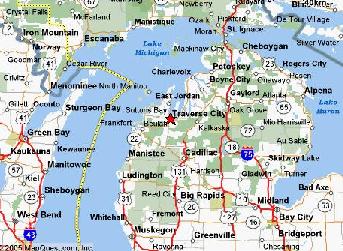
Driving the long route around Lake Superior into northern Michigan, the first tentative fingers of spring have brought a thawing to the land. The cherries that draw thousands of migrant workers to the Lower Peninsula are threatening to burst into bud. Gladys Munoz (her real name) directs Migrant Health Services for seven northern Michigan counties. She is based in Traverse City, a comfortable upper crust enclave — the billion buck mansions out on the peninsula are in the El Chapo Guzman category of ostentation (Michael Moore is rumored to be in residence in the environs ensconced in a lavish log cabin roughly the size of downtown Flint.)


Gladys knows where the bodies are buried. We ply the backroads to the labor camps hidden away down in the dank gullies. Guatemalans and Mexicans stream into this region each spring to do the stoop labor no gringo will do and pick the Maraschinos that top off the parfaits of the few upwardly mobile Americans left in the wake of the ravaged economy (Michigan unemployment clocks in around 15%.) Gladys tells me about three babies born without brains — she suspects pesticides. She speaks about a man from Chiapas who hung himself when he found out that he had contacted AIDS — a priest was called upon to perform an exorcism at the house where he expired. And a young Triqui Indian mother from Oaxaca picking cucumbers for a Vlasic pickle contractor who was stranded in a country that doesn’t recognize her language after her husband went fishing for supper without a license and Fish & Game turned him over to the Migra.


We visit with Liliana (not her real name) from the drug war-riddled hot lands of Guerrero state. The patron is a kindly old farmer who has installed cable TV for the workers and we watch Barack Obama extol the wonders of his tarnished health care bill. Liliana’s husband is picking oranges in Florida but will soon return to work the cherry. She says he doesn’t much believe that an immigration reform measure will make it out of congress – “just some more blahblahblah…” But Liliana will march this May 1st if she can get a ride — undocumented workers are not permitted drivers’ licenses in the state of Michigan.


Traverse City is good to me. I perform at a local organic coffee roaster for a roomful of social change agents. The next morning, Jody T. who gave up her life to drive this garrulous old gaffer around the bioregion, steers the Viva into a trepidatious triangle. Cadillac was once the home base for Timothy McVeigh and the Michigan Militia, a recent flashback on the Ten O’clock News after a Christian posse purportedly targeted cops for blood sacrifice in preparation for the appearance of the Anti-Christ. To the west, small towns with Dutch-inflected names like Holland and Zeeland and Vreland dot the lakeside.


White clapboard outposts of the Dutch Reform Church, the architect of South African apartheid, their steeples spiring piously into the spring breeze, hug the highway. The Dutch Reform Church is the spiritual home of the Prinz family whose most celebrated spawn, Eric, is the go to guy at Blackwater. Further south we slide into Grand Rapids where the similarly affiliated DeVos dynasty’s Amway holds sway. The Prinzes and the DeVoses (a good reason not to root for the Orlando Magic) finance such repositories of right-wing fanaticism as Focus On The Family and Operation Rescue. The largesse of Dick DeVos rivaled the Mormon Church in putting California’s homophobic Proposition 8 over the top.


Grand Rapids, once the furniture capitol of the known universe and now the home of the Gerald Ford Museum of Presidential Imbeciles, is a good boxing town (Buster Mathis and Roger Mayweather have gyms here) and a swelling Latino population has changed the complexion of the city. Despite the downturn, Grand Rapids is trying to upgrade its downtown but the further one gets from the core of the city, the seedier things look.


Koinonia House is a sanctuary near the old demolished heart of Grand Rapids — in fact, it is the only structure left standing on its block. Established by disaffected seminarians like Jeff Smith in the early 1980s when the U.S. waged war on Central America, K House became a station on the underground railroad built by the Sanctuary Movement. The first refugees were Guatemalan Indians fleeing the scorched earth genocide of Efrain Rios Montt. In recent years, K House has taken in Mexicans fleeing that “desgraciada pobreza” back home, like Carlos and Alynn (their real names) who have brought their remarkable art with them to El Norte.


Jeff kicks back and reminisces about the fates of former tenants. The big-bellied wood stove belches out waves of warmth on a chill late March morning. The big arms of the fluffy old lounger envelop a weary traveler and hold him close. K House remains a sanctuary deep in the heart of a wounded land.


Stay tuned. Chicago, St Louis, Jackson Mississippi – there is still a whole lot of traveling to do as the Monstruo tour moves eastwards.               


FIN


John Ross and “El Monstruo – Dread & Redemption in Mexico City” will visit St. Louis April 4th-7th, and Millsaps College Jackson Mississippi April 9th for a symposium on Mexico City – he will tour Baltimore, Washington, New York, and Boston April 19th through May 1st. For details write johnross@igc.org.

Oh my gay!

0

CLUB/MUSIC Gay wads. Sissies. Fatties. Fags. Butches. Twinks. Offended? Don’t be — that’s the guest list for Stay Gold, the sickest queer dance party in the Mission. This month the party celebrates its four-year anniversary, inviting you to self-declare along with the rest of the high femmes, boys, bois, nerd alerts, nellies, and an entire pack of sexy dance-dance revolutionaries.

The all-inclusive party throws down its jams the last Wednesday of each month at the Make-Out Room and has grown from a dedicated crowd of 50 at its start to a full-on 450-person freak-fest in 2010. Stay Gold’s founders/promoters/resident DJs Leah Perloff (DJ Rapid Fire) and Danielle Jackson (DJ Pink Lightning) blame the party’s popularity on its welcoming attitude.

“Stay Gold is a queer party, not a lesbian party,” says Perloff over coffee and banana bread. “We’ve never put imagery on flyers because we didn’t want to rule anyone out.”

“It started out as mainly women, but it’s turned into everybody, which is a hard thing to do — get all queers at one event,” Jackson says.

All queer and all hot, Stay Gold draws in a ridiculously cool crowd. Super rad vintage threads bump and grind with killer style choices of all breeds. The haircuts, the personalities, the dance moves— this crowd is bangin’. “Ya. It’s a super hot queer mix,” Jackson agrees with a smirk, noting the event’s tagline: “White hot cruising and solid gold dancing.”

Stay Gold started as a tribute to a friend of Jackson and Perloff, Sarah Tucker, who was killed on her bicycle by a hit-and-run in 2006. Jackson and “Tucker,” as they called her, had put together PYT, a gay dance party named after a certain Michael Jackson song. After Tucker passed away, Jackson and Perloff decided to keep the party going in her honor, switching the name to reflect their lost friend’s recent golden birthday. “Tucker would totally approve of Stay Gold — minus the fact that we play a little hip-hop. That was always her rule: no hip-hop at PYT,” Jackson says.

To balance it out, Tucker’s favorite song, “Last Night a DJ Saved My Life” by Indeep is the party’s anthem. Other Stay Gold staples include “Finally” by CeCe Peniston, “Walking on Broken Glass” by Annie Lennox, and “Pussy (Real Good)” by Jacki-O. “People want to hear the jams,” Perloff says with a very serious face.

Along with the usual DJ mix, the anniversary party includes a special live set from Double Dutchess, who Perloff describes as an “epic booty bass, babelicious, dance jam duo.” Already packed tit-to-tit during its regular event, this one’s gonna be bananas.

Whether it’s suggestion or a rule, take it from Perloff: “No parking on the dance floor.” 

STAYGOLD FOUR-YEAR ANNIVERSARY

Wed/31, 10:30pm, $3

Make-Out Room

3225 22nd St., SF

www.makeoutroom.com

There be more

0

THEATER I don’t know from reclaiming rituals, but when I saw the gangling guy in the deer mask and beige unitard prancing around the stage once more, I knew the vernal equinox could not be far behind. Herald of this new season is none other than writer-performer Dan Carbone, a long-cherished and uniquely committed Bay Area talent who remarkably has eluded actually being committed. Back on March 6, Carbone was keeping it surreal in the Mission with a revival of two gems, Up from the Ground and There Be Monsters! (the latter featuring the aforementioned deer-man, among its varied and unexpected menagerie).

Carbone’s upcoming single-evening production lays these two works to bed while promising new dreams directly ahead. He returns to the Dark Room with entirely new material, including the premiere of something called Ol’ Blue Balls, pertaining to an encounter between Frank Sinatra and a little girl in the Eisenhower era, according to a press release, as well as a cross-cultural encounter called The Koreans and the piquantly titled Debbie and the Demons.

For those still woefully unfamiliar with Carbone’s idiosyncratic oeuvre, the March 6 evening proceeded by quiet but wild fits of storytelling and subconscious reverie into a genially demented and devilishly clever assemblage of monologue, nursery rhyme, and Dada dreamscape. Ideas rushed out of Carbone’s head amid a fit of logorrhea as bright and delighting as the silver tinsel yanked from the felt-lined anus of the well-soiled stuffed doggy in Monsters!

Befitting the late-night format, there were even some special guests. No less than Richard Chamberlain, ladies and gentlemen, was called out of the audience and onto the stage. And sure enough, bounding up with an aging, nearly forgotten celeb’s practiced modesty and eager step was a guy who looked at least not utterly unlike Chamberlain, the star of TV’s indelible Shogun miniseries, who let go a spiel too airily bizarre to recount here without much more coffee, its edge tempered by a vague mixture of nostalgia, regret, and that period ennui Jimmy Carter dubbed America’s malaise. Giddy days those might have seemed too from the vantage of today’s doom-clouded depravity, were it not for the growing suspicion that this guy isn’t Richard Chamberlain at all and probably insane.

The late-show slot at the Dark Room is altogether apt. Carbone’s stage occupies a space somewhere between Pee Wee’s Playhouse and Night Gallery. It’s such stuff as vaguely inappropriate dreams are made on. In so far as the Dark Room shows — which began in February with Carbone opening for Rick Shapiro — stand to be a regular thing, Satan and audiences willing, we can all rest uneasier.

NEW TALES OF MYSTERY AND IMAGINATION

Sat/3, 10 p.m., $8

Dark Room

2263 Mission, SF

(415) 401-7987

www.darkroomsf.com


Neighborliness

0

le.chicken.farmer@gmail.com

CHEAP EATS My soccer team is good. They win without me by gaudy scores like 18-1. When I’m there we still win, mostly, but with better manners. And sometimes we tie or even lose, but only when I’m there. This makes me feel needed.

After games the guys drink beer out of Dixie cups then go grocery shopping, because they’re married, and the girls, being single, go out for brunch or lunch or breakfast and talk about the guys. We wonder what they said, since they speak Portuguese and we don’t. My assumption has always been that they are yelling at me.

They play hard, but then they seem so nice, with their Dixie cups and shopping lists. Of course I am in love with my city right now, and all the people, grocery stores, and restaurants in it.

Even Tartine, which is the view from my new window, and on weekends especially is loused with line-loving wahoos. I love Tartine because I ate a sandwich from there once, a few years ago, and as I recall it was pretty fucking great. But also I love them because they represent a very special challenge to me, and you all know how I appreciate a good challenge.

So: my long-term goal in my new go-round at 18th and Guerrero streets is to annoy Tartine out of business. Just for fun! And not by saying mean things about them either. Obviously some talented folks are putting out some cool beans over there, to line ’em up like they do. No, I have in mind a more neighborly way to undo them.

First, let me fire up my tiny shitty old studio-size gas oven, then I will have to learn how to make morning buns better than theirs. Check that, then I will have to learn what a morning bun is. Hold on a second.

(Insert sound of idle whistling here)

I’m back. OK, mmm, hold on a second, my fingers are pretty sticky. OK, don’t worry, this is not a review of Tartine. I’m not going to say a word about their morning buns, only that it might take me a long time to put them out of business. But that’s fine, because time is a thing I have. Time, a tiny oven, and the means to make a cup or two of coffee.

My plan, then: to swing my gated window open and play my steel drum so enticingly that everyone standing in Tartine’s line will cross the street to see what gives. Then … I will give. I will offer them morning buns, mugs of coffee, and semi-intelligent conversation, for free of course, and so dazzled will they be by my neighborliness that they will eventually forget all about why they came to the Mission in the first place.

It’s a dream, and a distant and misty one at that, I know.

Meanwhile, for the last couple Sundays while all of Chestnut Street has been lined up outside my Mission District window, I have been on Chestnut Street having brunch, lunch, and breakfast at the wonderful and empty Chestnut Diner.

My new favorite restaurant! It was turned on to me by Alice Shaw the Person, who, having a car, carts us to and from our soccer games, which have been conducted lately in the Marina.

The omelets are great. The hash browns are fine. The décor is fantastic: light-blue-topped chrome stools around a J-shaped counter, with booths on either side.

I just can’t recommend the burgers, because they don’t understand rare there. Listen:

Me: Can I have that rare please?

Waitressperson: Half?

Me: (thinking, half?) Huh? No, Rare.

She: Oh, well.

Me: No, rare.

She: Half?

And so on until I gave up and ordered an omelet. But she looked sad about this, so I explained what rare meant and ordered a bacon burger. That way, when it came overcooked (which of course it did), it would still taste good. Which of course it did. *

CHESTNUT DINER

Daily: 7 a.m.–3 p.m.

1312 Chestnut, SF

(415) 441-1168

MC/V

No alcohol

L.E. Leone’s new book is Big Bend (Sparkle Street Books), a collection of short fiction.

Oakland’s Camaron Ochs may inspire folk-pop Barbie

1

Big blonde hair, rosy cheeks, and an adorable little frame … folk-pop songstress Camaron Ochs — who’ll be performing Wed/17 at Cafe Du Nord — is a doll. Coincidentally, she is also being stalked by one— the Oakland singer-songwriter has seen quite a lot of Barbie in the past year, the long plastic limbs have been spotted at two East Bay venues where Ochs took the stage: the Stork Club, where the bar is decorated with stacks of cased holiday Barbies and Mama Buzz, the coffee shop/art gallery that hosted an art exhibit of the dolls in adult-style dioramas.


“There’s a Bat Girl Barbie at the Stork Club and I want it,” she says with a warm smile. “And I really liked the Barbie on the unicorn at Mama Buzz.”

Besides the constant grin, Ochs has nothing in common with her 11.5-inch stalker. An extensive travel record and a day job as a lab manager for emotion research means this pretty lady’s personality is far from plastic. Ochs’ brand of folk-pop is light and sweet, with genuine lyrics that ask listeners to live with their “heartforward”; a term Ochs coins as her philosophy on life and the title of her debut album. 


“I came up with the term when I was living in Nepal. I was learning all about the seven chakras— the heart is the fourth,” she explains at a coffee shop in her sunny Temescal neighborhood. Skipping a few details, Ochs summarizes that being ‘heart forward’ literally means setting yourself up to take in the endless possibilities that surround us. “It’s about putting yourself out there, not just in a romantic sense, but in a life-sense.”


Bright guitar strums and a beautiful, rich voice flutter throughout Ochs’ songs, lyrics exploring relationships and offering insightful snapshots into lessons she’s learned while visiting cities around the world. Inspiration stems from other indie-folk blends, like The Weepies and yet also carry a more country tone, like that of her other favorite artist, Patsy Cline. There’s an audible optimistic bliss in her music and an honest indication that the woman behind the strings is a solid, well-rounded being. 


Born a California girl, Ochs grew up with an interest in music, taking notes from her grandparent’s love of classic country and learning to sing in multiple languages. In college Ochs started her own A Cappella group, but it wasn’t until her study abroad experience in the Netherlands that she picked up a guitar. 


“I decided to do the college thing— get a guitar. But I wasn’t any good at it. I would play on the streets of Amsterdam and then I even tried to sell it on the street, but no one wanted it.”


Eventually she gave it to a boyfriend and headed back home. A few months later, Ochs realized she missed her box of strings. 


“So I borrowed a backpacker, basically just the neck of a guitar without the body, and brought it with me into the mountains of Nepal.” The trip included a flight over Kathmandu, a six-hour bus ride, five hours in a taxi and a ten-hour walk straight up into the mountain to where she would take residency for the next six weeks. 


A girl on her own in a foreign land, Ochs had no choice but to keep an open mind and her ‘heartforward.’


“The first two weeks, I cried and cried. All I could focus on was how much different everything was there,” she says recalling the trip. “And then I realized that when you strip away everything you’ve ever had in your entire life, that’s when you see what you really are and who you really want to be.”


She met a couple of traveling Canadians and together they would play music, battling the inconsistent electricity with late night guitar parties. Building on that experience and developing her own relationship with the instrument once she returned home, Ochs is now playing confidently and taking on stages across the Bay with a full band. She couldn’t have been happier when her CD release party sold out. 


“I think I’m really lucky. But I’m working really hard, so I guess it’s really not luck afterall.”


Camaron Ochs

Wed/17, 8:30pm, $12

Café Du Nord

2170 Market, SF

www.cafedunord.com


Work it!

2

arts@safbg.com

LIT/VISUAL ART Yvan Rodic has to be one of the luckiest souls on the planet. He’d have to be to make my cynical ass fall in love with him. His new book Facehunter (Prestel, 320 pages, $24.95), a pastiche of photo book, style manual, travelogue and (hallelujah!) manifesto, has just the right combination of couture and subversion to earn a place on every cigarette- burned coffee table in the world.

"Globalization is a myth," he declares in his introduction. "The belief that international brands and pop culture are making the world a standardized society populated by clones is an old-skool science-fiction vision of the future, not the reality of the 21st century."

If anyone would know it is Rodic, who has traveled in nearly 30 countries, taking pictures of real people looking real fly for his blog, which eventually landed him as a contributor to Tokion, GQ, and Modette, which in turn got him a book deal with Prestel. Told you he was lucky. But luck, in this case, is only preparation meeting opportunity, because Rodic has an eye and a philosophy that is long overdue in the worlds of art, fashion and photography.

"Judging from the people I’ve met on my travels, it’s obvious that instead of talking about globalization, we should talk of ‘creole-ization,’" he says. Rodic calls this phenomenon of customizing identity from fragments of culture from different parts of world "New Creole Culture." I can think of another name for it …

Whether standing in front of the lush foliage of Turku or the stark grayness of a Manhattan winter, the clothes and the everyday people in Facehunter are beautiful. The mostly 20-something Nordic models within Rodic’s pictures are to be expected. He calls his peers "the iPod generation," and credits them for taking "this chameleon-like approach to fashion, exploring the many facets of their personalities with radically different looks, or customizing their individual styles with elements from different eras and cultures." John Galliano, Prince, Vivienne Westwood, Afrika Bambaataa, and myself cuff you on the ear for that one, young’un.

The real surprises in Facehunter come from Rodic’s more atypical models: the stout, the squat, the over 30. In these photos, I find the folks who really knew how to "work it" in the parlance of prêt-à-porter rabble-rousers. They bring a radical cohesion to the book’s overall aesthetic. People from cities as disparate as Sao Paulo, Singapore, and Warsaw have a shared sense of what is fashionable, transcending economics, geography, race, and gender — an encouraging sign if there ever was one.

There are no labels mentioned in Facehunter, no designers, allowing the clothes to speak for themselves, and even better, allowing you to bite that style without it coming back to bite you in the ass. Rodic posits that the rise of the "New Creole Culture" encourages this.

"Trends are dead, baby!" my new favorite shutterbug announces. "Nietzsche’s exhortation ‘Become what you are’ is now a reality." I couldn’t have said it better myself.

Elmwood emerges

0

By Robyn Johnson

After months of restoration, the corner space that used to be Ozzie’s Soda Fountain has finally opened this week to reveal an upscale French-style cafe. While many may lament the closure of Berkeley’s last soda shop in favor of a yet-another coffee joint, Elmwood Cafe does offer something quite unique. According to the little paper pamphlets available on the counter, the shop will donate half of its profits to charities. I’m really excited (and curious) how this business model will work out in the long run.

I was also charmed by the bright, cheery interior—the owner decided to keep as much of the original 1920s architectural details as possible, right down to the red stools that line the counter—and, of course, the food. With quite a few Cafe Fanny veterans at the helm, the conscientious menu reflects that establishment’s renown for the healthful, hearty, and organic. So be prepared for dishes like porridge, paninis, soups, salads, and stews.

I tried the cappuccino—good but nothing totally remarkable—and the cranberry coffee cake, the customer (and barista) favorite so far. It truly was tasty, with a delicate, crunchy top speckled with powdered sugar and a rich yellow cake that enveloped gobs of tangy cranberry.

The only foreseeable issue is the relatively high price (the cappuccino and coffee cake set me back about $7), but considering half your expenditure goes to charity, it might be a worthy treat.

Elmwood Cafe
2900 College, Berk
(510) 843-1300

Fatty Starbucks: Yet another reason to drink indie roasts

4

By Robyn Johnson

Last week, Call Me Thirsty, a drink enthusiast blog, released a nutritional chart of the 10 fattiest Starbucks drinks. For those who have plugged their fingers into their ears in response to the consistent media coverage over the years about the caloric excessiveness of the Starbucks menu, the numbers can be quite eye-popping. (Be aware, though, that the chart refers to the venti size and opts for whole milk when applicable—Frappucinos are typically made with reduced fat milk, but all that cloying syrup, whipped cream, and chocolate more than makes up for it.) As a former Starbucks employee, and as supported by the chart, I can tell you straight off to avoid any drink with white chocolate syrup and most Frappucinos outside of the plain version—yes, you can order them plain and also without whipped cream. And let’s be honest, without all the bells and whistles Frappucinos are about as thrilling as a glass of Quik.

I don’t want to proselytize here too much and I think it’s obvious that like other fast foods places, Starbucks sells processed drink items that have questionable nutritional value. But for you diehard fans of the monster chain, consider exploring the complexities of coffee at local indie cafes and microroasteries like Blue Bottle, Ritual Roasters, Four Barrel, Philz, etc. Just sayin.

Taxi turbulence

13

By Skyler Swezy

news@sfbg.com

It’s 10:20 p.m. on a recent Saturday night. Cab driver Dorian Lavender picks up a middle-aged couple outside the Gold Club, a strip joint in SoMa.

The couple is sharply dressed for a night out. After requesting the Mitchell Brothers’ O’Farrell Theatre as their destination, the man brags to Lavender about having had sex with a stripper in one of the club’s private rooms. His female companion smiles and says nothing.

“This is before I met her,” the man explains. “We’re swingers.”

Minutes later, beneath the theater’s flashing marquee, the man hands the driver a $20 bill for the $10 fare. “Keep the change,” he says.

A few blocks away, a young couple flags the cab from the corner of Bush and Polk streets. They are talkative and entertained as Lavender tells them about the swingers. Ten minutes later, the meter reads $9.86. Apologizing, the young man hands him $11.

Lavender folds the bills into the cash-wad kept in his pocket.

“That’s how it goes with cab driving,” he says. “The nice couple tips 10 percent, the weird swingers tip 100 percent — and they were more interesting to talk to.”

At 25, Lavender considers cab driving a great gig and survives working only three shifts a week. He enjoys the cash, freedom, and unpredictable encounters. He’s even landed a few dates. A lot of career cabbies start driving for the same reasons. But after the excitement wears off, it turns out to be a tough job.

A typical cab driver in San Francisco makes less than $30,000 a year. Before drivers even start a shift, gate fees (covering the rental on the cab and the use of its permit, known here as a medallion), gas, and graft have already set them back close to $100. Bribes are commonplace in the industry, used to ensure weekend shifts, airport fares, and newer cars.

The industry offers no retirement plan or health coverage. In fact, the primary reason some people stay behind the wheel long after the thrill is gone is the promise that at some point, after maybe 15 years, an active driver becomes eligible for his or her own medallion. It costs almost nothing, and offers a tremendous benefit: drivers with medallions no longer pay high gate fees, get better shifts — and can lease out the permit when they’re not working. The lease revenue alone can nearly double a driver’s income.

Since 1978, medallions have been issued only to working drivers, and entirely on the basis of a waiting list that now numbers 3,200 names. New medallions become available when permit-holders retire, die, or are forced by disability to stop driving.

That system — and the entire cab industry — is about to change, profoundly. On Feb. 26, the San Francisco Municipal Transportation Agency agreed to allow some permits to be sold on the open market to help close its huge budget deficit. When the dust settles and the implications of that decision become clear, life for cab drivers and passengers will be very different.

Some say the industry will be better; some say it will be much worse — but the truth is, nobody really knows.


PRIVATIZING PERMITS

Mayor Gavin Newsom’s adminstration has talked about allowing the sale of permits for several years, but only in the past few months has Christine Hayashi, SFMTA’s deputy director of taxi services, come up with a detailed plan.

It’s aimed at addressing what some drivers call an unfair and flawed system. Permit-holders by law must drive a minimum number of shifts, and it they get hurt or just get too old to drive, they have to surrender their medallions, leaving them with no source of income.

It will also help SFMTA’s budget — the city could sell unclaimed permits for big money and would get a cut of every other sale.

But critics, including Judge Quentin Kopp, the former San Francisco supervisor who wrote the 1978 law that created the old system, say the medallion holders just want to cash in on something that has always been city property.

The pilot project approved by the SFMTA board allows the city to sell up to 60 medallions directly to drivers and allow about 300 drivers over the age of 70 to sell their medallions to any qualified driver who can come up with the cash. The program aims to set a fixed selling price, but has yet to do so, instead setting a $400,000 limit. It is estimated that medallions will sell for no less than $200,000.

That, of course, will be a huge windfall to the sellers, who paid nothing for their permits.

The pilot program was essentially a done deal even before the Feb. 26 vote. In an e-mail to the Guardian, agency spokesperson Judson True confirmed that $11 million in taxi revenue had been added into the MTA budget before the vote took place.


THE GREED FACTOR

Kopp sat behind the desk in his West Portal neighborhood office a week before the MTA vote, bitterly condemning the medallion sales program. “It’s based on greed. It’s based on City Hall greed,” he said. The stentorian 82-year-old occasionally thumped the desk with his fist for emphasis as he launched into the history of Proposition K. Then-Sup. Kopp authored that landmark legislation prohibiting private companies from owning driving permits, instead granting control to drivers.

“This will reverse a system that gave a genuine cab driver the opportunity to obtain a permit and replace it with a system that restores the ability of people with lots of money to buy a permit,” he said.

But Kopp’s bill had some unforeseen consequences. The list has become so long that medallions are being issued to people in their 60s and 70s — and some of those people are driving passengers around town despite failing reflexes, eyesight, and motor skills.

Carl Macmurdo, president of the Medallion Holders Association (MHA), believes that selling medallions will provide an exit plan for geriatric drivers while giving younger cabbies an entry opportunity. At 59, Macmurdo is still a full-time driver and has been in the industry 27 years.

It makes sense that MHA members are generally in favor of the pilot program — they could potentially make a mountain of money. Although only those over the age of 70 are now eligible to sell them, the age limit could be lowered in the future.


INDENTURED SERVANTS

The United Taxi Workers (UTW) headquarters consists of a few cramped offices on the fourth floor of an old office building in the Mission District. All the interior trim is painted taxi-yellow. In late January, UTW spokespersons Mark Gruberg and Rua Graffis sat at a large table, fearing the worst.

They predict the sale of medallions will provide large cab companies with the equivalent of indentured servants. They say drivers will need upwards of a $200,000 loan to purchase a medallion, requiring a hefty downpayment.

Few drivers will be able to pay for a permit with savings, so the system will only work if someone is willing to finance those purchases. And drivers who are recent immigrants or have bad credit may not be able to get traditional loans. So they could wind up borrowing from their employers, the cab companies, UTW activists say — and by owning the debt the companies will essentially own the medallion.

“Supposedly there’s going to be a provision that says a cab company can’t lend money to a driver toward purchasing a medallion. But it would be so easy to get around that by hooking up with an outside lender,” Gruberg said.

Another fear is that the pilot program will favor young drivers and punish veterans. “Suppose a 27 year-old is on the list and I’m 63. Which one of us is the bank more likely to lend money to?” Graffis asked.

Under the pilot program, drivers will have the option to purchase according to seniority on the list. But without a lender, that’s little help.


WHO’S GETTING SCREWED

At 1 p.m. the day of the SFMTA vote, Bill Mounsey and David Barlow were sitting on a bench outside the hearing room. Both are members of UTW and planned to speak in protest of the pilot program.

Mounsey is 63. He’s been on the list for 13 years and is No. 200. He is part of the group most vulnerable in the medallion reform process — drivers who have already waited more than a decade but still have years to go.

If at any point the board decides to eradicate the list before he receives a medallion, Mounsey’s years of waiting will be wasted. “I would never buy one. I’m 63 years-old, no one would ever give me a loan,” he said.

For now, the wait list survives. Under the pilot program, one medallion will be given away for every one sold until the list is exhausted. However, with only half as many medallions being given out, Mounsey fears the list will move half as fast.

Around 50 people attended the meeting, a small fraction of the city’s cab drivers. At 3:56 p.m. the board passed the pilot program and Prop. K moved a little closer toward death.

Hayashi spent more than 175 hours trying to create a pilot program that provides the city with revenue and benefits the taxi drivers. She has made an effort to engage the taxi community and worked with a group of drivers to draft the proposal. She even plans on getting a taxi license.

After the City Hall meeting, Hayashi explained the challenges facing the pilot program over coffee in a downtown cafe. Before March 30, when the proposal is set for a final SFMTA vote, Hayashi must lock down lenders, create lending programs feasible for drivers, and set a fixed selling price for the medallions.

The blaring problem with the pilot program is a lack of committed lenders ready to finance cab drivers’ loans. Bank of the West has expressed interest, as well as two New York credit unions experienced in medallion loans and two San Francisco credit unions.

But how will those loans be structured? Who will qualify? How much of a downpayment will drivers need? And how, in the end, will this change the experience and qualifications of the drivers — and the quality of cab service in the city?

Hayashi sounds confident. “Good service depends on happy drivers. Our goal is to restore professional pride for the drivers, allow them to feel that taxi driving is a career and a respected profession,” she said.

But a lot — a whole lot — can go wrong with this major change in a complex industry that provides essential service to residents and tourists alike. And once the city moves down the path to private medallions, it’s going to be hard to go back.

Still defying gravity

0


By Brady Welch

news@sfbg.com

For more than a decade, a curious scene has greeted viewers looking upon the old Hugo Hotel at Sixth and Howard streets. A bright green couch lurches precipitously from the building’s corner window. Packs of reading lamps are scaling the building’s outer walls. A floor or two up, another couch, some coffee tables, and one of those old and impossibly heavy television cabinets appear to contemplate jumping from the fourth-story rooftop. No prank of the homeless, this precarious assemblage — wow, that’s a dangling claw-foot bathtub three stories up — is the Defenestration Project, the work of Bay-Area artist Brian Goggin.

“I never thought it would last,” Goggin recently admitted to us. In fact, the project wasn’t supposed to last for more than six months. “The clock and armoire were built for the project. But the bathtub is an original from the Hugo, and all the others were salvaged from the street or found in thrift stores.” It is a testament to the project’s sheer fortitude against the elements — and its quirky appeal — that Defenestration will celebrate its 13th anniversary March 5 at 1:AM Gallery, located directly across the street from the installation.

The event will be a retrospective-cum-fundraiser for a proposed $75,000 restoration Goggin has titled “Project Restore Defenestration” that includes illuminating the lamps and installing an LED strobe in the hulking television set. “We’re making sure that all the pieces are looking good and in some cases even better than they originally looked,” he said.

A few pieces of furniture already have been removed, many needing to be entirely rebuilt. Others will be restored while remaining affixed to the building, requiring boom lifts and scaffolding. Overall, these will require resealing, repainting, fiberglassing in some instances, and in the case of the couch, getting covered in a new gloss of latex (as a preservative). Goggin estimates the restoration will take from one to three months, and he may even add some entirely new pieces to the installation.

“We want to see it vibrant again,” he said. For the gallery show, he plans to have individual pieces of furniture on view with the intent that patrons will sponsor them. “We’re hoping to get the funding and support, so by the time the rain stops, we’re funded and ready to go. If we don’t, maybe it’s time for it to come down.”

And come down it eventually will, though not for lack of funding and support. In October 2009, a court ruled that the San Francisco Redevelopment Agency could condemn and acquire the building under eminent domain for $4.6 million. Though the agency’s plan is to build much-needed affordable housing in the area, the sale represented the retreat of any protective cover the building’s original owners, the I.M. and S.I. Patel Living Trust, inadvertently provided for the artwork.

The Guardian spoke to Jeremy Sugerman, Goggin’s legal adviser, who was able to confirm that the artist always had a loose agreement with the Patels whereby they reserved the right to notify the artist to take down the work for any reason or lose title to it. So when the Redevelopment Agency purchased the building, the notice from the Patels came due.

Sugerman and Goggin then went directly to the Redevelopment Agency and pleaded with them to let the building and art stay until a new development was solidly in the works. A raggedy Hugo Hotel with couches and reading lamps welded to its side, they argued, is easier on the eye than an empty hole in the ground. Sugerman told us that the agency was immediately receptive. A month after the purchase, SFRA commissioners approved a permit stipulating that the work could stay hanging for a minimum of 18 months.

Then again, any demolition of the building will require a litany of proposal reviews, permits, and budgeting that could take longer than the 18-month lifeline. In other words, Defenestration will continue to occupy the same conspicuously abandoned and, depending on whom you ask, dilapidated building at the corner of Sixth and Howard.

Originally funded by a combination of maxed-out credit cards, a $3,500 grant from the National Endowment for the Arts, “sweat equity” from more than 100 volunteers, and a staggering $14,000 raised on the project’s opening night, Goggin — understandably — doesn’t envision the same type of institutional support existing in today’s economy for his present renovation. Still, he’s positive. “I feel like this can be done,” he said, adding that $75,000 “is not an outrageous amount to be raised. It’s much less than Burning Man projects that only stay up for a few days.”

Which got us to wondering how in the heck Goggin came up with the idea of Defenestration — a word that means throwing someone or something out a window — in the first place. “I was an apprentice to a sculptor in Europe for a number of years, helping him set up shows, and he invited me to go create an installation in Paris,” Goggin told us. “There was this one area where they were demolishing 18th-century buildings, and I could see remnants of the walls and portions of the staircases and tiled elements of the bathrooms and old shelving. Through the course of imagining what could fill that vacant space that so many had lived in, life and form created a drama.”

For years, it was a drama that played out solely within the artist’s head. But Goggin eventually received the NEA grant, and like a kid who just received his allowance, went shopping around. “I just started knocking on doors, asking people who had buildings if they’d be interested as a base for this installation,” he told us. “Most owners were interested in the idea but then, when they found out what would be involved in installing the piece, became less interested. After I was told off a 16th time, I was riding my bicycle by the Hugo Hotel and I noted the sign.” The sign Goggin is referring to is still there. Posted for potential buyers of the building, it reads: “LOT & BUILDING for SALE. Limit ‘130’ ZONED: RC. 3 HEIGHT,” and lists a fax number.

“It looked vacant, so it seemed like a good option,” he said. “I sent them a proposal.”

Sumati Patel, the daughter of the buildings owner, loved the idea, and over the course of a few weeks, convinced her father that having Goggin work on the building would ultimately be advantageous to the real estate. Squatters had become a problem since renovations on the building had stalled in the 1990s. “Lots of squatters,” Patel told us. “Tons. They’re pooping and peeing. They would have rallies. It gets tiring. It gets expensive.” Under the artist’s agreement with the owners, Goggin sort of took responsibility for the building. “If a squatter got it in, Brian would go over there and take care of it,” Patel said. And how does she feel the project turned out? “I remember once picking up my AAA magazine and seeing an article about Defenestration and showing my dad, like, ‘See?'”

The agreement between Goggin and SFRA to keep the work hanging certainly testifies to the success of the project. It has become part of the neighborhood, and although its days are numbered, perhaps they will be brighter than ever before.

Bill Bennett, the only public official in California to take on PG&E

0

William Morgan Bennett, 1918-2010

On the front page of the Guardian of Oct. 19, 1988, we ran a big picture of Bill Bennett with a caption that read: “Bill Bennett, the only public official in California to take on PG&E.”

The reason we featured Bennett was because the California Public Utilities Commission was poised to make yet another multi-billion giveaway to the Pacific Gas & Electric Company.

This time the CPUC would force the public to pay $3.4 billion worth of PG&E’s mistakes  at its Diable Canyon nuclear power plant and not one public official in San Francisco, home of the PG&E/Raker Act scandal, and not one from any other public agency or public institution was on hand to monitor the CPUC hearings and testify about the horrible impacts the Diablo rate hike will have on the public.

The lone, honorable exception was Bill Bennett. Our editorial noted, “The only public official in California who has taken on the case is Bill Bennett, a member of the State Board of Equalization and a former member of the CPUC, a determined old warrior who fought Diablo from the start and continues to do so today, on his own, against the odds and at considerable personal cost.”

To drive the point home about Bennett’s couirageous stand, we continued, “Those who ignored the case–for example, the supervisors, mayor and city attorney of San Francisco, the board of directors of BART, the regents of the University of California and their counterparts in every other public agency and institution that pays or represents people who pay PG&E bills–ought to be ashamed. The citizens of every city, county and district ought to look at their representatives and ask: Where were you when PG&E walked away with all the marbles.”

 The press in Northern California was ignoring the story, despite the colorful,  forceful and newsworthy campaign that Bennett was waging. He said he had called the  Chronicle and Examiner reporters to try to interest them in the story, but “it was useless so I gave up.”  Guardian Reporter Jim Balderston did the story and quoted Bennett  as saying, among other things, “This commission (the CPUC) must think long and hard of the welfare of the ratepayers and the shareholders of PG&E.” With no Bill Bennett on the CPUC, PG&E once again quietly walked away with billions in ratepayer money.

William Morgan Bennett, the public attorney  who for more than five decades fought the corporate goliaths from taking all the marbles, died Feb.9th at his home in Kentfield after a short illness. He was 91. An overflow crowd paid tribute  to his extraordinary life and career at services held on Feb. 12th at St. Patrick’s Church in Larkspur

When his daughter Joan phoned me about Bennett’s death, I realized once again how much the Guardian and the consumer and the rate-payer would miss Bennett. We are in the middle of PG&E’s biggest monopoly scam ever –Prop l6 and PG&E’s initiative to kill public power and community choice aggregation (CCA)– and Bennett is alas missing in action, for one of the first times in his life. Today, there are other public officials out there fighting PG&E, but there is nobody who can  take on PG&E and its allies as effectively as Bennett.

Our 1988 story had a sidebar with the head, “Bennett vs. PG&E: The 30 years war.” The sidebar recounted an incident characteristic of Bennett and the way he gave new meaning to the term public service.  In 1959 the El Paso/Pacific Northwest natural gas pipeline merger was all but approved by the CPUC, except for an appeal from Bennett as CPUC general counsel.  Before Bennett could file the appeal, he got a phone call from Gregory Harrison, a partner in the politically powerful law firm of Brobeck, Phleger and Harrison. Harrison asked Bennett if he was going to file. Bennett said yes and Harrison responded, “I told them you would say that.”

Harrison told Bennett he would be removed from the case if he filed the appeal. Bennett told Harrison he was going to call a press conference. Harrison responded. “I told them you would say that,” and hung up. Shortly thereafter, Bennett got a call from Gov. Brown, who asked him if he was going to file the appeal. Bennett said yes and Brown refused to discuss the matter further.

Twenty minutes later, Bennett got a telegram from Brown that stated, “You no longer represent me or the State of California in USA v El Paso.” This infuriated Bennett and fueled his relentless 14-year crusade to compel El Paso to divest itself of Pacific Northwest. because of its price-fixing and monopolistic implications for California. In 1969, appearing as a private citizen, he successfully argued the final U.S. Supreme Court appeal in the case, the last oral argument heard by the Earl Warren court.

The Washington Monthly caught the drama and precedent of Bennett’s appearance in its November 1971 issue. “His last appearance before the court in 1969
needs to have been witnessed. Standing alone against an array of the best legal talent that could be provided by El Paso, the states of California and Utah, lawyers for other gas companies and the U.S. government, represented personally by Solicitor General Erwin Griswold, Bennett attacked as the lone surviving avenging angel of the original antitrust action. Finger in the air, voice crying out in toners of retribution, he spoke brilliantly and forcefully without notes for an hour…In the process, Bennett impressed at least one justice privately, and many more observers, as one of the most brilliant and effective lawyers to have gotten to his feet to present oral arguments to the court during the last 14 years.”

 As the final footnote in this legal saga, Bennett  stopped El Paso’s efforts in Congress to pass legislation to void the breakup of El Paso. The result: the largest refund for California ratepayers in the history of regulation to date.  The decision set a  national precedent in antitrust law.

Bennett was born Feb. 20, 1918 in San Francisco to Lt. William M. Bennett of the San Francisco Police Department and Eva Curran of Amador. He attended Most Holy Redeemer Elementary School, St. Ignatius High School, the University of San Francisco and the Hastings College of Law. At the outbreak of World War II, he suspended his law studies and joined the U.S. Army Air Corps.

He was a B-17 pilot in the North African, Mediterranean and European theater of operations, l5th Air Force, 483rd Bombardment Group, 815th Squadron, stationed in North Africa and then in Foggia, Italy. The 483rd flew a total of 215 combat missions during 14 months of combat duty and Bennett was in the middle of it all. “Wherever there were major oil refineries, aircraft and parts factories, tank works, railroad terminals and marshaling yards, supply dumps, bridges and communication networks, he saw action,” Jane Bennett said.  He flew 35 missions and encountered severe flak and fighter attacks at some of the most heavily defended targets in Europe:  Linz’ Herman Goering Tank Works; Berlin’s Daimler-Benz Tank Works; Innsbruck; Vienna; Regensburg; Blechhhammer; Schweinfurt; Salzburg; Landshut; Moosbierbaum, and Ruhland where ME 262 German jets attacked his squadron.

The Tuskegee Airmen, the famous black squadron, escorted Bennett’s missions. “Their base was right next to my father’s,” Joan Bennett said. “They were separated on the ground but equal in the air. That is, they were  equal targets for the Germans.” Bennett often visited some of the fighters across the runway that segregated the blacks.   George McGovern,  the bomber pilot who later became a presidential candidate in l972, was stationed at a nearby base.  He flew B-24s.

Bennett flew some of the first shuttle missions into Russia.  As the bomber squadrons flew deeper into Germany, the planes did not have fuel or were too shot up  to return to their base in Italy. So the squadrons continued on to Poltova,  Russia, to get refueled  and repaired, and  then either flew back  immediately back to their base or stayed over night and flew back the next day.  The missions were kept secret during the war  but later became known as the “Poltova missions.”

 Of the original 646 crew members sent to Italy in March 1944, 38 per cent were killed or missing in action. His bomb group received numerous battle awards, including two outstanding unit presidential citations. Bennett was highly decorated and won three Oak Leaf Clusters, four Bronze Stars and the Distinguished Flying Cross. He was awarded the DFC  for his courage and skill in miraculously bringing his plane back from a mission over Worgi, Austria, in February, 1945.  Bennett’s plane was hit by heavy enemy fire and the two right engines were shot out. He told his crew to bail out but they refused because they counted on Bennett to pull  them through.  Bennett did, safely piloting his crippled plane over the Alps. When the plane limped back to its base in Italy, there was nothing left inside, because the crew had ditched everything to lighten the load.


Col. Paul L. Barton, Bennett’s commanding officer, pins the Distinguished Flying Cross on Bennett in a ceremony on May 12, l945, at the air base on the Sterparone farm in Foggia, Italy.  Gen. Twining, head of the l5th Air Force who ended up as Chief of Staff of the USAF after the war,  attended the ceremony.  “There was no Tom Hanks, Brad Pitt, Tom Cruise WWII move glamor,”  Bennett’s daughter Jane told me.  “The base itself was primitive: steel mats for runways.  Ankle deep mud in the winter along with snow, ice and rain. Open latrines, no toilet paper, tent-living with one crew per tent. No mess halls. One canteen of water per day, etc.”  She said the Bennetts visited the farm in l982.  “The runways were vineyards,” she recalled. “The briefing hall for the men still stands. The interior of white plaster is still lined with drawings of pinup girls. The young girl who lived on the farm during the war is now the owner of the family land. She was very gracious.  She invited us in for coffee.”

 After the war, Bennett finished  law school at the University of San Francisco and then embarked upon a remarkable career of public service. Until I started working on his obituary,  I knew nothing about Bennett’s distinguished war record as a bomber pilot.   But it is clear to me that, having followed Bennett through the years, that  his combat experience under artillery fire and with flak coming at him from all directions served him well in public life.  He spent most of his public career  as a tough, smart and  aggressive attorney who relished  taking on the big cases and the big corporate behemoths who were screwing the public on illegal mergers or monopoly rate increases. To him, this was just combat in a different theater of operations. Sometimes as a public attorney, sometimes acting as an individual citizen, he handled precedent-setting cases  in antitrust, regulatory and criminal law and argued six times before the U.S. Supreme Court. He earned the nickname “the legal Houdini” but I always thought of him as “Fighting Bill” Bennett.

 As a deputy attorney general, he successfully prosecuted public corruption trials in 1954-55 against the State Board of Equalization in San Diego and put l3 public officials in jail. From 1957-59, he handled the celebrated case of Caryl Chessman, known as “the redlight bandit.” After his argument before the U.S. Supreme Court, the court clerk quietly handed him a note from Associate Justice Felix Frankfurter. He wrote, “There is no reason why I should not tell you how admirably you represented the state in this important case.” The clerk told Bennett he should save the note because it was only the second such note that Frankfurter had ever written.

From 1957-58, Bennett represented the state before the CPUC and won many cases against utilities that resulted in hundreds of millions of dollars in ratepayer rebates. Gov. Brown appointed him chief counsel of the PUC in 1958.

In 1960 Bennett was invited to join Sen. John F. Kennedy’s campaign as an advance man canvassing a territory from Chicago to New York.  He became friends with JFK and was considered part of Kennedy’s “Irish mafia.” Kennedy asked him to head the Federal Power Commission but he rejected it to remain with his family.

Bill Bennett and then presidential candidate John F. Kennedy  are pictured in 1960 as they got off the campaign plane at O’Hare field in Chicago.  Bennett was an advance man for JFK and helped stage several rallies in Chicago. Then JFK and Bennett headed east to Hamtramck, Michigan, and finished up at the garment center in New York.  JFK asked Bennett to be head of the Federal Power Commission but Bennett turned the appointment down to remain in California with his family.

In 1962, after Brown appointed Bennett to the CPUC, he promptly took on PG&E with gusto.  With the support of the Sierra Club, Bennett filed the lone dissenting opinion against the CPUC’s approval of a nuclear power plant upwind of San Francisco at Bodega Bay. The  Bodega fight was started in the living room of Prof. Joe Neilands, a UC-Berkeley biochemistry professor and stoked along by the Neilands/CharlieSmith/David Pesonen gang, with help from the Chronicle and its executive editor Scott Newhall and environmental writer Harold Gilliam.  The battle caught on and became a national story and focal point for the emerging anti-nuclear movement. PG&E was forced by public opinion to withdrew its application and skedall down  to Diablo Canyon. And so did Bennett.
Bennett was later visited by the chairman of PG&E, Robert Gerdes. told Bennett, “We don’t mind you dissenting, but do you realize the Russians are trying to stop us from building atomic plants.”

During his CPUC tenure, Bennett led the commission to regularly reduce electricity and gas rates in response to rate cases before the commission. In 1968, then Gov. Ronald Reagan refused to reappoint Bennett to the commission and sent Bennett a letter apologizing for not being able to reappoint him. Reagan did not explain the reason. Before Reagan could kick him off the CPUC,  Bennett  had saved the consumers hundreds of millions of dollars. Ever after Bennett, the CPUC has operated on a supine  basis with PG&E and other utilities and has handed down rate increases and goodies to them on a virtual assembly line basis.  

I first met Bennett in 1967 in his CPUC office overlooking the Civic Center  in the  state building. Lee Fremstad, then the San Francisco correndent for the Sacramento Bee, took me in and introduced me. I had rarely seen a public official like Bennett. He knew about the Guardian and me, had some juicy story ideas for me, and a batch more for Fremstad. Fremstad bantered back and forth with Bennett, noting a couple of ideas but rejecting others as too much even for the Bee and its longtime public power posture.  Bennett was open, expansive,  full of Irish humor,  a populist Democrat full of opinions I liked, jutting the Bennett jaw to make a point, and the kind of guy  who might be good for a lively  three martini lunch.

I thought he would have made a wonderful newspaper columnist or editorial writer, if he could find a newspaper that would publish his  tough consumer-oriented opinions that so  agitated the PG&Es and Hearsts  of the region.  We always enjoyed  Bennett at the Guardian, endorsed and supported him and used him as a friendly source and inspiration.all through the years. 

When Bennett left the CPUC, Neilands and Smith held an appeciation dinner for him in Berkeley that brought together the Bodega Bay/public power warriors of the era.   This was a watershed moment for the Guardian and me.  My wife Jean and I went, met Bennett and Neilands et al and got initiated. We also met Peter Petrakis, a fan of Bennett’s, and a graduate student of Neilands. Neilands did our pioneering expose of the PG&E/Raker Act  scandal in l969.   Petrakis joined the Guardian and  followed up Neilands’ work with a series of investigative storiies that revived the scandal and  the public power movement in San Francisco.  Bennett, as I realized, was a catalyst.  

Bennett’s next move to stay in public service was to run for the State Board of Equalization and Franchise Tax Board. He won his first campaign in l970 even though his opponent outspent him $450,000 to $4,000, all his own money. He was relected to five more terms, despite refusing to accept campaign contributions, and continued to fight the good fight against the special interests in Sacramento and beyond. He was also a professor of law at Hastings while on the board.

Bill Bennett with his wife Jane in 1943 at the primary cadet school in King City, Calif. They were married 67 years.

Bennett is survived by his wife of 67 years, Jane, and sons William (wife Gwendolyn) of Lafayette, James (Paula) of Kentfield, Michael (Roxanne) of Manhattan, Kansas, and daughter Joan of Kentfield and grandsons Jimmy, Will, Jack, and Brendan of Kentfield.

The Bennett family obituary  sums up their patriarch: “Despite his friendships with president and esteemed jurists, his out-going nature was such that he was a friend to all. He was a populist democrat, consumer rights advocate, and a veritable David against the corporate world’s Goliaths, in the vein of his mentor and ultimately friend, Earl Warren. Even with such achievements, his most important and cherished career was as a father and family man. Upon retirement, he embarked upon his most rewarding and enjoyable career: a devoted, loving, entertaining husband, father, and grandfather. For them and through them, he will live forever ‘in his way.'” 

For me, I will stick with our cutline under Bennett’s picture on our l988 front page: “Bill Bennett, the only public official in California to take on PG&E.”


The Bennett family photo was taken in May,  2009, at the Napa airport. A B-l7 was touring the country and Bennett wanted to see it. Jane Bennett said he actually went through the plane. “It was not easy. The access was a skinny, steep, metal ladder to the cockpit. I don’t know how he got up it. He refused a ride in the plane. As he said, ‘If I cannot fly it, what’s the point.'”

Going Rogue

0

By Robyn Johnson

The second decade of the millennium has ushered in some upheavals, and whether they’re for the better or worse it’s hard to say. Tea Partiers are the new Republicans. Doughnuts are the new cupcakes. And now, beer is the new wine.

I recently attended the increasingly popular SF Beer Week, specifically the “A Taste of the Rogue Nation” event at the Rogue Ale Pub House, featuring a delightful cornucopia of their popular brews. Beer sommelier Sheana Davis of the Epicurean Connection elevated the status of the tasting from a mere beer bust to a frou-frou gourmet gathering with her artfully chosen pairings of artisan cheeses and chocolates. Although a little under a dozen samples were served, the following are the highlights — and what I could mostly remember to take notes on after several drinks. (Like true beer badasses, we did not expectorate.)
The tasting started off with Dirtoir Black Lager. Obsidian in color, it looked like coffee, it smelled like coffee, and it tasted like… coffee-ish beer: dark, roasted, and bitter. It was tasty in itself, but the lager became quite a treat when paired with the sampling of Rouge de Noir Le Petit Dejeuner—a sweet, creamy cheese with a white rind covered in penicillium fungi. Our lovely hostess Sheana told us it was mostly eaten as a morning cheese, which partially explained how well it complemented a coffee-like lager.

The Morimoto Soba Ale was also interesting, at least conceptually. A collaboration between Rogue and Chef Masaharu Morimoto (of Iron Chef fame), the specialty grain ale makes use of buckwheat—the same grain used for the flour of soba noodles. The taste was reminiscent of my favorite cheap beer, Asahi (Don’t kill me, beer aficionados, or Chef Morimoto.) In other words, it was refreshing, crisp, light, and on the dry side. I had a hard time placing the buckwheat nuttiness, though.

Not originally included in our tasting menu, John John Dead Guy Ale snuck in as an additional round. Another collaborative product, it’s comprised of Dead Guy Ale (creative contribution of Rogue Brewmaster John Maier) that has been aged in the leftover barrels of Dead Guy Whiskey (Rogue Spirits Master Distiller John Couchot’s input in the unholy scheme). It was delicate and sweet with the oaky notes of whiskey. To give us a basis of comparison, Double Dead Guy Ale was served immediately afterwards; with twice the normal amount of ingredients, it’s also twice as alcoholic. More bitter and less carbonated, it had a ghost of a caramel flavor.
 
While I did not care for the next round of Yellow Snow IPA, the immediate and bold hop flavor really assaulted my palate (for you hopheads, though, this beer’s for you), it’s worth mentioning because the cheese pairing was manna from heaven. Aged for 8 years, Widmer Cellar’s special cheddar actually develops crystals of condensed cheese, which adds a fun consistency to the concentrated, tangy flavor. It’s really the Übermensch of cheddar.

Finishing as the appropriate crescendo to the evening with rich, deep flavors, the Russian Imperial Stout, paired with Sheana’s espresso cookies, conjured up leather and smoke and the flashing eyes of Ivan the Great as he took to the battlefield against the advancing Mongol horde: earthy and full. I have to point out that at this point my intoxication level was at its peak, perhaps affecting my judgment. But the beer and its pairing were good in the way that dark, strong, and chocolatey foods are good.

All in all, my first foray into the complexities of beer and its relationship to food was edifying, especially in the case of the delicious synergism between the Dirtoir Black Lager and Rouge de Noir Le Petit Dejeuner. The conclusion? A pint glass can replace my wine glass any time.

Rogue Ales Public House

673 Union, SF

(415) 362-7880

www.rogue.com

The battle for the forgotten district

24

sarah@sfbg.com

This November, when voters in District 10 — the largest, sunniest, and most diverse of the city’s 11 supervisorial districts — replace termed out Sup. Sophie Maxwell, they’ll be making a selection that could have pivotal implications for the entire city.

That’s because the next supervisor from southeast San Francisco inherits a district that is home to some of the city’s biggest environmental and public health challenges, as well as the most potential for development that will determine what kind of city San Francisco becomes.

District 10 is where you’ll find the most polluted and most underdeveloped lands in San Francisco, areas that could either be transformed into models of a sustainability or, in the words of Tony Kelly, the president of Potrero Boosters Neighborhood Association, “be turned into a toxic Foster City.”

District 10 is where the slaughterhouses, tanneries, and glue factories set up shop and used the bay as a dumping ground. It’s where the smokestacks of coal and oil fired power plants polluted the air. It’s where the Navy filled the Bay, built a shipyard at Hunters Point and loaded parts of the first atomic bomb onto the USS Indianapolis in 1945.

District 10 is where the bottom fell out of this industrial economy in 1974, when the Navy left, taking with it people’s jobs, pay, and hopes for a home of their own and a better future, particularly for what was then a predominantly African American population.

And District 10 is ground zero for plans that will triple the population and double the number of homes — homes that likely will only be “affordable” to Google executives and retirees from Marin, forever changing the face of San Francisco’s southeast sector. Critics fear that will accelerate what has been a steady exodus of black residents, replaced by megadeveloper Lennar’s vision for a new D10.

It’s against this dark history and difficult present that a wide open field of more than a dozen candidates are vying to replace Maxwell, who came to power in 2000 and has had a mixed voting record in her decade on the board. Sometimes, Maxwell was the eighth vote that let the progressive majority on the Board override Mayor Gavin Newsom’s veto and pass trailblazing legislation. Other times, she was the swing vote that allowed the moderate minority to carry Newsom’s water.

So, in addition to D10’s many internal challenges, this seat could determine the political balance of power on the Board of Supervisors, placing all the more importance on voters in this long-marginalized part of town.


DISTRICT OF DISCONTENT

Eric Smith, a biodiesel activist who has thrown his hat in the D10 ring, says that there is a lot of frustration in the air, and looking at the problems the district is facing, it’s hardly surprising that it has what nearly every candidate agrees is a fractured political culture.

“The Bayview, the Hunters Point Shipyard’s toxic Superfund site, the homicide rate, unemployment, poor public transportation, dwindling services and community resources have made D10 one of the city’s largest melting pots of discontent,” Smith said.

Smith’s words were spoken while the Elections Department was verifying signatures earlier this month on a second failed effort to qualify a petition to recall Maxwell.

Bayview resident and D10 candidate Marie Franklin didn’t support the attempt to recall Maxwell, but she understood it as “a frustration movement.”

“People are sinking in the sand, we’ve already lost so many of them, and they felt Sophie wasn’t doing anything for them,” said Franklin, who praised Maxwell for helping get Franklin’s apartment building complex renovated — a job that was completed 18 months ago, at a cost of $65 million, creating 500 local jobs.

“There are 654 units here, and they were uninhabitable,” Franklin said. “There was black mold, rain falling inside. We had people living worse than Haiti.”

Franklin, who said she is running because she “knows the history,” came here in 1978, when she and her son were living in a car after a fire left them homeless. She said the Bayview was a totally isolated area, barely part of mainstream San Francisco.

“There were no taxis, no services,” she recalled. “Nobody would come here, it was the stigmatized area where no one was accountable to provide services.”

The Bayview — which in some ways is the heart of D-!0 — wasn’t always a black community. But African Americans have been living here for 70 years, dealing with all the racism, denial of services, poverty, and pollution. And it bothers Franklin that 85 percent of the 10,500 homes that Lennar plans to develop won’t be affordable to the elderly, disabled, unemployed and low-income people who currently live in the Bayview.

“We need to preserve the diversity of the community and make sure their issues and information will flow to City Hall,” she said. “You must give the people a handle. If you don’t reach out, they’ll slip. That’s why folks out migrated.

Whoever succeeds Maxwell will be a central player in addressing some very big and dirty issues: the future of the Navy’s radiologically impacted shipyard at Hunters Point, Lennar’s massive redevelopment plan for the Shipyard and Candlestick Point, the polluting power plants, replacement of stinky digesters at the sewage plant, and the SF Hope public lousing rebuild.

There’s also the chance to address violence and crime. James Calloway, a candidate who has long worked in Bay Area schools, told us he believes that education and jobs are part of the keys to rejuvenating the district.

“Job opportunities are not as plentiful in the district,” Calloway said. “When I was a kid, you could walk down Third Street at 2 a.m. Now I wouldn’t walk down it at 9 p.m., and I know the area.”

Calloway is hopeful that the massive redevelopment plan, if done correctly, could start the district’s comeback. “Not a lot of black folks stay here when they have extensive education,” he said. “But it’s not only them. Many were displaced by redevelopment and had no way to go back.”


ELECTION UP FOR GRABS

The largest of the city’s 11 electoral districts, D10 is a huge triangular piece of land in the city’s southeast sector that was used as an industrial dumping zone for decades. Today, the district runs from the Giants stadium at AT&T Park to the 49ers stadium at Candlestick Point and encompasses Mission Bay, Potrero Hill, Dogpatch, India Basin, Portola, Little Hollywood, and Visitacion Valley. It’s also crossed by two freeways that isolate it from the rest of the city, and is home to a large number of crumbling housing projects that are in the process of being rebuilt.

Candidate Ed Donaldson grew up in the projects until he was 10 years old, when the Redevelopment Agency kicked his family out in the 1970s. “We landed on our feet, but others weren’t so lucky,” said Donaldson, who works as a housing counseling director at the San Francisco Housing Development Corporation.

“There is a sense that the Bayview and Visitacion Valley have not been included within the San Francisco family,” Donaldson said. “There is a sense of being forgotten.”

In 2007, Donaldson co-founded the Osiris Coalition to tackle the city’s dormant Certificate of Preference program, in which the Redevelopment Agency issued a document to displaced residents and businesses in the 1960s promising that they could return.

He also tried to rescue some 700 foreclosed properties and recycle them as affordable housing stock. And now he is trying to prevent the city from bulldozing seven SF Hope projects without guaranteeing residents that they have right to remain.

In 2007, Mayor Gavin Newsom and Maxwell convened an African American Outmigration Task Force that didn’t get a public hearing about its findings until August 2008. The timing angered some, who questioned why the report’s findings and implications for urban planning weren’t released before June 2008, when the residents of San Francisco voted for the Lennar-led Proposition G, a proposal to build 10,000 market rate homes at one of San Francisco’s last remaining black communities, which Newsom and Maxwell endorsed.

The taskforce didn’t publish its recommendations until the end of 2009, allegedly because of insider squabbling. Meanwhile, gentrification was going on actively, and many blamed Newsom, and by extension Maxwell, for failing to do anything with the group’s findings as D10 residents continued to suffer from high rates of asthma, cancer, unemployment and an ongoing black exodus.

It wasn’t always this way. In the 1940s, the district’s black population exploded when migrants from the south and World War II veterans came to work at the Hunters Point Naval Shipyard. Some moved to Alice Griffith Public Housing complex, or Double Rock, which was built as military housing in 1962. Others relocated to the Bayview when the Redevelopment Agency took over the Fillmore/Western Addition in the ’60s and ’70s as part of a controversial urban renewal effort.

But when the Navy abandoned the shipyard in 1974, unemployment hit the black community hard. Today, hundreds of the city’s lowest income residents live in Alice Griffith’s crumbling units and endure sewage backups, no heat, cloudy drinking water and leaking ceilings, as they wait for the projects to be rebuilt.

“Generations have been trapped in the silo of public housing and cannot get out, because of lack of opportunity and education, so when we legislate, we need to take that into consideration,” said candidate Malia Cohen, whose grandfather came from Texas to work at the shipyard where he met her grandmother, whose family came from New Orleans.

“My grandfather’s father was a longshoreman. He worked with the infamous Leroy King [a commissioner at the city’s Redevelopment Agency] and he has fantastically vivid stories of racism,” said Cohen, who works for the Federal Reserve Bank of San Francisco, previously served on the executive staff of Mayor Gavin Newsom, and has already raised over $18,000 in the D10 race and qualified for public matching funds.

“My family came here to work hard, they lived on Navy road in the projects, and then they bought a house here. My parents were born here, and we were all public schooled,” Cohen recalled as she took me on a tour of D10 that ended up in Visitacion Valley, an increasingly Chinese-American neighborhood that reflects a district-wide trend.

Census data show that by 2000, Asians were the largest racial group in the district (30 percent), followed by blacks (29 percent), whites (26 percent), and Latinos (19 percent). By 2003, according to the California Urban Issues project, the trend continued. Asians were the largest racial group (32 percent), followed by blacks (27 percent), whites (21 percent) and Latinos (17 percent) of the population.

This means that D10 candidates will have to garner support from more than one ethnic group to win. Over a dozen candidates have already filed papers in the race, but so far there is no clear front-runner.

Also frustrating the prognosticators is that fact that D10 has had the lowest voter turnout in the city, so the winner will also depend on who goes to the polls.

D10 candidate Geoffrea Morris, who is the grand daughter of longtime Bayview activist Charlie Walker, has been knocking on doors and participating in voter registration drives.

“We need new blood,” Morris said

Getting elected will be a complicated equation. Although Bayview’s population was 50 percent African American at the time of the 2000 census, it didn’t turn out the vote. In the 2006 election, only 14,000 of the district’s 37,000 registered voters went to the ballot, and 50 percent were from whiter, richer, and more Asian neighborhoods.

“It’s very important to the future of the city that the ethnicity diversity of the board be maintained and that the African American community have representation,” former Board President and current Democratic Party chair Aaron Peskin told the Guardian.

Maxwell recently told the Guardian that she’s not ready to endorse any D10 candidates yet. “I’m waiting for people to have a better understanding of what this community is, what the common thread running through it is, and how to use rank choice voting,” she told us.

The only candidate who currently holds elected office is BART director Lynette Sweet, who had her answers down pat when we reached her by phone, and even used wording that was eerily similar to Maxwell’s words.

“D10 is a pretty diverse district, but there is only one common thread: the need for economic development,” Sweet told me. “That’s true in Potrero Hill, Portola, Dog Patch and the Bayview. It’s the same mantra: a lot of small businesses need help, and the only way to help them is through economic development. In Potrero Hill it’s about land use. In the Bayview, it’s about the shipyard and better transportation and truancies.”


THE COMMON THREAD

District 10 is ground zero for the Lennar’s $2.2 billion plan to develop 10,500 market rate condos at the Shipyard and Candlestick Point. The plan will allegedly create thousands of jobs and new parks, deliver on an historic community benefits agreement that labor groups claim is so “lawyered up” that the developer can’t renege on its promises.

The package is framed as the one and only way to revitalize the southeast’s formerly vibrant economic engine. Indeed, any time anyone tries to slow down the process—to take time to thoroughly read the draft EIR and see if it adequately addresses the impacts of this massive urban reengineering project — a chorus of “no delays” starts up, either from residents of the housing projects desperate to see their homes rebuilt, or the labor contractors who hope to get jobs.

“It’s as if the city is playing checkers, while Lennar is playing three-dimensional chess,” Eric Smith observed.

Lennar has stated that it will contribute $711 million to finance this massive project. The remainder will be leveraged by Mello-Roos bonds, state taxes based on the use and size of a property and intended to raise money for needed services, and tax increment financing, which creates funding for projects by borrowing against future property tax revenues.

The conceptual plan won Maxwell’s backing but environmental groups are critical of the draft EIR.

During DEIR hearing, environmentalists questioned the wisdom and the cost of filling the Bay to build a bridge over Yosemite Slough, and building condos on Candlestick Point state recreation area, the only open major open space in the district.

But the city’s Planning Department also has 20,000-30,000 units of housing in its pipeline. This means that if all these plans get approved in the next decade, they’d account for 80 percent of residential development citywide. And D10’s population could triple, further skewing the district’s already shifting demographics.

In other words, D10 as we know it could become nothing more than a historic relic in a few years, and the next supervisor will play a key role in deciding whether that happens. SFHDC’s Ed Donaldson warns that any supervisor who does not understand the complexity of the city’s largest district can expect a similar recall backlash in future.

“There is no one homogenous voice in the community,” Donaldson said. “The grass-roots organizing that brought about the recall effort was a result of a changing political structure in the area, but is not yet on par with other districts in town. We still allow our politics to be controlled from downtown.”

Fellow candidate Eric Smith warns that the issues—and politics—are complex.

“People were emotional, angry, and desperate because they feel no one listens to them,” Smith said. “That’s part of the problem here; they would rather have a supervisor go down swinging for them, rather than watch one seemingly side with Lennar, PG&E and the mayor on issues contrary to their interests. That’s the terrible irony and one of the biggest problems in District 10. Folks are so mad, they’re willing to do whatever it takes to make them feel they have a voice in the outcome, even if it’s potentially worse.”

Smith cited the sequence of events that culminated last year in the Navy dissolving the community-based shipyard Restoration Advisory Board (RAB), which for years has reviewed technical documents and commented on the Navy’s clean-up proposals. But in December, the Navy made its official decision to disband the RAB, citing dysfunctional behavior and off-topic discussions that got in the way.

“Some of the same folks who were frustrated by the process, tried to send a signal to the Navy that they weren’t being heard and for all their well-intentioned efforts got the RAB dissolved,” Smith said. “I truly feel for them, it’s absolutely heartbreaking, but at times, they can be their own worst enemy.”

One of the looming issues about the shipyard is that the land has been polluted and needs to be cleaned. The shipyard contains radioactive debris from ships towed to the shipyard, after a 90-foot wave washed over them during an atomic test gone awry. The Navy burned 610,000 gallons of radioactively contaminated ship fuel at the shipyard, and workers showered on the shipyard, raising concerns that radioactive materials got into the drains and sewers. And questions have been raised about radiological tests on animals at the yard.


LEAKS AND FLOODS

It’s not just the shipyard that’s toxic. Even the buildings that were constructed to house workers 50 years ago are a serious mess.

Realtor Diane Wesley Smith, who grew up in public housing projects, took me on a walking tour of Alice Griffith last week to see conditions that tenants will likely have to endure until at least 2014, if the city sticks to its plan to relocate people into a new replacement unit in the same geographical area, if not the exact same site.

What we found was pretty messed up.

“The water sometimes comes out brown and feels like sand. It’s been like that for a year,” one resident said.

“The water is cloudy, the bath tub isn’t working and the sink keeps stopping up,” said another.

A woman named Silvia showed us how the water from the tap in her elderly mother’s kitchen flows out cloudy and then doesn’t settle properly, like foamy beer.

“The roof’s been leaking for years, the sewage backs up, but they just fixed the lights,” Silvia said. A neighbor named Linda was using her oven as a heater.

“The toilet backs up a lot, and my grandson’s been coughing a lot from asthma,” Linda said.

“Roaches is always a problem,” said a woman named Stormi, dressed in black sweats and a black T-shirt that read, “Can’t knock the hustle.”

“They’re trying,” said Stormi, a member of the Alice Griffith Residents Association, as a couple of Housing Authority trucks pulled up to do repairs.

“They promise that you will not have to leave your unit, but if they try to move us down to the waterfront, well, there’s a reason there’s no housing there, and it’s because the land will flood,” Stormi said.

“If we don’t end up at the table, we’ll end up on the menu,” Wesley Smith warned, as she stopped to chat with a group of young men, who were worried they would pushed out of the Alice Griffith rebuild through the criteria being established.

“Fred Blackwell, the executive director of the Redevelopment Agency, assures me that’s not the case, but Alice Griffith is a Housing Authority property, and empty promises have the potential to be great promises provided they are made in writing,” Wesley Smith said as we walked out of the projects and onto the road where a yellow and black sign announced “flooded” next to Candlestick Point park, where Lennar wants to build.

Malia Cohen expressed concern about Hope SF residents, as we drove through the Sunnydale housing project.

“We have to be diligent and mindful that people are not pushed out,” Cohen said, noting the sweeping views at Gleneagles golf course above Sunnydale, and the value of housing for a golf course community. “When public housing gets taken offline, we must work with Redevelopment and the Housing Authority to make sure no one is changing the rules halfway. We have to make sure the talks and walks line up. We need to be equal partners. We cannot be bulldozed by City Hall.”

Geoffrea Morris is a Calworks employee, at the Southeast Community College facility on Oakdale, which was built to mitigate the city’s expansion of the sewage plant in 1987. She cited concerns about the literacy levels of people who live in the 2200 public housing units that cluster D10. “A lot of people in Alice Griffith don’t even know the dates or when it’s going to be reconstructed,” Morris said. “Folks like to be told stuff like that, but the city gives you a stack of papers. Some will read them, but others rely on folks they think are trustworthy. They need stuff in layman’s terms written on one sheet of paper.”

Morris is a fan of the Internet who posted a community survey online, and made sure every housing project got some literature telling people to get informed. She worries about the digital divide in D10:

“A lot of folks don’t have computers and access to important information,” Morris said. “And let’s talk about the way ‘affordable’ is used to trick people.”

Michael Cohen, Newsom’s top economic adviser, recently stated in a memo that over the expected 15-20 year phased build out, Lennar’s Candlestick-Shipyard development would include, “up to 10,500 residential units, about 32 percent of which (3,345) will be offered at below market rates.”

“But 892 units of this ‘affordable category’ will be sold to folks earning $100,000,” Morris said. “So if you subtract 892 units from affordable unit category, you’re back to 25 percent affordable.”

Candidate Kristine Enea, an attorney and a former RAB member, chairs the India Basin Neighborhood Association, which administers a US EPA grant to hire experts to translate the Navy’s cleanup documents into plain English and comment on them She was frustrated by the Navy’s decision to dissolve the RAB.

“The lack of a forum does nothing to bolster the community’s trust in the cleanup or the redevelopment process,” Enea said.

Enea generally supports the Lennar project, but has concerns about whether it will adequately mitigate increased car traffic, or result in commercial development that benefits her neighborhood.

“India basin is a pocket of Hunters Point right along the shoreline,” Enea said. “Right now, we have no shops or restaurants, no ATM, no groceries, nothing beyond one liquor store and a few industrial businesses.

Potrero Boosters president Tony Kelly told us that District 10 residents can think for themselves. “D10 residents don’t need to rely on corporations to solve their problems,” he said.

“Folks in the eastern neighborhoods came up with a better revitalization plan than what the city proposed and community activists managed to close the power plant, after the city said it was impossible,” Kelly recalled.

And there’s no shortage of good ideas.

Kelly suggested that an urban agriculture center could immediately put low-skilled folks to work by erecting greenhouses on unused land. Smith said the industrial zone could be “incredible eco-park made from sustainable sources.

‘D 10 is the dumping ground for everything, including all the city’s waste,” he said. “We could be a shining example, not just for D 10, but the rest of the state.”

The D 10 candidate line up includes Calloway, Cohen, Donaldson, Smith, Enea: civil rights attorney Dewitt Lacy, Morris, Potrero View publisher Steve Moss; District 7 BART director Lynette Sweet, Wesley-Smith. Bill Barnes, who works for Sup. Michela Alioto-Pier, and Linda Richardson, who was appointed to the Human Rights Commission in 2007 by Mayor Newsom, have also expressed interest in the race.

In such a huge field, name identification will play a major role. Sweet is in office, but BART Board is not a high-profile job and won’t give her a huge advantage.

Cohen has a slight edge right now in that she’s raised $18,505, including $500 from former Newsom flak Peter Ragone, making her the first D. 10 candidate to qualify for campaign financing. The oldest of five girls, Cohen recalls how her mother got laid off from her city job as a school-based mental health worker and then rehired, as part of the city’s budget cuts.

“We felt that pinch and the frustrating games that are played out between the leadership and the rank and file,” she said.

Cohen who worked for Newsom in his first term as mayor, but has since left his administration , said she is uncomfortable at being framed as Newsom’s candidate.

“Because I’m not, but I am one of the few candidates who has seen how the mayor and the Board work—and don’t work—together,” she said.

Moss sees the city’s southeast as a “district in transition.” Over coffee at Farley’s in Potrero Hill, he told me that the southeastern neighborhoods could be “launching pads for environmentally sustainable growth.”

“The district’s been in a frozen period for 30 years, But despite the problems, people are deeply committed to and in love with their community.

“This district is the future of San Francisco and its social fabric—the diversity, income –and its problems are leftovers from the city’s industrial age.”


DISTRICT 10, BY THE NUMBERS

Total Acres: 5,650

Average household income: $85,000

Population: 73,000

Registered voters: 37,700

Average housing price: $335,000

Ethnicity (2003 figures): Asian 32%, African American, 27%, white 21%, Hispanic 17%

Development status of land: 18% residential, 38% is commercial, 38% undevelopable

All figures the latest available. Sources: SFGIS, Association of Bay Area Governments, U.S. Census, California Urban Issues Project. Ethnicity and income data is from 2003 and almost certainly has changed.


A brief meditation on erotic comics (slightly NSFW)

0

The Kinky Comic Carnival was held at S&M cafe Wicked Grounds a couple Saturdays ago. Comic book fanatics, stimulated by both caffeine and visual erotica, swarmed in unexpected numbers to meet local creative talents that included Ted Naifeh (Courtney Crumren), Justin Hall (Glamzonia, the Uncanny Super Tranny), Serena Valentino (Gloom Cookie), Greta Christina (Best Erotic Comics), Tristan Crane (How Loathesome), and Storm (Princess Witch Boy). The crowd was a mix of committed comicphiles, local kink enthusiasts, passerbys intrigued by the fuss, and confused SOMA-ites who just wanted their coffee.

The eroticism of a comic book is a rather ambivalent one. First, to eroticize a comic book character requires a leap of imagination that most people cannot take; I blame it on the lack of a third dimension. Second, at face value, comics just don’t seem that sexual in the age of gonzo porn. The Victorians liked their quaint pornographic drawings, but then came the moving picture and the drawings became antiquated collector’s items, ancient history. Finally, we are warned that those who read comics after a certain age invariably morph into basement-dwelling creeps. The belief persists that comics block production of potent growth hormones and can prolong an adolescence like nothing else. (They should market that.)

Fans of the genre couldn’t disagree more. For them, the syncretism of X-rated adult content with G-rated comic form represents an appealing erotic alternative to the constraints of real life. Comic book fans like comic books because they represent an escape from mundane 3-D reality. Because their fantasies exist outside the literal world, comic book porn — the exaggerated drawings, crazy sound effects (in a Justin Hall comic, fellatio is accompanied the onomatopoetic “BAM!”), and benevolent deux ex machina who always gets the good guy/gal laid — could not be further from everyday sex. Unharnessing the Id? You don’t have to be a comic book collector to acknowledge the tantalizing possibilities.

Baker and Banker

0

“Banker” might not be the most auspicious word to attach to yourself in these parlous times — people used to rob banks; now it seems to be the other way around — but what if it’s your surname? In a series of small ironies and convolutions, you’re a chef not a banker — a chef named Banker, Jeffrey Banker — and you’re married to a baker named Baker (Lori Baker), and you open a restaurant. The restaurant is called Baker & Banker, which sounds formidably institutional. Your patronage might expect a building with fluted marble columns and an ATM-like machine that dispenses pastry to holders of valid cards.

But no. Baker & Banker (which opened in early December) actually occupies the space, once an apothecary shop, that used to house the Meetinghouse (where Banker worked as a cook), and later Quince, before its move to the Financial District. The building, at the corner of Bush and Octavia streets, is authentically Victorian, right down (or up) to its flat roof; it looks like the sort of structure that would carry a small brass plaque saying Mark Twain once slept there. But of the old apothecary shop there is no longer, alas, any sign. The wallsful of small drawers that gave the Meetinghouse such a distinctive cast have been removed. The dining room is sleeker than it used to be, and also slightly roomier, although it’s still on the snug side. Wall banquettes upholstered in dark brown leather, plenty of dark wood, and a caramel paint scheme lend the room an urban warmth, maybe a little like that of an exclusive steakhouse on the Upper East Side.

One new design wrinkle involves placing chalkboards on the windowless walls. The chalkboards announce various specials, from cheese plates to beers and wines by the glass. The wine list, and indeed the menu as a whole, has a more Teutonic flavor than one is accustomed to finding on what is basically a California-cuisine menu. How about, for instance, a glass of German red wine, a spätburgunder from Georg Breuer ($13) — a pinot noir, in other words, as pale and delicately balanced as a young ballerina on her tiptoes, with a pronounced presence of cherry?

Actual cherry turned up, as a reduced juice, to sauce a plate of bacon-wrapped pork tenderloin ($24.50). The meat, which appeared as a pair of upright cylinders with beveled tops, was roasted medium-rare to a lovely rose color and accompanied by shreds of savoy cabbage dotted with spätzle, to continue our Teutonic theme. But I am getting ahead of myself.

As we might expect at a place where one of the principals is a baker named Baker, the baked goods are superlative, beginning with the basket of still-warm items — slices from a honey-wheat loaf, a pair of honey-rosemary buns — that reach your table not long after you do. Desserts are comparably fine … but again, I leap ahead.

The core of Banker’s menu is seasonal and eclectic — more like that of the Meetinghouse than Quince. You might start with a rather Italianish white-bean soup ($8.75) deepened by bits of pancetta, shreds of kale, and a creamy green-garlic sofrito. From there you could move on to a filet of seared black bass ($25.50), a pad of flaky white flesh plated atop a Thai-style shellfish risotto ringed with crispy shallots. Banker’s is a world without borders.

Or — since one of the less-advertised pleasures of winter is salad — a beautifully composed winter salad ($13) of Monterey calamari à la plancha, arugula, frisee, fried chickpeas, and sections of mild, juicy Oro Blanco grapefruit. Citrus, for all its sunniness, is largely a winter crop.

Dessert can get short shrift these days, since few of us need the extra expense or calories, and a certain repetitiveness haunts local dessert menus — crèmes brûlées flavored with lavender or Meyer lemon, flourless chocolate cake, profiteroles — but not Baker & Banker’s. The possibilities offered by Lori Baker are original and exquisite, from a holiday-worthy, coffee-black sticky toffee pudding ($8) — thickened with kumquat and prune, topped by a cap of candied-kumquat-peel ice cream, and napped by a blood-orange sauce — to a trio of brown-butter doughnuts ($8) filled with huckleberries (a petite cousin of the blueberry) and presented with a dish of lemon curd. Let the bankers have their bonuses! This stuff is better.

BAKER AND BANKER

Dinner: Tues.-Sun., 5:30–10 p.m.

1701 Octavia, SF

(415) 351-2500

www.bakerandbanker.com

Beer and wine

AE/MC/V

Somewhat noisy

Wheelchair accessible


Events Listings

0

Events listings are compiled by Paula Connelly. Submit items for the listings at listings@sfbg.com. For further information on how to submit items for the listings, see Picks.

WEDNESDAY 10

Bear Rendezvous Locations throughout San Francisco Wed. through Mon., visit www.bosf.org/bearrendezvous for a schedule of events, times, and prices. The theme of this year’s Bear Rendezvous is "Sin, Fire, and Gold" and includes events like beer busts, dance lessons, happy hours, movie screenings, art shows, pub crawls, beer busts, and more to raise funds for non-profit organizations that promote and assist the GLBTQQI community.

How to do Magic Tricks Bazaar Café, 5927 California, SF; (415) 831-5620. 7pm, $1 suggested donation. Attend this month’s "How – To Night" and learn how to do magic tricks with professional magician Robert Strong. Suggested items to bring include coins, a deck of cards, a dollar bill, business card, 6 feet of rope, and scissors. Extra supplies will also be available there.

THURSDAY 11

BAY AREA

"Counter Culture" Pegasus Books Downtown, 2349 Shattuck, Berk.; (510) 649-1320. 7:30pm, free. Hear oral historian, photographer, and former waitress Candacy Taylor discuss her new book, Counter Culture: The American Coffee Shop Waitress, and uncover the experiences of diner waitresses from a sociological perspective.

Sweetheart Bingo Rhythmix Cultural Works, 2513 Blanding, Alameda; (510) 865-5060. 7:30pm; $20 for 10 games, includes a free drink. This three ring bingo circus is not like your grandmother’s bingo, with cash and gift certificate prizes, circus arts, food and drinks for purchase, music and carnival games. Proceeds benefit Rhythmix Cultural Works.

FRIDAY 12

Love on Wheels Rickshaw Stop, 155 Fell, SF; www.sfbike.org/love. 6pm, $10. Join other single cyclists for a chance at romance at this recreation of the original 1970’s Dating Game where bachelors and bachelorettes select hidden dates to roll away with to hip local spots.

Lunar New Year Flowers San Francisco Conservatory of Flowers, 100 John F Kennedy Drive, Golden Gate Park, SF; (415) 831-2090. 9am, $5; runs through Feb. 28. Celebrate the year of the Tiger by enjoying a special display of Chinese miniature plant landscapes, a tradition that dates back over 2,000 years.

Soul Food for Thought Herbst Theater, 401 Van Ness, SF; (415) 392-4400. 8pm, $10-40. Celebrate Black History Month at this fundraiser for the International Fund for Africa featuring comedian MC Leo Flowers, music from R&B legend Lenny Williams, live music, dance, thought-provoking speakers, and more.

SATURDAY 13

Hot glass, Cold beer Public Glass, 1750 Armstrong, SF; (415) 671-4916. 6pm, $25 includes a glass drinking vessel or glass heart made by Public Glass artists. Enjoy a cold one while watching glassblowing demonstrations by artists Jaime Guerrero and Guido Gerlitz. Featuring live music with Joel Streeter and Max Delaney.

Love Dub Yoga Tree Castro Studio, 97 Collingwood, SF; (415) 701-YOGA. 8:30pm, $45. Open your heart and share the love with those in need at this fundraiser for the Save the Redwood Tree Foundation, Surfriders, and Power to the Peaceful featuring a Native American blessing, a Hatha yoga session, guided meditation, and ending in a live reggae concert.

Sea Watch Meet at Louis’ Restaurant, 902 Point Lobos, SF; (415) 349-5787, email mbzlat@yahoo.com to RSVP. 8am, free. Look for the Marbled Murrelet, California Sea Otter, and Steller Sea Lion on this sea watch for endangered sea creatures.

Vegan Bakesale Ike’s Place, 3506 16th St., SF; www.vegansaurus.com. 11am, free. Enjoy goods from local professional and amateur bakers while helping to raise money for the Harvest Home Sanctuary, a rescue for domesticated and farmed animals, and Cycles of Change APC, a non-profit community bike shop in Alameda.

BAY AREA

Alameda Zombie Crawl Starts at Forbidden Island Tiki Lounge, 1304 Lincoln, Alameda; (510) 749-0332. 7pm; free. Zombie make-up available at 5pm, from $5-25. Join other zombie lovers for a "Valentine’s Eve of the Living Dead" starting at the Forbidden Island Tiki lounge and continuing to Scobies Sports Bar and Grill and Lost Weekend Lounge before the zombies are unleashed on the rest of Alameda.

Love Mission Chabot Space and Science Center, 10000 Skyline, Oak; (510) 336-7311. 1:30pm and 3:30pm, $85 per couple. Go on a Valentine’s Day love mission at this simulated space mission to find the red planet.

SUNDAY 14

LoveSick 3 Mighty, 119 Utah, SF; (650) 524-0056. 7pm, $15-20. Cure what ails you at this lingerie fashion show featuring live music, DJ sets, an art installation, trunk sale, kissing booth, raffle, and more.

Pet Adoption Day Amoeba Music S.F., 1855 Haight, SF; (415) 831-1200. 11am, free. Find yourself somebody to love at this pet adoption event on Valentine’s Day in support of Muttville Senior Dog Rescue, a non-profit dedicated to creating better lives for older dogs.

BAY AREA

Muir Woods after Dark Meet at Muir Woods National Monument Visitors Center, Mill Valley; (415) 349-5787. 5pm, $5. Hear the rich sounds of nature in Muir Woods after dark and learn about the nesting Northern Spotted Owl. Bring a flashlight and wear sturdy shoes.

TUESDAY 16

Eve Ensler Commonwealth Club, 2nd floor, 595 Market, SF; (415) 597-6705. 6:30pm, $20. Hear author and anti-violence feminist Eve Ensler discuss the daily struggles faced by women around the world and how they have overcome obstacles at this talk and booksigning for "I am an Emotional Creature."

Appetite: Planning ahead for V-Day

0

By Virginia Miller of www.theperfectspotsf.com. View the previous installment of Appetite here. Check out more V-Day dining ideas here.

meltingpot0110.jpg
Fondue you: The Melting Pot draws couples closer for Valentine’s

2/14 – Belgian beer and butchery at La Trappe
Many of us don’t get excited by the commercialism of Valentine’s Day – and not just because we may or not have a special someone in our lives. It could just be that we don’t like things rosy, pink and cute. No need to go the hearts and chocolate route when you can do Belgian beers and butchery, right? La Trappe does it right by making their enchanting Belgian brick-walled, candlelit basement the setting for A Porcine Valentine. Only 45 lucky people will have their run of the place, cozying up on church pews and couches with all the beers and pig they can ingest. La Trappe’s Dave and Chris will each be breaking down a whole pig, showcasing different butchering techniques between the US and Italy.
3-11:30pm
$95 per person, limited to 45 people
800 Greenwich Street
415-440-8727

www.latrappecafe.com

missionbeach0110.JPG
Mission Beach makes it sweeter

2/14 – Mission Beach Cafe sweets for the sweet
ILove Mission Beach Café. Not only is it a morning delight for weekend brunch or weekday pastries and Blue Bottle coffee, but its dinners are some of the best and most underrated neighborhood dining in the city. Valentine’s Day there is, yes, a special four-course prix fixe dinner (including white linens, roses, champagne toast, amuse bouche and sweets from fab pastry chef, Alan Carter). Knowing their track record, it won’t be the often overpriced, mediocre food one gets for Valentine’s. There’s dishes like Heirloom Chicory Salad with pomelos and huckleberries, Lobster and Dungeness Crab Ravioli or Prather Ranch organic prime rib. All this in the cozy, chic glow of a neighborhood restaurant that’s also a worthy destination.
$75 per person
198 Guerrero Street
415-861-0198
www.missionbeachcafesf.com

2/13-14 – The Melting Pot – Valentine’s fondue feast
The Melting Pot chain may not be your first thought for Valentine’s Day, but if you’re in Marin or the idea of a relaxed fondue feast (cozy in these Winter months) in a unique setting is appealing, here’s an idea (discounts for groups of 7 or more friends): head to Larkspur’s Melting Pot in an 1891 brick kiln, forced to close for economic reasons in 1915, empty for over 70 years until restored in 1989. The space has the feel of a labyrinthine Spanish wine cellar set in a circular, brick tunnel. For Valentine’s they’ve got a four-course prix fixe at $65 a person – there’s choices each course, like Quattro Formaggio Fondue (fontina, gruyere, raclette, mozzarella cheeses with roasted garlic, basil, pesto) or Crab Imperial Cheddar Fondue, a Caprese or Caesar Salad, entree fondue meats like Filet Mignon Florentine, Limoncello Basamic Sirloin, Orange Fennel Pork Tenderloin, and a finish of either Milk Chocolate Tiramisu or Dark Chocolate Raspberry Fondue. Females get a rose as they leave… if you guys want one, too, you could probably ask. 
$65 per person (10% off for group of 7 or more)
125 E. Sir Francis Drake, Larkspur, CA
415-461-6358
www.meltingpot.com

2/10 – La Cocina’s Truffle-Making Class
Community treasure La Cocina, along with fabulous Neo Co coa chocolates and ever-popular Kika’s Treats, host a hands-on evening rolling your own truf fles, either to with your sweetheart or to give as a Valentine’s gift. The theme is “how to be a bet ter lover”… I always knew chocolate was somehow involved. The class includes wine, din ner and a take-home box of your handiwork.
$65 class; $85 class + 10-piece truffle box & 5-pack of Kika’s Treats (a $27 value)
6:30-9pm
2948 Folsom Street
415-824-2729
www.lacocinasf.org


Trash Lit: Things are weird around ‘Mariposa’

0

Editor’s note: Guardian Executive Editor Tim Redmond has a bad 30-year addiction to mystery/crime/thriller books. He’s decided that he may as well put this terrible habit to productive use by writing about these sometimes awful, sometimes entertaining and — on rare occasion — significant works of mass-market literature. Read his last installment here

mariposa.jpg

Mariposa
By Greg Bear
(Vanguard Press, 340 pages, $25.95)

By Tim Redmond

Good science fiction has a moral, of sorts. Frank Herbert wrote about the scary power of a charismatic leader. Robert Heinlein gave us the fun of free love and the lie of religion. William Gibson outlined the weird dangers of a digital society. My favorite sci-fi movie ever, RoboCop (1987), was all about the perils of privatizing public services.

Mariposa is part science fiction and part action thriller, and the mix works. I liked this book a lot – it’s got creepy tech advances — digital storage devices that dissolve in your blood; tattoos that allow you to exchange information by skin-to-skin contact; monitoring chips that follow your every move; roller bots; a new drug that makes you a near-legendary fighter and totally fucks up your brain – as well as a message that’s eerily relevant.

Mariposa‘s opening is bizarre. The first chapter seduces you in a way that reminds me of Neuromancer. It’s the second decade of the 21st century. Oil prices have collapsed, destabilizing much of the Middle East. The United States is $30 trillion in debt and the president has had to accept IMF-style international receivership. “And it’s all our fault,” one character notes. “We do hate paying taxes, and we do love our government services.”

And the news media? “The dwindling national press – those journalists who still worked for networks or newspapers or the five prime news sites and could afford to travel rather than just sit in front of a screen and suck coffee and pontificate on what others saw and wrote – was as worn out and discouraged as the rest of the nation.”

Most of Texas is no longer under effective federal control. The FBI is in the process of being dismantled.The real, emerging power in the nation, and perhaps soon the world, is the head of a giant private security company that got rich off military contracts. In fact, he’s trying to prove how powerful he is by orchestrating the death sentence of a 15-year-old kid who has the misfortune to be the son of a federal agent.

Into this nightmare step a handful of still-loyal FBI operatives working directly for the dying president, who has been shot with a bullet laced with deadly engineered proteins. They’re trying to rescue a deep cover agent planted in the Talos Corporation — someone who is trying to sneak the explosive data in the company’s files out of a tightly controlled compound. They’re also out to save the 15-year-old’s life before the Texas corrections system, which pretty much reports to Talos, gets to stick him with a lethal injection.

Syntobe proteins that turn Coca Cola syrup into bombs. Desert car chase with hellfire missiles in drone planes. Robot snakes retrieving blood laced with digital downloads. Slightly lame FBI sex. Wicked drug-addled martial arts fighting. A hero who fights off powerful sedatives to take out six guys with a pole ax. I have to say: This one goes down as one of the best action books of the last year.