Classical

Bravo, il gato

2

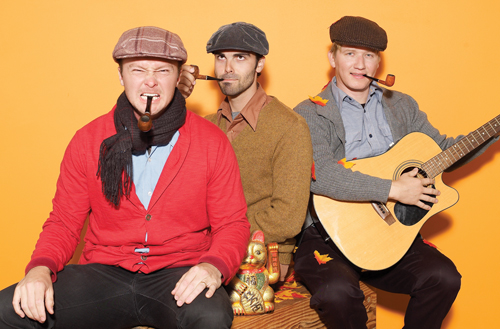
FALL ARTS The clouds hang over San Francisco like a brumous, early evening warning sign. It’s late summer on the back patio of popular Mission street bar El Rio. Small pockets of people huddle near outdoor heaters, and vintage pop songs come pumping through the speakers. Three men dressed neatly in sweaters and hoodies sit at a long picnic table clutching cheap beers.

This is the story of il gato, a San Francisco band that describes itself as indie-baroque-folk. Its music is baroque in the sense that it’s melancholic yet upbeat, lyric-heavy yet leans towards the classical, and highly decorated with a wide array of instrumentation. The band’s 2010 long-player, All These Slippery Things (self-released), and similarly-named followup EP All Those Slippery Things (released last month) feature banjo, mandolin, piano, a string quartet, and trumpets, along with aggressive acoustic folk guitar, looping pedal, upright and electric bass, and complex drumming.

After years of dutiful practice in tiny apartment kitchens, labored songwriting, and intimate live shows, the group finally recorded (thanks to a grant from the Bay Bridged blog) in 2009 at legendary studio Tiny Telephone, owned by revered local musician John Vanderslice. “I…remember how eclectic and fresh their instrumentation and arrangements were,” says Vanderslice. “They were a blast to have in the studio.” But this all came a decade after the first seedling of the il gato concept. Fittingly, the band’s journey — a mildly operatic one, given the twists and bumps along the way — began in Italy.

THE PROLOGUE: Daimian Holiday Scott is studying architecture abroad in Vicenza, Italy. The year is 1999; he hasn’t picked up an instrument since middle school. All of those niggling emotions involved with overseas travel had led to an outburst of emotions, which, naturally, led to buying a guitar. The initial concept was performance art: he’d speak with a fake Italian accent but sing cover songs in English. That never actually happened. “It’s the story before the story,” says il gato drummer, Johnny Major, “the prelude.”

THE FIRST ACT: fast forward five years. Scott shuts the door to the bedroom and asks his girlfriend to listen to the songs he’s been working on from a safe distance in the living room. “It took a long time for me to break free of being super shy and inhibited,” Scott says.

Scott was in his native Gainsville, Fla. writing songs on acoustic guitar and harmonica, learning that to be a songwriter, one must evolve out of the bedroom. He moved to the Bay Area in 2001, first to Berkeley and later, the Mission District of San Francisco, playing as il gato with a rotating cast of talented musicians friends. Years later, when he longed for consistency, he put up an ad on Craigslist seeking musicians.

Major, a San Francisco native who had recently returned from a two-year stay in Chile, answered it. “I liked the name,” says Major, “And of course, I really liked the music. I thought he sounded like a combination of Isaac Brock from Modest Mouse and Doug Martsch from Built to Spill, two of my favorite bands.”

Major — who has played in a variety of other bands including Sang Matiz and his new solo project, Adios Amigo — listened to Scott’s first album Conversation Music, which didn’t have drums, and heard some interesting potential for percussion. During this time, in 2008, Scott, Major and multi-instrumentalist Matthew Souther (who left the band a few months ago) would play in Major’s street-level Lower Haight apartment. The band next gained bassist Andrew Thomas, a Dallas, Tex.-born musician who had recently moved to SF with his girlfriend after a stint in college and other touring bands in Los Angeles. Scott and Thomas had been introduced by their girlfriends one night at the Latin American Club. “He came over the next week to my apartment in North Beach, we just played guitar and upright bass in my kitchen,” says Thomas of Scott.

ACT TWO: the end of an era. Scott’s aria, his solo work in effect, officially comes to an end. He’s part of a band now, all equal parts. “It was no longer just my project,” he says, taking a sip of Pabst Blue Ribbon. Over the course of four short days in February of 2010, the band essentially recorded two albums (the full-length and E.P.), 17 songs in total. The guitar, bass, vocals, and drums were all recorded live at Tiny Telephone. The overdubs of horns and string sections were recorded in Thomas’ home, to save time and money. “I can’t believe it turned out as well as it did,” Major says.

And it did turn out well. The songs are striking and wholly unique. That said, there are hints at the groups’ influences like Neutral Milk Hotel, Beirut, Modest Mouse, even Violent Femmes. But there are other elements, even hip-hop tucked in some parts as Major points out, especially in the mouthful of talk-sung lyrics in brassy folk single, “On Feathers and Arrows.” Major and Scott then discuss Scott’s predilection toward reggae beats, a holdover from his childhood with hippie parents. “That’s the nature of trying to describe your music to someone, it’s always difficult,” Scott says.

He adds that he is also influenced by the non-musical: acerbic, witty writers such as Kurt Vonnegut, along with films like Paul Thomas Anderson’s Magnolia. The band was recently featured on the soundtrack for the documentary Crime After Crime, something Scott is hoping to do more in the future.

ACT THREE: that future. The band has a handful of shows lined up this fall, including Cafe du Nord this week and Andrew Bird’s “Rock for Kids” fundraiser Sept. 19 at the Make-Out Room, along with some brief tours planned. Then, in January 2012, il gato wants to go back to Tiny Telephone to record a followup. Sitting in the back patio, chatting about the projects to come, the group’s goals are clear. Right now, all three are primarily focused on the band itself. In 2009, Scott was laid off from his job as an architect and Major was laid off six months ago. “I’m hopefully looking to break in to something else,” Major says. “Ideally, I’ll have a career as a performing musician, it’s difficult but that’s the dream for all of us. That’s why we’re here right now.”

CURTAIN CALL: take a bow. Crush the cans. 

Check out il gato’s favorite local eats here. They’ve got some good ones!

IL GATO

With Sallie Ford & The Sound Outside

Thurs/25, 9 p.m., $12

Cafe du Nord

2170 Market, SF

www.cafedunord.com

Class clowns

0

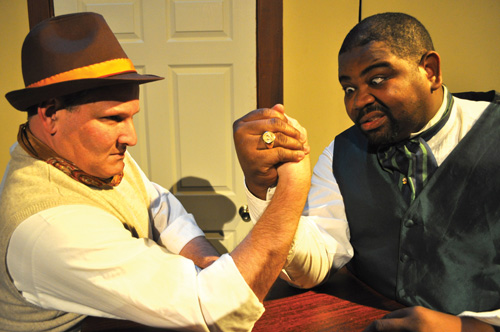
THEATER Linda Brown is a maid at the end of her tether, and tender, as the much-put-upon employee-slave of an exclusive country club. The signs are there from the moment she steps onto the stage: the circles under the young woman’s eyes, her frightened stare, the desperate swigs from a ready flask, not to mention her shameless histrionic intensity as she addresses the audience about the soul-sucking richies perpetually at her back.

But it will take the full length of playwright-director Jeff Bedillion and Back Alley Theater’s sometimes ambling, generally rowdy new farce, Country Club Catastrophe, before our lower-class heroine manages a proper escape — only it’s unclear even to her if it’s a genuine escape at all, as she stares into the eyes of her replacement with an eerie shock of recognition.

In this uneven but promising production by newcomers Back Alley Theater, performances are at times stilted and pacing might be tightened in places, and perhaps as much as 20 minutes of meandering dialogue productively lost from the second half. But Country Club Catastrophe gets laughs in part because it knows what it is about. Inspired equally by classical French farce — Molière’s five-act structure in particular — and recognizably American figures from the yawning class divide, it aims at a contemporary social crisis churned by the obscene disparities in wealth in post–middle-class America. (All glimpsed at the preview ahead of opening night.)

Thus, long before her existentially fraught exit, both Linda (played by a comically intense yet sympathetic Katharine Otis) and her handsome gold-digging coworker, the doorman Max (a winningly boisterous Joshua Rice), largely retreat from view behind an onslaught of self-absorbed club members (numbering only a handful in fact, and yet a real handful just the same).

First to arrive is Mrs. Montgomery (a sharp, coolly imperious Jennifer Lucas), her teased hair rising to just within the frame of the front door center stage (in A.J. Diggins’ spare, functional set design) and a long leash trailing from her wrist to an unseen standard poodle with an unhealthy appetite for the doorman. (Exit Max for some scenes.)

Separately from Mrs. Montgomery — who in a manipulative confessional gesture lets Linda know her first name is Tabytha, only to insist she still call her Mrs. Montgomery — arrives the rest of her small but attenuated family. There is husband Miles (Len Shaffer, dispensing affable sleaze), a jolly and salacious philanderer; and son Tristan (a humorously shrill Salvadore Mattos), Tabytha’s barely closeted Brown University brat whose constant companion is a houseplant he calls Sister.

Greater than Tristan’s fixation on foliage, however, is his unbounded lust for childhood playmate Edward (Jeremy Bardwell), the egomaniacally cocksure but increasingly put out fortunate son of club members Biff and Muffy Birmingham (played, respectively, by a buoyantly silly John Weber and a hilariously sugary yet menacingly bitchy Meaghan M. Mitchell). Biff and Miles are best friends; Muffy and Tabytha not so much. Muffy prefers the company of club member and shy post-debutante Peggy Dupont (a harried Sabrina De Mio), whom Muffy bosses and harshly abuses with an almost innocent glee.

Last and, in the opinion of the club house anyway, certainly least comes Cynthia Anniston (an amusingly oblivious and high-keyed Gloria Terese McDonald), Brown University first-year and cheerleader desperately chasing one-night-stand Edward, her lax outfit reading alternately “prostitute” and “foreign exchange student” to the club’s members and its equally indignant staff.

For the play finds stark but amusing ways to underscore the primacy of money over every other social divide, be it race or sexual orientation or education. Even the mere appearance of not having money is enough to put one squarely outside the club — or rather, squarely within its steep hierarchies of privilege and worth. As the plot gets increasingly tangled, we’re left to consider the intoxicating stench of money in everyone’s noses as the ultimate obscenity.

And yet, Linda (and the play) asks, can the greed, selfishness, backstabbing, dirty dealing, and rampant mistreatment that runs rife through these perverse excuses for families really continue without some final judgment befalling such a club and such a country?

Intonations of just such a judgment are there already in the title, in a gathering electric storm outside, in the self-consciously heightened language, and in the rumblings of piano keys from musician Mike Miraglia’s offstage upright. But the catastrophe that finally breaks in on this world isn’t exactly The Day of the Locust. It is, instead, an ironic and apt judgment on the misspent lives and deflated hopes of the present day, so semi-cozy and quietly desperate despite the raging storm outside. 2

COUNTRY CLUB CATASTROPHE

Through Aug. 13

Thurs.—Sat., 8 p.m., $20

Exit Theatre

156 Eddy, SF

www.brownpapertickets.com


Film Listings

0

Film listings are edited by Cheryl Eddy. Reviewers are Kimberly Chun, Michelle Devereaux, Max Goldberg, Dennis Harvey, Louis Peitzman, Lynn Rapoport, Ben Richardson, and Matt Sussman. For rep house showtimes, see Rep Clock.

SAN FRANCISCO JEWISH FILM FESTIVAL

The 31st San Francisco Jewish Film Festival runs through August 8 at the Christopher B. Smith Rafael Film Center, 1119 Fourth St., San Rafael; Oshman Jewish Community Center, 3921 Fabian Way, Palo Alto; and Roda Theatre at Berkeley Rep, 2025 Addison, Berk. For tickets (most shows $12) and a full schedule, visit www.sfjff.org.

OPENING

*Between Two Worlds See “Whose Voice?” (1:10) Roxie.

The Change-Up This brom-com just might go down as the one where Ryan Reynolds proves his acting chops by playing a creepy Peter Pan and an upstanding family man with Jason Bateman’s physical tics. And it’s almost good enough to wipe out those terrible memories of Reynolds’ dances with CGI in Green Lantern. Yet 2011 summer movies’ MVP Bateman still manages to steal all the best scenes as both the straight man and the kidult-in-a-grown-up’s-body: namely those R-pushing moments he’s changing diapers and taking a face full of baby poo, coming on like a pink-Polo’d jackass at a big-money meeting, and watching the woman of his dreams saunter into the can to cope with backfiring Thai grub. It’s the stuff of fantasy — as well as some clever writing and considerable buddy-buddy chemistry — when career-climbing, do-right lawyer Dave (Bateman) and perpetual playa Mitch (Reynolds) voice envy for each other’s lives while pissing into a magical fountain. The old switcheroo inexplicably occurs the next morning when each chum find himself in the other’s body. Fortunately the Freaky Friday (1976) kookiness that ensues rises a bit above the safe norm by plunging headlong into all the cringey discomfort that comes with watching babies toy with cleavers and electrical outlets. The Change-Up is completely ludicrous, fo’ sho’, and never really strays from the reassuring confines of its story arc, but the laughs accompanying its morning-afters will satisfy more than any new Hangover. (1:52) (Chun)

*Crime After Crime See “Time Served.” (1:33) Elmwood, Roxie, Smith Rafael.

The Devil’s Double Lee Tamahori directs Dominic Cooper in this 80s-set drama about Saddam Hussein’s sinister son Uday and his reluctant body double. (1:48)

The Guard Irish police sergeant Gerry Boyle (Brendan Gleeson) is used to running his small town on his own terms — not in a completely Bad Lieutenant (1992) kind of way, though he’s not afraid to sample drugs and hang with hookers. More like, he’s been running the show for years, and would prefer that big-city cops stay the hell out of his village. Alas, a gang of drug smugglers is doing business in the area, so an officious group of investigators from Dublin (horrors!) and America (in the form of an FBI agent played by Don Cheadle) soon descend. His mother’s dying, his brand-new partner’s missing, and between all the interlopers on both sides of the law, Boyle’s having a hard time having a pint in peace. Good thing he’s not as simple-minded as all who surround him think he is. Writer-director John Michael McDonagh (brother of playwright Martin, who directed 2008’s In Bruges — also starring Gleeson) puts an affable Irish spin on what’s essentially a pretty typical indie comedy, with some pretty typical crime-drama elements layered atop. Boyle’s character is memorably clever, but the film that contains him never quite elevates to his level. (1:36) Embarcadero. (Eddy)

*Magic Trip How to bottle the lysergic thrills and chills of a monumental road trip that marked the close of the Beat Generation era and the dawn of the hippie years? Remarkably, Ken Kesey and his Merry Pranksters did just that — and with the help of directors-writers Alison Ellwood and Alex Gibney, their efforts have been retrieved from the swamps of yesterday. You don’t have to be a Summer of Love easy rider, Kesey reader, Deadhead, or acid gobbler to appreciate the freewheeling energy and epoch-making antics of Magic Trip, which arrives well-outfitted in much invaluable, real-deal-y footage and audio of Kesey, driver Neal Cassady, and the proto-Merry Pranksters, shot during their 1964 trip from La Honda to the World’s Fair in NYC, off, on, and hovering 10 miles above the paint-strewn school bus named Further. Already viewed through the lens of Tom Wolfe’s The Electric Kool-Aid Acid Test, the trip unfolds in all its truly weird, silly, LSD-laden, improvised, awkward, flailing, freeing glory, as the filmmakers gracefully sidestep the audio sync problems that drove Kesey to give up on assembling the film himself. Instead Ellwood and Gibney contextualize the hijinks with voice-over interviews from Pranksters prepped to look back on the journey’s consciousness-expanding trips, both good and bad, and imaginatively animate memorable asides, including a tape recording of Kesey’s first LSD experiments as a Stanford student. “What long, strange trip,” indeed — and this affectionate document viscerally, wonderfully conveys why it changed lives as well. (1:47) Embarcadero. (Chun)

*Pianomania You think your job is detail-oriented, your bosses fussy? Walk a mile in the shoes of Stefan Knupfer, a Steinway technician — i.e. “piano tuner” — who must attend every minute aspect of each instrument’s inner workings, surrounding physical spaces, and their temperature fluctuations, idiosyncratically demanding players, etc. when preparing for either a live performance or studio session. “When I see the kind of life pianists have, I am very happy I can get off the stage when the public comes,” Knupfer explains. Nonetheless, he’s so dedicated to his job he has regular nightmares about strings breaking. His good-humored expertise and ingenuity make for engaging company on a multi-city itinerary, during which we meet a roll call of world-class virtuosi. Following this affable, unflappable protagonist over a year’s course, with an important Bach recording project at its end, this beautifully assembled documentary (a rare one these days shot on 35mm) by Lilian Franck and Robert Cibis should fascinate even those not especially attuned to classical music. (1:33) Opera Plaza. (Harvey)

Rise of the Planet of the Apes Fun fact: according to this origin story starring James Franco, the first supersmart apes were bred right here in San Francisco. (1:50)

Sarah’s Key Kristen Scott Thomas stars as a journalist in France who becomes deeply involved in a story she’s researching about the Jewish family forced by Nazis to vacate the home she now lives in. (1:42) Embarcadero.

ONGOING

Another Earth After serving a prison sentence for a youthful drunk-driving incident that killed two passengers in another car, Rhoda (Brit Marling) emerges no longer a blithe party girl but a haunted loner who prefers working as a high school janitor. Obsessed by her crime, she starts spying on the man it had left widowed and childless, a onetime composer (William Mapother) who like her has retreated into a solitary shell of depression. She finds a way to integrate herself (without revealing her identity) into his threadbare current existence, the two of them bonding over fascination with a newly discovered planet that appears the exact duplicate of Earth — complete with the possibility of our doubles living a parallel existence there. You can take Mike Cahill’s modestly scaled U.S. indie feature (cowritten with actor Marling) as a familiar drama about grief and repentance with a novel gloss of sci-fi, or as a sci-fi story with unusual attention to character emotions and almost no need of fantasy FX. Either way, it’s earnest, well-acted and interesting if not quite memorable; as has been noted elsewhere, the material could have fit just as effectively into a half-hour Twilight Zone episode. (1:32) Embarcadero, Sundance Kabuki. (Harvey)

*Attack the Block The Goonies go to a South London projects, with more gore, guts, and gumption? With good reason, writer, director, and Edgar Wright/Simon Pegg cohort Joe Cornish’s own project, Attack the Block, has been getting raves at fests for its effortless, energetic originality, discernible through its thick, glottal stop-chomping, Jafaican-draped local brogue. The question posed, ever so entertainingly: what happens when you pit the toughest kids on the block against a ferocious pack of outer-space critters — not quite out to serve man but rather sever him limb from limb? We start out seeing this gang of at-risk, risk-taking youth through the peepers of a vulnerable female mugging victim and neighbor, Sam (Jodie Whittaker)—they seem as scary as any alien invader and she wants to bring down the full force of the law on them. But the pack, led by Moses (John Boyega, who charismatically scowls like a young 50 Cent), has more pressing matters at hand: a mysterious creature has come crashing down from out of the sky, and naturally, being nasty terrors, they kill it, bringing down a intergalactic shit storm of trouble. Their favorite refuge: the top-floor weed room overseen by Ron (Pegg sidekick Nick Frost), where they attempt to suss out why they’ve become the prime prey for wolfish aliens out for blood. Throw in chills, bike chases, a resourceful use of elevators and dumpsters, and an epic, eerie dubstep theme by Basement Jaxx, and you have a very fun horror-thriller that declines to preach but manages to bring home a message reminiscent of Night of the Living Dead (1968). Consider this a whole-hearted, double-fisted antidote to the fearful vigilantism of films like 2009’s Harry Brown. (1:28) Metreon. (Chun)

*Beginners There is nothing conventional about Beginners, a film that starts off with the funeral arrangements for one of its central characters. That man is Hal (Christopher Plummer), who came out to his son Oliver (Ewan McGregor) at the ripe age of 75. Through flashbacks, we see the relationship play out — Oliver’s inability to commit tempered by his father’s tremendous late-stage passion for life. Hal himself is a rare character: an elderly gay man, secure in his sexuality and, by his own admission, horny. He even has a much younger boyfriend, played by the handsome Goran Visnjic. While the father-son bond is the heart of Beginners, we also see the charming development of a relationship between Oliver and French actor Anna (Mélanie Laurent). It all comes together beautifully in a film that is bittersweet but ultimately satisfying. Beginners deserves praise not only for telling a story too often left untold, but for doing so with grace and a refreshing sense of whimsy. (1:44) Elmwood, Lumiere. (Peitzman)

Bride Flight Who doesn’t love a sweeping Dutch period piece? Ben Sombogaart’s Bride Flight is pure melodrama soup, enough to give even the most devout arthouse-goer the bloats. Emigrating from post-World War II Holland to New Zealand with two gal pals, the sweetly staid Ada (Karina Smulders) falls for smarm-ball Frank (Waldemar Torenstra, the Dutchman’s James Franco) and kind of joins the mile high club to the behest of her conscience. The women arrive with emotional baggage and carry-ons of the uterine kind. As the harem adjusts to the country mores of the Highlands, Frank tries a poke at all of them in a series of sex scenes more moldy than smoldery. This Flight, set to a plodding score and stuffy mise-en-scene, never quite leaves the runway. Not to mention the whole picture, pale as a corpse, resembles one of those old-timey photographs of your great grandma’s wedding. These kinds of pastoral romances ought to be put out to, well, pasture. (2:10) Opera Plaza. (Ryan Lattanzio)

Buck This documentary paints a portrait of horse trainer Buck Brannaman as a sort of modern-day sage, a sentimental cowboy who helps “horses with people problems.” Brannaman has transcended a background of hardship and abuse to become a happy family man who makes a difference for horses and their owners all over the country with his unconventional, humane colt-starting clinics. Though he doesn’t actually whisper to horses, he served as an advisor and inspiration for Robert Redford’s The Horse Whisperer (1998). Director Cindy Meehl focuses generously on her saintly subject’s bits of wisdom in and out of a horse-training setting — e.g. “Everything you do with a horse is a dance” — as well as heartfelt commentary from friends and colleagues. In the harrowing final act of the film, Brannaman deals with a particularly unruly horse and his troubled owner, highlighting the dire and disturbing consequences of improper horse rearing. (1:28) Opera Plaza. (Sam Stander)

*Cameraman: The Life and Work of Jack Cardiff Cameraman: The Life and Work of Jack Cardiff is to a large extent exactly what is sounds like: a well-made documentary on one of cinema’s most prolific and well-regarded cinematographers. Featuring interviews with the elderly Cardiff himself as well as with Martin Scorsese, Kirk Douglas, Lauren Bacall, and others, Cameraman examines Cardiff’s career, from his beginnings in 1918 as a child actor through his early innovations with color film, his mastery of lighting, and his brief transition into directing. As much as this is a film about Cardiff, though, it’s also about the collaborative process of filmmaking and the artistry of cinematography. With big-name directors and actors soaking up the headlines, it’s easy to forget the talent behind the camerawork. Cardiff, who passed away in 2009 at the age of 94, was a true artist, as at ease with a lens as with a paintbrush. (1:30) Balboa, Smith Rafael. (Cooper Berkmoyer)

Captain America: The First Avenger OK, Marvel. I could get behind 2008’s Iron Man (last year’s Iron Man 2, not so much), but after Thor and now Captain America, I’m starting to get cynical about this multi-year build-up to the full-on Avengers movie, due in May 2012. Can even a superhero-stuffed movie directed by Joss Whedon live up to all this hype? There’s plenty of time to ponder, and maybe worry a little, with Captain America’s backstory-explaining picture now in theaters. Chris Evans stars as the 90-pound weakling who morphs into a supersoldier, thanks to the World War II-era tinkerings of a scientist (Stanley Tucci) and an inventor (Dominic Cooper as Howard Stark, a.k.a. Iron Man’s dad). The original plan for the musclebound shield-bearer (fighting Nazis, natch) gets waylaid a bit when the newly famous Captain America becomes a PR prop for the U.S. government; it’s abandoned entirely when a worse-than-Hitler foe, in the guise of power-obsessed Red Skull (Hugo Weaving), threatens the world. Directed by Spielberg cohort Joe Johnston, Captain America is gee-whiz enjoyable enough, but it’s very nearly the same movie as Thor, which no amount of Tommy Lee Jones (as a sarcastic army colonel) wisecracks can conceal. And here’s an anti-spoiler: there’s no post-credits surprise in this one, so you can bolt as soon as they start to roll. (2:09) Cerrito, Empire, 1000 Van Ness, SF Center, Sundance Kabuki. (Eddy)

Cars 2 You pretty much can’t say a bad thing about a Pixar film. Cars 2 is by no means Ratatouille (2007) or Wall-E (2008), but the sequel to the 2006 hit Cars offers plenty of sleek visuals and one-note gags under its hollow hood. If nothing else, Pixar seems to have overcome the dingy, dark glaze that plagues 3-D films. Directors John Lasseter and Joe Ranft return to beloved autos Lightning McQueen (Owen Wilson) and the “extremely American” Mater (Larry the Cable Guy). This time around, secret agents Finn McMissile (Michael Caine) and Holley Shiftwell (Emily Mortimer) come along for the ride while working to expose sabotage in the alternative fuel industry. Compelling chase sequences, explosions and more than a few jabs at cultural stereotypes follow suit. This is the lightest, silliest Pixar film to date, but you probably don’t have any business seeing it unless you’ve got a kid in tow. (1:52) SF Center. (Lattanzio)

Cowboys and Aliens Here ’tis in a nutshell: the movie’s called Cowboys and Aliens — and that’s exactly, entirely what you’ll get. Director Jon Favreau may never best 2008’s Iron Man (actor Jon Favreau will prob never top 1996’s Swingers, but that’s a debate for another time), but that doesn’t mean he won’t have a good time trying. Cowboys is a genre mash-up in the most literal sense; as the title suggests, it pits Wild West gunslingers (Harrison Ford as a crabby cattleman, Daniel Craig as an amnesiac outlaw) against gold-seeking space invaders who also delight in kidnapping and torturing humans. As stupidly entertaining as it is, this is a textbook example of a pretty OK movie that could have been so much better … if only. If only the alien characters had a little bit more District 9-style personality. If only the story had a shred of suspense — look ye not here for “spooky” and “mysterious;” this shit is 100 percent full-on explosions. If only Craig’s comically fine-tooled physique didn’t outshine his wooden acting. And so forth. (1:58) Balboa, 1000 Van Ness, SF Center. (Eddy)

Crazy, Stupid, Love Keep the poster’s allusion to 1967’s The Graduate to one side: there aren’t many revelations about midlife crises in this cleverly penned yet strangely flat ensemble rom-com, awkwardly pitched at almost every demographic at the cineplex. There’s the middle-aged romance that’s withered at the vine: nice but boring family man Cal (Steve Carell) finds himself at a hopeless loss when wife and onetime teenage sweetheart Emily (Julianne Moore) tells him she wants a divorce and she’s slept with a coworker (Kevin Bacon). He ends up waxing pathetic at a slick nightclub where he catches the eye of the well-dressed, spray-tanned smoothie Jacob (Ryan Gosling), who appears to have taken his ladies man stance from the Clooney playbook. It’s manly makeover time: GQ meets Pretty Woman (1990)! Cut to Cal and Emily’s babysitter Jessica (Analeigh Tipton), who is crushing out on Cal, while the separated couple’s tween Robbie (Jonah Bobo) hankers for Jessica. Somehow Josh Groban worms his way into the mix as the dullard suitor of Hannah (Emma Stone) in a hanging chad of a storyline that must somehow be resolved in this mad, mad, mad, mad — actually, the problem with Crazy, Stupid, Love is that it isn’t really that mad or crazy. It tries far too hard to please everybody in the theater to its detriment, reminding the viewer of a tidy, episodic TV series (albeit a quality effort) like Modern Family more than an actual film. Likewise I yearned for a way to fast-forward through the too-cute Jessica-Robbie scenes in order to get back to the sleazy-smart, punchy complexity of Gosling, playing adeptly off both Carrell and Stone. (1:58) 1000 Van Ness, SF Center, Sundance Kabuki. (Chun)

*Friends With Benefits If you see only one romantic comedy this summer about a sex-sans-pair-bonding pact between a girl and a guy saddled with intimacy issues — well, chances are, if you tend to see movies with premises like this, you probably already saw No Strings Attached. In which case, poor unlucky Friends with Benefits may be filed away in your brain as that other movie about fuckbuddies, the one in which Ashton Kutcher is played by Justin Timberlake and Natalie Portman (in a slightly eerie cosmic echo of last year’s Black Swan) is played by Mila Kunis. But if you see two such movies this summer, and admit it, you probably might, you’ll likely agree that FWB kicks NSA‘s booty call, particularly in the areas of scriptwriting ingenuity, pacing, and the casting subcategory of basic chemistry between romantic leads, with points possibly taken off for shark-jumping use of flash mobs and the fact that the maddeningly sticky song “Closing Time” will now be with you from closing credits ’til doomsday. This is not a searing, psychologically nuanced portrayal of two young people’s struggles to grapple with modern-day sexual mores and their own crippling pathologies — rather, the pair’s emotional baggage mostly seems to be stuffed with packing peanuts, and scenes in which they catalog their sexual proclivities in a humorously businesslike, gently raunchy fashion reveal them to be hearteningly adept at the art of communication. But such moments keep us entertained as the film, salted with light jabs at the genre’s worn-down touchstones yet utterly complicit, depicts the inevitable stages of a non-relationship relationship. (1:44) 1000 Van Ness, Sundance Kabuki. (Rapoport)

*Harry Potter and the Deathly Hallows Part 2 Chances are you aren’t going to jump into the Harry Potter series with Harry Potter and the Deathly Hallows Part 2. So while the movie is probably the best Harry Potter film yet, it’s more a fitting conclusion than a standalone film. For fans of the books, there are no real surprises — this is a close adaptation. And for those Harry Potter movie fans who haven’t read the books, shame on you, and kudos if you managed to not get spoiled. It’s hard for me to offer a serious critical analysis of Part 2, because it represents the end of a long and very emotional journey. (Everyone in that audience was crying. Everyone.) I will say that, as was the case in the book, there are a few overdone, schmaltzy moments that aren’t really necessary. But in the context of the series, they’re forgivable — this may not be the great cinematic event of our generation, but Harry Potter as a whole is sure to be one of our most enduring cultural icons. (2:10) Cerrito, Empire, 1000 Van Ness, Sundance Kabuki. (Peitzman)

Horrible Bosses Lead by a clearly talented ensemble of comic actors, Horrible Bosses is yet another example of a big-budget summer comedy with a promising conceit (see: Bad Teacher) that fails to deliver anything but crude alms to the lowest common denominator. Seth Gordon directs Jason Bateman, Jason Sudeikis, and Charlie Day as three pals fed up with their evil employers (Kevin Spacey, Colin Farrell and Jennifer Aniston, respectively) so they hatch a plan to have them killed. Because the answer to their problem obviously lies in a dive bar in the “bad part of town,” Jamie Foxx plays Motherfucker Jones, their murder consultant and the film’s most likable character-stereotype. In the tradition of The Hangover (2009) and its ilk of beer-guzzling, frat-boy cousins, Horrible Bosses is a disastrous pile-up of idiocy that’s more vapid than vulgar despite a few amusing performances. See it for no other reason than Michael Bluth and Charlie Kelly on coke. (1:33) Elmwood, 1000 Van Ness, Sundance Kabuki. (Lattanzio)

Life, Above All It’s tough enough to simply grow up, let alone care for a parent with AIDS and deal with the suspicions and fears of the no-nothing adults all around you. Rising above easy preaching and hand-wringing didacticism, Life, Above All takes as its blueprint the 2004 best-seller by Allan Stratton, Chandra’s Secrets, and makes compelling work of the story of 12-year-old Chandra (Khomotso Manyaka) and her unfortunate family, unable to get effective help amid the thicket of ignorance regarding AIDS in Africa. After her newborn sister dies, Chandra finds her loyalty torn between her bright-eyed best friend Esther (Keaobaka Makanyane), who’s rumored to hooking among the truck drivers in their dusty, sun-scorched rural South African hometown, and her mother (Lerato Mvelase), who listens far too closely to her bourgie friend Mrs. Tafa (an OTT Harriet Manamela), for her own good. Cape Town native director Oliver Schmitz sticks close to the action playing across his actors’ faces, and he’s rewarded, particularly by the graceful Manyaka, in this life-affirmer about little girls forced to shoulder heart-breaking responsibility far too soon. (1:46) Sundance Kabuki. (Chun)

Life in a Day (1:30) Balboa.

Midnight in Paris Owen Wilson plays Gil, a self-confessed “Hollywood hack” visiting the City of Light with his conservative future in-laws and crassly materialistic fiancée Inez (Rachel McAdams). A romantic obviously at odds with their selfish pragmatism (somehow he hasn’t realized that yet), he’s in love with Paris and particularly its fabled artistic past. Walking back to his hotel alone one night, he’s beckoned into an antique vehicle and finds himself transported to the 1920s, at every turn meeting the Fitzgeralds, Gertrude Stein (Kathy Bates), Dali (Adrien Brody), etc. He also meets Adriana (Marion Cotillard), a woman alluring enough to be fought over by Hemingway (Corey Stoll) and Picasso (Marcial di Fonzo Bo) — though she fancies aspiring literary novelist Gil. Woody Allen’s latest is a pleasant trifle, no more, no less. Its toying with a form of magical escapism from the dreary present recalls The Purple Rose of Cairo (1985), albeit without that film’s greater structural ingeniousness and considerable heart. None of the actors are at their best, though Cotillard is indeed beguiling and Wilson dithers charmingly as usual. Still — it’s pleasant. (1:34) Embarcadero, 1000 Van Ness, Sundance Kabuki. (Harvey)

*The Names of Love Arthur (Jacques Gamblin) is a 40-ish scientist being interviewed about the threat of a bird flu epidemic when his radio broadcast is interrupted by 20-something Baya (Sara Forestier), who denounces him on-air as a “fascist” for frightening the public. But then, Baya tends to use that label rather indiscriminately, applying it to anyone who might conceivably have views to the right of the dial — and Arthur is in fact a solid liberal, which means she can bed him for love. As opposed to the many, many other men she beds as a self-described “political whore,” seeking out conservative types in order to seduce them and hopefully induce an idealogical shift by whispering sweet nothings (“Not all Arabs are thieves,” etc.) as they orgasm. Raised by parents whose emotions are so tightly wound his mother won’t acknowledge her parents were Jews killed at Auschwitz, Arthur has a hard time adjusting to a relationship with a lover who is faithful emotionally but sees promiscuity as her propagandic gift to the world. Meanwhile Baya’s largely Algerian family treats garrulous political argument as the very air they breathe. This odd-couple story written by Baya Kasmi and director Michel Leclerc deals with serious issues in both humorous and respectful fashion, making for one of the more novel, delightful and depthed French romantic comedies in a long time. Added plus: lots of antic gratuitous nudity. (1:42) Clay, Smith Rafael. (Harvey)

*NEDs There is bleak, and there is Scottish bleak. Weighed down by class and roundly ignored by apathetic institutions, the non-educated delinquent is the star of writer-director Peter Mullan’s wrenching but delightful NEDS (2010), a dark and curiously fanciful tale of youth in the housing estates of 1970s Glasgow. John McGill (Conor McCarron) is a bright and talented student with high hopes for a future at university until abuse by peers and teachers alike leads him down the well worn path of drinking, fighting, and gang life with the Young Car-Ds, his older brother Benny’s (Joe Szula) crew. The quiet John can’t escape the tide of history that society has set him upon and soon he’s joined the fray, abandoning his academic promise for a life of Doc Martens and concealed blades. As J. McGill so eloquently explains: “Youse want a NED? I’ll gie youse a fucking NED!” (2:03) Balboa. (Berkmoyer)

*Page One: Inside the New York Times When Andrew Rossi’s documentary premiered at Sundance this January, word of mouth on it was respectable but qualified, with nearly everyone opining that it was good … just not what they’d been led to expect. What they expected was (in line with the original subtitle A Year Inside the New York Times) a top-to-bottom overview of how the nation’s most respected — and in some circles resented — arbiter of news, “style,” and culture is created on a day-to-day as well as longer term basis. That’s something that would doubtless fascinate anyone still interested in print media, or even that realm of web media not catering to the ADD nation. But that big picture and the wealth of minute cogs within isn’t Page One‘s subject. Instead, Rossi focuses on the Gray Lady’s wrestling with admittedly fast-changing times in which newspapers and any other information source on paper seem to constitute an endangered species. This particular Times, however, is such a special case that that crisis might better have been explored by training a camera on a less fabled publication, perhaps one of the many that have succumbed to a once unthinkable, market-shrunk mortality in recent years. The film finds its colorful protagonist in David Carr, an ex-crack addict turned media columnist who retains his cranky, nonconformist edge even as he defends the Times itself from the same out-with-the-old cheerleaders who 15 years ago were inflating the dot-com boom till it burst. Facing one particularly smug champion of the blogosphere at a forum, Carr notes that without a few remaining outlets — like the Times — doing the hard work of serious research and reportage, the web would have nothing to purloin or offer but its own unending trivia and gossip. Page One does what it does entertainingly well, but if you’re looking for insight toward this not-dead-yet U.S. institution as a whole, you’d be better off simply picking up this week’s Sunday edition and reading every last word. (1:28) Opera Plaza. (Harvey)

The Smurfs in 3D (1:43) 1000 Van Ness.

*Tabloid Taking a break from loftier subjects, Errol Morris’ latest documentary simply finds a whopper of a story and lets the principal participant tell her side of it — one we gradually realize may be very far from the real truth. In 1978 former Miss Wyoming Joyce McKinney flew to England, where the Mormon boy she’d grown infatuated with had been posted for missionary work by his church. What ensued became a U.K. tabloid sensation, as the glamorous, not at all publicity-shy Yankee attracted accusations of kidnapping, imprisonment, attempted rape and more. Her victim of love, one Kirk Anderson, is not heard from here — presumably he’s been trying to live down an embarrassing life chapter ever since. But we do hear from others who shed considerable light on the now middle-aged McKinney’s continued protestations that it was all just one big misunderstanding. Most importantly, we hear from the lady herself — and she is colorful, unflappable, unapologetic, and quite possibly stone-cold nuts. (1:28) Lumiere. (Harvey)

Transformers: Dark of the Moon I’ll never understand the wisdom behind epic-length children’s movies. What child — or adult, for that matter — wants to sit through 154 minutes of assaultive popcorn entertainment? It’s an especially confounding decision for this third installment in the Transformers franchise because there’s a fantastic 90-minute movie in there, undone at every turn by some of the worst jokes, most pointless characters, and most hateful cultural politics you’re likely to see this summer. But when I say a fantastic movie, I mean a fantastic movie. It took two very expensive earlier attempts before director Michael Bay figured out that big things require a big canvas. Every shot of Dark of the Moon‘s predecessors seemed designed to hide their effects by crowding the screen. Finally we get the full view — the scale is now rightly calibrated to operatic and ridiculous. The marquee set pieces are inspired and terrifying, eliciting a sense of vertigo that’s earned for once, not imposed by the editing. The human hijinks are less consistent but ingratiatingly batshit, and without resorting to preening self-awareness and elaborately contrived mea culpas. But unfortunately Bay is too unapologetic even to walk back the ethnic buffoonery that not only upsets hippies like me but also seems defiantly disharmonious with the movie he’s trying to make. Bay is like that guy at the party who thinks amping up the racism will prove he’s not a racist. It’s that kind of garbage (plus, I guess, some universal primal hatred of Shia LaBeouf that I don’t really get) that makes people dismiss these movies wholesale. This time it’s just not deserved. I wouldn’t want to meet the asshole who made this thing, but credit where credit is due. It’s a visual marvel with perfectly integrated, utterly tactile, brilliantly choreographed CG robotics — a point that’ll no doubt be conceded in passing as if it’s not the very reason the movie exists. As if it’s not a feat of mastery to make a megaton changeling truck look graceful. (2:34) 1000 Van Ness. (Jason Shamai)

The Tree of Life Mainstream American films are so rarely adventuresome that overreactive gratitude frequently greets those rare, self-conscious, usually Oscar-baiting stabs at profundity. Terrence Malick has made those gestures so sparingly over four decades that his scarcity is widely taken for genius. Now there’s The Tree of Life, at once astonishingly ambitious — insofar as general addressing the origin/meaning of life goes — and a small domestic narrative artificially inflated to a maximally pretentious pressure-point. The thesis here is a conflict between “nature” (the way of striving, dissatisfied, angry humanity) and “grace” (the way of love, femininity, and God). After a while Tree settles into a fairly conventional narrative groove, dissecting — albeit in meandering fashion — the travails of a middle-class Texas household whose patriarch (a solid Brad Pitt) is sternly demanding of his three young sons. As a modern-day survivor of that household, Malick’s career-reviving ally Sean Penn has little to do but look angst-ridden while wandering about various alien landscapes. Set in Waco but also shot in Rome, at Versailles, and in Saturn’s orbit (trust me), The Tree of Life is so astonishingly self-important while so undernourished on some basic levels that it would be easy to dismiss as lofty bullshit. Its Cannes premiere audience booed and cheered — both factions right, to an extent. (2:18) Empire, Lumiere. (Harvey)

*The Trip Eclectic British director Michael Winterbottom rebounds from sexually humiliating Jessica Alba in last year’s flop The Killer Inside Me to humiliating Steve Coogan in all number of ways (this time to positive effect) in this largely improvised comic romp through England’s Lake District. Well, romp might be the wrong descriptive — dubbed a “foodie Sideways” but more plaintive and less formulaic than that sun-dappled California affair, this TV-to-film adaptation displays a characteristic English glumness to surprisingly keen emotional effect. Playing himself, Coogan displays all the carefree joie de vivre of a colonoscopy patient with hemorrhoids as he sloshes through the gray northern landscape trying to get cell reception when not dining on haute cuisine or being wracked with self-doubt over his stalled movie career and love life. Throw in a happily married, happy-go-lucky frenemy (comic actor Rob Brydon) and Coogan (TV’s I’m Alan Partridge), can’t help but seem like a pathetic middle-aged prick in a puffy coat. Somehow, though, his confused narcissism is a perverse panacea. Come for the dueling Michael Caine impressions and snot martinis, stay for the scallops and Brydon’s “small man in a box” routine. (1:52) Bridge. (Devereaux)

Winnie the Pooh (1:09) Elmwood, 1000 Van Ness.

*World on a Wire The words “Rainer Werner Fasbinder” and “science fiction film” are enough to get certain film buffs salivating, but the Euro-trashy interior décor is almost reason enough to see this restored print of the New German Cinema master’s cyber thriller. Originally a two-part TV miniseries, World on a Wire is set in an alternate present (then 1973) in which everything seems to be made of concrete, mirror, Lucite, or orange plastic. When the inventor of a supercomputer responsible for generating an artificial world mysteriously disappears, his handsome predecessor must fight against his corporate bosses to find out what really happened, and in the process, stumbles upon a far more shattering secret about the nature of reality itself. Riffing off the understated cool of Godard’s Alphaville (1965) while beating 1999’s The Matrix to the punch by some 25 years, World on a Wire is a stylistically singular entry in Fassbinder’s prolific filmography. (3:32) Roxie. (Sussman)


Tango at the symphony? Take a whirl

0

Feeling some half-priced symphony and live tango dancing? It’s a mash-up of culture this Thursday, July 28 at Davies Symphony Hall. The San Francisco Symphony will performs Antonio Vivaldi’s classic Four Seasons along with a punchier, more colorful take on the four seasons by Astor Piazzolla, Estaciones Porteñas (also known as The Four Seasons of Buenos Aires), beginning at 8 p.m.


The Four Seasons is Vivaldi’s most widely recognized work, with each of the four concertos including sounds and evoking the moods of winter, spring, summer and fall. Piazzolla’s Estaciones Porteñas is a set of four tango compositions that were originally conceived as separate pieces, not meant to be played in once cycle as Vivaldi’s. During the SF Symphony performance, Lara St. John will play The Four Seasons with interweaving movements from  Estaciones Porteñas.

In addition to the symphony, there will be pre-concert and intermission tango demonstrations in the upstairs lobby, backed by the live music of Tango Revolution Orchestra. The orchestra is made up of young musicians: students and graduates from conservatories, universities, and community music schools.

Known as a “milonga,” it’s an informal social dance gathering for tango dancers. And audience members will have the opportunity to get in on the tango; Argentine tango teacher Sonja Riket will be on hand to lead informal instruction.

It’s a momentous occasion too: Riket says the event marks the first collaboration between the symphony and Tango Revolution Orchestra.

The Four Seasons
and “Milonga de Symphonia”
Thurs/28, 7 p.m., $15-$70 (half off with promo code “July50off”)
Davies Symphony Hall
(415) 864-6000
www.sfsymphony.org

our Weekly Picks, July 13-19, 2011

0

THURSDAY 14

EVENT

Fire Monks: Zen Mind Meets Wildfire at the Gates of Tassajara

Here’s your spiritual riddle of the week, young grasshopper. Say you’re a Buddhist monk. Two thousand fires are sprinting across California’s tinderous golden landscape. The wind shifts. One blaze streams down a single unpaved road, the sole portal to your monastery. The conundrum expressed best by the Clash alights in your ever-mindful mind: should I stay or should I go now? In June 2008, five monks chose to stay when the Big Sur fires threatened Tassajara, the country’s oldest Zen monastery. Author Colleen Morton Busch shares their story in her new book Fire Monks: Zen Mind Meets Wildfire at the Gates of Tassajara. Hear her read selections, plus stories from the monks and wild land firefighters, on how they successfully fought the fire with the fire within. (Kat Renz)

7:30 p.m., free

San Francisco Zen Center

300 Page, SF

(415) 863-3136

www.sfzc.org


EVENT

“Cabaret Bastille”

LitQuake revives the ghosts of Left Bank bohemia for its cabaret and fundraiser Cabaret Bastille. Everyone’s favorite modernists will be in the house — Anais Nin, F. Scott Fitzgerald, James Joyce, Djuna Barnes, Henry Miller, H.D. and of course, the salon dom herself Gertrude Stein — as local writers impersonate these legends and read selections from their work. Other merriments include songs by accordion-accompanied chanteuse Gabrielle Ekedal, a make-your-own-Matisse station, exquisite corpses, and much genius-inducing imbibing. (Matt Sussman)

8 p.m.–midnight, $15

Cellspace

2050 Bryant, SF

www.brownpapertickets.com


EVENT

“Crimes Against Horticulture: When Bad Taste Meets Power Tools”

I earn most of my money on my knees, initiating a rampage of genocidal proportions upon the natural world. I pull weeds and I love the killing, though not without remorse, for who am I to judge? (As a nonbreeder, I’m biologically nil compared to the reproductive success of an invasive plant.) I wonder if funny-man gardener Billy Goodnick would diagnose this murderous spree a “crime against” or a “crime in the name of” horticulture? An award-winning landscape architect and host of the Santa Barbara television show Garden Wise Guys, Goodnick brings his humor-infused message of sustainability to horticultural criminals, crazies (any “compulsive rakers” out there?), and petal perfectionists alike. (Renz)

7 p.m., $15

Conservatory of Flowers

100 John F. Kennedy, Golden Gate Park, SF

(415) 831-2090

www.conservatoryofflowers.org


COMEDY

Jay Pharoah

Even though comedian Jay Pharoah is only 23, he is already a seasoned veteran of the stand-up circuit, hitting stages since his early teens and honing his hilarious impersonation skills. Eddie Murphy, Will Smith, and President Obama are among his stable of dead-on, side splitting impressions, some of which, along with his many other comedic talents, have been featured on national television since he joined the cast of Saturday Night Live last year. Pharoah’s star is only certain to rise with more national exposure, so do yourself a favor and catch him this weekend in the cozy confines of Cobb’s before it’s too late. (Sean McCourt)

Thurs/14–Sun/17, 8 p.m.

Also Fri/15–Sat/16, 10:15 p.m., $18.50–$20.50

Cobb’s Comedy Club

915 Columbus, SF

(415) 928-4320

www.cobbscomedy.com


FRIDAY 15

PERFORMANCE

Persepolis, Texas

Sometimes it takes a Texas-reared second-generation Iranian American cisgendered female in drag to point out what should be obvious: “That this huge stage presenteth nought but shows” (to quote an old Englishman who never set a pointy shoe in Texas). Is self-presentation of any kind just a drag act by another name? Isn’t the real question whose terms apply in the fashioning of one’s persona? Whose hijab is it anyway? San Francisco–based performance artist Maryam Farnaz Rostami explores the tenuous line between identity, persona, eroticism, and exoticism in her first evening-length solo show, embodying a handful of characters — including Rostami’s celebrated drag persona Mona G. Hawd — in movement, music, and an unexpected narrative encompassing contemporary Iran, Iranian Texas, and queer San Francisco. (Robert Avila)

Fri/15–Sun/17, 8 p.m., $20

CounterPULSE

1310 Mission, SF

1-800-838-3006

www.counterpulse.org


FILM

Skatetown, U.S.A.

Billed as “The Rock and Roller Disco Movie of the Year!” — the people behind Roller Boogie (which came out the same year) must have taken great offense — 1979 crapsterpiece Skatetown, U.S.A. has been very hard to find for years. What a cast: top-billed rodent Scott Baio, a slutted-up Marcia Brady (a.k.a. Maureen McCormick, who claimed she became a coke addict on this shoot), and 1979 Playboy Playmate-turned-1980-murder-victim Dorothy Stratten, to name just a few. Plus tons of actual roller-disco troupes — you can tell they thought this was their ticket to Broadway — and two genuinely talented dancers showcased as good and bad guy. The very Warriors-style villain is Patrick Swayze, making his film debut (his belt-whip skate solo smokes). With its mix of stupid skit comedy and stupider ensemble dramatics, Skatetown, U.S.A. is a fungal time capsule that played less-than-fresh even at its moment of birth. Yet it’s kind of great anyway. This one-night only revival features free tube socks, presumably not-free beer, and a post-screening roller disco party at Cellspace. (Dennis Harvey)

7 and 9 p.m., $15 (includes roller disco)

Roxie Theater

3117 16th St., SF

(415) 431-3611

www.roxie.com


PERFORMANCE

Hello, My Name is Joe

Bringing a global perspective to the push and pull of power structures, Meridian Dance presents 8213 Physical Dance Theater’s world premiere Hello, My Name is Joe, a site-specific work inspired by the concurrent visual art exhibition “In Extremis: Prints Monumental, Intimate.” Based in Taipei, Taiwan, under the direction of Chuo-Tai Sun with collaborator Casey Avaunt (a Maine native), 8213 Physical Dance Theater reveals the ways humans emotionally and physically battle controls. Launching from the old children’s song “Hello, My Name is Joe,” in which the protagonist is asked by his boss to push, pull, and turn buttons, the work challenges the performers to negotiate their freedom within the walls of the Meridian Gallery. (Julie Potter)

Fri/15–Sat/16, 7:30 p.m., $10–$20

Meridian Gallery

535 Powell, SF

(415) 398-7229

www.meridiangallery.org


SATURDAY 16


FILM

When Harry Met Sally

They’ve brought salsa and swing dancing, a circus festival, and classical music to Union Square. Now the Jewels in the Square Performance Series reopens age-old debates about the nature of friendships and sex, the rebound girlfriend, and orgasmic deli dishes. The latest event on the outdoor-entertainment calendar (in partnership with Film Night in the Park and the San Francisco Jewish Film Festival) is a screening of 1989 classic rom-com When Harry Met Sally. Prime your funny bone for the upcoming 2011 SFJFF (opening night is July 21) with the ultimate “Can a straight man and a straight woman ever be just friends?” flick, starring Meg “On the Side” Ryan and Billy “Made a Woman Meow” Crystal. Bring a friend, significant other, or both. (David Getman)

8 p.m., free

Union Square

Geary at Powell, SF

www.sfjff.org


MUSIC

Black Dynamic Sound Orchestra

“Blaxsploitation” cinema is as much prized for its music as for its leather-wearing, Afro-having, ass-kicking heroes and the vengeance that they wreak. What would Shaft (1971) be without its theme song? How could justice be adequately dispensed, or love properly made, without exceptionally funky grooves? It was with questions such as these in mind that the producers of Black Dynamite (2009) must have chosen Adrian Younge to score their filmic love song to black belts and pointy collars. Younge, who also edited Black Dynamite, created a perfect backdrop to a ridiculous movie, and wrote some great songs doing it. With Younge at the helm, Black Dynamite Sound Orchestra takes his vision on the road, performing selections from the Black Dynamite original soundtrack as well as unreleased tracks from a forthcoming album. (Cooper Berkmoyer)

With Lord Loves a Working Man and the Struts

10 p.m., $12

Bottom of the Hill

1233 17th St., SF

(415) 621-4455

www.bottomofthehill.com


EVENT

Phono Del Sol Music and Food Festival

Music festivals can totally suck. They cost an Xbox 360, take half a week of your life (that’s never coming back) to see four bands that were in town at small venues the month before, make you realize Kanye is better on YouTube, force you to fend off that bro who won’t stop asking for drugs, and camp in a in a parking lot next to Porta-Potties. It’s a little much. Thankfully the folks at the Bay Bridged blog and Tiny Telephone have you covered with this darling, commitment-free fest that combines two SF passions: music and food. They’ll bring musicians including Aesop Rock, Mirah, and Appetite, and you bring your appetite (plus cash for Off the Grid’s food trucks.) (Ryan Prendiville)

Noon-7 p.m., free

Potrero Del Sol Park

25th St. at San Bruno, SF

www.thebaybridged.com


SUNDAY 17


VISUAL ART/EVENT

“Google Family Day”

In its “Doodle 4 Google: What I’d Like To Do Someday … ” exhibit (through July 19), the San Francisco Museum of Modern Art linked up with Google to showcase the works of 40 student artists. The works (selected from more than 100,000 submissions) were inspired by a prompt for kids to envision what they would like to do in the future — and channel that energy into redesigning a logo for the website’s continually changing home page. The moon-themed winner (which earned its seven-year-old creator, South San Francisco’s Matteo Lopez, $15,000 in college money plus a technology grant for his school) hit Google in May. The 39 other contestants have the pretty nifty consolation prize of having had their artwork hung in a museum before they’ve even hit 18. Today’s “Google Family Day” event offers free entry for families with kids under 12, with special hands-on activities, performances, and more aimed at young artists. (Getman)

11 a.m.–4 p.m., free for families with children under 12

San Francisco Museum of Modern Art

151 Third St., SF

(415) 357-4000

www.sfmoma.org


TUESDAY 19


MUSIC

Parenthetical Girls

Pop music. To some these two words together bring to fore images of cloying sweetness, a toothy smile in high gloss shrink-wrap bearing down on contented mall shoppers. Parenthetical Girls is here to remind us that pop still has cards up its sleeve, if not revel in the antagonism. The willfully obscure recording project (usually) from the Pacific Northwest warps complex operatic composition à la Sparks and Eno, adds a dash of Morrissey’s infamous ego, and ends up with songs that are almost caustically intellectual. Experimental it is, but not so much that the essential framework is smothered. Instead, Parenthetical Girls emerges as something uncanny; it draws you in with familiar pop music tropes but leaves you pleasantly unsettled. (Berkmoyer)

With Extra Life and Sam Mickens

9 p.m., $7

Hemlock Tavern

1131 Polk, SF

(415) 923-0923

www.hemlocktavern.com 


The Guardian listings deadline is two weeks prior to our Wednesday publication date. To submit an item for consideration, please include the title of the event, a brief description of the event, date and time, venue name, street address (listing cross streets only isn’t sufficient), city, telephone number readers can call for more information, telephone number for media, and admission costs. Send information to Listings, the Guardian Building, 135 Mississippi St., SF, CA 94107; fax to (415) 487-2506; or e-mail (paste press release into e-mail body — no text attachments, please) to listings@sfbg.com. Digital photos may be submitted in jpeg format; the image must be at least 240 dpi and four inches by six inches in size. We regret we cannot accept listings over the phone.

Upcoming summer festivals

0

July 14-24

Midsummer Mozart Festival Various Bay Area venues. (415) 627-9141, www.midsummermozart.org . Prices vary. You won’t be hearing any Beethoven or Schubert at this midsummer series — the name of the day is Mr. Mozart alone.


July 16-17

Connoisseur’s Marketplace Santa Cruz between Camino and Johnson, Menlo Park. (650) 325-2818, www.miramarevents.com. 10am-6pm, free. Let the artisans do what they do best — you’ll polish off the fruits of their labor at this outdoor expo of artisan food, wine, and craft.


July 21-Aug 8

SF Jewish Film Festival Various Bay Area venues. www.sfjff.org. Times and prices vary. A three week smorgasbord of world premiere Jewish films at theaters in SF, Berkeley, the Peninsula, and Marin County.


July 22-Aug 13

Music@Menlo Chamber Music Festival Menlo School, 50 Valparaiso, Atherton. (650) 330-2030, www.musicatmenlo.org. Classical chamber music at its best: this year’s theme “Through Brahms,” will take you on a journey through Johannes’ most notable works.


July 23-Sept 25

 SF Shakespeare Festival Various Bay Area venues. www.sfshakes.org. Various times, free. Picnic with Princess Innogen and her crew with dropping a dime at this year’s production of Cymbeline. It’s by that playwriter guy… what’s his name again?


July 30

Oakland A’s Beer Festival Eastside Club at the Oakland-Alameda Coliseum, 7000 Coliseum Way, Oakl. www.oakland.athletics.mlb.com. 4:05-6:05pm, free with game ticket. Booze your way through the Oakland A’s vs. Minnesota Twins game while the coliseum is filled with brewskies from over 30 microbreweries, there for the chugging in your souvenir A’s beer mug.


July 30-31

 Berkeley Kite Festival Cesar Chavez Park, 11 Spinnaker, Berk. www.highlinekites.com. 10am-5pm, free. A joyous selection of Berkeley’s coolest kites, all in one easy location.


July 31

Up Your Alley Dore between Folsom and Howard, SF. www.folsomstreetfair.com. 11am-6pm, $7-10 suggested donation. Whether you are into BDSM, leather, paddles, nipple clamps, hardcore — or don’t know what any of the above means, this Dore Alley stroll is surprisingly friendly and cute once you get past all the whips!


Aug 1-7

SF Chefs Various venues, SF. www.sfchefs2011.com. Times and prices vary. Those that love to taste test will rejoice during this foodie’s paradise of culinary stars sharing their latest bites. Best of all, the goal for 2011’s event is tons of taste with zero waste.


Aug 7

SF Theater Festival Fort Mason Center. Buchanan and Marina, SF. www.sftheaterfestival.org. 11am-5pm, free. Think you can face about 100 live theater acts in one day? Set a personal record at this indoor and outdoor celebration of thespians.


Aug 13

San Rafael Food and Wine Festival Falkirk Cultural Center, 1408 Mission, San Rafael. 1-800-310-6563, www.sresproductions.com. Noon-6pm, $25 food and wine tasting, $15 food tasting only. A sampler’s paradise, this festival features an array of tastes from the Bay’s best wineries and restaurants.


Aug 13-14

Nihonmachi Street Fair Post and Webster, SF. www.nihonmachistreetfair.org. 11am-6pm, free. Founded by Asian Pacific American youths, this Japantown tradition is a yearly tribute to the difficult history and prevailing spirit of Asian American culture in this SF neighborhood.


Aug 20-21

Oakland Art and Soul Festival Entrances at 14th St. and Broadway, 16th St. and San Pablo, Oakl. (510) 444-CITY, www.artandsouloakland.com. $15. A musical entertainment tribute to downtown Oakland’s art and soul, this festival features nationally-known R&B, jazz, gospel, and rock artists.


Aug 20-22

* SF Street Food Festival Folsom St from Twenty Sixth to Twenty Second, SF. www.sfstreetfoodfest.com. 11am-7pm, free. All of the city’s best food, available without having to go indoors — or sit down. 2011 brings a bigger and better Street Food Fest, perfect for SF’s burgeoning addiction to pavement meals.


Aug 29-Sept 5

Burning Man Black Rock City, Nev. (415) TO-FLAME, www.burningman.com. $320. This year’s theme, “Rites of Passage,” is set to explore transitional spaces and feelings. Gather with the best of the burned-out at one of the world’s weirdest, most renowned parties.


Sep 10-11

* Autumn Moon Festival Street Fair Grant between California and Broadway, SF. (415) 982-6306, www.moonfestival.org. 11am-6pm, free. A time to celebrate the summer harvest and the end of summer full-moon, rejoice in bounty with the moon goddess.


Sept 17-18

SF International Dragon Boat Festival California and Avenue D, Treasure Island. www.sfdragonboat.com. 10am-5pm, free. The country’s largest dragon boat festival sees beautiful man-powered boats take to the water in 300 and 500 meter competitive races.


Sept 23-25

SF Greek Food Festival Annunciation Cathedral. 245 Valencia, SF. www.sfgreekfoodfestival.org. Fri.-Sat., 11am-10pm; Sun., noon-9pm, free with advance ticket. Get your baba ghanoush on during this late summer festival, complete with traditional Greek dancing, music, and wine.


Sept 25

Folsom Street Fair Folsom between 7th and 12th St., SF. www.folsomstreetfair.org . 11am-6pm, free. The urban Burning Man equivalent for leather enthusiasts, going to this expansive SoMa celebration of kink and fetish culture is the surest way to see a penis in public (you dirty dog!).


Sept 30-Oct 2

Hardly Strictly Bluegrass Speedway Meadows, Golden Gate Park, SF. www.strictlybluegrass.com. 11am-7pm, free. Pack some whiskey and shoulder your banjo: this free three day festival draws record-breaking crowds — and top names in a variety of twangy genres — each year.


Items with asterisks note family-fun activities.

On the Cheap Listings

0

On the Cheap listings are compiled by Jackie Andrews. Submit items for the listings at listings@sfbg.com. For further information on how to submit items for the listings, see Picks.

WEDNESDAY 1

Wicked Plants indeed Conservatory of Flowers, 100 JFK Drive, Golden Gate Park, SF; (415) 831-2090, www.conservatoryofflowers.org. 6:30-8pm, $10. Meet botanical rockstar Amy Stewart, author of the bestselling book Wicked Plants: The Weed that Killed Lincoln’s Mother and Other Botanical Atrocities – which happens to be the inspiration for the Conservatory’s current exhibition, also called Wicked Plants. Hear about a tree that sheds poison daggers, a red seed that stops the heart, a shrub that causes paralysis, a vine that strangles, and a leaf that triggered a war.

THURSDAY 2

“Bestia Mundi” art opening Bone Room, 1573 Solano, Berk.; (510) 526-6262, www.boneroompresents.com. 7-9pm, free. Check out the latest work of Ron Pippin, the artist who creates museums of “wunderkammers” – specimens of an empyrean other-world consisting of boxes and skeletons articulated with strange machinery – at his opening for “Bestia Mundi.” Of course, given the venue, you will be able to peruse the wonders of natural history as well as the oddities that the Bone Room has to offer.

FRIDAY 3

Small space, big taste Books, Inc., 2551 Chestnut, SF; (415) 931-3633 , www.booksinc.net, www.biggirlssmallkitchen.com. 7pm, free. Having a large kitchen, especially in San Francisco, is not always an option. Quarter-life Cooks Cara Eisnepress and Phoebe Lapine understand all too well and have got you covered with their new cookbook to accompany their cooking blog, Big Girls Small Kitchen. They teach you everything from buying your first spatula to must-have kitchen essentials and recipes that reflect a twenty-something and cramped-for-space point-of-view.

SATURDAY 4

Eco-urban festival Union Street between Gough and Steiner, SF; www.unionstreetfestival.com. Sat/4 and Sun/5, 10am-6pm, free. This year the Union Street Festival promises to be even more focused on on health, green education, and sustainable living. Dine at the many healthy food booths, cafes, and bistros, and peruse the local green vendors while listening to live entertainment featuring jazz, classical and swing music. But be sure to leave your brown bags at home – this year the festival is alcohol-free.

King of RPGs launch party Cartoon Art Museum, 655 Mission, SF; (415) CAR-TOON, www.cartoonart.org. 5:30-7:30pm, free. Celebrate the release of the second volume of this popular Graphic novel, King of RPGs, a tongue-in-cheek tale of nerd rage due to a crippling World of Warcraft addiction. Tonight, writer and manga expert Jason Thompson and artist Victor C. Hao meet and greet fans with beverages, light food and a talk about the process of making professionally published manga.

SUNDAY 5

Dance church el Rio, 3158 Mission, SF; (415) 282-3323, www.elriosf.com. 11am-3pm, $3-$5 suggested donation. Its parties like this that helped save Lyon Martin Health Services from closure, but that doesn’t mean you have to stop showing the love. This Sunday’s Dance Church – a booty dancing, bloody mary drinking alternative to traditional church – will be donating the cover charges to the much needed health clinic. There will be breakfast, bloody marys (of course,) and a queer communion on the back patio.

MONDAY 6

The Lazy Gourmet book launch party Bazaar Cafe, 5927 California, SF; (415) 831-5620, www.twolazygourmets.com. 6-9pm, free with drink purchase. Help celebrate the launch of Robin Donovan and Juliana Gallin’s new cookbook, The Lazy Gourmet: Magnificent Meals Made Easy, and learn how even the most unmotivated person with an empty stomach can make simple, elegant, and delicious dishes. Come hungry, buy a book, and sample the recipes prepared by the authors themselves.

TUESDAY 7

Viral Time Cowell Theater, Fort Mason Center, SF; (415) 752-5537, www.longnow.org. 7-8:30pm, $10, free for members. This installment of the Long Now Foundation’s monthly series called “Seminars About Long-term Thinking” features science journalist Carl Zimmer as he discusses blazingly fast and ancient viral time in his new book, A Planet of Viruses. Whole Earth Catalog founder Stewart Brand hosts this discussion about these microscopic organisms – some good, some bad – that are a major engine for the evolution of all other life on the planet.

Whore! Magazine release party Casanova Lounge, 527 Valencia, SF; www.whoremagazine.net. 7-10pm, free. The second issue of Whore! Magazine – the quarterly publication that celebrates the women who define themselves outside of the status quo – features vagina fashion, women of the French Revolution, feminism (duh!), and more. Kick back with a cocktail among like-minded feministas and give cheers to another issue of this provocative magazine.


Summer fairs and festivals

0

ONGOING

Young At Art Festival de Young Museum, Golden Gate Park, SF. (415) 695-2441, www.youngatartsf.com. Through May 22, free. The creative achievements of our city’s youth are celebrated in this eight day event curated and hosted by the de Young Museum.

* Oakland Asian Cultural Center Asian Pacific Heritage Festival Oakland Asian Cultural Center, 388 Ninth St., Oakl. (510) 637-0462, www.oacc.cc. Through May 26. Times and prices vary. Music, lectures, performances, family-friendly events in honor of Asian and Pacific American culture and traditions.

DIVAfest Exit Theatre, 156 Eddy, SF. (415) 931-2699, www.theexit.org. Through May 28. Times and prices vary. Bastion of the alternative, EXIT Theatre showcases its 10th annual buffet of fierce women writers, performers, and directors. This year features two plays, beat poetry, musical exploration, and more.

* Yerba Buena Gardens Festival Yerba Buena Gardens, Mission and Third St., SF. (415) 543-1718, www.ybgf.org. Through Oct. 31. Times vary, free. A series of cultural events, performances, activities, music, and children and family programs to highlight the green goodness of SoMa’s landscaped oasis.


May 18-June 5

San Francisco International Arts Festival Various venues. (415) 399-9554, www.sfiaf.org. Times and prices vary. Celebrate the arts through with this mish-mash of artistic collaborations dedicated to increasing human awareness. Artists included hail from around the world and right here in the Bay Area.


May 21

* A La Carte & Art Castro St. between Church and Evelyn, Mountain View. (650) 964-3395, www.miramarevents.com. 10am-6pm, free. With vendors selling handmade crafts, microbrewed beers, fresh foods, a farmers market, and even a fun zone for kids, there’s little you won’t find at this all-in-one fun fair. Asian Heritage Street Celebration Larkin and McAllister, SF. www.asianfairsf.com. 11am-6pm, free. This year’s at the country’s largest gathering of APA’s promises a Muay Thai kickboxing ring, DJs, and the latest in Asian pop culture fanfare — as well as tasty bites to keep your strength up.

Freestone Fermentation Festival Salmon Creek School, 1935 Bohemian Hwy, Sonoma. (707) 479-3557, www.freestonefermentationfestival.com. Noon-5pm, $12. Learn about the magical wonders of fermentation with hands-on and mouth-on demonstrations, exhibits, and tasty live food nibbles.

Uncorked! San Francisco Wine Festival Ghirardelli Square, SF. (415) 775-5500, www.ghirardellisq.com. 1-6pm, $45-50 for tasting tickets, free for other activities. Uncorked! brings you the real California wine experience with tastings, cooking demonstrations, and even a wine 101 class for those who are feeling not quite wine-refined.


May 20-29

SF Sex Worker Film and Art Festival Various venues, SF. (415) 751-1659, www.sexworkerfest.com. Times and prices vary. Webcam workshops, empowering film screenings, shared dialogues on plant healing to sex work in the age of HIV: this fest has everything to offer sex workers and the people who love ’em.


May 22

Lagunitas Beer Circus Lagunitas Brewing Co., 1280 N McDowell, Petaluma. (303) 447-0816, www.craftbeer.com. Noon-6pm, $40. All the wonders of a live circus — snake charmers, plate spinners, and sword swallowers — doing their thing inside of a brewery!


May 21-22

* Maker Faire San Mateo County Event Center, 2495 South Delaware, San Mateo. www.makerfaire.com. Sat, 10am- 8pm; Sun, 10am-6pm, $5-25. Make Magazine’s annual showcase of all things DIY is a tribute to human craftiness. This is where the making minds meet. Castroville Artichoke Festival Castroville, Calif. (831) 633-0485, www.artichokefestival.org. Sat., 10am- 6pm; Sun., 11 am- 4:30 p.m., free. Pay homage to the only vegetable with a heart: the artichoke. This fest does just that, with music, parades, and camping.


May 28-29 

San Francisco Carnaval Harrison between 16th and 22nd St., SF. 10am-6pm, free. The theme of this year’s showcase of Latin and Caribbean culture is “Live Your Fantasy” — bound to bring dreams alive on the streets of the Mission.


June 3-12

Healdsburg Jazz Festival Various venues, Healdsburg. (707) 433-463, www.healdsburgjazzfestival.org. Times and prices vary. Bask in the lounge-lit glow of all things jazz-related at this celebration in Sonoma’s wine county.


June 3-July 3 

SF Ethnic Dance Festival Zellerbach Hall, Berk. and Yerba Buena Center for the Arts, SF. www.worldartswest.org. Times and prices vary. A powerful display of world dance and music taking to the stage over the course of five weekends.


June 4

* Berkeley World Music Festival Telegraph, Berk. www.berkeleyworldmusicfestival.org. Noon-9pm, free. Fourteen world music artists serenade the streets and stores of Telegraph Avenue and al fresco admirers in People’s Park.

Huicha Music Festival Gundlach Bundschu Winery, 2000 Denmark St., Sonoma. (707) 938-5277, www.gunbun.com/hmfevent. 2-11pm, $55. Indie music in the fields of a wine country: Fruit Bats, J Mascis of Dinosaur Jr, Sonny and the Sunsets, and more.


June 4-5

Union Street Eco-Urban Festival Union from Gough to Steiner and parts of Octavia, SF. (800) 310-6563, www.unionstreetfestival.com. 10am-6pm, free. Festival goers will have traffic-free access to Cow Hollow merchants and restaurant booths. The eco-urban theme highlights progressive, green-minded advocates and products.

The Great San Francisco Crystal Fair Fort Mason Center, Building A., SF. (415) 383-7837, home.earthlink.net/~sfxtl/index.html. Sat., 10am-6pm; Sun., 10am-4pm, $6. Gems and all they have to offer: beauty, fashion, and mysterious healing powers.


June 5

* Israel in the Gardens Yerba Buena Gardens, SF. (415) 512-6420, www.sfjcf.org. 11am-5pm, free. One full day of food, music, film, family activities, and ceremonies celebrating the Bay Area’s Jewish community and Israel’s 63rd birthday.


June 10-12

Harmony Festival Sonoma County Fairgrounds, 1350 Bennett Valley, Santa Rosa. www.harmonyfestival.com. 10am-10pm, $45 one day, $120 for three day passes. This is where your love for tea, The Flaming Lips, goddess culture, techno, eco-living, spirituality, and getting drunk with your fellow hippies come together in one wild weekend.

Queer Women of Color Film Festival Brava Theater. 2789 24th St., SF. (415) 752-0868, www.qwocmap.org. Times vary, free. A panel discussion called “Thinkers and Trouble Makers,” bisects three days of screenings from up-and-coming filmmakers with stories all their own.


June 11-12

* Live Oak Park Fair 1301 Shattuck, Berk. (510) 227-7110, www.liveoakparkfair.com. 10am-6pm, free. This festival’s 41st year brings the latest handmade treasures from Berkeley’s vibrant arts and crafts community. With food, face-paint, and entertainment, this fair is perfect for a weekend activity with the family.


June 11-19 

San Mateo County Fair San Mateo County Fairgrounds. 2495 S. Delaware, San Mateo. www.sanmateocountyfair.com. June 11, 14, 18, and 19, 11am-10pm; all other days, noon-10pm, $10 for adults. It features competitive exhibits from farmers, foodies, and even technological developers — but let’s face it, we’re going to see the pig races.


June 12

Haight Ashbury Street Fair Haight between Stanyan and Ashbury, SF. www.haightashburystreetfair.org. 11am-5:30pm, free. Make your way down to the grooviest corner in history and celebrate the long-standing diversity and color of the Haight Ashbury neighborhood, featuring the annual battle of the bands.


June 16-26

Frameline Film Festival Various venues, SF. www.frameline.org. Times and prices vary. This unique LGBT film festival comes back for its 35th year showcasing queer documentaries, shorts, and features.


June 17-19 Sierra Nevada World Music Festival Mendocino County Fairgrounds. 14400 CA-128, Boonville. (916) 777-5550, www.snwmf.com. Fri, 6pm-midnight; Sat, 11am-midnight; Sun, 11am-10pm, $60 for Friday and Sunday day pass; $70 for Saturday day pass, $150 three day pass. Featuring Rebulution, Toots and the Maytals, and Jah Love Sound System, this fest comes with a message of peace, unity, and love through music.


June 18 

Summer SAILstice Encinal Yacht Club, 1251 Pacific Marina, Alameda. (415) 412-6961, www.summersailstice.com. 8am-8pm, free. Boat building, sailboat rides, sailing seminars, informational booths, music, a kid zone, and of course, wind, sun, and water.

Pinot Days Festival Pavilion, Fort Mason Center, SF. (415) 382-8663, www.pinotdays.com. 1-5pm, $50. Break out your corkscrews and head over to this unique event. With 220 artisan winemakers pouring up tastes of their one-of-a-kind vino, you better make sure you’ve got a DD for the ride home.


June 18-19

North Beach Festival Washington Square Park, SF. (800) 310-6563, www.northbeachchamber.com. Sat, 10am-6pm; Sun, 10am-6pm, free. Make your way down to the spaghetti capital of SF and enjoy food, music, arts and crafts booths, and the traditional blessing of the animals.

Marin Art Festival Marin Civic Center, San Rafael. (415) 388-0151, www.marinartfestival.com. 10am-6pm, $10. A city center designed by Frank Lloyd Wright plays host to this idyllic art festival. Strolling through pavilions, sampling wines, eating grilled oysters, and viewing the work of hundreds of creative types.


June 20-Aug 21

Stern Grove Music Festival Stern Grove. Sloat and 19th Ave., SF. (415) 252-6252, www.sterngrove.org. Sundays 2pm, free. This free outdoor concert series is a must-do for San Francisco summers. This year’s lineup includes Neko Case, the SF Symphony, Sharon Jones, and much more.


June 25-26

San Francisco Pride Celebration Civic Center Plaza, SF; Parade starts at Market and Beale. (415) 864-FREE, www.sfpride.org. Parade starts at 10:30am, free. Gays, trannies, queers, and the rest of the rainbow waits all year for this grand-scale celebration of diversity, love, and being fabulous. San Francisco Free Folk Festival Presidio Middle School. 450 30th Ave., SF. (415) 661-2217, www.sffolkfest.org. Noon-10pm, free. Folk-y times for the whole family — not just music but crafts, dance workshops, crafts, and food vendors too.


June 29-July 3

International Queer Tango Festival La Pista. 768 Brannan, SF. www.queertango.freehosting.net. Times vary, $10-35. Spice up your Pride (and Frameline film fest) week with some queer positive tango lessons in culturally diverse, welcoming groups of same sex couples.


June 30-July 3

High Sierra Music Festival Plumas-Sierra Fairgrounds, Quincy. www.highsierramusic.com. Gates open at 8am Thursday. $205 weekend pass, $90 parking fee. Yonder Mountain String Band, My Morning Jacket, and most importantly, Ween. Bring out your sleeping bags for this four day mountaintop grassroots festival.


July 2

Vans Warped Tour Shoreline Amphitheatre, Mountain View. www.vanswarpedtour.com. 11am, $46-72. Skating, pop punk, hardcore, screamo, and a whole lot of emo fun.


July 2-3

Fillmore Jazz Festival Fillmore between Jackson and Eddy, SF, 1-800-310-6563, www.fillmorejazzfestival.com. 10am-6pm, free. Thousands of people get jazzed-up every year for this musical feast in a historically soulful neighborhood.


July 4

City of San Francisco Fourth of July waterfront celebration Pier 39, Embarcadero and Beach, SF. (415) 709-5500, www.pier39.com. Noon-9:30pm, free. Ring in the USA’s birthday on the water, with a day full of music and end up at in the city’s front row when the fireworks take to the sky.


July 9-10

Renegade Craft Fair Fort Mason Festival Pavilion. Buchanan and Marina, SF. (312) 496-3215, www.renegadecraft.com. 11am-7pm, free. Put a bird on it at this craft fair for the particularly indie at heart.


July 14-24

Midsummer Mozart Festival Various Bay Area venues. (415) 627-9141, www.midsummermozart.org. Prices vary. You won’t be hearing any Beethoven or Schubert at this midsummer series — the name of the day is Mr. Mozart alone.


July 16-17

Connoisseur’s Marketplace Santa Cruz between Camino and Johnson, Menlo Park. (650) 325-2818, www.miramarevents.com. 10am-6pm, free. Let the artisans do what they do best — you’ll polish off the fruits of their labor at this outdoor expo of artisan food, wine, and craft.


July 21-Aug 8

SF Jewish Film Festival Various Bay Area venues. www.sfjff.org. Times and prices vary. A three week smorgasbord of world premiere Jewish films at theaters in SF, Berkeley, the Peninsula, and Marin County.


July 22-Aug 13

Music@Menlo Chamber Music Festival Menlo School, 50 Valparaiso, Atherton. (650) 330-2030, www.musicatmenlo.org. Classical chamber music at its best: this year’s theme “Through Brahms,” will take you on a journey through Johannes’ most notable works.


July 23-Sept 25

 SF Shakespeare Festival Various Bay Area venues. www.sfshakes.org. Various times, free. Picnic with Princess Innogen and her crew with dropping a dime at this year’s production of Cymbeline. It’s by that playwriter guy… what’s his name again?


July 30

Oakland A’s Beer Festival Eastside Club at the Oakland-Alameda Coliseum, 7000 Coliseum Way, Oakl. www.oakland.athletics.mlb.com. 4:05-6:05pm, free with game ticket. Booze your way through the Oakland A’s vs. Minnesota Twins game while the coliseum is filled with brewskies from over 30 microbreweries, there for the chugging in your souvenir A’s beer mug.


July 30-31

 Berkeley Kite Festival Cesar Chavez Park, 11 Spinnaker, Berk. www.highlinekites.com. 10am-5pm, free. A joyous selection of Berkeley’s coolest kites, all in one easy location.


July 31

Up Your Alley Dore between Folsom and Howard, SF. www.folsomstreetfair.com. 11am-6pm, $7-10 suggested donation. Whether you are into BDSM, leather, paddles, nipple clamps, hardcore — or don’t know what any of the above means, this Dore Alley stroll is surprisingly friendly and cute once you get past all the whips!


Aug 1-7

SF Chefs Various venues, SF. www.sfchefs2011.com. Times and prices vary. Those that love to taste test will rejoice during this foodie’s paradise of culinary stars sharing their latest bites. Best of all, the goal for 2011’s event is tons of taste with zero waste.


Aug 7

SF Theater Festival Fort Mason Center. Buchanan and Marina, SF. www.sftheaterfestival.org. 11am-5pm, free. Think you can face about 100 live theater acts in one day? Set a personal record at this indoor and outdoor celebration of thespians.


Aug 13

San Rafael Food and Wine Festival Falkirk Cultural Center, 1408 Mission, San Rafael. 1-800-310-6563, www.sresproductions.com. Noon-6pm, $25 food and wine tasting, $15 food tasting only. A sampler’s paradise, this festival features an array of tastes from the Bay’s best wineries and restaurants.


Aug 13-14

Nihonmachi Street Fair Post and Webster, SF. www.nihonmachistreetfair.org. 11am-6pm, free. Founded by Asian Pacific American youths, this Japantown tradition is a yearly tribute to the difficult history and prevailing spirit of Asian American culture in this SF neighborhood.


Aug 20-21

Oakland Art and Soul Festival Entrances at 14th St. and Broadway, 16th St. and San Pablo, Oakl. (510) 444-CITY, www.artandsouloakland.com. $15. A musical entertainment tribute to downtown Oakland’s art and soul, this festival features nationally-known R&B, jazz, gospel, and rock artists.


Aug 20-22

* SF Street Food Festival Folsom St from Twenty Sixth to Twenty Second, SF. www.sfstreetfoodfest.com. 11am-7pm, free. All of the city’s best food, available without having to go indoors — or sit down. 2011 brings a bigger and better Street Food Fest, perfect for SF’s burgeoning addiction to pavement meals.


Aug 29-Sept 5

Burning Man Black Rock City, Nev. (415) TO-FLAME, www.burningman.com. $320. This year’s theme, “Rites of Passage,” is set to explore transitional spaces and feelings. Gather with the best of the burned-out at one of the world’s weirdest, most renowned parties.


Sep 10-11

* Autumn Moon Festival Street Fair Grant between California and Broadway, SF. (415) 982-6306, www.moonfestival.org. 11am-6pm, free. A time to celebrate the summer harvest and the end of summer full-moon, rejoice in bounty with the moon goddess.


Sept 17-18

SF International Dragon Boat Festival California and Avenue D, Treasure Island. www.sfdragonboat.com. 10am-5pm, free. The country’s largest dragon boat festival sees beautiful man-powered boats take to the water in 300 and 500 meter competitive races.


Sept 23-25

SF Greek Food Festival Annunciation Cathedral. 245 Valencia, SF. www.sfgreekfoodfestival.org. Fri.-Sat., 11am-10pm; Sun., noon-9pm, free with advance ticket. Get your baba ghanoush on during this late summer festival, complete with traditional Greek dancing, music, and wine.


Sept 25

Folsom Street Fair Folsom between 7th and 12th St., SF. www.folsomstreetfair.org. 11am-6pm, free. The urban Burning Man equivalent for leather enthusiasts, going to this expansive SoMa celebration of kink and fetish culture is the surest way to see a penis in public (you dirty dog!).


Sept 30-Oct 2

Hardly Strictly Bluegrass Speedway Meadows, Golden Gate Park, SF. www.strictlybluegrass.com. 11am-7pm, free. Pack some whiskey and shoulder your banjo: this free three day festival draws record-breaking crowds — and top names in a variety of twangy genres — each year.


Items with asterisks note family-fun activities.


The long goodbye

0

arts@sfbg.com

Pierre Thoretton’s documentary L’amour fou opens with two clips of men bidding farewell. The first, from 2002, is of the French-Algerian couturier Yves Saint Laurent announcing his retirement in a moving and emotional speech worthy of his favorite writer Marcel Proust. The second is of Pierre Bergé, Saint Laurent’s longtime business partner and former lover, eulogizing his departed friend at the designer’s memorial service six years later.

Thoretton’s film is suffused with goodbyes, many tender and candid, some portentous and rehearsed. To be sure, L’amour fou is a touching portrait of the powerful and tempestuous bond between Saint Laurent and Bergé, a bond that lasted close to five decades and resulted in one of the great empires of 20th century fashion. But it is also, alongside David Teboud’s two 2002 YSL documentaries, another entry in the hagiography of Saint Laurent, one cannily steered by Bergé as much as by Thoretton.

“Every man needs his aesthetic ghosts,” says Saint Laurent in his retirement speech. It is the 2009 exorcism of the various spirits that he and Bergé accumulated over the years — rare art deco furniture and décor; classical African and Chinese sculpture; singular pieces by Brancusi, Picasso, Mondrian, and Braque — from the Rue de Babylone apartment they once shared to the Christie’s auction block that provides Thoretton with a narrative around which to organize Bergé’s remembrances of things past.

Well-spoken and charming, Bergé still comes off as the punchy entrepreneurial foil to Saint Laurent’s dazzling but fragile genius. He can be both hyperbolic (praising Saint Laurent’s gifts) and forthcoming (discussing the designer’s demons). His penchant for grand pronouncements (“I don’t believe in the soul — neither in me or these objects”) is tempered by dark humor (auctioneers are “morticians of art”) and an occasional mischievous twinkle in his eye that suggests we shouldn’t take what he’s saying quite so seriously. Former muses Loulou de la Falaise and Betty Catroux are also interviewed but this is clearly Bergé’s show.

Bergé’s naturalness as a raconteur recalls Alicia Drake’s characterization of him in The Beautiful Fall (2006), her smart tell-all account of the high fashion demimonde of 1970s Paris, as a master rhetorician. Saint Laurent designed the clothes, but Bergé built the YSL brand. He knew the power of image. He saw the money in launching the Rive Gauche ready-to-wear line just as a new youth culture was shaking up the old guard, and spun perfume sales out of the controversy surrounding the launch of 1977’s Opium.

Bergé is still very much proselytizing the gospel of Saint Laurent, acting as figurehead for the house’s archival legacy and recounting its storied history, as he does here. In the end, though, the lavish parties, the jet-setting with the Rolling Stones and Andy Warhol, the gorgeously appointed properties in Morocco and the French countryside, and the staggering cache being boxed up in Paris for “the auction of the century” (which raised nearly $13.4 million in proceeds for HIV and AIDS research), are simply, as Bergé puts it, “how the money was spent.”

It is when Bergé describes sharing a quiet moment with “Yves,” or acting as caregiver during one of the designer’s frequent bouts with depression, or at the height of his drug and alcohol abuse, that he no longer speaks as a historian or businessman. Bergé’s register is of one who has loved deeply, madly even, and has fought greatly for that love. “I will never forget what I owe you,” he says to Saint Laurent during the funeral service and it is the lover’s prerogative that we will never truly know how much that is. 

L’AMOUR FOU opens Fri/20 in Bay Area theaters.


Nothing was delivered

0

arts@sfbg.com

FILM A few wordless minutes into Meek’s Cutoff, we see a boy carving the word “LOST” into a log. You know then that Kelly Reichardt has made another movie about being stranded in America, this one a neorealist western. The year is 1845, and a three-wagon caravan is crossing the hardscrabble northwestern plains en route to the Willamette. The families have hired the rogue guide Meek (Bruce Greenwood) to show them the way, but he’s only got them low on water. The place we now call Oregon remains contested territory. There are dire murmurs that Meek may be a British agent, purposefully leading American settlers astray; Meek redirects this unease toward the prospect of race war. When the group captures a Cayuse man (Rod Rondeaux), the guide advocates hanging. Sanguine Solomon (Will Patton) maintains that they should keep him on to find water.

The distant shots of the men deliberating their best route — patent guesswork — could be from any of the three women’s perspectives, but we have little doubt the attentiveness belongs to Solomon’s wife Emily (Michelle Williams, reprising her role as Reichardt’s moral center). Millie (Zoe Kazan) is young and weak-minded (she falls prey to Meek’s fear-mongering); Glory (Shirley Henderson) is pious, pregnant, and reluctant to accept charity. Emily is skeptical of the wisdom of men.

Meek’s Cutoff is in large part about Emily’s being brought to action — first to try to earn the Indian’s trust by mending his moccasin, and second by holding Meek at gunpoint when he aims to fulfill his blood lust. Unlike the Indians in classical “progressive” westerns like Broken Arrow (1950), the Cayuse does not prove himself as the noble embodiment of liberal values. He remains wholly Other, and any perceived alignment with Emily is ultimately incommensurable. The film offers a clear moral preference for Emily’s stand, but Reichardt and screenwriter Jon Raymond’s loose chain of scenes — one imagines them as chapters with plainly descriptive titles, as in 19th century novels — neither rewards nor punishes such conviction.

After working with different cinematographers on each of her previous features, Reichardt has found a keeper in Chris Blauvelt: the slow, nearly psychedelic dissolves, distant views of riders approaching and lamp-lit conversations burnish this film with a newfound compositional integrity. Reichardt’s expressive sound design (a squeaky wheel is practically a character) and knack for staging muffled performances remain in evidence, but not everything works so well in Meek’s Cutoff. In particular, the title character’s transformation from charismatic braggart to hateful sociopath feels roughshod. By the time Emily has him at gunpoint, the scales have tipped. She’s too brave by half, and his monstrousness is similarly overstretched.

Yet one forgives this narrative convenience because Reichardt in other ways acknowledges the difficulty of mounting a western with a female protagonist. Gone are the telling gestures, close-ups, and music cues glinting through Old Joy (2006) and Wendy and Lucy (2008); the oblique camera style shies away even from the minor pleasures of detail. These things have everything to do with the film’s torn attitude toward the genre: one in which key dualities of wilderness-civilization and individual-community are resolved by the arrival of a man who knows how and why to use a gun.

Williams submerges into the role as she did with Wendy, another marooned pilgrim, projecting tense defiance rather than magical iconography. Reichardt and Raymond cast the ideal of heroism still further adrift from any notion of destiny in their stand-still plotting of scenes. Meek’s Cutoff may be the antithesis of Cormac McCarthy’s The Road — instead of a fantasy of fatherly love slicing through a postapocalyptic nowhere, here we have the struggle for the soul of a fragile community that may not survive, but is liable to be remembered.

MEEK’S CUTOFF opens Fri/6 in Bay Area theaters.

Thirty years of radical sex, as seen by Michael Rosen

15

It’s been more than three decades since Michael Rosen began photographing radical sex, giving insight into sexual explorations that ridicule the notion of “mainstream” sexuality. People of all shapes, genders, and lifestyles have come out of their bedrooms to play in front of Rosen’s lens, but today it’s the man behind the camera who is giving it away, free of charge. 

Flesh grinds and bodies mount. Rope-entwined nipples seem ready to burst. A whip cracks on a slave’s bare cheeks. They may be still images, but the scenes Rosen captures aren’t static — they’re merely paused for outside reflection. Eyes dart across the images, consuming every engorged cock and clit while the brain attempts to control the influx of its own desires, inhibitions, and assumptions. Rosen’s work is refreshingly bold; a clear look at real, honest sex.

Rosen has published five books of beautifully lustful photographs throughout his career, but in 2007 he posted the entire collection on his website for free. In the three and a half years since, there have been 25,000 downloads. Rosen, a recently retired software developer, is weeks away from celebrating his 69th birthday and has no plans to start charging for his work. I tell him he’s crazy. 

“Didn’t I already mention that this is what I’m meant to do? Did I mention that I’m changing the world?” Rosen reminds me that we’ve already touched on this subject today, but I’m still in awe at his generosity. 

mrosen

Current work and his “timid” nude landscapes from the 70s

I’ve been hanging out in his studio in the basement of his San Francisco home for nearly two hours, flipping through photographs old and new, and listening to the wild stories behind some of his most favorite shoots. There’s a before and after photo of two transmen, first playing together as women and then years later, reconnecting for another romp with male bodies. There’s a striking photo of a man sucking himself off. Rosen points out the easily overlooked lesions on his body — he was dying from AIDS. Then there’s the story about the badass dominatrix best summarized with a series of nouns: slave, duct tape, funnel, piss, cum. 

mrosen

“Are you sure you can put this image on your site?” 

He stares at me with serious intent and tells me he considers himself a “concerned photographer”, dedicated to making important, original work. This is not pornography, but sexual art that offers insight into the curiosities of passion. Between the sheets, on the kitchen counter, or bound in a dungeon, there’s no such thing as right and wrong, only consensual. He presents me with a carefully planned quote, set to some dramatic classical piano pounding from the radio. 

“Whatever your plumbing and whatever the plumbing of your partner, it’s all good so long as you’re having safe, sane, and consensual fun together.”

mrosen2

A model named Becky photographed in 1975

In the early years Rosen’s subjects were exhibitionists who wanted professional prints. Word of mouth brought all kinds of couples, lovers, and individuals to Rosen’s studio and what they did on camera was their choice. He has never arranged stranger encounters — whether the lovers had already slept together or fantasized about the possibility, the desire has always been real.

Today he pays most of his nudes but the same guidelines apply: “They’re all just doing what they do.” He offers little direction besides offering technical suggestions, asking them “whip at a steady pace” so he can time the shot or reminding people to “come to rest at the base of his dick so you don’t hide it.” 

Rosen’s latest project is a series of contact sheets; his version of a Cubist-style sexual portrait. He’s shot over 50 women from head to toe, zooming in on hands, labias, tattoos, and nipples. The multiple simultaneous views of each lady expresses her individual personality, both clothed and naked. A collection of these photographs will be featured at the Seattle Erotic Art Festival next month and tentatively, this fall they’ll be showing at the SF Center for Sex and Culture. Although the layout veers away from his previous work, that real, tangible intimacy remains. 

“This is real and these are real people,” he looks around the room, scanning over the years of faces and bodies. “For some of these people, it was the first time they had sex and for others it was their last. That’s real life.”

mrosen4

Sexual art and cats dominate Rosen’s home

I ask him what it’s like to be so closely involved with all this steamy sex. The moaning, the orgasms– does he ever get distracted? Excited?  He quotes photographer Jim Duvall. “I’m not a very good photographer with a hard on,” he cracks a small smirk and twiddles his thumbs. “It’s hard sometimes. But it’s ok.” 


The online-learning challenge

7

culture@sfbg.com

CAREERS AND ED Mixing, mashing, chatting, tweeting: This is how the University of California envisions the future of learning for what it calls a new breed of students. Also on the syllabus? Podcasting, vodcasting, blogging, and Skype.

Last week, UC was awarded a $750,000 Next Generation Learning Challenges grant, moving it one step closer to a curriculum composed of words that barely existed a decade ago. But some fear — with good reason — that online education will become a low-cost, high-return alternative to traditional instruction. And the students will be the losers.

UC’s Online Instruction Pilot Program grew out of recommendations to explore online learning discussed by the UC Commission on the Future over the past two years. This spring, a subcommittee of faculty and administrators selected 29 courses to be developed over the next two years.

The pilot program is a long-term initiative to evaluate and ultimately increase the role of online education as a regular part of the UC curriculum — a chance to respond, according to the program’s website, to a “transformation” in the way students learn.

The commission promotes online learning as a boon without trade-offs, a way of answering questions of accessibility, efficiency, and, ultimately, costs — and is not shy about outlining the relationship between the three. Chartered to help wiggle UC out of a “vise of rising costs and drastically reduced resources,” the commission is proposing sweeping changes to California’s public university system.


ALL BUT THE KEG PARTY

UC envisions a greater number of students served and increased diversity, “from Kentucky to Kuala Lampur,” according to Law School Dean Chris Edley, cochair of the commission’s Education and Curriculum Working Group.

Edley, one of the most enthusiastic proponents of digital learning, initially referred to online education as an 11th UC campus, promising it would offer an equivalent college experience — minus only the “keg party.”

Critics were quick to condemn the plan as overblown excitement. Concerned undergraduates and skeptical faculty raised questions about the quality of online learning. Angry graduate student instructors (understandably) balked at Edley’s grandiose vision of a cybercampus where “squadrons of GSIs” will serve on the “frontline of online contact” with undergraduates.

Political science professor Wendy Brown is one of the leading critics. “Personal engagement with students is crucial,” she told us in a phone interview. “Real teachers don’t just teach subject matter. You have to know students and where their experience and level of engagement is. I don’t want them just to come out with content — I want them to come out as thinkers … have a new way to analyze the world.”

Brown said she believes that acclimating to the intellectual culture of a university — especially important in the first year — can’t be achieved online. Yet first-year courses are exactly where administrators are looking to channel online efforts.

Administrators hope to relieve pressure on overcrowded gateway math and science courses, as well as freshman reading and composition. As many as 40 percent of first-year students test out of their first semester of reading and composition, indicating that the students remaining are those most in need of attention. Even so, a generous smattering of general chemistry, intro calculus, and reading and composition classes like Humanities 1A are among the pilot courses moving forward.

Craig Evans, professor of mathematics and chair of the course committee for calculus, echoes Brown’s concerns. “I don’t think it’s impossible to make this work, but I think it would be very, very difficult,” he said. “Part of what we do as teachers is applied psychology, things like checking in with students and keeping up morale, in addition to teaching classical mathematics. It’s hard to see how to convey that in an online course.”

Robert Anderson, faculty representative to the Board of Regents and professor of economics and mathematics, agreed that there is “something important about being on campus for four years, rubbing shoulders with students and faculty.”

And when short-term goals — taking pressure off overcrowded introductory courses — are met, what comes next?

The academic senate approved the pilot program on the condition that the necessary funding — as much as $7 million — come from outside sources. With the exception of the $750,000 NGLF grant, that money hasn’t materialized. The university has borrowed money from internal sources; half of that will be directed toward infrastructure development, according to Anderson.

With money-saving rhetoric underlining every stage of the program’s development and millions to be invested in online infrastructure, how will UC officials avoid the temptation to simply use online learning as a revenue source — regardless of what academic benefits pilot program researchers find?


CASH COWS

The answer is: they won’t.

In a post on the Berkeley Blog last summer, Edley attempted to allay fears that an online program would eliminate campus learning by assuring that future online pupils would be “new, tuition-paying, UC-eligible students we otherwise wouldn’t have the room or resources to serve. And any net revenue would be plowed back into supporting the on-campus program.” In this model, off-campus students would be cash cows milked for the additional revenue they could produce.

Though the committee has delayed visions of an entirely online degree since then, crucial questions regarding a long-term trajectory remain: Would online students pay the same price? Would they be accepted exclusively for online matriculation? Would their degrees be identical?

Nobody knows, but already the pilot program is relying on projected revenue from off-campus students to help recoup some of the borrowed $7 million, according to Anderson.

Keith Williams, Edley’s cochair on the commission’s education and curriculum working group, confirmed that UC is planning to offer newly developed classes on a per-credit basis to students enrolled at UC and others.

According to Williams, these new courses will offer full course credit — and the full price tag. Pricing was made consistent with brick-and-mortar courses, Williams explained, to avoid causing UC students to make a tough decision: either pay full price for an on campus course or save money by taking a less desirable online course.

And yes, conveniently, offering the courses at full price does generate revenue to be reinvested. (Williams balked at the phrase “skimmed off the top.”)

Now that the pilot program is underway, administrators are treading more lightly around its money-making intentions. But for a reminder of the project’s origins, one need only look at the commission’s recommendation to up enrollment quotas for nonresident students — a recommendation slated to be met next year.

The commission’s final report explicitly calculates the amount of money ($12,000) that can be generated for each Californian replaced with a nonresident student, stating “each 1 percent increase in nonresident students would generate almost $1 million” — a dubious maneuver at a time when the university claims it must expand online education to meet the shortages of space for its own residents.

The culture betrayed by this vision of UC education is clear — one in which educational models are constructed according to business practices.

Despite the pilot program’s rhetoric of innovation and breakthrough, it’s not the first to fuse Internet with education. Brown is quick to note that despite her criticism of the pilot program “[she] is not a Luddite.” She described to us how the faculty is increasingly making use of online educational aids.

Many professors choose to broadcast their lectures online, allowing students — and anyone else for that matter — to virtually peek in on a lecture, either live or with a delay of hours or days.

Currently, more than 40 UC Berkeley lecture halls are fitted for video and/or audio recording. Thousands of transmissions, from biology to history, have been uploaded to iTunes and YouTube (see sidebar).

Although webcasts are highly popular with students — and students are undoubtedly the main priority for the program — people are tuning in from all continents, according to Benjamin Hubbard, who runs the webcast program.

For Hubbard, webcasts “[broaden] the window of access to all the scholarly activity on campus. We are fortunate in that we are public university, so first and foremost we have a mission of community service and making this content freely and publicly available matches this mission.”


THE PUBLIC OPTION

Recognizing the enormous challenges of decreased accessibility and increasing cost, a growing consortium of educators and researchers are building momentum and developing a vision for a truly public online educational program.

Lisa Petrides, president and founder of the Institute for the Study of Knowledge Management in Education, calls herself a “public education fanatic.” She told us that the instead of using online teaching as a money-maker, schools can adopt a principled, egalitarian approach.

Petrides is a signatory of the Capetown Declaration, a manifesto for the open education movement. The declaration calls for collaboration that cuts across institutional lines; for the use and promotion of free educational resources; and for policy support for open education.

“You start to have this pedagogical collaborative community that can use resources in this way, changing how we teach and how we learn,” she said. To take analogy for computer software, Petrides says her movement is akin to the open source movement.

Now there’s an innovative approach to online education — with its eyes on the future, not its pocket.


Our Weekly Picks: March 30-April 5, 2011

0

WEDNESDAY 30

DANCE

Paul Taylor Dance Company

Forget retirement. Choreographer Paul Taylor is going strong, continuing to make new work at 80, and his illustrious company brings to the West Coast eight dances between three different repertory programs, presented by San Francisco Performances. A cornerstone of American dance, the company showcases newer works like the heralded Promethean Fire alongside Taylor’s classic dances such as the iconic Cloven Kingdom and the radiant Brandenburgs. The April 2 performance features a “Dance With the Dancers” soiree immediately following the concert, an opportunity to meet the artists who make the work of this dance master come to life (event ticket required). (Julie Potter)

Wed/30–Sat/2, 8 p.m.; Sun/3, 2 p.m., $35–$60

Yerba Buena Center for the Arts

Novellus Theater

701 Mission, SF

(415) 392-2545

www.sfperformances.org


THURSDAY 31

DANCE

Nrityagram Dance Ensemble

Hailing from a true dance village built on 10 acres of converted farmland in Bangalore, the Nrityagram Dance Ensemble considers dance a way of life and practices the art of transferring knowledge from guru to disciple. In addition to training skilled performers, the intentional community, founded by Odissi dancer Protima Gauri, requires each dancer to closely study mythology and the epics, Sanskrit, yoga, meditation, and the martial arts. This haven for the study, practice, and teaching of classical dance leads to a brilliant ensemble. Watch the layers of tradition and driving rhythms of hands, feet, and ankle bells unfold onstage in the their latest work, Pratima: Reflection. (Potter)

8 p.m., $25––$75

Palace of Fine Arts Theater

3301 Lyon, SF

(415) 392-4400

www.palaceoffinearts.org


EVENT

“The State of Sex and Dating in SF”

Although it’s touted as one of the most romantic cities in the U.S., San Francisco is overrun with single folk. Sure, our fair city is sex-positive and open-minded — but a seemingly endless number of possibilities can mean that hook-ups and relationships can be more complicated here than in other places. Examining the state of the union(s) — and the happily unattached — is a panel of dating gurus and sexperts, including San Francisco Writer’s Grotto cofounder Ethan Watters, Sasha “Quirkyalone” Cagen, OneTaste founder Nicole Daedone, author N.W. Smith, and sex blogger Violet Blue. (Jen Verzosa)

6:30 p.m., $7–$20

Commonwealth Club

595 Market, SF

(After party 7:30 p.m., Eve, 575 Howard, SF)

www.tickets.commonwealthclub.org


FRIDAY 1

EVENT

WonderCon

The world of superheroes, monsters, fantasy, science fiction, and other realms of the imagination come to life in San Francisco as the 25th annual WonderCon gets underway, attracting thousands of fans to one of the largest such gatherings in the country. A variety of special events, including panel discussions, meet and greets, screenings, and workshops accompany the hundreds of vendors, comic book artists, and writers who turn the Moscone Center into a geek paradise. Highlights this year include a sneak peak at the new Green Lantern film, a talk with The Walking Dead writer Robert Kirkman , and local filmmaker Tom Wyrsch’s new documentary Back To Space-Con, about the roots of Bay Area sci-fi conventions. (Sean McCourt)

Fri/1, noon–-7 p.m.; Sat/2, 10 a.m.–7 p.m.;

Sun/3, 11 a.m.–5 p.m., $5–$40

Moscone Center South

747 Howard, SF

www.comic-con.org/wc


PERFORMANCE

“Roccopura: The Misadventures of Pancho Sanza”

Mash together circus zaniness, a rock opera, and gratuitous audience immersion and you get Roccopura: The Misadventures of Pancho Sanza. Boenobo the Klown, frontman of the band Gooferman, has been writing this show for two years and intensively developing the production for the last five months, working with his cohorts in Gooferman, Sisters of Honk, Vau de Vire Society, Circus Metropolus, and the Burley Sisters. The resulting two-act extravaganza promises to take SF’s burgeoning indie circus scene (see “Cue the clowns,” 12/3/08) higher heights and more decadent depths at the same time. It appropriately premieres on April Fool’s Day, but these fools also hope for a longer run, so catch it now and give them the bounce they need. (Steven T. Jones)

8 p.m., $25–$45

DNA Lounge

375 11th St, SF

www.roccopura.com


MUSIC

Lozen

With arms outstretched and praying, the Apache warrior, Lozen, could ascertain the movements of her enemies, be they U.S. or Mexican cavalries — a useful prophetic power as she fought alongside the likes of Geronimo. It’s doubtful the band Lozen has any foes, for the Tacoma, Wash., twosome synergistically embodies more raw force than most bands twice its size. Sometimes recalling a weirder side of the Breeders, or a sludgy-drudgy Luscious Jackson, or the Melvins (but with roaming female harmonies), the power of Lozen is in being experimental and fun while still super-heavy. As for their namesake fighter, she died of tuberculosis as a P.O.W. in an Alabama jail. (Kat Renz)

With Walken, Dog Shredder, Pins of Light

9 p.m., $8

Hemlock Tavern

1131 Polk, SF

(415) 923-0923

www.hemlocktavern.com


SATURDAY 2

MUSIC

Baseball Project

Just in time for the start of the 2011 baseball season and the Giants’ home opener comes the Baseball Project, an all-star band that sings about — you guessed it — America’s favorite pastime. Featuring Peter Buck (R.E.M.), Steve Wynn (Gutterball), Scott McCaughey (Young Fresh Fellows), and Linda Pitmon (The Miracle 3), these heavy hitters of rock just released their second album, Vol. 2: High and Inside, featuring loving odes to players of the past, as well as an infectious tribute track to San Francisco’s own World Series Champions, “Panda and The Freak.” (McCourt)

With Minus 5 and Steve Wynn

9 p.m., $17

Slim’s

333 11th St., SF

(415) 255-0333

www.slims-sf.com


MUSIC

Sonny Smith

A massive undertaking that reads like something Stephin Merritt would have dreamed up, Sonny Smith’s 100 Records project is a clever exercise in songwriting and a reminder of just how cool music packaging can be. Writing 100 in whatever style he felt like at the time, Smith created fictional bands with fully fleshed-out bios to accompany them. He’s slowly since been releasing them in beautiful 45 box-sets with sleeves and artwork assigned to each group. Psych-rock, surf, reggae, garage … all are touched on, and this will be your chance to see Smith embody some of these personas (Loud Fast Fools, Fuckaroos, Earth Girl Helen) live. If that wasn’t enough, he’ll be throwing in a set with his main project, Sonny and the Sunsets. (Landon Moblad)

With Sandwitches

9 p.m., $15

Amnesia

853 Valencia, SF

(415) 970-0012

www.amnesiathebar.com


SUNDAY 3

MUSIC

Crowbar

Few bands are as instantly recognizable as Crowbar. Hear a couple depressing, chromatic bars of guitarist Kirk Windstein’s impossibly low, grinding tone, and you’ll know immediately who you’re dealing with. After staggering out of the swamp of New Orleans’ fertile early-’90s sludge metal scene, the band has clung to survival for two decades, churning out an inexhaustible repertoire of ugly, Sabbath-derived riffs, muddying them liberally with hardcore’s urgency and anger. Crowbar’s dirge-like compositions are a musical representation of its members’ often harrowing lives, and the band’s lyrics speak unflinching truth on many subjects, including Windstein’s struggle with addiction. Unadorned, unvarnished, and unapologetic, the band also leaves no head un-banged. (Ben Richardson)

With Helmet, Saint Vitus, Kylesa, Red Fang, Howl, and Atlas Moth

8 p.m., $25

Mezzanine

444 Jessie, SF

(415) 625-8880

www.mezzaninesf.com


FILM

“Fearless: Chinese Independent Documentaries”

There is a long history of radical documentaries that contest official histories and sanctioned depictions of everyday life, but rare is the concentrated activism we see in the Yerba Buena Center for the Arts series “Fearless: Chinese Independent Documentaries.” These risk-taking records of injustice bear no resemblance to the easy history lessons and celebrity profiles that pass for documentary in the HBO/Sundance sphere. With extended running times and steadfast dedication to witnessing people, places, and histories the Chinese government would just as soon erase, the films are monumental in the deepest sense. “Fearless” opens with Karamay, Xu Win’s six-hour examination of a tragic fire that killed 323 people while leaving several officials unharmed. As with several of the films that follow, the exhaustiveness of the treatment is itself a rebuke to the government’s suppression of the facts. (Max Goldberg)

April 3–21

Karamay today, 1 p.m., $8

Yerba Buena Center for the Arts

701 Mission, SF

(415) 978-2700

www.ybca.org


MONDAY 4

PERFORMANCE

Los Muñequitos de Matanzas

Cuba’s biggest export used to be sugar. These days what the country sends abroad — or at least tries to — is much sweeter and much healthier: dance and music. Whether ballet or folklórico, the product is consistently astounding. Yet our benighted government does everything it can to “protect” us — from what? Professionalism made possible by a government that believes arts education is integral to the GNP? What’s wrong about getting to know expressions of a country’s soul? Last time Los Muñequitos de Matanzas performed here, to huge acclaim, was in 1992. Now, as a kind of preview, the San Francisco International Arts Festival (coming up May 18-June 5) brings these master percussionists back. Of course, they’ll bring dancers — six of them. Have you ever heard of rumbas and sambas without dancers? (Rita Felciano)

7 p.m., $15–$50

Mission High School

3750 18th St. SF

1-800-838-3006

www.sfiaf.org


TUESDAY 5

MUSIC

Ben Kweller

Hate to break it to you, but the heyday of emo music is long gone. But before you rip your heart out of your chest, cheer up, emo kid: singer, songwriter, and multi-instrumentalist Ben Kweller is back in town to rock your striped socks off. In 2002, Kweller released his first full length album, Sha Sha (with the hit “Wasted and Ready”), showcasing the versatility of his pop-to-folk-to-punk sound. Although he has the astonishing aptitude for challenging the limitations of these genres, Kweller comes full circle in 2009’s Changing Horses as he returns to his small-town roots. Isn’t country kind of the original emo, anyway? (Verzosa)

With Pete Yorn and Wellspring

8 p.m., $25

Regency Ballroom

1300 Van Ness, SF

1-800-745-3000

www.theregencyballroom.com 


The Guardian listings deadline is two weeks prior to our Wednesday publication date. To submit an item for consideration, please include the title of the event, a brief description of the event, date and time, venue name, street address (listing cross streets only isn’t sufficient), city, telephone number readers can call for more information, telephone number for media, and admission costs. Send information to Listings, the Guardian Building, 135 Mississippi St., SF, CA 94107; fax to (415) 487-2506; or e-mail (paste press release into e-mail body — no text attachments, please) to listings@sfbg.com. Digital photos may be submitted in jpeg format; the image must be at least 240 dpi and four inches by six inches in size. We regret we cannot accept listings over the phone.

Rand Paul’s baby talk

17

Last week, Rand Paul (R-KY) — man, there’s a double entendre just waiting to happen — went shithouse ballistic (pun intended) over what he sees as one of the most pressing issue in the nation today — low-flush toilets.

At a hearing while grilling a lower level Obama Administration Energy department spokesperson, Paul was in full fury.


“Frankly, the toilets don’t work in my house,” Paul said. “And I blame you, and people like you who want to tell me what I can install in my house, what I can do.”


Be it low flush crappers nouveau, newer and costlier and more energy efficient light bulbs, recycling (the new House leadership got rid of biodegradables in the House caff as a remnant of the despised Pelosi era), the angry and seething Libertarian and his followers are a bizarre variation on the Patrick Henry ethos that could have only sprung from the lunacy of our era–“Give me the liberty to waste the planet’s resources frivolously or give me…well, all of us are draft-dodging chicken-hawks anyway, so death may be extreme, let’s just say we’re gonna whine loudly about it.”

One would think that “conservatism” (Paul claims to be conservative) would include the classical definition, like prudence and caution and recognition that the finite resources of the planet have to be, well, conserved. Instead, he and his ilk rail about “treehuggers” and “environazis” and their mouthpieces mock people accustomed to husbanding their resources as silly.


But this is not conservatism. It is, as any parent whose ever seen a fou- year-old in action, the mindlessly childish defiance of anyone that dares impose anything for one’s own good, even when it makes complete sense to do so–this is not a drug or alcohol law of a prohibitionary stripe, nor a ban on the salacious, nor even an actual imposition–today’s “conservative” gets irate over any restriction, because, how dare you tell me what I can or can’t purchase even if it will make future generations (ie, the “unborn” that they claim to care about so much) miserable.


In other words, baby talk. This is kiddie shit–”I will stand up to those who would see me as a child because I, well, am being childish.” Defiance over not only the trivial, but the desire to make other people miserable by one’s own lack of sense and control. No wonder the American Right uses the expression “nanny state” so much–they are stuck in perpetual infanthood and see even the most modest measures to cut down on resource overuse as a kind of totalitarian, grown-up imposed austerity.


It isn’t a sacrifice to have less water in your john, Rand. It isn’t an imposition to put in them curly lightbulbs or to haul your own bags to the Safeway or to put recyclables in a different colored barrel. It’s called “accepting reality.” Which is probably why Senator Paul wouldn’t recognize it if it bit him on his toupeed ass.


Johnny Angel Wendell is a talk show host in LA at KTLK AM1150 and here on SFBG.com, as well as a musician  and actor

Body talk

0

arts@sfbg.com

DANCE Forty is the time when the midlife crisis is supposed to hit, but there’s no sign that ODC is even close. At its short but sweet gala performance on March 11, which opened this year’s three-week “Dance That Matters” program, the artists looked stunning, the choreography fresh and fun, and the audience thoroughly pleased. What more would you want? A home that is paid for? ODC has it. Some money in the bank? ODC has enough to stay alive. Plans for the future? Yes: more dance, and something called the ODC Campus that might include housing for dancers and perhaps even college degrees.

The gala featured new works by Brenda Way and Kimi Okada. (KT Nelson’s Listening Last, a collaboration with Shinichi Iova-Koga, premieres this week.) For the celebratory yet pensive Speaking Volumes: Architecture of Light II, Way reworked the installation piece that ODC’s company reopened its theater with last year. Speaking is linear and therefore allows for a different trajectory. Way takes stock of a dancer’s life, from the working individual to the end of a career that gets absorbed into a mass of humanity. Thirty-five current, former, and recreational dancers flooded the stage for a communal celebration of dance. Along the way, they regaled us with aphorisms along the lines of “Art gives shape to life,” and “Don’t be afraid of people seeing your ideas.” Their energetic optimism is characteristic of Way.

Speaking opened with Jeremy Smith following a voice-over instruction for a new piece. (For example: “Make a triangle with your arm … stick your head through it.”) His responses, sometimes literal, other times imagistic, were fascinating. Then flashlights began to search, a little too long, for potent ideas among dancers half-hidden in the dark.

The lights found, among other treasures, a quintet that reminded me of frolicking dogs and a fluidly stretched give-and-take trio for Dennis Adams, Quilet Rarang, and Vanessa Thiessen that allowed sparks to fly between friendly moments of repose. Fierceness and volatility without rancor propelled Elizabeth Farotte Heenan and Daniel Santos’s duet. At the end of Speaking, they embraced. (Farotte Heenan is retiring.)

Associate choreographer Okada runs ODC’s school and its mentorship program, so she choreographs little these days. That’s why I look vacantly at the Pacific … though regret — a humorous look at misunderstandings, erroneous assumptions, and long-held behavioral patterns — was so welcome. Good intentions won’t keep you from making faux pas in a world that values “diversity.” Yet Okada’s take is so witty and good-natured that it would take a real curmudgeon of political correctness to take offense at this light-hearted consideration of a serious subject.

Look moves speedily through awkward encounters; it presents a world that’s a merry-go-round from which there is no escape. Anne Zivolich, hair flying, skipped through the chaos. The English language can yield rich images, and Okada’s choreography also presents more than a few. Two men literally bite the bullet; Yayoi Kambara points a Medusa finger and everyone freezes. Jerky, fragmented movement illustrates the topsy-turvy results of linguistic maneuvering to oft-comic effect.

But there is more to the piece, namely its navigation of culture gaps. In a smartly-timed encounter, two couples try to greet each other. One bows, the other outstretches hands. Each attempt to connect only drives them further apart. During one of Look‘s funniest moments, Jay Cloidt introduces a section of Japanese classical music. The dancers freeze in terror and embarrassment. Rubbery-limbed Santos, clad in a business suit, tries to toe the line — here we go with an image — but falls all over himself. He had my sympathy. *

ODC/DANCE DOWNTOWN: A FORCE AT 40

Through March 27; $20

Yerba Buena Center for the Arts, Novellus Theater

701 Mission, SF

(415) 978-2787

www.ybca.org


Looky-loos and show ponies: A day in the life at the BNP Paribas Open

0

On one side of the main stadium at the Indian Wells Tennis Garden, white picket fences separate the players, their entourages, and assorted tour types from the fans. There’s a small plot of green grass near the practice courts, where the athletes jog after matches, or – like Scotland’s Andy and Jamie Murray – kick a soccer ball around to pass the time. The setup has a looky-loo and show pony quality, like a human version of horses being led around before a race, though in truth, the BNP Paribas Open presents one of the most free and easy atmospheres in terms of player-fan interaction, with many of the pros walking through the complex amongst the general public.

In the cafeteria, a young Belgian female player and a French former doubles and current serve-and-volley specialist wait for pressed sandwiches from a discombobulated culinary institute intern. At tables, the players fraternize with one another, sometimes across national lines, while an older women’s champion and a famous trainer sit alone. The one moment that even some pros dispassionately turn to stare is when Rafael Nadal ducks in to grab a quick bite before his first-round singles match, dropping his ID card as his transaction is rung up by a girl with Snooki- or Adele-like mascara.

Out in the practice area, some members of the Spanish Armada – Tommy Robredo, David Ferrer, and Ferrer’s coach, Javier Piles – hang out in the sole shady corner of a court in the early afternoon, then Robredo gets up and hits serves. To sunscreen or not to sunscreen? The question is moot these days for health reasons, yet there’s still a contrast between the hordes, mostly players, who look healthily tanned, and the smaller contingent, primarily older male coaches, who have taken on a leathery appearance. For the latter, this facet conveys experience and a certain kind of hardened masculinity, like that of a war admiral’s.

The French players Richard Gasquet and Gilles Simon rally and volley in the piercing sun, their styles a study in contrasts. Gasquet, once heralded as Federer’s heir apparent, has compact, classical strokes and a bullish physique, while the gangly Simon, who has outperformed expectations, is all looping limbs in comparison.

The largest crowd is gathered for Roger Federer’s practice session with compatriot and doubles partner Stanislas Wawrinka. A giant Swiss flag with ‘Rogelio’ and a jeweled crown on it is unfurled on the fence of one side of the court. Federer’s posture and gestures are of a different sort than the other athletes here, if not kingly then debonair and large, like an old-time matinee idol, whether he’s sitting with legs crossed or outstretching an arm near Wawrinka’s chair.

At night, as two junior players make up for their short stature with loud grunts on the next court, Croatia’s Marin Cilic gets in a practice session under the eye of his coach, Bob Brett. After a promising beginning, Cilic’s 2010 was a bit of a disaster, but he’s gradually been regaining confidence, and is assured on court, winning almost all of the practice points he plays.

A lithe Ana Ivanovic, fit and focused in a way that should prove interesting in the coming months – particularly clay season — has a playful warm up with ESPN’s and Adidas’s Darren Cahill overseeing on one of the main practice courts. Her round of hitting begins with an amazingly long rally, and a few minutes later, she chases down a lob and hits a ‘tweener shot to the crowd’s approval. Her opponent that night, Kimiko Date-Krumm, practices on the furthest corner court to a much smaller gathering of onlookers, one day after an earthquake and tsunami have wreaked devastation in her home country. Date-Krumm is the oldest player on the WTA tour, and her flat-hitting technique, catching the ball early on the rise, is of an entirely different era.

At the end of the evening, the rising young ATP player Adrian Mannarino has a clowning session with a hitting partner on an another obscure side court. The pair begin each rally by placing the ball atop the net, then they gently nudge it back and forth within the service lines in a manner that combines slapstick physicality with characteristic French finesse. Next to no one is watching them, they’re simply enjoying the game.

>>MORE: The net: Young victory and top-ranked tennis musings at the BNP Paribas Open

Not for sale: An insider’s look at the battle to save KUSF

0

MUSIC/CULTURE Normally, Irwin Swirnoff’s demeanor is upbeat, and I’d consider him to be one of the friendliest people I know. But from the expression on his face, I thought someone had died. Even before walking into the room, I felt there was a weird vibe. “What’s wrong?” I asked.

“We just got sold and were taken off the air,” he replied.

Immediately and instinctively, without even really processing his words, I fired back, “Well, what are we gonna do about it?” Within minutes we worked ourselves into a frenzy, sending e-mails, texts, tweets, and phone calls to let everyone know that the nonprofit station where we volunteered, KUSF, had unfairly been ripped from us without any fair warning.

That morning, Jan. 18, was a blur of bad news. My parents were staying with me, and I had the day off. I needed a brief escape and turned to my volunteer work. It doesn’t really feel like work. I consider it more of a hobby, but calling it that would be selling it short. It’s like you can’t even have a hobby anymore without someone taking it away, selling it for $3.75 million and making it corporate. That’s exactly what the University of San Francisco did by attempting to sell out KUSF and the community in a veiled deal involving Entercom, America’s fifth-largest radio conglomerate; the University of Southern California; and Classical Public Radio Network (CPRN). We now know some of the details and overall shady manner in which these events transpired.

When I step back to think about our battle to save KUSF, one thing I find interesting is the current micro- and macro- momentum of power-to-the-people movements and how they can become contagious. It’s been said that tragedy brings communities together in astounding ways. Maybe the attempt to dismantle KUSF was the wake-up call some of us needed to pay attention to the behind-the-scenes politics of how, in radio, conglomerates are swallowing the little guys. This isn’t the first time this has happened — and it won’t be the last. But so many people were moved, inspired, and outraged enough to incite action, myself included. Maybe this is what we needed to get organized.

There was something really satisfying, in an old-school way, about a large group of people coming together to chant, clap, and scream “Shame!” in unison and really mean it. That’s how it went down Jan. 19 during the ill-conceived Q&A-style meeting staged by USF and its president, Father Stephen A. Privett. There was real energy in the air that night; it was sad, inspiring, and exciting all at once. It felt like I was going to a rumble, and I even dressed for the occasion, donning my leather biker jacket. When I got to the scene of the rally, I wasn’t disappointed by what I saw: sheer numbers, picket signs, “Save KUSF” hats and T-shirts, all materializing within hours. Most important, we had supporters willing to get vocal, with the passion to stand up and fight those who had wronged us.

At the end of February, the very community that USF and Privett sold out had raised more than $15,000, which is partly going to legal fees for what could be a precedent-setting denial of the station’s sale by the FCC. I think a lot of us were high on adrenaline in those first days after the station’s sale, especially because of the way it happened. Our cause has since garnered support from San Francisco’s Board of Supervisors. The majority of our supervisors seem to understand what the station meant to the community. You can’t just sell 33 years of independent radio, culture, and rock ‘n’ roll history. It never should have been for sale.

Radio radio!

5

arts@sfbg.com

Do you remember rock ‘n’ roll radio, as the Ramones once quizzed us, ever so long ago? If not that “Video Killed the Radio Star”-era iteration, a leather-clad punky nostalgia for Murray the K and Alan Freed, then do you remember college rock when it became the name of a musical genre in the early 1990s?

I’m trying to make out its faint strains now: a sound nominally dubbed rock, but as wildly eclectic and widely roaming as the winds blowing me over the Bay Bridge on this blustery, rain-streaked afternoon. I’m not imagining it. New, shaken-and-stirred PJ Harvey nudging family-band throwback the Cowsills. Nawlins jazzbos Kid Ory and Jimmy Noone rubbing sonic elbows with winsome Tim Hart and Maddy Prior. Brit electropoppers Fenech-Soler bursting beside Chilean melody-makers Lhasa. The ancient Popul Vuh tangling with the bright-eyed art-rock I Was a King. It’s an average playlist for KALX 90.7 FM, the last-standing free-form sound in San Francisco proper — though it hails from across the bay in Berkeley.

But what about SF’s own, KUSF? A former college radio DJ and assistant music director at the University of Hawaii’s KTUH and the University of Iowa’s KRUI, I’m one of those souls who’s searching for it far too late, even though I benefited from my time in college radio, garnering a major-league musical education simply flipping through the dog-eared LPs and listening to other jocks’ shows. Like so many music fans, I got lost — searching for the signal and repelled by commercial radio’s predictable computerized playlists, cheesy commercials, and blowhard DJs — and found NPR.

Today, I’m testing the signals within — the health of music on SF terra firma radio — by driving around the city, cruising City Hall, bumping through SoMa, and dodging bikes in the Mission. KALX’s signal is strong on the noncommercial side of the dial, alongside the lover’s rock streaming from long-standing KPOO 89.5 and the Strokes-y bounce bounding from San Jose modern rock upstart KSJO 92.3, whose tagline promises, “This is the alternative.” But KSJO’s distinct lack of a DJ voice and seamless emphasis on monochromatic Killers-and-Kings-of-Chemical-Romance tracks quickly bores, slotting it below its rival, Live 105.

Dang. I wind my way up Market to Twin Peaks. Waves of white noise begin to invade a Tim Hardin track. KALX’s signal fades as the billowing, smoky-looking fog rolls majestically down upscale Forest Hill to the middle-class Sunset. But I can hear it — with occasional static — on 19th Avenue, and later, in the Presidio and Richmond.

Throughout, KUSF’s old frequency, 90.3, comes through loud and clear — though now with the sound of KDFC’s light-classical and its penchant for swelling, feel-good woodwinds. The music is so innocuous that to rag on it feels as petty and mean as kicking a docile pup. But I get my share of instrumental wallpaper while fuming on corporate phone trees. It’s infuriating to realize that it supplanted KUSF, the last bastion of free-form radio in SF proper. Where is the free-form rock radio? This is the city that successfully birthed the format in the 1970s, with the freewheeling, bohemia-bred KSAN, and continued the upstart tradition with pirate stations such as SF Liberation Radio. Doesn’t San Francisco deserve its own WFMU or KCRW?


FEWER INDEPENDENTS, MORE CONSOLIDATION

Online radio — including forces like Emeryville’s Pandora and San Diego’s Slacker Radio — provides one alternative. This is true for listeners who use the TiVo-like Radio Shark tuner-recorder to rig their car (still the primo place to tune in) to listen to online stations all over the country. The just-launched cloud-based DVR Dar.fm also widens the online option.

Nevertheless, online access isn’t a substitute for free radio air waves. “We get the wrong impression that everyone is wired, and everyone’s online, and no one listens to terrestrial radio,” says radio activist and KFJC DJ Jennifer Waits. “Why then are these companies buying stations for millions of dollars?”

Waits and KALX general manager Sandra Wasson both point to the consolidation that’s overtaken commercial radio since deregulation with the Telecommunications Act of 1996 — a trend that has now crept onto the noncommercial end of the dial.

As competition for limited bandwidth accelerates (in San Francisco, this situation is compounded by a hilly topography with limited low-power station coverage) and classical radio stations like KDFC are pushed off the commercial frequencies, universities are being approached by radio brokers. One such entity, Public Radio Capital, was part of the secretive $3.75 million deal to sell KUSF’s transmitter and frequency. Similar moves are occurring throughout the U.S., according to Waits. She cites the case of KTXT, the college radio station at Texas Tech, as akin to KUSF’s situation, while noting Rice and Vanderbilt universities are also exploring station sales.

“The noncommercial band is following in the footsteps of the commercial band in the way of consolidation,” Wasson says, from her paper-crammed but spartan office at KALX, after a tour of the station’s 90,000-strong record library. Wire, Ringo Death Starr, and Mountain emanate from the on-air DJ booth, as students prep the day’s newscast and a volunteer readies a public-affairs show. “Buying and selling noncommercial radio seems to me very much like what used to happen and still does in commercial radio: one company owns a lot stations in a lot of different markets and does different kinds of programming in different markets. Deregulation changed it so that 10-watt stations weren’t protected anymore. There were impacts on commercial and noncommercial sides.”

Lack of foresight leads cash-strapped schools to leap for the quick payout. “Once a school sells a station, it’s unlikely it will be able to buy one back,” says Waits. “Licenses don’t come up for sale and there are limited frequencies. They have an amazing resource and they’re making a decision that isn’t thought-through.”


DREAMING IN STEREO

There are still people willing to put imagination — and money — behind their radio dreams. But free-form has come to sound risky after the rise of KSAN and FM radio and the subsequent streamlining and mainstreaming of the format.

Author and journalist Ben Fong-Torres, who once oversaw a KUSF show devoted to KSAN jocks, cites the LGBT-friendly, dance-music-focused KNGY 92.7 as a recent example of investors willing to try out a “restricted” format. “They were a good solid city station that sounded quite loose,” he explains. “But even there they weren’t able to sell much advertising because they were limited to the demographic in San Francisco and they couldn’t make enough to pay their debts.”

Nonetheless, Fong-Torres continues to be approached by radio lovers eager to start a great music station. “I’ve told them what I’m telling you,” he says. “It’s really difficult to acquire a stick in these parts, to grab whatever best signals there are.” This is especially true with USC/KDFC rumored to be on a quest for frequencies south of SF.

“There are some dreamers out there who think about it,” muses Fong-Torres. “A single person who’s willing to bankroll a station just out of the goodness of his or her heart and let people spread good music — someone like Paul Allen, who did KEXP in Seattle.”


THE FIGHT TO SAVE KUSF

The University of San Francisco has touted the sale of KUSF’s frequency and the station’s proposed shift to online radio as a teaching opportunity. But the real lesson may be a reminder of the value of the city’s assets — and how easily they can be taken away. “We’re learning how unbelievably sacred bandwidth is on the FM dial,” says Irwin Swirnoff, who was a musical director at the station.

Swirnoff and the Save KUSF campaign hope USF will give the community an opportunity to buy the university’s transmitter, much as Southern Vermont College’s WBTN 1370 AM was purchased by a local nonprofit.

For Swirnoff and many others, listener-generated playlists can’t substitute for the human touch. “DJs get to tell a story through music,” he explains. “They’re able to reach a range of emotions and [speak to] the factors that are in the city at that moment, its nature and politics. Through music, they can create a moving dialogue and story.”

Swirnoff also points to the DJ’s personally selective role during a time of corporate media saturation and tremendous musical production. “In the digital age, the amount of music out in the world can be totally overwhelming,” he says. “A good station can take in all those releases and give you the best garage rock, the best Persian dance music, everything. One DJ can be a curator of 100 years of music and can find a way to bring the listener to a unique place.”

Local music and voices aren’t getting heard on computer-programmed, voice-tracked commercial stations despite inroads of satellite radio into local news. In a world where marketing seems to reign supreme, is there a stronger SF radio brand than the almost 50-year-old KUSF when it comes to sponsoring shows and breaking new bands for the discriminating SF music fan? “People in the San Francisco music community who are in bands and are club owners know college radio is still a vital piece in promoting bands and clubs,” says Waits. “There are small shows that are only getting promotion over college radio.”

“It was a great year for San Francisco music, and we [KUSF] got to blast it the most,” Swirnoff continued. “It’s really sad that right now you can’t turn on terrestrial radio and hear Grass Widow, Sic Alps, or Thee Oh Sees, when it’s some of the best music being made in the city right now.”


PIRATE CAT-ASTROPHE — AND THE DRIVE TO KEEP RADIO ALIVE

Aside from KUSF, the only place where you could hear, for instance, minimal Scandinavian electronics and sweater funk regularly on the radio was Pirate Cat. The pirate station was the latest in a long, unruly queue, from Radio Libre to KPBJ, that — as rhapsodized about in Sue Carpenter’s 2004 memoir, 40 Watts From Nowhere: A Journey into Pirate Radio — have taken to the air with low-power FM transmitters.

After being shut down by the FCC and fined $10,000 in 2009, Pirate Cat is in limbo, further adrift thanks to a dispute about who owns the station. Daniel “Monkey” Roberts’ sale of Pirate Cat Café in the Mission left loyal volunteers wondering who should even receive their $30-a-month contributions. Roberts shut down the Pirate Cat site and stream on Feb. 20. Since then, some Pirate Cat volunteers have been attempting to launch their own online stream under the moniker PCR Collective Radio.

“We would definitely start our own station,” says Aaron Lazenby, Pirate Cat’s skweee DJ and a Radio Free Santa Cruz vet. “The question now is how to resolve the use of Pirate Cat so we don’t lose momentum and lose our community. We all love it too much to let it fizzle out like that.”

Some people are even willing to take the ride into DIY low-power terrestrial radio. I stumbled over the Bay Area’s latest on a wet, windy Oakland evening at Clarke Commons’ craftsman-y abode. The door was flung open and a colorful, quilt-covered fort/listening station greeted me in the living room. In the dining space, a “magical handcrafted closet studio station” provided ground zero for the micro-micro K-Okay Radio — essentially a computer sporting cute kitchen-style curtains and playing digitized sounds.

A brown, blue, and russet petal-shingled installation looked down on K-Okay’s guests as they took their turn at the mic. And if you were in a several-block radius of the neat-as-a-pin house-under-construction and tuned your boombox to 88.1 FM, you could have caught some indescribably strange sounds and yarns concerning home and migration. I drove away warmed by the friendly mumble of sound art.

Who would have imagined radio as an art installation? Yet it’s just another positive use for a medium that has functioned in myriad helpful ways, whether as a life link for Haitians after the 2010 earthquake or (as on a recent Radio Valencia show) a rock gossip line concerning the Bruise Cruise Fest. As Waits puts it, radio is “about allowing yourself to be taken on a musical journey rather than doing the driving yourself online.” Today it sounds like we need the drive to keep that spirit alive.

Luminous “Rothko Chapel” comes to SF Symphony

0

Ambient music is currently waging a sustained comeback (even the old ’80s New Age label Windham Hill has been sending me emails lately!) But if you’re looking for something that reaches for timelessness — with a lot more philosophical underpinnings than Yanni has mock turtlenecks — then the glowing symphonic sound sculpture that is Morton Feldman‘s “Rothko Chapel,” coming to the SF Symphony Wed/23-Sat/26, is just what you’re after.

Written in 1971 by the intellectually restless composer as a specific commission for the great Abstract Expressionist painter’s Houston chapel, Feldman’s meditative work for chorus, viola, percussion, and orchestra — which will surely be burnished to shining perfection by conductor Michael Tilson Thomas, he’s like that — replicates the spiritual absorption that can overwhelm when face-to-face with a Rothko canvas, let alone the 16 at once that comprise the chapel.

(I always think of Rothkos as paper towels for the soul. Feldman supposedly once said, “Do we have anything in music for example that really wipes everything out? That just cleans everything away?”)

Here’s a wonderful paragraph on Feldman’s relationship to art, especially Rothko, written by Alex Ross in 2006:

The example of the painters was crucial. Feldman’s scores were close in spirit to Rauschenberg’s all-white and all-black canvases, Barnett Newman’s gleaming lines, and, especially, Rothko’s glowing fog banks of color. His habit of presenting the same figure many times in succession invites you to hear music as a gallery visitor sees paintings; you can study the sound from various angles, stand back or move up close, go away and come back for a second look. Feldman said that New York painting led him to attempt a music “more direct, more immediate, more physical than anything that had existed heretofore.” Just as the Abstract Expressionists wanted viewers to focus on paint itself, on its texture and pigment, Feldman wanted listeners to absorb the basic facts of resonant sound. At a time when composers were frantically trying out new systems and languages, Feldman choseto follow his intuition. He had an amazing ear for harmony, for ambiguous collections of notes that tease the brain with never-to-be-fulfilled expectations. Wilfrid Mellers, in his book “Music in a New Found Land,” eloquently summed up Feldman’s early style: “Music seems to have vanished almost to the point of extinction; yet the little that is left is, like all of Feldman’s work, of exquisite musicality; and it certainly presents the American obsession with emptiness completely absolved from fear.” In other words, we are in the region of Wallace Stevens’s “American Sublime,” of the “empty spirit / In vacant space.”

http://www.youtube.com/watch?v=qxSt_w2ODaQ

(Speaking of vacant spaces, I absolutely love how the lowish resolution on the Rothko paintings in the video above melt their surface scrabbles into pixellated smears.)

SF SYMPHONY PRESENTS MORTON FELDMAN’S “ROTHKO CHAPEL”

with Mozart’s “Requiem in D Minor”

Wed/23 at 8pm, Thur/24 at 2pm, Fri/25 at 8pm, Sat/26 at 8pm

$35-$140

Davies Symphony Hall

201 Van Ness, SF

www.sfsymphony.org

The Performant: Of eggs and robots

0

Thomas John’s “The Lady on the Wall,” and the Slave Robots of Carl Pisaturo

A few years ago, at the Edinburgh Fringe Festival, I saw Dov Weinstein’s imitable Tiny Ninja Theatre enact “Macbeth” on a dollhouse-sized stage, which one viewed through cheap plastic binoculars from a distance of about ten feet. It will always remain one of my favorite versions of that particular play. Weinstein’s ability to perform as a literal cast of hundreds and run his own tech without fumbling his lines nor cues put many much larger (and taller!) companies to shame, and though the intention was quite obviously to amuse, Weinstein and his tiny plastic ninja cast still managed to convey the nuances of a more  serious artistry. Thomas John’s puppet noir “The Lady on the Wall,” which played at the Garage last weekend, displayed the same perfect balance of dorky and deliberate, featuring an unlikely cast of, not ninjas, but eggs.

Dressed in a nice suit just a little too big (like an adolescent boy clad in his father’s clothes for the talent show), Thomas narrated the piece with the deadpan delivery of a professional street performer (which he is), making every bad egg-related pun in the book, as bacon, and eventually eggs, sizzled on a hotplate grill beside him. Maneuvering his fragile characters from the countryside to “Carton City” and back again, Thomas also incorporated small moments of juggling, shadow-puppetry, and DIY lighting effects into his 45-minute thriller. The somewhat scrambled plot (ha!) involved the mysterious death of a lovely lady egg named Maud, aka “Humpty Dumpty,” done wrong by a cad named Frank, and perhaps the victim of a mysterious marauder: “The Poacher”.

Other members of the cast spanned the gamut of noir archetypes, including a gruff, “hard-boiled” private eye (Bob), an ingénue (Molly Meringue), a suspect aristocrat (Sir Benedict), and a whole carton-full of doomed ovum -— the final body count of the show ultimately rivaling “Hamlet”. As for-adults puppetry in the Bay Area has been experiencing a bit of a slump of late, with the majority of produced shows coming in from out-of-town (here’s looking’ at you, Avenue Q), it was great to see such a unique spin on the medium by such a dexterous, likable, and local performer.

Speaking of unique spins, it would be hard to think of a more unique spin on classical dance than the Slave Robots of Carl Pisaturo, on display during MAPP in his studio workshop-cum-gallery, Area 2881. With a meticulously-arranged workspace in the back, and a front room full of spinning, whirling, brightly-lit, kinetic sculptures made of  mostly mechanical components, Area 2881 is a low-key, yet entirely reverent, church of geek. Pisaturo’s centerpiece creations, a pair of skeletal humanoid figures with an astounding degree of hand and arm motion, and nightmarish Frank Garvey-designed body “panels,” are known merely as “Slave Zero” and “Slave One”.

As stirring instrumental music and projections of building demolition looped behind the backlit slaves, they “danced” along, using an expressive range of gesture to surprisingly emotional effect. More proof, if proof were needed, that robots — in addition to eggs and tiny plastic ninjas — can be artists too.