Civil Rights

Will SF follow Portland on FBI spy concerns?

1

The Human Rights Commission and the Police Commission will hold a May 18 joint hearing at City Hall to discuss a recently released memo between the SFPD and the FBI that suggests that SFPD officers assigned to the FBI’s Joint Terrorism Task Force are under the control & rules of the FBI. The concern is that the memo allows SFPD officers to circumvent local intelligence-gathering policies, departmental orders and California privacy laws that prevent spying on people without any evidence of a crime. And the hearing comes a few weeks after Portland’s City Council unanimously approved a resolution that Portland Mayor Sam Adams introduced to clarify that Portland and FBI have decided not to enter into a Memorandum of Understanding (MOU) for the JTTF, but that the City will be cooperating with the JTTF according to the terms of Adams’ resolution.

During Portland’s public hearing, the American Civil Liberties Union (ACLU) of Oregon testified in support of the resolution, while raising concerns about the current and past practices of the FBI and the need to ensure that City personnel comply with Oregon laws.

“The Mayor’s proposal represents a thoughtful framework that should meet the City’s and the FBI’s needs to keep our community safe while also ensuring that Portland police stay within the confines of the Oregon Constitution and Oregon Charge of such violations, and a public annual report on the work the Portland Police Bureau does with the FBI JTTF,” ACLU Legislative Director Andrea Meyer stated.

“It is not a question of if but when, our officers will be asked to engage in investigative activities in violation of Oregon law,” Meyer testified. “To guard against this, we expect that there will be appropriate training of PPB personnel not just on Oregon law but on the FBI guidelines and the minimal criteria necessary for them to be able to engage in assessments and preliminary inquiries so that our PPB officers will be equipped to ask the right questions and refuse to participate and report this to the Chief and, in turn, the Commissioner-in-Charge.”
 
During Portland’s hearing, Mayor Adams stressed that the FBI’s standard JTTF MOU (which is similar to the agreement SFPD officers have operated under since March 2007) —is neither clear nor adequate in terms of addressing local civil rights concerns. And that’s why he sought and won federal consent for a non-MOU arrangement with Portland participating on a limited basis, on its own terms, with local civilian oversight and involvement from the City Attorney.  

“The question pending in SF is whether local officials — from the Police Commission, to City Attorney, to Mayor, will eventually insist on a similarly protective arrangement here, “John Crew of the ACLU of Northern California told the Guardian. “Right now, Portland shows what’s possible, and what the federal government will accommodate. I don’t know why Bay Area cities would not insist on at least something this strong.”

San Francisco’s joint hearing takes place May 18, 5:30 p.m. – 8:30 p.m. in Room 250 at City Hall.

Campos urges Lee to implement entire due process law

12

Text by Sarah Phelan. Photographs by Luke Thomas


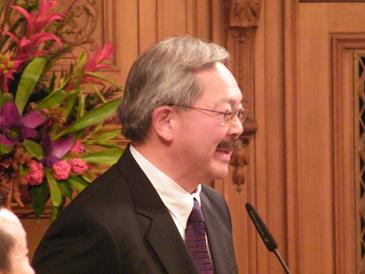
After the Guardian broke the news that Mayor Ed Lee was planning to only partially implement Sup. David Campos’ due process legislation, we headed to City Hall to witness Lee announce his partial shift during question time. And afterwards, Lee told reporters that he spent the months since he was appointed reviewing the policy and talking with leaders in the city’s juvenile justice departments.


“I looked at the difference between youth with family here and youth who did not,” Lee said, noting that his decision to let youth that have family here to have their day in court is in keeping with his policy of focusing on family reunification and getting families more involved.


Lee stressed that youth with family here will still need to be enrolled in school and not be repeat offenders in order to have their day in court.


“It will be decided upon on a case by case basis,” he said.


Lee said he has had conversations with the federal government and US Immigration and Customs Enforcement (ICE) about the policy shift. “We have discussed this,” Lee said. “And we did get a very strong feeling that the federal government is a bit confused.”


Asked how far he is willing to go to defend this latest policy shift, Lee said, “I’ll take that up as it comes. President Obama is struggling with immigration right now.”


Reminded that his predecessor Mayor Gavin Newsom refused to implement any aspect of Campos’ due process legislation, even though a super-majority of the Board passed the ordinance in 2009, Lee said, “I don’t compare myself with the former mayor.”


Asked what percentage of immigrant youth that end up getting booked are “unaccompanied,” Lee said he did not have those statistics. “Check with Siffermann,” he said, referring to the head of the city’s Juvenile Probation Department.”


Lee’s announcement was met with mixed reviews among immigrant advocates.


Civil rights groups applauded Lee’s decision to immediately begin implementation of Campos’ legislation, which was passed in November 2009, restores due process for immigrant youth in the city’s juvenile justice system and ensures that innocent youth are not torn from their families for deportation.  But they also expressed disappointment that Lee will only be implementing the policy for youth who have immediate family here, and not for unaccompanied youth.  And they all urge him to fully implement what they described as Campos’ “duly-enacting, common-sense law so that all innocent youth receive protections.”


They noted that implementation of Campos’ broadly-supported law, which has been endorsed by over 70 organizations, had been stalled until today due to former Mayor Newsom’s refusal to enact the law. 


Under Newsom’s direction, Juvenile Probation reported over 160 youth to ICE at the point of arrest, prior to the youth receiving due process, based only on a juvenile probation officer’s “reasonable suspicion” that a youth is undocumented. 


Civil rights advocates note that Newsom’s problematic policy was responsible for tearing innocent youth from their families and spreading fear among immigrant residents around coming forward to cooperate with police, either as witnesses or victims of crime.  


And they observe that the policy that Juvenile Probation Department has been enforcing since the summer of 2008, and which involved reporting youth for life-altering deportation at arrest, went well above and beyond any obligations under federal law. 


They noted that, as a cadre of legal scholars, including University of San Francisco Law Professor Bill Ong Hing, have repeatedly made clear, there is no requirement imposed on city officials under federal law to ask about immigration status or to report individuals suspected of being undocumented.”


Ana Perez, executive director of Central American Resource Center, agreed.“While we appreciate Mayor Lee taking action to finally begin implementation, we are concerned that he is only implementing the policy for accompanied youth and not for youth who may be unaccompanied because they are trafficked to this country, are orphans, or are escaping persecution.”


“I’m certain it’s not for all youth,” Pérez continued. “So, it’s a small win. But what about the kids who are victims of human trafficking? The fact is we spent so much time developing a policy that was approved by a majority of the Board. So, this is bitter sweet.”


Asked what became of the criminal grand jury investigation that then US Attorney Joe Russoniello initiated in 2008, when Mayor Gavin Newsom was running for governor, and news first broke that the city was accompanying youth who weren’t here with family back to their home country, Pérez suppressed a snort. “It seems that was a bunch of empty threats to try and get the city to move to a more conservative position,” she said. “It’s been a whole new day with Obama.”


Angela Chan, staff attorney at the Asian Law Caucus said that Juvenile Probation’s prior policy of reporting innocent youth exacerbated the impact of a broken federal immigration system on local immigrant families. “We appreciate that Mayor Lee has taken this long awaited step forward because he values family unity and due process for youth,” Chan said. “However, we ask that the Mayor not exclude unaccompanied youth from receiving due process protections.”


Patricia Lee, managing attorney in the Juvenile Unit at the Public Defender’s Office also supported the demand for complete implementation of Campos’ legislation. “If you want the immigrant community to feel safe enough to cooperate with police and probation, then those agencies should not be viewed as representatives of immigration,” she said. “My clients and their families are scared of probation, they are scared of police. Selective implementation of the due process policy for only accompanied youth and not to unaccompanied youth does not solve this problem.” 


And Charles Washington, the Muni bus driver and longtime San Francisco resident, whose wife and 14 year old son were almost separated from him as a result of the prior Juvenile Probation policy, expressed concern that the policy would only be implemented for some youth. “I’m glad to see Mayor Lee is doing the right thing by implementing the due process policy,” he said. “However, he should not leave any youth, especially those who are most vulnerable, behind.”


Sup. Campos applauded the Mayor for implementing the policy while expressing disappointment that it is only partial implementation. As Campos’ stated during the Board meeting, but after Lee had already left, “This body enacted that law and that law needs to be respected.  It is not up to the executive branch to second guess the legislative branch.” 


Sup. Eric Mar added that he supports full implementation for all youth.


 And Sup. Jane Kim, who asked the Mayor during the Board’s Question Time about his plans for implementation, stated, “My hope is that he will commit to full implementation of this policy.”


But in the end, the burden fell on Campos to explain why partial due process is unjust. “This is a good first step, but it doesn’t go far enough,” Campos explained. “As I understand it, the decision Mayor Lee has taken is, that if you are a minor, and are accused of a felony, you will be given due process if you have family here. But if you are charged with a felony, but don’t have family here, then you will not be given due process. Let me begin by thanking Mayor Lee for at least taking one step in the right direction. That said, we still will not have full compliance with a law that was duly enacted by this body. Full compliance means giving every child that interacts with the juvenile justice system due process. So, {Mayor Lee’s first step] is simply not sufficient.”


Campos noted that when mayors are sworn in, they agree to uphold laws that the Board enacts. “So, the law needs to be respected,” Campos said. “It’s not up to the executive branch to second guess the legislative body. That second guessing can only be done by the courts. Therefore, we, once again, ask the mayor of San Francisco to comply with full implementation.”


Noting that a bedrock of the U.S.’ justice system is the principle that we are innocent until proven guilty, Campos said that if the mayor does not fully implement the law, as approved by the Board, “There’s a very real possibility that children that we are reporting [to ICE for possible deportation] are not guilty of what they have been accused of. So, once again, I ask the mayor to reconsider his opinion.”


Campos also noted that there are already procedures in place, within the existing juvenile justice system, to ensure that “we do not have individuals released who should not be.”


After the meeting, Campos noted that the format for the Board’s question time with the mayor currently leaves something to be desired: an opportunity for the Board to reply.


“It would be better if it would allow for some exchange, though obviously, we don’t want it to be a ‘gotcha’ game. But at this moment, it’s too rigid.”


 Asked who drafted the current Question Time format, Campos replied, “Board President David Chiu.”

Mayor Lee to partially implement Campos’ due process ordinance

1

Today at question time, Sup. Jane Kim will ask Mayor Ed Lee what his plan is to implement a due process ordinance that Sup. David Campos authored and a super majority of the Board approved in 2009, prohibiting the Juvenile Probation Department from reporting undocumented youths at the time of arrest. And according to an anonymous source, Lee will say he has decided to implement the policy, if the youth in question are “accompanied,” which means they have family here.

Immigrant advocates say Mayor Lee should be commended for his leadership in implementing the due process policy to keep immigrant families together. But they believe that Lee needs to go the whole way. “Immigrant and civil rights groups are adamant that the policy must be implemented for all youth, accompanied and unaccompanied, and this has to be immediately,” our source said. “The due process policy does not discriminate between these two groups and the policy cannot be selectively enforced.”
 
As Kim planned to point out during the Board’s question time, voters approved San Francisco’s Sanctuary City Ordinance in 1989. That ordinance prohibits our Police Department and local government officials from assisting in the prosecution of immigration enforcement unless it is required under federal or state law.

In 2009, the Board, under Campos’ leadership, passed-by a supermajority-a clarification to that ordinance to prohibit local law enforcement from reporting undocumented youths unless they are convicted of a felony. To date, this ordinance has not been followed by the City.

But in a May 9 memo to the city’s Probation Department personnel, Juvenile Probation Department Chief Probation Officer William Siffermann and Assistant Chief Probation Officer Allen Nance wrote that since revising JPD’s policy 8.12 nearly three years ago [per Mayor Gavin Newsom’s instructions], they have closely monitored JPD’s implementation of its protocols.

And after considering all perspectives and after careful review, they have decided to “modify our existing policy in a manner that aligns our Departmental policies more closely with the values inherent within San Francisco’s Sanctuary City ordinance, without compromising our balanced commitment to public safety and the best interests of the minor.”

“Effective immediately, San Francisco Juvenile Probation Department notices to the federal authorities of minor/persons booked on felonies who are suspected of being undocumented AND are accompanied (lives with a verifiable parent, guardian or blood relative in the immediate Bay Area and is enrolled in school) will be made only upon a felony adjudication, upon apprehension on an outstanding warrant, or upon issuance of a new warrant following release from custody pending adjudication,” the JPD memo reads. “Minor/persons booked on felonies who are suspected as being undocumented, AND are verified adults or unaccompanied by any verifiable parent, guardian or blood relative residing in the Bay Area, whether or not enrolled in school, will continue to be reported to the federal authorities upon determination of this status.”

“Policy 8.12 will continue to ensure that all suspected undocumented minors booked and convicted of committing a felony will continue to be reported to the federal authorities,” the JPD memo continues. ‘While the Department will neither assist nor interfere with the federal authorities’ overwhelming duties and responsibilities related to the enforcement of immigration laws, we will continue to honor their lawful detainers regarding suspected illegal immigrants.”

“We are confident that your uniform compliance with this policy adjustment will continue to reflect the Department’s interest and your professional commitment to preserving families while we discharge all of our many duties that protect public safety,” the JPD memo concludes.

Illinois pulls out of Secure Communities

16

As California considers reforming Secure Communities, Illinois announced today that it is terminating its involvement in the controversial federal immigration program. California and Illinois moves come in face of Washington D.C’s decision to opt out of S-Comm and Washington State’s refusal to participate. And they test ICE’s claims that the program is mandatory, as other states watch these developments.

(UPDATE: Yesterday, I erroneously reported that New York State had refused to participate in S-Comm.That is not the case. New York State does allow jurisdictions to participate, they have a MOA with ICE, and 8 more counties just joined. I confused NY with Washington State, which has refused to join.)

In a May 4 letter to Immigration and Customs Enforcement (ICE), Illinois Gov. Pat Quinn enclosed a notice from Illinois State Police (ISP) director Hiram Grau, notifying ICE that because of its indiscriminate use of the “Secure Communities” deportation program, Illinois is terminating the November 2009 S-Comm Memorandum of Agreement (MOA) between ISP and U.S. Department of Homeland Security’s ICE.”

“The stated purpose of the program, as set forth in the MOA, is to “identify, detain and remove from the United States aliens who have been convicted of ¬serious criminal offenses and are subject to removal (emphasis added), ICE’s statistics on the Secure Communities program, compiled through February 28, 2011, reveal that the implementation of the Secure Communities program in Illinois is contrary to the stated purpose of the MOA: more than 30 percent of those deported from the United States, under the program, have never been convicted of ¬any crime, much less a serious one. In fact, by ICE’s own measure, less than 20 percent of those who have been deported from Illinois under the program have ever been convicted of a serious crime.”

Quinn notes that on November 9, 2010, his office directed ISP to suspend S-Comm until a review of the program and its adherence to the MOA could be conducted. “Upon evaluation of data provided by ICE to the State of Illinois, conversations between ICE and members of my administration, and a new, proposed MOA from ICE, it’s clear that the conflict between the MOA as signed by ISP and ICE’s implementation of the program cannot be resolved to the State of Illinois’ satisfaction.”

“With this termination, no new counties in Illinois can be activated and those counties that were previously activated… must be deactivated and removed from the Secure Communities program,” Quinn concludes.

Illinois’ move comes as California Assemblymember Tom Ammiano’s Transparency and Responsibility Using State Tools (TRUST) Act passes out of the California Assembly’s Public Safety Committee, next stop appropriations. The TRUST Act would allow local governments to opt out of S-Comm or set standards for jurisdictions that chose to participate. Joining Ammiano as co-sponsors of the TRUST Act are Assemblymembers Gil Cedillo (D-LA) and Bill Monning (D- Carmel) and Sen. Leland Yee (D-SF). Endorsers include 80 organizations, local governments and elected officials, including the Santa Clara and Santa Cruz County Boards, San Francisco Sheriff Michael Hennessey, who blew the whistle on S-Comm in San Francisco a year ago, and has endorsed San Francisco Sup. Ross Mirkarimi in the sheriff’s race this fall, retired Sacramento Police Chief Arturo Venegas, and civil rights and faith groups, including the California Partnership to End Domestic Violence, the California Labor Federation, the San Bernardino Catholic Diocese and Equality California.

Advocates hope Ammiano’s TRUST Act will restore balance and accountability to the nation’s immigration system. They charge that S-Comm’s misleading focus, over-broad reach and lack of transparency have eroded trust between police and immigrant communities, making victims and witnesses to crimes reluctant to come forward.

The TRUST Act would make S-Comm an “opt-in” program so local governments can tailor their participation based on local needs.The bill would set safeguards for municipalities that do elect to participate in S-Comm to guard against racial profiling and would ensure that children and domestic violence survivors are not swept up by S-Comm. The TRUST act also upholds the right to a day in court by only reporting for deportation individuals convicted – not merely accused – of crimes.

These moves come fresh in the heels of Congressman Luis Gutierrez’s April 27 appearance in San Francisco, where he was joined by San Francisco Sups David Campos and John Avalos, and Board President David Chiu in asking President Obama for administrative relief from rapidly increasing deportations.
“We need to stop deporting parents and ripping apart all families, including same-sex partners, “ wrote Chiu, Campos and mayoral candidate Avalos. “We need to stop deporting students who would have been eligible for the DREAM ACT. Last year, the U.S. deported an estimated 400,000 immigrants, the highest number of deportations per year in the history of our nation. We must allow our counties to opt out of  “S-Comm” (Secure Communities), which is making our communities less secure, and we support Congressman Gutierrez in these courageous requests. Immigrants are part of the fabric of our communities, and we need to fix our immigration system so everyone who lives here can continue to live as a full member of society without constant fear of safety, security, and livelihood being jeopardized at any moment.”


HOC farmers market bans live chicken sales

15

Feathers will cease to fly over alleged cruelty practices at the Heart of the City Farmers Market that we reported in February. The outdoor Civic Center market has announced it will no longer offer live poultry for sale as of May 27, a practice that had been grounds for a lawsuit and two years of fervent protesting from animal rights groups.

Raymond Young’s Poultry, a popular vendor, has been selling live chickens by the hundreds for nearly two decades at the HOC market every Wednesday and Sunday. In January, animal rights activist group LGBT Compassion filed a lawsuit alleging cruelty and civil rights violation against Young and the HOC after months of protesting and several attempts to get city agencies involved.

While the poultry stall remained popular with its largely Chinese clientele in spite of an ever-present throng of protesters, the practices caught the attention of Animal Care and Control and the Department of Public Health. Young had received hundreds of citations from ACC and warnings from the DPH, but they were essentially void due to an exemption in California law pertaining to poultry.

HOC market managers would not comment for this story, nor would Raymond Young. While the lawsuit is still pending, the announcement was perceived as a victory to the activist group.

“It sent a message to the city and to the public that animal cruelty and public health offenses is not acceptable and should not be endorsed or subsidized by the city,” said Andrew Zollman, founder of LGBT Compassion. “Having the market finally recognize that something like that should change is great.”

Zollman and fellow protestor Alex Felsinger filed the lawsuit with San Francisco attorney Matt Gonzalez. Zollman said that they had continued to protest in the months since filing the suit. Along with ACC, they said that Young had repeatedly violated animal cruelty laws and health codes even after the level of scrutiny on his stall had increased.

The ACC, which had cited Young hundreds of times for practices such as unsanitary conditions, lack of water, and improper handling of the chickens, viewed the decision by the market to ban sales as good news.

“Animals are food for a lot of people, but as Proposition 2 in California exhibited, people do care about the treatment of them,” said Rebecca Katz, director of the ACC, referring to the Prevention of Farm Cruelty Act of 2008. “If the vendors had been able to treat the animals appropriately, I don’t think it would have become this issue. This was profitable; he still could have made good money and done it properly.”

Bullfeathers Quail, the other live bird vendor at the market, had received significantly less attention from protesters and city agencies because it sold far fewer birds – about 350 per week – and had not been accused of nearly as many violations. Nonetheless, the vendor will also be banned.

Zollman said they will continue to protest the stall up until May 27, mainly because they fear the vendors will operate with a higher level of disregard since they have “nothing to lose.” Although they have received caustic criticism from groups who believe their protests are an attack on Chinese culture, they will plan to shift their attention north to Chinatown to live markets operating there.

“We are hoping that what we have learned and what city agencies have learned will pave the way,” said Zollman.

Hot sexy events: April 27-May 3

0

Hey there sexy, how’s life on the other side of the Intertubes? I wanna get real with some real questions in this week’s sexy events column. Don’t worry, it’s about you. Namely, we here at the SF of BG would like to know just what you feel is missing from sex coverage in this age of Aquarius (ha!) in which we live. Are you feeling like you have pressing sex ed questions that need answering? Are you wishing that there was more event coverage of the parties and perv-a-thons in our fair Sodom By the Bay?

See, we’re going through an evolution with our sex coverage, and though we’ve got some pretty hot and wild ideas up in our noggins, youse the readers are just that, and maybe you’re thinking something we missed. So how bout it – new voices, dildo reviews, heavy breathing monolouges? The Guardian’s mission is to be a voice for the community of San Francisco, so have at us. Um, our safe word is spelt. 


Erotic Reading Circle

Share your thoughts, air out those tired old insecurities – get real pervy with, whatever. The monthly Erotic Reading Circle at the Center for Sex and Culture provides a safe space for writers to share their bedroom-related materials. Carol Queen and Jen Cross of Writing Ourselves Whole facilitate the gathering, pretty much a must-do for any aspiring sex scribe. 

Weds/27 7:30 p.m., $5 suggested donation

Center for Sex and Culture 

1349 Mission, SF

www.sexandculture.org


Hot Draw

Unleash your wild, artistic side at these live drawing sessions – one need only peep the galleries on Mark I. Chester’s website to see that he doesn’t play when it comes to drawing dirty players. Kinky leathermen strut about for a crowd of strictly sketchy, strictly gay male artist scribblers.

Thurs/28 6:30-9:30 p.m., free

Mark I. Chester Studio

1229 Folsom, SF

(415) 621-6294

www.markichester.com


Art of Restraint

How would you like to be situated right in the center of a high-art, surround sound bondage performance? It’s all within your grasp, baby – this week’s Femina Potens event at Mission Control will string up local lovelies Fivestar and Madison Young, while adult film performers and submissives offering up chocolate-covered strawberries romp about. Does it sound too good to be true? Believe, child, believe. 

Sat/30 8 p.m.-3 a.m., $50-75

Mission Control 

www.missioncontrolsf.org


How Weird Street Faire

While not sexy per se, this fair sure is freaky: How Weird takes over a good portion of SoMa for stage upon stage of electronic ass-shaking, and community bonding. What community, you say? Bonding how, you ask? Well maybe just maybe that’s up to you, sailor. Head over in whatever state of disarray you like and get funky. 

Sun/1 noon- 8 p.m., $10 suggested donation

Howard and Second St., SF

www.howweird.org 


Kentucky Fried Woman’s Guilty Pleasures

You need this bucket of crispy, greasy, lip-smackin’ queers stripping down to their burlesque bundles like you need to watch your cholesterol intake. For reals, put down the trans fat. Instead, pop on over to Oakland’s Bench and Bar bar, and feast your eyes on the talents of Alotta Boutté, Scotty the Blue Bunny, and oh! So much more. Heart-stopping, in a good way. 

Sun/1 7:30-10:30 p.m., $10

Bench and Bar

510 17th St., Oakl.

(415) 374-1924

Facebook: Kentucky Fried Woman’s Guilty Pleasures 


“Finding and Maintaining a Happily Ever After: A Relationship Workshop for Lesbian Couples”

How do you make relationships last past the original courting period? Davina and Molly have married each other countless times in protest of unequal civil rights, and so they’re uniquely qualified (maybe) to talk about how to make matrimony mutually awesome (in and out of the bedroom).

Tues/3 6:30-8:30 p.m. $20-25 for singles $35-45 for pairs

Center for Sex and Culture 

1349 Mission, SF

www.sexandculture.org


Busy week for immigration reform advocates

12

On Tuesday, April 26, the California Assembly’s Public Safety Committee holds a hearing on AB 1081, Assemblymember Tom Ammiano’s Transparency and Responsibility Using State Tools (TRUST) Act. The TRUST Act seeks to allow local governments to opt out of US Immigration and Customs Enforcement (ICE’s) controversial “Secure Communities” program and to set standards for jurisdictions that chose to participate in S-Comm.

Also on Tuesday, Congressmember Luis Gutierrez kicks off his “Change Takes Courage” immigrant rights tour in seven California cities. Gutierrez lands in San Francisco Wednesday, April 27, and the Bay Area immigrant community and LGBT leaders will host him on the steps of City Hall, as Gutierrez asks President Obama to stop the record number of deportations of immigrant families and students that have already occurred under the Obama administration.

Joining Ammiano in Sacramento on Tuesday as co-sponsors of the TRUST Act are Assemblymembers Gil Cedillo (D-LA) and Bill Monning (D- Carmel) and Sen. Leland Yee (D-SF). Endorsers include 80 organizations, local governments and elected officials, including the Santa Clara and Santa Cruz County Boards, San Francisco Sheriff Michael Hennessey and retired Sacramento Police Chief Arturo Venegas, and civil rights and faith groups, including the California Partnership to End Domestic Violence, the California Labor Federation, the San Bernardino Catholic Diocese and Equality California.

SF Sheriff Michael Hennessey blew the whistle on S-Comm last May, but was unable to stop the feds from activating the program in San Francisco last June. And the most recent batch of S-Comm statistics show that San Francisco, once famed as a sanctuary city, now ranks in the top 38 counties nationwide that deport “non-criminal aliens,” which is ICE-speak for immigrants whose primary misstep is that they are in the country without the requisite paperwork.

Ammiano’s Trust Act hearing comes just days after Congressmember Zoe Lofgren (D- San Jose) called for an investigation into the conduct of ICE officials around advising local municipalities whether they are required to participate in ICE’s S-Comm program.

“You can’t have a government department essentially lying to local government and to members of Congress. This is not OK,” Lofgren said April 22, following the disclosure of hundreds of ICE documents that allegedly show that the agency has been giving intentionally contradictory and misleading information about S-Comm to local officials.

“From then-Attorney General Brown on down, it’s painfully clear ICE deceived Californians about S-Comm,” said Angela Chan, a staff attorney with the Asian Law Caucus. “That’s unacceptable behavior for a government agency in a democracy.”

Advocates hope that Ammiano’s TRUST Act will restore balance and accountability to the nation’s otherwise broken immigration system. They charge that S-Comm’s misleading focus, over-broad reach and lack of transparency have eroded trust between police and immigrant communities, making victims and witnesses to crimes reluctant to come forward.

The TRUST Act would make S-Comm an “opt-in” program so local governments can tailor their participation based on local needs.

The bill would also set safeguards for municipalities that do elect to participate in S-Comm to guard against racial profiling and would ensure that children and domestic violence survivors are not swept up by S-Comm.

The TRUST act also upholds the right to a day in court by only reporting for deportation individuals convicted – not merely accused – of crimes.

Tuesday’s hearing will be followed by Congressman Luis Gutierrez’s Wednesday appearance in San Francisco, which the African Advocacy Network, Asian Law Caucus, Central American Resource Center, Chinese for Affirmative Action, People Organized to Demand Environmental and Economic Rights, Out4Immigration, San Francisco Interfaith Coalition on Immigration, and Dolores Street Community Services sponsored.

Sups David Campos, John Avalos, and David Chiu will join Gutierrez and their message to President Obama is laid out in the following press statement:

“We need administrative relief to uphold the values of opportunity, justice, and human rights for all to move our country forward. With the stroke of a pen, President Obama could put a halt to the rapidly increasing deportations that are taking place. We need to stop deporting parents and ripping apart all families, including same-sex partners. We need to stop deporting students who would have been eligible for the DREAM ACT. Last year, the U.S. deported an estimated 400,000 immigrants, the highest number of deportations per year in the history of our nation. We must allow our counties to opt out of  “S-Comm” (Secure Communities), which is making our communities less secure, and we support Congressman Gutierrez in these courageous requests. Immigrants are part of the fabric of our communities, and we need to fix our immigration system so everyone who lives here can continue to live as a full member of society without constant fear of safety, security, and livelihood being jeopardized at any moment.”


1964 all over again?

16

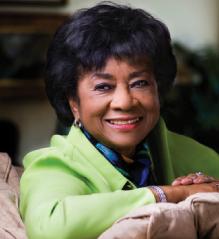
Outstanding piece on Calbuzz about the new Belva Davis book, “Never in My Wildest Dreams: A Black Woman’s Life in Journalism.” The Calbuzzers recount the vicious racist attacks Davis endured during the 1964 Republican convention in San Francisco, when the Goldwater forces were in control:


As we began our descent down the ramps of the Cow Palace, a self-appointed posse dangled over the railings, taunting. “Niggers!” “Get out of here, boy!” “You too, nigger bitch!” “Go on, get out!” “I’m gonna kill your ass!”


I stared straight ahead, putting one foot in front of the other like a soldier who would not be deterred from a mission. The throng began tossing garbage at us: wadded up convention programs, mustard-soaked hot dogs, half-eaten Snickers bars. My goal was to appear deceptively serene, mastering the mask of dispassion I had perfected since childhood to steel myself against any insults the outside world hurled my way.


Then a glass soda bottle whizzed within inches of my skull. I heard it whack against the concrete and shatter. I didn’t look back, but I glanced sideways at Louis and felt my lower lip began to quiver. He was determined we would give our tormentors no satisfaction.


“If you start to cry,” he muttered, “I’ll break your leg.”


Davis, of course, survived and when on to a storied career locally. The scary thing: There are a lot of parallels between the 1964 Goldwaterites and the tea partiers of today. Calbuzz:


Nearly 50 years later [the Goldwater platform] might serve as a manifesto for today’s Tea Party Republicans.


Attacking Democrats as “Federal extremists,” who have “enslaved” and “seek to master” ordinary Americans, the platform vowed , among other things, that Republicans would make deficit reduction their highest economic priority, oppose the “compulsory Democratic scheme” of Medicare and roll back actions of the Kennedy-Johnson Administration that “violently thrust Federal power into the free market.”


And race is still very much a part of what’s going on:


As evidence of the role that race still plays in conservative politics, Davis cited the Tea Party’s embrace of “birthers,” the slurs and spittle hurled by activists at Representatives and civil rights leaders John Lewis and James Clyburn at health care bill protests, and the recent email depicting Obama as a chimpanzee that was sent out by Tea Partier and Orange County Republican Central Committee member Marilyn Davenport.


 Back to the future. And it isn’t pretty.


Working on it

4

caitlin@sfbg.com

GREEN ISSUE With the recession fast seeping into the everyday fabric of American life (or at least Monday through Friday’s fabric), the enthusiasm that the term “green jobs” generates can be well understood. But can we really call a $10 hourly pay rate for installing solar panels sustainable? And what would be the bigger of the two triumphs: creating a carbon-free country or a more equitable nation? With partnerships springing up across the country like the Blue Green Alliance, created by the United Steelworkers and the Sierra Club, maybe the two goals aren’t so separate after all. Here are some West Coast organizations fighting to make sure that the environmentally-friendly jobs that do exist — and have yet to be created — pay a decent wage.


OAKLAND GREEN JOBS CORPS

Created by the long-time civil rights champions at the Ella Baker Center and other community partners, this program recruits poor young adults to a 38-week course of study that recognizes what it takes to break the cycle of unemployment. Participants begin with classes in basic job skills, literacy, and substance abuse counseling, then continue on to classes at Laney College in basic construction skills, eco-literacy, and specialized green building practices. At graduation, participants are hooked up with well-paying jobs in the green construction sector or traditional building trade union apprenticeships — where their newfound environment-saving skills will make them leaders in the years to come.

www.ellabakercenter.org


CALIFORNIA INTERFAITH POWER AND LIGHT

Pray for change — or change the way you pray? Created 10 years ago in SF, CIPL, whose work has since spread to 38 state affiliates, aides faith communities of all denominations in greening their place of worship. Greatest hits include installing a geothermal heating system in a Berkeley synagogue, work on First Chinese Baptist Church in San Francisco, and tricking out a Bayview-Hunters Point church with solar panels on the congregation’s extremely limited budget. Workers hired to make the holy places sing a song of sustainability are usually sourced from organizations like Richmond Build, which provides training to many people living in public housing and with criminal records.

www.interfaithpower.org


APOLLO ALLIANCE

Apollo Alliance, another nationwide coalition-building organization that got its start in SF, is making green jobs happen in Los Angeles — with or without federal dollars. The group sponsored the city’s Green Retrofit and Workforce ordinance, which required that municipal buildings achieve LEED certification at the silver level or higher, prioritizing updates on the buildings that were near areas with low income and high unemployment rates. Linked directly to workforce training programs, the ordinance is already under attack in Washington by H.R.1, a bill that would strip its funding. But L.A. is making the first move on the threat — the city is hoping to fund the successful program through energy conservation bonds.

www.apolloalliance.org


GREEN FOR ALL

Erstwhile Obama appointee, environmental rock star, and Ella Baker Center founder Van Jones started this organization in 2008 to place the war on poverty at the heart of the sustainability movement. Sure, with offices around the country, it’s not exactly local. But the group plays an important role supporting nationwide policies that will make green jobs fair and just for workers. Plus, it led the charge against last year’s Prop. 23 challenge to the growth of green technologies, taking to the road in a bus that interviewed community members and green energy experts in 10 Californian cities. Plus, it kicked ass with a media campaign smart enough to best the bummers at PG&E and other public utilities.

www.greenforall.org


Wicked Grounds suspended in limbo

9

Coffee pots and spankings may soon cease to coexist at Wicked Grounds, San Francisco’s only kink café that announced plans to close last week due to crippling debt. Fans of the sexy space have since pleaded for a chance to help and offered up donations, but instead of accepting the cash with a hungry growl, owners have asked people to hold off and “think about it.”

No this isn’t a clever scheme to rake in even more moola with a big, slutty, pitty party — owners and husband and wife duo Ryan Galiotto and Rose White want their customers to contemplate other causes that need a boost. This from the Wicked Grounds website:

Please consider what is going on in our community, our country, our world: Bay Area’s Lyon Martin, who provide much needed health services to the queer community, is on the brink of closure; STI and HIV/Aids testing, prevention, and research is woefully underfunded; our community has yet to be awarded equal civil rights in so many areas; a series of natural disasters have made those that survived homeless and fighting for even the basics. Wicked Grounds might be an important part of our community, but so much money is needed in other places for even bare necessities.

Wicked Grounds isn’t quite refusing the money — by no means do they want to lock the doors. “We just want people’s emotions to calm down so they can think about it,” Galiotto says, noting how much they appreciate the community’s show of love. “We’re just trying to be responsible.”

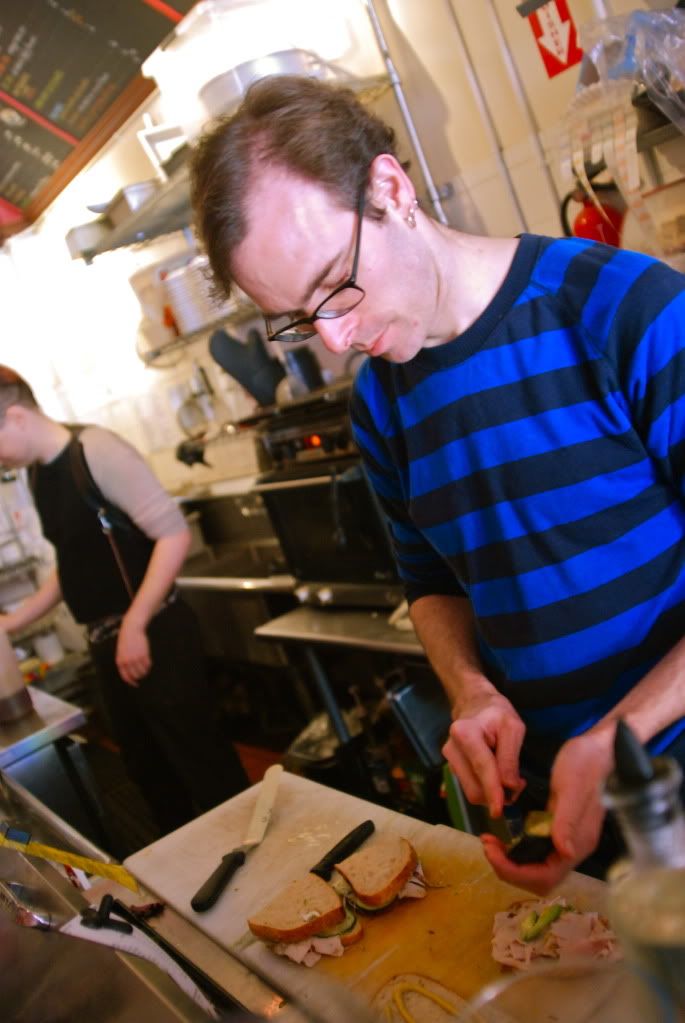
wickedgrounds1

Galiotto getting his hands dirty

The shop has only been open since September 2009 but its honesty and openness has harnessed a whole lot of friends and connected a community of kinks that otherwise may not have mingled, teased and whipped. Over half the evenings in each month are reserved for special munches, themed play parties, and gatherings that welcome both veterans and newbies.

“At first I thought we would just be popular with the leather family,” Galiotto remembers. But their Folsom Street neighbors weren’t the only people who started showing up. Now customers bring in “littles” color pictures to post on the back refrigerator, a submissive group meets to chat and trade secrets; “ponies” stampede around the tables. All kinds of other fetish fans and even your average vanilla folks come in for sober conversation and the beverage of choice — coffee.

“When you come in here, you don’t have to worry about your neighboring table becoming upset over your topic of conversation. We’re not open for the ‘general’ public — just the public.”

And the patrons aren’t the only people having a good time. Steam milk, pull shot, get spanked — as witnessed on a Monday morning, baristas behind the counter at Wicked Grounds have lots of options for work-related benefits. Galiotto is even supportive of employee hook-ups. “Just sanitize as appropriate,” he laughs. “As long as everything is food safe. Like I always say, we’re all about team building.”

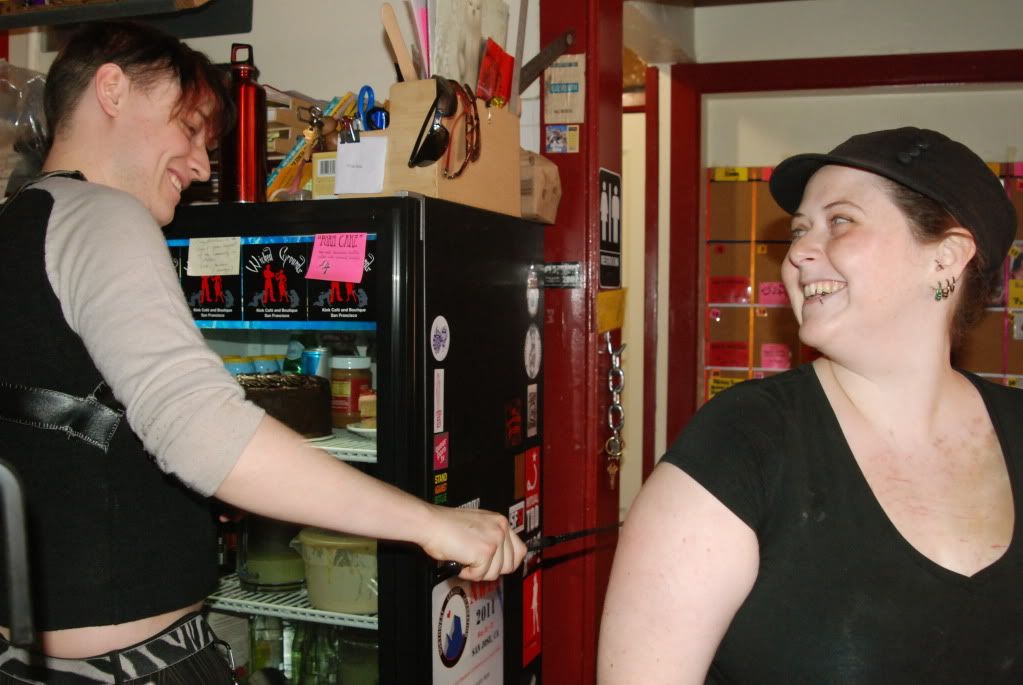
wickedgrounds2

Employees Xin Farrish and Zev Hoffman play at work

Manager Xin Farrish is broken-hearted about the possibility of closure and the elimination of a friendly third space for people to explore new ideas. Wicked Grounds has consistently been a space for education. Last week while Farrish was baking a batch of brownies she watched a visiting Norwegian couple get suspension bondage lessons. She casually comments that “it was cool.”

Farrish hopes to pull together a bake sale and is still brainstorming with the other employees and Grounds lovers for fundraising ideas. 

“It’s more of a safe space than a business. We’re not a dungeon, not a shop and not just coffee. And without this space, there will be a big hole in San Francisco.”

Galiotto is now battling a stress-induced cold and coming up with the $100k to save the place seems impossible — but so does the thought of saying goodbye. The money the couple put into the café could have bought a home and the means with which to start a family, but for him and Rose, a kink café seemed more important.  

wickedgrounds4

Galiotto taking a deserved break

“It would have been selfish for us to just build a cushy home. Yes, [Rose and I] could have made decisions that would have made our life easier,” he says with watery eyes. “But we built a home for a lot of other people.”

Galiotto and White will be making a decision on the future of their kinky love child by the end of the week. 

SF in top 38 counties nationwide that deport “non-criminal aliens”

38

So much for San Francisco being a sanctuary city. The National Day Laborer Organization (NDLON) and two other organizations have unearthed statistics that show San Francisco in the nation’s “top 38” counties, when it comes to deporting immigrants who had not been convicted of crimes.

The statistics, which the U.S. Immigration and Customs Enforcement Department provided as part of a public records request,  also show that California is the top state in the nation, when it comes to deporting “non-criminal aliens,” which is how federal authorities categorize immigrants who lack visas and green cards, since both are simply violation of civil administrative law, and not criminal acts.

These revelations come as internal documents, procured by the New York Times, suggest that federal immigration officers, facing resistance from Chicago and Cook County to join ICE’s controversial Secure-Communities program, pushed local officials to secure the participation of reluctant police departments.

Immigrant advocates say these newly released documents are fueling concerns that S-Comm is being used to circumvent due process for immigrants, and futher illustrate the need for reform, at the statewide level, to avoid abuse.

But ICE refutes charges that it is circumventing due process and primarily deporting immigrants who have not committed serious crimes.
“Secure Communities is a comprehensive initiative to modernize the criminal alien enforcement process,” an ICE spokesperson told the Guardian. “While ICE prioritizes the removal of convicted criminal aliens, the agency still enforces the law with regard to other aliens who are subject to removal. In addition to criminal aliens, ICE’s priorities include other individuals who pose a potential threat to public safety – such as those with known gang affiliations and prior drunk driving arrests – as well as immigration fugitives and individuals who have tried to game the immigration system.”

ICE officials also said that their review of the latest S-Comm statistics for San Francisco County show that “more than 60 percent of the aliens who’ve come into ICE custody since Secure Communities’ local activation are convicted criminals. What’s more, nearly one third of those cases involve individuals who’ve been convicted of Level 1 offenses [felony crimes].

But NDLON spokesperson B. Loewe said the newest data show that, several years into the S-Comm program, problems that immigrant advocates have been raising since S-Comm began, are continuing.
“There is no protection for the innocent, or even victims of crime, and the program appears to lend itself to circumventing due process,” Loewe said. “The latest numbers should raise concerns for anyone who cares not just fro civil rights but also for public safety for all.”

The S-Comm statistics emerged as part of a Freedom of Information Act request that NDLON, the Center for Constitutional Rights, and the Immigration Justice Clinic of the Benjamin N. Cardozo School of Law filed pertaining to ICE’s controversial Secure -Communities program.

Launched in Texas in March 2008, S-Comm involves state and local entities in the enforcement of federal immigration law by turning on a mechanism to run fingerprints through various databases when individuals are arrested, even if those individuals are brought in on minor charges or if their charges are subsequently dismissed.

“What’s most significant is that San Francisco is among the top 38 counties nationwide, and among the top 13 California counties,” said Jon Rodney, communications project coordinator at the California Immigrant Policy Center.

“The numbers speak for themselves,” said Angela Chan, a San Francisco Police Commissioner and Asian Law Caucus staff attorney. Chan noted that between October 2008, when California began implementing S-Comm, and February 2011, California has deported 35,643 local residents.
“That’s 10,000 more than Texas, which deported 24,152 residents,” Chan observed. She also noted that California is the state that deports the highest numbers of residents nationwide.
 
The top 13 counties in California deporting the highest percentage of non-criminal?  Merced, Fresno, Tulare, Solano, Monterey, Kern, San Luis Obispo, San Francisco San Joaquin, Contra Costa, Riverside, Sonoma, and Alameda, in that order.

This latest round of charges comes ten months after S-Comm was first activated in San Francisco, and fresh on the heels of Assemblymember Tom Ammiano’s announcement of AB 1081, a bill that would honor the right of local governments to opt out of the federal S-Comm and set basic safeguards for those municipalities that do decide to participate.

Chan notes that the Assembly’s Public Safety Committee will hold a hearing on AB 1081 on April 26.

“Ammiano’s bill is timely and crucial,” Chan said, noting  that California signed an S-Comm agreement without public input, notice or negotiations.

“That [process] raised concerns that California signed a boilerplate agreement that was dictated by ICE” Chan said. “And it’s part of the reason why we have such high numbers of deportations,” she continued, noting that Ammiano’s bill “connects to an existing clause,” in the memorandum of understanding  that the California Attorney General’s Office signed with ICE, back when Gov. Jerry Brown was still California Attorney General.

Ammiano’s bill would require the California Bureau of Criminal Identification and Information to modify the agreement it entered into with the US Department of Homeland Security in May 2009, regarding S-Communities. 

Meanwhile, in a March 7 memo (a copy was procured through NDLON’s public records request) ICE noted that its Secure-Comm program produced over 133,000 matches in the first five months of 2011, compared to 248,000 matches in 2010.

ICE also noted that since the program was first activated in Harris County, Texas, on Oct. 27, 2008, the agency has removed over 94,000 aliens and over 24,600 criminal aliens convicted of Level 1 (felony offenses) that were identified through the program.

“Deployment continues to be the primary driver for increased identifications,” ICE stated, observing that in the first five months of 2011, ICE will deploy S-Comm in 409 new jurisdictions. This means that by the end of May, 1,067 jurisdictions will be activated in 39 states, “covering 70 percent of the foreign non-citizen population.”

ICE’s goal is to deploy the program to an additional 488 jurisdictions by the end of 2011, bringing the total jurisdictions deployed by year’s end to 897.

But as Chan notes, Ammiano’s AB 1081 has implications for how and whether S-Comm gets activated in any more California counties,
“AB 1081 requires needed modifications to California’s S-Comm agreement, which was signed in April 2009 by California,” Chan said. “ It was one of the first, if not the first, agreement signed by a state to enter into S-Comm.  AB 1081 taps into this contract term, which allows modification and termination of the agreement, to allow counties to opt in or out of the deeply flawed program.”


Adachi and Ballard’s pension reform gloves come off

64

Yesterday, I talked to Public Defender Jeff Adachi about the latest efforts to address pension reform in San Francisco. Readers may remember that Adachi roused the ire of the labor unions last year, with the ultimately unsuccessful Proposition B. At the time, most folks felt Adachi’s measure didn’t have a snowball’s chance because it asked public employees to bear the brunt of the city’s ballooning retirement and health plan costs. Yet, they all praised Adachi as a great city leader who has been on the right side of many other battles in this city’s rich political history.
But the pension reform issue hasn’t gone away, and now that Adachi is threatening to introduce another measure this fall, the gloves have apparently come off, as witnessed by a Bay Citizen article that reported that union leaders don’t want Adachi to be part of a pension-reform working group at City Hall
In that Bay Citizen article, Nathan Ballard, who served as communications director for former Mayor Gavin Newsom from 2007 to 2009, said, “Inviting Jeff Adachi to our talks would be like inviting Sarah Palin to speak at the Democratic convention.”
The Bay Citizen characterized Ballard as “a Democratic strategist who has been involved in the working group since its inception.” And it noted that Mayor Lee had reached out to Adachi—an effort that it framed as a “complicating move.”
But it didn’t get Adachi’s thoughts on Ballard’s comments. So, I asked Adachi how he felt about being compared to Sarah “Moose in the headlights” Palin.
“It’s ironic that a spokesperson from Burson-Marsteller, which is headed by Republican operatives such as President Bush’s former press secretary (Dana Perino) and represents some of the most reactionary corporate interests, such as USA Blackwater, is accusing me of being a Republican for trying to solving our city’s pension crisis,” Adachi replied, referring to the fact that Burson-Marsteller, a global public relations firm, appointed Ballard as a managing director in March 2010.
“This is a company that is known for representing the worst corporate criminals in modern history,” Adachi continued. “They organized a campaign against civil rights in Argentina, supported a government massacre in Indonesia and tried to justify the killing of over 2,000 people in India’s Bhopal disaster. You have a hired mouthpiece, Nathan Ballard, who’s been paid $50,000 out of union member dues deciding who can attend meetings at City Hall. “
Asked for his thoughts on Adachi’s response, Ballard replied, “Burson-Marsteller employs talented operatives from both sides of the aisle. Although I won’t speak to the specifics of Jeff Adachi’s allegations, Burson is well known as the world’s go-to firm for crisis communications, and that tends to involve handling high-stakes disputes for controversial clients. As a criminal defense lawyer, Jeff Adachi should resist the temptation to assign blame to an advocate for accusations made against a client.”

So, buckle your seats, ladies and gentlemen. The pension reform battle is ON. And if the exchange posted above is any indication, it’s only going to get uglier

Playing chicken

27

news@sfbg.com

The Heart of the City farmers market in U.N. Plaza may not exude the bourgeois foodie reputation of the Ferry Plaza farmers market. It doesn’t sell micro-roasted coffee or artisan cheeses, and its fountain may sometimes double as a public shower, but it does offer one product that no other San Francisco farmers market does: fresh, live poultry.

Raymond Young has sold live chickens here for two decades, showing up at dawn to set up shop and peddle his poultry to an eager throng of customers, mostly Chinese, who happily take home upwards of 600 birds per day.

But a group of animal rights activists is saying that the poultry stand is inhumane, violates health codes, and that Young’s employees have infringed on their civil rights as protestors. Since April 2010, members of LGBT Compassion have been showing up in the wee hours of the morning next to Young’s stand with banners, brochures, and signs promulgating the alleged cruelty of his business and seeking to block the sale of live birds. In January, protesters upped the ante when they slapped Young and the HOC market with a lawsuit alleging continuous abuse and negligence by those who supervise the market.

“For me, it was as simple as seeing the animal cruelty,” said Andrew Zollman, 43, the founder and organizer of LGBT Compassion. “The cages are dilapidated and cramped, there are feces everywhere, and the chickens are shoved in plastic bags, two at a time, while they scream in fear or pain. It was like walking down the street and seeing a dog beaten — and it’s really frustrating to see it happen here in San Francisco.”

Zollman and fellow protester Alex Felsinger, 25, filed the lawsuit with San Francisco attorney Matt Gonzalez after months of attempts to get city officials to intervene.

The allegations have Young and market management squawking, saying that the activists are opposing a practice that is both legal and routine. They claim the protesters are overly sensitive to the treatment of the chickens simply because they can see it, and decry their tactics as an attack on a small business and cultural traditions since almost all of his customers are Asian.

“These people just don’t seem to like other people’s culture of selling live chicken,” Young said. “”I think that what I do is right. I abide by all the health codes and animal care codes. I try to do everything I can to satisfy everyone. These protesters think they can override the law because they don’t like what they see.”


THE PATH TO COURT

Zollman and Felsinger have been encouraging the city to investigate Young’s stall, regularly sending videos and photos taken at Young’s stall to the Department of Public Health and Animal Care and Control. But their quest to protect the chickens has been complicated by the lack of city oversight and an inability to enforce animal cruelty laws due to provisions exempting poultry.

The clash between the vociferous vegans and the poultry purveyors reached its pinnacle in late December 2010, when Felsinger claimed he was punched in the side of the head, wrapped up in a tarp, and had the memory card from his camera stolen by one of Young’s employees. As painful as the altercation was, Felsinger’s scuffle has helped him garner support.

Felsinger doesn’t have footage of the December attack, but he and Zollman have documented several instances of alleged verbal and physical abuse by Young’s employees, including anti gay statements from Young’s daughter, which was the subject of a complaint to the Human Rights Commission.

“There is a long list of things being done to us over the past year,” Felsinger said. “I never expected them to take such a violent act against me. It’s not how I wanted to go about it. But it might have the end result we’re looking for.”

Christine Adams, manager of the HOC market since it first opened in 1981, has consistently defended Young and called the lawsuit “completely outrageous.”

“This is a market, and if they (Young’s crew) were illegal, they would have been booted,” she said. “I have done nothing wrong; Raymond has done nothing wrong. I’m not worried at all about the lawsuit.”

Adams said that while she had not been personally affected by the protesting in the past, she did not approve of Zollman and Felsinger’s actions and attributed a decline in live poultry sales to their presence.

“Their sales have gone down considerably,” Adams said. “They used to sell more than 1,000 birds a day and now it’s more like 600 or 700. I think it’s definitely because of the protesters. People don’t like to be followed through a market and have a camera shoved in their face just because they bought a live chicken.”


GATHERING EVIDENCE

Almost every market day, Zollman and Felsinger would show up to protest and take video and still photography of Young’s stall. They have posted numerous videos and photos to their group’s website (lgbtcompassion.org) — the same ones they say they send to DPH and ACC — documenting the conditions at Young’s stall.

The DPH makes routine inspections twice per year to the market. In November, Zollman, Young, and Adams held a meeting with principal environmental health inspector Lisa O’Malley to address issues of sanitation, handling, and guidelines for bringing live animals near food. The department says the vendor is operating within guidelines.

“There were some problems in the past, but they’ve been fixed,” O’Malley told us, naming a few instances of inadequate removal of chicken feces from the area and improper hand-washing as past problems. She said the challenge was maintaining the guidelines, the most difficult of which is making sure people do not walk through the market after purchasing their birds. Health codes prohibit animals from being within 20 feet of food. The primary concern is contamination from fecal matter, which could cause illnesses such as Salmonella poisoning.

O’Malley walks by the market regularly because of its proximity to her office and says all operations seem compliant. At the same time, official enforcement and inspection is limited to the Public Health Department’s semi-annual visits. This means the only people watching over the operations of the stall and customers are the security guards, who don’t start working until two and half hours after the market opens, long after prime time for buying live chickens.


CULTURE CLASH

Young stands by his actions and said he is not guilty of any wrongdoing. The activists criticize him for practices such as cutting off the tips of the chickens’ beaks, but Young said he only does this to prevent fighting injuries sustained when they are caged for transport and sale, a common practice for any chicken farmer.

In their pamphlets and the lawsuit, the activists claim that the poultry is a “collection of ‘spent’ live chickens (those who are no longer productive egg layers) from large Central Valley farms,” according to the suit. But Young contests that characterization and the activists can’t produce credible evidence of the birds’ age or origins.

“They don’t know how old my birds are. They don’t know how I care for them,” Young said, refusing to tell us how old the chickens are. “They just assume. What’s the difference between Safeway chicken and my chicken? They were all alive at one time, but you see mine.”

Young has three farms listed on his permit — in Modesto, Sacramento, and Manteca — that he runs with the help of his children and a few employees. Adams has visited his Modesto facility and reported that the chickens are free-range, seem to be in good health, and are treated no differently than they would be at any other farm. She also supported the accusation that the protests undermine cultural norms.

“How can it not be cultural? All their customers are Asian!” she said. “And why is it only the chicken man they harass? There is a guy who sells quail and pheasants and they aren’t bothering him.”

Zollman, Felsinger, and Gonzalez call that cultural criticism a diversionary tactic. “I don’t even want to dignify culture and race as an issue in this,” Zollman said. “I understand that people want to buy live chickens. Animal cruelty issues aside, this isn’t a live animal market like they have in most of Asia.”

Young and Adams stressed that Zollman could not possibly know about operations on the farm, and that his suggestion that the operation is extremely profitable is absurd. “Do you know how hard it is to work on a farm?” asked Young, a single father of three. “You don’t make any money except to put food on the table or send your kids to school. And now I have to pay for a lawyer.”


ARE CHICKENS ANIMALS?

Although the activists oppose factory farms and live animals for sale for human consumption in general, they have focused their attention on the HOC market because it is permitted by the city.

Gonzalez said the lawsuit aims to address three different issues. The first is violating his client’s free speech rights by Young and HOC market. The second seeks to compel the city to better identify and enforce alleged health code violations. The third and trickiest aspect deals with animal cruelty laws, which the activists hope will force more humane treatment of the birds.

Penal Code 597 outlines animal cruelty provisions, defining the word “animal” as “frogs, turtles, and birds sold for human consumption, with the exception of poultry.” That law was adopted in the early 1900s. Elsewhere the code defines animals as “every dumb creature.” But in 2000, the Fourth District California Court of Appeals analyzed the section and deemed that the definition should include birds.

But Gonzalez and ACC say city officials have allowed the poultry exemption to stick. “[The law] refers to live animals and makes a specific exemption for poultry,” Rebecca Katz, director of the Department of Animal Care and Control, told us. “I would venture to guess that poultry lobby was very strong at that time.”

The ACC, prompted by the protests, inspected Young’s facilities and cited him for 700 different violations, according to the lawsuit. Katz mentioned a few instances in which they observed chickens suffering to the point where they had to be euthanized. But most of the citations were for inadequate water supply or holding birds improperly.

“A lot of people eat animals for food, and that’s what it is,” Katz said. “I’m not a vegetarian, but the way they are being kept is not the way we would recommend they be cared for. Do we think there is some cruelty? Probably. But there is nothing we can do at this time until the law changes.”

Like his predecessors, newly appointed District Attorney George Gascón seems to believe that chickens are not protected by state law, regardless of perceived cruel treatment.

“To date, our position has been that there is a clear exception under the law for live poultry being sold for human consumption,” said Gascón spokesperson Erica Derryck. “As much as it appears that the treatment of these animals is inhumane, there is nothing we can do to prosecute these allegations under the current laws in California.”

Gonzalez disagrees, and his office referenced similar cases in the state in which poultry was protected from cruelty. “Frankly, it’s kind of embarrassing that they are taking the position they are taking,” Gonzalez told us. “They are trying to avoid a topic that would compel them to do what they need to do. Many in the Asian community and Mexican community see this as an attack on their cultural traditions, and that’s not the issue. We see it as a straight matter of misinterpretation.”


DAILY OPERATIONS

On a recent visit to the market, the stall appeared clean and the chickens were out of view. The stall features prominent signage in English and in Chinese languages of the ban on bringing live animals into the market, with additional signs throughout the plaza, but customers routinely step directly into the market after buying their chickens.

“This is not easy,” security guard Diana Ybarra said while trying to point a man carrying a bag with two chickens in the right direction. “Nobody wants to listen — most of them don’t speak English. Everyone wants to take a shortcut right back through the market.”

Ybarra and her coworker, Washington (who chose to be identified only by his last name), said that their entire day is consumed trying to get customers to abide by this rule. Prior to the November meeting, no signage was posted and customers just “walked all over the place as if it didn’t matter at all,” Ybarra said.

“Chinese New Year was bad,” Washington added.

The guards see enforcing the rule as an unnecessary waste of time that takes their focus off tasks such as preventing theft. Both said shoving birds in sacks was “messed up,” but they were also quick to criticize the protestors.

“Why are they bothering this man? This is a family business and people have to make money,” Washington said. “Those protestors came in and fucked everything up, if you ask me.”

Young said he resents getting caught up in this controversy. “We are so loyal to this city and to this market,” he said. “We have put up with drug dealers and crime just so we can serve the people. Maybe these protesters think differently.”

For now the activists are more focused on the lawsuit than remaining vigilant in their protests, hoping it will accomplish their goal.

“I wasn’t always so adamant about getting rid of them, it was having people notice something that is animal cruelty,” Felsinger said. “It had been good in some ways to have people exposed to this cruelty in San Francisco because it gave us a platform to speak on animal rights. These are egregious offenses and it’s hard to ignore when it is right in your back yard.”


Dick Meister: Black Porters Led the Way

0

Dick Meister, formerly labor editor of the SF Chronicle and KQED-TV Newsroom, has covered labor, politics and other matters for a half-century.


February is Black History Month, a good time to honor the Brotherhood of Sleeping Car Porters, one of the most important yet too often overlooked leaders in the long struggle for racial equality.

The union, the first to be founded by African Americans, was involved deeply in political as well as economic activity. It joined with the NAACP to serve as the major political vehicle of African Americans from the late 1930s through the 1950s.

Together, the two organizations led the drives in those years against racial discrimination in employment, housing, education and other areas, and in doing so, laid the groundwork for the civil rights movement of the 1960s.

The need for a porters’ union was painfully obvious. Porters commonly worked 12 or more hours a day on the Pullman Company’s sleeping car coaches for less than $100 a month. And out of that, they had to pay for their meals, uniforms, even the polish they used to shine passengers’ shoes. They got no fringe benefits, although they could ride the trains for half-fare on their days off – providing they were among the very few with the time and money to do so. And providing they didn’t ride a Pullman coach.

In order to meet their basic living expenses, porters had to draw on the equally meager earnings of their wives, who were almost invariably employed as domestics.
 
It was a marginal and humiliating experience for porters. They were rightly proud of their work, a pride that showed in their smiling, dignified bearing. But porters knew that no matter how well they performed, they would never be promoted to higher-paying conductors’ jobs. Those jobs were reserved for white men.

Porters knew most of all that their white passengers and white employers controlled everything. It was they alone who decided what the porters must do and what they’d get for doing it.

When a passenger pulled the bell cord, porters were to answer swiftly and cheerfully. Just do what the passengers asked – or demanded. Shine their shoes, fetch them drinks, make their beds, empty their cuspidors. And more. No questions, no complaints, no protests. No rights. Nothing better epitomized the vast distance between black and white in American society.

Hundreds of porters who challenged the status quo by daring to engage in union activity or other concerted action were fired. But finally, the administration of President Franklin D. Roosevelt granted workers, black and white, the legal right to unionize. And finally, in 1937, the Brotherhood of Sleeping Car Porters won a union contract from Pullman.

The contract was signed exactly 12 years after union president and founder A. Philip Randolph had called the union’s first organizing meeting in New York City. It was a long arduous struggle, but it brought the porters out of poverty. It won them pay at least equal to that of unionized workers in many other fields , a standard workweek, and full range of fringe benefits. Most important, porters won the right to continue to bargain collectively with Pullman on those and other vital matters.

Union President Randolph and Vice President C.L. Dellums, who succeeded Randolph in 1968, led the drive that pressured President Roosevelt into several important actions against discrimination, including the creation of a Fair Employment Practices Commission in housing as well as employment. FDR agreed to set up the commission – a model for several state commissions – and take other anti-discrimination steps only after Randolph and Dellums threatened to lead a march on Washington by more than 100,000 black workers  and others who were demanding federal action against discrimination.

Dellums and Randolph struggled as hard against discrimination inside the labor movement, particularly against the practice of unions setting up segregated locals, one for white members, one for black members.

Randolph, elected in 1957 as the AFL-CIO’s first African-American vice president, long was known as the civil rights conscience of the labor movement, often prodding federation President George Meany and other conservative AFL-CIO leaders to take stands against racial discrimination.

The sleeping car coaches that once were the height of travel luxury have long since disappeared, and there are very few sleeping car porters in this era of less-than-luxurious train travel. The Brotherhood of Sleeping Car Porters is gone, too. But before the union disappeared, it had reached goals as important as any ever sought by an American union – or by any other organization anywhere.

Dick Meister, former labor editor of the SF Chronicle and KQED-TV Newsroom, has covered labor and politics for a half-century. Contact him through his website, www.dickmeister.com, which includes more than 250 of his columns.

Alerts

0

alert@sfbg.com

WEDNESDAY, JAN. 26

Free clinics aren’t free

Nothing like eating and drinking for a cause. To help raise needed funds for the Berkeley Free Clinic, Saturn Cafe will donate 10 percent of your bill to this worthy endeavor.

10 a.m.–midnight, cost of food and drink purchase

Saturn Cafe

2175 Allston, Berk.

pccbfc@gmail.com

FRIDAY, JAN. 28


UNIFEM fundraiser

The United Nations Development Fund for Women is holding a fundraiser for Ninel Babcinschi, a lawyer and advocate for trafficked women in Moldova whose life has been threatened because of her work defending these women. The fundraiser includes an informative lecture and a film screening.

6:30–9:30 p.m., $15 Artists Television Access

992 Valencia, SF www.atasite.org


Rally for Guy Jarreau

Attend a rally demanding a full investigation into the shooting by Vallejo police that resulted in the death of Guy Jarreau, a student and active community member. The Dec. 11 shooting of Jarreau, an unarmed black man, is said to be having a “Mehserle effect” on the community because of its parallels to the Oscar Grant shooting.

1–3 p.m., free Solano County District Attorney’s Office

321 Tuolumne, Vallejo www.northbayuprising.blogspot.com


SATURDAY, JAN. 29

Seattle Solidarity Network discussion

SeaSol, a support group for rights for workers and tenants, holds a discussion about the importance of building solidarity networks and small-scale collective action. Add your two cents to the debate and learn how you may not be getting all that you are entitled to as a worker or tenant.

7–9:00 p.m., free

Station 40

3030B 16th St., SF

www.seattlesolidarity.net


Go, Caltrain

Join the discussion on how to increase Caltrain ridership, improve service, and create sustainable funding. The event offers speakers, panels and workshops. Featured speakers include Sierra Club Executive Director Michael Brune, SF Sup. Sean Elsbernd, and others.

9:00 a.m.–2:30 p.m.

Registration begins at 8:30 a.m., free (RSVP required)

SamTrans Auditorium

1250 San Carlos, San Carlos

www.greencaltrain.com/summit


SUNDAY, JAN. 30

Fred Korematzu Day celebration

In December 2010, California signed a bill into law declaring Jan. 30 the first day in U.S. history named after an Asian American. Honor national civil rights hero and Oakland native Fred Korematzu in at the country’s first Korematzu Day celebration. There will be a reception and film screening, as well as spoken word performance by artist Beau Shea and a keynote speech by the Rev. Jesse Jackson.

1- 5 p.m., $15-100

Wheeler Hall

101 Zellerbach Hall #4800

UC Berkeley, Berk.

(415)882-4673


MONDAY, FEB. 1

Book Club: Trotsky discussion

Read and discuss Leon Trotsky’s History of the Russian Revolution Vol. 1, the Bolshevik revolutionary’s classic book that tells the story of how poor and working class people combined efforts to start the first socialist revolution in history. An optional light supper will be provided.

1–5 p.m., $2/6 donation

625 Larkin, SF

www.socialism.com/sanfrancisco

(415) 864-1278


Mail items for Alerts to the Guardian Building, 135 Mississippi St., SF, CA 94107; fax to (415) 437-3658; or e-mail alert@sfbg.com. Please include a contact telephone number. Items must be received at least one week prior to the publication date.

On the Cheap Listings

0

Events listings are compiled by Jackie Andrews. Submit items for the listings at listings@sfbg.com. For further information on how to submit items for the listings, see Weekly Picks.

WEDNESDAY 19

Tom Rachman Bookshop West Portal, 80 West Portal, SF; (415) 564-8080. 7p.m., free. Like books on tape, only better — Tom Rachman reads from his highly acclaimed debut novel The Imperfectionist, a collection of short stories set in and around an Italian English language newspaper for travelers and ex-pats. A journalist himself, Rachman’s writing has been described as alternately hilarious and heart-wrenching. Come see what all the hullabaloo is about.

THURSDAY 20

Pitchapalooza: American Idol for Books Booksmith, 1644 Haight, SF; (415) 863-8688, www.booksmith.com. 7:30pm, free. This American Idol-like event for writers unfortunately doesn’t feature a drunk and effed-up-on-pills Paula Abdul, but it could take you one step closer to becoming a published author. Pitch your book in one minute or less to an all star cast of publishing experts — the most convincing scribe gets an introduction to an agent that can help them realize their book dreams. Anyone who buys a book in the store that day gets a free consultation, making this a must-do for all you struggling artistes.Bay Area

Wild World of Frogs Randall Museum, 199 Museum Way, SF; (415)554-9600, www.randallmuseum.org. 7:30pm, free (donations encouraged). Dr. Jerry Kreiger, Save the Frogs! founder and director, will tell you everything you didn’t know you wanted to learn about frogs — from the interesting and funny to the downright sad (200 species of our skin breathing homies have become extinct over the last 30 years). Support the first and only public charity dedicated to amphibian conservation.

FRIDAY 21

Birds and Bees Collide Space Gallery, 1141 Polk, SF; (415)377-3325, www.birdlovesbee.com. 8pm, free. Celebrate the release of Birdlovesbee: Artists in Collaboration with writer Camille Ikalina Robles– founder of One Red Delicious Press — and a bevy of emerging artists. For Birdlovesbee, Robles passes her writing off to an artist who, in turn, creates a reaction in their chosen medium, resulting in beautiful, handmade zines. Collaborators include photographer Marie Dewitt and film artist Dennis Maxwell. Special musical performance by Silian Rail and DJ set by DJ Shortround.

SATURDAY 22

The Uncomfortable Zones of Fun Temescal Arts Center, 511 48th St., Oakl.; (510) 526-7858, www.temescalartscenter.org. 8pm, donations suggested. Prepare to get … uncomfortable. Frank Moore, shaman, disabled performance artist, and 2008 presidential candidate, merges music, dance, erotica, religion and improv to create an experience few people have an easy time describing.

Jewelry-making class The Bead Store, 417 Castro, SF; (415) 861-7332, www.thebeadstoresf.com. 11am-noon and 3-4pm, free (plus materials purchase). Tucked away on Castro Street amidst the countless bear bars and penis-shaped pasta peddlers lies a cozy little shop for all of your jewelry-making needs, including monthly classes. Perhaps you would like to recreate a piece of jewelry you once owned but lost after a night of too many Racer 5’s? You’ll want to attend the 11am “Bring Your Project” class. Stick around for the 3pm “Made with Love” class and make your sweetheart a heart-shaped pendant or earrings with materials provided by the shop. Call to reserve a spot because spaces are limited.

ChicaChic opening reception California Institute of Integral Studies, 1453 Mission, SF; (415) 575-6242, www.ciis.edu. 6-8 pm, free. Five leading chicana visual artists show their greatly varying work, which honors the themes and iconography of the Chicano civil rights movement of the 1960s and ’70s, yet at the same time provides new imagery for a newer and faster paced media-saturated society. Reception includes a panel discussion featuring the exhibition artists and curator.

SUNDAY 23

Cal Science and Engineering Festival UC Berkeley Sutardja Hall, Berk., (510) 642-0352, www.scienceatcal.berkeley.edu/festival. 11 am-3 pm, free. Cal drops the science from astronomy to zoology. Join the search for extraterrestrial intelligence, witness unicycle basketball, touch a real human brain, excavate fossils, make an earthquake, play silly animal games, and yes, there will be liquid nitrogen! Honorary UC Berkeley science degree not included.

TUESDAY 25

Delectable Delights: Tales of Food and Disaster Space Gallery, 1141 Polk, SF; (415) 377-3325, www.litupwriters.com. 7:30-9pm, free. LitUp Writers’ Humor Storytelling Series combines everyone’s favorite defense mechanism: humor, with everyone’s favorite coping mechanism: food. Sounds like a win-win right? Local writers perform, sharing funny stories about their obsessions with, or disgust for, the things we eat.

Alerts

0

alert@sfbg.com

WEDNESDAY, JAN. 19


Money and politics

Alex Gibney’s 2010 documentary Casino Jack: The United States of Money discusses the relationship between politics and money and how the almighty dollar is used to manipulate government decisions. The film uses the well known story of lobbyist Jack Abramoff to illustrate the greed, lies, and corruption in U.S. politics by following Abramoff’s money trail around the world.

7:30–9:30 p.m., $5 suggested

Humanist Hall

390 27th St., Berk.

(510)681-8699


March for Oscar Grant

Join the struggle for justice and reparations for the family of Oscar Grant, who was killed by a BART cop on New Year’s Eve 2009. Meet at the West Oakland BART station and march through the historic sites of Marcus Garvey and the Black Panther movement. A rally is planned for after the march.

Noon ( 2 p.m. rally), free

West Oakland BART station

1451 Seventh St., Oakl.

www.inpdum.org

THURSDAY, JAN. 20


Become a climate leader

Free training for anyone interested in providing climate change workshops. Receive the tools and materials to lead community members in calculating and reducing their carbon footprint and in creating positive change throughout their communities.

6:30–9 p.m. The Ecology Center

2530 San Pablo, Berk. www.ecologycenter.org/climatechange

SATURDAY, JAN. 22


Pro-choice parade

Celebrate and defend the 37th anniversary of Roe v. Wade. March through downtown and rally for the cause — which also happens to be a counter demonstration for the annual pro-life Walk for Life parade. Bring your signs, costumes, creativity, and SF pride.

11a.m.–1 p.m.

Harry Bridges Plaza (in front of the Ferry Building)

Market and Embarcadero, SF

www.bacorr.org


Commemorate the Triangle Fire

Help build and plan the March 2011 events for the 100th anniversary of the Triangle Shirtwaist Factory fire, the most disastrous industrial event in New York City history. The fire led to legislation requiring improved factory safety standards and helped spur the growth of the International Ladies Garment Workers Union.

11a.m.–1 p.m., free

City College of San Francisco, Mission campus

1125 Valencia, Room 277, SF

(415) 867-0628


Talking truth

Cambiz A. Khosravi’s film A Really Inconvenient Truth goes a step beyond Al Gore’s popular documentary by framing the current climate crisis within the context of capitalism.

7–9 p.m., free

Niebl-Proctor Marxist Library

6501 Telegraph, Oakl.

(510) 595-7417

SUNDAY, JAN. 23


Radical roots sing-a-long

Sing along to your favorite old-timey songs of struggle and dissent. This session focuses on songs from the civil rights and labor movements. Don’t know the words? Lyric sheets provided.

5 p.m., donation

Modern Times Book Store

888 Valencia, SF

(415) 282-9246


To Haitian women

Ayana Lobossiere, Judith Mirkinson, and Leslie Mullin — who recently visited Haiti and interviewed hundreds of Haitian women — report on the remarkable grassroots women’s groups working to rebuild Haiti, end the cholera epidemic, fight for democracy, and advocate for the people.

5:30–8:30 p.m., free

Albany United Methodist Church

980 Stannage, Albany

(510) 526-7346 2

Mail items for Alerts to the Guardian Building, 135 Mississippi St., SF, CA 94107; fax to (415) 437-3658; or e-mail alert@sfbg.com. Please include a contact telephone number. Items must be received at least one week prior to the publication date.

SFBG Radio: Truth and MLK Day

2

Today Johnny and Tim talk about how Martn Luther King Jr. Day celebrations tend to ignore the history of the civil rights leader who was also a progressive on labor and economic issues — and an outspoken opponent of the Vietnam war. Listen after the jump. 

sfbgradio1182011 by endorsements2010

The agenda for Mayor Lee

0

EDITORIAL San Francisco has its first Chinese American mayor, and that’s a major, historic milestone. Let’s remember: Chinese immigrants were among the most abused and marginalized communities in the early days of San Francisco. In 1870, the city passed a series of laws limiting the rights of Chinese people to work and live in large parts of the city. Chinese workers built much of the Transcontinental Railroad — at slave wages and in desperately unsafe conditions that led to a large number of deaths. The United States didn’t even repeal the Chinese Exclusion Act (an anti-immigration law) until 1943, and for years, Chinatown was one of the poorest and most neglected city neighborhoods.

So there’s good reason for Asians to celebrate that the last door in San Francisco political power is now open. And Mayor Ed Lee comes from a civil rights background; he got his start in politics working as a poverty lawyer and tenant organizer.

Unfortunately, his path to Room 200 was badly marred by some ugly backroom dealing involving Willie Brown, the most corrupt mayor in modern San Francisco history. Even Lee’s supporters agree the process was a mess and that it undermines Lee’s credibility. So it’s important for Mayor Lee to immediately establish that he’s independent of Brown and his cronies, that his administration will not just be a Gavin Newsom rerun, and that progressives can and should support him.

He has a tough job ahead. We urge him to make a clean break with the past and set the city in a new direction. Here are a few ways to get started.

Clear out the Newsom operatives and bring some new people with progressive credentials into the senior ranks. Newsom’s chief of staff, Steve Kawa, has been a shadow mayor for the past year while Newsom was on the campaign trail, and is the architect of much of what the outgoing administration has done to sow political division and cripple city government. Lee needs his own chief advisor.

Show up for question time and work with the district-elected supervisors. Newsom was openly dismissive of the board and refused to take the supervisors seriously as partners in city government. Lee should appear once a month to answer questions from the board in public, should meet regularly with all the supervisors and appoint a liaison that the board can work with and trust. He needs to make his administration as transparent and open as possible and ensure that everyone at City Hall follows the letter and spirit of the Sunshine Ordinance.

Make it clear that the next city budget includes substantial new revenue. Newsom offered nothing but Republican politics when it came to city finance; his only solutions to the massive structural deficit involved service cuts.

The deficit will be even worse than projected this year, since Gov. Jerry Brown wants to transfer much of the state’s responsibility for public safety and public health back to local government — and there won’t be enough state money attached to handle the new burden. Lee needs to publicly call on Brown and the Legislature to give cities more ability to raise taxes on the local levee. Then he should start planning for a June ballot package that will raise as much as $250 million in new revenue for the city.

A substantially higher vehicle license fee on expensive cars, a congestion management fee, a significant annual transit impact fee on downtown offices, a restructured business tax, and a progressive tax on income of more than $50,000 a year would more than eliminate the structural deficit.

There are plenty of other revenue ideas out there; not all can or would pass on a single ballot. But Lee needs to make it clear that revenue will be part of the solution — and that he will use all the political capital he can muster to convince the voters to go along.

<\!s> Get serious about community choice aggregation. Newsom loved to talk about his environmental agenda, but when it came to challenging the hegemony of Pacific Gas and Electric Co. and its dirty power portfolio, he ran for cover. His hand-picked Public Utilities Commission director, Ed Harrington, has been an obstacle to implementing the city’s CCA plan. Lee needs to get rid of Harrington or direct him to cooperate with the supervisors and get San Francisco on the path to clean public power.

<\!s> Establish a real affordable housing program. The city plans to build housing for as many as 60,000 new residents in the southeast neighborhoods — but only a fraction of them will be affordable. This city is already well on its way to becoming a high-end bedroom community for Silicon Valley; only a clear policy that limits new market-rate condos until there’s a plan for adequate affordable housing will turn things around.

<\!s> Support Sanctuary City and quit helping federal immigration authorities break up families. Newsom was just awful on this issue; Lee needs to work with Sup. David Campos to implement more humane laws.

<\!s> End the demonization of homeless people and public employees. Newsom came to power attacking the homeless (with Care Not Cash) and went out attacking the homeless (with the sit-lie law). Lee ought to tell the Police Department not to aggressively enforce the ordinance.

<\!s> Take on the sacred cows of the Police and Fire departments. The biggest salary and pension problems in the city are in the two public safety departments. The Fire Department budget has been bloated for years. If everyone else is taking cuts, so should the highest-paid cops and the overstaffed fire stations.

Some of Lee’s supporters insist he’s a solid progressive and that we shouldn’t hold the details of his selection — or the fact that he was chosen by people who are openly hostile to the progressive agenda — against him. We’re open to that — but the progressive community will judge him on his record. And he has to start right away.

Editor’s Notes

2

tredmond@sfbg.com

Former Mayor Willie Brown says that choosing a person of color for a leadership position should be a progressive value. Board of Supervisors President David Chiu says the new mayor, Ed Lee, is a progressive. Several supervisors and other political observers say the six-vote progressive majority on the board is gone.

And nobody really talks about what that word means.

Progressive is a term with a long political vintage, but it’s changed (as has the political context) since the 1920s. (Progressives these days aren’t into Prohibition.) So I’m going to take a few minutes to try to sort this out.

I used to tell John Burton, the former state senator, that a progressive was a liberal who didn’t like real estate developers. But that was in the 1980s, when the Democratic Party in town was funded by Walter Shorenstein and other developers who were happy to be part of the party of Dianne Feinstein, happy to be liberals on some social issues (Shorenstein insisted that the Chamber of Commerce hire and promote more women), and happy to promote liberal candidates like John and Phil Burton for state and national office — as long as they didn’t mess with the gargantuan money machine that was high-rise office development in San Francisco.

But these days it’s not all about real estate; it’s that the level of economic inequality in the United States has risen to levels unseen since the late 1920s. So I sat down on a Saturday night when the kids went to bed(yeah, this is my social life) and made a list of what I think represent the core values of a modern American progressive. It’s a short list, and I’m sure there’s stuff I’ve left off, but it seems like a place to start.

This isn’t a litmus test list (we’ve endorsed plenty of people who don’t agree with everything on it). It’s not a purity test, it’s not a dogma, it’s not the rules of entry into any political party … it’s just a definition. My personal definition.

Because words don’t mean anything if they don’t mean anything, and progressive has become so much of a part of the San Francisco political dialogue that it’s starting to mean nothing.

For the record: when I use the word "progressive," I’m talking about people who believe:
1. That civil rights and civil liberties need to be protected for everyone, even the most unpopular people in the world. We’re for same-sex marriage, of course, and for sanctuary city and protections for immigrants who may not have documentation. We’re also in favor of basic rights for prisoners, we’re against the death penalty, and we think that even suspected terrorists should have the right to due process of law.
2. That essential public services — water, electricity, health care, broadband — should be controlled by the public, not by private corporations. That means public power and single-payer government run health insurance.
3. That the most central problem facing the city, the state, and the nation today is the dramatic upward shift of wealth and income and the resulting economic inequality. We believe that government at every level — including local government right here in San Francisco — should do everything possible to reduce that inequality. That means taxing high incomes, redistributing wealth, and using that money for public services (education, for example) that tend to help people achieve a stable middle-class lifestyle. We believe that San Francisco is a rich city, with a lot of rich people, and that if the state and federal government won’t try to tax them to pay for local services, the city should.
4. That private money has no place in elections or public policy. We support a total ban on private campaign contributions, for politicians and ballot measures, and support public financing for all elections. Corruption — even the appearance of corruption — taints the entire public sector and helps the fans of privatization, and progressives especially need to understand that.
5. That the right to private property needs to be tempered by the needs of society. That means you can’t just put up a highrise building anywhere you want in San Francisco, of course, but it also means that the rights of tenants to have stable places for themselves and their families to live is more important than the rights of landlords to maximize return on their property. That’s why we support strict environmental protections, even when they hurt private interests, and why be believe in rent control, including rent control on vacant property, and eviction protections and restrictions on condo conversions. We think community matters more than wealth, and that poor people have a place in San Francisco too — and if the wealthier classes have to have less so the city can have socioeconomic diversity, that’s a small price to pay. We believe that public space belongs to the public and shouldn’t be handed over to private interests. We believe that everyone, including homeless people, has the right to use public space.
6. That there are almost no circumstances where the government should do anything in secret.
7. That progressive elected officials should use their resources and political capital to help elect other progressives — and should recognize that sometimes the movement is more important that personal ambitions.

I don’t know if Ed Lee fits my definition of a progressive. He hasn’t taken a public position on any major issues in 20 years. We won’t know until we see his budget plans and learn whether he thinks the city should follow Gavin Newsom’s approach of avoiding tax increases and simply cutting services again. We won’t know until he decides what to tell the new police chief about enforcing the sit-lie law. We won’t know until we see whether he keeps Newsom’s staff in place or brings in some senior people with progressive values.
I agree that having an Asian mayor in San Francisco is a very big deal, a historic moment — and as Lee takes over, I will be waiting, and hoping, to be surprised.

EDITORIAL: The Agenda for Mayor Lee

6

San Francisco has its first Chinese American mayor, and that’s a major, historic milestone. Let’s remember: Chinese immigrants were among the most abused and marginalized communities in the early days of San Francisco. In 1870, the city passed a series of laws limiting the rights of Chinese people to work and live in large parts of the city. Chinese workers built much of the Transcontinental Railroad at slave wages and in desperately unsafe conditions that led to a large number of deaths. The United States didn’t even repeal the Chinese Exclusion Act (an anti-immigration law) until 1943, and for years, Chinatown was one of the poorest and most neglected city neighborhoods.

So there’s good reason for Asians to celebrate that the last door in San Francisco political power is now open. And Mayor Ed Lee comes from a civil rights background; he got his start in politics working as a poverty lawyer and tenant organizer.

Unfortunately, his path to Room 200 was badly marred by some ugly backroom dealing involving Willie Brown, the most corrupt mayor in modern San Francisco history. Even Lee’s supporters agree the process was a mess and that it undermines Lee’s credibility. So it’s important for Mayor Lee to immediately establish that he’s independent of Brown and his cronies, that his administration will not just be a Gavin Newsom rerun, and that progressives can and should support him.

He has a tough job ahead. We urge him to make a clean break with the past and set the city in a new direction. Here are a few ways to get started.

Clear out the Newsom operatives and bring some new people with progressive credentials into the senior ranks. Newsom’s chief of staff, Steve Kawa, has been a shadow mayor for the past year while Newsom was on the campaign trail, and is the architect of much of what the outgoing administration has done to sow political division and cripple city government. Lee needs his own chief advisor.

Show up for question time and work with the district-elected supervisors. Newsom was openly dismissive of the board and refused to take the supervisors seriously as partners in city government. Lee should appear once a month to answer questions from the board in public, should meet regularly with all the supervisors and appoint a liaison that the board can work with and trust. He needs to make his administration as transparent and open as possible and ensure that everyone at City Hall follows the letter and spirit of the Sunshine Ordinance.

Make it clear that the next city budget includes substantial new revenue. Newsom offered nothing but Republican politics when it came to city finance; his only solutions to the massive structural deficit involved service cuts.

The deficit will be even worse than projected this year, since Gov. Jerry Brown wants to transfer much of the state’s responsibility for public safety and public health back to local government and there won’t be enough state money attached to handle the new burden. Lee needs to publicly call on Brown and the Legislature to give cities more ability to raise taxes on the local levee. Then he should start planning for a June ballot package that will raise as much as $250 million in new revenue for the city.

A substantially higher vehicle license fee on expensive cars, a congestion management fee, a significant annual transit impact fee on downtown offices, a restructured business tax, and a progressive tax on income of more than $50,000 a year would more than eliminate the structural deficit.

There are plenty of other revenue ideas out there; not all can or would pass on a single ballot. But Lee needs to make it clear that revenue will be part of the solution and that he will use all the political capital he can muster to convince the voters to go along.

Get serious about community choice aggregation. Newsom loved to talk about his environmental agenda, but when it came to challenging the hegemony of Pacific Gas and Electric Co. and its dirty power portfolio, he ran for cover. His hand-picked Public Utilities Commission director, Ed Harrington, has been an obstacle to implementing the city’s CCA plan. Lee needs to get rid of Harrington or direct him to cooperate with the supervisors and get San Francisco on the path to clean public power.

Establish a real affordable housing program. The city plans to build housing for as many as 60,000 new residents in the southeast neighborhoods but only a fraction of them will be affordable. This city is already well on its way to becoming a high-end bedroom community for Silicon Valley; only a clear policy that limits new market-rate condos until there’s a plan for adequate affordable housing will turn things around.

Support Sanctuary City and quit helping federal immigration authorities break up families. Newsom was just awful on this issue; Lee needs to work with Sup. David Campos to implement more humane laws.

End the demonization of homeless people and public employees. Newsom came to power attacking the homeless (with Care Not Cash) and went out attacking the homeless (with the sit-lie law). Lee ought to tell the Police Department not to aggressively enforce the ordinance.

Take on the sacred cows of the Police and Fire departments. The biggest salary and pension problems in the city are in the two public safety departments. The Fire Department budget has been bloated for years. If everyone else is taking cuts, so should the highest-paid cops and the overstaffed fire stations.

Some of Lee’s supporters insist he’s a solid progressive and that we shouldn’t hold the details of his selection or the fact that he was chosen by people who are openly hostile to the progressive agenda against him. We’re open to that but the progressive community will judge him on his record. And he has to start right away.

What progressive means

85

Willie Brown says that choosing a person of color for a leadership position should be a “progressive” value. David Chiu says Ed Lee is a progressive. Several supervisors, and other political observers, say the six-vote progressive majority on the board is gone.

And nobody really talks about what that word means.

Progressive is a term with an excellent political vintage, but it’s changed (as has the political context) since the 1920s. (Progressives these days aren’t into prohibition.) So I’m going to take a few minutes to try to sort this out.

I used to tell John Burton that a progressive was a liberal who didn’t like real estate developers, but that was in the 1980s, when the Democratic Party in town was funded by Walter Shorenstein and other developers, who were happy to be part of the party of Dianne Feinstein, happy to be liberals on some social issues (Shorenstein insisted that the Chamber of Commerce hire and promote more women) and happy to promote liberal candidates like John and his brother Phil for national office – as long as they didn’t mess with the gargantuan money machine that was highrise office development in San Francisco.
Arguing that Shorenstein’s economic agenda was driving up housing prices, destroying low-income neighborhoods and displacing tenants was a waste of time; the liberals like Burton (who also represented real estate developers as a private attorney) weren’t interested.

But these days it’s not all about real estate; it’s about the fact that the level of economic inequality in the United States has risen to levels unseen since the late 1920s, and the impacts are all around us. And it’s about (Democratic) politicians in San Francisco blaming Sacramento, and (Democratic) politicians in Sacramento blaming Washington, and the Democratic Party in the United States abandoning economic equality as a guiding principle.

So I sat down on a Saturday night when the kids went to be (yeah, this is my social life) and made a list of what I think represent the core values of a modern American progressive. It’s a short list, and I’m sure there’s stuff I’ve left off, but it seems like a place to start.

For all the people who are going to blast me in the comments, let me say very clearly: This isn’t a litmus-test list (we’ve endorsed plenty of people who don’t agree with everything on it). It’s not a purity test, it’s not a dogma, it’s not the rules of entry into any political party … it’s just a definition. My personal definition.

Because words don’t mean anything if they don’t mean anything, and progressive has become so much of a part of the San Francisco political dialogue that it’s starting to mean nothing.
For the record: When I use the word “progressive,” I’m talking about people who believe:

1. That civil rights and civil liberties need to be protected for everyone, even the most unpopular people in the world. We’re for same-sex marriage, of course, and for Sanctuary City and protections for immigrants who may not have documentation. We’re also in favor of basic rights for prisoners, we’re against the death penalty, and we think that even suspected terrorists should have the right to due process of law.

2. That essential public services – water, electricity, health care, broadband – should be controlled by the public and not by private corporations. That means public power and single-payer government run health insurance.

3. That the most central problem facing the city, the state and the nation today is the dramatic upward shift of wealth and income and the resulting economic inequality. We believe that government at every level – including local government, right here in San Francisco – should do everything possible to reduce that inequality; that means taxing high incomes, redistributing wealth and using that money for public services (education, for example) that tend to help people achieve a stable middle-class lifestyle. We believe that San Francisco is a rich city, with a lot of rich people, and that if the state and federal government won’t try to tax them to pay for local services, the city should.

4. That private money has no place in elections or public policy. We support a total ban on private campaign contributions, for both politicians and ballot measures, and support public financing for all elections.

5. That the right to private property needs to be tempered by the needs of society. That means you can’t just put up a highrise building anywhere you want in San Francisco, of course, but it also means that the rights of tenants to have stable places for themselves and their families to live is more important than the rights of landlords to maximize return on their property. That’s why we support strict environmental protections, even when they hurt private interests, and why be believe in rent control, including rent control on vacant property, and eviction protections and restrictions on condo conversions. We think community matters more than wealth and that poor people have a place in San Francisco too — and if the wealthier classes have to have less so that the city can have socio-economic diversity, that’s a small price to pay. We believe that public space belongs to the public, and shouldn’t be handed over to private interests; we believe that everyone, including homeless people, has the right to use public space.

6. That there are almost no circumstances where the government should do anything in secret.

7. That progressive elected officials should use their resources and political capital to help elect other progressives – and should recognize that sometimes the movement is more important that their own personal ambitions.

I could add a lot more, but I think those six factors are at the heart of what I mean when I talk about progressives. We support a lot of other things; I put the right of workers to unionize under Number 3, since unions (along with public schools and subsidized higher education) are one of the major forces behind a stable middle class and a more equal society. We think racism and homophobia are never acceptable, and we support affirmative action, but that goes under Number 1.

This is not a socialist manifesto; I never mentioned worker control of the means of production. Progressives don’t oppose private enterprise; they just think that some things essential for the good of society don’t belong in the private sector, and that the private sector should be regulated for the good of all of us. We trust and support small businesses much more than big corporations – and we think their interests are not the same.

I don’t know if Ed Lee fits my definition of a progressive. We won’t know until we see his budget plans, and learn whether he thinks the city should follow Gavin Newsom’s approach of avoiding tax increases and simply cutting services again. We won’t know until he decides what the tell the new police chief about enforcing the sit-lie law. We won’t know until we see whether he keeps Newsom’s staff in place or brings in some senior people with progressive values. We know that the people who pushed him to take the job aren’t progressives by any definition, but you never know. I agree that having an Asian mayor in San Francisco is a very big deal, an historic moment — and when Lee takes office, I will be waiting, and hoping, to be surprised.

Congratulations to Ed Lee

5

Congratulations to Ed Lee, who, unless Gavin Newsom still refuses to leave or the next board does something terribly surprising, will be the city’s first Asian mayor. This, as Sup David Chiu pointed out, is an historic moment, a watershed event in San Francisco history. And we shouldn’t forget that.


Now Lee will face a massive challenge, starting with a terrifying city budget — and a need to reassure progressives that he can be trusted. It’s not Lee’s fault that Rose Pak and Willie Brown settled on him as their candidate — but starting from Day One, he is going to have to demonstrate independence.


I have no doubt that, true to his roots, he will be solid on sanctuary city and local hire — two major issues that the supervisors mentioned today. And on those issues, and on civil rights in general, he will be vastly better than Newsom. He won’t deport high school kids and break up families.


But I have to wonder if he’ll be true to progressive values on the city budget — because the willingness to accept that, as Chris Daly just said, something is very wrong in this country and this world, and it includes (perhaps starts with) the vast income and wealth disparities that are making our society unsustainable, and that it’s the responsibility of every official at the federal, state AND local level to try to address that problem … that’s what separates out the real progressives.


Good luck, Mayor Lee, we sincerely wish you the best, look forward to working with you and can’t wait to hear your ideas on new city revenues.