Civil Rights

Film Listings

0

Film listings are edited by Cheryl Eddy. Reviewers are Kimberly Chun, Max Goldberg, Dennis Harvey, Lynn Rapoport, and Matt Sussman. For rep house showtimes, see Rep Clock.

OPENING

Asylum of Satan and The Devil and Max Devlin The Vortex Room’s penultimate program of Satanic cinema weighs deeper into approximating the torments of hell, starting with the 1972 Asylum. The inevitable young lovely (Carla Borelli) is committed to a mental institution against her will. The other patients dress in white robes with heavy hoods like Klan members — in wheelchairs, yet — and the few other “normal” inmates tend to die horrible deaths under “treatment.” Reaching Andy Milligan-level amateurity of performance and filmmaking (complete with a library-music score), this patience-testing horror was the first feature from William Girdler, who stuck with exploitation genres but managed a steep learning curve. During the next few years he ascended to guilty-pleasure blaxploitation Exorcist rip-off Abby (1974) to competent hairy Jaws (1975) rip-off Grizzly (1976) to a true original, 1978’s berserk all-star The Manitou, in which a 400-year-old evil Native American spirit grows as a tumor from Susan Strasberg’s neck. Sadly, we’ll never know where Girdler could have gone from that zenith — he died in a helicopter crash at age 30 the same year. For maximum incongruity, Asylum‘s co-feature is 1981’s The Devil and Max Devlin, in which Elliott Gould plays a mean L.A. slumlord who’s run over by a bus full of Hare Krishnas. Waking up in Hades, Satan (Bill Cosby — what about that casting seems disturbingly just-right?), offers Max a deal: he can get outta jail free if he delivers three souls by making some innocent kids into selfish brats. One of them is a teen singer who, in a strange in-joke, sounds exactly and looks quite a bit like Barbra Streisand (the former Mrs. Gould). With its non-cute representations of Hell and deliberately humorless Cosby, this ersatz comedy made at the height of Disney’s post-Walt wilderness wandering won the Mouse House one of its first PG (as opposed to G) ratings. Mercifully Beelzebub’s further influence was curtailed before the studio reached the logical end point of this path, producing porn. Vortex Room. (Harvey)

I Think It’s Raining In local film curator Joshua Moore’s first feature, screening on opening night at Cinema by the Bay, a young woman named Renata (Alexandra Clayton) returns to her hometown of San Francisco after unspecified wanderings, replants herself loosely (in a motel), and proceeds to drift across the city, connecting with old friends and with strangers and disconnecting in response to internal impulses like panic attacks and drunken vitriol. The film is filled with evocative moments, like a scene in a nightclub where Renata’s musician friends call her up to perform a song (written and sung by Clayton) that seems to sketch out all the charms and failings and pitfalls and misadventures that make up her mysterious biography — Super 8 images flickering across her face, her own image set off in the darkness and isolated from the life and warmth around her. Renata is clearly moving in an atmosphere of emotional disturbances, and her discomfort and unsteadiness transmit powerfully, leaving the viewer equally uneasy and afraid. The mood temporarily lightens during a random, rainy-day encounter with a young man, Val (Andrew Dulman), who seems tuned in to Renata’s frequency without emitting the same anxious bursts of static — or perhaps simply inspires her to try to tune in to his. But it’s painfully unclear how sustaining such a mode can be for a protagonist who admits to lacking the primary skills for holding on to happiness. (1:32) SFFS New People Cinema. (Rapoport)

*Like Crazy Jacob (Anton Yelchin) and Anna (Felicity Jones) meet near the end of college; after a magical date, they’re ferociously hooked on each other. Trouble is, she’s in Los Angeles on a soon-to-expire student visa — and when she impulsively overstays, then jets home to London for a visit months later, her re-entry to America is stopped cold at LAX. (True love’s no match for homeland security.) An on-and-off long-distance romance ensues, and becomes increasingly strained, even as their respective careers (he makes furniture, she’s a magazine staffer) flourish. Director and co-writer Drake Doremus (2010’s Douchebag) achieves a rare midpoint between gritty mumblecore and shiny Hollywood romance; the characters feel very real and the script ably captures the frustration that settles in when idealized fantasies give way to the messy workings of everyday life. There are some contrivances here — Anna’s love-token gift from Jacob, a bracelet engraved “Patience,” breaks when she’s with another guy — but for the most part, Like Crazy offers an honest portrait of heartbreak. (1:29) (Eddy)

Revenge of the Electric Car The timing is right for Chris Paine to make a follow-up to his 2006 Who Killed the Electric Car?, a celebrity-studded doc examining the much-mourned downfall of GM’s EV1 — with gas prices so high and oil politics so distressing, even drivers who don’t consider themselves radical environmentalists are interested in going electric, as choices aplenty flood the marketplace. The aptly-titled Revenge of the Electric Car makes nice with GM’s Bob Lutz as he readies the release of the Chevy Volt. It also profiles Silicon Valley’s own electric car startup, Tesla; tracks Nissan’s top gun Carlos Ghosn as he pushes the Nissan Leaf into production; and even digs up an off-the-grid mechanical wizard known as “Gadget,” who makes his living converting regular autos (if a Porsche is “regular”) into vehicles with plug-in power. The film makes it clear that for most of these folks, business comes first — sure, it’s great to be green, but you have to make green, too — and there’s some tension when the crash of 2008 threatens the auto industry’s enthusiasm for planet-friendly innovations. But there’s far more optimism here than Paine’s first Electric Car film, not to mention a refreshing lack of Mel Gibson. (1:30) Embarcadero, Shattuck. (Eddy)

*Sutro’s: The Palace at Land’s End Filmmaker Tom Wyrsch (2008’s Watch Horror Films, Keep America Strong and 2009’s Remembering Playland) explores the unique and fascinating history behind San Francisco’s Sutro Baths in his latest project, an enjoyable documentary that covers the stories behind Adolph Sutro, the construction of his swimming pools, and the amazingly diverse, and somewhat strange collection of other attractions that entertained generations of locals that came to Land’s End for amusement. Told through interviews with local historians and residents, the narrative is illustrated with a host of rarely-seen historic photographs, archival film footage, contemporary video, and images of old documents, advertisements and newspapers. The film should appeal not only to older viewers who fondly remember going to Sutro’s as children, and sadly recall it burning down in 1966, but also younger audiences who have wandered through the ruins below the Cliff House and wondered what once stood there. (1:24) Balboa. (Sean McCourt)

Tower Heist Members of the 99% (real-life zillionaires Ben Stiller and Eddie Murphy) team up to get revenge on a sleazy Wall Street 1%-er (Alan Alda). Brett Ratner (also a real-life zillionaire) directs, so don’t actually expect much timely social commentary. (1:45) Balboa, Presidio, Shattuck.

A Very Harold and Kumar 3D Christmas The bros are back in this year’s first, and no doubt stoniest, holiday-themed release. (1:30)

ONGOING

Anonymous Hark, what bosom through yonder bodice heaves? If you like your Shakespearean capers OTT and chock-full of fleshy drama, political intrigue, and groundling sensation, then Anonymous will enthrall (and if the lurid storyline doesn’t hold, the acting should). Writer John Orloff spins his story off one popular theory of Shakespeare authorship — that Edward de Vere, the 17th Earl of Oxford, was the true pen behind the works attributed to William Shakespeare of Stratford-upon-Avon. Our modern-day narrator (Derek Jacobi) foregrounds the fictitious nature of the proceedings, pulling back the curtain on Ben Jonson (Sebastian Armesto) staging his unruly comedies for the mob, much to the amusement of a mysterious aging dandy of a visitor: the Earl of Oxford (Rhys Ifans). Hungry for the glory that has always slipped through his pretty fingers, the Earl yearns to have his works staged for audiences beyond those in court, where Queen Elizabeth I (Vanessa Redgrave as the elder regent, daughter Joely Richardson as the lusty young royal) dotes on them, and out of the reach of his puritan father-in-law Robert Cecil (David Thewlis), Elizabeth’s close advisor, and he devises a plan for Jonson to stage them under his own name. But much more is triggered by the productions, uncovering secret trysts, hunchback stratagems, and more royal bastards than you can shake a scepter at. Director Roland Emmerich invests the production with the requisite high drama — and camp — to match the material, as well as pleasing layers of grime and toxic-looking Elizabethan makeup for both the ladies and the dudes who look like ladies (the crowd-surfing, however, strikes the off-key grunge-era note). And if the inherent elitism of the tale — could only a nobleman have written those remarkable plays and sonnets? — offends, fortunately the cast members are more than mere players. Ifans invests his decadent Earl with the jaded gaze and smudgy guyliner of a fading rock star, and Redgrave plays her Elizabeth like a deranged, gulled grotesque. (2:10) 1000 Van Ness, SF Center, Sundance Kabuki. (Chun)

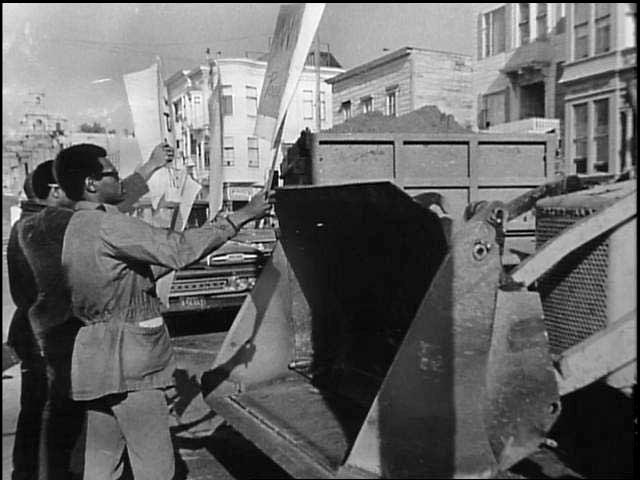
*The Black Power Mixtape 1967-1975 Cinematic crate-diggers have plenty to celebrate, checking the results of The Black Power Mixtape 1967-1975. Swedish documentarian Göran Hugo Olsson had heard whispers for years that Swedish television archives possessed more archival footage of the Black Panthers than anyone in the states — while poring through film for a doc on Philly soul, he discovered the rumors were dead-on. With this lyrical film, coproduced by the Bay Area’s Danny Glover, Olsson has assembled an elegant snapshot of black activists and urban life in America, relying on the vivid, startlingly crisp images of figures such as Stokely Carmichael and Huey P. Newton at their peak, while staying true to the wide-open, refreshingly nonjudgmental lens of the Swedish camera crews. Questlove of the Roots and Om’Mas Keith provide the haunting score for the film, beautifully historicized with shots of Oakland in the 1960s and Harlem in the ’70s. It’s made indelible thanks to footage of proto-Panther school kids singing songs about grabbing their guns, and an unforgettable interview with a fiery Angela Davis talking about the uses of violence, from behind bars and from the place of personally knowing the girls who died in the infamous Birmingham, Ala., church bombing of 1963. (1:36) Shattuck. (Chun)

*Contagion Tasked with such panic-inducing material, one has to appreciate director Steven Soderbergh’s cool head and hand with Contagion. Some might even dub this epic thriller (of sorts) cold, clinical, and completely lacking in bedside manner. Still, for those who’d rather be in the hands of a doctor who refuses to talk down to the patient, Contagion comes on like a refreshingly smart, somewhat melodrama-free clean room, a clear-eyed response to a messy, terrifying subject. A deadly virus is spreading swiftly — sans cure, vaccine, or sense — starting with a few unlikely suspects: globe-trotting corporate exec Beth (Gwyneth Paltrow), a waiter, a European tourist, and a Japanese businessman. The chase is on to track the disease’s genesis and find a way to combat it, from the halls of the San Francisco Chronicle and blog posts of citizen activist-journalist Alan (Jude Law), to the emergency hospital in the Midwest set up by intrepid Dr. Mears (Kate Winslet), to a tiny village in China with a World Health investigator (Marion Cotillard). Soderbergh’s brisk, businesslike storytelling approach nicely counterpoints the hysteria going off on the ground, as looting and anarchy breaks out around Beth’s immune widower Mitch (Matt Damon), and draws you in — though the tact of making this disease’s Typhoid Mary a sexually profligate woman is unsettling and borderline offensive, as is the predictable blame-it-on-the-Chinese origin coda. (1:42) Shattuck. (Chun)

*Drive Such a lovely way to Drive, drunk on the sensual depths of a lush, saturated jewel tone palette and a dreamlike, almost luxurious pacing that gives off the steamy hothouse pop romanticism of ’80s-era Michael Mann and David Lynch — with the bracing, impactful flecks of threat and ultraviolence that might accompany a car chase, a moody noir, or both, as filtered through a first-wave music video. Drive comes dressed in the klassic komforts — from the Steve McQueen-esque stances and perfectly cut jackets of Ryan Gosling as the Driver Who Shall Remain Nameless to the foreboding lingering in the shadows and the wittily static, statuesque strippers that decorate the background. Gosling’s Driver is in line with Mann’s other upstanding working men who hew to an old-school moral code and are excellent at what they do, regardless of what side of the law they’re working: he likes to keep it clear and simple — his services as a wheelman boil down to five minutes, in and out — but matters get messy when he falls for sweet-faced neighbor Irene (Carey Mulligan), who lives down the hall with her small son, and her ex-con husband (Oscar Isaac) is dragged back into the game. Populated by pungent side players like Albert Brooks, Bryan Cranston, Ron Perlman, and Christina Hendricks, and scattered with readily embeddable moments like a life-changing elevator kiss that goes bloodily wrong-right, Drive turns into a real coming-out affair for both Danish director Nicolas Winding Refn (2008’s Bronson), who rises above any crisis of influence or confluence of genre to pick up the po-mo baton that Lynch left behind, and 2011’s MVP Ryan Gosling, who gets to flex his leading-man muscles in a truly cinematic role, an anti-hero and under-the-hood psychopath looking for the real hero within. (1:40) Bridge, SF Center. (Chun)

50/50 This is nothing but a mainstream rom-com-dramedy wrapped in indie sheep’s clothes. When Adam (Joseph Gordon-Levitt) learns he has cancer, he undergoes the requisite denial, anger, bargaining, depression, and acceptance like a formality. Aided by his bird-brained but lovable best friend Kyle (Seth Rogan), lovable klutz of a counselor Katherine (Anna Kendrick), and panicky mother (Anjelica Huston), Adam gets a new lease on life. This comes in the form of one-night-stands, furious revelations in parked cars, and a prescribed dose of wacky tobaccy. If 50/50 all sounds like the setup for a pseudo-insightful, kooky feel-goodery, it is. The film doesn’t have the brains or spleen to get down to the bone of cancer. Instead, director Jonathan Levine (2008’s The Wackness) and screenwriter Will Reiser favor highfalutin’ monologues, wooden characters, and a Hollywood ending (with just the right amount of ambiguity). Still, Gordon-Levitt is the most gorgeous cancer patient you will ever see, bald head and all. (1:40) Four Star, 1000 Van Ness, SF Center, Sundance Kabuki. (Ryan Lattanzio)

Footloose Another unnecessary remake joins the queue at the box office, aiming for the pockets of ’80s-era nostalgics and fans of dance movies and naked opportunism. A recap for those (if there are those) who never saw the 1984 original: city boy Ren McCormack moves to a Middle American speck-on-the-map called Bomont and riles the town’s inhabitants with his rock ‘n’ roll ways — rock ‘n’ roll, and the lewd acts of physicality it inspires, i.e., dancing, having been criminalized by the town council to preserve the souls and bodies of Bomont’s young people. Ren falls for wayward preacher’s daughter Ariel Moore — whose father has sponsored this oversolicitous piece of legislation — and vows to fight city hall on the civil rights issue of a senior prom. Ren McCormack 2.0 is one Kenny Wormald (prepped for the gig by his tenure in the straight-to-cable dance-movie sequel Center Stage: Turn It Up), who forgoes the ass-grabbing blue jeans that Kevin Bacon once angry-danced through a flour mill in. Otherwise, the 2011 version, directed and cowritten by Craig Brewer (2005’s Hustle & Flow), regurgitates much of the original, hoping to leverage classic lines, familiar scenes, and that Dance Your Ass Off T-shirt of Ariel’s. It doesn’t work. Ren and Ariel (Dancing with the Stars‘ Julianne Hough) are blandly unsympathetic and have the chemistry of two wet paper towels, the adult supporting cast should have known better, and the entire film comes off as a tired, tuneless echo. (1:53) 1000 Van Ness, Presidio. (Rapoport)

Gainsbourg: A Heroic Life Far from perfect, yet imbued with all the playful, artful qualities of the maestro himself, writer-director Joann Sfar goes out of his way to tell singer-songwriter Serge Gainsbourg’s tale the way that he sees it, as that of an artist, and in the process creates a wonderland of cartoonish perversity from the cradle to the grave. The remainder of A Heroic Life is almost eclipsed by the film’s earliest interludes, which trail the already too-clever-for-his-own-good young musician and painter, born Lucien Ginsburg, as he proudly claims his gold star from the Nazis. With echoes of 400 Blows (1959) resounding with every wayward step, the brash young Lucien lives by his active imagination, dreaming up a fat, spiderlike plaything from the monstrous Jew depicted in Nazi propaganda and conjuring an imaginary alter-ego he dubs his ugly Mug. Though Heroic Life‘s adult Serge is seamlessly embodied by Eric Elmosnino, few of the moments from the grown lothario’s life rival those initial scenes, with the exception of his exuberant love affair with Brigitte Bardot (Laetitia Casta) and the fantastic music that came out of it. Still, it’s a joy to hear his music, even in short snatches, with subtitles that clearly spell out Gainsbourg’s talents as a stunning, uniquely talented lyricist. (2:02) Lumiere, Smith Rafael. (Chun)

*Gainsbourg: The Man Who Loved Women Those hungry for more of the real Serge Gainsbourg — after being tantalized and teased by Joann Sfar’s whimsical comic book-inspired feature — will want to catch this documentary by Pascal Forneri for many of the details that didn’t fit or were skimmed over, here, in the very words and image of the songwriter and the many iconic women in his life. Much of the chanson master’s photographic or video history seems to be here — from his blunt-force on-camera proposition of Whitney Houston to multiple, insightful interviews with the love of his life, Jane Birkin, as well as the many women who won his heart for just a little while, such as Brigitte Bardot, Juliette Gréco, Françoise Hardy, and Vanessa Paradis. Gainsbourg may be marred by its somewhat choppy, mystifying structure, at times chronological, at times organized according to creative periods, but overriding all are the actual footage and photographs loosely, louchely assembled and collaged by Forneri; delightful pre-music-videos Scopitones of everyone from France Gall to Anna Karina; and the gemlike, oh-so-quotable interviews with the mercurial, admirably honest musical genius and eternally subversive provocateur. Quibble as you might with the short shrift given his later career—in addition to major ’70s LPs like Histoire de Melody Nelson and L’Homme à tête de chou (Cabbage-Head Man) — this is a must-see for fans both casual and seriously seduced. (1:45) Roxie. (Chun)

The Help It’s tough to stitch ‘n’ bitch ‘n’ moan in the face of such heart-felt female bonding, even after you brush away the tears away and wonder why the so-called help’s stories needed to be cobbled with those of the creamy-skinned daughters of privilege that employed them. The Help purports to be the tale of the 1960s African American maids hired by a bourgie segment of Southern womanhood — resourceful hard-workers like Aibileen (Viola Davis) and Minny (Octavia Spencer) raise their employers’ daughters, filling them with pride and strength if they do their job well, while missing out on their own kids’ childhood. Then those daughters turn around and hurt their caretakers, often treating them little better than the slaves their families once owned. Hinging on a self-hatred that devalues the nurturing, housekeeping skills that were considered women’s birthright, this unending ugly, heartbreaking story of the everyday injustices spells separate-and-unequal bathrooms for the family and their help when it comes to certain sniping queen bees like Hilly (Bryce Dallas Howard). But the times they are a-changing, and the help get an assist from ugly duckling of a writer Skeeter (Emma Stone, playing against type, sort of, with fizzy hair), who risks social ostracism to get the housekeepers’ experiences down on paper, amid the Junior League gossip girls and the seismic shifts coming in the civil rights-era South. Based on the best-seller by Kathryn Stockett, The Help hitches the fortunes of two forces together — the African American women who are trying to survive and find respect, and the white women who have to define themselves as more than dependent breeders — under the banner of a feel-good weepie, though not without its guilty shadings, from the way the pale-faced ladies already have a jump, in so many ways, on their African American sisters to the Keane-eyed meekness of Davis’ Aibileen to The Help‘s most memorable performances, which are also tellingly throwback (Howard’s stinging hornet of a Southern belle and Jessica Chastain’s white-trash bimbo-with-a-heart-of-gold). (2:17) Shattuck. (Chun)

The Ides of March Battling it out in the Ohio primaries are two leading Democratic presidential candidates. Filling the role of idealistic upstart new to the national stage — even his poster looks like you-know-who’s Hope one — is Governor Mike Morris (George Clooney), who’s running neck-and-neck in the polls with his rival thanks to veteran campaign manager (Philip Seymour Hoffman) and ambitious young press secretary Steven (Ryan Gosling). The latter is so tipped for success that he’s wooed to switch teams by a rival politico’s campaign chief (Paul Giamatti). While he declines, even meeting with a representative from the opposing camp is a dangerous move for Steven, who’s already juggling complex loyalties to various folk including New York Times reporter Ida (Marisa Tomei) and campaign intern Molly (Evan Rachel Wood), who happens to be the daughter of the Democratic National Party chairman. Adapted from Beau Willimon’s acclaimed play Farragut North, Clooney’s fourth directorial feature is assured, expertly played, and full of sharp insider dialogue. (Willimon worked on Howard Dean’s 2004 run for the White House.) It’s all thoroughly engaging — yet what evolves into a thriller of sorts involving blackmail and revenge ultimately seems rather beside the point, as it turns upon an old-school personal morals quandary rather than diving seriously into the corporate, religious, and other special interests that really determine (or at least spin) the issues in today’s political landscape. Though stuffed with up-to-the-moment references, Ides already feels curiously dated. (1:51) California, Marina, 1000 Van Ness, Piedmont, Sundance Kabuki. (Harvey)

In Time Justin Timberlake moves from romantic comedy to social commentary to play Will Salas, a young man from the ghetto living one day at a time. Many 12-steppers may make this claim, but Salas literally is, because in his world, time actually is money and people pay, say, four minutes for a cup of coffee, a couple hours for a bus ride home from work, and years to travel into a time zone where people don’t run from place to place to stay ahead of death. In writer-director Andrew Niccol’s latest piece of speculative cinema, humans are born with a digitized timepiece installed in their forearm and a default sell-by date of 25 years, with one to grow on — though most end up selling theirs off fairly quickly while struggling to pay rent and put food on the table. Time zones have replaced area codes in defining social stature and signaling material wealth, alongside those pesky devices that give the phrase “internal clock” an ominous literality. Niccol also wrote and directed Gattaca (1997) and wrote The Truman Show (1998), two other films in which technological advances have facilitated a merciless, menacing brand of social engineering. In all three, what is most alarming is the through line between a dystopian society and our own, and what is most hopeful is the embattled protagonist’s promises that we don’t have to go down that road. Amanda Seyfried proves convincible as a bored heiress to eons, her father (Vincent Kartheiser) less amenable to Robin Hood-style time banditry. (1:55) 1000 Van Ness, SF Center. (Rapoport)

Johnny English Reborn (1:41) 1000 Van Ness, SF Center.

The Legend is Born: Ip Man If you prefer your martial arts movies Zhang Yimou-lush, Jackie Chan-hilarious, or Tsui Hark-insane, you’ll want to skip The Legend is Born: Ip Man, an earnest, unfussy semi-biopic about the early years of Wing Chun grandmaster Yip Man (he taught Bruce Lee … respect). Here, he’s called Ip Man and is played by the bland Dennis To, who might be carved from wood if not for his many nimble fight scenes — playful dispute-settling, grueling training sequences, to-the-death clashes, etc. The Ip Man story has been popular Hong Kong movie fodder in recent years, with the far more charistmatic Donnie Yen playing the lead in a pair of 2008 and 2010 flicks. This apparently unrelated production is less flashier than those films, but purists will appreciate appearances by fightin’ screen legends Sammo Hung and Yuen Bao, plus a cameo by Yip Man’s real-life son. Side note: director Herman Yau co-directed absolutely bonkers crime drama The Untold Story (1993), starring Anthony Wong as a Sweeney Todd type who runs a restaurant famed for its “pork” buns. Worth a look, fiends. (1:40) Four Star. (Eddy)

The Lion King 3D (1:29) SF Center.

*Love Crime Early this year came the announcement that Brian De Palma was hot to do an English remake of Alain Corneau’s Love Crime. The results, should they come to fruition, may well prove a landmark in the annals of lurid guilty-pleasure trash. But with the original Love Crime finally making it to local theaters, it’s an opportune moment to be appalled in advance about what sleazy things could potentially be done to this neat, dry, fully clothed model of a modern Hitchcockian thriller. No doubt in France Love Crime looks pretty mainstream. But here its soon-to be-despoiled virtues of narrative intricacy and restraint are upscale pleasures. Ludivine Sagnier plays assistant to high-powered corporate executive Christine (Kristin Scott Thomas). The boss enjoys molding protégée Isabelle to her own image, making them a double team of carefully planned guile unafraid to use sex appeal as a business strategy. But Isabelle is expected to know her place — even when that place robs her of credit for her own ideas — and when she stages a small rebellion, Christine’s revenge is cruelly out of scale, a high-heeled boot brought down to squash an ant. Halfway through an act of vengeance occurs that is shocking and satisfying, even if it leaves the remainder of Corneau and Nathalie Carter’s clever screenplay deprived of the very thing that had made it such a sardonic delight so far. Though it’s no masterpiece, Love Crime closes the book on his Corneau’s career Corneau (he died at age 67 last August) not with a bang but with a crisp, satisfying snap. (1:46) Lumiere. (Harvey)

*Margin Call Think of Margin Call as a Mamet-like, fictitious insider jab at the financial crisis, a novelistic rejoinder to Oscar-winning doc Inside Job (2010). First-time feature director and writer J.C. Chandor shows a deft hand with complex, writerly material, creating a darting dance of smart dialogue and well-etched characters as he sidesteps the hazards of overtheatricality, a.k.a. the crushing, overbearing proscenium. The film opens on a familiar Great Recession scene: lay-off day at an investment bank, marked by HR functionaries calling workers one by one into fishbowl conference rooms. The first victim is the most critical — Eric Dale (Stanley Tucci), a risk-management staffer who has stumbled on an investment miscalculation that could potentially trigger a Wall Street collapse. On his way out, he passes a drive with his findings to one of his young protégés, Peter (Zachary Quinto), setting off a flash storm over the next 24 hours that will entangle his boss Sam (Kevin Spacey), who’s agonizing over his dying dog while putting up a go-big-or-go-home front; cynical trading manager Will (Paul Bettany); and the firm’s intimidating head (Jeremy Irons), who gets to utter the lines, “Explain to me as you would to a child. Or a Golden Retriever.” Such top-notch players get to really flex their skills here, equipped with Chandor’s spot-on script, which manages to convey the big issues, infuse the numbers with drama and the money managers with humanity, and never talk down to the audience. (1:45) Shattuck, Sundance Kabuki. (Chun)

*Martha Marcy May Marlene If Winter’s Bone star Jennifer Lawrence was the breakout ingénue of 2010, look for Martha Marcy May Marlene‘s Elizabeth Olsen to take the 2011 title. Both films are backwoodsy and harrowing and offer juicy roles for their leading starlets — not to mention a pair of sinister supporting roles for the great John Harkes. Here, he’s a Manson-y figure who retains disturbing control over Olsen’s character even after the multi-monikered girl flees his back-to-the-land cult. Writer-director Sean Durkin goes for unflashy realism and mounds on the dread as the hollow-eyed Martha attempts to resume normal life, to the initial delight of her estranged, guilt-ridden older sister (Sarah Paulson). Soon, however, it becomes clear that Things Are Not Ok. You’d be forgiven for pooh-poohing Olsen from the get-go; lavish Sundance buzz and the fact that she’s Mary-Kate and Ashley’s sis have already landed her mountains of pre-release publicity. But her performance is unforgettable, and absolutely fearless. (1:41) Sundance Kabuki. (Eddy)

Midnight in Paris Owen Wilson plays Gil, a self-confessed “Hollywood hack” visiting the City of Light with his conservative future in-laws and crassly materialistic fiancée Inez (Rachel McAdams). A romantic obviously at odds with their selfish pragmatism (somehow he hasn’t realized that yet), he’s in love with Paris and particularly its fabled artistic past. Walking back to his hotel alone one night, he’s beckoned into an antique vehicle and finds himself transported to the 1920s, at every turn meeting the Fitzgeralds, Gertrude Stein (Kathy Bates), Dali (Adrien Brody), etc. He also meets Adriana (Marion Cotillard), a woman alluring enough to be fought over by Hemingway (Corey Stoll) and Picasso (Marcial di Fonzo Bo) — though she fancies aspiring literary novelist Gil. Woody Allen’s latest is a pleasant trifle, no more, no less. Its toying with a form of magical escapism from the dreary present recalls The Purple Rose of Cairo (1985), albeit without that film’s greater structural ingeniousness and considerable heart. None of the actors are at their best, though Cotillard is indeed beguiling and Wilson dithers charmingly as usual. Still — it’s pleasant. (1:34) Opera Plaza, Shattuck. (Harvey)

Moneyball As fun as it is to watch Brad Pitt listen to the radio, work out, hang out with his cute kid, and drive down I-80 over and over again, it doesn’t quite translate into compelling cinema for the casual baseball fan. A wholesale buy-in to the cult of personality — be it A’s manager Billy Beane or the actor who plays him — is at the center of Moneyball‘s issues. Beane (Pitt) is facing the sad, inevitable fate of having to replace his star players, Jason Giambi and Johnny Damon, once they command the cash from the more-moneyed teams. He’s gotta think outside of the corporate box, and he finds a few key answers in Peter Brand (a.k.a. Paul DePodesta, played by Jonah Hill), who’s working with the sabermetric ideas of Bill James: scout the undervalued players that get on base to work against better-funded big-hitters. Similarly, against popular thought, Moneyball works best when director Bennett Miller (2005’s Capote) strays from the slightly flattening sunniness of its lead actor and plunges into the number crunching — attempting to visualize the abstract and tapping into the David Fincher network, as it were (in a related note, Aaron Sorkin co-wrote Moneyball‘s screenplay) — though the funny anti-chemistry between Pitt and Hill is at times capable of pulling Moneyball out of its slump. (2:13) Four Star, 1000 Van Ness, Presidio, Sundance Kabuki. (Chun)

*My Afternoons with Margueritte There’s just one moment in this tender French dramedy that touches on star Gerard Depardieu’s real life: his quasi-literate salt-of-the-earth character, Germain, rushes to save his depressed friend from possible suicide only to have his pretentious pal pee on the ground in front of him. Perhaps Depardieu’s recent urinary run-in, on the floor of an airline cabin, was an inspired reference to this moment. In any case, My Afternoons With Margueritte offers a hope of the most humanist sort, for all those bumblers and sad cases that are usually shuttled to the side in the desperate ’00s, as Depardieu demonstrates that he’s fully capable of carrying a film with sheer life force, rotund gut and straw-mop ‘do and all. In fact he’s almost daring you to hate on his aging, bumptious current incarnation: Germain is the 50-something who never quite grew up or left home. The vegetable farmer is treated poorly by his doddering tramp of a mother and is widely considered the village idiot, the butt of all the jokes down at the cafe, though contrary to most assumptions, he manages to score a beautiful, bus-driving girlfriend (Sophie Guillemin). However the true love of his life might be the empathetic, intelligent older woman, Margueritte (Gisele Casadesus), that he meets in the park while counting pigeons. There’s a wee bit of Maude to Germain’s Harold, though Jean Becker’s chaste love story is content to remain within the wholesome confines of small-town life — not a bad thing when it comes to looking for grace in a rough world. (1:22) Opera Plaza. (Chun)

Oranges and Sunshine At the center of this saga of lives ripped apart by church and state is Margaret Humphreys, the Englishwoman who uncovered the scandalous mass deportation of children from England to Australia. In one of her most rewarding roles since The Proposition (2005), her last foray to Oz, Watson portrays the English social worker who in the ’80s learns of multiple cases of now-adult orphans in Australia who don’t know their real name or even age but remember that they once lived in the UK. She starts to explore the past of victims such as Jack (Hugo Weaving) and Len (David Wenham) and tries to reunite them with their families, including mothers who were told their youngsters were adopted into real families. In the course of her work, and at the expense of her own family life, Humphreys discovers the horrors that befell many young deportees — as child slave-laborers — and the corruption that extends its fingers into government and the Catholic church. In his first feature film, director Jim Loach, son of crusading cinematic force Ken Loach, turns over each stone with care and compassion, finding the perfect filter through which to tell this well-modulated story in Watson, whose Humphreys faces harassment and post-traumatic stress disorder in her quest to heal the children who were lured overseas in the hope that they would ride horses to school and pick oranges off a tree for breakfast. (1:45) Albany, Embarcadero. (Chun)

*Paranormal Activity 3 A prequel to a prequel, this third installment in the faux-home-movie horror series is as good as one could reasonably hope for: considerably better than 2010’s part two, even if inevitably it can’t replicate the relatively fresh impact of the 2007 original. After a brief introductory sequence we’re in 1988, with the grown-up sisters of the first two films now children (Chloe Csengery, Jessica Tyler Brown) living with a recently separated mom (Lauren Bitter) and her nice new boyfriend (Christopher Smith). His wedding-video business provides the excuse for many a surveillance cam to be set up in their home once things start going bump in the night (and sometimes day). Which indeed they do, pretty quickly. Brown’s little Kristi has an invisible friend called Toby she says is “real,” though of course everyone else trusts he’s a normal, harmless imaginary pal. Needless to say, they are wrong. Written by Christopher Landon (Paranormal Activity 2, 2007’s Disturbia) and directed by the guys (Henry Joost, Ariel Schulman) who made interesting nonfiction feature Catfish (2010), this quickly made follow-up does a good job piling on more scares without getting shameless or ludicrous about it, extends the series’ mythology in ways that easily pave way toward future chapters, and maintains the found-footage illusion well enough. (Excellent child performances and creepy camcorder “pans” atop an oscillating fan motor prove a great help; try to forget that video quality just wasn’t this good in ’88.) Not great, but thoroughly decent, and worth seeing in a theater — this remains one chiller concept whose effectiveness can only be diminished to the point of near-uselessness on the small screen. (1:24) California, 1000 Van Ness. (Harvey)

*Point Blank Not for nothing did Hollywood remake French filmmaker Fred Cavaye’s last film, Anything for Her (2008) as The Next Three Days (2010) — Cavaye’s latest, tauter-than-taut thriller almost screams out for a similar rework, with its Bourne-like handheld camera work, high-impact immediacy, and noirish narrative economy. Point Blank — not to be confused with the 1967 Lee Marvin vehicle —kicks off with a literal slam: a mystery man (Roschdy Zem) crashing into a metal barrier, on the run from two menacing figures until he is cornered and then taken out of the action by fate. His mind mainly on the welfare of his very pregnant wife Nadia (Elena Anaya), nursing assistant Samuel (Gilles Lellouche) has the bad luck to stumble on a faux doctor attempting to make sure that the injured man never rises from his hospital bed. As police wrangle over whose case this exactly is — the murder of an industrialist seems to have expanded the powers of the stony-faced, monolithic Commandant Werner (Gerard Lanvin) — Samuel gets sucked into the mystery man’s lot, a conspiracy that allows them to trust no one, and seemingly impossibly odds against getting out of the mess alive. Cavaye never quite stops applying the pressure in this clever, unrelenting cat-and-mouse and mouse-and-his-spouse game, topping it with a nerve-jangling search through a messily chaotic police station. (1:24) Opera Plaza. (Chun)

Puss in Boots (1:45) 1000 Van Ness, Presidio.

Real Steel Everybody knows what this movie about rocking, socking robots should have been called. Had the producers secured the rights to the name, we’d all be sitting down to Over The Top II: Child Endangerment. Absentee father Charlie Kenton (Hugh Jackman) and his much-too-young son Max (Dakota Goyo) haul their remote-controlled pugilists in a big old truck from one underground competition to the next. Along the way Charlie learns what it means to be a loving father while still routinely managing to leave cherubic Max alone in scenarios of astonishing peril. Seriously, there are displays of parental neglect in this movie that strain credulity well beyond any of its Rock ‘Em Sock ‘Em elements. Fortunately the filmmakers had the good sense to make those elements awesome. The robots look great and the ring action can be surprisingly stirring in spite of the paper-thin human story it depends on. And as adept as the script proves to be at skirting the question of robot sentience, we’re no less compelled to root for our scrappy contender. Recommended if you love finely wrought spectacle but hate strong characterization and children. (2:07) 1000 Van Ness, Shattuck. (Jason Shamai)

The Rum Diary Hunter S. Thompson’s writing has been adapted twice before into feature form. Truly execrable Where the Buffalo Roam (1980) suggested his style was unfilmable, but Terry Gilliam’s Fear and Loathing in Las Vegas (1998) duly captured a “gonzo” mindset filtered through quantities of drugs and alcohol that might kill the ordinary mortal — a hallucinatory excess whose unpleasant effectiveness was underlined by the loathing Fear won in most quarters. Now between those two extremes there’s the curiously mild third point of this Johnny Depp pet project, translating an early, autobiographical novel unpublished until late in the author’s life. Failed fiction writer Paul Kemp (Johnny Depp) thinks things are looking up when he’s hired to an English-language San Juan newspaper circa 1960 — though it turns out he was the only applicant. A gruff editor (Richard Jenkins), genially reckless photographer flatmate (Michael Rispoli) and trainwreck vision of his future self (Giovanni Ribisi) introduce him to the thanklessness of writing puff pieces for the gringo community of tourists and robber barons. One of the latter (Aaron Eckhart as Sanderson) introduces him to the spoils to be had exploiting this tax-shelter island “paradise” without sharing one cent with its angrily cast-aside, impoverished natives. Sanderson also introduces Kemp to blonde wild child Chenault (Amber Heard), who’s just the stock Girl here. Presumably hired for his Withnail & I (1987) cred, Bruce Robinson brings little of that 1987’s cult classic’s subversive cheek to his first writing-directing assignment in two decades. Handsomely illustrating without inhabiting its era, toying with matters of narrative and thematic import (American colonialism, Kemp-slash-Thompson finding his writing “voice,” etc.) that never develop, this slack quasi-caper comedy ambles nowhere in particular pleasantly enough. But the point, let alone the rage and outrageousness one expects from Thompson, is missing. On the plus side, there’s some succulent dialogue, as when Ribisi asks Depp for an amateur STD evaluation: “Is it clap?” “A standing ovation.” (2:00) California, Marina, 1000 Van Ness, Piedmont, Sundance Kabuki. (Harvey)

Sarah’s Key (1:42) Opera Plaza, Shattuck.

The Skin I Live In I’d like to think that Pedro Almodóvar is too far along in his frequently-celebrated career to be having a midlife crisis, but all the classic signs are on display in his flashy, disjointed new thriller. Still mourning the death of his burn victim wife and removed from his psychologically disturbed daughter, brilliant-but-ethically compromised plastic surgeon Robert (played with smoldering creepiness by former Almodóvar heartthrob Antonio Banderas) throws himself into developing a new injury-resistant form of prosthetic skin, testing it on his mysterious live-in guinea pig, Vera (the gorgeous Elena Anaya, whose every curve is on view thanks to an après-ski-ready body suit). Eventually, all hell breaks loose, as does Vera, whose back story, as we find out, owes equally to 1960’s Eyes Without a Face and perhaps one of the Saw films. And that’s not even the half of it — to fully recount every sharp turn, digression and MacGuffin thrown at us would take the entirety of this review. That’s not news for Almodóvar, though. Much like Rainer Werner Fassbinder before him, Almodóvar’s métier is melodrama, as refracted through a gay cinephile’s recuperative affections. His strength as a filmmaker is to keep us emotionally tethered to the story he’s telling, amidst all the allusions, sex changes and plot twists torn straight from a telenovela. The real shame of The Skin I Live In is that so much happens that you don’t actually have time to care much about any of it. Although its many surfaces are beautiful to behold (thanks largely to cinematographer José Luis Alcaine), The Skin I Live In ultimately lacks a key muscle: a heart. (1:57) Embarcadero, Shattuck, Sundance Kabuki. (Sussman)

*Take Shelter Jeff Nichols directed Michael Shannon in 2007’s Shotgun Stories, released right around the time the actor’s decade-plus prior career broke huge with an Oscar nom for 2008’s Revolutionary Road. Their second collaboration, Take Shelter, is a subtle drama that succeeds mostly because of Shannon’s strong star turn, with an assist from Jessica Chastain (suddenly ubiquitous after The Help, The Debt, and Tree of Life). Curtis (Shannon) and Samantha (Chastain) live paycheck to paycheck in a small Midwestern town; the health insurance associated with his construction job is the only reason they’ll be able to afford a cochlear implant for their deaf daughter. When Curtis starts having horrible nightmares, he can’t shake the feeling that his dreams prophesize an actual disaster to come — or are an indicator that Curtis, like his mother before him, is slowly losing touch with reality. Curtis does seek professional help, but he also starts ripping up his backyard, making expensive improvements to the family’s tornado shelter. You know, just in case. Domestic turmoil, troubles at work, and social ostracization inevitably follow. Where will it all lead? Won’t spoil it for you, but Take Shelter‘s conclusion isn’t nearly as gripping as Shannon’s performance, an skillfully balanced mix of confusion, anger, regret, and white-hot terror. (2:00) Lumiere, Shattuck. (Eddy)

The Thing John Carpenter’s 1982 The Thing is my go-to favorite film (that and 1988’s They Live — I’m a little bit Carpenter-obsessed). So this prequel-which-is-actually-more-like-a-remake is already treading on holy cinematic ground with me. My expectations were low. Pleasantly, first-time director Matthijs van Heijningen Jr. doesn’t deliver a total suckfest (as most remakes of sacred movies do, like the abominable 2003 Texas Chainsaw Massacre); his Thing is rated R, is not in 3D, casts a few actual Norwegians to play the inhabitants of Norway’s Antarctic research lab, etc. It also tries to create continuity with Carpenter’s film by ending exactly where the 1982 film begins. However, all that comes before is basically a weak imitation of Carpenter, whose own film was heavily inspired by 1951 sci-fi classic The Thing from Another World (all three versions list John W. Campbell Jr.’s story “Who Goes There?” as source material). Van Heihningen Jr. offers nothing new except for CG (the 1982 organic FX were creepier, though). Oh, there’s also a “we need a final girl” plot device that shoehorns Mary Elizabeth Winstead into the mix. Both this version and Carpenter’s film build up dread with paranoia. But Carpenter’s was also heavy with the Antarctic-long-haul side effects of cabin fever and extreme isolation. Not really a factor when your main character has just jetted in from New York. (1:43) 1000 Van Ness. (Eddy)

The Three Musketeers 3D (1:50) 1000 Van Ness.

The Way (1:55) 1000 Van Ness.

*Weekend In post-World War II Britain, the “Angry Young Man” school excited international interest even as it triggered alarm and disdain from various native bastions of cultural conservatism. Alan Sillitoe’s Saturday Night and Sunday Morning (1958) discomfited many by depicting a young factory grunt who frequently wakes in a married woman’s bed, chases other available tail, lies as naturally as he breathes, and calls neighborhood busybodies “bitches and whores.” Today British movies (at least the ones that get exported) are still more or less divided by a sort of class system. There’s the Masterpiece Theatre school of costumed romance and intrigue on one hand, the pint-mouthed rebel yellers practicing gritty realism on another. Except contemporary examples of the latter now allow that Angry Young Men might be something else beyond the radar once tuned to cocky, white male antiheroes. The “something else” is gay in Weekend, which was shot in some of the same Nottingham locations where Albert Finney kicked against the pricks in the 1960 film version of Saturday Night. The landscape has changed, but is still nondescript; the boozy clubs still loud but with different bad music. It’s at one such that bearded, late-20s Russell (Tom Cullen) wakes up next morning with a hangover next to no married lady but rather Glen (Chris New). It would be unfair to reveal more of Weekend‘s plot, what little there is. Suffice it to say these two lads get to know each other over less than 48 hours, during which it emerges that Russell isn’t really “out,” while Glen is with a vengeance — though the matter of who is more emotionally mature or well adjusted isn’t so simple. Writer-director Andrew Haigh made one prior feature, a semi-interesting, perhaps semi-staged portrait of a male hustler called Greek Pete (2009). It didn’t really prepare one for Weekend, which is the kind of yakkety, bumps and-all romantic brief encounter movies (or any other media) so rarely render this fresh, natural, and un-stagy. (1:36) Embarcadero. (Harvey)

The Woman on the Sixth Floor There is a particular strain of populist European comedy in which stuffy northerners are loosened up by liberating exposure to those sensual, passionate, loud, all-embracing simple folk from the sunny south. The line between multicultural inclusion and condescension is a thin one these movies not infrequently cross. Set in 1960, Philippe Le Guay’s film has a bourgeoisie Paris couple hiring a new maid in the person of attractive young Maria (Natalia Verbeke). She joins a large group of Spanish women toiling for snobbish French gentry in the same building. Her presence has a leavening effect on investment counselor employer Jean-Louis (Fabrice Luchini), to the point where he actually troubles to improve the poorly housed maids’ lot. (Hitherto no one has cared that their shared toilet is broken.) But he also takes an inappropriate and (initially) unwanted romantic interest in this woman, lending a creepy edge to what’s intended as a feel-good romp. (For the record, Verbeke is about a quarter-century younger than Luchini — a difference one can’t imagine the film would ignore so completely if the genders were reversed.) Le Guay’s screenplay trades in easy stereotypes — the Spanish “help” are all big-hearted lovers of life, the Gallic upper-crusters (including Sandrine Kiberlain as J-L’s shallow, insecure wife) emotionally constipated, xenophobic boors — predictable conflicts and pat resolutions. As formulaic crowd-pleasers go, it could be worse. But don’t be fooled — if this were in English, there’d be no fawning mainstream reviews. In fact, it has been in English, more or less. And that ugly moment in cinematic history was called Spanglish (2004). (1:44) Albany, Clay. (Harvey)

LGBT leaders denounce attack on Herrera by the Chronicle

20

Leaders of the LGBT community from across the political spectrum yesterday denounced the San Francisco Chronicle and the anonymous sources it relied on to question City Attorney Dennis Herrera’s early support for legalizing same-sex marriage, calling the paper’s front page article a thinly veiled political hit piece designed to hurt Herrera’s mayoral campaign.

That strong showing of support in the LGBT community and the view offered by many that the attack came from supporters of Mayor Ed Lee – including top former Newsom Administration officials, some of whom now work for Lee – could not only mitigate damage from the article but further sully a Lee election effort that is already marred by allegations of vote tampering, money laundering, and deceptive campaign tactics.

“Those who are saying this now anonymously are as cowardly as Dennis and Gavin were courageous back then,” said Deputy City Attorney Theresa Stewart, the lead attorney who defended San Francisco’s decision in 2004 to unilaterally issue marriage licenses to same-sax couples, in defiance of state and federal law, which eventually led to the legalizing of such unions. “We can’t have our community turn on us for petty political gain.”

“WTF, Chronicle?” was how Assemblymember Tom Ammiano began his speech, going on to lay blame for the attack on surrogates for Lee. Ammiano also called out the mayor for campaign finance violations by his supporters, for undermining the Healthy San Francisco program that was created by Ammiano’s legislation, and for repeatedly ordering police raids on the OccupySF encampment.

“How about some fucking leadership?!” Ammiano said.

Cleve Jones, an early gay rights leader who marched with Harvey Milk, also denounced Lee and his supporters for cronyism, vote tampering, money laundering, and the “fake grassroots” efforts of the various well-funded independent expenditure campaigns, which he said have fooled the Chronicle.

“To the Chronicle and that reporters – really? – this is what you do two weeks before the election? You should be ashamed of yourself,” Jones said. “How stupid do you think we are?”

Yet Chronicle City Editor Audrey Cooper defended the article and disputed the political motivations of its sources. “Clearly, I disagree [with the criticisms],” she told the Guardian. “I personally vetted every one of the sources and I’m confident everything we printed is true.”

Beyond criticizing the obvious political motivations behind the attack, speakers at the rally called the article bad journalism and said it was simply untrue to suggest that Herrera didn’t strongly support the effort to legalize same-sex marriage from the beginning.

“I can tell you that Dennis never once shrank from this fight. I was there, I know,” Stewart said, calling Herrera “a straight ally who’s devoted his heart and soul to this community.”

Sen. Mark Leno, who introduced the first bill legalizing same-sex marriage to clear the Legislature, emphasized that he isn’t endorsing any candidates for mayor and that he didn’t want to comment on the details of the article’s allegations. But he noted that even within the LGBT community, there were differences of opinion over the right timing and tactics for pushing the issue, and that Herrera has been a leader of the fight for marriage equality since the beginning.

“I am here to speak in defense of the character and integrity of our city attorney, Dennis Herrera,” Leno said, later adding, “I do not appreciate when the battle for our civil rights is used as a political football in the waning days of an election.”

Ammiano also noted that even if Herrera raised doubts in early meetings, that was entirely appropriate given his role as city attorney. “Even if there are some questions, they’re about helping, not hurting,” he said, expressing disgust at the Newsom Administration officials for turning on someone who was instrumental to defending the decision: “In my day, you valued your friendships.”

Molly McKay, one of the original plaintiffs in the civil lawsuit that followed San Francisco’s actions, teared up as she described the ups and downs that the case took, working closely with Herrera throughout. “But this is one of the strangest twists I can imagine,” she said of the attack by the Chronicle and its anonymous sources. “It’s ridiculous and despicable.”

Representatives for both the progressive Harvey Milk LGBT Democratic Club and fiscally conservative Alice B. Toklas LGBT Democratic Club also took to the microphone together, both saying they often disagree on issues, but they were each denouncing the attack and have both endorsed Herrera, largely because of his strong advocacy for the LGBT community.

Sup. Scott Wiener called Herrera, “One of the greatest straight allies we’ve every had as a community.”

When Herrera finally took the microphone, he thanked mayoral opponents Joanne Rees and Jeff Adachi for showing up at the event to help denounce the attack and said, “This is bigger than the mayor’s race. It’s bigger than me.”

He criticized those who would trivialize this issue for petty political gain and said, “It was my pleasure and honor to have been a part of this battle from the beginning – from the beginning – and I’ll be there in the end.”

How about Scott Olsen Plaza?

14

Occupy Oakland changed the name of Frank Ogawa Plaza; it’s time for OccupySF to do the same.

The place where the protesters are gathered is named for Justin Herman, the notorious director of San Francisco’s Redevelopment Agency in the terrible days of the 1950s and 1960s, when “redevelopment” meant removing black people from the Western Addition and removing poor people, particularly Filipinos, from South of Market and later the International Hotel. Herman once famously said that the SOMA land where he wanted to build hotels was “too valuable to permit poor people to park on it.”

In the 1960s, the battle against redevelopment was one of the defining political struggles in San Francisco, bringing Asians, African Americans, white progressives, young community organizers, affordable housing and tenant activists, poverty and civil rights lawyers … just about the whole spectrum of the city’s left. It’s been the subject of books and movies. The people who fought Justin Herman are part of a long political thread in San Francisco — as is OccupySF today.

I’ve always thought it was an abomination to have a downtown plaza named after a guy who did so much to destroy San Francisco. Maybe from now on we should all call it Scott Olsen Plaza.

Stage Listings

0

Stage listings are compiled by Guardian staff. Performance times may change; call venues to confirm. Reviewers are Robert Avila, Rita Felciano, and Nicole Gluckstern. Submit items for the listings at listings@sfbg.com. For further information on how to submit items for the listings, see Picks.

THEATER

OPENING

How to Love Garage, 975 Howard, SF; www.pustheatre.com. $15. Opens Fri/28, 8pm. Runs Fri-Sat, 8pm; Sun, 2pm. Through Nov 20. Performers Under Stress Theatre presents Megan Cohen’s Plato-inspired world premiere.

Totem Grand Chapiteau, AT&T Park, Parking Lot A, 74 Mission Rock, SF; cirquedusoleil.com/totem. $58-248.50. Opens Fri/28, 8pm. Runs Tues-Sun, schedule varies. Through Dec 11. Cirque Du Soleil returns with its latest big-top production.

BAY AREA

Annie Berkeley Playhouse, Julia Morgan Center for the Arts, 2640 College, Berk; (510) 845-8542, www.berkeleyplayhouse.org. $17-35. Opens Thurs/29, 7pm. Runs Thurs-Sat, 7pm; Sun, noon and 5pm. Through Dec 4. Berkeley Playhouse performs the classic musical.

ONGOING

Almost Nothing, Day of Absence Lorraine Hansberry Theatre, 450 Post, SF; (415) 474-8800, www.lhtsf.org. $43-53. Wed-Sat, 8pm (also Sat, 2pm); Sun, 2pm. Through Nov 20. The Lorraine Hansberry Theatre christens its grand new home near Union Square with two well-acted one-act plays under sharp direction by artistic director Steven Anthony Jones. Almost Nothing by Brazilian playwright Marcos Barbosa marks the North American premiere of an intriguing and shrewdly crafted Pinteresque drama, wherein a middle-class couple (Rhonnie Washington and Kathryn Tkel) returns home from an unexpected encounter at a stop light that leaves them jittery and distracted. As an eerie wind blows outside (in David Molina’s atmospheric sound design), their conversation circles around the event as if fearing to name it outright. When a poor woman (Wilma Bonet) arrives claiming to have seen everything, the couple abandons rationalization for a practical emergency and a moral morass dictated by poverty and class advantage — negotiated on their behalf by a black market professional (Rudy Guerrero). Next comes a spirited revival of Douglas Turner Ward’s Civil Rights–era Day of Absence (1965), a broad satire of Southern race relations that posits a day when all the “Neegras” mysteriously disappear, leaving white society helpless and desperate. The cast (in white face) excel at the high-energy comedy, and in staging the text director Jones makes a convincing parallel with today’s anti-immigrant laws and rhetoric. But if the play remains topical in one way, its too-blunt agitprop mode makes the message plain immediately and interest accordingly pales rapidly. (Avila)

Desdemona: A Play About a Handkerchief Boxcar Theatre Playhouse, 505 Natoma, SF; www.boxcartheatre.org. $15-35. Wed-Sat, 8pm; Sun, 3pm. Through Nov 5. Written in 1979 by a 28-year-old Paula Vogel, Desdemona retells a familiar Shakespearean tragedy, Othello, through the eyes of its more marginalized characters, much as Tom Stoppard’s Rosencrantz and Guildenstern are Dead did with Hamlet in 1966. In Vogel’s play, it is the women of Othello — Desdemona the wife, Emilia her attendant (demoted down to washer-woman in Vogel’s piece), and Bianca, Cassio’s lover, and the bawdy town pump — who are the focus, and are the play’s only onstage characters. Whiling away an endless afternoon cooped up in the back room of the governor’s mansion, the flighty, spoiled, and frankly promiscuous Desdemona (Karina Wolfe) frets over the loss of her “crappy little snot-rag,” while her subservient, pious, but quietly calculating washer-woman Emilia (Adrienne Krug) scrubs the sheets and mends the gubernatorial underpants with an attitude perfectly balanced between aggrieved, disapproving, and cautiously optimistic. Though the relationship between the two women often veers into uncomfortable condescension from both sides, their repartee generally feels natural and uncontrived. Less successfully portrayed is Theresa Miller’s Bianca, whose Cockney accent is wont to slip, and whose character’s boisterous nature feels all too frequently subdued. Jenn Scheller’s billowing, laundry-line set softens the harsh edges of the stage, just as Emilia’s final act of service for her doomed mistress softens, though not mitigates, her unwitting role in their mutual downfall. (Gluckstern)

Fear SF Playhouse, Stage Two, 533 Sutter, SF; www.un-scripted.com. $12-25. Wed/26-Mon/31, 8pm. Un-Scripted Theater Company performs improvised horror stories.

Hanging Georgia Thick House, 1695 18th St, SF; www.theatrefirst.com. $15-30. Thurs/27, 7:30pm; Fri/28-Sat/29, 8pm; Sun/30, 5pm. TheatreFIRST, in collaboration with BootStrap Theater Foundation, presents an ambitious but shallow new play by Sharmon J. Hilfinger about the emergence of artist Georgia O’Keefe (Paz Pardo), with emphasis on her rocky but crucial relationship with groundbreaking modernist photographer and exhibitor Alfred Stieglitz (Michael Storm). Set to a tuneful score by Joan McMillen, the play unfolds as a creative series of tableaux, in which director Jake Margolin has actors animating art objects and making live sound effects as well as stepping into various historical roles, including art patron and salon queen Mabel Dodge (Claire Slattery) and photographer Paul Strand (Nick Allen). In addition to some weak or doubtful interpretations of these personages, the acting is uneven and overly presentational throughout. No doubt the musical underscoring pushes the volume up but Hilfinger’s dialogue tends to be didactic anyway. At times the whole production feels as if it were being pitched to children, with little sense of the complexities of lived experience but rather a one-note history lesson whose characters and moral, however closely pegged to biographical details, are hard to credit as real life. (Avila)

Honey Brown Eyes SF Playhouse, 533 Sutter, SF; (415) 677-9596, www.sfplayhouse.org. $20-50. Tues-Thurs, 7pm; Fri-Sat, 8pm (also Sat, 3pm). Through Nov 5. Bosnia in 1992 is divided in a horrifying civil war, some characteristics of which play out in parallel circumstances for two members of a single rock band in SF Playhouse’s west coast premiere of Stefanie Zadravec’s new play. In the first act, set in Visegrad, a young Bosnian Muslim woman (Jennifer Stuckert) is held at gunpoint in her kitchen by a jumpy soldier (Nic Grelli) engaged in a mission of murder and dispossession known as ethnic cleansing. The second act moves to Sarajevo and the apartment of an elderly woman (Wanda McCaddon) who gives shelter and a rare meal to an army fugitive (Chad Deverman). He in turn keeps the bereaved if indomitable woman company. Director Susi Damilano and cast are clearly committed to Zadravec’s ambitious if hobbled play, but the action can be too contrived and unrealistic (especially in act one) to be credible while the tone — zigzagging between the horror of atrocity and the offbeat gestures of romantic comedy — comes over as confused indecision rather than a deliberate concoction. (Avila)

*The Kipling Hotel: True Misadventures of the Electric Pink ’80s Marsh San Francisco, 1062 Valencia, SF; (415) 282-3055, www.themarsh.org. $15-50. Sat, 8:30pm; Sun, 7pm. Through Nov 13. Acclaimed solo performer Don Reed (East 14th) premieres his new show, based on his post-Oakland years living in Los Angeles.

Making Porn Box Car Theatre Studios, 125A Hyde, SF; www.brownpapertickets.com. $25-50. Thurs/27, 8pm; Fri/28-Sat/29, 7 and 10pm. Ronnie Larsen brings back his crowd-pleasing comedy about the gay porn industry.

*”Master Harold” … and the Boys Phoenix Theater, 414 Mason, Ste 601, SF; 1-800-838-3006, www.offbroadwaywest.org. $18-40. Thurs-Sat, 8pm. Through Nov 19. Based loosely on personal history, Athol Fugard’s drama explores institutionalized racism in South Africa’s apartheid era ensconced in the seemingly innocuous world of a Port Elizabeth tea room. The play opens during a rainy afternoon with no customers, leaving the Black African help, Willie (Anthony Rollins-Mullens) and Sam (LaMont Ridgell), with little to do but rehearse ballroom dance steps for a big competition coming up in a couple of weeks. When Hally (Adam Simpson), the owner’s son, arrives from school, the atmosphere remains convivial at first then increasingly strained, as events happening outside the tea room conspire to tear apart their fragile camaraderie. The greatest burdens of the play are carried by Sam, who fills a range of roles for the increasingly pessimistic and emotionally-stunted Hally — teacher, student, surrogate father, confidante, and servant — all the while completely aware that their mutual love is almost certainly doomed to not survive past Hally’s adolescence, and possibly not past the afternoon. Ridgell rises greatly to the challenges of his character, ably flanked by Rollins-Mullens, and Simpson; he embodies the depth of Sam’s humanity, from his wisdom of experience, to his admiration for beauty, to his capacity to bear and finally to forgive Hally’s need to lash out at him. It is a moving and memorable rendering. (Gluckstern)

Not Getting Any Younger Marsh San Francisco, Studio Theater, 1062 Valencia, SF; (415) 826-5750, www.themarsh.org. $15-50. Thurs-Fri, 8pm; Sat, 8:30pm; Sun, 3pm. Extended through Dec 17. Marga Gomez is back at the Marsh, a couple of too-brief decades after inaugurating the theater’s new stage with her first solo show — an apt setting, in other words, for the writer-performer’s latest monologue, a reflection on the inevitable process of aging for a Latina lesbian comedian and artist who still hangs at Starbucks and can’t be trusted with the details of her own Wikipedia entry. If the thought of someone as perennially irreverent, insouciant, and appealingly immature as Gomez makes you depressed, the show is, strangely enough, the best antidote. (Avila)

*The Odyssey Aboard Alma, Hyde Street Pier, San Francisco Maritime National Historic Park, SF; www.weplayers.org. $160. Fri/28-Sat/29, Nov 4-6, 11-12, and 18, 12:30pm. Heralding their hugely ambitious Spring 2012 production of The Odyssey, which will take place all over Angel Island, the WE Players are tackling the work on a slightly smaller scale by staging it on the historic scow schooner Alma, which is part of the Maritime National Historical Park fleet docked at the end of Hyde Street Pier. Using both boat and Bay as setting, the essential chapters of the ten-year voyage — encounters with the Cyclops, Circe, the Underworld, the Sirens, Aeolus, the Laestrygonians, and Calypso — are enacted through an intriguing mash-up of narration, choreography, sea chanteys, salty dog stories (like shaggy dog stories, but more water-logged), breathtaking views, and a few death-defying stunts the likes of which you won’t see on many conventional stages. High points include the casual swapping of roles (every actor gets to play Odysseus, however briefly), Ross Travis’ masked and flatulent Prometheus and sure-footed Hermes, Ava Roy’s hot pants-clad Circe, Charlie Gurke’s steady musical direction and multi-instrumental abilities, and the sail itself, an experiential bonus. Landlubbers beware, so much time facing the back of the boat where much of the action takes place can result in mild quease, even on a calm day. Take advantage of the downtime between scenes to walk around and face forward now and again. You’ll want to anyway. (Gluckstern)

On the Air Pier 29 on the Embarcadero (at Battery), SF; (415) 438-2668, love.zinzanni.org. $117 and up (includes dinner). Wed-Sat, 6pm; Sun, 5pm. Through Dec 31. Teatro ZinZanni’s final performance at Pier 39 riffs on the company’s own struggles to stay in San Francisco. Geoff Hoyle and Duffy Bishop are the headlining guest stars.

Pellas and Melisande Cutting Ball Theater, Exit on Taylor, 277 Taylor, SF; 1-800-838-3006, www.cuttingball.com. $10-50. Opens Thurs/27, 8pm. Runs Thurs, 7:30; Fri-Sat, 8pm (also Sat, 2pm); Sun, 5pm. Through Nov 27. Cutting Ball Theater performs Rob Melrose’s new translation of Maurice Maeterlinck’s avant-garde classic.

Race American Conservatory Theater, 415 Geary, SF; (415) 749-2228, www.act-sf.org. $10-85. Opens Wed/26, 8pm. Runs Tues-Sat, 8pm (Tues/1, performance at 7pm; also Wed and Sat, 2pm); Sun, 2pm (no matinee Wed/26; additional show Nov 6 at 7pm). Through Nov 13. ACT performs David Mamet’s wicked courtroom comedy.

Richard III Curran Theatre, 445 Geary, SF; 1-888-746-1799, www.shnsf.com. $35-150. Wed/26-Fri/28, 7:30pm; Sat/29, 2 and 8pm. Kevin Spacey plays the lead in this Sam Mendes-directed production of the Shakespeare classic.

The Rover, or the Banish’d Cavaliers, The American Clock Hastings Studio Theater, 77 Geary, SF; (415) 749-2228, www.act-sf.org. $10 ($15 for both productions). Through Nov 5, performance times vary. American Conservatory Theater’s Masters of Fine Arts program presents plays in repertory by Aphra Behn and Arthur Miller.

“San Francisco Olympians Festival” Exit Theater, 156 Eddy, SF; www.sfolympians.com. Thurs/27-Fri/28, 8pm. No Nude Men Productions presents a festival of 12 new full-length plays written by 14 local writers. Each play focuses on one of the Olympian characters from ancient Greece.

Savage in Limbo Actors Theatre of San Francisco, 855 Bush, SF; (415) 345-1287, www.actorstheatresf.org. $26-38. Wed-Sat, 8pm. Through Dec 3. Actors Theatre of San Francisco performs John Patrick Shanley’s edgy comedy.

ShEvil Dead Cellspace, 2050 Bryant, SF; www.brownpapertickets.com. $25. Fri/28-Sat/29, 8pm. Primitive Screwheads return with a horror play (in which the audience is literally sprayed with blood, so leave the fancy suit at home!) based on the Evil Dead movies.

“Shocktoberfest 12: Fear Over Frisco” Hypnodrome Theatre, 575 10th St, SF; (415) 377-4202, www.thrillpeddlers.com. $25-35. Thurs-Sat, 8pm. Through Nov 19. In its annual season-scented horror bid, Thrillpeddlers joins forces with SF’s Czar of Noir, writer-director Eddie Muller, for a sharply penned triplet of plays that resurrect lurid San Francisco lore as flesh-and-blood action. In the slightly sluggish but intriguing Grand Inquisitor, a solitary young woman modeling herself on Louise Brooks in Lulu (an alluringly Lulu-like Bonni Suval) believes she has located the Zodiac killer’s widow (a sweet but cagey Mary Gibboney) — a scenario that just can’t end well for somebody, yet manages to defy expectations. An Obvious Explanation turns on an amnesiac (Daniel Bakken) whose brother (Flynn de Marco) explains the female corpse in the rollaway (Zelda Koznofski) before asking bro where he hid a certain pile of money. Enter a brash doctor (Suval) with a new drug and ambitions of her own vis-à-vis the hapless head case. Russell Blackwood directs The Drug, which adapts a Grand Guignol classic to the hoity-toity milieu of the Van Nesses and seedy Chinatown opium dens, where a rough-playing attorney (an ever persuasive Eric Tyson Wertz) determines to turn a gruesome case involving the duplicitous Mrs. Van Ness (an equally sure, sultry Kära Emry) to his own advantage. The evening also offers a blackout spook show and some smoothly atmospheric musical numbers, including Muller’s rousing “Fear Over Frisco” (music composed by Scrumbly Koldewyn; accompaniment by Steve Bolinger and Birdie-Bob Watt) and an aptly low-down Irving Berlin number — both winningly performed by the entire company. (Avila)

You Will Gonna Go Crazy Bayanihan Community Center, 1010 Mission, SF; 1-800-838-3006, www.brownpapertickets.com. $7-17. Fri/28-Sat/29, 8pm; Sun/30, 3pm. Kularts presents a multimedia dance-theater play.

BAY AREA

Bellwether Marin Theatre Company, 397 Miller, Mill Valley; (415) 388-5208, www.marintheatre.org. $34-55. Wed/26, 7:30pm; Thurs/27-Sat/29, 8pm (also Sat/29, 2pm); Sun/30, 2 and 7pm. Marin Theatre Company performs Steve Yockey’s spooky fairy tale for adults.

Clementine in the Lower 9 TheatreWorks at the Mountain View Center for the Performing Arts, 500 Castro, Mtn View; (650) 463-1960, www.theatreworks.org. $19-69. Wed/26, 7:30pm; Thurs/27-Sat/29, 8pm (also Sat/29, 2pm); Sun/30, 2 and 7pm. TheatreWorks presents the world premiere of Dan Dietz’s post-Katrina New Orleans drama.

Doubt: A Parable Live Oak Theatre, 1301 Shattuck, Berk; www.aeofberkeley.org. $12-15. Fri-Sat, 8pm; Nov 13, 2pm. Through Nov 19. Actors Ensemble of Berkeley performs John Patrick Shanley’s Pulitzer-winning drama.

How to Write a New Book for the Bible Thrust Stage, 2025 Addison, Berk; (510) 647-2949, www.berkeleyrep.org. $14.50-73. Tues, Thurs-Sat, 8pm (also Sat, 2pm; no show Nov 18); Wed and Sun, 7pm (also Sun, 7pm). Through Nov 20. An aspiring writer who later becomes a priest, Bill (Tyler Pierce) is the caregiver for his aging mother (Linda Gehringer) during her long bout with cancer. His father (Leo Marks), though already dead, still inhabits his mother’s flickering concept of reality, made all the more dreamlike by her necessary dependence on pain medication. His brother (Aaron Blakely), meanwhile, has returned from Vietnam with survivor guilt but lands a meaningful career as a schoolteacher in the South. The latest from playwright Bill Cain (Equivocation, 9 Circles) is a humor-filled but sentimental and long-winded autobiographical reflection on family from the vantage of his mother’s long illness. It gets a strong production from Berkeley Rep, with a slick cast under agile direction by Kent Nicholson, but it plays as if narrator Bill mistakenly believes he’s stepped out of an Arthur Miller play, when in fact there’s little here of dramatic interest and far too much jerking of tears. (Avila)

Inanna’s Descent Codornices Park, 1201 Euclid, Berk; www.raggedwing.org. Free. Sat/29-Sun/30, 1pm; Mon/31, 5-8pm. After last year’s memorable presentation of the Persephone myth as a site-specific, Halloween-heralding, multi-disciplinary performance in the wooded glades of Codornices Park, it seemed inevitable that Ragged Wing Ensemble would want to build on that success by following it up with an equally memorable exploration of another mythological underworld. This year’s chosen subject, the descent of the Sumerian Goddess Inanna, Queen of the Heavens into the Underworld where her jealous sister Ereshkigal reigns, is enacted as a half-hour play as well as a self-guided, seven-station circuit around the park, from the tunnel to the fire pit, where the central performance is held. Each station is hosted by a different character from the play, who engages each passing audience member in a series of activities: from wishing on the future to coloring in a self-portrait of “meat.” The play itself stars Kelly Rinehart as Inanna, “the bombshell of the story,” who appears onstage clad in a dress of shredded reflective insulate and a giant leonine headdress. The other ensemble-created costumes are cleverly constructed of equally non-biodegradable materials: a faux-fur cloak decorated with remote controls, robes of state made entirely from rustling plastic shopping bags, a bandolier of empty water bottles. More genial and thought-provoking than a typical trip to a haunted house, Inanna’s Descent is an inventive Halloween expedition for children of most ages, and adults with young hearts. (Gluckstern)

Rambo: The Missing Years Cabaret at Marsh Berkeley, 2120 Allston, Berk; (415) 282-3055, www.themarsh.org. $15-50. Thurs-Fri, 7pm; Sat, 8:30pm. Through Dec 10. Howard “Hanoi Howie” Petrick presents his solo show about being an anti-war demonstrator — while also serving in the Army.

*Rita Moreno: Life Without Makeup Berkeley Repertory Theatre, Roda Theatre, 2015 Addison, Berk; (510) 647-2949, www.berkeleyrep.org. $14.50-73. Wed-Sun, showtimes vary. Extended through Nov 12. The life of stage and screen legend Rita Moreno is a subject that has no trouble filling two swift and varied acts, especially as related in anecdote, song, comedy, and dance by the serene multiple–award-winning performer and Berkeley resident herself. Indeed, that so much material gets covered so succinctly but rarely abruptly is a real achievement of this attractively adorned autobiographical solo show crafted with playwright and Berkeley Rep artistic director Tony Taccone. (Avila)

Sam’s Enchanted Evening TheaterStage at Marsh Berkeley, 2120 Allston, Berk; (415) 282-3055, www.themarsh.org. $15-50. Thurs-Fri, 8pm; Sat, 8:30pm. Through Nov 26. The Residents wrote the script and did the musical arrangements for this musical, featuring singer Randy Rose and pianist Joshua Raoul Brody.

The World’s Funniest Bubble Show Marsh Berkeley, TheaterStage, 2120 Allston, Berk; (415) 826-5750, www.themarsh.org. $8-50. Sun, 11am. Through Nov 20. Louis “The Amazing Bubble Man” Pearl returns with this kid-friendly, bubble-tastic comedy.

DANCE/PERFORMANCE

“Night Falls” ODC Theater, 3153 17th St, SF; (415) 863-9834, www.deborahslater.org. Thurs-Sat, 8pm; Sun, 2pm. $17-20. Peregrine is a freelance film writer awoken from bad dreams on the eve of her 60th birthday in this fitful but witty dance-theater rumination on aging and success co-directed by writer Julie Hébert and choreographer Deborah Slater. Played by a restless, irascible Joan Shirle (a force in pajamas and leather jacket with wild graying hair), Peregrine is alone yet not — shadowed by a younger self (Jessica Ferris) and the shade of her aging mother (Patricia Silver) as well as a certain feminine spirit known (in the program) as Prima (Patricia Jiron) who sings snatches of a Beatles song while flashing a flummoxing eight of spades at troubled Peregrine. Set against, and on, a large metal staircase covered by a wall of driftwood curled at the top like a cresting wave (in Giulio Cesare Perrone’s scenic design), Peregrine chews up the night with worry and regret, yet to write tomorrow’s commencement speech for MFA grads despite the job that may be riding on it. Feeling she has nothing to say, wondering where her youth went, and cynical about mentoring students in a ruthless freelance economy, she makes a desperate call to her ex-husband only to retrieve his brother (Robert Ernst) by mistake. He too comes shadowed by a youthful spirit (Stephen Buescher), who flirts shamelessly with Peregrine’s counterpart, but ultimately retreats in hesitation back into his own pain, though not without some good accomplished. From scattered anguish and anxiety, amid a gestural choreography alternately suggesting slow-tumbling physicality and imperfect or vaguely noisome communication, the performers finally coalesce around an individual acceptance of the persistence of the body itself, site and measure of all that — in the wee hours of truthful night — could ever be called success. (Avila)

*”PanderFest 2011″ Stage Werx 446, 446 Valencia, SF; www.panderexpress.com. Thurs/27-Sat/29, 8pm. $20. San Francisco’s Crisis Hopkins and (PianoFight’s S.H.I.T. Show makers) Mission Control join forces for a tag-team evening of sketch and “improv” (quotes kind of necessary this time). Claiming dubiously to fill a need for yet another festival in this city (though at the same time striving for above-average fawning of the public), the show delivers two acts of mostly spot-on comedy by two agreeable ensembles and is thus a fine night out anyway. The program (based rather loosely on online-video–generated audience suggestions, interspersed with the sneezing Panda baby and other YouTube perennials) also inaugurates Stage Werx’s cozy new Mission District venue — the former digs of Intersection for the Arts and a huge improvement over Stage Werx’s old subterranean lair on Sutter Street. Highlights of a ridiculous evening include a two-part Crisis Hopkins sketch detailing a site visit by a ball-wrecking contractor (Christy Daly) to her chary foreman (Sam Shaw) and his withering cherries; and Mission Control’s pointed ’70s TV show homage with a twist, Good Cop, Stab Cop. (Avila)

Film Listings

0

Film listings are edited by Cheryl Eddy. Reviewers are Kimberly Chun, Max Goldberg, Dennis Harvey, Lynn Rapoport, and Matt Sussman. For rep house showtimes, see Rep Clock.

OPENING

Anonymous Who really wrote Shakespeare’s plays? The suddenly literary Roland Emmerich (1996’s Independence Day, 2009’s 2012) investigates in this political thriller starring Rhys Ifans. (2:10)

Gainsbourg: A Heroic Life Far from perfect, yet imbued with all the playful, artful qualities of the maestro himself, writer-director Joann Sfar goes out of his way to tell singer-songwriter Serge Gainsbourg’s tale the way that he sees it, as that of an artist, and in the process creates a wonderland of cartoonish perversity from the cradle to the grave. The remainder of A Heroic Life is almost eclipsed by the film’s earliest interludes, which trail the already too-clever-for-his-own-good young musician and painter, born Lucien Ginsburg, as he proudly claims his gold star from the Nazis. With echoes of 400 Blows (1959) resounding with every wayward step, the brash young Lucien lives by his active imagination, dreaming up a fat, spiderlike plaything from the monstrous Jew depicted in Nazi propaganda and conjuring an imaginary alter-ego he dubs his ugly Mug. Though Heroic Life‘s adult Serge is seamlessly embodied by Eric Elmosnino, few of the moments from the grown lothario’s life rival those initial scenes, with the exception of his exuberant love affair with Brigitte Bardot (Laetitia Casta) and the fantastic music that came out of it. Still, it’s a joy to hear his music, even in short snatches, with subtitles that clearly spell out Gainsbourg’s talents as a stunning, uniquely talented lyricist. (2:02) Embarcadero, Shattuck, Smith Rafael. (Chun)

*Gainsbourg: The Man Who Loved Women Those hungry for more of the real Serge Gainsbourg — after being tantalized and teased by Joann Sfar’s whimsical comic book-inspired feature — will want to catch this documentary by Pascal Forneri for many of the details that didn’t fit or were skimmed over, here, in the very words and image of the songwriter and the many iconic women in his life. Much of the chanson master’s photographic or video history seems to be here — from his blunt-force on-camera proposition of Whitney Houston to multiple, insightful interviews with the love of his life, Jane Birkin, as well as the many women who won his heart for just a little while, such as Brigitte Bardot, Juliette Gréco, Françoise Hardy, and Vanessa Paradis. Gainsbourg may be marred by its somewhat choppy, mystifying structure, at times chronological, at times organized according to creative periods, but overriding all are the actual footage and photographs loosely, louchely assembled and collaged by Forneri; delightful pre-music-videos Scopitones of everyone from France Gall to Anna Karina; and the gemlike, oh-so-quotable interviews with the mercurial, admirably honest musical genius and eternally subversive provocateur. Quibble as you might with the short shrift given his later career—in addition to major ’70s LPs like Histoire de Melody Nelson and L’Homme à tête de chou (Cabbage-Head Man) — this is a must-see for fans both casual and seriously seduced. (1:45) Roxie. (Chun)

In Time Justin Timberlake stars in this futuristic thriller, set in a world where people stop aging at 25. Andrew Niccol (1997’s Gattaca) directs. (runtime not available)

The Legend is Born: Ip Man If you prefer your martial arts movies Zhang Yimou-lush, Jackie Chan-hilarious, or Tsui Hark-insane, you’ll want to skip The Legend is Born: Ip Man, an earnest, unfussy semi-biopic about the early years of Wing Chun grandmaster Yip Man (he taught Bruce Lee … respect). Here, he’s called Ip Man and is played by the bland Dennis To, who might be carved from wood if not for his many nimble fight scenes — playful dispute-settling, grueling training sequences, to-the-death clashes, etc. The Ip Man story has been popular Hong Kong movie fodder in recent years, with the far more charismatic Donnie Yen playing the lead in a pair of 2008 and 2010 flicks. This apparently unrelated production is less flashier than those films, but purists will appreciate appearances by fightin’ screen legends Sammo Hung and Yuen Bao, plus a cameo by Yip Man’s real-life son. Side note: director Herman Yau co-directed absolutely bonkers crime drama The Untold Story (1993), starring Anthony Wong as a Sweeney Todd type who runs a restaurant famed for its “pork” buns. Worth a look, fiends. (1:40) Four Star. (Eddy)

*Martha Marcy May Marlene If Winter’s Bone star Jennifer Lawrence was the breakout ingénue of 2010, look for Martha Marcy May Marlene‘s Elizabeth Olsen to take the 2011 title. Both films are backwoodsy and harrowing and offer juicy roles for their leading starlets — not to mention a pair of sinister supporting roles for the great John Harkes. Here, he’s a Manson-y figure who retains disturbing control over Olsen’s character even after the multi-monikered girl flees his back-to-the-land cult. Writer-director Sean Durkin goes for unflashy realism and mounds on the dread as the hollow-eyed Martha attempts to resume normal life, to the initial delight of her estranged, guilt-ridden older sister (Sarah Paulson). Soon, however, it becomes clear that Things Are Not Ok. You’d be forgiven for pooh-poohing Olsen from the get-go; lavish Sundance buzz and the fact that she’s Mary-Kate and Ashley’s sis have already landed her mountains of pre-release publicity. But her performance is unforgettable, and absolutely fearless. (1:41) (Eddy)

*Oka! It’s good to know Lavinia Currier’s 1997 Passion in the Desert — a Napoleonic army officer meets Egyptian leopard love story, and yes you read that right — was no fluke. Her latest is at least as nuts. Diagnosed with liver failure from leprosy, or something, New Jersey ethno-musicologist Larry (tall, skinny Brit Kris Marshall with a shovel-flattened Yankee accent) heeds the telepathic call of a witch doctor and journeys back with recording equipment in hand to the African Bayaka pygmies he once documented, whose Central African Republic home is currently being decimated by foreign-funded deforestation. This wonderfully arbitrary adventure is supposedly based on an unpublished real-life memoir, but then Passion was allegedly derived from Balzac — one suspects everything Currier touches turns to Instant Crazy. (No wonder it’s taken her 26 years to make three features; if any filmmaker deserved a patron with an open checkbook to hurry the old artistic process up, it’s her.) There’s not much plot here, but what with hilarious sexual tensions, political intrigue, spectacular wildlife, and a elephant stampede/quasi-production-number/dream climax, your entertainment dollars will be rolling in dividends. To think that just two weeks ago a Mill Valley Film Festival premiere made Marshall seem the most obnoxious actor alive — here he seems pretty near the most delightful. This has been a shit film year so far, with even the good stuff feeling like the same old. Blessedly eccentric exceptions: Machotaildrop, The Arbor, The Mill and the Cross. Don’t let Oka! become yet another you’ve missed. (1:46) Opera Plaza. (Harvey)

Oranges and Sunshine At the center of this saga of lives ripped apart by church and state is Margaret Humphreys, the Englishwoman who uncovered the scandalous mass deportation of children from England to Australia. In one of her most rewarding roles since The Proposition (2005), her last foray to Oz, Watson portrays the English social worker who in the ’80s learns of multiple cases of now-adult orphans in Australia who don’t know their real name or even age but remember that they once lived in the UK. She starts to explore the past of victims such as Jack (Hugo Weaving) and Len (David Wenham) and tries to reunite them with their families, including mothers who were told their youngsters were adopted into real families. In the course of her work, and at the expense of her own family life, Humphreys discovers the horrors that befell many young deportees — as child slave-laborers — and the corruption that extends its fingers into government and the Catholic church. In his first feature film, director Jim Loach, son of crusading cinematic force Ken Loach, turns over each stone with care and compassion, finding the perfect filter through which to tell this well-modulated story in Watson, whose Humphreys faces harassment and post-traumatic stress disorder in her quest to heal the children who were lured overseas in the hope that they would ride horses to school and pick oranges off a tree for breakfast. (1:45) Albany, Embarcadero. (Chun)

*Programming the Nation? Filmmaker Jeff Warrick investigates the history of subliminal messages in America, touching on everything from commercials to rock music to political campaigns. The question mark in the title suggests that this sort of subconscious brainwashing might not be going on, but the film offers truckloads of evidence to the contrary; basically, every hidden-message rumor you’ve ever heard (in Beatles songs, Disney movies, Camel cigarette ads, and so forth) is compiled here, for talking-head experts to discuss (and, ultimately, for the viewer pass judgment on). He also posits that the current vogue lies less in actual subliminal imagery and sounds, and more in the vein of not-so-subtle suggestion — think product placement in movies, and slanted news coverage underwritten by advertisers. Warrick’s film suffers a bit from his unpolished narration and a slightly dated quality (aside from a quick mention of Obama at the end, much of the film’s political content refers to the George W. Bush era), but it offers quite a bit of food for thought, and not just for paranoid conspiracy theorists. He’ll be in person Fri/28-Sat/29 at the Balboa to answer questions, plus there’ll be live musical performances after each show — presumably without subliminal content. Turn me on, dead man! (1:45) Balboa. (Eddy)

Puss in Boots Antonio Banderas and Salma Hayek voice the leads in this Shrek series spin-off. (1:45)

The Rum Diary Johnny Depp stars in this tropical comedy adapted from a Hunter S. Thompson novel. (2:00) California, Piedmont.

ONGOING

The Big Year The weird, kind of wonderful world of bird watching has to be the most unlikely subject to get the mainstream Hollywood movie treatment this year, yet to director David Frankel and his cast’s credit, this project based on the book by Mark Obmascik takes flight with seemingly feather-light effortlessness. The Big Year entwines itself around three birding obsessives: the cocky Kenny (Owen Wilson), the record holder of the most birds sighted in one year, an achievement known as a Big Year; Stu (Steve Martin), a captain of industry who has eschewed corporate life in his pursuit of choice avian specimens; and Brad (Jack Black), the every guy determined to max out his, and his parents’, credit cards to take a stab at Kenny’s record. Frankel winningly seeds his yarn with playful visual devices (scribbling on the screen, say, to point out the sites of key sightings) but in the end, the human back stories of his absurdly driven characters provide the real foundation for The Big Year, while actors Black, Martin, and Wilson — all fully capable of tumbling into too-cute or too-hammy quagmires — respond with empathy to the story’s delicate handling. (1:30) 1000 Van Ness, SF Center. (Chun)

*The Black Power Mixtape 1967-1975 Cinematic crate-diggers have plenty to celebrate, checking the results of The Black Power Mixtape 1967-1975. Swedish documentarian Göran Hugo Olsson had heard whispers for years that Swedish television archives possessed more archival footage of the Black Panthers than anyone in the states — while poring through film for a doc on Philly soul, he discovered the rumors were dead-on. With this lyrical film, coproduced by the Bay Area’s Danny Glover, Olsson has assembled an elegant snapshot of black activists and urban life in America, relying on the vivid, startlingly crisp images of figures such as Stokely Carmichael and Huey P. Newton at their peak, while staying true to the wide-open, refreshingly nonjudgmental lens of the Swedish camera crews. Questlove of the Roots and Om’Mas Keith provide the haunting score for the film, beautifully historicized with shots of Oakland in the 1960s and Harlem in the ’70s. It’s made indelible thanks to footage of proto-Panther school kids singing songs about grabbing their guns, and an unforgettable interview with a fiery Angela Davis talking about the uses of violence, from behind bars and from the place of personally knowing the girls who died in the infamous Birmingham, Ala., church bombing of 1963. (1:36) Shattuck. (Chun)

*Blackthorn This low-key neo-Western imagines what would’ve happened if Butch Cassidy had survived that shootout in 1908 Bolivia and retreated into anonymity as a rural rancher. Sam Shepard stars as the outlaw turned grizzled gringo (in flashbacks to the Sundance Kid days, he’s played by Game of Thrones‘ Nikolaj Coster-Waldau). Butch, now known as James Blackthorn, longs to return to America, so he empties his bank account and sells off his horses. His plan runs afoul when he loses his cash stash, thanks to a series of unfortunate events set into motion by gentleman bandit Eduardo (Eduardo Noriega), who’s just ripped off a nearby mine but is ill-suited for survival in the harsh backcountry. Determined to recoup his losses, Butch reluctantly teams up with Eduardo; there are shoot-outs and escapes on horseback and a nice series of scenes with Stephen Rea as an aging, frequently soused Pinkerton detective. Director Mateo Gil (writer of 1997’s Open Your Eyes, which starred Noriega) delivers an unpretentious spin on a legend highlighted by gorgeous landscapes and, of course, Shepard’s true-gritty performance. (1:38) Shattuck. (Eddy)

*Contagion Tasked with such panic-inducing material, one has to appreciate director Steven Soderbergh’s cool head and hand with Contagion. Some might even dub this epic thriller (of sorts) cold, clinical, and completely lacking in bedside manner. Still, for those who’d rather be in the hands of a doctor who refuses to talk down to the patient, Contagion comes on like a refreshingly smart, somewhat melodrama-free clean room, a clear-eyed response to a messy, terrifying subject. A deadly virus is spreading swiftly — sans cure, vaccine, or sense — starting with a few unlikely suspects: globe-trotting corporate exec Beth (Gwyneth Paltrow), a waiter, a European tourist, and a Japanese businessman. The chase is on to track the disease’s genesis and find a way to combat it, from the halls of the San Francisco Chronicle and blog posts of citizen activist-journalist Alan (Jude Law), to the emergency hospital in the Midwest set up by intrepid Dr. Mears (Kate Winslet), to a tiny village in China with a World Health investigator (Marion Cotillard). Soderbergh’s brisk, businesslike storytelling approach nicely counterpoints the hysteria going off on the ground, as looting and anarchy breaks out around Beth’s immune widower Mitch (Matt Damon), and draws you in — though the tact of making this disease’s Typhoid Mary a sexually profligate woman is unsettling and borderline offensive, as is the predictable blame-it-on-the-Chinese origin coda. (1:42) Shattuck. (Chun)

The Debt On paper, The Debt has a lot going for it: captivating history-based plot, “it” actor Jessica Chastain, Helen Mirren vs. Nazis. And while the latest from John Madden (1998’s Shakespeare in Love) is fairly entertaining, the film is ultimately forgettable. Chastain plays Rachel, a member of an Israeli team tasked with capturing a Nazi war criminal and bringing him to justice. Mirren is the older Rachel, who is haunted by the long-withheld true story of the mission. Although The Debt traffics in spy secrets, it’s actually rather predictable: the big reveal is shrug-worthy, and the shocking conclusion is expected. So while the entire cast — which also includes Tom Wilkinson, Sam Worthington, and Ciaran Hinds — turn in admirable performances, the script is lacking what it needs to make The Debt an effective drama or thriller. Like 2008’s overrated The Reader, the film tries to hide its inadequacies under heavy themes and the dread with which we remember the Holocaust. (1:54) Balboa. (Louis Peitzman)

Detective Dee and the Mystery of the Phantom Flame (2:02) Lumiere.

Dolphin Tale (1:53) SF Center.

*Drive Such a lovely way to Drive, drunk on the sensual depths of a lush, saturated jewel tone palette and a dreamlike, almost luxurious pacing that gives off the steamy hothouse pop romanticism of ’80s-era Michael Mann and David Lynch — with the bracing, impactful flecks of threat and ultraviolence that might accompany a car chase, a moody noir, or both, as filtered through a first-wave music video. Drive comes dressed in the klassic komforts — from the Steve McQueen-esque stances and perfectly cut jackets of Ryan Gosling as the Driver Who Shall Remain Nameless to the foreboding lingering in the shadows and the wittily static, statuesque strippers that decorate the background. Gosling’s Driver is in line with Mann’s other upstanding working men who hew to an old-school moral code and are excellent at what they do, regardless of what side of the law they’re working: he likes to keep it clear and simple — his services as a wheelman boil down to five minutes, in and out — but matters get messy when he falls for sweet-faced neighbor Irene (Carey Mulligan), who lives down the hall with her small son, and her ex-con husband (Oscar Isaac) is dragged back into the game. Populated by pungent side players like Albert Brooks, Bryan Cranston, Ron Perlman, and Christina Hendricks, and scattered with readily embeddable moments like a life-changing elevator kiss that goes bloodily wrong-right, Drive turns into a real coming-out affair for both Danish director Nicolas Winding Refn (2008’s Bronson), who rises above any crisis of influence or confluence of genre to pick up the po-mo baton that Lynch left behind, and 2011’s MVP Ryan Gosling, who gets to flex his leading-man muscles in a truly cinematic role, an anti-hero and under-the-hood psychopath looking for the real hero within. (1:40) Bridge, 1000 Van Ness, SF Center, Sundance Kabuki. (Chun)

50/50 This is nothing but a mainstream rom-com-dramedy wrapped in indie sheep’s clothes. When Adam (Joseph Gordon-Levitt) learns he has cancer, he undergoes the requisite denial, anger, bargaining, depression, and acceptance like a formality. Aided by his bird-brained but lovable best friend Kyle (Seth Rogan), lovable klutz of a counselor Katherine (Anna Kendrick), and panicky mother (Anjelica Huston), Adam gets a new lease on life. This comes in the form of one-night-stands, furious revelations in parked cars, and a prescribed dose of wacky tobaccy. If 50/50 all sounds like the setup for a pseudo-insightful, kooky feel-goodery, it is. The film doesn’t have the brains or spleen to get down to the bone of cancer. Instead, director Jonathan Levine (2008’s The Wackness) and screenwriter Will Reiser favor highfalutin’ monologues, wooden characters, and a Hollywood ending (with just the right amount of ambiguity). Still, Gordon-Levitt is the most gorgeous cancer patient you will ever see, bald head and all. (1:40) 1000 Van Ness, SF Center, Sundance Kabuki. (Ryan Lattanzio)

Finding Joe Think of Finding Joe as a noob’s every-hero introduction to mythologist Joseph Campbell’s The Hero With a Thousand Faces. Director Patrick Takaya Solomon assembles a diverse group of Campbell experts and acolytes such as Joseph Campbell Foundation president Robert Walter, author Deepak Chopra, tai chi master Chungliang Al Huang, A Beautiful Mind (2001) screenwriter Akiva Goldsman, and skater Tony Hawk, who expound on every aspect of the hero’s journey, from experiencing spiritual death to finding bliss to summoning the courage to slay dragons. Somewhat predictable clips from Star Wars (1977) and other cinematic sources bring home the ways that pop culture has incorporated and been read through the filter of Campbell’s ideas. All of which makes for an accessible survey of our bro Joe’s work — though despite the inclusion of a few token female talking heads like actress Rashida Jones and Twilight (2008) director Catherine Hardwicke, Solomon’s past shooting action sports and commercials gives the doc a distinctly macho cast. (1:23) Opera Plaza. (Chun)

Footloose Another unnecessary remake joins the queue at the box office, aiming for the pockets of ’80s-era nostalgics and fans of dance movies and naked opportunism. A recap for those (if there are those) who never saw the 1984 original: city boy Ren McCormack moves to a Middle American speck-on-the-map called Bomont and riles the town’s inhabitants with his rock ‘n’ roll ways — rock ‘n’ roll, and the lewd acts of physicality it inspires, i.e., dancing, having been criminalized by the town council to preserve the souls and bodies of Bomont’s young people. Ren falls for wayward preacher’s daughter Ariel Moore — whose father has sponsored this oversolicitous piece of legislation — and vows to fight city hall on the civil rights issue of a senior prom. Ren McCormack 2.0 is one Kenny Wormald (prepped for the gig by his tenure in the straight-to-cable dance-movie sequel Center Stage: Turn It Up), who forgoes the ass-grabbing blue jeans that Kevin Bacon once angry-danced through a flour mill in. Otherwise, the 2011 version, directed and cowritten by Craig Brewer (2005’s Hustle & Flow), regurgitates much of the original, hoping to leverage classic lines, familiar scenes, and that Dance Your Ass Off T-shirt of Ariel’s. It doesn’t work. Ren and Ariel (Dancing with the Stars‘ Julianne Hough) are blandly unsympathetic and have the chemistry of two wet paper towels, the adult supporting cast should have known better, and the entire film comes off as a tired, tuneless echo. (1:53) 1000 Van Ness. (Rapoport)

*Hell and Back Again This emotionally jagged documentary mingles footage from the war and home fronts to rather nightmarishly evoke one soldier’s very stressful experiences on both. Marine Sgt. Nathan Harris is seen in combat, patrolling Afghan terrain, communicating — sometimes earnestly, sometimes exasperatedly — with skeptical local villagers who are themselves wedged between foreign forces and the Taliban. After surviving a serious injury during his third tour, he has a rough time re-adjusting to civilian life in North Carolina — undergoing physical therapy, often in pain or zonked on prescription drugs, his anger straining relations with wife Ashley. Seldom articulate, forever creepily playing with his handgun, Nathan doesn’t automatically win sympathy. That lends Danfung Dennis’ film a certain extra veracity: with all his foibles (and all the blanks left in his biography), the protagonist here is probably a more typical representation of today’s U.S. fighting forces than most similar recent docs have offered. The director’s soundtrack and editorial strategies further intensify a movie that tries to get inside the unsettled mind within an (at least temporarily) broken body, and to a discomfiting extent succeeds. (1:28) Lumiere. (Harvey)

The Help It’s tough to stitch ‘n’ bitch ‘n’ moan in the face of such heart-felt female bonding, even after you brush away the tears away and wonder why the so-called help’s stories needed to be cobbled with those of the creamy-skinned daughters of privilege that employed them. The Help purports to be the tale of the 1960s African American maids hired by a bourgie segment of Southern womanhood — resourceful hard-workers like Aibileen (Viola Davis) and Minny (Octavia Spencer) raise their employers’ daughters, filling them with pride and strength if they do their job well, while missing out on their own kids’ childhood. Then those daughters turn around and hurt their caretakers, often treating them little better than the slaves their families once owned. Hinging on a self-hatred that devalues the nurturing, housekeeping skills that were considered women’s birthright, this unending ugly, heartbreaking story of the everyday injustices spells separate-and-unequal bathrooms for the family and their help when it comes to certain sniping queen bees like Hilly (Bryce Dallas Howard). But the times they are a-changing, and the help get an assist from ugly duckling of a writer Skeeter (Emma Stone, playing against type, sort of, with fizzy hair), who risks social ostracism to get the housekeepers’ experiences down on paper, amid the Junior League gossip girls and the seismic shifts coming in the civil rights-era South. Based on the best-seller by Kathryn Stockett, The Help hitches the fortunes of two forces together — the African American women who are trying to survive and find respect, and the white women who have to define themselves as more than dependent breeders — under the banner of a feel-good weepie, though not without its guilty shadings, from the way the pale-faced ladies already have a jump, in so many ways, on their African American sisters to the Keane-eyed meekness of Davis’ Aibileen to The Help‘s most memorable performances, which are also tellingly throwback (Howard’s stinging hornet of a Southern belle and Jessica Chastain’s white-trash bimbo-with-a-heart-of-gold). (2:17) SF Center, Shattuck. (Chun)

The Ides of March Battling it out in the Ohio primaries are two leading Democratic presidential candidates. Filling the role of idealistic upstart new to the national stage — even his poster looks like you-know-who’s Hope one — is Governor Mike Morris (George Clooney), who’s running neck-and-neck in the polls with his rival thanks to veteran campaign manager (Philip Seymour Hoffman) and ambitious young press secretary Steven (Ryan Gosling). The latter is so tipped for success that he’s wooed to switch teams by a rival politico’s campaign chief (Paul Giamatti). While he declines, even meeting with a representative from the opposing camp is a dangerous move for Steven, who’s already juggling complex loyalties to various folk including New York Times reporter Ida (Marisa Tomei) and campaign intern Molly (Evan Rachel Wood), who happens to be the daughter of the Democratic National Party chairman. Adapted from Beau Willimon’s acclaimed play Farragut North, Clooney’s fourth directorial feature is assured, expertly played, and full of sharp insider dialogue. (Willimon worked on Howard Dean’s 2004 run for the White House.) It’s all thoroughly engaging — yet what evolves into a thriller of sorts involving blackmail and revenge ultimately seems rather beside the point, as it turns upon an old-school personal morals quandary rather than diving seriously into the corporate, religious, and other special interests that really determine (or at least spin) the issues in today’s political landscape. Though stuffed with up-to-the-moment references, Ides already feels curiously dated. (1:51) California, 1000 Van Ness, Piedmont, Sundance Kabuki. (Harvey)

Johnny English Reborn (1:41) 1000 Van Ness, SF Center.

The Lion King 3D (1:29) 1000 Van Ness, SF Center.

*Love Crime Early this year came the announcement that Brian De Palma was hot to do an English remake of Alain Corneau’s Love Crime. The results, should they come to fruition, may well prove a landmark in the annals of lurid guilty-pleasure trash. But with the original Love Crime finally making it to local theaters, it’s an opportune moment to be appalled in advance about what sleazy things could potentially be done to this neat, dry, fully clothed model of a modern Hitchcockian thriller. No doubt in France Love Crime looks pretty mainstream. But here its soon-to be-despoiled virtues of narrative intricacy and restraint are upscale pleasures. Ludivine Sagnier plays assistant to high-powered corporate executive Christine (Kristin Scott Thomas). The boss enjoys molding protégée Isabelle to her own image, making them a double team of carefully planned guile unafraid to use sex appeal as a business strategy. But Isabelle is expected to know her place — even when that place robs her of credit for her own ideas — and when she stages a small rebellion, Christine’s revenge is cruelly out of scale, a high-heeled boot brought down to squash an ant. Halfway through an act of vengeance occurs that is shocking and satisfying, even if it leaves the remainder of Corneau and Nathalie Carter’s clever screenplay deprived of the very thing that had made it such a sardonic delight so far. Though it’s no masterpiece, Love Crime closes the book on his Corneau’s career Corneau (he died at age 67 last August) not with a bang but with a crisp, satisfying snap. (1:46) Lumiere. (Harvey)

*Margin Call Think of Margin Call as a Mamet-like, fictitious insider jab at the financial crisis, a novelistic rejoinder to Oscar-winning doc Inside Job (2010). First-time feature director and writer J.C. Chandor shows a deft hand with complex, writerly material, creating a darting dance of smart dialogue and well-etched characters as he sidesteps the hazards of overtheatricality, a.k.a. the crushing, overbearing proscenium. The film opens on a familiar Great Recession scene: lay-off day at an investment bank, marked by HR functionaries calling workers one by one into fishbowl conference rooms. The first victim is the most critical — Eric Dale (Stanley Tucci), a risk-management staffer who has stumbled on an investment miscalculation that could potentially trigger a Wall Street collapse. On his way out, he passes a drive with his findings to one of his young protégés, Peter (Zachary Quinto), setting off a flash storm over the next 24 hours that will entangle his boss Sam (Kevin Spacey), who’s agonizing over his dying dog while putting up a go-big-or-go-home front; cynical trading manager Will (Paul Bettany); and the firm’s intimidating head (Jeremy Irons), who gets to utter the lines, “Explain to me as you would to a child. Or a Golden Retriever.” Such top-notch players get to really flex their skills here, equipped with Chandor’s spot-on script, which manages to convey the big issues, infuse the numbers with drama and the money managers with humanity, and never talk down to the audience. (1:45) Shattuck, Smith Rafael, Sundance Kabuki. (Chun)

Midnight in Paris Owen Wilson plays Gil, a self-confessed “Hollywood hack” visiting the City of Light with his conservative future in-laws and crassly materialistic fiancée Inez (Rachel McAdams). A romantic obviously at odds with their selfish pragmatism (somehow he hasn’t realized that yet), he’s in love with Paris and particularly its fabled artistic past. Walking back to his hotel alone one night, he’s beckoned into an antique vehicle and finds himself transported to the 1920s, at every turn meeting the Fitzgeralds, Gertrude Stein (Kathy Bates), Dali (Adrien Brody), etc. He also meets Adriana (Marion Cotillard), a woman alluring enough to be fought over by Hemingway (Corey Stoll) and Picasso (Marcial di Fonzo Bo) — though she fancies aspiring literary novelist Gil. Woody Allen’s latest is a pleasant trifle, no more, no less. Its toying with a form of magical escapism from the dreary present recalls The Purple Rose of Cairo (1985), albeit without that film’s greater structural ingeniousness and considerable heart. None of the actors are at their best, though Cotillard is indeed beguiling and Wilson dithers charmingly as usual. Still — it’s pleasant. (1:34) Embarcadero, Shattuck. (Harvey)

The Mighty Macs I can’t be the first reviewer to dub The Mighty MacsSister Act 2 meets Hoosiers,” but it can’t be avoided — that’s exactly what this movie is. It’s 1971 at Immaculata College, a tiny school in financial trouble staffed by nuns and populated by female students who made it through the 1960s seemingly untouched by any rebellious spirit. Into this uptight milieu strides Sister Mary Clarence, er, Cathy Rush (Carla Gugino), an ambitious young basketball coach determined to make winners out of a team so undervalued they practice in a basement and play games wearing outdated, skirted uniforms. Based on a pretty incredible true story, The Mighty Macs is a completely clichéd sports movie, with locker-room pep talks, a disapproving authority figure (a be-wimpled Ellen Burstyn), last-minute free throws deciding crucial games, etc. But it also offers a gentle lesson about the early days of feminism, not to mention a scene featuring an elderly nun yelling “Watch out for the pick and roll!” from the sidelines. (1:38) Metreon. (Eddy)

Moneyball As fun as it is to watch Brad Pitt listen to the radio, work out, hang out with his cute kid, and drive down I-80 over and over again, it doesn’t quite translate into compelling cinema for the casual baseball fan. A wholesale buy-in to the cult of personality — be it A’s manager Billy Beane or the actor who plays him — is at the center of Moneyball‘s issues. Beane (Pitt) is facing the sad, inevitable fate of having to replace his star players, Jason Giambi and Johnny Damon, once they command the cash from the more-moneyed teams. He’s gotta think outside of the corporate box, and he finds a few key answers in Peter Brand (a.k.a. Paul DePodesta, played by Jonah Hill), who’s working with the sabermetric ideas of Bill James: scout the undervalued players that get on base to work against better-funded big-hitters. Similarly, against popular thought, Moneyball works best when director Bennett Miller (2005’s Capote) strays from the slightly flattening sunniness of its lead actor and plunges into the number crunching — attempting to visualize the abstract and tapping into the David Fincher network, as it were (in a related note, Aaron Sorkin co-wrote Moneyball‘s screenplay) — though the funny anti-chemistry between Pitt and Hill is at times capable of pulling Moneyball out of its slump. (2:13) 1000 Van Ness, Sundance Kabuki. (Chun)

Mozart’s Sister Pity the talented sister of a world-shaking prodigy. Maria Anna “Nannerl” Mozart, who may have had just as much promise as a composer as her younger brother, according to Rene Féret’s Mozart’s Sister. A scant five years older, enlisted in the traveling family band led by father-teacher Leopold (Marc Barbe), yet forced to hide her music, being female and forbidden to play violin and compose, Nannerl (Marie Féret, the filmmaker’s daughter) tours the courts of Europe and is acclaimed as a keyboardist and vocalist but is expected to share little of her brother’s brilliant future. Following a chance carriage breakdown near a French monastery, Nannerl befriends one of its precious inhabitants, a daughter of Louis XV (Lisa Féret, another offspring), which leads her to Versailles, into a cross-dressing guise of a boy, and puts her into the sights of the Dauphin (Clovis Fouin, who could easily find a spot in the Cullen vampire clan). He’s seduced by her music and likewise charms Nannerl with his power and feline good looks — what’s a humble court minstrel to do? The conceit of casting one’s daughters in a narrative hinging on unjustly neglected female progeny — shades of Sofia Coppola in The Godfather: Part III (1990)! — almost capsizes this otherwise thoughtful re-imagination of Maria Anna’s thwarted life; despite the fact Féret has inserted his children in his films in the past, both girls offer little emotional depth to their roles. Nevertheless, as a feminist rediscovery pic akin to Camille Claudel (1988), Mozart’s Sister instructs on yet another tragically quashed woman artist and might inspire some righteous indignation. (2:00) Opera Plaza. (Chun)

*My Afternoons with Margueritte There’s just one moment in this tender French dramedy that touches on star Gerard Depardieu’s real life: his quasi-literate salt-of-the-earth character, Germain, rushes to save his depressed friend from possible suicide only to have his pretentious pal pee on the ground in front of him. Perhaps Depardieu’s recent urinary run-in, on the floor of an airline cabin, was an inspired reference to this moment. In any case, My Afternoons With Margueritte offers a hope of the most humanist sort, for all those bumblers and sad cases that are usually shuttled to the side in the desperate ’00s, as Depardieu demonstrates that he’s fully capable of carrying a film with sheer life force, rotund gut and straw-mop ‘do and all. In fact he’s almost daring you to hate on his aging, bumptious current incarnation: Germain is the 50-something who never quite grew up or left home. The vegetable farmer is treated poorly by his doddering tramp of a mother and is widely considered the village idiot, the butt of all the jokes down at the cafe, though contrary to most assumptions, he manages to score a beautiful, bus-driving girlfriend (Sophie Guillemin). However the true love of his life might be the empathetic, intelligent older woman, Margueritte (Gisele Casadesus), that he meets in the park while counting pigeons. There’s a wee bit of Maude to Germain’s Harold, though Jean Becker’s chaste love story is content to remain within the wholesome confines of small-town life — not a bad thing when it comes to looking for grace in a rough world. (1:22) Opera Plaza. (Chun)

*Paranormal Activity 3 A prequel to a prequel, this third installment in the faux-home-movie horror series is as good as one could reasonably hope for: considerably better than 2010’s part two, even if inevitably it can’t replicate the relatively fresh impact of the 2007 original. After a brief introductory sequence we’re in 1988, with the grown-up sisters of the first two films now children (Chloe Csengery, Jessica Tyler Brown) living with a recently separated mom (Lauren Bitter) and her nice new boyfriend (Christopher Smith). His wedding-video business provides the excuse for many a surveillance cam to be set up in their home once things start going bump in the night (and sometimes day). Which indeed they do, pretty quickly. Brown’s little Kristi has an invisible friend called Toby she says is “real,” though of course everyone else trusts he’s a normal, harmless imaginary pal. Needless to say, they are wrong. Written by Christopher Landon (Paranormal Activity 2, 2007’s Disturbia) and directed by the guys (Henry Joost, Ariel Schulman) who made interesting nonfiction feature Catfish (2010), this quickly made follow-up does a good job piling on more scares without getting shameless or ludicrous about it, extends the series’ mythology in ways that easily pave way toward future chapters, and maintains the found-footage illusion well enough. (Excellent child performances and creepy camcorder “pans” atop an oscillating fan motor prove a great help; try to forget that video quality just wasn’t this good in ’88.) Not great, but thoroughly decent, and worth seeing in a theater — this remains one chiller concept whose effectiveness can only be diminished to the point of near-uselessness on the small screen. (1:24) California, 1000 Van Ness. (Harvey)

*Point Blank Not for nothing did Hollywood remake French filmmaker Fred Cavaye’s last film, Anything for Her (2008) as The Next Three Days (2010) — Cavaye’s latest, tauter-than-taut thriller almost screams out for a similar rework, with its Bourne-like handheld camera work, high-impact immediacy, and noirish narrative economy. Point Blank — not to be confused with the 1967 Lee Marvin vehicle —kicks off with a literal slam: a mystery man (Roschdy Zem) crashing into a metal barrier, on the run from two menacing figures until he is cornered and then taken out of the action by fate. His mind mainly on the welfare of his very pregnant wife Nadia (Elena Anaya), nursing assistant Samuel (Gilles Lellouche) has the bad luck to stumble on a faux doctor attempting to make sure that the injured man never rises from his hospital bed. As police wrangle over whose case this exactly is — the murder of an industrialist seems to have expanded the powers of the stony-faced, monolithic Commandant Werner (Gerard Lanvin) — Samuel gets sucked into the mystery man’s lot, a conspiracy that allows them to trust no one, and seemingly impossibly odds against getting out of the mess alive. Cavaye never quite stops applying the pressure in this clever, unrelenting cat-and-mouse and mouse-and-his-spouse game, topping it with a nerve-jangling search through a messily chaotic police station. (1:24) Opera Plaza. (Chun)

Real Steel Everybody knows what this movie about rocking, socking robots should have been called. Had the producers secured the rights to the name, we’d all be sitting down to Over The Top II: Child Endangerment. Absentee father Charlie Kenton (Hugh Jackman) and his much-too-young son Max (Dakota Goyo) haul their remote-controlled pugilists in a big old truck from one underground competition to the next. Along the way Charlie learns what it means to be a loving father while still routinely managing to leave cherubic Max alone in scenarios of astonishing peril. Seriously, there are displays of parental neglect in this movie that strain credulity well beyond any of its Rock ‘Em Sock ‘Em elements. Fortunately the filmmakers had the good sense to make those elements awesome. The robots look great and the ring action can be surprisingly stirring in spite of the paper-thin human story it depends on. And as adept as the script proves to be at skirting the question of robot sentience, we’re no less compelled to root for our scrappy contender. Recommended if you love finely wrought spectacle but hate strong characterization and children. (2:07) 1000 Van Ness, Shattuck. (Jason Shamai)

Sarah’s Key (1:42) Balboa.

The Skin I Live In I’d like to think that Pedro Almodóvar is too far along in his frequently-celebrated career to be having a midlife crisis, but all the classic signs are on display in his flashy, disjointed new thriller. Still mourning the death of his burn victim wife and removed from his psychologically disturbed daughter, brilliant-but-ethically compromised plastic surgeon Robert (played with smoldering creepiness by former Almodóvar heartthrob Antonio Banderas) throws himself into developing a new injury-resistant form of prosthetic skin, testing it on his mysterious live-in guinea pig, Vera (the gorgeous Elena Anaya, whose every curve is on view thanks to an après-ski-ready body suit). Eventually, all hell breaks loose, as does Vera, whose back story, as we find out, owes equally to 1960’s Eyes Without a Face and perhaps one of the Saw films. And that’s not even the half of it — to fully recount every sharp turn, digression and MacGuffin thrown at us would take the entirety of this review. That’s not news for Almodóvar, though. Much like Rainer Werner Fassbinder before him, Almodóvar’s métier is melodrama, as refracted through a gay cinephile’s recuperative affections. His strength as a filmmaker is to keep us emotionally tethered to the story he’s telling, amidst all the allusions, sex changes and plot twists torn straight from a telenovela. The real shame of The Skin I Live In is that so much happens that you don’t actually have time to care much about any of it. Although its many surfaces are beautiful to behold (thanks largely to cinematographer José Luis Alcaine), The Skin I Live In ultimately lacks a key muscle: a heart. (1:57) Embarcadero, Sundance Kabuki. (Sussman)

*Take Shelter Jeff Nichols directed Michael Shannon in 2007’s Shotgun Stories, released right around the time the actor’s decade-plus prior career broke huge with an Oscar nom for 2008’s Revolutionary Road. Their second collaboration, Take Shelter, is a subtle drama that succeeds mostly because of Shannon’s strong star turn, with an assist from Jessica Chastain (suddenly ubiquitous after The Help, The Debt, and Tree of Life). Curtis (Shannon) and Samantha (Chastain) live paycheck to paycheck in a small Midwestern town; the health insurance associated with his construction job is the only reason they’ll be able to afford a cochlear implant for their deaf daughter. When Curtis starts having horrible nightmares, he can’t shake the feeling that his dreams prophesize an actual disaster to come — or are an indicator that Curtis, like his mother before him, is slowly losing touch with reality. Curtis does seek professional help, but he also starts ripping up his backyard, making expensive improvements to the family’s tornado shelter. You know, just in case. Domestic turmoil, troubles at work, and social ostracization inevitably follow. Where will it all lead? Won’t spoil it for you, but Take Shelter‘s conclusion isn’t nearly as gripping as Shannon’s performance, an skillfully balanced mix of confusion, anger, regret, and white-hot terror. (2:00) Lumiere, Shattuck. (Eddy)

The Thing John Carpenter’s 1982 The Thing is my go-to favorite film (that and 1988’s They Live — I’m a little bit Carpenter-obsessed). So this prequel-which-is-actually-more-like-a-remake is already treading on holy cinematic ground with me. My expectations were low. Pleasantly, first-time director Matthijs van Heijningen Jr. doesn’t deliver a total suckfest (as most remakes of sacred movies do, like the abominable 2003 Texas Chainsaw Massacre); his Thing is rated R, is not in 3D, casts a few actual Norwegians to play the inhabitants of Norway’s Antarctic research lab, etc. It also tries to create continuity with Carpenter’s film by ending exactly where the 1982 film begins. However, all that comes before is basically a weak imitation of Carpenter, whose own film was heavily inspired by 1951 sci-fi classic The Thing from Another World (all three versions list John W. Campbell Jr.’s story “Who Goes There?” as source material). Van Heihningen Jr. offers nothing new except for CG (the 1982 organic FX were creepier, though). Oh, there’s also a “we need a final girl” plot device that shoehorns Mary Elizabeth Winstead into the mix. Both this version and Carpenter’s film build up dread with paranoia. But Carpenter’s was also heavy with the Antarctic-long-haul side effects of cabin fever and extreme isolation. Not really a factor when your main character has just jetted in from New York. (1:43) 1000 Van Ness. (Eddy)

The Three Musketeers 3D (1:50) 1000 Van Ness, Sundance Kabuki.

The Way (1:55) 1000 Van Ness, SF Center.

*Weekend In post-World War II Britain, the “Angry Young Man” school excited international interest even as it triggered alarm and disdain from various native bastions of cultural conservatism. Alan Sillitoe’s Saturday Night and Sunday Morning (1958) discomfited many by depicting a young factory grunt who frequently wakes in a married woman’s bed, chases other available tail, lies as naturally as he breathes, and calls neighborhood busybodies “bitches and whores.” Today British movies (at least the ones that get exported) are still more or less divided by a sort of class system. There’s the Masterpiece Theatre school of costumed romance and intrigue on one hand, the pint-mouthed rebel yellers practicing gritty realism on another. Except contemporary examples of the latter now allow that Angry Young Men might be something else beyond the radar once tuned to cocky, white male antiheroes. The “something else” is gay in Weekend, which was shot in some of the same Nottingham locations where Albert Finney kicked against the pricks in the 1960 film version of Saturday Night. The landscape has changed, but is still nondescript; the boozy clubs still loud but with different bad music. It’s at one such that bearded, late-20s Russell (Tom Cullen) wakes up next morning with a hangover next to no married lady but rather Glen (Chris New). It would be unfair to reveal more of Weekend‘s plot, what little there is. Suffice it to say these two lads get to know each other over less than 48 hours, during which it emerges that Russell isn’t really “out,” while Glen is with a vengeance — though the matter of who is more emotionally mature or well adjusted isn’t so simple. Writer-director Andrew Haigh made one prior feature, a semi-interesting, perhaps semi-staged portrait of a male hustler called Greek Pete (2009). It didn’t really prepare one for Weekend, which is the kind of yakkety, bumps and-all romantic brief encounter movies (or any other media) so rarely render this fresh, natural, and un-stagy. (1:36) Embarcadero. (Harvey)

The Woman on the Sixth Floor There is a particular strain of populist European comedy in which stuffy northerners are loosened up by liberating exposure to those sensual, passionate, loud, all-embracing simple folk from the sunny south. The line between multicultural inclusion and condescension is a thin one these movies not infrequently cross. Set in 1960, Philippe Le Guay’s film has a bourgeoisie Paris couple hiring a new maid in the person of attractive young Maria (Natalia Verbeke). She joins a large group of Spanish women toiling for snobbish French gentry in the same building. Her presence has a leavening effect on investment counselor employer Jean-Louis (Fabrice Luchini), to the point where he actually troubles to improve the poorly housed maids’ lot. (Hitherto no one has cared that their shared toilet is broken.) But he also takes an inappropriate and (initially) unwanted romantic interest in this woman, lending a creepy edge to what’s intended as a feel-good romp. (For the record, Verbeke is about a quarter-century younger than Luchini — a difference one can’t imagine the film would ignore so completely if the genders were reversed.) Le Guay’s screenplay trades in easy stereotypes — the Spanish “help” are all big-hearted lovers of life, the Gallic upper-crusters (including Sandrine Kiberlain as J-L’s shallow, insecure wife) emotionally constipated, xenophobic boors — predictable conflicts and pat resolutions. As formulaic crowd-pleasers go, it could be worse. But don’t be fooled — if this were in English, there’d be no fawning mainstream reviews. In fact, it has been in English, more or less. And that ugly moment in cinematic history was called Spanglish (2004). (1:44) Albany, Clay, Smith Rafael. (Harvey)

Alerts

0

alert@sfbg.com

Editor’s Note: Protests and other events connected to the Occupy Wall Street movement, include OccupySF and Occupy Oakland, have been developing quickly. To take part, follow our Politics blog or check with the websites associated with this important economic justice movement: occupysf.com, occupyoakland.org, or occupytogether.org. And you can send tips about what’s happening to news@sfbg.com.

WEDNESDAY 26

San Francisco’s budget crisis

Youth from the Bay Area Urban Debate League opine on solving the budget crisis in San Francisco. These electrifying young orators seek to engage the community in conversation and share their research about the current economic atmosphere.

6 p.m., free

SFUSD Board Room

555 Franklin St, 1st Floor

www.baudl.org


THURSDAY 27

Progressive prospects in fall election

Bay Guardian Executive Editor Tim Redmond holds a talk on how the upcoming election will effect the progressive community. Join in discussion, sponsored by Progressive Democrats of America, and ask questions regarding mayoral candidates and city politics.

7-9pm, free

Unitarian Universalist Center, Martin Luther King Room

1187 Franklin, SF

TGTGTGTGTG@aol.com

www.pdamerica.org


FRIDAY 28

White Picket Fences Reception

This multi-media visual and performance art exhibit highlights queer perspectives on the family unit and reflections of contemporary marriage and relationships. Artists like Midori, Monica Canilao, Harrison Bartlett, Mev Luna, Amelia Reiff Hill and Madison Young conjure dialogue in and out of the LGBT community on the dynamics of progressive life. This family oriented event is open to all ages and will be catered with food, wine and performances of featured artists.

7:30-10 p.m.

Michelle O’Connor Gallery

2111 Mission, SF

www.feminapotens.org


SUNDAY 30

Organize and fight back

The Party for Socialism and Revolution is holding its NorCal Regional Conference, with discussions on how big corporations avoid taxes, endless U.S. Wars, the cost of higher education, the prospects for capitalism and socialism, and other topics.

10 a.m.-5 p.m., $7-10

2969 Mission, SF

(415) 821-6171

sf@pwlweb.org


Making Democracy Work

Celebrate 17 years of social justice service with keynote speakers Rep. Andre Carson (D-IN) and Imam Siraj Wahhaj, religious director of At-Taqwa Mosque in NY, at a dinner banquet. This fundraiser supports the Council on American-Islamic Relations, the largest Islamic grassroots civil rights and advocacy group in the country.

5-10 p.m.

Santa Clara Marriott

2700 Mission College, Santa Clara

(408) 986-9874

www.ca.cair.com/sfba/event/17thannualbanquet


Mail items for Alerts to the Guardian Building, 135 Mississippi St., SF, CA 94107; fax to (415) 437-3658; or e-mail alert@sfbg.com. Please include a contact telephone number. Items must be received at least one week prior to the publication date.

Economic and social equality: WTF?

1

Fascinating oped piece in the Oct 23 New York Times by Alexander Stille about economic and social equality. He starts right out with the issue:

It’s a puzzle: one dispossessed group after another — blacks, women, Hispanics and gays — has been gradually accepted in the United States, granted equal rights and brought into the mainstream.

At the same time, in economic terms, the United States has gone from being a comparatively egalitarian society to one of the most unequal democracies in the world.

The two shifts are each huge and hugely important: one shows a steady march toward democratic inclusion, the other toward a tolerance of economic stratification that would have been unthinkable a generation ago.

More:

Europe has maintained much more economic equality but is struggling greatly with inclusiveness and discrimination, and is far less open to minorities than is the United States.

Now: You can argue (and make a good case) that the dispossessed groups Stille talks about really haven’t won mainstream acceptance. But the fact is that over the past 30 years, this country has made considerable progress on the civil rights and social equality front — and has lost just as much ground or more in economic equality.

I don’t buy the hidden argument in here that social and economic equality are tradeoffs, that you have to give up one to get another. That’s ridiculous. And I think there are still times when race matters more than class. When you look at patterns of environmental justice, for example, you find that African American communities face far more toxic contamination than white communities — and income doesn’t seem to be as much a determining factor. In other words, middle class black communities have been dumped on more than poor white communities.

But I do think he makes an excellent point about class-based organizing in the U.S. It hardly exists anymore. And that’s something we all need to worry about.

The city is famous for its identify politics, and much of that is good. When Harvey Milk said that gay people should have their own supervisor, when Asians and Latinos and African Americans say they need to be represented in government, that’s not only valid but an important progressive goal.

But when we leave class, poverty, equality and economic justice out of the picture, or when we fail to make it a priority, we get what we have — a godawful economic mess.

Film Listings

0

Film listings are edited by Cheryl Eddy. Reviewers are Kimberly Chun, Max Goldberg, Dennis Harvey, Lynn Rapoport, and Matt Sussman. For rep house showtimes, see Rep Clock.

SAN FRANCISCO DOCUMENTARY FILM FESTIVAL

The 10th San Francisco DocFest runs through Oct. 27 at the Roxie, 3117 16th St, SF, and the Shattuck Theatre, 2230 Shattuck, Berk. Tickets ($11) and complete schedule available at www.sfindie.com.

OPENING

*”ATA Film and Video Festival” Paul Clipson’s Caridea and Icthyes is an abstract feast of color, light and water, complemented by a space like ambience, and interspersed with shots of sea life. Zooming in and out of the abstract, it feels as though the viewer is pushing through water (like a fish) until the abstraction becomes clearly defined as oncoming car traffic. That contrast is surprising, however ambiguous. Dream-like, Clipson’s film can feel hypnotic, like an unsettling tranquility. Watching it is like being pushed under an ocean’s wave and kept from going back up for air – like a euphoric drowning where time has slowed down to the point of almost not being there at all. The music by Jefre Cantu-Ledesma heightens this feeling with vague, otherworldly tinkling sounds and echos. The film, though, doesn’t progress forward toward any particular point or idea. It ends where it begins. In David Baumflek’s Earthrise, the filmmaker’s father looks back on personal life-changing events that took place in the year 1968, including his own father’s death, and coming to know the woman who he’d later marry. “1968 seemed to be the most important year of my life,” he states in the beginning. As his his story reluctantly unfolds (the recording stops and starts several times), video filmed in 1968 by astronauts circling the moon is shown, subsequently drawing connections between the man’s life and larger events in the world. A moving and honest short, Baumflek makes these broad connections between the mysteriousness of life and fate, and the mysteriousness of the universe, and in way that feels natural. The connections never feel forced or exaggerated, and, more importantly, they are revealing. The film places a personal life in the larger context of cosmic events, and you watch the film with equal astonishment at both. For more ATA fest reviews, visit the Pixel Vision blog at www.sfbg.com. Artists’ Television Access. (James H. Miller)

*Hell and Back Again This emotionally jagged documentary mingles footage from the war and home fronts to rather nightmarishly evoke one soldier’s very stressful experiences on both. Marine Sgt. Nathan Harris is seen in combat, patrolling Afghan terrain, communicating — sometimes earnestly, sometimes exasperatedly — with skeptical local villagers who are themselves wedged between foreign forces and the Taliban. After surviving a serious injury during his third tour, he has a rough time re-adjusting to civilian life in North Carolina — undergoing physical therapy, often in pain or zonked on prescription drugs, his anger straining relations with wife Ashley. Seldom articulate, forever creepily playing with his handgun, Nathan doesn’t automatically win sympathy. That lends Danfung Dennis’ film a certain extra veracity: with all his foibles (and all the blanks left in his biography), the protagonist here is probably a more typical representation of today’s U.S. fighting forces than most similar recent docs have offered. The director’s soundtrack and editorial strategies further intensify a movie that tries to get inside the unsettled mind within an (at least temporarily) broken body, and to a discomfiting extent succeeds. (1:28) Lumiere, Shattuck. (Harvey)

Image of the Beast and Devil Dog: The Hound from Hell This “Special Rapture Edition” of the Vortex’s six-week Satanic-themed series offers doses of both salvation and demonic possession. First up is Image of the Beast (1980), third in early indie Christian filmmaker David W. Thompson’s Left Behind-anticipating quartet of features about a very American Biblical apocalypse. The devil has turned the U.S. into a military police state where all legal worship has been reduced to “one big sin-infested body, the World Church.” Stubborn Jesus-loving holdouts are executed by guillotine, and computers are the new “golden calf.” There’s a lot of Revelations-warping explanatory yakkety yak and not much action (though there’s one decent living room car crash stunt). But sincerity counts — as does the eccentricity that goes with it — in this precursor to today’s “faith-based entertainment” industry. Lacking any authentic impulse whatsoever is 1978’s strictly Mammon-worshipping Devil Dog: The Hound From Hell, in which a So. Cal. suburban family unknowingly adopts … well, you know. It promptly possesses mom Yvette Mimieux (she turns bitchy ‘n’ slutty) and the kids (Real Housewife Kim Richards and Ike Eisenmann, both of 1975’s Escape from Witch Mountain, become school bullies ruthlessly rigging Student Council elections). Meanwhile Richard Crenna’s Satan-resisting dad tries not to let Fido’s glowing eyes force his hands into lawn mower blades. An early casualty, the Mexican maid, warns “There ees a feeeling of eeeveel!” just before the puppy sets her on fire. You might think any movie that starts with the suggested witch-coven rape of a German Shepherd would be the height (or nadir) of outrageousness, but Devil Dog‘s clock-punching direction, disjointed script and bad performances by decent performers prove otherwise. A TV movie fit to make Satan’s School for Girls (1973) look like The Autobiography of Miss Jane Pittman (1974), it can be explained only as definitive proof that a whole lotta cocaine was impairing a whole lot of judgment in mid-late 70s Hollywood. Vortex Room. (Harvey)

Johnny English Reborn Rowan Atkinson returns at the comedic super-spy. (1:41)

*Margin Call Think of Margin Call as a Mamet-like, fictitious insider jab at the financial crisis, a novelistic rejoinder to Oscar-winning doc Inside Job (2010). First-time feature director and writer J.C. Chandor shows a deft hand with complex, writerly material, creating a darting dance of smart dialogue and well-etched characters as he sidesteps the hazards of overtheatricality, a.k.a. the crushing, overbearing proscenium. The film opens on a familiar Great Recession scene: lay-off day at an investment bank, marked by HR functionaries calling workers one by one into fishbowl conference rooms. The first victim is the most critical — Eric Dale (Stanley Tucci), a risk-management staffer who has stumbled on an investment miscalculation that could potentially trigger a Wall Street collapse. On his way out, he passes a drive with his findings to one of his young protégés, Peter (Zachary Quinto), setting off a flash storm over the next 24 hours that will entangle his boss Sam (Kevin Spacey), who’s agonizing over his dying dog while putting up a go-big-or-go-home front; cynical trading manager Will (Paul Bettany); and the firm’s intimidating head (Jeremy Irons), who gets to utter the lines, “Explain to me as you would to a child. Or a Golden Retriever.” Such top-notch players get to really flex their skills here, equipped with Chandor’s spot-on script, which manages to convey the big issues, infuse the numbers with drama and the money managers with humanity, and never talk down to the audience. (1:45) Shattuck. (Chun)

The Mighty Macs I can’t be the first reviewer to dub The Mighty MacsSister Act 2 meets Hoosiers,” but it can’t be avoided — that’s exactly what this movie is. It’s 1971 at Immaculata College, a tiny school in financial trouble staffed by nuns and populated by female students who made it through the 1960s seemingly untouched by any rebellious spirit. Into this uptight milieu strides Sister Mary Clarence, er, Cathy Rush (Carla Gugino), an ambitious young basketball coach determined to make winners out of a team so undervalued they practice in a basement and play games wearing outdated, skirted uniforms. Based on a pretty incredible true story, The Mighty Macs is a completely clichéd sports movie, with locker-room pep talks, a disapproving authority figure (a be-wimpled Ellen Burstyn), last-minute free throws deciding crucial games, etc. But it also offers a gentle lesson about the early days of feminism, not to mention a scene featuring an elderly nun yelling “Watch out for the pick and roll!” from the sidelines. (1:38) (Eddy)

Paranormal Activity 3 Who you gonna call? (1:24) California.

The Skin I Live In I’d like to think that Pedro Almodóvar is too far along in his frequently-celebrated career to be having a midlife crisis, but all the classic signs are on display in his flashy, disjointed new thriller. Still mourning the death of his burn victim wife and removed from his psychologically disturbed daughter, brilliant-but-ethically compromised plastic surgeon Robert (played with smoldering creepiness by former Almodóvar heartthrob Antonio Banderas) throws himself into developing a new injury-resistant form of prosthetic skin, testing it on his mysterious live-in guinea pig, Vera (the gorgeous Elena Anaya, whose every curve is on view thanks to an après-ski-ready body suit). Eventually, all hell breaks loose, as does Vera, whose back story, as we find out, owes equally to 1960’s Eyes Without a Face and perhaps one of the Saw films. And that’s not even the half of it — to fully recount every sharp turn, digression and MacGuffin thrown at us would take the entirety of this review. That’s not news for Almodóvar, though. Much like Rainer Werner Fassbinder before him, Almodóvar’s métier is melodrama, as refracted through a gay cinephile’s recuperative affections. His strength as a filmmaker is to keep us emotionally tethered to the story he’s telling, amidst all the allusions, sex changes and plot twists torn straight from a telenovela. The real shame of The Skin I Live In is that so much happens that you don’t actually have time to care much about any of it. Although its many surfaces are beautiful to behold (thanks largely to cinematographer José Luis Alcaine), The Skin I Live In ultimately lacks a key muscle: a heart. (1:57) Embarcadero. (Sussman)

The Three Musketeers 3D All for one and one for all. Again. (1:50)

The Way Emilio Estevez directs his pop, Martin Sheen, in this drama about a man on a modern-day odyssey. (1:55)

The Woman on the Sixth Floor There is a particular strain of populist European comedy in which stuffy northerners are loosened up by liberating exposure to those sensual, passionate, loud, all-embracing simple folk from the sunny south. The line between multicultural inclusion and condescension is a thin one these movies not infrequently cross. Set in 1960, Philippe Le Guay’s film has a bourgeoisie Paris couple hiring a new maid in the person of attractive young Maria (Natalia Verbeke). She joins a large group of Spanish women toiling for snobbish French gentry in the same building. Her presence has a leavening effect on investment counselor employer Jean-Louis (Fabrice Luchini), to the point where he actually troubles to improve the poorly housed maids’ lot. (Hitherto no one has cared that their shared toilet is broken.) But he also takes an inappropriate and (initially) unwanted romantic interest in this woman, lending a creepy edge to what’s intended as a feel-good romp. (For the record, Verbeke is about a quarter-century younger than Luchini — a difference one can’t imagine the film would ignore so completely if the genders were reversed.) Le Guay’s screenplay trades in easy stereotypes — the Spanish “help” are all big-hearted lovers of life, the Gallic upper-crusters (including Sandrine Kiberlain as J-L’s shallow, insecure wife) emotionally constipated, xenophobic boors — predictable conflicts and pat resolutions. As formulaic crowd-pleasers go, it could be worse. But don’t be fooled — if this were in English, there’d be no fawning mainstream reviews. In fact, it has been in English, more or less. And that ugly moment in cinematic history was called Spanglish (2004). (1:44) Albany, Clay. (Harvey)

ONGOING

The Big Year The weird, kind of wonderful world of bird watching has to be the most unlikely subject to get the mainstream Hollywood movie treatment this year, yet to director David Frankel and his cast’s credit, this project based on the book by Mark Obmascik takes flight with seemingly feather-light effortlessness. The Big Year entwines itself around three birding obsessives: the cocky Kenny (Owen Wilson), the record holder of the most birds sighted in one year, an achievement known as a Big Year; Stu (Steve Martin), a captain of industry who has eschewed corporate life in his pursuit of choice avian specimens; and Brad (Jack Black), the every guy determined to max out his, and his parents’, credit cards to take a stab at Kenny’s record. Frankel winningly seeds his yarn with playful visual devices (scribbling on the screen, say, to point out the sites of key sightings) but in the end, the human back stories of his absurdly driven characters provide the real foundation for The Big Year, while actors Black, Martin, and Wilson — all fully capable of tumbling into too-cute or too-hammy quagmires — respond with empathy to the story’s delicate handling. (1:30) 1000 Van Ness, SF Center, Sundance Kabuki. (Chun)

*Blackthorn This low-key neo-Western imagines what would’ve happened if Butch Cassidy had survived that shootout in 1908 Bolivia and retreated into anonymity as a rural rancher. Sam Shepard stars as the outlaw turned grizzled gringo (in flashbacks to the Sundance Kid days, he’s played by Game of Thrones‘ Nikolaj Coster-Waldau). Butch, now known as James Blackthorn, longs to return to America, so he empties his bank account and sells off his horses. His plan runs afoul when he loses his cash stash, thanks to a series of unfortunate events set into motion by gentleman bandit Eduardo (Eduardo Noriega), who’s just ripped off a nearby mine but is ill-suited for survival in the harsh backcountry. Determined to recoup his losses, Butch reluctantly teams up with Eduardo; there are shoot-outs and escapes on horseback and a nice series of scenes with Stephen Rea as an aging, frequently soused Pinkerton detective. Director Mateo Gil (writer of 1997’s Open Your Eyes, which starred Noriega) delivers an unpretentious spin on a legend highlighted by gorgeous landscapes and, of course, Shepard’s true-gritty performance. (1:38) Lumiere, Shattuck. (Eddy)

*Contagion Tasked with such panic-inducing material, one has to appreciate director Steven Soderbergh’s cool head and hand with Contagion. Some might even dub this epic thriller (of sorts) cold, clinical, and completely lacking in bedside manner. Still, for those who’d rather be in the hands of a doctor who refuses to talk down to the patient, Contagion comes on like a refreshingly smart, somewhat melodrama-free clean room, a clear-eyed response to a messy, terrifying subject. A deadly virus is spreading swiftly — sans cure, vaccine, or sense — starting with a few unlikely suspects: globe-trotting corporate exec Beth (Gwyneth Paltrow), a waiter, a European tourist, and a Japanese businessman. The chase is on to track the disease’s genesis and find a way to combat it, from the halls of the San Francisco Chronicle and blog posts of citizen activist-journalist Alan (Jude Law), to the emergency hospital in the Midwest set up by intrepid Dr. Mears (Kate Winslet), to a tiny village in China with a World Health investigator (Marion Cotillard). Soderbergh’s brisk, businesslike storytelling approach nicely counterpoints the hysteria going off on the ground, as looting and anarchy breaks out around Beth’s immune widower Mitch (Matt Damon), and draws you in — though the tact of making this disease’s Typhoid Mary a sexually profligate woman is unsettling and borderline offensive, as is the predictable blame-it-on-the-Chinese origin coda. (1:42) California, 1000 Van Ness, Sundance Kabuki. (Chun)

The Debt On paper, The Debt has a lot going for it: captivating history-based plot, “it” actor Jessica Chastain, Helen Mirren vs. Nazis. And while the latest from John Madden (1998’s Shakespeare in Love) is fairly entertaining, the film is ultimately forgettable. Chastain plays Rachel, a member of an Israeli team tasked with capturing a Nazi war criminal and bringing him to justice. Mirren is the older Rachel, who is haunted by the long-withheld true story of the mission. Although The Debt traffics in spy secrets, it’s actually rather predictable: the big reveal is shrug-worthy, and the shocking conclusion is expected. So while the entire cast — which also includes Tom Wilkinson, Sam Worthington, and Ciaran Hinds — turn in admirable performances, the script is lacking what it needs to make The Debt an effective drama or thriller. Like 2008’s overrated The Reader, the film tries to hide its inadequacies under heavy themes and the dread with which we remember the Holocaust. (1:54) Piedmont. (Louis Peitzman)

Detective Dee and the Mystery of the Phantom Flame (2:02) Lumiere.

Dolphin Tale (1:53) 1000 Van Ness, SF Center.

Dream House (1:33) SF Center.

*Drive Such a lovely way to Drive, drunk on the sensual depths of a lush, saturated jewel tone palette and a dreamlike, almost luxurious pacing that gives off the steamy hothouse pop romanticism of ’80s-era Michael Mann and David Lynch — with the bracing, impactful flecks of threat and ultraviolence that might accompany a car chase, a moody noir, or both, as filtered through a first-wave music video. Drive comes dressed in the klassic komforts — from the Steve McQueen-esque stances and perfectly cut jackets of Ryan Gosling as the Driver Who Shall Remain Nameless to the foreboding lingering in the shadows and the wittily static, statuesque strippers that decorate the background. Gosling’s Driver is in line with Mann’s other upstanding working men who hew to an old-school moral code and are excellent at what they do, regardless of what side of the law they’re working: he likes to keep it clear and simple — his services as a wheelman boil down to five minutes, in and out — but matters get messy when he falls for sweet-faced neighbor Irene (Carey Mulligan), who lives down the hall with her small son, and her ex-con husband (Oscar Isaac) is dragged back into the game. Populated by pungent side players like Albert Brooks, Bryan Cranston, Ron Perlman, and Christina Hendricks, and scattered with readily embeddable moments like a life-changing elevator kiss that goes bloodily wrong-right, Drive turns into a real coming-out affair for both Danish director Nicolas Winding Refn (2008’s Bronson), who rises above any crisis of influence or confluence of genre to pick up the po-mo baton that Lynch left behind, and 2011’s MVP Ryan Gosling, who gets to flex his leading-man muscles in a truly cinematic role, an anti-hero and under-the-hood psychopath looking for the real hero within. (1:40) 1000 Van Ness, SF Center, Sundance Kabuki. (Chun)

50/50 This is nothing but a mainstream rom-com-dramedy wrapped in indie sheep’s clothes. When Adam (Joseph Gordon-Levitt) learns he has cancer, he undergoes the requisite denial, anger, bargaining, depression, and acceptance like a formality. Aided by his bird-brained but lovable best friend Kyle (Seth Rogan), lovable klutz of a counselor Katherine (Anna Kendrick), and panicky mother (Anjelica Huston), Adam gets a new lease on life. This comes in the form of one-night-stands, furious revelations in parked cars, and a prescribed dose of wacky tobaccy. If 50/50 all sounds like the setup for a pseudo-insightful, kooky feel-goodery, it is. The film doesn’t have the brains or spleen to get down to the bone of cancer. Instead, director Jonathan Levine (2008’s The Wackness) and screenwriter Will Reiser favor highfalutin’ monologues, wooden characters, and a Hollywood ending (with just the right amount of ambiguity). Still, Gordon-Levitt is the most gorgeous cancer patient you will ever see, bald head and all. (1:40) 1000 Van Ness, SF Center, Sundance Kabuki. (Ryan Lattanzio)

Finding Joe Think of Finding Joe as a noob’s every-hero introduction to mythologist Joseph Campbell’s The Hero With a Thousand Faces. Director Patrick Takaya Solomon assembles a diverse group of Campbell experts and acolytes such as Joseph Campbell Foundation president Robert Walter, author Deepak Chopra, tai chi master Chungliang Al Huang, A Beautiful Mind (2001) screenwriter Akiva Goldsman, and skater Tony Hawk, who expound on every aspect of the hero’s journey, from experiencing spiritual death to finding bliss to summoning the courage to slay dragons. Somewhat predictable clips from Star Wars (1977) and other cinematic sources bring home the ways that pop culture has incorporated and been read through the filter of Campbell’s ideas. All of which makes for an accessible survey of our bro Joe’s work — though despite the inclusion of a few token female talking heads like actress Rashida Jones and Twilight (2008) director Catherine Hardwicke, Solomon’s past shooting action sports and commercials gives the doc a distinctly macho cast. (1:23) Opera Plaza, Shattuck. (Chun)

Fireflies in the Garden Don’t let the A-list cast (Willem Dafoe, Ryan Reynolds, Emily Watson, Julie Roberts) fool you: this is a minor-key melodrama that would be just as unmemorable with a cast of unknowns. Writer-director Dennis Lee tosses a co-writing credit to Robert Frost, whose poem lends the film its title and plays a part in a pivotal scene. Scarred by a childhood made miserable by his cruel father (Dafoe) — who, as onscreen dads go, really isn’t that terrible (see The Woman, below) — a successful writer (Reynolds) returns home for a family celebration that turns (wait for it) tragic. This is the kind of movie that attempts to hit big emotional notes without actually earning them; if the lure of Reynolds as a hunky sad sack is too great to resist, prepare to feel either completely unmoved or totally manipulated. Not sure which is worse. (1:39) Embarcadero. (Eddy)

Footloose Another unnecessary remake joins the queue at the box office, aiming for the pockets of ’80s-era nostalgics and fans of dance movies and naked opportunism. A recap for those (if there are those) who never saw the 1984 original: city boy Ren McCormack moves to a Middle American speck-on-the-map called Bomont and riles the town’s inhabitants with his rock ‘n’ roll ways — rock ‘n’ roll, and the lewd acts of physicality it inspires, i.e., dancing, having been criminalized by the town council to preserve the souls and bodies of Bomont’s young people. Ren falls for wayward preacher’s daughter Ariel Moore — whose father has sponsored this oversolicitous piece of legislation — and vows to fight city hall on the civil rights issue of a senior prom. Ren McCormack 2.0 is one Kenny Wormald (prepped for the gig by his tenure in the straight-to-cable dance-movie sequel Center Stage: Turn It Up), who forgoes the ass-grabbing blue jeans that Kevin Bacon once angry-danced through a flour mill in. Otherwise, the 2011 version, directed and cowritten by Craig Brewer (2005’s Hustle & Flow), regurgitates much of the original, hoping to leverage classic lines, familiar scenes, and that Dance Your Ass Off T-shirt of Ariel’s. It doesn’t work. Ren and Ariel (Dancing with the Stars‘ Julianne Hough) are blandly unsympathetic and have the chemistry of two wet paper towels, the adult supporting cast should have known better, and the entire film comes off as a tired, tuneless echo. (1:53) 1000 Van Ness. (Rapoport)

*Happy, Happy Sigve (Henrik Rafaelsen) and Elisabeth (Maibritt Saerens) seem like very exciting new neighbors to Kaja (Agnes Kittelsen) — she’s almost hysterical with welcoming enthusiasm, perhaps overcompensating for the frigidity of her union to dour Eirik (Joachim Rafaelsen). But it soon emerges that the urban, urbane newcomers to this snowy country community also have more than their share of domestic woes. When those unpleasant facts tumble out over a rather disastrous dinner party, the revelation somehow throws Kaja and Sigve together as not just the injured parties in their respective marriages, but potential soulmates. This first feature for both director Anne Sewitzky and scenarist Ragnhild Tronvoll nearly passed unnoticed at Sundance this January — being so good-natured and, well, Norwegian — but dang if it wasn’t just too much of a genuine (as opposed to contrived) crowdpleaser to go ignored. The characters behave badly (as well as irresponsibly, since there are children involved), yet their fates develop real rooting interest through a number of clever, complex, sometimes hilarious narrative developments. It would be a delight even without the slam-dunk inspiration of an unlikely Greek chorus: four vanilla gents singing African-American spirituals a cappella as incongruous yet strangely perfect external commentary on our protagonists’ hapless entanglements. (1:28) Lumiere. (Harvey)

The Help It’s tough to stitch ‘n’ bitch ‘n’ moan in the face of such heart-felt female bonding, even after you brush away the tears away and wonder why the so-called help’s stories needed to be cobbled with those of the creamy-skinned daughters of privilege that employed them. The Help purports to be the tale of the 1960s African American maids hired by a bourgie segment of Southern womanhood — resourceful hard-workers like Aibileen (Viola Davis) and Minny (Octavia Spencer) raise their employers’ daughters, filling them with pride and strength if they do their job well, while missing out on their own kids’ childhood. Then those daughters turn around and hurt their caretakers, often treating them little better than the slaves their families once owned. Hinging on a self-hatred that devalues the nurturing, housekeeping skills that were considered women’s birthright, this unending ugly, heartbreaking story of the everyday injustices spells separate-and-unequal bathrooms for the family and their help when it comes to certain sniping queen bees like Hilly (Bryce Dallas Howard). But the times they are a-changing, and the help get an assist from ugly duckling of a writer Skeeter (Emma Stone, playing against type, sort of, with fizzy hair), who risks social ostracism to get the housekeepers’ experiences down on paper, amid the Junior League gossip girls and the seismic shifts coming in the civil rights-era South. Based on the best-seller by Kathryn Stockett, The Help hitches the fortunes of two forces together — the African American women who are trying to survive and find respect, and the white women who have to define themselves as more than dependent breeders — under the banner of a feel-good weepie, though not without its guilty shadings, from the way the pale-faced ladies already have a jump, in so many ways, on their African American sisters to the Keane-eyed meekness of Davis’ Aibileen to The Help‘s most memorable performances, which are also tellingly throwback (Howard’s stinging hornet of a Southern belle and Jessica Chastain’s white-trash bimbo-with-a-heart-of-gold). (2:17) SF Center, Shattuck. (Chun)

The Ides of March Battling it out in the Ohio primaries are two leading Democratic presidential candidates. Filling the role of idealistic upstart new to the national stage — even his poster looks like you-know-who’s Hope one — is Governor Mike Morris (George Clooney), who’s running neck-and-neck in the polls with his rival thanks to veteran campaign manager (Philip Seymour Hoffman) and ambitious young press secretary Steven (Ryan Gosling). The latter is so tipped for success that he’s wooed to switch teams by a rival politico’s campaign chief (Paul Giamatti). While he declines, even meeting with a representative from the opposing camp is a dangerous move for Steven, who’s already juggling complex loyalties to various folk including New York Times reporter Ida (Marisa Tomei) and campaign intern Molly (Evan Rachel Wood), who happens to be the daughter of the Democratic National Party chairman. Adapted from Beau Willimon’s acclaimed play Farragut North, Clooney’s fourth directorial feature is assured, expertly played, and full of sharp insider dialogue. (Willimon worked on Howard Dean’s 2004 run for the White House.) It’s all thoroughly engaging — yet what evolves into a thriller of sorts involving blackmail and revenge ultimately seems rather beside the point, as it turns upon an old-school personal morals quandary rather than diving seriously into the corporate, religious, and other special interests that really determine (or at least spin) the issues in today’s political landscape. Though stuffed with up-to-the-moment references, Ides already feels curiously dated. (1:51) California, 1000 Van Ness, Piedmont, Sundance Kabuki. (Harvey)

The Lion King 3D (1:29) 1000 Van Ness, SF Center.

*Love Crime Early this year came the announcement that Brian De Palma was hot to do an English remake of Alain Corneau’s Love Crime. The results, should they come to fruition, may well prove a landmark in the annals of lurid guilty-pleasure trash. But with the original Love Crime finally making it to local theaters, it’s an opportune moment to be appalled in advance about what sleazy things could potentially be done to this neat, dry, fully clothed model of a modern Hitchcockian thriller. No doubt in France Love Crime looks pretty mainstream. But here its soon-to be-despoiled virtues of narrative intricacy and restraint are upscale pleasures. Ludivine Sagnier plays assistant to high-powered corporate executive Christine (Kristin Scott Thomas). The boss enjoys molding protégée Isabelle to her own image, making them a double team of carefully planned guile unafraid to use sex appeal as a business strategy. But Isabelle is expected to know her place — even when that place robs her of credit for her own ideas — and when she stages a small rebellion, Christine’s revenge is cruelly out of scale, a high-heeled boot brought down to squash an ant. Halfway through an act of vengeance occurs that is shocking and satisfying, even if it leaves the remainder of Corneau and Nathalie Carter’s clever screenplay deprived of the very thing that had made it such a sardonic delight so far. Though it’s no masterpiece, Love Crime closes the book on his Corneau’s career Corneau (he died at age 67 last August) not with a bang but with a crisp, satisfying snap. (1:46) Bridge. (Harvey)

Midnight in Paris Owen Wilson plays Gil, a self-confessed “Hollywood hack” visiting the City of Light with his conservative future in-laws and crassly materialistic fiancée Inez (Rachel McAdams). A romantic obviously at odds with their selfish pragmatism (somehow he hasn’t realized that yet), he’s in love with Paris and particularly its fabled artistic past. Walking back to his hotel alone one night, he’s beckoned into an antique vehicle and finds himself transported to the 1920s, at every turn meeting the Fitzgeralds, Gertrude Stein (Kathy Bates), Dali (Adrien Brody), etc. He also meets Adriana (Marion Cotillard), a woman alluring enough to be fought over by Hemingway (Corey Stoll) and Picasso (Marcial di Fonzo Bo) — though she fancies aspiring literary novelist Gil. Woody Allen’s latest is a pleasant trifle, no more, no less. Its toying with a form of magical escapism from the dreary present recalls The Purple Rose of Cairo (1985), albeit without that film’s greater structural ingeniousness and considerable heart. None of the actors are at their best, though Cotillard is indeed beguiling and Wilson dithers charmingly as usual. Still — it’s pleasant. (1:34) Albany, Embarcadero. (Harvey)

*The Mill and the Cross One of the clichés often told about art is that it is supposed to speak to us. Polish director Lech Majewski’s gorgeous experiment in bringing Flemish Renaissance painter Peter Bruegel’s sprawling 1564 canvas The Procession to Calvary to life attempts to do just that. Majeswki both re-stages Bruegel’s painting –which draws parallels between its depiction of Christ en route to his crucifixion and the persecution of Flemish citizens by the Spanish inquisition’s militia — in stunning tableaux vivant that combine bluescreen technology and stage backdrops, and gives back stories to a dozen or so of its 500 figures. Periodically, Bruegel himself (Rutger Hauer) addresses the camera mid-sketch to dolefully explain the allegorical nature of his work, but these pedantic asides speak less forcefully than Majeswki’s beautifully lit vignettes of the small joys and many hardships that comprised everyday life in the 16th century. Beguiling yet wholly absorbing. (1:37) Opera Plaza. (Sussman)

Moneyball As fun as it is to watch Brad Pitt listen to the radio, work out, hang out with his cute kid, and drive down I-80 over and over again, it doesn’t quite translate into compelling cinema for the casual baseball fan. A wholesale buy-in to the cult of personality — be it A’s manager Billy Beane or the actor who plays him — is at the center of Moneyball‘s issues. Beane (Pitt) is facing the sad, inevitable fate of having to replace his star players, Jason Giambi and Johnny Damon, once they command the cash from the more-moneyed teams. He’s gotta think outside of the corporate box, and he finds a few key answers in Peter Brand (a.k.a. Paul DePodesta, played by Jonah Hill), who’s working with the sabermetric ideas of Bill James: scout the undervalued players that get on base to work against better-funded big-hitters. Similarly, against popular thought, Moneyball works best when director Bennett Miller (2005’s Capote) strays from the slightly flattening sunniness of its lead actor and plunges into the number crunching — attempting to visualize the abstract and tapping into the David Fincher network, as it were (in a related note, Aaron Sorkin co-wrote Moneyball‘s screenplay) — though the funny anti-chemistry between Pitt and Hill is at times capable of pulling Moneyball out of its slump. (2:13) 1000 Van Ness, Sundance Kabuki. (Chun)

Mozart’s Sister Pity the talented sister of a world-shaking prodigy. Maria Anna “Nannerl” Mozart, who may have had just as much promise as a composer as her younger brother, according to Rene Féret’s Mozart’s Sister. A scant five years older, enlisted in the traveling family band led by father-teacher Leopold (Marc Barbe), yet forced to hide her music, being female and forbidden to play violin and compose, Nannerl (Marie Féret, the filmmaker’s daughter) tours the courts of Europe and is acclaimed as a keyboardist and vocalist but is expected to share little of her brother’s brilliant future. Following a chance carriage breakdown near a French monastery, Nannerl befriends one of its precious inhabitants, a daughter of Louis XV (Lisa Féret, another offspring), which leads her to Versailles, into a cross-dressing guise of a boy, and puts her into the sights of the Dauphin (Clovis Fouin, who could easily find a spot in the Cullen vampire clan). He’s seduced by her music and likewise charms Nannerl with his power and feline good looks — what’s a humble court minstrel to do? The conceit of casting one’s daughters in a narrative hinging on unjustly neglected female progeny — shades of Sofia Coppola in The Godfather: Part III (1990)! — almost capsizes this otherwise thoughtful re-imagination of Maria Anna’s thwarted life; despite the fact Féret has inserted his children in his films in the past, both girls offer little emotional depth to their roles. Nevertheless, as a feminist rediscovery pic akin to Camille Claudel (1988), Mozart’s Sister instructs on yet another tragically quashed woman artist and might inspire some righteous indignation. (2:00) Opera Plaza. (Chun)

*My Afternoons with Margueritte There’s just one moment in this tender French dramedy that touches on star Gerard Depardieu’s real life: his quasi-literate salt-of-the-earth character, Germain, rushes to save his depressed friend from possible suicide only to have his pretentious pal pee on the ground in front of him. Perhaps Depardieu’s recent urinary run-in, on the floor of an airline cabin, was an inspired reference to this moment. In any case, My Afternoons With Margueritte offers a hope of the most humanist sort, for all those bumblers and sad cases that are usually shuttled to the side in the desperate ’00s, as Depardieu demonstrates that he’s fully capable of carrying a film with sheer life force, rotund gut and straw-mop ‘do and all. In fact he’s almost daring you to hate on his aging, bumptious current incarnation: Germain is the 50-something who never quite grew up or left home. The vegetable farmer is treated poorly by his doddering tramp of a mother and is widely considered the village idiot, the butt of all the jokes down at the cafe, though contrary to most assumptions, he manages to score a beautiful, bus-driving girlfriend (Sophie Guillemin). However the true love of his life might be the empathetic, intelligent older woman, Margueritte (Gisele Casadesus), that he meets in the park while counting pigeons. There’s a wee bit of Maude to Germain’s Harold, though Jean Becker’s chaste love story is content to remain within the wholesome confines of small-town life — not a bad thing when it comes to looking for grace in a rough world. (1:22) Opera Plaza. (Chun)

*Point Blank Not for nothing did Hollywood remake French filmmaker Fred Cavaye’s last film, Anything for Her (2008) as The Next Three Days (2010) — Cavaye’s latest, tauter-than-taut thriller almost screams out for a similar rework, with its Bourne-like handheld camera work, high-impact immediacy, and noirish narrative economy. Point Blank — not to be confused with the 1967 Lee Marvin vehicle —kicks off with a literal slam: a mystery man (Roschdy Zem) crashing into a metal barrier, on the run from two menacing figures until he is cornered and then taken out of the action by fate. His mind mainly on the welfare of his very pregnant wife Nadia (Elena Anaya), nursing assistant Samuel (Gilles Lellouche) has the bad luck to stumble on a faux doctor attempting to make sure that the injured man never rises from his hospital bed. As police wrangle over whose case this exactly is — the murder of an industrialist seems to have expanded the powers of the stony-faced, monolithic Commandant Werner (Gerard Lanvin) — Samuel gets sucked into the mystery man’s lot, a conspiracy that allows them to trust no one, and seemingly impossibly odds against getting out of the mess alive. Cavaye never quite stops applying the pressure in this clever, unrelenting cat-and-mouse and mouse-and-his-spouse game, topping it with a nerve-jangling search through a messily chaotic police station. (1:24) Opera Plaza. (Chun)

Real Steel Everybody knows what this movie about rocking, socking robots should have been called. Had the producers secured the rights to the name, we’d all be sitting down to Over The Top II: Child Endangerment. Absentee father Charlie Kenton (Hugh Jackman) and his much-too-young son Max (Dakota Goyo) haul their remote-controlled pugilists in a big old truck from one underground competition to the next. Along the way Charlie learns what it means to be a loving father while still routinely managing to leave cherubic Max alone in scenarios of astonishing peril. Seriously, there are displays of parental neglect in this movie that strain credulity well beyond any of its Rock ‘Em Sock ‘Em elements. Fortunately the filmmakers had the good sense to make those elements awesome. The robots look great and the ring action can be surprisingly stirring in spite of the paper-thin human story it depends on. And as adept as the script proves to be at skirting the question of robot sentience, we’re no less compelled to root for our scrappy contender. Recommended if you love finely wrought spectacle but hate strong characterization and children. (2:07) 1000 Van Ness. (Jason Shamai)

The Sleeping Beauty Fairytales are endemically Freudian; perhaps it has something to with their use of subconscious fantasy to mourn — and breathlessly anticipate — the looming loss of childhood. French provocateuse Catherine Breillat’s feminist re-imagining of The Sleeping Beauty carries her hyper-sexualized signature, but now she also has free reign to throw in bizarre and beastly metaphors for feminine and masculine desire in the form of boil-covered, dungeon-dwelling ogres, albino teenage princes, and icy-beautiful snow queens. The story follows Anastasia, a poor little aristocrat, who longs to be a boy (she calls herself “Sir Vladimir”). When her hand is pricked with a yew spindle (more of a phallic impalement, really), Anastasia falls into a 100-year adventurous slumber, eventually awakening as a sexually ripe 16-year-old. It all plays like an anchorless, Brothers Grimm version of Sally Potter’s 1992 Orlando. And while it’s definitely not for the kiddies, it’s hard to believe that many adults would find its overt symbolism and plodding narrative any more than a sporadically entertaining exercise in preciousness. Your own dreams will undoubtedly be more interesting — perhaps you can catch a few zzz’s in a theater screening this movie. (1:42) SFFS New People Cinema. (Michelle Devereaux)

*Take Shelter Jeff Nichols directed Michael Shannon in 2007’s Shotgun Stories, released right around the time the actor’s decade-plus prior career broke huge with an Oscar nom for 2008’s Revolutionary Road. Their second collaboration, Take Shelter, is a subtle drama that succeeds mostly because of Shannon’s strong star turn, with an assist from Jessica Chastain (suddenly ubiquitous after The Help, The Debt, and Tree of Life). Curtis (Shannon) and Samantha (Chastain) live paycheck to paycheck in a small Midwestern town; the health insurance associated with his construction job is the only reason they’ll be able to afford a cochlear implant for their deaf daughter. When Curtis starts having horrible nightmares, he can’t shake the feeling that his dreams prophesize an actual disaster to come — or are an indicator that Curtis, like his mother before him, is slowly losing touch with reality. Curtis does seek professional help, but he also starts ripping up his backyard, making expensive improvements to the family’s tornado shelter. You know, just in case. Domestic turmoil, troubles at work, and social ostracization inevitably follow. Where will it all lead? Won’t spoil it for you, but Take Shelter‘s conclusion isn’t nearly as gripping as Shannon’s performance, an skillfully balanced mix of confusion, anger, regret, and white-hot terror. (2:00) Embarcadero, Shattuck, Sundance Kabuki. (Eddy)

The Thing John Carpenter’s 1982 The Thing is my go-to favorite film (that and 1988’s They Live — I’m a little bit Carpenter-obsessed). So this prequel-which-is-actually-more-like-a-remake is already treading on holy cinematic ground with me. My expectations were low. Pleasantly, first-time director Matthijs van Heijningen Jr. doesn’t deliver a total suckfest (as most remakes of sacred movies do, like the abominable 2003 Texas Chainsaw Massacre); his Thing is rated R, is not in 3D, casts a few actual Norwegians to play the inhabitants of Norway’s Antarctic research lab, etc. It also tries to create continuity with Carpenter’s film by ending exactly where the 1982 film begins. However, all that comes before is basically a weak imitation of Carpenter, whose own film was heavily inspired by 1951 sci-fi classic The Thing from Another World (all three versions list John W. Campbell Jr.’s story “Who Goes There?” as source material). Van Heihningen Jr. offers nothing new except for CG (the 1982 organic FX were creepier, though). Oh, there’s also a “we need a final girl” plot device that shoehorns Mary Elizabeth Winstead into the mix. Both this version and Carpenter’s film build up dread with paranoia. But Carpenter’s was also heavy with the Antarctic-long-haul side effects of cabin fever and extreme isolation. Not really a factor when your main character has just jetted in from New York. (1:43) 1000 Van Ness, Shattuck. (Eddy)

Toast Oh, what a tasty dish Helena Bonham Carter has become, not afraid to look bad, mumsy, frazzled, or even like a fashion icon (as in recent Marc Jacobs ads). Watching her clean, cook, and spar with the young, preternaturally snobbish food writer Nigel Slater (played as a child by Oscar Kennedy, then as a teenager by Freddie Highmore) is the central, entirely edible joy of this changeable, not-quite-cozy journey back to a damp, dour ’60s-era Britain. Swinging London is more than simply a few miles away from Nigel’s sad childhood in this film based on Slater’s memoir: he fantasizes about lavish spreads of food while his aggro dad (Ken Stott) blusters hopelessly and his sickly mum (Victoria Hamilton) cringes at even spaghetti Bolognese and relies on the culinary fallback of toast. The arrival of the blowsy, earthy and, in Nigel’s eyes, unendingly tacky housekeeper, Mrs. Potter (Carter), brings genuinely good food — and welcome comedy — into Nigel’s life while stirring a sense of indignant competition. The way to a dad’s, or rather, a man’s, heart is obviously through a lofty, majestic lemon meringue pie. Too bad young Nigel is such an elitist bitch, making for a repugnant protagonist that’s hard to sympathize with. Likewise Highmore and Kennedy are outclassed when it comes to Bonham Carter, who snatches the entire film away with her undeniable sass, manic scrubbing, and sorrowful looks. (1:36) Opera Plaza, Shattuck. (Chun)

*Weekend In post-World War II Britain, the “Angry Young Man” school excited international interest even as it triggered alarm and disdain from various native bastions of cultural conservatism. Alan Sillitoe’s Saturday Night and Sunday Morning (1958) discomfited many by depicting a young factory grunt who frequently wakes in a married woman’s bed, chases other available tail, lies as naturally as he breathes, and calls neighborhood busybodies “bitches and whores.” Today British movies (at least the ones that get exported) are still more or less divided by a sort of class system. There’s the Masterpiece Theatre school of costumed romance and intrigue on one hand, the pint-mouthed rebel yellers practicing gritty realism on another. Except contemporary examples of the latter now allow that Angry Young Men might be something else beyond the radar once tuned to cocky, white male antiheroes. The “something else” is gay in Weekend, which was shot in some of the same Nottingham locations where Albert Finney kicked against the pricks in the 1960 film version of Saturday Night. The landscape has changed, but is still nondescript; the boozy clubs still loud but with different bad music. It’s at one such that bearded, late-20s Russell (Tom Cullen) wakes up next morning with a hangover next to no married lady but rather Glen (Chris New). It would be unfair to reveal more of Weekend‘s plot, what little there is. Suffice it to say these two lads get to know each other over less than 48 hours, during which it emerges that Russell isn’t really “out,” while Glen is with a vengeance — though the matter of who is more emotionally mature or well adjusted isn’t so simple. Writer-director Andrew Haigh made one prior feature, a semi-interesting, perhaps semi-staged portrait of a male hustler called Greek Pete (2009). It didn’t really prepare one for Weekend, which is the kind of yakkety, bumps and-all romantic brief encounter movies (or any other media) so rarely render this fresh, natural, and un-stagy. (1:36) Embarcadero, Shattuck. (Harvey)

The Woman Writer-director Lucky McKee scored a cult hit with 2002’s May; his latest, The Woman (co-written with novelist Jack Ketchum), arrived in my mailbox packaged in a barf bag, “just in case.” This bit of Herschell Gordon Lewis-style gimmickry had me expecting great things, and indeed, McKee’s love of gore goes to 11, with gnawed-off digits, ripped-out entrails, and other squishy moments aimed squarely at shock-horror enthusiasts. All is not well in the household headed up by cheerful misogynist-sadist Chris (Sean Bridgers of Deadwood): his wife (May‘s Angela Bettis) is a quivering wreck; his older daughter (Lauren Ashley Carter) is concealing a growing secret; and his son (Zach Rand) is a middle-school sociopath. When Chris captures a Nell-by-way-of-Leatherface feral woman (Pollyanna McIntosh) in the woods near his home, he chains her up in a storm shelter and sets about “civilizing” her — which basically means keeping her as his own personal torture puppet. McKee, who never met a slo-mo shot he didn’t like, seems to be aiming for black comedy at least part of the time, but The Woman is so mean-spirited that by the time its inevitable tidal wave of revenge crashes down, it’s hard to feel any kind of satisfaction or release. Revulsion, however: yes. (1:45) Metreon. (Eddy)

Film Listings

0

Film listings are edited by Cheryl Eddy. Reviewers are Kimberly Chun, Max Goldberg, Dennis Harvey, Lynn Rapoport, and Matt Sussman. For rep house showtimes, see Rep Clock.

SAN FRANCISCO DOCUMENTARY FILM FESTIVAL

The 10th San Francisco DocFest runs Oct 14-27 at the Roxie, 3117 16th St, SF, and the Shattuck Theatre, 2230 Shattuck, Berk. Tickets ($11) and complete schedule available at www.sfindie.com. For commentary, see “A Decade of DocFest.”

OPENING

The Big Year Steve Martin, Jack Black, and Owen Wilson star as bird-watching frenemies in this road-trip comedy. (1:30)

*Blackthorn This low-key neo-Western imagines what would’ve happened if Butch Cassidy had survived that shootout in 1908 Bolivia and retreated into anonymity as a rural rancher. Sam Shepard stars as the outlaw turned grizzled gringo (in flashbacks to the Sundance Kid days, he’s played by Game of Thrones‘ Nikolaj Coster-Waldau). Butch, now known as James Blackthorn, longs to return to America, so he empties his bank account and sells off his horses. His plan runs afoul when he loses his cash stash, thanks to a series of unfortunate events set into motion by gentleman bandit Eduardo (Eduardo Noriega), who’s just ripped off a nearby mine but is ill-suited for survival in the harsh backcountry. Determined to recoup his losses, Butch reluctantly teams up with Eduardo; there are shoot-outs and escapes on horseback and a nice series of scenes with Stephen Rea as an aging, frequently soused Pinkerton detective. Director Mateo Gil (writer of 1997’s Open Your Eyes, which starred Noriega) delivers an unpretentious spin on a legend highlighted by gorgeous landscapes and, of course, Shepard’s true-gritty performance. (1:38) Albany, Bridge. (Eddy)

Finding Joe Think of Finding Joe as a noob’s every-hero introduction to mythologist Joseph Campbell’s The Hero With a Thousand Faces. Director Patrick Takaya Solomon assembles a diverse group of Campbell experts and acolytes such as Joseph Campbell Foundation president Robert Walter, author Deepak Chopra, tai chi master Chungliang Al Huang, A Beautiful Mind (2001) screenwriter Akiva Goldsman, and skater Tony Hawk, who expound on every aspect of the hero’s journey, from experiencing spiritual death to finding bliss to summoning the courage to slay dragons. Somewhat predictable clips from Star Wars (1977) and other cinematic sources bring home the ways that pop culture has incorporated and been read through the filter of Campbell’s ideas. All of which makes for an accessible survey of our bro Joe’s work — though despite the inclusion of a few token female talking heads like actress Rashida Jones and Twilight (2008) director Catherine Hardwicke, Solomon’s past shooting action sports and commercials gives the doc a distinctly macho cast. (1:23) Opera Plaza, Shattuck. (Chun)

Fireflies in the Garden Don’t let the A-list cast (Willem Dafoe, Ryan Reynolds, Emily Watson, Julie Roberts) fool you: this is a minor-key melodrama that would be just as unmemorable with a cast of unknowns. Writer-director Dennis Lee tosses a co-writing credit to Robert Frost, whose poem lends the film its title and plays a part in a pivotal scene. Scarred by a childhood made miserable by his cruel father (Dafoe) — who, as onscreen dads go, really isn’t that terrible (see The Woman, below) — a successful writer (Reynolds) returns home for a family celebration that turns (wait for it) tragic. This is the kind of movie that attempts to hit big emotional notes without actually earning them; if the lure of Reynolds as a hunky sad sack is too great to resist, prepare to feel either completely unmoved or totally manipulated. Not sure which is worse. (1:39) Embarcadero. (Eddy)

Footloose Another unnecessary remake joins the queue at the box office, aiming for the pockets of ’80s-era nostalgics and fans of dance movies and naked opportunism. A recap for those (if there are those) who never saw the 1984 original: city boy Ren McCormack moves to a Middle American speck-on-the-map called Bomont and riles the town’s inhabitants with his rock ‘n’ roll ways — rock ‘n’ roll, and the lewd acts of physicality it inspires, i.e., dancing, having been criminalized by the town council to preserve the souls and bodies of Bomont’s young people. Ren falls for wayward preacher’s daughter Ariel Moore — whose father has sponsored this oversolicitous piece of legislation — and vows to fight city hall on the civil rights issue of a senior prom. Ren McCormack 2.0 is one Kenny Wormald (prepped for the gig by his tenure in the straight-to-cable dance-movie sequel Center Stage: Turn It Up), who forgoes the ass-grabbing blue jeans that Kevin Bacon once angry-danced through a flour mill in. Otherwise, the 2011 version, directed and cowritten by Craig Brewer (2005’s Hustle & Flow), regurgitates much of the original, hoping to leverage classic lines, familiar scenes, and that Dance Your Ass Off T-shirt of Ariel’s. It doesn’t work. Ren and Ariel (Dancing with the Stars‘ Julianne Hough) are blandly unsympathetic and have the chemistry of two wet paper towels, the adult supporting cast should have known better, and the entire film comes off as a tired, tuneless echo. (1:53) Balboa. (Rapoport)

*Happy, Happy Sigve (Henrik Rafaelsen) and Elisabeth (Maibritt Saerens) seem like very exciting new neighbors to Kaja (Agnes Kittelsen) — she’s almost hysterical with welcoming enthusiasm, perhaps overcompensating for the frigidity of her union to dour Eirik (Joachim Rafaelsen). But it soon emerges that the urban, urbane newcomers to this snowy country community also have more than their share of domestic woes. When those unpleasant facts tumble out over a rather disastrous dinner party, the revelation somehow throws Kaja and Sigve together as not just the injured parties in their respective marriages, but potential soulmates. This first feature for both director Anne Sewitzky and scenarist Ragnhild Tronvoll nearly passed unnoticed at Sundance this January — being so good-natured and, well, Norwegian — but dang if it wasn’t just too much of a genuine (as opposed to contrived) crowdpleaser to go ignored. The characters behave badly (as well as irresponsibly, since there are children involved), yet their fates develop real rooting interest through a number of clever, complex, sometimes hilarious narrative developments. It would be a delight even without the slam-dunk inspiration of an unlikely Greek chorus: four vanilla gents singing African-American spirituals a cappella as incongruous yet strangely perfect external commentary on our protagonists’ hapless entanglements. (1:28) Lumiere. (Harvey)

The Sleeping Beauty Fairytales are endemically Freudian; perhaps it has something to with their use of subconscious fantasy to mourn — and breathlessly anticipate — the looming loss of childhood. French provocateuse Catherine Breillat’s feminist re-imagining of The Sleeping Beauty carries her hyper-sexualized signature, but now she also has free reign to throw in bizarre and beastly metaphors for feminine and masculine desire in the form of boil-covered, dungeon-dwelling ogres, albino teenage princes, and icy-beautiful snow queens. The story follows Anastasia, a poor little aristocrat, who longs to be a boy (she calls herself “Sir Vladimir”). When her hand is pricked with a yew spindle (more of a phallic impalement, really), Anastasia falls into a 100-year adventurous slumber, eventually awakening as a sexually ripe 16-year-old. It all plays like an anchorless, Brothers Grimm version of Sally Potter’s 1992 Orlando. And while it’s definitely not for the kiddies, it’s hard to believe that many adults would find its overt symbolism and plodding narrative any more than a sporadically entertaining exercise in preciousness. Your own dreams will undoubtedly be more interesting — perhaps you can catch a few zzz’s in a theater screening this movie. (1:42) SFFS New People Cinema. (Michelle Devereaux)

The Thing A remake of a remake? Or a prequel to a remake? Whatever. Kurt Russell forever! (1:43) Shattuck.

Toast Oh, what a tasty dish Helena Bonham Carter has become, not afraid to look bad, mumsy, frazzled, or even like a fashion icon (as in recent Marc Jacobs ads). Watching her clean, cook, and spar with the young, preternaturally snobbish food writer Nigel Slater (played as a child by Oscar Kennedy, then as a teenager by Freddie Highmore) is the central, entirely edible joy of this changeable, not-quite-cozy journey back to a damp, dour ’60s-era Britain. Swinging London is more than simply a few miles away from Nigel’s sad childhood in this film based on Slater’s memoir: he fantasizes about lavish spreads of food while his aggro dad (Ken Stott) blusters hopelessly and his sickly mum (Victoria Hamilton) cringes at even spaghetti Bolognese and relies on the culinary fallback of toast. The arrival of the blowsy, earthy and, in Nigel’s eyes, unendingly tacky housekeeper, Mrs. Potter (Carter), brings genuinely good food — and welcome comedy — into Nigel’s life while stirring a sense of indignant competition. The way to a dad’s, or rather, a man’s, heart is obviously through a lofty, majestic lemon meringue pie. Too bad young Nigel is such an elitist bitch, making for a repugnant protagonist that’s hard to sympathize with. Likewise Highmore and Kennedy are outclassed when it comes to Bonham Carter, who snatches the entire film away with her undeniable sass, manic scrubbing, and sorrowful looks. (1:36) Opera Plaza, Shattuck. (Chun)

Trespass It’s a shame that director Joel Schumacher has to take the blowtorch of bad taste to this promising if melodramatic and theatrically static home-invasion thriller, especially considering the competence and likeability of the cast; the blood, sweat, and tears they shed; the pots boiled; and the scenery chomped, stomped, and summarily destroyed. Assembled in their set piece of a McMansion like sleek figurines all set to be knocked down, the affluent Miller family already appears to be a fairly dysfunctional lot: dad Kyle (Nicolas Cage) is more interested in cutting deals for his diamonds than paying any attention to his neglected, ineffectual wife, Sarah (Nicole Kidman), and his rebellious daughter, Avery (Liana Liberato). As Avery slips out for a clandestine teen party, in slithers a whole ‘nother screwed-up clan, led by Elias (Ben Mendelsohn) and Jonah (Cam Gigandet). This all-American fortress has been breached, but with little of the gut-level, primal genius of Sam Peckinpah’s Straw Dogs (1971). Broken glass, shattered bones, multiple death threats, and far too many cheesy, curtain-fluttering flashbacks ensue — the type that set you at the edge of your seat, simultaneously wondering what plot twist will materialize next and when the agony will be over, namely the Millers’, who Cage and Kidman invest with admirable bushels of conviction, and your own. (1:31) (Chun)

The Woman Writer-director Lucky McKee scored a cult hit with 2002’s May; his latest, The Woman (co-written with novelist Jack Ketchum), arrived in my mailbox packaged in a barf bag, “just in case.” This bit of Herschell Gordon Lewis-style gimmickry had me expecting great things, and indeed, McKee’s love of gore goes to 11, with gnawed-off digits, ripped-out entrails, and other squishy moments aimed squarely at shock-horror enthusiasts. All is not well in the household headed up by cheerful misogynist-sadist Chris (Sean Bridgers of Deadwood): his wife (May‘s Angela Bettis) is a quivering wreck; his older daughter (Lauren Ashley Carter) is concealing a growing secret; and his son (Zach Rand) is a middle-school sociopath. When Chris captures a Nell-by-way-of-Leatherface feral woman (Pollyanna McIntosh) in the woods near his home, he chains her up in a storm shelter and sets about “civilizing” her — which basically means keeping her as his own personal torture puppet. McKee, who never met a slo-mo shot he didn’t like, seems to be aiming for black comedy at least part of the time, but The Woman is so mean-spirited that by the time its inevitable tidal wave of revenge crashes down, it’s hard to feel any kind of satisfaction or release. Revulsion, however: yes. (1:45) (Eddy)

ONGOING

*American Teacher Public school teachers have one of the most important jobs in America — and most of them are paid very little in proportion to the long, difficult hours they put in (truth, no matter what Tea Partiers say). Vanessa Roth’s American Teacher — narrated by Matt Damon, co-produced by Dave Eggers, and spurred by the nonprofit Teacher Salary Project — examines the current state of the teaching profession, from its many drawbacks (like those mentioned above) to its chief rewards, namely, the feelings of joy that come from helping to expand young minds. As education experts lament the fact that top college grads gravitate toward big-bucks careers in law and medicine instead of teaching, the film profiles four teachers who’re struggling to stay in the career they love (one of them reluctantly quits his job at San Francisco’s Leadership High School in favor of a higher-paying gig with his family’s real-estate business). There’s also the Harvard grad tempted by a magnet school that pays its teachers over $100,000 a year; the pregnant first-grade teacher worried about the intricacies of maternity leave; and the most devastating tale, of a small-town Texas teacher and coach forced to take on a second job to support his family, at the eventual expense of his marriage. It’s likely that American Teacher will play mostly for audiences already sympathetic to its message, but there’s always hope a film like this will inspire an angry Fox News-er to have a change of heart. (1:21) Roxie. (Eddy)

*The Black Power Mixtape 1967-1975 Cinematic crate-diggers have plenty to celebrate, checking the results of The Black Power Mixtape 1967-1975. Swedish documentarian Göran Hugo Olsson had heard whispers for years that Swedish television archives possessed more archival footage of the Black Panthers than anyone in the states — while poring through film for a doc on Philly soul, he discovered the rumors were dead-on. With this lyrical film, coproduced by the Bay Area’s Danny Glover, Olsson has assembled an elegant snapshot of black activists and urban life in America, relying on the vivid, startlingly crisp images of figures such as Stokely Carmichael and Huey P. Newton at their peak, while staying true to the wide-open, refreshingly nonjudgmental lens of the Swedish camera crews. Questlove of the Roots and Om’Mas Keith provide the haunting score for the film, beautifully historicized with shots of Oakland in the 1960s and Harlem in the ’70s. It’s made indelible thanks to footage of proto-Panther school kids singing songs about grabbing their guns, and an unforgettable interview with a fiery Angela Davis talking about the uses of violence, from behind bars and from the place of personally knowing the girls who died in the infamous Birmingham, Ala., church bombing of 1963. (1:36) Shattuck. (Chun)

*Contagion Tasked with such panic-inducing material, one has to appreciate director Steven Soderbergh’s cool head and hand with Contagion. Some might even dub this epic thriller (of sorts) cold, clinical, and completely lacking in bedside manner. Still, for those who’d rather be in the hands of a doctor who refuses to talk down to the patient, Contagion comes on like a refreshingly smart, somewhat melodrama-free clean room, a clear-eyed response to a messy, terrifying subject. A deadly virus is spreading swiftly — sans cure, vaccine, or sense — starting with a few unlikely suspects: globe-trotting corporate exec Beth (Gwyneth Paltrow), a waiter, a European tourist, and a Japanese businessman. The chase is on to track the disease’s genesis and find a way to combat it, from the halls of the San Francisco Chronicle and blog posts of citizen activist-journalist Alan (Jude Law), to the emergency hospital in the Midwest set up by intrepid Dr. Mears (Kate Winslet), to a tiny village in China with a World Health investigator (Marion Cotillard). Soderbergh’s brisk, businesslike storytelling approach nicely counterpoints the hysteria going off on the ground, as looting and anarchy breaks out around Beth’s immune widower Mitch (Matt Damon), and draws you in — though the tact of making this disease’s Typhoid Mary a sexually profligate woman is unsettling and borderline offensive, as is the predictable blame-it-on-the-Chinese origin coda. (1:42) California, 1000 Van Ness, Sundance Kabuki. (Chun)

*The Dead Most zombie movies tell the same basic story, some variation of “survivors on the run.” Sometimes, the repetition is forgivable, as when the special effects are particularly juicy, or there’s totally unique plot twist (2009’s Zombieland set a new gold standard for that one), or there’s some other special thing that makes the film stand out from the brains-gobbling pack. For British directing brothers Howard J. and Jon Ford, that thing is the setting, which is neither backwoods America nor empty London, but West Africa. When The Dead begins, the outbreak (never explained) has already commenced; in an abandoned village, a grizzled American soldier (Rob Freeman) encounters a grim African soldier (Prince David Osei). Since they’re the only two living humans for miles, logic dictates they should team up; much of the film follows the pair on a surreal road trip through a rural landscape populated only by slow-moving, staring, ever-hungry undead. Despite some flaws (uneven acting, plus a few culturally iffy points — isn’t “witch doctor” kind of an outdated turn of phrase?), The Dead delivers where it matters, with moments of genuine suspense and some satisfyingly gross-outs. A+ in the ripped-off limbs department, Ford brothers. (1:45) Metreon. (Eddy)

The Debt On paper, The Debt has a lot going for it: captivating history-based plot, “it” actor Jessica Chastain, Helen Mirren vs. Nazis. And while the latest from John Madden (1998’s Shakespeare in Love) is fairly entertaining, the film is ultimately forgettable. Chastain plays Rachel, a member of an Israeli team tasked with capturing a Nazi war criminal and bringing him to justice. Mirren is the older Rachel, who is haunted by the long-withheld true story of the mission. Although The Debt traffics in spy secrets, it’s actually rather predictable: the big reveal is shrug-worthy, and the shocking conclusion is expected. So while the entire cast — which also includes Tom Wilkinson, Sam Worthington, and Ciaran Hinds — turn in admirable performances, the script is lacking what it needs to make The Debt an effective drama or thriller. Like 2008’s overrated The Reader, the film tries to hide its inadequacies under heavy themes and the dread with which we remember the Holocaust. (1:54) Piedmont. (Louis Peitzman)

Detective Dee and the Mystery of the Phantom Flame (2:02) Lumiere.

Dirty Girl The teenage heroine and hero of Dirty Girl, a self-possessed, unabashed slut and a chubby, diva-loving gay boy, were clearly meant for better things than life in the small-minded town of Norman, Okla., where they seem destined for a succession of beat-downs and shunnings. But as writer-director Abe Sylvia’s sweet-tart 1987-set story opens, Danielle (Juno Temple) and Clarke (Jeremy Dozier) have been wedged by a high school administration ill-equipped to handle square pegs into a remedial-track classroom that resembles the Island of Misfit Toys. There they are paired up for a “life skills” project as unenthusiastic new parents to a five-pound sack of flour (christened Joan after the pair’s respective idols, Jett and Crawford). Parenting missteps loom uncomfortably large in their lives: on Danielle’s home front, an ineffectual mother (Milla Jovovich), feebly deflecting her daughter’s rancor and clinging to her cheery Mormon boyfriend (William H. Macy); on Clarke’s, a homophobic father (Dwight Yoakam) and a recessive mother (Mary Steenburgen) passively witnessing his abuses. With none of the adults seeming up to the task of competently raising these misfit teenagers, it’s something of a relief when they acquire some wheels and Dirty Girl turns into a road movie — destination: Danielle’s mystery birth father, now living in California. With Danielle narrating — and penning diary entries in baby Joan’s name — Sylvia’s skillfully made first feature maps the high and low points of the journey with a comic eye and compassion, depicting a girl and her (flour)baby daddy’s deepening relationship and the complications attending any attempt to draw a family tree from scratch. (1:45) Lumiere, Metreon, Shattuck. (Rapoport)

Dolphin Tale (1:53) 1000 Van Ness, SF Center.

Dream House (1:33) 1000 Van Ness, SF Center.

*Drive Such a lovely way to Drive, drunk on the sensual depths of a lush, saturated jewel tone palette and a dreamlike, almost luxurious pacing that gives off the steamy hothouse pop romanticism of ’80s-era Michael Mann and David Lynch — with the bracing, impactful flecks of threat and ultraviolence that might accompany a car chase, a moody noir, or both, as filtered through a first-wave music video. Drive comes dressed in the klassic komforts — from the Steve McQueen-esque stances and perfectly cut jackets of Ryan Gosling as the Driver Who Shall Remain Nameless to the foreboding lingering in the shadows and the wittily static, statuesque strippers that decorate the background. Gosling’s Driver is in line with Mann’s other upstanding working men who hew to an old-school moral code and are excellent at what they do, regardless of what side of the law they’re working: he likes to keep it clear and simple — his services as a wheelman boil down to five minutes, in and out — but matters get messy when he falls for sweet-faced neighbor Irene (Carey Mulligan), who lives down the hall with her small son, and her ex-con husband (Oscar Isaac) is dragged back into the game. Populated by pungent side players like Albert Brooks, Bryan Cranston, Ron Perlman, and Christina Hendricks, and scattered with readily embeddable moments like a life-changing elevator kiss that goes bloodily wrong-right, Drive turns into a real coming-out affair for both Danish director Nicolas Winding Refn (2008’s Bronson), who rises above any crisis of influence or confluence of genre to pick up the po-mo baton that Lynch left behind, and 2011’s MVP Ryan Gosling, who gets to flex his leading-man muscles in a truly cinematic role, an anti-hero and under-the-hood psychopath looking for the real hero within. (1:40) 1000 Van Ness, SF Center, Sundance Kabuki. (Chun)

50/50 This is nothing but a mainstream rom-com-dramedy wrapped in indie sheep’s clothes. When Adam (Joseph Gordon-Levitt) learns he has cancer, he undergoes the requisite denial, anger, bargaining, depression, and acceptance like a formality. Aided by his bird-brained but lovable best friend Kyle (Seth Rogan), lovable klutz of a counselor Katherine (Anna Kendrick), and panicky mother (Anjelica Huston), Adam gets a new lease on life. This comes in the form of one-night-stands, furious revelations in parked cars, and a prescribed dose of wacky tobaccy. If 50/50 all sounds like the setup for a pseudo-insightful, kooky feel-goodery, it is. The film doesn’t have the brains or spleen to get down to the bone of cancer. Instead, director Jonathan Levine (2008’s The Wackness) and screenwriter Will Reiser favor highfalutin’ monologues, wooden characters, and a Hollywood ending (with just the right amount of ambiguity). Still, Gordon-Levitt is the most gorgeous cancer patient you will ever see, bald head and all. (1:40) 1000 Van Ness, SF Center, Sundance Kabuki. (Ryan Lattanzio)

The Help It’s tough to stitch ‘n’ bitch ‘n’ moan in the face of such heart-felt female bonding, even after you brush away the tears away and wonder why the so-called help’s stories needed to be cobbled with those of the creamy-skinned daughters of privilege that employed them. The Help purports to be the tale of the 1960s African American maids hired by a bourgie segment of Southern womanhood — resourceful hard-workers like Aibileen (Viola Davis) and Minny (Octavia Spencer) raise their employers’ daughters, filling them with pride and strength if they do their job well, while missing out on their own kids’ childhood. Then those daughters turn around and hurt their caretakers, often treating them little better than the slaves their families once owned. Hinging on a self-hatred that devalues the nurturing, housekeeping skills that were considered women’s birthright, this unending ugly, heartbreaking story of the everyday injustices spells separate-and-unequal bathrooms for the family and their help when it comes to certain sniping queen bees like Hilly (Bryce Dallas Howard). But the times they are a-changing, and the help get an assist from ugly duckling of a writer Skeeter (Emma Stone, playing against type, sort of, with fizzy hair), who risks social ostracism to get the housekeepers’ experiences down on paper, amid the Junior League gossip girls and the seismic shifts coming in the civil rights-era South. Based on the best-seller by Kathryn Stockett, The Help hitches the fortunes of two forces together — the African American women who are trying to survive and find respect, and the white women who have to define themselves as more than dependent breeders — under the banner of a feel-good weepie, though not without its guilty shadings, from the way the pale-faced ladies already have a jump, in so many ways, on their African American sisters to the Keane-eyed meekness of Davis’ Aibileen to The Help‘s most memorable performances, which are also tellingly throwback (Howard’s stinging hornet of a Southern belle and Jessica Chastain’s white-trash bimbo-with-a-heart-of-gold). (2:17) 1000 Van Ness, SF Center, Shattuck. (Chun)

The Human Centipede II: Full Sequence (1:28) Bridge, Shattuck.

The Ides of March Battling it out in the Ohio primaries are two leading Democratic presidential candidates. Filling the role of idealistic upstart new to the national stage — even his poster looks like you-know-who’s Hope one — is Governor Mike Morris (George Clooney), who’s running neck-and-neck in the polls with his rival thanks to veteran campaign manager (Philip Seymour Hoffman) and ambitious young press secretary Steven (Ryan Gosling). The latter is so tipped for success that he’s wooed to switch teams by a rival politico’s campaign chief (Paul Giamatti). While he declines, even meeting with a representative from the opposing camp is a dangerous move for Steven, who’s already juggling complex loyalties to various folk including New York Times reporter Ida (Marisa Tomei) and campaign intern Molly (Evan Rachel Wood), who happens to be the daughter of the Democratic National Party chairman. Adapted from Beau Willimon’s acclaimed play Farragut North, Clooney’s fourth directorial feature is assured, expertly played, and full of sharp insider dialogue. (Willimon worked on Howard Dean’s 2004 run for the White House.) It’s all thoroughly engaging — yet what evolves into a thriller of sorts involving blackmail and revenge ultimately seems rather beside the point, as it turns upon an old-school personal morals quandary rather than diving seriously into the corporate, religious, and other special interests that really determine (or at least spin) the issues in today’s political landscape. Though stuffed with up-to-the-moment references, Ides already feels curiously dated. (1:51) Balboa, California, 1000 Van Ness, Piedmont, Sundance Kabuki. (Harvey)

*Killer Elite Jason Statham has a lot going on, in addition to devastatingly attractive male-pattern balding: along with fellow Brit Daniel Craig, he’s one of the most believable action heroes in the cineplex today. This continent-hopping, Bourne-ish exercise, kitted out with piercingly loud sound design, comes chock-full of promise in the form of Statham, Robert De Niro, and Clive Owen, wielding endless firearms and finding new deadly uses for bathroom tile — you don’t want to be caught solo in anger management class with these specialists in cinematic rageaholism. Mercenary assassin Danny (Statham) wants out of the game after a traumatic killing involving way too much eye contact with a small child. Killer coworker Hunter (De Niro) pulled him out of that tight spot, so when the aging gunman is held hostage, Danny must emerge from hiding in rural Australia and take on a seemingly impossible case: avenge the deaths of a dying sheik’s sons, who were gunned down by assorted highly trained British military hotshots, get them to confess, and make it all look like an accident. Oh, yes, and try to make sure his own loved ones aren’t killed in the process. Dancing backwards as fast as he can is those retired Brits’ guardian angel-of-sorts, Spike (Owen), another intense, dangerous fellow with too much time on his hands. Throw in my favorite Oz evil-doer Adewale Akinnuoye-Agbaje as Danny and Hunter’s boss, some welcome been-there twinkle from De Niro, as well as a host of riveting fight scenes (and that ’00s cliché: sudden death by bus/truck/semi), and you have diverting popcorn killer. (1:40) 1000 Van Ness. (Chun)

The Lion King 3D (1:29) 1000 Van Ness, SF Center, Shattuck, Sundance Kabuki.

*Love Crime Early this year came the announcement that Brian De Palma was hot to do an English remake of Alain Corneau’s Love Crime. The results, should they come to fruition, may well prove a landmark in the annals of lurid guilty-pleasure trash. But with the original Love Crime finally making it to local theaters, it’s an opportune moment to be appalled in advance about what sleazy things could potentially be done to this neat, dry, fully clothed model of a modern Hitchcockian thriller. No doubt in France Love Crime looks pretty mainstream. But here its soon-to be-despoiled virtues of narrative intricacy and restraint are upscale pleasures. Ludivine Sagnier plays assistant to high-powered corporate executive Christine (Kristin Scott Thomas). The boss enjoys molding protégée Isabelle to her own image, making them a double team of carefully planned guile unafraid to use sex appeal as a business strategy. But Isabelle is expected to know her place — even when that place robs her of credit for her own ideas — and when she stages a small rebellion, Christine’s revenge is cruelly out of scale, a high-heeled boot brought down to squash an ant. Halfway through an act of vengeance occurs that is shocking and satisfying, even if it leaves the remainder of Corneau and Nathalie Carter’s clever screenplay deprived of the very thing that had made it such a sardonic delight so far. Though it’s no masterpiece, Love Crime closes the book on his Corneau’s career Corneau (he died at age 67 last August) not with a bang but with a crisp, satisfying snap. (1:46) Clay, Shattuck. (Harvey)

Midnight in Paris Owen Wilson plays Gil, a self-confessed “Hollywood hack” visiting the City of Light with his conservative future in-laws and crassly materialistic fiancée Inez (Rachel McAdams). A romantic obviously at odds with their selfish pragmatism (somehow he hasn’t realized that yet), he’s in love with Paris and particularly its fabled artistic past. Walking back to his hotel alone one night, he’s beckoned into an antique vehicle and finds himself transported to the 1920s, at every turn meeting the Fitzgeralds, Gertrude Stein (Kathy Bates), Dali (Adrien Brody), etc. He also meets Adriana (Marion Cotillard), a woman alluring enough to be fought over by Hemingway (Corey Stoll) and Picasso (Marcial di Fonzo Bo) — though she fancies aspiring literary novelist Gil. Woody Allen’s latest is a pleasant trifle, no more, no less. Its toying with a form of magical escapism from the dreary present recalls The Purple Rose of Cairo (1985), albeit without that film’s greater structural ingeniousness and considerable heart. None of the actors are at their best, though Cotillard is indeed beguiling and Wilson dithers charmingly as usual. Still — it’s pleasant. (1:34) Albany, Embarcadero. (Harvey)

*The Mill and the Cross One of the clichés often told about art is that it is supposed to speak to us. Polish director Lech Majewski’s gorgeous experiment in bringing Flemish Renaissance painter Peter Bruegel’s sprawling 1564 canvas The Procession to Calvary to life attempts to do just that. Majeswki both re-stages Bruegel’s painting –which draws parallels between its depiction of Christ en route to his crucifixion and the persecution of Flemish citizens by the Spanish inquisition’s militia — in stunning tableaux vivant that combine bluescreen technology and stage backdrops, and gives back stories to a dozen or so of its 500 figures. Periodically, Bruegel himself (Rutger Hauer) addresses the camera mid-sketch to dolefully explain the allegorical nature of his work, but these pedantic asides speak less forcefully than Majeswki’s beautifully lit vignettes of the small joys and many hardships that comprised everyday life in the 16th century. Beguiling yet wholly absorbing. (1:37) Opera Plaza. (Sussman)

Moneyball As fun as it is to watch Brad Pitt listen to the radio, work out, hang out with his cute kid, and drive down I-80 over and over again, it doesn’t quite translate into compelling cinema for the casual baseball fan. A wholesale buy-in to the cult of personality — be it A’s manager Billy Beane or the actor who plays him — is at the center of Moneyball‘s issues. Beane (Pitt) is facing the sad, inevitable fate of having to replace his star players, Jason Giambi and Johnny Damon, once they command the cash from the more-moneyed teams. He’s gotta think outside of the corporate box, and he finds a few key answers in Peter Brand (a.k.a. Paul DePodesta, played by Jonah Hill), who’s working with the sabermetric ideas of Bill James: scout the undervalued players that get on base to work against better-funded big-hitters. Similarly, against popular thought, Moneyball works best when director Bennett Miller (2005’s Capote) strays from the slightly flattening sunniness of its lead actor and plunges into the number crunching — attempting to visualize the abstract and tapping into the David Fincher network, as it were (in a related note, Aaron Sorkin co-wrote Moneyball‘s screenplay) — though the funny anti-chemistry between Pitt and Hill is at times capable of pulling Moneyball out of its slump. (2:13) 1000 Van Ness, Sundance Kabuki. (Chun)

Mozart’s Sister Pity the talented sister of a world-shaking prodigy. Maria Anna “Nannerl” Mozart, who may have had just as much promise as a composer as her younger brother, according to Rene Féret’s Mozart’s Sister. A scant five years older, enlisted in the traveling family band led by father-teacher Leopold (Marc Barbe), yet forced to hide her music, being female and forbidden to play violin and compose, Nannerl (Marie Féret, the filmmaker’s daughter) tours the courts of Europe and is acclaimed as a keyboardist and vocalist but is expected to share little of her brother’s brilliant future. Following a chance carriage breakdown near a French monastery, Nannerl befriends one of its precious inhabitants, a daughter of Louis XV (Lisa Féret, another offspring), which leads her to Versailles, into a cross-dressing guise of a boy, and puts her into the sights of the Dauphin (Clovis Fouin, who could easily find a spot in the Cullen vampire clan). He’s seduced by her music and likewise charms Nannerl with his power and feline good looks — what’s a humble court minstrel to do? The conceit of casting one’s daughters in a narrative hinging on unjustly neglected female progeny — shades of Sofia Coppola in The Godfather: Part III (1990)! — almost capsizes this otherwise thoughtful re-imagination of Maria Anna’s thwarted life; despite the fact Féret has inserted his children in his films in the past, both girls offer little emotional depth to their roles. Nevertheless, as a feminist rediscovery pic akin to Camille Claudel (1988), Mozart’s Sister instructs on yet another tragically quashed woman artist and might inspire some righteous indignation. (2:00) Embarcadero. (Chun)

*My Afternoons with Margueritte There’s just one moment in this tender French dramedy that touches on star Gerard Depardieu’s real life: his quasi-literate salt-of-the-earth character, Germain, rushes to save his depressed friend from possible suicide only to have his pretentious pal pee on the ground in front of him. Perhaps Depardieu’s recent urinary run-in, on the floor of an airline cabin, was an inspired reference to this moment. In any case, My Afternoons With Margueritte offers a hope of the most humanist sort, for all those bumblers and sad cases that are usually shuttled to the side in the desperate ’00s, as Depardieu demonstrates that he’s fully capable of carrying a film with sheer life force, rotund gut and straw-mop ‘do and all. In fact he’s almost daring you to hate on his aging, bumptious current incarnation: Germain is the 50-something who never quite grew up or left home. The vegetable farmer is treated poorly by his doddering tramp of a mother and is widely considered the village idiot, the butt of all the jokes down at the cafe, though contrary to most assumptions, he manages to score a beautiful, bus-driving girlfriend (Sophie Guillemin). However the true love of his life might be the empathetic, intelligent older woman, Margueritte (Gisele Casadesus), that he meets in the park while counting pigeons. There’s a wee bit of Maude to Germain’s Harold, though Jean Becker’s chaste love story is content to remain within the wholesome confines of small-town life — not a bad thing when it comes to looking for grace in a rough world. (1:22) Opera Plaza. (Chun)

*Point Blank Not for nothing did Hollywood remake French filmmaker Fred Cavaye’s last film, Anything for Her (2008) as The Next Three Days (2010) — Cavaye’s latest, tauter-than-taut thriller almost screams out for a similar rework, with its Bourne-like handheld camera work, high-impact immediacy, and noirish narrative economy. Point Blank — not to be confused with the 1967 Lee Marvin vehicle —kicks off with a literal slam: a mystery man (Roschdy Zem) crashing into a metal barrier, on the run from two menacing figures until he is cornered and then taken out of the action by fate. His mind mainly on the welfare of his very pregnant wife Nadia (Elena Anaya), nursing assistant Samuel (Gilles Lellouche) has the bad luck to stumble on a faux doctor attempting to make sure that the injured man never rises from his hospital bed. As police wrangle over whose case this exactly is — the murder of an industrialist seems to have expanded the powers of the stony-faced, monolithic Commandant Werner (Gerard Lanvin) — Samuel gets sucked into the mystery man’s lot, a conspiracy that allows them to trust no one, and seemingly impossibly odds against getting out of the mess alive. Cavaye never quite stops applying the pressure in this clever, unrelenting cat-and-mouse and mouse-and-his-spouse game, topping it with a nerve-jangling search through a messily chaotic police station. (1:24) Opera Plaza. (Chun)

Real Steel Everybody knows what this movie about rocking, socking robots should have been called. Had the producers secured the rights to the name, we’d all be sitting down to Over The Top II: Child Endangerment. Absentee father Charlie Kenton (Hugh Jackman) and his much-too-young son Max (Dakota Goyo) haul their remote-controlled pugilists in a big old truck from one underground competition to the next. Along the way Charlie learns what it means to be a loving father while still routinely managing to leave cherubic Max alone in scenarios of astonishing peril. Seriously, there are displays of parental neglect in this movie that strain credulity well beyond any of its Rock ‘Em Sock ‘Em elements. Fortunately the filmmakers had the good sense to make those elements awesome. The robots look great and the ring action can be surprisingly stirring in spite of the paper-thin human story it depends on. And as adept as the script proves to be at skirting the question of robot sentience, we’re no less compelled to root for our scrappy contender. Recommended if you love finely wrought spectacle but hate strong characterization and children. (2:07) 1000 Van Ness. (Jason Shamai)

*Sleep Furiously Gideon Koppel’s poetical feature takes a snapshot of an ebbing agricultural hamlet in middle Wales where his parents now live, one near in flavor and geography to Dylan Thomas’ fictive “Llareggub” in Under Milk Wood. Not that any background information is laid out here — this is the kind of documentary that eschews narrative and informational elements for an impressionist approach, little fragments of artfully arranged life adding up to a flavorsome if incomplete whole picture. Koppel is attracted to the way things haven’t changed — we never see a TV on, let alone somebody using a cell phone — yet we soon glean that things in Trefeurig are changing whether he likes it or not. The local residents we meet don’t: a dwindling populace has already shuttered the post office and other basic lifelines, with the schoolhouse scheduled next. What’s at issue here is the extinction of a community, though despite the attempts we see at sustaining local traditions, that may already be a foregone conclusion. Still, life goes on, from livestock birthings and shearings to the rain-or-shine route of John the mobile librarian, whose monthly visits to isolated pensioners provides Sleep‘s closest thing to a connecting thread. Some may be frustrated by the film’s opacity, and Koppel’s directorial choices can be pointlessly mannered. Yet there’s a lovely, lyrical warmth of observation that makes this perversely named (after a Noam Chomsky quote) nonfiction work a real pleasure to watch. It’s also a pleasure to hear, thanks to one exceptional local choir (featured in a rehearsal segment) and an original ambient soundtrack by Aphex Twin. (1:34) Roxie. (Harvey)

*Take Shelter Jeff Nichols directed Michael Shannon in 2007’s Shotgun Stories, released right around the time the actor’s decade-plus prior career broke huge with an Oscar nom for 2008’s Revolutionary Road. Their second collaboration, Take Shelter, is a subtle drama that succeeds mostly because of Shannon’s strong star turn, with an assist from Jessica Chastain (suddenly ubiquitous after The Help, The Debt, and Tree of Life). Curtis (Shannon) and Samantha (Chastain) live paycheck to paycheck in a small Midwestern town; the health insurance associated with his construction job is the only reason they’ll be able to afford a cochlear implant for their deaf daughter. When Curtis starts having horrible nightmares, he can’t shake the feeling that his dreams prophesize an actual disaster to come — or are an indicator that Curtis, like his mother before him, is slowly losing touch with reality. Curtis does seek professional help, but he also starts ripping up his backyard, making expensive improvements to the family’s tornado shelter. You know, just in case. Domestic turmoil, troubles at work, and social ostracization inevitably follow. Where will it all lead? Won’t spoil it for you, but Take Shelter‘s conclusion isn’t nearly as gripping as Shannon’s performance, an skillfully balanced mix of confusion, anger, regret, and white-hot terror. (2:00) Embarcadero, Shattuck, Sundance Kabuki. (Eddy)

*Weekend In post-World War II Britain, the “Angry Young Man” school excited international interest even as it triggered alarm and disdain from various native bastions of cultural conservatism. Alan Sillitoe’s Saturday Night and Sunday Morning (1958) discomfited many by depicting a young factory grunt who frequently wakes in a married woman’s bed, chases other available tail, lies as naturally as he breathes, and calls neighborhood busybodies “bitches and whores.” Today British movies (at least the ones that get exported) are still more or less divided by a sort of class system. There’s the Masterpiece Theatre school of costumed romance and intrigue on one hand, the pint-mouthed rebel yellers practicing gritty realism on another. Except contemporary examples of the latter now allow that Angry Young Men might be something else beyond the radar once tuned to cocky, white male antiheroes. The “something else” is gay in Weekend, which was shot in some of the same Nottingham locations where Albert Finney kicked against the pricks in the 1960 film version of Saturday Night. The landscape has changed, but is still nondescript; the boozy clubs still loud but with different bad music. It’s at one such that bearded, late-20s Russell (Tom Cullen) wakes up next morning with a hangover next to no married lady but rather Glen (Chris New). It would be unfair to reveal more of Weekend‘s plot, what little there is. Suffice it to say these two lads get to know each other over less than 48 hours, during which it emerges that Russell isn’t really “out,” while Glen is with a vengeance — though the matter of who is more emotionally mature or well adjusted isn’t so simple. Writer-director Andrew Haigh made one prior feature, a semi-interesting, perhaps semi-staged portrait of a male hustler called Greek Pete (2009). It didn’t really prepare one for Weekend, which is the kind of yakkety, bumps and-all romantic brief encounter movies (or any other media) so rarely render this fresh, natural, and un-stagy. (1:36) Embarcadero, Shattuck. (Harvey)

What’s Your Number? Following some sage relationship advice from Marie Claire about the perils of a lengthy sexual résumé, Ally (Anna Faris) resolves to cut off her partner roster at 20, too late to avoid getting tagged a slut by her friends but not, she hopes, to secure her soul mate — if she can cast back over a storied career of failed relationships and hook the one who might not have been a total douche after all. Aiding her in this sad, misguided quest is her far sluttier across-the-hall neighbor, Colin (Chris Evans), whose main selling point other than P.I. skills and a well-defined set of obliques seems to be that he’s virtually the only person in the movie who doesn’t think Ally is doomed to solitude for having slept with 20 people. Faris is a charmer, and — no mean feat given the modest claims of the material at hand — she injects a comic exuberance into Ally’s reunions with a succession of impossibles, who are either engaged to be married, still not interested, or a gay politico seeking a beard. For jokes not revealed in the trailer, see: the inexorable progression of Ally and Colin’s friendship (they have plenty of time to hang out, cyber-stalk people, and play games of strip H-O-R-S-E since she’s just been laid off and he has no visible source of income), which leaves Ally with a couple of insights into Colin’s character and motivations and the viewer shrugging, only half-convinced of the merits of bachelor number 21. (1:46) 1000 Van Ness. (Rapoport)


The Occupy Wall Street platform

6

EDITORIAL In New York City, the protesters who started the Occupy Wall Street movement remain camped out in Zuccotti Park. In Washington, DC, President Obama said at an Oct. 6 press conference that he understands the sentiment driving the activists. Yet in San Francisco, Mayor Ed Lee has approved a police crackdown and the confiscation of camping supplies in an effort to debilitate the occupation in front of the Federal Reserve Bank.

The move comes at a time when Lee is doing nothing to crack down on foreclosures that cost the city money, nothing to force the big banks that have the city’s deposits to lend more in the community, and nothing to promote local taxes on the wealthy.

While Lee says he supports the First Amendment rights of the protesters, he sent the cops in at 10:30 at night to confiscate their belongings — using, in part, the sit-lie law (which is only in effect until 11 p.m.)

His approach is just wrong. This city ought to be embracing and supporting the demonstrations. San Francisco makes room for all kinds of public events; this one should be no different. The people at City Hall should be working with the people in the streets to make San Francisco a central part of this growing national movement.

Make no mistake about it: What started as a small-scale, leaderless, somewhat ragtag group in lower Manhattan now has the potential to become a potent political force in this country. Occupy Wall Street has tapped into a deep feeling of frustration that’s shared by people in blue states and red states, in cities and towns and rural communities. The feeble economy impacts almost everyone — and this movement has managed to point the finger at the people who caused the problem, who are preventing solutions and who are making big money off the suffering of others.

We realize that at this point, there’s no specific focus for Occupy Wall Street. The civil rights movement and the anti-war movements of the 1960s and the antinuclear movement of the 1970s, the demonstrations against free trade agreements in the 1990s and the marches against the Iraq War in the past decade included people with hundreds of ideological agendas, but they had a pretty clear message — and, generally speaking, specific actions that government officials could take to address the issues.

Occupy Wall Street hasn’t called for any bills, regulations or policies. It’s still a group that is simply calling attention to a basic truth — the very wealthy in general, and the financial sector in particular, are enjoying economic gains at the expense of the rest of us. But that alone is a profound and potent message — if the demonstrators don’t have all the solutions, at least they’ve identified the problem. And that’s more than Obama, Congress, or the mainstream news media have done.

There’s been plenty of talk of a formal platform — one Occupy Wall Street activist posted a proposed list of 13 demands on the group’s website. It’s not a bad list (a guaranteed living wage, single-payer health care, free college education, debt forgiveness, a racial and gender equal rights amendment) with a few somewhat random elements (outlaw all credit agencies). Fox News has picked up the list, although the organization, such as it is, has made it clear that there is no consensus on any platform and agenda. And the labor unions that are joining the protests — with the proper respect for the folks who started things — have legislation in mind (a financial transaction tax, for example).

There’s a danger that the message becomes so diffuse, and imbued with every possible issue that anyone on the left cares about, that it loses the potential to have an impact on the 2012 elections. Occupy Wall Street could go a long way to providing a populist progressive message to counter the Tea Party (which is funded by and largely organized by billionaires but tries to claim grassroots legitimacy).

And there’s no need for a laundry list of agenda items. The focus is right where it ought to be: The richest Americans — and the big financial institutions — have been sucking all the money and energy out of the economy. The remaining 99 percent are suffering. Tax the top 1 percent and create a robust jobs program to put the rest of the country back to work; that’s a winning platform for 2012

Editorial: The Occupy Wall Street platform

6

In New York City, the protesters who started the Occupy Wall Street movement remain camped out in Zuccotti Park. In Washington, DC, President Obama said at an Oct. 6 press conference that he understands the sentiment driving the activists. Yet in San Francisco, Mayor Ed Lee has approved a police crackdown and the confiscation of camping supplies in an effort to debilitate the occupation in front of the Federal Reserve Bank.

The move comes at a time when Lee is doing nothing to crack down on foreclosures that cost the city money, nothing to force the big banks that have the city’s deposits to lend more in the community, and nothing to promote local taxes on the wealthy.

While Lee says he supports the First Amendment rights of the protesters, he sent the cops in at 10:30 at night to confiscate their belongings — using, in part, the sit-lie law (which is only in effect until 11 p.m.)

His approach is just wrong. This city ought to be embracing and supporting the demonstrations. San Francisco makes room for all kinds of public events; this one should be no different. The people at City Hall should be working with the people in the streets to make San Francisco a central part of this growing national movement.

Make no mistake about it: What started as a small-scale, leaderless, somewhat ragtag group in lower Manhattan now has the potential to become a potent political force in this country. Occupy Wall Street has tapped into a deep feeling of frustration that’s shared by people in blue states and red states, in cities and towns and rural communities. The feeble economy impacts almost everyone — and this movement has managed to point the finger at the people who caused the problem, who are preventing solutions and who are making big money off the suffering of others.

We realize that at this point, there’s no specific focus for Occupy Wall Street. The civil rights movement and the anti-war movements of the 1960s and the antinuclear movement of the 1970s, the demonstrations against free trade agreements in the 1990s and the marches against the Iraq War in the past decade included people with hundreds of ideological agendas, but they had a pretty clear message — and, generally speaking, specific actions that government officials could take to address the issues.

Occupy Wall Street hasn’t called for any bills, regulations or policies. It’s still a group that is simply calling attention to a basic truth — the very wealthy in general, and the financial sector in particular, are enjoying economic gains at the expense of the rest of us. But that alone is a profound and potent message — if the demonstrators don’t have all the solutions, at least they’ve identified the problem. And that’s more than Obama, Congress, or the mainstream news media have done.

There’s been plenty of talk of a formal platform — one Occupy Wall Street activist posted a proposed list of 13 demands on the group’s website. It’s not a bad list (a guaranteed living wage, single-payer health care, free college education, debt forgiveness, a racial and gender equal rights amendment) with a few somewhat random elements (outlaw all credit agencies). Fox news has picked up the list, although the organization, such as it is, has made it clear that there is no consensus on any platform and agenda. And the labor unions that are joining the protests — with the proper respect for the folks who started things — have legislation in mind (a financial transaction tax, for example).

There’s a danger that the message becomes so diffuse, and imbued with every possible issue that anyone on the left cares about, that it loses the potential to have an impact on the 2012 elections. Occupy Wall Street could go a long way to providing a populist progressive message to counter the Tea Party (which is funded by and largely organized by billionaires but tries to claim grassroots legitimacy).

And there’s no need for a laundry list of agenda items. The focus is right where it ought to be: The richest Americans — and the big financial institutions — have been sucking all the money and energy out of the economy. The remaining 99 percent are suffering. Tax the top 1 percent and create a robust jobs program to put the rest of the country back to work; that’s a winning platform for 2012.

Film Listings

0

MILL VALLEY FILM FESTIVAL

The 34th Mill Valley film festival runs Oct. 6-16 at various North Bay venues, including the Christopher B. Smith Rafael Film Center, 1118 Fourth St., San Rafael. For tickets (most shows $13.50) and complete schedule, visit www.mvff.com. For commentary, see “Do North.”

OPENING

*American Teacher Public school teachers have one of the most important jobs in America — and most of them are paid very little in proportion to the long, difficult hours they put in (truth, no matter what Tea Partiers say). Vanessa Roth’s American Teacher — narrated by Matt Damon, co-produced by Dave Eggers, and spurred by the nonprofit Teacher Salary Project — examines the current state of the teaching profession, from its many drawbacks (like those mentioned above) to its chief rewards, namely, the feelings of joy that come from helping to expand young minds. As education experts lament the fact that top college grads gravitate toward big-bucks careers in law and medicine instead of teaching, the film profiles four teachers who’re struggling to stay in the career they love (one of them reluctantly quits his job at San Francisco’s Leadership High School in favor of a higher-paying gig with his family’s real-estate business). There’s also the Harvard grad tempted by a magnet school that pays its teachers over $100,000 a year; the pregnant first-grade teacher worried about the intricacies of maternity leave; and the most devastating tale, of a small-town Texas teacher and coach forced to take on a second job to support his family, at the eventual expense of his marriage. It’s likely that American Teacher will play mostly for audiences already sympathetic to its message, but there’s always hope a film like this will inspire an angry Fox News-er to have a change of heart. (1:21) Roxie. (Eddy)

*The Dead Most zombie movies tell the same basic story, some variation of “survivors on the run.” Sometimes, the repetition is forgivable, as when the special effects are particularly juicy, or there’s totally unique plot twist (2009’s Zombieland set a new gold standard for that one), or there’s some other special thing that makes the film stand out from the brains-gobbling pack. For British directing brothers Howard J. and Jon Ford, that thing is the setting, which is neither backwoods America nor empty London, but West Africa. When The Dead begins, the outbreak (never explained) has already commenced; in an abandoned village, a grizzled American soldier (Rob Freeman) encounters a grim African soldier (Prince David Osei). Since they’re the only two living humans for miles, logic dictates they should team up; much of the film follows the pair on a surreal road trip through a rural landscape populated only by slow-moving, staring, ever-hungry undead. Despite some flaws (uneven acting, plus a few culturally iffy points — isn’t “witch doctor” kind of an outdated turn of phrase?), The Dead delivers where it matters, with moments of genuine suspense and some satisfyingly gross-outs. A+ in the ripped-off limbs department, Ford brothers. (1:45) Metreon. (Eddy)

Dirty Girl The teenage heroine and hero of Dirty Girl, a self-possessed, unabashed slut and a chubby, diva-loving gay boy, were clearly meant for better things than life in the small-minded town of Norman, Okla., where they seem destined for a succession of beat-downs and shunnings. But as writer-director Abe Sylvia’s sweet-tart 1987-set story opens, Danielle (Juno Temple) and Clarke (Jeremy Dozier) have been wedged by a high school administration ill-equipped to handle square pegs into a remedial-track classroom that resembles the Island of Misfit Toys. There they are paired up for a “life skills” project as unenthusiastic new parents to a five-pound sack of flour (christened Joan after the pair’s respective idols, Jett and Crawford). Parenting missteps loom uncomfortably large in their lives: on Danielle’s home front, an ineffectual mother (Milla Jovovich), feebly deflecting her daughter’s rancor and clinging to her cheery Mormon boyfriend (William H. Macy); on Clarke’s, a homophobic father (Dwight Yoakam) and a recessive mother (Mary Steenburgen) passively witnessing his abuses. With none of the adults seeming up to the task of competently raising these misfit teenagers, it’s something of a relief when they acquire some wheels and Dirty Girl turns into a road movie — destination: Danielle’s mystery birth father, now living in California. With Danielle narrating — and penning diary entries in baby Joan’s name — Sylvia’s skillfully made first feature maps the high and low points of the journey with a comic eye and compassion, depicting a girl and her (flour)baby daddy’s deepening relationship and the complications attending any attempt to draw a family tree from scratch. (1:45) Shattuck. (Rapoport)

The Human Centipede II: Full Sequence In which a mentally disturbed man becomes obsessed with, and attempts to recreate, events that occurred in the original Human Centipede film. I think you know which events. (runtime not available) Lumiere.

The Ides of March George Clooney directs and co-stars, along with Ryan Gosling and Paul Giamatti, this timely political drama. (1:51) Balboa, California, Marina, Piedmont.

Margaret Lisa Cohen (Anna Paquin) is an Upper West Side teen living with her successful actress mother (J. Smith-Cameron, wife to writer-director Kenneth Lonergan) — dad (Lonergan) lives in Santa Monica with his new spouse — and going through normal teenage stuff. Her propensity for drama, however, is kicked into high gear when she witnesses (and inadvertently causes) the traffic death of a stranger. Initially fibbing a bit to protect both herself and the bus driver (Mark Ruffalo) involved, she later has second thoughts, increasingly pursuing a path toward “justice” that variably affects others including the dead woman’s friend (Jeannie Berlin), mom’s new suitor (Jean Reno), teachers at Lisa’s private school Matt Damon and Matthew Broderick), etc. Lonergan is a fine playwright and uneven sometime scenarist who made a terrific screen directorial debut with 2000’s You Can Count On Me (which also featured Ruffalo, Broderick and Smith-Cameron). He appears to have intended Margaret as a pulse-taking of privileged Manhattanites’ comingled rage, panic, confusion, and guilt after 9-11. But if that’s the case, then this convoluted story provides a garbled metaphor at best. It might best be taken as a messy, intermittently potent study of how someone might become the kind of person who’ll spend the rest of their lives barging into other people’s affairs, creating a mess, assuming the moral high ground in a stubborn attempt to “fix” it, then making everything worse while denying any personal responsibility. Certainly that’s the person Lisa appears to be turning into, though it’s unclear whether Lonergan intends her to be seen that way. Indeed, despite some sharply written confrontations and good performances, it’s unclear what Lonergan intended here at all — and since he’s been famously fiddling with Margaret‘s (still-problematic) editing since late 2005, one might guess he never really figured that out himself. (2:29) Embarcadero. (Harvey)

1911 Jackie Chan’s 100th film is a historical epic, presumably containing some pretty awesome fight scenes. (2:05) Four Star, Opera Plaza, Shattuck.

*Puncture Chris Evans seems poised to break out of that chiseled superhero category with this smart, quietly rabble-rousing portrait of a hard-partying lawyer who makes the switch from ambulance-chasing to crusading. Mike Weiss (Evans) is an attorney with a penchant for cruising for crack, jumping on bumps, and hitting the hypodermic while buried in briefs or on the way to the courtroom or Senator’s office. He comes to learn that chemical addiction can translate into a consuming passion for justice when he and his partner, Paul (Mark Kassen, co-directing with brother Adam Kassen) meet with nurse Vicky (Vinessa Shaw), who has become infected with HIV after a prick from a contaminated needle. She only wants one thing: that her inventor friend Jeffrey Dancort’s (Marshall Bell) safety needle is used in hospitals to avoid future accidents like her own. “Sometimes the brightest light comes from the darkest places,” she assures Mike, in the throes of his fighting a battle with his own addicted body as his way-over-its-head firm struggles to wage war with a massively well-funded pharmaceutical giant. Throughout Mike’s showdowns and screw-ups — notably, nodding out and dripping blood from his ravaged nostrils instead of attending a vital meeting with his client — Evans convincingly pours himself into his part, while imparting the idea that his counselor’s only hope is the conviction that he’s in a righteous fight. Also on point: the Kassens’ restrained direction — encapsulating the seedy eccentricity of their protagonist, the OTT opulence of the opposition, and the crumminess of generic hotel suites, as well as rain drops refracting street lights — and Ryan Ross Smith’s minimal electronic score. (1:39) Bridge. (Chun)

Real Steel Father-son bonding, plus robot boxing. Or vice versa, not sure. (2:07) Presidio.

*Sleep Furiously Gideon Koppel’s poetical feature takes a snapshot of an ebbing agricultural hamlet in middle Wales where his parents now live, one near in flavor and geography to Dylan Thomas’ fictive “Llareggub” in Under Milk Wood. Not that any background information is laid out here — this is the kind of documentary that eschews narrative and informational elements for an impressionist approach, little fragments of artfully arranged life adding up to a flavorsome if incomplete whole picture. Koppel is attracted to the way things haven’t changed — we never see a TV on, let alone somebody using a cell phone — yet we soon glean that things in Trefeurig are changing whether he likes it or not. The local residents we meet don’t: a dwindling populace has already shuttered the post office and other basic lifelines, with the schoolhouse scheduled next. What’s at issue here is the extinction of a community, though despite the attempts we see at sustaining local traditions, that may already be a foregone conclusion. Still, life goes on, from livestock birthings and shearings to the rain-or-shine route of John the mobile librarian, whose monthly visits to isolated pensioners provides Sleep‘s closest thing to a connecting thread. Some may be frustrated by the film’s opacity, and Koppel’s directorial choices can be pointlessly mannered. Yet there’s a lovely, lyrical warmth of observation that makes this perversely named (after a Noam Chomsky quote) nonfiction work a real pleasure to watch. It’s also a pleasure to hear, thanks to one exceptional local choir (featured in a rehearsal segment) and an original ambient soundtrack by Aphex Twin. (1:34) Roxie. (Harvey)

*Take Shelter Jeff Nichols directed Michael Shannon in 2007’s Shotgun Stories, released right around the time the actor’s decade-plus prior career broke huge with an Oscar nom for 2008’s Revolutionary Road. Their second collaboration, Take Shelter, is a subtle drama that succeeds mostly because of Shannon’s strong star turn, with an assist from Jessica Chastain (suddenly ubiquitous after The Help, The Debt, and Tree of Life). Curtis (Shannon) and Samantha (Chastain) live paycheck to paycheck in a small Midwestern town; the health insurance associated with his construction job is the only reason they’ll be able to afford a cochlear implant for their deaf daughter. When Curtis starts having horrible nightmares, he can’t shake the feeling that his dreams prophesize an actual disaster to come — or are an indicator that Curtis, like his mother before him, is slowly losing touch with reality. Curtis does seek professional help, but he also starts ripping up his backyard, making expensive improvements to the family’s tornado shelter. You know, just in case. Domestic turmoil, troubles at work, and social ostracization inevitably follow. Where will it all lead? Won’t spoil it for you, but Take Shelter‘s conclusion isn’t nearly as gripping as Shannon’s performance, an skillfully balanced mix of confusion, anger, regret, and white-hot terror. (2:00) Embarcadero. (Eddy)

*Weekend See “A New England.” (1:36) Embarcadero, Shattuck.

ONGOING

Abduction (1:46) 1000 Van Ness.

*The Black Power Mixtape 1967-1975 Cinematic crate-diggers have plenty to celebrate, checking the results of The Black Power Mixtape 1967-1975. Swedish documentarian Göran Hugo Olsson had heard whispers for years that Swedish television archives possessed more archival footage of the Black Panthers than anyone in the states — while poring through film for a doc on Philly soul, he discovered the rumors were dead-on. With this lyrical film, coproduced by the Bay Area’s Danny Glover, Olsson has assembled an elegant snapshot of black activists and urban life in America, relying on the vivid, startlingly crisp images of figures such as Stokely Carmichael and Huey P. Newton at their peak, while staying true to the wide-open, refreshingly nonjudgmental lens of the Swedish camera crews. Questlove of the Roots and Om’Mas Keith provide the haunting score for the film, beautifully historicized with shots of Oakland in the 1960s and Harlem in the ’70s. It’s made indelible thanks to footage of proto-Panther school kids singing songs about grabbing their guns, and an unforgettable interview with a fiery Angela Davis talking about the uses of violence, from behind bars and from the place of personally knowing the girls who died in the infamous Birmingham, Ala., church bombing of 1963. (1:36) Lumiere, Shattuck. (Chun)

Circumstance Thirteen (2003) goes to Tehran? The world of sex, drugs, and underground nightclubs in Iran provides the backdrop for writer-director Maryam Keshavarz’s lusty, dreamy take on the passionate teenagers behind the hijabs. Risking jail and worse are the sassy, privileged Atafeh (Nikohl Boosheri) and the beautiful, orphaned Shireen (Sarah Kazemy), who, much like young women anywhere, just want to be free — to swim, sing, dance, test boundaries, lose, and then find themselves. The difference here is that they’re under constant, unnerving surveillance, in a country where more than 70 percent of the population is less than 30 years old. Nevertheless, within their mansion walls and without, beneath graffitied walls and undulating at intoxicating house parties, the two girls begin to fall in love with each other, as Atafeh’s handsome, albeit creepy older brother Mehran (Palo Alto-bred Reza Sixo Safai) gazes on. The onetime musical talent’s back from rehab, has returned to the mosque with all the zeal of the prodigal, and has hooked up with the Morality Police that enforces the nation’s cultural laws. Filmed underground in Beirut, with layers that permit both pleasure and protest (wait for the hilarious moment when 2008’s Milk is dubbed in Farsi), Circumstance viscerally transmits the realities and fantasies of Iranian young women on the verge. (1:45) Opera Plaza, Shattuck. (Chun)

City of Life and Death There have been a number of recent works about the “rape of Nanking,” but perhaps none tackles the brutal nature of Nanjing’s fall with as much beauty as City of Life and Death. Shot in striking black and white, the film depicts the invasion of China’s capital by Japanese forces from a number of points of view, including that of a Japanese soldier. It can be difficult at times to become emotionally attached to characters within such a restless narrative, but the structure goes a long way toward keeping the proceedings balanced. The stunningly elaborate sets and cinematography alone are worth the price of admission, and it’s amazing that such detail was achieved with a budget of less than $12 million. But it is the unflinching catalog of the some 300,000 murders and rapes that took place between 1937 and 1938 in Nanjing that will remain with you long after watching. (2:13) Four Star. (Peter Galvin)

*Contagion Tasked with such panic-inducing material, one has to appreciate director Steven Soderbergh’s cool head and hand with Contagion. Some might even dub this epic thriller (of sorts) cold, clinical, and completely lacking in bedside manner. Still, for those who’d rather be in the hands of a doctor who refuses to talk down to the patient, Contagion comes on like a refreshingly smart, somewhat melodrama-free clean room, a clear-eyed response to a messy, terrifying subject. A deadly virus is spreading swiftly — sans cure, vaccine, or sense — starting with a few unlikely suspects: globe-trotting corporate exec Beth (Gwyneth Paltrow), a waiter, a European tourist, and a Japanese businessman. The chase is on to track the disease’s genesis and find a way to combat it, from the halls of the San Francisco Chronicle and blog posts of citizen activist-journalist Alan (Jude Law), to the emergency hospital in the Midwest set up by intrepid Dr. Mears (Kate Winslet), to a tiny village in China with a World Health investigator (Marion Cotillard). Soderbergh’s brisk, businesslike storytelling approach nicely counterpoints the hysteria going off on the ground, as looting and anarchy breaks out around Beth’s immune widower Mitch (Matt Damon), and draws you in — though the tact of making this disease’s Typhoid Mary a sexually profligate woman is unsettling and borderline offensive, as is the predictable blame-it-on-the-Chinese origin coda. (1:42) California, 1000 Van Ness, Sundance Kabuki. (Chun)

Crazy, Stupid, Love Keep the poster’s allusion to 1967’s The Graduate to one side: there aren’t many revelations about midlife crises in this cleverly penned yet strangely flat ensemble rom-com, awkwardly pitched at almost every demographic at the cineplex. There’s the middle-aged romance that’s withered at the vine: nice but boring family man Cal (Steve Carell) finds himself at a hopeless loss when wife and onetime teenage sweetheart Emily (Julianne Moore) tells him she wants a divorce and she’s slept with a coworker (Kevin Bacon). He ends up waxing pathetic at a slick nightclub where he catches the eye of the well-dressed, spray-tanned smoothie Jacob (Ryan Gosling), who appears to have taken his ladies man stance from the Clooney playbook. It’s manly makeover time: GQ meets Pretty Woman (1990)! Cut to Cal and Emily’s babysitter Jessica (Analeigh Tipton), who is crushing out on Cal, while the separated couple’s tween Robbie (Jonah Bobo) hankers for Jessica. Somehow Josh Groban worms his way into the mix as the dullard suitor of Hannah (Emma Stone) in a hanging chad of a storyline that must somehow be resolved in this mad, mad, mad, mad — actually, the problem with Crazy, Stupid, Love is that it isn’t really that crazy. It tries far too hard to please everybody in the theater to its detriment, reminding the viewer of a tidy, episodic TV series (albeit a quality effort) like Modern Family more than an actual film. Likewise I yearned for a way to fast-forward through the too-cute Jessica-Robbie scenes in order to get back to the sleazy-smart, punchy complexity of Gosling, playing adeptly off both Carrell and Stone. (1:58) SF Center. (Chun)

The Debt On paper, The Debt has a lot going for it: captivating history-based plot, “it” actor Jessica Chastain, Helen Mirren vs. Nazis. And while the latest from John Madden (1998’s Shakespeare in Love) is fairly entertaining, the film is ultimately forgettable. Chastain plays Rachel, a member of an Israeli team tasked with capturing a Nazi war criminal and bringing him to justice. Mirren is the older Rachel, who is haunted by the long-withheld true story of the mission. Although The Debt traffics in spy secrets, it’s actually rather predictable: the big reveal is shrug-worthy, and the shocking conclusion is expected. So while the entire cast — which also includes Tom Wilkinson, Sam Worthington, and Ciaran Hinds — turn in admirable performances, the script is lacking what it needs to make The Debt an effective drama or thriller. Like 2008’s overrated The Reader, the film tries to hide its inadequacies under heavy themes and the dread with which we remember the Holocaust. (1:54) Piedmont, Sundance Kabuki. (Louis Peitzman)

Detective Dee and the Mystery of the Phantom Flame (2:02) Lumiere.

Dolphin Tale (1:53) 1000 Van Ness, Presidio, SF Center.

Dream House (1:33) 1000 Van Ness, SF Center.

*Drive Such a lovely way to Drive, drunk on the sensual depths of a lush, saturated jewel tone palette and a dreamlike, almost luxurious pacing that gives off the steamy hothouse pop romanticism of ’80s-era Michael Mann and David Lynch — with the bracing, impactful flecks of threat and ultraviolence that might accompany a car chase, a moody noir, or both, as filtered through a first-wave music video. Drive comes dressed in the klassic komforts — from the Steve McQueen-esque stances and perfectly cut jackets of Ryan Gosling as the Driver Who Shall Remain Nameless to the foreboding lingering in the shadows and the wittily static, statuesque strippers that decorate the background. Gosling’s Driver is in line with Mann’s other upstanding working men who hew to an old-school moral code and are excellent at what they do, regardless of what side of the law they’re working: he likes to keep it clear and simple — his services as a wheelman boil down to five minutes, in and out — but matters get messy when he falls for sweet-faced neighbor Irene (Carey Mulligan), who lives down the hall with her small son, and her ex-con husband (Oscar Isaac) is dragged back into the game. Populated by pungent side players like Albert Brooks, Bryan Cranston, Ron Perlman, and Christina Hendricks, and scattered with readily embeddable moments like a life-changing elevator kiss that goes bloodily wrong-right, Drive turns into a real coming-out affair for both Danish director Nicolas Winding Refn (2008’s Bronson), who rises above any crisis of influence or confluence of genre to pick up the po-mo baton that Lynch left behind, and 2011’s MVP Ryan Gosling, who gets to flex his leading-man muscles in a truly cinematic role, an anti-hero and under-the-hood psychopath looking for the real hero within. (1:40) Four Star, 1000 Van Ness, SF Center, Sundance Kabuki. (Chun)

50/50 This is nothing but a mainstream rom-com-dramedy wrapped in indie sheep’s clothes. When Adam (Joseph Gordon-Levitt) learns he has cancer, he undergoes the requisite denial, anger, bargaining, depression, and acceptance like a formality. Aided by his bird-brained but lovable best friend Kyle (Seth Rogan), lovable klutz of a counselor Katherine (Anna Kendrick), and panicky mother (Anjelica Huston), Adam gets a new lease on life. This comes in the form of one-night-stands, furious revelations in parked cars, and a prescribed dose of wacky tobaccy. If 50/50 all sounds like the setup for a pseudo-insightful, kooky feel-goodery, it is. The film doesn’t have the brains or spleen to get down to the bone of cancer. Instead, director Jonathan Levine (2008’s The Wackness) and screenwriter Will Reiser favor highfalutin’ monologues, wooden characters, and a Hollywood ending (with just the right amount of ambiguity). Still, Gordon-Levitt is the most gorgeous cancer patient you will ever see, bald head and all. (1:40) 1000 Van Ness, Presidio, SF Center, Sundance Kabuki. (Ryan Lattanzio)

The Guard Irish police sergeant Gerry Boyle (Brendan Gleeson) is used to running his small town on his own terms — not in a completely Bad Lieutenant (1992) kind of way, though he’s not afraid to sample drugs and hang with hookers. More like, he’s been running the show for years, and would prefer that big-city cops stay the hell out of his village. Alas, a gang of drug smugglers is doing business in the area, so an officious group of investigators from Dublin (horrors!) and America (in the form of an FBI agent played by Don Cheadle) soon descend. His mother’s dying, his brand-new partner’s missing, and between all the interlopers on both sides of the law, Boyle’s having a hard time having a pint in peace. Good thing he’s not as simple-minded as all who surround him think he is. Writer-director John Michael McDonagh (brother of playwright Martin, who directed 2008’s In Bruges — also starring Gleeson) puts an affable Irish spin on what’s essentially a pretty typical indie comedy, with some pretty typical crime-drama elements layered atop. Boyle’s character is memorably clever, but the film that contains him never quite elevates to his level. (1:36) Lumiere. (Eddy)

The Help It’s tough to stitch ‘n’ bitch ‘n’ moan in the face of such heart-felt female bonding, even after you brush away the tears away and wonder why the so-called help’s stories needed to be cobbled with those of the creamy-skinned daughters of privilege that employed them. The Help purports to be the tale of the 1960s African American maids hired by a bourgie segment of Southern womanhood — resourceful hard-workers like Aibileen (Viola Davis) and Minny (Octavia Spencer) raise their employers’ daughters, filling them with pride and strength if they do their job well, while missing out on their own kids’ childhood. Then those daughters turn around and hurt their caretakers, often treating them little better than the slaves their families once owned. Hinging on a self-hatred that devalues the nurturing, housekeeping skills that were considered women’s birthright, this unending ugly, heartbreaking story of the everyday injustices spells separate-and-unequal bathrooms for the family and their help when it comes to certain sniping queen bees like Hilly (Bryce Dallas Howard). But the times they are a-changing, and the help get an assist from ugly duckling of a writer Skeeter (Emma Stone, playing against type, sort of, with fizzy hair), who risks social ostracism to get the housekeepers’ experiences down on paper, amid the Junior League gossip girls and the seismic shifts coming in the civil rights-era South. Based on the best-seller by Kathryn Stockett, The Help hitches the fortunes of two forces together — the African American women who are trying to survive and find respect, and the white women who have to define themselves as more than dependent breeders — under the banner of a feel-good weepie, though not without its guilty shadings, from the way the pale-faced ladies already have a jump, in so many ways, on their African American sisters to the Keane-eyed meekness of Davis’ Aibileen to The Help‘s most memorable performances, which are also tellingly throwback (Howard’s stinging hornet of a Southern belle and Jessica Chastain’s white-trash bimbo-with-a-heart-of-gold). (2:17) 1000 Van Ness, SF Center, Shattuck, Sundance Kabuki. (Chun)

*Killer Elite Jason Statham has a lot going on, in addition to devastatingly attractive male-pattern balding: along with fellow Brit Daniel Craig, he’s one of the most believable action heroes in the cineplex today. This continent-hopping, Bourne-ish exercise, kitted out with piercingly loud sound design, comes chock-full of promise in the form of Statham, Robert De Niro, and Clive Owen, wielding endless firearms and finding new deadly uses for bathroom tile — you don’t want to be caught solo in anger management class with these specialists in cinematic rageaholism. Mercenary assassin Danny (Statham) wants out of the game after a traumatic killing involving way too much eye contact with a small child. Killer coworker Hunter (De Niro) pulled him out of that tight spot, so when the aging gunman is held hostage, Danny must emerge from hiding in rural Australia and take on a seemingly impossible case: avenge the deaths of a dying sheik’s sons, who were gunned down by assorted highly trained British military hotshots, get them to confess, and make it all look like an accident. Oh, yes, and try to make sure his own loved ones aren’t killed in the process. Dancing backwards as fast as he can is those retired Brits’ guardian angel-of-sorts, Spike (Owen), another intense, dangerous fellow with too much time on his hands. Throw in my favorite Oz evil-doer Adewale Akinnuoye-Agbaje as Danny and Hunter’s boss, some welcome been-there twinkle from De Niro, as well as a host of riveting fight scenes (and that ’00s cliché: sudden death by bus/truck/semi), and you have diverting popcorn killer. (1:40) 1000 Van Ness. (Chun)

The Lion King 3D (1:29) 1000 Van Ness, SF Center, Shattuck, Sundance Kabuki.

*Love Crime Early this year came the announcement that Brian De Palma was hot to do an English remake of Alain Corneau’s Love Crime. The results, should they come to fruition, may well prove a landmark in the annals of lurid guilty-pleasure trash. But with the original Love Crime finally making it to local theaters, it’s an opportune moment to be appalled in advance about what sleazy things could potentially be done to this neat, dry, fully clothed model of a modern Hitchcockian thriller. No doubt in France Love Crime looks pretty mainstream. But here its soon-to be-despoiled virtues of narrative intricacy and restraint are upscale pleasures. Ludivine Sagnier plays assistant to high-powered corporate executive Christine (Kristin Scott Thomas). The boss enjoys molding protégée Isabelle to her own image, making them a double team of carefully planned guile unafraid to use sex appeal as a business strategy. But Isabelle is expected to know her place — even when that place robs her of credit for her own ideas — and when she stages a small rebellion, Christine’s revenge is cruelly out of scale, a high-heeled boot brought down to squash an ant. Halfway through an act of vengeance occurs that is shocking and satisfying, even if it leaves the remainder of Corneau and Nathalie Carter’s clever screenplay deprived of the very thing that had made it such a sardonic delight so far. Though it’s no masterpiece, Love Crime closes the book on his Corneau’s career Corneau (he died at age 67 last August) not with a bang but with a crisp, satisfying snap. (1:46) Albany, Clay. (Harvey)

Machine Gun Preacher The title sounds like a sequel to Hobo with a Shotgun — but there’s nary a speck of tongue-in-cheek, kitschy-koo-koo irony in this passionate rendering of the life of Sam Childers. Childers (Gerard Butler) was a former dealing, thieving biker who found God, built a refuge for Sudanese orphans and former child soldiers, and became their fiercest fight-fire-with-fire defender. As Machine Gun Preacher opens, Childers has just emerged from the pen — he’s still the mean motherfucker he always was, shooting up within hours of release and hooking up with chum Donnie (Michael Shannon) to rob dealers. But a semi-mystical run-in forces him to face the worst and sends him to church, to join wife Lynn (Michelle Monaghan), a former stripper and addict. Childers’ fiery love of the Lord, and his spontaneous visions, lead him to construct his own church for sketched-out recovered sinners like himself and then on to war-torn Sudan, where he discovers even more to fix — and likely more than he ever can. To his credit, director Marc Forster (2001’s Monster’s Ball, 2008’s Quantum of Solace) doesn’t shy away from the visceral violence nor the enraged holy-rolling that’s a clear part of Childers’ life, although the most memorable part of Machine Gun Preacher must be Butler, who gets his righteous wrath on in his meatiest part since 2006’s 300. (2:03) Sundance Kabuki. (Chun)

Midnight in Paris Owen Wilson plays Gil, a self-confessed “Hollywood hack” visiting the City of Light with his conservative future in-laws and crassly materialistic fiancée Inez (Rachel McAdams). A romantic obviously at odds with their selfish pragmatism (somehow he hasn’t realized that yet), he’s in love with Paris and particularly its fabled artistic past. Walking back to his hotel alone one night, he’s beckoned into an antique vehicle and finds himself transported to the 1920s, at every turn meeting the Fitzgeralds, Gertrude Stein (Kathy Bates), Dali (Adrien Brody), etc. He also meets Adriana (Marion Cotillard), a woman alluring enough to be fought over by Hemingway (Corey Stoll) and Picasso (Marcial di Fonzo Bo) — though she fancies aspiring literary novelist Gil. Woody Allen’s latest is a pleasant trifle, no more, no less. Its toying with a form of magical escapism from the dreary present recalls The Purple Rose of Cairo (1985), albeit without that film’s greater structural ingeniousness and considerable heart. None of the actors are at their best, though Cotillard is indeed beguiling and Wilson dithers charmingly as usual. Still — it’s pleasant. (1:34) Albany, Embarcadero. (Harvey)

The Mill and the Cross One of the clichés often told about art is that it is supposed to speak to us. Polish director Lech Majewski’s gorgeous experiment in bringing Flemish Renaissance painter Peter Bruegel’s sprawling 1564 canvas The Procession to Calvary to life attempts to do just that. Majeswki both re-stages Bruegel’s painting –which draws parallels between its depiction of Christ en route to his crucifixion and the persecution of Flemish citizens by the Spanish inquisition’s militia — in stunning tableaux vivant that combine bluescreen technology and stage backdrops, and gives back stories to a dozen or so of its 500 figures. Periodically, Bruegel himself (Rutger Hauer) addresses the camera mid-sketch to dolefully explain the allegorical nature of his work, but these pedantic asides speak less forcefully than Majeswki’s beautifully lit vignettes of the small joys and many hardships that comprised everyday life in the 16th century. Beguiling yet wholly absorbing. (1:37) Embarcadero, Shattuck. (Sussman)

Moneyball As fun as it is to watch Brad Pitt listen to the radio, work out, hang out with his cute kid, and drive down I-80 over and over again, it doesn’t quite translate into compelling cinema for the casual baseball fan. A wholesale buy-in to the cult of personality — be it A’s manager Billy Beane or the actor who plays him — is at the center of Moneyball‘s issues. Beane (Pitt) is facing the sad, inevitable fate of having to replace his star players, Jason Giambi and Johnny Damon, once they command the cash from the more-moneyed teams. He’s gotta think outside of the corporate box, and he finds a few key answers in Peter Brand (a.k.a. Paul DePodesta, played by Jonah Hill), who’s working with the sabermetric ideas of Bill James: scout the undervalued players that get on base to work against better-funded big-hitters. Similarly, against popular thought, Moneyball works best when director Bennett Miller (2005’s Capote) strays from the slightly flattening sunniness of its lead actor and plunges into the number crunching — attempting to visualize the abstract and tapping into the David Fincher network, as it were (in a related note, Aaron Sorkin co-wrote Moneyball‘s screenplay) — though the funny anti-chemistry between Pitt and Hill is at times capable of pulling Moneyball out of its slump. (2:13) Balboa, Marina, 1000 Van Ness, Sundance Kabuki. (Chun)

Mozart’s Sister Pity the talented sister of a world-shaking prodigy. Maria Anna “Nannerl” Mozart, who may have had just as much promise as a composer as her younger brother, according to Rene Féret’s Mozart’s Sister. A scant five years older, enlisted in the traveling family band led by father-teacher Leopold (Marc Barbe), yet forced to hide her music, being female and forbidden to play violin and compose, Nannerl (Marie Féret, the filmmaker’s daughter) tours the courts of Europe and is acclaimed as a keyboardist and vocalist but is expected to share little of her brother’s brilliant future. Following a chance carriage breakdown near a French monastery, Nannerl befriends one of its precious inhabitants, a daughter of Louis XV (Lisa Féret, another offspring), which leads her to Versailles, into a cross-dressing guise of a boy, and puts her into the sights of the Dauphin (Clovis Fouin, who could easily find a spot in the Cullen vampire clan). He’s seduced by her music and likewise charms Nannerl with his power and feline good looks — what’s a humble court minstrel to do? The conceit of casting one’s daughters in a narrative hinging on unjustly neglected female progeny — shades of Sofia Coppola in The Godfather: Part III (1990)! — almost capsizes this otherwise thoughtful re-imagination of Maria Anna’s thwarted life; despite the fact Féret has inserted his children in his films in the past, both girls offer little emotional depth to their roles. Nevertheless, as a feminist rediscovery pic akin to Camille Claudel (1988), Mozart’s Sister instructs on yet another tragically quashed woman artist and might inspire some righteous indignation. (2:00) Shattuck. (Chun)

*My Afternoons with Margueritte There’s just one moment in this tender French dramedy that touches on star Gerard Depardieu’s real life: his quasi-literate salt-of-the-earth character, Germain, rushes to save his depressed friend from possible suicide only to have his pretentious pal pee on the ground in front of him. Perhaps Depardieu’s recent urinary run-in, on the floor of an airline cabin, was an inspired reference to this moment. In any case, My Afternoons With Margueritte offers a hope of the most humanist sort, for all those bumblers and sad cases that are usually shuttled to the side in the desperate ’00s, as Depardieu demonstrates that he’s fully capable of carrying a film with sheer life force, rotund gut and straw-mop ‘do and all. In fact he’s almost daring you to hate on his aging, bumptious current incarnation: Germain is the 50-something who never quite grew up or left home. The vegetable farmer is treated poorly by his doddering tramp of a mother and is widely considered the village idiot, the butt of all the jokes down at the cafe, though contrary to most assumptions, he manages to score a beautiful, bus-driving girlfriend (Sophie Guillemin). However the true love of his life might be the empathetic, intelligent older woman, Margueritte (Gisele Casadesus), that he meets in the park while counting pigeons. There’s a wee bit of Maude to Germain’s Harold, though Jean Becker’s chaste love story is content to remain within the wholesome confines of small-town life — not a bad thing when it comes to looking for grace in a rough world. (1:22) Opera Plaza. (Chun)

*Point Blank Not for nothing did Hollywood remake French filmmaker Fred Cavaye’s last film, Anything for Her (2008) as The Next Three Days (2010) — Cavaye’s latest, tauter-than-taut thriller almost screams out for a similar rework, with its Bourne-like handheld camera work, high-impact immediacy, and noirish narrative economy. Point Blank — not to be confused with the 1967 Lee Marvin vehicle —kicks off with a literal slam: a mystery man (Roschdy Zem) crashing into a metal barrier, on the run from two menacing figures until he is cornered and then taken out of the action by fate. His mind mainly on the welfare of his very pregnant wife Nadia (Elena Anaya), nursing assistant Samuel (Gilles Lellouche) has the bad luck to stumble on a faux doctor attempting to make sure that the injured man never rises from his hospital bed. As police wrangle over whose case this exactly is — the murder of an industrialist seems to have expanded the powers of the stony-faced, monolithic Commandant Werner (Gerard Lanvin) — Samuel gets sucked into the mystery man’s lot, a conspiracy that allows them to trust no one, and seemingly impossibly odds against getting out of the mess alive. Cavaye never quite stops applying the pressure in this clever, unrelenting cat-and-mouse and mouse-and-his-spouse game, topping it with a nerve-jangling search through a messily chaotic police station. (1:24) Opera Plaza. (Chun)

*Rise of the Planet of the Apes “You gotta love a movie where the animals beat up on the humans,” declared my Rise of the Planet of the Apes companion. Indeed, ape must not kill ape, and this Planet of the Apes prequel-cum-remake of Conquest of the Planet of the Apes (1972) takes the long view, back to the days when ape-human relations were still high-minded enough to forbid smart apes from killing those well-armed, not-so-bright humanoids. I was a fan of the original series, but honestly, I approached Rise with trepidation: I dreaded the inevitable scenes of human cruelty meted out to exploited primates — the current wave of chimp-driven films seems focused on holding a scary, shaming mirror up to the two-legged mammalian violence toward their closest living genetic relatives. It’s a contrast to the original series, which provided prisms with which to peer at race relations and generational conflict. But I needn’t have feared this PG-13 “reboot.” There’s little CGI-driven gore, apart from the visceral opening and the showdown, though the heartbreak remains. Scientist Will (James Franco, brow perpetually furrowed with worry) is working to find a medicine designed to supercharge the brain in the wake of Alzheimer’s — a disease that has struck down his father (John Lithgow). When the experimental chimp that responds to his serum becomes violently aggressive, the project is shut down, although the primate leaves behind a surprise: a baby chimp that Will and his father name Caesar and raise like a beloved child in their idyllic Bay Area Victorian. Growing in intelligence as he matures, Caesar finds himself torn by an existential dilemma: is he a pet or a mammal with rights that must be respected? Rise becomes Caesar’s story, rendered in heart-wrenching, exhilarating ways — to director Rupert Wyatt and his team’s credit you don’t miss the performance finesse of Roddy McDowell and Kim Hunter in groundbreaking prosthetic ape face in the original movies — while resolving at least one question about why humans gave up the globe to the primates. One can only imagine the next edition will take care of the lingering question about how even the cleverest of apes will feed themselves in Muir Woods. (1:50) 1000 Van Ness. (Chun)

Sarah Palin: You Betcha! Isn’t the Sarah Palin joke kind of over at this point? Apparently not, as British documentarian Nick Broomfield (1998’s Kurt and Courtney) dons his ear-flap hat and travels to Alaska, intent on discovering the real Palin. Unsurprisingly, Palin dodges his interview requests; her supporters are none to eager to speak to Broomfield either, after word gets out he’s making “a hit [piece],” according to Palin’s father (who does appear in the film, along with his “antler dog”). Broomfield doggedly traces Palin’s path from Wasilla beauty queen to mayor to Alaska governor to Vice Presidential nominee, finding plenty of dirt (albeit no real revelations) along the way. Worth seeing for some of the odder asides (Levi Johnston’s manager suggesting the lad won’t go below $20,000 for an interview), but there’s not much new Sarah-bashing material here. Now, if Broomfield could marshal a Michele Bachmann hit-piece right quick, that’d be something worth cashing in on. (1:30) Sundance Kabuki. (Eddy)

*Senna When Ayrton Senna died in 1994 at the age of 34, he had already secured his legacy as one of the greatest and most beloved Formula One racers of all time. The three-time world champion was a hero in his native Brazil and a respected and feared opponent on the track. This eponymous documentary by director Asif Kapadia is nearly as dynamic as the man himself, with more than enough revving engines and last minute passes to satisfy your lust for speed and a decent helping Ayrton’s famous personality as well. Senna was a champion, driven to win even as the sometimes-backhanded politics of the racing world stood in his way. A tragic figure, maybe, but a legend nonetheless. You don’t have to be an F1 fan to appreciate this film, but you may wind up one by the time the credits roll. (1:44) Opera Plaza. (Cooper Berkmoyer)

*Tucker and Dale vs. Evil Hillbilly horror is nothing new. Some might mark its heyday as the 1970s, a decade containing Deliverance (1972) and The Texas Chain Saw Massacre (1974), The Hills Have Eyes (1977), and I Spit On Your Grave (1978). Others might point to Herschell Gordon Lewis’ immortal Two Thousand Maniacs! (1964), probably cinema’s most persuasive example of why Yankees road-tripping below the Mason-Dixon Line should never, for any reason, detour off the main highway. Twenty-first century hillbillies are still scary, at least on the big screen; this is one stereotype that’ll never die. Any number of recent horror films — most of them remakes of the films noted above (or directed by Rob Zombie) — have drawn their clichéd plots from a checklist that always includes city slickers, cars that break down, cell phones that don’t work, and inbred locals. The lesson remains the same: stay the hell out of the backwoods, yuppie! But what if, asks Eli Craig’s Tucker and Dale vs. Evil, you were totally misjudging those sinister-seeming whiskey-tango yokels? What if, despite being a little unwashed and fond of sharp objects and power tools, they happened to be really nice guys? The film — about a couple of blue-collar guys (Tyler Labine and Alan Tudyk) hanging out at their mountain cabin who unwittingly terrify a group of vacationing college kids — finds a sense of humor in the tired genre. The result is blood-spattered comedy gold. (1:28) Lumiere, Shattuck. (Eddy)

*We Were Here Reagan isn’t mentioned in David Weissman’s important and moving new documentary about San Francisco’s early response to the AIDS epidemic, We Were Here — although his communications director Pat Buchanan and Moral Majority leader Jerry Falwell get split-second references. We Were Here isn’t a political polemic about the lack of governmental support that greeted the onset of the disease. Nor is it a kind of cinematic And the Band Played On that exhaustively lays out all the historical and medical minutiae of HIV’s dawn. (See PBS Frontline’s engrossing 2006 The Age of AIDS for that.) And you’ll find virtually nothing about the infected world outside the United States. A satisfying 90-minute documentary couldn’t possibly cover all the aspects of AIDS, of course, even the local ones. Instead, Weissman’s film, codirected with Bill Weber, concentrates mostly on AIDS in the 1980s and tells a more personal and, in its way, more controversial story. What happened in San Francisco when gay people started mysteriously wasting away? And how did the epidemic change the people who lived through it? The tales are well told and expertly woven together, as in Weissman’s earlier doc The Cockettes. But where We Were Here really hits home is in its foregrounding of many unspoken or buried truths about AIDS. The film will affect viewers on a deep level, perhaps allowing many to weep openly about what happened for the first time. But it’s a testimony as well to the absolute craziness of life, and the strange places it can take you — if you survive it. (1:30) Castro. (Marke B.)

What’s Your Number? Following some sage relationship advice from Marie Claire about the perils of a lengthy sexual résumé, Ally (Anna Faris) resolves to cut off her partner roster at 20, too late to avoid getting tagged a slut by her friends but not, she hopes, to secure her soul mate — if she can cast back over a storied career of failed relationships and hook the one who might not have been a total douche after all. Aiding her in this sad, misguided quest is her far sluttier across-the-hall neighbor, Colin (Chris Evans), whose main selling point other than P.I. skills and a well-defined set of obliques seems to be that he’s virtually the only person in the movie who doesn’t think Ally is doomed to solitude for having slept with 20 people. Faris is a charmer, and — no mean feat given the modest claims of the material at hand — she injects a comic exuberance into Ally’s reunions with a succession of impossibles, who are either engaged to be married, still not interested, or a gay politico seeking a beard. For jokes not revealed in the trailer, see: the inexorable progression of Ally and Colin’s friendship (they have plenty of time to hang out, cyber-stalk people, and play games of strip H-O-R-S-E since she’s just been laid off and he has no visible source of income), which leaves Ally with a couple of insights into Colin’s character and motivations and the viewer shrugging, only half-convinced of the merits of bachelor number 21. (1:46) 1000 Van Ness, Presidio. (Rapoport)

Film listings are edited by Cheryl Eddy. Reviewers are Kimberly Chun, Max Goldberg, Dennis Harvey, Lynn Rapoport, and Matt Sussman. For rep house showtimes, see Rep Clock.

The sight of sound

0

arts@sfbg.com

HAIRY EYEBALL “Home taping is killing music”, declared the 1980s anti-copyright infringement campaign waged by British music industry trade group, the British Phonographic Industry. History has proven BPI’s concerns to have been mis-targeted, with cassettes becoming an increasingly irrelevant medium in the ensuing decades, even as the music industry still struggles to respond to ever-mercurial forms of bootlegging and pirating. The cassette tape, however, has—perhaps unsurprisingly— re-emerged in recent years as both an object of nostalgia and a more exclusive format for more out-there musicians to release their small, home-made batches of black metal, experimental electronica, or noise out into the world for listeners for whom Tumblr is not enough.

Composer and musician Christian Marclay’s visual art often engages with our complicated relationship to outmoded technologies of audio-visual reproduction, particularly vinyl records. The photograms in his current show at Fraenkel Gallery continues this line of inquiry, playfully condensing the cassette tape’s arc from boon to perceived threat to obsolescence to fetish object.

For the gorgeous 2009 photogram “Allover (Dixie Chicks, Nat King Cole and Others),” Marclay exposed photo-sensitized paper to light after he had strewn over it the magnetic innards of cassette tapes and fragments of the broken plastic shells that once contained them that had been coated in a photosensitive solution. The resulting sprawl of tangled white lines on blue brings to mind the splatter canvases of Jackson Pollock or the chalk squiggles of Cy Twombly (associations Marclay’s titular “allover” winks at). In other photograms, such as “Large Cassette Grid No. 9,” also from 2009, Marclay has arranged plastic cassette cases in block-like patterns that cover the entire paper, with each cases’ accumulated wear and tear providing subtle variations.

That cyan-like blue color is what gives Marclay’s chosen process, the cyanotype, its name. Discovered by English scientist Sir John Herschel in 1842, the cyanotype process was historically used to make blueprints. I’d like to imagine that this irony isn’t lost on Marclay. By using an outmoded photographic technology to make visual art out of an outmoded audio technology, Marclay underscores the eventual obsolescence of all reproductive technologies. His cyanotypes aren’t blueprints so much as headstone rubbings.

In “Looking for Love” (2008), a single channel video shown in the gallery’s backroom, Marclay’s stationary camera stays zoomed-in on a well-worn phonographic stylus, as his giant hands roughly skip the needle around record after record searching for any utterance of the word “love.” The film’s exaggerated scale combined with Marclay’s increasingly impatient and roughshod sample hunting can be read as a parody of the audiophile as techno-purist. But the film also speaks to our enduring investment in music—be it the Dixie Chicks, Nat King Cole, or any of the other inaudible “others” that went into the making of Marclay’s cyanotypes—even as our experience of listening to it becomes more and more immaterial.


HOMETOWN GIRL

Fran Herndon was not a name I was familiar with, so I’m glad to now be acquainted with this largely unsung player in San Francisco’s artistic firmament of the 1950s and 1960s (and all around bad-ass) thanks to the eye-opening selection of early oil paintings and mixed-media collages organized by Kevin Killian and Lee Plested currently on view at Altman Siegel.

An Oklahoma native, Herndon moved to San Francisco in 1957 with her husband, the California teacher and writer Jim Herndon, who she met while traveling in France. She quickly fell in with the likes of the Robin Blaser, Jess and his partner Robert Duncan, and Jack Spicer, with whom she formed an intense intellectual and aesthetic bond. Together, they founded the mimeographed poetry and art magazine J, and Herndon created lithographs for poet Spicer’s 1960 master-work The Heads of the Town Up to the Aether. All the while, Herndon continued to produce her own varied body of work that was as much a response to her newfound creative circle of friends and collaborators as it was to the times in which they were making art.

The series of sports themed collages she made in 1962 are especially representative of Herndon’s gift for exploding the hidden currents of emotion contained in her source material—in this case, images clipped from popular magazines such as Sports Illustrated and Life are transformed into near-mythological tableaux of victory and defeat in which race and the volatile racial climate of Civil Rights era-America are front and center (Herndon, who is of Native American heritage, has said “[America] is no place for a brown face”).

In “Collage for Willie Mays” the baseball legend is depicted hitting a homer out of a Grecian colonnade whereas in the decidedly darker and Romare Bearden-esque “King Football” an actual mask has fallen away from the titular ruler, revealing a skull-like visage wrapped in a cloak of newspaper clippings about the 49er’s then-scandalous decision to trade quarterback Y.A. Tittle for Lou Cordilione. The headlines about devastation and death speak to other off-field losses, though.

Other pieces resonate on a more emotional level. The gauche-smudged greyhounds in “Catch Me If You Can” bound past their bucolic counterparts like horses in a Chinese brush painting—all speed and wind—and are as much signs-of-the-times as the more politically overt anti-draft and anti-war collages Herndon made later in the decade.

Certainly, there was no time to wait. So much of Herndon’s art seems to come from an urge to document her “now” with whatever tools she had on hand, a present being lived and produced in the company of so many extraordinary others, from Spicer to Mays. Even her paintings seem to have been worked on only to the point at which their subjects just emerge distinct from their swirled backgrounds of color. Nearly fifty years later, Herndon’s urgency is still palpable.


CHRISTIAN MARCLAY: CYANOTYPES

Through Oct. 29

Fraenkel Gallery

49 Geary, Fourth Floor

(415) 981-2661

www.fraenkelgallery.com


FRAN HERNDON

Through Oct. 29

Altman Siegel Gallery

49 Geary, Fourth Floor

(415) 576-9300

www.altmansiegel.com

Film Listings

0

OPENING

Dream House Newlyweds Daniel Craig and Rachel Weisz, plus third wheel Naomi Watts, star in this psychological thriller. (1:33)

50/50 This is nothing but a mainstream rom-com-dramedy wrapped in indie sheep’s clothes. When Adam (Joseph Gordon-Levitt) learns he has cancer, he undergoes the requisite denial, anger, bargaining, depression, and acceptance like a formality. Aided by his bird-brained but lovable best friend Kyle (Seth Rogan), lovable klutz of a counselor Katherine (Anna Kendrick), and panicky mother (Anjelica Huston), Adam gets a new lease on life. This comes in the form of one-night-stands, furious revelations in parked cars, and a prescribed dose of wacky tobaccy. If 50/50 all sounds like the setup for a pseudo-insightful, kooky feel-goodery, it is. The film doesn’t have the brains or spleen to get down to the bone of cancer. Instead, director Jonathan Levine (2008’s The Wackness) and screenwriter Will Reiser favor highfalutin’ monologues, wooden characters, and a Hollywood ending (with just the right amount of ambiguity). Still, Gordon-Levitt is the most gorgeous cancer patient you will ever see, bald head and all. (1:40) Presidio. (Ryan Lattanzio)

Machine Gun Preacher The title sounds like a sequel to Hobo with a Shotgun — but there’s nary a speck of tongue-in-cheek, kitschy-koo-koo irony in this passionate rendering of the life of Sam Childers. Childers (Gerard Butler) was a former dealing, thieving biker who found God, built a refuge for Sudanese orphans and former child soldiers, and became their fiercest fight-fire-with-fire defender. As Machine Gun Preacher opens, Childers has just emerged from the pen — he’s still the mean motherfucker he always was, shooting up within hours of release and hooking up with chum Donnie (Michael Shannon) to rob dealers. But a semi-mystical run-in forces him to face the worst and sends him to church, to join wife Lynn (Michelle Monaghan), a former stripper and addict. Childers’ fiery love of the Lord, and his spontaneous visions, lead him to construct his own church for sketched-out recovered sinners like himself and then on to war-torn Sudan, where he discovers even more to fix — and likely more than he ever can. To his credit, director Marc Forster (2001’s Monster’s Ball, 2008’s Quantum of Solace) doesn’t shy away from the visceral violence nor the enraged holy-rolling that’s a clear part of Childers’ life, although the most memorable part of Machine Gun Preacher must be Butler, who gets his righteous wrath on in his meatiest part since 2006’s 300. (2:03) (Chun)

The Mill and the Cross One of the clichés often told about art is that it is supposed to speak to us. Polish director Lech Majewski’s gorgeous experiment in bringing Flemish Renaissance painter Peter Bruegel’s sprawling 1564 canvas The Procession to Calvary to life attempts to do just that. Majeswki both re-stages Bruegel’s painting –which draws parallels between its depiction of Christ en route to his crucifixion and the persecution of Flemish citizens by the Spanish inquisition’s militia — in stunning tableaux vivant that combine bluescreen technology and stage backdrops, and gives back stories to a dozen or so of its 500 figures. Periodically, Bruegel himself (Rutger Hauer) addresses the camera mid-sketch to dolefully explain the allegorical nature of his work, but these pedantic asides speak less forcefully than Majeswki’s beautifully lit vignettes of the small joys and many hardships that comprised everyday life in the 16th century. Beguiling yet wholly absorbing. (1:37) Embarcadero, Shattuck. (Sussman) *Mysteries of Lisbon Though produced for Portuguese television, Raúl Ruiz’s Mysteries of Lisbon won awards and raves on the festival circuit. Suddenly, the aging Ruiz seemed more assured his rightful status as a master. Mysteries of Lisbon has arrived for a rather miraculous theatrical run — but Ruiz is gone. He died in August 2011, having directed many more films than his 70 years. His movies have typically been the province of hardcore cinephiles, but this splendid epic holds wider appeal. It’s difficult to think of another movie that so satisfyingly captures the intricacies and volatilities of the 19th century novel — anyone enthralled by the teeming creations of Balzac and Dickens will find that Mysteries of Lisbon‘s four-and-a-half hours stream by. Ruiz was no stranger to the 19th century — his recent films included Klimt (2006) and the Proustian Time Regained (1999) — but the ornately plotted trio of novellas by Portuguese author Camilo Castelo Branco which supply these mysteries seem specially tailored to the director’s affinity for involved narrations. The story sweeps across dozens of characters and several generations of doomed love, revenge plots, disguised identities, uncertain parentages, and religious vows. We even glimpse the Napoleonic Wars. Ruiz’s narrations are commonly likened to labyrinths, but for Mysteries of Lisbon‘s vigorous expansion I reach for the cosmos: one luminous sphere rotates another which in turn rotates a larger system, the whole of it spreading outwards in all directions at once. (4:26) Embarcadero, Shattuck. (Goldberg)

Passione John Turturro’s lush tribute to the music of Naples, Italy is beamed directly from a strange alternate universe completely devoid of snark — a place where grand emotions and sweeping melodrama are presented at face value. In other words, anyone who can’t stomach a heaping helping of cheese will miss the point of Passione. (If you can stomach a small helping of cheese, the film will suck you in after a few minutes.) Passione is more free-form than docs like Buena Vista Social Club (1999), but it’s in a similar vein: a celebration of the musical traditions and artists from a specific place, and an exploration of what it is about that specific place that inspires such creativity. In Naples, there are centuries-old folk ballads, comedic ditties about the mafia, histrionic romantic duets, slinky laments, opera, and more. Actor-turned-director Turturro — the Brooklyn-born son of Italian immigrant parents — doesn’t really provide a structure so much as simply let the performances, most of which are staged in organic settings, flow. Fans of Italian popular music might recognize some of the singers, but most will be unfamiliar to stateside viewers. The majority of the songs offer subtitles, but even the ones that don’t are so over-the-top that their meanings (usually having to do with anguish, love, or the anguish of love) are easy to decipher. Turturro is scheduled to appear in person at the film’s Mon/3 evening screenings; check www.sffs.org for updates. (1:31) SFFS New People Cinema. (Eddy)

*Tucker and Dale vs. Evil See “Twang On.” (1:28) California, Lumiere.

What’s Your Number? Unlucky-in-love Anna Faris checks back in with all her former conquests in this romantic comedy. (1:46) Presidio.

ONGOING

Abduction (1:46) 1000 Van Ness.

*The Black Power Mixtape 1967-1975 Cinematic crate-diggers have plenty to celebrate, checking the results of The Black Power Mixtape 1967-1975. Swedish documentarian Göran Hugo Olsson had heard whispers for years that Swedish television archives possessed more archival footage of the Black Panthers than anyone in the states — while poring through film for a doc on Philly soul, he discovered the rumors were dead-on. With this lyrical film, coproduced by the Bay Area’s Danny Glover, Olsson has assembled an elegant snapshot of black activists and urban life in America, relying on the vivid, startlingly crisp images of figures such as Stokely Carmichael and Huey P. Newton at their peak, while staying true to the wide-open, refreshingly nonjudgmental lens of the Swedish camera crews. Questlove of the Roots and Om’Mas Keith provide the haunting score for the film, beautifully historicized with shots of Oakland in the 1960s and Harlem in the ’70s. It’s made indelible thanks to footage of proto-Panther school kids singing songs about grabbing their guns, and an unforgettable interview with a fiery Angela Davis talking about the uses of violence, from behind bars and from the place of personally knowing the girls who died in the infamous Birmingham, Ala., church bombing of 1963. (1:36) Embarcadero, Piedmont, Shattuck. (Chun)

Circumstance Thirteen (2003) goes to Tehran? The world of sex, drugs, and underground nightclubs in Iran provides the backdrop for writer-director Maryam Keshavarz’s lusty, dreamy take on the passionate teenagers behind the hijabs. Risking jail and worse are the sassy, privileged Atafeh (Nikohl Boosheri) and the beautiful, orphaned Shireen (Sarah Kazemy), who, much like young women anywhere, just want to be free — to swim, sing, dance, test boundaries, lose, and then find themselves. The difference here is that they’re under constant, unnerving surveillance, in a country where more than 70 percent of the population is less than 30 years old. Nevertheless, within their mansion walls and without, beneath graffitied walls and undulating at intoxicating house parties, the two girls begin to fall in love with each other, as Atafeh’s handsome, albeit creepy older brother Mehran (Palo Alto-bred Reza Sixo Safai) gazes on. The onetime musical talent’s back from rehab, has returned to the mosque with all the zeal of the prodigal, and has hooked up with the Morality Police that enforces the nation’s cultural laws. Filmed underground in Beirut, with layers that permit both pleasure and protest (wait for the hilarious moment when 2008’s Milk is dubbed in Farsi), Circumstance viscerally transmits the realities and fantasies of Iranian young women on the verge. (1:45) Opera Plaza, Shattuck. (Chun)

City of Life and Death There have been a number of recent works about the “rape of Nanking,” but perhaps none tackles the brutal nature of Nanjing’s fall with as much beauty as City of Life and Death. Shot in striking black and white, the film depicts the invasion of China’s capital by Japanese forces from a number of points of view, including that of a Japanese soldier. It can be difficult at times to become emotionally attached to characters within such a restless narrative, but the structure goes a long way toward keeping the proceedings balanced. The stunningly elaborate sets and cinematography alone are worth the price of admission, and it’s amazing that such detail was achieved with a budget of less than $12 million. But it is the unflinching catalog of the some 300,000 murders and rapes that took place between 1937 and 1938 in Nanjing that will remain with you long after watching. (2:13) Four Star. (Peter Galvin)

*Contagion Tasked with such panic-inducing material, one has to appreciate director Steven Soderbergh’s cool head and hand with Contagion. Some might even dub this epic thriller (of sorts) cold, clinical, and completely lacking in bedside manner. Still, for those who’d rather be in the hands of a doctor who refuses to talk down to the patient, Contagion comes on like a refreshingly smart, somewhat melodrama-free clean room, a clear-eyed response to a messy, terrifying subject. A deadly virus is spreading swiftly — sans cure, vaccine, or sense — starting with a few unlikely suspects: globe-trotting corporate exec Beth (Gwyneth Paltrow), a waiter, a European tourist, and a Japanese businessman. The chase is on to track the disease’s genesis and find a way to combat it, from the halls of the San Francisco Chronicle and blog posts of citizen activist-journalist Alan (Jude Law), to the emergency hospital in the Midwest set up by intrepid Dr. Mears (Kate Winslet), to a tiny village in China with a World Health investigator (Marion Cotillard). Soderbergh’s brisk, businesslike storytelling approach nicely counterpoints the hysteria going off on the ground, as looting and anarchy breaks out around Beth’s immune widower Mitch (Matt Damon), and draws you in — though the tact of making this disease’s Typhoid Mary a sexually profligate woman is unsettling and borderline offensive, as is the predictable blame-it-on-the-Chinese origin coda. (1:42) California, 1000 Van Ness, Sundance Kabuki. (Chun)

Crazy, Stupid, Love Keep the poster’s allusion to 1967’s The Graduate to one side: there aren’t many revelations about midlife crises in this cleverly penned yet strangely flat ensemble rom-com, awkwardly pitched at almost every demographic at the cineplex. There’s the middle-aged romance that’s withered at the vine: nice but boring family man Cal (Steve Carell) finds himself at a hopeless loss when wife and onetime teenage sweetheart Emily (Julianne Moore) tells him she wants a divorce and she’s slept with a coworker (Kevin Bacon). He ends up waxing pathetic at a slick nightclub where he catches the eye of the well-dressed, spray-tanned smoothie Jacob (Ryan Gosling), who appears to have taken his ladies man stance from the Clooney playbook. It’s manly makeover time: GQ meets Pretty Woman (1990)! Cut to Cal and Emily’s babysitter Jessica (Analeigh Tipton), who is crushing out on Cal, while the separated couple’s tween Robbie (Jonah Bobo) hankers for Jessica. Somehow Josh Groban worms his way into the mix as the dullard suitor of Hannah (Emma Stone) in a hanging chad of a storyline that must somehow be resolved in this mad, mad, mad, mad — actually, the problem with Crazy, Stupid, Love is that it isn’t really that crazy. It tries far too hard to please everybody in the theater to its detriment, reminding the viewer of a tidy, episodic TV series (albeit a quality effort) like Modern Family more than an actual film. Likewise I yearned for a way to fast-forward through the too-cute Jessica-Robbie scenes in order to get back to the sleazy-smart, punchy complexity of Gosling, playing adeptly off both Carrell and Stone. (1:58) SF Center, Shattuck. (Chun)

The Debt On paper, The Debt has a lot going for it: captivating history-based plot, “it” actor Jessica Chastain, Helen Mirren vs. Nazis. And while the latest from John Madden (1998’s Shakespeare in Love) is fairly entertaining, the film is ultimately forgettable. Chastain plays Rachel, a member of an Israeli team tasked with capturing a Nazi war criminal and bringing him to justice. Mirren is the older Rachel, who is haunted by the long-withheld true story of the mission. Although The Debt traffics in spy secrets, it’s actually rather predictable: the big reveal is shrug-worthy, and the shocking conclusion is expected. So while the entire cast — which also includes Tom Wilkinson, Sam Worthington, and Ciaran Hinds — turn in admirable performances, the script is lacking what it needs to make The Debt an effective drama or thriller. Like 2008’s overrated The Reader, the film tries to hide its inadequacies under heavy themes and the dread with which we remember the Holocaust. (1:54) Four Star, 1000 Van Ness, Presidio, Sundance Kabuki. (Peitzman)

Detective Dee and the Mystery of the Phantom Flame (2:02) Embarcadero, Four Star, Shattuck, Sundance Kabuki.

Dolphin Tale (1:53) 1000 Van Ness, Presidio, SF Center.

*Drive Such a lovely way to Drive, drunk on the sensual depths of a lush, saturated jewel tone palette and a dreamlike, almost luxurious pacing that gives off the steamy hothouse pop romanticism of ’80s-era Michael Mann and David Lynch — with the bracing, impactful flecks of threat and ultraviolence that might accompany a car chase, a moody noir, or both, as filtered through a first-wave music video. Drive comes dressed in the klassic komforts — from the Steve McQueen-esque stances and perfectly cut jackets of Ryan Gosling as the Driver Who Shall Remain Nameless to the foreboding lingering in the shadows and the wittily static, statuesque strippers that decorate the background. Gosling’s Driver is in line with Mann’s other upstanding working men who hew to an old-school moral code and are excellent at what they do, regardless of what side of the law they’re working: he likes to keep it clear and simple — his services as a wheelman boil down to five minutes, in and out — but matters get messy when he falls for sweet-faced neighbor Irene (Carey Mulligan), who lives down the hall with her small son, and her ex-con husband (Oscar Isaac) is dragged back into the game. Populated by pungent side players like Albert Brooks, Bryan Cranston, Ron Perlman, and Christina Hendricks, and scattered with readily embeddable moments like a life-changing elevator kiss that goes bloodily wrong-right, Drive turns into a real coming-out affair for both Danish director Nicolas Winding Refn (2008’s Bronson), who rises above any crisis of influence or confluence of genre to pick up the po-mo baton that Lynch left behind, and 2011’s MVP Ryan Gosling, who gets to flex his leading-man muscles in a truly cinematic role, an anti-hero and under-the-hood psychopath looking for the real hero within. (1:40) Marina, 1000 Van Ness, SF Center, Sundance Kabuki. (Chun)

Farmageddon First-time director Kristin Canty embarked on this documentary after discovering the healing power of raw milk in helping her child’s allergies. And it shows. Farmaggedon really should have been titled A Raw Deal for Raw Milk, considering its primary focus on several small family-operated dairies and the souring treatment they have received from government bureaucrats, spurring Canty’s activist act of making this movie. Larry and Linda Failace of Three Shephard’s Cheese in Vermont (the latter wrote her own book, 2007’s Mad Sheep: The True Story Behind the USDA’s War on a Family Farm) seem to have suffered the most, driven out of business when the sheep they brought over legally, with all the required quarantines, were seized and destroyed by the government agents on the pretext that the animals might spread “mad cow” disease. The sight of Linda Failace breaking into tears reading her daughter’s words about how the sheep were like her brothers and sisters is heart-breaking. Undermining such powerful, outrageous material are Canty’s textbook missteps: the director has major problems organizing her seemingly scattershot, lopsided material into a coherent and, er, organic whole, and lets her many sources drone on without a strong narrative through-line. All of this makes Farmaggedon a bit of a struggle to watch, although the dirt Canty digs up is likely to justifiably raise the hackles of progressive foodies. (1:30) Roxie, Smith Rafael. (Chun)

*The Future Dreams and drawings, cats and fantasies, ambition and aimlessness, and the mild-mannered yet mortifying games people play, all wind their way into Miranda July’s The Future. The future’s a scary place, as many of us fully realize, even if you hide from it well into your 30s, losing yourself in the everyday. But you can’t duck July’s collection of moments, objects, and small gestures transformed into something strangely slanted and enchanted, both weird and terrifying, when viewed through July’s looking glass. Care and commitment — to oneself and others — are two vivid threads running through The Future. Cute couple Sophie (July) and Jason (Hamish Linklater) — unsettling look-alikes with their curly crops — appear at first to be sailing contently, aimlessly toward an undemanding unknown: Jason works from home as a customer-service operator, and Sophie attempts to herd kiddies as a children’s dance instructor. But enormous, frightening demands beckon — namely the oncoming adoption of a special-needs feline named Paw-Paw (voiced by July as if it’s a traumatized, innocent child). Lickety-splitsville, they must be all they can be before Paw-Paw’s arrival. The weirdness of the familiar, and the kindness of strangers, become ways into fantasy and escape when the couple bumps up against the limits of their imagination. This ultra-low-key horror movie of the banal is obviously remote territory for July (2005’s Me and You and Everyone We Know). The Future is her best film to date and finds her tumbling into a kind of magical realism or plastic fantastic, embodied by a talking cat that becomes the conscience of the movie. (1:31) Roxie. (Chun)

The Guard Irish police sergeant Gerry Boyle (Brendan Gleeson) is used to running his small town on his own terms — not in a completely Bad Lieutenant (1992) kind of way, though he’s not afraid to sample drugs and hang with hookers. More like, he’s been running the show for years, and would prefer that big-city cops stay the hell out of his village. Alas, a gang of drug smugglers is doing business in the area, so an officious group of investigators from Dublin (horrors!) and America (in the form of an FBI agent played by Don Cheadle) soon descend. His mother’s dying, his brand-new partner’s missing, and between all the interlopers on both sides of the law, Boyle’s having a hard time having a pint in peace. Good thing he’s not as simple-minded as all who surround him think he is. Writer-director John Michael McDonagh (brother of playwright Martin, who directed 2008’s In Bruges — also starring Gleeson) puts an affable Irish spin on what’s essentially a pretty typical indie comedy, with some pretty typical crime-drama elements layered atop. Boyle’s character is memorably clever, but the film that contains him never quite elevates to his level. (1:36) Lumiere, Shattuck, Sundance Kabuki. (Eddy)

*The Hedgehog You needn’t possess the rough, everyday refinement of the characters of The Hedgehog to appreciate this debut feature by director-screenwriter Mona Achache — just an appreciation for a delicate touch and a tender heart. Eleven-year-old Paloma (the wonderful Garance Le Guillermic) is too smart for her own good, bored, neglected by her parents, and left to fend for herself with only her considerable imagination and a camcorder. She drifts around her fishbowl of privilege, a deluxe art nouveau-style apartment building in Paris, leveling her all-too-wise gaze on its denizens and plotting certain suicide on her 12th birthday — that is until a new resident appears in her viewfinder: a kindly Japanese gentleman Kakuro Ozu (Togo Igawa). He has as much of a connoisseur’s eye as Paloma — the proof is in his unlikely focus of attention, the building’s concierge Renée Michel (Josiane Balasko, resembling a burly Gertrude Stein), who hides her cultured and bookish inclinations behind a gruff, drab exterior. They recognize in each other a reverence for an almost monkish life of the mind, the austere elegance of wabi-sabi, and the transient beauty of rough-hewn imperfection, even in the sleek, well-heeled heart of the City of Light. To the credit of Achache, working with Muriel Barbery’s novel, these unlikely fragile friendships between outsiders take hold in a way that sidesteps preciousness and stays with you long after its pages have turned. (1:40) Smith Rafael. (Chun)

The Help It’s tough to stitch ‘n’ bitch ‘n’ moan in the face of such heart-felt female bonding, even after you brush away the tears away and wonder why the so-called help’s stories needed to be cobbled with those of the creamy-skinned daughters of privilege that employed them. The Help purports to be the tale of the 1960s African American maids hired by a bourgie segment of Southern womanhood — resourceful hard-workers like Aibileen (Viola Davis) and Minny (Octavia Spencer) raise their employers’ daughters, filling them with pride and strength if they do their job well, while missing out on their own kids’ childhood. Then those daughters turn around and hurt their caretakers, often treating them little better than the slaves their families once owned. Hinging on a self-hatred that devalues the nurturing, housekeeping skills that were considered women’s birthright, this unending ugly, heartbreaking story of the everyday injustices spells separate-and-unequal bathrooms for the family and their help when it comes to certain sniping queen bees like Hilly (Bryce Dallas Howard). But the times they are a-changing, and the help get an assist from ugly duckling of a writer Skeeter (Emma Stone, playing against type, sort of, with fizzy hair), who risks social ostracism to get the housekeepers’ experiences down on paper, amid the Junior League gossip girls and the seismic shifts coming in the civil rights-era South. Based on the best-seller by Kathryn Stockett, The Help hitches the fortunes of two forces together — the African American women who are trying to survive and find respect, and the white women who have to define themselves as more than dependent breeders — under the banner of a feel-good weepie, though not without its guilty shadings, from the way the pale-faced ladies already have a jump, in so many ways, on their African American sisters to the Keane-eyed meekness of Davis’ Aibileen to The Help‘s most memorable performances, which are also tellingly throwback (Howard’s stinging hornet of a Southern belle and Jessica Chastain’s white-trash bimbo-with-a-heart-of-gold). (2:17) California, 1000 Van Ness, SF Center, Sundance Kabuki. (Chun)

I Don’t Know How She Does It I don’t know how a likable comedian like Sarah Jessica Parker does it — meaning, such mediocre material as this mom-com. Parker may have parlayed her Sex and the City fame into a fashion, fragrance, and spin-off franchises, but she still hasn’t quite found her stride away from Carrie Bradshaw, though her Lucille Ball-esque physical comedy here — pulling down her skirt in mid-mommy-frazzle in front of her high-powered client — can be cute. Kate (Parker) just might be the busiest mom in the world: she’s juggling two kids, a hubby whose own career is on the rise (Greg Kinnear), and a major fund idea, which she has to sell to an attractive banking bigwig (Pierce Brosnan). Poor, poor privileged mom — in the trenches of the still-unadorable field of banking, with her obviously sizable salary, enviable Boston duplex, flaky-nice nanny, and bubbly single-mom friend (Christina Hendricks)! The biggest assist comes from her careerist aide, played by Olivia Munn, who grabs the biggest laughs with her deadpan delivery. (1:35) 1000 Van Ness. (Chun)

*Killer Elite Jason Statham has a lot going on, in addition to devastatingly attractive male-pattern balding: along with fellow Brit Daniel Craig, he’s one of the most believable action heroes in the cineplex today. This continent-hopping, Bourne-ish exercise, kitted out with piercingly loud sound design, comes chock-full of promise in the form of Statham, Robert De Niro, and Clive Owen, wielding endless firearms and finding new deadly uses for bathroom tile — you don’t want to be caught solo in anger management class with these specialists in cinematic rageaholism. Mercenary assassin Danny (Statham) wants out of the game after a traumatic killing involving way too much eye contact with a small child. Killer coworker Hunter (De Niro) pulled him out of that tight spot, so when the aging gunman is held hostage, Danny must emerge from hiding in rural Australia and take on a seemingly impossible case: avenge the deaths of a dying sheik’s sons, who were gunned down by assorted highly trained British military hotshots, get them to confess, and make it all look like an accident. Oh, yes, and try to make sure his own loved ones aren’t killed in the process. Dancing backwards as fast as he can is those retired Brits’ guardian angel-of-sorts, Spike (Owen), another intense, dangerous fellow with too much time on his hands. Throw in my favorite Oz evil-doer Adewale Akinnuoye-Agbaje as Danny and Hunter’s boss, some welcome been-there twinkle from De Niro, as well as a host of riveting fight scenes (and that ’00s cliché: sudden death by bus/truck/semi), and you have diverting popcorn killer. (1:40) 1000 Van Ness, Presidio. (Chun)

The Lion King 3D (1:29) SF Center, Shattuck, Sundance Kabuki.

*Love Crime Early this year came the announcement that Brian De Palma was hot to do an English remake of Alain Corneau’s Love Crime. The results, should they come to fruition, may well prove a landmark in the annals of lurid guilty-pleasure trash. But with the original Love Crime finally making it to local theaters, it’s an opportune moment to be appalled in advance about what sleazy things could potentially be done to this neat, dry, fully clothed model of a modern Hitchcockian thriller. No doubt in France Love Crime looks pretty mainstream. But here its soon-to be-despoiled virtues of narrative intricacy and restraint are upscale pleasures. Ludivine Sagnier plays assistant to high-powered corporate executive Christine (Kristin Scott Thomas). The boss enjoys molding protégée Isabelle to her own image, making them a double team of carefully planned guile unafraid to use sex appeal as a business strategy. But Isabelle is expected to know her place — even when that place robs her of credit for her own ideas — and when she stages a small rebellion, Christine’s revenge is cruelly out of scale, a high-heeled boot brought down to squash an ant. Halfway through an act of vengeance occurs that is shocking and satisfying, even if it leaves the remainder of Corneau and Nathalie Carter’s clever screenplay deprived of the very thing that had made it such a sardonic delight so far. Though it’s no masterpiece, Love Crime closes the book on his Corneau’s career Corneau (he died at age 67 last August) not with a bang but with a crisp, satisfying snap. (1:46) Albany, Clay, Smith Rafael. (Harvey)

Mary Lou A musical fable for fans of Glee, Hedwig and the Angry Inch (2001), The Adventures of Priscilla, Queen of the Desert (1994), and Bollywood, the latest from Eytan Fox (2002’s Yossi and Jagger) is a drag-flavored dramedy (Israel’s first?) Originally a hit miniseries in its home country, Mary Lou screens at the Castro in one big chunk jammed with singing, dancing, and a dreamy cast. Pouty Ido Rosenberg stars as Meir, a gay boy obsessed with finding the mother who left him when he was 10. After a disastrous graduation party, Meir flees his homophobic high school for the worldly environs of Tel Aviv, where he soon becomes a drag star named Mary Lou, after his mother’s favorite song. Love, loss, friendship, tragedy, joy, coming-of-age, and quite a few elaborate musical numbers soon transpire — the plot is not without clichés, to be sure, but it’s hard to hate on anything possessed of such sparkly energy. Not familiar with Svika Pick, the Israeli legend whose music provides much of the soundtrack? It matters not, especially if you’re a fan of deliriously corny pop tunes. (2:30) Castro. (Eddy)

Midnight in Paris Owen Wilson plays Gil, a self-confessed “Hollywood hack” visiting the City of Light with his conservative future in-laws and crassly materialistic fiancée Inez (Rachel McAdams). A romantic obviously at odds with their selfish pragmatism (somehow he hasn’t realized that yet), he’s in love with Paris and particularly its fabled artistic past. Walking back to his hotel alone one night, he’s beckoned into an antique vehicle and finds himself transported to the 1920s, at every turn meeting the Fitzgeralds, Gertrude Stein (Kathy Bates), Dali (Adrien Brody), etc. He also meets Adriana (Marion Cotillard), a woman alluring enough to be fought over by Hemingway (Corey Stoll) and Picasso (Marcial di Fonzo Bo) — though she fancies aspiring literary novelist Gil. Woody Allen’s latest is a pleasant trifle, no more, no less. Its toying with a form of magical escapism from the dreary present recalls The Purple Rose of Cairo (1985), albeit without that film’s greater structural ingeniousness and considerable heart. None of the actors are at their best, though Cotillard is indeed beguiling and Wilson dithers charmingly as usual. Still — it’s pleasant. (1:34) Albany, Embarcadero, Four Star, Piedmont. (Harvey)

Moneyball As fun as it is to watch Brad Pitt listen to the radio, work out, hang out with his cute kid, and drive down I-80 over and over again, it doesn’t quite translate into compelling cinema for the casual baseball fan. A wholesale buy-in to the cult of personality — be it A’s manager Billy Beane or the actor who plays him — is at the center of Moneyball‘s issues. Beane (Pitt) is facing the sad, inevitable fate of having to replace his star players, Jason Giambi and Johnny Damon, once they command the cash from the more-moneyed teams. He’s gotta think outside of the corporate box, and he finds a few key answers in Peter Brand (a.k.a. Paul DePodesta, played by Jonah Hill), who’s working with the sabermetric ideas of Bill James: scout the undervalued players that get on base to work against better-funded big-hitters. Similarly, against popular thought, Moneyball works best when director Bennett Miller (2005’s Capote) strays from the slightly flattening sunniness of its lead actor and plunges into the number crunching — attempting to visualize the abstract and tapping into the David Fincher network, as it were (in a related note, Aaron Sorkin co-wrote Moneyball‘s screenplay) — though the funny anti-chemistry between Pitt and Hill is at times capable of pulling Moneyball out of its slump. (2:13) Marina, 1000 Van Ness. (Chun)

Mozart’s Sister Pity the talented sister of a world-shaking prodigy. Maria Anna “Nannerl” Mozart, who may have had just as much promise as a composer as her younger brother, according to Rene Féret’s Mozart’s Sister. A scant five years older, enlisted in the traveling family band led by father-teacher Leopold (Marc Barbe), yet forced to hide her music, being female and forbidden to play violin and compose, Nannerl (Marie Féret, the filmmaker’s daughter) tours the courts of Europe and is acclaimed as a keyboardist and vocalist but is expected to share little of her brother’s brilliant future. Following a chance carriage breakdown near a French monastery, Nannerl befriends one of its precious inhabitants, a daughter of Louis XV (Lisa Féret, another offspring), which leads her to Versailles, into a cross-dressing guise of a boy, and puts her into the sights of the Dauphin (Clovis Fouin, who could easily find a spot in the Cullen vampire clan). He’s seduced by her music and likewise charms Nannerl with his power and feline good looks — what’s a humble court minstrel to do? The conceit of casting one’s daughters in a narrative hinging on unjustly neglected female progeny — shades of Sofia Coppola in The Godfather: Part III (1990)! — almost capsizes this otherwise thoughtful re-imagination of Maria Anna’s thwarted life; despite the fact Féret has inserted his children in his films in the past, both girls offer little emotional depth to their roles. Nevertheless, as a feminist rediscovery pic akin to Camille Claudel (1988), Mozart’s Sister instructs on yet another tragically quashed woman artist and might inspire some righteous indignation. (2:00) Bridge, Shattuck, Smith Rafael. (Chun)

*My Afternoons with Margueritte There’s just one moment in this tender French dramedy that touches on star Gerard Depardieu’s real life: his quasi-literate salt-of-the-earth character, Germain, rushes to save his depressed friend from possible suicide only to have his pretentious pal pee on the ground in front of him. Perhaps Depardieu’s recent urinary run-in, on the floor of an airline cabin, was an inspired reference to this moment. In any case, My Afternoons With Margueritte offers a hope of the most humanist sort, for all those bumblers and sad cases that are usually shuttled to the side in the desperate ’00s, as Depardieu demonstrates that he’s fully capable of carrying a film with sheer life force, rotund gut and straw-mop ‘do and all. In fact he’s almost daring you to hate on his aging, bumptious current incarnation: Germain is the 50-something who never quite grew up or left home. The vegetable farmer is treated poorly by his doddering tramp of a mother and is widely considered the village idiot, the butt of all the jokes down at the cafe, though contrary to most assumptions, he manages to score a beautiful, bus-driving girlfriend (Sophie Guillemin). However the true love of his life might be the empathetic, intelligent older woman, Margueritte (Gisele Casadesus), that he meets in the park while counting pigeons. There’s a wee bit of Maude to Germain’s Harold, though Jean Becker’s chaste love story is content to remain within the wholesome confines of small-town life — not a bad thing when it comes to looking for grace in a rough world. (1:22) Embarcadero, Shattuck. (Chun)

*Point Blank Not for nothing did Hollywood remake French filmmaker Fred Cavaye’s last film, Anything for Her (2008) as The Next Three Days (2010) — Cavaye’s latest, tauter-than-taut thriller almost screams out for a similar rework, with its Bourne-like handheld camera work, high-impact immediacy, and noirish narrative economy. Point Blank — not to be confused with the 1967 Lee Marvin vehicle —kicks off with a literal slam: a mystery man (Roschdy Zem) crashing into a metal barrier, on the run from two menacing figures until he is cornered and then taken out of the action by fate. His mind mainly on the welfare of his very pregnant wife Nadia (Elena Anaya), nursing assistant Samuel (Gilles Lellouche) has the bad luck to stumble on a faux doctor attempting to make sure that the injured man never rises from his hospital bed. As police wrangle over whose case this exactly is — the murder of an industrialist seems to have expanded the powers of the stony-faced, monolithic Commandant Werner (Gerard Lanvin) — Samuel gets sucked into the mystery man’s lot, a conspiracy that allows them to trust no one, and seemingly impossibly odds against getting out of the mess alive. Cavaye never quite stops applying the pressure in this clever, unrelenting cat-and-mouse and mouse-and-his-spouse game, topping it with a nerve-jangling search through a messily chaotic police station. (1:24) Opera Plaza. (Chun)

*Rise of the Planet of the Apes “You gotta love a movie where the animals beat up on the humans,” declared my Rise of the Planet of the Apes companion. Indeed, ape must not kill ape, and this Planet of the Apes prequel-cum-remake of Conquest of the Planet of the Apes (1972) takes the long view, back to the days when ape-human relations were still high-minded enough to forbid smart apes from killing those well-armed, not-so-bright humanoids. I was a fan of the original series, but honestly, I approached Rise with trepidation: I dreaded the inevitable scenes of human cruelty meted out to exploited primates — the current wave of chimp-driven films seems focused on holding a scary, shaming mirror up to the two-legged mammalian violence toward their closest living genetic relatives. It’s a contrast to the original series, which provided prisms with which to peer at race relations and generational conflict. But I needn’t have feared this PG-13 “reboot.” There’s little CGI-driven gore, apart from the visceral opening and the showdown, though the heartbreak remains. Scientist Will (James Franco, brow perpetually furrowed with worry) is working to find a medicine designed to supercharge the brain in the wake of Alzheimer’s — a disease that has struck down his father (John Lithgow). When the experimental chimp that responds to his serum becomes violently aggressive, the project is shut down, although the primate leaves behind a surprise: a baby chimp that Will and his father name Caesar and raise like a beloved child in their idyllic Bay Area Victorian. Growing in intelligence as he matures, Caesar finds himself torn by an existential dilemma: is he a pet or a mammal with rights that must be respected? Rise becomes Caesar’s story, rendered in heart-wrenching, exhilarating ways — to director Rupert Wyatt and his team’s credit you don’t miss the performance finesse of Roddy McDowell and Kim Hunter in groundbreaking prosthetic ape face in the original movies — while resolving at least one question about why humans gave up the globe to the primates. One can only imagine the next edition will take care of the lingering question about how even the cleverest of apes will feed themselves in Muir Woods. (1:50) 1000 Van Ness, SF Center. (Chun)

Sarah’s Key (1:42) Opera Plaza.

*Senna When Ayrton Senna died in 1994 at the age of 34, he had already secured his legacy as one of the greatest and most beloved Formula One racers of all time. The three-time world champion was a hero in his native Brazil and a respected and feared opponent on the track. This eponymous documentary by director Asif Kapadia is nearly as dynamic as the man himself, with more than enough revving engines and last minute passes to satisfy your lust for speed and a decent helping Ayrton’s famous personality as well. Senna was a champion, driven to win even as the sometimes-backhanded politics of the racing world stood in his way. A tragic figure, maybe, but a legend nonetheless. You don’t have to be an F1 fan to appreciate this film, but you may wind up one by the time the credits roll. (1:44) Opera Plaza, Smith Rafael. (Cooper Berkmoyer)

*Shaolin There’s a lot to like about Shaolin, from Andy Lau, as a warlord turned passionate monk, to the return of Jackie Chan, as a stir-frying Shaolin, to its overall Buddhistic message (by way of heaps of chopsocky, blood-spitting violence), to its many action scenes, complete with mucho ax-throwing and horsing around with out-of-control carriages. We’re at the dawn of China’s republic, and the warlords are squabbling over the country’s spoils. General Hou Jie (Lau) appears to be the most ruthless of them all, following his second in command Cao Man (Nicholas Tse) into the Shaolin Temple to pursue an enemy with a golden secret and arrogantly leaving his mark on the sanctuary signage. But tragedy turns Hou around and sends him in the temple once more, where he finds real brotherhood with the good-hearted monks. Lau has reteamed here with director Benny Chan, and the results effectively recast the star, sometimes too easily pictured as a villain with his hawkish looks, as a hero once again, all while foregrounding Buddhism and giving it to the white devils at the end — an anti-imperialism message that has become rote in recent years, little wonder considering China’s growing might and the hardening of positions on the front lines of the global economy. (2:11) SFFS New People Cinema. (Chun)

Straw Dogs Never could I have predicted there would be a day when the violent finale of Straw Dogs would be met with raucous cheers. The original 1971 film was produced within a morally ambiguous social climate and remains one of director Sam Peckinpah’s most controversial efforts; contemporary audiences trained to applaud a payoff of blood and gore are likely in the wrong headspace for a film like this. The remake, which sends a good-natured screenwriter (James Marsden) on a retreat in his wife’s (Kate Bosworth) sweaty Southern hometown where they find themselves at odds with a group of good ol’ boys, remains powerful and just as uncomfortable and mean as Peckinpah’s version, but it’s in service of a moral outcome that’s more in line with its commercial placement: ultimately it takes the road of “man becomes protector” over “man becomes monster.” If you have no interest in the original, you will find a fair bit of talent in this remake, but without the cynical attitude it can be hard to separate Straw Dogs from any other horror-movie-of-the-week. (1:50) 1000 Van Ness, SF Center. (Galvin)

*3 The press literature for 3, Tom Tykwer’s latest, throws around references to classic Hollywood screwball comedies, but this romantic drama is far too self-conscious, serious, and almost pretentious to ever completely ape the mercury lightness of that genre. Apart from one slightly jarring fantasy sequence or two, this polyamorous love story is all about contemporary Berlin bohemia, from hero Hanna’s (Sophie Rois) immersion in the worlds of science and art, to her increasingly plastic relationship with partner Simon (Sebastian Schipper). On the edge of their 20th anniversary, the smart, stylish 40-ish bohos are still in love, though a younger, perpetually amused-looking doctor Adam (Devid Striesow) threatens to turn their two-decade itch into something much more involved. Tykwer kicks off his high-minded romp with a pas de trois, sprinkling split-screen interludes into the program as he goes, but such devices fall away — sucking the viewer into its heady, seductive undertow — beneath the sheer eroticism of these sexual empiricists’ couplings, particularly in the humid, Cat People-like scenes set in a Badeschiff pool, which comes to resemble a carnally charged hothouse as envisioned by Olafur Eliasson. (1:59) Sundance Kabuki. (Chun)

The Tree of Life Mainstream American films are so rarely adventuresome that overreactive gratitude frequently greets those rare, self-conscious, usually Oscar-baiting stabs at profundity. Terrence Malick has made those gestures so sparingly over four decades that his scarcity is widely taken for genius. Now there’s The Tree of Life, at once astonishingly ambitious — insofar as general addressing the origin/meaning of life goes — and a small domestic narrative artificially inflated to a maximally pretentious pressure-point. The thesis here is a conflict between “nature” (the way of striving, dissatisfied, angry humanity) and “grace” (the way of love, femininity, and God). After a while Tree settles into a fairly conventional narrative groove, dissecting — albeit in meandering fashion — the travails of a middle-class Texas household whose patriarch (a solid Brad Pitt) is sternly demanding of his three young sons. As a modern-day survivor of that household, Malick’s career-reviving ally Sean Penn has little to do but look angst-ridden while wandering about various alien landscapes. Set in Waco but also shot in Rome, at Versailles, and in Saturn’s orbit (trust me), The Tree of Life is so astonishingly self-important while so undernourished on some basic levels that it would be easy to dismiss as lofty bullshit. Its Cannes premiere audience booed and cheered — both factions right, to an extent. (2:18) Lumiere. (Harvey)

*Warrior Those wondering why the mixed martial arts scene has captured the imagination of so many can finally understand what the fuss is all about, now that it comes filtered through a melodramatic narrative akin to The Fighter (2010). Warrior‘s mis-en-scene is immediately recognizable: a prodigal returns, in the form of Tom Conlon (Tom Hardy). Once a talented teenage wrestler, the now-battered man is the damaged youngest son of alcoholic ex-boxer Paddy Conlon (Nick Nolte). Tom wants his father to train him for a major mixed martial arts tournament with a multimillion-dollar purse, though the two obviously still have a deadly hold on each other — the repentant Paddy is on the wagon and the emotionally bruised Tom harbors secrets he won’t reveal — and battle with cutting comments rather than fists. Tom isn’t the only prodigal in the house: Paddy has lost the trust of Tom’s bro, Brendan (Joel Edgerton), a former fighter and present-day physics high school teacher who’s struggling to make ends meet with an underwater mortgage. Though Warrior is no Raging Bull (1980), it almost outdukes The Fighter in terms of its brutal bouts, conveying the swift, no-holds-barred action of MMA in the ring, while giving actors plenty of drama to wrap their jowls ’round — particularly in Nolte’s case. His tore-up turn as an all-excuses patriarch is as heartbreaking as a solid kick to the jaw. (2:19) SF Center. (Chun)

*We Were Here Reagan isn’t mentioned in David Weissman’s important and moving new documentary about San Francisco’s early response to the AIDS epidemic, We Were Here — although his communications director Pat Buchanan and Moral Majority leader Jerry Falwell get split-second references. We Were Here isn’t a political polemic about the lack of governmental support that greeted the onset of the disease. Nor is it a kind of cinematic And the Band Played On that exhaustively lays out all the historical and medical minutiae of HIV’s dawn. (See PBS Frontline’s engrossing 2006 The Age of AIDS for that.) And you’ll find virtually nothing about the infected world outside the United States. A satisfying 90-minute documentary couldn’t possibly cover all the aspects of AIDS, of course, even the local ones. Instead, Weissman’s film, codirected with Bill Weber, concentrates mostly on AIDS in the 1980s and tells a more personal and, in its way, more controversial story. What happened in San Francisco when gay people started mysteriously wasting away? And how did the epidemic change the people who lived through it? The tales are well told and expertly woven together, as in Weissman’s earlier doc The Cockettes. But where We Were Here really hits home is in its foregrounding of many unspoken or buried truths about AIDS. The film will affect viewers on a deep level, perhaps allowing many to weep openly about what happened for the first time. But it’s a testimony as well to the absolute craziness of life, and the strange places it can take you — if you survive it. (1:30) Castro. (Marke B.)


Film listings are edited by Cheryl Eddy. Reviewers are Kimberly Chun, Michelle Devereaux, Max Goldberg, Dennis Harvey, Louis Peitzman, Lynn Rapoport, Ben Richardson, and Matt Sussman. For rep house showtimes, see Rep Clock. For complete film listings, see www.sfbg.com.

On the Cheap Listings

0

THURSDAY 29

Lesbian werewolf party El Rio, 3158 Mission, SF. (415) 282-3325, www.elriosf.com. 9 p.m.-close, free. Allison Moon didn’t sit around waiting for a big publishing house to bring her tale of werewolf hunter-werewolf love to the masses. She up and published it herself, which explains why Moon has been showing up in the most unexpected spots to promote her supernatural story. Not that El Rio should be considered unexpected. Where else would this party happen but at that Outer Mission be-patioed dive?

Litquake Epicenter California Institute of Integral Studies, 1453 Mission, SF. www.litquake.org. 7 p.m., free. An expert panel – including a freelance artists, poets, editors, and curators – examines the trends in inter-disciplinary arts. Talk will travel from social media to technology and cross-media storytelling. Get your teeth sharpened for Litquake’s onslaught of bookish happenings with this appetizer course.

FRIDAY 30

“Lessons from the Battle of Benton Harbor: Confronting Police Brutality, Courtroom Abuse, and Corporate Dictatorship” ArtInternationale, 963 Pacific, SF. 7 p.m., free. Listen to tales from Reverend Edward Pinkney and Dorothy Pinkney, who’ve been crusading against the corporate-government takeover of Benton Harbor, Mich. Their stories will blend with those of ex-San Francisco poet laureate devorah major and community activist and ex-president of the Board of Supervisors Matt Gonzalez, who will also bring their stories of police violence and racist government policies.

SATURDAY 1

Open Studios: Mission, Bernal Heights, Castro, Eureka Valley, Excelsior See map of participating SF galleries. www.artspan.org. Also Sun/2. 11 a.m.-6 p.m., free. If you start drinking coffee really early and wear really comfortable shoes and your art enthusiast’s hat… well you still probably won’t see all the galleries whose doors are being thrown open today. But you can try. Featured artists include All Over Coffee’s Paul Madonna, installation artist Cynthia Toms, the Metal Arts Guild, and queer creative activist Doyle Johnson.

Arab Cultural Festival Union Square, SF. www.arabculturalcenter.org. Noon-6 p.m., $6. In typical festival fashion, this event bills itself as the largest – in this case, the largest fete of Arab art and culture in Northern Cali. Regardless of its ranking, the program will bring a Palestinian folkloric dance company, an NY-based band inspired by the Sudanese pentatonic scale, a Jordanian-American virtuoso, and Syrian-American hip-hop. Did we mention that traditional food will be served?

Filipino International Book Festival San Francisco Main Library, 100 Larkin, SF. www.sfpl.org. 11 a.m.-5 p.m., free. Also Sun/2, noon-5 p.m. Wander amidst the stacks – today and tomorrow this literary event will focus on the works of Filipino and Filipino-American artists. Food will be on offer, come celebrate a culture with great significance in the Bay Area.

SUNDAY 2

Oakland Centennial Suffrage Parade Starts at Edoff Memorial Bandstand, 666 Bellevue, Oakl. www.waterfrontaction.org/parade. 11:30 a.m., free. In 1908, 300 Oakland women marched these selfsame city streets to the Republican Convention to ask the party to prioritize their right to vote in their country’s elections. It wasn’t until three years later that their civil rights were made law, but let’s continue to honor their legacy. This parade – with speeches by Oakland mayor Jean Quan and others, is a great way to give thanks to our ancestors.

Modern Times 40th anniversary party Modern Times Bookstore, 2919 24th St., SF. (415) 282-9246, www.moderntimesbookstore.com. 1 p.m., free. This recent move to 24th isn’t the first time that the Mission’s iconic bookstore has had to pack up its volumes – it’s actually the third, which might explain the uninterrupted focusing on bringing literature to the people. Today, the shop is hosting the 90th birthday of Jean Pauline, who has been working at the store’s shifting locations since 1971. It coincides with Modern Times’ 40 year marker, a fact which its new neighbor La Victoria Bakery and Kitchen will be commemorating with a custom-made cake.

MONDAY 3

First Monday Movies: High Sierra Excelsior Branch Library, 4400 Mission, SF. www.sfpl.org. 6:30-8:30 p.m., free. Settle into the Excelsior’s book palace for a screening of this 1941 Humphrey Bogart movie. Bogey plays Roy “Mad Dog” Earle, an ex-con who is compelled by a mobster to rob a resort for lots of loot. Sadly, Earle loses his stomach for the heist when his sweetie dumps him after fixing her deformed foot. The ensuing chase with the police takes him all the way up to the peak of Mt. Whitney.

“Don’t Shoot: One Man, a Street Fellowship, and the End of Violence in Inner-City America” First Unitarian Church of Oakland, 685 14th St., Oakl. www.brownpapertickets.com. 7 p.m., free. How’s this for a solution the drug wars on American inner-city streets? Huge interventions with drug offenders, in which they sit with their families and policies to hear about how their actions affect their community. If it sounds Pollyanna-esque, you should attend this lecture. David Kennedy has helped to coordinate these happenings in over 50 cities, and has seen decent results throughout.


Submit items for the listings at listings@sfbg.com. For further information on how to submit items for the listings, see Picks.

Film Listings

0

OPENING

Abduction A teenager (Taylor Lautner) sets out to find his true identity (duh, dude, everyone knows you’re a werewolf) in John Singleton’s action thriller. (1:46)

*The Black Power Mixtape 1967-1975 Cinematic crate-diggers have plenty to celebrate, checking the results of The Black Power Mixtape 1967-1975. Swedish documentarian Göran Hugo Olsson had heard whispers for years that Swedish television archives possessed more archival footage of the Black Panthers than anyone in the states — while poring through film for a doc on Philly soul, he discovered the rumors were dead-on. With this lyrical film, coproduced by the Bay Area’s Danny Glover, Olsson has assembled an elegant snapshot of black activists and urban life in America, relying on the vivid, startlingly crisp images of figures such as Stokely Carmichael and Huey P. Newton at their peak, while staying true to the wide-open, refreshingly nonjudgmental lens of the Swedish camera crews. Questlove of the Roots and Om’Mas Keith provide the haunting score for the film, beautifully historicized with shots of Oakland in the 1960s and Harlem in the ’70s. It’s made indelible thanks to footage of proto-Panther school kids singing songs about grabbing their guns, and an unforgettable interview with a fiery Angela Davis talking about the uses of violence, from behind bars and from the place of personally knowing the girls who died in the infamous Birmingham, Ala., church bombing of 1963. (1:36) Embarcadero, Piedmont, Shattuck. (Chun)

City of Life and Death There have been a number of recent works about the “rape of Nanking,” but perhaps none tackles the brutal nature of Nanjing’s fall with as much beauty as City of Life and Death. Shot in striking black and white, the film depicts the invasion of China’s capital by Japanese forces from a number of points of view, including that of a Japanese soldier. It can be difficult at times to become emotionally attached to characters within such a restless narrative, but the structure goes a long way toward keeping the proceedings balanced. The stunningly elaborate sets and cinematography alone are worth the price of admission, and it’s amazing that such detail was achieved with a budge of less than $12 million. But it is the unflinching catalog of the some 300,000 murders and rapes that took place between 1937 and 1938 in Nanjing that will remain with you long after watching. (2:13) Opera Plaza. (Peter Galvin)

Dolphin Tale A wayward dolphin with an injured tail is rescued by marine biologists, befriends a little boy and his single mother (Ashley Judd), and somehow Kris Kristofferson and Morgan Freeman are involved. Admit it, you’re weeping already. (1:53) Presidio.

Farmageddon First-time director Kristin Canty embarked on this documentary after discovering the healing power of raw milk in helping her child’s allergies. And it shows. Farmaggedon really should have been titled A Raw Deal for Raw Milk, considering its primary focus on several small family-operated dairies and the souring treatment they have received from government bureaucrats, spurring Canty’s activist act of making this movie. Larry and Linda Failace of Three Shephard’s Cheese in Vermont (the latter wrote her own book, 2007’s Mad Sheep: The True Story Behind the USDA’s War on a Family Farm) seem to have suffered the most, driven out of business when the sheep they brought over legally, with all the required quarantines, were seized and destroyed by the government agents on the pretext that the animals might spread “mad cow” disease. The sight of Linda Failace breaking into tears reading her daughter’s words about how the sheep were like her brothers and sisters is heart-breaking. Undermining such powerful, outrageous material are Canty’s textbook missteps: the director has major problems organizing her seemingly scattershot, lopsided material into a coherent and, er, organic whole, and lets her many sources drone on without a strong narrative through-line. All of this makes Farmaggedon a bit of a struggle to watch, although the dirt Canty digs up is likely to justifiably raise the hackles of progressive foodies. (1:30) Roxie, Smith Rafael. (Chun)

*Killer Elite Jason Statham has a lot going on, in addition to devastatingly attractive male-pattern balding: along with fellow Brit Daniel Craig, he’s one of the most believable action heroes in the cineplex today. This continent-hopping, Bourne-ish exercise, kitted out with piercingly loud sound design, comes chock-full of promise in the form of Statham, Robert De Niro, and Clive Owen, wielding endless firearms and finding new deadly uses for bathroom tile — you don’t want to be caught solo in anger management class with these specialists in cinematic rageaholism. Mercenary assassin Danny (Statham) wants out of the game after a traumatic killing involving way too much eye contact with a small child. Killer coworker Hunter (De Niro) pulled him out of that tight spot, so when the aging gunman is held hostage, Danny must emerge from hiding in rural Australia and take on a seemingly impossible case: avenge the deaths of a dying sheik’s sons, who were gunned down by assorted highly trained British military hotshots, get them to confess, and make it all look like an accident. Oh, yes, and try to make sure his own loved ones aren’t killed in the process. Dancing backwards as fast as he can is those retired Brits’ guardian angel-of-sorts, Spike (Owen), another intense, dangerous fellow with too much time on his hands. Throw in my favorite Oz evil-doer Adewale Akinnuoye-Agbaje as Danny and Hunter’s boss, some welcome been-there twinkle from De Niro, as well as a host of riveting fight scenes (and that ’00s cliché: sudden death by bus/truck/semi), and you have diverting popcorn killer. (1:40) Presidio. (Chun)

Moneyball As fun as it is to watch Brad Pitt listen to the radio, work out, hang out with his cute kid, and drive down I-80 over and over again, it doesn’t quite translate into compelling cinema for the casual baseball fan. A wholesale buy-in to the cult of personality — be it A’s manager Billy Beane or the actor who plays him — is at the center of Moneyball‘s issues. Beane (Pitt) is facing the sad, inevitable fate of having to replace his star players, Jason Giambi and Johnny Damon, once they command the cash from the more-moneyed teams. He’s gotta think outside of the corporate box, and he finds a few key answers in Peter Brand (a.k.a. Paul DePodesta, played by Jonah Hill), who’s working with the sabermetric ideas of Bill James: scout the undervalued players that get on base to work against better-funded big-hitters. Similarly, against popular thought, Moneyball works best when director Bennett Miller (2005’s Capote) strays from the slightly flattening sunniness of its lead actor and plunges into the number crunching — attempting to visualize the abstract and tapping into the David Fincher network, as it were (in a related note, Aaron Sorkin co-wrote Moneyball‘s screenplay) — though the funny anti-chemistry between Pitt and Hill is at times capable of pulling Moneyball out of its slump. (2:13) Marina. (Chun)

*My Afternoons with Margueritte There’s just one moment in this tender French dramedy that touches on star Gerard Depardieu’s real life: his quasi-literate salt-of-the-earth character, Germain, rushes to save his depressed friend from possible suicide only to have his pretentious pal pee on the ground in front of him. Perhaps Depardieu’s recent urinary run-in, on the floor of an airline cabin, was an inspired reference to this moment. In any case, My Afternoons With Margueritte offers a hope of the most humanist sort, for all those bumblers and sad cases that are usually shuttled to the side in the desperate ’00s, as Depardieu demonstrates that he’s fully capable of carrying a film with sheer life force, rotund gut and straw-mop ‘do and all. In fact he’s almost daring you to hate on his aging, bumptious current incarnation: Germain is the 50-something who never quite grew up or left home. The vegetable farmer is treated poorly by his doddering tramp of a mother and is widely considered the village idiot, the butt of all the jokes down at the cafe, though contrary to most assumptions, he manages to score a beautiful, bus-driving girlfriend (Sophie Guillemin). However the true love of his life might be the empathetic, intelligent older woman, Margueritte (Gisele Casadesus), that he meets in the park while counting pigeons. There’s a wee bit of Maude to Germain’s Harold, though Jean Becker’s chaste love story is content to remain within the wholesome confines of small-town life — not a bad thing when it comes to looking for grace in a rough world. (1:22) Embarcadero, Shattuck. (Chun)

Restless See “Twee of Life.” (1:35) Lumiere, Shattuck.

*3 The press literature for 3, Tom Tykwer’s latest, throws around references to classic Hollywood screwball comedies, but this romantic drama is far too self-conscious, serious, and almost pretentious to ever completely ape the mercury lightness of that genre. Apart from one slightly jarring fantasy sequence or two, this polyamorous love story is all about contemporary Berlin bohemia, from hero Hanna’s (Sophie Rois) immersion in the worlds of science and art, to her increasingly plastic relationship with partner Simon (Sebastian Schipper). On the edge of their 20th anniversary, the smart, stylish 40-ish bohos are still in love, though a younger, perpetually amused-looking doctor Adam (Devid Striesow) threatens to turn their two-decade itch into something much more involved. Tykwer kicks off his high-minded romp with a pas de trois, sprinkling split-screen interludes into the program as he goes, but such devices fall away — sucking the viewer into its heady, seductive undertow — beneath the sheer eroticism of these sexual empiricists’ couplings, particularly in the humid, Cat People-like scenes set in a Badeschiff pool, which comes to resemble a carnally charged hothouse as envisioned by Olafur Eliasson. (1:59) Sundance Kabuki. (Chun)

ONGOING

Bucky Larson: Born to Be a Star (1:36) 1000 Van Ness.

Circumstance Thirteen (2003) goes to Tehran? The world of sex, drugs, and underground nightclubs in Iran provides the backdrop for writer-director Maryam Keshavarz’s lusty, dreamy take on the passionate teenagers behind the hijabs. Risking jail and worse are the sassy, privileged Atafeh (Nikohl Boosheri) and the beautiful, orphaned Shireen (Sarah Kazemy), who, much like young women anywhere, just want to be free — to swim, sing, dance, test boundaries, lose, and then find themselves. The difference here is that they’re under constant, unnerving surveillance, in a country where more than 70 percent of the population is less than 30 years old. Nevertheless, within their mansion walls and without, beneath graffitied walls and undulating at intoxicating house parties, the two girls begin to fall in love with each other, as Atafeh’s handsome, albeit creepy older brother Mehran (Palo Alto-bred Reza Sixo Safai) gazes on. The onetime musical talent’s back from rehab, has returned to the mosque with all the zeal of the prodigal, and has hooked up with the Morality Police that enforces the nation’s cultural laws. Filmed underground in Beirut, with layers that permit both pleasure and protest (wait for the hilarious moment when 2008’s Milk is dubbed in Farsi), Circumstance viscerally transmits the realities and fantasies of Iranian young women on the verge. (1:45) Embarcadero, Shattuck. (Chun)

*Cold Fish Did you love (or find yourself baffled by) Sion Sono’s Love Exposure during its Roxie run? Sono’s Cold Fish is similarly occupied with indoctrination, masochism, and extreme behavior. However, it’s also somewhat better able to sustain a tone of hysteria escalating toward dementia. An unhappy family (father Mitsuru Fukikoshi, daughter Hikari Kajiwara, stepmother Megumi Kagurazaka) is yanked into the orbit of a tropical-fish tycoon (Denden) who at first seems a boisterous benefactor providing shock therapy to their depressed lives out of simple altruism. But he and his bombshell wife (Asuka Kurosawa) soon reveal sides not just sinister but psychopathic, ensnaring all three in diabolical doings that encompass murder, rape, grisly corpse disposals, and more. Structured like Love Exposure as one long countdown to a transformative moment, Cold Fish pushes black comedy way beyond the bounds of taste with an oddly neutralizing good cheer. It’s a manic Grand Guignol set to the soothing kitsch strains of retro Hawaiian-flavored lounge music. (2:24) Roxie. (Harvey)

Colombiana (1:47) 1000 Van Ness.

*Connected: An Autoblogography About Love, Death, and Technology Local filmmaker Tiffany Shlain (founder of the Webby Awards) takes a look at 21st century connections, both technological and personal, in this documentary. And the film gets very personal at times; constructed mostly as a video collage (using animation, stock footage, etc.), its few original clips come from Shlain family movies, which become more poignant when it’s revealed that the filmmaker’s beloved father, an author and brain surgeon, is dying of brain cancer. Shlain’s film draws some of its themes from her father’s 1999 book The Alphabet Versus the Goddess, a study of literacy’s effect on male-female dynamics over history, and the film is dedicated to him. But though the Shlain family’s struggles with loss and life (the filmmaker was pregnant when her father died) form Connected‘s thru line, the film’s probing, lively exploration of links (on- and offline) is universally relatable, and ultimately quite thought-provoking. (1:20) Embarcadero, Shattuck. (Eddy)

*Contagion Tasked with such panic-inducing material, one has to appreciate director Steven Soderbergh’s cool head and hand with Contagion. Some might even dub this epic thriller (of sorts) cold, clinical, and completely lacking in bedside manner. Still, for those who’d rather be in the hands of a doctor who refuses to talk down to the patient, Contagion comes on like a refreshingly smart, somewhat melodrama-free clean room, a clear-eyed response to a messy, terrifying subject. A deadly virus is spreading swiftly — sans cure, vaccine, or sense — starting with a few unlikely suspects: globe-trotting corporate exec Beth (Gwyneth Paltrow), a waiter, a European tourist, and a Japanese businessman. The chase is on to track the disease’s genesis and find a way to combat it, from the halls of the San Francisco Chronicle and blog posts of citizen activist-journalist Alan (Jude Law), to the emergency hospital in the Midwest set up by intrepid Dr. Mears (Kate Winslet), to a tiny village in China with a World Health investigator (Marion Cotillard). Soderbergh’s brisk, businesslike storytelling approach nicely counterpoints the hysteria going off on the ground, as looting and anarchy breaks out around Beth’s immune widower Mitch (Matt Damon), and draws you in — though the tact of making this disease’s Typhoid Mary a sexually profligate woman is unsettling and borderline offensive, as is the predictable blame-it-on-the-Chinese origin coda. (1:42) California, Empire, Marina, 1000 Van Ness, Sundance Kabuki. (Chun)

Crazy, Stupid, Love Keep the poster’s allusion to 1967’s The Graduate to one side: there aren’t many revelations about midlife crises in this cleverly penned yet strangely flat ensemble rom-com, awkwardly pitched at almost every demographic at the cineplex. There’s the middle-aged romance that’s withered at the vine: nice but boring family man Cal (Steve Carell) finds himself at a hopeless loss when wife and onetime teenage sweetheart Emily (Julianne Moore) tells him she wants a divorce and she’s slept with a coworker (Kevin Bacon). He ends up waxing pathetic at a slick nightclub where he catches the eye of the well-dressed, spray-tanned smoothie Jacob (Ryan Gosling), who appears to have taken his ladies man stance from the Clooney playbook. It’s manly makeover time: GQ meets Pretty Woman (1990)! Cut to Cal and Emily’s babysitter Jessica (Analeigh Tipton), who is crushing out on Cal, while the separated couple’s tween Robbie (Jonah Bobo) hankers for Jessica. Somehow Josh Groban worms his way into the mix as the dullard suitor of Hannah (Emma Stone) in a hanging chad of a storyline that must somehow be resolved in this mad, mad, mad, mad — actually, the problem with Crazy, Stupid, Love is that it isn’t really that crazy. It tries far too hard to please everybody in the theater to its detriment, reminding the viewer of a tidy, episodic TV series (albeit a quality effort) like Modern Family more than an actual film. Likewise I yearned for a way to fast-forward through the too-cute Jessica-Robbie scenes in order to get back to the sleazy-smart, punchy complexity of Gosling, playing adeptly off both Carrell and Stone. (1:58) SF Center, Shattuck, Sundance Kabuki. (Chun)

The Debt On paper, The Debt has a lot going for it: captivating history-based plot, “it” actor Jessica Chastain, Helen Mirren vs. Nazis. And while the latest from John Madden (1998’s Shakespeare in Love) is fairly entertaining, the film is ultimately forgettable. Chastain plays Rachel, a member of an Israeli team tasked with capturing a Nazi war criminal and bringing him to justice. Mirren is the older Rachel, who is haunted by the long-withheld true story of the mission. Although The Debt traffics in spy secrets, it’s actually rather predictable: the big reveal is shrug-worthy, and the shocking conclusion is expected. So while the entire cast — which also includes Tom Wilkinson, Sam Worthington, and Ciaran Hinds — turn in admirable performances, the script is lacking what it needs to make The Debt an effective drama or thriller. Like 2008’s overrated The Reader, the film tries to hide its inadequacies under heavy themes and the dread with which we remember the Holocaust. (1:54) Four Star, 1000 Van Ness, Sundance Kabuki. (Peitzman)

Detective Dee and the Mystery of the Phantom Flame (2:02) Embarcadero, Shattuck, Sundance Kabuki.

*Drive Such a lovely way to Drive, drunk on the sensual depths of a lush, saturated jewel tone palette and a dreamlike, almost luxurious pacing that gives off the steamy hothouse pop romanticism of ’80s-era Michael Mann and David Lynch — with the bracing, impactful flecks of threat and ultraviolence that might accompany a car chase, a moody noir, or both, as filtered through a first-wave music video. Drive comes dressed in the klassic komforts — from the Steve McQueen-esque stances and perfectly cut jackets of Ryan Gosling as the Driver Who Shall Remain Nameless to the foreboding lingering in the shadows and the wittily static, statuesque strippers that decorate the background. Gosling’s Driver is in line with Mann’s other upstanding working men who hew to an old-school moral code and are excellent at what they do, regardless of what side of the law they’re working: he likes to keep it clear and simple — his services as a wheelman boil down to five minutes, in and out — but matters get messy when he falls for sweet-faced neighbor Irene (Carey Mulligan), who lives down the hall with her small son, and her ex-con husband (Oscar Isaac) is dragged back into the game. Populated by pungent side players like Albert Brooks, Bryan Cranston, Ron Perlman, and Christina Hendricks, and scattered with readily embeddable moments like a life-changing elevator kiss that goes bloodily wrong-right, Drive turns into a real coming-out affair for both Danish director Nicolas Winding Refn (2008’s Bronson), who rises above any crisis of influence or confluence of genre to pick up the po-mo baton that Lynch left behind, and 2011’s MVP Ryan Gosling, who gets to flex his leading-man muscles in a truly cinematic role, an anti-hero and under-the-hood psychopath looking for the real hero within. (1:40) Empire, 1000 Van Ness, Presidio, SF Center, Sundance Kabuki. (Chun)

*The Future Dreams and drawings, cats and fantasies, ambition and aimlessness, and the mild-mannered yet mortifying games people play, all wind their way into Miranda July’s The Future. The future’s a scary place, as many of us fully realize, even if you hide from it well into your 30s, losing yourself in the everyday. But you can’t duck July’s collection of moments, objects, and small gestures transformed into something strangely slanted and enchanted, both weird and terrifying, when viewed through July’s looking glass. Care and commitment — to oneself and others — are two vivid threads running through The Future. Cute couple Sophie (July) and Jason (Hamish Linklater) — unsettling look-alikes with their curly crops — appear at first to be sailing contently, aimlessly toward an undemanding unknown: Jason works from home as a customer-service operator, and Sophie attempts to herd kiddies as a children’s dance instructor. But enormous, frightening demands beckon — namely the oncoming adoption of a special-needs feline named Paw-Paw (voiced by July as if it’s a traumatized, innocent child). Lickety-splitsville, they must be all they can be before Paw-Paw’s arrival. The weirdness of the familiar, and the kindness of strangers, become ways into fantasy and escape when the couple bumps up against the limits of their imagination. This ultra-low-key horror movie of the banal is obviously remote territory for July (2005’s Me and You and Everyone We Know). The Future is her best film to date and finds her tumbling into a kind of magical realism or plastic fantastic, embodied by a talking cat that becomes the conscience of the movie. (1:31) Roxie. (Chun)

The Guard Irish police sergeant Gerry Boyle (Brendan Gleeson) is used to running his small town on his own terms — not in a completely Bad Lieutenant (1992) kind of way, though he’s not afraid to sample drugs and hang with hookers. More like, he’s been running the show for years, and would prefer that big-city cops stay the hell out of his village. Alas, a gang of drug smugglers is doing business in the area, so an officious group of investigators from Dublin (horrors!) and America (in the form of an FBI agent played by Don Cheadle) soon descend. His mother’s dying, his brand-new partner’s missing, and between all the interlopers on both sides of the law, Boyle’s having a hard time having a pint in peace. Good thing he’s not as simple-minded as all who surround him think he is. Writer-director John Michael McDonagh (brother of playwright Martin, who directed 2008’s In Bruges — also starring Gleeson) puts an affable Irish spin on what’s essentially a pretty typical indie comedy, with some pretty typical crime-drama elements layered atop. Boyle’s character is memorably clever, but the film that contains him never quite elevates to his level. (1:36) Lumiere, Shattuck, Sundance Kabuki. (Eddy)

*The Hedgehog You needn’t possess the rough, everyday refinement of the characters of The Hedgehog to appreciate this debut feature by director-screenwriter Mona Achache — just an appreciation for a delicate touch and a tender heart. Eleven-year-old Paloma (the wonderful Garance Le Guillermic) is too smart for her own good, bored, neglected by her parents, and left to fend for herself with only her considerable imagination and a camcorder. She drifts around her fishbowl of privilege, a deluxe art nouveau-style apartment building in Paris, leveling her all-too-wise gaze on its denizens and plotting certain suicide on her 12th birthday — that is until a new resident appears in her viewfinder: a kindly Japanese gentleman Kakuro Ozu (Togo Igawa). He has as much of a connoisseur’s eye as Paloma — the proof is in his unlikely focus of attention, the building’s concierge Renée Michel (Josiane Balasko, resembling a burly Gertrude Stein), who hides her cultured and bookish inclinations behind a gruff, drab exterior. They recognize in each other a reverence for an almost monkish life of the mind, the austere elegance of wabi-sabi, and the transient beauty of rough-hewn imperfection, even in the sleek, well-heeled heart of the City of Light. To the credit of Achache, working with Muriel Barbery’s novel, these unlikely fragile friendships between outsiders take hold in a way that sidesteps preciousness and stays with you long after its pages have turned. (1:40) Smith Rafael. (Chun)

The Help It’s tough to stitch ‘n’ bitch ‘n’ moan in the face of such heart-felt female bonding, even after you brush away the tears away and wonder why the so-called help’s stories needed to be cobbled with those of the creamy-skinned daughters of privilege that employed them. The Help purports to be the tale of the 1960s African American maids hired by a bourgie segment of Southern womanhood — resourceful hard-workers like Aibileen (Viola Davis) and Minny (Octavia Spencer) raise their employers’ daughters, filling them with pride and strength if they do their job well, while missing out on their own kids’ childhood. Then those daughters turn around and hurt their caretakers, often treating them little better than the slaves their families once owned. Hinging on a self-hatred that devalues the nurturing, housekeeping skills that were considered women’s birthright, this unending ugly, heartbreaking story of the everyday injustices spells separate-and-unequal bathrooms for the family and their help when it comes to certain sniping queen bees like Hilly (Bryce Dallas Howard). But the times they are a-changing, and the help get an assist from ugly duckling of a writer Skeeter (Emma Stone, playing against type, sort of, with fizzy hair), who risks social ostracism to get the housekeepers’ experiences down on paper, amid the Junior League gossip girls and the seismic shifts coming in the civil rights-era South. Based on the best-seller by Kathryn Stockett, The Help hitches the fortunes of two forces together — the African American women who are trying to survive and find respect, and the white women who have to define themselves as more than dependent breeders — under the banner of a feel-good weepie, though not without its guilty shadings, from the way the pale-faced ladies already have a jump, in so many ways, on their African American sisters to the Keane-eyed meekness of Davis’ Aibileen to The Help‘s most memorable performances, which are also tellingly throwback (Howard’s stinging hornet of a Southern belle and Jessica Chastain’s white-trash bimbo-with-a-heart-of-gold). (2:17) California, Empire, 1000 Van Ness, Presidio, SF Center, Sundance Kabuki. (Chun)

I Don’t Know How She Does It I don’t know how a likable comedian like Sarah Jessica Parker does it — meaning, such mediocre material as this mom-com. Parker may have parlayed her Sex and the City fame into a fashion, fragrance, and spin-off franchises, but she still hasn’t quite found her stride away from Carrie Bradshaw, though her Lucille Ball-esque physical comedy here — pulling down her skirt in mid-mommy-frazzle in front of her high-powered client — can be cute. Kate (Parker) just might be the busiest mom in the world: she’s juggling two kids, a hubby whose own career is on the rise (Greg Kinnear), and a major fund idea, which she has to sell to an attractive banking bigwig (Pierce Brosnan). Poor, poor privileged mom — in the trenches of the still-unadorable field of banking, with her obviously sizable salary, enviable Boston duplex, flaky-nice nanny, and bubbly single-mom friend (Christina Hendricks)! The biggest assist comes from her careerist aide, played by Olivia Munn, who grabs the biggest laughs with her deadpan delivery. (1:35) 1000 Van Ness. (Chun)

The Lion King 3D (1:29) 1000 Van Ness, SF Center, Shattuck, Sundance Kabuki.

*Love Crime Early this year came the announcement that Brian De Palma was hot to do an English remake of Alain Corneau’s Love Crime. The results, should they come to fruition, may well prove a landmark in the annals of lurid guilty-pleasure trash. But with the original Love Crime finally making it to local theaters, it’s an opportune moment to be appalled in advance about what sleazy things could potentially be done to this neat, dry, fully clothed model of a modern Hitchcockian thriller. No doubt in France Love Crime looks pretty mainstream. But here its soon-to be-despoiled virtues of narrative intricacy and restraint are upscale pleasures. Ludivine Sagnier plays assistant to high-powered corporate executive Christine (Kristin Scott Thomas). The boss enjoys molding protégée Isabelle to her own image, making them a double team of carefully planned guile unafraid to use sex appeal as a business strategy. But Isabelle is expected to know her place — even when that place robs her of credit for her own ideas — and when she stages a small rebellion, Christine’s revenge is cruelly out of scale, a high-heeled boot brought down to squash an ant. Halfway through an act of vengeance occurs that is shocking and satisfying, even if it leaves the remainder of Corneau and Nathalie Carter’s clever screenplay deprived of the very thing that had made it such a sardonic delight so far. Though it’s no masterpiece, Love Crime closes the book on his Corneau’s career Corneau (he died at age 67 last August) not with a bang but with a crisp, satisfying snap. (1:46) Albany, Clay, Smith Rafael. (Harvey)

Mary Lou A musical fable for fans of Glee, Hedwig and the Angry Inch (2001), The Adventures of Priscilla, Queen of the Desert (1994), and Bollywood, the latest from Eytan Fox (2002’s Yossi and Jagger) is a drag-flavored dramedy (Israel’s first?) Originally a hit miniseries in its home country, Mary Lou screens at the Castro in one big chunk jammed with singing, dancing, and a dreamy cast. Pouty Ido Rosenberg stars as Meir, a gay boy obsessed with finding the mother who left him when he was 10. After a disastrous graduation party, Meir flees his homophobic high school for the worldly environs of Tel Aviv, where he soon becomes a drag star named Mary Lou, after his mother’s favorite song. Love, loss, friendship, tragedy, joy, coming-of-age, and quite a few elaborate musical numbers soon transpire — the plot is not without clichés, to be sure, but it’s hard to hate on anything possessed of such sparkly energy. Not familiar with Svika Pick, the Israeli legend whose music provides much of the soundtrack? It matters not, especially if you’re a fan of deliriously corny pop tunes. (2:30) Castro. (Eddy)

Midnight in Paris Owen Wilson plays Gil, a self-confessed “Hollywood hack” visiting the City of Light with his conservative future in-laws and crassly materialistic fiancée Inez (Rachel McAdams). A romantic obviously at odds with their selfish pragmatism (somehow he hasn’t realized that yet), he’s in love with Paris and particularly its fabled artistic past. Walking back to his hotel alone one night, he’s beckoned into an antique vehicle and finds himself transported to the 1920s, at every turn meeting the Fitzgeralds, Gertrude Stein (Kathy Bates), Dali (Adrien Brody), etc. He also meets Adriana (Marion Cotillard), a woman alluring enough to be fought over by Hemingway (Corey Stoll) and Picasso (Marcial di Fonzo Bo) — though she fancies aspiring literary novelist Gil. Woody Allen’s latest is a pleasant trifle, no more, no less. Its toying with a form of magical escapism from the dreary present recalls The Purple Rose of Cairo (1985), albeit without that film’s greater structural ingeniousness and considerable heart. None of the actors are at their best, though Cotillard is indeed beguiling and Wilson dithers charmingly as usual. Still — it’s pleasant. (1:34) Albany, Embarcadero, Piedmont. (Harvey)

Mozart’s Sister Pity the talented sister of a world-shaking prodigy. Maria Anna “Nannerl” Mozart, who may have had just as much promise as a composer as her younger brother, according to Rene Féret’s Mozart’s Sister. A scant five years older, enlisted in the traveling family band led by father-teacher Leopold (Marc Barbe), yet forced to hide her music, being female and forbidden to play violin and compose, Nannerl (Marie Féret, the filmmaker’s daughter) tours the courts of Europe and is acclaimed as a keyboardist and vocalist but is expected to share little of her brother’s brilliant future. Following a chance carriage breakdown near a French monastery, Nannerl befriends one of its precious inhabitants, a daughter of Louis XV (Lisa Féret, another offspring), which leads her to Versailles, into a cross-dressing guise of a boy, and puts her into the sights of the Dauphin (Clovis Fouin, who could easily find a spot in the Cullen vampire clan). He’s seduced by her music and likewise charms Nannerl with his power and feline good looks — what’s a humble court minstrel to do? The conceit of casting one’s daughters in a narrative hinging on unjustly neglected female progeny — shades of Sofia Coppola in The Godfather: Part III (1990)! — almost capsizes this otherwise thoughtful re-imagination of Maria Anna’s thwarted life; despite the fact Féret has inserted his children in his films in the past, both girls offer little emotional depth to their roles. Nevertheless, as a feminist rediscovery pic akin to Camille Claudel (1988), Mozart’s Sister instructs on yet another tragically quashed woman artist and might inspire some righteous indignation. (2:00) Bridge, Shattuck, Smith Rafael. (Chun)

*One Day Why do romantic comedies get such a bad rap? Blame it on the lame set-up, the contrived hurdles artificially buttressed by the obligatory chorus of BFFs, the superficial something-for-every-demographic-with-ADD multinarrative, and the implausible resolutions topped by something as simple as a kiss or as conventional as marriage, but often no deeper, more crafted, or heartfelt than an application of lip gloss. Yet the lite-as-froyo pleasures of the genre don’t daunt Danish director Lone Scherfig, best known for her deft touch with a woman’s story that cuts closer to the bone, with 2009’s An Education. Her new film, One Day, based on the best-selling novel by David Nicholls, flirts with the rom-com form — from the kitsch associations with Same Time, Next Year (1978) to the trailer that hangs its love story on a crush — but musters emotional heft through its accumulation of period details, a latticework of flashbacks, and collection of encounters between its charming protagonists: upper-crusty TV presenter Dexter (Jim Sturgess) and working-class aspiring writer Emma (Anne Hathaway). Their quickie university friendship slowly unfolds, as they meet every St. Swithin’s Day, July 15, over a span of years, into the most important relationship of their lives. Despite the blue-collar female lead and UK backdrop that it shares with An Education, One Day feels like a departure for Scherfig, who first found international attention for her award-winning Dogme 95-affiliated Italian for Beginners (2000). (1:48) 1000 Van Ness, Piedmont. (Chun)

*Our Idiot Brother If you thought 1998’s The Big Lebowski had eked all the humor that it could from the Dude, well, screenwriter (and Vanity Fair contributor) Evgenia Peretz, her not-so-idiotic brother (director Jesse Peretz), and star Paul Rudd would differ. They correctly guessed that there are still laughs to be wrung from a shaggy stoner in floral jams, only this time with less fuuuck-s and more benevolent, idiot-savant good vibrations. Dazed and confused broheim 2.0 (Rudd) is glimpsed through the jaded, harried prism of his three dysfunctional, supposedly normal sisters: frumpadelic mom Liz (Emily Mortimer), queen-bitch Vanity Fair writer Miranda (Elizabeth Banks), and slatternly would-be comedian Natalie (Zooey Deschanel). A good-hearted naïf who’s easily entrapped by a uniformed police officer claiming to need some pity doobage, Ned has just emerged from the joint and is now couch-surfing among his sibs, exposing the hypocrisies of bourgie-hipster Brooklyn, as well as the infidelities and vanities of family, friends, and partners (Steve Coogan, Rashida Jones, Adam Scott, and Hugh Dancy) as he goes, in his own good-natured, aw-shucks way. As innocuous (and desexualized) as Andy Griffith beneath the hippie trappings, this dude-with-a-little-d knows where his real family is — with his dog, Willie Nelson, who loves him just as unconditionally. Beastie besties have never seemed so innocent as they are in this proudly feel-good comedy, and despite a cringe-y, saccharine soundtrack and lackadaisical pacing, Rudd’s charismatic sunny slacker and some pointed jabs at the follies of the cooler-than-thou save this indie-that-could. (1:36) 1000 Van Ness, Sundance Kabuki. (Chun)

*Point Blank Not for nothing did Hollywood remake French filmmaker Fred Cavaye’s last film, Anything for Her (2008) as The Next Three Days (2010) — Cavaye’s latest, tauter-than-taut thriller almost screams out for a similar rework, with its Bourne-like handheld camera work, high-impact immediacy, and noirish narrative economy. Point Blank — not to be confused with the 1967 Lee Marvin vehicle —kicks off with a literal slam: a mystery man (Roschdy Zem) crashing into a metal barrier, on the run from two menacing figures until he is cornered and then taken out of the action by fate. His mind mainly on the welfare of his very pregnant wife Nadia (Elena Anaya), nursing assistant Samuel (Gilles Lellouche) has the bad luck to stumble on a faux doctor attempting to make sure that the injured man never rises from his hospital bed. As police wrangle over whose case this exactly is — the murder of an industrialist seems to have expanded the powers of the stony-faced, monolithic Commandant Werner (Gerard Lanvin) — Samuel gets sucked into the mystery man’s lot, a conspiracy that allows them to trust no one, and seemingly impossibly odds against getting out of the mess alive. Cavaye never quite stops applying the pressure in this clever, unrelenting cat-and-mouse and mouse-and-his-spouse game, topping it with a nerve-jangling search through a messily chaotic police station. (1:24) Opera Plaza. (Chun)

*Rise of the Planet of the Apes “You gotta love a movie where the animals beat up on the humans,” declared my Rise of the Planet of the Apes companion. Indeed, ape must not kill ape, and this Planet of the Apes prequel-cum-remake of Conquest of the Planet of the Apes (1972) takes the long view, back to the days when ape-human relations were still high-minded enough to forbid smart apes from killing those well-armed, not-so-bright humanoids. I was a fan of the original series, but honestly, I approached Rise with trepidation: I dreaded the inevitable scenes of human cruelty meted out to exploited primates — the current wave of chimp-driven films seems focused on holding a scary, shaming mirror up to the two-legged mammalian violence toward their closest living genetic relatives. It’s a contrast to the original series, which provided prisms with which to peer at race relations and generational conflict. But I needn’t have feared this PG-13 “reboot.” There’s little CGI-driven gore, apart from the visceral opening and the showdown, though the heartbreak remains. Scientist Will (James Franco, brow perpetually furrowed with worry) is working to find a medicine designed to supercharge the brain in the wake of Alzheimer’s — a disease that has struck down his father (John Lithgow). When the experimental chimp that responds to his serum becomes violently aggressive, the project is shut down, although the primate leaves behind a surprise: a baby chimp that Will and his father name Caesar and raise like a beloved child in their idyllic Bay Area Victorian. Growing in intelligence as he matures, Caesar finds himself torn by an existential dilemma: is he a pet or a mammal with rights that must be respected? Rise becomes Caesar’s story, rendered in heart-wrenching, exhilarating ways — to director Rupert Wyatt and his team’s credit you don’t miss the performance finesse of Roddy McDowell and Kim Hunter in groundbreaking prosthetic ape face in the original movies — while resolving at least one question about why humans gave up the globe to the primates. One can only imagine the next edition will take care of the lingering question about how even the cleverest of apes will feed themselves in Muir Woods. (1:50) 1000 Van Ness, SF Center. (Chun)

Sarah’s Key (1:42) Four Star, Opera Plaza.

*Senna When Ayrton Senna died in 1994 at the age of 34, he had already secured his legacy as one of the greatest and most beloved Formula One racers of all time. The three-time world champion was a hero in his native Brazil and a respected and feared opponent on the track. This eponymous documentary by director Asif Kapadia is nearly as dynamic as the man himself, with more than enough revving engines and last minute passes to satisfy your lust for speed and a decent helping Ayrton’s famous personality as well. Senna was a champion, driven to win even as the sometimes-backhanded politics of the racing world stood in his way. A tragic figure, maybe, but a legend nonetheless. You don’t have to be an F1 fan to appreciate this film, but you may wind up one by the time the credits roll. (1:44) Opera Plaza, Smith Rafael. (Cooper Berkmoyer)

Straw Dogs Never could I have predicted there would be a day when the violent finale of Straw Dogs would be met with raucous cheers. The original 1971 film was produced within a morally ambiguous social climate and remains one of director Sam Peckinpah’s most controversial efforts; contemporary audiences trained to applaud a payoff of blood and gore are likely in the wrong headspace for a film like this. The remake, which sends a good-natured screenwriter (James Marsden) on a retreat in his wife’s (Kate Bosworth) sweaty Southern hometown where they find themselves at odds with a group of good ol’ boys, remains powerful and just as uncomfortable and mean as Peckinpah’s version, but it’s in service of a moral outcome that’s more in line with its commercial placement: ultimately it takes the road of “man becomes protector” over “man becomes monster.” If you have no interest in the original, you will find a fair bit of talent in this remake, but without the cynical attitude it can be hard to separate Straw Dogs from any other horror-movie-of-the-week. (1:50) 1000 Van Ness, SF Center, Shattuck. (Galvin)

The Tree of Life Mainstream American films are so rarely adventuresome that overreactive gratitude frequently greets those rare, self-conscious, usually Oscar-baiting stabs at profundity. Terrence Malick has made those gestures so sparingly over four decades that his scarcity is widely taken for genius. Now there’s The Tree of Life, at once astonishingly ambitious — insofar as general addressing the origin/meaning of life goes — and a small domestic narrative artificially inflated to a maximally pretentious pressure-point. The thesis here is a conflict between “nature” (the way of striving, dissatisfied, angry humanity) and “grace” (the way of love, femininity, and God). After a while Tree settles into a fairly conventional narrative groove, dissecting — albeit in meandering fashion — the travails of a middle-class Texas household whose patriarch (a solid Brad Pitt) is sternly demanding of his three young sons. As a modern-day survivor of that household, Malick’s career-reviving ally Sean Penn has little to do but look angst-ridden while wandering about various alien landscapes. Set in Waco but also shot in Rome, at Versailles, and in Saturn’s orbit (trust me), The Tree of Life is so astonishingly self-important while so undernourished on some basic levels that it would be easy to dismiss as lofty bullshit. Its Cannes premiere audience booed and cheered — both factions right, to an extent. (2:18) California, Lumiere. (Harvey)

*Warrior Those wondering why the mixed martial arts scene has captured the imagination of so many can finally understand what the fuss is all about, now that it comes filtered through a melodramatic narrative akin to The Fighter (2010). Warrior‘s mis-en-scene is immediately recognizable: a prodigal returns, in the form of Tom Conlon (Tom Hardy). Once a talented teenage wrestler, the now-battered man is the damaged youngest son of alcoholic ex-boxer Paddy Conlon (Nick Nolte). Tom wants his father to train him for a major mixed martial arts tournament with a multimillion-dollar purse, though the two obviously still have a deadly hold on each other — the repentant Paddy is on the wagon and the emotionally bruised Tom harbors secrets he won’t reveal — and battle with cutting comments rather than fists. Tom isn’t the only prodigal in the house: Paddy has lost the trust of Tom’s bro, Brendan (Joel Edgerton), a former fighter and present-day physics high school teacher who’s struggling to make ends meet with an underwater mortgage. Though Warrior is no Raging Bull (1980), it almost outdukes The Fighter in terms of its brutal bouts, conveying the swift, no-holds-barred action of MMA in the ring, while giving actors plenty of drama to wrap their jowls ’round — particularly in Nolte’s case. His tore-up turn as an all-excuses patriarch is as heartbreaking as a solid kick to the jaw. (2:19) California, 1000 Van Ness, SF Center. (Chun)


Film listings are edited by Cheryl Eddy. Reviewers are Kimberly Chun, Michelle Devereaux, Max Goldberg, Dennis Harvey, Louis Peitzman, Lynn Rapoport, Ben Richardson, and Matt Sussman. For rep house showtimes, see Rep Clock.

Film Listings

0

OPENING

*All She Can Muscle Milkers and protein powderheads might want to bottle the ferocity of Texas-small-town teen Luz Garcia (Corina Calderon): it’s all heat, marathon-level work ethic, and can-do pigheaded mettle — hold the heavy metals. Instead, Luz presses, or rather lifts, really heavy metal — her opportunity to rise above her Mexican American family’s working-class lot is to attend University of Texas at Austin on a scholarship pegged on winning the state power lifting championships. Unfortunately, there’s a gauntlet of obstacles facing the teenager: her family is struggling with the burden of debt, boyfriend Raynaldo (Jeremy Ray Valdez) is tempting her with performance-enhancement drugs, and Luz has a bit of an anger-management issue, so much so that her abuela (Julia Vera) is rubbing eggs on her and taking her to a bruja to exorcise her demons. In Luz’s favor, however, is filmmaker Amy Wendel, who has an empathetic, attentive eye for the petite blue-collar powerhouse who can dead lift 280 pounds yet must struggle to find her balance in the world. Screening as part of the Maya Indie Film Series. (1:36) Opera Plaza. (Chun)

Aurora Critics have been divided over Cristi Puiu’s Aurora since its 2010 Cannes debut. It’s not hard to see why: even filmgoers who loved Puiu’s 2005 The Death of Mr. Lazarescu, or are obsessed with Romania’s newly thriving film industry, or even enjoy films that are deliberately slow-moving and enigmatic (like 1975’s Jeanne Dielman) still may want to give Aurora a pass. For three hours, a man (played by Puiu) putters, drives around, spies, and has a series of increasingly frustrating and futile encounters (with neighbors, relatives, co-workers, and strangers). When a firearm appears around 45 minutes in, it seems that something might finally happen, but it’s no spoiler to reveal that the motivation behind what does happen is barely explained, and also that the events unfold in inscrutable long shots. It’s clear by the film’s extreme length that Puiu wants viewers to feel mind-numbed by his deconstructed genre film (its working title was the perhaps too-literal Scenes from a Crime). The artistic effort is admirable, but be warned: there’s a fine line between “challenging” and “boring.” (3:01) SFFS New People Cinema. (Eddy)

*Cold Fish Did you love (or find yourself baffled by) Sion Sono’s Love Exposure during its Roxie run? Sono’s Cold Fish is similarly occupied with indoctrination, masochism, and extreme behavior. However, it’s also somewhat better able to sustain a tone of hysteria escalating toward dementia. An unhappy family (father Mitsuru Fukikoshi, daughter Hikari Kajiwara, stepmother Megumi Kagurazaka) is yanked into the orbit of a tropical-fish tycoon (Denden) who at first seems a boisterous benefactor providing shock therapy to their depressed lives out of simple altruism. But he and his bombshell wife (Asuka Kurosawa) soon reveal sides not just sinister but psychopathic, ensnaring all three in diabolical doings that encompass murder, rape, grisly corpse disposals, and more. Structured like Love Exposure as one long countdown to a transformative moment, Cold Fish pushes black comedy way beyond the bounds of taste with an oddly neutralizing good cheer. It’s a manic Grand Guignol set to the soothing kitsch strains of retro Hawaiian-flavored lounge music. (2:24) Roxie. (Harvey)

*Connected: An Autoblogography About Love, Death, and Technology Local filmmaker Tiffany Shlain (founder of the Webby Awards) takes a look at 21st century connections, both technological and personal, in this documentary. And the film gets very personal at times; constructed mostly as a video collage (using animation, stock footage, etc.), its few original clips come from Shlain family movies, which become more poignant when it’s revealed that the filmmaker’s beloved father, an author and brain surgeon, is dying of brain cancer. Shlain’s film draws some of its themes from her father’s 1999 book The Alphabet Versus the Goddess, a study of literacy’s effect on male-female dynamics over history, and the film is dedicated to him. But though the Shlain family’s struggles with loss and life (the filmmaker was pregnant when her father died) form Connected‘s thru line, the film’s probing, lively exploration of links (on- and offline) is universally relatable, and ultimately quite thought-provoking. (1:20) Embarcadero, Shattuck. (Eddy)

Detective Dee and the Mystery of the Phantom Flame Tsui Hark directs this period epic starring Andy Lau and featuring fight choreography by Sammo Hung. (2:02) Embarcadero, Shattuck.

*Drive Such a lovely way to Drive, drunk on the sensual depths of a lush, saturated jewel tone palette and a dreamlike, almost luxurious pacing that gives off the steamy hothouse pop romanticism of ’80s-era Michael Mann and David Lynch — with the bracing, impactful flecks of threat and ultraviolence that might accompany a car chase, a moody noir, or both, as filtered through a first-wave music video. Drive comes dressed in the klassic komforts — from the Steve McQueen-esque stances and perfectly cut jackets of Ryan Gosling as the Driver Who Shall Remain Nameless to the foreboding lingering in the shadows and the wittily static, statuesque strippers that decorate the background. Gosling’s Driver is in line with Mann’s other upstanding working men who hew to an old-school moral code and are excellent at what they do, regardless of what side of the law they’re working: he likes to keep it clear and simple — his services as a wheelman boil down to five minutes, in and out — but matters get messy when he falls for sweet-faced neighbor Irene (Carey Mulligan), who lives down the hall with her small son, and her ex-con husband (Oscar Isaac) is dragged back into the game. Populated by pungent side players like Albert Brooks, Bryan Cranston, Ron Perlman, and Christina Hendricks, and scattered with readily embeddable moments like a life-changing elevator kiss that goes bloodily wrong-right, Drive turns into a real coming-out affair for both Danish director Nicolas Winding Refn (2008’s Bronson), who rises above any crisis of influence or confluence of genre to pick up the po-mo baton that Lynch left behind, and 2011’s MVP Ryan Gosling, who gets to flex his leading-man muscles in a truly cinematic role, an anti-hero and under-the-hood psychopath looking for the real hero within. (1:40) Presidio. (Chun)

Forged Strong performances mark the wintry, fateful indie Forged, which at times almost threatens to swallow up its players in its sooty, steel-town ambience. Two lives run in tandem: homeless teen Machito (David Castro) is scraping out a life alone, haunted by horrific memories, while father Chuco (Manny Perez) has just emerged from prison, released on good behavior and far from eager to return to his criminal past. Much stands between the father and son — Chuco murdered Machito’s mother in front of him, and has much to make up for. Dysfunctional grandmother Dianne (Margo Martindale) is little help. Will viewers care about these blighted figures, bundled up in the cold and attempting to thaw from the inside out? Director William Wedig dances with clichés, but the actors, particularly Perez, are critical in making us care about the outcome, positioned somewhere between Scranton, Penn., and oblivion. Screening as part of the Maya Indie Film Series.

(1:17) Opera Plaza. (Chun)

I Don’t Know How She Does It Sarah Jessica Parker stars in this comedy about a woman who struggles to balance her career, family, and (no doubt) fabulous wardrobe. (1:35) Presidio.

The Lion King 3D Hakuna matata — in your face! (1:29) Shattuck.

Mary Lou A musical fable for fans of Glee, Hedwig and the Angry Inch (2001), The Adventures of Priscilla, Queen of the Desert (1994), and Bollywood, the latest from Eytan Fox (2002’s Yossi and Jagger) is a drag-flavored dramedy (Israel’s first?) Originally a hit miniseries in its home country, Mary Lou screens at the Castro in one big chunk jammed with singing, dancing, and a dreamy cast. Pouty Ido Rosenberg stars as Meir, a gay boy obsessed with finding the mother who left him when he was 10. After a disastrous graduation party, Meir flees his homophobic high school for the worldly environs of Tel Aviv, where he soon becomes a drag star named Mary Lou, after his mother’s favorite song. Love, loss, friendship, tragedy, joy, coming-of-age, and quite a few elaborate musical numbers soon transpire — the plot is not without clichés, to be sure, but it’s hard to hate on anything possessed of such sparkly energy. Not familiar with Svika Pick, the Israeli legend whose music provides much of the soundtrack? It matters not, especially if you’re a fan of deliriously corny pop tunes. (2:30) Castro. (Eddy)

Mozart’s Sister Pity the talented sister of a world-shaking prodigy. Maria Anna “Nannerl” Mozart, who may have had just as much promise as a composer as her younger brother, according to Rene Féret’s Mozart’s Sister. A scant five years older, enlisted in the traveling family band led by father-teacher Leopold (Marc Barbe), yet forced to hide her music, being female and forbidden to play violin and compose, Nannerl (Marie Féret, the filmmaker’s daughter) tours the courts of Europe and is acclaimed as a keyboardist and vocalist but is expected to share little of her brother’s brilliant future. Following a chance carriage breakdown near a French monastery, Nannerl befriends one of its precious inhabitants, a daughter of Louis XV (Lisa Féret, another offspring), which leads her to Versailles, into a cross-dressing guise of a boy, and puts her into the sights of the Dauphin (Clovis Fouin, who could easily find a spot in the Cullen vampire clan). He’s seduced by her music and likewise charms Nannerl with his power and feline good looks — what’s a humble court minstrel to do? The conceit of casting one’s daughters in a narrative hinging on unjustly neglected female progeny — shades of Sofia Coppola in The Godfather: Part III (1990)! — almost capsizes this otherwise thoughtful re-imagination of Maria Anna’s thwarted life; despite the fact Féret has inserted his children in his films in the past, both girls offer little emotional depth to their roles. Nevertheless, as a feminist rediscovery pic akin to Camille Claudel (1988), Mozart’s Sister instructs on yet another tragically quashed woman artist and might inspire some righteous indignation. (2:00) Embarcadero, Shattuck, Smith Rafael. (Chun)

Straw Dogs Which is worse: a pointless remake of a classic movie, or a re-release of a classic movie with 3D slapped all over it? Discuss. (1:50) Shattuck.

ONGOING

Apollo 18 (1:26) Empire, 1000 Van Ness, SF Center.

*Bellflower Picture Two Lane Blacktop (1971) drifters armed with “dude”-centric vocabulary and an obsession with The Road Warrior (1981) and its apocalypse-wow survivalist chic. There are so many pleasures in this janky, so-very-DIY, heavy-on-the-sunblasted-atmosphere indie that you’re almost willing to overlook the clichés, the dead zones, and the annoying characters. Seeming every-dudes Woodrow (director-writer-producer Evan Glodell) and Aiden (Tyler Dawson) are far too obsessed with tricking out their cars and building a flamethrower for their own good — the misfits must force themselves out of the metal shop of the mind to meet women. So when Woodrow goes up against Milly (Jessie Wiseman) in a cricket-eating contest at a bar, it’s love at first bite. Their meet-gross morphs into a road trip and eventually a relationship, while the flamethrower nags, unexplained, in the background, like an unfired gun — or an unconsummated, not-funny bromance. These manifestations of male fantasy — muscle cars, weapons, and tough chicks — are cast in a dreamy, saturated, and burnt-at-the-edges light, as Glodell and company weave together barely articulated reveries and bad-new-west imagery with a kind of fuck-all intelligence, culminating in a finale that will either haunt you with its scattershot machismo-romanticism or leave you scratching your noggin wondering what just happened. (1:46) Roxie. (Chun)

Bucky Larson: Born to Be a Star (1:36) 1000 Van Ness.

Captain America: The First Avenger OK, Marvel. I could get behind 2008’s Iron Man (last year’s Iron Man 2, not so much), but after Thor and now Captain America, I’m starting to get cynical about this multi-year build-up to the full-on Avengers movie, due in May 2012. Can even a superhero-stuffed movie directed by Joss Whedon live up to all this hype? There’s plenty of time to ponder, and maybe worry a little, with Captain America’s backstory-explaining picture now in theaters. Chris Evans stars as the 90-pound weakling who morphs into a supersoldier, thanks to the World War II-era tinkerings of a scientist (Stanley Tucci) and an inventor (Dominic Cooper as Howard Stark, a.k.a. Iron Man’s dad). The original plan for the musclebound shield-bearer (fighting Nazis, natch) gets waylaid a bit when the newly famous Captain America becomes a PR prop for the U.S. government; it’s abandoned entirely when a worse-than-Hitler foe, in the guise of power-obsessed Red Skull (Hugo Weaving), threatens the world. Directed by Spielberg cohort Joe Johnston, Captain America is gee-whiz enjoyable enough, but it’s very nearly the same movie as Thor, which no amount of Tommy Lee Jones (as a sarcastic army colonel) wisecracks can conceal. And here’s an anti-spoiler: there’s no post-credits surprise in this one, so you can bolt as soon as they start to roll. (2:09) SF Center. (Eddy)

Chasing Madoff Bernie Madoff was a cold-blooded Ponzi schemer who ripped off billions from rich folks, average folks, little old ladies, children, charities, and so on, ruining lives while stoking the fire of the still-robust financial crisis. But he isn’t the only villain in Jeff Prosserman’s doc — there’s plenty of haterade left over to be (deservedly) dumped on the US Securities and Exchange Commission, which (willfully?) looked the other way for nearly a decade despite warnings about Madoff’s growing misdeeds. Chasing Madoff champions the few who dared speak up, chiefly fraud investigator Harry Markopolos, who badgered the SEC and the press for years and was eventually outed as the “Madoff whistleblower,” despite the fact that Madoff’s downfall came, more or less, when the man simply ran out of money. It was only after the fact that Markopolos gained fame by shaming the SEC with what must have been a deeply satisfying I-told-you-so testimony before Congress. Madoff’s crimes are so recent and notorious that anyone who watches this doc will already know what happens in the end; still, Chasing Madoff tries quite hard to build suspense. (As a result Markopolos comes off a bit paranoid — sure, Madoff may have had underworld connections, but do we really a re-enactment of Markopolos at the gun range, or groping ‘neath his minivan to check for car bombs?) Despite his ultimate triumph, Markopolos is reluctant to agree with anyone who calls him a hero, pointing out that because his findings were ignored, he wasn’t able to prevent Madoff from preying on more victims. The suicides associated with the Madoff collapse add an even sadder coda to the story. (1:31) Metreon. (Eddy)

Circumstance Thirteen (2003) goes to Tehran? The world of sex, drugs, and underground nightclubs in Iran provides the backdrop for writer-director Maryam Keshavarz’s lusty, dreamy take on the passionate teenagers behind the hijabs. Risking jail and worse are the sassy, privileged Atafeh (Nikohl Boosheri) and the beautiful, orphaned Shireen (Sarah Kazemy), who, much like young women anywhere, just want to be free — to swim, sing, dance, test boundaries, lose, and then find themselves. The difference here is that they’re under constant, unnerving surveillance, in a country where more than 70 percent of the population is less than 30 years old. Nevertheless, within their mansion walls and without, beneath graffitied walls and undulating at intoxicating house parties, the two girls begin to fall in love with each other, as Atafeh’s handsome, albeit creepy older brother Mehran (Palo Alto-bred Reza Sixo Safai) gazes on. The onetime musical talent’s back from rehab, has returned to the mosque with all the zeal of the prodigal, and has hooked up with the Morality Police that enforces the nation’s cultural laws. Filmed underground in Beirut, with layers that permit both pleasure and protest (wait for the hilarious moment when 2008’s Milk is dubbed in Farsi), Circumstance viscerally transmits the realities and fantasies of Iranian young women on the verge. (1:45) Embarcadero, Shattuck. (Chun)

Colombiana (1:47) 1000 Van Ness.

*Contagion Tasked with such panic-inducing material, one has to appreciate director Steven Soderbergh’s cool head and hand with Contagion. Some might even dub this epic thriller (of sorts) cold, clinical, and completely lacking in bedside manner. Still, for those who’d rather be in the hands of a doctor who refuses to talk down to the patient, Contagion comes on like a refreshingly smart, somewhat melodrama-free clean room, a clear-eyed response to a messy, terrifying subject. A deadly virus is spreading swiftly — sans cure, vaccine, or sense — starting with a few unlikely suspects: globe-trotting corporate exec Beth (Gwyneth Paltrow), a waiter, a European tourist, and a Japanese businessman. The chase is on to track the disease’s genesis and find a way to combat it, from the halls of the San Francisco Chronicle and blog posts of citizen activist-journalist Alan (Jude Law), to the emergency hospital in the Midwest set up by intrepid Dr. Mears (Kate Winslet), to a tiny village in China with a World Health investigator (Marion Cotillard). Soderbergh’s brisk, businesslike storytelling approach nicely counterpoints the hysteria going off on the ground, as looting and anarchy breaks out around Beth’s immune widower Mitch (Matt Damon), and draws you in — though the tact of making this disease’s Typhoid Mary a sexually profligate woman is unsettling and borderline offensive, as is the predictable blame-it-on-the-Chinese origin coda. (1:42) Balboa, California, Empire, Marina, 1000 Van Ness, Sundance Kabuki. (Chun)

Crazy, Stupid, Love Keep the poster’s allusion to 1967’s The Graduate to one side: there aren’t many revelations about midlife crises in this cleverly penned yet strangely flat ensemble rom-com, awkwardly pitched at almost every demographic at the cineplex. There’s the middle-aged romance that’s withered at the vine: nice but boring family man Cal (Steve Carell) finds himself at a hopeless loss when wife and onetime teenage sweetheart Emily (Julianne Moore) tells him she wants a divorce and she’s slept with a coworker (Kevin Bacon). He ends up waxing pathetic at a slick nightclub where he catches the eye of the well-dressed, spray-tanned smoothie Jacob (Ryan Gosling), who appears to have taken his ladies man stance from the Clooney playbook. It’s manly makeover time: GQ meets Pretty Woman (1990)! Cut to Cal and Emily’s babysitter Jessica (Analeigh Tipton), who is crushing out on Cal, while the separated couple’s tween Robbie (Jonah Bobo) hankers for Jessica. Somehow Josh Groban worms his way into the mix as the dullard suitor of Hannah (Emma Stone) in a hanging chad of a storyline that must somehow be resolved in this mad, mad, mad, mad — actually, the problem with Crazy, Stupid, Love is that it isn’t really that crazy. It tries far too hard to please everybody in the theater to its detriment, reminding the viewer of a tidy, episodic TV series (albeit a quality effort) like Modern Family more than an actual film. Likewise I yearned for a way to fast-forward through the too-cute Jessica-Robbie scenes in order to get back to the sleazy-smart, punchy complexity of Gosling, playing adeptly off both Carrell and Stone. (1:58) Presidio, SF Center, Shattuck, Sundance Kabuki. (Chun)

The Debt On paper, The Debt has a lot going for it: captivating history-based plot, “it” actor Jessica Chastain, Helen Mirren vs. Nazis. And while the latest from John Madden (1998’s Shakespeare in Love) is fairly entertaining, the film is ultimately forgettable. Chastain plays Rachel, a member of an Israeli team tasked with capturing a Nazi war criminal and bringing him to justice. Mirren is the older Rachel, who is haunted by the long-withheld true story of the mission. Although The Debt traffics in spy secrets, it’s actually rather predictable: the big reveal is shrug-worthy, and the shocking conclusion is expected. So while the entire cast — which also includes Tom Wilkinson, Sam Worthington, and Ciaran Hinds — turn in admirable performances, the script is lacking what it needs to make The Debt an effective drama or thriller. Like 2008’s overrated The Reader, the film tries to hide its inadequacies under heavy themes and the dread with which we remember the Holocaust. (1:54) Marina, 1000 Van Ness, Sundance Kabuki. (Peitzman)

Don’t Be Afraid of the Dark If you’re expecting a traditional haunted house story, Don’t Be Afraid of the Dark might be a disappointment. The film, which was co-written by Guillermo del Toro, has a lot in common with his Pan’s Labyrinth (2006) — both movies are more dark fairy tale than horror. They follow a young girl who discovers a mystical world around her, much to the disbelief of the adults around her. It’s worth noting that Don’t Be Afraid of the Dark is lighter fare: despite all the peril involved, it’s actually pretty fun. Young Bailee Madison, who made such an impression in 2009’s Brothers, is a charming lead, precocious but believable. And Katie Holmes is surprisingly sympathetic in her role as the caring stepmother, a nice switch from the standard fairy tale trope. As with Fright Night, the ad campaign for Don’t Be Afraid of the Dark is misleading, so here’s hoping audience members looking for a gory slasher will appreciate a whimsical fable instead. (1:40) 1000 Van Ness. (Peitzman)

The Guard Irish police sergeant Gerry Boyle (Brendan Gleeson) is used to running his small town on his own terms — not in a completely Bad Lieutenant (1992) kind of way, though he’s not afraid to sample drugs and hang with hookers. More like, he’s been running the show for years, and would prefer that big-city cops stay the hell out of his village. Alas, a gang of drug smugglers is doing business in the area, so an officious group of investigators from Dublin (horrors!) and America (in the form of an FBI agent played by Don Cheadle) soon descend. His mother’s dying, his brand-new partner’s missing, and between all the interlopers on both sides of the law, Boyle’s having a hard time having a pint in peace. Good thing he’s not as simple-minded as all who surround him think he is. Writer-director John Michael McDonagh (brother of playwright Martin, who directed 2008’s In Bruges — also starring Gleeson) puts an affable Irish spin on what’s essentially a pretty typical indie comedy, with some pretty typical crime-drama elements layered atop. Boyle’s character is memorably clever, but the film that contains him never quite elevates to his level. (1:36) Embarcadero, Shattuck, Sundance Kabuki. (Eddy)

*Harry Potter and the Deathly Hallows Part 2 Chances are you aren’t going to jump into the Harry Potter series with Harry Potter and the Deathly Hallows Part 2. So while the movie is probably the best Harry Potter film yet, it’s more a fitting conclusion than a standalone film. For fans of the books, there are no real surprises — this is a close adaptation. And for those Harry Potter movie fans who haven’t read the books, shame on you, and kudos if you managed to not get spoiled. It’s hard for me to offer a serious critical analysis of Part 2, because it represents the end of a long and very emotional journey. (Everyone in that audience was crying. Everyone.) I will say that, as was the case in the book, there are a few overdone, schmaltzy moments that aren’t really necessary. But in the context of the series, they’re forgivable — this may not be the great cinematic event of our generation, but Harry Potter as a whole is sure to be one of our most enduring cultural icons. (2:10) 1000 Van Ness. (Peitzman)

*The Hedgehog You needn’t possess the rough, everyday refinement of the characters of The Hedgehog to appreciate this debut feature by director-screenwriter Mona Achache — just an appreciation for a delicate touch and a tender heart. Eleven-year-old Paloma (the wonderful Garance Le Guillermic) is too smart for her own good, bored, neglected by her parents, and left to fend for herself with only her considerable imagination and a camcorder. She drifts around her fishbowl of privilege, a deluxe art nouveau-style apartment building in Paris, leveling her all-too-wise gaze on its denizens and plotting certain suicide on her 12th birthday — that is until a new resident appears in her viewfinder: a kindly Japanese gentleman Kakuro Ozu (Togo Igawa). He has as much of a connoisseur’s eye as Paloma — the proof is in his unlikely focus of attention, the building’s concierge Renée Michel (Josiane Balasko, resembling a burly Gertrude Stein), who hides her cultured and bookish inclinations behind a gruff, drab exterior. They recognize in each other a reverence for an almost monkish life of the mind, the austere elegance of wabi-sabi, and the transient beauty of rough-hewn imperfection, even in the sleek, well-heeled heart of the City of Light. To the credit of Achache, working with Muriel Barbery’s novel, these unlikely fragile friendships between outsiders take hold in a way that sidesteps preciousness and stays with you long after its pages have turned. (1:40) Opera Plaza, Smith Rafael. (Chun)

The Help It’s tough to stitch ‘n’ bitch ‘n’ moan in the face of such heart-felt female bonding, even after you brush away the tears away and wonder why the so-called help’s stories needed to be cobbled with those of the creamy-skinned daughters of privilege that employed them. The Help purports to be the tale of the 1960s African American maids hired by a bourgie segment of Southern womanhood — resourceful hard-workers like Aibileen (Viola Davis) and Minny (Octavia Spencer) raise their employers’ daughters, filling them with pride and strength if they do their job well, while missing out on their own kids’ childhood. Then those daughters turn around and hurt their caretakers, often treating them little better than the slaves their families once owned. Hinging on a self-hatred that devalues the nurturing, housekeeping skills that were considered women’s birthright, this unending ugly, heartbreaking story of the everyday injustices spells separate-and-unequal bathrooms for the family and their help when it comes to certain sniping queen bees like Hilly (Bryce Dallas Howard). But the times they are a-changing, and the help get an assist from ugly duckling of a writer Skeeter (Emma Stone, playing against type, sort of, with fizzy hair), who risks social ostracism to get the housekeepers’ experiences down on paper, amid the Junior League gossip girls and the seismic shifts coming in the civil rights-era South. Based on the best-seller by Kathryn Stockett, The Help hitches the fortunes of two forces together — the African American women who are trying to survive and find respect, and the white women who have to define themselves as more than dependent breeders — under the banner of a feel-good weepie, though not without its guilty shadings, from the way the pale-faced ladies already have a jump, in so many ways, on their African American sisters to the Keane-eyed meekness of Davis’ Aibileen to The Help‘s most memorable performances, which are also tellingly throwback (Howard’s stinging hornet of a Southern belle and Jessica Chastain’s white-trash bimbo-with-a-heart-of-gold). (2:17) California, Empire, 1000 Van Ness, Presidio, SF Center, Sundance Kabuki. (Chun)

*Higher Ground Higher Ground does not bite off more than it can chew. I guess that should go without saying, but it’s striking how comfortably Vera Farmiga (in her directorial debut) tackles this story of devotion and doubt. Based on the memoirs of Carolyn S. Briggs, who co-wrote the screenplay, this deeply personal film follows Corrine Walker (Vera Farmiga) from her adolescence through the trials of youth and middle age, her marriage to high school sweetheart Ethan (Joshua Leonard), and their lives as members of a small hippie Christian community. Although religion serves as a backdrop for Higher Ground, it doesn’t suffocate the human element of the story; it’s less a film about Christianity than it is about the challenges one woman faces as she tries to find room for herself amidst faith. Farmiga treats her subjects with empathy and humor and crafts a thoughtful, tender slice of sixties Midwest Americana. (1:49) Opera Plaza, Sundance Kabuki. (Cooper Berkmoyer)

*The Interrupters With concern from society and government as a whole at low ebb, communities at greater risk of violence from within than ever have had to come up with their own peace-making solutions. The Interrupters, the latest documentary by Steve James (1994’s Hoop Dreams), shows dedicated efforts to help one of the nation’s worst centers of such bloodshed: Chicago. “Violence is like the great infectious diseases of all history,” says epidemiologist Gary Slutkin, in that it can be stopped from spreading to epidemic proportions by numerous “initial interruption(s) of transmission” at its source. He translated that perspective into the founding of CeaseFire, an organization that doesn’t aim to summarily end the existence of gangs and drug trade. Instead, its plain but hardly simple mission is to stop the shootings, stabbings, etc. which are exacerbated by unemployment, broken families, and other sources of stress whose cumulative effect can rapidly escalate a casual dis to a mortal confrontation. Under CeaseFire’s auspices, Tio Hardiman created the Violence Interrupters program, which drafts people from the community — many former gangbangers themselves — as mediators wading into conflicts to defuse them before things get out of hand. It takes considerable will and nerves of steel; “interrupters” have been shot at, and during the course of this documentary’s year-long span one volunteer lands in the hospital for his trouble. But The Interrupters makes a powerful case against the inevitability of hopelessness turning into violence. (2:05) Shattuck. (Harvey)

Little Rock When the rental car driven by Atsuko (Atsuko Okatsuka) and Rintaro Sakamato (Rintaro Sawamoto) breaks down in nowheresville, California (actually, a small town called Little Rock), an air of disillusion hangs between the siblings, on vacation to “see America.” Holed up in a motel room, their disappointment is palpable, until a chance encounter with some locals sucks the pair into exurban American life. By the time their car is again roadworthy, Atsuko can’t bear to leave and decides to stay behind as her brother, the only one of the two who speaks a word of English, continues ahead without her. Communication is the driving force behind Little Rock and the language barrier somehow never gets stale; it certainly allows Okatsuka the opportunity for some superb acting. Despite some directorial flourishes (by Mike Ott), however, the story doesn’t really hold many surprises, and its inevitable conclusion is glimpsed long before it’s reached. (1:25) Roxie. (Berkmoyer)

*Love Crime Early this year came the announcement that Brian De Palma was hot to do an English remake of Alain Corneau’s Love Crime. The results, should they come to fruition, may well prove a landmark in the annals of lurid guilty-pleasure trash. But with the original Love Crime finally making it to local theaters, it’s an opportune moment to be appalled in advance about what sleazy things could potentially be done to this neat, dry, fully clothed model of a modern Hitchcockian thriller. No doubt in France Love Crime looks pretty mainstream. But here its soon-to be-despoiled virtues of narrative intricacy and restraint are upscale pleasures. Ludivine Sagnier plays assistant to high-powered corporate executive Christine (Kristin Scott Thomas). The boss enjoys molding protégée Isabelle to her own image, making them a double team of carefully planned guile unafraid to use sex appeal as a business strategy. But Isabelle is expected to know her place — even when that place robs her of credit for her own ideas — and when she stages a small rebellion, Christine’s revenge is cruelly out of scale, a high-heeled boot brought down to squash an ant. Halfway through an act of vengeance occurs that is shocking and satisfying, even if it leaves the remainder of Corneau and Nathalie Carter’s clever screenplay deprived of the very thing that had made it such a sardonic delight so far. Though it’s no masterpiece, Love Crime closes the book on his Corneau’s career Corneau (he died at age 67 last August) not with a bang but with a crisp, satisfying snap. (1:46) Albany, Clay, Piedmont, Smith Rafael. (Harvey)

Midnight in Paris Owen Wilson plays Gil, a self-confessed “Hollywood hack” visiting the City of Light with his conservative future in-laws and crassly materialistic fiancée Inez (Rachel McAdams). A romantic obviously at odds with their selfish pragmatism (somehow he hasn’t realized that yet), he’s in love with Paris and particularly its fabled artistic past. Walking back to his hotel alone one night, he’s beckoned into an antique vehicle and finds himself transported to the 1920s, at every turn meeting the Fitzgeralds, Gertrude Stein (Kathy Bates), Dali (Adrien Brody), etc. He also meets Adriana (Marion Cotillard), a woman alluring enough to be fought over by Hemingway (Corey Stoll) and Picasso (Marcial di Fonzo Bo) — though she fancies aspiring literary novelist Gil. Woody Allen’s latest is a pleasant trifle, no more, no less. Its toying with a form of magical escapism from the dreary present recalls The Purple Rose of Cairo (1985), albeit without that film’s greater structural ingeniousness and considerable heart. None of the actors are at their best, though Cotillard is indeed beguiling and Wilson dithers charmingly as usual. Still — it’s pleasant. (1:34) Albany, Embarcadero, Piedmont, Presidio. (Harvey)

*The Names of Love Arthur (Jacques Gamblin) is a 40-ish scientist being interviewed about the threat of a bird flu epidemic when his radio broadcast is interrupted by 20-something Baya (Sara Forestier), who denounces him on-air as a “fascist” for frightening the public. But then, Baya tends to use that label rather indiscriminately, applying it to anyone who might conceivably have views to the right of the dial — and Arthur is in fact a solid liberal, which means she can bed him for love. As opposed to the many, many other men she beds as a self-described “political whore,” seeking out conservative types in order to seduce them and hopefully induce an idealogical shift by whispering sweet nothings (“Not all Arabs are thieves,” etc.) as they orgasm. Raised by parents whose emotions are so tightly wound his mother won’t acknowledge her parents were Jews killed at Auschwitz, Arthur has a hard time adjusting to a relationship with a lover who is faithful emotionally but sees promiscuity as her propagandic gift to the world. Meanwhile Baya’s largely Algerian family treats garrulous political argument as the very air they breathe. This odd-couple story written by Baya Kasmi and director Michel Leclerc deals with serious issues in both humorous and respectful fashion, making for one of the more novel, delightful and depthed French romantic comedies in a long time. Added plus: lots of antic gratuitous nudity. (1:42) Opera Plaza. (Harvey)

*One Day Why do romantic comedies get such a bad rap? Blame it on the lame set-up, the contrived hurdles artificially buttressed by the obligatory chorus of BFFs, the superficial something-for-every-demographic-with-ADD multinarrative, and the implausible resolutions topped by something as simple as a kiss or as conventional as marriage, but often no deeper, more crafted, or heartfelt than an application of lip gloss. Yet the lite-as-froyo pleasures of the genre don’t daunt Danish director Lone Scherfig, best known for her deft touch with a woman’s story that cuts closer to the bone, with 2009’s An Education. Her new film, One Day, based on the best-selling novel by David Nicholls, flirts with the rom-com form — from the kitsch associations with Same Time, Next Year (1978) to the trailer that hangs its love story on a crush — but musters emotional heft through its accumulation of period details, a latticework of flashbacks, and collection of encounters between its charming protagonists: upper-crusty TV presenter Dexter (Jim Sturgess) and working-class aspiring writer Emma (Anne Hathaway). Their quickie university friendship slowly unfolds, as they meet every St. Swithin’s Day, July 15, over a span of years, into the most important relationship of their lives. Despite the blue-collar female lead and UK backdrop that it shares with An Education, One Day feels like a departure for Scherfig, who first found international attention for her award-winning Dogme 95-affiliated Italian for Beginners (2000). (1:48) 1000 Van Ness, Piedmont. (Chun)

*Our Idiot Brother If you thought 1998’s The Big Lebowski had eked all the humor that it could from the Dude, well, screenwriter (and Vanity Fair contributor) Evgenia Peretz, her not-so-idiotic brother (director Jesse Peretz), and star Paul Rudd would differ. They correctly guessed that there are still laughs to be wrung from a shaggy stoner in floral jams, only this time with less fuuuck-s and more benevolent, idiot-savant good vibrations. Dazed and confused broheim 2.0 (Rudd) is glimpsed through the jaded, harried prism of his three dysfunctional, supposedly normal sisters: frumpadelic mom Liz (Emily Mortimer), queen-bitch Vanity Fair writer Miranda (Elizabeth Banks), and slatternly would-be comedian Natalie (Zooey Deschanel). A good-hearted naïf who’s easily entrapped by a uniformed police officer claiming to need some pity doobage, Ned has just emerged from the joint and is now couch-surfing among his sibs, exposing the hypocrisies of bourgie-hipster Brooklyn, as well as the infidelities and vanities of family, friends, and partners (Steve Coogan, Rashida Jones, Adam Scott, and Hugh Dancy) as he goes, in his own good-natured, aw-shucks way. As innocuous (and desexualized) as Andy Griffith beneath the hippie trappings, this dude-with-a-little-d knows where his real family is — with his dog, Willie Nelson, who loves him just as unconditionally. Beastie besties have never seemed so innocent as they are in this proudly feel-good comedy, and despite a cringe-y, saccharine soundtrack and lackadaisical pacing, Rudd’s charismatic sunny slacker and some pointed jabs at the follies of the cooler-than-thou save this indie-that-could. (1:36) Four Star, 1000 Van Ness, SF Center, Sundance Kabuki. (Chun)

*Point Blank Not for nothing did Hollywood remake French filmmaker Fred Cavaye’s last film, Anything for Her (2008) as The Next Three Days (2010) — Cavaye’s latest, tauter-than-taut thriller almost screams out for a similar rework, with its Bourne-like handheld camera work, high-impact immediacy, and noirish narrative economy. Point Blank — not to be confused with the 1967 Lee Marvin vehicle —kicks off with a literal slam: a mystery man (Roschdy Zem) crashing into a metal barrier, on the run from two menacing figures until he is cornered and then taken out of the action by fate. His mind mainly on the welfare of his very pregnant wife Nadia (Elena Anaya), nursing assistant Samuel (Gilles Lellouche) has the bad luck to stumble on a faux doctor attempting to make sure that the injured man never rises from his hospital bed. As police wrangle over whose case this exactly is — the murder of an industrialist seems to have expanded the powers of the stony-faced, monolithic Commandant Werner (Gerard Lanvin) — Samuel gets sucked into the mystery man’s lot, a conspiracy that allows them to trust no one, and seemingly impossibly odds against getting out of the mess alive. Cavaye never quite stops applying the pressure in this clever, unrelenting cat-and-mouse and mouse-and-his-spouse game, topping it with a nerve-jangling search through a messily chaotic police station. (1:24) Lumiere. (Chun)

*Puzzle Careful as she does it: director Natalia Smirnoff displays a deft hand with a woman’s portrait in her debut feature, Puzzle. Argentinian middle-aged housewife and mother Maria (Maria Onetto) is so busy taking care of others and running her household, down to baking her own 50th birthday cake, that she’s lost touch with herself, her own pleasures, and her own sense of accomplishment. After reassembling a shattered plate, she discovers an aptitude for puzzle solving, leading her to sign up for a competition. Her partner is a wealthy, worldly man (Arturo Goetz) she meets after answering an ad at a puzzle store. It’s the minutiae, the little things, that matter in Puzzle — namely watching Maria pierce together her identity, along with her puzzles, via handheld shots bathed in a gentle golden light — adding up to pure satisfaction. (1:29) SFFS New People Cinema. (Chun)

*Rise of the Planet of the Apes “You gotta love a movie where the animals beat up on the humans,” declared my Rise of the Planet of the Apes companion. Indeed, ape must not kill ape, and this Planet of the Apes prequel-cum-remake of Conquest of the Planet of the Apes (1972) takes the long view, back to the days when ape-human relations were still high-minded enough to forbid smart apes from killing those well-armed, not-so-bright humanoids. I was a fan of the original series, but honestly, I approached Rise with trepidation: I dreaded the inevitable scenes of human cruelty meted out to exploited primates — the current wave of chimp-driven films seems focused on holding a scary, shaming mirror up to the two-legged mammalian violence toward their closest living genetic relatives. It’s a contrast to the original series, which provided prisms with which to peer at race relations and generational conflict. But I needn’t have feared this PG-13 “reboot.” There’s little CGI-driven gore, apart from the visceral opening and the showdown, though the heartbreak remains. Scientist Will (James Franco, brow perpetually furrowed with worry) is working to find a medicine designed to supercharge the brain in the wake of Alzheimer’s — a disease that has struck down his father (John Lithgow). When the experimental chimp that responds to his serum becomes violently aggressive, the project is shut down, although the primate leaves behind a surprise: a baby chimp that Will and his father name Caesar and raise like a beloved child in their idyllic Bay Area Victorian. Growing in intelligence as he matures, Caesar finds himself torn by an existential dilemma: is he a pet or a mammal with rights that must be respected? Rise becomes Caesar’s story, rendered in heart-wrenching, exhilarating ways — to director Rupert Wyatt and his team’s credit you don’t miss the performance finesse of Roddy McDowell and Kim Hunter in groundbreaking prosthetic ape face in the original movies — while resolving at least one question about why humans gave up the globe to the primates. One can only imagine the next edition will take care of the lingering question about how even the cleverest of apes will feed themselves in Muir Woods. (1:50) 1000 Van Ness, SF Center, Sundance Kabuki. (Chun)

Sarah’s Key (1:42) Four Star, Opera Plaza.

*Senna When Ayrton Senna died in 1994 at the age of 34, he had already secured his legacy as one of the greatest and most beloved Formula One racers of all time. The three-time world champion was a hero in his native Brazil and a respected and feared opponent on the track. This eponymous documentary by director Asif Kapadia is nearly as dynamic as the man himself, with more than enough revving engines and last minute passes to satisfy your lust for speed and a decent helping Ayrton’s famous personality as well. Senna was a champion, driven to win even as the sometimes-backhanded politics of the racing world stood in his way. A tragic figure, maybe, but a legend nonetheless. You don’t have to be an F1 fan to appreciate this film, but you may wind up one by the time the credits roll. (1:44) Balboa, Lumiere, Smith Rafael, Sundance Kabuki. (Berkmoyer)

*Shaolin There’s a lot to like about Shaolin, from Andy Lau, as a warlord turned passionate monk, to the return of Jackie Chan, as a stir-frying Shaolin, to its overall Buddhistic message (by way of heaps of chopsocky, blood-spitting violence), to its many action scenes, complete with mucho ax-throwing and horsing around with out-of-control carriages. We’re at the dawn of China’s republic, and the warlords are squabbling over the country’s spoils. General Hou Jie (Lau) appears to be the most ruthless of them all, following his second in command Cao Man (Nicholas Tse) into the Shaolin Temple to pursue an enemy with a golden secret and arrogantly leaving his mark on the sanctuary signage. But tragedy turns Hou around and sends him in the temple once more, where he finds real brotherhood with the good-hearted monks. Lau has reteamed here with director Benny Chan, and the results effectively recast the star, sometimes too easily pictured as a villain with his hawkish looks, as a hero once again, all while foregrounding Buddhism and giving it to the white devils at the end — an anti-imperialism message that has become rote in recent years, little wonder considering China’s growing might and the hardening of positions on the front lines of the global economy. (2:11) Four Star. (Chun)

Shark Night 3D (1:31) 1000 Van Ness.

Sholem Aleichem: Laughing in the Darkness This documentary cuts to the chase right at the beginning: yeah, Sholem Aleichem was the guy who wrote the Tevye stories that inspired Fiddler on the Roof. But filmmaker Joseph Dorman isn’t trying to make Fiddler: Behind the Musical. Instead, he takes an in-depth look at the life, writing career, and cultural significance of “one of the great modern Jewish writers — and our greatest Yiddish writer,” per the film’s press notes. Fans of Jewish lit will be particularly engaged by Sholem Aleichem’s tale; raised in a shtetl in what’s now the Ukraine, he moved around Europe and to the United States pursuing various careers, but always writing the popular stories that addressed not just Jewish life, but broader issues facing turn-of-the-last-century Jews, including the cross-generational conflicts that make up much of Fiddler‘s plot and humor. That said, this film does rely an awful lot on PBS-style slow pans over black-and-white photos and intellectual talking heads; one suspects the subject himself (so devoted was he to entertaining the regular folk who gobbled up his tales) would’ve preferred his life story to unfold in a livelier fashion. (1:33) Balboa. (Eddy)

*Shut Up Little Man! An Audio Misadventure Once upon a time (1987 to be exact), two young men moved to San Francisco from the Midwest. Eddie Lee “Sausage” and Mitchell “Mitch D” Deprey wound up living in a somewhat derelict apartment in the Lower Haight. The paint was peeling and the walls were thin, but the rent was cheap. What Eddie and Mitch didn’t count on was having Peter J. Haskett and Raymond Huffman as their neighbors. “You blind cocksucker. You wanna fuck with me? You try to touch me and I will kill you in a fucking minute.” “Shut up! Shut up! Shut up! Shut up little man!” The insults, tantrum throwing, and threats of violence coming from next door were constant. Eddie and Mitch started to lose sleep; after one failed attempt at complaining to Raymond’s face (he threatened death), they started tape-recording the endless geyser of vitriol — first, as possible future evidence, but also out of a growing voyeuristic fascination with these two seniors who had to be the world’s oddest and angriest odd couple. The rest is history. Mitch and Eddie started including snippets of Peter and Ray’s bickering on mix tapes for friends. Somehow, the editor of the now-defunct SF noise music zine Bananafish heard a snippet and approached Mitch and Eddie about distributing compilations of the recordings to a large network of found sound fans. Gradually “Peter and Raymond” became known and much-beloved characters. Their warped repartee inspired several theatrical adaptations, short animated films, pages of comic book panels by artists such as Dan Clowes, and even a one-off single from Devo side project the Wipeouters. Matthew Bate’s documentary Shut Up Little Man! An Audio Misadventure is much an attempt to comprehensively recount the above long, strange trip from start to finish; it is also the newest chapter in the now 20-year saga of Peter, Raymond, Mitch, and Eddie. (1:30) Roxie. (Sussman)

The Tree of Life Mainstream American films are so rarely adventuresome that overreactive gratitude frequently greets those rare, self-conscious, usually Oscar-baiting stabs at profundity. Terrence Malick has made those gestures so sparingly over four decades that his scarcity is widely taken for genius. Now there’s The Tree of Life, at once astonishingly ambitious — insofar as general addressing the origin/meaning of life goes — and a small domestic narrative artificially inflated to a maximally pretentious pressure-point. The thesis here is a conflict between “nature” (the way of striving, dissatisfied, angry humanity) and “grace” (the way of love, femininity, and God). After a while Tree settles into a fairly conventional narrative groove, dissecting — albeit in meandering fashion — the travails of a middle-class Texas household whose patriarch (a solid Brad Pitt) is sternly demanding of his three young sons. As a modern-day survivor of that household, Malick’s career-reviving ally Sean Penn has little to do but look angst-ridden while wandering about various alien landscapes. Set in Waco but also shot in Rome, at Versailles, and in Saturn’s orbit (trust me), The Tree of Life is so astonishingly self-important while so undernourished on some basic levels that it would be easy to dismiss as lofty bullshit. Its Cannes premiere audience booed and cheered — both factions right, to an extent. (2:18) Lumiere, Shattuck. (Harvey)

*Warrior Those wondering why the mixed martial arts scene has captured the imagination of so many can finally understand what the fuss is all about, now that it comes filtered through a melodramatic narrative akin to The Fighter (2010). Warrior‘s mis-en-scene is immediately recognizable: a prodigal returns, in the form of Tom Conlon (Tom Hardy). Once a talented teenage wrestler, the now-battered man is the damaged youngest son of alcoholic ex-boxer Paddy Conlon (Nick Nolte). Tom wants his father to train him for a major mixed martial arts tournament with a multimillion-dollar purse, though the two obviously still have a deadly hold on each other — the repentant Paddy is on the wagon and the emotionally bruised Tom harbors secrets he won’t reveal — and battle with cutting comments rather than fists. Tom isn’t the only prodigal in the house: Paddy has lost the trust of Tom’s bro, Brendan (Joel Edgerton), a former fighter and present-day physics high school teacher who’s struggling to make ends meet with an underwater mortgage. Though Warrior is no Raging Bull (1980), it almost outdukes The Fighter in terms of its brutal bouts, conveying the swift, no-holds-barred action of MMA in the ring, while giving actors plenty of drama to wrap their jowls ’round — particularly in Nolte’s case. His tore-up turn as an all-excuses patriarch is as heartbreaking as a solid kick to the jaw. (2:19) California, 1000 Van Ness, SF Center. (Chun)

The Whistleblower (1:58) Smith Rafael.

Film listings are edited by Cheryl Eddy. Reviewers are Kimberly Chun, Michelle Devereaux, Max Goldberg, Dennis Harvey, Louis Peitzman, Lynn Rapoport, Ben Richardson, and Matt Sussman. For rep house showtimes, see Rep Clock.

On the Cheap Listings

0

THURSDAY 15

“Speaking Freely: John Perkins, Economic Hit Man” Berkeley Fellowship of Unitarian Universalists Hall, 1924 Cedar, Berk. www.bfuu.org. 7pm, suggested donation $5-10. One-time economic consultant John Perkins calls himself out — the man was once complicit in ruining the credit of the developing world through his work with the World Bank and IMF. He’ll also be introducing a film made by a coalition of 1500 architects and engineers that exposes the inconsistencies the official story of what happened on 9/11.

Outrageousness Openness: Letting the Divine Take the Lead Books Inc., 2275 Market, SF. (415) 864-6777, www.toshasilver.com. 7:30pm, free. Tosha Silver, spiritual columnist talks about her book on aligning the divine with everyday life. Skeptics welcome.

Subjectified: Nine Young Women Talk About Sex Opera Plaza Cinema, 601 Van Ness, SF. www.subjectified.com. 7:30pm, $6 pre-sale. Filmmaker Melissa Tapper Goldman sat down nine young women to talk about their experiences with sex. The movie presents a panoramic view: interviewees include an abstinent Christian, lesbians, young mothers, abuse survivors, and women dealing with STDs.

FRIDAY 16

Sassy City Chicks Fashion Bash Fort Mason Center, 99 Marina, SF. www.sassycitychicks.com. 5-10pm, free. It’s back-to-school shopping time, and the hardcore fashionistas will kindle kindly to this showcase of 40 local designers — from up-and-comers to established boutiques. If you tire of the consumerism, there will be a photography exhibit by Academy of Art students entitled “Fashion Photo Promenade.” Plus, ahem, free cocktails.

SATURDAY 17

“Push Play: Cloud Making” Joe Goode Performance Space, 499 Alabama No. 150, SF. (415) 978-2787, www.ybca.org. 3-7:45pm, free. The series of avant-garde performances, each guided by a master artist, comes to a close at YBCA with today’s event. Come for team productions directed by the likes of Jesse Hewitt and Laura Arrington.

Cardboard Tube Fighting League Hayes Valley Farm, 450 Laguna, SF. www.tubeduel.com, www.hayesvalleyfarm.com. 11am-5pm, free. Surely you have little else to do with your Saturday than pummel a complete stranger with a cardboard tube. At today’s tube fighting league tournament you need not even bring your own weaponry — tubes are provided, hells to the yeah.

Michael Moores Here Comes Trouble: The Story of My Life Books Inc, 601 Van Ness, SF. (415) 776-1111, www.booksinc.net. 2pm, free. It only stands to reason that the king of provocative progressivism would eventually write a book focusing on one of the more salient themes of his body of work: himself. Michael Moore has written a memoir, and you can be one of the first to hear about this more personal story at the book signing today.

Gem Faire Marin Center Exhibit Hall, 10 Avenue of the Flags, San Rafael. www.gemfaire.com. Also Sun/18. Noon-6pm, $7 weekend pass. Get stoned, man. 70 exhibitors from all over are bringing their treasure chests to this glittery, sparkly expo of pretty things.

Whats Out There Weekend Various locations, SF. www.tclf.org/landscapes/wot-weekend-sanfrancisco. Also Sun/18. 10am-6pm, free. It’s a weekend to appreciate what the city has to offer in terms of modernist architecture. What’s Out There is organizing trips out to 25 sites, from Oakland’s Kaiser Center roof garden to St. Francis Woods and more.

MONDAY 20

Patriot Acts: Narratives of Post 9/11 Injustices City Lights Bookstore, 261 Columbus, SF. (415) 362-8193, www.voiceofwitness.com. Let’s not forget in the wave of flag-saluting and righteous rage against terrorists that always accompanies the anniversary of 9/11 in the United States all the atrocities that have been committed in our country in the name of “freedom.” This collection of oral histories from Americans who have had their civil rights abused, been discriminated against in the workplace, or surveilled by the FBI in 9/11’s wake.


Submit items for the listings at listings@sfbg.com. For further information on how to submit items for the listings, see Picks.

A new progressive agenda

56

Over the past three months, the Guardian has been hosting a series of forums on progressive issues for the mayor’s race. We’ve brought together a broad base of people from different communities and issue-based organizations all over town in an effort to draft a platform that would include a comprehensive progressive agenda for the next mayor. All told, more than 100 people participated.

It was, as far as we know, the first time anyone tried to do this — to come up with a mayoral platform not with a few people in a room but with a series of open forums designed for community participation.

The platform we’ve drafted isn’t perfect, and there are no doubt things that are left out. But our goal was to create a document that the voters could use to determine which candidates really deserve the progressive vote.

That’s a critical question, since nearly all of the top contenders are using the word “progressive” on a regular basis. They’re fighting for votes from the neighborhoods, the activists, the independent-minded people who share a vision for San Francisco that isn’t driven by big-business interests.

But those of us on what is broadly defined as the city’s left are looking for more than lip service and catchy phrases. We want to hear specifics; we want to know that the next mayor is serious about changing the direction of city policy.

The groups who endorsed this effort and helped plan the forums that led to this platform were the Harvey Milk LGBT Club, SEIU Local 1021, the San Francisco Tenants Union, the Human Services Network, the Community Congress 2010, the Council of Community Housing Organizations, San Francisco Rising, Jobs with Justice, and the Center for Political Education.

The panelists who led the discussions were: Shaw-san Liu, Calvin Welch, Fernando Marti, Gabriel Haaland, Brenda Barros, Debbi Lerman, Jenny Friedenbach, Sarah Shortt, Ted Gullicksen, Nick Pagoulatos, Sue Hestor, Sherilyn Adams, Angela Chan, David Campos, Mario Yedidia, Pecolio Mangio, Antonio Diaz, Alicia Garza, Aaron Peskin, Saul Bloom, and Tim Redmond.

We held five events looking at five broad policy areas — economy and jobs; land use, housing and tenants; budget and social services; immigration, education and youth; and environment, energy and climate change. Panelists and audience participants offered great ideas and the debates were lively.

The results are below — an outline of what the progressives in San Francisco want to see from their next mayor.


ECONOMY AND JOBS

Background: In the first decade of this century, San Francisco lost some 51,000 jobs, overwhelmingly in the private sector. When Gavin Newsom was sworn in as mayor in January 2004, unemployment was at 6.4 percent; when he left, in January 2011, it was at 9.5 percent — a 63 percent increase.

Clearly, part of the problem was the collapse of the national economy. But the failed Newsom Model only made things worse. His approach was based on the mistaken notion that if the city provided direct subsidies to private developers, new workers would flock to San Francisco. In fact, the fastest-growing sector of the local economy is the public sector, especially education and health care. Five of the 10 largest employers in San Francisco are public agencies.

Local economic development policy, which has been characterized by the destruction of the blue-collar sector in light industry and maritime uses (ironically, overwhelmingly privately owned) to free up land for new industries in business services and high tech sectors that have never actually appeared — or have been devastated by quickly repeating boom and bust cycle.

Instead of concentrating on our existing workforce and its incredible human capital, recent San Francisco mayors have sought to attract a new workforce.

The Mayor’s Office has, as a matter of policy, been destroying blue-collar jobs to promote residential development for people who work outside of the city.

There’s a huge disconnect between what many people earn and what they need. The minimum wage in San Francisco is $9.92, when the actual cost of living is closer to $20. Wage theft is far too common.

There is a lack of leadership, oversight and accountability in a number of city departments. For example, there is no officiating body or commission overseeing the work of the Office of Economic and Workforce Development. Similarly the Arts Commission, the chartered entity for overseeing cultural affairs, is responsible for less than 25 percent of the budget reserved for this purpose

There’s no accountability in the city to protect the most vulnerable people.

The city’s main business tax is highly regressive — it’s a flat tax on payroll but has so many exceptions and loopholes that only 8,500 businesses actually pay it, and many of the largest and richest outfits pay no city tax at all.


Agenda items:

1. Reform the Mayor’s Office of Economic and Workforce Development to create a department with workforce development as a primary objective. Work with the San Francisco Unified School District, City College and San Francisco State to create sustainable paths to training and employment.

2. Create a municipal bank that offers credit for locally developed small businesses instead of relying on tax breaks. As a first step, mandate that all city short-term funds and payroll accounts go only to banks or credit unions that will agree to devote a reasonable percentage of their local loan portfolios for small business loans.

3. Reform procurement to prioritize local ownership.

4. Link economic development of healthcare facilities to the economic development of surrounding communities.

5. Link overall approval of projects to a larger economic development policy that takes as its centerpiece the employment of current San Francisco residents.

6. Enforce city labor laws and fund the agency that enforces the laws.

7. Establish the Board of Supervisors as the policy board of a re-organized Redevelopment Agency and create community-based project area oversight committees.

8. Dramatically expand Muni in the southeast portion of the city and reconfigure routes to link neighborhoods without having to go through downtown. Put special emphasis on direct Muni routes to City College and San Francisco State.

9. Reform the payroll tax so all businesses share the burden and the largest pay their fair share.

10. Consolidate the city’s various arts entities into a single Department of Arts & Culture that includes as part of its mandate a clear directive to achieve maximum economic development through leveraging the city’s existing cultural assets and creative strengths and re-imagining San Francisco’s competitive position as a regional, national and international hub of creative thinking. Sponsor and promote signature arts programs and opportunities to attract and retain visitors who will generate maximum economic activity in the local economy; restore San Francisco’s community-based cultural economy by re-enacting the successful Neighborhood Arts Program; and leverage the current 1-2 percent for art fees on various on-site building projects to be directed towards non-construction-site arts activity.


LAND USE, HOUSING AND TENANTS

Background: Since the office market tanked, the big land-use issue has become market-rate housing. San Francisco is building housing for people who don’t live here — in significant part, for either very wealthy people who want a short-term pied a terre in the city or for commuters who work in Silicon Valley. The city’s own General Plan calls for 60 percent of all new housing to be below-market-rate — but the vast majority of the new housing that’s been constructed or is in the planning pipeline is high-end condos.

There’s no connection between the housing needs of city residents and the local workforce and the type of housing that’s being constructed. Family housing is in short supply and rental housing is being destroyed faster than it’s being built — a total of 21,000 rental units have been lost to condos and tenancies in common.

Public housing is getting demolished and rebuilt with 2500 fewer units. “Hotelization” is growing as housing units become transitory housing.

Planning has become an appendage of the Mayor’s Office of Economic Development, which has no commission, no public hearings and no community oversight.

Projects are getting approved with no connection to schools, transit or affordable housing.

There’s no monitoring of Ellis Act evictions.

Transit-oriented development is a big scam that doesn’t include equity or the needs of people who live in the areas slated for more development. Cities have incentives to create dense housing with no affordability. Communities of concern are right in the path of this “smart growth” — and there are no protections for the people who live there now.

Agenda items:

1. Re emphasize that the Planning Department is the lead land-use approval agency and that the Mayor’s Office of Economic and Workforce Development should not be used to short-circuit public participation in the process.

2. Enact a freeze on condo conversions and a freeze on the demolition of existing affordable rental housing.

3. Ban evictions if the use or occupation of the property will be for less than 30 days.

4. Index market-rate to affordable housing; slow down one when the other is too far ahead.

5. Disclose what level of permanent affordability is offered at each project.

6. Stabilize existing communities with community benefits agreements before new development is approved.


BUDGET AND SOCIAL SERVICES

Background: There have been profound cuts in the social safety net in San Francisco over the past decade. One third of the city’s shelter beds have been lost; six homeless centers have closed. Homeless mental health and substance abuse services have lost $32 million, and the health system has lost $33 million.

None of the budget proposals coming from the Mayor’s Office have even begun to address restoring the past cuts.

There’s not enough access to primary care for people in Healthy San Francisco.

Nonprofit contracts with the city are flat-funded, so there’s no room for increases in the cost of doing business.

The mayor has all the staff and the supervisors don’t have enough. The supervisors have the ability to add back budget items — but the mayor can then make unilateral cuts.

The wealthy in San Francisco have done very well under the Bush tax cuts and more than 14 billionaires live in this city. The gap between the rich and the poor, which is destroying the national economy, exists in San Francisco, too. But while city officials are taking a national lead on issues like the environment and civil rights, there is virtually no discussion at the policy level of using city policy to bring in revenue from those who can afford it and to equalize the wealth disparities right here in town.

Agenda items:

1. Establish as policy that San Francisco will step in where the state and federal government have left people behind — and that local taxation policy should reflect progressive values.

2. Make budget set-asides a budget floor rather than a percentage of the budget.

3. Examine what top city executives are paid.

4. Promote public power, public broadband and public cable as a way to bring the city millions of dollars.

5. Support progressive taxes that will bring in at least $250 million a year in permanent new revenue.

6. Change the City Charter to eliminate unilateral mid-year cuts by the mayor.

8. Pass a Charter amendment that: (a) Requires the development of a comprehensive long-term plan that sets the policies and strategies to guide the implementation of health and human services for San Francisco’s vulnerable residents over the next 10 years, and (b) creates a planning body with the responsibility and authority to develop the plan, monitor and evaluate its implementation, coordinate between policy makers and departments, and ensure that annual budgets are consistent with the plan.

9. Collect existing money better.

10. Enact a foreclosure transfer tax.


YOUTH, IMMIGRATION, AND EDUCATION

Background: In the past 10 years, San Francisco has lost 24,000 people ages 12-24. Among current youth, 5,800 live in poverty; 6,000 have no high school degree; 7,000 are not working or attending school; 1,200 are on adult probation.

A full 50 percent of public school students are not qualified for college studies. Too often, the outcome is dictated by race; school-to-prison is far too common.

Trust between immigrants and the police is a low point, particularly since former Mayor Gavin Newsom gutted the sanctuary ordinance in 2008 after anti-immigrant stories in the San Francisco Chronicle.

Some 70 percent of students depend on Muni, but the price of a youth pass just went from $10 to $21.

Agenda items:

1. Recognize that there’s a separate role for probation and immigration, and keep local law enforcement from joining or working with immigration enforcement.

2. Improve public transportation for education and prioritize free Muni for youth.

3. Create family-friendly affordable housing.

4. Restore the recreation direction for the Recreation and Parks Department.

5. Implement police training to treat youth with respect.

6. Don’t cut off benefits for youth who commit crimes.

7. Shift state re-alignment money from jails to education.


ENERGY, ENVIRONMENT AND CLIMATE CHANGE

Background: When it comes to land use, the laws on the books are pretty good. The General Plan is a good document. But those laws aren’t enforced. Big projects get changed by the project sponsor after they’re approved.

Land use is really about who will live here and who will vote. But on a policy level, it’s clear that the city doesn’t value the people who currently live here.

Climate change is going to affect San Francisco — people who live near toxic materials are at risk in floods and earthquakes.

San Francisco has a separate but unequal transportation system. Muni is designed to get people downtown, not around town — despite the fact that job growth isn’t happening downtown.

San Francisco has a deepwater port and could be the Silicon Valley of green shipping.

San Francisco has a remarkable opportunity to promote renewable energy, but that will never happen unless the city owns the distribution system.


Agenda items:

1. Promote the rebirth of heavy industry by turning the port into a center for green-shipping retrofits.

2. Public land should be for public benefit, and agencies that own or control that land should work with community-based planning efforts.

3. Planning should be for the community, not developers.

4. Energy efficiency programs should be targeted to disadvantaged communities.

5. Pay attention to the urban food revolution, encourage resident owned farmers markets. Use unused public land for local food and community gardens.

6. Provide complete information on what parts of the city are fill, and stop allowing development in areas that are going to be inundated with sea level rise.

7. Prioritize local distributed generation of electricity and public ownership of the power grid.

8. Change Clean Energy San Francisco from a purchasing pool system to a generating system.

The Chron’s war on nudity

110

Poor Scott Wiener. He tries to do something practical — telling naked guys to sit on a towel or something when they occupy public benches — and all of a sudden the Chron launches a war on nudity. First there’s this shit from Chuck Nevius, who suggests that anyone who isn’t wearing clothes is some sort of a pervert:

Why? If these guys were opening a trench coat and exposing themselves to bystanders in a supermarket parking lot we’d call them creeps. But if they sit on public chairs and expose themselves to bystanders, they’re defenders of free speech. Here’s some free speech – when moms and dads walk their kids to school, they don’t want to see you naked. This isn’t a civil rights issue, it’s just obnoxious.

Actually, I’ve often walked my daughter to school along Castro Street, and I don’t care whether people are naked or not. Neither does she. My kids are San Francisco city kids; it’s all a big Whatever. And the naked guys in the Castro, mostly middle-aged men, aren’t “exposing themselves” in the way of a sex offender who gets off on it; they don’t confront anyone, or jump in front of anyone, or try to force anyone to look at them. They aren’t fucking in the streets. They’re just walking around (and sitting down) without clothes on.

Whatever.

But then the Chron decides this is all worth a scathing editorial:

Here’s an idea, San Franciscans: Keep your pants on – at least in public. Most people don’t want to see that much of you. And even in a city known for tolerance of unusual behavior, inflicting nudity on an unsuspecting public can scare youngsters and offend adults. … People who insist on walking down Market Street without clothes should be cited.

Now there’s going to be pressure on the cops to find a way to bust the nudists (some of whom will love the attention), and the city will either waste a lot of money prosecuting and defending them when there’s no actual law that’s been broken — or the supervisors will be under pressure to outlaw public nudity, which will create another big fuss and waste a lot of all of our time.

Besides, the Chron ought to love the Wiener law. If I ran that paper, I’d put a couple of new racks at Castro and Market. The guys who forget their towels are going to need something to sit on.

PS: If nudity doesn’t offend you, check out our hottest butt in SF contest here.

Film Listings

0

OPENING

The Apparition Genre-movie vets Ashley Greene and Tom Felton star in this supernatural thriller set on a college campus. (runtime not available)

Bucky Larson: Born to Be a Star Comedian Nick Swardson stars as a wannabe porn star in this comedy from the director of The Hot Chick (2002). (runtime not available)

Chasing Madoff Doc about the investigators who brought down the notorious Ponzi scammer. (1:31)

Circumstance Thirteen (2003) goes to Tehran? The world of sex, drugs, and underground nightclubs in Iran provides the backdrop for writer-director Maryam Keshavarz’s lusty, dreamy take on the passionate teenagers behind the hijabs. Risking jail and worse are the sassy, privileged Atafeh (Nikohl Boosheri) and the beautiful, orphaned Shireen (Sarah Kazemy), who, much like young women anywhere, just want to be free — to swim, sing, dance, test boundaries, lose, and then find themselves. The difference here is that they’re under constant, unnerving surveillance, in a country where more than 70 percent of the population is less than 30 years old. Nevertheless, within their mansion walls and without, beneath graffitied walls and undulating at intoxicating house parties, the two girls begin to fall in love with each other, as Atafeh’s handsome, albeit creepy older brother Mehran (Palo Alto-bred Reza Sixo Safai) gazes on. The onetime musical talent’s back from rehab, has returned to the mosque with all the zeal of the prodigal, and has hooked up with the Morality Police that enforces the nation’s cultural laws. Filmed underground in Beirut, with layers that permit both pleasure and protest (wait for the hilarious moment when 2008’s Milk is dubbed in Farsi), Circumstance viscerally transmits the realities and fantasies of Iranian young women on the verge. (1:45) (Chun)

Contagion Steven Soderbergh directs every movie star on the planet (Matt Damon, Marion Cotillard, Gwyneth Paltrow, Kate Winslet, Jude Law, Laurence Fishburne, and about 67 others) in this thriller about a worldwide disease epidemic. (1:42)

Creature From Wikipedia: “The group decides to stop at a roadside convenience store owned by Chopper (Sid Haig), who tells them the tale of Lockjaw, a fabled god-like creature who is half-man, half-alligator.” Ergo, this is either gonna be terrible or the greatest movie ever made. (1:33)

Little Rock When the rental car driven by Atsuko (Atsuko Okatsuka) and Rintaro Sakamato (Rintaro Sawamoto) breaks down in nowheresville, California (actually, a small town called Little Rock), an air of disillusion hangs between the siblings, on vacation to “see America.” Holed up in a motel room, their disappointment is palpable, until a chance encounter with some locals sucks the pair into exurban American life. By the time their car is again roadworthy, Atsuko can’t bear to leave and decides to stay behind as her brother, the only one of the two who speaks a word of English, continues ahead without her. Communication is the driving force behind Little Rock and the language barrier somehow never gets stale; it certainly allows Okatsuka the opportunity for some superb acting. Despite some directorial flourishes (by Mike Ott), however, the story doesn’t really hold many surprises, and its inevitable conclusion is glimpsed long before it’s reached. (1:25) Roxie. (Cooper Berkmoyer)

*Love Crime See “Original Sin.” (1:46)

*The Man Who Fell To Earth See “Roeg, Warrior.” (2:19)

Puzzle A middle-aged housewife finds herself through jigsaw competitions in this Argentina-France co-production. (1:29) SFFS New People Cinema.

Shaolin Jackie Chan and Andy Lau star in Benny Chan’s historical kung fu extravaganza. (2:11) Four Star.

*Warrior Those wondering why the mixed martial arts scene has captured the imagination of so many can finally understand what the fuss is all about, now that it comes filtered through a melodramatic narrative akin to The Fighter (2010). Warrior‘s mis-en-scene is immediately recognizable: a prodigal returns, in the form of Tom Conlon (Tom Hardy). Once a talented teenage wrestler, the now-battered man is the damaged youngest son of alcoholic ex-boxer Paddy Conlon (Nick Nolte). Tom wants his father to train him for a major mixed martial arts tournament with a multimillion-dollar purse, though the two obviously still have a deadly hold on each other — the repentant Paddy is on the wagon and the emotionally bruised Tom harbors secrets he won’t reveal — and battle with cutting comments rather than fists. Tom isn’t the only prodigal in the house: Paddy has lost the trust of Tom’s bro, Brendan (Joel Edgerton), a former fighter and present-day physics high school teacher who’s struggling to make ends meet with an underwater mortgage. Though Warrior is no Raging Bull (1980), it almost outdukes The Fighter in terms of its brutal bouts, conveying the swift, no-holds-barred action of MMA in the ring, while giving actors plenty of drama to wrap their jowls ’round — particularly in Nolte’s case. His tore-up turn as an all-excuses patriarch is as heartbreaking as a solid kick to the jaw. (2:19) (Chun)

ONGOING

Apollo 18 (1:26)

*Beginners There is nothing conventional about Beginners, a film that starts off with the funeral arrangements for one of its central characters. That man is Hal (Christopher Plummer), who came out to his son Oliver (Ewan McGregor) at the ripe age of 75. Through flashbacks, we see the relationship play out — Oliver’s inability to commit tempered by his father’s tremendous late-stage passion for life. Hal himself is a rare character: an elderly gay man, secure in his sexuality and, by his own admission, horny. He even has a much younger boyfriend, played by the handsome Goran Visnjic. While the father-son bond is the heart of Beginners, we also see the charming development of a relationship between Oliver and French actor Anna (Mélanie Laurent). It all comes together beautifully in a film that is bittersweet but ultimately satisfying. Beginners deserves praise not only for telling a story too often left untold, but for doing so with grace and a refreshing sense of whimsy. (1:44) (Peitzman)

*Bellflower Picture Two Lane Blacktop (1971) drifters armed with “dude”-centric vocabulary and an obsession with The Road Warrior (1981) and its apocalypse-wow survivalist chic. There are so many pleasures in this janky, so-very-DIY, heavy-on-the-sunblasted-atmosphere indie that you’re almost willing to overlook the clichés, the dead zones, and the annoying characters. Seeming every-dudes Woodrow (director-writer-producer Evan Glodell) and Aiden (Tyler Dawson) are far too obsessed with tricking out their cars and building a flamethrower for their own good — the misfits must force themselves out of the metal shop of the mind to meet women. So when Woodrow goes up against Milly (Jessie Wiseman) in a cricket-eating contest at a bar, it’s love at first bite. Their meet-gross morphs into a road trip and eventually a relationship, while the flamethrower nags, unexplained, in the background, like an unfired gun — or an unconsummated, not-funny bromance. These manifestations of male fantasy — muscle cars, weapons, and tough chicks — are cast in a dreamy, saturated, and burnt-at-the-edges light, as Glodell and company weave together barely articulated reveries and bad-new-west imagery with a kind of fuck-all intelligence, culminating in a finale that will either haunt you with its scattershot machismo-romanticism or leave you scratching your noggin wondering what just happened. (1:46) (Chun)

Brighton Rock Writer Rowan Joffe (2010’s The American) moves into the director’s chair for this Graham Greene adaptation, previously filmed in 1947 with an early-career star turn by Richard Attenborough. Joffe’s version updates Greene’s 1938 story to 1964, allowing the brutal actions of small-time hood Pinkie Brown to unfold as Britain’s mods vs. rockers youth riots boil in the background. Don’t get too excited, though — despite a cool premise and even cooler setting, and the presence of veterans Helen Mirren and John Hurt in supporting roles, Brighton Rock rages without a rudder. Pinkie is played by Sam Riley (so good as Ian Curtis in 2007’s Control), who snarls like a sociopathic James Dean and is so transparently hateful it’s hard to root for anything other than his hastened demise. Brighton Rock‘s most memorable element is probably Andrea Riseborough, an on-the-verge young Brit who’s being touted as the next Carey Mulligan. She has the thankless (yet showy) role of Rose, a naïve waitress who becomes entangled in Pinkie’s web after being in the wrong place at the wrong time. A far-from-storybook ending awaits, and you’ll experience little enjoyment watching the characters claw their way there. (1:51) (Eddy)

Buck This documentary paints a portrait of horse trainer Buck Brannaman as a sort of modern-day sage, a sentimental cowboy who helps “horses with people problems.” Brannaman has transcended a background of hardship and abuse to become a happy family man who makes a difference for horses and their owners all over the country with his unconventional, humane colt-starting clinics. Though he doesn’t actually whisper to horses, he served as an advisor and inspiration for Robert Redford’s The Horse Whisperer (1998). Director Cindy Meehl focuses generously on her saintly subject’s bits of wisdom in and out of a horse-training setting — e.g. “Everything you do with a horse is a dance” — as well as heartfelt commentary from friends and colleagues. In the harrowing final act of the film, Brannaman deals with a particularly unruly horse and his troubled owner, highlighting the dire and disturbing consequences of improper horse rearing. (1:28) (Sam Stander)

Captain America: The First Avenger OK, Marvel. I could get behind 2008’s Iron Man (last year’s Iron Man 2, not so much), but after Thor and now Captain America, I’m starting to get cynical about this multi-year build-up to the full-on Avengers movie, due in May 2012. Can even a superhero-stuffed movie directed by Joss Whedon live up to all this hype? There’s plenty of time to ponder, and maybe worry a little, with Captain America’s backstory-explaining picture now in theaters. Chris Evans stars as the 90-pound weakling who morphs into a supersoldier, thanks to the World War II-era tinkerings of a scientist (Stanley Tucci) and an inventor (Dominic Cooper as Howard Stark, a.k.a. Iron Man’s dad). The original plan for the musclebound shield-bearer (fighting Nazis, natch) gets waylaid a bit when the newly famous Captain America becomes a PR prop for the U.S. government; it’s abandoned entirely when a worse-than-Hitler foe, in the guise of power-obsessed Red Skull (Hugo Weaving), threatens the world. Directed by Spielberg cohort Joe Johnston, Captain America is gee-whiz enjoyable enough, but it’s very nearly the same movie as Thor, which no amount of Tommy Lee Jones (as a sarcastic army colonel) wisecracks can conceal. And here’s an anti-spoiler: there’s no post-credits surprise in this one, so you can bolt as soon as they start to roll. (2:09) (Eddy)

Colombiana (1:47)

Conan the Barbarian Neither 3D (unnecessary) nor Game of Thrones‘ Jason Momoa (beefcake-y) are enough to make this Conan the Barbarian competition for the 1982 Schwarzenegger classic. This new take is a barely adequate adventure movie helped along by Rose McGowan’s leering turn as an evil witch with Freddy Krueger claws. Would that everyone involved (including frequent remake director Marcus Nispel) had McGowan’s razor-sharp grasp of tone; as a whole, the film is never quite sure if it’s a camp-tastic voyage (the prologue, containing Conan’s birth and much Ron Perlman nostril-flaring, suggests what might have been) or a semi-straightforward fantasy actioner. A totally forgettable female lead (Rachel Nichols), a he-was-scarier-in-Avatar villain (Stephen Lang), a blah mixture of two tired plots (revenge + “chosen one”) — there’s just not a lot here, aside from a few hilarious lines of dialogue and Momoa’s muscles. He was so great in Game of Thrones, though, I suspect this dud won’t keep his career from skyrocketing. (1:42) (Eddy)

Cowboys and Aliens Here ’tis in a nutshell: the movie’s called Cowboys and Aliens — and that’s exactly, entirely what you’ll get. Director Jon Favreau may never best 2008’s Iron Man (actor Jon Favreau will prob never top 1996’s Swingers, but that’s a debate for another time), but that doesn’t mean he won’t have a good time trying. Cowboys is a genre mash-up in the most literal sense; as the title suggests, it pits Wild West gunslingers (Harrison Ford as a crabby cattleman, Daniel Craig as an amnesiac outlaw) against gold-seeking space invaders who also delight in kidnapping and torturing humans. As stupidly entertaining as it is, this is a textbook example of a pretty OK movie that could have been so much better … if only. If only the alien characters had a little bit more District 9-style personality. If only the story had a shred of suspense — look ye not here for “spooky” and “mysterious;” this shit is 100 percent full-on explosions. If only Craig’s comically fine-tooled physique didn’t outshine his wooden acting. And so forth. (1:58) (Eddy)

Crazy, Stupid, Love Keep the poster’s allusion to 1967’s The Graduate to one side: there aren’t many revelations about midlife crises in this cleverly penned yet strangely flat ensemble rom-com, awkwardly pitched at almost every demographic at the cineplex. There’s the middle-aged romance that’s withered at the vine: nice but boring family man Cal (Steve Carell) finds himself at a hopeless loss when wife and onetime teenage sweetheart Emily (Julianne Moore) tells him she wants a divorce and she’s slept with a coworker (Kevin Bacon). He ends up waxing pathetic at a slick nightclub where he catches the eye of the well-dressed, spray-tanned smoothie Jacob (Ryan Gosling), who appears to have taken his ladies man stance from the Clooney playbook. It’s manly makeover time: GQ meets Pretty Woman (1990)! Cut to Cal and Emily’s babysitter Jessica (Analeigh Tipton), who is crushing out on Cal, while the separated couple’s tween Robbie (Jonah Bobo) hankers for Jessica. Somehow Josh Groban worms his way into the mix as the dullard suitor of Hannah (Emma Stone) in a hanging chad of a storyline that must somehow be resolved in this mad, mad, mad, mad — actually, the problem with Crazy, Stupid, Love is that it isn’t really that crazy. It tries far too hard to please everybody in the theater to its detriment, reminding the viewer of a tidy, episodic TV series (albeit a quality effort) like Modern Family more than an actual film. Likewise I yearned for a way to fast-forward through the too-cute Jessica-Robbie scenes in order to get back to the sleazy-smart, punchy complexity of Gosling, playing adeptly off both Carrell and Stone. (1:58) (Chun)

The Debt On paper, The Debt has a lot going for it: captivating history-based plot, “it” actor Jessica Chastain, Helen Mirren vs. Nazis. And while the latest from John Madden (1998’s Shakespeare in Love) is fairly entertaining, the film is ultimately forgettable. Chastain plays Rachel, a member of an Israeli team tasked with capturing a Nazi war criminal and bringing him to justice. Mirren is the older Rachel, who is haunted by the long-withheld true story of the mission. Although The Debt traffics in spy secrets, it’s actually rather predictable: the big reveal is shrug-worthy, and the shocking conclusion is expected. So while the entire cast — which also includes Tom Wilkinson, Sam Worthington, and Ciaran Hinds — turn in admirable performances, the script is lacking what it needs to make The Debt an effective drama or thriller. Like 2008’s overrated The Reader, the film tries to hide its inadequacies under heavy themes and the dread with which we remember the Holocaust. (1:54) (Peitzman)

The Devil’s Double Say hello to my little friend, again— and rest assured, it’s not a dream and you’re seeing double. New Zealand filmmaker Lee Tamahori gets back to his potboiler roots with this campy, claustrophobic look back at the House of Saddam Hussein, based on a true story and designed to win over fans of Scarface (1983) with its portrait of mad excess and deca-dancey ’80s-ish soundtrack. The craziest poseur of all is Hussein’s son Uday (Dominic Cooper), a petty dictator-in-the-making — and, according to this film, a full-fledged murderous pedophile — who chomps cigars and wraps his jaws around schoolgirls while Cooper happily chews scenery. Uday needs a double to sidestep all those troublesome assassination attempts, so he enlists look-alike childhood friend Latif (also Cooper) to get the surgery, pop in the overbite, bray like a madman, make appearances in his stead, and function as a kind of pet human. Never mind Ludivine Sagnier, glassy-eyed and absurd in the role of Uday’s favorite sex kitten Sarrab — Double is completely Cooper’s, who seizes the moment, investing the morally upstanding Latif with a serious sincerity with just his eyes and body language and infusing evil odd job Uday with a dangerous, comic-book unpredictability. To his credit, Cooper imbues such cult-ready, blow-the-doors-off lines as “I love cunt! I love cunt more than god!” with, erm, believability, even as the denouement rings somewhat false. (1:48) (Chun)

Don’t Be Afraid of the Dark If you’re expecting a traditional haunted house story, Don’t Be Afraid of the Dark might be a disappointment. The film, which was co-written by Guillermo del Toro, has a lot in common with his Pan’s Labyrinth (2006) — both movies are more dark fairy tale than horror. They follow a young girl who discovers a mystical world around her, much to the disbelief of the adults around her. It’s worth noting that Don’t Be Afraid of the Dark is lighter fare: despite all the peril involved, it’s actually pretty fun. Young Bailee Madison, who made such an impression in 2009’s Brothers, is a charming lead, precocious but believable. And Katie Holmes is surprisingly sympathetic in her role as the caring stepmother, a nice switch from the standard fairy tale trope. As with Fright Night, the ad campaign for Don’t Be Afraid of the Dark is misleading, so here’s hoping audience members looking for a gory slasher will appreciate a whimsical fable instead. (1:40) (Peitzman)

Fright Night Don’t let the spooky trailer fool you: the Fright Night remake is almost as silly as the original. In fact, it follows the 1985 film closely, as young Charley Brewster (Anton Yelchin) comes to realize that his neighbor Jerry (Colin Farrell) is a vampire. The biggest change is a smart one — this Fright Night transforms late-night TV host Peter Vincent into Criss Angel-type illusionist Peter Vincent (David Tennant). The casting is spot on all-around, and frankly, Farrell is a lot more believable than Chris Sarandon as the seductive bad boy. The only real problem with the new Fright Night — other than the unnecessary 3D — is that it never fully commits to camp the way the original did. There’s a bit too much back-and-forth between serious scares and goofy blood splatters. Luckily, it’s still an entertaining remake that doesn’t crap all over a classic. It’s also a great reminder that vampires don’t have to be moody — remember, they used to be fun. (2:00) (Peitzman)

*The Future Dreams and drawings, cats and fantasies, ambition and aimlessness, and the mild-mannered yet mortifying games people play, all wind their way into Miranda July’s The Future. The future’s a scary place, as many of us fully realize, even if you hide from it well into your 30s, losing yourself in the everyday. But you can’t duck July’s collection of moments, objects, and small gestures transformed into something strangely slanted and enchanted, both weird and terrifying, when viewed through July’s looking glass. Care and commitment — to oneself and others — are two vivid threads running through The Future. Cute couple Sophie (July) and Jason (Hamish Linklater) — unsettling look-alikes with their curly crops — appear at first to be sailing contently, aimlessly toward an undemanding unknown: Jason works from home as a customer-service operator, and Sophie attempts to herd kiddies as a children’s dance instructor. But enormous, frightening demands beckon — namely the oncoming adoption of a special-needs feline named Paw-Paw (voiced by July as if it’s a traumatized, innocent child). Lickety-splitsville, they must be all they can be before Paw-Paw’s arrival. The weirdness of the familiar, and the kindness of strangers, become ways into fantasy and escape when the couple bumps up against the limits of their imagination. This ultra-low-key horror movie of the banal is obviously remote territory for July (2005’s Me and You and Everyone We Know). The Future is her best film to date and finds her tumbling into a kind of magical realism or plastic fantastic, embodied by a talking cat that becomes the conscience of the movie. (1:31) (Chun)

A Good Old Fashioned Orgy (1:35)

The Guard Irish police sergeant Gerry Boyle (Brendan Gleeson) is used to running his small town on his own terms — not in a completely Bad Lieutenant (1992) kind of way, though he’s not afraid to sample drugs and hang with hookers. More like, he’s been running the show for years, and would prefer that big-city cops stay the hell out of his village. Alas, a gang of drug smugglers is doing business in the area, so an officious group of investigators from Dublin (horrors!) and America (in the form of an FBI agent played by Don Cheadle) soon descend. His mother’s dying, his brand-new partner’s missing, and between all the interlopers on both sides of the law, Boyle’s having a hard time having a pint in peace. Good thing he’s not as simple-minded as all who surround him think he is. Writer-director John Michael McDonagh (brother of playwright Martin, who directed 2008’s In Bruges — also starring Gleeson) puts an affable Irish spin on what’s essentially a pretty typical indie comedy, with some pretty typical crime-drama elements layered atop. Boyle’s character is memorably clever, but the film that contains him never quite elevates to his level. (1:36) (Eddy)

Gun Hill Road Though the visibility of gays and lesbians in cinema remains (largely) confined to independent film, Rashaad Ernesto Green, in his debut feature Gun Hill Road, uses the creative freedom afforded by that closeting to explore issues of race and confused sexuality amid the Latino population of the Bronx. Esai Morales is Enrique, a former drug dealer returning from prison to his wife Angela (Judy Reyes) and teenage son Michael (Harmony Santana). But everyone seems to have moved on with their lives. Angela is having an affair, and Michael has created a new persona, Vanessa. Green’s film focuses on the relationship between the damaged Enrique and Michael, whose cross-dressing and budding transsexuality puts the family members at odds. Nominated for the Grand Jury Prize at Sundance and an entry in this year’s Frameline Film Festival, Gun Hill Road is one in a recent spate of films that deals with coming out in an urban setting. Like Green’s film, Peter Bratt’s La Mission (2009) offered a picture of homophobia in the Latino community. But Gun Hill Road, despite its bulging dramatic heft, shirks the after-school-special formula of La Mission by imagining complex characters rather than hewing them from instantly recognizable, sympathetic archetypes. (1:28) (Ryan Lattanzio)

*Harry Potter and the Deathly Hallows Part 2 Chances are you aren’t going to jump into the Harry Potter series with Harry Potter and the Deathly Hallows Part 2. So while the movie is probably the best Harry Potter film yet, it’s more a fitting conclusion than a standalone film. For fans of the books, there are no real surprises — this is a close adaptation. And for those Harry Potter movie fans who haven’t read the books, shame on you, and kudos if you managed to not get spoiled. It’s hard for me to offer a serious critical analysis of Part 2, because it represents the end of a long and very emotional journey. (Everyone in that audience was crying. Everyone.) I will say that, as was the case in the book, there are a few overdone, schmaltzy moments that aren’t really necessary. But in the context of the series, they’re forgivable — this may not be the great cinematic event of our generation, but Harry Potter as a whole is sure to be one of our most enduring cultural icons. (2:10) (Peitzman)

*The Hedgehog You needn’t possess the rough, everyday refinement of the characters of The Hedgehog to appreciate this debut feature by director-screenwriter Mona Achache — just an appreciation for a delicate touch and a tender heart. Eleven-year-old Paloma (the wonderful Garance Le Guillermic) is too smart for her own good, bored, neglected by her parents, and left to fend for herself with only her considerable imagination and a camcorder. She drifts around her fishbowl of privilege, a deluxe art nouveau-style apartment building in Paris, leveling her all-too-wise gaze on its denizens and plotting certain suicide on her 12th birthday — that is until a new resident appears in her viewfinder: a kindly Japanese gentleman Kakuro Ozu (Togo Igawa). He has as much of a connoisseur’s eye as Paloma — the proof is in his unlikely focus of attention, the building’s concierge Renée Michel (Josiane Balasko, resembling a burly Gertrude Stein), who hides her cultured and bookish inclinations behind a gruff, drab exterior. They recognize in each other a reverence for an almost monkish life of the mind, the austere elegance of wabi-sabi, and the transient beauty of rough-hewn imperfection, even in the sleek, well-heeled heart of the City of Light. To the credit of Achache, working with Muriel Barbery’s novel, these unlikely fragile friendships between outsiders take hold in a way that sidesteps preciousness and stays with you long after its pages have turned. (1:40) Smith Rafael. (Chun)

The Help It’s tough to stitch ‘n’ bitch ‘n’ moan in the face of such heart-felt female bonding, even after you brush away the tears away and wonder why the so-called help’s stories needed to be cobbled with those of the creamy-skinned daughters of privilege that employed them. The Help purports to be the tale of the 1960s African American maids hired by a bourgie segment of Southern womanhood — resourceful hard-workers like Aibileen (Viola Davis) and Minny (Octavia Spencer) raise their employers’ daughters, filling them with pride and strength if they do their job well, while missing out on their own kids’ childhood. Then those daughters turn around and hurt their caretakers, often treating them little better than the slaves their families once owned. Hinging on a self-hatred that devalues the nurturing, housekeeping skills that were considered women’s birthright, this unending ugly, heartbreaking story of the everyday injustices spells separate-and-unequal bathrooms for the family and their help when it comes to certain sniping queen bees like Hilly (Bryce Dallas Howard). But the times they are a-changing, and the help get an assist from ugly duckling of a writer Skeeter (Emma Stone, playing against type, sort of, with fizzy hair), who risks social ostracism to get the housekeepers’ experiences down on paper, amid the Junior League gossip girls and the seismic shifts coming in the civil rights-era South. Based on the best-seller by Kathryn Stockett, The Help hitches the fortunes of two forces together — the African American women who are trying to survive and find respect, and the white women who have to define themselves as more than dependent breeders — under the banner of a feel-good weepie, though not without its guilty shadings, from the way the pale-faced ladies already have a jump, in so many ways, on their African American sisters to the Keane-eyed meekness of Davis’ Aibileen to The Help‘s most memorable performances, which are also tellingly throwback (Howard’s stinging hornet of a Southern belle and Jessica Chastain’s white-trash bimbo-with-a-heart-of-gold). (2:17) (Chun)

*Higher Ground Higher Ground does not bite off more than it can chew. I guess that should go without saying, but it’s striking how comfortably Vera Farmiga (in her directorial debut) tackles this story of devotion and doubt. Based on the memoirs of Carolyn S. Briggs, who co-wrote the screenplay, this deeply personal film follows Corrine Walker (Vera Farmiga) from her adolescence through the trials of youth and middle age, her marriage to high school sweetheart Ethan (Joshua Leonard), and their lives as members of a small hippie Christian community. Although religion serves as a backdrop for Higher Ground, it doesn’t suffocate the human element of the story; it’s less a film about Christianity than it is about the challenges one woman faces as she tries to find room for herself amidst faith. Farmiga treats her subjects with empathy and humor and crafts a thoughtful, tender slice of sixties Midwest Americana. (1:49) (Cooper Berkmoyer)

*The Interrupters With concern from society and government as a whole at low ebb, communities at greater risk of violence from within than ever have had to come up with their own peace-making solutions. The Interrupters, the latest documentary by Steve James (1994’s Hoop Dreams), shows dedicated efforts to help one of the nation’s worst centers of such bloodshed: Chicago. “Violence is like the great infectious diseases of all history,” says epidemiologist Gary Slutkin, in that it can be stopped from spreading to epidemic proportions by numerous “initial interruption(s) of transmission” at its source. He translated that perspective into the founding of CeaseFire, an organization that doesn’t aim to summarily end the existence of gangs and drug trade. Instead, its plain but hardly simple mission is to stop the shootings, stabbings, etc. which are exacerbated by unemployment, broken families, and other sources of stress whose cumulative effect can rapidly escalate a casual dis to a mortal confrontation. Under CeaseFire’s auspices, Tio Hardiman created the Violence Interrupters program, which drafts people from the community — many former gangbangers themselves — as mediators wading into conflicts to defuse them before things get out of hand. It takes considerable will and nerves of steel; “interrupters” have been shot at, and during the course of this documentary’s year-long span one volunteer lands in the hospital for his trouble. But The Interrupters makes a powerful case against the inevitability of hopelessness turning into violence. (2:05) (Harvey)

*Love Exposure Sion Sono’s Love Exposure opens with the claim that it’s “based on a true event,” which is no doubt its first joke. After the death of his saintly mother, youthful protagonist Yu (Takahiro Nishijima) adapts to the adoption of the priesthood by his father (Atsuro Watabe), though it’s harder to accept the eventual intrusion of an insanely needy new parishioner (a memorable Makiko Watanabe), a crackhead-acting real-life succubus who swiftly destroys dad’s faith and vocation. As a result Yu falls in with a bad crowd, becoming its Jesus in a weird pseudo spiritual observance of taking “peek-a-boo panty photos” while remaining otherwise chaste in anticipation of meeting his own personal Madonna — Holy Virgin and Ciccone personae inclusive. High school heartache, martial arts, Ravel’s Boléro, female impersonation, and the insidious manipulations of an agent (Sakura Ando) from the mysterious, Scientology-like Zero Church all factor prominently in a careening story whose takes on religion, sin, and redemption are nothing if not antic. Just what Sono is saying, however, tends to get lost in the blur. Exposure‘s sheer onslaught, not to mention its scale, have made bowled-over converts out of many viewers. Whether its crazy quilt requires 237 minutes, or 90, or 900 for that matter, is an open question — is the writer-director really going somewhere here, or just going and going and going? (3:57) Roxie. (Harvey)

Midnight in Paris Owen Wilson plays Gil, a self-confessed “Hollywood hack” visiting the City of Light with his conservative future in-laws and crassly materialistic fiancée Inez (Rachel McAdams). A romantic obviously at odds with their selfish pragmatism (somehow he hasn’t realized that yet), he’s in love with Paris and particularly its fabled artistic past. Walking back to his hotel alone one night, he’s beckoned into an antique vehicle and finds himself transported to the 1920s, at every turn meeting the Fitzgeralds, Gertrude Stein (Kathy Bates), Dali (Adrien Brody), etc. He also meets Adriana (Marion Cotillard), a woman alluring enough to be fought over by Hemingway (Corey Stoll) and Picasso (Marcial di Fonzo Bo) — though she fancies aspiring literary novelist Gil. Woody Allen’s latest is a pleasant trifle, no more, no less. Its toying with a form of magical escapism from the dreary present recalls The Purple Rose of Cairo (1985), albeit without that film’s greater structural ingeniousness and considerable heart. None of the actors are at their best, though Cotillard is indeed beguiling and Wilson dithers charmingly as usual. Still — it’s pleasant. (1:34) (Harvey)

Motherland When Raffi Tang (Francoise Yip) learns of her estranged mother’s death, the prodigal-daughter returns to her hometown, San Francisco, only to discover that nothing is as first supposed. Forced to contend with the protracted legal battle between her late mother and re-married father (Kenneth Tsang) as well as an incompetent (and poorly acted) police detective (Jason Payne), Tang drifts, looking distracted, lost, and maybe vaguely concerned throughout the first two thirds of the film. Yip does little to enliven a flat script rife with stock phrases and worn cinematic conventions, and while her emotional distance seems genuine, it’s boring nonetheless. Motherland is, to its credit, an angry movie — director Doris Yeung drew on her own experience with the murder of her mother — but the rage fizzles when it finally does erupt, smothered by uninspired acting and a directionless screenplay. (1:33) (Berkmoyer)

*My Perestroika Robin Hessman’s very engaging documentary takes one very relatable look at how changes since glasnost have affected some average Russians. The subjects here are five thirtysomethings who, growing up in Moscow in the 70s and 80s, were the last generation to experience full-on Communist Party indoctrination. But just as they reached adulthood, the whole system dissolved, confusing long-held beliefs and variably impacting their futures. Andrei has ridden the capitalist choo-choo to considerable enrichment as the proprietor of luxury Western menswear shops. But single mother Olga, unlucky in love, just scrapes by, while married schoolteachers Lyuba and Boris are lucky to have inherited an apartment (cramped as it is) they could otherwise ill afford. Meanwhile Ruslan, once member of a famous punk band (which he abandoned on principal because it was getting “too commercial”), both disdains and resents the new order just as he did the old one. Home movies and old footage of pageantry celebrating Soviet socialist glory make a whole ‘nother era come to life in this intimate, unexpectedly charming portrait of its long-term aftermath. (1:27) Balboa. (Harvey)

*The Names of Love Arthur (Jacques Gamblin) is a 40-ish scientist being interviewed about the threat of a bird flu epidemic when his radio broadcast is interrupted by 20-something Baya (Sara Forestier), who denounces him on-air as a “fascist” for frightening the public. But then, Baya tends to use that label rather indiscriminately, applying it to anyone who might conceivably have views to the right of the dial — and Arthur is in fact a solid liberal, which means she can bed him for love. As opposed to the many, many other men she beds as a self-described “political whore,” seeking out conservative types in order to seduce them and hopefully induce an idealogical shift by whispering sweet nothings (“Not all Arabs are thieves,” etc.) as they orgasm. Raised by parents whose emotions are so tightly wound his mother won’t acknowledge her parents were Jews killed at Auschwitz, Arthur has a hard time adjusting to a relationship with a lover who is faithful emotionally but sees promiscuity as her propagandic gift to the world. Meanwhile Baya’s largely Algerian family treats garrulous political argument as the very air they breathe. This odd-couple story written by Baya Kasmi and director Michel Leclerc deals with serious issues in both humorous and respectful fashion, making for one of the more novel, delightful and depthed French romantic comedies in a long time. Added plus: lots of antic gratuitous nudity. (1:42) Smith Rafael. (Harvey)

*One Day Why do romantic comedies get such a bad rap? Blame it on the lame set-up, the contrived hurdles artificially buttressed by the obligatory chorus of BFFs, the superficial something-for-every-demographic-with-ADD multinarrative, and the implausible resolutions topped by something as simple as a kiss or as conventional as marriage, but often no deeper, more crafted, or heartfelt than an application of lip gloss. Yet the lite-as-froyo pleasures of the genre don’t daunt Danish director Lone Scherfig, best known for her deft touch with a woman’s story that cuts closer to the bone, with 2009’s An Education. Her new film, One Day, based on the best-selling novel by David Nicholls, flirts with the rom-com form — from the kitsch associations with Same Time, Next Year (1978) to the trailer that hangs its love story on a crush — but musters emotional heft through its accumulation of period details, a latticework of flashbacks, and collection of encounters between its charming protagonists: upper-crusty TV presenter Dexter (Jim Sturgess) and working-class aspiring writer Emma (Anne Hathaway). Their quickie university friendship slowly unfolds, as they meet every St. Swithin’s Day, July 15, over a span of years, into the most important relationship of their lives. Despite the blue-collar female lead and UK backdrop that it shares with An Education, One Day feels like a departure for Scherfig, who first found international attention for her award-winning Dogme 95-affiliated Italian for Beginners (2000). (1:48) (Chun)

*Our Idiot Brother If you thought 1998’s The Big Lebowski had eked all the humor that it could from the Dude, well, screenwriter (and Vanity Fair contributor) Evgenia Peretz, her not-so-idiotic brother (director Jesse Peretz), and star Paul Rudd would differ. They correctly guessed that there are still laughs to be wrung from a shaggy stoner in floral jams, only this time with less fuuuck-s and more benevolent, idiot-savant good vibrations. Dazed and confused broheim 2.0 (Rudd) is glimpsed through the jaded, harried prism of his three dysfunctional, supposedly normal sisters: frumpadelic mom Liz (Emily Mortimer), queen-bitch Vanity Fair writer Miranda (Elizabeth Banks), and slatternly would-be comedian Natalie (Zooey Deschanel). A good-hearted naïf who’s easily entrapped by a uniformed police officer claiming to need some pity doobage, Ned has just emerged from the joint and is now couch-surfing among his sibs, exposing the hypocrisies of bourgie-hipster Brooklyn, as well as the infidelities and vanities of family, friends, and partners (Steve Coogan, Rashida Jones, Adam Scott, and Hugh Dancy) as he goes, in his own good-natured, aw-shucks way. As innocuous (and desexualized) as Andy Griffith beneath the hippie trappings, this dude-with-a-little-d knows where his real family is — with his dog, Willie Nelson, who loves him just as unconditionally. Beastie besties have never seemed so innocent as they are in this proudly feel-good comedy, and despite a cringe-y, saccharine soundtrack and lackadaisical pacing, Rudd’s charismatic sunny slacker and some pointed jabs at the follies of the cooler-than-thou save this indie-that-could. (1:36) (Chun)

*Point Blank Not for nothing did Hollywood remake French filmmaker Fred Cavaye’s last film, Anything for Her (2008) as The Next Three Days (2010) — Cavaye’s latest, tauter-than-taut thriller almost screams out for a similar rework, with its Bourne-like handheld camera work, high-impact immediacy, and noirish narrative economy. Point Blank — not to be confused with the 1967 Lee Marvin vehicle —kicks off with a literal slam: a mystery man (Roschdy Zem) crashing into a metal barrier, on the run from two menacing figures until he is cornered and then taken out of the action by fate. His mind mainly on the welfare of his very pregnant wife Nadia (Elena Anaya), nursing assistant Samuel (Gilles Lellouche) has the bad luck to stumble on a faux doctor attempting to make sure that the injured man never rises from his hospital bed. As police wrangle over whose case this exactly is — the murder of an industrialist seems to have expanded the powers of the stony-faced, monolithic Commandant Werner (Gerard Lanvin) — Samuel gets sucked into the mystery man’s lot, a conspiracy that allows them to trust no one, and seemingly impossibly odds against getting out of the mess alive. Cavaye never quite stops applying the pressure in this clever, unrelenting cat-and-mouse and mouse-and-his-spouse game, topping it with a nerve-jangling search through a messily chaotic police station. (1:24) (Chun)

*Rise of the Planet of the Apes “You gotta love a movie where the animals beat up on the humans,” declared my Rise of the Planet of the Apes companion. Indeed, ape must not kill ape, and this Planet of the Apes prequel-cum-remake of Conquest of the Planet of the Apes (1972) takes the long view, back to the days when ape-human relations were still high-minded enough to forbid smart apes from killing those well-armed, not-so-bright humanoids. I was a fan of the original series, but honestly, I approached Rise with trepidation: I dreaded the inevitable scenes of human cruelty meted out to exploited primates — the current wave of chimp-driven films seems focused on holding a scary, shaming mirror up to the two-legged mammalian violence toward their closest living genetic relatives. It’s a contrast to the original series, which provided prisms with which to peer at race relations and generational conflict. But I needn’t have feared this PG-13 “reboot.” There’s little CGI-driven gore, apart from the visceral opening and the showdown, though the heartbreak remains. Scientist Will (James Franco, brow perpetually furrowed with worry) is working to find a medicine designed to supercharge the brain in the wake of Alzheimer’s — a disease that has struck down his father (John Lithgow). When the experimental chimp that responds to his serum becomes violently aggressive, the project is shut down, although the primate leaves behind a surprise: a baby chimp that Will and his father name Caesar and raise like a beloved child in their idyllic Bay Area Victorian. Growing in intelligence as he matures, Caesar finds himself torn by an existential dilemma: is he a pet or a mammal with rights that must be respected? Rise becomes Caesar’s story, rendered in heart-wrenching, exhilarating ways — to director Rupert Wyatt and his team’s credit you don’t miss the performance finesse of Roddy McDowell and Kim Hunter in groundbreaking prosthetic ape face in the original movies — while resolving at least one question about why humans gave up the globe to the primates. One can only imagine the next edition will take care of the lingering question about how even the cleverest of apes will feed themselves in Muir Woods. (1:50) (Chun)

Sarah’s Key (1:42)

*Senna When Ayrton Senna died in 1994 at the age of 34, he had already secured his legacy as one of the greatest and most beloved Formula One racers of all time. The three-time world champion was a hero in his native Brazil and a respected and feared opponent on the track. This eponymous documentary by director Asif Kapadia is nearly as dynamic as the man himself, with more than enough revving engines and last minute passes to satisfy your lust for speed and a decent helping Ayrton’s famous personality as well. Senna was a champion, driven to win even as the sometimes-backhanded politics of the racing world stood in his way. A tragic figure, maybe, but a legend nonetheless. You don’t have to be an F1 fan to appreciate this film, but you may wind up one by the time the credits roll. (1:44) Smith Rafael. (Berkmoyer)

Seven Days in Utopia (1:38)

Shark Night 3D (1:31)

Sholem Aleichem: Laughing in the Darkness This documentary cuts to the chase right at the beginning: yeah, Sholem Aleichem was the guy who wrote the Tevye stories that inspired Fiddler on the Roof. But filmmaker Joseph Dorman isn’t trying to make Fiddler: Behind the Musical. Instead, he takes an in-depth look at the life, writing career, and cultural significance of “one of the great modern Jewish writers — and our greatest Yiddish writer,” per the film’s press notes. Fans of Jewish lit will be particularly engaged by Sholem Aleichem’s tale; raised in a shtetl in what’s now the Ukraine, he moved around Europe and to the United States pursuing various careers, but always writing the popular stories that addressed not just Jewish life, but broader issues facing turn-of-the-last-century Jews, including the cross-generational conflicts that make up much of Fiddler‘s plot and humor. That said, this film does rely an awful lot on PBS-style slow pans over black-and-white photos and intellectual talking heads; one suspects the subject himself (so devoted was he to entertaining the regular folk who gobbled up his tales) would’ve preferred his life story to unfold in a livelier fashion. (1:33) (Eddy)

*Shut Up Little Man! An Audio Misadventure Once upon a time (1987 to be exact), two young men moved to San Francisco from the Midwest. Eddie Lee “Sausage” and Mitchell “Mitch D” Deprey wound up living in a somewhat derelict apartment in the Lower Haight. The paint was peeling and the walls were thin, but the rent was cheap. What Eddie and Mitch didn’t count on was having Peter J. Haskett and Raymond Huffman as their neighbors. “You blind cocksucker. You wanna fuck with me? You try to touch me and I will kill you in a fucking minute.” “Shut up! Shut up! Shut up! Shut up little man!” The insults, tantrum throwing, and threats of violence coming from next door were constant. Eddie and Mitch started to lose sleep; after one failed attempt at complaining to Raymond’s face (he threatened death), they started tape-recording the endless geyser of vitriol — first, as possible future evidence, but also out of a growing voyeuristic fascination with these two seniors who had to be the world’s oddest and angriest odd couple. The rest is history. Mitch and Eddie started including snippets of Peter and Ray’s bickering on mix tapes for friends. Somehow, the editor of the now-defunct SF noise music zine Bananafish heard a snippet and approached Mitch and Eddie about distributing compilations of the recordings to a large network of found sound fans. Gradually “Peter and Raymond” became known and much-beloved characters. Their warped repartee inspired several theatrical adaptations, short animated films, pages of comic book panels by artists such as Dan Clowes, and even a one-off single from Devo side project the Wipeouters. Matthew Bate’s documentary Shut Up Little Man! An Audio Misadventure is much an attempt to comprehensively recount the above long, strange trip from start to finish; it is also the newest chapter in the now 20-year saga of Peter, Raymond, Mitch, and Eddie. (1:30) Roxie. (Sussman)

30 Minutes or Less In some ways, 30 Minutes or Less is reminiscent of 2008’s Pineapple Express: both are stoner action comedies about normal people shoved into high-stakes criminal activity. But while Pineapple Express was an exciting addition to the genre, 30 Minutes or Less is a flimsy 80-minute diversion that still feels like a waste of time. Jesse Eisenberg plays Nick, a pizza delivery boy who is forced to rob a bank after two would-be criminals strap a bomb to his chest. Strangely, Eisenberg was more charming as Mark Zuckerberg in The Social Network (2010) — and his buddy Chet (Aziz Ansari) doesn’t exactly up the likability factor. There’s actually the potential for an interesting story here: something darker seems appropriate, given that 30 Minutes or Less was inspired by a true story with a very unhappy ending. But the film completely fumbles, delivering an action comedy that’s neither tense nor funny. That means the pizza’s free, right? (1:29) (Peitzman)

The Tree of Life Mainstream American films are so rarely adventuresome that overreactive gratitude frequently greets those rare, self-conscious, usually Oscar-baiting stabs at profundity. Terrence Malick has made those gestures so sparingly over four decades that his scarcity is widely taken for genius. Now there’s The Tree of Life, at once astonishingly ambitious — insofar as general addressing the origin/meaning of life goes — and a small domestic narrative artificially inflated to a maximally pretentious pressure-point. The thesis here is a conflict between “nature” (the way of striving, dissatisfied, angry humanity) and “grace” (the way of love, femininity, and God). After a while Tree settles into a fairly conventional narrative groove, dissecting — albeit in meandering fashion — the travails of a middle-class Texas household whose patriarch (a solid Brad Pitt) is sternly demanding of his three young sons. As a modern-day survivor of that household, Malick’s career-reviving ally Sean Penn has little to do but look angst-ridden while wandering about various alien landscapes. Set in Waco but also shot in Rome, at Versailles, and in Saturn’s orbit (trust me), The Tree of Life is so astonishingly self-important while so undernourished on some basic levels that it would be easy to dismiss as lofty bullshit. Its Cannes premiere audience booed and cheered — both factions right, to an extent. (2:18) (Harvey)

*The Trip Eclectic British director Michael Winterbottom rebounds from sexually humiliating Jessica Alba in last year’s flop The Killer Inside Me to humiliating Steve Coogan in all number of ways (this time to positive effect) in this largely improvised comic romp through England’s Lake District. Well, romp might be the wrong descriptive — dubbed a “foodie Sideways” but more plaintive and less formulaic than that sun-dappled California affair, this TV-to-film adaptation displays a characteristic English glumness to surprisingly keen emotional effect. Playing himself, Coogan displays all the carefree joie de vivre of a colonoscopy patient with hemorrhoids as he sloshes through the gray northern landscape trying to get cell reception when not dining on haute cuisine or being wracked with self-doubt over his stalled movie career and love life. Throw in a happily married, happy-go-lucky frenemy (comic actor Rob Brydon) and Coogan (TV’s I’m Alan Partridge), can’t help but seem like a pathetic middle-aged prick in a puffy coat. Somehow, though, his confused narcissism is a perverse panacea. Come for the dueling Michael Caine impressions and snot martinis, stay for the scallops and Brydon’s “small man in a box” routine. (1:52) (Devereaux)

The Whistleblower (1:58) Smith Rafael.

*!Women Art Revolution Bay Area artist and filmmaker Lynn Hershman Leeson’s vibrant look back at the first waves of feminist art in the ’60s and ’70s is an extremely necessary and impassioned recounting of a history that perpetually seems to be on the edge of erasure. Mixing old and new interviews with artists, critics, and scholars — many of which are from Hershman Leeson’s own personal archive — !W.A.R. lets those who stood at the frontlines of one the most significant movements in contemporary art tell their own stories. Seeing and hearing the testimonies of the likes of Yoko Ono, Cindy Sherman, B. Ruby Rich, Judy Chicago, Carolee Scheeman, Rachel Rosenthal, and Ingrid Sischy, one after another, is dazzling — like being in the presence of an Olympian summit — even as their overlapping tales of pushback, casual misogyny and outright ridicule from critics, the art establishment, and in some cases, their colleagues, paint a damning picture of just how endemic sexism was, and as the need for a film such as !WAR attests to, in many ways still is. (1:23) (Sussman)

Film listings are edited by Cheryl Eddy. Reviewers are Kimberly Chun, Michelle Devereaux, Max Goldberg, Dennis Harvey, Louis Peitzman, Lynn Rapoport, Ben Richardson, and Matt Sussman. For rep house showtimes, see Rep Clock. Due to the Labor Day holiday, theater information was incomplete at presstime.

Refusing to be hotboxed

3

HERBWISE Karen Cue, CEO of this weekend’s International Cannabis and Hemp Expo is taking me to school. “It’s insulting to switch up those terms,” she tells me.

The terms I switched up? I just asked her why it was important to have legal-for-cannabis-consumption “215 areas” at her upcoming event, which will draw a projected 30,000 marijuana patients and cannabis-curious folk, turning a full mile’s worth of streets into an exhibition area in middle of downtown Oakland.

I’m standing by the validity of the question — but apparently I shouldn’t have phrased it “why is it important for people to be able to smoke weed?”

“That’s the terminology for recreational use,” Cue says. The expo is not, she says, about getting blazed and blunted. Medical marijuana users pay $20 million a year to the California state government in what are called taxable donations. That should buy them some civil rights — and many advocates see having places to legally consume cannabis as a big deal. “95 percent” of the people that her expo is marketed to, Cue says, are medical marijuana patients.

The event has been growing larger every year. This is the first year it will be held in downtown Oakland, having outgrown 2010 and 2009’s site, Candlestick Park. Cue calls the expo’s old digs “kind of old, kind of rustic — it’s got its good qualities about it, but we’re looking at advancement.” An Oakland local herself, she saw the possibility of holding the expo in a more accessible location — an outdoors area with a shady park, no less — a way to improve everyone’s enjoyment of the weekend.

And after years of dealing with Candlestick (a state-owned facility), holding the event in the heart of Oaksterdam was a breeze. City government had rejected two cannabis expo event applications in the past, but Cue says the reputation of her group coupled with positive media reviews it has earned made the city’s process relatively easy to work through.

“They did not ask anything of us out of the norm. But it definitely did raise the attention of the Oakland police” — a security concern that she hopes will be unfounded.

But this is no simple smoke-out (which I say in the most medicine-respecting way possible). Cue says the exhibition is also meant as an important learning opportunity about the parts of the marijuana plant you consume — and the parts you wear.

Hemp, as any good stoner should know, was once used by the US military to make uniforms, ropes, and parachutes. The government even released a short movie entitled Hemp For Victory during World War II promoting the material’s importance to the American war machine. Drafts of the Declaration of Independence was written on the stuff, for chrissakes. It’s more durable than cotton, hemp oil is a prime source of essential fatty acids — the list of reasons for its full legalization goes on.

For a crash course in hemp’s utilitarian glory, Cue recommends checking out David (“Doctor”) Bronner’s talk at the expo. Bronner is a member of Canada’s International Hemp Association, a hemp advocacy group that has no equivalent here in the United States. Learnin’ will also be on tap at the expo’s three stages of speakers, at vendor booths, and at Grow Op’s portable marijuana-growing trailer.

Have fun, learn stuff — and don’t call it weed. 

INTERNATIONAL CANNABIS AND HEMP EXPO

Sat/3-Sun/4 noon- 8 p.m., $18-300

Frank Ogawa Plaza, Oakl.

www.intcheevents.com

WEST COAST CANNABIS AND MUSIC FESTIVAL

For even more cannabis celebration, check out next month’s tune-and-toke fest — three days of live music powered by Rock The Bike’s generator bicycles.

Oct. 7-9. Fri., 3-9 p.m.; Sat., 11 a.m.-9 p.m.; Sun., 11 a.m.-7 p.m., $18 one day pass/$45 three day pass

Cow Palace

Daly City

www.westcoastcannabisexpo.com


Dick Meister: VIVA EL BOICOTTEO!

2

By Dick Meister

(Third part of a five part daily series)

Although the United Farm Workers initially relied solely on strikes in its drive to win union contracts for California’s farm workers, it soon switched to the much more effective weapon of the boycott.

Growers could easily replace strikers, and often did. But they couldn’t do much about customers – individuals and institutions – who heeded the UFW’s call to not buy any grapes, lettuce or wine from growers who continued to rebuff the UFW demands for union recognition.

The boycotts helped forge a potent coalition of clergymen, industrial unionists, young activists and civil rights advocates, liberal Democratic politicians, socially conscious shoppers and others. They also waved crimson banners, sang the farm workers’ songs, chanted their slogans and espoused non-violence, on city streets, outside supermarkets, in meeting halls, wherever they could. There were an estimated 17 million of them worldwide between 1968 and 1975, including 10 to 12 percent of all U.S. adults. Later boycotts drew less support but were nevertheless effective in winning new contracts.

John Giumarra Jr., a young lawyer who spoke for the grape growers who signed the first UFW contracts, declared that boycott pressures had been threatening to “destroy a number of farmers.” Lionel Steinberg, a major Coachella Valley grape grower who was the first to agree to a UFW contract, urged others to quickly reach an agreement, lest they continue losing millions of dollars in sales.

Steinberg told his fellow growers, “It is costing us more to produce and sell our grapes than we are getting paid for them. We are losing maybe 20 percent of our market. The boycott is illegal and immoral, but it also is a fact.”

The signing of the union contracts with grape growers in Delano signaled the inevitable. California’s farm workers were going to be organized, and the next target would be those in the nearby Salinas and Santa Maria valleys, which produced 70 percent of the nation’s iceberg lettuce and much of its other vegetables. It was called “America’s Salad Bowl,” a flat, fertile place where morning fog hung heavy over land carpeted green for miles.

Men and women hovered over the land, gripping hoes so short their handles scarcely protruded above their fast-moving hands as they stooped and cut, stooped and cut. Most worked under the supervision of men with the broad accents of Texas, Oklahoma and Arkansas who had wielded hoes for small independent growers before giant corporations bought up the land and hired them to manage their new holdings. These men were among the Dust Bowl Refugees of the 1930s who had made their own violently opposed demands for better working lives during the Great Depression.

Many of the former Dust Bowl Refugees were lured into urban employment when the depression ended, but those who remained as managers joined the farm corporations to oppose the demands of the Chicano and Filipino American farm workers who replaced the at the bottom of the economic totem pole.

The demands were for union recognition elections in which the UFW seemed a certain winner. But if they didn’t agree to elections, the growers faced the certain prospect of a boycott like that which had been so costly to grape growers.

There was, however, an alternative that the growers had overlooked until the inevitability of unionization arrived with the UFW demands. They might arrange to bypass elections and sign with another union that would demand less than the aggressive, unorthodox UFW and at the same time ease the sting of a boycott by enabling by enabling growers to point out that their workers were unionized.

The growers found their alternative in the Teamsters Union, which feared that UFW strikes and boycotts would endanger the flow of produce handled by truck drivers, cannery workers and other Teamster members. What’s more, Teamster officials were eager for representation rights that would allow them to control the field workers. The potential was immense: more than 30,000 farm workers in the two valleys alone. That would bring a lot of new money into the dues and pension funds used by leaders of the corruption-ridden Teamsters to gain power, influence and fat salaries for themselves.

Virtually all the 170 growers in the two valleys soon announced they had signed Teamster contracts, even though the Teamsters had no farm worker members. The growers and Teamsters hadn’t even agreed on specific contract terms. They were in so great a rush to head off the UFW, they merely signed agreements that the terms would be filled in later. The terms, however, would not be decided in consultation with the workers or their union. Terms were left solely to grower and Teamster representatives.

The workers were not even allowed to ratify the contracts, although they would be required to join the Teamsters and have union dues deducted from their paychecks. If they didn’t join the Teamsters, they’d be fired. Most workers got basic pay raises of 10 to 50 cents an hour in return for forced membership in the Teamsters and some minimal health and welfare benefits – but that was all.

Teamster recognition was a very small price for growers to pay in exchange for maintaining their ability to make decisions on pay and working conditions in isolation from the direct collective demands of their employees. Since the Teamsters’ main interest lay elsewhere, in transportation and food processing, growers also could expect that even the minimal terms of the contracts would not be fully enforced and that strikes and boycotts were hardly a possibility. But on the slim chance that the growers might still feel insecure, the contracts were written to stand for five years.

Chavez was outraged at the Teamsters’ “act of treason against the legitimate aspirations of farm workers.” He declared “all-out war against the Teamsters and the bosses ” and marched into Salinas with several hundred farm workers and an AFL-CIO contingent headed by Organizing Director Bill Kircher. Pickets went immediately to a farm where 250 workers had been fired for not joining the Teamsters. Hundreds of workers struck at other farms and the UFW began preparing for legal action and a nationwide lettuce boycott.

Growers got a court order against what was ruled an illegal jurisdictional dispute, but the pickets and boycotters kept marching nevertheless and Chavez began “a penitential fast against injustice.”

In less than two weeks, the Teamsters were asking for a treaty with the UFW. It was quickly reached. The Teamsters agreed to reallocate jurisdiction over field workers to the UFW and agreed that growers who had signed with the Teamsters could switch to the UFW without penalty.

But there was a catch. Growers who had signed Teamster contracts would not give them up. Finally, UFW members voted to strike. It was, at the start, the largest and most effective farm strike since the mid-1930s. More than 5000 workers left their jobs at nearly 150 farms, and produce shipments were cut from 200 carloads a day to 75 or less. Growers were losing an average of $500,000 a day.

Unlike the vineyard strike, this dispute was violent, with beatings suffered by UFW and Teamster partisans alike. Some of the turmoil was caused by officials of a Teamster cannery workers local who were charged with using $25,000 in union funds to hire some of the local’s burly members to “guard” fields from UFW organizers.

A judge ruled there could only be one informational picket at 22 of the Salinas Valley farms that made up the strikers’ main targets, none at the eight others. Nor would the UFW be allowed to call a boycott against any of the 170 growers who held Teamster contracts. The union nevertheless called a boycott. Officially, the strike continued, but the major effort was at food markets in 64 cities across the country, where UFW members and supporters urged shoppers to bypass lettuce from the struck growers.

A judge ordered Chavez arrested. He went to jail accompanied by more than 2000 UFW members and supporters, including Coretta King and Ethel Kennedy. They cheered Chavez’ parting advice to “boycott the hell out of them!” and then began a series of prayer vigils and other highly publicized demonstrations. After three weeks, Chavez was released, pending the outcome of a UFW appeal.

The boycott continued at an intensified pace throughout the early months of 1971 until a committee of Catholic bishops mediated a settlement between national Teamster and AFL-CIO leaders. But growers still refused to give up their Teamster contracts. They held them for a half-dozen years more, until the Teamsters, beaten badly in a series of union representation elections under California’s new farm worker bargaining law, finally abandoned as futile the fierce fight they had waged against the UFW for more than a decade.

Meanwhile, the boycott continued, as the UFW expanded its organizing efforts to Florida and Arizona. The UFW’s victory in California was truly spectacular. Imagine, one of the youngest and smallest unions in the country, representing the most oppressed of American workers, decisively beating the country’s largest and most powerful union.

It was the UFW’s incredible use of the boycott that did it,  the major non-violent weapon available to all who would seek justice from an oppressor.

Dick Meister, former labor editor of the SF Chronicle and KQED-TV Newsroom, has covered labor and politics for more than a half-century. Contact him through his website, www.dickmeister.com, which includes more than 350 of his columns.


Film Listings

0

Film listings are edited by Cheryl Eddy. Reviewers are Kimberly Chun, Michelle Devereaux, Max Goldberg, Dennis Harvey, Louis Peitzman, Lynn Rapoport, Ben Richardson, and Matt Sussman. For rep house showtimes, see Rep Clock.

OPENING

Apollo 18 Faux-found-footage horror flick about a top-secret moon landing gone terribly awry. (1:26)

The Debt On paper, The Debt has a lot going for it: captivating history-based plot, “it” actor Jessica Chastain, Helen Mirren vs. Nazis. And while the latest from John Madden (1998’s Shakespeare in Love) is fairly entertaining, the film is ultimately forgettable. Chastain plays Rachel, a member of an Israeli team tasked with capturing a Nazi war criminal and bringing him to justice. Mirren is the older Rachel, who is haunted by the long-withheld true story of the mission. Although The Debt traffics in spy secrets, it’s actually rather predictable: the big reveal is shrug-worthy, and the shocking conclusion is expected. So while the entire cast — which also includes Tom Wilkinson, Sam Worthington, and Ciaran Hinds — turn in admirable performances, the script is lacking what it needs to make The Debt an effective drama or thriller. Like 2008’s overrated The Reader, the film tries to hide its inadequacies under heavy themes and the dread with which we remember the Holocaust. (1:54) (Peitzman)

Film Socialisme For the record, Jean-Luc Godard is alive and well and still making thought-provoking films. (1:41) SFFS New People Cinema.

A Good Old Fashioned Orgy Thirtysomethings in the Hamptons do the darndest things. (1:35)

*Higher Ground Higher Ground does not bite off more than it can chew. I guess that should go without saying, but it’s striking how comfortably Vera Farmiga (in her directorial debut) tackles this story of devotion and doubt. Based on the memoirs of Carolyn S. Briggs, who co-wrote the screenplay, this deeply personal film follows Corrine Walker (Vera Farmiga) from her adolescence through the trials of youth and middle age, her marriage to high school sweetheart Ethan (Joshua Leonard), and their lives as members of a small hippie Christian community. Although religion serves as a backdrop for Higher Ground, it doesn’t suffocate the human element of the story; it’s less a film about Christianity than it is about the challenges one woman faces as she tries to find room for herself amidst faith. Farmiga treats her subjects with empathy and humor and crafts a thoughtful, tender slice of sixties Midwest Americana. (1:49) (Cooper Berkmoyer)

*The Interrupters See “Chicago Hope.” (2:05)

*Love Exposure See Trash. (3:57) Roxie.

Seven Days in Utopia If the sports sub-sub-genre “existential golf drama” is your idea of a good time, you’re in luck this week. (1:38)

Shark Night 3D Just realized this movie is rated PG-13. DISLIKE. (1:31)

ONGOING

*Beginners There is nothing conventional about Beginners, a film that starts off with the funeral arrangements for one of its central characters. That man is Hal (Christopher Plummer), who came out to his son Oliver (Ewan McGregor) at the ripe age of 75. Through flashbacks, we see the relationship play out — Oliver’s inability to commit tempered by his father’s tremendous late-stage passion for life. Hal himself is a rare character: an elderly gay man, secure in his sexuality and, by his own admission, horny. He even has a much younger boyfriend, played by the handsome Goran Visnjic. While the father-son bond is the heart of Beginners, we also see the charming development of a relationship between Oliver and French actor Anna (Mélanie Laurent). It all comes together beautifully in a film that is bittersweet but ultimately satisfying. Beginners deserves praise not only for telling a story too often left untold, but for doing so with grace and a refreshing sense of whimsy. (1:44) (Peitzman)

*Bellflower Picture Two Lane Blacktop (1971) drifters armed with “dude”-centric vocabulary and an obsession with The Road Warrior (1981) and its apocalypse-wow survivalist chic. There are so many pleasures in this janky, so-very-DIY, heavy-on-the-sunblasted-atmosphere indie that you’re almost willing to overlook the clichés, the dead zones, and the annoying characters. Seeming every-dudes Woodrow (director-writer-producer Evan Glodell) and Aiden (Tyler Dawson) are far too obsessed with tricking out their cars and building a flamethrower for their own good — the misfits must force themselves out of the metal shop of the mind to meet women. So when Woodrow goes up against Milly (Jessie Wiseman) in a cricket-eating contest at a bar, it’s love at first bite. Their meet-gross morphs into a road trip and eventually a relationship, while the flamethrower nags, unexplained, in the background, like an unfired gun — or an unconsummated, not-funny bromance. These manifestations of male fantasy — muscle cars, weapons, and tough chicks — are cast in a dreamy, saturated, and burnt-at-the-edges light, as Glodell and company weave together barely articulated reveries and bad-new-west imagery with a kind of fuck-all intelligence, culminating in a finale that will either haunt you with its scattershot machismo-romanticism or leave you scratching your noggin wondering what just happened. (1:46) (Chun)

Brighton Rock Writer Rowan Joffe (2010’s The American) moves into the director’s chair for this Graham Greene adaptation, previously filmed in 1947 with an early-career star turn by Richard Attenborough. Joffe’s version updates Greene’s 1938 story to 1964, allowing the brutal actions of small-time hood Pinkie Brown to unfold as Britain’s mods vs. rockers youth riots boil in the background. Don’t get too excited, though — despite a cool premise and even cooler setting, and the presence of veterans Helen Mirren and John Hurt in supporting roles, Brighton Rock rages without a rudder. Pinkie is played by Sam Riley (so good as Ian Curtis in 2007’s Control), who snarls like a sociopathic James Dean and is so transparently hateful it’s hard to root for anything other than his hastened demise. Brighton Rock‘s most memorable element is probably Andrea Riseborough, an on-the-verge young Brit who’s being touted as the next Carey Mulligan. She has the thankless (yet showy) role of Rose, a naïve waitress who becomes entangled in Pinkie’s web after being in the wrong place at the wrong time. A far-from-storybook ending awaits, and you’ll experience little enjoyment watching the characters claw their way there. (1:51) (Eddy)

Buck This documentary paints a portrait of horse trainer Buck Brannaman as a sort of modern-day sage, a sentimental cowboy who helps “horses with people problems.” Brannaman has transcended a background of hardship and abuse to become a happy family man who makes a difference for horses and their owners all over the country with his unconventional, humane colt-starting clinics. Though he doesn’t actually whisper to horses, he served as an advisor and inspiration for Robert Redford’s The Horse Whisperer (1998). Director Cindy Meehl focuses generously on her saintly subject’s bits of wisdom in and out of a horse-training setting — e.g. “Everything you do with a horse is a dance” — as well as heartfelt commentary from friends and colleagues. In the harrowing final act of the film, Brannaman deals with a particularly unruly horse and his troubled owner, highlighting the dire and disturbing consequences of improper horse rearing. (1:28) (Sam Stander)

Captain America: The First Avenger OK, Marvel. I could get behind 2008’s Iron Man (last year’s Iron Man 2, not so much), but after Thor and now Captain America, I’m starting to get cynical about this multi-year build-up to the full-on Avengers movie, due in May 2012. Can even a superhero-stuffed movie directed by Joss Whedon live up to all this hype? There’s plenty of time to ponder, and maybe worry a little, with Captain America’s backstory-explaining picture now in theaters. Chris Evans stars as the 90-pound weakling who morphs into a supersoldier, thanks to the World War II-era tinkerings of a scientist (Stanley Tucci) and an inventor (Dominic Cooper as Howard Stark, a.k.a. Iron Man’s dad). The original plan for the musclebound shield-bearer (fighting Nazis, natch) gets waylaid a bit when the newly famous Captain America becomes a PR prop for the U.S. government; it’s abandoned entirely when a worse-than-Hitler foe, in the guise of power-obsessed Red Skull (Hugo Weaving), threatens the world. Directed by Spielberg cohort Joe Johnston, Captain America is gee-whiz enjoyable enough, but it’s very nearly the same movie as Thor, which no amount of Tommy Lee Jones (as a sarcastic army colonel) wisecracks can conceal. And here’s an anti-spoiler: there’s no post-credits surprise in this one, so you can bolt as soon as they start to roll. (2:09) (Eddy)

Colombiana (1:47)

Conan the Barbarian Neither 3D (unnecessary) nor Game of Thrones‘ Jason Momoa (beefcake-y) are enough to make this Conan the Barbarian competition for the 1982 Schwarzenegger classic. This new take is a barely adequate adventure movie helped along by Rose McGowan’s leering turn as an evil witch with Freddy Krueger claws. Would that everyone involved (including frequent remake director Marcus Nispel) had McGowan’s razor-sharp grasp of tone; as a whole, the film is never quite sure if it’s a camp-tastic voyage (the prologue, containing Conan’s birth and much Ron Perlman nostril-flaring, suggests what might have been) or a semi-straightforward fantasy actioner. A totally forgettable female lead (Rachel Nichols), a he-was-scarier-in-Avatar villain (Stephen Lang), a blah mixture of two tired plots (revenge + “chosen one”) — there’s just not a lot here, aside from a few hilarious lines of dialogue and Momoa’s muscles. He was so great in Game of Thrones, though, I suspect this dud won’t keep his career from skyrocketing. (1:42) (Eddy)

Cowboys and Aliens Here ’tis in a nutshell: the movie’s called Cowboys and Aliens — and that’s exactly, entirely what you’ll get. Director Jon Favreau may never best 2008’s Iron Man (actor Jon Favreau will prob never top 1996’s Swingers, but that’s a debate for another time), but that doesn’t mean he won’t have a good time trying. Cowboys is a genre mash-up in the most literal sense; as the title suggests, it pits Wild West gunslingers (Harrison Ford as a crabby cattleman, Daniel Craig as an amnesiac outlaw) against gold-seeking space invaders who also delight in kidnapping and torturing humans. As stupidly entertaining as it is, this is a textbook example of a pretty OK movie that could have been so much better … if only. If only the alien characters had a little bit more District 9-style personality. If only the story had a shred of suspense — look ye not here for “spooky” and “mysterious;” this shit is 100 percent full-on explosions. If only Craig’s comically fine-tooled physique didn’t outshine his wooden acting. And so forth. (1:58) (Eddy)

Crazy, Stupid, Love Keep the poster’s allusion to 1967’s The Graduate to one side: there aren’t many revelations about midlife crises in this cleverly penned yet strangely flat ensemble rom-com, awkwardly pitched at almost every demographic at the cineplex. There’s the middle-aged romance that’s withered at the vine: nice but boring family man Cal (Steve Carell) finds himself at a hopeless loss when wife and onetime teenage sweetheart Emily (Julianne Moore) tells him she wants a divorce and she’s slept with a coworker (Kevin Bacon). He ends up waxing pathetic at a slick nightclub where he catches the eye of the well-dressed, spray-tanned smoothie Jacob (Ryan Gosling), who appears to have taken his ladies man stance from the Clooney playbook. It’s manly makeover time: GQ meets Pretty Woman (1990)! Cut to Cal and Emily’s babysitter Jessica (Analeigh Tipton), who is crushing out on Cal, while the separated couple’s tween Robbie (Jonah Bobo) hankers for Jessica. Somehow Josh Groban worms his way into the mix as the dullard suitor of Hannah (Emma Stone) in a hanging chad of a storyline that must somehow be resolved in this mad, mad, mad, mad — actually, the problem with Crazy, Stupid, Love is that it isn’t really that crazy. It tries far too hard to please everybody in the theater to its detriment, reminding the viewer of a tidy, episodic TV series (albeit a quality effort) like Modern Family more than an actual film. Likewise I yearned for a way to fast-forward through the too-cute Jessica-Robbie scenes in order to get back to the sleazy-smart, punchy complexity of Gosling, playing adeptly off both Carrell and Stone. (1:58) (Chun)

The Devil’s Double Say hello to my little friend, again— and rest assured, it’s not a dream and you’re seeing double. New Zealand filmmaker Lee Tamahori gets back to his potboiler roots with this campy, claustrophobic look back at the House of Saddam Hussein, based on a true story and designed to win over fans of Scarface (1983) with its portrait of mad excess and deca-dancey ’80s-ish soundtrack. The craziest poseur of all is Hussein’s son Uday (Dominic Cooper), a petty dictator-in-the-making — and, according to this film, a full-fledged murderous pedophile — who chomps cigars and wraps his jaws around schoolgirls while Cooper happily chews scenery. Uday needs a double to sidestep all those troublesome assassination attempts, so he enlists look-alike childhood friend Latif (also Cooper) to get the surgery, pop in the overbite, bray like a madman, make appearances in his stead, and function as a kind of pet human. Never mind Ludivine Sagnier, glassy-eyed and absurd in the role of Uday’s favorite sex kitten Sarrab — Double is completely Cooper’s, who seizes the moment, investing the morally upstanding Latif with a serious sincerity with just his eyes and body language and infusing evil odd job Uday with a dangerous, comic-book unpredictability. To his credit, Cooper imbues such cult-ready, blow-the-doors-off lines as “I love cunt! I love cunt more than god!” with, erm, believability, even as the denouement rings somewhat false. (1:48) (Chun)

Don’t Be Afraid of the Dark If you’re expecting a traditional haunted house story, Don’t Be Afraid of the Dark might be a disappointment. The film, which was co-written by Guillermo del Toro, has a lot in common with his Pan’s Labyrinth (2006) — both movies are more dark fairy tale than horror. They follow a young girl who discovers a mystical world around her, much to the disbelief of the adults around her. It’s worth noting that Don’t Be Afraid of the Dark is lighter fare: despite all the peril involved, it’s actually pretty fun. Young Bailee Madison, who made such an impression in 2009’s Brothers, is a charming lead, precocious but believable. And Katie Holmes is surprisingly sympathetic in her role as the caring stepmother, a nice switch from the standard fairy tale trope. As with Fright Night, the ad campaign for Don’t Be Afraid of the Dark is misleading, so here’s hoping audience members looking for a gory slasher will appreciate a whimsical fable instead. (1:40) (Peitzman)

Fright Night Don’t let the spooky trailer fool you: the Fright Night remake is almost as silly as the original. In fact, it follows the 1985 film closely, as young Charley Brewster (Anton Yelchin) comes to realize that his neighbor Jerry (Colin Farrell) is a vampire. The biggest change is a smart one — this Fright Night transforms late-night TV host Peter Vincent into Criss Angel-type illusionist Peter Vincent (David Tennant). The casting is spot on all-around, and frankly, Farrell is a lot more believable than Chris Sarandon as the seductive bad boy. The only real problem with the new Fright Night — other than the unnecessary 3D — is that it never fully commits to camp the way the original did. There’s a bit too much back-and-forth between serious scares and goofy blood splatters. Luckily, it’s still an entertaining remake that doesn’t crap all over a classic. It’s also a great reminder that vampires don’t have to be moody — remember, they used to be fun. (2:00) (Peitzman)

*The Future Dreams and drawings, cats and fantasies, ambition and aimlessness, and the mild-mannered yet mortifying games people play, all wind their way into Miranda July’s The Future. The future’s a scary place, as many of us fully realize, even if you hide from it well into your 30s, losing yourself in the everyday. But you can’t duck July’s collection of moments, objects, and small gestures transformed into something strangely slanted and enchanted, both weird and terrifying, when viewed through July’s looking glass. Care and commitment — to oneself and others — are two vivid threads running through The Future. Cute couple Sophie (July) and Jason (Hamish Linklater) — unsettling look-alikes with their curly crops — appear at first to be sailing contently, aimlessly toward an undemanding unknown: Jason works from home as a customer-service operator, and Sophie attempts to herd kiddies as a children’s dance instructor. But enormous, frightening demands beckon — namely the oncoming adoption of a special-needs feline named Paw-Paw (voiced by July as if it’s a traumatized, innocent child). Lickety-splitsville, they must be all they can be before Paw-Paw’s arrival. The weirdness of the familiar, and the kindness of strangers, become ways into fantasy and escape when the couple bumps up against the limits of their imagination. This ultra-low-key horror movie of the banal is obviously remote territory for July (2005’s Me and You and Everyone We Know). The Future is her best film to date and finds her tumbling into a kind of magical realism or plastic fantastic, embodied by a talking cat that becomes the conscience of the movie. (1:31) (Chun)

The Guard Irish police sergeant Gerry Boyle (Brendan Gleeson) is used to running his small town on his own terms — not in a completely Bad Lieutenant (1992) kind of way, though he’s not afraid to sample drugs and hang with hookers. More like, he’s been running the show for years, and would prefer that big-city cops stay the hell out of his village. Alas, a gang of drug smugglers is doing business in the area, so an officious group of investigators from Dublin (horrors!) and America (in the form of an FBI agent played by Don Cheadle) soon descend. His mother’s dying, his brand-new partner’s missing, and between all the interlopers on both sides of the law, Boyle’s having a hard time having a pint in peace. Good thing he’s not as simple-minded as all who surround him think he is. Writer-director John Michael McDonagh (brother of playwright Martin, who directed 2008’s In Bruges — also starring Gleeson) puts an affable Irish spin on what’s essentially a pretty typical indie comedy, with some pretty typical crime-drama elements layered atop. Boyle’s character is memorably clever, but the film that contains him never quite elevates to his level. (1:36) (Eddy)

Gun Hill Road Though the visibility of gays and lesbians in cinema remains (largely) confined to independent film, Rashaad Ernesto Green, in his debut feature Gun Hill Road, uses the creative freedom afforded by that closeting to explore issues of race and confused sexuality amid the Latino population of the Bronx. Esai Morales is Enrique, a former drug dealer returning from prison to his wife Angela (Judy Reyes) and teenage son Michael (Harmony Santana). But everyone seems to have moved on with their lives. Angela is having an affair, and Michael has created a new persona, Vanessa. Green’s film focuses on the relationship between the damaged Enrique and Michael, whose cross-dressing and budding transsexuality puts the family members at odds. Nominated for the Grand Jury Prize at Sundance and an entry in this year’s Frameline Film Festival, Gun Hill Road is one in a recent spate of films that deals with coming out in an urban setting. Like Green’s film, Peter Bratt’s La Mission (2009) offered a picture of homophobia in the Latino community. But Gun Hill Road, despite its bulging dramatic heft, shirks the after-school-special formula of La Mission by imagining complex characters rather than hewing them from instantly recognizable, sympathetic archetypes. (1:28) (Ryan Lattanzio)

*Harry Potter and the Deathly Hallows Part 2 Chances are you aren’t going to jump into the Harry Potter series with Harry Potter and the Deathly Hallows Part 2. So while the movie is probably the best Harry Potter film yet, it’s more a fitting conclusion than a standalone film. For fans of the books, there are no real surprises — this is a close adaptation. And for those Harry Potter movie fans who haven’t read the books, shame on you, and kudos if you managed to not get spoiled. It’s hard for me to offer a serious critical analysis of Part 2, because it represents the end of a long and very emotional journey. (Everyone in that audience was crying. Everyone.) I will say that, as was the case in the book, there are a few overdone, schmaltzy moments that aren’t really necessary. But in the context of the series, they’re forgivable — this may not be the great cinematic event of our generation, but Harry Potter as a whole is sure to be one of our most enduring cultural icons. (2:10) (Peitzman)

*The Hedgehog You needn’t possess the rough, everyday refinement of the characters of The Hedgehog to appreciate this debut feature by director-screenwriter Mona Achache — just an appreciation for a delicate touch and a tender heart. Eleven-year-old Paloma (the wonderful Garance Le Guillermic) is too smart for her own good, bored, neglected by her parents, and left to fend for herself with only her considerable imagination and a camcorder. She drifts around her fishbowl of privilege, a deluxe art nouveau-style apartment building in Paris, leveling her all-too-wise gaze on its denizens and plotting certain suicide on her 12th birthday — that is until a new resident appears in her viewfinder: a kindly Japanese gentleman Kakuro Ozu (Togo Igawa). He has as much of a connoisseur’s eye as Paloma — the proof is in his unlikely focus of attention, the building’s concierge Renée Michel (Josiane Balasko, resembling a burly Gertrude Stein), who hides her cultured and bookish inclinations behind a gruff, drab exterior. They recognize in each other a reverence for an almost monkish life of the mind, the austere elegance of wabi-sabi, and the transient beauty of rough-hewn imperfection, even in the sleek, well-heeled heart of the City of Light. To the credit of Achache, working with Muriel Barbery’s novel, these unlikely fragile friendships between outsiders take hold in a way that sidesteps preciousness and stays with you long after its pages have turned. (1:40) Smith Rafael. (Chun)

The Help It’s tough to stitch ‘n’ bitch ‘n’ moan in the face of such heart-felt female bonding, even after you brush away the tears away and wonder why the so-called help’s stories needed to be cobbled with those of the creamy-skinned daughters of privilege that employed them. The Help purports to be the tale of the 1960s African American maids hired by a bourgie segment of Southern womanhood — resourceful hard-workers like Aibileen (Viola Davis) and Minny (Octavia Spencer) raise their employers’ daughters, filling them with pride and strength if they do their job well, while missing out on their own kids’ childhood. Then those daughters turn around and hurt their caretakers, often treating them little better than the slaves their families once owned. Hinging on a self-hatred that devalues the nurturing, housekeeping skills that were considered women’s birthright, this unending ugly, heartbreaking story of the everyday injustices spells separate-and-unequal bathrooms for the family and their help when it comes to certain sniping queen bees like Hilly (Bryce Dallas Howard). But the times they are a-changing, and the help get an assist from ugly duckling of a writer Skeeter (Emma Stone, playing against type, sort of, with fizzy hair), who risks social ostracism to get the housekeepers’ experiences down on paper, amid the Junior League gossip girls and the seismic shifts coming in the civil rights-era South. Based on the best-seller by Kathryn Stockett, The Help hitches the fortunes of two forces together — the African American women who are trying to survive and find respect, and the white women who have to define themselves as more than dependent breeders — under the banner of a feel-good weepie, though not without its guilty shadings, from the way the pale-faced ladies already have a jump, in so many ways, on their African American sisters to the Keane-eyed meekness of Davis’ Aibileen to The Help‘s most memorable performances, which are also tellingly throwback (Howard’s stinging hornet of a Southern belle and Jessica Chastain’s white-trash bimbo-with-a-heart-of-gold). (2:17) (Chun)

Midnight in Paris Owen Wilson plays Gil, a self-confessed “Hollywood hack” visiting the City of Light with his conservative future in-laws and crassly materialistic fiancée Inez (Rachel McAdams). A romantic obviously at odds with their selfish pragmatism (somehow he hasn’t realized that yet), he’s in love with Paris and particularly its fabled artistic past. Walking back to his hotel alone one night, he’s beckoned into an antique vehicle and finds himself transported to the 1920s, at every turn meeting the Fitzgeralds, Gertrude Stein (Kathy Bates), Dali (Adrien Brody), etc. He also meets Adriana (Marion Cotillard), a woman alluring enough to be fought over by Hemingway (Corey Stoll) and Picasso (Marcial di Fonzo Bo) — though she fancies aspiring literary novelist Gil. Woody Allen’s latest is a pleasant trifle, no more, no less. Its toying with a form of magical escapism from the dreary present recalls The Purple Rose of Cairo (1985), albeit without that film’s greater structural ingeniousness and considerable heart. None of the actors are at their best, though Cotillard is indeed beguiling and Wilson dithers charmingly as usual. Still — it’s pleasant. (1:34) (Harvey)

Motherland When Raffi Tang (Francoise Yip) learns of her estranged mother’s death, the prodigal-daughter returns to her hometown, San Francisco, only to discover that nothing is as first supposed. Forced to contend with the protracted legal battle between her late mother and re-married father (Kenneth Tsang) as well as an incompetent (and poorly acted) police detective (Jason Payne), Tang drifts, looking distracted, lost, and maybe vaguely concerned throughout the first two thirds of the film. Yip does little to enliven a flat script rife with stock phrases and worn cinematic conventions, and while her emotional distance seems genuine, it’s boring nonetheless. Motherland is, to its credit, an angry movie — director Doris Yeung drew on her own experience with the murder of her mother — but the rage fizzles when it finally does erupt, smothered by uninspired acting and a directionless screenplay. (1:33) (Berkmoyer)

*My Perestroika Robin Hessman’s very engaging documentary takes one very relatable look at how changes since glasnost have affected some average Russians. The subjects here are five thirtysomethings who, growing up in Moscow in the 70s and 80s, were the last generation to experience full-on Communist Party indoctrination. But just as they reached adulthood, the whole system dissolved, confusing long-held beliefs and variably impacting their futures. Andrei has ridden the capitalist choo-choo to considerable enrichment as the proprietor of luxury Western menswear shops. But single mother Olga, unlucky in love, just scrapes by, while married schoolteachers Lyuba and Boris are lucky to have inherited an apartment (cramped as it is) they could otherwise ill afford. Meanwhile Ruslan, once member of a famous punk band (which he abandoned on principal because it was getting “too commercial”), both disdains and resents the new order just as he did the old one. Home movies and old footage of pageantry celebrating Soviet socialist glory make a whole ‘nother era come to life in this intimate, unexpectedly charming portrait of its long-term aftermath. (1:27) Balboa. (Harvey)

*The Names of Love Arthur (Jacques Gamblin) is a 40-ish scientist being interviewed about the threat of a bird flu epidemic when his radio broadcast is interrupted by 20-something Baya (Sara Forestier), who denounces him on-air as a “fascist” for frightening the public. But then, Baya tends to use that label rather indiscriminately, applying it to anyone who might conceivably have views to the right of the dial — and Arthur is in fact a solid liberal, which means she can bed him for love. As opposed to the many, many other men she beds as a self-described “political whore,” seeking out conservative types in order to seduce them and hopefully induce an idealogical shift by whispering sweet nothings (“Not all Arabs are thieves,” etc.) as they orgasm. Raised by parents whose emotions are so tightly wound his mother won’t acknowledge her parents were Jews killed at Auschwitz, Arthur has a hard time adjusting to a relationship with a lover who is faithful emotionally but sees promiscuity as her propagandic gift to the world. Meanwhile Baya’s largely Algerian family treats garrulous political argument as the very air they breathe. This odd-couple story written by Baya Kasmi and director Michel Leclerc deals with serious issues in both humorous and respectful fashion, making for one of the more novel, delightful and depthed French romantic comedies in a long time. Added plus: lots of antic gratuitous nudity. (1:42) Smith Rafael. (Harvey)

*One Day Why do romantic comedies get such a bad rap? Blame it on the lame set-up, the contrived hurdles artificially buttressed by the obligatory chorus of BFFs, the superficial something-for-every-demographic-with-ADD multinarrative, and the implausible resolutions topped by something as simple as a kiss or as conventional as marriage, but often no deeper, more crafted, or heartfelt than an application of lip gloss. Yet the lite-as-froyo pleasures of the genre don’t daunt Danish director Lone Scherfig, best known for her deft touch with a woman’s story that cuts closer to the bone, with 2009’s An Education. Her new film, One Day, based on the best-selling novel by David Nicholls, flirts with the rom-com form — from the kitsch associations with Same Time, Next Year (1978) to the trailer that hangs its love story on a crush — but musters emotional heft through its accumulation of period details, a latticework of flashbacks, and collection of encounters between its charming protagonists: upper-crusty TV presenter Dexter (Jim Sturgess) and working-class aspiring writer Emma (Anne Hathaway). Their quickie university friendship slowly unfolds, as they meet every St. Swithin’s Day, July 15, over a span of years, into the most important relationship of their lives. Despite the blue-collar female lead and UK backdrop that it shares with An Education, One Day feels like a departure for Scherfig, who first found international attention for her award-winning Dogme 95-affiliated Italian for Beginners (2000). (1:48) (Chun)

*Our Idiot Brother If you thought 1998’s The Big Lebowski had eked all the humor that it could from the Dude, well, screenwriter (and Vanity Fair contributor) Evgenia Peretz, her not-so-idiotic brother (director Jesse Peretz), and star Paul Rudd would differ. They correctly guessed that there are still laughs to be wrung from a shaggy stoner in floral jams, only this time with less fuuuck-s and more benevolent, idiot-savant good vibrations. Dazed and confused broheim 2.0 (Rudd) is glimpsed through the jaded, harried prism of his three dysfunctional, supposedly normal sisters: frumpadelic mom Liz (Emily Mortimer), queen-bitch Vanity Fair writer Miranda (Elizabeth Banks), and slatternly would-be comedian Natalie (Zooey Deschanel). A good-hearted naïf who’s easily entrapped by a uniformed police officer claiming to need some pity doobage, Ned has just emerged from the joint and is now couch-surfing among his sibs, exposing the hypocrisies of bourgie-hipster Brooklyn, as well as the infidelities and vanities of family, friends, and partners (Steve Coogan, Rashida Jones, Adam Scott, and Hugh Dancy) as he goes, in his own good-natured, aw-shucks way. As innocuous (and desexualized) as Andy Griffith beneath the hippie trappings, this dude-with-a-little-d knows where his real family is — with his dog, Willie Nelson, who loves him just as unconditionally. Beastie besties have never seemed so innocent as they are in this proudly feel-good comedy, and despite a cringe-y, saccharine soundtrack and lackadaisical pacing, Rudd’s charismatic sunny slacker and some pointed jabs at the follies of the cooler-than-thou save this indie-that-could. (1:36) (Chun)

*Point Blank Not for nothing did Hollywood remake French filmmaker Fred Cavaye’s last film, Anything for Her (2008) as The Next Three Days (2010) — Cavaye’s latest, tauter-than-taut thriller almost screams out for a similar rework, with its Bourne-like handheld camera work, high-impact immediacy, and noirish narrative economy. Point Blank — not to be confused with the 1967 Lee Marvin vehicle —kicks off with a literal slam: a mystery man (Roschdy Zem) crashing into a metal barrier, on the run from two menacing figures until he is cornered and then taken out of the action by fate. His mind mainly on the welfare of his very pregnant wife Nadia (Elena Anaya), nursing assistant Samuel (Gilles Lellouche) has the bad luck to stumble on a faux doctor attempting to make sure that the injured man never rises from his hospital bed. As police wrangle over whose case this exactly is — the murder of an industrialist seems to have expanded the powers of the stony-faced, monolithic Commandant Werner (Gerard Lanvin) — Samuel gets sucked into the mystery man’s lot, a conspiracy that allows them to trust no one, and seemingly impossibly odds against getting out of the mess alive. Cavaye never quite stops applying the pressure in this clever, unrelenting cat-and-mouse and mouse-and-his-spouse game, topping it with a nerve-jangling search through a messily chaotic police station. (1:24) (Chun)

*Rise of the Planet of the Apes “You gotta love a movie where the animals beat up on the humans,” declared my Rise of the Planet of the Apes companion. Indeed, ape must not kill ape, and this Planet of the Apes prequel-cum-remake of Conquest of the Planet of the Apes (1972) takes the long view, back to the days when ape-human relations were still high-minded enough to forbid smart apes from killing those well-armed, not-so-bright humanoids. I was a fan of the original series, but honestly, I approached Rise with trepidation: I dreaded the inevitable scenes of human cruelty meted out to exploited primates — the current wave of chimp-driven films seems focused on holding a scary, shaming mirror up to the two-legged mammalian violence toward their closest living genetic relatives. It’s a contrast to the original series, which provided prisms with which to peer at race relations and generational conflict. But I needn’t have feared this PG-13 “reboot.” There’s little CGI-driven gore, apart from the visceral opening and the showdown, though the heartbreak remains. Scientist Will (James Franco, brow perpetually furrowed with worry) is working to find a medicine designed to supercharge the brain in the wake of Alzheimer’s — a disease that has struck down his father (John Lithgow). When the experimental chimp that responds to his serum becomes violently aggressive, the project is shut down, although the primate leaves behind a surprise: a baby chimp that Will and his father name Caesar and raise like a beloved child in their idyllic Bay Area Victorian. Growing in intelligence as he matures, Caesar finds himself torn by an existential dilemma: is he a pet or a mammal with rights that must be respected? Rise becomes Caesar’s story, rendered in heart-wrenching, exhilarating ways — to director Rupert Wyatt and his team’s credit you don’t miss the performance finesse of Roddy McDowell and Kim Hunter in groundbreaking prosthetic ape face in the original movies — while resolving at least one question about why humans gave up the globe to the primates. One can only imagine the next edition will take care of the lingering question about how even the cleverest of apes will feed themselves in Muir Woods. (1:50) (Chun)

Sarah’s Key (1:42)

*Senna When Ayrton Senna died in 1994 at the age of 34, he had already secured his legacy as one of the greatest and most beloved Formula One racers of all time. The three-time world champion was a hero in his native Brazil and a respected and feared opponent on the track. This eponymous documentary by director Asif Kapadia is nearly as dynamic as the man himself, with more than enough revving engines and last minute passes to satisfy your lust for speed and a decent helping Ayrton’s famous personality as well. Senna was a champion, driven to win even as the sometimes-backhanded politics of the racing world stood in his way. A tragic figure, maybe, but a legend nonetheless. You don’t have to be an F1 fan to appreciate this film, but you may wind up one by the time the credits roll. (1:44) Smith Rafael. (Berkmoyer)

Sholem Aleichem: Laughing in the Darkness This documentary cuts to the chase right at the beginning: yeah, Sholem Aleichem was the guy who wrote the Tevye stories that inspired Fiddler on the Roof. But filmmaker Joseph Dorman isn’t trying to make Fiddler: Behind the Musical. Instead, he takes an in-depth look at the life, writing career, and cultural significance of “one of the great modern Jewish writers — and our greatest Yiddish writer,” per the film’s press notes. Fans of Jewish lit will be particularly engaged by Sholem Aleichem’s tale; raised in a shtetl in what’s now the Ukraine, he moved around Europe and to the United States pursuing various careers, but always writing the popular stories that addressed not just Jewish life, but broader issues facing turn-of-the-last-century Jews, including the cross-generational conflicts that make up much of Fiddler‘s plot and humor. That said, this film does rely an awful lot on PBS-style slow pans over black-and-white photos and intellectual talking heads; one suspects the subject himself (so devoted was he to entertaining the regular folk who gobbled up his tales) would’ve preferred his life story to unfold in a livelier fashion. (1:33) (Eddy)

*Shut Up Little Man! An Audio Misadventure Once upon a time (1987 to be exact), two young men moved to San Francisco from the Midwest. Eddie Lee “Sausage” and Mitchell “Mitch D” Deprey wound up living in a somewhat derelict apartment in the Lower Haight. The paint was peeling and the walls were thin, but the rent was cheap. What Eddie and Mitch didn’t count on was having Peter J. Haskett and Raymond Huffman as their neighbors. “You blind cocksucker. You wanna fuck with me? You try to touch me and I will kill you in a fucking minute.” “Shut up! Shut up! Shut up! Shut up little man!” The insults, tantrum throwing, and threats of violence coming from next door were constant. Eddie and Mitch started to lose sleep; after one failed attempt at complaining to Raymond’s face (he threatened death), they started tape-recording the endless geyser of vitriol — first, as possible future evidence, but also out of a growing voyeuristic fascination with these two seniors who had to be the world’s oddest and angriest odd couple. The rest is history. Mitch and Eddie started including snippets of Peter and Ray’s bickering on mix tapes for friends. Somehow, the editor of the now-defunct SF noise music zine Bananafish heard a snippet and approached Mitch and Eddie about distributing compilations of the recordings to a large network of found sound fans. Gradually “Peter and Raymond” became known and much-beloved characters. Their warped repartee inspired several theatrical adaptations, short animated films, pages of comic book panels by artists such as Dan Clowes, and even a one-off single from Devo side project the Wipeouters. Matthew Bate’s documentary Shut Up Little Man! An Audio Misadventure is much an attempt to comprehensively recount the above long, strange trip from start to finish; it is also the newest chapter in the now 20-year saga of Peter, Raymond, Mitch, and Eddie. (1:30) Roxie. (Sussman)

30 Minutes or Less In some ways, 30 Minutes or Less is reminiscent of 2008’s Pineapple Express: both are stoner action comedies about normal people shoved into high-stakes criminal activity. But while Pineapple Express was an exciting addition to the genre, 30 Minutes or Less is a flimsy 80-minute diversion that still feels like a waste of time. Jesse Eisenberg plays Nick, a pizza delivery boy who is forced to rob a bank after two would-be criminals strap a bomb to his chest. Strangely, Eisenberg was more charming as Mark Zuckerberg in The Social Network (2010) — and his buddy Chet (Aziz Ansari) doesn’t exactly up the likability factor. There’s actually the potential for an interesting story here: something darker seems appropriate, given that 30 Minutes or Less was inspired by a true story with a very unhappy ending. But the film completely fumbles, delivering an action comedy that’s neither tense nor funny. That means the pizza’s free, right? (1:29) (Peitzman)

The Tree of Life Mainstream American films are so rarely adventuresome that overreactive gratitude frequently greets those rare, self-conscious, usually Oscar-baiting stabs at profundity. Terrence Malick has made those gestures so sparingly over four decades that his scarcity is widely taken for genius. Now there’s The Tree of Life, at once astonishingly ambitious — insofar as general addressing the origin/meaning of life goes — and a small domestic narrative artificially inflated to a maximally pretentious pressure-point. The thesis here is a conflict between “nature” (the way of striving, dissatisfied, angry humanity) and “grace” (the way of love, femininity, and God). After a while Tree settles into a fairly conventional narrative groove, dissecting — albeit in meandering fashion — the travails of a middle-class Texas household whose patriarch (a solid Brad Pitt) is sternly demanding of his three young sons. As a modern-day survivor of that household, Malick’s career-reviving ally Sean Penn has little to do but look angst-ridden while wandering about various alien landscapes. Set in Waco but also shot in Rome, at Versailles, and in Saturn’s orbit (trust me), The Tree of Life is so astonishingly self-important while so undernourished on some basic levels that it would be easy to dismiss as lofty bullshit. Its Cannes premiere audience booed and cheered — both factions right, to an extent. (2:18) (Harvey)

*The Trip Eclectic British director Michael Winterbottom rebounds from sexually humiliating Jessica Alba in last year’s flop The Killer Inside Me to humiliating Steve Coogan in all number of ways (this time to positive effect) in this largely improvised comic romp through England’s Lake District. Well, romp might be the wrong descriptive — dubbed a “foodie Sideways” but more plaintive and less formulaic than that sun-dappled California affair, this TV-to-film adaptation displays a characteristic English glumness to surprisingly keen emotional effect. Playing himself, Coogan displays all the carefree joie de vivre of a colonoscopy patient with hemorrhoids as he sloshes through the gray northern landscape trying to get cell reception when not dining on haute cuisine or being wracked with self-doubt over his stalled movie career and love life. Throw in a happily married, happy-go-lucky frenemy (comic actor Rob Brydon) and Coogan (TV’s I’m Alan Partridge), can’t help but seem like a pathetic middle-aged prick in a puffy coat. Somehow, though, his confused narcissism is a perverse panacea. Come for the dueling Michael Caine impressions and snot martinis, stay for the scallops and Brydon’s “small man in a box” routine. (1:52) (Devereaux)

The Whistleblower (1:58) Smith Rafael.

*!Women Art Revolution Bay Area artist and filmmaker Lynn Hershman Leeson’s vibrant look back at the first waves of feminist art in the ’60s and ’70s is an extremely necessary and impassioned recounting of a history that perpetually seems to be on the edge of erasure. Mixing old and new interviews with artists, critics, and scholars — many of which are from Hershman Leeson’s own personal archive — !W.A.R. lets those who stood at the frontlines of one the most significant movements in contemporary art tell their own stories. Seeing and hearing the testimonies of the likes of Yoko Ono, Cindy Sherman, B. Ruby Rich, Judy Chicago, Carolee Scheeman, Rachel Rosenthal, and Ingrid Sischy, one after another, is dazzling — like being in the presence of an Olympian summit — even as their overlapping tales of pushback, casual misogyny and outright ridicule from critics, the art establishment, and in some cases, their colleagues, paint a damning picture of just how endemic sexism was, and as the need for a film such as !WAR attests to, in many ways still is. (1:23) (Sussman)