Chamber of Commerce

The good, the bad, and the fence-sitters

1

news@sfbg.com

The Guardian has been periodically producing the Board of Supervisors’ Good Vote Guide for many years, tracking where our elected representatives come down on important issues. And unlike a similar poll recently put out by the San Francisco Chamber of Commerce, which chose 10 votes designed to promote deregulating and subsidizing big businesses, we chose items important to the broad public interest.

The 20 votes we selected this time reflect our concerns for protecting tenants, funding vital public services, safeguarding civil liberties, promoting small businesses and nonprofits, appointing qualified people to commissions, and valuing the environment more than “green” press releases and corporate profits.

To view our guide (PDF), please click here

Editor’s Notes

0

Tredmond@sfbg.com

The San Francisco Chamber of Commerce decided this month to release a scorecard ranking the members of the Board of Supervisors on business-related issues. The idea was pretty clear: make the progressives on the board appear “anti jobs” — although some of the selections (naming rights for Candlestick Park?) weren’t really jobs issues at all. And the scorecard wasn’t about jobs (after all, the biggest employers in San Francisco are public agencies); it was about the downtown agenda.

We typically wait until election time to review how the supes voted over the past two years, but since the Chamber is launching its assault early, we thought we’d add a dose of reality. On page 13, you can find our list of 20 key votes on a broad range of progressive issues and see how the district supervisors did.

There’s another guide in this issue, too — our annual look at the San Francisco International Film Festival. And in honor of the festival, we’ve done something unusual. There are two different versions of the Guardian cover, highlighting two different movies. Go ahead — collect ’em both. 


The Chamber of Commerce scorecard: You gotta be kidding

4

The San Francisco Chamber of Commerce has released a voting scorecard on the supervisors — and it’s a bad joke. The Chamber says the scorecard shows who are top opponents of business in the city, the ones who don’t support “job creation and government efficiency” — two poll-tested buzzwords the Chamber will try to use in supervisorial campaigns this fall.


But there are only ten votes on the scorecard — and they don’t even remotely represents the most important jobs, business or economic issues the board has addressed in the past year.


Seriously: Does anyone think that naming rights for Candlestick Park has had a huge impact on the ability of businesses to create jobs in the city? How about a resolution supporting a proposed Contemporary Art Museum?


And since small, locally owned independent businesses are the single largest private-sector job generators, how does the Recurrent Energy deal — a giveaway to a big power company — help create jobs?


Of course, that’s not what this is about. The scorecard issues were carefully chosen to make the progressives look bad. And, as always, the Chamber has completely ignored the fact that the largest employers in San Francisco are public-sector agencies, and that cutting government programs and blocking new sources of revenue are the real “job killers.”


We’re putting together our own scorecard, measuring a wider range of votes on key issues in the past year. What were the most important? What really mattered to San Franciscans? The comment lines are open.

Willie Brown to speak in favor of Prop 16 tomorrow

A public forum will be held tomorrow at the California Public Utilities Commission to discuss Proposition 16, the ballot initiative that PG&E is bankrolling in order to require a two-thirds majority vote before any municipality can become an electricity provider.

The Guardian has received word that former San Francisco Mayor Willie Brown will be speaking in support of Prop. 16. We initially heard that he would be speaking on behalf of the California Chamber of Commerce, so we placed a call with the COC to verify whether that was the case. That prompted Robin Swanson, spokesperson for the Yes on 16 Campaign, to call and clarify that Brown is speaking on his own behalf. “He’s just speaking in support of Prop 16,” she said, speculating that maybe he was interested in the issue due to his own experience in local government.

Willie Brown formerly worked for PG&E providing “consulting services,” according to a 2007 annual report.
When asked whether Brown was approached by either PG&E or the Yes on 16 Campaign to speak in support of the initiative, Swanson said, “I don’t know how that came about.”

We placed a call to Brown to ask him directly, but haven’t heard back yet.

The public forum, which will begin with a press conference on the steps of the CPUC building at 505 Van Ness, will be held from 1 p.m. to 5 p.m. Additional information can be found here.

Safe at last?

0

Dick Meister, former labor editor of the SF Chronicle and KQED-TV Newsroom, has covered labor and politics for a half-century. Contact him through his website, www.dickmeister.com, which includes more than 250 of his recent columns.

It’s called musculoskeletal disorder or MSD, the most common of the serious injuries suffered by U.S. workers. But because corporate employers fear that greater public awareness would force them to spend more on job safety, MSD has remained one of the least understood of injuries.

The latest government figures show that more than 60 percent of the million or more on-the-job injuries reported annually are MSD-related. Some of the victims are permanently disabled, and many more have to take time off from work while their injuries heal.

The victims include computer operators, factory and construction workers, meat and poultry processors, hospital and restaurant employees, supermarket clerks and many others.  They suffer serious neck, shoulder and back problems, chronically sore arms and wrists and other repetitive motion injuries resulting from work that requires them to be in almost constant motion, bending, reaching, typing, or frequently lifting heavy objects.

The first serious government efforts to combat the rapidly growing problem of MSD came ten years ago, in the final days of the Clinton administration. The Occupational Safety and Health Administration (OSHA) issued a lengthy set of so-called ergonomic regulations that were designed to lessen the dangers of MSD.

The regulations, which had taken three years to draft, covered such things as how long and how many breaks workers in particular occupations should get, what protective equipment should be issued to them, how their work stations should be designed and hundreds of related matters.

That was way too much for the U.S. Chamber of Commerce and other corporate employer representatives. They got their Republican allies, who controlled Congress, to repeal OSHA’s regulations just before the decidedly anti-labor George W. Bush succeeded Clinton.

Certainly neither Bush nor his OSHA appointees would even consider such impingements on their corporate friends. Signing the legislation that repealed the ergonomic regulations was one of Bush’s first acts as president. He followed that quickly by revoking 19 previously approved grants that were to go to unions, universities and labor-management groups to finance safety and health training programs for small business employers and particularly vulnerable groups such as construction workers and immigrants.

Bush’s OSHA appointees, many of them former executives of the industries they were supposed to regulate, blocked, withdrew or weakened dozens of other safety regulations in addition to those covering MSD. They discontinued safety education and training programs, worked with Congress to cut their own barely adequate budgets and instead of enforcing the safety laws, stressed  “voluntary compliance” by employers.

But now comes Barack Obama and his labor and Democratic Party allies to resume the fight for the ergonomic regulations President Clinton had been forced to abandon.

The initial proposals of President Obama’s OSHA appointees are modest. They’re asking merely that employers note, on the accident reports they are required to file, whether the injury was MSD-related. No such designation is currently required, which makes it difficult – if not impossible – for OSHA to collect the accurate data required to develop a program for effectively dealing with MSD, the most serious safety problem faced by American workers.

Corporate employers headed by the Chamber of Commerce oppose even that simple reform. They fear it would be a first step toward development of an ergonomic safety program that could cost employers millions of dollars to implement.

It also could bring badly needed protections to U.S. workers. But workers’ concerns are, of course, of secondary interest to the Chamber of Commerce and its Republican friends. They’re not much interested in helping working people. Their role is to further the profit-seeking of employers, even if that should come at the expense of the men and women who do the nation’s work.

Dick Meister, former labor editor of the SF Chronicle and KQED-TV Newsroom, has covered labor and politics for a half-century. Contact him through his website, www.dickmeister.com, which includes more than 250 of his recent columns.

Questioning Prop. 16

4

rebeccab@sfbg.com

GREEN CITY In Sacramento, at a Feb. 26 joint legislative committee hearing about Proposition 16, a ballot initiative that Pacific Gas & Electric Corp. plans to sink $35 million into, PG&E executive Ed Bedwell found himself in the hot seat. Sen. Mark Leno and Assembly Member Tom Ammiano, who both represent San Francisco, joined Assembly Member Jared Huffman (D-San Rafael) in grilling Bedwell about an initiative that seems to be aimed directly at the efforts of San Francisco and Marin counties to establish alternative power providers to PG&E.

"What this measure is really about is limiting competition," Leno charged as the hearing got underway. "It’s not about anything else, right? In effect, this will do nothing but limit competition."

San Francisco and Marin are both in the process of creating community choice aggregation (CCA) programs, public entities that would offer electricity from clean, renewable technologies. Prop. 16, on the June ballot, would require two-thirds of voters to approve CCAs.

None of the state’s other investor-owned utilities have supported into the initiative, but representatives from the California Chamber of Commerce and the California Taxpayer’s Association joined Bedwell in testifying in favor of Prop 16.

Bedwell said he didn’t believe there is any motive behind it, a statement that prompted laughter from the audience. He argued that Prop. 16 would "give Californians the right to choose who would serve them." He quoted a professor at UC Berkeley’s Haas School of Business who said CCA is "fraught with danger" and added, "We couldn’t agree more."

But if Prop 16 passes, the likelihood that San Franciscans will be able to choose between PG&E or a power provider that offers 51 percent green electricity will be significantly decreased. And if PG&E rates continue to climb, customers will have no choice but to go along for the ride with this energy monopoly.

Mark Toney, executive director of the Utility Reform Network who testified against Prop. 16, said PG&E has requested rate increases amounting to 30 percent by 2013. In rural communities where unemployment is high and farmers rely on energy-intensive water pumping for irrigation, these ballooning energy costs would hurt the economy.

Michael Boccadoro of the Agricultural Energy Consumers Association, an organization representing 40,000 growers that usually partners with PG&E, testified against Prop. 16. "This will have a chilling effect, not just on CCA, but on the irrigation districts as well," he said. In the midst of a recession, "we’re in a very significant water crisis," he said. "Rate increases have a chilling effect on the farming community because we’re paying for higher-priced power from PG&E and we have to pump groundwater."

Paul Hauser, representing municipally-owned Redding Electric Utility, testified that if customers in his economically depressed territory were paying PG&E prices instead of the municipal rates, they would pay an extra $440 per year.

"Never … have I seen political activity by a regulated utility so far outside the bounds of acceptable conduct as PG&E’s sole sponsorship of the Constitutional Amendment politely referred to as Proposition 16," said John Geesman, former executive director of the California Energy Commission. Geesman noted that PG&E Corp. derives all its funding from PG&E Co., which is regulated by the California Public Utilities Commission, meaning ratepayer dollars are being siphoned into the $35 million devoted to the Prop 16 campaign.

"It ought to be illegal to take ratepayer dollars and use it against ratepayer interests," Geesman said.

San Francisco Sup. Ross Mirkarimi testified that the opposition could never amass as much funding for a fight against Prop. 16 as PG&E will spend to promote it. "It should be laughed out of the political arena anywhere near Sacramento," Mirkarimi said.

Yet it’s moving forward. Despite stern warnings from Leno that PG&E is flouting a state law saying utility companies must cooperate fully with CCA programs, Bedwell was free to leave after the tough questioning session from elected officials. Clustered in the hallway just after their pro-Prop. 16 testimony, the men in expensive suits were the ones laughing.

PG&E’s laughable Prop 16: Who needs friends when you’ve got $35 million?

Last month, when the Guardian sent an intern to cover a debate between Pacific Gas & Electric Co. spokesperson David Townsend and California Sen. Mark Leno, the reporter was ejected from the event at Townsend’s request.

I figured I’d be immune from such nonsense when I ventured to the state capitol yesterday for a joint informational hearing about Proposition 16, the ballot initiative that PG&E has bankrolled for the June ballot for the purpose of extinguishing competition in its service territory. The initiative would establish a two-thirds majority vote before any municipal electricity program could get up and running, and its sole sponsor is PG&E.

But just after I snapped a photo of Sen. Mark Leno and Assemblyman Tom Ammiano chuckling sardonically at a PG&E executive who had mistakenly referred to the ballot initiative as “Prop 13,” a guard swooped in and ordered me to stop photographing and turn off my voice recorder.

I shot him a dirty look at first, but then realized that I could wind up meeting the same fate as our unfortunate intern if I didn’t cooperate. He informed me that it’s protocol to provide advance notification before photographing or recording a public meeting at the capitol (despite the fact that the hearing is televised and open to the public). Then he asked for my name and affiliation, and said he would have to ask committee members for permission before he could allow me to do any more recording or photographing. Presumably, the decision would be based on who was asking. He vanished and, a few minutes later, returned to say that the answer was “no.”

Thus, I was reduced to frantically scribbling down notes, which means the exchanges transcribed below aren’t as complete as they could be. (Anyone know of an acupuncturist who can soothe muscle stiffness in the forearm?)

Yesterday’s hearing made it clear that PG&E has little support for the ballot initiative other than its own war chest of funding, and it’s royally pissed off the Legislature besides. PG&E Senior Director Ed Bedwell blushed a bright red hue more than once when he was assailed with statements such as, “Alienating those who are usually in your camp is not a good sign,” an admonishment delivered by Assembly Member Tom Ammiano when pointing out that not even California’s other investor-owned utilities are behind the initiative.

Apparently, not even the Republican members of the Senate Energy, Utilities and Communications Committee and the Assembly Utilities and Commerce Committee could stand the smell of the PG&E’s bullshit, as every one of them had walked out of the room by the end. Not a single member of either legislative committee had a positive word for the proposition, but Assembly Member Jared Huffman plainly stated his opinion: “I think this is a terrible initiative.”

Nor was there any evidence of the “coalition” supporting Prop 16 that the PG&E-funded public relations firm that orchestrated this campaign claims exists. Every single member of the public who commented voiced strong opposition, and most had traveled there on their own dime.

Even the conservative-leaning Agricultural Energy Consumers Association, which represents 40,000 growers, is against it. “It would have a chilling effect on the farming community,” Michael Boccadoro of the Agricultural Energy Consumers testified. A representative from the California Chamber of Commerce spoke in favor, but local Chambers of Commerce are not unified in their support.

Paul Hauser, of Redding Electric Utility, testified that if customers in his territory —  which has been slammed with high unemployment — were paying PG&E prices instead of the municipal electricity rates, every single man, woman, and child would have to fork over an extra $440 per year.

The Pacific Gas & Electric Corporation, which is the parent company of the regulated Pacific Gas & Electric Company, has vowed to spend $35 million on Prop 16. Since the corporation derives all of its funding from the company, which is regulated by the California Public Utilities Commission and earns its money through customer billing, this means that every PG&E ratepayer is pitching in. Speaking of bills, PG&E rates will increase 30 percent by 2013 if PG&E is granted its requested hikes, according to The Utility Reform Network.

“Maybe it’s time the Legislature took a very hard look at whether that parent corporation needs to exist,” Boccadoro, of the agricultural group, commented. “Maybe it’s time for a vote on rate increases as well.”

One point that came up over and over again during questioning was the fact that instead of proposing changes to legislation, PG&E sought to use the initiative process to get its way, a move that Leno argues is flouting the democratic process. A second point was that its move is inconsistent with a statute that requires utilities to “cooperate fully” with community-choice aggregation programs. Below are some exchanges between members of the Legislature and Bedwell, the PG&E executive.

Leno: Can you describe to us how Prop 16 exemplifies your abiding by the statute of AB 117 in “cooperating fully?”
Bedwell: Can you repeat that?
Leno: (repeats language of statute)
Bedwell: … “I don’t see how that’s necessarily inconsistent. The cooperation aspect is in the implementation…”
(Leno takes issue with this, saying that they could have proposed that such language be included in the bill at the time it was being drafted. He points out that Prop 16 would present a “hurdle” to municipal power programs, and asks Bedwell if he agrees.)
Bedwell: Says he thinks it would create “a high bar.”
Leno: “A high bar. How is a high bar in any way consistent with ‘cooperate fully?’”
Bedwell: … “I don’t see it’s a matter of cooperation or lack of cooperation. …”

Bedwell: “We value our customers. I think you know through the last six or seven years in San Francisco, you know that we’re very committed to retaining our customers.”
Leno: (Explains that he is a PG&E customer in San Francisco, and a Sacramento Municipal Utility District [SMUD] customer in Sacramento.) “I pay PG&E 25 percent more, and I get more green power here in Sacramento. [In PG&E’s San Francisco territory] my business suffers regularly from blackouts. I’ve never had a blackout here in Sacramento.”

The attack on the SF left

20

If I were a political consultant hired by the San Francisco Chamber of Commerce and the big developers and the landlords and Mayor Newsom, and my job was to launch an effective attack on the progressive movement in the city and undermine progressive control of the Board of Supervisors, here’s what I’d do:


1. I’d attack district elections. See, every time the downtown folks have tried to run candidates in swing districts under the existing system, they’ve lost. That’s in part because the business types can’t seem to find decent candidates, and part because money doesn’t rule in districts, so progressives who can mobilize at the grassroots level have a better chance.


So when you can’t win the game you try to change the rules. You can’t do it too directly, because the polls show that people like having district supervisors, so I’d come up with a “hybrid” plan — say, seven districts and four at-large supervisors. Since anyone who runs at large in this city needs gobs of campaign cash, that would pretty much guarantee that four board members would be accountable to downtown. Then draw the districts to create two moderate-conservative seats, and the progressives have lost control.


I’d launch this by planting stories in the San Francisco Chronicle about a “growing movement” to change the way the supervisors are elected — even thought there is no real grassroots movement.


But that creates the appearance that’s needed to begin raising money and preparing for a ballot initiative. It’s not hard to get the Chron to bit on something like this; C.W. Nevius, the local columnist who lives in the East Bay suburbs, never liked district elections, so he’ll play along and the Chron’s corporate ownership, which is close to the Chamber folks, never liked the system either. You can expect an editorial from the Chronicle Feb. 28th calling for a partial repeal of district elections.


The argument won’t have anything to do with the fact that the Chron doesn’t like the policies this particular board has passed; it will be all about the need for a “citywide perspective.” Now, that’s just horseshit, since the district boards have done an immense amount of work on citywide issues (like mininum wage and health care) that the at-large boards would never do.


But “citywide perspective” is a term that’s been focus-group tested and sounds good.


2. I’d look for a nice wedge issue for the November elections — something that could be used against progressives in swing districts. When Newsom ran for mayor the first time, he used “care Not Cash” — a well-funded attack on homeless people.


And gee, guess what? There’s another nice anti-homeless measure that’s recently been floating around, and it comes from the media-savvy police chief, George Gascon. It’s called a “sit-lie” law — legislation that would criminize the act of sitting on the sidewalk. It’s got a lot of populist zing to is, particularly since Gascon is talking about the need to clean up Haight Street, where some ill-behaved young people have been bothering the merchants and shoppers.


A November ballot initiative on a sit-lie law would allow downtown to raise a lot of money — and attack people like Rafael Mandelman and Debra Walker, candidates for supervisor in districts where a simplistic attack on the homeless might play. 


3. I’d try to split the city’s labor movement and drive labor away from the progressives. The obvious tactic: Construction jobs. I’d get every construction trade union member to campaign in District 10 for a supervisor who will support Lennar Corp.’s redevelopment project, and I’d attack any supervisor or candidate who supports limits on, say, buildings that shadow the parks and call them anti-jobs.


4. I’d launch a quiet effort to raise a big chunk of money to push pro-downtown candidates for the Democratic County Central Committee. The DCCC used to be something of a political backwater, but under progressive control, it’s become a significant force in local elections. The DCCC controls the local Democratic Party endorsements and money — which can be a big factor in district supervisorial races.


Now: I have no evidence that any individual consultant has created any such plan — but it’s sure an interesting coincidence, isn’t it?


What I see right now is a coordinated, orchestrated attack on the left — and I’m getting a little nervous that our current leadership on the Board of Supervisors isn’t doing enough about it.


Showdown over a downtown highrise

19

The battle over 555 Washington — the too-big highrise that will house 248 luxury condos that San Francisco doesn’t need — is going on right now, and you can watch it on sfgtv. 

Supporters and opponents have been testifying for more than two hours. Sue Hestor mae one of the key points toward the end of the testimony: Does “new urbanism” say that we have to fight suburban sprawl by putting 400-foot buildings everywhere in San Francisco?

She also pointed out that the building has so much parking that the lines to get in and out of the underground garage will impact the only downtown fire station, a block away.

Already, Planning Commissioner Hisashi Sugaya is arguing that the EIR on the project is completely bogus and invalid (although he carefully avoiding saying he will vote against the project).

This is one of the major development battles of the year, and will demonstrate whether the Planning Commission and Recreation and Park Commission have the independence and integrity to reject a project the mayor and the Chamber of Commerce support.


UPDATE: The hearing ended in the strangest way. After more than two hours of testimony — most of which showed the inadequacy of the EIR, which has to be certified as complete before a final vote on the project itself — Sugaya moved NOT to certify the document. That motion failed, 3-2. At that point, the commission secretary said that the matter would be put off until March 18th.

The strange thing is that if the motion had been in reverse – a motion TO certify — that also would have failed (either way, four yes votes were needed, and two commissioners weren’t there). And then the matter would be over; the EIR would not be certified, and the developer and city planning dept. would have to go back and redo it. In this case, since a motion to reject failed, and there was no motion to accept, it’s not clear where the EIR is.

Aaron Peskin, a foe of the project, told me just now that he doesn’t see how the commission can legally continue the hearing. “There’s nothing to continue,” he said. “There’s no certified EIR.” That, in the end, will be up to the city attorney. I’ll keep you posted. 

Sunshine and shadows

2

tredmond@sfbg.com

It was, the San Francisco Chronicle proclaimed, the end of the world for development in the city, or at least something close to that. A ballot measure, sponsored by Sup. David Chiu, restricting new buildings from casting shadows on city parks “could imperil major development projects,” a Jan. 28 article by John Cote said. “Everything from a new wing at the San Francisco Museum of Modern Art to the expansion of the Moscone Center and creation of a new downtown core around a rebuilt Transbay Terminal could be affected.”

A lot of that is wildly exaggerated. The Chiu ordinance, which has since been pulled from the ballot pending a city study of the issue, would hardly have halted all development — or even all high-rises — in San Francisco. It wouldn’t have gutted the Transbay Terminal plan (although it might have forced planners to reduce the height of a tower that would soar 400 feet above the tallest building in San Francisco). In fact, the real story is how Chiu has managed — for now — to stop a backroom attempt by developers to undermine a 25-year-old environmental law. We found some fascinating evidence of how Mayor Gavin Newsom has been working with the San Francisco Chamber of Commerce to undermine Chui’s efforts — using broad threats to try to get his way.

Chiu’s legislation sought to clear up a couple of loopholes in a landmark 1984 law, which passed on the ballot as Proposition K. The measure, authored by then-Sup. Bill Maher, essentially barred any new construction that would cast a significant shadow on a city park.

In 1989, the final implementation guidelines were approved, and they’ve stopped literally hundreds of proposed projects from casting dark shadows on public open space.

But in the past year, city planners have been meeting with lawyers for big developers and looking for a way to change the rules. Citing new technology that better measures the curve of the earth and complex algorithms that calculate sunlight, the Planning Department has since proposed revising the Prop. K guidelines — in a way that would allow taller buildings and more shadows without getting the approval of voters or supervisors.

Chiu told us he’s been trying for months to find out exactly what the proposed guidelines would do — how many new buildings, at what heights, would be able to shadow which parks. “I was unable to get any answers,” he said.

The measure he drafted would have barred any new guidelines that allowed more shadows — and would have required the Board of Supervisors to sign off any changes. It would still allow the city to make case-by-case exemptions for projects that cast minor shadows but are otherwise deserving of approval — affordable housing developments, for example.

But downtown went nuts — and Newsom joined the fray.

The crux of the opposition came from the Chamber — and is outlined in an e-mail from Chamber Vice President Rob Black to members of the Chamber board.

“The mayor was very direct and clear about the need to defeat the measure,” the e-mail, which we obtained, states. “The mayor was also very clear that he was in no mood for deal-making on the issue and that he would look very unfavorably on any developer or anyone else who tries to cut a deal with David Chiu on the issue. He literally said, you will be on your own for the next two years if you go there.”

Black confirmed that the e-mail was in fact his — but said the version we’d obtained “has been edited. Some words were changed and other omitted.” He refused to say what the changes were, saying that the e-mail was meant to be a confidential communication to his board. However, he confirmed that the basic message and descriptions of a meeting with Newsom were accurate.

Tony Winnicker, Newsom’s press secretary, confirmed that Newsom had been directly involved in trying to scuttle the ordinance — and didn’t deny the mayor had made those threats.

“The mayor made clear the importance of asking the supervisor to withdraw the measure,” Winnicker wrote in an e-mail to us. “The mayor was clear that backroom deal-making should not be tolerated on the issue.”

Chiu was somewhat aghast at the mayor’s statements. “The context for all this is that the developers and their lawyers were trying to change the rules,” he said.

Aaron Peskin, the former supervisor and longtime North Beach neighborhood activist, told us that the “hysteria around this is factually untrue. This isn’t about stopping development — it’s about making sure development doesn’t have an adverse impact on the city’s common space.”

So now Chiu has agreed to hold off — but only if the key stakeholders (not just developers) have some input into how planning devises new shadow rules. And he’s ready to go back to the ballot in November if the developers try to play games again.

That makes sense, Gabriel Metcalf, executive director of the San Francisco Planning and Urban Research Association, told us. “There should be a heavy burden of proof on the people who want new rules,” he said. “And there should be a heavy burden of proof for anyone who wants a ballot measure.”

In other words, Prop. K — as it is, as it’s stood all these years — is working pretty well. And if the developers hadn’t tried to sneak in some big changes, none of this would have happened in the first place.

Editorial: The attack on district elections

0

Nobody can honestly say that the district supervisors have ignored citywide issues or that they don’t have a citywide perspective.

The Chamber of Commerce, the Mayor’s Office, and the San Francisco Chronicle have created, apparently out of whole cloth, a new attack on district elections of supervisors. And although there’s no campaign or formal proposal on the table, the new move needs to be taken seriously.

And it’s important to understand from the start what this is really about.

The Chamber and the Chron are talking about the need for more “citywide perspective,” trying to spin the notion that supervisors elected by district care only about micro-local, parochial issues. But after 10 years of district elections, the record is exactly the opposite. District-elected supervisors have devoted themselves to a long string of exceptional citywide reform measures and have been guilty of very little district pandering.

Consider a few examples:

Healthy San Francisco, the local effort at universal health care that has drawn national attention and plaudits from President Obama, was a product of the district board, led by then-Sup. Tom Ammiano. So was the rainy day fund, which has provided millions to the public schools and prevented widespread teacher layoffs.

The district board reformed the makeup of the Planning Commission, Police Commission, and Board of Appeals.

District-elected Sup. Ross Mirkarimi’s legislation restricting the use of plastic bags has been hailed by environmental groups all over the country.

The district board passed the city’s minimum wage and sick day laws.

The district board created a citywide infrastructure plan and bond program.

Community choice aggregation, a direct challenge to Pacific Gas and Electric Co. that will bring San Francisco clean energy and lower electricity rates, is entirely a product of the district board. So is campaign finance reform, sanctuary city protecting for immigrants, a long list of tenant-protecting laws … the list goes on and on. What significant policy initiatives came out of the previous 10 years of at-large supervisors? Very little — except the promotion of hyper-expensive live-work lofts; the displacement of thousands of tenants, artists, and low-income people; and the economic cleansing of San Francisco, all on behalf of the dot-com boom, real estate speculators, and developers.

People can agree or disagree with what the board has done in the past decade, but nobody can honestly say that the district supervisors have ignored citywide issues or that they don’t have a citywide perspective.

No, this has nothing to do with citywide issues vs. district issues. It’s entirely about policy — about the fact that district supervisors are more progressive. About the fact that downtown can’t possibly get a majority under a district system — because with small districts, big money can’t carry the day.

Under an at-large system, nobody can seriously run for supervisor without at lest $250,000, and candidates who start off without high name recognition need twice that. There’s only one way to get that kind of money — and it’s not from protecting tenants and immigrants and fighting developers and PG&E.

In a district system, grassroots organizing — the stuff that labor and nonprofits and progressive groups are good at — is more important than raising money. So district supes are accountable to a different constituency.

Polls consistently show that people like having district supervisors — and for good reason. With at-large elections, the only people who have regular, direct access to the supervisors are big donors and lobbyists who can deliver money. District supervisors are out in the neighborhoods, take phone calls from community activists, and are far more accessible to their constituents.

So instead of trying to repeal the district system, the Chamber has come up with this “hybrid” effort. The idea would be to reduce the number of districts to seven and elect four supervisors citywide.

What that means, of course, is that a third of the board, elected on a pile of money, will be pretty much call-up votes for downtown. With two more from the more conservative districts, you’ve got a majority.

So this is about money and political control, and about the political direction the city is going, and about who’s going to set that direction. That’s the message progressive leaders need to start putting out, now. And every incumbent supervisor, and every candidate for supervisor, needs to make preservation of district elections a public priority


The attack on district elections

3

EDITORIAL The Chamber of Commerce, the Mayor’s Office, and the San Francisco Chronicle have created, apparently out of whole cloth, a new attack on district elections of supervisors. And although there’s no campaign or formal proposal on the table, the new move needs to be taken seriously.

And it’s important to understand from the start what this is really about.

The Chamber and the Chron are talking about the need for more “citywide perspective,” trying to spin the notion that supervisors elected by district care only about micro-local, parochial issues. But after 10 years of district elections, the record is exactly the opposite. District-elected supervisors have devoted themselves to a long string of exceptional citywide reform measures and have been guilty of very little district pandering.

Consider a few examples:

Healthy San Francisco, the local effort at universal health care that has drawn national attention and plaudits from President Obama, was a product of the district board, led by then-Sup. Tom Ammiano. So was the rainy day fund, which has provided millions to the public schools and prevented widespread teacher layoffs.

The district board reformed the makeup of the Planning Commission, Police Commission, and Board of Appeals.

District-elected Sup. Ross Mirkarimi’s legislation restricting the use of plastic bags has been hailed by environmental groups all over the country.

The district board passed the city’s minimum wage and sick day laws.

The district board created a citywide infrastructure plan and bond program.

Community choice aggregation, a direct challenge to Pacific Gas and Electric Co. that will bring San Francisco clean energy and lower electricity rates, is entirely a product of the district board. So is campaign finance reform, sanctuary city protecting for immigrants, a long list of tenant-protecting laws … the list goes on and on. What significant policy initiatives came out of the previous 10 years of at-large supervisors? Very little — except the promotion of hyper-expensive live-work lofts; the displacement of thousands of tenants, artists, and low-income people; and the economic cleansing of San Francisco, all on behalf of the dot-com boom, real estate speculators, and developers.

People can agree or disagree with what the board has done in the past decade, but nobody can honestly say that the district supervisors have ignored citywide issues or that they don’t have a citywide perspective.

No, this has nothing to do with citywide issues vs. district issues. It’s entirely about policy — about the fact that district supervisors are more progressive. About the fact that downtown can’t possibly get a majority under a district system — because with small districts, big money can’t carry the day.

Under an at-large system, nobody can seriously run for supervisor without at lest $250,000, and candidates who start off without high name recognition need twice that. There’s only one way to get that kind of money — and it’s not from protecting tenants and immigrants and fighting developers and PG&E.

In a district system, grassroots organizing — the stuff that labor and nonprofits and progressive groups are good at — is more important than raising money. So district supes are accountable to a different constituency.

Polls consistently show that people like having district supervisors — and for good reason. With at-large elections, the only people who have regular, direct access to the supervisors are big donors and lobbyists who can deliver money. District supervisors are out in the neighborhoods, take phone calls from community activists, and are far more accessible to their constituents.

So instead of trying to repeal the district system, the Chamber has come up with this “hybrid” effort. The idea would be to reduce the number of districts to seven and elect four supervisors citywide.

What that means, of course, is that a third of the board, elected on a pile of money, will be pretty much call-up votes for downtown. With two more from the more conservative districts, you’ve got a majority.

So this is about money and political control, and about the political direction the city is going, and about who’s going to set that direction. That’s the message progressive leaders need to start putting out, now. And every incumbent supervisor, and every candidate for supervisor, needs to make preservation of district elections a public priority.

Newsom’s perplexing attack on San Francisco’s economy

4

There’s a crazy disconnect in City Hall these days over how to help the local economy. Mayor Gavin Newsom has spent much of the last month focusing on “jobs” and “local economic stimulus,” proposing to give a few million dollars in tax breaks to local companies while refusing to discuss new tax measures to help close the city’s $522 million budget deficit.

As we explain in detail in tomorrow’s Guardian, economists just don’t think the tax cuts will help the economy much at all – particularly if the city is reducing its spending and payroll to do so — but even some progressive supervisors are playing along to appease the anxious business community. For example, Board of Supervisors President David Chiu supports an extension of the biotech tax, denying city coffers the benefit of efforts by the city and UCSF to become an important hub for the industry.

Then, in today’s Chronicle, Newsom floats the idea of unilaterally shortening the workweek for city employees in order to save $50 million in payroll costs, firing 10,000 workers and then rehiring most of them to do so. But let’s be clear about this: that means removing $50 million from San Francisco’s economy, or even more once you figure in the multiplier effect that would more than double that loss.

As much as Newsom and his Chamber of Commerce allies love to bash government, the city is one of San Francisco’s largest employers, a clean industry with good-paying jobs. And it just makes no sense why they prefer to inflict mass layoffs on that employer – not to mention the reduced city services that will hurt even private sector productivity — rather than increase taxes on large corporations that ship their profits out of the city and therefore offer minimal benefits to this city’s economy.   


The attack on district elections begins

2

I knew it was coming. After ten years of district-elected supervisors promoting progressive policies (minimum wage and sick day laws, universal health care, tenant protections, public power, development limits, affordable housing etc.) downtown has finally figured out how to launch a counter-attack. It was announced this morning in the pages of the Chronicle

I knew it was coming. After ten years of district-elected supervisors promoting progressive policies (minimum wage and sick day laws, universal health care, tenant protections, public power, development limits, affordable housing etc.) downtown has finally figured out how to launch a counter-attack. It was announced this morning in the pages of the Chronicle

The idea is to replace some of the district supes with at-large representatives – say, four of the 11. That Chamber of Commerce is doing a poll on the issue. Expect a November ballot initiative.

C.W. Nevius chimed in, too, arguing in favor of the “hybrid” (sounds so much like an eco-friendly car) system.

The line is going to be this: District supervisors don’t pay attention to citywide issues.

“People like the idea of being able to talk to a district supervisor about neighborhood problems, but also feel that they want someone they can go to with broader, citywide concerns,” said Steve Falk, president and CEO of the San Francisco Chamber of Commerce.

Or as Nevius puts it:

The truth is that San Francisco has more supervisors than any county in California. Is it too much to ask that a few of them have the entire city’s best interest in mind?

Let’s consider for a moment what this is really about.

For starters, get rid of the nonsense about a “citywide perspective.” Even Nevius didn’t try to push that too hard when I emailed him with the facts, to wit: Over the past ten years, district-elected supervisors have devoted themselves to a long string of exceptional citywide reform measures and have been guilty of very little district pandering.

Consider a few examples:

Healthy San Francisco
The Rainy-Day Fund
Reforming the makeup of the Planning Commission, Police Commission and Board of Appeals
Restricting the use of plastic bags
Minimum wage and sick day laws
A citywide infrastructure plan and bond program
Community choice aggregation and green energy
Campaign finance reform
Sanctuary city protecting for immigrants

The list goes on and on.

You may agree or disagree with what this board has done, but nobody can honestly say that the district supervisors have ignored citywide issues or that they don’t have a citywide persoective. No: This has nothing to do with citywide issues vs. district issues. It’s entirely about policy – about the fact that district supervisors are more progressive. About the fact that downtown can’t possibly get a majority under a district system – because with those small districts that Nevius complains about, big money can’t carry the day.

In a district system, grassroots organizing – the stuff that labor and nonprofits and progressive groups are good at – is more important than raising money. So district supes are accountable to a different constituency.

I watched an at-large board for almost 20 years, and it was, by and large, a collection of sold-out hacks who did exactly what the mayor and the downtown donors said. It was really pathetic.

The polls have consistently shown that people like have district supes, so now there’s this “hybrid” effort.

Here’s what it means:

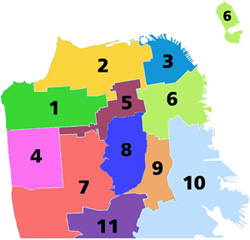
Right now, there are three districts that will generally elect a more conservative representative – D 2 (Michela Alioto-Pier) D- 4 (Carmen Chu) and D-7 (Sean Elsbernd). Districts 8, 10, 11 and 1 are swing districts, and the rest are going to go generally progressive.

So the odds are under this system that the left-leaning constituencies will have at least six votes, and in good times, as many as eight.

Now take four of those votes away, pretty much forever. Set it up so that four supervisors, elected citywide, will be guaranteed downtown call-up votes. Then add in one or two more from the more conservative districts, and you’ve got a majority.

That, my friends, is exactly what this is about, and any effort to frame it as anything else is just spin.

I asked Nevius what the hell he was doing buying the bogus argument that we need citywide perspective – since the district board has already demonstrated that, consistently. Here’s his response:

First, I’d envision the city-wide supes as made to order swing votes. When a district supervisor had a good idea, let’s say Healthy San Francisco, it might not be an issue of critical interest for a district supervisor. But it would be right in the wheelhouse for a city-wide official, who is looking for broad stroke issues to back. And, although you didn’t advance the idea, I’d reject the notion that whomever it was that was elected city-wide would be incredibly conservative and obstructionist. The most moderate politician we’ve elected in this city is Gavin Newsom. Although the Guardian doesn’t agree with him much of the time, he’s still advanced some very progressive ideas. Everyone jumps on the Chris Daly example as why district elections are a problem, but I think we can look beyond that. I think he’s been an aberration. District supes like David Campos and David Chiu have proved they can compromise and govern so I think that’s a good thing. I would never advocate that we get rid of representation in the neighborhoods. But c’mon, 11 little districts in a very small city? As Jim Stearns said, some of the districts are no more than a mile square. Combining some of them would still let residents have someone they could call to get the potholes fixed, but also spread out the areas.

Okay, I didn’t say citywide supes would be conservative. Sean Elsbernd is (relatively) conservative. He’s also independent of any big-money interest and does what he thinks is right. He doesn’t need half a million dollars to get elected in his district.

What I say is that citywide supes would be in hock to big money. I’ve seen it, lived with it. Suffered from it.

And guess what: Healthy San Francisco didn’t need any citywide supes; it passed just fine with the district board.

So what this is about is money and political control, and it’s about the political direction the city is going and who’s going to set that direction. Let’s get that straight and be honest about, and then we can have this discussion.

Restoring majority rule

0

Gov. Arnold Schwarzenegger’s lame duck response to California’s projected $20 billion state deficit has given supporters of more than 30 budget and revenue-related state initiatives now in circulation a renewed sense of urgency as they scramble to gather signatures and qualify proposed solutions to the state’s ongoing financial emergency for the November ballot.

But while this plethora of initiatives reflects widespread frustration over the state’s broken system of governance, disagreement rages over how to fix it and how best to restore majority rule to California.

“These are the hardest decisions a government must make, yet there is simply no conceivable way to avoid more cuts and more pain,” the governor told reporters Jan. 8 as he released a new budget proposal calling for $8.5 billion in cuts to state workers’ wages, health and human services, and prisons; a legally questionable $4.5 billion shift in other funds; and $6.9 billion in federal reimbursements that have yet to be approved.

Even steeper social services cuts are in the works, Schwarzenegger warned, if the feds don’t comply with this request for a bailout. But he refused to target corporations and millionaires as revenue sources, clinging instead to the standard Republican pledge not to raise taxes.

“We didn’t hear him say, ‘We are going to pinch the wealthy and the corporate,'<0x2009>” State Sen. Mark Leno observed. “He is definitely setting his sights on the social safety net.”

Recent revolts within the public university system, including the November takeover of UC Berkeley’s Wheeler Hall, suggest that tuition hikes, layoffs, and reduced study options have brought students to the tipping point.

But UC Berkeley linguistics professor George Lakoff fears that without restoring majority rule to the state’s budget and revenue-related measures, such revolts only address symptoms, not causes, of the impasse.

So Lakoff decided to author the California Democracy Act, an initiative that would replace the state’s two-thirds requirement on budget and revenue bills with a simple majority vote, after Sen. Loni Hancock invited him to meet with a group of Democratic state senators last spring.

“She said the Democrats were having problems getting anything done, and I went away saying, ‘this is ridiculous,'<0x2009>” Lakoff said. “It occurred to me that since the problem came by way of the initiative process, then it was possible to rectify it that way.”

Proposition 13, approved by voters in 1978, limited property tax increases and required a two-thirds supermajority in the Legislature to approve most new tax increase, measures that contributed mightily to the state’s bleak financial situation.

California also requires a two-thirds vote for the Legislature to approve the annual budget, along with only Arkansas and Delaware. On Jan. 5, Sonoma State philosophy professor Teed Rockwell told the Potrero Hill Democratic Club to endorse Lakoff’s initiative, noting that California is the only state to require two-thirds vote on budget and revenue bills.

“I have learned that essentially everything that is uniquely wrong with California results from this one fact,” Rockwell said.

California has the largest number of millionaires in the U.S., but as Rockwell observed, thanks to the fiscal stranglehold of the Republican minority, “We do not have enough money to keep our parks open or maintain affordable tuition at our public colleges. And the extremists in Sacramento want to solve this problem by decreasing taxes on millionaires and increasing taxes on the middle class.”

Rockwell noted that of the 22 states that produce oil in the U.S., all have oil severance taxes, including Sarah Palin’s Alaska and George W. Bush’s Texas — except California.

But while the California Democracy Act simply resolves that “all legislative actions on revenue and budget must be determined by a majority vote,” neither the state Democratic Party nor the major unions are willing to support Lakoff’s measure, citing its bad results in the polls.

Instead, veteran legislator and California Democratic Party Chair John Burton is backing a Hancock proposal that seeks to reduce to a simple majority the Legislature’s voting requirement on budget bills.

Lakoff warns that budget bills merely determine how to slice the pie, while revenue bills determine the size of the pie. This means that if Democrats succeed in only reforming the state’s budget voting requirements, they’ll still be stuck with having to make painful cuts.

But Hancock, who has been living with the results of this fiscal gridlock since she was elected to the state Assembly six years ago and helped sponsor the failed oil severance tax initiative in 2006, believes decisions to cut prison or education spending are not trivial.

“Last year Democrats gave $2 billion in tax breaks just to get one desperately needed Republican vote on the budget,” Hancock told the Guardian. “And now the Republicans are asking for takeaways on environmental and labor protections that they otherwise wouldn’t have any power to negotiate.”

“I am a realistic idealist,” Hancock continued. “I believe we are better off to get the majority vote to pass the budget. That way, the minority might begin to negotiate and have a more rational conversation. I’m very pleased that throughout the state, folks are recognizing that state governance is broken.”

California Tax Reform Association executive director Lenny Goldberg told us it’s hard to choose between the Lakoff and Hancock initiatives.

“It’s a question of what’s achievable, of how to focus energy,” Goldberg said. “Lowering the vote requirement for the budget would eliminate some of the hostage-taking and help reverse the corporate loopholes that the Democrats were forced to accept to get a budget passed. So at least it would make the budget process better.”

But he agrees that budget reform only makes the Democrats solely responsible for the budget, while preventing them from raising revenue.

“So there is some disagreement whether it’s better to do one, if you can’t do tax reform,” he said. “In the end, it’s a strategic, not substantive, question. Is it better to do budget alone, or not at all? Personally, I think we’re better off doing budget reform than nothing — but it’s a close call.”

Hancock and Lakoff both believe that a competing initiative, endorsed by Schwarzenegger and funded by the group California Forward, is the poison pill in the upcoming fiscal equation.

“Unfortunately, it’ll make it harder to raise fees,” Hancock said.

“It should be renamed California Backward,” Lakoff quipped, noting that while the California Forward initiative supports a simple majority on budget bills, it seeks to raise to two-thirds the voting threshold on new fees.

California Forward executive director Jim Mayer said his organization supported Prop. 11, the redistricting measure that passed in November 2008, “as a start to melt the political gridlock.

“And our two initiatives will help legislators do a better job of spending the pie,” Mayer added, noting that his group is talking to Democrats and Republicans as well as counties, cities, and branches of the Chamber of Commerce.

One of California Forward’s initiatives seeks to change the budget vote requirement to a simple majority and create a two-year budget cycle. It also forces the Legislature to use one-time revenues for one-time expenditures — and requires a two-thirds vote on fee increases, raising Democrat hackles.

“When the Legislature attempts to replace what’s currently a tax on utilities with a fee, currently they can do that with a simple majority. But people on the right tend to worry that if you eliminate a tax and call it a fee, it’s illegal,” California Forward spokesperson Ryan Rauzon explained.

The other initiative would allow county governments to identify priorities and raise revenue with a simple majority vote, Mayer said, a plan he claims is about “empowering local governments.”

Newsom’s corporate giveaway

0

By Steven T. Jones
state of city.jpg
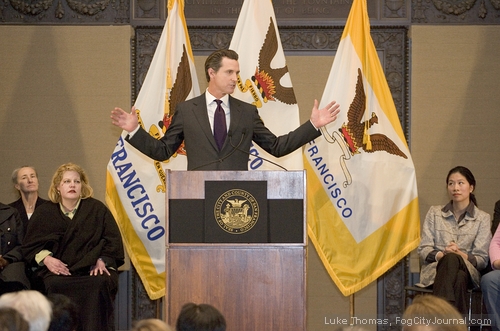
After going through a ridiculous security check (I waited 15 minutes for an “escort,” but they never even inspected my bag) to get into Mayor Gavin Newsom’s invite-only State of the City speech last night in the Asian Art Museum, I chatted with my colleague Melissa Griffin, the blogger and Examiner columnist, as Newsom worked the room.

The mayor eventually wound his way over to me, and when I turned to greet him, he gave me a playful shove, knocking me off balance and telling me, “Be nice!” Just minutes into his speech, in which he promoted corporate tax breaks and a discredited “local economic stimulus package,” I understood what he meant.

When he introduced this trickle-down economics initiative almost a year ago, we cited studies showing that it was a political gimmick that didn’t work and shot down Newsom’s claim that the city’s economist supported this giveaway of public funds to the private sector.

But last night, Newsom chided the Board of Supervisors for not scheduling hearings on his proposal to waive payroll taxes for new businesses and new jobs, create tax credits for health insurance costs, and extend current tax breaks for biotech companies, seemingly oblivious to the fact that such actions will add to the massive budget deficit that he barely mentioned.

The Chronicle today quoted gleeful Chamber of Commerce head Steve Falk and the chilly reaction that this strange initiative got from supervisors, but San Francisco Democratic Party chair Aaron Peskin went even further, this morning telling us, “I am so disappointed that the mayor of San Francisco is taking a page from the playbook of the Republican Party. This sounds like Ronald Reagan’s trickle down economics. In an era when some of the richest corporations have made zillions of dollars and the U.S. government just gave them zillions more, now we’re going to close hospitals and say we can’t pave our streets.”

The Big Zero – SF version

0

By Steven T. Jones
bfz001.jpg
I can’t stop thinking about Paul Krugman’s wonderfully biting recent commentary, “The Big Zero,” and his persuasive point that in the last decade, “we achieved nothing and learned nothing.” The Nobel laureate economist was talking about the national economy, but I think his point can also be applied to other realms as well, and specifically to San Francisco.

Sprawl development and over-reliance on the automobile have strained public resources and contributed to global warming, bad air quality, and diminished quality of life. The bursting of the housing bubble and its related lies shows clearly that most people can’t afford to buy a home and must rent. Stagnant wages, decimated 401Ks, and the dead promise that we’ll be OK if we work hard and play by the rules show that we’re all in the same boat, equally vulnerable to hard times and ultimately dependent on government and each other if things really get bad.

So what are we doing with these lessons learned? The core of this city’s housing policy is to simply let an untrustworthy, financially weak corporation, Lennar, build 16,000 homes – the vast majority for sale at pricey market rates – in the two most isolated parts of the city: southeast SF and Treasure Island (which will need to be severely hardened against rising seas). And to make it worse, Mayor Gavin Newsom’s big revenue idea is to let rich people buy their way out of the condo conversion lottery, further depleting the rental stock relied on by two-thirds of city residents.

We’re promoting shitty private sector jobs at all cost (including refusing to adequately tax big corporations) and cutting public sector jobs that have good pay and benefits without a thought, in the process hurting our public health and social service functions. Newsom is still taking his cues from the realtors, landlords and Chamber of Commerce – who have all been so obviously wrong in their advocacy this decade – and refusing to even meet with advocates for tenants, immigrants, environmentalists, and the working class, the very people who most need the help and attention of the Mayor’s Office.

To me, being a progressive simply means that we can do better, that we can progress, that we can learn from the past to improve the future. So Krugman’s insightful column should be a wake-up call, a needed reminder that the economic conservatives like Newsom have been dangerously wrong and that we need to chart a new course.

The battle for the DCCC is on

29

By Tim Redmond

The battle over the future of the Democratic Party in San Francisco is underway in earnest. The Building Owners and Managers Association (BOMA), which represents downtown property interests, is holding a forum Dec. 11 to talk about the Democratic County Central Committee — and, perhaps, kick off organizing for a downtown-backed DCCC slate.

The forum is in the board room of the Chamber of Commerce, which is also sponsoring the event.

Mayor Gavin Newsom and the downtown business community have been decidedly unhappy with the state of the panel that controls policy for the local party since a progressive slate led by Aaron Peskin took control in 2008. The DCCC often seems like a political footnote, but it has considerable influence: the committee decides on local party endorsements, putting the stamp of the Democratic Party behind candidates for local office. And the San Francisco Democratic Party slate card has been largely in the progressive camp the past two years.

The BOMA forum will feature two DCCC incumbents, Mary Jung and Scott Wiener, who are both in the moderate-centrist camp. Wiener told me he sees this just as an informational event, “to let people know what the committee does.” He said he knew of no political agenda behind the discussion. (Although, interestingly, Peskin — the chair of the local party — wasn’t invited to speak.)

Ken Cleaveland, BOMA’s director of governmental affairs, also said he was only out to educate his constituents. “Most of the business community doesn’t know what the DCCC does and doesn’t know why it’s important,” he told me. “We need to be aware of the influence it has.”

But he’s certainly not against using the meeting as an organizing platform: “I would love to see a pro-business slate happen,” he said. “The business community hasn’t been as organized as the progressives have in fielding slates.”

We all knew this was coming — but it’s a sign that the progressives will have to mount an even-more-serious campaign to hold onto control of the DCCC against what could be a well-funded assault in June.

Marching on Chevron

0

news@sfbg.com

GREEN CITY Although the 250-seat Roxie Theater auditorium was filled to capacity for the Nov. 1 screening of the controversial film “The Yes Men Fix the World,” the real action took place on the city’s streets when audience members took the film’s anticorporate message directly to an oil giant’s door.

Activists from Global Exchange co-organized the San Francisco film premiere to protest alleged human rights abuses and environmental devastation by Chevron Corporation, California’s largest corporation and the fifth largest in the world. The theatrical protest followed the film and ran from 16th Street to a Chevron station at Market and Castro streets.

Antonia Juhasz, director of Global Exchange’s Chevron Program, introduced the film, riling up the crowd when she said, “After viewing this film, we will be so inspired we won’t know what to do with ourselves. But we need to take this energy and direct it toward affecting change.”

The film chronicles the exploits of “Yes Men” Andy Bichlbaum and Mike Bonanno, following the pair as they perform various publicity stunts in an attempt to illustrate the greed and corruption of the free-market system and draw attention to their progressive causes.

Currently being sued by the U.S. Chamber of Commerce for recently staging a fake press conference on global warming, the duo have been called world-renowned troublemakers because of antics like announcing live on BBC that the Dow Chemical Company would finally clean up the site of the Bhopal, India, gas leak and compensate the victims.

Although the film does not directly reference Chevron, it aspires to hold corporations accountable for impacts to the communities they operate in. Juhasz said that although Chevron spends billions of dollars on advertising campaigns, it operates with blatant disregard for the environment.

Chevron spends less than 3 percent of its expenditures on alternative energy, operates a coal company, and is among the world’s largest corporate contributors to global warming, she said.

“We want to link communities in the struggle against this corporation, demanding policy changes and building pressure where Chevron operates,” Juhasz said. “By targeting one company, the whole industry is affected and eventually energy policies can be changed.”

The procession was led by protestors dressed as Chevron officials, cleaners, and absurd imaginary products. “Today we are demonstrating what Chevron is actually doing,” said Rae Abileah, grassroots coordinator for CodePink, the antiwar group that participated in the event. “We are just showing what a mockery this all is and that we can rise up as people to transform our world.”

As “I Will Survive” blared from speakers, the procession had a party-like atmosphere that attracted bystanders. Larry Bogad, an associate professor at UC Davis, came up with the concept and told us that “by using surprise, humor, imagination, and protest to engage people, we can stimulate thought and draw a deeper and wider attention to the issue.”

For David Solnit, organizer with the Mobilization for Climate Justice, the unusual nature of the event was exactly what made it so effective. “We are taking a popular film that deals with corporate power and trying to break down the barrier between consuming media and taking action,” he said.

Bichlbaum, one of the film’s stars, attended the protest and spoke about the importance of the grassroots movement. “If I can do it, anyone can … You need your feet and a bunch of friends. That is much more important than a business card.”

Juhasz said the destination for the procession was a symbolic choice. “This is an independently-owned Chevron station. The target is not the station, but a theatrical event to draw attention to the issue in the spirit of theater and fun.”

Although he didn’t attend the event, the station’s owner, David Sahagun, told the Guardian: “Employees told me that the crowd was well behaved and did a good job making their point.” As former president of the San Francisco Small Business Network, he stressed the struggles of locally-owned businesses in the face of large corporations and said he was “trying to be a community partner”

Chevron officials did not return calls seeking comment.

The lesson of California

0

news@sfbg.com

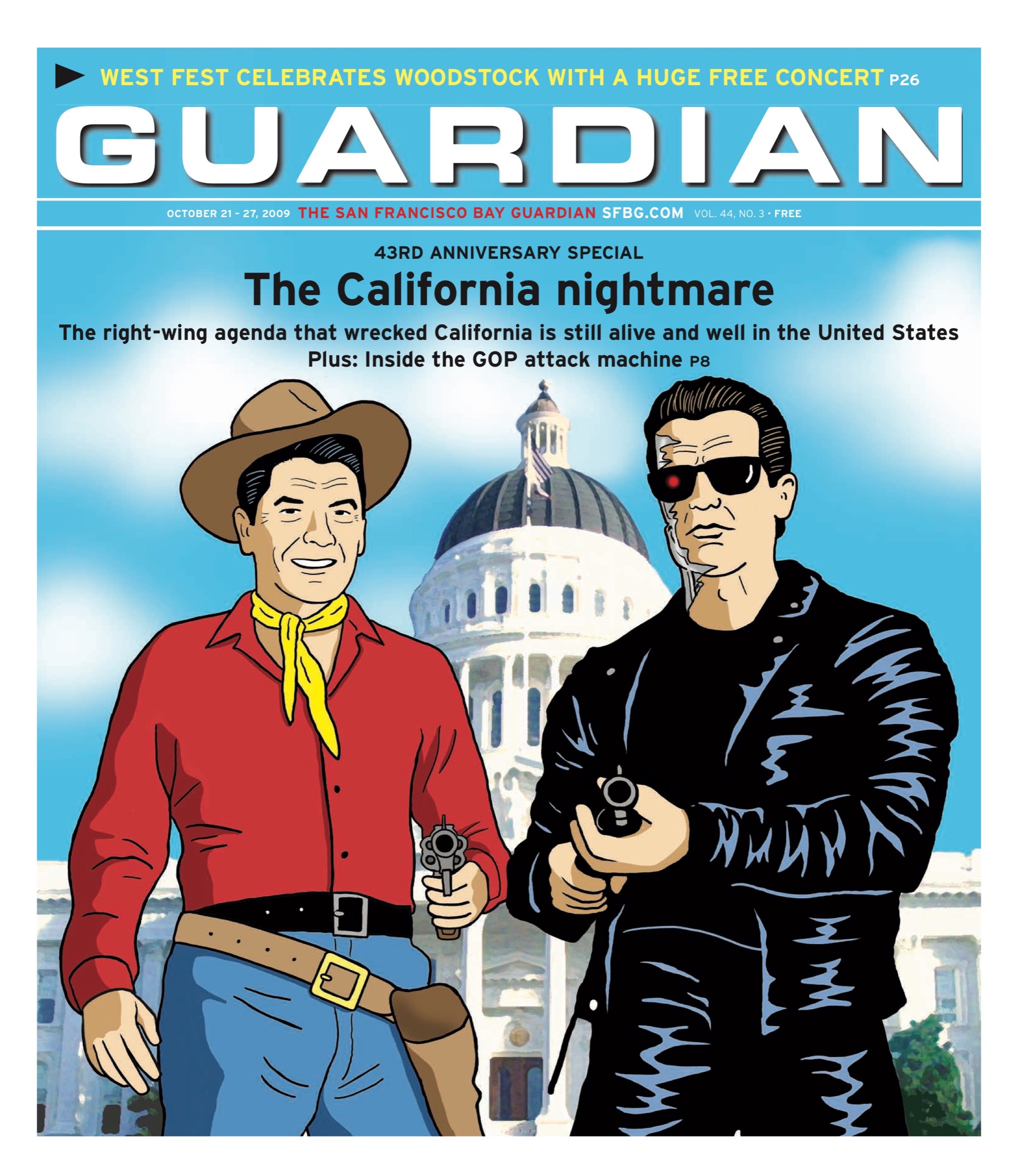
Much of the right-wing agenda that has thrown this nation into economic chaos can be traced back to what was once called the Golden State.

The tax revolts that started here under Gov. Ronald Reagan and continued to sweep the country and the world under President Reagan never abated. Indeed, they have only been strengthened by the big business power that created and benefited from them.

But now that California is showing signs of being the country’s first failed state — caught in fiscal freefall and mired in political gridlock as a generation’s worth of neglected problems surge to the surface — this state has become a cautionary tale for that anti-government ideology.

Trends in America tend to start out west, and the economic and political disaster that California has become contains critical lessons for the rest of the country.

Lewis Uhler — president and founder of the National Tax Limitation Committee — speaks candidly and proudly of his key early role in helping build a conservative movement to limit the size of government and do battle with those who want the public sector to actively promote social and economic justice.

Uhler, a UC Berkeley Boalt Hall School of Law graduate who did legal work for conservative causes in the 1960s, was tapped by then-Gov. Reagan in 1970 to be the director of the Office of Economic Opportunity, a federally-funded legal assistance program created as part of President Lyndon Johnson’s war on poverty.

While that may seem like a strange role for an avowed conservative and former member of the John Birch Society, Uhler says Reagan basically brought him in to wreck the program and fight the feds. “I was asked to put my money where my mouth was for my conservative philosophy,” Uhler told the Guardian. “OEO was set up to ensure conflict and confrontation … The mission of legal services was to change public policy through lawsuits they decided to file. I thought it was a corruption of the legal system.”

At the time, public-interest law and liberal economic and social policies were on the rise in California and spreading to the rest of the nation. So the Reaganites fought back.

Rather than helping poor plaintiffs file environmental, consumer protection, equal rights, or other types of lawsuits designed to level the playing field with powerful interests, Uhler blocked lawsuits brought by attorneys he calls “ambulance-chasers” and gutted the program. “Ultimately,” he said, “we vetoed funding for California Rural Legal Assistance.”

And for his efforts, Uhler was rewarded with a cabinet-level position: assistance secretary of the Health and Welfare Agency. Again, his role wasn’t to make the agency more effective, but to make it less effective in a realm where he believes government was too big and too active.

“The problem was uncontrolled state and local spending,” Uhler said. “Intuitively, everyone who gathered around Reagan shared the same philosophy that government doesn’t really contribute anything to economic growth.”

In 1972, Reagan gave Uhler the opportunity to work more directly on the mission of cutting taxes and shrinking the size of government, naming him chair of the Governor’s Tax Reduction Task Force. It was, in many ways, the beginning of the vast right-wing conspiracy.

“I asked to be given the chance to go across the country and find the best free market minds in the country to develop these policies,” Uhler said, explaining that he wanted to borrow the liberal strategy of giving an academic veneer to their ideas, as presidents Kennedy and Johnson had done in the realm of foreign policy. “Our side had never really done that.”

Uhler’s first stop was the University of Chicago School of Economics, where he met with noted free market economists Milton Friedman, James Buchanan, and George Stigler, who were brought into the cause.

Today’s vast network of conservative think tanks didn’t exist at that time, so Uhler tapped conservative thinkers from the American Enterprise Institute and the Hoover Institute at Stanford University, as well as other conservative economists such as Peter Drucker from Claremont McKenna College.

“There were 35 people who helped us design the first effort at a constitutional initiative in California to limit year-over-year growth of the state’s general fund,” Uhler said. “All of us as free market enthusiasts and economists all shared the belief that government beyond a certain level eats the seed corn of the nation and doesn’t produce anything.”

While voters narrowly rejected their group’s first effort to cap government growth — Proposition 1 on the November 1973 ballot — the ground had been prepared and the seeds had been sown for the tax revolts that would sweep the country in the late 1970s, with many of the campaigns coordinated by Uhler and the organization he formed for that purpose in 1975, the National Tax Limitation Committee, and a rapidly growing network of similar, interconnected organizations.

As Uhler worked with Reagan to weaken California’s government from within, his fellow travelers were developing national and international strategies to create aggressive, coordinated, well-funded campaigns to attack government and spread the free market dogma.

In August 1971, Lewis Powell — a conservative corporate attorney who President Richard Nixon had just nominated to the U.S. Supreme Court (where he served from 1972-87) — wrote a confidential memorandum to the leadership of the U.S. Chamber of Commerce titled “Attack on the American Free Enterprise System.”

He sounded the alarm that the ascendant environmental and consumer movements were going to destroy capitalism in the country unless corporate America aggressively fought back in a coordinated fashion, which he spelled out in great detail.

He called for all major corporations to develop aggressive legal and public relations strategies for fighting the left, creation of a network of think tanks and media outlets to push the conservative message, manipulation of the legal system, and sponsorship of university programs to study conservative ideas and incubate future leaders — which all came to pass in the coming decades.

“American business [is] ‘plainly in trouble’; the response to the wide range of critics has been ineffective and has included appeasement: the time has come — indeed, it is long overdue — for the wisdom, ingenuity, and resources of American business to be marshaled against those who would destroy it,” Powell wrote.

Part of that strategy involved having the federal government promote and popularize free market economic theories being developed by Friedman and his colleagues at the University of Chicago, a movement that is well-documented by journalist Naomi Klein in her book The Shock Doctrine: The Rise of Disaster Capitalism.

In 1971, Friedman and his colleagues began working with rich conservatives in Chile who were allied with Gen. Augusto Pinochet, who in turn were conspiring with the CIA to overthrow and assassinate the democratically elected, leftist President Salvador Allende, which they successfully did on Sept. 11, 1973.

Friedman’s economic theories called for a radical restructuring of society — slashing taxes and social spending; removing most regulation and trade restrictions; crushing labor unions; promoting economic growth at any cost — and Pinochet executed the strategy in brutal fashion, ordering the death of at least 3,200 of his political opponents, including the car-bomb assassination of economist Orlando Letelier in Washington, D.C., in 1976.

Friedman and Pinochet consulted openly and shared a basic disdain for social programs and progressive taxation. “The major error, in my opinion,” Friedman wrote in a letter to Pinochet in 1975, referring to the government antipoverty programs Pinochet dismantled, was “to believe that it is possible to do good with other people’s money.”

The model Pinochet and Friedman developed in Chile would eventually go global — promoted by its top cheerleaders, Reagan and British Prime Minister Margaret Thatcher — and be implemented (with disastrous results for most citizens but creating huge profits for wealthy individuals and corporations) in Indonesia, Bolivia, Argentina, Peru, Russia, Poland, South Africa, Japan, and elsewhere.

But with the corporate media and conservative opinion-shapers focused mostly on economic growth — ignoring persistent poverty and the brutal tactics used to suppress the popular movements that tried to resist Friedman’s “economic shock therapy” — Friedman had become a sort of free-market prophet by the time he died in 2006.

“In the torrent of words written in eulogy to Milton Friedman, the role of shocks and crises to advance his worldview received barely a mention,” Klein wrote. “Instead, the economist’s passing provided an occasion for a retelling of the official story of how his brand of radical capitalism became government orthodoxy in almost every corner of the globe.”

California’s fiscal shackles have been in place since 1978, when Proposition 13 and subsequent measures capped property taxes and required an undemocratic two-thirds vote to either raise taxes or pass the annual budget.

A Republican landlord lobbyist named Howard Jarvis charged onto the field that Reagan, Uhler, and their team had prepared and took advantage of a gaping hole in political leadership to set off a movement that would cripple the United States of America.

There was some logic to it then. Times were good in California in the 1970s, good enough that people were flocking to the state by the millions. That was driving up property values — and thus property taxes.

Jarvis bought his home for $8,000 in 1946; 30 years later, it was assessed at $80,000. In fact, inflation was running at close to 10 percent a year in California. Homeowners were getting huge tax hikes each year, and tenants were getting huge rent hikes at a time when state government had a budget surplus.

Homeowners saw millions of dollars sitting in the coffers in Sacramento while they couldn’t pay their tax bills. Yet nobody in the Legislature or governor’s office came up with a solution.

So when Jarvis showed up with petitions to roll back property taxes and prevent future increases, he found a broad base of support. Even tenants went along — Jarvis and his gang promised that property-tax cuts would be passed on to tenants and would mean the end of the escautf8g rent hikes.

Jarvis collected signatures for a radical measure that essentially blocked all property tax increases and allowed new assessment only when a parcel sold. It was, in the end, a huge tax giveaway to major corporations. Since commercial property turned over far less often than residential property (and since commercial sales could be hidden as stock transfers), big businesses wound up paying far less of the state’s tax burden. Corporations used to pay about two-thirds of the state’s property taxes, and individuals one-third; now that is reversed.

It didn’t help tenants, either. Few of the landlords who saw the benefits of Prop. 13 passed the money along to their renters. Most just kept it. San Francisco activist Calvin Welch likes to say that Howard Jarvis was “the father of rent control.”

The campaign against Prop. 13 warned of the dangers of cutting local government; police and fire chiefs appeared in ads opposing it. But the No on 13 folks never talked about the huge windfall big corporations would get from the measure, or the huge disparities in wealth that would be created by defunding government and dereguutf8g corporations.

If the goal was to skew the concentration of wealth in the state, it worked brilliantly. According to the California Budget Project (CBP) of the Franchise Tax Board, recent data taken before the current economic recession illustrates an ever-widening chasm between the wealthiest taxpayer and the working-class person.

The total adjusted personal income for Californians rose by nearly $64 billion in 2006-07 — with approximately three-quarters of that increase going to the top fifth of wealthiest taxpayers, and 30 percent going to the top 1 percent. That left only $19 billion for everyone else.

“The average taxpayer in the top 1 percent experienced a $128,261 increase in AGI [adjusted gross income] between 2006 and 2007, which was more than three times the total AGI of the average middle-income taxpayer in 2007 ($36,115),” stated the June 2009 report.

This continues a long-term trend in which the wealthy continue to leave the average income-earner behind in a trail of dollar-sign dust. From 1995 to 2007, income gains for that top 1 percent come to a whopping 117.3 percent increase — nearly 13 times more than the gains of the middle-income taxpayer.

The nation’s income gap has reached a “level higher than any other since 1917,” according to a paper by University of California, Berkeley economic professor Emmanuel Saez. According to Saez’s analysis of census data, there’s been a steady increase in the income gap since the 1970s, rising 20 percent over the years.

Yet even today, the defenders of Prop. 13 continue to sound the same consistent themes. “Those who are directly involved in government are a militant special interest,” Howard Jarvis Taxpayer Association executive director Kris Vosburgh told us. “They don’t like anything that limits their revenue stream.”

While that last statement could be applied equally to corporations or other private sector enterprises, as Vosburgh reluctantly admitted when asked, he continues to imply malevolence to those who defend government. He said the state’s current fiscal collapse can only be solved by slashing government expenditures.

“It is not valid to be talking about revenue-side solutions,” he said. “Our position is the state has enough money to accomplish its goals.”

People have never liked paying taxes, but the antitax movement is about far more than just that basic individual desire to hold onto our money.

The attacks were well planned, carefully targeted, and part of a much larger effort aimed at maintaining corporate and conservative power, undermining the New Deal, reducing taxes on the rich, and radically reducing the size and scope of the public sector.

As Powell called for, corporations have aggressively challenged, in legal courts and those of public opinion, every significant progressive advance — from San Francisco’s attempt at universal health care to California’s tentative first steps to address global warming.

With a level of discipline unheard of on the left, conservative opinion-shapers pound their talking points and enforce party unity through mechanisms like the “no new taxes” pledge that every Republican in the California Legislature has signed and heeded, under the very real threat of recall.

Opposition to taxes is now so deeply embedded into the psyche of the California electorate, and such a core tenet of today’s Republican Party, that elected officials who tout fiscal responsibility allowed the state’s debts to go unpaid (destroying its credit rating in the process) and its education and transportation systems to be decimated rather considering new revenues.

Gov. Arnold Schwarzenegger’s spokesperson Aaron McLear told us, “He believes we ought to live within our means and pay for only the programs we can afford.”

That simple talking point gets repeated no matter how the question is asked, or when we point out that it means we’re being forced to live within historic lows this year. But they claim the people support them.

“We had tax increases on the May ballot and they were rejected by a 2-1 margin. We should listen to the will of the voters,” McLear said.

Never mind that this regressive, dishonest package of temporary tax hikes was opposed by the Guardian and a variety of pro-tax progressive groups. McLear wouldn’t even admit that point or respond to it honestly.

And he’s certainly right that most polls show a majority of Californians don’t want new taxes. But these polls also show that people want continued government services, more investment in our neglected state infrastructure, and a whole bunch of other contradictory things.

That’s why newspapers and analysts around the world are looking at California, the world’s eighth largest economy, and wondering (as the Guardian of London headline asked Oct. 4): “Will California become America’s first failed state?”

In many ways, it already is. The question now is whether we’ll try to learn from and correct our mistakes. Ryan Riddle contributed to this report. ———–

THE CONSERVATIVE RELIGION

When I asked Lewis Uhler, one of the architects of the Reagan revolution, what Americans believed in these days — where the people he likes to talk about who hate the government (but are also admittedly disillusioned with Wall Street) turn — he answered simply: religion.

It should come as no surprise that many religious fundamentalists tend to side with the free market conservatives — both ideologies require a leap of faith and ignoring certain troubling facts, such as increasing disparities of wealth, natural resource depletion, and global warming.

Their arguments mostly make sense — until these inconvenient truths come up.

Certainly, turning over more public resources to free market capitalists, cutting taxes, and slashing government regulation will spur private sector economic growth, just as advocates claim.

But that growth has a cost. The wealth won’t be shared by everyone. Indeed, poverty has persisted even through even the economic boom of the 1990s — but almost everyone will be affected by underfunded road, education, public safety, and other essential systems.

As the conservative movement has successfully limited taxes and cut regulation over the last 40 years, working class wages have stagnated as the rich have gotten richer. Many of the world’s oil reserves have peaked and gone into decline, and rapidly increasing carbon emissions have collected in the atmosphere and caused global warming.

So how do conservatives respond to these realities as they argue for the continued dismantling of government, which is the only entity with the scope and incentive to deal with these problems? They simply deny them.

Uhler decried the “pseudoscience of climate change” as hindering economic progress and claimed that there’s actually been a global cooling trend in the last 10 years. (Actually the last 10 years have been some of the hottest on record, causing glaciers around the world to melt, according to data and observations from a consensus of the world’s climate scientists, including NASA, the Union of Concerned Scientists, and the United Nations Climate Change Conference.)

It’s the same story with the consolidation of wealth, which hurts the free market fantasy that letting the super-wealthy keep more money will eventually trickle down to benefit us all. Uhler simply denied the growing disparity of wealth, saying the “movement between quintiles is significant.”

He was talking about people’s ability to go from poor to rich with a little hard work and initiative, the core idea of free market conservatives. But data from the U.S. Census Bureau and many other entities indicate that median wages have been stagnant for decades (which wouldn’t be true if there was lots of upward mobility) and that most of the wealth created in the U.S. over the last 40 years has pooled with the top 1 percent.

In fact, when it comes to measuring social impacts, Uhler has simply one metric: “Governments at all levels are twice the size they should be to maximize economic growth.” (Steven T. Jones)


 

A tale of two hoaxes

1

by Rebecca Bowe

YesMen.jpg

Bonner & Ass 2.jpg

Politico has reported that the Yes Men, a left-leaning activist group that has created public-relations messes for big business before, fooled Reuters, CNBC, and the Washington Post this morning by issuing a fake press release from the U.S. Chamber of Commerce declaring that it had withdrawn its opposition to the climate-change bill.

This is from the fake press release:

“We believe that strong climate legislation is the best way to ensure American innovation, create jobs, and make sure the U.S. and the world are on track to reduce global carbon emissions, and to provide for the needs of the American business community for generations to come,” said the spokesman, Hingo Sembra.

“The new position is an about-face on climate policy for the Chamber, which previously lobbied against government action. The shift comes after the defection of several prominent members of the Chamber, including PG&E, Apple, PNM Resources, and Exelon.

Here’s the reaction from a Chamber of Commerce spokesman (as reported by Fox News) after the COC figured out they’d gotten punked:

“Public relations hoaxes undermine the genuine effort to find solutions on the challenge of climate change,” spokesman Thomas Collamore said. “These irresponsible tactics are a foolish distraction from the serious effort by our nation to reduce greenhouse gases.”

The Yes Men are self-styled pranksters, their media stunts are immediately recognized for being the bold political statements that they are, and they serve to amplify public pressure on crucial issues such as human rights or global warming. Although the Yes Men may have temporarily posed as Chamber of Commerce press contacts, it’s worth noting that there’s a huge difference between that media stunt and the AstroTurf hoax that PR firm Bonner & Associates evidently thought it could get away with this past summer.

The PR firm, which was tapped by the American Coalition for Clean Coal Energy (ACCCE), sent forged letters opposing the climate bill purporting to be from the National Association for the Advancement of Colored People (NAACP) and other minority groups. Bonner & Associates is now under Congressional investigation for the fake letters.

A popular term for this PR tactic is AstroTurfing: Creating the illusion of a grassroots campaign driven by ordinary people when in fact the campaign is a targeted attack powered by millions of dollars to advance a business agenda. And according to an article in the National Journal, AstroTurfing is on the rise.

According to a quote from a Congressional aide that appeared in that story:

“I think what we’ve seen, especially this summer with the energy and health care debates, is that AstroTurf has become much more widespread than I think we’ve ever seen it before … The American public is honestly confused about what is real and what is not.”

So while the Yes Men’s “foolish distraction” may have been successful in focusing attention on how big business is trying to block efforts to address climate change, don’t forget that they aren’t the only ones pulling a fast one — and the tricksters on the business side are trying to avoid the attention of the media, rather than attract it. By the way, there’s a movie coming out soon called The Yes Men Fix the World. It opens Oct. 30 in the Bay Area.

Endorsements

0

San Francisco is facing the worst budget crisis in modern history. More than 1,000 employees, mostly front-line workers in the Department of Public Health, have been laid off, and the red ink continues. Yet the only measure on the November ballot that would raise any money for the city is Sup. Bevan Dufty’s plan to sell off naming rights for Candlestick Park.

That’s pathetic. During the summer budget discussions, Mayor Newsom vowed to work with business, labor, and the supervisors to come up with a reasonable plan to bring in some new cash for the city. But that collapsed — largely because state law would have made it hard to raise taxes this fall without a unanimous vote of the supervisors. And while eight members were willing to put a revenue measure on the ballot, the three supervisors closest to the mayor — Sean Elsbernd, Carmen Chu, and Michela Alioto-Pier, all Newsom appointees — refused to go along. And the mayor made only a weak effort to change their minds.

So while Democrats everywhere decry Gov. Arnold Schwarzenegger’s insistence on a cuts-only budget, the Democratic mayor of San Francisco has forced essentially the same approach on this city. The only revenue increases we’re seeing are fees, like Muni fare hikes, that amount to taxes on the poor.

That’s the state of San Francisco as we head into what will almost certainly be a low-turnout election. Only two elected officials are on the ballot, and both are unopposed. Five ballot measures — several fairly significant — round out the local ballot. And with no big-name races at the top, they will win or lose on the votes of a small majority.

That’s too bad, because the issues matter. Vote Nov. 3 — and let’s hope next year’s ballot actually includes some new, progressive taxes.

OUR RECOMMENDATIONS


City Attorney

Dennis Herrera

San Francisco hasn’t always had a good track record with city attorneys. George Agnost, who ran the office in the 1970s and 1980s, was a dour, secretive, conservative lawyer who let downtown call all the shots. Louise Renne, who took over from Agnost, ran the office in the 1990s as if it was a wholly-owned subsidiary of Pacific Gas and Electric Co. Herrera, who took over in 2001, has been a major improvement. He’s turned the office into a modern operation, professionalized the administration, and taken on an activist role on consumer, environmental, and public-interest issues. He’s been a big supporter of marriage equality and of the city’s landmark health-care legislation. On his own initiative, he sued to end gender rating in health insurance and crack down on predatory payday lenders. He also moved to enforce health codes in housing and has been out front going after corrupt landlords like Skyline Realty.

We have some concerns about Herrera. Although he’s been far more sunshine-friendly than his predecessors, open-government activists are still sometimes forced to sue the city to get access to records. He won’t use his power as city attorney to enforce the Raker Act and bring public power to San Francisco. And during the current budget crisis, he cut the number of city attorney hours the supervisors can use to draft legislation.

And if, as rumored, he wants to run for mayor, Herrera needs to start taking public stands on major issues — like the unfairness of the local tax code and the need for new revenue.

But we’re happy to endorse him for another term.

Treasurer

Jose Cisneros

The incumbent treasurer is running unopposed, and we see no reason not to endorse him. He’s done some very positive things: Cisneros worked to get the big downtown law firms and other partnerships to pay their fair share of city taxes. He closed a tax loophole exploited by the big airlines that put up flight crews in local hotels.

He also convinced local banks and credit unions to accept consular identification cards to allow immigrants to open accounts and has pushed those institutions to offer "second-chance banking" to people with past credit problems. During his tenure, more than half of the 50,000 households in the city that lacked bank accounts have been able to get away from predatory check-cashing outfits and open legitimate accounts.

As an elected official, however, he could be doing a lot more. The city still keeps all its short-term accounts in one bank — Bank of America, which isn’t even local. Cisneros has promised to open that deal up to competitive bidding, but doesn’t have a timeline. And although nobody knows better than the treasurer how unfair and regressive the city’s tax codes are, he has never spoken out or offered any solutions. Cisneros says he wants his office to be apolitical, but city money is, by its nature, a political issue, and we’d like to see a little more leadership from the person who handles it. But overall, he’s a professional money manager who’s done a decent job and deserves another term.

Proposition A

Budget process

YES

We’re a little nervous about Prop. A, which would institute a two-year budget cycle for the city. Sup. Chris Daly, who opposes it, points out that the city controller’s budget projections are often wrong — badly wrong — and trying to plan 24 months ahead when economic conditions (and thus the city’s revenue stream) can change so quickly and unpredictably is a dangerous game.

But on balance, the approach in Prop. A makes sense. The budget debates would still take place every year, and the supervisors would still have to approve an annual budget — although the budget would be a rolling two-year projection. So next year, the board would approve a budget for 2010 and 2011, the following year for 2011 and 2012, and so on — leaving plenty of room for adjusting to meet economic changes. And two-year cycles might make it easier for nonprofits that rely on city funding to do some serious long-term planning.

Equally important, Prop. A requires the police and firefighters to negotiate their union contracts the same time the other unions do — before the budget deadline. The current system allows those unions to make demands that are unrelated to — and often outside — the current year’s budget realities.

Every progressive on the board except Daly supports this, and Sups. Alioto-Pier, Elsbernd and Chu oppose it.

Proposition B

Board of Supervisors aides

YES

This one’s a no-brainer. The City Charter mandates that each supervisor be allowed to hire two aides. The requirement dates back to a long-ago era when city budgets were far smaller, problems were less pressing and complex, and the supervisors worked part-time. It makes perfect sense to take such an archaic law out of the City Charter and allow the supervisors to set their own budgets — and staffing levels — the same way the mayor does. Vote yes.

Proposition C

Candlestick Park Naming Rights

NO

You have to give Sup. Bevan Dufty, the author of Prop. C, credit for trying. He’s looking for any angle he can use to help keep the 49ers in town, and allowing a corporate sponsor to pay for naming rights might possibly help cover the immense cost of substantially renovating aging Candlestick Park. And, like Prop. D (see below), this measure has a nice beneficiary: part of the money from naming rights would go to save the jobs of recreation directors, many of whom have faced budget-driven layoffs.

We agree that rec directors play a crucial role, particularly in neighborhoods with large numbers of at-risk youth. And we wish the Chamber of Commerce, Sup. Elsbernd, and other supporters of Prop. C were willing to accept some progressive tax hikes to fund those jobs.

But this isn’t a good deal. The city owns the stadium; the taxpayers financed its construction and spent 30 years paying off the bonds. But the 49ers, a private outfit owned by a very wealthy family, would get half the money from any naming deal. And the money that would come in would be radically short of what the team would need to rebuild the ‘Stick. Vote no.

Proposition D

Mid-Market special sign district

NO

Again: credit for the effort. David Addington, who owns the Warfield Theater and several other properties on mid-Market Street, accurately notes that the city’s main thoroughfare, between Fifth and Seventh streets, is rundown, ignored, and badly in need of an economic boost. He argues that allowing new digital billboards would create something of a Times Square in San Francisco, attracting tourists and turning mid-Market into a thriving theater district. Nothing else the city has done has worked — why not give this a try?

We aren’t necessarily opposed to digital billboards and we’d love to see mid-Market reinvigorated. But Prop. D would give too much authority to an unelected, unrepresentative group. It would amount to privatizing city planning and set a terrible precedent.

Under the measure, the Central Market Community Benefits District, a private group of property owners, organizations, and residents, would be authorized to approve new general advertising billboards as large as 500 square feet. The ads would have to meet city codes, but the Planning Department and supervisors would have no ability to block new installations. And the money — potentially millions of dollars a year — would go entirely to the property owners and the CBD, which would decide how to distribute it.

Yes, like Prop. C, this measure would help a worthy group: some of the new money would go to youth programs in the Tenderloin. But the process this measure describes isn’t at all democratic. The CBD board selects its own members, and the only oversight the city has is the ability of the Board of Supervisors to abolish the agency and start over.

We’re open to new ideas for central Market Street. We’re open to lights and ads and maybe even billboards. But we’re not willing to turn over zoning and public finance decisions to a private group. Vote no.

Proposition E

Advertisements on city property

YES

Proposition E, written by former Sup. Jake McGoldrick, would freeze new commercial billboards and ads on street furniture at 2008 levels and outlaw advertising on public buildings. It’s an extension of existing city policy, which seeks to limit the increasing blight of commercial ads in public space. Vote yes.

PG&E resigns from US Chamber over climate change dispute

0

By Steven T. Jones

While we’ve regularly criticized Pacific Gas & Electric for its corrupting political influence and for not doing enough on climate change, but we were happy to hear the company has resigned from the U.S. Chamber of Commerce over the business association’s scurrilous campaign to dispute that climate change is real and caused by human activity.

“An intellectually honest argument over the best policy response to the challenges of climate change is one thing; disingenuous attempts to diminish or distort the reality of these challenges is quite another,” PG&E CEO Peter Darbee wrote to the Chambers, according to the company.

The recent efforts by conservatives and corporations to turn back the clock on our understanding of climate change (which even the San Francisco Examiner is promoting) are disgraceful and should have no place in honest political debate. After a weird summer of right-wing Red-baiting, gun-toting, epithet-spewing antics, it’s an indication of how low the political discourse in this country has fallen when PG&E is calling out corporate America.

Corporations co-opt “local”

0

news@sfbg.com

HSBC, one of the biggest banks on the planet, has taken to calling itself "the world’s local bank." Winn-Dixie, a 500-outlet supermarket chain, recently launched a new ad campaign under the tagline "Local flavor since 1956." The International Council of Shopping Centers, a global consortium of mall owners and developers, is pouring millions of dollars into television ads urging people to "Shop Local" — at their nearest mall. Even Wal-Mart is getting in on the act, hanging bright green banners over its produce aisles that simply say "Local."

Hoping to capitalize on growing public enthusiasm for all things local, some of the world’s biggest corporations are brashly laying claim to the evocative word.

This new variation on corporate greenwashing — local-washing — is, like the buy-local movement itself, most advanced in the context of food. Hellmann’s, the mayonnaise brand owned by the processed-food giant Unilever, is test-driving a new "Eat Real, Eat Local" initiative in Canada. The ad campaign seems aimed partly at enhancing the brand by simply associating Hellmann’s with local food. But it also makes the claim that Hellmann’s is local, because most of its ingredients come from North America.

It’s not the only industrial food company muscling in on local. Frito-Lay’s new television commercials use farmers to pitch the company’s potato chips as local food, while Foster Farms, one of the largest producers of poultry products in the country, is labeling packages of chicken and turkey "locally grown."

Corporate local-washing is now spreading well beyond food. Barnes & Noble, the world’s top seller of books, has launched a video blog under the banner "All bookselling is local." The site, which features "local book news" and recommendations from employees of stores in such evocative-sounding locales as Surprise, Ariz., and Wauwatosa, Wis., seems designed to disguise what Barnes & Noble is — a highly centralized corporation in which decisions about what books to stock and feature are made by a handful of buyers — and to present the chain instead as a collection of independent-minded booksellers.

Across the country, scores of shopping malls, chambers of commerce, and economic development agencies are also appropriating the phrase "buy local" to urge consumers to patronize nearby malls and big-box stores. In March, leaders of a buy-local campaign in Fresno assembled in front of the Fashion Fair Mall for a kickoff press conference. Flanked by storefronts bearing brand names such as Anthropologie and the Cheesecake Factory, officials from the Economic Development Corporation of Fresno County explained that choosing to buy local helps the region’s economy. For anyone confused by this display, the campaign and its media partners, including Comcast and the McClatchy-owned Fresno Bee, followed the press conference with more than $250,000 worth of radio, TV, and print ads that spelled it out: "Just so you know, buying local means any store in your community: mom-and-pop stores, national chains, big-box stores — you name it."


THE REAL BUY-LOCAL MOVEMENT


In one way, all of this corporate local-washing is good news for local economy advocates: it represents the best empirical evidence yet that the grassroots movement for locally produced goods and independently owned businesses now sweeping the country is having a measurable impact on the choices people make.

"Think of the millions of dollars these big companies spend on research and focus groups. They wouldn’t be doing this on a hunch," observed Dan Cullen of the American Booksellers Association, a trade group which represents about 1,700 independent bookstores and last year launched IndieBound, an initiative that helps locally owned businesses communicate their independence and community roots.

Signs that consumer preferences are trending local abound. Locally grown food has soared in popularity. The United States is now home to 4,385 active farmers markets, a third of which were started since 2000. Food co-ops and neighborhood greengrocers are on the rise. Driving is down, while data from several metropolitan regions show that houses located within walking distance of small neighborhood stores have held value better than those isolated in the suburbs where the nearest gallon of milk is a five-mile drive to Target.

In city after city, independent businesses are organizing and creating the beginnings of what could become a powerful counterweight to the big business lobbies that have long dominated public policy. Local business alliances — such as San Francisco Locally Owned Merchants Alliance, Stay Local! New Orleans, and Phoenix’s Local First Arizona — have now formed in more than 130 cities and collectively count about 30,000 businesses as members.

In San Francisco, the buy-local movement is strong. Voters and elected officials have erected bureaucratic barriers to new chain stores, and citizens have used those tools to fend off even respectable chains such as American Apparel, which earlier this year tried unsuccessfully to open a store on über-local Valencia Street. The San Francisco Small Business Commission runs a buy-local campaign that was created in December by such unlikely partners as the Guardian, Mayor Gavin Newsom, and the San Francisco Chamber of Commerce (see "Shop local, City Hall," 5/6/09).

Through grassroots buy-local and local-first campaigns, these alliances are calling on people to choose independent businesses and local products more often. They also are making the case that doing so is critical to rebuilding middle-class prosperity, averting environmental collapse, keeping more money in the local economy, and ensuring that our daily lives are not smothered by corporate uniformity.

Surveys and anecdotal reports from business owners suggest that these initiatives are changing spending patterns. While the federal Department of Commerce reported that overall retail sales plunged almost 10 percent over the holidays, a survey in January by the Institute for Local Self-Reliance (where I work) found that independent retailers in cities with buy-local campaigns saw sales drop an average of just 3 percent from the previous year. Many respondents attributed this relative good fortune to the fact that more people are deliberately seeking out locally owned businesses.

CORPORATIONS TAKE NOTE


None of this has slipped the notice of corporate executives and the consumer research firms that advise them. Several of these firms have begun to track the localization trend. In its annual consumer survey, the New York–based branding firm BBMG found that the number of people reporting that it was "very important" to them whether a product was grown or produced locally jumped from 26 to 32 percent in the last year alone. "It’s not just a small cadre of consumers anymore," said founding partner Mitch Baranowski.

Corporate-oriented buy-local campaigns that define "local" as the nearest Lowe’s or Gap store are now being rolled out in cities nationwide. Some represent desperate bids by shopping malls to survive the recession and fend off online competition. Others are the work of chambers of commerce trying to remain relevant. Still others are the half-baked plans of municipal officials casting about for some way to stop the steep drop in sales tax revenue.

Many of these Astroturf campaigns are modeled directly on grassroots initiatives. "They copy our language and tactics," said Michelle Long, board president of the San Francisco–based Business Alliance for Local Living Economies and executive director of Sustainable Connections, a seven-year-old coalition of 600 independent businesses in northwest Washington state that runs a very visible and — according to market research — very successful local-first program. "I get calls from chambers and other groups who say, ‘We want to do what you are doing.’ It took me a while to realize that what they had in mind was not what we do. Once I realized, I started asking them, ‘What do you mean by local?’ "

Examples abound. In Northern California, the Arcata Chamber of Commerce is producing "Shop Local" ads that look similar to the Humboldt County Independent Business Alliance’s "Go Local" ads, except they feature both independents and chains. Spokane’s "Buy Local" program, started by the chamber, is open to any business in town, including big-box stores. Log on to the "Buy Local" Web site created by the chamber in Chapel Hill, N.C., and you will find Wal-Mart among the listings.

But there’s a huge difference — even on strictly economic grounds — between shopping at a local chain store and a locally owned store. Studies have shown that $45 of every $100 spent at locally owned stores stays in the community, helping other local businesses and supporting government services, whereas only about $13 of every $100 spent in chain stores remains local.

When the city of Santa Fe, N.M., decided to launch a campaign to encourage people to shop locally, the Santa Fe Alliance, a coalition of more than 500 locally owned businesses that has been running a buy-local initiative for several years, signed on. At the kickoff in March, the alliance’s director, Vicki Pozzebon, emphasized the economic impact of shopping at a locally owned business versus a chain.

"After that, the city asked me not to push the $45 versus $13, but just say ‘local.’ " Pozzebon said.

The city’s message, according to Kate Noble, a city staffer who runs the program, is that shopping at Wal-Mart is fine, as long as it’s not Walmart.com. But Pozzebon said, "It has only diluted our message and confused people."

These sales tax–driven campaigns may well be doing more harm to local economies than good, according to Jeff Milchen, co-founder of the American Independent Business Alliance. "If you encourage people to shop at a big-box store that takes sales away from an independent business, you’re just funneling more dollars out of town."

The irony of trying to solve declining city revenue by trying to get people to shop at the local mall is that the mall itself may be the problem. While many California cities are facing budget cuts and even bankruptcy, Berkeley has managed to post a small increase in revenue. Part of the reason, according to city officials, is that Berkeley has more or less said no to chains and is instead a city of locally owned businesses that primarily serve local residents. That creates a much more stable revenue base. Berkeley hasn’t benefited from the temporary boom that a new regional mall might create, but neither has it gone bust.
Stacy Mitchell is a senior researcher with the New Rules Project (www.newrules.org) and author of Big-Box Swindle: The True Cost of Mega-Retailers and the Fight for America’s Independent Businesses (Beacon, 2006). This story was commissioned by the Association of Alternative Newsweeklies (AAN), of which the Guardian is a member, and is also running in other AAN papers this month.