Cars

Seizing space

0

steve@sfbg.com; molly@sfbg.com

San Francisco’s streets and public spaces are undergoing a drastic transformation — and it’s happening subtly, often below the radar of traditional planning processes. Much of it was triggered by the renegade actions of a few outlaw urbanists, designers, and artists.

But increasingly, their tactics and spirit are being adopted inside City Hall, and the result is starting to look like a real urban design revolution — one that harks back to a movement that was interrupted back in the 1970s.

One of the earliest signs of the new approach emerged in 2005 on the first Park(ing) Day, the brainchild of the hip, young founders of the urban design group Rebar. The idea was simple: turn selected street parking spots around San Francisco into little one-day parks. Just plug some coins in the meter to rent the space, then set up chairs or lay down some sod, and kick it.

It was a simple yet powerful statement about how San Franciscans choose to use public space — and the folks at Rebar expected to get in trouble.

“When we did the first Park(ing) Day in 2005, JB [a.k.a. John Bela] and I were just prepared to be arrested and hauled into court,” Rebar’s Matthew Passmore told us at a recent interview in the group’s new Mission District warehouse space. “But nothing like that happened.”

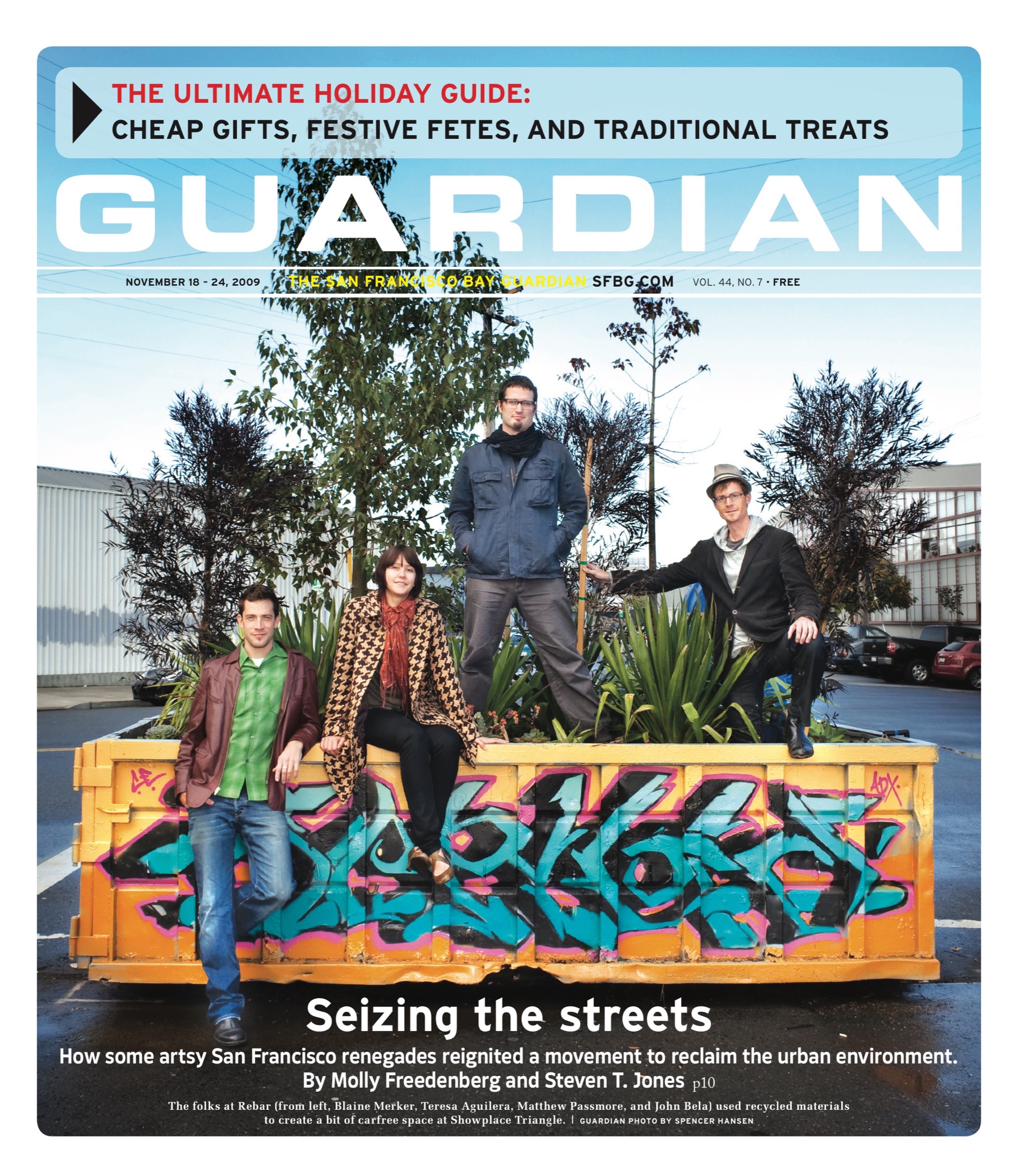
Instead, City Hall called. 079_realcover.jpg Rebar’s Blaine Merker, Teresa Aguilera, Matthew Passmore, and John Bela at their carfreee space at Showplace Triangle

“We got a call from the director of city greening, who said this is great, I want to meet with you guys and talk about how the city can support this kind of activity,” Passmore said. “Much to our surprise, the city was totally responsive as opposed to shutting us down and imprisoning us.”

Bela said the group discovered that Mayor Gavin Newsom’s administration was looking for just the sort of innovative, cool, environmental ideas that were Rebar’s focus. And that connection merged with other people’s efforts — like sidewalk-to-garden conversions being pioneered by Jane Martin, the urban gardening and bicycling movements, and the unique public art that was making its way back from Burning Man. That created a catalyst for a wide array of city initiatives, from the Sunday Streets road closures to temporary art installations that began popping up around the city to the Pavement to Parks program that creates short-term parks in underutilized roadways.

“It was a single interaction five years ago, and now we have things like Sunday Streets,” Bela told us on Sept. 18’s Park(ing) Day, in which various individuals and groups took over more than 50 parking spots around town. “It’s about reclaiming the streets for people.”

Park(ing) Day itself blew up, becoming a worldwide phenomenon that is now in 151 cities on six continents, and one that the Mayor’s Office is planning to turn into a more permanent plan, with the regular conversion of some parking spots on commercial corridors into outdoor seating areas.

“You had a few guys and a girl who had an idea and now it’s an international event,” Mike Farrah, a longtime Newsom lieutenant who now heads the Office of Neighborhood Services and has been the main contact in City Hall for Rebar and similar groups, told the Guardian.

Locally, the success of events like Park(ing) Day have changed San Francisco’s approach to urban spaces, particularly on land left dormant by the economic downturn. Rebar, the permaculture collective Upcycle, and former MyFarm manager Chris Burley plan to turn the old Hayes Valley freeway property near Octavia, between Oak and Fell streets, into a massive community garden and gathering space. Plans are being hatched for temporary uses on Rincon Hill properties approved for residential towers. “Green pod” seating areas are sprouting along Market Street and there are plans to extend the Sunday Streets road closures next year. And, perhaps most amazingly, most projects are being accomplished with very little funding.

How has San Francisco suddenly shifted into high gear when it comes to creating innovative new public spaces? The key is their common denominator: they’re all temporary. As such, they don’t require detailed studies, cumbersome approval processes, or the extensive outreach and input that can dampen the creative spark.

But San Francisco is starting to prove that dozens of short-term fixes can add up to a true transformation of the urban environment and the citizenry’s sense of possibility.


EVOLUTION OF THE PRANK

Rebar began as a group of friends and artists who came together to enter a design contest in 2004. Passmore was a practicing lawyer and Bela was a landscape architecture student at UC Berkeley. They chose the name Rebar for future collaborations, the first of which was Park(ing) Day.

Passmore, who had a background in conceptual art before going to law school, discovered a legal loophole that might allow for anything from a burlesque performance to a temporary swimming pool to be installed in metered parking spaces. Bela recruited Blaine Merker, a fellow landscape architecture student with whom he’d won a design competition, to join the effort.

Park(ing) Day was a hit, getting great press and igniting people’s imaginations. “We realized after we did it, like, oh, people are really getting this,” Merker said. And Rebar was off. In the following years they added a fourth principal, graphic designer Teresa Aguilera, and took on a number of acclaimed projects: planting the Victory Garden in Civic Center Plaza, building the Panhandle Bandshell from old car hoods and other recycled parts, creating COMMONspace events (from “Counterveillance” to the “Nappening”) in privately-owned public spaces, and designing the Bushwaffle (commissioned for the Experimenta-Design biennale in Amsterdam) to help soften paved urban spaces and create a sense of play.

Through it all, the group maintained its prankster spirit. When they were invited to present the Bandshell project at the prestigious Venice Biennale festival, Rebar members showed up costumed as Italian table-tennis players (a joke that mostly baffled other attendees, they said).

They told us every project needed to have a “quotient of ridiculum.” Or as Bela put it, “That’s how we know project has evolved to the right point — when we’re on the floor laughing.”

As Rebar found success, it was still mostly a side project for members who had other full-time jobs. “We were all playing hooky all the time,” said Merker, who, like Bela, joined a landscape architecture firm after he finished school. “It just got worse and worse.”

So now, they’re trying to turn their passion into a profession, recently moving into a cool warehouse office and workspace in the Mission. “We’re shifting our practice a little to have the same sort of spirit but trying to figure out how we can make that an occupation,” Merker said.

It’s also about moving from those short-lived installations to something a little more lasting, even while working within the realm of temporary projects. As Aguilera said, “A lot of the projects we started with were creating moments to maybe think about. But we’re shifting into more permanent ways to interact with the city.”

They may not be sure where they’re headed as an organization, but they have a clear conception of their canvas, as well as the traditions they draw from (including movements like the Situationists and artists such as Gordon Matta-Clark, who worked in urban niche spaces) and the fact that they are part of an emerging international movement to reclaim and redesign urban spaces.

“We’re not the originators of any of this stuff,” Bela said. “It’s like emerging phenomena happening in cities all over the world. We just happened to have plugged into it early on and we continue to push it.”


EXPANDING THE POSSIBLE

Rebar is strongly pushing a reclamation of spaces that have been rather thoughtlessly ceded to the automobile over the last few decades. “Street right-of-way is 25 percent of the city’s land area. A quarter of the city is streets,” Bela said. “And those streets were designed at the time when we wanted to privilege the automobile.

“So basically, there’s all this underutilized roadway,” he continued. “It’s asphalt and it’s pavement, and the city wants to reclaim some of those spaces for people. That’s a thread we’ve been exploring in our work for a long time, and now it’s elevated up to a citywide planning objective.”

The short-term nature of the projects comes in part from political necessity: temporary projects are usually exempt from costly, time-consuming environmental impact reports. Demonstration projects also don’t need the extensive public input that permanent changes do in San Francisco. But there’s more to the philosophy.

“It stands on this proposition that temporary or interim use does actually improve the character of the city,” Passmore said. “People used to think that if something is temporary or ephemeral, what good is it? It’s just here today, gone tomorrow. But I think now people are realizing that the city can be improved like this.”

And it goes even deeper than that. When people see parking spaces turned into parks, vacant lots blossoming with art and conversation nooks, or old freeway ramps turned into community gardens, their sense of what’s possible in San Francisco expands.

“What we’re remodeling is people’s mental hardware. It’s like stretching. You have to bend something a little more than it wants to go, and the next time you do that, it’s that much easier,” Merker said.

“There’s also a psychological aspect to that. When people see a crack in the Matrix open up, if you will, it can open up a whole lot more than just that one moment,” he said.

For those who have been working on urbanism issues in San Francisco for a long time, like Livable City director Tom Radulovich, this new energy and the tactic of conditioning people with temporary projects is a welcome development. “There is a huge resistance to change in San Francisco, no matter what the change is, and a lot of that stems from fear,” Radulovich said. But with temporary projects, he said, “you can establish what success looks like from the outset.”


BUILDING ALLIANCES

The Rebar folks have been fairly savvy in their approach, making key friends inside City Hall, people who have helped them bridge the gap between their idealism and what’s possible in San Francisco.

“We are a process-driven city, and temporary allows you to create change without fear,” Farrah told us. He said the partnership between the Mayor’s Office and community groups that want to do cool, temporary public art really began in the summer of 2005 with the Temple at Hayes Green by longtime Burning Man temple builder, David Best.

Farrah had connections to the Burning Man community, so he facilitated the placement of the temple along Octavia Boulevard, then one of the city’s newest and least developed public spaces. Next came the placement of another Burning Man sculpture, Flock by Michael Christian, in Civic Center Plaza that fall. Both projects got funding and support from the Black Rock Arts Foundation, a public art outgrowth of Burning Man.

“I saw, after some of the temporary art and special events, how it’s changed people’s ideas about what’s possible,” Farrah said. “There has been a change in the way people view the streets.”

That got Farrah thinking about what else could be done, so he approached BRAF’s then-director Leslie Pritchett and Rebar’s Bela, telling them, “I need you to look at San Francisco like a canvas. Tell me the things you want to do, and I’ll tell you if it’s possible or not. And that’s led to a lot of cool stuff.”

Livable city advocates like Radulovich — progressives who are generally not allied with Newsom and who have battled with him on issues from limiting parking to the Healthy Saturdays effort to create more carfree space in Golden Gate Park — give the Mayor’s Office credit for its greening initiatives.

He credits Greening Director Astrid Haryati and DPW chief Ed Reiskin with facilitating this return to urbanism. “He’s really responsive and he gets it,” Radulovich said of Reiskin. “This is really where a lot of energy is going in the mayor’s office. It seems to have captured their imaginations.”

Another catalyst was last year’s visit by New York City transportation commissioner and public space visionary Janette Sadik-Khan, who met with Reiskin and Newsom on a trip sponsored by Livable City and the San Francisco Bicycle Coalition. Radulovich said her message, which SF has embraced, is that, “There are low-cost, reversible ways you can reclaim urban space in the near term.”

The Mayor’s Office, SFBC, and Livable City partnered last year to create Sunday Streets, which involved closing streets to cars for part of the day. The events have proven hugely successful after overcoming initial opposition from merchants who now embrace it.

Then there’s the Pavement to Parks program — which involves converting streets into temporary parks for weeks or months at a time — that grew directly from the Sadik-Khan visit. Andres Power, who directs the program for the Planning Department, told us the visit was a catalyst for Pavement to Parks: “She came to the city a year ago and inspired my director, Ed Reiskin.”

“We’re rethinking what the streets are and what they can be,” Power said. “It’s rewarding to see this stuff happen and to be at the forefront of a national effort to imagine what our streets could be.”


DE-PAVE THE CONCRETE

Pavement to Parks launched last year, a multiagency effort with virtually no budget, but the mandate to use existing materials the city has on hand to turn underutilized streets into active parks. “It looks at areas where we can reclaim space that’s been given over to cars over the decades,” Power told the Guardian.

At the first site, where 17th Street meets Market and Castro, the city and volunteer groups used planters and chairs to convert a one-block stretch of street that was little-used by cars because of the Muni line at the site.

“We bent over backward to make the space look temporary,” Power said, noting the concern over community backlash that never really materialized, leading to two time extensions for the project. “But we’re now ready to revamp that whole space.”

Another Pavement to Parks site at Guerrero and San Jose streets was created by Jane Martin, whom Newsom appointed to the city’s Commission on the Environment in part because of the innovative work she has done in creating and facilitating sidewalk gardens since 2003.

As a professional architect, Martin was used to dealing with city permits. But her experience in obtaining a “minor sidewalk encroachment permit” to convert part of the wide sidewalk near a building she owned on Shotwell Street into a garden convinced her there was room for improvement.

“At that point, I was really jazzed with the result and response [to her garden] and I wanted to make it so we could see more of it,” she said. So she started a nonprofit group called PlantSF, which stands for Permeable Lands As Neighborhood Treasure. Martin worked with city agencies to create a simpler and cheaper process for citizens to obtain permits and help ripping up sidewalks and planting gardens.

“We want to de-pave as much excess concrete as possible and do it to maximize the capture of rainwater,” she said.

Martin said the models she’s creating allow people to do the projects themselves or in small groups, encouraging the city’s DIY tradition and empowering people to make their neighborhoods more livable. More than 500 people have responded, creating gardens on former sidewalks around the city.

“We’ll get farther faster with that model,” she said. “It’s really about engaging people in their neighborhoods and helping them personalize public spaces.”

San Francisco has always been a process-driven city. “We in San Francisco tend to plan and design things to death, so as a result, everything takes a very long time,” Power said.

But with temporary projects under Pavement to Parks, the city can finally be more nimble and flexible. Three projects have been completed so far, and the goal is to have up to a dozen done by summer.

“We’re working feverishly to get the rest of the projects going,” Power said.

One of those projects involves an impending announcement of what Power called “flexible use of the parking lane” in commercial corridors like Columbus Avenue in North Beach. “We’re taking Park(ing) Day to the next level.”

The idea is to place platforms over one or two parking spots for restaurants to use as curbside seating, miniparks, or bicycle parking. “The Mayor’s Office will be announcing in the next few weeks a list of locations,” Power said. “There have been locations that have come to us asking for this.”

“The idea is to do a few of these as a pilot to determine what works and what doesn’t. The goal is to use their trial implementation to develop a permanent process,” Power said. “We want to think of our street space as more than a place for cars to drive through or park.”

Rebar was responsible for the last of the completed Pavement to Parks projects. Known as Showplace Triangle, it’s located at the corner of 16th and Eighth streets in the Showplace Square neighborhood near Potrero Hill. For Rebar, it was like coming full circle.

“We started doing this stuff about five years ago, finding these niches and loopholes and exploring interim use as a strategy for activating urban space,” Bela said. “And to our surprise, what we perceived as a tactical action is now being embodied by strategic players like the Planning Department.”


REUSE, RECYCLE, REINVENT

The Rebar crew was like kids in a candy store picking through the DPW yard.

“These projects are all built with material the city owns already, so we had the opportunity to go down to the DPW yard and inventory all of these materials they had, and figure out ways to configure them to make a successful street plaza,” Bela said.

So they turned old ceramic sewer pipes into tall street barriers topped by planter boxes, and built lower gardens bordered by old granite curbs.

“We are trying to be as creative as possible with the use of materials the city already has on hand,” Power said. In addition to the DPW yard that Rebar tapped for Showplace Triangle, Power said the Public Utilities Commission, Port of SF, and the Recreation and Parks Department all have yards around the city that are filled with materials.

“They each have stockpiles of unused stuff that has accumulated over the years,” he said.

For her Pavement to Parks project on Guerrero, Martin used fallen trees that originally had been planted in Golden Gate Park — pines, cypress, eucalyptus — but were headed for the mulcher. Not only were they great for creating a sense of place, they offered a nod to the city’s natural history.

But perhaps the coolest material that had been sitting around for decades was the massive black granite blocks that Rebar incorporated into Showplace Triangle. “One of the most interesting materials that we used in Showplace Triangle was the big granite blocks from Market Street that were taken off because merchants didn’t like people encamping there. They were too successful as spaces, so they got torn out,” Merker said.

Bela said they couldn’t believe their eyes: “We saw these stacks of five-by-five by one-foot deep black granite. Just extraordinary. If we were to do a public project today, we could never afford that stuff. There’s no way. But the taxpayers bought that stuff back in the ’70s and now it’s just sitting there in the DPW yard. It’s a crime that it’s not being used, so it was great to get it back out on the street.”

Radulovich said the return of the black granite boxes to the streets represents the city coming full circle. He remembers talking to DPW manager Mohammad Nuru as he was removing the last of them from Market Street in the 1970s, citing concerns about people loitering on them.

“To see them put up again in JB’s project was symbolic of where the city went and where it’s coming back from,” Radulovich said. “It’s almost like the livability revolution got interrupted and we lost two decades and now it’s picking up again.”

Back in the 1970s, Radulovich said the city was actively creating new public spaces such as Duboce Triangle. It was also creating seating along Market Street and generally valuing the creation of gathering places. But in the antitax era that followed, public sector maintenance of the spaces lagged and they were discovered by the ever-growing ranks of the homeless that were turned loose from institutions.

“The fear factor took over,” Radulovich said. “We did a lot to destroy public spaces in the ’80s and ’90s.”

But by creating temporary public spaces, people are starting to realize what’s been lost and to value it again. “These baby steps are helping us relearn what makes a good public space,” Radulovich said.

For much of the younger generation, building public squares is a new thing. As Aguilera noted, “We don’t have a lot of public plazas anymore or places for people to gather. When Obama was elected, where did everyone go in the city? Into the streets. So we’re trying to give that back to the city.”


CARS TO GARDENS

Perhaps the most high-profile laboratory for these ideas is the Hayes Valley Farm, a temporary project planned for the 2.5 acres of freeway left behind after the Loma Prieta earthquake. The publicly-owned land between Oak and Fell streets is slated for housing projects that have been stalled by the slow economy.

“The site’s been vacant for 10 years. They came up with a beautiful master plan. And the moment they’re ready to move on the master plan, there’s an economic collapse, so nothing is happening,” Bela said.

In the meantime, the Mayor’s Office and Hayes Valley Neighborhood Association pushed for temporary use of the neglected site. They approached the urban farming collectives MyFarm and Upcycle. Later, Rebar was brought in to design and coordinate the project.

Now the group known as the Hayes Valley Farm Team has an ambitious plan for the area: part urban garden, part social gathering spot, and part educational space. There will be an orchard of fruit trees, a portable greenhouse, demonstrations on urban farming, and a regular farmers market.

“The different topography of ramps allows for different growing conditions. These ramps are prime exposure to the south,” Merker said. “They create these areas that can produce some really great growing conditions, so it’s kind of funny that this freeway is responsible for that. The ramps actually create different microclimates.”

Most remarkably, the whole project is temporary, designed to be moved in three years. “We’re interested in developing infrastructure and tools and machinery and implements that are sort of coded for the scale of the city: a lot of pedal-powered things, a lot of mobile infrastructure, and smaller things that are designed to be useful in a plot that is only 2.5 acres,” Bela said. “Then when we need to move on, we’ll be able to do that. It’s about being strategic with some of the investments so we can take some of the tools we develop here and move it to the next vacant lot down the street.”

The project has lofty goals, ranging from creating a social plaza in Hayes Valley to educating the public about productive landscaping. “We’re getting away from ideas of turning parks into food production — it can be both,” said David Cody of Upcycle. “We want to just crack the awareness that cities can be multi-use and agriculture doesn’t mean farm.”

This is perhaps the most ambitious temporary project the Mayor’s Office has taken on. “Rebar pushed the envelope on what is possible. I told them it would be a tough one,” Farrah said of the project. But he loves the concept: “You can argue that putting gardens in temporary spaces changes attitudes.”

Symbolically, this land seems the perfect place for such an experiment. “This really is a special spot. If you look at a map of the city, Hayes Valley is in the very center, and this is right in the heart of Hayes Valley,” Aguilera said. “And right now, in the heart of a neighborhood in the heart of the city, there’s this vacant, fallow reminder of what used to be there. We’re looking to turn it into a new beating heart that brings together lots of different parts of the community.”


ACTIVATING DORMANT SPACES

Activating dormant spaces in the city isn’t easy, particularly for properties with pending projects. In Hayes Valley, for example, the Rebar crew was required to develop a detailed takedown plan.

“A lot of development is hesitant to get involved with these interim uses because at the end, they’re worried that it’s going to be framed as the evil, money-hungry developer coming in to kick out artists or farmers,” Passmore said. “But the reality is, they are very generously opening up their space is the first place.”

With last year’s crash of the rental estate and credit markets, development in San Francisco stalled, leaving potentially productive land all over the city. “As the city has gone through an economic downturn, like now, the city has a lot of vacant lots with developer entitlements on them, but nothing is being built right now. Those are spaces the public has an interest in,” Merker said, citing Rincon Hill as a key example.

Michael Yarne, who facilitates development projects for the Mayor’s Office of Economic Development, has been working on how developers might be encouraged to adopt temporary uses of their vacant lots.

“How can we credit them to do a greening project on a vacant lot?” Yarne asks, a problem that is exacerbated by the complication that neither the developers nor local government have money to fund the interim improvements.

He looked at the possibility of using developer impact fees on short-term projects, but there are legal problems with that approach. The courts have placed strict limits on how impact fees are charged and used, requiring detailed studies proving that the fees offset a project’s real cost and damage.

“But there is other value we can give as a city without spending a dollar — and that is certainty,” said Yarne, a former developer. He said developers value certainty more than anything else.

Right now, developers have to return to the Planning Commission every year or so to renew project entitlements, something that costs time and money and potentially places the project at risk. But he said the city might be able to enter into developer agreements with a project proponent, waiving the renewal requirement for a certain number of years in exchange for facilitating short-term projects.

“Everyone wins. We get a short-term use, and the developer gets certainty that they won’t lose their rights,” Yarne said, noting that he’s now developing a pilot project on Rincon Hill. “If that works, that could be a template we could use over and over.”

Radulovich is happy to see the new energy Rebar and other groups are infusing into a quest to remake city streets and lots, and with the use of temporary projects to expand the realm of the possible in people’s minds: “Let’s get people reimagining what the streets could be.”

www.rebargroup.org

Those hilarious banned condom ads …

0

By Rachel Sadon

conddomads1109.jpg
Banned in the USA, despite our love of bang … and burnt rubber

Oh TreeHugger. You’ve made my day.

Not only did the ever-relevant green blog send up the 10 Best Condom Ads Banned in the US, but they pointed out the very real societal value in effectively publicizing contraception. Intellect, wit, and raunch — what more could you possibly ask for in a blog entry (or a Friday night)?

Author Brian Merchant points out that green living is about more than just composting and hybrid cars; overpopulation is straining the planet’s resources to an unsustainable level. Not only are Americans the world’s leading polluters, we also have an unusually high rate of unplanned pregnancies. And there are a lot of people that really loathe talking about contraception, much less see it advertised effectively.

condomad21109.jpg

It is unclear whether the ads were restricted by a regulatory agency or self-censored by marketers in the US (the article just says they were rejected for being “too sexually explicit”). Regardless, it’s pretty clear that our notoriously prudish compatriots would get more than a bit uppity at these exercises in tongue-in-cheek advertising.

Fortunately much of the rest of the world isn’t quite so unreasonable.

Housing cars or people?

0

news@sfbg.com

GREEN CITY San Francisco Board of Supervisors President David Chiu has introduced legislation that would curtail the ability of residential property owners in Telegraph Hill, North Beach, and Chinatown to evict tenants and replace them with garages.

The ordinance, which is currently being reviewed by staff before it is considered by the Planning Commission, seeks to prohibit the construction of garages in rental properties that have been the site of a no-fault eviction in the past decade. Even if no evictions have occurred, owners would have to apply for a conditional use permit from the Planning Department to build the garage.

"We have seen a pattern of applications for garage installations following no-fault evictions," Chiu aide David Noyola explained.

The Ellis Act, a state law passed in 1986, gives owners the right to evict tenants if they decide to "withdraw from the rental market." The law specifies that all units in the building must be evicted. In 2005, the Board of Supervisors also began requiring landlords to pay $4,500 to each evicted tenant for relocation costs, with an additional $3,000 for seniors and the disabled.

Ted Gullicksen, director of the San Francisco Tenant Union, said the Ellis Act was intended to allow property owners to get out of the business of being a landlord, but "in practice it is utilized far more often by developers who are looking to rent the properties at considerable profit."

Although there are restrictions on re-renting property that has been cleared of tenants under the Ellis Act, a primary concern of tenant activists is the use of evictions to convert the building into a tenancy-in-common. A TIC is a form of joint ownership whereby multiple owners can buy the building and live in separate units.

"Often the real estate developer will try to make improvements following a TIC conversion to make it more sellable, and one of those is garages," Gullicksen said.

Malcolm Yeung, the public policy manager of the Chinatown Community Development Center, told us that "a garage generally increases the market value of a property by $30,000 to $50,000."

Yeung worked with Chiu’s office to develop the legislation after arguing in a discretionary review hearing before the Planning Commission that a particular Ellis Act eviction in the Telegraph Hill neighborhood was in violation of Sec. 101.1(b) of the San Francisco Planning Code, which states "that existing housing and neighborhood character be conserved and protected in order to preserve the cultural and economic diversity of our neighborhoods."

Following the distribution of Ellis Act notices to four low-income families, the property owner also filed for a garage add-on. Yeung successfully made the case that the eviction contradicted the Planning Code’s commitment to the preservation of economic diversity. He told us that the addition of garages "incentivizes owners to take on the financial costs of an Ellis Act eviction" and can "transform communities from long-term low-income residents to TICs, which go on the market at high value."

Gullicksen also said landlords often threaten an Ellis Act eviction and offer a buyout. "One of the benefits of the legislation is that it put tenants more in the driver’s seat when negotiating a buyout," he said. He also noted that homeowners are twice as likely to own cars as renters, which means that the conversions to TICs increase the number of vehicles in neighborhoods already congested with automobiles.

But like with all housing activity, there have been a greatly reduced number of both Ellis Act evictions and buyouts since the crash of the housing and credit markets a year ago, slowing to zero from March through May before slowly picking up in July.

Critics have decried the legislation as creating the burden of obtaining a conditional use permit and exacerbating the lack of street parking in the neighborhoods. But Noyola told us, "This problem has been around for a long time and will continue to be an issue when the market picks up again."

The legislation would also decrease the number of parking spaces that may be built with each new housing unit, part of a citywide trend. Noyola said the legislation is "progressive planning policy that prioritizes housing over parking, especially in the densest part of the city."

Ty Segall

0

arts@sfbg.com

"Anything can really fly in a song with me," says garage-rock savant Ty Segall. Fast cars, and ugly attitudes pasted on pretty ladies, anyone? "But I don’t like writing songs with the words girl or baby in them. It’s rock ‘n’ roll, but the bad part of rock ‘n’ roll is it’s been done too much."

Don’t get Segall wrong. He may have recently graduated from the University of San Francisco with a degree in media studies, but he’s still an avid student of an ear-popping sound. He bashes out the jams, smashes through complacency, and carries a big guitar. "There are too many love songs out there," he continues, "though there are great ones. And I’ve written songs with girl and baby in them, but I was a lot younger."

The Laguna Beach-bred Segall harks back to the time when rock ‘n’ roll was a very young man’s — not graying boomer’s — game. At the tender age of 22, the prolific musicmaker has already established a beachhead in the underground as a go-to, go-anywhere, ultra-prolific talent, whether he’s playing with SoCal’s Epsilons or his fellow Orange County pals in the SF-based Traditional Fools, going solo as a manic one-man band on vocals, guitar, and kick drum, or pinch-hitting in the Mothballs, the Fresh and Onlys, or Sic Alps.

It’s been a bustling year for Segall, speaking from his SF home on a cool, sunny autumnal weekday. In line with this spring’s collegiate graduation, he also graduated from the comforts of a band to sailing solo with his first self-titled full-length on Thee Oh Sees honcho John Dwyer’s Castle Face imprint, released late last year. The gooey, reverb-happy, echo-rific document of his one-man-band approach kept one ear on old-school garage grandpappies like the Standells and another on kindred spirits and contemporaries such as the Black Lips.

Snapping at its heels came this summer’s second solo LP, Lemons (Goner), a blast from Segall’s past consisting of old and new tunes he tracked in his bedroom, songs that cried out for a full band treatment. Wringing rockin’ poetry out of the very state of speechlessness ("Can’t Talk"), Segall synthesizes the blunt-force melodicism of Sic Alps ("Cents"), filtering it through a sensibility fostered on the skate vid soundtracks and classic pop songwriting.

www.myspace.com/tysegall

>>GOLDIES 2009: The 21st Guardian Outstanding Local Discovery awards, honoring the Bay’s best in arts

Veronica De Jesus

0

arts@sfbg.com

Veronica De Jesus’ art is centered on drawing — not limited to it — and is sewn to the practice of putting lines on a page in a passionate, automatic way. While the Oakland-based artist’s biography and work speak of displacement and nomadism, her art is unmistakably rooted in the urge to copy and recreate images by hand. She defines drawing as "a relationship between myself, my tools, my hand, what I am observing, and what I choose to define or be interested in."

These relations stretch across the surface of what may be her best-known work, the "Memorial Drawings" series displayed in the windows of Dog Eared Books. The imperfect lines De Jesus traces, poised between brittle and globular like Ben Shahn’s, communicate a middle-distance gaze that allows itself to go wide. The artist isn’t a perfectionist — she says she hasn’t erased a line in a dozen years — and in loosening her grasp on her intentions, she trains our attention on the physicality of drawing, how it deforms its subjects and breaks space. These unconscious flourishes may crystallize or chip away at figures like Golden Girls star Bea Arthur, basketball coach Chuck Daly, and J.G. Ballard, soliciting and troubling the thought that De Jesus’ choices represent straightforward endorsement. When she explains that she is interested "in things our culture takes for granted," one imagines she hasn’t entirely made up her mind about who she’s memorializing, either.

Though aspects of De Jesus’ art relate to biographical details — her drawings of intricately embellished, boxy cars derive from having spent much of her childhood on the road — she considers her art personal rather than confessional. The bulk of her contribution to a group show at Receiver Gallery in November 2006 consisted of car drawings done in white ink on birch. These drawings have the feel of ritual. "Once the basic car is drawn, I just go into a trance," she said. "The line gets built up and all these patterns and fantasies come out … I have a strong suspicion that my car drawings are in part a sort of photocopy of the spirit inside me."

One need only look at the sculptural forms in De Jesus’ 2007 Eleanor Harwood Gallery solo show and her sports-themed 2009 show at Michael Rosenthal Gallery to see what she means when she says she’s trying to create an "avalanche with materials, ideas, and space … an avalanche that is perfectly suspended."

www.veronicadejesus.com

>>GOLDIES 2009: The 21st Guardian Outstanding Local Discovery awards, honoring the Bay’s best in arts

We want free parking!

0

steve@sfbg.com

GREEN CITY The strong visceral reactions to extending parking meter hours in San Francisco and Oakland present a difficult challenge to those who seek to have motorists pay for more of their societal impacts and help offset declining public transit resources.

When the San Francisco Municipal Transportation Agency held an Oct. 20 public hearing on its proposal to extend parking meter hours to evenings and Sundays in order to better manage parking demand and raise $8.8 million for Muni in the process, the proposal was fiercely attacked as a tax on motorists and burden on businesses.

That outrage was expected from conservative factions — landlords, west side residents, and much of the business community — who consistently oppose progressive reforms. But it was surprising to hear the antiwar ANSWER coalition, an immigrant group, and self-described socialists also angrily opposing the proposal.

"The working class is being driven out, and I hope this is the straw that breaks the camel’s back," ANSWER’s Forrest Schmidt said at the hearing, calling for taxes on rich individuals and companies instead. "Someone else needs to pay for the budget deficit that giant corporations created."

"This is a class issue. The rich and the well-to-do don’t have to worry about where to park in this small and crowded city. They have garages or can afford to pay for parking. It is overwhelmingly working class people who are being hit and who will be hit much, much harder if the new policy goes into effect," ANSWER (which stands for Act Now to Stop War and End Racism) wrote in a press release the next day.

But it’s a demonstrably false statement that the working class will be disproportionately affected by the proposal. Average incomes for drivers are far higher than those of Muni riders, who have borne the brunt of MTA budget cuts and will be hit even harder if this proposal fails.

A recent Transportation Authority study associated with the stalled proposal to charge a congestion-pricing fee on motorists entering the city core found that only 6 percent of them earned less than $50,000 per year. And in the census tract around ANSWER’s Mission District office, where Schmidt said poor workers who need cars are being aggressively ticketed, less than half the households actually own cars.

Beyond the fact that drivers are generally richer than the carless, there’s the established fact that they don’t come anywhere close to paying for their full societal impacts, from road building and maintenance to health care costs from accidents and air pollution to global warming.

"These are facts that a lot of people ignore," said Tom Radulovich, executive director of Livable City, calling ANSWER’s position "just a very limited perspective that they haven’t thought through yet."

Indeed, when I discussed the campaign with ANSWER’s regional director, Richard Becker, his arguments were almost entirely anecdotal. "I participate in the scramble for parking on a daily basis," he said.

The emotional reactions to taking away free parking also cause critics to lose sight of the facts. The proposal only affects metered spots in commercial districts, not street parking in neighborhoods. And the study treats every neighborhood differently based on parking demand, with the goal of reaching 85 percent occupancy to make parking more available — the very thing many critics of the proposal are demanding.

"They don’t understand that if we don’t raise the price of parking, we’re going to raise the price of Muni. They are extremely naïve beyond all reason," said Jason Henderson, a San Francisco State University geography professor who has studied the politics of parking and is current writing a book on the subject.

"There are people who want to democratize unsustainable lifestyles," Radulovich said, calling it "a strategy without a future."

Transportation activist Dave Snyder got into a heated discussion with some ANSWER members outside the hearing room, faulting them for failing to oppose the Muni fare hikes and service cuts that were approved last spring and for refusing to accept the need to discourage environmentally damaging activities like driving cars.

"To use price to discourage that is indeed a regressive tax. It’s still worth doing, but we have to think about [ANSWER’s reaction]," Snyder later told us.

But Henderson, Snyder, and Radulovich see a silver lining in this discussion. "It’s a sign of progress," Henderson said. "The more this floats to the surface and we can deal with it now, the better we’ll all be in the long run."

Parking meter proposal hit from the right and the left

40

By Steven T. Jones
parkcov.jpg
The politics of parking in San Francisco has always been intensively visceral, particularly among those who assert a right to park their cars on public property at little or no cost (and who often have a hard time finding a spot). So yesterday’s San Francisco Municipal Transportation Agency hearing on its proposal to extend parking meter hours was bound to get heated.

MTA chief Nat Ford anticipated the high emotions to come when he said in his introductory remarks, “It’s not easy to find parking in San Francisco, and it’s not easy to talk about parking in San Francisco…We know this study is creating a lot of discussion and feedback from elected officials and the general public.”

And just as predicted, representatives from the business community, landlords, westside residents, and other conservative interests decried the parking proposal as an unfair tax on motorists and an unnecessary intrusion of government do-gooders.

But the real surprise of the hearing was the angry opposition from a handful of leftists – self-described socialists, poor students, and other young members of the anti-war ANSWER Coalition – who blasted the proposal as a tax on working class motorists and called for the city to tax the rich and big corporations instead.

Bikes rule and cars suck!

6

By Steven T. Jones
339-cover.web.jpg
My cover story on bicycling in May provoked strong reactions, both positive and negative. I called out motorists for their oversized sense of entitlement to such a damaging and heavily subsidized transportation choice, and was called out for being self-righteous and admitting to routinely breaking traffic laws.

I never apologized for my position and I intend to push it even further tonight at CounterPULSE when I’ll be on a panel talking about bicycling politics in San Francisco, along with author/activist Chris Carlsson, transportation planner Janel Sterbentz, and San Francisco Bicycle Coalition program director Andy Thornley. The free event starts at 7:30 pm, is co-sponsored by City Lights Foundation, and goes down at 1310 Mission Street at 9th.

So, all you haters out there (and hopefully a few lovers as well), you know where to find me. Bring it on.

The art of biking

0

le.chicken.farmer@gmail.com

CHEAP EATS Earl Butter and me decided there was one thing we wanted to see at the Hardly Strictly Bluegrass Festival. So I stole my downstairs neighbor’s bike, borrowed a lock from another neighbor … who had to figure out the combination on the Internet … which took time … me thinking …

Can bike thieves get online?

Banking on probably not, I put the heavy lock in my purse, raced to BART without a helmet, almost falling every time I stopped because the seat was so high, carried it up the steps and onto BART, which became crowded, and 45 minutes later had to carry it up even more steps than before.

And when I came up from underground I was almost blown over by the wind. My handlebars were bent at a weird angle to the front wheel, but I managed to make it to Earl Butter’s house without veering into any busses or anything. Then we rode to Golden Gate Park.

The sun was setting. The temperature was arctic. Elsewhere in the Bay Area, houses were falling down. (Well, one did, I heard later on the radio.) On north-to-south streets we would have been blowed sideways into parked cars were it not for the ingeniousness of spokes. As long as we were aiming west, the wind was merely pushing us backward. Which seemed safe enough, except for the blinding sun. I couldn’t see Earl Butter in front of me, and wondered how in the world car drivers would see me.

Still, that’s the way you gotta go to get from the Mission to the park: west. At every other corner or so, Earl Butter would wait for me to catch up. I was so surprised: I’m supposed to be a soccer player. I can play three games in one Sunday, but I can’t ride a bike up a hill.

Six hours later we arrived at the festival.

There was nowhere to lock our bikes. I wished I had a camera, it was so beautiful, bikes totemed onto, around, and up every single signpost and pole, clinging at impossible angles, colorful and Seussian.

"I suggest you lock them to trees," the guy at the gate suggested, but even all the trees were taken, bikes hanging from every reachable limb, strange fruit. It was so pretty. I tried to think of this as an art exhibit, and my reason for coming, since I knew the Flatlanders, the last act of the evening, were already halfway through their set.

We had to do a little bushwhacking, but we eventually found some uncharted trees to lock onto. It was getting dark by then, and I realized I would need two things I didn’t have to get my bike back later: a flashlight and reading glasses. There was some solace in the thought that a bike thief would need at least one of those things, plus Internet access. Or, I guess, a saw.

We found our stage in time to catch four songs, none of which were particular favorites of mine, and then, thanks to full moons and the glow of my iPod, we found and even unlocked our bikes. By this time I couldn’t feel my toes, my fingers, or my nose. And it finally occurred to me that my borrowedish bike had not one single reflector anywhere on it, let alone a light, and that I was wearing all black and was about to die.

Now if there’s one thing you know about me after all these years on the toilet, it’s that I absolutely positively hate to die on an empty stomach. And that’s where Chiang Mai comes in. So once again, my fear of dying hungry saved my life.

Because this cute little Thai place on Geary Street was warm in more ways than one: 1) it was warm; 2) it was sweet and cozy, all a-clutter with plants and cute things and shit, which restored my will to live; and 3) tom yum.

"Medium?" the waitressperson guessed.

I shook my head, said, "Hot as you got."

Side a noodles, cause I knew I’d need the carbohoohaw just to get back out to the sidewalk, let alone home. And now I have a new favorite restaurant.

CHIANG MAI

Mon.–Fri. 11:30 a.m.–3 p.m. & 5 p.m.–10 p.m.;

Sat.–Sun. 5 p.m.–10 p.m.

5020 Geary, SF

(415) 387-1299

Beer & wine

AE/D/MC/V

L.E. Leone’s new book is Big Bend (Sparkle Street Books), a collection of short fiction.

Bay writes

0

culture@sfbg.com

WRITERS We asked Guardian readers to contribute stories or poems that reflected their Bay Area experiences. The catch? Each entry had to be exactly 123 words. So many excellent submissions poured in. Unfortunately, we could only pick 10 winners, which are printed below. The writers will receive a gift certificate to Books, Inc.

ECLIPSED

Her fantasy

revolved around how wonderful it would be to die in an

earthquake that killed her at the exact moment

she was looking up at the shelves in the Macy’s women’s department.

The handbags were being swept into the air and

were floating down towards her. A

set of Moschinos fell like giant colorful raindrops

and her hands were extended towards them, like a desiccated cave-woman about to

experience

the end of a drought. This moment

would be captured as her afterlife when a glass sliver

slipped between her eye and eyelid and gracefully penetrated her brain. She wanted the perfection

of the leather satchels, which she had no hope of ever owning, to eclipse all

the

other moments of her life.

— Hunter Stern

LESSON PLAN

i take the book you made out for coffee, walk along clay until it crests over hyde and i can smile again, weave past grace cathedral, 40s and shorts on the swing set and i fall in love with you at Front Porch drinking drinks with kumquats and rum, flicks of salt disappearing, lips pressed to mason jars, wrappers leftover from japanese candy, 111 minna, some girl’s gold necklace, lamp light reflecting, gray goose and art galleries, thick throated and insecure, while north beach vomits strip clubs and boutiques, scares away hipsters, and at 3am i make a home for you in the space between my breasts, mismatched fabrics hanging over head, cork board alley smiles and

what’s your name again?

— Gabrielle Toft

LABOR DAY 2009

I slip on my pants like a fireman, quick, with practiced determination. I careen my head toward the window. Watch daybreak bang the gray sky back. The closed Bay Bridge arches towards darkness, towards Frisco. I have never seen it without cars lights.

I shuck the sheets off you.

Up, I demand, a drill sergeant.

I snap my bra on, twist it around. I can smell myself, fecund, moist pits. Nervous like a mother. I hate myself.

I ball my shirt up; hurl it at you.

You look up.

What?

I’m going to be a mom, I spit. Taste the implication on my tongue.

You hoist yourself up.

Where you going?

To bike that bridge. What can they do? They can’t stop me

— Tomas Moniz

BEFORE LIGHT CHANGES

Pick a hill. Jump between vantage points. You can spring the entire city, like a kinged checker, or a queen. Morphing like Mad Magazine, folding corners B to A, bending time.

A pharmacy goes BBQ. Sushi boats drift through your unconscious. You got dragged aboard, then woke with a craving. Across, in that park: you’ve tasted heartbreak, and smelled funny dancing, and shot hoops with crumpled resumes, and been winded by a jog.

The city gasps for air just before rush hour, after running all day, breathing hard. Cue the fog. Now it’s dim: the ‘Sco does twister yoga, or the funky gargoyle, gone buck or cupcakin’. A sushi float parades the bay, always revolving, barely perceptible; you’re on board, and circling too.

— Joe Cervelin

TOOTH TALE

Mother wanted me to be the dentist to the stars. I wanted to be the next Hemingway. Mother insisted writers were alkies and wife abusers. I could write prescriptions. Graduated NYU Dental in 1959. Only mention that Al Pacino and John Travolta were patients because I’m a namedropper. For the next 20 years, I inhaled tons of toxic mercury vapors, was bombarded with enough stray radiation and nitrous oxide to turn my toenails and my mien black. After my second wife left me, I fled to San Francisco. Bought a restored Victorian at 164-166 Castro with my cousin, Hal Slate. Hal owned the Cauldron bathhouse and sang in the Gay Men’s Chorus. Hal lived upstairs and I was on the bottom.

— Dr. Stanley Finkelstein


THE SEAWALL

Just a cougar by the seawall. Summer, errr, autumn in the Sunset, she stole a boy from the surf shop. He literally lived in the surf shop.

Gawky girl, watched him get amateur tattoos. Watched him sell pot to Trouble. Bought him pizza. Bought a phone, learned to text.

Kisses and secrets pressed against the seawall. Realize: nothing is lost by getting older.

Ocean Beach is not made of fog, just ghost lovers and culture clashes. Wu Tang Clan and Elliott Smith. Office girls and Rastafarian skate rats. Wearing rings and gangsta players. Foodies and shysters.

She returns home with sand in her highlights and guilt on her sleeve. Then makes love with two men, one by the shore, one as a whore.

— Sadie Craft

NAILS

I always smell coffee when I cross the Bay Bridge.

Mom would point out the Hills Brothers building on the right. "Grandpa

used to work for them."

He kept nails in a red coffee tin. Every summer, my parents would send

me back to the city to live with my grandparents for a bit. He’d get me

to pull nails out of old planks and save the good ones.

Years later, my wife and I came to clear out their house. She rattled a

tin full of rusty nails.

"It’s a real mess. I guess people who lived through the Depression saved

everything."

The old factory is gone, but I still smell coffee on the Embarcadero.

And think of honest work.

— Dominic Dela Cruz

A PAINFUL CASE

Outside of a Shattuck Laundromat a form appeared and paused. I could see just above the pages of my book a squat mass.

You like Joyce?

There waited a gray-haired wheelchairbound woman, her thin puppetlegs below a square, dense torso.

Yes.

She spoke about Finnegan’s Wake, about her triptoirelandfathersdeathlovers53disabledlesbianconvertedjewsuicide

life —

conjuring Linnaeus to lift herself from the gelid human sea.

I politely cut her off.

There were three women alongside me folding laundry. A man watching clothes tumble behind a porthole. Two coeds umlike trying to use a machine. The TVfixed attendant stood folding underwear. Eight people in a small room and no one spoke to the other.

I turned my gaze toward the street vainly hoping to tell Shewhospoke

Iamalmostthirtyunemployeduneducatedconfused

my life.

— Carolyn Rae Allen

UNTITLED

Ice cream is my observation food.

I’m sitting on the curb by the Castro Station, watching a nighttime exodus of dapper gay couples and catching snatches of passerby dialogue between bites of an It’s-It.

I listen to them talk about things I know nothing of, though I still strain to hear. Each person walking by, I realize as I munch, is their own story, their own person, and I feel a strange urge to follow them around.

Instead, I look up at the city lights and semi-starry sky, both of which frame a giant flapping flag, whose wind-aided whipping is just audible above the sounds of cars and people.

My snack drips, I wolf it down, and then descend into the station’s glow. — — arim Quesada-Khoury

AN UPLIFT

There are people in this city whom even God does not love. I have spoken to many of them (phoning from the safety of my SOMA office) about diminished social services and life’s decline. The most wretched of San Francisco’s sick, discouraged, and deprived tell me they keep living for one reason alone: their pets. When every last lover’s tolerant embrace has turned cold, dogs and cats do not waiver in their devotion. I only remember to feed myself because Josie needs to be fed, too. She knows I’m sick and ugly, but she loves me nonetheless. Oh Lord, because your charitable light sometimes eludes man through the Bay’s perpetual fog, please lift up this city’s pets and help them do your work.

— Ryan Goldman

Living with water

0

rebeccab@sfbg.com

GREEN CITY Here’s a sobering thought: By the middle of the century, the waters of the San Francisco Bay could rise up to 16 inches. By 2100, in a worst-case scenario, the water level could creep up 55 inches higher, affecting some 270,000 people and placing economic resources worth $62 billion at risk.

These projections, which are potential consequences of climate change, are outlined in San Francisco Bay: Preparing for the Next Level, a joint report issued by the San Francisco Bay Conservation and Development Commission (BCDC) and a team of Dutch research and engineering firms.

The Dutch have centuries of experience with flood mitigation. The low-lying, flood-prone territory of the Netherlands, adjacent to the North Sea, has forced Dutch engineers to become well versed in utilizing dikes, levees, and other adaptive techniques to contend with sea-level rise.

Drawing on that expertise, the San Francisco Bay study serves as a wake-up call and the beginnings of a roadmap for the Bay Area, listing 60 possible measures for addressing what appears to be an inevitable rise in sea level. Ideas range from sturdy levees, to mechanical floodwalls, to innovations such as floating houses.

"Adaptation is essential because it’s really too late to stop climate change and sea-level rise," Will Travis, executive director of BCDC, noted at a Sept. 21 symposium held to discuss the study. "If we shut down all the power plants, turn off all the lights, and park all the cars today, it’ll still continue to get warmer for at least a half a century or more."

Even with the world’s flood-mitigation experts on the case, the scenarios are daunting — and the implications are only beginning to come into focus for policymakers, planners, and the urban populations who inhabit coastal territories.

Waves in the bay could swell to about 25 percent higher on average. Intense storms are also expected to happen more often. If the sea level rose one foot, for instance, a storm-surge induced flood that used to occur roughly once a century would instead happen once a decade. The changes would be accompanied by an air-temperature increase of more than 10 degrees by 2100 — the difference between a typical summer day and a typical winter day in San Francisco.

"The reality of sea-level rise needs to be taken seriously," San Francisco Board of Supervisors President David Chiu, who delivered remarks at the symposium, told the Guardian. Chiu represents San Francisco on BCDC, one of the few bodies that can bring multiple stakeholders from throughout the region under one tent to plan for sea-level rise.

If the sea level in the San Francisco Bay rose three feet, some critical landmarks — Treasure Island, AT&T Park, and San Francisco International Airport — would end up underwater unless mitigation measures were in place.

Treasure Island, the site of one of the largest redevelopment projects currently moving forward in San Francisco, was cited in the report as a case study "for how large-scale development projects can deal with rising sea levels." Project developers are looking at artificially increasing island elevation to accommodate a three-foot rise in water level, according to Jack Sylvan, director of joint development for the city’s Office of Economic and Workforce Development.

Plans also include creating a buffer between new construction and the high-water line, and leaving open the possibility of shoring up the perimeter if it’s necessary to prevent flooding in the future, he said. "The fact that it’s an island forces us to address the issue," Sylvan told the Guardian.

In the report, proposed strategies for coping with climate change were presented along a continuum. One end emphasized fortress-like solutions that would support economic growth alone, while the opposite end featured more ecologically-oriented ideas like retreating from the waterfront and allowing nature to take its course.

The guiding philosophy from the Dutch was that the best approach would be to find a middle ground between these two extremes, and tailor solutions to each individual coastal area. "You should not only fight water," advised Bart Van Bolhuis, of the Consulate General of the Netherlands. "We want to share with you how we’ve mastered living with water."

Remaking Market Street

0

steve@sfbg.com

GREEN CITY Market Street is a mess that doesn’t work well for any of its users. In famously fractious San Francisco, that’s something politicians and citizens of all political stripes can agree on — and it’s now something that a wide variety of city agencies and interest groups have finally started to work on improving, experiment by experiment.

Mayor Gavin Newsom’s Sept. 10 announcement of a series of pilot projects on Market Street — including a plan to divert many automobiles from Market Street that begins Sept. 29, followed by creation of more sidewalk seating areas and art projects in the coming months — drew from work started a year ago by his arch-rival, Sup. Chris Daly, who in turn was furthering plans for an eventually carfree Market Street initiated by former Mayor Willie Brown.

"I’m glad that it’s going to get done and we’re going to take cars off of Market Street," Daly told the Guardian after Newsom’s announcement. Newsom presented the changes in grander terms, saying in a prepared statement, "The new and improved Market Street will rival main streets around the world."

Among the streets Newsom cited as an example is Broadway in New York City, "for piloting ways to use streets as open space," according to the Mayor’s Office statement. But while many San Franciscans like Broadway’s new separated bike lanes and street-level open space, others covet Broadway’s flashy electronic signs and billboards, which this November’s Proposition D would bring to the mid-Market area.

"The next thing is going to happen whether Prop. D passes or not," said David Addington, the Warfield Theater owner who proposed the measure to allow more commercial signage on Market between Fifth and Seventh streets as a source of revenue to improve mid-Market. "This area could be fantastic."

Indeed, it appears that Market Street is bound for some big changes. And unlike efforts in the past, which involved long studies of ideas that were never implemented, there’s a sense of experimentation and immediacy that marks the latest push.

"I’m very excited about the Market Street changes and I think it’s good for San Francisco to be in a mode where we give ourselves permission to experiment with our streets," said Gabriel Metcalf, executive director of the San Francisco Planning and Urban Research Association, which is supporting Prop. D and Newsom’s Market plans.

"I really appreciative that the city is willing to start things in Market Street in trial phases so we can wade in," said Leah Shahum, executive director of the San Francisco Bicycle Coalition. "Reducing the number of cars on Market Street will definitely be a benefit for those walking and biking, as well as speeding up transit."

Plans call for signs encouraging eastbound motorists on Market to turn right at 10th Street before requiring them to do so at Eighth Street and again at Sixth Street.

The San Francisco Transportation Authority (governed by the Board of Supervisors), which prepared the study on diverting cars from Market Street, was also poised to approve (on Sept. 22, after Guardian press time) some complementary measures to "calm the safety zone" on Market Street.

That plan is to create better markings on the street to delineate the spaces used by motorists, pedestrians, and bicyclists, including colored pavement and moving back the points where cars stop at intersections to create safer access to transit stops.

Once the court injunction against bike projects is lifted — for which a hearing is set Nov. 2 — the plan would also create colored "bike boxes" at Market intersections and a buffer zone between the bike lanes and cars between Eighth Street and Van Ness. "It would be the city’s first separated bike lane, with very little work," Shahum said.

The Mayor’s Office says various city agencies will monitor and evaluate the Market Street pilot projects being implemented over the next year, with full implementation of a designed Market Street coming in 2013 after taking community input.

"We’re excited about it. There’s a long history of ideas about what to do about Market," said Judson True, spokesperson for the Municipal Transportation Agency, which is guiding the improvements. "This is the start of the next phase on Market Street."

Appetite: Joy of Sake and Ghirardelli Chocolate Fest bring the flavor

0

Every week, Virginia Miller of personalized itinerary service and monthly food, drink, and travel newsletter, www.theperfectspotsf.com, shares foodie news, events, and deals. View the last installment here.

sake10909.jpg

EVENTS

9/10: Joy of Sake at Yoshi’s San Francisco
Though you cannot imagine a Japanese meal without sake, you know there’s a whole world of sakes out there you have yet to discover. The Joy of Sake is an annual event highlighting the best of the rice spirit, featuring 100 gold and silver award–winning sakes (and finalists) from the 2009 U.S. National Sake Appraisal. Junmai, ginjo, and daiginjo… it’s all here for tasting, including 49 unavailable in the U.S. In the past, this event has been held at hotels at a higher cost with over 200 sakes, beyond medal winners. This year, the best have been weeded out for you and it takes place in the ideal, Japanese-chic setting of Yoshi’s San Francisco. Skilled Executive Chef, Shotaro "Sho" Kamio, serves an all-inclusive menu of dishes like Okinawa rock sugar–braised short ribs with peach compote, Kakiage Tempura fritters with veggies, shrimps and scallops… or why not wood burning–oven roasted American Kobe Tri-tip with caramelized shallot teriyaki? It’s an education and a feast, all in one evening.
7:30–10:30pm (food 8-10pm)
$50 advance, $60 at the door
Yoshi’s on Fillmore
1330 Fillmore Street
415-655-5600
888-799-7242

http://joyofsake.com

girardelli0909.jpg

9/12-13: Ghirardelli Square’s 14th Annual Chocolate Festival
If your not "festival-ed out" yet, it’s almost time for the Ghirardelli Square Chocolate Festival, benefiting Project Open Hand. Going 14 years strong, the weekend hosts over 40 vendors serving chocolate well beyond truffles (including Amore Chocolate Pizza, Ana Mandara, Boomerang Vodka Chocolate Martinis, Bo’s Best Pancakes, Eat My Love For You Vegan Desserts, Gelateria Naia, Kara’s Cupcakes, Kika’s Treats, Mighty Leaf Tea, Pacific Puffs, Spun Sugar, The Toffee Company), loads of chef demos hosted by Season 3 Top Chef finalist, Casey Thompson, the “Hands Free Earthquake Ice Cream Sundae Eating Contest" (may be even be more fun to watch than to participate in), Cadillac Ride & Drive (Cadillac is displaying luxury cars in the Square while offering visitors an opportunity to test-drive the 2010 SRX – not sure what gets you ‘in’?), and Crown & Crumpet hosts a tea party with chocolate teas, scones, sandwiches and truffles (both days at 3pm, $12). Surrounded by chocolate sampling stations and views of the Bay, it’s not a bad weekend.
Free; $20 for 15 tasting tickets
9/12-13, 12-5pm
900 N. Point Street
415-775-5500

www.GhirardelliSQ.com

Appetite: Joy of Sake and Ghirardelli Chocolate Fest bring the flavor

0

Every week, Virginia Miller of personalized itinerary service and monthly food, drink, and travel newsletter, www.theperfectspotsf.com, shares foodie news, events, and deals. View the last installment here.

sake10909.jpg

EVENTS

9/10: Joy of Sake at Yoshi’s San Francisco
Though you cannot imagine a Japanese meal without sake, you know there’s a whole world of sakes out there you have yet to discover. The Joy of Sake is an annual event highlighting the best of the rice spirit, featuring 100 gold and silver award–winning sakes (and finalists) from the 2009 U.S. National Sake Appraisal. Junmai, ginjo, and daiginjo… it’s all here for tasting, including 49 unavailable in the U.S. In the past, this event has been held at hotels at a higher cost with over 200 sakes, beyond medal winners. This year, the best have been weeded out for you and it takes place in the ideal, Japanese-chic setting of Yoshi’s San Francisco. Skilled Executive Chef, Shotaro "Sho" Kamio, serves an all-inclusive menu of dishes like Okinawa rock sugar–braised short ribs with peach compote, Kakiage Tempura fritters with veggies, shrimps and scallops… or why not wood burning–oven roasted American Kobe Tri-tip with caramelized shallot teriyaki? It’s an education and a feast, all in one evening.
7:30–10:30pm (food 8-10pm)
$50 advance, $60 at the door
Yoshi’s on Fillmore
1330 Fillmore Street
415-655-5600
888-799-7242

http://joyofsake.com

girardelli0909.jpg

9/12-13: Ghirardelli Square’s 14th Annual Chocolate Festival
If your not "festival-ed out" yet, it’s almost time for the Ghirardelli Square Chocolate Festival, benefiting Project Open Hand. Going 14 years strong, the weekend hosts over 40 vendors serving chocolate well beyond truffles (including Amore Chocolate Pizza, Ana Mandara, Boomerang Vodka Chocolate Martinis, Bo’s Best Pancakes, Eat My Love For You Vegan Desserts, Gelateria Naia, Kara’s Cupcakes, Kika’s Treats, Mighty Leaf Tea, Pacific Puffs, Spun Sugar, The Toffee Company), loads of chef demos hosted by Season 3 Top Chef finalist, Casey Thompson, the “Hands Free Earthquake Ice Cream Sundae Eating Contest" (may be even be more fun to watch than to participate in), Cadillac Ride & Drive (Cadillac is displaying luxury cars in the Square while offering visitors an opportunity to test-drive the 2010 SRX – not sure what gets you ‘in’?), and Crown & Crumpet hosts a tea party with chocolate teas, scones, sandwiches and truffles (both days at 3pm, $12). Surrounded by chocolate sampling stations and views of the Bay, it’s not a bad weekend.
Free; $20 for 15 tasting tickets
9/12-13, 12-5pm
900 N. Point Street
415-775-5500

www.GhirardelliSQ.com

Psychic Dream Astrology

0

Mercury is still retrograde, so make sure you’re being clear in all communications.

ARIES

March 21-April 19

Not only is Mercury — astrological ruler of texts, e-mail, chats, and processing of all kinds — retrograde this week, but it’s moonwalking in your opposing sign. This may put you in a bad bargaining position, Aries. Turn that lemon into lemonade by cutting problems off at the pass. Be super honest, direct, and to the point.

TAURUS

April 20-May 20

Your inner child wanted to watch a movie that your inner parent knew would be too scary, but your inner child begged and got its way. Now your inner parent is disgruntled because it has to take care of an inner child who’s scared of her own shadow! Have better boundaries with yourself so that you avoid the problems you see coming from a mile away.

GEMINI

May 21-June 21

You are so Goldilocks right now! You’re on the fence about how much pressure is too much or just right. The time is right for you to be assertive, sweet heart. Step out and firmly stake your claims, just don’t get too aggressive and entitled about it. If your ego is out of balance, those bears are gonna have one delicious Gemini soup.

CANCER

June 22-July 22

Your emotions are like so many newfangled roller-coasters — they move way too fast and throw you l upside down and all around. It makes your intuition get stomach sick, and thus unreliable. This week avoid the coasters, bumper cars, and teacups, and opt instead for a Ferris wheel. Take it slow and look at things from as many angles as you can.

LEO

July 23-Aug. 22

Leo, you have got to do something about your anxiety levels. But just any old thing will won’t do. This is not the time for brash or impulsive action, no matter how desperate you may feel. Stop whatever you’re doing before you try to fix things. Ask for support from your peeps and then slow down enough to receive it.

VIRGO

Aug. 23-Sept. 22

Being controlling doesn’t actually give you any control, Virgo. Taking responsibility for your needs is totally tubular, but doesn’t promise you any rewards. Put your best out there without stipulations about what needs to happen in order for you to continue being your awesomest. Take care of yourself because it will make you a better person.

LIBRA

Sept. 23-Oct. 22

Coping with loss and disappointment is not easy for any sign, but you like to keep things pleasant, which is tough going when you’re bummin’ hard. Look at what’s got you twisted in your relationships vs. what you are projecting onto them. This week is triggering some old patterns so that you can see your part in them and start some healing.

SCORPIO

Oct. 23-Nov. 21

Feeling lonely and being alone are two separate things, Scorp. Get real about where you’re at with your people. There’s nothing wrong with letting yourself feel lonely if that’s what’s real for you, but don’t convince yourself that you are hopelessly without recourse just because you feel hopeless. Acknowledge your options even if you won’t exercise them.

SAGITTARIUS

Nov. 22-Dec. 21

There are more ways things can go than either awesome or crapola. Allow yourself to reserve judgment until you have a clearer vision of what’s going on. The weight of the world is a heavy load on your weary shoulders, pal. Allow your life to develop as you make room to adjust to the many changes you are going through.

CAPRICORN

Dec. 22-Jan. 19

Your past is a powerful teacher, and it would behoove you to study it carefully. Blaming yourself for problems is a waste of energy: even if you’re at fault, blame is a game with no winners. Look at who you once were and who you are now, and make sure you like the souped-up autumnal ’09 you. Whatever does not please you is your homework!

AQUARIUS

Jan. 20-Feb. 18

You need a good book, a cozy comforter, and some quality time with a sexy Water Bearer named you. Problem is, your ego is on a bender and wants lots of praise and candy and parties. Take inspiration from your fellow Aquarians — channel your inner Audre Lorde and leave your inner Paris Hilton at Le Cirque for the week.

PISCES

Feb. 19-March 20

Hope is a beautiful thing, and a positive attitude can go a long way in making good things come to fruition. This week, stay optimistic as you wrestle through Mercury retrograde to be the best communicator you can be. You are ready to speak your piece in some situation you have been (wisely) biding your time in. Stay level-headed and to the point. *

Jessica Lanyadoo has been a psychic dreamer for 15 years. Check out her Web site at www.lovelanyadoo.com or contact her for an astrology or intuitive reading at (415) 336-8354 or dreamyastrology@gmail.com

Bay Bridge reopens, here’s what new commute looks like

1

Text and video by Sarah Phelan

If you have been missing your commute across the Bay Bridge, or are wondering what it looks like now that the tie-in is tied in, check out this video, which I shot this morning.

(I pressed the “record” button just before crossing the San Francisco County line on the bridge’s eastern span and didn’t have a chance to press “stop” until I was on the western span of the bridge, so feel free to fast-forward your way through. Or you could replay this video four or five times to catch up on all those missed commutes.)

I was one of the lucky commuters to hear that the Bay Bridge had reopened, while I still had time to change my travel plans and drive in, instead of BARTing or taking the ferry.

Now, some car-haters may fault my joy at driving again, but for me the bridge reopening represents a good and clear any-time-of-the day-and night connection to the city–one that my family desperately needs right now (we’d spent the long weekend finding creative ways to get from the East Bay to San Francisco where an ambulance took my sister-in-law, who is battling cancer, late Thursday night, after the bridge closed).

It was interesting to sometimes drive the San Mateo Bridge (the traffic wasn’t too bad on Saturday) and to take the Oakland-Alameda ferry on other days (pretty crowded Sunday), and obviously it was possible to get in and out. But today I am relieved to know that there is no longer a major obstacle between me and UCSF’s intensive care unit, where my sister-in-law is fighting for her life.

So, thanks to all the folks who busted their asses and made it possible for all us commuters, not to mention Bay Area ambulances, fire trucks, police cars and other emergency vehicles, to drive the Bridge again.

Today, the drive was super smooth, but judging from the speed limit signs on the new section, the commute will probably be a little slower as folks slow for the curve–and rubber neck to take a look at what’s changed.

Oh, and try not to think about cracks, tie-ins and earthquakes, while you are actually driving across. Otherwise, you really will be taking public transportation for ever!

p.s. in light of some amusingly catty feedback about the soundtrack, I guess it’s worth mentioning that my “car radio” consists of a boom box plugged into my cigarette lighter and balanced on my passenger seat. And that it would be virtually impossible and downright dangerouns to change stations while rounding a curve, changing gear (I drive a stick shift) AND filming the bridge. So yeah, ALICE was on. And maybe you don’t like that. In which case, turn down the volume on your computer. Better yet, watch the video again, only this time listening to your own music of choice.

Bikes are boring

12

By Steven T. Jones

Controversial initiatives rarely pass the ideologically divided San Francisco Board of Supervisors with a unanimous vote. But last night, the board voted 11-0 to pass the new Bicycle Plan and reject appeals that its supporting environmental documents weren’t adequate.

Despite the persistent arguments by anti-bike zealot Rob Anderson that bicyclists are a fringe minority from “Progressive Land” and that bikes aren’t an important transportation option, elected officials from across the political spectrum apparently think otherwise. The supercharged rhetoric that bikes elicit from fringe characters like Anderson notwithstanding, bicycling seems to be becoming non-controversial in San Francisco.

Sure, there may be some truth to points made by activist Marc Salomon that the unanimous approval indicates a plan that could have been more progressive (separated bikeways anyone?). But the bottom line is bicyclists now enjoy more mainstream support than does Anderson’s regressive vision of streets designed mainly for cars and buses.

Weird Wine of the Week: Pairing wine with a view

0

Amy Monroe shares her favorite unusual, overlooked, and underappreciated wines. Check out her previous installment here.

wwSF Skyline_0809.jpg

Today is one of those days when it’s easy to daydream and hard to work. From my window, I can see everything in high definition Technicolor. The port of Alameda and the Berkeley hills are etched against a sky of uninterrupted Wedgewood blue. A clean white sailboat cuts a straight line path through the smooth waters of the bay. Sunshine glints off the windshields of cars rolling across the bridge toward Treasure Island. There are precious few days when San Francisco shrugs off its cloak of fog and shows its striking face in stark, detailed relief. That today is one of them makes it easy to think about cutting out of the office early to kick back on the deck with a glass of wine. Not red, no. Let me say emphatically, today is a white wine kind of day.

Best of the Bay 2009: Shopping

0

>>CLICK HERE TO SEE THIS LIST ON ONE PAGE
>>BEST OF THE BAY HOME

449-shopping.jpg

Shopping

BEST NEW NECESSITIES

Sure, you can buy anything you want on the Internet, but there’s still a certain charm in entering a store whose items have been carefully chosen to delight the eye in three dimensions. That’s the idea behind Perch, Zoel Fages’s homage to all things charming and cheeky, from gifts to home décor. Do you need a set of bird feet salt-and-pepper shakers? A rhinoceros-head shot glass? A ceramic skull-shaped candleholder that grows "hair" as the wax drips? Of course not. But do you want them? The minute you enter the sunny, sweet Glen Park shop, the obvious answer will be yes. And for those gifty items you do need — scented candles and soaps, letterpress greeting cards, handprinted wrapping paper — Perch is perfect too. We’d recommend you stop by just to window-shop, but who are we kidding? You can’t visit here without taking something home.

654 Chenery, SF. (415) 586-9000, www.perchsf.com

BEST PENNYSAVERS FOR EARTHSAVERS

How many environmentalists does it take to change a light bulb? None: LED light bulbs last longer than environmentalists. If you think that joke’s funny — or at least get why it’s supposed to be — you might just be the target market for Green Zebra. Based on the idea that environmentally aware consumers like to save money as much as their Costco-loving neighbors, this book melds the concept of a coupon book with the creed of environmental responsibility. It’s a virtual directory of deals at local businesses trying to work outside the world of pesticidal veggies and gas-guzzling SUVs. Anne Vollen and Sheryl Cohen’s vision now comes in two volumes — one for San Francisco, and one for the Peninsula and Silicon Valley — featuring more than 275 exclusive offers from indie bookstores, art museums, coffee houses, organic restaurants, pet food stores, and just about anywhere else you probably already spend your money (and wouldn’t mind spending less).

(415) 346-2361, www.thegreenzebra.org

BEST ONE-STOP SHOP

So you need a salad spinner, some kitty litter, a birthday card for your sister, and a skein of yarn, but you don’t feel like going to four different stores to check everything off the list? Face it, you’re lazy. But, you’re also in luck. This year marks the 70th anniversary of the Standard 5 and 10, a one-stop wonderland in Laurel Village that caters to just about every imaginable whim, need, and desire of serious shoppers and procrastinators alike. Don’t be fooled by the large red Ace sign on the storefront — this is not merely a hardware store (although it can fulfill your hardware needs, of course). It’s an everything store. Walking the aisles here is a journey through consumerism at its most diverse. Greeting cards and tabletop tchotchkes fade into rice cookers then shower curtains, iron-on patches, Webkinz, motor oil…. It’s a dizzying array of stuff you need and stuff you simply want.

3545 California, SF. (415) 751-5767, www.standard5n10.com

BEST PLACE TO SINK A BATTLESHIP

Maybe we don’t have flying cars yet, but with video chatting, iPhones, and automated vacuum cleaners, we’re pretty close to living in the imaginary future The Jetsons made magical. Is it any wonder that, while loving our new technologies (hello, Kindle), we’ve also developed a culturewide nostalgia for simpler times? A perfect example is the emergence of steampunk — perhaps familiar to the mainstream as jewelry made of watch parts and cars crafted to look like locomotives. There also seems to be a less expensive, less industrial trend for the pastimes of yore: Croquet. Talk radio. And board games. The last of which is the basis of Just Awesome, the Diamond Heights shop opened by Portland escapee Erik Macsh as a temple to old-fashioned charms. Here you can pick up a myriad of boxes full of dice, cards, and plastic pieces. Head home with Clue, one of the Monopoly iterations (was Chocolate-opoly really necessary?), or a new game that came out while you were distracted by Nintendo Wii. You can even open the box and try a round or two in the shop. How’s that for old-world service?

816 Diamond, SF. (415) 970-1484, www.justawesomegames.com

BEST BORROWED CLOTHES

The nice thing about having a sister, a roommate, or a tolerable neighbor who’s exactly your size is that there’s always someone else’s closet to raid when your own is looking dismal. But what to do when you live alone, your neighbor’s not answering your calls, and you desperately need an attention-getting outfit right now? Make a new best friend: Shaye McKenney of La Library. The friendly fashionista will let you borrow a pair of leather hot pants for a Beauty Bar boogie or a German knit couture gown for that gold-digging date to the opera, all for a small pay-by-the-day price. You can even bring your makeup and get ready for the evening in front of the antique mirrors in her socialist street shop. It’s all the fun of sharing, without having to lend out any of your stuff.

380 Guerrero, SF. (415) 558-9481, www.la-library.com

BEST ROCKSTAR STYLES

Need clothes a rockstar would wear but a starving musician can afford? Look no further than Shotwell, whose blend of designer duds and vintage finds are worthy of the limelight and (relatively) easy on your budget. Think jeans with pockets the size of guitar picks, sculptural black dresses, handpicked grandpa sweaters, and reconstructed ’80s rompers that can be paired with lizard skin belts or dollar sign boots, all for less than the cutting-edge designer labels would suggest they should cost. And it’s not just for the ladies. Michael and Holly Weaver stock their adorable boutique with clothing and accessories for all chromosomal combinations. The concept’s become such a success that Shotwell’s moving from its old locale to a bigger, better space. All we can say is, rock on.
320 Grant, SF. (415) 399-9898, www.shotwellsf.com

BEST LOOKIN’

The best stores are like mini-museums, displaying interesting wares in such a way that they’re almost as fun to peruse as they are to take home. Park Life takes this concept one step further by being a store (wares in the front are for sale) and a gallery (featuring a rotating selection of local contemporary artists’ work). No need to feel guilty for window-shopping: you’re simply checking out the Rubik’s Cube alarm clock, USB flash drive shaped like a fist, and set of "heroin" and "cocaine" salt-and-pepper shakers on your way to appreciating the paintings in the back, right? And if you happen to leave with an arty coffee-table book, an ironic silk-screen T-shirt, or a Gangsta Rap Coloring Book, that’s just a bonus.

220 Clement, SF. (415) 386-7275, www.parklifestore.com

BEST LITTLE COOKING STORE THAT COULD

In a world replete with crates, barrels, Williams, and Sonomas, it’s easy to forget there’s such a thing as an independent cooking store. But Cooks Boulevard is just that: an adorable, one-stop shop for reasonably priced cooking paraphernalia, from a pastry scale or Le Creuset to a candy mold or stash of wooden spoons. And if the shop doesn’t have what you need, the friendly staff will order it for you. In fact, this Noe Valley gem has everything the big stores have, including online ordering, nationwide shipping, and a well-kept blog of missives about the foodie universe. It even offers cooking classes, on-site knife sharpening, community events such as food drives and book clubs, and CSA boxes of local organic produce delivered to neighborhood clientele. With knowledgeable service and well-stocked shelves, the Boulevard makes it easy for home cooks and professional chefs to shop local.

1309 Castro, SF. (415) 647-2665, www.cooksboulevard.com

BEST BROOKLYN ALTERNATIVE

No sleep ’til Brooklyn? Fine. But no style ’til you reach the Big Apple? We just can’t give you license for that kind of ill, especially since the Brooklyn Circus came to town last July. With its East Coast–style awning, living room vibe, and indie hip-hop style, this boutique might just be the thing to keep those homesick for NYC from buying that JetBlue ticket for one … more … week. Want to save your cash just in case? You’re welcome to chill out on the leather sofas and listen to Mos Def mixtapes. At the store you can soak in the charm of the Fillmore’s colorful energy and history, while checking out the trends that blend Frank Sinatra and Kanye West almost seamlessly. Sure, you could visit the Chicago outpost before going to the original in the store’s namesake city, but why bother? Next year’s selection will include an expanded line of locally produced goodies — all available without having to brave a sweltering Big City summer.

1525 Fillmore, SF. (415) 359-1999, www.thebkcircus.com

BEST YEAR-ROUND HOLIDAY GIFT BASKET

I know. It’s July. The last thing you want to do is think about that stupid holiday shopping season that’ll dominate the entire universe in about three months. But the gift baskets at La Cocina are worth talking about year-round, not only because purchasing one supports a fantastic organization (dedicated to helping low-income entrepreneurs develop, grow, and establish their businesses) but because the delightful packages really are great gifts for any occasion. Whether it’s your boss’s birthday, your friend’s dinner party, or simply time to remind your grandmother in the nursing home that you’re thinking of her, these baskets full of San Francisco goodness are a thoughtful alternative to flower bouquets and fruit collections ordered through corporations. Orders might include dark chocolate-<\d>covered graham crackers from Kika’s Treats, spicy yucca sticks, toffee cookies from Sinful Sweets, roasted pumpkin seeds, or shortbread from Clairesquare, starting at $23. Everything will come with a handwritten note and a whole lot of love.

www.lacocinasf.org

BEST UNDERWATERSCAPING

Aqua Forest Aquarium has reinvented the concept of fish in a bowl. The only store in the nation dedicated to a style of decorating aquariums like natural environments, Aqua Forest boasts an amazing display of live aquatic landscapes that seem directly transplanted from more idyllic waters. With good prices, knowledgeable staff, a focus on freshwater life, and a unique selection of tropical fish, the shop is not only proof that aquarium stores need not be weird and dingy, but that your home fish tank can be a thriving ecosystem rather than a plastic environment with a bubbling castle (OK, a thriving ecosystem with a bubbling castle). Part pet store, part live art gallery, Aqua Forest is worth a visit even if you’re not in the market for a sailfin leopard pleco.

1718 Fillmore, SF. (415) 929-8883, www.adana-usa.com

BEST FRIDGE FILLERS ON A BUDGET

Remember when we all joked that Whole Foods should be called Whole Paycheck? Little did we realize the joke would be on us when the only paper in our purses would be a Whole Pink Slip. In the new economy, some of us can’t afford the luxury of deciding between organic bananas or regular ones — we’re trying to figure out which flavor of ramen keeps us full the longest. Luckily, Duc Loi Supermarket opened in the Mission just in time. This neighborhood shop is big, bright, clean, well stocked, cheap, and diverse, with a focus on Asian and Latino foods. Here you can get your pork chops and pig snouts, salmon and daikon, tofu and tortilla chips — and still have bus fare for the ride home. In fact, young coconut milk is only 99 cents a can, a whole dollar less than at Whole Foods.

2200 Mission, SF. (415) 551-1772

BEST PLACE TO DISS THE TUBE

Some people go their entire lives buying replacement 20-packs of tube socks from Costco, socks whose suspicious blend of elastic, petroleum products, and God-knows-what signals to wearers and viewers alike: Warm, shwarm! Fit, shmit! Style, shmyle! Other people, even if they keep their socks encased in boots or shoes, want to know that their foot coverings are just one more indicator of their fashion — and common — sense. Those people go to Rabat in Noe Valley, where the sock racks look like a conjuring of the chorus of "Hair": "curly, fuzzy, snaggy, shaggy, ratty, matty, oily, greasy, fleecy, shining, gleaming, streaming, flaxen, waxen, knotted, polka-dotted, twisted, beaded, braided, powdered, flowered, and confettied; bangled, tangled, spangled, and spaghettied." Furthermore, the socks are mostly made from recognizable materials like wool, cotton, or fleece. As for you sensible-shoe and wingtip types, not to worry. Rabat also stocks black and white anklets and nude-colored peds.

4001 24th St., SF (415) 282-7861. www.rabatshoes.com

BEST BOOKS FOR KIDS YOU DON’T KNOW

Don’t let the small storefront at Alexander Book Company deter you — this three-story, independent bookstore is packed with stuff that you won’t find at Wal-Mart or the book malls. We’re particularly impressed with the children’s collection — and with the friendly, knowledgeable staff. If you’re looking for a birthday present for your kid’s classmate, or one for an out-of-town niece or nephew — or you just generally want to know what 10-year-old boys who like science fiction are reading these days — ask for Bonnie. She’s the children’s books buyer, and not only does she have an uncanny knack for figuring out what makes an appropriate gift, chances are whatever the book is, she’s already read it.

50 Second St., SF. (415) 495-2992, www.alexanderbook.com

BEST PLACE TO SELL THE CLOTHES OFF YOUR BACK

If you think Buffalo Exchange and Crossroads are the only places to trade your Diors for dollars, you’re missing out. Urbanity, Angela Cadogan’s North Berkeley boutique, is hands down the best place to consign in the Bay. The spot is classy but not uppity, your commission is 30 percent of what your item pulls in, and, best of all, you’d actually want to shop there. Cadogan has a careful eye for fashion, choosing pieces that deserve a spot in your closet for prices that won’t burn a hole in your wallet. Want an even better deal on those Miu Miu pumps or that YSL dress? Return every 30 days, when items that haven’t sold yet are reduced by 40 percent. But good luck playing the waiting game against Urbanity’s savvy regulars — they’ve been eyeing those Pradas longer than you have.

1887 Solano, Berk. (510) 524-7467, www.shopurbanity.com

BEST TIME MACHINE

Ever wish you could be a character in a period piece, writing love letters on a typewriter to your distant paramour while perched upon a baroque upholstered chair? We can’t get you a role in a movie, but we can send you to the Perish Trust, where you’ll find everything you need to create a funky antique film set of your very own. Proprietor-curator team Rod Hipskind and Kelly Ishikawa have dedicated themselves to making their wares as fun to browse through as to buy, carefully selecting original artwork, vintage folding rulers, taxidermied fowl, out-of-print books, and myriad other antique odds-and-ends from across the nation. As if that weren’t enough, this Divisadero shop also carries Hooker’s Sweet Treats old world-<\d>style gourmet chocolate caramels — and that’s definitely something to write home about.

728 Divisadero, SF. www.theperishtrust.com

BEST MISSION MAKEOVER

If Hayes Valley’s indie-retailer RAG (Residents Apparel Gallery) bedded the Lower Haight’s design co-op Trunk, their love child might look (and act) a lot like Mission Statement. With a focus on local designers and a philosophy of getting artists involved with the store, the 18th Street shop has all the eclectic style of RAG and all the collaborative spirit of Trunk — all with a distinctly Mission District vibe. Much like its namesake neighborhood, this shop has a little of everything: mineral makeup, fedoras adorned with spray-painted designs, multiwrap dresses, graphic tees, and more. Between the wares of the eight designers who work and play at the co-op, you might find everything you need for a head-to-toe makeover — including accessorizing advice, custom designing, and tailoring by co-owner Estrella Tadeo. You may never need to leave the Valencia corridor again.

3458-A 18th St., SF. (415) 255-7457, www.missionstatementsf.com

BEST WALL OF BEER

Beer-shopping at Healthy Spirits might ruin you. Never again will you be able to stroll into a regular suds shop, eye the refrigerated walk-in, and feign glee: "Oh, wow, they have Wolaver’s and Fat Tire." The selection at Healthy Spirits makes the inventory at almost all other beer shops in San Francisco — nay, the fermented universe — look pedestrian. First-time customers sometimes experience sticker shock, but most quickly understand that while hops and yeast and grain are cheap, hops and yeast and grain and genius are not. Should you require assistance in navigating the intriguing and eclectic wall of beer, owner Rami Barqawi and his staff will guide you and your palate to the perfect brew. Once you’ve got the right tipple, you can choose from the standard corner-store sundries, including coffee, wine, ice cream, and snacks. Chief among them is the housemade hummus (strong on the lemon juice, just the way we like it). Being ruined never tasted so good.

2299 15th St., SF. (415) 255-0610, healthy-spirits.blogspot.com

BEST PLACE TO CHANNEL YOUR INNER BOB VILLA

When is a junkyard not just a junkyard? When you wander through its labyrinth of plywood, bicycle tires, and window panes only to stumble upon an intricately carved and perfectly preserved fireplace mantle which, according to a handwritten note taped to it, is "circa 1900." This is the kind of thing that happens at Building Resources, an open air, DIY-er’s dream on the outskirts of Dogpatch, which just happens to be the city’s only source for recycled building and landscape materials. Maybe you’ll come here looking for something simple: a light fixture, a doorknob, a few pieces of tile. You’ll find all that. You’ll also find things you never knew you coveted, like a beautiful (and dirt cheap) claw-foot bathtub that makes you long to redo your own bathroom, even though you don’t own tools and know nothing about plumbing. No worries. That’s what HGTV is for.

701 Amador, SF. (415) 285-7814, www.buildingresources.org

BEST WAY TO SHOP LOCAL

It’s impossible not to be impressed with the selection at Collage, the tiny jewel-box of a shop perched atop Potrero Hill. The home décor store and gallery specializes in typography and signage, refurbished clocks and cameras, clothing, unique furniture, and all kinds of objects reinvented and repurposed to fit in a hip, happy home. But what we like best is owner Delisa Sage’s commitment to supporting the local community and economy. Not only does she host workshops on the art of fine-art collage, she carries a gorgeous selection of jewelry made exclusively by local woman artists. Whether you’re looking for knit necklaces, Scrabble pieces, typewriter keys, or an antiqued kitchen island, you’ll find ’em here. And every dollar you spend supports San Francisco, going toward a sandwich at Hazel’s, or a cup of joe at Farley’s, or an artist’s SoMa warehouse rent. Maybe capitalism can work.

1345 18th St., SF. (415) 282-4401, www.collage-gallery.com

BEST BRAND-NEW VINTAGE STYLE

There’s something grandmothers seem to understand that the Forever 21, H&M, Gap generation (not to mention the hippies in between) often miss: the value of elegant, tailored, designer classics that last a lifetime. Plus, thanks to living through the Great Depression, they know a good bargain. Luckily, White Rose got grandma’s memo. This tiny, jam-packed West Portal shop is dedicated to classy, timeless, well-made style, from boiled wool-<\d>embroidered black coats to Dolce handbags. Though the shelves (stacked with sweaters) and racks (overhung with black pants) may resemble those in a consignment or thrift store, White Rose is stocked full of new fashions collected from international travels, catalog sales, or American fabricators. In fact, it’s all part of the plan of the owner — who is reputed to have been a fashion model in the ’50s — to bring elegant chemises, tailored blouses, and dresses for all sizes and ages to the masses. The real price? You must have the patience to sort through the remarkable inventory.

242 W. Portal, SF. (415) 681-5411

BEST BOUTIQUE FOR BUNHEADS

It seems you can get yoga pants or Lycra leotards just about anywhere these days (hello, American Apparel). But elastic waists and spaghetti straps alone do not make for good sportswear. SF Dancewear knows that having clothes and footwear designed specifically for your craft — whether ballroom dance, gymnastics, theater, contact improv, or one of the good old standards like tap, jazz, or ballet — makes all the difference. This is why they’ve been selling everything from Capezio tap shoes to performance bras since 1975. The shop is lovely. There are clear boxes of pointe shoes nestled together like clean, shiny baby pigs; glittering displays of ballroom dance pumps; racks of colorful tulle, ruched nylon, patterned Lycra; and a rope draped with the cutest, tiniest tutus you ever did see. The store is staffed by professional dancers who’re not only trained to find the perfect fit but have tested most products on a major stage. And though your salesclerk may dance with Alonzo King’s Lines Ballet or have a regular gig at the S.F. Opera, they won’t scoff at middle-aged novice salsa dancers or plus-size burlesqueteers looking for fishnets and character shoes. Unlike the competitive world of dance studios, this retail shop is friendly and open to anyone who likes to move.

659 Mission, SF. (415) 882-7087; 5900 College, Oakl. (510) 655-3608,

www.sfdancewear.com

BEST GIFTS FOR YESTERYEAR’S KIDS

We weren’t sure it could get any better — or weirder — than Paxton Gate, that Mission District palace of science, nature, and dead things. But then the owner, whose first trade was landscape architecture, opened up Paxton Gate Curiosities for Kids down the street, and lo and behold, ever more awesomeness was achieved. Keeping the original store’s naturalist vibe but leaving behind some of its adults-only potential creepiness, this shop focuses on educational toys, vintage games, art supplies, and an eclectic selection of books sure to delight the twisted child in all of us. From handblown marbles to wooden puzzles, agate keychains to stop-motion booklets, and Lucite insects to Charlie Chaplin paper doll kits, everything here seems to be made for shorties from another time — an arguably better one, when kids rooted around in the dirt and made up rules for imaginary games and didn’t wear G-string underwear.

766 Valencia, SF. (415) 252-9990, www.paxtongate.com

BEST DAILY TRUNK SHOW

San Francisco sure does love its trunk shows: all those funky people hawking their one-of-a-kind wares at one-of-a-kind prices. The only problem? Shows happen intermittently (though with increasing frequency in the pre-<\d>Burning Man frenzy). Lucky for us, Miranda Caroligne — the goddess who makes magic with fabric scraps and a surger — co-founded Trunk, an eclectic indie designer showcase with a permanent address. The Lower Haight shop not only features creative dresses, hoodies, jewelry, and menswear by a number of artists, but also functions as an official California Cooperative Corporation, managed and run by all its 23 members. That means when you purchase your Kayo Anime one-piece, Ghetto Goldilocks vest, or Lucid Dawn corset, you’re supporting an independent business and the independent local artists who call it home.

544 Haight, SF. (415) 861-5310, www.trunksf.com

BEST PLACE TO GET IRIE WITH YOUR OLLIE

Skate culture has come a long way since its early surfer punk days. Now what used to be its own subculture encompasses a whole spectrum of subs, including dreadheaded, jah-lovin’, reggae pumpin’ riders. And Culture Skate is just the store for those who lean more toward Bob Marley than Jello Biafra. The Rasta-colored Mission shop features bamboo skate boards, hemp clothing, glass pipes, a whole slew of products by companies such as Creation and Satori, and vinyl records spanning genres like ska, reggaeton, dub, and, of course, good old reggae. Stop by to catch a glimpse of local pros — such as Ron Allen, Matt Pailes, and Karl Watson. But don’t think you have to be a skater to shop here: plenty of people stop by simply for the environmentally-friendly duds made with irie style.

214 Valencia, SF. (415) 437-4758, www.cultureskate.com

————

BEST OF THE BAY 2009:
>>BEST OF THE BAY HOME
>>READERS POLL WINNERS
>>EDITORS PICKS: CLASSICS
>>EDITORS PICKS: CITY LIVING
>>EDITORS PICKS: FOOD AND DRINK
>>EDITORS PICKS: ARTS AND NIGHTLIFE
>>EDITORS PICKS: SHOPPING
>>EDITORS PICKS: SEX AND ROMANCE
>>EDITORS PICKS: OUTDOORS AND SPORTS
>>LOCAL HEROES

Fine ideas, at 20 seconds per slide

0

By Susan White

pechakucha0709.jpg

This coming Thursday, art aficionados are invited to meet at the Autodesk Gallery for what the SFBG previously referred to as a “hyperintellectual show-and-tell” – otherwise known as Pecha Kucha Night, a worldwide event that started in Tokyo six years ago.

Basically, Pecha Kucha (pronounced “pe-chak-cha” – Japanese for “chit chat”) is a function at which designers each have exactly six minutes and 40 seconds to present 20 slides of their work (giving them 20 seconds per slide). Having no control over the speed of the projector, speakers are forced to make their points quickly and effectively, moving on before the audience gets bored. Their work usually ranges from architecture to furniture – even the occasional science experiment. Anyone can sign up to speak in advance, and the events are usually free (with suggested donations).

Last month’s theme was “Causes,” which, contingent with San Francisco Design Week, sought to promote designers who use their work to affect positive social change. Highlights included Trevor Hubbard, whose 823KEYPROJECT – a collection of vintage keys he sells as necklaces – aims to fund emerging artists “whose vision of a more beautiful world frames a broader perspective of life.” (The number 823 came from the pager code for “thinking of you” – something Hubbard openly deemed “cheesy as fuck.”) Another speaker, Michael Voege, presented cooper.com, which specializes in improving the design and usability of various products. His firm revamps everything from cars to hospital equipment, using consumer frustration with technology as its primary motivating factor. (A refreshing change of pace for someone continually perplexed by the workings of her own capricious gadgets.)

Most speakers had something entertaining and witty to say, and it’s the type of event that tends to attract a cool crowd of people. Thursday’s Pecha Kucha will focus on the theme “Counterpoint,” positing the deep and thought-provoking question, “Isn’t the counterintuitive what counts?” Be sure to get there early. Seats fill up fast, and if you’re not quick enough, you might miss out on some awe-inspiring presentations. (Who thought PowerPoint could be this exciting?)

Pecha Kucha: Counterpoint
The Autodesk Gallery
1 Market, SF (2nd floor)
July 30, 7:30-10:00 p.m.
suggested $5 donation
www.pechakucha-sf.com

Anywhere Jarvis

0

a&eletters@sfbg.com

SONIC REDUCER Truth-telling is one of the most woefully undervalued yet powerful cudgels in an artist’s arsenal — so I can appreciate Jarvis Cocker’s artful, chuckle-inducing application of force on, for instance, "Caucasian Blues," off his second solo disc, Further Complications (Rough Trade). And who doesn’t love a rock star who can proudly bray a line like, "I heard it said /That you are hung like a white man!"

Letting it all hang out from England, Cocker complicated it further: "I was interested in how blues music has gone from the music of protest, of the oppressed, to the blandest, safest music for white people to listen to in bars. I felt like that was a very strange journey that music has been on." His son broke in, searching for socks — the two were just about to leave for a holiday — but the languid, chatty Cocker, 45, sounded like he was in absolutely no hurry to depart. "And then there’s that thing about the mid-’40s — that’s when people start playing a few blues songs. I think people like blues music as they get older because they know when the changes are coming. As people get older, they want to know what’s coming next.

"I try to fight against that. And in perverse way, maybe the best way to fight against that was to write a blues song, but to try to make it be about something."

I could talk to Cocker on a plane, I could talk to him on a train, and I could talk to him about blues music being "used to sell a hell of a lot of cars" in the passenger seat of an Audi tearing back to SF from Point Reyes, via iPhone and earplugs, while tapping on the trusty laptop. He’s that good, that much of a closet mensch keeping it as real as a man of style and taste — who happens to have sold 10 million or so discs with Pulp — can.

But that was the past — and the present is all about Complications, a hearty helping of purely impure, cock-eyed and wiseacre, excruciatingly literate and glittery-eyed, glam-disco-cabaret pop pleasure. The recording draws deeply from the worldly wise cabaret of true-faux intimacy practiced by the Bowie and Gainsbourg schools of Euro-rock, yet also bears the smart, impudent imprint of its complicated maker. "I want to love you while we both still have flesh on our bones /Before we become extinct," he warbles with a wink to the Thin White Duke on "Leftovers," before turning around and confessing, "I love your body /Because I’ve lost your mind" on "I Never Said I Was Deep." The music of a man who enjoys speaking the unspoken while amusing both himself and the listener.

And this listener had to bring up Michael Jackson, whose Christ-like 1996 BRIT Awards performance Cocker famously crashed, shaking his cheeks impertinently in the King of Pop’s presence. But the man deferred with zero drama ("My phone went crazy the day after," he said mildly. "I suppose in a lot of people’s minds, in this country at least, my name will forever be linked to that. I don’t wish it to be."). He was willing, though, to touch on the connection critics have made between the new album and his break with wife Camille Bidault-Waddington. "It just kind of puzzled me, with some of the reviews in the U.K. at least, that go on about ‘he’s having a midlife crisis.’ I suppose it’s partly because I disclosed the fact that I split up with my wife, and that led people to say, ‘This is his breakup album.’ But I did conceive of this record as entertainment, rather than the primal scream of middle-aged angst."

Who knew someone willing to sing to the skies about how superficial he is, would be so … deep? Truth now. "We have so many distractions and so much crap around, you end up having an in-depth knowledge of who played the Riddler in the Batman TV series, and who played drums on England’s entry into the Eurovision song contest in 1973," Cocker drawled helpfully about "I Never Said I Was Deep."

"All this trivia, all this crap my mind is littered with — but for some reason I kind of take delight in knowing all this crap," he continued. "Maybe at the expense of things that might matter a bit more, or may be more rewarding. So often when I’m worried about something or neurotic about something, that might be the time to write about it, maybe to neutralize it. But by giving it utterance, it robs its power to own you.

"Maybe I will attain depth — who knows? Maybe. I’m working on it."

JARVIS COCKER

Tues/28, 9 p.m., $32.50

Fillmore

1805 Geary, SF

www.livenation.com

Making great streets

0

steve@sfbg.com

GREEN CITY There’s a growing movement to transform San Francisco’s streets into safe, vibrant public spaces, part of an international trend that has drawn together disparate partners around the belief that roadways shouldn’t simply be conduits for moving automobiles.

Recent advances include the San Francisco Municipal Transportation Agency’s approval of a package of 45 bicycle projects and the success of the Sunday Streets program, a series of temporary road closures to cars (the next one is this Sunday, July 12, in the Mission District).

And there are new players on the scene, from Streetsblog SF (see "Street fighters," 1/14/09) to the San Francisco Great Streets Project (www.sfgreatstreets.wordpress.com), a newly formed organization sponsored by the San Francisco Bicycle Coalition, San Francisco Planning and Urban Research Association (SPUR), the Livable Streets Initiative, and the Project for Public Spaces.

The Great Streets Project focuses on facilitating temporary conversions of streets into plazas (such as the new 17th Street Plaza at Castro and Market streets), parties, and other carfree spaces and with creating a civic conversation about the role of roads by bringing in renowned urban thinkers such as Enrique Peñalosa, the former mayor of Bogotá, Colombia, who spoke at the main library July 6 and sat down for an interview with the Guardian the next day.

"The heart and soul of a city is its public pedestrian space," said Peñalosa, who banned parking on sidewalks and expanded Bogotá’s protected bikeways, ciclovias (temporary road closures that were the model for Sunday Streets), and bus rapid transit system, creating an urban renaissance that he has since promoted in cities around the world.

"It became clear that the way we build cities could make people so much happier," Peñalosa said, noting how such urban design concepts dovetailed with his advocacy for the poor. "In a poor city, the inequality is felt most during leisure time … My main concerns are equity and happiness and the way cities can contribute to those things."

Peñalosa noted that "the 20th century was a terrible century for human habitat. Cars took over for people. Later we realized that was a big mistake." Such growth patterns, Peñalosa said, are simply unsustainable in the 21st century, particularly as Asia and Africa modernize.

Many European cities have taken aggressive steps to correct that mistake, but in the U.S. — whose dominant economic position during those years created the most car-dependent infrastructure on the planet — change has come slowly.

"Change is difficult, but change is already happening," he said, noting the strong carfree movements in San Francisco, New York City, and other U.S. cities.

Peñalosa transformed Bogotá at a time when the country was besieged by a violent civil war, timing he said was more propitious than unlikely. As with the current global warming imperatives and the traffic congestion that is choking many big cities, times of crisis can be moments of opportunity.

"When the crisis is so big, people are willing to risk different things and make experiments," Peñalosa said.

While most San Franciscans have yet to truly embrace the transition from car culture, Great Streets Project proponents are using temporary projects to push the envelope and gradually introduce new ideas into the public realm.

"It’s important for everyone to come into this with a spirit of experiment," said SFBC program director Andy Thornley. "Presenting these things as trials helps people get comfortable with the ideas."

SPUR director Gabriel Metcalf said temporary projects often bypass the need for cumbersome and expensive environmental studies and outreach efforts, placing innovative urban design concepts on public display as ongoing experiments.

"They allow you to make adjustments. It’s an option that exists with public spaces that you don’t have with buildings," Metcalf said. "It de-escalates the fear people have over change."

Plus, as the project’s director Kit Hodge notes, temporary placements let transportation planners and advocates try out new ideas instead of just endlessly studying them. As she put it, "San Francisco has a tradition of creating great plans that don’t get implemented."

The prime example is Market Street, an inefficient street for automobiles and a dangerous one for bicycles and pedestrians, and one that has been subject to countless studies about how to make it more livable. Yet little changes. "You need to achieve as much consensus as possible," Peñalosa said, "but in the end, you have to take risks."

Or as Metcalf put it, "It’s time to start enjoying some of the fruits of urbanity that we’ve been denying ourselves."