California

Saving City College

43

news@sfbg.com

CAREERS AND ED City College of San Francisco (CCSF) is fighting for its life, and that struggle has turned old enemies into new allies. Suddenly, past differences seem less important than the need to work together, bringing a new sense of unity and purpose to the troubled community college.

In June the school was sanctioned and ordered to “show cause” from the Accrediting Commission of Community and Junior Colleges, putting it on the brink of losing its accreditation — certification necessary for the college’s degrees to be worth anything and for the school to secure federal aid (see “City College fights back,” July 17).

Twelve workgroups comprised of faculty, staff, administrators, students, and college board members are working feverishly to prove by October that the school is making major progress. Otherwise, it could face dire consequences.

While few people with any education or political background believe the school will actually close, there are serious consequences if its accreditation is revoked. A special trustee assigned by the state chancellor’s office could assume the powers of the college’s board or the school could be merged with another community college district.

The only college in California to ever suffer both of those fates was Compton Community College in 2006. Though the two colleges serve wildly different communities, many speak of their fates in the same breath. Its shadow hangs over City College like a ghost of what is to come.

WORKING TOGETHER

The newfound sense of common purpose was displayed on Aug. 1 in CCSF conference rooms, where once-battling special interest groups and employees gathered to tackle problems that have plagued the school for years.

The feuds aren’t just of interest to political geeks and college insiders. Infighting and a dysfunctional governance structure had stalled the school from tackling urgent issues, according to the accrediting commission.

“During interviews, criticism regarding the efficiency of the institutional governance process was revealed. The criticism centered on the length of time to reach a recommendation. It was also noted that there may be misunderstanding regarding the role of a recommending body versus a decision-making body,” according to the commission’s report.

That snippet of the 66-page critical report represents years of strife at the school, not only among the school’s elected trustees but also between the board and other college groups on issues ranging from placement testing to school site closures.

The 12 newly formed workgroups — constituted by the Chancellor’s Office and comprised mostly of faculty, administrators, and trustees — met to discuss issues and make recommendations to the system’s decision-making authorities: the Chancellor’s Office and Board of Trustees. One of the workgroups is in charge of evaluating that very decision-making system, with 14 people from different college constituencies hashing out a new style of democracy for the school.

At their first meeting, the members brought in stacks of papers to hand out — research on best practices and policies in college governments around the state and the nation. This particular workgroup discussed how an ideal student government should run, and how to enact those changes at City College.

The workgroups are brainstorming sessions, and each one has a different task ahead of it, including how to measure student learning, leveraging technology to streamline the school, facilities planning, and fiscal planning. Each workgroup acts independently, although some themes and members overlap.

The Board of Trustees is scheduled to meet and report on the progress of the workgroups on August 14 — the day before fall semester classes begin.

A final, preliminary report based on the findings of the dozen workgroups is expected to be completed before the accrediting commission’s October 15 deadline. With everything on the table, from staff layoffs to campus closures, CCSF is an anxious institution facing an uncertain future.

THE GHOST OF COMPTON’S PAST

In Compton, faculty and staff lived in constant fear of losing their jobs between 2002 and 2006, while the school was at risk of losing accreditation. Its path offers some lessons for CCSF.

“From three or four years prior to the accreditation being revoked, every March everybody got a pink slip and then you found out, you know, whether or not you actually had a job to come back to the next year,” Ann Garten, the community relations director of El Camino Community College District, told the Guardian in a phone interview.

El Camino swooped in to save Compton from total closure when its accreditation was revoked in 2006. The fate of employees at City College is a mystery for now, but based on Compton’s experience, part-time faculty are most at risk.

During spring semester, City College had nearly 1,700 instructors, approximately half of which were part-timers, according to college payroll documents. The school’s faculty are represented by the American Federation of Teachers Local 2121.

Classified workers — those who perform services such as administrative support, technology services, and grounds maintenance — could also be at risk. Their numbers exceeded 800 during the last fiscal year, according to the school’s assistant director of research, Steve Spurling.

They are represented by the Service Employees International Union Local 1021, a large and active union that also represents most city workers. In recent years, both unions have already taken pay cuts and freezes on raises and accepted furlough days to help plug the college’s fiscal holes.

If a special trustee were to take over, these workers would become even more vulnerable. But even without a special trustee, will there be layoffs?

Though there is no definitive answer yet, “everything needs to be on the table,” Trustee Steve Ngo told us. Yet most indications are that part-timers are at the most risk.

“I’m not convinced [full time faculty] pay cuts are what is called for. Our part time is the highest paid in the country,” CCSF Chancellor Pamila Fisher told the Associated Student Presidents, made up of elected leaders from CCSF’s eight main campuses. “We pay them health care. That’s unheard of” and could be re-evaluated, she said.

Yet it’s also possible that more creative and aggressive fundraising could save the part-timers and other college functions. Alisa Messer, president of AFT local 2121, said statewide categorical funds exist expressly to help fund part time faculty health care costs, she said, although not all colleges follow through.

“AFT 2121 has been a leader in this state, and in fact in the nation, on increasing parity for part-time/contingent faculty,” Messer said. “We will not allow this crisis to be an excuse to roll back significant progress that has been made on the rights of our most vulnerable faculty.”

The commission’s June report dinged the school for spending higher than average levels on salaries and benefits, 92 percent of their funds to be exact, while other community colleges in the Bay Area have figures in the low to mid 80s.

Yet many of CCSF’s defenders say that comparison isn’t fair or accurate, noting San Francisco’s higher cost of living and the fact that the district provides health coverage to part-time faculty, which most other community colleges in the state do not provide.

SERVING STUDENTS

As the college unites, many conflicts that remain boil down to the question of open access. CCSF currently operates with what it sees as a true community college ethos, where the varied needs of a diverse student population are balanced.

Recent high school graduates preparing for transfer mingle with adult students continuing their education, while English as Second Language (ESL) learners work towards proficiency and others seek new technical skills or transition to a new career.

Many students also take so-called “personal enrichment” courses — one time classes in the arts or languages, for example — that state government has de-prioritized as the budget hole has gotten deeper.

“I think we have to spend money better,” Ngo said, concerning “non-credit” courses, which are primarily classes for adult learners. He pointed to the fact that ESL classes are a full semester long, despite a unique “hop in, hop out” structure to the lessons, which gives students flexibility in their attendance over the course of the semester.

Reducing the number of weeks in a semester that those classes meet could be one possible strategy for saving money, he said. He emphasized that the college needs to work with hard data, and that calculations from what could be saved by such moves aren’t finished.

The number of campuses within the district is also being re-evaluated. “Yes, one of things we’re looking at is whether we should have nine sites. Centers may be combined. We don’t know if that will pay out yet,” Chancellor Fisher told the student presidents, referring to complex funding formulas that could actually prevent CCSF from saving money by closing campuses.

Fisher said officials are researching the possibility of combining campuses in close proximity, which drew a mixed reaction from the presidents. Bouchra Simmons, the Downtown Campus student president, said that combining the Civic Center and Downtown campuses would be disastrous.

“[Downtown Campus] is already pushed to capacity in terms of class size,” Simmons said. And the reverse, moving Downtown Campus students into Civic Center, would make it difficult for her to drop her daughter off at child care and still be able to make it to school on time.

Emanuel Andreas, Southeast Campus president, disagreed when it came to his constituents. “We understand what is happening, and everything needs to be on the table,” he said.

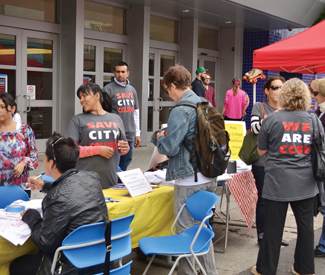
The threat of campus closures and a reduction in non-credit classes are all part of the attack on open access, as some students have said. To combat that, they’ve formed a new student group aimed at educating the city about what they stand to lose.

Project Unity is comprised of Occupy CCSF students, former student trustee Jeffrey Fang, student body President Shanell Williams, and other students, led by the newly elected student Trustee William Walker. They’ve rallied for their school at City Hall, where Supervisors Eric Mar and John Avalos have sponsored a resolution to support City College.

Project Unity met at the Mission Campus shortly after supporting the resolution, and started to plan a grassroots campaign to educate the city and its residents about open access.

Bob Gorringe, a member of Occupy San Francisco, was on hand to help the fledgling group strategize. “[Trustee] Anita Grier came out to the Occupy action council, and she was very open,” Gorringe told the group on July 31, referring to the longtime board member who is not exactly known for her radical tendencies.

Students taking such a vested interest in their college should come as no surprise, considering what happened to Compton before it folded into El Camino.

Although Compton never actually closed, it hemorrhaged students as public fears of the college closing grew larger, and the student body dropped to around 2,000 when El Camino took over, Garten told the Guardian.

Some students went elsewhere, but many appear to have just abandoned the education system.

“We looked at two or three colleges around Compton and none of us had a significant increase in students from the Compton district” enrolling, Garten said.

In other words, it looked like many disillusioned students had simply dropped out, something that nobody wants to see in San Francisco.

MOVING FORWARD

Just over two months remain for CCSF and its supporters to hash out a preliminary plan. Aiding them is a team of experts that will create a detailed report on everything related to the college’s financial woes — possibly the most critical problem area.

The Fiscal Crisis and Management Assistance Team, or FCMAT, explained their process to the college on August 3.

Without revealing any specific details, Michelle Plumbtree, the chief management analyst of FCMAT, warned an audience of a couple dozen interested people that its report would seem negative, but only because that’s exactly what the report is supposed to be: a critical review of problem areas.

“You guys are doing incredible things…But that’s not what we talk about [in our reports],” Plumbtree said.

Mike Hill, another FCMAT team member, succinctly layed out the biggest obstacles to City College’s fiscal future. “This is not a one year problem…We’re looking at three years. What makes that complicated is the governor’s tax, and the parcel tax,” Hill said, referring to Prop. 30 and the San Francisco ballot measure City College sponsored. “There are four scenarios… It’s not predictable.” Prop. 30, the tax measure placed on the ballot by Governor Jerry Brown, wouldn’t raise new revenue for community colleges. If it passes, they simply break even, staving off more drastic cuts. But the parcel tax offers more hope for CCSF, if city voters approve it. It would free up $14 million in revenue for this fiscal year, restoring some of what was lost and prevent the deep cuts and scaled back mission that the school’s support most fear.
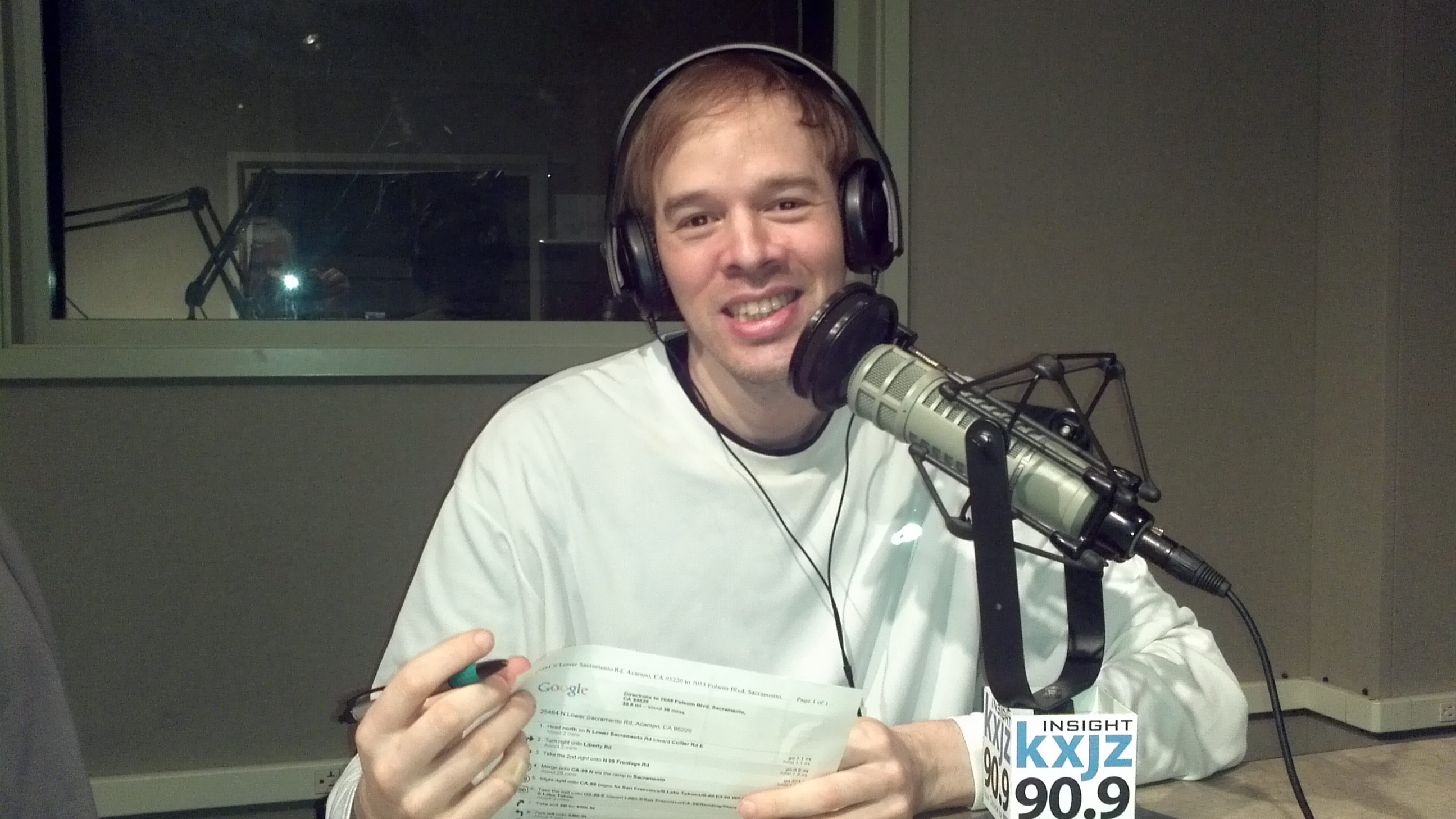
Instrumental duo Silian Rail includes ‘every/one’

0

Do artists need vocals and lyrics to demand audience attention in a place like the Bay Area, where there are new musicians popping up left and right? Eric Kuhn and Robin Landy, better known as instrumental duo Silian Rail, have found the answer to that question to be a resounding “no.”

With a handful of locally well-received releases under its belt and an upcoming headlining show at Bottom of the Hill, Silian Rail has clearly made it work thus far without words. The band’s songs run on a driving rhythm paired with carefully crafted guitar work. The complexity of its sound has continued to kept critics and fans coming back for more – a happy discovery for many, that expansive instrumental music can hold their attention.

For a recent companion piece, however, the band added something somewhat foreign to its repertoire, through collaborations with other artists: vocals. “We do have a couple singers on this album,” Kuhn says.

“Our choice to be an instrumental band is not something we ever really talked about. The way we play together emerged quite naturally – [Landy] plays guitar, I play drums…We thought it would be a fun excuse to collaborate with friends and see what they would contribute.”

Silian Rail’s collaborative recent EP every/one (released in May of this year as a companion to the each/other album) will benefit United Roots Oakland, with all of the proceeds going towards its community engagement programs in the arts and media. That EP includes Lewis Patzner (Judgement Day, the Devotionals), Thao Nguyen, Andrew Maguire (Thao and Mirah, DRMS, the Devotionals), Colleen Johnson (Upside Drown), and Winston Goertz-Giffen (Saything).

“The Bay Area music scene is great – not just to blow smoke up the collective ass of the Bay Area,”  Landy says with a laugh. “It’s non-competitive and very supportive. It seems different than LA or New York in that way… I’m just guessing.”

Kuhn says the title of the album, every/one, is a reflection on the tension and paradox of the strength of a collective or a collaboration versus the importance of individual freedom.

“The songs are more or less all from a similar thematic world, which are various texts, films, experiences relating to non-normative psychological functioning – an attempt at sensitively referring to what is classically termed ‘mental illness’,” Kuhn explains.  

“[We] have a lot of empathy for these perspectives, and relate to them in many ways, and respect the non-normative psychological individual as being someone often possessing of an ability to see beyond the arbitrary limits placed on our experience of the world by the various social codes and ideologies that are part of the status quo. There is a wildness and also a directness and a poetic nonsense clarity that we find inspiring and that generally tickles our fancy.”

The band discovered United Roots Oakland at an Occupy Oakland event, where there were young kids free-styling. “It’s an awesome thing to have a creative outlet for kids, [and] to have competent adults there to coach them,” Landy says.

And since the EP was a collaboration, it seemed strange for the band to personally collect a profit from it, Kuhn says, which is they decided to donate.

Silian Rail has a long history of creative endeavors with other musicians. It first gained attention through its connection with other East Bay acts such as Tartufi, Birds & Batteries, and Low Red Land as the group Thread Productions. Although Thread is no longer active, a lot of what the group used to do still happens informally – the bands frequent each others’ shows, try to spread the word on upcoming concerts, and often perform live together.

“It was a hugely helpful idea at the time,” Landy says. “Lynne Angel from Tartufi still plays with us. Our new record is super lush, so we needed extra instrumentation, and she was kind enough to lend her talents. Tartufi still does a lot of broader community organizing around music. I have no idea how they find the time and energy to do it!”

Yet Silian Rail seems to pack in a lot projects in too. Its working towards scoring more film projects – its music has already turned up in various indie films, short clips, and videos, such as an ad for “Farm Fresh Cocktails” (which both Landy and Kuhn found quite odd). Essentially, the Silian Rail sound seems ideal for soundtracks.

But the band’s own music, of course, always comes first. They’ve both long been drawn to creating music. They were friends who grew up together in North Carolina, and parted ways at 13, only to find one another in California many years later.

“Having a guitar with me through adolescence was a lifesaver, having that emotional outlet.” Landy says, reflecting on the importance of music.
Another charitable activity on the band’s plate: it just finished a session at Bay Area Girls Rock Camp – a nonprofit organization that “empowers girls through music” –  in Oakland before our interview. At the camp, musicians teach workshops, host group activities, and perform live.

“Kids are so honest that we were more nervous to play in front of a group of five to 12-years-olds then we are playing a packed venue in San Francisco,” Landy says, “They asked us why we don’t have a singer.”

“With these arts programs, it’s not like if kids have something to do, their problems will go away, it is clearly more complicated; but music can serve as an outlet.”
Kuhn adds: “Music is a means of expression and communication that transcends a lot of barriers – things like technology – more than just language and culture. It holds a fundamental power to enable communication with people.”

For such a technically impressive band, I was impressed to find out that Landy had no formal training on guitar “I don’t really know what I’m doing at all, which has mostly helped my style evolve. I am free to experiment and do things in a different way. It’s all abut making happy mistakes; of course there are benefits to knowing what you’re doing, but it is also a benefit for me to not know. The way I learn things, it probably would have been a waste of time anyway.”

“I did play flute in band during middle school,” she says. “But guitar is basically the opposite of those instruments.”

While Eric had a moderate amount of formal training (he took guitar lessons in high school and “tried to be a music major in college”), he now learns to write for different instruments for new songs without proper lessons. “I needed to write violin and cello parts for songs I’m doing on the new album, so I sat down with a music book and did that.”

“I’m inspired by painters,” he muses. “The idea of fearlessly exploring new territory and always pushing ourselves to new places.”

Silian Rail
With Shuteye Unison, B. Hamilton
Thu/9, $10, 9pm
Bottom of the Hill
1233 17th, SF
(415) 626-4455
www.bottomofthehill.com

Donorsexual: One man explains why he spreads his sperm around

0

At this point, I am not one for making babies. Perhaps this has to do with the unpleasantness of cervix dialation, or maybe it’s the salary of an alternative journalist. At any rate, this week I had an email correspondence with a Fremont man that is very much one for making babies. 15 of them, in fact. But he is not one for having sex. He’s a virgin, with a strong and understandably conflicted relationship with Jesus. He loves to help gay couples have kiddos (check out his website!) On Sun/5, this Trent Arsenault will be profiled on TLC’s new TV show look at unique sexualities, Strange Sexalong with a woman who is able to orgasm sans physical stimulation, which sounds amazing. Trent, what’s up with you?

San Francisco Bay Guardian: So why be a sperm donor? 

Trent Arsenault: I’m donorsexual. I knew this was my identity as young as 10 years old. It’s kind of like asking someone why they were born straight or gay, I don’t really know why.

SFBG: How’d you get started? At what point did you decide that this is what you want to dedicate yourself to? 

TA: Growing up in a religious family, it was instilled in me to be a servant to others. I started out doing the normal volunteer things (soup kitchens, missionary trips, building playgrounds). The church that I grew up in didn’t believe that infertile couples should have children (other than adoption). I thought it was wrong to discriminate. So as a teenager I parted with the church’s ideas and hung up the hat on religion, but held onto the basic teachings. I knew there was something about my sexuality that was different, and when I moved to the Bay Area I had been searching for a way to use it to help others when I found out there were childless couples searching for sperm donors. I vowed to begin helping the very group that my church descrimated against, which was gays and lesbians. So the first 10 babies that I was the donor for were lesbian couples in the Bay Area. After my family back in Missouri found out, they haven’t  talked to me to this day because they say I am a servant to sinners. The Bay Area couples who I donate to have become my new family.

SFBG: What is involved in maintaining your top sperm donor conditioning? 

TA: Above all, sticking to your beliefs and making sacrifices for others.  For example, when Strange Sex was filming with me in Fremont, I received a call from Meg Whitman’s office. After almost 15 years working at Hewlett Packard’s HQ in Palo Alto, the corporate officers wanted to investigate my activity as a sperm donor, and asked me to out the families at HP who I had donated to as part of their investigation.   Knowing that Ms. Whitman was against gay marriage and gays having children, I felt it was worth me to sacrifice my job versus letting the HP board bully the families who I donated to (some who had newborns at the time). So my response to Meg Whitman was, I didn’t cave to the US government (the FDA) when they demanded I stop donating, so I’m certainly not going to cave to a corrupt politician such as yourself. Needless to say, I was fired by HP for not cooperating in their investigation of my activity as a sperm donor. My first thought was to sue HP, but the biblical scripture from Jesus “if anyone wants to sue you and take your shirt, hand over your coat as well” changed my mind. I’m remaining a sperm donor without my six-digit salary from HP. But I’m committed to hanging in there. And HP’s stock is hitting a multi-year low, so I have the last laugh.

SFBG: Have you ever thought about having a kid through sex with a woman or having a kid of your own? 

TA: I don’t see non-donor sex in my future. I’m probably the only virgin with over a dozen biological children, but this passage from Matthew 19:11-12 sums it up. Jesus said, “Some people were born differently to be celibate, so accept the fact and use it to further God’s kingdom.” I doubt anyone who ever read that scripture would have ever guessed how being a virgin can make you the person with the most biological children in California.  

It is wonderful to hear the stories from parents I have helped telling me how the children have brought joy into their lives and make them laugh every day. I guess hearing this feedback from the parents makes up for whatever else might be lacking in my life by not having my own children.

SFBG: Have you met any of your children? What was that like? 

TA: I just received a birthday invitation in the mail from the parents of a two-year old girl who lives in Sacramento. Never thought that day would happen! I think it’s going to be a little awkard for me to show up to the party, being the donor — meeting the grandparents, and sitting around having birthday cake, and chatting. I replied to the RSVP and said I would make it, so I’ll let you know how it goes!

Catch Arsenault on TLC’s Strange Sex on Sun/5 at 10pm


Taser debate takes off once again at Police Commission

11

At a police commission meeting last night, commissioners delayed the vote on a controversial agenda item: adding tasers to the SFPD toolbelt. Specifically, Chief Greg Suhr proposed discussing a pilot program that would allow tasers for the 74 officers who have been trained through the department’s Crisis Intervention Team (CIT) program, created last year.

This is not the first time a police chief has introduced the possibility of tasers. In February of both 2010 and 2011, the police commission discussed adding the less-than-lethal weapon to the SFPD arsenal.  But community opposition, ACLU opinions, and commissioners concerned about the risks of tasers thwarted the effort.

Suhr says he brought up the issue in light of the July 18 killing of Pralith Pralourng. Suhr said he believes that if the officer involved had been equipped with a taser, Pralourng, who wielded only a boxcutter, may be alive today.

Several members of Proalong’s family attended the commission meeting last night. His sister, Savee Pralourng, read a statement asking that her brother’s death not be politicized for police department purposes.

“The SFPD wants to use his death to justify getting tasers,” said Pralourng.

She added other concerns about the police deparment’s handling of the death.“We have not been given any information about his last moments or how he died,” she said. “They need to know how to deal with mental illness, police need to address them differently.”

“This is an issue of the department having options available to them to mitigate the need for lethal force,” Commander Mikail Ali said at last night’s meeting.

But opponennents say that issuing tasers will lead to officers using them in questionable scenarios.

Tasers are called less-than-lethal, but can result in death. The risk of death is increased if the tased individual is child, elderly, pregrant, very thin, has acidoss, or on cocaine or methamphetamine. Police are trained to aim their guns for center mass, but with tasers the risk of death is increased if the subject is hit in the chest– the electric shock’s proxmimity to the heart can cause ventricular fibrillation.

“You have pepper spray, you have billy clubs, you have rubber bullets. What more do you need?” activist Debray “Fly Benzo” Carpenter admonished the police chief.

As a result of last year’s iteration of the year’s-long debate, the police department was tasked with preparing a report on the  potential use of tasers and what other less-lethal options were available.

The report was never completed.

This concerned several commissioners, as well as ACLU attorney Micaela Davis, who presented at the meeting. The ACLU sent a 12-page letter to Mayor Ed Lee outlinging their issues with tasers, and has reported in the past that police use of tasers in Northern California is dangerously unregulated and leads to death at a surprising rate.

Of the top 20 largest police departments in the coutry, San Francisco officers are the only ones without tasers. Even Memphis, the city with a police traning program for interacting with mentally ill people in crisis that has become a national model, recently voted to allow tasers. San Francisco’s CIT program is based on the Memphis model.

The conversation may have been happening for years but, commissioners decided, this new attempt was too hasty. Many were surprised to see the item on this week’s meeting agenda. Many members of the public were angered as well that no public comment period was sheduled for the item, and expressed their opposition to tasers during comment periods meant for other topics.

“The virtue of good government is patience and consideration,” said Commissioner Julius Turma. “I don’t feel fully informed on this issue.” Turman, along with Commissioner Angela Chan, called for a delay on the vote.

Commissioner Petra DeJesus said that if more notice had been given on the vote she would have “asked the city attorney’s office for an opinion on wheather we can tase just a certain population.” The proposed pilot program would put tasers in the hands of only officers who have been through CIT program, a training for interacting with mentally ill people.

Suhr said that was a false characterization. The police department would not be “singling out a demographic of people they might be used on,” he said. Instead, CIT officers simply “have done more training to deal with the mentally ill.”

The CIT program is meant to train officers who will be dispatched to respond to calls involving mentally ill people in crisis. However, these officers do not work exclusively in these situations.

The CIT training, whose formation marked a rare consensus between the police department, commission, community mental health organizations and advocacy groups, have begun but are running behind schedule. Davis argued that to distribute tasers to the officers in the training before they complete it would be premature– and that, if they know that at the end of the training they will get tasers, they may be less inclined to practice crisis intervention using other, less dangerous tools.

Carpenter, who was thrown out of the meeting after he and other activists shouted “he’s lying!” when Suhr reported the number of officer-involved shootings over the past year as well as other interuptions, said the prospect of tasers worries him. “I’ve been pepper sprayed for no reason before,” said Carpenter. “If they had tasers, would they have tased me?”

The comission will continue to research and discuss the issue, and, with more notice, public input into the issue promises to mount. The next police commission meeting will take place August 15. The controversial topic, which has produced what Police Commission Vice President Joe Marshall called “robust conversations” several times before, is likely to produce another in the next few weeks, both in and outside police comission meetings.

“The violence in the southeast sector over the past four days has been devastating to our City– we know we can do much better.  Let’s work together to and create San Francisco solutions to San Francisco problems. The Black Young Democratic Club is open to help facilitate this conversation,” reads a statement the club released yesterday in response to the taser proposal.

“I can guarantee you, you look at the communities of color, those are going to be the folks that are dealing with the police and the tasers,” said Theo Ellington, president of the San Francisco Black Young Democratic Club.

Survivor recounts life of rape and abuse by Your Black Muslim Bakery leader

8

Editor’s Note: This story is part of the Chauncey Bailey Project, a collaboration of Bay Area media outlets (including the Guardian) to investigate Bailey’s murder by members of Your Black Muslim Bakery.

By Louise Rafkin, Center for Investigative Reporting

 In 2002, five years before journalist Chauncey Bailey was murdered by members of Your Black Muslim Bakery, a woman identified only as Jane Doe 1 stepped forward to report decades of sexual abuse, welfare fraud and violence by the bakery’s leader, Yusuf Bey Sr.

She was prepared to hand over to Oakland police DNA from three of her children evidence that Bey had impregnated her, the first time when she was 12 years old.

Given the history of violence by members of Your Black Muslim Bakery, this was a risky move. But the woman was fueled by a mother’s anger. Her daughter, then 18, alerted her that Bey was trying to abuse her – his own daughter.

Now a devout Christian, Jane Doe 1 has decided she no longer wants to be the nameless whistle-blower. Her name is Kowana Banks and, in her first public interview, she said she made the decision to come forward to help other children trapped in similar situations. She hopes to publish a book about her experiences.

“Abused people go one of two ways: Either they are going to self-destruct or they’re going to make a difference,” said Banks, 44. “I’m going to make a difference.”

The violent saga of Your Black Muslim Bakery is fading into Oakland history, but wounds remain among Bey’s victims and family members today marks the fifth anniversary of the murder of Bailey, the Oakland Post editor who had been investigating the bakery’s finances.

The facts behind Banks’ story have been outlined in court proceedings and depositions, but her decision to come forward allows her to detail her unique insider’s perspective as a victim and survivor.

Today, Banks is an optimistic, composed woman who has moved on as best she can. One of her three children by Bey, Yusuf V, 25, is in San Quentin State Prison for his part in the 2007 kidnapping of two Oakland women, one who was tortured, a crime related to the bakery’s demise. The other two are doing well.

Banks considers the three to be the “blessing out of what happened to me.”

Married for 18 years to a man she met after leaving the bakery, Banks says the bitterness and anger that grew from her childhood abuse dissolved when she fell in love. The couple have two children together.

“But it’s difficult to look back and know I was just a child then and that no one cared,” she said.

Throughout her childhood at the bakery, Banks said she felt abandoned by the social welfare system, invisible even to those at local hospitals where she – and many other underage girls at the bakery compound – gave birth to multiple children while still children themselves.

She delivered the first of three children by Bey at Alta Bates Hospital in Berkeley at 13. A social worker questioned Banks about the paternity of her son, she said, but under the watchful eye of one of Bey’s “wives,” Banks kept silent. Later, she said she told a child protection worker that she was working long hours and not going to school.

“She told me she would check into it, and I never saw her again,” Banks said.

Bey, a self-appointed minister who gave himself the title of “Dr.,” was formerly a hairdresser. He opened Your Black Muslim Bakery in the late 1970s, espousing black self-reliance and his own interpretation of Islam, which included racist attacks on whites. Nevertheless, in his more than 30 years in North Oakland, Bey gained the support of local business leaders, clergy and politicians eager to align with the underclass.

In 2003, Bey died before facing trial, setting off the struggle for power and control that escalated into mayhem and multiple murders. Banks said she saw the violence coming.

“You cut off the head,” Banks said, “and the body will go crazy.”

Molestations began at age 8

Banks, who was born in the East Bay, said her father was a drug addict who met Bey’s followers while doing jail time for drug-related crimes. Banks can’t remember her mother, who she said abandoned her as a toddler, along with a younger brother and older sister.

In 1976, Banks’ father brought the children to live at the bakery compound, where he’d gotten a job. A hive of single-family homes, retail storefronts and apartments clustered on the corner of San Pablo Avenue and 59th Street in North Oakland, the compound housed bakery workers and Bey’s sprawling family of children and women he called his wives.

One Sunday night in 1976, Bey invited Banks to spend the night in his apartment, telling her she could play with his baby daughter. Banks was nervous and thought it strange to spend time with Bey, then 41. But her older sister had spent the night there and returned toting candy and new clothes. She said that night marked the first time Bey molested her. She was 8.

Bey told her to tell no one, she said. If she did, she would be killed.

“But he didn’t stop with me,” she said. “He told me he’d murder my whole family, everyone.”

Banks believes her father did not know about the incident, but the family moved away soon after that first molestation. They lived in Hayward for a while, and later, Banks’ father left her and her siblings with a grandmother near Monterey.

In 1978, after another arrest, her father brought them back to the bakery and left them with Bey.

Not long after, Banks said, Bey came into her bedroom above the bakery while she was sleeping, and raped her. She was 10 and remembers wearing one-piece pink zip-up pajamas. After the assault, she sought help from Nora Bey, then 23, one of the minister’s many “wives.” Banks’ father had surrendered his paternal rights so Yusuf Bey could receive welfare for their care; the court appointed Nora Bey, later known as Esperanza Johnson, as their legal guardian.

“ ‘I need you to help me because he’s trying to do things to me,’ ” Banks recalls telling Nora Bey. “And her comment was, ‘Oh, girl, he’s not going to do anything to you that he hasn’t done to anyone else.’ ”

Living in various bakery-owned homes, Banks was kept out of public school. She was smart, though, and soon became an integral part of the bakery, which sold pies and sandwiches from its San Pablo Avenue storefront. She learned bookkeeping and taught basic math and reading at the bakery’s school. Her life was regimented; she baked from 4 to 8 a.m., taught in the bakery’s combined school and day care until 6 p.m., and then wrapped bakery products until 10 p.m.

It was not until several years later that Banks even received a wage, just $25 per week.

At the time, Banks remembers not understanding why those living in the compound all were so isolated from outsiders, why they were punished for sneaking out once to see a movie, “The Wiz.”

“But as an adult, I understand now,” she said, “because he had secrets, and he didn’t want those secrets to get out.”

Learning Bey’s doctrine

In the bakery’s school, Yusuf Bey’s doctrine was drilled into the children. Girls were taught to cover their heads; everyone was addressed as “brother” or “sister.” Bey preached the superiority of men over women and of blacks over whites. Whites, he said, were “the devil” and responsible for all the world’s problems.

“The men were the ceiling, and women were the floor,” Banks said, quoting Bey.

She, however, was hardly subservient, growing into a feisty and hardheaded young woman, often chastised for speaking out against unfair treatment.

“I was known for saying whatever was on my brain,” Banks said.

Once when Banks complained about the long hours of work, she said she was forced to get up even earlier. When one of the other women found Bey with Banks in his bedroom late at night, the woman’s questions were silenced with a beating. Banks was then given a beating herself.

Banks said Bey tried to turn others against her and, because her mother was white, called her “nobody but the devil.”

But he continued to rape her repeatedly. At 13, she gave birth to the first of the three children she would have with Bey.

All the while, Banks said, Bey received – and kept for himself – welfare payments and food stamps intended for Banks, her siblings, others and eventually the children born as a result of the rapes. Bey was said to have more than 40 children and called up to 100 women his wives.

The atmosphere of fear was total, Banks said. In 1986, a young man, Peter Kaufman, who’d spoken out about having seen Bey rape a boy in the bakery’s bathroom, turned up dead on a nearby side street, shot in the head. Beatings – for both women and men in the bakery community – were commonplace.

Bey, Banks said, was a persuasive man who used intimidation, violence and a flashy lifestyle to control his mostly down-and-out followers, many of whom were parolees. There were cameras in the bakery and microphones in every room to monitor conversations. Among the women, the abuse was ubiquitous and unspoken. It was some time before Banks realized that Bey was molesting her sister, too.

Banks said she was instructed by Nora Bey not to identify him as the father of her children on their birth certificates. And Banks wasn’t allowed to choose names for her kids. Particularly painful to Banks was that her second son was named Yusuf by Nora Bey.

Banks said she had nowhere to turn. She blames racism, fear and a hands-off attitude for the lack of oversight by welfare officials and police.

“They were fed Brother Bey’s line that he was doing a lot for the black community,” she said. “No one wanted to intervene.”

Escape from bakery life

For years, Banks dreamed of leaving. But under the constant threat of violence, she waited. She planned to leave at 18, but was again pregnant. In 1988, then 20, she became romantically interested in a man her own age she met at the bakery. Bey caught wind of this and held a meeting at which he directed his other women to teach Banks a lesson by beating her.

Warned of her impending punishment, Banks made her escape that night, Aug. 28, 1988. A cousin on her father’s side agreed to pick her up. As she was collecting her children, Bey confronted her and threw her belongings at her.

“I picked up as much as I could that he threw at me and packed it into the car,” said Banks, laughing at the memory. “I don’t think he realized he was helping me.”

At first, she “felt so free” in a world outside the bakery, but soon she began to live in fear that Bey would send someone to harm her.

“My fear was a stranger that I didn’t even know would walk up to me and do something, because of course they had pictures of me,” she said.

Moving forward with her life was difficult, and keeping hold of the children she had with Bey ultimately proved too much of a challenge. Banks found work at restaurants as a server, but money was always tight. Bey wouldn’t pay child support, and the welfare she received never seemed to be enough.

“I was just a child when my kids were born,” she said. “It would be different if today I was having children, or even 20 years ago.”

Soon, Bey, exerting his power, sent for the kids, and they returned to the bakery. The boys spent most of their childhood there. Banks said her daughter, despite spending some time at the bakery and with foster families, mainly grew up with her.

At the bakery, Bey tried to turn her kids against her, Banks said, telling them she wanted them only for their welfare checks. While still a child, her oldest asked why she didn’t live with them at the bakery, like the parents of the other kids. Banks explained to him that “it wasn’t a good place” for her.

“I felt it was a better environment for men than it was for women,” she said, noting that at the time, she assumed Bey would not molest his own children.

In 1989, she met her husband through an acquaintance. The couple had their two children in the ’90s.

More than a decade passed. Banks took community college classes, found work in restaurants, earned her GED diploma and occasionally visited her boys at the bakery. There was constant intimidation; she feared retribution for leaving and was always looking over her shoulder.

Concern for daughter prompts action

Banks never told her kids about her abuse. It was hard to watch her boys be lured in by Bey’s flashy lifestyle – a Mercedes or Cadillac was always parked curbside – but Banks held out hope that she had been right, that it really was a better place for boys than it was for girls.

In June 2002, her 18-year-old daughter, who was working at the bakery but living elsewhere, told Banks a story that suggested Bey had tried to molest her. Banks was devastated, unable to even ask her daughter for details.

“I prayed, asking God who was going to stop him,” said Banks, then 34. “And then, suddenly, I knew it was me.”

With DNA testing available, she could prove Bey’s paternity. It offered the proof she had always hoped to find. In an angry phone conversation with Bey, she told him her plan.

“You, sir, are a rapist and a child molester, and let me tell you what I’m going to do to you,” she recalls saying. “First, I’m going to go to the police, and I’m going to press charges against you, and then, when I’m done, I’m going to sue you and I’m going to take all your money. And then I won’t have to ask you to help your children, my children, with anything else, because I’m going to have all your money.”

Bey, she said, told her she’d soon be “floating in a river.”

To show Bey her determination, she called him again from a phone at the Oakland Police Department. “He knew from that day forth that it was over for him,” she said.

Three months later, Bey was taken into police custody. With DNA test results in hand, Banks pressed felony criminal charges of rape and assault. Bey posted bail, but died in the hospital a year later before facing the criminal trial.

Banks was disappointed that Bey never faced a trial but took pleasure in knowing that he had at least faced the charges.

“He lived a long life of getting away with it,” she said. “By the grace of Jesus, I know he’s boiling in hell.”

Another Jane Doe revealed

Along with two other women, Banks also filed a civil suit, alleging that Alameda County did nothing to protect them. The county eventually settled with Banks and the two other Jane Does, admitting no liability.

Another of the Jane Does in the suits, a former foster child who worked at the bakery between 1994 and 1996 and was raped by Bey, also has decided to publicly identify herself for the first time.

Malikha Hardy said she reported her abuse on three occasions to a county social worker, to a guidance counselor at juvenile hall and, in 1996, to the Oakland police. No one followed up until seven years later, she said, when an Oakland detective working on Banks’ case turned up at her door.

“The people feared Bey,” Hardy, now 32, said in a recent phone interview. “He had people who would do anything for him.”

To protect the two women, California Watch is not providing information about their current whereabouts or employment. During multiple interviews for this story, a family therapist was present to provide support.

Having wrestled with low self-worth, nightmares, and other aftereffects of childhood trauma, Banks is writing a book about her life with the therapist’s help. She credits her conversion to Christianity with making it possible for her to smile again.

“I’m resilient, and I’m positive,” Banks said. “I say, ‘If people are preying on you, God has chosen you.’ ”

Banks remains in contact with her son Yusuf V, who is imprisoned at San Quentin and serving a 10-year sentence as part of a plea agreement in the kidnapping incident.

“I’m trying to reform my son’s way of thinking,” Banks said. “Him sitting in one spot is the best time for me to do it, because his mind is open.”

During a recent visit to the former bakery compound, Banks said she thinks the reign of terror is now over. Many of the buildings have been sold or renovated; little is left to indicate what went on, outside or inside. The old bakery is a beauty supply store. The former school is a martial arts studio.

As Banks walked through memorable rooms and haunted hallways, she recounted stories both benign and horrific.

“I’ve seen stuff here,” she said, “that will scare me for the rest of my life.

This story was edited by Robert Salladay and Amy Pyle and copy edited by Nikki Frick and Christine Lee.


This story was produced by the independent, nonprofit Center for Investigative Reporting in collaboration with the Chauncey Bailey Project. For more, visit www.cironline.org and www.chaunceybaileyproject.org. Rafkin can be contacted at Louise.Rafkin@gmail.com.


Two of SF’s most venerable cannabis dispensaries get shut down

7

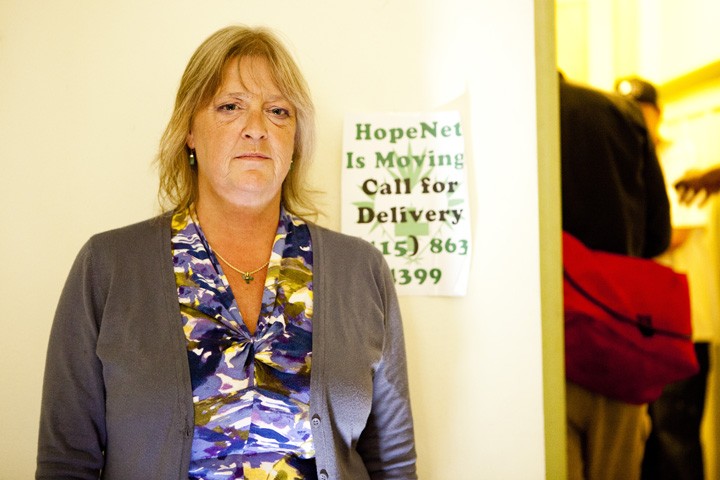
Sadness, anger, and confusion hung thick in the fragrant, smoky air of two of San Francisco’s oldest and most prominent medical marijuana dispensaries – HopeNet in SoMa and Vapor Room in Lower Haight – during their last day in business yesterday, the latest victims of an aggressive federal government crackdown on the industry.

Throughout the day, vendors, patients, neighbors, and well-wishers stopped in to say goodbye and commiserate over a trend that just doesn’t make sense to them, or to the local politicians and city officials that have spent years setting up a regulatory structure that had legitimized the cannabis industry, which thrived as the rest of the economy suffered through the recent recession.

“I’ve always treated this as if it were just a nice coffee house. I’m not an outlaw,” said Martin Olive, whose Vapor Room was a friendly community gathering place and active member of the local business community that gave away free bags of vaporized marijuana to low-income patients on a daily basis. “I almost forgot I was breaking federal law. It was so normal, so legitimate.”

Despite previous promises to respect state laws legalizing medical marijuana, President Barack Obama and federal agencies under his control did a sudden about-face last year, with the Drug Enforcement Agency threatening landlords with property seizure, the Justice Department threatening prison sentences, and the Internal Revenue Service doing audits and refusing to allow routine business expenses.

The result has been the forced closure of eight of San Francisco’s 24 licensed dispensaries in the last seven months, with more closures likely in the coming months. Almost all of the remaining clubs have been forced to deal only in cash after the feds threatened their bankers and credit card companies. The industry that grows and sells California’s biggest cash crop is essentially being driven back underground, hurting patients and the sometimes gritty neighborhoods that dispensaries had improved with security systems and a flow of customers that put more eyes on the streets and cash in the pockets of nearby stores and restaurants.

“The people that live here are afraid the neighborhood is going to come back in here. We took care of the entire block. Before us, it was all dealers, so there’s a safety issue,” HopeNet founder Cathy Smith told me as the once-welcoming club on 9th Street near Howard was reduced to bare walls, noting that the owner of the Starbucks on the corner told her he expects his business to drop by 15 percent.

Olive shared the concerns expressed at HopeNet, which he considers “a sister dispensary,” one that also had a generous compassion program for giving cannabis to low-income patients and offering other free services like yoga.

“I’m curious to see what this neighborhood looks like in six months. I know what it was like six months before we got here,” Olive said of his club’s opening in 2004.

But for now, it’s over. Vapor Room continued to do business for most of the day yesterday, but HopeNet was already stripped bare and essentially shut down, and by 3:30pm they removed the cash register and their pot stock. “The signs are down, we’re no longer a pot club, break out the beer,” announced Smith’s son, Bill, a member of the cooperative, referring to one of the many tight restrictions of what the city allowed in clubs. “I’m the only one making light of things today, as a coping mechanism. I laugh so we don’t cry.”

Like the patients, vendors, and local officials we spoke to – who you’ll hear from in an upcoming Guardian cover story looking the end of medical marijuana’s golden age – Olive and Smith are grappling with a federal crackdown they say has myriad downsides and no benefits to anyone but federal agencies that profit from drug-related seizures and the criminal syndicates that now have less competition.

Both Olive and Smith say they voted for Obama in 2008, they believed his statements that he wouldn’t go after businesses that complied with state and local law, and now they feel betrayed.

“I feel fucked by it, betrayed is too easy a word,” Howard said.

“It’s complicated emotions that I’m feeling – let down, confused – at the end of the day, I don’t understand why this is happening,” Olive said. “It’s a community tragedy, it really is.”

Like MediThrive and other recently shuttered clubs, both Vapor Room and HopeNet will still be operating as delivery-only services, but the future seems less certain now that their direct, brick-and-mortar connection to their community has been severed.

They urge those concerned about the crackdown to contact their political representatives, and to turn out today (Wed/1) at 4pm for a funeral march that starts at Haight and Steiner streets near the now-shuttered Vapor Room and goes to the Federal Building on Golden Gate Avenue, where there will be a rally and speeches starting at 5pm.

Localized Appreesh: Seatraffic

0

Localized Appreesh is our weekly thank-you column to the musicians that make the Bay. To be considered, contact emilysavage@sfbg.com.

On the new seven-inch, Crimes, the persistent flow of Seatraffic feels like it’s washing over you like warm bath water. The San Francisco electronic pop duo takes a page out of the 1980s synth playbook, and executes it with a shiny modern gleam, incorporating dreamy reverb, and heavy, shoe-gazing beats.

If you climb over some sandy rocks at Corona Del Mar State Beach down in Southern California, you can jet down to Little Corona, a more secluded plot of warm sand and water with craggy little caves surrounding it. And if you should ever visit, I suggest playing Seatraffic’s Crimes on your portable record player, and bringing along edibles.

This is because vocalist Mark Zannad and drummer Brandon Harrison created cavernous atmospheres pressed on small white vinyl, just the right speed for a languid dip. It’s Seatraffic’s first physical release, and limited to 300 copies.

The band will perform live from the new release at a DJ-studded Project One gathering this week.

http://www.youtube.com/watch?v=SPOMr-u15q0

Year and location of origin: We formed in summer of 2010, in San Francisco. It was more or less an agreement that one day we’d start making music, we actually didn’t get serious until about six months later.  I (Mark) had been working out a few songs and when Brandon heard them he thought it would be really unique to bring live drums into synthy music.  We gave it a shot and the first time we made music together it just felt right.  Despite having very different musical backgrounds we meshed really well and most of the songs came a long with little stress.

Band name origin:
The word Seatraffic, is suppose to be like Air Traffic, but we like boats better than planes. We had hundreds of names written down, most of them very bad. Seatraffic just sounded right to us, later our writer friend suggested we make it into one word.

Band motto: Never really thought of having a band motto, but if we had one it would be “Stay different, know your Identity”

Description of sound in 10 words or less:
Dreamy blend of whirling synthesizers, organs, bass, and heavy drums.

Instrumentation: Mark Zannad: Vocals, Organs, Synthesizers; Brandon Harrison: Drums, Percussion

Most recent release: Crimes 7-inch (2012).

Best part about life as a Bay Area band: The best part of being a band in the Bay Area is how open minded and diverse music enthusiasts are here.

Worst part about life as a Bay Area band: The worst thing about being a band in the Bay Area is that it is a very saturated place for music, it can be difficult to be heard locally.

First album ever purchased:  Mark: Lion King soundtrack on Cassette; Brandon: Astro Lounge by Smashmouth

Most recent album purchased/downloaded:  Mark: Ariel Pink’s Mature Themes; Brandon: Ty Segall Band’s Slaughterhouse.

Favorite local eatery and dish: This may be the most difficult question we have ever been asked because the food in SF is just so good. Mark: a mini-burger (don’t let the name deceive you) from Super Duper Burger; Brandon: Carne Asada Burrito from Farolito.

Seatraffic
With DJs Boyfren, YR Skull, Shaky Premise, and Epicsauce DJs
Thu/2, 9pm, $3 (free beer before 11pm)
Project One
251 Rhode Island, SF
(415) 938-7173
p1sf.com

Maverick

6

virginia@sfbg.com

APPETITE Opened on July 13 way back in 2005, Maverick is a longtimer by modern day restaurant standards. I’d posit that it’s better than ever with new executive chef Emmanual Eng, brought on last year by owners Scott Youkilis and Michael Pierce (who is also the general manager and wine director). In contrast to its more casual, younger sister Hog and Rocks, Maverick’s food has grown more sophisticated and focused over the years.

The menu delights and has evolved slightly at each visit, with whispers of Southern influence (and beyond) married to forward-thinking culinary vision. Traditional Southern ingredients and dishes are a springboard for cutting-edge “New Southern” cuisine, the likes of which I’ve seen in cities such as Charleston and Atlanta in recent years or at San Francisco newcomers like Dixie and St. Vincent.

Maverick hasn’t slowed down with age and, especially with talented young Chef Eng on board, to continue challenging itself. An artist and Portland native, Eng boldly walked into SF’s Indigo in 2000, offering to work for free to learn the ropes. He eventually became line cook at Aqua, Quince, and Foreign Cinema, then sous chef at Boulevard and Sons and Daughters. His experience at some of our top restaurants shows in his bold-yet-refined cooking.

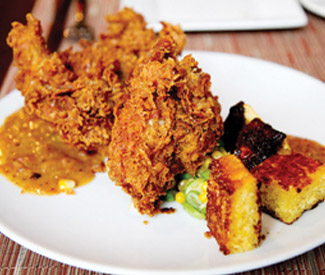
Let’s get the obvious out of the way: the signature fried chicken ($24) is as fantastic as ever. Juicy inside, crispy outside, and not at all greasy, the batter is touched with cinnamon, cayenne, and white pepper. It was recently served with blackened patty-pan squash, succotash, pickled watermelon rind, and cornbread croutons — with ham hock and mustard gravy tying it all together, eliciting sighs of delight. It’s hard not to want to return to this one over and over again — and many diners do.

But you’d be remiss not to branch out. There’s nothing Southern about a squash blossom stuffed with brandade ($10), rosso bruno tomatoes, Calabrian chilis, and basil, but it’s delicious. Italian spirit is also present in burrata cheese, made nearby on 16th Street ($12), but rather than being leaving it as another burrata starter, Eng layers flavors with ashed rind from corn husks, baby leeks, arugula pisto, pickled fiddlehead ferns and zucchini. Just before the foie gras ban — which I am not happy about — a duck butcher plate ($16) impressed with foie, tasso-cured duck breast (there’s your Southern touch: fantastic tasso ham), strawberry mostarda, white peach, lime, and duck rillette croquette. Summery as it was rich, it’s the mostarda I craved more of.

Another inspired Southern reinterpretation is porcini mushroom and Anson Mills grits ($12.50). It’s not remotely a traditional grits dish, in fact, there’s only a smattering of creamy grits amid tender porcinis, pearl onion, snap peas and a smoked soft-poached egg running over ingredients when punctured. For a vegetarian dish, it’s almost meaty and soulful. Massachusetts Dayboat sea scallops ($13) are seared just right, but accents of compressed watermelon, pineapple mint, Padron peppers, dotted with lipstick pimento sauce and ancho chile-pumpkin seed pesto making it memorable. Lobster bread pudding draped in smoked cod ($26) is a brilliant twist on traditional New Brunswick stew — in this case, a creamy mussel chowder touched with jerky-like strips of linguica, clams, corn, and sea beans (seaweed). Dessert is no afterthought. In fact, a chocolate Samoa truffle ($9) feels like vacation, a chocolate mound spiked with chocolate bark in a pool of caramelized coconut accented by crumbled shortbread.

Pierce’s wine pairings and frank, engaging welcome are another key part of what makes Maverick special. (We share a New Jersey past, and you can still sense some of that state about him.) His love of wine has grown since his days at Sociale. The thoughful wine list is inclusive of some of California’s more interesting small labels like Wind Gap and Le P’Tit Paysan. A 2009 Cru Pinot from Monterey is perfection with the grits. The anise hyssop dotting tasso-cured duck “prosciutto” pops when paired with a floral, crisp 2011 Domaine de la Fouquette Grenache-Cinsault-Syrah-Rolle rose from Provence. Ask Pierce about his Junk Food Wine Pairing series — he’ll pair wines with the likes of Slim Jims and Doritos.

I appreciate that even sans hard liquor license, Maverick attempts creative cocktails ($9) using vermouth and sake in low alcohol aperitifs. Some work better than others, but the attentive use of local products like Sutton Cellars vermouth is something I wish more wine and beer only restaurants would do. The most consistent drink is a ginger lemon fizz, utilizing Sutton’s dry vermouth, bright with ginger, Meyer lemon, and dreamy honey foam.

At Maverick, attentive staff, intimate dining room, and unique explorations of a well-known regional cuisine exhibit what makes Southern cooking so beloved in the first place: heart.

MAVERICK

3316 17th St., SF

415-863-3061

www.sfmaverick.com

Subscribe to Virgina’s twice-monthly newsletter, The Perfect Spot, www.theperfectspotsf.com

Our Weekly Picks: August 1-7

0

WEDNESDAY 1

Erol Alkan

A couple years ago it was easier to define Erol Alkan. He was electro. People would say it like it was the best thing in the world or the worst, but it was clear cut, straightforward, easily understood. Recently, though, the London producer’s already impeccable remix work — for bands including Tame Impala, Metronomy, and St. Etienne — has shown increased range, patience, and emotion. While his continued team-up with Boys Noize shows he’s not afraid to still go HARD, with Connan Mockasin’s “Forever Dolphin Love” (a song so nice, he reworked it twice) Alkan went in an entirely other direction, arguably surpassed the original, and created what might be the ultimate comedown track. (Ryan Prendiville)

With Omar (Popscene) 10pm, $10–$20

Vessel

85 Campton Place, SF

(415) 433-8585

www.vesselsf.com


Mynabirds

After a stint as a member of Bright Eyes’ touring band in 2011, Mynabirds frontwoman Laura Burhenn went back into the studio to work on her Saddle Creek indie collective’s sophomore release, Generals, a concept album about war, tragedy, and disarmament (inspired by Richard Avedon’s photo, “Generals of the Daughters of the American Revolution”). The result is a protest record that embodies the spirit of the Occupy Everything movement. Burhenn’s soulful voice soars over percussive, full-bodied pop melodies to sing about a wide array of conflicts, both political and personal. In a concurrent side project called the New Revolutionists, Burhenn uses a portrait series to highlight women who have taken the initiative to be disarmers and activists in their own communities around the country. (Haley Zaremba)

With Deep Time

9:30pm, $12

Cafe Du Nord

2170 Market, SF

(415) 861-5016

www.cafedunord.com


THURSDAY 2

“City Scenes: Installment Four”

Never spent time with David Bowie’s album Diamond Dogs? Beloved San Francisco musician John Vanderslice wants to change that. In the Vogue Theatre’s fourth installment of its ongoing “City Scenes” series, Vanderslice will perform Diamond Dogs, followed by a screening of Michel Gondry’s The Science of Sleep (2006). Vanderslice says he loves the film because of its “vulnerable and personal vibe,” and he considers the Bowie album to be one of the most underrated records, calling it “casual, rugged, and handmade.” Vanderslice adds that the record, which was inspired by Orwell’s 1984,”[was] his most drugged out, freaked out work.” Gondry’s film, which follows Charlotte Gainsbourg and Gael Garcia Bernal on a journey through the human psyche, certainly connects to a Bowie’d musical introduction exploring the confines of state control on the mind. (Shauna C. Keddy)

8pm, $15

Vogue Theatre

3290 Sacramento, SF

(415) 346-2228

www.voguesf.com


Squarepusher

Sure, Aphex Twin and Boards of Canada are seasoned veterans of electronic powerhouse Warp Records, and rightly so; but where have they been lately? Squarepusher, on the other hand, has been churning out quality records for the UK label, with Woody Allenesque prolificacy, since 1996. From ’70s Miles Davis homages, to laptop geekfests, to Daft Punk nods, to virtuosic bass-guitar workouts worthy of a Steely Dan session player, Squarepusher mastermind Tom Jenkinson has built a career on defying expectations and constantly switching focus — which makes the prospect of a live appearance so damn interesting. (Taylor Kaplan)

With Eric Sharp 8pm, $30

Regency Ballroom

1290 Sutter, SF

888) 929-7849

www.theregencyballroom.com


Buraka Som Sistema

There’s just something fascinating about watching a crowd attempt to dance along to a beat that is as unfamiliar as it is irresistible. That was the scene at last year’s Treasure Island Music Festival, during the performance of Portugal’s Buraka Som Sistema. Buraka’s a reportedly rough and tumble neighborhood in Lisbon; Som Sistema quickly translates to “sound system”; put it together and you have a partying collective of DJs, producers, MCs, and dancers spreading the Angolan-originated, techno and hip-hop influenced genre of kuduro. Understanding Portuguese is not a prerequisite, as the group’s seemingly competitive desire to hype up a crowd (with easily recognizable calls to “shake that ass”) proves immediate and universal. (Prendiville)

9pm, $20  

Independent

628 Divisadero, SF

(415) 771-1421

www.theindependentsf.com


FRIDAY 3

Peaking Lights and Woods

One night, two up-and-coming bands with the blogosphere on their side. Woods might be from Brooklyn, but they forgo the New York state of mind in favor of a pastoral, sun-drenched, Byrds-worshipping brand of lo-fi pop, well suited to your next cabin retreat. Originally from the Bay Area, Madison, Wisconsin-based duo Peaking Lights weaves an infectiously stoney web of dub, Krautrock, and loopy, gloopy pop a la Panda Bear, seemingly tailor-made for record collectors and serial name-droppers. First acoustic, then electronic, on an enticing double-bill unlikely to result in any sense of redundancy. (Kaplan)

With Wet Illustrated 9pm, $16

Great American Music Hall

859 O’Farrell, SF

(415) 885-0750

www.slimspresents.com


Birds & Batteries

With the impending release of their new album Stray Light, Birds & Batteries will once grace our ears with chirping indie-pop bliss smashed with heavy electronic beats. Like the name, the band embraces a meeting of the natural and the digital. While their sound embraces vast expanses, it’s also crisp and wound tight; if you want to wave your arms around in the air like you’re at a bonfire dance circle, but also jump up and down like you would at any good rock show, this will be a lovely fit for you The band kicks off its US tour this weekend at the Rickshaw Stop. (Keddy)

With Radiation City, Trails & Ways

9pm, $10–$12

Rickshaw Stop

155 Fell, SF

(415) 861-2011

www.rickshawstop.com


The Pharcyde

Gangsta rap was important and fun in the beginning — and, in retrospect, so kittenish that 50,000 white kids would end up singing along with an anachronistic hologram 20 years later in the California desert. But all the grim misogyny and hysterical homophobia sure got tired. Luckily, Cali also kept the flame alive in the ’90s for inventive, unabashedly intelligent hip-hop. Surreal lyrical genius-machine the Pharcyde blew up the charts with first album Bizarre Ride II in 1992, now original quartet members Fatlip and SlimKid3, with producers J-Swift and LA Jay, are giving the live full-band treatment to Bizarre. (Bootie Brown and Imani, who tried to jumpstart the band back in 2004 are doing their own thing, notably Bootie’s guest spots with Gorillaz.) SLICK, the graffitist responsible for Bizarre‘s cover, art directs the show. (Marke B.)

10pm-4am, $20–$25

1015 Folsom, SF.

www.1015.com


SATURDAY 4

Castro Theatre’s 90th anniversary

Single-screen movie palace the Castro Theater opened in 1922 — and 90 years later, it’s still going strong, with a robust calendar of festivals, first-run movies, rep screenings, and special events. Celebrate this happiest of birthdays by stopping by this weekend’s festivities (special programming, including a John Huston series, continues throughout August). Today, there’ll be a screening of 1964 classic Mary Poppins (presented sing-a-long style — chim-chim-chir-ee!) plus a Howard Hawks double feature of The Big Sleep (1946) and Where Danger Lives (1950), hosted by Noir City’s Eddie Muller, all with pre-show musical entertainment. Head over tomorrow for a couple of films you might have heard of (1941’s Citizen Kane, 1939’s Gone With the Wind), or mark your calendar for upcoming must-see-on-the-big-screen entries, including Roman Polanski’s 1974 Chinatown (Aug. 28). (Cheryl Eddy)

Mary Poppins, 2 p.m., $8.50–$15

Castro Theatre

429 Castro, SF

www.castrotheatre.com


The English Beat

In 1979, the Beat (known in the US as the English Beat) emerged from struggling, blue-collar Birmingham, England. In an era of widespread unemployment and sociopolitical conflict, the band responded by writing simple, fun ska tunes about something we can all agree on: love. The Beat was an overnight success with its chart-topping cover of Smokey Robinson’s “Tears of a Clown.” These legendary musicians, now considered pioneers of two-tone ska along with the likes of the Specials and Madness, have been touring consistently since they reunited in 2003. In today’s similarly tumultuous political climate, perhaps a little love and skanking is what we all need. (Zaremba)

With the Champions Inc.

8pm, $25

Bimbo’s 365

1025 Columbus, SF

(415) 474-0365

www.bimbos365club.com


Drift of a Curse

Supergroups of our time: Bad Company, Damn Yankees, Traveling Wilburys, uh … Asia? Does Asia count? Dunno. What’s important is that local supergroup of sorts Drift of a Curse (it started as an Old Grandad side project, and also features members of Hammers of Misfortune, Aerial Ruin, and Hazzard’s Cure) is reuniting for its first shows in two years. Tonight’s gig prefaces a mini tour to points Northwest; expect to hear songs off 2008 album The Wrong Witness, recorded before the band had played any live shows, and more in the vein of the group’s self-described sound: “melodic vocals, clean tones, and psychedelic soundscapes” with “elements of metal and rock.” Super! (Eddy)

With Hazzard’s Cure

10pm, $6

Bender’s Bar

806 S. Van Ness, SF

(415) 824-1800

www.bendersbar.com


SUNDAY 5

Radio Moscow

This power trio is a blast from the psychedelic past. Drawing from Cream, Hendrix, and ZZ Top, the Story City, Iowa garage rockers play new-old stoner rock with fuzzed out guitar solos and bluesy, experimental jams as long as their Zeppelin-inspired hair. After the band handed a demo to Dan Auerbach at a Black Keys concert, the retro-rock guru got them signed to Alive Naturalsound Records and produced their first album, released in 2007. The band has since relocated to Northern California and after months on the road to support their third full-length, Radio Moscow is ending its national tour in San Francisco. (Zaremba)

With the Dirty Streets, Coo Coo Birds

8:30pm, $12

Cafe Du Nord

2170 Market, SF

(415) 861-5016

www.cafedunord.com


MONDAY 6

Sutekh Hexen

Juggling noise and ambience with a shrewd sense of balance rarely seen among metal outfits, SF’s own Sutekh Hexen specializes in that rare brand of distortion-based guitar chaos in which the darkness is completely convincing. Like Sunn O)))’s dronier passages, approached with the relentless tunnel-vision of Metal Machine Music, this trio’s output is as mentally/physically draining as it is hypnotic and bliss-inducing. Their newly released full-length, Behind the Throne, might as well be titled Ambient 5: Music for Melting Your Face Off. Might wanna bring some earplugs; this one’ll be a doozy. (Kaplan)

With Hallow, Rain and Endless Fall, Rigis

Elbo Room

647 Valencia, SF

(415) 552-7788

www.elbo.com 

The Guardian listings deadline is two weeks prior to our Wednesday publication date. To submit an item for consideration, please include the title of the event, a brief description of the event, date and time, venue name, street address (listing cross streets only isn’t sufficient), city, telephone number readers can call for more information, telephone number for media, and admission costs. Send information to Listings, the Guardian, 71 Stevenson St., Second Floor, SF, CA 94105; fax to (415) 487-2506; or e-mail (paste press release into e-mail body — no text attachments, please) to listings@sfbg.com. Digital photos may be submitted in jpeg format; the image must be at least 240 dpi and four inches by six inches in size. We regret we cannot accept listings over the phone.

Stage Listings

0

Stage listings are compiled by Guardian staff. Performance times may change; call venues to confirm. Reviewers are Robert Avila, Rita Felciano, and Nicole Gluckstern. Submit items for the listings at listings@sfbg.com. For further information on how to submit items for the listings, see Picks.

THEATER

OPENING

Humor Abuse American Conservatory Theater, 415 Geary, SF; www.act-sf.org. $25-95. Opens Fri/3, 8pm. Runs Tue-Sat, 8pm (also Sat, 2pm); Sun, 2pm. Through Aug 19. Lorenzo Pisoni performs his autobiographical show about growing up as the youngest member of San Francisco’s Pickle Family Circus.

The Princess Bride: Live! Dark Room Theater, 2263 Mission, SF; foulplaysf.com/princessbride. $20. Opens Thu/2, 8pm. Runs Thu-Sat, 8pm. Through Aug 25. Dark Room Productions presents a live tribute to the cult fairy-tale movie.

BAY AREA

Circle Mirror Transformation Marin Theatre Company, 397 Miller, Mill Valley; www.marintheatre.org. $20-57. Previews Thu/2-Sat/4, 8pm; Sun/5, 7pm. Opens Tue/7, 8pm. Runs Tue and Thu-Sat, 8pm (also Aug 11, 16, and 25, 2pm); Wed, 7:30pm; Sun, 2 and 7pm. Though Aug 26. Marin Theatre Company and Encore Theatre Company co-present the regional premiere of Annie Baker’s comedy about a drama class.

"TheatreWorks 2012 New Works Festival" TheatreWorks at Lucie Stern Theatre, 1305 Middlefield, Palo Alto; www.theatreworks.org. $19-25 (fest pass, $65). Aug 5-19, various times. The 11th annual festival features a developmental production of The Trouble With Doug by Will Aronson and Daniel Maté and staged readings of Sleeping Rough by Kara Manning, The Loudest Man on Earth by Catherine Rush, Being Earnest by Paul Gordon and Jay Gruska, and Triangle by Curtis Moore and Thomas Mizer.

ONGOING

Absolutely San Francisco Alcove Theater, 414 Mason, Ste 502, SF; www.thealcovetheater.com. $32-50. Thu-Sat, 8pm. Through Aug 18. A multi-character solo show about the characters of San Francisco.

Arctic Hysteria Bindlestiff Studio, 185 Sixth St, SF; www.brownpapertickets.com. $10-25. Thu/2-Sat/4, 8pm (also Sat/4, 2pm). SNAP (Some New Arts Project) presents this movement-based dark comedy by Abi Basch, performed by Berlin’s Kinderdeutsch Projekts.

Enron Exit Theatre, 156 Eddy, SF; www.enron2012.com. $25. Thu-Sat, 8pm. Through Aug 17. In OpenTab’s production of British playwright Lucy Prebble’s 2009 Enron, tragedy plus time equals comedy plus puppets (in imaginative designs by Miyaka Cochrane), as fast-paced satire delivers a timely reconsideration of yet another infamous financial scandal. Some fictional elements shape the plotline but simplifying strategies serve well to clarify the real-life actions and consequences of Ken Lay (GreyWolf) and Jeffry Skilling’s (Alex Plant) deceptive energy-trading juggernaut, the onetime darling of Wall Street and the financial pages. There’s also much verbatim information (echoing the book and documentary, Enron: The Smartest Guys in the Room) enlivening the quick dialogue and underscoring the reckless, hubristic malfeasance that famously preyed on California’s electricity grid and threw Enron’s own employees under the bus. Director Ben Euphrat gets spirited and engaging performances from his principals, with especially nice work from Plant as a cruelly superior Skilling, Laurie Burke as ambitious straight-shooter Claudia Roe (a fictionalized composite creation of the playwright), and Nathan Tucker as manic sycophant Andy Fastow, feeding poisonous Enron debt into three beloved "raptors" (the pet names for some animated shadow companies arising from Fastow’s fast work in "structured finance"). At the same time, the staging can prove rough between concept and execution, with scenic elements sometimes confusing as well as aesthetically ragged (a red fabric serving as a large profit graph, for instance, just looks like some droopy inexplicable drapery at first; and the first puppets to appear are too small to be very effective either). Despite this messiness in terms of mise-en-scène, however, the play is generally clear-eyed and good for more than easy laughs — since no single villain but rather a system and culture are the proper targets here. As Prebble notes, the strategies developed by Enron, far from remaining beyond the pale, are now standard practices throughout the financial and corporate world. That, in some circles, is known as progress. (Avila)

The Merchant of Venice Gough Street Playhouse, 1622 Gough, SF; www.custommade.org. $25-32. Thu-Sat, 8pm; Sun, 7pm. Extended through Aug 19. Custom Made Theater presents director Stuart Bousel’s generally sharp staging of Shakespeare’s perennially controversial but often-misunderstood play. The lively if uneven production ensures the involved storyline cannot be reduced to the problematical nature of its notorious Jewish villain, Shylock (played with a compellingly burdened intensity by a quick Catz Forsman), but rather has to be seen in a wider landscape of desire in which money, status, sex, gender, political and ethnic affiliations, and human bodies all mix, collide, and negotiate. To this end, this Merchant is set amid a contemporary financial district coterie (given plenty of scope in Sarah Phykitt’s thoughtfully pared-down scenic design), where titular melancholic businessman Antonio (Ryan Hayes) sticks his neck out (or anyway a pound of flesh) for his beloved friend Bassanio (Dashiell Hillman) — no doubt the unspoken source of Antonio’s brooding heart as staged here — as the latter seeks a loan with which to court the lovely and brilliant Portia (a winning Megan Briggs). While the subplot concerning the wooing and flight of Shylock’s daughter, Jessica (Kim Saunders), is less adeptly rendered, fluid pacing and a confident sense of the priorities of the drama overall offer a satisfying encounter with this fascinatingly subtle play. (Avila)

Les Misérables Orpheum Theatre, 1192 Market, SF; www.bestofbroadway-sf.com. $83-155. Tue-Sat, 8pm (also Wed and Sat, 2pm); Sun, 2pm. Through Aug 26. SHN’s Best of Broadway series brings to town the new 25th anniversary production of Cameron Mackintosh’s musical giant, based on the novel by Victor Hugo. The revival at the Orpheum does without the famous rotating stage but nevertheless spares no expense or artistry in rendering the show’s barrage of colorful Romantic scenes (with Matt Kinley’s scenic design drawing painterly inspiration from Hugo’s own oils) or its larger-than-life characters — first and foremost Jean Valjean (a slim but passionate Peter Lockyer), nemesis Javert (Andrew Varela), and rescued orphan beauty Cosette (Lauren Wiley). Chris Jahnke contributes new orchestrations to the rollicking original score by Claude-Michel Schönberg (music) and Herbert Kretzmer (lyrics) in this flagrantly sentimental, somewhat problematic but still-stirring meld of music and melodrama in dutiful overlapping service of box office treasure and powerful humanist aspirations. (Avila)

Project: Lohan Costume Shop, 1117 Market, SF; www.projectlohan.com. $25. Thu-Sat, 8pm; Sun, 7pm. Through Aug 19. D’Arcy Drollinger pays tribute to the paparazzi target with this performance constructed solely from tabloids, magazines, court documents, and other pre-existing sources.

Sweeney Todd: The Demon Barber of Fleet Street Eureka Theatre, 215 Jackson, SF; www.rayoflighttheatre.com. $25-36. Thu-Sat, 8pm (also Sat, 2pm); Sun, 2pm. Through Aug 11. Halloween comes early this year thanks to Ray of Light Theatre’s production of Sweeney Todd and all its attendant horrors. Set in bleakest, Industrial Revolution-era London, this Sondheim musical pushes the titular Todd to enact a brutal vengeance on a world he perceives as having stolen the best of life from him, namely his family and his freedom. No fey, gothic vampire, ROLT’s Sweeney Todd (played by Adam Scott Campbell) is both physically and psychically imposing, built like a blacksmith and twice as dark. Pushed over the line between misanthropic and murderous, Sweeney Todd methodically plots his revenge on the hated Judge Turpin (portrayed with surprising sympathy by Ken Brill) while the comfortably comical purveyor of pies, Mrs. Lovett (Miss Sheldra), dreams of a sunnier future. Mrs. Lovett’s no-nonsense, wisecracking ways aside, there are few laughs to be had in this slow-burning dirge to the worst in mankind, and as the body count rises, it is made abundantly clear that all hope of redemption is also but a fantasy. Contributing to the dark mood are Maya Linke’s imposing, industrial set, Cathie Anderson’s ghostly green and hellfire amber lighting, and a spare chamber ensemble of six able musicians conducted by Sean Forte. (Gluckstern)

"Un-Abridged: The Best of Ten Years of Un-Scripted" SF Playhouse, 533 Sutter, SF; www.un-scripted.com. $10-20. Thu-Sat, 8pm (also Fri/3, 10pm; no show Sat/4). Through Aug 18. The veteran Bay Area company celebrates its tenth anniversary season with a four-week retrospective of its favorite long- and short-form improv shows. Check website for schedule.

Vital Signs Marsh San Francisco, 1062 Valencia, SF; (415) 282-3055, www.themarsh.org. $15-50. Sat, 8:30pm. Extended through Aug 25. The Marsh San Francisco presents Alison Whittaker’s behind-the-scenes look at nursing in America.

Waiting… Larkspur Hotel Union Square, 525 Sutter, SF; www.brownpapertickets.com. $49-75. Thu/2-Sat/4, 8pm; Sun/5, 2pm. Comedy set behind the scenes at a San Francisco restaurant.

The Waiting Period MainStage, Marsh San Francisco, 1062 Valencia, SF; (415) 282-3055, www.themarsh.org. $15-50. Fri/3, 8pm; Sat/4, 5pm. Brian Copeland (comedian, TV and radio personality, and creator-performer of the long-running solo play Not a Genuine Black Man) returns to the Marsh with a new solo, this one based on more recent and messier events` in Copeland’s life. The play concerns an episode of severe depression in which he considered suicide, going so far as to purchase a handgun — the title coming from the legally mandatory 10-day period between purchasing and picking up the weapon, which leaves time for reflections and circumstances that ultimately prevent Copeland from pulling the trigger. A grim subject, but Copeland (with co-developer and director David Ford) ensures there’s plenty of humor as well as frank sentiment along the way. The actor peoples the opening scene in the gun store with a comically if somewhat stereotypically rugged representative of the Second Amendment, for instance, as well as an equally familiar "doood" dude at the service counter. Afterward, we follow Copeland, a just barely coping dad, home to the house recently abandoned by his wife, and through the ordinary routines that become unbearable to the clinically depressed. Copeland also recreates interviews he’s made with other survivors of suicidal depression. Telling someone about such things is vital to preventing their worst outcomes, says Copeland, and telling his own story is meant to encourage others. It’s a worthy aim but only a fitfully engaging piece, since as drama it remains thin, standing at perhaps too respectful a distance from the convoluted torment and alienation at its center. (Avila)

BAY AREA

For the Greater Good, Or The Last Election This week: Lakeside Park, 666 Bellevue, Oakl; www.sfmt.org. Free (donations accepted). Wed/1-Thu/2, 7pm. Live Oak Park, 1301 Shattuck, Berk; www.sfmt.org. Free (donations accepted). Sat/4-Sun/5, 2pm. Various venues through Sept. 8. "Don’t they understand that without us they don’t have anything?" asks Gideon Bloodgood (Ed Holmes), investment banker at the top of the San Francisco Mime Troupe’s vivisection of the "real" American Dream, For the Greater Good, Or the Last Election. But surely the hero of a Mime Troupe show cannot possibly be a billionaire? Well, sort of. Though Bloodgood enriches himself dishonestly with precarious investments and outright theft in this Occupy-era melodrama, he actually does occasionally spare a sentiment for Mom and apple pie, or anyway his daughter Alida (Lisa Hori-Garcia) and cookies baked by the unsuspecting victim of his ill-gotten gains, the Widow Fairweather (Keiko Shimosato Carreiro) — now living at the last Occupy encampment standing in the city. Alida, however, displays no compunction in throwing aside his affection and her prospective seat in Congress, running off to join the occupiers for reasons that truthfully appear about as politically motivated as her father’s parasitic avarice, leaving him to join forces instead with the most unlikely of allies — the impeccable, ingenuous Lucy Fairweather (Velina Brown), heiress to a stolen legacy, and staunch patriot. Based loosely on 19th century play The Poor of New York, The Last Election attempts to turn a presumptive ode to the free market into its swan song with good-humored, if predictable, results. (Gluckstern)

King John Forest Meadows Amphitheater, 890 Belle, Dominican University of California, San Rafael; www.marinshakespeare.org. $20-35. Sat/4, 10-12, 8pm; Sun/5, 4pm. Marin Shakespeare Company kicks off its 2012 outdoor summer festival season with this history play.

The Kipling Hotel: True Misadventures of the Electric Pink ’80s Marsh Berkeley, 2120 Allston, Berk; (415) 282-3055, www.themarsh.org. $20-50. Sat, 8:30pm; Sun, 7pm. Extended through Aug 26. This new autobiographical solo show by Don Reed, writer-performer of the fine and long-running East 14th, is another slice of the artist’s journey from 1970s Oakland ghetto to comedy-circuit respectability — here via a partial debate-scholarship to UCLA. The titular Los Angeles residency hotel was where Reed lived and worked for a time in the 1980s while attending university. It’s also a rich mine of memory and material for this physically protean and charismatic comic actor, who sails through two acts of often hilarious, sometimes touching vignettes loosely structured around his time on the hotel’s young wait staff, which catered to the needs of elderly patrons who might need conversation as much as breakfast. On opening night, the episodic narrative seemed to pass through several endings before settling on one whose tidy moral was delivered with too heavy a hand, but if the piece runs a little long, it’s only the last 20 minutes that noticeably meanders. And even with some awkward bumps along the way, it’s never a dull thing watching Reed work. (Avila)

A Midsummer Night’s Dream Forest Meadows Amphitheater, 890 Belle, Dominican University of California, San Rafael; www.marinshakespeare.org. $20-35. Fri/3, Sun/5, Aug 12, 18, 24, 26, Sept 7, 9, 15, 28-29, 8pm. Aug 12, Sept 2, 16, 23, and 30, 4pm. Through Sept 30. Marin Shakespeare Company performs the Bard’s classic, transported to the shores of Hawaii.

Noises Off Live Oak Theatre, 1301 Shattuck, Berk; www.aeofberkeley.org. $15. Fri-Sat, 8pm; Aug 12, 2pm. Through Aug 18. Actors Ensemble of Berkeley performs Michael Frayn’s backstage comedy.

Roald Dahl’s Willy Wonka and the Chocolate Factory Julia Morgan Theatre, 2640 College, Berk; www.berkeleyplayhouse.org. $17-35. Thu and Sat, 7pm (also Sat, 2pm); Sun, noon and 5pm. Through Aug 19. Berkeley Playhouse performs a musical based on the candy-filled book, with songs from the 1971 movie adaptation.

Upright Grand TheatreWorks at Lucie Stern Theatre, 1305 Middlefield, Palo Alto; www.theatreworks.org. $24-73. Tue-Wed, 7:30pm; Thu-Sat, 8pm (also Sat, 2pm); Sun, 7pm. Through Aug 10. TheatreWorks launches its 43rd season with the world premiere of Laura Schellhardt’s play about a musical father and daughter.

PERFORMANCE/DANCE

"Café con Comedy: Tales of Restaurant Work" Dolores Park Café, 501 Dolores, SF; www.koshercomedy.com. Fri/3, 8pm. $7-20. Behind-the-scenes restaurant humor with Bob McIntyre, Nick Leonard, Carla Clayy, and Lisa Geduldig.

"Elect to Laugh" Studio Theater, Marsh San Francisco, 1062 Valencia, SF; (415) 282-3055, www.themarsh.org. Tue, 8pm. Through Nov 6. $15-50. Veteran political comedian Will Durst emphasizes he’s watching the news and keeping track of the presidential race "so you don’t have to." No kidding, it sounds like brutal work for anyone other than a professional comedian — for whom alone it must be Willy Wonka’s edible Eden of delicious material. Durst deserves thanks for ingesting this material and converting it into funny, but between the ingesting and out-jesting there’s the risk of turning too palatable what amounts to a deeply offensive excuse for a democratic process, as we once again hurtle and are herded toward another election-year November, with its attendant massive anticlimax and hangover already so close you can touch them. Durst knows his politics and comedy backwards and forwards, and the evolving show, which pops up at the Marsh every Tuesday in the run-up to election night, offers consistent laughs born on his breezy, infectious delivery. One just wishes there were some alternative political universe that also made itself known alongside the deft two-party sportscasting. (Avila)

"Help is on the Way XVIII: That’s Entertainment" Herbst Theatre, 401 Van Ness, SF; www.richmondermet.org. Sun/5, 7pm. $50-150. The Richmond-Ermet AIDS Foundation benefits from this all-star concert, with performances from Helen Reddy, Sam Harris, Rex Smith, Tuck and Patti, Kimberly Locke, and more.

"Majestic Musical Review Featuring Her Rebel Highness" Harlot, 46 Minna, SF; www.herrebelhighness.com. Sun, 5pm. Through Aug 12. $25-65. A trio of 18th century princesses (the graceful, full-throated, international team of Velia Amarasingham, Linsay Rousseau Burnett, and Maria Mikheyenko), chafing under the patriarchal constraints of their otherwise exalted status, metamorphose into a defiant band of disco queens in this stylish, high-kitsch musical revue by writer-producer Amarasingham and composer–musical director Simon Amarasingham. The action begins in desultory fashion, bar-side in the Harlot lounge, amid scuttlebutt from a pair of chatty housemaids (Meira Perelstein and a tuneful Diana DiCostanzo) overseen by a giddy royal valet (a gregariously foppish Michael Sommers, also the show’s emcee and narrator). When the dallying princesses finally arrive (sumptuously attired in appealing period costumes by Noric Design), they ascend a small stage attended by Lady Lucinda Pilon (a Goth-inflected Amber Slemmer, alternating nights with director Danica Sena), and launch into a slick set of tightly choreographed ‘autobiographical’ numbers as the prerecorded music progresses stylistically from smooth, harpsichord-tinted dance-floor beats to all-out four-on-the-floor Donna Summer–style revelry. Despite a certain static, slightly stark ambiance in the site-specific surroundings, with the right crowd and a couple of drinks this 90-minute revue is easily a doubly retro girl-power party for all. (Avila)

Picklewater Clown Cabaret Stage Werx Theatre, 446 Valencia, SF; www.brownpapertickets.com. Mon/6, 7 and 9pm. $15. Circus cabaret benefitting Oakland’s Children’s Fairyland.

"Soundwave ((5)): The Unconscious World" Intersection for the Arts, 925 Mission, SF; www.projectsoundwave.com. Fri/3, 8pm. $12-25. A "lying-down event with audience participatory experiences" with performances by Stephen Hurrel, Andrea Williams, and Lee Pembleton and Jon Porras.

Music Listings

0

Since club life is unpredictable, it’s a good idea to call ahead or check the venue’s website to confirm bookings and hours. Prices are listed when provided to us. Visit www.sfbg.com/venue-guide for venue information. Submit items for the listings at listings@sfbg.com. For further information on how to submit items for the listings, see Picks.

WEDNESDAY 1

ROCK/BLUES/HIP-HOP

Bleached, DIIV, Lenz Rickshaw Stop. 8pm, $12.

Keith Crossan Blues Showcase with Mark Hummel Biscuits and Blues. 8 and 10pm, $15.

Hood Internet, Tanya Morgan, Psalm One Independent. 9pm, $14.

Lucy Michelle and the Velvet Lapelles, Audiofauna, Morgan Manifacier Bottom of the Hill. 9pm, $10.

Matt Murphy Johnny Foley’s. 9pm, free.

Mynabirds, Deep Time Cafe Du Nord. 9:30pm, $12.

Pierced Arrows, Husbands, Trainwreck Riders Elbo Room. 9pm, $12.

Sights, Southeast Engine, Slow Moving Lions of the Vegetable World Hemlock Tavern. 9pm, $8.

Skins & Needles, Ren the Vinyl Archeologist Brick and Mortar Music Hall. 9pm, $5-$7.

Smoker’s Club feat. Juicy J, Smoke Dza, Joey Bada$$, Fat Trel, Richie Cunning Regency Ballroom. 8pm, $25.

Starskate, Great Apes, All Eyes West, Broadcaster, Bad Liar Thee Parkside. 8pm, $8.

JAZZ/NEW MUSIC

Cat’s Corner with Nathan Dias Savanna Jazz. 9pm, $10.

Cosmo AlleyCats Le Colonial, 20 Cosmo Place, SF; www.lecolonialsf.com. 7-10pm.

Dink Dink Dink, Gaucho, Eric Garland’s Jazz Session Amnesia. 7pm, free.

Eldar Yoshi’s SF. 8pm, $20.

Ricardo Scales Top of the Mark, 999 California, SF; www.topofthemark.com. 6:30pm, $5.

"SF Underground Music Fest" 50 Mason Social House, SF; (415) 433-5050. 8pm, $5. With Tom Luce, Annie Bacon and Her Oshen, Jay Trainer, Felson.

FOLK/WORLD/COUNTRY

"Cha-Ching" Boom Boom Room. 8pm, $5. Salsa, cumbia, Cuban funk.

DANCE CLUBS

Booty Call Q-Bar, 456 Castro, SF; www.bootycallwednesdays.com. 9pm. Juanita MORE! and Joshua J host this dance party.

Coo-Yah! Som., 2925 16th St, SF; (415) 558-8521. 10pm, free. DJs Daneekah and Green B spin reggae and dancehall with weekly guests.

Hardcore Humpday Happy Hour RKRL, 52 Sixth St, SF; (415) 658-5506. 6pm, $3.

Mary Go Round Lookout, 3600 16th St, SF; www.lookoutsf.com. 10pm, $5. Drag with Suppositori Spelling, Mercedez Munro, and Ginger Snap.

Megatallica Fiddler’s Green, 1333 Columbus, SF; www.megatallica.com. 7pm, free. Heavy metal hangout.

MOM vs Stax: Battle Roya Public Works. 10pm, $3. With E da Boss, Hubcap Jones, Gordo Cabeza, Timoteo Gigante, and more.

THURSDAY 2

ROCK/BLUES/HIP-HOP

Alo, Midi Matilda, Jeff Campbell Brick and Mortar Music Hall. 4pm, free.

Alt-J, Wildcat! Wildcat!, Erika Springs Rickshaw Stop. 9pm, $12-$14.

Buraka Som Sistema Independent. 9pm, $20.

CandleSpot Collective, Dregs One, Projekt SEER, Understudies Crew Slim’s. 8:30pm, $8.

Commissure, Adventure Playground Casa Sanchez, 2778 24th St., SF; commissure.bandcamp.com. 7pm, $5.

Albert Cummings Biscuits and Blues. 8 and 10pm, $16.

John Lawton Trio Johnny Foley’s. 9pm, free.

Kegels, Worth Taking, Y Axes, Talky Tina Thee Parkside. 9pm, $6.

Lenz, Uzi Rash, City Deluxe Hemlock Tavern. 9pm, $6.

Misisipi Mike and the Midnight Gamblers, Patsychords, Vandellas Amnesia. 9pm, $10.

Sleeping People, Minot, Devfits Bottom of the Hill. 9pm, $10.

Squarepusher, DJ Eric Sharp Regency Ballroom. 8pm, $30.

Tears for Fears, Carina Round Masonic Center, 111 California, SF; www.masonicauditorium.com. 7:30pm, $39.50-$65.

JAZZ/NEW MUSIC

Ottmar Liebert & Luna Negra Yoshi’s SF. 8pm, $28; 10pm, $22.

Ned Boyton Trio Bottle Cap, 1707 Powell, SF; www.bottlecapsf.com. 7-10pm.

FOLK/WORLD/COUNTRY

Twang! Honky Tonk Fiddler’s Green, 1330 Columbus, SF; www.twanghonkytonk.com. 5pm. Live country music, dancing, and giveaways.

DANCE CLUBS

Afrolicious Elbo Room. 9:30pm, $5-$7. DJ-host Pleasuremaker spin sAfrobeat, Tropicália, electro, samba, and funk.

Get Low Som., 2925 16th St, SF; (415) 558-8521. 10pm, free. Jerry Nice and Ant-1 spin Hip-Hop, ’80s and Soul with weekly guests.

Icee Hot with John Talabot, Bobby Browser Public Works. 9pm, $5-$10.

Supersonic Lookout, 3600 16th St., SF; www.lookoutsf.com. 9pm. Global beats paired with food from around the world by Tasty. Resident DJs Jaybee, B-Haul, amd Diagnosis.

Thursdays at the Cat Club Cat Club. 9pm, $6 (free before 9:30pm). Two dance floors bumpin’ with the best of 80s mainstream and underground with DJ’s Damon, Steve Washington, Dangerous Dan, and guests.

Tropicana Madrone Art Bar. 9pm, free. Salsa, cumbia, reggaeton, and more with DJs Don Bustamante, Apocolypto, Sr. Saen, Santero, and Mr. E.

FRIDAY 3

ROCK/BLUES/HIP-HOP

Birds & Batteries, Radiation City, Trails and Ways Rickshaw Stop. 9pm, $10-$12.

"Bizarre Ride II: Pharcyde (live)" 1015 Folsom, SF; www.1015.com. 10pm, $20. Low End Theory.

Bottle Kids, Dead Blue, Poeina Suddarth Brainwash Cafe, 1122 Folsom, SF; www.brainwash.com. 9pm, free.

Congress Grant and Green Saloon. 9pm.

Delta Wires Biscuits and Blues. 8 and 10pm, $20.

Dirtybird, Kill Frenzy, Claude Van Stroke Mezzanine. 9pm, $5-$20.

"Flashbangboom" Slim’s. 8pm, $20. With Chris James & the Showdowns, BC3, Pubic Heroinne, Parmisans.

Judgement Day, Giant Squad, Sun That Never Sets Bottom of the Hill. 10pm, $10.

Glen Meadmore and the Kuntry Band, Whoa Nellies, Andrew Roberts Thee Parkside. 9pm, $10.

Night Birds, Sharp Objects, Ruleta Rusa, Bad Coyotes Hemlock Tavern. 9pm, $7.

Persephone’s Bees, Bart Davenport, Dreamdate Cafe Du Nord. 9:30pm, $12.

Soul Asylum Independent. 9pm, $20.

X-Static Johnny Foley’s. 9pm, free.

Woods, Peaking Lights, Wet Illustrated Great American Music Hall. 9pm, $16.

Zej & Calen Amnesia. 6:30pm, $7-$10.

JAZZ/NEW MUSIC

Audium 1616 Bush, SF; www.audium.org. 8:30pm, $20. Theater of sound-sculptured space.

Terry Disely Bottle Cap, 1707 Powell, SF; www.bottlecapsf.com. 7-10pm.

Ottmar Liebert & Luna Negra Yoshi’s SF. 8pm, $30; 10pm, $25.

Namaskar Red Poppy Art House. 9pm, $15-$20.

Unconscious World Intersection for the Arts, 925 Mission, SF; www.projectsoundwave.com. Soundwave (5). 8pm, $12-$25.

FOLK/WORLD/COUNTRY

Baxtolo Drom Amnesia. 9pm, $7-$10.

Brazilian Music Festival Brick and Mortar Music Hall. 9pm, $15-$20. With Brener Monducci, Tambores do Brazil, Sotaque, Baiano, Tony Santos.

Giacomo Fiore, Agnew/McAllister Duo Unitarian Universalist Society of San Francisco Chapel, 1187 Franklin, SF; www.giacomofiore.com. 7:30pm, $15.

Taste Fridays 650 Indiana, SF; www.tastefridays.com. 8pm, $18. Salsa and bachata dance lessons, live music.

Taylor-Ramirez, Los Terciados Plough and Stars. 9pm, $6.

DANCE CLUBS

As You Like It with Scuba, Oliver Deustchmann, Epcot, Mossmoss Public Works. 9pm, $10-$20.

Braza! Som., 2925 16th St, SF; (415) 558-8521. 10pm, $5-$10. DJs Sabo, Kento, Elan spin Brazilian, Batucada, Samba.

Duniya Dancehall Bissap, 3372 19th St, SF; (415) 826 9287. 10pm, $10. With live performances by Duniya Drum and Dance Co. and music by Wontanara Revolution. DJ Juan Data spins bhangra, bollywood, dancehall, African, and more.

Joe Lookout, 3600 16th St.,SF; www.lookoutsf.com. 9pm. Eight rotating DJs, shirt-off drink specials.

Neon Vinyl Summer Edition Public Works Loft. 10pm, $5-$10.

Old School JAMZ El Rio. 9pm. Fruit Stand DJs spinning old school funk, hip-hop, and R&B.

120 Minutes Elbo Room. 10pm, $7-$10. With Mykki Blanco, Physical Therapy, and residents DJs S4NtA MU3rTE, Planet Death, and Nako.

Paris to Dakar Little Baobab, 3388 19th St, SF; (415) 643-3558. 10pm, $5. Afro and world music with rotating DJs including Stepwise, Steve, Claude, Santero, and Elembe.

SATURDAY 4

ROCK/BLUES/HIP-HOP

Back Pages Johnny Foley’s. 9pm, free.

Jay Brannan, Chris Pureka Great American Music Hall. 9pm, $16.

"Drive Tour" with College, Anaroaak, Electric Youth Rickshaw Stop. 9pm, $15-$17.

Drizzoletto, Lily Taylor, Karina Denike, Wild Reeds Amnesia. 8pm, $7-$10.

English Beat, Champions INC. Bimbo’s. 8pm, $25.

Extra Action Marching Band, Itchy-O Marching Band Brick and Mortar Music Hall. 9pm, $15-$20.

Fake Blood, Light Year, Nisus Mezzanine. 9pm, $12.50-$20.

Fracas, Blown to Bits, Guantanamo Dogpile El Rio. 10pm, $7-$100 donation. Benefit for Nikki Davis.

Hukaholix, Hate Crime Thee Parkside. 3pm, free.

Jinx Jones Riptide. 9:30pm, free.

MOFO Party Band Biscuits and Blues. 8 and 10pm, $20.

Murder By Death, Lia Rose, Ha Ha Tonka Bottom of the Hill. 9pm, $17.

New Diplomat, Hundred Days, Koll Moi, Ownership Slim’s. 8:30pm, $13.

Pleasure Kills, Sweet Pups, Ballantynes Hemlock Tavern. 9:30pm, $7.

Polish Ambassador Yoshi’s SF Lounge. 10:30pm, $20.

Yassou Benedict, Halfbreed Lovers, Cigarettes After Sex, Ghost Town Jenny Thee Parkside. 9pm, $7.

JAZZ/NEW MUSIC

Audium 1616 Bush, SF; www.audium.org. 8:30pm, $20. Theater of sound-sculptured space.

Ottmar Liebert & Luna Negra Yoshi’s SF. 8pm, $30; 10pm, $25.

FOLK/WORLD/COUNTRY

Go Van Gough Red Poppy Art House. 6:45. Part of Mission Arts & Performance Project.

"Rockabilly Jukebox" Plough and Stars. 9:30pm, $8-$10. With Blue Diamond Fillups, Whiskey Pills Fiasco.

DANCE CLUBS

Bootie SF: Faroff DNA Lounge. 9pm, $10-$15.

Cockfight Underground SF, 424 Haight, SF; (415) 864-7386. 9pm, $7. Rowdy dance night for gay boys .

Foundation Som., 2925 16th St, SF; (415) 558-8521. 10pm, $5-$10. DJs Shortkut, Apollo, Mr. E, Fran Boogie spin Hip-Hop, Dancehall, Funk, Salsa.

Haceteria Deco Lounge, 510 Larkin, SF; www.decosf.com. 9pm; free before 11pm, $5 after. With Magic Touch, Nihar, Tristes Tropiques, Smac, and Jason P.

Paris to Dakar Little Baobab, 3388 19th St, SF; (415) 643-3558. 10pm, $5. Afro and world music with rotating DJs including Stepwise, Steve, Claude, Santero, and Elembe.

Saturday Night Soul Party Elbo Room. 10pm, $5-$10.

Two Crews, One Cup: Number Two Public Works. 9pm, $10-$20. Benefit for Haiti with DingDong, Ernie Trevino, JoeJoe, Jess Stockton, and more.

Vinyl Boom Boom Room. 8pm, $15. DJ K-Os spins old school soul, Latin, and funk.

SUNDAY 5

ROCK/BLUES/HIP-HOP

Lynn Drury, Gal Holiday and the Honky Tonk Revue Brick and Mortar Music Hall. 9pm, $5-$8.

Nathan James and the Rhythm Scratchers Biscuits and Blues. 7 and 9pm, $15.

John Lawton Trio Johnny Foley’s. 9pm, free.

Kally Price Old Blues and Jazz Band Amnesia. 8pm, $5.

Murder By Death, Lia Rose, Ha Ha Tonka Bottom of the Hill. 9pm, $17.

Ozomatli, SMOD Sigmund Stern Grove, 19th Avenue and Sloat Boulevard, SF; www.sterngrove.org. 2pm, free.

Radio Moscow, Dirty Streets, Coo Coo Birds Cafe Du Nord. 8:30pm, $12.

7Horse Red Devil Lounge.

Sierra Leon’s Refugee All Stars, Black Nature Band, Naia Kate Independent. 8pm, $20.

Slow Motion Cowboys, Tater Famine Knockout. 5pm, $6.

That Ghost, Ed Schrader’s Music Beat, Bloom Thee Parkside. 8pm, $7.

Wild Kindness, Former Friends of Young Americans, Casual Dolphins Hemlock Tavern. 9pm, $6.

JAZZ/NEW MUSIC

Niyaz Yoshi’s SF. 7pm, $28.

FOLK/WORLD/COUNTRY

Miwi Gemini, Jean-Marie, Dusty DiMercurio, Poor Sweet Creatures Hotel Utah. 8pm.

Dana Lyn, Kyle Sanna Red Poppy Art House. 8:30pm, $10.

Peter Rowan Jerry Garcia Amphitheater, 45 John F. Shelly, SF; (415) 272-1397. 11am, free.

Twang Sunday Thee Parkside. 4pm, free. With Country Casanovas.

DANCE CLUBS

Dub Mission Elbo Room. 9pm, $6. Dub, dubstep, and dancehall with DJ Sep, Vinnie Esparza, and J. Boogie.

Jock Lookout, 3600 16th St, SF; www.lookoutsf.com. 3pm, $2. Raise money for LGBT sports teams while enjoying DJs and drink specials.

La Pachanga Blue Macaw, 2565 Mission, SF; www.thebluemacawsf.com. 6pm, $10. Salsa dance party with live Afro-Cuban salsa bands.

MONDAY 6

ROCK/BLUES/HIP-HOP

Cool Ghouls, Brother Pacific, Black Cobra Vipers Brick and Mortar Music Hall. 8pm, $4-$7.

Damir Johnny Foley’s. 9pm, free.

Belle Monroe and Her Brewglass Boys Amnesia. 9pm, free.

Sutekh Hexen, Hallow, Rain and Endless Fall, Rigis Elbo Room. 9pm, $7.

JAZZ/NEW MUSIC

Bossa Nova Tunnel Top, 601 Bush, SF; (415) 722-6620. 8-11:30pm, free. Live acoustic Bossa Nova.

DANCE CLUBS

Death Guild DNA Lounge. 9:30pm, $3-5. Gothic, industrial, and synthpop with Joe Radio, Decay, and Melting Girl.

Krazy Mondays Beauty Bar, 2299 Mission, SF; www.thebeautybar.com. 10pm, free. Hip-hop and other stuff.

M.O.M. Madrone Art Bar. 6pm, free. DJs Timoteo Gigante, Gordo Cabeza, and Chris Phlek playing all Motown every Monday.

Vibes’N’Stuff El Amigo Bar, 3355 Mission, SF; (415) 852-0092. 10pm, free. Conscious jazz and hip-hop from 1960s-early ’90s with DJs Luce Lucy, Vinnie Esparza, and more.

TUESDAY 7

ROCK/BLUES/HIP-HOP

Ash Reiter, Great Elk Amnesia. 9:15pm, $7.

Cosmonauts, Gap Dream Hemlock Tavern. 9pm, $7.

Fang Island, Zechs Marquise Great American Music Hall. 8pm, $15.

Foxygen, NO, Dylan Shearer Brick and Mortar Music Hall. 9pm, free.

Gaza, Eagle Twin, Monuments, Collapse Thee Parkside. 8pm, $10.

Jesus and the Rabbis Boom Boom Room. 8pm, $5.

Guitar Shorty Biscuits and Blues. 8 and 10pm, $20.

Slick Idiot, Mona Mur & En Esch, Promonium Jesters, Loveless Love Elbo Room. 8pm, $10.

Stan Erhart Band Johnny Foley’s. 9pm, free.

War Trash, Meth Sores, Midnite Brain, Gaskill Knockout. 9:30pm, $6.

JAZZ/NEW MUSIC

Etienne Charles Yoshi’s SF. 8pm, $14.

Frederick Hodges Pier 23, Embarcadero at Filbert, SF; (415) 362-5125. 5-8pm.

"Unplugged" 50 Mason Social House, SF; (415) 433-5050. 7pm, free. With Kyle Castellani, FastLayne, Growing Room, Midnight Radio, and more.

DANCE CLUBS

Eclectic Company Skylark, 9pm, free. DJs Tones and Jaybee spin old school hip hop, bass, dub, glitch, and electro.

Post-Dubstep Tuesdays Som., 2925 16th St, SF; (415) 558-8521.10pm, free. DJs Dnae Beats, Epcot, Footwerks spin UK Funky, Bass Music.

Film Listings

0

Film listings are edited by Cheryl Eddy. Reviewers are Kimberly Chun, Max Goldberg, Dennis Harvey, and Lynn Rapoport. For rep house showtimes, see Rep Clock.

OPENING

The Babymakers The Babymakers would be better titled The Anxiety-Wracked Sperminators. Longtime couple Audrey (Olivia Munn) and Tommy (Paul Schneider) have it all — good looks, smart mouths, crazy-cute chemistry — except the requisite rug rats. Despite Tommy’s trepidation, they try and try and try, only to discover, after much tortuous testing of the neurotic would-be baby daddy, that the man has been shooting sleepy and unmotivated seed. Fortunately, Tommy sold a batch of the still-vital stuff to a local sperm bank in order to buy Audrey’s ring five years ago. So swallowing the shame of purchasing nuptial bling with said whack-off money, Tommy and his gang (Kevin Heffernan, Wood Harris, and Nat Faxon) enlist the help of Indian mobster Ron Jon (director Jay Chandrasekhar, channeling Alfred Molina in Boogie Nights) embark on likely the first sperm bank break-in in cinematic history. With Chandrasekhar (2005’s The Dukes of Hazzard) in the director’s seat, the overall effect is that of a slightly ham-fisted indie striving for sitcom-like appeal — its easy laughs fall slightly short of cheap-date status, and the narrative contortions The Babymakers undergoes to achieve its tidy wrap-up undercut the revelry. Too bad for its attractive leads: the bright and beautiful Munn has been languishing in second-banana parts for too long, and the woefully neglected Schneider has a talent for bringing an angry edge-slash-intensity to every role. (1:38) (Chun)

Bill W. Even longtime AA members are unlikely to know half the organizational history revealed in this straightforward, chronological, fast-moving portrait of its late founder. Bill Wilson was a bright, personable aspiring businessman whose career was nonetheless perpetually upset by addiction to the alcohol that eased his social awkwardness but brought its own worse troubles. During one mid-1930s sanitarium visit, attempting to dry out, he experienced a spiritual awakening. From that moment slowly grew the idea of Alcoholics Anonymous, which he shaped with the help of several other recovering drunks, and saw become a national movement after a 1941 Saturday Evening Post article introduced it to the general public. Wilson had always hoped the "leaderless" organization would soon find its own feet and leave him to build a separate, sober new career. But gaining that distance was difficult; attempts to find other "cures" for his recurrent depression (including LSD therapy) laid him open to internal AA criticism; and he was never comfortable on the pedestal that grateful members insisted he stay on as the organization’s founder. Admittedly, he appointed himself its primary public spokesman, which rendered his own hopes for privacy somewhat self-canceling — though fortunately it also provides this documentary with plenty of extant lecture and interview material. He was a complicated man whose complicated life often butted against the role of savior, despite his endless dedication and generosity toward others in need. That thread of conflict makes for a movie that’s compelling beyond the light it sheds on an institution as impactful on individual lives and society as any other to emerge from 20th-century America. (1:43) Elmwood, Roxie. (Harvey)

Crazy and Thief Former S.F. resident Cory McAbee of the Billy Nayer Show, as well as cult film faves The American Astronaut (2001) and Stingray Sam (2009), returns for one night only in this multimedia event under the umbrella of his new enterprise "Captain Ahab’s Motorcycle Club." The Vogue Theatre event will offer music and conversation after a screening of McAbee’s latest. Crazy and Thief stars his children, two-year-old Johnny and slightly senior Willa, in a 52-minute adventure that has them following a "star map" all by themselves around Brooklyn, then journeying out to the country via train. En route they improvise nonsense songs, cross paths with strange adults suspicious and helpful, ride a Mickey Mouse hobby horse, and so forth. A color effort that’s sort of an elaborate home movie compared to the director’s fancifully comic, black and white prior films, it nonetheless gets pretty far on the cuteness of toddlers and a soundtrack of original songs that find McAbee rocking like a five-year-old might — something that’s also pretty cute. (:52) Vogue. (Harvey)

The Devil, Probably This seldom-revived 1977 feature from late French master Robert Bresson was his penultimate as well as most explicitly political work. Newspaper clips at the start betray where these 95 minutes will be heading: they introduce Parisian Charles (Antoine Monnier) as a casualty, a suicide at age 20. The reasons for that act are probed in the succeeding flashback, as we observe his last days drifting between friends and lovers, quitting student activist groups, and generally expressing his disillusionment with everything from politics to religion to human interaction. Then 70, Bresson expresses his own disenchantment in solidarity with the youthful characters by including documentary shots of pollution, clubbed baby seals, A-bomb explosions, and other dire signs of "an Earth that is ever more populated and ever less habitable." That essential message makes The Devil, Probably more relevant than ever, but unfortunately it’s also one of the filmmaker’s driest, most didactic exercises. There are a few odd, almost farcical moments (as when the constant pondering of man’s fate extends to a spontaneous philosophical debate between passengers on a public bus), but the characters are too obviously mouthpieces with no inner lives of their own. In particular, Charles remains an unengaging blank in Monnier’s performance, which is all too faithful to the director’s usual call for "automatic," uninflected line readings from his nonprofessional cast. Nothing Bresson did is without interest, but here his detached technique drains nearly all emotional impact from a film ostensibly about profound despair. (1:35) SF Film Society Cinema. (Harvey)

Diary of a Wimpy Kid: Dog Days The titular hero (Zachary Gordon) returns in the third family comedy adapted from Jeff Kinney’s YA novels. (1:34) Presidio.

Girlfriend Boyfriend The onscreen title of this Taiwanese import is Gf*Bf, but don’t let the text-speak fool you: the bulk of the film is set in the 1980s and 90s, long before smart phones were around to complicate relationships. And the trio at the heart of Girlfriend Boyfriend is complicated enough as it is: sassy Mabel (Gwei Lun-Mei) openly pines for brooding Liam (Joseph Chang), who secretly pines for rebellious Aaron (Rhydian Vaughan), who chases Mabel until she gives in; as things often go in stories like this, nobody gets the happy ending they desire. Set against the backdrop of Taiwan’s student movement, this vibrant drama believably tracks its leads as they mature from impulsive youths to bitter adults who never let go of their deep bond — despite all the misery it causes, and a last-act turn into melodrama that’s hinted at by the film’s frame story featuring an older Liam and a pair of, um, sassy and rebellious twin girls he’s been raising as his own. (1:45) Metreon. (Eddy)

The Imposter See "Foolin’." (1:39) Lumiere, Shattuck.

Killer Joe See "The Friedkin Connection." (1:43) Embarcadero.

Klown A spinoff from a long-running Danish TV show, with the same director (Mikkel Nørgaard) and co-writer/stars, this bad-taste comedy might duly prove hard to beat as "the funniest movie of the year" (a claim its advertising already boasts). Socially hapless Frank (Frank Hvam) discovers his live-in girlfriend Mia (Mia Lyhne) is pregnant, but she quite reasonably worries "you don’t have enough potential as a father." To prove otherwise, he basically kidnaps 12-year-old nephew Bo (Marcuz Jess Petersen) and drags him along on a canoe trip with best friend Casper (Casper Christensen). Trouble is, Casper has already proclaimed this trip will be a "Tour de Pussy," in which they — or at least he — will seize any and every opportunity to cheat on their unknowing spouses. Ergo, there’s an almost immediate clash between awkward attempts at quasi-parental bonding and activities most unsuited for juvenile eyes. Accusations of rape and pedophilia, some bad advice involving "pearl necklaces," an upscale one-night-only bordello, reckless child endangerment, encouragement of teenage drinking, the consequences of tactical "man flirting," and much more ensue. Make no mistake, Klown one-ups the Judd Apatow school of raunch (at least for the moment), but it’s good-natured enough to avoid any aura of crass Adam Sandler-type bottom-feeding. It’s also frequently, blissfully, very, very funny. (1:28) Roxie. (Harvey)

Searching for Sugar Man See "The Comeback King." (1:25) Embarcadero.

Total Recall Frankly, the 1990 Verhoeven-Schwarzenegger version didn’t need remaking, but Len Wiseman (of Underworld series fame) and star Colin Farrell are here with a new take on Philip K. Dick’s short story "We Can Remember It For You Wholesale" anyway. (1:58) California, Presidio.

ONGOING

Abraham Lincoln: Vampire Hunter Are mash-ups really so 2001? Not according to the literary world, where writer Seth Graham-Smith has been doing brisk trade in gore-washing perfectly interesting historical figures and decent works of literature — a fan fiction-rooted strategy that now reeks of a kind of camp cynicism when it comes to a terminally distracted, screen-aholic generation. Still, I was strangely excited by the cinematic kitsch possibilities of Graham-Smith’s Lincoln alternative history-cum-fantasy, here in the hands of Timur Bekmambetov (2004’s Night Watch). Historians, prepare to fume — it helps if you let go of everything you know about reality: as Vampire Hunter opens, young Lincoln learns some harsh lessons about racial injustice, witnessing the effects of slavery and the mistreatment of his black friend Will. As a certain poetic turn would have it, slave owners here are invariably vampires or in cahoots with the undead, as is the wicked figure, Jack Barts (Marton Csokas), who beats both boys and sucks Lincoln’s father dry financially. In between studying to be a lawyer and courting Mary Todd (Mary Elizabeth Winstead), the adult Lincoln (Benjamin Walker) vows to take revenge on the man who caused the death of his mother and enters the tutelage of vampire hunter Henry (Dominic Cooper), who puts Abe’s mad skills with an ax to good use. Toss in a twist or two; more than few freehand, somewhat humorous rewrites of history (yes, we all wish we could have tweaked the facts to have a black man working by Lincoln’s side to abolish slavery); and Bekmambetov’s tendency to direct action with the freewheeling, spectacle-first audacity of a Hong Kong martial arts filmmaker (complete with at least one gaping continuity flaw) — and you have a somewhat amusing, one-joke, B-movie exercise that probably would have made a better short or Grindhouse-esque trailer than a full-length feature — something the makers of the upcoming Pride and Prejudice and Zombies should bear in mind. (1:45) SF Center. (Chun)

Ai Weiwei: Never Sorry Unstoppable force meets immovable object — and indeed gets stopped — in Alison Klayman’s documentary about China’s most famous contemporary artist. A larger than life figure, Ai Weiwei’s bohemian rebel persona was honed during a long (1981-93) stint in the U.S., where he fit right into Manhattan’s avant-garde and gallery scenes. Returning to China when his father’s health went south, he continued to push the envelope with projects in various media, including architecture — he’s best known today for the 2008 Beijing Olympics’ "Bird’s Nest" stadium design. But despite the official approval implicit in such high-profile gigs, his incessant, obdurate criticism of China’s political repressive politics and censorship — a massive installation exposing the government-suppressed names of children killed by collapsing, poorly-built schools during the 2008 Sichuan earthquake being one prominent example — has tread dangerous ground. This scattershot but nonetheless absorbing portrait stretches its view to encompass the point at which the subject’s luck ran out: when the film was already in post-production, he was arrested, then held for two months without official charge before he was accused of alleged tax evasion. (He is now free, albeit barred from leaving China, and "suspected" of additional crimes including pornography and bigamy.) (1:31) Lumiere, Shattuck, Sundance Kabuki. (Harvey)

The Amazing Spider-Man A mere five years after Sam Raimi and Tobey Maguire’s Spider-Man 3 — forgettable on its own, sure, but 2002’s Spider-Man and especially 2004’s Spider-Man 2 still hold up — Marvel’s angsty web-slinger returns to the big screen, hoping to make its box-office mark before The Dark Knight Rises opens in a few weeks. Director Marc Webb (2009’s 500 Days of Summer) and likable stars Andrew Garfield (as the skateboard-toting hero) and Emma Stone (as his high-school squeeze) offer a competent reboot, but there’s no shaking the feeling that we’ve seen this movie before, with its familiar origin story and with-great-power themes. A little creativity, and I don’t mean in the special effects department, might’ve gone a long way to make moviegoers forget this Spidey do-over is, essentially, little more than a soulless cash grab. Not helping matters: the villain (Rhys Ifans as the Lizard) is a snooze. (2:18) Metreon, 1000 Van Ness. (Eddy)

Beasts of the Southern Wild Six months after winning the Grand Jury Prize at Sundance (and a Cannes Camera d’Or), Beasts of the Southern Wild proves capable of enduring a second or third viewing with its originality and strangeness fully intact. Magical realism is a primarily literary device that isn’t attempted very often in U.S. cinema, and succeeds very rarely. But this intersection between Faulkner and fairy tale, a fable about — improbably — Hurricane Katrina, is mysterious and unruly and enchanting. Benh Zeitlin’s film is wildly cinematic from the outset, as voiceover narration from six-year-old Hushpuppy (Quvenzhané Wallis) offers simple commentary on her rather fantastical life. She abides in the Bathtub, an imaginary chunk of bayou country south of New Orleans whose residents live closer to nature, amid the detritus of civilization. Seemingly everything is some alchemical combination of scrap heap, flesh, and soil. But not all is well: when "the storm" floods the land, the holdouts are forced at federal gunpoint to evacuate. With its elements of magic, mythological exodus, and evolutionary biology, Beasts goes way out on a conceptual limb; you could argue it achieves many (if not more) of the same goals Terrence Malick’s 2011 The Tree of Life did at a fraction of that film’s cost and length. (1:31) Bridge, California, Embarcadero, Smith Rafael. (Harvey)

Bernie Jack Black plays the titular new assistant funeral director liked by everybody in small-town Carthage, Tex. He works especially hard to ingratiate himself with shrewish local widow Marjorie (Shirley MacLaine), but there are benefits — estranged from her own family, she not only accepts him as a friend (then companion, then servant, then as virtual "property"), but makes him her sole heir. Richard Linklater’s latest is based on a true-crime story, although in execution it’s as much a cheerful social satire as I Love You Philip Morris and The Informant! (both 2009), two other recent fact-based movies about likable felons. Black gets to sing (his character being a musical theater queen, among other things), while Linklater gets to affectionately mock a very different stratum of Lone Star State culture from the one he started out with in 1991’s Slacker. There’s a rich gallery of supporting characters, most played by little-known local actors or actual townspeople, with Matthew McConaughey’s vainglorious county prosecutor one delectable exception. Bernie is its director’s best in some time, not to mention a whole lot of fun. (1:39) Opera Plaza, Shattuck, Smith Rafael. (Harvey)

The Best Exotic Marigold Hotel (1:42) Opera Plaza, Shattuck.

Brave Pixar’s latest is a surprisingly familiar fairy tale. Scottish princess Merida (voiced by Kelly Macdonald) would rather ride her horse and shoot arrows than become engaged, but it’s Aladdin-style law that she must marry the eldest son of one of three local clans. (Each boy is so exaggeratedly unappealing that her reluctance seems less tomboy rebellion than common sense.) Her mother (Emma Thompson) is displeased; when they quarrel, Merida decides to change her fate (Little Mermaid-style) by visiting the local spell-caster (a gentle, absent-minded soul that Ursula the Sea Witch would eat for brunch). Naturally, the spell goes awry, but only the youngest of movie viewers will fear that Merida and her mother won’t be able to make things right by the end. Girl power is great, but so are suspense and originality. How, exactly, is Brave different than a zillion other Disney movies about spunky princesses? Well, Merida’s fiery explosion of red curls, so detailed it must have had its own full-time team of animators working on it, is pretty fantastic. (1:33) 1000 Van Ness, SF Center, Shattuck. (Eddy)

Dark Horse You can look at filmmaker Todd Solondz’s work and find it brilliant, savage, and challenging; or show-offy, contrived, and fraudulent. The circles of interpersonal (especially familial) hell he describes are simultaneously brutal, banal, and baroque. But what probably distresses people most is that they’re also funny — raising the issue of whether he trivializes trauma for the sake of cheap shock-value yuks, or if black comedy is just another valid way of facing the unbearable. Dark Horse is disturbing because it’s such a slight, inconsequential, even soft movie by his standards; this time, the sharp edges seem glibly cynical, and the sum ordinary enough to no longer seem unmistakably his. Abe (Jordan Gelber) is an obnoxious jerk of about 35 who still lives with his parents (Mia Farrow, Christopher Walken) and works at dad’s office, likely because no one else would employ him. But Abe doesn’t exactly see himself as a loser. He resents and blames others for being winners, which is different — he sees the inequality as their fault. Dark Horse is less of an ensemble piece than most of Solondz’s films, and in hinging on Abe, it diminishes his usual ambivalence toward flawed humanity. Abe has no redemptive qualities — he’s just an annoyance, one whose mental health issues aren’t clarified enough to induce sympathy. (1:25) Smith Rafael. (Harvey)

The Dark Knight Rises Early reviews that called out The Dark Knight Rises‘ flaws were greeted with the kind of vicious rage that only anonymous internet commentators can dish out. And maybe this is yet another critic-proof movie, albeit not one based on a best-selling YA book series. Of course, it is based on a comic book, though Christopher Nolan’s sophisticated filmmaking and Christian Bale’s tortured lead performance tend to make that easy to forget. In this third and "final" installment in Nolan’s trilogy, Bruce Wayne has gone into seclusion, skulking around his mansion and bemoaning his broken body and shattered reputation. He’s lured back into the Batcave after a series of unfortunate events, during which The Dark Knight Rises takes some jabs at contemporary class warfare (with problematic mixed results), introduces a villain with pecs of steel and an at-times distractingly muffled voice (Tom Hardy), and unveils a potentially dangerous device that produces sustainable energy (paging Tony Stark). Make no mistake: this is an exciting, appropriately moody conclusion to a superior superhero series, with some nice turns by supporting players Gary Oldman and Joseph Gordon-Levitt. But in trying to cram in so many characters and plot threads and themes (so many prisons in this thing, literal and figural), The Dark Knight Rises is ultimately done in by its sprawl. Without a focal point — like Heath Ledger’s menacing, iconic Joker in 2008’s The Dark Knight — the stakes aren’t as high, and the end result feels more like a superior summer blockbuster than one for the ages. (2:44) Balboa, Marina, Metreon, 1000 Van Ness, Sundance Kabuki. (Eddy)

Farewell, My Queen (Benoît Jacquot, France, 2012) Opening early on the morning of July 14, 1789, Farewell, My Queen depicts four days at the Palace of Versailles on the eve of the French Revolution, as witnessed by a young woman named Sidonie Laborde (Léa Seydoux) who serves as reader to Marie Antoinette (Diane Kruger). Sidonie displays a singular and romantic devotion to the queen, while the latter’s loyalties are split between a heedless amour propre and her grand passion for the Duchess de Polignac (Virginie Ledoyen). These domestic matters and other regal whims loom large in the tiny galaxy of the queen’s retinue, so that while elsewhere in the palace, in shadowy, candle-lit corridors, courtiers and their servants mingle to exchange news, rumor, panicky theories, and evacuation plans, in the queen’s quarters the task of embroidering a dahlia for a projected gown at times overshadows the storming of the Bastille and the much larger catastrophe on the horizon. (1:39) Albany, Embarcadero, Piedmont. (Rapoport)

Ice Age: Continental Drift (1:27) Metreon, 1000 Van Ness.

The Intouchables Cries of "racism" seem a bit out of hand when it comes to this likable albeit far-from-challenging French comedy loosely based on a real-life relationship between a wealthy white quadriplegic and his caretaker of color. The term "cliché" is more accurate. And where were these critics when 1989’s Driving Miss Daisy and 2011’s The Help — movies that seem designed to make nostalgic honkies feel good about those fraught relationships skewed to their advantage—were coming down the pike? (It also might be more interesting to look at how these films about race always hinge on economies in which whites must pay blacks to interact with/educate/enlighten them.) In any case, Omar Sy, portraying Senegalese immigrant Driss, threatens to upset all those pundits’ apple carts with his sheer life force, even when he’s shaking solo on the dance floor to sounds as effortlessly unprovocative, and old-school, as Earth, Wind, and Fire. In fact, everything about The Intouchables is as old school as 1982’s 48 Hrs., spinning off the still laugh-grabbing humor that comes with juxtaposing a hipper, more streetwise black guy with a hapless, moneyed chalky. The wheelchair-bound Philippe (Francois Cluzet) is more vulnerable than most, and he has a hard time getting along with any of his nurses, until he meets Driss, who only wants his signature for his social services papers. It’s not long before the cultured, classical music-loving Philippe’s defenses are broken down by Driss’ flip, somewhat honest take on the follies and pretensions of high culture — a bigger deal in France than in the new world, no doubt. Director-writer Olivier Nakache and Eric Toledano aren’t trying to innovate —they seem more set on crafting an effervescent blockbuster that out-blockbusters Hollywood — and the biggest compliment might be that the stateside remake is already rumored to be in the works. (1:52) Clay, Piedmont, Shattuck. (Chun)

Jiro Dreams of Sushi Celebrity-chef culture has surely reached some kind of zeitgeist, what with the omnipresence of Top Chef and other cooking-themed shows, and the headlines-making power of people like Paula Deen (diabetes) and Mario Batali (sued for ripping off his wait staff). Unconcerned with the trappings of fame — you’ll never see him driving a Guy Fieri-style garish sports car — is Jiro Ono, 85-year-old proprietor of Sukiyabashi Jiro, a tiny, world-renowned sushi restaurant tucked into Tokyo’s Ginza station. Jiro, a highly-disciplined perfectionist who believes in simple, yet flavorful food, has devoted his entire life to the pursuit of "deliciousness" — to the point of sushi invading his dreams, as the title of David Gelb’s reverential documentary suggests. But Jiro Dreams of Sushi goes deeper than food-prep porn (though, indeed, there’s plenty of that); it also examines the existential conflicts faced by Jiro’s two middle-aged sons. Both were strongly encouraged to enter the family business — and in the intervening years, have had to accept the soul-crushing fact that no matter how good their sushi is, it’ll never be seen as exceeding the creations of their legendary father. (1:21) Four Star, Opera Plaza. (Eddy)

Madagascar 3: Europe’s Most Wanted (1:33) SF Center.

Magic Mike Director Steven Soderbergh pays homage to the 1970s with the opening shot of his male stripper opus: the boxy old Warner Bros. logo, which evokes the gritty, sexualized days of Burt Reynolds and Joe Namath posing in pantyhose. Was that really the last time women, en masse, were welcome to ogle to their heart’s content? That might be the case considering the outburst of applause when a nude Channing Tatum rises after a hard night in a threesome in Magic Mike‘s first five minutes. Ever the savvy film historian, Soderbergh toys with the conventions of the era, from the grimy quasi-redneck realism of vintage Reynolds movies to the hidebound framework of the period’s gay porn, almost for his own amusement, though the viewer might be initially confused about exactly what year they’re in. Veteran star stripper Mike (Tatum) is working construction, stripping to the approval of many raucous ladies and their stuffable dollar bills. He decides to take college-dropout blank-slate hottie Adam (Alex Pettyfer) under his wing and ropes him into the strip club, owned by Dallas (Matthew McConaughey, whose formidable abs look waxily preserved) and show him the ropes of stripping and having a good time, much to the disapproval of Adam’s more straight-laced sister Brooke (Cody Horn). Really, though, all Mike wants to do is become a furniture designer. Boasting Foreigner’s "Feels like the First Time" as its theme of sorts and spot-on, hot choreography by Alison Faulk (who’s worked with Madonna and Britney Spears), Magic Mike takes off and can’t help but please the crowd when it turns to the stage. Unfortunately the chemistry-free budding romance between Mike and Brooke sucks the air out of the proceedings every time it comes into view, which is way too often. (1:50) 1000 Van Ness, SF Center, Sundance Kabuki. (Chun)

Moonrise Kingdom Does Wes Anderson’s new film mark a live-action return to form after 2007’s disappointingly wan Darjeeling Limited? More or less. Does it tick all the Andersonian style and content boxes? Indubitably. In the most obvious deviation Anderson has taken with Moonrise, he gives us his first period piece, a romance set in 1965 on a fictional island off the New England coast. After a chance encounter at a church play, pre-teen Khaki Scout Sam (newcomer Jared Gilman) instantly falls for the raven-suited, sable-haired Suzy Bishop (Kara Hayward, ditto). The two become pen pals, and quickly bond over the shared misery of being misunderstood by both authority figures and fellow kids. The bespectacled Sam is an orphan, ostracized by his foster parents and scout troop (much to the dismay of its straight-arrow leader Edward Norton). Suzy despises her clueless attorney parents, played with gusto by Bill Murray and Frances McDormand in some of the film’s funniest and best scenes. When the two kids run off together, the whole thing begins to resemble a kind of tween version of Godard’s 1965 lovers-on the-lam fantasia Pierrot le Fou. But like most of Anderson’s stuff, it has a gauzy sentimentality more akin to Truffaut than Godard. Imagine if the sequence in 2001’s The Royal Tenenbaums where Margot and Richie run away to the Museum of Natural History had been given the feature treatment: it’s a simple yet inspired idea, and it becomes a charming little tale of the perils of growing up and selling out the fantasy. But it doesn’t feel remotely risky. It’s simply too damn tame. (1:37) Balboa, California, Metreon, 1000 Van Ness, Piedmont, Presidio, SF Center. (Michelle Devereaux)

Prometheus Ridley Scott’s return to outer space — after an extended stay in Russell Crowe-landia — is most welcome. Some may complain Prometheus too closely resembles Scott’s Alien (1979), for which it serves as a prequel of sorts. Prometheus also resembles, among others, The Thing (1982), 2001: A Space Odyssey (1968), and Event Horizon (1997). But I love those movies (yes, even Event Horizon), and I am totally fine with the guy who made Alien borrowing from all of them and making the classiest, most gorgeous sci-fi B-movie in years. Sure, some of the science is wonky, and the themes of faith and creation can get a bit woo-woo, but Prometheus is deep-space discombobulation at its finest, with only a miscast Logan Marshall-Green (apparently, cocky dude-bros are still in effect at the turn of the next millennium) marring an otherwise killer cast: Noomi Rapace as a dreamy (yet awesomely tough) scientist; Idris Elba as Prometheus‘ wisecracking captain; Charlize Theron as the Weyland Corportation’s icy overseer; and Michael Fassbender, giving his finest performance to date as the ship’s Lawrence of Arabia-obsessed android. (2:03) Metreon. (Eddy)

The Queen of Versailles Lauren Greenfield’s obscenely entertaining The Queen of Versailles takes a long, turbulent look at the lifestyles lived by David and Jackie Siegel. He is the 70-something undisputed king of timeshares; she is his 40-something (third) wife, a former beauty queen with the requisite blonde locks and major rack, both probably not entirely Mother Nature-made. He’s so compulsive that he’s never saved, instead plowing every buck back into the business. When the recession hits, that means this billionaire is — in ready-cash as opposed to paper terms — suddenly sorta kinda broke, just as an enormous Las Vegas project is opening and the family’s stupefyingly large new "home" (yep, modeled after Versailles) is mid-construction. Plugs must be pulled, corners cut. Never having had to, the Siegels discover (once most of the servants have been let go) they have no idea how to run a household. Worse, they discover that in adversity they have a very hard time pulling together — in particular, David is revealed as a remote, cold, obsessively all-business person who has no use for getting or giving "emotional support;" not even for being a husband or father, much. What ultimately makes Queen poignantly more than a reality-TV style peek at the garishly wealthy is that Jackie, despite her incredibly vulgar veneer (she’s like a Jennifer Coolidge character, forever squeezed into loud animal prints), is at heart just a nice girl from hicksville who really, really wants to make this family work. (1:40) Embarcadero, Shattuck, Smith Rafael. (Harvey)

Romantics Anonymous An awkward, bumbling Parisian chocolatier named Jean-Rene (Benoît Poelvoorde) falls for his gorgeous, equally awkward sales rep, Angélique (Isabelle Carré), while never missing an opportunity to say the wrong thing, surrender to shyness, or panic under pressure. It’s crucial for films involving such protracted awkwardness to give the audience something to cling to emotionally, but instead we’re handed a limp, formulaic story, sorely underdeveloped characters, and lazy writing in which the protagonists act uncharacteristically stupid/gullible/oblivious for the sake of plot-expedience. Amélie (2001) mined similar thematic territory, but its success lay in the depth of its characters; Romantics Anonymous is about little more than the idea of two hopeless romantics, and that’s simply not enough to hold interest. It’s beautifully scored, lovingly shot, and steeped in vintage French atmosphere — but that doesn’t compensate for sketchy characterization and weak, predictable storytelling. (1:20) Roxie. (Taylor Kaplan)

Ruby Sparks Meta has rarely skewed as appealingly as with this indie rom-com spinning off a writerly version of the Pygmalion and Galatea tale, as penned by the object-of-desire herself: Zoe Kazan. Little Miss Sunshine (2006) directors Jonathan Dayton and Valerie Faris helm this heady fantasy about a crumpled, geeky novelist, Calvin (Paul Dano), who’s suffering from the sophomore slump — he can’t seem to break his rock-solid writers block and pen a follow-up to his hit debut. He’s a victim of his own success, especially when he finally begins to write, about a dream girl, a fun-loving, redheaded artist named Ruby (scriptwriter Kazan), who one day actually materializes. When he types that she speaks nothing but French, out comes a stream of the so-called language of diplomacy. Calvin soon discovers the limits and dangers of creation — say, the hazards of tweaking a manifestation when she doesn’t do what you desire, and the question of what to do when one’s baby Frankenstein grows bored and restless in the narrow circle of her creator’s imagination. Kazan — and Dayton and Faris — go to the absurd, even frightening, limits of the age-old Pygmalion conceit, giving it a feminist charge, while helped along by a cornucopia of colorful cameos by actors like Annette Bening and Antonio Banderas as Calvin’s boho mom and her furniture-building boyfriend. Dano is as adorably befuddled as ever and adds the crucial texture of every-guy reality, though ultimately this is Kazan’s show, whether she’s testing the boundaries of a genuinely codependent relationship or tugging at the puppeteer’s strings. (1:44) Metreon, Shattuck, Sundance Kabuki. (Chun)

Sacrifice Power-mad General Tu’an (Wang Xueqi) engineers the slaughter of the entire Zhao clan — including the newborn son who’s the last of the line. But the baby’s been swapped with the child of the doctor, Cheng Ying (Ge You), who delivered him, and the deception train pretty much goes off the rails after that. Suffice to say the Zhao heir survives while Cheng Ying’s wife and infant do not, and Tu’an is none the wiser. Revenge seems the only logical move, so Cheng Ying patiently waits years for the boy to grow up and learn martial arts from Tu’an, plotting that he’ll reveal the truth when the (kinda bratty) child becomes capable of killing his beloved "godfather" — a.k.a. the guy who massacred his family (and the family of his adoptive father). If that sounds complicated, know that this epic from Chen Kaige (1993’s Farewell My Concubine) has over two hours to get through all those plot mechanics. Also, it’s gorgeously shot, mixing the classy trappings of a big-budget historical melodrama with thunderous battles and scenes of brutal violence. (2:10) Four Star, SF Film Society Cinema. (Eddy)

Safety Not Guaranteed San Francisco-born director Colin Trevorrow’s narrative debut feature Safety Not Guaranteed, written by Derek Connolly, has an improbable setup: not that rural loner Kenneth (Mark Duplass) would place a personal ad for a time travel partner ("Must bring own weapons"), but that a Seattle alt-weekly magazine would pay expenses for a vainglorious staff reporter (Jake Johnson, hilarious) and two interns (Aubrey Plaza, Karan Soni) to stalk him for a fluff feature over the course of several days. The publishing budget allowing that today is true science-fiction. But never mind. Inserting herself "undercover" when a direct approach fails, Plaza’s slightly goth college grad finds she actually likes obsessive, paranoid weirdo Kenneth, and is intrigued by his seemingly insane but dead serious mission. For most of its length Safety falls safely into the category of off-center indie comedics, delivering various loopy and crass behavior with a practiced deadpan, providing just enough character depth to achieve eventual poignancy. Then it takes a major leap — one it would be criminal to spoil, but which turns an admirable little movie into something conceptually surprising, reckless, and rather exhilarating. (1:34) SF Center, Shattuck. (Harvey)

Savages If it’s true, as some say, that Oliver Stone had lost his way after 9/11 — when seemingly many of his worst fears (and conspiracy theories) came to pass — then perhaps this toothy noir marks his return: it definitely reads as his most emotionally present exercise in years. Not quite as nihilistic as 1994’s Natural Born Killers, yet much juicier than 2010’s Wall Street: Money Never Sleeps, this pulpy effort turns on a cultural clash between pleasure-seeking, honky Cali hedonists, who appear to believe in whatever feels good, and double-dealing Mexican mafia muscle, whose apparently ironclad moral code is also shifting like drifting SoCal sands. All are draped in the Stone’s favored vernacular of manly war games with a light veneer of Buddhistic higher-mindedness and, natch, at least one notable wig. Happy pot-growing nouveau-hippies Ben (Aaron Johnson), Chon (Taylor Kitsch), and O (Blake Lively) are living the good life beachside, cultivating plants coaxed from seeds hand-imported by seething Afghanistan war vet Chon and refined by botanist and business major Ben. Pretty, privileged sex toy O sleeps with both — she’s the key prize targeted by Baja drug mogul Elena (Salma Hayek) and her minions, the scary Lado (Benicio Del Toro) and the more well-heeled Alex (Demian Bichir), who want to get a piece of Ben and Chon’s high-THC product. The twists and turnarounds obviously tickle Stone, though don’t look much deeper than Savages‘ saturated, sun-swathed façade — the script based on Don Winslow’s novel shares the take-no-prisoners hardboiled bent of Jim Thompson while sidestepping the brainy, postmodernish light-hearted detachment of Quentin Tarantino’s "extreme" ’90s shenanigans. (1:57) 1000 Van Ness, SF Center. (Chun)

Shit Year Santa Cruz artist Cam Archer’s 2006 debut feature Wild Tigers I Have Known was a texturally gorgeous but content-lite exercise that often seemed like an extended audition for the role of Next Gus Van Sant. (The real one was, in fact, its executive producer.) This sophomore effort strikes pretty much the same (im-) balance. Colleen West (Ellen Barkin) is a famous, now middle-aged actress who decides to retire — why, we don’t know, particularly since she only seems more brittle, dissatisfied, and hollow upon retreating to an isolated home in a woodsy area. (She doesn’t even seem to like nature.) There, she tolerates a sorta-friendship with an irritatingly chirpy neighbor (Melora Walters), endures a visit by the irritatingly uncomplicated, stable brother she was never close to (Rick Einstein), and recalls an unfulfilling affair with her much younger co-star in a play (Luke Grimes). She also imagines (?) appointments with a terse interrogator (Theresa Randle) offering some sort of futuristic experience-simulation service in an eerie all-white environ. While one questions whether there actually was one, per se, Archer’s fragmentary script alternates these flashbacks, surreal interludes, and present-tense expressions of existential ennui ("I’m surrounded by a world of nothing," Colleen moans) into pretty formations. The film’s B&W photography (by Aaron Platt), editing, production design, musical choices, etc. are all impeccably mannered. But our protagonist’s bored self-absorbsion and self-pity, lacking any backgrounding psychology, is ultimately as vacuous a dead-end as it is when Vincent Gallo is baring his soul. Having a bitchy, platinum-haired Barkin do the job for Archer makes the effect a little campier, but no more resonant. That said, this movie would probably seem brilliant if watched on quaaludes. (1:35) Roxie. (Harvey)

Step Up Revolution The Step Up franchise makes a play for the Occupy brand, setting up its fourth installment’s Miami street crew, the Mob, as the warrior dance champions of the 99 percent — here represented by a vibrant lower-income neighborhood slated for redevelopment. Embodying the one percent is a hotel-chain mogul named Bill Anderson (Peter Gallagher), armed with a wrecking ball and sowing the seeds of a soulless luxury monoculture. Our hero, Mob leader Sean (Ryan Guzman), and heroine, Anderson progeny and aspiring professional dancer Emily (Kathryn McCormick), meet beachside; engage in a sandy, awkward interlude of grinding possibly meant to showcase their dance skills; and proceed to spark a romance and a revolution that feel equally fake (brace yourself for the climactic corporate tie-in). The Mob’s periodic choreographed invasions of the city’s public and private spaces are the movie’s sole source of oxygen. The dialogue, variously mumbled and slurred and possibly read off cue cards, drifts aimlessly from tepid to trite as the protagonists attempt to demonstrate sexual chemistry by breathily trading off phrases like "What we do is dangerous!" and "Enough with performance art — it’s time to make protest art!" Occasionally you may remember that you have 3D glasses on your face and wonder why, but the larger philosophical question (if one may speak of philosophy in relation to the dance-movie genre) concerns the Step Up films’ embrace of postproduction sleights of hand that distance viewers from whatever astonishing feats of physicality are actually being achieved in front of the camera. (1:20) 1000 Van Ness, SF Center, Shattuck. (Rapoport)

Take this Waltz Confined to the hothouse months of a summer in Toronto, Take This Waltz is a steamy, sad takedown of (rather than a take on) the romantic comedy. That’s only because it’s very romantic and very funny, often at once, but otherwise the film has nothing in common with its generic sistren. It’s a feel-good movie for the cynics, directed by actor turned director Sarah Polley (2007’s Away From Her). Margot (Michelle Williams) is a writer married to Lou (Seth Rogen), who is sweet and caring and cooks chicken for a living. Both are in their late 20s, and they are obviously each others’ first loves. It is a love like that of children: idealistic and blooming, but they never have a serious conversation. Enter neighbor Daniel (Luke Kirby) — a conventionally sexier man than Lou, more swarthy and sweaty. Soon, Margot is conflicted and confused, torturing herself with some heavy emotional gymnastics and flip-flopping. Williams is always good at using her face to convey feeling. In one of two scenes of the film set on a Scrambler carnival ride, the entire arc of Margot registers on her facial gestures, from scared to elated to uncertain as the Buggles’ "Video Killed the Radio Star" surrounds her. Margot may be indecisive, but she is never docile about her desires. She does, inevitably, make a decision and there is eventual closure, unlike most everything else out there in the indie ether. (1:56) Opera Plaza, Smith Rafael. (Ryan Lattanzio)

Ted Ah, boys and their toys — and the imaginary friends that mirror back a forever-after land of perpetual Peter Pans. That’s the crux of the surprisingly smart, hilarious Ted, aimed at an audience comprising a wide range of classes, races, and cultures with its mix of South Park go-there yuks and rom-commie coming-of-age sentiment. Look at Ted as a pop-culture-obsessed nerd tweak on dream critter-spirit animal buddy efforts from Harvey (1950) to Donnie Darko (2001) to TV’s Wilfred. Of course, we all know that the really untamable creature here wobbles around on two legs, laden with big-time baggage about growing up and moving on from childhood loves. Young John doesn’t have many friends but he is fortunate enough to have his Christmas wish come true: his beloved new teddy bear, Ted (voice by director-writer Seth MacFarlane), begins to talk back and comes to life. With that miracle, too, comes Ted’s marginal existence as a D-list celebrity curiosity — still, he’s the loyal "Thunder Buddy" that’s always there for the now-grown John (Mark Wahlberg), ready with a bong and a broheim-y breed of empathy that involves too much TV, an obsession with bad B-movies, and mock fisticuffs, just the thing when storms move in and mundane reality rolls through. With his tendency to spew whatever profanity-laced thought comes into his head and his talents are a ladies’ bear, Ted is the id of a best friend that enables all of John’s most memorable, un-PC, Hangover-style shenanigans. Alas, John’s cool girlfriend Lori (Mila Kunis) threatens that tidy fantasy setup with her perfectly reasonable relationship demands. Juggling scary emotions and material that seems so specific that it can’t help but charm — you’ve got to love a shot-by-shot re-creation of a key Flash Gordon scene — MacFarlane sails over any resistance you, Lori, or your superego might harbor about this scenario with the ease of a man fully in touch with his inner Ted. (1:46) Metreon, 1000 Van Ness, Shattuck, Sundance Kabuki. (Chun)

To Rome with Love Woody Allen’s film legacy is not like anybody else’s. At present, however, he suffers from a sense that he’s been too prolific for too long. It’s been nearly two decades since a new Woody Allen was any kind of "event," and the 19 features since Bullets Over Broadway (1994) have been hit and-miss. Still, there’s the hope that Allen is still capable of really surprising us — or that his audience might, as they did by somewhat inexplicably going nuts for 2011’s Midnight in Paris. It was Allen’s most popular film in eons, if not ever, probably helped by the fact that he wasn’t in it. Unfortunately, he’s up there again in the new To Rome With Love, familiar mannerisms not hiding the fact that Woody Allen the Nebbish has become just another Grumpy Old Man. There’s a doddering quality that isn’t intended, and is no longer within his control. But then To Rome With Love is a doddering picture — a postcard-pretty set of pictures with little more than "Have a nice day" scribbled on the back in script terms. Viewers expecting more of the travelogue pleasantness of Midnight in Paris may be forgiving, especially since it looks like a vacation, with Darius Khondji’s photography laying on the golden Italian light and making all the other colors confectionary as well. But if Paris at least had the kernel of a good idea, Rome has only several inexplicably bad ones; it’s a quartet of interwoven stories that have no substance, point, credibility, or even endearing wackiness. The shiny package can only distract so much from the fact that there’s absolutely nothing inside. (1:52) Albany, Lumiere, Marina, Sundance Kabuki. (Harvey)

The Watch Directed by Lonely Island member Akiva Schaffer (famed for Saturday Night Live‘s popular digital shorts, including "Dick in a Box"), The Watch is, appropriately enough, probably the most dick-focused alien-invasion movie of all time. When a security guard is mangled to death at Costco, store manager and uber-suburbanite Evan (Ben Stiller, doing a damn good Steve Carell impersonation) organizes a posse to keep an eye on the neighborhood — despite the fact that the other members (Vince Vaughn as the overprotective dad with the bitchin’ man cave; Jonah Hill as the creepy wannabe cop; and British comedian Richard Ayoade as the sweet pervert) would much rather drink beers and bro down. Much bumbling ensues, along with a thrown-together plot about unfriendly E.T.s. The Watch offers some laughs (yes, dick jokes are occasionally funny) but overall feels like a pretty minor effort considering its big-name cast. (1:38) Four Star, 1000 Van Ness, Presidio, SF Center. (Eddy)

The Well-Diggers Daughter Daniel Auteuil owes a debt of gratitude to Marcel Pagnol, courtesy of his breakthrough roles in the 1980s remakes of the writer and filmmaker’s Jean de Florette and Manon of the Spring. He returns the favor with his debut directorial work, reworking the 1940s film and crafting a loving, old-school tribute to Pagnol. The world is poised on the edge of World War I; Auteuil plays salt-of-the-earth Pascal Amoretti. The poor widower does the town’s dirty work (oh, the dangerous symbolism of hole-digging) and cares for his six daughters — his favorite, the eldest and the most beautiful, Patricia (Astrid Berges-Frisbey), has caught the eye of his assistant, Felipe (Kad Merad). The happy home — and tidy arrangement — is shattered, however, when Patricia meets an inconveniently dashing pilot Jacques Mazel (Nicolas Duvauchelle), who sweeps her away, in the worst way possible for a girl of her day. "You’ve sinned, and I thought you were an angel," says the stunned father when he hears his beloved offspring is pregnant. "Angels don’t live on earth," she responds. "I’m like any other girl." Faced with the inevitable, Auteuil and company shine a sweet but, importantly, not saccharine light — one that’s as golden warm as the celebrated sunshine of rural Provence — on the proceedings. And equipped with Pagnol’s eloquent prose, as channeled through his love of the working folk, he restores this tale’s gently throwback emotional power, making it moving once more for an audience worlds away. (1:45) Opera Plaza, Shattuck. (Chun)

Compromise measures

3

news@sfbg.com

San Franciscans are poised to vote this November on two important, complicated, and interdependent ballot measures — one a sweeping overhaul of the city’s business tax, the other creating an Affordable Housing Trust Fund that relies on the first measure’s steep increase in business license fees — that were the products of intense backroom negotiations over the last six months.

Mayor Ed Lee and his business community allies sought a revenue-neutral business tax reform measure that might have had to compete against an alternative proposal developed by Sup. John Avalos and his labor and progressive allies, who sought around $40 million in new revenue, although both sides wanted to avoid that fight and find a compromise measure.

Meanwhile, Mayor Lee was having trouble securing business community support for the housing trust fund that he pledged to create during his inaugural address in City Hall in January. So he modified his business tax proposal to bring in $13 million that would be dedicated to the Affordable Housing Trust Fund, but that didn’t satisfy the Avalos camp, who insisted the city needed more general revenue to offset cuts to city services and help with the city’s structural budget deficit.

Less than a day before the competing business reform measures came before the Board of Supervisors on July 24, a compromise was finally struck that would bring $28.5 million a year, with $13 million of that set aside for the affordable housing fund, tying the fate of the two measures together and creating a kumbaya moment at City Hall that was reminiscent of last year’s successful pension reform deal between labor and the business community.

But there was one voice raised at that July 24 meeting, that of Sup. David Campos, who asked questions and expressed concerns over whether this deal will adequately address the “crisis” faced by the working class in a city that will continue to gentrify even if both of these measures pass. Affordable housing construction still won’t meet the long-term needs outlined in the city’s Housing Element that indicates 60 percent of housing construction would need public subsidies to be affordable to current city residents.

It’s also worth asking why a business tax reform measure that doubles the tax base — just 8.4 percent of businesses in San Francisco now pay the payroll tax, whereas 16.4 percent would pay the gross receipts tax that replaces it — doesn’t increase its current funding level of $410 million (the $28.5 million comes from increased business license fees). Some industries — most notably the technology and restaurant industries that have strongly supported Mayor Lee’s political ambitions — could receive substantial tax cuts.

Politics is about compromise, and Avalos tells us that in the current political climate, these measures are the best that we can hope for and worthy of progressive support. And that may be true, but it also indicates that San Francisco will continue to be more welcoming to businesses than the working class residents struggling to remain here.


SOARING HOUSING COSTS

As Mayor Lee acknowledged during his inaugural speech, the boom times in the technology industry has also been driving up commercial and residential rents, he sought to create “housing for the 100 percent.”

The median rent in San Francisco has been steadily rising, jumping again in June an astounding 12.9 percent over June of last year, according to real estate monitor RealFacts, leaving renters shelling out on average an extra $350 a month to landlords.

Driven by a booming tech industry and a lag in new housing, the average San Francisco apartment now rents for $2,734. That’s an annual increase of $4,000 per unit over last year, in a city that saw the highest jumps in rent nationally in the first quarter of 2012. Even prices for the average studio apartment have edged up to $1,800 a month.

The affordability gap between housing and wages in the city is stark. Somebody spending a quarter of their income on rent would need to be making $85,000 a year just to keep up with the average studio. With a mean wage of $64,820 in the San Francisco metro area, even middle class San Franciscans have a difficult time affording a modest apartment. For the city’s lowest paid workers, even earning the country’s highest minimum wage of $10.25 an hour, even devoting every earned dollar to rent still wouldn’t pay for the average small studio apartment.

For those looking to buy a home in the city, it can be a huge hurdle to put aside a down payment while keeping up with the city’s high rents. Almost 90 percent of San Franciscans cannot afford a market rate home in the city. The average San Francisco home price was up 1.9 percent in June over May, climbing to $713,500, or a leap of $50,000 per unit over last year’s prices.

In the 2010 census, before the recent boom in the local real estate market, San Francisco already ranked third in the nation for worst ratio between income and home ownership prices, behind Honolulu and Santa Cruz.

But as the city leadership grapples to mitigate the tech boom’s effects, the lingering recession and conservative opposition to new taxes have gutted state and federal funds for affordable housing. Capped off last December by the California Legislature’s decision to dissolve the State Redevelopment Agency, a major source of money for creating affordable housing, San Francisco has seen a drop of $56 million in annual affordable housing funds since 2007.

Trying to address dwindling funding for affordable housing, the Board of Supervisors voted 8-2 on July 24 to place the Affordable Housing Trust Fund measure on the fall ballot. Only the most conservative supervisors, Sups. Sean Elsbernd and Carmen Chu, opposed the proposal. Sup. Mark Farrell, who has signaled his support for the measure, was absent.

“Creating a permanent source of revenue to fund the production of housing in San Francisco will ensure that San Francisco is a viable place to live and work for everyone, at every level of the economic spectrum. I applaud the Board of Supervisors,” Mayor Lee said in response.

At the heart of the program, the city hopes to create 9,000 new units of affordable housing over 30 years. The measure would set aside money to help stabilize the ongoing foreclosure crisis and replenish the funds of a down payment assistance program for those earning 80 to 120 percent of the median income.

To do so, the city anticipates spending $1.2 billion over the 30-year lifespan of the program, with a $20 million annual contribution the first year increasing $2.5 million annually in subsequent years. It would fold some existing funding in with new revenue sources, including $13 million yearly from the business tax reform measure. Language in the housing fund measure would allow Mayor Lee to veto it is the business tax reform measure fails.

The board was forced to delay consideration of the business tax measure until July 31 because of changes in the freshly merged measures. That meeting was after Guardian press time, although with nine co-sponsors on the board, its passage seemed assured even before the Budget and Legislative Analysts Office had not yet assessed its impacts, as Campos requested on July 24.

“I do believe that we have to ask certain questions when a proposal of this magnitude comes forward,” Campos said at the hearing, later adding, “When you have a proposal of this magnitude, you’re not going to be able to adjust it for some time, so you want it to be right.”

The report that Campos requested, which came out in the late afternoon before the next day’s hearing, agreed that it would stabilize business tax revenue, but it raised concerns that some small businesses exempt from the payroll tax would pay more under the proposal and that it would create big winners and losers compared to the current system.

For example, it calculated that between the gross receipts tax and business license fee, a sample full service restaurant would pay 69 percent less taxes and a supermarket 33 percent less taxes, while a commercial real estate leasing firm would pay 46.7 percent more tax and a large engineering firm would see its business tax bills more than double.

Board President David Chiu, who has co-sponsored the business tax reform measure with Mayor Lee since its inception, agreed that it is a “once in a decade reform,” calling it a “compromise that reflects the best sense of that word.” And that view, that this is the best compromise city residents can expect, seems to be shared by leaders of various stripes.


BACKING THE COMPROMISE

The business community and fiscally conservative politicians have long called for the replacement of the city payroll tax — which they deride as a “job killer” because it uses labor costs to gauge the size of company’s size and ability to pay taxes — with a gross receipts tax that uses a different gauge. But the devil has been in the details.

Chiu praised the “dozens and dozens and dozens of companies that have worked with us to fine-tune this measure,” and press reports indicate that representatives of major corporations and economic sectors have all spent hours in the closed door meetings shaping the complicated formulas for how they will be taxed, which vary by industry.

When the Guardian made a Sunshine Ordinance request to the Mayor’s Office for a list of all the business representatives that have been involved in the meetings, its spokespersons said no such list exists. They have also asked for a time extension in our request to review all documents associated with the deliberations, delaying the review until next week at the earliest, after the board approves the measure.

But the business community seems to be on board, even though some economic sectors — including real estate firms and big construction companies — are expected to face tax hikes.

“The general reaction has been neutral to favorable, and I expect we’ll be supportive,” Jim Lazarus, the vice president of public policy for the San Francisco Chamber of Commerce, who participated in crafting the proposal but who said the Chamber won’t have an official position until it votes later this week.

Lazarus noted the precipitous rise in annual business license fees — the top rate for the largest companies would go from just $500 now to $35,000 under the proposal, going up even more in the future as the Consumer Price Index rises — “but some of it will be offset by a drop in the payroll tax,” Lazarus said.

He also admitted that the new tax system will be “hugely complicated” compared to the payroll tax, with complex formulas that differ by sector and where economic transactions take place. But he said the Chamber has long supported the switch and he was happy to see a compromise.

“I’m assuming it will pass. I don’t believe there will be any major organized opposition to the measure,” Lazarus said.

Labor and progressive leaders also say the measure — which exempts small businesses with less than $1 million in revenue and has a steeply progressive business license fee scale — is a good proposal worth supporting, even if they didn’t get everything they wanted.

“We fared pretty well, the royal ‘we,’ with the mayor starting off from the position that he wanted a revenue-neutral proposition,” Chris Daly, who unsuccessfully championed affordable housing ballot measures as a supervisor before leaving office and becoming the political director for SEIU Local 1021, the largest union of city employees.

Both sides say they gave considerable ground to reach the compromise.

“Did we envision $28.5 million in new revenue? No,” said Lazarus, who had insisted from the beginning that the tax measure be revenue-neutral. “But we also didn’t envision the Affordable Housing Trust Fund.”

Daly and Avalos also said the measures need to be considered in the context of current political and economic realities.

“We were never going to be able to pass — or even to craft — a measure to meet all of the unmet needs in San Francisco,” Daly said. “Given the current political climate, we did very well.”

“If we had a different mayor who was more interested in serving directly the working class of the city, rather than supporting a business class that he hopes will serve all the people, the result might have been different,” Avalos said. “But what’s significant is we have a tax measure that really is progressive.”

Given that “we have an economic system that is based on profits and not human needs,” Avalos said, “This is a good step, better that we’ve had in decades.”


THE HOUSING CRISIS

The tax and housing measures certainly do address progressive priorities — bringing in more revenue and helping create affordable housing — even if some progressives express concerns that conditions in San Francisco could get worse for their vulnerable, working class constituents.

“I don’t know if the proposal before us is aggressive enough in terms of dealing with a crisis,” Campos told his colleagues on July 24 as they discussed the housing measure, later adding, “As good as this is, we are truly facing a crisis and a crisis requires a level of response that I unfortunately don’t think we are providing at this point.”

Not wanting to let “the perfect be the enemy of the good,” Campos said he still wanted to be able to support both measures, urging the board to have a more detailed discussion of their impacts.

“I wish this went further and created even more funding for critically needed affordable housing,” Sup. Eric Mar said before joining Campos in voting for the proposal anyway. “I think they need to build 60 percent of those units as below market rate otherwise we face more working families leaving the city, and the city becoming less diverse.”

Yet affordable housing advocates are desperate for something to replace the $56 million annual loss in affordable housing the city has faced in recent years, creating an immediate need for action and potentially allowing Lee to drive a wedge between the affordable housing advocates and labor if the latter held out for a better deal.

Many have heralded the mayor’s process in bringing together developers, housing advocates, and civic leaders to build a broad political consensus for the measure, particularly given the three affordable housing measures crafted by progressives over the last 10 years were all defeated by voters.

“One of the goals of any measure like this is for it to gain broad enough support to actually pass,” Sup. Scott Wiener said at a Rules Committee hearing on the measure.

In the measure’s grand bargain, developers receive a reduction in the percentage of on-site affordable housing units they are required to build, from 15 percent of units to 12 percent. The city will also buy some new housing units in large projects, paying market rate and then holding them as affordable housing — the buying power of which could be a boon to developers while creating affordable housing units.

At its root, the measure shifts some of the burden of funding affordable housing from developers to a broader tax base and locks in that agreement for 30 years, which could also spur market rate housing development in the process.

A late addition to the proposal by Farrell would create funding to help emergency workers with household earnings up to 150 percent of average median income buy homes in the city, citing a need to have these workers close at hand in the event of an earthquake or other emergency.

While some progressives have grumbled about the givebacks to developers and the high percentage of money going to homebuyer assistance in a city where almost two-thirds of residents rent, affordable housing advocates are pleased with the proposal.

“Did we gain out of this local package? Yes, we got 30 years of local funding. We came out net ahead in an environment where cities are crashing. We essentially caught ourselves way early from the end of redevelopment funds,” said Peter Cohen, executive director of the San Francisco Council of Community Housing Organizations.

Without it, Cohen says many affordable housing projects in the existing pipeline would be lost. “This last year was a bumpy year, and we will not be back to the same operation level for a number of years,” Cohen said. “There was a dip and we are coming out of that dip. It will take us a while to get back up to speed.”

The progressive side was also able to eliminate some of the more controversial items in the original proposal, including provisions that would expand the number of annual condo conversions allowed by the city and encourage rental properties to be converted into tenancies-in-common.

With ballot measures notoriously hard to amend, the Affordable Housing Trust Fund measure is a broad outline with many of the details of how the fund would be administered yet to be filled in. If passed, it will be up to Olson Lee, head of the Mayors Office on Housing and former local head of the demised redevelopment agency, to fill in the details, folding what was essential two partnered affordable housing agencies into a single local unit.

But even the most progressive members of the affordable housing community said there was no other alternative to addressing affordable housing in the wings — which is indeed a crisis now that redevelopment funds are gone — making this measure essential.

As Sara Shortt of the Housing Rights Committee of San Francisco told the Rules Committee, “We lost a very important funding mechanism. We have to replace it. We have no choice.”

Corporations, people, money, and speech

4

tredmond@sfbg.com

On July 24, the San Francisco Board of Supervisors weighed in on a policy debate that’s become a powerful cause on the American left. By a unanimous vote, the supervisors placed on the November ballot a measure calling for a Constitutional amendment to end corporate personhood.

“We’re living in a time of trickle down economics and tax breaks for the rich,” Avalos said, later adding, “Big corporations [are] able to spend vast amounts of money” and have “the greatest influence on the outcome of elections.

“We need to look at our Constitution and have it amended so we aren’t looking at corporations as living, breathing people,” Avalos said.

That’s an immensely popular sentiment in this country, and it’s been stirred up by the US Supreme Court’s 2010 decision in Citizens United v. Federal Election Commission, a ruling that has come to represent all of the evils of big-money politics rolled into one two-word phrase.

More than 80 percent of Americans say they want the decision overturned. Six states, including California, have passed resolutions calling for a Constitutional amendment. Occupy protesters have made it a big issue. Marge Baker, policy vice president for People for the American Way, wrote a Huffington Post piece calling the campaign “A Movement Moment.”

But while Citizens United is a great rallying point, the challenge here goes way beyond one court decision. Citizens United didn’t create corporate personhood. Repealing the decision won’t end the flow of money in politics — and a lot of First Amendment experts are exceptionally nervous about anything that seeks to mess with this central part of the Bill of Rights.

And for all the denunciation of Citizens United, the solution — drafting the actual language of a new Constitutional amendment — turns out to be more than a little tricky.

MICHAEL MOORE AND HILARY CLINTON

Citizens United v. FEC has a complicated history. In 2002, Congress passed the McCain-Feingold Act, which barred corporations and unions from funding “electioneering” activities in the period right before an election.

The right-wing group Citizens United complained that Michael Moore’s documentary Fahrenheit 911 was an attack on George W. Bush and intended to influence the 2004 election, and the courts dismissed that complaint, saying that there was no evidence the independent documentary was an illegal campaign contribution.

Citizens United then started making its own “documentaries,” including one in 2008 that many saw as a campaign commercial against Hillary Clinton. The FEC found that the video was, in fact, “electioneering,” and the case wound up at the Supreme Court.

The legal decision was complicated, but among other things, the court ruled that a ban on independent corporate spending on election campaigns was a violation of the First Amendment rights of those business entities.

That was amplified when Republican presidential candidate Mitt Romney uttered his famous line, “corporations are people.”

But in reality, Citizens United alone hasn’t caused the tsunami of big money that’s poured into elections, including the 2012 campaigns. Much of the cash contaminating the presidential coffers this year comes not from corporations effected by the ruling but from individuals and private trusts that have been free to throw money around for decades.

“The flood of money is disgusting and corrupting,” Peter Scheer, director of the California First Amendment Coalition, told us. “But it isn’t coming from public corporations. It’s mostly wealthy people and private trusts, and they didn’t need Citizens United to do this.”

In fact, the groundwork for modern sleaze was set a long time ago, in 1976, when the Supreme Court ruled in Buckley v. Valeo that, in effect, money was speech — and that any rich individual could spend all he or she wanted running for office.

What the Supreme Court has done, though, is set the modern political tone for campaign finance — among other things, invalidating a Montana law that barred corporate contributions to campaigns. And in the majority ruling and the assenting opinions, the court made clear that it doesn’t think government has any role in leveling the campaign playing field — that it’s not the business of government to decide that the money and speech of rich people and big business is drowning out the opinions and speech of the rest of the populace.

SO NOW WHAT?

So now that every decent-thinking human being in the United States agrees that there’s too much sleazy money in politics and that it’s not a good thing for government to be for sale to the highest bidder, the really interesting — and difficult — question comes up: What do we do about it?

There are a lot of competing answers to that question. And frankly, none of them are perfect.

That may be one reason why the ACLU is mostly on the sidelines. When I contacted the national office to ask if anyone wanted to talk about the efforts to overturn Citizens United, spokesperson Molly Kaplan sent me an email saying “we actually don’t have anyone available for this.”

But on its website, the organization — in a nuanced statement on campaign reform — notes: “Any rule that requires the government to determine what political speech is legitimate and how much political speech is appropriate is difficult to reconcile with the First Amendment.”

In an ACLU blog post, Laura Murphy, director of the group’s Legislative Office in Washington DC, argues that “a Constitutional amendment—specifically an amendment limiting the right to political speech—would fundamentally ‘break’ the Constitution and endanger civil rights and civil liberties for generations.”

But David Cobb, one of the organizers of Move To Amend, which is pushing a Constitutional amendment, told me that “the idea that spending money is sacred is part of the problem, the reason that we don’t have a functioning democracy.”

There are two central parts to the problem: The notion that corporations have the same rights to free speech as people, and the notion that money is speech. Eliminate the first — which is immensely popular — and you still allow the Meg Whitmans and Koch brothers of the world to pour their personal fortunes into seeking political office or promoting other candidates.

Eliminate the second and you open a huge can of worms.

“It would be a disaster, in my view,” Scheer said. “As a general principle, I’m frightened by the concept of tampering with the Constitution.”

Money may not equal free speech, but it’s hard to exercise the right to free speech in a political campaign without money. And there are broader impacts that might be hard to predict.

But Peter Schurman, one of the founders of MoveOn.org and a leader in Free Speech for the People, told me that “it’s a false premise that money equals speech. The point is to get a level playing field.”

THE PROPOSALS

Move to Amend and Free Speech for People are promoting similar approaches, Constitutional amendments that, in fairly simple terms, would radically and forever alter American politics. Several members of Congress have offered Constitutional amendments that include similar language.

The Move to Amend proposal is the broadest and cleanest. It states: “The rights protected by the Constitution of the United States are the rights of natural persons only. Artificial entities, such as corporations, limited liability companies, and other entities, established by the laws of any State, the United States, or any foreign state shall have no rights under this Constitution and are subject to regulation by the People, through Federal, State, or local law.”

It goes on to say: “Federal, State and local government shall regulate, limit, or prohibit contributions and expenditures, including a candidate’s own contributions and expenditures, for the purpose of influencing in any way the election of any candidate for public office or any ballot measure.”

It also includes this statement: “Nothing contained in this amendment shall be construed to abridge the freedom of the press.”

Free Speech for the People is simpler. It only addresses the corporate speech issue: “People, person, or persons as used in this Constitution does not include corporations, limited liability companies or other corporate entities established by the laws of any state, the United States, or any foreign state, and such corporate entities are subject to such regulations as the people, through their elected state and federal representatives, deem reasonable and are otherwise consistent with the powers of Congress and the States under this Constitution.”

Cobb notes that the Move to Amend measure doesn’t say how political speech should be regulated; it just opens the door to that kind of lawmaking. “The question of how to protect the integrity of the electoral process is a political question, not a Constitutional question,” he said. In the end, there’s a huge issue here. The framers of the Constitution, their political consciousness forged in a battle against big and repressive government, feared as much as anything the notion of rulers controlling the rights of the people to speak, write, assemble, publish (oh, and carry firearms) freely. Corporate interests (with the possible exception of the British East India Company, which monopolized the tea trade) weren’t a major concern.

And First Amendment purists still recoil at the idea that government, at any level, could make decisions limiting or regulating political speech. I sympathize. It’s scary. But in 2012, it’s easy to argue that the power of big money and big business has far eclipsed the power of government, that for all practical purposes, the rich and their corporate creations are the government of the United States — and that the people, assembled and exercising the power envisioned under the Constitution, need to make rules to, yes, level the playing field. Not rashly, not in crazy ways, with full cognizance of the risks — but also with the recognition that the current situation is fundamentally unacceptable, and that the potential dangers of messing with the First Amendment have to be balanced with the very real dangers of doing nothing.

Dick Meister: Good news–and bad–about jobs

2

By Dick Meister

Dick Meister, former labor editor of the SF Chronicle and KQED-TV Newsroom, has covered labor and politics for more than a half century. Contact him through his website, www.dickmeister.com

It’s of course good news that unemployment among workers in private industry has been steadily declining. But that comes along with the bad news that unemployment among public employees has been growing – and with it a decline in vital government services.

A recent  report in the New York Times has made that very clear.  Reporters Shaila Dewan and Motoko Rich noted that government payrolls grew in the early part of the recovery from the Great Recession in 2009, mainly because of federal stimulus measures. But they said that since then, “the public sector has shrunk by 706,000 jobs.  The losses appeared to be tapering off earlier this year, but have accelerated for the last three months, creating the single biggest drag on the recovery in many areas.”

Albeit slowly, the economy generally has been improving, with state tax revenues expected to go beyond pre-recession levels by next year.  Yet the Times’ reported that “governors and legislatures are keeping a tight rein on spending, whether to refill depleted rainy day funds or because of political inclination.”

Holding tight won’t be easy, with the costs of health care, social services, education and employee pensions steadily rising, and property taxes and other tax revenues steadily shrinking.  More than a dozen states have tried to do it by trimming their aid to local governments. And that will undoubtedly lead to more public worker layoffs, more unemployment and more reductions in important public services.

Local governments already have been making budget cuts that far outweigh the slight economic relief that’s come with a recent growth in state and federal jobs.  It’s certain to worsen, since more than 25 percent of municipalities are planning layoffs this year. 

President Obama has proposed easing the financial plight of states and their employees by providing $30 billion more for teachers, police officers and firefighters.  Such aid is essential if public services – and the compensation of those who provide them – are to be maintained at a significant yet reasonable level.

Predictably, the  conservatives who don’t really care for government are in a snit over Obama’s proposal.  The Times quoted Michael D. Tanner, a senior fellow at the Cato Institute, as complaining that the additional public sector jobs  “must be paid for with more debt and taxes borne by the private sector.”

Now, isn’t that a revelation! Imagine that, people taxing themselves and hiring people to provide services they and everyone else needs if they are to live a decent life, if they are to find meaningful work.

We need more, not less government, and we can provide it by employing for reasonable compensation many of the millions of Americans now suffering from unemployment. We need to open more government jobs for them so they may help provide essential services.

The lack of sufficient public workers, as the Times said, “can mean longer response times to fires, larger class sizes, and in some cases lawsuits when short-staffed agencies are unable to provide the required services.”

The Times quoted Mike Whited, president of the firefighters union local in Muncie, Ind., who said the area which could be reached within eight minutes after an alarm was sounded was cut in half.

The Times said, “Mr. Whited chafed at portrayals of public workers as overpaid or greedy, saying his union and others had made concessions, including paying more for their health insurance and forfeiting raises. I think a lot of people don’t understand what we do. They’re looking for somebody to blame, and I think they’re being led the wrong way.”

One of the hardest hit cities, Trenton, New Jersey, has laid off fully one-third of its police force, hundreds of school district workers and at least 150 other public employees, and now faces loss of 60 more firefighters.

More than half the job losses in local governments have come in education.  Thousands of teachers have been laid off throughout the country, and thousands more are being threatened with layoffs.

 Many teachers have agreed to help ease their school districts financial problems by taking unpaid “furlough days” or agreeing to less pay and benefits than they had sought or had been granted in contract negotiations.

The widespread teacher layoffs have nevertheless continued. In Cleveland, for instance, more than 500 teachers were laid off this spring because  of a claimed $66 million budget shortfall. That came after two years of cutbacks and $25 million in concessions, teachers union leader David Quolke told the Times’ reporters.

One consequence: Some classes will have more than 40 students, a serious hardship on students and teachers alike.

Relatively large teacher layoffs and cuts in public jobs and services generally have hit every state hard, including the largest, wealthiest and most influential states.  In California, for example, Gov. Jerry Brown is threatening to eliminate 15,000 state jobs.

The Times said Pennsylvania “has shed 5,400 government jobs this year, and many school districts and social service agencies are contemplating more layoffs.”

Yes, it will take higher taxes and more public debt in Pennsylvania, California and everywhere else to combat the severe economic problems that have left millions of Americans without the jobs  and public services they so badly need.

Dick Meister, former labor editor of the SF Chronicle and KQED-TV Newsroom, has covered labor and politics for more than a half century. Contact him through his website, www.dickmeister.com

Heads Up: 8 must-see concerts this week

0

This is a week of ebullient greetings and sorrowful goodbyes. So long Snoop Dogg, welcome Snoop Lion‘s Reincarnated. Back down on earth – and more pertinent to concert-goers in the Bay Area this week – we’ll open our arms to the Yolks, finally on a proper tour. And say nice to see you again to Buraka Som Sistema, and welcome return to Peaking Lights (the duo met here).

And with a single tear rolling down the cheek, we’ll shout bon voyage to the current repertoire of Extra Action Marching Band, in this form at least – they’ll surely regroup with some magical new production soon enough.

Here are your must-see Bay Area concerts this week/end:

Bleached
With the demise of their former band, Mika Miko, LA sisters Jessica and Jennifer Clavin dusted themselves off, imbibed in a steady liquid diet of early melodic punk, girl group pop, and woozy psychedelia, and formed infectious, so-very-California quartet Bleached.
With DIIV, Lenz
Wed/1, 8pm, $12
Rickshaw Stop
155 Fell, SF
(415) 861-2011
www.rickshawstop.com
http://www.youtube.com/watch?v=–PGy31IeI4

Hood Internet
The Chicago-based mashups artists (duo ABX and STV SLV) of Hood Internet have long been hailed as the Next Big Thing in the bridge between hip-hop and alternative rock/indie pop – if you think that sounds like something straight out of ’96 Lollapalooza (or perhaps, Homerpalooza), you wouldn’t be too far off. Recent mashups include Danny Brown vs. Dirty Projectors, and then there’s new single “Won’t Fuck Us Over,” which started as a cover of the National’s “Mr. November,” and features BBU, Annie Hart, and Hart’s screaming baby.
Wed/1, 9pm, $14
Independent
628 Divisadero, SF
(415) 771-1421
www.theindependentsf.com
https://www.youtube.com/watch?v=YQWyqquA_xk

The Yolks
Here’s yet another act from the Windy City. Chicago’s three-chord rock’n’rollers the Yolks are hauling a Hammond Organ out during this, their first actual tour after five years as a band. Though they’ve yet to travel, you may already know their sound thanks to our own Nobunny – he covered “Somewhere New” on his first LP, Love Visions. This week, Nobunny gave the Yolks another boost by enthusiastically noodging social networking fans, “GO SHOW ‘EM SOME LOVE.” You heard the bunny.
With the Okmoniks, the Shrouds
Thu/2, 9:30pm, $7
Knockout
3223 Mission, SF
(415) 550-6994
www.theknockoutsf.com
http://www.youtube.com/watch?v=a_mWgrGCyWQ

Buraka Som Sistema
“Buraka’s a reportedly rough and tumble neighborhood in Lisbon; Som Sistema quickly translates to “sound system”; put it together and you have a partying collective of DJs, producers, MCs, and dancers spreading the Angolan-originated, techno and hip-hop influenced genre of kuduro. Understanding Portuguese is not a prerequisite, as the group’s seemingly competitive desire to hype up a crowd, proves immediate and universal.” – Ryan Prendiville
Thu/2, 9pm, $20
Independent
628 Divisadero, SF
(415) 771-1421
www.theindependentsf.com
http://www.youtube.com/watch?v=wOMe-8Tf1Y0

Judgement Day
Progressive string-metal band Judgement Day should be in high spirits this weekend – the San Francisco trio will be celebrating the release of its third full-length, Polar Shift at Bottom of the Hill. It’s the violin and cello-packed follow-up to 2010’s epic Peacocks/Pink Monsters. Check action-packed single “Forest Battle” below.
With Giant Squid, A Sun That Never Sets
Fri/3, 10pm, $10
Bottom of the Hill
1233 17th St., SF
(415) 621-4455
www.bottomofthehill.com
http://www.youtube.com/watch?v=F_kdTWRDvY0

Peaking Lights
“Originally from the Bay Area, Madison, Wisconsin-based duo Peaking Lights weaves an infectiously stoney web of dub, Krautrock, and loopy, gloopy pop a la Panda Bear, seemingly tailor-made for record collectors and serial name-droppers. “ – Taylor Kaplan
With Woods (co-headlining), Wet Illustrated
Fri/3, 9pm, $16
Great American Music Hall
859 O’Farrell, SF
(415) 885-0750
www.slimspresents.com
http://www.youtube.com/watch?v=HINIs3Sp5Lk

Extra Action Marching Band
Seismic shifts are upon us. As the theatrical, whimsical, horny, and brassy Oakland collective recently stated, “These two shows will be the final performances [of] Extra Action’s current repertoire. We have begun work on an all new show and won’t be performing publicly for quite some time.” Get on that loyal fans, don’t miss the chance to see your favorite “high school marching band on acid.” 
With Itchy-o Marching Band, KROB, Donkey, Staiano
Fri/3, 9pm, $12
Vitus
1410 Ballroom (14th and Broadway), Oakl.
www.vitusoakland.com

With Itchy-O Marching Band
Sat/4, 9pm, $20
Brick and Mortar Music Hall
1710 Mission, SF
(415) 371-1631
www.brickandmortarmusic.com
https://www.youtube.com/watch?v=ffQPG-OjIQc

Drive tour: College, Anoraak, Electric Youth
Are we yet over the chilling, punctuating soundtrack to last year’s Gosselin vehicle, Drive? Nope, not yet ready to shift gears. We’re still very much engulfed in the Krauty, synth-filled drama. Hey Gosling, just keep driving – and check out these performances by bands off the noteworthy soundtrack while you’re at it.
Sat/4, 9pm, $15-$17
Rickshaw Stop
155 Fell, SF
(415) 861-2011
www.rickshawstop.com
http://www.youtube.com/watch?v=BOWPA0oRSd0

Meet the finalists in Oakland’s youth poet laureate competition

4

Bay Area, our young people are wrapping words of wisdom around subjects like survival, poverty, oppression, community, life, and death. It’s time to listen up.

“Just like a picture is worth a thousand words, a word can provoke a thousand memories,” says Tele’Jon Quinn, one of seven 16 to 18-year-old Oakland youth poet laureate finalists. “Memorizing goes hand in hand with reflection. If my words can cause someone to reflect on an important issue or event in their life, then my words were worth sharing.” The East Bay bards are now preparing for the first group performance at the Art and Soul Festival in Oakland on Sat/4.

The Oakland Public Library teams up with Youth Speaks, the local youth spoken word nonprofit, to stage the competition. Like any poet laureate, the chosen versifier will officially represent his or her community via the media and public appearances.

A panel of celebrity judges including California poet laureate Juan Felipe Herrera, and Oakland-based poets Kenju Liu, Arisa White, Juliana Spahr, and Joshua Merchant, will select Oakland’s inaugural poet laureate in September. Every finalist will have their work published in an anthology that comes out in 2013, and the ultimate victor will receive a $5000 scholarship as well as the title of youth poet laureate for Oakland.

Take a moment to read up on seven of the most creative young wordsmiths around, and check out snippets from their creative works.

Oakland youth poet laureates at the Art and Soul Festival, festival entrances at 14th St. and Broadway; 16th St. and San Pablo; Promenade beside City Center West Garage, Oakl. www.oaklandpubliclibrary.orgwww.artandsouloakland.com. Performance at Rotunda Building, 300 Frank Ogawa Plaza. Sat/4 5pm – 7pm, $5-$8 seniors and kids, $10-$15 adults

Stephanie Yun, age 18, Skyline High School

Stephanie Yun has always been a writer. “To me, poetry is pure expression. It’s beautiful, and painful, and liberating, and frightening, all at once,” she tells the Guardian. “It’s being vulnerable, and teaches us to better understand things we never could.” Her poem “‘Til Death”, is infinitely more than your stereotypical love poem. Her lines tackle severe insecurities, body image issues, depression, cutting:

… Before my first and current relationship,

I wondered how potential suitors would react

when their fingertips wandered and read my wrists like Braille

Here lies emotionally unstable girl …

Describing her foray into love, her first boyfriend, her first romance, Yun slips in images of her internal battles, questions of existence, identity. 

… Everything may be fine as I speak this

but I’ve envisioned dream wedding

in the spring 

wearing tulle or lace ball gown

with three-tiered chocolate cake     

fewer times and in less detail

than my suicide … 

Yun says she started writing poetry in second grade, but became actively involved two years ago as a high school sophomore with Youth Speaks. She says writing is a release — she writes out of necessity and tells us doesn’t know if she would be alive today without the ability to lay her words down. “There is just something about letting things out, things we have kept so deep inside of us, or things that threaten to burst from our being,” Yun says. “It’s that transition from containing them within ourselves, to their manifestation into the outside world. We make ourselves vulnerable and are forced to face things head-on, and from there our ideas and feelings exist beyond us, and we can share them with others.”

Tele’jon Quinn, age 17, MetWest High School

Tele’jon Quinn is an activist and spoken word artist. He enjoys performing to large crowds, and uses his creative talents to raise consciousness in his community. His wordplay draws attention to social issues like police brutality, classism, poverty, and community. From his poem “Dialouge”: 

… Because Elites are never open minded unless there is lots for sell 

They have packaged us like we’re bots on shelves 

Robotically boxing each other and concocting diabolical plots 

To exile one another to hell …

Quinn says his poetry is not limited to his own emotions or feelings. He draws some of his material from the social programs he participates with, like Heal the Streets, Bay-Peace, and Youth Speaks. He says that for the past two years, poetry has been his outlet for everything he endures. He seeks to educate, liberate, and inspire members of the Oakland community with his words. In the final lines of “Dialogue” he writes:

So if my poetry could walk she’d walk right here

And tell you a story that gives you hope for the future of her home Oakland

The Navajo people once said you can’t wake a person that pretends to be asleep

So lets stop pretending that we do not see our reality

Open our eyes

And transform the reality we live in …

Robin Levy, age 16, Saint Joseph Notre Dame

Poetry, she says, allows Robin Levy to organize the helter-skelter thoughts that run rampant in her brain. Levy has written poetry in earnest for three years now, and says every time she writes a poem, she records another part of herself. 

“Poetry, for me, is collecting all the scraps of beauty or strangeness or whatever I can find and piecing them together so other people can see just how vivid everything is,” she tells the Guardian. Levy is a big fan of Robert Frost, but her favorite poet is a slam poet who calls herself Jasmine Luve. “The way she writes just seems so unthinkingly perfect, like she just wrote down everything she thought that day and it was already poetry,” Levy says. Her own subject matter evolves from little snippets she hears, reads, or thinks. “Just anything that is accidentally amazing, something that probably didn’t mean to be poetic but is,” she says. “The reason I write what I do is that whenever I read or hear something poetic, I just want to elaborate on it and make it into something more, weave that one thread into a full tapestry.”

In her poem “Before You Were You” Levy’s ability to turn a casual phrase into poetry is apparent. The first lines read:

you told me once

that before you were you

you were a stone.

heavy, immobile,

stranded at the ocean floor

by the cruel grip of gravity.

The poem runs full circle to explore questions of identity and shared existence. It ends with:

you told me once

that before you were you,

you poured from my mind

into the sand

you told me once

that before  you were you,

you were me

Levy asks anyone who reads this to write a poem today.

Kerby Lynch, age 17, Oakland School for the Arts

When asked if she reads poetry, Kerby Lynch responds, “Reading poetry is such an understatement. I live, breathe and eat poetry. Life is poetry. The sun, the moon and the truth is poetry. When one realizes that, life is on a path of divinity.” 

In the middle of this creative flight, she interrupts herself. “Enough of that, I’ll answer the question.” 

It turns out Lynch reads, watches, and listens to a whole gamut of poetry from traditional, to contemporary (particularly Ise Lyfe from Oakland), to spoken word (Def Jam Poetry, season 3), to rappers (Jay-Z, Andre 3000, Kendrick Lamar, Nas, and Lauryn Hill), and her teachers and peers at Oakland School for the Arts. Her favorite song, ever, he adds, is “Mathematics” by Mos Def—largely for the lyrics. 

http://www.youtube.com/watch?v=m5vw4ajnWGA

“These are all my favorite poets and people, because they are who I am,” she says. Lynch has written poetry since she was 14, and says she got heavily into the beauty and complexity of poetry and spoken word in the summer of 2011. “Poetry is me, but not in a pretentious way. Poetry is me in a way that it completes me and aides my purpose in life.” Lynch writes about issues of race and separation, class, social and political issues. Her words are progressive, like a call to action:

Watch your brother. Tell him 

no matter what he wears he will fit the description

tell him about Oscar

tell him about Aiyana

Sean

Carlos

Sergio

Danny 

Shaima

tell him about Trayvon and these statistics that define us…

She says she uses poetry to reflect the “messed up workings of the world,” insecurities and vulnerabilities of people, and as a tool to sway the masses. “I strive to write as if I am using political propaganda,” he says, noting the influences of Martin Luther King Jr., and Stokeley Carmichael. “I use words  for me, the same way words have been used against me. Whether it be in the constitution or in a hate speech. Words are the tools for the bigger machine. Who has access to that machine? We all do. Why don’t we all use it? We didn’t know we could.”

Euna Bonovich, age 16, International High School of San Francisco

Euna Bonovich is half-Korean, half-white. She says the confusion and frustration that goes along with finding herself split between two very different cultures and in the middle of adolescence can only be soothed by writing poetry. She wants to provide a voice for those who are prevented from speaking because of the depression and exhaustion of living, and spread the message that no one is emotionally alone. Her writing is hopeful, soulful, and gets to the roots of human connection. The lines of Bonovich’s “The Gossamer of Our Hope” tell of a connection that is able to reawaken feeling and soul. 

The poem begins:

My soul has slipped away like the fleeting moments of a nightingale

Distant memories that can only be recovered by the breath of the wind

Losing my existence within the grains of sand,

But when I sense the warmth of your fingertips 

I know I’ve found it once more

The song of my sleepless night 

The feeling of laying in cold grass as the sun spreads across my skin

The laughter of a falling snowflake

The fragility of a wet moth’s wing …

Bonovich says the importance of poetry is its ability to show someone beauty in the ugliest thing in existence: life.

Jose Saldona, age 18, Envision Academy of Arts and Technology

Jose Saldona says poetry is a piece of clay; it is up to the artisan to decid its shape, color, texture and size. “It’s up to the customer to figure out its use,” he says. “Words are another set of tools: another way to communicate. Another path to enter the untapped emotions of people. Another method to reach the doubts people have.” Saldona says poetry has always been a way for him to express himself, free from speech and grammatical rules. “Sometimes you can even sneak in a few spelling ‘mistakes’ for effect,” he says. Saldona has written poetry since sixth grade, and spoken poetry since he was three. His poetry speaks to life, truth—he describes his inspirations as, “anything from nature to human nature.” 

“I am a reflection of my community, and my community lives within no boundary,” says Saldona, who describes himself as half-Spaniard, half-Tarahumara, but recognizes himself as a whole-hearted, proud Mexican. “I was raised with the idea of corima, sharing and charity. As I approach this unliberated world, I see poetry as a way to remake that world.” Saldona says stories are shared among people to teach lessons in tribes to the younger folk. He views himself as a chief, the storyteller, the ‘back in Mexico’ kid, who in ninth grade refused to write essays because he felt it took the ideas of others. The 18-year-old messenger wrote he poem “Baby’s First Words” as a dedication to his unborn baby boy:

I’m enslaved to this holy string I pull

perhaps a chord that keeps me fed

I have not an idea what it is, but it keeps me alive.


I stretch and barrage my mommy with kicks.

It gets her to speak and I love hearing her distant, soothing voice.

Yes, that marvelous singing in the raindrops, drizzling

with echoes of angelic harmony,

lulling me to sleep … 


My mouth opens wide in a gaping yawn

that quickly closes around my thumb.

Siesta in my warm incubated cove..

Goodnight.

Victoria Kupu, age 18, Mills College

Victoria Kupu has written poetry since fifth grade, but did not tell anyone about it until her sophomore year in high school. The first-generation Polynesian-American says it is her means of self expression during stressful times, as well as a reflection of her experiences and culture. “I see poetry as seeing the beauty in struggles,” she says. “[It is] an art, a way of self expression.  It can be left up to the artist how they want to convey that to the audience.” Kupu writes to tackle issues that affect people of color, and her poem, “Roots”, is an example of the way her words explore generational and cultural gaps.  

… He whispered, Ou’a foki mai, Osi tala atu ka koi 

My love does not speak your language 

A Polynesian growing up in America left my identity an orphan 

Father America was a con-artist, selling the “American Dream”

Mother liberty stood on her pedestal made of sand and dressed herself up in Monopoly money

She sold herself to the white man, capitalism 

That left no nurturing time for this brown child

I turned my back on my roots, so he turned his back too

He spewed words of my biggest fear

Ou’a  foki Mai, Osi tala atu ka koi

Your heart no longer lives here …

Kupu says she is usually sitting on a bus or in class when a line pops into her head. She writes it down and it expands into a poem. “I also usually try to touch upon issues that are not talked about as much,” Kupu says. “One of my poems talks about colorism. I also like to write about issues or marginalized communities, such as the disabled community. … I am Polynesian-American. I am not only writing to represent other Polynesians but also many other people.”

There goes the SF Democratic Party

41

We all knew that the progressives didn’t win a majority on the Democratic County Central Committee, but for a while there it looked as if there might still be a chance to elect someone who isn’t one of the most conservative members of the panel as the chair. But no: Mary Jung, who works for PG&E, now controls the San Francisco Democratic Party.

Jung was elected unanimously July 27, which means the progs realized they didn’t have a candidate who could get a majority. Most of the other leadership roles are from the conservative side of the party. Yes, Alix Rosenthal is second vice-chair, but it’s clear who is going to be in charge of the party — and it’s not the folks who have run it for the past four years.

The slate-card committee, which has the key job of creating and delivering the powerful endorsement card, will be dominated by conservatives, Jung and Tom Hsieh, with only one progressive, Rafael Mandelman. It’s pretty much a train wreck all around.

Samson Wong (who is a good guy) says it’s a new era of civility, which is the same thing we used to say about City Hall (and I agree with him that it’s historic: The mayor, the president of the board and the chair of the party are now Asians). But when civility means you stop fighting (loudly, even if you lose) for things that matter in the name of keeping the peace, I’m against it.

In a press release, the DCCC’s new corresponding secretary, Matt Dorsey, notes that the local party’s priorities this fall are re-electing Barack Obama (who will win California even if the SF DCCC members all take a six-month nap) and restoring Democratic control of the House (which won’t be decided in the Bay Area). No mention of electing progressives to the Board of Supervisors — which is where the local party really matters.

The race to watch will be D1, where incumbent Eric Mar is part of the progressive bloc that lost the DCCC. We’ll see what happens.


Cell phone radiation documentary screens tomorrow

17

The pre-screening wine bar won’t erase the sinister implications of tomorrow’s Artist’s Television Access showing of Reconnect. On Sat/28, filmmaker Kevin Kunze will show a rough cut of the film that will make you think twice about answering your next phone call.

When East Bay father Alan Marks pegged his brain tumor on cell phone usage a few years ago, the issue of cell phone radiation had its brief moment in the limelight. But the media focus eventually fizzled out. And with so many friends to talk to, deals to make, lunch dates to plan, and distant relatives to keep at bay, our reliance on phones wasn’t so easily put on hold. 

But some kept their eyes on the story. One of these believers was independent filmmaker and activist Kunze, who was deeply affected by meeting Alan Marks’ wife Ellie and later teamed up with Nobel Prize-winning author and scientist Devra Davis to make a documentary on the issue of cell phone radiation and its rather serious implications. The film picks up the story at the industry’s initial boom in 1993. 

Reconnect (formerly called Disconnect) interviews experts hailing from Yale, Stanford, UC Berkeley, and UCLA. Apple co-founder Steve Wozniak and California Senators Mark Leno and Leland Yee offer their thoughts on the matter, and Kunze digs up the stories of multiple brain tumor sufferers, whose stories went oddly uncovered by the media. Though the potential for brain cancer was a projected side-effect that’s been discussed since the promulgation of mobile phones, more and more studies are popping up that suggest the long-term usage of devices cause DNA damage, blood-brain barrier damage, breast cancer, sperm reduction, and infertility.

San Francisco’s own history with cell phone health has been an intense one. The Right to Know Act of 2010 required cell phone retailers post information about possible health risks associated with phone usage. The law came under fierce attack from the telecommunications industry, however. 

“Since the beginning,” says Kunze in explanation of the film on a fundraising website. “There was always talk of cell phone radiation and the possibility it could cause cancer.” Check out the screening at Artists’ Television Access this Saturday, have a drink, and take the post-film Q&A as an opportunity to ask Kunze about what life looks like post-iPhone.

Reconnect

Sat/28 7pm cocktail hour, 8pm screening, free

Artists’ Television Access

998 Valencia, SF 

www.atasite.org

Activists rally for alleged victim of illegal foreclosure

1

A few dozen rallied in front of the building that houses a branch of PNC bank July 26, demanding that the bank not foreclose on Yin Wong, an elderly Bayview resident who says the bank is foreclosing on her illegally.

Wong says she never missed a mortgage payment on the home that she and her family have lived in since 2001. She was paying through electronic transfer, where payments were automatically transferred from her bank account monthly. She says that in October 2009, she discovered the bank had rejected her previous two payments. The next month, she received a foreclosure notice for non-payment. 

“I never said I cannot pay,” Wong says. She says after she was tracked for foreclosure, all efforts to pay were refused, even though she had the money.

“If it happened to another person, I wouldn’t believe it. But it happened to me,” Wong said, adding that “In other countries all over the world this wouldn’t happen…just America, of freedom and democracy.”

Protesters chanted in support of Wong and blocked the main entrance to 575 California, where PNC has offices. A security guard said the building hadn’t seen that kind of demonstration since it housed Chevron.

Activists compare Wong’s case to that of the Cruz family, who also had their electronic transfer payments to PNC rejected without explanation, resulting in being tracked for foreclosure and eviction from their Minnesota home. Their case galvanized national support and made headines when they travelled with supporters to PNC’s Pittsburgh headquarters last week.

Wong has received support from the Eviction Defense Collaborative (EDC), and two attorneys from the group were at the rally protesting on her behalf. One EDC lawyer, Deepa Varma, said that even with fairly obvious illegal foreclosures such as Wong’s, homeowners usually lose in the courts. The EDC would often warn clients that fighting against banks in these cases was a largely unwinnable uphill battle.

But she said the recent push to fight back against foreclosures, fueled largely by various Occupy efforts, has changed all that.  

“A year before Occupy, the position in our office was to say, you’ll just have to move,” said Varma. “It would have felt impossible”

But now, Varma said, “there’s more of us, and people have actually made it happen. The turning point for me was seeing Josephine get back in her house,” she said. Josephine Tolbert, 76, was locked out of her home was little warning last fall. After pressure from activists, including Occupy the Hood SF, Occupy San Francisco, and Alliance of Californians for Community Empowerment (ACCE), Tolbert has now received a loan modification and is back in her home.

“After that I was like, anything is possible so long as they realize we’re not going to keep quiet outside the courts,” Varma said.

Wong has been working with the EDC since she was served her first eviction notice three years ago. 

California is a non-judicial foreclosure state, meaning local governments automatically enforce foreclosures that lenders call for. Foreclosure cases are generally not reviewed unless a homeowner challenges a lender legally. Then, according to Varma, lenders need only prove that they filed appropriate eviction paperwork to prove their case—not that the foreclosure itself has legal merit.

Wong wanted to go to trial to prove her case, Varma said. “She said, I did everything right. I have nothing to hide.” But PNC wanted to settle the case through a series of motions of summary judgment. “They filed motion after motion,” recounts Varma, saying that courts almost always decide in favor of lenders in these types of motion. But Wong’s case was unusual– “we kept beating them.”

After three years, PNC finally beat Wong at a bench trial last month when a judge ruled against her. Their win was only based on being able to prove to the judge that they had record of the appropriate paperwork in Wong’s foreclosure preceedings, not that Wong had missed payments, meriting the foreclosure in the first place, according to EDC attorney Josh Schieber. 

Scheiber said that while he’s been working on Wong’s case, she has consistently tried to submit her payments and on the occasions offered to pay the whole mortgage. The bank doesn’t seem interested.

But Wong refuses to give up, and she hopes that the confrontation yesterday might have reopened those lines of communication.

Wong and an interpreter from Occupy Bernal waited in the building’s lobby about 45 minutes while supporters chanted “keep Yin in her home.” 

“They want to make me become homeless, but they still don’t want to talk to me,” Wong said as she waited, guessing “they’re scared because they know they did the wrong thing.”

PNC sent down a representative to meet with Wong who assured her that he would fax the documents that she had brought with her, evidence of the unlawful foreclosure, to corporate headquarters

Wong and her family are scheduled for eviction Wednesday.

“I hope they postpone it so we can keep talking,” Varma said.

The Peripheral Canal emerges from the dead like Dracula

8

The Chron has pretty much signed off on the inevitability of a giant set of tunnels moving water from the Sacramento River to the San Joaquin River, screwing up even futher the ecosystem of the San Francisco Bay and Delta:

The water world has already separated into three camps: the water contractors, the federal government, the governor and the state Department of Water Resources, which support the “conveyance” as a necessary part (but only one element) of providing future water supplies;

the environmental community, which does not speak with a single voice but, conceding that the $14 billion facility probably is inevitable, is focusing on how it might be operated.

The last group, the delta residents and the Northern California congressional delegation, is opposed, seeing a loss of water and productive farmland and little tangible benefit in return.

But let’s remember: When this came up in 1982, it was voted down statewide, with something like 80 percent of Northern California saying “no.” And it wasn’t just the pumps and the Big Suck — it was the whole concept of shifting more water to unsustainable agriculture in the desert. That point hasn’t changed at all. Until we get a handle on why the state allows farmers to grow rice and tomatoes in the US version of Africa’s Serenghetti, I don’t see why we’re spending a whole lot of money to make things worse.


Best of the Bay 2012: BEST A LA CART

1

BEST A LA CART

State Bird Provisions opened in late 2011, honoring Lower Fillmore’s jazz spirit with inventive plates (a bargain at $5-18 a dish) flowing from the kitchen like high-flying jazz riffs — with one major innovative twist. Most are presented dim sum-style, rolled through the pegboard-walled dining room on carts or offered on trays for your pick-and-choose pleasure. Dynamic husband-wife chef duo Stuart Brioza and Nicole Krasinski, formerly of Rubicon, change the menu constantly, transcending now-typical seasonality restraints to take flight with visionary flavor combinations and presentations. A helpful map of the nation’s state birds adorns the restroom, but there’s only one on the menu: the California quail, of course. Fried and crusted with pumpkin seeds; sided with a couple cart picks like eggplant “fries” with pimenton and charred wax beans with pickled-egg salad; and chased down with dreamy shots of peanut muscovado milk; it’s a real plate-licker.

1529 Fillmore, SF. (415) 795-1273, www.statebirdsf.com

Best of the Bay 2012: BEST HOGWARTS GREENHOUSE FOR MUGGLES

1

They may not scream when you uproot them or ensnare you with insidious vineage, but the exceptional succulents, epiphytes, and bromeliads at Crimson Horticultural Rarities will certainly tickle your fancy — in a perfectly harmless way. Find everything necessary to cook up an enchanted garden or adorn your dorm room (four-poster bed not included) in singular style. Proprietresses Leigh Oakies and Allison Futeral indulge your desires with oddities ranging from the elegant to the spectacular to the slightly creepy, and will even apply their botanical wherewithal to help you create a whimsical wedding. Or, if your potions kit needs restocking, Crimson can supply sufficient dried butterflies and taxidermied bird wings to oblige you. (Collected, cruelty-free, from California Academy of Sciences.)

470 49th St., Oakl. (510) 992-3519, www.crimsonhort.com

Best of the Bay 2012: BEST SUPERFRIENDS

0

BEST SUPERFRIENDS

The “It Gets Better” campaign may get all a lot of press when it comes to encouraging queer teens to hang in there in the face of bullying and fear, and not succumb to depression. But there’s an amazing organization that, for the past 14 years, has been working to empower teens to make it better right now. (It even recently launched the Make It Better Project to directly involve teens in making schools safer for LGBTQ peers.) The Gay Straight Alliance Network started in San Francisco and has grown into a hugely popular global entity, uniting queer and questioning teens and straight allies in the fight against homophobia through classroom interaction and school activities. Last year’s Northern California GSA youth conference trained hundreds of young activists to help teachers comply with California’s new FAIR Education act, which requires schools to include factual information about gay people in existing social studies lessons. These brave kids don’t want to wait to move toward acceptance.

www.gsanetwork.org