California

Stories highlight Newsom’s hypocrisy

4

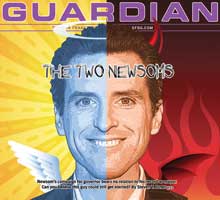
A pair of interesting stories in today’s Chronicle paint Mayor Gavin Newsom as a self-serving hypocrite, highlighting how his cuts-only budget proposals ignore the city’s long-term needs and have led Moody’s to lower the city’s credit rating, and how his green rhetoric is belied by his oil industry investments, including in the company responsible for the ongoing oil leak in the Gulf.

The Guardian has long noted how fiscally irresponsible Newsom’s budgets have been, with our latest editorial calling for Newsom to finally offer support for some of the revenue measures now being explored by the Board of Supervisors, which will need strong support from everyone in City Hall to have a chance of winning voter approval.

The Controller’s Office and now Moody’s have confirmed that Newsom’s reckless and gimmicky budget leaves a long-term budget hole even as it does short-term damage to the city’s social safety net and public health programs. But instead of acknowledging that reality, Newsom flak Tony Winnicker is still offering snide, Republican-style put-downs of the supervisors who are actually working hard to improve the city’s fiscal health while Newsom is out running for state office, afraid he will be criticized for supporting the tax revenue this city desperately needs.

As for Newsom’s oil industry investments, well, they speak for themselves. His whole political career, and even the restaurant and bar career before that, was built on a foundation of oil money heaped upon him by the Gettys. And even after he found there was political gold to be mined from green rhetoric, he has continued to financially support and profit from the oil industry.

Many Guardian readers have long said that we should just give up on Newsom, calling him a shameless and self-serving politician of the very worst sort. Maybe they’re right. But if Newsom wants to earn our support in his race for lieutenant governor – whose most important responsibilities are his key votes in deciding whether to support new offshore oil drilling in California and whether to continue pushing myopic cuts-only budgets for the public university systems – then now is the time for him to show some political courage by disinvesting from the oil industry and supporting a responsible city budget that includes new revenue measures for which he should actively campaign this fall.

Powder keg

5

news@sfbg.com

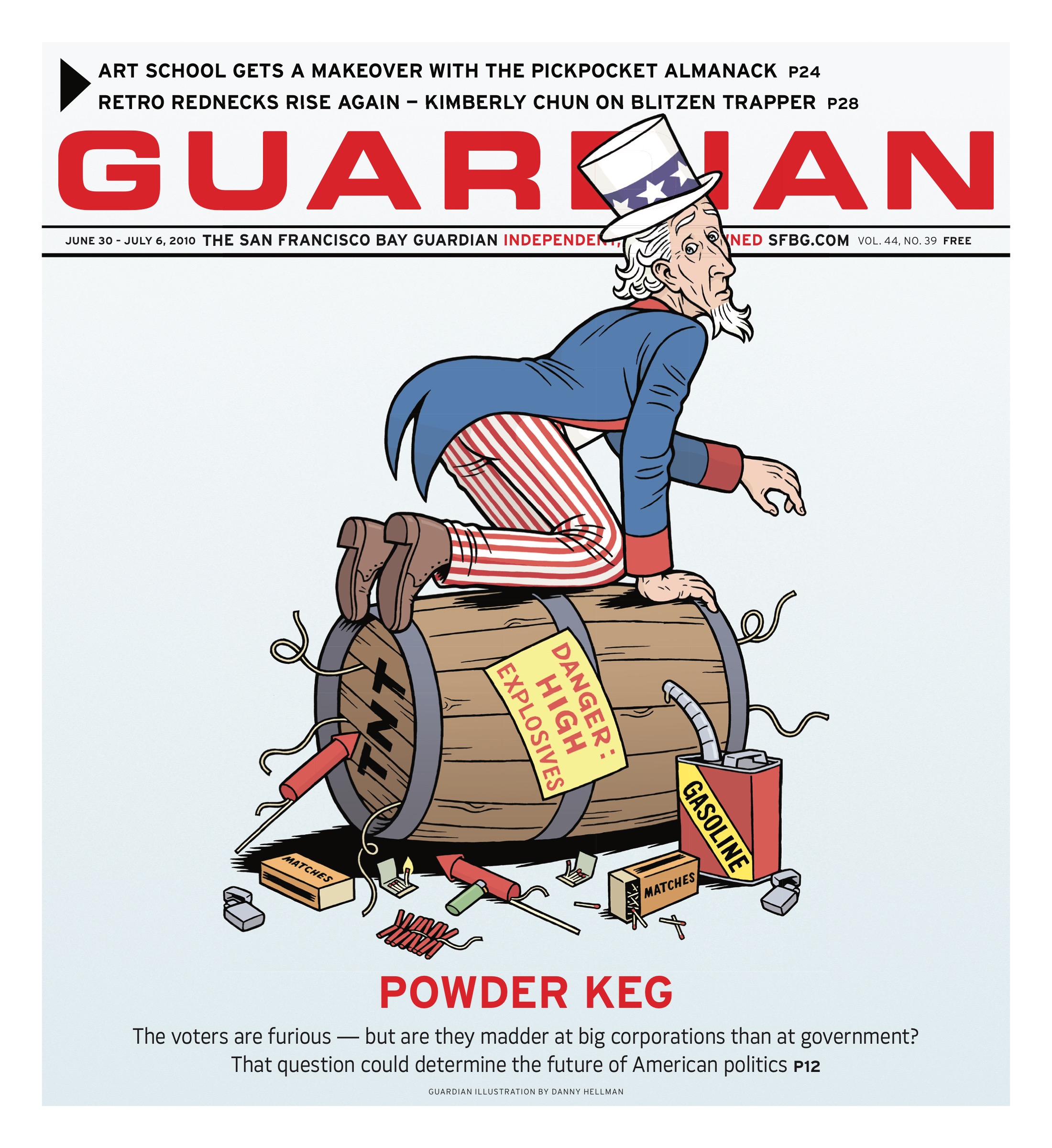
Ask any pollster, political consultant, or academic who studies the American electorate about the mood of the voters this year and you’ll get the same one-word answer: Angry.

Everyone’s pissed — the liberals, the conservatives, the moderates, the people who don’t even know where they fit in. It’s an unsettled time and, potentially, very bad news for a progressive agenda that seeks to address issues ranging from poverty and war to the long-term health of the public and the planet.

The Democrats, who swept into power with an enormously popular president just 18 months ago, may lose control of Congress. The tea partiers have driven the Republicans so far to the right that some candidates for Senate are openly talking about eliminating Social Security. The unemployment rate — the single most important factor in the politics of the economy — remains high and doesn’t show any signs of improving.

And the progressive left seems frustrated and demoralized, particularly in California. The Golden State, which once led the nation in innovation and enlightened social policy, now seems to be leading the politically dysfunctional race to the bottom.

The nation could be headed for a dangerous era, rife with the potential for right-wing demagoguery and other nasty political schisms. The state of the economy could easily fuel a more powerful movement to shrink the scope of government and a continuing backlash against the public sector — and the financial backers of the antitax and antiregulation movement are drooling at the prospect.

But there’s also a chance for progressives to seize a populist narrative and shift the discussion away from traditional disagreements and toward those areas, particularly the destructive influence on government by powerful corporations, where the grassroots right and grassroots left might actually agree.

The anger that voters feel toward a government that isn’t meeting their needs is starting to find other outlets. People are as mad about the abuses of big business — the Wall Street meltdown, the bailouts, the BP oil spill, the political manipulation — as they are about the failures of Congress and the president. If you ask Americans of every political stripe who they least trust — big government or big business — even conservatives aren’t so sure anymore.

For 30 years, the central narrative of American politics has revolved around the size and effectiveness of government. Now there’s a chance to shift that entire debate in American politics toward the largely unchecked power of corporations. It is, populist writer Jim Hightower told us, “an enormous opportunity handed to us by the bastards.”

But so far, none of the Democratic leaders in California are taking advantage of it to start dispelling damaging myths and crafting political narratives that might begin to create some popular consensus around how to deal with society’s most pressing problems.


THE PEOPLE WANT TAXES

There have been many polls gauging voter anger, but one of the most comprehensive and interesting recent ones was “Californians and Their Government,” a collaborative study by the Public Policy Institute of California and the James Irvine Foundation that was released in May.

It shows that Californians are mad about the state’s fiscal problems, disgusted with their political leaders, divided by ideology, and deeply conflicted over the best way forward. An astounding 77 percent of respondents say California is headed in the wrong direction and 81 percent say the state budget situation is a “a big problem.”

But the anti-incumbent message isn’t necessarily an anti-government message. Most Californians are willing to put more of their cash into public-sector programs, even during this deep recession. When asked to name the most important issues facing the state, 53 percent mentioned jobs and the economy . The state budget, deficit, and taxes only got the top billing of 15 percent.

And contrary to the conventional wisdom espoused by moderate politicians and political consultants, most voters say they are willing to pay higher taxes to save vital services. “Californians tell us they continue to place a high value on education and want education to be protected from cuts. And they’re willing to commit their money to help fund that,” PPIC director Mark Baldassare told the Guardian.

The survey found that 69 percent of respondents say they would pay higher taxes to protect K-12 education from future cuts, while 54 percent each say they would pay higher taxes to prevent cuts to higher education and to health and human services programs. In other words, voters seem to recognize where we’ve cut too deeply — and where we haven’t cut enough: only 18 percent of respondents would be willing to pay higher taxes to prevent cuts to prisons and corrections.

Baldassare said the June primary results also showed that people are willing to pay more in taxes for the services they value. “Around the state, there was a lot of evidence that people responded favorably to requests by their local governments for money, particularly for schools,” he said.

Both the California Legislature and Gov. Arnold Schwarzenegger are held in very low esteem with voters, according to the PPIC study, and Schwarzenegger’s 23 percent rating is the lowest in the poll’s history.

Barbara O’Connor, political communications professor who heads the Institute for the Study of Politics and the Media at Sacramento State University, told us that voter unhappiness with elected leaders is no surprise. Right now, most people are afraid that their basic needs won’t be met over the long run.

“The common narrative is fear, and fear channels into anger,” O’Conner said.

And that fear is being tapped into strongly this year by the Republican candidates, who are trying to scare voters into embracing their promises to gut government and keep taxes as low as possible.

“If there’s any lesson to be learned from Meg and Carly’s early ads, it’s fear-mongering, fear-mongering all the time — and that doesn’t create a very positive narrative,” O’Connor said of gubernatorial candidate Meg Whitman and U.S. Senate candidate Carly Fiorina.

O’Connor noted that Barack Obama’s campaign had great success in using a positive, hopeful message and said she believes the right leader can also do so in California. “I talked to Jerry [Brown]’s people about it and said you can’t just run a negative campaign because that’s what Meg is doing.”

Despite the tenor of the times, O’Connor said she’s feeling hopeful about hope. She also believes Californians would respond well to a leader like Obama who tried to give them that hope — if only someone like Brown can pick up that mantle. “I think the environment is right for a positive message. But the question is: do we have people capable of delivering it?”

She said the no-new-taxes, dismantle-government rhetoric has started to wear thin with voters. “The real fiscal conservatives are badly outnumbered in Californian,” O’Connor said. As for the corporate sales jobs, O’Connor said voters have really started to wise up. “They aren’t going to be scammed.”

The results of the June primary election showed that voters across the spectrum were also disturbed by big special-interest money. Proposition 16, backed by $46 million from Pacific Gas and Electric Co., went down to defeat — even in counties that tend to vote Republican.

And this fall, with two rich former CEOs spending their personal wealth to win two of California’s top elected offices and energy companies pushing a measure to roll back California’s efforts to combat global warming, there could be great opportunity in a narrative targeting those at the top of our economic system.


THE TOP AND THE BOTTOM

Some observers say that whatever their shared feelings about corporate scams, conservatives and liberals in the state are just too far apart, and that there’s little hope for any substantive agreement. “People are becoming more polarized,” said consultant David Latterman, who often works for downtown candidates and interests. “I think we’re beyond compromise.”

Allen Hoffenblum, a Los Angeles-based Republican strategist, agreed. “The voter are all mad, but they’re mad at different things. I just don’t see where they come together.”

But Hightower, who has spent a lifetime in politics as a journalist, elected official, author, and commentator, has a different analysis.

“As I’ve rambled through life,” he wrote in a recent essay, “I’ve observed that the true political spectrum in our society does not range from right to left, but from top to bottom. This is how America’s economic and political systems really shake out, with each of us located somewhere up or down that spectrum, mostly down.

“Right to left is political theory; top to bottom is the reality we actually experience in our lives every day — and the vast majority of Americans know that they’re not even within shouting distance of the moneyed powers that rule from the top of both systems, whether those elites call themselves conservatives or liberals.”

In an interview, he told us he sees a lot of hope in the fractured and potentially explosive political ethos. “There’s all this anger,” he said. “People don’t know what to do. And I think the one focus that makes sense is the arrogance and abuse of corporate executives.”

In fact, Hightower pointed out, the teabaggers didn’t start out as part of the Republican machinery. “Wall Street and the bailouts sparked the tea bag explosion,” he said. It wasn’t until big right-wing outfits like the Koch brothers, who own oil and timber interests and fund conservative think tanks, started quietly funding tea party rallies that the anti-corporate, anti-imperial edge came off that particular populist uprising.

“At first, the teabaggers didn’t even know where the money was coming from,” Hightower said. “You can’t be mad at the teabaggers; we should have been out there organizing them first.”

There’s plenty of evidence that anger at big business is growing rapidly — and rivals the distrust of big government that has defined so much of American politics in the past 30 years. The bailouts were “the first time in a long time that people have been slapped in the face by collusion between big business and its Washington puppets,” Hightower noted.

Then there’s the Supreme Court decision in Citizens United v. Federal Elections Commission. In January, a sharply divided court ruled 5-4 that corporations had the right to spend unlimited amounts of money supporting or opposing political candidates. Progressives were, of course, outraged — but conservatives were, too.

Polls show that more than 80 percent of Democrats think the decision should be overturned. So do 76 percent of Republicans. “This is a winner for our side,” Hightower noted. “But our side’s not doing anything about it.”

Sure, President Obama denounced the ruling in his State of the Union speech and promised reform. But the bill the Democrats have offered in response does nothing to stop the flow of money; it would only increase disclosure requirements. And in response to furor from the National Rifle Association, it’s been amended and is now so full of holes that it doesn’t do much of anything.

Political consultants advising Whitman are clearly looking for ways to direct the voter unhappiness into a demand for lower taxes and smaller budgets. She’s already vowed to fire 40,000 state workers, and her most recent campaign ad attacks Brown for expanding public programs and raising the state deficit.

So far Brown hasn’t challenged that narrative — and some Democrats say he shouldn’t. It would be safer, they say, for Brown to get out front and demand his own cuts in Sacramento. “Going after public-sector pensions is a winner,” one Democratic campaign consultant, who asked not to be named, told us. “If Whitman beats Brown on those issues, she wins.”

But that approach is never going to be effective for Democrats. If the argument is over who can better cut government spending, the GOP candidates will always win. The better approach is to see if progressives can’t shift the debate — and the anger — toward the private sector.

As Hightower put it: “You can yell yourself red-faced at Congress critters you don’t like and demand a government so small that it’d fit in the backroom of Billy Bob’s Bait Shop and Sushi Stand, but you won’t be touching the corporate and financial powers behind the throne.”

That’s where the discussion has to start. And there’s no better place than California.

The Golden State is a great example of what happens when the tax- cutters win. In 1978, the liberals in Sacramento, operating with a huge state budget surplus, couldn’t figure out how to derail the populist anger of property tax hikes. So Proposition 13, the beginning of the great tax revolt, passed overwhelmingly. Over the next decade, more antitax initiatives went before the voters, and all were approved.

Now the state is heading toward fiscal disaster. The schools are among the worst-funded in the nation. The world-famous University of California system is on the brink of collapse. Community colleges are turning away students. The credit rating on California bonds have fallen so far that it’s hard for the state to borrow money. And there’s still a huge budget gap.

The tax-cut mentality that led to the so-called Reagan revolution started in California; a political movement that shifts the blame for many of the state’s problems away from government and onto big business ought to be able to start here as well. And it’s potentially a movement that could bring together people who normally find themselves on opposite sides of the fence.

A case in point: the measure the oil companies have put on the November ballot to repeal the state’s greenhouse gas limits. The corporations backing the initiative, led by Valero, argue that California’s attempts to slow climate change will cost jobs. That’s a line we’ve heard for decades. Every tax cut, every move toward deregulation, is defended as helping spur job growth.

But the past four presidents have done nothing but cut taxes and reduce regulations — and the result is facing Americans on the streets every day. There is also growing evidence that even Republican voters don’t believe everything big businesses tell them anymore. And they’re starting to grasp that sometimes deregulation leads to outcomes like larcenous CEOs and unstoppable oil leaks.

So the potential for a successful progressive populist movement is out there. But it’s not going to happen by spontaneous combustion.


SF SHOWS THE WAY

On the national level, one of the factors creating this gloomy electorate is the failure of President Obama to keep the coalition that elected him active and engaged. The intense partisanship in Washinton has turned off many independent Obama voters, while his progressive supporters have been disappointed by issues ranging from his escalation in Afghanistan to tepid reforms on health care and Wall Street.

“One of the narratives now is where are the Obama voters and will they participate?” Jim Stearns, a San Francisco political consultant who works mostly on progressive campaigns, told us. “They still love Obama but they’re not moved by him anymore.”

Perhaps more important, they have lost the sense of hope that he once instilled. The Republican Party’s descent into right-wing extremism and the strong anticorporate narratives that have emerged in the last year — from BP’s oil spill to PG&E’s political manipulation to Goldman Sachs’ self-dealing to the prospect of unrestricted corporate campaign propaganda unleashed by the Citizens United ruling — have created the possibility that the negative narratives by the left may crowd out the positive ones.

“Meg Whitman is someone you can hate. She’s the rich Republican CEO trying to buy her way into office,” Stearns said. “But it’s a depressing message.”

But Stearns said there is another, most hopeful political narrative that is emerging in San Francisco, one that might eventually grow into a model that could be used at the state and federal levels. “We’re lucky in San Francisco. Progressive voters are engaged.”

He noted that San Francisco’s voter turnout was higher than expected in the June primary, and far higher than the record low state number, even though there really weren’t any exciting propositions or closely contested races on the local ballot — except for the Democratic County Central Committee, where progressives maintained their newfound control. And it’s because of the organizing and coalition-building that the left has done.

“What you’ve seen over the last few years is a coalition of labor, neighborhood groups, environmentalists, and the progressives now operating through the Democratic Party. That’s a great coalition with a lot for people to trust,” Stearns said.

Meanwhile, downtown has all but collapsed as a unified political force. “They don’t really have a political infrastructure,” Stearns said of downtown. “Normally it would be the mayor who gets everyone in line and working together.”

Even Latterman, the downtown-oriented consultant, agrees that the business community is no longer setting San Francisco’s agenda because it’s become fractured and unable to push a consistent political narrative: “There’s certainly been a lack of coordination.”

He also agrees that progressives have become more organized and effective. “Clearly, the Democratic Party of San Francisco has become a conduit for progressive politics and politicians, but not issues,” Latterman said. “What a lot of people get wrong in the city is the difference between politics and policy.”

Part of the reason is economic. With scarce resources, a high threshold for approving new revenue sources, and a fiscally conservative mayor unwilling to talk taxes, it’s been difficult to move a progressive agenda for San Francisco. And in Sacramento, it’s barely part of the discussions.

“The people of California have been held hostage by a handful of Republicans who are making us cut everything we care about,” while in San Francisco “Newsom is taking an entirely Republican approach to the budget,” Stearns said.

Looking toward the fall races, Stearns said the progressive coalition and majority on the Board of Supervisors will be tested on issues such as Muni reform, and the question will be whether fiscal conservatives like Sup. Sean Elsbernd can blame Muni’s problems on drivers, or whether progressives can create and sell a broader package that includes new revenue and governance reforms.

“The drivers are going to get their guarantee taken out of the charter, that’s going to happen. But people know that isn’t all that’s wrong with Muni,” Stearns said.

But to craft a more comprehensive solution, he said the progressives are going to need to use their growing coalition to connect the dots for voters. “We need to run a citywide campaign around a whole constellation of issues,” Stearns said, citing Muni, schools, taxes, resistance to mean-spirited measures like sit-lie, and the larger issues raised by the Brown and Barbara Boxer campaigns. “We need to figure out a way to put all that in the same coalition and run one campaign around it. And we can do that because progressives retained control of the DCCC.”


THE STRUGGLE AHEAD

Although they’ve made great strides, San Francisco progressives are still struggling with a mayor who sees the solution to every budget crisis as cuts — and with a growing number of efforts to blame public employees for the city’s fiscal problems. Even Jeff Adachi, the public defender once considered a standard-bearer for progressive causes, is pushing a ballot measure that would require city workers to pay more for their pensions.

Gabriel Haaland, who works with Service Employees International Union Local 1021, made the right point in the pension debate. “Big financial institutions crashed the stock market,” he said recently, “and now they want to blame city workers.”

In a blog post on the political website Calitics, Robert Cruickshank put it clearly: “The notion that ‘everyone needs to give back’ just doesn’t make sense given our economic distress. We’ve already given back too much. We gave back our wages. We gave back our ability to afford health care and housing and transportation. We gave back the robust public- sector services that created widespread prosperity in the 1950s and 1960s. We gave back affordable, quality education. And too many of us have given back our future.

“No, it’s time for someone else to give back. It’s time for the wealthiest Californians and the large corporations to give back. For 30 years now they have benefited from economic policy designed to take money and benefits from the rest of us and give it to those who already have wealth and power.”

That’s a message that ought to appeal to anyone who’s hurting from this recession. It ought to cross red and blue lines. It ought to be the mantra of a new progressive populism that can channel voter anger toward the proper target: the big corporations that created the problems that are making us all miserable.

If Jerry Brown could adopt that narrative, he could change the state of California — and the state of the nation.

Lennar’s litmus test

3

sarah@sfbg.com

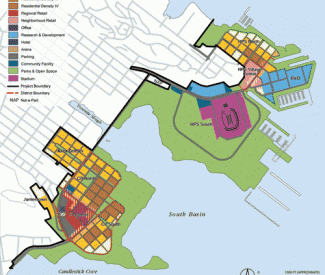
None of the many stakeholders tracking the progress of Lennar Corp.’s massive Candlestick Point-Hunters Point Shipyard redevelopment plan registered surprise when the Board of Supervisors received three appeals to the Planning Commission’s June 3 certification of the project’s final environmental impact report (FEIR).

Instead, everybody who has been watching the political juggernaut that has been pushing for quick approval of the project over the past month said they anticipated that the FEIR would be appealed, and perhaps litigated. But the real question is whether the project will be substantially changed.

In the seven months since the project’s draft EIR was released, the Planning and Redevelopment Commissions have repeatedly rejected all arguments and recommendations made by its critics to improve or delay the plan, rushing the approval along on a tight schedule (“The Candlestick Farce,” 12/21/09).

The rush job occurred even as numerous groups and individuals warned that the DEIR comment period was too short, (“DEIR in the headlights,” 02/03/10) and complained that the city and the developer had dismissed crucial data and testimony while exploiting fears the San Francisco 49ers would leave town if the city didn’t act quickly (“Political juggernaut,” 06/02/10).

What’s less clear is whether the Board of Supervisors has the political will to heed these appeals and correct what opponents say are serious flaws in the city’s FEIR. The appeal that the Sierra Club, Golden Gate Audubon Society, California Native Plant Society, and San Francisco Tomorrow filed June 21 lists nine deficiencies.

These included the FEIR’s failure to look into an alternate Bus Rapid Transit (BRT) route around Yosemite Slough or adequately assess impacts resulting from the landfill cap on Parcel E2 and the transfer of 20 acres of public shoreline land in Candlestick Point State Recreation Area (CPSRA) to build high-end housing.

“The FEIR failed to analyze those elements of the project’s sustainability plan that could have significant environmental impacts, including two proposed heating and cooling plants (which appear to be power plants) to serve 10,500 housing units and a projectwide recycling collection system,” the coalition further charged.

The appeal also voiced concern that the FEIR failed to adequately assess impacts resulting from the construction and maintenance of the development’s underground utility matrix, impacts to the bird-nesting in the proposed 34-acre wetland restoration project at the state park, and delays to eight Muni lines.

But the Sierra Club-led coalition also indicated that by removing provisions for a bridge over Yosemite Slough, transfer of land in the state park, and compromised clean-up efforts at Parcel E2, resolution of many of these disputed issues could be expedited.

“If the Board of Supervisors acts promptly, revisions to the EIR may be made quickly and result in a minimal delay in the progress of the project,” the coalition stated.

The Sierra Club’s Arthur Feinstein told the Guardian that the coalition’s top three concerns are “very important, but the six other issues are also very real.”

“Here we have a city cutting 10 percent of its bus service while saying that eight bus routes will need to be improved because of the project, and admitting that the development will increase air pollution in a district that has the highest rates of asthma and cancer without identifying mitigations such as reducing parking spaces in the proposal,” Feinstein said.

POWER (People Organized to Win Employment Rights) also filed an FEIR appeal June 21 listing a broader range of environmental and economic justice-related concerns.

These included the FEIR’s failure to analyze and mitigate for displacement that would be triggered in the surrounding neighborhood by developing 10,500 mostly market-rate housing units in the area and “failure to provide for adequate oversight and enforcement of the terms of the early transfer” of the shipyard from the Navy.

POWER also cited the FEIR’s failure to adequately mitigate against the impact of sea level rise, the risks associated with potential liquefaction of contaminated landfill at the shipyard in the event of an earthquake, and health risks related to chemicals of concern at the shipyard. The group also faulted the city’s failure to get the Navy to prepare an environmental impact statement on its clean-up plan before the FEIR was completed.

Finally, Californians for Renewable Energy (CARE) filed a five-point appeal June 23 charging that the project contravened the intent of Proposition P (which voters approved in 2000, urging the Navy to remediate shipyard pollution to the maximum extent possible), that the project’s FEIR is incomplete because the Navy (which still retains jurisdiction over the project lands) has not yet completed its EIS, and that the FEIR approval process was tainted by 49ers-related political pressure.

“The pre-set goal of maintaining the 49ers in San Francisco has colored the environmental analysis of this decision,” CARE noted, referring to the city’s rush to get the project’s FEIR certified on June 3 — five days before Santa Clara County voters approved a new stadium for the 49ers near Great America .

The appeal filings mean the Board of Supervisors is required to hold a hearing within 30 days, a move that places a roadblock, at least temporarily, in the way of the city’s tight schedule to secure final approvals for Lennar’s megaproject before summer’s end.

Board President David Chiu told the Guardian that the Board’s Land Use Committee will move forward with a July 13 meeting to hear a list of proposed amendments related to the underlying plan along with the FEIR appeals.

“We are back at the board Land Use Committee July 12 with 10 items related to the project,” said Chiu, who is a member of the Land Use Committee. The three-member committee is chaired by Sup. Sophie Maxwell, who represents the project’s District 10; Sup. Eric Mar is vice-chair.

“The next day, July 13, has been tentatively set for a full meeting of the full board,” Chiu continued. He acknowledged that the FEIR related materials are dense and complex, telling us that “they form the largest pile on my desk, and it’s about five inches high.”

But he wasn’t about to prejudge the outcome. “We do need to clean up the area and rebuild it in such a way that it will dramatically increase affordable housing and jobs and support a livable diverse community,” Chiu said. “Obviously there are still a lot of questions and concerns about the proposed project and the board will push to make sure all these issues are adequately addressed.”

CARE president Michael Boyd said he hoped the board would take his group’s appeal seriously and fix the plan’s fundamental shortcomings. “That means going back to square one,” he said.

But others were less sure that the board would seek to overturn the entire plan. “Everyone in the community would like the best level of clean-up,” said Saul Bloom, whose nonprofit Arc Ecology has tracked the proposed shipyard clean-up for three decades. “But what’s possible and practical? And will the city be supportive of that or the most expeditious solution?”

Bloom reserved gravest concern for plans to cap, not remove, the contaminants from the shipyard’s Parcel E2. “The concern is that if you put a cap on E2 without a liner then contaminants could scootch out during a seismic event, or over time, and cause problems because of the parcel’s close proximity to surrounding groundwater and the San Francisco Bay,” he said. “But to place a liner in there is very expensive because you’d have to excavate E2, at which point you might as well replace it with clean soil.”

Bloom acknowledged that the Navy has argued that excavation would cause a nasty smell and nobody knows what is going to be released in the process.

“But long-term Bayview residents like Espanola Jackson have made the point that the community already lives within nose-shot of the southeast sewage treatment plant and would rather put up with a few years of nasty smells, given the relative benefits of cleaning the yard up,” he said. “And how do we know a cap will be protective given the Navy’s argument that we don’t know what’s down there?

“The thing that makes the most sense here is to clean up the shipyard to the best possible extent, but the city isn’t planning to do that,” Bloom added. “And the environmental community’s bottom line has always been the bridge [over Yosemite Slough, which the Sierra Club opposes]. So the sense is that if the bridge goes away, so does their problem.”

Kaiser workers seek election between rival unions

34

Thousands of Kaiser Permanente workers have filed petitions to change unions in what could be the biggest battle yet between Service Employees International Union and its upstart rival National Union of Healthcare Workers. If called by federal regulators, the election would involve more than 45,000 workers, the biggest private sector organization since Ford Motors employees joined United Auto Workers in 1941.

“This is the election everyone has been anticipating for the last year and a half,” NUHW spokesperson Sadie Crabtree told us.

That was when Sal Rosselli and other former leaders of the Oakland-based United Healthcare Workers were ousted by former SEIU President Andy Stern and other leaders of their parent union, SEIU, and formed NUHW. Since then, the two unions have clashed bitterly and regularly, in various workplaces, through the media, in leadership battles, and in a San Francisco court case that ended in April.

“The NUHW petition, if the National Labor Relations Board agrees it was filed appropriately, could force an election between SEIU-UHW and NUHW at Kaiser. Voting for NUHW would risk all the gains SEIU-UHW members made in a hard-fought four-month contract campaign against takeaways by Kaiser,” was how an SEIU-UHW press release cast today’s action.

NUHW opted for a nod to the Fourth of July in its release: “Thousands of Kaiser healthcare workers fired the first shot today in a long-anticipated battle for independence that will determine the future of California’s largest union, SEIU. They filed a petition that will trigger elections for 45,000 SEIU members to choose between the troubled incumbent and the state’s fastest-growing union, the new National Union of Healthcare Workers.”

About 2300 Kaiser workers – representing three of the seven bargaining units – already voted in January to join NUHW, but the petitions now being turned in by the remaining four unions represent the most significant segment of Kaisier workers, including the 44,000-member service, technical, and clerical unit.

Federal law calls for elections when at least 30 percent of a union’s members ask for one, and Crabtree told us, “We have more than we need.” Now, the NLRB must verify the petitions and schedule the election.

Stage listings

0

Stage listings are compiled by Guardian staff. Performance times may change; call venues to confirm. Reviewers are Robert Avila, Rita Felciano, and Nicole Gluckstern. Submit items for the listings at listings@sfbg.com.

THEATER

OPENING

Beijing, California Thick House Theater, 1695 18th St; www.asianamericantheater.org. $15-25. Opens Thurs/2, 8pm. Plays Thurs-Sat, 8pm; Sun, 5pm. Through July 17. Asian American Theater Company presents a new play by Paul heller set in the year 2050, when China invades America.

Posibilidad, or Death of the Worker Dolores Park and other sites; 285-1717, www.sfmt.org. Free. Previews Sat/3, 2pm. Opens Sun/4, 2pm. Runs Sat-Sun, Sept 6, 2pm; Sept 17, 8pm. The San Francisco Mime Troupe opens its 51st season with a modern song and tango about politics in the workplace.

BAY AREA

Left of Oz Ashby Stage, 1901 Ashby, Berk; (800) 838-3006, www.brownpapertickets.com. $25-50. Opens Fri/2 8pm. Runs Fri-Sat, 8pm, Sun, 7pm. Through July 18. Stephanie’s Playhouse presents a lez-queer musical comedy following the out west adventures of Dorothy.


ONGOING

Abigail: The Salem Witch Trials Temple SF, 540 Howard; www.templesf.com. $10. July 8, 29, Aug 5, 12, 19, 26, 9pm. Through Aug 26. Buzz Productions, with Skycastle Music and Lunar Eclipse Records, presents an original rock opera based on the Salem witch trials.

*Blackbird: Honoring a Century of Pansy Divas Mama Calizo’s Voice Factory, 1519 Mission; 786-9325, www.evezen.org. Thurs-Sat, 8pm. Through July 10. The intimate Blackbird Funeral Parlour Speakeasy is somber-toned and deceptively hushed, complete with period furnishings, a see-through dressing room, softly flickering altar, and obligatory piano. Only a few moments into Seth Eisen’s exceptional one-man cabaret, however, and the place is alive and kicking: doleful aspects of the décor making ample room for a sly, vigorous, soulful performer and a completely unexpected journey through some vibrant underground queer history (backed by fellow Circo Zero alum Sean Feit’s sharp musical direction and breezy accompaniment, and Alanna Simone’s gently humorous and haunting video pieces). Your guide is 100-year-old Jean Marlin, author of the notorious 1930s Pansy Craze, 75 years dead and looking fabulous in tails, bold green cravat, dapper purple hankie and a topping of regal black plumage (costumer Jack Davis demonstrates a genius throughout for turning a shoestring budget into a G-string–supported extravaganza). A multifaceted performer with quick tongue, nimble steps, and hearty voice (giving life to an assortment of extraordinary songs), Eisen uses drag, dance, puppetry, and performance art techniques to give flight to worthy exotic blackbirds known and forgotten—drag queen Zen priest Tommy Issan Dorsey; sexually ambiguous Danny Kaye; Brazil’s inimitable Ney Matogrosso; the definitely outré Klaus Nomi; and disco treasure Sylvester, whose live rendition of the Beatles’ "Blackbird" at SF’s War Memorial Opera House is one of several standout moments in this rollicking and poignant act of resurrection, insurrection, and homage. (Avila)

Die Walküre War Memorial Opera House, 301 Van Ness, SF; www.sfopera.com. $15-360. Wed/30, 7pm. Through Wed/30. San Francisco Opera presents the second installment of Wagner’s Ring cycle, directed by Francesca Zambello.

"Durang Me!" Next Stage, 1620 Gough; 1-800-838-3006, www.custommade.org. $10-28. Thurs-Sat, 8pm. Through July 10. Christopher Durang’s The Actor’s Nightmare could just as easily be called The Accountant’s Nightmare, as befuddled Everyman and presumed non-actor George Spelvin (Eric O’ Kelly) attempts to navigate his way out of a confused rendition of Noel Coward’s "Private Lives" dressed as Prince Hamlet and menaced by a trashcan-bearing Beckett-arian (AJ Davenport). This traditional companion piece to Durang’s Catholic School send-up Sister Mary Ignatius Explains It All for You references a Catholic boyhood several times, but it is the anxiety of the present moment that prevails, as the stage clears, and Spelvin is chased into a corner by an unforgiving spotlight to deliver his frantic last-ditch attempt at a soliloquy: his ABC’s. The titular Sister Mary Ignatius (AJ Davenport), by turns arctic and expansive, attempts to explain all, while periodically trotting out her star pupil Thomas (Cole Cloud) to recite catechism and spell eck-u-men-ickle for cookies. Davenport plays the pedantic side of Sister Mary with humorous vigor, but when a group of her former students drop by "to embarrass her" she doesn’t quite pull off embodying the ogress of their now-adult nightmares. Of her former students, it is probably Aloysius Benheim (Eric O’Kelly) who comes across as the most damaged by her tyranny, and not coincidentally, suffers the piece’s greatest humiliation. (Nicole Gluckstern)

La Fanciulla Del West War Memorial Opera House, 301 Van Ness; www.sfopera.com. $15-360. Fri/2, 8pm. Through Fri/2. San Francisco Opera presents Puccini’s opera, with Deborah Voigt as Minnie.

How the Other Half Loves Phoenix Theatre, 414 Mason; (800) 838-3006, www.offbroadwaywest.org. $35, Thurs-Sat, 8pm. Through July 31. Off Broadway West Theatre Company presents an early play by Alan Ayckbourn.

Krapp’s Last Tape Exit on Taylor, 277 Taylor; 1-800-838-3006, www.cuttingball.com. $15-30. Thurs-Sat, 8pm. Through Sat/3. Cutting Ball Theater remounts its strong recent production of Samuel Beckett’s hour-long solo play, featuring a full-fledged and satisfying turn by a hearty, slyly comic Paul Gerrior as the titular Krapp, reflecting on the fleeting sense of self recorded on reel-to-reel tapes over the course of a long life. Artistic director Rob Melrose approaches the material with supreme assurance and passionate but never stifling fidelity. David Sinaiko provides the recorded voice of the younger Krapp, expertly balancing a passion and unselfconscious pomposity that has Gerrior’s Krapp alternately bemused, euphoric, and wincing through one of Beckett’s most autobiographical and surprisingly affirming pieces. Melrose’s choice use of scenic elements, meanwhile, including the palpably solid 1950s-era tape machine, places Gerrior (suitably odd and natty in costumer Maggie Whitaker’s dapper vest, high-water trousers and white shoes) in a kind of communion with the reel and the real—an affecting and quietly unsettling relationship, pitched against an infinite blackness all around, that has Krapp at one point resting his head gently on the machine as he and the insubstantial voice of his younger self relive a moment of intimacy with a long-gone lover. (Avila)

The New Century New Conservatory Theatre Center, 25 Van Ness, SF; 861-8972, www.nctcsf.org. $22-40. Wed-Sat, 8pm; July 11, 2pm. Through July 11. New Conservatory Theatre Center performs Paul Rudnick’s bill of short comedies.

Peter Pan Threesixty Theater, Ferry Park (on Embarcadero across from the Ferry Bldg); www.peterpantheshow.com. $30-125. Tues and Thurs, 7pm; Fri-Sat, 7:30pm (also Sat, 2pm); Wed, 2pm; Sun, 1 and 5pm. Through August 29. JM Barrie’s tale is performed in a specially-built 360-degree CGI theater.

Reading My Dad’s Porn and French Kissing the Dog The Marsh Studio Theater, 1074 Valencia; (800) 838-3006, www.themarsh.org. Thurs-Sat, 8pm. Through July 17. The title of San Francisco writer-performer Cherry Zonkowski’s confessional solo show gives only a little away—a passing detail from the Nordic diversions of a spirited army brat and daughter of an alcoholic father—but the rest of the narrative leaves even less to the imagination. An account of Zonkowski’s initiation into the sex party and BDSM scene, Reading My Dad’s Porn bounces gleefully between comically graphic depictions of sweaty, writhing Bay Area meet-and-greets and a childhood and young adulthood buried in family dysfunction, a loveless marriage, and the grueling teaching load of a recent English PhD. Ultimately, it’s the story of a woman finding her own identity and community, and if the outlines sound familiar they also feel that way. The straightforward plot—peppered with humorous details and asides (as well as the odd song, accompanied by accordionist Salane Schultz, alternating nights with Aaron Seeman)—lacks both urgency and characters of much complexity. The story’s patina of outré sex, meanwhile, is far from revelatory and too superficial and jokey to offer much dramatic heft. Nevertheless, the show, developed with director David Ford, draws a limited appeal from the force of Zonkowski’s extroverted personality, whose orientation sexual and otherwise skews toward fun—although her more aggressive attempts to corral the audience into participating (mainly vocally) in the show’s narrative high jinx may put some off even more than the fisting by the snack table. (Avila)

What Mama Said About Down There Our Little Theater, 287 Ellis; 820-3250, www.theatrebayarea.org. $15-25. Thurs-Sun, 8pm. Through August 28. Writer-performer-activist Sia Amma presents this largely political, a bit clinical, inherently sexual, and utterly unforgettable performance piece.

BAY AREA

The Drawer Boy Marion E. Greene Black Box Theatre, 531 19th St, Oakl. www.brownpapertickets.com. $10. Thurs-Sat, 8pm; Sun, 2pm. Through Sun/4. TheatreFIRST presents Michael Healey’s comedy about two aging farmers with a family secret.

*East 14th: True Tales of a Reluctant Player Marsh Berkeley, 2120 Allston, Berk; www.themarsh.org. $20-50. Sat/3, July 24, 31, 8pm; July 18, 25, Aug 1, 7pm; Fri/ 2, July 9, 16, 9pm. Through August 1. Don Reed’s solo play, making its Oakland debut after an acclaimed New York run, is truly a welcome homecoming twice over. (Avila)

"Fireworks Festival" Berkeley Repertory Theatre, Thrust Stage, 2025 Addison, Berk; (510) 647-2949, www.berkeleyrep.org. $25-35. Through Sat/3, showtimes vary. This performance festival includes work by John Leguizamo, David Sedaris (whose show is already sold out), Dan Hoyle, and Wes "Scoop" Nisker.

Les Liasons Dangereuses Redwood Ampitheatre, 30 Sir Francis Drake, Ross; (415) 251-1027, www.porchlight.net. $15-30. Thurs-Sun, 7:30pm; also July 7, 7:30pm. Through July 10. Porchlight Theatre Company presents a production of Christopher Hampton’s adaptation of the 1782 novel.

Loveland The Marsh Berkeley, 2120 Allston, Berk; (800) 838-3006, www.themarsh.org. $25-50. Fri/ 2, 9, 7pm; Sat/3, 5pm; July 11, 2pm. Through July 11. Ann Randolph’s comic solo show about an irreverent woman’s trip back to her childhood home in Ohio.

Shaker Chair Pear Avenue Theatre, 1220 Pear Avenue, Mtn View; (800) 838-3006, www.brownpapertickets.com. $15-30. Thurs-Sat, 8pm; Sun, 2pm (also July 10, 2pm; no performance Sun/4). Through July 11. Pear Avenue Theatre presents Adam Bock’s play about a middle-aged widow who applies Shaker philosophy to her lifestyle.

Speech & Debate Aurora Theatre, 2081 Addison, Berk; www.auroratheatre.org. $34-55. Wed-Sat, 8pm; Sun, 2pm, 7pm; Tues, 7pm. Through July 18. Aurora Theatre closes its 18th season with Stephen Karam’s comedy about three teen misfits connected to a small town sex scandal.


PERFORMANCE/DANCE

BATS Improv Theatre Bayfront Theater, Fort Mason Center, B350 Fort Mason; 474-6776, www.improv.org. Fri-Sat, 8pm. Through July 31. Bay Area Theatresports presents an evening of theater and comedy.

The Bowls Project: Secrets of the Apocalyptic Intimate Yerba Buena Center for the Arts, Sculpture Court, 701 Mission; 978-2787, www.ybca.org. Tues/6, 6-8pm, free. Through August 22. Charming Hostess presents a series of performances in conjunction with an interactive sound sculpture.

Hannibal Buress Rickshaw Stop, 155 Fell; 861-2011, www.rickshawstop.com. Wed/30, 8pm. $12. The Saturday Night Live writer performs along with W. Kamau Bell and Jen Slusser.

Curtain Up! The Life and Times of Ethel Merman Martuni’s, 4 Valencia; 241-0205, www.dragatmartunis.com. Wed/30, 7pm. Tom Shaw Trip presents an evening devoted to the famous indomitable diva.

Kinsey Sicks: Each Hit & I Rrazz Room, 222 Mason; (866) 468-3399, www.theRRazzroom.com. Tues/6, 7pm. $35-40. An all new musical revue with parodies of Katy perry and others.

Liz Grant Variety Pack Comedy Show Purple Onion, 140 Columbus; 200-8781, www.brownpapertickets.com. Fri, 4:30pm. Through Sept 3. $10. A changing lineup of stand up comedy.

Qcomedy Showcase Martuni’s, 4 Valencia; 241-0205, www.Qcomedy.com. Mon, 5pm. A weekly show of queer comedy.

The Romane Event Make Out Room, 3225 22nd St; 647-2888, www.pacoromane.com. Wed/30, 7:30pm. $7. A comedy event led by SF comedian Paco Romane.

BAY AREA
Backroom Comedy 5332 College, Oakl; (510) 655-3929, www.candychurilla.com. Wed/30, 8pm. Free, A stand up comedy show hosted by Candy Churilla.

Film listings

0

Film listings are edited by Cheryl Eddy. Reviewers are Kimberly Chun, Michelle Devereaux, Max Goldberg, Dennis Harvey, Johnny Ray Huston, Erik Morse, Louis Peitzman, Lynn Rapoport, Ben Richardson, and Matt Sussman. For rep house showtimes, see Rep Clock. For first-run showtimes, see Movie Guide.

OPENING

*Everyone Else See "Nobody But You." (1:59) Lumiere, Shattuck.

The Last Airbender Millions of people out of work, and M. Night Shyamalan is still making movies. (1:34) Presidio.

Love Ranch See "Madam Majesty." (1:57) Embarcadero.

*Restrepo Starting mid-’07, journalists-filmmakers Tim Hetherington and Sebastian Junger spent some 15 months off and on embedded with a U.S. Army platoon in Afghanistan’s Korengal Valley, a Taliban stronghold with steep, mountainous terrain that could hardly be more advantageous for snipers. Particularly once a second, even more isolated outpost is built, the soldiers’ days are fraught with tension, whether they’re ordered out into the open on a mission or staying put under frequent fire. Strictly vérité, with no political commentary overt or otherwise, the documentary could be (and has been) faulted for not having enough of a "narrative arc" — as if life often does, particularly under such extreme circumstances. But it’s harrowingly immediate (the filmmakers themselves often have to dive for cover) and revelatory as a glimpse not just of active warfare, but of the near-impossible challenges particular to foreign armed forces trying to make any kind of "progress" in Afghanistan. (1:33) Bridge. (Harvey)

The Twilight Saga: Eclipse Another one already? Jeez. (2:04) California, Shattuck, Sundance Kabuki.

ONGOING

The A-Team Why was the original A-Team the most popular band of mercenaries on TV? The estimable chemistry and comedic skills of Mr. T; legit Breakfast at Tiffany‘s star George Peppard; conservative commentator Dwight Schultz; and Dirk Benedict, fresh from his role as the original Starbuck on Battlestar Galactica, played a major part, as did the quasi-anti-authoritarian, boyish, blow-’em-up-real-good tone, making it more of a cartoonishly violent kin to MASH than First Blood (1982). The cheeky humor and snappy writing were the real key to The A-Team‘s popularity — the reason impressionable protein units like yours truly tuned in. Director Joe Carnahan (2006’s Smokin’ Aces) and cast seem to have sussed out a bit of that magic, especially when the sun-roasted Bradley Cooper as Faceman and Sharlto Copley as Murdock roll with the what-the-hell non-sequiturs (less sure is the star of last year’s District 9‘s grip on exactly what accent he’s been charged with). But the cinematic version won’t be rehabbing the public’s view of guns-for-hire like Blackwater anytime soon. Liam Neeson lacks the cigar-chomping paternal bravado of Peppard, Quinton "Rampage" Jackson is tasked with the unenviable job of following T time, and the script, complete with the ludicrously elaborate plans and a spark-challenged romance between Cooper and Jessica Biel, is just a rough excuse to watch boys and their toys. (1:57) 1000 Van Ness, SF Center. (Chun)

*Babies Thomas Balmes’ camera records the first year in the lives of four infants in vastly different circumstances. They’re respectively born to hip young couple in Tokyo’s high-tech clutter; familiar moderately alterna-types (the father is director Frazer Bradshaw of last year’s excellent indie drama Everything Strange and New) in SF’s Mission District; a yurt-dwelling family isolated in the vast Mongolian tundra; and a Namibian village so maternally focused that adult menfolk seem to have been banished. Yes, on one level this is the cutest li’l documentary you ever saw. But if you were planning to avoid thinking that is all (or most) of what Babies would be like, you will miss out big time. Void of explanatory titles, voice-over narration, or subtitle translations, this is a purely observatory piece that reveals just how fascinating the business of being a baby is. There’s very little predictable pooping, wailing, or coddling. Instead, Balmes’ wonderful eye captures absorbing moments of sussing things out, decision-making, and skill learning. While the First World tykes firstborns both — are hauled off to (way) pre-school classes, the much less day planned Third Worlders have more complex, unmediated dealings with community. Those range from fending off devilish older siblings to Mongol Bayarjargal’s startlingly casual consorting with large furry livestock. (Imagine the horror of parents you know were their baby found surrounded by massive cows — a situation that here causes no concern whatsoever for adults, children, or bovines.) So accustomed to the camera that it doesn’t influence their behavior, the subjects here are viewed with an intimacy that continually surprises. Babies is getting a wider-than-usual release for a documentary, one cannily timed to coincide with Mother’s Day. But don’t be fooled: this movie is actually very cool. (1:19) Shattuck, Smith Rafael. (Harvey)

*Coco Chanel and Igor Stravinsky Revered for the innovative fashion house that set the bar for style and was always knocked off but never cut prices for the real deal (and still sniffs at online clothing sales), Gabrielle "Coco" Chanel gets her second biopic, as an artist on par with composer Igor Stravinsky in this rhapsodically sensuous love letter to an unlikely romance. It opens with the designer and future branding legend (depicted with burning eyes and pantherine mystery by Anna Mouglalis) attending the controversial, riot-starting 1913 premiere of Stravinsky’s The Rite of Spring in Paris. Recognizing Stravinsky (a viral avant-garde stud-muffin in the hands of Mads Mikkelsen, last in deadlocks and warrior face in Clash of the Titans) as a simpatico radical spirit, Chanel lends her house to the composer. He comes with considerable baggage: a slew of children and a consumptive wife, Katarina (Elena Morozova). Morozova’s performance as the angel-faced earth mother scorned, so blatantly disrespected by the rad lovers madly getting down on the music-room carpet, almost steals the show, but then the house-porn fabulosity of the recreated Chanel villa in Garches — a symbol of their hermetic attraction and shot like a seductive, claustrophobic, black-and-white deco womb — takes over, and we’re back in the thick of CoGor’s somewhat inexplicable affair once again. (1:55) Shattuck, Sundance Kabuki. (Chun)

Cyrus It’s tempting to label Mark and Jay Duplass’ Cyrus as "mumblecore goes mainstream." Yes, the mumblecore elements are all there: plentiful moments of awkward humiliation, characters fumbling verbally and sometimes physically in desperate attempts to establish emotional connections, and a meandering, character-driven plot, in the sense that the characters themselves possess precious little drive. The addition of bona fide indie movie stars John C. Reilly, Catherine Keener, and Marisa Tomei — not to mention Hollywood’s chubby-funny guy du jour, Jonah Hill — could lead some to believe that the DIY-loving Duplass brothers (2005’s The Puffy Chair, 2008’s Baghead) have gone from slacker disciples of John Cassavetes (informally known as "Slackavetes") to worshippers at the slickly profane (with a heart) altar of Judd Apatow. But despite the presence of Apatow protégé Hill (2007’s Superbad) in the title role, Cyrus steers clear of crowd-pleasing bombast, instead favoring small, relatively naturalistic moments. That is to say, not much actually happens. Mumblecore? More or less. Mainstream? Not exactly. Despite playing a character with some serious psychological issues, Hill comes off as likeable. Unfortunately the movie is neither as broadly comic nor as emotionally poignant as it needs to be — the two opposing forces seem to cancel each other out like acids and bases. (1:32) California, Metreon. (Devereaux)

8: The Mormon Proposition (1:30) Elmwood, Sundance Kabuki.

*Exit Through the Gift Shop Exit Through the Gift Shop is not a film about the elusive graffiti-cum-conceptual artist and merry prankster known as Banksy, even though he takes up a good chunk of this sly and by-no-means impartial documentary and is listed as its director. Rather, as he informs us — voice electronically altered, face hidden in shadow — in the film’s opening minutes, the film’s real subject is one Thierry Guetta, a French expat living in LA whose hangdog eyes, squat stature, and propensity for mutton chops and polyester could pass him off as Ron Jeremy’s long lost twin. Unlike Jeremy, Guetta is not blessed with any prodigious natural talent to propel him to stardom, save for a compulsion to videotape every waking minute of his life (roughly 80 percent of the footage in Exit is Guetta’s) and a knack for being in the right place at the right time. When Guetta is introduced by his tagger cousin to a pre-Obamatized Shepard Fairey in 2007, he realizes his true calling: to make a documentary about the street art scene that was then only starting to get mainstream attention. Enter Banksy, who, at first, is Guetta’s ultimate quarry. Eventually, the two become chummy, with Guetta acting as lookout and documenter for the artist just as the art market starts clambering for its piece of, "the Scarlet Pimpernel of street art," as one headline dubs him. When, at about three quarters of the way in, Guetta, following Banksy’s casual suggestion, drops his camcorder and tries his hand at making street art, Exit becomes a very different beast. Guetta’s flashy debut as Mr. Brainwash is as obscenely successful as his "art" is terribly unimaginative — much to the chagrin of his former documentary subjects. But Guetta is no Eve Harrington and Banksy, who has the last laugh here, gives him plenty of rope with which to truss himself. Is Mr. Brainwash really the ridiculous and inevitable terminus of street art’s runaway mainstream success (which, it must be said, Banksy has handsomely profited from)? That question begs another: with friends like Banksy, who needs enemies? (1:27) Lumiere. (Sussman)

Get Him to the Greek At this point movie execs can throw producer Judd Apatow’s name on the marquee of a film and it’s a guaranteed blockbuster. It’s hard to say whether this Forgetting Sarah Marshall (2008) spin-off benefits from the Apatow sign of approval or if it would be better off standing on its own, but it definitely doesn’t benefit from comparisons to its predecessor. Russell Brand returns as the British rock star Aldous Snow, and Jonah Hill, playing a different character this time, is given the task of chaperoning the uncooperative Snow from London to LA in 48 hours. Despite a great cast, including a surprisingly animated P. Diddy, the story is pretty bland and can’t match the blend of drama and comedy that Marshall achieved. Of course, none of that matters because the movie execs are right: if you like Apatow’s brand of humor, you’re going to have a good time anyway. (1:49) Empire, Four Star, 1000 Van Ness, Presidio, SF Center, Shattuck, Sundance Kabuki. (Peter Galvin)

*The Girl With the Dragon Tattoo By the time the first of Stieg Larsson’s so-called "Millennium" books had been published anywhere, the series already had an unhappy ending: he died (in 2004). The following year, The Girl With the Dragon Tattoo became a Swedish, then eventually international sensation, its sequels following suit. The books are addicting, to say the least; despite their essential crime-mystery-thriller nature, they don’t require putting your ear for writing of some literary value on sleep mode. Now the first of three adaptive features shot back-to-back has reached U.S. screens. (Sorry to say, yes, a Hollywood remake is already in the works — but let’s hope that’s years away.) Even at two-and-a-half hours, this Girl With the Dragon Tattoo by necessity must do some major truncating to pack in the essentials of a very long, very plotty novel. Still, all but the nitpickingest fans will be fairly satisfied, while virgins will have the benefit of not knowing what’s going to happen and getting scared accordingly. Soon facing jail after losing a libel suit brought against him by a shady corporate tycoon, leftie journalist Mikael Blomkvist (Michael Nyqvist) gets a curious private offer to probe the disappearance 40 years earlier of a teenage girl. This entangles him with an eccentric wealthy family and their many closet skeletons (including Nazi sympathies) — as well as dragon-tattooed Lisbeth Salander (Noomi Rapace), androgynous loner, 24-year-old court ward, investigative researcher, and skillful hacker. Director Niels Arden Oplev and his scenarists do a workmanlike job — one more organizational than interpretive, a faithful transcription without much style or personality all its own. Nonetheless, Larsson’s narrative engine kicks in early and hauls you right along to the depot. (2:32) Clay, Four Star, Piedmont, Shattuck, Smith Rafael. (Harvey)

Grown Ups In order of star power, Grown Ups casts Adam Sandler, Kevin James, Chris Rock, Rob Schneider, and David Spade as five fortysomething friends who reunite to attend the funeral of their high school basketball coach, and play catch-up over a long weekend together at a cabin by the lake. If you’re expecting five of America’s biggest comedy stars to form like Voltron and make the most hilarious movie of the year, you’ve got a sad day coming. Grown Ups is never the sum of its parts, it’s about on par with Sandler’s other producing/starring affairs, and probably features a lot of the same jokes. People fall in poop and little kids say cute things designed to make audiences awww, but history has shown that’s exactly what a popcorn viewer is looking for. By these standards, Grown Ups is a perfectly summer-y movie. (1:42) Empire, Marina, 1000 Van Ness, Shattuck. (Peter Galvin)

Have You Heard from Johannesburg? The best word to describe Connie Field’s Have You Heard From Johannesburg? is "impressive." At eight-and-a-half hours, the seven-part documentary series spans nearly five decades of the South African anti-apartheid movement. The individual films are well-researched and thought-provoking. The stories are compelling — that is, until you put them all together. The complete series is just too long for those without a strong, vested interest in South African history. It’s simply not approachable for the mainstream, and the approximately three-hour chunks it’s meant to be consumed in are daunting. These films are better suited to a televised series, where viewers could appreciate hearing about anti-apartheid pioneers like Oliver Tambo and Desmond Tutu in smaller, digestible bites. As it stands, Field’s documentary is not likely to find a wide audience — a real pity, given the 10 years of effort she put into it, and the importance of sharing the South African struggle for equality with the rest of the world. (8:30) Roxie, Smith Rafael. (Peitzman)

*I Am Love I Am Love opens in a chilly, Christmastime Milan and deliberately warms in tandem with its characters. Members of the blue-blood Recchi family are content hosting lavish parties and gossiping about one another, none more than the matriarch Emma (Tilda Swinton). But when prodigal son Edoardo befriends a local chef, Emma finds herself taken by both the chef’s food and his everyman personality, and is reminded of her poor Soviet upbringing. The courtship that follows is familiar on paper, but director Luca Guadagnino lenses with a strong style and small scenes acquire a distinct energy through careful editing and John Adams’ unpredictable score. Swinton portrays Emma’s unraveling with the same gritty gusto she brought to Julia (2008), and her commitment to the role recognizes few boundaries. You’ve probably seen this story before, but it has rarely been this powerful. (2:00) Albany, Embarcadero, Sundance Kabuki. (Galvin)

*Iron Man 2 Tony Stark (Robert Downey Jr.) returns, just as rich and self-involved as before, though his ego his inflated to unimaginable heights due to his superheroic fame. Pretty much, he’s put the whole "with great power comes great responsibility" thing on the back burner, exasperating everyone from Girl Friday Pepper Potts (Gwyneth Paltrow); to BFF military man Rhodey (Don Cheadle, replacing the first installment’s Terrence Howard); to certain mysterious Marvels played by Samuel L. Jackson and Scarlett Johansson; to a doofus-y rival defense contractor (Sam Rockwell); to a sanctimonius Senator (Garry Shandling). Frankly, the fact that a vengeful Russian scientist (Mickey Rourke) is plotting Tony’s imminent death is a secondary threat here — for much of the film, Tony’s biggest enemy is himself. Fortunately, this is conveyed with enjoyable action (props to director Jon Favreau, who also has a small role), a witty script (actor Justin Theroux — who knew? He also co-wrote 2008’s Tropic Thunder, by the way), and gusto-going performances by everyone, from Downey on down. Stay for the whole credits or miss out on the geek-gasm. (2:05) 1000 Van Ness. (Eddy)

*Joan Rivers: A Piece of Work Whether you’re a fan of its subject or not, Ricki Stern and Annie Sundberg’s documentary is an absorbing look at the business of entertainment, a demanding treadmill that fame doesn’t really make any easier. At 75, comedian Rivers has four decades in the spotlight behind her. Yet despite a high Q rating she finds it difficult to get the top-ranked gigs, no matter that as a workaholic who’ll take anything she could scarcely be more available. Funny onstage (and a lot ruder than on TV), she’s very, very focused off-, dismissive of being called a "trailblazer" when she’s still actively competing with those whose women comics trail she blazed for today’s hot TV guest spot or whatever. Anyone seeking a thorough career overview will have to look elsewhere; this vérité year-in-the-life portrait is, like the lady herself, entertainingly and quite fiercely focused on the here-and-now. (1:24) Embarcadero, Piedmont, Shattuck, Smith Rafael. (Harvey)

Jonah Hex Based on DC’s dark western comics, Jonah Hex is a jumbled mess of mishandled superhero tropes and obligatory attempts at badass-ery. The title character, a grizzled gunfighter with a distinctive facial scar, could be an engaging outsider antihero, but as portrayed by Josh Brolin, he feels neither as cool nor as tortured as we’re clearly expected to believe. The film has a decidedly ’90s feel to it — think overbudgeted, underthought masterpieces like Wild Wild West (1999) — with its farcically fantastical take on post-Civil War supervillainy. Its ridiculous cast of character actors is almost completely squandered, including archvillain John Malkovich, Aidan Quinn as Ulysses S. Grant, and Will Arnett in an inexplicably serious role. Megan Fox is trying the hardest out of the whole cast, but in a rather sleazy move, her character always seems to appear in soft focus. Oh, and there are a few explosions. (1:81) 1000 Van Ness. (Sam Stander)

The Karate Kid The most baffling thing about The Karate Kid is its title: little Dre Parker (Jaden Smith) never actually learns karate. He practices kung-fu, an entirely different form of martial arts — you know, from a different country. There’s something obnoxious and absurd about the misnomer: the film seems to suggest that if you’ve seen one Asian culture, you’ve seen them all. That aside, it’s not a bad movie. Smith is mostly pretty likeable, and there’s a definite satisfaction to seeing him grow from bullied weakling to kung-fu star. And Jackie Chan gets to exercise his dramatic chops — he even gets a crying scene! But Karate Kid is a "reboot," the preferred term for the endless stream of unnecessary remakes Hollywood keeps churning out. You can’t help but think about the superior 1984 version. Jaden Smith is no Ralph Macchio, Jackie Chan is no Pat Morita, and kung-fu is no karate. Don’t even get me started on the "jacket on, jacket off" crap. Which, if you say it quickly, sounds a little adult for a PG movie. (2:20) 1000 Van Ness, SF Center. (Peitzman)

*The Killer Inside Me This January a Sundance controversy broke. The movie in question was eclectic English director Michael Winterbottom’s The Killer Inside Me, the latest screen version of a beloved and spectacularly nasty noir tale by literary pulp hero Jim Thompson. The protest was that the onscreen violence against women was viciously excessive. The accusation is true: in Winterbottom’s film, violence is horribly immediate, sadistic yet matter-of-fact, almost unendurable — everything movie violence almost never is. There’s nothing remotely comfortable about the highly personal, unnecessary cruelty our antihero wreaks. Sheriff Lou Ford (Casey Affleck), a good ol’ boy in his dusty, back-slappy west Texas hometown of the late 1950s, is a world-class sociopath who depends on lazy small-town gullibility and rote suspicion toward outsiders to literally get away with murder. Lou is shagging local Amy (Kate Hudson) — but gets distracted by Joyce (Jessica Alba), a probable prostitute he’s asked to bum rush outta town. Leading ladies Alba and Hudson are widely perceived as spoiled hotties of little talent — hence perfect battering-rams for pulp-machismo movie violence. What’s cool about Winterbottom’s Killer is that it refuses to let you enjoy the abuse they endure, which is viscerally unpleasant as a fist to the gut. It’s abrupt, grueling, and horrific. At once folksy-nostalgic and vicious, The Killer Inside Me is unabashedly about men who hate women. It successfully translates Thompson’s gambit of insinuating us into the seemingly pleasant, reasonable viewpoint of a protagonist we are then surprised to discover is psychotic and without a conscience. Offended Sundance attendees should’ve gotten a clue: deliberately misleading in its pulp-nostalgia trappings, this is one movie that upsets not gratuitously, but exactly as it should. (1:48) Shattuck, Sundance Kabuki. (Harvey)

Killers (1:40) 1000 Van Ness.

*Knight and Day A Bourne-again Vanilla Sky (2001)? Considerably better than that embarrassingly silly stateside remake, though not quite as fulfilling as director James Mangold’s 3:10 to Yuma (2007) rework, this action caper played for yuks still isn’t the most original article in the cineplex. But coasting on the dazzling Cheshire grins of its stars, Tom Cruise and Cameron Diaz, reunited for the first time since Sky, you can just make out the birth of a beautiful new franchise. Everygirl June Havens (Diaz) is on her way to her sister’s wedding when she collides-cute at the airport with Roy Miller (Cruise). After killing the passengers and pilots on their plane, he literally sweeps her off her feet — thanks to some potent drugs. Picture a would-be Bond girl dragged against a spy-vs.-spy thriller semi-against-her-will — grappling with the subtextual anxiety rushing beneath all brief romantic encounters as well as some very justifiable survival fears. Can June overcome her trust issues? Is Roy the man of her dreams — or nightmares? Mangold and company miss a few opportunities to have more fun with those barely teased out ideas, and the polished, adult-yet-far-from-knowing charisma of the leads doesn’t quite live up to sophisticated interplay of Cary Grant and Grace Kelly, or even the down-home fun of Burt Reynolds and Sally Field, but it’s substantial enough for Knight and Day to coast on, for about 90 minutes tops. (2:10) Four Star, 1000 Van Ness, Presidio. (Chun)

Lovers of Hate Living out of his car after being dumped by Diana (Heather Kafka), perpetually dour Rudy (Chris Doubek) can hardly find a place to take a shower. In stark contrast to his desperate situation, Rudy’s brother Paul (Alex Karpovsky) is a successful children’s fantasy writer, holed up in a borrowed mansion in Utah to work on his next book. Rudy decides to pay his bro an unwelcome surprise visit, but he arrives just behind Diana, who has come to have a serious chat (and also some sex) with Paul. Still in love with Diana, Rudy skulks unnoticed through the tremendous house, playing vengeful voyeur to the new couple’s already rather weird relationship. Lovers of Hate‘s central trinity are not especially nice people, but neither are any of them evil; writer-director Bryan Poyser balances pity and disgust at their painfully human actions, without necessarily making a case for why we care. (1:33) Roxie. (Stander)

Micmacs An urge to baby-talk at the screen underlines what is wrong with Jean-Pierre Jeunet’s new film: it is like a precocious child all too aware how to work a room, reprising adorable past behaviors with pushy determination and no remaining spontaneity whatsoever. There will be cooing. There will be clucking. But there will also a few viewers rolling their eyes, thinking "This kid rides my last nerve." It’s easy to understand why Jeunet’s movies (including 2001’s Amélie) are so beloved, doubtless by many previously allergic to subtitles. (Of course, few filmmakers need dialogue less.) They are eye-candy, and brain-candy too: fantastical, hyper, exotic, appealing to the child within but with dark streaks, byzantine of plot yet requiring no close narrative attention at all. The artistry and craftsmanship are unmissable, no ingenious design or whimsical detail left unemphasized. In Micmacs, hero Bazil (Dany Boon) is a lovable misfit who lost his father to an Algerian landmine, then loses his own job and home when he’s brain-injured by a stray bullet. He falls in with a crazy coterie of lovable misfits who live underground, make wacky contraptions from junk, and each have their own special, not-quite-super "power." They help him wreak elaborate, fanciful revenge on the greedy arms manufacturers (André Dussollier, Nicolas Marié) behind his misfortunes, as well as various human rights-y global ones. So there’s a message here, couched in fun. But the effect is rather like a birthday clown begging funds for Darfur — or Robert Benigni’s dreaded Life is Beautiful (1997), good intentions coming off a bit hubristic, even distasteful. (1:44) Embarcadero, Shattuck, Smith Rafael. (Harvey)

La Mission A veteran S.F. vato turned responsible — if still muy macho — widower, father, and Muni driver, fortysomething Che (Benjamin Bratt) isn’t the type for mushy displays of sentiment. But it’s clear his pride and joy is son Jess (Jeremy Ray Valdez), a straight-A high school grad bound for UCLA. That filial bond, however, sustains some serious damage when Che discovers Jes has a secret life — with a boyfriend, in the Castro, just a few blocks away from their Mission walkup but might as well be light-years away as far as old-school dad is concerned. This Bratt family project (Benjamin’s brother Peter writes-directs, his wife Talisa Soto Bratt has a supporting role) has a bit of a predictable TV-movie feel, but its warm heart is very much in the right place. (1:57) Opera Plaza, Roxie. (Harvey)

*Ondine You want to believe in mermaids, leprechauns, tooth fairies, and Father Christmas — and director Neil Jordan plays with those hopes, and fears, in this unabashedly romantic fable set in a Irish fishing village. Mullet-ed fisherman Syracuse (Colin Farrell), dubbed "Circus," thanks to his days as a drinking fool, is the butt of everyone’s jokes till he happens to catch a mysterious girl (Alicja Bachleda) in his net. She calls herself Ondine, shies away from people, and sings in an unknown tongue to the sea, drawing salmon, lobster, and fortune to the fisherman otherwise down on his luck. His precocious daughter, Annie (Alison Barry), is in need of a kidney transplant — and a measure of hope — and she grows convinced that her father’s hidden-away water baby is a selkie, a mythical Celtic sea creature that can shed its seal skin, bond with humans, and make wishes come true. Unfortunately believing in magic doesn’t always make it so, though Ondine gracefully limns that space between belief and reality, squeezing small moments of pleasure and humor from its rough, albeit attractive, characters and absolutely stunning landscapes in scenes beautifully lensed by onetime Wong Kar Wai cinematographer Christopher Doyle. (1:43) Opera Plaza. (Chun)

*Please Give Manhattan couple Kate (Catherine Keener) and Alex (Oliver Platt) are the proprietors of an up-market vintage furniture store — they troll the apartments of the recently deceased, redistributing the contents at an astonishing markup — and they’ve purchased the entire apartment of their elderly next-door neighbor (Ann Guilbert). As they wait for her to expire so they can knock down a wall, they try not to loom in anticipation in front of her granddaughters, the softly melancholic Rebecca (Rebecca Hall) and the brittle pragmatist Mary (Amanda Peet). Filmmaker Nicole Holofcener has entered this territory before, examining the interpersonal pressures that a sizable income gap can exert in 2006’s Friends with Money. Here she turns to the pangs and blunderings of the liberal existence burdened with the discomforts of being comfortable and the desire to do some good in the world. The film capably explores the unexamined impulses of liberal guilt, though the conclusion it reaches is unsatisfying. Like Holofcener’s other work, Please Give is constructed from the episodic material of mundane, intimate encounters between characters whose complexity forces us to take them seriously, whether or not we like them. Here, though, it offers these private connections as the best one can hope for, a sort of domestic grace accrued by doing right, authentically, instinctively, by the people in your immediate orbit, leaving the larger world to muddle along on its axis as best it can. (1:30) Elmwood. (Rapoport)

The Secret in Their Eyes (2:07) Albany, Lumiere.

Sex and the City 2 Sex and the City 2 couldn’t be anymore brazenly shameless, dizzyingly shallow, or patently offensive if it tried. This is aspiration porn, pure and simple, kitted out in the Orientalist trappings of a Vogue spread and with all the emotional intelligence of a 12 year-old brat. As the first SATC film nearly made short work of any shred of nuance or humanity that Carrie, Samantha, Charlotte, and Miranda carried over from their televised selves, SATC 2 fully embraces the bad pun-spewing, couture-clad clichés the girls have hardened into. Sure they have kids, husbands, career changes, and menopause to deal with, but who cares about those tired signposts of middle age when there is more shit to buy, more champagne to swill, private airlines to fly on, $22,000-a-night luxury suites to inhabit, Helen Reddy songs to butcher, and whole other peoples — specifically, the people of Abu Dhabi, who speak funny, dress funnier, and have craaazy notions about what it means to be "one of the girls" — to alternately boss around, offend, and pity? (Fun SATC2 fact: did you know that in the "new Middle East" women secretly wear designer duds underneath their abayas?) Oh, that one tiny pang of sympathy you feel during the tipsy confessional between Charlotte and Miranda in which they bond over how being a mother and giving up one’s life ambition is difficult? A mirage. Because really, the greater concern is flying back to JFK first class or bust. And let’s not even get into the few bones the film tosses to the homos, such as the opening set piece: a gay wedding only a straight man could’ve thought up, replete with a shopworn Liza Minnelli having her Gene Kelly-in-Xanadu moment. But seriously, Michael Patrick King, don’t get it twisted: Stanford may call it such, but it’s not "cheating" if you’re already in an open relationship. Then again, if being a foil for your straight BFF’s insecurities about the luxe confines of monogamy gets you a gift registry at Bergdorf’s, why not? The laughs are cheaper this time around, but SATC 2‘s fuckery is strictly price-upon-request. (2:24) 1000 Van Ness, Presidio, SF Center. (Sussman)

Solitary Man Consider this another chapter in a larger recession-era cinematic narrative: a kind of corollary to Up in the Air and another dispatch from the flip side of the American dream — namely, American failure. Wheeling, dealing, disgusting, and charming in turns, Michael Douglas manages the dubious achievement of making a hungry and lecherous BMW dealership honcho compelling, even as we roll our eyeballs in disgust. His Ben Kalmen was once at the top of the world, a fairy-tale self-made star whose luxury auto commercials were all over TV, a sharp-tongued wife (Susan Sarandon) and tenderly tolerant daughter (Jenna Fischer) by his side. After his career lands in the crapper, Ben begins a long climb up, trading favors with his girlfriend Jordan (Mary-Louise Parker) and taking her daughter Allyson (Imogen Poots) to his alma mater for her college interview. During this trip down memory lane he renews his ties with old pal Jimmy (Danny DeVito) and befriends budding schlub Daniel (Jesse Eisenberg), all while making some very bad, reflexively womanizing choices. If you can stomach its morally bereft, perpetually backsliding yet endearingly honest protagonist, you’ll be rewarded with on-point dialogue and a clear-eyed yet empathetic character study concerning the free fall of a self-sabotaging, old-enough-to-know-better prick, individualistic to the core and even more. Is Ben as worthy of a bailout, or a second chance, as the American auto industry? The answer remains up in the air. (1:30) Elmwood, Opera Plaza, Piedmont. (Chun)

*Splice "If we don’t use human DNA now, someone else will," declares Elsa (Sarah Polley), the brash young genetic scientist bent on defying the orders of her benign corporate benefactors in Vincenzo Natali’s pseudo-cautionary hybrid love child, Splice. From that moment on, it’s pretty clear that any ethical conundrums the movie raises aren’t really worthy of debate: what Elsa wants to do in the name of scientific progress — splice human DNA into gooey muscle masses to provide said corporation with proteins for gene therapy — is, you know, deranged. Elsa bucks both corporate policy and sound moral judgment and does it anyway, much to the horror of her husband and fellow hotshot research scientist, Clive (Adrien Brody). Her genetic tinkering soon results in the dramatic birth of something akin to a homicidal fetal chick crossed with a skinned bunny. It grows at an alarming rate, and when human characteristics become apparent, Elsa clings to it with the instinctual vigor of a tigress protecting her cub. When Elsa and Clive are forced to hide their creation at Elsa’s abandoned family farmhouse to escape detection from prying corporate eyes, Splice evolves into another kind of hybrid: a genetically engineered Scenes from a Marriage (1973) crossed with the DNA of The Omen (1976) and grafted onto the most very special My So-Called Life episode ever. Not that there’s anything wrong with that. Splice may be a ludicrous, cut-rate exercise in Brood-era David Cronenberg — but it’s a damned entertaining one. (1:45) SF Center. (Devereaux)

Touching Home Hometown boys (Logan and Noah Miller) make good in this based-on-a-true-story tale of identical twins who must divide their time at home between training for major league baseball and looking after their alcoholic father. The brothers, who also wrote and directed the film, aim for David Gordon Green by way of Marin, but fall short of mastering that director’s knack for natural dialogue. Ed Harris is, unsurprisingly, compelling as the alcoholic father, but the actors in the film who are not named Ed Harris tend to contribute to the script’s distracting histrionics. Touching Home has some amazing NorCal cinematography, and I could see how family audiences might enjoy its "feel bad, then feel good" style of melodrama. But while it’s awkward to say that someone’s real-life experiences come off as trite, there are moments here that feel as clichéd as a Lifetime movie. (1:48) Smith Rafael. (Galvin)

*Toy Story 3 You’ve got a friend in Pixar. We all do. The animation studio just can’t seem to make a bad movie — even at its relative worst, a Pixar film is still worlds better than most of what Hollywood churns out. Luckily, Toy Story 3 is far from the worst: it’s actually one of Pixar’s most enjoyable and poignant films yet. Waiting 11 years after the release of Toy Story 2 was, in fact, a stroke of genius, in that it amplifies the nostalgia that runs through so many of the studio’s releases. The kids who were raised on Toy Story and its first sequel have now grown up, gone to college, and, presumably, abandoned their toys. For these twentysomethings, myself included, Toy Story 3 is a uniquely satisfying and heartbreaking experience. While the film itself may not be the instant classic that WALL-E (2008) was, it’s near flawless regardless of a viewer’s age. Warm, funny, and emotionally devastating—it’s Pixar as it should be. (1:49) Empire, Marina, 1000 Van Ness, Sundance Kabuki. (Peitzman)

*Winter’s Bone Winter’s Bone has already won awards at the Berlin International Film Festival and the Sundance Film Festival, but it’s the kind of downbeat, low-key, quiet film that may elude larger audiences (and, as these things go, Oscar voters). Like Andrea Arnold’s recent Fish Tank, it tells the story of a teenage girl who draws on unlikely reserves of toughness to navigate an unstable family life amid less-than-ideal economic circumstances. And it’s also directed by a woman: Debra Granik, whose previous feature, 2004’s Down to the Bone, starred Vera Farmiga (2009’s Up in the Air) as a checkout clerk trying to balance two kids and a secret coke habit.

Drugs also figure into the plot of the harrowing Winter’s Bone, though its protagonist, Ree Dolly (Jennifer Lawrence), is faced with a different set of circumstances: her meth head father has jumped bail, leaving the family’s humble mountain home as collateral; the two kids at stake are her younger siblings. With no resources other than her own tenacity, Ree strikes out into her rural Missouri community, seeking information from relatives who clearly know where her father is — but ain’t sayin’ a word. It’s a journey fraught with menace, shot with an eye for near-documentary realism and an appreciation for slow-burn suspense; Lawrence anchors a solid cast with her own powerful performance. Who says American independent film is dead? (1:40) Embarcadero, Shattuck. (Eddy)

Alerts

0

alert@sfbg.com

WEDNESDAY, JUNE 30

Green Corps benefit


Support Green Corps’ mission to train organizers and provide field support for critical environmental campaigns and celebrate the new crop of graduating environmental activists at this reception featuring a speech from environmental journalist Mark Hertsgaard and performance by the California Honeydrops.

6 p.m., $50

Temple Nightclub

540 Howard, SF

(415) 622-0033 ext. 313

Our Land, Our Rights


Hear presentations and updates from Hinewirangi Kohu, Faith Gemmill, and other indigenous women working for the health of the environment and future generations across the world as they report back from the International Women’s Symposium on Reproductive Health and Environmental Toxins.

7 p.m.; free, donations accepted

Eastside Arts Alliance

2277 International, Oakl.

(415) 641-4482

www.treatycouncil.org

Peace Corps information


Learn about how to become a Peace Corps volunteer in one of 76 countries as volunteer and recruiter. Jennifer Clowers shares her experiences volunteering in Guinea and Niger and outlines volunteer opportunities beginning this year and in 2011.

6 p.m., free

San Francisco Library Main Branch

Mary Louise Strong Conference Room

100 Larkin, SF

(510) 452-8442

THURSDAY, JULY 1

Socialism 2010


Attend this four-day conference with new and veteran activists looking for an alternative to capitalism that can bring us out of our current economic crisis and our wars of occupation abroad. Speakers will discuss issues such as "What is the Real Marxist Tradition?," "Race in the Obama Era," capitalism, climate change, abortion, women’s liberation, and more.

Thurs. 7 p.m., Fri.–Sat. 9:30 a.m.–7p.m.,

Sun. 9:30 a.m.–2 p.m.; $15-$90

Oakland Marriott

1001 Broadway, Oakl.

(773) 583-7884

www.socialismconference.org

SATURDAY, JULY 3

Food Justice Farmers Market


Attend this farmers market highlighting small farmers of color and social entrepreneurship with organic, pesticide-free local fruits and vegetables, local bakers, crafts, live music, art, and free cooking demos. Each week offers a community workshop on topics ranging from tenants’ rights to urban agriculture.

9 a.m.–2 p.m., free

Arlington Farmers Market

Arlington Medical Center parking lot

5715 Market, Oakl.
www.phatbeetsproduce.org

SUNDAY, JULY 4

Revolutionary talk


Meet fellow revolutionaries and discuss strategies for putting a national campaign for revolution on the map at this anti Fourth of July BBQ and picnic. Bring a dish to share.

1 p.m.–6 p.m., $5-$25 suggested donation

Carmen Flores Park

1637 Fruitvale, Oakl.

(510) 848-1196

Frederick Douglass Day


Attend this alternative Fourth of July celebration honoring the great American abolitionist, women’s suffragist, editor, orator, author, statesman, minister, and reformer. Performances includes readings from Douglass’ speeches and John Brown’s Truth, a musically improvised opera, the Frederick Douglass Youth Ensemble, Vukani Mawethu, and more.

7pm, $15.

Humanist Hall

390 27th St., Oakl.

(510) 835-5348
Mail items for Alerts to the Guardian Building, 135 Mississippi St., SF, CA 94107; fax to (415) 437-3658; or e-mail alert@sfbg.com. Please include a contact telephone number. Items must be received at least one week prior to the publication date.

Fiscal solidarity

0

OPINION As Mayor Gavin Newsom prepares to skip town for the bleak limelight of Sacramento, he has left a resounding parting shot with massive budget cuts to those San Franciscans most in need of public aid: seniors, youth, homeless people, folks with mental illnesses, health clinic patients … the list goes on.

Newsom has balanced his final budget (and his campaign for lieutenant governor) largely on the backs of the poor, working-class, multiracial, and immigrant San Franciscans, as well as the nonprofits and city workers who deliver vital services.

The Newsom budget actually adds costs: by cutting services for the treatment and prevention of substance abuse and for youth crime prevention and supportive housing, for instance, it destabilizes lives and forces people right back into the treatment systems that are being cut — adding new human and fiscal costs.

"Every cut has a constituency," Newsom’s PR people say repeatedly. And that’s precisely what the mayor is counting on — that each "constituency" will fight on its own, for its own fiscal scraps. He’s wrong.

As members of a broad coalition of community and neighborhood-based organizations, labor unions, and civic leaders and residents across the city, we stand together in opposition to Newsom’s cuts-only budget and his attempts to divide "constituencies."

Fiscal solidarity means we recognize that an injury to one is an injury to all. "Constituencies" are in fact people whose lives cut across multiple budget line items. Cutting city parks is also a senior issue, as well as a youth issue. Closing mental health programs for the poor is not only an unnecessary moral outrage — it’s a public health and safety issue.

As members and supporters of unions and nonprofits, which are sometimes pit against each other in budget cut wars, we declare mutual support. The mayor’s cuts will mean drastically reduced services for those who need them most and deep staff cuts for city employees and nonprofit workers. We may work for different institutions under different budget line-items, but we’re fighting together as one community — one big "constituency."

Budget wars artificially divide communities that overlap and intermingle. Expressions of unity are put to the test by the budget "add-back" process that forces community groups to scuffle for scraps of cash — groups serving populations in critical need are set against each other, and whole communities are reduced to line-items.

We’re standing against fiscal wedge politics and demanding a real alternative. The budget must protect those most in need and be balanced by cutting first from the top instead of the bottom.

We are united for solutions — progressive tax measures on key wealth sectors that can and must pay their fair share to keep San Francisco the beautiful, thriving, diverse, and culturally rich city it is. We’re standing up for the city Newsom’s leaving, for the communities he’s cutting, and for progressive revenue — a tax to make downtown hotels pay their fair share, and a gross receipts tax on large businesses for starters.

Mayor Newsom: if you cut one of us, you cut us all.

This statement was signed by Christopher Cook, Budget Justice Coalition; Gabriel Haaland, SEIU 1021*; Gordon Mar, Jobs with Justice*; Eric Quezada, Dolores Street Community Services*; N’Tanya Lee, Coleman Advocates for Children and Youth*; Jennifer Friedenbach, Coalition on Homelessness; Guiliana Milanese, Jobs with Justice*; Christina Olague, Senior Action Network*; Sheila Tully, California Faculty Association, SF State*; Chelsea Boilard, Coleman Advocates for Children and Youth*; Joseph Smooke, Bernal Heights Neighborhood Center*; Carl Finamore, delegate, SF Labor Council*

* names for ID purposes only

Complicating the simple

6

steve@sfbg.com

GREEN CITY San Francisco can legally give more street space to bicycles, even if it delays cars or Muni in some spots, a policy that enjoys universal support among elected officials here. So why have all the city’s proposed bike projects been held up by an unprecedented four-year court injunction, despite the judge’s clear affirmation of the city’s right to approve its current Bicycle Plan as written?

The answer involves a mind-numbing journey into the complex strictures of the California Environmental Quality Act and its related case law, which was the subject of a three-hour hearing before Superior Court Judge Peter Busch on June 22 that delved deeply into transportation engineering minutiae but did little to indicate when the city might be able to finally stripe the 45 bike lanes that have been studied, approved, funded, and are ready to go.

Anti-bike activist Rob Anderson and attorney Mary Miles have been on a long and lonely — but so far, quite successful — legal crusade to kill any proposed bike projects that remove parking spaces or cause traffic delays. They have argued that the city shouldn’t be allowed to hurt the majority of road users to help the minority who ride bikes, urging the city and court to remove those projects from the Bike Plan.

But Busch repeatedly said the court can’t do that. “That’s the policy question that’s not for the court to decide,” he told Miles in court, later adding: “I don’t get to decide that the Board of Supervisors’ policy is misguided.”

Yet city officials have offered detailed arguments that the policy of facilitating safe bicycling isn’t misguided, but instead is consistent with the transit-first policy in the city charter and with the goals of reducing greenhouse gas emissions, improving public health, and even alleviating overall traffic congestion by giving more people good alternatives to driving a car.

Busch hasn’t indicated that he has any issues with that rationale. Instead, the question is whether policymakers had enough information — in the proper manner spelled out by two generations’ worth of legal battles over land use decisions in California — to make their unanimous decisions to approve the Bike Plan in 2005 and again in 2009, after completing a court-ordered, four-volume, two-year, $2 million environmental impact report.

Miles argues that the EIR is legally inadequate in every way possible, employing such gross hyperbole in condemning it as a hollow document that does nothing to explain or justify any of its conclusions that Busch told her at one point, “That’s such an over-argument, it leaves me wondering about the rest of your argument.”

But he’s certainly considering the rest of her argument that more analysis was required, going into great detail on the questions of whether the city studied and spelled out enough alternatives and mitigation measures, how much of the voluminous traffic survey data should be in the plan, whether there was enough support for the thresholds of significant impacts, and what the remedy should be if he finds some minor errors in the methodology.

Yet even Busch said there wasn’t a clear regulatory road map for the city to follow on this project. “There probably has never been an EIR for a project like this,” he acknowledged. It was the city’s decision in 2004 to do a Bike Plan that mentioned specific projects without studying them that led to the injunction and this extraordinarily complex EIR, which did detailed analysis on more than 60 projects.

“Once you get that complexity, the toeholds are everywhere to fight it,” activist Mark Salomon, who has long criticized city officials and bicycle activists for their approach to the Bike Plan, told us.

But Kate Stacey, who heads the land use team in the City Attorney’s Office, says the city will be in a good position to quickly create lots of bike lanes once this plan passes legal muster.

“The city can now go through the specific bike projects without having another step of analysis,” she told us. “I think it’s a complete and elegant approach even if it was more time-consuming at the outset.” Busch asked both sides to submit proposed orders by July 6 and responses to those orders by July 13, with a ruling and possible lifting of the injunction expected later this summer.

Raising revenues on the backs of the East Bay/working class

32

If you are one of the many thousands of people who commute the Bay Bridge each day, then you already know that the  toll is going to increase on Thursday, July 1 to $6 during commute hours, and that the car pool is going to stop being free and start costing $2:50 (and you’ll need a Fastrak pass to use it). Tolls will also rise to $5 on Antioch, Benicia-Martinez, Carquinez, Dumbarton, Richmond-San Rafael and San Mateo-Hayward bridges. What you may not know is that San Francisco is also planning to start charging fees this summer to  “out-of-towners” to access certain facilities.

http://www.youtube.com/watch?v=pCivf4OMuqY

As an East Bay resident and a member of San Francisco’s workforce, I understand the logic behind all these toll and fee increases: raise tolls to get cars off roads, people onto public transit, and spare the air in the process. And raise entrance fees for tourists, so as to generate revenue for cash-strapped city departments.

And yet, it feels like working-class folks who can’t afford to raise their families in San Francisco keep getting stuck with the bill for the excesses of the city’s real estate market, while the folks who made money gaming the real estate market in the ’90s and the Noughties keep leading the “no new taxes, lots of new fees” mantra.

That extra $2 a day to get to work is going to cost working folks about $500 more a year, at a time when wages are either stagnant or being cut. So, don’t be surprised if we stop spending any money on buying food in the city, to make ends meet. But should we also plan to stop visiting fee-charging city facilities?

I ask because a recent article in the Chronicle pointed out that “Out-of-town visitors will have to start paying an admission fee to San Francisco’s tranquil and well-tended Botanical Garden in Golden Gate Park, now that the Board of Supervisors signed off on the proposal after months of heated public debate.”

San Francisco residents will continue to get free entry, the article reported, but other adults will have to pay $7 to get into the Botanical Garden, starting in late July or early August. (Discounts will be offered to seniors and youth.)

“The total price for a family will be capped at $15,” the Chron reported, ” and the money-making initiative is expected to generate $250,000 a year for the city’s strapped Recreation and Park Department, officials say.”

It’s not clear from that report whether the city’s commuters who now account for more than 50 percent of the city’s workforce) are classified as “out-of-towners?” And if it turns out that we are not, I’ll post an update here in short order. But I suspect we are, since we don’t actually live here, (even if we do spend half our lives working in a building within city limits).

Update: Lisa Van Cleef, public spokesperson for the Botanical Gardens (a former SFBG worker, when the Guardian was still on York Street) confirmed that Mayor Gavin Newsom is expected to sign the Botanical Gardens fee hike legislation by the end of this week.

“All San Francisco residents have free admission,” Van Cleef emailed. “Non-residents including those who work in SF, will pay the $7.00.”

In her email, Van Cleef made a great case for visiting the Botanical Gardens.

“It is very different than a park,” she wrote. “With 26 distinct gardens and collections, our visitors can experience incredible rarities from  Asia, Australia, New Zealand, Central and South America, and South Africa, plus our award-winning California Native Plant Garden 
complete with a century-old redwood forest. Hundreds of our plants are rare and/or endangered in the wild.Right now, the Passionflowers, Chilean, Australian and Perennial gardens are looking exceptionally great with lots in bloom.”

So, I guess I’ll be tempted to visit, fee or no, even as I wish for a more equitable way to generate new city revenues, in future.

Now, it’s easy to demonize folks who drive to work from the East Bay, as being irresponsible climate change inducing air polluters. But I can’t help noticing that many folks on the road alongside me each morning are driving beat-up pick-ups full of work tools and cars full of infant seats and toys. These are working class family-oriented folks who definitely pay their “entrance fee” into the city each day. (And then there’s the fact that we are paying to cross a bridge that no longer feels entirely safe to drive across, but that’s a whole other story.)

But when out-of-town commuters use public transit, it can take several hours each way–between bad connections and cut services–unless we live and work close to BART. And those hours spent waiting for the T-Third or changing buses adds up to precious time we don’t spend with our families, and costs a lot in child care.

That’s why I’m getting sick of the  “cyclists v drivers” debate in San Francisco. Because it’s a divisive, misleading debate. There are saints and sinners on both sides of that debate’s equation, but when it comes to actually getting folks off the road and onto public transit, the real issue continues to be the cost of housing and the lack of a truly comprehensive public transit system in San Francisco. And I’m not seeing the kind of planning in the pipeline that would allow working-class families to move back into town and/or make traveling to and from the East Bay less of a nightmare.

Instead, there are plans to build thousands and thousands of condos where a couple could possibly raise one child–until the crying and the constant bits of Lego underfoot in the condo’s swag carpetting get them fleeing to the Oakland hills, and beyond.

So, go ahead and bite me and the rest of the working class commuters with more fees, both at the toll booths and at the entrance gate to  the Botanical Gardens. We don’t have much choice but to pay them, if we want to keep our jobs in the city, and enjoy ourselves in our downtime before making the return commute. But milking us is not going to solve the underlying problem in a city that sold out to the highest bidder a long time ago. Yes, this is a bit of a “whine” piece, and it’s coming from someone who enjoys navigating her “London Taxi” as I like to call my anonomobile, through the roughest of city streets. But seriously folks, when is someone going to have the balls to raise taxes on the rich in this richest of cities and stop sticking it to the poor?

SFBG Radio: Should the Pride Parade boycott California?

2

Today at SFBG Radio, Johnny argues that all pride celebrations should be cancelled in California until the state recognizes same-sex marraiges. Tim begs to disagree. You can listen after the jump.

sfbgradio6/28/2010 by bgedit

Supreme Court rejects Healthy SF challenge

1

The U.S. Supreme Court has decided not to consider a challenge to the Healthy San Francisco program that provides low-cost health coverage to city residents, partially funded by employers who refuse to provide health insurance for their employees, a mandate that prompted a lawsuit from the Golden Gate Restaurant Association.

The decision was a big victory for low-wage workers in the city, as well as California Assembly member Tom Ammiano, who was the driving force behind the program as a member of the Board of Supervisors, taking abuse from the business community for almost a year and holding firm on the need for employers to take responsibility for their employees. Without that mandate, Ammiano successfully argued, businesses that didn’t offer health benefits would enjoy a competitive advantage and their employees’ health care costs would often end up be paid by city taxpayers.

“Today’s Supreme Court decision is an affirmation of San Francisco’s landmark efforts to provide affordable health care to the uninsured. With over 50,000 people receiving health care services and prescription drugs, Healthy San Francisco is a national model for what can be accomplished when the public and private sector work in partnership towards a common goal”, Ammiano said in a prepared statement.

Mayor Gavin Newsom was eventually persuaded to support the mandate and he worked with Ammiano in crafting the final program, which he has since trumpeted as his own while campaigning for governor and then lieutenant governor, for which he won the Democratic nomination.

“The Supreme Court’s rejection of the challenge to Healthy San Francisco is a victory for the 53,000 San Franciscans who have healthcare today through our groundbreaking universal healthcare program. Healthy San Francisco is a model for healthcare reform that works. The High Court’s decision today ensures we can continue providing health care coverage to thousands who would otherwise go without care,” Newsom said in a prepared statement.

Newsom is a former restauranteur and GGRA member, but he did little to dissuade the group from bringing the lawsuit or in urging them to drop it. Many restaurants in San Francisco have taken to adding surcharges on customers’ bills, explicitly citing the increased cost of offering health insurance. But no restaurants that I know of include explicit surcharges for the membership dues they pay to GGRA or the extra contributions some restaurants made to continue pushing this lawsuit after the Ninth Circuit Court of Appeals ruled in the city’s favor.

City Attorney Dennis Herrera, who personally lobbied the Obama Administration to change the federal government stance on whether employer mandates violate federal law, also released a statement thanking the relevant players and singling out businesses that opposed the GGRA lawsuit: “I applaud Assemblymember Tom Ammiano and Mayor Gavin Newsom for their leadership in crafting this policy.  We should be very thankful to the Ninth Circuit Court of Appeals, too, whose thorough decision powerfully affirmed our arguments that Healthy San Francisco’s spending provisions were reasonable, fair and legal.  I would finally express my gratitude to all those from the business community who voiced their support for this program — especially Zazie and Medjool Restaurants, and Nibbi Construction, which filed amicus briefs on our behalf.”

The Daily Blurgh: Caged tigers I have known

0

Curiosities, quirks, oddites, and items from around the Bay and beyond

SF may put the “booooo” back in booze: “San Francisco could become California’s first city and county to tax booze — about a nickel a drink — in an effort to recover taxpayer health care costs for alcohol abusers.”

*****

RIP: SF Zoo’s Tony the Tiger.

*****

Architecture firm Diller Scofidio + Renfro was picked yesterday by the UC Berkeley to design the university’s new art and film complex that will house the Berkeley Art Museum and the Pacific Film Archive. Does that mean DS+R are still in the running to design SFMOMA’s planned expansion?

*****

Palin PWND in ethics probe (but, sadly, at this point, isn’t $390,000 just chump change to her?).

*****

“Though Mr. Tabbert, 28, personally prefers G-star denim and concert tees, he was on the hunt for 150 dishdashas, the ankle-length garments worn by men in Iraq and elsewhere in the Arab world. In July, actors will wear them in a simulated Iraqi village, posing as townspeople, clerics and insurgents at a National Guard training ground in the Midwest.”

*****
A gallery of Klubstitute fliers from SF’s gay 90s.

*****
In honor of the late Tony and the gay high holidays that are upon us, here is some feline pride from France:

Benefits: June 23-June 29

0

Ways to have fun while giving back this week


Wednesday, June 23

Water Bond Happy Hour
Join the Food and Water Watch team in helping to get people to vote NO on the California Water Bond, which will appear on the November ballot. Meet other people who care about the issues and discuss a sustainable water future for California and how water issues effect us all. Featuring stainless steel water bottle raffles to benefit Food and Water Watch, a local non-profit corporate accountability organization.
6 p.m., free
Elixer Bar
3200 16th St., SF
www.foodandwaterwatch.org

Thursday, June 24

Ecocity Builders Art Auction
Ecocity Builders is a non-profit dedicated to reshaping cities, towns, and villages for the long-term health of human and natural systems. Attend this slient art auction to help raise funds for Ecocity featuring hors d’oeuveres and an artist talk with Richard Register.
6 p.m.; $50 donation, fee goes towards bidding
SPUR Urban Center
654 Mission, SF
(510) 452-9522
www.ecocitybuilders.org

Saturday, June 26

Like Water for Chocolate
Inspired by chapter three of Laura Esquivel’s acclaimed novel, Like Water for Chocolate, this fundraiser will feature the spice of Mexico and the heat of love simmering in this fusion of food and performance. Proceeds to benefit Word for Word and Z Space. There is no parking at the performance site. Guests should park at the Mill Valley Middle School parking lot, where they will be shuttled to Hillside Gardens starting at 4:15 p.m. The event will be held outdoors, so dress warmly and comfortably.
5 p.m., $250
Hillside Gardens, Mill Valley
via Mill Valley Middle School
425 Sycamore, Mill Valley
(415) 626-0453


Walk in the Wild
Attend the Oakland Zoo’s annual fundraiser featuing vendors from over 90 restauants, caterers, bakeries, wineries, and breweries offering beverages and cuisine to be enjoyed while walking around the zoo and live music and dancing. Proceeds support the Oakland Zoo’s conservation, education, and animal enrichment programs. This event is 21 and over.
5 p.m., $150
Oakland Zoo
9777 Golf Links Road, Oakl.
www.oaklandzoo.org
(510) 632-9525

Sunday, June 27

Fundraiser for Alan
Alan, who has worked as a waiter at the historic Old Clamhouse in Bayview for 12 years, was one of the four cyclist who were purposely run down by a driver on June 2nd in the Mission and Potrero Hill neighborhoods. Alan has severe injuries to his head and face and has had to undergo 14 hours of surgery. Help raise money for his medical bills at this fundraiser where a door donation of $20 gets you a plate of food from the buffet, one free drink, and two raffle tickets. Featuring live music and a DJ.
3 p.m., $20 donation
The Old Clamhouse
299 Bayshore, SF
(415) 826-4880


Monday, June 28

Honduras Resiste
Watch three videos presented by the Bay Area Latin America Solidarity Coalition (BALASC) on the one year military coup that happened in Honduras in 2009,starting with The Coup and the Popular Resistance, followed by Exposing a Fraudulent Election, and ending with False Democracy in Honduras, and the U.S. Complicity.  Proceeds to benefit the Popular Resistance in Honduras.
8 p.m., $6
Artists’ Television Access
992 Valencia, SF
http://balasc.org

Quick Lit: June 23-June 29

0

Literary readings, book tours, and talks this week

The Cheesemonger, William Dalrymple, Tim Wise, skating on the margin of error, the Golden Age of Chinese nightclubs, and more.


Wednesday, June 23

Cheesemonger: My Life on the Wedge
Former punk rock activist turned cheese connoisseur Gordon Edgar will pass around some cheese and discuss his new book about the amazing world of artisan cheeses that he discovered while working at Rainbow grocery.
7 p.m., free
Get Lost Travel Books
1885 Market, SF
(415) 437-0529

Nine Lives: In Search of the Sacred in Modern India
British historian and travel writer William Dalrymple explores how modernity is changing India’s oldest traditions and the human pursuit of the divine.
6 p.m., $12
Mechanics’ Institute
57 Post, SF
(415) 393-0100
www.milibrary.org 

This is Where We Live
New York Times, Vogue, and Elle journalist Janelle Brown discusses her new novel.
7:30 p.m., free
Books Inc. Marina
2251 Chestnut, SF
(415) 931-3633

Tim Wise
Prominent antiracist essayist, educator, and activist Tim Wise will discuss his new book, Colorblind: The Rise of Post Racial Politics and the Retreat From Racial Equity.
7 p.m., free
City Lights Bookstore
261 Columbus, SF
(415) 362-8193‎

Thursday, June 24

Being Wrong: Adventures in the Margins of Error
Journalist Kathryn Schulz explores why we find it so gratifying to be right and so maddening to be mistaken, and how this attitude toward error corrodes our relationships.
7 p.m., free
Modern Times Bookstore
888 Valencia, SF
www.mtbs.com

Ex-GayNo Way
Jallen Rix discusses this new novel tackling the topic of “Reparative Therapy” and the after-effects this cult movement has on it’s victims.
7:30 p.m., free
Books Inc. Castro
2275 Market, SF
(415) 864-6777

Forbidden City: The Golden Age of Chinese Nightclubs
Author Trina Robbins reads from her new book which uses interviews, photos, momentos, and Art Deco posters to tell tales of the dancers and singers of Chinatown nightlife from the 1930’s to the 1960’s.
6:30 p.m., free with $15 museum admission
Asian Art Museum
200 Larkin, SF
(415) 581-3500
www.asianart.org

Hand Bookbinders Anniversary Exhibition
The 38th Annual Hand Bookbinders of California exhibition features the work of professional, amateur, and student bookbinders that range from the traditional to the very contemporary. Enjoy a special tour of the show led by members of the Hand Bookbinders of California on every other Thursday through August 12.
11 a.m., free
San Francisco Public Library Main Branch
100 Larkin, SF
(415) 557-4277

Hitch 22
Author and journalist Christopher Hitchens discusses his new book, which draws on his experience as a U.S. and U.K. citizen, as a socialist opposed to the war in Vietnam, and as a supporter of the U.S. war against Islamic extremism in Iraq.
7 p.m., free
Borders
400 Post, SF
(415) 399-1633

No Cartoon Left Behind: The Best of Rob Rogers
Political cartoonist Rob Rogers offers an interactive combination of live drawing and a cartoon slide presentation that takes the audience behind his creative process. His new book features cartoons documenting five presidencies, the end of the Cold War, 9/11, 25 years of health care, and economic and political scandals of every shape and size.
7 p.m., $5
Cartoon Art Museum
655 Mission, SF
(415) CAR-TOON

The Particular Sadness of Lemon Cake
Author Aimee Bender discusses her new novel about a girl whose magical gift is really a devastating curse.
7:30 p.m., free
Books Inc. Marina
2251 Chestnut, SF
(415) 931-3633

Right Here on Our Stage Tonight!: Ed Sullivan’s America
Author Gerald Nachman, joined in conversation by SF Chronicle columnist Leah Garchik, discusses his novel that traces the history of the 23 year run of the Ed Sullivan Show, that introduced America to a diverse array of performers.
6 p.m., $12
Mechanics’ Institute
57 Post, SF
(415) 393-0100
www.milibrary.org 

“The Shallows: What the Internet is Doing to Our Brains”
Hear journalist and author Nicholas Carr discuss how the internet is rewiring our synapses and dangerously upending our cultural priorities and other mental and social transformations that are being created by our new electronic environment.
7:30 p.m., $12
Berkeley Hillside Club
2286 Cedar, Berk.
(510) 848-6767

Saturday, June 26

Gene Yang
Award-winning comics artist Gene Yang, author of American Born Chinese, Gordon Yamamoto and The King of the Geeks, discusses his creative process and his love for the comic medium. Yang will also share his personal history as a Chinese-American, the inspiration for many of his books.
Sat. and Sun. Noon, free with $15 museum admission
Asian Art Museum
200 Larkin, SF
(415) 581-3500
www.asianart.org

Monday, June 28

Penguin Books 75th Anniversary
Celebrate a quarter of a century of Penguin publishing at this event hosted by Micheal Pollan, featuring Penguin’s collection of 75th anniversary favorites.
7 p.m., free
Books Inc. Berkeley
1760 4th St., Berk.
(510)525-7777

Summer Poetry Festival
All poets, painters, musicians, and arts and crafts people are invited to participate in this two-day, day-long festival in North Beach. Registration at 11 a.m.
Mon.-Tues. 11 a.m.-6 p.m., free
Rouge Ales Public House
673 Union, SF
hackett.philip@gmail.com

Tortured: When Good Soldiers Do Bad Things
Journalist and author Justine Sharrock brings us an eyewitness account of what it feels like to torture based on interviews with young, low-ranking soldiers who worked at Abu Ghraib and Guantanamo.
12:30 p.m., free
Alexander Book Company
50 2nd. St., SF
(415) 495-2992
www.alexanderbook.com

 
Tuesday, June 29

Understanding the Crash
Graphic artist Seth Tobocman and journalist and writer Eric Laursen offer progressive account of how bad mortgages turned into a financial meltdown and how we can get out of this mess.
7 p.m., free
Modern Times Bookstore
888 Valencia, SF
www.mtbs.com

A tough choice for C.W. Nevius

9

It’s no surprise the C.W. Nevius thinks the city has too many public services and that “some have to go.” Nonprofits that get city funds are an easy target. Some of them aren’t too good at paperwork, and have a hard time providing tangible evidence of results. (If you run a violence-prevention program for kids, and some of them still get in trouble, can you”prove” that the others didn’t because of your help? Of course not.) And there’s no doubt some waste and duplication of services in the system.

Some perspective: When I was on the Board of Trustees of Wesleyan University (as an elected member from the Wesleyan Progressive Alumni Network), I constantly complained about waste in the budget. I wanted to know why we spent so much money on dinners for the trustees (most of whom could well afford their own food and wine) when we were cutting ethnic studies programs and tightening up on financial aid. Colin Campbell, the president, gave me a very good answer:

In any $60 million budget, for any public or nonprofit organization, there’s going to be some waste. It’s unavoidale. And, he said, there are also going to be things that ought to be in the budget but aren’t.

(By my second year on the board, they did cut back on wine at lunch, which may have been due to my complaints but was more likely a result of too many of the older board members getting a little looped and falling asleep during the afternoon meetings.)

So yeah, there are things that could be eliminated in the current nonprofit system. There are also a lot of services that ought to be in the city budget, but aren’t.

C.W.:

There’s just one flaw in our civic personality.

Tough choices.

We’d rather not make them.

That’s correct, and it’s true for everyone in California, probably everyone in the United States. We want good schools, clean streets, nice parks, plenty of cops and firefighters .. and we don’t want to pay for it.

Taxes in this state, and in this country, are the lowest they’ve been in decades. State spending is back to early 1990s levels. State cuts have forced cities to take on more and more burdens.

So the tough choice isn’t whether we can afford to provide public services. It’s whether we have the courage to demand that the people who have seen their tax rates plummet while social problems skyrocket pay their fair share. How about that one, Chuck?

The Daily Blurgh: Gay ice cream, straight bears, sun songs

0

Curiosities, quirks, oddites, and items from around the Bay and beyond

The California foothills are alive with “extremely high levels of lead, arsenic and asbestos.”

*****

Russian gajillionaire pledges to financially support rotting historic pile Fort Ross.

*****

“Goooooooooal!” is the word at Civic Center.

*****

“On and on they go. Soon they will sprout beards and their hair will grow down their backs, and their tennis whites will yellow and then rot off their bodies. And still they will stand out there on Court 18, belting aces and listening as the umpire calls the score. Finally, I suppose, one of them will die.”

*****

The gayest ice cream ever?

*****

Shocker: White shoes not such a good idea on a crowded dance floor.

*****

Straight bears: newfound allies or cuddly cockteasers?

*****

The music of the sun out-blasts THX any day.

SCENE: Shannon and the Clams open up

0


A long version of the interview in the current issue of SCENE:

If I’m going to stay up late and go as deep as I can into the night, so far that I’m just about lost and in trouble, I want the sounds of Shannon and the Clams with me. The Oakland group’s album I Wanna Go Home (1-2-3-4-Go! Records) is packed with songs that have been there and will shine a light to lead you back into the day, while letting you have a sip or two and an adventure or three along the way. This is rock ‘n’ roll music, electric-charged by bassist Shannon Shaw’s wild wonder of a voice, guitarist Cody Blanchard’s flair for classic crooning and crying, and drummer Ian Amberson’s fierce reliability. See Shannon and the Clams live. You will believe.

SFBG Shannon, when did you start to sing for fun? What singers did you love as a kid? What kind of stuff forms what you’ve called a “rage cage,” and does singing help you break out of it?
SHANNON SHAW I have been making up songs since I could talk at the ripe age of two. The first song I remember in full came about because I was cast off to spend time in my room for being bad. There, I formed a rage cage (rage cage: an explosion of anger you can’t escape from) and sang a song that lasted the duration of my time out. The lyrics were something like: ‘I’m really a princess, and my mom doesn’t know because she’s evil, and I’m a princess, and my gramma is my real mom who is a queen and she loves me and lives in a castle…my castle, I’m a princess, where’s my castle?” Very sophisticated, eh? I think I was 4ish at the time.
My favorite singers growing up were definitely Roy Orbison, Kermit the Frog, the Mouse Girl from An American Tale, Mrs. Brisby from The Secret of N.I.M.H., Eric Burdon, George Strait, Les Claypool, Ronnie Spector, Shelley Fabares, the Supremes, and Connie Francis. I know it’s a strange combo, but it’s true.

http://www.youtube.com/watch?v=ndApsVCeM54

SFBG Did you all meet at California College of the Arts? What was that experience (meeting and being there) like?
CODY BLANCHARD Yeah, I met Ian and Shannon [during] my second year there. And me and Ian lived in a big house together with 5 people, but we were always really busy with school stuff, so we didn’t even hang out much. We used to have crazy gigantic parties there — that’s where Shannon and the Clams started playing as a band. I wasn’t in the band yet, but I would listen to them practice. 
IAN AMBERSON Cody and I used to live together, but we all joined forces by way of CCA. The music my peers introduced me to had a big impact on my knowledge and taste. CCA is so small that sometimes you form relationships and exchange ideas with people at a higher rate, just by your proximity to others in a context that attempts to promote creativity.

SFBG Cody, you sing an amazing song called “Warlock in the Woods.” Can you tell me a bit about the warlock?
CB The warlock was a child whose mother didn’t want him and ditched him in the forest and tied him up with tree roots. The roots started to grow around him and tell him their secrets and poison his mind. He sort of went into a cocoon of roots, then was released decades later, very mixed-up and manipulated by the dark spirits of the forest. He took a cave as his new home and was convinced that he must capture the hearts of young children and travelers in the woods and put them inside this amulet, which the trees had given him, in order to find his way home and to be free of the forest. In the end, he realizes that all the hundreds of hearts he has taken have done nothing for him and he was still living in a cave, lost in the woods, and that he was tricked by the evil forest into doing their bidding.
I like to write songs about fantastical stuff these days, weird little stories set to song. That’s my favorite kind of song; one that tells a tiny story that you are easily able to follow just by listening.

SFBG What is your favorite item of clothing right now?
CB A rope belt.
SS A ripped-up white Adam Ant V-neck T-shirt that Seth of Hunx and His Punx gave me. While I was on tour with them in France I saw him wearing it one day and said, “I love Adam Ant, I need your shirt.” He took it off of his back and handed it to me. What a good friend! He stood there, nearly naked as a jaybird, to give me the shirt of my dreams. I wear it every Friday night if you ever wanna see it.

SFBG Whose sense of style do you admire?
CB The members of the Lollipop Guild — you know, from The Wizard of Oz. We represent the Lollipop Guild!
SS A really pleasant pie-baking mother of the ’50s, mixed with an ’80s skateboardin’ bad boy.

SFBG What do you like and not like about Oakland?
CB I love that’s it’s not too big or too busy, not overwhelming. All of the neighborhoods are really small and you can find a totally hip fancy neighborhood and then walk a few blocks and be in some scary warehouse district full of abandoned hot dog stands. I like that it’s kind of like San Francisco’s more relaxed little brother. Less freaks here, more quiet — less happening, but still tons of cool stuff. I like a place that doesn’t have too much going on.
I love that there is crazy scary Ghost Town and West Oakland, but then there’s also the Oakland hills with amazing parks like Tilden and Joaquin Miller. I generally wish there were more trees and foliage. I thrive on fauna, and I grew up in a very woodsy suburb. I love the Berkeley Bowl — I guess that’s in Berkeley.
One thing I’m on the fence about is gentrification. On one hand, I don’t like burned-out neighborhoods, but on the other, I hate really expensive stuff and excess and money as an oppressive force. And I know all that stuff is catering to people like me. It makes me feel mixed-up and bad. It sort of destroys the charm of a more naturally evolved neighborhood.
IA Oakland is just a great hub. It sort of feels like being in the middle of a giant cultural sample platter. Having places like Berkeley and San Francisco nearby is nice, while not having to live in those more demanding environments.

SFBG Where do you like to go out at night? 

CB I love movie theaters so much. Usually they’re too expensive, though. My favorite thing is when a theater plays an old movie. I’ve seen Blade Runner, El Topo, The Thing, Jurassic Park, Maximum Overdrive and a bunch of other stuff in the theater. I also love to go to the video store and rent movies. It’s way more fun than Netflix or something, because it’s impulsive and you’re not sure what to get and all these other movies or snacks can catch your eye. Or I love to be around a BBQ or a campfire. My parents have a fire pit. And if there can be fireworks too, then it’s my #1 dream. Or bicycling through the empty night. Or being in a car or a train going across the country, staring out the window.

SS If I had my choice, I would hang out in a wooded area by some railroad tracks with a boombox and a bike.I used to hand out at this old Sunsweet prune factory by train tracks in an old deserted part of downtown Napa. I loved it so much. It was super overgrown with weeds, and surrounded by foliage and abandoned factories. There was a little campfire area nearby and a perfect place to sip on a Friday night sneaky flask. I think I like the feeling of being kind of like a hobo, waiting to hop a train, or camping all hidden in the middle of town. I like having freedom and privacy outside. Part of why Oakland is so rad.

SFBG Shannon, your brothers were at one of your recent shows. What’s it like to have them in the audience?
SS Lucky for me they come to most of my shows. I like them a lot. They are giant and hilarious and love to shake it. They both walk around and seem to have these magic invisible love vests on at all times. It’s really nice to see them dancing around and making people happy.

SFBG Cody, why do think there have been so many great songs about crying?
CB Umm, well crying is something you do instinctively as a baby, and you do it all the time. I guess you laugh and shit and barf a lot too. But maybe when people think of crying it brings them back to that primal state — baby times. It’s a very powerful, uncontrollable emotion. People are drawn to powerful things like that, like when a song has so much power over you it brings you back to a time when you had no control, crying. It is attractive because it is so powerful and so rare. And we try not to cry, so when there’s a song that lets us feel as if we are crying, maybe we love it because we miss that feeling. Or maybe people just want to pretend they are babies. A song about crying might make you feel like a helpless baby, which can be fun. I like to do that. Like Muppet Babies.

SFBG How about death songs, doomed teenage romance or otherwise – do you have any favorites?
SS “Johnny Angel” by Shelley Fabares, “Earth Angel” by the Penguins, “Leader of the Pack” by the Shangri-Las, “Little Town Flirt” by Del Shannon, “I Think We’re Alone Now” by Tommy James and the Shondelles, “Last Kiss” by Ricky Nelson, “Patches” by Dickey Lee. So tragic. Listen to those lyrics — oh my!
CB I love “The Gypsy Cried” by Lou Christie as a doomed romance song. Mostly because the music is soooo great. But also because you don’t really get an answer in that song; the man goes to the gypsy to see what the future holds for his love, and the premonition is so sad and devastating that the gypsy can’t even speak, all she can do is cry.
“Snowman” by Diane Ray is awesome, it’s about building a snowman to replace your former lover. “Don’t Drag No More” by Susan Lynne includes death, and the hook and title are grammatically incorrect — that’s awesome.

SFBG Who are your favorite record producers, past and present?
CB I really love Joe Meek. Ian turned me on to him. Such a weirdo, and his stuff is so experimental for the time [when he was recording]. And he was crazy, which is double interesting, also gay and he couldn’t play any instruments or read notation. So I hear.
Also, Giorgio Moroder is incredible, both his crazy awesome stuff with Donna Summer and his solo stuff. I think he produced the theme for The Neverending Story.
Ennio Morricone is so awesome, such an experimental freak. Big influence. I so dearly love the music from Leon Schlesinger and Harman & Ising cartoons, MGM and Warner Bros. studios. Not sure who was in charge of the music.
Also, those Italian synth weirdos who did soundtracks for all those ’70s Lucio Fulci movies, like Fabio Frizzi and Claudio Simonetti.

SFBG Shannon, what were some of your wildest and favorite experiences on the road in Europe with Hunx and the Punkettes, and what were some of your favorite ones?
SS Probably full-group ghost hunting in underwear in Liege, Belgium, in this abandoned college where we had to sleep. Lots of screaming and giggling and inappropriate flashlight shining.
Also, maybe full-band nude sauna with King Khan and his wife and kids. Those Europeans are quite comfortable with nudity. ‘Twas hard for me, because I’m a former Mormon and a bit of a chunker if you haven’t noticed. In the end, no one gave a shit and it was fun! Glad I did it.
In Paris, we played along a canal that was basically a gypsy camp. Seth wore a banana hammock made of candy that broke at a very inconvenient time. Instead of helping him with his suddenly public family jewels, some demon of entertainment overtook me and made me tear the remaining candies off his bod and throw them to the audience. I think he thought it was funny.

SFBG If you could set up a dream bill packed with bands you’ve never played a show with, who would be on it? What place would be the venue?
SS Gene Pitney, Roy Oribson, Gem, Danzig, Lou Christie and the Tammys, and the Muppet Band.
CB Oh boy, Ennio Morricone, the Lollipop Guild, the Ramones, Devo, King Tuff, Best Coast, Mark Sultan, the Ooga Boogas, Pissed Jeans, the Seven Dwarves (from the Disney cartoon), Roger Miller, King Louie (from The Jungle Book), Motorhead, Jonathan Richman, the Monks and the Frogs.

SFBG Rollercoasters or haunted houses?

SS Haunted houses. Not the fake kind at fairs and stuff. Real ones.
IA Haunted houses. Our favorite is in the Enchanted Forest theme park in Salem, Oregon. It has lots of creepy automatons and surprisingly scary uses of compressed air to scar the crap out of ya.
CB Gosh, tough call. Haunted houses. They have more character and their creation and construction is a more nuanced art form I think. They’re longer and more entertaining and weird and freaky. Although I do love rollercoaster art more than almost anything. The glitter and lightbulbs and bold stripes and stuff. So wonderful, so American.

SFBG Hot dogs or hamburgers?
SS Hamdoggers, I think.
IA The process leading up to both is disgusting, but I really prefer a well-cooked brat over a patty of beef. Hot dogs are so much more mysterious, and have a pleasant snap to them.
CB Hamburger, no contest. Hamburgers are bigger and more filling and it’s easier to fit more cool toppings on them, like cheese and mayonnaise and avocado and pickles and onions and stuff. Although Pink’s Hot Dogs in LA makes me think twice about that statement. Also, vegetarian hot dogs taste like a garbage can, and vegetarian burgers come in all types of weird flavors and textures.

SFBG 45 record parties or drive-in double features?
SS Drive-in! I’ve never been to one. Somebody wanna give me a ride?
CB Drive-in for sure. I go to record parties all the time, but I never get to go to the drive-in because they are so rare these days. I love movies so much, and the drive-in is the ultimate movie experience. You’re outside in the magical summer night and you can do whatever you want in your car. It’s very nostalgic for me. I saw Honey, I Shrunk the Kids at a drive-in when it came out. I don’t think I’ve been to one since.

SFBG Have any of you ever had a curfew, and if so, did you break it? Do you like staying up late at night, and if so, why?
SS Our curfew system at both houses was crappy and confusing. My mom only had one if she was mad or awake, so most of the time me and my brothers would stay under the radar because she went to bed so early.
My little brother Paddy and I would sleep way deep out in our field with our dogs at night when it was hot in the summer. We would wait until we were sure Mom was passed out and then go sneak around in the country with sticks to hit stuff, or dig holes, or whatever hilbilly kids do. And at my dad’s house the curfew was always conveniently right before Are You Afraid of the Dark? came on Nickelodeon or X-Files started. He hates “scary stuff” so much. He didn’t want me and my bros exposed to it because he saw the original Mummy in the ’50s when he was little and is still scarred from it.
CB Yes, I had a curfew, and yes, I broke it constantly. I got grounded once because me and my neighbor friends camped in my backyard with a bunch of TVs and video games and Doritos and 2-liter Cokes and we got bored and snuck out of the yard and ran around the neighborhood, hid from cars, and climbed on the roof of the junior high. When we came back to go to sleep, my parents were waiting and came out with flashlights. A flashlight in your face is so disturbing. We got grounded from each other for a month.
I like the late night and early morning equally. The only thing I don’t like about the late night is that you will probably miss the early morning. Both times are really quiet and there are certain things that are off-limits, like calling people and going to the store. It limits your activity in a fun way. You have to find something weird to do. Someone once told me that there’s a theory that, since more people are asleep at night, there’s less “psychic energy” flying around at night, and so your mind feels different, quieter, more focused. I’m not sure, but I like to believe it.

SFBG It’s perfect that you’ve performed at the Stud. Etta James used to sing there, and  Shannon’s vocal on “Troublemaker” reminds me of her. Do either of you ever feel the presence of ghosts or artists or people you love when writing or performing a song? Who would you most like to join you on stage?
IA I think it would be really awesome to jam with Dick Dale or maybe the piano stylings of Zombies-era Rod Argent.
CB I don’t think think about songwriting enough to feel that. Or maybe I think about it too much. I like to think about Marc Bolan when I sing some new thing to myself. He seemed so enchanted and magical and possessed by some uncontrollable musical spirit. I like to think part of his ghost is inside me, like maybe just the ghost of his hair or something. Or I like to think at least that his ghost likes what I’m singing, and he can hear me through all the noise of the astral plane, because we are alike somehow. I would most like to share a stage with Marc Bolan. We would dress like psychedelic elves and do duets.
SS Roy Orbison is totally my #1, Gene Pitney is my #2, Frankie Valli is my #3, the Beach Boys are my #4, Danzig is my #5.
What would I give to do a show with Roy O.? I don’t think I coild ever have enough gold, doubloons, or talent to sign with him or his ghost. He was so special and unique and genuine. You can feel his troubles and pain like they’re yours when you listen. Earthshattering heartache and longing is his forte.

SFBG What are the Clams up to these days? Are you recording a new album? Can you tell me about some of your new songs?
IA We should be recording our new stuff soon, but soon might mean in several months. We are playing with the Pharmacy and Guantanamo Baywatch at Pissed Off Pete’s on 25th. That will be a show worth going to.
CB We’re getting a bunch of material ready for a new album. We have a 7″ of some really old awesome stuff coming out on Southpaw Records, it’s called “Paddy’s Birthday” and it’s so good.
We’re trying to lay off playing so much, we overwork and distract ourselves doing so many shows, although it seems like Oakland loves it when we play two parties a week. We love them!
We’re spending some money on recording equipment. The new stuff has some Buddy Holly-type poppy sparse hop jump fun songs and some dark scary Disney soundtrack haunted forest type stuff, like “Teddy Bear’s Picnic.” Also a lot of ballads like we’ve always done, but they’re vocally weirder, lots of weird doo-wop yelps, Muppet singing and Morricone primal yowling. We’re trying to finally perfect some powerful Everly Brothers/girl group-style harmonies. And we’re experimenting with some super-evil-sounding ’80s punk thrash stuff. I can’t wait to record ’em!


Environmental groups appeal final EIR on Lennar’s Candlestick/Shipyard plan

0

The Sierra Club, the Golden Gate Audubon Society, the California Native Plant Society’ and San Francisco Tomorrow have filed an appeal with the Board of Supervisor’s and the city’s Planning Department over the Planning Commission’s June 3 certification of the city’s controversial final environment report (FEIR) for Lennar’s Candlestick Point/ Hunters Point Shipyard redevelopment project.

The move means that the FEIR, which otherwise would not have come before the Board for review, now heads to the Board for a hearing within 30 days of the group’s June 21 appeal filing. The move also means that the City, which laid out an aggressive schedule for seeking approvals from a myriad of government agencies and departments, cannot seek further approval actions on the project until the Board holds a hearing, which will likely occur on or before July 20.

The San Francisco Bay chapter of the Sierra Club, the Golden Gate Audubon Society, the California Native Plant Society’s Yerba Buena Chapter and San Francisco Tomorrow cited nine major deficiencies in their appeal , but noted that by removing plans to a) build a bridge over Yosemite Slough, b)erect luxury condos on state parkland and b) compromise clean-up efforts at Parcel E2, which is the most polluted land at the shipyard, resolution of many of these disputed issues could be expedited.

“If the Board of Supervisors acts promptly, revisions to the EIR may be made quickly and result in a minimal delay in the progress of the project,” the appeal warns. “Alternately, resolution of many of these disputed issues may be expedited by a decision to remove from the FEIR and Project Plan the provisions for the bridge over the Yosemite Slough, the transfer of land in Candlestick Point State Recreation Area, and compromised clean-up efforts at Parcel E2.”

In their appeal, the four groups noted that they each group and its members represent “a sizeable constituency that has been actively participating in the development of the EIR” for almost a decade and that has conducted or funded studies to inform the Draft EIR and has filed comments to the DEIR and other planning documents.

“Unfortunately, the data, comments and testimony provided by the Appellants and their members have been dismissed or outright ignored by the Planning Department and the developer in this process, resulting in fatal flaws in the FEIR and necessitating this appeal,” the four groups state.

‘Because many portions of the FEIR are inaccurate and incomplete, the Planning Commission erred in adopting several findings and certifying the FEIR,” the appeal concludes. ‘Therefore, we are appealing the FEIR because:
1.    The FEIR failed to adequately analyze an alternate Bus Rapid Transit (BRT) router around Yosemite Slough;
2.    The FEIR failed to adequately assess impacts resulting form the landfill cap on Parcel E2, which is a lower standard for the clean-up than required by San Francisco voters as expressed in Proposition P;
3.    The FEIR inaccurately and incompletely assessed the impacts from transferring approximately 20 acres of public shoreline land in Candlestick Point State Recreation Area to the developer for construction of high-end housing;
4.    The FEIR failed to analyze those elements of the project’s Sustainability Plan that could have significant environmental impacts, including two proposed heating and cooling plants (which appear to be power plants) to serve at least 10,500 units in the Project and a Project-wide recycling collection system;
5.    The FEIR failed to adequately consider impacts to the bird-nesting island component of the Candlestick Point State Recreation Area’s proposed 34-acre Wetland Restoration Project, which is already permitted and planned for construction this year;
6.    The FEIR failed to adequately address impacts to eight MUNI lines, which would significantly increase transit times, increase delays during peak hours, potentially dissuade ridership, and/or require increased service, busses, or drivers;
7.    The FEIR failed to adequately assess impacts resulting from the construction and maintenance of the Project’s underground utility matrix;
8.    The FEIR failed to adequately address the fact that the Project will result in increases in air pollution that will exceed existing air quality standards—indeed even though the FEIR admits exceedences of air quality levels will occur, those statements are underestimates because the FEIR failed to consider that the development in combination with other development plans will result in significant traffic congestion on Highway 101 and Interstate 280 and fore more traffic onto surface streets; and
9.    The FEIR included conclusions based on false, inaccurate and/or biased statements as “evidence,” including (but not limited to) that one cannot have an ‘undisturbed nature experience” in an urban area as a rationale for dismissing impacts that will inevitably result from construction of the bridge over Yosemite Slough and/or the reduction of public land in the Candlestick Point State Recreation Area.

In their appeal, Mike Lynes, Conservation Director Golden Gate Audubon Society, Linda J.Shaffer, Vice President, California Native Plant Society, Yerba Buena Chapter, Jennifer Clary of San Francisco Tomorrow, and Arthur Feinstein, Sierra Club, San Francisco Bay Chapter, promised that each of the abovementioned deficiencies will be further documented by additional submissions to the record prior to a hearing on this appeal by the Board. So, stay tuned.

Endangered Species Act protection sought for Franklin’s bumble bee

2

I’ve been obsessed with bees in general, and bumble bees in particular for some time now. I’m fascinated by the bumble bee’s thick tundra- adapted pelt that allows it to forage for nectar in way colder temperatures than your average sun-loving Italian honey bee.
And then there’s the bumble bee’s relatively hardcore social structure, in which only the young bumble bee queens over winter, emerging alone in the spring to start colonies afresh.

I’ve even read that the first generation of a bumble bee queen’s colony can be stunted because the young queen had to do everything herself—gathering pollen and nectar, building the nest, tending to her developing brood—unlike the honey bee queen, which forms a permanent colony and has multiple female workers to help raise the young, clean the hive and gather necessary provisions each day.

But above all, I’m fascinated by the fact that something as small as a bumble bee plays such an important role when it comes to pollinating plants. Experts say that native bumble bee pollinators are important to the reproduction of many native flowering plants and food crops. And in Britain and the Netherlands, researchers have actually noticed a decline in the abundance of certain plants where multiple bee species have also declined. Then there’s the fact that for many crops, such as greenhouse tomatoes, blueberries and cranberries, the buzzier bumble bees are better pollinators than honey bees, and some species are produced commercially for their use in pollination.

So, I’ve been troubled by reports that some native bumble bee species are in decline, and that commercially reared bumble bees, reared on the East Coast and then imported to the West to buzz pollinate hothouse tomatoes, could be the cause.

And now the Xerces Society for Invertebrate Conservation and bumble bee scientist Dr. Robbin Thorp have petitioned the U.S. Fish and Wildlife Service requesting Endangered Species Act protection for Franklin’s bumble bee.

”This mostly black bumble bee was readily found throughout its range in southern Oregon and northern California in the early 1990s,” stated the Xerces Society in a press release. “Twelve years of surveys conducted by Dr. Robbin Thorp clearly show that this species has declined steadily.  The decline has been so severe that only a single Franklin’s bumble bee was observed in 2006 and none since.”

“Over the last 12 years I have watched the populations of this bumble bee decline precipitously,” said Thorp, who is Professor Emeritus at UC Davis “My hope is this species can recover before it is too late.”
The Xerces press release notes that the cause of the catastrophic decline of Franklin’s bumble bee is hypothesized to be an escaped exotic disease that may have spread from commercial bumble bee colonies to wild bumble bee populations.

“Research in Dr. Sydney Cameron’s lab at the University of Illinois is underway to test this hypothesis,” the press release notes. “Other threats that may be harming Franklin’s bumble bee populations include habitat loss and degradation, climate change, pesticide use, and invasive plant species.
Recognizing the decline of Franklin’s bumble bee and numerous other North American bumble bees, the Xerces Society, Thorp, Defenders of Wildlife and the Natural Resources Defense Council recently petitioned the USDA’s Animal and Plant Health Inspection Service to protect wild bumble bees from the threat of disease by regulating commercial bumble bees.

Specifically, the petition asked the USDA-APHIS to create rules prohibiting the shipment of commercial bumble bees outside of their native ranges and to regulate the interstate transport of commercial bumble bees within their native ranges by requiring permits that show that bumble bees are certified as disease-free prior to movement.

“It is vital that the U.S. Fish and Wildlife Service Act quickly to protect this bumble bee,” said Sarina Jepsen, Endangered Species program director at Xerces. “We hope that an Endangered Species Act listing will encourage the USDA-APHIS to protect wild bumble bees from future threats posed by nonnative, commercial bumble bees.” 

“The decline in Franklin’s bumble bee should serve as an alarm that we are starting to lose important pollinators,” said Scott Hoffman Black, Executive Director of The Xerces Society.  “We hope that Franklin’s bumble bee will remind us to prevent pollinators across the U.S. from sliding toward extinction.”

Bike Plan hearing yields lots of detail but no decision

2

The fate of San Francisco’s Bicycle Plan and the four-year-old court injunction against implementing its projects remains unclear following a nearly three-hour hearing today that delved deeply into the minutiae of traffic studies, mitigation requirements, and the dictates of the California Environmental Quality Act.

But Superior Court Judge Peter Busch did make a few things clear, most notably that it’s a legitimate decision for city leaders to give more street space to bikes, even if it slows down cars or Muni. “That’s the policy question that’s not for the court to decide,” he said, cutting off plaintiff attorney Mary Miles’ repeated arguments that the city shouldn’t be favoring bicyclists because they are a minority of road users. He later repeated the point: “I don’t get to decide that the Board of Supervisors’ policy is misguided.”

The issue at hand – which was argued to a level of detail that only a lawyer or traffic engineer could really appreciate – was whether policymakers had the benefit of a full analysis of all the various impacts and options before they unanimously decided to certify the four-volume EIR and green light 45 of the 60 near-term bike projects it studied.

“The analysis had to occur before the city approved the project,” Miles, who sued the city along with anti-bike activist Rob Anderson back in 2005, told the court today, charging that “there’s no mitigation or analysis in the EIR” that their suit forced the city to prepare and adopt last year.

Deputy City Attorney Audrey Williams Pearson strongly disagreed, asserting that “one of the great things about this EIR is the breadth of alternatives studied” and noting, “For complicated projects, caselaw is clear that it’s almost impossible to eliminate all impacts.”

And this is certainly a complicated case, as all sides acknowledged. Part of the reason for that was the city’s 2004 decision to mention dozens of specific projects in the plan – a legal strategy some bike activists have criticized – without doing a full EIR, which has proven to be a complicated endeavor that took two years and blazed a new regulatory trail because of all the intersections and factors it needed to study.

“There probably has never been an EIR for a project like this. This is a strange project to prepare an EIR for,” Busch acknowledged, noting the difficulty in deciphering what is then legally required by CEQA. In the end, he gave no indication how he was leaning, asking both sides to submit proposed orders by July 6 and responses to those orders by July 13, meaning that it will likely be at least another month (and up to 90 days) before we have a ruling.

But Busch certainly didn’t seem to buy Miles argument that this was a fatally flawed study that did little to study alternatives or mitigation measures, which she charged was a gross violation of CEQA and abuse of the city’s discretion.

Miles seemed to be throwing out a wide range of accusations hoping that something would stick, belittling every city claim to have diligently looking at alternatives and employing hyperbole and sweeping denunciations with such regularity that Busch finally challenged her on it.

“That’s such an over-argument it leaves me wondering about the rest of your argument,” Busch said after Miles asserted that the voluminous EIR contained no references to any of its underlying studies and source data.

Busch also noted the contradiction between her complaints that the EIR didn’t include all the traffic count data that went into its formulas for determining changes to the level of service at intersections and her complaint that the EIR was too big and unwieldy. “So you’re saying the info should have been added to what you say is already an overlarge EIR?” Busch asked.

Later, he took Miles to task for advocating that the threshold the EIR used for determining whether delays to Muni service rose to the level of a significant impact should have been the subject of separate public hearings, just as she argued that virtually every detail in the plan should have been explicitly laid out in full detail and subject to challenge.

“You’re describing an endless process that would be impossible to comply with,” Busch told Miles.

In fact, Pearson said CEQA specifically says such fine details shouldn’t be in EIRs. For example, while the EIR discusses impacts to the level of service at every intersection affected by the plan – a complicated formula involving 30 different data points, which were in a Transportation Impact Study that the EIR referenced – she said it didn’t need to all be in the EIR. “If this detail was in the EIR, it would turn the four-volume EIR into an eight-volume EIR,” she said.

Miles challenged the city on not going into that same level of detail in justifying why potential mitigation measures for each impact weren’t included in the EIR, something Pearson argued isn’t legally required (although she did trip up in citing a case that did require such analysis, saying that court ruling was wrong and earning a rebuke from Busch, who said it’s not in his power to overrule a higher court’s ruling).

Pearson also noted that for all the complaints about not studying enough alternatives, neither Miles nor Anderson have suggested any. “I think it’s telling that the petitioners haven’t come up with a single alternative that we should have looked at,” Pearson said before acknowledging the point by Miles and Busch that’s not incumbent upon petitioners in cases like this.

But Pearson seemed more persuasive when she noted that in a built out city, there’s only so much the city can do to find creative ways to offset the traffic impacts of giving more space to bikes. “This is not your typical project. We are not working on a blank slate. We are working within the constraints of the city’s existing roadways,” Pearson said.

In the end, Busch asked both sides what the remedies might be if he finds some flaws in the EIR, expressing a desire to wrap this case up without extending the current wide-ranging injunction against all bike projects. But Anderson said the hearing gave him hope that the judge might not let the plan proceed without more work: “It’s taken longer than I thought, which tells me he has some serious concerns.”

Your big queer week

0

ONGOING

Boys in their Bedrooms Lexington Club, 3464 19th St., SF; (415) 863-2052, www.lexingtonclub.com. Mon-Thu 5 p.m.–2 a.m., Sat–Sun 2 p.m.–2 a.m. Through June 30. Photographer Amos Mac of Original Plumbing zine gets up close and personal, chronicling the trans male lifestyle.

Chronotopia SOMArts, 934 Brannan, SF; (415) 552-1770, www.somarts.org. Explore “the past, present, and future of queer histories” with this eye-popping photography exhibit that celebrates the spectrum of queer images.

Faetopia Festival Old Tower Records space at Market and Noe streets, SF; Various times and prices. Through June 26. www.playajoy.org/faetopia. The lovely, radical faeries of Comfort and Joy take over this huge space for a “remix of the past and present for future utopias,” including eco-homo installations, “cuddle cinema” events, and a gossamer wing-load of ideas and performances.

Frameline Film Festival Various locations; see website for dates and times, www.frameline.org. The humongous citywide queer flick fest is still going strong, with dozens of screen gems.

Golden Girls Mama Calizo’s Voice Factory, 1519 Mission, SF; (415) 690-9410, www.voicefactorysf.org. Thu/24 and Fri/25, 7p.m. and 9 p.m.. $20–$25. Heklina, Cookie Dough, Matthew Martin, and Pollo Del Mar are joined by Mike Finn and Laurie Busman for live-action versions of two all-new episodes of the beloved TV show.

National Queer Arts Festival Various locations; see website for details, www.queerculturalcenter.org. Experience scandalously good spoken word, cabaret, art installations, and so much more as this powerhouse monthlong celebration of queer revelations continues.


WEDNESDAY 23

Allstars 4 The Garage, 975 Howard, SF; (415) 518-1517, www.975howard.com. 8 p.m., $10-$20. An array of one-person shows and monologues that focus on the diversity and struggle of queer daily life.

Booty Call Q Bar, 456 Castro, SF; (415) 626-7220, www.qbarsf.com. 9p.m., $3. Juanita More, Joshua J, and photographers whip up dirty tunes and photobooth eye-candy, with DJ W, Jeremy of House of Stank.

HomoEvolution El Rio, 3158 Mission, SF; (415) 282-3325, www.elriosf.com. 8p.m., free. LGBT hip-hop showcase in full effect, with Foxxjazell, Bry’Nt, Benni E, Drew Mason, and Sgt. Sass.

Mary Go Round LookOut, 3600 16th St, SF; (415) 431-3111, www.lookoutsf.com. 10 p.m., $5. House of Glitterati invades the weekly drag show, anchored by Suppositori Spelling, Cookie Dough, and Pollo Del Mar.

OH! Powerhouse, 1347 Folsom, SF; (415) 552-8689, www.powerhouse-sf.com. The Bright Young Gentlemen’s Adventuring Society cordially invites you to get it on. With DJs Taco Tuesday and PDX hottie Stormy.

Pullin’ Pork for Pride Pilsner Inn, 225 Church, SF; (415) 621-7058. 6 p.m.–9 p.m. free. Hot pork in hot buns (free sandwiches from the Funk N Chunk crew, we mean). It’s the Guardian’s annual free-for-all shindig with DJ Stanley Frank of Vienetta Discotheque, games, surprises, more.

Radar: Old School 3 San Francisco Public Library, Koret Auditorium, 100 Larkin, SF; (415) 557-4400, www.radarproductions.org. SF’s top writers reimagine the lives and legacies of queers gone by. With Justin Chin, Len Plass, Cyd Nova, and more.


THURSDAY 24

A Spot of Tea African American Arts and Culture Complex, 762 Fulton, SF; www.queerculturalcenter.org. 8 p.m., $12–$20. Original Plumbing brings on an all-transmale cabaret extravaganza with Chris Vargas, Berlin Reed, Ketch Wehr, Glenn Marla, and more.

Bad Reputation Lexington Club, 3464 19th St., SF; (415) 863-2052, www.lexingtonclub.com. 9 p.m., free. The sexy Lex’s infamous Pride kick-off, with DJs Jenna Riot and Dee Dee Crocodile, go-gos, drink specials. Oh, and smokin’ hot grrrls.

Bedtime Stories A Different Light, 498 Castro, SF; (415) 431-0891, www.adlbooks.com. 7:30 p.m., free. Fabio, oh, Fabio? Erotic gay romance author G.A. Hauser steams up the windows of A Different Light.

Carletta Sue Kay, Brent James, Pepperspray The Eagle, 398 12th St., SF. (415) 626-0880, www.sfeagle.com. 10 p.m., $5. Faggotty rock time. A screwed-up Appalachian-ish crooner, a naughty country high-flyer, and four heavy metal drag queens take over the Eagle. What’s not to love?

Gold Queers in the Night 111 Minna, SF; (415) 974-1719, www.111minnagallery.com. 9 p.m., $7. The Stay Gold and Hella Gay crews team up with Blood, Sweat, and Queers for an epic night of youthful, sweaty jams in the indie dance vein.

Gretchen Phillips and Phranc El Rio, 3158 Mission, SF; (415) 282-3325, www.elriosf.com. 8 p.m., $8–$15. Texan Phillips and “all–American, Jewish, lesbian folksinger” Phranc bring the Sapphic sounds.

Marga Gomez is Proud and Bothered New Conservatory Theater, 25 Van Ness, SF; (415) 861-4914, www.nctcsf.org. 8 p.m., $28 advance. Also Sat/26. The hilarious lesbian Latina queen of comedy takes a sharp-shootin’ walk of shame through her not-so-Prideful past.

Nightlife California Academy of Sciences, 55 Music Concourse, SF; (415) 379-5128, www.calacademy.org. 6 p.m.-10 p.m., $8–$10. Get thee to the awesome museum for tunes by Juanita More!, LadyHouse, and Stanley Frank, plus Sex Talk with Jane Tollini, and, of course, live penguins.

Queer Radicals New Valencia Hall, 625 Larkin, SF; (415) 864-1278. 7p.m., free (summer buffet for $7.50). A panel of queer and transgender activists discusses how to build a militant movement for LGBT liberation.

The Sound of Fabulous Mission High School, 3750 18th St., SF: www.sfprideconcert.org. 8 p.m., $15–$40. Also Fri/25. The Lesbian/Gay Chorus of San Francisco celebrates 30 years of, yes, fabulous, joining forces with the Gay Men’s Chorus, and the Freedom Marching Band for some “out loud and proud.”

Sybaritic Cougars with Ecosexual Tendencies Good Vibrations Polk, 1620 Polk, SF; (415) 345-0400, www.goodvibes.com. 6 p.m.–8 p.m., free. Sex-positive activists Annie Sprinkle and partner Beth Stephens host a retrospective of their Love Art Lab series.

The Tubesteak Connection Aunt Charlie’s, 133 Turk, SF; (415) 441-2922, www.auntcharlieslounge.com. 10 p.m., $4. A sticky, finger-lickin’, Hi-NRG hijinks tribute to bathhouse disco and funk rarities, swarthy clones, and outfits Grace Jones would die for. With DJ Bus Station John.


FRIDAY 25

Art Attack Pride Supperclub, 657 Harrison, SF; (415) 348-0900, www.supperclub.com. 9 p.m., $20. Video artist III paints the club fuchsia for DJ Lady Kier of Deee-Lite, the return of drag-rock amazers Pepperspray, and LA mesh-wonder Fade-Dra.

Bearracuda Pride DNA Lounge, 375 11th St., SF; (415) 626-2532, www.dnalounge.com. 9 p.m.-late. $20. Two floors of beard rubs, belly bumps, fur fun, and hairy hijinks as the city’s wild bear club goes big. DJ Ted Eiel heads up.

Bibi Gay Middle Eastern Mega Pride Party Paradise, 1501 Folsom, SF; (415) 252-5018, www.paradisesf.com. 9 p.m., $15. One of the most-anticipated parties of the season, with DJs Nile, Nadar, and Cheon delving into global sounds for a hip-shaking, ululating crowd of all stripes. Hookahs! Hotties! Bellydancers!

Folsom Friday Various SoMa venues, www.folsomfriday.com. 10 p.m.–2 a.m., free. Shuttles run down Folsom Street all night for a sleazy-fun bar crawl in SF’s other mecca for queer venues, including Truck, Chaps, Powerhouse, Blow Buddies, Lone Star, Mr. S, and Off Ramp Leathers.

MR. Mighty, 119 Utah, SF; (415) 626-7001, www.mighty119.com. 8 p.m.–4 a.m. $15. Break out your giant fake mustaches: NYC’s Larry Tee and our own house hero David Harness rock all night at this annual campy hoot. Yes, there’ll be a hot ‘stache (and ‘stache-riding?) contest.

San Francisco Trans March Dolores Park, Dolores and 18th St.; (415) 447-2774, www.transmarch.org. 3 p.m. stage, 7 p.m. march; free. Join the transgender community of San Francisco and beyond for a day of live performances, speeches, and not-so-military marching.

Some Thing Biggest Bestest Gayest Funnest Drag Show Sensation! Ever The Stud, 399 Ninth St., SF; (415) 863-6623, www.studsf.com. 9 p.m.–4 a.m., $10. Er, the name kind of says it all? The packed weekly club goes nuclear. VivvyAnne ForeverMore, Glamamore, Juanita More, Down-E, Diamond Daggers, Anna Conda &ldots; who’ll walk away with the mushroom cloud?

Original Plumbing presents Unofficial! Elbo Room, 647 Valencia, SF; (415) 552-7788, www.elbo.com. 9 p.m., $10. A party in honor of trans pride and visibility — plus, it’ll be a blast. Rocco Katastrophe and Jenna Riot host, DJs Chelsea Starr and 100 spokes spin, furry photo booth, trans slideshow, performances by Glenn Marla and Ice Cream Socialites.

Trans March 2010 Dolores Park, 17 Street and Dolores, SF. Rally at 3:30, march at 7 p.m.. www.transmarch.org. “United by Pride, United by Power” is the theme of this year’s inspiring event, with performances by the Transcendence Gospel Choir, Nori Herras, and a ton more.

.

SATURDAY 26

Big Top vs. Trannyshack Club Eight, 1151 Folsom, SF; (415) 431-1151, www.eightsf.com. 9 p.m., $10 adv. Surely, it will be a circus when these two balls-out parties collide. Big Top brings the half-naked cockring-masters, Trannyshack brings the barkers. With DJ W. Jeremy. Midnight dragocalypse with Heklina, Ambrosia Salad, Miss Rahni, and more.

Bootie: Lady Gaga vs. Madonna DNA Lounge, 375 11th St., SF; (415) 626-2532, www.dnalounge.com. Could it get any stereotypically gayer? Don’t worry, punkers, the Bootie mashup crew are here to subvert it into happy chaos. Huge drag show at midnight.

Chaser: The Imminent Return EndUp, 401 Sixth St., SF; (415) 896-1075, www.theendup.com. 5 p.m.–10 p.m., $10. Monistat lives! Her ass-whoopin’, drink-spillin’ drag club resurrects itself, with a full-on show of every insanely entertaining alternaqueen in the phonebook, apparently. Plus DJ Guy Ruben.

Cockblock Mega-Pride Rickshaw Stop, 155 Fell, SF; (415) 861-2011, www.rickshawstop.com. 9 p.m., $20-$25. Wild, wet, and more wild at this ecstatic, high-hoofin’ joint for lezzies, queers, and lovers. With DJs Nuxx and Motive and hot chicks galore.

Excuses for Skipping and Lauren DeRose Lexington Club, 3464 19th St., SF; (415) 863-2052, www.lexingtonclub.com. 3 p.m., free. Warm up for the Dyke March with these two live rockin’ acts.

Go Bang! Pride Edition Deco Lounge, 510 Larkin, SF; (415) 346-2025, www.decosf.com. 9 p.m.-after hours, $5. One of our cutest disco and house parties goes pink with DJs Jason Kendig, Marcelino Andrade, Sergio, and more. Expect to be turned out, put upside-down, and spun around.

Lights Down Low Pride Edition Triple Crown, 1760 Market, SF; (415) 863-3516, www.triplecrownsf.com. 8 p.m.–4 a.m., $15. The gonzo electro party delivers a worthy Pride blackout with DJs Larry Tee, Kim Ann Foxman, Saratonin from Brownies for my Bitches, Sleazemore, Derek Bobus, and more. Hosted by the Miss Honey kids and Davi.

LGBT Pride Celebration Civic Center, Carlton B. Goodlett Place and McAllister, SF; (415) 864-3733, www.sfpride.org. Noon–6 p.m., free. Celebrate LGBT pride at this free outdoor event featuring DJs, speakers, and live music. This is the first half of the weekend-long celebration sponsored by SF Pride, featuring hip-hop, a battle of the bands, and more.

LGBTQ History Bike Tour Meet at Cupid’s Arrow on the Embarcadero near the Ferry Building, SF; 2 p.m.–5 p.m., $5 donation. Get smart (and fit) for Pride on this eight-mile tour of queer history hotspots, ending up at the Dyke March.

Love and Happiness SOM, 2925 16th St., SF; (415) 558-8521, www.som-bar.com. 10 p.m.–4 a.m., $15. It’s a glorious old-school house reunion for the rainbow children, with David Harness and Ruben Mancias on decks, Robnoxious at the door, and Joseph Solis hosting.

Kiss Me Deadly Lexington Club, 3464 19th St., SF; (415) 863-2052, www.lexingtonclub.com. 9 p.m., free. After the Dyke March, cool off (most likely get hotter) with DJ Bunnystyle of Blood, Sweat, and Queers.

Mango After Dyke March Party El Rio, 3158 Mission, SF; (415) 282-3325, www.elriosf.com. 8 p.m., $10/$15. Food, drink, dancing, and girls, girls, girls at this juicy ladies night.

Pink Pleasure Party Good Vibrations Valencia, 603 Valencia, SF; (415) 522-5460, www.goodvibes.com. 8–10p.m., free. Drop in, dyke out, gear up for a sensual Pride at this Good Vibes mix n’ mingle.

Pink Saturday Castro District, SF; www.thesisters.org. 6p.m.–midnight, donation requested, all ages. The Sisters of Perpetual Indulgence host their cuckoo annual outdoor event, featuring entertainment, beer, cocktails, food, and, duh, cruising galore.

Pink Triangle Installation Twin Peaks Vista, Twin Peaks Blvd parking area, SF; (415) 247-1100, ext 142, www.thepinktriangle.com. 7:30–10:30 a.m., free. Bring a hammer and your hunky work boots and help install the humongous pink triangle atop Twin Peaks for everyone to see. Volunteers needed! Do it!

San Francisco Dyke March Dolores Park, Dolores and 18th St., SF; www.dykemarch.org. Rally at 3 p.m.. March at 7 p.m.. Free. The one “do not miss” event of Pride, with tons of entertainment and speakers, impossibly sexy crowd, and a “Dyke Planet, Green Planet” theme.

Sundance Saloon Pride Dance Hotel Whitcomb, 1231 Market, SF; (415) 626-8000, www.sundancesaloon.org. 8 p.m., $10. Also Sun/27. Shine up your spurs for a country line-dance party that’ll put you in a hootin’ mood.


SUNDAY 27

Body Rock Temple Bar, 600 Polk, SF; (415) 931-5196. 11 a.m.–6 p.m., 18+ free. Delightfully tawdry Miss Monistat queens it over this all-day dragstravaganza, featuring the Sisters of Perpetual Indulgence, Mutha Chucka, Cher-A-Little, and others. With crazy beats from Electronic Music Bears, High Fantasy, and more.

Gay Shame Goth Cry-In Outside LGBT Center, 1800 Market, SF; www.gayshamesf.org. 2 p.m.–3:30 p.m., free. Protest and grieve the commercialization of Pride and the community – throw on your blackest black and let the tears roll.

Juanita MORE!’s Pride Party 2010 Kelly’s Mission Rock, 817 Terry Francois Blvd, SF; (415) 626-5355, www.juanitamore.com. 2 p.m.–2 a.m., $35. Pretty much the charitable Pride party of the year, flooded with cool kids, admirers, and the sounds of the mind-blowing Cougar Cadet Corps Drumline. DJs James Glass, Chelsea Starr, Kim Ann Foxman, and many more. Benefiting Bay Positives. Shuttles available from the Pride Celebration.

Les Beaux SOM, 2925 16th St., SF; (415) 558-8521, www.som-bar.com. 3 p.m.–9 p.m., $10. Don’t catch your breath after Pride, girls. Get beautiful with Cockblock’s DJ Nuxx and decks guests Sarah Delush and Rapid Fire.

LGBT Pride Celebration Civic Center, Carlton B. Goodlett Place and McCallister, SF; (415) 864-3733, www.sfpride.org. Noon–7 p.m., free. The celebration hits full stride, with a buttload of musical and dance performances and, truly, something for everyone. Don’t forget your sunscreen or little umbrella.

LGBT Pride Parade Market at Davis to Market and Eighth Sts, SF; (415) 864-3733, www.sfpride.org. 10:30 a.m.–noon, free. This 40th annual parade, with an expected draw of 500,000, is the highlight of the Pride Weekend in the city that defines queer culture.

Honey Pride Paradise, 1501 Folsom, SF; (415) 252-5018, www.paradisesf.com. 6 p.m.–2:30 a.m., $3. Legendary (actually) disco DJ Steve Fabus goes classic house on us, joining the regular Honey Soundsystem discaires for stylish specialness all around. $8 beer bust 6 p.m.-9 p.m..  

Queerly Beloved Pink Sunday Party El Rio, 3158 Mission, SF; (415) 282-3325, www.elriosf.com. 3 p.m.–8 p.m., $5. Courtney Trouble and Tina Horn host this benefit for queerporn.tv. DJs Campbell and Venus in Furs, performers Alotta Boutte and Dexter James, kissing and kink booths, and dirty, sexy queers.

Too Fast for Love Lexington Club, 3464 19th St., SF; (415) 863-2052, www.lexingtonclub.com. 9 p.m., free. “Shake it, fake it, take it” as DJ Campbell spins the dirty at this Pride after-affair.


Danger zone

0

rebeccab@sfbg.com

Rita Connolly, a registered nurse who has worked with inmates in San Francisco jails since 1985, says she’ll never forget the time she had to act fast to save a prisoner’s life.

The man had just arrived from a different jail and was waiting to go through intake. He was slumped over and looking ill, too weak to voice a complaint. Several worried inmates beckoned Connolly over, and once she examined him, she realized he was in the midst of a heart attack. He was rushed to the emergency room. He lived — but sustained irreversible heart damage.

“He could have been someone who didn’t live,” Connolly told the Guardian, but he also could have had a better outcome. The inmate had alerted someone that he was having chest pains earlier in the day, she later learned, as he was boarding a bus from an Alameda County Jail. A medical services worker examined him just before the bus left, but allowed him to proceed. By the time he arrived in San Francisco, the warning signals had progressed to a full-blown heart attack.

The story highlights an extreme example of a trend Connolly said she observes regularly — inmates from counties that use privatized jail health services aren’t receiving the same standard of care that San Francisco provides. Sometimes, there are obvious signs that the care is inadequate, placing inmates’ health at risk.

Alameda’s jail health services contractor, Tennessee-based Prison Health Services Inc. (PHS), has made headlines before for a track record marred by inmate deaths and lawsuits alleging negligence. PHS has expressed interest in contracting with San Francisco if the city opened the door to privatization, which Mayor Gavin Newsom has once again proposed in his latest budget.

That budget also calls for cuts to community-based health and human service programs that threaten to erode the safety net for those battling mental health issues, drug addiction, and chronic health problems, all proposals now being weighed by the Board of Supervisors Budget and Finance Committee.

But it is the debate over whether to make a $11 million cut to jail health services that raises the most thorny and telling questions about what sacrifices are considered acceptable — and what populations can be the most easily targeted — in the quest to balance a budget without the tax increases that Newsom opposes.


OPEN WOUNDS

In San Francisco, the city’s Department of Public Health contracts with the Sheriff’s Department to address inmates’ medical needs. Privatized jail health care would be cheaper, though by how much is a moving target. But nobody is arguing that the care would be better.

Newsom’s budget proposes switching to a private firm as early as January 2011 to help solve a daunting budget deficit. The proposal originated with the Mayor’s Office, and Sheriff Mike Hennessey — whose department would realize the potential savings — went along by including the item in his departmental budget.

In years past, the Board of Supervisors has repeatedly resisted the proposal and is likely to do so again — but rejecting it would mean finding up to $11 million in savings elsewhere.

“The fear is that when you bring privatization into the picture, there is a financial pressure to cut corners. And even though that may end up saving some money … the price that comes with it is too high,” Sup. David Campos said at a recent budget hearing. Referencing stories about inmates who died needlessly in jail under the care of for-profit firms, Campos said he isn’t willing to risk a similar tragedy occurring in San Francisco.

The proposal has been floated repeatedly since as far back as the early 1990s, according to healthcare workers whose jobs have been jeopardized by privatization before. Newsom proposed the cut last year, and the year before.

“In absence of the budget problem, [Hennessey] probably would not have proposed this, nor would we have proposed this,” Newsom’s budget director, Greg Wagner, told members of the Budget and Finance Committee at a May 26 hearing, adding that the mayor shares concerns about prisoner safety. Newsom’s office did not return multiple calls requesting comment for this story.

The U.S. Supreme Court recently agreed to a hear an appeal by the state of California to the federal court ruling that substandard medical care in California prisons constitutes cruel and unusual punishment and necessitates the early release of about 40,000 prisoners. At the May 26 hearing, healthcare workers familiar with the interiors of county jails and state penitentiaries came forward with horror stories.

“Every week I receive at least one inmate who has an open gunshot wound. They have not seen medical care in the county jails,” Dr. Elena Tootell, chief medical officer at San Quentin state prison, told committee members. “It’s quite surprising to me that they send inmates with gunshot wounds to prison. They just walk off the bus. They often have paper towels stuck to their bodies, seeping the blood. And then we are obligated to take care of them. This does not happen from San Francisco County, I’m going to tell you that right now.”

Tootell said she’d observed a significant difference between those counties using private firms and those using public health care. “They will have a fracture — they’ve never been splinted, they’ve never seen a doctor. They’re on anticoagulation [medication], but haven’t had their blood checked in weeks and have bruises all over their body.”

Connolly echoed similar concerns. For example, she told the Guardian, she’s found herself asking questions like, “You were on AIDS medication before you got arrested and now you’re not?”

Susanne Paradis, a healthcare research contractor with SEIU Local 1021, rejects the premise that the same services could be provided at a lower price. Under a private model, she says, the priority is to keep costs low — and that means doing less.

A key issue, Paradis said, is that private firms tend to rely more heavily on licensed vocational nurses (LVNs) — lower-paid medical staffers who aren’t trained to assess patient’s medical needs and cannot administer the same care that registered nurses (RNs) can. Using PHS data, Paradis found that in Alameda, there is one RN for every 92 inmates, compared with one RN per 32 inmates in San Francisco.

“An RN has the ability to assess, observe, and determine if there’s emergency care needed,” Paradis explained. “An LVN does not have the ability to do that.”

John Poh, a nurse practitioner stationed at a jail in San Francisco’s Hall of Justice, explained the difference this way: “The more RNs you have working for you, the fewer deaths you have.”

PHS, an obvious point of comparison with San Francisco since it serves Alameda, declined to answer questions about its services. Instead, media spokesperson Pat Nolan e-mailed a brief statement. “We are excited to hear that San Francisco is considering the contracting of correctional health care,” he wrote. “Should the city choose to go through an RFP process, we would look forward to participating. We think it is the right thing to do for the city and its taxpayers.”


LINES OF DEFENSE

While those incarcerated in San Francisco jails can be thought of by some as criminals, nuisances, or miscreants, those requiring medical attention are patients in the eyes of the jail healthcare workers.

Inmates routinely enter the system with diabetes, HIV/AIDS, hepatitis C, heart problems, liver disease, and substance abuse issues, Connolly said. On occasion, a woman will arrive in jail only to learn that she is pregnant. Mental health problems are common, and some battle psychiatric issues in combination with physical ailments.

“Overall, our patient population has had little access to health care. For many people, we’re the only show in town,” Connolly noted.

Poh said some problems could spiral out of control if jail health staff didn’t nip them in the bud. If an inmate is exhibiting signs of tuberculosis, for instance, they’ll immediately get a mask and be sent to the hospital for screening. Sexually transmitted diseases are also a priority for treatment. “You don’t want that person going out infected,” Poh explained.

The city takes a proactive stance when it comes to treating inmates, Poh said, because at the end of the day, county jail is a revolving door. “Everybody leaves county jail. They’re either going home, to a program, or to prison.” If people are released back into the community with contagious, untreated health problems, the risk of exposure can spread beyond jailhouse walls.

San Francisco’s current system is considered a first line of defense, in which inmates are “seen as members of the community who happen to be in jail right now,” Paradis said.

Privatizing jail-health services would constitute a blow to a wider public health safety net in San Francisco that is already weathering painful cuts. At a June 15 Beilenson Hearing, a state-mandated opportunity for community members to explain the impacts of proposed health and human services cuts to the Board of Supervisors, people came out in droves to protest cuts to programs serving vulnerable residents.

Kristie Miller, executive assistant of the Standing Against Global Exploitation (SAGE) Project, told the Guardian that her organization serves 350 clients a year who are victims of human trafficking and commercial sexual exploitation. The organization stands to lose its mental health funding, so Miller had come out to speak against the cut. “It provides trauma-focused psychotherapy for survivors who’ve experienced a lot of abuse, violence, and exploitation,” she said.

Jeff Schindler, chief development officer for the Haight Ashbury Free Clinics, said he was there protesting a 79 percent funding cut to his organization’s 108-bed residential program on Treasure Island. “We won’t have a place for people to actually go into residential treatment for their mental health and substance abuse issues,” he said. “These are individuals who are going to get their needs met somehow, somewhere, and generally that’s going to be at San Francisco General Hospital.”

It’s in this context that the proposal to contract out for jail health services is being proposed. “It’s easy to dismiss prisoners as probably the least valued sector of our society,” Deirdre Wilson, of the California Coalition for Women Prisoners, noted at a May 26 hearing. “But the right to health care is a human right.”


FOR THE RECORD

According to an estimate prepared by the Sheriff’s Department, the city could save anywhere from $11 million to $14 million by contracting out for jail health services, and Newsom’s budget assumes a savings of “over $11 million per year.”

However, the Controller’s Office continues to revise that figure as the debate shifts and concerns are raised about the skill mix that a private firm would use. “We don’t really know what it would cost to contract out, unless there was an RFP and a response to the proposal and some discussion about what the staffing requirements would be,” Deputy City Controller Monique Zmuda explained at a June 17 hearing. She added that the potential range of savings spanned from $3 million to $11 million annually, depending on decisions that would have to be made about acceptable staffing levels.

San Francisco’s inmate population has shrunk in the wake of the crime lab scandal, and a city-owned facility in San Bruno has been temporarily shuttered. Sheriff Hennessey told the Guardian he believed medical care in the jails could be provided either by city workers or a private firm, but added that he’s “quite happy” with the status quo. Noting that 25 of the 58 counties in California already use private firms, he added, “It’s not an unusual or unique thing.” Hennessey also said the decision was linked to a broader philosophical and political question, and that he doubted there was support on the board for the proposal to go forward.

Mitch Katz, director of the city’s Department of Public Health, did not directly say whether he supported Newsom’s proposal. “I think our Jail Health Services does a great job, but I do understand that the city is facing an extremely difficult budget year and that ultimately the budget must be balanced,” Katz wrote in an e-mail.

Gabriel Haaland, who represents SEIU Local 1021 union members whose jobs would be affected by the proposal, voiced strong opposition at a June 17 Budget and Finance Committee meeting. “‘We don’t care about these people because they’re poor and they’re in jail.’ That’s the message” in the decision to contract out, Haaland charged. The item was continued and will be revisited as budget deliberations unfold.

Your big queer week

0

ONGOING

Boys in their Bedrooms Lexington Club, 3464 19th St., SF; (415) 863-2052, www.lexingtonclub.com. Mon-Thu 5 p.m.–2 a.m., Sat–Sun 2 p.m.–2 a.m. Through June 30. Photographer Amos Mac of Original Plumbing zine gets up close and personal, chronicling the trans male lifestyle on the sexy Lex’s walls.

Chronotopia SOMArts, 934 Brannan, SF; (415) 552-1770, www.somarts.org. Explore “the past, present, and future of queer histories” with this eye-popping photography exhibit that celebrates the spectrum of queer images.

Faetopia Festival Old Tower Records space at Market and Noe streets, SF; Various times and prices. Through June 26. www.playajoy.org/faetopia. The lovely, radical faeries of Comfort and Joy take over this huge space for a “remix of the past and present for future utopias,” including eco-homo installations, “cuddle cinema” events, and a gossamer wing-load of ideas and performances.

Frameline Film Festival Various locations; see website for dates and times, www.frameline.org. The humongous citywide queer flick fest is still going strong, with dozens of screen gems.

Golden Girls Mama Calizo’s Voice Factory, 1519 Mission, SF; (415) 690-9410, www.voicefactorysf.org. Thu/24 and Fri/25, 7p.m. and 9 p.m.. $20–$25. Heklina, Cookie Dough, Matthew Martin, and Pollo Del Mar are joined by Mike Finn and Laurie Busman for live-action versions of two all-new episodes of the beloved TV show.

National Queer Arts Festival Various locations; see website for details, www.queerculturalcenter.org. Experience scandalously good spoken word, cabaret, art installations, and so much more as this powerhouse monthlong celebration of queer revelations continues.


WEDNESDAY 23

Allstars 4 The Garage, 975 Howard, SF; (415) 518-1517, www.975howard.com. 8 p.m., $10-$20. An array of one-person shows and monologues that focus on the diversity and struggle of queer daily life.

Booty Call Q Bar, 456 Castro, SF; (415) 626-7220, www.qbarsf.com. 9p.m., $3. Juanita More, Joshua J, and photographers whip up dirty tunes and photobooth eye-candy, with DJ W, Jeremy of House of Stank.

HomoEvolution El Rio, 3158 Mission, SF; (415) 282-3325, www.elriosf.com. 8p.m., free. LGBT hip-hop showcase in full effect, with Foxxjazell, Bry’Nt, Benni E, Drew Mason, and Sgt. Sass.

Mary Go Round LookOut, 3600 16th St, SF; (415) 431-3111, www.lookoutsf.com. 10 p.m., $5. House of Glitterati invades the weekly drag show, anchored by Suppositori Spelling, Cookie Dough, and Pollo Del Mar.

OH! Powerhouse, 1347 Folsom, SF; (415) 552-8689, www.powerhouse-sf.com. The Bright Young Gentlemen’s Adventuring Society cordially invites you to get it on. With DJs Taco Tuesday and PDX hottie Stormy.

Pullin’ Pork for Pride Pilsner Inn, 225 Church, SF; (415) 621-7058. 6 p.m.–9 p.m. free. Hot pork in hot buns (free sandwiches from the Funk N Chunk crew, we mean). It’s the Guardian’s annual free-for-all shindig with DJ Stanley Frank of Vienetta Discotheque, games, surprises, more.

Radar: Old School 3 San Francisco Public Library, Koret Auditorium, 100 Larkin, SF; (415) 557-4400, www.radarproductions.org. SF’s top writers reimagine the lives and legacies of queers gone by. With Justin Chin, Len Plass, Cyd Nova, and more.


THURSDAY 24

A Spot of T African American Arts and Culture Complex, 762 Fulton, SF; www.queerculturalcenter.org. 8 p.m., $12–$20. Original Plumbing brings on an all-transmale cabaret extravaganza with Chris Vargas, Berlin Reed, Ketch Wehr, Glenn Marla, and more.

Bad Reputation Lexington Club, 3464 19th St., SF; (415) 863-2052, www.lexingtonclub.com. 9 p.m., free. The sexy Lex’s infamous Pride kick-off, with DJs Jenna Riot and Dee Dee Crocodile, go-gos, drink specials. Oh, and smokin’ hot grrrls.

Bedtime Stories A Different Light, 498 Castro, SF; (415) 431-0891, www.adlbooks.com. 7:30 p.m., free. Fabio, oh, Fabio? Erotic gay romance author G.A. Hauser steams up the windows of A Different Light.

Carletta Sue Kay, Brent James, Pepperspray The Eagle, 398 12th St., SF. (415) 626-0880, www.sfeagle.com. 10 p.m., $5. Faggotty rock time. A screwed-up Appalachian-ish crooner, a naughty country high-flyer, and four heavy metal drag queens take over the Eagle. What’s not to love?

Gold Queers in the Night 111 Minna, SF; (415) 974-1719, www.111minnagallery.com. 9 p.m., $7. The Stay Gold and Hella Gay crews team up with Blood, Sweat, and Queers for an epic night of youthful, sweaty jams in the indie dance vein.

Gretchen Phillips and Phranc El Rio, 3158 Mission, SF; (415) 282-3325, www.elriosf.com. 8 p.m., $8–$15. Texan Phillips and “all–American, Jewish, lesbian folksinger” Phranc bring the Sapphic sounds.

Marga Gomez is Proud and Bothered New Conservatory Theater, 25 Van Ness, SF; (415) 861-4914, www.nctcsf.org. 8 p.m., $28 advance. Also Sat/26. The hilarious lesbian Latina queen of comedy takes a sharp-shootin’ walk of shame through her not-so-Prideful past.

Nightlife California Academy of Sciences, 55 Music Concourse, SF; (415) 379-5128, www.calacademy.org. 6 p.m.-10 p.m., $8–$10. Get thee to the awesome museum for tunes by Juanita More!, LadyHouse, and Stanley Frank, plus Sex Talk with Jane Tollini, and, of course, live penguins.

Queer Radicals New Valencia Hall, 625 Larkin, SF; (415) 864-1278. 7p.m., free (summer buffet for $7.50). A panel of queer and transgender activists discusses how to build a militant movement for LGBT liberation.

The Sound of Fabulous Mission High School, 3750 18th St., SF: www.sfprideconcert.org. 8 p.m., $15–$40. Also Fri/25. The Lesbian/Gay Chorus of San Francisco celebrates 30 years of, yes, fabulous, joining forces with the Gay Men’s Chorus, and the Freedom Marching Band for some “out loud and proud.”

Sybaritic Cougars with Ecosexual Tendencies Good Vibrations Polk, 1620 Polk, SF; (415) 345-0400, www.goodvibes.com. 6 p.m.–8 p.m., free. Sex-positive activists Annie Sprinkle and partner Beth Stephens host a retrospective of their Love Art Lab series.

The Tubesteak Connection Aunt Charlie’s, 133 Turk, SF; (415) 441-2922, www.auntcharlieslounge.com. 10 p.m., $4. A sticky, finger-lickin’, Hi-NRG hijinks tribute to bathhouse disco and funk rarities, swarthy clones, and outfits Grace Jones would die for. With DJ Bus Station John.


FRIDAY 25

Art Attack Pride Supperclub, 657 Harrison, SF; (415) 348-0900, www.supperclub.com. 9 p.m., $20. Video artist III paints the club fuchsia for DJ Lady Kier of Deee-Lite, the return of drag-rock amazers Pepperspray, and LA mesh-wonder Fade-Dra.

Bearracuda Pride DNA Lounge, 375 11th St., SF; (415) 626-2532, www.dnalounge.com. 9 p.m.-late. $20. Two floors of beard rubs, belly bumps, fur fun, and hairy hijinks as the city’s wild bear club goes big. DJ Ted Eiel heads up.

Bibi Gay Middle Eastern Mega Pride Party Paradise, 1501 Folsom, SF; (415) 252-5018, www.paradisesf.com. 9 p.m., $15. One of the most-anticipated parties of the season, with DJs Nile, Nadar, and Cheon delving into global sounds for a hip-shaking, ululating crowd of all stripes. Hookahs! Hotties! Bellydancers!

Folsom Friday Various SoMa venues, www.folsomfriday.com. 10 p.m.–2 a.m., free. Shuttles run down Folsom Street all night for a sleazy-fun bar crawl in SF’s other mecca for queer venues, including Truck, Chaps, Powerhouse, Blow Buddies, Lone Star, Mr. S, and Off Ramp Leathers.

MR. Mighty, 119 Utah, SF; (415) 626-7001, www.mighty119.com. 8 p.m.–4 a.m. $15. Break out your giant fake mustaches: NYC’s Larry Tee and our own house hero David Harness rock all night at this annual campy hoot. Yes, there’ll be a hot ‘stache (and ‘stache-riding?) contest.

San Francisco Trans March Dolores Park, Dolores and 18th St.; (415) 447-2774, www.transmarch.org. 3 p.m. stage, 7 p.m. march; free. Join the transgender community of San Francisco and beyond for a day of live performances, speeches, and not-so-military marching.

Some Thing Biggest Bestest Gayest Funnest Drag Show Sensation! Ever The Stud, 399 Ninth St., SF; (415) 863-6623, www.studsf.com. 9 p.m.–4 a.m., $10. Er, the name kind of says it all? The packed weekly club goes nuclear. VivvyAnne ForeverMore, Glamamore, Juanita More, Down-E, Diamond Daggers, Anna Conda &ldots; who’ll walk away with the mushroom cloud?

Original Plumbing presents Unofficial! Elbo Room, 647 Valencia, SF; (415) 552-7788, www.elbo.com. 9 p.m., $10. A party in honor of trans pride and visibility — plus, it’ll be a blast. Rocco Katastrophe and Jenna Riot host, DJs Chelsea Starr and 100 spokes spin, furry photo booth, trans slideshow, performances by Glenn Marla and Ice Cream Socialites.

Trans March 2010 Dolores Park, 17 Street and Dolores, SF. Rally at 3:30, march at 7 p.m.. www.transmarch.org. “United by Pride, United by Power” is the theme of this year’s inspiring event, with performances by the Transcendence Gospel Choir, Nori Herras, and a ton more..


SATURDAY 26

Big Top vs. Trannyshack Club Eight, 1151 Folsom, SF; (415) 431-1151, www.eightsf.com. 9 p.m., $10 adv. Surely, it will be a circus when these two balls-out parties collide. Big Top brings the half-naked cockring-masters, Trannyshack brings the barkers. With DJ W. Jeremy. Midnight dragocalypse with Heklina, Ambrosia Salad, Miss Rahni, and more.

Blow Off Slim’s 333 11th St., SF. (415) 255-0333, www.slims-sf.com. 10pm, $15-$20. DJs Bob Mould (of Sugar) and Rich Morel spin the rock remixes for a packed crowd of large hairies, scruffy fairies, and their admirers. Get into it. 

Bootie: Lady Gaga vs. Madonna DNA Lounge, 375 11th St., SF; (415) 626-2532, www.dnalounge.com. Could it get any stereotypically gayer? Don’t worry, punkers, the Bootie mashup crew are here to subvert it into happy chaos. Huge drag show at midnight.

Chaser: The Imminent Return EndUp, 401 Sixth St., SF; (415) 896-1075, www.theendup.com. 5 p.m.–10 p.m., $10. Monistat lives! Her ass-whoopin’, drink-spillin’ drag club resurrects itself, with a full-on show of every insanely entertaining alternaqueen in the phonebook, apparently. Plus DJ Guy Ruben.

Cockblock Mega-Pride Rickshaw Stop, 155 Fell, SF; (415) 861-2011, www.rickshawstop.com. 9 p.m., $20-$25. Wild, wet, and more wild at this ecstatic, high-hoofin’ joint for lezzies, queers, and lovers. With DJs Nuxx and Motive and hot chicks galore.

Excuses for Skipping and Lauren DeRose Lexington Club, 3464 19th St., SF; (415) 863-2052, www.lexingtonclub.com. 3 p.m., free. Warm up for the Dyke March with these two live rockin’ acts.

Go Bang! Pride Edition Deco Lounge, 510 Larkin, SF; (415) 346-2025, www.decosf.com. 9 p.m.-after hours, $5. One of our cutest disco and house parties goes pink with DJs Jason Kendig, Marcelino Andrade, Sergio, and more. Expect to be turned out, put upside-down, and spun around.

Lights Down Low Pride Edition Triple Crown, 1760 Market, SF; (415) 863-3516, www.triplecrownsf.com. 8 p.m.–4 a.m., $15. The gonzo electro party delivers a worthy Pride blackout with DJs Larry Tee, Kim Ann Foxman, Saratonin from Brownies for my Bitches, Sleazemore, Derek Bobus, and more. Hosted by the Miss Honey kids and Davi.

LGBT Pride Celebration Civic Center, Carlton B. Goodlett Place and McAllister, SF; (415) 864-3733, www.sfpride.org. Noon–6 p.m., free. Celebrate LGBT pride at this free outdoor event featuring DJs, speakers, and live music. This is the first half of the weekend-long celebration sponsored by SF Pride, featuring hip-hop, a battle of the bands, and more.

LGBTQ History Bike Tour Meet at Cupid’s Arrow on the Embarcadero near the Ferry Building, SF; 2 p.m.–5 p.m., $5 donation. Get smart (and fit) for Pride on this eight-mile tour of queer history hotspots, ending up at the Dyke March.

Love and Happiness SOM, 2925 16th St., SF; (415) 558-8521, www.som-bar.com. 10 p.m.–4 a.m., $15. It’s a glorious old-school house reunion for the rainbow children, with David Harness and Ruben Mancias on decks, Robnoxious at the door, and Joseph Solis hosting.

Kiss Me Deadly Lexington Club, 3464 19th St., SF; (415) 863-2052, www.lexingtonclub.com. 9 p.m., free. After the Dyke March, cool off (most likely get hotter) with DJ Bunnystyle of Blood, Sweat, and Queers.

Mango After Dyke March Party El Rio, 3158 Mission, SF; (415) 282-3325, www.elriosf.com. 8 p.m., $10/$15. Food, drink, dancing, and girls, girls, girls at this juicy ladies night.

Pink Pleasure Party Good Vibrations Valencia, 603 Valencia, SF; (415) 522-5460, www.goodvibes.com. 8–10p.m., free. Drop in, dyke out, gear up for a sensual Pride at this Good Vibes mix n’ mingle.

Pink Saturday Castro District, SF; www.thesisters.org. 6p.m.–midnight, donation requested, all ages. The Sisters of Perpetual Indulgence host their cuckoo annual outdoor event, featuring entertainment, beer, cocktails, food, and, duh, cruising galore.

Pink Triangle Installation Twin Peaks Vista, Twin Peaks Blvd parking area, SF; (415) 247-1100, ext 142, www.thepinktriangle.com. 7:30–10:30 a.m., free. Bring a hammer and your hunky work boots and help install the humongous pink triangle atop Twin Peaks for everyone to see. Volunteers needed! Do it!

San Francisco Dyke March Dolores Park, Dolores and 18th St., SF; www.dykemarch.org. Rally at 3 p.m.. March at 7 p.m.. Free. The one “do not miss” event of Pride, with tons of entertainment and speakers, impossibly sexy crowd, and a “Dyke Planet, Green Planet” theme.

Sundance Saloon Pride Dance Hotel Whitcomb, 1231 Market, SF; (415) 626-8000, www.sundancesaloon.org. 8 p.m., $10. Also Sun/27. Shine up your spurs for a country line-dance party that’ll put you in a hootin’ mood.


SUNDAY 27

Body Rock Temple Bar, 600 Polk, SF; (415) 931-5196. 11 a.m.–6 p.m., 18+ free. Delightfully tawdry Miss Monistat queens it over this all-day dragstravaganza, featuring the Sisters of Perpetual Indulgence, Mutha Chucka, Cher-A-Little, and others. With crazy beats from Electronic Music Bears, High Fantasy, and more.

Gay Shame Goth Cry-In Outside LGBT Center, 1800 Market, SF; www.gayshamesf.org. 2 p.m.–3:30 p.m., free. Protest and grieve the commercialization of Pride and the community – throw on your blackest black and let the tears roll.

Juanita MORE!’s Pride Party 2010 Kelly’s Mission Rock, 817 Terry Francois Blvd, SF; (415) 626-5355, www.juanitamore.com. 2 p.m.–2 a.m., $35. Pretty much the charitable Pride party of the year, flooded with cool kids, admirers, and the sounds of the mind-blowing Cougar Cadet Corps Drumline. DJs James Glass, Chelsea Starr, Kim Ann Foxman, and many more. Benefiting Bay Positives. Shuttles available from the Pride Celebration.

Les Beaux SOM, 2925 16th St., SF; (415) 558-8521, www.som-bar.com. 3 p.m.–9 p.m., $10. Don’t catch your breath after Pride, girls. Get beautiful with Cockblock’s DJ Nuxx and decks guests Sarah Delush and Rapid Fire.

LGBT Pride Celebration Civic Center, Carlton B. Goodlett Place and McCallister, SF; (415) 864-3733, www.sfpride.org. Noon–7 p.m., free. The celebration hits full stride, with a buttload of musical and dance performances and, truly, something for everyone. Don’t forget your sunscreen or little umbrella.

LGBT Pride Parade Market at Davis to Market and Eighth Sts, SF; (415) 864-3733, www.sfpride.org. 10:30 a.m.–noon, free. This 40th annual parade, with an expected draw of 500,000, is the highlight of the Pride Weekend in the city that defines queer culture.

Honey Pride Paradise, 1501 Folsom, SF; (415) 252-5018, www.paradisesf.com. 6 p.m.–2:30 a.m., $3. Legendary (actually) disco DJ Steve Fabus goes classic house on us, joining the regular Honey Soundsystem discaires for stylish specialness all around. $8 beer bust 6 p.m.-9 p.m..  

Queerly Beloved Pink Sunday Party El Rio, 3158 Mission, SF; (415) 282-3325, www.elriosf.com. 3 p.m.–8 p.m., $5. Courtney Trouble and Tina Horn host this benefit for queerporn.tv. DJs Campbell and Venus in Furs, performers Alotta Boutte and Dexter James, kissing and kink booths, and dirty, sexy queers.  

Too Fast for Love Lexington Club, 3464 19th St., SF; (415) 863-2052, www.lexingtonclub.com. 9 p.m., free. “Shake it, fake it, take it” as DJ Campbell spins the dirty at this Pride after-affair.