California

Calls for justice

0

rebeccab@sfbg.com

Since the fatal shooting of Oscar Grant III on New Year’s Day in 2009, a photograph of the 22-year-old African American man from Hayward has become iconic. The picture shows Grant’s smiling face, and the black ski cap and a hooded sweatshirt he was wearing the day it was taken.

It has been copied onto posters and displayed like wallpaper in downtown Oakland cafes and along city blocks, manipulated with different hues and accents to produce scores of flyers, banners, hip-hop album jackets, T-shirts, and even masks. An expansive mural in Oakland displays Grant’s image on a larger-than-life scale, framed with roses.

The ubiquitous pictures of Grant, the victim of a shooting by police, are a constant reminder that his life was taken suddenly when BART cop Johannes Mehserle shot him in the back on the Fruitvale train platform. At the time, Grant was unarmed and physically restrained, having been arrested following reports of a fight.

Cell phone camera footage of the shooting went viral, and the case drew national attention. The defense argued that it was all a tragic accident, saying Mehserle had mistakenly drawn his firearm when he meant to draw his Taser.

Mehserle was convicted of involuntary manslaughter and his sentencing is expected Nov. 5. With all the attention surrounding the case, this final determination has taken on the proportions of a moment of truth.

Mehserle could be sent to prison for as long as 14 years, or merely be placed on probation. For many Grant supporters, it’s a question of whether the justice system will incarcerate a police officer for killing a young person of color, after so many other youths have been slain in police shootings that never went to trial. For Mehserle’s supporters, the outcome will signify something else entirely.


RIVAL NARRATIVES

Mehserle, a white Napa native in his late 20s who resigned from BART after the shooting, was tried on a murder charge. But a jury in Los Angeles (where the trial was moved because of the publicity here) found him guilty of involuntary manslaughter on July 8. Protesters, decrying the verdict as too lenient, converged in downtown Oakland for a street rally directly afterward that later gave way to bursts of rioting and looting.

The grassroots community leaders who urged supporters into the streets aren’t the only people now mobilizing around the sentencing. In the months following the verdict, the law enforcement community rallied in support of Mehserle, whose conviction for on-duty police conduct stood out as a rarity.

The former cop’s supporters have set up websites, hosted vigils, and arranged media interviews for Mehserle and his allies. A website called Justice4Johannes.com decries his conviction, denouncing the justice system as biased against police. “Do not let our officers fall victim to a spineless system,” the website urges, “who would rather protect criminals than protect our law enforcement officers who daily put their lives on the line for you!”

As the date of the sentencing approaches, each side has demonstrated that they are as active as ever. When the Giants played in AT&T Park in October, Mehserle’s father, Todd, made an appearance in McCovey Cove on a stately sailboat with “Free Johannes Mehserle” banners ruffling on its tall masts. But a smaller wooden ketch with activist Jared Aldrich at the helm, hoisted banners that read “Justice for Oscar Grant” and, on another occasion, “Jail Killer Cops.”

On Oct. 23, the International Longshore and Warehouse Union (ILWU) Local 10 shut down Bay Area ports, using a stop-work day to hold a rally at the Port of Oakland calling for the maximum sentence for Mehserle.

“The litany of police killings of innocent young black and Latino men has evoked a public outcry in California,” Jack Heyman, a co-organizer of the rally, wrote in an article in CounterPunch. “Yet when it comes to killer cops, especially around election time, with both the Democratic and Republican parties espousing law and order, the mainstream media either expunges or whitewashes the issue.”

Heyman told the Guardian that he had visited Oakland high school classes to speak about the issue and found that in some classes, every single student raised a hand when asked if they knew the name Oscar Grant. “They happen to be sensitive to the issue of police brutality,” he noted. “A number of them had had problems with police.”


PRISON OR PROBATION?

On Oct. 26, opposing briefs on the sentencing were filed in Los Angeles County Superior Court. Defense Attorney Michael Rains submitted a 126-page memo urging the judge to drop the gun-enhancement charge and place Mehserle on probation, which would keep him out of prison. Meanwhile, prosecutors with the Alameda County District Attorney filed a 20-page memo indicating that Mehserle should be sent to prison, but stopped short of advocating for the maximum sentence.

Rains’ motion goes into great detail, quoting from letters sent to the court in Mehserle’s defense, in which the former transit officer is said to be “a gentle giant.” It even goes so far as to suggest that Mehserle’s infant son (born New Year’s Day, 2009) could suffer psychological difficulties later in life if he is separated from his father.

Grant, too, was a father — his daughter, Tatiana, is six — but the prosecution’s motion doesn’t mention how she may be psychologically affected later in life by her loss. Grant supporters sent some 2,000 letters to the judge, according to a posting on civil rights attorney John Burris’ website, but none were referenced in the briefing.

The DA argues that Mehserle intentionally shot Grant, implying that the Taser argument was a fabrication. In the moments following the shooting, the document notes, Mehserle told his fellow officer that he thought Grant was going for a gun. “If the sentence in this case is to serve any purpose whatsoever,” it notes, “it must serve as punishment.”


INSIDE THE POLICE LOBBY

The Peace Officers Research Association of California (PORAC) covered the cost of Mehserle’s defense. The 85,000-member, politically powerful police organization maintains a legal defense fund for officers facing legal troubles.

Technically, Mehserle wasn’t entitled to the financial assistance. According to PORAC’s website, an officer who voluntarily resigns may be ineligible for benefits, and Mehserle quit shortly after the shooting. Still, PORAC stepped up and put itself on the hook for millions in legal fees to ensure he had the best possible defense. PORAC was a driver behind the Peace Officers’ Bill of Rights, which established a unique set of protections for law enforcement officers under investigation for misconduct.

PORAC president Ron Cottingham acknowledged that its decision to fund Mehserle’s defense was discretionary, but declined to say more. It’s possible that PORAC was interested in preventing Mehserle’s trial from setting a precedent for other cases involving officers who use deadly force against unarmed suspects.

PORAC also played a role in the BART civilian oversight structure that was ultimately approved by the California Legislature. The transit agency’s lack of civilian oversight became a flashpoint in the wake of the shooting, prompting Assemblymember Tom Ammiano to draft legislation that would have created an Office of Citizen Complaints (OCC) for BART patterned after the system in place in San Francisco. PORAC fought it and the effort was stymied.

“PORAC … will actively oppose your bill as it is written,” Jesse Sekhon, president of the BART Police Officers’ Association, wrote in a letter to Ammiano’s office. “They also said that they will have every law enforcement agency in the state oppose the bill.” Ammiano’s bill would have prevented police officers from serving in oversight roles and would have granted more power to the OCC.

The bill that went forward instead, Assembly Bill 1586, was crafted by BART, supported by PORAC, and introduced by Assemblymember Sandre Swanson (D-Oakland). Under this system, the oversight process begins with a police auditor selected by the BART Board of Directors, and a citizen board — which may include police officers.

According to Lynette Sweet, a member of the BART Board who spoke about the bill during a community meeting in Oakland in August 2009, PORAC opposed Ammiano’s bill because it would have allowed the state to direct municipalities throughout California to create civilian-oversight offices. “PORAC doesn’t want to see that happen. So we’ve now become the lesser of two evils for them,” she said.

On Oct. 29, BART held a dedication ceremony for the new police auditor office and honored Swanson for bringing the legislation forward. The transit agency has initiated a search to fill the civilian-oversight positions. But the rifts in the community over this shooting are far from healed.

On one side, a politically powerful and financially robust police lobby is actively influencing civilian-oversight legislation and spending top dollar trying to keep Mehserle out of prison. On the other, a grassroots community movement furious about police brutality against black and Latino youth is gaining momentum.

Only Judge Robert Perry knows what his own personal interpretation of justice is, and he alone will determine if or for how long Mehserle will spend time behind bars. If he is spared from prison, the community will be outraged. If he is incarcerated, Mehserle supporters will be outraged. But regardless of the decision, Mehserle’s life will go on.

Train tangle

1

The California High-Speed Rail Authority Board of Directors is scheduled to meet Nov. 4 in Sacramento to approve criteria for selecting which of four sections of track will be built first — but the federal government appeared to predetermine that outcome Oct. 28 by awarding the project $715 million in economic stimulus funds that can only be used in the Central Valley.

A classic north-south political battle has been brewing for months as advocates for the San Francisco-to-San Jose section and those for the Anaheim-to-Los Angeles section each sought to get their project going first. But with both sections mired in political and design problems, the feds decided that only the Merced-to-Fresno or Fresno-to-Bakersfield sections could break ground quickly enough to qualify for the funds.

However, San Francisco will still see $16 million of that money, which was allocated to the current Caltrain Station at Fourth and King streets, a station that will also serve the high-speed rail project and the proposed Transbay Terminal downtown.

CHSRA board member Quentin Kopp, who helped create the project as a San Francisco-based state legislator back in the 1990s, had been engaged in a behind-the-scenes conflict with current chairman Curt Pringle, the outgoing mayor of Anaheim, whose dual roles seem to violate state conflict-of-interest rules. But Attorney General Jerry Brown has been dragging his feet on issuing an opinion in the matter while running for governor.

The southern California section is more expensive that the Bay Area one, and there are significant right-of-way issues in Los Angeles County, as well as problems with choosing a site for the station in Anaheim. By contrast, the Bay Area line would use the existing right-of-way for Caltrain, which has been pursuing electrification of its track to improve service and mesh with high-speed rail.

“This is the only section in which the right-of-way is owned by a public entity,” Kopp told the Guardian, although he was careful not to state a preference to avoid improperly predetermining his vote.

But the Bay Area section is also the target of a lawsuit by the cities of Palo Alto, Atherton, Brisbane, Menlo Park, and other jurisdictions that have complained about the fast-moving trains and challenged the project’s environmental impact report. There are also looming issues in San Francisco, where the impending release of this section’s EIR is also raising controversial design issues.

For example, city officials have complained about plans that call for the intersection of 16th and Seventh streets and other streets along the current Caltrain corridor to be grade-separated from the rail line, essentially lowering the streets into sunken culverts. “It seems like that issue is going to come to a head at some point,” Joshua Switzky, a city planner who has worked on it, told the Guardian.

CHSRA spokesperson Rachel Wall called the Central Valley earmark “a game changer. They have predetermined that it could only be used in the Central Valley.” But she also said the allocation was just the beginning of the $17–$19 billion the project hopes to get in federal funding.

“That’s what the private investors are looking for — is the federal government committed?” Wall said, noting that California voters stepped up last year by approving a $10 billion bond measure that will go toward the $40 billion project.

Plans call for the entire Anaheim to San Francisco project to be completed by 2020, with trains traveling at up to 220 mph and making the SF-to-L.A. trip in two hours and 40 minutes.

Kopp said he wasn’t too disappointed that the feds restricted the initial funds to the Central Valley. “It wouldn’t offend me if that is our ultimate decision,” Kopp said. “The Central Valley loves high-speed rail.”

The attack on Latinos

0

OPINION The San Francisco-based Ninth Circuit Court of Appeals heard oral arguments on Monday for United States v. State of Arizona. Latinos in California were watching closely.

The case addresses the constitutionality of Arizona’s SB1070 law. SB1070 is one of the broadest and strictest immigration enforcement measures ever enacted by any state in the nation. The court’s decision will send a strong signal not just to Arizona, but to the 13 other states considering similar laws. As an immigration lawyer and a first-generation Mexican American from Orange County, laws like SB1070 remind me of how much history repeats itself.

Every day I see families face deportation due to minor encounters with the law. When a broken tail light is used as a reason to stop, overcharge, and deport an individual, then something is seriously wrong with our law enforcement priorities, our laws, and even our morals.

After the Great Depression, Operation Wetback, a strategy enforced by the INS, expedited the deportation of 80,000 “Mexican-looking” Americans, including many Mexicans and Latinos born in the United States — and some Native Americans.

The movement by states to enact immigration laws and scapegoat Latinos started in California with Proposition 187. Passed in November 1994, Prop. 187 sought, among other things, to require police, health care professionals, and teachers to verify and report the immigration status of all individuals, including children. Well-funded anti-immigrant groups like FAIR created a blueprint for states and cities to become immigration law enforcement agents. In light of the discrimination that ensued — even though Prop. 187 was ultimately found unconstitutional — many view this period as one of the worst moments for Latinos in recent California history.

In the wake of SB1070, other states are attempting to pass similar or more extreme laws at an alarming rate. Republican state legislator Randy Terrill, who coauthored Oklahoma’s strict 2007 immigration bill (HB1804), has promised to pursue an even stricter second-generation version of the bill that he has called an “Arizona-plus” law. He is undeterred by the fact that key provisions of HB1804 were ruled unconstitutional by the U.S. Tenth Circuit Court of Appeals.

Arizona’s Republican state Sen. Russell Pearce recently announced that state legislators will propose a bill to deny U.S. citizenship to children born of undocumented immigrants. Even though many, if not all, of these bills will be struck down as unconstitutional, they testify to the current anti-immigrant — and anti-Latino — climate.

There is little political will for immigration reform. Both the Democratic and Republican parties see Latinos largely as a source of votes, but show scant interest in ensuring that the law treats our community fairly. Even President Obama, who during his race for the presidency promised to bring change we can believe in and co-opted the United Farm Workers’ slogan “Yes We Can!,” has turned his back on us. Obama has earned the label “deportation czar.” Under his watch, more immigrants have been deported than at any time since Operation Wetback.

As long as the nation lacks comprehensive immigration reform, laws similar to SB1070 will continue to be introduced in states across the country. Right now it is up to our judicial branch to uphold the Constitution. We, Latinos who are able to vote, must vote for those candidates whose track records show a commitment to fairness for our community — regardless of party affiliation.

Laura Sanchez is staff attorney for the Central American Resource Center (CARECEN) in San Francisco.

Locals for hire

2

sarah@sfbg.com

It’s no secret that San Francisco’s construction industry is going through hard times, a situation that translates into lost opportunities for working class San Franciscans. But that bad situation is being made worse by contractors on local projects hiring workers from outside the city.

Recent studies reveal that under the city’s First Source program, which requires contractors to make “good faith efforts” to reach the goal of hiring 50 percent of their workers from within the city, San Francisco has failed to meet its goals on publicly funded projects.

Sup. John Avalos has introduced legislation that seeks to address this shortfall by requiring contractors to meet the city’s hiring goals or face fines. But some union leaders whose members don’t live in San Francisco are grumbling that the proposal is not workable.

Local unemployed workers are expressing support for the Avalos legislation, as they step up efforts to get UC San Francisco to commit to local hiring plans at its $1.5 billon Mission Bay hospital construction site, which lies a Muni T-Third ride away from some of the city’s most economically distressed neighborhoods.

And now everyone is anxiously wondering where Mayor Gavin Newsom will land on the legislation and on UCSF’s hiring goals in what may be his last weeks as chief executive of San Francisco.

As of press time, Newsom was running neck-to-neck with Abel Maldonaldo in the lieutenant governor’s race, leaving voters uncertain whether Newsom will be mayor in January or second-in-command statewide — a promotion that would land him a seat on the UC Board of Regents but shift his primary allegiance from the City and County of San Francisco to the entire state of California.

When Avalos stood outside City Hall last month and announced his proposal to mandate local hiring on publicly-funded construction projects, he was joined by Sups. Sophie Maxwell and David Campos, Board President David Chiu, community advocates, construction contractors, neighborhood leaders, and union members.

“My legislation will ensure that San Franciscans have a guaranteed shot to work on the city’s public works projects and that the local dollars invested in public infrastructure will be recycled back into San Francisco’s economy and local communities,” Avalos said.

Avalos’ legislation came in the wake of two reports confirming that local construction workers were having a hard time getting work. A report that Chinese Affirmative Action and Brightline Defense released in August estimated that only 24 percent of workers on publicly funded sites are local residents.

And a report released by L. Luster and Associates in mid-October, at the behest of the Redevelopment Agency and Office of Economic and Workforce Development, found that only 20 percent of workers hired at 29 publicly funded construction projects in the past year were local residents.

Avalos’ legislation would mandate assessment of liquidated damages against contractors and subcontractors who fail to meet minimum local hiring requirements and establish monitoring, enforcement, and administrative procedures in support of this policy. It would phase in these requirements over three years, starting at 30 percent the first year.

Avalos noted that his legislation was developed through a series of meetings with city agencies, the Mayor’s Office, labor and building trade unions, the environmental community, neighborhood advocates, contractors, local hiring advocates, and unemployed workers. And he vowed to keep the roundtable approach.

Patrick Mulligan, financial secretary of Carpenters Local 22, told the Guardian that his union, whose members are specific to San Francisco, generally supports local hiring. “But there are some general concerns with the legislation,” said Mulligan, who has lived his whole life in San Francisco and got his first job through a local hiring program. “We have standing contractual agreements with contractors, so whatever legislation gets passed, it will have to be meshed with the existing situation. If these were boom times, people might see it differently. But it’s hard times at the union hall.”

Mulligan also lamented the lack of process for the community to vet whether UC has a local hiring plan at construction projects that impact their neighborhood. “But contractors want the best workforce they can get. And in lean times, they can afford to be more selective and don’t necessarily want to include training time on the job,” he said. “But we feel that it’s inappropriate for contractors to bring their entire crew from outside of town.”

Michael Theriault, secretary-treasurer of the San Francisco Building and Construction Trades Council, told the Guardian that Avalos’ legislation was unworkable because construction workers cannot afford housing in San Francisco and too few qualified workers live in the city.

“We take workers from San Francisco into our apprenticeship program constantly, but they get to a certain point in their careers and find that the city builds well on the low-end and the high-end, but doesn’t build workforce housing. So they end up in Antioch, Vallejo, Fairfield, and Modesto, and commute back in,” Theriault said. “That problem has not been addressed by the city, and it’s at the root of why local hiring programs aren’t working.”

Newsom spokesperson Tony Winnicker said the mayor “supports stronger local hire requirements” even as he expressed concerns with Avalos’ proposal. “We’ll continue to work with the supervisors, the building trade unions and the community on legislation that achieves both realistic and legally enforceable local job guarantees for city projects,” he said.

Winnicker noted that the city already supports local hiring through CityBuild and the San Francisco Public Utilities Commission. “But we believe we can do better,” he added.

Avalos, whose legislation is scheduled for a Nov. 8 hearing of the board’s Land Use and Economic Development Committee, said he sees his proposal as a starting point. “We’ll see where it ends up,” Avalos told the Guardian. “We could pass legislation that wants 50 percent local hiring next year, and it would probably get vetoed and it wouldn’t be realistic. So we have to phase it in and make sure we are creating a system that is going to push the trades to be more inclusive of local residents.”

Meanwhile, unemployed workers — some in unions, others not — continue to protest the lack of a local hire plan at UCSF’s $1.5 billion Mission Bay hospital project, which is funded through debt financing, philanthropic gifts, and university reserves.

“We want to make sure folks get trained and everything that’s necessary, so there is no dispute,” Aboriginal Blacks United member Alex Prince said at an Oct. 27 protest at the Mission Bay site. The protest came one month after Newsom wrote to UCSF Chancellor Susan Desmond-Hellmann noting that the hospital was breaking ground “just as continuing high unemployment rates were devastating the city’s most distressed communities,including neighborhoods impacted by the Mission Bay expansion.”

“There are estimates that up to 40 percent of the members of our local construction trade unions are currently out-of-work,” Newsom wrote. “It would be helpful if you could share the commitments that UCSF has made on the issue of local hiring, particularly around employing residents of San Francisco’s most distressed communities in southeast San Francisco, and the results of those efforts to date.” Winnicker said UCSF has not yet responded.

Barbara French, UCSF’s vice chancellor for university relations, told the Guardian that UCSF is working to evaluate hiring needs for phase of the project, talking to the unions, and intends to make its findings public in December.

“We have had a voluntary local hiring policy since 1993,” French said, confirming that in the past 17 years, the university has reached a 12 percent local hire rate on average. “Sometimes it was 7 percent, sometimes it was 24 percent … Our [goal] is to reach a number that is beyond what we reached before but which is realistic.”

Recently French told community-based organizations that UCSF hadn’t signed a contract with the contractor at its Mission Bay hospital project, didn’t have the permits yet, and that the recent community celebrations didn’t mark the start of active construction at the site.

French said general hiring at Mission Bay will begin in December. “We don’t get any city funds at this site, so our commitment is voluntary. But we feel very strongly that we have to reach out,” she said.

Avalos acknowledged that UC is not under San Francisco’s jurisdiction and can’t be compelled to do more local hiring. “But we know that they are doing a critical amount of building and investing taxpayer dollars, and that this land use impacts the surrounding community. So it makes sense that we have local hire legislation and access to serious end-use jobs at the hospital.”

SF needs a local hire law

2

EDITORIAL A billion-dollar hospital project, built by a public agency using taxpayer dollars, just broke ground on the edge of District 10, the corner of the San Francisco with the highest unemployment rate and some of the city’s worst economic problems. That’s something job-hungry residents ought to be celebrating — more than 1,000 construction workers will be earning steady paychecks over the next few years.

And yet, when dignitaries including Rep. Nancy Pelosi showed up for the groundbreaking ceremony, they were met with protests. Bayview residents showed up to complain that very few of those jobs are going to the people who live in the project’s neighborhood. In fact, not that many jobs are likely to go to San Francisco residents. That’s because the University of California, San Francisco, which is building the hospital at Mission Bay, has no policy whatsoever requiring its contractors to hire local residents. As Sarah Phelan reports on page 11, San Francisco residents may turn out to make up fewer than 20 percent of the people who work on the project.

That’s a problem for a significant number of local construction projects financed and managed by government agencies. A recent study released by the San Francisco Redevelopment Agency Office of Economic and Workforce Development found that only 20 percent of the workers on public works job sites in the city were San Francisco residents.

Obviously, private construction companies can hire anyone they want — but when San Francisco tax dollars and San Francisco public land are involved, local residents ought to get a fair share of the work. That’s not just a political argument; it’s solid economics. Just as money spent at a locally owned independent business stays in town and does more for the local economy than money sent at big chains, local workers are more likely to spend their paychecks here in town.

Sup. John Avalos has introduced a bill that would set a 50 percent requirement for local hiring on projects paid for by the city. It’s a great idea, and needs strong support. There’s resistance from the building trade unions, which is no surprise — the unions want to keep the seniority system in place and give jobs to the members who have been unemployed the longest, no matter where they live. And a significant percentage of the membership of the building trade unions live out of town.

May of the residents of low-income areas like Bayview lack the specific skills for unionized trade jobs. But with so many longtime members out of work, the unions don’t want to add apprenticeship programs to train new workers for jobs that don’t exist.

But there has to be room for compromise here. The building trades leaders need to understand that San Francisco taxpayers have every right to demand that when they finance public works projects, some of that money will stay in town. And Avalos isn’t pushing for 100 percent local hire — nor is he trying to undermine the time-honored tradition of the union hiring hall.

The UC project is trickier. As a state agency, UC is exempt from local laws — and has a long history of defying San Francisco’s efforts to hold it accountable. The Bayview activists aren’t asking for 50 percent local hire — but they are demanding that the university adopt some sort of enforceable rules to ensure that some percentage of the jobs at the new hospital go to city residents. That’s more than reasonable.

San Francisco’s state legislative delegation ought to be in touch with the UCSF chancellor and send a clear message: This is a problem that needs to be resolved, now — and if it’s not, legislation setting local hire goals for all UC projects ought to be on next year’s agenda.

California’s secret death drug

0

news@sfbg.com

California was forced to postpone the execution of convicted murderer Albert Greenwood Brown in September because the state had run out of sodium thiopental, part of the death drug cocktail used in lethal injections.

The last batch of the drug expired Oct. 1 and the manufacturer won’t have more until 2011. So as of early October, all executions had been postponed until next year.

But on Oct. 6 the state Department of Corrections and Rehabilitation announced in a court filing that it had obtained 12 grams of sodium thiopental, also known as sodium pentothal, with an expiration date of 2014. That could mean some swifter executions.

But it also raises a critical legal question: where did the drug come from, and did the state violate federal or international laws obtaining it?

CDCR isn’t talking. Terry Thornton, deputy press secretary, refused to identify the source of the newly acquired drug. But it clearly didn’t come from the manufacturer Hospira. The company, the only U.S. manufacturer of sodium pentothol, says it has none available and is in no rush to sell it to the CDCR. In a statement released by Hospira, company spokesperson Daniel Rosenberg announced that “the drug is not indicated for capital punishment and Hospira does not support its use in this procedure.”

Natasha Minsker, death penalty policy director for the ACLU of Northern California, said it would be tricky for the state to buy the drug from anyone else. “Hospira is the only approved manufacturer in the U.S.,” she said.

But there’s a hint of where California’s supply might have come from. Arizona also recently obtained some of the death drug — Arizona Attorney General Terry Goddard told the Arizona Republic that it was delivered from an unidentified source in Britain.

But the British press has raised questions about the deal. No European country has the death penalty and both British and European Union laws bar exporting for profit materials used for executions.

Both the Arizona and California batches have the same expiration date.

Ty Alper, associate director of the Death Penalty Clinic at Boalt Hall School of Law, explained that to his knowledge, “California got [the sodium thiopental] from a foreign source,” He raised questions about the possible risks of obtaining the drug from an unknown outfit.

“If the drug is not FDA approved, could it have contaminants in it? Could it perform differently?” Alper asked. “If that drug doesn’t work right then, everybody knows the execution will be horribly painful and torturous.”

So far, the U.S. Supreme Court hasn’t bought that argument. Oct. 25 the court voted 5-4 to clear the way for Arizona to execute Jeffrey Landrigan, a convicted murderer. “There is no evidence in the record to suggest that the drug obtained from a foreign source is unsafe … There was no showing that the drug was unlawfully obtained, nor was there an offer of proof to that effect,” the unsigned opinion stated.

Landrigan was executed Oct 27.

However, we can’t find any evidence that California obtained the drug legally. There are no FDA-approved importers, and federal law strictly limits the ability of anyone to bring powerful drugs directly into the country. Title 21 United States Code of the Controlled Substances Act, Section(b) states: “It shall be unlawful to import into the customs territory of the United States from any place outside thereof (but within the United States), or to import into the United States from any place outside thereof, any nonnarcotic controlled substance in Schedule III, IV, or V, unless such nonnarcotic controlled substance … (1) imported for medical, scientific, or other legitimate uses”

Sodium pentothal is a Schedule III drug.

Executing a human being clearly doesn’t count as a “medical or scientific” use — no doctor is involved in administering the lethal drugs. Of course, there might be an opinion from the state attorney general concluding that killing a condemned prisoner is an “other legitimate use” but the office won’t produce one. When we asked if obtaining the drug from a foreign supplier was legal, Christine Gasparac, a spokesperson for Attorney General Jerry Brown, stated in an e-mail that “You’ll have to contact the California Department of Corrections and Rehabilitation for a response to your questions” and that “this office was not involved in the procurement of the drug.”

CDCR hasn’t presented any import license, purchase order, chain of custody documents, or anything else to show where the deadly stuff originated. We’ve filed a written request under the California Public Records Act for the data, but have not received a reply.

That bothers state Sen. Mark Leno (D-SF), who chairs the Public Safety Committee. “I am concerned that a state agency, using taxpayer money, is buying something and refusing to disclose where the money went,” he told us.

Procuring sodium thiopental may become even harder in the future — it has only limited use in medicine.

Dr. Philip Lumb, chair of department of anesthesiology at the University of Southern California medical school, said that over the past few years the drug Propofol has replaced sodium thiopental in the majority of surgical cases. (Propofol is the same drug Michael Jackson overdosed on.)

“It is still available — we still have it,” Lumb said. “It is used sometimes for brain procedures.”

But if Hospira isn’t making much and doesn’t want to sell it to prisons for executions, and European companies can get in trouble for exporting it, California may find that a drug it relies on to kill people isn’t available from any legitimate source. Which means the custodians of our prison system could, in effect, be buying lethal drugs on the black market.

They put other people in prison for that.

Alerts

0

news@sfbg.com

WEDNESDAY, NOV. 3


SPUR’s Election Wrap-up

The San Francisco Planning and Urban Research Association’s post-election discussion and analysis session is popular with political junkies of all ideological stripes. Although it’s hosted by a knowledgeable duo — Barbary Coast Consulting founder Alex Clemens and political consultant David Latterman — a wide variety of political analysts always show up to create a lively, insightful discussion. Bring a bag lunch and your two cents.

12:30 p.m., $5 or free for members

SPUR office

654 Mission, SF

381-8726


Revolution is not a Tea Party

As the dust begins to settle on the midterm elections battlefield, come discuss how the country’s political fervor affected the national discourse on issues like immigration and civil rights. Was the Tea Party an actual grass roots revolution or merely a large angry mob? How long will the virulent xenophobia and nativism continue, and what can be done to counter it?

7-9 p.m., free

Revolution Books

2425 Channing Way

Berkeley

revolutionbooks@sbcglobal.net

THURSDAY NOV. 5


“Tranny Fest: San Francisco Transgender Film Festival”

Come one, come all: ladies and gentlemen, transgender, and gender queer. Now in its 12th season, Tranny Fest will open Thursday, with performances by Landa Lakes, Butch Tap, Thisway Thataway, and Psychobabble, among others. The festival continues Friday and Saturday with short films and videos by transgender and gender variant artists. Advance tickets will be available for the event.

Thurs.–Sat., 8–10 p.m.

$12–$15 sliding scale

CounterPULSE, SF

1310 Mission, SF

www.freshmeatproduction.com


Evening with our poet laureate

In addition to California poet laureate emeritus Al Young, Revolution Books will also host jazz/blues music, guitarist Trevor Michaels, and other poems and song.

7 p.m.–9 p.m., free

Revolution Books

2425 Channing Way, Berk.

510-848-1196

SATURDAY NOV. 6


Green Festival San Francisco

Here’s more proof that green is the new black. One of the largest sustainability events in the country will be held at the San Francisco Concourse. The eco-confab includes lectures from Bill McKibben, Daniel Pinchbeck, Amy Goodman, and others. Vendors, workshops, music and an array of organic beer, wine, and vegetarian cuisine will also be on hand. Admission discounts are also available to students, seniors, cyclists and public transit riders.

Sat.–Sun., 10 a.m.–7 p.m.

$10–$25

Concourse Exhibition Center

635 Eighth St., SF

www.greenfestivals.org/sf

Election Night Parties

7

These are heady days to live in San Francisco, what with the Giants’ World Series victory last night, Halloween festivities the night before, and today’s Dia de los Muertos, which I believe is Spanish for Election Night (okay, we know they’re different, but given this year’s electoral slate, we couldn’t resist). It’s also a big election for The City, with our own Gavin Newsom and Kamala Harris seeking statewide office, a pivotal Board of Supervisors election, and some controversial propositions.

As usual, we’ll be covering and blogging all the election action live on this site. But if you’d like to get out there and mix and mingle with the politicos yourself, here’s the list of parties, which will be updating as we learn about more of them:

Board of Supervisors

D2

Janet Reilly – La Barca Restaurant, 2036 Lombard St. @ Fillmore

D6

Debra Walker- 8-10pm Outsider (894 Geary) and 10-12:30am, Great American Music Hall, 859 O’Farrell

Jane Kim: Public Works, 161 Erie Street @ Mission

Jim Meko- Campaign HQ, 364 10th Street

James Keys- Amsterdam Cafe (937 Geary, between Larkin and Polk)

Theresa Sparks: Don Ramon’s, 225 11th Street

Glendon “Anna Conda” Hyde: Eagle Tavern, 12th and Harrison

D8

Rafael Mandelman – Pilsner Inn, 225 Church St., @ Market

Scott Weiner: Harvey’s. 500 Castro @ 18th

Rebecca Prozan: Noe Valley Tavern, 4054 24th St., between Noe and Castro

D10

Lynette Sweet: Campaign HQ, 1 Rhode Island

Chris Jackson: Campaign HQ, 93 Leland Ave.

Dewitt Lacy: Bloom’s Saloon, 1918 18th @ Missouri

Steve Moss: Goat Hill Pizza, 300 Connecticut

Tony Kelly, Potrero Hill Neighborhood House, 953 DeHaro,

Malia Cohen: Poquito’s, 2368 3rd Street

SF School Board

Kim-Shree Maufas – Circulating with stops at Walker Democratic Party parties.

Hydra Mendoza: Mercury Lounge, 1582 Folsom St., @ 11th St.

Margaret Brodkin: home, 45 Graystone Terrace

Emily Murase: 6-9pm 142 Clearfield Drive (Between Ocean and Eucalyptus

Interest Groups

SF Labor Council/Democratic Party: Great American Music Hall, 859 O’Farrell St.

League of Pissed Off Voters: El Rio, 3158 Mission

Conservatives/Tea Party California Council: Pirro’s Restaurant, 2244 Taraval

SF Propositions

No on B – Great American Music Hall, with Dems/Labor

Yes on Prop B/Adachi: Lava Lounge, 527 Bryant Street

Yes on D, Mercury Lounge, 1582 Folsom @ 12th

No on L: Great American Music Hall, with Dems/Labor

Yes on L: Hobson’s Choice, 1601 Haight

State and Federal Races

John Dennis for Congress: Nectar Wine lounge, 3330 Steiner (off Lombard)

Jerry Brown for Governor: Fox Theater, 1807 Telegraph Ave, Oakland

Gavin Newsom for Lt. Gov: Tres Agaves – La Plaza De Agave Room, 130 Townsend @ 2nd

Kamala Harris for Attorney General, Delancey Street Foundation, 600 Embarcadero


Rebecca Kaplan for Oakland Mayor: Everett & Jones BBQ, 126 Broadway, Oakland

Guardian: Endorsements for small business in San Francisco

1

Alas, this year some of the small business groups and leaders in San Francisco, such as the Small Business Advocates and Scott Hauge at Small Business California, once again came out with endorsements that were virtually identical with those of the downtown/Chamber of Commerce/PG&E/landlord/real estate gang. (See Guardian blogs.) Their candidates were, and the big downtown money went to, Steve Moss in District l0, Theresa Sparks in District 6, and Scott Wiener in District 8 and they all backed the Sit-Lie Ordinance and took identical positions on all the other local props.
There are many small business people who do not subscribe to the downtown line and vote more independently. I decided this year to do a special blog and email blast on the endorsements of the Guardian, which are done from the perspective of an independent, locally owned and operated alternative newspaper. I think it’s also good for people to know that there are a lot of independents and progressives out there in the small business community who support such things as public power, a city health plan for workers, more progressive taxation, and foot patrols by police for the neighborhoods and not just kicking kids off the sidewalks. b3

To the small business community in San Francisco:

Here are our 2010 endorsements of state and San Francisco candidates and propositions from the San Francisco Bay Guardian, a locally owned and operated, independent alternative weekly newspaper in San Francisco. The Guardian is a newspaper that is of, by, and for small business. We always question candidates carefully on their small businesses record and policies and consider small business to be a crucial criterion for candidates and propositions in our endorsement process. In a major story on the Guardian in its pre-election Sunday edition (Oct. 31), the Chronicle reported that Guardian endorsements “are widely considered the most influential in this left-leaning town.” We have done endorsements in every election since our founding in 1966.

For us, this is a serious, intensive process of many months: we interview all the major local candidates, put up podcasts of interviews on our website at sfbg.com, do extensive independent checking on the candidates and issues and their background and record and do independent reporting on the campaign and issues. You may agree with us; you may not. But you can have faith in our one and only campaign promise: Our Clean Slate represents what we think is best for San Francisco and San Francisco small business.
b3


Provisional votes count

1

With the election just days away, what should you do if you were issued a vote-by-mail ballot, but can’t mail it and want to vote at the polls, instead?

According to the San Francisco Department of Elections, you have the right to cast a provisional ballot at your local polling place. (If you don’t know where your polling place is, click here to look it up.)

But what if you show up at your polling place, and your name isn’t on the official roster of registered voters for the precinct and your voting eligibility cannot be verified by the pollworker?
Again, you can cast a provisional ballot.

The same holds true for folks who moved to San Francisco, but forget to re-register to vote here. Or want to vote a party ballot that does not match their registration. Or are a first-time voter listed in the original roster with “ID Required” printed under your name but are unable to show acceptable identification, which includes a valid California state driver’s license, a California state identification mumber or the last four digits of your Social Security number.)

So, how do you actually cast a provisional vote?
A poll worker will hand you a a ballot and a provisional ballot envelope.
You’ll need to complete the voter’s section of the provisional envelope. (This involves filling in your name, date of birth, current address and previous address).
You’ll need to sign the declaration confirming that you are a resident of San Francisco and are eligible to vote in this election.
You’ll need to remember to sign your name at the bottom of the envelope.
You’ll need to mark your ballot cards for the candidates and measures you support.
You’ll need to insert your ballot cards into the provisional envelope, seal it and return it to the poll worker.
You’ll need to keep the six-digit number printed on your provisional voter receipt.

Ok, but how will you know if your provisional ballot was actually counted?
Call 1-866-325-9163 or visit the Department of Elections website   no sooner than 41 days after the election.

And to verify your provisional ballot on-line, you’ll need to provide the six-digit number printed on your provisional voter receipt.

Vote early, vote often!

Steve Moss: The big duck goes on and on and on

30

And so you will remember, from my earlier blog (STEVE MOSS: THE BIG DUCK) that I asked Steve Moss some questions in the critical District 10 race. He answered but ducked the questions, so I put forth the relevant follow up questions. No answer at all. But the blog comments provide some interesting back and forth with Moss supporters and others in the district.  (Yes, I don’t like anonymous comments and I always sign my comments as Bruce and B3.)

Moss told us in the Guardian endorsement interview that he fully supports more sunshine and accountability in non profits. So let’s take him at his word on this one and raise again the questions he has been ducking. PG&E has invested millions of dollars over the past 10 years into Moss, his non profit (and by extension his for profit firm and the Potrero View, which he now owns and uses for his personal and political agenda.)

More, Moss’s non profit collected $1,290,000 in the past three years from the California Public Utilities Commission for energy efficiency projects, according to SF Power’s annual revenues in its 2008 to 20l0 report on its website. Loretta Lynch, former president of the CPUC, explained to us that this money for energy efficiency programs are funded by ratepayers, not utilities, and that PG&E decides each year whether Moss/SF Power gets any of this money and how much. Lynch lives on Potrero Hill.

The report also disclosed that SF Power got $150,000 from the San Francisco Public Utilities Commisson in 2008 and $125,000 in 2009.) Both the CPUC and SF PUC are widely recognized PG&E- friendly bastions. Moss got hundreds of thousands more in previous years since he incorporated his non profit in 2001.  And, according to a statement in the report, Moss is still hustling money from the big polluters in District 10 (from PG&E, Mirant and its power plant and the mayor’s office et al).

This district has been brutalized for decades by PG&E, for starters with the belatedly shuttered Hunters Point power plant and with the still fuming Potrero Hill power plant, and with the concentration of gas pipelines under the district. If elected, Moss would be the first supervisor in memory who would be a direct financial captive of PG&E.

It is only fair to the residents and businesses in his district that Moss explain before election day some basic questions: how much money in total and by year has PG&E invested in him and his non profit and profit businesses? Why has he been secretive about it?
Will he keep hustling PG&E and Mirant for more money if elected? Will he cut his ties to PG&E and the non profit/profit firms and when? How can his constituents trust him considering PG&E’s investments in him?

Other critical questions concern the $250,000 or so investment that the downtown/Chamber/PG&E/real estate/landlord/BOMA gang has made in Moss and his campaign with the full expectation of getting good returns with friendly votes that would most likely be inimical to the interests of his district. Given the huge, unprecedented money gushing into his campaign from commercial landlords, developers, PG&E, and the Chamber gang, how can district residents and businesses trust him on the critical issues of public power, closing down the Potrero power plant, tenant rights, land use, Lennar and other big developments, affordable housing, and protecting the neighborhoods and small businesses?

The critical pre-election question: If Moss can’t answer these key questions fully and forthrightly, and he keeps the Big Duck going, how can he be trusted as a district supervisor?

Full disclosure: I look out from my office window at 135 Mississippi St. at the Potrero Hill power plant, pumping out poisons every minute of every day, courtesy of PG&E and Mirant, and the PUC/City Hall.

UPDATED: SF resident fights for his right to post political signs

5

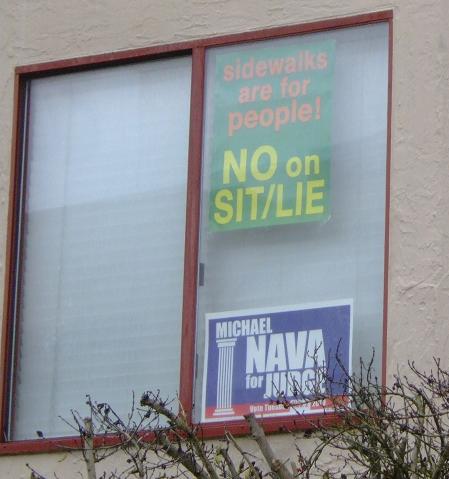
In September, shortly after Elliot Kamin placed two political signs in the window of the condo he rents near Ocean Beach in the Richmond District, he received a letter from his property manager saying, “The signs you have posted in your window are a clear violation of the rules and regulations of the association. Please remove the signs immediately.” But now, with help of the American Civil Liberties Union, the signs are back up and Kamin is no longer being threatened with fines.

Ironically, one of the restored signs reflected Kamin’s concern for civil liberties, urging voters to reject Prop. L, the proposed law that would criminalize sitting or lying on San Francisco sidewalks.

“It is a problem that a lot of condo associations don’t seem to be aware that free speech rights don’t stop at the condo gates,” ACLU attorney Linda Lye told the Guardian. She suggests that some condo residents might be willingly complying with requests to remove signs because they are unaware of the laws.

California Civil Code Section 1353.6 states that homeowners associations “may not prohibit posting or displaying of non commercial signs, posters, flags, or banners on or in property that belongs to a condo owner.”

Kamin called the property management company, which works with the homeowners association that set the rules, and he was told they wouldn’t recognize that legal right, which they said was trumped by their rules for the properties. So Kamin called the ACLU and together, they filed a suit against the Citiscape Property Management Group and the Ocean Beach Homeowners Association.

“If you really want to piss me off, tell me that someone has more rights because they own property,” Kamin said.

OBHA finally relented and entered into a settlement last week that allowed Kamin to put up his two signs, which opposed Prop. L, the proposed sit-lie ordinance and supported judicial candidate Michael Nava. A call to OBHA wasn’t answered and a message left at CPMG hasn’t yet been returned.

“What good are rights if they’re only on paper?” Kamin said.

UPDATE: I just got a call back from Kevin Wyley, president of CPMG, who said the incident began when an individual board member sent Kamin the letter telling him to take down the sign. Wyley didn’t become involved with the situation for about another week: “I was not aware that the board member had told the tenant he could not put up the signs,” he told us. “The board member had mistakenly told the tenant he couldn’t put up a sign.”

Once he was able to reach all the board members to get their assent, Wyley said he contacted Kamin and the ACLU to let them know the signs could remain, although they continue to disagree with the ACLU over whether tenants may have more than nine square feet of total signage.

Wyley said hsaid it took a few more days to get some traveling board members to weigh in on the issue, but once they

Democracy = cheap drinks and free sex toys

0

Voting’s pretty good as it stands — representative government, dictator avoidance, all that jazz. But this fall, the choose-this-or-that got a little nutty. Have you seen the voter’s pamphlet? The ballots alone are four double-sided pages long. After all that paperwork, you’re gonna need a pick me up on Nov. 2. 

Call upon this pleasure two-pack of election day specials – yes, the title of this post is an accurate descriptor – to lift the weight you’ve been carrying on your back called “the future of California is in your hands.” Cheap drinks and free sex toys. Oh yeah, and check our complete endorsements for the low-down on just what’s on those ballots this year for San Francisco and East Bay.

Straight Up Vote

Bring your voter’s stub (this works if you’ve voted by mail or in-person) for a 50 cent drink at participating bars. Velvet Cantina, Tonic, and the Elite Cafe are all participating, but most participants are slopping around in the Castro. Anyway, find a list of all those aiding and abetting on their website. 

www.straightupvote.org


Vibrate the Vote

After you chuck that ballot down the appropriate chute, head to any Good Vibrations store, where dropping the name of this paragraph on election day will score you a free Pearl Drop vibrator. The generous giveaway is a part of an online voting contest that can enter you to win the top-rated toys on the Good Vibes website. 

www.goodvibes.com


Al Franken’s Oatmeal

2

I can’t stand all the fundraising e-mail blasts that fill my In Box during election season, but this one I liked. Former author and Saturday Night Live writer Al Franken has been pretty low-key since taking his U.S. Senate seat earlier this year following a close and bitter race. Now that he’s getting used to the job, hopefully he’ll loosen up and write more missives like this one, whose subject line was simply titled “Oatmeal.”

Dear Friend:

Here are two thought experiments.  Indulge me, won’t you?

It’s the morning after Election Day.  8 a.m.  You stumble out of bed.  Make some oatmeal.  Turn on the TV to find out what happened in that Senate race, the one that was too close to call all night.  But you gave $5 to the DSCC by clicking on this link.  And, lo and behold, your favorite Democrat — maybe Russ Feingold or Patty Murray — pulled it out by a few votes.  Oatmeal never tasted so sweet. 

But there’s another way it could go.  8 a.m.  Oatmeal.  TV.  But in this example, you DIDN’T give to the DSCC.  And, by a few hundred votes, some Tea Party extremist is now a U.S. Senator-elect — and Republicans have captured the majority.  How’s that oatmeal taste now?

You still have time to decide which scenario will become reality.  But when I say “time,” I don’t mean days.  I mean minutes.  Don’t wait for tomorrow.  Don’t even wait to read the rest of this email.  Click here right now and make a contribution of $5 or more — it will be matched two to one, tripling its impact!

You’ve seen the polls — we’re neck and neck in race after race.  Moving the numbers just a little bit could mean the difference between victory and defeat — trust me, I’ve been there.

And nobody moves numbers like the DSCC.  Thanks to people like you clicking on links like this one, we’ve pulled ahead in California and Connecticut and tied it up in Colorado and Pennsylvania.

But with just hours to go until the polls close, every minute counts.  Your contribution won’t be funding some far-off future plan — it’ll be the money that goes out the door first thing tomorrow.  It could be your $5 that makes the difference for Barbara Boxer, keeps Sharron Angle or Rand Paul out of the Senate, or even saves our majority.

So make a contribution of $5 or more to the DSCC right now — it’ll be on the air in a battleground state or in the field as part of a get-out-the-vote program by tomorrow morning.  And, even better, it will be matched two-to-one, tripling its impact.

If you want to know why I’m standing with the DSCC in the final days of this election, here’s why: On November 3, I don’t want my oatmeal to taste like regret.  I want my oatmeal to taste like victory.

How about you?

Thanks,

Al Franken

Avalos: I have not buckled to anyone’s pressure over local hiring

1

Last week, Sup. John Avalos introduced Local SF legislation to require contractors to meet a local hiring goal of 50 percent. And as the Guardian reported at the time, Avalos’ legislation represents a major departure from the city’s First Source Program, which only requires contractors on publicly subsidized projects to show “good faith” efforts to meet 50 percent goal.  Avalos’ legislation came on the heels of a report from the city’s Office of Economic and Workforce Development that showed only a 20 percent local hire rate in 29 publicly funded projects, despite the existence of First Source.

“My legislation will ensure that San Franciscans have a guaranteed shot to work on the City’s public works projects and that the local dollars invested in public infrastructure be recycled back into San Francisco’s economy and local communities,” Avalos said last week, noting that his legislation was developed over a series of stakeholders meetings with reps from city agencies, the Mayor’s Office, labor and building trades, the environmental community, neighborhood advocates, contractors, local hiring advocates and unemployed workers. And he vowed to keep this roundtable approach going as his legislation moves forward.

So we were surprised to read a Weekly blog post today that claimed that Avalos had allegedly buckled to union pressure and watered down his local hire requirements. Especially since his legislation hasn’t even had its Nov. 8 hearing before the Board’s Land Use and Economic Development Committee…

Reached by phone Avalos clarified that he has not buckled to anyone’s pressure.
“I haven’t backed down on anything,” Avalos said. “And I have not made any amendments to my legislation. I did say when I introduced my legislation that this is a starting point and we’ll see where it ends up. We could pass legislation that wants 50 percent local hiring next year, and it would probably get vetoed and it wouldn’t be realistic. So, we have to phase it in and make sure we are creating a system that is going to push the trades to be more inclusive of local residents.”

Avalos noted that some trades and unions are already doing a good job of hiring San Francisco residents on public works projects, but reiterated that the city’s current policy only requires contractors to present paperwork to show they made a “good faith” effort—and that this approach has fallen far short of the city’s 50 percent local hire goal.

Avalos’ legislation–and his claims about First Source’s shortcomings–are  backed up by two recent studies.

The first report, released by Chinese for Affirmative Action and Brightline Defense Project this August, was titled “The Failure of Good Faith.” It showed that the city’s current policy only “yielded roughly 24 percent on employment opportunities” on public construction projects in San Francisco.

The second report, released by L. Luster & Associates on October 18, was titled “Labor Market Analysis San Francisco Construction Industry.” It confirmed that the construction workforce statewide has been in a “free-fall of job losses for the past four years.”

Noting that the Bay Area has not been as hard hit as other regions in California, the Luster report observed that the tri-county district of San Francisco, San Mateo and Marin counties, which had 45,100 construction jobs in August 2006, “lost nearly one-third of these jobs falling to 31,200 construction jobs by May 2010.”

“In San Francisco, unemployment in the construction sector has had a particularly negative impact on the city’s less educated residents,” the report stated. “For them, construction has provided access to higher paying jobs in a labor market that otherwise might provide them access mainly to positions paying lower end wages. Any local hire effort will be undertaken against the backdrop of this unprecedented construction job loss, and resulting unemployment among the existing San Francisco construction workers.”

One such group of unemployed workers—some of them in a union, others not—could be seen protesting yesterday outside the gates of the construction site on 16th Street in Mission Bay where UCSF has been celebrating the groundbreaking of its new Medical Center, a $1.5 billion project to be funded “through a combination of debt financing, philanthropic gifts and hospital reserves,” according to UC press releases.

But in an email to Joshua Arce of Brightline Defense, UCSF’s Barbara French noted that though UC is “actively working now to evaluate the workforce needs for every trade, for every phase of the project, and intend to make those public in December”, UC has not started construction on the project and won’t until December.
“ We haven’t signed the contract with the general contractor and we don’t yet have our permits,’ French wrote. “ The community may have believed that the celebrations this week truly marked the start of active construction. Not so. These were community celebrations held now in the hopes of getting good weather. “

Meanwhile, Avalos acknowledges that UC is not under the jurisdiction of San Francisco.
“But I know that they are doing a critical amount of building, and investing tax payer dollars there, so therefore the community should have some benefit from that, even though it’s complicated by this being the state’s money, so you could make the argument that all of California’s workers should have access,” Avalos told the Guardian. “But this land use impacts the surrounding community, so it makes sense that we have local hire legislation and access to serious end-use jobs at the hospital, which will include medical and support staff, building and janitorial maintenance and cafeteria related work.”

Avalos noted that the city is building infrastructure all around that project, including parks, Muni and light rail spruce-ups.
“There are huge surrounding investments,” Avalos said.

Either way, here’s hoping that by December, when folks begin to stress about providing for their families over the holiday season, all the workers in the following video clip will be able to put down their bullhorns and pick up decent-paying work, instead. And that this work will last for more than a couple of days.

Civil rights groups demand Secure-Comm documents from ICE

1

In a turnabout from the usual immigration-related situation (in which ICE demands documents from immigrants) civil rights groups in Washington, DC. Arlington, VA. Santa Clara, CA. and San Francisco are requesting the release of documents concerning opt-out procedures in Immigration and Customs Enforcement’s controversial “Secure Communities” program.

Signed by the Arlington Coalition Against “Secure Communities” (S-Comm) Program, Asian Law Caucus, Asian Law Alliance, Bernal Heights Neighborhood Center, Causa Justa: Just Cause (CJJC), Center for Employment Training- San Jose, Central American Resource Center, Chinese for Affirmative Action, Community Legal Services in East Palo Alto, Communities United Against Violence, DC Jobs with Justice, Empower DC, Immigrant Legal Resource Center, Instituto Familiar de la Raza, La Raza Centro Legal , National Lawyers Guild San Francisco Bay Area Chapter, Plymouth Congregational UCC Board of Social Action, Sacred Heart Community Services, San Francisco Day Labor Program Services, Immigrant Rights, and Education Network, Silicon Valley Alliance for Immigration Reform, Silicon Valley DeBug, Somos Mayfair, Steering Committee for Immigration Reform, JFI San Jose Tenants and Workers United and Young Workers United, the statement that these groups released today reads as follows:

”We are four municipalities that have formally requested to opt-out of the federal immigration enforcement, “Secure Communities” (i.e., “S-Comm”) program,” their press release stated. “We did so after participating in town hall meetings, debate, testimony, research, and democratic processes that culminated with representatives in Washington DC, Santa Clara, California, Arlington, Virginia, and San Francisco clearly voting to opt-out of sharing information with ICE. “

“We did so because we believe in preserving public safety for everyone in our diverse cities, and also because we reject a program that disguises a record number of deportations (392,862) as a safety initiative rather than a humanitarian and moral crisis.”

”To be clear, our counties never ‘opted-in’ to this dangerous ICE program in the first place. This program, which has been shrouded in secrecy, was imposed on our counties without the input of our local government, communities, local law enforcement and in the case of San Francisco against their explicit written requests. Now that Washington DC has formally opted out, we ask that ICE immediately and without further delay let our counties and any other counties requesting to do so out of S-Comm.”

”We are committed to moving ahead with the opt out process despite ICE now contradicting itself and claiming the program is compulsory. We support CCR, NDLON, and Cordozo Law School going to court today to demand release of what ICE has refused to divulge. The emergency injunction filed today does what should be automatic in any democracy, it seeks to make public information on S-Comm and our ability to opt-out by stopping the sharing of any fingerprints by these jurisdictions with ICE.. This necessary injunction comes at the beginnings of negotiations with ICE and local jurisdictions scheduled for Nov. 5 to Nov. 9.”

SF vote-by-mail provides early political snapshot

6

San Francisco’s Department of Elections had received 41,620 vote-by-mail returns so far That’s a fifth of the 210,993 vote-by-mail forms that were requested this year.
And while we don’t know which districts these folks voted in, we do know how they were registered: Over half were Democrats (24,153 votes), a quarter were decline-to-state (10,563 votes), and a fifth were Republican (5,565 votes).

I was surprised to learn that there are more vote-by-mail requests from folks registered with the American Independent Party (573) than with the Green Party, but not surprised to see that 200 folks were registered as Libertarians and 81 as Peace and Freedom Party.

Unfortunately, we can’t compare SF’s vote-by-mail snapshot with the statewide picture.
According to folks at the California Secretary of State’s office, votes won’t be broken down into vote-by-mail categories until after the election is certified…

Oddball billionaire wants to wreck California

6

Okay, this is really scary. An oddball billionaire who used to have homes in New York and Florida but now lives just in hotels — and who has no apparent connection to California — is going to spend $20 million promoting a plan to restructure the state.


And who’s going to be drawing up the blueprints? A bunch of right-wingers from the Reagan and Bush days, a failed way-too-conservative former governor — and Willie Brown.


Calitics has the right line:


The entire progressive movement, which represents at least a third of California, is totally absent from this conversation, whereas the right-wing is there in the form of Condi Rice and Arnold Schwarzenegger.


The problem is, unlike the doomed effort by the Bay Area Council to create a constitutional convention, (the biggest companies in the region couldn’t manage to put together the funding to put it on the ballot) this nightmare has real resouces. I mean, $20 million is enough to run a statewide campaign. And people are so frustrated now that almost any lunacy (spending limits, more tax cuts, eliminating major social programs etc.) could get traction.


Be very afraid.
 

FEAST: Distilled genius

1

It’s a thrilling time in Bay Area spirits. The same players who’ve made us proud in years past continue to reinvent themselves, while newcomers add flavor — literally — to the scene. In visits to four local distilleries, I came away inspired by their inventiveness and skill. And while none of the spirits I tasted use extracts or flavorings (like many of their big-brand counterparts), they do manage to fit in countless pounds of local, unexpected fruits, even natural herbs.

Even more exciting to the small batch booze enthusiast? Most of the following distilleries open their tasting rooms by schedule or appointment so the tippling public can discover for itself the motto emblazoned on the bottles of Old World Spirits: “Good stuff needs no special effects.”

ST. GEORGE’S SPIRITS

At the mighty St. George, inventiveness reigns, with a rock star attitude to boot. The distillery’s small staff experiments broadly and distillers Lance Winters and Dave Smith drive this license into genius. A behind-the-scenes journey through their labs unveiled nothing short of a wonderland apothecary: test tubes and bottles of spirits flavored with herbs, fruits, vegetables, foie gras — even beef jerky. You may (rightly) love their eaux de vie, absinthe, agave spirits, rum, vodkas, and whiskeys, but have you heard they’re toying with a carrot brandy? Clear and vegetal, it showcases the essence of the orange vegetable with a delicate hand. We can only pray they’ll bottle this one.

I also sampled St. George’s bourbon aging in charred American white oak that was a few years away from being officially bottled. Only five months young and made from the required minimum amount of corn (it needs at least 51 percent to qualify as bourbon) plus barley, crystal malt, wheat, and rye, it’s full of malty, rich promise. The same holds true of its white dog (clear-white whiskey) made from the same grains — one we could possibly see sooner on the shelves.

St. George’s next single malt whiskey, Lot 9, has been aging five to 12 years in barrels blended with 17 woods, including used American bourbon oak, sherry refills, port refills, and French oak. If you’re lucky, you soon may be able to purchase (in limited quantities) a single malt-single barrel selection that has been aged eight years in bourbon barrels then finished for four years in French oak apple brandy barrels. It is a wonder of complexity compared to their regular whiskey releases.

Only the brave attempt to down the scorching fire that is St. George’s in house habanero vodka. Grown men confessed of crying or throwing up just sipping it — only a handful of people have downed a legitimate amount and have been permitted to sign the distillery’s bottle of the burn. But my name is on that bottle — no tears, no throwing up, just a raging habanero sizzle.

2601 Monarch, Alameda. (510) 769-1601. www.stgeorgesspirits.com


CHARBAY

On a winding road above St. Helena and under peaceful Spring Mountain pines, there’s more going on than this distillery’s impeccable line of vodkas. Thirteen generations have gone into this family business, founded in 1983 and run by Miles and Susan Karakasevic, their son Marko, and his wife Jenni. The distillery’s lineage is evident to the discerning tippler who sips their port, rums, pastis, brandy, grappa, wines — even their herbaceous tequila. Charbay’s father-son distilling duo traveled to Mexico to painstakingly learn traditional tequila-making technique, which they expertly riff on to make their distinct blends.

Don’t even get me started on Release II of Charbay whiskey! 110 proof, aged six years with a pilsner beer base, it’s a stratospheric $325, but one of the most exceptional things I’ve ever tasted. From its astounding complexity, I caught everything from hops to echoes of the pine trees surrounding the distillery. I also sampled an unreleased 12-year version of Release II: higher proof, rich, a stunner.

But there’s no rest for the Karakasevics. Future whiskeys are already aging in French oak barrels — the one I’m most thirsty for, a stout whiskey, won’t be ready until 2012. If early tastes are any indication, it’s already brilliantly complex with coffee, spice, and dark chocolate notes. Made with neighboring Bear Republic’s stout in copper alembic stills, it’ll age for two years to reach 90 proof and is expected to retail around $90 — part of a younger, more affordable line of whiskeys compared with the divine but costly Release II. The bold explorer spirit that propels Charbay to Mexico to make a fine tequila shines in their future whiskeys.


TEMPUS FUGIT SPIRITS

These importers have already made waves with their Swiss-produced Gran Classico Bitter, which I hailed for reinventing classic cocktails like the Negroni. They also import some of the best French and Swiss absinthes in existence. Absinthe historians and spirits experts Peter Schaf and John Troia are the masterminds behind Tempus Fugit — and owners of one of the finest vintage absinthe poster collections in the world. It was a thrill to check out these rare pieces while tasting the history and forward-thinking vision in their bitters and liqueurs.

Tempus Fugit’s modus operandi is reinventing classic recipes and distilling them locally. Petaluma-produced Liqueur de Violettes is next up for the duo, a taste along the lines of Creme de Violette and other violet liqueurs yet somehow unlike any of them. Made with less sugar, the liqueur is a more appropriate cocktail ingredient — it’s less cloying, more purely floral and light. Each time I sample it, its bouquet blossoms like a layered wine: a sophisticated, botanical aperitif.

Tempus Fugit future project (a two-man team, after all, only has four hands) is Crème de Cacao-Chouva, a chocolate liqueur that will change chocolate cocktails the way St. George’s Firelit transformed coffee liqueur. It’s dark, lightly sweet, lush and earthy. Tasting it, I envision a resurgence of my guilty pleasure cocktail, the Grasshopper, refined and grown up with Crème de Cacao-Chouva and creme de menthe. It came alive with soda water — an elevated egg cream soda materialized in my cocktail windshield.

Keep an eye on these guys. They have more spirits and bitters as exciting as the ones I’ve listed in the works. Their dizzying knowledge of the history and intricacies of forgotten or neglected spirits, along with refined taste, suggests revelatory possibilities for the future pours of Tempus Fugit.

(707) 789-9660, www.tempusfugitspirits.com


OLD WORLD SPIRITS

Just north of San Carlos in a nondescript smattering of office buildings, is Old World Spirits, which has been in production since 2009. Davorin Kuchan, its third-generation distiller from Croatia, says family plays an irreplaceable part in the operation, as is evident from the photos lining the walls of the distillery. The whole clan is involved — Kuchan’s young daughter even drew the girl peeking out from foliage that graces Old World’s playful absinthe label. The output of both Davorin and business partner Joseph Karakas is astounding for a two-person operation, with two absinthes, a gin, a black walnut liqueur, three eaux de vie/brandies, and more liquors slotted for future release.

Old World uses custom-made German stills and local fruits like the Indian blood peach, which Davorin calls the “heirloom tomato” of stone fruit. As with the best natural fruits, the Indian blood has cracks and flaws, its lower sugar content imparting a lush understatement of taste. Though he grew the peaches himself in Croatia, in California Davorin orders in from Placerville’s Goldbud Farms. The clear blood peach eau de vie impresses with notes of ripe, juicy fruit flesh and spicy skin. I found Old World’s eaux de vies well-balanced, both the pear-inflected Poire Williams and the three- to seven-months oak-aged O’Henry Peach. I sipped a raspberry eau di vie it has yet to release: clear and lightly floral, free of the cloying sugar common in raspberry liqueurs.

Watch for Old World’s sold out dark black walnut liqueur — another batch is out in two years. Kuchan’s Blade Gin stocks the shelves of many a Bay Area bar, journeying down a nontraditional, California-inspired gin route with whispers of ginger, citrus, cilantro, lemon verbena, and black cardamom. Two kinds of absinthe, a green (verte) and clear blanche/white (referred to as Bleue, as in Switzerland), take cues from classic absinthes but resound with Davorin’s interpretation of 20 percent more herbs than what enlivens a traditional absinthe. Old World’s next release: a Cognac-style double barrel brandy aged in French and American oak and finished in Kentucky bourbon casks, which they hope to release soon. My early taste straight from the barrel yielded an already rich, spicy brandy.

Thirsty yet? Visit Davorin and Joseph during their monthly Friday Flight nights. Davorin will turn on some fine French pop tunes as both pour spirits, transforming the distillery into a warm familial party.

121 Industrial, Belmont. (650) 622-9222. www.oldworldspirits.com 

You can also find these spirits at Cask (17 Third St., SF), John Walker & Co. (175 Sutter, SF), and K&L Wine Merchants (638 Fourth St., SF).


FEAST: 5 sardinerias

0

When it comes to sardines, you have to think outside the earthquake shelter. On the flavor-o-meter, the tinned food of last resort (served on tarps with Saltines and stale water) bears no resemblance to its wild, fresh self. Even a humble sardine doesn’t deserve to be jammed in like a sardine, oil slicked, and left to age in the farthest reaches of the cupboard.

As several San Francisco eateries are ably proving, sardines, when treated with respect, are a tasty addition to the dining table. And healthy. And sustainable (they’re on the Monterey Bay Aquarium’s Super Green list!) Everyone from Andrew Weil to the Italian grandmother we all wish we had proclaim the virtues of the pungent silver herring. And with good reason: its tiny, 25-calorie body is packed with essential fatty acids, iron, protein, and calcium.

Let’s face it, the good people of Sardinia didn’t get their beautiful skin and convivial personalities from eating schweinebraten on spätzle. They’re all high on EFAs. Sardine EFAs.

PESCE

Pesce was one of the first and finest restaurants to introduce San Franciscans to the joys of sardine cuisine. The casual Russian Hill restaurant offers small plates of fish, pasta, and vegetables (and please, can we call it cicchetti, as they do, instead of “Italian tapas”?) patterned on the cooking of Venice. Pesce serves its sardines (all from Monterey Bay) simply — grilled, on a bed of mixed greens and pickled vegetables with a wedge of lemon. The result is tart, briny, and clean. If you’re still on the fence about sardines, Pesce is the place that will convert you to a bona fide a-fishyanado.

2227 Polk, SF. (415) 928-8025. www.pescesf.com

RAGAZZA

In Provence, shmear means aoli. They put it on meat; they put it on vegetables; they put it on fries; they put it on fish. Heck, they probably put it on ice cream. At Ragazza, the new relative of Glen Park’s Gialina Pizzeria on Divis, the chefs splat a huge dollop of it on its sardines. Apart from the aoli, Ragazza takes an Italianesque approach, stuffing them with an earthy mixture of breadcrumbs, olive oil, garlic, oregano, and onion and baking them in the restaurant’s gas-fired Wood Stone oven. The result is a crispy exterior over sardines that almost melt away on the fork. Add some mixed greens and a robust Italian red and you can practically feel your arteries unclogging. Oh, Ragazza also has pizza.

311 Divisadero, SF. (415) 255-1133. www.ragazzasf.com

NOPA

There’s locavore, 100-mile radius locavore, and there’s ultra-loca, five-mile radius locavore. While most of the city’s sardine-serving restaurants get their sardines from Monterey Bay, Nopa gets its from our very own San Francisco Bay. This is great news because our local sardines nearly went extinct in the 1950s. And — sardine cognoscenti consider the Pacific sardine as flavorful as those on the Sardinian coast (take that, overpriced cans from Norway). Speaking of flavorful, Nopa serves the little San Franciscans baked in its wood-fire oven with fingerling potatoes and frisee. The only thing missing is an order of flatbread, a gems salad, wine, and the burnt honey crème brulee.

560 Divisadero, SF. (415) 864-8643. www.nopasf.com

BARBACCO ENO TRATTORIA

You have to give Barbacco credit. Unlike most of the restaurants that have rediscovered the sardine, Barbacco doesn’t seem to be operating on the principle that sardines are an after-5 p.m.-only food. Although not exactly in the let’s-have-herrings-for-breakfast! camp, Barbacco at least believes that noon is a perfectly reasonable time to start the jonesing. The bustling, suits-heavy Financial District eatery is the creator of what may be the city’s only sardine sandwich (if this isn’t true, we’d like to know). Barbacco also breaks the don’t-get-too-weird-with-sardines taboo, pairing its sardines with a hefty piece of seared calamari. Not most people’s first choicem perhaps, but the two get along swimmingly, especially when served on an Acme torpedo roll and slathered with arugula and Barbacco’s housemade “roasted tomatoe condimento.”

220 California, SF. (415) 955-1919. www.barbaccosf.com

FERRY PLAZA SEAFOOD

When you don’t want others dictating what you can and can’t have on your sardines, duck into Ferry Plaza Seafood. This celebrated purveyor of all things aquatic sells wild, locally caught sardines (and by this we mean our our SF as well as Monterey bay) when available. “We love sardines,” said one salty staffer. “Especially the local ones. They just glisten.” They recommend bringing out the glisten by brushing with olive oil, salt, and pepper; grilling a few minutes on each side; and dressing with lemon. Call first for availability, these guys swim in and out of supply.

One Ferry Building, #11B, SF. (415) 274-2561. www.ferryplazaseafood.com 


Cash not care

5

sarah@sfbg.com

With the general election just days away, campaign disclosure reports show that downtown interests are spending huge amounts of money to create a more conservative San Francisco Board of Supervisors and to pass Proposition B, Public Defender Jeff Adachi’s effort to make city workers pay more for their pensions and health insurance.

Much of the spending is coming from sources hostile to programs designed to protect tenants in the city, including rent control and limits on the conversion on rental housing units to condominiums. An ideological flip of the board, which currently has a progressive majority, could also have big implications on who becomes the next mayor if Gavin Newsom wins his race for lieutenant governor.

At press time, downtown groups were far outspending their progressive counterparts through a series of independent expenditure committees, most of which are controlled by notorious local campaign attorney Jim Sutton (see “The political puppeteer,” 2/4/04) in support of supervisorial candidates Mark Farrell in District 2, Theresa Sparks in District 6, Scott Wiener in District 8, and Steve Moss in District 10.

Prop. B has also been a big recipient of downtown’s cash, although labor groups have pushed back strongly with their own spending to try to kill the measure, which is their main target in this election.

But the biggest spender in this election appears to be Thomas J. Coates, 56, a major investor in apartments and mobile homes and a demonstrated enemy of rent control. He alarmed progressive groups by giving at least $250,000 to groups that support Farrell, Sparks, Wiener, Moss, and Prop. G, legislation that Sup. Sean Elsbernd placed on the ballot to cut transit operator wages and change Muni work rules.

Although Coates declines to identify with a political party on his voter registration, he donated $2,000 to President George W. Bush in 2004. More significantly, he was the biggest individual donor in California’s November 2008 election, when he contributed $1 million to Prop. 98, which sought to repeal rent control in California and limit the government’s right to acquire private property by eminent domain.

Coates, who is also a yachting enthusiast and sits on San Francisco’s America’s Cup Organizing Committee (ACOC), donated $100,000 on Oct. 20 for Farrell, $45,000 for Sparks, $45,000 for Moss, and $10,000 for Wiener through third-party independent expenditure committees such as the Alliance for Jobs and Sustainable Growth.

The group has already received thousands of dollars in soft money from the San Francisco Police Officer’s Association, the Building Operators and Managers Association, the Golden Gate Restaurant Association, and SEIU-United Healthcare Workers, which supports a high-end hospital and housing complex on Cathedral Hill.

Those downtown groups have spent close to $200,000 on English and Chinese language mailers and robo calls in support of Sparks, Wiener, and Moss in hopes of securing a right-wing shift on the board.

Progressive groups including California Nurses Association, the San Francisco Tenants Union, and the SF Labor Council have tried to fight back in the supervisorial races. While downtown groups spent more than $100,000 promoting Sparks in D6, labor and progressive groups spent $13,000 opposing Sparks and $72,000 supporting progressive D6 candidate Debra Walker.

In D8, progressive groups that include teachers, nurses, and transit riders have outspent the downtown crowd, plunking down $40,000 to oppose Wiener and $90,000 to support progressive candidate Rafael Mandelman. So far, downtown groups have spent about $100,000 to support Wiener.

But in D10, the district with the biggest concentration of low-income families and communities of color, downtown interests spent $52,000 supporting Moss and $5,000 on Lynette Sweet while the Tenants Union was only able to summon $4,000 against Moss. The SF Building and Construction Trades Council spent $4,000 on Malia Cohen.

But that’s small potatoes compared to what downtown’s heavy-hitters are spending. The so-called Coalition for Sensible Government, which got a $100,000 donation from the San Francisco Association of Realtors, has already collectively spent $96,000 in support of Sparks, Wiener, Moss, Sweet, Rebecca Prozan in D8, Prop. G and Prop. L (sit-lie) and to oppose Prop. M (the progressive plan for police foot patrols) and Prop. N (a transfer tax on properties worth more than $5 million).

The Coalition for Responsible Growth, founded by Anthony Guilfoyle, the father of Mayor Gavin Newsom’s ex-wife, Kimberly Guilfoyle (who now works as a Fox News personality), has received $85,000 from the Committee on Jobs, $60,000 from the Realtors, and $35,000 from SF Forward. It has focused on spending in support of Prop. G and producing a voter guide for Plan C, the conservative group that supports Sparks, Wiener, Sweet, and Moss

Coates’ donations raise questions about his preferred slate’s views on tenant and landlord rights. A principal in Jackson Square Properties, which specializes in apartments and mobile homes, Coates is the founding partner of Arroya & Coates, a commercial real estate firm whose clients include Walgreens, Circuit City, and J.P. Morgan Investment Management. In 2008, when he backed Prop. 98, Coates told the San Francisco Chronicle that rent control “doesn’t work.”

Ted Gullicksen, director of the SF Tenants Union (SFTU), which has collectively spent $30,000 opposing Sparks, Wiener, and Moss, is disturbed that Coates spent so much in support of this trio.

“Coates was the main funder of Prop. 98,” Gullicksen explained. “His property is in Southern California. He’s pumping a lot of money into supervisors. And he clearly has an agenda that we fear Moss, Sparks, and Wiener share — which is to make the existence of rent control an issue they will take up in the future if elected to the board.”

That threat got progressive and labor groups to organize an Oct. 26 protest outside Coates’ San Francisco law office, with invitations to the event warning, “Be there or be evicted!”

Sparks, Moss, and Wiener all claim to support rent control, despite their support by someone who seeks to abolish it. “I answered such on my questionnaire to the SFTU, which chose to ignore it,” Sparks told the Guardian via text message. “In addition, I’ve been put out of apartments twice in SF, once due to the Ellis Act. They ignore that fact as well.”

Records show that in May 2009, Moss — who bought a rent-controlled apartment building near Dolores Park in D8 for $1.6 million and he lived there from the end of 2007 to the 2010, when he decided to run for office in D10 — served a “notice to quit or cure” on a tenant who complained about the noise from Moss’ apartment. Ultimately, Moss settled without actually evicting his tenant.

“I read about Coats’ [sic] contribution in Bay Citizen,” Moss wrote in an e-mail to the Guardian. “This donation was made to an independent expenditure committee over which I have no control and almost no knowledge. I have stated throughout the campaign, and directly to the Tenants Union, that I believe current rent control policy should remain unmolested.”

But Moss is with downtown on other key issues. He supports Newsom’s sit-lie legislation and the rabidly anti-tenant Small Property Owners Association, whose endorsement he previously called a “mistake.”

Yet Moss, who sold a condo on Potrero Hill in 2007 for the same price he paid for the entire building in 2001, seems to voice more sympathy for property owners than renters, who make up about two-thirds of city residents. He told us, “Landlords feel that they are responsible for maintaining costly older buildings and that they are not provided with ways to upgrade their units in ways that share costs with tenants.”

Another realm where downtown seems to be trying to flip the Board of Supervisors on a significant agenda item is on health care, particularly the California Pacific Medical Center proposal to build a high-end hospital and housing project on Cathedral Hill in exchange for rebuilding St. Luke’s Hospital in the Mission.

The project has divided local labor unions. UHW supports the project and a slate of candidates that its parent union, Service Employees International Union, is opposing through SEIU Local 1021, which is supporting more progressive candidates. The California Nurses Association also opposes the project and candidates such as Wiener who back it.

“A recent mailer by CNA falsely says that CPMC is closing St. Luke’s and Davies,” CPMC CEO Warren Browner recently complained in a letter to the Board of Supervisors. “We are not. We are committed to building a state-of-the-art, high-quality replacement hospital at St. Luke’s and continuing to upgrade Davies.”

But the CPMC rebuild is contingent on the board approving the Cathedral Hill project. So the CNA mailer focused on what could happen if the city rejects the CPMC project: “We could lose two San Francisco hospitals if Scott Wiener is elected supervisor.”

SEIU-UHW’s alliance with downtown groups and its use of member dues to attack progressive candidates places it at odds with SEIU Local 1021 and the SF Labor Council, which has endorsed Janet Reilly in D2, Walker in D6, Mandelman in D8, and Cohen (first choice) and Chris Jackson (second choice) in D10.

“We’re really disappointed that there are labor organizations that feel they have to team up with Golden Gate Restaurant Association, which is against health care [it challenged the city’s Healthy San Francisco program all the way to the U.S. Supreme Court], and with CPMC, which is working to keep nurses from joining a union,” Labor Council Director Tim Paulson said. “This alliance does not reflect what the San Francisco labor movement is about.”

Paulson said that the Labor Council values “sharing the wealth … So we don’t want Measure B [Jeff Adachi’s pension reform] or K [Newsom’s hotel tax loophole closure, which has a poison pill that would kill Prop. J, the hotel tax increase pushed by labor] or L [Newsom’s sit-lie legislation],” Paulson said.

CPMC’s plan is headed to the board in the next couple months, although Sup. David Campos is proposing that the city create a health services master plan that would determine what city residents actually need. Hospital projects would then be considered based on that health needs assessment, rather than making it simply a land use decision as it is now.

Moss told the Guardian that UHW endorsed him because of his positions on politicians and unions. “I agreed that politicians should get not involved in union politics,” Moss said. “The United Healthcare Workers seem to be a worthy group,” he added. “All they said was that they wanted to make sure that they had access.”

But CNA member Eileen Prendiville, who has been a registered nurse for 33 years, says she was horrified to see UHW members recently oppose Campos’ healthcare legislation. “I was shocked that they were siding with management,” she said.

Prendiville believes UHW is obliged to support CPMC’s Cathedral Hill plan, which is why it is meddling in local politics. In his letter to the board, Browner noted that his company and its parent company, Sutter Health, can’t legally do so directly. “The fact is that CPMC and Sutter Health are 501(c)(3) not-for-profit, nonpartisan organizations, and we neither endorse nor contribute to candidates,” Browner wrote.

“When UHW settled its contract with its members [as part of its fight with the rival National Union of Healthcare Workers], they had to publicly lobby for Cathedral Hill,” Prendiville claimed.

SEIU 1021 member Ed Kinchley, who works in the emergency room at SF General Hospital, is also furious that UHW is pouring money into downtown’s candidates and measures. “UHW isn’t participating in the Labor Council, it’s doing its own thing,” he said.

Kinchley said UHW, which is currently in trusteeship after a power struggle with its former elected leaders, is being controlled by SEIU’s national leaders, not its local membership, which explains why it’s aligned with downtown groups that have long been the enemy of labor.

“Sutter wants a monopoly on private healthcare and people like Rafael Mandelman and Debra Walker have been strong supporters of public healthcare,” Kinchley said. “I want someone who can straight-up say, here’s what’s important for families in San Francisco, especially something as important as healthcare. But it sounds like UHW is teaming up with the Chamber and supporting people who are not progressive.”


No good answers

1

rebeccab@sfbg.com

There was lots of anger from victims and legislators but very few substantive answers from regulators or Pacific Gas & Electric Co. officials during an Oct. 19 hearing at the state capitol on the Sept. 9 gas pipeline explosion that killed eight people, injured at least 50 others, and destroyed 37 homes in San Bruno.

State senators grilled PG&E executives and officials from the California Public Utilities Commission (CPUC), demanding to know why an aging segment of the San Bruno pipeline had been neglected despite having been flagged several years ago as high-risk and in need of repair.

Residents from San Bruno, including some who lost loved ones in the catastrophic incident, recounted their terrifying experiences of that night. Five San Bruno residents filed suit Oct. 19 against PG&E in San Mateo County Superior Court.

The complaints allege that the utility didn’t do enough to maintain the pipeline: “Investigation has revealed that the pipeline that exploded was a ticking time bomb,” one of the complaints states. “The San Bruno pipeline explosion was completely preventable.”

WHAT IS “SAFE”?

A central focus of the California Senate committee hearing was Line 132, the gas line that ruptured. PG&E installed the 30-inch, high-pressure steel pipeline in San Bruno some 50 years ago.

In 2007, the company approached the CPUC as part of an annual rate-setting process and asked for higher rates, justifying its request with a list of repairs that needed funding. A segment of Line 132, several miles from the epicenter of the explosion, was on the list. The CPUC granted a $5 million rate increase to complete the upgrade, but the work was never done. The money presumably went toward a different project deemed a higher priority.

In 2009, PG&E was back at the CPUC again with a second request for additional funding and a new project list in hand. Line 132 was included again, coupled with a document noting, “The risk of a failure at this location [is] unacceptably high.”

But even though the upgrade was never scheduled and the project never completed, Line 132 vanished from the repair list by the time PG&E returned to the CPUC as part of the rate-setting process in 2010. By then, an engineer had determined it would not have to be replaced for several more years.

“Our engineers looked at that piece of pipe and deemed it was safe until 2013, at which time we should continue to look forward to its construction,” Kirk Johnson, vice president of gas operations at PG&E, said during the hearing.

That assertion prompted Assemblymember Jerry Hill (D-San Mateo) to ask Johnson how PG&E defines “safe.” Reading aloud from the project summary included in the second request for funding, Hill noted, “‘The likelihood of failure makes the risk of a failure at this location unacceptably high.’ Are you saying that that description is a ‘safe’ condition?”

In response, Johnson launched into a detailed description of what factors are considered when calculating risk, but Hill cut him off. “Would that be considered a safe pipe?” he repeated.

“I think for a pipeline to be deemed safe, it needs to go through an analysis to ensure that it’s safe, and that line was deemed safe,” Johnson responded.

Essentially, PG&E reached different conclusions about the integrity of the same section of pipeline over the course of several years, and no one at the hearing seemed able to explain why. The utility flagged the pipeline stretch as being in need of replacement in 2007, received millions of dollars in the form of higher utility rates to do it, spent the money on a different repair instead, went back and requested more money citing the same repair, and then decided that the pipe would remain intact until 2013.

For all the inconsistency, that particular segment of Line 132 was not actually the same section that blew apart. CPUC Executive Director Paul Clanon emphasized this point. “The discussion that alarms me the most,” he said, “is the part that blew wasn’t on that list.”

Meanwhile, the San Bruno pipeline wasn’t the only utility infrastructure PG&E never fixed, even though ratepayers forked over the cost of the repair. A list released by The Utility Reform Network (TURN) focused on the electric side of the gas-and-electric company’s vast system, noting that the utility received millions in 2007 for a slew of reliability and safety-related projects, but never quite got around to completing them. Among the neglected projects were transformer replacements, gas meter protection upgrades, reliability and safety equipment, and inspections that can help identify deficiencies.

“Consumers are shocked to realize that when PG&E is authorized to raise rates, it gets the money with no strings attached,” said Mindy Spatt, a spokesperson for TURN. “PG&E is the only entity responsible for those pipelines, and the CPUC is the only entity that regulates PG&E. So between the two of them, the buck’s got to stop somewhere.”

THE WATCHDOG

A federal investigation by the National Transportation Safety Board (NTSB) to determine the cause of the blast has yet to reach any definitive conclusions. A preliminary NTSB report noted that just before the explosion, a system malfunction occurred when PG&E was working on a power-supply terminal in Milpitas, triggering a surge in the gas-line pressure.

Until the whole mystery is unraveled, regulators can’t accurately determine how to safeguard against such a tragedy in the future. “I have no idea how this could’ve been prevented,” Richard Clark, director of the consumer protection and safety division of the CPUC, said when asked what the agency could have done differently.

Legislators fired pointed questions about why this issue hadn’t been more closely scrutinized by the CPUC. “Did the PUC do any accounting when you gave them $5 million?” Sen. Dean Florez (D-Shafter) queried Clark. “Do we just give them money and cross our fingers and hope they fix it? Is that what we do? Until some terrible tragedy occurs?”

Clark’s response was that the CPUC does not manage on the level of individual projects — all the upkeep, maintenance, testing, and replacement of pipeline infrastructure is up to PG&E. The utility maintains its own list of needed repairs, and the company has license to prioritize repairs and funnel money from one project to another without seeking prior approval from the regulatory body. It conducts its own audits, and the regulatory agency looks over the paperwork.

“We can’t run the company for them,” Clark said. “We don’t take a microscopic look, if you will, at what it is they’re doing.”

A team of nine inspectors for the entire state of California is tasked with auditing PG&E’s infrastructure improvements. For the first time in years, the CPUC has submitted a request to hire a few more, Executive Director Paul Clanon noted. This small staff physically inspects about 1 percent of the state’s entire gas pipeline infrastructure. PG&E has about 5,700 miles of natural gas transmission lines, with about 1,000 miles in densely populated regions classified as “high consequence areas.”

Sen. Mark Leno (D-San Francisco) suggested that the CPUC should exercise more hands-on oversight. “Might it make sense to look at a different way of working with them?” Leno asked. He noted that the San Bruno explosion wasn’t the first time a PG&E pipeline failure had resulted in a loss of life or significant property damage. “We’ve got a pattern here,” Leno said. “And we’re not doing anything differently. In fact, we’re not even fining them.”

In 2008, a PG&E gas leak in Rancho Cordova led to a pipeline explosion, killing one person and injuring a few others. Leno reminded the CPUC of this tragedy, demanding to know if the agency had fined PG&E after finding the utility was at fault. It hadn’t yet, Clanon responded.

When Leno pressed for an explanation, Clanon said, “We were slow, and we should’ve been quicker.” The utility can be fined up to $20,000 for each violation, Clanon explained — and as things stand, there are no additional penalties for violations resulting in injury or death.

A HARD LOOK

Since the San Bruno pipeline explosion occurred, the CPUC has convened an independent panel of technical experts to assess the disaster, a parallel effort to the NTSB investigation. The committee will issue a set of recommendations on how PG&E should change its design, operation, construction, maintenance, or management practices to improve safety.

“We’ll be examining whether there may be systemic management problems at the utility,” Clark noted. The CPUC panel may also recommend new legislative changes to allow the state to clamp down on PG&E’s activities. “We’re taking a hard look at ourselves, and we’re taking a hard look at PG&E,” Clark said.

One point that’s abundantly clear is that the utility does not lack the money to address its system deficiencies. PG&E revenue was $13.4 billion in 2009, its rates are 30 percent higher than the national average, and its shareholders receive a cool 11.35 percent return on equity.

The utility came under fire this past spring for sinking $40 million into Proposition 16 — a ballot measure that would have effectively eliminated competition for the monopolistic utility by snuffing out municipal power programs. Now that its unaddressed repairs in San Bruno and elsewhere have come to light, the company’s profits and substantial executive bonuses may come under closer scrutiny.

Yet whatever regulatory changes come into play will hardly matter for those San Bruno residents whose lives were permanently altered by the loss of family members. James Ruigomez, a resident who testified at the hearing, told legislators that his son’s girlfriend, Jessica Morales, had just settled down to watch a football game with his son Joe Ruigomez on the night of the explosion. Morales died in the blaze and Joe is still recovering in the hospital.

The tragedy filled James Ruigomez with guilt and sorrow, he said — but also anger. “Extreme anger,” he added, “knowing that this possibly could’ve been prevented.” 


Alerts

0

news@sfbg.com

THURSDAY, OCT. 29

Bert for BART

BART board candidate Bert Hill, who is endorsed by a broad array of progressive organizations in his bid to unseat Republican incumbent James Fang, will be campaigning and meeting commuters along with several of his campaign’s supporters.

4:30–7 p.m., free

Balboa Park BART Station

401 Geneva Ave., SF

www.bert4bart.org

FRIDAY, OCT. 29

Halloween Critical Mass

Find a costume, hop on your bicycle, and join the monthly Critical Mass bike ride, Halloween edition. This rolling street party is always a fun way to flip the normal transportation paradigm, but it’s even more festive when composed of zombies, naughty nurses, and sexy cops.

6 p.m., free

Justin Herman Plaza

Market and Embarcadero

www.sfcriticalmass.org

Zombie Flash Mob

Guardian sources have warned that a mob of zombies, possibly dressed in prom attire, will rampage through the streets of the Mission. They are said to be protesting being marginalized and are showing their solidarity with the LGBTQ community. Eventually, our sources say, they will converge at El Rio, 3158 Mission St., for a zombie prom featuring live music by Elle Niño and others, with a cover charge of $3 for the undead and $7 for the living.

8 p.m., free

Corner of 16th and Mission, SF

elleninosf@gmail.com

SUNDAY, OCT. 31

(SF) Rally to Restore Sanity

If you can’t make it to the National Mall in Washington, D.C. for the Rally to Restore Sanity and the March to Keep Fear Alive, the send-up of political events by Comedy Central satirists Jon Stewart and Steven Colbert, you can still take part in SF’s local version. The event include guest speakers, comedy, poetry, and dancing.

9 a.m.–3 p.m., free

Civic Center Plaza

Larkin and Grove, SF

www.sfsanityrally.com

MONDAY, NOV. 1

Urban Water Rates

Panelists from the industry will seek to answer whether water pricing at the urban water agency level can work as a water conservation tool, whether rate increases jeopardize revenue, and how to serve low-income and low-use customers. RSVP at info@whollyh2o.org.

1 p.m.–3 p.m., free

Jellyfish Gallery

1286 Folsom, SF

www.whollyh20.org

TUESDAY, NOV. 2

Election Day

This election features pivotal races for the governor of California, U.S. Senate, and San Francisco Board of Supervisors, as well as important local and state propositions, so don’t forget to vote. Use this week’s cover as a cheat sheet or view our complete endorsements. Also visit the Guardian’s Politics blog on Election Day for a rundown on the evening parties and follow our live election coverage there that night.

7 a.m. to 8 p.m., free

SF City Hall basement

1 Dr. Carlton B. Goodlett Place, SF

www.sfgov.org/elections