California

Our Weekly Picks: January 12-18

0

WEDNESDAY 12

DANCE

“The A.W.A.R.D. Show!”

It had to happen: life imitating television. If you’ve ever wanted to put your body on the line and participate in judging a reality TV dance show, this is your opportunity. “The A.W.A.R.D. Show!” is a six-city endeavor in which 12 local choreographers (four per night) get evaluated by you and presenters from each participating entity. You get to vote for one artist each night. Each evening’s winner proceeds to Saturday’s final, where one will walk away with $10,000 check — chicken feed in television land, but a nice chunk for choreographers trying to find the cash for their next work. First on will be Manuelito Biag, Liss Fain, Katie Faulkner, and Catherine Galasso. (Rita Felciano)

Wed/12–Sat/15, 8 p.m., $20

ODC Theater

3153 17th St., SF

(415) 863-9834

www.odctheater.org


THEATER

Clue

Who killed Mr. Boddy? Was it Mrs. Peacock in the conservatory with the revolver? Or was it Professor Plum in the billiard room with the candlestick? Find out in Boxcar Theatre’s Clue, written and directed by Peter Matthews and Nick A. Olivero. First a popular board game, then a cult classic movie, this new version (adapted from the 1985 film) features a life-size board game with the audience watching six feet above. Secret passageways, murderous hilarity, and multiple possible endings make this whodunnit a must-see. Hot tip: get your tickets now — presale popularity has been so high that Boxcar has already added some performances to its run. (Emmaly Wiederholt)

Through Feb. 19

Wed.–Fri. 8 p.m.; Sat, 7 and 10 p.m., $15-$25

Boxcar Playhouse

505 Natoma, SF

(415) 776-1747

www.boxcartheatre.org


THURSDAY 13

FILM

“For Your Consideration: A Selection of Oscar Submissions from Around the World”

So you’ve been a good little film geek and seen all of 2010’s likely Oscar contenders: The King’s Speech, The Social Network, Toy Story 3, etc. etc. But what about those films submitted for Best Foreign Language Film consideration that get extremely limited stateside releases (if they even make here at all)? Though the films in the Smith Rafael’s “For Your Consideration” series probably aren’t destined to rake in massive box office dollars (see: 2000’s Crouching Tiger, Hidden Dragon), they still represent what each country felt was worthy of worldwide notice. “For Your Consideration” presents a handful of hand-picked selections, including Spain’s Even the Rain, starring Gael García Bernal as a filmmaker intent on making a film about Christopher Columbus; Crab Trap, about Colombia’s isolated Pacific coast community; and Poland’s All That I Love, the story of four friends who form a punk band amid early-1980s Communist unrest. (Cheryl Eddy)

Jan. 13–20, $6.75–$10.25

Christopher B. Smith Rafael Film Center

1118 Fourth St, San Rafael

(415) 454-1222

www.cafilm.org


PERFORMANCE

Women on the Way Festival

For the next three weeks, expect sassy women to please, surprise, and shake you during the 11th Women on the Way Festival. The format pairs newcomers (for example, Norwegian Muslim comedian Shabana Rehman), with established artists (like San Francisco poet Genny Lim). If you are into multimedia and dance theater, the Shotwell Studios are your place to go. If dance — more or less pure — is your bag, the Garage is opening its red door. W.O.W.’s Producer Mary Alice Fry, who has made a career of spotting new talent, says she was delighted to see that so many women are working with live and often original music. The festival’s website, www.ftloose.org, offers succinct, detailed information on the individual artists and the work they’ll present. (Felciano)

Through Jan. 30, $15–$20

Shotwell Studios

3252-A 19th St., SF

Garage

975 Howard, SF

1-800-838-3006

www.brownpapertickets.com/producer/5930


EVENT

Bay Area Puma Project

If you’re not sick of cougar jokes by now, I feel sorry for you. After all, most of the appeal is in giving up dominance, and really honey, you were never the top predator in the first place. Real cougars — as in mountain lions — are the last large animals in California with a substantial population, aside from us; their habitat covers about half our huge state. Join wildcat conservationist Zara McDonald, founder of the Felidae Conservation Fund, to hear about the first major, decade-long study of pumas in the Bay Area, efforts to protect them, and tips on coexisting with these elusive cats. Don’t you know 2011 is the year of the silver fox, anyway? (Kat Renz)

7:30–9:00 p.m., free

Randall Museum

199 Museum Way, SF

(415) 225-3830

www.sfns.org


COMEDY

SF Sketchfest

In 2002, I excitedly wrote about a brand-new event right here in these very pages: the first annual San Francisco Sketch Comedy Festival, a monthlong comedy smorgasbord featuring six local acts. Organizers, I wrote, foresaw “a Fringe Festival-style expansion that will bring comedy to the masses for years to come.” Well, that totally happened. Sketchfest, now in its 10th year, is the West Coast’s premiere comedy festival (in your face, L.A.), and it annually features superstars galore. This year’s sure-to-sell-out events include a 25th anniversary tribute to It’s Garry Shandling’s Show, tributes to Murphy Brown and Airplane! (1980), plus appearances by boldface names like James L. Brooks, Cloris Leachman, Dan Aykroyd, and David Byrne. And yeah, there are still some locals in the mix: SF native Greg Proops pops up in improv show Whose Live Anyway?, plus there’ll be a reunion show featuring the original six sketch groups (including Kasper Hauser and the Meehan Brothers) who got this party started in the first place. (Eddy)

Through Feb. 5, $15–$60

Various venues, SF

www.sfsketchfest.com


FRIDAY 14

EVENT

“Salute to Supernatural

In the television graveyard of contemporary TV dramas centered around vampires, werewolves, or horror-related themes, one of the more mainstream ones that doesn’t deserve a stake firmly implanted in its creators is the CW show Supernatural. Following the adventures of Sam and Dean Winchester, a pair of demon-hunting brothers, the program has become a hit with viewers over the past five years. At this weekend’s special Supernatural convention, Bay Area fans can meet the two lead actors, Jensen Ackles and Jared Padalecki, along with several costars, in addition to listening to talks, going to themed parties, perusing vendors, and much more. (Sean McCourt)

Fri/14, 1–6 p.m.; Sat/15, 11:30 a.m.–7 p.m.;

Sun/16, 10 a.m.–5:30 p.m., $20–$50

Westin St. Francis

335 Powell, SF

(818) 409-0960

www.creationent.com.


COMEDY

Norm MacDonald

Coming to fame as a cast member of Saturday Night Live from 1993-98, comedian Norm MacDonald made his name as the biting host of that show’s “Weekend Update” segment, along with his hilarious impersonations of celebrities including Burt Reynolds, Bob Dole, and Larry King. Though his departure from SNL was marred by controversy, MacDonald has continued to have a successful career in show business, punctuated by a variety of movie and television roles along with several writing gigs. Be prepared for laugh-induced side aches — the funnyman comes to the Fillmore for two special live shows tonight, taping a TV special for Comedy Central. (McCourt)

7:30 and 10 p.m., $35.25

Fillmore

1805 Geary, SF

(415) 346-6000

www.thefillmore.com


SATURDAY 15

FILM

A Brighter Summer Day

Tender and wise, Edward Yang’s A Brighter Summer Day (1991) is simply one of the finest historical dramatizations ever put to celluloid, ambitiously proportioned (four hours long, a cast of hundreds) but fine-grained in the telling. Yang traces Taiwan’s tumultuous midcentury history in the erring lives of teenagers. Between the deft staging of intergenerational conflict, Proustian attention to objects, and existential portraits of alienation, there’s enough material here for several filmmaking careers. Long inaccessible in the U.S., the film has been restored by Martin Scorsese’s laudably internationalist World Cinema Foundation. The Pacific Film Archive screens a selection of the organization’s recent projects throughout the month. (Max Goldberg)

6:30 p.m., $9.50

Pacific Film Archive

2575 Bancroft, Berk.

(510) 642-1412

www.bampfa.berkeley.edu


PERFORMANCE

Corpo/Ilicito: The Post Human Society

“It’s going to be a very wild performance,” performance artist Guillermo Gomez-Peña told Time Out Chicago about his troupe Pocha Nostra’s piece Corpo/Illicito. They’ll be performing at the closing reception of SOMArts’ group exhibit, “It’s All a Blur,” a reflection on empowerment and enfranchisement via the American dream. La Pocha Nostra is famed for using its performers’ bodies as canvases for its art, so get ready for some made-up, bound, embellished, and politically ostentatious artists gone wild. As for the exhibit’s more static installations, Dale Hoyt’s videos and drawings will be on view, as will Tony Labat’s Blanket Policy, a tent made of Goodwill paintings, and Labat’s 12-foot tall barbeque. To art and freshly grilled meat products! (Caitlin Donohue)

SOMArts Cultural Center

934 Brannan, SF

(415) 552-1770

www.somarts.org


MONDAY 17

EVENT

“Dr. Martin Luther King Jr. Birthday Celebration”

Hooray for MLK! Maybe this year we can eschew the sappy television specials and get a little work done on that old dream of his? That’s what’s going down at the Yerba Buena Gardens, where a daylong celebration dubbed “Sustaining the Dream: Through Community and Service” offers free admission to the Museum of the African Diaspora and the Contemporary Jewish Museum. The event also features a kid’s reading fest and a plethora of local health care providers doling out diabetes tests, children’s dental screenings, and a passel of other helpful services. Once they’ve got you feeling good, stick around for “King in Five Vignettes” at 12:15 p.m., music and performance dedicated to the man with the plan. (Donohue)

9 a.m.–5 p.m., free

Yerba Buena Gardens

Mission between Fourth and Third streets., SF

www.norcalmlk.org


TUESDAY 18

VISUAL ART

“Twist and Crawl”

The Bay Area is a major center for artists with disabilities, thanks to sites such as Oakland’s Creative Growth, San Francisco’s Creativity Explored, and the NIAD Center for Art and Disabilities in Richmond. Starting from an awareness that some major names in contemporary art work with disabilities, the new exhibition “Twist and Crawl” brings together work by 14 artists to bridge gaps and blur boundaries between traditionally-acknowledged painters, photographers, and sculptors and their disabled counterparts. “Twist and Crawl,” which takes its name from a frenetic song by the English Beat, is the first installment in a thematically arranged three-part series organized by artist and curator Timothy Buckwalter. Continuing through August, it syncs up with an upcoming traveling Berkeley Art Museum exhibition devoted to Creative Growth, Creativity Explored, and NIAD. (Johnny Ray Huston)

Through March 16

National Institute of Art and Disabilities (NIAD) Gallery

551 23rd St., Richmond

www.niadart.org


The Guardian listings deadline is two weeks prior to our Wednesday publication date. To submit an item for consideration, please include the title of the event, a brief description of the event, date and time, venue name, street address (listing cross streets only isn’t sufficient), city, telephone number readers can call for more information, telephone number for media, and admission costs. Send information to Listings, the Guardian Building, 135 Mississippi St., SF, CA 94107; fax to (415) 487-2506; or e-mail (paste press release into e-mail body — no text attachments, please) to listings@sfbg.com. Digital photos may be submitted in jpeg format; the image must be at least 240 dpi and four inches by six inches in size. We regret we cannot accept listings over the phone.

Faces of debt

0

caitlin@sfbg.com

CAREERS AND ED In this weeks’ issue, Rebecca Bowe examines rising tuition and its effect on this generation of Californian students. Here, we profile three scholars that are dealing with very real repercussions from their student debt load.


BEN GLEASON, 31

Mills College, teaching credential

Oberlin College, American literature major

Total debt: $25,000

Ben Gleason remembers the day that he applied for his $10,000 student loan from Citibank to finance his teaching credential tuition. “I got it done online within a half hour. I didn’t have to talk to anybody or write an essay — easy money with severe consequences.” The consequences of such a serious financial decision — sans the aid of any counseling from either his school or bank? Gleason’s eventual decision to leave classroom teaching.

It’s not an uncommon story for this generation of teaching school graduates, in a state where teaching salaries are hardly keeping pace with rising tuition. Gleason started working as an ESL teacher in Richmond’s underfunded West Contra Costa Unified School District right after graduating from Mills College. His student loans were overwhelming — a problem that was exacerbated when he took a trip to Guatemala to work and improve his ability to communicate with his Spanish-speaking pupils. To remain afloat financially, Gleason applied for a forbearance on his loans and was surprised to return home after two years to a loan that had gone up by 25 percent due to interest. “I was really, really screwed,” he recalls.

Gleason didn’t feel like there was any way he could go back to his teaching salary, so to support his new wife (the two met in Guatemala) and daughter, he decided to start his own business with the help of an old boss — a private firm that helps reeducate state government workers on sustainability issues.

That means one less qualified teacher for low-income Californian children. And Gleason still has 15 to 20 years left of debt payments. “I wish that there was a more systemic way to solve this problem,” says the former public educator.


ANNE MOSTAD-JENSEN, 28

Santa Clara University, law degree

College of St. Catherine St. Paul, library sciences

Concordia University St. Paul, international studies and history major

Total debt (estimated at graduation): $120,000

Anne Mostad-Jensen and her twin sister grew up in a small Minnesota town. They attended the same college, Concordia St. Paul, where they both majored in history and international studies. After that, they went on to College of St. Catherine (also in St. Paul) to get their master’s degrees in library science. But then their paths diverged. Her sister traveled to Denmark in pursuit of her Danish citizenship — their father is Danish — and was able to complete her master’s in a country where the government pays for most of its citizens’ educations. Mostad-Jensen remained in Minnesota, to continue on in the American university system.

What kind of difference has the move made in these women’s lives? Try $65,000 of student debt. That’s because Mostad-Jensen’s sister, even after completing her master’s and attending one of the Icelandic languages programs she’s currently applying for, will only owe roughly $55,000 worth of loans — all from her time at American schools. Mostad-Jensen, who is now attending law school at Santa Clara University, will owe $120,000 by the time she graduates. “I’ve never had any consumer debt, but I’ve always told myself not to pass up educational opportunities just because I didn’t have the cash on hand,” she says.

Mostad-Jensen wants to work at the intersection of international copyright and technology law, possibly in a law library, a specialty career that benefits from degrees in multiple areas of study. She counts herself lucky that homeownership and a family aren’t her immediate goals. “Having a family — I just don’t understand how people do it with debt these days.” Her Midwestern community values come to the fore when she talks about the U.S. government’s inability to provide Americans with affordable education. “Isn’t the government an extension of the community? Europeans, the lack of stress they have by not having to pay out of pocket for health care and education — I mean they can actually live their lives.”


RAMON QUINTERO, 32

UC Berkeley, geography major

Total debt: $25,000

Ramon Quintero is a UC Berkeley student activist, but he wasn’t always radicalized around debt issues. “I didn’t come to Berkeley because of its activist reputation. I became an activist because of my situation,” he says. Quintero could no longer pay for his student housing and wound up living in his 1979 Toyota truck with camper shell on the streets of Berkeley, sending his baby daughter home to live with her grandmother.

Quintero came to Berkeley via Southern California, where his family landed after immigrating from Sinaloa, Mexico, when he was 11. He attended community college to get his core credits before coming to Berkeley, where rapidly rising tuition fees are putting a strain on the student community. Although he is a legal resident, Quintero was especially concerned about the effect that the rising cost of education was having on undocumented students.

And, of course, on his leaky camper shell roof. He sprang into action, driving a truck that he calls Santa Rita, to all nine UC campuses, encouraging fellow students to paint art on it that spoke to their concerns for the future of public education. Quintero was arrested twice for his roles in campus protests and he and Santa Rita were profiled in The New York Times and several California newspapers. Suddenly, the university found space for him in student housing.

“I saw the hypocrisy in the system,” says Quintero, who has fulfilled all his UC coursework for graduation but has convinced a professor to hold credit for one of his courses for another semester so he could go on a research fellowship to Madrid. The fellowship, he says, is crucial for his application to grad schools — another step toward fulfilling life goals he doesn’t think would be possible if he has to begin assuming the burden of his student debt. 


How Jerry can save $125 million a year

0

Here’s an excellent point from Julia Rosen at Calitics: While Jerry Brown is scrambling around saving a few million here and a few million there (not that I’m against cutting back on state cell phones), the state could save far, far more just by abolishing the death penalty. That’s a lot of money. The Illinois legislature just voted to end the death penalty, in large part because the strapped state can’t afford the inordinate expense of killing people. I personally think the death penalty is ghastly, and I’m horrified that our new district attorney is willing even to consider it, but even if you don’t have moral or societal qualms about executions, you have to admit it’s a horrible waste of money. The number one cause of death on California’s Death Row is old age. Life without parole works just as well. 

Stage Listings

0

Stage listings are compiled by Johnny Ray Huston. Performance times may change; call venues to confirm. Reviewers are Robert Avila, Rita Felciano, and Nicole Gluckstern. Submit items for the listings at listings@sfbg.com. For further information on how to submit items for the listings, see Picks. For complete listings, see www.sfbg.com.

THEATER

OPENING

Bone to Pick and Diadem Exit on Taylor, 277 Taylor; (800) 838-3006, www.cuttingball.com. $15-50. Previews Fri/14-Sat/15, 8pm; Sun/16, 5pm. Opens Jan 20, 8pm. Runs Thurs-Sat, 8pm; Sun, 5pm. Cutting Ball Theatre presents a pair of plays by Eugenie Chan.

The Companion Piece Z Space at Theatre Artaud, 450 Florida; (800) 838-3006, www.themarsh.org. Call for price. Previews Tues/18, 7pm; Jan 19 and 20, 7pm; Jan 21, 8pm. Opens Sat/22, 8pm. Runs Thurs 7pm; Fri-Sat, 8pm; Sun, 5pm. Through Feb 13. Z Space presents the world premiere of a new play by Mark Jackson, with Beth Wilmurt and Christopher Kuckenbaker.

Out of Sight The Marsh, 1062 Valencia; (800) 838-3006, www.themarsh.org. $15-35. Previews Thurs/13 (through Jan 21). Opens Jan 22, 8pm. Runs Thurs and Sat, 8pm; Sun, 3pm (except Sun/16 at 7pm). The Marsh presents a new solo show by Sara Felder.

BAY AREA

The Last Cargo Cult Berkeley Repertory Theatre, Thrust Stage, 2025 Addison, Berk; (510) 647-2949, www.berkeleyrep.org. $14.50-73. Opens Wed/12, 8pm. Call for dates and times. Through Feb 20. Mike Daisey stars in a one-man show about obsession with commerce.

ONGOING

Clue Boxcar Playhouse, 505 Natoma; 776-1747, www.boxcartheatre.org. $15-35. Wed-Fri, 8pm; Sat, 7 and 10pm. Through Feb 19. Boxcar Theatre presents a play based on a movie based on a board game.

Dirty Little Showtunes! A Parody Musical Revue New Conservatory Theatre Center, 25 Van Ness; 861-8972, www.nctcsf.org. $24-40. Wed-Sat, 8pm; Sun, 2pm. Through Sun/16. Tom Orr’s adults-only holiday show returns, with direction by F. Allen Sawyer and musical direction by Scrumbly Koldewyn.

*Forever Tango Marines’ Memorial Theatre, 609 Sutter; 771-6900; www.marinesmemorialtheatre.com. $45-100. Call for dates and times. Through Wed/12. Luis Bravo’s atmospheric showcase is a slick, showy mélange of music and dancing whose fluid precision and assemblage of talent make it hard to resist. Cheryl Burke heads up an amazing 13-member ensemble of very stylishly draped dancers (exquisite costuming by Argemira Affonso) who singularly, all together, and of course in dramatic couplings, blend supreme control and dramatic restraint with unabashed sexual allure and volcanic energy. The orchestra, meanwhile, under direction of Eduardo Miceli, creates the intoxicating ether that sets everything in motion. (Avila)

The Lion in Winter Actors Theatre, 855 Bush; 345-1287, www.ticketweb.com. $26-38. Wed-Sat, 8pm. Through Sat/15. Actors Theatre of SF presents James Goldman’s play of palace intrigue.

Lost in Yonkers Kanbar Hall, Jewish Community Center SF, 3200 California; 292-1233, www.jccsf.org/arts. $20-39. Thurs-Sat, 8pm; Sun, 2 and 7pm. Through Jan 16. There’s a lot to like about Grandma Kurnitz (Naomi Newman), though she’d do her best to discourage you from thinking it. Her grown children are as neurotic a collection of misfits as you would expect at a Woody Allen family reunion, her grandchildren are afraid of her, and she hasn’t had a single friend in the 30+ years she’s lived in Yonkers. Set during World War 2, Neil Simon’s Lost in Yonkers portrays a family coming to terms with the times, and more importantly with itself over the course of ten months, as teenaged Jay (Zachary Frier-Harrison) and Arty (Noah Silverman St. John) are left in their Grandmother’s grudging care while their father Eddie (Greg Alexander) trawls the South for scrap metal to pay off an impatient loan shark. Meanwhile, their flighty yet sincere aunt Bella (Deb Fink), a grown woman with the mental attributes of a preteen Pollyanna, actually does the work of holding together the family that Grandma just can’t help but to try to scare off at the slightest provocation. A deliberately-paced production, some of the more emotional content flags a little in the translation, but a tightly-wound face-off between the boys and their Uncle Louie (Søren Oliver) — a small-time mobster with an Alexei Sayle air — and a surprising revelation from Bella are superbly played. (Gluckstern)

Party of 2 – The New Mating Musical Shelton Theater, 533 Sutter; (800) 838-3006, www.partyof2themusical.com. $27-29. Sun, 3pm. Open-ended. A musical about relationships by Shopping! The Musical author Morris Bobrow.

*Pearls Over Shanghai Thrillpeddlers’ Hypnodrome, 575 Tenth St; 1-800-838-3006, www.brownpapertickets.com. $30-69. Sat, 8pm. Through April 9. Thrillpeddlers’ acclaimed production of the Cockettes musical continues its successful run.

BAY AREA

East 14th – True Tales of a Reluctant Player The Marsh Berkeley, 2120 Allston Way, Berk; (800) 838-3006, www.themarsh.org. $20-50. Call for times. Through Feb 13. Don Reed’s one-man show continues its extended run.

Lemony Snicket’s The Composer is Dead Berkeley Repertory Theatre, Roda Theatre, 2015 Addison, Berk; (510) 647-2949, www.berkeleyrep.org. Call for dates and times. Through Sat/15. Berkeley Rep premieres the new musical, written by Lemony Snicket, with music by Nathaniel Stookey.

*Of the Earth – The Salt Plays Ashby Stage, 1901 Ashby; (510) 841-6500, www.shotgunplayers.org. $17-30. Thurs-Sat, 8pm; Sun, 5pm. Through Jan 30. If those whom the gods favor die young, it’s probably just as well for Odysseus (Dan Bruno) that Zeus (Rami Margron) happens to be irked at him. That Zeus occasionally manifests as a scary nurse with a penchant for ballroom dance is one of but many mysterious angles Jon Tracy teases out of the standard Odysseus myth. Another involves the instant-messaging potential of paper planes; a third, a blunt addiction metaphor for warmongering. In what must surely be a happy coincidence, the design elements and staging of Of the Earth are curiously similar to those of the recent Cutting Ball production of The Tempest. Characters leaping about from floor-to-ceiling ladders to physically embody shipwrecks and monsters, a handful of actors playing multiple roles, watery video installations, even the allusion to mental illness and modern psychiatry are threads that tie the two productions, however unsuspectingly, together. Happily for The Shotgun Players, their version floats above the comparison with a host of extra tension-drivers—the sinuously menacing fighting-style of Posiedon (Anna Ishida), the heart-throb pounding of Taiko drums, the sensual machinations of Circe (Charisse Loriaux), the clever usage of Penelope’s (Lexie Papedo) “tapestry” to weave together the action. And though at times the thread is broken mid-scene, we are finally given to understand that this epic tale of war’s fallout is first and finally a story of love. (Gluckstern)

Strange Travel Suggestions The Marsh Berkeley, Cabaret, 2120 Allston Way, Berk; (800) 838-3006, www.themarsh.org. $15-35. Thurs-Fri, 8pm; Sat, 5pm. Jeff Greenwald stars in a one-man show about the vagaries of wanderlust.


PERFORMANCE/DANCE

Gush Brava Theater, 2783 24th St; 6470-2822, www.brava.org. Thurs/13 through Jan 29. $15-35. Brava presents a dance series curated by Joe Goode.

Women of the Way Festival Shotwell Studios, 3252-A Shotwell; and The Garage, 975 Howard; (800) 838-3006, www.ftloose.org. Call for dates and times; Thurs/13 through Jan 30. $15-20. The dance festival celebrates it 11th anniversary with 23 new shows.

BAY AREA

SF Ethnic Dance Festival Auditions Zellerbach Hall, UC Berkeley campus, Berk; 474-3914, www.worldartswest.org. Sat/8, 10am-6pm; Sun/9, 10am-7pm. $10. The second of two weekends of auditions for this year’s festival, open to the public.

On the Cheap

0

On the Cheap listings are compiled by Jackie Andrews. Submit items for the listings at listings@sfbg.com. For further information on how to submit items for the listings, see Picks.

WEDNESDAY 12
How to Build Guitars Bazaar Cafe, 5927 California, SF; (415) 831-5620, www.julianagallin.com/howto. 7pm, free (food and drink purchase encouraged). Rickenbacker 12-string electric guitar lover, Mario DeSio, who began making his own damn guitars — by consulting the internet, no less — when his guitar-buying budget was slashed, will share his humble beginnings, experiences, tools, and finished (as well as unfinished) products. Afterwards, you may not be able to add “luthier” to your resume, but maybe you’ll become inspired by this DIY night.

THURSDAY 13
“The Journey That Saved Curious George” Contemporary Jewish Museum, 736 Mission, SF; (415) 655-7800, www.thecjm.org. 7pm, free with regular museum admission or $5 after 5pm. Experience the stranger-than-fiction journey of Margaret and H.A. Rey, the creators of Curious George, as they escape Paris from the Nazis on homemade bicycles, take a train ride across Europe, and finally a boat to America. Louise Borden, who wrote the book Curious George Saves the Day: The Art of Margaret and H.A. Rey, tells the story with an illustrated discussion and a book signing to follow — after which you will surely want to cuddle up with a sweetheart and read Curious George by the fire, er, space heater.

FRIDAY 14
Bitches Brew Park Life, 220 Clement, SF; (415) 386-7275, www.parklifestore.com. 7pm, free. A good art opening is always a great alternative to spending wads of cash on a Friday night. The possibilities of free or cheap booze and cool stuff always aim to please, and when there’s a rad band thrown in to the mix, you can’t go wrong. This Friday, check out new works from Kelly Tunstall, Marci Washington, Aiyana Udesen, Hellen Jo, and Rebecca Ebeling with special musical performance by Oakland’s Wax Idols

SATURDAY 15
Queer Porn TV Launch Party Lexington Club, 3464 19th St., SF; (415) 863-2052, www.lexingtonclub.com. 9pm, free plus with drink purchase. Celebrate the launch of QueerPorn.TV, a new queer porn site, with drinks, dancing, and general all-around debauchery. Hosted by queer porn icon Courtney Trouble and porn star Tina Horn. DJs Booty Klap (Party Hole) and Jean Jamz (Party Hole, Ships In The Night) will getcha rumps shakin’, and a special performance from porn star Maggie Mayhem should no doubt be the icing on the proverbial cake.

SUNDAY 16
Scott Alexander solo performance RockIt Room, 406 Clement, SF, (415) 387-6343, www.rock-it-room.com. 8pm, free. Brooklyn expatriate Scott Alexander, a.k.a. “Cookie Man,” is that guy you may have seen recently around town hanging out on an inflatable couch while passing out free cookies. Well, he’s a Californian now and wants to make friends – and to do that he will be singing songs, passing out more cookies and, oh yes, bacon. All bases are covered here guys, regardless of whether your thing is off-beat, comedic pop music, cruelty-free baked goods, or fried pig ass.

MONDAY 17
MLK Day of Service Contemporary Jewish Museum, 736 Mission, SF; (415) 752-2483,  www.thecjm.org, www.norcalmlk.org/2011. 11am – 5pm (art poem activity from 1-3pm), free. Yerba Buena Center for the Arts and Yerba Buena Gardens’ sponsor a day of egalitarian activities: a march starting from the park’s MLK memorial, a fair offering free family health services, a children’s reading festival, and the Contemporary Jewish Museum will be open free to the public. Whew! See website for events schedule.

MoAD MLK Day Celebration Museum of the African Diaspora, 685 Mission, SF; (415) 358-7200, www.moadsf.org, www.norcalmlk.org/2011. 11am-6pm, free. MoAD invites the public to enjoy a day at the museum free of charge – and to celebrate MLK’s dream, they’ve got a full slate of community-empowering activities planned. There’s a college fair of historically African-American schools from around the country, live Afro-Cuban music, chalk drawing outside the museum, MLK film screenings, and even a live jewelry-making demonstration and sale. See website for events schedule.

Local bounty

0

caitlin@sfbg.com

CAREERS AND ED “People are very confused about what’s safe to eat as far as mollusks go.” Champion monkeyface eel angler Kirk Lombard offhandedly throws the remark out at his “find your own marine sustenance” primer offered by DIY food cabal ForageSF. For a moment I panic. My mercury levels! But then I remember: I’m on his San Francisco fishing tour because I have never, not once, even thought to harvest the bay’s bounty on my own.

Isn’t life in the city just like that? You never get out to Alcatraz, you never hit up Muir Woods — they sit there trying to catch your eye and you shuffle past, going about your routine. It’s easy to duck the pressure of actually making the most of what the Bay Area has to offer.

But it’s 2011 (only one year left till the end of the world!) and you need to get out there. Back to Kirk Lombard, who is gesturing to the rocky edge of the Marina Green, where on a good day you can find limpets and turban snails adhering to, and rockfish darting amid, the boulders. “You have to pound the shit out of them to make them tender enough to eat,” he counsels. This referring to chitons, shellfish resembling centipedes that are plentiful in the Bay Area and can be popped off rocks to be enjoyed.

Lombard’s class is an example of the utility of local expertise. At the tail end of many years with the Department of Fish and Game surveying the catch of Bay Area fishermen, he is also the creator of a blog (monkeyfacenews.typepad.com) that makes me wish I fished, which I must say has never happened before.

Other things that can be caught and eaten around these parts include the tiny, perfect-as-salad-topping limpet, the hideously ugly but reportedly nutritious cabazon fish, monkeyface eels (thrilling to hear Lombard discuss his record-holding pursuit of them) and California and blue mussels. Of these last two you are only allowed to harvest 10 pounds per day, an astonishing rule that seems well beyond my capabilities past, present, or future.

Lombard’s walks take participants out on the windy, disconcertingly cold spit of land near the wave organ on the Marina Green. Our group of 12 meanders after him as he enthusiastically answers questions about feeding oneself on the seaweed and fishies of the bay. Lombard himself hasn’t bought fish in years and tends to focus on smaller, quicker to mature species that are difficult to overfish. “I’ve found myself really embracing the smelt family,” he reflects.

Having graduated from his one-time course, do I now stuff my rod in my Chrome bag every day before I leave the house? Are we munching monkeyface all the live-long day? Well no. But the beauty of Lombard’s tours, and the following SF classes, isn’t that they will revamp your life in one fell curricular swoop. It’s that they just might open your eyes to a little more atmosphere, from mussels to mushrooms, architecture to enlightenment.

WILD SEAFOOD: SAN FRANCISCO FISHING TOUR

Next walk: Sun/16 2–4 p.m., $30

Register at www.foragesf.com


MUSHROOM FORAYS

All hail the Mycological Society of San Francisco! Now more than 60 years old, the mushroom lovers club focuses on expanding the community’s knowledge of our fungal friends — from the tastes and nutrition they provide to their scientific and aesthetic qualities. You can drop in on one of its potluck gatherings or beyond-informative Fungus Fairs, but why not start from the beginning? The society regularly conducts forays into nature to teach wannabe mycologists how and what to look for when they’re tracking toadstools in the moist corners of the Bay Area — which, due to its temperate climate, happens to be a superlative spot to find them.

Next foray: Sat/15 10 a.m.–3 p.m., $25. Register at www.mssf.org for start location


“SEASONAL EATING, HEALTHY LIVING, DIGESTIVE BLISS”

What is even more soothing than taking a class amid the community-building rows of plants at Hayes Valley Farm? Try taking a class on how to use those very fruits and veggies (or seasonal varietals like them) toward more robust bodily health. It’s part of a four-class series, but you can attend individual sessions — this upcoming one focuses on lower intestinal health, where 70 percent of your immune system lives.

Sat/19 10–11:30 a.m., $25–$50. Hayes Valley Farm, 450 Laguna, SF. www.hayesvalleyfarm.com


INTRODUCTION TO BUDDHISM AND ZEN

Of course, all this seeking and searching — it’s the new year and all, but don’tcha know that desire is the root of all ignorant, pig-headed maleficence? You’d know that if you were Zen, see. But grasp no further. The SF Zen Center has been in the practice of expanding minds — often for cheap or free — for years. Take one of their friendly entry-level courses in meditation and all that new ksanti (patience) is sure to lead to some prajna (wisdom). Guest student courses offer amazing rates for meditation, lodging, and meals.

Jan. 29– March 19, 9–10 a.m., $96-$120. San Francisco Zen Center, 300 Page, SF. (415) 863-3136, www.sfzc.org


SAN FRANCISCO INTERIORS

You gotta suppose that after drawing your city in intimate detail, you’d see a little more of it. A gable, a funky load-bearing pole. Maybe we just don’t hang and stare at walls enough. Or maybe not, but anyway this no-credit City College class taught by artist Jacqueline Ruben explores some of SF’s more artistically fertile nooks and crannies, teaching you drawing style to boot.

Feb. 26–March 19 9 a.m.–noon, $100–$110. Fort Mason, SF. (415) 561-1860.

www.ccsf.edu 


In the red

5

rebeccab@sfbg.com

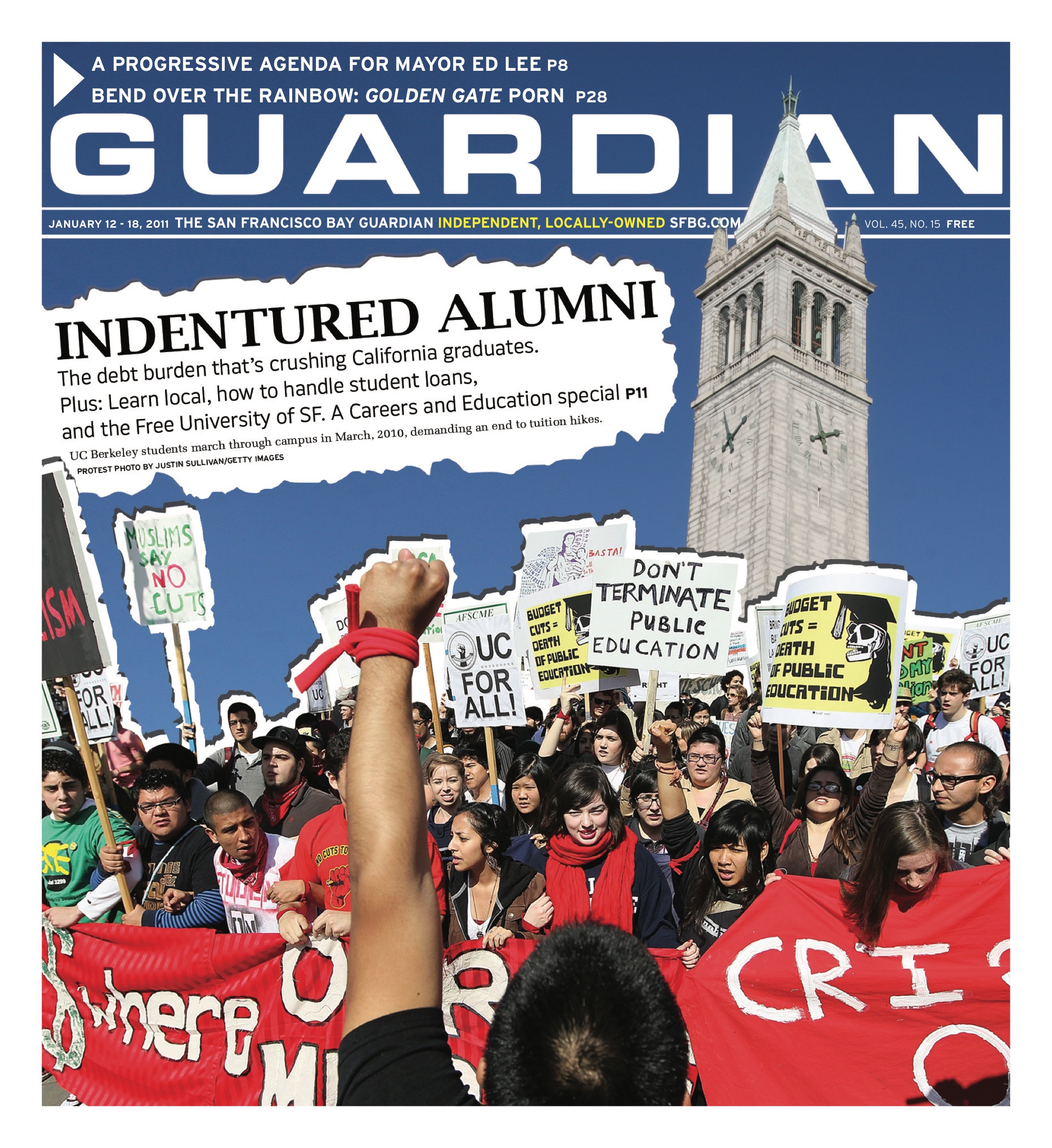
CAREERS AND ED When the University of California Board of Regents met Nov. 17, 2010 to approve an 8 percent tuition hike, roughly 300 UC students who were furious about the decision converged outside the University of California, San Francisco (UCSF) campus at Mission Bay to rally in opposition, some traveling from as far away as Los Angeles.

“We had been organizing with all the campuses to get students to come up because we really wanted to be there to let them know that it’s not what we want, and it’s something they can’t just get away with doing year after year,” said UC Student Association President Claudia Magana. The protests were raucous, and police cracked down by discharging pepper spray and making 13 arrests.

Despite the palpable fury outside and impassioned student opposition delivered to the Regents inside, the 8 percent fee increase was approved. It came on the heels of a 32 percent tuition increase imposed the year before, and the price was ratcheted up by 9 percent and 7 percent in the years prior to that.

The tuition hikes were steep, but hardly new. Indeed, the cost of attending UC schools has been rising steadily for quite a while. According to a study by economist Peter Donohue, student tuition and fees increased 277 percent from 1990-91 to 2008-09, and that was prior to the 40 percent increase that followed. That trend is repeated in rising costs at the California State University and California Community College systems (See “Access Denied,” April 6, 2010).

Student protesters have sought to make it clear that their outrage isn’t rooted in selfish unwillingness to shell out more money, but instead is linked to a broader concern about privatization and the increasingly limited accessibility of public education.

Magana expressed concern that the climbing cost of instruction at UC, though still a relative bargain compared with private institutions, would ultimately start to affect who could and couldn’t attain higher education through the public university system. The question isn’t limited to UC — tuition is increasing at public and private colleges across the board, and as income inequality sharpens, more students seek higher education.

“Students will always pay to be here,” she noted. “The issue is going to be, which students are here? That’s really the big problem — the huge class issue that’s going to come up. Although there are some forms of support for low-income students, it’s not easy.”


DEEPER IN DEBT

Rising costs at UC mirror the upward trend at private nonprofit and for-profit postsecondary institutions nationwide, and those higher prices have triggered a dramatic increase in student borrowing. While students from low- or medium-income families can access higher education at any institution they’re admitted to as long as they’re willing to take out significant sums in student loans, many find themselves at a serious disadvantage once they have to start repaying their debt.

A study conducted by the Public Interest Research Group (PIRG) noted that hefty debt burdens often dissuade graduates from pursuing careers in teaching, social work, the nonprofit sector, or other low-paying occupations that foster social justice. PIRG found that 23 percent of public four-year college grads and 38 percent of private four-year college grads were saddled with too much debt to manage paying back student loans on a starting teacher’s salary.

For students pursuing careers as social workers, the economic bind looked even worse: 37 percent of public school grads and 55 percent of private school grads with student loans wouldn’t be able to manage repayment with starting salaries in that field, the study concluded.

“Because students with lower incomes are more dependent on student loans than higher income students, students who already face significant challenges to attending college will more strongly feel the effect of loan debt on career choice,” the report points out.

“It’s a serious problem for so many young people to be starting out their working life so deep in debt,” said Edie Irons, spokesperson for The Institute on College Access and Success (TICAS), an Oakland-based research organization. “It really does limit people’s ability to take advantage of the opportunities education is supposed to provide. In concrete terms, it can make it really hard to buy a house, or start a business, or start a family, or go back to grad school, or to save for retirement or your own children’s education. And that’s all assuming you can keep up with the payments.”

Student loan debt has intensified over the past two decades. In 1993, just one third of all four-year college students graduated with debt, owing on average slightly more than $9,000, according to PIRG.

Today, the majority of college students take out loans to finance their education. Around 62 percent of public university students graduate with student loans, as do 72 percent of students attending private nonprofit institutions, and 96 percent of students attending for-profit institutions such as the University of Phoenix or the Academy of Art University, according to TICAS. Nationally, students graduate owing an average of $24,000, not counting debt associated with advanced degrees.

While young people must invest more than ever before to obtain higher education, the return on investment isn’t showing signs of improvement. The expected median income for UC graduates has stayed the same over the last decade, even as the cost of tuition has ballooned.

What’s more, says Bob Meister, president of the Council of UC Faculty Associations and professor of Political and Social Thought at UC Santa Cruz, is that an estimated 40 percent of public university students entering the workforce will either be unable to find a job, or will land in a lower-paying job that doesn’t require a college degree.

“For college graduates under 25, the unemployment rate is nearly as high as the national unemployment rate,” around 10 percent, Meister notes. “Over the past decade, what’s happened is that the median hasn’t risen. The top has risen very fast, and the bottom has fallen.”


IN A DIFFERENT CLASS

There’s no doubt that diminished state funding is affecting California’s public universities.

“A lot of departments are being eliminated, and a lot of professors who are really amazing are leaving to other universities,” Magana says. “And the waiting lists for classes are just ridiculous.” Academic goals are being compromised — for example, students had to abandon their push for an ethnic studies program at UCSC, she added, because the American studies department that would have partially supported it was slashed.

While diminished public funding has been used to explain the need to raise tuition, Meister has published numerous essays suggesting that the root cause of rising tuition costs at UC goes deeper than that, and he has gone so far as to publicly encourage students not to accept higher tuition without first demanding financial information.

Meister previously served on the UC budget committee and has observed the institution’s evolving financial policies for years. He doesn’t seem surprised that tuition is going up, regardless of what condition the economy is in or what amount of public funding is available because, as he puts it, “the universities will cost as much as they can.” UC had long sought to boost revenue by raising tuition, he noted, yet its leaders feared a rollback in state funding in response. But that changed under Gov. Arnold Schwarzenegger, who agreed to increase state support only on condition of that UC in turn require students to contribute more.

Around the same time that Schwarzenegger provided this new incentive to raise tuition, UC pooled its various revenue streams into a consolidated general revenue fund, Meister said, a departure from the old way of keeping separate accounts. This new fund, which included all non-state revenue and funding that wasn’t legally required to be used for certain purposes, could be pledged entirely as collateral for bonds for new construction projects, greatly increasing the institution’s borrowing power and boosting its revenue with the addition of new facilities.

To maintain its stellar bond rating, UC had to ensure an increase in revenues, according to Meister’s explanation, and to do that, UC ratcheted up the one source of revenue it had full control over: tuition. Meister laid bare this financial play in a 2009 open letter to students, titled “They Pledged Your Tuition.” Since it was published, a small corps of student activists has become deeply engaged in studying campus finance documents and airing criticism of financial policies.

Just before the Nov. 17 protests at UCSF Mission Bay, Meister published another open letter, this one addressed to UC President Mark Yudof. This one contemplated, “Why they think they can increase revenues regardless of how fast the economy grows … and regardless of whether the income of graduates is stagnant.”

His answer is somewhat surprising: “Their ability to raise tuition is a function of the growth of income inequality,” he told the Guardian. In the letter, Meister charges, “In the 21st century, when almost all income growth has been in the top 1 to 2 percent of California’s population, UC is still marketing income inequality to students as its most important product. It now expects all students to pay more for an ever-shrinking chance of reaping the ever-growing rewards that our economy makes available to the few. Your plan to increase revenue through tuition growth is feasible, of course, only because the federal government still allows students to borrow more for education despite the greater likelihood that they will not be able to repay — student loans may be the last form of subprime credit available in our economy.”

His theory highlights a paradox. “Being in the have-not category is increasingly worse,” he explains, “and so they are willing to take on more debt, which actually dampens their prospects for income growth.”

The question now is what will happen under Gov. Jerry Brown, who is likely to take a different stance toward rising tuition than Schwarzenegger but nonetheless is expected to unveil harsh cuts to education as a way to address a $26 billion budget deficit.

In a recent interview with the San Francisco Chronicle, UC Regent Richard Blum indicated that it probably would not be feasible to raise tuition again, so the message was that students should brace for more cuts to education.

When Brown unveiled his proposed budget on Jan. 10, he announced further cuts to higher education in California to balance the state budget. Brown’s revised 2010-11 budget decreases the state funding for UC, CSU, the community college system, and other higher education programs by $1.7 billion for the 2011-12 budget. The UC system would take a 13.3 percent hit in general fund support; the proposed cut to the CSU system is 12.5 percent; and the community college system would be cut by 6.9 percent.

Brown, who also wants to hold a special election to ask voters to maintain the current level of tax rates for income, sales, and vehicle license taxes for five years rather than let them expire later this year, expressed regret about making cuts to higher education. But he emphasized the need to make tough decisions in the face of a bleak financial outlook, saying, “We need to face the music.”

The scream

0

le.chicken.farmer@gmail.com

CHEAP EATS This isn’t a metaphor. There was an actual patty of dog barf on the off-white carpet at the foot of the bed in the master bedroom, Coach’s dad’s house, San Diego, California, U.S.A., Earth, my life. Coach and Cola were standing outside the room on the deck, looking down at the chicken coop. Our instructions were to kill the roosters, do what we want with the hens, and please leave the bunny rabbit and dog alone.

The bunny lived in the chicken coop.

Lucy, the dog, a cuddly, energetic Boston terrier with a sadomasochistic streak (her favorite thing in the world is to be blasted in the face with water, or a basketball), lived of course in the house.

“Coach?” I said. “Cola? Is this dog barf?”

“What? Where?” they said, coming back inside. I was looking down at it. Lucy was panting next to me, and the basketball was between us. Ever since we’d come into the house — ours for the week — and dumped our stuff, Lucy had been rolling this basketball after me. That’s because a couple days before when I had first made her acquaintance, I’d spent hours kicking it in the driveway with her. In a way we were a match made in heaven, both insatiable athletes with an aptitude for taking a beating. The difference: she loves it.

For one moment, the last peaceful one I have known, we four mammals and our basketball made a perfect circle of quiet contemplation around this centerpiece of barf. In all honesty, I began to think it might be a cookie, perhaps even oatmeal raisin, and broke the silence.

“Wait a minute,” I said.

And just as I bent down to get a better look, as lucklessness or canine cruelty would have it, Lucy nudged the ball with her short-bus nose.

Did you hear me scream?

I’m still screaming, in a way. And that orange-world bounce bounce will forever, in my mind, be rolling slow-motion toward, onto, and over this cookie of barf, or cookie.

It wasn’t a cookie. It was puke, now half-smashed into the carpet, and sort of decaled onto the overturned underside of the ball. Why this image affected me as deeply as it did, I can’t say. But I clapped my hands to my ears, wailing like a siren, and staggered backward into the bathroom, where I collapsed onto the edge of the Jacuzzi and just generally lost it.

Which overreaction my human companions found hilarious. Howling herself, but with laughter, Cola followed me into the bathroom. Anyway she had had to pee the whole way down from Oceanside. So she was laughing on the can, and I was crying on the tub, and Coach tossed the puke-tattooed basketball outside over the deck and into the great chickeny unknown, then joined us in there.

“What the hell?” she said.

I didn’t know. I didn’t know what the hell. You have these moments, you know, where something shifts a little inside, and you suddenly can’t imagine how in the world you got where you are, or how the hell you will get back out of it.

Almost always, a bath is a good idea, so I started the tub, had a soak, got dressed, and went out for the evening with every intention of dancing.

We did not dance.

We ate. But I will spare you those details, because they’re gross. Instead let me tell you about last night, back home here, with Papa and Pappy, our quarterback and center. They had just bought a lot of seeds and a big heavy bag of soil, and were taking turns lugging it the many many city blocks back to their place, inner Richmond.

So naturally we stopped for a rest (and a bowl of noodles) at the highly fluorescent New Hoa Ky right there on Geary Street. I liked my pho. Papa loved hers. But poor Pappy, she only eats us-killed meat, and — go figure — the vegetarian soup at New Hoa Ky starts with a beef broth. Therefore: new favorite restaurant!

NEW HOA KY

Daily 10 a.m.–9 p.m.

4012 Geary, SF

(415) 387-9600

MC/V

No alcohol

Michael Mina

24

paulr@sfbg.com

DINE When Michael Mina closed his eponymous restaurant in Union Square last year, I did not mourn. I had visited the place early in its run, toward the end of the summer of 2004, and felt as if I’d been seated inside a giant pillowcase, with awkward ergonomics and over fussy food — good food, of course, but expensive and show-offy. The desire — I might say the lust — of human beings to leave their mark on the world, whether by making rivers run backward or carving radishes into rose blooms, is a constant, for better or worse, and one notes its manifestations with wary neutrality. But as a philosophical matter I subscribe to the Alice Waters school of letting foods speak in their own voices instead of turning them into chefly statements, and in this sense a certain sort of high-style cooking poses issues for me.

In October, Michael Mina reopened in the old Aqua space, and a circle was closed, since Mina had been Aqua’s chef for a decade, through the 1990s and into the new millennium. How, I wondered, did they actually move the restaurant? Did they pack it into moving vans and speed off in the middle of the night, the way the Baltimore Colts did in 1984? However the move was accomplished, it was well worth making. The new space, while vault-like, is softened by curvature of the spine; it’s also quiet enough for comfortable conversation even when full. The ergonomics are much improved.

And the food? Well, Mina still likes his flights, his arrays of one- or two-bite treats, but the general tone of things is more muscular — an amuse-bouche of beluga-lentil soup, say, served in a demitasse with a small square of grilled-cheese sandwich on the side — and at times even rustic, as with the baskets of grilled levain to be spread with ricotta cheese enhanced by honey and pepper.

The smaller courses are mostly wondrous. A platter of hors d’oeuvres ($16/person) was a blitzkrieg of sensory experience, including a sublime crab fritter nested in a lettuce cup, a small filet of cured ocean trout propped on a mini-blini, a sensuous round of blood-red steak tartare, and (tasting mainly of fat), a foie gras “pb&j” with a buckwheat cake and huckleberry preserves.

The spell did weaken some with the main courses; a “five seas” tasting of Japanese fish ($42) could have been an appetizer plate, as could a duo of crispy fish ($39). A frenched rack of Prather Ranch lamb ($39), on the other hand, offered real ooomph, although views were divided about the niçoise-style fregola pasta, mixed with shreds of lamb osso buco served in an elegant little pot on the side — too rustic and not part of the greater whole? Maybe, but I liked it anyway.


Although the eagle-eyed will note that Michael Mina’s prices are top-tier, I hesitate to describe the restaurant as a haven for the rich, if only because an experience there is actually available to people whose incomes don’t reach past the payroll-tax cap. I have no issue with the rich per se — they, like the poor, will be with us always — but I feel no special urge to worship them or their achievements. I leave that task to them, since they seem to be well-equipped for it.

It is a writer’s job to afflict the comfortable and complacent, and so a few weeks ago I noted the absurdity of Senate Republicans’ waging all-out legislative war to extend the so-called Bush tax cuts on adjusted incomes over $250,000 when doing so requires us to borrow yet more money from foreign creditors, chief among them China. This brief noting of the obvious occasioned a hail of furious, invective-laden email — “cheesy,” “socialist” — hurled by web trolls from as far afield as Cape Cod.

I recognize such outbursts of right-wing media thugs because I’ve seen them before. In October 2008, when I dared to mention other obvious absurdities — Sarah Palin, our antediluvian Cuba policy — abuse also poured in from afar and I was even denounced by noted high school graduate James Taranto in the politics blog he writes for The Wall Street Journal. The wing nuts of the right perceive, I guess, that tax cuts for the rich — following bail-outs for reckless Wall Streeters — are politically touchy in a time when the federal deficit has become an aneurysm. They believe that media intimidation, even of small fry like me, is always worth a try. And plainly they believe that the next presidential campaign is already on. There, I agree with them. *

MICHAEL MINA

Dinner: Sun.–Thurs., 5:30–10 p.m.; Fri.–Sat., 5:30–10:30 p.m.

Lunch: Mon.–Fri., 11:30 a.m.–2:30 p.m.

252 California, SF

(415) 397-9222

www.michaelmina.net

Full bar

AE/DS/MC/V

Comfortable noise level

Wheelchair accessible


Leno will not run for mayor

1

Just as the supervisors were meeting to select a successor mayor, Mark Leno called me to tell me that, after a lot of thought, he has decided he won’t be a candidate for mayor in November. He’s going to be running the state Senate Budget Committee, dealing with the worst fiscal crisis in California history, and “I just wouldn’t have the time to run a campaign.”


Leno would have brought a lot to the race, particularly as it’s shaking down now, but I certainly understand his choice.

PG&E’s Nancy McFadden named Brown’s executive secretary

Remember when Pacific Gas & Electric Co. embarked on a $46 million political adventure called Proposition 16, the so-called Taxpayers’ Right to Vote Act, which would have rendered it nearly impossible for municipal Community Choice Aggregation electricity programs to compete with the utility giant by requiring a two-thirds majority vote for their implementation?

Remember how the initiative drew scathing criticism from state legislators, including Senate Pro Tem Darrell Steinberg, who wrote in a December 2009 letter to PG&E that Prop. 16 “calls into question your company’s integrity,” and Sen. Mark Leno, who called it a “slap in the face to the legislature”?

And how even Michael Peevey, president of the California Public Utilities Commission, wrote in an op-ed in the San Jose Mercury News: “Pure and simple, Proposition 16 is a clever, brazen, buzzword-driven effort by one company to manipulate the California Constitution to protect its current monopoly.”

And how, at the end of that extraordinarily expensive campaign, PG&E lost, primarily because Prop. 16 was rejected by voters in its own service area?

Well, Governor Jerry Brown just appointed the brains behind the operation as one his executive secretaries, a position that’s akin to chief of staff.

Nancy McFadden was senior vice president of PG&E from 2005 to 2010, and she has been publicly credited with dreaming up Prop. 16. Now, she’ll serve in Brown’s administration as an executive secretary along with Jim Humes, who was chief deputy attorney general to Brown. McFadden previously served as deputy chief of staff to Vice President Al Gore, and she also served in the Schwarzenegger and Davis administrations.

Stage Listings

0

Stage listings are compiled by Guardian staff. Performance times may change; call venues to confirm. Reviewers are Robert Avila, Rita Felciano, and Nicole Gluckstern. Submit items for the listings at listings@sfbg.com. For further information on how to submit items for the listings, see Picks. For complete listings, see www.sfbg.com.

THEATER

OPENING

Lost in Yonkers Kanbar Hall, Jewish Community Center SF, 3200 California; 292-1233, www.jccsf.org/arts. $20-39. Previews Thurs/6-Fri/7, 8pm. Opens Sat/8, 8pm. Runs Thurs-Sat, 8pm; Sun, 2 and 7pm. Through Jan 16. The jewish Theater presents Neil Simon’s coming of age tale.

ONGOING

*Candid Dance Mission Theater, 3316 24th St; 273-4633, www.sweetcanproductions.com. $15-60. Call for dates and times. Through Sun/9. Sweet Can’s cosy pocket-circus at Dance Mission holds plenty of big-tent talent in its five-person cast (Jamie Coventry, Natasha Kaluza, Kerri Kresinski, Nobutaka Mochimaru, Matt White), backed by the ample multi-instrumental musicianship of Eric “EO” Oberthaler. This fleet 60-minute charmer (directed with strong ensemble choreography by Zaccho Dance Theatre’s Joanna Haigood) finds opportunities for creative expression and dazzling feats with whatever comes to hand (including using hands as feet). Performers dance around in trashcans, make hay with newspaper, or get seriously Fred Astaire with a broom (in White’s wowing solo). Goofy, family appropriate, but widely appealing and frequently eye-popping (Kaluza rocking 20 hula hoops, for inst, or Kresinski’s powerful aerial dance), Candid is can-do entertainment. (Avila)

Dirty Little Showtunes! A Parody Musical Revue New Conservatory Theatre Center, 25 Van Ness; 861-8972, www.nctcsf.org. $24-40. Wed-Sat, 8pm; Sun, 2pm. Through Jan 16. Tom Orr’s adults-only holiday show returns, with direction by F. Allen Sawyer and musical direction by Scrumbly Koldewyn.

*Forever Tango Marines’ Memorial Theatre, 609 Sutter; 771-6900; www.marinesmemorialtheatre.com. $45-100. Call for dates and times. Through Jan 12. Luis Bravo’s atmospheric showcase is a slick, showy mélange of music and dancing whose fluid precision and assemblage of talent make it hard to resist. Cheryl Burke heads up an amazing 13-member ensemble of very stylishly draped dancers (exquisite costuming by Argemira Affonso) who singularly, all together, and of course in dramatic couplings, blend supreme control and dramatic restraint with unabashed sexual allure and volcanic energy. The orchestra, meanwhile, under direction of Eduardo Miceli, creates the intoxicating ether that sets everything in motion. (Avila)

The Lion in Winter Actors Theatre, 855 Bush; 345-1287, www.ticketweb.com. $26-38. Wed-Sat, 8pm. Through Jan 15. Actors Theatre of SF presents James Goldman’s play of palace intrigue.

Party of 2 – The New Mating Musical Shelton Theater, 533 Sutter; (800) 838-3006, www.partyof2themusical.com. $27-29. Sun, 3pm. Open-ended. A musical about relationships by Shopping! The Musical author Morris Bobrow.

*Pearls Over Shanghai Thrillpeddlers’ Hypnodrome, 575 Tenth St; 1-800-838-3006, www.brownpapertickets.com. $30-69. Sat, 8pm. Through April 9. Thrillpeddlers’ acclaimed production of the Cockettes musical continues its successful run.

Siddhartha, the Bright Path The Marsh Studio Theater, 1074 Valencia; (800) 838-3006, www.themarsh.org. $15-35. Call for dates and times. Through Sun/9. Marsh Youth Theater presents a holiday celebration, directed by Lisa Quoresimo.

BAY AREA

Becoming Julia Morgan Berkeley City Club, 2315 Durant, Berk; (510) 984-3864, www.brownpapertickets.com. $24-30. Fri-Sat, 8pm; Sun, 5pm. Through Sun/9. Janis Stevens stars in Belinda Taylor’s play about the trailblazing architect.

East 14th – True Tales of a Reluctant Player The Marsh Berkeley, 2120 Allston Way, Berk; (800) 838-3006, www.themarsh.org. $20-50. Call for times. Through Feb 13. Don Reed’s one-man show continues its extended run.

Lemony Snicket’s The Composer is Dead Berkeley Repertory Theatre, Roda Theatre, 2015 Addison, Berk; (510) 647-2949, www.berkeleyrep.org. Call for dates and times. Through Jan 15. Berkeley Rep premieres the new musical, written by Lemony Snicket, with music by Nathaniel Stookey.

Of the Earth – The Salt Plays: Part 2 Ashby Stage, 1901 Ashby; (510) 841-6500, www.shotgunplayers.org. $17-30. Thurs-Sat, 8pm; Sun, 5pm. Through Jan 30. Shotgun Players present the second half of writer and director Jon Tracy’s Odyssey-inspired tale, with music by Brendan West.

PERFORMANCE/DANCE

All My Children The Marsh MainStage, 1062 Valencia; (800) 838-3006, www.themarsh.org. Tues/11, 7:30pm. $10-15. A Marsh Rising performance of a play by Matt Smith, directed by Bret Fetzer.

Comedy Returns to El Rio! El Rio, 3158 Mission; 522-3737, www.koshercomedy.com. Mon/10, 8pm. An evening of comedy with Maureen Langan, Harmon Leon, Ray Ferrer, Candy Churilla, and Lisa Gedulgig.

Will Franken: “Scenes in Every Sunset” Purple Onion, 140 Columbus; www.willfranken.com. Fri/7, 8pm. $20. The comedian presents a one-man show.

A Funny Night for Comedy Actors Theatre, 855 Bush; 345-1287, www.NatashaMuse.com. Sun/9, 7pm. $10. Natasha Muse and co-host Ryan Cronin present an evening of comedy, with headliner Mary Van Note.

Tim Lee Punch Line Comedy Club, 444 Battery; 397-7573, www.punchlinecomedyclub.com. Tues/11, 8pm. $20. The local comedian and former biologist performs.

BAY AREA

SF Ethnic Dance Festival Auditions Zellerbach Hall, UC Berkeley campus, Berk; 474-3914, www.worldartswest.org. Sat/8, 10am-6pm; Sun/9, 10am-7pm. $10. The first of two weekends of auditions for this year’s festival, open to the public.

Alerts

0

Alerts are compiled by Nicole Dial and Jackie Andrews

alert@sfbg.com

FRIDAY, JAN. 7


Noam Chomsky interview

Pick the brain of linguist and author Noam Chomsky as Wild Wild West Radio hosts an interactive cyber-convo with the influential professor and political dissident. Listeners may phone in questions or chat with Chomsky online for a unique, collective experience.

3 p.m., free

Wild Wild Left Radio

www.wildwildleft.com


San Francisco Bike Party

The new year brings a new kind of mass bicycle ride, one a bit more civilized than Critical Mass. Join the inaugural San Francisco Bike Party, a new monthly ride that begins at AT&T Park and follows a planned route through the city, obeying most traffic laws along the way. But it will still be a rolling party, complete with a mobile sound system and three party stops for dancing and socializing along the way.

7:30 p.m., free

Giants Stadium, Willie Mays Gate

www.sfbikeparty.org

SATURDAY, JAN 8


Board of Supervisors swearing-in

Members of the newly elected Board of Supervisors take their oath of office, followed immediately by the election of a new board president, who could also become acting mayor once Gavin Newsom is sworn in as California’s new lieutenant governor. Or if Newsom resigns by then, the board could also directly select a new interim mayor. It promises to be high political drama under the dome.

Noon, free

Room 250, City Hall

1 Dr. Carlton B. Goodlett Dr., SF

www.sfbos.org


Writers with Drinks

Writers with Drinks mixes genres and authors and throws in a dash of alcohol. It’s more than just a reading series, it’s also a celebration of performers, intellectuals, and writers from all over. This month it features writers Jane Wiedlin, Ethan Watters, Jesús Ángel García, and Blake Charlton. More good news: proceeds benefit the Center for Sex and Culture. 7:30 p.m.; doors open at 6:30 p.m.

$5 to $10, sliding scale The Make Out Room 3225 22nd St., SF www.writerswithdrinks.com

SUNDAY, JAN. 9


Found the Free University of SF

Matt Gonzalez, Alan Kaufman, and others are forming the new Free University of San Francisco, and they want public input. Organizers ranging from political activists to poet laureates will put on a public meeting to discuss plans for the university. The Free U aims to promote free higher level education for anyone who wants it. Future plans include a weekend-long teach-in Feb. 5–-6. Come down and help promote and organize free education. 10 a.m., free Viracocha 998 Valencia, SF 415-573-5766


Guantánamo Means Torture

Attend a public planning meeting for the national demonstration scheduled for Jan. 11 against the continuation of Guantánamo Bay’s detention facility. World Can’t Wait hosts the meeting here in San Francisco, and then travels to Washington, D.C., with Witness Against Torture, the Center for Constitutional Rights, and other activists to demand an end to the horrors of Guantánamo. 2:30 p.m., free Mechanics Library 57 Post, 415 864 5153

sf@worldcantwait.org

Jerry Brown wants to eliminate Redevelopment

10

Calitics reveals today that newly sworn-in Gov. Jerry Brown told the Sacramento Bee that he’s proposing to eliminate local redevelopment agencies as part of a set of austerity measures that he is proposing in a purported effort to shock folks into approving new revenues

Brown’s shocking proposal got me calling tenants rights activist Calvin Welch and Arc Ecology executive director Saul Bloom, who both have strong and well- informed views on what’s up with local redevelopment agencies and how they could be improved. And interestingly neither Bloom nor Welch was in favor of eliminating redevelopment.

Welch, who hadn’t yet had time to read the article when I called him, actually laughed when I outlined Brown’s basic idea, which admittedly is big on shock value and thin on explanations, at least at this point.
‘That would be very interesting, but the devil’s in the details.” Welch observed, noting that voters just approved Prop. 22 in Nov. 2010 to prevent the state from taking city redevelopment money to balance the budget in Sacramento. (Unfortunately, Prop. 22’s passage still doesn’t protect San Francisco from having its budget raided by the state, since it’s defined as both a city and a county.)

“That’s an astounding idea,” Welch added, trying to wrap his mind around Brown’s out-of-the-blue proposal. “Because in San Francisco, there are redevelopment areas, including Bayview Hunters Point, Mission Bay and the Transbay Terminal, that have already been authorized for another 25-30 years.”

“Perhaps the language would be ‘no new redevelopment’ but I don’t know how you would do that,” Welch added, noting that Brown has not only been governor before, but was also mayor of Oakland. (During his term as mayor, Brown was credited with starting the revitalization of Oakland but was also accused of being more interested in downtown redevelopment and economic growth than political ideology.)

Welch noted that San Francisco was fortunate in being able to reshape its Redevelopment financing arrangements in 1990 under then mayor Art Agnos.

“It was probably the most progressive and long standing reform of Art Agnos’ administration—and no one understands it,” Welch said. As Welch tells it, when Agnos came into office, he inherited a city that had been bankrupted by a decade of mayor Dianne Feinstein’s business-friendly policies, much like how San Francisco has been milked in the past decade by Newsom’s business-friendly policies.

“Redevelopment doesn’t pay its way in the post Prop. 13 world,” Welch stated. “Under Mayor Gavin Newsom, we’ve had the most market rate housing produced and the biggest deficits in what was a real estate collapse, as part of the collapse of the economic markets. And under Mayor Feinstein’s 10-year rule, we saw massive amounts of commercial office space built that never paid its way, leaving Agnos with a $103 million deficit.”

Welch notes that Agnos also inherited a huge homeless crisis (something Welch says Feinstein was in denial over) and that Agnos sought to reform Redevelopment in large part as a way to address the city’s growing lack of affordable housing. “Art basically said, let’s take a look at tax increment financing,” Welch said, referring to a tax financing arrangement, under which a municipality can a) do an assessed value of an area before redevelopment takes place, b) estimate what that same area’s local taxes would be after redevelopment, and c) borrow money against the incremental difference between a) and b).

“Art said, ‘I want to do that and I want to use the hundreds of millions of dollars available through redevelopment for affordable housing,’” Welch recalled. He noted that Agnos succeeded in his mission by shifting the San Francisco Redevelopment Agency’s mission from ‘urban renewal’ (which had negative connotations following the displacement of African American and other low-income communities from the Fillmore in the 1960s) to ‘community development,’ making Redevelopment subject to the same budgetary process as other departments, and insisting that 20 percent of tax increment financing dollars be devoted to affordable housing.
“But we said, ‘no, 50 percent has to be devoted to affordable housing and Art agreed, and that’s been the case since 1990,” Welch recalled. “And since then our Redevelopment Agency has been the principal source of affordable housing revenue in San Francisco.”

So, in another words, the San Francisco Redevelopment Agency is pretty much alone in the state, in terms of devoting half its tax increment financing revenues to affordable housing. But by the same token, San Francisco’s Redevelopment Agency is pretty much alone in the state in terms of not being governed directly by a city council or a county Board of Supervisors. Instead, it’s governed by a Commission, whose members are appointed solely by the mayor . And therein lies the problem, Welch says.
‘It would only take six votes on the Board of Supervisors, or eight votes to override a mayoral veto, to change that,” Welch observed.

But to date there haven’t been eight votes to do that, even with a progressive Board.
Welch believes the problem is that supervisors, who currently each only have two legislative aides, fear swampage from Redevelopment responsibilities.
“To contemplate taking over a multibillion dollar agencies and taking on the likes of Catellus with only two staffers, well it’s a recipe for disaster,” Welch said, acknowledging that additional reforms, including splitting appointments on the Redevelopment Commission between the mayor and the Board, or allowing the Board to hire additional legislative staff to work on redevelopment issues, could solve the problem.

Bloom, who recently sued after the Redevelopment Commission threw his non-profit under the bus, said his non-profit’s recent experience perfectly illustrates why and how Redevelopment should be reformed, rather than completely eliminated.
“Redevelopment is a process that has been much abused, so it’s easy to say, let’s get rid of it, but I’m not there, ”Bloom said, noting that his beef has been with the way his non-profit was treated by Redevelopment Commissioners, rather than Redevelopment staff.
“But I do believe there needs to be a modification of the process, in which redevelopment is put in the hands of an entity that is answerable to the public.”

Bloom believes this modification could be achieved by making the Board of Supervisors the governing body of the Redevelopment Agency, which is already the case in almost all municipalities in California.
“Give that role to the Board of Supervisors because you can fire your supervisor,” Bloom said, noting that currently there are no limits on how long individuals, who are appointed by the mayor, can serve on the Redevelopment Commission. ‘If you give that role to the supervisors, they will be able to utilize more staff to become better Board members. So, this is an opportunity to increase people’s participation in the process.”

Meanwhile, it’s possible that Brown’s threat to eliminate Redevelopment will be like the time Warren Buffett, who’d just been announced as then newly elected Gov. Arnold Schwarzenegger’s financial adviser, caused a brou-haha when he threatened to reform that even holier of cows, Prop. 13.


Light fantastic

0

arts@sfbg.com

VISUAL ART/MUSIC Suzy Poling greets me by the half-open front gate of Queen’s Nails Projects and hands me a Sapporo tallboy. It’s freezing outside, and not much warmer inside. And dark. But not for long: within moments, she’s turning on a projector at the top of a tall ladder, running tape through a bulky Pioneer tape deck on top of a giant Moog, and spinning transparent mobiles that are suspended from the spaces’ ceiling, all while explaining her thoughts on making art and the ideas behind her current show, “Zone Modules.” Analog sound growls like an electric beast. The big square room expands to an outer space with rough edges, as projector light refracted from glass and mirrors floats like electric stars across a gray-silver moon on one a wall.

“I think I’m into it,” Poling wonders out loud, looking at the wall fixture. “In this exhibition, there’s an overall idea of future decay.” She’s telling the truth, not spinning an artist’s statement, and yet there’s also a current of energy and motion coursing through the room. At a certain point I realize that things are moving all around me, including behind my shoulder, a corner-of-the-eye feeling that is disconcerting and exciting — in terms of immersion, it evokes Bruce McClure’s and Anthony McCall’s explorations of live cinema, or an inverted version of the effects created by Yayoi Kusama’s infinity rooms. “I think people want to get in touch with infinity rooms [right now],” Poling agrees, when I mention Kusama. “It makes sense to get in touch with the planet we’re on and everything around it.”

This is just the beginning of “Zone Modules,” and just a hint of the constantly intersecting sonic and visual energies at play in Poling’s broader art endeavors, a growing and morphing constellation that connects colorfully primordial photos of geysers to layered, artificial experiments in grayscale. We walk to the next room, a small black space with an old black-and-white television in one corner tuned to an eternal 1920s movie dreamscape. “Everyone really liked this room for some reason [at the opening],” Poling says with a shrug, as swirling fog gives way to a close-up of a cut jewel on the small screen. “It’s like hanging out in a black room with a boob tube — it’s a classic hypnosis.”

The relaxed humor and pleasure in this room, though “experiential,” as Poling put it, is not common in today’s art world. It puts me in mind of Cary Loren, a friend of Poling’s from Detroit (and a member of the influential noise band Destroy All Monsters), whose viewpoint possesses a similar enjoyment of pop culture mutation — one that’s not kitschy, but imaginative in a raw, imperfect, individual manner. Poling’s years growing up and exploring the abandoned spaces of Detroit and then Chicago are central to what she’s making today. “It’s so cold and there’s some strange individuals there,” she says affectionately, when I bring up the Midwest. “I drew a lot of my inspiration from the Congress Theatre, this old movie palace from the 1920s on Milwaukee Avenue. I used to live inside it. I started [ the musical project] Pod Blotz there, because I could bring an organ up onto the stage.”

For around a decade, Poling has lived in Oakland, perhaps the closest thing that California has to offer to those kinds of urban autonomous zones. As we move to another room in “Zone Modules” and she talks about a geometric costume she used to wear to early Pod Blotz shows — “I thought, ‘I love theater of Bauhaus, I love Dada, I love the Vienna actionists, and I’m going for this !” — I’m struck by the unashamed enthusiasm for different periods and styles of art, some outre or out of fashion, within her work. To say it’s refreshing in these jaded times would be an understatement. But this isn’t naïve art — it’s gradually formulating a personal vision informed by everything from optics and opthamology to Russian avant-garde posters. “I’m not going to deny these things — I like [Laszlo] Moholy-Nagy!,” Poling exclaims at one point.

“I could reinstall this installation a bazillion different ways and it would always be different,” Poling says, as a characterful projected object darts like a dragonfly around the corner of an adjacent room. Not all artists could make such a claim, and fewer still could say it and have the idea be exciting. Poling credits the endless potential for combinations present in “Zone Modules” to curator Julio Cesar Morales’s insights about what to leave out of the show, but I think it also has something to do with the her experiences collaborating with artists on an international scale, and her kinship with them. Along with her best friend Kamau Patton, she was part of Official Tourist, an artist group that included members from Bosnia and Japan. “I’ll relate to a friend in Belgium in Dolphins into the Future who makes psychedelic spacey new age music,” she says, when talking about the music of Pod Blotz. “But then I also really relate to Haters in Los Angeles. They make totally different kinds of music, but they have a deep respect for each other.”

In the back room of “Zone Modules,” Poling’s paintings — which layer paint over vinyl and and paper to create interruptions in form and shape — share space with geometric sculptural and light experiments. I stare into the triangular eye of a metallic sculpture in the center of the room and through a tetrahedral passageway, spy another trangle, this time painted. “I like having the ability to just go into making art with people,” Poling says. “That feeling that the creation station is out there.” 

SUZY POLING: ZONE MODULES

Fri.–Sat., 11 a.m.–6 p.m.

Closing performance with Death Sentence: Panda, Chen Santa Maria

Fri/7, 8–11p.m.

Queen’s Nails Projects

3191 Mission, SF

www.queensnailsprojects.com

2010 Offies!

0

tredmond@sfbg.com

When a major conservative political movement starts using a name that typically refers to the act of scrotal fellatio, you know it’s morning again in America. In 2010, the teabaggers came home. They nominated candidates who think masturbation is selfish and wonder why monkeys aren’t still evolving into humans. They held rallies urging the government to “get out of my Medicare,” which happens to be a government program. Their leaders praised dictators and urged women who had been raped to look at the bright side of things.

And those were just the headlines.

It’s hard to imagine a year that could be worse than 2010 — but it was a great vintage for the Offies.

Presenting the Off Guard awards for the silliest, most insane, and absolute worst of the year that was.

AND SHE FIGURES IF WE ARREST EVERYONE WITH BROWN SKIN, WE CAN FINALLY GET THIS SORT OF BEHAVIOR UNDER CONTROL

Arizona Governor Jan Brewer told reporters that illegal immigration resulted in beheadings in the desert.

BUT AS LONG AS YOU DON’T TOUCH YOURSELF WHEN YOU THINK OF THE DEVIL, IT’S GOING TO BE OKAY

Christine O’Donnell, the Republican candidate for Senate in Delaware who decried masturbation as a “selfish act,” said she only dabbled in witchcraft and had just one date on a satanic altar.

EXCEPT THAT WE ALREADY ARE, AND WE ALREADY ARE

Jerry Brown said he opposed the state’s marijuana legalization measure because “we can’t compete with China if we’re all stoned.”

LOOK BUSY

A Pew Research Center poll showed that 41 percent of Americans think Jesus will return in the next 40 years.

HEY, IF WE’D JUST CREATED THE WORST ENVIRONMENTAL DISASTER OF THE DECADE, WE’D WANT A LITTLE BREAK, TOO

A few days after the worst oil spill in U.S. history, BP Chief Executive Tony Hayward complained that he wanted his life back.

BUT HE SWEARS HE’LL STOP AT BEHEADINGS

Insurance Commissioner Steve Poizner said if he were governor he’d give the National Guard live ammunition to shoot at immigrants on the border.

AFTER ALL, IF THEY’RE NOT IN AN AIRPLANE, THEY CAN’T DO ANY DAMAGE

GOP Senate candidate Carly Fiorina said that people on the federal no-fly list should have the right to own guns.

OOH, WHEN YOU TALK TOUGH LIKE THAT YOU ALMOST SOUND LIKE SOMEONE WHO COULD STAND UP TO THE REPUBLICANS. OR MAYBE NOT

President Obama asked whose ass he should kick at BP.

IT’S OKAY, THOUGH, AS LONG AS THEY WEREN’T ENGAGING IN ANY SELFISH ACTS

Staffers at the Securities and Exchange Commission got caught spending as much as eight hours a day downloading porn at the office.

AND SOMETIMES GOP CANDIDATES ARE NITWITS

Nevada GOP Senate candidate Sharron Angle praised Chilean dictator Augusto Pinochet for his efforts to privatize that country’s retirement system, saying “sometimes dictators have good ideas.”

YEAH, COME ON, WHY CAN’T YOU LOOK AT THE BRIGHT SIDE OF THINGS?

Sharron Angle said that women who have become pregnant as the result of rape or incest should “turn lemons into lemonade.”

DAMN GUMMINT TRYING TO INTERFERE WITH PRIVATE BIDNESS

GOP Congressman Joe Barton of Texas apologized to BP for a White House “shakedown.”

YES, AS A MATTER OF FACT I DO OWN THE WHOLE GODDAM SCHOOL

Meg Whitman’s son threw softball equipment over a fence to kick a group of computer science and physics students off the Princeton rugby field.

NICE, SINCE THOSE GROUPS ALL GOT ALONG SO WELL

GOP Senate candidate Chuck DeVore compared Palestinian activists to Nazis, Fascists, and Communists.

AND OF COURSE, THAT WORKS SO WELL WITH MODERN MANAGED CARE

Nevada banned chicken costumes from the polls after Nevada Senate candidate Sue Lowden said that people should barter with doctors for health care the way “our grandparents would bring a chicken to the doctor.”

ANOTHER GREAT MOMENT IN THEOLOGY FROM THE MAN WHO BROUGHT YOU THE PEDOPHILE PRIEST COVER UP

Pope Benedict said it was okay for male prostitutes to wear condoms.

SO HE’S GOT THAT GOING FOR HIM. WHICH IS NICE

Formerly classified State Department cables revealed that the premier of Korea is still an excellent drinker.

ACTUALLY, THEY TOOK ONE LOOK AT THE TEA PARTY AND DECIDED THEY WERE BETTER OFF AS THEY ARE

Senate candidate Christine O’Donnell said that evolution was a myth; after all, she wondered, “why aren’t monkeys still evolving into humans?”

THE CHURCH HAS ALWAYS BEEN KNOWN FOR ITS SENSE OF PERSPECTIVE

The Vatican announced that the ordination of women and the abuse of children were both “grave crimes.”

THAT’S OKAY, IT WILL LOOK GOOD ON HIS RESUME

Gavin Newsom decided to run for lieutenant governor after saying he didn’t know what the job was.

YOUR TAX DOLLARS AT WORK, CIA EDITION

The United States held high-level negotiations with a supposedly senior Taliban operative who turned out to be a Pakistani shopkeeper.

BUT WAIT — HOW WILL WE KNOW IF WE’RE SUPPOSED TO WORRY OR NOT?

The Department of Homeland Security abandoned color-coded safety alerts.

THE INTELLIGENCE AND CULTURAL TASTE OF THE AMERICAN PEOPLE IS SIMPLY STAGGERING

Sarah Palin’s daughter, Bristol, made it to the final round of Dancing with the Stars.

WHICH MAKES HIM ENTIRELY QUALIFIED TO SERVE AS A REPUBLICAN POLITICIAN

Dan Quayle’s son ran for Congress in Arizona and admitted that he had been posting on “dirty Scottsdale” under the name of Brock Landers, a sidekick to porn star Dirk Diggler.

IS HE ONE OF THE NAZI FASCIST COMMUNISTS, TOO?

Rand Paul said Obama’s criticism of BP was “un-American.”

WAIT — WAS THAT A BROWN ALERT?

The California Highway Patrol shut down its South Lake Tahoe office after officers found an anal vibrator and thought it was a bomb.

HONESTY IS JUST PART OF THE PROCESS OF RECOVERY

Tiger Woods admitted that he sucked.

EXCEPT THAT IT MOSTLY BENEFITS THE INSURANCE INDUSTRY

Vice President Joe Biden called the health reform bill “a big fucking deal.”

IT’S THOSE CUTE WOODEN SHOES, YOU SEE

NATO Commander John Sheehan said Dutch soldiers were too gay.

DAMN, AND HE’S SUCH AN ATTRACTIVE MAN. I’M SURE THE TSA FOLKS WERE REALLY LOOKING FORWARD TO IT

John Tyner told Transportation Security Administration officials in San Diego that if “you touch my junk, I’ll have you arrested.”

AND HE WASN’T EVEN TALKING ABOUT HER

Sarah Palin demanded that Rahm Emanuel apologize for using the term “fucking retarded.”


SINCE WE ALL KNOW THOSE PEOPLE DON’T KNOW HOW TO SPEAK IN PUBLIC

MSNBC Host Chris Matthews was so excited by an Obama speech that he said he “forgot he was black.”

THE CUSTOMER IS ALWAYS RIGHT

Pacific Gas & Electric Co. spent $50 million on a ballot initiative to stop public power, and lost after getting soundly defeated in every county where the utility has customers.

YOU MAY BE PART OF THE FAMILY, BUT WHEN IT COMES TO MY POLITICAL CAREER, HONEY, YOU’RE OUT THE DOOR

Meg Whitman fired her housekeeper when she found out she was in the country illegally.

BUT THEY’RE ALIKE ANYWAY, RIGHT?

Sharron Angle defended a campaign ad depicting menacing-looking Hispanic men by telling members of the Hispanic Student Union at the University of Nevada, Las Vegas that many of the members looked Asian.

OF COURSE, SHE SKIPPED THE FIRST FEW AMENDMENTS — BOOORING!

Christine O’Donnell said she couldn’t find anything about the separation of church and state in the Constitution.

BECAUSE IN A FIREFIGHT, THE FIRST THING ANYONE WOULD BE THINKING ABOUT IS HIS SERGEANT’S CUTE ASS

Sen. John McCain said he opposed ending “don’t ask, don’t tell,” talked about all the soldiers and Marines who lost limbs, and said that “when your life is on the line, you don’t want anything distracting.”

SINCE WE ALL KNOW THAT HEALTH INSURANCE MAKES YOUR PEE SMELL FUNNY

Federal judge Henry Hudson asked Obama administration officials whether the new health care plan was similar to forcing all Americans to eat asparagus.

SO IT’S JUST AS WELL THOSE PEOPLE ON THE NO-FLY LIST HAVE THE RIGHT TO KEEP AND BEAR ARMS

Sharron Angle said that the Obama administration’s policies might require “Second Amendment solutions.”

IT’S PERFECTLY FINE FOR HOMOSEXUALS TO ATTEND MARRIAGE CEREMONIES, AS LONG AS THEY’RE JUST THE HIRED HELP

Sir Elton John played at Rush Limbaugh’s wedding.

SURE, GREAT FUN. JUST LIKE SHOOTING YOUR FRIENDS WITH A HUNTING RIFLE

Dick Cheney said he had been a “big supporter of water boarding.”

DAMN, SUPERVISOR, THE OFFIES WILL MISS YOU

Chris Daly vowed to say “fuck” at every single board meeting in 2010.

Editor’s Notes

0

tredmond@sfbg.com

Social inequality is morally wrong, politically dumb, and economically unsustainable. It also makes you fat.

Seriously.

There’s a book by two British epidemiologists that argues the physical and mental health case for economic equality — and it’s full of great stuff. It’s a year old, but I read a nice analysis of it in Nicholas Kristof’s column in the Jan. 2 New York Times. Kristof notes that Richard Wilkinson and Kate Pickett, both British epidemiologists, cited vast and growing evidence that societies with greater equality are in general more healthy. And by that they mean not only that those societies have less crime and violence; the people who live with greater equality actually have less heart disease, mental illness, and obesity.

The book is called The Spirit Level: Why Greater Equality Makes Societies Stronger. A lot of it’s kind of touchy-feeley, but in the end, they come to a scientific conclusion: “The relationships between inequality and poor health and social problems are too strong to be attributable to chance.”

The two scientists also take on one of the great taboos of modern economics. They argue that growth isn’t necessarily good, that the standard goal of every official government policy in every major nation in the world — capitalist, socialist, or communist — over at least the past half-century, has been based on a flawed assumption.

There aren’t even that many progressives in this country who want to challenge the idea that the economy needs to grow to solve problems like unemployment and poverty. Sim Van Der Ryn, the visionary planner and architect, once told me that it makes no sense to have “a perpetually adolescent economy.” But in most polite company, that’s heresy.

But our new governor, who once employed Van Der Ryn as the director of the Office of Appropriate Technology, has a few heretical cells in his Jesuit-trained brain. And while I don’t expect him to turn the state’s growth frenzy on its head, he ought to be willing to think about this:

The solution to California’s problems may lie more with redistributing the pie than with making it larger.

I’m not arguing that we should abandon growth, particularly at a time of high unemployment. But keep in mind: corporate profits are already up, both here and nationwide — but the big companies are hoarding their cash and not hiring. Banks are making money again — but they’re not lending it out. We’re in a different sort of recovery here, one that may, for the moment, be structurally jobless. During the deep recession, businesses figured out how to survive with fewer employees, and they’re not about to start expanding the payroll.

And of course, the public sector has done nothing but shrink, and there’s little talk of anything but more shrinking.

So maybe the only way we’re going to get out of this is to inject more money into the economy, not by borrowing but by sending some of the idle wealth at the top back down to the level where it might become production. It might make us all a lot healthier. Because it turns out that you don’t have to eat the rich; just tax them.

How Brown can save California

4

EDITORIAL There are two things Gov. Jerry Brown has to do to get California back on track, and he needs to start right away. He has to restore at least a degree of public faith in state government — and he has to put a series of tax increases on the June ballot.

The first step ought to be right in the Brown playbook. The public is fed up with the secrecy, lies, machinations, and policy failures of the Schwarzenegger administration, and Brown can start off by telling people the truth. The budget situation is frightening; it can’t all be solved by cuts without destroying the state of California as we know it. But it also requires an understanding that the taxpayers don’t want to see their money wasted.

Brown has done the right thing by offering to cut his own staff by 25 percent and by denouncing the demands of the highest-paid University of California staffers who want even larger pensions. He might also take a look at some of the outmoded, expensive commissions in the state (do we really need a 21-member California Film Commission?) None of these are big money-savers, and none address the budget crisis in any meaningful way. But they’ll show that Brown’s cautious with a buck.

Then he needs to tell the voters that the state does, indeed, have a revenue problem, not just a spending problem. And he should start right away with a blue-ribbon panel of tax experts to look at what reforms ought to go on the June ballot.

It’s crazy to say that solving a $28 billion budget shortfall is easy, but a few basic changes could go a very long way to balancing the books. If the voters approve an oil severance tax (something every other oil-producing state in the nation has), an end to the commercial property loophole in Prop. 13, and the restoration of the vehicle license fee that Arnold Schwarzenegger abolished, the state would be about $10 billion richer. A modest increase in the income tax on the very richest Californians would add a few billion more. And suddenly the problem wouldn’t look so insurmountable.

Brown has an advantage: he’s taking over for a terribly unpopular governor. He will be able to work with a Legislature that now has the ability to pass a budget with a simple majority. And while his victory in November was hardly a landslide, it was substantial enough that he’s got a valid mandate for change.

He and the legislative leaders should adopt a budget that includes the expected revenue from a June tax package — and then offer an alternative budget that doesn’t. Give the voters a clear choice. Do they want to eliminate hundreds of public schools, raise elementary school class sizes to 40, shut down a couple of University of California campuses, shutter the state parks, and let 30,000 prisoners go free? Of do they want the oil companies and the richest Californians to pay a little bit more to keep the state functioning?

Brown can make history this spring. The passage of Prop. 13, during his last term as governor, set off a nationwide tax-cutting frenzy that’s damaged the entire country. By pushing back just a little bit, and demanding a little bit of tax fairness, he can demonstrate that California is still a leader in progressive public policy.

He’ll have to put his political capital, his credibility, and all the money he can raise behind the effort. If he doesn’t, his administration, and the state, will be a total failure.

Editorial: How Brown can save California

0

There are two things Gov. Jerry Brown has to do to get California back on track, and he needs to start right away. He has to restore at least a degree of public faith in state government and he has to put a series of tax increases on the June ballot.

The first step ought to be right in the Brown playbook. The public is fed up with the secrecy, lies, machinations, and policy failures of the Schwarzenegger administration, and Brown can start off by telling people the truth. The budget situation is frightening; it can’t all be solved by cuts without destroying the state of California as we know it. But it also requires an understanding that the taxpayers don’t want to see their money wasted.

Brown has done the right thing by offering to cut his own staff by 25 percent and by denouncing the demands of the highest-paid University of California staffers who want even larger pensions. He might also take a look at some of the outmoded, expensive commissions in the state (do we really need a 21-member California Film Commission?) None of these are big money-savers, and none address the budget crisis in any meaningful way. But they’ll show that Brown’s cautious with a buck.

Then he needs to tell the voters that the state does, indeed, have a revenue problem, not just a spending problem. And he should start right away with a blue-ribbon panel of tax experts to look at what reforms ought to go on the June ballot.

It’s crazy to say that solving a $28 billion budget shortfall is easy, but a few basic changes could go a very long way to balancing the books. If the voters approve an oil severance tax (something every other oil-producing state in the nation has), an end to the commercial property loophole in Prop. 13, and the restoration of the vehicle license fee that Arnold Schwarzenegger abolished, the state would be about $10 billion richer. A modest increase in the income tax on the very richest Californians would add a few billion more. And suddenly the problem wouldn’t look so insurmountable.

Brown has an advantage: he’s taking over for a terribly unpopular governor. He will be able to work with a Legislature that now has the ability to pass a budget with a simple majority. And while his victory in November was hardly a landslide, it was substantial enough that he’s got a valid mandate for change.

He and the legislative leaders should adopt a budget that includes the expected revenue from a June tax package and then offer an alternative budget that doesn’t. Give the voters a clear choice. Do they want to eliminate hundreds of public schools, raise elementary school class sizes to 40, shut down a couple of University of California campuses, shutter the state parks, and let 30,000 prisoners go free? Of do they want the oil companies and the richest Californians to pay a little bit more to keep the state functioning?

Brown can make history this spring. The passage of Prop. 13, during his last term as governor, set off a nationwide tax-cutting frenzy that’s damaged the entire country. By pushing back just a little bit, and demanding a little bit of tax fairness, he can demonstrate that California is still a leader in progressive public policy.

He’ll have to put his political capital, his credibility, and all the money he can raise behind the effort. If he doesn’t, his administration, and the state, will be a total failure.  


Guardian, SF Weekly settle suit

29


The Bay Guardian and the chain that owns SF Weekly have reached a settlement that ends an eight-year legal battle.


The parties have settled their differences on mutually acceptable terms.


You can read about the trial court verdict here, and some of the post-trial issues here, and our victory at the Court of Appeals here and here and the Supreme Court decision upholding our verdict here.


Specific terms of the settlement are confidential, as is often the case in business-related litigation.


Guardian Editor and Publisher Bruce B. Brugmann said the Guardian’s string of victories at the trial court, the Appeals Court and the Supreme Court “provide a model for protecting other small, independent businesses facing predatory pricing schemes from competitors.”


The Guardian’s legal team toiled for more than six years to bring this case to trial, to preserve the trial result on appeal, and to attempt to enforce the judgment and negotiate the settlement. Ralph Alldredge, Richard P. Hill and E. Craig Moody handled the trial. Joseph Hearst joined in for the appeals work. And Jay Adkisson took on the collections work.
Thanks, folks. You preserved a crucial state law, and you proved that persistence in the pursuit of justice is worthwhile. Small businesses in California will never forget it.

Out with the old

6

On the chilly morning of Dec. 21, a crowd of prominent local and state figures huddled in an industrial parking lot overlooking the brick smokestack of the Potrero power plant, which has been in operation for more than 40 years. It was the winter solstice, the morning after a lunar eclipse, and an historic environmental moment for San Francisco.

A longstanding battle to shut down the aging, polluting power plant was finally coming to an end, and it would be effectively shuttered as the calendar flipped to the new year. Although the past decade had been marked by political infighting and a relentless push to persuade the California Independent System Operator (CAISO) to shut it down sooner, the tone that day was buoyant as people made the rounds, embracing one another and offering congratulations and thanks.

Among those who lined up before the media were Mayor Gavin Newsom, who will be sworn in as lieutenant governor in early 2011; Sup. Sophie Maxwell, whose 10 years on the Board of Supervisors is coming to a close; City Attorney Dennis Herrera, who’s thrown his hat into the mayoral race; and San Francisco Public Utilities Commission General Manager Ed Harrington, whose name has been floated as a contender for interim mayor.

Each of these local politicians played a role in the contentious battle to close the plant, and each candidly admitted that shouting matches on the subject had erupted over the years. Yet they all expressed thanks to one another and to community members in the Potrero Hill, Dogpatch, and Bayview/Hunters Point neighborhoods, where residents were most directly affected by the noxious air pollution generated by the plant.

“They say it takes a village to raise a child. Well, it takes a state and a city to close this power plant,” said Maxwell, whose District 10 includes the neighborhoods affected by the power plant. “I started working on these plants when I took office, and now the plants are leaving with me.” Maxwell was credited with displaying dogged persistence and playing an instrumental role in pushing for the shutdown the plant.

“There were a lot of phone calls, there were a lot of arguments, there were a lot of disputes. But the fact of the matter is that everybody was focused on the same goal — and that was getting this plant shut down,” said Herrera, who has also been a key player in the decade-long fight to shut down the plant.

Newsom sounded a similar note. “I want to compliment everybody for their steadfastness and their devotion to this process,” the mayor said. “We didn’t always necessarily agree.”

Joshua Arce, who worked with community members to shut down the plant as part of his work with the Brightline Defense Project, was clearly pleased by the announcement. “It’s a fantastic day. We’re at last going to see the billowing smokestack come down, and for good,” Arce said.

The shutdown finally came to pass because the CalISO, which regulates the state power grid, was willing to accept new energy system upgrades as sufficiently reliable. For years, despite the community’s insistence that the plant was having an unacceptable impact on public health and disproportionately affected low-income communities of color, CalISO refused to terminate a contract requiring the plant to stay in operation for grid-reliability purposes.

However, new pieces to the city’s energy puzzle were recently fitted into place. The Trans Bay Cable, a 53-mile submarine power line that can transmit 400 megawatts of electricity from a Pittsburg generating station to San Francisco, became fully operational Nov. 23, months behind schedule. Meanwhile, a Pacific Gas & Electric Co. re-cabling project deemed important to San Francisco’s electricity reliability was completed Dec. 5.

“This plant has been part of the reliable supply for San Francisco … for a long time. And more recently, it actually provided the security for San Francisco should anything happen outside of San Francisco,” Yakout Mansour, president and CEO of the CalISO said during the shutdown ceremony. “But the time is here to replace the plant with an alternative to make the city more secure and reliable with much less polluting options.”

The CalISO issued a letter to the plant owner, which recently merged with another company and changed its name from Mirant to GenOn, stating that the must-run agreement would be terminated effective Jan. 1. The date of the final termination is Feb. 28, pending approval from the Federal Energy Regulatory Commission (FERC).

Now the major question is what will become of the power plant site, a vast strip of industrial real estate wedged between Illinois Street and the waterfront. “Many ideas have been thrown out there. People have come to us and said everything from office and industrial and research and development, to wind turbines,” noted Sam Lauter, a local spokesperson for GenOn. Lauter noted that community meetings would be held soon to discuss the future site use.

The site was previously owned by PG&E, and the utility is responsible for cleaning up lingering toxic residue including lampblack, a byproduct of coal processing, left behind when PG&E sold the site. Because of the pollution, residential units cannot legally be constructed on the site, even after cleanup.

There is one unfortunate consequence to shuttering the plant. According to plant manager Mike Montany, five or six of the 28 employees of the plant will lose their jobs. The rest will either retire or go to work at a new facility, he said.

While San Francisco will be poised to ring in the new year with improved air quality thanks to the elimination of its last polluting energy facility, residents of the area where the city’s power will now be sourced from won’t be so lucky. They are faced with the construction of two new power plants. The undersea Trans Bay Cable will run from the PG&E’s substation in San Francisco — a humming network of cables and transformers located beside the power plant that will stay put after the shutdown — to a generating station in Pittsburg, located in the delta near the confluence of the Sacramento and San Joaquin rivers.

GenOn owns the Pittsburg power plant, and it recently held a groundbreaking ceremony for a new power plant in neighboring Antioch, called Marsh Landing. At the same time, the California Public Utilities Commission (CPUC) recently gave the green light for another new power plant in that area. The $1.5 billion PG&E facility would be located in Oakley, which borders Antioch. It won commission approval Dec. 16, despite an earlier decision rejecting the proposal.

The plans for new power plants were approved just after the conclusion of an important United Nations convention on Climate Change in Cancún, Mexico, and amid news reports highlighting scientists’ conclusion that polar bears have a shot at survival only if serious efforts are taken to reduce greenhouse gas emissions. While the cheerful ceremony to shut down the Potrero power plant was a satisfying conclusion to a long battle, there’s a long road yet ahead in the overarching struggle against climate change.